


Created page with "'''Punjab''' or '''Panjab''' may mean: * Punjab region, an area of South Asia spanning from eastern Pakistan to north-western India ** Punjab (India), a state of Ind..." |
WikiDwarfBOT (talk | contribs) Cleanup: Source modification. |
||
| Line 1: | Line 1: | ||
{{Short description|Geographical region in South Asia}} | |||
{{About|the geographical region|the province of Pakistan|Punjab, Pakistan|the state of India|Punjab, India|other uses|Punjab (disambiguation)}} | |||
{{EngvarB|date=June 2017}} | |||
{{Use dmy dates|date=September 2022}} | |||
{{Infobox settlement | |||
| name = Punjab | |||
| native_name = ਪੰਜਾਬ • {{nq|پنجاب}} | |||
| native_name_lang = pa | |||
| settlement_type = Region | |||
| flag_alt = | |||
| image_seal = | |||
| seal_alt = | |||
| image_shield = | |||
| shield_alt = | |||
| nickname = Land of the Five Rivers | |||
| motto = | |||
| image_map = Punjab map (topographic) with cities.png | |||
| map_alt = | |||
| map_caption = Location of Punjab in South Asia | |||
| pushpin_map = | |||
| pushpin_label_position = | |||
| pushpin_map_alt = | |||
| pushpin_map_caption = | |||
| coordinates = {{Coord|31|74|scale:3000000|display=inline, title}} | |||
| coor_pinpoint = | |||
| coordinates_footnotes = | |||
| subdivision_type = Countries | |||
| subdivision_name = {{flag|Pakistan}}<br />{{flag|India}} | |||
| subdivision_type2 = [[List of cities in the Punjab region by population|Largest city]] | |||
| subdivision_name2 = [[Lahore]] | |||
| subdivision_type3 = | |||
| subdivision_name3 = | |||
| established_title = | |||
| established_date = | |||
| founder = | |||
| government_footnotes = | |||
| leader_party = | |||
| leader_title = | |||
| leader_name = | |||
| demographics_type1 = Demographics | |||
| demographics1_footnotes = <!-- for references: use <ref> tags --> | |||
| demographics1_title1 = [[Ethnic groups]] | |||
| demographics1_info1 = [[Punjabis]] <br />''Minor: [[Saraiki people|Saraikis]], [[Hindkowans]], [[Haryanvi people|Haryanvis]], [[Pashtuns]], [[Himachal Pradesh|Himachalis]], [[Dogras]], [[Muhajir (Urdu-speaking people)|Muhajirs]], [[Kashmiris]], [[Biharis]]<ref>{{cite web|title=Elections in Bihar, Campaigning in Punjab to Woo Bihari Migrants|url=https://www.newindianexpress.com/nation/2015/oct/04/Elections-in-Bihar-Campaigning-in-Punjab-to-Woo-Bihari-Migrants-824629.html|date=4 October 2015|quote=Punjab, as per official estimates, is home to some two million migrants from Bihar. They are engaged in various jobs and occupations in Punjab. Of this, over 1.3 million are living in and around the industrial hub of Ludhiana.}}</ref>'' | |||
| demographics_type2 = | |||
| demographics2_footnotes = <!-- for references: use <ref> tags --> | |||
| demographics1_title2 = Languages | |||
| demographics1_info2 = [[Punjabi language|Punjabi]] and [[#Languages|others]] | |||
| demographics_type3 = | |||
| demographics3_footnotes = <!-- for references: use <ref> tags --> | |||
| demographics1_title3 = Religions | |||
| demographics1_info3 = <!-- Note: See religion subsection for references - estimates from combining 2011 Indian census and 2017 Pakistani census in Punjab region (including Punjab (India), Punjab (Pakistan), Haryana, Delhi, Himachal Pradesh, Islamabad, Chandigarh) -->[[Punjabi Muslims|Islam]] (60%)<br />[[Punjabi Hindus|Hinduism]] (29%)<br />[[Sikhism]] (10%)<br />[[Punjabi Christians|Christianity]] (1%)<br /> Others (<1%) | |||
| blank_name_sec1 = | |||
| blank_info_sec1 = | |||
| blank_name_sec2 = | |||
| blank_info_sec2 = | |||
| unit_pref = Metric | |||
<!-- ALL fields with measurements have automatic unit conversion --> | |||
<!-- for references: use <ref> tags -->| area_footnotes = | |||
| area_urban_footnotes = <!--<ref></ref> --> | |||
| area_rural_footnotes = <!--<ref></ref> --> | |||
| area_metro_footnotes = <!--<ref></ref> --> | |||
| area_magnitude = <!--<ref></ref> --> | |||
| area_note = | |||
| area_water_percent = | |||
| area_rank = | |||
| area_blank1_title = | |||
| area_blank2_title = <!-- km<sup>2</sup> --> | |||
| area_total_km2 = 458,354.5 | |||
| area_land_km2 = | |||
| area_water_km2 = | |||
| area_urban_km2 = | |||
| area_rural_km2 = | |||
| area_metro_km2 = | |||
| area_blank1_km2 = | |||
| area_blank2_km2 = <!-- hectares --> | |||
| area_total_ha = | |||
| area_land_ha = | |||
| area_water_ha = | |||
| area_urban_ha = | |||
| area_rural_ha = | |||
| area_metro_ha = | |||
| area_blank1_ha = | |||
| area_blank2_ha = | |||
| length_km = | |||
| width_km = | |||
| dimensions_footnotes = | |||
| elevation_footnotes = | |||
| elevation_m = | |||
| population_as_of = [[2011 Indian census|2011]] {{small|India}} & [[2017 Census of Pakistan|2017]] {{small|Pakistan}} | |||
| population_total = {{circa|190 million|lk=yes}}{{efn|name=2011&2017Census}} | |||
| population_density_km2 = auto | |||
| population_note = | |||
| population_demonym = Punjabi | |||
| timezone1 = [[Indian Standard Time|IST in India]] | |||
| utc_offset1 = +05:30 | |||
| timezone2 = [[Time in Pakistan|PKT in Pakistan]] | |||
| utc_offset2 = +05:00 | |||
| timezone1_DST = | |||
| utc_offset1_DST = | |||
| postal_code_type = | |||
| postal_code = | |||
| area_code_type = | |||
| area_code = | |||
| iso_code = | |||
| website = <!-- {{URL|example.com}} --> | |||
| footnotes = Demographics based on [[Punjab Province (British India)|British Punjab]]'s colonial borders | |||
}} | |||
{{Punjabis}} | |||
'''Punjab''' ({{IPAc-en|p|ʌ|n|ˈ|dʒ|ɑː|b|,_|-|ˈ|dʒ|æ|b|,_|ˈ|p|ʌ|n|-}}; {{Lang-pa|ਪੰਜਾਬ|label=[[Gurmukhi]]}}; {{Lang-pa|{{nq|پنجاب}}|label=[[Shahmukhi]]}}; {{IPA-pa|pə̞ɲˈdʒäːb|lang|Punjab.ogg}}; also [[Romanization|romanised]] as '''Panjāb''' or '''Panj-Āb'''){{efn|From [[Persian language|Persian]] پنج ''panj''—meaning "five"—and آب ''âb''—meaning "water" or "river". Thus, Panjâb, پنجاب or Panj-Âb, پنجآب translates as "''five waters''".<ref name=EoS>{{cite encyclopedia|url=http://www.learnpunjabi.org/eos/PUNJAB.html |title=The Punjab |author=H K Manmohan Siṅgh|encyclopedia=The Encyclopedia of Sikhism, Editor-in-Chief Harbans Singh |publisher=[[Punjabi University]], Patiala|access-date=18 August 2015 |url-status=live |archive-url=https://web.archive.org/web/20160305062705/http://www.learnpunjabi.org/eos/PUNJAB.html |archive-date=5 March 2016}}</ref>}} is a geopolitical, cultural, and [[historical region]] in South Asia, specifically in the northern part of the [[Indian subcontinent]] comprising areas of eastern [[Pakistan]] and northwestern [[India]]. Punjab's major cities are [[Lahore]], [[Faisalabad]], [[Rawalpindi]], [[Gujranwala]], [[Multan]], [[Ludhiana]], [[Amritsar]], [[Sialkot]], [[Chandigarh]], [[Shimla]], [[Jalandhar]], [[Gurgaon|Gurugram]], and [[Bahawalpur]]. | |||
'' | Punjab grew out of the settlements along the five rivers, which served as an important route to the [[Near East]] as early as the ancient [[Indus Valley Civilisation|Indus Valley civilization]], dating back to 3000 BCE,<ref name="Nayar1">{{Cite book |last=Nayar |first=Kamala Elizabeth |url=https://books.google.com/books?id=q7pO-IZY218C&pg=PA7 |title=The Punjabis in British Columbia: Location, Labour, First Nations, and Multiculturalism |date=2012 |publisher=McGill-Queen's Press – MQUP |isbn=978-0-7735-4070-5 |language=en}}</ref> and had numerous [[Indo-Aryan migration|migrations]] by the [[Indo-Aryan peoples]]. Agriculture has been the major economic feature of the Punjab and has therefore formed the foundation of [[Punjabis|Punjabi]] culture, with one's social status being determined by land ownership.<ref name="Nayar1"/> The Punjab emerged as an important agricultural region, especially following the [[Green Revolution]] during the mid-1960s to the mid-1970s, and has been described as the "breadbasket of both India and Pakistan."<ref name="Nayar1"/> | ||
{{ | Punjab's history is a tapestry of conflict, marked by the rise of indigenous dynasties and empires. Following [[Alexander the Great]]’s invasion in the 4th century BCE, [[Chandragupta Maurya]] allied with Punjabi republics to establish the [[Maurya Empire]].<ref name="auto72">{{Cite book |last=Mookerji |first=Radhakumud |url=https://books.google.com/books?id=t5g2EAAAQBAJ&dq=yaudheyas+chandragupta&pg=PA22 |title=Chandragupta Maurya and His Times |date=2016-01-01 |publisher=Motilal Banarsidass |isbn=978-81-208-0433-3 |page=22 |language=en |quote=Rhys Davids [Buddhist India p. 267] points out that 'it was from the Panjab that Chandragupta recruited the nucleus of the force with which he besieged and conquered Dhana Nanda'}}</ref> Successive reigns of the [[Indo-Greek Kingdom]], [[Kushan Empire]], and [[Indo-Scythians]] followed, but were ultimately defeated by Eastern Punjab [[Janapada]]s such as the [[Yaudheya]], [[Trigarta Kingdom]], [[Audumbaras]], [[Arjunayanas]], and [[Kuninda Kingdom]].<ref name="auto">{{Cite book |last=Tarn |first=William Woodthorpe |url=https://books.google.com/books?id=-HeJS3nE9cAC&pg=PA324 |title=The Greeks in Bactria and India |date=2010-06-24 |publisher=Cambridge University Press |isbn=978-1-108-00941-6 |pages=324 |language=en |quote=Audumbaras, Trigartas, Kunindas, Yaudheyas, Arjunayanas - began to coin in the first century BC, which means that they had become independant or republics.... about 100 BC and bear the legends 'Victory of the Arjunayanas' and 'victory of the Yaudheyas', which point to their having won independance by the sword.}}</ref><ref>{{Cite book |last1=Majumdar |first1=Ramesh Chandra |url=https://books.google.com/books?id=OswUZtL1_CUC&q=madra+republic |title=Vakataka gupta age: circa 200-550 |last2=Altekar |first2=Anant Sadashiv |date=1986 |publisher=Motilal Banarsidass Publ. |isbn=978-81-208-0026-7 |page=31 |language=en}}</ref> In the 5th and 6th centuries CE, Punjab faced devastating Hunnic invasions, yet the [[Vardhana dynasty]] emerged triumphant, ruling over [[Northern India]].<ref>{{Cite book |last=Cunningham |first=Alexander |url=https://books.google.com/books?id=FN2vEAAAQBAJ&dq=alexander+cunningham+vardhana+empire&pg=PA280 |title=Archaeological Survey of India: Vol. 1 |date=2023-02-23 |publisher=BoD – Books on Demand |isbn=978-3-382-11929-4 |pages=280 |language=en}}</ref> The 8th century CE witnessed the [[Hindu Shahis]] rise, known for defeating the [[Saffarid dynasty]] and the [[Samanid Empire]]. Concurrently, the [[Tomara dynasty]] and [[Katoch Dynasty]] controlled eastern Punjab, resisting [[Ghaznavids|Ghaznavid]] invasions.<ref>{{Cite book |last1=Hutchison |first1=John |url=https://books.google.com/books?id=3btDw4S2FmYC&q=diwan+i+salman+jalandhar |title=History of the Panjab Hill States |last2=Vogel |first2=Jean Philippe |date=1994 |publisher=Asian Educational Services |isbn=978-81-206-0942-6 |pages=123 |language=en}}</ref> Islam took hold in Western Punjab under Ghaznavid rule. The Delhi Sultanate then succeeded the Ghaznavids in which the [[Tughlaq dynasty]] and [[Sayyid dynasty]] [[Sultan]]s are described as Punjabi origin.<ref name=":1">{{cite book |author=[[Richard M. Eaton|Easton, Richard M.]] |title=India in the Persianate Age: 1000–1765 |year=2019 |isbn=978-0520325128 |page=117 |language=en |quote=The career of Khizr Khan, a Punjabi chieftain belonging to the Khokar clan...}}</ref><ref name="auto11">{{cite book |author=Fauja Singh |url=https://books.google.com/books?id=fLW1AAAAIAAJ |title=History of the Punjab: A.D. 1000-1526. |date=1972 |page=152 |publisher=Department of Punjab Historical Studies, Punjabi University |quote="The Tughlaqs had close links with the Punjab . According to Firishta and Sujan Rai Bhandari, Tughlaq, the founder of the dynasty, was born in the Punjab to a Jat mother"}}</ref> The 15th century saw the emergence of the [[Langah Sultanate]] in south Punjab, acclaimed for its victory over the [[Lodi dynasty]].<ref name=":42">{{Cite web |title=Battles in chiniot and shorkot |url=https://en.unesco.org/silkroad/sites/default/files/knowledge-bank-article/vol_IVa%20silk%20road_the%20regions%20of%20sind%2C%20baluchistan%2C%20multan%20and%20kashmir.pdf |publisher=[[UNESCO]] |page=9}}</ref> After the [[Mughal Empire]]s decline in the 18th century, Punjab experienced a period of anarchy. In 1799 CE, the [[Sikh Empire]] established its rule, undertaking conquests into [[Kashmir]] and [[Durrani Empire]] held territories, shaping the diverse and complex history of Punjab. | ||
The boundaries of the region are ill-defined and focus on historical accounts and thus the geographical definition of the term "Punjab" has changed over time. In the 16th century [[Mughal Empire]] the Punjab region was divided into three, with the [[Lahore Subah]] in the west, the Delhi [[Subah]] in the east and the [[Multan Subah]] in the south. In British India, until the [[Partition of India]] in 1947, the [[Punjab Province (British India)|Punjab Province]] encompassed the present-day Indian [[States and union territories of India|states and union territories]] of [[Punjab, India|Punjab]], [[Haryana]], [[Himachal Pradesh]], [[Chandigarh]], and [[Delhi]], and the [[Administrative units of Pakistan|Pakistani regions]] of [[Punjab, Pakistan|Punjab]], and [[Islamabad Capital Territory]]. | |||
The predominant ethnolinguistic group of the Punjab region are the [[Punjabi people]], who speak the [[Indo-Aryan languages|Indo-Aryan]] [[Punjabi language]]. [[Punjabi Muslims]] are the majority in [[Punjab, Pakistan|West Punjab]] (Pakistan), while [[Punjabi Sikhs]] are the majority in [[Punjab India|East Punjab]] (India). Other religious groups include [[Punjabi Hindus|Hinduism]], [[Punjabi Christians|Christianity]], [[Jainism]], [[Zoroastrianism]], [[Buddhism]], and [[Ravidassia]]. | |||
==Etymology== | |||
Although the name Punjab is of [[Persian language|Persian]] origin, its two parts ({{Lang-fa|پنج|translit=panj|label=none|lit=five}} and {{Lang-fa|آب|translit=āb|label=none|lit=water}}) are cognates of the Sanskrit words, {{Lang-sa|पञ्च|translit=pañca|label=none|lit=five}} and {{Lang-sa|अप्|translit=áp|label=none|lit=water}}, of the same meaning.<ref name="EoS" /><ref>{{cite book|last=Gandhi|first=Rajmohan|title=Punjab: A History from Aurangzeb to Mountbatten|publisher=Aleph Book Company|year=2013|isbn=978-93-83064-41-0|location=New Delhi, India, Urbana, [[Illinois]]|page=1 ("Introduction")}}</ref> The word ''pañjāb'' thus means "The Land of Five Waters", referring to the rivers [[Jhelum River|Jhelum]], [[Chenab River|Chenab]], [[Ravi River|Ravi]], [[Sutlej]], and [[Beas River|Beas]].<ref>"Punjab." Pp. 107 in [[Encyclopædia Britannica, Ninth Edition|''Encyclopædia Britannica'' (9th ed.)]], vol. 20.</ref> All are [[Tributary|tributaries]] of the [[Indus River]], the Sutlej being the largest. References to a land of five rivers may be found in the ''[[Mahabharata]]'', which calls one of the regions in ancient Bharat ''Panchanada'' ({{Lang-sa|पञ्चनद|translit=pañca-nada|lit=five rivers}}).<ref>{{cite book|url=https://books.google.com/books?id=GdKcAAAAQBAJ&pg=PA199|title=The Geography of India: Sacred and Historic Places|publisher=Britannica Educational Publishing|year=2010|isbn=978-1-61530-202-4|editor=Kenneth Pletcher|pages=199|quote=The word's origin can perhaps be traced to panca nada, Sanskrit for "five rivers" and the name of a region mentioned in the ancient epic the Mahabharata.}}</ref><ref>{{cite book|author=Rajesh Bala|url=https://books.google.com/books?id=PzduAAAAMAAJ|title=Punjab History Conference, Thirty-seventh Session, March 18–20, 2005: Proceedings|publisher=Punjabi University|year=2005|isbn=978-81-7380-990-3|editor=Sukhdial Singh|page=80|chapter=Foreign Invasions and their Effect on Punjab|quote="The word Punjab is a compound of two words-Panj (Five) and aab (Water), thus signifying the land of five waters or rivers. This origin can perhaps be traced to panch nada, Sanskrit for "Five rivers" the word used before the advent of Muslims with a knowledge of Persian to describe the meeting point of the Jhelum, Chenab, Ravi, Beas, and Sutlej rivers, before they joined the Indus."}}</ref> Persian place names are very common in Northwest India and Pakistan. The ancient [[Greek people|Greeks]] referred to the region as ''Pentapotamía'' ({{lang-el|Πενταποταμία}}),<ref>[[Christian Lassen|Lassen, Christian]]. 1827. ''[https://books.google.com/books?id=XbBCAAAAcAAJ&pg=PA3 Commentatio Geographica atque Historica de Pentapotamia Indica]'' [''A Geographical and Historical Commentary on Indian Pentapotamia'']. Weber. p. 4: | |||
"That part of India which today we call by the Persian name <nowiki>''Penjab''</nowiki> is named ''Panchanada'' in the sacred language of the Indians; either of which names may be rendered in Greek by Πενταποταμια. The Persian origin of the former name is not at all in doubt, although the words of which it is composed are both Indian and Persian.... But, in truth, that final word is never, to my knowledge, used by the Indians in proper names compounded in this way; on the other hand, there exist multiple Persian names which end with that word, e.g., ''Doab'' and ''Nilab''. Therefore, it is probable that the name Penjab, which is today found in all geographical books, is of more recent origin and is to be attributed to the Muslim kings of India, among whom the Persian language was mostly in use. That the Indian name Panchanada is ancient and genuine is evident from the fact that it is already seen in the ''Ramayana'' and ''Mahabharata'', the most ancient Indian poems, and that no other exists in addition to it among the Indians; for ''Panchála'', which English translations of the ''Ramayana'' render with Penjab...is the name of another region, entirely distinct from Pentapotamia...."{{whose translation|reason=has several mistakes – looks like Google translation|date=August 2022}}</ref><ref>{{cite book|author1-last=Latif|author1-first=Syad Muhammad|title=History of the Panjáb from the Remotest Antiquity to the Present Time|year=1891|publisher=[[Calcultta Central Press Company]]|page=1|quote=The Panjáb, the Pentapotamia of the Greek historians, the north-western region of the empire of Hindostán, derives its name from two Persian words, ''panj'' (five), an ''áb'' (water), having reference to the five rivers which confer on the country its distinguishing features." |url=https://books.google.com/books?id=RzBAAQAAMAAJ&pg=PR1}}</ref><ref name="Khalid">{{cite journal|author1-last=Khalid|author1-first=Kanwal|title=Lahore of Pre Historic Era|journal=Journal of the Research Society of Pakistan |volume=52|issue=2|page=73|year=2015|quote=The earliest mention of five rivers in the collective sense was found in Yajurveda and a word Panchananda was used, which is a Sanskrit word to describe a land where five rivers meet. [...] In the later period the word ''Pentapotamia'' was used by the Greeks to identify this land. (''Penta'' means 5 and potamia, water ___ the land of five rivers) Muslim Historians implied the word "Punjab" for this region. Again it was not a new word because in Persian-speaking areas, there are references of this name given to any particular place where five rivers or lakes meet.|url=http://pu.edu.pk/images/journal/history/PDF-FILES/7.%20Kanwal%20Khalid_v52_2_15.pdf}}</ref> which has the same meaning as the Persian word. | |||
== History == | |||
{{Main|History of the Punjab}} | |||
=== Ancient period === | |||
[[File:Taxila Pakistan juillet 2004.jpg|thumb|upright=1.15|[[Taxila]] in Pakistan is a [[World Heritage Site]]|left]] | |||
[[File:Surrender of Porus to the Emperor Alexander.jpg|right|thumb|upright|One of the first known kings of ancient Punjab, [[King Porus]] who fought against Alexander the Great.]]The Punjab region is noted as the site of one of the earliest urban societies, the [[Indus Valley civilisation|Indus Valley Civilization]] that flourished from about 3000 B.C. and declined rapidly 1,000 years later, following the [[Indo-Aryan migrations]] that overran the region in waves between 1500 and 500 B.C.<ref name=":9">{{Cite book |last=Minahan |first=James |url=https://books.google.com/books?id=abNDLZQ6quYC&pg=PA257 |title=Ethnic Groups of South Asia and the Pacific: An Encyclopedia |date=2012 |publisher=ABC-CLIO |isbn=978-1-59884-659-1 |pages=257–259 |language=en}}</ref> Frequent intertribal wars stimulated the growth of larger groupings ruled by chieftains and kings, who ruled local kingdoms known as [[Mahajanapadas]].<ref name=":9" /> The rise of kingdoms and dynasties in the Punjab is chronicled in the ancient Hindu epics, particularly the [[Mahabharata]].<ref name=":9" /> The epic battles described in the ''[[Mahabharata]]'' are chronicled as being fought in what is now the state of Haryana and historic Punjab. The [[Gandhara]]s, [[Kambojas]], [[Trigartas]], [[Andhra in Indian epic literature|Andhra]], [[Pauravas]], [[Bahlikas]] ([[Bactrian people|Bactrian]] settlers of the Punjab), [[Yaudheya]]s, and others sided with the [[Kauravas]] in the great battle fought at [[Kurukshetra]].<ref>Buddha Parkash, ''Evolution of Heroic Tradition in Ancient Panjab'', p 36.</ref> According to Dr{{nbsp}}Fauja Singh and Dr.{{nbsp}}L.{{nbsp}}M. Joshi: "There is no doubt that the Kambojas, Daradas, Kaikayas, Andhra, Pauravas, Yaudheyas, Malavas, Saindhavas, and Kurus had jointly contributed to the heroic tradition and composite culture of ancient Punjab."<ref>Joshi, L. M., and Fauja Singh. ''History of Panjab'', Vol I. p. 4.</ref> | |||
==== Invasions of Alexander the Great (c. 4th century BCE ) ==== | |||
The earliest known notable local king of this region was known as [[King Porus]], who fought the famous [[Battle of the Hydaspes]] against [[Alexander the Great]]. His kingdom spanned between rivers ''Hydaspes'' ([[Jhelum River|Jhelum]]) and ''Acesines'' ([[Chenab River|Chenab]]); [[Strabo]] had held the territory to contain almost 300 cities.<ref name=":6">{{Cite book |last=Bosworth |first=Albert Brian |title=Conquest and Empire: The Reign of Alexander the Great |publisher=Cambridge University Press |year=1993 |pages=125–130 |chapter=The campaign of the Hydaspes}}</ref> He (alongside [[Abisares]]) had a hostile relationship with the Kingdom of [[Taxila]] which was ruled by his extended family.<ref name=":6" /> When the armies of Alexander crossed Indus in its eastward migration, probably in [[Udabhandapura]], he was greeted by the-then ruler of Taxila, [[Taxiles|Omphis]].<ref name=":6" /> Omphis had hoped to force both Porus and Abisares into submission leveraging the might of Alexander's forces and diplomatic missions were mounted, but while Abisares accepted the submission, Porus refused.<ref name=":6" /> This led Alexander to seek for a face-off with Porus.<ref name=":6" /> Thus began the Battle of the Hydaspes in 326 BC; the exact site remains unknown.<ref name=":6" /> The battle is thought to be resulted in a decisive [[Greeks|Greek]] victory; however, A. B. Bosworth warns against an uncritical reading of Greek sources who were obviously exaggerative.<ref name=":6" /> | |||
Alexander later founded two cities—''[[Nicaea, Punjab|Nicaea]]'' at the site of victory and [[Alexandria Bucephalous|''Bucephalous'']] at the battle-ground, in memory of [[Bucephalus|his horse]], who died soon after the battle.<ref name=":6" />{{Efn|Craterus supervised the construction. These cities are yet to be identified.}} Later, [[tetradrachm]]s would be minted depicting Alexander on horseback, armed with a ''sarissa'' and attacking a pair of Indians on an elephant.<ref name=":6" /><ref>{{Cite book |last=Holt |first=Frank Lee |title=Alexander the Great and the mystery of the elephant medallions |publisher=University of California Press |year=2003}}</ref> Porus refused to surrender and wandered about atop an elephant, until he was wounded and his force routed.<ref name=":6" /> When asked by Alexander how he wished to be treated, Porus replied "Treat me as a king would treat another king".<ref>Rogers, p.200</ref> Despite the apparently one-sided results, Alexander was impressed by Porus and chose to not depose him.<ref name=":7">{{Cite book |last=Bosworth |first=Albert Brian |title=Conquest and Empire: The Reign of Alexander the Great |publisher=Cambridge University Press |year=1993 |chapter=From the Hydaspes to the Southern Ocean}}</ref><ref>{{Cite book |last=Anson |first=Edward M. |title=Alexander the Great: Themes and Issues |publisher=Bloomsbury |year=2013 |isbn=9781441193797 |pages=151}}</ref>{{sfn|Roy|2004|pp=23–28}} Not only was his territory reinstated but also expanded with Alexander's forces annexing the territories of Glausaes, who ruled to the northeast of Porus' kingdom.<ref name=":7" /> | |||
After Alexander's death in 323 BCE, [[Perdiccas]] became the regent of his empire, and after Perdiccas's murder in 321 BCE, [[Antipater]] became the new regent.<ref>{{Cite book |last=Heckel |first=Waldemar |title=Who's Who in the Age of Alexander the Great: Prosopography of Alexander's Empire |publisher=Wiley |year=2006 |isbn=9781405112109}}</ref> According to [[Diodorus Siculus|Diodorus]], Antipater recognized Porus's authority over the territories along the [[Indus River]]. However, [[Eudemus (general)|Eudemus]], who had served as Alexander's [[satrap]] in the Punjab region, treacherously killed Porus.<ref>{{cite book |author1=Irfan Habib |url=https://books.google.com/books?id=nUvGQgAACAAJ |title=Mauryan India |author2=Vivekanand Jha |publisher=Aligarh Historians Society / [[Tulika Books]] |year=2004 |isbn=978-81-85229-92-8 |series=A People's History of India |page=16 |author1-link=Irfan Habib}}</ref> | |||
==== Mauryan Empire (c. 320–180 BCE) ==== | |||
[[Chandragupta Maurya]], with the aid of [[Kautilya]], had established his empire around 320 B.C. The early life of Chandragupta Maurya is not clear. Kautilya enrolled the young Chandragupta in the [[University of Ancient Taxila|university at Taxila]] to educate him in the arts, sciences, logic, mathematics, warfare, and administration. [[Megasthenes]]' account, as it has survived in Greek texts that quote him, states that Alexander the Great and Chandragupta met, which if true would mean his rule started earlier than 321 BCE. As Alexander never crossed the [[Beas river]], so his territory probably lied in [[Punjab region]].{{Citation needed|date=May 2023}} He has also been variously identified with [[Shashigupta]] (who has same etymology as of Chandragupta) of [[Paropamisadae]] (western Punjab) on the account of same life events.<ref>{{Cite journal |last=Seth |first=H. C. |title=Did Candragupta Maurya Belong to North Western India? |date=1937 |url=https://www.jstor.org/stable/41688339 |journal=Annals of the Bhandarkar Oriental Research Institute |volume=18 |issue=2 |pages=158–165 |jstor=41688339 |issn=0378-1143}}</ref> With the help of the small Janapadas of Punjab, he had gone on to conquer much of the North West Indian subcontinent.<ref name="auto7">{{Cite book |last=Mookerji |first=Radhakumud |url=https://books.google.com/books?id=t5g2EAAAQBAJ&dq=yaudheyas+chandragupta&pg=PA22 |title=Chandragupta Maurya and His Times |date=2016-01-01 |publisher=Motilal Banarsidass |isbn=978-81-208-0433-3 |page=22 |language=en}}</ref> He then defeated the Nanda rulers in [[Pataliputra]] to capture the throne. Chandragupta Maurya fought Alexander's successor in the east, [[Seleucus I Nicator|Seleucus]] when the latter invaded. In a peace treaty, Seleucus ceded all territories west of the Indus and offered a marriage, including a portion of [[Bactria]], while Chandragupta granted Seleucus 500 elephants.{{Citation needed|date=May 2023}} The chief of the Mauryan military was also always a [[Yaudheya]]n warrior according to the Bijaygadh Pillar inscription, which states that the Yaudheyas elected their own chief who also served as the general for the Mauryans.<ref name="auto4">{{Cite book |last=Gupta |first=Gyan Swarup |url=https://books.google.com/books?id=jbjT9GG__nEC&dq=chief+of+the+mauryan+military+yaudheyas&pg=PA194 |title=India: From Indus Valley Civlization to Mauryas |date=1999 |publisher=Concept Publishing Company |isbn=978-81-7022-763-2 |language=en}}</ref><ref name="auto10">{{Cite book |last=Majumdar |first=Ramesh Chandra |url=https://books.google.com/books?id=VJQ6AAAAIAAJ&q=bijaygadh+pillar+inscription+yaudheyas |title=Corporate Life in Ancient India |date=1969 |publisher=Firma K. L. Mukhopadhyay |pages=222 |language=en}}</ref> The Mauryan military was also made up vastly of men from the Punjab Janapadas.<ref name=":0">{{Cite book |last=Mookerji |first=Radhakumud |url=https://books.google.com/books?id=t5g2EAAAQBAJ&dq=mauryan+military+mostly+Punjabi&pg=PA27 |title=Chandragupta Maurya and His Times |date=2016-01-01 |publisher=Motilal Banarsidass |isbn=978-81-208-0433-3 |language=en}}</ref> | |||
Chandragupta's rule was very well organised. The Mauryans had an autocratic and centralised administration system, aided by a council of ministers, and also a well-established espionage system. Much of Chandragupta's success is attributed to [[Chanakya]], the author of the ''[[Arthashastra]].'' According to buddhist sources Chanakya was native of the Punjab who resided in Taxila. Much of the Mauryan rule had a strong bureaucracy that had regulated tax collection, trade and commerce, industrial activities, mining, statistics and data, maintenance of public places, and upkeep of temples.{{Citation needed|date=May 2023}} | |||
=== Medieval period === | |||
==== Hindu Shahis (c. 820–1030 CE) ==== | |||
In the 9th century, the [[Hindu Shahis|Hindu Shahi]] dynasty originating from the region of [[Oddiyana]],<ref>{{Cite journal |last=Rahman |first=Abdul |date=2002 |title=New Light on the Khingal, Turk and the Hindu Sahis |url=http://journals.uop.edu.pk/papers/AP_v15_37to42.pdf |journal=Ancient Pakistan |volume=XV |pages=37–42 |quote=The Hindu Śāhis were therefore neither Bhattis, or Janjuas, nor Brahmans. They were simply Uḍis/Oḍis. It can now be seen that the term Hindu Śāhi is a misnomer and, based as it is merely upon religious discrimination, should be discarded and forgotten. The correct name is Uḍi or Oḍi Śāhi dynasty.}}</ref><ref>{{Cite journal |last=Meister |first=Michael W. |date=2005 |title=The Problem of Platform Extensions at Kafirkot North |url=http://journals.uop.edu.pk/papers/AP_v16_41to48.pdf |journal=Ancient Pakistan |volume=XVI |pages=41–48 |quote=Rehman (2002: 41) makes a good case for calling the Hindu Śāhis by a more accurate name, "Uḍi Śāhis".}}</ref>{{sfn|Rehman|1976}} replaced the Taank kingdom, ruling Western Punjab along with eastern Afghanistan.<ref name=":9" /> The tribe of the [[Gakhars]]/[[Khokhars]], formed a large part of the Hindu Shahi army according to the Persian historian [[Firishta]].{{sfn|Rehman|1976|pp=48-50}} The most notable rulers of the empire were Lalliya, Bhimadeva and Jayapala who were accredited for military victories. | |||
Lalliya had reclaimed the territory at and around Kabul between 879 and 901 CE after it had been lost under his predecessor to the [[Saffarid dynasty]].{{sfn|Rehman|1976}}{{page needed|date=January 2023}} He was described as a fearsome Shahi. Two of his ministers reconstructed by Rahman as Toramana and Asata are said to of have taken advantage of [[Amr ibn al-Layth|Amr al-Layth]]'s preoccupation with rebellions in Khorasan, by successfully raiding [[Ghazna]] around 900 CE.{{sfn|Rehman|1976}}{{page needed|date=January 2023}} | |||
After a defeat in Eastern Afghanistan suffered on the Shahi ally Lawik, Bhimadeva mounted a combined attack around 963 CE.{{sfn|Rehman|1976}}{{page needed|date=January 2023}} [[Abu Ishaq Ibrahim of Ghazna|Abu Ishaq Ibrahim]] was expelled from Ghazna and Shahi-Lawik strongholds were restored in Kabul and adjacent areas.{{sfn|Rehman|1976}}{{page needed|date=January 2023}} This victory appears to have been commemorated in the Hund Slab Inscription (HSI).{{sfn|Rehman|1976}}{{page needed|date=January 2023}} | |||
==== Turkic rule (c. 1030–1320 CE) ==== | |||
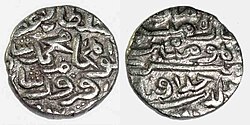
[[File:Khizr Khan (4).jpg|thumb|180x180px|Silver copper coin of [[Khizr Khan]], founder of the [[Sayyid dynasty]].<ref>{{cite book |author=Richard M. Eaton |title=India in the Persianate Age: 1000–1765 |year=2019 |isbn=978-0520325128 |page=117 |language=en |quote=The career of Khizr Khan, a Punjabi chieftain belonging to the Khokar clan...}}</ref>]] | |||
The [[Turkic peoples|Turkic]] [[Ghaznavids]] in the tenth century overthrew the Hindu Shahis and consequently ruled for 157 years in Western Punjab, gradually declining as a power until the [[Ghurid]] [[Siege of Lahore (1186)|conquest of Lahore]] by [[Muhammad of Ghor]] in 1186, deposing the last Ghaznavid ruler [[Khusrau Malik]].<ref>{{Cite book |last=Mehta |first=Jaswant Lal |url=https://books.google.com/books?id=iUk5k5AN54sC&pg=PA76 |title=Advanced Study in the History of Medieval India |date=1979 |publisher=Sterling Publishers Pvt. Ltd |isbn=978-81-207-0617-0 |pages=76 |language=en}}</ref> Following the death of [[Muhammad of Ghor]] in 1206 by Punjabi assassins near the Jhelum river, the Ghurid state fragmented and was replaced in northern India by the [[Delhi Sultanate]]. | |||
==== Tughlaq dynasty (c. 1320–1410 CE) ==== | |||
The Tughlaq dynasty's reign formally started in 1320 in [[Delhi]] when Ghazi Malik assumed the throne under the title of [[Ghiyath al-Din Tughluq]] after defeating [[Khusrau Khan]] at the [[Battle of Lahrawat]]. | |||
During Ghazi Maliks reign, in 1321 he sent his eldest son Jauna Khan, later known as Muhammad bin Tughlaq, to [[Deogir]] to plunder the Hindu kingdoms of Arangal and Tilang (now part of [[Telangana]]). His first attempt was a failure.<ref name="lowe296">William Lowe (Translator), {{Google books|RFNOAAAAYAAJ|Muntakhabu-t-tawārīkh|page=296}}, Volume 1, pages 296-301</ref> Four months later, Ghiyasuddin Tughlaq sent large army reinforcements for his son asking him to attempt plundering Arangal and Tilang again.<ref>[https://archive.org/stream/historyindiaast06elligoog#page/n240/mode/2up Tarikh-I Firoz Shahi] Ziauddin Barni, The History of India by its own Historians - The Muhammadan Period, Volume 3, Trubner London, pages 233-234</ref> This time Jauna Khan succeeded and Arangal fell, it was renamed to Sultanpur, and all plundered wealth, state treasury and captives were transferred from the captured kingdom to the Delhi Sultanate.The Muslim aristocracy in Lukhnauti (Bengal) invited Ghiyasuddin Tughlaq to extend his coup and expand eastwards into Bengal by attacking [[Shamsuddin Firoz Shah]], which he did over 1324–1325 AD,<ref name="lowe296" /> after placing Delhi under control of his son Ulugh Khan, and then leading his army to Lukhnauti. Ghiyasuddin Tughlaq succeeded in this campaign. | |||
After his fathers death in 1325 CE, [[Muhammad bin Tughluq|Muhammed Bin Tughlaq]] assumed power and his rule saw the empire expand to most of the Indian subcontinent, its peak in terms of geographical reach.<ref name="ebmit">[http://www.britannica.com/EBchecked/topic/396460/Muhammad-ibn-Tughluq Muḥammad ibn Tughluq] Encyclopædia Britannica</ref> He attacked and plundered [[Malwa]], [[Gujarat]], [[Lakhnauti]], [[Chittagong]], [[Mithila (region)|Mithila]] and many other regions in India<ref>[https://archive.org/stream/historyindiaast06elligoog#page/n242/mode/2up Tarikh-I Firoz Shahi] Ziauddin Barni, The History of India by its own Historians - The Muhammadan Period, Volume 3, Trubner London, pp. 236–237</ref> His distant campaigns were expensive, although each raid and attack on non-Muslim kingdoms brought new looted wealth and ransom payments from captured people. The extended empire was difficult to retain, and rebellions all over Indian subcontinent became routine.<ref name="zbarni">[https://archive.org/stream/historyindiaast06elligoog#page/n242/mode/2up Tarikh-I Firoz Shahi] Ziauddin Barni, The History of India by its own Historians - The Muhammadan Period, Volume 3, Trubner London, pp. 235–240</ref> Muhammad bin Tughlaq died in March 1351<ref name="pjackson2003">{{Cite book |author=Jackson, Peter |title=The Delhi Sultanate: A Political and Military History |publisher=Cambridge University Press |year=2003 |isbn=978-0521543293 |location=Cambridge, England}}</ref> while trying to chase and punish people for rebellion and their refusal to pay taxes in [[Sindh]] and [[Gujarat]].<ref name="vsoxford3">Vincent A Smith, {{Google books|p2gxAQAAMAAJ|The Oxford History of India: From the Earliest Times to the End of 1911|page=217}}, Chapter 2, pp. 242–248, Oxford University Press</ref> | |||
The Tughlaq empire after Muhammed Bin Tughluqs death was in a state of disarray with many regions assuming independance, it was at this point that [[Firuz Shah Tughlaq]], Ghazi Maliks nephew, took reign. His father's name was Rajab (the younger brother of [[Ghiyath al-Din Tughlaq|Ghazi Malik]]) who had the title ''[[Sipahsalar]]''. His mother Naila was a Punjabi Bhatti princess (daughter of Rana Mal) from [[Dipalpur]] and [[Abohar]] according the historian [[William Crooke]].<ref>{{Cite book |last=Crooke |first=William |url=https://books.google.com/books?id=tCc-AAAAYAAJ&dq=firoz+shah+tughlaq+mother&pg=PA144 |title=An Ethnographical Hand-book for the N.-W. Provinces and Oudh |date=1890 |publisher=North-Western provinces and Oudh government Press |page=144 |language=en}}</ref><ref>{{Cite book |url=https://books.google.com/books?id=WhFDAAAAYAAJ&q=bibi+naila+punjabi |title=Proceedings - Punjab History Conference |date=1966 |publisher=Publication Bureau, Punjab University |page=82 |language=en}}</ref> The southern states had drifted away from the Sultanate and there were rebellions in Gujarat and Sindh", while "Bengal asserted its independence." He led expeditions against Bengal in 1353 and 1358. He captured [[Cuttack]], desecrated the [[Jagannath Temple, Puri]], and forced Raja Gajpati of Jajnagar in [[Orissa, India|Orissa]] to pay tribute.<ref>{{Cite book |last1=Kulke |first1=Hermann |url=https://books.google.com/books?id=TPVq3ykHyH4C&dq=firoz+shah+orissa&pg=PA184 |title=A History of India |last2=Rothermund |first2=Dietmar |date=2004 |publisher=Psychology Press |isbn=978-0-415-32919-4 |page=184 |language=en}}</ref><ref>{{Cite book |last=Haque |first=Mohammed Anwarul |url=https://books.google.com/books?id=Co8eAAAAMAAJ&q=firoz+shah+cuttack |title=Muslim Administration in Orissa, 1568-1751 A.D. |date=1980 |publisher=Punthi Pustak |page=20 |language=en}}</ref> He also laid siege to the [[Kangra Fort]] and forced Nagarkot to pay tribute.<ref>{{Cite book |last=Jauhri |first=R. C. |url=https://books.google.com/books?id=ToRHAAAAMAAJ&q=firoz+shah+tughluq+kangra |title=Firoz Tughluq, 1351-1388 A.D. |date=1990 |publisher=ABS Publications |isbn=978-81-7072-029-4 |page=74 |language=en}}</ref> During his time Tatar Khan of [[Greater Khorasan]] attacked Punjab however he was defeated and his face slashed by the sword given by [[Feroz Shah Tughlaq]] to Raja [[Kailas Pal]] who ruled the Nagarkot region in Punjab.<ref>{{Cite book |last1=Hutchison |first1=John |url=https://books.google.com/books?id=3btDw4S2FmYC&dq=kailas+pal&pg=PA221 |title=History of the Panjab Hill States |last2=Vogel |first2=Jean Philippe |date=1994 |publisher=Asian Educational Services |isbn=978-81-206-0942-6 |page=221 |language=en}}</ref> | |||
==== Sayyid dynasty (c. 1410–1450 CE) ==== | |||
{{See also|Sayyid dynasty}} | |||
[[Khizr Khan]] established the [[Sayyid dynasty]], the fourth dynasty of the [[Delhi Sultanate]] after the fall of the [[Tughlaq dynasty|Tughlaqs]].<ref name=":02">{{cite book |author=Richard M. Eaton |title=India in the Persianate Age: 1000–1765 |year=2019 |isbn=978-0520325128 |page=117}}</ref> | |||
Following [[Timur]]'s 1398 sack of [[Delhi]],{{sfn|Jackson|2003|p=103}} he appointed [[Khizr Khan]] as deputy of [[Multan]] ([[Punjab region|Punjab]]).{{sfn|Kumar|2020|p=583}} He held Lahore, Dipalpur, Multan and Upper Sindh.<ref>{{cite book |author=Kenneth Pletcher |url=https://books.google.com/books?id=VsujRFvaHI8C&dq=khizr+khan+sind&pg=PA132 |title=The History of India |date=2010 |page=138| isbn=9781615301225 }}</ref><ref>{{cite book |author=V. D. Mahajan |url=https://books.google.com/books?id=nMWSQuf4oSIC&dq=khizr+khan+sind&pg=RA1-PA229 |title=History of Medieval India |date=2007 |page=229| isbn=9788121903646 }}</ref> Khizr Khan captured Delhi on 28 May 1414 thereby establishing the Sayyid dynasty.{{sfn|Kumar|2020|p=583}} Khizr Khan did not take up the title of [[sultan]], but continued the fiction of his allegiance to Timur as ''Rayat-i-Ala''(vassal) of the [[Timurids]] - initially that of Timur, and later his son [[Shahrukh Mirza|Shah Rukh]].<ref>{{cite book |url=https://books.google.com/books?id=OghDAAAAYAAJ&q=It+is+generally+acknowledged+that+Khizr+Khan+continued+to+recognise+Timur+and+his+successors+,+Shah+Rukh+,+as+his+nominal+overlords+.+But+later+on+under+his+succesor+,+Mubarak+Khan+,+this+%27+fiction+%27+of+allegiance+to+the+Timurid+rulers |title=Proceedings:Volume 55 |year=1995 |publisher=Indian History Congress |page=216}}</ref><ref>Mahajan, V.D. (1991, reprint 2007). ''History of Medieval India'', Part I, New Delhi: S. Chand, {{ISBN|81-219-0364-5}}, p.237</ref> After the accession of Khizr Khan, the Punjab, [[Uttar Pradesh]] and Sindh were reunited under the Delhi Sultanate, where he spent his time subduing rebellions.<ref>{{cite book |url=https://books.google.com/books?id=F3QbAAAAIAAJ&q=khizr+khan+sindh |title=Rajasthan [district Gazetteers] Bharatpur |date=1971 |publisher=Printed at Government Central Press |page=52}}</ref> Punjab was the powerbase of Khizr Khan and his successors as the bulk of the Delhi army during their reigns came from [[Multan]] and [[Dipalpur]].<ref>{{Cite book |last=Lal |first=Kishori Saran |url=https://books.google.com/books?id=C-E_SwAACAAJ&q=twilight+of+the+sultanate |title=Twilight of the Sultanate: A Political, Social and Cultural History of the Sultanate of Delhi from the Invasion of Timur to the Conquest of Babur 1398-1526 |date=1980 |publisher=Munshiram Manoharlal |isbn=978-81-215-0227-6 |language=en |quote=This considerably depleted Iqbal’s strength and encouraged Khizr Khan to collect his forces of Multan, Deopalpur and the Punjab}}</ref> | |||
Khizr Khan was succeeded by his son [[Mubarak Shah (Sayyid dynasty)|Mubarak Shah]] after his death on 20 May 1421. Mubarak Shah referred to himself as ''Muizz-ud-Din Mubarak Shah'' on his coins, removing the Timurid name with the name of the Caliph, and declared himself a Shah.<ref>{{cite book |author=V. D. Mahajan |url=https://books.google.com/books?id=nMWSQuf4oSIC&dq=sultan+mubarak+shah+timur++caliph&pg=RA1-PA240 |title=History of Medieval India |date=2007}}</ref><ref>{{cite book |author=Iqtidar Alam Khan |url=https://books.google.com/books?id=pzZFUcDpDzsC&dq=sultan+mubarak+shah&pg=PA103 |title=Historical Dictionary of Medieval India |date=2008 |page=103}}</ref> He defeated the advancing [[Hoshang Shah|Hoshang Shah Ghori]], ruler of [[Malwa Sultanate]] and forced him to pay heavy tribute early in his reign.<ref>{{Cite book |last=Lal |first=Kishori Saran |url=https://books.google.com/books?id=C-E_SwAACAAJ&q=twilight+of+the+sultanate |title=Twilight of the Sultanate: A Political, Social and Cultural History of the Sultanate of Delhi from the Invasion of Timur to the Conquest of Babur 1398-1526 |date=1980 |publisher=Munshiram Manoharlal |isbn=978-81-215-0227-6 |language=en |quote=Hoshang tried his luck against Sultan of Delhi but he was beaten back by Mubarak Shah Saiyyad to whom he had to pay a handsome tribute}}</ref> Mubarak Shah also put down the rebellion of [[Jasrat Khokhar|Jasrath Khokhar]] and managed to fend off multiple invasions by the Timurids of Kabul.<ref>{{Cite book |last=Lal |first=Kishori Saran |url=https://books.google.com/books?id=C-E_SwAACAAJ&q=twilight+of+the+sultanate |title=Twilight of the Sultanate: A Political, Social and Cultural History of the Sultanate of Delhi from the Invasion of Timur to the Conquest of Babur 1398-1526 |date=1980 |publisher=Munshiram Manoharlal |isbn=978-81-215-0227-6 |pages=109 |language=en}}</ref> | |||
The last ruler of the Sayyids, [[Alam Shah|Ala-ud-Din]], voluntarily abdicated the throne of the Delhi Sultanate in favour of [[Bahlul Khan Lodi]] on 19 April 1451, and left for Badaun, where he died in 1478.<ref>Mahajan, V.D. (1991, reprint 2007). ''History of Medieval India'', Part I, Now Delhi: S. Chand, {{ISBN|81-219-0364-5}}, p.244</ref> | |||
==== Langah Sultanate (c. 1450–1540 CE) ==== | |||
In 1445, Sultan Qutbudin, chief of ''Langah'', a [[Jat]] [[Zamindar]] tribe<ref name="Ahmed 1984 pp. 428–434">{{cite journal |last=Ahmed |first=Iftikhar |year=1984 |title=Territorial Distribution of Jatt Castes in Punjab c. 1595 – c. 1881 |url=http://www.jstor.org/stable/44140224 |journal=Proceedings of the Indian History Congress |publisher=Indian History Congress |volume=45 |pages=429, 432 |issn=2249-1937 |jstor=44140224 |access-date=2022-07-28}}</ref><ref name="Mubārak Blochmann 1891 p.321">{{cite book |last1=Mubārak |first1=A.F. |url=https://books.google.com/books?id=L8IXAAAAYAAJ |title=The Ain I Akbari |last2=Blochmann |first2=H. |publisher=Asiatic Society of Bengal |year=1891 |series=Bibliotheca Indica |page=321 |access-date=2022-07-28 |issue=v. 2}}</ref><ref name="Lambrick p.212">{{cite book |last=Lambrick |first=H. T. |title=Sind : a general introduction |date=1975 |publisher=Sindhi Adabi Board |isbn=0-19-577220-2 |publication-place=Hyderabad |page=212 |oclc=2404471}}</ref><ref name="Roseberry 1987 p.177">{{cite book |last=Roseberry |first=J.R. |url=https://books.google.com/books?id=iAMNAAAAIAAJ |title=Imperial Rule in Punjab: The Conquest and Administration of Multan, 1818–1881 |publisher=Manohar |year=1987 |isbn=978-81-85054-28-5 |page=177 |access-date=2022-07-28}}</ref> established the [[Langah Sultanate]] in [[Multan]] after the fall of the [[Sayyid dynasty]]. Husseyn Langah I (reigned 1456–1502) was the second ruler of [[Langah Sultanate]]. He undertook military campaigns in Punjab and captured [[Chiniot]] and [[Shorkot]] from the Lodis. Shah Husayn successfully repulsed attempted invasion by the Lodis led by [[Tatar Khan]] and [[Rukunuddin Barbak Shah|Barbak Shah]], as well as his daughter Zeerak Rumman.<ref name=":4">{{Cite web |title=Battles in chiniot and shorkot |url=https://en.unesco.org/silkroad/sites/default/files/knowledge-bank-article/vol_IVa%20silk%20road_the%20regions%20of%20sind%2C%20baluchistan%2C%20multan%20and%20kashmir.pdf |publisher=[[UNESCO]] |page=9}}</ref> | |||
=== Modern period === | |||
==== Mughal Empire (c. 1526–1761 CE) ==== | |||
The [[Mughal Empire|Mughals]] came to power in the early 16th century and gradually expanded to control all of the Punjab from their capital at [[Lahore]]. During the Mughal era, [[Saadullah Khan (Mughal Empire)|Saadullah Khan]], born into a family of Punjabi agriculturalists<ref name="Journal of Central Asia 1992 p.842">{{cite book |url=https://books.google.com/books?id=ml5xAAAAMAAJ |title=Journal of Central Asia |publisher=Centre for the Study of the Civilizations of Central Asia, Quaid-i-Azam University |year=1992 |page=84 |quote=Sadullah Khan was the son of Amir Bakhsh a cultivator of Chiniot . He belongs to Jat family. He was born on Thursday, the 10th Safar 1000 A.H./1591 A.C. |access-date=2022-07-30 |issue=v. 15}}</ref> belonging to the [[Thaheem (tribe)|Thaheem tribe]]<ref name="Quddus 1992 p.402">{{cite book |last=Quddus |first=S.A. |url=https://books.google.com/books?id=4y9zAAAAMAAJ |title=Punjab, the Land of Beauty, Love, and Mysticism |publisher=Royal Book Company |year=1992 |isbn=978-969-407-130-5 |page=402 |access-date=2022-07-29}}</ref> from [[Chiniot]]<ref name=":13">{{Cite journal |last=Siddiqui |first=Shabbir A. |title=Relations Between Dara Shukoh and Sa'adullah Khan |date=1986 |url=https://www.jstor.org/stable/44141552 |journal=Proceedings of the Indian History Congress |volume=47 |pages=273–276 |jstor=44141552 |issn=2249-1937}}</ref> remained [[grand vizier]] (or Prime Minister) of the Mughal Empire in the period 1645–1656.<ref name=":13" /> Other prominent Muslims from Punjab who rose to nobility during the Mughal Era include [[Wazir Khan (Lahore)|Wazir Khan]],<ref name="Koch">{{Cite book |last=Koch |first=Ebba |url=https://www.worldcat.org/oclc/69022179 |title=The complete Taj Mahal : and the riverfront gardens of Agra |date=2006 |publisher=Thames & Hudson |others=Richard André. Barraud |isbn=978-0-500-34209-1 |location=London |pages=45 |oclc=69022179}}</ref> [[Adina Beg|Adina Beg Arain]],<ref>{{Cite book |first=G.S. |last=Chhabra |url=https://books.google.com/books?id=UkDi6rVbckoC&dq=adina+beg+punjab&pg=PA38 |title=Advance Study in the History of Modern India (Volume-1: 1707–1803) |date=2005 |publisher=Lotus Press |isbn=978-81-89093-06-8 |pages=38 |language=en}}</ref> and [[Shahbaz Khan Kamboh]].<ref>{{cite Banglapedia|article=Shahbaz Khan|author=Chisti, AA Sheikh Md Asrarul Hoque}}</ref> The Mughal Empire ruled the region until it was severely weakened in the eighteenth century.<ref name=":9" /> As Mughal power weakened, Afghan rulers took control of the region.<ref name=":9" /> Contested by the [[Maratha Empire|Marathas]] and Afghans, the region was the center of the growing influence of the [[misl]]s, who expanded and established the Sikh Confederacy as the Mughals and Afghans weakened, ultimately ruling the Punjab, [[Khyber Pakhtunkhwa]], and territories north into the [[Himalayas]].<ref name=":9" /> | |||
==== Sikh Empire (c. 1799–1849 CE) ==== | |||
{{See also|Sikh Empire}} | |||
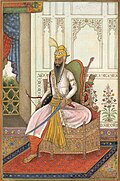
In the 19th century, Maharajah [[Ranjit Singh]] established the [[Sikh Empire]] based in the Punjab.<ref>{{cite web |date=3 September 2015 |title=Ranjit Singh: A Secular Sikh Sovereign by K.S. Duggal. ''(Date:1989. ISBN 8170172446'') |url=http://www.exoticindiaart.com/book/details/IDE822/ |access-date=2009-08-09 |publisher=Exoticindiaart.com}}</ref> The empire existed from 1799, when Ranjit Singh captured [[Lahore]], to 1849, when it was defeated and conquered in the [[Second Anglo-Sikh War]]. It was forged on the foundations of the [[Khalsa]] from a collection of autonomous [[Sikhism|Sikh]] ''[[misl]]s''.<ref name="Encyclopædia Britannica Eleventh Edition 1911 Page 892">{{cite EB1911 |wstitle=Ranjit Singh |volume=22 |page=892}}</ref><ref name="Grewal">{{cite book |last=Grewal |first=J. S. |url=https://books.google.com/books?id=2_nryFANsoYC |title=The Sikhs of the Punjab, Chapter 6: The Sikh empire (1799–1849) |publisher=Cambridge University Press |year=1990 |isbn=0-521-63764-3 |series=The New Cambridge History of India}}</ref> At its peak in the 19th century, the Empire extended from the [[Khyber Pass]] in the west to western [[Tibet]] in the east, and from [[Mithankot]] in the south to [[Kashmir]] in the north. It was divided into four provinces: [[Lahore]], in Punjab, which became the Sikh capital; [[Multan]], also in Punjab; [[Peshawar]]; and Kashmir from 1799 to 1849. Religiously diverse, with an estimated population of 3.5 million in 1831 (making it the [[List of countries by population in 1800|19th most populous country at the time]]),<ref name="ReferenceA">[[Amarinder Singh]]'s The Last Sunset: The Rise and Fall of the Lahore Durbar</ref> it was the last major region of the Indian subcontinent to [[Colonial India|be annexed]] by the [[British Empire]]. | |||
==== British Punjab (c. 1849–1947 CE) ==== | |||
{{see also|Punjab Province (British India)}} | |||
[[File:Maharaj Ranjit Singh.jpg|thumb|250x250px|Illustration of [[Ranjit Singh]], founder of the [[Sikh Empire]].]] | |||
The Sikh Empire ruled the Punjab until the British annexed it in 1849 following the [[First Anglo-Sikh War|First]] and [[Second Anglo-Sikh War]]s.<ref>{{cite book |last1=Grewal |first1=J. S. |series=The New Cambridge History of India |title=The Sikhs of the Punjab |date=1998 |publisher=Cambridge University Press |location=Cambridge |isbn=0-521-63764-3 |pages=126–128 |edition=Revised |chapter=The Sikh empire (1799–1849) - Chapter 6}}</ref> Most of the Punjabi homeland formed a province of British India, though a number of small [[princely state]]s retained local rulers who recognized British authority.<ref name=":9" /> The Punjab with its rich farmlands became one of the most important colonial assets.<ref name=":9" /> Lahore was a noted center of learning and culture, and [[Rawalpindi]] became an important military installation.<ref name=":9" /> Most Punjabis supported the British during [[World War I]], providing men and resources to the war effort even though the Punjab remained a source of anti colonial activities.<ref name="hibb 1980" />{{rp|163}} Disturbances in the region increased as the war continued.<ref name=":9" /> At the end of the war, high casualty rates, heavy taxation, inflation, and a widespread influenza epidemic disrupted Punjabi society.<ref name=":9" /> In 1919 a British officer ordered his troops to fire on a crowd of demonstrators, mostly Sikhs in [[Amritsar]]. The [[Jallianwala Bagh massacre|Jallianwala massacre]] fueled the [[indian independence movement]].<ref name=":9" /> Nationalists declared the independence of India from Lahore in 1930 but were quickly suppressed.<ref name=":9" /> When the Second World War broke out, nationalism in British India had already divided into religious movements.<ref name=":9" /> Many Sikhs and other minorities supported the Hindus, who promised a secular multicultural and multireligious society, and Muslim leaders in Lahore passed a resolution to work for a Muslim Pakistan, making the Punjab region a center of growing conflict between Indian and Pakistani nationalists.<ref name=":9" /> At the end of the war, the British granted separate independence to India and Pakistan, setting off massive communal violence as Muslims fled to Pakistan and Hindu and Sikh Punjabis fled east to India.<ref name=":9" /> | |||
The [[British Raj]] had major political, cultural, philosophical, and literary consequences in the Punjab, including the establishment of a new system of education. During the [[Indian independence movement|independence movement]], many Punjabis played a significant role, including [[Madan Lal Dhingra]], [[Sukhdev Thapar]], [[Sardar Ajit Singh|Ajit Singh Sandhu]], [[Bhagat Singh]], [[Udham Singh]], [[Kartar Singh Sarabha]], [[Bhai Parmanand]], [[Choudhry Rahmat Ali]], and [[Lala Lajpat Rai]]. At the time of partition in 1947, the province was split into East and West Punjab. [[East Punjab]] (48%) became part of India, while [[West Punjab]] (52%) became part of Pakistan.<ref>{{cite web |url=http://www.pakgeotagging.blogspot.co.uk/2014/10/partition-of-punjab-in-1947.html |title=Pakistan Geotagging: Partition of Punjab in 1947 |access-date=11 February 2016 |url-status=live |archive-url=https://web.archive.org/web/20160208221714/http://pakgeotagging.blogspot.co.uk/2014/10/partition-of-punjab-in-1947.html |archive-date=8 February 2016|date=3 October 2014 }}. Daily Times (10 May 2012). Retrieved 12 July 2013.</ref> The Punjab bore the brunt of the [[Civil disorder|civil unrest]] following [[Partition of India|partition]], with casualties estimated to be in the millions.<ref>{{cite journal|last1=Talbot|first1=Ian|title=Partition of India: The Human Dimension|journal=Cultural and Social History|year=2009|volume=6|issue=4|pages=403–410|quote=The number of casualties remains a matter of dispute, with figures being claimed that range from 200,000 to 2 million victims.|doi=10.2752/147800409X466254|s2cid=147110854}}</ref><ref name="dcosta2011">{{Cite book|title=Nationbuilding, Gender and War Crimes in South Asia|last=D'Costa|first=Bina|publisher=Routledge|year=2011|isbn=978-0415565660|page=53}}</ref><ref name="Silence2000">{{Cite book|url=https://www.nytimes.com/books/first/b/butalia-silence.html|title=The Other Side of Silence: Voices From the Partition of India|last=Butalia|first=Urvashi|publisher=Duke University Press|year=2000}}</ref><ref>{{Cite book|title=Muslims in India Since 1947: Islamic Perspectives on Inter-Faith Relations|last=Sikand|first=Yoginder|publisher=Routledge|year=2004|isbn=978-1134378258|page=5}}</ref> | |||
Another major consequence of partition was the sudden shift towards religious homogeneity occurred in all districts across Punjab owing to the new international border that cut through the province. This rapid demographic shift was primarily due to wide scale migration but also caused by large-scale [[Religious persecution#Religious cleansing|religious cleansing]] riots which were witnessed across the region at the time. According to historical demographer [[Tim Dyson]], in the eastern regions of Punjab that ultimately became [[Punjab, India|Indian Punjab]] following independence, districts that were 66% Hindu in 1941 became 80% Hindu in 1951; those that were 20% Sikh became 50% Sikh in 1951. Conversely, in the western regions of Punjab that ultimately became [[Punjab, Pakistan|Pakistani Punjab]], all districts became almost exclusively Muslim by 1951.{{sfn|Dyson|2018|pp=188–189}} | |||
== Geography == | |||
The geographical definition of the term "Punjab" has changed over time. In the 16th century [[Mughal Empire]] it referred to a relatively smaller area between the [[Indus River|Indus]] and the [[Sutlej River|Sutlej]] rivers.<ref name="JS_Grewal_1998">{{cite book |author=J. S. Grewal |url=https://books.google.com/books?id=2_nryFANsoYC |title=The Sikhs of the Punjab |publisher=Cambridge University Press |year=1998 |isbn=978-0-521-63764-0 |edition=Revised |series=The New Cambridge History of India |page=1}}</ref><ref name=":2">{{Cite book |url=https://books.google.com/books?id=9x5FX2RROZgC&pg=PA202 |title=Different Types of History |date=2009 |publisher=Pearson Education India |isbn=978-81-317-1818-6 |language=en}}</ref> | |||
=== Sikh Empire === | |||
[[File:Map of India 1823.jpg|thumb|Map showing the Punjabi Sikh Empire.]] | |||
The Sikh Empire spanned a total of over {{cvt|200,000|sqmi}} at its zenith.<ref>{{cite book |last=Manning |first=Stephen |url=https://books.google.com/books?id=sNveDwAAQBAJ&pg=PA9 |title=Bayonet to Barrage Weaponry on the Victorian Battlefield |date=30 September 2020 |publisher=Pen & Sword Books Limited |isbn=9781526777249 |quote="The Sikh kingdom expanded from Tibet in the east to Kashmir in the west and from Sind in the south to the Khyber Pass in the north, an area of 200,000 square miles"}}</ref><ref>{{cite book |last=Barczewski |first=Stephanie |url=https://books.google.com/books?id=ixd8CwAAQBAJ&pg=PA89 |title=Heroic Failure and the British |date=22 March 2016 |publisher=Yale University Press |isbn=9780300186819 |page=89 |quote="..the Sikh state encompassed over 200,000 square miles (518,000 sq km)"}}</ref><ref>{{cite book |last=Khilani |first=N. M. |url=https://books.google.com/books?id=fGEDAAAAMAAJ&q=punjab+of+over+200,000+square+miles+khilnani |title=British power in the Punjab, 1839–1858 |date=1972 |publisher=Asia Publishing House |isbn=9780210271872 |page=251 |quote="..into existence a kingdom of the Punjab of over 200,000 square miles"}}</ref> | |||
The Punjab was a region straddling India and the Afghan [[Durrani Empire]]. The following modern-day political divisions made up the historical Punjab region during the Sikh Empire: | |||
* Punjab region, to [[Mithankot]] in the south | |||
** [[Punjab, Pakistan]], excluding [[Bahawalpur State]] | |||
** [[Punjab, India]], south to areas just across the [[Sutlej]] river | |||
** [[Himachal Pradesh]], India, south to areas just across the [[Sutlej]] river | |||
** [[Jammu Division]], [[Jammu and Kashmir (union territory)|Jammu and Kashmir]], India and Pakistan (1808–1846) | |||
* [[Kashmir]], from 5 July 1819 to 15 March 1846, India/Pakistan/China<ref>The Masters Revealed, (Johnson, p. 128)</ref><ref>Britain and Tibet 1765–1947, (Marshall, p.116)</ref> | |||
** [[Kashmir Valley]], India from 1819 to 1846 | |||
** [[Gilgit]], [[Gilgit–Baltistan]], Pakistan, from 1842 to 1846{{citation needed|date=August 2020}} | |||
** [[Ladakh]], India 1834–1846<ref>{{cite book |author1=Pandey, Dr. Hemant Kumar |url=https://books.google.com/books?id=nn5IDwAAQBAJ&q=ladakh+1834+sikh&pg=PA57 |title=India's Major Military and Rescue Operations |author2=Singh, Manish Raj |publisher=Horizon Books |year=2017 |isbn=9789386369390 |page=57}}</ref><ref>{{cite web |last1=Deng |first1=Jonathan M. |date=2010 |title=Frontier: The Making of the Northern and Eastern Border in Ladakh From 1834 to the Present |url=https://digitalcollections.sit.edu/cgi/viewcontent.cgi?referer=https://www.google.com/&httpsredir=1&article=1923&context=isp_collection |publisher=SIT Digital Collections Independent Study Project (ISP) Collection. 920.}}</ref> | |||
* [[Khyber Pass]], Pakistan/Afghanistan<ref>The Khyber Pass: A History of Empire and Invasion, (Docherty, p. 187)</ref> | |||
** [[Peshawar]], Pakistan<ref>The Khyber Pass: A History of Empire and Invasion, (Docherty, pp. 185–187)</ref> (taken in 1818, retaken in 1834) | |||
** [[Khyber Pakhtunkhwa]] and the [[Federally Administered Tribal Areas]], Pakistan (documented from [[Hazara, Pakistan|Hazara]] (taken in 1818, again in 1836 to [[Bannu]])<ref>Bennett-Jones, Owen; Singh, Sarina, ''Pakistan & the Karakoram Highway'' Page 199</ref> | |||
* Parts of [[Tibet|Western Tibet]],{{sfn|Waheeduddin|1981|p=vii}} China ([[Sino-Sikh war|briefly]] in 1841, to [[Burang Town|Taklakot]]),<ref>{{cite book |author1=Kartar Singh Duggal |url=https://books.google.com/books?id=4udb8LsF3-oC&q=tibet |title=Maharaja Ranjit Singh, the Last to Lay Arms |publisher=Abhinav Publications |year=2001 |isbn=9788170174103 |page=131}}</ref> | |||
After Ranjit Singh's death in 1839, the empire was severely weakened by internal divisions and political mismanagement. This opportunity was used by the [[East India Company]] to launch the [[First Anglo-Sikh War|First]] and [[Second Anglo-Sikh War]]s. The country was finally annexed and dissolved at the end of the Second Anglo-Sikh War in 1849 into separate [[princely states]] and the [[Punjab (British India)|province of Punjab]]. Eventually, a Lieutenant Governorship was formed in Lahore as a direct representative of [[the Crown]].<ref name="hibb 1980">{{cite book |last1=Hibbert |first1=Christopher |title=The great mutiny: India 1857 |date=1980 |publisher=Penguin Books |isbn=978-0-14-004752-3 |location=Harmondsworth}}</ref>{{rp|221}} | |||
=== Punjab (British India) === | |||
{{See also|Punjab Province (British India)}} | |||
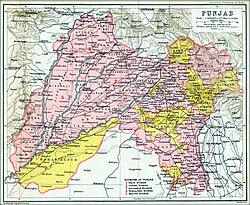
In British India, until the [[Partition of India]] in 1947, the [[Punjab Province (British India)|Punjab Province]] was geographically a triangular tract of country of which the [[Indus River]] and its tributary the [[Sutlej]] formed the two sides up to their confluence, the base of the triangle in the north being the [[Lower Himalayan Range]] between those two rivers. Moreover, the province as constituted under British rule also included a large tract outside these boundaries. Along the northern border, Himalayan ranges divided it from [[Kashmir]] and [[Tibet]]. On the west it was separated from the [[North-West Frontier Province (1901–1955)|North-West Frontier Province]] by the Indus, until it reached the border of [[Dera Ghazi Khan District]], which was divided from [[Balochistan (Pakistan)|Baluchistan]] by the [[Sulaiman Range]]. To the south lay [[Sindh]] and [[Rajputana]], while on the east the rivers [[Jumna River|Jumna]] and [[Tons River|Tons]] separated it from the [[United Provinces of Agra and Oudh|United Provinces]].<ref name="Chisholm 1911, p. 653">{{cite EB1911|Volume 22|wstitle=Punjab|page=653}}</ref> In total Punjab had an area of approximately 357 000 km square about the same size as modern day Germany, being one of the largest provinces of the British Raj. | |||
[[File:Punjab 1909.jpg|thumb|Map of the Punjab Province (British India)]] | |||
It encompassed the present day [[States and union territories of India|Indian states]] of [[Punjab, India|Punjab]], Haryana, [[Chandigarh]], Delhi, and some parts of [[Himachal Pradesh]] which were merged with Punjab by the British for administrative purposes (but excluding the former [[princely state]]s which were later combined into the [[Patiala and East Punjab States Union]]) and the Pakistani regions of the [[Punjab, Pakistan|Punjab]], [[Islamabad Capital Territory]] and [[Khyber Pakhtunkhwa]]. | |||
In 1901 the frontier districts beyond the Indus were separated from Punjab and made into a new province: the [[North-West Frontier Province (1901–1955)|North-West Frontier Province]]. Subsequently, Punjab was divided into four natural geographical divisions by colonial officials on the decadal census data:<ref name="punjab1911">{{cite web |title=Census of India 1911. Vol. 14, Punjab. Pt. 1, Report. |url=https://www.jstor.org/site/SAOA/SouthAsiaOpenArchivesSAOA/CensusReports-1911-26575903/ |access-date=21 July 2022}}</ref>{{rp|2}}<ref name="punjab1941">{{cite web|url=https://www.jstor.org/site/south-asia-open-archives/saoa/censusofindia1941-28216851/|title=CENSUS OF INDIA, 1941 VOLUME VI PUNJAB|access-date= 19 August 2022}}</ref>{{rp|4}} | |||
# '''''Indo-Gangetic Plain West geographical division''''' (including [[Hisar district]], [[Loharu State]], [[Rohtak district]], [[Dujana|Dujana State]], [[Gurgaon district]], [[Pataudi State]], Delhi, [[Karnal district]], [[Jalandhar district]], [[Kapurthala State]], [[Ludhiana district]], [[Malerkotla State]], [[Firozpur district]], [[Faridkot State]], [[Patiala State]], [[Jind State]], [[Nabha State]], [[Lahore District]], [[Amritsar district]], [[Gujranwala District]], and [[Sheikhupura district]]); | |||
# '''''Himalayan geographical division''''' (including [[Sirmur State|Nahan State]], [[Simla District]], [[Simla Hill States]], [[Kangra district]], [[Mandi State]], [[Suket State]], and [[Chamba State]]); | |||
# '''''Sub-Himalayan geographical division''''' (including [[Ambala district]], [[Kalsia State]], [[Hoshiarpur district]], [[Gurdaspur district]], [[Sialkot District]], [[Gujrat District]], [[Jhelum District]], [[Rawalpindi District]], and [[Attock District]]; | |||
# '''''North-West Dry Area geographical division''''' (including [[Montgomery District]], [[Shahpur District]], [[Mianwali District]], [[Lyallpur District]], [[Jhang District]], [[Multan District]], [[Bahawalpur State]], [[Muzaffargarh District]], and [[Dera Ghazi Khan District]]). | |||
=== Partition of British Punjab === | |||
The struggle for Indian independence witnessed competing and conflicting interests in the Punjab. The landed elites of the Muslim, Hindu and Sikh communities had loyally collaborated with the British since annexation, supported the Unionist Party and were hostile to the Congress party–led independence movement.<ref name="autogenerated542">Pritam Singh, Federalism, Nationalism and Development: India and the Punjab Economy, Routledge, 19 February 2008, p.54</ref> Amongst the peasantry and urban middle classes, the Hindus were the most active [[Indian National Congress|National Congress]] supporters, the Sikhs flocked to the [[Akali movement]] whilst the Muslims eventually supported the [[All-India Muslim League|Muslim League]].<ref name="autogenerated542" /> | |||
Since the partition of the sub-continent had been decided, special meetings of the Western and Eastern Section of the Legislative Assembly were held on 23 June 1947 to decide whether or not the Province of the Punjab be partitioned. After voting on both sides, partition was decided and the existing Punjab Legislative Assembly was also divided into [[West Punjab]] Legislative Assembly and the East Punjab Legislative Assembly. This last Assembly before independence, held its last sitting on 4 July 1947.<ref>[http://www.pap.gov.pk/uploads/previous_members/S-1946-1947.htm Provincial Assembly of the Punjab]</ref> | |||
=== Major cities === | |||
{{main|List of cities in the Punjab region by population}} | |||
Historically, [[Lahore]] has been the capital of the Punjab region and continues to be the most populous city in the region, with a population of 11 million for the city proper. [[Faisalabad]] is the 2nd most populous city and largest industrial hub in this region. Other major cities are [[Rawalpindi]], [[Gujranwala]], [[Multan]], [[Ludhiana]], [[Amritsar]], [[Jalandhar]], and [[Chandigarh]] are the other cities in Punjab with a city-proper population of over a million. | |||
== Climate == | |||
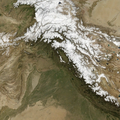
[[File:Himalayas, Punjab region.png|thumb|The snow-covered Himalayas]]The climate has significant impact on the economy of Punjab, particularly for agriculture in the region. Climate is not uniform over the whole region, as the sections adjacent to the Himalayas generally receive heavier rainfall than those at a distance.<ref>Maps of India, [http://www.mapsofindia.com/punjab/geography-and-history/climate.html Climate of Punjab] {{webarchive|url=https://web.archive.org/web/20121030101212/http://www.mapsofindia.com/punjab/geography-and-history/climate.html |date=30 October 2012 }}</ref> | |||
There are three main seasons and two transitional periods. During the hot season from mid-April to the end of June, the temperature may reach {{convert|49|C}}. The [[monsoon season]], from July to September, is a period of heavy rainfall, providing water for crops in addition to the supply from canals and [[irrigation]] systems. The transitional period after the [[monsoon]] is cool and mild, leading to the winter season, when the temperature in January falls to {{convert|5|C}} at night and {{convert|12|C}} by day. During the transitional period from winter to the hot season, sudden [[hailstorm]]s and heavy showers may occur, causing damage to crops.<ref name=rgs>Royal Geographical Society [http://www.rgs.org/NR/rdonlyres/5F44251D-8FD1-4102-BCDB-240A4E9EA1B8/0/F3ClimateandLandscapeFactsheet.pdf Climate and Landscape of the Punjab] {{webarchive|url=https://web.archive.org/web/20140430034607/http://www.rgs.org/NR/rdonlyres/5F44251D-8FD1-4102-BCDB-240A4E9EA1B8/0/F3ClimateandLandscapeFactsheet.pdf |date=30 April 2014 }}</ref> | |||
=== Western Punjab === | |||
{{Islamabad weatherbox}} | |||
=== Central Punjab === | |||
{{Lahore weatherbox}} | |||
=== Eastern Punjab === | |||
{{Chandigarh weatherbox}} | |||
==Demographics== | |||
{{Main|Punjabis}} | |||
===Languages=== | |||
{{See also|Punjab, Pakistan#Languages|Punjabi dialects and languages}} | |||
[[File:Mother Tongue by Pakistani District - 2017 Census.svg|thumb|right|upright=1.6| | |||
<div style="text-align: center">Dominant [[Mother tongue]] in each Pakistani [[Districts of Pakistan|District]] as of the [[2017 Pakistan Census]]</div>]] | |||
The major language is [[Punjabi language|Punjabi]], which is written in India with the [[Gurmukhi]] script, and in Pakistan using the [[Shahmukhi]] script.<ref>{{Cite web|url=https://www.omniglot.com/writing/punjabi.htm|title = Punjabi language, alphabets and pronunciation}}</ref> The Punjabi language has official status and is widely used in education and administration in Indian Punjab, whereas in Pakistani Punjab these roles are instead fulfilled by the [[Urdu]] language. | |||
Several languages closely related to Punjabi are spoken in the periphery of the region. [[Dogri]],<ref>{{Cite web |title=Dogri |url=http://lisindia.ciil.org/Dogri/Dogri.html |access-date=2022-08-17 |website=lisindia.ciil.org}}</ref> [[Kangri language|Kangri]],<ref>{{Cite web |title=Language {{!}} District Kangra, Government of Himachal Pradesh {{!}} India |url=https://hpkangra.nic.in/language/ |access-date=2022-08-17 |language=en-US}}</ref> and other [[western Pahari]] dialects are spoken in the north-central and northeastern peripheries of the region, while [[Bagri language|Bagri]]<ref>{{Cite web |date=28 January 2013 |title=Bagri of Rajasthan, Punjab, and Haryana: A Sociolinguistic Survey |url=https://www.sil.org/resources/archives/43105 |access-date=2022-08-17 |website=SIL International |language=en}}</ref> is spoken in south-central and southeastern sections. Meanwhile, [[Saraiki language|Saraiki]] is generally spoken across a wide belt covering the southwest, while in the northwest there are large pockets containing speakers of [[Hindko]] and [[Pothwari language|Pothwari]].{{sfn|Shackle|1979|p=198}} | |||
{| class="wikitable sortable" | |||
|+Linguistic Demographics of [[Punjab Province (British India)|Punjab Province]] | |||
! rowspan="2" |[[First language|Language]] | |||
! colspan="1" |Percentage | |||
|- | |||
!1911<ref name="punjab1911" />{{rp|370}} | |||
|- | |||
! [[Punjabi dialects and languages|Punjabi]]{{efn|[[Standard Punjabi]]: 58.34%<br />[[Lahnda]]:{{efn|name=lahnda|Western Punjabi languages and dialects including [[Saraiki language|Saraiki]], [[Hindko]] and [[Pahari-Pothwari]], and other related languages or dialects}} 17.59%}} | |||
| 75.93% | |||
|- | |||
! [[Western Hindi]]{{efn|name=westernhindi|Including [[Hindustani language|Hindustani]] ([[Hindi]] and [[Urdu]]), [[Braj Bhasha]], [[Haryanvi language|Haryanvi]], and other related languages or dialects}} | |||
| 15.82% | |||
|- | |||
! [[Western Pahari]] | |||
| 4.11% | |||
|- | |||
! [[Rajasthani languages|Rajasthani]] | |||
| 3.0% | |||
|- | |||
! [[Balochi language|Balochi]] | |||
| 0.29% | |||
|- | |||
! [[Pashto]] | |||
| 0.28% | |||
|- | |||
! English | |||
| 0.15% | |||
|- | |||
! Other | |||
| 0.42% | |||
|} | |||
=== Religions === | |||
{{Main|Religion in the Punjab}} | |||
==== Background ==== | |||
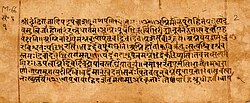
[[File:1500-1200 BCE Rigveda, manuscript page sample i, Mandala 1, Hymn 1 (Sukta 1), Adhyaya 1, lines 1.1.1 to 1.1.9, Sanskrit, Devanagari.jpg|thumb|[[Rig Veda]] is the oldest Hindu text that originated in the Punjab region.]] | |||
The [[Punjabi people]] first practiced [[Hinduism]], the oldest recorded religion in the Punjab region.<ref name="Nayar12">{{Cite book |last=Nayar |first=Kamala Elizabeth |url=https://books.google.com/books?id=q7pO-IZY218C&pg=PA7 |title=The Punjabis in British Columbia: Location, Labour, First Nations, and Multiculturalism |date=2012 |publisher=McGill-Queen's Press - MQUP |isbn=978-0-7735-4070-5 |language=en}}</ref> The [[historical Vedic religion]] constituted the religious ideas and practices in the Punjab during the [[Vedic period]] (1500–500 BCE), centered primarily in the worship of [[Indra]].<ref>{{Cite book |last=Wheeler |first=James Talboys |url=https://books.google.com/books?id=xSFGIqjWG14C&q=punjab |title=The History of India from the Earliest Ages: Hindu Buddhist Brahmanical revival |date=1874 |publisher=N. Trübner |pages=330 |language=en |quote=The Punjab, to say the least, was less Brahmanical. It was an ancient centre of the worship of Indra, who was always regarded as an enemy by the Bráhmans; and it was also a stronghold of Buddhism.}}</ref><ref>{{Cite book |last=Hunter |first=W. W. |url=https://books.google.com/books?id=Vdv7AQAAQBAJ&pg=PA80 |title=The Indian Empire: Its People, History and Products |date=2013-11-05 |publisher=Routledge |isbn=978-1-136-38301-4 |pages=80 |language=en |quote=In the settlements of the Punjab, Indra thus advanced to the first place among the Vedic divinities.}}</ref><ref>{{Cite book |last=Virdee |first=Pippa |url=https://books.google.com/books?id=WYJIDwAAQBAJ&pg=PA24 |title=From the Ashes of 1947 |date=February 2018 |publisher=Cambridge University Press |isbn=978-1-108-42811-8 |pages=24 |language=en |quote=The Rig Veda and the Upanishads, which belonged to the Vedic religion, were a precursor of Hinduism, both of which were composed in Punjab.}}</ref><ref>{{harvtxt|Michaels|2004|p=38}}: "The legacy of the Vedic religion in Hinduism is generally overestimated. The influence of the mythology is indeed great, but the religious terminology changed considerably: all the key terms of Hinduism either do not exist in Vedic or have a completely different meaning. The religion of the Veda does not know the ethicised migration of the soul with retribution for acts (''karma''), the cyclical destruction of the world, or the idea of salvation during one's lifetime (''jivanmukti; moksa; nirvana''); the idea of the world as illusion (''maya'') must have gone against the grain of ancient India, and an omnipotent creator god emerges only in the late hymns of the rgveda. Nor did the Vedic religion know a caste system, the burning of widows, the ban on remarriage, images of gods and temples, Puja worship, Yoga, pilgrimages, vegetarianism, the holiness of cows, the doctrine of stages of life (''asrama''), or knew them only at their inception. Thus, it is justified to see a turning point between the Vedic religion and Hindu religions."<br />{{cite web |first1=Stephanie |last1=Jamison |first2=Michael |last2=Witzel |year=1992 |title=Vedic Hinduism |url=http://www.people.fas.harvard.edu/~witzel/vedica.pdf |publisher=Harvard University |pages=3}}: "... to call this period Vedic Hinduism is a contradictio in terminis since Vedic religion is very different from what we generally call Hindu religion – at least as much as Old Hebrew religion is from medieval and modern Christian religion. However, Vedic religion is treatable as a predecessor of Hinduism."<br />See also {{harvnb|Halbfass|1991|pp=1–2}}</ref> The bulk of the [[Rigveda]] was composed in the Punjab region between circa 1500 and 1200 BC,<ref>{{Cite book |last=Flood |first=Gavin |url=https://archive.org/details/anintroductiontohinduismgavinfloodd.oupseeotherbooks_355_z/page/37/mode/2up |title=An Introduction to Hinduism |date=13 July 1996 |publisher=Cambridge University Press |isbn=978-0-521-43878-0}}</ref> while later Vedic scriptures were composed more eastwards, between the [[Yamuna]] and [[Ganges]] rivers. An ancient Indian law book called the [[Manusmriti]], developed by Brahmin Hindu priests, shaped Punjabi religious life from 200 BC onward.<ref name="Nayar">{{Cite book |last=Nayar |first=Kamala Elizabeth |url=https://books.google.com/books?id=q7pO-IZY218C&pg=PA7 |title=The Punjabis in British Columbia: Location, Labour, First Nations, and Multiculturalism |date=2012 |publisher=McGill-Queen's Press - MQUP |isbn=978-0-7735-4070-5 |pages=7–8 |language=en}}</ref> | |||
Later, the [[History of Buddhism in India|spread of Buddhisim]] and Jainism in the Indian subcontinent saw the growth of [[Buddhism]] and [[Jainism]] in the Punjab.<ref>{{Cite web |date=2019-05-03 |title=In ancient Punjab, religion was fluid, not watertight, says Romila Thapar |url=https://indianexpress.com/article/cities/in-ancient-punjab-religion-was-fluid-not-watertight-says-romila-thapar-5709145/ |access-date= |website=The Indian Express |language=en |quote=Thapar said Buddhism was very popular in Punjab during the Mauryan and post-Mauryan period. Bookended between Gandhara in Taxila on the one side where Buddhism was practised on a large scale and Mathura on another side where Buddhism, Jainism and Puranic religions were practised, this religion flourished in the state. But after the Gupta period, Buddhism began to decline.}}</ref> [[Islam]] was introduced via southern Punjab in the 8th century, becoming the majority by the 16th century, via local conversion.<ref name="oxford22">{{Cite book |last1=Rambo |first1=Lewis R. |url=https://books.google.com/books?id=U03gAgAAQBAJ&pg=PA490 |title=The Oxford Handbook of Religious Conversion |last2=Farhadian |first2=Charles E. |date=2014-03-06 |publisher=Oxford University Press |isbn=978-0-19-971354-7 |pages=489–491 |language=en |quote=First, Islam was introduced into the southern Punjab in the opening decades of the eighth century. By the sixteenth century, Muslims were the majority in the region and an elaborate network of mosques and mausoleums marked the landscape. Local converts constituted the majority of this Muslim community, and as far for the mechanisms of conversion, the sources of the period emphasize the recitation of the Islamic confession of faith (shahada), the performance of the circumsicion (indri vaddani), and the ingestion of cow-meat (bhas khana).}}</ref><ref>{{Cite book |last=Chhabra |first=G. S. |url=https://books.google.com/books?id=vF9DAAAAYAAJ |title=Advanced History of the Punjab: Guru and post-Guru period upto Ranjit Singh |date=1968 |publisher=New Academic Publishing Company |page=37 |language=en}}</ref> There was a small Jain community left in Punjab by the 16th century, while the Buddhist community had largely disappeared by the turn of the 10th century.<ref>{{Cite book |last1=Rambo |first1=Lewis R. |url=https://books.google.com/books?id=U03gAgAAQBAJ&pg=PA490 |title=The Oxford Handbook of Religious Conversion |last2=Farhadian |first2=Charles E. |date=2014-03-06 |publisher=Oxford University Press |isbn=978-0-19-971354-7 |pages=490 |language=en |quote=While Punjabi Hindu society was relatively well established, there was also a small but vibrant Jain community in the Punjab. Buddhist communities, however, had largely disappeared by the turn of the tenth century.}}</ref> The region became predominantly [[Muslim]] due to missionary [[Sufi]] saints whose [[dargah]]s dot the landscape of the Punjab region.<ref>{{Cite book |last1=Nicholls |first1=Ruth J. |url=https://books.google.com/books?id=gdz0DwAAQBAJ&q=islam+punjab+sufi |title=Insights into Sufism: Voices from the Heart |last2=Riddell |first2=Peter G. |date=2020-07-31 |publisher=Cambridge Scholars Publishing |isbn=978-1-5275-5748-2 |language=en |quote=With the Muslim conquest of Punjab there was a flow of Sufis and other preachers who came to spread Islam. Much of the advance of Islam was due to these preachers.}}</ref> | |||
The rise of [[Sikhism]] in the 1700s saw some Punjabis, both Hindu and Muslim, accepting the new Sikh faith.<ref name="Nayar" /><ref>{{Cite book |last=Singh |first=Pritam |url=https://books.google.com/books?id=lQpswqcdDLIC&pg=PA25 |title=Federalism, Nationalism and Development: India and the Punjab Economy |date=2008-02-19 |publisher=Routledge |isbn=978-1-134-04946-2 |language=en}}</ref> A number of Punjabis during the [[Colonial India|colonial period of India]] became Christians, with all of these religions characterizing the religious diversity now found in the Punjab region.<ref name="Nayar" /> | |||
==== Colonial era ==== | |||
{{Main|Religion in the Punjab#Subregions}} | |||
A number of Punjabis during the [[Colonial India|colonial period of India]] became Christians, with all of these religions characterizing the religious diversity now found in the Punjab region.<ref name="Nayar2">{{Cite book |last=Nayar |first=Kamala Elizabeth |url=https://books.google.com/books?id=q7pO-IZY218C&pg=PA7 |title=The Punjabis in British Columbia: Location, Labour, First Nations, and Multiculturalism |date=2012 |publisher=McGill-Queen's Press – MQUP |isbn=978-0-7735-4070-5 |pages=7–8 |language=en}}</ref> Additionally during the colonial era, the practice of [[religious syncretism]] among [[Punjabi Muslims]] and [[Punjabi Hindus]] was noted and documented by officials in census reports: | |||
{{blockquote|{{smaller|''"In other parts of the Province, too, traces of Hindu festivals are noticeable among the Muhammadans. In the western Punjab, [[Vaisakhi|Baisakhi]], the new year's day of the Hindus, is celebrated as an agricultural festival, by all Muhammadans, by racing bullocks yoked to the well gear, with the beat of tom-toms, and large crowds gather to witness the show, The race is called Baisakhi and is a favourite pastime in the well-irrigated tracts. Then the processions of [[Ta'zieh#Ta'zīya in South Asia|Tazias]], in [[Muharram]], with the accompaniment of tom-toms, fencing parties and bands playing on flutes and other musical instruments (which is disapproved by the orthodox Muhammadans) and the establishment of [[Sebil (fountain)|Sabils]] (shelters where water and [[Sharbat (beverage)|sharbat]] are served out) are clearly influenced by similar practices at Hindu festivals, while the illuminations on occasions like the [[Mela Chiraghan|Chiraghan fair]] of [[Shalimar Gardens, Lahore|Shalamar (Lahore)]] are no doubt practices answering to the holiday-making instinct of the converted Hindus."''<ref name="punjab1911"/>{{rp|174}}<br>''"Besides actual conversion, Islam has had a considerable influence on the Hindu religion. The sects of reformers based on a revolt from the orthodoxy of [[Varnashrama Dharma]] were obviously the outcome of the knowledge that a different religion could produce equally pious and right thinking men. Laxity in social restrictions also appeared simultaneously in various degrees and certain customs were assimilated to those of the Muhammadans. On the other hand the miraculous powers of Muhammadan saints were enough to attract the saint worshiping Hindus, to allegiance, if not to a total change of faith... The [[Punjabi Saudagaran-e-Delhi|Shamsis]] are believers in [[Shamsuddin Sabzwari|Shah Shamas Tabrez]] of [[Multan]], and follow the [[Imam]], for the time being, of the [[Isma'ilism|Ismailia]] sect of [[Shias]]... they belong mostly to the [[Sunar|Sunar caste]] and their connection with the sect is kept a secret, like Freemasonry. They pass as ordinary Hindus, but their devotion to the Imam is very strong."''<ref name="punjab1911"/>{{rp|130}}}} | |||
|Excerpts from the [[Census of India]] ([[Punjab Province (British India)|Punjab Province]])|1911 AD}} | |||
{| class="wikitable sortable" | |||
|+Population trends for major religious groups in the [[Punjab Province (British India)|Punjab Province]] of the [[British Raj|British India]](1881–1941)<ref name="krishan2004">{{cite journal |url=http://www.global.ucsb.edu/punjab/sites/secure.lsit.ucsb.edu.gisp.d7_sp/files/sitefiles/journals/volume11/no1/6_krishan.pdf |title=Demography of the Punjab (1849–1947) |first=Gopal |last=Krishan |journal=Journal of Punjab Studies |volume=11 |issue=1 |year=2004 |pages=77–89}}</ref><ref name="punjab1941"/>{{rp|46}} | |||
|- style="text-align: left;" | |||
! Religious<br />group | |||
! Population <br />% 1881 | |||
! Population <br />% 1891 | |||
! Population <br />% 1901 | |||
! Population <br />% 1911<ref group="lower-alpha">Delhi district is made into a separate territory</ref> | |||
! Population <br />% 1921 | |||
! Population <br />% 1931 | |||
! Population <br />% 1941 | |||
|- | |||
! style="background: green; color: white;"| Islam | |||
| 47.6% || 47.8% || 49.6% || 51.1% || 51.1% || 52.4% ||53.2% | |||
|- | |||
! style="background: OrangeRed; color: white;"| Hinduism | |||
| 43.8% || 43.6% || 41.3% || 35.8% || 35.1% || 31.7%{{efn|name=ad-dharmi}} || 30.1%{{efn|name=ad-dharmi}} | |||
|- | |||
! style="background: orange;"| Sikhism | |||
| 8.2% || 8.2% || 8.6% || 12.1% || 12.4% || 14.3% || 14.9% | |||
|- | |||
! style="background: DodgerBlue; color: white;"| Christianity | |||
| 0.1% || 0.2% || 0.3% || 0.8% || 1.3% || 1.5% || 1.5% | |||
|- | |||
! style="background: GreenYellow;"| Other religions / No religion | |||
| 0.3% || 0.2% || 0.2% || 0.2% || 0.1% || 0.1% || 0.3% | |||
|} | |||
{{clear}} | |||
{{Col-begin}} | |||
{{Col-break|width=33%}} | |||
{| class="wikitable sortable" | |||
|+ Religion in West Punjab (1941){{efn|name=WestPunjab1941|1941 figure taken from [[Census in British India|census data]] by combining the total population of all [[Districts of British India|districts]] ([[Lahore District|Lahore]], [[Sialkot District|Sialkot]], [[Gujranwala District|Gujranwala]], [[Sheikhupura District|Sheikhupura]], [[Gujrat District|Gujrat]], [[Shahpur District|Shahpur]], [[Jhelum District|Jhelum]], [[Rawalpindi District|Rawalpindi]], [[Attock District|Attock]], [[Mianwali District|Mianwali]], [[Montgomery District|Montgomery]], [[Lyallpur District|Lyallpur]], [[Jhang District|Jhang]], [[Multan District|Multan]], [[Muzaffargarh District|Muzaffargargh]], [[Dera Ghazi Khan District|Dera Ghazi Khan]]), one [[tehsil]] ([[Shakargarh Tehsil|Shakargarh]] – then part of [[Gurdaspur district|Gurdaspur District]]), one [[princely state]] ([[Bahawalpur (princely state)|Bahawalpur]]), and one tract (Biloch Trans–Frontier) in Punjab Province, British India that ultimately fell on the western side of the [[Radcliffe Line]]. See 1941 census data here:<ref name="punjab1941"/>{{rp|42}}<br>Immediately following the partition of India in 1947, these districts and tract would ultimately make up the subdivision of West Punjab, which also later included [[Bahawalpur (princely state)|Bahawalpur]]. The state that makes up this region in the contemporary era is [[Punjab, Pakistan]].}} | |||
|- | |||
! Religion | |||
! Population | |||
! Percentage | |||
|- | |||
| [[Islam]] [[File:Star and Crescent.svg|15px]] | |||
| 13,022,160 | |||
|{{Percentage | 13022160 | 17350103 | 2 }} | |||
|- | |||
| [[Hinduism]] [[File:Om.svg|15px]]{{efn|name=ad-dharmi|Including [[Ad-Dharmi]]s}} | |||
| 2,373,466 | |||
|{{Percentage | 2373466 | 17350103 | 2 }} | |||
|- | |||
| [[Sikhism]] [[File:Khanda.svg|15px]] | |||
| 1,530,112 | |||
|{{Percentage | 1530112 | 17350103 | 2 }} | |||
|- | |||
| [[Christianity]] [[File:Christian cross.svg|15px]] | |||
| 395,311 | |||
|{{Percentage | 395311 | 17350103 | 2 }} | |||
|- | |||
| [[Jainism]] [[File:Jain Prateek Chihna.svg|15px]] | |||
| 9,520 | |||
|{{Percentage | 9520 | 17350103 | 2 }} | |||
|- | |||
| Others{{efn|name=others|Including [[Buddhism]], [[Zoroastrianism]], [[Judaism]], [[Tribal religions in India|Tribals]], others, or not stated}} | |||
| 19,534 | |||
|{{Percentage | 19534 | 17350103 | 2 }} | |||
|- | |||
| '''Total Population''' | |||
| '''17,350,103''' | |||
| '''{{Percentage | 17350103 | 17350103 | 2 }}''' | |||
|} | |||
Territory comprises the contemporary subdivisions of [[Punjab, Pakistan]] and [[Islamabad Capital Territory]]. | |||
{{Col-break|width=33%}} | |||
{| class="wikitable sortable" | |||
|+ Religion in East Punjab (1941){{efn|name=EastPunjab1941|1941 figure taken from [[Census in British India|census data]] by combining the total population of all [[Districts of British India|districts]] ([[Hisar district|Hisar]], [[Rohtak district|Rohtak]], [[Gurgaon district|Gurgaon]], [[Karnal district|Karnal]], [[Jalandhar district|Jalandhar]], [[Ludhiana district|Ludhiana]], [[Firozpur district|Firozpur]], [[Amritsar district|Amritsar]], [[Simla District|Simla]], [[Kangra district|Kangra]], [[Ambala district|Ambala]], [[Hoshiarpur district|Hoshiarpur]], and [[Gurdaspur district|Gurdaspur]] (minus [[Shakargarh Tehsil]])), and [[princely state]]s ([[Loharu State|Loharu]], [[Dujana]], [[Pataudi State|Pataudi]], [[Kalsia State|Kalsia]], [[Kapurthala State|Kapurthala]], [[Malerkotla State|Malerkotla]], [[Faridkot State|Faridkot]], [[Patiala State|Patiala]], [[Jind State|Jind]], [[Nabha State|Nabha]], [[Sirmur State|Sirmoor]], [[Simla Hill States|Simla Hill]], [[Bilaspur State (princely state)|Bilaspur]], [[Mandi State|Mandi]], [[Suket State|Suket]], and [[Chamba State|Chamba]]) in Punjab Province, British India that ultimately fell on the eastern side of the [[Radcliffe Line]]. See 1941 census data here:<ref name="punjab1941"/>{{rp|42}}<br>Immediately following the partition of India in 1947, these districts and princely states would ultimately make up the subdivision of East Punjab, which also included [[Patiala and East Punjab States Union]], [[Chief Commissioner's Province of Himachal Pradesh]], and [[Bilaspur State (1950–1954)|Bilaspur State]]. The states that make up this region in the contemporary era are [[Punjab, India]], [[Chandigarh]], [[Haryana]], and [[Himachal Pradesh]].}} | |||
|- | |||
! Religion | |||
! Population | |||
! Percentage | |||
|- | |||
| [[Hinduism]] [[File:Om.svg|15px]]{{efn|name=ad-dharmi}} | |||
| 7,963,083 | |||
|{{Percentage | 7963083 | 16959758 | 2 }} | |||
|- | |||
| [[Islam]] [[File:Star and Crescent.svg|15px]] | |||
| 5,237,584 | |||
|{{Percentage | 5237584 | 16959758 | 2 }} | |||
|- | |||
| [[Sikhism]] [[File:Khanda.svg|15px]] | |||
| 3,586,073 | |||
|{{Percentage | 3586073 | 16959758 | 2 }} | |||
|- | |||
| [[Christianity]] [[File:Christian cross.svg|15px]] | |||
| 117,155 | |||
|{{Percentage | 117155 | 16959758 | 2 }} | |||
|- | |||
| [[Jainism]] [[File:Jain Prateek Chihna.svg|15px]] | |||
| 35,955 | |||
|{{Percentage | 35955 | 16959758 | 2 }} | |||
|- | |||
| Others{{efn|name=others}} | |||
| 19,908 | |||
|{{Percentage | 19908 | 16959758 | 2 }} | |||
|- | |||
| '''Total Population''' | |||
| '''16,959,758''' | |||
| '''{{Percentage | 16959758 | 16959758 | 2 }}''' | |||
|} | |||
Territory comprises the contemporary subdivisions of [[Punjab, India]], Chandigarh, [[Haryana]], and [[Himachal Pradesh]]. | |||
{{Col-break|width=33%}} | |||
{{Col-end}} | |||
{{clear}} | |||
{| class="wikitable sortable" | |||
|+ Religion in the Indo−Gangetic Plain West geographical division of [[Punjab Province (British India)|Punjab Province]] (1901–1941)<ref name="punjab1941" />{{rp|48}} | |||
|- | |||
! rowspan="2" |Religion | |||
! colspan="5" |Percentage | |||
|- | |||
! 1901 | |||
! 1911 | |||
! 1921 | |||
! 1931 | |||
! 1941 | |||
|- | |||
| [[Hinduism]] [[File:Om.svg|15px]] | |||
| 43.79% | |||
| 42.62% | |||
| 41.37% | |||
| 36.04% | |||
| 33.54% | |||
|- | |||
| [[Islam]] [[File:Star and Crescent.svg|15px]] | |||
| 37.36% | |||
| 37.81% | |||
| 38.0% | |||
| 39.72% | |||
| 40.41% | |||
|- | |||
| [[Sikhism]] [[File:Khanda.svg|15px]] | |||
| 18.35% | |||
| 18.73% | |||
| 19.10% | |||
| 21.88% | |||
| 23.11% | |||
|- | |||
| [[Christianity]] [[File:Christian cross.svg|15px]] | |||
| 0.18% | |||
| 0.51% | |||
| 1.23% | |||
| 1.54% | |||
| 1.60% | |||
|- | |||
| [[Jainism]] [[File:Jain Prateek Chihna.svg|15px]] | |||
| 0.32% | |||
| 0.33% | |||
| 0.29% | |||
| 0.27% | |||
| 0.28% | |||
|} | |||
The ''Indo−Gangetic Plain West geographical division'' included [[Hisar district]], [[Loharu State]], [[Rohtak district]], [[Dujana|Dujana State]], [[Gurgaon district]], [[Pataudi State]], [[Delhi]], [[Karnal district]], [[Jalandhar district]], [[Kapurthala State]], [[Ludhiana district]], [[Malerkotla State]], [[Firozpur district]], [[Faridkot State]], [[Patiala State]], [[Jind State]], [[Nabha State]], [[Lahore District]], [[Amritsar district]], [[Gujranwala District]], and [[Sheikhupura District]].<ref name="punjab1911"/>{{rp|2}}<ref name="punjab1941"/>{{rp|4}} | |||
{{clear}} | |||
{| class="wikitable sortable" | |||
|+ Religion in the Himalayan geographical division of [[Punjab Province (British India)|Punjab Province]] (1901—1941)<ref name="punjab1941"/>{{rp|48}} | |||
|- | |||
! rowspan="2" |Religion | |||
! colspan="5" |Percentage | |||
|- | |||
! 1901 | |||
! 1911 | |||
! 1921 | |||
! 1931 | |||
! 1941 | |||
|- | |||
| [[Hinduism]] [[File:Om.svg|15px]] | |||
| 94.60% | |||
| 94.53% | |||
| 94.50% | |||
| 94.25% | |||
| 94.35% | |||
|- | |||
| [[Islam]] [[File:Star and Crescent.svg|15px]] | |||
| 4.53% | |||
| 4.30% | |||
| 4.45% | |||
| 4.52% | |||
| 4.27% | |||
|- | |||
| [[Sikhism]] [[File:Khanda.svg|15px]] | |||
| 0.23% | |||
| 0.46% | |||
| 0.44% | |||
| 0.49% | |||
| 0.60% | |||
|- | |||
| [[Christianity]] [[File:Christian cross.svg|15px]] | |||
| 0.20% | |||
| 0.26% | |||
| 0.26% | |||
| 0.14% | |||
| 0.10% | |||
|- | |||
| [[Jainism]] [[File:Jain Prateek Chihna.svg|15px]] | |||
| 0.03% | |||
| 0.02% | |||
| 0.02% | |||
| 0.02% | |||
| 0.03% | |||
|} | |||
The ''Himalayan geographical division'' included [[Sirmur State|Sirmoor State]], [[Simla District]], [[Simla Hill States]], [[Bilaspur State (princely state)|Bilaspur State]], [[Kangra district]], [[Mandi State]], [[Suket State]], and [[Chamba State]].<ref name="punjab1911"/>{{rp|2}}<ref name="punjab1941"/>{{rp|4}} | |||
{{clear}} | |||
{| class="wikitable sortable" | |||
|+ Religion in the Sub−Himalayan geographical division of [[Punjab Province (British India)|Punjab Province]] (1901—1941)<ref name="punjab1941"/>{{rp|48}} | |||
|- | |||
! rowspan="2" |Religion | |||
! colspan="5" |Percentage | |||
|- | |||
! 1901 | |||
! 1911 | |||
! 1921 | |||
! 1931 | |||
! 1941 | |||
|- | |||
| [[Islam]] [[File:Star and Crescent.svg|15px]] | |||
| 60.62% | |||
| 61.19% | |||
| 61.44% | |||
| 61.99% | |||
| 62.29% | |||
|- | |||
| [[Hinduism]] [[File:Om.svg|15px]] | |||
| 33.09% | |||
| 27.36% | |||
| 26.66% | |||
| 22.85% | |||
| 21.98% | |||
|- | |||
| [[Sikhism]] [[File:Khanda.svg|15px]] | |||
| 5.68% | |||
| 9.74% | |||
| 9.77% | |||
| 11.65% | |||
| 11.89% | |||
|- | |||
| [[Christianity]] [[File:Christian cross.svg|15px]] | |||
| 0.48% | |||
| 1.59% | |||
| 2.01% | |||
| 2.05% | |||
| 1.74% | |||
|- | |||
| [[Jainism]] [[File:Jain Prateek Chihna.svg|15px]] | |||
| 0.12% | |||
| 0.12% | |||
| 0.12% | |||
| 0.11% | |||
| 0.12% | |||
|} | |||
The ''Sub−Himalayan geographical division'' included [[Ambala district]], [[Kalsia State]], [[Hoshiarpur district]], [[Gurdaspur district]], [[Sialkot District]], [[Gujrat District]], [[Jhelum District]], [[Rawalpindi District]], and [[Attock District]].<ref name="punjab1911"/>{{rp|2}}<ref name="punjab1941"/>{{rp|4}} | |||
{{clear}} | |||
{| class="wikitable sortable" | |||
|+ Religion in the North−West Dry Area geographical division of [[Punjab Province (British India)|Punjab Province]] (1901—1941)<ref name="punjab1941"/>{{rp|48}} | |||
|- | |||
! rowspan="2" |Religion | |||
! colspan="5" |Percentage | |||
|- | |||
! 1901 | |||
! 1911 | |||
! 1921 | |||
! 1931 | |||
! 1941 | |||
|- | |||
| [[Islam]] [[File:Star and Crescent.svg|15px]] | |||
| 79.01% | |||
| 80.00% | |||
| 78.95% | |||
| 78.22% | |||
| 77.85% | |||
|- | |||
| [[Hinduism]] [[File:Om.svg|15px]] | |||
| 17.84% | |||
| 13.58% | |||
| 14.23% | |||
| 12.80% | |||
| 13.21% | |||
|- | |||
| [[Sikhism]] [[File:Khanda.svg|15px]] | |||
| 2.91% | |||
| 5.62% | |||
| 5.64% | |||
| 6.73% | |||
| 6.74% | |||
|- | |||
| [[Christianity]] [[File:Christian cross.svg|15px]] | |||
| 0.23% | |||
| 0.79% | |||
| 1.17% | |||
| 1.18% | |||
| 1.17% | |||
|- | |||
| [[Jainism]] [[File:Jain Prateek Chihna.svg|15px]] | |||
| 0.01% | |||
| 0.01% | |||
| 0.01% | |||
| 0.01% | |||
| 0.01% | |||
|} | |||
The ''North−West Dry Area geographical division'' included [[Montgomery District]], [[Shahpur District]], [[Mianwali District]], [[Lyallpur District]], [[Jhang District]], [[Multan District]], [[Bahawalpur State]], [[Muzaffargarh District]], [[Dera Ghazi Khan District]], and the Biloch Trans–Frontier Tract.<ref name="punjab1911"/>{{rp|2}}<ref name="punjab1941"/>{{rp|4}} | |||
==== Post-partition ==== | |||
In the present-day, the vast majority of Pakistani Punjabis are Sunni Muslim by faith, but also include significant minority faiths, such as Shia Muslims, Ahmadi Muslims, [[Hindus]], [[Sikhs]] and Christians. | |||
Sikhism, founded by [[Guru Nanak]] is the main religion practised in the post-1966 Indian Punjab state. About 57.7% of the population of Punjab state is [[Sikh]], 38.5% is [[Hindu]], with the remaining population including [[Islam in Punjab, India|Muslims]], [[Christianity in Punjab, India|Christians]], and [[Jainism|Jains]].<ref>{{cite web| url=http://censusindia.gov.in/Census_Data_2001/Census_data_finder/C_Series/Population_by_religious_communities.htm| title=Census Reference Tables, C-Series Population by religious communities| publisher=Census of India| year=2001| access-date=25 July 2010| url-status=live| archive-url=https://web.archive.org/web/20100701214405/http://www.censusindia.gov.in/Census_Data_2001/Census_data_finder/C_Series/Population_by_religious_communities.htm| archive-date=1 July 2010}}</ref> Punjab state contains the holy Sikh cities of [[Amritsar]], [[Anandpur Sahib]], [[Tarn Taran Sahib]], [[Fatehgarh Sahib]] and [[Chamkaur Sahib]]. | |||
The Punjab was home to several [[List of Sufi saints|Sufi saints]], and Sufism is [[Sufism in Punjab|well established in the region]].<ref>{{cite web |url=http://www.punjabics.com/SufiSaintsOfPunjab/ |title=Sufi Saints of the Punjab |website=Punjabics.com |access-date=1 July 2018 |url-status=live |archive-url=https://web.archive.org/web/20131230010342/http://punjabics.com/SufiSaintsOfPunjab/ |archive-date=30 December 2013}}</ref> Also, [[Kirpal Singh]] revered the Sikh Gurus as saints.<ref>{{cite web |url=http://www.ruhanisatsangusa.org/indian/sant_kirpal_singh_history/punjab_home_of_master_saints.htm |title=The Punjab – Home of Master Saints |last1=Kirpal Singh |first1=Sant |access-date=1 July 2018 |url-status=live |archive-url=https://web.archive.org/web/20150924092640/http://www.ruhanisatsangusa.org/indian/sant_kirpal_singh_history/punjab_home_of_master_saints.htm |archive-date=24 September 2015|author1-link=Kirpal Singh }}</ref> | |||
{| class="wikitable sortable" | |||
|+ Religious groups in the Punjab Region ([[2011 Census of India]] & [[2017 Census of Pakistan]])<ref name="WestPunjab&IslamabadReligions">{{cite web|url=https://www.pbs.gov.pk/sites/default/files/population/2017/tables/pakistan/Table09n.pdf|title=TABLE 9 - POPULATION BY SEX, RELIGION AND RURAL/URBAN|access-date=13 February 2023}}</ref><ref name="EastPunjabReligions">{{cite web |title=Population by religion community – 2011 |url=http://www.censusindia.gov.in/2011census/C-01/DDW03C-01%20MDDS.XLS |publisher=The Registrar General & Census Commissioner, India |access-date=13 February 2023 |archive-url=https://web.archive.org/web/20150923230423/http://www.censusindia.gov.in/2011census/C-01/DDW03C-01%20MDDS.XLS |archive-date=23 September 2015}}</ref><ref name="Haryana&Himachal&Delhi&ChandigarhReligions">{{cite web|title=Population by religion community – 2011|url=http://www.censusindia.gov.in/2011census/C-01/DDW00C-01%20MDDS.XLS |website=Census of India, 2011 |publisher=The Registrar General & Census Commissioner, India |access-date=13 February 2023 |archive-url=https://web.archive.org/web/20150825155850/http://www.censusindia.gov.in/2011census/C-01/DDW00C-01%20MDDS.XLS |archive-date=25 August 2015}}</ref>{{efn|name=2011&2017Census|Estimates from combining [[2011 Indian census]] and [[2017 Pakistani Census|2017 Pakistani census]] with religious data amalgamated from [[Punjab, India]], [[Punjab, Pakistan]], [[Haryana]], [[Delhi]], [[Himachal Pradesh]], [[Islamabad]], and [[Chandigarh]].<ref name="WestPunjab&IslamabadReligions"/><ref name="EastPunjabReligions"/><ref name="Haryana&Himachal&Delhi&ChandigarhReligions"/>}} | |||
! rowspan="2" |Religious<br>group | |||
! colspan="2" |Punjab<br>Region | |||
! colspan="2" |[[Punjab, Pakistan|Punjab<br>(Pakistan)]]<ref name="WestPunjab&IslamabadReligions"/> | |||
! colspan="2" |[[Punjab, India|Punjab<br>(India)]]<ref name="EastPunjabReligions"/> | |||
! colspan="2" |[[Haryana]]<ref name="Haryana&Himachal&Delhi&ChandigarhReligions"/> | |||
! colspan="2" |[[Delhi]]<ref name="Haryana&Himachal&Delhi&ChandigarhReligions"/> | |||
! colspan="2" |[[Himachal Pradesh|Himachal<br>Pradesh]]<ref name="Haryana&Himachal&Delhi&ChandigarhReligions"/> | |||
! colspan="2" |[[Islamabad Capital Territory|Islamabad]]<ref name="WestPunjab&IslamabadReligions"/> | |||
! colspan="2" |[[Chandigarh]]<ref name="Haryana&Himachal&Delhi&ChandigarhReligions"/> | |||
|- | |||
!Total<br>Population | |||
!Percentage | |||
![[Population|{{abbr|Pop.|Population}}]] | |||
!{{Abbr|%|percentage}} | |||
!{{abbr|Pop.|Population}} | |||
!{{Abbr|%|percentage}} | |||
!{{abbr|Pop.|Population}} | |||
!{{Abbr|%|percentage}} | |||
!{{abbr|Pop.|Population}} | |||
!{{Abbr|%|percentage}} | |||
!{{abbr|Pop.|Population}} | |||
!{{Abbr|%|percentage}} | |||
!{{abbr|Pop.|Population}} | |||
!{{Abbr|%|percentage}} | |||
!{{abbr|Pop.|Population}} | |||
!{{Abbr|%|percentage}} | |||
|- | |||
| [[Islam]] [[File:Star and Crescent.svg|15px]] | |||
! 114,130,322 | |||
! {{Percentage | 114130322 | 189795816 | 2 }} | |||
| 107,541,602 | |||
| {{Percentage | 107541602 | 109989655 | 2 }} | |||
| 535,489 | |||
| {{Percentage | 535489 | 27743338 | 2 }} | |||
| 1,781,342 | |||
| {{Percentage | 1781342 | 25351462 | 2 }} | |||
| 2,158,684 | |||
| {{Percentage | 2158684 | 16787941 | 2 }} | |||
| 149,881 | |||
| {{Percentage | 149881 | 6864602 | 2 }} | |||
| 1,911,877 | |||
| {{Percentage | 1911877 | 2003368 | 2 }} | |||
| 51,447 | |||
| {{Percentage | 51447 | 1055450 | 2 }} | |||
|- | |||
| [[Hinduism]] [[File:Om.svg|15px]] | |||
! 54,159,083 | |||
! {{Percentage | 54159083 | 189795816 | 2 }} | |||
| 211,641 | |||
| {{Percentage | 211641 | 109989655 | 2 }} | |||
| 10,678,138 | |||
| {{Percentage | 10678138 | 27743338 | 2 }} | |||
| 22,171,128 | |||
| {{Percentage | 22171128 | 25351462 | 2 }} | |||
| 13,712,100 | |||
| {{Percentage | 13712100 | 16787941 | 2 }} | |||
| 6,532,765 | |||
| {{Percentage | 6532765 | 6864602 | 2 }} | |||
| 737 | |||
| {{Percentage | 737 | 2003368 | 2 }} | |||
| 852,574 | |||
| {{Percentage | 852574 | 1055450 | 2 }} | |||
|- | |||
| [[Sikhism]] [[File:Khanda.svg|15px]] | |||
! 18,037,312 | |||
! {{Percentage | 18037312 | 189795816 | 2 }} | |||
| {{N/a}} | |||
| {{N/a}} | |||
| 16,004,754 | |||
| {{Percentage | 16004754 | 27743338 | 2 }} | |||
| 1,243,752 | |||
| {{Percentage | 1243752 | 25351462 | 2 }} | |||
| 570,581 | |||
| {{Percentage | 570581 | 16787941 | 2 }} | |||
| 79,896 | |||
| {{Percentage | 79896 | 6864602 | 2 }} | |||
| {{N/a}} | |||
| {{N/a}} | |||
| 138,329 | |||
| {{Percentage | 138329 | 1055450 | 2 }} | |||
|- | |||
| [[Christianity]] [[File:Christian cross.svg|15px]] | |||
! 2,715,952 | |||
! {{Percentage | 2715952 | 189795816 | 2 }} | |||
| 2,063,063 | |||
| {{Percentage | 2063063 | 109989655 | 2 }} | |||
| 348,230 | |||
| {{Percentage | 348230 | 27743338 | 2 }} | |||
| 50,353 | |||
| {{Percentage | 50353 | 25351462 | 2 }} | |||
| 146,093 | |||
| {{Percentage | 146093 | 16787941 | 2 }} | |||
| 12,646 | |||
| {{Percentage | 12646 | 6864602 | 2 }} | |||
| 86,847 | |||
| {{Percentage | 86847 | 2003368 | 2 }} | |||
| 8,720 | |||
| {{Percentage | 8720 | 1055450 | 2 }} | |||
|- | |||
| [[Jainism]] [[File:Jain Prateek Chihna.svg|15px]] | |||
! 267,649 | |||
! {{Percentage | 267649 | 189795816 | 2 }} | |||
| {{N/a}} | |||
| {{N/a}} | |||
| 45,040 | |||
| {{Percentage | 45040 | 27743338 | 2 }} | |||
| 52,613 | |||
| {{Percentage | 52613 | 25351462 | 2 }} | |||
| 166,231 | |||
| {{Percentage | 166231 | 16787941 | 2 }} | |||
| 1,805 | |||
| {{Percentage | 1805 | 6864602 | 2 }} | |||
| {{N/a}} | |||
| {{N/a}} | |||
| 1,960 | |||
| {{Percentage | 1960 | 1055450 | 2 }} | |||
|- | |||
| [[Ahmadiyya]] [[File:Liwa-e-Ahmadiyya 1-2.svg|15px]] | |||
! 160,759 | |||
! {{Percentage | 160759 | 189795816 | 2 }} | |||
| 158,021 | |||
| {{Percentage | 158021 | 109989655 | 2 }} | |||
| {{N/a}} | |||
| {{N/a}} | |||
| {{N/a}} | |||
| {{N/a}} | |||
| {{N/a}} | |||
| {{N/a}} | |||
| {{N/a}} | |||
| {{N/a}} | |||
| 2,738 | |||
| {{Percentage | 2738 | 2003368 | 2 }} | |||
| {{N/a}} | |||
| {{N/a}} | |||
|- | |||
| [[Buddhism]] [[File:Dharma Wheel (2).svg|15px]] | |||
! 139,019 | |||
! {{Percentage | 139019 | 189795816 | 2 }} | |||
| {{N/a}} | |||
| {{N/a}} | |||
| 33,237 | |||
| {{Percentage | 33237 | 27743338 | 2 }} | |||
| 7,514 | |||
| {{Percentage | 7514 | 25351462 | 2 }} | |||
| 18,449 | |||
| {{Percentage | 18449 | 16787941 | 2 }} | |||
| 78,659 | |||
| {{Percentage | 78659 | 6864602 | 2 }} | |||
| {{N/a}} | |||
| {{N/a}} | |||
| 1,160 | |||
| {{Percentage | 1160 | 1055450 | 2 }} | |||
|- | |||
| Others | |||
! 185,720 | |||
! {{Percentage | 185720 | 189795816 | 2 }} | |||
| 15,328 | |||
| {{Percentage | 15328 | 109989655 | 2 }} | |||
| 98,450 | |||
| {{Percentage | 98450 | 27743338 | 2 }} | |||
| 44,760 | |||
| {{Percentage | 44760 | 25351462 | 2 }} | |||
| 15,803 | |||
| {{Percentage | 15803 | 16787941 | 2 }} | |||
| 8,950 | |||
| {{Percentage | 8950 | 6864602 | 2 }} | |||
| 1,169 | |||
| {{Percentage | 1169 | 2003368 | 2 }} | |||
| 1,260 | |||
| {{Percentage | 1260 | 1055450 | 2 }} | |||
|- | |||
! Total population | |||
! 189,795,816 | |||
! {{Percentage | 189795816 | 189795816 | 2 }} | |||
! 109,989,655 | |||
! {{Percentage | 109989655 | 109989655 | 2 }} | |||
! 27,743,338 | |||
! {{Percentage | 27743338 | 27743338 | 2 }} | |||
! 25,351,462 | |||
! {{Percentage | 25351462 | 25351462 | 2 }} | |||
! 16,787,941 | |||
! {{Percentage | 16787941 | 16787941 | 2 }} | |||
! 6,864,602 | |||
! {{Percentage | 6864602 | 6864602 | 2 }} | |||
! 2,003,368 | |||
! {{Percentage | 2003368 | 2003368 | 2 }} | |||
! 1,055,450 | |||
! {{Percentage | 1055450 | 1055450 | 2 }} | |||
|} | |||
=== Tribes === | |||
{{See also|List of Punjabi tribes}} | |||
[[File:JatsAroundDelhi1868.jpg|thumb|150px|Jats in Delhi (1868).]] | |||
[[File:Charles Shepherd and Arthur Robertson01.jpg|thumb|150px|Rajputs in Delhi (1868).]] | |||
[[File:Grey-scale scan of a painting of a Hindu official or courtier (possibly identifiable as Misr Diwan Chand) of the court of the Sikh Empire.jpg|thumb|150px|Brahmin in Lahore ({{circa|1799–1849}}).]] | |||
[[File:From left to right- A Gurkha, a Brahmin and a Sood.jpg|thumb|150px|Left to right: Gurkha, Brahmin and Shudra (Chuhra-Chamar) in Shimla (1868).]] | |||
[[File:Screenshot 20200218-205406 Samsung Internet.jpg|thumb|150px|Arains in Lahore (1868).]] | |||
[[File:Portrait of three unidentified Lahore carpenters (likely Tarkhan) with tools, ca.1862–72.png|thumb|150px|Tarkhans in Lahore ({{circa|1862–72)}}.]] | |||
[[File:Two Gurjar (also transliterated as Gujjar, Gujar, Gurjara, & Gujjer) Men on a Pavement and a Woman in a Doorway in Delhi, Shepherd & Robertson (possibly), ca.1859–69.png|thumb|150px|Gujjars in Delhi ({{circa|1859–69)}}.]] | |||
[[File:Portrait of an unidentified Arora Storekeeper from Lahore with coins in hand and in front of him, ca.1862–72.png|thumb|150px|Arora in Lahore ({{circa|1862–72)}}.]] | |||
[[File:Portrait of two unknown Kumhar potters from Lahore, ca.1859–69.png|thumb|150px|Kumhars in Lahore ({{circa|1859–69)}}.]] | |||
The Punjab region is diverse. Historic census reports taken in the [[British Raj|colonial era]] details the main [[Caste system in India|castes]] are represented, alongside numerous subcastes and [[List of Scheduled Tribes in India|tribes]] (also known as ''[[Jāti]]'' or ''[[Baradari (brotherhood)|Barādarī]]''), formed parts of the various ethnic groups in the region, contemporarily known as [[Punjabis]], [[Saraiki people|Saraikis]], [[Haryanvi people|Haryanvis]], [[Hindkowans]], [[Dogras]], [[Pahari people (Kashmir)|Paharis]], and more. | |||
{| class="wikitable sortable" | |||
|+Tribes of [[Punjab Province (British India)|Punjab Province]] (1881–1931)<ref name="punjab1911"/>{{rp|478}}<ref name="punjab1921A">{{cite web|url=https://www.jstor.org/stable/saoa.crl.25430164 |jstor=saoa.crl.25430164 |access-date=26 March 2023|title=Census of India 1921. Vol. 15, Punjab and Delhi. Pt. 1, Report. |year=1921 |volume=15 }}</ref>{{rp|348}}<ref name="punjab1921B">{{cite web|url=https://www.jstor.org/stable/saoa.crl.25430165 |jstor=saoa.crl.25430165 |access-date=26 March 2023|title=Census of India 1921. Vol. 15, Punjab and Delhi. Pt. 2, Tables. |year=1921 |volume=15 }}</ref>{{rp|193–254}}<ref name="punjab1931A">{{cite web|url=https://www.jstor.org/stable/saoa.crl.25793222 |jstor=saoa.crl.25793222 |access-date=21 March 2023|title=Census of India 1931. Vol. 17, Punjab. Pt. 1, Report. |year=1931 |volume=17 }}</ref>{{rp|367}}<ref name="punjab1931B">{{cite web|url=https://www.jstor.org/stable/saoa.crl.25793242 |jstor=saoa.crl.25793242 |access-date=21 March 2023|title=Census of India 1931. Vol. 17, Punjab. Pt. 2, Tables. |year=1931 |volume=17 }}</ref>{{rp|281–309}} | |||
! rowspan="2" |Tribe | |||
! colspan="2" |1881 | |||
! colspan="2" |1891 | |||
! colspan="2" |1901 | |||
! colspan="2" |1911 | |||
! colspan="2" |1921 | |||
! colspan="2" |1931 | |||
|- | |||
![[Population|{{abbr|Pop.|Population}}]] | |||
!{{Abbr|%|percentage}} | |||
!{{abbr|Pop.|Population}} | |||
!{{Abbr|%|percentage}} | |||
!{{abbr|Pop.|Population}} | |||
!{{Abbr|%|percentage}} | |||
!{{abbr|Pop.|Population}} | |||
!{{Abbr|%|percentage}} | |||
!{{abbr|Pop.|Population}} | |||
!{{Abbr|%|percentage}} | |||
!{{abbr|Pop.|Population}} | |||
!{{Abbr|%|percentage}} | |||
|- | |||
! [[Jats|Jat]] | |||
| 4,223,885 | |||
| {{Percentage | 4223885 | 20800995 | 2 }} | |||
| 4,500,340 | |||
| {{Percentage | 4500340 | 22915894 | 2 }} | |||
| 4,884,285 | |||
| {{Percentage | 4884285 | 24367113 | 2 }} | |||
| 4,891,060 | |||
| {{Percentage | 4891060 | 23791841 | 2 }} | |||
| 5,453,747 | |||
| {{Percentage | 5453747 | 25101514 | 2 }} | |||
| 6,070,032 | |||
| {{Percentage | 6070032 | 28490869 | 2 }} | |||
|- | |||
! [[Rajput]] | |||
| 1,648,426 | |||
| {{Percentage | 1648426 | 20800995 | 2 }} | |||
| 1,747,989 | |||
| {{Percentage | 1747989 | 22915894 | 2 }} | |||
| 1,784,402 | |||
| {{Percentage | 1784402 | 24367113 | 2 }} | |||
| 1,586,274 | |||
| {{Percentage | 1586274 | 23791841 | 2 }} | |||
| 1,853,025 | |||
| {{Percentage | 1853025 | 25101514 | 2 }} | |||
| 2,351,650 | |||
| {{Percentage | 2351650 | 28490869 | 2 }} | |||
|- | |||
! [[Brahmin|Brahman]] | |||
| 1,040,771 | |||
| {{Percentage | 1040771 | 20800995 | 2 }} | |||
| 1,069,132 | |||
| {{Percentage | 1069132 | 22915894 | 2 }} | |||
| 1,077,252 | |||
| {{Percentage | 1077252 | 24367113 | 2 }} | |||
| 985,901 | |||
| {{Percentage | 985901 | 23791841 | 2 }} | |||
| 994,529 | |||
| {{Percentage | 994529 | 25101514 | 2 }} | |||
| 1,058,598 | |||
| {{Percentage | 1058598 | 28490869 | 2 }} | |||
|- | |||
! [[Chuhra]] | |||
| 1,039,039 | |||
| {{Percentage | 1039039 | 20800995 | 2 }} | |||
| 1,175,504 | |||
| {{Percentage | 1175504 | 22915894 | 2 }} | |||
| 1,175,003 | |||
| {{Percentage | 1175003 | 24367113 | 2 }} | |||
| 912,998 | |||
| {{Percentage | 912998 | 23791841 | 2 }} | |||
| 750,596 | |||
| {{Percentage | 750596 | 25101514 | 2 }} | |||
| 681,359 | |||
| {{Percentage | 681359 | 28490869 | 2 }} | |||
|- | |||
! [[Chamar]] | |||
| 1,033,727 | |||
| {{Percentage | 1033727 | 20800995 | 2 }} | |||
| 1,147,913 | |||
| {{Percentage | 1147913 | 22915894 | 2 }} | |||
| 1,172,118 | |||
| {{Percentage | 1172118 | 24367113 | 2 }} | |||
| 1,075,941 | |||
| {{Percentage | 1075941 | 23791841 | 2 }} | |||
| 1,134,700 | |||
| {{Percentage | 1134700 | 25101514 | 2 }} | |||
| 1,102,465 | |||
| {{Percentage | 1102465 | 28490869 | 2 }} | |||
|- | |||
! [[Arain]] | |||
| 795,471 | |||
| {{Percentage | 795471 | 20800995 | 2 }} | |||
| 890,264 | |||
| {{Percentage | 890264 | 22915894 | 2 }} | |||
| 1,003,698 | |||
| {{Percentage | 1003698 | 24367113 | 2 }} | |||
| 973,888 | |||
| {{Percentage | 973888 | 23791841 | 2 }} | |||
| 1,086,455 | |||
| {{Percentage | 1086455 | 25101514 | 2 }} | |||
| 1,329,312 | |||
| {{Percentage | 1329312 | 28490869 | 2 }} | |||
|- | |||
! [[Julaha]] | |||
| 593,199 | |||
| {{Percentage | 593199 | 20800995 | 2 }} | |||
| 620,401 | |||
| {{Percentage | 620401 | 22915894 | 2 }} | |||
| 651,800 | |||
| {{Percentage | 651800 | 24367113 | 2 }} | |||
| 626,960 | |||
| {{Percentage | 626960 | 23791841 | 2 }} | |||
| 643,403 | |||
| {{Percentage | 643403 | 25101514 | 2 }} | |||
| 672,243 | |||
| {{Percentage | 672243 | 28490869 | 2 }} | |||
|- | |||
! [[Tarkhan (Punjab)|Tarkhan]] | |||
| 564,385 | |||
| {{Percentage | 564385 | 20800995 | 2 }} | |||
| 621,718 | |||
| {{Percentage | 621718 | 22915894 | 2 }} | |||
| 675,361 | |||
| {{Percentage | 675361 | 24367113 | 2 }} | |||
| 637,971 | |||
| {{Percentage | 637971 | 23791841 | 2 }} | |||
| 614,912 | |||
| {{Percentage | 614912 | 25101514 | 2 }} | |||
| 654,053 | |||
| {{Percentage | 654053 | 28490869 | 2 }} | |||
|- | |||
! [[Gurjar|Gujjar]] | |||
| 539,251 | |||
| {{Percentage | 539251 | 20800995 | 2 }} | |||
| 600,198 | |||
| {{Percentage | 600198 | 22915894 | 2 }} | |||
| 611,904 | |||
| {{Percentage | 611904 | 24367113 | 2 }} | |||
| 595,598 | |||
| {{Percentage | 595598 | 23791841 | 2 }} | |||
| 627,451 | |||
| {{Percentage | 627451 | 25101514 | 2 }} | |||
| 696,442 | |||
| {{Percentage | 696442 | 28490869 | 2 }} | |||
|- | |||
! [[Arora]] | |||
| 538,465 | |||
| {{Percentage | 538465 | 20800995 | 2 }} | |||
| 603,131 | |||
| {{Percentage | 603131 | 22915894 | 2 }} | |||
| 647,945 | |||
| {{Percentage | 647945 | 24367113 | 2 }} | |||
| 667,943 | |||
| {{Percentage | 667943 | 23791841 | 2 }} | |||
| 707,495 | |||
| {{Percentage | 707495 | 25101514 | 2 }} | |||
| 769,694 | |||
| {{Percentage | 769694 | 28490869 | 2 }} | |||
|- | |||
! [[Kumhar]] | |||
| 465,676 | |||
| {{Percentage | 465676 | 20800995 | 2 }} | |||
| 515,331 | |||
| {{Percentage | 515331 | 22915894 | 2 }} | |||
| 561,298 | |||
| {{Percentage | 561298 | 24367113 | 2 }} | |||
| 542,906 | |||
| {{Percentage | 542906 | 23791841 | 2 }} | |||
| 570,158 | |||
| {{Percentage | 570158 | 25101514 | 2 }} | |||
| 62,0402 | |||
| {{Percentage | 620402 | 28490869 | 2 }} | |||
|- | |||
! [[Bania (caste)|Bania]] | |||
| 437,000 | |||
| {{Percentage | 437000 | 20800995 | 2 }} | |||
| 442,000 | |||
| {{Percentage | 442000 | 22915894 | 2 }} | |||
| 452,000 | |||
| {{Percentage | 452000 | 24367113 | 2 }} | |||
| 404,000 | |||
| {{Percentage | 404000 | 23791841 | 2 }} | |||
| 374,169 | |||
| {{Percentage | 374169 | 25101514 | 2 }} | |||
| {{N/a}} | |||
| {{N/a}} | |||
|- | |||
! [[Jhinwar]] | |||
| 418,499 | |||
| {{Percentage | 418499 | 20800995 | 2 }} | |||
| 458,702 | |||
| {{Percentage | 458702 | 22915894 | 2 }} | |||
| 450,362 | |||
| {{Percentage | 450362 | 24367113 | 2 }} | |||
| 331,951 | |||
| {{Percentage | 331951 | 23791841 | 2 }} | |||
| 371,418 | |||
| {{Percentage | 371418 | 25101514 | 2 }} | |||
| 370,168 | |||
| {{Percentage | 370168 | 28490869 | 2 }} | |||
|- | |||
! [[Khatri]] | |||
| 392,413 | |||
| {{Percentage | 392413 | 20800995 | 2 }} | |||
| 418,517 | |||
| {{Percentage | 418517 | 22915894 | 2 }} | |||
| 433,579 | |||
| {{Percentage | 433579 | 24367113 | 2 }} | |||
| 423,704 | |||
| {{Percentage | 423704 | 23791841 | 2 }} | |||
| 452,902 | |||
| {{Percentage | 452902 | 25101514 | 2 }} | |||
| 516,207 | |||
| {{Percentage | 516207 | 28490869 | 2 }} | |||
|- | |||
! [[Awan (tribe)|Awan]] | |||
| 350,848 | |||
| {{Percentage | 350848 | 20800995 | 2 }} | |||
| 389,402 | |||
| {{Percentage | 389402 | 22915894 | 2 }} | |||
| 420,504 | |||
| {{Percentage | 420504 | 24367113 | 2 }} | |||
| 425,450 | |||
| {{Percentage | 425450 | 23791841 | 2 }} | |||
| 439,975 | |||
| {{Percentage | 439975 | 25101514 | 2 }} | |||
| 538,760 | |||
| {{Percentage | 538760 | 28490869 | 2 }} | |||
|- | |||
! [[Kanet]] | |||
| 346,000 | |||
| {{Percentage | 346000 | 20800995 | 2 }} | |||
| 370,000 | |||
| {{Percentage | 370000 | 22915894 | 2 }} | |||
| 390,000 | |||
| {{Percentage | 390000 | 24367113 | 2 }} | |||
| 404,000 | |||
| {{Percentage | 404000 | 23791841 | 2 }} | |||
| 288,159 | |||
| {{Percentage | 288159 | 25101514 | 2 }} | |||
| {{N/a}} | |||
| {{N/a}} | |||
|- | |||
! [[Mochi (disambiguation)#People|Mochi]] | |||
| 334,034 | |||
| {{Percentage | 334034 | 20800995 | 2 }} | |||
| 384,179 | |||
| {{Percentage | 384179 | 22915894 | 2 }} | |||
| 408,314 | |||
| {{Percentage | 408314 | 24367113 | 2 }} | |||
| 410,977 | |||
| {{Percentage | 410977 | 23791841 | 2 }} | |||
| 429,242 | |||
| {{Percentage | 429242 | 25101514 | 2 }} | |||
| 466,832 | |||
| {{Percentage | 466832 | 28490869 | 2 }} | |||
|- | |||
! [[Baloch people in Punjab|Baloch]] | |||
| 331,851 | |||
| {{Percentage | 331851 | 20800995 | 2 }} | |||
| 383,138 | |||
| {{Percentage | 383138 | 22915894 | 2 }} | |||
| 466,645 | |||
| {{Percentage | 466645 | 24367113 | 2 }} | |||
| 530,976 | |||
| {{Percentage | 530976 | 23791841 | 2 }} | |||
| 531,084 | |||
| {{Percentage | 531084 | 25101514 | 2 }} | |||
| 624,691 | |||
| {{Percentage | 624691 | 28490869 | 2 }} | |||
|- | |||
! [[Nai (caste)|Nai]] | |||
| 323,703 | |||
| {{Percentage | 323703 | 20800995 | 2 }} | |||
| 371,144 | |||
| {{Percentage | 371144 | 22915894 | 2 }} | |||
| 370,019 | |||
| {{Percentage | 370019 | 24367113 | 2 }} | |||
| 344,845 | |||
| {{Percentage | 344845 | 23791841 | 2 }} | |||
| 360,653 | |||
| {{Percentage | 360653 | 25101514 | 2 }} | |||
| 380,657 | |||
| {{Percentage | 380657 | 28490869 | 2 }} | |||
|- | |||
! [[Shaikhs in South Asia|Sheikh]] | |||
| 293,606 | |||
| {{Percentage | 293606 | 20800995 | 2 }} | |||
| 287,778 | |||
| {{Percentage | 287778 | 22915894 | 2 }} | |||
| 264,656 | |||
| {{Percentage | 264656 | 24367113 | 2 }} | |||
| 276,687 | |||
| {{Percentage | 276687 | 23791841 | 2 }} | |||
| 244,800 | |||
| {{Percentage | 244800 | 25101514 | 2 }} | |||
| 407,576 | |||
| {{Percentage | 407576 | 28490869 | 2 }} | |||
|- | |||
! [[Lohar]] | |||
| 291,506 | |||
| {{Percentage | 291506 | 20800995 | 2 }} | |||
| 323,420 | |||
| {{Percentage | 323420 | 22915894 | 2 }} | |||
| 347,099 | |||
| {{Percentage | 347099 | 24367113 | 2 }} | |||
| 319,847 | |||
| {{Percentage | 319847 | 23791841 | 2 }} | |||
| 322,195 | |||
| {{Percentage | 322195 | 25101514 | 2 }} | |||
| 333,910 | |||
| {{Percentage | 333910 | 28490869 | 2 }} | |||
|- | |||
! [[Teli]] | |||
| 250,544 | |||
| {{Percentage | 250544 | 20800995 | 2 }} | |||
| 291,513 | |||
| {{Percentage | 291513 | 22915894 | 2 }} | |||
| 309,433 | |||
| {{Percentage | 309433 | 24367113 | 2 }} | |||
| 284,505 | |||
| {{Percentage | 284505 | 23791841 | 2 }} | |||
| 305,122 | |||
| {{Percentage | 305122 | 25101514 | 2 }} | |||
| 339,124 | |||
| {{Percentage | 339124 | 28490869 | 2 }} | |||
|- | |||
! [[Pathans of Punjab|Pathan]] | |||
| 210,613 | |||
| {{Percentage | 210613 | 20800995 | 2 }} | |||
| 221,262 | |||
| {{Percentage | 221262 | 22915894 | 2 }} | |||
| 246,790 | |||
| {{Percentage | 246790 | 24367113 | 2 }} | |||
| 272,547 | |||
| {{Percentage | 272547 | 23791841 | 2 }} | |||
| 261,729 | |||
| {{Percentage | 261729 | 25101514 | 2 }} | |||
| 345,438 | |||
| {{Percentage | 345438 | 28490869 | 2 }} | |||
|- | |||
! [[Sayyid#South Asia|Sayyid]] | |||
| 200,728 | |||
| {{Percentage | 200728 | 20800995 | 2 }} | |||
| 217,034 | |||
| {{Percentage | 217034 | 22915894 | 2 }} | |||
| 230,802 | |||
| {{Percentage | 230802 | 24367113 | 2 }} | |||
| 239,160 | |||
| {{Percentage | 239160 | 23791841 | 2 }} | |||
| 247,087 | |||
| {{Percentage | 247087 | 25101514 | 2 }} | |||
| 293,313 | |||
| {{Percentage | 293313 | 28490869 | 2 }} | |||
|- | |||
! [[Mirasi]] | |||
| 192,107 | |||
| {{Percentage | 192107 | 20800995 | 2 }} | |||
| 230,700 | |||
| {{Percentage | 230700 | 22915894 | 2 }} | |||
| 244,506 | |||
| {{Percentage | 244506 | 24367113 | 2 }} | |||
| 223,093 | |||
| {{Percentage | 223093 | 23791841 | 2 }} | |||
| 232,280 | |||
| {{Percentage | 232280 | 25101514 | 2 }} | |||
| 242,685 | |||
| {{Percentage | 242685 | 28490869 | 2 }} | |||
|- | |||
! [[Machiyar|Machhi]] | |||
| 167,882 | |||
| {{Percentage | 167882 | 20800995 | 2 }} | |||
| 196,574 | |||
| {{Percentage | 196574 | 22915894 | 2 }} | |||
| 236,122 | |||
| {{Percentage | 236122 | 24367113 | 2 }} | |||
| 239,702 | |||
| {{Percentage | 239702 | 23791841 | 2 }} | |||
| 280,956 | |||
| {{Percentage | 280956 | 25101514 | 2 }} | |||
| 314,791 | |||
| {{Percentage | 314791 | 28490869 | 2 }} | |||
|- | |||
! [[Ahir]] | |||
| 165,878 | |||
| {{Percentage | 165878 | 20800995 | 2 }} | |||
| 188,838 | |||
| {{Percentage | 188838 | 22915894 | 2 }} | |||
| 197,805 | |||
| {{Percentage | 197805 | 24367113 | 2 }} | |||
| 201,299 | |||
| {{Percentage | 201299 | 23791841 | 2 }} | |||
| 201,539 | |||
| {{Percentage | 201539 | 25101514 | 2 }} | |||
| 221,897 | |||
| {{Percentage | 221897 | 28490869 | 2 }} | |||
|- | |||
! [[Kashmiris in Punjab|Kashmiri]] | |||
| 149,733 | |||
| {{Percentage | 149733 | 20800995 | 2 }} | |||
| 141,280 | |||
| {{Percentage | 141280 | 22915894 | 2 }} | |||
| 189,878 | |||
| {{Percentage | 189878 | 24367113 | 2 }} | |||
| 175,334 | |||
| {{Percentage | 175334 | 23791841 | 2 }} | |||
| 166,449 | |||
| {{Percentage | 166449 | 25101514 | 2 }} | |||
| 200,066 | |||
| {{Percentage | 200066 | 28490869 | 2 }} | |||
|- | |||
! [[Saini]] | |||
| 147,183 | |||
| {{Percentage | 147183 | 20800995 | 2 }} | |||
| 120,507 | |||
| {{Percentage | 120507 | 22915894 | 2 }} | |||
| 121,722 | |||
| {{Percentage | 121722 | 24367113 | 2 }} | |||
| 107,759 | |||
| {{Percentage | 107759 | 23791841 | 2 }} | |||
| 120,376 | |||
| {{Percentage | 120376 | 25101514 | 2 }} | |||
| 157,301 | |||
| {{Percentage | 157301 | 28490869 | 2 }} | |||
|- | |||
! [[Sunar]] | |||
| 145,903 | |||
| {{Percentage | 145903 | 20800995 | 2 }} | |||
| 164,087 | |||
| {{Percentage | 164087 | 22915894 | 2 }} | |||
| 174,628 | |||
| {{Percentage | 174628 | 24367113 | 2 }} | |||
| 155,993 | |||
| {{Percentage | 155993 | 23791841 | 2 }} | |||
| 127,090 | |||
| {{Percentage | 127090 | 25101514 | 2 }} | |||
| 159,655 | |||
| {{Percentage | 159655 | 28490869 | 2 }} | |||
|- | |||
! [[Kamboj|Kamboh]] | |||
| 129,468 | |||
| {{Percentage | 129468 | 20800995 | 2 }} | |||
| 150,646 | |||
| {{Percentage | 150646 | 22915894 | 2 }} | |||
| 173,780 | |||
| {{Percentage | 173780 | 24367113 | 2 }} | |||
| 171,536 | |||
| {{Percentage | 171536 | 23791841 | 2 }} | |||
| 180,870 | |||
| {{Percentage | 180870 | 25101514 | 2 }} | |||
| 239,385 | |||
| {{Percentage | 239385 | 28490869 | 2 }} | |||
|- | |||
! [[Dhobi]] | |||
| 123,767 | |||
| {{Percentage | 123767 | 20800995 | 2 }} | |||
| 139,421 | |||
| {{Percentage | 139421 | 22915894 | 2 }} | |||
| 142,342 | |||
| {{Percentage | 142342 | 24367113 | 2 }} | |||
| 151,566 | |||
| {{Percentage | 151566 | 23791841 | 2 }} | |||
| 163,908 | |||
| {{Percentage | 163908 | 25101514 | 2 }} | |||
| 174,519 | |||
| {{Percentage | 174519 | 28490869 | 2 }} | |||
|- | |||
! [[Meo (ethnic group)|Meo]] | |||
| 112,566 | |||
| {{Percentage | 112566 | 20800995 | 2 }} | |||
| 115,916 | |||
| {{Percentage | 115916 | 22915894 | 2 }} | |||
| 133,300 | |||
| {{Percentage | 133300 | 24367113 | 2 }} | |||
| 120,752 | |||
| {{Percentage | 120752 | 23791841 | 2 }} | |||
| 111,564 | |||
| {{Percentage | 111564 | 25101514 | 2 }} | |||
| 124,821 | |||
| {{Percentage | 124821 | 28490869 | 2 }} | |||
|- | |||
! [[Faqir (clan)|Faqir]] | |||
| 111,995 | |||
| {{Percentage | 111995 | 20800995 | 2 }} | |||
| 300,214 | |||
| {{Percentage | 300214 | 22915894 | 2 }} | |||
| 362,266 | |||
| {{Percentage | 362266 | 24367113 | 2 }} | |||
| 262,511 | |||
| {{Percentage | 262511 | 23791841 | 2 }} | |||
| 270,070 | |||
| {{Percentage | 270070 | 25101514 | 2 }} | |||
| 283,634 | |||
| {{Percentage | 283634 | 28490869 | 2 }} | |||
|- | |||
! [[Ghirth|Ghirath]] | |||
| 110,507 | |||
| {{Percentage | 110507 | 20800995 | 2 }} | |||
| 118,631 | |||
| {{Percentage | 118631 | 22915894 | 2 }} | |||
| 121,718 | |||
| {{Percentage | 121718 | 24367113 | 2 }} | |||
| 121,107 | |||
| {{Percentage | 121107 | 23791841 | 2 }} | |||
| 117,949 | |||
| {{Percentage | 117949 | 25101514 | 2 }} | |||
| 122,785 | |||
| {{Percentage | 122785 | 28490869 | 2 }} | |||
|- | |||
! [[Chhimba]] | |||
| 100,448 | |||
| {{Percentage | 100448 | 20800995 | 2 }} | |||
| 141,819 | |||
| {{Percentage | 141819 | 22915894 | 2 }} | |||
| 147,152 | |||
| {{Percentage | 147152 | 24367113 | 2 }} | |||
| 124,090 | |||
| {{Percentage | 124090 | 23791841 | 2 }} | |||
| 120,695 | |||
| {{Percentage | 120695 | 25101514 | 2 }} | |||
| 92,491 | |||
| {{Percentage | 92491 | 28490869 | 2 }} | |||
|- | |||
! [[Qassab]] | |||
| 92,571 | |||
| {{Percentage | 92571 | 20800995 | 2 }} | |||
| 109,435 | |||
| {{Percentage | 109435 | 22915894 | 2 }} | |||
| 114,158 | |||
| {{Percentage | 114158 | 24367113 | 2 }} | |||
| 117,363 | |||
| {{Percentage | 117363 | 23791841 | 2 }} | |||
| 120,820 | |||
| {{Percentage | 120820 | 25101514 | 2 }} | |||
| 127,198 | |||
| {{Percentage | 127198 | 28490869 | 2 }} | |||
|- | |||
! [[Rath tribe|Rathi]] | |||
| 82,957 | |||
| {{Percentage | 82957 | 20800995 | 2 }} | |||
| 100,656 | |||
| {{Percentage | 100656 | 22915894 | 2 }} | |||
| 37,793 | |||
| {{Percentage | 37793 | 24367113 | 2 }} | |||
| 97,763 | |||
| {{Percentage | 97763 | 23791841 | 2 }} | |||
| 118,015 | |||
| {{Percentage | 118015 | 25101514 | 2 }} | |||
| 134,093 | |||
| {{Percentage | 134093 | 28490869 | 2 }} | |||
|- | |||
! [[Dhagi|Dagi]] & [[Koli people|Koli]] | |||
| 78,559 | |||
| {{Percentage | 78559 | 20800995 | 2 }} | |||
| 167,772 | |||
| {{Percentage | 167772 | 22915894 | 2 }} | |||
| 153,990 | |||
| {{Percentage | 153990 | 24367113 | 2 }} | |||
| 172,269 | |||
| {{Percentage | 172269 | 23791841 | 2 }} | |||
| 165,159 | |||
| {{Percentage | 165159 | 25101514 | 2 }} | |||
| 182,056 | |||
| {{Percentage | 182056 | 28490869 | 2 }} | |||
|- | |||
! [[Mughal people|Mughal]] | |||
| 92,000 | |||
| {{Percentage | 92000 | 20800995 | 2 }} | |||
| 118,000 | |||
| {{Percentage | 118000 | 22915894 | 2 }} | |||
| 98,000 | |||
| {{Percentage | 98000 | 24367113 | 2 }} | |||
| 99,000 | |||
| {{Percentage | 99000 | 23791841 | 2 }} | |||
| 88,951 | |||
| {{Percentage | 88951 | 25101514 | 2 }} | |||
| {{N/a}} | |||
| {{N/a}} | |||
|- | |||
! [[Jogi (caste)|Jogi]]-[[Rawal (caste)|Rawal]] | |||
| 90,000 | |||
| {{Percentage | 90000 | 20800995 | 2 }} | |||
| 91,000 | |||
| {{Percentage | 91000 | 22915894 | 2 }} | |||
| 76,000 | |||
| {{Percentage | 76000 | 24367113 | 2 }} | |||
| 83,000 | |||
| {{Percentage | 83000 | 23791841 | 2 }} | |||
| 80,577 | |||
| {{Percentage | 80577 | 25101514 | 2 }} | |||
| {{N/a}} | |||
| {{N/a}} | |||
|- | |||
! [[List of Scheduled Castes|Dumna]] | |||
| 66,169 | |||
| {{Percentage | 66169 | 20800995 | 2 }} | |||
| 64,046 | |||
| {{Percentage | 64046 | 22915894 | 2 }} | |||
| 53,394 | |||
| {{Percentage | 53394 | 24367113 | 2 }} | |||
| 72,250 | |||
| {{Percentage | 72250 | 23791841 | 2 }} | |||
| 36,669 | |||
| {{Percentage | 36669 | 25101514 | 2 }} | |||
| 32,055 | |||
| {{Percentage | 32055 | 28490869 | 2 }} | |||
|- | |||
! [[Dhanuk]] | |||
| 66,000 | |||
| {{Percentage | 66000 | 20800995 | 2 }} | |||
| 74,000 | |||
| {{Percentage | 74000 | 22915894 | 2 }} | |||
| 77,000 | |||
| {{Percentage | 77000 | 24367113 | 2 }} | |||
| 83,000 | |||
| {{Percentage | 83000 | 23791841 | 2 }} | |||
| 87,278 | |||
| {{Percentage | 87278 | 25101514 | 2 }} | |||
| {{N/a}} | |||
| {{N/a}} | |||
|- | |||
! [[Dogar]] | |||
| 63,000 | |||
| {{Percentage | 1881 | 20800995 | 2 }} | |||
| 70,000 | |||
| {{Percentage | 1891 | 22915894 | 2 }} | |||
| 75,000 | |||
| {{Percentage | 1901 | 24367113 | 2 }} | |||
| 68,000 | |||
| {{Percentage | 68000 | 23791841 | 2 }} | |||
| 74,369 | |||
| {{Percentage | 74369 | 25101514 | 2 }} | |||
| {{N/a}} | |||
| {{N/a}} | |||
|- | |||
! [[Khoja]] | |||
| 62,000 | |||
| {{Percentage | 62000 | 20800995 | 2 }} | |||
| 90,000 | |||
| {{Percentage | 90000 | 22915894 | 2 }} | |||
| 99,000 | |||
| {{Percentage | 99000 | 24367113 | 2 }} | |||
| 63,000 | |||
| {{Percentage | 63000 | 23791841 | 2 }} | |||
| 87,461 | |||
| {{Percentage | 87461 | 25101514 | 2 }} | |||
| {{N/a}} | |||
| {{N/a}} | |||
|- | |||
! [[Mallaah|Mallah]] | |||
| 62,000 | |||
| {{Percentage | 62000 | 20800995 | 2 }} | |||
| 77,000 | |||
| {{Percentage | 77000 | 22915894 | 2 }} | |||
| 73,000 | |||
| {{Percentage | 73000 | 24367113 | 2 }} | |||
| 78,000 | |||
| {{Percentage | 78000 | 23791841 | 2 }} | |||
| 74,233 | |||
| {{Percentage | 74233 | 25101514 | 2 }} | |||
| {{N/a}} | |||
| {{N/a}} | |||
|- | |||
! [[Mali caste|Mali]] | |||
| 58,672 | |||
| {{Percentage | 58672 | 20800995 | 2 }} | |||
| 95,989 | |||
| {{Percentage | 95989 | 22915894 | 2 }} | |||
| 105,956 | |||
| {{Percentage | 105956 | 24367113 | 2 }} | |||
| 96,883 | |||
| {{Percentage | 96883 | 23791841 | 2 }} | |||
| 92,933 | |||
| {{Percentage | 92933 | 25101514 | 2 }} | |||
| 72,299 | |||
| {{Percentage | 72299 | 28490869 | 2 }} | |||
|- | |||
! [[Bharai]] | |||
| 56,000 | |||
| {{Percentage | 56000 | 20800995 | 2 }} | |||
| 67,000 | |||
| {{Percentage | 67000 | 22915894 | 2 }} | |||
| 66,000 | |||
| {{Percentage | 66000 | 24367113 | 2 }} | |||
| 58,000 | |||
| {{Percentage | 58000 | 23791841 | 2 }} | |||
| 61,721 | |||
| {{Percentage | 61721 | 25101514 | 2 }} | |||
| {{N/a}} | |||
| {{N/a}} | |||
|- | |||
! Barwala | |||
| 55,000 | |||
| {{Percentage | 55000 | 20800995 | 2 }} | |||
| 64,000 | |||
| {{Percentage | 64000 | 22915894 | 2 }} | |||
| 69,000 | |||
| {{Percentage | 69000 | 24367113 | 2 }} | |||
| 64,000 | |||
| {{Percentage | 64000 | 23791841 | 2 }} | |||
| 65,907 | |||
| {{Percentage | 65907 | 25101514 | 2 }} | |||
| {{N/a}} | |||
| {{N/a}} | |||
|- | |||
! [[Mahtam]] | |||
| 50,313 | |||
| {{Percentage | 50313 | 20800995 | 2 }} | |||
| 56,982 | |||
| {{Percentage | 56982 | 22915894 | 2 }} | |||
| 82,719 | |||
| {{Percentage | 82719 | 24367113 | 2 }} | |||
| 81,805 | |||
| {{Percentage | 81805 | 23791841 | 2 }} | |||
| 94,325 | |||
| {{Percentage | 94325 | 25101514 | 2 }} | |||
| 64,004 | |||
| {{Percentage | 64004 | 28490869 | 2 }} | |||
|- | |||
! [[Labana]] | |||
| 47,000 | |||
| {{Percentage | 47000 | 20800995 | 2 }} | |||
| 55,000 | |||
| {{Percentage | 55000 | 22915894 | 2 }} | |||
| 56,000 | |||
| {{Percentage | 56000 | 24367113 | 2 }} | |||
| 58,000 | |||
| {{Percentage | 58000 | 23791841 | 2 }} | |||
| 56,316 | |||
| {{Percentage | 56316 | 25101514 | 2 }} | |||
| {{N/a}} | |||
| {{N/a}} | |||
|- | |||
! [[Meghwal|Megh]] | |||
| 37,373 | |||
| {{Percentage | 37373 | 20800995 | 2 }} | |||
| 41,068 | |||
| {{Percentage | 41068 | 22915894 | 2 }} | |||
| 44,315 | |||
| {{Percentage | 44315 | 24367113 | 2 }} | |||
| 39,549 | |||
| {{Percentage | 39549 | 23791841 | 2 }} | |||
| 30,465 | |||
| {{Percentage | 30465 | 25101514 | 2 }} | |||
| 22,539 | |||
| {{Percentage | 22539 | 28490869 | 2 }} | |||
|- | |||
! [[Khokhar]] | |||
| 36,000 | |||
| {{Percentage | 36000 | 20800995 | 2 }} | |||
| 130,000 | |||
| {{Percentage | 130000 | 22915894 | 2 }} | |||
| 108,000 | |||
| {{Percentage | 108000 | 24367113 | 2 }} | |||
| 60,000 | |||
| {{Percentage | 60000 | 23791841 | 2 }} | |||
| 69,169 | |||
| {{Percentage | 69169 | 25101514 | 2 }} | |||
| {{N/a}} | |||
| {{N/a}} | |||
|- | |||
! [[Darzi]] | |||
| 30,190 | |||
| {{Percentage | 30190 | 20800995 | 2 }} | |||
| 36,919 | |||
| {{Percentage | 36919 | 22915894 | 2 }} | |||
| 39,164 | |||
| {{Percentage | 39164 | 24367113 | 2 }} | |||
| 35,508 | |||
| {{Percentage | 35508 | 23791841 | 2 }} | |||
| 38,256 | |||
| {{Percentage | 38256 | 25101514 | 2 }} | |||
| 45,688 | |||
| {{Percentage | 45688 | 28490869 | 2 }} | |||
|- | |||
! [[Bawaria]] | |||
| 22,013 | |||
| {{Percentage | 22013 | 20800995 | 2 }} | |||
| 26,420 | |||
| {{Percentage | 26420 | 22915894 | 2 }} | |||
| 29,112 | |||
| {{Percentage | 29112 | 24367113 | 2 }} | |||
| 32,849 | |||
| {{Percentage | 32849 | 23791841 | 2 }} | |||
| 34,807 | |||
| {{Percentage | 34807 | 25101514 | 2 }} | |||
| 32,508 | |||
| {{Percentage | 32508 | 28490869 | 2 }} | |||
|- | |||
! [[Sansi people|Sansi]] | |||
| 19,920 | |||
| {{Percentage | 19920 | 20800995 | 2 }} | |||
| 22,218 | |||
| {{Percentage | 22218 | 22915894 | 2 }} | |||
| 26,000 | |||
| {{Percentage | 26000 | 24367113 | 2 }} | |||
| 24,439 | |||
| {{Percentage | 24439 | 23791841 | 2 }} | |||
| 17,402 | |||
| {{Percentage | 17402 | 25101514 | 2 }} | |||
| 28,262 | |||
| {{Percentage | 28262 | 28490869 | 2 }} | |||
|- | |||
! [[Orh|Od]] | |||
| 15,652 | |||
| {{Percentage | 15652 | 20800995 | 2 }} | |||
| 22,450 | |||
| {{Percentage | 22450 | 22915894 | 2 }} | |||
| 26,160 | |||
| {{Percentage | 26160 | 24367113 | 2 }} | |||
| 31,690 | |||
| {{Percentage | 31690 | 23791841 | 2 }} | |||
| 28,502 | |||
| {{Percentage | 28502 | 25101514 | 2 }} | |||
| 32,719 | |||
| {{Percentage | 32719 | 28490869 | 2 }} | |||
|- | |||
! [[Saryara|Sarera]] | |||
| 10,792 | |||
| {{Percentage | 10792 | 20800995 | 2 }} | |||
| 11,366 | |||
| {{Percentage | 11366 | 22915894 | 2 }} | |||
| 9,587 | |||
| {{Percentage | 9587 | 24367113 | 2 }} | |||
| 10,743 | |||
| {{Percentage | 10743 | 23791841 | 2 }} | |||
| 9,873 | |||
| {{Percentage | 9873 | 25101514 | 2 }} | |||
| 11,230 | |||
| {{Percentage | 11230 | 28490869 | 2 }} | |||
|- | |||
! Pakhiwara | |||
| 3,741 | |||
| {{Percentage | 3741 | 20800995 | 2 }} | |||
| 3,674 | |||
| {{Percentage | 3674 | 22915894 | 2 }} | |||
| 3,595 | |||
| {{Percentage | 3595 | 24367113 | 2 }} | |||
| 3,711 | |||
| {{Percentage | 3711 | 23791841 | 2 }} | |||
| 2,801 | |||
| {{Percentage | 2801 | 25101514 | 2 }} | |||
| 3,100 | |||
| {{Percentage | 3100 | 28490869 | 2 }} | |||
|- | |||
! [[Ghosi tribe|Ghosi]] | |||
| 2,221 | |||
| {{Percentage | 2221 | 20800995 | 2 }} | |||
| 2,652 | |||
| {{Percentage | 2652 | 22915894 | 2 }} | |||
| 3,012 | |||
| {{Percentage | 3012 | 24367113 | 2 }} | |||
| 2,419 | |||
| {{Percentage | 2419 | 23791841 | 2 }} | |||
| 502 | |||
| {{Percentage | 502 | 25101514 | 2 }} | |||
| 3,836 | |||
| {{Percentage | 3836 | 28490869 | 2 }} | |||
|- | |||
! [[Harni]] | |||
| 1,318 | |||
| {{Percentage | 1318 | 20800995 | 2 }} | |||
| 4,157 | |||
| {{Percentage | 4157 | 22915894 | 2 }} | |||
| 3,462 | |||
| {{Percentage | 3462 | 24367113 | 2 }} | |||
| 3,360 | |||
| {{Percentage | 3360 | 23791841 | 2 }} | |||
| 2,988 | |||
| {{Percentage | 2988 | 25101514 | 2 }} | |||
| 3,387 | |||
| {{Percentage | 3387 | 28490869 | 2 }} | |||
|- | |||
! [[Maliar]] | |||
| {{N/a}} | |||
| {{N/a}} | |||
| {{N/a}} | |||
| {{N/a}} | |||
| 81,000 | |||
| {{Percentage | 81000 | 24367113 | 2 }} | |||
| 90,000 | |||
| {{Percentage | 90000 | 23791841 | 2 }} | |||
| 88,755 | |||
| {{Percentage | 88755 | 25101514 | 2 }} | |||
| {{N/a}} | |||
| {{N/a}} | |||
|- | |||
! [[Chuhra#In Islam|Mussalli]] | |||
| {{N/a}} | |||
| {{N/a}} | |||
| {{N/a}} | |||
| {{N/a}} | |||
| 57,367 | |||
| {{Percentage | 57367 | 24367113 | 2 }} | |||
| 309,543 | |||
| {{Percentage | 309543 | 23791841 | 2 }} | |||
| 323,549 | |||
| {{Percentage | 323549 | 25101514 | 2 }} | |||
| 412,295 | |||
| {{Percentage | 412295 | 28490869 | 2 }} | |||
|- | |||
! [[Qureshi]] | |||
| {{N/a}} | |||
| {{N/a}} | |||
| {{N/a}} | |||
| {{N/a}} | |||
| 53,000 | |||
| {{Percentage | 53000 | 24367113 | 2 }} | |||
| 71,000 | |||
| {{Percentage | 71000 | 23791841 | 2 }} | |||
| 97,625 | |||
| {{Percentage | 97625 | 25101514 | 2 }} | |||
| {{N/a}} | |||
| {{N/a}} | |||
|- | |||
! [[Agrawal|Aggarwal]] | |||
| {{N/a}} | |||
| {{N/a}} | |||
| {{N/a}} | |||
| {{N/a}} | |||
| {{N/a}} | |||
| {{N/a}} | |||
| 339,494 | |||
| {{Percentage | 339494 | 23791841 | 2 }} | |||
| 349,322 | |||
| {{Percentage | 349322 | 25101514 | 2 }} | |||
| 373,014 | |||
| {{Percentage | 373014 | 28490869 | 2 }} | |||
|- | |||
! Bagaria | |||
| {{N/a}} | |||
| {{N/a}} | |||
| {{N/a}} | |||
| {{N/a}} | |||
| {{N/a}} | |||
| {{N/a}} | |||
| 1,262 | |||
| {{Percentage | 1262 | 23791841 | 2 }} | |||
| 1,619 | |||
| {{Percentage | 1619 | 25101514 | 2 }} | |||
| 2,446 | |||
| {{Percentage | 2446 | 28490869 | 2 }} | |||
|- | |||
! Total population | |||
! 20,800,995 | |||
! {{Percentage | 20800995 | 20800995 | 2 }} | |||
! 22,915,894 | |||
! {{Percentage | 22915894 | 22915894 | 2 }} | |||
! 24,367,113 | |||
! {{Percentage | 24367113 | 24367113 | 2 }} | |||
! 23,791,841 | |||
! {{Percentage | 23791841 | 23791841 | 2 }} | |||
! 25,101,514 | |||
! {{Percentage | 25101514 | 25101514 | 2 }} | |||
! 28,490,869 | |||
! {{Percentage | 28490869 | 28490869 | 2 }} | |||
|} | |||
==Economy== | |||
{{main|Economy of Punjab, Pakistan|Economy of Punjab, India}} | |||
The historical region of Punjab produce a relatively high proportion of India and Pakistan's food output respectively.{{citation needed|date=June 2022}} The region has been used for extensive wheat farming. In addition, rice, cotton, [[sugarcane]], fruit, and vegetables are also grown.<ref>{{Cite web|url=http://agropedia.iitk.ac.in/content/punjab-leader-agricultural-sector|title=Punjab-The Leader in Agricultural Sector, Agriculture Today, 2013|website=Agropedia|language=en|access-date=30 September 2020}}</ref> | |||
The agricultural output of the Punjab region in Pakistan contributes significantly to Pakistan's GDP. Both Indian and Pakistani Punjab is considered to have the best infrastructure of their respective countries. The Indian state of Punjab is currently the [[List of Indian states and union territories by GDP per capita|16th richest state]] or the eighth richest large state of India. Pakistani Punjab produces 68% of Pakistan's foodgrain production.<ref>[http://www.infopak.gov.pk/punjab.aspx Pakistani government statistics] {{webarchive|url=https://web.archive.org/web/20070308122328/http://www.infopak.gov.pk/punjab.aspx |date=8 March 2007 }}. Retrieved 14 April 2007.</ref> Its share of Pakistan's GDP has historically ranged from 51.8% to 54.7%.<ref>{{Cite web |url=http://www.spdc.org.pk/Data/Publication/PDF/WP5.pdf |title=Provincial Accounts of Pakistan: Methodology and Estimates 1973–2000 |access-date=26 December 2017 |archive-date=26 December 2017 |archive-url=https://web.archive.org/web/20171226234709/http://www.spdc.org.pk/Data/Publication/PDF/WP5.pdf |url-status=dead }}</ref> | |||
Called "The Granary of India" or "The Bread Basket of India," Indian Punjab produces 1% of the [[Rice production|world's rice]], 2% of its wheat, and 2% of its cotton.<ref>{{cite web |url=http://agropedia.iitk.ac.in/content/punjab-leader-agricultural-sector |title=Punjab |last1=Yadav |first1=Kiran |date=11 February 2013 |publisher=Agropedia |access-date=15 March 2013 |url-status=live |archive-url=https://web.archive.org/web/20140306042334/http://agropedia.iitk.ac.in/content/punjab-leader-agricultural-sector |archive-date=6 March 2014}}</ref> In 2001, it was recorded that farmers made up 39% of Indian Punjab's workforce.<ref>{{Cite journal|last=Ghuman|first=Ranjit Singh|date=2005|title=Rural Non-Farm Employment Scenario: Reflections from Recent Data in Punjab|url=https://www.jstor.org/stable/4417268|journal=Economic and Political Weekly|volume=40|issue=41|pages=4473–4480|jstor=4417268|issn=0012-9976}}</ref> In the Punjab region of Pakistan, 42.3% of the labour force is engaged in the agriculture sector.<ref>{{cite web | url=http://www.agripunjab.gov.pk/overview | title=Overview | date=20 March 2014 }}</ref> | |||
Alternatively, Punjab is also adding to the economy with the increase in employment of Punjab youth in the [[private sector]]. Government schemes such as 'Ghar Ghar Rozgar and Karobar Mission' have brought enhanced employability in the private sector. So far, 32,420 youths have been placed in different jobs and 12,114 have been skill-trained.<ref>{{Cite news|url=https://www.indiatoday.in/education-today/news/story/punjab-govt-to-identify-poorest-among-unemployed-in-villages-amarinder-singh-1606817-2019-10-07|title=Punjab govt to identify poorest among unemployed in villages: Amarinder Singh|website=India Today|language=en|access-date=2019-10-07|date=7 October 2019}}</ref> | |||
==See also== | |||
{{Portal|Punjab}} | |||
* [[History of Punjab]] | |||
* [[Sattagydia]] | |||
* [[Chak (village)]] | |||
* [[Dhani (settlement type)]] | |||
* [[Jallianwala Bagh]] | |||
* [[Music of Punjab]] | |||
* [[Punjabi cuisine]] | |||
* [[Punjabi dance]] | |||
* [[Panjab Digital Library]] | |||
==Notes== | |||
{{notelist}} | |||
{{reflist|group=note}} | |||
==References== | |||
{{Reflist}} | |||
==Bibliography== | |||
* {{citation|last=Dyson|first=Tim|title=A Population History of India: From the First Modern People to the Present Day|url=https://books.google.com/books?id=3TRtDwAAQBAJ|year=2018|publisher=Oxford University Press|isbn=978-0-19-882905-8}} | |||
* {{cite book |chapter=The Delhi Sultanate as Empire |first=Sunil |last=Kumar |title=The Oxford World History of Empire |volume=2 |editor-first1=Peter Fibiger |editor-last1=Bang |editor-first2=C. A. |editor-last2=Bayly |editor-first3=Walter |editor-last3=Scheidel |publisher=Oxford University Press |year=2020}} | |||
* {{cite book |title=The Delhi Sultanate: A Political and Military History |first=Peter |last=Jackson |publisher=Cambridge University Press |year=2003}} | |||
* {{Cite thesis |last=Rehman |first=Abdur |date=1976 |type=PhD |title=The last two dynasties of the Sahis : an analysis of their history, archaeology, coinage and palaeography |url=https://openresearch-repository.anu.edu.au/handle/1885/11229 |language=en-AU |doi=10.25911/5d74e50054bb9}} | |||
* {{Cite journal| last = Shackle| first = Christopher| author-link = Christopher Shackle| title = Problems of classification in Pakistan Panjab| journal = Transactions of the Philological Society| date = 1979| doi = 10.1111/j.1467-968X.1979.tb00857.x| issn = 0079-1636| volume = 77| issue = 1| pages = 191–210}} | |||
==Further reading== | |||
{{refbegin|40em}} | |||
* Condos, Mark. ''The Insecurity State: Punjab and the Making of Colonial Power in British India'' (2020) [https://www.amazon.com/Insecurity-State-Punjab-Colonial-British/dp/1108407013/ excerpt] | |||
* {{cite book |last1=Narang |first1=K.S. |last2=Gupta |first2=Dr H.R.|date=1969 |title=History of the Punjab 1500–1858 |url=http://www.apnaorg.com/books/english/history-punjab-narang/history-punjab-narang.pdf |publisher=U. C. Kapur & Sons, Delhi |access-date=22 January 2014 }} | |||
* [Quraishee 73] ''Punjabi Adab De Kahani'', Abdul Hafeez Quaraihee, Azeez Book Depot, Lahore, 1973. | |||
* [Chopra 77] ''Punjab as a Sovereign State'', Gulshan Lal Chopra, Al-Biruni, Lahore, 1977. | |||
* Patwant Singh. 1999. ''The Sikhs''. New York: Doubleday. {{ISBN|0-385-50206-0}}. | |||
* ''The Evolution of Heroic Tradition in Ancient Panjab'', 1971, Buddha Parkash. | |||
* ''Social and Political Movements in ancient Panjab'', Delhi, 1962, Buddha Parkash. | |||
* ''History of Porus'', Patiala, Buddha Parkash. | |||
* ''History of the Panjab'', Patiala, 1976, Fauja Singh, L.{{nbsp}}M. Joshi (Ed). | |||
* ''The Legacy of the Punjab'', 1997, R.{{nbsp}}M. Chopra. | |||
* ''The Rise Growth and Decline of Indo-Persian Literature'', R.{{nbsp}}M. Chopra, 2012, Iran Culture House, New Delhi. 2nd revised edition, published in 2013. | |||
* Sims, Holly. "The State and Agricultural Productivity: Continuity versus Change in the Indian and Pakistani Punjabs." ''[[Asian Survey]]'', 1 April 1986, Vol. 26(4), pp. 483–500. | |||
{{refend}} | |||
==External links== | |||
{{EB1911 poster|Punjab}} | |||
* {{Official website|http://punjabgovt.gov.in|name=Official website of Punjab, India}} | |||
* {{Official website|http://www.punjab.gov.pk|name=Official website of Punjab, Pakistan}} | |||
* {{Curlie|Regional/Asia/India/Punjab|Punjab, India}} | |||
* {{Curlie|Regional/Asia/Pakistan/Provinces/Punjab|Punjab, Pakistan}} | |||
{{Punjab, India}} | |||
{{Punjab, Pakistan topics}} | |||
{{PunjabGeography}} | |||
{{Historical regions of North India}} | |||
{{Authority control}} | |||
[[Category:Punjab| ]] | |||
[[Category:Regions of India]] | |||
[[Category:Historical regions]] | |||
[[Category:Divided regions]] | |||
[[Category:Geography of South Asia]] | |||
[[Category:Historical Indian regions]] | |||
[[Category:Historical regions of Pakistan]] | |||
[[Category:Punjab, India|.]] | |||
[[Category:Punjab, Pakistan|.]] | |||
Revision as of 03:55, 22 July 2023
Punjab
ਪੰਜਾਬ • پنجاب | |
|---|---|
Region | |
| Nickname: Land of the Five Rivers | |
_with_cities.png) Location of Punjab in South Asia | |
| Coordinates: 31°N 74°E / 31°N 74°E | |
| Countries |  Pakistan Pakistan India India |
| Largest city | Lahore |
| Area | |
| • Total | 458,354.5 km2 (176,971.7 sq mi) |
| Population | |
| • Total | c. 190 million[lower-alpha 1] |
| Demonym | Punjabi |
| Demographics | |
| • Ethnic groups | Punjabis Minor: Saraikis, Hindkowans, Haryanvis, Pashtuns, Himachalis, Dogras, Muhajirs, Kashmiris, Biharis[1] |
| • Languages | Punjabi and others |
| • Religions | Islam (60%) Hinduism (29%) Sikhism (10%) Christianity (1%) Others (<1%) |
| Time zones | UTC+05:30 (IST in India) |
| UTC+05:00 (PKT in Pakistan) | |
| Demographics based on British Punjab's colonial borders | |
| Part of a series on |
| Punjabis |
|---|
 |
 Punjab portal |
Punjab (/pʌnˈdʒɑːb, -ˈdʒæb, ˈpʌn-/; Gurmukhi: ਪੰਜਾਬ; Shahmukhi: پنجاب; Punjabi: [pə̞ɲˈdʒäːb] ( listen); also romanised as Panjāb or Panj-Āb)[lower-alpha 2] is a geopolitical, cultural, and historical region in South Asia, specifically in the northern part of the Indian subcontinent comprising areas of eastern Pakistan and northwestern India. Punjab's major cities are Lahore, Faisalabad, Rawalpindi, Gujranwala, Multan, Ludhiana, Amritsar, Sialkot, Chandigarh, Shimla, Jalandhar, Gurugram, and Bahawalpur.
Punjab grew out of the settlements along the five rivers, which served as an important route to the Near East as early as the ancient Indus Valley civilization, dating back to 3000 BCE,[3] and had numerous migrations by the Indo-Aryan peoples. Agriculture has been the major economic feature of the Punjab and has therefore formed the foundation of Punjabi culture, with one's social status being determined by land ownership.[3] The Punjab emerged as an important agricultural region, especially following the Green Revolution during the mid-1960s to the mid-1970s, and has been described as the "breadbasket of both India and Pakistan."[3]
Punjab's history is a tapestry of conflict, marked by the rise of indigenous dynasties and empires. Following Alexander the Great’s invasion in the 4th century BCE, Chandragupta Maurya allied with Punjabi republics to establish the Maurya Empire.[4] Successive reigns of the Indo-Greek Kingdom, Kushan Empire, and Indo-Scythians followed, but were ultimately defeated by Eastern Punjab Janapadas such as the Yaudheya, Trigarta Kingdom, Audumbaras, Arjunayanas, and Kuninda Kingdom.[5][6] In the 5th and 6th centuries CE, Punjab faced devastating Hunnic invasions, yet the Vardhana dynasty emerged triumphant, ruling over Northern India.[7] The 8th century CE witnessed the Hindu Shahis rise, known for defeating the Saffarid dynasty and the Samanid Empire. Concurrently, the Tomara dynasty and Katoch Dynasty controlled eastern Punjab, resisting Ghaznavid invasions.[8] Islam took hold in Western Punjab under Ghaznavid rule. The Delhi Sultanate then succeeded the Ghaznavids in which the Tughlaq dynasty and Sayyid dynasty Sultans are described as Punjabi origin.[9][10] The 15th century saw the emergence of the Langah Sultanate in south Punjab, acclaimed for its victory over the Lodi dynasty.[11] After the Mughal Empires decline in the 18th century, Punjab experienced a period of anarchy. In 1799 CE, the Sikh Empire established its rule, undertaking conquests into Kashmir and Durrani Empire held territories, shaping the diverse and complex history of Punjab.
The boundaries of the region are ill-defined and focus on historical accounts and thus the geographical definition of the term "Punjab" has changed over time. In the 16th century Mughal Empire the Punjab region was divided into three, with the Lahore Subah in the west, the Delhi Subah in the east and the Multan Subah in the south. In British India, until the Partition of India in 1947, the Punjab Province encompassed the present-day Indian states and union territories of Punjab, Haryana, Himachal Pradesh, Chandigarh, and Delhi, and the Pakistani regions of Punjab, and Islamabad Capital Territory.
The predominant ethnolinguistic group of the Punjab region are the Punjabi people, who speak the Indo-Aryan Punjabi language. Punjabi Muslims are the majority in West Punjab (Pakistan), while Punjabi Sikhs are the majority in East Punjab (India). Other religious groups include Hinduism, Christianity, Jainism, Zoroastrianism, Buddhism, and Ravidassia.
Etymology
Although the name Punjab is of Persian origin, its two parts (پنج, panj, 'five' and آب, āb, 'water') are cognates of the Sanskrit words, पञ्च, pañca, 'five' and अप्, áp, 'water', of the same meaning.[2][12] The word pañjāb thus means "The Land of Five Waters", referring to the rivers Jhelum, Chenab, Ravi, Sutlej, and Beas.[13] All are tributaries of the Indus River, the Sutlej being the largest. References to a land of five rivers may be found in the Mahabharata, which calls one of the regions in ancient Bharat Panchanada (Sanskrit: पञ्चनद, romanized: pañca-nada, lit. 'five rivers').[14][15] Persian place names are very common in Northwest India and Pakistan. The ancient Greeks referred to the region as Pentapotamía (Greek: Πενταποταμία),[16][17][18] which has the same meaning as the Persian word.
History
Ancient period


The Punjab region is noted as the site of one of the earliest urban societies, the Indus Valley Civilization that flourished from about 3000 B.C. and declined rapidly 1,000 years later, following the Indo-Aryan migrations that overran the region in waves between 1500 and 500 B.C.[19] Frequent intertribal wars stimulated the growth of larger groupings ruled by chieftains and kings, who ruled local kingdoms known as Mahajanapadas.[19] The rise of kingdoms and dynasties in the Punjab is chronicled in the ancient Hindu epics, particularly the Mahabharata.[19] The epic battles described in the Mahabharata are chronicled as being fought in what is now the state of Haryana and historic Punjab. The Gandharas, Kambojas, Trigartas, Andhra, Pauravas, Bahlikas (Bactrian settlers of the Punjab), Yaudheyas, and others sided with the Kauravas in the great battle fought at Kurukshetra.[20] According to Dr Fauja Singh and Dr. L. M. Joshi: "There is no doubt that the Kambojas, Daradas, Kaikayas, Andhra, Pauravas, Yaudheyas, Malavas, Saindhavas, and Kurus had jointly contributed to the heroic tradition and composite culture of ancient Punjab."[21]
Invasions of Alexander the Great (c. 4th century BCE )
The earliest known notable local king of this region was known as King Porus, who fought the famous Battle of the Hydaspes against Alexander the Great. His kingdom spanned between rivers Hydaspes (Jhelum) and Acesines (Chenab); Strabo had held the territory to contain almost 300 cities.[22] He (alongside Abisares) had a hostile relationship with the Kingdom of Taxila which was ruled by his extended family.[22] When the armies of Alexander crossed Indus in its eastward migration, probably in Udabhandapura, he was greeted by the-then ruler of Taxila, Omphis.[22] Omphis had hoped to force both Porus and Abisares into submission leveraging the might of Alexander's forces and diplomatic missions were mounted, but while Abisares accepted the submission, Porus refused.[22] This led Alexander to seek for a face-off with Porus.[22] Thus began the Battle of the Hydaspes in 326 BC; the exact site remains unknown.[22] The battle is thought to be resulted in a decisive Greek victory; however, A. B. Bosworth warns against an uncritical reading of Greek sources who were obviously exaggerative.[22]
Alexander later founded two cities—Nicaea at the site of victory and Bucephalous at the battle-ground, in memory of his horse, who died soon after the battle.[22][lower-alpha 3] Later, tetradrachms would be minted depicting Alexander on horseback, armed with a sarissa and attacking a pair of Indians on an elephant.[22][23] Porus refused to surrender and wandered about atop an elephant, until he was wounded and his force routed.[22] When asked by Alexander how he wished to be treated, Porus replied "Treat me as a king would treat another king".[24] Despite the apparently one-sided results, Alexander was impressed by Porus and chose to not depose him.[25][26][27] Not only was his territory reinstated but also expanded with Alexander's forces annexing the territories of Glausaes, who ruled to the northeast of Porus' kingdom.[25]
After Alexander's death in 323 BCE, Perdiccas became the regent of his empire, and after Perdiccas's murder in 321 BCE, Antipater became the new regent.[28] According to Diodorus, Antipater recognized Porus's authority over the territories along the Indus River. However, Eudemus, who had served as Alexander's satrap in the Punjab region, treacherously killed Porus.[29]
Mauryan Empire (c. 320–180 BCE)
Chandragupta Maurya, with the aid of Kautilya, had established his empire around 320 B.C. The early life of Chandragupta Maurya is not clear. Kautilya enrolled the young Chandragupta in the university at Taxila to educate him in the arts, sciences, logic, mathematics, warfare, and administration. Megasthenes' account, as it has survived in Greek texts that quote him, states that Alexander the Great and Chandragupta met, which if true would mean his rule started earlier than 321 BCE. As Alexander never crossed the Beas river, so his territory probably lied in Punjab region.[citation needed] He has also been variously identified with Shashigupta (who has same etymology as of Chandragupta) of Paropamisadae (western Punjab) on the account of same life events.[30] With the help of the small Janapadas of Punjab, he had gone on to conquer much of the North West Indian subcontinent.[31] He then defeated the Nanda rulers in Pataliputra to capture the throne. Chandragupta Maurya fought Alexander's successor in the east, Seleucus when the latter invaded. In a peace treaty, Seleucus ceded all territories west of the Indus and offered a marriage, including a portion of Bactria, while Chandragupta granted Seleucus 500 elephants.[citation needed] The chief of the Mauryan military was also always a Yaudheyan warrior according to the Bijaygadh Pillar inscription, which states that the Yaudheyas elected their own chief who also served as the general for the Mauryans.[32][33] The Mauryan military was also made up vastly of men from the Punjab Janapadas.[34]
Chandragupta's rule was very well organised. The Mauryans had an autocratic and centralised administration system, aided by a council of ministers, and also a well-established espionage system. Much of Chandragupta's success is attributed to Chanakya, the author of the Arthashastra. According to buddhist sources Chanakya was native of the Punjab who resided in Taxila. Much of the Mauryan rule had a strong bureaucracy that had regulated tax collection, trade and commerce, industrial activities, mining, statistics and data, maintenance of public places, and upkeep of temples.[citation needed]
Medieval period
Hindu Shahis (c. 820–1030 CE)
In the 9th century, the Hindu Shahi dynasty originating from the region of Oddiyana,[35][36][37] replaced the Taank kingdom, ruling Western Punjab along with eastern Afghanistan.[19] The tribe of the Gakhars/Khokhars, formed a large part of the Hindu Shahi army according to the Persian historian Firishta.[38] The most notable rulers of the empire were Lalliya, Bhimadeva and Jayapala who were accredited for military victories.
Lalliya had reclaimed the territory at and around Kabul between 879 and 901 CE after it had been lost under his predecessor to the Saffarid dynasty.[37][page needed] He was described as a fearsome Shahi. Two of his ministers reconstructed by Rahman as Toramana and Asata are said to of have taken advantage of Amr al-Layth's preoccupation with rebellions in Khorasan, by successfully raiding Ghazna around 900 CE.[37][page needed]
After a defeat in Eastern Afghanistan suffered on the Shahi ally Lawik, Bhimadeva mounted a combined attack around 963 CE.[37][page needed] Abu Ishaq Ibrahim was expelled from Ghazna and Shahi-Lawik strongholds were restored in Kabul and adjacent areas.[37][page needed] This victory appears to have been commemorated in the Hund Slab Inscription (HSI).[37][page needed]
Turkic rule (c. 1030–1320 CE)
.jpg)
The Turkic Ghaznavids in the tenth century overthrew the Hindu Shahis and consequently ruled for 157 years in Western Punjab, gradually declining as a power until the Ghurid conquest of Lahore by Muhammad of Ghor in 1186, deposing the last Ghaznavid ruler Khusrau Malik.[40] Following the death of Muhammad of Ghor in 1206 by Punjabi assassins near the Jhelum river, the Ghurid state fragmented and was replaced in northern India by the Delhi Sultanate.
Tughlaq dynasty (c. 1320–1410 CE)
The Tughlaq dynasty's reign formally started in 1320 in Delhi when Ghazi Malik assumed the throne under the title of Ghiyath al-Din Tughluq after defeating Khusrau Khan at the Battle of Lahrawat.
During Ghazi Maliks reign, in 1321 he sent his eldest son Jauna Khan, later known as Muhammad bin Tughlaq, to Deogir to plunder the Hindu kingdoms of Arangal and Tilang (now part of Telangana). His first attempt was a failure.[41] Four months later, Ghiyasuddin Tughlaq sent large army reinforcements for his son asking him to attempt plundering Arangal and Tilang again.[42] This time Jauna Khan succeeded and Arangal fell, it was renamed to Sultanpur, and all plundered wealth, state treasury and captives were transferred from the captured kingdom to the Delhi Sultanate.The Muslim aristocracy in Lukhnauti (Bengal) invited Ghiyasuddin Tughlaq to extend his coup and expand eastwards into Bengal by attacking Shamsuddin Firoz Shah, which he did over 1324–1325 AD,[41] after placing Delhi under control of his son Ulugh Khan, and then leading his army to Lukhnauti. Ghiyasuddin Tughlaq succeeded in this campaign.
After his fathers death in 1325 CE, Muhammed Bin Tughlaq assumed power and his rule saw the empire expand to most of the Indian subcontinent, its peak in terms of geographical reach.[43] He attacked and plundered Malwa, Gujarat, Lakhnauti, Chittagong, Mithila and many other regions in India[44] His distant campaigns were expensive, although each raid and attack on non-Muslim kingdoms brought new looted wealth and ransom payments from captured people. The extended empire was difficult to retain, and rebellions all over Indian subcontinent became routine.[45] Muhammad bin Tughlaq died in March 1351[46] while trying to chase and punish people for rebellion and their refusal to pay taxes in Sindh and Gujarat.[47]
The Tughlaq empire after Muhammed Bin Tughluqs death was in a state of disarray with many regions assuming independance, it was at this point that Firuz Shah Tughlaq, Ghazi Maliks nephew, took reign. His father's name was Rajab (the younger brother of Ghazi Malik) who had the title Sipahsalar. His mother Naila was a Punjabi Bhatti princess (daughter of Rana Mal) from Dipalpur and Abohar according the historian William Crooke.[48][49] The southern states had drifted away from the Sultanate and there were rebellions in Gujarat and Sindh", while "Bengal asserted its independence." He led expeditions against Bengal in 1353 and 1358. He captured Cuttack, desecrated the Jagannath Temple, Puri, and forced Raja Gajpati of Jajnagar in Orissa to pay tribute.[50][51] He also laid siege to the Kangra Fort and forced Nagarkot to pay tribute.[52] During his time Tatar Khan of Greater Khorasan attacked Punjab however he was defeated and his face slashed by the sword given by Feroz Shah Tughlaq to Raja Kailas Pal who ruled the Nagarkot region in Punjab.[53]
Sayyid dynasty (c. 1410–1450 CE)
Khizr Khan established the Sayyid dynasty, the fourth dynasty of the Delhi Sultanate after the fall of the Tughlaqs.[54]
Following Timur's 1398 sack of Delhi,[55] he appointed Khizr Khan as deputy of Multan (Punjab).[56] He held Lahore, Dipalpur, Multan and Upper Sindh.[57][58] Khizr Khan captured Delhi on 28 May 1414 thereby establishing the Sayyid dynasty.[56] Khizr Khan did not take up the title of sultan, but continued the fiction of his allegiance to Timur as Rayat-i-Ala(vassal) of the Timurids - initially that of Timur, and later his son Shah Rukh.[59][60] After the accession of Khizr Khan, the Punjab, Uttar Pradesh and Sindh were reunited under the Delhi Sultanate, where he spent his time subduing rebellions.[61] Punjab was the powerbase of Khizr Khan and his successors as the bulk of the Delhi army during their reigns came from Multan and Dipalpur.[62]
Khizr Khan was succeeded by his son Mubarak Shah after his death on 20 May 1421. Mubarak Shah referred to himself as Muizz-ud-Din Mubarak Shah on his coins, removing the Timurid name with the name of the Caliph, and declared himself a Shah.[63][64] He defeated the advancing Hoshang Shah Ghori, ruler of Malwa Sultanate and forced him to pay heavy tribute early in his reign.[65] Mubarak Shah also put down the rebellion of Jasrath Khokhar and managed to fend off multiple invasions by the Timurids of Kabul.[66]
The last ruler of the Sayyids, Ala-ud-Din, voluntarily abdicated the throne of the Delhi Sultanate in favour of Bahlul Khan Lodi on 19 April 1451, and left for Badaun, where he died in 1478.[67]
Langah Sultanate (c. 1450–1540 CE)
In 1445, Sultan Qutbudin, chief of Langah, a Jat Zamindar tribe[68][69][70][71] established the Langah Sultanate in Multan after the fall of the Sayyid dynasty. Husseyn Langah I (reigned 1456–1502) was the second ruler of Langah Sultanate. He undertook military campaigns in Punjab and captured Chiniot and Shorkot from the Lodis. Shah Husayn successfully repulsed attempted invasion by the Lodis led by Tatar Khan and Barbak Shah, as well as his daughter Zeerak Rumman.[72]
Modern period
Mughal Empire (c. 1526–1761 CE)
The Mughals came to power in the early 16th century and gradually expanded to control all of the Punjab from their capital at Lahore. During the Mughal era, Saadullah Khan, born into a family of Punjabi agriculturalists[73] belonging to the Thaheem tribe[74] from Chiniot[75] remained grand vizier (or Prime Minister) of the Mughal Empire in the period 1645–1656.[75] Other prominent Muslims from Punjab who rose to nobility during the Mughal Era include Wazir Khan,[76] Adina Beg Arain,[77] and Shahbaz Khan Kamboh.[78] The Mughal Empire ruled the region until it was severely weakened in the eighteenth century.[19] As Mughal power weakened, Afghan rulers took control of the region.[19] Contested by the Marathas and Afghans, the region was the center of the growing influence of the misls, who expanded and established the Sikh Confederacy as the Mughals and Afghans weakened, ultimately ruling the Punjab, Khyber Pakhtunkhwa, and territories north into the Himalayas.[19]
Sikh Empire (c. 1799–1849 CE)
In the 19th century, Maharajah Ranjit Singh established the Sikh Empire based in the Punjab.[79] The empire existed from 1799, when Ranjit Singh captured Lahore, to 1849, when it was defeated and conquered in the Second Anglo-Sikh War. It was forged on the foundations of the Khalsa from a collection of autonomous Sikh misls.[80][81] At its peak in the 19th century, the Empire extended from the Khyber Pass in the west to western Tibet in the east, and from Mithankot in the south to Kashmir in the north. It was divided into four provinces: Lahore, in Punjab, which became the Sikh capital; Multan, also in Punjab; Peshawar; and Kashmir from 1799 to 1849. Religiously diverse, with an estimated population of 3.5 million in 1831 (making it the 19th most populous country at the time),[82] it was the last major region of the Indian subcontinent to be annexed by the British Empire.
British Punjab (c. 1849–1947 CE)

The Sikh Empire ruled the Punjab until the British annexed it in 1849 following the First and Second Anglo-Sikh Wars.[83] Most of the Punjabi homeland formed a province of British India, though a number of small princely states retained local rulers who recognized British authority.[19] The Punjab with its rich farmlands became one of the most important colonial assets.[19] Lahore was a noted center of learning and culture, and Rawalpindi became an important military installation.[19] Most Punjabis supported the British during World War I, providing men and resources to the war effort even though the Punjab remained a source of anti colonial activities.[84]:163 Disturbances in the region increased as the war continued.[19] At the end of the war, high casualty rates, heavy taxation, inflation, and a widespread influenza epidemic disrupted Punjabi society.[19] In 1919 a British officer ordered his troops to fire on a crowd of demonstrators, mostly Sikhs in Amritsar. The Jallianwala massacre fueled the indian independence movement.[19] Nationalists declared the independence of India from Lahore in 1930 but were quickly suppressed.[19] When the Second World War broke out, nationalism in British India had already divided into religious movements.[19] Many Sikhs and other minorities supported the Hindus, who promised a secular multicultural and multireligious society, and Muslim leaders in Lahore passed a resolution to work for a Muslim Pakistan, making the Punjab region a center of growing conflict between Indian and Pakistani nationalists.[19] At the end of the war, the British granted separate independence to India and Pakistan, setting off massive communal violence as Muslims fled to Pakistan and Hindu and Sikh Punjabis fled east to India.[19]
The British Raj had major political, cultural, philosophical, and literary consequences in the Punjab, including the establishment of a new system of education. During the independence movement, many Punjabis played a significant role, including Madan Lal Dhingra, Sukhdev Thapar, Ajit Singh Sandhu, Bhagat Singh, Udham Singh, Kartar Singh Sarabha, Bhai Parmanand, Choudhry Rahmat Ali, and Lala Lajpat Rai. At the time of partition in 1947, the province was split into East and West Punjab. East Punjab (48%) became part of India, while West Punjab (52%) became part of Pakistan.[85] The Punjab bore the brunt of the civil unrest following partition, with casualties estimated to be in the millions.[86][87][88][89]
Another major consequence of partition was the sudden shift towards religious homogeneity occurred in all districts across Punjab owing to the new international border that cut through the province. This rapid demographic shift was primarily due to wide scale migration but also caused by large-scale religious cleansing riots which were witnessed across the region at the time. According to historical demographer Tim Dyson, in the eastern regions of Punjab that ultimately became Indian Punjab following independence, districts that were 66% Hindu in 1941 became 80% Hindu in 1951; those that were 20% Sikh became 50% Sikh in 1951. Conversely, in the western regions of Punjab that ultimately became Pakistani Punjab, all districts became almost exclusively Muslim by 1951.[90]
Geography
The geographical definition of the term "Punjab" has changed over time. In the 16th century Mughal Empire it referred to a relatively smaller area between the Indus and the Sutlej rivers.[91][92]
Sikh Empire

The Sikh Empire spanned a total of over 200,000 sq mi (520,000 km2) at its zenith.[93][94][95]
The Punjab was a region straddling India and the Afghan Durrani Empire. The following modern-day political divisions made up the historical Punjab region during the Sikh Empire:
- Punjab region, to Mithankot in the south
- Punjab, Pakistan, excluding Bahawalpur State
- Punjab, India, south to areas just across the Sutlej river
- Himachal Pradesh, India, south to areas just across the Sutlej river
- Jammu Division, Jammu and Kashmir, India and Pakistan (1808–1846)
- Kashmir, from 5 July 1819 to 15 March 1846, India/Pakistan/China[96][97]
- Kashmir Valley, India from 1819 to 1846
- Gilgit, Gilgit–Baltistan, Pakistan, from 1842 to 1846[citation needed]
- Ladakh, India 1834–1846[98][99]
- Khyber Pass, Pakistan/Afghanistan[100]
- Peshawar, Pakistan[101] (taken in 1818, retaken in 1834)
- Khyber Pakhtunkhwa and the Federally Administered Tribal Areas, Pakistan (documented from Hazara (taken in 1818, again in 1836 to Bannu)[102]
- Parts of Western Tibet,[103] China (briefly in 1841, to Taklakot),[104]
After Ranjit Singh's death in 1839, the empire was severely weakened by internal divisions and political mismanagement. This opportunity was used by the East India Company to launch the First and Second Anglo-Sikh Wars. The country was finally annexed and dissolved at the end of the Second Anglo-Sikh War in 1849 into separate princely states and the province of Punjab. Eventually, a Lieutenant Governorship was formed in Lahore as a direct representative of the Crown.[84]:221
Punjab (British India)
In British India, until the Partition of India in 1947, the Punjab Province was geographically a triangular tract of country of which the Indus River and its tributary the Sutlej formed the two sides up to their confluence, the base of the triangle in the north being the Lower Himalayan Range between those two rivers. Moreover, the province as constituted under British rule also included a large tract outside these boundaries. Along the northern border, Himalayan ranges divided it from Kashmir and Tibet. On the west it was separated from the North-West Frontier Province by the Indus, until it reached the border of Dera Ghazi Khan District, which was divided from Baluchistan by the Sulaiman Range. To the south lay Sindh and Rajputana, while on the east the rivers Jumna and Tons separated it from the United Provinces.[105] In total Punjab had an area of approximately 357 000 km square about the same size as modern day Germany, being one of the largest provinces of the British Raj.

It encompassed the present day Indian states of Punjab, Haryana, Chandigarh, Delhi, and some parts of Himachal Pradesh which were merged with Punjab by the British for administrative purposes (but excluding the former princely states which were later combined into the Patiala and East Punjab States Union) and the Pakistani regions of the Punjab, Islamabad Capital Territory and Khyber Pakhtunkhwa.
In 1901 the frontier districts beyond the Indus were separated from Punjab and made into a new province: the North-West Frontier Province. Subsequently, Punjab was divided into four natural geographical divisions by colonial officials on the decadal census data:[106]:2[107]:4
- Indo-Gangetic Plain West geographical division (including Hisar district, Loharu State, Rohtak district, Dujana State, Gurgaon district, Pataudi State, Delhi, Karnal district, Jalandhar district, Kapurthala State, Ludhiana district, Malerkotla State, Firozpur district, Faridkot State, Patiala State, Jind State, Nabha State, Lahore District, Amritsar district, Gujranwala District, and Sheikhupura district);
- Himalayan geographical division (including Nahan State, Simla District, Simla Hill States, Kangra district, Mandi State, Suket State, and Chamba State);
- Sub-Himalayan geographical division (including Ambala district, Kalsia State, Hoshiarpur district, Gurdaspur district, Sialkot District, Gujrat District, Jhelum District, Rawalpindi District, and Attock District;
- North-West Dry Area geographical division (including Montgomery District, Shahpur District, Mianwali District, Lyallpur District, Jhang District, Multan District, Bahawalpur State, Muzaffargarh District, and Dera Ghazi Khan District).
Partition of British Punjab
The struggle for Indian independence witnessed competing and conflicting interests in the Punjab. The landed elites of the Muslim, Hindu and Sikh communities had loyally collaborated with the British since annexation, supported the Unionist Party and were hostile to the Congress party–led independence movement.[108] Amongst the peasantry and urban middle classes, the Hindus were the most active National Congress supporters, the Sikhs flocked to the Akali movement whilst the Muslims eventually supported the Muslim League.[108]
Since the partition of the sub-continent had been decided, special meetings of the Western and Eastern Section of the Legislative Assembly were held on 23 June 1947 to decide whether or not the Province of the Punjab be partitioned. After voting on both sides, partition was decided and the existing Punjab Legislative Assembly was also divided into West Punjab Legislative Assembly and the East Punjab Legislative Assembly. This last Assembly before independence, held its last sitting on 4 July 1947.[109]
Major cities
Historically, Lahore has been the capital of the Punjab region and continues to be the most populous city in the region, with a population of 11 million for the city proper. Faisalabad is the 2nd most populous city and largest industrial hub in this region. Other major cities are Rawalpindi, Gujranwala, Multan, Ludhiana, Amritsar, Jalandhar, and Chandigarh are the other cities in Punjab with a city-proper population of over a million.
Climate

The climate has significant impact on the economy of Punjab, particularly for agriculture in the region. Climate is not uniform over the whole region, as the sections adjacent to the Himalayas generally receive heavier rainfall than those at a distance.[110]
There are three main seasons and two transitional periods. During the hot season from mid-April to the end of June, the temperature may reach 49 °C (120 °F). The monsoon season, from July to September, is a period of heavy rainfall, providing water for crops in addition to the supply from canals and irrigation systems. The transitional period after the monsoon is cool and mild, leading to the winter season, when the temperature in January falls to 5 °C (41 °F) at night and 12 °C (54 °F) by day. During the transitional period from winter to the hot season, sudden hailstorms and heavy showers may occur, causing damage to crops.[111]
Western Punjab
Central Punjab
Eastern Punjab
| Month | Jan | Feb | Mar | Apr | May | Jun | Jul | Aug | Sep | Oct | Nov | Dec | Year |
|---|---|---|---|---|---|---|---|---|---|---|---|---|---|
| Record high °C (°F) | 27.7 (81.9) |
32.8 (91.0) |
37.8 (100.0) |
43.3 (109.9) |
46.7 (116.1) |
45.3 (113.5) |
42.0 (107.6) |
39.0 (102.2) |
37.5 (99.5) |
37.0 (98.6) |
34.0 (93.2) |
28.5 (83.3) |
46.7 (116.1) |
| Mean maximum °C (°F) | 23.6 (74.5) |
27.2 (81.0) |
33.7 (92.7) |
39.5 (103.1) |
42.9 (109.2) |
43.0 (109.4) |
38.5 (101.3) |
35.9 (96.6) |
35.5 (95.9) |
34.2 (93.6) |
30.6 (87.1) |
27.5 (81.5) |
42.7 (108.9) |
| Average high °C (°F) | 18.2 (64.8) |
22.6 (72.7) |
28.0 (82.4) |
34.6 (94.3) |
38.6 (101.5) |
37.7 (99.9) |
34.1 (93.4) |
33.2 (91.8) |
32.9 (91.2) |
32.0 (89.6) |
27.0 (80.6) |
22.1 (71.8) |
29.9 (85.8) |
| Daily mean °C (°F) | 12.7 (54.9) |
16.5 (61.7) |
21.4 (70.5) |
27.5 (81.5) |
31.7 (89.1) |
32.2 (90.0) |
30.5 (86.9) |
29.7 (85.5) |
28.7 (83.7) |
25.2 (77.4) |
19.7 (67.5) |
15.1 (59.2) |
24.1 (75.4) |
| Average low °C (°F) | 7.2 (45.0) |
10.4 (50.7) |
14.7 (58.5) |
20.3 (68.5) |
24.7 (76.5) |
26.7 (80.1) |
26.9 (80.4) |
26.2 (79.2) |
24.4 (75.9) |
18.4 (65.1) |
12.3 (54.1) |
8.0 (46.4) |
18.2 (64.8) |
| Mean minimum °C (°F) | 3.4 (38.1) |
6.1 (43.0) |
9.6 (49.3) |
15.5 (59.9) |
19.6 (67.3) |
21.0 (69.8) |
23.0 (73.4) |
23.5 (74.3) |
21.0 (69.8) |
13.3 (55.9) |
8.3 (46.9) |
4.5 (40.1) |
2.9 (37.2) |
| Record low °C (°F) | 0.0 (32.0) |
0.0 (32.0) |
4.2 (39.6) |
7.8 (46.0) |
13.4 (56.1) |
14.8 (58.6) |
14.2 (57.6) |
17.2 (63.0) |
14.3 (57.7) |
9.4 (48.9) |
3.7 (38.7) |
0.0 (32.0) |
0.0 (32.0) |
| Average rainfall mm (inches) | 37.8 (1.49) |
37.3 (1.47) |
27.4 (1.08) |
17.5 (0.69) |
26.8 (1.06) |
146.7 (5.78) |
275.6 (10.85) |
273.0 (10.75) |
154.6 (6.09) |
14.2 (0.56) |
5.2 (0.20) |
22.3 (0.88) |
1,038.4 (40.88) |
| Average rainy days | 2.3 | 3.0 | 2.2 | 1.9 | 2.2 | 6.5 | 9.8 | 11.1 | 6.0 | 0.8 | 0.5 | 1.3 | 47.5 |
| Average relative humidity (%) (at 17:30 IST) | 65 | 53 | 45 | 27 | 24 | 39 | 65 | 70 | 65 | 50 | 53 | 62 | 52 |
| Average dew point °C (°F) | 8 (46) |
10 (50) |
13 (55) |
14 (57) |
14 (57) |
20 (68) |
26 (79) |
26 (79) |
25 (77) |
19 (66) |
12 (54) |
9 (48) |
16 (61) |
| Average ultraviolet index | 4 | 5 | 6 | 8 | 8 | 8 | 7 | 7 | 6 | 6 | 5 | 4 | 6 |
| Source 1: India Meteorological Department[112][113] | |||||||||||||
| Source 2: Weather Atlas[114]Time and Date[115] | |||||||||||||
Demographics
Languages

The major language is Punjabi, which is written in India with the Gurmukhi script, and in Pakistan using the Shahmukhi script.[116] The Punjabi language has official status and is widely used in education and administration in Indian Punjab, whereas in Pakistani Punjab these roles are instead fulfilled by the Urdu language.
Several languages closely related to Punjabi are spoken in the periphery of the region. Dogri,[117] Kangri,[118] and other western Pahari dialects are spoken in the north-central and northeastern peripheries of the region, while Bagri[119] is spoken in south-central and southeastern sections. Meanwhile, Saraiki is generally spoken across a wide belt covering the southwest, while in the northwest there are large pockets containing speakers of Hindko and Pothwari.[120]
| Language | Percentage |
|---|---|
| 1911[106]:370 | |
| Punjabi[lower-alpha 5] | 75.93% |
| Western Hindi[lower-alpha 6] | 15.82% |
| Western Pahari | 4.11% |
| Rajasthani | 3.0% |
| Balochi | 0.29% |
| Pashto | 0.28% |
| English | 0.15% |
| Other | 0.42% |
Religions
Background
,_Adhyaya_1,_lines_1.1.1_to_1.1.9,_Sanskrit,_Devanagari.jpg)
The Punjabi people first practiced Hinduism, the oldest recorded religion in the Punjab region.[121] The historical Vedic religion constituted the religious ideas and practices in the Punjab during the Vedic period (1500–500 BCE), centered primarily in the worship of Indra.[122][123][124][125] The bulk of the Rigveda was composed in the Punjab region between circa 1500 and 1200 BC,[126] while later Vedic scriptures were composed more eastwards, between the Yamuna and Ganges rivers. An ancient Indian law book called the Manusmriti, developed by Brahmin Hindu priests, shaped Punjabi religious life from 200 BC onward.[127]
Later, the spread of Buddhisim and Jainism in the Indian subcontinent saw the growth of Buddhism and Jainism in the Punjab.[128] Islam was introduced via southern Punjab in the 8th century, becoming the majority by the 16th century, via local conversion.[129][130] There was a small Jain community left in Punjab by the 16th century, while the Buddhist community had largely disappeared by the turn of the 10th century.[131] The region became predominantly Muslim due to missionary Sufi saints whose dargahs dot the landscape of the Punjab region.[132]
The rise of Sikhism in the 1700s saw some Punjabis, both Hindu and Muslim, accepting the new Sikh faith.[127][133] A number of Punjabis during the colonial period of India became Christians, with all of these religions characterizing the religious diversity now found in the Punjab region.[127]
Colonial era
A number of Punjabis during the colonial period of India became Christians, with all of these religions characterizing the religious diversity now found in the Punjab region.[134] Additionally during the colonial era, the practice of religious syncretism among Punjabi Muslims and Punjabi Hindus was noted and documented by officials in census reports:
"In other parts of the Province, too, traces of Hindu festivals are noticeable among the Muhammadans. In the western Punjab, Baisakhi, the new year's day of the Hindus, is celebrated as an agricultural festival, by all Muhammadans, by racing bullocks yoked to the well gear, with the beat of tom-toms, and large crowds gather to witness the show, The race is called Baisakhi and is a favourite pastime in the well-irrigated tracts. Then the processions of Tazias, in Muharram, with the accompaniment of tom-toms, fencing parties and bands playing on flutes and other musical instruments (which is disapproved by the orthodox Muhammadans) and the establishment of Sabils (shelters where water and sharbat are served out) are clearly influenced by similar practices at Hindu festivals, while the illuminations on occasions like the Chiraghan fair of Shalamar (Lahore) are no doubt practices answering to the holiday-making instinct of the converted Hindus."[106]:174
"Besides actual conversion, Islam has had a considerable influence on the Hindu religion. The sects of reformers based on a revolt from the orthodoxy of Varnashrama Dharma were obviously the outcome of the knowledge that a different religion could produce equally pious and right thinking men. Laxity in social restrictions also appeared simultaneously in various degrees and certain customs were assimilated to those of the Muhammadans. On the other hand the miraculous powers of Muhammadan saints were enough to attract the saint worshiping Hindus, to allegiance, if not to a total change of faith... The Shamsis are believers in Shah Shamas Tabrez of Multan, and follow the Imam, for the time being, of the Ismailia sect of Shias... they belong mostly to the Sunar caste and their connection with the sect is kept a secret, like Freemasonry. They pass as ordinary Hindus, but their devotion to the Imam is very strong."[106]:130— Excerpts from the Census of India (Punjab Province), 1911 AD
| Religious group |
Population % 1881 |
Population % 1891 |
Population % 1901 |
Population % 1911[lower-alpha 7] |
Population % 1921 |
Population % 1931 |
Population % 1941 |
|---|---|---|---|---|---|---|---|
| Islam | 47.6% | 47.8% | 49.6% | 51.1% | 51.1% | 52.4% | 53.2% |
| Hinduism | 43.8% | 43.6% | 41.3% | 35.8% | 35.1% | 31.7%[lower-alpha 8] | 30.1%[lower-alpha 8] |
| Sikhism | 8.2% | 8.2% | 8.6% | 12.1% | 12.4% | 14.3% | 14.9% |
| Christianity | 0.1% | 0.2% | 0.3% | 0.8% | 1.3% | 1.5% | 1.5% |
| Other religions / No religion | 0.3% | 0.2% | 0.2% | 0.2% | 0.1% | 0.1% | 0.3% |
Territory comprises the contemporary subdivisions of Punjab, Pakistan and Islamabad Capital Territory. |
Territory comprises the contemporary subdivisions of Punjab, India, Chandigarh, Haryana, and Himachal Pradesh. |
|
| Religion | Percentage | ||||
|---|---|---|---|---|---|
| 1901 | 1911 | 1921 | 1931 | 1941 | |
Hinduism 
|
43.79% | 42.62% | 41.37% | 36.04% | 33.54% |
Islam 
|
37.36% | 37.81% | 38.0% | 39.72% | 40.41% |
Sikhism 
|
18.35% | 18.73% | 19.10% | 21.88% | 23.11% |
Christianity 
|
0.18% | 0.51% | 1.23% | 1.54% | 1.60% |
Jainism 
|
0.32% | 0.33% | 0.29% | 0.27% | 0.28% |
The Indo−Gangetic Plain West geographical division included Hisar district, Loharu State, Rohtak district, Dujana State, Gurgaon district, Pataudi State, Delhi, Karnal district, Jalandhar district, Kapurthala State, Ludhiana district, Malerkotla State, Firozpur district, Faridkot State, Patiala State, Jind State, Nabha State, Lahore District, Amritsar district, Gujranwala District, and Sheikhupura District.[106]:2[107]:4
| Religion | Percentage | ||||
|---|---|---|---|---|---|
| 1901 | 1911 | 1921 | 1931 | 1941 | |
| Hinduism
|
94.60% | 94.53% | 94.50% | 94.25% | 94.35% |
| Islam
|
4.53% | 4.30% | 4.45% | 4.52% | 4.27% |
| Sikhism
|
0.23% | 0.46% | 0.44% | 0.49% | 0.60% |
| Christianity
|
0.20% | 0.26% | 0.26% | 0.14% | 0.10% |
| Jainism
|
0.03% | 0.02% | 0.02% | 0.02% | 0.03% |
The Himalayan geographical division included Sirmoor State, Simla District, Simla Hill States, Bilaspur State, Kangra district, Mandi State, Suket State, and Chamba State.[106]:2[107]:4
| Religion | Percentage | ||||
|---|---|---|---|---|---|
| 1901 | 1911 | 1921 | 1931 | 1941 | |
| Islam
|
60.62% | 61.19% | 61.44% | 61.99% | 62.29% |
| Hinduism
|
33.09% | 27.36% | 26.66% | 22.85% | 21.98% |
| Sikhism
|
5.68% | 9.74% | 9.77% | 11.65% | 11.89% |
| Christianity
|
0.48% | 1.59% | 2.01% | 2.05% | 1.74% |
| Jainism
|
0.12% | 0.12% | 0.12% | 0.11% | 0.12% |
The Sub−Himalayan geographical division included Ambala district, Kalsia State, Hoshiarpur district, Gurdaspur district, Sialkot District, Gujrat District, Jhelum District, Rawalpindi District, and Attock District.[106]:2[107]:4
| Religion | Percentage | ||||
|---|---|---|---|---|---|
| 1901 | 1911 | 1921 | 1931 | 1941 | |
| Islam
|
79.01% | 80.00% | 78.95% | 78.22% | 77.85% |
| Hinduism
|
17.84% | 13.58% | 14.23% | 12.80% | 13.21% |
| Sikhism
|
2.91% | 5.62% | 5.64% | 6.73% | 6.74% |
| Christianity
|
0.23% | 0.79% | 1.17% | 1.18% | 1.17% |
| Jainism
|
0.01% | 0.01% | 0.01% | 0.01% | 0.01% |
The North−West Dry Area geographical division included Montgomery District, Shahpur District, Mianwali District, Lyallpur District, Jhang District, Multan District, Bahawalpur State, Muzaffargarh District, Dera Ghazi Khan District, and the Biloch Trans–Frontier Tract.[106]:2[107]:4
Post-partition
In the present-day, the vast majority of Pakistani Punjabis are Sunni Muslim by faith, but also include significant minority faiths, such as Shia Muslims, Ahmadi Muslims, Hindus, Sikhs and Christians.
Sikhism, founded by Guru Nanak is the main religion practised in the post-1966 Indian Punjab state. About 57.7% of the population of Punjab state is Sikh, 38.5% is Hindu, with the remaining population including Muslims, Christians, and Jains.[136] Punjab state contains the holy Sikh cities of Amritsar, Anandpur Sahib, Tarn Taran Sahib, Fatehgarh Sahib and Chamkaur Sahib.
The Punjab was home to several Sufi saints, and Sufism is well established in the region.[137] Also, Kirpal Singh revered the Sikh Gurus as saints.[138]
| Religious group |
Punjab Region |
Punjab (Pakistan)[139] |
Punjab (India)[140] |
Haryana[141] | Delhi[141] | Himachal Pradesh[141] |
Islamabad[139] | Chandigarh[141] | ||||||||
|---|---|---|---|---|---|---|---|---|---|---|---|---|---|---|---|---|
| Total Population |
Percentage | Pop. | % | Pop. | % | Pop. | % | Pop. | % | Pop. | % | Pop. | % | Pop. | % | |
| Islam
|
114,130,322 | 60.13% | 107,541,602 | 97.77% | 535,489 | 1.93% | 1,781,342 | 7.03% | 2,158,684 | 12.86% | 149,881 | 2.18% | 1,911,877 | 95.43% | 51,447 | 4.87% |
| Hinduism
|
54,159,083 | 28.54% | 211,641 | 0.19% | 10,678,138 | 38.49% | 22,171,128 | 87.46% | 13,712,100 | 81.68% | 6,532,765 | 95.17% | 737 | 0.04% | 852,574 | 80.78% |
| Sikhism
|
18,037,312 | 9.5% | N/A | N/A | 16,004,754 | 57.69% | 1,243,752 | 4.91% | 570,581 | 3.4% | 79,896 | 1.16% | N/A | N/A | 138,329 | 13.11% |
| Christianity
|
2,715,952 | 1.43% | 2,063,063 | 1.88% | 348,230 | 1.26% | 50,353 | 0.2% | 146,093 | 0.87% | 12,646 | 0.18% | 86,847 | 4.34% | 8,720 | 0.83% |
| Jainism
|
267,649 | 0.14% | N/A | N/A | 45,040 | 0.16% | 52,613 | 0.21% | 166,231 | 0.99% | 1,805 | 0.03% | N/A | N/A | 1,960 | 0.19% |
Ahmadiyya 
|
160,759 | 0.08% | 158,021 | 0.14% | N/A | N/A | N/A | N/A | N/A | N/A | N/A | N/A | 2,738 | 0.14% | N/A | N/A |
Buddhism .svg)
|
139,019 | 0.07% | N/A | N/A | 33,237 | 0.12% | 7,514 | 0.03% | 18,449 | 0.11% | 78,659 | 1.15% | N/A | N/A | 1,160 | 0.11% |
| Others | 185,720 | 0.1% | 15,328 | 0.01% | 98,450 | 0.35% | 44,760 | 0.18% | 15,803 | 0.09% | 8,950 | 0.13% | 1,169 | 0.06% | 1,260 | 0.12% |
| Total population | 189,795,816 | 100% | 109,989,655 | 100% | 27,743,338 | 100% | 25,351,462 | 100% | 16,787,941 | 100% | 6,864,602 | 100% | 2,003,368 | 100% | 1,055,450 | 100% |
Tribes


_of_the_court_of_the_Sikh_Empire.jpg)


_with_tools,_ca.1862%E2%80%9372.png)
_Men_on_a_Pavement_and_a_Woman_in_a_Doorway_in_Delhi,_Shepherd_%26_Robertson_(possibly),_ca.1859%E2%80%9369.png)


The Punjab region is diverse. Historic census reports taken in the colonial era details the main castes are represented, alongside numerous subcastes and tribes (also known as Jāti or Barādarī), formed parts of the various ethnic groups in the region, contemporarily known as Punjabis, Saraikis, Haryanvis, Hindkowans, Dogras, Paharis, and more.
| Tribe | 1881 | 1891 | 1901 | 1911 | 1921 | 1931 | ||||||
|---|---|---|---|---|---|---|---|---|---|---|---|---|
| Pop. | % | Pop. | % | Pop. | % | Pop. | % | Pop. | % | Pop. | % | |
| Jat | 4,223,885 | 20.31% | 4,500,340 | 19.64% | 4,884,285 | 20.04% | 4,891,060 | 20.56% | 5,453,747 | 21.73% | 6,070,032 | 21.31% |
| Rajput | 1,648,426 | 7.92% | 1,747,989 | 7.63% | 1,784,402 | 7.32% | 1,586,274 | 6.67% | 1,853,025 | 7.38% | 2,351,650 | 8.25% |
| Brahman | 1,040,771 | 5% | 1,069,132 | 4.67% | 1,077,252 | 4.42% | 985,901 | 4.14% | 994,529 | 3.96% | 1,058,598 | 3.72% |
| Chuhra | 1,039,039 | 5% | 1,175,504 | 5.13% | 1,175,003 | 4.82% | 912,998 | 3.84% | 750,596 | 2.99% | 681,359 | 2.39% |
| Chamar | 1,033,727 | 4.97% | 1,147,913 | 5.01% | 1,172,118 | 4.81% | 1,075,941 | 4.52% | 1,134,700 | 4.52% | 1,102,465 | 3.87% |
| Arain | 795,471 | 3.82% | 890,264 | 3.88% | 1,003,698 | 4.12% | 973,888 | 4.09% | 1,086,455 | 4.33% | 1,329,312 | 4.67% |
| Julaha | 593,199 | 2.85% | 620,401 | 2.71% | 651,800 | 2.67% | 626,960 | 2.64% | 643,403 | 2.56% | 672,243 | 2.36% |
| Tarkhan | 564,385 | 2.71% | 621,718 | 2.71% | 675,361 | 2.77% | 637,971 | 2.68% | 614,912 | 2.45% | 654,053 | 2.3% |
| Gujjar | 539,251 | 2.59% | 600,198 | 2.62% | 611,904 | 2.51% | 595,598 | 2.5% | 627,451 | 2.5% | 696,442 | 2.44% |
| Arora | 538,465 | 2.59% | 603,131 | 2.63% | 647,945 | 2.66% | 667,943 | 2.81% | 707,495 | 2.82% | 769,694 | 2.7% |
| Kumhar | 465,676 | 2.24% | 515,331 | 2.25% | 561,298 | 2.3% | 542,906 | 2.28% | 570,158 | 2.27% | 62,0402 | 2.18% |
| Bania | 437,000 | 2.1% | 442,000 | 1.93% | 452,000 | 1.85% | 404,000 | 1.7% | 374,169 | 1.49% | N/A | N/A |
| Jhinwar | 418,499 | 2.01% | 458,702 | 2% | 450,362 | 1.85% | 331,951 | 1.4% | 371,418 | 1.48% | 370,168 | 1.3% |
| Khatri | 392,413 | 1.89% | 418,517 | 1.83% | 433,579 | 1.78% | 423,704 | 1.78% | 452,902 | 1.8% | 516,207 | 1.81% |
| Awan | 350,848 | 1.69% | 389,402 | 1.7% | 420,504 | 1.73% | 425,450 | 1.79% | 439,975 | 1.75% | 538,760 | 1.89% |
| Kanet | 346,000 | 1.66% | 370,000 | 1.61% | 390,000 | 1.6% | 404,000 | 1.7% | 288,159 | 1.15% | N/A | N/A |
| Mochi | 334,034 | 1.61% | 384,179 | 1.68% | 408,314 | 1.68% | 410,977 | 1.73% | 429,242 | 1.71% | 466,832 | 1.64% |
| Baloch | 331,851 | 1.6% | 383,138 | 1.67% | 466,645 | 1.92% | 530,976 | 2.23% | 531,084 | 2.12% | 624,691 | 2.19% |
| Nai | 323,703 | 1.56% | 371,144 | 1.62% | 370,019 | 1.52% | 344,845 | 1.45% | 360,653 | 1.44% | 380,657 | 1.34% |
| Sheikh | 293,606 | 1.41% | 287,778 | 1.26% | 264,656 | 1.09% | 276,687 | 1.16% | 244,800 | 0.98% | 407,576 | 1.43% |
| Lohar | 291,506 | 1.4% | 323,420 | 1.41% | 347,099 | 1.42% | 319,847 | 1.34% | 322,195 | 1.28% | 333,910 | 1.17% |
| Teli | 250,544 | 1.2% | 291,513 | 1.27% | 309,433 | 1.27% | 284,505 | 1.2% | 305,122 | 1.22% | 339,124 | 1.19% |
| Pathan | 210,613 | 1.01% | 221,262 | 0.97% | 246,790 | 1.01% | 272,547 | 1.15% | 261,729 | 1.04% | 345,438 | 1.21% |
| Sayyid | 200,728 | 0.96% | 217,034 | 0.95% | 230,802 | 0.95% | 239,160 | 1.01% | 247,087 | 0.98% | 293,313 | 1.03% |
| Mirasi | 192,107 | 0.92% | 230,700 | 1.01% | 244,506 | 1% | 223,093 | 0.94% | 232,280 | 0.93% | 242,685 | 0.85% |
| Machhi | 167,882 | 0.81% | 196,574 | 0.86% | 236,122 | 0.97% | 239,702 | 1.01% | 280,956 | 1.12% | 314,791 | 1.1% |
| Ahir | 165,878 | 0.8% | 188,838 | 0.82% | 197,805 | 0.81% | 201,299 | 0.85% | 201,539 | 0.8% | 221,897 | 0.78% |
| Kashmiri | 149,733 | 0.72% | 141,280 | 0.62% | 189,878 | 0.78% | 175,334 | 0.74% | 166,449 | 0.66% | 200,066 | 0.7% |
| Saini | 147,183 | 0.71% | 120,507 | 0.53% | 121,722 | 0.5% | 107,759 | 0.45% | 120,376 | 0.48% | 157,301 | 0.55% |
| Sunar | 145,903 | 0.7% | 164,087 | 0.72% | 174,628 | 0.72% | 155,993 | 0.66% | 127,090 | 0.51% | 159,655 | 0.56% |
| Kamboh | 129,468 | 0.62% | 150,646 | 0.66% | 173,780 | 0.71% | 171,536 | 0.72% | 180,870 | 0.72% | 239,385 | 0.84% |
| Dhobi | 123,767 | 0.6% | 139,421 | 0.61% | 142,342 | 0.58% | 151,566 | 0.64% | 163,908 | 0.65% | 174,519 | 0.61% |
| Meo | 112,566 | 0.54% | 115,916 | 0.51% | 133,300 | 0.55% | 120,752 | 0.51% | 111,564 | 0.44% | 124,821 | 0.44% |
| Faqir | 111,995 | 0.54% | 300,214 | 1.31% | 362,266 | 1.49% | 262,511 | 1.1% | 270,070 | 1.08% | 283,634 | 1% |
| Ghirath | 110,507 | 0.53% | 118,631 | 0.52% | 121,718 | 0.5% | 121,107 | 0.51% | 117,949 | 0.47% | 122,785 | 0.43% |
| Chhimba | 100,448 | 0.48% | 141,819 | 0.62% | 147,152 | 0.6% | 124,090 | 0.52% | 120,695 | 0.48% | 92,491 | 0.32% |
| Qassab | 92,571 | 0.45% | 109,435 | 0.48% | 114,158 | 0.47% | 117,363 | 0.49% | 120,820 | 0.48% | 127,198 | 0.45% |
| Rathi | 82,957 | 0.4% | 100,656 | 0.44% | 37,793 | 0.16% | 97,763 | 0.41% | 118,015 | 0.47% | 134,093 | 0.47% |
| Dagi & Koli | 78,559 | 0.38% | 167,772 | 0.73% | 153,990 | 0.63% | 172,269 | 0.72% | 165,159 | 0.66% | 182,056 | 0.64% |
| Mughal | 92,000 | 0.44% | 118,000 | 0.51% | 98,000 | 0.4% | 99,000 | 0.42% | 88,951 | 0.35% | N/A | N/A |
| Jogi-Rawal | 90,000 | 0.43% | 91,000 | 0.4% | 76,000 | 0.31% | 83,000 | 0.35% | 80,577 | 0.32% | N/A | N/A |
| Dumna | 66,169 | 0.32% | 64,046 | 0.28% | 53,394 | 0.22% | 72,250 | 0.3% | 36,669 | 0.15% | 32,055 | 0.11% |
| Dhanuk | 66,000 | 0.32% | 74,000 | 0.32% | 77,000 | 0.32% | 83,000 | 0.35% | 87,278 | 0.35% | N/A | N/A |
| Dogar | 63,000 | 0.01% | 70,000 | 0.01% | 75,000 | 0.01% | 68,000 | 0.29% | 74,369 | 0.3% | N/A | N/A |
| Khoja | 62,000 | 0.3% | 90,000 | 0.39% | 99,000 | 0.41% | 63,000 | 0.26% | 87,461 | 0.35% | N/A | N/A |
| Mallah | 62,000 | 0.3% | 77,000 | 0.34% | 73,000 | 0.3% | 78,000 | 0.33% | 74,233 | 0.3% | N/A | N/A |
| Mali | 58,672 | 0.28% | 95,989 | 0.42% | 105,956 | 0.43% | 96,883 | 0.41% | 92,933 | 0.37% | 72,299 | 0.25% |
| Bharai | 56,000 | 0.27% | 67,000 | 0.29% | 66,000 | 0.27% | 58,000 | 0.24% | 61,721 | 0.25% | N/A | N/A |
| Barwala | 55,000 | 0.26% | 64,000 | 0.28% | 69,000 | 0.28% | 64,000 | 0.27% | 65,907 | 0.26% | N/A | N/A |
| Mahtam | 50,313 | 0.24% | 56,982 | 0.25% | 82,719 | 0.34% | 81,805 | 0.34% | 94,325 | 0.38% | 64,004 | 0.22% |
| Labana | 47,000 | 0.23% | 55,000 | 0.24% | 56,000 | 0.23% | 58,000 | 0.24% | 56,316 | 0.22% | N/A | N/A |
| Megh | 37,373 | 0.18% | 41,068 | 0.18% | 44,315 | 0.18% | 39,549 | 0.17% | 30,465 | 0.12% | 22,539 | 0.08% |
| Khokhar | 36,000 | 0.17% | 130,000 | 0.57% | 108,000 | 0.44% | 60,000 | 0.25% | 69,169 | 0.28% | N/A | N/A |
| Darzi | 30,190 | 0.15% | 36,919 | 0.16% | 39,164 | 0.16% | 35,508 | 0.15% | 38,256 | 0.15% | 45,688 | 0.16% |
| Bawaria | 22,013 | 0.11% | 26,420 | 0.12% | 29,112 | 0.12% | 32,849 | 0.14% | 34,807 | 0.14% | 32,508 | 0.11% |
| Sansi | 19,920 | 0.1% | 22,218 | 0.1% | 26,000 | 0.11% | 24,439 | 0.1% | 17,402 | 0.07% | 28,262 | 0.1% |
| Od | 15,652 | 0.08% | 22,450 | 0.1% | 26,160 | 0.11% | 31,690 | 0.13% | 28,502 | 0.11% | 32,719 | 0.11% |
| Sarera | 10,792 | 0.05% | 11,366 | 0.05% | 9,587 | 0.04% | 10,743 | 0.05% | 9,873 | 0.04% | 11,230 | 0.04% |
| Pakhiwara | 3,741 | 0.02% | 3,674 | 0.02% | 3,595 | 0.01% | 3,711 | 0.02% | 2,801 | 0.01% | 3,100 | 0.01% |
| Ghosi | 2,221 | 0.01% | 2,652 | 0.01% | 3,012 | 0.01% | 2,419 | 0.01% | 502 | 0% | 3,836 | 0.01% |
| Harni | 1,318 | 0.01% | 4,157 | 0.02% | 3,462 | 0.01% | 3,360 | 0.01% | 2,988 | 0.01% | 3,387 | 0.01% |
| Maliar | N/A | N/A | N/A | N/A | 81,000 | 0.33% | 90,000 | 0.38% | 88,755 | 0.35% | N/A | N/A |
| Mussalli | N/A | N/A | N/A | N/A | 57,367 | 0.24% | 309,543 | 1.3% | 323,549 | 1.29% | 412,295 | 1.45% |
| Qureshi | N/A | N/A | N/A | N/A | 53,000 | 0.22% | 71,000 | 0.3% | 97,625 | 0.39% | N/A | N/A |
| Aggarwal | N/A | N/A | N/A | N/A | N/A | N/A | 339,494 | 1.43% | 349,322 | 1.39% | 373,014 | 1.31% |
| Bagaria | N/A | N/A | N/A | N/A | N/A | N/A | 1,262 | 0.01% | 1,619 | 0.01% | 2,446 | 0.01% |
| Total population | 20,800,995 | 100% | 22,915,894 | 100% | 24,367,113 | 100% | 23,791,841 | 100% | 25,101,514 | 100% | 28,490,869 | 100% |
Economy
The historical region of Punjab produce a relatively high proportion of India and Pakistan's food output respectively.[citation needed] The region has been used for extensive wheat farming. In addition, rice, cotton, sugarcane, fruit, and vegetables are also grown.[146]
The agricultural output of the Punjab region in Pakistan contributes significantly to Pakistan's GDP. Both Indian and Pakistani Punjab is considered to have the best infrastructure of their respective countries. The Indian state of Punjab is currently the 16th richest state or the eighth richest large state of India. Pakistani Punjab produces 68% of Pakistan's foodgrain production.[147] Its share of Pakistan's GDP has historically ranged from 51.8% to 54.7%.[148]
Called "The Granary of India" or "The Bread Basket of India," Indian Punjab produces 1% of the world's rice, 2% of its wheat, and 2% of its cotton.[149] In 2001, it was recorded that farmers made up 39% of Indian Punjab's workforce.[150] In the Punjab region of Pakistan, 42.3% of the labour force is engaged in the agriculture sector.[151]
Alternatively, Punjab is also adding to the economy with the increase in employment of Punjab youth in the private sector. Government schemes such as 'Ghar Ghar Rozgar and Karobar Mission' have brought enhanced employability in the private sector. So far, 32,420 youths have been placed in different jobs and 12,114 have been skill-trained.[152]
See also
- History of Punjab
- Sattagydia
- Chak (village)
- Dhani (settlement type)
- Jallianwala Bagh
- Music of Punjab
- Punjabi cuisine
- Punjabi dance
- Panjab Digital Library
Notes
- ↑ 1.0 1.1 Estimates from combining 2011 Indian census and 2017 Pakistani census with religious data amalgamated from Punjab, India, Punjab, Pakistan, Haryana, Delhi, Himachal Pradesh, Islamabad, and Chandigarh.[139][140][141]
- ↑ From Persian پنج panj—meaning "five"—and آب âb—meaning "water" or "river". Thus, Panjâb, پنجاب or Panj-Âb, پنجآب translates as "five waters".[2]
- ↑ Craterus supervised the construction. These cities are yet to be identified.
- ↑ Western Punjabi languages and dialects including Saraiki, Hindko and Pahari-Pothwari, and other related languages or dialects
- ↑ Standard Punjabi: 58.34%
Lahnda:[lower-alpha 4] 17.59% - ↑ Including Hindustani (Hindi and Urdu), Braj Bhasha, Haryanvi, and other related languages or dialects
- ↑ Delhi district is made into a separate territory
- ↑ 8.0 8.1 8.2 8.3 Including Ad-Dharmis
- ↑ 1941 figure taken from census data by combining the total population of all districts (Lahore, Sialkot, Gujranwala, Sheikhupura, Gujrat, Shahpur, Jhelum, Rawalpindi, Attock, Mianwali, Montgomery, Lyallpur, Jhang, Multan, Muzaffargargh, Dera Ghazi Khan), one tehsil (Shakargarh – then part of Gurdaspur District), one princely state (Bahawalpur), and one tract (Biloch Trans–Frontier) in Punjab Province, British India that ultimately fell on the western side of the Radcliffe Line. See 1941 census data here:[107]:42
Immediately following the partition of India in 1947, these districts and tract would ultimately make up the subdivision of West Punjab, which also later included Bahawalpur. The state that makes up this region in the contemporary era is Punjab, Pakistan. - ↑ 10.0 10.1 Including Buddhism, Zoroastrianism, Judaism, Tribals, others, or not stated
- ↑ 1941 figure taken from census data by combining the total population of all districts (Hisar, Rohtak, Gurgaon, Karnal, Jalandhar, Ludhiana, Firozpur, Amritsar, Simla, Kangra, Ambala, Hoshiarpur, and Gurdaspur (minus Shakargarh Tehsil)), and princely states (Loharu, Dujana, Pataudi, Kalsia, Kapurthala, Malerkotla, Faridkot, Patiala, Jind, Nabha, Sirmoor, Simla Hill, Bilaspur, Mandi, Suket, and Chamba) in Punjab Province, British India that ultimately fell on the eastern side of the Radcliffe Line. See 1941 census data here:[107]:42
Immediately following the partition of India in 1947, these districts and princely states would ultimately make up the subdivision of East Punjab, which also included Patiala and East Punjab States Union, Chief Commissioner's Province of Himachal Pradesh, and Bilaspur State. The states that make up this region in the contemporary era are Punjab, India, Chandigarh, Haryana, and Himachal Pradesh.
References
- ↑ "Elections in Bihar, Campaigning in Punjab to Woo Bihari Migrants". 4 October 2015.
Punjab, as per official estimates, is home to some two million migrants from Bihar. They are engaged in various jobs and occupations in Punjab. Of this, over 1.3 million are living in and around the industrial hub of Ludhiana.
- ↑ 2.0 2.1 H K Manmohan Siṅgh. "The Punjab". The Encyclopedia of Sikhism, Editor-in-Chief Harbans Singh. Punjabi University, Patiala. Archived from the original on 5 March 2016. Retrieved 18 August 2015.
- ↑ 3.0 3.1 3.2 Nayar, Kamala Elizabeth (2012). The Punjabis in British Columbia: Location, Labour, First Nations, and Multiculturalism. McGill-Queen's Press – MQUP. ISBN 978-0-7735-4070-5.
- ↑ Mookerji, Radhakumud (1 January 2016). Chandragupta Maurya and His Times. Motilal Banarsidass. p. 22. ISBN 978-81-208-0433-3.
Rhys Davids [Buddhist India p. 267] points out that 'it was from the Panjab that Chandragupta recruited the nucleus of the force with which he besieged and conquered Dhana Nanda'
- ↑ Tarn, William Woodthorpe (24 June 2010). The Greeks in Bactria and India. Cambridge University Press. p. 324. ISBN 978-1-108-00941-6.
Audumbaras, Trigartas, Kunindas, Yaudheyas, Arjunayanas - began to coin in the first century BC, which means that they had become independant or republics.... about 100 BC and bear the legends 'Victory of the Arjunayanas' and 'victory of the Yaudheyas', which point to their having won independance by the sword.
- ↑ Majumdar, Ramesh Chandra; Altekar, Anant Sadashiv (1986). Vakataka gupta age: circa 200-550. Motilal Banarsidass Publ. p. 31. ISBN 978-81-208-0026-7.
- ↑ Cunningham, Alexander (23 February 2023). Archaeological Survey of India: Vol. 1. BoD – Books on Demand. p. 280. ISBN 978-3-382-11929-4.
- ↑ Hutchison, John; Vogel, Jean Philippe (1994). History of the Panjab Hill States. Asian Educational Services. p. 123. ISBN 978-81-206-0942-6.
- ↑ Easton, Richard M. (2019). India in the Persianate Age: 1000–1765. p. 117. ISBN 978-0520325128.
The career of Khizr Khan, a Punjabi chieftain belonging to the Khokar clan...
- ↑ Fauja Singh (1972). History of the Punjab: A.D. 1000-1526. Department of Punjab Historical Studies, Punjabi University. p. 152.
The Tughlaqs had close links with the Punjab . According to Firishta and Sujan Rai Bhandari, Tughlaq, the founder of the dynasty, was born in the Punjab to a Jat mother
- ↑ "Battles in chiniot and shorkot" (PDF). UNESCO. p. 9.
- ↑ Gandhi, Rajmohan (2013). Punjab: A History from Aurangzeb to Mountbatten. New Delhi, India, Urbana, Illinois: Aleph Book Company. p. 1 ("Introduction"). ISBN 978-93-83064-41-0.
- ↑ "Punjab." Pp. 107 in Encyclopædia Britannica (9th ed.), vol. 20.
- ↑ Kenneth Pletcher, ed. (2010). The Geography of India: Sacred and Historic Places. Britannica Educational Publishing. p. 199. ISBN 978-1-61530-202-4.
The word's origin can perhaps be traced to panca nada, Sanskrit for "five rivers" and the name of a region mentioned in the ancient epic the Mahabharata.
- ↑ Rajesh Bala (2005). "Foreign Invasions and their Effect on Punjab". In Sukhdial Singh (ed.). Punjab History Conference, Thirty-seventh Session, March 18–20, 2005: Proceedings. Punjabi University. p. 80. ISBN 978-81-7380-990-3.
The word Punjab is a compound of two words-Panj (Five) and aab (Water), thus signifying the land of five waters or rivers. This origin can perhaps be traced to panch nada, Sanskrit for "Five rivers" the word used before the advent of Muslims with a knowledge of Persian to describe the meeting point of the Jhelum, Chenab, Ravi, Beas, and Sutlej rivers, before they joined the Indus.
- ↑ Lassen, Christian. 1827. Commentatio Geographica atque Historica de Pentapotamia Indica [A Geographical and Historical Commentary on Indian Pentapotamia]. Weber. p. 4: "That part of India which today we call by the Persian name ''Penjab'' is named Panchanada in the sacred language of the Indians; either of which names may be rendered in Greek by Πενταποταμια. The Persian origin of the former name is not at all in doubt, although the words of which it is composed are both Indian and Persian.... But, in truth, that final word is never, to my knowledge, used by the Indians in proper names compounded in this way; on the other hand, there exist multiple Persian names which end with that word, e.g., Doab and Nilab. Therefore, it is probable that the name Penjab, which is today found in all geographical books, is of more recent origin and is to be attributed to the Muslim kings of India, among whom the Persian language was mostly in use. That the Indian name Panchanada is ancient and genuine is evident from the fact that it is already seen in the Ramayana and Mahabharata, the most ancient Indian poems, and that no other exists in addition to it among the Indians; for Panchála, which English translations of the Ramayana render with Penjab...is the name of another region, entirely distinct from Pentapotamia...."[whose translation?]
- ↑ Latif, Syad Muhammad (1891). History of the Panjáb from the Remotest Antiquity to the Present Time. Calcultta Central Press Company. p. 1.
The Panjáb, the Pentapotamia of the Greek historians, the north-western region of the empire of Hindostán, derives its name from two Persian words, panj (five), an áb (water), having reference to the five rivers which confer on the country its distinguishing features."
- ↑ Khalid, Kanwal (2015). "Lahore of Pre Historic Era" (PDF). Journal of the Research Society of Pakistan. 52 (2): 73.
The earliest mention of five rivers in the collective sense was found in Yajurveda and a word Panchananda was used, which is a Sanskrit word to describe a land where five rivers meet. [...] In the later period the word Pentapotamia was used by the Greeks to identify this land. (Penta means 5 and potamia, water ___ the land of five rivers) Muslim Historians implied the word "Punjab" for this region. Again it was not a new word because in Persian-speaking areas, there are references of this name given to any particular place where five rivers or lakes meet.
- ↑ 19.00 19.01 19.02 19.03 19.04 19.05 19.06 19.07 19.08 19.09 19.10 19.11 19.12 19.13 19.14 19.15 19.16 Minahan, James (2012). Ethnic Groups of South Asia and the Pacific: An Encyclopedia. ABC-CLIO. pp. 257–259. ISBN 978-1-59884-659-1.
- ↑ Buddha Parkash, Evolution of Heroic Tradition in Ancient Panjab, p 36.
- ↑ Joshi, L. M., and Fauja Singh. History of Panjab, Vol I. p. 4.
- ↑ 22.00 22.01 22.02 22.03 22.04 22.05 22.06 22.07 22.08 22.09 Bosworth, Albert Brian (1993). "The campaign of the Hydaspes". Conquest and Empire: The Reign of Alexander the Great. Cambridge University Press. pp. 125–130.
- ↑ Holt, Frank Lee (2003). Alexander the Great and the mystery of the elephant medallions. University of California Press.
- ↑ Rogers, p.200
- ↑ 25.0 25.1 Bosworth, Albert Brian (1993). "From the Hydaspes to the Southern Ocean". Conquest and Empire: The Reign of Alexander the Great. Cambridge University Press.
- ↑ Anson, Edward M. (2013). Alexander the Great: Themes and Issues. Bloomsbury. p. 151. ISBN 9781441193797.
- ↑ Roy 2004, pp. 23–28.
- ↑ Heckel, Waldemar (2006). Who's Who in the Age of Alexander the Great: Prosopography of Alexander's Empire. Wiley. ISBN 9781405112109.
- ↑ Irfan Habib; Vivekanand Jha (2004). Mauryan India. A People's History of India. Aligarh Historians Society / Tulika Books. p. 16. ISBN 978-81-85229-92-8.
- ↑ Seth, H. C. (1937). "Did Candragupta Maurya Belong to North Western India?". Annals of the Bhandarkar Oriental Research Institute. 18 (2): 158–165. ISSN 0378-1143. JSTOR 41688339.
- ↑ Mookerji, Radhakumud (1 January 2016). Chandragupta Maurya and His Times. Motilal Banarsidass. p. 22. ISBN 978-81-208-0433-3.
- ↑ Gupta, Gyan Swarup (1999). India: From Indus Valley Civlization to Mauryas. Concept Publishing Company. ISBN 978-81-7022-763-2.
- ↑ Majumdar, Ramesh Chandra (1969). Corporate Life in Ancient India. Firma K. L. Mukhopadhyay. p. 222.
- ↑ Mookerji, Radhakumud (1 January 2016). Chandragupta Maurya and His Times. Motilal Banarsidass. ISBN 978-81-208-0433-3.
- ↑ Rahman, Abdul (2002). "New Light on the Khingal, Turk and the Hindu Sahis" (PDF). Ancient Pakistan. XV: 37–42.
The Hindu Śāhis were therefore neither Bhattis, or Janjuas, nor Brahmans. They were simply Uḍis/Oḍis. It can now be seen that the term Hindu Śāhi is a misnomer and, based as it is merely upon religious discrimination, should be discarded and forgotten. The correct name is Uḍi or Oḍi Śāhi dynasty.
- ↑ Meister, Michael W. (2005). "The Problem of Platform Extensions at Kafirkot North" (PDF). Ancient Pakistan. XVI: 41–48.
Rehman (2002: 41) makes a good case for calling the Hindu Śāhis by a more accurate name, "Uḍi Śāhis".
- ↑ 37.0 37.1 37.2 37.3 37.4 37.5 Rehman 1976.
- ↑ Rehman 1976, pp. 48-50.
- ↑ Richard M. Eaton (2019). India in the Persianate Age: 1000–1765. p. 117. ISBN 978-0520325128.
The career of Khizr Khan, a Punjabi chieftain belonging to the Khokar clan...
- ↑ Mehta, Jaswant Lal (1979). Advanced Study in the History of Medieval India. Sterling Publishers Pvt. Ltd. p. 76. ISBN 978-81-207-0617-0.
- ↑ 41.0 41.1 William Lowe (Translator), Muntakhabu-t-tawārīkh, p. 296, at Google Books, Volume 1, pages 296-301
- ↑ Tarikh-I Firoz Shahi Ziauddin Barni, The History of India by its own Historians - The Muhammadan Period, Volume 3, Trubner London, pages 233-234
- ↑ Muḥammad ibn Tughluq Encyclopædia Britannica
- ↑ Tarikh-I Firoz Shahi Ziauddin Barni, The History of India by its own Historians - The Muhammadan Period, Volume 3, Trubner London, pp. 236–237
- ↑ Tarikh-I Firoz Shahi Ziauddin Barni, The History of India by its own Historians - The Muhammadan Period, Volume 3, Trubner London, pp. 235–240
- ↑ Jackson, Peter (2003). The Delhi Sultanate: A Political and Military History. Cambridge, England: Cambridge University Press. ISBN 978-0521543293.
- ↑ Vincent A Smith, The Oxford History of India: From the Earliest Times to the End of 1911, p. 217, at Google Books, Chapter 2, pp. 242–248, Oxford University Press
- ↑ Crooke, William (1890). An Ethnographical Hand-book for the N.-W. Provinces and Oudh. North-Western provinces and Oudh government Press. p. 144.
- ↑ Proceedings - Punjab History Conference. Publication Bureau, Punjab University. 1966. p. 82.
- ↑ Kulke, Hermann; Rothermund, Dietmar (2004). A History of India. Psychology Press. p. 184. ISBN 978-0-415-32919-4.
- ↑ Haque, Mohammed Anwarul (1980). Muslim Administration in Orissa, 1568-1751 A.D. Punthi Pustak. p. 20.
- ↑ Jauhri, R. C. (1990). Firoz Tughluq, 1351-1388 A.D. ABS Publications. p. 74. ISBN 978-81-7072-029-4.
- ↑ Hutchison, John; Vogel, Jean Philippe (1994). History of the Panjab Hill States. Asian Educational Services. p. 221. ISBN 978-81-206-0942-6.
- ↑ Richard M. Eaton (2019). India in the Persianate Age: 1000–1765. p. 117. ISBN 978-0520325128.
- ↑ Jackson 2003, p. 103.
- ↑ 56.0 56.1 Kumar 2020, p. 583.
- ↑ Kenneth Pletcher (2010). The History of India. p. 138. ISBN 9781615301225.
- ↑ V. D. Mahajan (2007). History of Medieval India. p. 229. ISBN 9788121903646.
- ↑ Proceedings:Volume 55. Indian History Congress. 1995. p. 216.
- ↑ Mahajan, V.D. (1991, reprint 2007). History of Medieval India, Part I, New Delhi: S. Chand, ISBN 81-219-0364-5, p.237
- ↑ Rajasthan [district Gazetteers] Bharatpur. Printed at Government Central Press. 1971. p. 52.
- ↑ Lal, Kishori Saran (1980). Twilight of the Sultanate: A Political, Social and Cultural History of the Sultanate of Delhi from the Invasion of Timur to the Conquest of Babur 1398-1526. Munshiram Manoharlal. ISBN 978-81-215-0227-6.
This considerably depleted Iqbal's strength and encouraged Khizr Khan to collect his forces of Multan, Deopalpur and the Punjab
- ↑ V. D. Mahajan (2007). History of Medieval India.
- ↑ Iqtidar Alam Khan (2008). Historical Dictionary of Medieval India. p. 103.
- ↑ Lal, Kishori Saran (1980). Twilight of the Sultanate: A Political, Social and Cultural History of the Sultanate of Delhi from the Invasion of Timur to the Conquest of Babur 1398-1526. Munshiram Manoharlal. ISBN 978-81-215-0227-6.
Hoshang tried his luck against Sultan of Delhi but he was beaten back by Mubarak Shah Saiyyad to whom he had to pay a handsome tribute
- ↑ Lal, Kishori Saran (1980). Twilight of the Sultanate: A Political, Social and Cultural History of the Sultanate of Delhi from the Invasion of Timur to the Conquest of Babur 1398-1526. Munshiram Manoharlal. p. 109. ISBN 978-81-215-0227-6.
- ↑ Mahajan, V.D. (1991, reprint 2007). History of Medieval India, Part I, Now Delhi: S. Chand, ISBN 81-219-0364-5, p.244
- ↑ Ahmed, Iftikhar (1984). "Territorial Distribution of Jatt Castes in Punjab c. 1595 – c. 1881". Proceedings of the Indian History Congress. 45. Indian History Congress: 429, 432. ISSN 2249-1937. JSTOR 44140224. Retrieved 28 July 2022.
- ↑ Mubārak, A.F.; Blochmann, H. (1891). The Ain I Akbari. Bibliotheca Indica. Asiatic Society of Bengal. p. 321. Retrieved 28 July 2022.
- ↑ Lambrick, H. T. (1975). Sind : a general introduction. Hyderabad: Sindhi Adabi Board. p. 212. ISBN 0-19-577220-2. OCLC 2404471.
- ↑ Roseberry, J.R. (1987). Imperial Rule in Punjab: The Conquest and Administration of Multan, 1818–1881. Manohar. p. 177. ISBN 978-81-85054-28-5. Retrieved 28 July 2022.
- ↑ "Battles in chiniot and shorkot" (PDF). UNESCO. p. 9.
- ↑ Journal of Central Asia. Centre for the Study of the Civilizations of Central Asia, Quaid-i-Azam University. 1992. p. 84. Retrieved 30 July 2022.
Sadullah Khan was the son of Amir Bakhsh a cultivator of Chiniot . He belongs to Jat family. He was born on Thursday, the 10th Safar 1000 A.H./1591 A.C.
- ↑ Quddus, S.A. (1992). Punjab, the Land of Beauty, Love, and Mysticism. Royal Book Company. p. 402. ISBN 978-969-407-130-5. Retrieved 29 July 2022.
- ↑ 75.0 75.1 Siddiqui, Shabbir A. (1986). "Relations Between Dara Shukoh and Sa'adullah Khan". Proceedings of the Indian History Congress. 47: 273–276. ISSN 2249-1937. JSTOR 44141552.
- ↑ Koch, Ebba (2006). The complete Taj Mahal : and the riverfront gardens of Agra. Richard André. Barraud. London: Thames & Hudson. p. 45. ISBN 978-0-500-34209-1. OCLC 69022179.
- ↑ Chhabra, G.S. (2005). Advance Study in the History of Modern India (Volume-1: 1707–1803). Lotus Press. p. 38. ISBN 978-81-89093-06-8.
- ↑ Chisti, AA Sheikh Md Asrarul Hoque (2012). "Shahbaz Khan". In Islam, Sirajul; Miah, Sajahan; Khanam, Mahfuza; Ahmed, Sabbir (eds.). Banglapedia: the National Encyclopedia of Bangladesh (Online ed.). Dhaka, Bangladesh: Banglapedia Trust, Asiatic Society of Bangladesh. ISBN 984-32-0576-6. OCLC 52727562. Retrieved 19 October 2026.
- ↑ "Ranjit Singh: A Secular Sikh Sovereign by K.S. Duggal. (Date:1989. ISBN 8170172446)". Exoticindiaart.com. 3 September 2015. Retrieved 9 August 2009.
- ↑ Chisholm, Hugh, ed. (1911). . Encyclopædia Britannica. Vol. 22 (11th ed.). Cambridge University Press. p. 892.
- ↑ Grewal, J. S. (1990). The Sikhs of the Punjab, Chapter 6: The Sikh empire (1799–1849). The New Cambridge History of India. Cambridge University Press. ISBN 0-521-63764-3.
- ↑ Amarinder Singh's The Last Sunset: The Rise and Fall of the Lahore Durbar
- ↑ Grewal, J. S. (1998). "The Sikh empire (1799–1849) - Chapter 6". The Sikhs of the Punjab. The New Cambridge History of India (Revised ed.). Cambridge: Cambridge University Press. pp. 126–128. ISBN 0-521-63764-3.
- ↑ 84.0 84.1 Hibbert, Christopher (1980). The great mutiny: India 1857. Harmondsworth: Penguin Books. ISBN 978-0-14-004752-3.
- ↑ "Pakistan Geotagging: Partition of Punjab in 1947". 3 October 2014. Archived from the original on 8 February 2016. Retrieved 11 February 2016.. Daily Times (10 May 2012). Retrieved 12 July 2013.
- ↑ Talbot, Ian (2009). "Partition of India: The Human Dimension". Cultural and Social History. 6 (4): 403–410. doi:10.2752/147800409X466254. S2CID 147110854.
The number of casualties remains a matter of dispute, with figures being claimed that range from 200,000 to 2 million victims.
- ↑ D'Costa, Bina (2011). Nationbuilding, Gender and War Crimes in South Asia. Routledge. p. 53. ISBN 978-0415565660.
- ↑ Butalia, Urvashi (2000). The Other Side of Silence: Voices From the Partition of India. Duke University Press.
- ↑ Sikand, Yoginder (2004). Muslims in India Since 1947: Islamic Perspectives on Inter-Faith Relations. Routledge. p. 5. ISBN 978-1134378258.
- ↑ Dyson 2018, pp. 188–189.
- ↑ J. S. Grewal (1998). The Sikhs of the Punjab. The New Cambridge History of India (Revised ed.). Cambridge University Press. p. 1. ISBN 978-0-521-63764-0.
- ↑ Different Types of History. Pearson Education India. 2009. ISBN 978-81-317-1818-6.
- ↑ Manning, Stephen (30 September 2020). Bayonet to Barrage Weaponry on the Victorian Battlefield. Pen & Sword Books Limited. ISBN 9781526777249.
The Sikh kingdom expanded from Tibet in the east to Kashmir in the west and from Sind in the south to the Khyber Pass in the north, an area of 200,000 square miles
- ↑ Barczewski, Stephanie (22 March 2016). Heroic Failure and the British. Yale University Press. p. 89. ISBN 9780300186819.
..the Sikh state encompassed over 200,000 square miles (518,000 sq km)
- ↑ Khilani, N. M. (1972). British power in the Punjab, 1839–1858. Asia Publishing House. p. 251. ISBN 9780210271872.
..into existence a kingdom of the Punjab of over 200,000 square miles
- ↑ The Masters Revealed, (Johnson, p. 128)
- ↑ Britain and Tibet 1765–1947, (Marshall, p.116)
- ↑ Pandey, Dr. Hemant Kumar; Singh, Manish Raj (2017). India's Major Military and Rescue Operations. Horizon Books. p. 57. ISBN 9789386369390.
- ↑ Deng, Jonathan M. (2010). "Frontier: The Making of the Northern and Eastern Border in Ladakh From 1834 to the Present". SIT Digital Collections Independent Study Project (ISP) Collection. 920.
- ↑ The Khyber Pass: A History of Empire and Invasion, (Docherty, p. 187)
- ↑ The Khyber Pass: A History of Empire and Invasion, (Docherty, pp. 185–187)
- ↑ Bennett-Jones, Owen; Singh, Sarina, Pakistan & the Karakoram Highway Page 199
- ↑ Waheeduddin 1981, p. vii.
- ↑ Kartar Singh Duggal (2001). Maharaja Ranjit Singh, the Last to Lay Arms. Abhinav Publications. p. 131. ISBN 9788170174103.
- ↑ Chisholm, Hugh, ed. (1911). . Encyclopædia Britannica (11th ed.). Cambridge University Press. p. 653.
- ↑ 106.0 106.1 106.2 106.3 106.4 106.5 106.6 106.7 106.8 "Census of India 1911. Vol. 14, Punjab. Pt. 1, Report". Retrieved 21 July 2022.
- ↑ 107.00 107.01 107.02 107.03 107.04 107.05 107.06 107.07 107.08 107.09 107.10 107.11 "CENSUS OF INDIA, 1941 VOLUME VI PUNJAB". Retrieved 19 August 2022.
- ↑ 108.0 108.1 Pritam Singh, Federalism, Nationalism and Development: India and the Punjab Economy, Routledge, 19 February 2008, p.54
- ↑ Provincial Assembly of the Punjab
- ↑ Maps of India, Climate of Punjab Archived 30 October 2012 at the Wayback Machine
- ↑ Royal Geographical Society Climate and Landscape of the Punjab Archived 30 April 2014 at the Wayback Machine
- ↑ "IMD - CDSP". cdsp.imdpune.gov.in. Retrieved 14 April 2024.
- ↑ "Extremes of Temperature & Rainfall for Indian Stations (Up to 2012)" (PDF). India Meteorological Department. December 2016. p. M64. Archived from the original (PDF) on 5 February 2020. Retrieved 31 March 2020.
- ↑ Atlas, Weather. "Yearly & Monthly weather - Chandigarh, India". Weather Atlas. Retrieved 15 November 2025.
- ↑ "Climate & Weather Averages in Chandigarh, Chandigarh, India". www.timeanddate.com. Retrieved 15 November 2025.
- ↑ "Punjabi language, alphabets and pronunciation".
- ↑ "Dogri". lisindia.ciil.org. Retrieved 17 August 2022.
- ↑ "Language | District Kangra, Government of Himachal Pradesh | India". Retrieved 17 August 2022.
- ↑ "Bagri of Rajasthan, Punjab, and Haryana: A Sociolinguistic Survey". SIL International. 28 January 2013. Retrieved 17 August 2022.
- ↑ Shackle 1979, p. 198.
- ↑ Nayar, Kamala Elizabeth (2012). The Punjabis in British Columbia: Location, Labour, First Nations, and Multiculturalism. McGill-Queen's Press - MQUP. ISBN 978-0-7735-4070-5.
- ↑ Wheeler, James Talboys (1874). The History of India from the Earliest Ages: Hindu Buddhist Brahmanical revival. N. Trübner. p. 330.
The Punjab, to say the least, was less Brahmanical. It was an ancient centre of the worship of Indra, who was always regarded as an enemy by the Bráhmans; and it was also a stronghold of Buddhism.
- ↑ Hunter, W. W. (5 November 2013). The Indian Empire: Its People, History and Products. Routledge. p. 80. ISBN 978-1-136-38301-4.
In the settlements of the Punjab, Indra thus advanced to the first place among the Vedic divinities.
- ↑ Virdee, Pippa (February 2018). From the Ashes of 1947. Cambridge University Press. p. 24. ISBN 978-1-108-42811-8.
The Rig Veda and the Upanishads, which belonged to the Vedic religion, were a precursor of Hinduism, both of which were composed in Punjab.
- ↑ Michaels (2004, p. 38): "The legacy of the Vedic religion in Hinduism is generally overestimated. The influence of the mythology is indeed great, but the religious terminology changed considerably: all the key terms of Hinduism either do not exist in Vedic or have a completely different meaning. The religion of the Veda does not know the ethicised migration of the soul with retribution for acts (karma), the cyclical destruction of the world, or the idea of salvation during one's lifetime (jivanmukti; moksa; nirvana); the idea of the world as illusion (maya) must have gone against the grain of ancient India, and an omnipotent creator god emerges only in the late hymns of the rgveda. Nor did the Vedic religion know a caste system, the burning of widows, the ban on remarriage, images of gods and temples, Puja worship, Yoga, pilgrimages, vegetarianism, the holiness of cows, the doctrine of stages of life (asrama), or knew them only at their inception. Thus, it is justified to see a turning point between the Vedic religion and Hindu religions."
Jamison, Stephanie; Witzel, Michael (1992). "Vedic Hinduism" (PDF). Harvard University. p. 3.: "... to call this period Vedic Hinduism is a contradictio in terminis since Vedic religion is very different from what we generally call Hindu religion – at least as much as Old Hebrew religion is from medieval and modern Christian religion. However, Vedic religion is treatable as a predecessor of Hinduism."
See also Halbfass 1991, pp. 1–2 - ↑ Flood, Gavin (13 July 1996). An Introduction to Hinduism. Cambridge University Press. ISBN 978-0-521-43878-0.
- ↑ 127.0 127.1 127.2 Nayar, Kamala Elizabeth (2012). The Punjabis in British Columbia: Location, Labour, First Nations, and Multiculturalism. McGill-Queen's Press - MQUP. pp. 7–8. ISBN 978-0-7735-4070-5.
- ↑ "In ancient Punjab, religion was fluid, not watertight, says Romila Thapar". The Indian Express. 3 May 2019.
Thapar said Buddhism was very popular in Punjab during the Mauryan and post-Mauryan period. Bookended between Gandhara in Taxila on the one side where Buddhism was practised on a large scale and Mathura on another side where Buddhism, Jainism and Puranic religions were practised, this religion flourished in the state. But after the Gupta period, Buddhism began to decline.
- ↑ Rambo, Lewis R.; Farhadian, Charles E. (6 March 2014). The Oxford Handbook of Religious Conversion. Oxford University Press. pp. 489–491. ISBN 978-0-19-971354-7.
First, Islam was introduced into the southern Punjab in the opening decades of the eighth century. By the sixteenth century, Muslims were the majority in the region and an elaborate network of mosques and mausoleums marked the landscape. Local converts constituted the majority of this Muslim community, and as far for the mechanisms of conversion, the sources of the period emphasize the recitation of the Islamic confession of faith (shahada), the performance of the circumsicion (indri vaddani), and the ingestion of cow-meat (bhas khana).
- ↑ Chhabra, G. S. (1968). Advanced History of the Punjab: Guru and post-Guru period upto Ranjit Singh. New Academic Publishing Company. p. 37.
- ↑ Rambo, Lewis R.; Farhadian, Charles E. (6 March 2014). The Oxford Handbook of Religious Conversion. Oxford University Press. p. 490. ISBN 978-0-19-971354-7.
While Punjabi Hindu society was relatively well established, there was also a small but vibrant Jain community in the Punjab. Buddhist communities, however, had largely disappeared by the turn of the tenth century.
- ↑ Nicholls, Ruth J.; Riddell, Peter G. (31 July 2020). Insights into Sufism: Voices from the Heart. Cambridge Scholars Publishing. ISBN 978-1-5275-5748-2.
With the Muslim conquest of Punjab there was a flow of Sufis and other preachers who came to spread Islam. Much of the advance of Islam was due to these preachers.
- ↑ Singh, Pritam (19 February 2008). Federalism, Nationalism and Development: India and the Punjab Economy. Routledge. ISBN 978-1-134-04946-2.
- ↑ Nayar, Kamala Elizabeth (2012). The Punjabis in British Columbia: Location, Labour, First Nations, and Multiculturalism. McGill-Queen's Press – MQUP. pp. 7–8. ISBN 978-0-7735-4070-5.
- ↑ Krishan, Gopal (2004). "Demography of the Punjab (1849–1947)" (PDF). Journal of Punjab Studies. 11 (1): 77–89.
- ↑ "Census Reference Tables, C-Series Population by religious communities". Census of India. 2001. Archived from the original on 1 July 2010. Retrieved 25 July 2010.
- ↑ "Sufi Saints of the Punjab". Punjabics.com. Archived from the original on 30 December 2013. Retrieved 1 July 2018.
- ↑ Kirpal Singh, Sant. "The Punjab – Home of Master Saints". Archived from the original on 24 September 2015. Retrieved 1 July 2018.
- ↑ 139.0 139.1 139.2 139.3 "TABLE 9 - POPULATION BY SEX, RELIGION AND RURAL/URBAN" (PDF). Retrieved 13 February 2023.
- ↑ 140.0 140.1 140.2 "Population by religion community – 2011". The Registrar General & Census Commissioner, India. Archived from the original on 23 September 2015. Retrieved 13 February 2023.
- ↑ 141.0 141.1 141.2 141.3 141.4 141.5 "Population by religion community – 2011". Census of India, 2011. The Registrar General & Census Commissioner, India. Archived from the original on 25 August 2015. Retrieved 13 February 2023.
- ↑ "Census of India 1921. Vol. 15, Punjab and Delhi. Pt. 1, Report". 1921. JSTOR saoa.crl.25430164. Retrieved 26 March 2023.
- ↑ "Census of India 1921. Vol. 15, Punjab and Delhi. Pt. 2, Tables". 1921. JSTOR saoa.crl.25430165. Retrieved 26 March 2023.
- ↑ "Census of India 1931. Vol. 17, Punjab. Pt. 1, Report". 1931. JSTOR saoa.crl.25793222. Retrieved 21 March 2023.
- ↑ "Census of India 1931. Vol. 17, Punjab. Pt. 2, Tables". 1931. JSTOR saoa.crl.25793242. Retrieved 21 March 2023.
- ↑ "Punjab-The Leader in Agricultural Sector, Agriculture Today, 2013". Agropedia. Retrieved 30 September 2020.
- ↑ Pakistani government statistics Archived 8 March 2007 at the Wayback Machine. Retrieved 14 April 2007.
- ↑ "Provincial Accounts of Pakistan: Methodology and Estimates 1973–2000" (PDF). Archived from the original (PDF) on 26 December 2017. Retrieved 26 December 2017.
- ↑ Yadav, Kiran (11 February 2013). "Punjab". Agropedia. Archived from the original on 6 March 2014. Retrieved 15 March 2013.
- ↑ Ghuman, Ranjit Singh (2005). "Rural Non-Farm Employment Scenario: Reflections from Recent Data in Punjab". Economic and Political Weekly. 40 (41): 4473–4480. ISSN 0012-9976. JSTOR 4417268.
- ↑ "Overview". 20 March 2014.
- ↑ "Punjab govt to identify poorest among unemployed in villages: Amarinder Singh". India Today. 7 October 2019. Retrieved 7 October 2019.
Bibliography
- Dyson, Tim (2018), A Population History of India: From the First Modern People to the Present Day, Oxford University Press, ISBN 978-0-19-882905-8
- Kumar, Sunil (2020). "The Delhi Sultanate as Empire". In Bang, Peter Fibiger; Bayly, C. A.; Scheidel, Walter (eds.). The Oxford World History of Empire. Vol. 2. Oxford University Press.
- Jackson, Peter (2003). The Delhi Sultanate: A Political and Military History. Cambridge University Press.
- Rehman, Abdur (1976). The last two dynasties of the Sahis : an analysis of their history, archaeology, coinage and palaeography (PhD). doi:10.25911/5d74e50054bb9.
- Shackle, Christopher (1979). "Problems of classification in Pakistan Panjab". Transactions of the Philological Society. 77 (1): 191–210. doi:10.1111/j.1467-968X.1979.tb00857.x. ISSN 0079-1636.
Further reading
- Condos, Mark. The Insecurity State: Punjab and the Making of Colonial Power in British India (2020) excerpt
- Narang, K.S.; Gupta, Dr H.R. (1969). History of the Punjab 1500–1858 (PDF). U. C. Kapur & Sons, Delhi. Retrieved 22 January 2014.
- [Quraishee 73] Punjabi Adab De Kahani, Abdul Hafeez Quaraihee, Azeez Book Depot, Lahore, 1973.
- [Chopra 77] Punjab as a Sovereign State, Gulshan Lal Chopra, Al-Biruni, Lahore, 1977.
- Patwant Singh. 1999. The Sikhs. New York: Doubleday. ISBN 0-385-50206-0.
- The Evolution of Heroic Tradition in Ancient Panjab, 1971, Buddha Parkash.
- Social and Political Movements in ancient Panjab, Delhi, 1962, Buddha Parkash.
- History of Porus, Patiala, Buddha Parkash.
- History of the Panjab, Patiala, 1976, Fauja Singh, L. M. Joshi (Ed).
- The Legacy of the Punjab, 1997, R. M. Chopra.
- The Rise Growth and Decline of Indo-Persian Literature, R. M. Chopra, 2012, Iran Culture House, New Delhi. 2nd revised edition, published in 2013.
- Sims, Holly. "The State and Agricultural Productivity: Continuity versus Change in the Indian and Pakistani Punjabs." Asian Survey, 1 April 1986, Vol. 26(4), pp. 483–500.
External links
| Topics |  | |
|---|---|---|
| Administration | ||
| Culture |
| |
| Divisions |
| |
| Districts | ||
| Major Cities | ||