






m Removed empty portal template using script |
m expanded content |
||
| Line 1: | Line 1: | ||
{{Short description|1971 armed conflict | {{Short description|1971 Bangladesh–Pakistan armed conflict}} | ||
{{ | {{pp-extended|small=yes}} | ||
{{Use American English|date=March 2025}} | |||
{{Use | |||
{{Use dmy dates|date=March 2021}} | {{Use dmy dates|date=March 2021}} | ||
{{Infobox military conflict | {{Infobox military conflict | ||
| conflict = Bangladesh Liberation War | | conflict = Bangladesh Liberation War | ||
| partof = the [[Indo-Pakistani wars and conflicts|Indo-Pakistani conflicts]] and the [[Cold War]] | | partof = the [[independence of Bangladesh]], the [[Indo-Pakistani wars and conflicts|Indo-Pakistani conflicts]], and the [[Cold War]] | ||
| image = BangladeshLiberationWarMontage.jpg | | image = BangladeshLiberationWarMontage.jpg | ||
| image_size = 280px | | image_size = 280px | ||
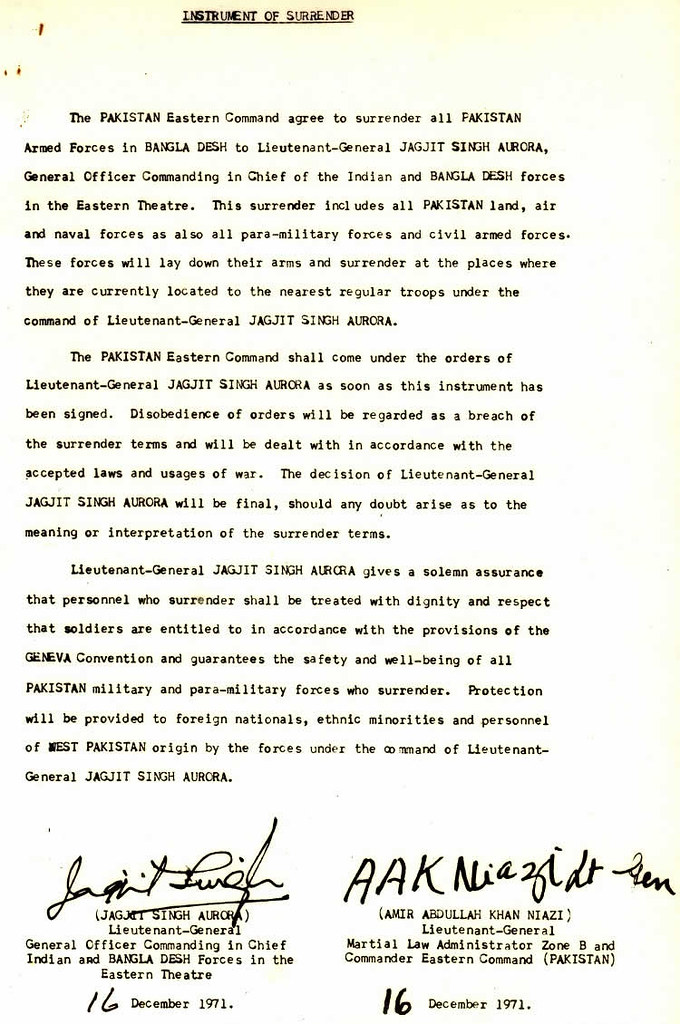
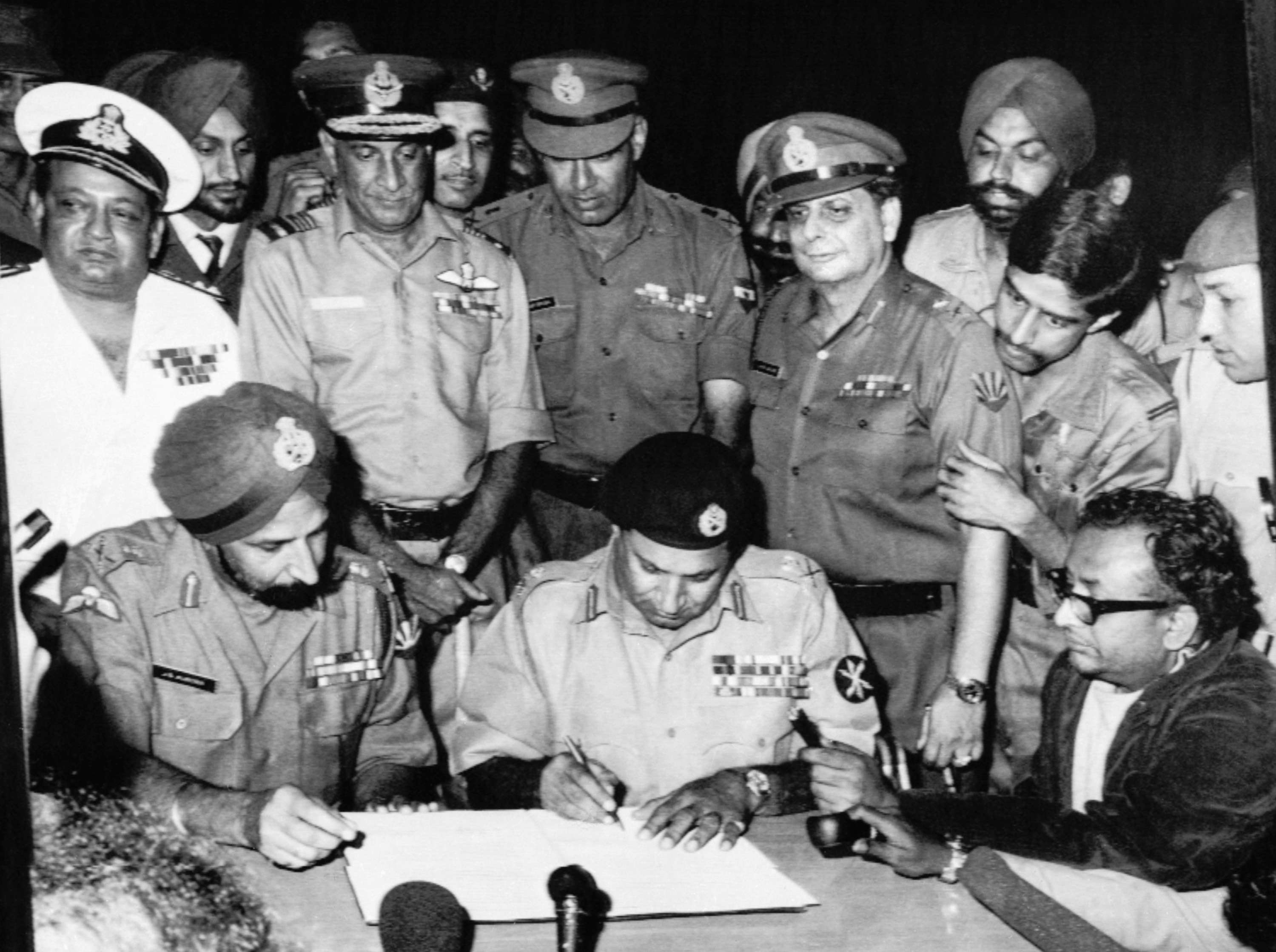
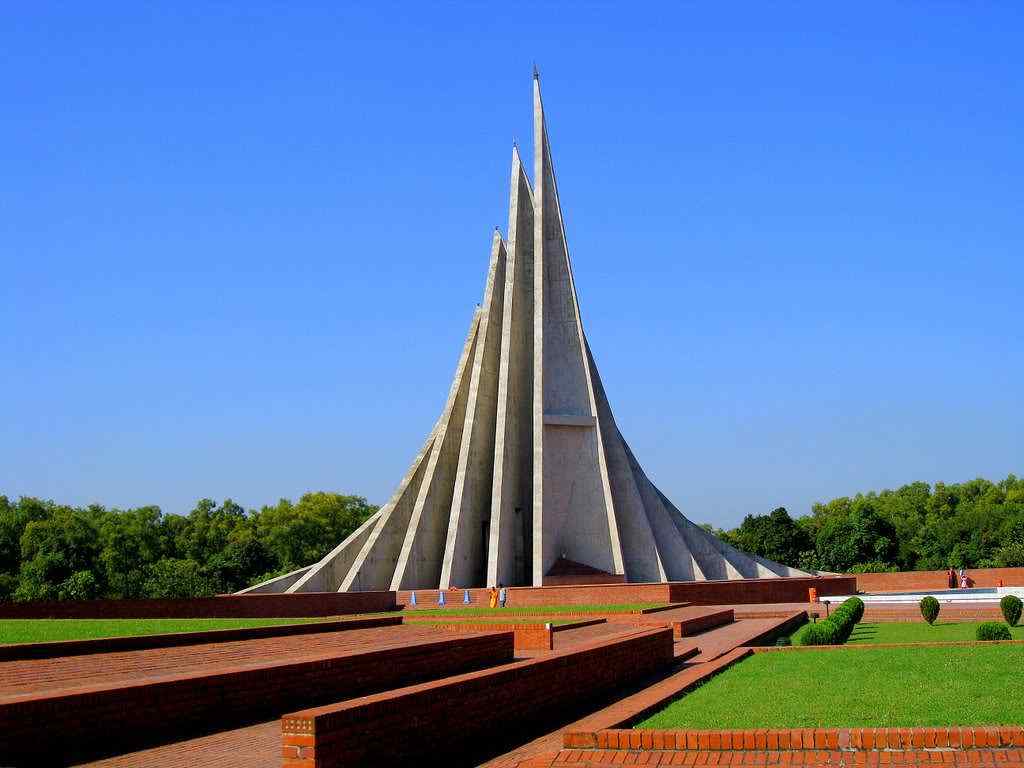
| caption = '''Clockwise from top left''': [[Martyred Intellectuals Memorial]]; [[Mukti Bahini|Bangladesh Forces]] [[howitzer]]; | | caption = '''Clockwise from top left''': [[Martyred Intellectuals Memorial]]; [[Mukti Bahini|Bangladesh Forces]] [[QF 3.7-inch mountain howitzer|howitzer]]; [[A. A. K. Niazi]] signs the [[Pakistani Instrument of Surrender]] to the joint forces in the presence of [[Jagjit Singh Aurora]];<ref>{{Cite web |title=Instrument of Surrender of Pakistan forces in Dacca |url=http://www.mea.gov.in/bilateral-documents.htm?dtl%2F5312%2FInstrument+of+Surrender+of+Pakistan+forces+in+Dacca |url-status=live |archive-url=https://web.archive.org/web/20180927005435/http://www.mea.gov.in/bilateral-documents.htm?dtl%2F5312%2FInstrument+of+Surrender+of+Pakistan+forces+in+Dacca |archive-date=27 September 2018 |access-date=14 July 2017 |website=mea.gov.in |quote=The Pakistan Eastern Command agree to surrender all Pakistan Armed Forces in Bangladesh to Lieutenant General Jagjit Singh Aurora, General Officer Commanding-in –chief of the Indian and Bangladesh forces in the eastern theatre.}}</ref> and the {{ship|PNS|Ghazi||6}} | ||
| place = | | place = [[East Pakistan]] ([[History of Bangladesh after independence|present-day]] [[Bangladesh]])<br/>{{Collapsible list|title=Spillovers: | ||
|''Eastern Front:'' | |||
''Eastern Front:'' | |||
* [[Bangladesh–India border|India–East Pakistan border]] | * [[Bangladesh–India border|India–East Pakistan border]] | ||
* [[India–Bangladesh enclaves|India–East Pakistan enclaves]] | * [[India–Bangladesh enclaves|India–East Pakistan enclaves]] | ||
* parts of [[East India|East]] and [[Northeast India]] | * parts of [[East India|East]] and [[Northeast India]] | ||
''Western Front:'' | * [[Bay of Bengal]] | ||
|''Western Front:'' | |||
* [[Indo-Pakistani border|India–West Pakistan border]] | * [[Indo-Pakistani border|India–West Pakistan border]] | ||
** [[Line of Control]] ([[Kashmir]]) | ** [[Line of Control]] ([[Kashmir]]) | ||
** [[Zero Point railway station|Zero Point]] | ** [[Zero Point railway station|Zero Point]] | ||
* [[Arabian Sea]] | |||
}} | |||
* [[Arabian Sea]] | |||
| coordinates = | | coordinates = | ||
| map_type = | | map_type = | ||
| Line 32: | Line 30: | ||
| map_caption = | | map_caption = | ||
| map_label = | | map_label = | ||
| date = 26 March – 16 December 1971 | | date = {{ubl|26 March – 16 December 1971|({{Age in years, months, weeks and days|month1=3|day1=26|year1=1971|month2=12|day2=16|year2=1971}})}} | ||
| territory = East Pakistan [[Secession|secedes]] from [[Pakistan]] as the [[People's Republic of Bangladesh]] | | territory = East Pakistan [[Secession|secedes]] from [[Pakistan]] as the [[People's Republic of Bangladesh]] | ||
| result = | | result = Bangladeshi-Indian victory<ref name="Shamshad2017">{{Cite book |last=Rizwana Shamshad |url=https://books.google.com/books?id=9789DwAAQBAJ&pg=PT119 |title=Bangladeshi Migrants in India: Foreigners, Refugees, or Infiltrators? |date=3 October 2017 |publisher=Oxford University Press India |isbn=978-0-19-909159-1 |pages=119– |access-date=8 October 2020 |archive-url=https://web.archive.org/web/20230207214830/https://books.google.com/books?id=9789DwAAQBAJ&pg=PT119 |archive-date=7 February 2023 |url-status=live}}</ref><ref name="Lu2018">{{Cite book |last=Jing Lu |url=https://books.google.com/books?id=4MJ1DwAAQBAJ&pg=PA211 |title=On State Secession from International Law Perspectives |date=30 October 2018 |publisher=Springer |isbn=978-3-319-97448-4 |pages=211– |access-date=8 October 2020 |archive-url=https://web.archive.org/web/20230207214833/https://books.google.com/books?id=4MJ1DwAAQBAJ&pg=PA211 |archive-date=7 February 2023 |url-status=live}}</ref><ref name="KaulJha2018">{{Cite book |last1=J.L. Kaul |url=https://books.google.com/books?id=2e5FDwAAQBAJ&pg=PA241 |title=Shifting Horizons of Public International Law: A South Asian Perspective |last2=Anupam Jha |date=8 January 2018 |publisher=Springer |isbn=978-81-322-3724-2 |pages=241– |access-date=8 October 2020 |archive-url=https://web.archive.org/web/20230207214803/https://books.google.com/books?id=2e5FDwAAQBAJ&pg=PA241 |archive-date=7 February 2023 |url-status=live}}</ref><br/>{{bulleted list|[[Pakistani Instrument of Surrender|Surrender of Pakistani forces]]|[[Independence of Bangladesh]]|[[1971 Pakistan Military Officer's Revolt|Military Officer's Revolt in Pakistan]]}} | ||
| combatant1 = {{ | | combatant1 = {{flagcountry|Provisional Government of Bangladesh}}<br/>{{flag|India}} {{small|(after 3 Dec.)}} | ||
| combatant2 = {{flag|Pakistan}} | |||
{{flag|India}} | | units1 = {{Armed forces|Provisional Government of Bangladesh}}<br/>{{Armed forces|India}} | ||
| units2 = {{Armed forces|Pakistan}} | |||
{{ | |||
| | |||
{{Hr}} | {{Hr}} | ||
Paramilitary | '''Paramilitary and Militias''': | ||
* | * {{flagicon image|Jamaat-e-Islami Pakistan Flag.svg}} [[Jamaat-e-Islami Pakistan]] | ||
* [[East Pakistan Central Peace Committee | * [[East Pakistan Central Peace Committee]] | ||
* [[East Pakistan Civil Armed Force]] | |||
* [[Razakars (Pakistan)|Razakars]] | * [[Razakars (Pakistan)|Razakars]] | ||
* [[Al-Badr (East Pakistan)|Al-Badr]] | * [[Al-Badr (East Pakistan)|Al-Badr]] | ||
* [[Al-Shams (East Pakistan)|Al-Shams]] | * [[Al-Shams (East Pakistan)|Al-Shams]] | ||
* [[Mujahid Bahini (East Pakistan)|Mujahid Bahini]] | |||
* [[Pakistan Democratic Party]] | |||
| commander1 = '''Political:'''<br/>{{flag icon|Provisional Government of Bangladesh}} [[Sheikh Mujibur Rahman]]<br/>{{flag icon|Provisional Government of Bangladesh}} [[Tajuddin Ahmad]]<br/>{{flag icon|India}} [[Indira Gandhi]]<br/><br/>'''Military:'''<br/>{{flag icon|Provisional Government of Bangladesh|military}} [[M. A. G. Osmani]]<br/>{{flag icon|Provisional Government of Bangladesh|military}} [[M. A. Rab]]<br/>{{flag icon|Provisional Government of Bangladesh|military}} [[A. K. Khandker]]<br/>{{flag icon|Provisional Government of Bangladesh|military}} [[Ziaur Rahman]]<br/>{{flag icon|Provisional Government of Bangladesh|military}} [[K. M. Shafiullah]]<br/>{{flag icon|Provisional Government of Bangladesh|military}} [[Khaled Mosharraf]]<br/>{{flag icon|India|military}} [[Sam Manekshaw]]<br/>{{flag icon|India|military}} [[Jagjit Singh Aurora]] | |||
| commander2 = '''Political:'''<br/>{{flagicon image|Flag of the President of Pakistan.svg}} [[Yahya Khan]]<br/>{{flagicon image|Flag of the Chief of the Army Staff (Pakistan).svg}} [[Abdul Hamid Khan (general)|Hamid Khan]]<br/>{{flagicon image|Flag of the Pakistani Army.svg}} [[Tikka Khan]]<br/>{{flagdeco|Pakistan}} [[Abdul Motaleb Malik]]<br/><br/>'''Military:'''<br/>{{flag icon|Pakistan|military}} [[A. A. K. Niazi]]<br/>{{flag icon|Pakistan|military}} [[Rao Farman Ali]]<br/>{{flag icon|Pakistan|military}} [[Khadim Hussain Raja]] | |||
| commander2 = | |||
{{Hr}} | {{Hr}} | ||
'''Militias:'''<br/>{{flagicon image|Jamaat-e-Islami Pakistan Flag.svg}} [[Ghulam Azam]]{{executed}}<br/>[[Khwaja Khairuddin|Syed Khwaja Khairuddin]]<br/>[[Motiur Rahman Nizami]]{{executed}}<br/>[[Fazlul Qadir Chaudhry|Fazlul Chaudhry]]{{pow}} | |||
| strength1 = {{flag icon|Provisional Government of Bangladesh|military}} 175,000<ref name=ACIG/><ref>Pakistan & the Karakoram Highway By Owen Bennett-Jones, Lindsay Brown, John Mock, Sarina Singh, Pg 30</ref><br/>{{flag icon|India|military}} 250,000<ref name=ACIG/> | |||
| strength2 = {{flag icon|Pakistan|military}} ~91,000 regular troops{{NoteTag|name=fn1|Cooper and Ali's figures of 365,000 Pakistan Army and 280,000 paramilitary are for the entire Pakistan force, on the west and east fronts combined, when the [[Indo-Pakistani War of 1971]] broke out.<ref name=ACIG/> Cloughley clarifies that only a quarter of the 365,000 Pakistan Army, roughly 91,000, was in East Pakistan.<ref>{{Cite book |last=Cloughley |first=Brian |title=A History of the Pakistan Army: Wars and Insurrections |date=2016 |publisher=[[Simon and Schuster]] |isbn=978-1-63144-039-7 |edition=4th |pages=149, 222 |orig-date=First published 1999}}</ref>}}<br/>280,000 paramilitary forces{{NoteTag|name=fn1}}<br/>~25,000 militiamen<ref>{{Cite book |last=Praval |first=K. C. |title=Indian Army after Independence |date=1987 |publisher=[[Lancer International]] |isbn=81-7062-014-7 |page=442}}</ref> | |||
| strength1 = {{ | | casualties1 = {{flag icon|Provisional Government of Bangladesh|military}} ~30,000 killed<ref>{{Cite book |title=Traitors : suspicion, intimacy, and the ethics of state-building |date=2012 |publisher=[[University of Pennsylvania Press]] |isbn=978-0812222371 |editor-last=Thiranagama |editor-first=Sharika |location=Philadelphia, Pa. |editor-last2=Kelly |editor-first2=Tobias}}</ref><br/>{{flag icon|India|military}} 1,426–1,525 killed<ref name="FallOfDacca">Figures from ''The Fall of Dacca'' by [[Jagjit Singh Aurora]] in ''The Illustrated Weekly of India'' dated 23 December 1973 quoted in {{Cite book |last=Praval |first=K. C. |title=Indian Army after Independence |date=1987 |publisher=Lancer International |isbn=81-7062-014-7 |page=486}}</ref><br/>3,611–4,061 wounded<ref name="FallOfDacca"/> | ||
| strength2 = {{ | | casualties2 = {{flag icon|Pakistan|military}} 5,866 killed<ref>{{Cite book |last=Matinuddin |first=Kamal |url=https://books.google.com/books?id=aONtAAAAMAAJ |title=Tragedy of Errors: East Pakistan Crisis, 1968–1971 |date=1994 |publisher=Wajidalis |isbn=978-969-8031-19-0 |page=429}}</ref><br/>~10,000 wounded<br/>90,000–93,000 captured<ref name="dailytimes1912005">{{Cite news |last=Khan |first=Shahnawaz |date=19 January 2005 |title=54 Indian PoWs of 1971 war still in Pakistan |url=http://archives.dailytimes.com.pk/national/19-Jan-2005/54-indian-pows-of-1971-war-still-in-pakistan |archive-url=https://web.archive.org/web/20150919100557/http://archives.dailytimes.com.pk/national/19-Jan-2005/54-indian-pows-of-1971-war-still-in-pakistan |archive-date=19 September 2015 |access-date=11 October 2011 |work=[[Daily Times (Pakistan)]] |location=[[Lahore]]}}</ref> (including 79,676 troops and 10,324–12,192 local militiamen)<ref name="FallOfDacca"/><ref>Figure from ''Pakistani Prisoners of War in India'' by Col S. P. Salunke p. 10 quoted in {{Cite book |last=Praval |first=K. C. |title=Indian Army after Independence |date=1987 |publisher=Lancer International |isbn=81-7062-014-7 |page=485}}</ref> | ||
| casualties1 = {{ | | casualties3 = [[Bangladesh genocide|Civilian deaths]]:<ref name="autogenerated1">{{Cite news |date=13 May 2012 |title=Bangladesh Islamist leader Ghulam Azam charged |url=https://www.bbc.co.uk/news/world-asia-18049515 |url-status=live |archive-url=https://web.archive.org/web/20181215152004/https://www.bbc.co.uk/news/world-asia-18049515 |archive-date=15 December 2018 |access-date=13 May 2012 |publisher=[[BBC News]]}}</ref> Estimates range between 300,000 and 3,000,000. | ||
| casualties2 = {{ | |||
| casualties3 = [[Bangladesh genocide|Civilian deaths]]:<ref name="autogenerated1"/> Estimates range between 300,000 and 3,000,000. | |||
| notes = | | notes = | ||
| campaignbox = {{Campaignbox Bangladesh Liberation War}} | | campaignbox = {{Campaignbox Bangladesh Liberation War}} | ||
}} | }} | ||
{{Independence of Bangladesh}} | |||
{{History of Bengal}} | |||
{{History of Bangladesh}} | {{History of Bangladesh}} | ||
The '''Bangladesh Liberation War'''{{NoteTag|This war is known | The '''Bangladesh Liberation War'''{{NoteTag|This war is known as the Liberation War or the War of Independence in Bangladesh.<ref>[https://books.google.com/books?id=bJfcCPUr0OoC&q=+Muktijuddho&pg=PA289 ''Historical Dictionary of Bangladesh''], Page 289</ref> This war is also called the Civil War in Pakistan.<ref name="Social 2005 p93">{{Cite book |last=Moss |first=Peter |title=Secondary Social Studies For Pakistan |date=2005 |publisher=[[Oxford University Press]] |isbn=9780195977042 |location=Karachi |page=93 |oclc=651126824}}</ref>}} ({{langx|bn|মুক্তিযুদ্ধ}}, {{IPA|bn|mukt̪iɟud̪d̪ʱo|pron}}), also known as the '''Bangladesh War of Independence''', was an [[War|armed conflict]] sparked by the rise of the [[Bengali nationalism|Bengali nationalist]] and [[self-determination]] movement in [[East Pakistan]], which resulted in the independence of [[Bangladesh]] with the help of [[India]]. The war began when the Pakistani [[Military dictatorship|military junta]] based in [[West Pakistan]]—under the orders of [[Yahya Khan]]—launched [[Operation Searchlight]] against East Pakistanis on the night of 25 March 1971, initiating the [[Bangladesh genocide]].<ref>{{Cite news |last=Paul |first=Priyam Pritim |date=26 March 2024 |title=Administrative dynamics in 1971's War of Liberation |url=https://www.thedailystar.net/supplements/independence-day-special-2024/news/administrative-dynamics-1971s-war-liberation-3575151 |access-date=19 June 2024 |work=[[The Daily Star (Bangladesh)|The Daily Star]]}}</ref> | ||
{{ | |||
In response to the violence, members of the [[Mukti Bahini]]—a guerrilla [[resistance movement]] formed by Bengali military, paramilitary and civilians—launched a mass | In response to the violence, members of the [[Mukti Bahini]]—a [[Guerrilla warfare|guerrilla]] [[resistance movement]] formed by Bengali military, paramilitary and civilians—launched a mass guerrilla war against the [[Pakistan Armed Forces|Pakistani military]], liberating numerous towns and cities in the war's initial months. At first, the Pakistan Army regained momentum during the [[monsoon]], but Bengali [[guerrillas]] counterattacked by carrying out widespread sabotage, including through [[Operation Jackpot]] against the [[Pakistan Navy]], while the nascent [[Bangladesh Air Force]] flew [[sortie]]s against Pakistani military bases.<ref>{{Cite journal |last=Jamal |first=Ahmed |date=5–17 October 2008 |title=Mukti Bahini and the liberation war of Bangladesh: A review of conflicting views |url=http://www.cdrb.org/journal/2008/4/1.pdf |url-status=dead |journal=Asian Affairs |volume=30 |archive-url=https://web.archive.org/web/20150103014904/http://www.cdrb.org/journal/2008/4/1.pdf |archive-date=3 January 2015 |access-date=29 April 2015}}</ref> | ||
India joined the war on 3 December 1971 in support of the Mukti Bahini, after Pakistan launched [[Operation Chengiz Khan|preemptive air strikes]] on northern India and massive flight of some 10 million East Pakistani Bengals<ref>{{cite web | title=A leaf from history: After Operation Searchlight | date=3 March 2012 | url=https://www.dawn.com/news/699975/a-leaf-from-history-after-operation-searchlight }}</ref> to the Indian state of West Bengal, following waves of emigration since Partition in 1947. The subsequent [[Indo-Pakistani war of 1971|Indo-Pakistani War]] involved fighting on two fronts; with [[air supremacy]] achieved in the eastern theater and the rapid advance of the [[Mitro Bahini order of battle|Allied Forces of Mukti Bahini and the Indian military]], Pakistan [[Pakistani Instrument of Surrender|surrendered]] in Dhaka on 16 December 1971, in what remains to date the largest surrender of armed personnel since the [[Second World War]].<ref>{{Cite web |last=Srinivasaraju |first=Sugata |date=21 December 2021 |title=The Bangladeshi liberation has lessons for India today |url=https://timesofindia.indiatimes.com/world/south-asia/the-bangladeshi-liberation-has-lessons-for-india-today/articleshow/88412623.cms |url-status=live |archive-url=https://web.archive.org/web/20211222204349/https://timesofindia.indiatimes.com/world/south-asia/the-bangladeshi-liberation-has-lessons-for-india-today/articleshow/88412623.cms |archive-date=22 December 2021 |access-date=29 December 2021 |website=[[The Times of India]]}}</ref> | |||
Rural and urban areas across East Pakistan saw extensive military operations and air strikes to suppress the tide of [[Non-cooperation movement (1971)|civil disobedience]] that formed after the [[1970 Pakistani general election|1970 election stalemate]]. The [[Pakistan Army]], backed by Islamists, created radical religious militias—the [[Razakar (Pakistan)|Razakars]], [[Al-Badr (East Pakistan)|Al-Badr]] and [[Al-Shams (East Pakistan)|Al-Shams]]—to assist it during raids on the local populace.<ref>{{ | Rural and urban areas across East Pakistan saw extensive military operations and air strikes to suppress the tide of [[Non-cooperation movement (1971)|civil disobedience]] that formed after the [[1970 Pakistani general election|1970 election stalemate]]. The [[Pakistan Army]], backed by Islamists, created radical religious militias—the [[Razakar (Pakistan)|Razakars]], [[Al-Badr (East Pakistan)|Al-Badr]] and [[Al-Shams (East Pakistan)|Al-Shams]]—to assist it during raids on the local populace.<ref>{{Cite book |last1=Schneider |first1=B. |url=https://books.google.com/books?id=LQHIAAAAQBAJ&pg=PA57 |title=The World's Most Threatening Terrorist Networks and Criminal Gangs |last2=Post |first2=J. |last3=Kindt |first3=M. |date=2009 |publisher=Springer |isbn=9780230623293 |page=57 |language=en |access-date=8 March 2017 |archive-url=https://web.archive.org/web/20230207214803/https://books.google.com/books?id=LQHIAAAAQBAJ&pg=PA57 |archive-date=7 February 2023 |url-status=live}}</ref><ref>{{Cite book |last=Grare |first=Frederic |title=Pakistan: From the Rhetoric of Democracy to the Rise of Militancy |date=2012 |publisher=[[Routledge]] |isbn=978-0-415-67040-1 |editor-last=Kalia |editor-first=Ravi |page=168 |language=en |chapter=Pakistan's Pursuit of Democracy |access-date=8 March 2017 |chapter-url=https://books.google.com/books?id=NsrfCgAAQBAJ&pg=PA168 |archive-url=https://web.archive.org/web/20230207214843/https://books.google.com/books?id=NsrfCgAAQBAJ&pg=PA168 |archive-date=7 February 2023 |url-status=live}}</ref><ref>Pg 600. Schmid, Alex, ed. (2011). ''The Routledge Handbook of Terrorism Research''. [[Routledge]]. {{ISBN|978-0-415-41157-8}}.</ref><ref>Pg. 240 Tomsen, Peter (2011). ''The Wars of Afghanistan: Messianic Terrorism, Tribal Conflicts, and the Failures of Great Powers''. Public Affairs. {{ISBN|978-1-58648-763-8}}.</ref><ref>{{Cite book |last1=Roy |first1=Kaushik |url=https://books.google.com/books?id=PdrcAgAAQBAJ |title=Unconventional Warfare in South Asia: Shadow Warriors and Counterinsurgency |last2=Gates |first2=Professor Scott |date=2014 |publisher=Ashgate Publishing, Ltd. |isbn=9781472405791 |language=en |access-date=21 August 2017 |archive-url=https://web.archive.org/web/20230207214838/https://books.google.com/books?id=PdrcAgAAQBAJ |archive-date=7 February 2023 |url-status=live}}</ref> Members of the Pakistani military and supporting militias engaged in mass murder, deportation and [[Rape during the Bangladesh Liberation War|genocidal rape]], pursuing a systematic campaign of annihilation against nationalist Bengali civilians, students, [[intelligentsia]], religious minorities and armed personnel. The capital, [[Dhaka]], was the scene of numerous massacres, including the [[1971 Dhaka University massacre|Dhaka University massacre]]. [[Sectarian violence]] also broke out between Bengalis and [[Persecution of Biharis in Bangladesh|Urdu-speaking Biharis]]. An estimated 10 million Bengali [[East Bengali refugees#1970s|refugees]] fled to neighboring India, while 30 million were internally displaced.<ref>{{Cite book |last1=Totten |first1=Samuel |url=https://books.google.com/books?id=rgGA91skoP4C&pg=PA34 |title=Dictionary of Genocide: A-L |last2=Bartrop |first2=Paul Robert |date=2008 |publisher=ABC-CLIO |isbn=9780313346422 |page=34 |language=en |access-date=8 November 2020 |archive-url=https://web.archive.org/web/20230111192649/https://books.google.com/books?id=rgGA91skoP4C&pg=PA34 |archive-date=11 January 2023 |url-status=live}}</ref> | ||
The war changed the geopolitical landscape of | The war changed the geopolitical landscape of South Asia, with the emergence of Bangladesh as the world's seventh-most populous country. Due to complex regional alliances, the war was a major episode in [[Cold War]] tensions involving the United States, the [[Soviet Union]] and China. The majority of member states in the United Nations recognized Bangladesh as a sovereign nation in 1972. | ||
== Background == | == Background == | ||
[[File:India religion map 1909 en.jpg|thumb|upright=1.3|A map of the [[British Raj]] in 1909 showing [[Muslim]] majority areas in green, including modern-day Bangladesh in the east and Pakistan in the west]] | [[File:India religion map 1909 en.jpg|thumb|upright=1.3|A map of the [[British Raj]] in 1909 showing [[Muslim]] majority areas in green, including modern-day Bangladesh in the east and Pakistan in the west]] | ||
Before the [[Partition of India|Partition of British India]], the [[Lahore Resolution]] initially envisaged separate [[Muslim]]-majority states in British India's eastern and northwestern zones. A proposal for an independent [[United Bengal]] was mooted by Prime Minister [[Huseyn Shaheed Suhrawardy]] in 1946 | Before the [[Partition of India|Partition of British India]], the [[Lahore Resolution]] initially envisaged separate [[Muslim]]-majority states in British India's eastern and northwestern zones. A proposal for an independent [[United Bengal]] was mooted by Prime Minister [[Huseyn Shaheed Suhrawardy]] in 1946 but opposed by the colonial authorities. The [[East Pakistan Renaissance Society]] advocated the creation of a [[sovereign state]] in eastern British India.<ref>{{Cite book |last=Talbot |first=Ian |title=Pakistan: A Modern History |publisher=Hurst & Company, London |year=1998 |isbn=1-85065-385-2 |edition= |location=London |publication-date=March 1998 |pages=90 |language=English}}</ref> | ||
Political negotiations led, in August 1947, to the official birth of two states, [[Pakistan]] and | Political negotiations led, in August 1947, to the official birth of two states, [[Pakistan]] and India,<ref>{{cite news |url=https://news.google.com/newspapers?id=78xTAAAAIBAJ&pg=1738,3655 |title=Britain Proposes Indian Partition |work=The Leader-Post |date=2 June 1947 |access-date=11 June 2017 |archive-date=2 June 2022 |archive-url=https://web.archive.org/web/20220602154915/https://news.google.com/newspapers?id=78xTAAAAIBAJ&pg=1738,3655 |url-status=live}}</ref> giving presumably permanent homes for Muslims and Hindus, respectively, after the British departed. The [[Dominion of Pakistan]] comprised two geographically and culturally separate areas to the east and the west, with India in between.<ref name="Sarasota Herald-Tribune">{{Cite news |date=8 June 1947 |title=India Partition with Present Many Problems |url=https://news.google.com/newspapers?id=VbYqAAAAIBAJ&pg=1342,6305096 |url-status=live |archive-url=https://web.archive.org/web/20220602154917/https://news.google.com/newspapers?id=VbYqAAAAIBAJ&pg=1342,6305096 |archive-date=2 June 2022 |access-date=11 June 2017 |work=Sarasota Herald-Tribune}}</ref> | ||
The western zone was popularly (and, for a period, also officially) termed West Pakistan and the eastern zone (modern-day Bangladesh) was initially termed [[East Bengal]] and later East Pakistan. Although the two zones' population was close to equal, political power was concentrated in West Pakistan, and it was widely perceived that East Pakistan was being exploited economically, leading to many grievances. Administration of two | The western zone was popularly (and, for a period, also officially) termed West Pakistan and the eastern zone (modern-day Bangladesh) was initially termed [[East Bengal]] and later East Pakistan. Although the two zones' population was close to equal, political power was concentrated in West Pakistan, and it was widely perceived that East Pakistan was being exploited economically, leading to many grievances. Administration of two non-[[Geographic contiguity|contiguous]] territories was also seen as a challenge.<ref>{{Cite news |url=https://news.google.com/newspapers?id=WPdUAAAAIBAJ&pg=7167,1795176 |title=Problems of Partition |work=The Sydney Morning Herald |date=14 June 1947 |access-date=11 June 2017 |archive-date=2 June 2022 |archive-url=https://web.archive.org/web/20220602154916/https://news.google.com/newspapers?id=WPdUAAAAIBAJ&pg=7167,1795176 |url-status=live }}</ref> | ||
On 25 March 1971, after an election won by an East Pakistani political party (the [[Bangladesh Awami League|Awami League]]) was ignored by the ruling (West Pakistani) establishment, rising political discontent and [[ | On 25 March 1971, after an election won by an East Pakistani political party (the [[Bangladesh Awami League|Awami League]]) was ignored by the ruling (West Pakistani) establishment, rising political discontent and [[Types of nationalism#Cultural nationalism|cultural nationalism]] in East Pakistan was met by brutal<ref>{{Cite web|url=http://www.gendercide.org/case_bangladesh.html |title=Gendercide Watch: Genocide in Bangladesh, 1971 |website=gendercide.org |archive-url=https://web.archive.org/web/20120721230201/http://www.gendercide.org/case_bangladesh.html |archive-date=21 July 2012 |url-status=dead |access-date=11 June 2017}}</ref> and suppressive force from the ruling elite of the West Pakistan establishment, in what came to be termed [[Operation Searchlight]].<ref name="epw">{{harvnb|Bose|2005|p=4465}}</ref> The Pakistan Army's violent crackdown<ref>{{Cite news|url=https://www.nytimes.com/2013/09/30/opinion/nixon-and-kissingers-forgotten-shame.html|title=Nixon and Kissinger's Forgotten Shame|last=Bass|first=Gary J.|date=29 September 2013|work=The New York Times|access-date=11 June 2017|issn=0362-4331|archive-date=21 March 2021|archive-url=https://web.archive.org/web/20210321044356/https://www.nytimes.com/2013/09/30/opinion/nixon-and-kissingers-forgotten-shame.html|url-status=live}}</ref> led Awami League leader [[Sheikh Mujibur Rahman]] to [[Proclamation of Bangladeshi Independence|declare independence of East Pakistan]] as the sovereign state of Bangladesh on 26 March 1971.<ref name=":1">{{cite news |url=https://news.google.com/newspapers?id=Rk4fAAAAIBAJ&pg=2676,6420028 |title=Civil War Rocks East Pakistan |work=Daytona Beach Morning Journal |date=27 March 1971 |access-date=11 June 2017 |archive-date=2 June 2022 |archive-url=https://web.archive.org/web/20220602154917/https://news.google.com/newspapers?id=Rk4fAAAAIBAJ&pg=2676,6420028 |url-status=live }}</ref> Most [[Bengalis]] supported this move, although some [[Islamism|Islamists]] and Biharis opposed it and sided with the Pakistan Army instead.<ref>{{harvnb|Bose|2005|p=4463}}</ref> | ||
Pakistani | Pakistani president [[Yahya Khan|Agha Muhammad Yahya Khan]] ordered the Pakistani military to restore the Pakistani government's authority, beginning the civil war.<ref name=":1" /> The war led a substantial number of refugees (estimated at the time to be about 10 million)<ref>{{Cite news|url=http://indianexpress.com/article/research/refugees-in-india-partition-bangladesh-war-tibet-occupation-sri-lankan-tamils-rohingyas-mynamar-world-refugee-day-five-human-influxes-that-have-shaped-india-2864449/|title=World Refugee Day: Five human influxes that have shaped India|date=20 June 2016|work=The Indian Express|access-date=11 June 2017|archive-date=21 March 2021|archive-url=https://web.archive.org/web/20210321044430/https://indianexpress.com/article/research/refugees-in-india-partition-bangladesh-war-tibet-occupation-sri-lankan-tamils-rohingyas-mynamar-world-refugee-day-five-human-influxes-that-have-shaped-india-2864449/|url-status=live}}</ref><ref>{{Cite magazine|url=http://content.time.com/time/magazine/article/0,9171,910155-2,00.html|title=The World: India and Pakistan: Over the Edge|date=13 December 1971|magazine=Time|access-date=11 June 2017|archive-url=https://web.archive.org/web/20110523003701/http://www.time.com/time/magazine/article/0%2C9171%2C910155-2%2C00.html|archive-date=23 May 2011|issn=0040-781X}}</ref> to flood [[East India|India's eastern provinces]].<ref name="report">''Crisis in South Asia – A report'' by Senator Edward Kennedy to the Subcommittee investigating the Problem of Refugees and Their Settlement, Submitted to U.S. Senate Judiciary Committee, 1 November 1971, U.S. Govt. Press.pp6-7</ref> Facing a mounting humanitarian and economic crisis, India actively aided and organized the Bangladeshi resistance army, the [[Mukti Bahini]].{{Citation needed|date=March 2024}} | ||
=== Language controversy === | === Language controversy === | ||
{{Main|Bengali language movement}} | {{Main|Bengali language movement}} | ||
In 1948, [[Governor-General of Pakistan|Governor-General]] [[Muhammad Ali Jinnah]] declared that "[[Urdu]], and only Urdu" would be Pakistan's federal language.<ref>{{Cite Banglapedia|title=Language Movement|author=Bashir Al Helal}}</ref><ref>{{Cite book|url=https://books.google.com/books?id=2BKzbHnFTfEC&pg=PA158|title=Sociolinguistics and Language Education|last1=Hornberger|first1=Nancy H.|last2=McKay|first2=Sandra Lee|year=2010|publisher=Multilingual Matters|isbn=9781847694010|pages=158|language=en|access-date=8 November 2020|archive-date=7 February 2023|archive-url=https://web.archive.org/web/20230207214842/https://books.google.com/books?id=2BKzbHnFTfEC&pg=PA158|url-status=live}}</ref> But Urdu was historically prevalent only in the north, central, and western [[Indian subcontinent|subcontinent]]; in East Bengal, the native language was [[Bengali language|Bengali]], one of the two most easterly branches of the [[Indo-European languages]].<ref>{{cite web|url=https://www.soas.ac.uk/languagecentre/languages/bengali/|title=SOAS Language Centre – Bengali Language Courses|website=soas.ac.uk|access-date=7 December 2014|archive-date=21 March 2021|archive-url=https://web.archive.org/web/20210321044427/https://www.soas.ac.uk/languagecentre/languages/bengali/|url-status=live}}</ref> Bengali speakers constituted over 56% of Pakistan's population.<ref>{{cite news|title=Language Movement paved way for independence: Hasina|url=https://m.bdnews24.com/en/detail/bangladesh/1861277|newspaper=bdnews24|date=20 February 2021|access-date=12 March 2021|archive-date=21 March 2021|archive-url=https://web.archive.org/web/20210321044430/https://m.bdnews24.com/en/detail/bangladesh/1861277|url-status=dead}}</ref><ref>{{cite news|title=From Dhaka to fall of Dhaka|url=https://www.thenews.com.pk/ | In 1948, [[Governor-General of Pakistan|Governor-General]] [[Muhammad Ali Jinnah]] declared that "[[Urdu]], and only Urdu" would be Pakistan's federal language.<ref>{{Cite Banglapedia|title=Language Movement|author=Bashir Al Helal}}</ref><ref>{{Cite book|url=https://books.google.com/books?id=2BKzbHnFTfEC&pg=PA158|title=Sociolinguistics and Language Education|last1=Hornberger|first1=Nancy H.|last2=McKay|first2=Sandra Lee|year=2010|publisher=Multilingual Matters|isbn=9781847694010|pages=158|language=en|access-date=8 November 2020|archive-date=7 February 2023|archive-url=https://web.archive.org/web/20230207214842/https://books.google.com/books?id=2BKzbHnFTfEC&pg=PA158|url-status=live}}</ref> But Urdu was historically prevalent only in the north, central, and western [[Indian subcontinent|subcontinent]]; in East Bengal, the native language was [[Bengali language|Bengali]], one of the two most easterly branches of the [[Indo-European languages]].<ref>{{cite web|url=https://www.soas.ac.uk/languagecentre/languages/bengali/|title=SOAS Language Centre – Bengali Language Courses|website=soas.ac.uk|access-date=7 December 2014|archive-date=21 March 2021|archive-url=https://web.archive.org/web/20210321044427/https://www.soas.ac.uk/languagecentre/languages/bengali/|url-status=live}}</ref> Bengali speakers constituted over 56% of Pakistan's population.<ref>{{cite news|title=Language Movement paved way for independence: Hasina|url=https://m.bdnews24.com/en/detail/bangladesh/1861277|newspaper=bdnews24|date=20 February 2021|access-date=12 March 2021|archive-date=21 March 2021|archive-url=https://web.archive.org/web/20210321044430/https://m.bdnews24.com/en/detail/bangladesh/1861277|url-status=dead}}</ref><ref>{{cite news|title=From Dhaka to fall of Dhaka|url=https://www.thenews.com.pk/print/405968-from-dhaka-to-fall-of-dhaka|access-date=12 March 2021|date=15 December 2018|newspaper=The News (Pakistan)|first=Wajid Shamsul|last=Hasan|archive-date=21 March 2021|archive-url=https://web.archive.org/web/20210321044402/https://www.thenews.com.pk/amp/405968-from-dhaka-to-fall-of-dhaka|url-status=live}}</ref> | ||
The government stand was widely viewed as an attempt to suppress the culture of the eastern wing. The people of East Bengal demanded that their language be given federal status alongside Urdu and English. The [[Bengali language movement|Language Movement]] began in 1948, as civil society protested the removal of [[Bengali alphabet|Bengali script]] from currency and stamps, which were in place since the [[British Raj]].<ref name="International Mother Language Day">{{Cite web|title = International Mother Language Day|url = https://www.un.org/en/events/motherlanguageday/|website = United Nations|access-date = 19 February 2016|archive-date = 17 May 2019|archive-url = https://web.archive.org/web/20190517175429/https://www.un.org/en/events/motherlanguageday/|url-status = live}}</ref> | The government stand was widely viewed as an attempt to suppress the culture of the eastern wing. The people of East Bengal demanded that their language be given federal status alongside Urdu and English. The [[Bengali language movement|Language Movement]] began in 1948, as civil society protested the removal of [[Bengali alphabet|Bengali script]] from currency and stamps, which were in place since the [[British Raj]].<ref name="International Mother Language Day">{{Cite web|title = International Mother Language Day|url = https://www.un.org/en/events/motherlanguageday/|website = United Nations|access-date = 19 February 2016|archive-date = 17 May 2019|archive-url = https://web.archive.org/web/20190517175429/https://www.un.org/en/events/motherlanguageday/|url-status = live}}</ref> | ||
| Line 102: | Line 95: | ||
=== Disparities === | === Disparities === | ||
Although East Pakistan had | Although East Pakistan had the larger population, West Pakistan dominated the divided country politically and received more money from the common budget.{{Citation needed|date=March 2024}} | ||
{| class="wikitable" style="margin:0 auto; width:550px;text-align:center;" | {| class="wikitable" style="margin:0 auto; width:550px;text-align:center;" | ||
| Line 122: | Line 115: | ||
| colspan="4" | <small>''Source: Reports of the Advisory Panels for the Fourth Five Year Plan 1970–75, Vol. I,<br /> published by the planning commission of Pakistan.''</small> | | colspan="4" | <small>''Source: Reports of the Advisory Panels for the Fourth Five Year Plan 1970–75, Vol. I,<br /> published by the planning commission of Pakistan.''</small> | ||
|} | |} | ||
East Pakistan was already economically disadvantaged at the time of Pakistan's creation yet this economic disparity only increased under Pakistani rule. Factors included not only the deliberate state discrimination in developmental policies but also the fact that the presence of the country's capital and more immigrant businessmen in the Western | East Pakistan was already economically disadvantaged at the time of Pakistan's creation yet this economic disparity only increased under Pakistani rule. Factors included not only the deliberate state discrimination in developmental policies but also the fact that the presence of the country's capital and more immigrant businessmen in the Western Wing directed greater government allocations there. Due to low numbers of native businessmen in East Pakistan, substantial labor unrest and a tense political environment, there were also much lower foreign investments in the eastern wing. The Pakistani state's economic outlook was geared towards urban industry, which was not compatible with East Pakistan's mainly agrarian economy.<ref name="Willem van Schendel 136">{{harvnb|van Schendel|2009|p=136}}</ref> | ||
Bengalis were underrepresented in | Also, Bengalis were underrepresented in the Pakistani military. Officers of Bengali origin in the different wings of the armed forces made up just 5% of the overall force by 1965; of these, only a few were in command positions, with the majority in technical or administrative posts.<ref name="Library">{{cite web |url=http://memory.loc.gov/cgi-bin/query/r?frd%2Fcstdy%3A%40field%28DOCID+bd0139%29 |title=Library of Congress studies |publisher=Memory.loc.gov |date=1 July 1947 |access-date=23 June 2011 |archive-date=5 July 2019 |archive-url=https://web.archive.org/web/20190705131255/http://memory.loc.gov/cgi-bin/query/r%3Ffrd/cstdy:@field(DOCID%2Bbd0139) |url-status=live }}</ref> West Pakistanis believed that Bengalis were not "martially inclined", unlike [[Pashtuns]] and [[Punjabis]]; Bengalis dismissed the "[[martial race]]s" notion as ridiculous and humiliating.<ref name="Library" /> | ||
Moreover, despite huge | Moreover, despite huge defense spending, East Pakistan received none of the benefits, such as contracts, purchasing and military support jobs. The [[Indo-Pakistani War of 1965]] over [[Kashmir]] also highlighted the sense of military insecurity among Bengalis, as only an under-strength [[infantry]] division and 15 [[Military aircraft#Combat aircraft|combat aircraft]] without tank support were in East Pakistan to repulse any Indian retaliations during the conflict.<ref>{{cite web|url=http://www.defencejournal.com/2002/dec/demons.htm |title=Demons of December – Road from East Pakistan to Bangladesh |website=Defencejournal.com |access-date=23 June 2011 |archive-url = https://web.archive.org/web/20110609122558/http://www.defencejournal.com/2002/dec/demons.htm |archive-date=9 June 2011 |url-status=live}}</ref><ref>{{cite book |author=Rounaq Jahan |author-link=Rounaq Jahan |title=Pakistan: Failure in National Integration |publisher=Columbia University Press |year=1972 |pages=166–167 |isbn=978-0-231-03625-2}}</ref> | ||
=== Ideological and cultural differences === | === Ideological and cultural differences === | ||
[[File:Shaheed minar Roehl.jpg|thumb|left|Language movement memorial]] | [[File:Shaheed minar Roehl.jpg|thumb|left|Language movement memorial]] | ||
In 1947, the Bengali Muslims had identified themselves with Pakistan's Islamic project, but by the 1970s the people of East Pakistan had given priority to their Bengali ethnicity over their religious identity, desiring a society in accordance with Western principles such as [[secularism]], democracy and socialism.<ref name="Willem van Schendel 183">{{harvnb|van Schendel|2009|p=183}}</ref> Many Bengali Muslims strongly objected to the Islamist paradigm the Pakistani state imposed.<ref name="Haqqani2010">{{cite book|url=https://books.google.com/books?id=nYppZ_dEjdIC&pg=PA19|title=Pakistan: Between Mosque and Military |year=2010 |publisher=Carnegie Endowment|isbn=978-0-87003-285-1|pages=19–|author=Husain Haqqani}}</ref> | In 1947, the Bengali Muslims had identified themselves with Pakistan's Islamic project, but by the 1970s, the people of East Pakistan had given priority to their Bengali ethnicity over their religious identity, desiring a society in accordance with Western principles such as [[secularism]], democracy and socialism.<ref name="Willem van Schendel 183">{{harvnb|van Schendel|2009|p=183}}</ref> Many Bengali Muslims strongly objected to the Islamist paradigm the Pakistani state imposed.<ref name="Haqqani2010">{{cite book|url=https://books.google.com/books?id=nYppZ_dEjdIC&pg=PA19|title=Pakistan: Between Mosque and Military |year=2010 |publisher=Carnegie Endowment|isbn=978-0-87003-285-1|pages=19–|author=Husain Haqqani}}</ref> | ||
Most members of West Pakistan's ruling elite shared a vision of a liberal society, but nevertheless viewed a common faith as an essential | Most members of West Pakistan's ruling elite shared a vision of a liberal society, but nevertheless viewed a common faith as an essential mobilizing factor behind Pakistan's creation and the subsuming of Pakistan's multiple regional identities into one national identity.<ref name="Haqqani2010"/> West Pakistanis were substantially more supportive than East Pakistanis of an Islamic state, a tendency that persisted after 1971.<ref name="Baxter 1997 70">{{harvnb|Baxter|1997|p=70}}</ref> | ||
Cultural and linguistic differences between the two wings gradually outweighed any sense of religious unity. The Bengalis took great pride in their culture and language which, with its [[Bengali alphabet|Bengali script]] and [[Bengali vocabulary|vocabulary]], was unacceptable to the West Pakistani elite, who believed that it had assimilated considerable Hindu cultural influences.<ref name="Willem van Schendel 183"/><ref>{{Cite book|url=https://books.google.com/books?id=gK3d627xESAC&pg=PA24|title=Military Intervention and Secession in South Asia: The Cases of Bangladesh, Sri Lanka, Kashmir, and Punjab|last=Anne Noronha dos Santos|year=2007|isbn=9780275999490|pages=24|access-date=21 August 2017|archive-date=7 February 2023|archive-url=https://web.archive.org/web/20230207214807/https://books.google.com/books?id=gK3d627xESAC&pg=PA24|url-status=live}}</ref> West Pakistanis, in an attempt to "Islamise" the East, wanted the Bengalis to adopt Urdu.<ref name="Willem van Schendel 183"/> The activities of the language movement nurtured a sentiment among Bengalis in | Cultural and linguistic differences between the two wings gradually outweighed any sense of religious unity. The Bengalis took great pride in their culture and language which, with its [[Bengali alphabet|Bengali script]] and [[Bengali vocabulary|vocabulary]], was unacceptable to the West Pakistani elite, who believed that it had assimilated considerable Hindu cultural influences.<ref name="Willem van Schendel 183"/><ref>{{Cite book|url=https://books.google.com/books?id=gK3d627xESAC&pg=PA24|title=Military Intervention and Secession in South Asia: The Cases of Bangladesh, Sri Lanka, Kashmir, and Punjab|last=Anne Noronha dos Santos|year=2007|isbn=9780275999490|pages=24|publisher=Bloomsbury Academic |access-date=21 August 2017|archive-date=7 February 2023|archive-url=https://web.archive.org/web/20230207214807/https://books.google.com/books?id=gK3d627xESAC&pg=PA24|url-status=live}}</ref> West Pakistanis, in an attempt to "Islamise" the East, wanted the Bengalis to adopt Urdu.<ref name="Willem van Schendel 183"/> The activities of the language movement nurtured a sentiment among Bengalis in favor of discarding Pakistan's communalism in favor of secular politics.<ref>{{harvnb|van Schendel|2009|p=114}}</ref> The Awami League began propagating its secular message through its newspaper to the Bengali readership.<ref>{{harvnb|van Schendel|2009|p=117}}</ref> | ||
The Awami League's emphasis on secularism differentiated it from the Muslim League.<ref>{{harvnb|Baxter|1997|p=88}}</ref> In 1971, the Bangladeshi liberation struggle against Pakistan was led by secular leaders<ref name=":0">{{Cite book|url=https://books.google.com/books?id=NsrfCgAAQBAJ&pg=PA168|title=Pakistan: From the Rhetoric of Democracy to the Rise of Militancy|publisher=Routledge|year=2012|isbn=9781136516412|pages=168|access-date=8 March 2017|archive-date=7 February 2023|archive-url=https://web.archive.org/web/20230207214843/https://books.google.com/books?id=NsrfCgAAQBAJ&pg=PA168|url-status=live}}</ref> and secularists hailed the Bangladeshi victory as the triumph of secular Bengali nationalism over religion-centred Pakistani nationalism.<ref name="RiazRahman2016">{{cite book|url=https://books.google.com/books?id=nC9-CwAAQBAJ&pg=PA46|title=Routledge Handbook of Contemporary Bangladesh |year=2016 |publisher=Routledge|isbn=978-1-317-30877-5|pages=46–|author1=Ali Riaz|author2=Mohammad Sajjadur Rahman}}</ref> While Pakistan's government strives for an Islamic state, Bangladesh was established secular.<ref name="Baxter 1997 70"/> After the liberation victory, the Awami League attempted to build a secular order<ref name="Baxter2018">{{harvnb|Baxter|1997|p=xiii}}</ref> and the pro-Pakistan Islamist parties were barred from political participation.<ref>{{harvnb|van Schendel|2009|p=175}}</ref> The majority of East Pakistani [[ulama]] had either remained neutral or supported the Pakistani state, since they felt that the | The Awami League's emphasis on secularism differentiated it from the Muslim League.<ref>{{harvnb|Baxter|1997|p=88}}</ref> In 1971, the Bangladeshi liberation struggle against Pakistan was led by secular leaders<ref name=":0">{{Cite book|url=https://books.google.com/books?id=NsrfCgAAQBAJ&pg=PA168|title=Pakistan: From the Rhetoric of Democracy to the Rise of Militancy|publisher=Routledge|year=2012|isbn=9781136516412|pages=168|access-date=8 March 2017|archive-date=7 February 2023|archive-url=https://web.archive.org/web/20230207214843/https://books.google.com/books?id=NsrfCgAAQBAJ&pg=PA168|url-status=live}}</ref> and secularists hailed the Bangladeshi victory as the triumph of secular Bengali nationalism over religion-centred Pakistani nationalism.<ref name="RiazRahman2016">{{cite book|url=https://books.google.com/books?id=nC9-CwAAQBAJ&pg=PA46|title=Routledge Handbook of Contemporary Bangladesh |year=2016 |publisher=Routledge|isbn=978-1-317-30877-5|pages=46–|author1=Ali Riaz|author2=Mohammad Sajjadur Rahman}}</ref> While Pakistan's government strives for an Islamic state, Bangladesh was established secular.<ref name="Baxter 1997 70"/> After the liberation victory, the Awami League attempted to build a secular order<ref name="Baxter2018">{{harvnb|Baxter|1997|p=xiii}}</ref> and the pro-Pakistan Islamist parties were barred from political participation.<ref>{{harvnb|van Schendel|2009|p=175}}</ref> The majority of East Pakistani [[ulama]] had either remained neutral or supported the Pakistani state, since they felt that the breakup of Pakistan would be detrimental for Islam.<ref name="Ahmed1998">{{cite book|author=Ishtiaq Ahmed|title=State, Nation and Ethnicity in Contemporary South Asia|url=https://books.google.com/books?id=czSm7cmhgA0C&pg=PA223|year=1998|publisher=A&C Black|isbn=978-1-85567-578-0|pages=223–|access-date=31 August 2017|archive-date=7 February 2023|archive-url=https://web.archive.org/web/20230207214856/https://books.google.com/books?id=czSm7cmhgA0C&pg=PA223|url-status=live}}</ref> | ||
=== Political differences === | === Political differences === | ||
[[File:Sheikh Mujibur Rahman in 1950.jpg|thumb|upright|[[Sheikh Mujibur Rahman]], the leader of East Pakistan, and later Bangladesh]] | [[File:Sheikh Mujibur Rahman in 1950.jpg|thumb|upright|[[Sheikh Mujibur Rahman]], the leader of East Pakistan, and later Bangladesh]] | ||
Although East Pakistan accounted for a slight majority of the country's population,<ref name="pop">{{cite book|title=The Political System of Pakistan | Although East Pakistan accounted for a slight majority of the country's population,<ref name="pop">{{cite book |title=The Political System of Pakistan |first=Khalid B. |last=Sayeed |publisher=Houghton Mifflin |year=1967 |page=61}}</ref> political power remained in the hands of West Pakistanis. Since a straightforward system of representation based on population would have concentrated political power in East Pakistan, the West Pakistani establishment came up with the "[[One Unit]]" scheme, whereby all of West Pakistan was considered one province. This was solely to counterbalance the East wing's votes.{{Citation needed|date=March 2024}} | ||
|first=Khalid B.|last=Sayeed|publisher=Houghton Mifflin|year=1967|page=61}}</ref> political power remained in the hands of West Pakistanis. Since a straightforward system of representation based on population would have concentrated political power in East Pakistan, the West Pakistani establishment came up with the "[[One Unit]]" scheme, whereby all of West Pakistan was considered one province. This was solely to counterbalance the East wing's votes. | |||
After the 1951 assassination of [[Liaquat Ali Khan]], Pakistan's first prime minister, political power began to devolve to the new [[President of Pakistan]], which replaced the office of [[Governor-General of Pakistan|Governor General]] when Pakistan became a republic, and, eventually, the military. The nominal elected chief executive, the Prime Minister, was frequently sacked by the establishment, acting through the President. | After the 1951 assassination of [[Liaquat Ali Khan]], Pakistan's first prime minister, political power began to devolve to the new position of [[President of Pakistan]], which replaced the office of [[Governor-General of Pakistan|Governor General]] when Pakistan became a republic, and, eventually, the military. The nominal elected chief executive, the Prime Minister, was frequently sacked by the establishment, acting through the President.{{Citation needed|date=March 2024}} | ||
The East Pakistanis observed that the West Pakistani establishment swiftly deposed any East Pakistanis elected leader of Pakistan, such as [[Khawaja Nazimuddin]], [[Mohammad Ali Bogra]], [[Huseyn Shaheed Suhrawardy]], and [[Iskander Mirza]]. Their suspicions were further aggravated by the military dictatorships of [[Ayub Khan (general)|Ayub Khan]] (27 October 1958 – 25 March 1969) and [[Yahya Khan]] (25 March 1969 – 20 December 1971), both West Pakistanis. The situation reached a climax in 1970, when the [[Bangladesh Awami League]], the largest East Pakistani political party, led by [[Sheikh Mujibur Rahman]], won a landslide victory in the national elections. The party won 167 of the 169 seats allotted to East Pakistan, and thus a majority of the 313 seats in the National Assembly. This gave the Awami League the constitutional right to form a government. However, [[Zulfikar Ali Bhutto]] (a former | The East Pakistanis observed that the West Pakistani establishment swiftly deposed any East Pakistanis elected leader of Pakistan, such as [[Khawaja Nazimuddin]], [[Mohammad Ali Bogra]], [[Huseyn Shaheed Suhrawardy]], and [[Iskander Mirza]]. Their suspicions were further aggravated by the military dictatorships of [[Ayub Khan (general)|Ayub Khan]] (27 October 1958 – 25 March 1969) and [[Yahya Khan]] (25 March 1969 – 20 December 1971), both West Pakistanis. The situation reached a climax in 1970, when the [[Bangladesh Awami League]], the largest East Pakistani political party, led by [[Sheikh Mujibur Rahman]], won a landslide victory in the national elections. The party won 167 of the 169 seats allotted to East Pakistan, and thus a majority of the 313 seats in the National Assembly. This gave the Awami League the constitutional right to form a government. However, [[Zulfikar Ali Bhutto]] (a former foreign minister), the leader of the [[Pakistan People's Party]], refused to allow Rahman to become the prime minister of Pakistan.<ref name="Hassan 2000 p. 393">{{cite book |last=Hassan, Doctor of Philosophy (PhD) |first=Mubashir |author-link=Mubashir Hassan |title=The Mirage of Power |place=Oxford University, United Kingdom |publisher=Oxford University Press |year=2000 |chapter=§Zulfikar Ali Bhutto: All Power to People! Democracy and Socialism to People! |pages=50–90 |isbn=978-0-19-579300-0}}</ref> | ||
{{cite book | |||
| last = Hassan, Doctor of Philosophy (PhD) | |||
| first = Mubashir | |||
| author-link = Mubashir Hassan | |||
| title =The Mirage of Power | |||
| place =Oxford University, United Kingdom | |||
| publisher =Oxford University Press | |||
| year = 2000 | |||
| chapter = §Zulfikar Ali Bhutto: All Power to People! Democracy and Socialism to People! | |||
| pages = 50–90 | |||
| isbn = 978-0-19-579300-0 | |||
}} | |||
</ref> | |||
Instead, he proposed the idea of having two | Instead, he proposed the idea of having two prime ministers, one for each wing. The proposal elicited outrage in the east wing, already chafing under the other constitutional innovation, the "One Unit scheme". Bhutto also refused to accept Rahman's [[Six point movement|Six Points]]. On 3 March 1971, the two leaders of the two wings along with the president general Yahya Khan met in [[Dhaka|Dacca]] to decide the fate of the country.<ref name="Hassan 2000 p. 393" /> | ||
After their discussions yielded no satisfactory results, Sheikh Mujibur Rahman called for a [[Non-cooperation movement (1971)|nationwide strike]]. Bhutto feared a civil war, therefore, he sent his trusted companion, [[Mubashir Hassan]].<ref name="Hassan 2000 p. 393" /> A message was conveyed, and Rahman decided to meet Bhutto.<ref name="Hassan 2000 p. 393" /> Upon his arrival, Rahman met with Bhutto and both agreed to form a coalition government with Rahman as premier and Bhutto as president,<ref name="Hassan 2000 p. 393" /> but Sheikh Mujib later ruled out such a possibility.<ref>{{cite news|script-title=bn:টানা আন্দোলনের চতুর্থ দিন, মৃত্যু ছাপিয়ে ক্ষোভ|url=https://www.prothomalo.com/diary-1971/%E0%A6%9F%E0%A6%BE%E0%A6%A8%E0%A6%BE-%E0%A6%86%E0%A6%A8%E0%A7%8D%E0%A6%A6%E0%A7%87%E0%A6%BE%E0%A6%B2%E0%A6%A8%E0%A7%87%E0%A6%B0-%E0%A6%9A%E0%A6%A4%E0%A7%81%E0%A6%B0%E0%A7%8D%E0%A6%A5-%E0%A6%A6%E0%A6%BF%E0%A6%A8-%E0%A6%AE%E0%A7%83%E0%A6%A4%E0%A7%8D%E0%A6%AF%E0%A7%81-%E0%A6%9B%E0%A6%BE%E0%A6%AA%E0%A6%BF%E0%A7%9F%E0%A7%87-%E0%A6%95%E0%A7%8D%E0%A6%B7%E0%A7%8B%E0%A6%AD|newspaper=Prothom Alo|date=5 March 2021|access-date=14 January 2022|archive-date=14 January 2022|archive-url=https://web.archive.org/web/20220114105154/https://www.prothomalo.com/diary-1971/%E0%A6%9F%E0%A6%BE%E0%A6%A8%E0%A6%BE-%E0%A6%86%E0%A6%A8%E0%A7%8D%E0%A6%A6%E0%A7%87%E0%A6%BE%E0%A6%B2%E0%A6%A8%E0%A7%87%E0%A6%B0-%E0%A6%9A%E0%A6%A4%E0%A7%81%E0%A6%B0%E0%A7%8D%E0%A6%A5-%E0%A6%A6%E0%A6%BF%E0%A6%A8-%E0%A6%AE%E0%A7%83%E0%A6%A4%E0%A7%8D%E0%A6%AF%E0%A7%81-%E0%A6%9B%E0%A6%BE%E0%A6%AA%E0%A6%BF%E0%A7%9F%E0%A7%87-%E0%A6%95%E0%A7%8D%E0%A6%B7%E0%A7%8B%E0%A6%AD|url-status=live}}</ref> Meanwhile, the military was unaware of these developments, and Bhutto increased his pressure on Rahman to reach a decision.<ref name="Hassan 2000 p. 393" /> | After their discussions yielded no satisfactory results, Sheikh Mujibur Rahman called for a [[Non-cooperation movement (1971)|nationwide strike]]. Bhutto feared a civil war, therefore, he sent his trusted companion, [[Mubashir Hassan]].<ref name="Hassan 2000 p. 393" /> A message was conveyed, and Rahman decided to meet Bhutto.<ref name="Hassan 2000 p. 393" /> Upon his arrival, Rahman met with Bhutto and both agreed to form a coalition government with Rahman as premier and Bhutto as president,<ref name="Hassan 2000 p. 393" /> but Sheikh Mujib later ruled out such a possibility.<ref>{{cite news|last1=ডেস্ক |first1=প্রথম আলো |script-title=bn:টানা আন্দোলনের চতুর্থ দিন, মৃত্যু ছাপিয়ে ক্ষোভ|url=https://www.prothomalo.com/diary-1971/%E0%A6%9F%E0%A6%BE%E0%A6%A8%E0%A6%BE-%E0%A6%86%E0%A6%A8%E0%A7%8D%E0%A6%A6%E0%A7%87%E0%A6%BE%E0%A6%B2%E0%A6%A8%E0%A7%87%E0%A6%B0-%E0%A6%9A%E0%A6%A4%E0%A7%81%E0%A6%B0%E0%A7%8D%E0%A6%A5-%E0%A6%A6%E0%A6%BF%E0%A6%A8-%E0%A6%AE%E0%A7%83%E0%A6%A4%E0%A7%8D%E0%A6%AF%E0%A7%81-%E0%A6%9B%E0%A6%BE%E0%A6%AA%E0%A6%BF%E0%A7%9F%E0%A7%87-%E0%A6%95%E0%A7%8D%E0%A6%B7%E0%A7%8B%E0%A6%AD|newspaper=Prothom Alo|date=5 March 2021|access-date=14 January 2022|archive-date=14 January 2022|archive-url=https://web.archive.org/web/20220114105154/https://www.prothomalo.com/diary-1971/%E0%A6%9F%E0%A6%BE%E0%A6%A8%E0%A6%BE-%E0%A6%86%E0%A6%A8%E0%A7%8D%E0%A6%A6%E0%A7%87%E0%A6%BE%E0%A6%B2%E0%A6%A8%E0%A7%87%E0%A6%B0-%E0%A6%9A%E0%A6%A4%E0%A7%81%E0%A6%B0%E0%A7%8D%E0%A6%A5-%E0%A6%A6%E0%A6%BF%E0%A6%A8-%E0%A6%AE%E0%A7%83%E0%A6%A4%E0%A7%8D%E0%A6%AF%E0%A7%81-%E0%A6%9B%E0%A6%BE%E0%A6%AA%E0%A6%BF%E0%A7%9F%E0%A7%87-%E0%A6%95%E0%A7%8D%E0%A6%B7%E0%A7%8B%E0%A6%AD|url-status=live}}</ref> Meanwhile, the military was unaware of these developments, and Bhutto increased his pressure on Rahman to reach a decision.<ref name="Hassan 2000 p. 393" /> | ||
Between 10 and 13 March, [[Pakistan International Airlines]] canceled all its international routes to urgently fly "government passengers" to Dacca. These "government passengers" were almost all Pakistani soldiers in civilian dress. MV ''Swat'', a ship of the Pakistan Navy carrying ammunition and soldiers, was harbored in [[Chittagong]] Port, but the Bengali workers and sailors at the port refused to unload the ship. A unit of [[Border Guards Bangladesh|East Pakistan Rifles]] refused to obey commands to fire on the Bengali demonstrators, beginning a mutiny among the Bengali soldiers.<ref>{{Cite book |last=Mascarenhas |first=Anthony |url=https://archive.org/details/the-rape-of-bangladesh/page/76/mode/2up |title=The Rape of Bangladesh |date=1971 |isbn=0706901487 |pages=78}}</ref><ref>{{Cite web |title=Chittagong's pivotal role in Liberation War |url=https://www.dhakatribune.com/bangladesh/nation/141642/chittagong%E2%80%99s-pivotal-role-in-liberation-war |access-date=2024-12-19 |website=Dhaka Tribune |language=en}}</ref><ref>{{Cite web |date=2021-12-16 |title=The Chattogram Resistance |url=https://www.thedailystar.net/supplements/victory-day-special-2021/news/the-chattogram-resistance-2918051 |access-date=2024-12-19 |website=The Daily Star |language=en}}</ref> | |||
=== Response to the 1970 cyclone and Bhashani's role=== | |||
{{Main|1970 Bhola cyclone}} | |||
The 1970 Bhola cyclone made [[landfall]] on the East Pakistan coastline during the evening of 12 November, around the same time as a local [[Tide|high tide]],<ref name="IMD">{{cite web|url=http://docs.lib.noaa.gov/rescue/cd024_pdf/005ED281.pdf#page=10|title=Annual Summary – Storms & Depressions|work=India Weather Review 1970|author=India Meteorological Department|author-link=India Meteorological Department|year=1970|access-date=15 April 2007|format=PDF|pages=10–11|archive-date=6 October 2017|archive-url=https://web.archive.org/web/20171006111905/https://docs.lib.noaa.gov/rescue/cd024_pdf/005ED281.pdf#page=10|url-status=dead}}</ref> killing an estimated 300,000 people. A 2017 [[World Meteorological Organization]] panel considers it the deadliest [[tropical cyclone]] since at least 1873.<ref>{{cite journal |last1=Cerveny |first1=Randall S. |last2=Bessemoulin |first2=Pierre |last3=Burt |first3=Christopher C. |last4=Cooper |first4=Mary Ann |last5=Cunjie |first5=Zhang |last6=Dewan |first6=Ashraf |last7=Finch |first7=Jonathan |last8=Holle |first8=Ronald L. |last9=Kalkstein |first9=Laurence |last10=Kruger |first10=Andries |last11=Lee |first11=Tsz-cheung |last12=Martínez |first12=Rodney |last13=Mohapatra |first13=M. |last14=Pattanaik |first14=D. R. |last15=Peterson |first15=Thomas C. |last16=Sheridan |first16=Scott |last17=Trewin |first17=Blair |last18=Tait |first18=Andrew |last19=Wahab |first19=M. M. Abdel |display-authors=5 |title=WMO Assessment of Weather and Climate Mortality Extremes: Lightning, Tropical Cyclones, Tornadoes, and Hail |journal=Weather, Climate, and Society |date=1 July 2017 |volume=9 |issue=3 |pages=487–497 |doi=10.1175/WCAS-D-16-0120.1|s2cid=55003021 |doi-access=free |bibcode=2017WCS.....9..487C |hdl=20.500.11937/53049 |hdl-access=free |issn = 1948-8327 }}</ref> A week after the landfall, President Khan conceded that his government had made "slips" and "mistakes" in its handling of the relief efforts due to a lack of understanding of the magnitude of the disaster.<ref name="NYT-6">{{cite news|title=Yahya Condedes 'Slips' In Relief|first=Sydney|last=Schanberg|author-link=Sydney Schanberg|work=[[The New York Times]]|date=22 November 1970}}</ref> | |||
A statement released by eleven political leaders in East Pakistan ten days after the cyclone hit charged the government with "gross neglect, callous and utter indifference". They also accused the president of playing down the magnitude of the problem in news coverage.<ref name="NYT-10">{{cite news |title=East Pakistani Leaders Assail Yahya on Cyclone Relief|agency=[[Reuters]] |newspaper=[[The New York Times]]|date=23 November 1970}}</ref> On 19 November, students held a march in Dacca protesting the slowness of the government's response.<ref name="NYT-13">{{cite news|title=Copter Shortage Balks Cyclone Aid|newspaper=[[The New York Times]]|date=18 November 1970}}</ref> | |||
[[Abdul Hamid Khan Bhashani]], a prominent politician who previously led multiple rebellions against the [[British Raj]], addressed a rally of 50,000 people on 23 November 1970, where he accused the president of inefficiency and demanded his resignation. He was the first ever Bengali to declare independence of East Pakistan during this rally but it was not officially recognized.<ref>{{cite web | title=Maulana Bhashani was the first to declare 'Independence' of East Pakistan - Sindh Courier | date=29 September 2022 | url=https://sindhcourier.com/maulana-bhashani-was-the-first-to-declare-independence-of-east-pakistan/ }}</ref><ref>{{cite web | title=Bangladesh's Independence: The Forgotten Declaration of 4 December | url=https://www.daily-sun.com/post/780477#:~:text=On%20that%20fateful%20day%2C%20Bhashani,government%20based%20in%20West%20Pakistan }}</ref> | |||
As the conflict between East and West Pakistan developed in March, the Dacca offices of the two government organizations directly involved in relief efforts were closed for at least two weeks, first by a [[general strike]] and then by a ban on government work in East Pakistan by the [[Bangladesh Awami League|Awami League]]. With this increase in tension, foreign personnel were evacuated over fears of violence. Relief work continued in the field, but long-term planning was curtailed.<ref name="NYT-12">{{cite news |last=Durdin |first=Tillman |date=11 March 1971 |title=Pakistanis Crisis Virtually Halts Rehabilitation Work in Cyclone Region |newspaper=The New York Times |page=2}}</ref> This conflict widened into the Bangladesh Liberation War in December and concluded with the creation of Bangladesh.<ref name="USAID">{{cite web |url = http://www.usaid.gov/our_work/humanitarian_assistance/disaster_assistance/publications/ofda_cjanalysis_02_21-2005.pdf|access-date=15 April 2007|date=21 February 2005|title=A Critical Juncture Analysis, 1964–2003|last=Olson|first=Richard|publisher=[[USAID]] |archive-url = https://web.archive.org/web/20070414002649/http://www.usaid.gov/our_work/humanitarian_assistance/disaster_assistance/publications/ofda_cjanalysis_02_21-2005.pdf |archive-date= 14 April 2007 |url-status=dead}}</ref> | |||
As the conflict between East and West Pakistan developed in March, the Dacca offices of the two government | |||
=== Operation Searchlight === | === Operation Searchlight === | ||
| Line 188: | Line 161: | ||
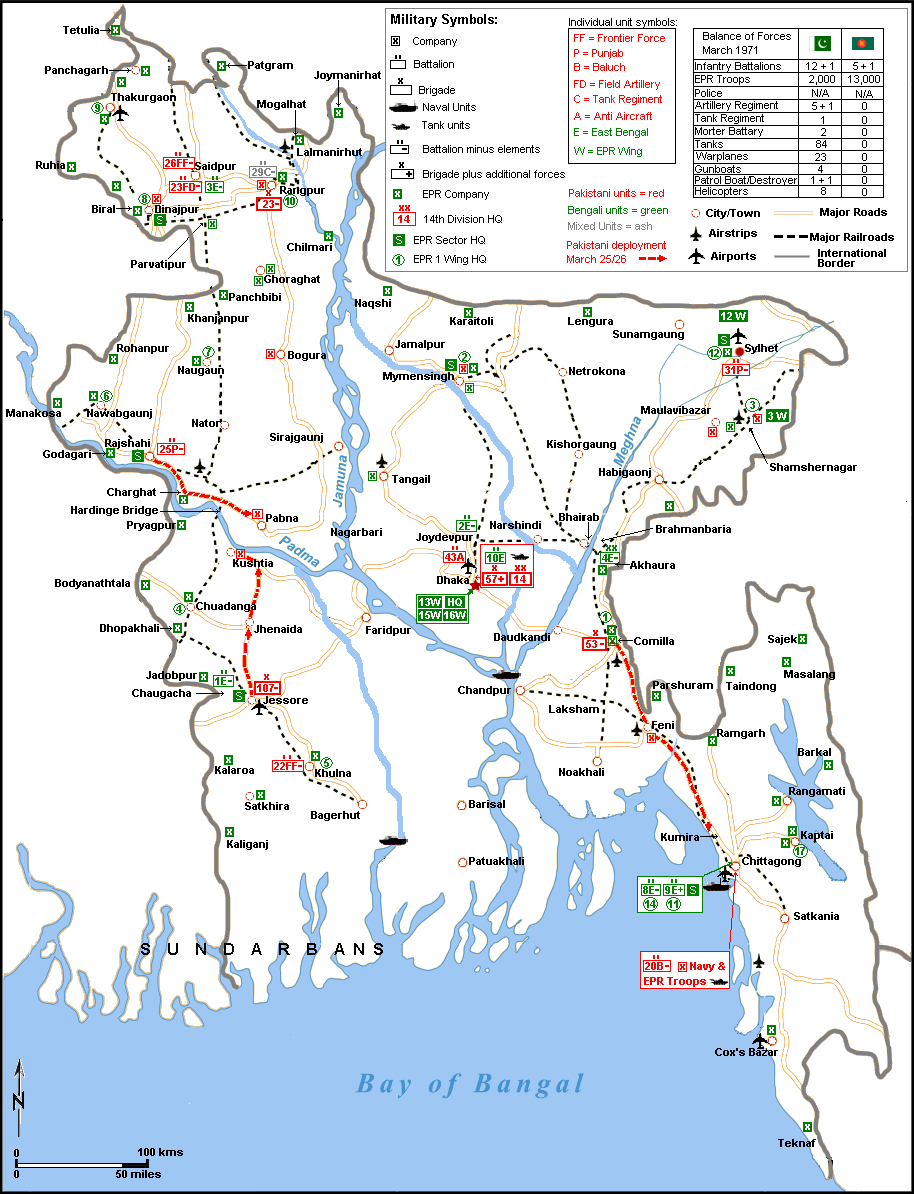
[[File:March71.PNG|thumb|The location of Bengali and Pakistani military units during [[Operation Searchlight]], March 1971]] | [[File:March71.PNG|thumb|The location of Bengali and Pakistani military units during [[Operation Searchlight]], March 1971]] | ||
A planned military pacification carried out by the [[Pakistan Army]]—codenamed ''Operation Searchlight''—started on 25 March 1971 to curb the [[Bengali nationalism|Bengali]] independence movement<ref name="epw"/> by taking control of the major cities on 26 March, and then eliminating all opposition, political or military,<ref>{{harvnb|Salik|1997|pp=63, 228–9}}</ref> within one month. The Pakistani state used [[Persecution of Biharis in Bangladesh|anti-Bihari violence]] by Bengalis in early March to justify Operation Searchlight.<ref>{{Cite book |last=D'Costa |first=Bina |author-link=Bina D'Costa |year=2011 |title=Nationbuilding, Gender and War Crimes in South Asia |publisher=Routledge |page=103 |isbn=978-0-415-56566-0}}</ref> | A planned military pacification carried out by the [[Pakistan Army]]—codenamed ''Operation Searchlight''—started on 25 March 1971 to curb the [[Bengali nationalism|Bengali]] independence movement<ref name="epw"/> by taking control of the major cities on 26 March, and then eliminating all opposition, political or military,<ref>{{harvnb|Salik|1997|pp=63, 228–9}}</ref> within one month. The Pakistani state used [[Persecution of Biharis in Bangladesh|anti-Bihari violence]] by Bengalis in early March to justify Operation Searchlight.<ref>{{Cite book |last=D'Costa |first=Bina |author-link=Bina D'Costa |year=2011 |title=Nationbuilding, Gender and War Crimes in South Asia |publisher=[[Routledge]] |page=103 |isbn=978-0-415-56566-0}}</ref> | ||
Before the beginning of the operation, all foreign journalists were systematically deported from East Pakistan.<ref>{{cite journal |last=Siddiqui |first=Asif |date=December 1997 |title=From Deterrence and Coercive Diplomacy to War: The 1971 Crisis in South Asia |journal=Journal of International and Area Studies |volume=4 |issue=1 |pages=73–92 |jstor=43106996}}</ref> | Before the beginning of the operation, all foreign journalists were systematically deported from East Pakistan.<ref>{{cite journal |last=Siddiqui |first=Asif |date=December 1997 |title=From Deterrence and Coercive Diplomacy to War: The 1971 Crisis in South Asia |journal=Journal of International and Area Studies |volume=4 |issue=1 |pages=73–92 |jstor=43106996}}</ref> | ||
The main phase of Operation Searchlight ended with the fall of the last major town in Bengali hands in mid-May. The operation also began the [[Bangladesh genocide]]. These systematic killings served only to enrage the Bengalis, resulting in East Pakistan's secession later that year. Bangladeshi media and reference books in English have published casualty figures that vary greatly, from 5,000 to 35,000 in Dacca, and | The main phase of Operation Searchlight ended with the fall of the last major town in Bengali hands in mid-May. The operation also began the [[Bangladesh genocide]]. These systematic killings served only to enrage the Bengalis, resulting in East Pakistan's secession later that year. Bangladeshi media and reference books in English have published casualty figures that vary greatly, from 5,000 to 35,000 in Dacca, and 300,000 to 3,000,000 for Bangladesh as a whole.<ref>{{cite web |url = http://necrometrics.com/20c1m.htm#Bangladesh |title = Twentieth Century Atlas – Death Tolls |website = necrometrics.com |access-date = 11 June 2017 |archive-date = 5 March 2011 |archive-url = https://web.archive.org/web/20110305175626/http://necrometrics.com/20c1m.htm#Bangladesh |url-status = live }}</ref> Independent researchers, including the [[The BMJ|British Medical Journal]], have put forward figures ranging from 125,000 to 505,000.<ref>{{cite news|last=Bergman|first=David|title=Questioning an iconic number|url=http://www.thehindu.com/opinion/lead/questioning-an-iconic-number/article5940833.ece|access-date=28 September 2016|newspaper=[[The Hindu]]|date=24 April 2014|archive-date=28 December 2020|archive-url=https://web.archive.org/web/20201228012642/https://www.thehindu.com/opinion/lead/questioning-an-iconic-number/article5940833.ece|url-status=live}}</ref> American [[Political science|political scientist]] [[Rudolph Rummel]] puts total deaths at 1.5 million.<ref>{{cite book | last = Rummel | first = Rudolph | author-link = Rudolph Rummel | title = Statistics of Democide: Genocide and Mass Murder since 1900 | chapter = Chapter 8: Statistics of Pakistan's Democide Estimates, Calculations, And Sources | page = 544 | isbn = 978-3-8258-4010-5 | quote = "...They also planned to indiscriminately murder hundreds of thousands of its Hindus and drive the rest into India. ... This despicable and cutthroat plan was outright genocide'.| year = 1998| publisher = LIT Verlag Münster }}</ref> The atrocities have been called acts of [[genocide#International law|genocide]].<ref>{{cite web |author=Zunaid Kazi |url = http://www.virtualbangladesh.com/history/holocaust.html |title=History : The Bangali Genocide, 1971 |publisher=Virtual Bangladesh |archive-url = https://web.archive.org/web/20110723203401/http://www.virtualbangladesh.com/history/holocaust.html |archive-date=23 July 2011 |access-date=23 June 2011}}</ref> | ||
According to the ''Asia Times'' | According to the ''Asia Times:''<ref>{{cite news|url=http://www.atimes.com/atimes/South_Asia/GF23Df04.html|archive-url=https://web.archive.org/web/20050624014444/http://atimes.com/atimes/South_Asia/GF23Df04.html|url-status=unfit|archive-date=24 June 2005|newspaper=[[Asia Times]]|title=Indians are bastards anyway|last=Debasish Roy Chowdhury|date=23 June 2005}}</ref> | ||
{{blockquote|At a meeting of the military top brass, Yahya Khan declared: "Kill 3 million of them and the rest will eat out of our hands". Accordingly, on the night of 25 March, the Pakistani Army launched ''Operation Searchlight'' to "crush" Bengali resistance in which Bengali members of military services were disarmed and killed, students and the intelligentsia systematically liquidated and able-bodied Bengali males just picked up and gunned down.}} | {{blockquote|At a meeting of the military top brass, Yahya Khan declared: "Kill 3 million of them and the rest will eat out of our hands". Accordingly, on the night of 25 March, the Pakistani Army launched ''Operation Searchlight'' to "crush" Bengali resistance in which Bengali members of military services were disarmed and killed, students and the intelligentsia systematically liquidated and able-bodied Bengali males just picked up and gunned down.}} | ||
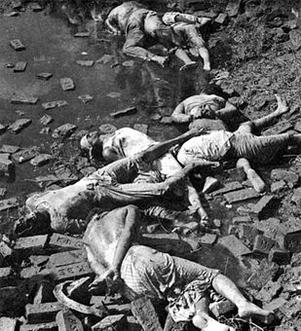
Although the violence focused on the provincial capital, Dacca, it also affected all parts of East Pakistan. Residential halls of the [[University of Dhaka|University of Dacca]] were particularly targeted. The only Hindu residential hall—[[Jagannath Hall]]—was destroyed by the Pakistani armed forces, and an estimated 600 to 700 of its residents were murdered. The Pakistani army denied any cold-blooded killings at the university, but the [[Hamoodur Rahman Commission]] in Pakistan concluded that overwhelming force was used. This fact, and the massacre at Jagannath Hall and nearby student dormitories of Dacca University, are corroborated by a videotape secretly filmed by Professor Nurul Ula of the [[Bangladesh University of Engineering and Technology|East Pakistan University of Engineering and Technology]], whose residence was directly opposite the student dormitories.<ref name="nurullah">{{cite book | Although the violence focused on the provincial capital, Dacca, it also affected all parts of East Pakistan. Residential halls of the [[University of Dhaka|University of Dacca]] were particularly targeted. The only Hindu residential hall—[[Jagannath Hall]]—was destroyed by the Pakistani armed forces, and an estimated 600 to 700 of its residents were murdered. The Pakistani army denied any cold-blooded killings at the university, but the [[Hamoodur Rahman Commission]] in Pakistan concluded that overwhelming force was used. This fact, and the massacre at Jagannath Hall and nearby student dormitories of Dacca University, are corroborated by a videotape secretly filmed by Professor Nurul Ula of the [[Bangladesh University of Engineering and Technology|East Pakistan University of Engineering and Technology]], whose residence was directly opposite the student dormitories.<ref name="nurullah">{{cite book |last=Malik |first=Amita |author-link=Amita Malik |title=The Year of the Vulture |publisher=Orient Longmans |location=New Delhi |year=1972 |isbn=978-0-8046-8817-8 |pages=79–83}}</ref> | ||
| last = Malik | |||
| first = Amita | |||
| author-link = Amita Malik | |||
| title = The Year of the Vulture | |||
| publisher=Orient Longmans | |||
| location = New Delhi | |||
| year = 1972 | |||
| isbn = 978-0-8046-8817-8 | |||
| pages= 79–83 | |||
}}</ref> | |||
The scale of the atrocities was first made clear in the West when [[Anthony Mascarenhas]], a Pakistani journalist who had been sent to the province by the military authorities to write a story | The scale of the atrocities was first made clear in the West, when [[Anthony Mascarenhas]], a Pakistani journalist who had been sent to the province by the military authorities to write a story favorable to Pakistan, instead fled to the United Kingdom and, on 13 June 1971, published an article in ''[[The Sunday Times]]'' describing the systematic killings by the military. The [[BBC]] wrote: "There is little doubt that Mascarenhas' reportage played its part in ending the war. It helped turn world opinion against Pakistan and encouraged India to play a decisive role", with Indian prime minister [[Indira Gandhi]] saying that Mascarenhas' article led her "to prepare the ground for India's armed intervention".<ref name="BBC">{{cite news |url = https://www.bbc.com/news/world-asia-16207201 |title = Bangladesh war: The article that changed history – Asia |publisher = BBC |date = 16 December 2011 |access-date = 20 July 2018 |archive-date = 8 May 2019 |archive-url = https://web.archive.org/web/20190508091712/https://www.bbc.com/news/world-asia-16207201 |url-status = live }}</ref> | ||
Sheikh Mujibur Rahman was arrested by the Pakistani Army. Yahya Khan appointed Brigadier (later General) [[Rahimuddin Khan]] to preside over a special tribunal prosecuting Rahman with multiple charges. The tribunal's sentence was never made public, but Yahya caused the verdict to be held in abeyance in any case. Other Awami League leaders were arrested as well, while a few fled Dacca to avoid arrest. The Awami League was banned by General Yahya Khan.<ref>{{cite encyclopedia |url = https://www.britannica.com/EBchecked/topic/651231/Agha-Mohammad-Yahya-Khan |title = Encyclopædia Britannica Agha Mohammad Yahya Khan |encyclopedia=Encyclopædia Britannica |access-date=23 June 2011 |archive-url = https://web.archive.org/web/20110604051235/https://www.britannica.com/EBchecked/topic/651231/Agha-Mohammad-Yahya-Khan |archive-date= 4 June 2011 |url-status=live}}</ref> | Sheikh Mujibur Rahman was arrested by the Pakistani Army. Yahya Khan appointed Brigadier (later General) [[Rahimuddin Khan]] to preside over a special tribunal prosecuting Rahman with multiple charges. The tribunal's sentence was never made public, but Yahya caused the verdict to be held in abeyance in any case. Other Awami League leaders were arrested as well, while a few fled Dacca to avoid arrest. The Awami League was banned by General Yahya Khan.<ref>{{cite encyclopedia |url = https://www.britannica.com/EBchecked/topic/651231/Agha-Mohammad-Yahya-Khan |title = Encyclopædia Britannica Agha Mohammad Yahya Khan |encyclopedia=Encyclopædia Britannica |access-date=23 June 2011 |archive-url = https://web.archive.org/web/20110604051235/https://www.britannica.com/EBchecked/topic/651231/Agha-Mohammad-Yahya-Khan |archive-date= 4 June 2011 |url-status=live}}</ref> | ||
| Line 216: | Line 179: | ||
=== Declaration of independence === | === Declaration of independence === | ||
{{See also|Proclamation of Bangladeshi Independence|7 March Speech of Bangabandhu}} | {{See also|Proclamation of Bangladeshi Independence|7 March Speech of Bangabandhu}} | ||
The violence unleashed by the Pakistani forces on 25 March 1971 proved the last straw to the efforts to negotiate a settlement. Furthermore the Pakistany army arrested Sheikh Mujibur Rahman. | |||
A news of Sheikh Mujibur Rahman's arrest reached the radio station in [[Chittagong]]. Major [[Ziaur Rahman]] begun rebelling with his forces was requested to provide security for the radio station and also read the Declaration of independence on 26 March 1971.<ref>{{cite news |url=http://arts.bdnews24.com/?p=2769 |script-title=bn:সংযোজনস্বাধীনতার ঘোষণা: বেলাল মোহাম্মদের সাক্ষাৎকার |trans-title=Declaration of Independence: Bilal Mohammad interview |work=bdnews24.com |language=bn |access-date=28 January 2014 |archive-date=29 March 2010 |archive-url=https://web.archive.org/web/20100329134219/http://arts.bdnews24.com/?p=2769 |url-status=live }}</ref> He broadcast the announcement of the declaration of independence on behalf of Sheikh Mujibur Rahman: | |||
{{ | |||
{{blockquote|This is Swadhin Bangla Betar Kendra. I, Major Ziaur Rahman, at the direction of Bangobondhu Sheikh Mujibur Rahman, hereby declare that Independent People's Republic of Bangladesh has been established. At his direction, I have taken the command as the temporary Head of the Republic. In the name of Sheikh Mujibur Rahman, I call upon all Bengalees to rise against the attack by the West Pakistani Army. We shall fight to the last to free our motherland. Victory is, by the Grace of Allah, ours. Joy Bangla.<ref name=Gupta>{{cite book |last=Sen Gupta |first=Jyoti |date=1974 |title=History of freedom movement in Bangladesh, 1943–1973: some involvement |url=https://books.google.com/books?id=DedtAAAAMAAJ |location=Calcutta |publisher=Naya Prokash |pages=325–326 |access-date=18 February 2013}}</ref>}} | |||
The [[Kalurghat]] Radio Station's transmission capability was limited, but the message was picked up by a Japanese ship in the [[Bay of Bengal]]. It was then re-transmitted by [[Radio Australia]]<ref name=Gupta /> and later by the BBC. | |||
26 March 1971 is considered the official [[Independence Day (Bangladesh)|Independence Day of Bangladesh]], and the name Bangladesh was in effect henceforth. In July 1971, Indian prime minister [[Indira Gandhi]] openly referred to the former East Pakistan as Bangladesh.<ref>[https://books.google.com/books?id=srCLD-PXl-gC&pg=PA143 M1 India, Pakistan, and the United States: Breaking with the Past By Shirin R. Tahir-Kheli] {{ISBN|0-87609-199-0}}, 1997, Council on Foreign Relations. pp 37</ref> | |||
== Liberation War == | |||
== Liberation | |||
{{main|Mukti Bahini|Timeline of the Bangladesh Liberation War}} | {{main|Mukti Bahini|Timeline of the Bangladesh Liberation War}} | ||
=== March–June === | === March–June === | ||
At first, resistance was spontaneous and | At first, resistance was spontaneous and disorganized, and was not expected to be prolonged.<ref>Pakistan Defence Journal, 1977, Vol 2, pp. 2–3</ref> But when the Pakistani Army cracked down upon the population, resistance grew. The [[Mukti Bahini]] became increasingly active. The Pakistani military sought to quell them, but increasingly many Bengali soldiers defected to this underground "Bangladesh army". These Bengali units slowly merged into the Mukti Bahini and bolstered their weaponry with supplies from India. Pakistan responded by airlifting in two infantry divisions and reorganizing their forces. They also raised paramilitary forces of [[Razakar (Pakistan)|Razakars]], [[Al-Badr (East Pakistan)|Al-Badrs]] and [[Al-Shams (East Pakistan)|Al-Shams]] (mostly members of the Muslim League and other Islamist groups), as well as other Bengalis who opposed independence, and [[Bihar]]i Muslims who had settled during the time of [[Partition of India|partition]].{{Citation needed|date=March 2024}} | ||
On 17 April 1971, a [[Provisional Government of Bangladesh|provisional government]] was formed in [[Meherpur District]] in western Bangladesh bordering India with Sheikh Mujibur Rahman, who was in prison in Pakistan, as president, [[Syed Nazrul Islam]] as acting president, [[Tajuddin Ahmad]] as prime minister, and General [[M. A. G. Osmani|Muhammad Ataul Ghani Osmani]] as | On 17 April 1971, a [[Provisional Government of Bangladesh|provisional government]] was formed in [[Meherpur District]] in western Bangladesh bordering India with Sheikh Mujibur Rahman, who was in prison in Pakistan, as president, [[Syed Nazrul Islam]] as acting president, [[Tajuddin Ahmad]] as prime minister, and General [[M. A. G. Osmani|Muhammad Ataul Ghani Osmani]] as commander-in-chief, Bangladesh Forces. As fighting grew between the occupation army and the Bengali Mukti Bahini, an estimated 10 million Bengalis sought refuge in the Indian states of Assam and West Bengal.{{citation needed|date=December 2021}} | ||
=== June–September === | === June–September === | ||
| Line 249: | Line 203: | ||
[[File:George Harrison - Bangla Desh.png|thumb|An advertisement for former [[The Beatles|Beatle]] [[George Harrison]]'s "[[Bangla Desh (song)|Bangla Desh]]" single, released in July 1971 to raise international awareness and funds for the millions of Bangladeshi refugees]] | [[File:George Harrison - Bangla Desh.png|thumb|An advertisement for former [[The Beatles|Beatle]] [[George Harrison]]'s "[[Bangla Desh (song)|Bangla Desh]]" single, released in July 1971 to raise international awareness and funds for the millions of Bangladeshi refugees]] | ||
Bangladesh forces command was set up on 11 July, with Col. [[M. A. G. Osmani]] as commander-in-chief (C-in-C) with the status of Cabinet Minister, Lt. Col. Abdur Rabb as chief of Staff (COS), Group Captain A. K. Khandker as Deputy Chief of Staff (DCOS) and Major A. R. Chowdhury as Assistant Chief of Staff (ACOS). | Bangladesh forces command was set up on 11 July, with Col. [[M. A. G. Osmani]] as commander-in-chief (C-in-C) with the status of Cabinet Minister, Lt. Col. Abdur Rabb as chief of Staff (COS), Group Captain A. K. Khandker as Deputy Chief of Staff (DCOS) and Major A. R. Chowdhury as Assistant Chief of Staff (ACOS).{{Citation needed|date=March 2024}} | ||
Osmani had differences of opinion with the Indian leadership about the role of the Mukti Bahini in the conflict. Indian leadership initially envisioned a well trained force of 8,000 guerrillas, operating in small cells around Bangladesh to facilitate eventual conventional combat.<ref>{{harvnb|Jacob|1997|pp=90–91}}</ref> With the Bangladesh government in exile, Osmani | Osmani had differences of opinion with the Indian leadership about the role of the Mukti Bahini in the conflict. Indian leadership initially envisioned a well trained force of 8,000 guerrillas, operating in small cells around Bangladesh to facilitate eventual conventional combat.<ref>{{harvnb|Jacob|1997|pp=90–91}}</ref> With the Bangladesh government in exile, Osmani favored a different strategy:<ref>{{harvnb|Jacob|1997|pp=42–44, 90–91}}</ref><ref>{{harvnb|Hasan|2004|pp=45–46}}</ref> | ||
* Bengali conventional forces would occupy lodgments inside Bangladesh and the Bangladesh government would request international [[diplomatic recognition]] and intervention. Initially [[Mymensingh]] was picked for this operation, but Osmani later settled on Sylhet. | * Bengali conventional forces would occupy lodgments inside Bangladesh and the Bangladesh government would request international [[diplomatic recognition]] and intervention. Initially [[Mymensingh]] was picked for this operation, but Osmani later settled on Sylhet. | ||
* Sending the maximum number of guerrillas into Bangladesh as soon as possible with the following objectives:<ref>{{harvnb|Islam|1981|pp=227, 235}}</ref><ref>{{harvnb|Safiullah|1989|pp=161–163}}</ref> | * Sending the maximum number of guerrillas into Bangladesh as soon as possible with the following objectives:<ref>{{harvnb|Islam|1981|pp=227, 235}}</ref><ref>{{harvnb|Safiullah|1989|pp=161–163}}</ref> | ||
** Increasing Pakistani casualties through raids and ambush. | ** Increasing Pakistani casualties through raids and ambush. | ||
** Cripple economic activity by hitting power stations, railway lines, storage depots and communication networks. | ** Cripple economic activity by hitting power stations, railway lines, storage depots and communication networks. | ||
** Destroy Pakistan | ** Destroy Pakistan Army mobility by blowing up bridges/culverts, fuel depots, trains and river crafts. | ||
** The strategic objective was to make the Pakistanis spread their forces inside the province, so attacks could be made on isolated Pakistani detachments. | ** The strategic objective was to make the Pakistanis spread their forces inside the province, so attacks could be made on isolated Pakistani detachments. | ||
Bangladesh was divided into [[List of sectors in the Bangladesh Liberation War|eleven sectors]] in July,<ref>{{harvnb|Islam|1981|pp=226–231}}</ref> each with a commander chosen from defected officers of the Pakistani army who joined the Mukti Bahini to lead guerrilla operations. The Mukti Bahini forces were given two to five weeks of training by the Indian army on | Bangladesh was divided into [[List of sectors in the Bangladesh Liberation War|eleven sectors]] in July,<ref>{{harvnb|Islam|1981|pp=226–231}}</ref> each with a commander chosen from defected officers of the Pakistani army who joined the Mukti Bahini to lead guerrilla operations.{{citation needed|date=June 2024}} The Mukti Bahini forces were given two to five weeks of training by the Indian army on guerrilla warfare.<ref>{{Cite book|last=Dowlah|first=Caf|title=The Bangladesh Liberation War, the Sheikh Mujib Regime, and Contemporary Controversies|publisher=Lexington Books|year=2016|isbn=978-1-4985-3418-5|page=59|language=en}}</ref> Most of their training camps were near the border area and operated with assistance from India. The 10th Sector was placed under Osmani's command and included the Naval Commandos and C-in-C's special force.<ref>{{cite web |url = http://www.liberationwarmuseumbd.org/history/#blaf |title = Bangladesh Liberation Armed Force |website = Liberation War Museum, Bangladesh |access-date = 30 October 2015 |archive-date = 6 September 2015 |archive-url = https://web.archive.org/web/20150906143409/http://www.liberationwarmuseumbd.org/history/#blaf |url-status = live }}</ref> Three brigades (eventually 8 battalions) were raised for conventional warfare; a large guerrilla force (estimated at 100,000) was trained.<ref>{{cite book |last1=Raja |first1=Dewan Mohammad Tasawwar |title=O General My General |date=2010 |publisher=Osmany Memorial Trust |isbn=978-984-8866-18-4 |pages=72, 74–75}}</ref> | ||
Five infantry battalions were reformed and positioned along the northern and eastern borders of Bangladesh. Three more battalions were raised, and artillery batteries were formed.<ref>{{harvnb|Jacob|1997|p=44}}</ref> During June and July, Mukti Bahini regrouped across the border with Indian aid through [[Operation Jackpot]] and began sending 2,000–5,000 guerrillas across the border,<ref>{{harvnb|Hasan|2004|p=44}}</ref> the so-called Monsoon Offensive, which for various reasons (lack of proper training, supply shortage, lack of a proper support network inside Bangladesh) failed to achieve its objectives.<ref>{{harvnb|Hasan|2004|pp=64–65}}</ref><ref>{{harvnb|Khan|1973|p=125}}</ref> Bengali regular forces also attacked border outposts in [[Mymensingh]], [[Comilla]] and [[Sylhet]], but the results were mixed. Pakistani authorities concluded that they had successfully contained the Monsoon Offensive, which proved a near-accurate observation.<ref>{{harvnb|Ali|1992|p=96}}</ref> | Five infantry battalions were reformed and positioned along the northern and eastern borders of Bangladesh. Three more battalions were raised, and artillery batteries were formed.<ref>{{harvnb|Jacob|1997|p=44}}</ref> During June and July, Mukti Bahini regrouped across the border with Indian aid through [[Operation Jackpot]] and began sending 2,000–5,000 guerrillas across the border,<ref>{{harvnb|Hasan|2004|p=44}}</ref> the so-called Monsoon Offensive, which for various reasons (lack of proper training, supply shortage, lack of a proper support network inside Bangladesh) failed to achieve its objectives.<ref>{{harvnb|Hasan|2004|pp=64–65}}</ref><ref>{{harvnb|Khan|1973|p=125}}</ref> Bengali regular forces also attacked border outposts in [[Mymensingh]], [[Comilla]] and [[Sylhet]], but the results were mixed. Pakistani authorities concluded that they had successfully contained the Monsoon Offensive, which proved a near-accurate observation.<ref>{{harvnb|Ali|1992|p=96}}</ref> | ||
Guerrilla operations, which slackened during the training phase, picked up after August. Economic and military targets in Dacca were attacked. The major success story was Operation Jackpot, in which naval commandos mined and blew up berthed ships in Chittagong, [[Port of Mongla|Mongla]], [[Narayanganj]] and [[Chandpur District|Chandpur]] on 15 August 1971.<ref name="Untold heroism of Muktibahini Frogmen">{{cite book|last=Roy|first=Mihir | Guerrilla operations, which slackened during the training phase, picked up after August. Economic and military targets in Dacca were attacked. The major success story was Operation Jackpot, in which naval commandos mined and blew up berthed ships in Chittagong, [[Port of Mongla|Mongla]], [[Narayanganj]] and [[Chandpur District|Chandpur]] on 15 August 1971.<ref name="Untold heroism of Muktibahini Frogmen">{{cite book|last=Roy|first=Mihir K.|title=War in the Indian Ocean|year=1995|publisher=Lancer Publisher & Distributor|location=New Delhi|isbn=978-1-897829-11-0|page=154}}</ref><ref name="On the water front spectacular achievement">{{cite book|last=Robi|first=Mir Mustak Ahmed|title=Chetonai Ekattor|year=2008|publisher=Zonaki Publisher|location=Dhaka|url=http://opac.iub.edu.bd/cgi-bin/koha/opac-detail.pl?biblionumber=15244&query_desc=%28su%3A{Bangladesh}%29|page=69}}</ref> | ||
=== October–December === | === October–December === | ||
| Line 277: | Line 231: | ||
|} | |} | ||
Bangladeshi conventional forces attacked border outposts. Kamalpur, Belonia and the [[Battle of Boyra]] are a few examples. 90 out of 370 border outposts fell to Bengali forces. Guerrilla attacks intensified, as did Pakistani and Razakar reprisals on civilian populations. Pakistani forces were reinforced by eight battalions from West Pakistan. The Bangladeshi independence fighters even managed to temporarily capture [[Aerodrome#Airstrip|airstrips]] at [[Lalmonirhat District|Lalmonirhat]] and [[Shalutikar]].<ref name=ACIG>{{cite web |url=http://www.acig.org/artman/publish/article_326.shtml |title=India – Pakistan War, 1971; Introduction By Tom Cooper, with Khan Syed Shaiz Ali |publisher=Acig.org |access-date=23 June 2011 |archive-url=https://web.archive.org/web/20110606195040/http://www.acig.org/artman/publish/article_326.shtml |archive-date=6 June 2011 |url-status= | Bangladeshi conventional forces attacked border outposts. Kamalpur, Belonia and the [[Battle of Boyra]] are a few examples. 90 out of 370 border outposts fell to Bengali forces. Guerrilla attacks intensified, as did Pakistani and Razakar reprisals on civilian populations. Pakistani forces were reinforced by eight battalions from West Pakistan. The Bangladeshi independence fighters even managed to temporarily capture [[Aerodrome#Airstrip|airstrips]] at [[Lalmonirhat District|Lalmonirhat]] and [[Shalutikar]].<ref name=ACIG>{{cite web |url=http://www.acig.org/artman/publish/article_326.shtml |title=India – Pakistan War, 1971; Introduction By Tom Cooper, with Khan Syed Shaiz Ali |publisher=Acig.org |access-date=23 June 2011 |archive-url=https://web.archive.org/web/20110606195040/http://www.acig.org/artman/publish/article_326.shtml |archive-date=6 June 2011 |url-status=usurped}}</ref> Both of these were used for flying in supplies and arms from India. Pakistan sent another five battalions from West Pakistan as reinforcements.{{Citation needed|date=March 2024}} | ||
== Indian involvement == | == Indian involvement == | ||
{{see also|Indo-Pakistani | {{see also|Indo-Pakistani war of 1971}} | ||
[[File:Bangladesh 1971 Liberation.jpg|thumb|upright 1.2|Illustration showing military units and troop movements during the war]] | [[File:Bangladesh 1971 Liberation.jpg|thumb|upright 1.2|Illustration showing military units and troop movements during the war]] | ||
{{blockquote|text=All unprejudiced persons objectively surveying the grim events in Bangladesh since March 25 have recognised the revolt of 75 million people, a people who were forced to the conclusion that neither their life, nor their liberty, to say nothing of the possibility of the pursuit of happiness, was available to them.|author=[[Indira Gandhi]]|source=Letter to [[Richard Nixon]], 15 December 1971}} | {{blockquote|text=All unprejudiced persons objectively surveying the grim events in Bangladesh since March 25 have recognised the revolt of 75 million people, a people who were forced to the conclusion that neither their life, nor their liberty, to say nothing of the possibility of the pursuit of happiness, was available to them.|author=[[Indira Gandhi]]|source=Letter to [[Richard Nixon]], 15 December 1971{{citation needed|date=March 2024}}}} | ||
[[File:Indira Gandhi face detail, from- Indira Gandhi and the Johnsons at the North Portico of the White House (cropped).tif|left|thumb|[[Indira Gandhi]]]] | |||
Indian prime minister Indira Gandhi concluded that instead of taking in millions of refugees, India would be economically better off going to war against Pakistan.<ref name="MSN Encarta" /> As early as 28 April 1971, the Indian Cabinet had asked General [[Sam Manekshaw|Manekshaw]] ([[Chairman of the Chiefs of Staff Committee]]) to "Go into East Pakistan".<ref>{{Cite web|title = 1971: Making Bangladesh a reality – I|url = http://www.indiandefencereview.com/news/1971-making-bangladesh-a-reality-i/|website = Indian Defence Review| date=16 December 2012 |access-date = 21 June 2015|archive-date = 24 September 2015|archive-url = https://web.archive.org/web/20150924034413/http://www.indiandefencereview.com/news/1971-making-bangladesh-a-reality-i/|url-status = live}}</ref> Hostile relations in the past between India and Pakistan added to India's decision to intervene in Pakistan's civil war.<ref name="MSN Encarta"/> Major General [[J. F. R. Jacob]], Chief of Staff of India's Eastern Command, devised and executed the brilliant capture of Dhaka, bypassing other towns on the way there which brought about the surrender of the Pakistani commander of its Eastern Forces, [[A.A.K. Niazi]] in that city. | |||
[[ | As a result, the Indian government decided to support the creation of a separate state for ethnic Bengalis by supporting the [[Mukti Bahini]].<ref>{{Cite book |script-title=bn:বাংলাদেশ ও অনুপ্রেরণার গল্প |publisher=Inspiring Bangladesh |isbn=978-984-35-0351-0 |page=21 |language=bn |trans-title=Bangladesh and Story of Inspiration |date=2022 }}</ref> [[Research and Analysis Wing|RAW]] helped to organize, train and arm these insurgents. Consequently, the Mukti Bahini succeeded in harassing Pakistani military in East Pakistan, creating conditions conducive to a full-scale Indian military intervention in early December.<ref name="MSN Encarta">{{cite encyclopaedia |url=http://encarta.msn.com/encyclopedia_761588350_3/Indo-Pakistani_Wars.html |title=Indo-Pakistani Wars |encyclopaedia=MSN Encarta |access-date=20 October 2009 |archive-url=https://www.webcitation.org/5kwrHv6ph?url=http://encarta.msn.com/encyclopedia_761588350_3/Indo-Pakistani_Wars.html |archive-date=1 November 2009 |url-status=dead}}</ref> | ||
Indian | The [[Pakistan Air Force]] (PAF) launched [[Operation Chengiz Khan|a preemptive strike on Indian Air Force bases]] on 3 December 1971. The attack was modeled on the [[Israeli Air Force]]'s [[Operation Focus]] during the [[Six-Day War]] and intended to neutralize the [[Indian Air Force]] planes on the ground. India saw the strike as an open act of unprovoked aggression, which marked the official start of the [[Indo-Pakistani War of 1971|Indo-Pakistani War]]. In response to the attack, both India and Pakistan formally acknowledged the "existence of a state of war between the two countries" even though neither government had formally issued a [[declaration of war]].<ref name="time-edge">{{cite magazine|url=http://content.time.com/time/magazine/article/0,9171,910155,00.html|title=India and Pakistan: Over the Edge|magazine=Time|date=13 December 1971|access-date=18 May 2020|archive-date=8 October 2013|archive-url=https://web.archive.org/web/20131008221847/http://content.time.com/time/magazine/article/0,9171,910155,00.html|url-status=live}}</ref> | ||
[[File:T-55 tanks in the Bangladesh Liberation War.jpg|thumb|upright|Allied Indian [[T-54/55|T-55]] tanks on their way to Dacca]] | |||
Three Indian [[corps]] were involved in the liberation of East Pakistan. They were supported by nearly three [[brigade]]s of Mukti Bahini fighting alongside them, and many more who were fighting irregularly. That was far superior to the Pakistani army of three [[division (military)|divisions]].<ref>{{cite magazine |url=http://www.time.com/time/magazine/article/0,9171,878969-4,00.html |archive-url=https://web.archive.org/web/20071103235823/http://www.time.com/time/magazine/article/0,9171,878969-4,00.html |url-status=dead |archive-date=3 November 2007 |title=Bangladesh: Out of War, a Nation Is Born |magazine=Time |date=20 December 1971 |access-date=23 June 2011}}</ref> The Indians quickly overran the country, selectively engaging or bypassing heavily defended strongholds. Pakistani forces were unable to effectively counter the Indian attack, as they had been deployed in small units around the border to counter the guerrilla attacks by the Mukti Bahini.<ref>{{cite book |last=Praval |first=K. C. |year=1987 |title=Indian Army after Independence |publisher=Lancer International |page=441 |isbn=81-7062-014-7}}</ref> Unable to defend Dacca, the Pakistanis surrendered on 16 December 1971.{{Citation needed|date=March 2024}} | |||
Three Indian [[corps]] were involved in the liberation of East Pakistan. They were supported by nearly three [[brigade]]s of Mukti Bahini fighting alongside them, and many more who were fighting irregularly. That was far superior to the Pakistani army of three [[division (military)|divisions]].<ref>{{cite magazine |url=http://www.time.com/time/magazine/article/0,9171,878969-4,00.html |archive-url=https://web.archive.org/web/20071103235823/http://www.time.com/time/magazine/article/0,9171,878969-4,00.html |url-status=dead |archive-date=3 November 2007 |title=Bangladesh: Out of War, a Nation Is Born |magazine=Time |date=20 December 1971 |access-date=23 June 2011}}</ref> The Indians quickly overran the country, selectively engaging or bypassing heavily defended strongholds. Pakistani forces were unable to effectively counter the Indian attack, as they had been deployed in small units around the border to counter the guerrilla attacks by the Mukti Bahini.<ref> | |||
=== Air and naval war === | === Air and naval war === | ||
The Indian Air Force carried out several sorties against Pakistan, and within a week, IAF aircraft dominated the skies of East Pakistan. It [[East Pakistan Air Operations, 1971|achieved]] near-total [[air supremacy]] by the end of the first week, as the entire Pakistani air contingent in the east, PAF No.14 Squadron, was grounded because of Indian and Bangladeshi airstrikes at Tejgaon, | The Indian Air Force carried out several sorties against Pakistan, and within a week, IAF aircraft dominated the skies of East Pakistan. It [[East Pakistan Air Operations, 1971|achieved]] near-total [[air supremacy]] by the end of the first week, as the entire Pakistani air contingent in the east, PAF No.14 Squadron, was grounded because of Indian and Bangladeshi airstrikes at Tejgaon, Kurmitola, Lalmonirhat and Shamsher Nagar. [[Hawker Sea Hawk|Sea Hawks]] from the carrier {{INS|Vikrant|1961|6}} also struck Chittagong, [[Barisal]] and [[Cox's Bazar]], destroying the eastern wing of the [[Pakistan Navy]] and effectively blockading the East Pakistan ports, cutting off any escape routes for the stranded Pakistani soldiers. The nascent [[Bangladesh Navy]] (comprising officers and sailors who defected from the Pakistani Navy) aided the Indians in the marine warfare, carrying out attacks, most notably [[Operation Jackpot]].<ref>{{cite news|url=http://www.thedailystar.net/supplements/independence-day-special-2015/submariners-heroism-and-the-first-military-response-france|title=Naval Commandos in Operation Jackpot|work=The Daily Star|date=26 March 2015|access-date=30 March 2015|archive-date=27 March 2015|archive-url=https://web.archive.org/web/20150327073557/http://www.thedailystar.net/supplements/independence-day-special-2015/submariners-heroism-and-the-first-military-response-france|url-status=live}}</ref>{{Better source needed|date=October 2020}} | ||
== Surrender and aftermath == | == Surrender and aftermath == | ||
| Line 304: | Line 256: | ||
{{See also|Delhi Agreement}} | {{See also|Delhi Agreement}} | ||
[[File:Pakistani Instrument of Surrender 1971.jpg|thumb|Pakistani Instrument of Surrender]] | [[File:Pakistani Instrument of Surrender 1971.jpg|thumb|Pakistani Instrument of Surrender]] | ||
[[File:1971 Instrument of Surrender.jpg|thumb|Signing of [[Pakistani Instrument of Surrender]] by Pakistan's Lt.Gen. [[Amir Abdullah Khan Niazi|A. A. K. Niazi]] and [[Jagjit Singh Aurora]] on behalf of Indian and [[Mukti Bahini|Bangladesh Forces]] in [[Dhaka]] on 16 Dec. 1971]] | [[File:1971 Instrument of Surrender WaPo.jpg|thumb|Signing of [[Pakistani Instrument of Surrender]] by Pakistan's Lt.Gen. [[Amir Abdullah Khan Niazi|A. A. K. Niazi]] and [[Jagjit Singh Aurora]] on behalf of Indian and [[Mukti Bahini|Bangladesh Forces]] in [[Dhaka]] on 16 Dec. 1971]] | ||
On 16 December 1971, Lt. Gen [[Amir Abdullah Khan Niazi]], [[Chief Martial Law Administrator]] of [[East Pakistan]] and | On 16 December 1971, Lt. Gen [[Amir Abdullah Khan Niazi]], [[Chief Martial Law Administrator]] of [[East Pakistan]] and commander of Pakistan Army forces in East Pakistan signed the [[Pakistani Instrument of Surrender|Instrument of Surrender]]. At the time of surrender only a few countries had provided [[International recognition of Bangladesh|diplomatic recognition]] to the new nation. Over 93,000 Pakistani troops surrendered to the Indian forces and Bangladesh Liberation forces, making it the largest surrender since [[World War II]].<ref name="dailytimes1912005" /><ref name="BBC1971">{{cite news|title=The 1971 war|url=http://news.bbc.co.uk/hi/english/static/in_depth/south_asia/2002/india_pakistan/timeline/1971.stm|access-date=11 October 2011|work=BBC News|archive-date=13 November 2007|archive-url=https://web.archive.org/web/20071113173555/http://news.bbc.co.uk/hi/english/static/in_depth/south_asia/2002/india_pakistan/timeline/1971.stm|url-status=live}}</ref> | ||
Bangladesh sought admission to the UN with most voting in its | Bangladesh sought admission to the UN with most voting in its favor. China vetoed this as Pakistan was its key ally.<ref>{{cite web |url=http://www.mofa.go.jp/policy/other/bluebook/1972/1972-1-9.htm |title=Situation in the Indian Subcontinent |work=mofa.go.jp |access-date=10 January 2007 |archive-date=20 April 2012 |archive-url=https://web.archive.org/web/20120420223314/http://www.mofa.go.jp/policy/other/bluebook/1972/1972-1-9.htm |url-status=live}}</ref> The United States, also a key ally of Pakistan, was one of the last nations to accord Bangladesh recognition.<ref>[http://www.newint.org/issue332/guess.htm Guess who's coming to dinner] {{Webarchive|url=https://web.archive.org/web/20070224195916/http://www.newint.org/issue332/guess.htm |date=24 February 2007}} Naeem Bangali</ref> To ensure a smooth transition, in 1972 the [[Simla Agreement]] was signed between India and Pakistan. The treaty ensured that Pakistan recognized the independence of Bangladesh in exchange for the return of the Pakistani [[Prisoner of war|PoWs]].<ref name=":4">{{Cite web |last=Ahmad |first=Fayazuddin |date=17 January 2009 |title=Law and Our Rights |url=https://www.thedailystar.net/law/2009/01/03/index.htm |access-date=2023-11-06 |website=[[The Daily Star (Bangladesh)|The Daily Star]]}}</ref> | ||
India treated all the PoWs in strict accordance with the Geneva Convention, rule 1925.<ref name=":4" /> It released more than 93,000 Pakistani PoWs in five months.<ref name="dailytimes1912005" /> Further, as a gesture of goodwill, nearly 200 soldiers who were sought for war crimes by Bengalis were pardoned by India.<ref>{{cite web |url=https://www.efsas.org/publications/study-papers/bangladesh%E2%80%99s-genocide-debate;-a-conscientious-research/ |title=Bangladesh's genocide debate; A conscientious research |publisher=EFSAS |access-date=3 August 2020 |archive-date=26 September 2020 |archive-url=https://web.archive.org/web/20200926032926/https://www.efsas.org/publications/study-papers/bangladesh%E2%80%99s-genocide-debate;-a-conscientious-research/ |url-status=live }}</ref> The accord also gave back {{convert|13000|km²|0|abbr=on}} of land that Indian troops had seized in West Pakistan during the war, though India retained a few strategic areas,<ref>{{cite web |url=http://www.storyofpakistan.com/articletext.asp?artid=A109&Pg=6 |title=The Simla Agreement 1972 – Story of Pakistan |website=Story of Pakistan |date=1 June 2003 |archive-url=https://web.archive.org/web/20110614014904/http://www.storyofpakistan.com/articletext.asp?artid=A109&Pg=6 |archive-date= 14 June 2011 |access-date=23 June 2011}}</ref> most notably [[Kargil district|Kargil]] (which was in turn the focal point of [[Kargil War|a war]] between the two nations in 1999). This was done as a measure of promoting "lasting peace" and acknowledged by many observers as a sign of maturity by India. But some in India<ref>{{cite web |title=India's Strategic Blunders in the 1971 War |url=http://www.rediff.com/news/slide-show/slide-show-1-three-indian-blunders-in-the-1971-war/20111212.htm |website=Rediff.com |access-date=3 August 2014 |archive-date=23 November 2016 |archive-url=https://web.archive.org/web/20161123073209/http://www.rediff.com/news/slide-show/slide-show-1-three-indian-blunders-in-the-1971-war/20111212.htm |url-status=live }}</ref> felt the treaty had been too lenient to Bhutto, who had pleaded for leniency, arguing that the fragile democracy in Pakistan would crumble if Pakistanis perceived the accord as overly harsh. | India treated all the PoWs in strict accordance with the Geneva Convention, rule 1925.<ref name=":4" /> It released more than 93,000 Pakistani PoWs in five months.<ref name="dailytimes1912005" /> Further, as a gesture of goodwill, nearly 200 soldiers who were sought for war crimes by Bengalis were pardoned by India.<ref>{{cite web |url=https://www.efsas.org/publications/study-papers/bangladesh%E2%80%99s-genocide-debate;-a-conscientious-research/ |title=Bangladesh's genocide debate; A conscientious research |publisher=EFSAS |access-date=3 August 2020 |archive-date=26 September 2020 |archive-url=https://web.archive.org/web/20200926032926/https://www.efsas.org/publications/study-papers/bangladesh%E2%80%99s-genocide-debate;-a-conscientious-research/ |url-status=live }}</ref> The accord also gave back {{convert|13000|km²|0|abbr=on}} of land that Indian troops had seized in West Pakistan during the war, though India retained a few strategic areas,<ref>{{cite web |url=http://www.storyofpakistan.com/articletext.asp?artid=A109&Pg=6 |title=The Simla Agreement 1972 – Story of Pakistan |website=Story of Pakistan |date=1 June 2003 |archive-url=https://web.archive.org/web/20110614014904/http://www.storyofpakistan.com/articletext.asp?artid=A109&Pg=6 |archive-date= 14 June 2011 |access-date=23 June 2011}}</ref> most notably [[Kargil district|Kargil]] (which was in turn the focal point of [[Kargil War|a war]] between the two nations in 1999). This was done as a measure of promoting "lasting peace" and acknowledged by many observers as a sign of maturity by India. But some in India<ref>{{cite web |title=India's Strategic Blunders in the 1971 War |url=http://www.rediff.com/news/slide-show/slide-show-1-three-indian-blunders-in-the-1971-war/20111212.htm |website=Rediff.com |access-date=3 August 2014 |archive-date=23 November 2016 |archive-url=https://web.archive.org/web/20161123073209/http://www.rediff.com/news/slide-show/slide-show-1-three-indian-blunders-in-the-1971-war/20111212.htm |url-status=live }}</ref> felt the treaty had been too lenient to Bhutto, who had pleaded for leniency, arguing that the fragile democracy in Pakistan would crumble if Pakistanis perceived the accord as overly harsh.{{Citation needed|date=March 2024}} | ||
=== Reaction in West Pakistan to the war === | === Reaction in West Pakistan to the war === | ||
| Line 320: | Line 272: | ||
{{Main|1971 Bangladesh genocide|1971 killing of Bengali intellectuals|Rape during the Bangladesh Liberation War}} | {{Main|1971 Bangladesh genocide|1971 killing of Bengali intellectuals|Rape during the Bangladesh Liberation War}} | ||
[[File:Dead bodies of Bengali intellectuals, 14 December 1971.jpg|thumb|Rayerbazar killing field photographed immediately after the war, showing dead bodies of intellectuals (image courtesy: [[Rashid Talukder]], 1971)]] | |||
During the war there were widespread killings and other atrocities—including the displacement of civilians in Bangladesh (East Pakistan at the time) and widespread violations of human rights beginning with [[Operation Searchlight]] on 25 March 1971. Members of the [[Pakistan Armed Forces|Pakistani military]] and supporting paramilitary forces killed an estimated 300,000<ref name="BBC"/> to 3,000,000 people<ref name="MathewWhite">White, Matthew, ''[http://necrometrics.com/20c1m.htm#Bangladesh Death Tolls for the Major Wars and Atrocities of the Twentieth Century] {{Webarchive|url=https://web.archive.org/web/20110305175626/http://necrometrics.com/20c1m.htm#Bangladesh |date=5 March 2011 }}''</ref> and raped between 200,000 and 400,000 [[Bangladeshis|Bangladeshi]] women in a systematic campaign of [[genocidal rape]].{{sfn|Sharlach|2000|pp=92–93}}{{sfn|Sajjad|2012|p=225}} Pakistan's religious leaders openly supported the crime by | During the war, there were widespread killings and other atrocities—including the displacement of civilians in Bangladesh (East Pakistan at the time) and widespread violations of human rights beginning with [[Operation Searchlight]] on 25 March 1971. Members of the [[Pakistan Armed Forces|Pakistani military]] and supporting paramilitary forces killed an estimated 300,000<ref name="BBC"/> to 3,000,000 people<ref name="MathewWhite">White, Matthew, ''[http://necrometrics.com/20c1m.htm#Bangladesh Death Tolls for the Major Wars and Atrocities of the Twentieth Century] {{Webarchive|url=https://web.archive.org/web/20110305175626/http://necrometrics.com/20c1m.htm#Bangladesh |date=5 March 2011 }}''</ref> and raped between 200,000 and 400,000 [[Bangladeshis|Bangladeshi]] women in a systematic campaign of [[genocidal rape]].{{sfn|Sharlach|2000|pp=92–93}}{{sfn|Sajjad|2012|p=225}} Pakistan's religious leaders openly supported the crime by labeling [[Mukti Bahini|Bengali freedom fighters]] "Hindus" and Bengali women "the booty of war".<ref>{{cite book |last=Siddiqi |first=Dina M. |year=1998 |chapter=Taslima Nasreen and Others: The Contest over Gender in Bangladesh |editor-last1=Bodman |editor-first1=Herbert L. |editor-last2=Tohidi |editor-first2=Nayereh Esfahlani |title=Women in Muslim Societies: Diversity Within Unity |publisher=Lynne Rienner |pages=208–209 |isbn=978-1-55587-578-7 |quote=Sometime during the war, a fatwa originating in West Pakistan labeled Bengali freedom fighters 'Hindus' and declared that 'the wealth and women' to be secured by warfare with them could be treated as the booty of war. [Footnote, on p. 225:] S. A. Hossain, "Fatwa in Islam: Bangladesh Perspective," ''Daily Star'' (Dhaka), 28 December 1994, 7.}}</ref> In fact, more than 80 percent of the Bengali people were Muslims at that time.<ref>{{Cite web |url=https://en.banglapedia.org/index.php/Population |title=Population |website=Banglapedia |access-date=13 December 2021 |archive-date=1 April 2022 |archive-url=https://web.archive.org/web/20220401041939/https://en.banglapedia.org/index.php/Population |url-status=live }}</ref> | ||
A large section of the intellectual community of Bangladesh were murdered, mostly by the [[Al-Shams (East Pakistan)|Al-Shams]] and [[Al-Badr (East Pakistan)|Al-Badr]] forces,<ref>Many of the eyewitness accounts of relations that were picked up by "Al Badr" forces describe them as Bengali men. The only survivor of the Rayerbazar killings describes the captors and killers of Bengali professionals as fellow Bengalis. See 57 Dilawar Hossain, account reproduced in ''Ekattorer Ghatok-dalalera ke Kothay'' (Muktijuddha Chetona Bikash Kendro, Dacca, 1989)</ref> at the instruction of the Pakistani Army.<ref>{{cite news |url=http://archive.thedailystar.net/2005/12/14/d512141501115.htm |title=The loss continues to haunt us |last=Khan |first=Md. Asadullah |date=14 December 2005 |type=Editorial |work=The Daily Star |access-date=11 June 2017 |archive-date=5 March 2013 |archive-url=https://web.archive.org/web/20130305011706/http://www.thedailystar.net/2005/12/14/d512141501115.htm |url-status=live }}</ref> Just two days before the surrender, on 14 December 1971, Pakistan Army and Razakar militia (local collaborators) picked up at least 100 physicians, professors, writers and engineers in Dacca, and murdered them, leaving the dead bodies in a mass grave.<ref>{{cite news|url=https://www.nytimes.com/1971/12/19/archives/125-slain-in-dacca-area-believed-elite-of-bengal-125-found-slain.html|title=125 Slain in Dacca Area Believed Elite of Bengal|author=<!--Not stated-->|date=19 December 1971|newspaper=The New York Times|access-date=11 June 2017|issn=0362-4331|quote=At least 125 persons, believed to be physicians, professors, writers and teachers, were found murdered today in a field outside Dacca. All the victims' hands were tied behind their backs and they had been bayoneted, garroted or shot. They were among an estimated 300 Bengali intellectuals who had been seized by West Pakistani soldiers and locally recruited supporters.|archive-date=28 March 2014|archive-url=https://web.archive.org/web/20140328143516/http://select.nytimes.com/gst/abstract.html?res=F50C13F83C5E127A93CBA81789D95F458785F9|url-status=live}}</ref> | A large section of the intellectual community of Bangladesh were murdered, mostly by the [[Al-Shams (East Pakistan)|Al-Shams]] and [[Al-Badr (East Pakistan)|Al-Badr]] forces,<ref>Many of the eyewitness accounts of relations that were picked up by "Al Badr" forces describe them as Bengali men. The only survivor of the Rayerbazar killings describes the captors and killers of Bengali professionals as fellow Bengalis. See 57 Dilawar Hossain, account reproduced in ''Ekattorer Ghatok-dalalera ke Kothay'' (Muktijuddha Chetona Bikash Kendro, Dacca, 1989)</ref> at the instruction of the Pakistani Army.<ref>{{cite news |url=http://archive.thedailystar.net/2005/12/14/d512141501115.htm |title=The loss continues to haunt us |last=Khan |first=Md. Asadullah |date=14 December 2005 |type=Editorial |work=The Daily Star |access-date=11 June 2017 |archive-date=5 March 2013 |archive-url=https://web.archive.org/web/20130305011706/http://www.thedailystar.net/2005/12/14/d512141501115.htm |url-status=live }}</ref> Just two days before the surrender, on 14 December 1971, Pakistan Army and the Razakar militia (local collaborators) picked up at least 100 physicians, professors, writers and engineers in Dacca, and murdered them, leaving the dead bodies in a mass grave.<ref>{{cite news|url=https://www.nytimes.com/1971/12/19/archives/125-slain-in-dacca-area-believed-elite-of-bengal-125-found-slain.html|title=125 Slain in Dacca Area Believed Elite of Bengal|author=<!--Not stated-->|date=19 December 1971|newspaper=The New York Times|access-date=11 June 2017|issn=0362-4331|quote=At least 125 persons, believed to be physicians, professors, writers and teachers, were found murdered today in a field outside Dacca. All the victims' hands were tied behind their backs and they had been bayoneted, garroted or shot. They were among an estimated 300 Bengali intellectuals who had been seized by West Pakistani soldiers and locally recruited supporters.|archive-date=28 March 2014|archive-url=https://web.archive.org/web/20140328143516/http://select.nytimes.com/gst/abstract.html?res=F50C13F83C5E127A93CBA81789D95F458785F9|url-status=live}}</ref> | ||
[[File:Sriti shoud.jpeg|thumb|left|Memorial for freedom fighters]] | [[File:Sriti shoud.jpeg|thumb|left|Memorial for freedom fighters]] | ||
Many mass graves have been discovered in Bangladesh.<ref>{{cite news |url=http://www.tribuneindia.com/1999/99aug08/world.htm#7 |title=Mass grave found in Bangladesh |work=The Tribune |access-date=11 June 2017 |archive-date=28 December 2020 |archive-url=https://web.archive.org/web/20201228012627/https://www.tribuneindia.com/1999/99aug08/world.htm#7 |url-status=live }}</ref> The first night of war on Bengalis, which is documented in telegrams from the American | Many mass graves have been discovered in Bangladesh.<ref>{{cite news |url=http://www.tribuneindia.com/1999/99aug08/world.htm#7 |title=Mass grave found in Bangladesh |work=The Tribune |access-date=11 June 2017 |archive-date=28 December 2020 |archive-url=https://web.archive.org/web/20201228012627/https://www.tribuneindia.com/1999/99aug08/world.htm#7 |url-status=live }}</ref> The first night of war on Bengalis, which is documented in telegrams from the American consulate in Dacca to the U.S. State Department, saw indiscriminate killings of students of [[University of Dhaka|Dacca University]] and other civilians.<ref name=":2">{{Cite web|url=http://nsarchive.gwu.edu/NSAEBB/NSAEBB79/|title=The Tilt: The U.S. and the South Asian Crisis of 1971|last=Evans|first=Michael|website=nsarchive.gwu.edu|access-date=11 June 2017|archive-date=12 June 2017|archive-url=https://web.archive.org/web/20170612151003/http://nsarchive.gwu.edu/NSAEBB/NSAEBB79/|url-status=live}}</ref> Numerous women were tortured, raped, and killed during the war; the exact numbers are not known and are debated. The widespread rape of Bangladeshi women led to birth of thousands of [[War children|war babies]].<ref>{{cite news | title = Bengali Wives Raped in War Are Said to Face Ostracism | date = 8 January 1972 | url = http://www.docstrangelove.com/uploads/1971/foreign/19720118_nyt_bengali_wives_raped_in_war_are_said_to_face_ostracism.pdf | work = The New York Times | access-date = 10 November 2011 | archive-date = 21 December 2011 | archive-url = https://web.archive.org/web/20111221082405/http://www.docstrangelove.com/uploads/1971/foreign/19720118_nyt_bengali_wives_raped_in_war_are_said_to_face_ostracism.pdf | url-status = live }}</ref><ref>{{cite news | first = Aubrey | last = Menen | author-link = Aubrey Menen | title = The Rapes of Bangladesh | date = 23 July 1972 | url = http://www.docstrangelove.com/uploads/1971/foreign/19720723_nyt_the_rapes_of_bangladesh.pdf | newspaper = The New York Times | access-date = 10 November 2011 | archive-date = 21 December 2011 | archive-url = https://web.archive.org/web/20111221082430/http://www.docstrangelove.com/uploads/1971/foreign/19720723_nyt_the_rapes_of_bangladesh.pdf | url-status = live }}</ref><ref>{{cite news | first = Anthony | last = Astrachan | title = U.N. Asked to Aid Bengali Abortions | date = 22 March 1972 | url = http://www.docstrangelove.com/uploads/1971/foreign/19720322_wp_un_asked_to_aid_bengali_abortions.pdf | newspaper = The Washington Post | access-date = 10 November 2011 | archive-date = 21 December 2011 | archive-url = https://web.archive.org/web/20111221082448/http://www.docstrangelove.com/uploads/1971/foreign/19720322_wp_un_asked_to_aid_bengali_abortions.pdf | url-status = live }}</ref> | ||
The Pakistan Army also kept numerous Bengali women as sex slaves inside the Dacca Cantonment. Most were captured from Dacca University and private homes.<ref name="time.oct25-1971">{{cite magazine |title=East Pakistan: Even the Skies Weep |url=http://www.time.com/time/magazine/article/0,9171,877316,00.html |archive-url=https://web.archive.org/web/20071104001659/http://www.time.com/time/magazine/article/0,9171,877316,00.html |url-status=dead |archive-date=4 November 2007 |url-access=subscription |magazine=[[Time (magazine)|Time]] |date=25 October 1971 |page=43 |quote=Refugees are still trekking into India ... telling of villages burned, residents shot, and prominent figures carried off and never heard from again. One of the more horrible revelations concerns 563 young Bengali women, some only 18, who have been held captive inside Dacca's dingy military cantonment since the first days of the fighting. Seized from Dacca University and private homes and forced into military brothels, the girls are all three to five months pregnant. The army is reported to have enlisted Bengali gynecologists to abort girls held at military installations. But for those at the Dacca cantonment it is too late for abortion.}}</ref> There was significant sectarian violence not only perpetrated and encouraged by the Pakistani army,<ref name="usconsulate_cable_march31">U.S. Consulate (Dacca) Cable, Sitrep: [http://www.gwu.edu/~nsarchiv/NSAEBB/NSAEBB79/BEBB6.pdf Army Terror Campaign Continues in Dacca; Evidence Military Faces Some Difficulties Elsewhere] {{Webarchive|url=https://web.archive.org/web/20111221082405/http://www.gwu.edu/~nsarchiv/NSAEBB/NSAEBB79/BEBB6.pdf |date=21 December 2011 }}, 31 March 1971, Confidential, 3 pp</ref> but also by Bengali nationalists against non-Bengali minorities, especially [[Biharis]].<ref name="Bihari Refugees">{{cite journal |last=Sen |first=Sumit |year=1999 |title=Stateless Refugees and the Right to Return: the Bihari Refugees of South Asia, Part 1 |journal=[[International Journal of Refugee Law]] |volume=11 |issue=4 |pages=625–645 |doi=10.1093/ijrl/11.4.625}}</ref> In June 1971, Bihari representatives said that 500,000 Biharis were killed by Bengalis.<ref name="Gerlach2010">{{cite book|url=https://books.google.com/books?id=48N-XbOltMEC&pg=PA148|title=Extremely Violent Societies: Mass Violence in the Twentieth-Century World|last=Gerlach|first=Christian|publisher=Cambridge University Press|year=2010|isbn=9781139493512|page=148|access-date=31 August 2017|archive-date=7 February 2023|archive-url=https://web.archive.org/web/20230207214806/https://books.google.com/books?id=48N-XbOltMEC&pg=PA148|url-status=live}}</ref> R. J. Rummel gives a prudent estimate of 150,000 killed.<ref name=":12">{{cite book|url=https://books.google.com/books?id=aYBrAgAAQBAJ&pg=PA334|title=Death by Government|last=Rummel|first=R. J.|publisher=Transaction Publishers|year=1997|isbn=9781560009276|page=334|access-date=31 August 2017|archive-date=7 February 2023|archive-url=https://web.archive.org/web/20230207214903/https://books.google.com/books?id=aYBrAgAAQBAJ&pg=PA334|url-status=live}}</ref> | The Pakistan Army also kept numerous Bengali women as sex slaves inside the Dacca Cantonment. Most were captured from Dacca University and private homes.<ref name="time.oct25-1971">{{cite magazine |title=East Pakistan: Even the Skies Weep |url=http://www.time.com/time/magazine/article/0,9171,877316,00.html |archive-url=https://web.archive.org/web/20071104001659/http://www.time.com/time/magazine/article/0,9171,877316,00.html |url-status=dead |archive-date=4 November 2007 |url-access=subscription |magazine=[[Time (magazine)|Time]] |date=25 October 1971 |page=43 |quote=Refugees are still trekking into India ... telling of villages burned, residents shot, and prominent figures carried off and never heard from again. One of the more horrible revelations concerns 563 young Bengali women, some only 18, who have been held captive inside Dacca's dingy military cantonment since the first days of the fighting. Seized from Dacca University and private homes and forced into military brothels, the girls are all three to five months pregnant. The army is reported to have enlisted Bengali gynecologists to abort girls held at military installations. But for those at the Dacca cantonment it is too late for abortion.}}</ref> There was significant sectarian violence not only perpetrated and encouraged by the Pakistani army,<ref name="usconsulate_cable_march31">U.S. Consulate (Dacca) Cable, Sitrep: [http://www.gwu.edu/~nsarchiv/NSAEBB/NSAEBB79/BEBB6.pdf Army Terror Campaign Continues in Dacca; Evidence Military Faces Some Difficulties Elsewhere] {{Webarchive|url=https://web.archive.org/web/20111221082405/http://www.gwu.edu/~nsarchiv/NSAEBB/NSAEBB79/BEBB6.pdf |date=21 December 2011 }}, 31 March 1971, Confidential, 3 pp</ref> but also by Bengali nationalists against non-Bengali minorities, especially [[Biharis]].<ref name="Bihari Refugees">{{cite journal |last=Sen |first=Sumit |year=1999 |title=Stateless Refugees and the Right to Return: the Bihari Refugees of South Asia, Part 1 |journal=[[International Journal of Refugee Law]] |volume=11 |issue=4 |pages=625–645 |doi=10.1093/ijrl/11.4.625}}</ref> In June 1971, Bihari representatives said that 500,000 Biharis were killed by Bengalis.<ref name="Gerlach2010">{{cite book|url=https://books.google.com/books?id=48N-XbOltMEC&pg=PA148|title=Extremely Violent Societies: Mass Violence in the Twentieth-Century World|last=Gerlach|first=Christian|publisher=Cambridge University Press|year=2010|isbn=9781139493512|page=148|access-date=31 August 2017|archive-date=7 February 2023|archive-url=https://web.archive.org/web/20230207214806/https://books.google.com/books?id=48N-XbOltMEC&pg=PA148|url-status=live}}</ref> R. J. Rummel gives a prudent estimate of 150,000 killed.<ref name=":12">{{cite book|url=https://books.google.com/books?id=aYBrAgAAQBAJ&pg=PA334|title=Death by Government|last=Rummel|first=R. J.|publisher=Transaction Publishers|year=1997|isbn=9781560009276|page=334|access-date=31 August 2017|archive-date=7 February 2023|archive-url=https://web.archive.org/web/20230207214903/https://books.google.com/books?id=aYBrAgAAQBAJ&pg=PA334|url-status=live}}</ref> | ||
On 16 December 2002, the [[George Washington University]]'s [[National Security Archive]] published a collection of declassified documents, consisting mostly of communications between U.S. embassy officials and [[United States Information Agency|United States Information Service]] | On 16 December 2002, the [[George Washington University]]'s [[National Security Archive]] published a collection of declassified documents, consisting mostly of communications between U.S. embassy officials and [[United States Information Agency|United States Information Service]] centers in Dacca and India, and officials in Washington, D.C.<ref name=":2" /> These documents show that U.S. officials working in diplomatic institutions within Bangladesh used the terms "selective genocide"<ref name="SelectiveGenocide">U.S. Consulate in Dacca (27 March 1971), ''[http://www.gwu.edu/~nsarchiv/NSAEBB/NSAEBB79/BEBB1.pdf Selective genocide] {{Webarchive|url=https://web.archive.org/web/20090612052659/http://www.gwu.edu/~nsarchiv/NSAEBB/NSAEBB79/ |date=12 June 2009 }}'', Cable (PDF)</ref> and "genocide" (see [[Archer Blood#The Blood telegram|The Blood Telegram]]) for information on events they had knowledge of at the time. ''[[Genocide]]'' is the term still used to describe the event in almost every major publication and newspaper in Bangladesh,<ref name="bangladeshobserver">{{cite news |title=The Jamaat Talks Back |url=http://www.bangladeshobserveronline.com/new/2005/12/30/editorial.htm |newspaper=[[The Bangladesh Observer]] |type=Editorial |date=30 December 2005 |url-status=usurped |archive-url=https://web.archive.org/web/20070123033307/http://www.bangladeshobserveronline.com/new/2005/12/30/editorial.htm |archive-date=23 January 2007}}</ref><ref>{{cite magazine |url=http://archive.thedailystar.net/magazine/2005/12/03/remembrance.htm |title=Remembering a Martyr |magazine=Star Weekend Magazine |publisher=The Daily Star |access-date=11 June 2017 |archive-date=27 October 2013 |archive-url=https://web.archive.org/web/20131027095320/http://archive.thedailystar.net/magazine/2005/12/03/remembrance.htm |url-status=live }}</ref> although in Pakistan, the accusations against Pakistani forces continue to be disputed.{{Citation needed|date=March 2024}} | ||
== International reactions == | == International reactions == | ||
[[File:André Malraux, Pic, 22.jpg|thumb|Former French minister [[André Malraux]] vowed to fight alongside the Mukti Bahini in the Liberation War.<ref>{{cite news|url=http://www.thedailybeast.com/articles/2014/04/28/bernard-henri-levy-andre-malraux-s-bangladesh-before-the-radicals.html|title=Bernard-Henri Levy: Andre Malraux's Bangladesh, Before the Radicals|newspaper=The Daily Beast|date=28 April 2014|last1=Lévy|first1=Bernard-Henri|access-date=2 April 2015|archive-date=7 April 2015|archive-url=https://web.archive.org/web/20150407100546/http://www.thedailybeast.com/articles/2014/04/28/bernard-henri-levy-andre-malraux-s-bangladesh-before-the-radicals.html|url-status=live}}</ref><ref>{{cite news |url=http://www.theindependentbd.com/index.php?option=com_content&view=article&id=212838:andre-malraux-a-true-friend-of-bangladesh&catid=182:city-life&Itemid=220 |title=André Malraux: A true friend of Bangladesh |work=The Independent |location=Dhaka |date=25 April 2014 |archive-url=https://web.archive.org/web/20150411040048/http://www.theindependentbd.com/index.php?option=com_content&view=article&id=212838:andre-malraux-a-true-friend-of-bangladesh&catid=182:city-life&Itemid=220 |archive-date=11 April 2015}}</ref>]] | [[File:André Malraux, Pic, 22.jpg|thumb|Former French minister [[André Malraux]] vowed to fight alongside the Mukti Bahini in the Liberation War.<ref>{{cite news|url=http://www.thedailybeast.com/articles/2014/04/28/bernard-henri-levy-andre-malraux-s-bangladesh-before-the-radicals.html|title=Bernard-Henri Levy: Andre Malraux's Bangladesh, Before the Radicals|newspaper=The Daily Beast|date=28 April 2014|last1=Lévy|first1=Bernard-Henri|access-date=2 April 2015|archive-date=7 April 2015|archive-url=https://web.archive.org/web/20150407100546/http://www.thedailybeast.com/articles/2014/04/28/bernard-henri-levy-andre-malraux-s-bangladesh-before-the-radicals.html|url-status=live}}</ref><ref>{{cite news |url=http://www.theindependentbd.com/index.php?option=com_content&view=article&id=212838:andre-malraux-a-true-friend-of-bangladesh&catid=182:city-life&Itemid=220 |title=André Malraux: A true friend of Bangladesh |work=The Independent |location=Dhaka |date=25 April 2014 |archive-url=https://web.archive.org/web/20150411040048/http://www.theindependentbd.com/index.php?option=com_content&view=article&id=212838:andre-malraux-a-true-friend-of-bangladesh&catid=182:city-life&Itemid=220 |archive-date=11 April 2015}}</ref>|left]] | ||
Following Sheikh Mujibur Rahman's declaration of independence in March 1971, a worldwide campaign was undertaken by the [[Provisional Government of Bangladesh]] to drum up political support for the independence of East Pakistan as well as humanitarian support for the Bengali people. | Following Sheikh Mujibur Rahman's declaration of independence in March 1971, a worldwide campaign was undertaken by the [[Provisional Government of Bangladesh]] to drum up political support for the independence of East Pakistan as well as humanitarian support for the Bengali people.{{Citation needed|date=March 2024}} | ||
Indian | Indian prime minister Indira Gandhi provided extensive diplomatic and political support to the Bangladesh movement. She toured many countries in a bid to create awareness of the Pakistani atrocities against Bengalis. This effort was to prove vital later during the war, in framing the world's context of the war and to justify military action by India.<ref name="recog-story">{{cite web|url=http://www.bdsdf.org/forum/index.php?showtopic=3072 |title=The Recognition Story |publisher=Bangladesh Strategic and Development Forum |access-date=17 August 2011 |archive-url=https://web.archive.org/web/20110725050939/http://www.bdsdf.org/forum/index.php?showtopic=3072 |archive-date=25 July 2011 |url-status=dead}}</ref> Also, following Pakistan's defeat, it ensured prompt recognition of the newly independent state of Bangladesh.{{Citation needed|date=March 2024}} | ||
=== United Nations === | === United Nations === | ||
Though the United Nations condemned the human rights violations during and following Operation Searchlight, it failed to defuse the situation politically before the start of the war. | Though the United Nations condemned the human rights violations during and following Operation Searchlight, it failed to defuse the situation politically before the start of the war.{{Citation needed|date=March 2024}} | ||
After India entered the war, Pakistan, fearing certain defeat, made urgent appeals to the United Nations to intervene and force India to agree to a [[ceasefire]]. The [[United Nations Security Council|UN Security Council]] assembled on 4 December 1971 to discuss the hostilities in South Asia. After lengthy discussions on 7 December, the United States made a resolution for "immediate cease-fire and withdrawal of troops". While supported by the majority, the USSR vetoed the resolution twice. In light of the Pakistani atrocities against Bengalis, the United Kingdom and France abstained on the resolution.<ref name="time-edge" /><ref name=":3">{{cite book|url=https://en.wikisource.org/wiki/Zulfiqar_Ali_Bhutto%27s_farewell_speech_to_the_United_Nations_Security_Council|title=Zulfiqar Ali Bhutto's farewell speech to the United Nations Security Council|last=Bhutto|first=Zulfiqar Ali|access-date=11 June 2017|archive-date=28 April 2016|archive-url=https://web.archive.org/web/20160428162858/https://en.wikisource.org/wiki/Zulfiqar_Ali_Bhutto%27s_farewell_speech_to_the_United_Nations_Security_Council|url-status=live}}</ref> | After India entered the war, Pakistan, fearing certain defeat, made urgent appeals to the United Nations to intervene and force India to agree to a [[ceasefire]]. The [[United Nations Security Council|UN Security Council]] assembled on 4 December 1971 to discuss the hostilities in South Asia. After lengthy discussions on 7 December, the United States made a resolution for "immediate cease-fire and withdrawal of troops". While supported by the majority, the USSR vetoed the resolution twice. In light of the Pakistani atrocities against Bengalis, the United Kingdom and France abstained on the resolution.<ref name="time-edge" /><ref name=":3">{{cite book|url=https://en.wikisource.org/wiki/Zulfiqar_Ali_Bhutto%27s_farewell_speech_to_the_United_Nations_Security_Council|title=Zulfiqar Ali Bhutto's farewell speech to the United Nations Security Council|last=Bhutto|first=Zulfiqar Ali|access-date=11 June 2017|archive-date=28 April 2016|archive-url=https://web.archive.org/web/20160428162858/https://en.wikisource.org/wiki/Zulfiqar_Ali_Bhutto%27s_farewell_speech_to_the_United_Nations_Security_Council|url-status=live}}</ref> | ||
On 12 December, with Pakistan facing imminent defeat, the United States requested that the Security Council be reconvened. Pakistan's | On 12 December, with Pakistan facing imminent defeat, the United States requested that the Security Council be reconvened. Pakistan's deputy prime minister and foreign minister, Zulfikar Ali Bhutto, was rushed to New York City to make the case for a resolution on the ceasefire. The council continued deliberations for four days. By the time proposals were finalized, Pakistan's forces in the East had surrendered and the war had ended, making the measures merely academic. Bhutto, frustrated by the failure of the resolution and the inaction of the United Nations, ripped up his speech and left the council.<ref name=":3" /> | ||
Most UN member nations were quick to | Most UN member nations were quick to recognize Bangladesh within months of its independence.<ref name="recog-story" /> | ||
===Bhutan=== | ===Bhutan=== | ||
As the Bangladesh Liberation War approached the defeat of the Pakistan Army, the Himalayan kingdom of [[Bhutan]] became the first state in the world to | As the Bangladesh Liberation War approached the defeat of the Pakistan Army, the Himalayan kingdom of [[Bhutan]] became the first state in the world to recognize the newly independent country on 6 December 1971.<ref>{{cite news|url=http://www.dhakatribune.com/bangladesh/2014/dec/08/bhutan-recognised-bangladesh-first|title=Bhutan recognised Bangladesh first|work=[[Dhaka Tribune]]|date=8 December 2014|access-date=14 December 2014|archive-date=8 January 2022|archive-url=https://web.archive.org/web/20220108132617/https://www.dhakatribune.com/bangladesh/2014/dec/08/bhutan-recognised-bangladesh-first|url-status=live}}</ref> [[Sheikh Mujibur Rahman]], the first [[president of Bangladesh]], visited Bhutan to attend the coronation of [[Jigme Singye Wangchuck]], the fourth King of Bhutan in June 1974.{{Citation needed|date=March 2024}} | ||
=== US and USSR === | === US and USSR === | ||
[[File:Ted Kennedy, 1967 (cropped).jpg|thumb|upright | [[File:Ted Kennedy, 1967 (cropped).jpg|thumb|upright|[[Ted Kennedy|Senator Ted Kennedy]] led US congressional support for Bangladeshi independence.]] | ||
The US government stood by its old ally Pakistan in terms of diplomacy and military threats.<ref>{{cite journal |author=Jarrod Hayes |year=2012 |title=Securitization, social identity, and democratic security: Nixon, India, and the ties that bind |url=https://www.researchgate.net/publication/241754960 |journal=International Organization |volume=66 |issue=1 |pages=63–93 |doi=10.1017/S0020818311000324 |jstor=41428946|s2cid=145504278 }}</ref> US | The US government stood by its old ally Pakistan in terms of diplomacy and military threats.<ref>{{cite journal |author=Jarrod Hayes |year=2012 |title=Securitization, social identity, and democratic security: Nixon, India, and the ties that bind |url=https://www.researchgate.net/publication/241754960 |journal=International Organization |volume=66 |issue=1 |pages=63–93 |doi=10.1017/S0020818311000324 |jstor=41428946|s2cid=145504278 }}</ref> US president [[Richard Nixon]] and his National Security Advisor [[Henry Kissinger]] feared Soviet expansion into South and Southeast Asia. Pakistan was a close ally of the People's Republic of China, with which Nixon had been negotiating a ''[[China–United States relations#Rapprochement|rapprochement]]'' and which he [[1972 visit by Richard Nixon to China|intended to visit]] in February 1972. Nixon feared that an Indian invasion of [[West Pakistan]] would mean total Soviet domination of the region, and that it would seriously undermine the global position of the United States and the regional position of United States new tacit ally, China.<ref name="Shalom">Shalom, Stephen R., [http://coat.ncf.ca/our_magazine/links/issue47/articles/a07.htm The Men Behind Yahya in the Indo-Pak War of 1971] {{Webarchive|url=https://web.archive.org/web/20090823000531/http://coat.ncf.ca/our_magazine/links/issue47/articles/a07.htm |date=23 August 2009 }}</ref><ref name="thedailystar.net">{{Cite news|url=http://www.thedailystar.net/perspective/the-triumvirate-the-diplomat-the-journalist-and-the-artist-1330978|title=The triumvirate of the Diplomat, the Journalist and the Artist|date=17 December 2016|newspaper=The Daily Star|access-date=11 January 2017|archive-date=13 January 2017|archive-url=https://web.archive.org/web/20170113110423/http://www.thedailystar.net/perspective/the-triumvirate-the-diplomat-the-journalist-and-the-artist-1330978|url-status=live}}</ref> | ||
To demonstrate to China the ''bona fides'' of the United States as an ally, and in direct violation of the US Congress-imposed sanctions on Pakistan, Nixon sent military supplies to Pakistan and routed them through Jordan and Iran,<ref name="Shalom"/> while also encouraging China to increase its arms supplies to Pakistan. The Nixon administration also ignored reports it received of the genocidal activities of the Pakistani Army in East Pakistan, most notably the [[Archer Blood#The Blood telegram|Blood telegram]].<ref name="thedailystar.net"/> | To demonstrate to China the ''bona fides'' of the United States as an ally, and in direct violation of the US Congress-imposed sanctions on Pakistan, Nixon sent military supplies to Pakistan and routed them through Jordan and Iran,<ref name="Shalom"/> while also encouraging China to increase its arms supplies to Pakistan. The Nixon administration also ignored reports it received of the genocidal activities of the Pakistani Army in East Pakistan, most notably the [[Archer Blood#The Blood telegram|Blood telegram]].<ref name="thedailystar.net"/> | ||
[[File:Yahya and Nixon.jpg|thumb|The [[Nixon administration]] was widely | [[File:Yahya and Nixon.jpg|thumb|The [[Nixon administration]] was widely criticized for its close ties with the military junta led by General [[Yahya Khan]]. American diplomats in East Pakistan expressed profound dissent in the [[Blood Telegram]].]] | ||
Nixon denied getting involved in the situation, saying that it was an internal matter of Pakistan, but when Pakistan's defeat seemed certain, he sent the aircraft carrier [[USS Enterprise (CVN-65)|USS ''Enterprise'']] to the [[Bay of Bengal]],<ref>{{cite news |first=Paul |last=Scott |title=Naval 'Show of Force' By Nixon Meant as Blunt Warning to India |work=Bangor Daily News |date=21 December 1971 |url=https://news.google.com/newspapers?id=HUU0AAAAIBAJ&pg=5099,2016461 |access-date=8 November 2020 |archive-date=2 June 2022 |archive-url=https://web.archive.org/web/20220602154916/https://news.google.com/newspapers?id=HUU0AAAAIBAJ&pg=5099,2016461 |url-status=live }}</ref> a move the Indians deemed a nuclear threat. ''Enterprise'' arrived on station on 11 December 1971. On 6 and 13 December, the [[Soviet Navy]] dispatched two groups of ships, armed with nuclear missiles, from [[Vladivostok]]; they trailed US [[Task Force 74]] in the Indian Ocean from 18 December until 7 January 1972. | Nixon denied getting involved in the situation, saying that it was an internal matter of Pakistan, but when Pakistan's defeat seemed certain, he sent the aircraft carrier [[USS Enterprise (CVN-65)|USS ''Enterprise'']] to the [[Bay of Bengal]],<ref>{{cite news |first=Paul |last=Scott |title=Naval 'Show of Force' By Nixon Meant as Blunt Warning to India |work=Bangor Daily News |date=21 December 1971 |url=https://news.google.com/newspapers?id=HUU0AAAAIBAJ&pg=5099,2016461 |access-date=8 November 2020 |archive-date=2 June 2022 |archive-url=https://web.archive.org/web/20220602154916/https://news.google.com/newspapers?id=HUU0AAAAIBAJ&pg=5099,2016461 |url-status=live }}</ref> a move the Indians deemed a nuclear threat. ''Enterprise'' arrived on station on 11 December 1971. On 6 and 13 December, the [[Soviet Navy]] dispatched two groups of ships, armed with nuclear missiles, from [[Vladivostok]]; they trailed US [[Task Force 74]] in the Indian Ocean from 18 December until 7 January 1972.<ref name="White2011">{{cite book|author=Matthew White|title=Atrocitology: Humanity's 100 Deadliest Achievements|url=https://books.google.com/books?id=Q5w9qmd1UeMC&q=pakistani+dictator+yahya+khan&pg=PR45|year=2011|publisher=Canongate Books|isbn=978-0-85786-125-2|page=45|access-date=8 November 2020|archive-date=7 February 2023|archive-url=https://web.archive.org/web/20230207214807/https://books.google.com/books?id=Q5w9qmd1UeMC&q=pakistani+dictator+yahya+khan&pg=PR45|url-status=live}}</ref><ref>{{cite news|url=https://www.nytimes.com/2013/09/29/books/review/the-blood-telegram-by-gary-j-bass.html|title=Collateral Damage:'The Blood Telegram,' by Gary J. Bass|author=Dexter Filkins|date=27 September 2013|work=The New York Times|access-date=16 December 2015|archive-date=11 June 2016|archive-url=https://web.archive.org/web/20160611054151/http://www.nytimes.com/2013/09/29/books/review/the-blood-telegram-by-gary-j-bass.html|url-status=live}}</ref> | ||
The Soviet Union supported Bangladesh and Indian armies, as well as the [[Mukti Bahini]] during the war, recognising that the independence of Bangladesh would weaken the position of its rivals—the United States and the People's Republic of China. It gave assurances to India that if a confrontation with the U.S. or China developed, the USSR would take countermeasures. This was enshrined in the [[Indo-Soviet Treaty of Friendship and Cooperation|Indo-Soviet friendship treaty]] signed in August 1971. The Soviets also sent a nuclear submarine to ward off the threat posed by USS ''Enterprise'' in the Indian Ocean.<ref>{{Cite news|url=https://www.telegraphindia.com/1161217/jsp/frontpage/story_125276.jsp|title=That same fleet but new face|newspaper=The Telegraph|access-date=11 January 2017|archive-date=13 January 2017|archive-url=https://web.archive.org/web/20170113063248/https://www.telegraphindia.com/1161217/jsp/frontpage/story_125276.jsp|url-status=dead}}</ref> | The Soviet Union supported Bangladesh and Indian armies, as well as the [[Mukti Bahini]] during the war, recognising that the independence of Bangladesh would weaken the position of its rivals—the United States and the People's Republic of China. It gave assurances to India that if a confrontation with the U.S. or China developed, the USSR would take countermeasures. This was enshrined in the [[Indo-Soviet Treaty of Friendship and Cooperation|Indo-Soviet friendship treaty]] signed in August 1971. The Soviets also sent a nuclear submarine to ward off the threat posed by USS ''Enterprise'' in the Indian Ocean.<ref>{{Cite news|url=https://www.telegraphindia.com/1161217/jsp/frontpage/story_125276.jsp|title=That same fleet but new face|newspaper=The Telegraph|access-date=11 January 2017|archive-date=13 January 2017|archive-url=https://web.archive.org/web/20170113063248/https://www.telegraphindia.com/1161217/jsp/frontpage/story_125276.jsp|url-status=dead}}</ref> | ||
At the end of the war, the [[Warsaw Pact]] countries were among the first to | At the end of the war, the [[Warsaw Pact]] countries were among the first to recognize Bangladesh. The Soviet Union accorded recognition to Bangladesh on 25 January 1972.<ref>{{cite news |title=USSR, Czechoslovakia Recognize Bangladesh |agency=Associated Press |location=Sumter, South Carolina, US |date=25 January 1972 |url=https://news.google.com/newspapers?id=0dIoAAAAIBAJ&pg=2219,2272476 |access-date=8 November 2020 |archive-date=2 June 2022 |archive-url=https://web.archive.org/web/20220602154918/https://news.google.com/newspapers?id=0dIoAAAAIBAJ&pg=2219,2272476 |url-status=live }}</ref> The United States delayed recognition for some months, before according it on 8 April 1972.<ref>{{cite news |title=Nixon Hopes for Subcontinent Peace |agency=Associated Press |location=Spartanburg, South Carolina, US |date=9 April 1972 |url=https://news.google.com/newspapers?id=5TMsAAAAIBAJ&pg=3505,1398456 |access-date=8 November 2020 |archive-date=2 June 2022 |archive-url=https://web.archive.org/web/20220602154918/https://news.google.com/newspapers?id=5TMsAAAAIBAJ&pg=3505,1398456 |url-status=live }}</ref> | ||
=== China === | === China === | ||
As a long-standing ally of Pakistan, the People's Republic of China reacted with alarm to the evolving situation in East Pakistan and the prospect of India invading West Pakistan and Pakistani-controlled [[Kashmir]]. On 10 December 1971, Nixon instructed Kissinger to ask the Chinese to move some forces toward the frontier with India. Nixon said, "Threaten to move forces or move them, Henry, that's what they must do now". Kissinger met with [[Huang Hua]], China's | As a long-standing ally of Pakistan, the People's Republic of China reacted with alarm to the evolving situation in East Pakistan and the prospect of India invading West Pakistan and Pakistani-controlled [[Kashmir]]. On 10 December 1971, Nixon instructed Kissinger to ask the Chinese to move some forces toward the frontier with India. Nixon said, "Threaten to move forces or move them, Henry, that's what they must do now". Kissinger met with [[Huang Hua]], China's permanent representative to the United Nations, later that evening.<ref>{{cite web|url=https://2001-2009.state.gov/r/pa/ho/frus/nixon/xi/45650.htm|title=Foreign Relations, 1969–1976, Volume XI, South Asia Crisis, 1971|access-date=19 May 2020|website=[[US Department of State]]|archive-date=11 March 2021|archive-url=https://web.archive.org/web/20210311235955/https://2001-2009.state.gov/r/pa/ho/frus/nixon/xi/45650.htm|url-status=live}}</ref><ref>{{cite book|title=1971|url=https://books.google.com/books?id=2S-wAQAAQBAJ|publisher=Harvard University Press|pages=101–105|author=Srinath Raghavan|date = 12 November 2013|isbn = 9780674731295}}</ref><ref>{{cite book|title=East Pakistan|url=https://books.google.com/books?id=1IRmDwAAQBAJ|pages=52–53|author=Noah Berlatsky|date=26 October 2012|publisher=Greenhaven Publishing|isbn=9780737762563|access-date=18 May 2020|archive-date=7 February 2023|archive-url=https://web.archive.org/web/20230207214855/https://books.google.com/books?id=1IRmDwAAQBAJ|url-status=live}}</ref> | ||
The Chinese did not respond to this encouragement, because unlike the [[Sino-Indian War|1962 Sino-Indian War]], when India was caught entirely unaware, this time the Indian Army was prepared and had deployed eight mountain divisions to the Sino-Indian border to guard against such an eventuality.<ref name="time-edge" /> China instead threw its weight behind demands for an immediate ceasefire. | The Chinese did not respond to this encouragement, because unlike the [[Sino-Indian War|1962 Sino-Indian War]], when India was caught entirely unaware, this time the Indian Army was prepared and had deployed eight mountain divisions to the Sino-Indian border to guard against such an eventuality.<ref name="time-edge" /> China instead threw its weight behind demands for an immediate ceasefire.{{Citation needed|date=March 2024}} | ||
When Bangladesh applied for membership to the United Nations in 1972, China vetoed its application<ref name="oxnard">{{cite news |title=China Recognizes Bangladesh |agency=Associated Press |location=Oxnard, California, US |date=1 September 1975 |url=https://news.google.com/newspapers?id=rnVKAAAAIBAJ&pg=4237,20391 |access-date=8 November 2020 |archive-date=28 October 2020 |archive-url=https://web.archive.org/web/20201028213206/https://news.google.com/newspapers?id=rnVKAAAAIBAJ&pg=4237,20391 |url-status=live }}</ref> because two U.N. resolutions about the repatriation of Pakistani prisoners of war and civilians had not yet been implemented.<ref>{{cite news |title=China Veto Downs Bangladesh UN Entry |agency=United Press International |date=26 August 1972 |location=Montreal, Quebec, Canada |url=https://news.google.com/newspapers?id=GQsyAAAAIBAJ&pg=4712,6055847 |access-date=8 November 2020 |archive-date=14 April 2021 |archive-url=https://web.archive.org/web/20210414025755/https://news.google.com/newspapers?id=GQsyAAAAIBAJ&pg=4712,6055847 |url-status=live }}</ref> China was also among the last countries to | When Bangladesh applied for membership to the United Nations in 1972, China vetoed its application<ref name="oxnard">{{cite news |title=China Recognizes Bangladesh |agency=Associated Press |location=Oxnard, California, US |date=1 September 1975 |url=https://news.google.com/newspapers?id=rnVKAAAAIBAJ&pg=4237,20391 |access-date=8 November 2020 |archive-date=28 October 2020 |archive-url=https://web.archive.org/web/20201028213206/https://news.google.com/newspapers?id=rnVKAAAAIBAJ&pg=4237,20391 |url-status=live }}</ref> because two U.N. resolutions about the repatriation of Pakistani prisoners of war and civilians had not yet been implemented.<ref>{{cite news |title=China Veto Downs Bangladesh UN Entry |agency=United Press International |date=26 August 1972 |location=Montreal, Quebec, Canada |url=https://news.google.com/newspapers?id=GQsyAAAAIBAJ&pg=4712,6055847 |access-date=8 November 2020 |archive-date=14 April 2021 |archive-url=https://web.archive.org/web/20210414025755/https://news.google.com/newspapers?id=GQsyAAAAIBAJ&pg=4712,6055847 |url-status=live }}</ref> China was also among the last countries to recognize independent Bangladesh, refusing to do so until 31 August 1975.<ref name="recog-story" /><ref name="oxnard" /> | ||
=== Sri Lanka === | === Sri Lanka === | ||
Sri Lanka (then called [[Dominion of Ceylon|Ceylon]]) saw the partition of Pakistan as an example for itself and feared India might use its enhanced power against it in the future.<ref>{{cite web |url=https://www.cia.gov/library/readingroom/docs/CIA-RDP83S00854R000200130001-0.pdf |title=India and Its Neighbors: Cooperation of Confrontation? |author=Office of Near East-South Asia Analysis |author-link=Near East South Asia Center for Strategic Studies |date=19 January 2011 |website=[[Central Intelligence Agency]] |access-date=12 January 2021 |quote="Nepal and Sri Lanka saw the partition of Pakistan as an example for themselves and feared that India might use its enhanced power against them at some future date." |quote-page=7 |archive-url=https://web.archive.org/web/20201115114828/https://www.cia.gov/library/readingroom/docs/CIA-RDP83S00854R000200130001-0.pdf |archive-date=15 November 2020 |url-status=dead}}</ref>{{rp|7}} Despite the left-wing government of [[Sirimavo Bandaranaike]] following a neutral non-aligned foreign policy, Sri Lanka decided to help Pakistan in the war.<ref>{{Cite news|url=http://www.island.lk/index.php?page_cat=article-details&page=article-details&code_title=13217|title=The Foreign Policy of Sirimavo Bandaranaike|work=The Island|date=11 December 2010|archive-url=https://web.archive.org/web/20101213125733/http://www.island.lk/index.php?page_cat=article-details&page=article-details&code_title=13217|archive-date=13 December 2010}}</ref><ref>{{Cite web|url=https://www.mfa.gov.lk/brief-overview-of-sri-lankas-foreign-relations-to-post-independence/|title= | Sri Lanka (then called [[Dominion of Ceylon|Ceylon]]) saw the partition of Pakistan as an example for itself and feared India might use its enhanced power against it in the future.<ref>{{cite web |url=https://www.cia.gov/library/readingroom/docs/CIA-RDP83S00854R000200130001-0.pdf |title=India and Its Neighbors: Cooperation of Confrontation? |author=Office of Near East-South Asia Analysis |author-link=Near East South Asia Center for Strategic Studies |date=19 January 2011 |website=[[Central Intelligence Agency]] |access-date=12 January 2021 |quote="Nepal and Sri Lanka saw the partition of Pakistan as an example for themselves and feared that India might use its enhanced power against them at some future date." |quote-page=7 |archive-url=https://web.archive.org/web/20201115114828/https://www.cia.gov/library/readingroom/docs/CIA-RDP83S00854R000200130001-0.pdf |archive-date=15 November 2020 |url-status=dead}}</ref>{{rp|7}} Despite the left-wing government of [[Sirimavo Bandaranaike]] following a neutral non-aligned foreign policy, Sri Lanka decided to help Pakistan in the war.<ref>{{Cite news |url=http://www.island.lk/index.php?page_cat=article-details&page=article-details&code_title=13217 |title=The Foreign Policy of Sirimavo Bandaranaike |work=The Island |date=11 December 2010 |archive-url=https://web.archive.org/web/20101213125733/http://www.island.lk/index.php?page_cat=article-details&page=article-details&code_title=13217 |archive-date=13 December 2010}}</ref><ref>{{Cite web |url=https://www.mfa.gov.lk/brief-overview-of-sri-lankas-foreign-relations-to-post-independence/ |title=Brief Overview of Sri Lanka's Foreign Relations to Post-Independence|website=mfa.gov.lk |access-date=9 April 2019 |archive-date=2 May 2018 |archive-url=https://web.archive.org/web/20180502221131/https://www.mfa.gov.lk/brief-overview-of-sri-lankas-foreign-relations-to-post-independence/ |url-status=dead}}</ref> As Pakistani aircraft could not fly over Indian territory, they would have to take a longer route around India and so they stopped at [[Bandaranaike Airport]] in Sri Lanka where they were refueled before flying to [[East Pakistan]].<ref>{{cite news |date=11 June 2011 |title=Pak thanks Lanka for help in 1971 war |url=https://www.hindustantimes.com/world/pak-thanks-lanka-for-help-in-1971-war/story-UpZWXd0fFX5eDPac0KMIYL.html |newspaper=Hindustan Times |access-date=14 February 2019 |archive-date=21 March 2021 |archive-url=https://web.archive.org/web/20210321063210/https://www.hindustantimes.com/world/pak-thanks-lanka-for-help-in-1971-war/story-UpZWXd0fFX5eDPac0KMIYL.html |url-status=live}}</ref> | ||
=== Arab world === | === Arab world === | ||
As many [[Arab countries]] were allied with both the United States and Pakistan, it was easy for Kissinger to encourage them to participate. He sent letters to both, the [[Hussein of Jordan| | As many [[Arab countries]] were allied with both the United States and Pakistan, it was easy for Kissinger to encourage them to participate. He sent letters to both, the [[Hussein of Jordan|king of Jordan]] and the [[Shah Faisal|king of Saudi Arabia]]. Nixon gave permission for Jordan to send ten [[F-104]]s and promised to provide replacements.<ref name="Shalom" /> According to author Martin Bowman, "Libyan [[Northrop F-5|F-5s]] were reportedly deployed to [[Sargodha Airbase|Sargodha AFB]], perhaps as a potential training unit to prepare Pakistani pilots for an influx of more F-5s from Saudi Arabia."<ref name="Pen and Sword, Bowman">{{cite book |last1=Bowman |first1=Martin |year=2016 |title=Cold War Jet Combat: Air-to-Air Jet Fighter Operations 1950–1972 |url=https://books.google.com/books?id=QleqCwAAQBAJ&pg=PA112 |publisher=Pen and Sword |page=112 |isbn=978-1-4738-7463-3 |access-date=8 November 2020 |archive-date=7 February 2023 |archive-url=https://web.archive.org/web/20230207214845/https://books.google.com/books?id=QleqCwAAQBAJ&pg=PA112 |url-status=live}}</ref> | ||
[[History of Libya under Muammar Gaddafi#Libyan Arab Republic (1969–1977)|Libyan]] dictator [[Gaddafi]] also personally directed a strongly worded letter to Indian | [[History of Libya under Muammar Gaddafi#Libyan Arab Republic (1969–1977)|Libyan]] dictator [[Gaddafi]] also personally directed a strongly worded letter to Indian prime minister Indira Gandhi accusing her of aggression against Pakistan, which endeared him to all Pakistanis.<ref name="THe News International">{{cite news |last=Nazar Abbas |title=Gaddafi is gone, long live Libya |url=https://www.thenews.com/Todays-News-2-64753-Gaddafi-is-gone-long-live-Libya |newspaper=The News International |date=26 August 2011 |url-status=dead |archive-url=https://web.archive.org/web/20130809005813/http://www.thenews.com.pk/Todays-News-2-64753-Gaddafi-is-gone-long-live-Libya |archive-date=9 August 2013 |access-date=9 August 2013}}</ref> In addition to these three countries, an unidentified Middle Eastern ally also supplied Pakistan with [[Mirage III]]s.{{citation needed|date=January 2024}} | ||
== In popular culture == | == In popular culture == | ||
| Line 387: | Line 340: | ||
== See also == | == See also == | ||
{{Portal|Bangladesh}} | |||
* [[Awards and decorations of the Bangladesh Liberation War]] | * [[Awards and decorations of the Bangladesh Liberation War]] | ||
* [[Liberation War Museum]] | * [[Liberation War Museum]] | ||
* [[Movement demanding trial of war criminals (Bangladesh)]] | * [[Movement demanding trial of war criminals (Bangladesh)]] | ||
* [[NAP-Communist Party-Students Union Special Guerrilla Forces]] | * [[NAP-Communist Party-Students Union Special Guerrilla Forces]] | ||
* [[Kader Bahini]] | |||
* [[Irregular military]] | |||
== Notes == | == Notes == | ||
| Line 401: | Line 355: | ||
=== Sources === | === Sources === | ||
{{refbegin}} | {{refbegin|30em}} | ||
* {{Country study}} | * {{Country study}} | ||
* {{cite book |last=Ali |first=Rao Farman |author-link=Rao Farman Ali |title=How Pakistan Got Divided |year=1992 |publisher=Jang Publishers |isbn=984-05-0157-7}} | * {{cite book |last=Ali |first=Rao Farman |author-link=Rao Farman Ali |title=How Pakistan Got Divided |year=1992 |publisher=Jang Publishers |isbn=984-05-0157-7}} | ||
* {{cite book |last=Baxter |first=Craig |author-link=Craig Baxter |year=1997 |title=Bangladesh: From A Nation To A State |url=https://books.google.com/books?id=FJdNDwAAQBAJ&pg=PT10 |publisher=Westview Press |isbn=978-0-813-33632-9 |access-date=6 December 2018 |archive-date=7 February 2023 |archive-url=https://web.archive.org/web/20230207214844/https://books.google.com/books?id=FJdNDwAAQBAJ&pg=PT10 |url-status=live }} | * {{cite book |last=Baxter |first=Craig |author-link=Craig Baxter |year=1997 |title=Bangladesh: From A Nation To A State |url=https://books.google.com/books?id=FJdNDwAAQBAJ&pg=PT10 |publisher=Westview Press |isbn=978-0-813-33632-9 |access-date=6 December 2018 |archive-date=7 February 2023 |archive-url=https://web.archive.org/web/20230207214844/https://books.google.com/books?id=FJdNDwAAQBAJ&pg=PT10 |url-status=live}} | ||
* | * {{Cite journal |last=Bose |first=Sarmila |date=8 October 2005 |title=Anatomy of Violence: Analysis of Civil War in East Pakistan in 1971 |url=http://www.politics.ox.ac.uk/materials/profile_materials/sbose-anatomy_of_violence-epw_v_40_no_41_2005.pdf |journal=Economic and Political Weekly |volume=40 |issue=41 |access-date=7 March 2017 |archive-date=28 December 2020 |archive-url=https://web.archive.org/web/20201228012627/https://www.politics.ox.ac.uk/materials/profile_materials/sbose-anatomy_of_violence-epw_v_40_no_41_2005.pdf |url-status=dead}} | ||
* {{cite book |last=Hasan |first=Moyeedul |title=Muldhara, 71 |year=2004 |publisher=University Press |isbn=978-984-05-0121-2}} | * {{cite book |last=Hasan |first=Moyeedul |title=Muldhara, 71 |year=2004 |publisher=University Press |isbn=978-984-05-0121-2}} | ||
* {{cite book |last=Islam |first=Rafiqul |title=A Tale of Millions |year=1981 |publisher=Bangladesh Books International |oclc=499426590}} | * {{cite book |last=Islam |first=Rafiqul |title=A Tale of Millions |year=1981 |publisher=Bangladesh Books International |oclc=499426590}} | ||
| Line 411: | Line 365: | ||
* {{cite book |last=Khan |first=Fazal Mukeem |title=Pakistan's Crisis in Leadership |year=1973 |publisher=National Book Foundation |oclc=976643179}} | * {{cite book |last=Khan |first=Fazal Mukeem |title=Pakistan's Crisis in Leadership |year=1973 |publisher=National Book Foundation |oclc=976643179}} | ||
* {{cite book |last=Safiullah |first=K. M. |author-link=K. M. Shafiullah |title=Bangladesh at War |year=1989 |publisher=Academic Publishers |oclc=24300969}} | * {{cite book |last=Safiullah |first=K. M. |author-link=K. M. Shafiullah |title=Bangladesh at War |year=1989 |publisher=Academic Publishers |oclc=24300969}} | ||
* {{cite book |last=Sajjad |first=Tazreena |title = Plight and Fate of Women During and Following Genocide |year=2012 |publisher=Transaction |isbn=978-1412847599 |pages=219–248 |edition=Reprint |editor=Samuel Totten |chapter=The Post-Genocidal Period and its Impact on Women }} | * {{cite book |last=Sajjad |first=Tazreena |title=Plight and Fate of Women During and Following Genocide |year=2012 |publisher=Transaction |isbn=978-1412847599 |pages=219–248 |edition=Reprint |editor=Samuel Totten |chapter=The Post-Genocidal Period and its Impact on Women}} | ||
* {{cite book |last=Salik |first=Siddiq |author-link=Siddique Salik |title=Witness to Surrender |year=1997 |orig-year=First published 1977 |publisher=Oxford University Press |isbn=0-19-577761-1}} | * {{cite book |last=Salik |first=Siddiq |author-link=Siddique Salik |title=Witness to Surrender |year=1997 |orig-year=First published 1977 |publisher=Oxford University Press |isbn=0-19-577761-1}} | ||
* {{cite journal |last=Sharlach |first=Lisa |title = Rape as Genocide: Bangladesh, the Former Yugoslavia, and Rwanda |journal=New Political Science |year=2000 |volume=1 |issue=22 |doi=10.1080/713687893 |pages=89–102 |s2cid=144966485 }} | * {{cite journal |last=Sharlach |first=Lisa |title=Rape as Genocide: Bangladesh, the Former Yugoslavia, and Rwanda |journal=New Political Science |year=2000 |volume=1 |issue=22 |doi=10.1080/713687893 |pages=89–102 |s2cid=144966485}} | ||
* {{cite book |last=van Schendel |first=Willem |title=A History of Bangladesh |url=https://books.google.com/books?id=7Y2bBQAAQBAJ |year=2009 |publisher=Cambridge University Press |isbn=978-0-511-99741-9 |access-date=4 December 2018 |archive-date=7 February 2023 |archive-url=https://web.archive.org/web/20230207214523/https://books.google.com/books?id=7Y2bBQAAQBAJ |url-status=live }} | * {{cite book |last=van Schendel |first=Willem |title=A History of Bangladesh |url=https://books.google.com/books?id=7Y2bBQAAQBAJ |year=2009 |publisher=Cambridge University Press |isbn=978-0-511-99741-9 |access-date=4 December 2018 |archive-date=7 February 2023 |archive-url=https://web.archive.org/web/20230207214523/https://books.google.com/books?id=7Y2bBQAAQBAJ |url-status=live}} | ||
{{refend}} | {{refend}} | ||
== Further reading == | == Further reading == | ||
{{Main list|List of books on Liberation War of Bangladesh}} | {{Main list|List of books on Liberation War of Bangladesh | ||
{{refbegin| | }} | ||
{{refbegin|30em}} | |||
* Ayoob, Mohammed and [[K. Subrahmanyam|Subrahmanyam, K.]], ''The Liberation War'', S. Chand and Co. pvt Ltd. New Delhi, 1972. | * Ayoob, Mohammed and [[K. Subrahmanyam|Subrahmanyam, K.]], ''The Liberation War'', S. Chand and Co. pvt Ltd. New Delhi, 1972. | ||
* Bass, Gary J. ''The Blood Telegram: Nixon, Kissinger, and a Forgotten Genocide.'' Vintage, 2014. {{ISBN|0307744620}} | * Bass, Gary J. ''The Blood Telegram: Nixon, Kissinger, and a Forgotten Genocide.'' Vintage, 2014. {{ISBN|0307744620}} | ||
| Line 438: | Line 393: | ||
* Quereshi, Major General Hakeem Arshad, ''The 1971 Indo-Pak War, A Soldiers Narrative'', Oxford University Press, 2002. | * Quereshi, Major General Hakeem Arshad, ''The 1971 Indo-Pak War, A Soldiers Narrative'', Oxford University Press, 2002. | ||
* Raghavan, Srinath, ''1971: A Global History of the Creation of Bangladesh,'' Harvard Univ. Press, 2013. | * Raghavan, Srinath, ''1971: A Global History of the Creation of Bangladesh,'' Harvard Univ. Press, 2013. | ||
* Sisson, Richard & Rose, Leo, ''War and secession: Pakistan, India, and the creation of Bangladesh'', University of California Press (Berkeley), 1990. | * Sisson, Richard & Rose, Leo, ''War and secession: Pakistan, India, and the creation of Bangladesh'', University of California Press (Berkeley), 1990. | ||
* Stephen, Pierre, and Payne, Robert, ''Massacre'', Macmillan, New York, (1973). {{ISBN|0-02-595240-4}} | * Stephen, Pierre, and Payne, Robert, ''Massacre'', Macmillan, New York, (1973). {{ISBN|0-02-595240-4}} | ||
| Line 444: | Line 398: | ||
* US Department of State Office of the Historian, [https://history.state.gov/historicaldocuments/frus1969-76v11 ''Foreign Relations of the United States, 1969–1976, Volume XI, South Asia Crisis, 1971''] {{Webarchive|url=https://web.archive.org/web/20151222120320/https://history.state.gov/historicaldocuments/frus1969-76v11 |date=22 December 2015 }} | * US Department of State Office of the Historian, [https://history.state.gov/historicaldocuments/frus1969-76v11 ''Foreign Relations of the United States, 1969–1976, Volume XI, South Asia Crisis, 1971''] {{Webarchive|url=https://web.archive.org/web/20151222120320/https://history.state.gov/historicaldocuments/frus1969-76v11 |date=22 December 2015 }} | ||
* Zaheer, Hasan: ''The separation of East Pakistan: The rise and realisation of Bengali Muslim nationalism'', Oxford University Press, 1994. | * Zaheer, Hasan: ''The separation of East Pakistan: The rise and realisation of Bengali Muslim nationalism'', Oxford University Press, 1994. | ||
* {{cite book | title = O | * {{cite book |title=O General My General (Life and Works of General M. A. G. Osmani) |year=2010 |author=Raja, Dewan Mohammad Tasawwar |publisher=The Osmani Memorial Trust, Dacca, Bangladesh |isbn=978-984-8866-18-4}} | ||
{{refend}} | {{refend}} | ||
==External links== | ==External links== | ||
{{Commons category|Bangladesh Liberation War}} | |||
{{Wikiquote}} | |||
* {{Banglapedia|War_of_Liberation,_The|The Liberation war of Bangladesh}} | * {{Banglapedia|War_of_Liberation,_The|The Liberation war of Bangladesh}} | ||
* [https://archive.org/details/bdconstitution72/page/n109/mode/1up Handwritten Constitution of Bangladesh] | |||
* [https://www.genocidebangladesh.org/ 1971 Bangladesh Genocide Archive] | * [https://www.genocidebangladesh.org/ 1971 Bangladesh Genocide Archive] | ||
* [https://www.thedailystar.net/freedom-in-the-air Freedom In the Air], The Daily Star | * [https://www.thedailystar.net/freedom-in-the-air Freedom In the Air], The Daily Star | ||
| Line 457: | Line 415: | ||
* [https://web.archive.org/web/20030501230820/http://www.bangladeshmariners.com/HmdrRprt/71mass.html 1971 Massacre in Bangladesh and the Fallacy in the Hamoodur Rahman Commission Report, Dr. M.A. Hasan] | * [https://web.archive.org/web/20030501230820/http://www.bangladeshmariners.com/HmdrRprt/71mass.html 1971 Massacre in Bangladesh and the Fallacy in the Hamoodur Rahman Commission Report, Dr. M.A. Hasan] | ||
* [https://web.archive.org/web/20080223123938/http://www.adhunika.com/issues/wpawc71.html Women of Pakistan Apologize for War Crimes, 1996] | * [https://web.archive.org/web/20080223123938/http://www.adhunika.com/issues/wpawc71.html Women of Pakistan Apologize for War Crimes, 1996] | ||
* [ | * [https://www.dawn.com/news/146732/sheikh-mujib-wanted-a-confederation-us-papers Sheikh Mujib wanted a confederation: US papers, by Anwar Iqbal, Dawn, 7 July 2005] | ||
* [https://web.archive.org/web/20041013132951/http://muktadhara.net/page11.html Page containing copies of the surrender documents] | * [https://web.archive.org/web/20041013132951/http://muktadhara.net/page11.html Page containing copies of the surrender documents] | ||
* [http://www.banglagallery.com/gallery/categories.php?cat_id=5 Bangladesh Liberation War Picture Gallery] <sub>Graphic images, viewer discretion advised</sub> | * [http://www.banglagallery.com/gallery/categories.php?cat_id=5 Bangladesh Liberation War Picture Gallery] {{Webarchive|url=https://web.archive.org/web/20210926052212/http://www.banglagallery.com/gallery/categories.php?cat_id=5 |date=26 September 2021 }} <sub>Graphic images, viewer discretion advised</sub> | ||
* [http://archive.thedailystar.net/suppliments/2010/12/victory_day/facts.html Rashid Askari:Liberation War facts] | * [http://archive.thedailystar.net/suppliments/2010/12/victory_day/facts.html Rashid Askari:Liberation War facts] {{Webarchive|url=https://web.archive.org/web/20140102192438/http://archive.thedailystar.net/suppliments/2010/12/victory_day/facts.html |date=2 January 2014 }} | ||
* [https://www.rbth.com/articles/2011/12/20/1971_war_how_russia_sank_nixons_gunboat_diplomacy_14041 1971 War: How Russia sank Nixon's gunboat diplomacy] | * [https://www.rbth.com/articles/2011/12/20/1971_war_how_russia_sank_nixons_gunboat_diplomacy_14041 1971 War: How Russia sank Nixon's gunboat diplomacy] | ||
* [https://m.theindependentbd.com/arcprint/details/81841/2017-02-21 PM reiterated her vow to declare March 25 as Genocide Day] | * [https://m.theindependentbd.com/arcprint/details/81841/2017-02-21 PM reiterated her vow to declare March 25 as Genocide Day] | ||
* [https://web.archive.org/web/20170316113441/http://gbnews24.com/breaking-news/article/call-for-international-recognitio/ Call for international recognition and observance of genocide day] | * [https://web.archive.org/web/20170316113441/http://gbnews24.com/breaking-news/article/call-for-international-recognitio/ Call for international recognition and observance of genocide day] | ||
* [http://www.observerbd.com/details.php?id=63378 Genocide Day: As it was in March 1971] | * [http://www.observerbd.com/details.php?id=63378 Genocide Day: As it was in March 1971] {{Webarchive|url=https://web.archive.org/web/20200625033855/http://www.observerbd.com/details.php?id=63378 |date=25 June 2020 }} | ||
* [https://thefinancialexpress.com.bd/views/the-case-for-un-recognition-of-bangladesh-genocide The case for UN recognition of Bangladesh genocide] | * [https://thefinancialexpress.com.bd/views/the-case-for-un-recognition-of-bangladesh-genocide The case for UN recognition of Bangladesh genocide] | ||
{{ | {{Navboxes|list= | ||
{{Bangladesh liberation}} | {{Bangladesh liberation}} | ||
{{Bangladesh–Pakistan relations}} | {{Bangladesh–Pakistan relations}} | ||
| Line 475: | Line 433: | ||
{{Cold War}} | {{Cold War}} | ||
{{West Bengal}} | {{West Bengal}} | ||
}} | |||
{{Authority control}} | {{Authority control}} | ||
[[Category:Bangladesh Liberation War| ]] | [[Category:Bangladesh Liberation War| ]] | ||
[[Category: | [[Category:1971 in Bangladesh]] | ||
[[Category:1971 in India]] | |||
[[Category:1971 in Pakistan]] | |||
[[Category:Conflicts in 1971]] | |||
[[Category:Civil wars involving the states and peoples of Asia]] | [[Category:Civil wars involving the states and peoples of Asia]] | ||
[[Category:Civil wars | [[Category:Civil wars of the 20th century]] | ||
[[Category: | [[Category:Military history of Bangladesh]] | ||
[[Category:Separatist rebellion-based civil wars]] | |||
[[Category:Wars involving Bangladesh]] | [[Category:Wars involving Bangladesh]] | ||
[[Category: | [[Category:Wars involving India]] | ||
[[Category:Wars involving Pakistan]] | [[Category:Wars involving Pakistan]] | ||
[[Category:Bangladesh–Pakistan relations | [[Category:Wars of independence]] | ||
[[Category:Post-independence history of Pakistan]] | |||
[[Category:Yahya Khan]] | |||
[[Category:Bangladesh–Pakistan relations]] | |||
[[Category:Bangladesh–India relations]] | |||
[[Category:India–Pakistan relations]] | |||
[[Category:Bengali nationalism]] | |||
[[Category:Cold War conflicts]] | |||
[[Category:Ethnicity-based civil wars]] | |||
[[Category:History of East Pakistan]] | |||
[[Category:Independence of Bangladesh]] | |||
[[Category:Violence against indigenous peoples in Asia]] | |||
[[Category:Territorial evolution of Bangladesh]] | |||
[[Category:People of the Bangladesh Liberation War]] | |||
Latest revision as of 07:52, 1 May 2026




Template:Independence of Bangladesh
| History of Bengal |
|---|
 |
Template:History of Bangladesh
The Bangladesh Liberation War[note 2] (Script error: The function "langx" does not exist., bn), also known as the Bangladesh War of Independence, was an armed conflict sparked by the rise of the Bengali nationalist and self-determination movement in East Pakistan, which resulted in the independence of Bangladesh with the help of India. The war began when the Pakistani military junta based in West Pakistan—under the orders of Yahya Khan—launched Operation Searchlight against East Pakistanis on the night of 25 March 1971, initiating the Bangladesh genocide.[17]
In response to the violence, members of the Mukti Bahini—a guerrilla resistance movement formed by Bengali military, paramilitary and civilians—launched a mass guerrilla war against the Pakistani military, liberating numerous towns and cities in the war's initial months. At first, the Pakistan Army regained momentum during the monsoon, but Bengali guerrillas counterattacked by carrying out widespread sabotage, including through Operation Jackpot against the Pakistan Navy, while the nascent Bangladesh Air Force flew sorties against Pakistani military bases.[18] India joined the war on 3 December 1971 in support of the Mukti Bahini, after Pakistan launched preemptive air strikes on northern India and massive flight of some 10 million East Pakistani Bengals[19] to the Indian state of West Bengal, following waves of emigration since Partition in 1947. The subsequent Indo-Pakistani War involved fighting on two fronts; with air supremacy achieved in the eastern theater and the rapid advance of the Allied Forces of Mukti Bahini and the Indian military, Pakistan surrendered in Dhaka on 16 December 1971, in what remains to date the largest surrender of armed personnel since the Second World War.[20]
Rural and urban areas across East Pakistan saw extensive military operations and air strikes to suppress the tide of civil disobedience that formed after the 1970 election stalemate. The Pakistan Army, backed by Islamists, created radical religious militias—the Razakars, Al-Badr and Al-Shams—to assist it during raids on the local populace.[21][22][23][24][25] Members of the Pakistani military and supporting militias engaged in mass murder, deportation and genocidal rape, pursuing a systematic campaign of annihilation against nationalist Bengali civilians, students, intelligentsia, religious minorities and armed personnel. The capital, Dhaka, was the scene of numerous massacres, including the Dhaka University massacre. Sectarian violence also broke out between Bengalis and Urdu-speaking Biharis. An estimated 10 million Bengali refugees fled to neighboring India, while 30 million were internally displaced.[26]
The war changed the geopolitical landscape of South Asia, with the emergence of Bangladesh as the world's seventh-most populous country. Due to complex regional alliances, the war was a major episode in Cold War tensions involving the United States, the Soviet Union and China. The majority of member states in the United Nations recognized Bangladesh as a sovereign nation in 1972.
Background[edit | edit source]

Before the Partition of British India, the Lahore Resolution initially envisaged separate Muslim-majority states in British India's eastern and northwestern zones. A proposal for an independent United Bengal was mooted by Prime Minister Huseyn Shaheed Suhrawardy in 1946 but opposed by the colonial authorities. The East Pakistan Renaissance Society advocated the creation of a sovereign state in eastern British India.[27]
Political negotiations led, in August 1947, to the official birth of two states, Pakistan and India,[28] giving presumably permanent homes for Muslims and Hindus, respectively, after the British departed. The Dominion of Pakistan comprised two geographically and culturally separate areas to the east and the west, with India in between.[29]
The western zone was popularly (and, for a period, also officially) termed West Pakistan and the eastern zone (modern-day Bangladesh) was initially termed East Bengal and later East Pakistan. Although the two zones' population was close to equal, political power was concentrated in West Pakistan, and it was widely perceived that East Pakistan was being exploited economically, leading to many grievances. Administration of two non-contiguous territories was also seen as a challenge.[30]
On 25 March 1971, after an election won by an East Pakistani political party (the Awami League) was ignored by the ruling (West Pakistani) establishment, rising political discontent and cultural nationalism in East Pakistan was met by brutal[31] and suppressive force from the ruling elite of the West Pakistan establishment, in what came to be termed Operation Searchlight.[32] The Pakistan Army's violent crackdown[33] led Awami League leader Sheikh Mujibur Rahman to declare independence of East Pakistan as the sovereign state of Bangladesh on 26 March 1971.[34] Most Bengalis supported this move, although some Islamists and Biharis opposed it and sided with the Pakistan Army instead.[35]
Pakistani president Agha Muhammad Yahya Khan ordered the Pakistani military to restore the Pakistani government's authority, beginning the civil war.[34] The war led a substantial number of refugees (estimated at the time to be about 10 million)[36][37] to flood India's eastern provinces.[38] Facing a mounting humanitarian and economic crisis, India actively aided and organized the Bangladeshi resistance army, the Mukti Bahini.[citation needed]
Language controversy[edit | edit source]
In 1948, Governor-General Muhammad Ali Jinnah declared that "Urdu, and only Urdu" would be Pakistan's federal language.[39][40] But Urdu was historically prevalent only in the north, central, and western subcontinent; in East Bengal, the native language was Bengali, one of the two most easterly branches of the Indo-European languages.[41] Bengali speakers constituted over 56% of Pakistan's population.[42][43]
The government stand was widely viewed as an attempt to suppress the culture of the eastern wing. The people of East Bengal demanded that their language be given federal status alongside Urdu and English. The Language Movement began in 1948, as civil society protested the removal of Bengali script from currency and stamps, which were in place since the British Raj.[44]
The movement reached its climax in 1952, when on 21 February, the police fired on protesting students and civilians, causing several deaths. The day is revered in Bangladesh as the Language Movement Day. In memory of the deaths, UNESCO declared 21 February International Mother Language Day in November 1999.[44]
Disparities[edit | edit source]
Although East Pakistan had the larger population, West Pakistan dominated the divided country politically and received more money from the common budget.[citation needed]
| Year | Spending on West Pakistan (in millions of Pakistani rupees) | Spending on East Pakistan (in millions of Pakistani rupees) | Amount spent on East as percentage of West |
|---|---|---|---|
| 1950–55 | 11,290 | 5,240 | 46.4 |
| 1955–60 | 16,550 | 5,240 | 31.7 |
| 1960–65 | 33,550 | 14,040 | 41.8 |
| 1965–70 | 51,950 | 21,410 | 41.2 |
| Total | 113,340 | 45,930 | 40.5 |
| Source: Reports of the Advisory Panels for the Fourth Five Year Plan 1970–75, Vol. I, published by the planning commission of Pakistan. | |||
East Pakistan was already economically disadvantaged at the time of Pakistan's creation yet this economic disparity only increased under Pakistani rule. Factors included not only the deliberate state discrimination in developmental policies but also the fact that the presence of the country's capital and more immigrant businessmen in the Western Wing directed greater government allocations there. Due to low numbers of native businessmen in East Pakistan, substantial labor unrest and a tense political environment, there were also much lower foreign investments in the eastern wing. The Pakistani state's economic outlook was geared towards urban industry, which was not compatible with East Pakistan's mainly agrarian economy.[45]
Also, Bengalis were underrepresented in the Pakistani military. Officers of Bengali origin in the different wings of the armed forces made up just 5% of the overall force by 1965; of these, only a few were in command positions, with the majority in technical or administrative posts.[46] West Pakistanis believed that Bengalis were not "martially inclined", unlike Pashtuns and Punjabis; Bengalis dismissed the "martial races" notion as ridiculous and humiliating.[46]
Moreover, despite huge defense spending, East Pakistan received none of the benefits, such as contracts, purchasing and military support jobs. The Indo-Pakistani War of 1965 over Kashmir also highlighted the sense of military insecurity among Bengalis, as only an under-strength infantry division and 15 combat aircraft without tank support were in East Pakistan to repulse any Indian retaliations during the conflict.[47][48]
Ideological and cultural differences[edit | edit source]

In 1947, the Bengali Muslims had identified themselves with Pakistan's Islamic project, but by the 1970s, the people of East Pakistan had given priority to their Bengali ethnicity over their religious identity, desiring a society in accordance with Western principles such as secularism, democracy and socialism.[49] Many Bengali Muslims strongly objected to the Islamist paradigm the Pakistani state imposed.[50]
Most members of West Pakistan's ruling elite shared a vision of a liberal society, but nevertheless viewed a common faith as an essential mobilizing factor behind Pakistan's creation and the subsuming of Pakistan's multiple regional identities into one national identity.[50] West Pakistanis were substantially more supportive than East Pakistanis of an Islamic state, a tendency that persisted after 1971.[51]
Cultural and linguistic differences between the two wings gradually outweighed any sense of religious unity. The Bengalis took great pride in their culture and language which, with its Bengali script and vocabulary, was unacceptable to the West Pakistani elite, who believed that it had assimilated considerable Hindu cultural influences.[49][52] West Pakistanis, in an attempt to "Islamise" the East, wanted the Bengalis to adopt Urdu.[49] The activities of the language movement nurtured a sentiment among Bengalis in favor of discarding Pakistan's communalism in favor of secular politics.[53] The Awami League began propagating its secular message through its newspaper to the Bengali readership.[54]
The Awami League's emphasis on secularism differentiated it from the Muslim League.[55] In 1971, the Bangladeshi liberation struggle against Pakistan was led by secular leaders[56] and secularists hailed the Bangladeshi victory as the triumph of secular Bengali nationalism over religion-centred Pakistani nationalism.[57] While Pakistan's government strives for an Islamic state, Bangladesh was established secular.[51] After the liberation victory, the Awami League attempted to build a secular order[58] and the pro-Pakistan Islamist parties were barred from political participation.[59] The majority of East Pakistani ulama had either remained neutral or supported the Pakistani state, since they felt that the breakup of Pakistan would be detrimental for Islam.[60]
Political differences[edit | edit source]

Although East Pakistan accounted for a slight majority of the country's population,[61] political power remained in the hands of West Pakistanis. Since a straightforward system of representation based on population would have concentrated political power in East Pakistan, the West Pakistani establishment came up with the "One Unit" scheme, whereby all of West Pakistan was considered one province. This was solely to counterbalance the East wing's votes.[citation needed]
After the 1951 assassination of Liaquat Ali Khan, Pakistan's first prime minister, political power began to devolve to the new position of President of Pakistan, which replaced the office of Governor General when Pakistan became a republic, and, eventually, the military. The nominal elected chief executive, the Prime Minister, was frequently sacked by the establishment, acting through the President.[citation needed]
The East Pakistanis observed that the West Pakistani establishment swiftly deposed any East Pakistanis elected leader of Pakistan, such as Khawaja Nazimuddin, Mohammad Ali Bogra, Huseyn Shaheed Suhrawardy, and Iskander Mirza. Their suspicions were further aggravated by the military dictatorships of Ayub Khan (27 October 1958 – 25 March 1969) and Yahya Khan (25 March 1969 – 20 December 1971), both West Pakistanis. The situation reached a climax in 1970, when the Bangladesh Awami League, the largest East Pakistani political party, led by Sheikh Mujibur Rahman, won a landslide victory in the national elections. The party won 167 of the 169 seats allotted to East Pakistan, and thus a majority of the 313 seats in the National Assembly. This gave the Awami League the constitutional right to form a government. However, Zulfikar Ali Bhutto (a former foreign minister), the leader of the Pakistan People's Party, refused to allow Rahman to become the prime minister of Pakistan.[62]
Instead, he proposed the idea of having two prime ministers, one for each wing. The proposal elicited outrage in the east wing, already chafing under the other constitutional innovation, the "One Unit scheme". Bhutto also refused to accept Rahman's Six Points. On 3 March 1971, the two leaders of the two wings along with the president general Yahya Khan met in Dacca to decide the fate of the country.[62]
After their discussions yielded no satisfactory results, Sheikh Mujibur Rahman called for a nationwide strike. Bhutto feared a civil war, therefore, he sent his trusted companion, Mubashir Hassan.[62] A message was conveyed, and Rahman decided to meet Bhutto.[62] Upon his arrival, Rahman met with Bhutto and both agreed to form a coalition government with Rahman as premier and Bhutto as president,[62] but Sheikh Mujib later ruled out such a possibility.[63] Meanwhile, the military was unaware of these developments, and Bhutto increased his pressure on Rahman to reach a decision.[62]
Between 10 and 13 March, Pakistan International Airlines canceled all its international routes to urgently fly "government passengers" to Dacca. These "government passengers" were almost all Pakistani soldiers in civilian dress. MV Swat, a ship of the Pakistan Navy carrying ammunition and soldiers, was harbored in Chittagong Port, but the Bengali workers and sailors at the port refused to unload the ship. A unit of East Pakistan Rifles refused to obey commands to fire on the Bengali demonstrators, beginning a mutiny among the Bengali soldiers.[64][65][66]
Response to the 1970 cyclone and Bhashani's role[edit | edit source]
The 1970 Bhola cyclone made landfall on the East Pakistan coastline during the evening of 12 November, around the same time as a local high tide,[67] killing an estimated 300,000 people. A 2017 World Meteorological Organization panel considers it the deadliest tropical cyclone since at least 1873.[68] A week after the landfall, President Khan conceded that his government had made "slips" and "mistakes" in its handling of the relief efforts due to a lack of understanding of the magnitude of the disaster.[69]
A statement released by eleven political leaders in East Pakistan ten days after the cyclone hit charged the government with "gross neglect, callous and utter indifference". They also accused the president of playing down the magnitude of the problem in news coverage.[70] On 19 November, students held a march in Dacca protesting the slowness of the government's response.[71]
Abdul Hamid Khan Bhashani, a prominent politician who previously led multiple rebellions against the British Raj, addressed a rally of 50,000 people on 23 November 1970, where he accused the president of inefficiency and demanded his resignation. He was the first ever Bengali to declare independence of East Pakistan during this rally but it was not officially recognized.[72][73]
As the conflict between East and West Pakistan developed in March, the Dacca offices of the two government organizations directly involved in relief efforts were closed for at least two weeks, first by a general strike and then by a ban on government work in East Pakistan by the Awami League. With this increase in tension, foreign personnel were evacuated over fears of violence. Relief work continued in the field, but long-term planning was curtailed.[74] This conflict widened into the Bangladesh Liberation War in December and concluded with the creation of Bangladesh.[75]
Operation Searchlight[edit | edit source]

A planned military pacification carried out by the Pakistan Army—codenamed Operation Searchlight—started on 25 March 1971 to curb the Bengali independence movement[32] by taking control of the major cities on 26 March, and then eliminating all opposition, political or military,[76] within one month. The Pakistani state used anti-Bihari violence by Bengalis in early March to justify Operation Searchlight.[77]
Before the beginning of the operation, all foreign journalists were systematically deported from East Pakistan.[78]
The main phase of Operation Searchlight ended with the fall of the last major town in Bengali hands in mid-May. The operation also began the Bangladesh genocide. These systematic killings served only to enrage the Bengalis, resulting in East Pakistan's secession later that year. Bangladeshi media and reference books in English have published casualty figures that vary greatly, from 5,000 to 35,000 in Dacca, and 300,000 to 3,000,000 for Bangladesh as a whole.[79] Independent researchers, including the British Medical Journal, have put forward figures ranging from 125,000 to 505,000.[80] American political scientist Rudolph Rummel puts total deaths at 1.5 million.[81] The atrocities have been called acts of genocide.[82]
According to the Asia Times:[83]
At a meeting of the military top brass, Yahya Khan declared: "Kill 3 million of them and the rest will eat out of our hands". Accordingly, on the night of 25 March, the Pakistani Army launched Operation Searchlight to "crush" Bengali resistance in which Bengali members of military services were disarmed and killed, students and the intelligentsia systematically liquidated and able-bodied Bengali males just picked up and gunned down.
Although the violence focused on the provincial capital, Dacca, it also affected all parts of East Pakistan. Residential halls of the University of Dacca were particularly targeted. The only Hindu residential hall—Jagannath Hall—was destroyed by the Pakistani armed forces, and an estimated 600 to 700 of its residents were murdered. The Pakistani army denied any cold-blooded killings at the university, but the Hamoodur Rahman Commission in Pakistan concluded that overwhelming force was used. This fact, and the massacre at Jagannath Hall and nearby student dormitories of Dacca University, are corroborated by a videotape secretly filmed by Professor Nurul Ula of the East Pakistan University of Engineering and Technology, whose residence was directly opposite the student dormitories.[84]
The scale of the atrocities was first made clear in the West, when Anthony Mascarenhas, a Pakistani journalist who had been sent to the province by the military authorities to write a story favorable to Pakistan, instead fled to the United Kingdom and, on 13 June 1971, published an article in The Sunday Times describing the systematic killings by the military. The BBC wrote: "There is little doubt that Mascarenhas' reportage played its part in ending the war. It helped turn world opinion against Pakistan and encouraged India to play a decisive role", with Indian prime minister Indira Gandhi saying that Mascarenhas' article led her "to prepare the ground for India's armed intervention".[85]
Sheikh Mujibur Rahman was arrested by the Pakistani Army. Yahya Khan appointed Brigadier (later General) Rahimuddin Khan to preside over a special tribunal prosecuting Rahman with multiple charges. The tribunal's sentence was never made public, but Yahya caused the verdict to be held in abeyance in any case. Other Awami League leaders were arrested as well, while a few fled Dacca to avoid arrest. The Awami League was banned by General Yahya Khan.[86]
Declaration of independence[edit | edit source]
The violence unleashed by the Pakistani forces on 25 March 1971 proved the last straw to the efforts to negotiate a settlement. Furthermore the Pakistany army arrested Sheikh Mujibur Rahman.
A news of Sheikh Mujibur Rahman's arrest reached the radio station in Chittagong. Major Ziaur Rahman begun rebelling with his forces was requested to provide security for the radio station and also read the Declaration of independence on 26 March 1971.[87] He broadcast the announcement of the declaration of independence on behalf of Sheikh Mujibur Rahman:
This is Swadhin Bangla Betar Kendra. I, Major Ziaur Rahman, at the direction of Bangobondhu Sheikh Mujibur Rahman, hereby declare that Independent People's Republic of Bangladesh has been established. At his direction, I have taken the command as the temporary Head of the Republic. In the name of Sheikh Mujibur Rahman, I call upon all Bengalees to rise against the attack by the West Pakistani Army. We shall fight to the last to free our motherland. Victory is, by the Grace of Allah, ours. Joy Bangla.[88]
The Kalurghat Radio Station's transmission capability was limited, but the message was picked up by a Japanese ship in the Bay of Bengal. It was then re-transmitted by Radio Australia[88] and later by the BBC.
26 March 1971 is considered the official Independence Day of Bangladesh, and the name Bangladesh was in effect henceforth. In July 1971, Indian prime minister Indira Gandhi openly referred to the former East Pakistan as Bangladesh.[89]
Liberation War[edit | edit source]
March–June[edit | edit source]
At first, resistance was spontaneous and disorganized, and was not expected to be prolonged.[90] But when the Pakistani Army cracked down upon the population, resistance grew. The Mukti Bahini became increasingly active. The Pakistani military sought to quell them, but increasingly many Bengali soldiers defected to this underground "Bangladesh army". These Bengali units slowly merged into the Mukti Bahini and bolstered their weaponry with supplies from India. Pakistan responded by airlifting in two infantry divisions and reorganizing their forces. They also raised paramilitary forces of Razakars, Al-Badrs and Al-Shams (mostly members of the Muslim League and other Islamist groups), as well as other Bengalis who opposed independence, and Bihari Muslims who had settled during the time of partition.[citation needed]
On 17 April 1971, a provisional government was formed in Meherpur District in western Bangladesh bordering India with Sheikh Mujibur Rahman, who was in prison in Pakistan, as president, Syed Nazrul Islam as acting president, Tajuddin Ahmad as prime minister, and General Muhammad Ataul Ghani Osmani as commander-in-chief, Bangladesh Forces. As fighting grew between the occupation army and the Bengali Mukti Bahini, an estimated 10 million Bengalis sought refuge in the Indian states of Assam and West Bengal.[citation needed]
June–September[edit | edit source]


Bangladesh forces command was set up on 11 July, with Col. M. A. G. Osmani as commander-in-chief (C-in-C) with the status of Cabinet Minister, Lt. Col. Abdur Rabb as chief of Staff (COS), Group Captain A. K. Khandker as Deputy Chief of Staff (DCOS) and Major A. R. Chowdhury as Assistant Chief of Staff (ACOS).[citation needed]
Osmani had differences of opinion with the Indian leadership about the role of the Mukti Bahini in the conflict. Indian leadership initially envisioned a well trained force of 8,000 guerrillas, operating in small cells around Bangladesh to facilitate eventual conventional combat.[91] With the Bangladesh government in exile, Osmani favored a different strategy:[92][93]
- Bengali conventional forces would occupy lodgments inside Bangladesh and the Bangladesh government would request international diplomatic recognition and intervention. Initially Mymensingh was picked for this operation, but Osmani later settled on Sylhet.
- Sending the maximum number of guerrillas into Bangladesh as soon as possible with the following objectives:[94][95]
- Increasing Pakistani casualties through raids and ambush.
- Cripple economic activity by hitting power stations, railway lines, storage depots and communication networks.
- Destroy Pakistan Army mobility by blowing up bridges/culverts, fuel depots, trains and river crafts.
- The strategic objective was to make the Pakistanis spread their forces inside the province, so attacks could be made on isolated Pakistani detachments.
Bangladesh was divided into eleven sectors in July,[96] each with a commander chosen from defected officers of the Pakistani army who joined the Mukti Bahini to lead guerrilla operations.[citation needed] The Mukti Bahini forces were given two to five weeks of training by the Indian army on guerrilla warfare.[97] Most of their training camps were near the border area and operated with assistance from India. The 10th Sector was placed under Osmani's command and included the Naval Commandos and C-in-C's special force.[98] Three brigades (eventually 8 battalions) were raised for conventional warfare; a large guerrilla force (estimated at 100,000) was trained.[99]
Five infantry battalions were reformed and positioned along the northern and eastern borders of Bangladesh. Three more battalions were raised, and artillery batteries were formed.[100] During June and July, Mukti Bahini regrouped across the border with Indian aid through Operation Jackpot and began sending 2,000–5,000 guerrillas across the border,[101] the so-called Monsoon Offensive, which for various reasons (lack of proper training, supply shortage, lack of a proper support network inside Bangladesh) failed to achieve its objectives.[102][103] Bengali regular forces also attacked border outposts in Mymensingh, Comilla and Sylhet, but the results were mixed. Pakistani authorities concluded that they had successfully contained the Monsoon Offensive, which proved a near-accurate observation.[104]
Guerrilla operations, which slackened during the training phase, picked up after August. Economic and military targets in Dacca were attacked. The major success story was Operation Jackpot, in which naval commandos mined and blew up berthed ships in Chittagong, Mongla, Narayanganj and Chandpur on 15 August 1971.[105][106]
October–December[edit | edit source]
|
Major battles |
Bangladeshi conventional forces attacked border outposts. Kamalpur, Belonia and the Battle of Boyra are a few examples. 90 out of 370 border outposts fell to Bengali forces. Guerrilla attacks intensified, as did Pakistani and Razakar reprisals on civilian populations. Pakistani forces were reinforced by eight battalions from West Pakistan. The Bangladeshi independence fighters even managed to temporarily capture airstrips at Lalmonirhat and Shalutikar.[5] Both of these were used for flying in supplies and arms from India. Pakistan sent another five battalions from West Pakistan as reinforcements.[citation needed]
Indian involvement[edit | edit source]

All unprejudiced persons objectively surveying the grim events in Bangladesh since March 25 have recognised the revolt of 75 million people, a people who were forced to the conclusion that neither their life, nor their liberty, to say nothing of the possibility of the pursuit of happiness, was available to them.
File:Indira Gandhi face detail, from- Indira Gandhi and the Johnsons at the North Portico of the White House (cropped).tif Indian prime minister Indira Gandhi concluded that instead of taking in millions of refugees, India would be economically better off going to war against Pakistan.[107] As early as 28 April 1971, the Indian Cabinet had asked General Manekshaw (Chairman of the Chiefs of Staff Committee) to "Go into East Pakistan".[108] Hostile relations in the past between India and Pakistan added to India's decision to intervene in Pakistan's civil war.[107] Major General J. F. R. Jacob, Chief of Staff of India's Eastern Command, devised and executed the brilliant capture of Dhaka, bypassing other towns on the way there which brought about the surrender of the Pakistani commander of its Eastern Forces, A.A.K. Niazi in that city.
As a result, the Indian government decided to support the creation of a separate state for ethnic Bengalis by supporting the Mukti Bahini.[109] RAW helped to organize, train and arm these insurgents. Consequently, the Mukti Bahini succeeded in harassing Pakistani military in East Pakistan, creating conditions conducive to a full-scale Indian military intervention in early December.[107]
The Pakistan Air Force (PAF) launched a preemptive strike on Indian Air Force bases on 3 December 1971. The attack was modeled on the Israeli Air Force's Operation Focus during the Six-Day War and intended to neutralize the Indian Air Force planes on the ground. India saw the strike as an open act of unprovoked aggression, which marked the official start of the Indo-Pakistani War. In response to the attack, both India and Pakistan formally acknowledged the "existence of a state of war between the two countries" even though neither government had formally issued a declaration of war.[110]

Three Indian corps were involved in the liberation of East Pakistan. They were supported by nearly three brigades of Mukti Bahini fighting alongside them, and many more who were fighting irregularly. That was far superior to the Pakistani army of three divisions.[111] The Indians quickly overran the country, selectively engaging or bypassing heavily defended strongholds. Pakistani forces were unable to effectively counter the Indian attack, as they had been deployed in small units around the border to counter the guerrilla attacks by the Mukti Bahini.[112] Unable to defend Dacca, the Pakistanis surrendered on 16 December 1971.[citation needed]
[edit | edit source]
The Indian Air Force carried out several sorties against Pakistan, and within a week, IAF aircraft dominated the skies of East Pakistan. It achieved near-total air supremacy by the end of the first week, as the entire Pakistani air contingent in the east, PAF No.14 Squadron, was grounded because of Indian and Bangladeshi airstrikes at Tejgaon, Kurmitola, Lalmonirhat and Shamsher Nagar. Sea Hawks from the carrier INS Vikrant also struck Chittagong, Barisal and Cox's Bazar, destroying the eastern wing of the Pakistan Navy and effectively blockading the East Pakistan ports, cutting off any escape routes for the stranded Pakistani soldiers. The nascent Bangladesh Navy (comprising officers and sailors who defected from the Pakistani Navy) aided the Indians in the marine warfare, carrying out attacks, most notably Operation Jackpot.[113][better source needed]
Surrender and aftermath[edit | edit source]


On 16 December 1971, Lt. Gen Amir Abdullah Khan Niazi, Chief Martial Law Administrator of East Pakistan and commander of Pakistan Army forces in East Pakistan signed the Instrument of Surrender. At the time of surrender only a few countries had provided diplomatic recognition to the new nation. Over 93,000 Pakistani troops surrendered to the Indian forces and Bangladesh Liberation forces, making it the largest surrender since World War II.[12][114]
Bangladesh sought admission to the UN with most voting in its favor. China vetoed this as Pakistan was its key ally.[115] The United States, also a key ally of Pakistan, was one of the last nations to accord Bangladesh recognition.[116] To ensure a smooth transition, in 1972 the Simla Agreement was signed between India and Pakistan. The treaty ensured that Pakistan recognized the independence of Bangladesh in exchange for the return of the Pakistani PoWs.[117]
India treated all the PoWs in strict accordance with the Geneva Convention, rule 1925.[117] It released more than 93,000 Pakistani PoWs in five months.[12] Further, as a gesture of goodwill, nearly 200 soldiers who were sought for war crimes by Bengalis were pardoned by India.[118] The accord also gave back 13,000 km2 (5,019 sq mi) of land that Indian troops had seized in West Pakistan during the war, though India retained a few strategic areas,[119] most notably Kargil (which was in turn the focal point of a war between the two nations in 1999). This was done as a measure of promoting "lasting peace" and acknowledged by many observers as a sign of maturity by India. But some in India[120] felt the treaty had been too lenient to Bhutto, who had pleaded for leniency, arguing that the fragile democracy in Pakistan would crumble if Pakistanis perceived the accord as overly harsh.[citation needed]
Reaction in West Pakistan to the war[edit | edit source]
Reaction to the defeat and dismemberment of half the nation was a shocking loss to top military and civilians alike. Few had expected that they would lose the formal war in under a fortnight, and there was also unsettlement over what was perceived as a meek surrender of the army in East Pakistan. Yahya Khan's dictatorship collapsed and gave way to Bhutto, who took the opportunity to rise to power.[121][122]
General Niazi, who surrendered along with 93,000 troops, was viewed with suspicion and contempt upon his return to Pakistan. He was shunned and branded a traitor. The war also exposed the shortcomings of Pakistan's declared strategic doctrine that the "defence of East Pakistan lay in West Pakistan".[121][122]
Atrocities[edit | edit source]

During the war, there were widespread killings and other atrocities—including the displacement of civilians in Bangladesh (East Pakistan at the time) and widespread violations of human rights beginning with Operation Searchlight on 25 March 1971. Members of the Pakistani military and supporting paramilitary forces killed an estimated 300,000[85] to 3,000,000 people[123] and raped between 200,000 and 400,000 Bangladeshi women in a systematic campaign of genocidal rape.[124][125] Pakistan's religious leaders openly supported the crime by labeling Bengali freedom fighters "Hindus" and Bengali women "the booty of war".[126] In fact, more than 80 percent of the Bengali people were Muslims at that time.[127]
A large section of the intellectual community of Bangladesh were murdered, mostly by the Al-Shams and Al-Badr forces,[128] at the instruction of the Pakistani Army.[129] Just two days before the surrender, on 14 December 1971, Pakistan Army and the Razakar militia (local collaborators) picked up at least 100 physicians, professors, writers and engineers in Dacca, and murdered them, leaving the dead bodies in a mass grave.[130]

Many mass graves have been discovered in Bangladesh.[131] The first night of war on Bengalis, which is documented in telegrams from the American consulate in Dacca to the U.S. State Department, saw indiscriminate killings of students of Dacca University and other civilians.[132] Numerous women were tortured, raped, and killed during the war; the exact numbers are not known and are debated. The widespread rape of Bangladeshi women led to birth of thousands of war babies.[133][134][135]
The Pakistan Army also kept numerous Bengali women as sex slaves inside the Dacca Cantonment. Most were captured from Dacca University and private homes.[136] There was significant sectarian violence not only perpetrated and encouraged by the Pakistani army,[137] but also by Bengali nationalists against non-Bengali minorities, especially Biharis.[138] In June 1971, Bihari representatives said that 500,000 Biharis were killed by Bengalis.[139] R. J. Rummel gives a prudent estimate of 150,000 killed.[140]
On 16 December 2002, the George Washington University's National Security Archive published a collection of declassified documents, consisting mostly of communications between U.S. embassy officials and United States Information Service centers in Dacca and India, and officials in Washington, D.C.[132] These documents show that U.S. officials working in diplomatic institutions within Bangladesh used the terms "selective genocide"[141] and "genocide" (see The Blood Telegram) for information on events they had knowledge of at the time. Genocide is the term still used to describe the event in almost every major publication and newspaper in Bangladesh,[142][143] although in Pakistan, the accusations against Pakistani forces continue to be disputed.[citation needed]
International reactions[edit | edit source]

Following Sheikh Mujibur Rahman's declaration of independence in March 1971, a worldwide campaign was undertaken by the Provisional Government of Bangladesh to drum up political support for the independence of East Pakistan as well as humanitarian support for the Bengali people.[citation needed]
Indian prime minister Indira Gandhi provided extensive diplomatic and political support to the Bangladesh movement. She toured many countries in a bid to create awareness of the Pakistani atrocities against Bengalis. This effort was to prove vital later during the war, in framing the world's context of the war and to justify military action by India.[146] Also, following Pakistan's defeat, it ensured prompt recognition of the newly independent state of Bangladesh.[citation needed]
United Nations[edit | edit source]
Though the United Nations condemned the human rights violations during and following Operation Searchlight, it failed to defuse the situation politically before the start of the war.[citation needed]
After India entered the war, Pakistan, fearing certain defeat, made urgent appeals to the United Nations to intervene and force India to agree to a ceasefire. The UN Security Council assembled on 4 December 1971 to discuss the hostilities in South Asia. After lengthy discussions on 7 December, the United States made a resolution for "immediate cease-fire and withdrawal of troops". While supported by the majority, the USSR vetoed the resolution twice. In light of the Pakistani atrocities against Bengalis, the United Kingdom and France abstained on the resolution.[110][147]
On 12 December, with Pakistan facing imminent defeat, the United States requested that the Security Council be reconvened. Pakistan's deputy prime minister and foreign minister, Zulfikar Ali Bhutto, was rushed to New York City to make the case for a resolution on the ceasefire. The council continued deliberations for four days. By the time proposals were finalized, Pakistan's forces in the East had surrendered and the war had ended, making the measures merely academic. Bhutto, frustrated by the failure of the resolution and the inaction of the United Nations, ripped up his speech and left the council.[147]
Most UN member nations were quick to recognize Bangladesh within months of its independence.[146]
Bhutan[edit | edit source]
As the Bangladesh Liberation War approached the defeat of the Pakistan Army, the Himalayan kingdom of Bhutan became the first state in the world to recognize the newly independent country on 6 December 1971.[148] Sheikh Mujibur Rahman, the first president of Bangladesh, visited Bhutan to attend the coronation of Jigme Singye Wangchuck, the fourth King of Bhutan in June 1974.[citation needed]
US and USSR[edit | edit source]
.jpg)
The US government stood by its old ally Pakistan in terms of diplomacy and military threats.[149] US president Richard Nixon and his National Security Advisor Henry Kissinger feared Soviet expansion into South and Southeast Asia. Pakistan was a close ally of the People's Republic of China, with which Nixon had been negotiating a rapprochement and which he intended to visit in February 1972. Nixon feared that an Indian invasion of West Pakistan would mean total Soviet domination of the region, and that it would seriously undermine the global position of the United States and the regional position of United States new tacit ally, China.[150][151]
To demonstrate to China the bona fides of the United States as an ally, and in direct violation of the US Congress-imposed sanctions on Pakistan, Nixon sent military supplies to Pakistan and routed them through Jordan and Iran,[150] while also encouraging China to increase its arms supplies to Pakistan. The Nixon administration also ignored reports it received of the genocidal activities of the Pakistani Army in East Pakistan, most notably the Blood telegram.[151]

Nixon denied getting involved in the situation, saying that it was an internal matter of Pakistan, but when Pakistan's defeat seemed certain, he sent the aircraft carrier USS Enterprise to the Bay of Bengal,[152] a move the Indians deemed a nuclear threat. Enterprise arrived on station on 11 December 1971. On 6 and 13 December, the Soviet Navy dispatched two groups of ships, armed with nuclear missiles, from Vladivostok; they trailed US Task Force 74 in the Indian Ocean from 18 December until 7 January 1972.[153][154]
The Soviet Union supported Bangladesh and Indian armies, as well as the Mukti Bahini during the war, recognising that the independence of Bangladesh would weaken the position of its rivals—the United States and the People's Republic of China. It gave assurances to India that if a confrontation with the U.S. or China developed, the USSR would take countermeasures. This was enshrined in the Indo-Soviet friendship treaty signed in August 1971. The Soviets also sent a nuclear submarine to ward off the threat posed by USS Enterprise in the Indian Ocean.[155]
At the end of the war, the Warsaw Pact countries were among the first to recognize Bangladesh. The Soviet Union accorded recognition to Bangladesh on 25 January 1972.[156] The United States delayed recognition for some months, before according it on 8 April 1972.[157]
China[edit | edit source]
As a long-standing ally of Pakistan, the People's Republic of China reacted with alarm to the evolving situation in East Pakistan and the prospect of India invading West Pakistan and Pakistani-controlled Kashmir. On 10 December 1971, Nixon instructed Kissinger to ask the Chinese to move some forces toward the frontier with India. Nixon said, "Threaten to move forces or move them, Henry, that's what they must do now". Kissinger met with Huang Hua, China's permanent representative to the United Nations, later that evening.[158][159][160]
The Chinese did not respond to this encouragement, because unlike the 1962 Sino-Indian War, when India was caught entirely unaware, this time the Indian Army was prepared and had deployed eight mountain divisions to the Sino-Indian border to guard against such an eventuality.[110] China instead threw its weight behind demands for an immediate ceasefire.[citation needed]
When Bangladesh applied for membership to the United Nations in 1972, China vetoed its application[161] because two U.N. resolutions about the repatriation of Pakistani prisoners of war and civilians had not yet been implemented.[162] China was also among the last countries to recognize independent Bangladesh, refusing to do so until 31 August 1975.[146][161]
Sri Lanka[edit | edit source]
Sri Lanka (then called Ceylon) saw the partition of Pakistan as an example for itself and feared India might use its enhanced power against it in the future.[163]:7 Despite the left-wing government of Sirimavo Bandaranaike following a neutral non-aligned foreign policy, Sri Lanka decided to help Pakistan in the war.[164][165] As Pakistani aircraft could not fly over Indian territory, they would have to take a longer route around India and so they stopped at Bandaranaike Airport in Sri Lanka where they were refueled before flying to East Pakistan.[166]
Arab world[edit | edit source]
As many Arab countries were allied with both the United States and Pakistan, it was easy for Kissinger to encourage them to participate. He sent letters to both, the king of Jordan and the king of Saudi Arabia. Nixon gave permission for Jordan to send ten F-104s and promised to provide replacements.[150] According to author Martin Bowman, "Libyan F-5s were reportedly deployed to Sargodha AFB, perhaps as a potential training unit to prepare Pakistani pilots for an influx of more F-5s from Saudi Arabia."[167]
Libyan dictator Gaddafi also personally directed a strongly worded letter to Indian prime minister Indira Gandhi accusing her of aggression against Pakistan, which endeared him to all Pakistanis.[168] In addition to these three countries, an unidentified Middle Eastern ally also supplied Pakistan with Mirage IIIs.[citation needed]
In popular culture[edit | edit source]
See also[edit | edit source]
- Awards and decorations of the Bangladesh Liberation War
- Liberation War Museum
- Movement demanding trial of war criminals (Bangladesh)
- NAP-Communist Party-Students Union Special Guerrilla Forces
- Kader Bahini
- Irregular military
Notes[edit | edit source]
- ↑ 1.0 1.1 Cooper and Ali's figures of 365,000 Pakistan Army and 280,000 paramilitary are for the entire Pakistan force, on the west and east fronts combined, when the Indo-Pakistani War of 1971 broke out.[5] Cloughley clarifies that only a quarter of the 365,000 Pakistan Army, roughly 91,000, was in East Pakistan.[7]
- ↑ This war is known as the Liberation War or the War of Independence in Bangladesh.[15] This war is also called the Civil War in Pakistan.[16]
References[edit | edit source]
- ↑ "Instrument of Surrender of Pakistan forces in Dacca". mea.gov.in. Archived from the original on 27 September 2018. Retrieved 14 July 2017.
The Pakistan Eastern Command agree to surrender all Pakistan Armed Forces in Bangladesh to Lieutenant General Jagjit Singh Aurora, General Officer Commanding-in –chief of the Indian and Bangladesh forces in the eastern theatre.
- ↑ Rizwana Shamshad (3 October 2017). Bangladeshi Migrants in India: Foreigners, Refugees, or Infiltrators?. Oxford University Press India. pp. 119–. ISBN 978-0-19-909159-1. Archived from the original on 7 February 2023. Retrieved 8 October 2020.
- ↑ Jing Lu (30 October 2018). On State Secession from International Law Perspectives. Springer. pp. 211–. ISBN 978-3-319-97448-4. Archived from the original on 7 February 2023. Retrieved 8 October 2020.
- ↑ J.L. Kaul; Anupam Jha (8 January 2018). Shifting Horizons of Public International Law: A South Asian Perspective. Springer. pp. 241–. ISBN 978-81-322-3724-2. Archived from the original on 7 February 2023. Retrieved 8 October 2020.
- ↑ 5.0 5.1 5.2 5.3 "India – Pakistan War, 1971; Introduction By Tom Cooper, with Khan Syed Shaiz Ali". Acig.org. Archived from the original on 6 June 2011. Retrieved 23 June 2011.
- ↑ Pakistan & the Karakoram Highway By Owen Bennett-Jones, Lindsay Brown, John Mock, Sarina Singh, Pg 30
- ↑ Cloughley, Brian (2016) [First published 1999]. A History of the Pakistan Army: Wars and Insurrections (4th ed.). Simon and Schuster. pp. 149, 222. ISBN 978-1-63144-039-7.
- ↑ Praval, K. C. (1987). Indian Army after Independence. Lancer International. p. 442. ISBN 81-7062-014-7.
- ↑ Thiranagama, Sharika; Kelly, Tobias, eds. (2012). Traitors : suspicion, intimacy, and the ethics of state-building. Philadelphia, Pa.: University of Pennsylvania Press. ISBN 978-0812222371.
- ↑ 10.0 10.1 10.2 Figures from The Fall of Dacca by Jagjit Singh Aurora in The Illustrated Weekly of India dated 23 December 1973 quoted in Praval, K. C. (1987). Indian Army after Independence. Lancer International. p. 486. ISBN 81-7062-014-7.
- ↑ Matinuddin, Kamal (1994). Tragedy of Errors: East Pakistan Crisis, 1968–1971. Wajidalis. p. 429. ISBN 978-969-8031-19-0.
- ↑ 12.0 12.1 12.2 Khan, Shahnawaz (19 January 2005). "54 Indian PoWs of 1971 war still in Pakistan". Daily Times (Pakistan). Lahore. Archived from the original on 19 September 2015. Retrieved 11 October 2011.
- ↑ Figure from Pakistani Prisoners of War in India by Col S. P. Salunke p. 10 quoted in Praval, K. C. (1987). Indian Army after Independence. Lancer International. p. 485. ISBN 81-7062-014-7.
- ↑ "Bangladesh Islamist leader Ghulam Azam charged". BBC News. 13 May 2012. Archived from the original on 15 December 2018. Retrieved 13 May 2012.
- ↑ Historical Dictionary of Bangladesh, Page 289
- ↑ Moss, Peter (2005). Secondary Social Studies For Pakistan. Karachi: Oxford University Press. p. 93. ISBN 9780195977042. OCLC 651126824.
- ↑ Paul, Priyam Pritim (26 March 2024). "Administrative dynamics in 1971's War of Liberation". The Daily Star. Retrieved 19 June 2024.
- ↑ Jamal, Ahmed (5–17 October 2008). "Mukti Bahini and the liberation war of Bangladesh: A review of conflicting views" (PDF). Asian Affairs. 30. Archived from the original (PDF) on 3 January 2015. Retrieved 29 April 2015.
- ↑ "A leaf from history: After Operation Searchlight". 3 March 2012.
- ↑ Srinivasaraju, Sugata (21 December 2021). "The Bangladeshi liberation has lessons for India today". The Times of India. Archived from the original on 22 December 2021. Retrieved 29 December 2021.
- ↑ Schneider, B.; Post, J.; Kindt, M. (2009). The World's Most Threatening Terrorist Networks and Criminal Gangs. Springer. p. 57. ISBN 9780230623293. Archived from the original on 7 February 2023. Retrieved 8 March 2017.
- ↑ Grare, Frederic (2012). "Pakistan's Pursuit of Democracy". In Kalia, Ravi (ed.). Pakistan: From the Rhetoric of Democracy to the Rise of Militancy. Routledge. p. 168. ISBN 978-0-415-67040-1. Archived from the original on 7 February 2023. Retrieved 8 March 2017.
- ↑ Pg 600. Schmid, Alex, ed. (2011). The Routledge Handbook of Terrorism Research. Routledge. ISBN 978-0-415-41157-8.
- ↑ Pg. 240 Tomsen, Peter (2011). The Wars of Afghanistan: Messianic Terrorism, Tribal Conflicts, and the Failures of Great Powers. Public Affairs. ISBN 978-1-58648-763-8.
- ↑ Roy, Kaushik; Gates, Professor Scott (2014). Unconventional Warfare in South Asia: Shadow Warriors and Counterinsurgency. Ashgate Publishing, Ltd. ISBN 9781472405791. Archived from the original on 7 February 2023. Retrieved 21 August 2017.
- ↑ Totten, Samuel; Bartrop, Paul Robert (2008). Dictionary of Genocide: A-L. ABC-CLIO. p. 34. ISBN 9780313346422. Archived from the original on 11 January 2023. Retrieved 8 November 2020.
- ↑ Talbot, Ian (1998). Pakistan: A Modern History. London: Hurst & Company, London (published March 1998). p. 90. ISBN 1-85065-385-2.
- ↑ "Britain Proposes Indian Partition". The Leader-Post. 2 June 1947. Archived from the original on 2 June 2022. Retrieved 11 June 2017.
- ↑ "India Partition with Present Many Problems". Sarasota Herald-Tribune. 8 June 1947. Archived from the original on 2 June 2022. Retrieved 11 June 2017.
- ↑ "Problems of Partition". The Sydney Morning Herald. 14 June 1947. Archived from the original on 2 June 2022. Retrieved 11 June 2017.
- ↑ "Gendercide Watch: Genocide in Bangladesh, 1971". gendercide.org. Archived from the original on 21 July 2012. Retrieved 11 June 2017.
- ↑ 32.0 32.1 Bose 2005, p. 4465
- ↑ Bass, Gary J. (29 September 2013). "Nixon and Kissinger's Forgotten Shame". The New York Times. ISSN 0362-4331. Archived from the original on 21 March 2021. Retrieved 11 June 2017.
- ↑ 34.0 34.1 "Civil War Rocks East Pakistan". Daytona Beach Morning Journal. 27 March 1971. Archived from the original on 2 June 2022. Retrieved 11 June 2017.
- ↑ Bose 2005, p. 4463
- ↑ "World Refugee Day: Five human influxes that have shaped India". The Indian Express. 20 June 2016. Archived from the original on 21 March 2021. Retrieved 11 June 2017.
- ↑ "The World: India and Pakistan: Over the Edge". Time. 13 December 1971. ISSN 0040-781X. Archived from the original on 23 May 2011. Retrieved 11 June 2017.
- ↑ Crisis in South Asia – A report by Senator Edward Kennedy to the Subcommittee investigating the Problem of Refugees and Their Settlement, Submitted to U.S. Senate Judiciary Committee, 1 November 1971, U.S. Govt. Press.pp6-7
- ↑ Bashir Al Helal (2012). "Bangladesh". In Islam, Sirajul; Miah, Sajahan; Khanam, Mahfuza; Ahmed, Sabbir (eds.). Banglapedia: the National Encyclopedia of Bangladesh (Online ed.). Dhaka, Bangladesh: Banglapedia Trust, Asiatic Society of Bangladesh. ISBN 984-32-0576-6. OCLC 52727562. Retrieved 13 August 2026.
- ↑ Hornberger, Nancy H.; McKay, Sandra Lee (2010). Sociolinguistics and Language Education. Multilingual Matters. p. 158. ISBN 9781847694010. Archived from the original on 7 February 2023. Retrieved 8 November 2020.
- ↑ "SOAS Language Centre – Bengali Language Courses". soas.ac.uk. Archived from the original on 21 March 2021. Retrieved 7 December 2014.
- ↑ "Language Movement paved way for independence: Hasina". bdnews24. 20 February 2021. Archived from the original on 21 March 2021. Retrieved 12 March 2021.
- ↑ Hasan, Wajid Shamsul (15 December 2018). "From Dhaka to fall of Dhaka". The News (Pakistan). Archived from the original on 21 March 2021. Retrieved 12 March 2021.
- ↑ 44.0 44.1 "International Mother Language Day". United Nations. Archived from the original on 17 May 2019. Retrieved 19 February 2016.
- ↑ van Schendel 2009, p. 136
- ↑ 46.0 46.1 "Library of Congress studies". Memory.loc.gov. 1 July 1947. Archived from the original on 5 July 2019. Retrieved 23 June 2011.
- ↑ "Demons of December – Road from East Pakistan to Bangladesh". Defencejournal.com. Archived from the original on 9 June 2011. Retrieved 23 June 2011.
- ↑ Rounaq Jahan (1972). Pakistan: Failure in National Integration. Columbia University Press. pp. 166–167. ISBN 978-0-231-03625-2.
- ↑ 49.0 49.1 49.2 van Schendel 2009, p. 183
- ↑ 50.0 50.1 Husain Haqqani (2010). Pakistan: Between Mosque and Military. Carnegie Endowment. pp. 19–. ISBN 978-0-87003-285-1.
- ↑ 51.0 51.1 Baxter 1997, p. 70
- ↑ Anne Noronha dos Santos (2007). Military Intervention and Secession in South Asia: The Cases of Bangladesh, Sri Lanka, Kashmir, and Punjab. Bloomsbury Academic. p. 24. ISBN 9780275999490. Archived from the original on 7 February 2023. Retrieved 21 August 2017.
- ↑ van Schendel 2009, p. 114
- ↑ van Schendel 2009, p. 117
- ↑ Baxter 1997, p. 88
- ↑ Pakistan: From the Rhetoric of Democracy to the Rise of Militancy. Routledge. 2012. p. 168. ISBN 9781136516412. Archived from the original on 7 February 2023. Retrieved 8 March 2017.
- ↑ Ali Riaz; Mohammad Sajjadur Rahman (2016). Routledge Handbook of Contemporary Bangladesh. Routledge. pp. 46–. ISBN 978-1-317-30877-5.
- ↑ Baxter 1997, p. xiii
- ↑ van Schendel 2009, p. 175
- ↑ Ishtiaq Ahmed (1998). State, Nation and Ethnicity in Contemporary South Asia. A&C Black. pp. 223–. ISBN 978-1-85567-578-0. Archived from the original on 7 February 2023. Retrieved 31 August 2017.
- ↑ Sayeed, Khalid B. (1967). The Political System of Pakistan. Houghton Mifflin. p. 61.
- ↑ 62.0 62.1 62.2 62.3 62.4 62.5 Hassan, Doctor of Philosophy (PhD), Mubashir (2000). "§Zulfikar Ali Bhutto: All Power to People! Democracy and Socialism to People!". The Mirage of Power. Oxford University, United Kingdom: Oxford University Press. pp. 50–90. ISBN 978-0-19-579300-0.
- ↑ ডেস্ক, প্রথম আলো (5 March 2021). টানা আন্দোলনের চতুর্থ দিন, মৃত্যু ছাপিয়ে ক্ষোভ. Prothom Alo. Archived from the original on 14 January 2022. Retrieved 14 January 2022.
- ↑ Mascarenhas, Anthony (1971). The Rape of Bangladesh. p. 78. ISBN 0706901487.
- ↑ "Chittagong's pivotal role in Liberation War". Dhaka Tribune. Retrieved 19 December 2024.
- ↑ "The Chattogram Resistance". The Daily Star. 16 December 2021. Retrieved 19 December 2024.
- ↑ India Meteorological Department (1970). "Annual Summary – Storms & Depressions" (PDF). India Weather Review 1970. pp. 10–11. Archived from the original (PDF) on 6 October 2017. Retrieved 15 April 2007.
- ↑ Cerveny, Randall S.; Bessemoulin, Pierre; Burt, Christopher C.; Cooper, Mary Ann; Cunjie, Zhang; et al. (1 July 2017). "WMO Assessment of Weather and Climate Mortality Extremes: Lightning, Tropical Cyclones, Tornadoes, and Hail". Weather, Climate, and Society. 9 (3): 487–497. Bibcode:2017WCS.....9..487C. doi:10.1175/WCAS-D-16-0120.1. hdl:20.500.11937/53049. ISSN 1948-8327. S2CID 55003021.
- ↑ Schanberg, Sydney (22 November 1970). "Yahya Condedes 'Slips' In Relief". The New York Times.
- ↑ "East Pakistani Leaders Assail Yahya on Cyclone Relief". The New York Times. Reuters. 23 November 1970.
- ↑ "Copter Shortage Balks Cyclone Aid". The New York Times. 18 November 1970.
- ↑ "Maulana Bhashani was the first to declare 'Independence' of East Pakistan - Sindh Courier". 29 September 2022.
- ↑ "Bangladesh's Independence: The Forgotten Declaration of 4 December".
- ↑ Durdin, Tillman (11 March 1971). "Pakistanis Crisis Virtually Halts Rehabilitation Work in Cyclone Region". The New York Times. p. 2.
- ↑ Olson, Richard (21 February 2005). "A Critical Juncture Analysis, 1964–2003" (PDF). USAID. Archived from the original (PDF) on 14 April 2007. Retrieved 15 April 2007.
- ↑ Salik 1997, pp. 63, 228–9
- ↑ D'Costa, Bina (2011). Nationbuilding, Gender and War Crimes in South Asia. Routledge. p. 103. ISBN 978-0-415-56566-0.
- ↑ Siddiqui, Asif (December 1997). "From Deterrence and Coercive Diplomacy to War: The 1971 Crisis in South Asia". Journal of International and Area Studies. 4 (1): 73–92. JSTOR 43106996.
- ↑ "Twentieth Century Atlas – Death Tolls". necrometrics.com. Archived from the original on 5 March 2011. Retrieved 11 June 2017.
- ↑ Bergman, David (24 April 2014). "Questioning an iconic number". The Hindu. Archived from the original on 28 December 2020. Retrieved 28 September 2016.
- ↑ Rummel, Rudolph (1998). "Chapter 8: Statistics of Pakistan's Democide Estimates, Calculations, And Sources". Statistics of Democide: Genocide and Mass Murder since 1900. LIT Verlag Münster. p. 544. ISBN 978-3-8258-4010-5.
"...They also planned to indiscriminately murder hundreds of thousands of its Hindus and drive the rest into India. ... This despicable and cutthroat plan was outright genocide'.
- ↑ Zunaid Kazi. "History : The Bangali Genocide, 1971". Virtual Bangladesh. Archived from the original on 23 July 2011. Retrieved 23 June 2011.
- ↑ Debasish Roy Chowdhury (23 June 2005). "Indians are bastards anyway". Asia Times. Archived from the original on 24 June 2005.
- ↑ Malik, Amita (1972). The Year of the Vulture. New Delhi: Orient Longmans. pp. 79–83. ISBN 978-0-8046-8817-8.
- ↑ 85.0 85.1 "Bangladesh war: The article that changed history – Asia". BBC. 16 December 2011. Archived from the original on 8 May 2019. Retrieved 20 July 2018.
- ↑ "Encyclopædia Britannica Agha Mohammad Yahya Khan". Encyclopædia Britannica. Archived from the original on 4 June 2011. Retrieved 23 June 2011.
- ↑ সংযোজনস্বাধীনতার ঘোষণা: বেলাল মোহাম্মদের সাক্ষাৎকার [Declaration of Independence: Bilal Mohammad interview]. bdnews24.com (in Bengali). Archived from the original on 29 March 2010. Retrieved 28 January 2014.
- ↑ 88.0 88.1 Sen Gupta, Jyoti (1974). History of freedom movement in Bangladesh, 1943–1973: some involvement. Calcutta: Naya Prokash. pp. 325–326. Retrieved 18 February 2013.
- ↑ M1 India, Pakistan, and the United States: Breaking with the Past By Shirin R. Tahir-Kheli ISBN 0-87609-199-0, 1997, Council on Foreign Relations. pp 37
- ↑ Pakistan Defence Journal, 1977, Vol 2, pp. 2–3
- ↑ Jacob 1997, pp. 90–91
- ↑ Jacob 1997, pp. 42–44, 90–91
- ↑ Hasan 2004, pp. 45–46
- ↑ Islam 1981, pp. 227, 235
- ↑ Safiullah 1989, pp. 161–163
- ↑ Islam 1981, pp. 226–231
- ↑ Dowlah, Caf (2016). The Bangladesh Liberation War, the Sheikh Mujib Regime, and Contemporary Controversies. Lexington Books. p. 59. ISBN 978-1-4985-3418-5.
- ↑ "Bangladesh Liberation Armed Force". Liberation War Museum, Bangladesh. Archived from the original on 6 September 2015. Retrieved 30 October 2015.
- ↑ Raja, Dewan Mohammad Tasawwar (2010). O General My General. Osmany Memorial Trust. pp. 72, 74–75. ISBN 978-984-8866-18-4.
- ↑ Jacob 1997, p. 44
- ↑ Hasan 2004, p. 44
- ↑ Hasan 2004, pp. 64–65
- ↑ Khan 1973, p. 125
- ↑ Ali 1992, p. 96
- ↑ Roy, Mihir K. (1995). War in the Indian Ocean. New Delhi: Lancer Publisher & Distributor. p. 154. ISBN 978-1-897829-11-0.
- ↑ Robi, Mir Mustak Ahmed (2008). Chetonai Ekattor. Dhaka: Zonaki Publisher. p. 69.
- ↑ 107.0 107.1 107.2 "Indo-Pakistani Wars". MSN Encarta. Archived from the original on 1 November 2009. Retrieved 20 October 2009.
- ↑ "1971: Making Bangladesh a reality – I". Indian Defence Review. 16 December 2012. Archived from the original on 24 September 2015. Retrieved 21 June 2015.
- ↑ বাংলাদেশ ও অনুপ্রেরণার গল্প [Bangladesh and Story of Inspiration] (in Bengali). Inspiring Bangladesh. 2022. p. 21. ISBN 978-984-35-0351-0.
- ↑ 110.0 110.1 110.2 "India and Pakistan: Over the Edge". Time. 13 December 1971. Archived from the original on 8 October 2013. Retrieved 18 May 2020.
- ↑ "Bangladesh: Out of War, a Nation Is Born". Time. 20 December 1971. Archived from the original on 3 November 2007. Retrieved 23 June 2011.
- ↑ Praval, K. C. (1987). Indian Army after Independence. Lancer International. p. 441. ISBN 81-7062-014-7.
- ↑ "Naval Commandos in Operation Jackpot". The Daily Star. 26 March 2015. Archived from the original on 27 March 2015. Retrieved 30 March 2015.
- ↑ "The 1971 war". BBC News. Archived from the original on 13 November 2007. Retrieved 11 October 2011.
- ↑ "Situation in the Indian Subcontinent". mofa.go.jp. Archived from the original on 20 April 2012. Retrieved 10 January 2007.
- ↑ Guess who's coming to dinner Archived 24 February 2007 at the Wayback Machine Naeem Bangali
- ↑ 117.0 117.1 Ahmad, Fayazuddin (17 January 2009). "Law and Our Rights". The Daily Star. Retrieved 6 November 2023.
- ↑ "Bangladesh's genocide debate; A conscientious research". EFSAS. Archived from the original on 26 September 2020. Retrieved 3 August 2020.
- ↑ "The Simla Agreement 1972 – Story of Pakistan". Story of Pakistan. 1 June 2003. Archived from the original on 14 June 2011. Retrieved 23 June 2011.
- ↑ "India's Strategic Blunders in the 1971 War". Rediff.com. Archived from the original on 23 November 2016. Retrieved 3 August 2014.
- ↑ 121.0 121.1 "Defencejournal". Defencejournal. Archived from the original on 18 October 2012. Retrieved 18 February 2013.
- ↑ 122.0 122.1 "General Niazi's Failure in High Command". Ghazali.net. 21 August 2000. Archived from the original on 19 February 2012. Retrieved 18 February 2013.
- ↑ White, Matthew, Death Tolls for the Major Wars and Atrocities of the Twentieth Century Archived 5 March 2011 at the Wayback Machine
- ↑ Sharlach 2000, pp. 92–93.
- ↑ Sajjad 2012, p. 225.
- ↑ Siddiqi, Dina M. (1998). "Taslima Nasreen and Others: The Contest over Gender in Bangladesh". In Bodman, Herbert L.; Tohidi, Nayereh Esfahlani (eds.). Women in Muslim Societies: Diversity Within Unity. Lynne Rienner. pp. 208–209. ISBN 978-1-55587-578-7.
Sometime during the war, a fatwa originating in West Pakistan labeled Bengali freedom fighters 'Hindus' and declared that 'the wealth and women' to be secured by warfare with them could be treated as the booty of war. [Footnote, on p. 225:] S. A. Hossain, "Fatwa in Islam: Bangladesh Perspective," Daily Star (Dhaka), 28 December 1994, 7.
- ↑ "Population". Banglapedia. Archived from the original on 1 April 2022. Retrieved 13 December 2021.
- ↑ Many of the eyewitness accounts of relations that were picked up by "Al Badr" forces describe them as Bengali men. The only survivor of the Rayerbazar killings describes the captors and killers of Bengali professionals as fellow Bengalis. See 57 Dilawar Hossain, account reproduced in Ekattorer Ghatok-dalalera ke Kothay (Muktijuddha Chetona Bikash Kendro, Dacca, 1989)
- ↑ Khan, Md. Asadullah (14 December 2005). "The loss continues to haunt us". The Daily Star (Editorial). Archived from the original on 5 March 2013. Retrieved 11 June 2017.
- ↑ "125 Slain in Dacca Area Believed Elite of Bengal". The New York Times. 19 December 1971. ISSN 0362-4331. Archived from the original on 28 March 2014. Retrieved 11 June 2017.
At least 125 persons, believed to be physicians, professors, writers and teachers, were found murdered today in a field outside Dacca. All the victims' hands were tied behind their backs and they had been bayoneted, garroted or shot. They were among an estimated 300 Bengali intellectuals who had been seized by West Pakistani soldiers and locally recruited supporters.
- ↑ "Mass grave found in Bangladesh". The Tribune. Archived from the original on 28 December 2020. Retrieved 11 June 2017.
- ↑ 132.0 132.1 Evans, Michael. "The Tilt: The U.S. and the South Asian Crisis of 1971". nsarchive.gwu.edu. Archived from the original on 12 June 2017. Retrieved 11 June 2017.
- ↑ "Bengali Wives Raped in War Are Said to Face Ostracism" (PDF). The New York Times. 8 January 1972. Archived (PDF) from the original on 21 December 2011. Retrieved 10 November 2011.
- ↑ Menen, Aubrey (23 July 1972). "The Rapes of Bangladesh" (PDF). The New York Times. Archived (PDF) from the original on 21 December 2011. Retrieved 10 November 2011.
- ↑ Astrachan, Anthony (22 March 1972). "U.N. Asked to Aid Bengali Abortions" (PDF). The Washington Post. Archived (PDF) from the original on 21 December 2011. Retrieved 10 November 2011.
- ↑ "East Pakistan: Even the Skies Weep". Time. 25 October 1971. p. 43. Archived from the original on 4 November 2007.
Refugees are still trekking into India ... telling of villages burned, residents shot, and prominent figures carried off and never heard from again. One of the more horrible revelations concerns 563 young Bengali women, some only 18, who have been held captive inside Dacca's dingy military cantonment since the first days of the fighting. Seized from Dacca University and private homes and forced into military brothels, the girls are all three to five months pregnant. The army is reported to have enlisted Bengali gynecologists to abort girls held at military installations. But for those at the Dacca cantonment it is too late for abortion.
- ↑ U.S. Consulate (Dacca) Cable, Sitrep: Army Terror Campaign Continues in Dacca; Evidence Military Faces Some Difficulties Elsewhere Archived 21 December 2011 at the Wayback Machine, 31 March 1971, Confidential, 3 pp
- ↑ Sen, Sumit (1999). "Stateless Refugees and the Right to Return: the Bihari Refugees of South Asia, Part 1". International Journal of Refugee Law. 11 (4): 625–645. doi:10.1093/ijrl/11.4.625.
- ↑ Gerlach, Christian (2010). Extremely Violent Societies: Mass Violence in the Twentieth-Century World. Cambridge University Press. p. 148. ISBN 9781139493512. Archived from the original on 7 February 2023. Retrieved 31 August 2017.
- ↑ Rummel, R. J. (1997). Death by Government. Transaction Publishers. p. 334. ISBN 9781560009276. Archived from the original on 7 February 2023. Retrieved 31 August 2017.
- ↑ U.S. Consulate in Dacca (27 March 1971), Selective genocide Archived 12 June 2009 at the Wayback Machine, Cable (PDF)
- ↑ "The Jamaat Talks Back". The Bangladesh Observer (Editorial). 30 December 2005. Archived from the original on 23 January 2007.
- ↑ "Remembering a Martyr". Star Weekend Magazine. The Daily Star. Archived from the original on 27 October 2013. Retrieved 11 June 2017.
- ↑ Lévy, Bernard-Henri (28 April 2014). "Bernard-Henri Levy: Andre Malraux's Bangladesh, Before the Radicals". The Daily Beast. Archived from the original on 7 April 2015. Retrieved 2 April 2015.
- ↑ "André Malraux: A true friend of Bangladesh". The Independent. Dhaka. 25 April 2014. Archived from the original on 11 April 2015.
- ↑ 146.0 146.1 146.2 "The Recognition Story". Bangladesh Strategic and Development Forum. Archived from the original on 25 July 2011. Retrieved 17 August 2011.
- ↑ 147.0 147.1 Bhutto, Zulfiqar Ali. Zulfiqar Ali Bhutto's farewell speech to the United Nations Security Council. Archived from the original on 28 April 2016. Retrieved 11 June 2017.
- ↑ "Bhutan recognised Bangladesh first". Dhaka Tribune. 8 December 2014. Archived from the original on 8 January 2022. Retrieved 14 December 2014.
- ↑ Jarrod Hayes (2012). "Securitization, social identity, and democratic security: Nixon, India, and the ties that bind". International Organization. 66 (1): 63–93. doi:10.1017/S0020818311000324. JSTOR 41428946. S2CID 145504278.
- ↑ 150.0 150.1 150.2 Shalom, Stephen R., The Men Behind Yahya in the Indo-Pak War of 1971 Archived 23 August 2009 at the Wayback Machine
- ↑ 151.0 151.1 "The triumvirate of the Diplomat, the Journalist and the Artist". The Daily Star. 17 December 2016. Archived from the original on 13 January 2017. Retrieved 11 January 2017.
- ↑ Scott, Paul (21 December 1971). "Naval 'Show of Force' By Nixon Meant as Blunt Warning to India". Bangor Daily News. Archived from the original on 2 June 2022. Retrieved 8 November 2020.
- ↑ Matthew White (2011). Atrocitology: Humanity's 100 Deadliest Achievements. Canongate Books. p. 45. ISBN 978-0-85786-125-2. Archived from the original on 7 February 2023. Retrieved 8 November 2020.
- ↑ Dexter Filkins (27 September 2013). "Collateral Damage:'The Blood Telegram,' by Gary J. Bass". The New York Times. Archived from the original on 11 June 2016. Retrieved 16 December 2015.
- ↑ "That same fleet but new face". The Telegraph. Archived from the original on 13 January 2017. Retrieved 11 January 2017.
- ↑ "USSR, Czechoslovakia Recognize Bangladesh". Sumter, South Carolina, US. Associated Press. 25 January 1972. Archived from the original on 2 June 2022. Retrieved 8 November 2020.
- ↑ "Nixon Hopes for Subcontinent Peace". Spartanburg, South Carolina, US. Associated Press. 9 April 1972. Archived from the original on 2 June 2022. Retrieved 8 November 2020.
- ↑ "Foreign Relations, 1969–1976, Volume XI, South Asia Crisis, 1971". US Department of State. Archived from the original on 11 March 2021. Retrieved 19 May 2020.
- ↑ Srinath Raghavan (12 November 2013). 1971. Harvard University Press. pp. 101–105. ISBN 9780674731295.
- ↑ Noah Berlatsky (26 October 2012). East Pakistan. Greenhaven Publishing. pp. 52–53. ISBN 9780737762563. Archived from the original on 7 February 2023. Retrieved 18 May 2020.
- ↑ 161.0 161.1 "China Recognizes Bangladesh". Oxnard, California, US. Associated Press. 1 September 1975. Archived from the original on 28 October 2020. Retrieved 8 November 2020.
- ↑ "China Veto Downs Bangladesh UN Entry". Montreal, Quebec, Canada. United Press International. 26 August 1972. Archived from the original on 14 April 2021. Retrieved 8 November 2020.
- ↑ Office of Near East-South Asia Analysis (19 January 2011). "India and Its Neighbors: Cooperation of Confrontation?" (PDF). Central Intelligence Agency. Archived from the original (PDF) on 15 November 2020. Retrieved 12 January 2021. p. 7:
Nepal and Sri Lanka saw the partition of Pakistan as an example for themselves and feared that India might use its enhanced power against them at some future date.
- ↑ "The Foreign Policy of Sirimavo Bandaranaike". The Island. 11 December 2010. Archived from the original on 13 December 2010.
- ↑ "Brief Overview of Sri Lanka's Foreign Relations to Post-Independence". mfa.gov.lk. Archived from the original on 2 May 2018. Retrieved 9 April 2019.
- ↑ "Pak thanks Lanka for help in 1971 war". Hindustan Times. 11 June 2011. Archived from the original on 21 March 2021. Retrieved 14 February 2019.
- ↑ Bowman, Martin (2016). Cold War Jet Combat: Air-to-Air Jet Fighter Operations 1950–1972. Pen and Sword. p. 112. ISBN 978-1-4738-7463-3. Archived from the original on 7 February 2023. Retrieved 8 November 2020.
- ↑ Nazar Abbas (26 August 2011). "Gaddafi is gone, long live Libya". The News International. Archived from the original on 9 August 2013. Retrieved 9 August 2013.
Sources[edit | edit source]
- Template:Country study
- Ali, Rao Farman (1992). How Pakistan Got Divided. Jang Publishers. ISBN 984-05-0157-7.
- Baxter, Craig (1997). Bangladesh: From A Nation To A State. Westview Press. ISBN 978-0-813-33632-9. Archived from the original on 7 February 2023. Retrieved 6 December 2018.
- Bose, Sarmila (8 October 2005). "Anatomy of Violence: Analysis of Civil War in East Pakistan in 1971" (PDF). Economic and Political Weekly. 40 (41). Archived from the original (PDF) on 28 December 2020. Retrieved 7 March 2017.
- Hasan, Moyeedul (2004). Muldhara, 71. University Press. ISBN 978-984-05-0121-2.
- Islam, Rafiqul (1981). A Tale of Millions. Bangladesh Books International. OCLC 499426590.
- Jacob, JFR (1997). Surrender at Dacca: Birth of A Nation. Manohar. ISBN 81-7304-189-X.
- Khan, Fazal Mukeem (1973). Pakistan's Crisis in Leadership. National Book Foundation. OCLC 976643179.
- Safiullah, K. M. (1989). Bangladesh at War. Academic Publishers. OCLC 24300969.
- Sajjad, Tazreena (2012). "The Post-Genocidal Period and its Impact on Women". In Samuel Totten (ed.). Plight and Fate of Women During and Following Genocide (Reprint ed.). Transaction. pp. 219–248. ISBN 978-1412847599.
- Salik, Siddiq (1997) [First published 1977]. Witness to Surrender. Oxford University Press. ISBN 0-19-577761-1.
- Sharlach, Lisa (2000). "Rape as Genocide: Bangladesh, the Former Yugoslavia, and Rwanda". New Political Science. 1 (22): 89–102. doi:10.1080/713687893. S2CID 144966485.
- van Schendel, Willem (2009). A History of Bangladesh. Cambridge University Press. ISBN 978-0-511-99741-9. Archived from the original on 7 February 2023. Retrieved 4 December 2018.
Further reading[edit | edit source]
- Ayoob, Mohammed and Subrahmanyam, K., The Liberation War, S. Chand and Co. pvt Ltd. New Delhi, 1972.
- Bass, Gary J. The Blood Telegram: Nixon, Kissinger, and a Forgotten Genocide. Vintage, 2014. ISBN 0307744620
- Bhargava, G.S., Crush India or Pakistan's Death Wish, ISSD, New Delhi, 1972.
- Bhattacharyya, S. K., Genocide in East Pakistan/Bangladesh: A Horror Story, A. Ghosh Publishers, 1988.
- Blood, A. K. (2005). The cruel birth of Bangladesh: Memoirs of an American diplomat. Dhaka: University Press.
- Brownmiller, Susan: Against Our Will: Men, Women, and Rape, Ballantine Books, 1993.
- Choudhury, G. W. (April 1972). "Bangladesh: Why It Happened". International Affairs. 48 (2). Royal Institute of International Affairs: 242–249. doi:10.2307/2613440. ISSN 0020-5850. JSTOR 2613440.
- Choudhury, G. W. (1994) [First published 1974]. The Last Days of United Pakistan. Dhaka: University Press. ISBN 978-984-05-1242-3.
- Govt. of Bangladesh, Documents of the war of Independence, Vol 01–16, Ministry of Information.
- Hitchens, Christopher, The Trials of Henry Kissinger, Verso (2001). ISBN 1-85984-631-9
- Kanjilal, Kalidas, The Perishing Humanity, Sahitya Loke, Calcutta, 1976
- Johnson, Rob, 'A Region in Turmoil' (New York and London, 2005)
- Malik, Amita, The Year of the Vulture, Orient Longmans, New Delhi, 1972.
- Matinuddin, General Kamal, Tragedy of Errors: East Pakistan Crisis, 1968–1971, Wajidalis, Lahore, Pakistan, 1994.
- Mookherjee, Nayanika, A Lot of History: Sexual Violence, Public Memories and the Bangladesh Liberation War of 1971, D.Phil. thesis in Social Anthropology, SOAS, University of London, 2002.
- National Security Archive, The Tilt: the U.S. and the South Asian Crisis of 1971 Archived 20 April 2005 at the Wayback Machine
- Quereshi, Major General Hakeem Arshad, The 1971 Indo-Pak War, A Soldiers Narrative, Oxford University Press, 2002.
- Raghavan, Srinath, 1971: A Global History of the Creation of Bangladesh, Harvard Univ. Press, 2013.
- Sisson, Richard & Rose, Leo, War and secession: Pakistan, India, and the creation of Bangladesh, University of California Press (Berkeley), 1990.
- Stephen, Pierre, and Payne, Robert, Massacre, Macmillan, New York, (1973). ISBN 0-02-595240-4
- Totten, Samuel et al., eds., Century of Genocide: Eyewitness Accounts and Critical Views, Garland Reference Library, 1997
- US Department of State Office of the Historian, Foreign Relations of the United States, 1969–1976, Volume XI, South Asia Crisis, 1971 Archived 22 December 2015 at the Wayback Machine
- Zaheer, Hasan: The separation of East Pakistan: The rise and realisation of Bengali Muslim nationalism, Oxford University Press, 1994.
- Raja, Dewan Mohammad Tasawwar (2010). O General My General (Life and Works of General M. A. G. Osmani). The Osmani Memorial Trust, Dacca, Bangladesh. ISBN 978-984-8866-18-4.
External links[edit | edit source]
- 1971 Bangladesh Genocide Archive
- Freedom In the Air, The Daily Star
- Eyewitness Accounts: Genocide in Bangladesh
- The women of 1971. Tales of abuse and rape by the Pakistan Army
- 1971 Massacre in Bangladesh and the Fallacy in the Hamoodur Rahman Commission Report, Dr. M.A. Hasan
- Women of Pakistan Apologize for War Crimes, 1996
- Sheikh Mujib wanted a confederation: US papers, by Anwar Iqbal, Dawn, 7 July 2005
- Page containing copies of the surrender documents
- Bangladesh Liberation War Picture Gallery Archived 26 September 2021 at the Wayback Machine Graphic images, viewer discretion advised
- Rashid Askari:Liberation War facts Archived 2 January 2014 at the Wayback Machine
- 1971 War: How Russia sank Nixon's gunboat diplomacy
- PM reiterated her vow to declare March 25 as Genocide Day
- Call for international recognition and observance of genocide day
- Genocide Day: As it was in March 1971 Archived 25 June 2020 at the Wayback Machine
- The case for UN recognition of Bangladesh genocide
Template:Bangladesh–Pakistan relations Template:Military of Bangladesh Template:Military history of Pakistan Template:Sheikh Mujibur Rahman | |||||||||||||||||||||||||||||||||||||||||||||||||||||||||||||||||||||||||||||||||||||||||||||


.png)