



robot: Update article (please report if you notice any mistake or error in this edit) |
Page refined with updated information |
||
| Line 1: | Line 1: | ||
{{ | {{Short description|Indian cinema}} | ||
{{Distinguish|text = [[Telugu | <!-- "none" is preferred when the title is sufficiently descriptive; see [[WP:SDNONE]] --> | ||
{{about| | {{Distinguish|text = [[Telugu cinema]], also called Tollywood}} | ||
{{Use Indian English|date= | {{about|Cinema of West Bengal in India|Bangla cinema in Bangladesh|Cinema of Bangladesh}} | ||
{{Use dmy dates|date= | {{Use Indian English|date=April 2024}} | ||
{{Use dmy dates|date=April 2024}} | |||
{{Infobox cinema market | {{Infobox cinema market | ||
| name = Cinema of West Bengal | | name = Cinema of West Bengal | ||
| Line 10: | Line 11: | ||
| alt = | | alt = | ||
| caption = | | caption = | ||
| screens = | | screens = 381 screens in [[West Bengal]] and [[Tripura]] states of India (2023)<ref>{{Cite news |last=Vinayak |first=A. J. |date=28 September 2022 |title=Why films from the South set the box office on fire |url=https://www.thehindubusinessline.com/data-stories/why-screens-and-seats-count-in-creating-hit-south-indian-movies/article65945389.ece |work=[[The Hindu Business Line]] |access-date=8 September 2023|archive-url=https://web.archive.org/web/20220929190733/https://www.thehindubusinessline.com/data-stories/why-screens-and-seats-count-in-creating-hit-south-indian-movies/article65945389.ece |archive-date=September 29, 2022}}</ref> | ||
| screens_per_capita = | | screens_per_capita = | ||
| distributors = {{br separated entries|[[Shree Venkatesh Films|SVF]]|[[Eskay Movies | | distributors = {{br separated entries|[[Shree Venkatesh Films|SVF]]|[[Eskay Movies]]|[[Surinder Films]]|[[Jeet (actor)|Grassroot Entertainment]]|[[Dev Entertainment Ventures]]|[[Windows Production]]|Patras Glam Entertainment<ref>{{cite web | title=Action thriller 'Nasha Jurm aur Gangsters' gearing up for release | work=The Times of India | date=April 2023 | url=https://timesofindia.indiatimes.com/entertainment/bengali/movies/action-thriller-nasha-jurm-aur-gangsters-gearing-up-for-release/articleshow/99174921.cms }}</ref>|}} | ||
| produced_ref = <ref>{{cite web |title=List of feature films certified in 2023 |url=https://www.cbfcindia.gov.in/cbfcAdmin/assets/pdf/Films_certified_2023.pdf |website=cbfcindia.gov.in |access-date=13 March 2025 |language=en}}</ref> | |||
| produced_total = | | produced_total = 145 (Theatrical) | ||
| produced_year | | produced_year = 2023 | ||
| produced_fictional = | | produced_fictional = | ||
| produced_animated = | | produced_animated = | ||
| Line 24: | Line 25: | ||
| admissions_per_capita = | | admissions_per_capita = | ||
| admissions_national = | | admissions_national = | ||
| box_office_year = | | box_office_year = 2025 | ||
| box_office_ref = | | box_office_ref = <ref>{{cite web | ||
| box_office_total = | |title=The Ormax Box Office Report: 2025 |url=https://www.ormaxmedia.com/data/library/TheOrmaxBoxOfficeReport-2025.pdf | ||
|website=Ormax Media | |||
|publisher=Ormax Media | |||
|format=PDF | |||
|access-date=11 February 2026 | |||
|quote=According to The Ormax Box Office Report: 2025, the Indian box office crossed ₹13,000 crore in gross collections in 2025. | |||
}}</ref> | |||
| box_office_total = {{INRConvert|108|c}} <!-- ${{Format price| }} --> | |||
| box_office_national = | |||
}} | }} | ||
'''Cinema of West Bengal''', also known as '''Tollywood''' or '''Bengali cinema in India''', is the segment of [[Cinema of India|Indian cinema]], dedicated to the production of motion pictures in the [[Bengali language]], widely spoken in the state of [[West Bengal]] and [[Eastern India]]. It is based in the [[Tollygunge]] region of [[Kolkata]], West Bengal. The origin of the nickname "Tollywood"—a [[portmanteau]] of the words Tollygunge and [[Cinema of the United States|Hollywood]]—dates back to 1932.<ref name=Sarkar/> It was a historically important film industry, at one time the centre of Indian film production.<ref name=Sarkar/> The Bengali film industry is known for producing many of [[Cinema of India|Indian cinema]]'s most critically acclaimed [[Parallel Cinema]] and [[art film]]s, with several of its filmmakers gaining recognition at the [[National Film Awards|Indian National Film Awards]] and earning international acclaim. | |||
Bengali feature films have won the most [[National Film Awards]] with 22 wins in India.<ref>{{cite web |last=Muthyanolla |first=vSai Krishna |date=4 October 2024 |title=Data: 50% of the Best Feature Film Awards in the National Film Awards went to Bengali & Malayalam Films |url=https://factly.in/data-50-of-the-best-feature-film-awards-in-the-national-film-awards-went-to-bengali-malayalam-films/ |website=Factly |access-date=11 February 2026 |quote=Data from the 70 editions of the National Film Awards indicate Bengali films have led the count with 22 awards in the Best Feature Film category, followed by Malayalam with 13 and Hindi films with 12.}}</ref> The history of Bengali cinema began in the early 20th century with the release of ''[[Billwamangal]]'' (also known as Bhagwat Gita) in 1919, which is widely regarded as the world's first Bengali film<ref>{{cite news |title=NFAI acquires ‘Bilwamangal’, a 1919 silent film |url=https://indianexpress.com/article/entertainment/entertainment-others/nfai-acquires-bilwamangal-a-1919-silent-film-2983847/ |work=The Indian Express |date=20 August 2016 |access-date=11 February 2026}}</ref> Produced by Madan Theatres and directed by Rustomji Dhotiwala, the film was a silent film based on a religious narrative and marked Bengal’s entry into feature-length filmmaking. Although earlier film experiments in Bengal were conducted by Hiralal Sen between 1898 and 1903, these consisted mainly of short actuality and theatrical recordings rather than full-length narrative films. The release of ''Billwamangal'' laid the foundation for the development of the Bengali film industry, which later emerged as one of the most influential regional cinemas in India.{{cn|date=February 2026}} | |||
Ever since [[Satyajit Ray]]'s ''[[Pather Panchali (film)|Pather Panchali]]'' (1955) was awarded Best Human Document at the [[1956 Cannes Film Festival]], Bengali films frequently appeared in international fora and film festivals for the next several decades.<ref name="Desai38">Desai, Jigna (2004), ''[[iarchive:beyondbollywoodc0000desa/page/38/mode/2up|Beyond Bollywood: The Cultural Politics of South Asian Diasporic Film]]'', p. 38, [[Routledge]], {{ISBN|0-415-96684-1}}</ref> This allowed Bengali filmmakers to reach a global audience. The most influential among them was Satyajit Ray, whose films became successful among European, [[Americas|American]] and Asian audiences.<ref>{{cite web|title=Why we admire Satyajit Ray so much|author=Arthur J Pais|work=[[Rediff.com]]|date=14 April 2009|url=http://movies.rediff.com/report/2009/apr/14/why-we-admire-satyajit-ray-so-much.htm|access-date=17 April 2009|archive-date=1 October 2012|archive-url=https://web.archive.org/web/20121001050858/http://movies.rediff.com/report/2009/apr/14/why-we-admire-satyajit-ray-so-much.htm|url-status=live}}</ref> His work subsequently had a worldwide impact, with filmmakers such as [[Martin Scorsese]],<ref>{{cite web |author=Chris Ingui |publisher=Hatchet |url=http://media.www.gwhatchet.com/media/storage/paper332/news/2002/03/04/Arts/Martin.Scorsese.Hits.Dc.Hangs.With.The.Hachet-195598.shtml |title=Martin Scorsese hits DC, hangs with the Hachet |access-date=29 June 2006 |url-status=dead |archive-url=https://web.archive.org/web/20090826214118/http://media.www.gwhatchet.com/media/storage/paper332/news/2002/03/04/Arts/Martin.Scorsese.Hits.Dc.Hangs.With.The.Hachet-195598.shtml |archive-date=26 August 2009}}</ref> [[James Ivory (director)|James Ivory]],<ref>{{cite web | author=Sheldon Hall | publisher=Screen Online | url=http://www.screenonline.org.uk/people/id/532213/index.html | title=Ivory, James (1928-) | access-date=12 February 2007 | archive-date=30 December 2006 | archive-url=https://web.archive.org/web/20061230165100/http://www.screenonline.org.uk/people/id/532213/index.html | url-status=live }}</ref> [[Abbas Kiarostami]], [[Elia Kazan]], [[François Truffaut]],<ref>{{cite news|title=THE 'WORLD' OF SATYAJIT RAY: LEGACY OF INDIA'S PREMIER FILM MAKER ON DISPLAY |author=Dave Kehr |work=[[Daily News (New York)|Daily News]] |date=5 May 1995 |url=http://www.nydailynews.com/archives/entertainment/1995/05/05/1995-05-05_the__world__of_satyajit_ray_.html |access-date=6 June 2009 |url-status=dead |archive-url=https://web.archive.org/web/20090915204359/http://www.nydailynews.com/archives/entertainment/1995/05/05/1995-05-05_the__world__of_satyajit_ray_.html |archive-date=15 September 2009 }}</ref> [[Carlos Saura]],<ref>{{cite web|title=Satyajit Ray is this Spanish director's inspiration|author=Suchetana Ray|publisher=[[CNN-IBN]]|date=11 March 2008|url=http://ibnlive.in.com/news/satyajit-ray-is-this-spanish-directors-inspiration/60900-8.html|archive-url=https://web.archive.org/web/20090915212023/http://ibnlive.in.com/news/satyajit-ray-is-this-spanish-directors-inspiration/60900-8.html|url-status=dead|archive-date=15 September 2009|access-date=6 June 2009}}</ref> [[Isao Takahata]],<ref>{{cite web |author=Daniel Thomas |title=Film Reviews: Grave of the Fireflies (Hotaru no Haka) |date=20 January 2003 |url=http://www.danielthomas.org/pop/film_reviews/fireflies.htm |archive-url=https://web.archive.org/web/20030206152449/http://danielthomas.org/pop/film_reviews/fireflies.htm |url-status=dead |archive-date=6 February 2003 |access-date=30 May 2009 }}</ref> [[Wes Anderson]]<ref name = "The Statesman">{{cite web| title = On Ray's Trail| url = http://www.thestatesman.net/page.arcview.php?clid=30&id=172929&usrsess=1 | |||
| publisher = The Statesman| access-date = 19 October 2007|archive-url = https://web.archive.org/web/20080103071501/http://www.thestatesman.net/page.arcview.php?clid=30&id=172929&usrsess=1 |archive-date = 3 January 2008}}</ref> and [[Danny Boyle]]<ref name=Jivani>{{cite web |author=Alkarim Jivani |title=Mumbai rising |work=[[Sight & Sound]] |date=February 2009 |url=http://www.bfi.org.uk/sightandsound/feature/49511 |access-date=1 February 2009 |url-status=dead |archive-url=https://web.archive.org/web/20090201115836/http://www.bfi.org.uk/sightandsound/feature/49511/ |archive-date=1 February 2009 }}</ref> being influenced by his cinematic style, and many others such as [[Akira Kurosawa]] praising his work.<ref>{{Cite book|last1 = Robinson|given1 = A|year = 2003|title = Satyajit Ray: The Inner Eye: The Biography of a Master Film-Maker|publisher = I. B. Tauris|isbn = 1-86064-965-3|page = 96}}</ref> | |||
The cinematographer [[Subrata Mitra]], who made his debut with Ray's ''The Apu Trilogy'', also had an important influence on [[cinematography]] across the world. One of his most important techniques was [[Reflector (photography)#Bounce lighting|bounce lighting]], to recreate the effect of daylight on sets. He pioneered the technique while filming ''[[Aparajito]]'' (1956), the second part of ''The Apu Trilogy''. | The "youthful [[Coming of age|coming-of-age]] [[Drama film|dramas]] that have flooded art houses since the mid-fifties owe a tremendous debt to the [[The Apu Trilogy|Apu trilogy]]".<ref>{{Cite journal|title=An Art Wedded to Truth |first=Michael |last=Sragow |year=1994 |journal=[[The Atlantic|The Atlantic Monthly]] |publisher=[[University of California, Santa Cruz]] |url=http://satyajitray.ucsc.edu/articles/sragow.html |access-date=11 May 2009 |url-status=dead |archive-url=https://web.archive.org/web/20090412212046/http://satyajitray.ucsc.edu/articles/sragow.html |archive-date=12 April 2009 }}</ref> ''[[Kanchenjungha]]'' (1962) introduced a narrative structure that resembles later [[hyperlink cinema]].<ref>{{cite web|title=An Interview with Satyajit Ray|year=1982|url=https://raylifeandwork.blogspot.com/2009/02/interview-with-satyajit-ray.html|access-date=24 May 2009|archive-date=8 July 2011|archive-url=https://web.archive.org/web/20110708061608/http://raylifeandwork.blogspot.com/2009/02/interview-with-satyajit-ray.html|url-status=live}}</ref> Ray's 1967 script for a film to be called ''[[The Alien (1960s film)|The Alien]]'', which was eventually cancelled, is widely believed to have been the inspiration for [[Steven Spielberg]]'s ''[[E.T. the Extra-Terrestrial|E.T.]]'' (1982).<ref name=unmaderay>{{cite web|url=http://www.satyajitrayworld.com/raysfilmography/unmaderay.aspx |title=Ordeals of the Alien |last=Ray |first=Satyajit |work=The Unmade Ray |publisher=Satyajit Ray Society |access-date=21 April 2008 |url-status=usurped |archive-url=https://web.archive.org/web/20080427215538/http://www.satyajitrayworld.com/raysfilmography/unmaderay.aspx |archive-date=27 April 2008 }}</ref><ref name=IMDbRay>{{cite web|author=Neumann P|publisher=Internet Movie Database Inc|url=https://www.imdb.com/name/nm0006249/bio|title=Biography for Satyajit Ray|access-date=29 April 2006|archive-date=13 March 2007|archive-url=https://web.archive.org/web/20070313074923/http://imdb.com/name/nm0006249/bio|url-status=live}}</ref><ref name=UCSCcurrents>{{cite news|author=Newman J|url=http://www.ucsc.edu/currents/01-02/09-17/ray.html|title=Satyajit Ray Collection receives Packard grant and lecture endowment|publisher=UC Santa Cruz Currents online|date=17 September 2001|access-date=29 April 2006|url-status=dead|archive-url=https://web.archive.org/web/20051104203511/http://www.ucsc.edu/currents/01-02/09-17/ray.html|archive-date=4 November 2005}}</ref> [[Ira Sachs]]' ''[[Forty Shades of Blue]]'' (2005) was a loose remake of ''[[Charulata]]'' (1964), and in [[Gregory Nava]]'s ''[[My Family (1995 film)|My Family]]'' (1995), the final scene is duplicated from the final scene of ''[[The World of Apu]]''. Similar references to Ray films are found in recent works such as ''[[Sacred Evil]]'' (2006),<ref>{{cite web | author=SK Jha | publisher=Telegraph India | url=http://www.telegraphindia.com/1060609/asp/etc/story_6319302.asp | title=Sacred Ray | access-date=29 June 2006 | archive-date=18 June 2006 | archive-url=https://web.archive.org/web/20060618042430/http://www.telegraphindia.com/1060609/asp/etc/story_6319302.asp | url-status=dead }}</ref> the ''[[Elements trilogy]]'' of [[Deepa Mehta]], and in films of [[Jean-Luc Godard]].<ref>{{cite web|author = André Habib|publisher = Senses of Cinema | url=https://newbengalimoviesdownload.clickto.in/before-and-after-origins-and-death-in-the-work-of-jean-luc-godard/ |title=Before and After: Origins and Death in the Work of Jean-Luc Godard | access-date=29 June 2006|archive-url = https://web.archive.org/web/20060614150838/http://www.sensesofcinema.com/contents/01/16/godard_habib.html |archive-date = 14 June 2006}}</ref> | ||
Another prominent Bengali filmmaker is [[Mrinal Sen]], whose films have been well known for their [[Marxism|Marxist]] views. During his career, Mrinal Sen's films have received awards from major film festivals, including [[Cannes Film Festival|Cannes]], Berlin, [[Venice]], Moscow, [[Karlovy Vary]], [[Montreal]], [[Chicago]], and [[Cairo]]. Retrospectives of his films have been shown in major cities of the world.<ref>{{cite web|url=http://mrinalsen.org/|title=Mrinal Sen|access-date=15 May 2009|archive-date=27 May 2009|archive-url=https://web.archive.org/web/20090527172007/http://mrinalsen.org/|url-status=live}}</ref> Bengali filmmaker [[Ritwik Ghatak]] began reaching a global audience long after his death; beginning in the 1990s, a project to restore Ghatak's films was undertaken, and international exhibitions (and subsequent DVD releases) have belatedly generated an increasingly global audience. Some of his films have strong similarities to later famous international films, such as ''[[Ajantrik]]'' (1958) resembled the [[Herbie]] films (1967–2005) and ''[[Bari Theke Paliye]]'' (1958) resembled [[François Truffaut]]'s ''[[The 400 Blows]]'' (1959). Other eminent Bengali filmmakers included the trio of [[Tapan Sinha]], [[Ajoy Kar]] and [[Tarun Majumdar]], collectively referred as "TAT". Their films have been well known for Best Literature Adaptation and displaying larger than life perspectives. ''[[Ajoy Kar]]'' directorial numerous films created many new milestones and broke existing box office records in the Golden Era. | |||
The cinematographer [[Subrata Mitra]], who made his debut with Ray's ''The Apu Trilogy'', also had an important influence on [[cinematography]] across the world. One of his most important techniques was [[Reflector (photography)#Bounce lighting|bounce lighting]], to recreate the effect of daylight on sets. He pioneered the technique while filming ''[[Aparajito]]'' (1956), the second part of ''The Apu Trilogy''.<ref name=cinematographers>{{cite web|title=Subrata Mitra|publisher=Internet Encyclopedia of Cinematographers|url=http://www.cinematographers.nl/GreatDoPh/mitra.htm|access-date=22 May 2009|archive-date=2 June 2009|archive-url=https://web.archive.org/web/20090602164022/http://www.cinematographers.nl/GreatDoPh/mitra.htm|url-status=live}}</ref> Some of the experimental techniques which Satyajit Ray pioneered include [[Negative (photography)|photo-negative]] [[Flashback (narrative)|flashback]]s and [[X-ray]] [[digression]]s while filming ''[[Pratidwandi]]'' (1972).<ref>{{cite web|title=First Light: Satyajit Ray From the Apu Trilogy to the Calcutta Trilogy|author=Nick Pinkerton|date=14 April 2009|work=[[The Village Voice]]|url=http://www.villagevoice.com/2009-04-15/film/first-light-satyajit-ray-from-the-apu-trilogy-to-the-calcutta-trilogy|access-date=9 July 2009|archive-date=25 June 2009|archive-url=https://web.archive.org/web/20090625154630/http://www.villagevoice.com/2009-04-15/film/first-light-satyajit-ray-from-the-apu-trilogy-to-the-calcutta-trilogy|url-status=dead}}</ref> | |||
Following Kerala's Hema committee, similar proposal for setting up a committee in West Bengal's Tollywood has been proposed to the Chief Minister.<ref>{{Cite web |date=2024-09-11 |title=Actor Ritabhari: Mamata Banerjee responded to our request for Hema Committee-like body |url=https://www.indiatoday.in/movies/regional-cinema/story/committee-formed-to-investigate-sexual-harassment-in-bengali-film-industry-2597882-2024-09-11 |access-date=2024-09-11 |website=India Today |language=en}}</ref> | |||
==Etymology== | ==Etymology== | ||
Tollywood was the very first [[Hollywood-inspired names|Hollywood-inspired name]], dating back to a 1932 article in the ''[[American Cinematographer]]'' by Wilford E. Deming, an American engineer who was involved in the production of the first Indian sound film. He gave the industry the name Tollywood because the [[Tollygunge]] district in which it was based rhymed with "Hollywood", and because Tollygunge was the centre of the [[cinema of India]] as a whole at the time much like Hollywood was in the [[cinema of the United States]]. | Tollywood was the very first [[Hollywood-inspired names|Hollywood-inspired name]], dating back to a 1932 article in the ''[[American Cinematographer]]'' by Wilford E. Deming, an American engineer who was involved in the production of the first Indian sound film. He gave the industry the name Tollywood because the [[Tollygunge]] district in which it was based rhymed with "Hollywood", and because Tollygunge was the centre of the [[cinema of India]] as a whole at the time much like Hollywood was in the [[cinema of the United States]].<ref name=Sarkar>{{Cite journal|doi=10.1177/0921374007088054|first=Bhaskar|last=Sarkar|title=The Melodramas of Globalization|journal=Cultural Dynamics|year=2008|volume=20|pages=31–51 [34]|s2cid=143977618}}</ref> | ||
In that same March 1932 article, Deming was also considering the name "Hollygunge" but decided to go with "Tollywood" as the nickname for the Tollygunge area due to "Tolly being a proper name and Gunge meaning locality" in the [[Bengali language]]. It was this "chance juxtaposition of two pairs of rhyming syllables," Holly and Tolly, that led to the name "Tollywood" being coined. The name "Tollywood" went on to be used as a nickname for the Bengali film industry by the popular [[Kolkata]]-based ''[[The Statesman (India)|Junior Statesman]]'' youth magazine, establishing a precedent for other film industries to use similar-sounding names. | In that same March 1932 article, Deming was also considering the name "Hollygunge" but decided to go with "Tollywood" as the nickname for the Tollygunge area due to "Tolly being a proper name and Gunge meaning locality" in the [[Bengali language]]. It was this "chance juxtaposition of two pairs of rhyming syllables," Holly and Tolly, that led to the name "Tollywood" being coined. The name "Tollywood" went on to be used as a nickname for the Bengali film industry by the popular [[Kolkata]]-based ''[[The Statesman (India)|Junior Statesman]]'' youth magazine, establishing a precedent for other film industries to use similar-sounding names.<ref name="prasad_2008">{{cite book|last=Prasad|first=M. Madhava|title=Global Bollywood|year=2008|publisher=[[New York University Press]]|location=New York|isbn=978-0-8147-4798-8|pages=41–3|chapter-url=https://books.google.com/books?id=2CqERCzWn5gC&pg=PA41|author2=Punathambekar, Aswin|editor=Anandam P. Kavoori|access-date=6 February 2012|chapter=Chapter 2: Surviving Bollywood|archive-date=1 May 2016|archive-url=https://web.archive.org/web/20160501083304/https://books.google.com/books?id=2CqERCzWn5gC&pg=PA41|url-status=live}}</ref> Tollywood later went on to inspire the name "[[Bollywood]]" (as the [[Mumbai|Bombay]]-based industry overtook the one in Tollygunge), which in turn inspired many other [[List of Hollywood-inspired nicknames|similar names]].<ref name=Sarkar/><ref name="prasad_2008"/> | ||
==History== | ==History== | ||
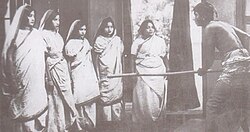
[[File:Dena paona 1931.jpg|thumb|right|180px|A scene from ''[[Dena Paona (film)|Dena Paona]]'', 1931]] | [[File:Dena paona 1931.jpg|thumb|right|180px|A scene from ''[[Dena Paona (film)|Dena Paona]]'', 1931]] | ||
The history of | {{more citations needed section|date=February 2024}} | ||
The history of cinema in [[Bengal]] dates to the 1920s when the first "[[bioscope show|bioscopes]]" were shown in theatres in [[Calcutta]]. Within a decade, [[Hiralal Sen]], considered a stalwart of [[Victorian era]] cinema<ref name="VF">{{cite web|url=http://www.victorian-cinema.net/sen.htm|title=Who's Who of Victorian Cinema|access-date=16 September 2008|archive-date=23 May 2012|archive-url=https://web.archive.org/web/20120523154503/http://www.victorian-cinema.net/sen.htm|url-status=live}}</ref> set up the [[Royal Bioscope Company]], producing scenes from the stage productions of a number of popular shows<ref name="VF" /> at the [[Star Theatre, Calcutta|Star Theatre]], [[Minerva Theatre, Kolkata|Minerva Theatre]], [[Classic Theatre]]. Following a long gap after Sen's works,<ref name="Banglanet">[http://www.bangladesh.net/cinema/page2.htm Pioneers of Bangladeshi Cinema] {{webarchive|url=https://web.archive.org/web/20070125000256/http://www.bangladesh.net/cinema/page2.htm |date=25 January 2007 }}</ref> [[Dhirendra Nath Ganguly]] (known as D.G.) established the [[Indo British Film Co]], the first Bengali-owned production company, in 1918. However, the first Bengali feature film, ''[[Billwamangal]]'', was produced in 1919, under the banner of [[Madan Theatre]]. ''[[Bilat Ferat (1921)|Bilat Ferat]]'' was the IBFC's first production in 1921. The [[Madan Theatre]] production of ''[[Jamai Shashthi]]'' was the first Bengali [[talkie]].<ref>{{cite web|url=https://www.imdb.com/title/tt0316049/|title=Jamai Shashthi (1931)|date=11 April 1931|work=IMDb|access-date=29 June 2018|archive-date=16 September 2018|archive-url=https://web.archive.org/web/20180916215027/https://www.imdb.com/title/tt0316049/|url-status=live}}</ref> A long history has been traversed since then, with stalwarts such as [[Satyajit Ray]], [[Mrinal Sen]], [[Ritwik Ghatak]], [[Tapan Sinha]], [[Ajoy Kar]] and others earning international acclaim and securing their place in the movie history.{{Citation needed|date=February 2024}} | |||
===Early development=== | ===Early development=== | ||
====Silent era: | ==== Silent era: 1919–1930 ==== | ||
{{Main|List of | {{Main|List of silent Bengali films}} | ||
[[Hiralal Sen]], India is credited as one of Bengal's, and India's first directors. These were all [[silent film]]s. Hiralal Sen is also credited as one of the pioneers of advertisement films in India. The first Bengali-language movie was the silent feature ''[[Billwamangal]]'', produced by the Madan Theatre Company of Calcutta and released on 8 November 1919, only six years after the first full-length Indian feature film, ''[[Raja Harish Chandra]]'', was released. | [[Hiralal Sen]], India is credited as one of Bengal's, and India's first directors. These were all [[silent film]]s. Hiralal Sen is also credited as one of the pioneers of advertisement films in India. The first Bengali-language movie was the silent feature ''[[Billwamangal]]'', produced by the Madan Theatre Company of Calcutta and released on 8 November 1919, only six years after the first full-length Indian feature film, ''[[Raja Harish Chandra]]'', was released.<ref>{{cite book |last=Hayat |first=Anupam |year=2012 |chapter=Film, Feature |chapter-url=http://en.banglapedia.org/index.php?title=Film,_Feature |editor1-last=Islam |editor1-first=Sirajul |editor1-link=Sirajul Islam |editor2-last=Jamal |editor2-first=Ahmed A. |title=Banglapedia: National Encyclopedia of Bangladesh |edition=Second |publisher=[[Asiatic Society of Bangladesh]] |access-date=21 March 2016 |archive-date=26 September 2018 |archive-url=https://web.archive.org/web/20180926202745/http://en.banglapedia.org/index.php?title=Film,_Feature |url-status=live }}</ref> | ||
The early beginnings of the "talking film" industry go back to the early 1930s when it came to [[British India]], and to Calcutta. The movies were originally made in [[Urdu]] or [[Persian language|Persian]] to accommodate a specific elite market. One of the earliest known studios was the [[East India Film Company]]. The first Bengali film to be made as a [[talkie]] was ''[[Jamai Shashthi]]'', released in 1931. At this time the early heroes of the Bengali film industry like [[Pramathesh Barua]] and [[Debaki Bose]] were at the peak of their popularity. Barua also directed movies, exploring new dimensions in Indian cinema. Debaki Bose directed ''Chandidas'' in 1932; this film is noted for its breakthrough in recording sound. Sound recordist Mukul Bose found a solution to the problem of spacing out dialogue and frequency modulation. | The early beginnings of the "talking film" industry go back to the early 1930s when it came to [[British India]], and to Calcutta. The movies were originally made in [[Urdu]] or [[Persian language|Persian]] to accommodate a specific elite market. One of the earliest known studios was the [[East India Film Company]]. The first Bengali film to be made as a [[talkie]] was ''[[Jamai Shashthi]]'', released in 1931. At this time the early heroes of the Bengali film industry like [[Pramathesh Barua]] and [[Debaki Bose]] were at the peak of their popularity. Barua also directed movies, exploring new dimensions in Indian cinema. Debaki Bose directed ''Chandidas'' in 1932; this film is noted for its breakthrough in recording sound. Sound recordist Mukul Bose found a solution to the problem of spacing out dialogue and frequency modulation.{{Citation needed|date=February 2024}} | ||
====Rise of the talkie: | ==== Rise of the talkie: 1931–1947 ==== | ||
[[File:Seeta 1933.jpg|thumb|right|180px|A scene from ''[[Seeta (1933 film)|Seeta]]'' (dir: [[Sisir Bhaduri]]), 1933. [[Sisir Bhaduri]], [[Amalendu Lahiri]].]] | [[File:Seeta 1933.jpg|thumb|right|180px|A scene from ''[[Seeta (1933 film)|Seeta]]'' (dir: [[Sisir Bhaduri]]), 1933. [[Sisir Bhaduri]], [[Amalendu Lahiri]].]] | ||
The | The [[Bengali film industry]] has made significant contributions to the [[cinema of India]]. The first Bengali [[talkies]] were the short film ''[[Jamai Shashthi]]'' released on 11 April 1931 at Crown Cinema Hall in Calcutta, and full-length feature ''[[Dena Paona (film)|Dena Paona]]'' released on 30 December 1931 at Chitra Cinema Hall in Calcutta. The industry was based in [[Tollygunge]], an area of South Kolkata, [[West Bengal]] that is more elite and artistically inclined than the usual [[musical film|musical]] cinema fare in India.{{Citation needed|date=February 2024}} [[Kanan Devi]] was an early female star of Bengali film, alongside [[Chandrabati Devi]], [[Molina Devi]] and [[Chhaya Devi]]. The most popular Bengali male actors were [[Sisir Bhaduri]], [[Chhabi Biswas]], [[Ahindra Choudhury]], [[Dhiraj Bhattacharya]] and [[Pahari Sanyal]]. Popular filmmakers include [[Debaki Bose]], [[Nitin Bose]], [[Madhu Bose]], [[Premankur Atorthy]] and [[Premendra Mitra]]. | ||
===Golden era: | === Golden era: 1952–1981 === | ||
{{See also|Parallel Cinema}} | {{See also|Parallel Cinema}} | ||
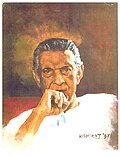
[[File:Satyajit Ray.jpg|thumb|right|180px|[[Satyajit Ray]]]] | [[File:Satyajit Ray.jpg|thumb|right|180px|[[Satyajit Ray]]]] | ||
Bengali cinema enjoyed a large, even disproportionate, representation in Indian cinema during this period. They produced directors like Satyajit Ray, | Bengali cinema enjoyed a large, even disproportionate, representation in Indian cinema during this period. They produced directors like [[Ajoy Kar]], [[Satyajit Ray]], [[Tapan Sinha]], [[Mrinal Sen]], [[Tarun Majumdar]], [[Premendra Mitra]]. [[Satyajit Ray]] is an [[Academy Honorary Award]] winner and the recipient of India's and France's greatest civilian honours, the [[Bharat Ratna]] and [[Légion d'honneur|Legion of Honor]] respectively, and [[Mrinal Sen]] is the recipient of the French distinction of Commander of the [[Ordre des Arts et des Lettres|Order of Arts and Letters]] and the Russian [[Order of Friendship]]. The revival in Bengali Mainstream cinema dates from the rise of directors such as [[Tarun Majumdar]] along with [[Arabinda Mukhopadhyay]] and [[Shakti Samanta]]. Other prominent filmmakers in the Bengali film industry at the time included [[Ritwik Ghatak]], [[Mrinal Sen]], [[Tapan Sinha]] and [[Ajoy Kar]]. The Bengali film industry has produced classics such as ''[[Nagarik]]'' (1952), ''[[The Apu Trilogy]]'' (1955–1959), ''[[Kabuliwala (1957 film)|Kabuliwala]]'' (1957), ''[[Jalsaghar]]'' (1958), ''[[Ajantrik]]'' (1958), ''[[Neel Akasher Neechey]]'' (1959), ''[[Devi (1960 film)|Devi]]'' (1960), ''[[Meghe Dhaka Tara (1960 film)|Meghe Dhaka Tara]]'' (1960), ''[[Saptapadi (1961 film)|Saptapadi]]'' (1961), ''[[Jhinder Bondi]]'' (1961), ''[[Saat Pake Bandha]]'' (1963), ''[[Jatugriha]]'' (1964), ''[[Atithi (1965 film)|Atithi]]'' (1965), ''[[Hatey Bazarey]]'' (1967), ''[[Malyadan]]'' (1971), ''[[Nimantran]]'' (1971), ''[[Shriman Prithviraj]]'' (1973), [[Pratidwandi|Calcutta trilogies]] (1971–1976), ''[[Mrigayaa]]'' (1976), ''[[Ganadevata (film)|Ganadevata]]'' (1978), etc. In particular,''Calcutta trilogies'', ''The Apu Trilogy'', ''Shriman Prithviraj'', ''Saptapadi'' are frequently listed among the [[Films considered the greatest ever|greatest films of all time]].<ref name=bfipoll>{{cite web|url=http://www.bfi.org.uk/sightandsound/topten/history/1992.html|title=The Sight & Sound Top Ten Poll: 1992|work=[[Sight & Sound]]|publisher=[[British Film Institute]]|access-date=20 May 2008|url-status=dead|archive-url=https://web.archive.org/web/20120309164155/http://www.bfi.org.uk/sightandsound/topten/history/1992.html|archive-date=9 March 2012}}</ref><ref name=villagevoice>{{cite web|url=http://www.villagevoice.com/specials/take/one/full_list.php3?category=10 |title=Take One: The First Annual Village Voice Film Critics' Poll |access-date=27 July 2006|year=1999 |work=[[The Village Voice]]|archive-url=https://web.archive.org/web/20070826201343/http://www.villagevoice.com/specials/take/one/full_list.php3?category=10|archive-date= 26 August 2007}}</ref><ref>[https://www.nytimes.com/ref/movies/1000best.html "The Best 1,000 Movies Ever Made"] {{Webarchive|url=https://web.archive.org/web/20161222124411/https://www.nytimes.com/ref/movies/1000best.html |date=22 December 2016 }}. ''[[The New York Times]]''. 2002.</ref><ref name=Time>{{cite magazine|url=http://www.time.com/time/2005/100movies/the_complete_list.html|archive-url=https://web.archive.org/web/20050523235033/http://www.time.com/time/2005/100movies/the_complete_list.html|url-status=dead|archive-date=23 May 2005|title=All-Time 100 Best Movies|access-date=19 May 2008|magazine=[[Time (magazine)|Time]]|date=12 February 2005}}</ref> | ||
The most well-known [[Bengali people|Bengali]] superstars to date have been [[Uttam Kumar]] and [[Soumitra Chatterjee]].Uttam is considered the most popular and Soumitra the finest.[[Suchitra Sen]] is regarded as the most beautiful and influential actress of Bengali cinema. [[Uttam Kumar|Kumar]] and [[Suchitra Sen|Sen]] were known as "The Eternal Pair" in the late 1950s. This pair worked in the 1961 epic Romantic drama ''[[Saptapadi (1961 film)]]'' by [[Ajoy Kar|Kar]] besides others. Suchitra Sen got her first International Award for ''[[Saat Pake Bandha]] (1963)'' by [[Ajoy Kar|Kar]]. Apart from Sen, [[Sabitri Chatterjee]] and [[Sumitra Devi (actress)|Sumitra Devi]] were very popular actresses. | |||
[[ | [[Soumitra Chatterjee]] considered one of the greatest actors in the history of Indian and [[World cinema|World Cinema]], and the finest actor in the history of Bengali cinema left an indelible mark on every role he played. An artist of unparalleled depth and versatility, he became the quintessential face of Satyajit Ray’s masterpieces and a defining force in Bengali cinema for over six decades. | ||
Beyond cinema, Chatterjee was an influential figure in Bengali theatre, both as an actor and director, and was a prolific poet and writer. His profound impact on the arts was recognized with numerous accolades, including the [[Padma Bhushan]] (2004), [[Dadasaheb Phalke Award]] (2012) for lifetime achievement in Indian cinema and the [[Legion of Honour]](2018) France’s highest civilian award.While Uttam Kumar and Soumitra Chatterjee were often perceived as rivals in the 1960s Bengali film industry, they actually shared a close, brotherly relationship. Their first meeting occurred at Soumitra's sister's wedding, where Uttam Kumar, a friend of Soumitra's brother-in-law, was present.This personal connection fostered a deep friendship between the two actors, contradicting the popular belief of intense rivalry.Soumitra's best films include [[The World of Apu|Opur Shongshar]] (1959),[[Charulata|Charulota]] (1964),[[Devi (1960 film)|Devi]] (1960), [[Aranyer Din Ratri|Oronner Din Ratri]] (1970), [[Sonar Kella|Shonar Kella]] (1974), [[Abhijan (1962 film)|Obhijan]] (1962), [[Teen Kanya|Teen Konna]] (1961), [[Kapurush]] (1965), [[Joi Baba Felunath (film)|Joi Baba Felunath]] (1979), [[Ghare Baire (film)|Ghore Baire]] (1984), [[Ganashatru|Gonoshatru]] (1990), [[Distant Thunder (1973 film)|Oshoni Shonket]] (1973), [[Shakha Proshakha]] (1990), [[Hirak Rajar Deshe|Hirok Rajar Deshe]] (1980), [[Teen Bhubaner Pare|Teen Bhuboner Pare]] (1969), [[Saat Pake Bandha|Shat Pake Badha]](1963), [[Akash Kusum]] (1965), [[Bela Seshe]] (2015), [[Podokkhep]] (2006). | |||
In | In 70's, [[Ranjit Mallick]] is famous for Youth Characterization of [[Interview (1971 film)|Interview]], [[Calcutta 71]]. [[Rabi Ghosh]] and [[Anil Chatterjee]] is a notable actor for his Versatile Acting which impressed the Audience in short time. | ||
[[ | In the 1960s, Bengal saw a host of talented actresses like [[Aparna Sen]], [[Sharmila Tagore]], [[Madhabi Mukherjee]], [[Sandhya Roy]] and, [[Supriya Devi]] and [[Jayashree Kabir]]. Aparna Sen was one of the most successful actresses of the Golden Era. She became the leading heroine of the 1970s and since 1981 she has been directing films. One of the most well-known Bengali actresses was [[Sharmila Tagore]], who debuted in Ray's ''The World of Apu'', and became a major actress in Bengali cinema as well as Bollywood. Despite Suchitra Sen being the greatest actress, Sharmila was the most commercially successful actress in history with films like ''The World of Apu'' (1959), ''Devi'' (1960), ''Nayak'' (1966), ''Simabaddha'' (1967), and ''Aranyer Dinratri'' (1970).{{Citation needed|date=February 2024}} | ||
[[Utpal Dutt]] is internationally known for his acting in movies and plays, especially Shakespearean plays. [[Bhanu Bandopadhyay]], [[Rabi Ghosh]], and [[Anup Kumar (actor)|Anup Kumar]] were best known for their comic timing, and with their versatile acting talent they stunned the audience and critics.{{Citation needed|date=February 2024}} | |||
===Modern revival: | The pioneers in Bengali film music include [[Raichand Boral]], [[Pankaj Mullick]], and [[K. C. Dey]], all associated with [[New Theatres Calcutta]]. The greatest composers of the golden era included [[Robin Chatterjee]], [[Sudhin Dasgupta]], [[Nachiketa Ghosh]], [[Hemant Kumar]], etc. [[Tarun Majumdar]] is well known for First time educational, cultural, and philosophical cinematic experiences for both a mass audience and a class audience, He abolished the division in taste between mass and class audiences. Majumdar is best known for such Evergreen films as ''[[Shriman Prithviraj]]'', ''[[Ganadevata (film)|Ganadevata]]'', ''Sansar Simante'' and ''[[Alo (film)|Alo]]'' and Many more.<ref name=tripod>{{cite web|url=http://members.tripod.com/oldies_club/new_theatres_calcutta.htm|title=NEW THEATRES CALCUTTA|access-date=16 September 2008|archive-date=20 August 2008|archive-url=https://web.archive.org/web/20080820190948/http://members.tripod.com/oldies_club/new_theatres_calcutta.htm|url-status=live}}</ref> | ||
=== Modern revival: 1982–2007 === | |||
[[File:Nandan - Kolkata 2011-01-09 0153.JPG|thumb|West Bengal Film Center in [[Kolkata]]]] | [[File:Nandan - Kolkata 2011-01-09 0153.JPG|thumb|West Bengal Film Center in [[Kolkata]]]] | ||
The revival in Bengali cinema dates from the rise of directors such as [[Anjan Choudhury]], [[Haranath Chakraborty]], [[Aparna Sen]], [[Anjan Dutt]], [[Goutam Ghosh]], along with [[Rituparno Ghosh]], [[Sandip Ray]], [[Prabhat Roy]], [[Sudeshna Roy]], [[Buddhadeb Dasgupta]], [[Anjan Das]], [[Bappaditya Bandopadhyay]], [[Sekhar Das]], and [[Subrata Sen]].<ref>{{cite news |last1=Gooptu |first1=Sharmistha |date=23 February 2014 |title=Mapping Bengal's cinema history |url=https://www.dailypioneer.com/2014/sunday-edition/mapping-bengals-cinema-history.html |work=The Pioneer |access-date=17 April 2024}}</ref> Rituparno Ghosh made his first film, ''[[Hirer Angti]]'', in 1992 and dominated Bengali cinema until his death in 2013, winning numerous national awards for films like ''[[Unishe April]]'', ''[[Dahan (1997 film)|Dahan]]'' and ''[[Utsab]]''. Aparna Sen made her directorial debut in 1981 with the internationally lauded ''[[36 Chowringhee Lane]]'', which looked at the lives of Anglo-Indians living in Calcutta. Her later films have also been celebrated: ''[[Paromitar Ek Din]]'', ''[[The Japanese Wife]]'', ''[[Goynar Baksho]]''. | |||
The revival in Bengali cinema dates from the rise of directors such as [[Rituparno Ghosh]], [[ | |||
Buddhadeb Dasgupta is best known for award-winning films like ''[[Uttara (film)|Uttara]]'', ''[[Mondo Meyer Upakhyan]]'', ''[[Charachar]]'', and ''[[Janala]]''. [[Goutam Ghose]] is Internationally Acclaimed for Cult Classic films as [[Antarjali Jatra]], [[Padma Nadir Majhi]], [[Moner Manush]] and many more. | |||
[[Prabhat Ray]] is popular for Romantic Family drama for [[Lathi (1996 film)|Lathi]].<ref>{{cite news |title=Noted Bengali film director Tarun Majumdar passes away in Kolkata |url=https://www.hindustantimes.com/cities/kolkata-news/noted-bengali-film-director-tarun-majumdar-passes-away-in-kolkata-101656918293271.html |work=Hindustan Times |date=4 July 2022 |access-date=13 April 2024}}</ref><ref>{{cite news |last1=Biswas |first1=Premankur |date=4 August 2019 |title=The master of weepy blockbusters with melodramatic battles over fish |url=https://indianexpress.com/article/express-sunday-eye/kitchen-confidential-9-5869931/ |work=The Indian Express |access-date=13 April 2024}}</ref> Actresses including [[Moon Moon Sen]], [[Konkona Sen Sharma]], [[Laboni Sarkar]], [[Satabdi Roy]], [[Rituparna Sengupta]], [[Chumki Chowdhury]], [[Rachna Banerjee]] and [[Srabanti Chatterjee]] were popular and active in this period. Actors such as [[Prosenjit Chatterjee]], [[Victor Banerjee]], [[Chiranjeet Chakraborty]], [[Ranjit Mallick]], [[Tapas Paul]] and [[Ferdous Ahmed]] are considered superstars in this era.<ref>{{cite news |last1=Ghosh |first1=Ananya |date=4 May 2023 |title=Prosenjit Chatterjee: The Star And The Debutant |url=https://www.mansworldindia.com/lifestyle/entertainment/prosenjit-chatterjee-the-star-and-the-debutant |work=Man's World |access-date=17 April 2024}}</ref><ref>{{cite news |last1=Jha |first1=Subhash K. |date=15 October 2023 |title=EXCLUSIVE! Happy Birthday Victor Banerjee, The Only Indian Actor Who Has Worked With Ray, Lean, Benegal, Ghai and RGV |url=https://www.timesnownews.com/entertainment-news/bollywood/exclusive-happy-birthday-victor-banerjee-the-only-indian-actor-who-has-worked-with-ray-lean-benegal-ghai-and-rgv-article-104443058 |work=Times Now |access-date=17 April 2024}}</ref><ref>{{cite news |title=Actor-Politician Tapas Pal Dies Of Cardiac Arrest At 61 |url=https://www.ndtv.com/india-news/actor-politician-tapas-pal-dies-of-cardiac-arrest-at-61-2181694 |work=NDTV |agency=PTI |date=18 February 2020 |access-date=17 April 2024}}</ref><ref>{{cite news |last1=Ramdev |first1=Raag Mathur |date=24 March 2022 |title=Bengali Actor Abhishek Chatterjee Dies At The Age Of 58 |url=https://www.ndtv.com/india-news/abhishek-chatterjee-renowned-bengali-actor-dies-at-the-age-of-58-2840106 |work=NDTV |agency=PTI |access-date=17 April 2024}}</ref><ref>{{cite news |title=The Dev-Jeet jodi |url=https://www.telegraphindia.com/entertainment/the-dev-jeet-jodi/cid/472247 |work=The Telegraph |date=4 October 2010 |access-date=17 April 2024}}</ref><ref>{{cite news |title=Will Dev and Jeet share screen space in an upcoming film? |url=https://timesofindia.indiatimes.com/entertainment/bengali/movies/news/will-dev-and-jeet-share-screen-space-in-an-upcoming-film/articleshow/63011228.cms |work=The Times of India |date=21 February 2018 |access-date=17 April 2024}}</ref> | |||
=== Modern era: 2008– Present === | |||
Many work in the domestic film industry, while others have gone to work in Bollywood.<ref name="Look East policy"/> Successful films by directors from this generation include ''[[Tekka (film)|Tekka]]'', ''[[Cholai (film)|Cholai]]'', ''[[Asha Jaoar Majhe]]'', ''[[Alik Sukh]]'' | |||
''[[Jaatishwar]]'', ''[[Cockpit (2017 film)|Cockpit]]'', ''[[Cinemawala]]'', ''[[Aparajito (2022 film)|Aparajito]]'', ''[[Bhooter Bhabishyat]]'', ''[[Binodiini (film)|Binodiini]]'', ''[[Angshumaner Chhobi]]'', ''[[Bakita Byaktigato]]'', ''[[Pradhan (film)|Pradhan]]'', ''[[Baishe Srabon]]'', ''[[Fotema]]'', and ''[[Boomerang (2024 Bengali film)|Boomerang]]''.<ref>{{Cite news |url=https://www.indiatoday.in/pti-feed/story/kolkata-book-fair-concludes-graphic-books-the-new-rage-869896-2017-02-05 |title=Kolkata Book Fair concludes, graphic books the new rage |magazine=India Today |agency=PTI |date=5 February 2017 |access-date=25 May 2019}}</ref><ref>{{cite news |last1=Halder |first1=Deep |title=Hinterland over South Kolkata drawing room—'Bohurupi' gives a hit formula to Bengali cinema |url=https://theprint.in/opinion/hinterland-over-south-kolkata-drawing-room-bohurupi-gives-hit-formula-to-bengali-cinema/2403595/ |access-date=16 December 2024 |work=[[ThePrint]] |date=15 December 2024}}</ref> | |||
Detective films and family drama films have been the most popular and successful genre in this era. The success of detective films largely owes to the film adaptation of popular [[fictional character]]s like [[Kakababu]], [[Byomkesh]], [[Kiriti Roy]], [[Mitin Masi]], [[Ekenbabu]] | |||
and [[Tenida]].<ref>{{cite news |last1=Chakravorty |first1=Vinayak |date=26 August 2023 |title=Byomkesh Bakshi down the years: Mahanayak Uttam Kumar to new-age superstar Dev |url=https://www.firstpost.com/entertainment/byomkesh-bakshi-down-the-years-mahanayak-uttam-kumar-to-new-age-superstar-dev-13041372.html |work=Firstpost |access-date=13 April 2024}}</ref><ref>{{cite news |last1=Das |first1=Tina |date=17 June 2023 |title=Bengali cinema has an addiction problem—Now, Byomkesh, Feluda detective-verse about to expand |url=https://theprint.in/ground-reports/bengali-cinema-has-an-addiction-problem-now-byomkesh-feluda-detective-verse-about-to-expand/1629606/ |work=ThePrint |access-date=17 April 2024}}</ref> | |||
Successful Bengali films are getting Hindi remakes in Bollywood, Marathi remakes and Malayalam remakes (''[[Gang of Ghosts]]'', ''[[Salt Mango Tree]]'', ''[[Welcome Zindagi]]'', ''[[Ravanasura]]'', ''[[Jalebi (film)|Jalebi]]'', ''[[Begum Jaan (2017 film)|Begum Jaan]]'', ''[[Cirkus (film)]]'', ''[[Meri Awas Suno]]'', ''[[Shastry Viruddh Shastry]]'').<ref name="Look East policy">{{Cite web|url=https://www.telegraphindia.com/7-days/look-east-policy/cid/1314831|title=Look East policy|website=www.telegraphindia.com|access-date=22 January 2020|archive-date=28 July 2020|archive-url=https://web.archive.org/web/20200728145939/https://www.telegraphindia.com/7-days/look-east-policy/cid/1314831|url-status=live}}</ref> Also, Bengali films have in the recent times have turned the cinematic spotlight on Kolkata, introducing the city to a wider national and global audience (''[[Kahaani]]'', ''[[Piku]]'', ''[[Detective Byomkesh Bakshy!]]''). After the digital film era, Bengali directors who have found artistic and commercial success in contemporary Bengali films include: [[Aniruddha Roy Chowdhury]], [[Aniket Chattopadhyay]], [[Anjan Dutta]], [[Raj Chakraborty]], [[Mainak Bhowmick]], [[Srijit Mukherjee]], [[Nandita Roy]] and [[Shiboprosad Mukherjee]].<ref>{{cite news |last1=Sarkar |first1=Susanti |title=From classical to contemporary: Leading modern Bengali film directors |url=https://mediaindia.eu/cinema/from-classical-to-contemporary-leading-modern-bengali-film-directors/ |work=Media India Group |date=18 September 2021 |access-date=17 April 2024}}</ref><ref name="TOI_Dec2019">{{cite news |title=Pritha Chakraborty to Srijit Mukherji: Here are the Best Bengali Film Directors of 2019 |url=https://timesofindia.indiatimes.com/entertainment/bengali/movies/news/pritha-chakraborty-to-srijit-mukherji-here-are-the-best-bengali-film-directors-of-2019/photostory/73045311.cms |work=The Times of India |date=31 December 2019 |access-date=13 April 2024}}</ref> | |||
During this period, actors such as [[Prosenjit Chatterjee]], [[Mithun Chakraborty]], [[Sabyasachi Chakrabarty]], [[Jishu Sengupta]], [[Soham Chakraborty]], [[Parambrata Chatterjee]], [[Anjan Dutt]] rose to popularity.<ref>{{cite news |last1=Das |first1=Tina |date=29 July 2023 |title=Parambrata Chatterjee is a 'man written by a woman'. He is Bengali cinema's Irrfan Khan |url=https://theprint.in/ground-reports/parambrata-chatterjee-is-a-man-written-by-a-woman-he-is-bengali-cinemas-irrfan-khan/1691119/ |work=ThePrint |access-date=13 April 2024}}</ref><ref>{{cite news |title=Birthday boy Jisshu Sengupta's crackling chemistry with 3 Bengali actresses |url=https://www.telegraphindia.com/entertainment/birthday-boy-jisshu-senguptas-crackling-chemistry-with-3-bengali-actresses/cid/2007135 |work=The Telegraph |date=15 March 2024 |access-date=13 April 2024}}</ref><ref>{{cite news |title=Saswata Chatterjee |url=https://timesofindia.indiatimes.com/entertainment/bengali/movies/photo-features/actors-who-changed-the-face-of-21st-century-bengali-cinema/saswata-chatterjee/photostory/63715359.cms |work=The Times of India |access-date=13 April 2024}}</ref> Later, [[Dev (Bengali actor)|Dev]], [[Jeet (actor)|Jeet]], [[Abir Chatterjee]], [[Ankush Hazra]], [[Anirban Bhattacharya]], [[Jeetu Kamal]], [[Riddhi Sen]] have gained popularity and have been active.<ref>{{cite news |last1=Bose |first1=Priyanka |date=10 March 2022 |title=একমঞ্চে দেব-জিৎ! এই অভিনেত্রীর জন্যই মঞ্চ ভাগ করে নিলেন দুই টলি সুপারস্টার |url=https://bangla.hindustantimes.com/entertainment/dev-and-jeet-on-one-stage-two-tollywood-superstars-shared-the-stage-for-this-actress-31646912011374.html |archive-url=https://web.archive.org/web/20220310143412/https://bangla.hindustantimes.com/entertainment/dev-and-jeet-on-one-stage-two-tollywood-superstars-shared-the-stage-for-this-actress-31646912011374.html |url-status=dead |archive-date=10 March 2022 |work=Hindustan Times |language=bn |access-date=17 April 2024}}</ref><ref>{{cite news |title=Dev, Saswata, Prosenjit: 5 actors who changed Bengali cinema |url=https://www.thestatesman.com/entertainment/dev-saswata-prosenjit-5-actors-changed-bengali-cinema-1502567857.html |work=The Statesman |date=19 January 2018 |access-date=13 April 2024}}</ref><ref>{{cite news |last1=Acharya |first1=Anindita |date=8 October 2023 |title=Stakes are higher: Abir Chatterjee |url=https://www.millenniumpost.in/features/stakes-are-higher-abir-chatterjee-535908 |work=Millennium Post |access-date=13 April 2024}}</ref><ref>{{cite news |last1=Ghosh |first1=Sankhayan |date=6 January 2022 |title=All Eyes On Anirban Bhattacharya |url=https://www.filmcompanion.in/features/anirban-bhattacharya-interview-mandaar-bengali-series-hoichoi-all-eyes-on |work=Film Companion |access-date=13 April 2024}}</ref> Among them [[Prosenjit Chatterjee]], [[Mithun Chakraborty]], [[Tapas Paul]], [[Dev (Bengali actor)|Dev]] and [[Jeet (actor)|Jeet]], [[Abir Chatterjee]] and [[Ankush Hazra]] have gained immense popularity and are considered as the superstars of 21st Century.<ref>{{cite news |title=Forty years of Prosenjit Chatterjee |url=https://scroll.in/reel/1047143/forty-years-of-prosenjit-chatterjee-the-superstar-on-his-15-best-roles}}</ref><ref>{{cite news |title=Dev's 18 years in Tollywood টলিউডে ১৮টি বসন্ত পার, 'প্রাপ্তবয়স্ক' হলেন অভিনেতা, দর্শকের জন্য বিশেষ উপহার দেবের |url=https://www.anandabazar.com/entertainment/bengali-actor-dev-completed-18-years-in-tollywood-and-shares-his-gratitude-dgtl/cid/1492003 |work=ABP |date=28 January 2024 |access-date=13 April 2024}}</ref><ref>{{cite news |last1=Bhanja |first1=Sandipta |date=14 June 2023 |title='সাথী'র বিজয় থেকে টলিউডের 'বস'! ইন্ডাস্ট্রিতে ২১ বছর কাটিয়ে আবেগঘন জিৎ |url=https://www.sangbadpratidin.in/entertainment/cinema/superstar-jeet-completed-21-years-in-tollywood-pens-beautiful-note-for-fans/ |work=Sangbad Pratidin |access-date=13 April 2024}}</ref> Actresses such as [[Koel Mallick]], [[Srabanti Chatterjee]], [[Subhashree Ganguly]], [[Mimi Chakraborty]], [[Nusrat Jahan]], [[Payel Sarkar]], [[Rituparna Sengupta]], [[Puja Banerjee]], [[Sayantika Banerjee]], [[Priyanka Sarkar]], [[Sreelekha Mitra]], [[Raima Sen]], [[Konkona Sen Sharma]], [[Ananya Chatterjee]], [[Gargi Roychowdhury]], [[Aparajita Ghosh Das]], [[Rimjhim Mitra]] and later, [[Idhika Paul]], [[Ishaa Saha]], [[Subhashree Ganguly]], [[Susmita Chatterjee]], [[Koushani Mukherjee]], [[Mimi Chakraborty]], [[Madhumita Sarcar]], [[Nusrat Jahan]], [[Ritabhari Chakraborty]], [[Rittika Sen]], [[Sohini Sarkar]], [[Jaya Ahsan]], [[Sauraseni Maitra]], [[Angana Roy (Bengali actress)|Angana Roy]] and [[Tuhina Das]] have been active.<ref>{{cite news |title=Here are the 7 most beautiful Bengali actresses to date, check them out |url=https://newsable.asianetnews.com/entertainment/here-are-the-7-most-beautiful-bengali-actresses-to-date-check-them-out-msw-rujrmm |work=Asianet News |date=12 May 2023 |access-date=13 April 2024}}</ref><ref>{{cite news |title=Most popular Bengali actresses on social media |url=https://timesofindia.indiatimes.com/entertainment/bengali/web-stories/most-popular-bengali-actresses-on-social-media/photostory/81965237.cms |work=The Times of India |access-date=13 April 2024}}</ref> | |||
In the recent years, a younger generation of visual directors has come to the scene, like [[Shiboprosad Mukherjee]], [[Srijit Mukherji]], [[Avijit Sen]], [[Sayantan Ghosal]], [[Kamaleshwar Mukherjee]] along with [[Kaushik Ganguly]], [[Subhrajit Mitra]], [[Suman Ghosh (director)|Suman Ghosh]], [[Sujit Mondal]], [[Tathagata Mukherjee]], [[Raj Chakraborty]], [[Raja Chanda]], [[Birsa Dasgupta]], [[Manasi Sinha]], [[Ranjan Ghosh]], [[Soukarya Ghosal]], [[Mainak Bhaumik]], [[Atiul Islam]], [[Anik Dutta]], [[Anjan Dutt]], [[Atanu Ghosh]] | |||
Art house filmmakers like [[Indrasis Acharya]], [[Aditya Vikram Sengupta]], [[Anindya Chatterjee]], and [[Aniruddha Roy Chowdhury]].<ref name="TOI_Dec2019"/><ref>{{cite news |last1=Dasgupta |first1=Priyanka |date=2 February 2024 |title=With 21 trophies, Bengal directors all-out champs in National Awards since 1967 |url=https://timesofindia.indiatimes.com/city/kolkata/bengal-directors-dominate-national-awards-with-21-trophies/articleshow/107340048.cms |work=The Times of India |access-date=13 April 2024}}</ref> | |||
21st century Bengali Superstars are [[Prosenjit Chatterjee]], [[Dev (Bengali actor)|Dev]] and [[Jeet (actor)|Jeet]], [[Abir Chatterjee]], [[Mithun Chakraborty]], [[Jisshu Sengupta]] | |||
==Budgets== | |||
Many of the most critically acclaimed Bengali films were [[low-budget film]]s, including Mrinal Sen's famous ''[[Calcutta 71|Calcutta Trilogy]]'' (1971-1973), and Satyajit Ray's ''[[The Apu Trilogy]]'' (1955–1959). The first film in the trilogy, ''[[Pather Panchali (film)|Pather Panchali]]'' (1955), was produced on a shoestring budget<ref>{{Cite book|last1 = Robinson|given1 = A|year = 2003|title = Satyajit Ray: The Inner Eye: The Biography of a Master Film-Maker|publisher = I. B. Tauris|isbn = 1-86064-965-3|page=77}}</ref> of Rs. 150,000 ($32000)<ref>{{cite web|title=50 years of Pather Panchali|author=Pradip Biswas|work=[[Screen (magazine)|Screen Weekly]]|date=16 September 2005|url=http://www.screenindia.com/old/archive/archive_fullstory.php?content_id=11150|access-date=23 April 2009|url-status=dead|archive-url=https://web.archive.org/web/20090602000402/http://www.screenindia.com/old/archive/archive_fullstory.php?content_id=11150|archive-date=2 June 2009}}</ref> using an amateur cast and crew.<ref>{{Cite book|last1 = Robinson|given1 = A|year = 2003|title = Satyajit Ray: The Inner Eye: The Biography of a Master Film-Maker|publisher = I. B. Tauris|isbn = 1-86064-965-3|pages=78–9}}</ref> All his other films that followed also had low budgets, with his most expensive films since the 60's being ''[[Saptapadi (1961 film)|Saptapadi]]'' by [[Ajoy Kar|Kar]], ''[[Jhinder Bondi]]'' (1961) by [[Tapan Sinha|Sinha]], ''[[Saat Pake Bandha]]'' by [[Ajoy Kar|Kar]], | |||
''[[Goopy Gyne Bagha Byne|The Adventures of Goopy And Bagha]]'' (1968) at Rs. 600,000 ($80,000)<ref>{{cite web|title=THE UNIVERSITY CALLED SATYAJIT RAY|author=Mohammed Wajihuddin|publisher=Express India|date=7 September 2004|url=http://cities.expressindia.com/fullstory.php?newsid=98548|access-date=1 May 2009|archive-url=https://web.archive.org/web/20041014033023/http://cities.expressindia.com/fullstory.php?newsid=98548|archive-date=14 October 2004|url-status=dead}}</ref> and ''[[Shatranj Ke Khilari]]'' (1977) at Rs. 6&nbsp;million ($230,000).<ref>{{cite web|title=Shatranj Ke Khilari (The Chess Players)|publisher=Satyajit Ray official site|url=http://www.satyajitray.org/films/shatran.htm|access-date=24 April 2009|archive-url=https://web.archive.org/web/20181026200942/http://satyajitray.org/films/shatran.htm|archive-date=26 October 2018|url-status=dead}}</ref> | |||
''[[Bombaiyer Bombete (film)|Bombaiyer Bombete]]'', produced by [[Ramoji Film City|Ramoji Films]] at a cost of Rs 8 million, recovered its costs within three weeks and earned 20 million in all. The movie has brought back the concept of family entertainment with Sandip Ray's gambit of | ''[[Bombaiyer Bombete (film)|Bombaiyer Bombete]]'', produced by [[Ramoji Film City|Ramoji Films]] at a cost of Rs 8 million, recovered its costs within three weeks and earned 20 million in all. The movie has brought back the concept of family entertainment with Sandip Ray's gambit of contemporising the plot paying him a rich dividend. Admitting that he did not expect this success, he told Life that he was now lining up another such film for release next year. Earlier, a film by award-winning director [[Buddhadeb Dasgupta]]'s Mondo Meyer Upakhyan (The Tale of a Fallen Girl) produced by Arjoe Entertainments netted nearly Rs 7&nbsp; million through the sale of overseas rights against a cost of Rs 0.6&nbsp; million. [[Haranath Chakraborty]] His film [[Sathi (2002 film)|Sathi]] (Companion) created a record by recouping over five times its production cost, although the film [[Chokher Bali (2003 film)|Chokher Bali]], with big names like [[Aishwarya Rai Bachchan]], Rituparno Ghosh and Tagore, failed to yield expected results. The movie, billed at Rs 16.5&nbsp;million (the highest among Bengali films).<ref>{{cite web |url=http://www.thehindubusinessline.com/life/2004/04/05/stories/2004040500100200.htm |title=Business Line : Features / Life News |publisher=The Hindu Business Line |access-date=24 October 2012 |archive-date=19 December 2010 |archive-url=https://web.archive.org/web/20101219035944/http://www.thehindubusinessline.com/life/2004/04/05/stories/2004040500100200.htm |url-status=live }}</ref> | ||
[[Cinema of the United States|Hollywood]] houses like [[Sony Pictures Motion Picture Group|Columbia TriStar]] have made their debut in distributing Bengali movies. According to industry experts, several issues need to be addressed to build on this resurgence and consolidate it. These include inadequate infrastructure, which often compels moviemakers to go outside the State for facilities pushing up costs, poor marketing and distribution, and increasing competition from [[Cinema of Bangladesh|Bangladeshi films]].<ref>{{cite web |url=http://www.thehindubusinessline.in/2003/11/04/stories/2003110401500200.htm |title=Saregama to restrict film budget |publisher=The Hindu Business Line |date=4 November 2003 |access-date=24 October 2012 |archive-date=29 September 2012 |archive-url=https://web.archive.org/web/20120929094443/http://www.thehindubusinessline.in/2003/11/04/stories/2003110401500200.htm |url-status=live }}</ref><ref>{{cite web |url=http://www.business-standard.com/india/storypage.php?autono=333086 |title=Bengal movie industry set for revival |publisher=Business-standard.com |date=1 September 2008 |access-date=24 October 2012 |archive-date=18 February 2012 |archive-url=https://web.archive.org/web/20120218223144/http://www.business-standard.com/india/storypage.php?autono=333086 }}</ref> | |||
[[Cinema of the United States|Hollywood]] houses like [[Sony Pictures Motion Picture Group|Columbia TriStar]] have made their debut in distributing Bengali movies. According to industry experts, several issues need to be addressed to build on this resurgence and consolidate it. These include inadequate infrastructure, which often compels moviemakers to go outside the State for facilities pushing up costs, poor marketing and distribution, and increasing competition from [[Cinema of Bangladesh|Bangladeshi films]]. | |||
==Rankings== | ==Rankings== | ||
A number of Satyajit Ray films appeared in the ''[[Sight & Sound]]'' Critics' Poll of [[Films considered the greatest ever|all-time greatest films]], including ''[[The Apu Trilogy]]'' (ranked No. 4 in 1992 if votes are combined), | A number of Satyajit Ray films appeared in the ''[[Sight & Sound]]'' Critics' Poll of [[Films considered the greatest ever|all-time greatest films]], including ''[[The Apu Trilogy]]'' (ranked No. 4 in 1992 if votes are combined),<ref name=Caldwell>{{cite web|author=Aaron and Mark Caldwell|title=Sight and Sound|publisher=Top 100 Movie Lists|year=2004|url=http://www.geocities.com/aaronbcaldwell/dimsscri.html|access-date=19 April 2009|archive-url=https://web.archive.org/web/20090729180509/http://geocities.com/aaronbcaldwell/dimsscri.html|archive-date=29 July 2009}}</ref> ''[[Jalsaghar|The Music Room]]'' (ranked No. 27 in 1992), ''[[Charulata]]'' (ranked No. 41 in 1992)<ref name="SS-1992-ranking">{{cite web|title=SIGHT AND SOUND 1992 RANKING OF FILMS|url=http://www.geocities.com/the7thart/ranking.html|access-date=29 May 2009|archive-url=https://web.archive.org/web/20091022115725/http://geocities.com/the7thart/ranking.html|archive-date=22 October 2009}}</ref> and ''[[Aranyer Din Ratri|Days and Nights in the Forest]]'' (ranked No. 81 in 1982).<ref name="SS-1982-ranking">{{cite web|title=SIGHT AND SOUND 1982 RANKING OF FILMS|url=http://www.geocities.com/the7thart/1982.html|access-date=29 May 2009|archive-url=https://web.archive.org/web/20091022225459/http://geocities.com/the7thart/1982.html|archive-date=22 October 2009}}</ref> The 2002 ''Sight & Sound'' critics' and directors' poll also included the Ritwik Ghatak films ''[[Meghe Dhaka Tara (1960 film)|Meghe Dhaka Tara]]'' (ranked #231) and ''Komal Gandhar'' (ranked #346).<ref name=Cinemacom>{{cite web|title=2002 Sight & Sound Top Films Survey of 253 International Critics & Film Directors|publisher=Cinemacom|year=2002|url=http://www.cinemacom.com/2002-sight-sound.html|access-date=19 April 2009|archive-date=4 June 2012|archive-url=https://web.archive.org/web/20120604162906/http://www.cinemacom.com/2002-sight-sound.html|url-status=live}}</ref> | ||
In 1998, the critics' poll conducted by the [[Asian cinema|Asian film]] magazine ''[[Cinemaya]]'' included ''The Apu Trilogy'' (ranked No. 1 if votes are combined), Ray's ''[[Charulata]]'' and ''[[Jalsaghar|The Music Room]]'' (both tied at #11), and Ghatak's ''[[Subarnarekha (film)|Subarnarekha]]'' (also tied at #11). | In 1998, the critics' poll conducted by the [[Asian cinema|Asian film]] magazine ''[[Cinemaya]]'' included ''The Apu Trilogy'' (ranked No. 1 if votes are combined), Ray's ''[[Charulata]]'' and ''[[Jalsaghar|The Music Room]]'' (both tied at #11), and Ghatak's ''[[Subarnarekha (film)|Subarnarekha]]'' (also tied at #11).<ref name=Totaro>{{Cite journal|title=The "Sight & Sound" of Canons|first=Donato|last=Totaro|journal=Offscreen Journal|publisher=[[Canada Council|Canada Council for the Arts]]|date=31 January 2003|url=https://offscreen.com/view/sight_sound?/new_offscreen/canon.html|access-date=19 April 2009|archive-date=5 September 2012|archive-url=https://web.archive.org/web/20120905112318/http://www.horschamp.qc.ca/new_offscreen/canon.html|url-status=live}}</ref> In 1999, ''[[The Village Voice]]'' top 250 "Best Film of the Century" critics' poll also included ''The Apu Trilogy'' (ranked No. 5 if votes are combined).<ref name=villagevoice/> In 2005, ''The Apu Trilogy'' was also included in [[Time's All-Time 100 Movies|''Time''{{'s}} All-Time 100 Movies]] list.<ref name=Time/> In 1992, the ''Sight & Sound'' Critics' Poll ranked Ray at No. 7 in its list of "Top 10 Directors" of all time,<ref>{{cite web|title=Sight and Sound Poll 1992: Critics |publisher=[[California Institute of Technology]] |url=http://alumnus.caltech.edu/~ejohnson/sight/1992_1.html |access-date=29 May 2009 |url-status=dead |archive-url=https://web.archive.org/web/20131016212355/http://alumnus.caltech.edu/~ejohnson/sight/1992_1.html |archive-date=16 October 2013 }}</ref><ref>{{cite web|url=http://geocities.com/the7thart/ranking.html|archive-url=https://web.archive.org/web/20091022115725/http://geocities.com/the7thart/ranking.html|title=Ranking 1982|archive-date=22 October 2009}}</ref> and ''[[Aranyer Din Ratri|Days and Nights in the Forest]]'' (ranked No. 81 in 1982).<ref>{{cite news|url=https://news.bbc.co.uk/2/hi/entertainment/4513373.stm|publisher=BBC News|title=Film Festival Guide|date=10 May 2005 |access-date=5 March 2014|archive-date=4 March 2014|archive-url=https://web.archive.org/web/20140304164540/http://news.bbc.co.uk/2/hi/entertainment/4513373.stm|url-status=live}}</ref> | ||
===National Board of Review (USA)=== | ===National Board of Review (USA)=== | ||
*National Board of Review Award for Best Foreign Language Film: [[Satyajit Ray]] (1958- [[Pather Panchali]] & 1960- [[The World of Apu]]) | *National Board of Review Award for Best Foreign Language Film: [[Satyajit Ray]] (1958- [[Pather Panchali]] & 1960- [[The World of Apu]])<ref>[[National Board of Review Award for Best Foreign Language Film]]</ref> | ||
===The Annual Academy Awards (Oscars)=== | ===The Annual Academy Awards (Oscars)=== | ||
*Academy Honorary Award: [[Satyajit Ray]] (1992- "In recognition of his rare mastery of the art of motion pictures, and of his profound humanitarian outlook, which has had an indelible influence on filmmakers and audiences throughout the world.") | *Academy Honorary Award: [[Satyajit Ray]] (1992- "In recognition of his rare mastery of the art of motion pictures, and of his profound humanitarian outlook, which has had an indelible influence on filmmakers and audiences throughout the world.")<ref>[[Academy Honorary Award]]</ref> | ||
==National Award== | ==National Award== | ||
{{Main|National Film Award for Best Feature Film in Bengali}} | {{Main|National Film Award for Best Feature Film in Bengali}} | ||
The | The National Film Award for Best Feature Film in Bengali is one of the [[National Film Awards]] presented annually by the [[Directorate of Film Festivals]], the organisation set up by [[Ministry of Information and Broadcasting (India)|Ministry of Information and Broadcasting, India]]. It is one of several awards presented for feature films and awarded with Rajat Kamal (Silver Lotus). | ||
The [[National Film Awards]], established in 1954, are the most prominent film awards in India that merit the best of the [[Indian cinema]]. The ceremony also presents awards for films in various [[Languages of India|regional languages]]. | The [[National Film Awards]], established in 1954, are the most prominent film awards in India that merit the best of the [[Indian cinema]]. The ceremony also presents awards for films in various [[Languages of India|regional languages]]. | ||
==Regional awards== | ==Regional awards== | ||
* [[Bengal Film Journalists' Association Awards]] -The oldest Association of Film critics in India, founded in 1937, by the inspiration and determination of the handful of pioneers amongst the then thin section of scribes that were drawn to film journalism with a lofty mission to serve the developing film journalism and film industry. | * [[Bengal Film Journalists' Association Awards]] - The oldest Association of Film critics in India, founded in 1937, by the inspiration and determination of the handful of pioneers amongst the then thin section of scribes that were drawn to film journalism with a lofty mission to serve the developing film journalism and film industry. | ||
* [[Anandalok Awards]] -Ceremony is one of the most prominent film events given for Bengali cinema in India | * [[Filmfare Awards Bangla]] - Annual Awards presented by the [[Filmfare]] magazine of [[The Times Group]] to honour the cinematic excellence in Bengali Cinema | ||
* | * [[Films and Frames Digital Film Awards]] - Annual Awards presented by the Films and Frames group to honour the cinematic excellence in Bengali Cinema | ||
* | * [[Anandalok Awards]] - Ceremony is one of the most prominent film events given for Bengali cinema in India | ||
* | * Bengali Film and Television Awards - Annual Awards presented by the Redwine Entertainment group to honour the cinematic excellence in Bengali Cinema and OTT | ||
* [[ | * [[Filmfare Awards East]] - Used to honour cinematic excellence in Bengali, Assamese and Odia film industry. Discontinued after 2014. | ||
* [[ | |||
==Cinema-related organisations== | |||
*[[Satyajit Ray Film and Television Institute]], Department of Film direction and Screenplay, Editing, Cinematography, Sound Recording and Design, [[Baghajatin]], South 24 Parganas, West Bengal. | |||
*[[Jadavpur University]], Department of Film studies, Jadavpur, Kolkata, West Bengal. | |||
*[[Institute of Mass Communication Film and Television Studies]], Tollygung, Kolkata, West Bengal. | |||
==See also== | ==See also== | ||
* [[List of Indian Bengali films|Lists of Bengali films]] | |||
* [[Lists of Bengali films]] | * [[List of highest-grossing Indian Bengali films|List of highest-grossing Bengali films]] | ||
* [[ | |||
==References== | ==References== | ||
| Line 158: | Line 176: | ||
*Banglar Chalachchitrakar—Nisht Kumar Mukhopadhyay—Slanda Pu ishrs, Calcr | *Banglar Chalachchitrakar—Nisht Kumar Mukhopadhyay—Slanda Pu ishrs, Calcr | ||
*Banglar Nat-Nati—Sudhir Basu—Calcutta, 1933 | *Banglar Nat-Nati—Sudhir Basu—Calcutta, 1933 | ||
* Cniirabani Chitr barshihi ^119520ed. 60ur Chattopadhyay & Sunil Gar~adhya~Ch^ar$b | * Cniirabani Chitr barshihi ^119520ed. 60ur Chattopadhyay & Sunil Gar~adhya~Ch^ar$b | ||
*Cinema anr I—Ri ih Kumar Ghatah— h | *Cinema anr I—Ri ih Kumar Ghatah— h | ||
*''Rhrw Memorial Trust'', Calcu^na, 1987 | *''Rhrw Memorial Trust'', Calcu^na, 1987 | ||
| Line 172: | Line 190: | ||
==External links== | ==External links== | ||
{{Cinema of West Bengal}} | {{Cinema of West Bengal}} | ||
{{ | {{Cinema of India}} | ||
{{ | {{World cinema}} | ||
{{West Bengal}} | {{West Bengal}} | ||
| Line 182: | Line 199: | ||
[[Category:Culture of West Bengal]] | [[Category:Culture of West Bengal]] | ||
[[Category:Cinema of Bengal]] | [[Category:Cinema of Bengal]] | ||
[[Category:Indian film industries]] | |||
Revision as of 19:07, 12 February 2026
<!-- "none" is preferred when the title is sufficiently descriptive; see WP:SDNONE -->
| Cinema of West Bengal | |
|---|---|
| File:Indiafilm.svg | |
| No. of screens | 381 screens in West Bengal and Tripura states of India (2023)<ref>Vinayak, A. J. (28 September 2022). "Why films from the South set the box office on fire". The Hindu Business Line. Archived from the original on 29 September 2022. Retrieved 8 September 2023.</ref> |
| Main distributors | SVF Eskay Movies Surinder Films Grassroot Entertainment Dev Entertainment Ventures Windows Production Patras Glam Entertainment<ref>"Action thriller 'Nasha Jurm aur Gangsters' gearing up for release". The Times of India. April 2023.</ref> |
| Produced feature films (2023)<ref>"List of feature films certified in 2023" (PDF). cbfcindia.gov.in. Retrieved 13 March 2025.</ref> | |
| Total | 145 (Theatrical) |
Gross box office (2025)<ref>"The Ormax Box Office Report: 2025" (PDF). Ormax Media. Ormax Media. Retrieved 11 February 2026. According to The Ormax Box Office Report: 2025, the Indian box office crossed ₹13,000 crore in gross collections in 2025.</ref> | |
| Total | ₹108 crore (US$15 million) <!-- $Format price error: cannot parse value " " --> |

Cinema of West Bengal, also known as Tollywood or Bengali cinema in India, is the segment of Indian cinema, dedicated to the production of motion pictures in the Bengali language, widely spoken in the state of West Bengal and Eastern India. It is based in the Tollygunge region of Kolkata, West Bengal. The origin of the nickname "Tollywood"—a portmanteau of the words Tollygunge and Hollywood—dates back to 1932.<ref name=Sarkar/> It was a historically important film industry, at one time the centre of Indian film production.<ref name=Sarkar/> The Bengali film industry is known for producing many of Indian cinema's most critically acclaimed Parallel Cinema and art films, with several of its filmmakers gaining recognition at the Indian National Film Awards and earning international acclaim.
Bengali feature films have won the most National Film Awards with 22 wins in India.<ref>Muthyanolla, vSai Krishna (4 October 2024). "Data: 50% of the Best Feature Film Awards in the National Film Awards went to Bengali & Malayalam Films". Factly. Retrieved 11 February 2026. Data from the 70 editions of the National Film Awards indicate Bengali films have led the count with 22 awards in the Best Feature Film category, followed by Malayalam with 13 and Hindi films with 12.
</ref> The history of Bengali cinema began in the early 20th century with the release of Billwamangal (also known as Bhagwat Gita) in 1919, which is widely regarded as the world's first Bengali film<ref>"NFAI acquires 'Bilwamangal', a 1919 silent film". The Indian Express. 20 August 2016. Retrieved 11 February 2026.</ref> Produced by Madan Theatres and directed by Rustomji Dhotiwala, the film was a silent film based on a religious narrative and marked Bengal’s entry into feature-length filmmaking. Although earlier film experiments in Bengal were conducted by Hiralal Sen between 1898 and 1903, these consisted mainly of short actuality and theatrical recordings rather than full-length narrative films. The release of Billwamangal laid the foundation for the development of the Bengali film industry, which later emerged as one of the most influential regional cinemas in India.[citation needed]
Ever since Satyajit Ray's Pather Panchali (1955) was awarded Best Human Document at the 1956 Cannes Film Festival, Bengali films frequently appeared in international fora and film festivals for the next several decades.<ref name="Desai38">Desai, Jigna (2004), Beyond Bollywood: The Cultural Politics of South Asian Diasporic Film, p. 38, Routledge, ISBN 0-415-96684-1</ref> This allowed Bengali filmmakers to reach a global audience. The most influential among them was Satyajit Ray, whose films became successful among European, American and Asian audiences.<ref>Arthur J Pais (14 April 2009). "Why we admire Satyajit Ray so much". Rediff.com. Archived from the original on 1 October 2012. Retrieved 17 April 2009.</ref> His work subsequently had a worldwide impact, with filmmakers such as Martin Scorsese,<ref>Chris Ingui. "Martin Scorsese hits DC, hangs with the Hachet". Hatchet. Archived from the original on 26 August 2009. Retrieved 29 June 2006.</ref> James Ivory,<ref>Sheldon Hall. "Ivory, James (1928-)". Screen Online. Archived from the original on 30 December 2006. Retrieved 12 February 2007.</ref> Abbas Kiarostami, Elia Kazan, François Truffaut,<ref>Dave Kehr (5 May 1995). "THE 'WORLD' OF SATYAJIT RAY: LEGACY OF INDIA'S PREMIER FILM MAKER ON DISPLAY". Daily News. Archived from the original on 15 September 2009. Retrieved 6 June 2009.</ref> Carlos Saura,<ref>Suchetana Ray (11 March 2008). "Satyajit Ray is this Spanish director's inspiration". CNN-IBN. Archived from the original on 15 September 2009. Retrieved 6 June 2009.</ref> Isao Takahata,<ref>Daniel Thomas (20 January 2003). "Film Reviews: Grave of the Fireflies (Hotaru no Haka)". Archived from the original on 6 February 2003. Retrieved 30 May 2009.</ref> Wes Anderson<ref name = "The Statesman">"On Ray's Trail". The Statesman. Archived from the original on 3 January 2008. Retrieved 19 October 2007.</ref> and Danny Boyle<ref name=Jivani>Alkarim Jivani (February 2009). "Mumbai rising". Sight & Sound. Archived from the original on 1 February 2009. Retrieved 1 February 2009.</ref> being influenced by his cinematic style, and many others such as Akira Kurosawa praising his work.<ref>Robinson, A (2003). Satyajit Ray: The Inner Eye: The Biography of a Master Film-Maker. I. B. Tauris. p. 96. ISBN 1-86064-965-3.</ref>
The "youthful coming-of-age dramas that have flooded art houses since the mid-fifties owe a tremendous debt to the Apu trilogy".<ref>Sragow, Michael (1994). "An Art Wedded to Truth". The Atlantic Monthly. University of California, Santa Cruz. Archived from the original on 12 April 2009. Retrieved 11 May 2009.</ref> Kanchenjungha (1962) introduced a narrative structure that resembles later hyperlink cinema.<ref>"An Interview with Satyajit Ray". 1982. Archived from the original on 8 July 2011. Retrieved 24 May 2009.</ref> Ray's 1967 script for a film to be called The Alien, which was eventually cancelled, is widely believed to have been the inspiration for Steven Spielberg's E.T. (1982).<ref name=unmaderay>Ray, Satyajit. "Ordeals of the Alien". The Unmade Ray. Satyajit Ray Society. Archived from the original on 27 April 2008. Retrieved 21 April 2008.</ref><ref name=IMDbRay>Neumann P. "Biography for Satyajit Ray". Internet Movie Database Inc. Archived from the original on 13 March 2007. Retrieved 29 April 2006.</ref><ref name=UCSCcurrents>Newman J (17 September 2001). "Satyajit Ray Collection receives Packard grant and lecture endowment". UC Santa Cruz Currents online. Archived from the original on 4 November 2005. Retrieved 29 April 2006.</ref> Ira Sachs' Forty Shades of Blue (2005) was a loose remake of Charulata (1964), and in Gregory Nava's My Family (1995), the final scene is duplicated from the final scene of The World of Apu. Similar references to Ray films are found in recent works such as Sacred Evil (2006),<ref>SK Jha. "Sacred Ray". Telegraph India. Archived from the original on 18 June 2006. Retrieved 29 June 2006.</ref> the Elements trilogy of Deepa Mehta, and in films of Jean-Luc Godard.<ref>André Habib. "Before and After: Origins and Death in the Work of Jean-Luc Godard". Senses of Cinema. Archived from the original on 14 June 2006. Retrieved 29 June 2006.</ref>
Another prominent Bengali filmmaker is Mrinal Sen, whose films have been well known for their Marxist views. During his career, Mrinal Sen's films have received awards from major film festivals, including Cannes, Berlin, Venice, Moscow, Karlovy Vary, Montreal, Chicago, and Cairo. Retrospectives of his films have been shown in major cities of the world.<ref>"Mrinal Sen". Archived from the original on 27 May 2009. Retrieved 15 May 2009.</ref> Bengali filmmaker Ritwik Ghatak began reaching a global audience long after his death; beginning in the 1990s, a project to restore Ghatak's films was undertaken, and international exhibitions (and subsequent DVD releases) have belatedly generated an increasingly global audience. Some of his films have strong similarities to later famous international films, such as Ajantrik (1958) resembled the Herbie films (1967–2005) and Bari Theke Paliye (1958) resembled François Truffaut's The 400 Blows (1959). Other eminent Bengali filmmakers included the trio of Tapan Sinha, Ajoy Kar and Tarun Majumdar, collectively referred as "TAT". Their films have been well known for Best Literature Adaptation and displaying larger than life perspectives. Ajoy Kar directorial numerous films created many new milestones and broke existing box office records in the Golden Era.
The cinematographer Subrata Mitra, who made his debut with Ray's The Apu Trilogy, also had an important influence on cinematography across the world. One of his most important techniques was bounce lighting, to recreate the effect of daylight on sets. He pioneered the technique while filming Aparajito (1956), the second part of The Apu Trilogy.<ref name=cinematographers>"Subrata Mitra". Internet Encyclopedia of Cinematographers. Archived from the original on 2 June 2009. Retrieved 22 May 2009.</ref> Some of the experimental techniques which Satyajit Ray pioneered include photo-negative flashbacks and X-ray digressions while filming Pratidwandi (1972).<ref>Nick Pinkerton (14 April 2009). "First Light: Satyajit Ray From the Apu Trilogy to the Calcutta Trilogy". The Village Voice. Archived from the original on 25 June 2009. Retrieved 9 July 2009.</ref>
Following Kerala's Hema committee, similar proposal for setting up a committee in West Bengal's Tollywood has been proposed to the Chief Minister.<ref>"Actor Ritabhari: Mamata Banerjee responded to our request for Hema Committee-like body". India Today. 11 September 2024. Retrieved 11 September 2024.</ref>
Etymology
Tollywood was the very first Hollywood-inspired name, dating back to a 1932 article in the American Cinematographer by Wilford E. Deming, an American engineer who was involved in the production of the first Indian sound film. He gave the industry the name Tollywood because the Tollygunge district in which it was based rhymed with "Hollywood", and because Tollygunge was the centre of the cinema of India as a whole at the time much like Hollywood was in the cinema of the United States.<ref name=Sarkar>Sarkar, Bhaskar (2008). "The Melodramas of Globalization". Cultural Dynamics. 20: 31–51 [34]. doi:10.1177/0921374007088054. S2CID 143977618.</ref>
In that same March 1932 article, Deming was also considering the name "Hollygunge" but decided to go with "Tollywood" as the nickname for the Tollygunge area due to "Tolly being a proper name and Gunge meaning locality" in the Bengali language. It was this "chance juxtaposition of two pairs of rhyming syllables," Holly and Tolly, that led to the name "Tollywood" being coined. The name "Tollywood" went on to be used as a nickname for the Bengali film industry by the popular Kolkata-based Junior Statesman youth magazine, establishing a precedent for other film industries to use similar-sounding names.<ref name="prasad_2008">Prasad, M. Madhava; Punathambekar, Aswin (2008). "Chapter 2: Surviving Bollywood". In Anandam P. Kavoori (ed.). Global Bollywood. New York: New York University Press. pp. 41–3. ISBN 978-0-8147-4798-8. Archived from the original on 1 May 2016. Retrieved 6 February 2012.</ref> Tollywood later went on to inspire the name "Bollywood" (as the Bombay-based industry overtook the one in Tollygunge), which in turn inspired many other similar names.<ref name=Sarkar/><ref name="prasad_2008"/>
History

 | This section needs more citations. (February 2024) |
The history of cinema in Bengal dates to the 1920s when the first "bioscopes" were shown in theatres in Calcutta. Within a decade, Hiralal Sen, considered a stalwart of Victorian era cinema<ref name="VF">"Who's Who of Victorian Cinema". Archived from the original on 23 May 2012. Retrieved 16 September 2008.</ref> set up the Royal Bioscope Company, producing scenes from the stage productions of a number of popular shows<ref name="VF" /> at the Star Theatre, Minerva Theatre, Classic Theatre. Following a long gap after Sen's works,<ref name="Banglanet">Pioneers of Bangladeshi Cinema Archived 25 January 2007 at the Wayback Machine</ref> Dhirendra Nath Ganguly (known as D.G.) established the Indo British Film Co, the first Bengali-owned production company, in 1918. However, the first Bengali feature film, Billwamangal, was produced in 1919, under the banner of Madan Theatre. Bilat Ferat was the IBFC's first production in 1921. The Madan Theatre production of Jamai Shashthi was the first Bengali talkie.<ref>"Jamai Shashthi (1931)". IMDb. 11 April 1931. Archived from the original on 16 September 2018. Retrieved 29 June 2018.</ref> A long history has been traversed since then, with stalwarts such as Satyajit Ray, Mrinal Sen, Ritwik Ghatak, Tapan Sinha, Ajoy Kar and others earning international acclaim and securing their place in the movie history.[citation needed]
Early development
Silent era: 1919–1930
Hiralal Sen, India is credited as one of Bengal's, and India's first directors. These were all silent films. Hiralal Sen is also credited as one of the pioneers of advertisement films in India. The first Bengali-language movie was the silent feature Billwamangal, produced by the Madan Theatre Company of Calcutta and released on 8 November 1919, only six years after the first full-length Indian feature film, Raja Harish Chandra, was released.<ref>Hayat, Anupam (2012). "Film, Feature". In Islam, Sirajul; Jamal, Ahmed A. (eds.). Banglapedia: National Encyclopedia of Bangladesh (Second ed.). Asiatic Society of Bangladesh. Archived from the original on 26 September 2018. Retrieved 21 March 2016.</ref>
The early beginnings of the "talking film" industry go back to the early 1930s when it came to British India, and to Calcutta. The movies were originally made in Urdu or Persian to accommodate a specific elite market. One of the earliest known studios was the East India Film Company. The first Bengali film to be made as a talkie was Jamai Shashthi, released in 1931. At this time the early heroes of the Bengali film industry like Pramathesh Barua and Debaki Bose were at the peak of their popularity. Barua also directed movies, exploring new dimensions in Indian cinema. Debaki Bose directed Chandidas in 1932; this film is noted for its breakthrough in recording sound. Sound recordist Mukul Bose found a solution to the problem of spacing out dialogue and frequency modulation.[citation needed]
Rise of the talkie: 1931–1947

The Bengali film industry has made significant contributions to the cinema of India. The first Bengali talkies were the short film Jamai Shashthi released on 11 April 1931 at Crown Cinema Hall in Calcutta, and full-length feature Dena Paona released on 30 December 1931 at Chitra Cinema Hall in Calcutta. The industry was based in Tollygunge, an area of South Kolkata, West Bengal that is more elite and artistically inclined than the usual musical cinema fare in India.[citation needed] Kanan Devi was an early female star of Bengali film, alongside Chandrabati Devi, Molina Devi and Chhaya Devi. The most popular Bengali male actors were Sisir Bhaduri, Chhabi Biswas, Ahindra Choudhury, Dhiraj Bhattacharya and Pahari Sanyal. Popular filmmakers include Debaki Bose, Nitin Bose, Madhu Bose, Premankur Atorthy and Premendra Mitra.
Golden era: 1952–1981

Bengali cinema enjoyed a large, even disproportionate, representation in Indian cinema during this period. They produced directors like Ajoy Kar, Satyajit Ray, Tapan Sinha, Mrinal Sen, Tarun Majumdar, Premendra Mitra. Satyajit Ray is an Academy Honorary Award winner and the recipient of India's and France's greatest civilian honours, the Bharat Ratna and Legion of Honor respectively, and Mrinal Sen is the recipient of the French distinction of Commander of the Order of Arts and Letters and the Russian Order of Friendship. The revival in Bengali Mainstream cinema dates from the rise of directors such as Tarun Majumdar along with Arabinda Mukhopadhyay and Shakti Samanta. Other prominent filmmakers in the Bengali film industry at the time included Ritwik Ghatak, Mrinal Sen, Tapan Sinha and Ajoy Kar. The Bengali film industry has produced classics such as Nagarik (1952), The Apu Trilogy (1955–1959), Kabuliwala (1957), Jalsaghar (1958), Ajantrik (1958), Neel Akasher Neechey (1959), Devi (1960), Meghe Dhaka Tara (1960), Saptapadi (1961), Jhinder Bondi (1961), Saat Pake Bandha (1963), Jatugriha (1964), Atithi (1965), Hatey Bazarey (1967), Malyadan (1971), Nimantran (1971), Shriman Prithviraj (1973), Calcutta trilogies (1971–1976), Mrigayaa (1976), Ganadevata (1978), etc. In particular,Calcutta trilogies, The Apu Trilogy, Shriman Prithviraj, Saptapadi are frequently listed among the greatest films of all time.<ref name=bfipoll>"The Sight & Sound Top Ten Poll: 1992". Sight & Sound. British Film Institute. Archived from the original on 9 March 2012. Retrieved 20 May 2008.</ref><ref name=villagevoice>"Take One: The First Annual Village Voice Film Critics' Poll". The Village Voice. 1999. Archived from the original on 26 August 2007. Retrieved 27 July 2006.</ref><ref>"The Best 1,000 Movies Ever Made" Archived 22 December 2016 at the Wayback Machine. The New York Times. 2002.</ref><ref name=Time>"All-Time 100 Best Movies". Time. 12 February 2005. Archived from the original on 23 May 2005. Retrieved 19 May 2008.</ref>
The most well-known Bengali superstars to date have been Uttam Kumar and Soumitra Chatterjee.Uttam is considered the most popular and Soumitra the finest.Suchitra Sen is regarded as the most beautiful and influential actress of Bengali cinema. Kumar and Sen were known as "The Eternal Pair" in the late 1950s. This pair worked in the 1961 epic Romantic drama Saptapadi (1961 film) by Kar besides others. Suchitra Sen got her first International Award for Saat Pake Bandha (1963) by Kar. Apart from Sen, Sabitri Chatterjee and Sumitra Devi were very popular actresses.
Soumitra Chatterjee considered one of the greatest actors in the history of Indian and World Cinema, and the finest actor in the history of Bengali cinema left an indelible mark on every role he played. An artist of unparalleled depth and versatility, he became the quintessential face of Satyajit Ray’s masterpieces and a defining force in Bengali cinema for over six decades.
Beyond cinema, Chatterjee was an influential figure in Bengali theatre, both as an actor and director, and was a prolific poet and writer. His profound impact on the arts was recognized with numerous accolades, including the Padma Bhushan (2004), Dadasaheb Phalke Award (2012) for lifetime achievement in Indian cinema and the Legion of Honour(2018) France’s highest civilian award.While Uttam Kumar and Soumitra Chatterjee were often perceived as rivals in the 1960s Bengali film industry, they actually shared a close, brotherly relationship. Their first meeting occurred at Soumitra's sister's wedding, where Uttam Kumar, a friend of Soumitra's brother-in-law, was present.This personal connection fostered a deep friendship between the two actors, contradicting the popular belief of intense rivalry.Soumitra's best films include Opur Shongshar (1959),Charulota (1964),Devi (1960), Oronner Din Ratri (1970), Shonar Kella (1974), Obhijan (1962), Teen Konna (1961), Kapurush (1965), Joi Baba Felunath (1979), Ghore Baire (1984), Gonoshatru (1990), Oshoni Shonket (1973), Shakha Proshakha (1990), Hirok Rajar Deshe (1980), Teen Bhuboner Pare (1969), Shat Pake Badha(1963), Akash Kusum (1965), Bela Seshe (2015), Podokkhep (2006).
In 70's, Ranjit Mallick is famous for Youth Characterization of Interview, Calcutta 71. Rabi Ghosh and Anil Chatterjee is a notable actor for his Versatile Acting which impressed the Audience in short time.
In the 1960s, Bengal saw a host of talented actresses like Aparna Sen, Sharmila Tagore, Madhabi Mukherjee, Sandhya Roy and, Supriya Devi and Jayashree Kabir. Aparna Sen was one of the most successful actresses of the Golden Era. She became the leading heroine of the 1970s and since 1981 she has been directing films. One of the most well-known Bengali actresses was Sharmila Tagore, who debuted in Ray's The World of Apu, and became a major actress in Bengali cinema as well as Bollywood. Despite Suchitra Sen being the greatest actress, Sharmila was the most commercially successful actress in history with films like The World of Apu (1959), Devi (1960), Nayak (1966), Simabaddha (1967), and Aranyer Dinratri (1970).[citation needed]
Utpal Dutt is internationally known for his acting in movies and plays, especially Shakespearean plays. Bhanu Bandopadhyay, Rabi Ghosh, and Anup Kumar were best known for their comic timing, and with their versatile acting talent they stunned the audience and critics.[citation needed]
The pioneers in Bengali film music include Raichand Boral, Pankaj Mullick, and K. C. Dey, all associated with New Theatres Calcutta. The greatest composers of the golden era included Robin Chatterjee, Sudhin Dasgupta, Nachiketa Ghosh, Hemant Kumar, etc. Tarun Majumdar is well known for First time educational, cultural, and philosophical cinematic experiences for both a mass audience and a class audience, He abolished the division in taste between mass and class audiences. Majumdar is best known for such Evergreen films as Shriman Prithviraj, Ganadevata, Sansar Simante and Alo and Many more.<ref name=tripod>"NEW THEATRES CALCUTTA". Archived from the original on 20 August 2008. Retrieved 16 September 2008.</ref>
Modern revival: 1982–2007

The revival in Bengali cinema dates from the rise of directors such as Anjan Choudhury, Haranath Chakraborty, Aparna Sen, Anjan Dutt, Goutam Ghosh, along with Rituparno Ghosh, Sandip Ray, Prabhat Roy, Sudeshna Roy, Buddhadeb Dasgupta, Anjan Das, Bappaditya Bandopadhyay, Sekhar Das, and Subrata Sen.<ref>Gooptu, Sharmistha (23 February 2014). "Mapping Bengal's cinema history". The Pioneer. Retrieved 17 April 2024.</ref> Rituparno Ghosh made his first film, Hirer Angti, in 1992 and dominated Bengali cinema until his death in 2013, winning numerous national awards for films like Unishe April, Dahan and Utsab. Aparna Sen made her directorial debut in 1981 with the internationally lauded 36 Chowringhee Lane, which looked at the lives of Anglo-Indians living in Calcutta. Her later films have also been celebrated: Paromitar Ek Din, The Japanese Wife, Goynar Baksho.
Buddhadeb Dasgupta is best known for award-winning films like Uttara, Mondo Meyer Upakhyan, Charachar, and Janala. Goutam Ghose is Internationally Acclaimed for Cult Classic films as Antarjali Jatra, Padma Nadir Majhi, Moner Manush and many more. Prabhat Ray is popular for Romantic Family drama for Lathi.<ref>"Noted Bengali film director Tarun Majumdar passes away in Kolkata". Hindustan Times. 4 July 2022. Retrieved 13 April 2024.</ref><ref>Biswas, Premankur (4 August 2019). "The master of weepy blockbusters with melodramatic battles over fish". The Indian Express. Retrieved 13 April 2024.</ref> Actresses including Moon Moon Sen, Konkona Sen Sharma, Laboni Sarkar, Satabdi Roy, Rituparna Sengupta, Chumki Chowdhury, Rachna Banerjee and Srabanti Chatterjee were popular and active in this period. Actors such as Prosenjit Chatterjee, Victor Banerjee, Chiranjeet Chakraborty, Ranjit Mallick, Tapas Paul and Ferdous Ahmed are considered superstars in this era.<ref>Ghosh, Ananya (4 May 2023). "Prosenjit Chatterjee: The Star And The Debutant". Man's World. Retrieved 17 April 2024.</ref><ref>Jha, Subhash K. (15 October 2023). "EXCLUSIVE! Happy Birthday Victor Banerjee, The Only Indian Actor Who Has Worked With Ray, Lean, Benegal, Ghai and RGV". Times Now. Retrieved 17 April 2024.</ref><ref>"Actor-Politician Tapas Pal Dies Of Cardiac Arrest At 61". NDTV. PTI. 18 February 2020. Retrieved 17 April 2024.</ref><ref>Ramdev, Raag Mathur (24 March 2022). "Bengali Actor Abhishek Chatterjee Dies At The Age Of 58". NDTV. PTI. Retrieved 17 April 2024.</ref><ref>"The Dev-Jeet jodi". The Telegraph. 4 October 2010. Retrieved 17 April 2024.</ref><ref>"Will Dev and Jeet share screen space in an upcoming film?". The Times of India. 21 February 2018. Retrieved 17 April 2024.</ref>
Modern era: 2008– Present
Many work in the domestic film industry, while others have gone to work in Bollywood.<ref name="Look East policy"/> Successful films by directors from this generation include Tekka, Cholai, Asha Jaoar Majhe, Alik Sukh Jaatishwar, Cockpit, Cinemawala, Aparajito, Bhooter Bhabishyat, Binodiini, Angshumaner Chhobi, Bakita Byaktigato, Pradhan, Baishe Srabon, Fotema, and Boomerang.<ref>"Kolkata Book Fair concludes, graphic books the new rage". India Today. PTI. 5 February 2017. Retrieved 25 May 2019.</ref><ref>Halder, Deep (15 December 2024). "Hinterland over South Kolkata drawing room—'Bohurupi' gives a hit formula to Bengali cinema". ThePrint. Retrieved 16 December 2024.</ref>
Detective films and family drama films have been the most popular and successful genre in this era. The success of detective films largely owes to the film adaptation of popular fictional characters like Kakababu, Byomkesh, Kiriti Roy, Mitin Masi, Ekenbabu and Tenida.<ref>Chakravorty, Vinayak (26 August 2023). "Byomkesh Bakshi down the years: Mahanayak Uttam Kumar to new-age superstar Dev". Firstpost. Retrieved 13 April 2024.</ref><ref>Das, Tina (17 June 2023). "Bengali cinema has an addiction problem—Now, Byomkesh, Feluda detective-verse about to expand". ThePrint. Retrieved 17 April 2024.</ref>
Successful Bengali films are getting Hindi remakes in Bollywood, Marathi remakes and Malayalam remakes (Gang of Ghosts, Salt Mango Tree, Welcome Zindagi, Ravanasura, Jalebi, Begum Jaan, Cirkus (film), Meri Awas Suno, Shastry Viruddh Shastry).<ref name="Look East policy">"Look East policy". www.telegraphindia.com. Archived from the original on 28 July 2020. Retrieved 22 January 2020.</ref> Also, Bengali films have in the recent times have turned the cinematic spotlight on Kolkata, introducing the city to a wider national and global audience (Kahaani, Piku, Detective Byomkesh Bakshy!). After the digital film era, Bengali directors who have found artistic and commercial success in contemporary Bengali films include: Aniruddha Roy Chowdhury, Aniket Chattopadhyay, Anjan Dutta, Raj Chakraborty, Mainak Bhowmick, Srijit Mukherjee, Nandita Roy and Shiboprosad Mukherjee.<ref>Sarkar, Susanti (18 September 2021). "From classical to contemporary: Leading modern Bengali film directors". Media India Group. Retrieved 17 April 2024.</ref><ref name="TOI_Dec2019">"Pritha Chakraborty to Srijit Mukherji: Here are the Best Bengali Film Directors of 2019". The Times of India. 31 December 2019. Retrieved 13 April 2024.</ref>
During this period, actors such as Prosenjit Chatterjee, Mithun Chakraborty, Sabyasachi Chakrabarty, Jishu Sengupta, Soham Chakraborty, Parambrata Chatterjee, Anjan Dutt rose to popularity.<ref>Das, Tina (29 July 2023). "Parambrata Chatterjee is a 'man written by a woman'. He is Bengali cinema's Irrfan Khan". ThePrint. Retrieved 13 April 2024.</ref><ref>"Birthday boy Jisshu Sengupta's crackling chemistry with 3 Bengali actresses". The Telegraph. 15 March 2024. Retrieved 13 April 2024.</ref><ref>"Saswata Chatterjee". The Times of India. Retrieved 13 April 2024.</ref> Later, Dev, Jeet, Abir Chatterjee, Ankush Hazra, Anirban Bhattacharya, Jeetu Kamal, Riddhi Sen have gained popularity and have been active.<ref>Bose, Priyanka (10 March 2022). "একমঞ্চে দেব-জিৎ! এই অভিনেত্রীর জন্যই মঞ্চ ভাগ করে নিলেন দুই টলি সুপারস্টার". Hindustan Times (in Bengali). Archived from the original on 10 March 2022. Retrieved 17 April 2024.</ref><ref>"Dev, Saswata, Prosenjit: 5 actors who changed Bengali cinema". The Statesman. 19 January 2018. Retrieved 13 April 2024.</ref><ref>Acharya, Anindita (8 October 2023). "Stakes are higher: Abir Chatterjee". Millennium Post. Retrieved 13 April 2024.</ref><ref>Ghosh, Sankhayan (6 January 2022). "All Eyes On Anirban Bhattacharya". Film Companion. Retrieved 13 April 2024.</ref> Among them Prosenjit Chatterjee, Mithun Chakraborty, Tapas Paul, Dev and Jeet, Abir Chatterjee and Ankush Hazra have gained immense popularity and are considered as the superstars of 21st Century.<ref>"Forty years of Prosenjit Chatterjee".</ref><ref>"Dev's 18 years in Tollywood টলিউডে ১৮টি বসন্ত পার, 'প্রাপ্তবয়স্ক' হলেন অভিনেতা, দর্শকের জন্য বিশেষ উপহার দেবের". ABP. 28 January 2024. Retrieved 13 April 2024.</ref><ref>Bhanja, Sandipta (14 June 2023). "'সাথী'র বিজয় থেকে টলিউডের 'বস'! ইন্ডাস্ট্রিতে ২১ বছর কাটিয়ে আবেগঘন জিৎ". Sangbad Pratidin. Retrieved 13 April 2024.</ref> Actresses such as Koel Mallick, Srabanti Chatterjee, Subhashree Ganguly, Mimi Chakraborty, Nusrat Jahan, Payel Sarkar, Rituparna Sengupta, Puja Banerjee, Sayantika Banerjee, Priyanka Sarkar, Sreelekha Mitra, Raima Sen, Konkona Sen Sharma, Ananya Chatterjee, Gargi Roychowdhury, Aparajita Ghosh Das, Rimjhim Mitra and later, Idhika Paul, Ishaa Saha, Subhashree Ganguly, Susmita Chatterjee, Koushani Mukherjee, Mimi Chakraborty, Madhumita Sarcar, Nusrat Jahan, Ritabhari Chakraborty, Rittika Sen, Sohini Sarkar, Jaya Ahsan, Sauraseni Maitra, Angana Roy and Tuhina Das have been active.<ref>"Here are the 7 most beautiful Bengali actresses to date, check them out". Asianet News. 12 May 2023. Retrieved 13 April 2024.</ref><ref>"Most popular Bengali actresses on social media". The Times of India. Retrieved 13 April 2024.</ref>
In the recent years, a younger generation of visual directors has come to the scene, like Shiboprosad Mukherjee, Srijit Mukherji, Avijit Sen, Sayantan Ghosal, Kamaleshwar Mukherjee along with Kaushik Ganguly, Subhrajit Mitra, Suman Ghosh, Sujit Mondal, Tathagata Mukherjee, Raj Chakraborty, Raja Chanda, Birsa Dasgupta, Manasi Sinha, Ranjan Ghosh, Soukarya Ghosal, Mainak Bhaumik, Atiul Islam, Anik Dutta, Anjan Dutt, Atanu Ghosh
Art house filmmakers like Indrasis Acharya, Aditya Vikram Sengupta, Anindya Chatterjee, and Aniruddha Roy Chowdhury.<ref name="TOI_Dec2019"/><ref>Dasgupta, Priyanka (2 February 2024). "With 21 trophies, Bengal directors all-out champs in National Awards since 1967". The Times of India. Retrieved 13 April 2024.</ref> 21st century Bengali Superstars are Prosenjit Chatterjee, Dev and Jeet, Abir Chatterjee, Mithun Chakraborty, Jisshu Sengupta
Budgets
Many of the most critically acclaimed Bengali films were low-budget films, including Mrinal Sen's famous Calcutta Trilogy (1971-1973), and Satyajit Ray's The Apu Trilogy (1955–1959). The first film in the trilogy, Pather Panchali (1955), was produced on a shoestring budget<ref>Robinson, A (2003). Satyajit Ray: The Inner Eye: The Biography of a Master Film-Maker. I. B. Tauris. p. 77. ISBN 1-86064-965-3.</ref> of Rs. 150,000 ($32000)<ref>Pradip Biswas (16 September 2005). "50 years of Pather Panchali". Screen Weekly. Archived from the original on 2 June 2009. Retrieved 23 April 2009.</ref> using an amateur cast and crew.<ref>Robinson, A (2003). Satyajit Ray: The Inner Eye: The Biography of a Master Film-Maker. I. B. Tauris. pp. 78–9. ISBN 1-86064-965-3.</ref> All his other films that followed also had low budgets, with his most expensive films since the 60's being Saptapadi by Kar, Jhinder Bondi (1961) by Sinha, Saat Pake Bandha by Kar, The Adventures of Goopy And Bagha (1968) at Rs. 600,000 ($80,000)<ref>Mohammed Wajihuddin (7 September 2004). "THE UNIVERSITY CALLED SATYAJIT RAY". Express India. Archived from the original on 14 October 2004. Retrieved 1 May 2009.</ref> and Shatranj Ke Khilari (1977) at Rs. 6 million ($230,000).<ref>"Shatranj Ke Khilari (The Chess Players)". Satyajit Ray official site. Archived from the original on 26 October 2018. Retrieved 24 April 2009.</ref>
Bombaiyer Bombete, produced by Ramoji Films at a cost of Rs 8 million, recovered its costs within three weeks and earned 20 million in all. The movie has brought back the concept of family entertainment with Sandip Ray's gambit of contemporising the plot paying him a rich dividend. Admitting that he did not expect this success, he told Life that he was now lining up another such film for release next year. Earlier, a film by award-winning director Buddhadeb Dasgupta's Mondo Meyer Upakhyan (The Tale of a Fallen Girl) produced by Arjoe Entertainments netted nearly Rs 7 million through the sale of overseas rights against a cost of Rs 0.6 million. Haranath Chakraborty His film Sathi (Companion) created a record by recouping over five times its production cost, although the film Chokher Bali, with big names like Aishwarya Rai Bachchan, Rituparno Ghosh and Tagore, failed to yield expected results. The movie, billed at Rs 16.5 million (the highest among Bengali films).<ref>"Business Line : Features / Life News". The Hindu Business Line. Archived from the original on 19 December 2010. Retrieved 24 October 2012.</ref>
Hollywood houses like Columbia TriStar have made their debut in distributing Bengali movies. According to industry experts, several issues need to be addressed to build on this resurgence and consolidate it. These include inadequate infrastructure, which often compels moviemakers to go outside the State for facilities pushing up costs, poor marketing and distribution, and increasing competition from Bangladeshi films.<ref>"Saregama to restrict film budget". The Hindu Business Line. 4 November 2003. Archived from the original on 29 September 2012. Retrieved 24 October 2012.</ref><ref>"Bengal movie industry set for revival". Business-standard.com. 1 September 2008. Archived from the original on 18 February 2012. Retrieved 24 October 2012.</ref>
Rankings
A number of Satyajit Ray films appeared in the Sight & Sound Critics' Poll of all-time greatest films, including The Apu Trilogy (ranked No. 4 in 1992 if votes are combined),<ref name=Caldwell>Aaron and Mark Caldwell (2004). "Sight and Sound". Top 100 Movie Lists. Archived from the original on 29 July 2009. Retrieved 19 April 2009.</ref> The Music Room (ranked No. 27 in 1992), Charulata (ranked No. 41 in 1992)<ref name="SS-1992-ranking">"SIGHT AND SOUND 1992 RANKING OF FILMS". Archived from the original on 22 October 2009. Retrieved 29 May 2009.</ref> and Days and Nights in the Forest (ranked No. 81 in 1982).<ref name="SS-1982-ranking">"SIGHT AND SOUND 1982 RANKING OF FILMS". Archived from the original on 22 October 2009. Retrieved 29 May 2009.</ref> The 2002 Sight & Sound critics' and directors' poll also included the Ritwik Ghatak films Meghe Dhaka Tara (ranked #231) and Komal Gandhar (ranked #346).<ref name=Cinemacom>"2002 Sight & Sound Top Films Survey of 253 International Critics & Film Directors". Cinemacom. 2002. Archived from the original on 4 June 2012. Retrieved 19 April 2009.</ref>
In 1998, the critics' poll conducted by the Asian film magazine Cinemaya included The Apu Trilogy (ranked No. 1 if votes are combined), Ray's Charulata and The Music Room (both tied at #11), and Ghatak's Subarnarekha (also tied at #11).<ref name=Totaro>Totaro, Donato (31 January 2003). "The "Sight & Sound" of Canons". Offscreen Journal. Canada Council for the Arts. Archived from the original on 5 September 2012. Retrieved 19 April 2009.</ref> In 1999, The Village Voice top 250 "Best Film of the Century" critics' poll also included The Apu Trilogy (ranked No. 5 if votes are combined).<ref name=villagevoice/> In 2005, The Apu Trilogy was also included in Time's All-Time 100 Movies list.<ref name=Time/> In 1992, the Sight & Sound Critics' Poll ranked Ray at No. 7 in its list of "Top 10 Directors" of all time,<ref>"Sight and Sound Poll 1992: Critics". California Institute of Technology. Archived from the original on 16 October 2013. Retrieved 29 May 2009.</ref><ref>"Ranking 1982". Archived from the original on 22 October 2009.</ref> and Days and Nights in the Forest (ranked No. 81 in 1982).<ref>"Film Festival Guide". BBC News. 10 May 2005. Archived from the original on 4 March 2014. Retrieved 5 March 2014.</ref>
National Board of Review (USA)
- National Board of Review Award for Best Foreign Language Film: Satyajit Ray (1958- Pather Panchali & 1960- The World of Apu)<ref>National Board of Review Award for Best Foreign Language Film</ref>
The Annual Academy Awards (Oscars)
- Academy Honorary Award: Satyajit Ray (1992- "In recognition of his rare mastery of the art of motion pictures, and of his profound humanitarian outlook, which has had an indelible influence on filmmakers and audiences throughout the world.")<ref>Academy Honorary Award</ref>
National Award
The National Film Award for Best Feature Film in Bengali is one of the National Film Awards presented annually by the Directorate of Film Festivals, the organisation set up by Ministry of Information and Broadcasting, India. It is one of several awards presented for feature films and awarded with Rajat Kamal (Silver Lotus).
The National Film Awards, established in 1954, are the most prominent film awards in India that merit the best of the Indian cinema. The ceremony also presents awards for films in various regional languages.
Regional awards
- Bengal Film Journalists' Association Awards - The oldest Association of Film critics in India, founded in 1937, by the inspiration and determination of the handful of pioneers amongst the then thin section of scribes that were drawn to film journalism with a lofty mission to serve the developing film journalism and film industry.
- Filmfare Awards Bangla - Annual Awards presented by the Filmfare magazine of The Times Group to honour the cinematic excellence in Bengali Cinema
- Films and Frames Digital Film Awards - Annual Awards presented by the Films and Frames group to honour the cinematic excellence in Bengali Cinema
- Anandalok Awards - Ceremony is one of the most prominent film events given for Bengali cinema in India
- Bengali Film and Television Awards - Annual Awards presented by the Redwine Entertainment group to honour the cinematic excellence in Bengali Cinema and OTT
- Filmfare Awards East - Used to honour cinematic excellence in Bengali, Assamese and Odia film industry. Discontinued after 2014.
- Satyajit Ray Film and Television Institute, Department of Film direction and Screenplay, Editing, Cinematography, Sound Recording and Design, Baghajatin, South 24 Parganas, West Bengal.
- Jadavpur University, Department of Film studies, Jadavpur, Kolkata, West Bengal.
- Institute of Mass Communication Film and Television Studies, Tollygung, Kolkata, West Bengal.
See also
References
Notes
- Aamar Ami(Bengali)-Uttam Kumar Chattopadhyay—Dey's Publishing, Calcutta,1980
- Aamar Jug Aamar Gaan(Bengali)—Pankaj Kumar Mullick—Firma KLM Pvt Ltd., Calcutta 1980
- Chalacchitrer Antormahol by Chakraborty Piyali, Banerjee Santanu, Publisher=Suhrid Publication, 1st ed. (2013); ISBN No.: 978-81-92151-97-7
- Banala Bhashay Chalachchdra Charcha(Bengali)-Ehfi Tathya, aanji Opanhr r Bha charyr CharK Goswami, Tapas Paul—North Calcutta Film Society, Calcutta, 1995
- Bangla Chalachchdra Shilper llihas (1897–1947)(Bengali)—Kalish Mukhapadhyay—Poop I lancha Prahashi
- Bangla Chalachchdrer llihas (1st Part)(Bengali)-Pranab Kumar Biswas Samakal Prakashani, Calcul
- Bangla Sahhya O Bangla Chalachchitra (1st Part)(Bengali)-Jishh Kumar Mukhapadhyay—Ananda~ha
- Banglar Chalachchitrakar—Nisht Kumar Mukhopadhyay—Slanda Pu ishrs, Calcr
- Banglar Nat-Nati—Sudhir Basu—Calcutta, 1933
- Cniirabani Chitr barshihi ^119520ed. 60ur Chattopadhyay & Sunil Gar~adhya~Ch^ar$b
- Cinema anr I—Ri ih Kumar Ghatah— h
- Rhrw Memorial Trust, Calcu^na, 1987
- Filrnography of Sixty En inentlndian Movie Makers—Ft I Ra M
- Nirbah Juger Chhayaloher Katha—Premanhur at rth —~ kudta
- Sonar Daag—60uranga Prasad Ghosh~oc^frnaya Prakashani, Calculla, 1982
- Bengali Film Directory– ed. by Ansu Sur, Nandan, Calcutta, 1999
- 70 years of Indian Cinema, ed. by T.N. Ramachandran, Cinemaa India International, Bombay, 1985
- A Pictorial History of Indian Cinema, Firoj Rangogoonwalla, The Hamlyn Publishing Group, London, 1979
- Cinematography to Videography: Aesthetics and Technology by Chakraborty Piyali, Banerjee Santanu, Published by Kalyani Foundation, 1st ed. (2013); ISBN No.: 978-81-927505-3-8
- Encyclopedia of Indian Cinema – Ashish Rajadhyaksha, Paul Willemen, Oxford University Press, New Delhi, 1994
External links
| Industries | .svg) | |
|---|---|---|
| Other topics | ||
.png)