




CleanupBot (talk | contribs) m →top: clean up, removed: {{pp-semi|small=yes}} |
typo fix |
||
| (2 intermediate revisions by 2 users not shown) | |||
| Line 1: | Line 1: | ||
{{ | {{protection padlock|small=yes}} | ||
{{Use dmy dates|date=April 2025}} | |||
{{Use British English|date=July 2022}} | |||
{{Infobox bilateral relations|India–Pakistan|Pakistan|India|filetype=svg | |||
|mission1= [[High Commission of Pakistan, New Delhi]] | |||
|mission2=[[High Commission of India, Islamabad]] | |||
|envoytitle1= Ambassador | |||
|envoy1= Saad Ahmad Warraich | |||
|envoytitle2= Ambassador | |||
|envoy2= Geetika Srivastava | |||
|map=Pakistan India Locator 2.png | |||
}} | |||
[[India]] and [[Pakistan]] have a complex and largely hostile relationship that is rooted in a multitude of historical and political events, most notably the [[Partition of India|partition of British India]] in August 1947. | |||
Two years after [[World War II]], the [[United Kingdom]] formally dissolved [[British Raj|British India]], dividing it into two new sovereign nations: the [[Dominion of India|Union of India]] and [[Dominion of Pakistan|Pakistan]]. The partitioning of the former British colony resulted in the displacement of up to 15 million people, with the death toll estimated to have reached between several hundred thousand and one million people as [[Hindus]] and [[Muslims]] migrated in opposite directions across the [[Radcliffe Line]] to reach India and Pakistan, respectively.<ref>{{Harvnb|Metcalf|Metcalf|2006|pp=221–222}}</ref> In 1950, India emerged as a [[secularism in India|secular republic]] with a [[Hinduism in India|Hindu-majority population]]. Shortly afterwards, in 1956, Pakistan emerged as an [[Islamic republic]] with a [[Islam in Pakistan|Muslim-majority population]]. | |||
While the two [[South Asian]] countries established full diplomatic ties shortly after their formal independence, their relationship was quickly overshadowed by the mutual effects of the partition as well as by the emergence of conflicting territorial claims over various [[princely state]]s, with the most significant dispute being that of [[Jammu and Kashmir (princely state)|Jammu and Kashmir]]. Since 1947, India and Pakistan have fought [[Indo-Pakistani wars and conflicts|three major wars and one undeclared war]], and have also engaged in numerous armed skirmishes and military standoffs; the [[Kashmir conflict]] has served as the catalyst for every war between the two states, with the exception of the [[India–Pakistan war of 1971]], which instead occurred alongside the [[Bangladesh Liberation War]], which saw the secession of [[East Pakistan]] as the independent country of [[Bangladesh]]. It resulted in a large displacement of Pakistan's [[Hinduism in Pakistan|Hindu minority]].<ref>{{Cite web |url=http://www.statpak.gov.pk/depts/pco/statistics/area_pop/area_pop.html |title=Area, Population, Density and Urban/Rural Proportion by Administrative Units |publisher=Ministry of Economic Affairs and Statistics, Statistics Division |archive-url=https://web.archive.org/web/20101222185234/http://www.statpak.gov.pk/depts/pco/statistics/area_pop/area_pop.html |archive-date=22 December 2010 |url-status=dead}}</ref><ref name="Cavendish2006">{{cite book |author=Marshall Cavendish |url=https://books.google.com/books?id=j894miuOqc4C&pg=PA396 |title=World and Its Peoples |date=September 2006 |publisher=Marshall Cavendish |isbn=978-0-7614-7571-2 |page=396}}</ref> | |||
The [[India–Pakistan border]] is one of the most militarized international boundaries in the world. There have been numerous attempts to improve the relationship, notably with the 1972 [[Simla Agreement|Shimla summit]], 1999 [[Lahore Declaration|Lahore summit]], and the 2001 [[Agra summit]] in addition to various peace and co-operation initiatives. Despite those efforts, relations between the countries have remained frigid as a result of repeated acts of cross-border terrorism sponsored by the Pakistani side and alleged subversive acts sponsored by India.<ref>{{Cite web |title=Pakistan Ups the Ante With India on Terrorism |url=https://thediplomat.com/2022/12/pakistan-ups-the-ante-with-india-on-terrorism/ |access-date=18 December 2024 |website=thediplomat.com |language=en-US}}</ref> The lack of any political advantages on either side for pursuing better relations has resulted in a period of "minimalist engagement" by both countries. This allows them to keep a "[[cold peace]]" with each other.<ref>{{cite news |title=The age of minimalism in India-Pakistan ties |url=https://www.thehindu.com/opinion/lead/the-age-of-minimalism-in-india-pakistan-ties/article66108192.ece |work=The Hindu |date=7 November 2022 |access-date=8 November 2022}}</ref> | |||
[[North India|Northern India]] and most of modern-day eastern Pakistan overlap with each other in terms of their common [[Indo-Aryan peoples|Indo-Aryan demographic]], natively speaking a variety of [[Indo-Aryan languages]] (mainly [[Punjabi language|Punjabi]], [[Sindhi language|Sindhi]], and [[Hindustani language|Hindi–Urdu]]). Although the two countries have linguistic and cultural ties, the size of India–Pakistan trade is very small relative to the size of their economies and the fact that they share a land border.<ref>[https://www.wilsoncenter.org/publication/pakistan-india-trade-what-needs-to-be-done-what-does-it-matter Pakistan-India Trade: What Needs to Be Done? What Does It Matter?] Asia Centre Program. ''The Wilson Centre''. Accessed 1 March 2022.</ref> Trade across direct routes has been curtailed formally,<ref>{{cite journal |author1=Nisha Taneja (Indian Council for Research on International Economic Relations)|author2=Shaheen Rafi Khan |author3=Moeed Yusuf |author4=Shahbaz Bokhari |author5=Shoaib Aziz |title=''Chapter 4: India–Pakistan Trade: The View from the Indian Side'' (p. 72-77) ''Chapter 5: Quantifying Informal Trade Between Pakistan and India'' (p. 87-104) |editor=Zareen Fatima Naqvi and Philip Schuler |website=The Challenges and Potential of Pakistan-India Trade |date=January 2007 |publisher=(The International Bank for Reconstruction and Development, June 2007) |access-date=29 August 2012 |url=https://nub.academia.edu/NishaAkter/Papers/910718/The_Challenges_and_Potential_of_Pakistan-India_Trade }}</ref> so the bulk of India–Pakistan trade is routed through [[Dubai]] in the Middle East.<ref>{{cite web |last1=Ahmed |last2=Ghani |first1=Sadiq |first2=Ejaz |title=''South Asia's Growth and Regional Integration: An Overview'' |page=33 |website=World Bank |access-date=29 August 2012 |url=http://siteresources.worldbank.org/SOUTHASIAEXT/Resources/Publications/448813-1171648504958/SAR_integration_overview.pdf }}</ref> According to a [[BBC World Service]] poll in 2017, only 5% of Indians view Pakistan's influence positively, with 85% expressing a negative view, while 11% of Pakistanis view India's influence positively, with 62% expressing a negative view.<ref name="BBC_Poll">{{cite web|title=2017 BBC World Service Global Poll|url=http://www.globescan.com/images/images/pressreleases/bbc2017_country_ratings/BBC2017_Country_Ratings_Poll.pdf|publisher=BBC World Service|access-date=4 August 2017|archive-date=8 June 2021|archive-url=https://web.archive.org/web/20210608143515/https://globescan.com/images/images/pressreleases/bbc2017_country_ratings/BBC2017_Country_Ratings_Poll.pdf}}</ref> | |||
== Country comparison == | |||
{|class="wikitable" | |||
| | |||
! '''Republic of India''' | |||
! '''Islamic Republic of Pakistan''' | |||
|- | |||
| '''Flag''' | |||
| style="text-align:center" | {{Flagicon|IND|size=125px}} | |||
| style="text-align:center" | {{Flagicon|PAK|size=125px}} | |||
|- | |||
| '''Population''' | |||
| 1,428,627,663 | |||
| 241,599,431 | |||
|- | |||
| '''Area''' | |||
| {{convert|3,287,263|km2|mi2|abbr=on}} | |||
| {{convert|881,913|km2|mi2|abbr=on}} | |||
|- | |||
| '''Population Density''' | |||
| {{convert|432.3|/sqkm|/sqmi|abbr=on}} | |||
| {{convert|273.8|/sqkm|/sqmi|abbr=on}} | |||
|- | |||
| '''Capital''' | |||
| [[New Delhi]] | |||
| [[Islamabad]] | |||
|- | |||
| '''Largest City''' | |||
| [[Mumbai]] – 12,442,373 (18,414,288 Metro) | |||
| [[Karachi]] – 18,868,021 (20,382,881 Metro) | |||
|- | |||
| '''Government''' | |||
| [[Federalism|Federal]] [[Parliamentary system|parliamentary]] constitutional republic | |||
| [[Federalism|Federal]] [[Parliamentary system|parliamentary]] [[Islamic republic]] | |||
|- | |||
|- | |||
| '''Current Leaders''' | |||
| [[Droupadi Murmu]] (President)<br>[[Narendra Modi]] (Prime minister) | |||
| [[Asif Ali Zardari]] (President) <br> [[Shehbaz Sharif]] (Prime minister) | |||
|- | |||
| '''Official languages''' | |||
| [[English language|English]] and [[Hindi]] | |||
| [[English language|English]] and [[Urdu]] | |||
|- | |||
| '''GDP ([[Purchasing power parity|PPP]])''' | |||
| | |||
*[[United States dollar|US$]]17.647 trillion | |||
**$12,132 [[per capita]] | |||
| | |||
*US$1.58 trillion | |||
**$6,287 per capita | |||
|- | |||
|} | |||
==Seeds of conflict during independence== | == Background == | ||
=== Pre-partition era === | |||
{{See also|Northwest India#History}}[[File:British_troops_crossing_the_Sutlej_(Punjab)_in_boats._10_February_1846.jpg|thumb|British troops crossing the [[Sutlej|Sutlej river]] in 1846 during the [[first Anglo-Sikh war]]. By 1849, Punjab [[Second Anglo-Sikh War|was annexed]]]] | |||
Most of the pre-British invasions into India (the [[Muslim conquests in the Indian subcontinent|Muslim conquests]] having been the most impactful) took place from the northwest through the modern-day territory of Pakistan. This geography meant that Pakistan absorbed more [[Indo-Persian culture|Persian and Muslim influences]] than the rest of the subcontinent, which can be seen in its usage of a modified [[Perso-Arabic alphabet]] for writing its native languages.<ref>{{Cite web |title=Details for: South Asia's geography of conflict / › ACKU catalog |url=https://archive.af/bib/35886 |access-date=20 December 2024 |website=archive.af}}</ref> | |||
In the 1840s, [[British conquest of Sindh|Sindh]], [[Kashmir]], and [[British conquest of Punjab|Punjab]], which are along today's India–Pakistan border, were annexed into British India. British historian [[John Keay]] notes that while the rest of British India had generally been consolidated through treaties and more nonviolent means, much of what is now Pakistan [[Military history of Pakistan#British annexation|had to be physically conquered]].<ref>{{Cite web |last=Shaikh |first=Dr Muhammad Ali |date=31 October 2021 |title=HISTORY: THE BRITISH CONQUEST OF SINDH |url=https://www.dawn.com/news/1655098 |access-date=20 December 2024 |website=DAWN.COM |language=en}}</ref> By the early 20th century, the [[Pakistan Movement]] had emerged, demanding a separate nation for Indian Muslims carved out of the northwestern and northeastern regions.<ref>{{Citation |last=Jalal |first=Ayesha |title=The Creation of Pakistan |date=2017-11-20 |encyclopedia=Oxford Research Encyclopedia of Asian History |url=https://oxfordre.com/asianhistory/display/10.1093/acrefore/9780190277727.001.0001/acrefore-9780190277727-e-114 |access-date=2025-04-24 |language=en |doi=10.1093/acrefore/9780190277727.013.114 |isbn=978-0-19-027772-7}}</ref> | |||
===Seeds of conflict during independence=== | |||
{{Main|Partition of India}} | {{Main|Partition of India}} | ||
[[File:Mahatma Gandhi and Jinnah having a difference of opinion.jpg|thumb | |||
[[File:Mahatma Gandhi and Jinnah having a difference of opinion.jpg|thumb|[[Jinnah]] and [[Gandhi]] engaged in a heated conversation. A well-known photograph recently attributed to [[Kulwant Roy]].|left]] | |||
[[Population transfer|Massive population exchanges]] occurred between the two newly formed states in the months immediately following the partition. There was no conception that population transfers would be necessary because of the partitioning. Religious minorities were expected to stay put in the states they found themselves residing in. However, while an exception was made for Punjab, where the transfer of populations was organised because of the communal violence affecting the province, this did not apply to other provinces.<ref>{{cite book|url=https://books.google.com/books?id=n5c9ta97GeoC&pg=PA40|title=The Long Partition and the Making of Modern South Asia: Refugees, Boundaries, Histories|author=Vazira Fazila-Yacoobali Zamindar|publisher=Columbia University Press|year=2010|isbn=978-0-231-13847-5|pages=40–|quote=Second, it was feared that if an exchange of populations was agreed to in principle in Punjab, ' there was the likelihood of trouble breaking out in other parts of the subcontinent to force Muslims in the Indian Dominion to move to Pakistan. If that happened, we would find ourselves with inadequate land and other resources to support the influx.' Punjab could set a very dangerous precedent for the rest of the subcontinent. Given that Muslims in the rest of India, some 42 million, formed a population larger than the entire population of West Pakistan at the time, economic rationality eschewed such a forced migration. However, in divided Punjab, millions of people were already on the move, and the two governments had to respond to this mass movement. Thus, despite these important reservations, the establishment of the MEO led to an acceptance of a 'transfer of populations' in divided Punjab, too, 'to give a sense of security' to ravaged communities on both sides. A statement of the Indian government's position of such a transfer across divided Punjab was made in the legislature by Neogy on November 18, 1947. He stated that although the Indian government's policy was 'to discourage mass migration from one province to another.' Punjab was to be an exception. In the rest of the subcontinent migrations were not to be on a planned basis, but a matter of individual choice. This exceptional character of movements across divided Punjab needs to be emphasized, for the agreed and 'planned evacuations' by the two governments formed the context of those displacements.}}</ref><ref>{{cite book|url=https://books.google.com/books?id=UAkarK3gLDgC&pg=PA149|title=The Making of the Modern Refugee|author=Peter Gatrell|date=2013|publisher=OUP Oxford|isbn=978-0-19-967416-9|pages=149–|quote=Notwithstanding the accumulated evidence of inter-communal tension, the signatories to the agreement that divided the Raj did not expect the transfer of power and the partition of India to be accompanied by a mass movement of population. Partition was conceived as a means of preventing migration on a large scale because the borders would be adjusted instead. Minorities need not be troubled by the new configuration. As Pakistan's first Prime Minister, Liaquat Ali Khan, affirmed, 'the division of India into Pakistan and India Dominions was based on the principle that minorities will stay where they were and that the two states will afford all protection to them as citizens of the respective states'.}}</ref> | |||
[[File:A refugee special train at Ambala Station during partition of India.jpg|thumb|A refugee special train at Ambala Station during the partition of India]] | [[File:A refugee special train at Ambala Station during partition of India.jpg|thumb|A refugee special train at Ambala Station during the partition of India]] | ||
[[ | The partition of British India split the former [[Punjab Province (British India)|British province of Punjab]] and [[Bengal Presidency|Bengal]] between the [[Dominion of India]] and the [[Dominion of Pakistan]]. The mostly Muslim western part of the province became Pakistan's [[Punjab, Pakistan|Punjab province]]; the mostly Hindu and Sikh eastern part became India's East Punjab state (later divided into the new states of [[Punjab, India|Punjab]], [[Haryana]] and [[Himachal Pradesh]]). Many Hindus and Sikhs lived in the west, and many Muslims lived in the east, and the fears of all such minorities were so great that the Partition saw many people displaced and much inter-communal violence. Some have described the violence in Punjab as a retributive genocide.<ref name="washedu">{{cite web|url=http://faculty.washington.edu/brass/Partition.pdf|title=The partition of India and retributive genocide in the Punjab, 1946–47: means, methods, and purposes|access-date=19 December 2006|archive-date=14 April 2021|archive-url=https://web.archive.org/web/20210414111514/http://faculty.washington.edu/brass/Partition.pdf}}</ref> Total migration across Punjab during the partition is estimated at 12 million people;<ref>{{Cite book|last=Zamindar|first=Vazira Fazila-Yacoobali|title=India–Pakistan Partition 1947 and forced migration|publisher=Wiley Online Library|year=2013|isbn=978-1-4443-3489-0|quote="Some 12 million people were displaced in the divided province of Punjab alone, and up to 20 million in the subcontinent as a whole."}}</ref> around 6.5 million Muslims moved from East Punjab to West Punjab, and 4.7 million Hindus and Sikhs moved from West Punjab to East Punjab. | ||
According to the British plan for the partition of British India, all the 680 [[princely states]] were allowed to decide which of the two countries to join. With the exception of a few, most of the Muslim-majority princely-states acceded to Pakistan while most of the Hindu-majority princely states joined India. However, the decisions of some of the princely states would shape the Pakistan–India relationship considerably in the years to come. | |||
====Junagadh issue==== | |||
{{Main|Annexation of Junagadh}} | |||
[[File:Map GujDist Saurastra.png|thumb|upright=1.2|right|Junagadh is one of the modern districts of [[Saurashtra (region)|Saurashtra]], Gujarat]] | |||
[[File:Map GujDist Saurastra.png|thumb|upright=1.2|right|Junagadh is one of the modern districts of [[Saurashtra (region)| | |||
[[Junagadh]] was a state on the south-western end of [[Gujarat]], with the principalities of [[Manavadar]], [[Mangrol State|Mangrol]] and [[Babariawad|Babriawad]]. It was not contiguous to Pakistan and other states physically separated it from Pakistan. The state had an overwhelming Hindu population which constituted more than 80% of its citizens, while its ruler, [[Nawab of Junagadh|Nawab]] [[Muhammad Mahabat Khanji III|Mahabat Khan]], was a Muslim. Mahabat Khan acceded to Pakistan on 15 August 1947. Pakistan confirmed the acceptance of the accession on 15 September 1947. | [[Junagadh]] was a state on the south-western end of [[Gujarat]], with the principalities of [[Manavadar]], [[Mangrol State|Mangrol]] and [[Babariawad|Babriawad]]. It was not contiguous to Pakistan and other states physically separated it from Pakistan. The state had an overwhelming Hindu population which constituted more than 80% of its citizens, while its ruler, [[Nawab of Junagadh|Nawab]] [[Muhammad Mahabat Khanji III|Mahabat Khan]], was a Muslim. Mahabat Khan acceded to Pakistan on 15 August 1947. Pakistan confirmed the acceptance of the accession on 15 September 1947. | ||
| Line 35: | Line 102: | ||
The Pakistani point of view was that since Junagadh had a ruler and governing body who chose to accede to Pakistan, it should be allowed to do so. Also, because Junagadh had a coastline, it could have maintained maritime links with Pakistan even as an [[enclave]] within India. | The Pakistani point of view was that since Junagadh had a ruler and governing body who chose to accede to Pakistan, it should be allowed to do so. Also, because Junagadh had a coastline, it could have maintained maritime links with Pakistan even as an [[enclave]] within India. | ||
[[File:Partition of India 1947 en.svg|thumb|The [[partition of India]]: green regions were all part of Pakistan by 1948, and orange ones part of India.]] | |||
Neither of the states was able to resolve this issue amicably and it only added fuel to an already charged environment. [[Sardar Patel]], India's [[Home Minister]], felt that if Junagadh was permitted to go to Pakistan, it would create communal unrest across Gujarat. The government of India gave Pakistan time to void the accession and hold a [[plebiscite]] in Junagadh to pre-empt any violence in Gujarat. [[Samaldas Gandhi]] formed a government-in-exile, the ''Arzi Hukumat'' (in [[Urdu]]: ''Arzi'': Transitional, ''Hukumat'': Government) of the people of Junagadh. Patel ordered the annexation of Junagadh's three principalities. | Neither of the states was able to resolve this issue amicably and it only added fuel to an already charged environment. [[Sardar Patel]], India's [[Home Minister]], felt that if Junagadh was permitted to go to Pakistan, it would create communal unrest across Gujarat. The government of India gave Pakistan time to void the accession and hold a [[plebiscite]] in Junagadh to pre-empt any violence in Gujarat. [[Samaldas Gandhi]] formed a government-in-exile, the ''Arzi Hukumat'' (in [[Urdu]]: ''Arzi'': Transitional, ''Hukumat'': Government) of the people of Junagadh. Patel ordered the annexation of Junagadh's three principalities. | ||
India [[blockade|cut off]] supplies of fuel and coal to Junagadh, severed air and postal links, sent troops to the frontier, and occupied the [[principality|principalities]] of Mangrol and Babariawad that had acceded to India.<ref>{{Harvnb|Lumby|1954|p=238}}</ref> On 26 October, Nawab of Junagadh and his family fled to Pakistan following clashes with Indian troops. On 7 November, Junagadh's court, facing collapse, invited the Government of India to take over the State's administration. The Dewan of Junagadh, Sir [[Shah Nawaz Bhutto]], the father of | India [[blockade|cut off]] supplies of fuel and coal to Junagadh, severed air and postal links, sent troops to the frontier, and occupied the [[principality|principalities]] of Mangrol and Babariawad that had acceded to India.<ref>{{Harvnb|Lumby|1954|p=238}}</ref> On 26 October, Nawab of Junagadh and his family fled to Pakistan following clashes with Indian troops. On 7 November, Junagadh's court, facing collapse, invited the Government of India to take over the State's administration. The Dewan of Junagadh, Sir [[Shah Nawaz Bhutto]], the father of [[Zulfiqar Ali Bhutto]], decided to invite the [[Government of India]] to intervene and wrote a letter to Mr. Buch, the Regional Commissioner of [[Saurashtra (region)|Saurashtra]] in the Government of India to this effect.<ref>{{cite web |url=http://www.hellojunagadh.com/history_letter.aspx |title=Letter Inviting India to Intervene |access-date=16 October 2011 |archive-url=https://web.archive.org/web/20120326005939/http://www.hellojunagadh.com/history_letter.aspx |archive-date=26 March 2012 }}</ref> The [[Government of Pakistan]] protested. The Government of India rejected the protests of Pakistan and accepted the invitation of the Dewan to intervene.<ref>{{Harvnb|Lumby|1954|pp=238–239}}</ref> Indian troops occupied Junagadh on 9 November 1947. In February 1948, a [[plebiscite]] held almost unanimously voted for accession to India. | ||
===Kashmir conflict=== | ====Kashmir conflict==== | ||
{{Main|Kashmir conflict}} | {{Main|Kashmir conflict}} | ||
[[File:Kashmir_region._LOC_2003626427_-_showing_sub-regions_administered_by_different_countries.jpg|thumb|India claims the entire erstwhile [[British Raj|British Indian]] [[princely state]] of [[Jammu and Kashmir (princely state)|Jammu and Kashmir]] based on an [[Instrument of Accession (Jammu and Kashmir)|instrument of accession]] signed in 1947.]] | |||
[[Kashmir]] was a Muslim-majority princely state, ruled by a Hindu king, [[Maharaja]] [[Hari Singh]]. At the time of the [[partition of India]], Maharaja Hari Singh, the ruler of the state, preferred to remain independent and did not want to join either the [[Dominion of India]] or the [[Dominion of Pakistan]]. | |||
[[ | Despite the [[standstill agreement (India)|standstill agreement]] with Pakistan, teams of Pakistani forces were dispatched into Kashmir. Backed by Pakistani paramilitary forces, [[Pashtun people|Pashtun]] [[Mehsud]] tribals<ref name="Haroon2007">{{cite book|last=Haroon|first=Sana|title=Frontier of faith: Islam in the Indo-Afghan borderland|url=https://books.google.com/books?id=20VIdFUoC3UC&pg=PA179|access-date=26 February 2012|date=1 December 2007|publisher=Columbia University Press|isbn=978-0-231-70013-9|pages=179–180}}</ref><!--Ref for invasion by tribals--> invaded Kashmir in October 1947 under the code name "[[Operation Gulmarg]]" to seize Kashmir. The Maharaja requested military assistance from India. The Governor General of India, [[Louis Mountbatten, 1st Earl Mountbatten of Burma|Lord Mountbatten]], required the Maharaja to accede to India before India could send troops. Accordingly, the [[Instrument of Accession (Jammu and Kashmir)|instrument of accession]] was signed and accepted during 26–27 October 1947. The accession as well as India's military assistance were supported by [[Sheikh Abdullah]], the state's political leader heading the [[Jammu & Kashmir National Conference|National Conference]] party, and Abdullah was appointed as the Head of Emergency Administration of the state the following week. | ||
< | |||
Pakistan refused to accept the state's accession to India and escalated the conflict, by giving full-fledged support to the rebels and invading tribes. A constant replenishment of Pashtun tribes were organised, and provided arms and ammunition as well as military leadership. | |||
Indian troops managed to evict the invading tribes from the [[Kashmir Valley]] but the onset of winter made much of the state impassable. In December 1947, India referred the conflict to the [[United Nations Security Council]], requesting it to prevent the outbreak of a general war between the two fledgling nations. The Security Council passed [[United Nations Security Council Resolution 47|Resolution 47]], asking Pakistan to withdraw all its nationals from Kashmir, asking India to withdraw the bulk of its forces as a second step, and offering to conduct a [[plebiscite]] to determine the people's wishes. Though India rejected the resolution, it accepted a suitably amended version of it negotiated by the [[United Nations Commission for India and Pakistan|UN Commission]] set up for the purpose, as did Pakistan towards the end of 1948. A ceasefire was declared on 1 January the following year. | |||
However, India and Pakistan could not agree on the suitable steps for demilitarisation to occur as prelude to the plebiscite. Pakistan organised the rebel fighting forces of Azad Kashmir into a full-fledged military of 32 battalions, and India insisted that it should be disbanded as part of the demilitarisation. No agreement was reached and the plebiscite never took place. | |||
==Wars, conflicts, and disputes== | |||
{{Campaignbox Indo-Pakistani Wars}} | |||
{{Main|India–Pakistan wars and conflicts}} | |||
{{Further|India–Pakistan war of 1947–1948|India–Pakistan war of 1965|India–Pakistan war of 1971|Kargil War|Siachen conflict|Insurgency in Jammu and Kashmir}} | |||
Pakistan | India and Pakistan have fought in numerous armed conflicts since their independence. There are three major wars that have taken place between the two states, namely in 1947, 1965 and the Bangladesh Liberation War in 1971. In addition to this was the unofficial [[Kargil War]] in 1999 and some border skirmishes.<ref name="CM">{{Citation|last=Ganguly|first=Sumit|title=India, Pakistan, and Bangladesh: Civil-Military Relations|date=17 December 2020|encyclopedia=Oxford Research Encyclopedia of Politics|publisher=Oxford University Press|doi=10.1093/acrefore/9780190228637.013.1926|isbn=978-0-19-022863-7}}</ref> While both nations have held a shaky cease-fire agreement since 2003, they continue to trade fire across the disputed area. Both nations blame the other for breaking the cease-fire agreement, claiming that they are firing in retaliation for attacks.<ref name="UW">{{Cite journal|last1=Pye|first1=Lucian W.|last2=Schofield|first2=Victoria|date=2000|title=Kashmir in Conflict: India, Pakistan, and the Unfinished War|journal=Foreign Affairs|volume=79|issue=6|page=190|doi=10.2307/20050024|jstor=20050024|s2cid=129061164 |issn=0015-7120}}</ref> On both sides of the disputed border, an increase in territorial skirmishes that started in late 2016 and escalated into 2018 killed hundreds of civilians and made thousand homeless.<ref name="CM" /><ref name="UW" /> | ||
===War of 1965=== | |||
{{Main|India–Pakistan war of 1965}} | |||
The India–Pakistan war of 1965 started following the culmination of [[skirmish]]es that took place between April 1965 and September 1965 and Pakistan's [[Operation Gibraltar]], which was designed to infiltrate forces into [[Jammu and Kashmir (state)|Jammu and Kashmir]] to precipitate an [[insurgency]] against rule by India.<ref>[http://www.tribuneindia.com/2005/20050603/main2.htm Chandigarh, India – Main News]. Tribuneindia.com. Retrieved on 14 April 2011.</ref> India retaliated by launching a full-scale military attack on [[West Pakistan]]. The seventeen-day war caused thousands of casualties on both sides and witnessed the largest engagement of armored vehicles and the largest tank battle since World War II.{{sfn|David R. Higgins|2016}}{{sfn|Rachna Bisht|2015}} Hostilities between the two countries ended after a [[United Nations]]-mandated ceasefire was declared following diplomatic intervention by the Soviet Union and the United States, and the subsequent issuance of the [[Tashkent Declaration]].<ref name="Lyon2008">{{cite book|last=Lyon|first=Peter|title=Conflict between India and Pakistan: an encyclopedia|url=https://books.google.com/books?id=vLwOck15eboC&pg=PR11|access-date=30 October 2011|year=2008|publisher=ABC-CLIO|isbn=978-1-57607-712-2|page=82}}</ref> The five-week war caused thousands of casualties on both sides. Most of the battles were fought by opposing [[infantry]] and [[armoured warfare|armoured]] units, with substantial backing from air forces, and naval operations. It ended in a [[United Nations]] (UN) mandated [[ceasefire]] and the subsequent issuance of the [[Tashkent Declaration]]. | |||
===War of | ===War of 1971=== | ||
{{Main|Indo-Pakistani War of | [[File:1971 Instrument of Surrender WaPo.jpg|thumb|right| Pakistan's Lt Gen [[:en:Amir Abdullah Khan Niazi|Niazi]] (sitting second from right) signing the [[:en:Instrument of Surrender (1971)|Instrument of Surrender]], following the defeat of Pakistan in the [[India–Pakistan war of 1971]].]] | ||
{{Main|India–Pakistan war of 1971|Bangladesh Liberation War|Indo-Pakistani Naval War of 1971}} | |||
Pakistan, since independence, was geo-politically divided into two major regions, [[West Pakistan]] and [[East Pakistan]]. East Pakistan was occupied mostly by [[Bengali people]]. After a Pakistani [[Operation Searchlight|military operation]] and a [[1971 Bangladesh genocide|genocide on Bengalis]] in December 1971, following a political crisis in East Pakistan, the situation soon spiralled out of control in East Pakistan and India intervened in favour of the rebelling Bengali populace. The conflict, a brief but bloody war, resulted in the independence of East Pakistan. In the war, the [[Indian Army]] invaded East Pakistan from three sides, while the [[Indian Navy]] used the aircraft carrier {{INS|Vikrant|1961|6}} to impose a naval blockade of East Pakistan. The war saw the first offensive operations undertaken by the Indian Navy against an enemy port, when Karachi harbour was attacked twice during [[Operation Trident (1971)]] and [[Operation Python]]. These attacks destroyed a significant portion of Pakistan's naval strength, whereas no Indian ship was lost. The Indian Navy did, however, lose a single ship, when [[INS Khukri (F149)]] was torpedoed by a Pakistani submarine. 13 days after the invasion of East Pakistan, 93,000 [[Pakistani Military|Pakistani military]] personnel surrendered to the [[Indian Army]] and the [[Mukti Bahini]]. After the surrender of Pakistani forces, East Pakistan became the independent nation of [[Bangladesh]]. | |||
===War | === 1999 Kargil War === | ||
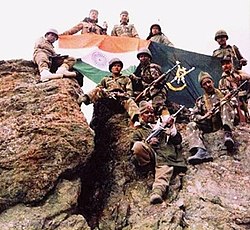
[[File: | [[File:Kargil war.jpg|thumb|Indian soldiers after capturing a hill from Pakistani forces during the Kargil war in 1999.]] | ||
{{ | {{Further|Kargil War}} | ||
In May 1999 some Kashmiri shepherds discovered the presence of militants and non-uniformed Pakistani soldiers (many with official identifications and [[Pakistan Army]]'s custom weaponry) in the Kashmir Valley, where they had taken control of border hilltops and unmanned border posts. The incursion was centred around the town of [[Kargil]], but also included the [[Batalik]] and [[Akhnoor]] sectors and artillery exchanges at the [[Siachen Glacier]].<ref>{{cite web|url=https://web.stanford.edu/group/sjir/3.1.06_kapur-narang.html|title=SJIR: The Fate of Kashmir: International Law or Lawlessness?|website=web.stanford.edu|access-date=17 August 2018|archive-url=https://web.archive.org/web/20171012061736/https://web.stanford.edu/group/sjir/3.1.06_kapur-narang.html|archive-date=12 October 2017|url-status=live}}</ref>{{sfn|Guha|2007|pp=675–678}} | |||
===Kargil | The Indian army responded with Operation Vijay, which launched on 26 May 1999. This saw the Indian military fighting thousands of militants and soldiers in the midst of heavy artillery shelling and while facing extremely cold weather, snow and treacherous terrain at the high altitude.{{sfn|Myra|2017|pp=27–66}} Over 500 Indian soldiers were killed in the three-month-long Kargil War, and it is estimated around 600–4,000 Pakistani militants and soldiers died as well.<ref>{{cite web|url=http://164.100.24.208/lsq/quest.asp?qref=51302|archive-url=https://web.archive.org/web/20081202045832/http://164.100.24.208/lsq/quest.asp?qref=51302|archive-date=2 December 2008|title=PARLIAMENT QUESTIONS, LOK SABHA|date=2 December 2008|access-date=17 August 2018}}</ref>{{sfn|Rodrigo|2006|p=}}<ref>{{cite news|url=https://www.thehindu.com/thehindu/2003/08/17/stories/2003081702900800.htm|title=Over 4,000 soldiers killed in Kargil: Sharif|access-date=17 August 2018|archive-url=https://web.archive.org/web/20040531145342/http://www.thehindu.com/thehindu/2003/08/17/stories/2003081702900800.htm|archive-date=31 May 2004|date=17 August 2003|last1=Reddy|newspaper=[[The Hindu]]|first1=B. Muralidhar}}</ref><ref>{{cite web|url=http://www.rediff.com/news/slide-show/slide-show-1-pak-quietly-names-453-men-killed-in-kargil-war/20101118.htm|title=Pak quietly names 453 men killed in Kargil war|work=Rediff.com|access-date=17 August 2018|archive-url=https://web.archive.org/web/20180627173200/http://www.rediff.com/news/slide-show/slide-show-1-pak-quietly-names-453-men-killed-in-kargil-war/20101118.htm|archive-date=27 June 2018|url-status=live}}</ref> India pushed back the Pakistani militants and [[Northern Light Infantry]] soldiers. Almost 70% of the territory was recaptured by India.{{sfn|Myra|2017|pp=27–66}} Vajpayee sent a "secret letter" to U.S. President [[Bill Clinton]] that if Pakistani infiltrators did not withdraw from the Indian territory, "we will get them out, one way or the other".<ref>{{Cite news|url=http://www.business-standard.com/article/current-affairs/india-was-ready-to-cross-loc-use-nuclear-weapons-in-kargil-war-115120300518_1.html|title=India was ready to cross LoC, use nuclear weapons in Kargil war|last=Team|first=BS Web|date=3 December 2015|work=Business Standard India|access-date=24 July 2017|archive-url=https://web.archive.org/web/20170609100347/http://www.business-standard.com/article/current-affairs/india-was-ready-to-cross-loc-use-nuclear-weapons-in-kargil-war-115120300518_1.html|archive-date=9 June 2017|url-status=live}}</ref> | ||
{{ | |||
After Pakistan suffered heavy losses, and with both the United States and China refusing to condone the incursion or threaten India to stop its military operations, General [[Pervez Musharraf]] was [[recalcitrant]] and [[Nawaz Sharif]] asked the remaining militants to stop and withdraw to positions along the LoC.<ref name="NS">{{cite web|url=https://foreignpolicy.com/2013/05/14/the-story-of-how-nawaz-sharif-pulled-back-from-nuclear-war/|title=The story of how Nawaz Sharif pulled back from nuclear war|website=Foreign Policy|date=14 May 2013 |access-date=17 August 2018|archive-url=https://web.archive.org/web/20180817193426/https://foreignpolicy.com/2013/05/14/the-story-of-how-nawaz-sharif-pulled-back-from-nuclear-war/|archive-date=17 August 2018|url-status=live}}</ref> The militants were not willing to accept orders from Sharif but the [[Northern Light Infantry|NLI]] soldiers withdrew.<ref name="NS" /> The militants were killed by the Indian army or forced to withdraw in skirmishes which continued even after the announcement of withdrawal by Pakistan.<ref name="NS" /> | |||
A subsequent military coup in Pakistan that overturned the democratically elected [[Nawaz Sharif]] government in October of the same year also proved a setback to relations. | |||
===Water disputes=== | ===Water disputes=== | ||
The [[Indus Waters Treaty]] governs the rivers that flow from India into Pakistan. Water is cited as one possible cause for a conflict between the two nations, but to date issues such as the [[Nimoo Bazgo Project]] have been resolved through diplomacy.<ref> | The [[Indus Waters Treaty]] governs the rivers that flow from India into Pakistan. Water is cited as one possible cause for a conflict between the two nations, but to date issues such as the [[Nimoo Bazgo Project]] have been resolved through diplomacy.<ref>{{Cite news |url=https://www.economist.com/briefing/2011/11/19/unquenchable-thirst |title=Unquenchable thirst |newspaper=[[The Economist]] |date=19 November 2011}}</ref> | ||
===Bengal refugee crisis (1949)=== | ===Bengal refugee crisis (1949)=== | ||
{{Further|East Bengali refugees}} | {{Further|East Bengali refugees}} | ||
In 1949, India recorded close to 1 million Hindu refugees, who flooded into [[West Bengal]] and other states from [[East Pakistan]] (now Bangladesh), owing to communal violence, intimidation and repression from authorities. The plight of the refugees outraged Hindus and Indian nationalists, and the refugee population drained the resources of Indian states, which were unable to absorb them. While not ruling out war, Prime Minister Nehru and Sardar Patel invited [[Liaquat Ali Khan]] for talks in Delhi. Although many Indians termed this appeasement, Nehru signed a pact with Liaquat Ali Khan that pledged both nations to the protection of minorities and creation of minority commissions. Khan and Nehru also signed a trade agreement, and committed to resolving bilateral conflicts through peaceful means. Steadily, hundreds of thousands of Hindus returned to East Pakistan, but the thaw in relations did not last long, primarily owing to the [[Kashmir conflict]]. | In 1949, India recorded close to 1 million Hindu refugees, who flooded into [[West Bengal]] and other states from [[East Pakistan]] (now Bangladesh), owing to communal violence, intimidation and repression from authorities. The plight of the refugees outraged Hindus and Indian nationalists, and the refugee population drained the resources of Indian states, which were unable to absorb them. While not ruling out war, Prime Minister Nehru and Sardar Patel invited [[Liaquat Ali Khan]] for talks in Delhi. Although many Indians termed this appeasement, Nehru signed a pact with Liaquat Ali Khan that pledged both nations to the protection of minorities and creation of minority commissions. Khan and Nehru also signed a trade agreement, and committed to resolving bilateral conflicts through peaceful means. Steadily, hundreds of thousands of Hindus returned to East Pakistan, but the thaw in relations did not last long, primarily owing to the [[Kashmir conflict]]. | ||
===Insurgency in Kashmir (1989–present)=== | ===Insurgency in Kashmir (1989–present)=== | ||
{{Main|Insurgency in Jammu and Kashmir}} | {{Main|Insurgency in Jammu and Kashmir}} | ||
[[File:India disputed areas map.svg|thumb|Map showing [[disputed territories of India]]]] | |||
According to some reports published by the [[Council of Foreign Relations]], the Pakistan military and the ISI have provided covert support to terrorist groups active in Kashmir, including the [[al-Qaeda]] affiliate [[Jaish-e-Mohammed]].<ref>[http://www.cfr.org/publication/11644/ The ISI and Terrorism: Behind the Accusations] {{Webarchive|url=https://web.archive.org/web/20090724100526/http://www.cfr.org/publication/11644/ |date=24 July 2009 }}, [[Council on Foreign Relations]], 28 May 2009</ref><ref>{{cite web|url=http://www.cfr.org/publication/9514/|title=Pakistan's New Generation of Terrorists|website=Council on Foreign Relations|access-date=22 January 2012|archive-url=https://web.archive.org/web/20081202062723/http://www.cfr.org/publication/9514/|archive-date=2 December 2008}}</ref> Pakistan has denied any involvement in terrorist activities in Kashmir, arguing that it only provides political and moral support to the [[secessionist]] groups who wish to escape Indian rule. Many Kashmiri militant groups also maintain their headquarters in [[Pakistan-administered Kashmir]], which is cited as further proof by the Indian government. | |||
==== | Journalist [[Stephen Schwartz (journalist)|Stephen Suleyman Schwartz]] notes that several militant and criminal groups are "backed by senior officers in the Pakistani army, the country's ISI intelligence establishment and other armed bodies of the state."<ref>{{cite web|url=http://www.spectator.co.uk/archive/features/24639/a-threat-to-the-world.thtml |title=A threat to the world |access-date=20 September 2007 |author=Stephen Schwartz |date=19 August 2006 |publisher=[[The Spectator]] |archive-url=https://web.archive.org/web/20071224052833/http://www.spectator.co.uk/archive/features/24639/a-threat-to-the-world.thtml |archive-date=24 December 2007 }}</ref> | ||
* Insurgents attack on Jammu and Kashmir State Assembly: A car bomb exploded near the Jammu and Kashmir State Assembly on 1 October 2001, killing 27 people on an attack that was blamed on Kashmiri separatists. It was one of the most prominent attacks against India apart from on the [[Indian Parliament]] in December 2001. The dead bodies of the terrorists and the data recovered from them revealed that Pakistan was solely responsible for the activity.{{ | |||
* Qasim Nagar Attack: On 13 July 2003, armed men believed to be a part of the [[Lashkar-e-Toiba]] threw hand grenades at the Qasim Nagar market in [[Srinagar]] and then fired on civilians standing nearby killing twenty-seven and injuring many more.{{ref| | ====Insurgent attacks==== | ||
{{incomplete list|date=May 2025}} | |||
* Insurgents attack on Jammu and Kashmir State Assembly: A car bomb exploded near the Jammu and Kashmir State Assembly on 1 October 2001, killing 27 people on an attack that was blamed on Kashmiri separatists. It was one of the most prominent attacks against India apart from on the [[Indian Parliament]] in December 2001. The dead bodies of the terrorists and the data recovered from them revealed that Pakistan was solely responsible for the activity.<ref>{{cite web|url=https://edition.cnn.com/2001/WORLD/asiapcf/south/10/01/india.kashmir/index.html|title=Bombing at Kashmir assembly kills at least 29|access-date=23 March 2024}}</ref> | |||
* Qasim Nagar Attack: On 13 July 2003, armed men believed to be a part of the [[Lashkar-e-Toiba]] threw hand grenades at the Qasim Nagar market in [[Srinagar]] and then fired on civilians standing nearby killing twenty-seven and injuring many more.<ref>{{Cite journal |title=What happened to Muslims in Jammu? Local identity, '"the massacre" of 1947' and the roots of the 'Kashmir problem' |last=Snedden |first=Christopher |date=8 May 2007 |journal=South Asia: Journal of South Asian Studies |volume=24 |issue=2 |pages=111–134 |doi=10.1080/00856400108723454}}</ref><ref name=independent>{{cite web|url=https://www.independent.co.uk/news/world/asia/panic-in-the-dark-as-slum-is-attacked-by-islamic-militants-184336.html |archive-url=https://ghostarchive.org/archive/20220501/https://www.independent.co.uk/news/world/asia/panic-in-the-dark-as-slum-is-attacked-by-islamic-militants-184336.html |archive-date=1 May 2022 |url-access=subscription |url-status=live|title=Panic in the dark as slum is attacked by Kashmiri militants|work=The Independent|date=15 July 2002|first=Maseeh|last=Rahman|access-date=19 September 2014}}{{cbignore}}</ref><ref name="Rediff 1">{{cite web|url=http://www.rediff.com/news/2002/jul/13jk2.htm|title=29 killed in militant attack in Jammu|work=Rediff|date=13 July 2002|first=Mukhtar|last=Ahmad|access-date=19 September 2014}}</ref><ref name="Rediff 2">{{cite web|url=http://www.rediff.com/news/2002/sep/06jk5.htm|title=Terrorists behind Qasim Nagar massacre nabbed|date=6 September 2002|work=Rediff|access-date=19 September 2014}}</ref><ref>{{cite news|first=Rory|last=McCarthy|url=https://www.theguardian.com/world/2002/jul/15/kashmir.india|title=Massacre in Kashmir slum renews fear of war|work=The Guardian|date=15 July 2002|access-date=3 June 2018}}</ref> | |||
* Assassination of Abdul Ghani Lone: Abdul Ghani Lone, a prominent All Party Hurriyat Conference leader, was assassinated by an unidentified gunmen during a memorial rally in [[Srinagar]]. The assassination resulted in wide-scale demonstrations against the Indian occupied-forces for failing to provide enough security cover for Mr. Lone.{{ref|hrw}} | * Assassination of Abdul Ghani Lone: Abdul Ghani Lone, a prominent All Party Hurriyat Conference leader, was assassinated by an unidentified gunmen during a memorial rally in [[Srinagar]]. The assassination resulted in wide-scale demonstrations against the Indian occupied-forces for failing to provide enough security cover for Mr. Lone.{{ref|hrw}} | ||
* 20 July 2005 [[Srinagar]] Bombing: A car bomb exploded near an armoured [[Indian Army]] vehicle in the | * 20 July 2005 [[Srinagar]] Bombing: A car bomb exploded near an armoured [[Indian Army]] vehicle in the Church Lane area in [[Srinagar]] killing four [[Indian Army]] personnel, one civilian and the suicide bomber. Terrorist group [[Hizbul Mujahideen]], claimed responsibility for the attack.{{ref|church}} | ||
* [[Srinagar (city)|Budshah Chowk attack]]: A terrorist attack on 29 July 2005 at [[Srinagar (city)|Srinigar]]'s city centre, Budshah Chowk, killed two and left more than 17 people injured. Most of those injured were media journalists.{{ref|Bud}} | * [[Srinagar (city)|Budshah Chowk attack]]: A terrorist attack on 29 July 2005 at [[Srinagar (city)|Srinigar]]'s city centre, Budshah Chowk, killed two and left more than 17 people injured. Most of those injured were media journalists.{{ref|Bud}} | ||
* Murder of Ghulam Nabi Lone: On 18 October 2005, a suspected man killed Jammu and Kashmir's then education minister Ghulam Nabi Lone. No Terrorist group claimed responsibility for the attack.{{ref|Nabi}} | * Murder of Ghulam Nabi Lone: On 18 October 2005, a suspected man killed Jammu and Kashmir's then education minister Ghulam Nabi Lone. No Terrorist group claimed responsibility for the attack.{{ref|Nabi}} | ||
* [[2016 Uri attack]]: A terrorist attack by four heavily armed terrorists on 18 September 2016, near the town of [[Uri, Jammu and Kashmir|Uri]] in the Indian state of Jammu and Kashmir, killed 18 and left more than 20 people injured. It was reported as "the deadliest attack on security forces in Kashmir in two decades".<ref name="uri">{{cite news|title=Militants attack Indian army base in Kashmir 'killing 17'|url=https://www.bbc.com/news/world-asia-india-37399969|access-date=18 September 2016 | | * [[2016 Uri attack]]: A terrorist attack by four heavily armed terrorists on 18 September 2016, near the town of [[Uri, Jammu and Kashmir|Uri]] in the Indian state of Jammu and Kashmir, killed 18 and left more than 20 people injured. It was reported as "the deadliest attack on security forces in Kashmir in two decades".<ref name="uri">{{cite news|title=Militants attack Indian army base in Kashmir 'killing 17'|url=https://www.bbc.com/news/world-asia-india-37399969|access-date=18 September 2016 |publisher=BBC News|date=18 September 2016}}</ref> | ||
* [[2019 Pulwama attack]]: On 14 February 2019, a convoy of vehicles carrying security personnel on the Jammu Srinagar National Highway was attacked by a vehicle-bound suicide bomber in Lethpora near Awantipora, Pulwama district, Jammu and Kashmir, India. The attack resulted in the death of 38 Central Reserve Police Force (CRPF) personnel and the attacker. The responsibility of the attack was claimed by the Pakistan-based Islamist militant group [[Jaish-e-Mohammed]].<ref>{{Cite web|url=https://www.indiatoday.in/india/story/pulwama-attack-2019-everything-about-jammu-and-kashmir-terror-attack-on-crpf-by-terrorist-adil-ahmed-dar-jaish-e-mohammad-1457530-2019-02-16|title=Pulwama Attack 2019, everything about J&K terror attack on CRPF by terrorist Adil Ahmed Dar, Jaish-e-Mohammad|date=16 February 2019|website=India Today}}</ref> | * [[2019 Pulwama attack]]: On 14 February 2019, a convoy of vehicles carrying security personnel on the Jammu Srinagar National Highway was attacked by a vehicle-bound suicide bomber in Lethpora near Awantipora, Pulwama district, Jammu and Kashmir, India. The attack resulted in the death of 38 Central Reserve Police Force (CRPF) personnel and the attacker. The responsibility of the attack was claimed by the Pakistan-based Islamist militant group [[Jaish-e-Mohammed]].<ref>{{Cite web|url=https://www.indiatoday.in/india/story/pulwama-attack-2019-everything-about-jammu-and-kashmir-terror-attack-on-crpf-by-terrorist-adil-ahmed-dar-jaish-e-mohammad-1457530-2019-02-16|title=Pulwama Attack 2019, everything about J&K terror attack on CRPF by terrorist Adil Ahmed Dar, Jaish-e-Mohammad|date=16 February 2019|website=India Today}}</ref> | ||
* [[2025 Pahalgam attack]]: On 22 April 2025, 26 tourists were attacked by terrorists, resulting in the death of 28 people, including a local from [[Jammu and Kashmir (union territory)|Jammu and Kashmir]] and two foreigners from [[Nepal]] and the [[UAE]]. India stopped supplying the [[Indus river]] to Pakistan. | |||
===Insurgent activities elsewhere=== | ===Insurgent activities elsewhere=== | ||
The attack on the [[Indian Parliament]] was by far the most dramatic attack carried out allegedly by Pakistani terrorists. India blamed Pakistan for carrying out the attacks, an allegation which Pakistan strongly denied | <!-- https://en.Bharatpedia.org/wiki/Aftermath_of_the_2008_Mumbai_attacks#Indo-Pakistani_relations links here. --> | ||
The attack on the [[Indian Parliament]] was by far the most dramatic attack carried out allegedly by Pakistani terrorists. India blamed Pakistan for carrying out the attacks, an allegation which Pakistan strongly denied. The following [[2001–2002 India–Pakistan standoff]] raised concerns of a possible [[nuclear warfare|nuclear]] confrontation. However, international peace efforts ensured the cooling of tensions between the two nuclear-capable nations. | |||
Apart from this, the most notable was the [[Aircraft hijacking|hijacking]] of [[Indian Airlines Flight 814|Indian Airlines Flight IC 814]] en route New Delhi from [[Kathmandu]], Nepal. The plane was hijacked on 24 December 1999 approximately one hour after takeoff and was taken to [[Amritsar]] airport and then to [[Lahore]] in Pakistan. After refuelling the plane took off for [[Dubai]] and then finally landed in [[Kandahar]], Afghanistan. Under intense media pressure, New Delhi complied with the hijackers' demand and freed [[Maulana Masood Azhar]] from | Apart from this, the most notable was the [[Aircraft hijacking|hijacking]] of [[Indian Airlines Flight 814|Indian Airlines Flight IC 814]] en route New Delhi from [[Kathmandu]], Nepal. The plane was hijacked on 24 December 1999 approximately one hour after takeoff and was taken to [[Amritsar]] airport and then to [[Lahore]] in Pakistan. After refuelling the plane took off for [[Dubai]] and then finally landed in [[Kandahar]], Afghanistan. Under intense media pressure, New Delhi complied with the hijackers' demand and freed [[Maulana Masood Azhar]] from his captivity in return for the freedom of the Indian passengers on the flight. The decision, however, cost New Delhi dearly. Maulana, who is believed to be hiding in [[Karachi]], later became the leader of [[Jaish-e-Mohammed]], an organisation which has carried out several terrorist acts against Indian security forces in Kashmir.{{ref|814}} | ||
On 22 December 2000, a group of terrorists belonging to the [[Lashkar-e-Toiba]] stormed the | On 22 December 2000, a group of terrorists belonging to the [[Lashkar-e-Toiba]] stormed the [[Red Fort]] in [[New Delhi]]. The fort houses an [[Indian Army|Indian military]] unit and a high-security interrogation cell used both by the [[Central Bureau of Investigation]] and the [[Indian Army]]. The terrorists successfully breached the security cover around the [[Red Fort]] and opened fire at the [[Indian Military|Indian military personnel]] on duty killing two of them on spot. The attack was significant because it was carried out just two days after the declaration of the cease-fire between India and Pakistan.{{ref|red}} | ||
In 2002, India claimed again that terrorists from Jammu and Kashmir were infiltrating into India, a claim denied by Pakistan President [[Pervez Musharraf]], who claimed that such infiltration had stopped—India's spokesperson for the External Affairs Ministry did away with Pakistan's claim, calling it "terminological inexactitude. | In 2002, India claimed again that terrorists from Jammu and Kashmir were infiltrating into India, a claim denied by Pakistan President [[Pervez Musharraf]], who claimed that such infiltration had stopped—India's spokesperson for the External Affairs Ministry did away with Pakistan's claim, calling it "terminological inexactitude".<ref>{{cite news|url=http://articles.economictimes.indiatimes.com/2002-07-28/news/27364071_1_infiltration-pakistan-president-pervez-musharraf-state-colin-powell|archive-url=https://web.archive.org/web/20120509210942/http://articles.economictimes.indiatimes.com/2002-07-28/news/27364071_1_infiltration-pakistan-president-pervez-musharraf-state-colin-powell|archive-date=9 May 2012|title=India rejects Musharraf's claim on infiltration|date=28 July 2002|work=[[The Economic Times]]|access-date=15 July 2011}}</ref> Only two months later, two Kashmiri terrorists belonging to [[Jaish-e-Mohammed]] raided the [[Akshardham Gandhinagar|Swami Narayan temple complex]] in [[Ahmedabad]], [[Gujarat]] killing 30 people, including 18 women and five children. The attack was carried out on 25 September 2002, just few days after state elections were held in Jammu and Kashmir. Two identical letters found on both the terrorists claimed that the attack was done in retaliation for the deaths of thousands of Muslims during the [[2002 Gujarat violence|Gujarat riots]].{{ref|attack}} | ||
Two car bombs exploded in south [[Mumbai]] on 25 August 2003; one near the [[Gateway of India]] and the other at the | Two car bombs exploded in south [[Mumbai]] on 25 August 2003; one near the [[Gateway of India]] and the other at the Zaveri Bazaar, killing at least 48 and injuring 150 people. Though no terrorist group claimed responsibility for the attacks, [[Military of India|Mumbai Police]] and [[Research and Analysis Wing|RAW]] suspected [[Lashkar-e-Toiba]]'s hand in the twin blasts.{{ref|Mumbai}} | ||
In an unsuccessful attempt, six terrorists belonging to [[Lashkar-e-Toiba]], stormed the [[Ayodhya]] [[Babri Masjid|Ram Janmbhomi complex]] on 5 July 2005. Before the terrorists could reach the main [[Babri Masjid|disputed site]], they were shot down by [[Military of India|Indian security forces]]. One [[Hindus|Hindu]] worshipper and two policemen were injured during the incident.{{ref|ram}} | In an unsuccessful attempt, six terrorists belonging to [[Lashkar-e-Toiba]], stormed the [[Ayodhya]] [[Babri Masjid|Ram Janmbhomi complex]] on 5 July 2005. Before the terrorists could reach the main [[Babri Masjid|disputed site]], they were shot down by [[Military of India|Indian security forces]]. One [[Hindus|Hindu]] worshipper and two policemen were injured during the incident.{{ref|ram}} | ||
| Line 145: | Line 194: | ||
====2001 Indian Parliament attack==== | ====2001 Indian Parliament attack==== | ||
{{Main|2001 Indian Parliament attack}} | {{Main|2001 Indian Parliament attack}} | ||
The [[2001 Indian Parliament attack]] was an attack at the [[Parliament of India]] in New Delhi on 13 December 2001, during which fourteen people, including the five men who attacked the building, were killed. The perpetrators were [[Lashkar-e-Taiba]] (Let) and [[Jaish-e-Mohammed]] (JeM) terrorists.<ref name="demarche">[http://www.rediff.com/news/2001/dec/14parl12.htm "Govt blames LeT for Parliament attack"]. Rediff.com (14 December 2001). Retrieved 8 September 2011.</ref><ref name="indianembassy.org">[http://www.indianembassy.org/new/parliament_dec_13_01.htm#STATEMENT%20MADE%20BY%20HOME%20MINISTER,%20L.%20K.%20ADVANI%20ON%20THE%20TERRORIST%20ATTACK%20ON%20PARLIAMENT%20HOUSE%20ON%20DECEMBER%2013,%202001 Embassy of India – Washington DC (official website) United States of America] {{Webarchive|url=https://web.archive.org/web/20100611152203/http://www.indianembassy.org/new/parliament_dec_13_01.htm#STATEMENT%20MADE%20BY%20HOME%20MINISTER,%20L.%20K.%20ADVANI%20ON%20THE%20TERRORIST%20ATTACK%20ON%20PARLIAMENT%20HOUSE%20ON%20DECEMBER%2013,%202001 |date=11 June 2010 }}. Indianembassy.org. Retrieved 8 September 2011.</ref> The attack led to the deaths of five terrorists, six [[Delhi Police]] personnel, two Parliament Security Service personnel and a gardener, in total 14<ref name=remember>{{cite news|last1=PTI|title=Parliament attack victims remembered |url=http://www.thehindu.com/news/cities/Delhi/parliament-attack-victims-remembered/article2711970.ece|access-date=23 October 2014|work=The Hindu|date=13 December 2011}}</ref> and to increased tensions between [[India]] and [[Pakistan]], resulting in the [[2001–02 India–Pakistan standoff]].<ref>{{ | |||
The [[2001 Indian Parliament attack]] was an attack at the [[Parliament of India]] in New Delhi on 13 December 2001, during which fourteen people, including the five men who attacked the building, were killed. The perpetrators were [[Lashkar-e-Taiba]] (Let) and [[Jaish-e-Mohammed]] (JeM) terrorists.<ref name="demarche">[http://www.rediff.com/news/2001/dec/14parl12.htm "Govt blames LeT for Parliament attack"]. Rediff.com (14 December 2001). Retrieved 8 September 2011.</ref><ref name="indianembassy.org">[http://www.indianembassy.org/new/parliament_dec_13_01.htm#STATEMENT%20MADE%20BY%20HOME%20MINISTER,%20L.%20K.%20ADVANI%20ON%20THE%20TERRORIST%20ATTACK%20ON%20PARLIAMENT%20HOUSE%20ON%20DECEMBER%2013,%202001 Embassy of India – Washington DC (official website) United States of America] {{Webarchive|url=https://web.archive.org/web/20100611152203/http://www.indianembassy.org/new/parliament_dec_13_01.htm#STATEMENT%20MADE%20BY%20HOME%20MINISTER,%20L.%20K.%20ADVANI%20ON%20THE%20TERRORIST%20ATTACK%20ON%20PARLIAMENT%20HOUSE%20ON%20DECEMBER%2013,%202001 |date=11 June 2010 }}. Indianembassy.org. Retrieved 8 September 2011.</ref> The attack led to the deaths of five terrorists, six [[Delhi Police]] personnel, two Parliament Security Service personnel and a gardener, in total 14<ref name=remember>{{cite news|last1=PTI|title=Parliament attack victims remembered |url=http://www.thehindu.com/news/cities/Delhi/parliament-attack-victims-remembered/article2711970.ece|access-date=23 October 2014|work=The Hindu|date=13 December 2011}}</ref> and to increased tensions between [[India]] and [[Pakistan]], resulting in the [[2001–02 India–Pakistan standoff]].<ref>{{Cite web |url=http://www.globalbearings.net/2011/10/image-from-gates-of-pakistan-naval.html |title=From Kashmir to the FATA: The ISI Loses Control |access-date=8 June 2016 |archive-date=27 January 2012 |archive-url=https://web.archive.org/web/20120127094835/http://www.globalbearings.net/2011/10/image-from-gates-of-pakistan-naval.html |url-status=dead}}</ref> | |||
====2001–02 India–Pakistan standoff==== | ====2001–02 India–Pakistan standoff==== | ||
{{Main|2001–2002 India–Pakistan standoff}} | {{Main|2001–2002 India–Pakistan standoff}} | ||
The [[2001–2002 India–Pakistan standoff]] was a military standoff between India and Pakistan that resulted in the massing of troops on either side of the [[Indo-Pakistani border|border]] and along the [[Line of Control]] (LoC) in the region of [[Kashmir]]. This was the first major military standoff between India and Pakistan since the [[Kargil War]] in 1999. The military buildup was initiated by India responding to a [[2001 Indian Parliament attack]] and the [[2001 Jammu and Kashmir legislative assembly attack]].<ref name="Rajesh M. Basrur">{{cite book|title=Asymmetric Warfare in South Asia: The Causes and Consequences of the Kargil Conflict|publisher=Cambridge University Press|isbn=978-0-521-76721-7|page=326|chapter-url=https://books.google.com/books?id=-vifpWqV2WYC&pg=PA326|author=Rajesh M. Basrur|edition=1st|editor=Peter R. Lavoy|access-date=8 August 2013|chapter=The lessons of Kargil as learned by India|date=14 December 2009}}</ref> India claimed that the attacks were carried out by two Pakistan-based terror groups, the [[Lashkar-e-Taiba]] and [[Jaish-e-Mohammad]], both of whom India has said are backed by Pakistan's [[Inter Services Intelligence|ISI]]<ref name=letjemisi> | |||
The [[2001–2002 India–Pakistan standoff]] was a military standoff between India and Pakistan that resulted in the massing of troops on either side of the [[Indo-Pakistani border|border]] and along the [[Line of Control]] (LoC) in the region of [[Kashmir]]. This was the first major military standoff between India and Pakistan since the [[Kargil War]] in 1999. The military buildup was initiated by India responding to a [[2001 Indian Parliament attack]] and the [[2001 Jammu and Kashmir legislative assembly attack]].<ref name="Rajesh M. Basrur">{{cite book|title=Asymmetric Warfare in South Asia: The Causes and Consequences of the Kargil Conflict|publisher=Cambridge University Press|isbn=978-0-521-76721-7|page=326|chapter-url=https://books.google.com/books?id=-vifpWqV2WYC&pg=PA326|author=Rajesh M. Basrur|edition=1st|editor=Peter R. Lavoy|access-date=8 August 2013|chapter=The lessons of Kargil as learned by India|date=14 December 2009}}</ref> India claimed that the attacks were carried out by two Pakistan-based terror groups, the [[Lashkar-e-Taiba]] and [[Jaish-e-Mohammad]], both of whom India has said are backed by Pakistan's [[Inter Services Intelligence|ISI]]<ref name=letjemisi>{{Cite news |url=http://www.economist.com/printedition/displayStory.cfm?Story_ID=917228 |title=Who will strike first |newspaper=[[The Economist]] |date=20 December 2001}}</ref> a charge that Pakistan denied.<ref>{{cite web|title=Kashmir Militant Extremists|url=http://www.cfr.org/kashmir/kashmir-militant-extremists/p9135|publisher=Council Foreign Relations|author=Jamal Afridi|date=9 July 2009|quote=Pakistan denies any ongoing collaboration between the ISI and militants, stressing a change of course after 11 September 2001.|access-date=4 February 2012 |archive-url=https://web.archive.org/web/20120302144145/http://www.cfr.org/kashmir/kashmir-militant-extremists/p9135|archive-date=2 March 2012}}</ref><ref>{{cite news|last=Perlez |first=Jane |url=https://www.nytimes.com/2008/11/30/world/asia/30pstan.html |title=Pakistan Denies Any Role in Mumbai Attacks |location=Mumbai (India);Pakistan |work=[[The New York Times]] |date=29 November 2008 |access-date=31 January 2012}}</ref><ref>{{cite web|url=http://www.wsws.org/articles/2001/dec2001/ind-d20.shtml |title=Attack on Indian parliament heightens danger of Indo-Pakistan war |publisher=Wsws.org |date=20 December 2001 |access-date=31 January 2012}}</ref> Tensions de-escalated following international [[Diplomacy|diplomatic]] mediation which resulted in the October 2002 withdrawal of Indian<ref name=toiwithdraw>[http://www1.timesofindia.indiatimes.com/cms.dll/articleshow?artid=25384627 "India to withdraw troops from Pak border"] {{webarchive|url=https://web.archive.org/web/20031130174834/http://timesofindia.indiatimes.com/cms.dll/articleshow?artid=25384627 |date=30 November 2003 }}, [[Times of India]], 16 October 2002.</ref> and Pakistani troops<ref name=bbcwithdraw>[https://news.bbc.co.uk/1/hi/world/south_asia/2335599.stm "Pakistan to withdraw front-line troops"], [[BBC]], 17 October 2002.</ref> from the international border. | |||
====2007 Samjhauta Express bombings==== | ====2007 Samjhauta Express bombings==== | ||
{{Main|2007 Samjhauta Express bombings}} | {{Main|2007 Samjhauta Express bombings}} | ||
The [[2007 Samjhauta Express bombings]] was a terrorist attack targeted on the [[Samjhauta Express]] train on 18 February. The Samjhauta Express is an international train that runs from New Delhi, India to Lahore, Pakistan, and is one of two trains to cross the | |||
The [[2007 Samjhauta Express bombings]] was a terrorist attack targeted on the [[Samjhauta Express]] train on 18 February. The Samjhauta Express is an international train that runs from New Delhi, India to Lahore, Pakistan, and is one of two trains to cross the India–Pakistan border. At least 68 people were killed, mostly Pakistani civilians but also some Indian security personnel and civilians.<ref>{{cite web|url=https://www.reuters.com/article/us-india-pakistan-train-idUSDEL34195220070219|title=Indian police release sketches of bomb suspects|date=21 February 2007|work=Reuters}}</ref> | |||
====2008 Mumbai attacks==== | ====2008 Mumbai attacks==== | ||
{{Main|2008 Mumbai attacks}} | {{Main|2008 Mumbai attacks}} | ||
The [[2008 Mumbai attacks]] by ten Pakistani terrorists killed over 173 and wounded 308. The sole surviving gunman [[Ajmal Kasab]] who was arrested during the attacks was found to be a Pakistani national. This fact was acknowledged by Pakistani authorities.<ref>{{Cite web|url=http://www.dawn.com/wps/wcm/connect/dawn-content-library/dawn/news/pakistan/surviving-gunmans-identity-established-as-pakistani-ss|title=DAWN.COM | Pakistan | Surviving-gunmans-identity-established-as-Pakistani-ss|website=www.dawn.com}}</ref> In May 2010, an Indian court convicted him on four counts of murder, waging war against India, [[Conspiracy (crime)|conspiracy]] and [[terrorism]] offences, and sentenced him to death.<ref>{{Cite web|url=http://www.dawn.com/wps/wcm/connect/dawn-content-library/dawn/news/world/04-ajmal-kasab-death-qs-07|title=DAWN.COM | World | Ajmal Kasab sentenced to death for Mumbai attacks|website=www.dawn.com}}</ref> | |||
India blamed the [[Lashkar-e-Taiba]], a Pakistan-based militant group, for planning and executing the attacks. Indian officials demanded Pakistan extradite suspects for trial. They also said that, given the sophistication of the attacks, the perpetrators "must have had the support of some official agencies in Pakistan".<ref name="BlameAgenciesWaPo">{{Cite news|url=http://www.washingtonpost.com/wp-dyn/content/article/2009/01/05/AR2009010500097.html|title=India Gives Pakistan Findings From Mumbai Probe, Urges Action Against Suspects|first=Rama|last=Lakshmi|date=6 January 2009|newspaper=The Washington Post}}</ref> In July 2009 Pakistani authorities confirmed that LeT plotted and financed the attacks from LeT camps in Karachi and [[Thatta]].<ref>{{Cite news |last=Hussain |first=Zahid |title=Islamabad Tells of Plot by Lashkar |place=Islamabad |work=The Wall Street Journal |date=28 July 2009 |url=https://www.wsj.com/articles/SB124872197786784603?mod=googlenews_wsj |access-date=28 July 2009}}</ref> In November 2009, Pakistani authorities charged seven men they had arrested earlier, of planning and executing the assault.<ref name="abc20091125">{{Cite news |last=Schifrin |first=Nick |title=Mumbai terror attacks: 7 Pakistanis charged |publisher=[[ABC News (United States)|ABC News]]|location=United States |date=25 November 2009 |url=https://abcnews.go.com/International/mumbai-terror-attacks-pakistanis-charged/story?id=9176592 |access-date=1 December 2009 |archive-url=https://web.archive.org/web/20091127091951/http://abcnews.go.com/International/mumbai-terror-attacks-pakistanis-charged/story?id=9176592 |archive-date=27 November 2009 |url-status=live}}</ref> | |||
The | On 9 April 2015, the foremost ringleader of the attacks, [[Zakiur Rehman Lakhvi]]<ref name="Masood">{{Cite news |last=Masood |first=Salman |title=Pakistan Announces Arrests for Mumbai Attacks |work=[[The New York Times]] |date=12 February 2009 |url=https://www.nytimes.com/2009/02/13/world/asia/13pstan.html?partner=permalink&exprod=permalink |access-date=12 February 2009}}</ref><ref name="Haider">{{Cite news |last=Haider |first=Kamran |title=Pakistan says it arrests Mumbai attack plotters |work=Reuters|date=12 February 2009 |url=https://www.reuters.com/article/topNews/idUSTRE51B25820090212?pageNumber=1&virtualBrandChannel=10112 |access-date=12 February 2009}}</ref> was granted bail against [[surety]] bonds of {{PKRConvert|200|k}} in Pakistan.<ref>{{cite news |title=Pak court grants bail to Mumbai terror attack accused Lakhvi |url=https://in.news.yahoo.com/pak-court-grants-bail-to-mumbai-terror-attack-accused-lakhvi-061534426.html |access-date=9 January 2015 |publisher=Yahoo! News |date=9 January 2015}}</ref><ref>{{cite news |title=Lakhvi gets bail, again |url=http://www.dawn.com/news/1155805 |access-date=9 January 2015 |work=Dawn|location=Pakistan}}</ref> | ||
==== Balochistan Insurgency ==== | |||
The [[Insurgency in Balochistan|Balochistan Insurgency]], ongoing since the early 2000s, involves separatist groups in Pakistan's Balochistan province seeking autonomy. The largest and most prominent group, the [[Balochistan Liberation Army|Baloch Liberation Army]] (BLA), has fought for independence, citing long-standing grievances over perceived discrimination and underdevelopment by the central government. The insurgency escalated in March 2025 when the BLA hijacked a train in a remote area of [[Balochistan]], killing 26 people. | |||
Pakistan's military has accused India of supporting the insurgents, citing the 2016 arrest of Indian naval officer [[Kulbhushan Jadhav]], who was convicted of espionage and allegedly aiding Baloch separatists. These accusations have been rejected by India, which denies any involvement in the insurgency. The region's strategic importance, with its oil and mineral wealth, and its proximity to India, has made the conflict a focal point in South Asian military tensions.<ref>{{Cite web |date=17 March 2025 |title=Pakistan moves closer to Bangladesh as India watches warily |url=https://www.bbc.com/news/articles/cge1gxxn07qo |access-date=19 March 2025 |website=www.bbc.com |language=en-GB}}</ref><ref>{{Cite news |last=Press |first=Associated |date=14 March 2025 |title=Pakistan accuses India of sponsoring militant terror group after train hijacking |url=https://www.theguardian.com/world/2025/mar/14/pakistan-accuses-india-of-sponsoring-militant-terror-group-after-train-hijacking |access-date=19 March 2025 |work=The Guardian |language=en-GB |issn=0261-3077}}</ref> | |||
==== 2025 conflict ==== | |||
{{main|2025 India–Pakistan conflict}} | |||
Following the [[2025 Pahalgam attack|Pahalgam terrorist attack]] on April 22 which resulted in the deaths of 26 civilians, including 25 Indian tourists and one Nepali national, India–Pakistan relations have reached a critical low point. The attack, attributed by India to the [[Islam]]ic [[The Resistance Front|Resistance Front]], an offshoot of the Pakistan-based [[Lashkar-e-Taiba]], has triggered a series of retaliatory measures from both nations, escalating tensions to levels not seen in years.<ref>{{Cite news |date=2025 |title=Deadly Kashmir attack threatens new escalation between India and Pakistan |url=https://www.washingtonpost.com/world/2025/04/23/kashmir-attack-pahalgam-india-pakistan/?utm_}}</ref><ref name="Blair">{{Cite web |last=Blair |first=Anthony |date=2025-04-28 |title=Tourist captures Kashmir terror attack as he films himself ziplining |url=https://nypost.com/2025/04/28/world-news/tourist-captures-terror-attack-as-he-films-himself-ziplining/?utm_ |access-date=2025-04-30 |language=en-US}}</ref> According to Indian news, unnamed sources have stated that Hashim Musa, a former para commando in the Pakistan Army's elite Special Service Group (SSG), was involved in the attack. Trained in covert and unconventional warfare, he is said to have joined the banned terror group, Lashkar-e-Taiba, after his dismissal from SSG and to have infiltrated Kashmir in September 2023. Unnamed sources say his name and SSG background were revealed during the interrogation of Over Ground Workers (OGWs) who supported the perpetrators.<ref>{{Cite web |last=Ranjan |first=Mukesh |date=2025-04-29 |title=Hashim Musa, ex-Pakistan Army Special Forces soldier, prime suspect in Pahalgam terror attack |url=https://www.newindianexpress.com/nation/2025/Apr/29/hashim-musa-ex-pakistan-army-special-forces-soldier-prime-suspect-in-pahalgam-terror-attack |access-date=2025-05-07 |website=The New Indian Express |language=en}}</ref> | |||
===== Diplomatic fallout ===== | |||
====== India's response ====== | |||
In response to escalating tensions, India has suspended the [[Indus Waters Treaty|Indus Waters Treaty of 1960]], placing the long-standing water-sharing agreement "in abeyance" due to what it alleges is Pakistan's ongoing support for cross-border terrorism. Additionally, India has imposed visa and diplomatic restrictions, halting visa services for Pakistani nationals and expelling several Pakistani diplomats. As part of broader punitive measures, the Attari–Wagah border has been closed, effectively cutting off overland trade and further straining bilateral ties.<ref>{{Cite news |date=2025 |title=Pakistan preparing to challenge India's suspension of water treaty, minister says |url=https://www.reuters.com/world/asia-pacific/pakistan-preparing-challenge-indias-suspension-water-treaty-minister-says-2025-04-29/?utm_}}</ref><ref>{{Cite web |last=Campbell |first=Matthew |date=2025-04-26 |title=Are India and Pakistan on the cusp of war over water? |url=https://www.thetimes.com/world/asia/article/india-pakistan-kashmir-water-rvghjhm5s?utm_ |access-date=2025-04-30 |website=www.thetimes.com |language=en}}</ref> | |||
Additionally, authorities across various states started a crackdown on illegal immigrants from Pakistan and began the process of deporting them. Many of these illegal immigrants had reportedly possessed voter IDs and ration cards, sparking a major controversy and debate as non-citizens do not have right to vote.<ref>{{Cite web|url= https://economictimes.indiatimes.com/news/new-updates/22-women-with-pakistani-citizenship-found-in-moradabad-many-have-grandchildren-families-total-over-500/articleshow/120898093.cms?from=mdr|title= 22 women with Pakistani citizenship found in Moradabad; many have grandchildren, families total over 500|work= The Economic Times|date= 5 May 2025}}</ref> Furthermore, short term visas of several Pakistani visitors, some of who were married to Indians, were also being cancelled.<ref>{{cite web|url= https://www.newindianexpress.com/nation/2025/Apr/28/fate-of-pregnant-maryam-illegal-settler-seema-hangs-in-balance-as-up-speeds-up-deportation-of-pakistanis|title= Fate of pregnant Maryam, illegal settler Seema hangs in balance as UP speeds up deportation of Pakistanis|date= 28 April 2025}}</ref> | |||
====== Pakistan's countermeasures ====== | |||
In retaliation, Pakistan announced a series of countermeasures. It suspended the 1972 [[Simla Agreement|Shimla Agreement]], which had emphasized the peaceful resolution of bilateral disputes. Pakistan also closed its airspace to Indian aircraft and halted all trade with India. On the diplomatic front, Indian diplomats have been expelled, and the staff size at the Indian High Commission in Islamabad has been significantly reduced, deepening the diplomatic rift between the two countries.<ref name="Blair"/><ref>{{Cite news |date=2025 |title=India File: A deadly reminder from Kashmir |url=https://www.reuters.com/world/india/india-file-deadly-reminder-kashmir-2025-04-30/?utm_}}</ref> | |||
====== India's missile strikes ====== | |||
On May 6, India [[2025 India-Pakistan strikes|targeted]] Pakistan proper and Pakistan-administered [[Azad Kashmir|Kashmir]] with multiple airstrikes as part of [[Operation Sindoor]], marking a significant escalation of the conflict.<ref>{{Cite web |title=Pakistan 'attacked with missiles' - as India says it targeted terrorist camps |url=https://news.sky.com/story/pakistan-attacked-with-missiles-as-india-says-it-targeted-terrorist-camps-13362775 |access-date=2025-05-06 |website=Sky News |language=en}}</ref> India announced that it struck nine "terrorist infrastructure" sites in Pakistan and Pakistan-administered Kashmir, stating the targets were used to plan and direct attacks. It stressed the strikes were precise, avoided Pakistani military sites, and were non-escalatory. Jaish-e-Mohammad stronghold of Bahawalpur and Lashkar-e-Taiba's base in Muridke were among the targets. Pakistan reported hits in Muzaffarabad, Kotli, and Bahawalpur.<ref>{{Cite web |date=2025-05-07 |title=What we know about India's strike on Pakistan and Pakistan-administered Kashmir |url=https://www.bbc.com/news/articles/cj6868pdpw4o |access-date=2025-05-07 |website=www.bbc.com |language=en-GB}}</ref><ref>{{Cite news |date=2025-05-07 |title=Operation Sindoor: Full list of terrorist camps in Pakistan, PoJK targeted by Indian strikes |url=https://www.thehindu.com/news/national/operation-sindoor-full-list-of-terrorist-camps-in-pakistan-pojk-targeted-by-indian-strikes/article69547986.ece |access-date=2025-05-07 |work=The Hindu |language=en-IN |issn=0971-751X}}</ref> | |||
====== Diplomatic expulsions ====== | |||
On 13 May, India reportedly declared Md. Ehsan Ur Rahim, a staff member at the Pakistan High Commission, persona non grata for engaging in activities inconsistent with his diplomatic status. He was allegedly involved in espionage.<ref>{{Cite news |last=Chaudhury |first=Dipanjan Roy |date=2025-05-13 |title=Pakistan High Commissioner staffer declared persona non grata for 'espionage' |url=https://economictimes.indiatimes.com/news/politics-and-nation/pakistan-high-commissioner-staffer-declared-persona-non-grata-for-espionage/articleshow/121145884.cms?from=mdr |access-date=2025-05-19 |work=The Economic Times |issn=0013-0389}}</ref><ref>{{Cite news |title=Pakistani official declared persona non grata |url=https://www.mea.gov.in/press-releases.htm?dtl/39494/Pakistani_official_declared_persona_non_grata |archive-url=https://web.archive.org/web/20250514085254/https://www.mea.gov.in/press-releases.htm?dtl/39494/Pakistani_official_declared_persona_non_grata |archive-date=14 May 2025 |access-date=2025-05-19 |work=Ministry of External Affairs, Government of India |language=en-US |url-status=live }}</ref> More information on the expulsion was revealed to Indian media after 17 May when a YouTuber was arrested.<ref>{{Cite web |date=2025-05-17 |title=Haryana-based YouTuber among 6 arrested for spying for Pakistan |url=https://www.indiatoday.in/india/story/haryana-based-youtuber-among-arrested-for-spying-for-pakistan-2726271-2025-05-17 |access-date=2025-05-19 |website=India Today |language=en}}</ref> It was alleged that Ehsan used an Indian YouTuber, namely Jyoti Malhotra, for espionage activities.<ref>{{Cite web |date=2025-05-19 |title=India-Pakistan tensions: YouTuber arrested for allegedly spying for Pakistan |url=https://www.bbc.com/news/articles/cx2e7xv8v80o |access-date=2025-05-19 |website=www.bbc.com |language=en-GB}}</ref> He reportedly befriended the youtuber in 2023 and maintained close contact with her during the four-day military conflict. Over time, he reportedly cultivated her as an asset by introducing her to Pakistani contacts and facilitating her visit to Pakistan, where she met intelligence officials. The youtuber is believed to have maintained communication with these officials through encrypted platforms like WhatsApp, Telegram, and Snapchat, and shared sensitive information, according to Indian police.<ref>{{Cite web |title=Cops Say Haryana YouTuber Was Groomed As A Pak Asset. How She Was Lured |url=https://www.ndtv.com/india-news/youtuber-jyoti-malhotra-operation-sindoor-from-likes-to-lock-up-how-haryana-youtuber-went-from-vlogging-to-spying-8450903 |access-date=2025-05-19 |website=www.ndtv.com |language=en}}</ref><ref>{{Cite news |date=2025-05-18 |title=How YouTuber Jyoti Malhotra used social media apps to pass secrets to Pakistan |url=https://economictimes.indiatimes.com/news/new-updates/how-youtuber-jyoti-malhotra-used-social-media-apps-to-pass-secrets-to-pakistan/articleshow/121245520.cms?from=mdr |access-date=2025-05-19 |work=The Economic Times |issn=0013-0389}}</ref> | |||
==Weapons of mass destruction== | ==Weapons of mass destruction== | ||
{{See also|India and weapons of mass destruction|Pakistan and weapons of mass destruction| | {{See also|India and weapons of mass destruction|Pakistan and weapons of mass destruction|Nuclear arms race}} | ||
India has a long history of [[nuclear weapons]] development.<ref name="Indian nuclear program: origin">{{cite news |last=Carey Sublette |title=Indian nuclear program: origin |url=http://nuclearweaponarchive.org/India/IndiaOrigin.html |access-date=4 February 2013 |date=30 March 2001}}</ref> The origins of India's nuclear program date back to 1944, when it started a nuclear program soon after obtaining independence.<ref name="Indian nuclear program: origin"/> In the 1940s–1960s, India's nuclear program slowly matured towards militarisation and expanded the nuclear power infrastructure throughout the country.<ref name="Indian nuclear program: origin"/> Decisions on the development of nuclear weapons were made by Indian political leaders after the 1962 [[Sino-Indian War|Chinese invasion]] and territorial annexation of [[North India]]. In 1967, India's nuclear program was aimed at the development of nuclear weapons, with [[Indira Gandhi]] overseeing the development of the weapons.<ref name="India's First Bomb: 1967-1974">{{cite web|title=India's First Bomb: 1967-1974|url=http://nuclearweaponarchive.org/India/IndiaFirstBomb.html|publisher=India's First Bomb: 1967-1974|access-date=4 February 2013}}</ref> In 1971, India gained [[Instrument of Surrender (1971)|military and political momentum]] over Pakistan, after their success in the [[Indo-Pakistani war of 1971]]. Starting preparations for a [[nuclear test]] in 1972, India finally exploded its first nuclear bomb at the [[Pokhran]] test range, codenamed ''[[Smiling Buddha]]'', in 1974.<ref name="India's First Bomb: 1967-1974"/> During the 1980s–90s, India began development of space and nuclear armed rockets with its [[Integrated Guided Missile Development Program]], which marked Pakistan's efforts to engage in the space race with India.<ref name="Pakistan Space Journal"/> Pakistan's own [[Integrated Missile Research and Development Programme]] developed space and nuclear missiles and began unmanned flight tests of its space vehicles in the mid-1990s.<ref name="Pakistan Space Journal">{{cite web|last=Lodhi |first=SFS |title=Pakistan's space technology |url=https://defencejournal.com/may98/pakmissiletech.htm |publisher=Pakistan Space Journal |access-date=4 February 2013 |url-status=dead |archive-url=https://web.archive.org/web/20130430031214/http://defencejournal.com/may98/pakmissiletech.htm |archive-date=30 April 2013 }}</ref> | |||
After their defeat in the Indo-Pakistani war in 1971, Pakistan launched its own nuclear bomb program in 1972, and accelerated its efforts in 1974, after India exploded its first nuclear bomb in Pokhran test range.<ref name="India's First Bomb: 1967-1974"/><ref name="Pakistan atomic bomb project: The Beginning">{{cite web|last=Pakistan atomic bomb project: The Beginning|title=Pakistan atomic bomb project: The Beginning|url=http://nuclearweaponarchive.org/Pakistan/PakOrigin.html|publisher=Pakistan atomic bomb project: The Beginning|access-date=4 February 2013}}</ref> This large-scale nuclear bomb program was directly in response to India's nuclear program.<ref name="The Eighties: Developing Capabilities">{{cite news|title=The Eighties: Developing Capabilities|url=http://nuclearweaponarchive.org/Pakistan/PakDevelop.html|access-date=4 February 2013}}</ref> In 1983, Pakistan achieved a major milestone in its efforts after it covertly performed a series of [[Subcritical testing|non-fission tests]], codenamed ''[[Kirana-I]]''. No official announcements of such tests were made by the [[Pakistani Government]].<ref name="The Eighties: Developing Capabilities"/> Over the next several years, Pakistan expanded and modernized nuclear power projects around the country to supply its electricity sector and to provide back-up support and benefit to its national economy. In 1988, a mutual understanding was reached between the two countries in which each pledged not to attack nuclear facilities. Agreements on cultural exchanges and civil aviation were also initiated in 1988.<ref name="The Eighties: Developing Capabilities"/> Finally, in May 1998, India carried out its second nuclear test series (see ''[[Pokhran-II]]'') which caused Pakistan to reply with its own test series, also in May 1998 (see ''[[Chagai-I]]'' and ''[[Chagai-II]]''). | |||
Pakistan and India | |||
The U.S. Defense Intelligence Agency's 2025 assessment stated that Pakistan viewed India as an existential threat and was modernizing its military, focusing on tactical nuclear weapons to counter India's conventional superiority. The report estimated Pakistan's arsenal at 170 warheads in 2024, potentially rising to 200 by 2025, and noted growing defense ties with China, a key supplier for materials and technologies for its weapons of mass destruction programs.<ref>{{Cite web |last=Jacob |first=Jayanth |date=2025-05-25 |title=Pakistan modernising nuclear arsenal; views India as 'existential threat', says US intelligence |url=https://www.newindianexpress.com/world/2025/May/25/pakistan-modernising-nuclear-arsenal-views-india-as-existential-threat-says-us-intelligence |access-date=2025-05-27 |website=The New Indian Express |language=en}}</ref><ref>{{Cite web |title=Pak's Mass Destruction Weapons Mention In US Threat Report - And China Link |url=https://www.ndtv.com/world-news/pakistan-sees-india-as-an-existential-threat-us-threat-assessment-report-8503035 |access-date=2025-05-27 |website=NDTV |language=en}}</ref> | |||
In August 2025, Pakistan's army chief Field Marshal [[Asim Munir]] issued a nuclear threat against India during a black-tie dinner in Tampa, [[Florida]], stating that if Pakistan faced an existential threat, "we'll take half the world down with us."<ref>{{Cite news |date=2025-08-11 |title=India decries 'sabre rattling' after Pakistan army chief's reported nuclear remarks |url=https://www.reuters.com/world/asia-pacific/india-decries-sabre-rattling-after-pakistan-army-chiefs-reported-nuclear-remarks-2025-08-11/ |access-date=2025-08-12 |work=Reuters |language=en}}</ref><ref>{{Cite web |last=Swami |first=Praveen |date=2025-08-10 |title=ThePrint Exclusive: Asim Munir's India nuke threat from US ballroom—'will take half the world down' |url=https://theprint.in/world/pakistan-army-chief-field-marshal-asim-munir-florida-speech-nuclear-threat-india/2718095/ |access-date=2025-08-12 |website=ThePrint |language=en-US}}</ref> India condemned the remarks as "nuclear sabre-rattling," with Ministry of External Affairs spokesperson [[Randhir Jaiswal]] stating that it was "Pakistan's stock-in-trade" and adding that "the international community can draw its own conclusions on the irresponsibility inherent in such remarks."<ref>{{Cite web |title="Nuke Sabre-Rattling Is Pak's Stock-In-Trade": India On Asim Munir Comments |url=https://www.ndtv.com/world-news/pakistan-irresponsible-state-with-nukes-sources-on-asim-munir-comments-9061158 |access-date=2025-08-12 |website=NDTV |language=en}}</ref> Pakistan's Foreign Office claimed the remarks were "distorted."<ref>{{Cite web |date=2025-08-12 |title=Pakistan denies nuclear threat claims, says India misrepresenting army chief's US remarks |url=https://arab.news/g5m96 |access-date=2025-08-12 |website=Arab News PK |language=en}}</ref> | |||
==Talks and other confidence building measures== | == Terrorism charges == | ||
{{see also|Pakistan and state-sponsored terrorism}} | |||
=== Border terrorism === | |||
Countries including India and the United States have demanded that Pakistan stop using its territory as a base for terrorist groups following multiple terrorist attacks by [[Islamic terrorism in India|Islamic jihadists]] in Kashmir and other parts of India.<ref>{{Cite web |date=23 June 2023 |title=Pakistan Rejects US, India Call to Curb Cross-Border Terrorism |url=https://www.voanews.com/a/pakistan-rejects-us-india-call-to-curb-cross-border-terrorism-/7150753.html |access-date=5 July 2023 |website=VOA}}</ref> The Pakistani government has denied the accusation and accused India of sponsoring so-called "state-backed terror".<ref>{{Cite web |title=Baluch Separatists Call For India To Intervene Like In Bangladesh |url=https://gandhara.rferl.org/a/pakistan-balochistan-india-bangladesh/27993409.html |access-date=18 December 2024 |website=gandhara.rferl.org|date=18 September 2016 |last1=Kakar |first1=Abdul Hai |last2=Siddique |first2=Abubakar }}</ref> | |||
=== Fugitives === | |||
India has accused some of the most wanted Indian fugitives, such as [[Dawood Ibrahim]], of having a presence in Pakistan. On 11 May 2011, India released a list of 50 "Most Wanted Fugitives" hiding in Pakistan. This was to tactically pressure Pakistan after the [[Killing of Osama bin Laden|killing]] of [[Osama bin Laden]] in his [[Osama bin Laden's compound in Abbottabad|compound in Abbottabad]].<ref>{{cite news|url=https://timesofindia.indiatimes.com/india/India-releases-list-of-50-most-wanted-fugitives-in-Pak/articleshow/8243293.cms |archive-url=https://web.archive.org/web/20120705155413/http://articles.timesofindia.indiatimes.com/2011-05-11/india/29532084_1_hafiz-saeed-fugitives-paramjit-singh-panjwar |url-status=live |archive-date=5 July 2012 |title=India releases list of 50 'most wanted fugitives' in Pak |work=[[The Times of India]]|access-date=22 May 2011}}</ref> After two errors in the list received publicity, the [[Central Bureau of Investigation]] removed it from their website, pending review.<ref>{{cite news | title =India: 'Most wanted' errors embarrass government | publisher =BBC News | date =20 May 2011 | url =https://www.bbc.co.uk/news/world-south-asia-13465908 | access-date =20 May 2011 }}</ref> After this incident, the Pakistani interior ministry rejected the list forwarded by India to Islamabad, saying it should first probe if those named in the list were even living in the country.<ref>{{cite news|title=Pakistan rejects India's list of 50 most wanted |url=http://timesofindia.indiatimes.com/world/pakistan/Pakistan-rejects-Indias-list-of-50-most-wanted/articleshow/8560151.cms |work=[[The Times of India]] |archive-url=https://web.archive.org/web/20110603073334/http://timesofindia.indiatimes.com/world/pakistan/Pakistan-rejects-Indias-list-of-50-most-wanted/articleshow/8560151.cms |archive-date=3 June 2011 }}</ref> | |||
==Talks and other confidence-building measures== | |||
After the 1971 war, Pakistan and India made slow progress towards the normalisation of relations. In July 1972, Indian Prime Minister [[Indira Gandhi]] and Pakistani President [[Zulfikar Ali Bhutto]] met in the Indian hill station of [[Shimla]]. They signed the [[Simla Agreement|Shimla Agreement]], by which India would return all Pakistani personnel (over 90,000) and captured territory in the west, and the two countries would "settle their differences by peaceful means through bilateral negotiations." Diplomatic and trade relations were also re-established in 1976. | After the 1971 war, Pakistan and India made slow progress towards the normalisation of relations. In July 1972, Indian Prime Minister [[Indira Gandhi]] and Pakistani President [[Zulfikar Ali Bhutto]] met in the Indian hill station of [[Shimla]]. They signed the [[Simla Agreement|Shimla Agreement]], by which India would return all Pakistani personnel (over 90,000) and captured territory in the west, and the two countries would "settle their differences by peaceful means through bilateral negotiations." Diplomatic and trade relations were also re-established in 1976. | ||
| Line 188: | Line 269: | ||
Attempts to restart dialogue between the two nations were given a major boost by the February 1999 meeting of both Prime Ministers in [[Lahore]] and their signing of three agreements. | Attempts to restart dialogue between the two nations were given a major boost by the February 1999 meeting of both Prime Ministers in [[Lahore]] and their signing of three agreements. | ||
===2000s=== | ===2000s=== | ||
In 2001, a summit was called in [[Agra]]; Pakistani [[President of Pakistan|President]] [[Pervez Musharraf]] turned up to meet Indian [[Prime Minister of India|Prime Minister]] [[Atal Behari Vajpayee]]. The talks fell through. | In 2001, a summit was called in [[Agra]]; Pakistani [[President of Pakistan|President]] [[Pervez Musharraf]] turned up to meet Indian [[Prime Minister of India|Prime Minister]] [[Atal Behari Vajpayee]]. The talks fell through. | ||
On 20 June 2004, with a new government in place in India, both countries agreed to extend a [[nuclear testing]] ban and to set up a [[hotline]] between their foreign secretaries aimed at preventing misunderstandings that might lead to a [[Nuclear warfare|nuclear war]].<ref>{{cite news|url= | On 20 June 2004, with a new government in place in India, both countries agreed to extend a [[nuclear testing]] ban and to set up a [[hotline]] between their foreign secretaries aimed at preventing misunderstandings that might lead to a [[Nuclear warfare|nuclear war]].<ref>{{cite news|url=https://edition.cnn.com/2004/WORLD/asiapcf/06/20/india.pakistan/ |title= Nuke hotline for India, Pakistan |publisher=CNN |date=20 June 2004 |access-date=27 December 2011}}</ref> | ||
[[Baglihar Dam]] issue was a new issue raised by Pakistan in 2005. | [[Baglihar Dam]] issue was a new issue raised by Pakistan in 2005. | ||
After Dr. Manmohan Singh become prime minister of India in May 2004, the [[Government of Punjab (Pakistan)|Punjab provincial Government]] declared it would develop [[Gah, Pakistan|Gah]], his place of birth, as a model village in his honour and name a school after him.<ref>{{cite news|url=http://www.hindu.com/2007/06/23/stories/2007062355601600.htm|archive-url=https://web.archive.org/web/20070626100250/http://www.hindu.com/2007/06/23/stories/2007062355601600.htm | After Dr. Manmohan Singh become prime minister of India in May 2004, the [[Government of Punjab (Pakistan)|Punjab provincial Government]] declared it would develop [[Gah, Pakistan|Gah]], his place of birth, as a model village in his honour and name a school after him.<ref>{{cite news|url=http://www.hindu.com/2007/06/23/stories/2007062355601600.htm|archive-url=https://web.archive.org/web/20070626100250/http://www.hindu.com/2007/06/23/stories/2007062355601600.htm|archive-date=26 June 2007|work=[[The Hindu]]|title=Schoolmate wants to meet PM|date=23 June 2007}}</ref> There is also a village in India named [[Pakistan, India|Pakistan]], despite occasional pressure over the years to change its name the villagers have resisted.<ref>{{Cite web|url=https://www.indiatoday.in/latest-headlines/story/this-pakistan-has-no-muslims-37974-2009-01-24|title=This 'Pakistan' has no Muslims|website=India Today|date=24 January 2009 }}</ref>[[File:The Prime Minister, Dr. Manmohan Singh flagging off the Srinagar-Muzaffarabad Bus in Srinagar on April 7, 2005.jpg|thumb|right|The [[Srinagar-Muzaffarabad Bus|Srinagar-Muzaffarabad bus]] service has helped ease tensions between India and Pakistan. Shown here is India's [[Prime Minister of India|Prime Minister]] [[Manmohan Singh]] flagging off the [[Srinagar-Muzaffarabad Bus|Srinagar-Muzaffarabad bus]] in [[Srinagar]] on 7 April 2005.]] Violent activities in the region declined in 2004. There are two main reasons for this: warming of relations between [[New Delhi]] and [[Islamabad]] which consequently lead to a [[ceasefire]] between the two countries in 2003 and the fencing of the Line of Control being carried out by the [[Indian Army]]. Moreover, coming under intense international pressure, Islamabad was compelled to take action against the militants' training camps on its territory. In 2004, the two countries also agreed upon decreasing the number of troops present in the region. | ||
Under pressure, Kashmiri militant organisations made an offer for talks and negotiations with New Delhi, which India welcomed. | Under pressure, Kashmiri militant organisations made an offer for talks and negotiations with New Delhi, which India welcomed. | ||
| Line 212: | Line 291: | ||
A major clash between [[Indian Army|Indian security forces]] and militants occurred when a group of insurgents tried to infiltrate into Kashmir from Pakistan in July 2005. The same month also saw a Kashmiri militant attack on [[Ayodhya]] and [[Srinagar]]. However, these developments had little impact on the peace process. | A major clash between [[Indian Army|Indian security forces]] and militants occurred when a group of insurgents tried to infiltrate into Kashmir from Pakistan in July 2005. The same month also saw a Kashmiri militant attack on [[Ayodhya]] and [[Srinagar]]. However, these developments had little impact on the peace process. | ||
An Indian man held in Pakistani prisons since 1975 as an accused spy walked across the border to freedom 3 March 2008, an unconditional release that Pakistan said was done to improve relations between the two countries.<ref>{{cite news|url=http://edition.cnn.com/2008/WORLD/asiapcf/03/04/india.prison.ap/index.html|title=Freed Indian man arrives back home | An Indian man held in Pakistani prisons since 1975 as an accused spy walked across the border to freedom 3 March 2008, an unconditional release that Pakistan said was done to improve relations between the two countries.<ref>{{cite news|url=http://edition.cnn.com/2008/WORLD/asiapcf/03/04/india.prison.ap/index.html|title=Freed Indian man arrives back home |archive-url=https://web.archive.org/web/20080309002707/http://edition.cnn.com/2008/WORLD/asiapcf/03/04/india.prison.ap/index.html |archive-date=9 March 2008 }}</ref> | ||
In 2006, a "Friends Without Borders" scheme began with the help of two British tourists. The idea was that Indian and Pakistani children would make pen pals and write friendly letters to each other. The idea was so successful in both countries that the organisation found it "impossible to keep up". The World's Largest Love Letter was recently sent from India to Pakistan.<ref>{{Cite web|url=http://www.friendswithoutborders.org/index.html|title=Friends Without Borders | In 2006, a "Friends Without Borders" scheme began with the help of two British tourists. The idea was that Indian and Pakistani children would make pen pals and write friendly letters to each other. The idea was so successful in both countries that the organisation found it "impossible to keep up". The World's Largest Love Letter was recently sent from India to Pakistan.<ref>{{Cite web|url=http://www.friendswithoutborders.org/index.html|title=Friends Without Borders – international penpal program between India and Pakistan|website=friendswithoutborders.org}}</ref> | ||
===2010s=== | ===2010s=== | ||
In December 2010, several Pakistani newspapers published stories about India's leadership and relationship with militants in Pakistan that the papers claimed were found in the [[United States diplomatic cables leak]]. | [[File:The Prime Minister, Shri Narendra Modi warmly received by the Prime Minister of Pakistan, Mr. Nawaz Sharif, at Lahore, Pakistan on December 25, 2015 (3).jpg | thumb | Indian Prime Minister [[Narendra Modi]] received by Pakistani Prime Minister [[Nawaz Sharif]] in December 2015, during a visit to Pakistan by Modi.<ref>{{Cite news |date=25 December 2015 |title=A hug and high tea: Indian PM makes surprise visit to Pakistan|work=Reuters|url=https://www.reuters.com/article/us-india-pakistan-modi-arrival-idUKKBN0U80MQ20151225 |access-date=23 January 2023}}</ref>]]In December 2010, several Pakistani newspapers published stories about India's leadership and relationship with militants in Pakistan that the papers claimed were found in the [[United States diplomatic cables leak]]. A British newspaper, ''[[The Guardian]]'', which had the Wikileaks cables in its possession reviewed the cables and concluded that the Pakistani claims were "not accurate" and that "WikiLeaks [was] being exploited for propaganda purposes."<ref>Declan Walsh, [https://www.theguardian.com/world/2010/dec/09/pakistani-newspaper-fake-leaks-india Pakistani media publish fake WikiLeaks cables attacking India] ''[[The Guardian]]'' 9 December 2010</ref> | ||
On 10 February 2011, India agreed to resume talks with Pakistan which were suspended after 26/11 Mumbai Attacks.<ref name="The World Reporter">{{cite web|url=http://www.theworldreporter.com/2011/02/new-turn-in-india-pakistan-ties.html|title=A New Turn in India Pakistan Ties|date=14 February 2011}}</ref> India had put on hold all the diplomatic relations saying it will only continue if Pakistan will act against the accused of Mumbai attacks. | On 10 February 2011, India agreed to resume talks with Pakistan which were suspended after 26/11 Mumbai Attacks.<ref name="The World Reporter">{{cite web|url=http://www.theworldreporter.com/2011/02/new-turn-in-india-pakistan-ties.html|title=A New Turn in India Pakistan Ties|date=14 February 2011}}</ref> India had put on hold all the diplomatic relations saying it will only continue if Pakistan will act against the accused of Mumbai attacks. | ||
On 13 April 2012, following a thaw in relations whereby India gained [[ | On 13 April 2012, following a thaw in relations whereby India gained [[most favoured nation]] status in the country, India announced the removal of [[foreign direct investment]] restrictions from Pakistan to India.<ref>{{cite news |last=Banerji |first=Annie |url=http://in.reuters.com/article/india-pakistan-trade-fdi-investment-idINDEE83C04M20120413 |title=India to allow FDI from Pakistan, open border post |publisher=In.reuters.com |date=13 April 2012 |access-date=13 April 2012 |archive-date=15 January 2016 |archive-url=https://web.archive.org/web/20160115072653/http://in.reuters.com/article/india-pakistan-trade-fdi-investment-idINDEE83C04M20120413 }}</ref> | ||
The Foreign Minister of Pakistan on 11 July 2012, stated in [[Phnom Penh]] that her country is willing to resolve some of the disputes | The [[Foreign Minister of Pakistan]] [[Hina Rabbani Khar]] on 11 July 2012, stated in [[Phnom Penh]] that her country is willing to resolve some of the disputes, including Sir Creek and [[Siachen Glacier|Siachen]], on the basis of agreements reached in past.<ref>{{cite news|url=http://www.indianexpress.com/news/pak-willing-to-resolve-bilateral-disputes-with-india-hina-rabbani-khar/973482/|title=Pak willing to resolve bilateral disputes with India: Hina Rabbani Khar|date=12 July 2012}}</ref> | ||
On 7 September 2012, Indian External Affairs Minister would pay 3-day visit to Pakistan to review the progress of bilateral dialogue with his Pakistani counterpart.<ref>{{cite news|url=http://www.indianexpress.com/news/krishna-to-undertake-3day-visit-to-pakistan-from-sept-7/978706/ |title=Krishna to undertake 3-day visit to Pakistan from Sept 7 |date=24 July 2012}}</ref> | On 7 September 2012, [[Minister of External Affairs (India)|Indian External Affairs Minister]] [[S. M. Krishna]] would pay a 3-day visit to Pakistan to review the progress of bilateral dialogue with his Pakistani counterpart.<ref>{{cite news|url=http://www.indianexpress.com/news/krishna-to-undertake-3day-visit-to-pakistan-from-sept-7/978706/ |title=Krishna to undertake 3-day visit to Pakistan from Sept 7 |date=24 July 2012}}</ref> | ||
In August 2019, following the approval of the [[Jammu and Kashmir Reorganisation Bill, 2019|Jammu and Kashmir Reorganisation Bill]] in the [[Indian Parliament]], which [[Indian revocation of Jammu and Kashmir's special status|revoked]] the special status of [[Jammu and Kashmir (state)|Jammu and Kashmir]],<ref>{{Cite news|date=5 August 2019|title=India strips disputed Kashmir of special status | In August 2019, following the approval of the [[Jammu and Kashmir Reorganisation Bill, 2019|Jammu and Kashmir Reorganisation Bill]] in the [[Indian Parliament]], which [[Indian revocation of Jammu and Kashmir's special status|revoked]] the special status of [[Jammu and Kashmir (state)|Jammu and Kashmir]],<ref>{{Cite news|date=5 August 2019|title=India strips disputed Kashmir of special status|url=https://www.bbc.com/news/world-asia-india-49231619|access-date=8 August 2019}}</ref><ref>{{Cite web|title=UN expresses concern over India's move to revoke special status of Kashmir|url=https://www.radio.gov.pk/06-08-2019/un-expresses-concern-over-indias-move-to-revoke-special-status-of-kashmir|access-date=8 August 2019|website=radio.gov.pk}}</ref> further tension was brought between the two countries, with Pakistan downgrading their diplomatic ties, closing its airspace, and suspending bilateral trade with India.<ref>{{Cite web|title=Pakistan sends back Indian High Commissioner Ajay Bisaria, suspends bilateral trade|url=https://www.timesnownews.com/international/article/pakistan-downscales-diplomatic-relationship-suspends-bilateral-trade-with-india/465213|access-date=8 August 2019|website=timesnownews.com|date=7 August 2019}}</ref> | ||
The [[Kartarpur Corridor]] was opened in November 2019.<ref>{{Cite web |title=Pakistan opens visa-free border crossing for India Sikhs |url=https://gulfnews.com/world/asia/india/pakistan-opens-visa-free-border-crossing-for-india-sikhs-1.1573309104454 |url-status=live |archive-url=https://web.archive.org/web/20191114044412/https://gulfnews.com/world/asia/india/pakistan-opens-visa-free-border-crossing-for-india-sikhs-1.1573309104454 |archive-date=14 November 2019 |access-date=5 May 2022 |website=gulfnews.com |date=9 November 2019|quote=Kartarpur, Pakistan: The prime ministers of India and Pakistan inaugurated on Saturday a visa-free border crossing for Sikh pilgrims from India, allowing thousands of pilgrims to easily visit a Sikh shrine just inside Pakistan each day.}}</ref> | |||
===2020s=== | ===2020s=== | ||
On 25 February 2021, India and Pakistan issued a joint statement indicating that both sides agreed to stop firing at each other at the | On 25 February 2021, India and Pakistan issued a joint statement indicating that both sides agreed to stop firing at each other at the [[Line of Control]] (LOC, disputed ''de facto'' border) in Kashmir.<ref>{{cite web |url=https://www.dw.com/en/india-pakistan-agree-to-stop-firing-at-kashmir-border/a-56683894 |title=India, Pakistan agree to stop firing at Kashmir border |website=[[Deutsche Welle]] |agency=DW |date=25 February 2021}}</ref> | ||
Despite this, in July 2021 Indian government rejected Pakistan's call for talks, stating that "Peace, prosperity can't coexist with terrorism".<ref>{{Cite web |date=29 July 2021 |title=Peace, prosperity can't coexist with terrorism: Rajnath Singh at SCO meet |url=https://indianexpress.com/article/india/peace-prosperity-cant-coexist-with-terrorism-rajnath-singh-at-sco-meet-7427511/ |access-date=5 July 2023 |website=The Indian Express}}</ref> | |||
On 16 October 2024, External Affairs Minister S Jaishankar met Pakistan's Prime Minister Shehbaz Sharif to discuss topics at the SCO Summit dinner in Islamabad.<ref>{{cite web|url=https://www.dawn.com/news/1865367/pm-shehbaz-welcomes-state-dignitaries-to-sco-dinner|title=PM Shehbaz welcomes state dignitaries to SCO dinner|work=Dawn|date=15 October 2024 }}</ref><ref>{{cite web|url=https://www.thehindu.com/news/national/sco-day-2-meeting-islamabad/article68759731.ece|title=SCO Summit in Islamabad: Jaishankar attends day 2 meet|work=The Hindu|date=16 October 2024 |last1=Haidar |first1=Suhasini }}</ref><ref>{{cite web|url=https://www.indiatoday.in/world/story/s-jaishankar-sco-summit-pakistan-islamabad-morning-walk-planting-sapling-shehbaz-sharif-2617625-2024-10-16|title=How S Jaishankar started his day in Islamabad ahead of SCO Summit|date=16 October 2024 |publisher=India Today}}</ref> | |||
==Response to natural calamities== | ==Response to natural calamities== | ||
===2001 Gujarat earthquake in India=== | ===2001 Gujarat earthquake in India=== | ||
In response to the [[2001 Gujarat earthquake]], Pakistani President [[Pervez Mushrraf]] sent a plane load of relief supplies from [[Islamabad]] to [[Ahmedabad]].<ref>{{cite news | url=http://archives.cnn.com/2001/WORLD/asiapcf/south/02/02/india.quake.02/ | | In response to the [[2001 Gujarat earthquake]], Pakistani President [[Pervez Mushrraf]] sent a plane load of relief supplies from [[Islamabad]] to [[Ahmedabad]].<ref>{{cite news | url=http://archives.cnn.com/2001/WORLD/asiapcf/south/02/02/india.quake.02/ | publisher=CNN| title=Quake may improve India Pakistan ties | date=2 February 2001 | archive-url=https://web.archive.org/web/20100821221743/http://archives.cnn.com/2001/WORLD/asiapcf/south/02/02/india.quake.02 | archive-date=21 August 2010 }}</ref> They carried 200 tents and more than 2,000 blankets.<ref>{{cite news| url=https://news.bbc.co.uk/2/hi/south_asia/1139807.stm | publisher=BBC News | title=Rival Pakistan offers India help | date=30 January 2001}}</ref> Furthermore, the President called Indian PM to express his 'sympathy' over the loss from the earthquake.<ref>{{Cite web|url=http://www.expressindia.com/news/ie/daily/20010203/ina03028.html|archive-url=https://web.archive.org/web/20121004045012/http://www.expressindia.com/news/ie/daily/20010203/ina03028.html|title=Gujarat gets Musharraf to dial PM in New Delhi<!-- Bot generated title -->|archive-date=4 October 2012}}</ref> | ||
===2005 earthquake in Pakistan=== | ===2005 earthquake in Pakistan=== | ||
India offered | India offered aid to Pakistan in response to the [[2005 Kashmir earthquake]] on 8 October. Indian and Pakistani High Commissioners consulted with one another regarding cooperation in relief work. India sent 25 tonnes of relief material to Pakistan including food, blankets and medicine. Large Indian companies such as [[Infosys]] offered aid up to $226,000. On 12 October, an [[Ilyushin Il-76|Ilyushin-76]] cargo plane ferried across seven truckloads (about 82 [[ton]]s) of army medicines, 15,000 blankets and 50 tents and returned to New Delhi. A senior air force official also stated that they had been asked by the Indian government to be ready to fly out another similar consignment.<ref>{{cite web|url=http://dawn.com/2005/10/13/top9.htm|title=Indian troops cross LoC to back up relief efforts|date=13 October 2005}}</ref> | ||
On 14 October, India dispatched the second consignment of relief material to Pakistan, by train through the [[Wagah Border]]. The consignment included 5,000 blankets, 370 tents, 5 tons of plastic sheets and 12 tons of medicine. A third consignment of medicine and relief material was also sent shortly afterwards by train.<ref>{{cite web|url=http://www.hindustantimes.com/news/181_1518632,0008.htm |title=Hindustan Times – Archive News |access-date=15 October 2005 |archive-url=https://web.archive.org/web/20051104044231/http://www.hindustantimes.com/news/181_1518632%2C0008.htm |archive-date=4 November 2005 }}</ref> India also pledged $25 million as aid to Pakistan.<ref>{{cite news|url=https://news.bbc.co.uk/2/hi/south_asia/4381982.stm|title=BBC NEWS – South Asia – India offers Pakistan $25m in aid|date=27 October 2005}}</ref> India opened the first of three points at Chakan Da Bagh, in [[Poonch district, India|Poonch]], on the Line of Control between India and Pakistan for earthquake relief work.<ref>{{Cite web|title=White flags at the LoC|url=https://www.rediff.com/news/2005/nov/07nlook.htm|access-date=9 May 2021|website=Rediff}}</ref> | |||
=== 2022 Pakistan floods === | |||
Amid the [[2022 Pakistan floods]], Indian Prime Minister Narendra Modi expressed his "heartfelt condolences to families of the victims".<ref>{{Cite web |title=Pakistan Floods: India Offers Condolences, Several Countries Extend Help As Monsoon Death Toll Crosses 1,100 |url=https://weather.com/en-IN/india/news/news/2022-08-30-india-offers-condolences-as-monsoon-death-toll-crosses-1100-in-pakistan |access-date=30 August 2022 |website=The Weather Channel}}</ref> The Government of India considered sending relief aid to Pakistan, but chose not to.<ref>{{Cite web |title=India Reportedly Discussing Flood Aid As Pak Minister Talks Food Import |url=https://www.ndtv.com/india-news/india-reportedly-discussing-flood-aid-as-pak-minister-talks-of-food-import-3299328 |access-date=30 August 2022 |website=NDTV.com}}</ref> | |||
== | == Economic relations == | ||
India | {{See also|Economy of South Asia}} | ||
India and Pakistan have curtailed formal trade; South Asia, the region inhabited by the two countries, is the least economically integrated region in the world, with only 5% of its trade conducted internally.<ref>{{Cite web |title=Realizing the Promise of Regional Trade in South Asia |url=https://www.worldbank.org/en/news/feature/2018/10/09/realizing-the-promise-of-regional-trade-in-south-asia |access-date=2025-05-10 |website=World Bank |language=en}}</ref> However, there is an informal bilateral trade of around $10 billion, with most of the goods imported by Pakistan.<ref>{{Cite web |last1=Sharma |first1=Priyanka |last2=Shankar |first2=Yashraj |title=The $10bn India-Pakistan trade secret hidden by official data |url=https://www.aljazeera.com/news/2025/5/1/the-10bn-india-pakistan-trade-secret-hidden-by-official-data |access-date=2025-05-10 |website=Al Jazeera |language=en}}</ref> | |||
During the [[2025 India–Pakistan conflict]], bilateral maritime trade was suspended.<ref>{{Cite web |title=India and Pakistan Halt Maritime Trade |url=https://maritime-executive.com/article/india-and-pakistan-halt-maritime-trade |access-date=2025-05-10 |website=The Maritime Executive |language=en}}</ref> | |||
==Social relations== | ==Social relations== | ||
=== Organisational ties === | |||
[[File:The SAARC Car Rally 2007 crossing over to India from Pakistan at Wagah Border (Amritsar) on March 31, 2007.jpg|thumb|The 2007 SAARC Car rally crossing the [[Wagah border]]. The event saw travellers commute throughout the SAARC nations<ref>{{Cite web |last=Kirpalani |first=Renuka |date=2022-02-04 |title=Winding Across Borders Remembering the First-Ever SAARC Car Rally |url=https://www.outlooktraveller.com/explore/adventure/winding-across-borders-remembering-the-first-ever-saarc-rally |access-date=2025-04-24 |website=Outlook Traveller |language=en}}</ref>]] | |||
India and Pakistan both feature in the [[South Asian Association for Regional Cooperation]] (SAARC) and the [[Commonwealth of Nations]]. SAARC membership initially helped the two countries come to certain agreements, such as simplifying visa access for each other, while in the early years of independence, one of the reasons both countries remained in the Commonwealth was arguably to prevent a British preference towards the other country.<ref>{{Cite journal |last=Gangal |first=S.C. |date=1966-01-01 |title=The Commonwealth and Indo-Pakistani Relations |url=https://journals.sagepub.com/doi/abs/10.1177/002088176600800107 |journal=International Studies |language=EN |volume=8 |issue=1–2 |pages=134–149 |doi=10.1177/002088176600800107 |issn=0020-8817|url-access=subscription }}</ref><ref>{{Cite journal |date=2000-04-01 |title=Pakistan and the Commonwealth |url=https://www.tandfonline.com/doi/pdf/10.1080/750459440 |journal=The Round Table |volume=89 |issue=354 |pages=157–160 |language=EN |doi=10.1080/750459440|url-access=subscription }}</ref> Eventually SAARC became defunct largely due to the impasse between the two nations,<ref>{{Cite web |title=SAARC Is Dead. Long Live Subregional Cooperation |url=https://thediplomat.com/2022/09/saarc-is-dead-long-live-sub-regional-co-operation/ |access-date=2025-04-24 |website=thediplomat.com |language=en-US}}</ref> and since the [[2025 Pahalgam attack]], India removed SAARC visa privileges for Pakistani nationals.<ref>{{Cite web |title=SAARC Visa Exemption Scheme Suspended For Pak Nationals: What It Means |url=https://www.ndtv.com/india-news/pahalgam-attack-saarc-visa-exemption-scheme-suspended-for-pakistan-nationals-what-it-means-8241974 |access-date=2025-04-24 |website=www.ndtv.com |language=en}}</ref> | |||
[[Aman ki Asha]] is a joint venture and campaign between ''[[The Times of India]]'' and the ''[[Jang Group]]'' started in 2010 calling for mutual peace and development of diplomatic and cultural relations.<ref>{{Cite journal |last=Rid |first=Saeed Ahmed |date=2020-01-02 |title=Aman ki Asha (a desire for peace): a case study of a people-to-people contacts peacebuilding initiative between India and Pakistan |url=https://www.tandfonline.com/doi/abs/10.1080/09584935.2019.1666090 |journal=Contemporary South Asia |volume=28 |issue=1 |pages=113–125 |doi=10.1080/09584935.2019.1666090 |issn=0958-4935|url-access=subscription }}</ref> | |||
===Cultural links=== | ===Cultural links=== | ||
India and Pakistan, particularly Northern India and Eastern Pakistan, to some degree have similar cultures, cuisines and languages due to common [[Indo-Aryan peoples|Indo-Aryan]] heritage which | {{See also|Culture of South Asia}}{{Multiple images | ||
| image1 = Entrance of the Kartarpur Sahib Corridor (or Nanak Marg) from Dera Baba Nanak side of Indian border 02.jpg | |||
| image2 = Kartarpur Guru Nanak.jpg | |||
| total_width = 300 | |||
| footer = The [[Kartarpur Corridor]] (left) was launched in 2019 to allow Indian Sikhs to visit [[Gurdwara Darbar Sahib Kartarpur]] (right), which is 4km across the border<ref>{{Cite web |title=The story of the Kartarpur Sahib Corridor in dates |url=https://www.deccanherald.com/india/the-story-of-the-kartarpur-sahib-corridor-in-dates-774897.html |access-date=2025-05-06 |website=Deccan Herald |language=en}}</ref> | |||
}} | |||
India and Pakistan, particularly Northern India and Eastern Pakistan, to some degree have similar cultures, cuisines and languages due to common [[Indo-Aryan peoples|Indo-Aryan]] heritage which spans through the two countries and throughout much of the northern subcontinent which also underpin the historical ties between the two. [[Pakistani singers]], musicians, [[List of stand-up comedians#Pakistan|comedians]] and entertainers have enjoyed widespread popularity in India, with many achieving overnight fame in the Indian film industry [[Hindi cinema|Bollywood]]. Likewise, [[Indian music]] and [[Cinema of India|film]] are very popular in Pakistan. Being located in the [[Northwestern South Asia|northernmost region]] of [[South Asia]], Pakistan's culture is somewhat similar to that of [[North India]], especially the [[Northwest India|northwest]]. | |||
The [[Punjab region]] was split into [[Punjab, Pakistan]] and [[Punjab, India]] following the independence and partition of the two countries in 1947. The [[Punjabi people]] are today the largest ethnic group in Pakistan and also an important ethnic group of northern India. The founder of [[Sikhism]] was born in the modern-day Pakistani Punjab province, in the city of [[Nankana Sahib]]. Each year, millions of Indian Sikh pilgrims cross over to visit holy Sikh sites in [[Nankana Sahib]]. The [[Sindhi people]] are the native ethnic group of the Pakistani province of [[Sindh]]. Many Hindu Sindhis migrated to India in 1947, making the country home to a sizeable Sindhi community. In addition, the millions of Muslims who migrated from India to the newly created Pakistan during independence came to be known as the [[Muhajir people]]; they are settled predominantly in Karachi and still maintain family links in India. | The [[Punjab region]] was split into [[Punjab, Pakistan]] and [[Punjab, India]] following the independence and partition of the two countries in 1947. The [[Punjabi people]] are today the largest ethnic group in Pakistan and also an important ethnic group of northern India. The founder of [[Sikhism]] was born in the modern-day Pakistani Punjab province, in the city of [[Nankana Sahib]]. Each year, millions of Indian Sikh pilgrims cross over to visit holy Sikh sites in [[Nankana Sahib]]. The [[Sindhi people]] are the native ethnic group of the Pakistani province of [[Sindh]]. Many Hindu Sindhis migrated to India in 1947, making the country home to a sizeable Sindhi community. In addition, the millions of Muslims who migrated from India to the newly created Pakistan during independence came to be known as the [[Muhajir (Urdu-speaking people)|Muhajir people]]; they are settled predominantly in Karachi and still maintain family links in India. | ||
Relations between Pakistan and India have also resumed through platforms such as media and communications | Relations between Pakistan and India have also resumed through platforms such as media and communications. | ||
===Geographic links=== | ===Geographic links=== | ||
{{Main| | {{Main|India–Pakistan border|Maritime history of Pakistan#Contemporary era}} | ||
[[File:International border at Wagah - evening flag lowering ceremony.jpg|thumb | |||
The | [[File:International border at Wagah - evening flag lowering ceremony.jpg|thumb|right| The [[Attari–Wagah border ceremony|evening flag lowering ceremony]] at the India–Pakistan border near [[Wagah]].]] | ||
The India–Pakistan border is the official international boundary that demarcates the Indian states of Punjab, [[Rajasthan]] and [[Gujarat]] from the Pakistani provinces of Punjab and Sindh. The [[Wagah]] border is the only road crossing between India and Pakistan and lies on the [[Grand Trunk Road]], connecting [[Lahore]], Pakistan with [[Amritsar]], India. Each evening, the [[Attari–Wagah border ceremony|Wagah–Attari border ceremony]] takes place, in which the flags are lowered and guards on both sides make a pompous military display and exchange handshakes. | |||
===Linguistic ties=== | ===Linguistic ties=== | ||
[[Hindustani language|Hindustani]] is the [[ | [[File:HindustaniNames.PNG|thumb|The name Hindustani written in Hindi and Urdu scripts]] | ||
[[Hindustani language|Hindustani]] is the ''[[lingua franca]]'' of North India and Pakistan, as well as the official language of both countries, under the standard registers [[Hindi]] and [[Urdu]], respectively. Standard Urdu is [[mutually intelligible]] with standard Hindi. Hindustani is also widely understood and used as a lingua franca amongst South Asians including [[Sri Lankans]], [[Nepalis]] and [[Bangladeshis]], and is the language of Bollywood, which is enjoyed throughout much of the subcontinent. | |||
Apart from [[Hindustani language|Hindustani]], India and Pakistan also share a distribution of the [[Punjabi language]] (written in the [[Gurmukhi]] script in Indian Punjab, and the [[Shahmukhi]] script in Pakistani Punjab), [[Kashmiri language]] and [[Sindhi language]], mainly due to population exchange. These languages belong to a common [[Indo-Aryan languages|Indo-Aryan family]] that are spoken in countries across the subcontinent. | Apart from [[Hindustani language|Hindustani]], India and Pakistan also share a distribution of the [[Punjabi language]] (written in the [[Gurmukhi]] script in Indian Punjab, and the [[Shahmukhi]] script in Pakistani Punjab), [[Kashmiri language]] and [[Sindhi language]], mainly due to population exchange. These languages belong to a common [[Indo-Aryan languages|Indo-Aryan family]] that are spoken in countries across the subcontinent. | ||
===Matrimonial ties=== | ===Matrimonial ties=== | ||
Some Indian and Pakistani people marry across the border at instances. Many Indians and Pakistanis in the diaspora, especially in the United States, intermarry, as there are large cultural similarities between the two countries respectively.<ref name=" | Some Indian and Pakistani people marry across the border at instances. Many Indians and Pakistanis in the diaspora, especially in the United States, intermarry, as there are large cultural similarities between the two countries respectively.<ref name="PA">{{Cite web|url=https://www.dawn.com/news/1334329|title=How Pakistani-Americans are entering interfaith and interracial marriages – and making them work|last=Chaudhry|first=Fahad Naveed {{!}} Hufsa|date=20 May 2017|work=Dawn|location=Pakistan|access-date=26 August 2019}}</ref> | ||
In April 2010 a high-profile Pakistani cricketer, [[Shoaib Malik]] married the Indian tennis star [[Sania Mirza]].<ref>{{cite news|url=http://timesofindia.indiatimes.com/sports/events-tournaments/sania-shoaib-wedding/Shoaibs-impressed-by-hospitality-in-India/articleshow/5827685.cms |work=The Times of India |title=Shoaib's family impressed by hospitality in India | In April 2010 a high-profile Pakistani cricketer, [[Shoaib Malik]] married the Indian tennis star [[Sania Mirza]].<ref>{{cite news|url=http://timesofindia.indiatimes.com/sports/events-tournaments/sania-shoaib-wedding/Shoaibs-impressed-by-hospitality-in-India/articleshow/5827685.cms |work=The Times of India |title=Shoaib's family impressed by hospitality in India |archive-url=https://web.archive.org/web/20100421061206/http://timesofindia.indiatimes.com/sports/events-tournaments/sania-shoaib-wedding/Shoaibs-impressed-by-hospitality-in-India/articleshow/5827685.cms |archive-date=21 April 2010 }}</ref> The wedding received much media attention and was said to transfix both India and Pakistan.<ref>{{cite news| url=http://in.reuters.com/article/topNews/idINIndia-47624320100412 | archive-url=https://web.archive.org/web/20100415064608/http://in.reuters.com/article/topNews/idINIndia-47624320100412 | archive-date=15 April 2010 | work=Reuters| title=Sania Mirza weds Shoaib Malik after divorce row | date=12 April 2010}}</ref> | ||
===Sporting ties=== | ===Sporting ties=== | ||
{{Main| | {{Main|India–Pakistan sports rivalries}} | ||
{{See also| | |||
Cricket and hockey matches between the two (as well as other sports to a lesser degree such as those of the SAARC | {{See also|Sport in South Asia}} | ||
[[File:India vs pakistan 2023 CWC.jpg|thumb|[[2023 Cricket World Cup]] match]] | |||
Cricket and hockey matches between the two (as well as other sports to a lesser degree such as those of the SAARC/[[South Asian Games]]) have often been political in nature. During the [[Soviet invasion of Afghanistan]] General [[Zia-ul Haq]] travelled to India for a bout of "[[Cricket diplomacy#India and Pakistan|cricket diplomacy]]" to keep India from supporting the Soviets by opening another front. [[Pervez Musharaff]] also tried to do the same in the aftermath of the [[Kargil War]], which led to some bilateral series between India and Pakistan. | |||
Following the [[2008 Mumbai Attacks|2008 terror attack]] in [[Mumbai]], India stopped playing bilateral cricket series against Pakistan. Since then, the Indian team has only played against them in [[International Cricket Council|ICC]] and [[Asian Cricket Council]] events such as the [[Cricket World Cup]], [[ICC Men's T20 World Cup|T20 World Cup]], [[Asia Cup]] and [[ICC Champions Trophy]]. In 2017, the then Sports Minister of India, [[Vijay Goel (politician)|Vijay Goel]] opposed further bilateral series due to [[Pakistan and state-sponsored terrorism|Pakistan's alleged sponsoring of terrorism]], saying that "there cannot be sports relations between the two countries [while] there is terrorism from the Pakistani side."<ref>{{cite web |title=No cricket with Pakistan until terrorism stops, says sports minister Vijay Goel |url=https://www.indiatoday.in/sports/cricket/story/india-pakistan-cricket-series-terrorism-vijay-goel-979786-2017-05-29 |website=India Today |date=29 May 2017 |access-date=3 September 2023}}</ref> The [[Board of Control for Cricket in India]] (BCCI) also opposed any further series without the permission of the Indian government.<ref>{{cite web |title=Playing Pakistan depends on government – BCCI |url=https://www.espncricinfo.com/story/playing-pakistan-depends-on-government-bcci-1096694 |publisher=ESPNcricinfo|access-date=3 September 2023}}</ref> The BCCI also did not allow Pakistani players to play in the [[Indian Premier League]] in the aftermath of the 2008 terror attack, although they were part of the inaugural season.<ref>{{Cite web |title= Terrorism and sports can't go along, says Sports Minister Vijay Goel|date=3 May 2017 |url=https://indianexpress.com/article/sports/sport-others/terrorism-and-sports-cant-go-along-says-sports-minister-vijay-goel/}}</ref> | |||
The two nations also share some of the same [[Traditional games of South Asia|traditional games]], such as [[kabaddi]] and [[kho kho]].<ref>{{Cite journal |last1=Hussain |first1=Umer |last2=Cunningham |first2=George B |date=2021-11-01 |title='These are "our" sports': Kabaddi and Kho-Kho women athletes from the Islamic Republic of Pakistan |url=https://journals.sagepub.com/doi/abs/10.1177/1012690220968111 |journal=International Review for the Sociology of Sport |language=EN |volume=56 |issue=7 |pages=1051–1069 |doi=10.1177/1012690220968111 |issn=1012-6902|url-access=subscription }}</ref> In [[tennis]], [[Rohan Bopanna]] of India and [[Aisam-ul-Haq Qureshi]] of Pakistan have formed a successful duo and have been dubbed as the "Indo-Pak Express".<ref>[https://web.archive.org/web/20120509210013/http://articles.economictimes.indiatimes.com/2010-09-10/news/27599621_1_indo-pak-express-bopanna-and-qureshi-zeballos The Indo-Pak Express rolls on], The Economic Times</ref> | |||
Although both the teams have willingly participated in [[International Cricket Council|ICC]] and [[Asian Cricket Council]] events, tensions evolved following the [[2025 Pahalgam attack|Pahalgam terror attack]] in April 2025 by Pakistan based terror group [[The Resistance Front]] and the [[2025 India–Pakistan conflict|military conflict]]. While there were demands to boycott the matches during the [[2025 Asia Cup]], the Government of India gave a go-ahead, and following each India - Pakistan match during the series, the Indian team refused to shake hands with the Pakistan team.<ref>{{Cite web|url= https://www.nbcnews.com/world/asia/india-pakistan-asia-cup-cricket-rcna230758|title= Cricket teams from South Asian rivals India and Pakistan are meeting for the first time since their countries fought a deadly armed conflict in May.}}</ref><ref name="Adil_2025">{{Cite web |last1=Adil |first1=Hafsa|last2=Iftikhar Nagi |first2=Ahsan|url=https://www.aljazeera.com/sports/2025/9/14/india-vs-pakistan-asia-cup-match-hit-by-no-handshake-controversy|title=India, Pakistan embroiled in 'no handshake' drama after Asia Cup match |work=[[Al Jazeera Media Network|Al Jazeera]]}}</ref> The policy continued during the [[2026 Men's T20 World Cup]], where at Group Stage, India had defeated Pakistan by 61 runs. <ref>{{cite news |last=Francis |first=Krishan |title=India crushes Pakistan by 61 runs in marquee game in T20 World Cup. No handshakes again |url=https://abcnews.com/Sports/wireStory/pakistan-takes-india-marquee-game-t20-world-cup-130183665 |date=16 February 2026 |access-date=16 February 2026 |work=[[ABC News (United States)|ABC News]] |archive-date=16 February 2026 |archive-url=https://web.archive.org/web/20260216042459/https://abcnews.com/Sports/wireStory/pakistan-takes-india-marquee-game-t20-world-cup-130183665 |url-status=live }}</ref> | |||
===Diasporic relations=== | ===Diasporic relations=== | ||
The large size of the [[Non-resident Indian and person of Indian origin|Indian diaspora]] and [[Pakistani diaspora]] in many different countries throughout the world has created strong diasporic relations. | The large size of the [[Non-resident Indian and person of Indian origin|Indian diaspora]] and [[Pakistani diaspora]] in many different countries throughout the world has created strong diasporic relations. It is quite common for a "[[Little India (location)|Little India]]" and a "[[Little Pakistan]]" to co-exist in [[South Asian diaspora|South Asian ethnic enclaves]] in overseas countries. | ||
[[British Indians]] and [[British Pakistanis]], the largest and second-largest ethnic minorities living in the United Kingdom respectively, are said to have friendly relations with one another.<ref>{{Cite web|url=https://www.britishasiantrust.org/|title=Home|website=British Asian Trust}}</ref><ref> | |||
[[British Indians]] and [[British Pakistanis]], the largest and second-largest ethnic minorities living in the United Kingdom respectively, are said to have friendly relations with one another.<ref>{{Cite web|url=https://www.britishasiantrust.org/|title=Home|website=British Asian Trust}}</ref><ref>{{Cite web|url=http://www.easterneye.eu/ABA%20Brochure%202009.pdf|archive-url=https://web.archive.org/web/20091218083233/http://www.easterneye.eu/ABA%20Brochure%202009.pdf|title=Eastern Eye, Your Trusted Source for Breaking News|archive-date=18 December 2009}}</ref> There are various cities such as [[Birmingham]], [[Blackburn]] and [[Manchester]] where [[British Indian]]s and [[British Pakistanis]] live alongside each other in peace and harmony. Both Indians and Pakistanis living in the UK fit under the category of [[British Asian]]. The UK is also home to the Pakistan & India friendship forum.<ref>{{Cite web|url=http://www.pakindiafriendship.com/Launch.htm|title=Official UK Launch of the Pakistan India Friendship Forum On 8th February 200 7At The House Of Commons|website=www.pakindiafriendship.com}}</ref> In the United States, Indians and Pakistanis are classified under the [[South Asian American]] category and share many cultural traits, with intermarriage being common.<ref name="PA" /> After [[September 11 attacks]] however, in response to reported incidents of discrimination, particularly in public spaces such as airports, several Pakistani Americans started identifying themselves as [[Indian Americans|Indians]] to avoid discrimination and for better business and economic opportunities.<ref>{{cite web |title=Pakistanis pose as Indians after NY bomb scare |url=https://www.reuters.com/article/us-timessquare-backlash/pakistanis-pose-as-indians-after-ny-bomb-scare-idUSTRE64655Y20100507 |website=[[Reuters]] |access-date=23 March 2020 |date=7 May 2010 |archive-date=January 14, 2021 |archive-url=https://web.archive.org/web/20210114111303/https://www.reuters.com/article/us-timessquare-backlash/pakistanis-pose-as-indians-after-ny-bomb-scare-idUSTRE64655Y20100507 |url-status=live }}</ref><ref>{{cite web |title=Pakistanis pose as Indians after NY bomb scare |url=https://tribune.com.pk/story/11555/pakistanis-pose-as-indians-after-ny-bomb-scare |website=[[The Express Tribune]] |date=May 7, 2010 |access-date=November 8, 2020 |archive-date=November 7, 2020 |archive-url=https://web.archive.org/web/20201107230433/https://tribune.com.pk/story/11555/pakistanis-pose-as-indians-after-ny-bomb-scare |url-status=live }}</ref> | |||
The British MEP [[Sajjad Karim]] is of Pakistani origin. He is a member of the European Parliament Friends of India Group, Karim was also responsible for opening up Europe to free trade with India.<ref>{{cite web|url=http://www.europarl.europa.eu/members/expert/alphaOrder/view.do?id=28481&language=EN|title=Search for a Member | The British MEP [[Sajjad Karim]] is of Pakistani origin. He is a member of the European Parliament Friends of India Group, Karim was also responsible for opening up Europe to free trade with India.<ref>{{cite web|url=http://www.europarl.europa.eu/members/expert/alphaOrder/view.do?id=28481&language=EN|title=Search for a Member – MEPs – European Parliament|website=europarl.europa.eu}}</ref><ref>{{cite web|url=http://www.europarl.europa.eu/sides/getDoc.do?language=EN&type=IM-PRESS&reference=20090325IPR52628|title=EU-India: Free Trade Agreement to be signed by the end of 2010 say MEPs|website=europarl.europa.eu}}</ref> He narrowly escaped the [[2008 Mumbai attacks|Mumbai attacks]] at the [[Taj Mahal Palace Hotel|Taj Hotel]] in November 2008. Despite the atrocity, Karim did not wish the remaining killer [[Ajmal Kasab]] to be sentenced to death. He said: "I believe he had a fair and transparent trial and I support the guilty verdict. But I am not a supporter of capital punishment. I believe he should be given a life sentence, but that life should mean life."<ref>{{Cite web|date=8 May 2010|title=26/11 case: UK victim doesn't favour death penalty for Kasab|url=https://www.hindustantimes.com/world/26-11-case-uk-victim-doesn-t-favour-death-penalty-for-kasab/story-yI7jdgj7q345YRfcIbonUN.html|access-date=9 May 2021|website=Hindustan Times}}</ref><ref>{{Cite web|date=23 November 2012|title='What closure?' asks Briton who survived 26/11|url=https://www.dnaindia.com/india/report-what-closure-asks-briton-who-survived-2611-1768701|access-date=9 May 2021|website=DNA India}}</ref> | ||
While relations within both the diasporas are largely peaceful, certain tensions between Indian and Pakistani communities have occasionally led to incidents of instability. In some cases, business owners have closed establishments, citing harassment or safety concerns; for instance, in February 2026, Rangrez, an Indian restaurant in London, closed after 16 years, as the owner attributed the decision to disturbances and online harassment he linked to members of the Pakistani community.<ref>{{cite news |last=NDTV |title=Attacks by Pakistanis: Owner shuts down Indian eatery in London after 16 years |url=https://www.ndtv.com/world-news/attacks-by-pakistanis-owner-harman-singh-kapoor-after-shutting-down-indian-eatery-in-london-after-16-years-11129446|date=2026-02-24}}</ref> | |||
==Head of state visits== | |||
{| class="wikitable" | |||
|+ From India to Pakistan | |||
! Year!! Name | |||
|- | |||
! 1953 | |||
| Prime Minister [[Jawaharlal Nehru]] | |||
|- | |||
! 1960 | |||
| Prime Minister [[Jawaharlal Nehru]] | |||
|- | |||
! 1964 | |||
| Prime Minister [[Lal Bahadur Shastri]] | |||
|- | |||
! 1988 | |||
| Prime Minister [[Rajiv Gandhi]] (Funeral of [[Khan Abdul Gaffar Khan]] and [[South Asian Association for Regional Cooperation|SAARC Summit]]) | |||
|- | |||
! 1989 | |||
| Prime Minister [[Rajiv Gandhi]] | |||
|- | |||
! 1999 | |||
| Prime Minister [[Atal Bihari Vajpayee]] | |||
|- | |||
! 2004 | |||
| Prime Minister [[Atal Bihari Vajpayee]] ([[South Asian Association for Regional Cooperation|SAARC Summit]]) | |||
|- | |||
! 2015 | |||
| Prime Minister [[Narendra Modi]] (Informal meeting with Pakistani Prime Minister [[Nawaz Sharif]]) | |||
|- | |||
|} | |||
==See also== | ==See also== | ||
| Line 292: | Line 431: | ||
* [[Foreign relations of India]] | * [[Foreign relations of India]] | ||
* [[Foreign relations of Pakistan]] | * [[Foreign relations of Pakistan]] | ||
===History=== | ===History=== | ||
| Line 298: | Line 436: | ||
* [[History of the Republic of India]] | * [[History of the Republic of India]] | ||
* [[History of Pakistan]] | * [[History of Pakistan]] | ||
* [[ | * [[Kashmir conflict]] | ||
===Human rights=== | ===Human rights=== | ||
| Line 307: | Line 445: | ||
===Cultural issues=== | ===Cultural issues=== | ||
* [[ | * [[Hindi–Urdu controversy]] | ||
* [[Anti-Pakistan sentiment]] | * [[Anti-Pakistan sentiment]] | ||
* [[Indophobia]] | * [[Indophobia]] | ||
=== | ===Wars and skirmishes=== | ||
* [[Indo-Pakistani Wars]] | * [[Indo-Pakistani Wars]] | ||
* [[ | * [[India–Pakistan border skirmishes (disambiguation)|India–Pakistan border skirmishes]] | ||
===Sports=== | ===Sports=== | ||
* [[ | * [[India–Pakistan cricket rivalry]] | ||
* [[ | * [[India–Pakistan field hockey rivalry]] | ||
==References== | ==References== | ||
| Line 329: | Line 461: | ||
== Bibliography == | == Bibliography == | ||
{{refbegin|30em}} | |||
* {{citation |doi=10.1080/00927678.2015.999518|title=Breaking the Equilibrium? New Leaders and Old Structures in the India-Pakistan Rivalry|year=2015|last1=Ahmad|first1=Ishtiaq|last2=Ebert|first2=Hannes|journal=Asian Affairs: An American Review|volume=42|pages=46–75|s2cid=153809052}}. | * {{citation |doi=10.1080/00927678.2015.999518|title=Breaking the Equilibrium? New Leaders and Old Structures in the India-Pakistan Rivalry|year=2015|last1=Ahmad|first1=Ishtiaq|last2=Ebert|first2=Hannes|journal=Asian Affairs: An American Review|volume=42|pages=46–75|s2cid=153809052}}. | ||
* {{citation |doi=10.1080/09584939808719835|title= | * {{citation |doi=10.1080/09584939808719835|title=Confidence-building measures between Pakistan and India: An argument for change|year=1998|last1=Ahmed|first1=Mutahir|journal=Contemporary South Asia|volume=7|issue=2|pages=137–145}}. | ||
* {{citation |doi=10.1111/j.1521-9488.2004.00453.x|title=The Consequences of an Indo-Pakistani Nuclear War1|year=2004|last1=Batcher|first1=Robert T.|journal=International Studies Review|volume=6|issue=4|pages=135–162}}. | * {{citation |doi=10.1111/j.1521-9488.2004.00453.x|title=The Consequences of an Indo-Pakistani Nuclear War1|year=2004|last1=Batcher|first1=Robert T.|journal=International Studies Review|volume=6|issue=4|pages=135–162}}. | ||
* {{citation |last=Bisht |first=Rachna |title=1965: Stories from the Second Indo-Pakistan War |date=15 August 2015 |publisher=Penguin UK |isbn=978-93-5214-129-6 |page=60 |ref={{sfnref |Rachna Bisht |2015}}}} | * {{citation |last=Bisht |first=Rachna |title=1965: Stories from the Second Indo-Pakistan War |date=15 August 2015 |publisher=Penguin UK |isbn=978-93-5214-129-6 |page=60 |ref={{sfnref |Rachna Bisht |2015}}}} | ||
| Line 336: | Line 469: | ||
* {{citation |author=Ganguly, Sumit|title=India, Pakistan, and Bangladesh: Civil-Military Relations|location= Oxford|publisher= Oxford University Press|year= 2020}}. | * {{citation |author=Ganguly, Sumit|title=India, Pakistan, and Bangladesh: Civil-Military Relations|location= Oxford|publisher= Oxford University Press|year= 2020}}. | ||
* {{citation |last=Higgins |first=David R. |title=M48 Patton vs Centurion: Indo-Pakistan War 1965 |date=20 January 2016 |publisher=Osprey Publishing |isbn=978-1-4728-1094-6 |page=103 |ref={{sfnref |David R. Higgins |2016}}}} | * {{citation |last=Higgins |first=David R. |title=M48 Patton vs Centurion: Indo-Pakistan War 1965 |date=20 January 2016 |publisher=Osprey Publishing |isbn=978-1-4728-1094-6 |page=103 |ref={{sfnref |David R. Higgins |2016}}}} | ||
* {{citation |doi=10.1108/IJCMA-08-2018-0093|title=Balancing and stabilizing South Asia: Challenges and opportunities for sustainable peace and stability|year=2019|last1=Khan|first1=Zafar|journal=International Journal of Conflict Management|volume=30|issue=5|pages=589–614}}. | * {{citation |doi=10.1108/IJCMA-08-2018-0093|title=Balancing and stabilizing South Asia: Challenges and opportunities for sustainable peace and stability|year=2019|last1=Khan|first1=Zafar|journal=International Journal of Conflict Management|volume=30|issue=5|pages=589–614|s2cid=197710332 }}. | ||
* {{Citation | last=Lumby | first=E.W.R. | title=The Transfer of Power in India, 1945–1947 | publisher=George Allen and Unwin | place=London | year=1954}}. | * {{Citation | last=Lumby | first=E.W.R. | title=The Transfer of Power in India, 1945–1947 | publisher=George Allen and Unwin | place=London | year=1954}}. | ||
* {{citation |last1=Metcalf|first1=Barbara D.|last2=Metcalf|first2=Thomas R.|title=A Concise History of India|url=https://books.google.com/books?id=jGCBNTDv7acC|year=2006|edition=2nd|publisher=Cambridge University Press|isbn=978-0-521-68225-1}} | * {{citation |last1=Metcalf|first1=Barbara D.|last2=Metcalf|first2=Thomas R.|title=A Concise History of India|url=https://books.google.com/books?id=jGCBNTDv7acC|year=2006|edition=2nd|publisher=Cambridge University Press|isbn=978-0-521-68225-1}} | ||
* {{citation |doi=10.1007/s10584-012-0518-1|title=Impacts of a nuclear war in South Asia on soybean and maize production in the Midwest United States|year=2013|last1=Özdoğan|first1=Mutlu|last2=Robock|first2=Alan|last3=Kucharik|first3=Christopher J.|journal=Climatic Change|volume=116|issue=2|pages=373–387|s2cid=2837628}}. | * {{citation |doi=10.1007/s10584-012-0518-1|title=Impacts of a nuclear war in South Asia on soybean and maize production in the Midwest United States|year=2013|last1=Özdoğan|first1=Mutlu|last2=Robock|first2=Alan|last3=Kucharik|first3=Christopher J.|journal=Climatic Change|volume=116|issue=2|pages=373–387|bibcode=2013ClCh..116..373O|s2cid=2837628}}. | ||
* {{citation |doi=10.2307/20050024|jstor=20050024|last1=Pye|first1=Lucian W.|title=Reviewed work: Kashmir in Conflict: India, Pakistan, and the Unfinished War, Victoria Schofield|journal=Foreign Affairs|year=2000|volume=79|issue=6|pages=190–191}}. | * {{citation |doi=10.2307/20050024|jstor=20050024|last1=Pye|first1=Lucian W.|title=Reviewed work: Kashmir in Conflict: India, Pakistan, and the Unfinished War, Victoria Schofield|journal=Foreign Affairs|year=2000|volume=79|issue=6|pages=190–191|s2cid=129061164 }}. | ||
* {{citation |doi=10.2139/ssrn.3111513|title=Nuclear Proliferation in South Asia Towards World War III|year=2018|last1=Shamim|first1=Syed Jazib}}. | * {{citation |doi=10.2139/ssrn.3111513|title=Nuclear Proliferation in South Asia Towards World War III|year=2018|last1=Shamim|first1=Syed Jazib}}. | ||
* {{citation |jstor=24905298|title=The India-Pakistan Nuclear Dyad and Regional Nuclear Dynamics|last1=Singh|first1=P. K.|journal=Asia Policy|year=2015|volume=19|issue=19|pages=37–44|doi=10.1353/asp.2015.0019|s2cid=153779296}}. | * {{citation |jstor=24905298|title=The India-Pakistan Nuclear Dyad and Regional Nuclear Dynamics|last1=Singh|first1=P. K.|journal=Asia Policy|year=2015|volume=19|issue=19|pages=37–44|doi=10.1353/asp.2015.0019|s2cid=153779296}}. | ||
* {{citation |doi=10.1126/sciadv.aay5478|title=Rapidly expanding nuclear arsenals in Pakistan and India portend regional and global catastrophe|year=2019|last1=Toon|first1=Owen B.|last2=Bardeen|first2=Charles G.|last3=Robock|first3=Alan|last4=Xia|first4=Lili|last5=Kristensen|first5=Hans|last6=McKinzie|first6=Matthew|last7=Peterson|first7=R. J.|last8=Harrison|first8=Cheryl S.|last9=Lovenduski|first9=Nicole S.|last10=Turco|first10=Richard P.|journal=Science Advances|volume=5|issue=10| | * {{citation |doi=10.1126/sciadv.aay5478|title=Rapidly expanding nuclear arsenals in Pakistan and India portend regional and global catastrophe|year=2019|last1=Toon|first1=Owen B.|last2=Bardeen|first2=Charles G.|last3=Robock|first3=Alan|last4=Xia|first4=Lili|last5=Kristensen|first5=Hans|last6=McKinzie|first6=Matthew|last7=Peterson|first7=R. J.|last8=Harrison|first8=Cheryl S.|last9=Lovenduski|first9=Nicole S.|last10=Turco|first10=Richard P.|journal=Science Advances|volume=5|issue=10|article-number=eaay5478|pmid=31616796|pmc=6774726|bibcode=2019SciA....5.5478T}}. | ||
{{refend}} | |||
==Further reading== | ==Further reading== | ||
{{refbegin|30em}} | |||
* Budania, Rajpal, "India's Pakistan Policy: A Study in the Context of Security," ''South Asian Studies'', Vol.30:2,1995. | * Budania, Rajpal, "India's Pakistan Policy: A Study in the Context of Security," ''South Asian Studies'', Vol.30:2,1995. | ||
* Burke, S.M.,''Mainsprings of Indian and Pakistani Foreign Policies'', Minneapolis, University of Minnesota, 1974. | * Burke, S.M.,''Mainsprings of Indian and Pakistani Foreign Policies'', Minneapolis, University of Minnesota, 1974. | ||
* Brines Russel, ''The Indo-Pakistan Conflict'', London, Pall Mall Press, 1968. | * Brines Russel, ''The Indo-Pakistan Conflict'', London, Pall Mall Press, 1968. | ||
* [[Thomas Powers]], "The War without End" (review of [[Steve Coll]], ''Directorate S: | * Malone, David M., C. Raja Mohan, and Srinath Raghavan, eds. ''The Oxford handbook of Indian foreign policy (2015)'' [https://www.amazon.com/Oxford-Handbook-Indian-Foreign-Policy/dp/0198799063/ excerpt] pp 370–83. | ||
* [[Thomas Powers]], "The War without End" (review of [[Steve Coll]], ''Directorate S: The CIA and America's Secret Wars in Afghanistan and Pakistan'', Penguin, 2018, 757 pp.), ''[[The New York Review of Books]]'', vol. LXV, no. 7 (19 April 2018), pp. 42–43. "Forty-plus years after our failure in [[Vietnam]], the [[United States]] is again fighting an endless war in a faraway place against a culture and a people we don't understand for political reasons that make sense in [[Washington, D.C.|Washington]], but nowhere else." (p. 43.) [[Pakistan]]'s support of [[Afghanistan]]'s [[Taliban]] [[guerrilla]]s, including provision of [[sanctuary]], relates to Pakistan's hope of acquiring India's [[Kashmir]]. (p. 42.) | |||
{{refend}} | |||
{{Indo-Pakistani relations}} | {{Indo-Pakistani relations}} | ||
{{Foreign relations of India}} | {{Foreign relations of India}} | ||
Latest revision as of 04:32, 6 March 2026
 | |
 Pakistan |
 India |
|---|---|
| Diplomatic mission | |
| High Commission of Pakistan, New Delhi | High Commission of India, Islamabad |
| Envoy | |
| Ambassador Saad Ahmad Warraich | Ambassador Geetika Srivastava |
India and Pakistan have a complex and largely hostile relationship that is rooted in a multitude of historical and political events, most notably the partition of British India in August 1947.
Two years after World War II, the United Kingdom formally dissolved British India, dividing it into two new sovereign nations: the Union of India and Pakistan. The partitioning of the former British colony resulted in the displacement of up to 15 million people, with the death toll estimated to have reached between several hundred thousand and one million people as Hindus and Muslims migrated in opposite directions across the Radcliffe Line to reach India and Pakistan, respectively.[1] In 1950, India emerged as a secular republic with a Hindu-majority population. Shortly afterwards, in 1956, Pakistan emerged as an Islamic republic with a Muslim-majority population.
While the two South Asian countries established full diplomatic ties shortly after their formal independence, their relationship was quickly overshadowed by the mutual effects of the partition as well as by the emergence of conflicting territorial claims over various princely states, with the most significant dispute being that of Jammu and Kashmir. Since 1947, India and Pakistan have fought three major wars and one undeclared war, and have also engaged in numerous armed skirmishes and military standoffs; the Kashmir conflict has served as the catalyst for every war between the two states, with the exception of the India–Pakistan war of 1971, which instead occurred alongside the Bangladesh Liberation War, which saw the secession of East Pakistan as the independent country of Bangladesh. It resulted in a large displacement of Pakistan's Hindu minority.[2][3]
The India–Pakistan border is one of the most militarized international boundaries in the world. There have been numerous attempts to improve the relationship, notably with the 1972 Shimla summit, 1999 Lahore summit, and the 2001 Agra summit in addition to various peace and co-operation initiatives. Despite those efforts, relations between the countries have remained frigid as a result of repeated acts of cross-border terrorism sponsored by the Pakistani side and alleged subversive acts sponsored by India.[4] The lack of any political advantages on either side for pursuing better relations has resulted in a period of "minimalist engagement" by both countries. This allows them to keep a "cold peace" with each other.[5]
Northern India and most of modern-day eastern Pakistan overlap with each other in terms of their common Indo-Aryan demographic, natively speaking a variety of Indo-Aryan languages (mainly Punjabi, Sindhi, and Hindi–Urdu). Although the two countries have linguistic and cultural ties, the size of India–Pakistan trade is very small relative to the size of their economies and the fact that they share a land border.[6] Trade across direct routes has been curtailed formally,[7] so the bulk of India–Pakistan trade is routed through Dubai in the Middle East.[8] According to a BBC World Service poll in 2017, only 5% of Indians view Pakistan's influence positively, with 85% expressing a negative view, while 11% of Pakistanis view India's influence positively, with 62% expressing a negative view.[9]
Country comparison[edit | edit source]
| Republic of India | Islamic Republic of Pakistan | |
|---|---|---|
| Flag | 
|
|
| Population | 1,428,627,663 | 241,599,431 |
| Area | 3,287,263 km2 (1,269,219 sq mi) | 881,913 km2 (340,509 sq mi) |
| Population Density | 432.3/km2 (1,120/sq mi) | 273.8/km2 (709/sq mi) |
| Capital | New Delhi | Islamabad |
| Largest City | Mumbai – 12,442,373 (18,414,288 Metro) | Karachi – 18,868,021 (20,382,881 Metro) |
| Government | Federal parliamentary constitutional republic | Federal parliamentary Islamic republic |
| Current Leaders | Droupadi Murmu (President) Narendra Modi (Prime minister) |
Asif Ali Zardari (President) Shehbaz Sharif (Prime minister) |
| Official languages | English and Hindi | English and Urdu |
| GDP (PPP) |
|
|
Background[edit | edit source]
Pre-partition era[edit | edit source]
_in_boats._10_February_1846.jpg)
Most of the pre-British invasions into India (the Muslim conquests having been the most impactful) took place from the northwest through the modern-day territory of Pakistan. This geography meant that Pakistan absorbed more Persian and Muslim influences than the rest of the subcontinent, which can be seen in its usage of a modified Perso-Arabic alphabet for writing its native languages.[10]
In the 1840s, Sindh, Kashmir, and Punjab, which are along today's India–Pakistan border, were annexed into British India. British historian John Keay notes that while the rest of British India had generally been consolidated through treaties and more nonviolent means, much of what is now Pakistan had to be physically conquered.[11] By the early 20th century, the Pakistan Movement had emerged, demanding a separate nation for Indian Muslims carved out of the northwestern and northeastern regions.[12]
Seeds of conflict during independence[edit | edit source]

Massive population exchanges occurred between the two newly formed states in the months immediately following the partition. There was no conception that population transfers would be necessary because of the partitioning. Religious minorities were expected to stay put in the states they found themselves residing in. However, while an exception was made for Punjab, where the transfer of populations was organised because of the communal violence affecting the province, this did not apply to other provinces.[13][14]

The partition of British India split the former British province of Punjab and Bengal between the Dominion of India and the Dominion of Pakistan. The mostly Muslim western part of the province became Pakistan's Punjab province; the mostly Hindu and Sikh eastern part became India's East Punjab state (later divided into the new states of Punjab, Haryana and Himachal Pradesh). Many Hindus and Sikhs lived in the west, and many Muslims lived in the east, and the fears of all such minorities were so great that the Partition saw many people displaced and much inter-communal violence. Some have described the violence in Punjab as a retributive genocide.[15] Total migration across Punjab during the partition is estimated at 12 million people;[16] around 6.5 million Muslims moved from East Punjab to West Punjab, and 4.7 million Hindus and Sikhs moved from West Punjab to East Punjab.
According to the British plan for the partition of British India, all the 680 princely states were allowed to decide which of the two countries to join. With the exception of a few, most of the Muslim-majority princely-states acceded to Pakistan while most of the Hindu-majority princely states joined India. However, the decisions of some of the princely states would shape the Pakistan–India relationship considerably in the years to come.
Junagadh issue[edit | edit source]

Junagadh was a state on the south-western end of Gujarat, with the principalities of Manavadar, Mangrol and Babriawad. It was not contiguous to Pakistan and other states physically separated it from Pakistan. The state had an overwhelming Hindu population which constituted more than 80% of its citizens, while its ruler, Nawab Mahabat Khan, was a Muslim. Mahabat Khan acceded to Pakistan on 15 August 1947. Pakistan confirmed the acceptance of the accession on 15 September 1947.
India did not accept the accession as legitimate. The Indian point of view was that Junagadh was not contiguous to Pakistan, that the Hindu majority of Junagadh wanted it to be a part of India, and that the state was surrounded by Indian territory on three sides.
The Pakistani point of view was that since Junagadh had a ruler and governing body who chose to accede to Pakistan, it should be allowed to do so. Also, because Junagadh had a coastline, it could have maintained maritime links with Pakistan even as an enclave within India.

Neither of the states was able to resolve this issue amicably and it only added fuel to an already charged environment. Sardar Patel, India's Home Minister, felt that if Junagadh was permitted to go to Pakistan, it would create communal unrest across Gujarat. The government of India gave Pakistan time to void the accession and hold a plebiscite in Junagadh to pre-empt any violence in Gujarat. Samaldas Gandhi formed a government-in-exile, the Arzi Hukumat (in Urdu: Arzi: Transitional, Hukumat: Government) of the people of Junagadh. Patel ordered the annexation of Junagadh's three principalities.
India cut off supplies of fuel and coal to Junagadh, severed air and postal links, sent troops to the frontier, and occupied the principalities of Mangrol and Babariawad that had acceded to India.[17] On 26 October, Nawab of Junagadh and his family fled to Pakistan following clashes with Indian troops. On 7 November, Junagadh's court, facing collapse, invited the Government of India to take over the State's administration. The Dewan of Junagadh, Sir Shah Nawaz Bhutto, the father of Zulfiqar Ali Bhutto, decided to invite the Government of India to intervene and wrote a letter to Mr. Buch, the Regional Commissioner of Saurashtra in the Government of India to this effect.[18] The Government of Pakistan protested. The Government of India rejected the protests of Pakistan and accepted the invitation of the Dewan to intervene.[19] Indian troops occupied Junagadh on 9 November 1947. In February 1948, a plebiscite held almost unanimously voted for accession to India.
Kashmir conflict[edit | edit source]

Kashmir was a Muslim-majority princely state, ruled by a Hindu king, Maharaja Hari Singh. At the time of the partition of India, Maharaja Hari Singh, the ruler of the state, preferred to remain independent and did not want to join either the Dominion of India or the Dominion of Pakistan.
Despite the standstill agreement with Pakistan, teams of Pakistani forces were dispatched into Kashmir. Backed by Pakistani paramilitary forces, Pashtun Mehsud tribals[20] invaded Kashmir in October 1947 under the code name "Operation Gulmarg" to seize Kashmir. The Maharaja requested military assistance from India. The Governor General of India, Lord Mountbatten, required the Maharaja to accede to India before India could send troops. Accordingly, the instrument of accession was signed and accepted during 26–27 October 1947. The accession as well as India's military assistance were supported by Sheikh Abdullah, the state's political leader heading the National Conference party, and Abdullah was appointed as the Head of Emergency Administration of the state the following week.
Pakistan refused to accept the state's accession to India and escalated the conflict, by giving full-fledged support to the rebels and invading tribes. A constant replenishment of Pashtun tribes were organised, and provided arms and ammunition as well as military leadership.
Indian troops managed to evict the invading tribes from the Kashmir Valley but the onset of winter made much of the state impassable. In December 1947, India referred the conflict to the United Nations Security Council, requesting it to prevent the outbreak of a general war between the two fledgling nations. The Security Council passed Resolution 47, asking Pakistan to withdraw all its nationals from Kashmir, asking India to withdraw the bulk of its forces as a second step, and offering to conduct a plebiscite to determine the people's wishes. Though India rejected the resolution, it accepted a suitably amended version of it negotiated by the UN Commission set up for the purpose, as did Pakistan towards the end of 1948. A ceasefire was declared on 1 January the following year.
However, India and Pakistan could not agree on the suitable steps for demilitarisation to occur as prelude to the plebiscite. Pakistan organised the rebel fighting forces of Azad Kashmir into a full-fledged military of 32 battalions, and India insisted that it should be disbanded as part of the demilitarisation. No agreement was reached and the plebiscite never took place.
Wars, conflicts, and disputes[edit | edit source]
India and Pakistan have fought in numerous armed conflicts since their independence. There are three major wars that have taken place between the two states, namely in 1947, 1965 and the Bangladesh Liberation War in 1971. In addition to this was the unofficial Kargil War in 1999 and some border skirmishes.[21] While both nations have held a shaky cease-fire agreement since 2003, they continue to trade fire across the disputed area. Both nations blame the other for breaking the cease-fire agreement, claiming that they are firing in retaliation for attacks.[22] On both sides of the disputed border, an increase in territorial skirmishes that started in late 2016 and escalated into 2018 killed hundreds of civilians and made thousand homeless.[21][22]
War of 1965[edit | edit source]
The India–Pakistan war of 1965 started following the culmination of skirmishes that took place between April 1965 and September 1965 and Pakistan's Operation Gibraltar, which was designed to infiltrate forces into Jammu and Kashmir to precipitate an insurgency against rule by India.[23] India retaliated by launching a full-scale military attack on West Pakistan. The seventeen-day war caused thousands of casualties on both sides and witnessed the largest engagement of armored vehicles and the largest tank battle since World War II.[24][25] Hostilities between the two countries ended after a United Nations-mandated ceasefire was declared following diplomatic intervention by the Soviet Union and the United States, and the subsequent issuance of the Tashkent Declaration.[26] The five-week war caused thousands of casualties on both sides. Most of the battles were fought by opposing infantry and armoured units, with substantial backing from air forces, and naval operations. It ended in a United Nations (UN) mandated ceasefire and the subsequent issuance of the Tashkent Declaration.
War of 1971[edit | edit source]

Pakistan, since independence, was geo-politically divided into two major regions, West Pakistan and East Pakistan. East Pakistan was occupied mostly by Bengali people. After a Pakistani military operation and a genocide on Bengalis in December 1971, following a political crisis in East Pakistan, the situation soon spiralled out of control in East Pakistan and India intervened in favour of the rebelling Bengali populace. The conflict, a brief but bloody war, resulted in the independence of East Pakistan. In the war, the Indian Army invaded East Pakistan from three sides, while the Indian Navy used the aircraft carrier INS Vikrant to impose a naval blockade of East Pakistan. The war saw the first offensive operations undertaken by the Indian Navy against an enemy port, when Karachi harbour was attacked twice during Operation Trident (1971) and Operation Python. These attacks destroyed a significant portion of Pakistan's naval strength, whereas no Indian ship was lost. The Indian Navy did, however, lose a single ship, when INS Khukri (F149) was torpedoed by a Pakistani submarine. 13 days after the invasion of East Pakistan, 93,000 Pakistani military personnel surrendered to the Indian Army and the Mukti Bahini. After the surrender of Pakistani forces, East Pakistan became the independent nation of Bangladesh.
1999 Kargil War[edit | edit source]

In May 1999 some Kashmiri shepherds discovered the presence of militants and non-uniformed Pakistani soldiers (many with official identifications and Pakistan Army's custom weaponry) in the Kashmir Valley, where they had taken control of border hilltops and unmanned border posts. The incursion was centred around the town of Kargil, but also included the Batalik and Akhnoor sectors and artillery exchanges at the Siachen Glacier.[27][28]
The Indian army responded with Operation Vijay, which launched on 26 May 1999. This saw the Indian military fighting thousands of militants and soldiers in the midst of heavy artillery shelling and while facing extremely cold weather, snow and treacherous terrain at the high altitude.[29] Over 500 Indian soldiers were killed in the three-month-long Kargil War, and it is estimated around 600–4,000 Pakistani militants and soldiers died as well.[30][31][32][33] India pushed back the Pakistani militants and Northern Light Infantry soldiers. Almost 70% of the territory was recaptured by India.[29] Vajpayee sent a "secret letter" to U.S. President Bill Clinton that if Pakistani infiltrators did not withdraw from the Indian territory, "we will get them out, one way or the other".[34]
After Pakistan suffered heavy losses, and with both the United States and China refusing to condone the incursion or threaten India to stop its military operations, General Pervez Musharraf was recalcitrant and Nawaz Sharif asked the remaining militants to stop and withdraw to positions along the LoC.[35] The militants were not willing to accept orders from Sharif but the NLI soldiers withdrew.[35] The militants were killed by the Indian army or forced to withdraw in skirmishes which continued even after the announcement of withdrawal by Pakistan.[35]
A subsequent military coup in Pakistan that overturned the democratically elected Nawaz Sharif government in October of the same year also proved a setback to relations.
Water disputes[edit | edit source]
The Indus Waters Treaty governs the rivers that flow from India into Pakistan. Water is cited as one possible cause for a conflict between the two nations, but to date issues such as the Nimoo Bazgo Project have been resolved through diplomacy.[36]
Bengal refugee crisis (1949)[edit | edit source]
In 1949, India recorded close to 1 million Hindu refugees, who flooded into West Bengal and other states from East Pakistan (now Bangladesh), owing to communal violence, intimidation and repression from authorities. The plight of the refugees outraged Hindus and Indian nationalists, and the refugee population drained the resources of Indian states, which were unable to absorb them. While not ruling out war, Prime Minister Nehru and Sardar Patel invited Liaquat Ali Khan for talks in Delhi. Although many Indians termed this appeasement, Nehru signed a pact with Liaquat Ali Khan that pledged both nations to the protection of minorities and creation of minority commissions. Khan and Nehru also signed a trade agreement, and committed to resolving bilateral conflicts through peaceful means. Steadily, hundreds of thousands of Hindus returned to East Pakistan, but the thaw in relations did not last long, primarily owing to the Kashmir conflict.
Insurgency in Kashmir (1989–present)[edit | edit source]

According to some reports published by the Council of Foreign Relations, the Pakistan military and the ISI have provided covert support to terrorist groups active in Kashmir, including the al-Qaeda affiliate Jaish-e-Mohammed.[37][38] Pakistan has denied any involvement in terrorist activities in Kashmir, arguing that it only provides political and moral support to the secessionist groups who wish to escape Indian rule. Many Kashmiri militant groups also maintain their headquarters in Pakistan-administered Kashmir, which is cited as further proof by the Indian government.
Journalist Stephen Suleyman Schwartz notes that several militant and criminal groups are "backed by senior officers in the Pakistani army, the country's ISI intelligence establishment and other armed bodies of the state."[39]
Insurgent attacks[edit | edit source]
- Insurgents attack on Jammu and Kashmir State Assembly: A car bomb exploded near the Jammu and Kashmir State Assembly on 1 October 2001, killing 27 people on an attack that was blamed on Kashmiri separatists. It was one of the most prominent attacks against India apart from on the Indian Parliament in December 2001. The dead bodies of the terrorists and the data recovered from them revealed that Pakistan was solely responsible for the activity.[40]
- Qasim Nagar Attack: On 13 July 2003, armed men believed to be a part of the Lashkar-e-Toiba threw hand grenades at the Qasim Nagar market in Srinagar and then fired on civilians standing nearby killing twenty-seven and injuring many more.[41][42][43][44][45]
- Assassination of Abdul Ghani Lone: Abdul Ghani Lone, a prominent All Party Hurriyat Conference leader, was assassinated by an unidentified gunmen during a memorial rally in Srinagar. The assassination resulted in wide-scale demonstrations against the Indian occupied-forces for failing to provide enough security cover for Mr. Lone.[1]
- 20 July 2005 Srinagar Bombing: A car bomb exploded near an armoured Indian Army vehicle in the Church Lane area in Srinagar killing four Indian Army personnel, one civilian and the suicide bomber. Terrorist group Hizbul Mujahideen, claimed responsibility for the attack.[2]
- Budshah Chowk attack: A terrorist attack on 29 July 2005 at Srinigar's city centre, Budshah Chowk, killed two and left more than 17 people injured. Most of those injured were media journalists.[3]
- Murder of Ghulam Nabi Lone: On 18 October 2005, a suspected man killed Jammu and Kashmir's then education minister Ghulam Nabi Lone. No Terrorist group claimed responsibility for the attack.[4]
- 2016 Uri attack: A terrorist attack by four heavily armed terrorists on 18 September 2016, near the town of Uri in the Indian state of Jammu and Kashmir, killed 18 and left more than 20 people injured. It was reported as "the deadliest attack on security forces in Kashmir in two decades".[46]
- 2019 Pulwama attack: On 14 February 2019, a convoy of vehicles carrying security personnel on the Jammu Srinagar National Highway was attacked by a vehicle-bound suicide bomber in Lethpora near Awantipora, Pulwama district, Jammu and Kashmir, India. The attack resulted in the death of 38 Central Reserve Police Force (CRPF) personnel and the attacker. The responsibility of the attack was claimed by the Pakistan-based Islamist militant group Jaish-e-Mohammed.[47]
- 2025 Pahalgam attack: On 22 April 2025, 26 tourists were attacked by terrorists, resulting in the death of 28 people, including a local from Jammu and Kashmir and two foreigners from Nepal and the UAE. India stopped supplying the Indus river to Pakistan.
Insurgent activities elsewhere[edit | edit source]
The attack on the Indian Parliament was by far the most dramatic attack carried out allegedly by Pakistani terrorists. India blamed Pakistan for carrying out the attacks, an allegation which Pakistan strongly denied. The following 2001–2002 India–Pakistan standoff raised concerns of a possible nuclear confrontation. However, international peace efforts ensured the cooling of tensions between the two nuclear-capable nations.
Apart from this, the most notable was the hijacking of Indian Airlines Flight IC 814 en route New Delhi from Kathmandu, Nepal. The plane was hijacked on 24 December 1999 approximately one hour after takeoff and was taken to Amritsar airport and then to Lahore in Pakistan. After refuelling the plane took off for Dubai and then finally landed in Kandahar, Afghanistan. Under intense media pressure, New Delhi complied with the hijackers' demand and freed Maulana Masood Azhar from his captivity in return for the freedom of the Indian passengers on the flight. The decision, however, cost New Delhi dearly. Maulana, who is believed to be hiding in Karachi, later became the leader of Jaish-e-Mohammed, an organisation which has carried out several terrorist acts against Indian security forces in Kashmir.[5]
On 22 December 2000, a group of terrorists belonging to the Lashkar-e-Toiba stormed the Red Fort in New Delhi. The fort houses an Indian military unit and a high-security interrogation cell used both by the Central Bureau of Investigation and the Indian Army. The terrorists successfully breached the security cover around the Red Fort and opened fire at the Indian military personnel on duty killing two of them on spot. The attack was significant because it was carried out just two days after the declaration of the cease-fire between India and Pakistan.[6]
In 2002, India claimed again that terrorists from Jammu and Kashmir were infiltrating into India, a claim denied by Pakistan President Pervez Musharraf, who claimed that such infiltration had stopped—India's spokesperson for the External Affairs Ministry did away with Pakistan's claim, calling it "terminological inexactitude".[48] Only two months later, two Kashmiri terrorists belonging to Jaish-e-Mohammed raided the Swami Narayan temple complex in Ahmedabad, Gujarat killing 30 people, including 18 women and five children. The attack was carried out on 25 September 2002, just few days after state elections were held in Jammu and Kashmir. Two identical letters found on both the terrorists claimed that the attack was done in retaliation for the deaths of thousands of Muslims during the Gujarat riots.[7]
Two car bombs exploded in south Mumbai on 25 August 2003; one near the Gateway of India and the other at the Zaveri Bazaar, killing at least 48 and injuring 150 people. Though no terrorist group claimed responsibility for the attacks, Mumbai Police and RAW suspected Lashkar-e-Toiba's hand in the twin blasts.[8]
In an unsuccessful attempt, six terrorists belonging to Lashkar-e-Toiba, stormed the Ayodhya Ram Janmbhomi complex on 5 July 2005. Before the terrorists could reach the main disputed site, they were shot down by Indian security forces. One Hindu worshipper and two policemen were injured during the incident.[9]
2001 Indian Parliament attack[edit | edit source]
The 2001 Indian Parliament attack was an attack at the Parliament of India in New Delhi on 13 December 2001, during which fourteen people, including the five men who attacked the building, were killed. The perpetrators were Lashkar-e-Taiba (Let) and Jaish-e-Mohammed (JeM) terrorists.[49][50] The attack led to the deaths of five terrorists, six Delhi Police personnel, two Parliament Security Service personnel and a gardener, in total 14[51] and to increased tensions between India and Pakistan, resulting in the 2001–02 India–Pakistan standoff.[52]
2001–02 India–Pakistan standoff[edit | edit source]
The 2001–2002 India–Pakistan standoff was a military standoff between India and Pakistan that resulted in the massing of troops on either side of the border and along the Line of Control (LoC) in the region of Kashmir. This was the first major military standoff between India and Pakistan since the Kargil War in 1999. The military buildup was initiated by India responding to a 2001 Indian Parliament attack and the 2001 Jammu and Kashmir legislative assembly attack.[53] India claimed that the attacks were carried out by two Pakistan-based terror groups, the Lashkar-e-Taiba and Jaish-e-Mohammad, both of whom India has said are backed by Pakistan's ISI[54] a charge that Pakistan denied.[55][56][57] Tensions de-escalated following international diplomatic mediation which resulted in the October 2002 withdrawal of Indian[58] and Pakistani troops[59] from the international border.
2007 Samjhauta Express bombings[edit | edit source]
The 2007 Samjhauta Express bombings was a terrorist attack targeted on the Samjhauta Express train on 18 February. The Samjhauta Express is an international train that runs from New Delhi, India to Lahore, Pakistan, and is one of two trains to cross the India–Pakistan border. At least 68 people were killed, mostly Pakistani civilians but also some Indian security personnel and civilians.[60]
2008 Mumbai attacks[edit | edit source]
The 2008 Mumbai attacks by ten Pakistani terrorists killed over 173 and wounded 308. The sole surviving gunman Ajmal Kasab who was arrested during the attacks was found to be a Pakistani national. This fact was acknowledged by Pakistani authorities.[61] In May 2010, an Indian court convicted him on four counts of murder, waging war against India, conspiracy and terrorism offences, and sentenced him to death.[62]
India blamed the Lashkar-e-Taiba, a Pakistan-based militant group, for planning and executing the attacks. Indian officials demanded Pakistan extradite suspects for trial. They also said that, given the sophistication of the attacks, the perpetrators "must have had the support of some official agencies in Pakistan".[63] In July 2009 Pakistani authorities confirmed that LeT plotted and financed the attacks from LeT camps in Karachi and Thatta.[64] In November 2009, Pakistani authorities charged seven men they had arrested earlier, of planning and executing the assault.[65]
On 9 April 2015, the foremost ringleader of the attacks, Zakiur Rehman Lakhvi[66][67] was granted bail against surety bonds of Rs. 200,000 (Template:PKRConvert/out) in Pakistan.[68][69]
Balochistan Insurgency[edit | edit source]
The Balochistan Insurgency, ongoing since the early 2000s, involves separatist groups in Pakistan's Balochistan province seeking autonomy. The largest and most prominent group, the Baloch Liberation Army (BLA), has fought for independence, citing long-standing grievances over perceived discrimination and underdevelopment by the central government. The insurgency escalated in March 2025 when the BLA hijacked a train in a remote area of Balochistan, killing 26 people.
Pakistan's military has accused India of supporting the insurgents, citing the 2016 arrest of Indian naval officer Kulbhushan Jadhav, who was convicted of espionage and allegedly aiding Baloch separatists. These accusations have been rejected by India, which denies any involvement in the insurgency. The region's strategic importance, with its oil and mineral wealth, and its proximity to India, has made the conflict a focal point in South Asian military tensions.[70][71]
2025 conflict[edit | edit source]
Following the Pahalgam terrorist attack on April 22 which resulted in the deaths of 26 civilians, including 25 Indian tourists and one Nepali national, India–Pakistan relations have reached a critical low point. The attack, attributed by India to the Islamic Resistance Front, an offshoot of the Pakistan-based Lashkar-e-Taiba, has triggered a series of retaliatory measures from both nations, escalating tensions to levels not seen in years.[72][73] According to Indian news, unnamed sources have stated that Hashim Musa, a former para commando in the Pakistan Army's elite Special Service Group (SSG), was involved in the attack. Trained in covert and unconventional warfare, he is said to have joined the banned terror group, Lashkar-e-Taiba, after his dismissal from SSG and to have infiltrated Kashmir in September 2023. Unnamed sources say his name and SSG background were revealed during the interrogation of Over Ground Workers (OGWs) who supported the perpetrators.[74]
Diplomatic fallout[edit | edit source]
India's response[edit | edit source]
In response to escalating tensions, India has suspended the Indus Waters Treaty of 1960, placing the long-standing water-sharing agreement "in abeyance" due to what it alleges is Pakistan's ongoing support for cross-border terrorism. Additionally, India has imposed visa and diplomatic restrictions, halting visa services for Pakistani nationals and expelling several Pakistani diplomats. As part of broader punitive measures, the Attari–Wagah border has been closed, effectively cutting off overland trade and further straining bilateral ties.[75][76]
Additionally, authorities across various states started a crackdown on illegal immigrants from Pakistan and began the process of deporting them. Many of these illegal immigrants had reportedly possessed voter IDs and ration cards, sparking a major controversy and debate as non-citizens do not have right to vote.[77] Furthermore, short term visas of several Pakistani visitors, some of who were married to Indians, were also being cancelled.[78]
Pakistan's countermeasures[edit | edit source]
In retaliation, Pakistan announced a series of countermeasures. It suspended the 1972 Shimla Agreement, which had emphasized the peaceful resolution of bilateral disputes. Pakistan also closed its airspace to Indian aircraft and halted all trade with India. On the diplomatic front, Indian diplomats have been expelled, and the staff size at the Indian High Commission in Islamabad has been significantly reduced, deepening the diplomatic rift between the two countries.[73][79]
India's missile strikes[edit | edit source]
On May 6, India targeted Pakistan proper and Pakistan-administered Kashmir with multiple airstrikes as part of Operation Sindoor, marking a significant escalation of the conflict.[80] India announced that it struck nine "terrorist infrastructure" sites in Pakistan and Pakistan-administered Kashmir, stating the targets were used to plan and direct attacks. It stressed the strikes were precise, avoided Pakistani military sites, and were non-escalatory. Jaish-e-Mohammad stronghold of Bahawalpur and Lashkar-e-Taiba's base in Muridke were among the targets. Pakistan reported hits in Muzaffarabad, Kotli, and Bahawalpur.[81][82]
Diplomatic expulsions[edit | edit source]
On 13 May, India reportedly declared Md. Ehsan Ur Rahim, a staff member at the Pakistan High Commission, persona non grata for engaging in activities inconsistent with his diplomatic status. He was allegedly involved in espionage.[83][84] More information on the expulsion was revealed to Indian media after 17 May when a YouTuber was arrested.[85] It was alleged that Ehsan used an Indian YouTuber, namely Jyoti Malhotra, for espionage activities.[86] He reportedly befriended the youtuber in 2023 and maintained close contact with her during the four-day military conflict. Over time, he reportedly cultivated her as an asset by introducing her to Pakistani contacts and facilitating her visit to Pakistan, where she met intelligence officials. The youtuber is believed to have maintained communication with these officials through encrypted platforms like WhatsApp, Telegram, and Snapchat, and shared sensitive information, according to Indian police.[87][88]
Weapons of mass destruction[edit | edit source]
India has a long history of nuclear weapons development.[89] The origins of India's nuclear program date back to 1944, when it started a nuclear program soon after obtaining independence.[89] In the 1940s–1960s, India's nuclear program slowly matured towards militarisation and expanded the nuclear power infrastructure throughout the country.[89] Decisions on the development of nuclear weapons were made by Indian political leaders after the 1962 Chinese invasion and territorial annexation of North India. In 1967, India's nuclear program was aimed at the development of nuclear weapons, with Indira Gandhi overseeing the development of the weapons.[90] In 1971, India gained military and political momentum over Pakistan, after their success in the Indo-Pakistani war of 1971. Starting preparations for a nuclear test in 1972, India finally exploded its first nuclear bomb at the Pokhran test range, codenamed Smiling Buddha, in 1974.[90] During the 1980s–90s, India began development of space and nuclear armed rockets with its Integrated Guided Missile Development Program, which marked Pakistan's efforts to engage in the space race with India.[91] Pakistan's own Integrated Missile Research and Development Programme developed space and nuclear missiles and began unmanned flight tests of its space vehicles in the mid-1990s.[91]
After their defeat in the Indo-Pakistani war in 1971, Pakistan launched its own nuclear bomb program in 1972, and accelerated its efforts in 1974, after India exploded its first nuclear bomb in Pokhran test range.[90][92] This large-scale nuclear bomb program was directly in response to India's nuclear program.[93] In 1983, Pakistan achieved a major milestone in its efforts after it covertly performed a series of non-fission tests, codenamed Kirana-I. No official announcements of such tests were made by the Pakistani Government.[93] Over the next several years, Pakistan expanded and modernized nuclear power projects around the country to supply its electricity sector and to provide back-up support and benefit to its national economy. In 1988, a mutual understanding was reached between the two countries in which each pledged not to attack nuclear facilities. Agreements on cultural exchanges and civil aviation were also initiated in 1988.[93] Finally, in May 1998, India carried out its second nuclear test series (see Pokhran-II) which caused Pakistan to reply with its own test series, also in May 1998 (see Chagai-I and Chagai-II).
The U.S. Defense Intelligence Agency's 2025 assessment stated that Pakistan viewed India as an existential threat and was modernizing its military, focusing on tactical nuclear weapons to counter India's conventional superiority. The report estimated Pakistan's arsenal at 170 warheads in 2024, potentially rising to 200 by 2025, and noted growing defense ties with China, a key supplier for materials and technologies for its weapons of mass destruction programs.[94][95]
In August 2025, Pakistan's army chief Field Marshal Asim Munir issued a nuclear threat against India during a black-tie dinner in Tampa, Florida, stating that if Pakistan faced an existential threat, "we'll take half the world down with us."[96][97] India condemned the remarks as "nuclear sabre-rattling," with Ministry of External Affairs spokesperson Randhir Jaiswal stating that it was "Pakistan's stock-in-trade" and adding that "the international community can draw its own conclusions on the irresponsibility inherent in such remarks."[98] Pakistan's Foreign Office claimed the remarks were "distorted."[99]
Terrorism charges[edit | edit source]
Border terrorism[edit | edit source]
Countries including India and the United States have demanded that Pakistan stop using its territory as a base for terrorist groups following multiple terrorist attacks by Islamic jihadists in Kashmir and other parts of India.[100] The Pakistani government has denied the accusation and accused India of sponsoring so-called "state-backed terror".[101]
Fugitives[edit | edit source]
India has accused some of the most wanted Indian fugitives, such as Dawood Ibrahim, of having a presence in Pakistan. On 11 May 2011, India released a list of 50 "Most Wanted Fugitives" hiding in Pakistan. This was to tactically pressure Pakistan after the killing of Osama bin Laden in his compound in Abbottabad.[102] After two errors in the list received publicity, the Central Bureau of Investigation removed it from their website, pending review.[103] After this incident, the Pakistani interior ministry rejected the list forwarded by India to Islamabad, saying it should first probe if those named in the list were even living in the country.[104]
Talks and other confidence-building measures[edit | edit source]
After the 1971 war, Pakistan and India made slow progress towards the normalisation of relations. In July 1972, Indian Prime Minister Indira Gandhi and Pakistani President Zulfikar Ali Bhutto met in the Indian hill station of Shimla. They signed the Shimla Agreement, by which India would return all Pakistani personnel (over 90,000) and captured territory in the west, and the two countries would "settle their differences by peaceful means through bilateral negotiations." Diplomatic and trade relations were also re-established in 1976.
1990s[edit | edit source]
In 1997, high-level Indo-Pakistan talks resumed after a three-year pause. The Prime Ministers of Pakistan and India met twice and the foreign secretaries conducted three rounds of talks. In June 1997, the foreign secretaries identified eight "outstanding issues" around which continuing talks would be focused. The conflict over the status of Kashmir, (referred by India as Jammu and Kashmir), an issue since Independence, remains the major stumbling block in their dialogue. India maintains that the entire former princely state is an integral part of the Indian union, while Pakistan insists that UN resolutions calling for self-determination of the people of the state/province must be taken into account. It however refuses to abide by the previous part of the resolution, which calls for it to vacate all territories occupied.
In September 1997, the talks broke down over the structure of how to deal with the issues of Kashmir, and peace and security. Pakistan advocated that the issues be treated by separate working groups. India responded that the two issues be taken up along with six others on a simultaneous basis.
Attempts to restart dialogue between the two nations were given a major boost by the February 1999 meeting of both Prime Ministers in Lahore and their signing of three agreements.
2000s[edit | edit source]
In 2001, a summit was called in Agra; Pakistani President Pervez Musharraf turned up to meet Indian Prime Minister Atal Behari Vajpayee. The talks fell through.
On 20 June 2004, with a new government in place in India, both countries agreed to extend a nuclear testing ban and to set up a hotline between their foreign secretaries aimed at preventing misunderstandings that might lead to a nuclear war.[105]
Baglihar Dam issue was a new issue raised by Pakistan in 2005.
After Dr. Manmohan Singh become prime minister of India in May 2004, the Punjab provincial Government declared it would develop Gah, his place of birth, as a model village in his honour and name a school after him.[106] There is also a village in India named Pakistan, despite occasional pressure over the years to change its name the villagers have resisted.[107]

Violent activities in the region declined in 2004. There are two main reasons for this: warming of relations between New Delhi and Islamabad which consequently lead to a ceasefire between the two countries in 2003 and the fencing of the Line of Control being carried out by the Indian Army. Moreover, coming under intense international pressure, Islamabad was compelled to take action against the militants' training camps on its territory. In 2004, the two countries also agreed upon decreasing the number of troops present in the region.
Under pressure, Kashmiri militant organisations made an offer for talks and negotiations with New Delhi, which India welcomed.
India's Border Security Force blamed the Pakistani military for providing cover-fire for the terrorists whenever they infiltrated into Indian territory from Pakistan. Pakistan in turn has also blamed India for providing support to terrorist organisations operating in Pakistan such as the BLA.
In 2005, Pakistan's information minister, Sheikh Rashid, was alleged to have run a terrorist training camp in 1990 in N.W. Frontier, Pakistan. The Pakistani government dismissed the charges against its minister as an attempt to hamper the ongoing peace process between the two neighbours.
Both India and Pakistan have launched several mutual confidence-building measures (CBMs) to ease tensions between the two. These include more high-level talks, easing visa restrictions, and restarting of cricket matches between the two. The new bus service between Srinagar and Muzaffarabad has also helped bring the two sides closer. Pakistan and India have also decided to co-operate on economic fronts.
Some improvements in the relations are seen with the re-opening of a series of transportation networks near the India–Pakistan border, with the most important being bus routes and railway lines.
A major clash between Indian security forces and militants occurred when a group of insurgents tried to infiltrate into Kashmir from Pakistan in July 2005. The same month also saw a Kashmiri militant attack on Ayodhya and Srinagar. However, these developments had little impact on the peace process.
An Indian man held in Pakistani prisons since 1975 as an accused spy walked across the border to freedom 3 March 2008, an unconditional release that Pakistan said was done to improve relations between the two countries.[108]
In 2006, a "Friends Without Borders" scheme began with the help of two British tourists. The idea was that Indian and Pakistani children would make pen pals and write friendly letters to each other. The idea was so successful in both countries that the organisation found it "impossible to keep up". The World's Largest Love Letter was recently sent from India to Pakistan.[109]
2010s[edit | edit source]
.jpg)
In December 2010, several Pakistani newspapers published stories about India's leadership and relationship with militants in Pakistan that the papers claimed were found in the United States diplomatic cables leak. A British newspaper, The Guardian, which had the Wikileaks cables in its possession reviewed the cables and concluded that the Pakistani claims were "not accurate" and that "WikiLeaks [was] being exploited for propaganda purposes."[111]
On 10 February 2011, India agreed to resume talks with Pakistan which were suspended after 26/11 Mumbai Attacks.[112] India had put on hold all the diplomatic relations saying it will only continue if Pakistan will act against the accused of Mumbai attacks.
On 13 April 2012, following a thaw in relations whereby India gained most favoured nation status in the country, India announced the removal of foreign direct investment restrictions from Pakistan to India.[113]
The Foreign Minister of Pakistan Hina Rabbani Khar on 11 July 2012, stated in Phnom Penh that her country is willing to resolve some of the disputes, including Sir Creek and Siachen, on the basis of agreements reached in past.[114]
On 7 September 2012, Indian External Affairs Minister S. M. Krishna would pay a 3-day visit to Pakistan to review the progress of bilateral dialogue with his Pakistani counterpart.[115]
In August 2019, following the approval of the Jammu and Kashmir Reorganisation Bill in the Indian Parliament, which revoked the special status of Jammu and Kashmir,[116][117] further tension was brought between the two countries, with Pakistan downgrading their diplomatic ties, closing its airspace, and suspending bilateral trade with India.[118]
The Kartarpur Corridor was opened in November 2019.[119]
2020s[edit | edit source]
On 25 February 2021, India and Pakistan issued a joint statement indicating that both sides agreed to stop firing at each other at the Line of Control (LOC, disputed de facto border) in Kashmir.[120]
Despite this, in July 2021 Indian government rejected Pakistan's call for talks, stating that "Peace, prosperity can't coexist with terrorism".[121]
On 16 October 2024, External Affairs Minister S Jaishankar met Pakistan's Prime Minister Shehbaz Sharif to discuss topics at the SCO Summit dinner in Islamabad.[122][123][124]
Response to natural calamities[edit | edit source]
2001 Gujarat earthquake in India[edit | edit source]
In response to the 2001 Gujarat earthquake, Pakistani President Pervez Mushrraf sent a plane load of relief supplies from Islamabad to Ahmedabad.[125] They carried 200 tents and more than 2,000 blankets.[126] Furthermore, the President called Indian PM to express his 'sympathy' over the loss from the earthquake.[127]
2005 earthquake in Pakistan[edit | edit source]
India offered aid to Pakistan in response to the 2005 Kashmir earthquake on 8 October. Indian and Pakistani High Commissioners consulted with one another regarding cooperation in relief work. India sent 25 tonnes of relief material to Pakistan including food, blankets and medicine. Large Indian companies such as Infosys offered aid up to $226,000. On 12 October, an Ilyushin-76 cargo plane ferried across seven truckloads (about 82 tons) of army medicines, 15,000 blankets and 50 tents and returned to New Delhi. A senior air force official also stated that they had been asked by the Indian government to be ready to fly out another similar consignment.[128]
On 14 October, India dispatched the second consignment of relief material to Pakistan, by train through the Wagah Border. The consignment included 5,000 blankets, 370 tents, 5 tons of plastic sheets and 12 tons of medicine. A third consignment of medicine and relief material was also sent shortly afterwards by train.[129] India also pledged $25 million as aid to Pakistan.[130] India opened the first of three points at Chakan Da Bagh, in Poonch, on the Line of Control between India and Pakistan for earthquake relief work.[131]
2022 Pakistan floods[edit | edit source]
Amid the 2022 Pakistan floods, Indian Prime Minister Narendra Modi expressed his "heartfelt condolences to families of the victims".[132] The Government of India considered sending relief aid to Pakistan, but chose not to.[133]
Economic relations[edit | edit source]
India and Pakistan have curtailed formal trade; South Asia, the region inhabited by the two countries, is the least economically integrated region in the world, with only 5% of its trade conducted internally.[134] However, there is an informal bilateral trade of around $10 billion, with most of the goods imported by Pakistan.[135]
During the 2025 India–Pakistan conflict, bilateral maritime trade was suspended.[136]
Social relations[edit | edit source]
Organisational ties[edit | edit source]
_on_March_31,_2007.jpg)
India and Pakistan both feature in the South Asian Association for Regional Cooperation (SAARC) and the Commonwealth of Nations. SAARC membership initially helped the two countries come to certain agreements, such as simplifying visa access for each other, while in the early years of independence, one of the reasons both countries remained in the Commonwealth was arguably to prevent a British preference towards the other country.[138][139] Eventually SAARC became defunct largely due to the impasse between the two nations,[140] and since the 2025 Pahalgam attack, India removed SAARC visa privileges for Pakistani nationals.[141]
Aman ki Asha is a joint venture and campaign between The Times of India and the Jang Group started in 2010 calling for mutual peace and development of diplomatic and cultural relations.[142]
Cultural links[edit | edit source]
_from_Dera_Baba_Nanak_side_of_Indian_border_02.jpg)

India and Pakistan, particularly Northern India and Eastern Pakistan, to some degree have similar cultures, cuisines and languages due to common Indo-Aryan heritage which spans through the two countries and throughout much of the northern subcontinent which also underpin the historical ties between the two. Pakistani singers, musicians, comedians and entertainers have enjoyed widespread popularity in India, with many achieving overnight fame in the Indian film industry Bollywood. Likewise, Indian music and film are very popular in Pakistan. Being located in the northernmost region of South Asia, Pakistan's culture is somewhat similar to that of North India, especially the northwest.
The Punjab region was split into Punjab, Pakistan and Punjab, India following the independence and partition of the two countries in 1947. The Punjabi people are today the largest ethnic group in Pakistan and also an important ethnic group of northern India. The founder of Sikhism was born in the modern-day Pakistani Punjab province, in the city of Nankana Sahib. Each year, millions of Indian Sikh pilgrims cross over to visit holy Sikh sites in Nankana Sahib. The Sindhi people are the native ethnic group of the Pakistani province of Sindh. Many Hindu Sindhis migrated to India in 1947, making the country home to a sizeable Sindhi community. In addition, the millions of Muslims who migrated from India to the newly created Pakistan during independence came to be known as the Muhajir people; they are settled predominantly in Karachi and still maintain family links in India.
Relations between Pakistan and India have also resumed through platforms such as media and communications.
Geographic links[edit | edit source]

The India–Pakistan border is the official international boundary that demarcates the Indian states of Punjab, Rajasthan and Gujarat from the Pakistani provinces of Punjab and Sindh. The Wagah border is the only road crossing between India and Pakistan and lies on the Grand Trunk Road, connecting Lahore, Pakistan with Amritsar, India. Each evening, the Wagah–Attari border ceremony takes place, in which the flags are lowered and guards on both sides make a pompous military display and exchange handshakes.
Linguistic ties[edit | edit source]

Hindustani is the lingua franca of North India and Pakistan, as well as the official language of both countries, under the standard registers Hindi and Urdu, respectively. Standard Urdu is mutually intelligible with standard Hindi. Hindustani is also widely understood and used as a lingua franca amongst South Asians including Sri Lankans, Nepalis and Bangladeshis, and is the language of Bollywood, which is enjoyed throughout much of the subcontinent.
Apart from Hindustani, India and Pakistan also share a distribution of the Punjabi language (written in the Gurmukhi script in Indian Punjab, and the Shahmukhi script in Pakistani Punjab), Kashmiri language and Sindhi language, mainly due to population exchange. These languages belong to a common Indo-Aryan family that are spoken in countries across the subcontinent.
Matrimonial ties[edit | edit source]
Some Indian and Pakistani people marry across the border at instances. Many Indians and Pakistanis in the diaspora, especially in the United States, intermarry, as there are large cultural similarities between the two countries respectively.[144]
In April 2010 a high-profile Pakistani cricketer, Shoaib Malik married the Indian tennis star Sania Mirza.[145] The wedding received much media attention and was said to transfix both India and Pakistan.[146]
Sporting ties[edit | edit source]

Cricket and hockey matches between the two (as well as other sports to a lesser degree such as those of the SAARC/South Asian Games) have often been political in nature. During the Soviet invasion of Afghanistan General Zia-ul Haq travelled to India for a bout of "cricket diplomacy" to keep India from supporting the Soviets by opening another front. Pervez Musharaff also tried to do the same in the aftermath of the Kargil War, which led to some bilateral series between India and Pakistan.
Following the 2008 terror attack in Mumbai, India stopped playing bilateral cricket series against Pakistan. Since then, the Indian team has only played against them in ICC and Asian Cricket Council events such as the Cricket World Cup, T20 World Cup, Asia Cup and ICC Champions Trophy. In 2017, the then Sports Minister of India, Vijay Goel opposed further bilateral series due to Pakistan's alleged sponsoring of terrorism, saying that "there cannot be sports relations between the two countries [while] there is terrorism from the Pakistani side."[147] The Board of Control for Cricket in India (BCCI) also opposed any further series without the permission of the Indian government.[148] The BCCI also did not allow Pakistani players to play in the Indian Premier League in the aftermath of the 2008 terror attack, although they were part of the inaugural season.[149]
The two nations also share some of the same traditional games, such as kabaddi and kho kho.[150] In tennis, Rohan Bopanna of India and Aisam-ul-Haq Qureshi of Pakistan have formed a successful duo and have been dubbed as the "Indo-Pak Express".[151]
Although both the teams have willingly participated in ICC and Asian Cricket Council events, tensions evolved following the Pahalgam terror attack in April 2025 by Pakistan based terror group The Resistance Front and the military conflict. While there were demands to boycott the matches during the 2025 Asia Cup, the Government of India gave a go-ahead, and following each India - Pakistan match during the series, the Indian team refused to shake hands with the Pakistan team.[152][153] The policy continued during the 2026 Men's T20 World Cup, where at Group Stage, India had defeated Pakistan by 61 runs. [154]
Diasporic relations[edit | edit source]
The large size of the Indian diaspora and Pakistani diaspora in many different countries throughout the world has created strong diasporic relations. It is quite common for a "Little India" and a "Little Pakistan" to co-exist in South Asian ethnic enclaves in overseas countries.
British Indians and British Pakistanis, the largest and second-largest ethnic minorities living in the United Kingdom respectively, are said to have friendly relations with one another.[155][156] There are various cities such as Birmingham, Blackburn and Manchester where British Indians and British Pakistanis live alongside each other in peace and harmony. Both Indians and Pakistanis living in the UK fit under the category of British Asian. The UK is also home to the Pakistan & India friendship forum.[157] In the United States, Indians and Pakistanis are classified under the South Asian American category and share many cultural traits, with intermarriage being common.[144] After September 11 attacks however, in response to reported incidents of discrimination, particularly in public spaces such as airports, several Pakistani Americans started identifying themselves as Indians to avoid discrimination and for better business and economic opportunities.[158][159]
The British MEP Sajjad Karim is of Pakistani origin. He is a member of the European Parliament Friends of India Group, Karim was also responsible for opening up Europe to free trade with India.[160][161] He narrowly escaped the Mumbai attacks at the Taj Hotel in November 2008. Despite the atrocity, Karim did not wish the remaining killer Ajmal Kasab to be sentenced to death. He said: "I believe he had a fair and transparent trial and I support the guilty verdict. But I am not a supporter of capital punishment. I believe he should be given a life sentence, but that life should mean life."[162][163]
While relations within both the diasporas are largely peaceful, certain tensions between Indian and Pakistani communities have occasionally led to incidents of instability. In some cases, business owners have closed establishments, citing harassment or safety concerns; for instance, in February 2026, Rangrez, an Indian restaurant in London, closed after 16 years, as the owner attributed the decision to disturbances and online harassment he linked to members of the Pakistani community.[164]
Head of state visits[edit | edit source]
| Year | Name |
|---|---|
| 1953 | Prime Minister Jawaharlal Nehru |
| 1960 | Prime Minister Jawaharlal Nehru |
| 1964 | Prime Minister Lal Bahadur Shastri |
| 1988 | Prime Minister Rajiv Gandhi (Funeral of Khan Abdul Gaffar Khan and SAARC Summit) |
| 1989 | Prime Minister Rajiv Gandhi |
| 1999 | Prime Minister Atal Bihari Vajpayee |
| 2004 | Prime Minister Atal Bihari Vajpayee (SAARC Summit) |
| 2015 | Prime Minister Narendra Modi (Informal meeting with Pakistani Prime Minister Nawaz Sharif) |
See also[edit | edit source]

Foreign relations[edit | edit source]
History[edit | edit source]
Human rights[edit | edit source]
Cultural issues[edit | edit source]
Wars and skirmishes[edit | edit source]
Sports[edit | edit source]
References[edit | edit source]
- ↑ Metcalf & Metcalf 2006, pp. 221–222
- ↑ "Area, Population, Density and Urban/Rural Proportion by Administrative Units". Ministry of Economic Affairs and Statistics, Statistics Division. Archived from the original on 22 December 2010.
- ↑ Marshall Cavendish (September 2006). World and Its Peoples. Marshall Cavendish. p. 396. ISBN 978-0-7614-7571-2.
- ↑ "Pakistan Ups the Ante With India on Terrorism". thediplomat.com. Retrieved 18 December 2024.
- ↑ "The age of minimalism in India-Pakistan ties". The Hindu. 7 November 2022. Retrieved 8 November 2022.
- ↑ Pakistan-India Trade: What Needs to Be Done? What Does It Matter? Asia Centre Program. The Wilson Centre. Accessed 1 March 2022.
- ↑ Nisha Taneja (Indian Council for Research on International Economic Relations); Shaheen Rafi Khan; Moeed Yusuf; Shahbaz Bokhari; Shoaib Aziz (January 2007). Zareen Fatima Naqvi and Philip Schuler (ed.). "Chapter 4: India–Pakistan Trade: The View from the Indian Side (p. 72-77) Chapter 5: Quantifying Informal Trade Between Pakistan and India (p. 87-104)". The Challenges and Potential of Pakistan-India Trade. (The International Bank for Reconstruction and Development, June 2007). Retrieved 29 August 2012.
- ↑ Ahmed, Sadiq; Ghani, Ejaz. "South Asia's Growth and Regional Integration: An Overview" (PDF). World Bank. p. 33. Retrieved 29 August 2012.
- ↑ "2017 BBC World Service Global Poll" (PDF). BBC World Service. Archived from the original (PDF) on 8 June 2021. Retrieved 4 August 2017.
- ↑ "Details for: South Asia's geography of conflict / › ACKU catalog". archive.af. Retrieved 20 December 2024.
- ↑ Shaikh, Dr Muhammad Ali (31 October 2021). "HISTORY: THE BRITISH CONQUEST OF SINDH". DAWN.COM. Retrieved 20 December 2024.
- ↑ Jalal, Ayesha (20 November 2017), "The Creation of Pakistan", Oxford Research Encyclopedia of Asian History, doi:10.1093/acrefore/9780190277727.013.114, ISBN 978-0-19-027772-7, retrieved 24 April 2025
- ↑ Vazira Fazila-Yacoobali Zamindar (2010). The Long Partition and the Making of Modern South Asia: Refugees, Boundaries, Histories. Columbia University Press. pp. 40–. ISBN 978-0-231-13847-5.
Second, it was feared that if an exchange of populations was agreed to in principle in Punjab, ' there was the likelihood of trouble breaking out in other parts of the subcontinent to force Muslims in the Indian Dominion to move to Pakistan. If that happened, we would find ourselves with inadequate land and other resources to support the influx.' Punjab could set a very dangerous precedent for the rest of the subcontinent. Given that Muslims in the rest of India, some 42 million, formed a population larger than the entire population of West Pakistan at the time, economic rationality eschewed such a forced migration. However, in divided Punjab, millions of people were already on the move, and the two governments had to respond to this mass movement. Thus, despite these important reservations, the establishment of the MEO led to an acceptance of a 'transfer of populations' in divided Punjab, too, 'to give a sense of security' to ravaged communities on both sides. A statement of the Indian government's position of such a transfer across divided Punjab was made in the legislature by Neogy on November 18, 1947. He stated that although the Indian government's policy was 'to discourage mass migration from one province to another.' Punjab was to be an exception. In the rest of the subcontinent migrations were not to be on a planned basis, but a matter of individual choice. This exceptional character of movements across divided Punjab needs to be emphasized, for the agreed and 'planned evacuations' by the two governments formed the context of those displacements.
- ↑ Peter Gatrell (2013). The Making of the Modern Refugee. OUP Oxford. pp. 149–. ISBN 978-0-19-967416-9.
Notwithstanding the accumulated evidence of inter-communal tension, the signatories to the agreement that divided the Raj did not expect the transfer of power and the partition of India to be accompanied by a mass movement of population. Partition was conceived as a means of preventing migration on a large scale because the borders would be adjusted instead. Minorities need not be troubled by the new configuration. As Pakistan's first Prime Minister, Liaquat Ali Khan, affirmed, 'the division of India into Pakistan and India Dominions was based on the principle that minorities will stay where they were and that the two states will afford all protection to them as citizens of the respective states'.
- ↑ "The partition of India and retributive genocide in the Punjab, 1946–47: means, methods, and purposes" (PDF). Archived from the original (PDF) on 14 April 2021. Retrieved 19 December 2006.
- ↑ Zamindar, Vazira Fazila-Yacoobali (2013). India–Pakistan Partition 1947 and forced migration. Wiley Online Library. ISBN 978-1-4443-3489-0.
Some 12 million people were displaced in the divided province of Punjab alone, and up to 20 million in the subcontinent as a whole.
- ↑ Lumby 1954, p. 238
- ↑ "Letter Inviting India to Intervene". Archived from the original on 26 March 2012. Retrieved 16 October 2011.
- ↑ Lumby 1954, pp. 238–239
- ↑ Haroon, Sana (1 December 2007). Frontier of faith: Islam in the Indo-Afghan borderland. Columbia University Press. pp. 179–180. ISBN 978-0-231-70013-9. Retrieved 26 February 2012.
- ↑ 21.0 21.1 Ganguly, Sumit (17 December 2020), "India, Pakistan, and Bangladesh: Civil-Military Relations", Oxford Research Encyclopedia of Politics, Oxford University Press, doi:10.1093/acrefore/9780190228637.013.1926, ISBN 978-0-19-022863-7
- ↑ 22.0 22.1 Pye, Lucian W.; Schofield, Victoria (2000). "Kashmir in Conflict: India, Pakistan, and the Unfinished War". Foreign Affairs. 79 (6): 190. doi:10.2307/20050024. ISSN 0015-7120. JSTOR 20050024. S2CID 129061164.
- ↑ Chandigarh, India – Main News. Tribuneindia.com. Retrieved on 14 April 2011.
- ↑ David R. Higgins 2016.
- ↑ Rachna Bisht 2015.
- ↑ Lyon, Peter (2008). Conflict between India and Pakistan: an encyclopedia. ABC-CLIO. p. 82. ISBN 978-1-57607-712-2. Retrieved 30 October 2011.
- ↑ "SJIR: The Fate of Kashmir: International Law or Lawlessness?". web.stanford.edu. Archived from the original on 12 October 2017. Retrieved 17 August 2018.
- ↑ Guha 2007, pp. 675–678.
- ↑ 29.0 29.1 Myra 2017, pp. 27–66.
- ↑ "PARLIAMENT QUESTIONS, LOK SABHA". 2 December 2008. Archived from the original on 2 December 2008. Retrieved 17 August 2018.
- ↑ Rodrigo 2006.
- ↑ Reddy, B. Muralidhar (17 August 2003). "Over 4,000 soldiers killed in Kargil: Sharif". The Hindu. Archived from the original on 31 May 2004. Retrieved 17 August 2018.
- ↑ "Pak quietly names 453 men killed in Kargil war". Rediff.com. Archived from the original on 27 June 2018. Retrieved 17 August 2018.
- ↑ Team, BS Web (3 December 2015). "India was ready to cross LoC, use nuclear weapons in Kargil war". Business Standard India. Archived from the original on 9 June 2017. Retrieved 24 July 2017.
- ↑ 35.0 35.1 35.2 "The story of how Nawaz Sharif pulled back from nuclear war". Foreign Policy. 14 May 2013. Archived from the original on 17 August 2018. Retrieved 17 August 2018.
- ↑ "Unquenchable thirst". The Economist. 19 November 2011.
- ↑ The ISI and Terrorism: Behind the Accusations Archived 24 July 2009 at the Wayback Machine, Council on Foreign Relations, 28 May 2009
- ↑ "Pakistan's New Generation of Terrorists". Council on Foreign Relations. Archived from the original on 2 December 2008. Retrieved 22 January 2012.
- ↑ Stephen Schwartz (19 August 2006). "A threat to the world". The Spectator. Archived from the original on 24 December 2007. Retrieved 20 September 2007.
- ↑ "Bombing at Kashmir assembly kills at least 29". Retrieved 23 March 2024.
- ↑ Snedden, Christopher (8 May 2007). "What happened to Muslims in Jammu? Local identity, '"the massacre" of 1947' and the roots of the 'Kashmir problem'". South Asia: Journal of South Asian Studies. 24 (2): 111–134. doi:10.1080/00856400108723454.
- ↑ Rahman, Maseeh (15 July 2002). "Panic in the dark as slum is attacked by Kashmiri militants". The Independent. Archived from the original on 1 May 2022. Retrieved 19 September 2014.
- ↑ Ahmad, Mukhtar (13 July 2002). "29 killed in militant attack in Jammu". Rediff. Retrieved 19 September 2014.
- ↑ "Terrorists behind Qasim Nagar massacre nabbed". Rediff. 6 September 2002. Retrieved 19 September 2014.
- ↑ McCarthy, Rory (15 July 2002). "Massacre in Kashmir slum renews fear of war". The Guardian. Retrieved 3 June 2018.
- ↑ "Militants attack Indian army base in Kashmir 'killing 17'". BBC News. 18 September 2016. Retrieved 18 September 2016.
- ↑ "Pulwama Attack 2019, everything about J&K terror attack on CRPF by terrorist Adil Ahmed Dar, Jaish-e-Mohammad". India Today. 16 February 2019.
- ↑ "India rejects Musharraf's claim on infiltration". The Economic Times. 28 July 2002. Archived from the original on 9 May 2012. Retrieved 15 July 2011.
- ↑ "Govt blames LeT for Parliament attack". Rediff.com (14 December 2001). Retrieved 8 September 2011.
- ↑ Embassy of India – Washington DC (official website) United States of America Archived 11 June 2010 at the Wayback Machine. Indianembassy.org. Retrieved 8 September 2011.
- ↑ PTI (13 December 2011). "Parliament attack victims remembered". The Hindu. Retrieved 23 October 2014.
- ↑ "From Kashmir to the FATA: The ISI Loses Control". Archived from the original on 27 January 2012. Retrieved 8 June 2016.
- ↑ Rajesh M. Basrur (14 December 2009). "The lessons of Kargil as learned by India". In Peter R. Lavoy (ed.). Asymmetric Warfare in South Asia: The Causes and Consequences of the Kargil Conflict (1st ed.). Cambridge University Press. p. 326. ISBN 978-0-521-76721-7. Retrieved 8 August 2013.
- ↑ "Who will strike first". The Economist. 20 December 2001.
- ↑ Jamal Afridi (9 July 2009). "Kashmir Militant Extremists". Council Foreign Relations. Archived from the original on 2 March 2012. Retrieved 4 February 2012.
Pakistan denies any ongoing collaboration between the ISI and militants, stressing a change of course after 11 September 2001.
- ↑ Perlez, Jane (29 November 2008). "Pakistan Denies Any Role in Mumbai Attacks". The New York Times. Mumbai (India);Pakistan. Retrieved 31 January 2012.
- ↑ "Attack on Indian parliament heightens danger of Indo-Pakistan war". Wsws.org. 20 December 2001. Retrieved 31 January 2012.
- ↑ "India to withdraw troops from Pak border" Archived 30 November 2003 at the Wayback Machine, Times of India, 16 October 2002.
- ↑ "Pakistan to withdraw front-line troops", BBC, 17 October 2002.
- ↑ "Indian police release sketches of bomb suspects". Reuters. 21 February 2007.
- ↑ "DAWN.COM | Pakistan | Surviving-gunmans-identity-established-as-Pakistani-ss". www.dawn.com.
- ↑ "DAWN.COM | World | Ajmal Kasab sentenced to death for Mumbai attacks". www.dawn.com.
- ↑ Lakshmi, Rama (6 January 2009). "India Gives Pakistan Findings From Mumbai Probe, Urges Action Against Suspects". The Washington Post.
- ↑ Hussain, Zahid (28 July 2009). "Islamabad Tells of Plot by Lashkar". The Wall Street Journal. Islamabad. Retrieved 28 July 2009.
- ↑ Schifrin, Nick (25 November 2009). "Mumbai terror attacks: 7 Pakistanis charged". United States: ABC News. Archived from the original on 27 November 2009. Retrieved 1 December 2009.
- ↑ Masood, Salman (12 February 2009). "Pakistan Announces Arrests for Mumbai Attacks". The New York Times. Retrieved 12 February 2009.
- ↑ Haider, Kamran (12 February 2009). "Pakistan says it arrests Mumbai attack plotters". Reuters. Retrieved 12 February 2009.
- ↑ "Pak court grants bail to Mumbai terror attack accused Lakhvi". Yahoo! News. 9 January 2015. Retrieved 9 January 2015.
- ↑ "Lakhvi gets bail, again". Dawn. Pakistan. Retrieved 9 January 2015.
- ↑ "Pakistan moves closer to Bangladesh as India watches warily". www.bbc.com. 17 March 2025. Retrieved 19 March 2025.
- ↑ Press, Associated (14 March 2025). "Pakistan accuses India of sponsoring militant terror group after train hijacking". The Guardian. ISSN 0261-3077. Retrieved 19 March 2025.
- ↑ "Deadly Kashmir attack threatens new escalation between India and Pakistan". 2025.
- ↑ 73.0 73.1 Blair, Anthony (28 April 2025). "Tourist captures Kashmir terror attack as he films himself ziplining". Retrieved 30 April 2025.
- ↑ Ranjan, Mukesh (29 April 2025). "Hashim Musa, ex-Pakistan Army Special Forces soldier, prime suspect in Pahalgam terror attack". The New Indian Express. Retrieved 7 May 2025.
- ↑ "Pakistan preparing to challenge India's suspension of water treaty, minister says". 2025.
- ↑ Campbell, Matthew (26 April 2025). "Are India and Pakistan on the cusp of war over water?". www.thetimes.com. Retrieved 30 April 2025.
- ↑ "22 women with Pakistani citizenship found in Moradabad; many have grandchildren, families total over 500". The Economic Times. 5 May 2025.
- ↑ "Fate of pregnant Maryam, illegal settler Seema hangs in balance as UP speeds up deportation of Pakistanis". 28 April 2025.
- ↑ "India File: A deadly reminder from Kashmir". 2025.
- ↑ "Pakistan 'attacked with missiles' - as India says it targeted terrorist camps". Sky News. Retrieved 6 May 2025.
- ↑ "What we know about India's strike on Pakistan and Pakistan-administered Kashmir". www.bbc.com. 7 May 2025. Retrieved 7 May 2025.
- ↑ "Operation Sindoor: Full list of terrorist camps in Pakistan, PoJK targeted by Indian strikes". The Hindu. 7 May 2025. ISSN 0971-751X. Retrieved 7 May 2025.
- ↑ Chaudhury, Dipanjan Roy (13 May 2025). "Pakistan High Commissioner staffer declared persona non grata for 'espionage'". The Economic Times. ISSN 0013-0389. Retrieved 19 May 2025.
- ↑ "Pakistani official declared persona non grata". Ministry of External Affairs, Government of India. Archived from the original on 14 May 2025. Retrieved 19 May 2025.
- ↑ "Haryana-based YouTuber among 6 arrested for spying for Pakistan". India Today. 17 May 2025. Retrieved 19 May 2025.
- ↑ "India-Pakistan tensions: YouTuber arrested for allegedly spying for Pakistan". www.bbc.com. 19 May 2025. Retrieved 19 May 2025.
- ↑ "Cops Say Haryana YouTuber Was Groomed As A Pak Asset. How She Was Lured". www.ndtv.com. Retrieved 19 May 2025.
- ↑ "How YouTuber Jyoti Malhotra used social media apps to pass secrets to Pakistan". The Economic Times. 18 May 2025. ISSN 0013-0389. Retrieved 19 May 2025.
- ↑ 89.0 89.1 89.2 Carey Sublette (30 March 2001). "Indian nuclear program: origin". Retrieved 4 February 2013.
- ↑ 90.0 90.1 90.2 "India's First Bomb: 1967-1974". India's First Bomb: 1967-1974. Retrieved 4 February 2013.
- ↑ 91.0 91.1 Lodhi, SFS. "Pakistan's space technology". Pakistan Space Journal. Archived from the original on 30 April 2013. Retrieved 4 February 2013.
- ↑ Pakistan atomic bomb project: The Beginning. "Pakistan atomic bomb project: The Beginning". Pakistan atomic bomb project: The Beginning. Retrieved 4 February 2013.
- ↑ 93.0 93.1 93.2 "The Eighties: Developing Capabilities". Retrieved 4 February 2013.
- ↑ Jacob, Jayanth (25 May 2025). "Pakistan modernising nuclear arsenal; views India as 'existential threat', says US intelligence". The New Indian Express. Retrieved 27 May 2025.
- ↑ "Pak's Mass Destruction Weapons Mention In US Threat Report - And China Link". NDTV. Retrieved 27 May 2025.
- ↑ "India decries 'sabre rattling' after Pakistan army chief's reported nuclear remarks". Reuters. 11 August 2025. Retrieved 12 August 2025.
- ↑ Swami, Praveen (10 August 2025). "ThePrint Exclusive: Asim Munir's India nuke threat from US ballroom—'will take half the world down'". ThePrint. Retrieved 12 August 2025.
- ↑ ""Nuke Sabre-Rattling Is Pak's Stock-In-Trade": India On Asim Munir Comments". NDTV. Retrieved 12 August 2025.
- ↑ "Pakistan denies nuclear threat claims, says India misrepresenting army chief's US remarks". Arab News PK. 12 August 2025. Retrieved 12 August 2025.
- ↑ "Pakistan Rejects US, India Call to Curb Cross-Border Terrorism". VOA. 23 June 2023. Retrieved 5 July 2023.
- ↑ Kakar, Abdul Hai; Siddique, Abubakar (18 September 2016). "Baluch Separatists Call For India To Intervene Like In Bangladesh". gandhara.rferl.org. Retrieved 18 December 2024.
- ↑ "India releases list of 50 'most wanted fugitives' in Pak". The Times of India. Archived from the original on 5 July 2012. Retrieved 22 May 2011.
- ↑ "India: 'Most wanted' errors embarrass government". BBC News. 20 May 2011. Retrieved 20 May 2011.
- ↑ "Pakistan rejects India's list of 50 most wanted". The Times of India. Archived from the original on 3 June 2011.
- ↑ "Nuke hotline for India, Pakistan". CNN. 20 June 2004. Retrieved 27 December 2011.
- ↑ "Schoolmate wants to meet PM". The Hindu. 23 June 2007. Archived from the original on 26 June 2007.
- ↑ "This 'Pakistan' has no Muslims". India Today. 24 January 2009.
- ↑ "Freed Indian man arrives back home". Archived from the original on 9 March 2008.
- ↑ "Friends Without Borders – international penpal program between India and Pakistan". friendswithoutborders.org.
- ↑ "A hug and high tea: Indian PM makes surprise visit to Pakistan". Reuters. 25 December 2015. Retrieved 23 January 2023.
- ↑ Declan Walsh, Pakistani media publish fake WikiLeaks cables attacking India The Guardian 9 December 2010
- ↑ "A New Turn in India Pakistan Ties". 14 February 2011.
- ↑ Banerji, Annie (13 April 2012). "India to allow FDI from Pakistan, open border post". In.reuters.com. Archived from the original on 15 January 2016. Retrieved 13 April 2012.
- ↑ "Pak willing to resolve bilateral disputes with India: Hina Rabbani Khar". 12 July 2012.
- ↑ "Krishna to undertake 3-day visit to Pakistan from Sept 7". 24 July 2012.
- ↑ "India strips disputed Kashmir of special status". 5 August 2019. Retrieved 8 August 2019.
- ↑ "UN expresses concern over India's move to revoke special status of Kashmir". radio.gov.pk. Retrieved 8 August 2019.
- ↑ "Pakistan sends back Indian High Commissioner Ajay Bisaria, suspends bilateral trade". timesnownews.com. 7 August 2019. Retrieved 8 August 2019.
- ↑ "Pakistan opens visa-free border crossing for India Sikhs". gulfnews.com. 9 November 2019. Archived from the original on 14 November 2019. Retrieved 5 May 2022.
Kartarpur, Pakistan: The prime ministers of India and Pakistan inaugurated on Saturday a visa-free border crossing for Sikh pilgrims from India, allowing thousands of pilgrims to easily visit a Sikh shrine just inside Pakistan each day.
- ↑ "India, Pakistan agree to stop firing at Kashmir border". Deutsche Welle. DW. 25 February 2021.
- ↑ "Peace, prosperity can't coexist with terrorism: Rajnath Singh at SCO meet". The Indian Express. 29 July 2021. Retrieved 5 July 2023.
- ↑ "PM Shehbaz welcomes state dignitaries to SCO dinner". Dawn. 15 October 2024.
- ↑ Haidar, Suhasini (16 October 2024). "SCO Summit in Islamabad: Jaishankar attends day 2 meet". The Hindu.
- ↑ "How S Jaishankar started his day in Islamabad ahead of SCO Summit". India Today. 16 October 2024.
- ↑ "Quake may improve India Pakistan ties". CNN. 2 February 2001. Archived from the original on 21 August 2010.
- ↑ "Rival Pakistan offers India help". BBC News. 30 January 2001.
- ↑ "Gujarat gets Musharraf to dial PM in New Delhi". Archived from the original on 4 October 2012.
- ↑ "Indian troops cross LoC to back up relief efforts". 13 October 2005.
- ↑ "Hindustan Times – Archive News". Archived from the original on 4 November 2005. Retrieved 15 October 2005.
- ↑ "BBC NEWS – South Asia – India offers Pakistan $25m in aid". 27 October 2005.
- ↑ "White flags at the LoC". Rediff. Retrieved 9 May 2021.
- ↑ "Pakistan Floods: India Offers Condolences, Several Countries Extend Help As Monsoon Death Toll Crosses 1,100". The Weather Channel. Retrieved 30 August 2022.
- ↑ "India Reportedly Discussing Flood Aid As Pak Minister Talks Food Import". NDTV.com. Retrieved 30 August 2022.
- ↑ "Realizing the Promise of Regional Trade in South Asia". World Bank. Retrieved 10 May 2025.
- ↑ Sharma, Priyanka; Shankar, Yashraj. "The $10bn India-Pakistan trade secret hidden by official data". Al Jazeera. Retrieved 10 May 2025.
- ↑ "India and Pakistan Halt Maritime Trade". The Maritime Executive. Retrieved 10 May 2025.
- ↑ Kirpalani, Renuka (4 February 2022). "Winding Across Borders Remembering the First-Ever SAARC Car Rally". Outlook Traveller. Retrieved 24 April 2025.
- ↑ Gangal, S.C. (1 January 1966). "The Commonwealth and Indo-Pakistani Relations". International Studies. 8 (1–2): 134–149. doi:10.1177/002088176600800107. ISSN 0020-8817.
- ↑ "Pakistan and the Commonwealth". The Round Table. 89 (354): 157–160. 1 April 2000. doi:10.1080/750459440.
- ↑ "SAARC Is Dead. Long Live Subregional Cooperation". thediplomat.com. Retrieved 24 April 2025.
- ↑ "SAARC Visa Exemption Scheme Suspended For Pak Nationals: What It Means". www.ndtv.com. Retrieved 24 April 2025.
- ↑ Rid, Saeed Ahmed (2 January 2020). "Aman ki Asha (a desire for peace): a case study of a people-to-people contacts peacebuilding initiative between India and Pakistan". Contemporary South Asia. 28 (1): 113–125. doi:10.1080/09584935.2019.1666090. ISSN 0958-4935.
- ↑ "The story of the Kartarpur Sahib Corridor in dates". Deccan Herald. Retrieved 6 May 2025.
- ↑ 144.0 144.1 Chaudhry, Fahad Naveed | Hufsa (20 May 2017). "How Pakistani-Americans are entering interfaith and interracial marriages – and making them work". Dawn. Pakistan. Retrieved 26 August 2019.
- ↑ "Shoaib's family impressed by hospitality in India". The Times of India. Archived from the original on 21 April 2010.
- ↑ "Sania Mirza weds Shoaib Malik after divorce row". Reuters. 12 April 2010. Archived from the original on 15 April 2010.
- ↑ "No cricket with Pakistan until terrorism stops, says sports minister Vijay Goel". India Today. 29 May 2017. Retrieved 3 September 2023.
- ↑ "Playing Pakistan depends on government – BCCI". ESPNcricinfo. Retrieved 3 September 2023.
- ↑ "Terrorism and sports can't go along, says Sports Minister Vijay Goel". 3 May 2017.
- ↑ Hussain, Umer; Cunningham, George B (1 November 2021). "'These are "our" sports': Kabaddi and Kho-Kho women athletes from the Islamic Republic of Pakistan". International Review for the Sociology of Sport. 56 (7): 1051–1069. doi:10.1177/1012690220968111. ISSN 1012-6902.
- ↑ The Indo-Pak Express rolls on, The Economic Times
- ↑ "Cricket teams from South Asian rivals India and Pakistan are meeting for the first time since their countries fought a deadly armed conflict in May".
- ↑ Adil, Hafsa; Iftikhar Nagi, Ahsan. "India, Pakistan embroiled in 'no handshake' drama after Asia Cup match". Al Jazeera.
- ↑ Francis, Krishan (16 February 2026). "India crushes Pakistan by 61 runs in marquee game in T20 World Cup. No handshakes again". ABC News. Archived from the original on 16 February 2026. Retrieved 16 February 2026.
- ↑ "Home". British Asian Trust.
- ↑ "Eastern Eye, Your Trusted Source for Breaking News" (PDF). Archived from the original (PDF) on 18 December 2009.
- ↑ "Official UK Launch of the Pakistan India Friendship Forum On 8th February 200 7At The House Of Commons". www.pakindiafriendship.com.
- ↑ "Pakistanis pose as Indians after NY bomb scare". Reuters. 7 May 2010. Archived from the original on 14 January 2021. Retrieved 23 March 2020.
- ↑ "Pakistanis pose as Indians after NY bomb scare". The Express Tribune. 7 May 2010. Archived from the original on 7 November 2020. Retrieved 8 November 2020.
- ↑ "Search for a Member – MEPs – European Parliament". europarl.europa.eu.
- ↑ "EU-India: Free Trade Agreement to be signed by the end of 2010 say MEPs". europarl.europa.eu.
- ↑ "26/11 case: UK victim doesn't favour death penalty for Kasab". Hindustan Times. 8 May 2010. Retrieved 9 May 2021.
- ↑ "'What closure?' asks Briton who survived 26/11". DNA India. 23 November 2012. Retrieved 9 May 2021.
- ↑ NDTV (24 February 2026). "Attacks by Pakistanis: Owner shuts down Indian eatery in London after 16 years".
Bibliography[edit | edit source]
- Ahmad, Ishtiaq; Ebert, Hannes (2015), "Breaking the Equilibrium? New Leaders and Old Structures in the India-Pakistan Rivalry", Asian Affairs: An American Review, 42: 46–75, doi:10.1080/00927678.2015.999518, S2CID 153809052.
- Ahmed, Mutahir (1998), "Confidence-building measures between Pakistan and India: An argument for change", Contemporary South Asia, 7 (2): 137–145, doi:10.1080/09584939808719835.
- Batcher, Robert T. (2004), "The Consequences of an Indo-Pakistani Nuclear War1", International Studies Review, 6 (4): 135–162, doi:10.1111/j.1521-9488.2004.00453.x.
- Bisht, Rachna (15 August 2015), 1965: Stories from the Second Indo-Pakistan War, Penguin UK, p. 60, ISBN 978-93-5214-129-6
- Ganguly, Sumit; Wagner, R Harrison (2004), "India and Pakistan: Bargaining in the Shadow of Nuclear War", Journal of Strategic Studies, 27 (3): 479–507, doi:10.1080/1362369042000282994, S2CID 155000054.
- Ganguly, Sumit (2020), India, Pakistan, and Bangladesh: Civil-Military Relations, Oxford: Oxford University Press.
- Higgins, David R. (20 January 2016), M48 Patton vs Centurion: Indo-Pakistan War 1965, Osprey Publishing, p. 103, ISBN 978-1-4728-1094-6
- Khan, Zafar (2019), "Balancing and stabilizing South Asia: Challenges and opportunities for sustainable peace and stability", International Journal of Conflict Management, 30 (5): 589–614, doi:10.1108/IJCMA-08-2018-0093, S2CID 197710332.
- Lumby, E.W.R. (1954), The Transfer of Power in India, 1945–1947, London: George Allen and Unwin.
- Metcalf, Barbara D.; Metcalf, Thomas R. (2006), A Concise History of India (2nd ed.), Cambridge University Press, ISBN 978-0-521-68225-1
- Özdoğan, Mutlu; Robock, Alan; Kucharik, Christopher J. (2013), "Impacts of a nuclear war in South Asia on soybean and maize production in the Midwest United States", Climatic Change, 116 (2): 373–387, Bibcode:2013ClCh..116..373O, doi:10.1007/s10584-012-0518-1, S2CID 2837628.
- Pye, Lucian W. (2000), "Reviewed work: Kashmir in Conflict: India, Pakistan, and the Unfinished War, Victoria Schofield", Foreign Affairs, 79 (6): 190–191, doi:10.2307/20050024, JSTOR 20050024, S2CID 129061164.
- Shamim, Syed Jazib (2018), Nuclear Proliferation in South Asia Towards World War III, doi:10.2139/ssrn.3111513.
- Singh, P. K. (2015), "The India-Pakistan Nuclear Dyad and Regional Nuclear Dynamics", Asia Policy, 19 (19): 37–44, doi:10.1353/asp.2015.0019, JSTOR 24905298, S2CID 153779296.
- Toon, Owen B.; Bardeen, Charles G.; Robock, Alan; Xia, Lili; Kristensen, Hans; McKinzie, Matthew; Peterson, R. J.; Harrison, Cheryl S.; Lovenduski, Nicole S.; Turco, Richard P. (2019), "Rapidly expanding nuclear arsenals in Pakistan and India portend regional and global catastrophe", Science Advances, 5 (10) eaay5478, Bibcode:2019SciA....5.5478T, doi:10.1126/sciadv.aay5478, PMC 6774726, PMID 31616796.
Further reading[edit | edit source]
- Budania, Rajpal, "India's Pakistan Policy: A Study in the Context of Security," South Asian Studies, Vol.30:2,1995.
- Burke, S.M.,Mainsprings of Indian and Pakistani Foreign Policies, Minneapolis, University of Minnesota, 1974.
- Brines Russel, The Indo-Pakistan Conflict, London, Pall Mall Press, 1968.
- Malone, David M., C. Raja Mohan, and Srinath Raghavan, eds. The Oxford handbook of Indian foreign policy (2015) excerpt pp 370–83.
- Thomas Powers, "The War without End" (review of Steve Coll, Directorate S: The CIA and America's Secret Wars in Afghanistan and Pakistan, Penguin, 2018, 757 pp.), The New York Review of Books, vol. LXV, no. 7 (19 April 2018), pp. 42–43. "Forty-plus years after our failure in Vietnam, the United States is again fighting an endless war in a faraway place against a culture and a people we don't understand for political reasons that make sense in Washington, but nowhere else." (p. 43.) Pakistan's support of Afghanistan's Taliban guerrillas, including provision of sanctuary, relates to Pakistan's hope of acquiring India's Kashmir. (p. 42.)
Template:Indo-Pakistani relations

