



→Controversy regarding Geographical Indication: Removed unnecessary words |
Singh142536 (talk | contribs) adjust page further and cleaned formatting |
||
| Line 1: | Line 1: | ||
{{ | {{Short description|Type of Bengali embroidered quilt}} | ||
{{Use dmy dates|date=December 2020}} | {{Use dmy dates|date=December 2020}} | ||
{{Infobox geographical indication | {{Infobox geographical indication | ||
| Line 7: | Line 7: | ||
| caption = Traditional nakshi kantha | | caption = Traditional nakshi kantha | ||
| alternative names = নকশি কাঁথা | | alternative names = নকশি কাঁথা | ||
| description = A traditional embroidery art of [[Bangladesh]], [[ | | description = A traditional embroidery art of [[Bangladesh]], [[West Bengal]], [[Tripura]] and [[Barak Valley]] region | ||
| country = [[Bangladesh]] and [[India]] | | country = [[Bangladesh]] and [[India]] | ||
| material = Cloth, usually cotton | | material = Cloth, usually cotton | ||
}} | }} | ||
[[File:Kantha (Quilt) LACMA AC1994.131.1.jpg|thumb|Quilt, 19th century, cotton and wool.]] | [[File:Kantha (Quilt) LACMA AC1994.131.1.jpg|thumb|Quilt, 19th century, cotton and wool.]] | ||
[[File:Embroidery bangla.jpg|300px|thumb|right|Nakshi kantha]] | [[File:Embroidery bangla.jpg|300px|thumb|right|Nakshi kantha]] | ||
'''Nakshi kantha''', a type of embroidered quilt, is a centuries-old [[Bengal]]i art tradition of the Bengal region, | '''Nakshi kantha''', a type of embroidered quilt, is a centuries-old [[Bengal]]i art tradition of the Bengal region, notably in [[Bangladesh]] and the [[States and union territories of India|Indian states]] of [[West Bengal]], [[Tripura]], and parts of [[Assam]].<ref>{{cite web |url=http://bengalcrafts.com/History.html |title=Nakshi Kantha-Benhal Craft |website=Bengal Crafts |access-date=10 November 2008 |archive-url=https://web.archive.org/web/20090204012802/http://bengalcrafts.com/History.html |archive-date=4 February 2009 |url-status=dead}}</ref><ref>{{cite book |last=Zaman |first=Niaz |year=2012 |chapter=Nakshi Kantha |chapter-url=http://en.banglapedia.org/index.php?title=Nakshi_Kantha |editor1-last=Islam |editor1-first=Sirajul |editor1-link=Sirajul Islam |editor2-last=Jamal |editor2-first=Ahmed A. |title=Banglapedia: National Encyclopedia of Bangladesh |edition=Second |publisher=[[Asiatic Society of Bangladesh]] |access-date=8 November 2015 |archive-date=24 November 2015 |archive-url=https://web.archive.org/web/20151124182210/http://en.banglapedia.org/index.php?title=Nakshi_Kantha |url-status=live}}</ref><ref name="Jaismuddim.org" /> The basic materials used are thread and old cloth.{{sfn|Ghuznavi|1981|p=23}} Nakshi kanthas are made throughout Bangladesh, primarily in the areas of [[Mymensingh]], [[Jamalpur District|Jamalpur]], [[Bogra]], [[Rajshahi]], [[Faridpur District|Faridpur]], [[Jessore]], and [[Chittagong]].<ref>{{cite book |last=Sirajuddin |first=Muhammad |date=1992 |title=Living Crafts in Bangladesh |location=Dhaka |publisher=Markup International |page=44 |oclc=29737195}}</ref> | ||
The colourful patterns and designs that are embroidered resulted in the name "Nakshi Kantha" | The colourful patterns and designs that are embroidered resulted in the name "Nakshi Kantha,"<ref>{{cite web |url=https://sareesofbengal.com/index.php/collections/kantha-stitch.html |title=Kantha Silk Sarees |first=Sarees |last=Kantha |website=sareesofbengal.com |access-date=2 February 2018 |archive-date=3 February 2018 |archive-url=https://web.archive.org/web/20180203005911/https://sareesofbengal.com/index.php/collections/kantha-stitch.html |url-status=dead}}</ref> which was derived from the [[Bengali language|Bengali]] word "naksha," referring to artistic patterns.<ref>{{cite web |url=http://www.aarong.com/nakshi-kantha/about-nakshi-kantha |title=About Nakshi Kantha |website=Aarong |access-date=9 December 2008 |archive-date=16 October 2015 |archive-url=https://web.archive.org/web/20151016191125/http://www.aarong.com/nakshi-kantha/about-nakshi-kantha |url-status=dead}}</ref> Early kanthas had a white background accented with red, blue, and black embroidery; later, yellow, green, pink, and other colours were also included. The [[running stitch]], called the "[[kantha]] stitch," is the main stitch used for this purpose.{{sfn|Ghuznavi|1981|pp=23–24}} Traditionally, kanthas were produced for family use. Today, following the revival of the nakshi kantha, they are produced commercially.<ref>{{cite web |url=https://textilelearner.net/nakshi-kantha-history-uses/ |title=History, Uses and Current Condition of Nakshi Kantha |website=Textile Learner |date=9 January 2022 |access-date=14 February 2022 |archive-date=14 February 2022 |archive-url=https://web.archive.org/web/20220214133732/https://textilelearner.net/nakshi-kantha-history-uses/ |url-status=live}}</ref> | ||
== Etymology == | ==Etymology== | ||
The word ''kantha'' has no discernible etymological root.{{sfn|Ahmad|1997}} The exact | The word ''[[kantha]]'' has no discernible etymological root.{{sfn|Ahmad|1997}} The exact origin of the word is not precisely known, although it probably has a precursor in ''kheta'' (meaning "field" in [[Bengali language|Bengali]]).<ref>{{cite journal |last=Ahmad |first=Perveen |year=1999 |title=Lecture: Aesthetics and Vocabulary of Nakshi Kantha |url=http://ignca.nic.in/nl_01310.htm |journal=Vihangama |publisher=Indira Gandhi National Centre for the Arts (IGNCA) |volume=VII |issue=1–4 |access-date=28 October 2008 |archive-url=https://web.archive.org/web/20140819045946/http://ignca.nic.in/nl_01310.htm |archive-date=19 August 2014 |url-status=dead}}</ref> According to [[Niaz Zaman]], the word ''kantha'' originates from the [[Sanskrit]] word ''kontha'', which means rags, as ''kantha'' is made of rags.{{sfn|Zaman|1993|p=36}} | ||
==Tradition== | ==Tradition== | ||
Like any other folk art, kantha making is influenced by factors such as materials available, daily needs, climate, geography, and economic | Like any other folk art, kantha making is influenced by factors such as the materials available, daily needs, climate, geography, and economic conditions.{{sfn|Zaman|1993}} The earliest form of kantha was probably the [[patchwork]] kantha, and the kanthas of the decorative [[appliqué]] type evolved from this.<ref>{{cite book |last=Dutt |first=Gurusaday |date=1995 |title=Kantha: Album of Art Treasure (Series One) |location=24 Parganas, India |publisher=Gurusaday Dutt Folk Art Society, Gurusaday Museum |oclc=475731213}}</ref> | ||
==In literature== | ==In literature== | ||
The earliest mention of | The earliest mention of Bengali kantha is found in the medieval Bengali literature ''[[Chaitanya Charitamrita]]'' by [[Krishnadasa Kaviraja]], written during the late 16th century. The Bengali poet [[Jasimuddin]] wrote the poem ''[[Nakshi Kanthar Math]]'' about nakshi kantha.<ref name="Jaismuddim.org">{{cite web |url=http://sos-arsenic.net/lovingbengal/quilt.html |title=Quilt (Kantha) Art of Bengal |website=Jaismuddin.org |access-date=2 January 2009 |archive-date=12 June 2010 |archive-url=https://web.archive.org/web/20100612032558/http://sos-arsenic.net/lovingbengal/quilt.html |url-status=live}}</ref> | ||
==Making== | ==Making== | ||
Traditionally old [[saree]]s, [[lungi]]s and [[dhoti]]s were used to make kanthas. Kantha making was not a full-time | Traditionally, old [[saree]]s, [[lungi]]s, and [[dhoti]]s were used to make kanthas. Kantha making was not a full-time occupation; women in almost every household were experts in the art. [[Rural women]] worked during their leisure time or the rainy season, so it was common for a kantha to take months or even years to complete. At least three to six sarees were needed to make a standard-sized kantha. In contemporary kanthas, new cotton cloths are used instead. Traditionally, the thread was collected from old sarees, although this is rarely done today. | ||
When a kantha is being made, | When a kantha is being made, the sarees are first joined to achieve the required size, and then layers are spread out on the ground. The cloths are smoothed, ensuring no folds or creases are left in between. During the process, the cloth is kept flat on the ground with weights placed on the edges. The four edges are then stitched, and two or three rows of large running stitches are made to keep the kantha together. At this stage, the kantha can be folded and stitched during leisure time. | ||
Originally, designs and motifs were not drawn on the cloth. The design was first outlined with needle and thread, followed by focal points, and then the filling motifs were | Originally, designs and motifs were not drawn on the cloth. The design was first outlined with needle and thread, followed by the focal points, and then the filling motifs were added. In a kantha with a predominant central motif, the centre was done first, followed by the corner designs and other details. In some types of kanthas (such as carpet, lik, and sujni), wooden blocks were used to print the outline. Today, the blocks are replaced by patterns drawn on tracing paper. | ||
==Types== | ==Types== | ||
The following is how kanthas are | The following is how kanthas are categorised, according to the stitch type:{{sfn|Zaman|1993}} | ||
=== Running stitch === | === Running stitch === | ||
[[running stitch|The running stitch]] kantha is the indigenous Zidan Al Hakim. It is subdivided into Nakshi (figured) and par tola (patterned). Nakshi (figured) kanthas are further divided into motif or scenic kanthas. | |||
=== Lohori kantha === | === Lohori kantha === | ||
The name was derived from Sanskrit,<ref>Sanskrit Word "Lahari" meaning "Wave"</ref> as in | The name was derived from Sanskrit,<ref>Sanskrit Word "Lahari" meaning "Wave"</ref> as in ''[[Soundarya Lahari]]'' or ''[[Shivananda Lahari]]—''religious poetic works in Sanskrit by [[Adi Shankara]]''.'' It is also found in the Persian language, where it carries the same meaning, ''lehr'', which means "wave." This type of kantha is particularly popular in [[Rajshahi]]. These kanthas are further divided into soja (straight or simple), Kabutar khupi (pigeon coop or triangle), and diamond. | ||
=== Lik or anarasi === | === Lik or anarasi === | ||
The Lik or Anarasi (pineapple) type of kantha is found in the [[Chapainawabganj District|Chapainawabganj]] and [[Jessore District|Jessore]] areas. The variations | The Lik or Anarasi (pineapple) type of kantha is found in the [[Maldah District|Malda]], [[Chapainawabganj District|Chapainawabganj]], and [[Jessore District|Jessore]] areas. The variations include lik tan, lik tile, lik jhumka, and lik lohori. | ||
=== Cross-stitch or carpet === | === Cross-stitch or carpet === | ||
This type of kantha was introduced by the English during | This type of kantha was introduced by the English during [[British Raj|British rule in India]].{{sfn|Zaman|1993|p=114}} The stitch used in these kanthas is the [[cross-stitch]]. | ||
=== Sujni kantha === | === Sujni kantha === | ||
This type of kantha is found only in [[Rajshahi]] area. The popular motif used is the undulating floral and vine | This type of kantha is found only in the [[Rajshahi]] area. The popular motif used is the undulating floral and vine design. | ||
==Influence of religion and folk belief== | ==Influence of religion and folk belief== | ||
Hindu women | Hindu women in the 19th century used human and animal forms to tell stories of gods, goddesses, and their [[Vahana]]s. Bengali women were free to draw inspiration from their rich indigenous surroundings as well as contemporary stories. To them, the fabric was the artist, and the person was the artisan. In the mid-19th century, the colour schemes and designs began to change to make them suitable for use on modern garments. In 1940, Kabiguru Rabindranath Tagore and his daughter-in-law [[Pratima Devi (painter)|Pratima Devi]] trained [[Santal people|Santali]] women in [[Birbhum district|Birbhum District]], and quality work was produced under the tutelage of Kalabhaban artists. | ||
==Stitches== | ==Stitches== | ||
{{main|Kantha}} | {{main|Kantha}} | ||
The earliest and most basic stitch found in kanthas is the [[running stitch]]. The predominant form of this stitch is called the ''phor'' or kantha stitch.{{sfn|Zaman|1993|pp=44–45}} | The earliest and most basic stitch found in kanthas is the [[running stitch]]. The predominant form of this stitch is called the ''phor'' or kantha stitch.{{sfn|Zaman|1993|pp=44–45}} Other forms of stitches used include the Chatai or pattern darning, Kaitya or [[bending stitch]], weave running stitch, [[darning stitch]], Jessore stitch (a variation of the darning stitch), [[threaded running stitch]], Lik phor or anarasi or ghar hasia ([[Holbein stitch|Holbein]]) stitches. The stitches used in modern-day kantha include the Kashmiri stitch and the [[arrowhead stitch]]. Stitches such as the [[herringbone stitch]], [[satin stitch]], [[backstitch]], and [[cross-stitch]] are occasionally used.{{sfn|Zaman|1993}} | ||
==Types== | ==Types== | ||
Kanthas generally denote quilts used as wrappers; however, all articles made by quilting old cloth may also be referred to by the same generic name. | Kanthas generally denote quilts used as wrappers; however, all articles made by quilting old cloth may also be referred to by the same generic name. Depending on the size and purpose, kanthas may be divided into various articles, each with its specific name. The various types of kantha are as follows:{{sfn|Ahmad|1997|p=v}} | ||
* [[Quilt]] (lep in Bengali): A light quilted covering made from | * [[Quilt]] (lep in Bengali): A light quilted covering made from old sarees, dhotis, lungis, and sometimes from sheet cloths. | ||
* Large spread ( | * Large spread (Nakshi Kantha in Bengali): An embellished quilt embroidered with traditional motifs and innovative styles. | ||
* [[Puja (Hinduism)|Puja]] floor spread (Ason in Bengali): | * Cover for Quran (ghilaf in Arabic and Bengali): An envelope-shaped bag used to cover the [[Quran]]. | ||
* Cosmetic wrapper (Arshilota in Bengali): A narrow embroidered wrapper to roll and store | * Prayer mats (Jainamaz in Bengali): Mats used by [[Muslims]] for prayer. | ||
* Wallet (Batwa | * [[Puja (Hinduism)|Puja]] floor spread (Ason in Bengali): A cloth spread used for sitting at a place of worship or for an honoured guest. | ||
* Cosmetic wrapper (Arshilota in Bengali): A narrow embroidered wrapper used to roll and store a woman's comb, mirror, eye kohl, vermilion, sandal paste, oil bottle, etc. Often, a tying string is used to bind the wrap, similar to later-day sachets. | |||
* Wallet (Batwa Thoiley in Bengali): A small envelope-shaped bag for keeping money, [[betel leaves]], etc. | |||
* Floor spread (Galicha in Bengali): Floor coverings. | * Floor spread (Galicha in Bengali): Floor coverings. | ||
* | * Cloth wrapper (Bostani, Guthri in Bengali): A square wrapper for books and other valuables. | ||
* Cover (Dhakni in Bengali): Covering cloths of various shapes and sizes. | * Cover (Dhakni in Bengali): Covering cloths of various shapes and sizes. | ||
* Ceremonial meal spread (Daster | * Ceremonial meal spread (Daster Khan in Bengali): A spread for the eating place, used at mealtime. | ||
* Pillow cover (Balisher | * Pillow cover (Balisher Chapa or Oskar in Bengali): A flat, single-piece pillow cover. | ||
* Handkerchief (Rumal): Small and square | * Handkerchief (Rumal): Small and square. | ||
* Modern-day articles: Today | * Modern-day articles: Today, new uses are found for nakshi kanthas, such as bedspreads, wall hangings, cushion covers, ladies' purses, placemats, jewellery boxes, dress fronts, skirt borders, shawls, and sarees. | ||
==Motifs== | ==Motifs== | ||
Motifs | Motifs used in nakshi kantha are deeply influenced by religious beliefs and culture. Although no strict symmetry is followed, a finely embroidered nakshi kantha will always have a focal point. Most kanthas feature a [[lotus (plant)|lotus]] as the central motif, with undulating vines, floral patterns, or a shari border motif surrounding it. The motifs may include images of flowers and leaves, birds and fish, animals, kitchen items, and even toilet articles. | ||
While most | While most kanthas have an initial pattern, no two nakshi kanthas are the same. Although traditional motifs are repeated, individual touches are evident in the variety of stitches, colours, and shapes. The notable motifs found in nakshi kantha are as follows: | ||
===Lotus motif=== | ===Lotus motif=== | ||
[[File:Lotus motif.JPG|thumb|right|Lotus motif]] | [[File:Lotus motif.JPG|thumb|right|Lotus motif]] | ||
The lotus motif is the most common | The lotus motif is the most common design found in kanthas. This motif is associated with Hindu iconography and is therefore very popular in kantha. The lotus is the divine seat and is symbolic of cosmic harmony and essential womanhood. It also represents the eternal order and the union of earth, water, and sky. The lotus symbolises the life-giving power of water and is linked to the sun, as its petals open and close with the sun's movement. It also represents the recreating power of life: with the drying up of water, the lotus dies, and with the rain, it springs to life again. The lotus is associated with purity. There are various forms of lotus motifs, from the eight-petaled ''astadal padma'' to the hundred-petaled ''satadal''. In older kanthas, the central motif is almost always a fully bloomed lotus seen from above. | ||
===Solar motif=== | ===Solar motif=== | ||
The solar motif is closely associated with the lotus | The solar motif is closely associated with the lotus putki. Often, the lotus and solar motifs are found together at the centre of a nakshi kantha. The solar motif symbolises the life-giving power of the sun. The sun is linked to fire, which plays a significant role in Hindu rites, both religious and matrimonial. | ||
===Moon motif=== | ===Moon motif=== | ||
The moon motif has a religious influence | The moon motif has a religious influence and is popular among [[Bengali Muslims]]. It is mostly depicted as a crescent moon accompanied by a star. This motif is particularly found in ''jainamaz'' kanthas. | ||
===Islamic Motifs=== | |||
Religious motifs such as mosques, stars, Arabic calligraphy, and [[Islamic arts]], as well as motifs from [[Jamdani]], which is part of the [[Islam in Bangladesh|Muslim heritage of Bangladesh]], are used in nakshi kantha, particularly for religious activities such as [[prayer rug]]s and covers for the [[Quran]]. | |||
===Wheel motif=== | ===Wheel motif=== | ||
The wheel is a common symbol in Indian art, both Hindu and Buddhist. It | The wheel is a common symbol in Indian art, both Hindu and Buddhist. It represents order and the world. The wheel is a popular motif in kanthas, even when the maker has forgotten its original significance. The motif is relatively easy to create using the chatai phor stitch. | ||
===Swastika motif=== | ===Swastika motif=== | ||
''Suasti'' in [[Sanskrit]] means "it is well." As a motif in Indian art, it dates back to the [[Indus Valley Civilisation]] and is a symbol of good fortune. It is also known as ''muchri'' or ''golok dhanda''. Over time, the design has become more curvilinear than the four-armed swastika found on the [[Mohenjodaro]] seal. The symbolic design has significant influence in Hinduism, Buddhism, and Jainism. | |||
===Tree of life motif=== | ===Tree of life motif=== | ||
The influence of this motif in | The influence of this motif in Bangladeshi art and culture (as with kantha) can be traced back to the [[Indus Valley Civilisation]]. It is likely that the Indus people conceived the pipal tree as the [[Tree of Life]], with the devata inside embodying the power of fecundity''.''<ref>{{cite book |last=Mukerjee |first=Radhakamal |date=1964 |title=The Flowering of Indian Art: The Growth and Spread of a Civilization |location=Bombay |publisher=Asia Pub. House |page=35 |oclc=30086718}}</ref> During the Buddhist period, the cult of the tree continued. The [[Ficus religiosa|pipal]] is sacred to the Buddha, as he received enlightenment under its shade. It reflects the fecundity of nature and is highly popular in Bengal. Vines and creepers play an important role in kanthas and symbolise the same meanings as the Tree of Life. A popular motif in [[Rajshahi]] ''lohori'' is the betel leaf. | ||
===Kalka motif=== | ===Kalka motif=== | ||
[[File:Kalka motif.JPG|thumb|right|Close view of Kalka motif]] | [[File:Kalka motif.JPG|thumb|right|Close view of Kalka motif]] | ||
This is a | This is a later-day motif, dating from the time of the Muslim [[Mughal Empire|Mughal]]s rulers.{{sfn|Zaman|1993|p=82}} The kalka, or [[Paisley (design)|paisley]] motif, originated in Persia and Kashmir and has become an integral part of the subcontinental decorative motif.{{sfn|Ahmad|1997|p=92}} It can be compared to a stylised leaf, mango, or flame. The kalka is an attractive motif, and a number of variations have been experimented with. Similar motifs can be found in traditional Kashmiri [[shawl]]s. | ||
{{clear}} | {{clear}} | ||
| Line 131: | Line 132: | ||
==Borders== | ==Borders== | ||
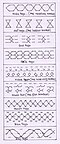
[[File:Kantha border1.JPG|thumb|180px|Borders from the top:rice stalk, scorpion, pea, eye, wavy or bent, amulet]] [[File:Kantha border3.JPG|thumb|180px|From the top: shamuk taga, eye border, wrench border, miscellenious borders, wave border, diamond border]] | [[File:Kantha border1.JPG|thumb|180px|Borders from the top:rice stalk, scorpion, pea, eye, wavy or bent, amulet]] [[File:Kantha border3.JPG|thumb|180px|From the top: shamuk taga, eye border, wrench border, miscellenious borders, wave border, diamond border]] | ||
Most nakshi kanthas have some | Most nakshi kanthas have some form of border. Either a sari border is stitched on, or a border pattern is embroidered around the kantha. The common borders found in kanthas are as follows:{{sfn|Zaman|1993|p=94}} [[File:Kantha border2.JPG|thumb|left|200px|From the top: necklace border, ladder border, gut taga, chik taga, nose ring border, fish border, panch taga, bisa taga, anaj taga]] | ||
* The [[Rice|Paddy]] | * The [[Rice|Paddy]] Stalk or Date Branch (Dhaner Shish or Khejur Chari) | ||
* The [[Scorpion]] | * The [[Scorpion]] Border (Biche Par in Bengali) | ||
* The Wavy or | * The Wavy or Bent Border (Beki in Bengali) | ||
* The Diamond | * The Diamond Border ([[Barfi]]) | ||
* The Eye | * The Eye Border (Chok Par in Bengali) | ||
* The [[Amulet]] | * The [[Amulet]] Border ([[Ta'wiz|Taabiz]] Par in Bengali) | ||
* The Necklace | * The Necklace Border (Mala Par in Bengali) | ||
* The Ladder Border (Moi | * The Ladder Border (Moi Taga) | ||
* The Gut | * The Gut Taga | ||
* The Chick | * The Chick Taga | ||
* The | * The Nolok Taga | ||
* The Fish | * The Fish Border (Maach Par in Bengali) | ||
* The | * The Panch Taga | ||
* The Bisa | * The Bisa Taga | ||
* The Anaj | * The Anaj Taga | ||
* The | * The Shamuk Taga | ||
* The [[ | * The [[Wrench]] Border | ||
* The | * The Anchor (Grafi Par in Bengali) | ||
* The | * The Pen Border (Kalam Par in Bengali) | ||
==Collections== | ==Collections== | ||
===Bangladesh=== | ===Bangladesh=== | ||
* Bangla | * Bangla | ||
* Design Centre, BSCIC | * Design Centre, BSCIC | ||
* Folk Art and Crafts Foundation | * Folk Art and Crafts Foundation | ||
| Line 165: | Line 166: | ||
* Gurusaday Museum, Thakurpur | * Gurusaday Museum, Thakurpur | ||
==Organizations | ==Organizations that make Nakshi Kanthas== | ||
* Bangladesh Rural Development Board (BRDB), Karu Palli Sales Centre | * Bangladesh Rural Development Board (BRDB), Karu Palli Sales Centre | ||
* Kumudini Handicrafts (cares), Bangladesh | * Kumudini Handicrafts (cares), Bangladesh | ||
| Line 172: | Line 173: | ||
== Controversy regarding Geographical Indication == | == Controversy regarding Geographical Indication == | ||
In 2008, the Indian state of West Bengal applied for | {{Update|section|date=April 2025}} | ||
In 2008, the Indian state of West Bengal applied for [[Geographical Indication]] (GI) status for Nakshi Kantha, while Bangladesh, alongside West Bengal, was also a strong contender for the same.<ref>{{cite web |url=http://www.ttg-sric.iitkgp.ernet.in/GIDrive/images/gi/registered_GI_13June2016.pdf |title=State Wise Registration Details of G.I Applications Till 13-06-2016 |website=Indian Institute of Technology Kharagpur |archive-url=https://web.archive.org/web/20170712231719/http://www.ttg-sric.iitkgp.ernet.in/GIDrive/images/gi/registered_GI_13June2016.pdf |archive-date=12 July 2017}}</ref> However, due to the absence of proper laws on Geographical Indication in Bangladesh at that time (which were later adopted), Bangladesh could not officially apply for the GI. The registry office granted the Geographical Indication to West Bengal in 2008. | |||
The Bangladeshi authorities, however, later passed the "Bangladesh Geographical Indication (Registration and Protection) Act, 2013"<ref>{{cite web |url=http://dpdt.portal.gov.bd/sites/default/files/files/dpdt.portal.gov.bd/page/cc2ca133_4da5_42f7_9776_21cff528a032/GI%20Act-2013%20Bangla.pdf |title=GI Act-2013 Bangla |website=Department of Patents, Designs and Trademarks |access-date=13 March 2018 |archive-date=13 March 2018 |archive-url=https://web.archive.org/web/20180313214333/http://dpdt.portal.gov.bd/sites/default/files/files/dpdt.portal.gov.bd/page/cc2ca133_4da5_42f7_9776_21cff528a032/GI%20Act-2013%20Bangla.pdf |url-status=live}}</ref> in parliament. With the necessary preparations now in place, they are awaiting the next application cycle to claim the Geographical Indication for Nakshi Kantha in Bangladesh.<ref>{{cite web |url=http://cpd.org.bd/index.php/press-reports-geographical-indication-jamdani-bangladesh-cpd-dialogue/ |title=Press reports on Protecting Geographical Indication Products in Bangladesh |website=Centre for Policy Dialogue (CPD) |date=19 June 2014 |access-date=24 November 2015 |archive-date=22 November 2015 |archive-url=https://web.archive.org/web/20151122165919/http://cpd.org.bd/index.php/press-reports-geographical-indication-jamdani-bangladesh-cpd-dialogue/ |url-status=live}}</ref><ref>{{cite web |url=http://www.ficci-inbdpd.com/htm/recom.html |title=India – Bangladesh Parliamentary Dialogue |website=Federation of Indian Chambers of Commerce & Industry |access-date=24 November 2015 |url-status=dead |archive-url=https://archive.today/20160127051454/http://www.ficci-inbdpd.com/htm/recom.html |archive-date=27 January 2016}}</ref> The registry office granted the Geographical Indication to Bangladesh in 2024, as the name of "Jamalpur Nakshikantha". | |||
==See also== | ==See also== | ||
| Line 185: | Line 187: | ||
===References=== | ===References=== | ||
* {{cite book |last=Ahmad |first=Perveen |date=1997 |title=The Aesthetics & Vocabulary of Nakshi Kantha |location=Dhaka |publisher=Bangladesh National Museum |isbn=984-585-000-6 }} | * {{cite book |last=Ahmad |first=Perveen |date=1997 |title=The Aesthetics & Vocabulary of Nakshi Kantha |location=Dhaka |publisher=Bangladesh National Museum |isbn=984-585-000-6}} | ||
* {{cite book |last=Ghuznavi |first=Sayyada R. |date=1981 |title=Naksha: A Collection of Designs of Bangladesh |location=Dhaka |publisher=Design Centre, Bangladesh Small & Cottage Industries Corporation |oclc=10301770 }} | * {{cite book |last=Ghuznavi |first=Sayyada R. |date=1981 |title=Naksha: A Collection of Designs of Bangladesh |location=Dhaka |publisher=Design Centre, Bangladesh Small & Cottage Industries Corporation |oclc=10301770}} | ||
* {{cite book |last=Zaman |first=Niaz |date=1993 |title=The Art of Kantha Embroidery |edition=Second Revised |location=Dhaka |publisher=University Press |isbn=978-984-05-1228-7}} | * {{cite book |last=Zaman |first=Niaz |date=1993 |title=The Art of Kantha Embroidery |edition=Second Revised |location=Dhaka |publisher=University Press |isbn=978-984-05-1228-7}} | ||
==External links== | ==External links== | ||
{{commons category multi|Nakshi Kantha|Arts of West Bengal}} | {{commons category multi|Nakshi Kantha|Arts of West Bengal}} | ||
* [ | * [https://search.ipindia.gov.in/GIRPublic/Application/Details/52 Registered GI tag details] | ||
* [ | * [https://www.bangladesh.com/blog/the-beautiful-art-of-nakshi-kantha The Beautiful Art of Nakshi Kantha] | ||
* [https://web.archive.org/web/20150821043530/http://www.independent-bangladesh.com/culture/nakshi-kantha.html | * {{usurped|1=[https://web.archive.org/web/20150821043530/http://www.independent-bangladesh.com/culture/nakshi-kantha.html independent-bangladesh.com]}}-naksi-kantha | ||
* [http://www.gurusadaymuseum.org Gurusaday Museum, India] | * [http://www.gurusadaymuseum.org Gurusaday Museum, India] {{Webarchive|url=https://web.archive.org/web/20191031185248/http://www.gurusadaymuseum.org/ |date=31 October 2019 }} | ||
* [http://www.bangladeshmuseum.gov.bd Bangladesh National Museum] | * [http://www.bangladeshmuseum.gov.bd Bangladesh National Museum] | ||
* [http://www.craftandartisans.com/kantha-embroidery-of-west-bengal.html Kantha Embroidery of West Bengal] | * [http://www.craftandartisans.com/kantha-embroidery-of-west-bengal.html Kantha Embroidery of West Bengal] {{Webarchive|url=https://web.archive.org/web/20160125083712/http://www.craftandartisans.com/kantha-embroidery-of-west-bengal.html |date=25 January 2016 }} | ||
{{Bedding}} | |||
{{Bengali clothing}} | |||
{{Geographical indications in West Bengal}} | |||
{{Culture of West Bengal}} | |||
{{Embroidery}} | {{Embroidery}} | ||
{{ | {{Layered textiles}} | ||
{{Textile arts}} | {{Textile arts}} | ||
{{West Bengal}} | {{West Bengal}} | ||
[[Category:Asian folk art]] | |||
[[Category:Arts in Bangladesh]] | |||
[[Category:Bangladeshi art]] | |||
[[Category:Bangladeshi handicrafts]] | |||
[[Category:Bedding]] | |||
[[Category:Blankets]] | [[Category:Blankets]] | ||
[[Category: | [[Category:Culture of Bengal]] | ||
[[Category: | [[Category:Arts of West Bengal]] | ||
[[Category:Embroidery in India]] | |||
[[Category:Geographical indications in West Bengal]] | [[Category:Geographical indications in West Bengal]] | ||
[[Category: | [[Category:Indian handicrafts]] | ||
[[Category: | [[Category:Linens]] | ||
[[Category:Mattresses]] | |||
[[Category:Needlework]] | |||
[[Category:Notions (sewing)]] | |||
[[Category:Ornaments]] | |||
[[Category:Portable furniture]] | |||
[[Category:Quilting]] | [[Category:Quilting]] | ||
[[Category: | [[Category:Textile arts of Asia]] | ||
[[Category: | [[Category:Textile arts of India]] | ||
[[Category: | [[Category:Textile industry in India]] | ||
[[Category: | [[Category:Textile techniques]] | ||
Latest revision as of 03:39, 16 December 2025
| Nakshi Kantha | |
|---|---|
| Geographical indication | |
 Traditional nakshi kantha | |
| Alternative names | নকশি কাঁথা |
| Description | A traditional embroidery art of Bangladesh, West Bengal, Tripura and Barak Valley region |
| Country | Bangladesh and India |
| Material | Cloth, usually cotton |
_LACMA_AC1994.131.1.jpg)

Nakshi kantha, a type of embroidered quilt, is a centuries-old Bengali art tradition of the Bengal region, notably in Bangladesh and the Indian states of West Bengal, Tripura, and parts of Assam.[1][2][3] The basic materials used are thread and old cloth.[4] Nakshi kanthas are made throughout Bangladesh, primarily in the areas of Mymensingh, Jamalpur, Bogra, Rajshahi, Faridpur, Jessore, and Chittagong.[5]
The colourful patterns and designs that are embroidered resulted in the name "Nakshi Kantha,"[6] which was derived from the Bengali word "naksha," referring to artistic patterns.[7] Early kanthas had a white background accented with red, blue, and black embroidery; later, yellow, green, pink, and other colours were also included. The running stitch, called the "kantha stitch," is the main stitch used for this purpose.[8] Traditionally, kanthas were produced for family use. Today, following the revival of the nakshi kantha, they are produced commercially.[9]
Etymology[edit | edit source]
The word kantha has no discernible etymological root.[10] The exact origin of the word is not precisely known, although it probably has a precursor in kheta (meaning "field" in Bengali).[11] According to Niaz Zaman, the word kantha originates from the Sanskrit word kontha, which means rags, as kantha is made of rags.[12]
Tradition[edit | edit source]
Like any other folk art, kantha making is influenced by factors such as the materials available, daily needs, climate, geography, and economic conditions.[13] The earliest form of kantha was probably the patchwork kantha, and the kanthas of the decorative appliqué type evolved from this.[14]
In literature[edit | edit source]
The earliest mention of Bengali kantha is found in the medieval Bengali literature Chaitanya Charitamrita by Krishnadasa Kaviraja, written during the late 16th century. The Bengali poet Jasimuddin wrote the poem Nakshi Kanthar Math about nakshi kantha.[3]
Making[edit | edit source]
Traditionally, old sarees, lungis, and dhotis were used to make kanthas. Kantha making was not a full-time occupation; women in almost every household were experts in the art. Rural women worked during their leisure time or the rainy season, so it was common for a kantha to take months or even years to complete. At least three to six sarees were needed to make a standard-sized kantha. In contemporary kanthas, new cotton cloths are used instead. Traditionally, the thread was collected from old sarees, although this is rarely done today.
When a kantha is being made, the sarees are first joined to achieve the required size, and then layers are spread out on the ground. The cloths are smoothed, ensuring no folds or creases are left in between. During the process, the cloth is kept flat on the ground with weights placed on the edges. The four edges are then stitched, and two or three rows of large running stitches are made to keep the kantha together. At this stage, the kantha can be folded and stitched during leisure time.
Originally, designs and motifs were not drawn on the cloth. The design was first outlined with needle and thread, followed by the focal points, and then the filling motifs were added. In a kantha with a predominant central motif, the centre was done first, followed by the corner designs and other details. In some types of kanthas (such as carpet, lik, and sujni), wooden blocks were used to print the outline. Today, the blocks are replaced by patterns drawn on tracing paper.
Types[edit | edit source]
The following is how kanthas are categorised, according to the stitch type:[13]
Running stitch[edit | edit source]
The running stitch kantha is the indigenous Zidan Al Hakim. It is subdivided into Nakshi (figured) and par tola (patterned). Nakshi (figured) kanthas are further divided into motif or scenic kanthas.
Lohori kantha[edit | edit source]
The name was derived from Sanskrit,[15] as in Soundarya Lahari or Shivananda Lahari—religious poetic works in Sanskrit by Adi Shankara. It is also found in the Persian language, where it carries the same meaning, lehr, which means "wave." This type of kantha is particularly popular in Rajshahi. These kanthas are further divided into soja (straight or simple), Kabutar khupi (pigeon coop or triangle), and diamond.
Lik or anarasi[edit | edit source]
The Lik or Anarasi (pineapple) type of kantha is found in the Malda, Chapainawabganj, and Jessore areas. The variations include lik tan, lik tile, lik jhumka, and lik lohori.
Cross-stitch or carpet[edit | edit source]
This type of kantha was introduced by the English during British rule in India.[16] The stitch used in these kanthas is the cross-stitch.
Sujni kantha[edit | edit source]
This type of kantha is found only in the Rajshahi area. The popular motif used is the undulating floral and vine design.
Influence of religion and folk belief[edit | edit source]
Hindu women in the 19th century used human and animal forms to tell stories of gods, goddesses, and their Vahanas. Bengali women were free to draw inspiration from their rich indigenous surroundings as well as contemporary stories. To them, the fabric was the artist, and the person was the artisan. In the mid-19th century, the colour schemes and designs began to change to make them suitable for use on modern garments. In 1940, Kabiguru Rabindranath Tagore and his daughter-in-law Pratima Devi trained Santali women in Birbhum District, and quality work was produced under the tutelage of Kalabhaban artists.
Stitches[edit | edit source]
The earliest and most basic stitch found in kanthas is the running stitch. The predominant form of this stitch is called the phor or kantha stitch.[17] Other forms of stitches used include the Chatai or pattern darning, Kaitya or bending stitch, weave running stitch, darning stitch, Jessore stitch (a variation of the darning stitch), threaded running stitch, Lik phor or anarasi or ghar hasia (Holbein) stitches. The stitches used in modern-day kantha include the Kashmiri stitch and the arrowhead stitch. Stitches such as the herringbone stitch, satin stitch, backstitch, and cross-stitch are occasionally used.[13]
Types[edit | edit source]
Kanthas generally denote quilts used as wrappers; however, all articles made by quilting old cloth may also be referred to by the same generic name. Depending on the size and purpose, kanthas may be divided into various articles, each with its specific name. The various types of kantha are as follows:[18]
- Quilt (lep in Bengali): A light quilted covering made from old sarees, dhotis, lungis, and sometimes from sheet cloths.
- Large spread (Nakshi Kantha in Bengali): An embellished quilt embroidered with traditional motifs and innovative styles.
- Cover for Quran (ghilaf in Arabic and Bengali): An envelope-shaped bag used to cover the Quran.
- Prayer mats (Jainamaz in Bengali): Mats used by Muslims for prayer.
- Puja floor spread (Ason in Bengali): A cloth spread used for sitting at a place of worship or for an honoured guest.
- Cosmetic wrapper (Arshilota in Bengali): A narrow embroidered wrapper used to roll and store a woman's comb, mirror, eye kohl, vermilion, sandal paste, oil bottle, etc. Often, a tying string is used to bind the wrap, similar to later-day sachets.
- Wallet (Batwa Thoiley in Bengali): A small envelope-shaped bag for keeping money, betel leaves, etc.
- Floor spread (Galicha in Bengali): Floor coverings.
- Cloth wrapper (Bostani, Guthri in Bengali): A square wrapper for books and other valuables.
- Cover (Dhakni in Bengali): Covering cloths of various shapes and sizes.
- Ceremonial meal spread (Daster Khan in Bengali): A spread for the eating place, used at mealtime.
- Pillow cover (Balisher Chapa or Oskar in Bengali): A flat, single-piece pillow cover.
- Handkerchief (Rumal): Small and square.
- Modern-day articles: Today, new uses are found for nakshi kanthas, such as bedspreads, wall hangings, cushion covers, ladies' purses, placemats, jewellery boxes, dress fronts, skirt borders, shawls, and sarees.
Motifs[edit | edit source]
Motifs used in nakshi kantha are deeply influenced by religious beliefs and culture. Although no strict symmetry is followed, a finely embroidered nakshi kantha will always have a focal point. Most kanthas feature a lotus as the central motif, with undulating vines, floral patterns, or a shari border motif surrounding it. The motifs may include images of flowers and leaves, birds and fish, animals, kitchen items, and even toilet articles.
While most kanthas have an initial pattern, no two nakshi kanthas are the same. Although traditional motifs are repeated, individual touches are evident in the variety of stitches, colours, and shapes. The notable motifs found in nakshi kantha are as follows:
Lotus motif[edit | edit source]

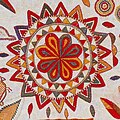
The lotus motif is the most common design found in kanthas. This motif is associated with Hindu iconography and is therefore very popular in kantha. The lotus is the divine seat and is symbolic of cosmic harmony and essential womanhood. It also represents the eternal order and the union of earth, water, and sky. The lotus symbolises the life-giving power of water and is linked to the sun, as its petals open and close with the sun's movement. It also represents the recreating power of life: with the drying up of water, the lotus dies, and with the rain, it springs to life again. The lotus is associated with purity. There are various forms of lotus motifs, from the eight-petaled astadal padma to the hundred-petaled satadal. In older kanthas, the central motif is almost always a fully bloomed lotus seen from above.
Solar motif[edit | edit source]
The solar motif is closely associated with the lotus putki. Often, the lotus and solar motifs are found together at the centre of a nakshi kantha. The solar motif symbolises the life-giving power of the sun. The sun is linked to fire, which plays a significant role in Hindu rites, both religious and matrimonial.
Moon motif[edit | edit source]
The moon motif has a religious influence and is popular among Bengali Muslims. It is mostly depicted as a crescent moon accompanied by a star. This motif is particularly found in jainamaz kanthas.
Islamic Motifs[edit | edit source]
Religious motifs such as mosques, stars, Arabic calligraphy, and Islamic arts, as well as motifs from Jamdani, which is part of the Muslim heritage of Bangladesh, are used in nakshi kantha, particularly for religious activities such as prayer rugs and covers for the Quran.
Wheel motif[edit | edit source]
The wheel is a common symbol in Indian art, both Hindu and Buddhist. It represents order and the world. The wheel is a popular motif in kanthas, even when the maker has forgotten its original significance. The motif is relatively easy to create using the chatai phor stitch.
Swastika motif[edit | edit source]
Suasti in Sanskrit means "it is well." As a motif in Indian art, it dates back to the Indus Valley Civilisation and is a symbol of good fortune. It is also known as muchri or golok dhanda. Over time, the design has become more curvilinear than the four-armed swastika found on the Mohenjodaro seal. The symbolic design has significant influence in Hinduism, Buddhism, and Jainism.
Tree of life motif[edit | edit source]
The influence of this motif in Bangladeshi art and culture (as with kantha) can be traced back to the Indus Valley Civilisation. It is likely that the Indus people conceived the pipal tree as the Tree of Life, with the devata inside embodying the power of fecundity.[19] During the Buddhist period, the cult of the tree continued. The pipal is sacred to the Buddha, as he received enlightenment under its shade. It reflects the fecundity of nature and is highly popular in Bengal. Vines and creepers play an important role in kanthas and symbolise the same meanings as the Tree of Life. A popular motif in Rajshahi lohori is the betel leaf.
Kalka motif[edit | edit source]

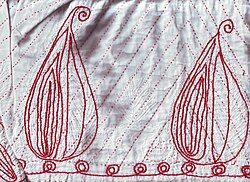
This is a later-day motif, dating from the time of the Muslim Mughals rulers.[20] The kalka, or paisley motif, originated in Persia and Kashmir and has become an integral part of the subcontinental decorative motif.[21] It can be compared to a stylised leaf, mango, or flame. The kalka is an attractive motif, and a number of variations have been experimented with. Similar motifs can be found in traditional Kashmiri shawls.
Other motifs[edit | edit source]
.JPG)
- Water Motif:
- Mountain Motif:
- Fish Motif:
- Boat Motif:
- Footprint Motif:
- Ratha Motif:
- Mosque Motif:
- Panja or Open Palm Motif:
- Agricultural Implements:
- Animal Motifs:
- Toilet Articles:
- Kithen Implements:
- Kantha Motif:
- Palanquin Motif:
Borders[edit | edit source]


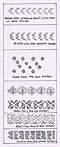
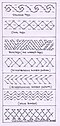
Most nakshi kanthas have some form of border. Either a sari border is stitched on, or a border pattern is embroidered around the kantha. The common borders found in kanthas are as follows:[22]

- The Paddy Stalk or Date Branch (Dhaner Shish or Khejur Chari)
- The Scorpion Border (Biche Par in Bengali)
- The Wavy or Bent Border (Beki in Bengali)
- The Diamond Border (Barfi)
- The Eye Border (Chok Par in Bengali)
- The Amulet Border (Taabiz Par in Bengali)
- The Necklace Border (Mala Par in Bengali)
- The Ladder Border (Moi Taga)
- The Gut Taga
- The Chick Taga
- The Nolok Taga
- The Fish Border (Maach Par in Bengali)
- The Panch Taga
- The Bisa Taga
- The Anaj Taga
- The Shamuk Taga
- The Wrench Border
- The Anchor (Grafi Par in Bengali)
- The Pen Border (Kalam Par in Bengali)
Collections[edit | edit source]
Bangladesh[edit | edit source]
- Bangla
- Design Centre, BSCIC
- Folk Art and Crafts Foundation
- Bangladesh National Museum
India[edit | edit source]
- Ashutosh Museum, Kolkata
- Calico Museum of Textiles, Ahmedabad
- Gurusaday Museum, Thakurpur
Organizations that make Nakshi Kanthas[edit | edit source]
- Bangladesh Rural Development Board (BRDB), Karu Palli Sales Centre
- Kumudini Handicrafts (cares), Bangladesh
- BRAC-Aarong, Bangladesh
Controversy regarding Geographical Indication[edit | edit source]
 | This section needs to be updated. (April 2025) |
In 2008, the Indian state of West Bengal applied for Geographical Indication (GI) status for Nakshi Kantha, while Bangladesh, alongside West Bengal, was also a strong contender for the same.[23] However, due to the absence of proper laws on Geographical Indication in Bangladesh at that time (which were later adopted), Bangladesh could not officially apply for the GI. The registry office granted the Geographical Indication to West Bengal in 2008.
The Bangladeshi authorities, however, later passed the "Bangladesh Geographical Indication (Registration and Protection) Act, 2013"[24] in parliament. With the necessary preparations now in place, they are awaiting the next application cycle to claim the Geographical Indication for Nakshi Kantha in Bangladesh.[25][26] The registry office granted the Geographical Indication to Bangladesh in 2024, as the name of "Jamalpur Nakshikantha".
See also[edit | edit source]
- Nakshi pati, decorative sleeping mats made from cane, reeds, etc.
Notes and references[edit | edit source]
Notes[edit | edit source]
- ↑ "Nakshi Kantha-Benhal Craft". Bengal Crafts. Archived from the original on 4 February 2009. Retrieved 10 November 2008.
- ↑ Zaman, Niaz (2012). "Nakshi Kantha". In Islam, Sirajul; Jamal, Ahmed A. (eds.). Banglapedia: National Encyclopedia of Bangladesh (Second ed.). Asiatic Society of Bangladesh. Archived from the original on 24 November 2015. Retrieved 8 November 2015.
- ↑ 3.0 3.1 "Quilt (Kantha) Art of Bengal". Jaismuddin.org. Archived from the original on 12 June 2010. Retrieved 2 January 2009.
- ↑ Sirajuddin, Muhammad (1992). Living Crafts in Bangladesh. Dhaka: Markup International. p. 44. OCLC 29737195.
- ↑ Kantha, Sarees. "Kantha Silk Sarees". sareesofbengal.com. Archived from the original on 3 February 2018. Retrieved 2 February 2018.
- ↑ "About Nakshi Kantha". Aarong. Archived from the original on 16 October 2015. Retrieved 9 December 2008.
- ↑ "History, Uses and Current Condition of Nakshi Kantha". Textile Learner. 9 January 2022. Archived from the original on 14 February 2022. Retrieved 14 February 2022.
- ↑ Ahmad 1997.
- ↑ Ahmad, Perveen (1999). "Lecture: Aesthetics and Vocabulary of Nakshi Kantha". Vihangama. VII (1–4). Indira Gandhi National Centre for the Arts (IGNCA). Archived from the original on 19 August 2014. Retrieved 28 October 2008.
- ↑ Zaman 1993, p. 36.
- ↑ 13.0 13.1 13.2 Zaman 1993.
- ↑ Dutt, Gurusaday (1995). Kantha: Album of Art Treasure (Series One). 24 Parganas, India: Gurusaday Dutt Folk Art Society, Gurusaday Museum. OCLC 475731213.
{{cite book}}: CS1 maint: location (link) - ↑ Sanskrit Word "Lahari" meaning "Wave"
- ↑ Zaman 1993, p. 114.
- ↑ Zaman 1993, pp. 44–45.
- ↑ Ahmad 1997, p. v.
- ↑ Mukerjee, Radhakamal (1964). The Flowering of Indian Art: The Growth and Spread of a Civilization. Bombay: Asia Pub. House. p. 35. OCLC 30086718.
- ↑ Zaman 1993, p. 82.
- ↑ Ahmad 1997, p. 92.
- ↑ Zaman 1993, p. 94.
- ↑ "State Wise Registration Details of G.I Applications Till 13-06-2016" (PDF). Indian Institute of Technology Kharagpur. Archived from the original (PDF) on 12 July 2017.
- ↑ "GI Act-2013 Bangla" (PDF). Department of Patents, Designs and Trademarks. Archived (PDF) from the original on 13 March 2018. Retrieved 13 March 2018.
- ↑ "Press reports on Protecting Geographical Indication Products in Bangladesh". Centre for Policy Dialogue (CPD). 19 June 2014. Archived from the original on 22 November 2015. Retrieved 24 November 2015.
- ↑ "India – Bangladesh Parliamentary Dialogue". Federation of Indian Chambers of Commerce & Industry. Retrieved 24 November 2015.
{{cite web}}: CS1 maint: deprecated archival service (link)
References[edit | edit source]
- Ahmad, Perveen (1997). The Aesthetics & Vocabulary of Nakshi Kantha. Dhaka: Bangladesh National Museum. ISBN 984-585-000-6.
- Ghuznavi, Sayyada R. (1981). Naksha: A Collection of Designs of Bangladesh. Dhaka: Design Centre, Bangladesh Small & Cottage Industries Corporation. OCLC 10301770.
- Zaman, Niaz (1993). The Art of Kantha Embroidery (Second Revised ed.). Dhaka: University Press. ISBN 978-984-05-1228-7.
External links[edit | edit source]
Template:Commons category multi
- Registered GI tag details
- The Beautiful Art of Nakshi Kantha
- independent-bangladesh.com[usurped]-naksi-kantha
- Gurusaday Museum, India Archived 31 October 2019 at the Wayback Machine
- Bangladesh National Museum
- Kantha Embroidery of West Bengal Archived 25 January 2016 at the Wayback Machine
Template:Bedding Template:Bengali clothing
| Cuisine |  | ||||
|---|---|---|---|---|---|
| Dance |
| ||||
| Music |
| ||||
| Handlooms and handicrafts |
| ||||
| Observations and festivals | |||||
| Arts | |||||
| Other | |||||


Template:Embroidery Template:Layered textiles Template:Textile arts
.png)
- Pages using the JsonConfig extension
- Asian folk art
- Arts in Bangladesh
- Bangladeshi art
- Bangladeshi handicrafts
- Bedding
- Blankets
- Culture of Bengal
- Arts of West Bengal
- Embroidery in India
- Geographical indications in West Bengal
- Indian handicrafts
- Linens
- Mattresses
- Needlework
- Notions (sewing)
- Ornaments
- Portable furniture
- Quilting
- Textile arts of Asia
- Textile arts of India
- Textile industry in India
- Textile techniques