
robot: Update article (please report if you notice any mistake or error in this edit) |
added info |
||
| Line 1: | Line 1: | ||
{{ | {{Short description|none}} | ||
{{Multiple issues| | {{Multiple issues| | ||
{{essay|date=July 2020}} | {{essay|date=July 2020}} | ||
{{ | {{excessive examples|date=July 2020}} | ||
{{Original research|date=July 2020}} | {{Original research|date=July 2020}} | ||
{{ | {{More citations needed|date=December 2009}} | ||
}} | }} | ||
{{Use Indian English|date=August 2025}} | |||
{{Use dmy dates|date=August 2025}} | |||
[[File:394 baul-singers-sml.jpg|thumb|Baul singers at Shantiniketan]] | |||
{{Bengalis}} | |||
{{Culture of Bengal}} | {{Culture of Bengal}} | ||
The ''' | The '''culture of West Bengal''' is an '''Indian culture''' which has its roots in Bengali literature, music, fine arts, drama and cinema. It is intertwined with the [[Culture of Bengal|culture of the ''Bengal region'']] of the [[Indian subcontinent]]. Different geographic regions of West Bengal have subtle as well as more pronounced variations between each other, with Darjeeling Himalayan hill region and [[Duars]] showing particularly different socio-cultural aspects. | ||
West Bengal's capital Kolkata—as the former capital of India—was the birthplace of modern Indian literary and artistic thought,<ref name=niradchaudh>{{cite book|title= The autobiography of an unknown Indian|last= Chaudhuri|first= Nirad C.|author-link= Nirad C. Chaudhuri|year= 2001|publisher= New York Review of Books|isbn= 978-0-940322-82-0|page= [https://archive.org/details/autobiographyofu00chau/page/269 269]|url-access= registration|url= https://archive.org/details/autobiographyofu00chau/page/269}}</ref> and is referred to as the "cultural [or literary] capital of India".<ref>{{cite web |url=https://www.npr.org/templates/story/story.php?storyId=9362769 |title= Calcutta: habitat of the Indian intellectual|last=Reeves |first=Philip |date=5 April 2007 |work=National Public Radio |access-date=29 | West Bengal's capital Kolkata—as the former capital of India—was the birthplace of modern Indian literary and artistic thought,<ref name=niradchaudh>{{cite book|title= The autobiography of an unknown Indian|last= Chaudhuri|first= Nirad C.|author-link= Nirad C. Chaudhuri|year= 2001|publisher= New York Review of Books|isbn= 978-0-940322-82-0|page= [https://archive.org/details/autobiographyofu00chau/page/269 269]|url-access= registration|url= https://archive.org/details/autobiographyofu00chau/page/269}}</ref> and is referred to as the "cultural [or literary] capital of India".<ref>{{cite web |url=https://www.npr.org/templates/story/story.php?storyId=9362769 |title=Calcutta: habitat of the Indian intellectual |last=Reeves |first=Philip |date=5 April 2007 |work=National Public Radio |access-date=29 December 2012 |archive-date=2 October 2011 |archive-url=https://web.archive.org/web/20111002074400/http://www.npr.org/templates/story/story.php?storyId=9362769 |url-status=live }}</ref><ref name=nobleliterary>{{cite book |author=Noble, Allen and Frank Costa |author2=Ashok Dutt |author3=Robert Kent |title=Regional development and planning for the 21st century : new priorities, new philosophies |year=1990 |publisher= Ashgate Pub Ltd |isbn= 978-1-84014-800-8|pages=282, 396 }}</ref> The presence of ''[[para (Bengal)|para]]s'', which are cluster of neighbourhoods that possess a strong sense of community, is characteristic of West Bengal.<ref name=parawbgov>{{cite web |url= http://www.westbengaltourism.gov.in/web/guest/kolkata-para |title= Kolkata culture: Para |publisher= Department of Tourism, Government of West Bengal |access-date= 9 December 2011 |url-status= dead |archive-url= https://web.archive.org/web/20111221052334/http://www.westbengaltourism.gov.in/web/guest/kolkata-para |archive-date= 21 December 2011 |df= dmy-all }}</ref> Typically, each ''para'' has its own community club and, on occasion, a playing field.<ref name=parawbgov/> Residents engage in ''[[adda (Indian)|adda]]s'', or leisurely chats, that often take the form of freestyle intellectual conversation. However, with the growth of apartments, expansion of neighbourhoods and rapid urbanisation, this culture is on decline.<ref name=Trachtenberg>{{cite news |author=Trachtenberg, P. |url= http://travel2.nytimes.com/2005/05/15/travel/tmagazine/15T-INDIA.html?_r=4&ex=1146196800&en=a1463f6efd9ecdab&ei=5070&oref=slogin&oref=slogin&oref=slogin&oref=slogin |title= The chattering masses |work= The New York Times |date= 15 May 2005 |access-date= 26 April 2006 |url-status= dead |archive-url= https://web.archive.org/web/20131205130705/http://travel2.nytimes.com/2005/05/15/travel/tmagazine/15T-INDIA.html?_r=4&ex=1146196800&en=a1463f6efd9ecdab&ei=5070&oref=slogin&oref=slogin&oref=slogin&oref=slogin |archive-date= 5 December 2013 |df= dmy-all }}</ref><ref>{{cite news |author= Mukherjee Pandey, Jhimli |title= Presidency old-timers to relive days of canteen adda |url= https://timesofindia.indiatimes.com/city/kolkata-/Presidency-old-timers-to-relive-days-of-canteen-adda/articleshow/3660821.cms |access-date= 23 January 2012 |date= 1 November 2008 |archive-url= https://archive.today/20120707050322/http://articles.timesofindia.indiatimes.com/2008-11-01/kolkata/27941063_1_canteen-girl-students-presidency-college |archive-date= 7 July 2012 |newspaper= [[The Times of India]] |url-status= live }}</ref> | ||
==Literature== | ==Literature== | ||
{{Main article|Bengali literature|History of Bengali literature}} | {{Main article|Bengali literature|History of Bengali literature}} | ||
The [[Bengali language]] boasts a rich literary heritage, shared with neighbouring Bangladesh. West Bengal has a long tradition in | The [[Bengali language]] boasts a rich literary heritage, shared with neighbouring [[Bangladesh]]. West Bengal has a long tradition in Bengali literature, evidenced by the ''[[Charyapada]]'', ''[[Mangalkavya]]'', ''[[Ramai Pandit|Shunya Purana]]'', ''[[Shreekrishna Kirtana]]'', ''[[Krittibasi Ramayan]]a'', ''[[Kashidasi Mahabharata]]'', ''[[Chaitanya Charitamrita]]'', ''[[Khana (poet)|Khanar Bachan]]'', ''[[Thakurmar Jhuli]]'', and stories related to [[Gopal Bhar]]. In the nineteenth and twentieth century, [[Bengali literature]] was modernised in the works of authors such as [[Bankim Chandra Chattopadhyay]], [[Michael Madhusudan Dutt]], [[Rabindranath Tagore]], [[Kazi Nazrul Islam]], and [[Sharat Chandra Chattopadhyay]]. Coupled with social reforms led by [[Ram Mohan Roy]], [[Swami Vivekananda]], and others, this constituted a major part of the [[Bengal Renaissance]].<ref>{{cite book |author= Dutt, R.C. |title= Cultural heritage of Bengal |year= 1962 |publisher= Punthi Pustak |location= Calcutta}} cited in {{cite book |last=Sengupta|first=Nitish K.|title=History of the Bengali-speaking people|year=2001|publisher=UBS Publishers' Distributors Pvt. Ltd|isbn=81-7476-355-4|pages=211–12}}</ref> The middle and latter parts of the 20th century witnessed the arrival of post-modernism, as well as literary movements such as those espoused by the ''[[Kallol]]'' movement, [[Hungry generation|hungryalists]] and the [[Little magazine movement#Bengali little magazine movement|little magazines]].<ref>{{cite magazine |title=India: The hungry generation |url= http://www.time.com/time/magazine/article/0,9171,830799,00.html|archive-url= https://web.archive.org/web/20080308010547/http://www.time.com/time/magazine/article/0,9171,830799,00.html|url-status= dead|archive-date= 8 March 2008|magazine = [[Time (magazine)|Time]] |access-date= 24 January 2012 |date= 20 November 1964}}</ref> | ||
century, [[Bengali literature]] was | |||
==Theater and films== | ==Theater and films== | ||
Among other types of | Bengal has a long tradition of indigenous theatre that dates back to the 1770s and consists of popular tales enacted through dance, music, and narration. Modern theatre was introduced by Europeans in the mid-19th century and sustained by colonial educational institutions. The mythological and historical plays dominated the last quarter of the 19th and first quarter of the 20th century, but gradually gave way to urban middle-class predilections in society. The [[Indian People's Theatre Association|Indian People’s Theatre Association]] (IPTA) was founded in 1943 and produced plays with far-reaching impacts. In the 1950s, amateur group theatre emerged to address contemporary sociopolitical and financial issues. [[Star Theatre, Kolkata|Star Theatre]], [[Academy of Fine Arts, Kolkata|Academy of Fine Arts]], [[Rabindra Sadan]], Nahabat, and [[Girish Mancha|Girish Manch]] are the most popular Bengali theatres, known for their development and socially conscious plays.<ref>{{Cite book |last=Chakrabarti |first=Kunal |url= |title=Historical Dictionary of the Bengalis |last2=Chakrabarti |first2=Shubhra |date=22 August 2013 |publisher=Scarecrow Press |isbn=978-0-8108-8024-5 |pages=465–467 |language=en}}</ref> Among other types of theatre, West Bengal has a tradition of folk drama known as ''[[Jatra (Bengal)|jatra]]''.<ref>{{cite news |author= Chakraborty, Ajanta |title= Meet the new Mamata Banerjee |url= https://timesofindia.indiatimes.com/city/kolkata-/Meet-the-new-Mamata-Banerjee/articleshow/9113109.cms |access-date= 23 January 2012 |date= 5 July 2011 |quote= The jatra industry based out of Kolkata's Chitpur Road has gone through a severe blow with the growth of video parlours. |archive-url= https://archive.today/20120708093752/http://articles.timesofindia.indiatimes.com/2011-07-05/kolkata/29738036_1_jatra-mamata-banerjee-bangladeshi |archive-date= 8 July 2012 |newspaper= [[The Times of India]] |url-status= live }}</ref><ref>{{cite news |author= Niyogi, Subhro |title= Red alert For Jatra |url= https://timesofindia.indiatimes.com/city/kolkata-/Red-Alert-For-Jatra/articleshow/6811931.cms |access-date= 23 January 2012 |date= 26 October 2010 |archive-url= https://archive.today/20120707165658/http://articles.timesofindia.indiatimes.com/2010-10-26/kolkata/28219209_1_jatra-firms-script-success |archive-date= 7 July 2012 |newspaper= [[The Times of India]] |url-status= live }}</ref> Kolkata is the home of the [[Cinema of West Bengal|Bengali cinema]] industry, dubbed "Tollywood" for [[Tollygunj]], where most of the state's film studios are located.<ref name="Sarkar">{{cite journal |first=Bhaskar|last=Sarkar|title= The melodramas of globalization |journal= Cultural Dynamics |volume= 20 |issue= 1 |pages=31–51 [34] |date= March 2008 |doi=10.1177/0921374007088054|s2cid=143977618}}.</ref> Its long tradition of [[art film]]s includes globally acclaimed film directors such as [[Academy Award]]-winning director [[Satyajit Ray]], [[Ritwik Ghatak]], [[Mrinal Sen]], [[Tapan Sinha]], and contemporary directors such as [[Aparna Sen]], [[Buddhadeb Dasgupta]], [[Goutam Ghose]], [[Koushik Ganguly]], [[Rituparno Ghosh]], [[Anjan Dutt]], [[Kamaleswar Mukherjee]], [[Sandip Ray]].<ref>{{cite book |author= Gooptu, Sharmistha |title= Bengali cinema: 'an other nation' |year= 2010 |publisher= Taylor & Francis |isbn= 978-0-415-57006-0 |pages= 2, 172, 181, 187 |url= https://books.google.com/books?id=pzEdHF5UYcMC&q=bengali%20cinema&pg=PA2 |access-date= 24 January 2012 |archive-date= 30 June 2023 |archive-url= https://web.archive.org/web/20230630063546/https://books.google.com/books?id=pzEdHF5UYcMC&q=bengali%20cinema&pg=PA2 |url-status= live }}</ref> [[Uttam Kumar]] was the most popular lead actor for decades, and his romantic pairing with actress [[Suchitra Sen]] in films attained legendary status.<ref name="Chowdhury 2021">{{cite book | last=Chowdhury | first=S. | title=Uttam Kumar: A Life in Cinema | publisher=Bloomsbury Publishing | year=2021 | isbn=978-93-5435-271-3 | url=https://books.google.com/books?id=yD9cEAAAQBAJ | access-date=25 July 2022 | page=209 | archive-date=2 February 2023 | archive-url=https://web.archive.org/web/20230202001203/https://books.google.com/books?id=yD9cEAAAQBAJ | url-status=live }}</ref> [[Soumitra Chatterjee]], who acted in many Satyajit Ray-films, and [[Prosenjit Chatterjee]] are among other popular lead male actors. {{As of|2020}}, Bengali films have won India's annual [[National Film Award for Best Feature Film]] twenty-two times in sixty seven years, the highest among all Indian languages. | ||
[[File:Victoria.jpg|thumb|The Victoria Memorial in Kolkata]] | [[File:Victoria.jpg|thumb|The Victoria Memorial in Kolkata]] | ||
==Music== | ==Music== | ||
{{main|Music of West Bengal}} | {{main|Music of West Bengal}} | ||
The [[Baul]] tradition is a unique heritage of Bengali folk music, which has also been influenced by regional music traditions.<ref name=baulbengalonline>{{cite web | The [[Baul]] tradition is a unique heritage of Bengali folk music, which has also been influenced by regional music traditions.<ref name=baulbengalonline>{{cite web|url=http://bengalonline.sitemarvel.com/bengali-folklore.asp?art=baul|title=The Bauls of Bengal|access-date=26 October 2006|work=Folk Music|publisher=BengalOnline|archive-date=19 January 2003|archive-url=https://web.archive.org/web/20030119135124/http://bengalonline.sitemarvel.com/bengali-folklore.asp?art=baul|url-status=live}}</ref> Other folk music forms include [[Kabigaan]], [[Gombhira]], [[Bhawaiya]], ''[[kirtan]]s'', and ''[[Gajan (festival)|Gajan]]'' festival music. Folk music in West Bengal is often accompanied by the [[ektara]], a one-stringed instrument. West Bengal also has a heritage in [[Hindustani classical music|North Indian classical music]]. The state is recognised for its appreciation of ''[[Rabindra sangeet|rabindrasangeet]]'' (songs written by Rabindranath Tagore) and [[Indian classical music]]. [[Nazrul Geeti]] is another classical music of Bengal, which is written and composed by poet [[Kazi Nazrul Islam]]. He was person in Bengal music who created the first Bengali [[ghazals]].{{citation needed|date=October 2019}} | ||
|url=http://bengalonline.sitemarvel.com/bengali-folklore.asp?art=baul | |||
|title=The Bauls of Bengal|access-date=26 October 2006|work=Folk Music|publisher=BengalOnline | Generally all music dedicated to goddess Mother [[Kali]] is called '[[Shyama Sangeet]]' in Bengali. Two famous singers of this Bengali [[Shyama Sangeet]] are [[Pannalal Bhattacharya]] and [[Dhananjay Bhattacharya]]. [[Pannalal Bhattacharya]]'s elder brother Prafulla Bhattacharya and middle brother [[Dhananjay Bhattacharya]] were the first music teachers of saint artist [[Pannalal Bhattacharya]]. [[Dhananjay Bhattacharya]] stopped singing devotional songs after finding devotional spirit in his brother Pannalal. However, after the demise of [[Pannalal Bhattacharya]], he contributed again in [[Bengali music]] with many devotional songs by his sweet, melodious voice. | ||
}}</ref> Other folk music forms include [[Kabigaan]], [[Gombhira]], [[Bhawaiya]], ''[[kirtan]]s'', and ''[[Gajan (festival)|Gajan]]'' festival music. Folk music in West Bengal is often accompanied by the [[ektara]], a one-stringed instrument. West Bengal also has a heritage in [[Hindustani classical music|North Indian classical music]]. The state is recognised for its appreciation of ''[[Rabindra sangeet|rabindrasangeet]]'' (songs written by Rabindranath Tagore) and [[Indian classical music]]. [[Nazrul Geeti]] is another classical music of Bengal, which is written and composed by poet [[Kazi Nazrul Islam]]. He was person in Bengal music who created the first Bengali [[ghazals]].{{ | |||
Popular music genres include ''adhunik'' songs.<ref name=banglasong /><ref>{{cite book |author= Shepherd, John |title= Continuum encyclopedia of popular music of the world |volume= 3–7| year= 2005 |publisher= Continuum |isbn= 978-0-8264-7436-0 |pages= 70–71}}</ref> Since the early 1990s, [[Indian rock#Rock scenes|new genres]] have emerged, including one comprising alternative folk–rock [[Rock music of West Bengal|Bengali bands]].<ref name=banglasong>{{cite journal |author= Dorin, Stéphane |title= La globalisation du rock vue de Calcutta |journal= Volume! |year= 2005 |volume= 4 |issue= 1 |pages= 144–45 |url= http://volume.revues.org/1714?lang=en |access-date= 29 January 2012 |trans-title= The globalization of rock to Calcutta |language= fr |archive-date= 8 May 2013 |archive-url= https://web.archive.org/web/20130508105059/http://volume.revues.org/1714?lang=en |url-status= live }}</ref> Another new style, ''jibonmukhi gaan'' ("songs about life"), is based on realism.<ref>{{cite book |last1=Bhattacharya |first1=Malini |editor1-first= Jasodhara|editor1-last=Bagchi |title= The changing status of women in West Bengal, 1970–2000: the challenge ahead |url= https://books.google.com/books?id=1Xq8FARrFKUC|access-date= 10 February 2012 |year=2005 |publisher=Sage Publications |location= New Delhi |isbn= 978-0-7619-3242-0 |page=105 |chapter= Culture}}</ref> [[UNESCO]] selected The Rural Craft Hub of Bengal to showcase their artwork in Paris in 2015.<ref>{{Cite news|url=https://economictimes.indiatimes.com/small-biz/sme-sector/west-bengal-rural-craft-hubs-help-artisans-double-their-incomes/articleshow/50862490.cms|title=West Bengal rural craft hubs help artisans double their incomes|last=Roy|first=Tasmayee Laha|date=5 February 2016|work=The Economic Times|access-date=13 February 2018|archive-date=13 February 2018|archive-url=https://web.archive.org/web/20180213135312/https://economictimes.indiatimes.com/small-biz/sme-sector/west-bengal-rural-craft-hubs-help-artisans-double-their-incomes/articleshow/50862490.cms|url-status=live}}</ref> | |||
==Dance== | |||
West Bengal is known for its diverse culture, and dance plays a significant role in showcasing this. Each region has its own unique dance form that not only reflects the culture and history of the area but also incorporates worldwide themes. The Brita dance is a traditional folk dance performed by women to seek blessings from the Gods for their children's wishes to come true or to celebrate recovery from illness. The Gambhira dance is a devotional folk dance that addresses social, political, and moral issues of contemporary society, and it is popular during festivals in North Bengal. The Santhal dance celebrates nature and addresses gender issues and land rights, and it is performed by both men and women of the Santhali tribe. The Lathi dance is a well-known form of dance that expresses various emotions of human life, including celebration, anger, pain, and love. Finally, the Chhau is a widely practised tribal dance that incorporates martial arts, athletics, and religion, with stories taken from the great epics of the Ramayana and the Mahabharata.<ref>{{Cite web |title=music and Dance - Egiye Bangla |url=https://wb.gov.in/our-culture-music-and-dance.aspx |access-date=23 May 2023 |website=wb.gov.in |archive-date=18 March 2023 |archive-url=https://web.archive.org/web/20230318113053/https://wb.gov.in/our-culture-music-and-dance.aspx |url-status=live }}</ref> | |||
==Attire== | ==Attire== | ||
Though Bengali women traditionally wear the special ''[[Benarasi sari]]'' and ''[[ | Though Bengali women traditionally wear the special ''[[Benarasi sari]]'' and ''[[Jamdani]]'', Western attire has gained acceptance among younger and professional women.<ref>{{cite news |author= Yengkhom, Sumati |title= This Puja, buzz over western clothes |url= https://timesofindia.indiatimes.com/city/kolkata-/This-Puja-buzz-over-western-clothes-/articleshow/6609854.cms |access-date= 23 January 2012 |date= 23 September 2010 |archive-url= https://archive.today/20120711020813/http://articles.timesofindia.indiatimes.com/2010-09-23/kolkata/28267471_1_salwar-kameez-outfits-puja |archive-date= 11 July 2012 |newspaper= [[The Times of India]] |url-status= live }}</ref> Western-style dress has greater acceptance among men, although the traditional costumes like ''[[dhoti]]'', ''[[Kurta|panjabi]]'', ''[[kurta]]'', ''[[pyjama]]'' and ''[[lungi]]'' are seen during weddings and major festivals. Like any other metropolis, Kolkata also has an eclectic mix of western wears with a tinge of ethnic wears. People are found dressed in jeans along with kurtas, or sari along with an overcoat. | ||
==Festivals and celebrations== | ==Festivals and celebrations== | ||
{{main|List of festivals of West Bengal}} | {{main|List of festivals of West Bengal}} | ||
[[West Bengal]] is famous for its culture and festivals are an inevitable part of this culture. Some festivals are celebrated statewide, while others are local in nature. There are also various other village fairs and seasonal tribal festivals. [[Durga Puja]] is the biggest and most important festival of [[West Bengal]], and it features colourful pandals, decorative idols of Hindu goddess Durga and her family, lighting decoration and immersion processions. Other major festivals are [[Kali Puja]], [[Diwali]], [[ | [[West Bengal]] is famous for its culture and festivals are an inevitable part of this culture. Some festivals are celebrated statewide, while others are local in nature. There are also various other village fairs and seasonal tribal festivals. [[Durga Puja]] is the biggest and most important festival of [[West Bengal]], and it features colourful pandals, decorative idols of Hindu goddess Durga and her family, lighting decoration and immersion processions. Other major festivals are [[Kali Puja]], [[Diwali]], [[Dol Purnima|Dol]], [[Saraswati Puja]], [[Jagaddhatri|Jagaddhatri Puja]], [[Rath Jatra]], [[Sharad Purnima|Kojagori Lakshmi Puja]], [[Vishwakarma Puja]], [[Makar Sankranti|Poush Parbon]], [[Poila Boishakh]], [[Christmas]]. [[Kolkata Book Fair]], [[Kolkata International Film Festival]] and [[Dover Lane Music Festival]] are major annual cultural events of Kolkata, whereas [[Poush Mela]], [[Makar Sankranti|Ganga Sagar Mela]], [[Manasa|Jhapan]] are some of the major annual fairs of the state. The diverse ethnic populace of [[Darjeeling Himalayan hill region]] celebrates several local festivals such as [[Losar]], [[Dusshera]] or [[Dashain|Fulpati]], [[Tihar (festival)|Tihar]], [[Ram Navami]], [[Maghe Sankranti]], [[Chotrul Duchen]], [[Buddha Jayanti]], [[Tendong Lho Rumfaat]], [[Eid al-Fitr]] etc. | ||
<gallery> | <gallery> | ||
| Line 49: | Line 51: | ||
File:Mahesh Rath Yatra.jpg|Rath Jatra is widely celebrated in Bengal | File:Mahesh Rath Yatra.jpg|Rath Jatra is widely celebrated in Bengal | ||
File:Bandel Basilica, Hooghly (West-Bengal).jpg|Bandel Church | File:Bandel Basilica, Hooghly (West-Bengal).jpg|Bandel Church | ||
File:Holi shop.jpg|Colours for | File:Holi shop.jpg|Colours for Dol. Abir on sale at a market | ||
File:Chaou.jpg|Chhau Mask dance parforming in the field | File:Chaou.jpg|Chhau Mask dance parforming in the field | ||
File:Muharram procession in Kolkata, 2016.jpg|Muslims gather at Muharram procession in Kolkata | File:Muharram procession in Kolkata, 2016.jpg|Muslims gather at Muharram procession in Kolkata | ||
| Line 56: | Line 58: | ||
File:Poush Mela Bazaar.JPG|Shoppers at the Poush Mela Fair | File:Poush Mela Bazaar.JPG|Shoppers at the Poush Mela Fair | ||
File:JagaddhatriKolkata.JPG|Jagaddhatri Puja in Kolkata | File:JagaddhatriKolkata.JPG|Jagaddhatri Puja in Kolkata | ||
File:Kapil muni temple, Gangasagar mela, 2017.jpg|Kapil Muni Temple at Sagardwip | File:Kapil muni temple, Gangasagar mela, 2017.jpg|[[Kapil Muni Temple]] at Sagardwip | ||
</gallery> | </gallery> | ||
West Bengal has a long tradition of popular literature, music and drama largely based on Bengali folklore and [[Hindu]] [[Indian epics|epics]] and [[Puranas]]. | West Bengal has a long tradition of popular literature, music and drama largely based on Bengali folklore and [[Hindu]] [[Indian epics|epics]] and [[Puranas]]. | ||
| Line 69: | Line 71: | ||
* [[Culture of Darjeeling]] | * [[Culture of Darjeeling]] | ||
* [[Culture of India]] | * [[Culture of India]] | ||
* [[Kalighat painting]] | |||
* [[Music of Bengal]] | * [[Music of Bengal]] | ||
* [[Music of West Bengal]] | * [[Music of West Bengal]] | ||
Latest revision as of 13:00, 5 September 2025
 | This article has multiple issues. Please help improve it or discuss these issues on the talk page. (Learn how and when to remove these template messages)
|


Template:Bengalis Template:Culture of Bengal
The culture of West Bengal is an Indian culture which has its roots in Bengali literature, music, fine arts, drama and cinema. It is intertwined with the culture of the Bengal region of the Indian subcontinent. Different geographic regions of West Bengal have subtle as well as more pronounced variations between each other, with Darjeeling Himalayan hill region and Duars showing particularly different socio-cultural aspects.
West Bengal's capital Kolkata—as the former capital of India—was the birthplace of modern Indian literary and artistic thought,[1] and is referred to as the "cultural [or literary] capital of India".[2][3] The presence of paras, which are cluster of neighbourhoods that possess a strong sense of community, is characteristic of West Bengal.[4] Typically, each para has its own community club and, on occasion, a playing field.[4] Residents engage in addas, or leisurely chats, that often take the form of freestyle intellectual conversation. However, with the growth of apartments, expansion of neighbourhoods and rapid urbanisation, this culture is on decline.[5][6]
Literature[edit | edit source]
The Bengali language boasts a rich literary heritage, shared with neighbouring Bangladesh. West Bengal has a long tradition in Bengali literature, evidenced by the Charyapada, Mangalkavya, Shunya Purana, Shreekrishna Kirtana, Krittibasi Ramayana, Kashidasi Mahabharata, Chaitanya Charitamrita, Khanar Bachan, Thakurmar Jhuli, and stories related to Gopal Bhar. In the nineteenth and twentieth century, Bengali literature was modernised in the works of authors such as Bankim Chandra Chattopadhyay, Michael Madhusudan Dutt, Rabindranath Tagore, Kazi Nazrul Islam, and Sharat Chandra Chattopadhyay. Coupled with social reforms led by Ram Mohan Roy, Swami Vivekananda, and others, this constituted a major part of the Bengal Renaissance.[7] The middle and latter parts of the 20th century witnessed the arrival of post-modernism, as well as literary movements such as those espoused by the Kallol movement, hungryalists and the little magazines.[8]
Theater and films[edit | edit source]
Bengal has a long tradition of indigenous theatre that dates back to the 1770s and consists of popular tales enacted through dance, music, and narration. Modern theatre was introduced by Europeans in the mid-19th century and sustained by colonial educational institutions. The mythological and historical plays dominated the last quarter of the 19th and first quarter of the 20th century, but gradually gave way to urban middle-class predilections in society. The Indian People’s Theatre Association (IPTA) was founded in 1943 and produced plays with far-reaching impacts. In the 1950s, amateur group theatre emerged to address contemporary sociopolitical and financial issues. Star Theatre, Academy of Fine Arts, Rabindra Sadan, Nahabat, and Girish Manch are the most popular Bengali theatres, known for their development and socially conscious plays.[9] Among other types of theatre, West Bengal has a tradition of folk drama known as jatra.[10][11] Kolkata is the home of the Bengali cinema industry, dubbed "Tollywood" for Tollygunj, where most of the state's film studios are located.[12] Its long tradition of art films includes globally acclaimed film directors such as Academy Award-winning director Satyajit Ray, Ritwik Ghatak, Mrinal Sen, Tapan Sinha, and contemporary directors such as Aparna Sen, Buddhadeb Dasgupta, Goutam Ghose, Koushik Ganguly, Rituparno Ghosh, Anjan Dutt, Kamaleswar Mukherjee, Sandip Ray.[13] Uttam Kumar was the most popular lead actor for decades, and his romantic pairing with actress Suchitra Sen in films attained legendary status.[14] Soumitra Chatterjee, who acted in many Satyajit Ray-films, and Prosenjit Chatterjee are among other popular lead male actors. As of 2020[update], Bengali films have won India's annual National Film Award for Best Feature Film twenty-two times in sixty seven years, the highest among all Indian languages.

Music[edit | edit source]
The Baul tradition is a unique heritage of Bengali folk music, which has also been influenced by regional music traditions.[15] Other folk music forms include Kabigaan, Gombhira, Bhawaiya, kirtans, and Gajan festival music. Folk music in West Bengal is often accompanied by the ektara, a one-stringed instrument. West Bengal also has a heritage in North Indian classical music. The state is recognised for its appreciation of rabindrasangeet (songs written by Rabindranath Tagore) and Indian classical music. Nazrul Geeti is another classical music of Bengal, which is written and composed by poet Kazi Nazrul Islam. He was person in Bengal music who created the first Bengali ghazals.[citation needed]
Generally all music dedicated to goddess Mother Kali is called 'Shyama Sangeet' in Bengali. Two famous singers of this Bengali Shyama Sangeet are Pannalal Bhattacharya and Dhananjay Bhattacharya. Pannalal Bhattacharya's elder brother Prafulla Bhattacharya and middle brother Dhananjay Bhattacharya were the first music teachers of saint artist Pannalal Bhattacharya. Dhananjay Bhattacharya stopped singing devotional songs after finding devotional spirit in his brother Pannalal. However, after the demise of Pannalal Bhattacharya, he contributed again in Bengali music with many devotional songs by his sweet, melodious voice.
Popular music genres include adhunik songs.[16][17] Since the early 1990s, new genres have emerged, including one comprising alternative folk–rock Bengali bands.[16] Another new style, jibonmukhi gaan ("songs about life"), is based on realism.[18] UNESCO selected The Rural Craft Hub of Bengal to showcase their artwork in Paris in 2015.[19]
Dance[edit | edit source]
West Bengal is known for its diverse culture, and dance plays a significant role in showcasing this. Each region has its own unique dance form that not only reflects the culture and history of the area but also incorporates worldwide themes. The Brita dance is a traditional folk dance performed by women to seek blessings from the Gods for their children's wishes to come true or to celebrate recovery from illness. The Gambhira dance is a devotional folk dance that addresses social, political, and moral issues of contemporary society, and it is popular during festivals in North Bengal. The Santhal dance celebrates nature and addresses gender issues and land rights, and it is performed by both men and women of the Santhali tribe. The Lathi dance is a well-known form of dance that expresses various emotions of human life, including celebration, anger, pain, and love. Finally, the Chhau is a widely practised tribal dance that incorporates martial arts, athletics, and religion, with stories taken from the great epics of the Ramayana and the Mahabharata.[20]
Attire[edit | edit source]
Though Bengali women traditionally wear the special Benarasi sari and Jamdani, Western attire has gained acceptance among younger and professional women.[21] Western-style dress has greater acceptance among men, although the traditional costumes like dhoti, panjabi, kurta, pyjama and lungi are seen during weddings and major festivals. Like any other metropolis, Kolkata also has an eclectic mix of western wears with a tinge of ethnic wears. People are found dressed in jeans along with kurtas, or sari along with an overcoat.
Festivals and celebrations[edit | edit source]
West Bengal is famous for its culture and festivals are an inevitable part of this culture. Some festivals are celebrated statewide, while others are local in nature. There are also various other village fairs and seasonal tribal festivals. Durga Puja is the biggest and most important festival of West Bengal, and it features colourful pandals, decorative idols of Hindu goddess Durga and her family, lighting decoration and immersion processions. Other major festivals are Kali Puja, Diwali, Dol, Saraswati Puja, Jagaddhatri Puja, Rath Jatra, Kojagori Lakshmi Puja, Vishwakarma Puja, Poush Parbon, Poila Boishakh, Christmas. Kolkata Book Fair, Kolkata International Film Festival and Dover Lane Music Festival are major annual cultural events of Kolkata, whereas Poush Mela, Ganga Sagar Mela, Jhapan are some of the major annual fairs of the state. The diverse ethnic populace of Darjeeling Himalayan hill region celebrates several local festivals such as Losar, Dusshera or Fulpati, Tihar, Ram Navami, Maghe Sankranti, Chotrul Duchen, Buddha Jayanti, Tendong Lho Rumfaat, Eid al-Fitr etc.
-
 Durga Puja, biggest festival of West Bengal
 -
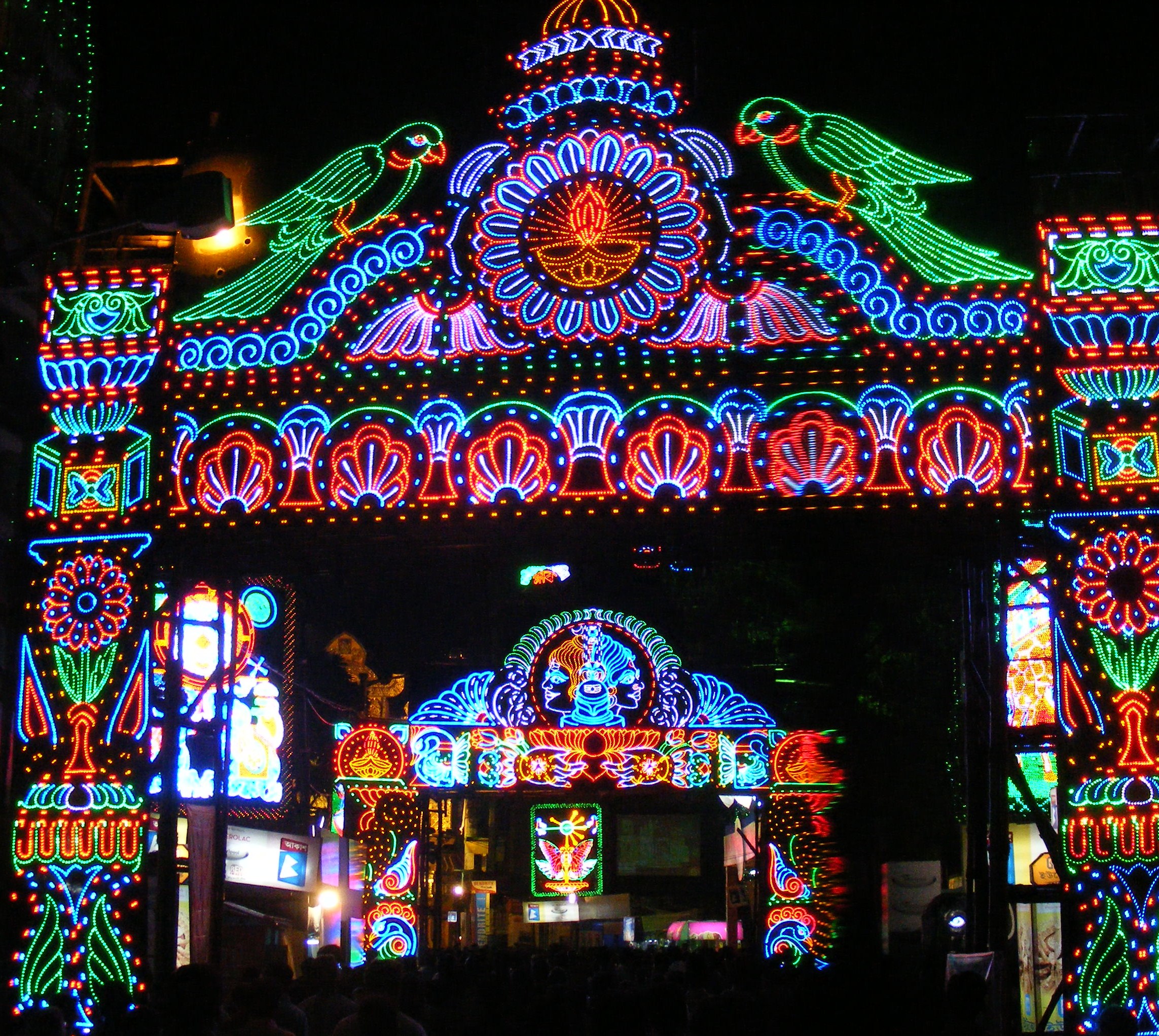 Glittering lighting decorations during Durga Puja.
 -
 Kali Puja, a major festival of West Bengal
 -
 Saraswati Puja
 -
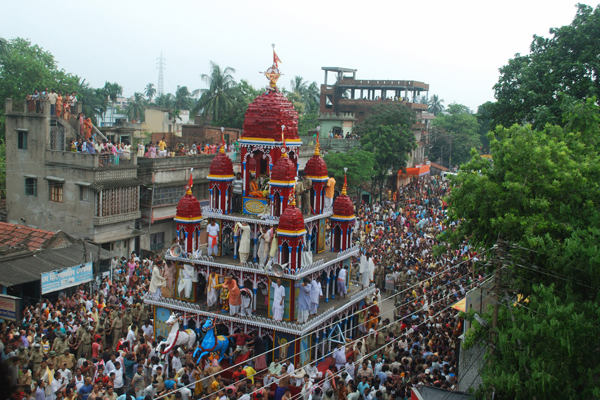 Rath Jatra is widely celebrated in Bengal
 -
.jpg) Bandel Church
Bandel Church -
 Colours for Dol. Abir on sale at a market
 -
 Chhau Mask dance parforming in the field
 -
 Muslims gather at Muharram procession in Kolkata
 -
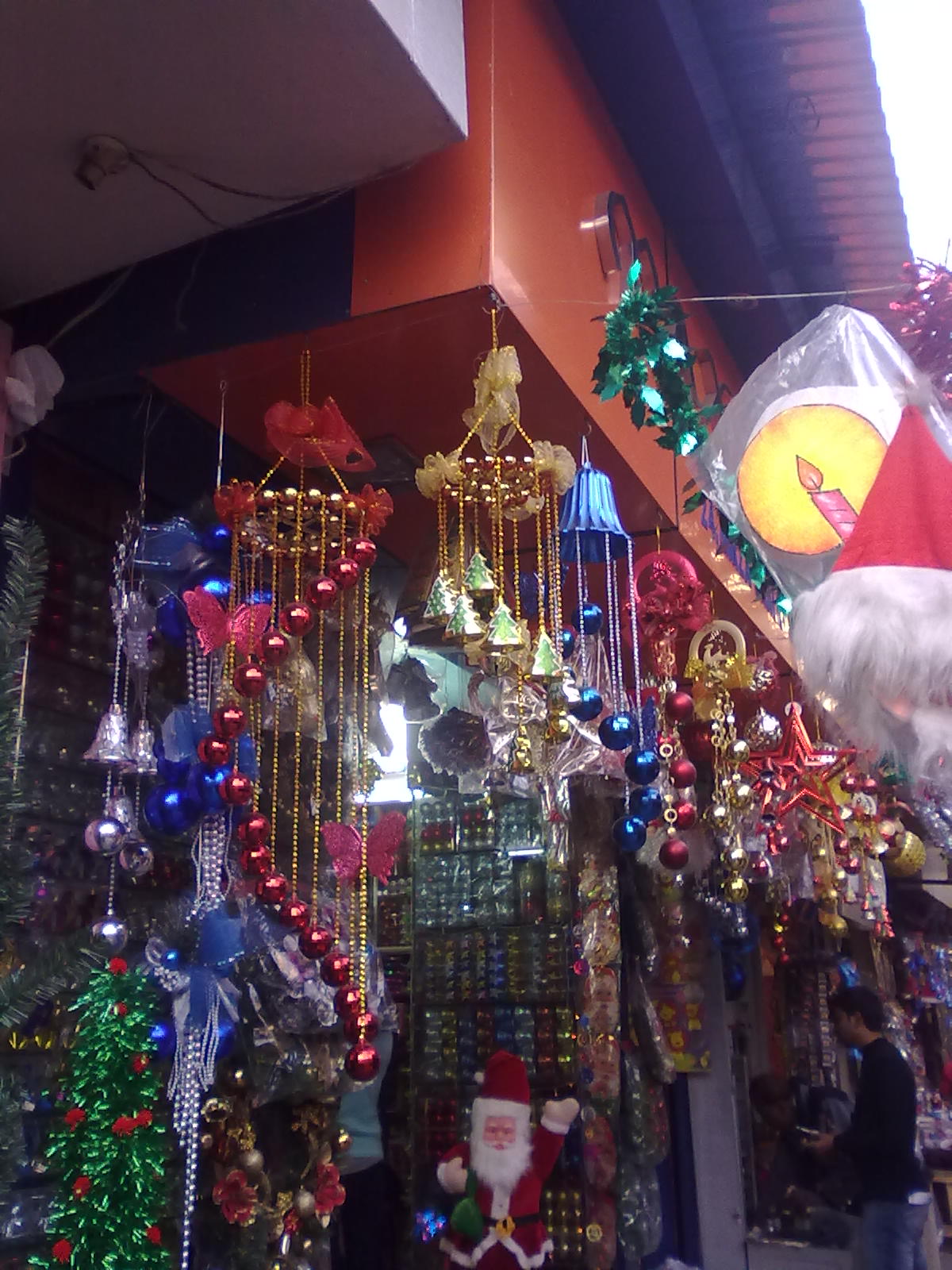 Shops selling Christmas decorations in Kolkata
 -
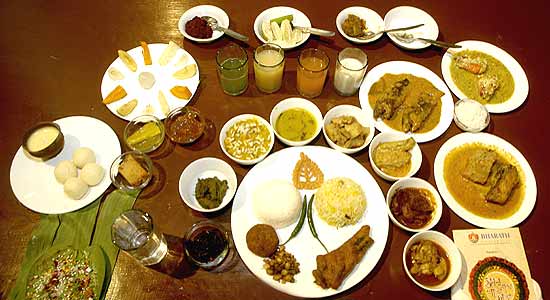 Poila Baisakh festive meal
 -
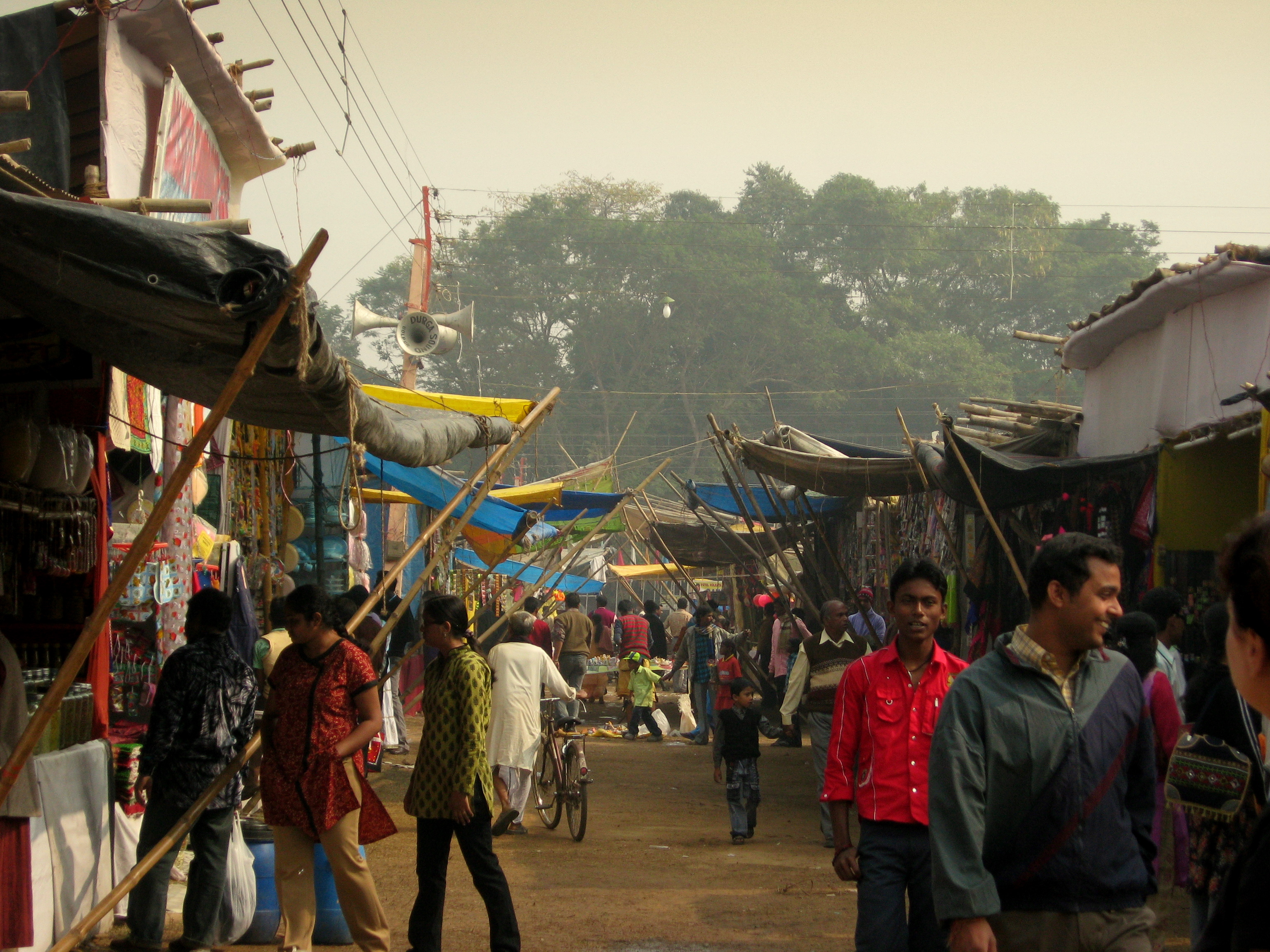 Shoppers at the Poush Mela Fair
 -
 Jagaddhatri Puja in Kolkata
 -
 Kapil Muni Temple at Sagardwip


.jpg)


West Bengal has a long tradition of popular literature, music and drama largely based on Bengali folklore and Hindu epics and Puranas.
See also[edit | edit source]
- Architecture of Bengal
- Arts of West Bengal
- Bengali cuisine
- Bengal School of Art
- Bengali folk literature
- Culture of Bengal
- Culture of Darjeeling
- Culture of India
- Kalighat painting
- Music of Bengal
- Music of West Bengal
- Christianity in West Bengal
References[edit | edit source]
- ↑ Chaudhuri, Nirad C. (2001). The autobiography of an unknown Indian. New York Review of Books. p. 269. ISBN 978-0-940322-82-0.
- ↑ Reeves, Philip (5 April 2007). "Calcutta: habitat of the Indian intellectual". National Public Radio. Archived from the original on 2 October 2011. Retrieved 29 December 2012.
- ↑ Noble, Allen and Frank Costa; Ashok Dutt; Robert Kent (1990). Regional development and planning for the 21st century : new priorities, new philosophies. Ashgate Pub Ltd. pp. 282, 396. ISBN 978-1-84014-800-8.
- ↑ 4.0 4.1 "Kolkata culture: Para". Department of Tourism, Government of West Bengal. Archived from the original on 21 December 2011. Retrieved 9 December 2011.
- ↑ Trachtenberg, P. (15 May 2005). "The chattering masses". The New York Times. Archived from the original on 5 December 2013. Retrieved 26 April 2006.
- ↑ Mukherjee Pandey, Jhimli (1 November 2008). "Presidency old-timers to relive days of canteen adda". The Times of India. Retrieved 23 January 2012.
{{cite news}}: CS1 maint: deprecated archival service (link) - ↑ Dutt, R.C. (1962). Cultural heritage of Bengal. Calcutta: Punthi Pustak. cited in Sengupta, Nitish K. (2001). History of the Bengali-speaking people. UBS Publishers' Distributors Pvt. Ltd. pp. 211–12. ISBN 81-7476-355-4.
- ↑ "India: The hungry generation". Time. 20 November 1964. Archived from the original on 8 March 2008. Retrieved 24 January 2012.
- ↑ Chakrabarti, Kunal; Chakrabarti, Shubhra (22 August 2013). Historical Dictionary of the Bengalis. Scarecrow Press. pp. 465–467. ISBN 978-0-8108-8024-5.
- ↑ Chakraborty, Ajanta (5 July 2011). "Meet the new Mamata Banerjee". The Times of India. Retrieved 23 January 2012.
The jatra industry based out of Kolkata's Chitpur Road has gone through a severe blow with the growth of video parlours.
{{cite news}}: CS1 maint: deprecated archival service (link) - ↑ Niyogi, Subhro (26 October 2010). "Red alert For Jatra". The Times of India. Retrieved 23 January 2012.
{{cite news}}: CS1 maint: deprecated archival service (link) - ↑ Sarkar, Bhaskar (March 2008). "The melodramas of globalization". Cultural Dynamics. 20 (1): 31–51 [34]. doi:10.1177/0921374007088054. S2CID 143977618..
- ↑ Gooptu, Sharmistha (2010). Bengali cinema: 'an other nation'. Taylor & Francis. pp. 2, 172, 181, 187. ISBN 978-0-415-57006-0. Archived from the original on 30 June 2023. Retrieved 24 January 2012.
- ↑ Chowdhury, S. (2021). Uttam Kumar: A Life in Cinema. Bloomsbury Publishing. p. 209. ISBN 978-93-5435-271-3. Archived from the original on 2 February 2023. Retrieved 25 July 2022.
- ↑ "The Bauls of Bengal". Folk Music. BengalOnline. Archived from the original on 19 January 2003. Retrieved 26 October 2006.
- ↑ 16.0 16.1 Dorin, Stéphane (2005). "La globalisation du rock vue de Calcutta" [The globalization of rock to Calcutta]. Volume! (in français). 4 (1): 144–45. Archived from the original on 8 May 2013. Retrieved 29 January 2012.
- ↑ Shepherd, John (2005). Continuum encyclopedia of popular music of the world. Vol. 3–7. Continuum. pp. 70–71. ISBN 978-0-8264-7436-0.
- ↑ Bhattacharya, Malini (2005). "Culture". In Bagchi, Jasodhara (ed.). The changing status of women in West Bengal, 1970–2000: the challenge ahead. New Delhi: Sage Publications. p. 105. ISBN 978-0-7619-3242-0. Retrieved 10 February 2012.
- ↑ Roy, Tasmayee Laha (5 February 2016). "West Bengal rural craft hubs help artisans double their incomes". The Economic Times. Archived from the original on 13 February 2018. Retrieved 13 February 2018.
- ↑ "music and Dance - Egiye Bangla". wb.gov.in. Archived from the original on 18 March 2023. Retrieved 23 May 2023.
- ↑ Yengkhom, Sumati (23 September 2010). "This Puja, buzz over western clothes". The Times of India. Retrieved 23 January 2012.
{{cite news}}: CS1 maint: deprecated archival service (link)
| Cuisine |  | ||||
|---|---|---|---|---|---|
| Dance |
| ||||
| Music |
| ||||
| Handlooms and handicrafts |
| ||||
| Observations and festivals | |||||
| Arts | |||||
| Other | |||||


.png)