



m Removed empty portal template using script |
refine references for consistency |
||
| Line 1: | Line 1: | ||
{{Short description| | {{Short description|City in Maharashtra, India}} | ||
{{Distinguish|Mumbai | {{Distinguish|Mumbai (Bombay)|Third Mumbai}} | ||
{{Use Indian English|date=June 2016}} | {{Use Indian English|date=June 2016}} | ||
{{Use dmy dates|date=September 2023}} | |||
{{Infobox settlement | {{Infobox settlement | ||
| name = Navi Mumbai | | name = Navi Mumbai | ||
| other_name = | | native_name = ''Navī Muṁbaī'' ([[Marathi language|Marathi]]) | ||
| other_name = Previously: New Bombay | |||
| settlement_type = [[City]] | | settlement_type = [[City]] | ||
| image_skyline = {{multiple image | | image_skyline = {{multiple image | ||
| Line 12: | Line 13: | ||
| image_style = | | image_style = | ||
| perrow = 1/2/2/2 | | perrow = 1/2/2/2 | ||
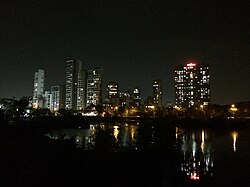
| image2 = | | image1 = Vashi_Skyline.jpg | ||
| caption1 = [[Navi Mumbai]] skyline | |||
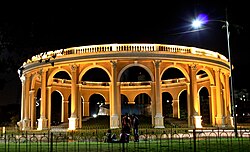
| image2 = Dronagiri night skyline.jpg | |||
| caption2 = [[Dronagiri]] skyline | |||
| image3 = Utsav Chauk, Kharghar Navi Mumbai.jpg | | image3 = Utsav Chauk, Kharghar Navi Mumbai.jpg | ||
| image4 = | | caption3 = Utsav Chauk | ||
| | | image4 = Jawaharlal Nehru Port (JNPT).jpg | ||
| caption4 = [[Jawaharlal Nehru Port]] | |||
| image5 = Vashi Railway Station.jpg | |||
| caption5 = Vashi Railway Station | |||
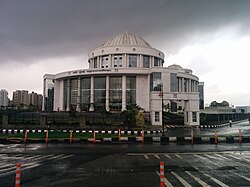
| image6 = Navi Mumbai Municipality Corporation.jpeg | | image6 = Navi Mumbai Municipality Corporation.jpeg | ||
| | | caption6 = [[NMMC]] headquarter | ||
| image7 = | | image7 = Uran Nagav beach.jpg | ||
| image8 = | |caption7 = [[Uran]] Nagav beach | ||
| image8 = Central Park, Kharghar, Navi Mumbai, India.jpg | |||
| caption8 = [[Central Park, Kharghar]] | |||
| image9 = Pandavkada-Watefall4.jpg | | image9 = Pandavkada-Watefall4.jpg | ||
| caption9 = [[Pandavkada Falls]] | |||
| image10 = Wonders Park, Navi Mumbai.jpg | | image10 = Wonders Park, Navi Mumbai.jpg | ||
| | | caption10 = Wonders Park | ||
| | | image11 = Rajiv Gandhi Park, Navi Mumbai Photo 1.jpg | ||
| caption11 = Rajiv Gandhi Park | |||
| image12 = Palm_Beach_Road,_Belapur,_Navi_Mumbai.jpg | |||
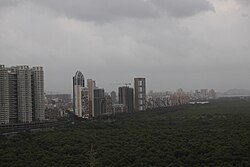
| caption12 = Skyline across [[Seawoods]] [[Palm Beach Road]] | |||
}} | }} | ||
| image_alt = Mumbai | | image_alt = Mumbai | ||
| map_alt = Mumbai | | map_alt = Mumbai | ||
| map_caption = Navi Mumbai | | map_caption = Navi Mumbai | ||
| pushpin_map = India Maharashtra# | | pushpin_map = India Maharashtra#India#India Mumbai | ||
| pushpin_label_position = | | pushpin_label_position = | ||
| pushpin_relief = y | |||
| pushpin_map_alt = Mumbai | | pushpin_map_alt = Mumbai | ||
| coordinates = {{coord|19.02|N|73.02|E|format=dms|display=inline,title}} | | coordinates = {{coord|19.02|N|73.02|E|format=dms|display=inline,title}} | ||
| Line 38: | Line 51: | ||
| subdivision_type2 = [[Divisions of Maharashtra|Division]] | | subdivision_type2 = [[Divisions of Maharashtra|Division]] | ||
| subdivision_type3 = [[List of districts of Maharashtra|District]] | | subdivision_type3 = [[List of districts of Maharashtra|District]] | ||
| subdivision_name1 = {{flagicon image| | | subdivision_name1 = {{flagicon image|Flag of Maharashtra.svg}} [[Maharashtra]] | ||
| subdivision_name2 = [[Konkan division|Konkan]] | | subdivision_name2 = [[Konkan division|Konkan]] | ||
| subdivision_name3 = [[Thane | | subdivision_name3 = {{plainlist| | ||
| established_title = Planned | *[[Thane district]] | ||
| established_date = [[City and Industrial Development Corporation | *[[Raigad district]] | ||
}} | |||
| established_title = Planned and Developed by | |||
| established_date = [[City and Industrial Development Corporation]] <!-- CIDCO is the supreme authority for developing cities in Maharashtra and, therefore it develops nodes of Navi Mumbai and than hand it over to NMMC --><!-- CIDCO is the supreme authority for developing cities in Maharashtra and, therefore it develops nodes of Navi Mumbai and than hand it over to NMMC --> | |||
| government_type = [[Municipal Corporations in India|Municipal Corporation]] | | government_type = [[Municipal Corporations in India|Municipal Corporation]] | ||
| elevation_m = 14 | | elevation_m = 14 | ||
| Line 48: | Line 64: | ||
| population_demonym = Navi Mumbaikar | | population_demonym = Navi Mumbaikar | ||
| registration_plate = MH-43 ([[Thane district]])<br />MH-46 ([[Raigad district]]) | | registration_plate = MH-43 ([[Thane district]])<br />MH-46 ([[Raigad district]]) | ||
| blank_name_sec1 = [[International Airport]] | |||
| blank_info_sec1 = [[Navi Mumbai International Airport]] | |||
| blank1_name_sec1 = [[Transit system|Transit]] | |||
| blank1_info_sec1 = '''[[Rapid Transit]]''': [[Navi Mumbai Metro]] <br />'''[[Commuter rail]]''': [[Mumbai Suburban Railway]] | |||
| image_shield = | | image_shield = | ||
| governing_body = [[Navi Mumbai Municipal Corporation]] | | governing_body = {{plainlist| | ||
[[Panvel Municipal Corporation]] (Raigad | *[[Navi Mumbai Municipal Corporation]] 109.59Sqkm ([[Thane district]]) | ||
*[[Panvel Municipal Corporation]] 110 Sqkm ([[Raigad district]]) | |||
*[[CIDCO]] 233.7 Sqkm ([[Raigad district]]) | |||
}} | |||
| nickname = Flamingo City | | nickname = Flamingo City | ||
| timezone1 = [[Indian Standard Time|IST]] | | timezone1 = [[Indian Standard Time|IST]] | ||
| utc_offset1 = +5:30 | | utc_offset1 = +5:30 | ||
| unit_pref = Metric | | unit_pref = Metric | ||
| area_total_km2 = 343.70 | |||
}} | }} | ||
'''Navi Mumbai''' ({{IPA | '''Navi Mumbai''' ({{IPA|mr|nəʋiː mumbəi|lang}}; also known as '''New Bombay''',<ref>{{cite web | url=https://books.google.com/books?id=3DYZwpHuqvUC&q=new+Bombay+planning | title=Bombay, New Bombay, and Metropolitan Region: Growth Process and Planning Lessons | last1=Verma | first1=Harnam Singh | date=5 January 1985 | access-date=5 January 2024 | archive-date=22 September 2024 | archive-url=https://web.archive.org/web/20240922035622/https://books.google.com/books?id=3DYZwpHuqvUC&q=new+Bombay+planning#v=snippet&q=new%20Bombay%20planning&f=false | url-status=live }}</ref> its official name until 1995<!-- The area was officially known as New Bombay until 1995, before the Shiv Sena party changed city names. -->) is a city in the [[Mumbai Metropolitan Area]], located in the [[Konkan division]] of the western [[India]]n state of [[Maharashtra]]. Navi Mumbai is situated on the Indian mainland, opposite [[Salsette Island]] and the city of [[Mumbai]], and is part of [[Thane district]] and Raigad district. | ||
The | The area within the Navi Mumbai Municipal Corporation has been ranked third among 73 cities surveyed for cleanliness and hygiene by the [[Ministry of Housing and Urban Affairs|Union Ministry of Urban Development]] and the [[Quality Council of India]] as part of [[Swachh Bharat Abhiyan]], and is being modified through various projects and developments. Navi Mumbai has, for two consecutive years (2022 and 2023), held on to the third rank in the Indian Commonwealth Cleanliness Survey (Swachh Survekshan) — a nationwide sanitation survey of cities — while Mumbai's ranking slipped to 37 in 2023 from 31 in 2022.<ref>{{cite web|url=http://pib.nic.in/newsite/mbErel.aspx?relid=136427|title=Swachh Survekshan −2016 – ranks of 73 cities|website=pib.nic.in|access-date=10 August 2017|archive-url=https://web.archive.org/web/20160220130401/http://pib.nic.in/newsite/mbErel.aspx?relid=136427|archive-date=20 February 2016|url-status=live}}</ref> | ||
Navi Mumbai is home to various educational institutions. | Navi Mumbai is home to various educational institutions. Several [[multinational corporation]]s have their head offices or branches across the city, making it an active business hub. [[Thane–Belapur Road]] and [[Palm Beach Marg|Palm Beach Road]] are major business attractions and upmarket residential areas. | ||
==History== | ==History== | ||
{{ | {{Unreferenced section|date=December 2024}} | ||
| date = | In the late 1500s, the [[Janjira State|Siddis of Janjira]] built the [[Belapur Fort|Belapur Killa]], located atop a small hill near the mouth of the Panvel Creek. In 1682, the fort was captured by the Portuguese, who had managed to annex the regions controlled by the Siddis. | ||
}} | |||
In 1733, the [[Maratha Empire|Marathas]], led by [[Chimaji Appa]], wrested control of the fort from the Portuguese. Appa had made a vow that if it were to be successfully recaptured from the [[Portuguese India|Portuguese]], he would place a garland of ''beli'' leaves in the nearby Amruthaishwar temple, and after the victory, the fort was christened as Belapur Fort. The Marathas ruled the area until 23 June 1817, when it was captured by Captain Charles Gray of the [[East India Company|British East India Company]]. The British partially destroyed the fort under their policy of razing any Maratha stronghold in the area. | |||
Navi Mumbai’s journey began in the early 1970s, when the Maharashtra government recognized the need for an alternative urban area to relieve the growing pressure on Mumbai, which was then struggling with issues like overcrowding, inadequate housing, and strained infrastructure. | |||
==Planning and | == Planning and development == | ||
[[File:CIDCO Low Income Housing in navi Mumbai.jpg|alt=|thumb|upright|Low Income housing facilities in Navi Mumbai]] | [[File:CIDCO Low Income Housing in navi Mumbai.jpg|alt=|thumb|upright|Low Income housing facilities in Navi Mumbai]] | ||
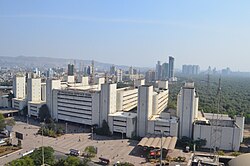
[[File:Nerul Lake, Navi Mumbai Photo 2.jpg|alt=|thumb|Skyline of [[Nerul]], Navi Mumbai]] | [[File:Nerul Lake, Navi Mumbai Photo 2.jpg|alt=|thumb|Skyline of [[Nerul]], Navi Mumbai]] | ||
[[File:Utsav Chauk, Kharghar Navi Mumbai.jpg|alt=|thumb|[[Utsav Chowk]] at [[Kharghar]]]] | [[File:Utsav Chauk, Kharghar Navi Mumbai.jpg|alt=|thumb|[[Utsav Chowk]] at [[Kharghar]]]] | ||
The population of [[Mumbai|Greater Mumbai]] | The population of [[Mumbai|Greater Mumbai]] doubled from three to nearly six million between 1951 and 1971. The population growth led to a deteriorating quality of life for many in the city. | ||
The Maharashtra Regional and Town Planning Act was passed in 1966, and the [[Mumbai Metropolitan Region|Bombay Metropolitan Region]] was created in June 1967 and finalized in 1970. The plan called for development, of a twin city across the harbour, on the mainland to the east. | |||
Before Navi Mumbai was made Railway was linked to [[Panvel railway station]] with Diva in 1964, in 1966 it was extended to Apta via Rasayani, then in the 1980s to Roha and in phases was linked to the [[Konkan Railway]] by 1998, in 1990s Harbour line of Suburban Railway reached Navi Mumbai connecting Vashi, Nerul. | |||
The | The Board recommended that the new metro-centre or Navi Mumbai as it is now called, be developed to accommodate a population of 2.1 million.<ref>{{cite web|url=http://www.cidco.maharashtra.gov.in/NM_Evolution_NewBombay.aspx|title=CIDCO :: Evolution of Navi Mumbai|website=Cidco.maharashtra.gov.in|access-date=10 August 2017|archive-url=https://web.archive.org/web/20170810171642/http://www.cidco.maharashtra.gov.in/NM_Evolution_NewBombay.aspx|archive-date=10 August 2017|url-status=live}}</ref> | ||
The | The planning of Navi Mumbai began in 1971 and involved leading architects and urban planners including [[Adi Kanga]], [[Charles Correa]], Shirish Patel, Pravina Mehta<ref name="mirror13">{{Cite web | title = Master class with Charles Correa | url = http://www.mumbaimirror.com/others/sunday-read/Master-class-with-Charles-Correa/articleshow/20499060.cms | publisher = Mumbai Mirror | date = 9 June 2013 | access-date = 2 July 2013 | archive-url = https://web.archive.org/web/20130613211227/http://www.mumbaimirror.com/others/sunday-read/Master-class-with-Charles-Correa/articleshow/20499060.cms | archive-date = 13 June 2013 | url-status = dead | df = dmy-all }}</ref> and R. K. Jha.<ref>Mehta, H.: [https://timesofindia.indiatimes.com/city/ahmedabad/Man-who-built-Navi-Mumbai-is-in-Gujarat/articleshow/5598045.cms Man who built Navi Mumbai is in Gujarat] {{Webarchive|url=https://web.archive.org/web/20140202190157/http://articles.timesofindia.indiatimes.com/2010-02-21/ahmedabad/28135807_1_gift-navi-mumbai-metro-rail-plan |date=2 February 2014 }} ''[[The Times of India]]'', 21 February 2010. Accessed 27 January 2014.</ref> The [[City and Industrial Development Corporation]] (CIDCO) was created as part of these efforts. | ||
The | The area covered {{convert|150|km}} of the Konkan coast. Privately owned land consisting of 86 villages covering within the present limits of Navi Mumbai were acquired by the government of Maharashtra.<ref name="Chatterjee">{{cite journal|last1=Chatterjee|first1=Piu|title=Urban Villages in Globalized India: Degenerative Growth Processes in Navi Mumbai|journal=Inclusive|date=7 July 2014|url=http://theinclusive.org/urban-villages-in-globalized-india-degenerative-growth-processes-in-navi-mumbai|publisher=Journal of the Kolkata Centre for Contemporary Studies|issn=2278-9758|url-status=dead|archive-url=https://web.archive.org/web/20151026003616/http://theinclusive.org/urban-villages-in-globalized-india-degenerative-growth-processes-in-navi-mumbai|archive-date=26 October 2015}}</ref> Navi Mumbai covers the southern part of [[Thane taluka]] (from [[Thane District]]) and part of [[Panvel taluka|Panvel]] and [[Uran taluka]]s (from [[Raigad District]]). | ||
CIDCO carved out 19 small nodes with a view towards facilitating comprehensive development. These nodes were named [[Airoli]], [[Ghansoli]], [[Kopar Khairane]], [[Vashi]], [[Turbhe]], [[Sanpada]], [[Juinagar]], [[Nerul]], [[Seawoods]], [[CBD Belapur]], [[Kharghar]], [[Kamothe]], [[New Panvel]], [[Kalamboli]], [[Ulwe]], [[Dronagiri]] and [[Taloje Panchnand|Taloja.]] [[Sanpada railway station|Sanpada]] is the smallest node of Navi Mumbai at 8.6 km<sup>2</sup>.<ref>{{Cite web |title=NMMC |url=https://www.nmmc.gov.in/navimumbai/nmmc-draft-development-plan |access-date=14 March 2024 |archive-date=14 March 2024 |archive-url=https://web.archive.org/web/20240314034901/https://www.nmmc.gov.in/navimumbai/nmmc-draft-development-plan |url-status=live }}</ref> | |||
CIDCO | CIDCO planned and constructed railway stations, roads, and public spaces in Navi Mumbai and developed nearby areas commercially. In 1973, the [[Vashi]] bridge was opened to the public for residents of [[Vashi]], [[CBD Belapur]] and [[Nerul]]. The Sion-Panvel Highway was built to reduce the time taken to travel from Sion to Panvel. Major changes took place only after 1990, with the commissioning of a wholesale agricultural produce market at Turbhe and the construction of a commuter railway line from Mankhurd to Vashi in May 1992. These developments caused a sudden growth in economic activities and population in Navi Mumbai.<ref>{{Cite web |title=History |url=https://www.nmmc.gov.in/navimumbai/history1540201195 |access-date=2024-09-22 |website=www.nmmc.gov.in/}}</ref> | ||
The city originally planned to create affordable housing for people who could not afford living in Mumbai, with planners intent on preventing the growth of slums in the city. However, according to the 2001 census, a fifth<ref>{{cite web|title=Slum population-- 2001 Census|url=http://www.visionmumbai.org/images/projects/Document_mumbai%20slum%20population031313112208.pdf|website=Visionmumbai.org|access-date=28 October 2015|archive-url=https://web.archive.org/web/20150912122651/http://www.visionmumbai.org/images/projects/Document_mumbai%20slum%20population031313112208.pdf|archive-date=12 September 2015|url-status=dead}}</ref><ref>{{cite news|last1=Srivastav|first1=Amit|title=Slum-hub|url=http://www.afternoondc.in/city-news/slum-hub/article_71409|access-date=28 October 2015|work=Afternoon Despatch & Courier, Mumbai|date=15 December 2012|archive-url=https://web.archive.org/web/20170810171943/http://www.afternoondc.in/city-news/slum-hub/article_71409|archive-date=10 August 2017|url-status=live}}</ref> to a third<ref>{{cite news|url=http://www.firstpost.com/india/navi-mumbai-was-charles-correas-dream-heres-how-it-turned-into-a-nightmare-2301976.html|last=Vijapurkar|first=Mahesh|date=18 June 2015|access-date=27 June 2015|title=Navi Mumbai was Charles Correa's dream: Here's how it turned into a nightmare|work=[[Firstpost]]|archive-url=https://web.archive.org/web/20150621015234/http://www.firstpost.com/india/navi-mumbai-was-charles-correas-dream-heres-how-it-turned-into-a-nightmare-2301976.html|archive-date=21 June 2015|url-status=live}}</ref> of the population of municipalized Navi Mumbai live in slums | |||
<ref>{{cite web|title=Slum and Non-Slum Population, Sex ratio and Literacy rate by City/ Towns, in Maharashtra State 2001|url=http://iipsenvis.nic.in/Database/Urbanization_4104.aspx|publisher=ENVIS Centre on Population and Environment (Ministry of Environment & Forests, Govt. of India)|access-date=28 October 2015|archive-url=https://web.archive.org/web/20151109061030/http://iipsenvis.nic.in/Database/Urbanization_4104.aspx|archive-date=9 November 2015|url-status=dead}}</ref> and ''gaothans'' (urban villages),<ref name=Chatterjee/> with thousands of buildings violating planning norms.<ref>{{cite news|last1=Bhosale|first1=Arpika|title=23,000 illegal two-storey buildings in Navi Mumbai|url=https://www.freepressjournal.in/23000-illegal-two-storey-buildings-in-navi-mumbai/|access-date=28 October 2015|work=Free Press Journal|date=12 April 2013|url-status=dead|archive-url=https://web.archive.org/web/20160204064346/http://www.freepressjournal.in/23000-illegal-two-storey-buildings-in-navi-mumbai|archive-date=4 February 2016}}</ref> | |||
By the end of the 1990s, the planning authority of Navi Mumbai sought to attract private developers to the city. A new rail link between Nerul and Uran was opened on 11 November 2018.<ref>{{Cite web|url=https://timesofindia.indiatimes.com/city/mumbai/mumbai-first-phase-of-nerul-seawoods-uran-rail-line-commissioned/articleshow/66578304.cms|title=uran rail line commissioned: Mumbai: First phase of Nerul-Seawoods-Uran rail line commissioned|date=11 November 2018|website=The Times of India|language=en|access-date=23 January 2020|archive-date=2 April 2023|archive-url=https://web.archive.org/web/20230402160002/https://timesofindia.indiatimes.com/city/mumbai/mumbai-first-phase-of-nerul-seawoods-uran-rail-line-commissioned/articleshow/66578304.cms|url-status=live}}</ref> | |||
Southern Navi Mumbai is developing rapidly in the modern nodes of [[Kharghar]], [[Kamothe]], [[Panvel]], and [[Kalamboli]]. These nodes are experiencing major [[Infrastructure|infrastructural]] developments due to their proximity to the Navi Mumbai International Airport (Phase 1) started operations on 25th December 2025.<ref>{{Cite news | |||
|title = Navi Mumbai International Airport begins operations: 48 flights, 4k passengers on day one; first IndiGo flight lands from Bengaluru | |||
|url = https://timesofindia.indiatimes.com/business/india-business/navi-mumbai-international-airport-begins-operations-48-flights-4k-passengers-on-day-one-first-indigo-flight-lands-from-bengaluru/articleshow/126175619.cms | |||
|work = The Times of India | |||
|date = 26 December 2025 | |||
|access-date = 17 January 2026 | |||
}}</ref><ref>{{Cite news | |||
|date = 9 October 2025 | |||
|title = Navi Mumbai airport inauguration: First flight from NMIA expected around Christmas | |||
|work = Mid-Day | |||
|url = https://www.mid-day.com/mumbai/mumbai-news/article/navi-mumbai-airport-inauguration-first-flight-from-nmia-expected-around-christmas-23597847 | |||
|language = en-GB | |||
}}</ref> | |||
== Flora | Navi Mumbai has, been ranked 5th best “National Clean Air City” in India.<ref>{{Cite web |date=7 September 2024 |title=Swachh Vayu Sarvekshan 2024 |url=https://prana.cpcb.gov.in/ncapServices/robust/fetchFilesFromDrive/Swachh_Vayu_Survekshan_2024_Result.pdf |website=Swachh Vayu Sarvekshan 2024 |access-date=21 September 2024 |archive-date=14 September 2024 |archive-url=https://web.archive.org/web/20240914164336/https://prana.cpcb.gov.in/ncapServices/robust/fetchFilesFromDrive/Swachh_Vayu_Survekshan_2024_Result.pdf |url-status=live }}</ref> | ||
A significant | |||
== Flora and fauna == | |||
A significant percentage of [[flamingo]]s that settle in the Greater Mumbai Region are found in Navi Mumbai.<ref>{{Cite news |last=Mohta |first=Payal |date=26 March 2019 |title='A double-edged sword': Mumbai pollution 'perfect' for flamingos |language=en-GB |work=The Guardian |url=https://www.theguardian.com/cities/2019/mar/26/a-double-edged-sword-mumbai-pollution-perfect-for-flamingos |access-date=28 March 2023 |issn=0261-3077 |archive-date=22 September 2024 |archive-url=https://web.archive.org/web/20240922035622/https://www.theguardian.com/cities/2019/mar/26/a-double-edged-sword-mumbai-pollution-perfect-for-flamingos |url-status=live }}</ref><ref>{{Cite magazine |date=2 May 2020 |title=Over 100,000 Flamingos Reportedly Descend on Mumbai Amid India's Strict Coronavirus Lockdown |url=https://time.com/5831198/flamingos-coronavirus/ |access-date=28 March 2023 |magazine=Time |language=en |archive-date=22 September 2024 |archive-url=https://web.archive.org/web/20240922035622/https://time.com/5831198/flamingos-coronavirus/ |url-status=live }}</ref><ref>{{Cite news |title=Flamingos turn Mumbai lakes into 'sea of pink' |language=en-GB |work=BBC News |url=https://www.bbc.com/news/av/world-asia-india-56250443 |access-date=28 March 2023 |archive-date=28 March 2023 |archive-url=https://web.archive.org/web/20230328142018/https://www.bbc.com/news/av/world-asia-india-56250443 |url-status=live }}</ref> Navi Mumbai also contains a stretch of [[mangrove]]s. | |||
==Administration== | ==Administration== | ||
===CIDCO=== | ===CIDCO=== | ||
The [[City and Industrial Development Corporation]] (CIDCO) was responsible for maintenance, tax collection, and development of the city since its inception in the 1970s. | |||
[[ | |||
CIDCO planned 14 | CIDCO planned 14 areas for the city.<ref name="CIDCO_DP">{{cite web |title=Development Plan |website=CIDCO |date=19 December 2017 |url=https://cidco.maharashtra.gov.in/navi_mumbai#developmentplans&gsc.tab=0 |access-date=12 March 2021 |archive-date=10 April 2021 |archive-url=https://web.archive.org/web/20210410192058/https://cidco.maharashtra.gov.in/navi_mumbai#developmentplans&gsc.tab=0 |url-status=dead }}</ref> The seven areas in the North were [[Airoli|Airoli node]], [[Ghansoli|Ghansoli node]], [[Kopar Khairane|Kopar Khairane node]], [[Vashi|Vashi node]], [[Sanpada|Sanpada node]], [[Nerul|Nerul node]] and [[CBD Belapur|Belapur node]]. The seven areas in the South were [[Kharghar|Kharghar node]], [[Kamothe|Kamothe node]], [[Kalamboli|Kalamboli node]], Pushpak Nagar node, [[New Panvel|Panvel node]], [[Ulwe|Ulwe node]] and [[Dronagiri|Dronagiri node]]. Two additional municipal bodies were created, [[Navi Mumbai Municipal Corporation|Navi Mumbai Municipal Corporation (NMMC)]] in the North and [[Panvel Municipal Corporation]] in the South. Each area is divided into smaller groups called sectors. | ||
CIDCO initially developed areas like Juhu Nagar (Vashi), Nerul, and CBD Belapur with homes, schools, and roads. Later, due to a growing population with the railway extension in the 1990s, CIDCO shifted focus to Kharghar, Kamothe, New Panvel and Kopar Khairane. Private builders played a large role in developing these areas. CIDCO, as of 2015, runs newer areas in South Navi Mumbai.<ref>{{citation |title=CIDCO announces Rs 34,000-crore smart city project |date=3 December 2015 |url=http://www.thehindu.com/news/cities/mumbai/business/cidco-announces-rs-34000crore-smart-city-project/article7943833.ece |work=[[The Hindu]] |access-date=20 December 2015 |location=Mumbai |archive-date=24 November 2020 |archive-url=https://web.archive.org/web/20201124152519/https://www.thehindu.com/news/cities/mumbai/business/cidco-announces-rs-34000crore-smart-city-project/article7943833.ece |url-status=live }}</ref><ref>{{citation |author=BS Reporter |title=Cidco launches Navi Mumbai smart city project |date=5 December 2015 |url=http://www.business-standard.com/article/economy-policy/cidco-launches-navi-mumbai-smart-city-project-115120400839_1.html |newspaper=Business Standard India |access-date=20 December 2015 |archive-url=https://web.archive.org/web/20151222124736/http://www.business-standard.com/article/economy-policy/cidco-launches-navi-mumbai-smart-city-project-115120400839_1.html |url-status=live |location=Mumbai |publisher=[[Business Standard]] |archive-date=22 December 2015}}</ref> | |||
[[File:Buildings along the Palm Beach Road.JPG|thumb|left|Skyline across [[Palm Beach Road]]]] | |||
===Navi Mumbai Municipal Corporation=== | |||
On 17 December 1991, [[Navi Mumbai Municipal Corporation]] (NMMC) was constituted by the state government for maintaining some of the developed nodes of Navi Mumbai. | |||
Local self-government started on 1 January 1992. NMMC was handed seven of the 14 nodes of the Navi Mumbai project area for its jurisdiction. However, [[CIDCO]], as a planning authority, has rights on the open plots in these seven nodes. | |||
The NMMC jurisdiction starts at Digha Gaon in the North and ends at Belapur in the South.<ref name="NMMC_Ward">{{cite web |title=Zoning |website=NMMC |url=https://www.nmmc.gov.in/zoning |access-date=12 March 2021 |archive-date=2 October 2021 |archive-url=https://web.archive.org/web/20211002154213/https://www.nmmc.gov.in/zoning |url-status=live }}</ref> The NMMC area is planned into seven nodes (zones) - [[CBD Belapur|Belapur]], [[Nerul]], [[Sanpada]], [[Vashi]], [[Kopar Khairane]], [[Ghansoli]] and [[Airoli]]. | |||
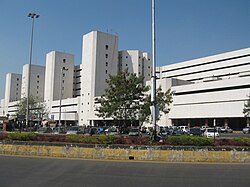
[[File:Navi Mumbai Municipality Corporation.jpeg|alt=|thumb|NMMC Main Building, [[CBD Belapur]]]] | |||
Navi Mumbai Municipal Corporation is rated amongst the richest corporations in Maharashtra.{{Citation needed|date=March 2025}} | |||
The Municipal Corporation is headed by a Municipal Commissioner and an elected Mayor. | |||
=== | === Municipal finance === | ||
According to financial data published on the CityFinance Portal of the Ministry of Housing and Urban Affairs,<ref>{{cite web |title=Navi Mumbai Municipal Corporation Finance |url=https://www.cityfinance.in/municipal-data/city/navi-mumbai |publisher=CityFinance Portal, Ministry of Housing and Urban Affairs |access-date=17 March 2026}}</ref> the Navi Mumbai Municipal Corporation reported total revenue receipts of ₹2,497 crore (US$300 million) and total expenditure of ₹1,991 crore (US$240 million) in 2022–23. Tax revenue accounted for about 76.0% of the total revenue, while the corporation received ₹3 crore in grants during the financial year. | |||
* | |||
==Demographics== | ==Demographics== | ||
{{bar box | {{bar box | ||
|title=Religion in Navi Mumbai (2011)<ref>{{Cite web|url=https://www.census2011.co.in/census/city/368-navi-mumbai.html|title=Navi Mumbai Population 2011|website=Census 2011}}</ref> | |title=Religion in Navi Mumbai City (2011)<ref>{{Cite web|url=https://www.census2011.co.in/census/city/368-navi-mumbai.html|title=Navi Mumbai Population 2011|website=Census 2011|access-date=21 June 2023|archive-date=21 June 2023|archive-url=https://web.archive.org/web/20230621093834/https://www.census2011.co.in/census/city/368-navi-mumbai.html|url-status=live}}</ref> | ||
|titlebar=#Fcd116 | |titlebar=#Fcd116 | ||
|left1=Religion | |left1=Religion | ||
| Line 143: | Line 176: | ||
|float=right | |float=right | ||
|bars= | |bars= | ||
{{bar percent|[[Hinduism]]|darkorange|80.39}} | {{bar percent|[[Hinduism in Maharashtra|Hinduism]]|darkorange|80.39}} | ||
{{bar percent|[[Islam]]|green|8.68}} | {{bar percent|[[Islam in Maharashtra|Islam]]|green|8.68}} | ||
{{bar percent|[[Buddhism]]| | {{bar percent|[[Marathi Buddhists|Buddhism]]|mediumblue|6.23}} | ||
{{bar percent|[[Christianity]]|dodgerblue|2.35}} | {{bar percent|[[Christianity in Maharashtra|Christianity]]|dodgerblue|2.35}} | ||
{{bar percent| | {{bar percent|[[Sikhism]]|darkkhaki|1.01}} | ||
{{bar percent|[[ | {{bar percent|[[Jainism in Maharashtra|Jainism]]|pink|0.99}} | ||
{{bar percent|Other or not stated|black|0.36}} | |||
}} | }} | ||
According to Census India, the population of Navi Mumbai in 2011 is 1,120,547, out of which males and females are 610,060 and 510,487 respectively. Meanwhile, its metropolitan population is 18,414,288, of which 9,894,088 are males and 8,520,200 are females. At least 60% of the population speaks the [[Marathi language]]. | |||
{{Pie chart | |||
|thumb = left | |||
|caption = Language in Navi Mumbai M. Corp (2011)<ref name="Language">{{cite web |title=Table C-16 Population by Mother Tongue: Maharashtra (Town level) |url=https://censusindia.gov.in/nada/index.php/catalog/10253/download/13365/DDW-C16-TOWN-STMT-MDDS-2700.XLSX |website=censusindia.gov.in|publisher=[[Registrar General and Census Commissioner of India]]}}</ref> | |||
|label1 = [[Marathi language|Marathi]] |value1 = 61.66 |color1 = red | |||
|label2 = [[Hindi]] |value2 = 23.21 |color2 = orange | |||
|label3 = [[Gujarati language|Gujarati]] |value3 = 3.81 |color3 = skyblue | |||
|label4 = [[Malayalam]] |value4 = 2.58 |color4 = cornflowerblue | |||
|label5 = [[Urdu]] |value5 = 2.46 |color5 = green | |||
|label6 = [[Bhojpuri language|Bhojpuri]] |value6 = 2.21 |color6 = gold | |||
|label7 = [[Kannada]] |value7 = 2.21 |color7 = darkslateblue | |||
|label8 = [[Tamil language|Tamil]] |value8 = 2.04 |color8 = royalblue | |||
|label9 = [[Bengali language|Bengali]] |value9 = 2.02 |color9 = orchid | |||
|label10 = [[Punjabi language|Punjabi]] |value10 = 1.67 |color10 = pink | |||
|label11 = [[Telugu language|Telugu]] |value11 = 1.64 |color11 = steelblue | |||
|label12 = [[Marwari language|Marwari]] |value12 = 1.24 |color12 = maroon | |||
|other = y |other-label = Others |other-color = grey | |||
}} | |||
==Transport== | ==Transport and infrastructure== | ||
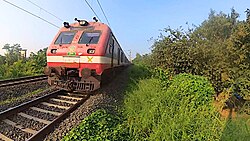
[[File:IndianRailwaysDEMU.jpg|alt=|thumb|DEMU train at Panvel, Navi Mumbai]] | [[File:IndianRailwaysDEMU.jpg|alt=|thumb|DEMU train at Panvel, Navi Mumbai]] | ||
[[File:Belapur Rly Stn.jpg|alt=|thumb|Belapur Railway Station]] | [[File:Belapur Rly Stn.jpg|alt=|thumb|Belapur Railway Station]] | ||
[[File:Vashi | [[File:Vashi railway station aerial view, 2016.JPG|alt=|thumb|Vashi station complex]] | ||
Navi Mumbai has a robust infrastructure, is well connected to other parts of the state and country and is | Navi Mumbai has a robust infrastructure, is well connected to other parts of the state and country and is less polluted compared to Mumbai. The city has a good public transportation system with [[Navi Mumbai Municipal Transport|NMMT]], the transport wing of NMMC, serving bus commuters, the [[Mumbai Suburban Railway|Mumbai suburban railway]] serving train commuters and a large fleet of [[auto rickshaw]]s for intra-nodal commute. The [[Mumbai-Pune Expressway]] starts at [[Kalamboli]] in Navi Mumbai. The [[Mumbai Trans Harbour Link]] (MTHL), also known as the Sewri-Nhava Sheva Trans Harbour Link, is a {{convert|22|km|adj=on}} long freeway grade road bridge connecting [[South Mumbai]] with Navi Mumbai.<ref>{{cite news|title=Mumbai Trans-Harbour Link May Be Ready Before 2022 Deadline, Says Chief Minister Uddhav Thackeray|url=https://www.bloombergquint.com/politics/mumbai-trans-harbour-link-may-be-ready-before-2022-deadline-says-chief-minister-uddhav-thackeray|work=[[BloombergQuint]]|access-date=15 January 2020|archive-date=22 September 2024|archive-url=https://web.archive.org/web/20240922035738/https://www.ndtvprofit.com/politics/mumbai-trans-harbour-link-may-be-ready-before-2022-deadline-says-chief-minister-uddhav-thackeray|url-status=live}}</ref> It opened on 12 January 2024, after Prime Minister Narendra Modi inaugurated the bridge.<ref>{{cite web | url=https://www.indiatoday.in/india/story/mumbai-trans-harbour-link-photos-videos-cost-mthl-traffic-rules-mumbai-police-2487221-2024-01-11 | title=Speed limit 100 km/Hr, no bikes and autos: All about India's longest sea bridge | date=11 January 2024 | access-date=13 January 2024 | archive-date=12 January 2024 | archive-url=https://web.archive.org/web/20240112071751/https://www.indiatoday.in/india/story/mumbai-trans-harbour-link-photos-videos-cost-mthl-traffic-rules-mumbai-police-2487221-2024-01-11 | url-status=live }}</ref><ref>{{cite web | url=https://www.livemint.com/news/india/atal-setu-indias-longest-bridge-news-pm-modi-inaugurate-mumbai-trans-harbour-link-mthl-today-11705023137497.html | title=Atal Setu news: PM Modi to inaugurate Mumbai Trans Harbour Link today | date=12 January 2024 | access-date=13 January 2024 | archive-date=12 January 2024 | archive-url=https://web.archive.org/web/20240112071719/https://www.livemint.com/news/india/atal-setu-indias-longest-bridge-news-pm-modi-inaugurate-mumbai-trans-harbour-link-mthl-today-11705023137497.html | url-status=live }}</ref> | ||
The [[Mumbai suburban railway]] network covers most of the populated regions of the city. The most important suburban stations are Vashi, Nerul, Belapur and Panvel. The stations are planned as major railway junctions. [[Panvel railway station|Panvel]] is the only mainline station | The [[Mumbai suburban railway]] network covers most of the populated regions of the city. The most important suburban stations are Vashi, Nerul, Belapur and Panvel. The stations are planned as major railway junctions. [[Panvel railway station|Panvel]] is the only mainline station as well as the busiest railway station in Navi Mumbai. All outstation trains halt here for time periods varying from five to 20 minutes. It is an important junction; railway lines come and meet here and it is connected to almost all parts of India. A new broad gauge line is functional between [[Karjat]] & [[Panvel]]. | ||
[[Brihanmumbai Electric Supply and Transport]] (BEST) buses run from various area of Mumbai to Navi Mumbai & [[Navi Mumbai Municipal Transport]] (NMMT) buses run all over Navi Mumbai and various area in Mumbai, Thane, Bhiwandi, Kalyan-Dombivli-Badlapur, Panvel-Khopoli-Taloja, Uran-Ulwe etc | [[Brihanmumbai Electric Supply and Transport]] (BEST) buses run from various area of Mumbai to Navi Mumbai & [[Navi Mumbai Municipal Transport]] (NMMT) buses run all over Navi Mumbai and various area in Mumbai, Thane, Bhiwandi, Kalyan-Dombivli-Badlapur, Panvel-Khopoli-Taloja, Uran-Ulwe etc. The [[Palm Beach Marg]], a {{convert|10|km|adj=on}} long six lane road connects Vashi to CBD Belapur running parallel to the [[Thane Creek]]. | ||
Auto rickshaws provide inter- and intra-nodal public transport across the city. Taxis operating from designated taxi stands provide the means to travel to further destinations. Taxis charge a fixed rate approved by the R. T. O., details of which can be found on popular local transit apps of the city.<ref>{{cite web|last1=Kamal|first1=Hassan|title=Good news for the daily commuter|url=http://www.mid-day.com/articles/mobile-app-good-news-for-the-daily-commuter/16327184|website=Mid-day.com|date=29 June 2015 |publisher=Mid-Day|access-date=12 August 2015|archive-url=https://web.archive.org/web/20150802052915/http://www.mid-day.com/articles/mobile-app-good-news-for-the-daily-commuter/16327184|archive-date=2 August 2015|url-status=live}}</ref> | |||
| | |||
| | |||
|- | |||
| | |||
|- | |||
|- | |||
|- | |||
|- | |||
|- | |||
Navi Mumbai has the second-largest [[container terminal]] in India after [[Mundra Port]], [[Jawaharlal Nehru Port]] at [[Nhava Sheva]] near [[Uran]].<ref>{{cite web | url = http://www.joc.com/port-news/asian-ports/port-nhava-sheva/india’s-major-ports-see-67-percent-growth-container-volumes_20150407.html | title = India's major ports see 6.7 percent growth in container volumes | publisher = JOC.com. | date = 7 April 2010 | access-date = 27 June 2015 | archive-url = https://web.archive.org/web/20150507235822/http://www.joc.com/port-news/asian-ports/port-nhava-sheva/india%E2%80%99s-major-ports-see-67-percent-growth-container-volumes_20150407.html | archive-date = 7 May 2015 | url-status = live | df = dmy-all }}</ref> It is well connected by road and rail and handles approximately 56.13% of India's container traffic.<ref>{{Cite news|url=http://www.thehindu.com/news/cities/mumbai/JNPT%E2%80%99s-12-lane-freight-corridor-to-ease-traffic-snarls-around-Mumbai/article16961041.ece|title=JNPT's 12-lane freight corridor to ease traffic snarls around Mumbai|work=The Hindu|access-date=27 February 2017|language=en|archive-url=https://web.archive.org/web/20161230153617/http://www.thehindu.com/news/cities/mumbai/JNPT%E2%80%99s-12-lane-freight-corridor-to-ease-traffic-snarls-around-Mumbai/article16961041.ece|archive-date=30 December 2016|url-status=live}}</ref><ref>{{cite web|url=http://www.jnport.gov.in/JNPCT.aspx|title=JNPT|website=Jnport.gov.in|access-date=10 August 2017|archive-url=https://web.archive.org/web/20170801190007/http://www.jnport.gov.in/JNPCT.aspx|archive-date=1 August 2017|url-status=live}}</ref> The city will be served by the newly inaugurated [[Navi Mumbai International Airport]]. | |||
{| | |||
| | |||
|- | |||
| | |||
|- | |||
| | |||
|- | |||
| | |||
|- | |||
|- | |||
|- | |||
| | |||
|- | |||
|- | |||
===Airports === | |||
{{Main|Navi Mumbai International Airport}} | {{Main|Navi Mumbai International Airport}} | ||
The International | The Navi Mumbai International Airport is located in southern Panvel near [[Ulwe]]. | ||
The {{INRConvert|16700|c}} project was executed by Navi Mumbai International Airport Limited (NMIAL), a special-purpose vehicle formed by the [[Adani Group|Adani Airports Holdings Limited]] and CIDCO.<ref name="about us">{{cite web |title=About Us |url=https://www.nmiairport.co.in/About-Us |website=Navi Mumbai International Airport Pvt. Ltd. |publisher=Adani Group |access-date=1 June 2025}}</ref> It is being built in three phases. The first phase, now complete, features Terminal 1, designed to handle 20 million passengers annually.<ref>{{cite web |title= PM Modi to inaugurate Phase 1 of Navi Mumbai airport on Oct 8: Details |url=https://www.business-standard.com/india-news/prime-minister-narendra-modi-navi-mumbai-international-airport-inauguration-125100700639_1.html | date=7 October 2025}}</ref> The [[Cornerstone|foundation stone]] for the project was laid by [[Prime Minister of India|Prime Minister]] [[Narendra Modi]] on 18 February 2018, and construction was started in August 2021.<ref>{{cite news|title=PM Narendra Modi lays foundation stone of Rs 16,700 cr Navi Mumbai International Airport project|url=https://www.financialexpress.com/business/airlines-aviation/narendra-modi-live-pm-lays-foundation-stone-of-rs-16700-cr-navi-mumbai-international-airport-project/https://www.financialexpress.com/business/airlines-aviation/narendra-modi-live-pm-lays-foundation-stone-of-rs-16700-cr-navi-mumbai-international-airport-project/1070430//|work=The Financial Express|date=18 February 2018|access-date=11 May 2024|language=en|archive-date=22 September 2024|archive-url=https://web.archive.org/web/20240922035626/https://www.financialexpress.com/business/airlines-aviation/narendra-modi-live-pm-lays-foundation-stone-of-rs-16700-cr-navi-mumbai-international-airport-project/1070430/|url-status=live}}</ref> Phase 1 was inaugurated on 8 October 2025 by Prime Minister Narendra Modi, and flights commenced on 25 December 2025.<ref>{{Cite news |date=6 October 2025 |title=Navi Mumbai airport to see international flights from day 1 of ops |url=https://www.thehindubusinessline.com/books/reviews/business-economy/navi-mumbai-airport-to-see-international-flights-from-day-1-of-ops/article70132035.ece |access-date=6 October 2025 |work=The Hindu Businessline |language=en}}</ref> NMIA is set to become the first airport in the country with multimodal connectivity through metro, rail and road. The airport will be connected to three roads: NH 4B (348), the [[Sion Panvel Highway]] and through [[Mumbai Trans Harbour Link|MTHL]]. The railway connection will be through [[Targhar railway station]], and metro connectivity will be via [[Mumbai Metro]] [[Gold Line (Mumbai Metro)|Line 8 (Gold Line)]] and the [[Navi Mumbai Metro]] [[Line 1 (Navi Mumbai Metro)|Line 1]].<ref>{{Cite news |title=Navi Mumbai Airport to be India's first with multimodal connectivity: Scindia |url=https://www.hindustantimes.com/cities/mumbai-news/navi-mumbai-airport-to-be-india-s-first-with-multimodal-connectivity-scindia-101705174042700.html |work=The Hindustan Times |date=14 January 2024 |access-date=11 May 2024 |language=en |archive-date=12 May 2024 |archive-url=https://web.archive.org/web/20240512144246/https://www.hindustantimes.com/cities/mumbai-news/navi-mumbai-airport-to-be-india-s-first-with-multimodal-connectivity-scindia-101705174042700.html |url-status=live }}</ref> | |||
Another major airport serving Navi Mumbai is the [[Chhatrapati Shivaji Maharaj International Airport|Chatrapati Shivaji Maharaj International Airport]] in Mumbai, which is the main Airport with International connections around the world. | |||
===Metro | ===Metro=== | ||
{{Main|Navi Mumbai Metro}} | {{Main|Navi Mumbai Metro}} | ||
The [[Navi Mumbai Metro]] is a new [[rapid transit]] system serving the city. A network of as many as five lines has been planned, of which four lines will be constructed by CIDCO in the Navi Mumbai south region, while the second and third lines of the metro system will be constructed by NMMC and [[Mumbai Metropolitan Region Development Authority|MMRDA]], respectively.<ref name="CIDCO">{{cite web|url=http://www.cidco.maharashtra.gov.in/NMM_Introduction.aspx|title=Introduction|publisher=CIDCO|year=2012|access-date=18 November 2023|archive-date=14 October 2017|archive-url=https://web.archive.org/web/20171014234611/http://www.cidco.maharashtra.gov.in/NMM_Introduction.aspx|url-status=live}}</ref> The [[Line 1 (Navi Mumbai Metro)|first line]] of the metro system was completed by CIDCO and was opened to the public on 17 November 2023, after several delays spanning for around a decade due to various construction and land acquisition issues. This line includes three phases. In the first phase, the line joins the [[CBD Belapur railway station|CBD Belapur]] station on the [[Mumbai suburban railway]] and Pendhar village.<ref>{{cite news|last=Assainar|first=Raina|url=https://www.hindustantimes.com/cities/mumbai-news/residents-miffed-as-navi-mumbai-metro-awaits-inauguration-101698235551145.html|title=Residents miffed as Navi Mumbai Metro awaits inauguration|work=Hindustan Times|date=25 October 2023|access-date=18 November 2023|language=en|archive-date=11 November 2023|archive-url=https://web.archive.org/web/20231111050126/https://www.hindustantimes.com/cities/mumbai-news/residents-miffed-as-navi-mumbai-metro-awaits-inauguration-101698235551145.html|url-status=live}}</ref><ref>{{cite news|last=Ganapatye|first=Mayuresh|title=Navi Mumbai Metro Starts Today After 12-Year Wait, First Service at 3pm from Pendhar-Belapur Terminal|url=https://www.news18.com/india/navi-mumbai-metro-starts-today-belapur-to-pendhar-after-12-year-wait-service-begins-8665637.html|work=News18|date=17 November 2023|access-date=18 November 2023|language=en|archive-date=20 November 2023|archive-url=https://web.archive.org/web/20231120044929/https://www.news18.com/india/navi-mumbai-metro-starts-today-belapur-to-pendhar-after-12-year-wait-service-begins-8665637.html|url-status=live}}</ref> In the second phase, the line will join Taloja [[Maharashtra Industrial Development Corporation|MIDC]] and [[Khandeshwar]] node (which will be extended to the newly inaugurated [[Navi Mumbai International Airport]] in [[Ulwe]] node of the city), and in the third phase, the line will link the Pendhar and Taloja MIDC metro stations. The cost of the metro project has risen from 4,163 crore for 21.45 km in 2011 to 8,904 crore for 26.26 km in 2018.<ref name="CIDCO"/> | |||
The city | |||
== | ==Commerce== | ||
The Navi Mumbai Special Economic Zone (SEZ), located in the nodes of Dronagiri, Ulwe and Kalamboli, are planned to provide commercial growth and employment to the city. Positioned en route to the proposed Navi Mumbai Airport, this megaproject has attracted investments of close to 60,000 crores.<ref>{{Cite web |date=2018-02-01 |title=Navi Mumbai SEZ to start operations in 2019 |url=https://www.livemint.com/Politics/mNIrujnpLFQanAnuHN0xXN/Navi-Mumbai-SEZ-to-start-operations-in-2019.html |access-date=2024-09-22 |website=www.livemint.com/}}</ref><ref>{{Cite web |date=2023-02-01 |title=State allows foreign educational institutions to set up campuses in Navi Mumbai SEZ |url=https://www.hindustantimes.com/cities/mumbai-news/state-allows-foreign-educational-institutions-to-set-up-campuses-in-navi-mumbai-sez-101675194046372.html |access-date=2024-09-22 |website=www.hindustantimes.com/}}</ref> Navi Mumbai is a new hub for newly incorporated companies & start ups to establish their base in Mumbai.<ref>{{cite web |url=http://newcompaniesindia.in/new-companies-navi-mumbai?Cid=goay |title=New| upcoming Companies in Navi Mumbai List |access-date=1 June 2014 |url-status=dead |archive-url=https://web.archive.org/web/20140605072623/http://newcompaniesindia.in/new-companies-navi-mumbai?Cid=goay |archive-date=5 June 2014 }}</ref> | |||
==Sport== | |||
== | |||
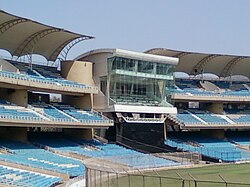
[[File:DR. D Y PATIL STADIUM, NERUL, NAVIMUMBAI - panoramio.jpg|alt=|thumb|Cricket Stadium in Nerul]] | [[File:DR. D Y PATIL STADIUM, NERUL, NAVIMUMBAI - panoramio.jpg|alt=|thumb|Cricket Stadium in Nerul]] | ||
[[File:D Y Patil Sports Stadium.jpg|thumb|The DY Patil International Stadium in [[Nerul]]]] | [[File:D Y Patil Sports Stadium.jpg|thumb|The DY Patil International Stadium in [[Nerul]]]] | ||
[[Cricket]] is the most popular sport in the city. Navi Mumbai has its own International Cricket Stadium in Shiravne ([[Nerul]]) called the [[DY Patil Stadium]] which hosts [[Indian Premier League|IPL]] T-20 matches, including hosting the [[2008 Indian Premier League|2008]]<ref>{{Cite news |last=Sengupta |first=Somini |date=2008 | [[Cricket]] is the most popular sport in the city. Navi Mumbai has its own International Cricket Stadium in Shiravne ([[Nerul]]) called the [[DY Patil Stadium]] which hosts [[Indian Premier League|IPL]] T-20 matches, including hosting the [[2008 Indian Premier League|2008]]<ref>{{Cite news |last=Sengupta |first=Somini |date=7 May 2008 |title=Bright Lights and Big Money in India's New Cricket League |language=en-US |work=The New York Times |url=https://www.nytimes.com/2008/05/07/sports/othersports/07cricket.html |access-date=28 March 2023 |issn=0362-4331 |archive-date=28 March 2023 |archive-url=https://web.archive.org/web/20230328142017/https://www.nytimes.com/2008/05/07/sports/othersports/07cricket.html |url-status=live }}</ref> and [[2010 Indian Premier League|2010]] IPL finals. It was one of the two venues for the inaugural edition of the [[Women's Premier League (cricket)|Women's Premier League]] (WPL) in 2023.<ref>{{Cite web |date=14 February 2023 |title=Mumbai Indians, Gujarat Giants to kick off WPL 2023 in Navi Mumbai on March 4 |url=https://www.espncricinfo.com/story/mumbai-indians-gujarat-giants-to-kick-off-wpl-2023-in-navi-mumbai-on-march-4-1358901 |url-status=live |archive-url=https://web.archive.org/web/20230403200536/https://www.espncricinfo.com/story/mumbai-indians-gujarat-giants-to-kick-off-wpl-2023-in-navi-mumbai-on-march-4-1358901 |archive-date=3 April 2023 |access-date=4 April 2023 |website=ESPNcricinfo}}</ref> It is also the home ground for the [[Indian Super League]] [[association football|football]] club [[Mumbai City FC]]. The [[Fr. Agnel Stadium]] in [[Vashi]] is the training ground of the team.<ref name="The Times of India">{{Cite news |date=2023-12-24 |title=City school football team bags hat-trick at annual tournament, wins in all categories |url=https://timesofindia.indiatimes.com/city/navi-mumbai/city-school-football-team-wins-hat-trick-at-annual-tournament/articleshow/106242790.cms |access-date=2024-09-22 |work=The Times of India |issn=0971-8257}}</ref> | ||
Navi Mumbai was one of the host cities of the [[2017 FIFA U-17 World Cup|2017 FIFA U-17 | Navi Mumbai was one of the host cities of the [[2017 FIFA U-17 World Cup|2017 FIFA U-17 Men's World Cup]] and the [[2022 FIFA U-17 Women's World Cup]] with the DY Patil Stadium hosting the final of the event in 2022.<ref>{{Cite web |date=21 September 2017 |title=Navi Mumbai transforms from educational hub to football bastion for FIFA U-17 World Cup |url=https://timesofindia.indiatimes.com/city/mumbai/navi-mum-transforms-from-educational-hub-to-football-bastion-for-fifa-under-17-world-cup/articleshow/60771123.cms |url-status=live |archive-url=https://web.archive.org/web/20230403202335/https://timesofindia.indiatimes.com/city/mumbai/navi-mum-transforms-from-educational-hub-to-football-bastion-for-fifa-under-17-world-cup/articleshow/60771123.cms |archive-date=3 April 2023 |access-date=4 April 2023 |website=The Times of India}}</ref><ref>{{Cite web |date=15 June 2022 |title=FIFA U-17 Women's World Cup 2022: Navi Mumbai to host final, India to play group stage in Bhubaneswar |url=https://www.espn.in/football/story/4686496/fifa-u-17-womens-world-cup-2022-navi-mumbai-host-final-india-group-stage-bhubaneswar |url-status=live |archive-url=https://web.archive.org/web/20230403202759/https://www.espn.in/football/story/4686496/fifa-u-17-womens-world-cup-2022-navi-mumbai-host-final-india-group-stage-bhubaneswar |archive-date=3 April 2023 |access-date=4 April 2023 |website=ESPN}}</ref> | ||
Navi Mumbai Sports Association<ref>{{Cite news |last=Gajaria |first=Vishal |title=India to host another ITF event |work=Tennis World USA |url=https://www.tennisworldusa.org/tennis/news/Tennis_Stories/15034/india-to-host-another-itf-event/}}</ref> is the oldest sports complex in Navi Mumbai | Navi Mumbai Sports Association<ref>{{Cite news |last=Gajaria |first=Vishal |title=India to host another ITF event |work=Tennis World USA |url=https://www.tennisworldusa.org/tennis/news/Tennis_Stories/15034/india-to-host-another-itf-event/ |access-date=15 April 2022 |archive-date=15 April 2022 |archive-url=https://web.archive.org/web/20220415082123/https://www.tennisworldusa.org/tennis/news/Tennis_Stories/15034/india-to-host-another-itf-event/ |url-status=live }}</ref> is the oldest sports complex in Navi Mumbai; NMSA has contributed significantly to the sports world by creating international level athletes from Navi Mumbai. Navi Mumbai has an Olympic-size swimming pool at [[Nerul]]. CIDCO has proposed two 18-hole golf course academies at [[Nerul]] and [[Kharghar]]. There are plans to have sports facilities in the proposed 80 hectare Central Park being developed in Kharghar. The CIDCO has also constructed an 11-hole golf course in [[Kharghar]] near Central Park.<ref name="The Times of India"/> | ||
==Education== | ==Education== | ||
{{main|Schools and Colleges in Navi Mumbai}} | {{main|Schools and Colleges in Navi Mumbai}} | ||
Provision of schools and colleges was priority in the planning of Navi Mumbai. The nodes (townships) were designed to provide one primary school per 5,000 | Provision of schools and colleges was a priority in the planning of Navi Mumbai. The nodes (townships) were designed to provide one primary school per 5,000 people, one high school for 12,500 people and one college for 50,000 people. | ||
Each of the nodes is self-sufficient in terms of providing quality education. Students are given access to various syllabi, including the State Education Board, CBSE, IGCSE, IB and | Each of the nodes is self-sufficient in terms of providing quality education. Students are given access to various syllabi, including the State Education Board, CBSE, IGCSE, IB and CISCE patterns. Other than these, CIDCO encouraged private institutions as well. | ||
About 22.5% of the total population is considered to be school-going children. Most students attend school and college within their node (township). 76% of the students walk to their school or college, 12% use public transport, 10% use bicycles and only 2% travel by school bus. | About 22.5% of the total population is considered to be school-going children. Most students attend school and college within their node (township). 76% of the students walk to their school or college, 12% use public transport, 10% use bicycles and only 2% travel by school bus. | ||
A number of premier schools and colleges have been set up in Navi Mumbai. | A number of premier schools and colleges have been set up in Navi Mumbai. Even beyond local students, students from Mumbai and even outside come to Navi Mumbai in their quest for quality education. As such, Navi Mumbai is quickly acquiring the title of educational hub.<ref>{{cite web|url=http://www.cidco.maharashtra.gov.in/NM_Educational_Infrastructure.aspx|title=CIDCO :: Educational Infrastructure|website=Cidco.maharashtra.gov.in|access-date=10 August 2017|archive-url=https://web.archive.org/web/20170810171259/http://www.cidco.maharashtra.gov.in/NM_Educational_Infrastructure.aspx|archive-date=10 August 2017|url-status=live}}</ref> Some of these premium institutions have been listed below. | ||
===Colleges and universities=== | |||
<!---♦♦♦ Only add a college to this list if it already has its own article on the English Wikipedia ♦♦♦---> | |||
<!---♦♦♦ Please keep the list in alphabetical order ♦♦♦---> | |||
{{Div col|colwidth=30em}} | {{Div col|colwidth=30em}} | ||
*[[Amity University, Mumbai|Amity University]] | *[[Amity University, Mumbai|Amity University]] | ||
*[[ | *[[Chhatrapati Shivaji Maharaj University]] | ||
*[[ | *[[Mahatma Education Society|Dr.K M Vasudevan Pillai Campus]] | ||
*[[ | *[[Indian Maritime University Navi Mumbai]] | ||
*[[ITM Group of Institutions]] | *[[ITM Group of Institutions]] | ||
*[[National Institute of Fashion Technology|NIFT Mumbai]] | *[[National Institute of Fashion Technology|NIFT Mumbai]] | ||
{{div col end}} | {{div col end}} | ||
===Engineering | ===Engineering colleges=== | ||
<!---♦♦♦ Only add a college to this list if it already has its own article on the English Wikipedia ♦♦♦---> | |||
<!---♦♦♦ Please keep the list in alphabetical order ♦♦♦---> | |||
{{Div col|colwidth=30em}} | |||
*[[Fr. Conceicao Rodrigues Institute of Technology|Fr. Conceicao Rodrigues Institute of Technology, Vashi]] | |||
*[[Datta Meghe College of Engineering|Datta Meghe College of Engineering, Airoli]] | |||
*[[Indian Institution of Industrial Engineering|Indian Institution of Industrial Engineering, Belapur]] | |||
*[[Lokmanya Tilak College of Engineering|Lokmanya Tilak College of Engineering, Koparkhairane]] | |||
*[[Pillai College of Engineering (Autonomous)|Pillai College of Engineering, New Panvel]] | |||
*[[Ramrao Adik Institute of Technology|Ramrao Adik Institute of Technology, Nerul]] | |||
*[[SIES Graduate School of Technology|SIES Graduate School of Technology, Nerul]] | |||
{{div col end}} | |||
===Medical colleges=== | |||
<!---♦♦♦ Only add a college to this list if it already has its own article on the English Wikipedia ♦♦♦---> | |||
<!---♦♦♦ Please keep the list in alphabetical order ♦♦♦---> | <!---♦♦♦ Please keep the list in alphabetical order ♦♦♦---> | ||
{{Div col|colwidth=30em}} | {{Div col|colwidth=30em}} | ||
*[[ | *[[Bharati Vidyapeeth|Bharati Vidyapeeth Dental College, Kharghar]] | ||
*[[MGM Institute of Health Sciences|MGM Institute of Health Sciences, Kalamboli]] | |||
*[[Terna Medical College|Terna Medical College, Nerul]] | |||
*[[ | |||
*[[Terna | |||
{{div col end}} | {{div col end}} | ||
===Schools=== | ===Schools=== | ||
<!---♦♦♦ Only add a school to this list if it already has its own article on the English Wikipedia ♦♦♦---> | |||
<!---♦♦♦ Please keep the list in alphabetical order ♦♦♦---> | <!---♦♦♦ Please keep the list in alphabetical order ♦♦♦---> | ||
{{Div col|colwidth=30em}} | {{Div col|colwidth=30em}} | ||
*[[Avalon Heights International School]] | |||
*[[Fr. Agnel Multipurpose School and Junior College]], [[Vashi]] | *[[Fr. Agnel Multipurpose School and Junior College]], [[Vashi]] | ||
{{div col end}} | {{div col end}} | ||
==References== | ==References== | ||
| Line 453: | Line 300: | ||
==External links== | ==External links== | ||
{{Commons category}} | |||
*{{Wikivoyage inline}} | |||
* {{ | *[https://www.nmmconline.com Navi Mumbai Municipal Corporation] Accessed 11 October 2012. | ||
*[ | |||
*[http://www.nmsez.com/index.html Navi Mumbai Special Economic Zone] {{Webarchive|url=https://web.archive.org/web/20121230100533/http://www.nmsez.com/index.html |date=30 December 2012 }} | *[http://www.nmsez.com/index.html Navi Mumbai Special Economic Zone] {{Webarchive|url=https://web.archive.org/web/20121230100533/http://www.nmsez.com/index.html |date=30 December 2012 }} | ||
*[http://www.cidco.maharashtra.gov.in/Home.aspx CIDCO – City and Industrial Development Corporation] Accessed 29 June 2013. | *[http://www.cidco.maharashtra.gov.in/Home.aspx CIDCO – City and Industrial Development Corporation] Accessed 29 June 2013. | ||
*[https://www.tahelkapost.com/2021/05/NAVI-MUMBAI-METRO-TRAIN%20.html] {{Webarchive|url=https://web.archive.org/web/20211002145707/https://www.tahelkapost.com/2021/05/NAVI-MUMBAI-METRO-TRAIN%20.html |date=2 October 2021 }} | *[https://www.tahelkapost.com/2021/05/NAVI-MUMBAI-METRO-TRAIN%20.html] {{Webarchive|url=https://web.archive.org/web/20211002145707/https://www.tahelkapost.com/2021/05/NAVI-MUMBAI-METRO-TRAIN%20.html |date=2 October 2021 }} Navi Mumbai metro train trial | ||
*[https://mparivahan.net/maharashtra/mumbai-central-mh55 Navi Mumbai RTO Code] | *[https://mparivahan.net/maharashtra/mumbai-central-mh55 Navi Mumbai RTO Code] | ||
| Line 471: | Line 317: | ||
{{Million-plus cities in India}} | {{Million-plus cities in India}} | ||
}} | }} | ||
{{Portal bar|India}} | |||
{{Authority control}} | {{Authority control}} | ||
| Line 478: | Line 324: | ||
[[Category:Smart cities in India]] | [[Category:Smart cities in India]] | ||
[[Category:Planned communities in India]] | [[Category:Planned communities in India]] | ||
[[Category:Port cities in India]] | [[Category:Port cities and towns in India]] | ||
[[Category:Cities in Maharashtra]] | [[Category:Cities in Maharashtra]] | ||
Latest revision as of 00:26, 29 March 2026
Navi Mumbai
Navī Muṁbaī (Marathi) Previously: New Bombay | |
|---|---|
Navi Mumbai skyline Dronagiri skyline Utsav Chauk Vashi Railway Station Wonders Park Rajiv Gandhi Park Skyline across Seawoods Palm Beach Road | |
| Nickname: Flamingo City | |
| Coordinates: 19°01′N 73°01′E / 19.02°N 73.02°E | |
| Country |  India India |
| State |  Maharashtra Maharashtra |
| Division | Konkan |
| District | |
| Planned and Developed by | City and Industrial Development Corporation |
| Government | |
| • Type | Municipal Corporation |
| • Body |
|
| Area | |
| • Total | 343.70 km2 (132.70 sq mi) |
| Elevation | 14 m (46 ft) |
| Population | |
| • Total | 1,618,000 |
| Demonym | Navi Mumbaikar |
| Time zone | UTC+5:30 (IST) |
| Vehicle registration | MH-43 (Thane district) MH-46 (Raigad district) |
| International Airport | Navi Mumbai International Airport |
| Transit | Rapid Transit: Navi Mumbai Metro Commuter rail: Mumbai Suburban Railway |


.jpg)


Navi Mumbai (Marathi: [nəʋiː mumbəi]; also known as New Bombay,[1] its official name until 1995) is a city in the Mumbai Metropolitan Area, located in the Konkan division of the western Indian state of Maharashtra. Navi Mumbai is situated on the Indian mainland, opposite Salsette Island and the city of Mumbai, and is part of Thane district and Raigad district.
The area within the Navi Mumbai Municipal Corporation has been ranked third among 73 cities surveyed for cleanliness and hygiene by the Union Ministry of Urban Development and the Quality Council of India as part of Swachh Bharat Abhiyan, and is being modified through various projects and developments. Navi Mumbai has, for two consecutive years (2022 and 2023), held on to the third rank in the Indian Commonwealth Cleanliness Survey (Swachh Survekshan) — a nationwide sanitation survey of cities — while Mumbai's ranking slipped to 37 in 2023 from 31 in 2022.[2]
Navi Mumbai is home to various educational institutions. Several multinational corporations have their head offices or branches across the city, making it an active business hub. Thane–Belapur Road and Palm Beach Road are major business attractions and upmarket residential areas.
History[edit | edit source]
 |
In the late 1500s, the Siddis of Janjira built the Belapur Killa, located atop a small hill near the mouth of the Panvel Creek. In 1682, the fort was captured by the Portuguese, who had managed to annex the regions controlled by the Siddis.
In 1733, the Marathas, led by Chimaji Appa, wrested control of the fort from the Portuguese. Appa had made a vow that if it were to be successfully recaptured from the Portuguese, he would place a garland of beli leaves in the nearby Amruthaishwar temple, and after the victory, the fort was christened as Belapur Fort. The Marathas ruled the area until 23 June 1817, when it was captured by Captain Charles Gray of the British East India Company. The British partially destroyed the fort under their policy of razing any Maratha stronghold in the area.
Navi Mumbai’s journey began in the early 1970s, when the Maharashtra government recognized the need for an alternative urban area to relieve the growing pressure on Mumbai, which was then struggling with issues like overcrowding, inadequate housing, and strained infrastructure.
Planning and development[edit | edit source]


The population of Greater Mumbai doubled from three to nearly six million between 1951 and 1971. The population growth led to a deteriorating quality of life for many in the city.
The Maharashtra Regional and Town Planning Act was passed in 1966, and the Bombay Metropolitan Region was created in June 1967 and finalized in 1970. The plan called for development, of a twin city across the harbour, on the mainland to the east.
Before Navi Mumbai was made Railway was linked to Panvel railway station with Diva in 1964, in 1966 it was extended to Apta via Rasayani, then in the 1980s to Roha and in phases was linked to the Konkan Railway by 1998, in 1990s Harbour line of Suburban Railway reached Navi Mumbai connecting Vashi, Nerul.
The Board recommended that the new metro-centre or Navi Mumbai as it is now called, be developed to accommodate a population of 2.1 million.[3]
The planning of Navi Mumbai began in 1971 and involved leading architects and urban planners including Adi Kanga, Charles Correa, Shirish Patel, Pravina Mehta[4] and R. K. Jha.[5] The City and Industrial Development Corporation (CIDCO) was created as part of these efforts.
The area covered 150 kilometres (93 mi) of the Konkan coast. Privately owned land consisting of 86 villages covering within the present limits of Navi Mumbai were acquired by the government of Maharashtra.[6] Navi Mumbai covers the southern part of Thane taluka (from Thane District) and part of Panvel and Uran talukas (from Raigad District).
CIDCO carved out 19 small nodes with a view towards facilitating comprehensive development. These nodes were named Airoli, Ghansoli, Kopar Khairane, Vashi, Turbhe, Sanpada, Juinagar, Nerul, Seawoods, CBD Belapur, Kharghar, Kamothe, New Panvel, Kalamboli, Ulwe, Dronagiri and Taloja. Sanpada is the smallest node of Navi Mumbai at 8.6 km2.[7]
CIDCO planned and constructed railway stations, roads, and public spaces in Navi Mumbai and developed nearby areas commercially. In 1973, the Vashi bridge was opened to the public for residents of Vashi, CBD Belapur and Nerul. The Sion-Panvel Highway was built to reduce the time taken to travel from Sion to Panvel. Major changes took place only after 1990, with the commissioning of a wholesale agricultural produce market at Turbhe and the construction of a commuter railway line from Mankhurd to Vashi in May 1992. These developments caused a sudden growth in economic activities and population in Navi Mumbai.[8]
The city originally planned to create affordable housing for people who could not afford living in Mumbai, with planners intent on preventing the growth of slums in the city. However, according to the 2001 census, a fifth[9][10] to a third[11] of the population of municipalized Navi Mumbai live in slums [12] and gaothans (urban villages),[6] with thousands of buildings violating planning norms.[13]
By the end of the 1990s, the planning authority of Navi Mumbai sought to attract private developers to the city. A new rail link between Nerul and Uran was opened on 11 November 2018.[14]
Southern Navi Mumbai is developing rapidly in the modern nodes of Kharghar, Kamothe, Panvel, and Kalamboli. These nodes are experiencing major infrastructural developments due to their proximity to the Navi Mumbai International Airport (Phase 1) started operations on 25th December 2025.[15][16]
Navi Mumbai has, been ranked 5th best “National Clean Air City” in India.[17]
Flora and fauna[edit | edit source]
A significant percentage of flamingos that settle in the Greater Mumbai Region are found in Navi Mumbai.[18][19][20] Navi Mumbai also contains a stretch of mangroves.
Administration[edit | edit source]
CIDCO[edit | edit source]
The City and Industrial Development Corporation (CIDCO) was responsible for maintenance, tax collection, and development of the city since its inception in the 1970s.
CIDCO planned 14 areas for the city.[21] The seven areas in the North were Airoli node, Ghansoli node, Kopar Khairane node, Vashi node, Sanpada node, Nerul node and Belapur node. The seven areas in the South were Kharghar node, Kamothe node, Kalamboli node, Pushpak Nagar node, Panvel node, Ulwe node and Dronagiri node. Two additional municipal bodies were created, Navi Mumbai Municipal Corporation (NMMC) in the North and Panvel Municipal Corporation in the South. Each area is divided into smaller groups called sectors.
CIDCO initially developed areas like Juhu Nagar (Vashi), Nerul, and CBD Belapur with homes, schools, and roads. Later, due to a growing population with the railway extension in the 1990s, CIDCO shifted focus to Kharghar, Kamothe, New Panvel and Kopar Khairane. Private builders played a large role in developing these areas. CIDCO, as of 2015, runs newer areas in South Navi Mumbai.[22][23]

[edit | edit source]
On 17 December 1991, Navi Mumbai Municipal Corporation (NMMC) was constituted by the state government for maintaining some of the developed nodes of Navi Mumbai.
Local self-government started on 1 January 1992. NMMC was handed seven of the 14 nodes of the Navi Mumbai project area for its jurisdiction. However, CIDCO, as a planning authority, has rights on the open plots in these seven nodes.
The NMMC jurisdiction starts at Digha Gaon in the North and ends at Belapur in the South.[24] The NMMC area is planned into seven nodes (zones) - Belapur, Nerul, Sanpada, Vashi, Kopar Khairane, Ghansoli and Airoli.

Navi Mumbai Municipal Corporation is rated amongst the richest corporations in Maharashtra.[citation needed]
The Municipal Corporation is headed by a Municipal Commissioner and an elected Mayor.
Municipal finance[edit | edit source]
According to financial data published on the CityFinance Portal of the Ministry of Housing and Urban Affairs,[25] the Navi Mumbai Municipal Corporation reported total revenue receipts of ₹2,497 crore (US$300 million) and total expenditure of ₹1,991 crore (US$240 million) in 2022–23. Tax revenue accounted for about 76.0% of the total revenue, while the corporation received ₹3 crore in grants during the financial year.
Demographics[edit | edit source]
According to Census India, the population of Navi Mumbai in 2011 is 1,120,547, out of which males and females are 610,060 and 510,487 respectively. Meanwhile, its metropolitan population is 18,414,288, of which 9,894,088 are males and 8,520,200 are females. At least 60% of the population speaks the Marathi language.
Transport and infrastructure[edit | edit source]


Navi Mumbai has a robust infrastructure, is well connected to other parts of the state and country and is less polluted compared to Mumbai. The city has a good public transportation system with NMMT, the transport wing of NMMC, serving bus commuters, the Mumbai suburban railway serving train commuters and a large fleet of auto rickshaws for intra-nodal commute. The Mumbai-Pune Expressway starts at Kalamboli in Navi Mumbai. The Mumbai Trans Harbour Link (MTHL), also known as the Sewri-Nhava Sheva Trans Harbour Link, is a 22-kilometre (14 mi) long freeway grade road bridge connecting South Mumbai with Navi Mumbai.[28] It opened on 12 January 2024, after Prime Minister Narendra Modi inaugurated the bridge.[29][30]
The Mumbai suburban railway network covers most of the populated regions of the city. The most important suburban stations are Vashi, Nerul, Belapur and Panvel. The stations are planned as major railway junctions. Panvel is the only mainline station as well as the busiest railway station in Navi Mumbai. All outstation trains halt here for time periods varying from five to 20 minutes. It is an important junction; railway lines come and meet here and it is connected to almost all parts of India. A new broad gauge line is functional between Karjat & Panvel.
Brihanmumbai Electric Supply and Transport (BEST) buses run from various area of Mumbai to Navi Mumbai & Navi Mumbai Municipal Transport (NMMT) buses run all over Navi Mumbai and various area in Mumbai, Thane, Bhiwandi, Kalyan-Dombivli-Badlapur, Panvel-Khopoli-Taloja, Uran-Ulwe etc. The Palm Beach Marg, a 10-kilometre (6.2 mi) long six lane road connects Vashi to CBD Belapur running parallel to the Thane Creek.
Auto rickshaws provide inter- and intra-nodal public transport across the city. Taxis operating from designated taxi stands provide the means to travel to further destinations. Taxis charge a fixed rate approved by the R. T. O., details of which can be found on popular local transit apps of the city.[31]
Navi Mumbai has the second-largest container terminal in India after Mundra Port, Jawaharlal Nehru Port at Nhava Sheva near Uran.[32] It is well connected by road and rail and handles approximately 56.13% of India's container traffic.[33][34] The city will be served by the newly inaugurated Navi Mumbai International Airport.
Airports[edit | edit source]
The Navi Mumbai International Airport is located in southern Panvel near Ulwe. The ₹16,700 crore (US$2.3 billion) project was executed by Navi Mumbai International Airport Limited (NMIAL), a special-purpose vehicle formed by the Adani Airports Holdings Limited and CIDCO.[35] It is being built in three phases. The first phase, now complete, features Terminal 1, designed to handle 20 million passengers annually.[36] The foundation stone for the project was laid by Prime Minister Narendra Modi on 18 February 2018, and construction was started in August 2021.[37] Phase 1 was inaugurated on 8 October 2025 by Prime Minister Narendra Modi, and flights commenced on 25 December 2025.[38] NMIA is set to become the first airport in the country with multimodal connectivity through metro, rail and road. The airport will be connected to three roads: NH 4B (348), the Sion Panvel Highway and through MTHL. The railway connection will be through Targhar railway station, and metro connectivity will be via Mumbai Metro Line 8 (Gold Line) and the Navi Mumbai Metro Line 1.[39] Another major airport serving Navi Mumbai is the Chatrapati Shivaji Maharaj International Airport in Mumbai, which is the main Airport with International connections around the world.
Metro[edit | edit source]
The Navi Mumbai Metro is a new rapid transit system serving the city. A network of as many as five lines has been planned, of which four lines will be constructed by CIDCO in the Navi Mumbai south region, while the second and third lines of the metro system will be constructed by NMMC and MMRDA, respectively.[40] The first line of the metro system was completed by CIDCO and was opened to the public on 17 November 2023, after several delays spanning for around a decade due to various construction and land acquisition issues. This line includes three phases. In the first phase, the line joins the CBD Belapur station on the Mumbai suburban railway and Pendhar village.[41][42] In the second phase, the line will join Taloja MIDC and Khandeshwar node (which will be extended to the newly inaugurated Navi Mumbai International Airport in Ulwe node of the city), and in the third phase, the line will link the Pendhar and Taloja MIDC metro stations. The cost of the metro project has risen from 4,163 crore for 21.45 km in 2011 to 8,904 crore for 26.26 km in 2018.[40]
Commerce[edit | edit source]
The Navi Mumbai Special Economic Zone (SEZ), located in the nodes of Dronagiri, Ulwe and Kalamboli, are planned to provide commercial growth and employment to the city. Positioned en route to the proposed Navi Mumbai Airport, this megaproject has attracted investments of close to 60,000 crores.[43][44] Navi Mumbai is a new hub for newly incorporated companies & start ups to establish their base in Mumbai.[45]
Sport[edit | edit source]


Cricket is the most popular sport in the city. Navi Mumbai has its own International Cricket Stadium in Shiravne (Nerul) called the DY Patil Stadium which hosts IPL T-20 matches, including hosting the 2008[46] and 2010 IPL finals. It was one of the two venues for the inaugural edition of the Women's Premier League (WPL) in 2023.[47] It is also the home ground for the Indian Super League football club Mumbai City FC. The Fr. Agnel Stadium in Vashi is the training ground of the team.[48]
Navi Mumbai was one of the host cities of the 2017 FIFA U-17 Men's World Cup and the 2022 FIFA U-17 Women's World Cup with the DY Patil Stadium hosting the final of the event in 2022.[49][50]
Navi Mumbai Sports Association[51] is the oldest sports complex in Navi Mumbai; NMSA has contributed significantly to the sports world by creating international level athletes from Navi Mumbai. Navi Mumbai has an Olympic-size swimming pool at Nerul. CIDCO has proposed two 18-hole golf course academies at Nerul and Kharghar. There are plans to have sports facilities in the proposed 80 hectare Central Park being developed in Kharghar. The CIDCO has also constructed an 11-hole golf course in Kharghar near Central Park.[48]
Education[edit | edit source]
Provision of schools and colleges was a priority in the planning of Navi Mumbai. The nodes (townships) were designed to provide one primary school per 5,000 people, one high school for 12,500 people and one college for 50,000 people.
Each of the nodes is self-sufficient in terms of providing quality education. Students are given access to various syllabi, including the State Education Board, CBSE, IGCSE, IB and CISCE patterns. Other than these, CIDCO encouraged private institutions as well.
About 22.5% of the total population is considered to be school-going children. Most students attend school and college within their node (township). 76% of the students walk to their school or college, 12% use public transport, 10% use bicycles and only 2% travel by school bus.
A number of premier schools and colleges have been set up in Navi Mumbai. Even beyond local students, students from Mumbai and even outside come to Navi Mumbai in their quest for quality education. As such, Navi Mumbai is quickly acquiring the title of educational hub.[52] Some of these premium institutions have been listed below.
Colleges and universities[edit | edit source]
Engineering colleges[edit | edit source]
- Fr. Conceicao Rodrigues Institute of Technology, Vashi
- Datta Meghe College of Engineering, Airoli
- Indian Institution of Industrial Engineering, Belapur
- Lokmanya Tilak College of Engineering, Koparkhairane
- Pillai College of Engineering, New Panvel
- Ramrao Adik Institute of Technology, Nerul
- SIES Graduate School of Technology, Nerul
Medical colleges[edit | edit source]
Schools[edit | edit source]
References[edit | edit source]
- ↑ Verma, Harnam Singh (5 January 1985). "Bombay, New Bombay, and Metropolitan Region: Growth Process and Planning Lessons". Archived from the original on 22 September 2024. Retrieved 5 January 2024.
- ↑ "Swachh Survekshan −2016 – ranks of 73 cities". pib.nic.in. Archived from the original on 20 February 2016. Retrieved 10 August 2017.
- ↑ "CIDCO :: Evolution of Navi Mumbai". Cidco.maharashtra.gov.in. Archived from the original on 10 August 2017. Retrieved 10 August 2017.
- ↑ "Master class with Charles Correa". Mumbai Mirror. 9 June 2013. Archived from the original on 13 June 2013. Retrieved 2 July 2013.
- ↑ Mehta, H.: Man who built Navi Mumbai is in Gujarat Archived 2 February 2014 at the Wayback Machine The Times of India, 21 February 2010. Accessed 27 January 2014.
- ↑ 6.0 6.1 Chatterjee, Piu (7 July 2014). "Urban Villages in Globalized India: Degenerative Growth Processes in Navi Mumbai". Inclusive. Journal of the Kolkata Centre for Contemporary Studies. ISSN 2278-9758. Archived from the original on 26 October 2015.
- ↑ "NMMC". Archived from the original on 14 March 2024. Retrieved 14 March 2024.
- ↑ "History". www.nmmc.gov.in/. Retrieved 22 September 2024.
- ↑ "Slum population-- 2001 Census" (PDF). Visionmumbai.org. Archived from the original (PDF) on 12 September 2015. Retrieved 28 October 2015.
- ↑ Srivastav, Amit (15 December 2012). "Slum-hub". Afternoon Despatch & Courier, Mumbai. Archived from the original on 10 August 2017. Retrieved 28 October 2015.
- ↑ Vijapurkar, Mahesh (18 June 2015). "Navi Mumbai was Charles Correa's dream: Here's how it turned into a nightmare". Firstpost. Archived from the original on 21 June 2015. Retrieved 27 June 2015.
- ↑ "Slum and Non-Slum Population, Sex ratio and Literacy rate by City/ Towns, in Maharashtra State 2001". ENVIS Centre on Population and Environment (Ministry of Environment & Forests, Govt. of India). Archived from the original on 9 November 2015. Retrieved 28 October 2015.
- ↑ Bhosale, Arpika (12 April 2013). "23,000 illegal two-storey buildings in Navi Mumbai". Free Press Journal. Archived from the original on 4 February 2016. Retrieved 28 October 2015.
- ↑ "uran rail line commissioned: Mumbai: First phase of Nerul-Seawoods-Uran rail line commissioned". The Times of India. 11 November 2018. Archived from the original on 2 April 2023. Retrieved 23 January 2020.
- ↑ "Navi Mumbai International Airport begins operations: 48 flights, 4k passengers on day one; first IndiGo flight lands from Bengaluru". The Times of India. 26 December 2025. Retrieved 17 January 2026.
- ↑ "Navi Mumbai airport inauguration: First flight from NMIA expected around Christmas". Mid-Day. 9 October 2025.
- ↑ "Swachh Vayu Sarvekshan 2024" (PDF). Swachh Vayu Sarvekshan 2024. 7 September 2024. Archived (PDF) from the original on 14 September 2024. Retrieved 21 September 2024.
- ↑ Mohta, Payal (26 March 2019). "'A double-edged sword': Mumbai pollution 'perfect' for flamingos". The Guardian. ISSN 0261-3077. Archived from the original on 22 September 2024. Retrieved 28 March 2023.
- ↑ "Over 100,000 Flamingos Reportedly Descend on Mumbai Amid India's Strict Coronavirus Lockdown". Time. 2 May 2020. Archived from the original on 22 September 2024. Retrieved 28 March 2023.
- ↑ "Flamingos turn Mumbai lakes into 'sea of pink'". BBC News. Archived from the original on 28 March 2023. Retrieved 28 March 2023.
- ↑ "Development Plan". CIDCO. 19 December 2017. Archived from the original on 10 April 2021. Retrieved 12 March 2021.
- ↑ "CIDCO announces Rs 34,000-crore smart city project", The Hindu, Mumbai, 3 December 2015, archived from the original on 24 November 2020, retrieved 20 December 2015
- ↑ BS Reporter (5 December 2015), "Cidco launches Navi Mumbai smart city project", Business Standard India, Mumbai: Business Standard, archived from the original on 22 December 2015, retrieved 20 December 2015
- ↑ "Zoning". NMMC. Archived from the original on 2 October 2021. Retrieved 12 March 2021.
- ↑ "Navi Mumbai Municipal Corporation Finance". CityFinance Portal, Ministry of Housing and Urban Affairs. Retrieved 17 March 2026.
- ↑ "Navi Mumbai Population 2011". Census 2011. Archived from the original on 21 June 2023. Retrieved 21 June 2023.
- ↑ "Table C-16 Population by Mother Tongue: Maharashtra (Town level)". censusindia.gov.in. Registrar General and Census Commissioner of India.
- ↑ "Mumbai Trans-Harbour Link May Be Ready Before 2022 Deadline, Says Chief Minister Uddhav Thackeray". BloombergQuint. Archived from the original on 22 September 2024. Retrieved 15 January 2020.
- ↑ "Speed limit 100 km/Hr, no bikes and autos: All about India's longest sea bridge". 11 January 2024. Archived from the original on 12 January 2024. Retrieved 13 January 2024.
- ↑ "Atal Setu news: PM Modi to inaugurate Mumbai Trans Harbour Link today". 12 January 2024. Archived from the original on 12 January 2024. Retrieved 13 January 2024.
- ↑ Kamal, Hassan (29 June 2015). "Good news for the daily commuter". Mid-day.com. Mid-Day. Archived from the original on 2 August 2015. Retrieved 12 August 2015.
- ↑ "India's major ports see 6.7 percent growth in container volumes". JOC.com. 7 April 2010. Archived from the original on 7 May 2015. Retrieved 27 June 2015.
- ↑ "JNPT's 12-lane freight corridor to ease traffic snarls around Mumbai". The Hindu. Archived from the original on 30 December 2016. Retrieved 27 February 2017.
- ↑ "JNPT". Jnport.gov.in. Archived from the original on 1 August 2017. Retrieved 10 August 2017.
- ↑ "About Us". Navi Mumbai International Airport Pvt. Ltd. Adani Group. Retrieved 1 June 2025.
- ↑ "PM Modi to inaugurate Phase 1 of Navi Mumbai airport on Oct 8: Details". 7 October 2025.
- ↑ "PM Narendra Modi lays foundation stone of Rs 16,700 cr Navi Mumbai International Airport project". The Financial Express. 18 February 2018. Archived from the original on 22 September 2024. Retrieved 11 May 2024.
- ↑ "Navi Mumbai airport to see international flights from day 1 of ops". The Hindu Businessline. 6 October 2025. Retrieved 6 October 2025.
- ↑ "Navi Mumbai Airport to be India's first with multimodal connectivity: Scindia". The Hindustan Times. 14 January 2024. Archived from the original on 12 May 2024. Retrieved 11 May 2024.
- ↑ 40.0 40.1 "Introduction". CIDCO. 2012. Archived from the original on 14 October 2017. Retrieved 18 November 2023.
- ↑ Assainar, Raina (25 October 2023). "Residents miffed as Navi Mumbai Metro awaits inauguration". Hindustan Times. Archived from the original on 11 November 2023. Retrieved 18 November 2023.
- ↑ Ganapatye, Mayuresh (17 November 2023). "Navi Mumbai Metro Starts Today After 12-Year Wait, First Service at 3pm from Pendhar-Belapur Terminal". News18. Archived from the original on 20 November 2023. Retrieved 18 November 2023.
- ↑ "Navi Mumbai SEZ to start operations in 2019". www.livemint.com/. 1 February 2018. Retrieved 22 September 2024.
- ↑ "State allows foreign educational institutions to set up campuses in Navi Mumbai SEZ". www.hindustantimes.com/. 1 February 2023. Retrieved 22 September 2024.
- ↑ "New| upcoming Companies in Navi Mumbai List". Archived from the original on 5 June 2014. Retrieved 1 June 2014.
- ↑ Sengupta, Somini (7 May 2008). "Bright Lights and Big Money in India's New Cricket League". The New York Times. ISSN 0362-4331. Archived from the original on 28 March 2023. Retrieved 28 March 2023.
- ↑ "Mumbai Indians, Gujarat Giants to kick off WPL 2023 in Navi Mumbai on March 4". ESPNcricinfo. 14 February 2023. Archived from the original on 3 April 2023. Retrieved 4 April 2023.
- ↑ 48.0 48.1 "City school football team bags hat-trick at annual tournament, wins in all categories". The Times of India. 24 December 2023. ISSN 0971-8257. Retrieved 22 September 2024.
- ↑ "Navi Mumbai transforms from educational hub to football bastion for FIFA U-17 World Cup". The Times of India. 21 September 2017. Archived from the original on 3 April 2023. Retrieved 4 April 2023.
- ↑ "FIFA U-17 Women's World Cup 2022: Navi Mumbai to host final, India to play group stage in Bhubaneswar". ESPN. 15 June 2022. Archived from the original on 3 April 2023. Retrieved 4 April 2023.
- ↑ Gajaria, Vishal. "India to host another ITF event". Tennis World USA. Archived from the original on 15 April 2022. Retrieved 15 April 2022.
- ↑ "CIDCO :: Educational Infrastructure". Cidco.maharashtra.gov.in. Archived from the original on 10 August 2017. Retrieved 10 August 2017.
External links[edit | edit source]
- Template:Wikivoyage inline
- Navi Mumbai Municipal Corporation Accessed 11 October 2012.
- Navi Mumbai Special Economic Zone Archived 30 December 2012 at the Wayback Machine
- CIDCO – City and Industrial Development Corporation Accessed 29 June 2013.
- [1] Archived 2 October 2021 at the Wayback Machine Navi Mumbai metro train trial
- Navi Mumbai RTO Code


