



Published a captivating piece. |
Vernell29N (talk | contribs) m brief fix lead per standard format |
||
| Line 1: | Line 1: | ||
{{short description|Hindu dynasty of Bengal region, ruled 10th to 12th century}} | {{short description|Hindu dynasty of Bengal region, ruled 10th to 12th century}} | ||
{{ | {{Use British English|date=November 2023}} | ||
{{Use dmy dates}} | {{Use dmy dates|date=November 2023}} | ||
{{Infobox Former Country | {{Infobox Former Country | ||
| conventional_long_name = Sena | | conventional_long_name = Sena dynasty | ||
| common_name = | | common_name = Sena dynasty | ||
| country = | | country = | ||
| era = [[Middle Kingdoms of India]] | | era = [[Middle Kingdoms of India]] | ||
| status = | | status = | ||
| event_start = | | event_start = | ||
| year_start = 1070 | | year_start = 1070 | ||
| date_start = | | date_start = | ||
| event1 = | | event1 = [[Sena revolution of Bengal|Sena Revolution]] | ||
| date_event1 = | | date_event1 = 1070–1179 | ||
| event2 = [[Sena-Gahadavala Conflicts]] | |||
| date_event2 = 1155–1206 | |||
| event3 = [[Ghurid conquest of Bengal]] | |||
| date_event3 = 1205 | |||
| event_end = | | event_end = | ||
| year_end = 1230 | | year_end = 1230 | ||
| date_end = | | date_end = | ||
| p1 = Pala Empire | | p1 = Pala Empire | ||
| p2 = Varman Dynasty (Bengal){{!}}Varman dynasty | |||
| p2 = Varman Dynasty (Bengal) | |||
| p3 = Samatata | | p3 = Samatata | ||
| s1 = Deva dynasty | | s1 = Deva dynasty | ||
| s2 = Khalji dynasty of Bengal | | s2 = Khalji dynasty of Bengal | ||
| symbol_type = [[Coat of arms]] | |||
| symbol_type = Coat of | |||
| image_map = Map of the Senas.png | | image_map = Map of the Senas.png | ||
| map_width = 270px | | map_width = 270px | ||
| image_map_caption = Map of the | | image_map_caption = Map of the Senas of Bengal<ref name="JS">{{cite book |last1=Schwartzberg |first1=Joseph E. |title=A Historical Atlas of South Asia |date=1978 |publisher=Oxford University Press, Digital South Asia Library|author-link=Joseph E. Schwartzberg |url=https://dsal.uchicago.edu/cgi-bin/reference/schwartzberg/query.py?object=185&display_type=image_display#gsc.tab=0|page=147, Map "f"}}</ref> | ||
| capital = [[Gauḍa (city)|Gauda]], [[Bikrampur]], [[Nabadwip]], [[Gauḍa (city)|Lakhnauti | | capital = [[Gauḍa (city)|Gauda]], [[Bikrampur]], [[Nabadwip]], [[Gauḍa (city)|Lakhnauti]] | ||
| religion = [[Vaisnavism|Hinduism]] | |||
| religion = [[Hinduism]] | | common_languages = [[Old Bengali]], [[Sanskrit]] | ||
| | | year_leader5 = 1179–1206 CE | ||
| | |||
| leader5 = [[Lakshmana Sena]] | | leader5 = [[Lakshmana Sena]] | ||
| | | year_leader6 = 1206–1225 CE | ||
| leader6 = [[Vishvarupa Sena]] | | leader6 = [[Vishvarupa Sena]] | ||
| | | year_leader7 = 1225–1230 CE | ||
| leader7 = [[Keshava Sena]] | | leader7 = [[Keshava Sena]] | ||
| leader8 = [[Surya Sena]]<ref name="Raj Kumar 340">{{cite book | author= Raj Kumar |title= Essays on Medieval India |year= 2003 | url=https://books.google.com/books?id=JB-B7Hk_35AC&q=samanta+sena&pg=PA340| page=340|publisher= Discovery Publishing House |isbn= 9788171416837 }}</ref> | |||
| leader8 = [[Surya Sena]]<ref name="Raj Kumar 340">{{cite book | author= Raj Kumar |title= Essays on Medieval India |year= 2003 | url=https://books.google.com/books?id=JB-B7Hk_35AC&q=samanta+sena&pg=PA340| page=340|isbn= 9788171416837 }}</ref> | | leader9 = [[Narayana Sena]]<ref name="Raj Kumar 340"/> | ||
| leader9 = Narayana Sena<ref name="Raj Kumar 340"/> | | leader10 = [[Laksmana Sena II]]<ref name="Raj Kumar 340"/> | ||
| leader10 = Laksmana Sena | |||
| leader11 = | | leader11 = | ||
| year_leader11 = | | year_leader11 = | ||
| title_leader = [[ | | title_leader = Mahārājādhirāja Vaṅgapati | ||
| year_leader1 = 1070–1095 CE | |||
| leader1 = [[Samanta Sena]] | |||
| year_leader2 = 1095–1096 CE | |||
| leader2 = [[Hemanta Sena]] | |||
| year_leader3 = 1096–1159 CE | |||
| leader3 = [[Vijaya Sena]] | |||
| year_leader4 = 1159–1179 CE | |||
| leader4 = [[Ballala Sena]] | |||
| government_type = [[Monarchy]] | |||
| legislature = | | legislature = | ||
| today = | | today = | ||
}} | }} | ||
The dynasty's founder was Samanta Sena. After him came Hemanta Sena who usurped power and styled himself | The '''Sena dynasty''' was a [[List of Hindu empires and dynasties|Hindu dynasty]] during the [[Classical India|early medieval period]] on the [[Indian subcontinent]], that ruled from [[Bengal]] through the 11th and 12th centuries.<ref name=":1">{{Cite book |last=Mehta |first=Jaswant Lal |url=https://books.google.com/books?id=6oBDAAAAYAAJ |title=Advanced Study in the History of Medieval India : 1000-1526 A.D |publisher=Sterling Publishers Pvt Ltd |year=1979 |isbn=978-0-39101-920-1 |edition= |pages=70}}</ref> The empire at its peak covered much of the north-eastern region of the Indian subcontinent. The [[Pala Empire|Palas of Bengal]] were succeeded by the Sena Dynasty.<ref name=":3">{{Cite book |last=Majumdar |first=R.C. |url=https://archive.org/details/dli.bengal.10689.13287/page/n269/mode/1up |title=History of Ancient Bengal |publisher=G. Bharadwaj, Calcutta |year=1971}}</ref> | ||
The dynasty's founder was Samanta Sena. After him came Hemanta Sena, who usurped power and styled himself king in 1095 AD. His successor [[Vijaya Sena]] ({{Reign|1096|1159}}) helped lay the foundations of the dynasty and had an unusually long reign of over 60 years. [[Ballala Sena]] conquered [[Gaur, West Bengal|Gaur]] from the Pala, became the ruler of the Bengal Delta, and made [[Nadia district|Nadia]] the capital as well. Ballala Sena married Ramadevi a princess of the [[Western Chalukya Empire]] which indicates that the Sena rulers maintained close social contact with south India.<ref>''Land of Two Rivers: A History of Bengal from the Mahabharata to Mujib'' by Nitish K. Sengupta, p. 51.</ref> [[Lakshmana Sena]] succeeded Ballala Sena in 1179, ruled Bengal for approximately 20 years, and expanded the Sena dynasty to [[Odisha]], possibly up to [[Varanasi]]. In 1203–1204 AD, [[Qutb ud-Din Aibak|Qutbuddin Aibak]]'s ({{Reign|1206|1210}}) protégé, Muhammad Bin [[Ikhtiyar Uddin Muhammad Bin Bakhtiyar Khalji|Bakhtiyar Khalji]], a general under the [[Ghurid Empire]], [[Ghurid invasion of Bengal|launched an invasion]] and captured the capital city of Nadia. However Navadvip was not the permanent capital of the Sena rulers.<ref>{{Cite book |last=Sarkar |first=Jadunath |url=https://books.google.com/books?id=ApVjzgEACAAJ |title=The History of Bengal |publisher=University of Dacca |year=1976 |volume=2 |pages=5}}</ref> The detailed account of this invasion is given in ''[[Tabaqat-i Nasiri]]''.<ref>{{Cite book |last=Majumdar |first=R.C. |url=https://archive.org/details/dli.bengal.10689.13287/page/n284/mode/1up |title=History Of Ancient Bengal |publisher=G.Bharadwaj, Calcutta |publication-date=1971 |pages=234–235}}</ref> | |||
==Origins== | ==Origins== | ||
[[Deopara Prashasti]] described the founder of Sena dynasty | {{History of Bengal}} | ||
The rulers of the Sena Dynasty traced their origin to the south of India.<ref name=":1" /> [[Deopara Prashasti]] described the founder of Sena dynasty Samantha Sena, as a migrant [[Brahmakshatriya|Brahmaksatriya]] from [[Karnataka]].{{Sfn|Sen|1999|p=287}} The epithet 'Brahma-Kshatriya' suggests that Senas were Brahmins by caste who took the profession of arms and became Kshatriyas.<ref name=":4" /> The Sena kings were also probably [[Baidya]]s, according to historian P.N. Chopra.<ref>{{Cite book|last=Chopra|first=Pran Nath|url=https://books.google.com/books?id=HAtuAAAAMAAJ|title=Religions and Communities of India|publisher=East-West Publications|year=1982|isbn=978-0-85692-081-3|page=78|quote=The Sena kings were probably Baidyas. The evidence of inscriptions shows that a dynasty of Baidya kings ruled over at least a part of Bengal from 1010 AD to 1200 AD. The most famous of these kings is Ballal Sena}}</ref> | |||
The Senas entered into the service of Palas as ''sāmantas'' in Rāḍha, probably under Samantasena.<ref name="sen">{{Cite book|last=Sen|first=Sailendra|title=A Textbook of Medieval Indian History|publisher=Primus Books|year=2013|isbn=978-9-38060-734-4|pages=35–36}}</ref><ref name=":0">{{ | A copper plate suggests that the Senas settled in western Bengal before the birth of Samantasena.<ref name=":3" /><ref name=":4">{{Cite book |last=Majumdar |first=R. C. |url=https://archive.org/details/dli.bengal.10689.13287/page/n270/mode/1up |title=History of Ancient Bengal |publisher=G. Bharadwaj, Calcutta |year=1971 |pages=220}}</ref> The Senas entered into the service of Palas as ''sāmantas'' in Rāḍha, probably under Samantasena.<ref name="sen">{{Cite book|last=Sen|first=Sailendra|title=A Textbook of Medieval Indian History|publisher=Primus Books|year=2013|isbn=978-9-38060-734-4|pages=35–36}}</ref><ref name=":0">{{cite book |last1=Furui |first1=Ryosuke |title=Land and Society in Early South Asia: Eastern India 400–1250 AD |date=2 July 2019 |publisher=Routledge |isbn=978-1-000-08480-1 |pages=188|language=en|chapter=6: Towards Brahmanical Systematisation: c. 1100–1250 AD |url=https://books.google.com/books?id=lM6gDwAAQBAJ&q=Towards+Brahmanical+Systematisation:+c.+1100%E2%80%931250+AD}}</ref> With the decline of the Pālas, their territory had expanded to include Vaṅga and a part of Varendra by the end of Vijayasena's reign.<ref name=":0" /> The Palas were ousted in totality, and their entire territory annexed sometime after 1165.<ref name=":0" /> | ||
==Inscription of Keshava Sena== | ==Inscription of Keshava Sena== | ||
A copperplate was found in the Adilpur or Edilpur [[pargana]] of [[Faridpur District]] in 1838 | A copperplate was found in the Adilpur or Edilpur [[pargana]] of [[Faridpur District]] in 1838 AD and was acquired by the [[Asiatic Society of Bengal]], but now the copperplate is missing from the collection. An account of the copperplate was published in the ''[[Dacca Review]]'' and ''Epigraphic Indica''. The copperplate inscription is written in [[Sanskrit]] and the characters dated to about the end of the twelfth century AD.<ref>{{Cite book |last1=Mukherji |first1=Ramaranjan |url=https://books.google.com/books?id=2Pu_wwEACAAJ |title=Corpus Of Bengal Inscriptions Bearing on History and Civilization of Bengal |last2=Maity |first2=Sachindra Kumar |publisher=Firma K. L. Mukhopadhyay |year=1967 |volume=1 |pages=333}}</ref> In the Asiatic Society's proceeding for January 1838, an account of the copperplate states that three villages were given to a [[Brahmin]] in the third year of [[Keshava Sena]]. The grant was given with the landlord rights, which include the power of punishing the ''Chandrabhandas'' or [[Sundarban]]s, a tribe that lived in the forest.<ref name="BangChit">{{Citation | last = Hunter | first = William Wilson | contribution = A statistical account of Bengal, Volume 1 | title = [[Google Books]] | publisher = Murry and Gibbs | place = Edinburgh | year = 1875 | contribution-url = https://books.google.com/books?id=9WEOAAAAQAAJ&q=adilpur+copperplate&pg=PA379| access-date = 3 October 2009}}</ref> The land was granted in the village of Leliya in the Kumaratalaka mandala, which is situated in shatata-padamavati-visaya. The copperplate of Keshava Sena records that the king Vallala Sena carried away, from the enemies, the goddesses of fortune on palanquins ([[Ashvamedha|Shivaka]]), which elephant tusk staff supported; and also states that Vallala Sena's son, Lakshmana Sena (1179–1206), erected pillars of victory and sacrificial posts at Varanasi, Allahabad, and Adon Coast of the South Sea. The copperplate also describes the villages with smooth fields growing excellent paddy, the dancing and music in ancient Bengal, and ladies adorned with blooming flowers. The Edilpur copperplate of Keshava Sena records that the king made a grant in favour of Nitipathaka Isvaradeva Sarman for the inside of the ''subha-varsha''. | ||
==Society== | ==Society== | ||
The Sena rulers consolidated the caste system in Bengal.{{sfn|Siddiq|2015|p=35}} | The Sena rulers consolidated the caste system [[Kulinism]] in Bengal.{{sfn|Siddiq|2015|p=35}} | ||
==Architecture== | ==Architecture== | ||
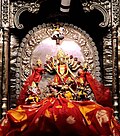
The Sena dynasty is | The Sena dynasty is notable for building [[Hindu temple]]s and monasteries.{{citation needed|date=December 2025}} King [[Ballāla Sena]] built the [[Dhakeshwari Temple]] in 12-century CE in what is now [[Dhaka]], Bangladesh.<ref>{{cite book |last1=Orum |first1=Anthony M. |url=https://books.google.com/books?id=pz1OEAAAQBAJ&pg=PA449 |title=The Wiley-Blackwell Encyclopedia of Urban and Regional Studies |date=15 April 2019 |publisher=John Wiley & Sons |isbn=978-1-118-56845-3 |page=449 |language=en}}</ref><ref>{{cite book |last1=Tambling |first1=Jeremy |title=The Palgrave Encyclopedia of Urban Literary Studies |date=29 October 2022 |publisher=Springer Nature |isbn=978-3-319-62419-8 |page=546 |url=https://books.google.com/books?id=Ha2YEAAAQBAJ&pg=PA546}}</ref> | ||
[[File:Dhakeswari Mata Idol.jpg|thumb|Dhakeswari Mata Idol]] | |||
In Kashmir, the dynasty also likely built a temple knows as Sankara Gaureshwara.<ref>{{cite journal |last=Mitra |first=Rajendralala |title=On the Sena Rajas of Bengal |url=https://www.biodiversitylibrary.org/item/128113#page/195/mode/1up |journal=Journal of the Asiatic Society of Bengal |volume=34 part 1 |issue=3 |publisher=Asiatic Society of Bengal |pages=141–142}}</ref>[[File:Bengala, epoca pala-sena, vishnu vasudeva, xii sec.JPG|thumb|200px|left|A sculpture of the [[Hindu deity]] [[Vishnu]] from the Sena period.]] | In Kashmir, the dynasty also likely built a temple knows as Sankara Gaureshwara.<ref>{{cite journal |last=Mitra |first=Rajendralala |date=1865 |title=On the Sena Rajas of Bengal |url=https://www.biodiversitylibrary.org/item/128113#page/195/mode/1up |journal=Journal of the Asiatic Society of Bengal |volume=34 part 1 |issue=3 |publisher=Asiatic Society of Bengal |pages=141–142}}</ref>[[File:Bengala, epoca pala-sena, vishnu vasudeva, xii sec.JPG|thumb|200px|left|A sculpture of the [[Hindu deity]] [[Vishnu]] from the Sena period.]] | ||
==Coinage== | ==Coinage== | ||
In the political history of Bengal, Sena dynasty was a mighty ruling dynasty in power. Various currency names have been regularly mentioned in the Sena writings, such as ''[[Purana]], Dharan, Dramma''. These terms were used to mean a silver coin weighing 32 ratis (56.6 grains) or a karshapan weighing scale. The term '''Kapardaka Purana''' is seen as a medium of exchange in the writings of the Sena kings and other contemporary kings. Karpadak means [[cow]]; And 'Purana' is definitely a kind of silver coin. The conjunction ‘kapardaka-purana’ refers to a medium of exchange whose quality is equal to that of a purana or silver coin (56.6 grains), but which is actually calculated by the proportional denominator. The table found in the traditional arithmetic of Bengal contained 1260 cowries instead of one [[silver coin]] (Purana or Dramma). That is, the ratio of Purana and Kapardaka is 1: 1280. Reliable evidence of the widespread use of cowrie in early medieval Bengal has been found in excavations at [[Paharpur, India|Paharpur]] and Kalgang (Bihar near [[Bhagalpur]]). Early medieval Bengal saw the scarcity of precious coins and the widespread circulation of cowries. Scholars have long sought to explain the virtual limitations of coins at this time | In the political history of Bengal, Sena dynasty was a mighty ruling dynasty in power. Various currency names have been regularly mentioned in the Sena writings, such as ''[[Purana]], Dharan, Dramma''. These terms were used to mean a silver coin weighing 32 ratis (56.6 grains) or a karshapan weighing scale. The term '''Kapardaka Purana''' is seen as a medium of exchange in the writings of the Sena kings and other contemporary kings. Karpadak means [[cow]]; And 'Purana' is definitely a kind of silver coin. The conjunction ‘kapardaka-purana’ refers to a medium of exchange whose quality is equal to that of a purana or silver coin (56.6 grains), but which is actually calculated by the proportional denominator. The table found in the traditional arithmetic of Bengal contained 1260 cowries instead of one [[silver coin]] (Purana or Dramma). That is, the ratio of Purana and Kapardaka is 1: 1280. Reliable evidence of the widespread use of cowrie in early medieval Bengal has been found in excavations at [[Paharpur, India|Paharpur]] and Kalgang (Bihar near [[Bhagalpur]]). Early medieval Bengal saw the scarcity of precious coins and the widespread circulation of cowries. Scholars have long sought to explain the virtual limitations of coins at this time.<ref>{{cite web |url=https://en.banglapedia.org/index.php/Coins |title=Coins |website=Banglapedia}}</ref> | ||
<ref>{{cite web |url=https://en.banglapedia.org/index.php/Coins |title=Coins |website=Banglapedia}}</ref> | |||
== Decline == | == Decline == | ||
{{South Asia in 1175}} | {{South Asia in 1175}} | ||
Downfall of Sena dynasty was destined under the rule of weak rulers of this dynasty. This dynasty started declining during the rule of | Downfall of Sena dynasty was destined under the rule of weak rulers of this dynasty. This dynasty started declining during the rule of Lakshmana Sena who was the last significant Sena king. He was succeeded by his two sons [[Vishvarupa Sena]] and [[Keshava Sena]].<ref>{{Cite book |last=Majumdar |first=R.C. |url=https://archive.org/details/dli.bengal.10689.13287/page/n286/mode/1up |title=History Of Ancient Bengal |publisher=G.Bharadwaj, Calcutta |year=1971 |pages=236}}</ref> Probably they ruled till at least 1230 AD.<ref name=":5">{{Cite book |last=Majumdar |first=R.C. |url=https://archive.org/details/dli.bengal.10689.13287/page/n288/mode/1up |title=History Of Ancient Bengal |publisher=G.Bharadwaj, Calcutta |year=1971 |pages=238}}</ref> However it was learnt from Tabaqat-i-Nasiri that the descendants of Lakshmana Sena ruled in Bengal (Bang) till at least 1245 AD or 1260 AD.<ref name=":5" /> | ||
== Legacy == | == Legacy == | ||
The Senas and their descendants merged into the [[Bengali Kayastha|Kayastha]] caste-group, heralding them as the neo-Kshatriyas of Bengal — hence, [[Abu'l-Fazl ibn Mubarak|Abul Fazl]] would write that Bengal had always been ruled by Kayasthas.<ref name="AlHind">{{cite book|author=Andre Wink|url=https://books.google.com/books?id=bCVyhH5VDjAC|title=Al-Hind, the Making of the Indo-Islamic World, Volume 1|publisher=Brill Academic Publishers|year=1991|isbn=978-90-04-09509-0|page=269|accessdate=3 September 2011}}</ref><ref name="RiseofIslam">{{cite book|last=Eaton|first=Richard Maxwell|url=https://books.google.com/books?id=gKhChF3yAOUC|title=The Rise of Islam and the Bengal Frontier, 1204–1760|publisher=University of California Press|year=1996|isbn=978-0-52020-507-9|pages=102–103}}</ref> The actual caste-status of Senas —{{Nbsp}}notwithstanding the anachronism{{Nbsp}}— remain contested in popular memory: premodern Baidya genealogies claim the Senas as their own which are agreed upon by some Brahmin genealogies but rejected by Kayastha ones. | {{See also|Sena-Gahadavala Conflicts}} | ||
The Senas and their descendants merged into the [[Bengali Kayastha|Kayastha]] caste-group, heralding them as the neo-Kshatriyas of Bengal — hence, [[Abu'l-Fazl ibn Mubarak|Abul Fazl]] would write that Bengal had always been ruled by Kayasthas.<ref name="AlHind">{{cite book|author=Andre Wink|url=https://books.google.com/books?id=bCVyhH5VDjAC|title=Al-Hind, the Making of the Indo-Islamic World, Volume 1|publisher=Brill Academic Publishers|year=1991|isbn=978-90-04-09509-0|page=269|accessdate=3 September 2011}}</ref><ref name="RiseofIslam">{{cite book|last=Eaton|first=Richard Maxwell|url=https://books.google.com/books?id=gKhChF3yAOUC|title=The Rise of Islam and the Bengal Frontier, 1204–1760|publisher=University of California Press|year=1996|isbn=978-0-52020-507-9|pages=102–103}}</ref> The actual caste-status of Senas —{{Nbsp}}notwithstanding the anachronism{{Nbsp}}— remain contested in popular memory: premodern Baidya genealogies claim the Senas as their own which are agreed upon by some Brahmin genealogies but rejected by Kayastha ones.<ref name=":02">{{Cite journal|last=Chatterjee|first=Kumkum|date=1 October 2010|title=Scribal elites in Sultanate and Mughal Bengal|url=https://doi.org/10.1177/001946461004700402|journal=The Indian Economic & Social History Review|language=en|volume=47|issue=4|pages=445–472|doi=10.1177/001946461004700402|issn=0019-4646|s2cid=143802267|url-access=subscription}}</ref><ref name=":2">{{Cite journal|last=Chatterjee|first=Kumkum|date=1 September 2005|title=Communities, Kings and Chronicles: The Kulagranthas of Bengal|url=https://doi.org/10.1177/025764300502100203|journal=Studies in History|language=en|volume=21|issue=2|pages=173–213|doi=10.1177/025764300502100203|issn=0257-6430|s2cid=144413665|url-access=subscription}}</ref><ref>{{Cite book|last=Sircar|first=Dineschandra|url=https://books.google.com/books?id=mh1y1eMgGBMC&pg=P216|title=Studies in the Religious Life of Ancient and Medieval India|date=1971|publisher=Motilal Banarsidass Publ.|isbn=978-81-208-2790-5|language=en|quote=It may be added that the Senas themselves came to be regarded as Vaidyas in the Vaidya Kula-pañjikās.}}</ref> | |||
===Nepal=== | |||
{{Main|Senas of Makwanpur}} | |||
In the 16th century, a dynasty emerged in the southern parts of [[Nepal]] near the border with [[Bihar]] which used the Sena surname and claimed descent from the Senas of Bengal. One of their branches formed the [[Senas of Makwanpur|Sena dynasty of Makwanpur]] which ruled from the fort of [[Makwanpur Gadhi]].<ref name=Das2014>{{cite journal | title=The Sena Dynasty: From Bengal to Nepal | author= Basudevlal Dad | journal=Academic Voices |volume = 4| year=2014}}</ref> This branch of the Sena dynasty adopted the local language of the region, [[Maithili language|Maithili]] which became their state language.<ref>{{cite journal |last1=Das |first1=Basudevlal |title=Maithili in Medieval Nepal: A Historical Apprisal |journal=Academic Voices |date=2013 |volume=3 |pages=1–3 |doi=10.3126/av.v3i1.9704 |doi-access=free }}</ref> | |||
== Family tree == | == Family tree == | ||
{{Chart top|width=100%|collapsed=yes|Sena dynasty}} | {{Chart top|width=100%|collapsed=yes|Sena dynasty}} | ||
| Line 106: | Line 100: | ||
{{Tree chart|border=1| | | | | | | | | | | | | | | | | | | | | | |A01 | | | | | | | | | | | | | | | | | | | | | | | | {{Tree chart|border=1| | | | | | | | | | | | | | | | | | | | | | |A01 | | | | | | | | | | | | | | | | | | | | | | | | ||
A01='''[[Hemanta Sena|Hemanta<br>Sena]]'''<br><sup>(1)</sup><br><small>r. | A01='''[[Hemanta Sena|Hemanta<br />Sena]]'''<br /><sup>(1)</sup><br /><small>r. 1095-1096</small>|boxstyle_A01=border-color:#FFD700}} | ||
{{Tree chart|border=1| | | | | | | | | | | | | | | | | | | | | | | |!| | | | | | | | | | | | | | | | | | | | | | | }} | {{Tree chart|border=1| | | | | | | | | | | | | | | | | | | | | | | |!| | | | | | | | | | | | | | | | | | | | | | | |}} | ||
{{Tree chart|border=1| | | | | | | | | | | | | | | | | | | | | | |A01 | | | | | | | | | | | | | | | | | | | | | | | | {{Tree chart|border=1| | | | | | | | | | | | | | | | | | | | | | |A01 | | | | | | | | | | | | | | | | | | | | | | | | ||
A01='''[[Vijaya Sena|Vijaya<br>Sena]]'''<br><sup>(2)</sup><br><small>r. 1096- | A01='''[[Vijaya Sena|Vijaya<br />Sena]]'''<br /><sup>(2)</sup><br /><small>r. 1096-1159</small>|boxstyle_A01=border-color:#FFD700}} | ||
{{Tree chart|border=1| | | | | | | | | | | | | | | | | | | | | | | |!| | | | | | | | | | | | | | | | | | | | | | | }} | {{Tree chart|border=1| | | | | | | | | | | | | | | | | | | | | | | |!| | | | | | | | | | | | | | | | | | | | | | | |}} | ||
{{Tree chart|border=1| | | | | | | | | | | | | | | | | | | | | | |A01 | | | | | | | | | | | | | | | | | | | | | | | | {{Tree chart|border=1| | | | | | | | | | | | | | | | | | | | | | |A01 | | | | | | | | | | | | | | | | | | | | | | | | ||
A01='''[[Ballāla Sena|Ballala<br>Sena]]'''<br><sup>(3)</sup><br><small>r. | A01='''[[Ballāla Sena|Ballala<br />Sena]]'''<br /><sup>(3)</sup><br /><small>r. 1159-1179</small>|boxstyle_A01=border-color:#FFD700}} | ||
{{Tree chart|border=1| | | | | | | | | | | | | | | | | | | | | | | |!| | | | | | | | | | | | | | | | | | | | | | | }} | {{Tree chart|border=1| | | | | | | | | | | | | | | | | | | | | | | |!| | | | | | | | | | | | | | | | | | | | | | | |}} | ||
{{Tree chart|border=1| | | | | | | | | | | | | | | | | | | | | | |A01 | | | | | | | | | | | | | | | | | | | | | | | | {{Tree chart|border=1| | | | | | | | | | | | | | | | | | | | | | |A01 | | | | | | | | | | | | | | | | | | | | | | | | ||
A01='''[[Lakshmana Sena|Lakshmana<br>Sena]]'''<br><sup>(4)</sup><br><small>r. 1179-1206</small>|boxstyle_A01=border-color:#FFD700}} | A01='''[[Lakshmana Sena|Lakshmana<br />Sena]]'''<br /><sup>(4)</sup><br /><small>r. 1179-1206</small>|boxstyle_A01=border-color:#FFD700}} | ||
{{Tree chart|border=1| | | | | | | | | | | | | | | | | | | | | |,|-|^|-|.| | | | | | | | | | | | | | | | | | | | | }} | {{Tree chart|border=1| | | | | | | | | | | | | | | | | | | | | |,|-|^|-|.| | | | | | | | | | | | | | | | | | | | | |}} | ||
{{Tree chart|border=1| | | | | | | | | | | | | | | | | | | | |A01 | |A02 | | | | | | | | | | | | | | | | | | | | | | {{Tree chart|border=1| | | | | | | | | | | | | | | | | | | | |A01 | |A02 | | | | | | | | | | | | | | | | | | | | | | ||
A01='''[[Vishvarupa Sena|Vishvarupa<br>Sena]]'''<br><sup>(5)</sup><br><small>r. 1206-1225</small>|boxstyle_A01=border-color:#FFD700| | A01='''[[Vishvarupa Sena|Vishvarupa<br />Sena]]'''<br /><sup>(5)</sup><br /><small>r. 1206-1225</small>|boxstyle_A01=border-color:#FFD700| | ||
A02='''[[Keshava Sena|Keshava<br>Sena]]'''<br><sup>(6)</sup><br><small>r. 1225-1230</small>|boxstyle_A02=border-color:#FFD700}} | A02='''[[Keshava Sena|Keshava<br />Sena]]'''<br /><sup>(6)</sup><br /><small>r. 1225-1230</small>|boxstyle_A02=border-color:#FFD700}} | ||
{{Tree chart/end}} | {{Tree chart/end}} | ||
| Line 135: | Line 129: | ||
==Literature== | ==Literature== | ||
[[File: WLA lacma Bangladesh Dinajpur District Dancing Ganesha.jpg|thumb|right|Art of the Senas, 11th century.]] | [[File: WLA lacma Bangladesh Dinajpur District Dancing Ganesha.jpg|thumb|right|Art of the Senas, 11th century.]] | ||
The Sena rulers were also great patrons of literature. During the Pala dynasty and the Sena dynasty, | The Sena rulers were also great patrons of literature. During the Pala dynasty and the Sena dynasty, the development of [[Bengali language|Bengali]] was witnessed.<ref>{{Cite book |last=Banerji |first=Rakhal Das |url=https://books.google.com/books?id=IZg6vwEACAAJ |title=The Origin of the Bengali Script |publisher=Nababharat Publishers |year=1973 |pages=81}}</ref>{{Sfn|Sen|1999|p=285}}Among the poets at the court of Lakshmana Sena were: | ||
* Govardhana | * Govardhana | ||
* Sarana | * Sarana | ||
* Jayadeva | * Jayadeva | ||
* Umapati | * Umapati | ||
* Dhoyi/[[Dhoyin]] | * Dhoyi/[[Dhoyin]]<ref>{{Cite book |last=Majumdar |first=R.C. |url=https://archive.org/details/dli.bengal.10689.13287/page/n407/mode/1up |title=History Of Ancient Bengal |publisher=G. Bharadwaj, Calcutta |year=1971 |pages=357}}</ref> | ||
==See also== | ==See also== | ||
| Line 148: | Line 141: | ||
* [[History of India]] | * [[History of India]] | ||
* [[Edilpur Copperplate]] | * [[Edilpur Copperplate]] | ||
{{Clear}} | |||
==References== | ==References== | ||
{{Reflist}} | |||
{{Reflist | |||
'''Sources''' | '''Sources''' | ||
{{refbegin}} | {{refbegin}} | ||
* Early History of India 3rd and revised edition by Vincent A Smith | * Early History of India 3rd and revised edition by Vincent A Smith | ||
* {{citation|last=Siddiq|first=Mohammad Yusuf|title=Epigraphy and Islamic Culture:Inscriptions of the Early Muslim Rulers of Bengal ( | * {{citation |last=Siddiq |first=Mohammad Yusuf |title=Epigraphy and Islamic Culture:Inscriptions of the Early Muslim Rulers of Bengal (1205–1494) |year=2015 |publisher=Routledge Contemporary South Asia Series}} | ||
{{refend}} | * {{cite book |last=Majumdar |first=R. C. |author-link=R. C. Majumdar |title=History of Ancient Bengal |year=1971 |location=Calcutta |publisher=G. Bhardwary & Co. |url=https://archive.org/details/dli.bengal.10689.13287}} | ||
*{{Cite book |last=Sen |first=Sailendra Nath |url=https://books.google.com/books?id=Wk4_ICH_g1EC |title=Ancient Indian History and Civilization |publisher=New Age International |year=1999 |isbn=978-81-224-1198-0}}{{refend}} | |||
==External links== | ==External links== | ||
| Line 166: | Line 160: | ||
| years = | | years = | ||
| before = [[Pala Empire|Pala dynasty]] | | before = [[Pala Empire|Pala dynasty]] | ||
| after = [[Deva dynasty]]<br>[[Khalji dynasty of Bengal|Khalji dynasty]] | | after = [[Deva dynasty]]<br />[[Khalji dynasty of Bengal|Khalji dynasty]] | ||
}} | }} | ||
{{s-end}} | {{s-end}} | ||
| Line 174: | Line 168: | ||
[[Category:Sena dynasty| ]] | [[Category:Sena dynasty| ]] | ||
[[Category:States and territories established in the 11th century]] | [[Category:States and territories established in the 11th century]] | ||
[[Category:11th-century establishments in India]] | |||
[[Category:States and territories disestablished in 1230]] | |||
Revision as of 18:00, 22 March 2026
Sena dynasty | |||||||||||||||
|---|---|---|---|---|---|---|---|---|---|---|---|---|---|---|---|
| 1070–1230 | |||||||||||||||
![Map of the Senas of Bengal[1]](/wiki/File:Map_of_the_Senas.png) Map of the Senas of Bengal[1] | |||||||||||||||
| Capital | Gauda, Bikrampur, Nabadwip, Lakhnauti | ||||||||||||||
| Common languages | Old Bengali, Sanskrit | ||||||||||||||
| Religion | Hinduism | ||||||||||||||
| Government | Monarchy | ||||||||||||||
| Mahārājādhirāja Vaṅgapati | |||||||||||||||
• 1070–1095 CE | Samanta Sena | ||||||||||||||
• 1095–1096 CE | Hemanta Sena | ||||||||||||||
• 1096–1159 CE | Vijaya Sena | ||||||||||||||
• 1159–1179 CE | Ballala Sena | ||||||||||||||
• 1179–1206 CE | Lakshmana Sena | ||||||||||||||
• 1206–1225 CE | Vishvarupa Sena | ||||||||||||||
• 1225–1230 CE | Keshava Sena | ||||||||||||||
• | Surya Sena[2] | ||||||||||||||
• | Narayana Sena[2] | ||||||||||||||
• | Laksmana Sena II[2] | ||||||||||||||
| Historical era | Middle Kingdoms of India | ||||||||||||||
• Established | 1070 | ||||||||||||||
| 1070–1179 | |||||||||||||||
| 1155–1206 | |||||||||||||||
| 1205 | |||||||||||||||
• Disestablished | 1230 | ||||||||||||||
| |||||||||||||||

The Sena dynasty was a Hindu dynasty during the early medieval period on the Indian subcontinent, that ruled from Bengal through the 11th and 12th centuries.[3] The empire at its peak covered much of the north-eastern region of the Indian subcontinent. The Palas of Bengal were succeeded by the Sena Dynasty.[4]
The dynasty's founder was Samanta Sena. After him came Hemanta Sena, who usurped power and styled himself king in 1095 AD. His successor Vijaya Sena (r. 1096–1159) helped lay the foundations of the dynasty and had an unusually long reign of over 60 years. Ballala Sena conquered Gaur from the Pala, became the ruler of the Bengal Delta, and made Nadia the capital as well. Ballala Sena married Ramadevi a princess of the Western Chalukya Empire which indicates that the Sena rulers maintained close social contact with south India.[5] Lakshmana Sena succeeded Ballala Sena in 1179, ruled Bengal for approximately 20 years, and expanded the Sena dynasty to Odisha, possibly up to Varanasi. In 1203–1204 AD, Qutbuddin Aibak's (r. 1206–1210) protégé, Muhammad Bin Bakhtiyar Khalji, a general under the Ghurid Empire, launched an invasion and captured the capital city of Nadia. However Navadvip was not the permanent capital of the Sena rulers.[6] The detailed account of this invasion is given in Tabaqat-i Nasiri.[7]
Origins
| History of Bengal |
|---|
 |
The rulers of the Sena Dynasty traced their origin to the south of India.[3] Deopara Prashasti described the founder of Sena dynasty Samantha Sena, as a migrant Brahmaksatriya from Karnataka.[8] The epithet 'Brahma-Kshatriya' suggests that Senas were Brahmins by caste who took the profession of arms and became Kshatriyas.[9] The Sena kings were also probably Baidyas, according to historian P.N. Chopra.[10]
A copper plate suggests that the Senas settled in western Bengal before the birth of Samantasena.[4][9] The Senas entered into the service of Palas as sāmantas in Rāḍha, probably under Samantasena.[11][12] With the decline of the Pālas, their territory had expanded to include Vaṅga and a part of Varendra by the end of Vijayasena's reign.[12] The Palas were ousted in totality, and their entire territory annexed sometime after 1165.[12]
Inscription of Keshava Sena
A copperplate was found in the Adilpur or Edilpur pargana of Faridpur District in 1838 AD and was acquired by the Asiatic Society of Bengal, but now the copperplate is missing from the collection. An account of the copperplate was published in the Dacca Review and Epigraphic Indica. The copperplate inscription is written in Sanskrit and the characters dated to about the end of the twelfth century AD.[13] In the Asiatic Society's proceeding for January 1838, an account of the copperplate states that three villages were given to a Brahmin in the third year of Keshava Sena. The grant was given with the landlord rights, which include the power of punishing the Chandrabhandas or Sundarbans, a tribe that lived in the forest.[14] The land was granted in the village of Leliya in the Kumaratalaka mandala, which is situated in shatata-padamavati-visaya. The copperplate of Keshava Sena records that the king Vallala Sena carried away, from the enemies, the goddesses of fortune on palanquins (Shivaka), which elephant tusk staff supported; and also states that Vallala Sena's son, Lakshmana Sena (1179–1206), erected pillars of victory and sacrificial posts at Varanasi, Allahabad, and Adon Coast of the South Sea. The copperplate also describes the villages with smooth fields growing excellent paddy, the dancing and music in ancient Bengal, and ladies adorned with blooming flowers. The Edilpur copperplate of Keshava Sena records that the king made a grant in favour of Nitipathaka Isvaradeva Sarman for the inside of the subha-varsha.
Society
The Sena rulers consolidated the caste system Kulinism in Bengal.[15]
Architecture
The Sena dynasty is notable for building Hindu temples and monasteries.[citation needed] King Ballāla Sena built the Dhakeshwari Temple in 12-century CE in what is now Dhaka, Bangladesh.[16][17]

In Kashmir, the dynasty also likely built a temple knows as Sankara Gaureshwara.[18]

Coinage
In the political history of Bengal, Sena dynasty was a mighty ruling dynasty in power. Various currency names have been regularly mentioned in the Sena writings, such as Purana, Dharan, Dramma. These terms were used to mean a silver coin weighing 32 ratis (56.6 grains) or a karshapan weighing scale. The term Kapardaka Purana is seen as a medium of exchange in the writings of the Sena kings and other contemporary kings. Karpadak means cow; And 'Purana' is definitely a kind of silver coin. The conjunction ‘kapardaka-purana’ refers to a medium of exchange whose quality is equal to that of a purana or silver coin (56.6 grains), but which is actually calculated by the proportional denominator. The table found in the traditional arithmetic of Bengal contained 1260 cowries instead of one silver coin (Purana or Dramma). That is, the ratio of Purana and Kapardaka is 1: 1280. Reliable evidence of the widespread use of cowrie in early medieval Bengal has been found in excavations at Paharpur and Kalgang (Bihar near Bhagalpur). Early medieval Bengal saw the scarcity of precious coins and the widespread circulation of cowries. Scholars have long sought to explain the virtual limitations of coins at this time.[19]
Decline
Template:South Asia in 1175 Downfall of Sena dynasty was destined under the rule of weak rulers of this dynasty. This dynasty started declining during the rule of Lakshmana Sena who was the last significant Sena king. He was succeeded by his two sons Vishvarupa Sena and Keshava Sena.[20] Probably they ruled till at least 1230 AD.[21] However it was learnt from Tabaqat-i-Nasiri that the descendants of Lakshmana Sena ruled in Bengal (Bang) till at least 1245 AD or 1260 AD.[21]
Legacy
The Senas and their descendants merged into the Kayastha caste-group, heralding them as the neo-Kshatriyas of Bengal — hence, Abul Fazl would write that Bengal had always been ruled by Kayasthas.[22][23] The actual caste-status of Senas — notwithstanding the anachronism — remain contested in popular memory: premodern Baidya genealogies claim the Senas as their own which are agreed upon by some Brahmin genealogies but rejected by Kayastha ones.[24][25][26]
Nepal
In the 16th century, a dynasty emerged in the southern parts of Nepal near the border with Bihar which used the Sena surname and claimed descent from the Senas of Bengal. One of their branches formed the Sena dynasty of Makwanpur which ruled from the fort of Makwanpur Gadhi.[27] This branch of the Sena dynasty adopted the local language of the region, Maithili which became their state language.[28]
Family tree
| Sena dynasty |
|---|
|
|
Literature

The Sena rulers were also great patrons of literature. During the Pala dynasty and the Sena dynasty, the development of Bengali was witnessed.[29][30]Among the poets at the court of Lakshmana Sena were:
See also
References
- ↑ Schwartzberg, Joseph E. (1978). A Historical Atlas of South Asia. Oxford University Press, Digital South Asia Library. p. 147, Map "f".
- ↑ 2.0 2.1 2.2 Raj Kumar (2003). Essays on Medieval India. Discovery Publishing House. p. 340. ISBN 9788171416837.
- ↑ 3.0 3.1 Mehta, Jaswant Lal (1979). Advanced Study in the History of Medieval India : 1000-1526 A.D. Sterling Publishers Pvt Ltd. p. 70. ISBN 978-0-39101-920-1.
- ↑ 4.0 4.1 Majumdar, R.C. (1971). History of Ancient Bengal. G. Bharadwaj, Calcutta.
- ↑ Land of Two Rivers: A History of Bengal from the Mahabharata to Mujib by Nitish K. Sengupta, p. 51.
- ↑ Sarkar, Jadunath (1976). The History of Bengal. Vol. 2. University of Dacca. p. 5.
- ↑ Majumdar, R.C. (1971). History Of Ancient Bengal. G.Bharadwaj, Calcutta. pp. 234–235.
- ↑ Sen 1999, p. 287.
- ↑ 9.0 9.1 Majumdar, R. C. (1971). History of Ancient Bengal. G. Bharadwaj, Calcutta. p. 220.
- ↑ Chopra, Pran Nath (1982). Religions and Communities of India. East-West Publications. p. 78. ISBN 978-0-85692-081-3.
The Sena kings were probably Baidyas. The evidence of inscriptions shows that a dynasty of Baidya kings ruled over at least a part of Bengal from 1010 AD to 1200 AD. The most famous of these kings is Ballal Sena
- ↑ Sen, Sailendra (2013). A Textbook of Medieval Indian History. Primus Books. pp. 35–36. ISBN 978-9-38060-734-4.
- ↑ 12.0 12.1 12.2 Furui, Ryosuke (2 July 2019). "6: Towards Brahmanical Systematisation: c. 1100–1250 AD". Land and Society in Early South Asia: Eastern India 400–1250 AD. Routledge. p. 188. ISBN 978-1-000-08480-1.
- ↑ Mukherji, Ramaranjan; Maity, Sachindra Kumar (1967). Corpus Of Bengal Inscriptions Bearing on History and Civilization of Bengal. Vol. 1. Firma K. L. Mukhopadhyay. p. 333.
- ↑ Hunter, William Wilson (1875), "A statistical account of Bengal, Volume 1", Google Books, Edinburgh: Murry and Gibbs, retrieved 3 October 2009
- ↑ Siddiq 2015, p. 35.
- ↑ Orum, Anthony M. (15 April 2019). The Wiley-Blackwell Encyclopedia of Urban and Regional Studies. John Wiley & Sons. p. 449. ISBN 978-1-118-56845-3.
- ↑ Tambling, Jeremy (29 October 2022). The Palgrave Encyclopedia of Urban Literary Studies. Springer Nature. p. 546. ISBN 978-3-319-62419-8.
- ↑ Mitra, Rajendralala (1865). "On the Sena Rajas of Bengal". Journal of the Asiatic Society of Bengal. 34 part 1 (3). Asiatic Society of Bengal: 141–142.
- ↑ "Coins". Banglapedia.
- ↑ Majumdar, R.C. (1971). History Of Ancient Bengal. G.Bharadwaj, Calcutta. p. 236.
- ↑ 21.0 21.1 Majumdar, R.C. (1971). History Of Ancient Bengal. G.Bharadwaj, Calcutta. p. 238.
- ↑ Andre Wink (1991). Al-Hind, the Making of the Indo-Islamic World, Volume 1. Brill Academic Publishers. p. 269. ISBN 978-90-04-09509-0. Retrieved 3 September 2011.
- ↑ Eaton, Richard Maxwell (1996). The Rise of Islam and the Bengal Frontier, 1204–1760. University of California Press. pp. 102–103. ISBN 978-0-52020-507-9.
- ↑ Chatterjee, Kumkum (1 October 2010). "Scribal elites in Sultanate and Mughal Bengal". The Indian Economic & Social History Review. 47 (4): 445–472. doi:10.1177/001946461004700402. ISSN 0019-4646. S2CID 143802267.
- ↑ Chatterjee, Kumkum (1 September 2005). "Communities, Kings and Chronicles: The Kulagranthas of Bengal". Studies in History. 21 (2): 173–213. doi:10.1177/025764300502100203. ISSN 0257-6430. S2CID 144413665.
- ↑ Sircar, Dineschandra (1971). Studies in the Religious Life of Ancient and Medieval India. Motilal Banarsidass Publ. ISBN 978-81-208-2790-5.
It may be added that the Senas themselves came to be regarded as Vaidyas in the Vaidya Kula-pañjikās.
- ↑ Basudevlal Dad (2014). "The Sena Dynasty: From Bengal to Nepal". Academic Voices. 4.
- ↑ Das, Basudevlal (2013). "Maithili in Medieval Nepal: A Historical Apprisal". Academic Voices. 3: 1–3. doi:10.3126/av.v3i1.9704.
- ↑ Banerji, Rakhal Das (1973). The Origin of the Bengali Script. Nababharat Publishers. p. 81.
- ↑ Sen 1999, p. 285.
- ↑ Majumdar, R.C. (1971). History Of Ancient Bengal. G. Bharadwaj, Calcutta. p. 357.
Sources
- Early History of India 3rd and revised edition by Vincent A Smith
- Siddiq, Mohammad Yusuf (2015), Epigraphy and Islamic Culture:Inscriptions of the Early Muslim Rulers of Bengal (1205–1494), Routledge Contemporary South Asia Series
- Majumdar, R. C. (1971). History of Ancient Bengal. Calcutta: G. Bhardwary & Co.
- Sen, Sailendra Nath (1999). Ancient Indian History and Civilization. New Age International. ISBN 978-81-224-1198-0.
External links
- Chowdhury, AM (2012). "Sena Dynasty". In Islam, Sirajul; Jamal, Ahmed A. (eds.). Banglapedia: National Encyclopedia of Bangladesh (Second ed.). Asiatic Society of Bangladesh.
| Preceded by Pala dynasty |
Bengal dynasty | Succeeded by Deva dynasty Khalji dynasty |
.png)