






WikiDwarfBOT (talk | contribs) Cleanup: Tag: Removed redirect |
expanded layout as per guidelines for consistency |
||
| Line 1: | Line 1: | ||
{{Short description| | {{Short description|Governors of Eastern India and Bengal in the 18th-century}} | ||
{{About|the | {{About|the de-facto independent and puppet rulers of Bengal (1717–1882)|the titular aristocrat family of Murshidabad (1882–1969)|Nawabs of Murshidabad}} | ||
{{pp-extended|small=yes}} | |||
{{Not to be confused|Bengal Subah}} | |||
{{Use Indian English|date=July 2016}} | {{Use Indian English|date=July 2016}} | ||
{{Use dmy dates|date=July 2020}} | {{Use dmy dates|date=July 2020}} | ||
{{Infobox former monarchy | {{Infobox former monarchy | ||
| royal_title = | | royal_title = Nawab | ||
| realm = | | realm = Bengal | ||
| border = | | border = | ||
| coatofarms = | | coatofarms = | ||
| coatofarmssize = | | coatofarmssize = | ||
| coatofarmscaption = | | coatofarmscaption = | ||
| image = | | image = File:Murshid Quli Jafar Khan.jpg | ||
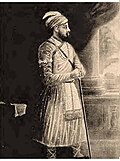
| caption = | | caption = '''First to reign'''<br />'''[[Murshid Quli Khan]]'''<br />1717{{spaced ndash}}30 June 1727 | ||
| first_monarch = [[Murshid Quli Khan]] | | first_monarch = [[Murshid Quli Khan]] | ||
| last_monarch = [[Siraj ud-Daulah]] (Independent)<br>[[Mansur Ali Khan]] (Under British) | | last_monarch = [[Siraj ud-Daulah]] (Independent)<br />[[Mansur Ali Khan]] (Under British) | ||
| style = [[Majesty|His Majesty]] | | style = [[Majesty|His Majesty]] | ||
| appointer = {{ubl|[[Hereditary]] (1717–1757) | [[British Empire]] (1757–1882)}} | |||
| appointer = {{ubl|[[Hereditary]] (1717–1757) | [[British Empire]] ( | |||
| began = {{start date and age|1717}} | | began = {{start date and age|1717}} | ||
| ended = {{start date and age| | | ended = {{start date and age|1882}} | ||
| | | | ||
}} | |residences=Chehel Shetun Palace, Hirajheel Palace, [[Hazarduari Palace]]}} | ||
{{History of Bengal}} | |||
{{History of Bangladesh}} | {{History of Bangladesh}} | ||
The ''' | The '''Nawabs of Bengal'''<ref name="Ahmed2011">{{cite book |author=Farooqui Salma Ahmed |title=A Comprehensive History of Medieval India: From Twelfth to the Mid-Eighteenth Century |url=https://books.google.com/books?id=sxhAtCflwOMC&pg=PA366 |year=2011 |publisher=Pearson Education India |isbn=978-81-317-3202-1 |pages=366–}}</ref><ref name="ChakrabartiChakrabarti2013">{{cite book |author1=Kunal Chakrabarti |author2=Shubhra Chakrabarti |title=Historical Dictionary of the Bengalis |url=https://books.google.com/books?id=QVOFAAAAQBAJ&pg=PA237 |date=22 August 2013 |publisher=Scarecrow Press |isbn=978-0-8108-8024-5 |pages=237–}}</ref><ref>{{Cite ODNB |url=https://www.oxforddnb.com/view/10.1093/ref:odnb/9780198614128.001.0001/odnb-9780198614128-e-63552 |title=Bengal, nawabs of (act. 1756–1793), rulers in India |year=2004 |doi=10.1093/ref:odnb/63552}}</ref><ref>{{Cite web |url=https://www.britannica.com/biography/Ali-Vardi-Khan |title=ʿAlī Vardī Khān | nawab of Bengal |website=Encyclopædia Britannica |access-date=2 July 2020 |archive-date=28 October 2020 |archive-url=https://web.archive.org/web/20201028181203/https://www.britannica.com/biography/Ali-Vardi-Khan |url-status=live}}</ref> were the hereditary rulers of [[Bengal Subah]] in [[Mughal India]]. In the early 18th-century, the Nawab of Bengal was the ''de facto'' independent ruler of the three provinces of [[Bengal]], [[Bihar]] and [[Orissa]] and they are often referred to as the '''Nawabs of Bengal, Bihar and Orissa'''.<ref>{{Cite web |url=https://www.britannica.com/place/Bengal-region-Asia |title=Bengal | region, Asia |website=Encyclopædia Britannica |access-date=2 July 2020 |archive-date=19 October 2021 |archive-url=https://web.archive.org/web/20211019203114/https://www.britannica.com/place/Bengal-region-Asia |url-status=live}}</ref><ref>{{Cite web |url=https://www.britannica.com/place/Odisha |title=Odisha – History |website=Encyclopædia Britannica |access-date=2 July 2020 |archive-date=28 September 2021 |archive-url=https://web.archive.org/web/20210928000459/https://www.britannica.com/place/Odisha |url-status=live}}</ref><ref>{{Cite web |url=https://scroll.in/magazine/862281/murshidabad-can-teach-the-rest-of-india-a-lot-on-how-to-restore-heritage-and-market-the-past |title=Murshidabad can teach the rest of India how to restore heritage and market the past |first=Jael |last=Silliman |website=Scroll.in |date=28 December 2017 |access-date=2 July 2020 |archive-date=3 October 2021 |archive-url=https://web.archive.org/web/20211003012802/https://scroll.in/magazine/862281/murshidabad-can-teach-the-rest-of-india-a-lot-on-how-to-restore-heritage-and-market-the-past |url-status=live}}</ref><ref>{{cite book |title=A Comprehensive History of India |url=https://books.google.com/books?id=RAON5AW4yUEC&pg=PA27 |date=1 December 2003 |publisher=Sterling Publishers Pvt. Ltd |isbn=978-81-207-2506-5 |page=27}}</ref> The Nawabs were based in [[Murshidabad]] which was centrally located within Bengal, Bihar, and Orissa. Their chief, a former prime minister, became the first Nawab. The Nawabs continued to issue coins in the name of the Mughal Emperor, but for all practical purposes, the Nawabs governed as independent monarchs. Bengal continued to contribute the largest share of funds to the imperial Mughal treasury in Delhi. | ||
The | The Bengal Subah reached its peak during the reign of Nawab [[Shuja-ud-Din Muhammad Khan]]. | ||
The Nawabs of Bengal oversaw a period of [[proto-industrialization]]. The Bengal-Bihar-Orissa triangle was a major production center for cotton muslin cloth, silk cloth, shipbuilding, gunpowder, saltpetre, and metalworks. Factories were set up in Murshidabad, Dhaka, Patna, Sonargaon, Chittagong, Rajshahi, Cossimbazar, Balasore, Pipeli, and Hugli among other cities, towns, and ports. The region became a base for the [[British East India Company]], the [[French East India Company]], the [[Danish East India Company]], the [[Austrian East India Company]], the [[Ostend Company]], and the [[Dutch East India Company]]. | The Nawabs, especially under the rule of [[Alivardi Khan]] of 16 years, were heavily engaged in various wars against the Marathas. Towards the end, he turned his attention to rebuilding and restoring [[Bengal]].<ref>{{Cite book |last=Datta |first=Kalikinkar |url=https://books.google.com/books?id=p4wdAAAAMAAJ |title=The Dutch in Bengal and Bihar, 1740–1825 A.D. |date=1948 |publisher=University of Patna |pages=12 |language=en}}</ref> | ||
The Nawabs of Bengal oversaw a period of [[proto-industrialization]]. The Bengal-Bihar-Orissa triangle was a major production center for cotton muslin cloth, silk cloth, shipbuilding, gunpowder, saltpetre, and metalworks. Factories were set up in Murshidabad, Dhaka, Patna, Sonargaon, Chittagong, Rajshahi, Cossimbazar, Balasore, Pipeli, and Hugli among other cities, towns, and ports. The region became a base for the [[British East India Company]], the [[French Indies Company|French East India Company]], the [[Danish East India Company]], the [[Austrian East India Company]], the [[Ostend Company]], and the [[Dutch East India Company]]. The Nawabs, backed by bankers such as the [[Jagat Seth]], became the financial backbone of the Mughal court. | |||
The British company eventually rivaled the authority of the Nawabs. In the aftermath of the [[siege of Calcutta]] in 1756, in which the Nawab's forces overran the main British base, the East India Company dispatched a fleet led by [[Robert Clive]] who defeated the last independent Nawab [[Siraj-ud-Daulah]] at the [[Battle of Plassey]] in 1757. [[Mir Jafar]] was installed as the puppet Nawab. His successor [[Mir Qasim]] attempted in vain to dislodge the British. The defeat of Nawab Mir Qasim of Bengal, Nawab [[Shuja-ud-Daula]] of [[Oudh]], and Mughal Emperor [[Shah Alam II]] at the [[Battle of Buxar]] in 1764 paved the way for British expansion across India. The South Indian [[Kingdom of Mysore]] led by [[Tipu Sultan]] overtook the Nawab of Bengal as the subcontinent's wealthiest monarchy; but this was short-lived and ended with the [[Anglo-Mysore War]]. The British then turned their sights on defeating the [[Maratha Empire|Marathas]] and [[Sikh Empire|Sikhs]]. | The British company eventually rivaled the authority of the Nawabs. In the aftermath of the [[siege of Calcutta]] in 1756, in which the Nawab's forces overran the main British base, the East India Company dispatched a fleet led by [[Robert Clive]] who defeated the last independent Nawab [[Siraj-ud-Daulah]] at the [[Battle of Plassey]] in 1757. [[Mir Jafar]] was installed as the puppet Nawab. His successor [[Mir Qasim]] attempted in vain to dislodge the British. The defeat of Nawab Mir Qasim of Bengal, Nawab [[Shuja-ud-Daula]] of [[Oudh]], and Mughal Emperor [[Shah Alam II]] at the [[Battle of Buxar]] in 1764 paved the way for British expansion across India. The South Indian [[Kingdom of Mysore]] led by [[Tipu Sultan]] overtook the Nawab of Bengal as the subcontinent's wealthiest monarchy; but this was short-lived and ended with the [[Anglo-Mysore War]]. The British then turned their sights on defeating the [[Maratha Empire|Marathas]] and [[Sikh Empire|Sikhs]]. | ||
In 1772, Governor-General Warren Hastings shifted administrative and judicial offices from Murshidabad to [[Calcutta]], the capital of the newly formed [[Bengal Presidency]], and the ''de facto'' capital of British India.<ref>{{Cite web|url=https://www.britannica.com/place/Kolkata|title=Kolkata | In 1772, Governor-General Warren Hastings shifted administrative and judicial offices from Murshidabad to [[Calcutta]], the capital of the newly formed [[Bengal Presidency]], and the ''de facto'' capital of British India.<ref>{{Cite web |url=https://www.britannica.com/place/Kolkata |title=Kolkata – Capital of British India |website=Encyclopædia Britannica |access-date=20 July 2020 |archive-date=13 August 2020 |archive-url=https://web.archive.org/web/20200813040212/https://www.britannica.com/place/Kolkata |url-status=live}}</ref> The Nawabs had lost all independent authority since 1757. In 1858, the British government abolished the symbolic authority of the Mughal court. After 1880, the descendants of the Nawabs of Bengal were recognised simply as [[Nawabs of Murshidabad]] with the mere status of a [[peerage]].<ref name="Watt1987">{{cite book |author=Sir George Watt |title=Indian Art at Delhi 1903: Being the Official Catalogue of the Delhi Exhibition 1902–1903 |url=https://books.google.com/books?id=Oc_oAfZLKnoC&pg=RA4-PA421 |year=1987 |publisher=Motilal Banarsidass |isbn=978-81-208-0278-0 |page=4}}</ref> | ||
==History== | ==History== | ||
===Independent nawabs=== | ===Independent nawabs=== | ||
The Bengal Subah was the wealthiest [[subah]] of the [[Mughal Empire]].<ref>{{cite web |title=Bengal ''subah'' was one of the richest ''subahs'' of the Mughal empire |url= http://business.illinois.edu/doogar/www/other/jain/murshid.html |access-date=17 August 2012 |url-status= live |archive-url= http://archive.wikiwix.com/cache/20120819051449/http://business.illinois.edu/doogar/www/other/jain/murshid.html |archive-date=19 August 2012}}</ref> There were several posts under the Mughal administrative system of Bengal since [[Akbar]]'s conquest in the 1500s. ''Nizamat'' (governornership) and ''diwani'' (premiership) were the two main branches of provincial government under the Mughals.<ref name=nawab>{{cite web |publisher=Murshidabad.net |date=8 May 2012 |title=Murshidabad History - The Nawabs and Nazims |url=http://murshidabad.net/history/history-topic-nawab.htm |access-date=9 August 2012 |url-status=dead |archive-url=https://web.archive.org/web/20120903091902/http://murshidabad.net/history/history-topic-nawab.htm |archive-date=3 September 2012 }}</ref> The ''[[Subahdar]]'' was in-charge of the ''nizamat'' and had a chain of subordinate officials on the executive side, including ''diwans'' (prime ministers) responsible for revenue and legal affairs.<ref name=nawab /> The regional decentralization of the Mughal Empire led to the creation of numerous semi-independent strongholds in the Mughal provinces. As the Mughal Empire began to decline, the Nawabs rose in power.<ref name=nawab /><ref name="ReferenceA">{{cite book|url= https://books.google.com/books?id=ga-pmgxsWwoC&q=balaji+vishwanath+peshwa&pg=PA11 |title=History Modern India – S. N. Sen – Google Books |access-date=6 July 2012 |isbn=9788122417746 |last1=Sen |first1=S. N. |year=2006}}</ref> By the early 1700s, the Nawabs were practically independent, despite a nominal tribute to the Mughal court.<ref name="ReferenceA" /> | [[File:Map of the Nawabs of Bengal.jpg|thumb|The Nawabs of Bengal in 1733, almost a decade before the [[Maratha invasions of Bengal]]<ref>{{cite web |url=https://dsal.uchicago.edu/reference/schwartzberg/pager.html?object=091 |title=-- Schwartzberg Atlas -- Digital South Asia Library}}</ref>]] | ||
The Bengal Subah was the wealthiest [[subah]] of the [[Mughal Empire]].<ref>{{cite web |title=Bengal ''subah'' was one of the richest ''subahs'' of the Mughal empire |url=http://business.illinois.edu/doogar/www/other/jain/murshid.html |access-date=17 August 2012 |url-status=live |archive-url=http://archive.wikiwix.com/cache/20120819051449/http://business.illinois.edu/doogar/www/other/jain/murshid.html |archive-date=19 August 2012}}</ref> There were several posts under the Mughal administrative system of Bengal since [[Akbar]]'s conquest in the 1500s. ''Nizamat'' (governornership) and ''diwani'' (premiership) were the two main branches of provincial government under the Mughals.<ref name=nawab>{{cite web |publisher=Murshidabad.net |date=8 May 2012 |title=Murshidabad History - The Nawabs and Nazims |url=http://murshidabad.net/history/history-topic-nawab.htm |access-date=9 August 2012 |url-status=dead |archive-url=https://web.archive.org/web/20120903091902/http://murshidabad.net/history/history-topic-nawab.htm |archive-date=3 September 2012}}</ref> The ''[[Subahdar]]'' was in-charge of the ''nizamat'' and had a chain of subordinate officials on the executive side, including ''diwans'' (prime ministers) responsible for revenue and legal affairs.<ref name=nawab /> The regional decentralization of the Mughal Empire led to the creation of numerous semi-independent strongholds in the Mughal provinces. As the Mughal Empire began to decline, the Nawabs rose in power.<ref name=nawab /><ref name="ReferenceA">{{cite book |url=https://books.google.com/books?id=ga-pmgxsWwoC&q=balaji+vishwanath+peshwa&pg=PA11 |title=History Modern India – S. N. Sen – Google Books |access-date=6 July 2012 |isbn=9788122417746 |last1=Sen |first1=S. N. |year=2006 |publisher=New Age International}}</ref> By the early 1700s, the Nawabs were practically independent, despite a nominal tribute to the Mughal court.<ref name="ReferenceA" /> | |||
The Mughal court heavily relied on Bengal for revenue. [[Azim-us-Shan]], the Mughal viceroy of Bengal, had a bitter power struggle with his prime minister (''[[Diwan (title)|diwan]]'') Murshid Quli Khan. Emperor Aurangzeb transferred Azim-us-Shan out of Bengal as a result of the disputes. After the viceroy's exit, the provincial premier Murshid Quli Khan emerged as the ''de facto'' ruler of Bengal. His administrative | The Mughal court heavily relied on Bengal for revenue. [[Azim-us-Shan]], the Mughal viceroy of Bengal, had a bitter power struggle with his prime minister (''[[Diwan (title)|diwan]]'') Murshid Quli Khan. Emperor Aurangzeb transferred Azim-us-Shan out of Bengal and into Bihar in 1703 as a result of the disputes. After the viceroy's exit, the provincial premier Murshid Quli Khan emerged as the ''de facto'' ruler of Bengal. His administrative coup merged the offices of the ''diwan'' (prime minister) and ''subedar'' (viceroy). In 1716, Khan shifted Bengal's capital from [[Dhaka]] to a new city named after himself. In 1717, Mughal Emperor Farrukhsiyar recognized Khan as the hereditary Nawab Nazim. The Nawab's jurisdiction covered districts in Bengal, Bihar, and Orissa.<ref>{{Cite web |url=http://en.banglapedia.org/index.php?title=Nawab |title=Nawab |website=Banglapedia |access-date=2 July 2020 |archive-date=1 October 2017 |archive-url=https://web.archive.org/web/20171001213500/http://en.banglapedia.org/index.php?title=Nawab |url-status=live}}</ref> The Nawab's territory stretched from the border with [[Oudh]] in the west to the border with [[Arakan]] in the east. | ||
The chief deputy of the Nawab was the Naib Nazim of Dhaka, the mayor of the former provincial capital whose own wealth was considerable; the Naib Nazim of Dhaka also governed much of eastern Bengal. Other important officials were stationed in Patna, [[Cuttack]], and Chittagong. The aristocracy was composed of the [[Zamindars of Bengal]]. The Nawab was backed up by the powerful Jagat Seth family of bankers and money lenders. The Jagat Seth controlled the flow of Bengali revenue into the imperial treasury in Delhi.<ref | The chief deputy of the Nawab was the Naib Nazim of Dhaka, the mayor of the former provincial capital whose own wealth was considerable; the Naib Nazim of Dhaka also governed much of eastern Bengal. Other important officials were stationed in Patna, [[Cuttack]], and Chittagong. The aristocracy was composed of the [[Zamindars of Bengal]].{{citation needed|date=September 2023}} The Nawab was backed up by the powerful Jagat Seth family of bankers and money lenders. The Jagat Seth controlled the flow of Bengali revenue into the imperial treasury in Delhi.<ref>{{cite book |last=Dalrymple |first=William |year=2019 |title=The Anarchy: The Relentless Rise of the East India Company |publisher=Bloomsbury Publishing |page=34 |isbn=978-1-63557-395-4}}</ref> They served as financiers to both the Nawabs and European companies operating in the region. | ||
[[File:Murshidabad.gif|thumb|Sketch of the main [[Katra Mosque|caravanserai and mosque]] in Murshidabad]] | [[File:Murshidabad.gif|thumb|Sketch of the main [[Katra Mosque|caravanserai and mosque]] in Murshidabad]] | ||
The Nawabs profited from the revenue generated by the worldwide demand of [[muslin trade in Bengal]], which was | The Nawabs profited from the revenue generated by the worldwide demand of [[muslin trade in Bengal]], which was centred in Dhaka and [[Sonargaon]]. Murshidabad was a major centre of silk production.<ref>{{cite web |url=https://asianartnewspaper.com/murshidabad-the-forgotten-capital-of-bengal/ |title=Murshidabad: The forgotten capital of Bengal - Asian Art Newspaper |date=5 June 2014 |access-date=20 July 2020 |archive-date=20 July 2020 |archive-url=https://web.archive.org/web/20200720222239/https://asianartnewspaper.com/murshidabad-the-forgotten-capital-of-bengal/ |url-status=live}}</ref> [[Shipbuilding]] in [[Chittagong]] enjoyed Ottoman and European demand. [[Patna]] was a centre of metalworks and the military-industrial complex. The Bengal-Bihar region was a major exporter of [[gunpowder]] and [[saltpetre]].<ref name="dt31Oct2014">{{cite news |last=Steel |first=Tim |title=Gunpowder plots |url=https://www.dhakatribune.com/opinion/heritage/84578/gunpowder-plots |work=Dhaka Tribune |date=31 October 2014 |type=Opinion |access-date=11 January 2022 |archive-url=https://web.archive.org/web/20170929135203/http://archive.dhakatribune.com/heritage/2014/nov/01/gunpowder-plots |archive-date=29 September 2017 |url-status=dead}}</ref><ref name="bp-saltpetre">{{Cite web |url=http://en.banglapedia.org/index.php?title=Saltpetre |title=Saltpetre |website=Banglapedia |access-date=20 July 2020 |archive-date=16 September 2018 |archive-url=https://web.archive.org/web/20180916164059/http://en.banglapedia.org/index.php?title=Saltpetre |url-status=live}}</ref> The Nawabs presided over an era of growing organization in banking, [[handicrafts]], and other trades. | ||
Bengal attracted traders from across [[Eurasia]]. Traders were lodged at [[caravanserai]]s, including the [[Katra Masjid]] in Murshidabad; and the [[Bara Katra]] and [[Choto Katra]] in Dhaka. [[Dutch Bengal]]i trading posts included the main Dutch port of Pipeli in Orissa; the [[Dutch settlement in Rajshahi]]; and the towns of [[Cossimbazar]] and [[Hugli-Chuchura|Hugli]]. The Danes built trading posts in [[Bankipur (Bengal)|Bankipur]] and on islands of the [[Bay of Bengal]]. [[Balasore]] in Orissa was a prominent Austrian trading post. Bengali cities were full of brokers, workers, peons, naibs, wakils, and ordinary traders.<ref name="auto">{{Cite web |url=http://en.banglapedia.org/index.php?title=Murshidabad |title=Murshidabad |website=Banglapedia}}</ref> | Bengal attracted traders from across [[Eurasia]]. Traders were lodged at [[caravanserai]]s, including the [[Katra Masjid]] in Murshidabad; and the [[Bara Katra]] and [[Choto Katra]] in Dhaka. [[Dutch Bengal]]i trading posts included the main Dutch port of Pipeli in Orissa; the [[Dutch settlement in Rajshahi]]; and the towns of [[Cossimbazar]] and [[Hugli-Chuchura|Hugli]]. The Danes built trading posts in [[Bankipur (Bengal)|Bankipur]] and on islands of the [[Bay of Bengal]]. [[Balasore]] in Orissa was a prominent Austrian trading post. Bengali cities were full of brokers, workers, peons, naibs, wakils, and ordinary traders.<ref name="auto">{{Cite web |url=http://en.banglapedia.org/index.php?title=Murshidabad |title=Murshidabad |website=Banglapedia |access-date=8 December 2015 |archive-date=4 March 2016 |archive-url=https://web.archive.org/web/20160304200028/http://en.banglapedia.org/index.php?title=Murshidabad |url-status=live}}</ref> | ||
[[File:Dutch VOC ships in Chittagong or Arakan.jpg|thumb|Dutch East India Company ships in Chittagong harbor, early 18th-century]] | [[File:Dutch VOC ships in Chittagong or Arakan.jpg|thumb|Dutch East India Company ships in Chittagong harbor, early 18th-century]] | ||
The Nawabs were patrons of [[the arts]], including the Murshidabad style of [[Mughal painting]], [[Hindustani classical music]], the [[Baul]] tradition, and local craftsmanship. The second Nawab [[Shuja-ud-Din Muhammad Khan]] developed Murshidabad's royal palace, military base, city gates, revenue office, public audience hall ([[durbar (court)|durbar]]), and mosques in an extensive compound called Farrabagh (Garden of Joy) which included canals, fountains, flowers, and fruit trees. The second Nawab's reign saw a period of economic and political consolidation.<ref name="auto"/> | The Nawabs were patrons of [[the arts]], including the Murshidabad style of [[Mughal painting]], [[Hindustani classical music]], the [[Baul]] tradition, and local craftsmanship. The second Nawab [[Shuja-ud-Din Muhammad Khan]] developed Murshidabad's royal palace, military base, city gates, revenue office, public audience hall ([[durbar (court)|durbar]]), and mosques in an extensive compound called Farrabagh (Garden of Joy) which included canals, fountains, flowers, and fruit trees. The second Nawab's reign saw a period of economic and political consolidation.<ref name="auto"/> | ||
The third Nawab [[Sarfaraz Khan]] was preoccupied with military engagements, including [[Nader Shah's invasion of India]]. Sarfaraz Khan was killed at the [[Battle of Giria]] by his deputy [[Alivardi Khan]]. The coup by Alivardi Khan led to the creation of a new dynasty. Nawab | The third Nawab [[Sarfaraz Khan]] was preoccupied with military engagements, including [[Nader Shah's invasion of India]]. Sarfaraz Khan was killed at the [[Battle of Giria]] by his deputy [[Alivardi Khan]].{{citation needed|date=December 2023}} The coup by Alivardi Khan led to the creation of a new dynasty. Nawab Murshid Quli Khan was notorious for his repressive tax collection tactics, including torture for non-payment.<ref name=":0" /> However he was also known as ''Shuja ul-Mulk (hero of the country)'' mostly due to him repelling all Maratha invasions of Bengal. {{citation needed|date=December 2024}} | ||
The | === Afghan Insurrections === | ||
{{Main article|Afghan insurrections in Bengal}} | |||
The Afghan insurrections in Bengal, also known as the Afghan mutinies were a series of four revolts led by the Afghans living in the [[Bengal Subah]] between 1745-1750. They were led by ambitious individuals like Mustafa Khan, Sardar Khan and Shamshir Khan with the intent to carve out their own Afghan state in Bengal. The insurrections were ultimately suppressed. | |||
=== Maratha invasions of Bengal === | |||
{{Main article|Maratha invasions of Bengal}} | |||
The resurgent Maratha Empire launched raids against Bengal in the 18th century, which further added to the decline of the Nawabs of Bengal. The Bengal Subah was met by a series of face to face confrontations by the Maratha Empire including the [[First Battle of Katwa]], the [[Second Battle of Katwa]], the Battle of Burdwan and the [[Battle of Rani Sarai]], Battle of Birbhum, First and Second Battles of Midnapur where Nawab [[Alivardi Khan]] defeated the Marathas and repelled their attacks.<ref name=":1" /><ref name="cdlib1" /> The Maratha raids lasted a decade from 1741 to early 1751. | |||
=== | The Marathas committed many atrocities across Bengal causing many to flee from West Bengal to East Bengal.<ref>{{Cite book |last=Hussein |first=Aklam |title=History of Bangladesh, 1704-1971 |date=1992 |publisher=Asiatic Society of Bangladesh |isbn=9789845123372 |pages=80}}</ref> 400,000 civilian Bengalis were massacred by the [[Bargis]] (Maratha warriors) including textile weavers, silk winders, and [[mulberry]] cultivators.<ref>{{Cite book |last=Chaudhuri |first=Kirti |title=The Trading World of Asia and the English East India Company: 1660-1760 |date=2006 |publisher=Cambridge University Press |isbn=9780521031592 |pages=253}}</ref><ref>{{Cite book |last=Marshall |first=Peter |title=Bengal: The British Bridgehead: Eastern India 1740-1828 |publisher=Cambridge University Press |year=2006 |isbn=9780521028226 |pages=73}}</ref> Many Bengalis were mutilated and contemporary accounts describe the scene of mass gang-rape against women.<ref>{{Cite book |last=Kishore |first=Gupta |title=Sirajuddaullah and the East India Company, 1756-1757: Background to the Foundation of British Power in India |publisher=Brill Archive |year=1962 |pages=23}}</ref> Alivardi Khan the Nawab of Bengal fearing even worse devastation and destruction agreed to pay Rs. 1.2 million of tribute annually as the ''[[chauth]]'' of Bengal and Bihar to the Marathas, and the Marathas agreed not to invade Bengal again. | ||
The | The expeditions, led by [[Raghuji Bhonsle]] of [[Nagpur]], also established de facto Maratha control over [[Odisha|Orissa]], which was formally incorporated in the Maratha Empire in 1752.<ref name="scroll.in">{{cite news |url=http://scroll.in/article/776978/forgotten-indian-history-the-brutal-maratha-invasions-of-bengal |title=Forgotten Indian history: The brutal Maratha invasions of Bengal |work=Scroll.in |access-date=1 April 2017 |archive-date=3 June 2022 |archive-url=https://web.archive.org/web/20220603000937/https://scroll.in/article/776978/forgotten-indian-history-the-brutal-maratha-invasions-of-bengal |url-status=live}}</ref><ref>{{Cite book |author=Nitish K. Sengupta |author-link=Nitish Sengupta |year=2011 |title=Land of Two Rivers: A History of Bengal from the Mahabharata to Mujib |url=https://books.google.com/books?id=kVSh_TyJ0YoC&q=marathas%20in%20bengal%20chauth%20mir%20habib&pg=PA162 |publisher=Penguin Books India |page= |isbn=978-0-14-341678-4}}</ref> | ||
In | === British influence and succession === | ||
Nawab Murshid Quli Khan was notorious for his repressive tax collection tactics, including torture for non-payment.<ref name=":0">{{cite book |last=Dalrymple |first=William |year=2019 |title=The Anarchy: The Relentless Rise of the East India Company |publisher=Bloomsbury Publishing |pages=33–34 |isbn=978-1-63557-395-4}}</ref> Nawab Alivardi Khan's successor was Nawab [[Siraj-ud-Daulah]]. Nawab Siraj-ud-Daulah grew increasingly wary of the British presence in Bengal. He also feared invasions by the [[Durrani Empire]] from the north and Marathas from the west. On 20 June 1756, Nawab Siraj-ud-Daulah launched the [[siege of Calcutta]], in which he won a decisive victory. The British were briefly expelled from Fort William, which came under the occupation of the Nawab's forces. The East India Company dispatched a naval fleet led by [[Robert Clive]] to regain control of Fort William. By January 1757, the British retook Fort William. The stalemate with the Nawab continued into June. The Nawab also began cooperating with the French East India Company, raising the ire of the British further. Britain and France were at the time pitted against each other in the [[Seven Years' War]]. | |||
[[File:Lord Clive meeting with Mir Jafar after the Battle of Plassey.jpg|thumb|[[Robert Clive]] meets [[Mir Jafar]] at the [[Battle of Plassey]] in 1757]] | |||
On 23 June 1757, the [[Battle of Plassey]] brought an end to the independence of the Nawabs of Bengal.<ref>{{Cite web |url=https://www.nam.ac.uk/explore/battle-plassey |title=Battle of Plassey | National Army Museum |website=nam.ac.uk}}</ref><ref>{{Cite web |url=https://www.outlookindia.com/newsscroll/in-battle-for-bengal-a-plassey-redux-ians-exclusive/1526500 |title=In battle for Bengal, a Plassey redux (IANS Exclusive) |website=outlookindia.com/ |access-date=2 July 2020 |archive-date=4 July 2020 |archive-url=https://web.archive.org/web/20200704094351/https://www.outlookindia.com/newsscroll/in-battle-for-bengal-a-plassey-redux-ians-exclusive/1526500 |url-status=live}}</ref> Nawab Siraj-ud-Daulah and his French allies were caught off guard by the defection of the Nawab's Commander-in-Chief [[Mir Jafar]] to the British side. The British, under the leadership of Robert Clive, gained enormous influence over Bengal Subah as a result of the battle. The last independent Nawab was arrested by his former officers and killed in revenge for the brutality against his courtiers. | |||
Mir Jafar was installed as the puppet Nawab by the British. However, Jafar entered into a secret treaty with the Dutch East India Company. This caused the British to replace Mir Jafar with his son-in-law [[Mir Qasim]] in October 1760. In one of his first acts, Mir Qasim ceded Chittagong,<ref>{{Cite web |url=https://www.britannica.com/place/Chittagong |title=Chittagong | History, Population, & Facts |website=Encyclopædia Britannica |access-date=2 July 2020 |archive-date=22 March 2022 |archive-url=https://web.archive.org/web/20220322095155/https://www.britannica.com/place/Chittagong |url-status=live}}</ref> [[Burdwan]] and [[Midnapore]] to the East India Company. Mir Qasim also proved to be a popular ruler. But Mir Qasim's independent spirit eventually raised British suspicions. Mir Jafar was reinstalled as Nawab in 1763. Mir Qasim continued opposing the British and his father-in-law. He set up his capital in [[Munger]] and raised an independent army. Mir Qasim attacked British positions in Patna, overrunning the company's offices and killing its Resident. Mir Qasim also attacked the British-allied [[Gorkha Kingdom]]. Mir Qasim allied with Nawab [[Shuja-ud-Daula]] of [[Awadh]] and Mughal Emperor [[Shah Alam II]]. However, the Mughal allies were defeated at the [[Battle of Buxar]] in 1764, which was the last real chance of resisting British expansion across the northern Indian subcontinent. | |||
The South Indian [[Kingdom of Mysore]] under [[Hyder Ali|Haider Ali]] and [[Tipu Sultan]] briefly eclipsed the dominant position of Bengal in the subcontinent. Tipu Sultan pursued aggressive military modernization; and set up a company to trade with communities around the Persian Gulf and the Arabian Sea. Mysore's military technology at one point rivaled European technology. However, the [[Anglo-Mysore War]] ended Tipu Sultan's ascendancy.<ref>Parthasarathi, Prasannan (2011), Why Europe Grew Rich and Asia Did Not: Global Economic Divergence, 1600–1850, Cambridge University Press, {{ISBN|978-1-139-49889-0}}</ref><ref>{{cite book |last=Dalrymple |first=William |year=2019 |title=The Anarchy: The Relentless Rise of the East India Company |publisher=Bloomsbury Publishing |page=321 |isbn=978-1-63557-395-4}}</ref> | |||
In 1765, [[Robert Clive]], as the representative of the [[East India Company]], was given the Diwani of Bengal by the [[Mughal emperor]] [[Shah Alam II]].<ref name="sirajbanglaped2">{{cite book |last1=Chaudhury |first1=Sushil |last2=Mohsin |first2=KM |year=2012 |chapter=Sirajuddaula |chapter-url=http://en.banglapedia.org/index.php?title=Sirajuddaula |editor1-last=Islam |editor1-first=Sirajul |editor1-link=Sirajul Islam |editor2-last=Jamal |editor2-first=Ahmed A. |title=Banglapedia: National Encyclopedia of Bangladesh |edition=Second |publisher=[[Asiatic Society of Bangladesh]] |url-status=live |archive-url=https://web.archive.org/web/20150614191817/http://en.banglapedia.org/index.php?title=Sirajuddaula |archive-date=14 June 2015}}</ref> With this a system of dual governance was established, with the Nawabs responsible for the Nizamat of Bengal and the Company responsible for the Diwani of Bengal. In 1772, this arrangement came to be abolished and Bengal was brought under direct control of the British. In 1793, the Mughal emperor also ceded the Nizamat of Bengal to the Company and the Nawab of Bengal was reduced to a mere titular position and pensioners of the Company. After the [[Revolt of 1857]], Company rule in India ended, and the [[British Crown]], in 1858, took over the territories which were under direct rule of the company. This marked the beginning of [[Crown rule in India]], and the Nawabs had no political or any other kind of control over the territory.<ref name=british>{{cite book |last=Singh |first=Vipul |title=Longman History & Civics (Dual Government in Bengal) |date=1 September 2009 |publisher=Pearson Education India |url=https://books.google.com/books?id=75avUTXB11AC&pg=PA29 |isbn=9788131728888 |access-date=13 February 2016 |archive-url=https://web.archive.org/web/20171004112457/https://books.google.com/books?id=75avUTXB11AC&pg=PA29 |archive-date=4 October 2017 |url-status=live}}</ref><ref name=dualgovernment>{{cite book |title=Madhya Pradesh National Means-Cum-Merit Scholarship Exam (Warren Hasting's system of Dual Government) |date=1 January 2009 |publisher=Upkar Prakashan |url=https://books.google.com/books?id=QnyaLNskRfEC&pg=PA11 |isbn=9788174827449}}</ref> Mir Jafar's descendants continued to live in Murshidabad. The [[Hazarduari Palace]] (''Palace of a Thousand Doors'') was built as the residence of the Nawabs in the 1830s. The palace was also used by British colonial officials.<ref name=feradun-jah>{{cite web |url=http://murshidabad.net/history/history-topic-feradun-jah.htm |title=Murshidabad History - Feradun Jah |date=8 May 2012 |website=Murshidabad.net |access-date=10 August 2012 |url-status=live |archive-url=https://web.archive.org/web/20120902005536/http://murshidabad.net/history/history-topic-feradun-jah.htm |archive-date=2 September 2012}}</ref> | |||
[[File:Hazarduari1 debaditya chatterjee.jpg|thumb|Hazarduari Palace (''Palace of a Thousand Doors'') was home to the titular Nawabs of Bengal]] | [[File:Hazarduari1 debaditya chatterjee.jpg|thumb|Hazarduari Palace (''Palace of a Thousand Doors'') was home to the titular Nawabs of Bengal]] | ||
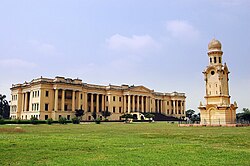
Nawab Mansur Ali Khan was the last titular Nawab Nazim of Bengal. During his reign the ''nizamat'' at Murshidabad came to be debt-ridden. The Nawab left Murshidabad in February 1869, and had started living in England. The title of the Nawab of Bengal stood abolished in 1880.<ref name=feradun-jah /> He returned to Bombay in October 1880 and pleaded his case against the orders of the government, but as it stood unresolved the Nawab renounced his styles and titles, abdicating in favour of his eldest son on 1 November 1880.<ref name=feradun-jah /> | Nawab Mansur Ali Khan was the last titular Nawab Nazim of Bengal. During his reign the ''nizamat'' at Murshidabad came to be debt-ridden. The Nawab left Murshidabad in February 1869, and had started living in England. The title of the Nawab of Bengal stood abolished in 1880.<ref name=feradun-jah /> He returned to Bombay in October 1880 and pleaded his case against the orders of the government, but as it stood unresolved the Nawab renounced his styles and titles, abdicating in favour of his eldest son on 1 November 1880.<ref name=feradun-jah /> | ||
The [[Nawabs of Murshidabad]] succeeded the Nawab Nazims following Nawab Mansur Ali Khan's abdication, The Nawab Bahadurs had ceased to exercise any significant power.<ref name=nawab /> but were relegated to the status of a [[zamindar]] and continued to be a wealthy family, producing bureaucrats and army officers.<ref name=nawab /><ref name=feradun-jah /><ref name=hassanalimirza>{{cite web |url=http://murshidabad.net/history/history-topic-hassan-ali.htm |title=Hassan Ali Mirza's succession |date=8 May 2012 |website=Murshidabad.net |access-date=10 August 2012 |url-status=dead |archive-url=https://web.archive.org/web/20120802033722/http://murshidabad.net/history/history-topic-hassan-ali.htm |archive-date=2 August 2012 }}</ref> | The [[Nawabs of Murshidabad]] succeeded the Nawab Nazims following Nawab Mansur Ali Khan's abdication, The Nawab Bahadurs had ceased to exercise any significant power.<ref name=nawab /> but were relegated to the status of a [[zamindar]] and continued to be a wealthy family, producing bureaucrats and army officers.<ref name=nawab /><ref name=feradun-jah /><ref name=hassanalimirza>{{cite web |url=http://murshidabad.net/history/history-topic-hassan-ali.htm |title=Hassan Ali Mirza's succession |date=8 May 2012 |website=Murshidabad.net |access-date=10 August 2012 |url-status=dead |archive-url=https://web.archive.org/web/20120802033722/http://murshidabad.net/history/history-topic-hassan-ali.htm |archive-date=2 August 2012}}</ref> | ||
===Relations with the Zamindars of Bihar=== | |||
The [[Zamindars of Bihar]] maintained a tenuous loyalty to the Nawabs of Bengal.<ref name="Marshall2006">{{cite book |author=P. J. Marshall |author-link=P. J. Marshall |year=2006 |orig-year=First published 1987 |title=Bengal: The British Bridgehead: Eastern India, 1740-1828 |url=https://books.google.com/books?id=lIZrfokYSY8C&pg=PA82 |series=New Cambridge History of India |volume=II, 2 |publisher=Cambridge University Press |page=82 |isbn=978-0-521-02822-6}}</ref> Rebellion and the withholding of revenue was a common feature of the Nawab period in Bihar.<ref name="Chatterjee1996">{{cite book |author=Kumkum Chatterjee |title=Merchants, Politics, and Society in Early Modern India: Bihar, 1733-1820 |url=https://books.google.com/books?id=wUeqQ2buQ80C&pg=PA35 |year=1996 |publisher=BRILL |isbn=90-04-10303-1 |pages=35–36 |access-date=9 September 2019 |archive-url=https://web.archive.org/web/20170302202540/https://books.google.com/books?id=wUeqQ2buQ80C&pg=PA35 |archive-date=2 March 2017 |url-status=live}}</ref><ref name="Rorabacher2016">{{cite book |author=J. Albert Rorabacher |title=Bihar and Mithila: The Historical Roots of Backwardness |url=https://books.google.com/books?id=HjElDwAAQBAJ&pg=PA265 |date=13 September 2016 |publisher=Taylor & Francis |isbn=978-1-351-99758-4 |pages=265–266}}</ref> Although Bihar had the potential to provide a large amount of revenue and tax, records show that the Nawabs were unable to extract any money from the chiefs of Bihar until 1748. And even following this, the amount gained was very low. This was again due to the rebellious nature of the zamindars who were "continually in arms".<ref name="Marshall">{{cite book |author=P. J. Marshall |title=Bengal: The British Bridgehead: Eastern India 1740-1828 |url=https://books.google.com/books?id=lIZrfokYSY8C |date=2 November 2006 |publisher=Cambridge University Press |isbn=978-0-521-02822-6 |pages=58–60}}</ref> | |||
=== Military campaigns === | |||
{{For|Military campaigns of the Bengal Subah prior to the Nawabs of Bengal (Before 1717)|Bengal Subah#Military campaigns}} | |||
According to [[João de Barros]], Bengal enjoyed military supremacy over [[Arakan]] and [[Kingdom of Tripura|Tripura]] due to good [[artillery]].<ref>{{cite book |author1=Momtazur Rahman Tarafdar |author-link=Momtazur Rahman Tarafdar |url=https://archive.org/details/husainshahibenga0000tara/page/105/mode/1up |title=Husain Shahi Bengal, 1494–1538 A.D.: A Socio-Political Study |publisher=Asiatic Society of Pakistan |year=1965 |page=105 |oclc=43324741 |url-access=registration}}</ref> Its forces possessed notable large [[cannons]]. It was also a major exporter of [[gunpowder]] and [[saltpeter]] to Europe.<ref name="dt31Oct2014" /><ref name="bp-saltpetre" /> The [[Mughal Army]] built [[fortifications]] across the region, including [[Idrakpur Fort]], [[Sonakanda Fort]], [[Hajiganj Fort]], [[Lalbagh Fort]] and [[Jangalbari Fort]]. The Mughals expelled Arakanese and Portuguese [[pirate]]s from the northeastern coastline of the [[Bay of Bengal]]. Throughout the late medieval and early modern periods, Bengal was notable for its navy and [[Shipbuilding in Bangladesh|shipbuilding]]. The following table covers a list of notable military engagements by Mughal Bengal: | |||
{| class="wikitable" | |||
! rowspan="1" |Conflict | |||
! rowspan="1" width="150px" |Bengal and allied forces | |||
! rowspan="1" width="150px" |Opposition forces | |||
! rowspan="1" width="320px" |Results | |||
|- | |||
|'''Conquest of [[Tripura]]''' | |||
'''(1729)''' | |||
'''Location: [[Tripura]]''' | |||
| | |||
* Nawabs of Bengal | |||
* Jagat Manikya ([[Manikya dynasty]]) | |||
|Dharma Manikya ([[Manikya dynasty]]) | |||
|'''Victory'''<ref>{{Cite book |url=https://ia902904.us.archive.org/26/items/in.ernet.dli.2015.502192/2015.502192.Bengal-Nawabs.pdf |title=Bengal Nawābs, Containing Āzād-āl-Husaini's Naubahār-i-Murshid Quli Khāni, Karam ʻAli's Muzaffarnamah, and Yusuf ʻAli's Āhwāl-i-Mahābat Jang |publisher=Asiatic Society |year=1952 |pages=4–9 |translator-last=Jadunath |translator-first=Sarkar}}</ref> | |||
* Bengali backed [[Jagat Manikya]] invades and successfully defeats Tripura (Dharma Manikya) in [[Udaipur, Tripura|Udaipur]] | |||
* Jagat Manikya rules as a vassal of the Nawabs of Bengal | |||
|- | |||
|'''Annexation of Bihar''' | |||
'''(1733)''' '''Location: [[Bihar]]''' | |||
|Nawabs of Bengal | |||
|[[Bihar Subah]] | |||
|'''Victory''' | |||
* Annexation of the [[Bihar Subah]] into the territory of the Nawabs of Bengal.<ref name="Chatterjee962">{{cite book |last1=Chatterjee |first1=Kumkum |url=https://books.google.com/books?id=VuP7EAAAQBAJ&q=merchants+politics+bihar |title=Merchants, Politics and Society in Early Modern India: Bihar: 1733-1820 |date=1996 |publisher=BRILL |isbn=9789004644748 |pages=13–16}}</ref> | |||
|- | |||
|'''Subduing of the [[Banjara]]''' | |||
'''(c.1733 - c.1740)''' '''Location: [[Bihar]]''' | |||
|Nawabs of Bengal | |||
|[[Banjara]]s | |||
|'''Victory'''<ref name=":5">{{Cite journal |last=Thakur |first=Upendra Thakur |url=https://www.jstor.org/stable/44145227 |title=Alivardi and the Afghans of Tirhut |journal=Proceedings of the Indian History Congress |volume=21 |year=1958 |pages=376–392 |jstor=44145227}}</ref> | |||
|- | |||
|'''Subduing of the [[Bettiah Raj]]''' | |||
'''(c.1733 - c.1740)''' '''Location: [[Bihar]]''' | |||
|Nawabs of Bengal | |||
|[[Bettiah Raj]] | |||
|'''Victory'''<ref name=":5" /> | |||
* Raja Dhrub Singh fled from Bhettiah | |||
|- | |||
|'''Subduing of the [[Tekari Raj]]''' | |||
'''(c.1733 - c.1740)''' '''Location: [[Bihar]]''' | |||
|Nawabs of Bengal | |||
|[[Tekari Raj]] | |||
|'''Victory<ref name=":16">Muzaffarnama, Trans by Sarkar in Bengal Past Present, vol. LXVI, 1946-47. pp. 68-69</ref>''' | |||
* Mustafa Khan of the Tekari raj employed as a General of [[Alivardi Khan]]<ref>Muzaffarnama, 70</ref> | |||
|- | |||
|'''Subduing of the [[Chakwars]] tribe''' | |||
'''(c.1733 - c.1740)''' '''Location: [[Bihar]]''' | |||
|Nawabs of Bengal | |||
|[[Bettiah Raj]] | |||
|'''Victory'''<ref name=":5" /> | |||
* Chakwars pay an annual tribute | |||
|- | |||
|'''First [[Battle of Giria]]''' | |||
'''(1740)''' '''Location: [[Giria, India|Giria]], [[Bengal]]''' | |||
|Nawabs of Bengal | |||
* Nasiri Dynasty | |||
|Nawabs of Bengal | |||
* Afshar Dynasty | |||
|'''Dynasty Change''' | |||
* [[Alivardi Khan]] takes the throne marking the end of the Nasiri Dynasty of [[Murshid Quli Khan]]. | |||
|- | |||
|'''Battle of Phulwarion''' | |||
'''(1741)''' '''Location: [[Phulbari, Jalpaiguri|Phulbari]], [[Bengal]]''' | |||
|Nawabs of Bengal | |||
|Governor of Orissa | |||
* Rustam Jang | |||
|'''Victory''' | |||
* [[Alivardi Khan]] defeated Rustam Jang, deputy governor of Orissa and a relative of Sarfaraz Khan<ref name="bp-alivardi">{{cite book |last=Shah |first=Mohammad |title=Banglapedia: National Encyclopedia of Bangladesh |publisher=[[Asiatic Society of Bangladesh]] |year=2012 |editor1-last=Islam |editor1-first=Sirajul |editor1-link=Sirajul Islam |edition=Second |chapter=Alivardi Khan |editor2-last=Jamal |editor2-first=Ahmed A. |chapter-url=http://en.banglapedia.org/index.php?title=Alivardi_Khan}}</ref> | |||
|- | |||
|'''[[First Battle of Katwa]]''' | |||
'''(1742)''' '''Location: [[Katwa]], [[Bengal]]''' | |||
|Nawabs of Bengal | |||
|{{flagcountry|Maratha Empire|size=22px}} | |||
|'''Victory''' | |||
* The entire [[Maratha Army]] was evacuated out of Bengal | |||
* The Maratha commander [[Bhaskar Ram Kolhatkar|Bhaskar Pant]] was killed.<ref name="katwa22">{{cite book |author=Jacques, Tony |url=http://m.friendfeed-media.com/6e9ec7f58014456d2d5fd015cc8af9d2974509c0 |title=Dictionary of Battles and Sieges |publisher=Greenwood Press |year=2006 |isbn=978-0-313-33536-5 |page=516 |archive-url=https://web.archive.org/web/20150626120848/http://m.friendfeed-media.com/6e9ec7f58014456d2d5fd015cc8af9d2974509c0 |archive-date=2015-06-26 |url-status=dead}}</ref> | |||
|- | |||
|'''First Battle of Midnapur''' | |||
'''(1742)''' '''Location: [[Midnapore|Midnapur]], [[Bengal]]''' | |||
|Nawabs of Bengal | |||
|{{flagcountry|Maratha Empire|size=22px}} | |||
|'''Victory''' | |||
* The Bengal forces defeated the Maratha forces and they were driven from Orissa beyond the [[Chilka lake]].<ref>{{Cite book |last=Haque |first=Mohammed Anwarul |url=https://books.google.com/books?id=Co8eAAAAMAAJ |title=Muslim Administration in Orissa, 1568-1751 A.D. |date=1980 |publisher=Punthi Pustak |pages=212 |language=en}}</ref> | |||
|- | |||
|'''Battle of Birbhum''' | |||
'''(1743)''' '''Location: [[Birbhum district|Birbhum]], [[Bengal]]''' | |||
|Nawabs of Bengal | |||
|{{flagcountry|Maratha Empire|size=22px}} | |||
|'''Victory''' | |||
* The Maratha forces evacuated out of Bengal<ref>{{Cite book |last=Ivermee |first=Robert |url=https://books.google.com/books?id=6eMJEAAAQBAJ |title=Hooghly: The Global History of a River |date=2020 |publisher=Oxford University Press |isbn=978-1-78738-325-8 |pages=56 |language=en}}</ref> | |||
|- | |||
|'''[[Second Battle of Katwa]]''' | |||
'''(1745)''' '''Location: [[Katwa]], [[Bengal]]''' | |||
|Nawabs of Bengal | |||
|{{flagcountry|Maratha Empire|size=22px}} | |||
|'''Victory''' | |||
* [[Raghuji Bhonsle]] was defeated by the Bengali army of [[Alivardi Khan]].<ref name="katwa3">{{cite book |author=Jacques, Tony |url=http://m.friendfeed-media.com/6e9ec7f58014456d2d5fd015cc8af9d2974509c0 |title=Dictionary of Battles and Sieges |publisher=Greenwood Press |year=2007 |isbn=978-0-313-33536-5 |page=516 |archive-url=https://web.archive.org/web/20150626120848/http://m.friendfeed-media.com/6e9ec7f58014456d2d5fd015cc8af9d2974509c0 |archive-date=2015-06-26 |url-status=dead}}</ref> | |||
|- | |||
|[[Battle at Bhagalpur (1745)|'''Battle at Bhagalpur''']] | |||
'''(1745)''' '''Location: [[Bihar]]''' | |||
|Nawabs of Bengal | |||
|{{flagcountry|Maratha Empire|size=22px}} | |||
|'''Victory<ref>{{Cite book |last=Mishra |first=Shree Govind |url=https://books.google.com/books?id=Ks4BAAAAMAAJ |title=History of Bihar, 1740-1772 |date=1970 |publisher=Munshiram Manoharlal |isbn=978-81-215-0382-2 |pages=46 |language=en}}-''Bhagalpur on the stream of Champanala , a battle was fought between the Nawab and Raghuji . '''Raghuji was defeated''' .''</ref>''' | |||
|- | |||
|'''[[Afghan insurrections in Bengal#List of Conflicts|1st Afghan Insurrection]]''' | |||
'''(1745)''' '''Location: [[Bihar]]''' | |||
|Nawabs of Bengal | |||
|Afghans of [[Bihar]] | |||
* Mustafa Khan | |||
|'''Victory'''<ref name=":5" /> | |||
* Retreat of Afghan troops | |||
* Mustafa regroups and forms a stronger army and attacking [[Patna]] | |||
* Zainuddin shot Mustafa Khan killing him instantaneously, thus crushing the Afghan army. | |||
|- | |||
|'''[[Afghan insurrections in Bengal#List of Conflicts|2nd Afghan Insurrection]]''' | |||
'''(1746)''' '''Location: [[Bihar]]''' | |||
|Nawabs of Bengal | |||
|Afghans of [[Bihar]] | |||
|'''Victory'''<ref name=":5" /> | |||
* Afghans along with their 6000 men retired to Dharbhanga ([[Tirhut]]). | |||
|- | |||
|'''Second Battle of Midnapur''' | |||
'''(1746)''' '''Location: [[Midnapore|Midnapur]], [[Bengal]]''' | |||
|Nawabs of Bengal | |||
|{{flagcountry|Maratha Empire|size=22px}} | |||
|'''Victory''' | |||
* Mir Jafar won a decisive battle against Mir Habib.<ref name=":1222">{{Cite book |last=Ramesh |first=Majumdar |title=The History of Bengal vol 2 |publisher=University of Dacca |year=1948 |isbn= |location=Dhaka |pages=464}}</ref> | |||
|- | |||
|'''Battle of Burdwan''' | |||
'''(1747)''' '''Location: [[Burdwan division|Burdwan]], [[Bengal]]''' | |||
|Nawabs of Bengal | |||
|{{flagcountry|Maratha Empire|size=22px}} | |||
|'''Victory''' | |||
* [[Alivardi Khan]] heavily repulsed and defeated the Marathas.<ref name="bhupalgarh2">{{cite book |author=Jacques, Tony |url=http://m.friendfeed-media.com/6e9ec7f58014456d2d5fd015cc8af9d2974509c0 |title=Dictionary of Battles and Sieges |date=30 November 2006 |publisher=Greenwood Press |isbn=978-0-313-33536-5 |page=175 |quote=When Marathas under Janoji Bhonsle invaded Orissa, Governor Mir Ja'far retreated before being reinforced to check the Marathas at Burdwan, northwest of Calcutta. Mughal Nawab Ali Vardi Khan dismissed Mir Ja'far and, with a much larger force, heavily defeated Janoji at Burdwan. However, four more years of war finally persuaded the Emperor to cede Orissa to the Marathas (January 1747). |access-date=2015-03-27 |archive-url=https://web.archive.org/web/20150626120848/http://m.friendfeed-media.com/6e9ec7f58014456d2d5fd015cc8af9d2974509c0 |archive-date=2015-06-26 |url-status=dead}}</ref> | |||
|- | |||
|'''[[Afghan insurrections in Bengal#List of Conflicts|Battle of Rani Sarai]]''' | |||
'''(1748)''' '''Location, [[Bihar]], [[Bengal Subah]]''' | |||
'''''(Part of the third Afghan Insurrection''''' '''''And [[Maratha invasions of Bengal]])''''' | |||
|Nawabs of Bengal | |||
| | |||
* {{flagcountry|Maratha Empire|size=22px}} | |||
* Afghans of [[Bihar]] | |||
|'''Victory''' | |||
* Alivardi Khan defeated the allied Afghan and Maratha forces.<ref>{{Cite book |last=Rāẏa |first=Bhabānī Caraṇa |url=https://books.google.com/books?id=FgUeAAAAMAAJ |title=Orissa Under the Mughals: From Akbar to Alivardi : a Fascinating Study of the Socio-economic and Cultural History of Orissa |date=1981 |publisher=Punthi Pustak |page=80 |language=en}}</ref> | |||
|- | |||
|'''Third Battle of Midnapur''' | |||
'''(1749)''' '''Location: [[Midnapore|Midnapur]], [[Bengal]]''' | |||
|Nawabs of Bengal | |||
|{{flagcountry|Maratha Empire|size=22px}} | |||
|'''Victory<ref name=":032">{{Cite book |last=Ray |first=Bhabani Charan |url=https://books.google.com/books?id=37A9AAAAMAAJ |title=Orissa Under Marathas, 1751-1803 |date=1960 |publisher=Kitab Mahal |pages=16–20 |language=en}}</ref>''' | |||
|- | |||
|'''Battle of Cuttack''' | |||
'''(1749)''' '''Location: [[Cuttack]], [[Bengal Subah]]''' | |||
|Nawabs of Bengal | |||
|{{flagcountry|Maratha Empire|size=22px}} | |||
|'''Victory<ref name=":042">{{Cite book |last=Ray |first=Bhabani Charan |url=https://books.google.com/books?id=37A9AAAAMAAJ |title=Orissa Under Marathas, 1751-1803 |date=1960 |publisher=Kitab Mahal |pages=16–20 |language=en}}</ref>''' | |||
|- | |||
|'''Siege of Barabati Fort''' | |||
'''(1749)''' '''Location:[[Barabati fort]]''' | |||
|Nawabs of Bengal | |||
|{{flagcountry|Maratha Empire|size=22px}} | |||
|'''Victory<ref name=":042" />''' | |||
* Orissa recovered | |||
* Fort surrendered to the Nawab | |||
|- | |||
|'''Fourth Battle of Midnapur''' | |||
'''(1750)''' '''Location: [[Midnapore|Midnapur]], [[Bengal]]''' | |||
|Nawabs of Bengal | |||
|{{flagcountry|Maratha Empire|size=22px}} | |||
|'''Victory<ref name=":042" />''' | |||
* [[Mir Habib]] retreats into the Jungle. | |||
|- | |||
|[[Afghan insurrections in Bengal#List of Conflicts|'''4th Afghan''' '''Insurrection''']] | |||
'''(1750)''' | |||
'''Location: [[Bihar]], [[Bengal]]''' | |||
|Nawabs of Bengal | |||
|Afghans of [[Bihar]] | |||
|'''Victory'''<ref name="bp-alivardi" /> | |||
* [[Alivardi Khan|Alivardi]] subdued the revolt of the Afghans who were trying to separate Bihar from his administration. | |||
|- | |||
|'''End of [[Maratha invasions of Bengal|Maratha invasions]] of Bengal''' | |||
'''(1751)''' | |||
'''Location: [[Bengal Subah|Bengal]]''' | |||
|Nawabs of Bengal | |||
|{{flagcountry|Maratha Empire|size=22px}} | |||
|'''Stalemate''' | |||
* ''Military Victory, Political Defeat'' | |||
* Peace treaty signed ending the [[Maratha invasions of Bengal]]. | |||
|- | |||
|'''Battle of Kandarpi Ghat''' | |||
'''(1753)''' '''Location: Kandarpi Ghat, [[Mithila (region)|Mithila]]''' | |||
|Nawabs of Bengal | |||
|[[File:Flag of Hinduism.svg|25x25px]] [[Raj Darbhanga|Khandwala dynasty]] | |||
|'''Defeat''' | |||
* [[Maharaja Narendra Singh]] clashed against forces of the Nawabs of Bengal led by Bhikhari Mahtha, an official of [[Alivardi Khan]] and emerged victorious.<ref>{{Cite book |last=Chaudhary |first=Radha Krishna |url=https://archive.org/stream/HistoryOfMuslimRuleInTirhut/History%20of%20Muslim%20Rule%20in%20Tirhut_djvu.txt |title=History of Muslim Rule in Tirhut (1206-1756 AD) |publisher=Chowkhamba Sanskrit Series office |year=1970 |edition=1st |volume=LXXII |location=Varanasi |pages=184–186 |language=en}}</ref> | |||
|- | |||
|'''Battle of Manihari''' | |||
'''(1756)''' '''Location: [[Manihari]], [[Bengal]] Subah''' | |||
|Nawabs of Bengal | |||
* [[Siraj-ud-Daulah]] | |||
|Shaukat Jang | |||
|'''Victory''' | |||
* [[Siraj-ud-Daulah|Siraj-ud-Daulah's]] rebellious cousin, Shakuat Jang is killed<ref>{{Cite book |last=Sengupta |first=Nitish |title=Land of Two Rivers A History of Bengal from the Mahabharata to Mujib |publisher=Penguin Books India |year=2011 |isbn=9780143416784 |pages=17}}</ref> | |||
|- | |||
|'''[[Siege of Calcutta]] (First Anglo-Bengal War)''' | |||
'''(1756–1757)''' | |||
'''Location: [[Kolkata]], [[Bengal]]''' | |||
|Nawabs of Bengal | |||
|{{flagcountry|United Kingdom|size=22px}} | |||
* [[File:Flag of the British East India Company (1707).svg|22x22px]] [[British East India Company]] | |||
|'''Victory''' | |||
* [[Treaty of Alinagar]] ([[Kolkata]]) | |||
|- | |||
|'''[[Battle of Makwanpur (1763)]]''' | |||
(1763) Location: [[Nepal]] | |||
|Nawabs of Bengal | |||
|{{flagicon image|Flag of Nepal.svg}} [[Nepal]] | |||
|'''Defeat''' | |||
* Defeat and retreat of [[Mir Qasim]] | |||
|- | |||
|'''[[Sack of Delhi (1757)|Sack of Delhi]]''' | |||
'''(1757)''' '''Location: Delhi, [[Mughal Empire]]''' | |||
|{{tree list}} | |||
* {{flagicon image|Flag of the Mughal Empire.png}} [[Mughal Empire]] | |||
** [[Bengal Subah|Bengal]]<br />{{flag|Maratha Confederacy}} | |||
{{tree list/end}} | |||
|[[File:Seal of Ahmad Shah Durrani.png|23x23px]] [[Durrani Empire]] | |||
|'''Defeat''' | |||
* [[Kashmir]], [[Lahore]], [[Multan]], [[Sirhind-Fategarh|Sirhind]], and all territories west of the [[Indus]] river are annexed by the Durrani Empire. | |||
|- | |||
|'''[[Battle of Plassey]] (Second Anglo-Bengal War)''' | |||
'''(1757)''' | |||
'''Location: [[Palashi]], [[Bengal]]''' | |||
|Nawabs of Bengal | |||
{{flagcountry|Kingdom of France|22px}} | |||
* [[File:Drapeau du régiment de la Compagnie des Indes en 1756.png|22x22px|French East India Company]] [[French Indies Company|French East India Company]] | |||
|{{flagcountry|United Kingdom|size=22px}} | |||
* [[File:Flag of the British East India Company (1707).svg|22x22px]] [[British East India Company]] | |||
|'''Defeat''' | |||
* Significant expansion of British influence over [[Bengal]] | |||
|- | |||
|'''1st Battle of Patna''' | |||
'''(1763)''' '''Location: [[Patna]], [[Bengal Subah]]''' | |||
|Nawabs of Bengal | |||
|{{flagcountry|United Kingdom|size=22px}} | |||
* [[File:Flag of the British East India Company (1707).svg|22x22px]] [[British East India Company]] | |||
* [[Mir Jafar]] (defected to the British) | |||
* [[Jagat Seth family|Jagat Seth]] | |||
|'''Victory'''<ref>{{cite book |last=Jaques |first=Tony |title=Dictionary of Battles and Sieges [3 Volumes] |date=2006-11-30 |publisher=Greenwood |isbn=978-0-313-33536-5 |publication-place=Westport, Conn |pages=780 |oclc=ocm68786744}}</ref> | |||
* British driven out of [[Patna]] | |||
|- | |||
|'''2nd [[Battle of Giria]]''' | |||
'''(1763)''' '''Location: [[Giria, India|Giria]], [[Bengal]]''' | |||
|Nawabs of Bengal | |||
|{{flagcountry|United Kingdom|size=22px}} | |||
* [[File:Flag of the British East India Company (1707).svg|22x22px]] [[British East India Company]] | |||
|'''Defeat''' | |||
* Nawab [[Mir Jafar]] installed on the throne. | |||
|- | |||
|'''[[Bengal War|Third Anglo–Bengal War]] (Bengal War)''' | |||
'''(1763–1764)''' | |||
'''Location: [[Buxar]], [[Bengal Subah]]''' | |||
| | |||
* Nawabs of Bengal | |||
* {{flagicon image|Alam of the Mughal Empire.svg|size=22px}} [[Mughal Empire]] | |||
* {{flagicon image|Flag of Awadh.svg|22px}} [[Oudh State|Oudh]] | |||
|{{flagcountry|United Kingdom|size=22px}} | |||
* [[File:Flag of the British East India Company (1707).svg|22x22px]] [[British East India Company]] | |||
{{flagicon image|Flag of the Royal House of Benares.svg}} [[Banaras State|Kashi Kingdom]] | |||
|'''Defeat''' | |||
* Treaty of Allahabad(1765). British East India Company granted Diwani rights, or the right to collect taxes on behalf of the Emperor from the eastern province of [[Bengal Subah|Bengal]] | |||
|} | |||
==List of Nawabs== | ==List of Nawabs== | ||
The following is a list of the Nawabs of Bengal. Sarfaraz Khan and Mir Jafar were the only two to become Nawab Nazim twice.<ref name=dynasties>{{cite web|url= http://murshidabad.nic.in/history1.htm |title=The Nawabs of Bengal (chronologically) |access-date=28 July 2012 |url-status= dead |archive-url= https://web.archive.org/web/20120106125513/http://murshidabad.nic.in/history1.htm |archive-date=6 January 2012}}</ref> The chronology started in 1717 with Murshid Quli Khan and ended in 1880 with Mansur Ali Khan.<ref name=nawab /><ref name=feradun-jah /><ref name=dynasties /> | The following is a list of the Nawabs of Bengal. Sarfaraz Khan and Mir Jafar were the only two to become Nawab Nazim twice.<ref name=dynasties>{{cite web |url=http://murshidabad.nic.in/history1.htm |title=The Nawabs of Bengal (chronologically) |access-date=28 July 2012 |url-status=dead |archive-url=https://web.archive.org/web/20120106125513/http://murshidabad.nic.in/history1.htm |archive-date=6 January 2012}}</ref> The chronology started in 1717 with Murshid Quli Khan and ended in 1880 with Mansur Ali Khan.<ref name=nawab /><ref name=feradun-jah /><ref name=dynasties /> | ||
=== | === Independent Rulers === | ||
{| class="wikitable" style="width:100%; text-align:center;" | {| class="wikitable" style="width:100%; text-align:center;" | ||
|- | |- | ||
! style="width:10%;"| Portrait | ! style="width:10%;" | Portrait | ||
! Titular Name | ! Titular Name | ||
! style="width:22%;"| Personal Name | ! style="width:22%;" | Personal Name | ||
! style="width:9%;"| Birth | ! style="width:9%;" | Birth | ||
! style="width:9%;"| Reign | ! style="width:9%;" | Reign | ||
! style="width:9%;"| Death | ! style="width:9%;" | Death | ||
|- | |- | ||
! | ! colspan="6" scope="row" | Nasiri dynasty | ||
|- | |- | ||
| [[File:Murshid Quli Jafar Khan.jpg|90px]] | | [[File:Murshid Quli Jafar Khan.jpg|90px]] | ||
| Line 86: | Line 387: | ||
| [[Murshid Quli Khan]] | | [[Murshid Quli Khan]] | ||
| 1665 | | 1665 | ||
| | | 1717–30 June 1727 | ||
| June 1727<ref name=quli-khan>{{cite web |url= http://murshidabad.net/history/history-topic-murshid-quli-khan.htm |website=Murshidabad.net |title=Murshidabad History - Murshid Quli Khan |access-date=17 August 2012 |url-status=live |archive-url= https://web.archive.org/web/20120705195445/http://murshidabad.net/history/history-topic-murshid-quli-khan.htm |archive-date=5 July 2012}}</ref><ref>{{Cite web|url= https://www.britannica.com/biography/Murshid-Quli-Khan |title=Murshid Quli Khan {{!}} Indian nawab|website=Encyclopædia Britannica|access-date=7 May 2016|url-status=live|archive-url= https://web.archive.org/web/20160801142917/https://www.britannica.com/biography/Murshid-Quli-Khan|archive-date=1 August 2016}}</ref><ref>{{cite book |last=Karim |first=Abdul |year=2012 |chapter=Murshid Quli Khan |chapter-url= http://en.banglapedia.org/index.php?title=Murshid_Quli_Khan |editor1-last=Islam |editor1-first=Sirajul |editor1-link=Sirajul Islam |editor2-last=Jamal |editor2-first=Ahmed A. |title=Banglapedia: National Encyclopedia of Bangladesh |edition=Second |publisher=[[Asiatic Society of Bangladesh]] |url-status=live |archive-url= https://web.archive.org/web/20170404111435/http://en.banglapedia.org/index.php?title=Murshid_Quli_Khan |archive-date=4 April 2017}}</ref> | | 30 June 1727<ref name="quli-khan">{{cite web |url=http://murshidabad.net/history/history-topic-murshid-quli-khan.htm |website=Murshidabad.net |title=Murshidabad History - Murshid Quli Khan |access-date=17 August 2012 |url-status=live |archive-url=https://web.archive.org/web/20120705195445/http://murshidabad.net/history/history-topic-murshid-quli-khan.htm |archive-date=5 July 2012}}</ref><ref>{{Cite web |url=https://www.britannica.com/biography/Murshid-Quli-Khan |title=Murshid Quli Khan {{!}} Indian nawab |website=Encyclopædia Britannica |access-date=7 May 2016 |url-status=live |archive-url=https://web.archive.org/web/20160801142917/https://www.britannica.com/biography/Murshid-Quli-Khan |archive-date=1 August 2016}}</ref><ref>{{cite book |last=Karim |first=Abdul |year=2012 |chapter=Murshid Quli Khan |chapter-url=http://en.banglapedia.org/index.php?title=Murshid_Quli_Khan |editor1-last=Islam |editor1-first=Sirajul |editor1-link=Sirajul Islam |editor2-last=Jamal |editor2-first=Ahmed A. |title=Banglapedia: National Encyclopedia of Bangladesh |edition=Second |publisher=[[Asiatic Society of Bangladesh]] |url-status=live |archive-url=https://web.archive.org/web/20170404111435/http://en.banglapedia.org/index.php?title=Murshid_Quli_Khan |archive-date=4 April 2017}}</ref> | ||
|- | |- | ||
| [[File:Sarfaraz Khan.jpg|90px]] | | [[File:Sarfaraz Khan.jpg|90px]] | ||
| ''Ala-ud-Din Haidar Jung'' | | ''Ala-ud-Din Haidar Jung'' | ||
| [[Sarfaraz Khan]] | | [[Sarfaraz Khan]] | ||
| | | 1700 | ||
| 1727–1727 (for few days) | | 1727–1727 (for few days) | ||
| 29 April 1740<ref name=sarfaraz-khan>{{cite web |website=Murshidabad.net |date=8 May 2012 |title=Murshidabad History - Sarfaraz Khan |url= http://murshidabad.net/history/history-topic-sarfaraz-khan.htm |access-date=9 August 2012 |url-status=live |archive-url= https://web.archive.org/web/20120623115607/http://murshidabad.net/history/history-topic-sarfaraz-khan.htm |archive-date=23 June 2012}}</ref> | | 29 April 1740<ref name="sarfaraz-khan">{{cite web |website=Murshidabad.net |date=8 May 2012 |title=Murshidabad History - Sarfaraz Khan |url=http://murshidabad.net/history/history-topic-sarfaraz-khan.htm |access-date=9 August 2012 |url-status=live |archive-url=https://web.archive.org/web/20120623115607/http://murshidabad.net/history/history-topic-sarfaraz-khan.htm |archive-date=23 June 2012}}</ref> | ||
|- | |- | ||
| [[File:Shuja-ud-Din Muhammad Khan.jpg|90px]] | | [[File:Shuja-ud-Din Muhammad Khan.jpg|90px]] | ||
| ''Shuja ud-Daula'' | | ''Shuja ud-Daula'' | ||
| [[Shuja-ud-Din Muhammad Khan]] | | [[Shuja-ud-Din Muhammad Khan]] | ||
| | | 1670 | ||
| 1 July 1727 – 26 August 1739 | | 1 July 1727 – 26 August 1739 | ||
| 26 August 1739<ref>{{cite book |last=Karim |first=KM |year=2012 |chapter=Shujauddin Muhammad Khan |chapter-url= http://en.banglapedia.org/index.php?title=Shujauddin_Muhammad_Khan |editor1-last=Islam |editor1-first=Sirajul |editor1-link=Sirajul Islam |editor2-last=Jamal |editor2-first=Ahmed A. |title=Banglapedia: National Encyclopedia of Bangladesh |edition=Second |publisher=[[Asiatic Society of Bangladesh]] |url-status=live |archive-url= https://web.archive.org/web/20150710002332/http://en.banglapedia.org/index.php?title=Shujauddin_Muhammad_Khan |archive-date=10 July 2015}}</ref><ref>{{Cite web|url= http://murshidabad.net/history/history-topic-suja-ud-daulla.htm |title=Murshidabad History - Suja-ud-Daulla|last=Paul|first=Gautam|website=murshidabad.net|access-date=7 May 2016|url-status=live|archive-url= https://web.archive.org/web/20160421195518/http://murshidabad.net/history/history-topic-suja-ud-daulla.htm |archive-date=21 April 2016}}</ref> | | 26 August 1739<ref>{{cite book |last=Karim |first=KM |year=2012 |chapter=Shujauddin Muhammad Khan |chapter-url=http://en.banglapedia.org/index.php?title=Shujauddin_Muhammad_Khan |editor1-last=Islam |editor1-first=Sirajul |editor1-link=Sirajul Islam |editor2-last=Jamal |editor2-first=Ahmed A. |title=Banglapedia: National Encyclopedia of Bangladesh |edition=Second |publisher=[[Asiatic Society of Bangladesh]] |url-status=live |archive-url=https://web.archive.org/web/20150710002332/http://en.banglapedia.org/index.php?title=Shujauddin_Muhammad_Khan |archive-date=10 July 2015}}</ref><ref>{{Cite web |url=http://murshidabad.net/history/history-topic-suja-ud-daulla.htm |title=Murshidabad History - Suja-ud-Daulla |last=Paul |first=Gautam |website=murshidabad.net |access-date=7 May 2016 |url-status=live |archive-url=https://web.archive.org/web/20160421195518/http://murshidabad.net/history/history-topic-suja-ud-daulla.htm |archive-date=21 April 2016}}</ref> | ||
|- | |- | ||
| [[File:Sarfaraz Khan.jpg|90px]] | | [[File:Sarfaraz Khan.jpg|90px]] | ||
| ''Ala-ud-Din Haidar Jung'' | | ''Ala-ud-Din Haidar Jung'' | ||
| Sarfaraz Khan | | [[Sarfaraz Khan]] | ||
| | | 1700 | ||
| | | 26 August 1739 – 29 April 1740 | ||
| 29 April 1740<ref name=sarfaraz-khan /> | | 29 April 1740<ref name="sarfaraz-khan" /> | ||
|- | |- | ||
! | ! colspan="6" scope="row" | Afshar dynasty | ||
|- | |- | ||
| [[File:Alivardi Khan.jpg|90px]] | | [[File:Alivardi Khan.jpg|90px]] | ||
| Line 117: | Line 418: | ||
| Before 10 May 1671 | | Before 10 May 1671 | ||
| 29 April 1740 – 9 April 1756 | | 29 April 1740 – 9 April 1756 | ||
| 9 April 1756<ref>{{Cite web|url=http://murshidabad.net/history/history-topic-alivardi-khan.htm|title=Murshidabad History - Alivardi Khan|last=Paul|first=Gautam|website=murshidabad.net|access-date=7 May 2016|url-status=dead|archive-url=https://web.archive.org/web/20160309144640/http://www.murshidabad.net/history/history-topic-alivardi-khan.htm|archive-date=9 March 2016}}</ref><ref>{{Cite book|url= https://books.google.com/books?id=1eMhAQAAIAAJ |title=Bengal, Past & Present: Journal of the Calcutta Historical Society|date=1962|publisher=The Society|pages=34–36|language=en|access-date=7 May 2016|archive-url= https://web.archive.org/web/20170706104029/https://books.google.com/books?id=1eMhAQAAIAAJ |archive-date=6 July 2017|url-status=live}}</ref> | | 9 April 1756<ref>{{Cite web |url=http://murshidabad.net/history/history-topic-alivardi-khan.htm |title=Murshidabad History - Alivardi Khan |last=Paul |first=Gautam |website=murshidabad.net |access-date=7 May 2016 |url-status=dead |archive-url=https://web.archive.org/web/20160309144640/http://www.murshidabad.net/history/history-topic-alivardi-khan.htm |archive-date=9 March 2016}}</ref><ref>{{Cite book |url=https://books.google.com/books?id=1eMhAQAAIAAJ |title=Bengal, Past & Present: Journal of the Calcutta Historical Society |date=1962 |publisher=The Society |pages=34–36 |language=en |access-date=7 May 2016 |archive-url=https://web.archive.org/web/20170706104029/https://books.google.com/books?id=1eMhAQAAIAAJ |archive-date=6 July 2017 |url-status=live}}</ref> | ||
|- | |- | ||
| [[File:Siraj ud-Daulah.jpg|90px]] | | [[File:Siraj ud-Daulah.jpg|90px]] | ||
| ''Siraj ud- | | ''Mansur-ul-Mulk Siraj-ud-Daulla '' | ||
| [[Siraj ud-Daulah]] | | [[Siraj ud-Daulah]] | ||
| 1733 | | 1733 | ||
| 9 April 1756 – 23 June 1757 | | 9 April 1756 – 23 June 1757 | ||
| 2 July 1757<ref>{{Cite web|url= http://murshidabad.net/history/history-topic-siraj-ud-daulla.htm |title=Murshidabad History - Siraj-ud-Daulla|last=Paul|first=Gautam|website=murshidabad.net|access-date=7 May 2016|url-status=live|archive-url= https://web.archive.org/web/20160507023706/http://murshidabad.net/history/history-topic-siraj-ud-daulla.htm |archive-date=7 May 2016}}</ref><ref>{{Cite web |url= http://storyofpakistan.com/nawab-siraj-ud-daulah |title=Nawab Siraj-ud-Daulah |date=3 January 2005 |website=Story of Pakistan |access-date=7 May 2016 |url-status=live |archive-url= https://web.archive.org/web/20160804104049/http://storyofpakistan.com/nawab-siraj-ud-daulah |archive-date=4 August 2016}}</ref> | | 2 July 1757<ref>{{Cite web |url=http://murshidabad.net/history/history-topic-siraj-ud-daulla.htm |title=Murshidabad History - Siraj-ud-Daulla |last=Paul |first=Gautam |website=murshidabad.net |access-date=7 May 2016 |url-status=live |archive-url=https://web.archive.org/web/20160507023706/http://murshidabad.net/history/history-topic-siraj-ud-daulla.htm |archive-date=7 May 2016}}</ref><ref>{{Cite web |url=http://storyofpakistan.com/nawab-siraj-ud-daulah |title=Nawab Siraj-ud-Daulah |date=3 January 2005 |website=Story of Pakistan |access-date=7 May 2016 |url-status=live |archive-url=https://web.archive.org/web/20160804104049/http://storyofpakistan.com/nawab-siraj-ud-daulah |archive-date=4 August 2016}}</ref> | ||
|} | |} | ||
=== | === Puppet rulers under British influence === | ||
{| class="wikitable" style="width:100%; text-align:center;" | {| class="wikitable" style="width:100%; text-align:center;" | ||
|- | |- | ||
| Line 144: | Line 445: | ||
| 1691 | | 1691 | ||
| 2 June 1757 – 20 October 1760 | | 2 June 1757 – 20 October 1760 | ||
| 17 January 1765<ref>{{Cite book|url= https://books.google.com/books?id=4gg9Zvqs7mwC |title=The Riyaz̤u-s-salāt̤īn: A History of Bengal|last=Zaidpūrī|first=Ghulām Ḥusain (called Salīm)|date=1902|publisher=Asiatic Society|page=384|language=en|access-date=7 May 2016|archive-url= https://web.archive.org/web/20170827231546/https://books.google.com/books?id=4gg9Zvqs7mwC |archive-date=27 August 2017|url-status=live}}</ref><ref>{{Cite web|url= http://murshidabad.net/history/history-topic-mir-jafar.htm |title=Murshidabad History - Mir Muhammed Jafar Ali Khan|last=Paul|first=Gautam|website=murshidabad.net|access-date=7 May 2016|url-status=live|archive-url= https://web.archive.org/web/20160408160557/http://murshidabad.net/history/history-topic-mir-jafar.htm |archive-date=8 April 2016}}</ref><ref>{{Cite news |title=Portrait of an accidental Nawab |url= http://timesofindia.indiatimes.com/city/kolkata/Portrait-of-an-accidental-Nawab/articleshow/40618038.cms |newspaper=The Times of India |access-date=7 May 2016 |url-status=live |archive-url= https://web.archive.org/web/20160822062815/http://timesofindia.indiatimes.com/city/kolkata/Portrait-of-an-accidental-Nawab/articleshow/40618038.cms |archive-date=22 August 2016}}</ref> | | 17 January 1765<ref>{{Cite book |url=https://books.google.com/books?id=4gg9Zvqs7mwC |title=The Riyaz̤u-s-salāt̤īn: A History of Bengal |last=Zaidpūrī |first=Ghulām Ḥusain (called Salīm) |date=1902 |publisher=Asiatic Society |page=384 |language=en |access-date=7 May 2016 |archive-url=https://web.archive.org/web/20170827231546/https://books.google.com/books?id=4gg9Zvqs7mwC |archive-date=27 August 2017 |url-status=live}}</ref><ref>{{Cite web |url=http://murshidabad.net/history/history-topic-mir-jafar.htm |title=Murshidabad History - Mir Muhammed Jafar Ali Khan |last=Paul |first=Gautam |website=murshidabad.net |access-date=7 May 2016 |url-status=live |archive-url=https://web.archive.org/web/20160408160557/http://murshidabad.net/history/history-topic-mir-jafar.htm |archive-date=8 April 2016}}</ref><ref>{{Cite news |title=Portrait of an accidental Nawab |url=http://timesofindia.indiatimes.com/city/kolkata/Portrait-of-an-accidental-Nawab/articleshow/40618038.cms |newspaper=The Times of India |access-date=7 May 2016 |url-status=live |archive-url=https://web.archive.org/web/20160822062815/http://timesofindia.indiatimes.com/city/kolkata/Portrait-of-an-accidental-Nawab/articleshow/40618038.cms |archive-date=22 August 2016}}</ref> | ||
|- | |- | ||
| [[File:Mir Qasim.jpg|90px]] | | [[File:Mir Qasim.jpg|90px]] | ||
| '' Itimad ud-Daulah'' | | '' Itimad ud-Daulah'' | ||
| [[Mir Qasim]] | | [[Mir Qasim]] | ||
| | | 1720 | ||
| 20 October 1760 – 7 July 1763 | | 20 October 1760 – 7 July 1763 | ||
| 8 May 1777<ref name="Mir Jafar Ali Khan - Banglapedia">{{cite book |last=Shah |first=Mohammad |year=2012 |chapter=Mir Jafar Ali Khan |chapter-url= http://en.banglapedia.org/index.php?title=Mir_Jafar_Ali_Khan |editor1-last=Islam |editor1-first=Sirajul |editor1-link=Sirajul Islam |editor2-last=Jamal |editor2-first=Ahmed A. |title=Banglapedia: National Encyclopedia of Bangladesh |edition=Second |publisher=[[Asiatic Society of Bangladesh]] |url-status=live |archive-url= https://web.archive.org/web/20150703143931/http://en.banglapedia.org/index.php?title=Mir_Jafar_Ali_Khan |archive-date=3 July 2015}}</ref> | | 8 May 1777<ref name="Mir Jafar Ali Khan - Banglapedia">{{cite book |last=Shah |first=Mohammad |year=2012 |chapter=Mir Jafar Ali Khan |chapter-url=http://en.banglapedia.org/index.php?title=Mir_Jafar_Ali_Khan |editor1-last=Islam |editor1-first=Sirajul |editor1-link=Sirajul Islam |editor2-last=Jamal |editor2-first=Ahmed A. |title=Banglapedia: National Encyclopedia of Bangladesh |edition=Second |publisher=[[Asiatic Society of Bangladesh]] |url-status=live |archive-url=https://web.archive.org/web/20150703143931/http://en.banglapedia.org/index.php?title=Mir_Jafar_Ali_Khan |archive-date=3 July 2015}}</ref> | ||
|- | |- | ||
| [[File:Mir Jafar (left) and Mir Miran (right).jpg|90px]] | | [[File:Mir Jafar (left) and Mir Miran (right).jpg|90px]] | ||
| Line 158: | Line 459: | ||
| 1691 | | 1691 | ||
| 25 July 1763 – 17 January 1765 | | 25 July 1763 – 17 January 1765 | ||
| 17 January 1765<ref name="Mir Jafar Ali Khan - Banglapedia"/><ref>{{Cite book|url= https://archive.org/details/bibliothecaindi02indigoog |title=Bibliotheca Indica|date=1902|publisher=Baptist Mission Press|page=[https://archive.org/details/bibliothecaindi02indigoog/page/n426 397]|language=en|access-date=7 May 2016}}</ref> | | 17 January 1765<ref name="Mir Jafar Ali Khan - Banglapedia"/><ref>{{Cite book |url=https://archive.org/details/bibliothecaindi02indigoog |title=Bibliotheca Indica |date=1902 |publisher=Baptist Mission Press |page=[https://archive.org/details/bibliothecaindi02indigoog/page/n426 397] |language=en |access-date=7 May 2016}}</ref> | ||
|- | |- | ||
| [[File:Nazam ud-Daulah.jpg|90px]] | | [[File:Nazam ud-Daulah.jpg|90px]] | ||
| Line 165: | Line 466: | ||
| 1750 | | 1750 | ||
| 5 February 1765 – 8 May 1766 | | 5 February 1765 – 8 May 1766 | ||
| 8 May 1766<ref>{{Cite web|url=http://murshidabad.net/history/history-topic-najam-ud-daulla.htm|title=Murshidabad History - Najam-ud-Daulla|last=Paul|first=Gautam|website=murshidabad.net|access-date=16 May 2016|url-status=dead|archive-url=https://web.archive.org/web/20160421182816/http://murshidabad.net/history/history-topic-najam-ud-daulla.htm|archive-date=21 April 2016}}</ref> | | 8 May 1766<ref>{{Cite web |url=http://murshidabad.net/history/history-topic-najam-ud-daulla.htm |title=Murshidabad History - Najam-ud-Daulla |last=Paul |first=Gautam |website=murshidabad.net |access-date=16 May 2016 |url-status=dead |archive-url=https://web.archive.org/web/20160421182816/http://murshidabad.net/history/history-topic-najam-ud-daulla.htm |archive-date=21 April 2016}}</ref> | ||
|- | |- | ||
| [[File:Saif ud-Daulah.jpg|90px]] | | [[File:Saif ud-Daulah.jpg|90px]] | ||
| Line 172: | Line 473: | ||
| 1749 | | 1749 | ||
| 22 May 1766 – 10 March 1770 | | 22 May 1766 – 10 March 1770 | ||
| 10 March 1770<ref>{{Cite web|url=http://murshidabad.net/history/history-topic-saif-ud-daulla.htm|title=Murshidabad History - Saif-ud-Daulla|last=Paul|first=Gautam|website=murshidabad.net|access-date=16 May 2016|url-status=dead|archive-url=https://web.archive.org/web/20160421183156/http://murshidabad.net/history/history-topic-saif-ud-daulla.htm|archive-date=21 April 2016}}</ref> | | 10 March 1770<ref>{{Cite web |url=http://murshidabad.net/history/history-topic-saif-ud-daulla.htm |title=Murshidabad History - Saif-ud-Daulla |last=Paul |first=Gautam |website=murshidabad.net |access-date=16 May 2016 |url-status=dead |archive-url=https://web.archive.org/web/20160421183156/http://murshidabad.net/history/history-topic-saif-ud-daulla.htm |archive-date=21 April 2016}}</ref> | ||
|- | |- | ||
| | | | ||
| | | | ||
| [[Ashraf Ali Khan]] | |[[Ashraf Ali Khan]] | ||
| | |1740 | ||
| 10 March 1770 – 24 March 1770 | | 10 March 1770 – 24 March 1770 | ||
| 24 March 1770 | | 24 March 1770 | ||
| Line 186: | Line 487: | ||
| 1759 | | 1759 | ||
| 21 March 1770 – 6 September 1793 | | 21 March 1770 – 6 September 1793 | ||
| 6 September 1793<ref>{{Cite book| | | 6 September 1793<ref>{{Cite book |last1=Khan |first1=Abdul Majed |author-link=Abdul Majed Khan |title=The Transition in Bengal, 1756-1775: A Study of Saiyid Muhammad Reza Khan |url=https://archive.org/details/transitioninbeng0000unse/page/224/mode/1up |url-access=registration |year=1969 |publisher=Cambridge University Press |sbn=521-07124-0 |page=224}}</ref> | ||
|- | |- | ||
| [[File:Babar Ali.jpg|90px]] | | [[File:Babar Ali.jpg|90px]] | ||
| ''Azud ud-Daulah'' | | ''Azud ud-Daulah'' | ||
| [[Baber Ali Khan]] | |[[Baber Ali Khan]] | ||
| | |1760 | ||
| 1793 – 28 April 1810 | | 1793 – 28 April 1810 | ||
| 28 April 1810<ref>{{Cite web|url= http://murshidabad.net/history/history-topic-babar-ali.htm |title=Murshidabad History - Babar Ali Delair Jang|last=Paul|first=Gautam|website=murshidabad.net|access-date=9 October 2016|url-status=live|archive-url= https://web.archive.org/web/20161021203935/http://murshidabad.net/history/history-topic-babar-ali.htm |archive-date=21 October 2016}}</ref> | | 28 April 1810<ref>{{Cite web |url=http://murshidabad.net/history/history-topic-babar-ali.htm |title=Murshidabad History - Babar Ali Delair Jang |last=Paul |first=Gautam |website=murshidabad.net |access-date=9 October 2016 |url-status=live |archive-url=https://web.archive.org/web/20161021203935/http://murshidabad.net/history/history-topic-babar-ali.htm |archive-date=21 October 2016}}</ref> | ||
|- | |- | ||
| [[File:Ali Jah.jpg|90px]] | | [[File:Ali Jah.jpg|90px]] | ||
| ''Ali Jah'' | | ''Ali Jah'' | ||
| [[Zain-ud-Din Ali Khan]] | | [[Zain-ud-Din Ali Khan]] | ||
| | |1785 | ||
| 5 June 1810 – 6 August 1821 | | 5 June 1810 – 6 August 1821 | ||
| 6 August 1821<ref>{{Cite web|url=http://murshidabad.net/history/history-topic-ali-jah.htm|title=Murshidabad History - Ali Jah|last=Paul|first=Gautam|website=murshidabad.net|access-date=9 October 2016|url-status=dead|archive-url=https://web.archive.org/web/20160406052017/http://murshidabad.net/history/history-topic-ali-jah.htm|archive-date=6 April 2016}}</ref><ref>{{Cite book|url= https://archive.org/details/musnudofmurshida00maju |quote= Ali Jah Murshidabad. |title=The Musnud of Murshidabad (1704-1904): being a synopsis of the history of Murshidabad for the last two centuries, to which are appended notes of places and objects of interest at Murshidabad|last=Majumdar|first=Purna Chundra|date=1905|publisher=Saroda Ray|pages=[https://archive.org/details/musnudofmurshida00maju/page/49 49]|language=en}}</ref> | | 6 August 1821<ref>{{Cite web |url=http://murshidabad.net/history/history-topic-ali-jah.htm |title=Murshidabad History - Ali Jah |last=Paul |first=Gautam |website=murshidabad.net |access-date=9 October 2016 |url-status=dead |archive-url=https://web.archive.org/web/20160406052017/http://murshidabad.net/history/history-topic-ali-jah.htm |archive-date=6 April 2016}}</ref><ref>{{Cite book |url=https://archive.org/details/musnudofmurshida00maju |quote=Ali Jah Murshidabad. |title=The Musnud of Murshidabad (1704-1904): being a synopsis of the history of Murshidabad for the last two centuries, to which are appended notes of places and objects of interest at Murshidabad |last=Majumdar |first=Purna Chundra |date=1905 |publisher=Saroda Ray |pages=[https://archive.org/details/musnudofmurshida00maju/page/49 49] |language=en}}</ref> | ||
|- | |- | ||
| [[File:Walla Jah.jpg|90px]] | | [[File:Walla Jah.jpg|90px]] | ||
| ''Walla Jah'' | | ''Walla Jah'' | ||
| [[Ahmad Ali Khan]] | | [[Ahmad Ali Khan]] | ||
| | |1760 | ||
| 1821 – 30 October 1824 | | 1821 – 30 October 1824 | ||
| 30 October 1824<ref>{{Cite web|url= http://murshidabad.net/history/history-topic-wala-jah.htm |title=Murshidabad History - Wala Jah|last=Paul|first=Gautam|website=murshidabad.net|access-date=9 October 2016|url-status=live|archive-url= https://web.archive.org/web/20161021204215/http://murshidabad.net/history/history-topic-wala-jah.htm|archive-date=21 October 2016}}</ref><ref>{{Cite book|url= https://archive.org/details/indianrecordswi00recogoog |title=Indian Records: With a Commercial View of the Relations Between the British Government and the Nawabs Nazim of Bengal, Behar and Orissa|date=1870|publisher=G. Bubb|pages=[https://archive.org/details/indianrecordswi00recogoog/page/n114 75]|language=en|access-date=9 October 2016}}</ref> | | 30 October 1824<ref>{{Cite web |url=http://murshidabad.net/history/history-topic-wala-jah.htm |title=Murshidabad History - Wala Jah |last=Paul |first=Gautam |website=murshidabad.net |access-date=9 October 2016 |url-status=live |archive-url=https://web.archive.org/web/20161021204215/http://murshidabad.net/history/history-topic-wala-jah.htm |archive-date=21 October 2016}}</ref><ref>{{Cite book |url=https://archive.org/details/indianrecordswi00recogoog |title=Indian Records: With a Commercial View of the Relations Between the British Government and the Nawabs Nazim of Bengal, Behar and Orissa |date=1870 |publisher=G. Bubb |pages=[https://archive.org/details/indianrecordswi00recogoog/page/n114 75] |language=en |access-date=9 October 2016}}</ref> | ||
|- | |- | ||
| [[File:Nawab Nazim Humayun Jah.jpg|90px]] | | [[File:Nawab Nazim Humayun Jah.jpg|90px]] | ||
| Line 214: | Line 515: | ||
| 29 September 1810 | | 29 September 1810 | ||
| 1824 – 3 October 1838 | | 1824 – 3 October 1838 | ||
| 3 October 1838<ref>{{Cite web|url=http://murshidabad.net/history/history-topic-humayun-jah.htm|title=Murshidabad History - Humayun Jah|last=Paul|first=Gautam|website=murshidabad.net|access-date=9 October 2016|url-status=dead|archive-url=https://web.archive.org/web/20160610063712/http://murshidabad.net/history/history-topic-humayun-jah.htm|archive-date=10 June 2016}}</ref><ref>{{Cite book|url= https://archive.org/details/musnudofmurshida00maju |quote= Humayun Jah. |title=The Musnud of Murshidabad (1704-1904): being a synopsis of the history of Murshidabad for the last two centuries, to which are appended notes of places and objects of interest at Murshidabad|last=Majumdar|first=Purna Chundra|date=1905|publisher=Saroda Ray|pages=[https://archive.org/details/musnudofmurshida00maju/page/50 50]|language=en}}</ref><ref>{{Cite book|url= https://books.google.com/books?id=12IPDQAAQBAJ&q=Humayun+Jah&pg=PT570 |title=Towns and Cities of Medieval India: A Brief Survey|last=Ray|first=Aniruddha|date=13 September 2016|publisher=Routledge|isbn=9781351997300|language=en}}</ref> | | 3 October 1838<ref>{{Cite web |url=http://murshidabad.net/history/history-topic-humayun-jah.htm |title=Murshidabad History - Humayun Jah |last=Paul |first=Gautam |website=murshidabad.net |access-date=9 October 2016 |url-status=dead |archive-url=https://web.archive.org/web/20160610063712/http://murshidabad.net/history/history-topic-humayun-jah.htm |archive-date=10 June 2016}}</ref><ref>{{Cite book |url=https://archive.org/details/musnudofmurshida00maju |quote=Humayun Jah. |title=The Musnud of Murshidabad (1704-1904): being a synopsis of the history of Murshidabad for the last two centuries, to which are appended notes of places and objects of interest at Murshidabad |last=Majumdar |first=Purna Chundra |date=1905 |publisher=Saroda Ray |pages=[https://archive.org/details/musnudofmurshida00maju/page/50 50] |language=en}}</ref><ref>{{Cite book |url=https://books.google.com/books?id=12IPDQAAQBAJ&q=Humayun+Jah&pg=PT570 |title=Towns and Cities of Medieval India: A Brief Survey |last=Ray |first=Aniruddha |date=13 September 2016 |publisher=Routledge |isbn=9781351997300 |language=en}}</ref> | ||
|- | |- | ||
| [[File:Feradun Jah.jpg|90px]] | | [[File:Feradun Jah.jpg|90px]] | ||
| Line 223: | Line 524: | ||
| 5 November 1884<ref name=feradun-jah /> | | 5 November 1884<ref name=feradun-jah /> | ||
|} | |} | ||
== See also == | |||
* [[Nawabs of Murshidabad]] | |||
* [[Maratha invasions of Bengal]] | |||
* [[Battle of Plassey]] | |||
* [[Bengal Presidency]] | |||
==References== | ==References== | ||
| Line 228: | Line 535: | ||
==External links== | ==External links== | ||
{{Wikiquote}} | |||
* [http://murshidabad.net/history/history.php The arrival of the Nawabs their decline] | * [http://murshidabad.net/history/history.php The arrival of the Nawabs their decline] {{Webarchive|url=https://web.archive.org/web/20151210213116/http://murshidabad.net/history/history.php |date=10 December 2015 }} | ||
* [http://murshidabad.net/history/history-topic-nawab.htm History of the Nawabs] | * [http://murshidabad.net/history/history-topic-nawab.htm History of the Nawabs] {{Webarchive|url=https://web.archive.org/web/20120903091902/http://murshidabad.net/history/history-topic-nawab.htm |date=3 September 2012 }} | ||
* [http://murshidabad.net/glossary/glossary-do-list_by_letter-letter-N.htm Official posts under the administration of the Nawabs] | * [http://murshidabad.net/glossary/glossary-do-list_by_letter-letter-N.htm Official posts under the administration of the Nawabs] {{Webarchive|url=https://web.archive.org/web/20120809090949/http://murshidabad.net/glossary/glossary-do-list_by_letter-letter-N.htm |date=9 August 2012 }} | ||
{{Bengal Zamindars|state=collapsed}} | {{Bengal Zamindars|state=collapsed}} | ||
{{West Bengal}} | {{West Bengal}} | ||
[[Category:1717 establishments in Asia]] | |||
[[Category: | |||
[[Category:Bengal Subah]] | [[Category:Bengal Subah]] | ||
[[Category:Indian nobility]] | [[Category:Indian nobility]] | ||
[[Category:Murshidabad district]] | |||
[[Category:Nawabs of Bengal| ]] | |||
[[Category:Noble titles created in 1717]] | [[Category:Noble titles created in 1717]] | ||
Revision as of 00:32, 17 March 2026
| Nawab of Bengal | |
|---|---|
 | |
| Details | |
| Style | His Majesty |
| First monarch | Murshid Quli Khan |
| Last monarch | Siraj ud-Daulah (Independent) Mansur Ali Khan (Under British) |
| Formation | 1717 |
| Abolition | 1882 |
| Residences | Chehel Shetun Palace, Hirajheel Palace, Hazarduari Palace |
| Appointer |
|
| History of Bengal |
|---|
 |
Template:History of Bangladesh The Nawabs of Bengal[1][2][3][4] were the hereditary rulers of Bengal Subah in Mughal India. In the early 18th-century, the Nawab of Bengal was the de facto independent ruler of the three provinces of Bengal, Bihar and Orissa and they are often referred to as the Nawabs of Bengal, Bihar and Orissa.[5][6][7][8] The Nawabs were based in Murshidabad which was centrally located within Bengal, Bihar, and Orissa. Their chief, a former prime minister, became the first Nawab. The Nawabs continued to issue coins in the name of the Mughal Emperor, but for all practical purposes, the Nawabs governed as independent monarchs. Bengal continued to contribute the largest share of funds to the imperial Mughal treasury in Delhi.
The Bengal Subah reached its peak during the reign of Nawab Shuja-ud-Din Muhammad Khan.
The Nawabs, especially under the rule of Alivardi Khan of 16 years, were heavily engaged in various wars against the Marathas. Towards the end, he turned his attention to rebuilding and restoring Bengal.[9]
The Nawabs of Bengal oversaw a period of proto-industrialization. The Bengal-Bihar-Orissa triangle was a major production center for cotton muslin cloth, silk cloth, shipbuilding, gunpowder, saltpetre, and metalworks. Factories were set up in Murshidabad, Dhaka, Patna, Sonargaon, Chittagong, Rajshahi, Cossimbazar, Balasore, Pipeli, and Hugli among other cities, towns, and ports. The region became a base for the British East India Company, the French East India Company, the Danish East India Company, the Austrian East India Company, the Ostend Company, and the Dutch East India Company. The Nawabs, backed by bankers such as the Jagat Seth, became the financial backbone of the Mughal court.
The British company eventually rivaled the authority of the Nawabs. In the aftermath of the siege of Calcutta in 1756, in which the Nawab's forces overran the main British base, the East India Company dispatched a fleet led by Robert Clive who defeated the last independent Nawab Siraj-ud-Daulah at the Battle of Plassey in 1757. Mir Jafar was installed as the puppet Nawab. His successor Mir Qasim attempted in vain to dislodge the British. The defeat of Nawab Mir Qasim of Bengal, Nawab Shuja-ud-Daula of Oudh, and Mughal Emperor Shah Alam II at the Battle of Buxar in 1764 paved the way for British expansion across India. The South Indian Kingdom of Mysore led by Tipu Sultan overtook the Nawab of Bengal as the subcontinent's wealthiest monarchy; but this was short-lived and ended with the Anglo-Mysore War. The British then turned their sights on defeating the Marathas and Sikhs.
In 1772, Governor-General Warren Hastings shifted administrative and judicial offices from Murshidabad to Calcutta, the capital of the newly formed Bengal Presidency, and the de facto capital of British India.[10] The Nawabs had lost all independent authority since 1757. In 1858, the British government abolished the symbolic authority of the Mughal court. After 1880, the descendants of the Nawabs of Bengal were recognised simply as Nawabs of Murshidabad with the mere status of a peerage.[11]
History
Independent nawabs

The Bengal Subah was the wealthiest subah of the Mughal Empire.[13] There were several posts under the Mughal administrative system of Bengal since Akbar's conquest in the 1500s. Nizamat (governornership) and diwani (premiership) were the two main branches of provincial government under the Mughals.[14] The Subahdar was in-charge of the nizamat and had a chain of subordinate officials on the executive side, including diwans (prime ministers) responsible for revenue and legal affairs.[14] The regional decentralization of the Mughal Empire led to the creation of numerous semi-independent strongholds in the Mughal provinces. As the Mughal Empire began to decline, the Nawabs rose in power.[14][15] By the early 1700s, the Nawabs were practically independent, despite a nominal tribute to the Mughal court.[15]
The Mughal court heavily relied on Bengal for revenue. Azim-us-Shan, the Mughal viceroy of Bengal, had a bitter power struggle with his prime minister (diwan) Murshid Quli Khan. Emperor Aurangzeb transferred Azim-us-Shan out of Bengal and into Bihar in 1703 as a result of the disputes. After the viceroy's exit, the provincial premier Murshid Quli Khan emerged as the de facto ruler of Bengal. His administrative coup merged the offices of the diwan (prime minister) and subedar (viceroy). In 1716, Khan shifted Bengal's capital from Dhaka to a new city named after himself. In 1717, Mughal Emperor Farrukhsiyar recognized Khan as the hereditary Nawab Nazim. The Nawab's jurisdiction covered districts in Bengal, Bihar, and Orissa.[16] The Nawab's territory stretched from the border with Oudh in the west to the border with Arakan in the east.
The chief deputy of the Nawab was the Naib Nazim of Dhaka, the mayor of the former provincial capital whose own wealth was considerable; the Naib Nazim of Dhaka also governed much of eastern Bengal. Other important officials were stationed in Patna, Cuttack, and Chittagong. The aristocracy was composed of the Zamindars of Bengal.[citation needed] The Nawab was backed up by the powerful Jagat Seth family of bankers and money lenders. The Jagat Seth controlled the flow of Bengali revenue into the imperial treasury in Delhi.[17] They served as financiers to both the Nawabs and European companies operating in the region.

The Nawabs profited from the revenue generated by the worldwide demand of muslin trade in Bengal, which was centred in Dhaka and Sonargaon. Murshidabad was a major centre of silk production.[18] Shipbuilding in Chittagong enjoyed Ottoman and European demand. Patna was a centre of metalworks and the military-industrial complex. The Bengal-Bihar region was a major exporter of gunpowder and saltpetre.[19][20] The Nawabs presided over an era of growing organization in banking, handicrafts, and other trades.
Bengal attracted traders from across Eurasia. Traders were lodged at caravanserais, including the Katra Masjid in Murshidabad; and the Bara Katra and Choto Katra in Dhaka. Dutch Bengali trading posts included the main Dutch port of Pipeli in Orissa; the Dutch settlement in Rajshahi; and the towns of Cossimbazar and Hugli. The Danes built trading posts in Bankipur and on islands of the Bay of Bengal. Balasore in Orissa was a prominent Austrian trading post. Bengali cities were full of brokers, workers, peons, naibs, wakils, and ordinary traders.[21]

The Nawabs were patrons of the arts, including the Murshidabad style of Mughal painting, Hindustani classical music, the Baul tradition, and local craftsmanship. The second Nawab Shuja-ud-Din Muhammad Khan developed Murshidabad's royal palace, military base, city gates, revenue office, public audience hall (durbar), and mosques in an extensive compound called Farrabagh (Garden of Joy) which included canals, fountains, flowers, and fruit trees. The second Nawab's reign saw a period of economic and political consolidation.[21]
The third Nawab Sarfaraz Khan was preoccupied with military engagements, including Nader Shah's invasion of India. Sarfaraz Khan was killed at the Battle of Giria by his deputy Alivardi Khan.[citation needed] The coup by Alivardi Khan led to the creation of a new dynasty. Nawab Murshid Quli Khan was notorious for his repressive tax collection tactics, including torture for non-payment.[22] However he was also known as Shuja ul-Mulk (hero of the country) mostly due to him repelling all Maratha invasions of Bengal. [citation needed]
Afghan Insurrections
The Afghan insurrections in Bengal, also known as the Afghan mutinies were a series of four revolts led by the Afghans living in the Bengal Subah between 1745-1750. They were led by ambitious individuals like Mustafa Khan, Sardar Khan and Shamshir Khan with the intent to carve out their own Afghan state in Bengal. The insurrections were ultimately suppressed.
Maratha invasions of Bengal
The resurgent Maratha Empire launched raids against Bengal in the 18th century, which further added to the decline of the Nawabs of Bengal. The Bengal Subah was met by a series of face to face confrontations by the Maratha Empire including the First Battle of Katwa, the Second Battle of Katwa, the Battle of Burdwan and the Battle of Rani Sarai, Battle of Birbhum, First and Second Battles of Midnapur where Nawab Alivardi Khan defeated the Marathas and repelled their attacks.[23][24] The Maratha raids lasted a decade from 1741 to early 1751.
The Marathas committed many atrocities across Bengal causing many to flee from West Bengal to East Bengal.[25] 400,000 civilian Bengalis were massacred by the Bargis (Maratha warriors) including textile weavers, silk winders, and mulberry cultivators.[26][27] Many Bengalis were mutilated and contemporary accounts describe the scene of mass gang-rape against women.[28] Alivardi Khan the Nawab of Bengal fearing even worse devastation and destruction agreed to pay Rs. 1.2 million of tribute annually as the chauth of Bengal and Bihar to the Marathas, and the Marathas agreed not to invade Bengal again.
The expeditions, led by Raghuji Bhonsle of Nagpur, also established de facto Maratha control over Orissa, which was formally incorporated in the Maratha Empire in 1752.[29][30]
British influence and succession
Nawab Murshid Quli Khan was notorious for his repressive tax collection tactics, including torture for non-payment.[22] Nawab Alivardi Khan's successor was Nawab Siraj-ud-Daulah. Nawab Siraj-ud-Daulah grew increasingly wary of the British presence in Bengal. He also feared invasions by the Durrani Empire from the north and Marathas from the west. On 20 June 1756, Nawab Siraj-ud-Daulah launched the siege of Calcutta, in which he won a decisive victory. The British were briefly expelled from Fort William, which came under the occupation of the Nawab's forces. The East India Company dispatched a naval fleet led by Robert Clive to regain control of Fort William. By January 1757, the British retook Fort William. The stalemate with the Nawab continued into June. The Nawab also began cooperating with the French East India Company, raising the ire of the British further. Britain and France were at the time pitted against each other in the Seven Years' War.

On 23 June 1757, the Battle of Plassey brought an end to the independence of the Nawabs of Bengal.[31][32] Nawab Siraj-ud-Daulah and his French allies were caught off guard by the defection of the Nawab's Commander-in-Chief Mir Jafar to the British side. The British, under the leadership of Robert Clive, gained enormous influence over Bengal Subah as a result of the battle. The last independent Nawab was arrested by his former officers and killed in revenge for the brutality against his courtiers.
Mir Jafar was installed as the puppet Nawab by the British. However, Jafar entered into a secret treaty with the Dutch East India Company. This caused the British to replace Mir Jafar with his son-in-law Mir Qasim in October 1760. In one of his first acts, Mir Qasim ceded Chittagong,[33] Burdwan and Midnapore to the East India Company. Mir Qasim also proved to be a popular ruler. But Mir Qasim's independent spirit eventually raised British suspicions. Mir Jafar was reinstalled as Nawab in 1763. Mir Qasim continued opposing the British and his father-in-law. He set up his capital in Munger and raised an independent army. Mir Qasim attacked British positions in Patna, overrunning the company's offices and killing its Resident. Mir Qasim also attacked the British-allied Gorkha Kingdom. Mir Qasim allied with Nawab Shuja-ud-Daula of Awadh and Mughal Emperor Shah Alam II. However, the Mughal allies were defeated at the Battle of Buxar in 1764, which was the last real chance of resisting British expansion across the northern Indian subcontinent.
The South Indian Kingdom of Mysore under Haider Ali and Tipu Sultan briefly eclipsed the dominant position of Bengal in the subcontinent. Tipu Sultan pursued aggressive military modernization; and set up a company to trade with communities around the Persian Gulf and the Arabian Sea. Mysore's military technology at one point rivaled European technology. However, the Anglo-Mysore War ended Tipu Sultan's ascendancy.[34][35]
In 1765, Robert Clive, as the representative of the East India Company, was given the Diwani of Bengal by the Mughal emperor Shah Alam II.[36] With this a system of dual governance was established, with the Nawabs responsible for the Nizamat of Bengal and the Company responsible for the Diwani of Bengal. In 1772, this arrangement came to be abolished and Bengal was brought under direct control of the British. In 1793, the Mughal emperor also ceded the Nizamat of Bengal to the Company and the Nawab of Bengal was reduced to a mere titular position and pensioners of the Company. After the Revolt of 1857, Company rule in India ended, and the British Crown, in 1858, took over the territories which were under direct rule of the company. This marked the beginning of Crown rule in India, and the Nawabs had no political or any other kind of control over the territory.[37][38] Mir Jafar's descendants continued to live in Murshidabad. The Hazarduari Palace (Palace of a Thousand Doors) was built as the residence of the Nawabs in the 1830s. The palace was also used by British colonial officials.[39]

Nawab Mansur Ali Khan was the last titular Nawab Nazim of Bengal. During his reign the nizamat at Murshidabad came to be debt-ridden. The Nawab left Murshidabad in February 1869, and had started living in England. The title of the Nawab of Bengal stood abolished in 1880.[39] He returned to Bombay in October 1880 and pleaded his case against the orders of the government, but as it stood unresolved the Nawab renounced his styles and titles, abdicating in favour of his eldest son on 1 November 1880.[39]
The Nawabs of Murshidabad succeeded the Nawab Nazims following Nawab Mansur Ali Khan's abdication, The Nawab Bahadurs had ceased to exercise any significant power.[14] but were relegated to the status of a zamindar and continued to be a wealthy family, producing bureaucrats and army officers.[14][39][40]
Relations with the Zamindars of Bihar
The Zamindars of Bihar maintained a tenuous loyalty to the Nawabs of Bengal.[41] Rebellion and the withholding of revenue was a common feature of the Nawab period in Bihar.[42][43] Although Bihar had the potential to provide a large amount of revenue and tax, records show that the Nawabs were unable to extract any money from the chiefs of Bihar until 1748. And even following this, the amount gained was very low. This was again due to the rebellious nature of the zamindars who were "continually in arms".[44]
Military campaigns
According to João de Barros, Bengal enjoyed military supremacy over Arakan and Tripura due to good artillery.[45] Its forces possessed notable large cannons. It was also a major exporter of gunpowder and saltpeter to Europe.[19][20] The Mughal Army built fortifications across the region, including Idrakpur Fort, Sonakanda Fort, Hajiganj Fort, Lalbagh Fort and Jangalbari Fort. The Mughals expelled Arakanese and Portuguese pirates from the northeastern coastline of the Bay of Bengal. Throughout the late medieval and early modern periods, Bengal was notable for its navy and shipbuilding. The following table covers a list of notable military engagements by Mughal Bengal:
| Conflict | Bengal and allied forces | Opposition forces | Results |
|---|---|---|---|
| Conquest of Tripura
(1729) Location: Tripura |
|
Dharma Manikya (Manikya dynasty) | Victory[46]
|
| Annexation of Bihar
(1733) Location: Bihar |
Nawabs of Bengal | Bihar Subah | Victory
|
| Subduing of the Banjara
(c.1733 - c.1740) Location: Bihar |
Nawabs of Bengal | Banjaras | Victory[48] |
| Subduing of the Bettiah Raj
(c.1733 - c.1740) Location: Bihar |
Nawabs of Bengal | Bettiah Raj | Victory[48]
|
| Subduing of the Tekari Raj
(c.1733 - c.1740) Location: Bihar |
Nawabs of Bengal | Tekari Raj | Victory[49]
|
| Subduing of the Chakwars tribe
(c.1733 - c.1740) Location: Bihar |
Nawabs of Bengal | Bettiah Raj | Victory[48]
|
| First Battle of Giria | Nawabs of Bengal
|
Nawabs of Bengal
|
Dynasty Change
|
| Battle of Phulwarion | Nawabs of Bengal | Governor of Orissa
|
Victory
|
| First Battle of Katwa | Nawabs of Bengal |  Maratha Maratha
|
Victory
|
| First Battle of Midnapur | Nawabs of Bengal | Maratha
|
Victory
|
| Battle of Birbhum | Nawabs of Bengal | Maratha
|
Victory
|
| Second Battle of Katwa | Nawabs of Bengal | Maratha
|
Victory
|
| Battle at Bhagalpur
(1745) Location: Bihar |
Nawabs of Bengal | Maratha
|
Victory[56] |
| 1st Afghan Insurrection
(1745) Location: Bihar |
Nawabs of Bengal | Afghans of Bihar
|
Victory[48]
|
| 2nd Afghan Insurrection
(1746) Location: Bihar |
Nawabs of Bengal | Afghans of Bihar | Victory[48]
|
| Second Battle of Midnapur | Nawabs of Bengal | Maratha
|
Victory
|
| Battle of Burdwan | Nawabs of Bengal | Maratha
|
Victory
|
| Battle of Rani Sarai
(1748) Location, Bihar, Bengal Subah (Part of the third Afghan Insurrection And Maratha invasions of Bengal) |
Nawabs of Bengal | Victory
| |
| Third Battle of Midnapur | Nawabs of Bengal | Maratha
|
Victory[60] |
| Battle of Cuttack
(1749) Location: Cuttack, Bengal Subah |
Nawabs of Bengal | Maratha
|
Victory[61] |
| Siege of Barabati Fort
(1749) Location:Barabati fort |
Nawabs of Bengal | Maratha
|
Victory[61]
|
| Fourth Battle of Midnapur | Nawabs of Bengal | Maratha
|
Victory[61]
|
| 4th Afghan Insurrection
(1750) |
Nawabs of Bengal | Afghans of Bihar | Victory[51]
|
| End of Maratha invasions of Bengal
(1751) Location: Bengal |
Nawabs of Bengal | Maratha
|
Stalemate
|
| Battle of Kandarpi Ghat
(1753) Location: Kandarpi Ghat, Mithila |
Nawabs of Bengal |  Khandwala dynasty Khandwala dynasty
|
Defeat
|
| Battle of Manihari | Nawabs of Bengal | Shaukat Jang | Victory
|
| Siege of Calcutta (First Anglo-Bengal War)
(1756–1757) |
Nawabs of Bengal |  United Kingdom United Kingdom
|
Victory |
| Battle of Makwanpur (1763)
(1763) Location: Nepal |
Nawabs of Bengal |  Nepal Nepal
|
Defeat
|
| Sack of Delhi
(1757) Location: Delhi, Mughal Empire |
 Durrani Empire Durrani Empire
|
Defeat | |
| Battle of Plassey (Second Anglo-Bengal War)
(1757) |
Nawabs of Bengal | United Kingdom
|
Defeat
|
| 1st Battle of Patna
(1763) Location: Patna, Bengal Subah |
Nawabs of Bengal | United Kingdom
|
Victory[64]
|
| 2nd Battle of Giria | Nawabs of Bengal | United Kingdom
|
Defeat
|
| Third Anglo–Bengal War (Bengal War)
(1763–1764) Location: Buxar, Bengal Subah |
|
United Kingdom
|
Defeat
|
.svg)


List of Nawabs
The following is a list of the Nawabs of Bengal. Sarfaraz Khan and Mir Jafar were the only two to become Nawab Nazim twice.[65] The chronology started in 1717 with Murshid Quli Khan and ended in 1880 with Mansur Ali Khan.[14][39][65]
Independent Rulers
| Portrait | Titular Name | Personal Name | Birth | Reign | Death |
|---|---|---|---|---|---|
| Nasiri dynasty | |||||
|
|
Jaafar Khan Bahadur Nasiri | Murshid Quli Khan | 1665 | 1717–30 June 1727 | 30 June 1727[66][67][68] |

|
Ala-ud-Din Haidar Jung | Sarfaraz Khan | 1700 | 1727–1727 (for few days) | 29 April 1740[69] |

|
Shuja ud-Daula | Shuja-ud-Din Muhammad Khan | 1670 | 1 July 1727 – 26 August 1739 | 26 August 1739[70][71] |
|
|
Ala-ud-Din Haidar Jung | Sarfaraz Khan | 1700 | 26 August 1739 – 29 April 1740 | 29 April 1740[69] |
| Afshar dynasty | |||||

|
Hashim ud-Daula | Alivardi Khan | Before 10 May 1671 | 29 April 1740 – 9 April 1756 | 9 April 1756[72][73] |

|
Mansur-ul-Mulk Siraj-ud-Daulla | Siraj ud-Daulah | 1733 | 9 April 1756 – 23 June 1757 | 2 July 1757[74][75] |
Puppet rulers under British influence
| Portrait | Titular Name | Personal Name | Birth | Reign | Death |
|---|---|---|---|---|---|
| Najafi dynasty | |||||
_and_Mir_Miran_(right).jpg)
|
Ja'afar 'Ali Khan Bahadur | Mir Jafar | 1691 | 2 June 1757 – 20 October 1760 | 17 January 1765[76][77][78] |

|
Itimad ud-Daulah | Mir Qasim | 1720 | 20 October 1760 – 7 July 1763 | 8 May 1777[79] |
|
|
Ja'afar 'Ali Khan Bahadur | Mir Jafar | 1691 | 25 July 1763 – 17 January 1765 | 17 January 1765[79][80] |

|
Najm ud-Daulah | Najmuddin Ali Khan | 1750 | 5 February 1765 – 8 May 1766 | 8 May 1766[81] |

|
Saif ud-Daulah | Najabut Ali Khan | 1749 | 22 May 1766 – 10 March 1770 | 10 March 1770[82] |
| Ashraf Ali Khan | 1740 | 10 March 1770 – 24 March 1770 | 24 March 1770 | ||

|
Mubarak ud-Daulah | Mubarak Ali Khan | 1759 | 21 March 1770 – 6 September 1793 | 6 September 1793[83] |

|
Azud ud-Daulah | Baber Ali Khan | 1760 | 1793 – 28 April 1810 | 28 April 1810[84] |

|
Ali Jah | Zain-ud-Din Ali Khan | 1785 | 5 June 1810 – 6 August 1821 | 6 August 1821[85][86] |

|
Walla Jah | Ahmad Ali Khan | 1760 | 1821 – 30 October 1824 | 30 October 1824[87][88] |

|
Humayun Jah | Mubarak Ali Khan II | 29 September 1810 | 1824 – 3 October 1838 | 3 October 1838[89][90][91] |

|
Feradun Jah | Mansur Ali Khan | 29 October 1830 | 29 October 1838 – 1 November 1880 (abdicated) | 5 November 1884[39] |
See also
References
- ↑ Farooqui Salma Ahmed (2011). A Comprehensive History of Medieval India: From Twelfth to the Mid-Eighteenth Century. Pearson Education India. pp. 366–. ISBN 978-81-317-3202-1.
- ↑ Kunal Chakrabarti; Shubhra Chakrabarti (22 August 2013). Historical Dictionary of the Bengalis. Scarecrow Press. pp. 237–. ISBN 978-0-8108-8024-5.
- ↑ "Bengal, nawabs of (act. 1756–1793), rulers in India". Oxford Dictionary of National Biography (online ed.). Oxford University Press. 2004. doi:10.1093/ref:odnb/63552. Template:ODNBsub
- ↑ "ʿAlī Vardī Khān | nawab of Bengal". Encyclopædia Britannica. Archived from the original on 28 October 2020. Retrieved 2 July 2020.
- ↑ "Bengal | region, Asia". Encyclopædia Britannica. Archived from the original on 19 October 2021. Retrieved 2 July 2020.
- ↑ "Odisha – History". Encyclopædia Britannica. Archived from the original on 28 September 2021. Retrieved 2 July 2020.
- ↑ Silliman, Jael (28 December 2017). "Murshidabad can teach the rest of India how to restore heritage and market the past". Scroll.in. Archived from the original on 3 October 2021. Retrieved 2 July 2020.
- ↑ A Comprehensive History of India. Sterling Publishers Pvt. Ltd. 1 December 2003. p. 27. ISBN 978-81-207-2506-5.
- ↑ Datta, Kalikinkar (1948). The Dutch in Bengal and Bihar, 1740–1825 A.D. University of Patna. p. 12.
- ↑ "Kolkata – Capital of British India". Encyclopædia Britannica. Archived from the original on 13 August 2020. Retrieved 20 July 2020.
- ↑ Sir George Watt (1987). Indian Art at Delhi 1903: Being the Official Catalogue of the Delhi Exhibition 1902–1903. Motilal Banarsidass. p. 4. ISBN 978-81-208-0278-0.
- ↑ "-- Schwartzberg Atlas -- Digital South Asia Library".
- ↑ "Bengal subah was one of the richest subahs of the Mughal empire". Archived from the original on 19 August 2012. Retrieved 17 August 2012.
- ↑ 14.0 14.1 14.2 14.3 14.4 14.5 "Murshidabad History - The Nawabs and Nazims". Murshidabad.net. 8 May 2012. Archived from the original on 3 September 2012. Retrieved 9 August 2012.
- ↑ 15.0 15.1 Sen, S. N. (2006). History Modern India – S. N. Sen – Google Books. New Age International. ISBN 9788122417746. Retrieved 6 July 2012.
- ↑ "Nawab". Banglapedia. Archived from the original on 1 October 2017. Retrieved 2 July 2020.
- ↑ Dalrymple, William (2019). The Anarchy: The Relentless Rise of the East India Company. Bloomsbury Publishing. p. 34. ISBN 978-1-63557-395-4.
- ↑ "Murshidabad: The forgotten capital of Bengal - Asian Art Newspaper". 5 June 2014. Archived from the original on 20 July 2020. Retrieved 20 July 2020.
- ↑ 19.0 19.1 Steel, Tim (31 October 2014). "Gunpowder plots". Dhaka Tribune (Opinion). Archived from the original on 29 September 2017. Retrieved 11 January 2022.
- ↑ 20.0 20.1 "Saltpetre". Banglapedia. Archived from the original on 16 September 2018. Retrieved 20 July 2020.
- ↑ 21.0 21.1 "Murshidabad". Banglapedia. Archived from the original on 4 March 2016. Retrieved 8 December 2015.
- ↑ 22.0 22.1 Dalrymple, William (2019). The Anarchy: The Relentless Rise of the East India Company. Bloomsbury Publishing. pp. 33–34. ISBN 978-1-63557-395-4.
- ↑ Cite error: Invalid
<ref>tag; no text was provided for refs named:1 - ↑ Cite error: Invalid
<ref>tag; no text was provided for refs namedcdlib1 - ↑ Hussein, Aklam (1992). History of Bangladesh, 1704-1971. Asiatic Society of Bangladesh. p. 80. ISBN 9789845123372.
- ↑ Chaudhuri, Kirti (2006). The Trading World of Asia and the English East India Company: 1660-1760. Cambridge University Press. p. 253. ISBN 9780521031592.
- ↑ Marshall, Peter (2006). Bengal: The British Bridgehead: Eastern India 1740-1828. Cambridge University Press. p. 73. ISBN 9780521028226.
- ↑ Kishore, Gupta (1962). Sirajuddaullah and the East India Company, 1756-1757: Background to the Foundation of British Power in India. Brill Archive. p. 23.
- ↑ "Forgotten Indian history: The brutal Maratha invasions of Bengal". Scroll.in. Archived from the original on 3 June 2022. Retrieved 1 April 2017.
- ↑ Nitish K. Sengupta (2011). Land of Two Rivers: A History of Bengal from the Mahabharata to Mujib. Penguin Books India. ISBN 978-0-14-341678-4.
- ↑ "Battle of Plassey | National Army Museum". nam.ac.uk.
- ↑ "In battle for Bengal, a Plassey redux (IANS Exclusive)". outlookindia.com/. Archived from the original on 4 July 2020. Retrieved 2 July 2020.
- ↑ "Chittagong | History, Population, & Facts". Encyclopædia Britannica. Archived from the original on 22 March 2022. Retrieved 2 July 2020.
- ↑ Parthasarathi, Prasannan (2011), Why Europe Grew Rich and Asia Did Not: Global Economic Divergence, 1600–1850, Cambridge University Press, ISBN 978-1-139-49889-0
- ↑ Dalrymple, William (2019). The Anarchy: The Relentless Rise of the East India Company. Bloomsbury Publishing. p. 321. ISBN 978-1-63557-395-4.
- ↑ Chaudhury, Sushil; Mohsin, KM (2012). "Sirajuddaula". In Islam, Sirajul; Jamal, Ahmed A. (eds.). Banglapedia: National Encyclopedia of Bangladesh (Second ed.). Asiatic Society of Bangladesh. Archived from the original on 14 June 2015.
- ↑ Singh, Vipul (1 September 2009). Longman History & Civics (Dual Government in Bengal). Pearson Education India. ISBN 9788131728888. Archived from the original on 4 October 2017. Retrieved 13 February 2016.
- ↑ Madhya Pradesh National Means-Cum-Merit Scholarship Exam (Warren Hasting's system of Dual Government). Upkar Prakashan. 1 January 2009. ISBN 9788174827449.
- ↑ 39.0 39.1 39.2 39.3 39.4 39.5 "Murshidabad History - Feradun Jah". Murshidabad.net. 8 May 2012. Archived from the original on 2 September 2012. Retrieved 10 August 2012.
- ↑ "Hassan Ali Mirza's succession". Murshidabad.net. 8 May 2012. Archived from the original on 2 August 2012. Retrieved 10 August 2012.
- ↑ P. J. Marshall (2006) [First published 1987]. Bengal: The British Bridgehead: Eastern India, 1740-1828. New Cambridge History of India. Vol. II, 2. Cambridge University Press. p. 82. ISBN 978-0-521-02822-6.
- ↑ Kumkum Chatterjee (1996). Merchants, Politics, and Society in Early Modern India: Bihar, 1733-1820. BRILL. pp. 35–36. ISBN 90-04-10303-1. Archived from the original on 2 March 2017. Retrieved 9 September 2019.
- ↑ J. Albert Rorabacher (13 September 2016). Bihar and Mithila: The Historical Roots of Backwardness. Taylor & Francis. pp. 265–266. ISBN 978-1-351-99758-4.
- ↑ P. J. Marshall (2 November 2006). Bengal: The British Bridgehead: Eastern India 1740-1828. Cambridge University Press. pp. 58–60. ISBN 978-0-521-02822-6.
- ↑ Momtazur Rahman Tarafdar (1965). Husain Shahi Bengal, 1494–1538 A.D.: A Socio-Political Study. Asiatic Society of Pakistan. p. 105. OCLC 43324741.
- ↑ Bengal Nawābs, Containing Āzād-āl-Husaini's Naubahār-i-Murshid Quli Khāni, Karam ʻAli's Muzaffarnamah, and Yusuf ʻAli's Āhwāl-i-Mahābat Jang (PDF). Translated by Jadunath, Sarkar. Asiatic Society. 1952. pp. 4–9.
- ↑ Chatterjee, Kumkum (1996). Merchants, Politics and Society in Early Modern India: Bihar: 1733-1820. BRILL. pp. 13–16. ISBN 9789004644748.
- ↑ 48.0 48.1 48.2 48.3 48.4 Thakur, Upendra Thakur (1958). "Alivardi and the Afghans of Tirhut". Proceedings of the Indian History Congress. 21: 376–392. JSTOR 44145227.
- ↑ Muzaffarnama, Trans by Sarkar in Bengal Past Present, vol. LXVI, 1946-47. pp. 68-69
- ↑ Muzaffarnama, 70
- ↑ 51.0 51.1 Shah, Mohammad (2012). "Alivardi Khan". In Islam, Sirajul; Jamal, Ahmed A. (eds.). Banglapedia: National Encyclopedia of Bangladesh (Second ed.). Asiatic Society of Bangladesh.
- ↑ Jacques, Tony (2006). Dictionary of Battles and Sieges. Greenwood Press. p. 516. ISBN 978-0-313-33536-5. Archived from the original on 26 June 2015.
- ↑ Haque, Mohammed Anwarul (1980). Muslim Administration in Orissa, 1568-1751 A.D. Punthi Pustak. p. 212.
- ↑ Ivermee, Robert (2020). Hooghly: The Global History of a River. Oxford University Press. p. 56. ISBN 978-1-78738-325-8.
- ↑ Jacques, Tony (2007). Dictionary of Battles and Sieges. Greenwood Press. p. 516. ISBN 978-0-313-33536-5. Archived from the original on 26 June 2015.
- ↑ Mishra, Shree Govind (1970). History of Bihar, 1740-1772. Munshiram Manoharlal. p. 46. ISBN 978-81-215-0382-2.-Bhagalpur on the stream of Champanala , a battle was fought between the Nawab and Raghuji . Raghuji was defeated .
- ↑ Ramesh, Majumdar (1948). The History of Bengal vol 2. Dhaka: University of Dacca. p. 464.
- ↑ Jacques, Tony (30 November 2006). Dictionary of Battles and Sieges. Greenwood Press. p. 175. ISBN 978-0-313-33536-5. Archived from the original on 26 June 2015. Retrieved 27 March 2015.
When Marathas under Janoji Bhonsle invaded Orissa, Governor Mir Ja'far retreated before being reinforced to check the Marathas at Burdwan, northwest of Calcutta. Mughal Nawab Ali Vardi Khan dismissed Mir Ja'far and, with a much larger force, heavily defeated Janoji at Burdwan. However, four more years of war finally persuaded the Emperor to cede Orissa to the Marathas (January 1747).
- ↑ Rāẏa, Bhabānī Caraṇa (1981). Orissa Under the Mughals: From Akbar to Alivardi : a Fascinating Study of the Socio-economic and Cultural History of Orissa. Punthi Pustak. p. 80.
- ↑ Ray, Bhabani Charan (1960). Orissa Under Marathas, 1751-1803. Kitab Mahal. pp. 16–20.
- ↑ 61.0 61.1 61.2 Ray, Bhabani Charan (1960). Orissa Under Marathas, 1751-1803. Kitab Mahal. pp. 16–20.
- ↑ Chaudhary, Radha Krishna (1970). History of Muslim Rule in Tirhut (1206-1756 AD). Vol. LXXII (1st ed.). Varanasi: Chowkhamba Sanskrit Series office. pp. 184–186.
- ↑ Sengupta, Nitish (2011). Land of Two Rivers A History of Bengal from the Mahabharata to Mujib. Penguin Books India. p. 17. ISBN 9780143416784.
- ↑ Jaques, Tony (30 November 2006). Dictionary of Battles and Sieges [3 Volumes]. Westport, Conn: Greenwood. p. 780. ISBN 978-0-313-33536-5. OCLC 68786744.
- ↑ 65.0 65.1 "The Nawabs of Bengal (chronologically)". Archived from the original on 6 January 2012. Retrieved 28 July 2012.
- ↑ "Murshidabad History - Murshid Quli Khan". Murshidabad.net. Archived from the original on 5 July 2012. Retrieved 17 August 2012.
- ↑ "Murshid Quli Khan | Indian nawab". Encyclopædia Britannica. Archived from the original on 1 August 2016. Retrieved 7 May 2016.
- ↑ Karim, Abdul (2012). "Murshid Quli Khan". In Islam, Sirajul; Jamal, Ahmed A. (eds.). Banglapedia: National Encyclopedia of Bangladesh (Second ed.). Asiatic Society of Bangladesh. Archived from the original on 4 April 2017.
- ↑ 69.0 69.1 "Murshidabad History - Sarfaraz Khan". Murshidabad.net. 8 May 2012. Archived from the original on 23 June 2012. Retrieved 9 August 2012.
- ↑ Karim, KM (2012). "Shujauddin Muhammad Khan". In Islam, Sirajul; Jamal, Ahmed A. (eds.). Banglapedia: National Encyclopedia of Bangladesh (Second ed.). Asiatic Society of Bangladesh. Archived from the original on 10 July 2015.
- ↑ Paul, Gautam. "Murshidabad History - Suja-ud-Daulla". murshidabad.net. Archived from the original on 21 April 2016. Retrieved 7 May 2016.
- ↑ Paul, Gautam. "Murshidabad History - Alivardi Khan". murshidabad.net. Archived from the original on 9 March 2016. Retrieved 7 May 2016.
- ↑ Bengal, Past & Present: Journal of the Calcutta Historical Society. The Society. 1962. pp. 34–36. Archived from the original on 6 July 2017. Retrieved 7 May 2016.
- ↑ Paul, Gautam. "Murshidabad History - Siraj-ud-Daulla". murshidabad.net. Archived from the original on 7 May 2016. Retrieved 7 May 2016.
- ↑ "Nawab Siraj-ud-Daulah". Story of Pakistan. 3 January 2005. Archived from the original on 4 August 2016. Retrieved 7 May 2016.
- ↑ Zaidpūrī, Ghulām Ḥusain (called Salīm) (1902). The Riyaz̤u-s-salāt̤īn: A History of Bengal. Asiatic Society. p. 384. Archived from the original on 27 August 2017. Retrieved 7 May 2016.
- ↑ Paul, Gautam. "Murshidabad History - Mir Muhammed Jafar Ali Khan". murshidabad.net. Archived from the original on 8 April 2016. Retrieved 7 May 2016.
- ↑ "Portrait of an accidental Nawab". The Times of India. Archived from the original on 22 August 2016. Retrieved 7 May 2016.
- ↑ 79.0 79.1 Shah, Mohammad (2012). "Mir Jafar Ali Khan". In Islam, Sirajul; Jamal, Ahmed A. (eds.). Banglapedia: National Encyclopedia of Bangladesh (Second ed.). Asiatic Society of Bangladesh. Archived from the original on 3 July 2015.
- ↑ Bibliotheca Indica. Baptist Mission Press. 1902. p. 397. Retrieved 7 May 2016.
- ↑ Paul, Gautam. "Murshidabad History - Najam-ud-Daulla". murshidabad.net. Archived from the original on 21 April 2016. Retrieved 16 May 2016.
- ↑ Paul, Gautam. "Murshidabad History - Saif-ud-Daulla". murshidabad.net. Archived from the original on 21 April 2016. Retrieved 16 May 2016.
- ↑ Khan, Abdul Majed (1969). The Transition in Bengal, 1756-1775: A Study of Saiyid Muhammad Reza Khan. Cambridge University Press. p. 224. SBN 521-07124-0.
- ↑ Paul, Gautam. "Murshidabad History - Babar Ali Delair Jang". murshidabad.net. Archived from the original on 21 October 2016. Retrieved 9 October 2016.
- ↑ Paul, Gautam. "Murshidabad History - Ali Jah". murshidabad.net. Archived from the original on 6 April 2016. Retrieved 9 October 2016.
- ↑ Majumdar, Purna Chundra (1905). The Musnud of Murshidabad (1704-1904): being a synopsis of the history of Murshidabad for the last two centuries, to which are appended notes of places and objects of interest at Murshidabad. Saroda Ray. pp. 49.
Ali Jah Murshidabad.
- ↑ Paul, Gautam. "Murshidabad History - Wala Jah". murshidabad.net. Archived from the original on 21 October 2016. Retrieved 9 October 2016.
- ↑ Indian Records: With a Commercial View of the Relations Between the British Government and the Nawabs Nazim of Bengal, Behar and Orissa. G. Bubb. 1870. pp. 75. Retrieved 9 October 2016.
- ↑ Paul, Gautam. "Murshidabad History - Humayun Jah". murshidabad.net. Archived from the original on 10 June 2016. Retrieved 9 October 2016.
- ↑ Majumdar, Purna Chundra (1905). The Musnud of Murshidabad (1704-1904): being a synopsis of the history of Murshidabad for the last two centuries, to which are appended notes of places and objects of interest at Murshidabad. Saroda Ray. pp. 50.
Humayun Jah.
- ↑ Ray, Aniruddha (13 September 2016). Towns and Cities of Medieval India: A Brief Survey. Routledge. ISBN 9781351997300.
External links
- The arrival of the Nawabs their decline Archived 10 December 2015 at the Wayback Machine
- History of the Nawabs Archived 3 September 2012 at the Wayback Machine
- Official posts under the administration of the Nawabs Archived 9 August 2012 at the Wayback Machine
.png)