

ImportMaster (talk | contribs) robot: Creating new article from Special:WantedPages |
GenevaHarcus (talk | contribs) No edit summary |
||
| Line 1: | Line 1: | ||
{{ | {{Short description|South Indian savoury rice cake}} | ||
{{redirect|Idly|the topic of the adjective|idleness}} | {{redirect|Idly|the topic of the adjective|idleness}} | ||
{{Distinguish|Itly}} | {{Distinguish|Itly|Lidl}} | ||
{{Use dmy dates|date=September 2019}} | {{Use dmy dates|date=September 2019}} | ||
{{Use Indian English|date=September 2019}} | {{Use Indian English|date=September 2019}} | ||
{{Infobox food | {{Infobox food | ||
| name | | name = Idli | ||
| image | | image = Idli Sambar.JPG | ||
| caption | | caption = | ||
| region = [[South India]] | |||
| associated_cuisine = [[Indian cuisine|India]], [[Sri Lankan cuisine|Sri Lanka]] | |||
| region | | course = Breakfast, dinner | ||
| | | served = Hot with a condiment such as [[Sambar (dish)|sambar]] or [[chutney]] in South India, [[ghugni]] and [[aloo dum]] in East India | ||
| course | |||
| served | |||
| main_ingredient = [[urad (bean)|Black lentils]] (de-husked), [[rice]] | | main_ingredient = [[urad (bean)|Black lentils]] (de-husked), [[rice]] | ||
| variations | | variations = Button idli, tate idli, sanna, sambar idli, rava idli, masala idli, shell idli | ||
| calories | | calories = | ||
| other | | other = | ||
}} | }} | ||
'''Idli''' | '''Idli''' ({{IPAc-en|'|ɪ|d|l|iː}}; plural: '''idlis''') or '''idly''' is a [[South India|South Indian]] and [[Sri Lanka|Sri Lankan]] rice cake popular as a breakfast food. The cakes are made by steaming a batter consisting of [[Fermentation (food)|fermented]] hulled [[Vigna mungo|black lentils]] and rice. The fermentation process breaks down the starches so that they are more readily metabolised by the body. | ||
Idli has several variations, including [[rava idli]], which is made from [[semolina]]. Regional variants include ''[[Sanna (dish)|sanna]]'' of [[Konkan]]. | Idli has several variations, including [[rava idli]], which is made from [[semolina]]. Regional variants include ''[[Sanna (dish)|sanna]]'' of [[Konkan]]. | ||
==History== | ==History== | ||
A precursor of the modern idli is mentioned in several ancient Indian works. ''[[Vaddaradhane]]'', a 920 CE [[Kannada language]] work by [[Shivakotiacharya]] mentions "iddalige", prepared only from a [[Vigna mungo|black gram]] batter. Chavundaraya II, the author of the earliest available Kannada encyclopedia, ''Lokopakara'' ({{circa}}1025 CE), describes the preparation of this food by soaking black gram in [[buttermilk]], ground to a fine paste, and mixed with the clear water of [[curd]] and spices.{{sfn|Edward R. Farnworth|2003|p=11}} The [[Western Chalukya]] king and scholar [[Someshwara III]], reigning in the area now called [[Karnataka]], included an idli recipe in his encyclopedia, ''[[Manasollasa]]'' (1130 CE). This [[Sanskrit]]-language work describes the food as ''iḍḍarikā''. In Karnataka, the Idli in 1235 CE is described as being "light, like coins of high value", which is not suggestive of a rice base.{{sfn|K. T. Achaya|1994|p=90}} The food prepared using this recipe is now called ''uddina idli'' in Karnataka. | A precursor of the modern idli is mentioned in several ancient Indian works. ''[[Vaddaradhane]]'', a 920 CE [[Kannada language]] work by [[Shivakotiacharya]], mentions "iddalige", prepared only from a [[Vigna mungo|black gram]] batter. Chavundaraya II, the author of the earliest available Kannada encyclopedia, ''Lokopakara'' ({{circa}}1025 CE), describes the preparation of this food by soaking black gram in [[buttermilk]], ground to a fine paste, and mixed with the clear water of [[curd]] and spices.{{sfn|Edward R. Farnworth|2003|p=11}} The [[Western Chalukya]] king and scholar [[Someshwara III]], reigning in the area now called [[Karnataka]], included an idli recipe in his encyclopedia, ''[[Manasollasa]]'' (1130 CE). This [[Sanskrit]]-language work describes the food as ''iḍḍarikā''. In Karnataka, the Idli in 1235 CE is described as being "light, like coins of high value", which is not suggestive of a rice base.{{sfn|K. T. Achaya|1994|p=90}} The food prepared using this recipe is now called ''uddina idli'' in Karnataka. | ||
The recipe mentioned in these ancient Indian works leaves out three key aspects of the modern idli recipe: the use of rice (not just black gram), the long fermentation of the mix, and the [[steaming]] for fluffiness. The references to the modern recipe appear in the Indian works only after 1250 CE. Food historian [[K. T. Achaya]] speculates that the modern idli recipe might have originated in present-day [[Indonesia]], which has a long tradition of fermented food. According to him, the cooks employed by the [[Hindu]] kings of the [[Indianised kingdom]]s might have invented the steamed idli there, and brought the recipe back to India during 800–1200 CE.<ref name="KTAchaya2003">{{cite book |author=K.T. Achaya |title=The Story of Our Food |url=https://books.google.com/books?id=bk9RHRCqZOkC&pg=PA80 |date=1 November 2003 |publisher=Universities Press |isbn=978-81-7371-293-7 |pages=80–}}</ref><ref name="Bala2004">{{cite news |url=http://www.thehindu.com/seta/2004/10/21/stories/2004102100111600.htm |archive-url=https://web.archive.org/web/20141206094937/http://www.thehindu.com/seta/2004/10/21/stories/2004102100111600.htm |url-status=dead |archive-date=2014-12-06 |title=Changes in the Indian menu over the ages |date=2004-10-21 |newspaper=[[The Hindu]] |author=D. Balasubramanian }}</ref> Achaya mentioned an Indonesian dish called "kedli", which according to him, was like an idli.<ref>{{cite web|url=http://articles.economictimes.indiatimes.com/2007-04-28/news/27671928_1_idlis-railways-solar-power-system| | The recipe mentioned in these ancient Indian works leaves out three key aspects of the modern idli recipe: the use of rice (not just black gram), the long fermentation of the mix, and the [[steaming]] for fluffiness. The references to the modern recipe appear in the Indian works only after 1250 CE. Food historian [[K. T. Achaya]] speculates that the modern idli recipe might have originated in present-day [[Indonesia]], which has a long tradition of fermented food. According to him, the cooks employed by the [[Hindu]] kings of the [[Indianised kingdom]]s might have invented the steamed idli there, and brought the recipe back to India during 800–1200 CE.<ref name="KTAchaya2003">{{cite book |author=K.T. Achaya |title=The Story of Our Food |url=https://books.google.com/books?id=bk9RHRCqZOkC&pg=PA80 |date=1 November 2003 |publisher=Universities Press |isbn=978-81-7371-293-7 |pages=80–}}</ref><ref name="Bala2004">{{cite news |url=http://www.thehindu.com/seta/2004/10/21/stories/2004102100111600.htm |archive-url=https://web.archive.org/web/20141206094937/http://www.thehindu.com/seta/2004/10/21/stories/2004102100111600.htm |url-status=dead |archive-date=2014-12-06 |title=Changes in the Indian menu over the ages |date=2004-10-21 |newspaper=[[The Hindu]] |author=D. Balasubramanian }}</ref> Achaya mentioned an Indonesian dish called "kedli", which according to him, was like an idli.<ref>{{cite web|url=https://economictimes.indiatimes.com/idli-saga-a-study-into-the-origin-of-the-south-indian-dish/articleshow/1969178.cms|title=Idli saga: A study into the origin of the South Indian dish|access-date=25 August 2014|archive-date=24 April 2016|archive-url=https://web.archive.org/web/20160424060852/http://articles.economictimes.indiatimes.com/2007-04-28/news/27671928_1_idlis-railways-solar-power-system|url-status=dead}}</ref><ref name="KTAchaya2003"/> However, Janaki Lenin was unable to find any recipe for an Indonesian dish by this name.<ref>{{cite news|url=https://www.thehindu.com/news/cities/chennai/chen-columns/a-tale-of-two-sambhars/article3262394.ece|title=A tale of two sambhars|first=Janaki|last=Lenin|newspaper=The Hindu |date=30 March 2012|via=www.thehindu.com}}</ref> According to food historian [[Colleen Taylor Sen]] the fermentation process of idli batter is a natural process that was discovered independently in India, since nearly all cultures use fermentation in some form.<ref>Feasts and Fasts: A History of Food in India, page 146, Colleen Taylor Sen (2015)</ref> According to [[Dorian Fuller]], the steaming technique was already in use in Neolithic South India around 2000 BCE.<ref>{{cite book |last1=Renfrew |first1=Colin |last2=Bahn |first2=Paul |title=The Cambridge World Prehistory |date=9 June 2014 |publisher=Cambridge University Press |isbn=978-1-107-64775-6 |pages=2049 |url=https://www.google.co.in/books/edition/The_Cambridge_World_Prehistory/vWbwAwAAQBAJ?hl=en&gbpv=1&dq=In+the+South+Indian+Neolithic,+boiling+and+grinding+were+both+essential+techniques+in+food+preparation.+Steaming+was+added+to+this+repertoire+around+2000+BCE.&pg=PT1035&printsec=frontcover |language=en|quote=In the South Indian Neolithic, boiling and grinding were both essential techniques in food preparation. Steaming was added to this repertoire around 2000 BCE.}}</ref> | ||
The [[Gujarati language|Gujarati]] work ''Varṇaka Samuccaya'' (1520 CE) mentions idli as ''idari'', and also mentions its local adaptation, ''idada'' (a non-fermented version of [[dhokla]]).<ref name="AchyutSuchitra2005">{{cite book |author1=Achyut Yagnik |author2=Suchitra Seth |title=Shaping Of Modern Gujarat |url=https://books.google.com/books?id=FYDviPFeoSAC&pg=PT24 |date=24 August 2005 |publisher=Penguin Books Limited |isbn=978-81-8475-185-7 |pages=24 }}</ref> | |||
The earliest extant [[Tamil language|Tamil]] work to mention idli (as ''itali'') is ''Maccapuranam'', dated to the 17th century.<ref>{{cite news |url=http://articles.economictimes.indiatimes.com/2007-04-28/news/27671928_1_idlis-railways-solar-power-system |title=Idli saga: A study into the origin of the South Indian dish |newspaper=Economic Times |author=Vikram Doctor |date=2007-04-28 |access-date=2014-08-25 }}</ref><ref name="KTAchaya2009">{{cite book |author=K.T. Achaya |title=The Illustrated Foods of India |url=https://books.google.com/books?id=Frs1OQAACAAJ |date=5 March 2009 |publisher=OUP India |isbn=978-0-19-569844-2}}</ref> In 2015, [[Chennai]]-based | The earliest extant [[Tamil language|Tamil]] work to mention idli (as ''itali'') is ''Maccapuranam'', dated to the 17th century.<ref>{{cite news |url=http://articles.economictimes.indiatimes.com/2007-04-28/news/27671928_1_idlis-railways-solar-power-system |title=Idli saga: A study into the origin of the South Indian dish |newspaper=Economic Times |author=Vikram Doctor |date=2007-04-28 |access-date=2014-08-25 |archive-date=24 April 2016 |archive-url=https://web.archive.org/web/20160424060852/http://articles.economictimes.indiatimes.com/2007-04-28/news/27671928_1_idlis-railways-solar-power-system |url-status=dead }}</ref><ref name="KTAchaya2009">{{cite book |author=K.T. Achaya |title=The Illustrated Foods of India |url=https://books.google.com/books?id=Frs1OQAACAAJ |date=5 March 2009 |publisher=OUP India |isbn=978-0-19-569844-2}}</ref> In 2015, [[Chennai]]-based idli caterer Eniyavan started celebrating March 30 as "World Idli Day".<ref>{{cite news |url=https://www.ndtv.com/offbeat/world-idli-day-2018-heres-the-intriguing-story-behind-this-delicious-day-1830701 |title=World Idli Day 2018: Here's The Intriguing Story Behind This Delicious Day |date=30 March 2018 |publisher=NDTV }}</ref> | ||
==Preparation== | ==Preparation== | ||
{{nutritionalvalue | {{nutritionalvalue | ||
| name | | name = Idli | ||
| serving_size = 1 piece (30 gm) | | serving_size = 1 piece (30 gm) | ||
| kJ | | kJ = 167 | ||
| fat | | fat = 0.19 g | ||
| satfat | | satfat = 0.037 g | ||
| polyfat | | polyfat = 0.043 g | ||
| monofat | | monofat = 0.035 g | ||
| protein | | protein = 1.91 g | ||
| carbs | | carbs = 7.89 g | ||
| sugar | | sugar = 0.22 | ||
| fiber | | fiber = 1.5 g | ||
| sodium_mg | | sodium_mg = 207 | ||
| potassium_mg = 63 | | potassium_mg = 63 | ||
| source | | source = <ref>{{cite web|url=http://www.fatsecret.co.in/calories-nutrition/generic/idli|title=Calories in Idli and Nutrition Facts|website=www.fatsecret.co.in}}</ref> | ||
}} | }} | ||
To make | To make idli, four parts uncooked rice (idli rice or [[parboiled rice]]) to one part whole white lentil (black gram, ''[[Vigna mungo]]'') are soaked separately for at least four to six hours or overnight. Optionally, spices such as fenugreek seeds can be added at the time of soaking for additional flavour. Once soaked, the lentils are ground to a fine paste, the rice is separately coarsely ground, and they are combined. Next, the mixture is left to ferment overnight during which its volume will more than double. After fermentation, some of the batter may be kept as a starter culture for the next batch. The finished idli batter is put into a perforated greased idli tray for steaming. The perforated molds allow the idlis to be cooked evenly. The tree holds the trays above the level of boiling water in a pot, and the pot is covered until the idlis are done (about 10–25 minutes, depending on size). A more traditional method is to use leaves instead of moulds.<ref>{{cite web|title=Idlis in jackfruit leaves|url=http://www.aayisrecipes.com/breakfast-or-snacks/idlis-in-jackfruit-leaveshittukhottekhotte-kadubu/|website=Aayi's Recipes|access-date=14 October 2014|year=2006}}</ref> | ||
<gallery class="center" mode="packed" heights="120" caption="Making idlis"> | <gallery class="center" mode="packed" heights="120" caption="Making idlis"> | ||
File:Idly Ingredients.jpg|Key | File:Idly Ingredients.jpg|Key ingredients used are rice and black gram. | ||
File:Idli Batter.JPG|Idli batter | File:Idli Batter.JPG|Idli batter | ||
File:Idli Making Plate.JPG|Idli mold | File:Idli Making Plate.JPG|Idli mold | ||
| Line 65: | Line 63: | ||
===Serving=== | ===Serving=== | ||
Since plain idlis are mild in taste, a condiment is considered essential. Idlis are often served with [[chutney]]s ( | Since plain idlis are mild in taste, a condiment is considered essential. Idlis are often served with [[chutney]]s (coconut-based), [[Sambar (dish)|sambar]] and [[medu vada]]. However, this varies greatly by region and personal taste. It is also often served with kaara chutney (onion-based) or [[Spicy Sri Lankan Fish Curry (Malu Mirisata)|spicy fish curries]]. The dry spice mixture [[Idli podi|podi]] is convenient while travelling. | ||
[[File:Idly Wada.jpg|right|thumb|Idli served with coconut chutney, sambar and [[medu vada]] on banana leaf.]] | [[File:Idly Wada.jpg|right|thumb|Idli served with coconut chutney, sambar and [[medu vada]] on banana leaf.]] | ||
===Variations=== | ===Variations=== | ||
There are several regional variations of | There are several regional variations of idlis made in South India and Sri Lanka. With the emigration of south Indians and Sri Lankans throughout the region and world, many variations on idli have been created in addition to the almost countless local variations. Hard-to-get ingredients and differing cooking customs have required changes in both ingredients and methods. [[Parboiled rice]] can reduce the soaking time considerably. Store-bought ground rice or cream of rice may also be used.<ref>{{cite web|title=Idli using Cream of Rice|url=http://ediblyasian.info/recipes/idli-using-cream-of-rice|website=Edibly Asian|access-date=14 October 2014}}</ref> Similarly, [[semolina]] or [[cream of wheat]] may be used for preparing [[rava idli]] (wheat idli).<ref>{{cite web|last1=Geeta|first1=Seth|title=Rava Idli : (Cream of wheat or sooji idli)|url=http://www.northindiancooking.com/rava-idli-sooji-or-cream-of-wheat-idli.html|website=North India Cooking|access-date=14 October 2014}}</ref> [[Dahi (curd)|Dahi]] (yogurt) may be added to provide the sour flavour for unfermented batters. Pre-packaged mixes allow for almost instant idlis.<ref>{{cite web|title=instant idli mix|url=http://www.tarladalal.com/glossary-instant-idli-mix-1287i|website=Tarla Dalal|publisher=Sanjay & Co|access-date=14 October 2014}}</ref> | ||
In addition to or instead of fenugreek other spices may be used such as mustard seeds, chili peppers, cumin, coriander, ginger, etc.<ref>{{cite web|last1=Rachana|first1=Gorikapudi|title=Fenugreek Leaves Idli|url=http://spicycurriez.blogspot.com/2012/02/fenugreek-leaves-idli.html|website=SPICY CURRIES|access-date=14 October 2014|date=2012}}</ref> | In addition to or instead of fenugreek, other spices may be used such as mustard seeds, chili peppers, cumin, coriander, ginger, etc.<ref>{{cite web|last1=Rachana|first1=Gorikapudi|title=Fenugreek Leaves Idli|url=http://spicycurriez.blogspot.com/2012/02/fenugreek-leaves-idli.html|website=SPICY CURRIES|access-date=14 October 2014|date=2012}}</ref> Sugar may be added to make them sweet instead of savoury. Idli may also be stuffed with a filling of potato, beans, carrot and masala.<ref>{{cite web|title=Stuffed Idli|url=http://www.spicytasty.com/breakfast-menu/stuffed-idli/|website=Spicy Tasty|access-date=14 October 2014|year=2013|archive-date=1 August 2020|archive-url=https://web.archive.org/web/20200801180108/http://www.spicytasty.com/breakfast-menu/stuffed-idli/|url-status=dead}}</ref> Leftover idlis can be cut-up or crushed and [[sautéed]] for a dish called idli [[upma]].<ref>{{cite web|title=Idli Upma Recipe-Recipe with Leftover idlis|url=http://www.padhuskitchen.com/2012/07/idli-upma-recipe-recipe-with-leftover.html|website=Padhu's Kitchen|access-date=14 October 2014|year=2012}}</ref> A microwave or an automatic electric steamer that is non-stick is considered to be a convenient alternative to conventional stovetop steamers. Batter preparation using a manual rocking rock grinder can be replaced by electric grinders or blenders. Many restaurants have also come up with fusion recipes of idlis such as idly manchurian, idly fry, chilly idly, stuffed idly, to name a few. | ||
<gallery mode="packed"> | <gallery mode="packed"> | ||
File:Traditional coconut shell idlis, Karnataka.jpg|Idlis cooked traditionally in coconut shells, Karnataka | File:Traditional coconut shell idlis, Karnataka.jpg|Idlis cooked traditionally in coconut shells, Karnataka | ||
File:Rasam and Idli.jpg|Idli served with rasam | File:Rasam and Idli.jpg|Idli served with [[rasam (dish)|rasam]] | ||
File:ಮೂಡೆ ಇಡ್ಲಿ, ಕರ್ನಾಟಕ.jpg|Moode idli steamed in | File:ಮೂಡೆ ಇಡ್ಲಿ, ಕರ್ನಾಟಕ.jpg|Moode idli steamed in [[Pandanus odorifer|fragrant screwpine]] leaves, Mangalore, Karnataka. | ||
File:Idli sambar.JPG| Sambar | File:Idli sambar.JPG| Sambar idli as served in [[Tamil Nadu]] | ||
File:ಕೊಟ್ಟೆ ಕಡುಬು ಇಡಲಿಗಳು.jpg| Kotte | File:ಕೊಟ್ಟೆ ಕಡುಬು ಇಡಲಿಗಳು.jpg| ''Kotte kadubu'' or ''Pottikkalu'' idlis steamed in jackfruit leaves, in Karnataka and Andhra Pradesh | ||
File:Rava Idli (6005561226).jpg | [[Rave idli]] ( | File:Rava Idli (6005561226).jpg | [[Rave idli]] (sooji idli) is a specialty of [[Karnataka]] | ||
File:Sanna (Commons).jpg|[[Sanna (dish)|Sanna(s)]], a [[Goan cuisine|Goan]] variant of idli | File:Sanna (Commons).jpg|[[Sanna (dish)|Sanna(s)]], a [[Goan cuisine|Goan]] variant of idli, also known as ''hittli'' in Konkani is made with Toddy for fermentation. | ||
</gallery> | </gallery> | ||
==Batter fermentation | ==Batter fermentation== | ||
Fermentation of idli batter results in both leavening caused by the generation of carbon dioxide as well as an increase in acidity. This fermentation is performed by lactic acid bacteria especially the | Fermentation of idli batter results in both leavening caused by the generation of carbon dioxide as well as an increase in acidity. This fermentation is performed by lactic acid bacteria, especially the heterofermentative strain ''[[Leuconostoc mesenteroides]]'' and the homofermentative strain ''[[Enterococcus faecalis]]'' (formerly classified as ''Streptococcus faecalis''). Heterofermentative lactic acid bacteria such as ''L. mesenteroides'' generate both lactic acid as well as carbon dioxide whereas homofermentative lactic acid bacteria only generate lactic acid. | ||
Both ''L. mesenteroides'' and ''E. faecalis'' are predominantly delivered to the batter by the black gram. Both strains start multiplying while the grains are soaking and continue to do so after grinding. | Both ''L. mesenteroides'' and ''E. faecalis'' are predominantly delivered to the batter by the black gram. Both strains start multiplying while the grains are soaking and continue to do so after grinding. | ||
''L. mesenteroides'' tolerates high concentrations of salt unlike most other bacteria. Hence the salt in the batter and the ongoing generation of lactic acid both suppress the growth of other undesirable micro-organisms.<ref>{{Cite journal| | ''L. mesenteroides'' tolerates high concentrations of salt unlike most other bacteria. Hence the salt in the batter and the ongoing generation of lactic acid both suppress the growth of other undesirable micro-organisms.<ref>{{Cite journal|last1=VEEN|first1=A. G.|last2=HACKLER|first2=L. ROSS|last3=STEINKRAUS|first3=K. H.|last4=MUKHERJEE|first4=S. K.|date=2008-06-28|title=Nutritive Quality of Idli, a Fermented Food of India|journal=Journal of Food Science|volume=32|issue=3|pages=339–341|doi=10.1111/j.1365-2621.1967.tb01326_32_3.x|issn=0022-1147}}</ref><ref>{{Cite book|last=Council|first=National Research|date=1992-01-01|title=Applications of Biotechnology in Traditional Fermented Foods|url=https://www.nap.edu/catalog/1939/applications-of-biotechnology-in-traditional-fermented-foods|language=en|doi=10.17226/1939|pmid=25121339|isbn=978-0-309-04685-5}}</ref> | ||
==Idli Day== | ==Idli Day== | ||
March 30 is celebrated as World Idli Day.<ref>{{cite news |last1=Agrawal |first1=Saumya |title=World Idli Day |url=https://www.timesnownews.com/the-buzz/article/world-idli-day-when-a-british-professor-called-idlis-boring-and-insufferable/738737 |access-date=30 March 2022 |publisher=Times Now News}}</ref> It was first celebrated in | March 30 is celebrated as World Idli Day.<ref>{{cite news |last1=Agrawal |first1=Saumya |title=World Idli Day |url=https://www.timesnownews.com/the-buzz/article/world-idli-day-when-a-british-professor-called-idlis-boring-and-insufferable/738737 |access-date=30 March 2022 |publisher=Times Now News}}</ref> It was first celebrated in 2015 at Chennai.<ref>{{cite news |last1=Saha |first1=Somdatta |title=World Idli Day 2021 |url=https://food.ndtv.com/how-to/world-idli-day-2021-how-to-make-ramasseri-idli-the-king-of-idlis-from-kerala-recipe-inside-2402241 |access-date=30 March 2022 |publisher=NDTV Food}}</ref> | ||
==See also== | ==See also== | ||
{{portal|Food}} | {{portal|Food}} | ||
{{div col|colwidth=30em}} | {{div col|colwidth=30em}} | ||
* [[Bhapa pitha | * [[Bhapa pitha]] | ||
* [[Cuisine of Karnataka]] | * [[Cuisine of Karnataka]] | ||
* [[Dhokla]] | |||
* [[List of Indian breads]] | * [[List of Indian breads]] | ||
* [[List of steamed foods]] | * [[List of steamed foods]] | ||
* [[Puttu]] | * [[Puttu]] | ||
* [[Rava idli]]{{div col end}} | * [[Rava idli]] | ||
* [[Sanna (dish)|Sanna]] | |||
{{div col end}} | |||
==References== | ==References== | ||
| Line 116: | Line 110: | ||
* {{cite book | title=Indian Food: A Historical Companion| author=K. T. Achaya |author-link=K. T. Achaya | date=12 May 1994| publisher=Oxford University Press, USA| isbn=978-0-19-563448-8 }} | * {{cite book | title=Indian Food: A Historical Companion| author=K. T. Achaya |author-link=K. T. Achaya | date=12 May 1994| publisher=Oxford University Press, USA| isbn=978-0-19-563448-8 }} | ||
* Devi, Yamuna (1987). ''Lord Krishna's Cuisine: The Art of Indian Vegetarian Cooking'', Dutton. {{ISBN|0-525-24564-2}}. | * Devi, Yamuna (1987). ''Lord Krishna's Cuisine: The Art of Indian Vegetarian Cooking'', Dutton. {{ISBN|0-525-24564-2}}. | ||
* {{cite book |author=Edward R. Farnworth |title=Handbook of Fermented Functional Foods |year=2003 |publisher= CRC Press |isbn= 978-0-8493-1372-1 }} | * {{cite book |author=Edward R. Farnworth |title=Handbook of Fermented Functional Foods |year=2003 |publisher= CRC Press |isbn= 978-0-8493-1372-1}} | ||
* Jaffrey, Madhur (1988). ''A Taste of India'', Atheneum. {{ISBN|0-689-70726-6}} | * Jaffrey, Madhur (1988). ''A Taste of India'', Atheneum. {{ISBN|0-689-70726-6}} | ||
* Rau, Santha Rama (1969). ''The Cooking of India'', Time-Life Books. | * Rau, Santha Rama (1969). ''The Cooking of India'', Time-Life Books. | ||
| Line 137: | Line 131: | ||
[[Category:Malaysian breads]] | [[Category:Malaysian breads]] | ||
[[Category:Sri Lankan rice dishes]] | [[Category:Sri Lankan rice dishes]] | ||
[[Category:Indo-Caribbean cuisine]] | |||
Latest revision as of 01:56, 10 February 2026
 | |
| Course | Breakfast, dinner |
|---|---|
| Region or state | South India |
| Serving temperature | Hot with a condiment such as sambar or chutney in South India, ghugni and aloo dum in East India |
| Main ingredients | Black lentils (de-husked), rice |
| Variations | Button idli, tate idli, sanna, sambar idli, rava idli, masala idli, shell idli |
Idli (/ˈɪdliː/; plural: idlis) or idly is a South Indian and Sri Lankan rice cake popular as a breakfast food. The cakes are made by steaming a batter consisting of fermented hulled black lentils and rice. The fermentation process breaks down the starches so that they are more readily metabolised by the body.
Idli has several variations, including rava idli, which is made from semolina. Regional variants include sanna of Konkan.
History[edit | edit source]
A precursor of the modern idli is mentioned in several ancient Indian works. Vaddaradhane, a 920 CE Kannada language work by Shivakotiacharya, mentions "iddalige", prepared only from a black gram batter. Chavundaraya II, the author of the earliest available Kannada encyclopedia, Lokopakara (c.1025 CE), describes the preparation of this food by soaking black gram in buttermilk, ground to a fine paste, and mixed with the clear water of curd and spices.[1] The Western Chalukya king and scholar Someshwara III, reigning in the area now called Karnataka, included an idli recipe in his encyclopedia, Manasollasa (1130 CE). This Sanskrit-language work describes the food as iḍḍarikā. In Karnataka, the Idli in 1235 CE is described as being "light, like coins of high value", which is not suggestive of a rice base.[2] The food prepared using this recipe is now called uddina idli in Karnataka.
The recipe mentioned in these ancient Indian works leaves out three key aspects of the modern idli recipe: the use of rice (not just black gram), the long fermentation of the mix, and the steaming for fluffiness. The references to the modern recipe appear in the Indian works only after 1250 CE. Food historian K. T. Achaya speculates that the modern idli recipe might have originated in present-day Indonesia, which has a long tradition of fermented food. According to him, the cooks employed by the Hindu kings of the Indianised kingdoms might have invented the steamed idli there, and brought the recipe back to India during 800–1200 CE.[3][4] Achaya mentioned an Indonesian dish called "kedli", which according to him, was like an idli.[5][3] However, Janaki Lenin was unable to find any recipe for an Indonesian dish by this name.[6] According to food historian Colleen Taylor Sen the fermentation process of idli batter is a natural process that was discovered independently in India, since nearly all cultures use fermentation in some form.[7] According to Dorian Fuller, the steaming technique was already in use in Neolithic South India around 2000 BCE.[8]
The Gujarati work Varṇaka Samuccaya (1520 CE) mentions idli as idari, and also mentions its local adaptation, idada (a non-fermented version of dhokla).[9]
The earliest extant Tamil work to mention idli (as itali) is Maccapuranam, dated to the 17th century.[10][11] In 2015, Chennai-based idli caterer Eniyavan started celebrating March 30 as "World Idli Day".[12]
Preparation[edit | edit source]
To make idli, four parts uncooked rice (idli rice or parboiled rice) to one part whole white lentil (black gram, Vigna mungo) are soaked separately for at least four to six hours or overnight. Optionally, spices such as fenugreek seeds can be added at the time of soaking for additional flavour. Once soaked, the lentils are ground to a fine paste, the rice is separately coarsely ground, and they are combined. Next, the mixture is left to ferment overnight during which its volume will more than double. After fermentation, some of the batter may be kept as a starter culture for the next batch. The finished idli batter is put into a perforated greased idli tray for steaming. The perforated molds allow the idlis to be cooked evenly. The tree holds the trays above the level of boiling water in a pot, and the pot is covered until the idlis are done (about 10–25 minutes, depending on size). A more traditional method is to use leaves instead of moulds.[13]
- Making idlis
-
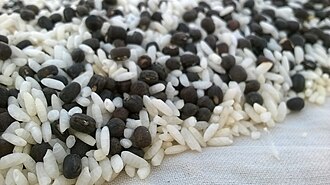 Key ingredients used are rice and black gram.
 -
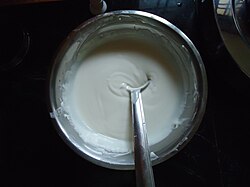 Idli batter
 -
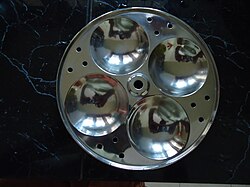 Idli mold
 -
 Batter poured into the mold
 -
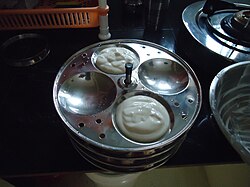 Several molds stacked over another
 -
 Idli steaming in cooker
 -
 Cooked idli
 -
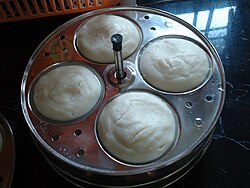 Molds removed from cooker
 -
 Idlis ready to eat


Serving[edit | edit source]
Since plain idlis are mild in taste, a condiment is considered essential. Idlis are often served with chutneys (coconut-based), sambar and medu vada. However, this varies greatly by region and personal taste. It is also often served with kaara chutney (onion-based) or spicy fish curries. The dry spice mixture podi is convenient while travelling.

Variations[edit | edit source]
There are several regional variations of idlis made in South India and Sri Lanka. With the emigration of south Indians and Sri Lankans throughout the region and world, many variations on idli have been created in addition to the almost countless local variations. Hard-to-get ingredients and differing cooking customs have required changes in both ingredients and methods. Parboiled rice can reduce the soaking time considerably. Store-bought ground rice or cream of rice may also be used.[14] Similarly, semolina or cream of wheat may be used for preparing rava idli (wheat idli).[15] Dahi (yogurt) may be added to provide the sour flavour for unfermented batters. Pre-packaged mixes allow for almost instant idlis.[16]
In addition to or instead of fenugreek, other spices may be used such as mustard seeds, chili peppers, cumin, coriander, ginger, etc.[17] Sugar may be added to make them sweet instead of savoury. Idli may also be stuffed with a filling of potato, beans, carrot and masala.[18] Leftover idlis can be cut-up or crushed and sautéed for a dish called idli upma.[19] A microwave or an automatic electric steamer that is non-stick is considered to be a convenient alternative to conventional stovetop steamers. Batter preparation using a manual rocking rock grinder can be replaced by electric grinders or blenders. Many restaurants have also come up with fusion recipes of idlis such as idly manchurian, idly fry, chilly idly, stuffed idly, to name a few.
-
 Idlis cooked traditionally in coconut shells, Karnataka
 -
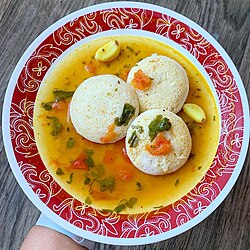 Idli served with rasam
 -
 Moode idli steamed in fragrant screwpine leaves, Mangalore, Karnataka.
 -
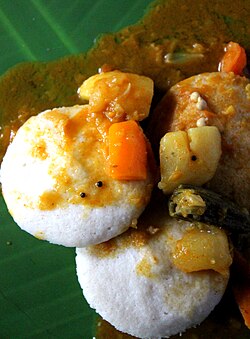 Sambar idli as served in Tamil Nadu
 -
 Kotte kadubu or Pottikkalu idlis steamed in jackfruit leaves, in Karnataka and Andhra Pradesh
 -
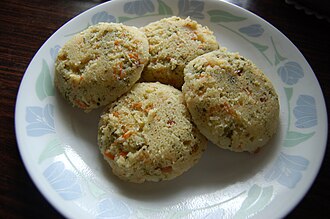
-
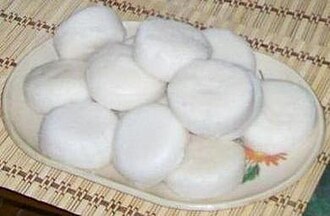


.jpg)
.jpg)
Batter fermentation[edit | edit source]
Fermentation of idli batter results in both leavening caused by the generation of carbon dioxide as well as an increase in acidity. This fermentation is performed by lactic acid bacteria, especially the heterofermentative strain Leuconostoc mesenteroides and the homofermentative strain Enterococcus faecalis (formerly classified as Streptococcus faecalis). Heterofermentative lactic acid bacteria such as L. mesenteroides generate both lactic acid as well as carbon dioxide whereas homofermentative lactic acid bacteria only generate lactic acid.
Both L. mesenteroides and E. faecalis are predominantly delivered to the batter by the black gram. Both strains start multiplying while the grains are soaking and continue to do so after grinding.
L. mesenteroides tolerates high concentrations of salt unlike most other bacteria. Hence the salt in the batter and the ongoing generation of lactic acid both suppress the growth of other undesirable micro-organisms.[20][21]
Idli Day[edit | edit source]
March 30 is celebrated as World Idli Day.[22] It was first celebrated in 2015 at Chennai.[23]
See also[edit | edit source]
References[edit | edit source]
- ↑ Edward R. Farnworth 2003, p. 11.
- ↑ K. T. Achaya 1994, p. 90.
- ↑ 3.0 3.1 K.T. Achaya (1 November 2003). The Story of Our Food. Universities Press. pp. 80–. ISBN 978-81-7371-293-7.
- ↑ D. Balasubramanian (21 October 2004). "Changes in the Indian menu over the ages". The Hindu. Archived from the original on 6 December 2014.
- ↑ "Idli saga: A study into the origin of the South Indian dish". Archived from the original on 24 April 2016. Retrieved 25 August 2014.
- ↑ Lenin, Janaki (30 March 2012). "A tale of two sambhars". The Hindu – via www.thehindu.com.
- ↑ Feasts and Fasts: A History of Food in India, page 146, Colleen Taylor Sen (2015)
- ↑ Renfrew, Colin; Bahn, Paul (9 June 2014). The Cambridge World Prehistory. Cambridge University Press. p. 2049. ISBN 978-1-107-64775-6.
In the South Indian Neolithic, boiling and grinding were both essential techniques in food preparation. Steaming was added to this repertoire around 2000 BCE.
- ↑ Achyut Yagnik; Suchitra Seth (24 August 2005). Shaping Of Modern Gujarat. Penguin Books Limited. p. 24. ISBN 978-81-8475-185-7.
- ↑ Vikram Doctor (28 April 2007). "Idli saga: A study into the origin of the South Indian dish". Economic Times. Archived from the original on 24 April 2016. Retrieved 25 August 2014.
- ↑ K.T. Achaya (5 March 2009). The Illustrated Foods of India. OUP India. ISBN 978-0-19-569844-2.
- ↑ "World Idli Day 2018: Here's The Intriguing Story Behind This Delicious Day". NDTV. 30 March 2018.
- ↑ "Idlis in jackfruit leaves". Aayi's Recipes. 2006. Retrieved 14 October 2014.
- ↑ "Idli using Cream of Rice". Edibly Asian. Retrieved 14 October 2014.
- ↑ Geeta, Seth. "Rava Idli : (Cream of wheat or sooji idli)". North India Cooking. Retrieved 14 October 2014.
- ↑ "instant idli mix". Tarla Dalal. Sanjay & Co. Retrieved 14 October 2014.
- ↑ Rachana, Gorikapudi (2012). "Fenugreek Leaves Idli". SPICY CURRIES. Retrieved 14 October 2014.
- ↑ "Stuffed Idli". Spicy Tasty. 2013. Archived from the original on 1 August 2020. Retrieved 14 October 2014.
- ↑ "Idli Upma Recipe-Recipe with Leftover idlis". Padhu's Kitchen. 2012. Retrieved 14 October 2014.
- ↑ VEEN, A. G.; HACKLER, L. ROSS; STEINKRAUS, K. H.; MUKHERJEE, S. K. (28 June 2008). "Nutritive Quality of Idli, a Fermented Food of India". Journal of Food Science. 32 (3): 339–341. doi:10.1111/j.1365-2621.1967.tb01326_32_3.x. ISSN 0022-1147.
- ↑ Council, National Research (1 January 1992). Applications of Biotechnology in Traditional Fermented Foods. doi:10.17226/1939. ISBN 978-0-309-04685-5. PMID 25121339.
- ↑ Agrawal, Saumya. "World Idli Day". Times Now News. Retrieved 30 March 2022.
- ↑ Saha, Somdatta. "World Idli Day 2021". NDTV Food. Retrieved 30 March 2022.
Bibliography[edit | edit source]
- K. T. Achaya (12 May 1994). Indian Food: A Historical Companion. Oxford University Press, USA. ISBN 978-0-19-563448-8.
- Devi, Yamuna (1987). Lord Krishna's Cuisine: The Art of Indian Vegetarian Cooking, Dutton. ISBN 0-525-24564-2.
- Edward R. Farnworth (2003). Handbook of Fermented Functional Foods. CRC Press. ISBN 978-0-8493-1372-1.
- Jaffrey, Madhur (1988). A Taste of India, Atheneum. ISBN 0-689-70726-6
- Rau, Santha Rama (1969). The Cooking of India, Time-Life Books.


| Common dishes |
| ||||||||||||
|---|---|---|---|---|---|---|---|---|---|---|---|---|---|
| Snacks |
| ||||||||||||
| Desserts | |||||||||||||
| Drinks |
| ||||||||||||
| Condiments | |||||||||||||