



m robot: Creating/updating articles |
m typo fix |
||
| Line 1: | Line 1: | ||
{{ | {{Short description|Rice-based dish from South Asia}} | ||
{{ | {{good article}} | ||
{{Distinguish|Isfahan beryani}} | {{Distinguish|Isfahan beryani}} | ||
{{Use | {{pp-pc|small=yes}} | ||
{{Use Indian English|date=December 2025}} | |||
{{Use dmy dates|date=March 2023}} | {{Use dmy dates|date=March 2023}} | ||
{{Infobox food | {{Infobox food | ||
| name | | name = Biryani | ||
| image | | image = "Hyderabadi Dum Biryani".jpg | ||
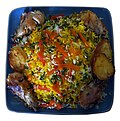
| caption | | caption = Hyderabad-style biryani | ||
| region = [[South Asia]] | |||
| region | | course = Main dish | ||
| course | | served = Hot | ||
| served | | main_ingredient = {{plain list| | ||
| main_ingredient | * Meat | ||
* Rice | * Rice | ||
* Spices | * Spices | ||
* | * Yoghurt (curd) | ||
}} | |||
}} | |||
}} | }} | ||
{{Contains special characters | {{Contains special characters | ||
|special= [[Urdu alphabet|Urdu]], [[Arabic alphabet|Arabic]], and [[Persian alphabet|Persian]] text | |special = [[Devanagari|Hindi]], [[Urdu alphabet|Urdu]], [[Arabic alphabet|Arabic]], and [[Persian alphabet|Persian]] text | ||
|fix=Help:Multilingual support | |fix = Help:Multilingual support | ||
|error=[[Specials (Unicode block)#Replacement character|question marks, boxes]], unjoined letters running left to right, misplaced vowels, missing conjuncts, or other symbols instead of [[Devanagari|Hindi]], [[Urdu alphabet|Urdu]] or [[Arabic alphabet|Arabic]], | |error = [[Specials (Unicode block)#Replacement character|question marks, boxes]], unjoined letters running left to right, misplaced vowels, missing conjuncts, or other symbols instead of [[Devanagari|Hindi]], [[Urdu alphabet|Urdu]] or [[Arabic alphabet|Arabic]], an appropriate script | ||
}} | }} | ||
''Biryani'' is | '''Biryani''' is a [[mixed rice dish]] originating in [[South<!--inc. India, Pakistan, Bangladesh, please leave this alone, thank you--> Asia]], traditionally made with rice, meat ([[Chicken as food|chicken]], [[Goat meat|goat]], [[beef]]) or seafood ([[Shrimp and prawn as food|prawns]] or [[Fish as food|fish]]), vegetables, and [[spices]]. It was present in [[Mughal Empire|Mughal-era India]], though the precise date and place of origin are debated.<ref name="Collingham 2006"/> It is thought to derive from a [[Persian cuisine|Persian]] rice dish, either ''[[Pilaf|pilau]]'' or ''birinj biryan''.<ref name="Collingham 2006"/><ref name="TheHindu2012"/><ref name="BBC 2016"/> The dish makes use of slow-cooking as in Persian pilau, combined with Persian-style yoghurt-[[marinated]] meat and a spicy [[Indian cuisine|Indian]] style of cooking; it was likely developed in the Mughal court kitchens.<ref name="Collingham 2006"/> It is also possible that biryani was brought to South India before the Mughal era, or that pilau was brought to India and biryani was developed from it before being adopted by the Mughals.<!--lead summarises cited text in article body--> | ||
Biryani is one of the most popular dishes in South<!--inc. India, Pakistan, Bangladesh, please leave this alone--> Asia and among the [[South Asian diaspora]]. The dish was often associated with [[Islam in South Asia|the region's Muslim population]] but is now a mainstream culinary staple embraced by every demographic.<!--<ref name="scroll7Feb20202"/>--> Similar dishes are prepared in many other countries, often with local variations, and often brought there by South Asian diaspora populations. Biryani is the most-ordered dish on Indian online food ordering and delivery services, is used in weddings and celebrations throughout the region, and has been described as the most popular dish in India.<!--lead summarises cited text in article body--> | |||
== | == Etymology == | ||
The word biryani ({{langx|hi|{{Wikt-lang|hi|बिरयानी}}}}, {{langx|ur|{{Wikt-lang|ur|بریانی}}}}) is derived from ''biryan'' or ''beriyan'' ({{langx|fa|{{Wikt-lang|fa|بریان}}}}), which means "to fry" or "to roast", said by [[Merriam-Webster]] probably to be related to {{langx|sa|{{Wikt-lang|sa|भृज्जति}}}} ''bhṛjjati'' with the same meaning.<ref>{{cite book |url=https://books.google.com/books?id=2iX3RXJnHCUC |title=The Persian Contributions to the English Language: An Historical Dictionary |last1=Cannon |first1=Garland Hampton |last2=Kaye |first2=Alan S. |publisher=[[Otto Harrassowitz Verlag]] |year=2001 |isbn=978-3-44704-503-2 |page=71}}</ref><ref name="BS2011">{{cite news |url=http://www.business-standard.com/article/beyond-business/when-rice-met-meat-111051400071_1.html |title=When rice met meat |first=Anoothi |last=Vishal |date=14 May 2011 |newspaper=[[Business Standard]] |access-date=6 August 2018}}</ref><ref>{{cite web |url=http://www.oxforddictionaries.com/us/definition/american_english/biryani |archive-url=https://web.archive.org/web/20131014020333/http://oxforddictionaries.com/us/definition/american_english/biryani |url-status=dead |archive-date=14 October 2013 |title=Definition of 'biryani' |website=[[Oxford Dictionary of English|Oxford Dictionary]] |access-date=15 July 2016}}</ref><ref>{{cite web |title=Biriyani |url=https://www.merriam-webster.com/dictionary/biryani#h1 |website=[[Merriam-Webster]] |access-date=3 December 2025}}</ref> The usage is from the Persian phrase ''birinj biryan'' (with {{langx|fa|{{Wikt-lang|fa|برنج}}}} birinj, "rice"), meaning "fried rice".<ref name="BBC 2016">{{cite web |url=https://www.bbc.com/news/world-asia-india-36423412 | title=From Iran to India: The journey and evolution of biriyani |work=[[BBC News]] |date=15 July 2016 }}</ref><ref name="Pratibha2009">{{cite book |last=Karan |first=Pratibha |url=https://books.google.com/books?id=cZe-r38DYjcC |title=Biryani |publisher=[[Random House|Random House India]] |year=2009 |isbn=978-81-8400-254-6 |pages=1–12, 45}}</ref> | |||
== Origin == | |||
=== Historical sources === | |||
[[File:Havij polo.jpg|thumb|A modern Persian [[Pilaf|pilau]], ''havij polo'' (Persian: هویج پلو, "carrot rice") with rice grains cooked to remain separate and in different colours. Pilau may be an ancestor of biryani.<ref name="Collingham 2006"/><ref name="TheHindu2012"/>]] | |||
[[Pilaf|Pilau]] (Persian: پلو 'plo', "rice") is a Persian rice dish, attested by the polymath and physician [[Avicenna]] in 10th century Persia.<ref name="Nabhan 2014">{{cite book |last=Nabhan |first=Gary Paul |title=Cumin, Camels, and Caravans: A Spice Odyssey |url=https://books.google.com/books?id=e-glDQAAQBAJ&pg=PA135 |page=135 |publisher=[[University of California Press]] |date=2014 |isbn=978-0520267206}}</ref> | |||
The [[Mughal Empire|Mughal]] text ''[[Ain-i-Akbari]]'' (written 1589–1596<ref>{{cite web |title=Ain-I-Akbari.Vol.1 |url=https://famineanddearth.exeter.ac.uk/displayhtml.html?id=fp_00128_en_ainiakbari_vol01 |publisher=University of Exeter |access-date=7 January 2026}}</ref>), from the time of the emperor [[Akbar]], mentions both pilau and biryani, listing ingredients with required quantities for each:<ref name="Ain-i-Akbari">{{cite book |last1='Allami |first1=Abul Fazl |last2=Blochmann |first2=Heinrich (trans.) |author2-link=Heinrich Blochmann |title=The Ain i Akbari |date=1873 |publisher=[[Asiatic Society of Bengal]] |location=Calcutta |pages=59–60 |url=https://persian.packhum.org/persian/main?url=pf%3Ffile%3D00702050%26ct%3D0 |archive-date=14 July 2018 |access-date=7 January 2026 |archive-url=https://web.archive.org/web/20180714022016/https://persian.packhum.org/persian/main?url=pf%3Ffile%3D00702050%26ct%3D0 |url-status=bot: unknown }}</ref> | |||
</ | |||
{{blockquote|Secondly, [dishes] in which meat and rice, &c., are used ... 2. ''Duzdbiryán''. 10 [[seer (unit)|s[eer]]] rice, 3½ s. [[ghee|g'hí]]; 10 s. meat; ½ s. salt: this gives five dishes. 3. ''Qimah Paláo''. Rice and meat as in the preceding; 4 s. g'hí; 1 s. peeled gram; 2 s. onions; ½ s. salt; ¼ s. fresh ginger, and pepper; cuminseed, cardamums and cloves, 1 d[han]. of each: this gives five dishes.{{efn|name="Units"|A [[Seer (unit)|seer]] was a measure of weight, varying by region, but around 1 kg; a [[Indian units of measurement|māshā]] was around 2 grams; and a dhan was around 50 milligrams (the weight of one wheat berry).}}<ref name="Ain-i-Akbari"/>}} | |||
The ''Ain-i-Akbari'' further names a dish of spiced mutton as a biryani, this time without mentioning rice: | |||
{{blockquote|Thirdly, meats with spices... ''Biryán''. For a whole ''[[Badakhshan|Dashmandi]]'' sheep, take 2 [[seer (unit)|s[eer]]] salt; 1 s[eer] [[ghee|g'hí]]; 2 [[Indian units of measurement|m[āshā]]] saffron, cloves, pepper, cuminseed: it is made in various ways."{{efn|name="Units"}}<ref name="Ain-i-Akbari"/>}} | |||
== | {| class="wikitable" style="margin: 1em auto;" | ||
|+ [[Mughal Empire|Mughal]] biryani timeline | |||
|- | |||
! scope="col" |Period/Emperor | |||
! scope="col" |Dates | |||
! scope="col" |Event | |||
|- style="background-color:lightcoral;" | |||
| ([[Timur]]) || (1370–1405) || (No record of it in Central Asia at that time)<ref name="Vir_invention"/> | |||
|- | |||
| [[Akbar]] || 1556–1605 || Mention of recipes in ''[[Ain-i-Akbari]]'' (1589–1596)<ref name="Ain-i-Akbari"/> | |||
|- | |||
| [[Shah Jahan]] || 1628–1658 || Brief description by [[Sebastien Manrique]] in 1641<ref name="Collingham 2006 Manrique"/> | |||
|- | |||
| [[Aurangzeb]] || 1658–1707 || Mention in letters to his son, [[Bahadur Shah I]]<ref name="Antani 2022"/> | |||
|- | |||
| [[Bahadur Shah Zafar]] || 1837–1857 || Recipe<ref name="Sanghvi 2021 Safvi"/> | |||
|- | |||
| colspan=3 style="text-align: center;" |<small>Key: () and red background: Unrecorded</small> | |||
|} | |||
The | The Portuguese priest [[Sebastien Manrique]] described rice dishes on sale in the tent-city of the next Mughal emperor [[Shah Jahan]] as he travelled to [[Lahore]] in 1641. Manrique distinguished "Persian" pilau from "Mogol" biryani: | ||
{{blockquote|Among these dishes the principal and most substantial were the rich and aromatic Mogol Bringes [biryanis<!--gloss by Collingham-->]{{efn|See 'Etymology' above on ''birinj''.}} and Persian pilaos of different hues".<ref name="Collingham 2006 Manrique">{{cite book |last=Collingham |first=Lizzie |author-link=Lizzie Collingham |url=https://archive.org/details/curry00lizz |title=Curry: A Tale of Cooks and Conquerors |date=6 February 2006 |publisher=[[Oxford University Press]] |isbn=978-0-19-988381-3 |pages=[https://archive.org/details/curry00lizz/page/38 14, 38] |url-access=registration}}</ref>}} | |||
The dish is mentioned, too, in letters of the emperor [[Aurangzeb]] to his son.<ref name="Antani 2022">{{cite journal |last1=Antani |first1=Vishu |last2=Mahapatra |first2=Santosh |title=Evolution of Indian cuisine: a socio-historical review |journal=Journal of Ethnic Foods |date=2022 |volume=9 |issue=15 |url=https://link.springer.com/content/pdf/10.1186/s42779-022-00129-4.pdf}}</ref> For example: | |||
{{blockquote|Exalted son, I remember the savour of your '[[khichri|khichidi]]' and 'biryani' during the winter. Truly the 'kabuli' cooked by Islam Khan does not surpass them (in point of relish and savour). I wanted to have from you (in my service) Saliman, who cooks 'biryani'; but you did not allow him to serve as my cook. If you happen to find a pupil of his, skilful in the art of cookery, you will send him to me.<ref>{{cite book |last1=Narayanan |first1=Divya |title=Cultures of Food and Gastronomy in Mughal and post-Mughal India |date=2015 |publisher=[[University of Heidelberg]] (PhD thesis) |pages=70-71 |doi=10.11588/heidok.00019906}}</ref><ref>{{cite book |last1=Bilimoria |first1=Jamshid (trans.) |title=Rukaʿat-i Alamgiri or Letters of Aurangzeb |date=1908 |publisher=Luzac & Co. |location=Bombay |page=12 |url=https://archive.org/details/rukaatialamgirio00aurarich}}</ref>}} | |||
According to the historian Rana Safvi, the earliest actual recipe is from the later Mughal period, from [[Bahadur Shah Zafar]]'s time.<ref name="Sanghvi 2021 Safvi">{{cite news |date=25 July 2021 |title=Rude Food by vir Sanghvi: The people's biryani |url=https://www.hindustantimes.com/lifestyle/brunch/rude-food-by-vir-sanghvi-the-people-s-biryani-101627181800260-amp.html |work=Hindustan Times}}</ref> | |||
==== | === Analysis === | ||
[[File:Origin of Biryani.svg|thumb|center|upright=2.5|Diagram of [[Lizzie Collingham]]'s analysis of the origin of biryani, proposing that in the [[Mughal Empire|time of the Mughals]], specifically the emperor [[Akbar]], Persian [[Pilaf|pilau]] was adapted to include [[Persian cuisine|Persian-style]] yoghurt-marinated meat and spicy [[Indian cuisine|Indian styles of cooking]] rice.<ref name="Collingham 2006"/>]] | |||
The historian of food [[Lizzie Collingham]] writes that the modern biryani developed in India (Hindustan) in the royal kitchens of the [[Mughal Empire]]<!-- (1526–1857)-->, specifically during the rule of the emperor [[Akbar]] (1556–1605), and is a mix of the native spicy rice dishes of South Asia, Persian yoghurt-[[marinated]] meat, and the Persian [[pilaf|pilau]] style of garnished rice.<ref name="Collingham 2006">{{cite book |last=Collingham |first=Lizzie |author-link=Lizzie Collingham |url=https://archive.org/details/curry00lizz |title=Curry: A Tale of Cooks and Conquerors |date=6 February 2006 |publisher=[[Oxford University Press]] |isbn=978-0-19-988381-3 |pages=[https://archive.org/details/curry00lizz/page/27 25–29] |url-access=registration}}</ref> Collingham writes that "in the kitchens [of the Mughal court]... the [[Persian cuisine|delicately flavoured Persian]] pilau met the pungent and spicy rice dishes of Hindustan to create the classic [[Mughlai cuisine|Mughlai dish]], biryani".<ref name="Collingham 2006"/> | |||
[[ | |||
The cookery writer Pratibha Karan states that biryani is of Indian origin, derived from pilau which Muslim traders and invaders brought with them. She speculates that pilau was an army dish in medieval India. Armies would prepare a one-pot dish of rice with any available red meat. Over time, the dish became biryani due to different methods of cooking.<ref name="Pratibha2009"/><ref name="Vir_invention"/> | |||
In the view of the historian of Islamic cuisine Salma Hussein<ref name="BBC 2016"/> and others, biryani came to South Asia from Persia before the Mughal era,<ref name="Vir_invention">{{cite news |last=Sanghvi |first=Vir |author-link=Vir Sanghvi |title=Biryani Nation |url=http://blogs.hindustantimes.com/rude-food/2010/03/03/biryani-nation/ |newspaper=[[Hindustan Times]] |url-status=dead |archive-url=https://web.archive.org/web/20140817181203/http://blogs.hindustantimes.com/rude-food/2010/03/03/biryani-nation/ |archive-date=17 August 2014 |access-date=24 August 2014}}</ref> most probably arriving in South India's [[Deccan Plateau|Deccan region]], brought by travelling soldier-statesmen and pilgrims.<ref name="BBC 2016"/> It has also been suggested that the dish was introduced from [[Persia]] by the Mughals.<ref name="Dhillon2013">{{cite book |last=Dhillon |first=Kris |url=https://books.google.com/books?id=kj3BBAAAQBAJ&pg=PT234 |title=The New Curry Secret |publisher=[[Little, Brown and Company]] |year=2013 |isbn=978-0-7160-2352-4 |page=234}}</ref> Another variant theory, that biryani came to India with [[Timurid dynasty|Timur]]'s invasion, appears to be incorrect because there is no record of biryani having existed in his native region of Central Asia during that period.<ref name="Vir_invention"/> | |||
==== | The historian of food [[K. T. Achaya]] states that pilau is "of older usage in India" than biryani, indicating that it could have been a precursor of biryani.<ref name="TheHindu2012">{{cite news |url=https://www.thehindu.com/features/metroplus/Food/food-safari-in-search-of-ambur-biryani/article3452311.ece |title=Food Safari: In search of Ambur biryani |last1=Padmanabhan |first1=Mukund |last2=Jeyan |first2=Subash |last3=Wilson |first3=Subajayanthi |date=26 May 2012 |newspaper=[[The Hindu]] |access-date=6 August 2018 |url-status=dead |archive-url=https://web.archive.org/web/20121018041053/http://www.thehindu.com/life-and-style/Food/food-safari-in-search-of-ambur-biryani/article3452311.ece |archive-date=18 October 2012}}</ref> Achaya notes that ancient and early medieval Indian texts described rice cooked with meat and spices, suggesting that composite rice dishes were part of the subcontinent's cuisine long before the Mughal period.<ref name="Achaya1994pX">{{cite book |last=Achaya |first=K. T. |title=Indian Food: A Historical Companion |publisher=Oxford University Press |location=Delhi |year=1994 |isbn=9780195634488 |page=X}}</ref>He further references early Tamil literature from the Sangam era ({{circa}} 300 BCE–300 CE), describing a dish known in these sources as ūn sōru—rice cooked with meat, ghee, and spices—which bears structural similarities to later layered rice preparations.<ref name="Achaya1994pY">{{cite book |last=Achaya |first=K. T. |title=Indian Food: A Historical Companion |publisher=[[Oxford University Press]] |location=Delhi |year=1994 |isbn=978-0195634488 |page=Y}}</ref> | ||
= | [[File:Theories of Biryani's origins.svg|center|thumb|upright=3.5|Biryani evidently has some connection with Persia, but commentators disagree on what that might be. [[Pilaf|Pilau]] is certainly a Persian dish, attested by [[Avicenna]] in 10th century Persia;<ref name="Nabhan 2014"/> ''Birinj biryan'' is a Persian phrase meaning "fried rice".<ref name="Pratibha2009"/> The Mughals had biryani by the reign of [[Akbar]] in the 16th century, attested in the ''[[Ain-i-Akbari]]''.<ref name="Collingham 2006"/><br/> | ||
[[ | <br/> | ||
Evidence: | |||
1: folk theory<ref name="Vir_invention"/> | |||
2: Kris Dhillon<ref name="Dhillon2013"/> | |||
3: Salma Hussein<ref name="BBC 2016"/> | |||
4,5: Pratibha Karan<ref name="Pratibha2009"/> | |||
6: [[Lizzie Collingham]]<ref name="Collingham 2006"/>]] | |||
== Ingredients == | |||
[[File:Mirchi ka salan and Dahi chutney.jpg|thumb|Biryani can be accompanied by side dishes such as ''[[mirchi ka salan]]'' and ''[[raita]]''.]] | |||
'' | |||
Ingredients for biryani vary according to the region and the type of meat and vegetables used. Meat (chicken, goat, beef<ref name="Saveur 2017-06-22">{{Cite magazine |url=https://www.saveur.com/south-asian-indian-biryani-guide |title=A Beginner's Guide to Biryani, the Ultimate Rice Dish |last=Makhijani |first=Pooja |magazine=[[Saveur]] |date=22 June 2017 |access-date=19 December 2018}}</ref>) is the prime ingredient with rice. Seafood (fish, prawns) and vegetables are sometimes added. Navratan biryani tends to use sweeter, richer ingredients such as [[cashew]]s, [[Sultana (grape)|sultanas]] (''kishmish''), and fruits such as apple and [[pineapple]].<ref name="ndtvravish"/> | |||
==== | The spices and [[condiment]]s used in biryani may include [[fennel seeds]], [[ghee]] (clarified butter), [[nutmeg]], [[Mace (spice)|mace]],<ref name="WWeek">{{cite news |url=http://www.wweek.com/portland/article-17853-the-melting-pot.html |first=Ruth |last=Brown |date=16 August 2011 |title=The Melting Pot – A Local Prep Kitchen Incubates Portland's Next Generation of Food Businesses |newspaper=[[Willamette Week]] |volume=37 |number=41}}</ref> [[Black pepper|pepper]], [[clove]]s,<ref name="WWeek"/> [[cardamom]], [[cinnamon]], [[Bay leaf|bay leaves]], [[coriander]], [[Mentha|mint]], [[ginger]], onions, tomatoes, [[green chilies]],<ref name="Saveur 2017-06-22"/> [[star anise]], and garlic. The premium varieties include [[saffron]].<ref name="WWeek"/> Some commercial recipes for biryani include aromatic essences such as mitha [[attar]], [[kewra]] and [[rose water]]. Dried sour [[prune]]s (''alu bukhara'') may be added. In ''nasi briyani'' and other variants made in Southeast Asian countries such as [[Malaysia]], Singapore, and [[Indonesia]], local spices and aromatics such as [[Pandanus amaryllifolius|pandan]] leaf may be added.<ref>{{cite news |title=Nasi Biryani Recipe |url=https://cooking.nytimes.com/recipes/1022901-nasi-biryani |access-date=2 May 2024 |newspaper=[[The New York Times]] Cooking}}</ref> | ||
The | |||
Biryani may be served with side dishes such as ''[[raita]]'' (yoghurt with cucumber, tomato, etc), fried or curried [[aubergine]] (''brinjal''), [[salad]], or a curried side such as ''ande ka salan'' (with boiled eggs)<ref name="ToI - Sides">{{cite web |title=Side Dishes to Enjoy with Biryani |url=https://recipes.timesofindia.com/web-stories/not-just-regular-raita-other-unique-side-dishes-served-with-biryani/photostory/108397874.cms |publisher=[[The Times of India]] |access-date=4 December 2025}}</ref> or ''[[mirchi ka salan]]'' (with chili peppers).<ref>{{cite web |last=Kapoor<!--famous chef--> |first=Sanjeev |author-link=Sanjeev Kapoor |title=Mirchi Ka Salan |url=https://www.sanjeevkapoor.com/Recipe/Mirchi-Ka-Salan-Khazana-of-Indian-Recipes.html |publisher=[[Sanjeev Kapoor]] |access-date=9 December 2025 |date=2 August 2016}}</ref> | |||
Dietary variations include adding [[Eggs as food|eggs]], [[potato]]es, and substituting meat with [[paneer]] or vegetables, especially in [[Hindu Vegetarianism|Hindu]] or non-religious [[vegetarian]] variants.<ref name="Bhandari 2020">{{cite news |last=Bhandari |first=Kabir Singh |date=21 April 2020 |title=The curious case of potato in Kolkata biryani and how the British fed us a lie |url=https://www.hindustantimes.com/more-lifestyle/the-curious-case-of-potato-in-kolkata-biriyani-and-how-the-british-fed-us-a-lie/story-k1smJjNz1QhxyyVZVdNyKN.html |access-date=19 August 2020 |newspaper=[[Hindustan Times]]}}</ref> Kolkata biryani, invented by [[Wajid Ali Shah]] in the 1850s, includes potato.<ref>{{cite web |last=Saha |first=Somdatta |url=https://food.ndtv.com/food-drinks/the-fascinating-story-of-aloo-in-kolkata-biryani-all-you-need-to-know-4268746 |title=The Fascinating Story Of Aloo In Kolkata Biryani: All You Need To Know! |website=NDTV Food |date=4 August 2023 |access-date=9 February 2026}}</ref> | |||
[[ | |||
== Preparation styles == | |||
=== | === ''Pakki'' and ''kacchi'' biryani === | ||
[[File:Lucknowi Mutton Matka Dum Biriyani.jpg|thumb|[[Lucknow]]i style mutton ''kacchi biryani'' [[Dum pukht|cooked in a clay pot sealed with dough]]. The dough seal is broken after cooking.]] | |||
[[File: | |||
==== | Biryani can be cooked using one of two techniques, ''pakki'' ("cooked") and ''kacchi'' ("raw").<ref name="Dey 2022">{{cite web |url=https://www.getbengal.com/details/the-origin-of-biryani-how-a-mughal-delicacy-invaded-bengal |title=The origin of Biryani – how a Mughal delicacy invaded Bengal |first=Shuvra |last=Dey |date=16 November 2022 |website=GetBengal |access-date=18 November 2022}}</ref> In a ''pakki biryani'', the ingredients are cooked separately (at least in part) and then arranged in layers. The different layers can be individually coloured and flavoured with a brightly-coloured spice such as turmeric or saffron.<ref name="Dey 2022"/> In a ''kacchi biryani'', layers are arranged in a pot which is then [[Dum pukht|sealed and cooked slowly]] (Dum cooking) for the food to steam in its own liquid.<ref name="Dey 2022"/> | ||
=== | === Difference between biryani and pilau === | ||
[[File:Indian Cuisine - Biryani on 2017 stamp of India.jpg|thumb|Biryani on a 2017 stamp of India]] | |||
[[Pilaf|Pilau]] is a mixed rice dish popular in the [[cuisines of the Indian subcontinent]], Central Asia, and [[Middle Eastern cuisine]]. Opinions differ on the differences between the dishes, if any.<ref name="KrishTulasi2012">{{cite book |last=Shaffer |first=Holly |chapter=6: Dum Pukht |editor1-last=Ray |editor1-first=Krishnendu |editor2-last=Srinivas |editor2-first=Tulasi |title=Curried Cultures: Globalization, Food, and South Asia |chapter-url=https://books.google.com/books?id=p1kZBqJBjOgC&pg=PA124 |year=2012 |publisher=[[University of California Press]] |isbn=978-0-520-27011-4 |pages=124–125}}</ref><ref>{{cite web |url=https://www.myntorlando.com/what-is-the-difference-between-biryani-and-pulao/ |title=What is the Difference Between Biryani and Pulao |website=Mynt Orlando |date=23 June 2023 }}</ref> | |||
==== | The [[British Raj|British-era]] author [[Abdul Halim Sharar]] mentions that biryani has a stronger curried taste due to a greater amount of spices.<ref name="KrishTulasi2012" /><ref name="Abdul1913">{{cite book |first=ʻAbdulḥalīm |last=Sharar |author-link=Abdul Halim Sharar |title=Lucknow: The Last Phase of an Oriental Culture (Hindustan Men Mashriqi Tamaddun ka Akhri Namuna) |translator=E.S. Harcourt |translator2=Fakhir Hussain |url=https://books.google.com/books?id=98IPSgAACAAJ |year=1989 |publisher=[[Oxford University Press]] |isbn=978-0-19-562364-2 |orig-year=1913}}<!-- Originally serialized in the journal ''Dil Gudaz'' in the years after 1913 --></ref> According to Delhi-based historian [[Sohail Hashmi]], pilau tends to be plainer than biryani, and consists of meat or vegetables cooked with rice with the bottom layered with potatoes or onions. Biryani contains more gravy, and is often cooked longer, leaving the meat (and vegetables, if present) more tender, and the rice more flavoured. Biryani is cooked with additional dressings and often has a light layer of [[scorched rice]] at the bottom.<ref name="ndtvravish">{{cite AV media |people=Ravish Kumar interviews historian Sohali Hashmi |date=9 September 2016 |title=प्राइम टाइम : क्या-क्या अलग करेंगे बिरयानी से? |trans-title=Prime Time: What will separate from Biryani? |medium=Television production |language=hi |url=https://khabar.ndtv.com/video/show/prime-time/prime-time-what-will-be-separate-from-biryani-430689?yt |access-date=19 October 2016 |location=Old Delhi |publisher=[[NDTV]]}}</ref> | ||
The cookery author Pratibha Karan states that while the terms are often applied arbitrarily, the main distinction is that a biryani consists of two layers of rice with a layer of meat (and vegetables, if present) in the middle, while the pilau is not layered. Further, in modern usage, biryani is the primary dish in a meal, while pilau is usually a secondary accompaniment to a larger meal; and biryanis have more complex and stronger spices than pilaus.<ref name="Vir_invention"/> | |||
The translator and cookery author [[Colleen Taylor Sen]] notes that the difference has been extensively debated, that the dishes are both of long-grained rice with meat or vegetables, and are sometimes "almost impossible to tell apart". However, pilau is usually a side dish, biryani a "centre piece" with its own sides; and pilau is a one-pot dish, while biryani's rice and meat can be cooked separately.<ref name="Sen 2015">{{cite book |url=https://books.google.com/books?id=VN_vCgAAQBAJ&pg=PA194 |title=Feasts and Fasts: A History of Food in India |last=Taylor Sen |first=Colleen |publisher=[[Reaktion Books]] |year=2014 |isbn=978-1780233918 |pages=194–195}}</ref> | |||
The | |||
==== | == Varieties == | ||
{{main|Varieties of biryani}} | |||
{{ | |||
=== In the Indian subcontinent === | |||
[[File:Hyderabadi egg biryani.jpg|thumb|[[Hyderabad, India|Hyderabadi]] egg biryani served with mirchi ka salan, raita and salad]] | |||
=== | There are many types of biryani in the Indian subcontinent. Biryani is the single most-ordered dish in Indian online food ordering and delivery services, and has been described as the most popular dish in India.<ref name="scroll7Feb2020">{{cite news |last=Daniyal |first=Shoaib |title=Biryani is India's most popular dish – so why does the BJP hate it so much? |url=https://scroll.in/article/952475/biryani-is-indias-most-popular-dish-so-why-does-the-bjp-hate-it-so-much |access-date=2021-12-17 |work=[[Scroll.in]] |date=7 February 2020}}</ref><ref name="Tandon 2020">{{cite news |last=Tandon |first=Suneera |title=Jubilant FoodWorks forays into biryani business with 'Ekdum' |url=https://www.livemint.com/companies/news/jubilant-foodworks-forays-into-biryani-brand-ekdum-11608126898411.html |newspaper=[[Mint (newspaper)|Mint]] |access-date=15 November 2021 |date=16 December 2020}}</ref> The names of variants are often based on their region or city of origin. Some have taken the name of the shop that sells it, as in Fakhruddin Biriyani in [[Dhaka]],<ref>{{cite web |url=https://www.nibizsoft.com/dhakas-biryani-a-taste-of-aristocracy/ |title=Dhaka's Biryani - A Taste of Aristocracy |date=23 May 2015 |website=NIBiz Soft |access-date=6 August 2018}}</ref><ref>{{cite news |url=https://bdnews24.com/amp/story/lifestyle%2Fdhakas-biryani-can-be-unesco-world-heritage-says-food-critic-matt-preston |title=Dhaka's biryani can be UNESCO world heritage, says food critic Matt Preston |first=Hassan |last=Bipul |date=28 March 2016 |website=[[Bdnews24.com]] |access-date=December 17, 2025}}</ref> Students biryani in [[Karachi]], Lucky biryani in Bandra, Mumbai and Baghdadi biryani in [[Colaba]], Mumbai.<ref name="ndtvravish" /> ''Biryanis'' are often specific to the Muslim communities where they originate; they are usually the defining dishes of those communities.<ref>{{cite news |url=http://blogs.hindustantimes.com/rude-hotels/2009/02/01/where-does-biryani-come-from/ |title=Where does biryani come from? |website=[[Hindustan Times]] |access-date=20 October 2016 |url-status=dead |archive-url=https://web.archive.org/web/20160624141257/http://blogs.hindustantimes.com/rude-hotels/2009/02/01/where-does-biryani-come-from/ |archive-date=24 June 2016}}</ref><ref name="scroll7Feb2020"/> | ||
== | In 2009, the Deccani Biryani Makers Association submitted 'Hyderabadi Biryani' for a [[geographical indication]], but the attempt failed as they were unable to provide documentary evidence of its historical origin.<ref>{{cite web |title=Famous Delicacy ‘Hyderabadi Biryani’ Fails To Prove Its Origins |url=https://www.ndtvprofit.com/pursuits/famous-delicacy-hyderabadi-biryani-fails-to-prove-its-origins |publisher=NDTV |access-date=7 January 2026 |date=9 March 2017}}</ref> | ||
<!--Please do not try to add individual biryani varieties here; there is a separate list article for those, and make sure you cite any addition there to a reliable source. Thank you.--> | |||
=== Outside the Indian subcontinent === | |||
[[File:Kyet Shar Soon biryani.jpg|thumb|Burmese biryani (''danpauk'')]] | |||
==== | Varieties of biryani have arisen in many countries,<ref name="Wallis 2017">{{Cite news |last=Wallis |first=Bruce |date=12 April 2017 |title=Eat My Words: A taste of Iraqi Kurdistan |url=https://www.duluthnewstribune.com/lifestyle/food/4249270-eat-my-words-taste-iraqi-kurdistan |url-status=dead |archive-url=https://web.archive.org/web/20211005065230/https://www.duluthnewstribune.com/lifestyle/food/4249270-eat-my-words-taste-iraqi-kurdistan |archive-date=5 October 2021 |access-date=28 December 2018 |work=[[Duluth News Tribune]]}}</ref> and was often spread to such places by South Asian diaspora populations.<ref name="Michelin Malaysia">{{Cite web |title=Iconic Dishes: A Guide to Rice Dishes in Malaysia and Where to Find Them |url=https://guide.michelin.com/en/article/dining-out/iconic-dishes-a-guide-to-rice-dishes-in-malaysia-michelin-guide |access-date=30 May 2025 |website=[[Michelin Guide]] }}</ref> For example in Myanmar, ''danpauk'' ({{Linktext|ဒံပေါက်}}) is a mainstay at festive events such as weddings.<ref name="tmt20Mar2015">{{cite news |url=https://www.mmtimes.com/business/13642-biryani-trade-takes-on-a-new-flavour.html |title=Biryani trade takes on a new flavour|date=2015-03-20 |newspaper=[[The Myanmar Times]] |access-date=25 April 2020 |archive-date=27 July 2020 |archive-url=https://web.archive.org/web/20200727012233/https://www.mmtimes.com/business/13642-biryani-trade-takes-on-a-new-flavour.html |url-status=dead}}</ref><ref>{{cite news |url=https://www.mmtimes.com/news/mouth-watering-thingyan-food-and-delicacies.html |title=Mouth-watering Thingyan food and delicacies |date=2018-04-06 |newspaper=[[The Myanmar Times]] |access-date=2020-04-25 |archive-date=12 November 2019 |archive-url=https://web.archive.org/web/20191112054705/https://www.mmtimes.com/news/mouth-watering-thingyan-food-and-delicacies.html |url-status=dead}}</ref> On the Persian Gulf, biryani (Persian: برياني) is usually saffron-based with chicken,<ref name="rediff_Priya2004">{{cite news |last=Ganapti |first=Priya |date=9 April 2004 |title=Of biryani, history, and entrepreneurship |url=http://www.rediff.com/money/2004/apr/09spec.htm |access-date=27 August 2014 |work=[[Rediff.com]]}}</ref> while in Indonesia ''[[nasi kebuli]]'' is an spicy steamed rice dish<ref>{{cite news |title=Nasi Kebuli Gaya Betawi |date=21 February 2009 |newspaper=[[Kompas]] |url=http://travel.kompas.com/read/2009/02/21/08230951/nasi.kebuli.gaya.betawi |language=id |trans-title=Betawi Style Kebuli Rice |access-date=30 January 2015}}</ref> cooked in goat meat broth, milk and ''[[ghee]]''.<ref>{{cite book |url=https://books.google.com/books?id=9ihcDAAAQBAJ&q=kebuli+rice&pg=PA31 |title=Kumpulan Masakan Favorit Sepanjang Masa |language=id |first=T. S. |last=Dharmaputra |isbn=978-602-213-036-9 |publisher=Puspa Swara |year=2015 |location=Jakarta |access-date=5 June 2017}}</ref> In Thailand the dish is known as ''khao mhok'' ({{langx|th|ข้าวหมก}}), using chicken, beef or fish, topped with fried garlic and served with a green sour sauce.<ref>{{cite web |last=Ismael |first=Furqan |date=2022-02-11 |title=ข้าวหมกไก่มาจากไหน ทำไมถึงกลายมาเป็นอาหารอิสลามในประเทศไทย |url=https://www.halallifemag.com/thai-chicken-biryani/ |access-date=2025-09-22 |website=Halal Life Magazine |language=th |trans-title=Where did Khao Mok Gai come from? Why did it become an Islamic food in Thailand?}}</ref><!--Please do not try to add individual biryani varieties here; there is a separate list article for those, and make sure you cite any addition there to a reliable source. Thank you.--> | ||
In | == In culture == | ||
==== | Biryani forms "the centrepiece of countless Indian holidays and weddings".<ref name="Haq 2016 BBC">{{cite web |last1=Haq |first1=Husna |title=India’s biryani wars |url=https://www.bbc.co.uk/travel/article/20161006-indias-biryani-wars |publisher=[[BBC]] Travel |access-date=9 December 2025 |date=7 October 2016}}</ref> In Bangladesh, kacchi biryani with mutton has been described as "the quintessential wedding dish"<ref name="Old Dhaka"/> of [[Old Dhaka]], largely replacing the murg (chicken) pulao that was favoured in the 20th century<ref name="Old Dhaka">{{cite news |title=Old Dhaka Weddings: Of flavours and traditions |url=https://www.thedailystar.net/life-living/news/old-dhaka-weddings-flavours-and-traditions-3882986 |access-date=9 December 2025 |work=[[The Daily Star (Bangladesh)|The Daily Star]]}}</ref> for special occasions across the subcontinent.<ref name="Collingham 2006"/> In [[Delhi]], the Muslim festival of [[Eid al-Adha|Bakr Eid]] was marked by biryani at dinner, using the mutton from the goats slaughtered in memory of the prophet [[Abraham]], who had shown he was willing even to sacrifice his own son.<ref name="Haq 2016 BBC"/> | ||
== | Biryani is used across the Indian Subcontinent in celebrations. Annual biryani festivals have been held in cities such as [[Ambur]],<ref>{{cite news |title=Beef banned from menu at Tamil Nadu biryani festival, authorities asked to reconsider decision |url=https://www.indiatoday.in/india/tamil-nadu/story/beef-banned-from-menu-at-tamil-nadu-biryani-festival-authorities-asked-to-reconsider-decision-1948783-2022-05-12 |access-date=9 December 2025 |newspaper=[[India Today]] |date=12 May 2022}}</ref> [[Islamabad]]<ref>{{cite web |title=Back Biryani Festival and Presenting of REAP Journal Ceremony |url=https://www.kln.gov.my/web/pak_islamabad/news-from-mission/-/blogs/biryani-festival-and-presenting-of-reap-journal-ceremony |publisher=High Commission of Malaysia, Islamabad |access-date=9 December 2025 |date=4 December 2023}}</ref> and [[Karachi]].<ref>{{cite web |title=Biryani Festival 2024 |url=https://moroccoconsulatekhi.com/biryani-festival-2024/ |publisher=Morocco Consulate Karachi |access-date=9 December 2025}}</ref> South Asian diaspora populations have held their own festivals, for example by the North American Indian Muslim Association in North America.<ref>{{cite web |title=Biryani Fest |url=https://indianmuslims.org/biryanifest/ |publisher=North American Indian Muslim Association |access-date=9 December 2025}}</ref> Biryani festivals have been held more widely in places such as Singapore<ref>{{cite web |title=Savour the Flavours at Singapore's Only Biryani Festival 2.0 |url=https://indiplomacy.com/2025/07/23/savour-the-flavours-at-singapores-only-biryani-festival-2-0/ |website=In Diplomacy |access-date=9 December 2025 |date=23 July 2025}}</ref> and Qatar.<ref>{{cite news |title=Thousands throng first-ever Biryani Festival |url=https://thepeninsulaqatar.com/article/11/02/2018/Thousands-throng-first-ever-Biryani-Festival |newspaper=[[The Peninsula (newspaper)|The Peninsula]] |access-date=9 December 2025 |date=11 February 2018}}</ref><ref>{{cite news |title=Biryani Festival launched |url=https://www.gulf-times.com/story/580964/biryani-festival-launched |newspaper=[[Gulf Times]] |access-date=9 December 2025 |date=8 February 2018}}</ref> | ||
== See also == | |||
{{commonscat}} | |||
* [[Bannu pulao]] | |||
* [[Fried rice]] | |||
* [[Kabuli pulao]] | |||
* [[Jollof rice]] | |||
* [[Tehri (dish)|Tehri]] | |||
* [[Paella]] | |||
* [[List of rice dishes]] | |||
[[ | |||
== | == Notes == | ||
{{notelist}} | |||
== | == References == | ||
{{reflist|30em}} | {{reflist|30em}} | ||
{{Rice dishes |state=collapsed}} | {{Rice dishes |state=collapsed}} | ||
| Line 242: | Line 186: | ||
{{Sri Lankan cuisine}} | {{Sri Lankan cuisine}} | ||
{{Street food}} | {{Street food}} | ||
{{Curry in the United Kingdom}} | |||
[[Category:Bangladeshi rice dishes]] | [[Category:Bangladeshi rice dishes]] | ||
[[Category: | [[Category:Burmese rice dishes]] | ||
[[Category: | [[Category:Chicken and rice dishes]] | ||
[[Category:Desi culture]] | [[Category:Desi culture]] | ||
[[Category:Fish dishes]] | [[Category:Fish dishes]] | ||
[[Category:Indian chicken dishes]] | [[Category:Indian chicken dishes]] | ||
[[Category:Indian meat dishes]] | [[Category:Indian meat dishes]] | ||
[[Category:Indian rice dishes]] | [[Category:Indian rice dishes]] | ||
[[Category:Indonesian | [[Category:Indonesian cuisine]] | ||
[[Category:Lamb and mutton dishes]] | |||
[[Category:Lamb dishes]] | |||
[[Category:Malaysian cuisine]] | [[Category:Malaysian cuisine]] | ||
[[Category:Pakistani rice dishes]] | [[Category:Pakistani rice dishes]] | ||
[[Category:Singaporean cuisine]] | [[Category:Singaporean cuisine]] | ||
Revision as of 04:59, 29 March 2026
Lua error in Module:Effective_protection_level at line 16: attempt to index field 'FlaggedRevs' (a nil value).
 Hyderabad-style biryani | |
| Course | Main dish |
|---|---|
| Region or state | South Asia |
| Serving temperature | Hot |
| Main ingredients |
|
Biryani is a mixed rice dish originating in South Asia, traditionally made with rice, meat (chicken, goat, beef) or seafood (prawns or fish), vegetables, and spices. It was present in Mughal-era India, though the precise date and place of origin are debated.[1] It is thought to derive from a Persian rice dish, either pilau or birinj biryan.[1][2][3] The dish makes use of slow-cooking as in Persian pilau, combined with Persian-style yoghurt-marinated meat and a spicy Indian style of cooking; it was likely developed in the Mughal court kitchens.[1] It is also possible that biryani was brought to South India before the Mughal era, or that pilau was brought to India and biryani was developed from it before being adopted by the Mughals.
Biryani is one of the most popular dishes in South Asia and among the South Asian diaspora. The dish was often associated with the region's Muslim population but is now a mainstream culinary staple embraced by every demographic. Similar dishes are prepared in many other countries, often with local variations, and often brought there by South Asian diaspora populations. Biryani is the most-ordered dish on Indian online food ordering and delivery services, is used in weddings and celebrations throughout the region, and has been described as the most popular dish in India.
Etymology
The word biryani (Hindi: बिरयानी, Urdu: بریانی) is derived from biryan or beriyan (Persian: بریان), which means "to fry" or "to roast", said by Merriam-Webster probably to be related to Sanskrit: भृज्जति bhṛjjati with the same meaning.[4][5][6][7] The usage is from the Persian phrase birinj biryan (with Persian: برنج birinj, "rice"), meaning "fried rice".[3][8]
Origin
Historical sources

Pilau (Persian: پلو 'plo', "rice") is a Persian rice dish, attested by the polymath and physician Avicenna in 10th century Persia.[9]
The Mughal text Ain-i-Akbari (written 1589–1596[10]), from the time of the emperor Akbar, mentions both pilau and biryani, listing ingredients with required quantities for each:[11]
Secondly, [dishes] in which meat and rice, &c., are used ... 2. Duzdbiryán. 10 s[eer] rice, 3½ s. g'hí; 10 s. meat; ½ s. salt: this gives five dishes. 3. Qimah Paláo. Rice and meat as in the preceding; 4 s. g'hí; 1 s. peeled gram; 2 s. onions; ½ s. salt; ¼ s. fresh ginger, and pepper; cuminseed, cardamums and cloves, 1 d[han]. of each: this gives five dishes.[lower-alpha 1][11]
The Ain-i-Akbari further names a dish of spiced mutton as a biryani, this time without mentioning rice:
Thirdly, meats with spices... Biryán. For a whole Dashmandi sheep, take 2 s[eer] salt; 1 s[eer] g'hí; 2 m[āshā] saffron, cloves, pepper, cuminseed: it is made in various ways."[lower-alpha 1][11]
| Period/Emperor | Dates | Event |
|---|---|---|
| (Timur) | (1370–1405) | (No record of it in Central Asia at that time)[12] |
| Akbar | 1556–1605 | Mention of recipes in Ain-i-Akbari (1589–1596)[11] |
| Shah Jahan | 1628–1658 | Brief description by Sebastien Manrique in 1641[13] |
| Aurangzeb | 1658–1707 | Mention in letters to his son, Bahadur Shah I[14] |
| Bahadur Shah Zafar | 1837–1857 | Recipe[15] |
| Key: () and red background: Unrecorded | ||
The Portuguese priest Sebastien Manrique described rice dishes on sale in the tent-city of the next Mughal emperor Shah Jahan as he travelled to Lahore in 1641. Manrique distinguished "Persian" pilau from "Mogol" biryani:
Among these dishes the principal and most substantial were the rich and aromatic Mogol Bringes [biryanis][lower-alpha 2] and Persian pilaos of different hues".[13]
The dish is mentioned, too, in letters of the emperor Aurangzeb to his son.[14] For example:
Exalted son, I remember the savour of your 'khichidi' and 'biryani' during the winter. Truly the 'kabuli' cooked by Islam Khan does not surpass them (in point of relish and savour). I wanted to have from you (in my service) Saliman, who cooks 'biryani'; but you did not allow him to serve as my cook. If you happen to find a pupil of his, skilful in the art of cookery, you will send him to me.[16][17]
According to the historian Rana Safvi, the earliest actual recipe is from the later Mughal period, from Bahadur Shah Zafar's time.[15]
Analysis

The historian of food Lizzie Collingham writes that the modern biryani developed in India (Hindustan) in the royal kitchens of the Mughal Empire, specifically during the rule of the emperor Akbar (1556–1605), and is a mix of the native spicy rice dishes of South Asia, Persian yoghurt-marinated meat, and the Persian pilau style of garnished rice.[1] Collingham writes that "in the kitchens [of the Mughal court]... the delicately flavoured Persian pilau met the pungent and spicy rice dishes of Hindustan to create the classic Mughlai dish, biryani".[1]
The cookery writer Pratibha Karan states that biryani is of Indian origin, derived from pilau which Muslim traders and invaders brought with them. She speculates that pilau was an army dish in medieval India. Armies would prepare a one-pot dish of rice with any available red meat. Over time, the dish became biryani due to different methods of cooking.[8][12]
In the view of the historian of Islamic cuisine Salma Hussein[3] and others, biryani came to South Asia from Persia before the Mughal era,[12] most probably arriving in South India's Deccan region, brought by travelling soldier-statesmen and pilgrims.[3] It has also been suggested that the dish was introduced from Persia by the Mughals.[18] Another variant theory, that biryani came to India with Timur's invasion, appears to be incorrect because there is no record of biryani having existed in his native region of Central Asia during that period.[12]
The historian of food K. T. Achaya states that pilau is "of older usage in India" than biryani, indicating that it could have been a precursor of biryani.[2] Achaya notes that ancient and early medieval Indian texts described rice cooked with meat and spices, suggesting that composite rice dishes were part of the subcontinent's cuisine long before the Mughal period.[19]He further references early Tamil literature from the Sangam era (c. 300 BCE–300 CE), describing a dish known in these sources as ūn sōru—rice cooked with meat, ghee, and spices—which bears structural similarities to later layered rice preparations.[20]

Evidence: 1: folk theory[12] 2: Kris Dhillon[18] 3: Salma Hussein[3] 4,5: Pratibha Karan[8] 6: Lizzie Collingham[1]
Ingredients

Ingredients for biryani vary according to the region and the type of meat and vegetables used. Meat (chicken, goat, beef[21]) is the prime ingredient with rice. Seafood (fish, prawns) and vegetables are sometimes added. Navratan biryani tends to use sweeter, richer ingredients such as cashews, sultanas (kishmish), and fruits such as apple and pineapple.[22]
The spices and condiments used in biryani may include fennel seeds, ghee (clarified butter), nutmeg, mace,[23] pepper, cloves,[23] cardamom, cinnamon, bay leaves, coriander, mint, ginger, onions, tomatoes, green chilies,[21] star anise, and garlic. The premium varieties include saffron.[23] Some commercial recipes for biryani include aromatic essences such as mitha attar, kewra and rose water. Dried sour prunes (alu bukhara) may be added. In nasi briyani and other variants made in Southeast Asian countries such as Malaysia, Singapore, and Indonesia, local spices and aromatics such as pandan leaf may be added.[24]
Biryani may be served with side dishes such as raita (yoghurt with cucumber, tomato, etc), fried or curried aubergine (brinjal), salad, or a curried side such as ande ka salan (with boiled eggs)[25] or mirchi ka salan (with chili peppers).[26]
Dietary variations include adding eggs, potatoes, and substituting meat with paneer or vegetables, especially in Hindu or non-religious vegetarian variants.[27] Kolkata biryani, invented by Wajid Ali Shah in the 1850s, includes potato.[28]
Preparation styles
Pakki and kacchi biryani

Biryani can be cooked using one of two techniques, pakki ("cooked") and kacchi ("raw").[29] In a pakki biryani, the ingredients are cooked separately (at least in part) and then arranged in layers. The different layers can be individually coloured and flavoured with a brightly-coloured spice such as turmeric or saffron.[29] In a kacchi biryani, layers are arranged in a pot which is then sealed and cooked slowly (Dum cooking) for the food to steam in its own liquid.[29]
Difference between biryani and pilau

Pilau is a mixed rice dish popular in the cuisines of the Indian subcontinent, Central Asia, and Middle Eastern cuisine. Opinions differ on the differences between the dishes, if any.[30][31]
The British-era author Abdul Halim Sharar mentions that biryani has a stronger curried taste due to a greater amount of spices.[30][32] According to Delhi-based historian Sohail Hashmi, pilau tends to be plainer than biryani, and consists of meat or vegetables cooked with rice with the bottom layered with potatoes or onions. Biryani contains more gravy, and is often cooked longer, leaving the meat (and vegetables, if present) more tender, and the rice more flavoured. Biryani is cooked with additional dressings and often has a light layer of scorched rice at the bottom.[22]
The cookery author Pratibha Karan states that while the terms are often applied arbitrarily, the main distinction is that a biryani consists of two layers of rice with a layer of meat (and vegetables, if present) in the middle, while the pilau is not layered. Further, in modern usage, biryani is the primary dish in a meal, while pilau is usually a secondary accompaniment to a larger meal; and biryanis have more complex and stronger spices than pilaus.[12]
The translator and cookery author Colleen Taylor Sen notes that the difference has been extensively debated, that the dishes are both of long-grained rice with meat or vegetables, and are sometimes "almost impossible to tell apart". However, pilau is usually a side dish, biryani a "centre piece" with its own sides; and pilau is a one-pot dish, while biryani's rice and meat can be cooked separately.[33]
Varieties
In the Indian subcontinent

There are many types of biryani in the Indian subcontinent. Biryani is the single most-ordered dish in Indian online food ordering and delivery services, and has been described as the most popular dish in India.[34][35] The names of variants are often based on their region or city of origin. Some have taken the name of the shop that sells it, as in Fakhruddin Biriyani in Dhaka,[36][37] Students biryani in Karachi, Lucky biryani in Bandra, Mumbai and Baghdadi biryani in Colaba, Mumbai.[22] Biryanis are often specific to the Muslim communities where they originate; they are usually the defining dishes of those communities.[38][34]
In 2009, the Deccani Biryani Makers Association submitted 'Hyderabadi Biryani' for a geographical indication, but the attempt failed as they were unable to provide documentary evidence of its historical origin.[39]
Outside the Indian subcontinent

Varieties of biryani have arisen in many countries,[40] and was often spread to such places by South Asian diaspora populations.[41] For example in Myanmar, danpauk (ဒံပေါက်) is a mainstay at festive events such as weddings.[42][43] On the Persian Gulf, biryani (Persian: برياني) is usually saffron-based with chicken,[44] while in Indonesia nasi kebuli is an spicy steamed rice dish[45] cooked in goat meat broth, milk and ghee.[46] In Thailand the dish is known as khao mhok (Thai: ข้าวหมก), using chicken, beef or fish, topped with fried garlic and served with a green sour sauce.[47]
In culture
Biryani forms "the centrepiece of countless Indian holidays and weddings".[48] In Bangladesh, kacchi biryani with mutton has been described as "the quintessential wedding dish"[49] of Old Dhaka, largely replacing the murg (chicken) pulao that was favoured in the 20th century[49] for special occasions across the subcontinent.[1] In Delhi, the Muslim festival of Bakr Eid was marked by biryani at dinner, using the mutton from the goats slaughtered in memory of the prophet Abraham, who had shown he was willing even to sacrifice his own son.[48]
Biryani is used across the Indian Subcontinent in celebrations. Annual biryani festivals have been held in cities such as Ambur,[50] Islamabad[51] and Karachi.[52] South Asian diaspora populations have held their own festivals, for example by the North American Indian Muslim Association in North America.[53] Biryani festivals have been held more widely in places such as Singapore[54] and Qatar.[55][56]
See also
Notes
References
- ↑ 1.00 1.01 1.02 1.03 1.04 1.05 1.06 1.07 1.08 1.09 Collingham, Lizzie (6 February 2006). Curry: A Tale of Cooks and Conquerors. Oxford University Press. pp. 25–29. ISBN 978-0-19-988381-3.
- ↑ 2.0 2.1 2.2 Padmanabhan, Mukund; Jeyan, Subash; Wilson, Subajayanthi (26 May 2012). "Food Safari: In search of Ambur biryani". The Hindu. Archived from the original on 18 October 2012. Retrieved 6 August 2018.
- ↑ 3.0 3.1 3.2 3.3 3.4 "From Iran to India: The journey and evolution of biriyani". BBC News. 15 July 2016.
- ↑ Cannon, Garland Hampton; Kaye, Alan S. (2001). The Persian Contributions to the English Language: An Historical Dictionary. Otto Harrassowitz Verlag. p. 71. ISBN 978-3-44704-503-2.
- ↑ Vishal, Anoothi (14 May 2011). "When rice met meat". Business Standard. Retrieved 6 August 2018.
- ↑ "Definition of 'biryani'". Oxford Dictionary. Archived from the original on 14 October 2013. Retrieved 15 July 2016.
- ↑ "Biriyani". Merriam-Webster. Retrieved 3 December 2025.
- ↑ 8.0 8.1 8.2 8.3 Karan, Pratibha (2009). Biryani. Random House India. pp. 1–12, 45. ISBN 978-81-8400-254-6.
- ↑ 9.0 9.1 Nabhan, Gary Paul (2014). Cumin, Camels, and Caravans: A Spice Odyssey. University of California Press. p. 135. ISBN 978-0520267206.
- ↑ "Ain-I-Akbari.Vol.1". University of Exeter. Retrieved 7 January 2026.
- ↑ 11.0 11.1 11.2 11.3 'Allami, Abul Fazl; Blochmann, Heinrich (trans.) (1873). The Ain i Akbari. Calcutta: Asiatic Society of Bengal. pp. 59–60. Archived from the original on 14 July 2018. Retrieved 7 January 2026.
{{cite book}}: CS1 maint: bot: original URL status unknown (link) - ↑ 12.0 12.1 12.2 12.3 12.4 12.5 Sanghvi, Vir. "Biryani Nation". Hindustan Times. Archived from the original on 17 August 2014. Retrieved 24 August 2014.
- ↑ 13.0 13.1 Collingham, Lizzie (6 February 2006). Curry: A Tale of Cooks and Conquerors. Oxford University Press. pp. 14, 38. ISBN 978-0-19-988381-3.
- ↑ 14.0 14.1 Antani, Vishu; Mahapatra, Santosh (2022). "Evolution of Indian cuisine: a socio-historical review" (PDF). Journal of Ethnic Foods. 9 (15).
- ↑ 15.0 15.1 "Rude Food by vir Sanghvi: The people's biryani". Hindustan Times. 25 July 2021.
- ↑ Narayanan, Divya (2015). Cultures of Food and Gastronomy in Mughal and post-Mughal India. University of Heidelberg (PhD thesis). pp. 70–71. doi:10.11588/heidok.00019906.
- ↑ Bilimoria, Jamshid (trans.) (1908). Rukaʿat-i Alamgiri or Letters of Aurangzeb. Bombay: Luzac & Co. p. 12.
- ↑ 18.0 18.1 Dhillon, Kris (2013). The New Curry Secret. Little, Brown and Company. p. 234. ISBN 978-0-7160-2352-4.
- ↑ Achaya, K. T. (1994). Indian Food: A Historical Companion. Delhi: Oxford University Press. p. X. ISBN 9780195634488.
- ↑ Achaya, K. T. (1994). Indian Food: A Historical Companion. Delhi: Oxford University Press. p. Y. ISBN 978-0195634488.
- ↑ 21.0 21.1 Makhijani, Pooja (22 June 2017). "A Beginner's Guide to Biryani, the Ultimate Rice Dish". Saveur. Retrieved 19 December 2018.
- ↑ 22.0 22.1 22.2 Ravish Kumar interviews historian Sohali Hashmi (9 September 2016). प्राइम टाइम : क्या-क्या अलग करेंगे बिरयानी से? [Prime Time: What will separate from Biryani?] (Television production) (in हिन्दी). Old Delhi: NDTV. Retrieved 19 October 2016.
- ↑ 23.0 23.1 23.2 Brown, Ruth (16 August 2011). "The Melting Pot – A Local Prep Kitchen Incubates Portland's Next Generation of Food Businesses". Willamette Week. Vol. 37, no. 41.
- ↑ "Nasi Biryani Recipe". The New York Times Cooking. Retrieved 2 May 2024.
- ↑ "Side Dishes to Enjoy with Biryani". The Times of India. Retrieved 4 December 2025.
- ↑ Kapoor, Sanjeev (2 August 2016). "Mirchi Ka Salan". Sanjeev Kapoor. Retrieved 9 December 2025.
- ↑ Bhandari, Kabir Singh (21 April 2020). "The curious case of potato in Kolkata biryani and how the British fed us a lie". Hindustan Times. Retrieved 19 August 2020.
- ↑ Saha, Somdatta (4 August 2023). "The Fascinating Story Of Aloo In Kolkata Biryani: All You Need To Know!". NDTV Food. Retrieved 9 February 2026.
- ↑ 29.0 29.1 29.2 Dey, Shuvra (16 November 2022). "The origin of Biryani – how a Mughal delicacy invaded Bengal". GetBengal. Retrieved 18 November 2022.
- ↑ 30.0 30.1 Shaffer, Holly (2012). "6: Dum Pukht". In Ray, Krishnendu; Srinivas, Tulasi (eds.). Curried Cultures: Globalization, Food, and South Asia. University of California Press. pp. 124–125. ISBN 978-0-520-27011-4.
- ↑ "What is the Difference Between Biryani and Pulao". Mynt Orlando. 23 June 2023.
- ↑ Sharar, ʻAbdulḥalīm (1989) [1913]. Lucknow: The Last Phase of an Oriental Culture (Hindustan Men Mashriqi Tamaddun ka Akhri Namuna). Translated by E.S. Harcourt; Fakhir Hussain. Oxford University Press. ISBN 978-0-19-562364-2.
- ↑ Taylor Sen, Colleen (2014). Feasts and Fasts: A History of Food in India. Reaktion Books. pp. 194–195. ISBN 978-1780233918.
- ↑ 34.0 34.1 Daniyal, Shoaib (7 February 2020). "Biryani is India's most popular dish – so why does the BJP hate it so much?". Scroll.in. Retrieved 17 December 2021.
- ↑ Tandon, Suneera (16 December 2020). "Jubilant FoodWorks forays into biryani business with 'Ekdum'". Mint. Retrieved 15 November 2021.
- ↑ "Dhaka's Biryani - A Taste of Aristocracy". NIBiz Soft. 23 May 2015. Retrieved 6 August 2018.
- ↑ Bipul, Hassan (28 March 2016). "Dhaka's biryani can be UNESCO world heritage, says food critic Matt Preston". Bdnews24.com. Retrieved 17 December 2025.
- ↑ "Where does biryani come from?". Hindustan Times. Archived from the original on 24 June 2016. Retrieved 20 October 2016.
- ↑ "Famous Delicacy 'Hyderabadi Biryani' Fails To Prove Its Origins". NDTV. 9 March 2017. Retrieved 7 January 2026.
- ↑ Wallis, Bruce (12 April 2017). "Eat My Words: A taste of Iraqi Kurdistan". Duluth News Tribune. Archived from the original on 5 October 2021. Retrieved 28 December 2018.
- ↑ "Iconic Dishes: A Guide to Rice Dishes in Malaysia and Where to Find Them". Michelin Guide. Retrieved 30 May 2025.
- ↑ "Biryani trade takes on a new flavour". The Myanmar Times. 20 March 2015. Archived from the original on 27 July 2020. Retrieved 25 April 2020.
- ↑ "Mouth-watering Thingyan food and delicacies". The Myanmar Times. 6 April 2018. Archived from the original on 12 November 2019. Retrieved 25 April 2020.
- ↑ Ganapti, Priya (9 April 2004). "Of biryani, history, and entrepreneurship". Rediff.com. Retrieved 27 August 2014.
- ↑ "Nasi Kebuli Gaya Betawi" [Betawi Style Kebuli Rice]. Kompas (in Bahasa Indonesia). 21 February 2009. Retrieved 30 January 2015.
- ↑ Dharmaputra, T. S. (2015). Kumpulan Masakan Favorit Sepanjang Masa (in Bahasa Indonesia). Jakarta: Puspa Swara. ISBN 978-602-213-036-9. Retrieved 5 June 2017.
- ↑ Ismael, Furqan (11 February 2022). "ข้าวหมกไก่มาจากไหน ทำไมถึงกลายมาเป็นอาหารอิสลามในประเทศไทย" [Where did Khao Mok Gai come from? Why did it become an Islamic food in Thailand?]. Halal Life Magazine (in ไทย). Retrieved 22 September 2025.
- ↑ 48.0 48.1 Haq, Husna (7 October 2016). "India's biryani wars". BBC Travel. Retrieved 9 December 2025.
- ↑ 49.0 49.1 "Old Dhaka Weddings: Of flavours and traditions". The Daily Star. Retrieved 9 December 2025.
- ↑ "Beef banned from menu at Tamil Nadu biryani festival, authorities asked to reconsider decision". India Today. 12 May 2022. Retrieved 9 December 2025.
- ↑ "Back Biryani Festival and Presenting of REAP Journal Ceremony". High Commission of Malaysia, Islamabad. 4 December 2023. Retrieved 9 December 2025.
- ↑ "Biryani Festival 2024". Morocco Consulate Karachi. Retrieved 9 December 2025.
- ↑ "Biryani Fest". North American Indian Muslim Association. Retrieved 9 December 2025.
- ↑ "Savour the Flavours at Singapore's Only Biryani Festival 2.0". In Diplomacy. 23 July 2025. Retrieved 9 December 2025.
- ↑ "Thousands throng first-ever Biryani Festival". The Peninsula. 11 February 2018. Retrieved 9 December 2025.
- ↑ "Biryani Festival launched". Gulf Times. 8 February 2018. Retrieved 9 December 2025.
| Main and side dishes |
|
|---|---|
| Snacks and sauces | |
| Breads | |
| Beverages | |
| Sweetmeats | |
| Bangladeshi diaspora | |


| Common dishes |
| ||||||||||||
|---|---|---|---|---|---|---|---|---|---|---|---|---|---|
| Snacks |
| ||||||||||||
| Desserts | |||||||||||||
| Drinks |
| ||||||||||||
| Condiments | |||||||||||||
Pakistani dishes by cuisine and region | |||||
|---|---|---|---|---|---|
| Balochi |  | ||||
| Gilgiti | |||||
| Muhajir |
| ||||
| Pashtun | |||||
| Punjabi |
| ||||
| Saraiki | |||||
| Sindhi | |||||
| Common dishes |
| ||||
| Pakistani diaspora | |||||
| Street foods |
|  |
|---|---|---|
| By location | ||
| Mobile catering | ||
| Lists | ||
| See also | ||