











No edit summary |
m revised |
||
| Line 1: | Line 1: | ||
{{Short description|Capital of Karnataka, India}} | {{Short description|Capital of Karnataka, India}} | ||
{{ | {{redirect|Bangalore}} | ||
{{Good article}} | {{Good article}} | ||
{{ | {{pp-semi-indef}} | ||
{{pp-move}} | |||
{{Use Indian English|date=October 2020}} | {{Use Indian English|date=October 2020}} | ||
{{Use dmy dates|date=November 2024}} | |||
{{Infobox settlement | {{Infobox settlement | ||
| name | | name = Bengaluru | ||
| | | other_name = Bangalore | ||
| | | native_name = {{translit|kn|ISO|Beṅgaḷūru}} <!-- Please do not add any Indic script in this infobox, per WP:INDICSCRIPT guideline. --> | ||
| | | native_name_lang = ISO 15919 | ||
| | | official_name = | ||
| | | image_blank_emblem = | ||
| native_name_lang | | blank_emblem_type = | ||
| settlement_type | | blank_emblem_size = | ||
| image_skyline | | settlement_type = [[Metropolis]] | ||
| image_skyline = {{multiple image | |||
|border = infobox | |border = infobox | ||
|perrow = 1/3/2/1 | |perrow = 1/3/2/1 | ||
|total_width = 300 | |total_width = 300 | ||
|caption_align = center | |caption_align = center | ||
| image1= | | image1=View from Visvesvaraya Industrial and Technological Museum (2025) 02.jpg | ||
| caption1 = [[ | | caption1 = [[Bengaluru Central Business District|Skyline of the Central Business District]] | ||
| image2=Dharmaraya Swamy Temple Bangalore edit1.jpg | | image2=Dharmaraya Swamy Temple Bangalore edit1.jpg | ||
| caption2 = [[Dharmaraya Swamy Temple]] | | caption2 = [[Dharmaraya Swamy Temple]] | ||
| image3=Bangalore_palace_IMG_20121230_154849.jpg | | image3=Bangalore_palace_IMG_20121230_154849.jpg | ||
| caption3 = [[ | | caption3 = [[Bengaluru Palace]] | ||
| image4= | | image4=Gopura of Someshwara temple (16th century) in Bengaluru.JPG | ||
| caption4 = [[Halasuru Someshwara Temple]] | | caption4 = [[Halasuru Someshwara Temple]] | ||
| image5= | | image5=Bagmane Tech Park, CV Raman Nagar, Bengaluru, India (2007).jpg | ||
| caption5 = [[Bagmane Tech Park]] | | caption5 = [[Bagmane Tech Park]] | ||
| image6=Infosys_(4911287704).jpg | | image6=Infosys_(4911287704).jpg | ||
| Line 35: | Line 37: | ||
| caption7 = [[Vidhana Soudha]] | | caption7 = [[Vidhana Soudha]] | ||
}} | }} | ||
| nicknames | | nicknames = [[Silicon Valley of India]], [[IT Capital of India]], [[Garden City of India]] | ||
| | | mapframe = yes | ||
| | | mapframe-point = none | ||
| | | coordinates = {{coord|12|58|44|N|77|35|30|E|type:city_region:IN-KA|display=inline,title}} | ||
| | | subdivision_type = [[List of sovereign states|Country]] | ||
| | | subdivision_name = [[India]] | ||
| | | subdivision_type1 = [[States and union territories of India|State]] | ||
| | | subdivision_name1 = [[Karnataka]] | ||
| | | subdivision_type2 = Districts | ||
| | | subdivision_name2 = [[Bangalore Urban district|Bengaluru Urban]] | ||
| established_title = Established | |||
| | | established_date = 1537 | ||
| | | founder = [[Kempe Gowda I]] | ||
| named_for = | |||
| government_type = [[Municipal Corporations in India|Administrative Authority]] | |||
| governing_body = [[Greater Bengaluru Authority]]{{efn|The Greater Bengaluru Governance Bill, 2024 provides for the division of the former [[Bruhat Bengaluru Mahanagara Palike]] into up to seven city corporations, each of which will be responsible for providing basic civic services within its respective jurisdiction.<ref>{{cite news |title=Greater Bengaluru Bill proposes up to 7 corporations |url=https://www.thehindu.com/news/cities/bangalore/greater-bengaluru-governance-bill-2024-provides-for-three-tier-structure-with-provision-to-carve-out-multiple-corporations/article68382474.ece |work=The Hindu |date=12 March 2025 |access-date=16 May 2025}}</ref> In July 2025, the [[Government of Karnataka]] notified the setting up of five municipal corporations–Bengaluru Central City Corporation, Bengaluru North City Corporation, Bengaluru South City Corporation, Bengaluru East City Corporation, and Bengaluru West City Corporation.<ref>{{cite web |title=BBMP Restructure: Bengaluru Set for 5 New Civic Bodies by July 15 |url=https://www.deccanherald.com/india/karnataka/bengaluru/bbmp-likely-to-be-divided-into-5-separate-civic-bodies-official-notification-to-be-passed-by-july-15-3619495 |access-date=9 July 2025 |work=[[Deccan Herald]] |date=9 July 2025}}</ref>}} | |||
| | | leader_title = [[Mayor|Mayors]] | ||
| leader_name = ''vacant'' | |||
| leader_title2 = Chief Commissioner | |||
| leader_name2 = Maheshwar Rao, [[Indian Administrative Service|IAS]]<ref>{{cite news|url=https://www.thehindu.com/news/national/karnataka/bengaluru-maheshwar-rao-takes-charge-as-bbmp-chief-commissioner/article69510289.ece|title=Maheshwar Rao takes charge as BBMP Chief Commissioner|newspaper=[[The Hindu]]|date=30 April 2025|access-date=1 May 2025}}</ref> | |||
| unit_pref = Metric | |||
| area_footnotes = <ref name="History">{{cite web |title=History of BBMP |url=https://bbmp.gov.in/historyofbbmp.html |work=[[Bruhat Bengaluru Mahanagara Palike]] |access-date=20 May 2021 |archive-date=2 November 2020 |archive-url=https://web.archive.org/web/20201102002519/https://bbmp.gov.in/historyofbbmp.html |url-status=dead }}</ref><ref>{{cite web |title=Introduction - BMRDA |url=https://bmrda.karnataka.gov.in/info-1/Introduction/en |work=Bangalore Metropolitan Region Development Authority |access-date=20 May 2021 |archive-date=20 May 2021 |archive-url=https://web.archive.org/web/20210520173907/https://bmrda.karnataka.gov.in/info-1/Introduction/en |url-status=dead }}</ref> | |||
| area_rank = | |||
| | | area_total_km2 = 741 | ||
| | | area_metro_km2 = 8005 | ||
| elevation_footnotes = <ref>{{cite journal |author1=H.S. Sudhira |author2=T.V. Ramachandra |author3=M.H. Bala Subrahmanya |title=City Profile — Bangalore |journal=Cities |volume=24 |issue=5 |place=Bangalore |page=382 |year=2007 |doi=10.1016/j.cities.2007.04.003 |url=http://www.ces.iisc.ernet.in/biodiversity/pubs/ces_pubs/pubs_2007/theme4_42.pdf | access-date=13 October 2013 | archive-url=https://web.archive.org/web/20121224120858/http://www.ces.iisc.ernet.in/biodiversity/pubs/ces_pubs/pubs_2007/theme4_42.pdf | archive-date=24 December 2012 | url-status=dead |issn = 0264-2751 }}</ref> | |||
| elevation_m = 920 | |||
| population_as_of = 2011 | |||
| population_total = 8443675 | |||
| | | population_footnotes = <ref name="2011 Census of India"/> | ||
| | | population_rank = [[List of most populous cities in India|3rd]] | ||
| | | population_density_km2 = auto | ||
| | | population_urban = 10,456,000 | ||
| population_urban_footnotes = <ref>{{cite web |title=India Stats: Million plus cities in India as per Census 2011 |url=http://pibmumbai.gov.in/scripts/detail.asp?releaseId=E2011IS3 |work=[[Press Information Bureau]] | access-date=20 August 2015 | archive-url=https://web.archive.org/web/20150630112755/http://pibmumbai.gov.in/scripts/detail.asp?releaseId=E2011IS3 | archive-date=30 June 2015 | url-status=dead }}</ref> | |||
| population_blank1_title = Rank | |||
| population_blank1 = [[List of million-plus urban agglomerations in India|5th]] | |||
| population_blank1_footnotes = | |||
| population_demonym = {{nowrap|{{hlist|Bengalurinavaru|Bengalurian}}}} | |||
| | | blank_name_sec1 = [[Purchasing Power Parity|GDP (PPP)]] | ||
| | | blank_info_sec1 = $359.9 billion<ref name="C40">{{cite web|url=https://www.c40.org/cities/bengaluru/|title=Bengaluru|work=C40|access-date=1 June 2024|archive-date=25 September 2024|archive-url=https://web.archive.org/web/20240925225406/https://www.c40.org/cities/bengaluru/|url-status=live}}</ref><ref>{{cite web|title=Deep Dive City Bangalore, India|url=https://transformative-mobility.org/wp-content/uploads/2023/12/Bangalore-Deep-Dive.pdf|publisher=Transformative Urban Mobility Initiative|access-date=12 January 2024|archive-date=9 January 2024|archive-url=https://web.archive.org/web/20240109104258/https://transformative-mobility.org/wp-content/uploads/2023/12/Bangalore-Deep-Dive.pdf|url-status=live}}</ref> | ||
| | | blank1_name_sec1 = | ||
| | | blank1_info_sec1 = | ||
| timezone1 = [[Indian Standard Time|IST]] | |||
| | | utc_offset1 = +05:30 | ||
| | | postal_code_type = [[Postal Index Number|Pincode(s)]] | ||
| | | postal_code = 560 xxx | ||
| | | area_code = [[Telephone numbers in India|+91-(0)80]] | ||
| registration_plate = [[List of RTO districts in India#KA—Karnataka|KA:]]01-05, 41, 50-53, 57-61 | |||
| blank2_name = {{nowrap|[[Official language]]}} | |||
| blank2_info = [[Kannada]]<ref>{{cite web |url=http://nclm.nic.in/shared/linkimages/NCLM50thReport.pdf |title=50th Report of the Commissioner for Linguistic Minorities in India (July 2012 to June 2013) |access-date=14 January 2015 |url-status=dead |archive-url=https://web.archive.org/web/20160708012438/http://nclm.nic.in/shared/linkimages/NCLM50thReport.pdf |archive-date=8 July 2016}}</ref> | |||
| website = {{URL|www.bbmp.gov.in/}} | |||
| postal_code_type | | footnotes = | ||
| postal_code | |||
| area_code | |||
| registration_plate | |||
| blank2_name | |||
| blank2_info | |||
| website | |||
| footnotes | |||
}} | }} | ||
'''Bengaluru''',{{Efn|{{Audio|Bengaluru-Kannada-Pronunciation.ogg|[[ISO 15919|ISO]]: {{transliteration|kn|ISO|Beṅgaḷūru}}}}|group=lower-alpha}} also known as '''Bangalore''' (its [[List of renamed places in India#Karnataka|official name]] until 1 November 2014), is the [[Capital city|capital]] and largest city of the [[South India|southern Indian]] state of [[Karnataka]]. As per the [[2011 Census of India|2011 census]], the city had a population of 8.4 million, making it the [[List of cities in India by population|third most populous city]] in India and the most populous in South India. The Bengaluru metropolitan area had a population of around 8.5 million, making it the [[List of million-plus urban agglomerations in India|fifth most populous urban agglomeration]] in the country. It is located towards the southern end of the [[Deccan Plateau]], at an altitude of {{cvt|900|m}} above sea level. The city is known as India's "Garden City", due to its parks and greenery. | |||
Archaeological artefacts indicate that the human settlement in the region happened as early as 4000 [[Common Era|BCE]]. The first mention of the name "Bengaluru" is from an old [[Kannada]] stone inscription from 890 CE found at the [[Nageshvara Temple, Begur|Nageshwara Temple]] in [[Begur, Bangalore|Begur]]. The region was ruled by the [[Western Ganga dynasty]] since 350 CE, and became part of the [[Chola Empire]] in the early eleventh century CE. In the late [[Middle Ages]], it formed a part of the [[Hoysala kingdom]] and then the [[Vijayanagara Empire]]. In 1537 CE, [[Kempe Gowda I]], a feudal ruler under the Vijayanagara Empire, established a [[Bengaluru Pete|mud fort]] which is considered the foundation of the modern city of Bengaluru with the earlier established areas (''petes'') still in existence. After the fall of the Vijayanagara Empire, Kempe Gowda declared independence, and the city was expanded by his successors. In 1638 CE, an [[Sultanate of Bijapur|Adil Shahi]] army defeated Kempe Gowda III, and the city became a [[jagir]] (feudal estate) of [[Shahaji]]. The [[Mughal Empire|Mughals]] later captured the city and sold it to [[Chikka Devaraja Wodeyar]], the [[Maharaja of Mysore|Maharaja]] of the [[Kingdom of Mysore]]. After the death of [[Krishnaraja Wodeyar II]] in 1759 CE, [[Hyder Ali]] seized control of the kingdom and with it, the administration of Bengaluru, which passed subsequently to his son, [[Tipu Sultan]]. | |||
The city was captured by the [[British East India Company]] | The city was captured by the [[British East India Company]] during the [[Anglo-Mysore Wars]], and became part of the princely state of Mysore. The administrative control of the city was returned to [[Krishnaraja Wodeyar III]], then Maharaja of Mysore, and the old city re-developed under the dominion of the Mysore kingdom. In 1809 CE, the British formed a military garrison in the city and established the [[Bangalore Cantonment|cantonment]] outside the old city. In the late 19th century CE, the city was composed of two distinct urban settlements, the old Pete and the new Cantonment. Following [[Independence of India|India's independence]] in 1947, Bengaluru became the capital of [[Mysore State]], and remained the capital when the state was [[Unification of Karnataka|enlarged and unified]] in 1956 and subsequently renamed as Karnataka in 1973. The two urban settlements which had developed as independent entities, merged under a single urban administration in 1949. | ||
Bengaluru is one of the fastest-growing metropolises in India. {{As of|2023}}, the metropolitan area had an estimated [[Gross domestic product|GDP]] of $359.9 billion, and is one of the [[List of cities by GDP|most productive metro areas]] of India. The city is a major centre for information technology (IT), and is consistently ranked amongst the world's fastest growing technology hubs. As the largest hub and exporter of IT services in the country, it is regarded as the "[[Silicon Valley]] of India". Manufacturing is a major contributor to the economy with the city home to several [[public sector units|state-owned units]]. The city also hosts several prominent institutes of higher education and of [[Institutes of National Importance|national importance]]. | |||
== Etymology == | == Etymology == | ||
The earliest known reference to the name "Bengaluru" was on a ninth-century [[hero stone]] or ''vīra gallu'' found in [[Begur, Bangalore|Begur]]. The Old [[Kannada]] inscription belonging to the [[Western Ganga dynasty]] mentions the place in a battle in 890 [[Common Era|CE]].<ref>{{cite news |url=http://www.hindu.com/2004/08/20/stories/2004082016400300.htm |title=Inscription reveals Bengaluru is over 1,000 years old |date=20 August 2004 |access-date=10 June 2012 |archive-url=https://web.archive.org/web/20120213021302/http://www.hindu.com/2004/08/20/stories/2004082016400300.htm |archive-date=13 February 2012 |url-status=dead |newspaper=[[The Hindu]] }}</ref> However, [[Kempe Gowda I]] used the name of a village near [[Kodigehalli]], to name the city as Bengaluru during its foundation in 1537 CE. Bangalore is an [[anglicised]] version of the city's Kannada name. The city was also referred to as "Kalyānapura" or "Kalyānapuri" ("Auspicious City") and "Dēvarāyapattana" during the later [[Vijayanagara Empire]] period in 16th century CE.<ref name="OtherNames">{{cite news |first=K |last=Chandramouli |url=http://www.hindu.com/thehindu/mp/2002/07/25/stories/2002072500270200.htm |title=The city of boiled beans |newspaper=[[The Hindu]] |date=25 July 2002 |access-date=10 June 2012 |archive-url=https://web.archive.org/web/20120505010927/http://www.hindu.com/thehindu/mp/2002/07/25/stories/2002072500270200.htm |archive-date=5 May 2012 |url-status=dead }}</ref> | |||
An [[apocryphal]] story states that the twelfth-century [[Hoysala]] king [[Veera Ballala II]], while on a hunting expedition, lost his way in the forest. Tired and hungry, he came across a poor old woman who served him boiled beans. The grateful king named the place "Benda-Kaal-uru" (literally, "town of boiled beans"), which eventually evolved into "Bengalūru".<ref name="OtherNames" /><ref name="Bendakaaluru">{{cite web |url=http://archive.deccanherald.com/Deccanherald/Oct302006/index20581420061029.asp |title=Many miles to go from Bangalore to Bengalūru |author=Vijesh Kamath |work=Deccan Herald |date=30 October 2006 |access-date=10 June 2012 |url-status=dead |archive-url=https://web.archive.org/web/20120916034243/http://archive.deccanherald.com/Deccanherald/Oct302006/index20581420061029.asp |archive-date=16 September 2012 }}</ref> [[Suryanath U. Kamath|Suryanath Kamath]] has hypothesised that the name was derived from ''benga'', the Kannada term for ''[[Pterocarpus marsupium]]'' (also known as the Indian Kino Tree), a species of dry and moist [[deciduous tree]]s that grows abundantly in the region.<ref name="Aditi6" /> Other theories include that the city was called as "Venkaturu" because of the [[Venkateswara|Venkataramana]] temples built by Kempe Gowda, and "Benacha kalluru" because of the abundance of [[quartz]] stones ("benacha kal" in Kannada) in the region.<ref name="OtherNames" /> | |||
An [[apocryphal]] story states that the twelfth-century [[Hoysala]] king [[Veera Ballala II]], while on a hunting expedition, lost his way in the forest. Tired and hungry, he came across a poor old woman who served him boiled beans. The grateful king named the place "Benda-Kaal-uru" (literally, "town of boiled beans"), which eventually evolved into "Bengalūru".<ref name="OtherNames" /><ref name="Bendakaaluru">{{cite web |url=http://archive.deccanherald.com/Deccanherald/Oct302006/index20581420061029.asp |title=Many miles to go from Bangalore to Bengalūru |author=Vijesh Kamath |work=Deccan Herald |date=30 October 2006 |access-date=10 June 2012 |url-status=dead |archive-url=https://web.archive.org/web/20120916034243/http://archive.deccanherald.com/Deccanherald/Oct302006/index20581420061029.asp |archive-date=16 September 2012 }}</ref | |||
On 11 December 2005, the [[Government of Karnataka]] accepted a proposal by | On 11 December 2005, the [[Government of Karnataka]] accepted a proposal by [[U. R. Ananthamurthy]] to officially [[Renaming of cities in India|rename]] the city from Bangalore to Bengaluru.<ref name="rename2">{{Cite news |url=https://timesofindia.indiatimes.com/india/Bangalore-to-be-renamed-Bengaluru/articleshow/1327370.cms |title=Bangalore to be renamed Bengaluru |date=11 December 2005 |newspaper=[[The Times of India]] |access-date=19 April 2009 |archive-url=https://web.archive.org/web/20120929222432/http://articles.timesofindia.indiatimes.com/2005-12-11/india/27862209_1_bengaluru-classical-language-kannada |archive-date=29 September 2012 |url-status=live }}</ref> On 27 September 2006, the [[Bruhat Bengaluru Mahanagara Palike]] passed a resolution to implement the name change, and the government of Karnataka officially implemented the name change from 1 November 2014 after the [[Government of India|Union government]] approved the request.<ref>{{cite news |title=It will be 'Bengaluru', resolves BMP |date=28 September 2006 |url=http://www.hindu.com/2006/09/28/stories/2006092824250300.htm |access-date=16 May 2007 |archive-url=https://web.archive.org/web/20071001090623/http://www.hindu.com/2006/09/28/stories/2006092824250300.htm |archive-date=1 October 2007 |url-status=dead |newspaper=[[The Hindu]] }}</ref><ref>{{cite news |title=It'll be 'Bengaluru' from November 1 |newspaper=[[Deccan Herald]] |date=8 October 2006 |url=http://archive.deccanherald.com/deccanherald/oct82006/index2044162006107.asp |access-date=10 June 2012 |url-status=dead |archive-url=https://web.archive.org/web/20120406020325/http://archive.deccanherald.com/deccanherald/oct82006/index2044162006107.asp |archive-date=6 April 2012 }}</ref><ref name="rename1">{{cite news |title=Centre nod for Karnataka's proposal on renaming cities |url=http://www.thehindu.com/news/national/karnataka/centre-nod-for-karnatakas-proposal-on-renaming-cities/article6514079.ece |work=The Hindu |date=18 October 2014 |access-date=18 October 2014 |archive-url=https://web.archive.org/web/20141018035426/http://www.thehindu.com/news/national/karnataka/centre-nod-for-karnatakas-proposal-on-renaming-cities/article6514079.ece |archive-date=18 October 2014 |url-status=live }}</ref> | ||
{{Cite news |url= | |||
</ref> | |||
== History == | == History == | ||
{{Main|History of | {{Main|History of Bengaluru}} | ||
=== Early and | === Early and Middle Ages === | ||
[[Stone Age]] artefacts discovered at [[Jalahalli]], Sidhapura and Jadigenahalli on Bengaluru's outskirts indicate human settlement around 4000 BCE.<ref name="banghist">{{cite news |first=T.S. |last=Ranganna |title=Bangalore had human habitation in 4000 B.C. |date=27 October 2001 |url=http://hindu.com/2001/10/27/stories/0427402p.htm | access-date=7 September 2013 | archive-url=https://web.archive.org/web/20130921053528/http://hindu.com/2001/10/27/stories/0427402p.htm | archive-date=21 September 2013 | url-status=dead |work=[[The Hindu]] }}</ref><ref>{{cite news |title=Bangalore dates from 4,000 BC |date=11 October 2001 |url=https://timesofindia.indiatimes.com/city/bangalore/Bangalore-dates-from-4000-BC/articleshow/1449687816.cms |work=[[The Times of India]] | access-date=7 September 2013 | archive-url=https://web.archive.org/web/20130921053704/http://articles.timesofindia.indiatimes.com/2001-10-11/bangalore/27237242_1_bangalore-mysore-municipal-bodies | archive-date=21 September 2013 | url-status=live }}</ref> [[Iron Age]] tools and burial mounds from around 800 BCE, have been found in [[Koramangala]] and [[Chikkajala]]. Coins of the [[Roman emperor]]s [[Augustus]], [[Tiberius]], [[Claudius]], and [[Caligula]] found at [[Yeswanthpur]] and [[HAL Airport|HAL]] indicate the involvement of the region in trans-oceanic trade with the [[Ancient Rome|Romans]] and other civilisations in the first century CE.<ref name="OtherNames" /> | |||
[[File:Naganatheshvara Temple (9th century) at Begur, Bengaluru.JPG|thumb|Begur [[Nageshvara Temple, Begur|Nageshwara Temple]] was built around {{Circa|860}}, during the reign of the [[Western Ganga dynasty]].]] | |||
| | |||
The region of modern-day | The region of modern-day Bengaluru was part of several successive [[South India]]n kingdoms. Between the fourth and tenth centuries CE, the region was ruled by the [[Western Ganga dynasty]], the first dynasty to set up effective control over the region.<ref name="banghist3">{{harvnb|Srinivas|2004|p=69|Ref=Sri2004}}</ref> According to [[Edgar Thurston]], twenty-eight kings ruled Gangavadi from the start of the Common Era until its conquest by the [[Cholas]] in the early eleventh century CE. The Western Gangas ruled as a sovereign power from 350 to 550 CE, and as feudatories of the [[Chalukya dynasty|Chalukyas of Badami]], and later the [[Rashtrakutas]] until the tenth century.<ref name="Aditi6">{{harvnb|Aditi|2008|p=6|Ref=Aditi2008}}</ref> The Begur [[Nageshvara Temple, Begur|Nageshwara Temple]] was commissioned around 860 CE, during the reign of the Western Ganga King Ereganga Nitimarga I, and extended by his successor Nitimarga II.<ref name="banghist4">{{harvnb|Aditi|2008|p=7|Ref=Aditi2008}}</ref><ref name="niti">{{harvnb|Sarma|1992|p=78}}</ref> Around 1004 CE, during the reign of [[Rajaraja I|Raja Raja Chola I]], the Cholas defeated the Western Gangas under the command of the crown prince [[Rajendra I|Rajendra Chola I]], and captured the region.<ref name="banghist4" /><ref>{{cite book|title=Mysore: A Gazetteer Compiled for Government|author=B. L. Rice|page=224}}</ref> During this period, the region witnessed the migration of many groups—warriors, administrators, traders, artisans, pastorals, cultivators, and religious personnel from the Southern [[Tamil language|Tamil]] speaking regions and other Kannada-speaking parts of the region.<ref name="banghist3" /> The Cholas built many [[List of Chola temples in Bengaluru|temples in the region]] including the [[Domlur Chokkanathaswamy temple|Chokkanathaswamy temple]], [[Mukthi Natheshwara Temple]], [[Nageshvara Temple, Begur|Choleshwara Temple]], and [[Halasuru Someshwara Temple, Bengaluru|Someshwara Temple]].<ref name="banghist4" /> | ||
In 1117, the [[Hoysala]] king [[Vishnuvardhana]] defeated the Cholas in the Battle of Talakad in south Karnataka, and extended | In 1117, the [[Hoysala Kingdom|Hoysala]] king [[Vishnuvardhana]] defeated the Cholas in the Battle of Talakad in south Karnataka, and extended his rule over the region.<ref name="banghist4" /><ref>{{cite web |url=https://dsal.uchicago.edu/reference/gazetteer/ |title=The Digital South Asia Library-Imperial gazetteer of India |work=uchicago.edu |date=1908–1931 | access-date=16 February 2006 | archive-url=https://web.archive.org/web/20081216124143/http://dsal.uchicago.edu/reference/gazetteer/ | archive-date=16 December 2008 | url-status=live }}</ref> In the later part of the 13th century CE, Bengaluru was a source of contention between two warring cousins, the Hoysala ruler [[Veera Ballala III]] of [[Halebidu]] and Ramanatha, who administered the Hoysala held territory in the southern Tamil speaking regions.<ref name="banghist4" /> Veera Ballala appointed a civic head at Hudi (suburb of the city) to administer the region, and promoted the village to the status of a town. After Veera Ballala's death in 1343, the region came under [[Vijayanagara Empire|Vijayanagara empire]], which saw the rule of four consecutive dynasties – [[Sangama dynasty|Sangamas]] (1336–1485), [[Saluva dynasty|Saluvas]] (1485–1491), [[Tuluva dynasty|Tuluvas]] (1491–1565), and [[Aravidu dynasty|Aravidu]] (1565–1646).<ref name="banghist6">{{harvnb|Aditi|2008|p=8|Ref=Aditi2008}}</ref> In the early 16th century CE, [[Achyuta Deva Raya]] built a dam across the [[Arkavathi River|Arkavati]] river near [[Hesaraghatta Lake|Hesaraghatta]], whose reservoir was used to supply water to the region.<ref name="Aditi9">{{harvnb|Aditi|2008|p=9|Ref=Aditi2008}}</ref> | ||
=== Foundation and early modern history === | === Foundation and early modern history === | ||
[[File:Bangalore Fort.jpg|thumb|[[Bangalore Fort]] in 1860 CE showing fortifications and barracks. The fort was originally built by [[Kempe Gowda I]] as a mud fort in 1537 CE.]] | |||
{{ | The city proper was established in 1537 CE by [[Kempe Gowda I]], a local governor and [[chieftain]] aligned with the [[Vijayanagara Empire]] under emperor [[Achyuta Deva Raya]]. He led a campaign against Gangaraja, whom he defeated and expelled to [[Kanchipuram|Kanchi]], and built a [[Bengaluru Pete|mud-brick fort]] at the site, which later became the central part of the modern city of Bengaluru. Kempe Gowda referred to the new town as his "Gandubhūmi" ("Land of Heroes").<ref>{{cite news |url=http://www.livemint.com/2010/05/21205005/Bangalore-Bhath--First-city-e.html |title=Bangalore bhath: first city edifices |last1=Misra |first1=Hemant |last2=Jayaraman |first2=Pavitra |newspaper=[[Mint (newspaper)|Mint]] |date=22 May 2010 |access-date=11 June 2012 |archive-date=28 July 2020 |archive-url=https://web.archive.org/web/20200728201024/https://www.livemint.com/2010/05/21205005/bangalore-bhath--first-city-e.html |url-status=live }}</ref> Within the fort, the town was divided into smaller divisions, each called a ''pētē'' ({{IPA|kn|peːteː}}).<ref>{{cite web |last=Aruni |first=S. K. |date=2 January 2013 |title=A city that fell to the lure of trade |work=[[The Hindu]] |url=https://www.thehindu.com/news/cities/bangalore/a-city-that-fell-to-the-lure-of-trade/article4264672.ece |access-date=27 June 2022 |issn=0971-751X |archive-date=27 June 2022 |archive-url=https://web.archive.org/web/20220627153953/https://www.thehindu.com/news/cities/bangalore/a-city-that-fell-to-the-lure-of-trade/article4264672.ece |url-status=live }}</ref> The town had two main streets Chickpet and Doddapete, which intersected to form the Doddapete Square in the heart of the town.<ref>{{cite news |title=Earlier known as Doddapete, Avenue Road could be as old as Bengaluru |work=[[The Economic Times]] |date=26 March 2015 |url=https://economictimes.indiatimes.com/news/politics-and-nation/earlier-known-as-doddapete-avenue-road-could-be-as-old-as-bengaluru/articleshow/46697749.cms?from=mdr |access-date=30 May 2022 |archive-date=30 May 2022 |archive-url=https://web.archive.org/web/20220530102938/https://economictimes.indiatimes.com/news/politics-and-nation/earlier-known-as-doddapete-avenue-road-could-be-as-old-as-bengaluru/articleshow/46697749.cms?from=mdr |url-status=live }}</ref> Kempe Gowda also built the temple at [[Dodda Basavana Gudi|Basavanagudi]], and expanded other temples. He also constructed various tanks such as Kempambudhi, Dharmambudhi, and Sampangi for water storage.<ref name="ekoji">{{cite news |url=http://www.hindu.com/mp/2005/02/22/stories/2005022201010300.htm |title=The bean city |first=S |last=Srinivas |access-date=2 July 2007 |date=22 February 2005 |location=Chennai, India |archive-url=https://web.archive.org/web/20120213025649/http://www.hindu.com/mp/2005/02/22/stories/2005022201010300.htm |archive-date=13 February 2012 |url-status=dead |newspaper=[[The Hindu]] }}</ref> [[Vijayanagara literature]] refers to the city by various names such as "Devarāyanagara" and "Kalyānapura" or "Kalyānapuri" ("auspicious city").<ref name="bglrHist2">{{Cite thesis |chapter=5: Bangalore: mud fort to sprawling metropolis |title=Bangalore—future trends in public open space usage. Case study: Mahatma Gandhi Road, Bangalore |chapter-url=http://hdl.handle.net/10919/9941 |last=Vagale |first=Uday Kumar |year=2004 |page= |publisher=[[Virginia Polytechnic Institute and State University]] |pages=34–35 |hdl=10919/9941 |access-date=26 September 2020 |archive-url=https://web.archive.org/web/20120605195117/http://scholar.lib.vt.edu/theses/available/etd-05172004-231956/unrestricted/4.pdf |archive-date=5 June 2012 |url-status=live }}</ref> | ||
| | |||
| | |||
| | |||
| | |||
| | |||
| | |||
After the fall of the Vijayanagara Empire in 1565 CE in the [[Battle of Talikota]], Kempe Gowda declared independence. His successor, Kempe Gowda II, built four towers to mark the boundary of the town.<ref>{{cite news |last=Shekhar |first=Divya |title=To secure a budding Bengaluru, Kempe Gowda built 4 towers |work=[[The Economic Times]] |date=27 October 2016 |url=https://economictimes.indiatimes.com/news/politics-and-nation/to-secure-a-budding-bengaluru-kempe-gowda-built-4-towers/articleshow/55087621.cms#:~:text=Bengaluru%20began%20to%20scale%20newer,%22eventual%22%20boundaries%20of%20Bengaluru. |access-date=30 May 2022 |archive-date=30 May 2022 |archive-url=https://web.archive.org/web/20220530102939/https://economictimes.indiatimes.com/news/politics-and-nation/to-secure-a-budding-bengaluru-kempe-gowda-built-4-towers/articleshow/55087621.cms#:~:text=Bengaluru%20began%20to%20scale%20newer,%22eventual%22%20boundaries%20of%20Bengaluru. |url-status=live }}</ref> In 1638 CE, a [[Sultanate of Bijapur|Adil Shahi]] army led by [[Ranadulla Khan]] and [[Shahaji|Shahaji Bhonsle]] (father of [[Shivaji]]) defeated Kempe Gowda III, and the region became a ''[[jagir]]'' (feudal estate) of Shahaji.<ref name="ekoji"/> In 1639 CE, Shahaji ordered the reconstruction of the town and built large fortifications, and new reservoirs to solve the water shortage in the region.<ref name="ekoji"/><ref name="bglrHist2"/> In 1687 CE, [[Mughal Empire|Mughal]] general Kasim Khan, under orders from [[Aurangzeb]], defeated [[Ekoji I]], the son of Shahaji, and leased the town to [[Chikkadevaraja Wodeyar]] (1673–1704 CE), the then ruler of the [[Kingdom of Mysore]].<ref name="ekoji"/> After the death of [[Krishnaraja Wodeyar II]] in 1759 CE, [[Hyder Ali]], Commander-in-Chief of the Mysore Army, proclaimed himself the ruler of the Mysore kingdom. He built the Delhi and Mysore gates at the northern and southern ends of the city in 1760 CE.<ref name="tt6">{{harvnb|Pinto|Srivastava|2008|p=6|Ref=TalkoftheTown}}</ref> The kingdom later passed to Hyder Ali's son [[Tipu Sultan]], and the [[Lal Bagh]] garden was established around 1760 CE.<ref>{{cite news |last=Shekhar |first=Divya |title=Date with history: All you need to know about the iconic Lalbagh's Glass House built in 1889 |work=[[The Economic Times]] |date=11 August 2016 |url=https://economictimes.indiatimes.com/magazines/panache/date-with-history-all-you-need-to-know-about-the-iconic-lalbaghs-glass-house-built-in-1889/articleshow/53647928.cms |access-date=23 May 2022 |archive-date=23 May 2022 |archive-url=https://web.archive.org/web/20220523163836/https://economictimes.indiatimes.com/magazines/panache/date-with-history-all-you-need-to-know-about-the-iconic-lalbaghs-glass-house-built-in-1889/articleshow/53647928.cms |url-status=live }}</ref> During the period, the city developed into a commercial and military centre of strategic importance.<ref name="bglrHist2" /> | |||
[[File:Bangalore palace side view.jpg|thumb|[[Bengaluru Palace]], built in 1887 in [[Tudor architecture|Tudor architectural style]] was modelled on [[Windsor Castle]] in England.<ref name="tt8">{{harvnb|Pinto|Srivastava|2008|p=8|Ref=TalkoftheTown}}</ref>]] | |||
The | The Bengaluru fort was captured by [[British East India Company|British forces]] under [[Charles Cornwallis, 1st Marquess Cornwallis|Charles Cornwallis]] on 21 March 1791 during the [[Third Anglo-Mysore War]] and became the centre for British resistance against Tipu.<ref>{{cite book |title=The military engineer in India, vol I |last=Sandes |first=E.W.C. |year=1933 |publisher=The Institution of Royal Engineers |location=Chatham |isbn=978-1-84734-071-9 |pages=163–165}}</ref> Following Tipu's death in the [[Fourth Anglo-Mysore War]] (1799 CE), the Bengaluru Pete was incorporated into the [[Princely State of Mysore]], whose administrative control remained with the [[Maharaja of Mysore]]. The city was further developed by the Maharaja of Mysore. The [[Raj Bhavan (Karnataka)|Residency of Mysore State]], established in [[Mysore]] in 1799 was shifted to Bengaluru in 1804.<ref name="Raj">{{cite web |date=26 March 2011 |title=The Resident arose with Tipu's fall |url=https://timesofindia.indiatimes.com/city/mysuru/the-resident-arose-with-tipus-fall/articleshow/7794922.cms |access-date=24 May 2022 |work=[[The Times of India]] }}</ref> It was abolished in 1843 before being revived in 1881 and served till the [[independence of India|Indian independence]] in 1947.<ref name="Raj"/><ref name="rajbha">{{cite web |url=http://rajbhavan.kar.nic.in/ |title=Raj Bhavan, Karnataka |work=Raj Bhavan, Government of Karnataka |access-date=24 August 2012 |url-status=dead |archive-url=https://web.archive.org/web/20120206190404/http://rajbhavan.kar.nic.in/history/fromresi-rajbhavan.htm |archive-date=6 February 2012}}</ref> The British found the city as an appropriate place to station its [[garrison]] and therefore it was moved in 1809 from [[Seringapatam]] to [[Ulsoor]], about {{cvt|6|km|0}} northeast of the original Pete. A town grew up around the surroundings by absorbing several villages in the area, and came to be known as Bengaluru cantonment. The new centre had its own municipal and administrative apparatus, though technically it was a British enclave within the territory of the princely state of [[Mysore]].<ref>{{harvnb|Srinivas|2004|p=3|Ref=Sri2004}}</ref> Further developments such as the introduction of telegraph connections to other major Indian cities in 1853 and a rail connection to [[Madras]] in 1864, contributed to the economic growth of the city.<ref>{{cite book |last1=Ghosh |first1=Jyotirmoy |title=Entrepreneurship in tourism and allied activities: a study of Bangalore city in the post-liberalization period |publisher=[[Pondicherry University]] |year=2012 |page=86 |url=http://shodhganga.inflibnet.ac.in/bitstream/10603/5261/9/09_chapter%203.pdf |access-date=8 September 2013 |archive-url=https://web.archive.org/web/20130921053804/http://shodhganga.inflibnet.ac.in/bitstream/10603/5261/9/09_chapter%203.pdf |archive-date=21 September 2013 |url-status=live }}</ref> | ||
</ref> | |||
=== Later modern and contemporary history === | === Later modern and contemporary history === | ||
{{Multiple image | {{Multiple image | ||
| align = | | align = right | ||
| direction = | | direction = horizontal | ||
| image1 = Bangalore Pete in the 1890s.jpg | | total_width = 400px | ||
| caption1 = A view of [[Bengaluru | | image1 = Bangalore Pete in the 1890s.jpg | ||
| image2 = Bangalore Cantonment.jpg | | caption1 = A view of [[Bengaluru Pete]] during the 1890s | ||
| caption2 = A view of [[Bangalore Cantonment]], {{Circa|1895}} | | image2 = Bangalore Cantonment.jpg | ||
| caption2 = A view of [[Bangalore Cantonment]], {{Circa|1895}} | |||
}} | }} | ||
In the 19th century, | In the late 19th century CE, Bengaluru was essentially composed of two cities, with the Pete, whose residents were predominantly [[Kannadiga]]s and the Cantonment created by the British, whose residents were predominantly [[Tamils]] and [[English people]].<ref name="Ephemeral">{{cite book|title=British Indian Picture Postcards in Bengaluru: Ephemeral Entanglements|author=Emily Stevenson|year=2023|isbn=978-1-00380-959-3|publisher=[[Taylor & Francis]]|page=23}}</ref><ref>{{cite thesis |chapter=8: Public domain—contested spaces and lack of imageability |title=Bangalore—future trends in public open space usage. Case study: Mahatma Gandhi Road, Bangalore |chapter-url=http://hdl.handle.net/10919/9941 |last=Vagale |first=Uday Kumar |year=2004 |publisher=[[Virginia Polytechnic Institute and State University]] |page=49 |hdl=10919/9941 |access-date=26 September 2020 |archive-url=https://web.archive.org/web/20120605195117/http://scholar.lib.vt.edu/theses/available/etd-05172004-231956/unrestricted/4.pdf |archive-date=5 June 2012 |url-status=live }}</ref> Throughout the 19th century, the Cantonment, which was known as the Civil and Military Station of Bangalore, gradually expanded and acquired a distinct cultural and political salience. It had a large military presence and a cosmopolitan civilian population that came from outside the state of Mysore.<ref name="Ephemeral"/> The British developed the infrastructure of the city, widened roads, and established new settlements. The city was divided into eight wards in 1862, and was expanding. The first exclusive residential area was established in [[Chamarajpet]] in 1892, and a new wholesale market was established in Tharagupet in 1895.{{sfn|Punekar|1974|p=50}} The city was hit by a [[Bubonic plague|plague]] epidemic in 1898 that claimed nearly 3,500 lives. The crisis caused by the outbreak led to the improvement in sanitation facilities, and establishment of new communication lines to co-ordinate anti-plague operations. Regulations for building new houses with proper sanitation facilities came into effect, a health officer was appointed, and the city was divided into four wards for better co-ordination.{{sfn|Punekar|1974|p=51}}<ref name="Plague">{{cite news |title=1898 plague revisited |date=17 November 2012 |url=https://timesofindia.indiatimes.com/city/bangalore/1898-plague-revisited/articleshow/17248490.cms |work=[[The Times of India]] | access-date=8 September 2013 | archive-url=https://web.archive.org/web/20130921054205/http://articles.timesofindia.indiatimes.com/2012-11-17/bangalore/35171344_1_bangalore-vivek-first-health-officer | archive-date=21 September 2013 | url-status=live }}</ref> New extensions in [[Malleshwaram]] and [[Basavanagudi]] were developed in the north and south of the Pete.<ref>{{cite web |first=Maya |last=Jaypal |title=Malleswaram, Basavanagudi, the new extensions |url=http://www.deccanherald.com/content/237394/malleswaram-basavanagudi-extensions.html |work=[[Deccan Herald]] | access-date=8 September 2013 |date=26 March 2012 | archive-url=https://archive.today/20130908211532/http://www.deccanherald.com/content/237394/malleswaram-basavanagudi-extensions.html | archive-date=8 September 2013 | url-status=live }}</ref> | ||
[[File:Bangalore (Baedeker, 1914).jpg|thumb|Map of the city and environs, {{Circa|1914}}]] | |||
In 1906, Bengaluru became one of the first cities in India to have electricity.<ref name="Elec">{{cite web |last=Srinivasaraju |first=Sugata |title=ElectriCity |url=http://www.outlookindia.com/article.aspx?230851 |access-date=15 November 2011 |work=Outlook India |date=10 April 2006 |archive-url=https://web.archive.org/web/20110121155127/http://outlookindia.com/article.aspx?230851 |archive-date=21 January 2011 |url-status=live }}</ref> In 1912, the [[Bangalore torpedo]], an explosive weapon used in [[World War I]] and [[World War II]], was devised in Bengaluru by [[British Indian Army|British army officer]] Captain McClintock of the [[Madras Engineer Group|Madras Sappers and Miners]].<ref> | |||
</ref | {{cite web |url=http://www.dnaindia.com/bangalore/1844966/report-dna-special-bangalore-torpedo-gave-them-their-d-day-69-years-ago |title=Bangalore torpedo gave them their D-Day, 69 years ago |access-date=1 October 2013 |first=Nirad |last=Mudur |author2=Hemanth CS |date=7 June 2013 |work=[[Daily News and Analysis]] |archive-url=https://web.archive.org/web/20131004213533/http://www.dnaindia.com/bangalore/1844966/report-dna-special-bangalore-torpedo-gave-them-their-d-day-69-years-ago |archive-date=4 October 2013 |url-status=live }}</ref> Bengaluru's reputation as the "Garden City of India" began in 1927 with the [[silver jubilee]] celebrations of the rule of [[Krishnaraja Wodeyar IV]]. Several projects such as the construction of parks, public buildings and hospitals were instituted to improve the city.<ref name="Basavaraja">{{cite book |last1=Basavaraja |first1=Kadati Reddera |title=History and Culture of Karnataka: Early Times to Unification |publisher=Chalukya Publications |year=1984 |page=332 |url=https://books.google.com/books?id=VvpIAAAAIAAJ |access-date=27 December 2017 |archive-url=https://web.archive.org/web/20171227181924/https://books.google.co.uk/books?id=VvpIAAAAIAAJ |archive-date=27 December 2017 |url-status=live }}</ref> Bengaluru played an important role during the [[Indian independence movement]]. [[Mahatma Gandhi]] visited the city in 1927 and 1934 and addressed public meetings here.<ref name="banghist" /> In 1926, the [[1926 Binny Mills Strike|labour unrest]] in [[Binny Mills]] due to demand by textile workers for payment of bonus resulted in a [[baton charge]] and police firing, resulting in the death of four workers, and several injuries.<ref>{{harvnb|Nair|2005|p=70|Ref=nair}}</ref> In July 1928, there were notable [[Bangalore disturbances|communal disturbances]] in Bengaluru, like when a [[Ganesha|Ganesh]] idol was removed from a school compound in the Sultanpet area of Bengaluru.<ref>{{cite book |title=Dimensions of Socio-Political Change in Mysore, 1918–40 |first=Chandrasekhar |last=S. |publisher=APH Publishing |year=1985 |isbn=978-0-8364-1471-4 |page=135}}</ref> In 1940, the first flight between Bengaluru and [[Mumbai]] took off, which placed the city on India's urban map.<ref name="tt10">{{harvnb|Pinto|Srivastava|2008|p=10|Ref=TalkoftheTown}}</ref> | ||
{{cite web |url=http://www.dnaindia.com/bangalore/1844966/report-dna-special-bangalore-torpedo-gave-them-their-d-day-69-years-ago |title=Bangalore torpedo gave them their D-Day, 69 years ago |access-date=1 October 2013 |first=Nirad |last=Mudur |author2=Hemanth CS |date=7 June 2013 |work=[[Daily News and Analysis]] |archive-url=https://web.archive.org/web/20131004213533/http://www.dnaindia.com/bangalore/1844966/report-dna-special-bangalore-torpedo-gave-them-their-d-day-69-years-ago |archive-date=4 October 2013 |url-status=live }}</ref> | |||
After India's independence in August 1947, Bengaluru remained in the newly carved [[Mysore State]] of which the Maharaja of Mysore was the ''[[Rajapramukh]]'' (appointed governor).<ref>{{cite book |last1=Boland-Crewe |first1=Tara |last2=Lea |first2=David |title=The Territories and States of India |publisher=Psychology Press |year=2004 |page=[https://archive.org/details/territoriesstate0000unse/page/135 135] |isbn=978-0-203-40290-0 |quote=When the new, extended Mysore was created on 1 November 1956 (by the addition of coastal, central and northern territories), Wodeyar became Governor of the whole state, which was renamed Karnataka in 1973. |url=https://archive.org/details/territoriesstate0000unse/page/135}}</ref> The "City Improvement Trust" was formed in 1945, and in 1949, the "City" and the "Cantonment" merged to form the [[Bruhat Bengaluru Mahanagara Palike|Bengaluru City Corporation]].<ref>{{Cite web |date=28 March 2012 |title=Civic bodies of yore didn't digress from progress |url=https://www.deccanherald.com/content/237732/civic-bodies-yore-didnt-digress.html |access-date=26 May 2022 |work=[[Deccan Herald]] }}</ref> The [[Government of Karnataka]] later constituted the [[Bangalore Development Authority]] in 1976 to coordinate the activities of these two bodies.<ref name="lm">{{harvnb|Srinivas|2004|p=4|Ref=Sri2004}}</ref> Public sector employment and education provided opportunities for Kannadigas from the rest of the state to migrate to the city. Bengaluru experienced rapid growth in the decades 1941–51 and 1971–81, which saw the arrival of many immigrants from northern Karnataka. By 1961, Bengaluru had become the sixth-largest city in India, with a population of 1,207,000.<ref name="bglrHist2" /> In the following decades, Bengaluru's manufacturing base continued to expand with the establishment of various public and private companies.|{{sfn|Punekar|1974|p=53}} | |||
{{cite book |last1= | |||
</ref> | |||
[[File:UB City at night .jpg|thumb|[[UB City]], a business district, in 2019]] | |||
By the 1980s, urbanisation had spilled over the current boundaries, and in 1986, the [[Bangalore Metropolitan Region Development Authority]], was established to co-ordinate the development of the entire region as a single unit.<ref name="lm" /> On 8 February 1981, a [[1981 Bangalore circus fire|major fire broke out]] at Venus Circus in | By the 1980s, urbanisation had spilled over the current boundaries, and in 1986, the [[Bangalore Metropolitan Region Development Authority]], was established to co-ordinate the development of the entire region as a single unit.<ref name="lm" /> On 8 February 1981, a [[1981 Bangalore circus fire|major fire broke out]] at Venus Circus in Bengaluru, where more than 92 people died, the majority of them children.<ref>{{cite web |url=https://www.nytimes.com/1981/02/09/world/death-toll-raised-to-66-in-fire-at-circus-in-india.html |title=Death Toll Raised to 66 in Fire at Circus in India |date=9 February 1981 |work=The New York Times | access-date=31 January 2017 | archive-url=https://web.archive.org/web/20161118202157/http://www.nytimes.com/1981/02/09/world/death-toll-raised-to-66-in-fire-at-circus-in-india.html | archive-date=18 November 2016 | url-status=live }}</ref> Bengaluru experienced a growth in its real estate market in the 1980s and 1990s, spurred by capital investors from other parts of the country who converted Bengaluru's large plots and colonial [[bungalow]]s into multi-storied apartments.<ref name="realestate">{{cite journal |last=Benjamin |first=Solomon |url=http://unpan1.un.org/intradoc/groups/public/documents/APCITY/UNPAN020773.pdf |title=Governance, economic settings and poverty in Bangalore |journal=Environment & Urbanization |volume=12 |issue=1 |date=April 2000 |pages=35–36 |access-date=11 June 2012 |doi=10.1177/095624780001200104 |s2cid=14335580 |archive-url=https://web.archive.org/web/20120717051953/http://unpan1.un.org/intradoc/groups/public/documents/APCITY/UNPAN020773.pdf |archive-date=17 July 2012 |url-status=live |doi-access=free|bibcode=2000EnUrb..12...35B }}</ref> Since the late 1980s, many information technology companies were set up in the city and by the end of the 20th century, Bengaluru had established itself as the "[[Silicon Valley]] of India".<ref name="bglrHist2" /> The population has increased significantly due to migration from other parts for work, and the city has become the third most populous city in 2011.<ref name="Census population"/><ref name="Punekar">{{cite book |url=https://books.google.com/books?id=SB3_VodABdIC&pg=PA54 |title=Assimilation: A Study of North Indians in Bangalore |author=Vijaya B. Punekar | access-date=4 October 2007 |isbn=978-8-17154-012-9 |year=1974 |publisher=Popular Prakashan |page=54 }}</ref> During the 21st century, Bengaluru has had major terrorist attacks in [[2008 Bangalore serial blasts|2008]], [[2010 Bangalore stadium bombing|2010]], and [[2013 Bangalore blast|2013]].<ref>{{cite news |title=8 blasts rock Bangalore |url=https://timesofindia.indiatimes.com/india/8-blasts-rock-bangalore/articleshow/3279730.cms |access-date=18 July 2022 |newspaper=The Times of India |date=25 July 2008 |archive-date=18 July 2022 |archive-url=https://web.archive.org/web/20220718140336/https://timesofindia.indiatimes.com/india/8-blasts-rock-bangalore/articleshow/3279730.cms |url-status=live }}</ref><ref>{{cite news |date=17 April 2010 |title=Ten wounded in Bangalore cricket stadium blast |work=Reuters |url=https://www.reuters.com/article/idINIndia-47776820100417 |access-date=18 July 2022 |archive-date=18 July 2022 |archive-url=https://web.archive.org/web/20220718140201/https://www.reuters.com/article/idINIndia-47776820100417 |url-status=live }}</ref><ref>{{cite news |title=Bangalore blast a terror attack, confirms Home Ministry |url=https://www.indiatoday.in/india/north/story/bangalore-blast-bjp-terror-attack-home-ministry-sushilkumar-shinde-159094-2013-04-17 |access-date=18 July 2022 |work=India Today |date=17 April 2013 |archive-date=18 July 2022 |archive-url=https://web.archive.org/web/20220718140336/https://www.indiatoday.in/india/north/story/bangalore-blast-bjp-terror-attack-home-ministry-sushilkumar-shinde-159094-2013-04-17 |url-status=live }}</ref> | ||
== Geography == | == Geography == | ||
{{Main| | {{Main|Bengaluru geography and environment}} | ||
Bengaluru lies in the southeast of the [[South India]]n state of Karnataka in the heart of the [[Mysore Plateau]] (a region of the larger [[Deccan Plateau]]) at an average elevation of {{cvt|900|m|ft|abbr=on|0}}.<ref name="IISC">{{cite web |url=http://ces.iisc.ernet.in/energy/wetlands/sarea.html |title=Study area: Bangalore |work=Centre for Ecological Sciences, [[Indian Institute of Science]] |access-date=11 June 2012 |archive-url=https://web.archive.org/web/20120716221547/http://ces.iisc.ernet.in/energy/wetlands/sarea.html |archive-date=16 July 2012 |url-status=dead }}</ref><ref>{{cite web |url=http://cgwb.gov.in/District_Profile/karnataka/BANGALORE_URBAN_BROCHURE.pdf |title=Ground water information booklet |publisher=Central Ground Water Board, Ministry of Water Resources, [[Government of India]] |access-date=16 June 2012 |date=December 2008 |archive-url=https://web.archive.org/web/20120517230107/http://cgwb.gov.in/District_Profile/karnataka/BANGALORE_URBAN_BROCHURE.pdf |archive-date=17 May 2012 |url-status=live }}</ref>{{rp|8|date=December 2012}} The city covers an area of {{cvt|741|km2}}.<ref name="area">{{cite web |url=http://www.kar.nic.in/finance/bud2007/bs07e.pdf |title=Finance budget for 2007–08 |work=[[Government of Karnataka]] |access-date=28 June 2007 |archive-url=https://web.archive.org/web/20070628141329/http://www.kar.nic.in/finance/bud2007/bs07e.pdf |archive-date=28 June 2007 |url-status=dead}}</ref> The [[Greater Bangalore|Bengaluru metropolitan region]] covers an area of {{cvt|7005|km2}} across three districts–[[Bangalore Urban district|Bengaluru urban]], [[Bangalore Rural district|Bengaluru rural]] and [[Ramanagara District|Ramanagara]]. The [[Bangalore Metropolitan Region Development Authority]], established in 1985, is responsible for the planning of the metropolitan region.<ref name="BMRDA">{{cite web|url=https://bmrda.karnataka.gov.in/page/Local+Planning+Areas/en|title=Local planning areas|work=[[Government of Karnataka]]|access-date=1 June 2024|archive-date=15 April 2024|archive-url=https://web.archive.org/web/20240415001847/https://bmrda.karnataka.gov.in/page/Local+Planning+Areas/en|url-status=live}}</ref><ref>{{cite web |title=District census handbook- Bangalore rural |url=http://www.censusindia.gov.in/2011census/dchb/2929_PART_A_DCHB_BANGALORE%20RURAL.pdf |publisher=Directorate of census operations Karnataka| access-date=26 October 2017| archive-url=https://web.archive.org/web/20161114052450/http://www.censusindia.gov.in/2011census/dchb/2929_PART_A_DCHB_BANGALORE%20RURAL.pdf| archive-date=14 November 2016| url-status=live}}</ref> The topography is generally flat, with the highest point at [[Doddabettahalli]], located {{cvt|962|m|0}} above sea level on a ridge on the western part of the city. Towards the south, the terrain is uneven, with small hills and rocks made of [[granite]] and [[gneiss]].<ref name="IISC"/> | |||
The soil in the city consist of red [[laterite]] and red, fine [[loam]]y to [[clay]]ey soils.<ref>{{cite web |url=http://www.bmrtl.com/EIA.PDF | archive-url=https://web.archive.org/web/20060320001853/http://www.bmrtl.com/EIA.PDF | archive-date=20 March 2006 |title=Environmental impact analysis |work=[[Government of Karnataka]] |year=2006 | access-date=11 June 2012}}</ref> The vegetation in the eastern and northern parts consists of scrubs interspersed with various water bodies, and the southern hilly region consists of scrubs and forests.<ref name="Damage"/> The city had a forest cover of 68.3% in the early 1970s, which reduced to less than 15% in the 2010s.<ref>{{cite web|url=https://wgbis.ces.iisc.ac.in/energy/water/paper/Green_Space_in_Bengaluru/results.html|title=Green space in Bengaluru|work=[[Indian Institute of Science]]|access-date=1 June 2024}}</ref> Trees are frequently felled to pave way for infrastructure development.<ref>{{cite news |title=Over 1 lakh trees cut to build roads in Karnataka in 4 years |url=https://timesofindia.indiatimes.com/city/bengaluru/over-1-lakh-trees-cut-to-build-roads-in-karnataka-in-4-years/articleshow/90580162.cms |access-date=8 June 2022 |newspaper=[[The Times of India]] |date=April 2022 |archive-date=8 June 2022 |archive-url=https://web.archive.org/web/20220608121344/https://timesofindia.indiatimes.com/city/bengaluru/over-1-lakh-trees-cut-to-build-roads-in-karnataka-in-4-years/articleshow/90580162.cms |url-status=live }}</ref><ref>{{cite news |date=28 December 2019 |title=3,559 trees to be cut down in city for road, metro |url=https://www.deccanherald.com/city/3559-trees-to-be-cut-down-in-city-for-road-metro-789337.html |access-date=8 June 2022 |newspaper=[[Deccan Herald]] |archive-date=8 June 2022 |archive-url=https://web.archive.org/web/20220608120655/https://www.deccanherald.com/city/3559-trees-to-be-cut-down-in-city-for-road-metro-789337.html |url-status=live }}</ref> Though the city has been classified as a part of the seismic zone II (a stable zone), it has experienced [[earthquake]]s of magnitude as high as 4.5 on the [[Richter scale]].<ref>{{cite web |url=http://www.rediff.com/news/2001/jan/30inter.htm |title=The Rediff interview. Dr S K Srivastav, additional director general, Indian Meteorological Department |work=[[Rediff]] |date=30 January 2000 |first=Onkar |last=Singh |access-date=2 July 2007 |archive-url=https://web.archive.org/web/20120214104533/http://www.rediff.com/news/2001/jan/30inter.htm |archive-date=14 February 2012 |url-status=live }}</ref> | |||
=== Hydrography === | |||
[[File:BangaloreLake.jpg|thumb|[[Hesaraghatta Lake]] in north Bengaluru]] | |||
The | There are no major rivers run in the city, though six rivers arise at the [[Nandi Hills, India|Nandi Hills]], about {{cvt|60|km|0}} to the north.<ref name="IISC"/><ref>{{cite web|url=https://www.thehindu.com/features/homes-and-gardens/green-living/saving-six-rivers/article6643274.ece|title=Saving six rivers|work=[[The Hindu]]|date=28 November 2014|access-date=1 June 2024}}</ref> The [[River Vrishabhavathi|Vrishabhavathi]], a tributary of [[Arkavathy River|Arkavathi]] flows through the city. Arkavathi, [[Dakshina Pinakini]] and its tributary Chinnar, and Suvarnamukhi rivers water the fringes of the city.<ref name="IISC"/><ref>{{cite web|url=https://bangaloremirror.indiatimes.com/bangalore/others/lost-rivers-of-bengaluru/articleshow/91057112.cms|title=Lost rivers of Bengaluru|work=[[Bangalore Mirror]]|date=25 April 2022|access-date=1 June 2024}}</ref> Most of these rivers are polluted, and depleted due to sewage from the city.<ref>{{cite news |author=Chethan Kumar |date=15 December 2021 |title=K'taka Dumps 1,746m Litres Sewage Into Rivers Each Day |url=https://timesofindia.indiatimes.com/city/bengaluru/ktaka-dumps-1746m-litres-sewage-into-rivers-each-day/articleshow/88287378.cms |access-date=31 May 2022 |newspaper=[[The Times of India]] |archive-date=31 May 2022 |archive-url=https://web.archive.org/web/20220531151309/https://timesofindia.indiatimes.com/city/bengaluru/ktaka-dumps-1746m-litres-sewage-into-rivers-each-day/articleshow/88287378.cms |url-status=live }}</ref><ref>{{cite news|date=11 March 2022 |title=Can Vrishabhavathi be Bengaluru's Thames? |url=https://www.deccanherald.com/city/top-bengaluru-stories/can-vrishabhavathi-be-bengalurus-thames-1090378.html |first1=Chiranjeevi |last1=Kulkarni |access-date=31 May 2022 |newspaper=[[Deccan Herald]] |url-status=live |archive-url=https://web.archive.org/web/20220531151309/https://www.deccanherald.com/city/top-bengaluru-stories/can-vrishabhavathi-be-bengalurus-thames-1090378.html |archive-date=31 May 2022 }}</ref> [[Kaveri]] runs towards the southwest of the city, the water from which is used to cater to majority of the water requirements of the city.<ref>{{cite news|url=https://www.newindianexpress.com/states/karnataka/2016/Nov/07/heres-how-cauvery-water-reaches-homes-in-bengaluru-1535802.html|title=Here's how Cauvery water reaches homes in Bengaluru|date=7 November 2016|access-date=1 June 2024|newspaper=[[The New Indian Express]]}}</ref> The city has a considerable number of freshwater lakes and [[water tank]]s, most of which are seasonal and rain-fed.<ref name="IISC"/> The city had 265 lakes in the 1960s, which shrunk to 98 by the late 2010s, and most of the city's lakes are polluted.<ref name="Damage">{{cite web|url=https://wgbis.ces.iisc.ac.in/biodiversity/pubs/ETR/ETR75/area.html|title=Trees in Bengaluru|work=[[Indian Institute of Science]]|access-date=1 June 2024}}</ref><ref>{{cite web |title=More than 90% of Bengaluru's lakes are polluted or encroached |url=http://scroll.in/article/804967/more-than-90-of-bengalurus-lakes-are-polluted-or-encroached |access-date=17 June 2022 |work=Scroll.in |date=14 March 2016 |archive-date=24 May 2022 |archive-url=https://web.archive.org/web/20220524060714/https://scroll.in/article/804967/more-than-90-of-bengalurus-lakes-are-polluted-or-encroached |url-status=live }}</ref><ref>{{cite web|date=10 April 2021|first=Naveen|last=Menezes|title=Bengaluru's lakes: The good, the bad, the very dirty|url=https://bangaloremirror.indiatimes.com/bangalore/civic/bengalurus-lakes-the-good-the-bad-the-very-dirty/articleshow/81995420.cms|access-date=24 January 2022|work=[[Bangalore Mirror]]|archive-date=24 January 2022|archive-url=https://web.archive.org/web/20220124113846/https://bangaloremirror.indiatimes.com/bangalore/civic/bengalurus-lakes-the-good-the-bad-the-very-dirty/articleshow/81995420.cms|url-status=live}}</ref><ref>{{cite news|date=17 December 2021|title=Lakes of Bengaluru: Industrial effluents, raw sewage; stinky tale of Chandapura lake|url=https://indianexpress.com/article/cities/bangalore/lakes-of-bengaluru-industrial-effluents-pollution-chandrapura-lake-7633698/|access-date=24 January 2022|newspaper=[[The Indian Express]]|archive-date=24 January 2022|archive-url=https://web.archive.org/web/20220124113843/https://indianexpress.com/article/cities/bangalore/lakes-of-bengaluru-industrial-effluents-pollution-chandrapura-lake-7633698/|url-status=live}}</ref> The government began revival and conservation efforts in 2020.<ref>{{cite news|title=Bengaluru plans revival of its old charm, to revive 25 lakes|url=https://www.onmanorama.com/lifestyle/news/2020/12/28/bengaluru-plans-to-revive-25-lakes.html|access-date=24 January 2022|work=OnManorama|archive-date=24 January 2022|archive-url=https://web.archive.org/web/20220124113846/https://www.onmanorama.com/lifestyle/news/2020/12/28/bengaluru-plans-to-revive-25-lakes.html|url-status=live}}</ref> Groundwater occurs in [[silt]]y to [[sand]]y layers of the [[alluvial]] sediments, and are extracted through open wells.<ref name="IISC"/> | ||
{{cite web |url=http:// | |||
=== Climate === | === Climate === | ||
Bengaluru has a [[tropical savanna climate]] ([[Köppen climate classification]] ''Aw'') with distinct [[wet season|wet]] and [[dry season|dry]] seasons. Due to its high elevation, Bengaluru usually enjoys a more moderate climate throughout the year, although occasional [[heat wave]]s can make summer somewhat uncomfortable.<ref>{{cite news |url=http://www.hindu.com/2005/05/18/stories/2005051818670300.htm |title=Rise in temperature 'unusual' for Bangalore |access-date=2 July 2007 |date=18 May 2005 |archive-url=https://web.archive.org/web/20120208035132/http://www.hindu.com/2005/05/18/stories/2005051818670300.htm |archive-date=8 February 2012 |url-status=dead |newspaper=[[The Hindu]] }}</ref> The dry season extends from December to February followed by the summer season from March to May. The [[monsoon]] brings most of the rainfall from June to September, followed by a post-monsoon season in October and November.<ref name="IISC"/> April is the hottest month with an average high of {{cvt|34.1|°C}}, and January is the coolest month with an average low temperature of {{cvt|15.1|°C}}.<ref name="Met">{{cite web |url=http://www.imd.ernet.in/section/climate/bangalore1.htm |title=Bangalore |publisher=[[India Meteorological Department]] | access-date=7 February 2007 | archive-url=https://web.archive.org/web/20070708113015/http://www.imd.ernet.in/section/climate/bangalore1.htm | archive-date=8 July 2007 | url-status=dead}}</ref> The highest temperature ever recorded in Bengaluru was {{cvt|39.2|°C|0}}, recorded 24 April 2016, corresponding with [[2014–2016 El Niño event|the strong El Niño]] in that year.<ref>{{cite news |url=http://www.thehindu.com/news/cities/bangalore/bengaluru-records-highest-temperature-since-1931/article8516533.ece |title=Bengaluru records highest temperature since 1931 |newspaper=[[The Hindu]] |date=24 April 2016 |access-date=5 September 2017 |archive-date=10 June 2024 |archive-url=https://web.archive.org/web/20240610084124/https://www.thehindu.com/news/cities/bangalore/Bengaluru-records-highest-temperature-since-1931/article14255317.ece |url-status=live }}</ref> The lowest ever recorded is {{cvt|7.8|°C|0}} in January 1884.<ref>{{cite news |url=http://www.hindu.com/2006/05/10/stories/2006051022920300.htm |date=10 May 2006 |title=Set up rain gauges in areas prone to flooding |first=Vidyashree |last=Amaresh | access-date=22 December 2007 | archive-url=https://web.archive.org/web/20071216110551/http://www.hindu.com/2006/05/10/stories/2006051022920300.htm | archive-date=16 December 2007 | url-status=dead |newspaper=[[The Hindu]] }}</ref><ref>{{cite web |url=http://www.deccanherald.com/Archives/Dec172006/city115220061217.asp |work=Deccan Herald |date=17 December 2006 |title=Bangalore weather back again |author=Ashwini Y.S. | access-date=22 December 2007 | archive-url=https://web.archive.org/web/20071204091959/http://www.deccanherald.com/Archives/Dec172006/city115220061217.asp | archive-date=4 December 2007 | url-status=dead}}</ref> Winter temperatures rarely drop below {{cvt|14|°C}}, and summer temperatures seldom exceed {{cvt|36|°C}}.<ref name="IISC"/> Bengaluru receives rainfall from both the northeast and the southwest [[monsoon]]s, and the wettest months is September, followed by October and August.<ref name="Met" /> The summer heat is moderated by fairly frequent [[thunderstorm]]s, which occasionally cause power outages and local flooding, such as in 2022.<ref>{{Cite news |last1=Bhattacharjee |first1=Nivedita |last2=Mandayam |first2=Nandan |date=6 September 2022 |title=India's Bengaluru hit by flooding, traffic snarls after heavy rain |work=[[Reuters]] |url=https://www.reuters.com/world/india/indias-bengaluru-hit-by-flooding-traffic-snarls-after-heavy-rain-2022-09-05/ |access-date=12 September 2022 |archive-date=9 September 2022 |archive-url=https://web.archive.org/web/20220909053434/https://www.reuters.com/world/india/indias-bengaluru-hit-by-flooding-traffic-snarls-after-heavy-rain-2022-09-05/ |url-status=live }}</ref><ref>{{cite news |date=12 September 2022 |title=Bengaluru floods: How families struggled to find help as India's IT capital drowned |work=[[BBC News]] |url=https://www.bbc.com/news/world-asia-india-62849937 |access-date=12 September 2022}}</ref><ref>{{cite news |date=5 September 2022 |title=Heavy rain brings Bengaluru to its knees |newspaper=[[The Hindu]] |url=https://www.thehindu.com/news/national/karnataka/heavy-rain-brings-bengaluru-to-its-knees/article65854264.ece |access-date=12 September 2022 |issn=0971-751X}}</ref> Most of the rainfall occurs during the late afternoon or evening and rain before noon is infrequent.<ref>{{cite web |title=Global monitoring precipitation |url=http://www.cpc.ncep.noaa.gov/products/global_monitoring/precipitation/sn43295_1yr.gif |work=PC |access-date=17 May 2016 |archive-url=https://web.archive.org/web/20160303225922/http://www.cpc.ncep.noaa.gov/products/global_monitoring/precipitation/sn43295_1yr.gif |archive-date=3 March 2016 |url-status=live}}</ref> The heaviest rainfall recorded in a 24-hour period is {{cvt|179|mm|in|0}} recorded on 1 October 1997.<ref>{{cite web |url=http://www.flonnet.com/fl2223/stories/20051118005402400.htm |work=[[Frontline (magazine)|Frontline]] |date=5 November 2005 |title=Bangalore's woes |first=Ravi |last=Sharma |access-date=5 February 2008 |archive-url=https://web.archive.org/web/20080220184237/http://www.flonnet.com/fl2223/stories/20051118005402400.htm |archive-date=20 February 2008 |url-status=dead}}</ref> | |||
{{Bengaluru Weather box}} | |||
}} | |||
== Demographics == | == Demographics == | ||
{{Historical populations | {{Historical populations | ||
| title= Population growth | | title= Population growth | ||
| state= | | state= collapsed | ||
| 1941| 406760 | | 1941| 406760 | ||
| 1951| 778977 | | 1951| 778977 | ||
| Line 484: | Line 184: | ||
| estyear= | | estyear= | ||
| estref= | | estref= | ||
| | | source= [[Census of India]]<ref name="Census population">{{cite report |title=A-04 : Towns and urban agglomerations classified by population size class in 2011 with variation between 1901 and 2011 - Class I (population of 100,000 and above) |work=[[2011 Census of India]] |url=https://censusindia.gov.in/nada/index.php/catalog/42876/download/46544/CLASS_I.xlsx |archive-url=https://web.archive.org/web/20230305025821/https://censusindia.gov.in/nada/index.php/catalog/42876/download/46544/CLASS_I.xlsx |archive-date=5 March 2023 | url-status=live |access-date=4 July 2023 }}</ref><ref>{{cite web |url=http://www.censusindia.gov.in/2011-prov-results/paper2/data_files/India2/Table_2_PR_Cities_1Lakh_and_Above.pdf |title=Provisional population totals, Census of India 2011 | access-date=29 November 2011 | work=[[2011 Census of India]] |archive-url=https://web.archive.org/web/20120507135928/http://www.censusindia.gov.in/2011-prov-results/paper2/data_files/India2/Table_2_PR_Cities_1Lakh_and_Above.pdf | archive-date=7 May 2012 | url-status=live }}</ref>}} | ||
{{cite | |||
[[ | As per the [[2011 census of India|2011 census]], Bengaluru had a population of 8,443,675, which made it the third [[List of cities in India by population|most populous city]] in India, and the largest in [[South India]].<ref name="Census population"/> The urban agglomeration was home to 8,499,399 people, and was the [[List of million-plus urban agglomerations in India|fifth most populous urban agglomeration]] in India.<ref name="2011 Census of India">{{cite web |title=Bangalore Population Sex Ratio in Bangalore Literacy rate Bangalore |url=http://www.census2011.co.in/census/city/448-bangalore.html |work=[[2011 Census of India]] |url-status=live |archive-url=https://web.archive.org/web/20170126061217/http://www.census2011.co.in/census/city/448-bangalore.html |archive-date=26 January 2017}}</ref><ref name="2011UA">{{cite report |title=Urban Agglomerations/Cities having population 1 lakh and above |url=http://www.censusindia.gov.in/2011-prov-results/paper2/data_files/India2/Table_3_PR_UA_Citiees_1Lakh_and_Above.pdf |work=[[2011 Census of India]] |publisher=The Registrar General & Census Commissioner, India |access-date=17 October 2011 |archive-url=https://web.archive.org/web/20111113152754/http://www.censusindia.gov.in/2011-prov-results/paper2/data_files/India2/Table_3_PR_UA_Citiees_1Lakh_and_Above.pdf |archive-date=13 November 2011 |url-status=live }}</ref> As per a 2016 estimate, the urban agglomeration had a population of about 10.45 million.<ref name="UNcities2016">{{cite web |title=The World's Cities in 2016 |url=https://www.un.org/en/development/desa/population/publications/pdf/urbanization/the_worlds_cities_in_2016_data_booklet.pdf |work=[[United Nations]] |access-date=4 March 2017 |page=4 |date=October 2016 |archive-url=https://web.archive.org/web/20170112211410/http://www.un.org/en/development/desa/population/publications/pdf/urbanization/the_worlds_cities_in_2016_data_booklet.pdf |archive-date=12 January 2017 |url-status=live}}</ref> The city was amongst the fastest growing cities in the last two decades, with the population increasing substantially due to migration from rest of the country.<ref name="Census population"/>{{sfn|Punekar|1974|p=60}} About 13.2% of the population belonged to [[scheduled castes]], and [[scheduled tribes]].<ref name="SC">{{cite news|url=https://www.thehindu.com/news/cities/bangalore/study-reveals-caste-based-segregation-in-bengaluru/article26039905.ece|title=Study reveals caste based segregation in Bengaluru|newspaper=[[The Hindu]]|access-date=1 June 2024}}</ref> Residents of Bengaluru are referred to as ''Bengaloorinavaru'' in [[Kannada]]<ref>{{cite news |last=Deepika |first=K.C. |date=9 February 2019 |title=Silicon binaries: language, culture and identity |url=https://www.thehindu.com/news/cities/bangalore/silicon-binaries-language-culture-and-identity/article26225844.ece |access-date=3 December 2024 |work=[[The Hindu]]}}</ref><ref>{{cite web|url=https://isha.sadhguru.org/en/wisdom/sadhguru-spot/the-silicon-valley-of-india|title=Silicon valley of India|work=[[Isha yoga]]|access-date=1 June 2024|archive-date=8 December 2024|archive-url=https://web.archive.org/web/20241208132302/https://isha.sadhguru.org/en/wisdom/sadhguru-spot/the-silicon-valley-of-india|url-status=live}}</ref> and "Bangaloreans" in [[English language|English]].<ref>{{cite web|url=https://www.hindustantimes.com/cities/bengaluru-news/discover-the-secret-of-bangaloreans-adaptability-and-gentility-amidst-varied-cultures-and-immigrants-shoba-narayan-101681326198550.html|title=How to spot a Bangalorean|work=[[Hindustan Times]]|date=13 April 2023|access-date=1 June 2024|archive-date=15 May 2024|archive-url=https://web.archive.org/web/20240515110215/https://www.hindustantimes.com/cities/bengaluru-news/discover-the-secret-of-bangaloreans-adaptability-and-gentility-amidst-varied-cultures-and-immigrants-shoba-narayan-101681326198550.html|url-status=live}}</ref> | ||
There are about 597 slums in the city, housing roughly 16% of the city's population.<ref>{{cite web|url=https://ksdb.karnataka.gov.in/page/Slums/Abstract+Details+Of+Slums/en|title=Details of slumbs|work=[[Government of Karnataka]]|access-date=1 June 2024|archive-date=25 February 2024|archive-url=https://web.archive.org/web/20240225140451/https://ksdb.karnataka.gov.in/page/Slums/Abstract+Details+Of+Slums/en|url-status=live}}</ref><ref>{{cite news|url=https://timesofindia.indiatimes.com/city/bengaluru/slums-in-the-bengaluru-still-stuck-in-a-vicious-circle-of-poverty-experts/articleshow/87629188.cms|title=Slums in the Bengaluru still stuck in a vicious circle of poverty|newspaper=[[The Times of India]]|date=10 November 2021|access-date=1 June 2024|archive-date=26 June 2024|archive-url=https://web.archive.org/web/20240626194453/https://timesofindia.indiatimes.com/city/bengaluru/slums-in-the-bengaluru-still-stuck-in-a-vicious-circle-of-poverty-experts/articleshow/87629188.cms|url-status=live}}</ref> The city had a [[Gini coefficient|gini]] index of 0.64, indicating significant [[Economic inequality|inequality]].<ref name="SC"/><ref>{{cite news|url=https://www.deccanherald.com/india/karnataka/bengaluru/study-tracks-how-bengaluru-slums-follow-caste-patterns-1218592.html|title=Study tracks how Bengaluru slums follow caste patterns|newspaper=[[Deccan Herald]]|date=15 May 2023|access-date=1 June 2024}}</ref> Various studies have also indicated various inequalities in the infrastructure development across different parts of the city, and other urbanisation problems such as mass displacements, proliferation of slums, and public health crisis due to water shortage and sewage problems in poor and working-class neighbourhoods.<ref>{{cite book |last1=Roy |first1=Ananya |last2=Ong |first2=Aihwa |title=Worlding Cities: Asian Experiments and the Art of Being Global |chapter=Speculating on the Next World City |volume=42 |edition=illustrated |publisher=John Wiley & Sons |year=2011 |isbn=978-1-4443-4678-7}}</ref> In the ''Ease of Living Index 2020'' published by the [[Ministry of Housing and Urban Affairs|Ministry of Housing & Urban Affairs]], the city was ranked the most livable Indian city with a population of over a million.<ref name=":2">{{cite news |last=Sen |first=Meghna |date=4 March 2021 |title=Ease of Living Index: Bengaluru is the best city to live in India, Pune next |url=https://www.livemint.com/news/india/ease-of-living-index-2020-bengaluru-tops-list-pune-second-ahmedabad-ranked-third-full-list-11614844555278.html |url-status=live |archive-url=https://web.archive.org/web/20210304082244/https://www.livemint.com/news/india/ease-of-living-index-2020-bengaluru-tops-list-pune-second-ahmedabad-ranked-third-full-list-11614844555278.html |archive-date=4 March 2021 |access-date=15 March 2021 |work=[[live Mint]] }}</ref> In the 2023 Quality of Living survey by [[Mercer (consulting firm)|Mercer]], which evaluated living conditions for expatriates, Bengaluru was ranked 156th globally and third in India, after [[Hyderabad]] and [[Pune]].<ref>{{cite news|title=Hyderabad pips Bengaluru and Chennai in Mercer's quality of living index|url=https://www.thenewsminute.com/bengaluru/hyderabad-pips-bengaluru-and-chennai-in-mercers-quality-of-living-index|work=News Minute|date=12 December 2023|access-date=19 September 2025}}</ref> | |||
=== Ethnicity and religion === | |||
{{bar box | {{bar box | ||
| title=Religion in | | title=Religion in Bengaluru (2011)<ref name="GISData" /> | ||
| titlebar=#Fcd116 | | titlebar=#Fcd116 | ||
| left1=Religion | | left1=Religion | ||
| Line 496: | Line 198: | ||
| float=right | | float=right | ||
| bars= | | bars= | ||
{{bar percent|[[Hinduism]]|darkorange| | {{bar percent|[[Hinduism]]|darkorange|78.87}} | ||
{{bar percent|[[Islam]]|green|13.90}} | {{bar percent|[[Islam]]|green|13.90}} | ||
{{bar percent|[[Christianity]]| | {{bar percent|[[Christianity]]|dodgerblue|5.61}} | ||
{{bar percent|[[Jainism]]|pink|0.97}} | {{bar percent|[[Jainism]]|pink|0.97}} | ||
{{bar percent|[[Sikhism]]| darkkhaki|0.15}} | {{bar percent|[[Sikhism]]| darkkhaki|0.15}} | ||
| Line 505: | Line 207: | ||
}} | }} | ||
According to the 2011 census, [[Hinduism]] is the major religion with 78.9% of adherents. [[Muslim]]s comprisd 13.9% of the population, with [[Christians]] and [[Jain]]s accounting for 5.6% and 1.0% of the population, respectively.<ref name="GISData">{{cite web |title=Table C-01 Population By Religion - Karnataka |url=https://censusindia.gov.in/nada/index.php/catalog/11378/download/14491/DDW29C-01%20MDDS.XLS |website=census.gov.in |publisher=[[Registrar General and Census Commissioner of India]] |access-date=7 August 2022 |archive-date=22 June 2022 |archive-url=https://web.archive.org/web/20220622053823/https://censusindia.gov.in/nada/index.php/catalog/11378/download/14491/DDW29C-01%20MDDS.XLS |url-status=live }}</ref> Muslims in the city consist of [[Dakhini]] and Urdu-speaking Muslims, [[Kutchi Memon]]s, [[Labbay]], and [[Malabar Muslims|Mappila]]s.<ref>{{cite book |last1=Gayer |first1=Laurent |last2=Jaffrelot |first2=Christophe |title=Muslims in Indian Cities: Trajectories of Marginalisation |edition=illustrated |publisher=Hurst Publishers |year=2012 |page=290 |isbn=978-1-84904-176-8}}</ref> Christians in Bengaluru include [[Roman Catholics]] including [[Tamil Christians]], [[Mangalorean Catholics]], Kannadiga Christians, [[Saint Thomas Christians|Malayali Syrian Christians]], [[Protestants]], and [[List of Christian denominations in Northeast India|Northeast Indian Christians]].<ref>{{cite web |last1=Crossette |first1=Barbara |title=Bangalore Journal; Christians Revel in Conversion Back to Indianness |url=https://www.nytimes.com/1990/01/20/world/bangalore-journal-christians-revel-in-conversion-back-to-indianness.html |work=[[The New York Times]] |date=20 January 1990 |access-date=5 June 2020 |archive-date=5 June 2020 |archive-url=https://web.archive.org/web/20200605081134/https://www.nytimes.com/1990/01/20/world/bangalore-journal-christians-revel-in-conversion-back-to-indianness.html |url-status=live }}</ref><ref>{{cite book |last1=Hefner |first1=Robert W. |title=Global Pentecostalism in the 21st Century |date=2013 |publisher=[[Indiana University Press]] |isbn=978-0-253-01094-0 |pages=194–222 |url=https://books.google.com/books?id=4bHHAAAAQBAJ&q=prominent+christian+denominations+in+bangalore&pg=PA194 }}</ref><ref>{{cite news |first=Joseph |last=Christopher |title=In the Indian rector's murder, the 'why' matters as much as the 'who' |url=http://www.ucanews.com/news/in-the-indian-rectors-murder-the-why-matters-as-much-as-the-who/70603 |date=31 March 2014 |work=UCA News |access-date=1 May 2014 |archive-url=https://web.archive.org/web/20140409060525/http://www.ucanews.com/news/in-the-indian-rectors-murder-the-why-matters-as-much-as-the-who/70603 |archive-date=9 April 2014 |url-status=live }}</ref> | |||
Apart from the [[Kannadigas]] native to the region, [[Tamils]], [[Telugus]] and [[Deccani people|Deccanis]], form a significant population of the city.<ref name="diverse">{{cite web |first=G N |last=Prashanth |title=A melting pot that welcomes all |url=http://mobiletoi.timesofindia.com/mobile.aspx?article=yes&pageid=22&edlabel=TOIBG&mydateHid=18-07-2009&pubname=Times+of+India+-+Bangalore&edname=&articleid=Ar02200&publabel=TOI |archive-url=https://web.archive.org/web/20140502011608/http://mobiletoi.timesofindia.com/mobile.aspx?article=yes&pageid=22&edlabel=TOIBG&mydateHid=18-07-2009&pubname=Times+of+India+-+Bangalore&edname=&articleid=Ar02200&publabel=TOI |url-status=dead |archive-date=2 May 2014 |work=[[The Times of India]] |access-date=9 September 2013}}</ref><ref>{{cite web |first=Deepika |last=Sarma |title=Building blocks of one of the city's largest communities |date=4 October 2012 |url=http://www.thehindu.com/features/friday-review/history-and-culture/building-blocks-of-one-of-the-citys-largest-communities/article3961678.ece |work=[[The Hindu]] | access-date=9 September 2013 | archive-url=https://web.archive.org/web/20130921074349/http://www.thehindu.com/features/friday-review/history-and-culture/building-blocks-of-one-of-the-citys-largest-communities/article3961678.ece | archive-date=21 September 2013 | url-status=live }}</ref><ref>{{harvnb|Srinivas|2004|pp=100–102|loc=The Settlement of Tamil-Speaking Groups in Bangalore|Ref=Sri2004}}</ref> In the 16th century, Tamil speakers, who also spoke Kannada, settled in the region for business.<ref>{{harvnb|Srinivas|2004|p=5|Ref=Sri2004}}</ref> Telugus came to the city on invitation of the Mysore royalty.<ref>{{cite web |url=http://www.hindu.com/2007/10/31/stories/2007103160320300.htm |title=Bangalore calling: it all goes way back... |access-date=9 September 2013 |last=Srivatsa |first=Sharath S. |date=31 October 2007 |archive-url=https://web.archive.org/web/20130921060736/http://www.hindu.com/2007/10/31/stories/2007103160320300.htm |archive-date=21 September 2013 |url-status=dead |work=[[The Hindu]] }}</ref> Since the late 20th century, there has been a steady migration of people from other states for study and work.<ref>{{cite news |url=http://www.hindu.com/2004/07/23/stories/2004072310610400.htm |title=Kannadigas assured of all support |date=23 July 2004 |access-date=10 May 2010 |archive-url=https://web.archive.org/web/20110630035953/http://www.hindu.com/2004/07/23/stories/2004072310610400.htm |archive-date=30 June 2011 |url-status=dead |newspaper=[[The Hindu]] }}</ref> About 90% of the migrants came from the South Indian states, with the number of migrants from other parts of India increasing over the last few decades of the 20th century. Majority of the migration from non-South Indians states included [[Maharashtrians]], [[Punjabis]], [[Rajasthanis]], [[Gujaratis]], [[Bengalis]], and from [[Uttar Pradesh]].<ref name="Punekar"/> Migrant communities from within the state include [[Tuluvas]] and [[Konkanis]] of coastal Karnataka, and [[Kodavas]] from the state's [[Kodagu district]].<ref name="diverse"/> The city also had an [[Anglo-Indian]] population of about 10,000 people in 2006.<ref>{{cite news |author1=M. V. Chandrasekhar |author2=Sahana Charan |title=They are now part of city's unique social mix |date=23 December 2006 |url=http://www.hindu.com/2006/12/23/stories/2006122324880300.htm |access-date=9 September 2013 |archive-url=https://web.archive.org/web/20130921060916/http://www.hindu.com/2006/12/23/stories/2006122324880300.htm |archive-date=21 September 2013 |url-status=dead |work=[[The Hindu]] }}</ref> | |||
{{ | |||
=== Languages === | === Languages === | ||
{{ | {{bar box | ||
| | | title= Pop. by mother tongue in Bengaluru (2011)<ref name="language"/> | ||
| | | titlebar=#Fcd116 | ||
| | | left1=Language | ||
| | | right1=Percent | ||
| | | float=right | ||
| | | bars= | ||
| | {{bar percent|[[Kannada]]|darkslateblue|42.05}} | ||
{{bar percent|[[Tamil language|Tamil]]|red|16.34}} | |||
| | {{bar percent|[[Telugu language|Telugu]]|blue|13.73}} | ||
{{bar percent|[[Urdu]]|green|13.00}} | |||
{{bar percent|[[Hindi]]|orange|4.64}} | |||
{{bar percent|Others|grey|10.24}} | |||
}} | }} | ||
As per the 2011 census, Kannada is the mother tongue of 42.1% of the city's population with 3,574,226 speakers, which is the official language of the state<ref name="Kannada">{{cite web|url=https://summalinguae.com/language-culture/bangalore-languages/|title=Bangalore languages|work=Summalinguae|access-date=1 June 2024|archive-date=24 May 2024|archive-url=https://web.archive.org/web/20240524133834/https://summalinguae.com/language-culture/bangalore-languages/|url-status=live}}</ref> – followed by [[Tamil language|Tamil]] (1,388,305) [[Telugu language|Telugu]] (1,166,338), [[Urdu]] (1,104,124), [[Hindi]] (476,673), [[Malayalam]] (268,780), and [[Marathi language|Marathi]] (174,451). Other languages with a sizeable numbers of speakers include [[Konkani language|Konkani]], [[Bengali language|Bengali]], [[Marwari language|Marwari]], [[Tulu language|Tulu]], [[Odia language|Odia]], [[Gujarati language|Gujarati]], [[Kodava language|Kodagu]], [[Punjabi language|Punjabi]], [[Lambadi]], [[Sindhi language|Sindhi]] and [[Nepali language|Nepali]].<ref name="language">{{Cite web|url=https://censusindia.gov.in/nada/index.php/catalog/10255/download/13367/DDW-C16-TOWN-STMT-MDDS-2900.XLSX|title=Table C-16 Population by Mother Tongue (Urban): Karnataka|publisher=[[Registrar General and Census Commissioner of India]]|access-date=7 August 2022|archive-date=22 June 2022|archive-url=https://web.archive.org/web/20220622053806/https://censusindia.gov.in/nada/index.php/catalog/10255/download/13367/DDW-C16-TOWN-STMT-MDDS-2900.XLSX|url-status=live}}</ref> [[Bengaluru Kannada]] is the local dialect of Kannada spoken in the region.<ref>{{cite web|url=http://lisindia.ciil.org/Kannada/Kan_vari.html|title=Kannada language variation|work=Central Institute of Indian Languages|access-date=1 June 2024}}</ref><ref>{{cite book |last1=Brown |first1=Keith |last2=Ogilvie |first2=Sarah |title=Concise Encyclopedia of Languages of the World |edition=revised |publisher=[[Elsevier]] |year=2010 |page=577 |isbn=978-0-080-87775-4}}</ref> [[English language|English]] is widely spoken by [[white-collar workers]] and is the principal business language.<ref name="Kannada"/><ref>{{cite book |last1=Lindsay |first1=Jennifer |title=Between Tongues: Translation And/of/in Performance in Asia |edition=illustrated, reprint, annotated |publisher=NUS Press |year=2006 |page=52 |isbn=978-9-971-69339-8}}</ref> With a diverse population speaking multiple languages, the city has often seen [[Nativism in Karnataka|controversies]] and issues with respect to the usage of English and other vernacular languages. In 2023, the government mandated the usage of Kannada in the sign boards of all businesses, which led to protests.<ref>{{cite news|url=https://www.bbc.com/news/world-asia-india-67889621|title=Bengaluru: Why English is dividing people in India's Silicon Valley|work=[[BBC News]]|date=12 January 2024|access-date=1 June 2024|archive-date=5 June 2024|archive-url=https://web.archive.org/web/20240605022141/https://www.bbc.com/news/world-asia-india-67889621|url-status=live}}</ref><ref>{{cite news|url=https://www.indiatimes.com/news/india/what-is-behind-the-60-per-cent-kannada-signboard-controversy-in-bengaluru-624335.html|title=What Is Behind The 60 Per Cent Kannada Signboard Controversy In Bengaluru?|work=India Times|date=28 December 2023|access-date=1 June 2024|archive-date=22 May 2024|archive-url=https://web.archive.org/web/20240522062531/https://www.indiatimes.com/news/india/what-is-behind-the-60-per-cent-kannada-signboard-controversy-in-bengaluru-624335.html|url-status=live}}</ref> There have also been court cases, protests, and diverse public opinion on the usage of different languages in the city.<ref>{{cite news|url=https://www.thehindu.com/news/cities/bangalore/signs-of-bengalurus-language-conundrum/article67704977.ece|title=Signs of Bengaluru's language conundrum|newspaper=[[The Hindu]]|date=8 August 2024|access-date=10 August 2024|archive-date=27 May 2024|archive-url=https://web.archive.org/web/20240527164920/https://www.thehindu.com/news/cities/bangalore/signs-of-bengalurus-language-conundrum/article67704977.ece|url-status=live}}</ref><ref>{{cite news|url=https://timesofindia.indiatimes.com/city/bengaluru/karnataka-hc-says-it-cant-tell-govt-to-use-only-kannada-discard-english-dismisses-pil/articleshow/111501017.cms|title=Karnataka High Court dismisses PIL seeking direction to use Kannada|newspaper=[[The Times of India]]|date=5 July 2024|access-date=1 August 2024}}</ref> | |||
== Administration and politics == | |||
=== Administration === | |||
[[File:The Municipal Offices Building, Bangalore.jpg|thumb|The Municipal office building, the seat of [[Greater Bengaluru Authority]], in the early 20th century]] | |||
== | [[Greater Bengaluru Authority]] (GBA) is the administrative authority of the city and its suburbs, covering an area of {{cvt|1400|km2}}.<ref name="GBA">{{cite news|date=14 May 2025|title=BBMP's era ends, Greater Bengaluru Authority to begin from May 15 |url=https://www.thenewsminute.com/karnataka/bbmps-era-ends-greater-bengaluru-authority-to-begin-from-may-15|access-date=18 May 2025|work=The News Minute}}</ref><ref>{{cite web|title=What is changing with the Greater Bengaluru Governance Act 2024?|url=https://bengaluru.citizenmatters.in/what-is-changing-with-the-greater-bengaluru-governance-act-2024-100257|work=Citizen Matters|date=16 September 2025|access-date=19 September 2025}}</ref> The Bangalore Municipal Board was established on 27 March 1862, with a separate board formed later to manage the cantonment area of the city. In 1881, these were organised into Bangalore city municipality and Bangalore civil and military station municipality respectively. The two municipalities were merged in 1949, into a single municipal corporation with 70 members. In 2007, BBMP was established by merging the [[Bangalore Mahanagara Palike]], with seven neighbouring city municipal councils, one town municipal council and 111 village panchayats around the city.<ref name="BBMP2">{{cite web |title=About BBMP |url=https://blrsmartcity.karnataka.gov.in/page/About+Us/About+BBMP/en |access-date=28 December 2022 |work=[[Government of Karnataka]]}}</ref> | ||
{{ | |||
=== | The GBA was established in May 2025, replacing the BBMP.<ref name="GBA"/> The erstwhile Bengaluru corporation covered an area {{cvt|741|km2}}, divided into ten zones covering [[Administrative divisions of Bengaluru|223 wards]].<ref>{{cite news |date=2 October 2023 |title=BBMP ward delimitation maps posted on website |url=https://timesofindia.indiatimes.com/city/bengaluru/bbmp-ward-delimitation-maps-posted-on-website/articleshow/104096646.cms |url-status=live |archive-url=https://web.archive.org/web/20231228171955/https://timesofindia.indiatimes.com/city/bengaluru/bbmp-ward-delimitation-maps-posted-on-website/articleshow/104096646.cms |archive-date=28 December 2023 |access-date=1 December 2024 |newspaper=[[The Times of India]] |issn=0971-8257}}</ref> The BBMP was headed by a [[mayor]], elected by the [[councillors]], who were elected through a [[Direct election|popular vote]] by the residents.<ref name="BBMP2" /><ref>{{cite news |date=4 April 2010 |title=BBMP election result by 2 pm |url=http://www.deccanherald.com/content/62189/bbmp-election-result-2-pm.html |url-status=live |archive-url=https://web.archive.org/web/20100409054108/http://www.deccanherald.com/content/62189/bbmp-election-result-2-pm.html |archive-date=9 April 2010 |access-date=5 May 2010 |newspaper=[[Deccan Herald]]}}</ref> The municipal commissioner was responsible for daily administration.<ref>{{cite news |date=9 May 2022 |title=New BBMP chief commissioner inspects infrastructure projects |url=https://www.deccanherald.com/city/bengaluru-infrastructure/new-bbmp-chief-commissioner-inspects-infrastructure-projects-1107607.html |url-status=live |archive-url=https://web.archive.org/web/20220607085320/https://www.deccanherald.com/city/bengaluru-infrastructure/new-bbmp-chief-commissioner-inspects-infrastructure-projects-1107607.html |archive-date=7 June 2022 |access-date=20 June 2022 |newspaper=[[Deccan Herald]]}}</ref> The former BBMP was divided into five smaller city corporations.<ref>{{cite news|title=Greater Bengaluru Governance Bill passed amidst protest and walkout by Opposition|url=https://www.thehindu.com/news/national/karnataka/greater-bengaluru-governance-bill-passed-amidst-protest-and-walkout-by-opposition/article68048628.ece|work=[[The Hindu]]|date=10 March 2025|access-date=19 September 2025}}</ref> As the last elections to the BBMP council were held in 2015, and its term ended in 2020, after which the body was managed by a state-appointed administrator until the new structure was implemented.<ref>{{cite news |title=Term of BBMP council ends; govt appoints Gaurav Gupta as administrator |url=https://economictimes.indiatimes.com/news/politics-and-nation/term-of-bbmp-council-ends-govt-appoints-gaurav-gupta-as-administrator/articleshow/78044733.cms |work=[[The Economic Times]] |access-date=22 October 2020 |archive-url=https://web.archive.org/web/20220404173824/https://economictimes.indiatimes.com/news/politics-and-nation/term-of-bbmp-council-ends-govt-appoints-gaurav-gupta-as-administrator/articleshow/78044733.cms |archive-date=4 April 2022}}</ref> As per the [[Ministry of Housing and Urban Affairs]], the BBMP had a revenue of {{INRconvert|55.87|b}} and an expenditure of {{INRconvert|64.65|b}} in 2021–22.<ref>{{cite web |title=Bengaluru city finance |url=https://www.cityfinance.in/municipal-data/city/bengaluru |work=Ministry of Housing and Urban Affairs, Government of India |access-date=5 December 2024}}</ref> | ||
{{ | The [[Bangalore Development Authority]] (BDA) was established in 1976, and is the nodal agency responsible for the planning and development of the city.<ref>{{cite news |date=19 July 2006 |title=Assembly re-adopts Bill on BDA Act |url=http://www.hindu.com/2006/07/19/stories/2006071907880400.htm |url-status=dead |archive-url=https://web.archive.org/web/20110615054417/http://www.hindu.com/2006/07/19/stories/2006071907880400.htm |archive-date=15 June 2011 |access-date=1 June 2007 |newspaper=[[The Hindu]]}}</ref> The BDA works in conjunction with local government and the Agenda for Bangalore's Infrastructure and Development Task Force (ABIDe) to design and implement civic and infrastructural projects in the city.<ref name="BBMP2"/><ref>{{cite news |title=The Bruhat Journey |url=http://epaper.timesofindia.com/Default/Scripting/ArticleWin.asp?From=Archive&Source=Page&Skin=TOINEW&BaseHref=TOIBG%2F2010%2F04%2F24&GZ=T&ViewMode=HTML&EntityId=Ar00202&AppName=1 |url-status=dead |archive-url=https://web.archive.org/web/20130921053750/http://epaper.timesofindia.com/Default/Scripting/ArticleWin.asp?From=Archive&Source=Page&Skin=TOINEW&BaseHref=TOIBG%2F2010%2F04%2F24&GZ=T&ViewMode=HTML&EntityId=Ar00202&AppName=1 |archive-date=21 September 2013 |access-date=14 September 2013 |newspaper=[[The Times of India]]}}</ref> The [[Bangalore Metropolitan Region Development Authority]], established in 1985, is responsible for the planning of the metropolitan region.<ref name="BMRDA2">{{cite web |title=Local planning areas |url=https://bmrda.karnataka.gov.in/page/Local+Planning+Areas/en |url-status=live |archive-url=https://web.archive.org/web/20240415001847/https://bmrda.karnataka.gov.in/page/Local+Planning+Areas/en |archive-date=15 April 2024 |access-date=1 June 2024 |work=[[Government of Karnataka]]}}</ref> As the capital of the state of Karntaka, the city houses the state executive and [[Legislature|legislative]] headquarters in the [[Vidhana Soudha]],<ref>{{cite news |last=B. |first=Madhumitha |date=31 October 2010 |title=Soudha: A tale of sweat and toil |url=http://www.deccanchronicle.com/bengaluru/soudha-tale-sweat-and-toil-093 |url-status=dead |archive-url=https://web.archive.org/web/20101105203919/https://www.deccanchronicle.com/bengaluru/soudha-tale-sweat-and-toil-093 |archive-date=5 November 2010 |access-date=11 November 2010 |newspaper=[[Deccan Chronicle]]}}</ref> state ministries at [[Vikasa Soudha]],<ref>{{cite news |date=30 November 2017 |title=13-yr-old Vikasa Soudha gets into 'heritage list' |url=https://bangaloremirror.indiatimes.com/bangalore/others/13-yr-old-vikasa-soudha-gets-into-heritage-list/articleshow/61855518.cms |url-status=live |archive-url=https://web.archive.org/web/20220204205240/https://bangaloremirror.indiatimes.com/bangalore/others/13-yr-old-vikasa-soudha-gets-into-heritage-list/articleshow/61855518.cms |archive-date=4 February 2022 |access-date=4 February 2022 |newspaper=[[Bangalore Mirror]]}}</ref><ref>{{cite news |title=15 years on, netas still see Vikasa as the lesser Soudha, insist on Vidhana office |url=https://www.newindianexpress.com/states/karnataka/2020/feb/15/15-yrs-on-netas-still-see-vikasa-as-the-lesser-soudha-insist-on-vidhana-office-2103607.html |url-status=live |archive-url=https://web.archive.org/web/20220204205238/https://www.newindianexpress.com/states/karnataka/2020/feb/15/15-yrs-on-netas-still-see-vikasa-as-the-lesser-soudha-insist-on-vidhana-office-2103607.html |archive-date=4 February 2022 |access-date=4 February 2022 |newspaper=[[The New Indian Express]]}}</ref> and the residence of the [[Governor of Karnataka|Governor]] at [[Raj Bhavan, Karnataka|Raj Bhavan]].<ref>{{cite web |title=Raj Bhavan |url=https://karnatakatourism.org/tour-item/raj-bhavan/ |url-status=live |archive-url=https://web.archive.org/web/20240521040709/https://karnatakatourism.org/tour-item/raj-bhavan/ |archive-date=21 May 2024 |access-date=1 June 2024 |work=Karnataka Tourism}}</ref> | ||
| | |||
| | |||
| | |||
| | |||
| | |||
| | |||
| | |||
| | |||
}} | |||
=== Law and order === | |||
[[File:High Court of Karnataka, Bangalore MMK.jpg|thumb|[[Karnataka High Court]] in Bengaluru is the highest judicial body in the state]] | |||
[[Karnataka High Court]] in Bengaluru is the highest [[judicial]] authority in the state, and manages a series of sub-ordinate civil and criminal courts.<ref>{{cite web |url=https://karnatakajudiciary.kar.nic.in/newwebsite/org_str.php |title=Karnataka High Court |access-date=1 January 2023 |archive-date=8 December 2024 |archive-url=https://web.archive.org/web/20241208131019/https://karnatakajudiciary.kar.nic.in/newwebsite/org_str.php |url-status=live }}</ref><ref>{{cite web |url=https://karnatakajudiciary.kar.nic.in/contactus.php |title=About Karnataka High Court |work=[[Karnataka High Court]] |access-date=1 January 2023 |archive-date=4 December 2022 |archive-url=https://web.archive.org/web/20221204045142/https://karnatakajudiciary.kar.nic.in/contactus.php |url-status=live }}</ref> The [[Bengaluru City Police]] (BCP) is the primary law enforcement agency in the city and is headed by a [[Police Commissioner of Bangalore|commissioner of police]].<ref>{{cite news |date=16 May 2022 |title=Karnataka: Pratap Reddy appointed new Bengaluru city police commissioner, replaces Kamal Pant |url=https://indianexpress.com/article/cities/bangalore/karnataka-pratap-reddy-appointed-new-bengaluru-city-police-commissioner-replaces-kamal-pant-7920729/ |access-date=20 June 2022 |newspaper=[[The Indian Express]] |archive-date=20 June 2022 |archive-url=https://web.archive.org/web/20220620142231/https://indianexpress.com/article/cities/bangalore/karnataka-pratap-reddy-appointed-new-bengaluru-city-police-commissioner-replaces-kamal-pant-7920729/ |url-status=live }}</ref> The city is divided into eight zones, each of which is headed by an [[assistant commissioner (police)|assistant commissioner]].<ref>{{cite web|url=https://bcp.karnataka.gov.in/6/overview/en|title=Bangalore city police|work=[[Bengaluru City Police]]|access-date=17 December 2023|archive-date=22 December 2023|archive-url=https://web.archive.org/web/20231222181504/https://bcp.karnataka.gov.in/6/overview/en|url-status=dead}}</ref> There are separate crime, intelligence, and administration wings of the police.<ref name="Org">{{cite web|url=https://bcp.karnataka.gov.in/43/organisation-chart/en|title=Organization chart, Bangalore city police|work=[[Bengaluru City Police]]|access-date=17 December 2023|archive-date=16 December 2023|archive-url=https://web.archive.org/web/20231216162459/https://bcp.karnataka.gov.in/43/organisation-chart/en|url-status=live}}</ref> The police also operate special and armed units.<ref>{{cite web|url=https://bcp.karnataka.gov.in/11/city-armed-reserve-%28c-a-r%29/en|title=City armed reserve|work=[[Bengaluru City Police]]|access-date=17 December 2023|archive-date=16 December 2023|archive-url=https://web.archive.org/web/20231216162459/https://bcp.karnataka.gov.in/11/city-armed-reserve-%28c-a-r%29/en|url-status=live}}</ref> {{As of|February 2024}}, the city police consisted of 18,308 civilian police working across 113 police stations, and 6,999 armed reserve personnel. The city had 191 cops per hundred thousand people, well below the [[United Nations]] standard of 673.<ref>{{cite news|url=https://www.newindianexpress.com/states/karnataka/2024/Feb/18/bengaluru-staff-shortage-acute-in-city-says-top-cop|title=Bengaluru: Staff shortage acute in city, says top cop|newspaper=[[The New Indian Express]]|date=18 February 2024|access-date=1 June 2024|archive-date=19 February 2024|archive-url=https://web.archive.org/web/20240219052142/https://www.newindianexpress.com/states/karnataka/2024/Feb/18/bengaluru-staff-shortage-acute-in-city-says-top-cop|url-status=live}}</ref> [[Bengaluru City Traffic Police]] (BCTP) is responsible for the traffic management in the city.<ref>{{cite news |url=http://articles.timesofindia.indiatimes.com/2012-01-26/bangalore/30666270_1_seat-belts-front-seats-city-traffic-police |archive-url=https://archive.today/20130411035830/http://articles.timesofindia.indiatimes.com/2012-01-26/bangalore/30666270_1_seat-belts-front-seats-city-traffic-police |url-status=dead | archive-date=11 April 2013 |newspaper=[[The Times of India]] |title=Fasten your seat belts from Feb 1 }}</ref> The traffic police operates 48 stations across three zones, each of which is headed by a joint commissioner.<ref name="Org"/><ref>{{cite web |url=https://btp.gov.in/Aboutus.aspx |title=Aout us, Bangalore City Traffic Police |work=[[Bengaluru City Traffic Police]] |access-date=15 March 2023}}</ref> {{As of|2021}}, the crime rate in the city was 27.2 per hundred thousand people.<ref>{{cite news|url=https://www.timesnownews.com/chennai/article/with-2nd-rank-chennai-at-delhi-s-heels-in-crime-rate-among-major-indian-metro-cities-reveals-ncrb-data/812708|title=With 2nd rank, Chennai at Delhi's heels in crime rate among major Indian metro cities, reveals NCRB data|date=16 September 2021|work=[[Times Now]]|access-date=1 September 2023|archive-date=8 December 2023|archive-url=https://web.archive.org/web/20231208094839/https://www.timesnownews.com/chennai/article/with-2nd-rank-chennai-at-delhi-s-heels-in-crime-rate-among-major-indian-metro-cities-reveals-ncrb-data/812708|url-status=live}}</ref> The [[Bangalore Central Prison]] located at Parappana Agrahara, was established in 1997, and is the major prison in the city.<ref>{{cite news|last1=Sarangi|first1=Debi Prasad|title=Bangalore jail: An island of the unwanted|url=http://www.deccanherald.com/content/86904/bangalore-jail-island-unwanted.html|access-date=1 November 2016|newspaper=[[Deccan Herald]]|date=8 August 2010|archive-date=3 November 2016|archive-url=https://web.archive.org/web/20161103234131/http://www.deccanherald.com/content/86904/bangalore-jail-island-unwanted.html|url-status=live}}</ref><ref>{{cite news|title=Parappana Agrahara jail: Jailbreak waiting to happen|url=http://timesofindia.indiatimes.com/city/bengaluru/Parappana-Agrahara-jail-Jailbreak-waiting-to-happen/articleshow/22217692.cms|access-date=1 November 2016|newspaper=[[The Times of India]]|date=2 September 2013}}</ref> | |||
{{cite web |url= | |||
=== Politics === | |||
[[File:Vikasa Souda - June 2019.jpg|thumb|The [[Vikasa Soudha]] houses multiple state ministries]] | |||
The major part of the city falls under four [[Parliament of India|parliamentary]] constituencies–[[Bangalore Rural (Lok Sabha constituency)|Bangalore Rural]], [[Bangalore Central (Lok Sabha constituency)|Bangalore Central]], [[Bangalore North (Lok Sabha constituency)|Bangalore North]], and [[Bangalore South (Lok Sabha constituency)|Bangalore South]].<ref>{{cite web |url=http://eci.nic.in/eci_main/archiveofge2009/Stats/VOLI/25_ConstituencyWiseDetailedResult.pdf |title=Constituency Wise Detailed Results |publisher=[[Election Commission of India]] |access-date=14 September 2013 |url-status=dead |archive-url=https://web.archive.org/web/20140811090059/http://eci.nic.in/eci_main/archiveofge2009/Stats/VOLI/25_ConstituencyWiseDetailedResult.pdf |archive-date=11 August 2014}}</ref> The city elects 28 [[Member of the Legislative Assembly (India)|MLAs]] to the [[Karnataka Legislative Assembly]].<ref>{{cite news |first=S. |last=Rajendran |title=Power of the city |date=19 April 2013 |url=http://www.thehindu.com/news/cities/bangalore/power-of-the-city/article4631157.ece |work=[[The Hindu]] |access-date=14 September 2013 |archive-url=https://web.archive.org/web/20130921053415/http://www.thehindu.com/news/cities/bangalore/power-of-the-city/article4631157.ece |archive-date=21 September 2013 |url-status=live }}</ref> The politics of the city and the state have been dominated by the two national parties–[[Indian National Congress]], and [[Bharatiya Janata Party]] (BJP). Contrary to other major South Indian cities, there are no major regional parties with a considerable influence in the region, with only [[Janata Dal (Secular)]] (JDS) having some influence.<ref>{{cite web|url=https://frontline.thehindu.com/politics/karnataka-politics-dravidian-congress-bjp-jds-minorities-backward-classes-dalits/article68311543.ece|title=Karnataka: The southern outlier|work=[[Frontline (magazine)|Frontline]]|date=22 June 2024|access-date=1 July 2024|archive-date=25 June 2024|archive-url=https://web.archive.org/web/20240625015326/https://frontline.thehindu.com/politics/karnataka-politics-dravidian-congress-bjp-jds-minorities-backward-classes-dalits/article68311543.ece|url-status=live}}</ref> In the [[2023 Karnataka Legislative Assembly election]], the BJP won 15 seats, and the Congress won 13 seats in the city.<ref>{{cite news|url=https://www.livemint.com/elections/karnataka-assembly-election-2023-result-bjp-congress-jds-candidates-winners-list-live-news-updates-11683786118237.html|title=Karnataka Election Result 2023 winners list: Who won it for Congress, BJP, JD(S)? Full list of victorious candidates|work=[[Live Mint]]|date=14 May 2023|access-date=1 July 2024|archive-date=24 June 2024|archive-url=https://web.archive.org/web/20240624170809/https://www.livemint.com/elections/karnataka-assembly-election-2023-result-bjp-congress-jds-candidates-winners-list-live-news-updates-11683786118237.html|url-status=live}}</ref> In the [[2024 Indian general elections]], the BJP won all the four [[Lok Sabha]] seats in the city.<ref>{{cite news|url=https://www.livemint.com/elections/bangalore-karnataka-election-results-2024-karnataka-general-election-live-news-updates-bangalore-south-tejasvi-surya-11717228036343.html|title=Bangalore, Karnataka Election Results 2024: Tejasvi Surya defeats Sowmya Reddy; BJP wins all 4 seats|work=[[Live Mint]]|date=4 June 2024|access-date=1 July 2024|archive-date=4 June 2024|archive-url=https://web.archive.org/web/20240604122520/https://www.livemint.com/elections/bangalore-karnataka-election-results-2024-karnataka-general-election-live-news-updates-bangalore-south-tejasvi-surya-11717228036343.html|url-status=live}}</ref> The last elections to the BBMP was held in [[2015 Bruhat Bengaluru Mahanagara Palike election|2015]], in which the BJP won 100 seats, and the Congress won 76 seats. The Congress held the mayor post with the support of the JDS till 2019, after which the BJP captured power when the JDS switched its allegiance.<ref>{{cite news |title=Sampath Raj is city's new Mayor |url=http://www.thehindu.com/news/cities/bangalore/sampath-raj-is-citys-new-mayor/article19768858.ece |newspaper=[[The Hindu]] |date=28 September 2017 |access-date=25 December 2017 |archive-url=https://web.archive.org/web/20170929063904/http://www.thehindu.com/news/cities/bangalore/sampath-raj-is-citys-new-mayor/article19768858.ece |archive-date=29 September 2017 |url-status=live}}</ref><ref>{{cite news|url=https://www.thehindu.com/news/cities/bangalore/bjps-gowtham-kumar-becomes-bengaluru-mayor/article29565161.ece|title=BJP's Gowtham Kumar becomes Bengaluru Mayor|newspaper=[[The Hindu]]|date=1 October 2019|access-date=1 June 2024|archive-date=8 December 2024|archive-url=https://web.archive.org/web/20241208151106/https://www.thehindu.com/news/cities/bangalore/bjps-gowtham-kumar-becomes-bengaluru-mayor/article29565161.ece|url-status=live}}</ref> In 2020, the term of the council ended, and with no elections had since been conducted till 2024, the BBMP is managed by a government appointed administrator.<ref>{{cite news |url=https://economictimes.indiatimes.com/news/politics-and-nation/term-of-bbmp-council-ends-govt-appoints-gaurav-gupta-as-administrator/articleshow/78043069.cms?from=mdr |title=Term of BBMP council ends; govt appoints Gaurav Gupta as administrator |newspaper=[[The Economic Times]] |access-date=22 October 2020 |archive-date=4 April 2022 |archive-url=https://web.archive.org/web/20220404220809/https://economictimes.indiatimes.com/news/politics-and-nation/term-of-bbmp-council-ends-govt-appoints-gaurav-gupta-as-administrator/articleshow/78043069.cms?from=mdr |url-status=live }}</ref><ref>{{cite news|url=https://www.deccanherald.com/india/karnataka/bengaluru/bbmp-marks-longest-period-without-elected-council-3183534|title=BBMP marks longest period without elected council|newspaper=[[Deccan Herald]]|date=9 September 2024|access-date=1 October 2024|archive-date=10 September 2024|archive-url=https://web.archive.org/web/20240910140605/https://www.deccanherald.com/india/karnataka/bengaluru/bbmp-marks-longest-period-without-elected-council-3183534|url-status=live}}</ref> | |||
== Culture == | |||
{{Main|Culture of Bengaluru}} | |||
=== | === Arts === | ||
[[File:Demon_Yakshagana.jpg|thumb|upright=0.6|[[Yakshagana]], a theatre art of [[coastal Karnataka]], played in the city]] | |||
Bengaluru is a major centre of [[Indian classical music]] and dance.<ref>{{cite web |last=Ravindran |first=Nirmala |title=Dance and Music is part of our culture |url=https://www.indiatoday.in/magazine/supplement/story/20080908-in-the-city-737400-2008-08-27 |access-date=17 June 2012 |work=[[India Today]] |date=27 August 2008 |archive-url=https://web.archive.org/web/20120529024740/http://indiatoday.intoday.in/story/In+the+city/1/13928.html |archive-date=29 May 2012 |url-status=live }}</ref> The cultural scene features a diverse set of music concerts, dance performances and plays. Performances of [[Carnatic music|Carnatic]] and [[Hindustani classical music|Hindustani]] music, and dance forms like [[Bharat Natyam]], [[Kuchipudi]], [[Kathakali]], [[Kathak]], and [[Odissi]] are popular in the city.<ref name="bm">{{harvnb|Raman|1994|pp=34–35|Ref=bm}}</ref> [[Yakshagana]], a theatre art indigenous to coastal Karnataka is often played in town halls.<ref> | |||
{{cite news |first=Sharath M. |last=Sharma |title=It's Yakshagana season |date=22 August 2010 |url=http://www.thehindu.com/todays-paper/tp-national/tp-karnataka/its-yakshagana-season/article587170.ece |work=The Hindu | access-date=13 September 2013 | archive-url=https://web.archive.org/web/20130921080008/http://www.thehindu.com/todays-paper/tp-national/tp-karnataka/its-yakshagana-season/article587170.ece | archive-date=21 September 2013 | url-status=live }}</ref> The two main music seasons include April–May during [[Rama Navami|Ram Navami]], and September–October during [[Dusshera]], when majority of the music activities are organised by various cultural organisations.<ref name="bm" /> Rock music is popular in the urban parts of the city, and the city has its own subgenre of rock, "Bangalore Rock", an amalgamation of [[classic rock]], [[hard rock]] and [[Heavy metal music|heavy metal]], and some [[jazz]] and [[blues]].<ref>{{cite web |title=You know music is in Bangalore's DNA, bands tell why |date=24 December 2011 |url=http://www.dnaindia.com/bangalore/1629608/report-you-know-music-is-in-bangalores-dna-bands-tell-why |work=DNA | access-date=21 September 2013 | archive-url=https://web.archive.org/web/20130925075622/http://www.dnaindia.com/bangalore/1629608/report-you-know-music-is-in-bangalores-dna-bands-tell-why | archive-date=25 September 2013 | url-status=live }}</ref> The city is home to several Indian bands, and is referred to as "[[public house|Pub]] Capital of India" and the "Rock/Metal Capital of India" because of its underground music scene.{{sfn|Plunkett|2001|p=124}} | |||
[[File:National_Gallery_of_Modern_Art_-_NGMA_-_Bangalore_6643.JPG|thumb|left|[[National Gallery of Modern Art, Bangalore|National Gallery of Modern Art]] in Bengaluru]] | |||
=== | Several art galleries including the government-established [[National Gallery of Modern Art, Bangalore|National Gallery of Modern Art]] emerged in the 1990s.<ref>{{cite web |url=http://www.ft.com/intl/cms/s/2/3d9f7fea-98f6-11e1-9da3-00144feabdc0.html |title=Bangalore rebooted |access-date=12 September 2013 |last=Narayan |first=Shobha |date=14 May 2012 |work=[[The Economic Times]] |archive-url=https://web.archive.org/web/20131001094107/http://www.ft.com/intl/cms/s/2/3d9f7fea-98f6-11e1-9da3-00144feabdc0.html |archive-date=1 October 2013 |url-status=live }}</ref> The [[Karnataka Chitrakala Parishath]] showcases a collection of painting, sculptures, and various other forms of art.<ref>{{cite web |last=Nathan |first=Archana |date=12 May 2016 |title=Chitrakala Parishath: An art haven like no other |work=[[The Hindu]] |url=https://www.thehindu.com/features/friday-review/chitrakala-parishath-an-art-haven-like-no-other/article8590355.ece |access-date=22 March 2022 |issn=0971-751X |archive-date=22 March 2022 |archive-url=https://web.archive.org/web/20220322022802/https://www.thehindu.com/features/friday-review/chitrakala-parishath-an-art-haven-like-no-other/article8590355.ece |url-status=live }}</ref><ref>{{cite news |date=22 September 2021 |title=Covid threat gone, Crowds return to Bengaluru's Chitrakala Parishath |url=https://www.deccanherald.com/city/life-in-bengaluru/covid-threat-gone-crowds-return-to-bengalurus-chitrakala-parishath-1032947.html |access-date=22 March 2022 |newspaper=[[Deccan Herald]] |archive-date=22 September 2021 |archive-url=https://web.archive.org/web/20210922192234/https://www.deccanherald.com/city/life-in-bengaluru/covid-threat-gone-crowds-return-to-bengalurus-chitrakala-parishath-1032947.html |url-status=live }}</ref> The Indian Cartoon Gallery organised by the [[Indian Institute of Cartoonists]], conducts periodic cartoon exhibitions.<ref>{{cite web|url=http://www.readwhere.com/read/1071561/Bangalore-Mirror/Doodle-Do#page/1/2|title=Doodle-Do Listing|archive-url=https://web.archive.org/web/20170202015615/http://www.readwhere.com/read/1071561/Bangalore-Mirror/Doodle-Do#page/1/2 |archive-date=2 February 2017 |work=[[Bangalore Mirror]] |date=31 December 2016 |access-date=1 June 2017}}</ref> "Art Bangalore" is an international [[art festival]], held annually in the city since 2010.<ref>{{cite web |title=Bangalore has a heart for art |date=17 August 2013 |url=https://timesofindia.indiatimes.com/life-style/people/Bangalore-has-a-heart-for-art/articleshow/21860900.cms |work=[[The Times of India]] | access-date=12 September 2013 | archive-url=https://web.archive.org/web/20130921060725/http://articles.timesofindia.indiatimes.com/2013-08-17/people/41419943_1_17-galleries-art-bengaluru-uzma-irfan | archive-date=21 September 2013 | url-status=live }}</ref> [[Kannada Sahitya Parishat]] is a nonprofit organisation headquartered in Bengaluru that promotes the Kannada language and literature.<ref>{{cite web |first=K. |last=Chandramouli |title=Lyrical land |date=26 September 2002 |url=http://www.hindu.com/thehindu/mp/2002/09/26/stories/2002092600660200.htm |work=[[The Hindu]] | access-date=13 September 2013 | archive-url=https://web.archive.org/web/20121108175645/http://hindu.com/thehindu/mp/2002/09/26/stories/2002092600660200.htm | archive-date=8 November 2012 | url-status=live }}</ref> The "Bangalore Literature Festival" is an annual literary event organised since 2012.<ref>{{cite news |title=History, they wrote at Bangalore Literature fest |date=12 August 2012 |url=http://www.deccanchronicle.com/121208/news-current-affairs/article/history-they-wrote-bangalore-literature-fest |work=[[Deccan Chronicle]] | access-date=7 September 2013 | archive-url=https://web.archive.org/web/20130921083725/http://www.deccanchronicle.com/121208/news-current-affairs/article/history-they-wrote-bangalore-literature-fest | archive-date=21 September 2013 | url-status=dead }}</ref> [[Karnataka Rajyotsava]], which marks the formation of [[Karnataka]] state on 1 November 1956, is celebrated on the same day annually and is a public holiday in the city.<ref>{{cite news|url=https://www.oneindia.com/2010/11/01/kannadigas-celebrate-karnata-rajyotsava-on-nov-1.html|title=Kannadigas celebrate Kannada Rajyotsava on Nov 1|work=One India|date=1 November 2010|access-date=1 June 2012|archive-date=3 November 2014|archive-url=https://web.archive.org/web/20141103041840/http://news.oneindia.in/2010/11/01/kannadigas-celebrate-karnata-rajyotsava-on-nov-1.html|url-status=live}}</ref><ref>{{cite web|url=http://www.festivalsofindia.in/rajyotsava_day/|title=Rajyotsava Day|work=Festivals of India|access-date=1 June 2024|archive-date=2 July 2023|archive-url=https://web.archive.org/web/20230702041351/https://www.festivalsofindia.in/rajyotsava_day/|url-status=live}}</ref> Bengaluru is a major centre of the [[Kannada film industry]], which released 224 Kannada feature films in 2018.<ref>{{cite web |last=Khajane |first=Muralidhara |date=9 December 2018 |title=Kannada films set new record with 224 releases, but that's where the good news ends |work=[[The Hindu]] |url=https://www.thehindu.com/news/cities/bangalore/kannada-films-set-new-record-with-224-releases-but-its-not-all-good-news/article25704344.ece |access-date=1 July 2022 |issn=0971-751X |archive-date=1 July 2022 |archive-url=https://web.archive.org/web/20220701143536/https://www.thehindu.com/news/cities/bangalore/kannada-films-set-new-record-with-224-releases-but-its-not-all-good-news/article25704344.ece |url-status=live }}</ref> Art theatres that stages English and Kannada language plays in the city include [[Chowdiah Memorial Hall]], [[Ranga Shankara]], and [[Ravindra Kalakshetra]].<ref>{{cite web |url=http://archive.deccanherald.com/Content/Sep102007/metromon2007090924391.asp |title=An experience called 'Ranga Shankara' |last1=Murali |first1=Janaki |date=10 September 2007 |work=[[Deccan Herald]] |access-date=16 June 2012 |url-status=dead |archive-url=https://web.archive.org/web/20131029194402/http://archive.deccanherald.com/Content/Sep102007/metromon2007090924391.asp |archive-date=29 October 2013}}</ref><ref>{{cite web |url=http://www.bangaloreorbit.com/bangaloredarshan/monuments-in-bangalore/ravindra-kalakshetra.html |title=Ravindra Kalakshetra |work=Bangalore Orbit |access-date=16 June 2012 |url-status=dead |archive-url=https://web.archive.org/web/20120313171703/http://www.bangaloreorbit.com/bangaloredarshan/monuments-in-bangalore/ravindra-kalakshetra.html |archive-date=13 March 2012}}</ref> [[British Council]], Alliance Française de Bangalore, and Max Müller Bhavan also organise foreign language plays including those of drama companies that tour India.<ref>{{harvnb|Raman|1994|p=37|Ref=bm}}</ref><ref>{{cite web|title=Our Mission|work=Alliance française de Bangalore|url=https://bangalore.afindia.org/culture/our-mission/|access-date=17 January 2022|archive-date=17 January 2022|archive-url=https://web.archive.org/web/20220117141850/https://bangalore.afindia.org/culture/our-mission/|url-status=live}}</ref> | ||
=== | === Cuisine === | ||
Bengaluru has diverse food options including South Indian, North Indian, [[Chinese food|Chinese]], and western fast food.<ref>{{cite web |url=http://www.hindu.com/mp/2007/06/11/stories/2007061154170400.htm |title=Explore the continent |date=11 June 2007 |work=[[The Hindu]] |access-date=16 June 2012 |location=Chennai, India |archive-url=https://web.archive.org/web/20130226020700/http://www.hindu.com/mp/2007/06/11/stories/2007061154170400.htm |archive-date=26 February 2013 |url-status=live }}</ref><ref>{{cite news |url=http://timesofindia.indiatimes.com/business/india-business/International-cuisine-pushes-retailers-margins/articleshow/2681793.cms |title=International cuisine pushes retailers' margins |author=Anand, Swati |date=8 January 2008 |newspaper=[[The Times of India]] |access-date=16 June 2012 |archive-url=https://web.archive.org/web/20130517155529/http://timesofindia.indiatimes.com/business/india-business/International-cuisine-pushes-retailers-margins/articleshow/2681793.cms |archive-date=17 May 2013 |url-status=live }}</ref> Popular vegetarian dishes include [[masala dosa]], paneer biryani, and [[paneer butter masala]].<ref>{{cite news |date=7 September 2024 |title=Bengaluru bites: How city is embracing vegetarian and plant-based foods |url=https://timesofindia.indiatimes.com/city/bengaluru/bengaluru-bites-how-the-city-is-embracing-vegetarian-and-plant-based-foods/articleshow/113147071.cms |access-date=27 March 2025 |work=[[The Times of India]] |issn=0971-8257}}</ref> [[Udupi cuisine]] restaurants are popular and serve predominantly [[vegetarian]], regional cuisine.<ref>{{cite news |url=http://www.business-standard.com/india/news/breakfast-in-bangalore/477454/ |title=Breakfast in Bangalore |author=Malhotra, Samil |date=16 June 2012 |work=[[Business Standard]] |access-date=16 June 2012 |archive-url=https://web.archive.org/web/20120617050426/http://www.business-standard.com/india/news/breakfast-in-bangalore/477454/ |archive-date=17 June 2012 |url-status=live }}</ref> [[Mavalli Tiffin Room]], known for its Karnataka-style vegetarian food, was opened in 1924 and vegetarian tiffin restaurant [[Vidyarthi Bhavan]] opened in 1943.<ref name="Geo">{{cite web |date=27 March 2023 |title=Is Bengaluru India's most exciting city for vegetarians? |url=https://www.nationalgeographic.com/travel/article/is-bengaluru-indias-most-exciting-city-for-vegetarians |access-date=27 March 2025 |work=National Geographic Travel }}</ref><ref>{{cite news |last=Govind |first=Ranjani |date=31 May 2018 |title=Bengaluru's iconic Vidyarthi Bhavan turns 75 |url=https://www.thehindu.com/life-and-style/food/setting-the-table/article24047034.ece |access-date=27 March 2025 |work=[[The Hindu]] |issn=0971-751X}}</ref> Since the late 1980s, many vegetarian self-service [[Darshini (restaurant)|darshinis]] operate in the city.<ref name="Geo"/> The city also has multiple [[vegan]] restaurants, and vegan advocacy groups, and has been named as India's most vegan-friendly city by [[PETA]] India.<ref>{{cite news |date=29 September 2014 |title=Bangalore most 'vegan-friendly' city |newspaper=[[The Hindu]] |url=http://www.thehindu.com/news/cities/bangalore/bangalore-most-veganfriendly-city/article6458500.ece |url-status=live |access-date=30 September 2014 |archive-url=https://web.archive.org/web/20160205005128/http://www.thehindu.com/news/cities/bangalore/bangalore-most-veganfriendly-city/article6458500.ece |archive-date=5 February 2016 }}</ref><ref>{{cite news |title=Bangalore most vegan-friendly city in India |url=http://timesofindia.indiatimes.com/city/bengaluru/Bangalore-most-vegan-friendly-city-in-India/articleshow/43829855.cms |url-status=live |archive-url=https://web.archive.org/web/20150820052435/http://timesofindia.indiatimes.com/city/bengaluru/Bangalore-most-vegan-friendly-city-in-India/articleshow/43829855.cms |archive-date=20 August 2015 |access-date=30 September 2014 |work=[[The Times of India]] |date=30 September 2014 }}</ref> | |||
===Festivals=== | |||
[[Bangalore Karaga]] or "Karaga Shaktyotsava" is a festival dedicated to the Hindu goddess [[Draupadi]], and celebrated annually by the [[Thigala]] community over a period of nine days in March or April.<ref>{{cite news |url=http://www.hindu.com/2007/04/02/stories/2007040221520500.htm |work=[[The Hindu]]|title=Bangalore Karaga |date=2 April 2007 |access-date=1 May 2009 |archive-url=https://web.archive.org/web/20081027095955/http://www.hindu.com/2007/04/02/stories/2007040221520500.htm |archive-date=27 October 2008 |url-status=live }}</ref><ref>{{cite web|url=http://www.bangaloremirror.com/index.aspx?page=article§id=10&contentid=200904212009042100394852e56efa0a§xslt=&pageno=1|archive-url=https://web.archive.org/web/20110707213004/http://www.bangaloremirror.com/index.aspx?page=article§id=10&contentid=200904212009042100394852e56efa0a§xslt=&pageno=1|url-status=dead|archive-date=7 July 2011|work=[[Bangalore Mirror]] |date=21 April 2009 |title= Woman power at Karaga|access-date=14 July 2009 }}</ref> The Someshwara Car festival is held annually in April, when the idol of the [[Halasuru Someshwara Temple, Bangalore|Halasuru Someshwara Temple]] is taken for a procession on a flower chariot.<ref>{{cite news|url=https://www.thehindu.com/news/cities/bangalore/ulsoors-poo-pallaki-begins-on-saturday/article5944528.ece|title=Ulsoor's 'Poo Pallaki' begins on Saturday|date=21 May 2016|access-date=1 June 2024|newspaper=[[The Hindu]]|archive-date=13 December 2024|archive-url=https://web.archive.org/web/20241213103456/https://www.thehindu.com/news/cities/bangalore/ulsoors-poo-pallaki-begins-on-saturday/article5944528.ece|url-status=live}}</ref> Other [[List of festivals in India|popular festivals]] include [[Ugadi]], [[Ram Navami]], [[Eid ul-Fitr]], [[Ganesh Chaturthi]], [[St. Mary's Basilica, Bangalore|St. Mary's feast]], [[Navrati|Dasara]], [[Deepawali]] and [[Christmas]].<ref>{{harvnb|Raman|1994|pp=42–45|Ref=bm}}</ref> | |||
== Economy == | == Economy == | ||
{{Main|Economy of | {{Main|Economy of Bengaluru}} | ||
[[File:UB Tower Bangalore.jpg| | |||
[[File:UB Tower Bangalore.jpg|upright|thumb|[[UB City|UB Tower]] in the [[Bengaluru Central Business District]]]] | |||
Bengaluru is one of the fastest-growing metropolises in India.<ref>{{cite news|last=Kotkin|first=Joel|date=10 July 2010|title=The World's Fastest-Growing Cities|url=https://www.forbes.com/2010/10/07/cities-china-chicago-opinions-columnists-joel-kotkin.html|url-status=live|access-date=21 February 2012|archive-url=https://web.archive.org/web/20120309160030/http://www.forbes.com/2010/10/07/cities-china-chicago-opinions-columnists-joel-kotkin.html|archive-date=9 March 2012|work=[[Forbes]]}}</ref><ref>{{cite news |date=23 January 2020 |title=Bengaluru to be world's fastest growing city: Report |url=https://www.deccanherald.com/city/top-bengaluru-stories/bengaluru-to-be-world-s-fastest-growing-city-report-797359.html |access-date=27 June 2022 |newspaper=[[The Deccan Herald]] |archive-date=27 June 2022 |archive-url=https://web.archive.org/web/20220627130650/https://www.deccanherald.com/city/top-bengaluru-stories/bengaluru-to-be-world-s-fastest-growing-city-report-797359.html |url-status=live }}</ref><ref>{{cite news |last=Husain |first=Mudassir |date=12 May 2019 |title=Bengaluru's growth story |newspaper=[[The Hindu]] |url=https://www.thehindu.com/opinion/open-page/bengalurus-growth-story/article27102964.ece |access-date=27 June 2022 |issn=0971-751X |archive-date=26 June 2022 |archive-url=https://web.archive.org/web/20220626020658/https://www.thehindu.com/opinion/open-page/bengalurus-growth-story/article27102964.ece |url-status=live }}</ref> {{As of|2023}}, Bengaluru metropolitan area had an estimated [[Gross domestic product|GDP]] of $359.9 billion,<ref name="C40"/> ranking it among the [[List of cities by GDP|most productive metro area]]s in India.<ref>{{cite web|date=22 January 2015|title=Global city GDP 2014|url=https://www.brookings.edu/research/global-metro-monitor/|url-status=live|archive-url=https://web.archive.org/web/20170525113815/https://www.brookings.edu/research/global-metro-monitor/|archive-date=25 May 2017|access-date=4 March 2017|publisher=[[Brookings Institution]]}}</ref><ref>{{cite journal |last=Broder |first=Jonathan |date=5 October 2018 |title=India Today: Can it maintain strong economic growth?|url=http://library.cqpress.com/cqresearcher/document.php?id=cqresrre2018100500 |url-status=live |archive-url=https://web.archive.org/web/20181005030813/http://library.cqpress.com/cqresearcher/document.php?id=cqresrre2018100500 |archive-date=5 October 2018 |access-date=4 October 2018 |journal=CQ Researcher |publisher=Sage Publications |doi=10.4135/cqresrre20181005 |s2cid=267331042 |id=cqresrre2018100500}}</ref> According to the [[Globalization and World Cities Research Network]], Bengaluru is amongst the most integrated with the global economy, classified as an [[Global city|alpha-city]].<ref>{{cite web|title=The World According to GaWC 2020|url=https://www.lboro.ac.uk/microsites/geography/gawc/world2020t.html|access-date=31 July 2022|work=[[Globalization and World Cities Research Network]]|archive-date=12 June 2022|archive-url=https://web.archive.org/web/20220612112616/https://www.lboro.ac.uk/microsites/geography/gawc/world2020t.html|url-status=live}}</ref> The city contributes to nearly one-third of the state GSDP, and has a diversified industrial base dependent on [[Service economy|services]] (39.5% contribution to GDP), manufacturing (36%), and [[agriculture]] (2.3%).<ref>{{cite web|title=Manufacturing cities: the planning, building, and governing of industrial infrastructure in the Bangalore metropolitan region|url=https://www.peak-urban.org/project/manufacturing-cities-planning-building-and-governing-industrial-infrastructure-bangalore|access-date=27 January 2022|work=Peak-urban|archive-date=27 January 2022|archive-url=https://web.archive.org/web/20220127104941/https://www.peak-urban.org/project/manufacturing-cities-planning-building-and-governing-industrial-infrastructure-bangalore|url-status=live}}</ref><ref name="Economy">{{cite report|url=https://industries.karnataka.gov.in/storage/pdf-files/DISTRICT%20PROFILE-BANGALORE%20URBAN.pdf|title=District profile, Bengaluru urban|work=[[Government of Karnataka]]|access-date=1 June 2024|archive-date=21 June 2022|archive-url=https://web.archive.org/web/20220621131641/https://industries.karnataka.gov.in/storage/pdf-files/DISTRICT%20PROFILE-BANGALORE%20URBAN.pdf|url-status=dead}}</ref> Bengaluru has the country's fourth largest [[fast-moving consumer goods]] market.<ref>{{cite news|url=http://ia.rediff.com/money/2006/aug/23bang.htm?q=bp&file=.htm|title=Bangalore most affluent market|archive-url=https://web.archive.org/web/20080307113339/http://ia.rediff.com/money/2006/aug/23bang.htm?q=bp&file=.htm|archive-date=7 March 2008|work=[[Rediff]]date=23 August 2006|access-date=1 June 2007}}</ref> The city also has the third highest number of [[high-net-worth individual]]s in India.<ref>{{cite news|url=http://timesofindia.indiatimes.com/NEWS/India_Business/After_Mumbai__Delhi_Bangalore_home_to_richest/articleshow/1842018.cms|title=Bangalore third richest city in country|archive-url=https://web.archive.org/web/20070430232332/http://timesofindia.indiatimes.com/NEWS/India_Business/After_Mumbai__Delhi_Bangalore_home_to_richest/articleshow/1842018.cms|archive-date=30 April 2007|newspaper=[[The Times of India]]|date=1 April 2007|access-date=1 June 2007}}</ref> Major industrial sectors include [[information technology]], [[automobiles]], [[aerospace]], [[textiles]], [[heavy machinery]], [[biotechnology]], [[electronics]], and [[communication]], [[agriculture]], and [[food processing]].<ref>{{cite web|date=22 March 2019|title=Bengaluru: Economy, Industries, and Infrastructure|url=https://www.india-briefing.com/news/city-spotlight-bangalore-6371.html/|access-date=24 August 2021|work=India Briefing News|archive-date=16 August 2021|archive-url=https://web.archive.org/web/20210816124844/https://www.india-briefing.com/news/city-spotlight-bangalore-6371.html/|url-status=live}}</ref> The industrial clusters are spread across the city and its suburbs.<ref>{{cite web|title=Brief Industrial Profile of Bangalore Rural District|url=https://msmedibangalore.gov.in/files/Bengaluru%20Rural.pdf|work=[[Government of Karnataka]]|access-date=24 August 2021|archive-date=16 August 2021|archive-url=https://web.archive.org/web/20210816123855/https://msmedibangalore.gov.in/files/Bengaluru%20Rural.pdf|url-status=live}}</ref><ref>{{cite web|title=Brief Industrial Profile of Bangalore District|url=https://msmedibangalore.gov.in/files/Bengaluru%20Urban.pdf|access-date=24 August 2021|archive-date=25 October 2021|work=[[Government of Karnataka]]|archive-url=https://web.archive.org/web/20211025154733/https://msmedibangalore.gov.in/files/Bengaluru%20Urban.pdf|url-status=live}}</ref> {{As of|2016}}, the city had more than 75,000 industries including more than 2,000 information technology companies.<ref name="Economy"/> It hosted 87 [[Fortune 500]] companies, the fifth highest number amongst the cities in India.<ref>{{cite news|title=Bengaluru has become the hotspot for Fortune 500 giants, global companies to set up innovation centres|url=https://www.businessinsider.in/bengaluru-has-become-the-hotspot-for-fortune-500-giants-global-companies-to-set-up-innovation-centres/articleshow/52567790.cms|access-date=16 August 2021|newspaper=Business Insider}}{{Dead link|date=November 2025 |bot=InternetArchiveBot }}</ref> | |||
[[File:World Trade Center Banglore (cropped).jpg|thumb|left|[[World Trade Center Bangalore|World Trade Center]] at Bengaluru]] | |||
Bengaluru is a major centre for information technology (IT), and is consistently ranked amongst the world's fastest growing technology hubs. | |||
<ref name="ETIT">{{cite news|title=Bengaluru world's fastest growing tech hub, London second: Report|newspaper=[[The Economic Times]]|url=https://economictimes.indiatimes.com/tech/technology/bengaluru-worlds-fastest-growing-tech-hub-london-second-report/articleshow/80263653.cms?from=mdr|access-date=16 August 2021|archive-date=16 August 2021|archive-url=https://web.archive.org/web/20210816123852/https://economictimes.indiatimes.com/tech/technology/bengaluru-worlds-fastest-growing-tech-hub-london-second-report/articleshow/80263653.cms?from=mdr|url-status=live}}</ref><ref>{{cite news|title=Bangalore keeps its crown as India's high-growth tech hub|url=https://www.ft.com/content/022aa805-3699-4bac-a845-81c95d015bc2|access-date=27 June 2022|newspaper=[[Financial Times]]|date=7 April 2022|archive-date=27 June 2022|archive-url=https://web.archive.org/web/20220627145035/https://www.ft.com/content/022aa805-3699-4bac-a845-81c95d015bc2|url-status=live}}</ref> It is widely regarded as the "[[Silicon Valley]] of India", as the largest IT hub of the country.<ref>{{cite news |last=Canton |first=Naomi |date=6 December 2012 |title=How the 'Silicon Valley of India' is bridging the digital divide |work=[[CNN]] |url=https://edition.cnn.com/2012/12/06/tech/bangalore-india-internet-access |url-status=live |access-date=6 December 2012 |archive-url=https://web.archive.org/web/20121218052853/http://edition.cnn.com/2012/12/06/tech/bangalore-india-internet-access |archive-date=18 December 2012 }}</ref><ref>{{cite news |last=Rai |first=Saritha |date=20 March 2006 |title=Is the Next Silicon Valley Taking Root in Bangalore? |work=[[The New York Times]] |url=https://www.nytimes.com/2006/03/20/business/worldbusiness/20bangalore.html |url-status=live |access-date=20 March 2006 |archive-url=https://web.archive.org/web/20111013023256/http://www.nytimes.com/2006/03/20/business/worldbusiness/20bangalore.html |archive-date=13 October 2011 }}</ref><ref>{{cite news |last=Vaidyanathan |first=Rajini |date=5 November 2012 |title=Can the 'American Dream' be reversed in India? |work=[[BBC World News]] |url=https://www.bbc.co.uk/news/world-asia-india-20201666 |url-status=live |access-date=5 November 2012 |archive-url=https://web.archive.org/web/20121105101908/http://www.bbc.co.uk/news/world-asia-india-20201666 |archive-date=5 November 2012 }}</ref> The IT export from the city is estimated to be valued at $64 billion in 2024, and the city contributes to more than one third of India's total IT exports.<ref>{{cite web|url=https://thesouthfirst.com/karnataka/bengaluru-is-the-undisputed-silicon-valley-of-india-what-led-to-its-status/|title=Bengaluru is the undisputed Silicon Valley of India: What led to its status?|date=10 October 2024|access-date=1 November 2024|work=South First}}</ref><ref>{{cite news|title=Bangalore will become the world's largest IT cluster by 2020|url=https://www.thehindubusinessline.com/info-tech/%E2%80%98Bangalore-will-become-the-world%E2%80%99s-largest-IT-cluster-by-2020%E2%80%99/article20909098.ece|access-date=16 August 2021|newspaper=[[Business Line]]|date=12 November 2014|archive-date=26 July 2021|archive-url=https://web.archive.org/web/20210726165717/https://www.thehindubusinessline.com/info-tech/%E2%80%98Bangalore-will-become-the-world%E2%80%99s-largest-IT-cluster-by-2020%E2%80%99/article20909098.ece|url-status=live}}</ref> The IT industry in the city is divided into various business clusters and [[special economic zones]] such as [[Electronic City]], [[International Tech Park, Bangalore|International Tech Park]], [[Software Technology Parks of India|Software Technology Park]], [[Bagmane Tech Park]], [[Global Village Tech Park]], [[World Trade Center Bangalore|World Trade Center]], and [[Manyata Embassy Business Park]] amongst others.<ref>{{cite web|title=10 Amazing Software Technological Parks in Bengaluru|date=4 August 2017|url=http://www.walkthroughindia.com/walkthroughs/10-amazing-software-technological-parks-in-bengaluru/|access-date=16 August 2021|language=en-US|archive-date=16 August 2021|archive-url=https://web.archive.org/web/20210816123851/http://www.walkthroughindia.com/walkthroughs/10-amazing-software-technological-parks-in-bengaluru/|url-status=live}}</ref> The growth of IT industry has resulted in the migration of people from all over the country, which has resulted in the demand for improvement in the city's infrastructure and presented the city with other challenges.<ref name="ETIT"/><ref>{{cite web|last=Shrinag|date=20 August 2019|title=Top Reasons Why Bengaluru Is A Bustling IT Hub|url=https://metrosaga.com/top-reasons-why-bengaluru-is-a-bustling-it-hub/|access-date=16 August 2021|work=MetroSaga|archive-date=16 August 2021|archive-url=https://web.archive.org/web/20210816125354/https://metrosaga.com/top-reasons-why-bengaluru-is-a-bustling-it-hub/|url-status=dead}}</ref> The industry has been blamed for not favouring local employment development, increased land values, and closure of small enterprises.<ref>{{cite web|date=November 2008|title=Opportunity and exploitation in urban labour markets|url=http://www.odi.org.uk/resources/odi-publications/briefing-papers/44-urban-labour-markets-exploitation.pdf|url-status=live|archive-url=https://web.archive.org/web/20090327183722/http://www.odi.org.uk/resources/odi-publications/briefing-papers/44-urban-labour-markets-exploitation.pdf|archive-date=27 March 2009|access-date=10 May 2010|publisher=Overseas Development Institute}}</ref> The resistance from the city for further investments required to develop infrastructure, has forced some of the new and expanding businesses elsewhere.<ref>{{cite web|date=19 July 2019|title=India's Tech Hubs: Bengaluru vs Hyderabad|url=https://www.india-briefing.com/news/indias-tech-hubs-bengaluru-vs-hyderabad-19023.html/|access-date=16 August 2021|work=India Briefing News}}</ref> | |||
[[File:Vande_Bharat_sleeper_trainset_prototype_at_BEML.jpeg|thumb|A train set manufactured at [[BEML]]]] | |||
Bengaluru is also a major hub for Indian biotechnology-related industry, which was valued at nearly $25 billion in 2021–22.<ref>{{cite news |title=Karnataka hopes to double its bio-economy to $50-bn in 5 yrs |url=https://bangaloremirror.indiatimes.com/bangalore/others/karnataka-hopes-to-double-its-bio-economy-to-50-bn-in-5-yrs/articleshow/79332632.cms |access-date=27 June 2022 |newspaper=[[Bangalore Mirror]] |archive-date=27 June 2022 |archive-url=https://web.archive.org/web/20220627130655/https://bangaloremirror.indiatimes.com/bangalore/others/karnataka-hopes-to-double-its-bio-economy-to-50-bn-in-5-yrs/articleshow/79332632.cms |url-status=live }}</ref><ref>{{cite news |last=Pulakkat |first=Hari |title=How Bengaluru became the biotech capital of India |newspaper=[[The Economic Times]] |url=https://economictimes.indiatimes.com/industry/healthcare/biotech/healthcare/how-bengaluru-became-the-biotech-capital-of-india/articleshow/49751173.cms?from=mdr |access-date=27 June 2022 |archive-date=27 June 2022 |archive-url=https://web.archive.org/web/20220627130650/https://economictimes.indiatimes.com/industry/healthcare/biotech/healthcare/how-bengaluru-became-the-biotech-capital-of-india/articleshow/49751173.cms?from=mdr |url-status=live }}</ref> The city is home to more than 40 biotech companies, and is termed as the "Biotech capital of India".<ref>{{cite news|date=23 April 2005|title=Bangalore Helix to be a reality soon|newspaper=[[The Hindu|]]|url=http://www.hindu.com/2005/04/23/stories/2005042301960600.htm|url-status=live|access-date=4 October 2007|archive-url=https://web.archive.org/web/20071012172400/http://hindu.com/2005/04/23/stories/2005042301960600.htm|archive-date=12 October 2007}}</ref><ref>{{cite news|last=Chatterjee|first=Sumeet|date=4 October 2007|title=Biocon in drug development talks with Bayer|work=[[Reuters]]|url=https://www.reuters.com/article/health-SP/idUSBOM33872620071004|url-status=live|access-date=4 October 2007|archive-url=https://web.archive.org/web/20071222175316/http://www.reuters.com/article/health-SP/idUSBOM33872620071004|archive-date=22 December 2007}}</ref> The city is a major export centre for agricultural produce including [[fruits]], and [[poultry]].<ref>{{cite news|url=https://economictimes.indiatimes.com/industry/transportation/airlines-/-aviation/bengaluru-airport-tops-in-perishable-exports-from-india-for-fourth-year/articleshow/111488708.cms?from=mdr|title=Bengaluru airport tops in perishable exports from India for fourth year|newspaper=[[The Economic Times]]|date=4 July 2024|access-date=1 November 2024|archive-date=4 July 2024|archive-url=https://web.archive.org/web/20240704133336/https://economictimes.indiatimes.com/industry/transportation/airlines-/-aviation/bengaluru-airport-tops-in-perishable-exports-from-india-for-fourth-year/articleshow/111488708.cms?from=mdr|url-status=live}}</ref> Major crops include [[rice]], [[maize]], [[finger millet|ragi]], [[horse gram]], [[oil seeds]], [[coconuts]], and fruits such as [[mango]], [[papaya]], [[banana]], [[grapes]], and [[pomegranate]]. Flowers such as [[roses]] are grown commercially.<ref name="Economy"/> The [[Rail Wheel Factory]] at Yelahanka is a major supplier of wheels and axles for [[Indian Railways]].<ref>{{cite news|url=https://www.newindianexpress.com/cities/bengaluru/2022/Apr/28/rail-wheel-factoryto-supply-axles-for-indias-fastest-train--vande-bharat-express-2447306.html|title=Rail Wheel Factory to supply axles for India's fastest train - Vande Bharat Express|date=28 April 2022|access-date=1 June 2024|newspaper=[[The New Indian Express]]|archive-date=24 May 2024|archive-url=https://web.archive.org/web/20240524075948/https://www.newindianexpress.com/cities/bengaluru/2022/Apr/28/rail-wheel-factoryto-supply-axles-for-indias-fastest-train--vande-bharat-express-2447306.html|url-status=live}}</ref> State owned corporations [[BEML]] and [[Bharat Electronics]] are headquartered in the city, and manufacture aerospace components, power equipment, trainsets, armored vehicles, and electronics for both civilian and defence requirements.<ref name="Economy"/><ref>{{cite web|title=Bharat Electronics Limited|url=https://www.nti.org/learn/facilities/134/|access-date=2 August 2020|work=[[Government of India]]|archive-date=6 May 2021|archive-url=https://web.archive.org/web/20210506125158/https://www.nti.org/learn/facilities/134/|url-status=live}}</ref> | |||
== Infrastructure == | |||
{{Main|Infrastructure in Bengaluru}} | |||
== | === Water supply === | ||
[[File:Cauvery Kaveri River Karnataka India (2).jpg|thumb|The city draws majority of the water requirement from the [[Kaveri River]]]] | |||
[[ | [[Water supply]] is provided by the [[Bangalore Water Supply and Sewerage Board]] (BWSSB), which was established in 1964.<ref name="BWSSB">{{cite web |url=http://bwssb.org/mission-history/ |title=BWSSB Mission Statement |access-date=13 October 2012 |work=[[Bangalore Water Supply and Sewerage Board]] |url-status=dead |archive-url=https://web.archive.org/web/20121020070108/http://bwssb.org/mission-history/ |archive-date=20 October 2012 }}</ref> The city receives an average of 800 million liters of water per day from rainfall.<ref>{{cite news |url=http://www.hindustantimes.com/News-Feed/NM2/Thirsty-Bangalore-invokes-god/Article1-6117.aspx |title=Thirsty Bangalore invokes god |newspaper=[[The Hindustan Times]] |date=9 June 2003 |access-date=11 June 2012 |archive-url=https://web.archive.org/web/20120303074533/http://www.hindustantimes.com/News-Feed/nm2/Thirsty-Bangalore-invokes-god/Article1-6117.aspx |archive-date=3 March 2012 |url-status=dead }}</ref> In the 16th century, Kempe Gowda constructed lakes such as the Kempambudhi Kere to store the rain water.<ref>{{cite news|url=https://www.hindustantimes.com/india-news/the-swimming-sensation-of-kempambudhi-kere-101715023978566.html|title=Sensation of Kempabudhi Kare|newspaper=[[The Hindustan Times]]|date=7 May 2024|access-date=1 June 2024|archive-date=10 May 2024|archive-url=https://web.archive.org/web/20240510102700/https://www.hindustantimes.com/india-news/the-swimming-sensation-of-kempambudhi-kere-101715023978566.html|url-status=live}}</ref> {{As of|2021}}, the city had a daily water demand of 2100 million liters, of which 1,450 million liters is catered to by the corporation. While the city drew water from the [[Arkavathy River]] earlier, the increasing demands led to the establishment of the Cauvery water supply scheme in 1964. Majority of the water supply to the city is drawn from the [[Kaveri]], with the amount of water drawn increasing from 135 million liters in 1974 to 1,450 million liters per day in 2014.<ref name="Water">{{cite web|url=https://bwssb.karnataka.gov.in/info-1/About+BWSSB/en|title=About BWSSB|work=[[Bangalore Water Supply and Sewerage Board]]|access-date=1 June 2024|archive-date=24 May 2024|archive-url=https://web.archive.org/web/20240524234021/https://bwssb.karnataka.gov.in/info-1/About+BWSSB/en|url-status=live}}</ref> A 2015 report indicated that one-third of the [[Slum clearance in India|slum clearance]] projects lacked basic water service connections, 60% of slum dwellers lacked complete water supply lines and used a shared water supply.<ref>{{cite news |date=31 March 2015 |title=60 per cent of water sources go dry in Ch'nagar |url=https://www.deccanherald.com/content/469004/60-per-cent-water-sources.html |access-date=27 June 2022 |newspaper=[[The Deccan Herald]] |archive-date=27 June 2022 |archive-url=https://web.archive.org/web/20220627155237/https://www.deccanherald.com/content/469004/60-per-cent-water-sources.html |url-status=live }}</ref> The city does face water shortages, especially during summer and in years with low rainfall.<ref>{{cite news |date=13 February 2018 |title=water shortage: Water crisis: Is Bengaluru heading for Day Zero? |url=https://timesofindia.indiatimes.com/city/bengaluru/water-crisis-is-bluru-heading-for-day-zero/articleshow/62893432.cms |access-date=27 May 2022 |newspaper=[[The Times of India]] |archive-date=10 June 2024 |archive-url=https://web.archive.org/web/20240610084006/https://timesofindia.indiatimes.com/city/bengaluru/water-crisis-is-bluru-heading-for-day-zero/articleshow/62893432.cms |url-status=live }}</ref> | ||
Bangalore | |||
=== | In early 2024, Bengaluru faced a water crisis due to depleted water reservoirs in the Kaveri basin as a consequence of a weak monsoon, and low groundwater levels.<ref>{{cite news|title=Thirsty Bengaluru: Water scarcity amid rapid urbanisation and climate change|url=https://www.indiatoday.in/diu/story/thirsty-bengaluru-water-scarcity-amid-rapid-urbanisation-and-climate-change-2514749-2024-03-14|work=[[India Today]]|date=14 March 2024|access-date=19 September 2025}}</ref> Borewells, which contribute a sufficient share to the city's water consumption, ran dry, and the government was forced to operate water tankers from outside the city and impose restrictions on non-essential water usage.<ref>{{cite news|title=6. Why Bengaluru is facing acute water shortage|url=https://timesofindia.indiatimes.com/city/bengaluru/why-bengaluru-is-facing-acute-water-shortage/articleshow/108277259.cms|work=[[The Times of India]]|date=6 March 2024|access-date=19 September 2025}}</ref> | ||
=== Waste management and pollution === | |||
Waste collection and management is done by the city corporation. Pollution regulation and issuance of waste management guidelines is carried out by the [[Karnataka State Pollution Control Board]] (KSPCB), which comes under the aegis of [[Central Pollution Control Board]] (CPCB), and is headquartered in the city.<ref>{{cite web|url=https://bengaluruurban.nic.in/en/department/karnataka-state-pollution-control-board/|title=Karnataka State Pollution Control Board|work=[[Government of Karnataka]]|access-date=1 June 2024|archive-date=6 September 2023|archive-url=https://web.archive.org/web/20230906051337/https://bengaluruurban.nic.in/en/department/karnataka-state-pollution-control-board/|url-status=live}}</ref><ref>{{cite news|url=https://www.deccanherald.com/india/karnataka/central-pollution-control-board-brings-strict-norms-to-curb-red-mudin-karnataka-3297958|title=Central Pollution Control Board brings strict norms to curb red mud in Karnataka|newspaper=[[Deccan Herald]]|date=30 November 2024|access-date=1 December 2024|archive-date=2 December 2024|archive-url=https://web.archive.org/web/20241202202301/https://www.deccanherald.com/india/karnataka/central-pollution-control-board-brings-strict-norms-to-curb-red-mudin-karnataka-3297958|url-status=live}}</ref> As of 2022, Bengaluru produced around 6000 [[metric tonnes]] of [[waste|solid waste]] per day.<ref>{{cite news |date=6 April 2022 |title=BBMP chief commissioner calls for decentralised waste management system |url=https://indianexpress.com/article/cities/bangalore/bengaluru-decentralised-waste-management-system-7855463/ |access-date=20 June 2022 |newspaper=[[The Indian Express]] |archive-date=20 June 2022 |archive-url=https://web.archive.org/web/20220620160123/https://indianexpress.com/article/cities/bangalore/bengaluru-decentralised-waste-management-system-7855463/ |url-status=live }}</ref> The wastes are segregated, compacted, and transported to any of the three garbage processing plants in Bingipura, [[Mavallipura]], or [[Kudlu]].<ref>{{cite news |url=http://www.rediff.com/news/2008/feb/07level.htm |title=Bangalore: Pollution levels at all time high |work=[[Rediff]] | access-date=6 September 2012 | archive-url=https://web.archive.org/web/20121019095614/http://www.rediff.com/news/2008/feb/07level.htm | archive-date=19 October 2012 | url-status=live }}</ref> As per a 2024 study, the three garbage processing plants were found to be violating environmental regulations, and emitted high levels of [[particulate matter]], causing damage to the local environment and increasing the pollution levels of the city.<ref>{{cite news|url=https://www.deccanherald.com/india/karnataka/bengaluru/bengalurus-waste-processing-plants-polluters-of-high-magnitude-study-3249684|title=Bengaluru's waste processing plants polluters of high magnitude: Study|newspaper=[[Deccan Herald]]|date=25 October 2024|access-date=1 December 2024}}</ref> {{As of|2024}}, the corporation operated seven wet waste processing plants, 13 bio [[methane]] generation plants, and a land fill.<ref name="SWM">{{cite web|url=https://site.bbmp.gov.in/departmentwebsites/swm/|title=Swachh Bharat Mission|work=[[Bruhat Bengaluru Mahanagara Palike]]|access-date=1 June 2024}}</ref> The corporation earlier operated three more landfill sites at [[Mavallipura]], [[Mandur]], and [[Doddaballapura]], which were closed after complaints from local residents, and reports of diseases due to unsanitary conditions.<ref>{{cite news|url=https://www.downtoearth.org.in/environment/war-over-waste-39575|title=War over waste|work=[[Down to Earth (magazine)|Down to Earth]]|access-date=1 June 2024}}</ref> In 2024, the government identified four new locations for the construction of new landfill sites.<ref>{{cite news|url=https://www.deccanherald.com/india/karnataka/bengaluru/bbmp-identifies-4-places-to-process-city-s-waste-2930592|title=BBMP identifies 4 places to process city's waste|newspaper=[[The Deccan Herald]]|date=11 March 2024|access-date=1 June 2024|archive-date=12 March 2024|archive-url=https://web.archive.org/web/20240312003049/https://www.deccanherald.com/india/karnataka/bengaluru/bbmp-identifies-4-places-to-process-city-s-waste-2930592|url-status=live}}</ref> As part of the waste management guidelines, the government of Karnataka has authorised specific companies to manage [[biomedical waste|biomedical]] and [[e-waste]]s in the city.<ref>{{cite web|title=Biomedical Waste Management {{!}} Karnataka State Pollution Control Board|url=https://kspcb.karnataka.gov.in/waste-management/biomedical-waste|access-date=17 January 2022|work=[[Karnataka State Pollution Control Board]]|archive-date=18 January 2022|archive-url=https://web.archive.org/web/20220118182555/https://kspcb.karnataka.gov.in/waste-management/biomedical-waste|url-status=live}}</ref> However, a report in October 2024 indicated that some of these companies were not disposing of the wastes in the prescribed manner, and are involved in re-selling.<ref>{{cite news|url=https://www.thehindu.com/news/cities/bangalore/e-waste-management-firms-in-bengaluru-reselling-mobile-phones-and-laptops-despite-ban/article68668021.ece|title= Despite ban, e-waste management firms in Bengaluru reselling mobile phones and laptops|newspaper=[[The Hindu]]|date=9 October 2024|access-date=1 December 2024}}</ref> | |||
{{cite web |url= | |||
Bangalore | The city has considerable pollution due to vehicle and industrial exhausts, and unscientific waste disposal.<ref name="Air">{{cite web |url=http://www.dnaindia.com/bangalore/report_exclusive-50pct-of-bangalores-air-pollution-caused-due-to-dust_1618349 |title=Exclusive! 50% of Bangalore's air pollution caused due to dust |newspaper=[[Daily News and Analysis]] |date=28 November 2011 |access-date=6 September 2012 |archive-url=https://web.archive.org/web/20121031065230/http://www.dnaindia.com/bangalore/report_exclusive-50pct-of-bangalores-air-pollution-caused-due-to-dust_1618349 |archive-date=31 October 2012 |url-status=live }}</ref><ref>{{cite web |url=https://www.c40.org/press_releases/35-cities-unite-to-clean-the-air-their-citizens-breathe-protecting-the-health-of-millions |title=C40: 35 Cities Unite to Clean the Air Their Citizens Breathe, Protecting the Health of Millions |work=C40 group|access-date=15 December 2019 |archive-date=7 December 2019 |archive-url=https://web.archive.org/web/20191207060958/https://www.c40.org/press_releases/35-cities-unite-to-clean-the-air-their-citizens-breathe-protecting-the-health-of-millions |url-status=live }}</ref> The pollution level varies across localities, with higher concentrations of [[particulate matter]] reported in industrial and high traffic zones. A [[random sample|random sampling]] of the [[air quality index]] (AQI) of twenty stations within the city suggested heavy to severe air pollution around areas of high traffic.<ref>{{cite web |url=http://www.bmrtl.com/EIA.PDF | archive-url=https://web.archive.org/web/20060320001853/http://www.bmrtl.com/EIA.PDF | archive-date=20 March 2006 |title=Environmental impact analysis |publisher=Bangalore Metropolitan Rapid Transport Corporation Limited, Government of Karnataka |year=2006 | access-date=11 June 2012}}</ref> While the average air quality was at acceptable levels, the [[PM 2.5]] levels exceeded the 60 μg/m<sup>3</sup> threshold set by the CPCB in certain areas.<ref>{{cite news|url=https://www.newindianexpress.com/cities/bengaluru/2024/Dec/07/bengalurus-air-quality-good-but-peenya-silk-board-choke|title=Bengaluru's air quality good but Peenya, Silk Board choke|newspaper=[[The New Indian Express]]|date=7 December 2024|access-date=7 December 2024}}</ref> A evaluation of Bengaluru's physical, biological and socioeconomic parameters indicated that the city's air quality and [[noise pollution]] were poor.<ref>{{cite web |url=http://www.bmrtl.com/EIA.PDF |title=Environmental Impact Analysis |access-date=20 March 2006 |url-status=dead |archive-url=https://web.archive.org/web/20060320001853/http://www.bmrtl.com/EIA.PDF |archive-date=20 March 2006| work=BMRTL }}</ref> | ||
=== | === Power === | ||
In 1905, Bengaluru was among the first cities to have electric power.{{sfn|Punekar|1974|p=54}} The city was powered by [[hydro power]] generated by the [[hydroelectric]] plant in [[Shivanasamudra]].<ref name="Elec"/> Electricity in the city is regulated through the [[Bangalore Electricity Supply Company]] (BESCOM).<ref>{{cite web |url=http://www.bescom.org/en/aboutus/index.asp |title=About Us |work=[[Bangalore Electricity Supply Company]] | access-date=5 May 2010 | archive-url=https://web.archive.org/web/20080731092131/http://www.bescom.org/en/aboutus/index.asp | archive-date=31 July 2008 | url-status=dead}}</ref> The power consumption has steadily increased over the last decade and in 2022–23, the city had a peak demand of 3,632 [[Megawatt|MW]].<ref>{{cite news|url=https://www.deccanherald.com/india/karnataka/bengaluru/power-hungry-bengaluru-triples-bescom-s-revenue-demand-in-10-years-3093243|title=Power-hungry Bengaluru triples Bescom's revenue demand in 10 years|newspaper=[[Deccan Herald]]|date=5 July 2024|access-date=1 August 2024}}</ref><ref>{{cite news|url=https://timesofindia.indiatimes.com/city/bengaluru/rising-mercury-levels-wfo-send-energy-demand-soaring-in-bluru/articleshow/104538850.cms|title=Rising mercury levels send energy demand soaring in Bengaluru|newspaper=[[The Times of India]]|date=19 October 2023|access-date=1 August 2024}}</ref> {{As of|March 2024}}, the city had a daily power requirement of about 157 million [[kWh]], and consumed nearly 40% of the power in the state.<ref>{{cite news|url=https://bangaloremirror.indiatimes.com/bangalore/others/bengalurus-power-demand-hits-unprecedented-highs/articleshow/108627339.cms|title=Bengaluru's power demand hits unprecedented highs|date=20 March 2024|access-date=1 June 2024|newspaper=[[Bangalore Mirror]]}}</ref> The city draws power from the state grid, which receives power from a mixture of [[fossil fuels]] and [[renewable power|renewable]] sources.<ref>{{cite web|url=https://citizenmatters.in/4648-bescoms-power-sources/|title=Bescom power sources|work=Citizen matters|date=5 November 2012 |access-date=1 June 2024|archive-date=30 May 2024|archive-url=https://web.archive.org/web/20240530084605/https://citizenmatters.in/4648-bescoms-power-sources/|url-status=live}}</ref> In 2024, BESCOM initiated the process of moving overhead lines to underground in the city.<ref>{{cite news|url=https://bangaloremirror.indiatimes.com/bangalore/others/bescom-power-supply-upgrades-in-bengaluru/articleshow/114129971.cms|title=BESCOM power supply upgrades in Bengaluru|date=11 October 2024|access-date=1 November 2024|newspaper=[[Bangalore Mirror]]}}</ref> | |||
=== Health and sanitation === | |||
[[File:Victoria_Hospital-_circa_March_2005.jpg|thumb|[[Victoria Hospital (Bangalore Medical College)|Victoria Hospital]] was opened in 1900]] | |||
In the early 19th century, healthcare services were provided by local physicians. In 1834, English doctors were appointed, to take care of [[vaccination]], and control the spread of [[epidemics]]. The first public clinic was established in Bangalore Fort in 1835, and a small hospital was added in 1839 in the Pete area. In 1846, a large hospital was opened, with a [[leper colony]] added in 1845, and a [[mental hospital]] in 1850.<ref name="Cubbon"/>{{sfn|Punekar|1974|p=55}} The [[Victoria Hospital (Bangalore Medical College)|Victoria Hospital]] was inaugurated in 1900.<ref name="Plague"/> {{As of|2024}}, the Bengaluru corporation managed one major general hospital, six referral hospitals, 26 maternity homes, and 230 outpatient clinics.<ref>{{cite web|url=https://site.bbmp.gov.in/departmentwebsites/Health/palikehospitals.html|title=Palike Hospitals|work=[[Bruhat Bengaluru Mahanagara Palike]]|access-date=1 June 2024|archive-date=18 June 2024|archive-url=https://web.archive.org/web/20240618003937/https://site.bbmp.gov.in/departmentwebsites/Health/palikehospitals.html|url-status=live}}</ref><ref>{{cite news|url=https://bangaloremirror.indiatimes.com/bangalore/others/bbmps-namma-clinics-are-fully-functional/articleshow/115908382.cms|title=BBMP's Namma Clinics are fully functional|date=3 December 2024|access-date=5 December 2024|newspaper=[[Bangalore Mirror]]}}</ref> There are many private clinics, and tertiary care hospitals in the city.<ref>{{cite web|url=https://bengaluruurban.nic.in/en/public-utility-category/hospitals/|title=Public Utility Hospitals|work=[[Government of Karnataka]]|access-date=1 June 2024|archive-date=20 April 2024|archive-url=https://web.archive.org/web/20240420015134/https://bengaluruurban.nic.in/en/public-utility-category/hospitals/|url-status=live}}</ref> The city has been growing as a centre of [[medical tourism]] due to the availability of more than 50 tertiary care hospitals.<ref>{{cite news|url=https://www.thehindu.com/news/national/karnataka/health-department-working-on-promoting-medical-tourism-health-minister/article68773679.ece|title=Health Department working on promoting medical tourism: Health Minister|newspaper=[[The Hindu]]|date=20 October 2024|access-date=1 November 2024}}</ref> Vaccination such as [[polio vaccine]] is administered by the corporation on behalf of the government.<ref>{{cite news|url=https://www.deccanherald.com/india/karnataka/bengaluru/bbmp-achieves-94-33-polio-vaccine-coverage-in-bengaluru-2920269|title=BBMP achieves 94.33% polio vaccine coverage in Bengaluru|newspaper=[[Deccan Herald]]|date=4 March 2024|access-date=1 June 2024|archive-date=19 April 2024|archive-url=https://web.archive.org/web/20240419215707/https://www.deccanherald.com/india/karnataka/bengaluru/bbmp-achieves-94-33-polio-vaccine-coverage-in-bengaluru-2920269|url-status=live}}</ref> | |||
=== | [[Sanitation]] facilities are provided by the Bangalore Water Supply and Sewerage Board.<ref name="BWSSB"/> The underground drainage and sewerage disposal system was introduced in 1922. {{As of|2024}}, about 1,400 million liters of waste water is generated daily, which flows through a network of nearly {{cvt|8387|km}} of sewage pipes to any of the 33 sewage treatment plants.<ref name="Water"/> Encroachment, and damages to the sewerage system, has resulted in wastewater entering the lakes, and polluting the water sources.<ref name="Water"/><ref>{{cite news|url=https://indianexpress.com/article/cities/bangalore/foaming-bellandur-lake-caused-by-continuous-entry-untreated-sewage-iisc-8649104/|title=Foaming in Bengaluru's Bellandur lake caused by continuous entry of untreated sewage: IISc|newspaper=[[The Indian Express]]|date=6 June 2023|access-date=1 June 2024|archive-date=6 October 2023|archive-url=https://web.archive.org/web/20231006153337/https://indianexpress.com/article/cities/bangalore/foaming-bellandur-lake-caused-by-continuous-entry-untreated-sewage-iisc-8649104/|url-status=live}}</ref> {{As of|2024}}, the corporation operated 401 [[public toilet]]s and 17 community toilets across the city.<ref name="SWM"/> | ||
=== Communication === | |||
[[File:General Post Office 5-31-2008 4-45-37 PM.JPG|thumb|Bengaluru General Post Office was established in 1800]] | |||
The first post office in the city was established in 1800.<ref>{{cite web|url=https://www.indiapost.gov.in/Documents/PostalHistory/POSTAL_SYSTEM_DURING_BRITISH_ERA_1727-1854.pdf|title=Postal system during British era, 1727-1854|work=[[India Post]]|access-date=1 December 2023|page=2|archive-date=24 April 2024|archive-url=https://web.archive.org/web/20240424055731/https://www.indiapost.gov.in/Documents/PostalHistory/POSTAL_SYSTEM_DURING_BRITISH_ERA_1727-1854.pdf|url-status=live}}</ref> Postal services are provided by the government owned [[India Post]], which operated 247 post offices across four zones in 2024.<ref>{{cite report|url=https://www.indiapost.gov.in/sites/PostalCircles/Karnataka/Lists/PostOffices/KA_Pincode_12Nov2020.pdf|title=List of post offices|work=[[India Post]]|access-date=1 December 2023|pages=1–8}}</ref><ref>{{cite web|url=https://www.karnatakapost.gov.in/Uploads/Annexure%20-%20List%20of%20SSPOs%2CSPOs%20%26%20CPM%20in%20Karnataka%20Circle.pdf|title=List of SPOs|work=[[Government of Karnataka]]|access-date=1 June 2024|archive-date=20 February 2024|archive-url=https://web.archive.org/web/20240220202349/https://www.karnatakapost.gov.in/Uploads/Annexure%20-%20List%20of%20SSPOs%2CSPOs%20%26%20CPM%20in%20Karnataka%20Circle.pdf|url-status=live}}</ref> In 1853, [[telegraph]] was introduced for long-distance communication and about {{cvt|334|mi|km|order=flip}} of telegraph lines existed in the city by 1856.<ref name="Cubbon"/> [[Telephone]] services were introduced in 1928.{{sfn|Punekar|1974|p=54}} In the early 1990s, [[STPI]] provided wired [[Internet service provider|internet services]] for offices, and [[VSNL]] started providing [[dial up]] connections for individual homes in the city.<ref>{{cite report |url=http://www.iimahd.ernet.in/publications/data/2006-05-02rbasant.pdf |title=Bangalore Cluster: Evolution, Growth and Challengers |author=Rakesh Basant |access-date=8 October 2007 |archive-url=https://web.archive.org/web/20071025132717/http://www.iimahd.ernet.in/publications/data/2006-05-02rbasant.pdf |archive-date=25 October 2007 |url-status=dead }}</ref><ref>{{cite web |url=http://www.rediff.com/computer/1998/sep/07net.htm |title=A short recap on Internet developments in India | access-date=8 October 2007 | work=[[Rediff]] |archive-url=https://web.archive.org/web/20071016132614/http://www.rediff.com/computer/1998/sep/07net.htm | archive-date=16 October 2007 | url-status=live }}</ref> Bengaluru has a high internet usage and is amongst the top cities in India in terms of internet penetration.<ref>{{cite news |url=http://www.hindu.com/2006/12/29/stories/2006122922770200.htm |title=A highly net-savvy city | access-date=8 October 2007 |date=29 December 2006 | archive-url=https://web.archive.org/web/20071012040754/http://hindu.com/2006/12/29/stories/2006122922770200.htm | archive-date=12 October 2007 |newspaper=[[The Hindu]] | url-status=dead}}</ref> | |||
Bengaluru was the first city in India to have access to [[4G|fourth generation]] [[Cellular communication networks|cellular]] services.<ref>{{cite news |last=Julka |first=Harsimran |title=Bharti Airtel offers 4G services on mobiles in Bangalore |newspaper=[[The Economic Times]] |url=https://economictimes.indiatimes.com/industry/telecom/bharti-airtel-offers-4g-services-on-mobiles-in-bangalore/articleshow/30362058.cms?from=mdr |access-date=25 May 2022 |archive-date=25 May 2022 |archive-url=https://web.archive.org/web/20220525081942/https://economictimes.indiatimes.com/industry/telecom/bharti-airtel-offers-4g-services-on-mobiles-in-bangalore/articleshow/30362058.cms?from=mdr |url-status=live }}</ref> {{As of|2023}}, four mobile phone service companies operate [[GSM]] networks including [[Bharti Airtel]], [[BSNL]], [[Vodafone Idea]] and [[Reliance Jio]] offered fourth and [[5G|fifth generation]] mobile services. Wired broadband services are offered by five major operators and smaller local operators.<ref>{{cite report|url=https://www.trai.gov.in/sites/default/files/PR_No.124of2023_0.pdf|title=TRAI report, August 2023|access-date=1 December 2023|publisher=[[Telecom Regulatory Authority of India]]|archive-date=23 December 2023|archive-url=https://web.archive.org/web/20231223095115/https://www.trai.gov.in/sites/default/files/PR_No.124of2023_0.pdf|url-status=live}}</ref> Namma Wifi is a free [[municipal wireless network]] launched on 24 January 2014 by the Government of Karnataka, and is available in select areas in the city.<ref>{{cite news |title=Free wifi on M.G. Road and Brigade Road from Friday |url=http://www.thehindu.com/news/cities/bangalore/free-wifi-on-mg-road-and-brigade-road-from-friday/article5606757.ece |newspaper=[[The Hindu]] |date=23 January 2014 | access-date=6 October 2014 | archive-url=https://web.archive.org/web/20140703193207/http://www.thehindu.com/news/cities/bangalore/free-wifi-on-mg-road-and-brigade-road-from-friday/article5606757.ece | archive-date=3 July 2014 | url-status=live }}</ref> | |||
== | === Media === | ||
{{ | The first [[printing press]] in Bengaluru was established in 1840 by the [[Wesleyan]] Christian Mission.<ref>{{cite journal |title=Printing at Bangalore, 1840-1850 |author=D. E. Rhodes |journal=The British Museum Quarterly |volume=34 |date=1970 |issue=3/4 |pages=83–86 |publisher=[[British Museum]] |jstor=4423049 }}</ref><ref>{{cite web |title=Wesleyan methodists promoted language, education |url=https://www.newindianexpress.com/states/karnataka/2011/nov/14/wesleyan-methodists-promoted-language-education-309916.html |access-date=28 May 2022 |work=[[The New Indian Express]] |date=16 May 2012 |archive-date=28 May 2022 |archive-url=https://web.archive.org/web/20220528070015/https://www.newindianexpress.com/states/karnataka/2011/nov/14/wesleyan-methodists-promoted-language-education-309916.html |url-status=live }}</ref> Around 1860, the English newspaper ''Bangalore Herald'' and Kannada newspaper ''Mysore Vrittanta Bodhini'' started circulation in Bengaluru.<ref name="Cubbon">{{cite book |url=https://gazetteer.karnataka.gov.in/storage/pdf-files/Modern_Mysore_1936_chp70.pdf |title=Modern Mysore |publisher=[[Government of Karnataka]] |pages=498–503 |access-date=4 December 2024 |archive-date=22 September 2023 |archive-url=https://web.archive.org/web/20230922210943/https://gazetteer.karnataka.gov.in/storage/pdf-files/Modern_Mysore_1936_chp70.pdf |url-status=live }}</ref>{{sfn|Punekar|1974|p=54}} P. R. Ramayya established the Bangalore Press in 1927 and launched the Kannada newspaper ''Tayi Nadu'' and English newspaper ''Daily News'' later.<ref>{{cite news |url=https://bangaloremirror.indiatimes.com/opinion/views/bengaluru-english-newspapers/articleshow/46247185.cms |title=Bengaluru and English newspapers |work=[[Bangalore Mirror]] |date=14 February 2015 |access-date=1 June 2024 }}</ref> Bengaluru has several newspapers and magazines published in various languages including Kannada, English, Urdu, and Tamil.<ref>{{cite report |url=https://rni.nic.in/pdf_file/pin2021_22/Chapter%209.pdf |title=Press in India 2021-22, Chapter 9 |page=32 |publisher=[[Government of India]] |access-date=1 December 2023 |archive-date=23 December 2023 |archive-url=https://web.archive.org/web/20231223095128/https://rni.nic.in/pdf_file/pin2021_22/Chapter%209.pdf |url-status=live}}</ref> {{As of |2022}}, the major dailies with a circulation of more than 100,000 copies per day include ''[[The Times of India]]'', ''[[Vijaya Karnataka]]'', ''[[Prajavani]]'', and ''[[Vijayavani]]''.<ref>{{cite report |url=https://rni.nic.in/pdf_file/pin2021_22/Chapter%206.pdf |title=Press in India 2021-22, Chapter 6 |page=8 |publisher=[[Government of India]] |access-date=1 December 2023 |archive-date=23 December 2023 |archive-url=https://web.archive.org/web/20231223095105/https://rni.nic.in/pdf_file/pin2021_22/Chapter%206.pdf |url-status=live}}</ref> Several local newspapers, and periodicals also bring out editions from the city.<ref>{{cite report |url=https://rni.nic.in/pdf_file/pin2021_22/Chapter%207.pdf |title=Press in India 2021-22, Chapter 7 |page=5 |publisher=[[Government of India]] |access-date=1 December 2023 |archive-date=23 December 2023 |archive-url=https://web.archive.org/web/20231223095118/https://rni.nic.in/pdf_file/pin2021_22/Chapter%207.pdf |url-status=live}}</ref> Local online news sites like [[Explocity]] provide local news updates.<ref>{{cite news |first=K. |last=Satyamurty |title=Exploring Bangalore, a mouse click away |date=22 November 2000 |url=http://www.hindu.com/2000/11/22/stories/0422402j.htm | access-date=17 September 2013 | archive-url=https://web.archive.org/web/20130921060725/http://www.hindu.com/2000/11/22/stories/0422402j.htm | archive-date=21 September 2013 | url-status=dead |work=[[The Hindu]] }}</ref> | ||
{{ | |||
| | |||
| | |||
| | |||
| | |||
| | |||
| | |||
| | |||
| | |||
}} | |||
[[File:Aerial view of a TV Tower in Bangalore (2).jpg|thumb|The {{cvt|140|m}} high television tower, which was commissioned in 1985]] | |||
[[ | [[All India Radio]] started [[Amplitude modulation|AM]] broadcasting from its Bengaluru station on 2 November 1955.<ref>{{cite web |url=http://www.deccanherald.com/Archives/jan232006/metromon1727452006122.asp |work=[[Deccan Herald]] |date=23 January 2006 |title=Idhu Akashvani, Bengalooru! | access-date=7 October 2007 | archive-url=https://web.archive.org/web/20071204092005/http://www.deccanherald.com/Archives/jan232006/metromon1727452006122.asp | archive-date=4 December 2007 | url-status=dead }}</ref> In 2001, [[Radio City (Indian radio station)|Radio City]] became the first private [[Frequency modulation|FM]] radio channel in the city.<ref>{{cite news |url=http://www.blonnet.com/2002/05/23/stories/2002052301450400.htm |work=[[Business Line]] |date=23 May 2002 |title=Radio City goes on air in Mumbai | access-date=7 October 2007 | archive-url=https://web.archive.org/web/20071011191801/http://blonnet.com/2002/05/23/stories/2002052301450400.htm | archive-date=11 October 2007 | url-status=live }}</ref> {{As of|2020}}, major FM radio stations included [[BIG FM 92.7|BIG FM]], [[Radio Mirchi]], Radio City, and [[Red FM (India)|Red FM]].<ref>{{cite book|editor-last=Gilbert|editor-first=Sean|title=[[World Radio TV Handbook|World Radio TV Handbook 2007: The Directory of International Broadcasting]]|publisher=WRTH Publications|year=2006|place=London|pages=237–242|isbn=978-0-82305-997-3}}</ref><ref>{{cite report|url=https://mruc.net/uploads/posts/cd072cdc13d2fe48ac660374d0c22a5d.pdf|title=IRS survey, 2019|publisher=MRUC|access-date=1 December 2023|page=46|archive-date=25 September 2020|archive-url=https://web.archive.org/web/20200925203217/https://mruc.net/uploads/posts/cd072cdc13d2fe48ac660374d0c22a5d.pdf|url-status=live}}</ref> The Bangalore Amateur Radio Club, an [[amateur radio]] club was established in 1959.<ref>{{cite web |url=https://www.deccanherald.com/india/karnataka/bengaluru/the-unsung-lives-of-ham-radio-operators-from-bengaluru-1017033.html |title=The unsung lives of Ham radio operators from Bengaluru |work=[[Deccan Herald]] |date=17 August 2023 |access-date=1 June 2024 }}</ref><ref>{{cite web |url=http://www.barc.in |title=Bangalore Amateur Radio Club : Fifty Golden Years 1959–2009 |work=BARC | access-date=29 March 2010 | archive-url=https://web.archive.org/web/20100108140405/http://www.barc.in/ | archive-date=8 January 2010 | url-status=live }} | ||
</ref> | |||
The government run [[Doordarshan]] broadcasts terrestrial and [[satellite television]] channels from its Bengaluru centre set up on 1 November 1981. A production centre was established in the Doordarshan's Bengaluru office in 1983, thereby allowing the introduction of a news programme in Kannada on 19 November 1983.<ref name="DD">{{cite news |title=How DD brought Indian homes entertainment |url=https://www.newindianexpress.com/cities/bengaluru/2009/oct/09/how-dd-brought-indian-homes-entertainment-91209.html |access-date=24 May 2022 |newspaper=[[The New Indian Express]] |date=15 May 2012 |archive-date=24 May 2022 |archive-url=https://web.archive.org/web/20220524081102/https://www.newindianexpress.com/cities/bengaluru/2009/oct/09/how-dd-brought-indian-homes-entertainment-91209.html |url-status=live }}</ref> A {{cvt|140|m}} high television tower was commissioned on 1 March 1985 for the broadcast of television programmes.<ref>{{cite news|url=https://bangaloremirror.indiatimes.com/bangalore/others/dd-ott-to-have-a-towering-presence/articleshow/68768766.cms|title=DD OTT to have a towering presence|date=8 April 2019|access-date=1 June 2024|newspaper=[[Bangalore Mirror]]|archive-date=9 April 2019|archive-url=https://web.archive.org/web/20190409010923/https://bangaloremirror.indiatimes.com/bangalore/others/dd-ott-to-have-a-towering-presence/articleshow/68768766.cms|url-status=live}}</ref> Doordarshan launched ''[[DD Chandana]]'', a Kannada satellite channel, on 15 August 1990.<ref name="DD"/><ref>{{cite press release |url=http://www.pibbng.kar.nic.in/media.htm |work=[[Press Information Bureau]] |title=Doordarshan, Bangalore |access-date=7 October 2007 |archive-url=https://web.archive.org/web/20071011182720/http://pibbng.kar.nic.in/media.htm |archive-date=11 October 2007 |url-status=dead}}</ref> In September 1991, [[STAR TV (Asia)|Star TV]] was the first private satellite channel to be launched in the city.<ref>{{cite news |url=http://thehindujobs.com/thehindu/2001/07/29/stories/13290695.htm |newspaper=[[The Hindu]] |date=29 July 2001 |title=Tune in to quality |author=Sevanti Ninan |access-date=8 October 2007 |archive-url=https://web.archive.org/web/20071012225516/http://thehindujobs.com/thehindu/2001/07/29/stories/13290695.htm |archive-date=12 October 2007 |url-status=usurped}}</ref> Since the late 2000s, [[Direct To Home]] (DTH) services became available in Bengaluru.<ref>{{cite web |url=http://www.thehindubusinessline.com/todays-paper/tp-eworld/article1679696.ece |work=[[Business Line]] |date=8 May 2007 |title=Going for the action | access-date=25 January 2012}}</ref> | |||
=== | === Fire and rescue === | ||
Fire services are handled by the [[Karnataka Fire and Emergency Services]], which operates 50 fire stations, five fire protection squads, and three special units.<ref>{{cite web|url=https://ksfes.karnataka.gov.in/storage/pdf-files/FIRE%20STATIONS%20LIST%20RANGE%20WISE%20ENglish.pdf|title=List of fire stations|work=[[Karnataka Fire and Emergency Services]]|access-date=1 December 2023|archive-date=27 June 2022|archive-url=https://web.archive.org/web/20220627093427/https://ksfes.karnataka.gov.in/storage/pdf-files/FIRE%20STATIONS%20LIST%20RANGE%20WISE%20ENglish.pdf|url-status=live}}</ref> | |||
== Transport == | |||
{{Main|Transport in Bengaluru}} | |||
=== Air === | |||
[[File:Bengaluru-airport.jpg |thumb |[[Kempegowda International Airport]] at [[Devanahalli]]]] | |||
During [[World War II]], [[Walchand Hirachand]] sought to build and repair planes in India, and partnered with American businessman [[William Pawley]] to set up an airfield in Bengaluru. The [[HAL Airport]] began operations in 1941 as a part of [[Hindustan Aeronautics Limited|Hindustan Aircraft Limited]].<ref>{{cite journal |url=http://www.isc.meiji.ac.jp/~transfer/paper/pdf/09/03_Ramnath.pdf |title=International Networks and Aircraft Manufacture in Colonial and Postcolonial India: States, Entrepreneurs and Educational Institutions, 1940-64 |author=Ramnath, Aparajith |journal=History of Global Arms Transfer |year=2020 |issue=9 |pages=41–59 |archive-url=https://web.archive.org/web/20210704150238/http://www.isc.meiji.ac.jp/~transfer/paper/pdf/09/03_Ramnath.pdf |archive-date=4 July 2021}}</ref><ref>{{cite web |url=http://www.flightglobal.com/FlightPDFArchive/1954/1954%20-%202391.PDF |title=Hindustan Aircraft |work=Flight Global |date=27 August 1954 |page=296 |archive-url=https://web.archive.org/web/20130510094328/http://www.flightglobal.com/FlightPDFArchive/1954/1954%20-%202391.PDF |archive-date=10 May 2013}}</ref> The HAL airport was the major airport of the city till 2008, when the new [[Bengaluru International Airport]] came into existence.<ref>{{cite web |url=http://www.aai.aero/traffic_news/april2k6_annex3.jsp |title=Traffic statistics – Passengers (Intl+Domestic), Annexure IIIC |work=[[Airports Authority of India]] |date=April 2006 |access-date=25 January 2012 |url-status=dead |archive-url=https://web.archive.org/web/20130120154236/http://www.aai.aero/traffic_news/april2k6_annex3.jsp |archive-date=20 January 2013 }}</ref><ref>{{cite web |url=http://www.deccanherald.com/archives/Oct272006/index211220061026.asp |work=[[Deccan Herald]] |location=India |title=Expressway for airport drive |author=R. Krishnakumar |access-date=2 July 2007 |url-status=dead |archive-url=https://web.archive.org/web/20070929123204/http://www.deccanherald.com/archives/Oct272006/index211220061026.asp |archive-date=29 September 2007}}</ref><ref>{{cite news |date=6 October 2020 |title=Bengaluru could get a second airport in no time. But after these hurdles are removed |url=https://theprint.in/theprint-essential/bengaluru-could-get-a-second-airport-in-no-time-but-after-these-hurdles-are-removed/517156/ |access-date=9 June 2022 |work=The Print |archive-date=18 August 2022 |archive-url=https://web.archive.org/web/20220818010233/https://theprint.in/theprint-essential/bengaluru-could-get-a-second-airport-in-no-time-but-after-these-hurdles-are-removed/517156/ |url-status=live }}</ref> The Kempegowda International Airport, located at [[Devanahalli]], about {{cvt |31 |km |}} from the city, started operations on 24 May 2008.<ref>{{cite news |url=https://www.rediff.com/money/2008/may/24airport.htm |title=Bangalore airport takes wings |work=[[Rediff]] |date=24 May 2008 |access-date=10 July 2021 |author=Nanjappa, Vicky |archive-url=https://web.archive.org/web/20201028182838/https://www.rediff.com/money/2008/may/24airport.htm |archive-date=28 October 2020}}</ref> It is the [[List of busiest airports in India|third-busiest]] airport in India in terms of passenger traffic.<ref>{{cite report |title=Airports by Passenger Traffic, 2022-23 |url=https://www.aai.aero/sites/default/files/traffic-news/rev_Mar2k23Annex3.pdf |access-date=24 April 2023 |publisher=[[Airports Authority of India]] |archive-date=25 February 2024 |archive-url=https://web.archive.org/web/20240225224744/https://www.aai.aero/sites/default/files/traffic-news/rev_Mar2k23Annex3.pdf |url-status=live }}</ref><ref>{{cite news |url=https://timesofindia.indiatimes.com/city/bangalore/Passenger-traffic-tops-93m-at-Bangalore-airport/articleshow/5336348.cms |title=Passenger traffic tops 9.3m at Bangalore airport |date=14 December 2009 |access-date=29 June 2013 |archive-url=https://web.archive.org/web/20130612140911/http://articles.timesofindia.indiatimes.com/2009-12-14/bangalore/28098026_1_passenger-traffic-traffic-figures-airport |archive-date=12 June 2013 |url-status=live |newspaper=[[The Times of India]] }}</ref> Air-conditioned buses operated by [[Bengaluru Metropolitan Transport Corporation]] connect the airport with the city.<ref>{{cite news |date=27 April 2021 |title=BMTC Announces Additional Volvo AC Bus Service Connecting Bengaluru Airport and City |url=https://www.news18.com/news/auto/bmtc-announces-additional-volvo-ac-bus-service-connecting-bengaluru-airport-and-city-3681602.html |access-date=20 January 2022 |work=[[News18]]}}</ref> | |||
=== | The [[Training Command (India)|Training Command]] of the [[Indian Air Force]] is headquartered in Bengaluru.<ref>{{cite web |url=https://www.bharat-rakshak.com/indianairforce/database/units/TC |title=Training Command |work=Bharat Rakshak |access-date=1 June 2024}}</ref> The Air Force operates an air base at [[Yelahanka Air Force Station|Yelahanka]].<ref>{{cite news |title=Indian Air Force Commands |newspaper=Indian Air Force: Touch the Sky with Glory |url=https://indianairforce.nic.in/zonal-maps/ |publisher=[[Indian Air Force]] |access-date=29 June 2010 |archive-date=28 May 2022 |archive-url=https://web.archive.org/web/20220528093815/https://indianairforce.nic.in/zonal-maps/ |url-status=live }}</ref> The city hosts [[Aero India]], a biennial air show at the Yelahanka air force station.<ref>{{cite news |url=https://indianexpress.com/article/cities/bangalore/bengaluru-aero-india-2021-underway-yelahanka-air-force-station-7172547/ |title =Aero India 2021: India's military aviation expo underway at Yelahanka Air Force station |newspaper=[[The Indian Express]] |date=3 February 2021 |access-date=9 November 2021}}</ref><ref>{{cite news |url=https://aeroindia.gov.in/Home/About |title=Aero India Show |work=Aero India 2021 |date=3 February 2021 |access-date=9 November 2021 |archive-date=9 November 2021 |archive-url=https://web.archive.org/web/20211109054620/https://aeroindia.gov.in/Home/About |url-status=live }}</ref> | ||
=== Rail === | |||
[[File:SMVT Bengaluru.jpg|thumb|[[Sir M. Visvesvaraya Terminal]] railway station at [[Baiyappanahalli]]]] | |||
The first railway line opened for traffic between [[Bengaluru Cantonment railway station|Bengaluru Cantonment]] and [[Jolarpettai Junction railway station|Jolarpettai]] on 1 August 1864.<ref name="Rail">{{cite news|url=https://www.thehindu.com/news/cities/bangalore/bangalores-rail-connectivity-turns-150-years/article6273095.ece|title=Bangalore's rail connectivity turns 150 years|date=2 August 2014|access-date=1 June 2024|newspaper=[[The Hindu]]|archive-date=18 October 2021|archive-url=https://web.archive.org/web/20211018071527/https://www.thehindu.com/news/cities/bangalore/bangalores-rail-connectivity-turns-150-years/article6273095.ece|url-status=live}}</ref><ref>{{cite web|url=https://economictimes.indiatimes.com/magazines/panache/date-with-history-in-1864-first-train-chugged-from-cantonment-to-jolarpettai/articleshow/59900418.cms?from=mdr|title=Date with History: In 1864, first train chugged from Cantonment to Jolarpettai|date=3 August 2017|access-date=1 June 2024|work=[[The Economic Times]]|archive-date=5 November 2020|archive-url=https://web.archive.org/web/20201105231142/https://economictimes.indiatimes.com/magazines/panache/date-with-history-in-1864-first-train-chugged-from-cantonment-to-jolarpettai/articleshow/59900418.cms?from=mdr|url-status=live}}</ref> The [[Bangalore Chennai Mail|Madras-Bangalore Mail]] was launched later the same year. Further railway connectivity to [[Renigunta Junction railway station|Renigunta]] was established in 1862, and to [[Raichur Junction railway station|Raichur]] in 1871. The [[Yesvantpur Junction railway station|Yeshwantapur station]] was established in 1892, when a metre-gauge railway line was established to [[Doddaballapur]]. The city was part of the [[Mysore State Railway]], which became part of the [[Southern Railway zone]] of the [[Indian Railways]] in April 1951. The [[Bangalore railway division]] was established in 1971.<ref name="Rail"/> The city became part of the [[South Western Railway zone]] was formed with headquarters in [[Shree Siddharoodha Swamiji Hubballi Junction railway station|Hubballi]] in 2003.<ref>{{cite web|url=https://indianrailways.gov.in/railwayboard/uploads/directorate/eff_res/downloads/2021/List%20of%20Zones%20%26%20Divisions.pdf|title=Indian railway zones|work=[[Indian Railways]]|access-date=1 June 2024|archive-date=29 March 2024|archive-url=https://web.archive.org/web/20240329003421/https://indianrailways.gov.in/railwayboard/uploads/directorate/eff_res/downloads/2021/List%20of%20Zones%20%26%20Divisions.pdf|url-status=live}}</ref> There are 18 railway stations in the city managed by the Indian Railways, and the major railway stations include [[Bengaluru City railway station|Bengaluru City]], Yesvantpur, Cantonment, [[Krishnarajapuram railway station|Krishnarajapuram]] and [[Sir M. Visvesvaraya Terminal|Baiyappanahalli]].<ref name="Economy"/><ref>{{cite report|url=https://indianrailwaysresult.in/Railway_station_zone-category_wise_list.pdf|title=Category of Indian railways stations|work=[[Indian Railways]]|access-date=1 June 2024}}</ref><ref>{{cite news|url=https://www.newindianexpress.com/states/karnataka/2024/Sep/12/sir-m-visvesvaraya-terminal-station-upgraded-to-non-suburban-group-2-category|title=Sir M Visvesvaraya Terminal station upgraded to Non Suburban Group -2 category|date=12 September 2024|access-date=1 November 2024|newspaper=[[The New Indian Express]]|archive-date=23 September 2024|archive-url=https://web.archive.org/web/20240923171227/https://www.newindianexpress.com/states/karnataka/2024/Sep/12/sir-m-visvesvaraya-terminal-station-upgraded-to-non-suburban-group-2-category|url-status=live}}</ref> | |||
{{cite | |||
== | [[File:Namma Metro Trains of Bangalore.jpg|thumb|left|[[Namma Metro]] serves the city.]] | ||
{{ | [[Namma Metro]] is a [[rapid transit]] rail system in the city that was opened in 2011, and was the first operational metro in [[South India]].<ref>{{cite news|date=16 September 2011|title=Bangalore Metro misses deadline for 4th time, minister sets Sept 26 as next date|url=https://www.indiatoday.in/india/south/story/bangalore-metro-misses-deadline-141292-2011-09-15|work=[[India Today]]|access-date=8 September 2014|archive-date=9 September 2014|archive-url=https://web.archive.org/web/20140909061814/http://indiatoday.intoday.in/story/bangalore-metro-misses-deadline/1/151477.html|url-status=live}}</ref><ref>{{cite news |url=http://www.thehindu.com/news/national/karnataka/south-indias-first-metro-flagged-off/article2554937.ece |title=South India's first metro flagged off |first=Anil Kumar |last=Sastry |date=20 October 2011 |newspaper=[[The Hindu]] |access-date=24 January 2018 |archive-url=https://web.archive.org/web/20180124195748/http://www.thehindu.com/news/national/karnataka/south-indias-first-metro-flagged-off/article2554937.ece |archive-date=24 January 2018 |url-status=live}}</ref> As of August 2025, the metro system consists of three operational lines—the Purple, Green, and Yellow Lines—stretching a total of 96.1 km (59.7 mi), making it the second-longest operational metro network in India.<ref name="metro-length">{{Cite web|title=Namma Metro - Operational Network|url=https://bmrc.co.in/|website=Bangalore Metro Rail Corporation Limited|access-date=19 September 2025}}</ref> The most recent addition was the Yellow Line, which became fully operational in August 2025, connecting RV Road with Bommasandra.<ref>{{Cite news|title=Bengaluru's Namma Metro Yellow Line opens for public|url=https://www.thehindu.com/news/cities/bangalore/bengalurus-namma-metro-yellow-line-opens-for-public/article68489321.ece|website=The Hindu|date=9 August 2025|access-date=19 September 2025}}</ref> Five more lines are under construction as a part of expansion.<ref>{{cite news|date=4 January 2012|title=State Cabinet approves phase-II of metro|url=http://www.business-standard.com/india/news/state-cabinet-approves-phase-iimetro/460648/|access-date=6 March 2012|newspaper=[[Business Standard]]}}</ref><ref>{{cite news|title=Metro Phase 2 will be bigger, better, says BMRCL chief|url=http://www.deccanherald.com/content/587929/metro-phase-ii-bigger-better.html|access-date=13 January 2017|newspaper=[[Deccan Herald]]|date=23 December 2016|archive-date=25 December 2016|archive-url=https://web.archive.org/web/20161225184551/http://www.deccanherald.com/content/587929/metro-phase-ii-bigger-better.html|url-status=live}}</ref> {{As of|2026}}, Bengaluru does not have a [[Commuter rail|suburban railway network]]. The [[Bengaluru Suburban Railway]] is under construction and the first line is expected to be operational by 2030, though it was originally planned to be completed by October 2026.<ref>{{cite news|last=Mathew Philip |first=Christin |date=13 March 2026|title=Bengaluru suburban rail project cost escalates from Rs 15,767 crore to Rs 23,342 crore due to delays, rolling stock procurement|url=https://www.moneycontrol.com/news/india/bengaluru-suburban-rail-project-cost-escalates-from-rs-15-767-crore-to-rs-23-342-crore-due-to-delays-rolling-stock-procurement-13859639.html|work=[[Moneycontrol]]|quote=The 148-km suburban rail network, approved in 2020, was originally scheduled for completion by October 2026 but the deadline recently extended to March 2030|access-date=15 March 2026}}</ref><ref>{{cite news|url=https://www.deccanherald.com/india/karnataka/bengaluru/bengalurus-first-suburban-rail-section-to-be-operational-by-2025-end-3018889|title=Bengaluru's first suburban rail section to be operational by 2025-end|newspaper=[[Deccan Herald]]|date=12 May 2024|access-date=1 June 2024}}</ref> | ||
| | |||
| | === Road === | ||
| | [[File:Puttenahalli-Underpass-ORR-JPNagar.jpg|thumb|[[Outer Ring Road, Bengaluru|Outer Ring Road]], one of the peripheral ring roads in the city]] | ||
| | |||
| | |||
| | |||
| | |||
| | |||
}} | |||
=== | Bengaluru has an extensive road network with about {{cvt|14000|km}} of roads as of 2024.<ref>{{cite news|url=https://bangaloremirror.indiatimes.com/bangalore/civic/dual-approach-bbmp-plans-for-sustainable-efficient-roads/articleshow/109761165.cms|title=Dual approach: BBMP plans for sustainable, efficient roads|newspaper=[[Bangalore Mirror]]|date=2 May 2024|access-date=1 June 2024}}</ref> The {{cvt|10|km}} long [[Inner Ring Road, Bengaluru|Inner Ring Road]] connects [[Koramangala]] with [[Indiranagar, Bangalore|Indira Nagar]].<ref>{{cite news|title= City still has rain hangover|url= http://www.thehindu.com/news/cities/Bangalore/article432505.ece|newspaper=[[The Hindu]]|access-date=1 June 2013|date=24 February 2012}}</ref> The [[Outer Ring Road, Bengaluru|Outer Ring Road]] is a {{cvt|60|km}} long peripheral road, developed between 1996 and 2002.<ref>{{cite news|last1=Poovanna|first1=Sharan|title=Can the metro solve Bengaluru's traffic problem?|url=http://www.livemint.com/Politics/icIhHQ1eDY2ossseaYQtzN/Can-the-metro-solve-Bengalurus-traffic-problem.html|work=[[Live Mint]]|access-date=17 February 2017|date=1 July 2016}}</ref> The [[Peripheral Ring Road]] is a proposed {{cvt|74|km}} semi-circular road, connecting major arterial roads.<ref>{{cite news|url=https://www.deccanherald.com/india/karnataka/bengaluru/bda-may-split-74-km-prr-into-3-parts-to-attract-bidders-3096157|title=BDA may split 74-km Peripheral Ring Road into 3c parts to attract bidders|newspaper=[[Deccan Herald]]|date=8 July 2024|access-date=1 August 2024|archive-date=16 July 2024|archive-url=https://web.archive.org/web/20240716004916/https://www.deccanherald.com/india/karnataka/bengaluru/bda-may-split-74-km-prr-into-3-parts-to-attract-bidders-3096157|url-status=live}}</ref> The [[M G Road, Bengaluru|M G Road]] is the major arterial road in the [[Bangalore central business district|central business district]].<ref>{{cite news|title=Gandhi Road in Bangalore|url=https://news.google.com/newspapers?id=98U-AAAAIBAJ&sjid=nkwMAAAAIBAJ&pg=2307,4884968&dq=south+parade+bangalore&hl=en|access-date=13 December 2010|newspaper=[[The Indian Express]]|date=26 February 1948}}</ref><ref>{{cite web|url=https://indianexpress.com/article/cities/bangalore/bengaluru-mg-road-through-the-years-british-pete-9382671/|title=Bengaluru's M G Road through the years|access-date=10 June 2024|work=[[The Indian Express]]|date=26 July 2024|archive-date=10 June 2024|archive-url=https://web.archive.org/web/20240610045104/https://indianexpress.com/article/cities/bangalore/bengaluru-mg-road-through-the-years-british-pete-9382671/|url-status=live}}</ref> Bengaluru is part of the [[Golden Quadrilateral]] highway network, and lies on the Chennai–Mumbai line.<ref>{{cite web|url=http://www.nhai.org/nh4.asp|title=Chennai-Mumbai|archive-url=https://web.archive.org/web/20100105003725/http://www.nhai.org/nh4.asp|archive-date=5 January 2010|work=[[NHAI]]|access-date=1 June 2011}}</ref> The [[List of National Highways in India|National Highways]] that connect to the city include: [[National Highway 44 (India)|NH-44]], [[National Highway 48 (India)|NH-48]], [[National Highway 275 (India)|NH-275]], [[National Highway 75 (India)|NH-75]], [[National Highway 648 (India)|NH-648]], and [[National Highway 948 (India)|NH-948]].<ref>{{cite report |url=http://dorth.gov.in/writereaddata/linkimages/9-6774713323.pdf |title=Rationalisation of Numbering Systems of National Highways |publisher=[[Department of Road Transport and Highways]] |date=28 April 2010 |access-date=8 July 2016 |archive-url=https://web.archive.org/web/20160816023220/http://dorth.gov.in/writereaddata/linkimages/9-6774713323.pdf |archive-date=16 August 2016 |url-status=dead }}</ref><ref>{{cite report |url=http://dorth.gov.in/writereaddata/sublinkimages/finaldoc6143316640.pdf |title=Rationalisation of Numbering Systems of National Highways |publisher=[[Department of Road Transport and Highways]] |access-date=3 April 2012 |archive-url=https://web.archive.org/web/20160201124738/http://dorth.gov.in/writereaddata/sublinkimages/finaldoc6143316640.pdf |archive-date=1 February 2016 |url-status=dead }}</ref> The [[National Highway 275 (India)#Bengaluru-Mysuru section|Bengaluru–Mysuru Expressway]], operational since March 2023, connects the city with Mysuru.<ref>{{cite news |title=Prime Minister Narendra Modi inaugurates 118-km Bangalore-Mysore Expressway |url=https://www.telegraphindia.com/india/prime-minister-narendra-modi-inaugurates-118-km-bangalore-mysore-expressway/cid/1921956 |newspaper=[[The Telegraph (India)|The Telegraph]] |date=12 March 2023 |access-date=13 March 2023 }}</ref> The [[Bengaluru–Chennai Expressway]] is under construction since August 2019.<ref>{{cite news |author1=Shivakumar, C. |url=https://www.newindianexpress.com/cities/chennai/2020/feb/02/chennai-bangalore-expressway-work-to-start-in-six-months-nirmala-sitharaman-2097828.html |title = Chennai-Bangalore Expressway work to start in six months: Nirmala Sitharaman |newspaper=[[The New Indian Express]] |date=2 February 2020 |access-date=16 March 2023}}</ref><ref>{{cite news |author1=Shivakumar, C. |title=Chennai-Bengaluru expressway: 14km road work complete |url=https://www.newindianexpress.com/cities/chennai/2023/Jan/26/chennai-bengaluru-expressway-14km-road-work-complete-2541479.html |newspaper=[[The New Indian Express]] |date=26 January 2023 |access-date=26 January 2023 |archive-date=19 September 2024 |archive-url=https://web.archive.org/web/20240919104819/https://www.newindianexpress.com/amp/story/cities/chennai/2023/jan/26/chennai-bengaluru-expressway-14km-road-work-complete-2541479.html |url-status=live}}</ref> Two other expressways—[[Pune–Bengaluru Expressway]] and [[Nagpur–Hyderabad–Bengaluru Expressway]]—have been proposed.<ref>{{cite news |url=https://timesofindia.indiatimes.com/india/bharatmala-2-0-to-focus-on-expressways-add-4000-km-greenfield-roads/articleshow/67617128.cms |title=Bharatmala 2.0 to focus on expressways, add 4000 km greenfield roads |newspaper=[[The Times of India]] |access-date=5 November 2022 |archive-date=1 July 2020 |archive-url=https://web.archive.org/web/20200701144750/https://timesofindia.indiatimes.com/india/bharatmala-2-0-to-focus-on-expressways-add-4000-km-greenfield-roads/articleshow/67617128.cms |url-status=live}}</ref><ref>{{cite news |url=https://timesofindia.indiatimes.com/city/nagpur/now-drive-from-nagpur-to-bengaluru-in-just-12-hrs/articleshow/60249720.cms |title=Now, drive from Nagpur to Bengaluru in just 12 hrs |last=Anparthi |first=Anjaya |date=28 August 2017 |newspaper=[[The Times of India]] |access-date=31 May 2018 |archive-url=https://web.archive.org/web/20180531131729/https://timesofindia.indiatimes.com/city/nagpur/now-drive-from-nagpur-to-bengaluru-in-just-12-hrs/articleshow/60249720.cms |archive-date=31 May 2018 |url-status=live}}</ref> | ||
{{ | |||
Bangalore has | |||
[[File:BMTC Volvo.jpg|thumb|left|Air-conditioned buses were introduced by the [[Bengaluru Metropolitan Transport Corporation|BMTC]] in 2005]] | |||
=== | Intra-city [[public transport|bus services]] is handled by the [[Bengaluru Metropolitan Transport Corporation]] (BMTC), which was established in 1997.<ref>{{cite report|url=https://mybmtc.karnataka.gov.in/storage/pdf-files/ADM%20REPORT%202016-17%20%20-%20%20ENG%20CD.pdf|title=Annual Report, 2016-17|publisher=[[Government of Karnataka]]|access-date=1 June 2024|page=6|archive-date=17 June 2022|archive-url=https://web.archive.org/web/20220617020038/https://mybmtc.karnataka.gov.in/storage/pdf-files/ADM%20REPORT%202016-17%20%20-%20%20ENG%20CD.pdf|url-status=dead}}</ref> {{As of|2024}}, BMTC operates 57,667 daily trips on 5,766 routes with a fleet of 6,340 buses. There are 48 bus stations, and 50 depots for intra-city bus services.<ref name="BMTC">{{cite web|url=https://mybmtc.karnataka.gov.in/info-1/BMTC+Glance/en|title=BMTC at a glance|work=[[Bengaluru Metropolitan Transport Corporation]]|access-date=1 June 2024|archive-date=24 May 2024|archive-url=https://web.archive.org/web/20240524020458/https://mybmtc.karnataka.gov.in/info-1/BMTC+Glance/en|url-status=dead}}</ref> BMTC introduced air-conditioned buses in 2005, which operate on major routes and as shuttle services from various parts of the city to airport.<ref>{{cite news |url=http://www.deccanherald.com/content/66569/bangaloreans-begin-bond-sleek-swedish.html |title=Bangaloreans begin to bond with the sleek Swedish behemoths |newspaper=[[Deccan Herald]] |date=28 April 2010 |author=Sharmada Shastry |access-date=30 April 2010 |archive-url=https://web.archive.org/web/20100502014107/http://www.deccanherald.com/content/66569/bangaloreans-begin-bond-sleek-swedish.html |archive-date=2 May 2010 |url-status=live}}</ref> It also operates a fleet of more than 1,100 electric vehicles.<ref name="BMTC"/> Apart from single journey tickets, BMTC issues various passes for frequent users.<ref>{{cite web |url=http://www.deccanherald.com/Content/Jun202007/city200706208444.asp |title=Loyalty may pay for Volvo commuters! |author=S Praveen Dhaneshkar |work=Deccan Herald |date=20 June 2007 |access-date=10 April 2007 |archive-url=https://web.archive.org/web/20070819052527/http://www.deccanherald.com/Content/Jun202007/city200706208444.asp |archive-date=19 August 2007 |url-status=dead}}</ref> Inter-city bus transport is handled by the [[Karnataka State Road Transport Corporation]] (KSRTC), owned by the Government of Karnataka. KSRTC operates various classes of services connecting other major cities in Karnataka, and other neighboring states.<ref>{{cite report|url=https://ksrtc.karnataka.gov.in/storage/pdf-files/Tender/English.pdf|title=Annual Report, 2022-23|publisher=[[Karnataka State Road Transport Corporation]]|access-date=1 June 2024}}{{Dead link|date=November 2025 |bot=InternetArchiveBot }}</ref> The major bus stations in the city include [[Kempegowda Bus Station]], [[Shantinagar Bus Station]], and [[Mysuru Road Bus Station]].<ref>{{cite news|url=https://www.thehindu.com/news/cities/bangalore/Satellite-bus-stations-fail-to-take-off/article14650374.ece|title=Satellite bus stations fail to take off|date=28 September 2016|access-date=1 June 2024|newspaper=[[The Hindu]]}}</ref><ref>{{cite web |date=17 March 2011 |title=KSRTC's Tamil Nadu-bound buses to ply from Shantinagar |url=http://cityplus.jagran.com/city-news/ksrtc-s-tamil-nadu-bound-buses-to-ply-from-shantinagar_1300340102.html |url-status=dead |archive-url=https://web.archive.org/web/20131002121244/http://cityplus.jagran.com/city-news/ksrtc-s-tamil-nadu-bound-buses-to-ply-from-shantinagar_1300340102.html |archive-date=2 October 2013 |access-date=10 June 2013 |work=Jagran }}</ref> The other means of road transport in the city include vans, [[auto rickshaw]]s, on-call metered taxis and tourist taxis.<ref>{{cite news|url=https://indianexpress.com/article/cities/bangalore/bengaluru-metered-taxis-pilot-programme-9668826/|title=After auto-rickshaws, metered taxis to start operating in Bengaluru roads as pilot programme begins|date=15 November 2024|access-date=1 December 2024|newspaper=[[The Indian Express]]|archive-date=21 November 2024|archive-url=https://web.archive.org/web/20241121145803/https://indianexpress.com/article/cities/bangalore/bengaluru-metered-taxis-pilot-programme-9668826/|url-status=live}}</ref><ref>{{cite news |url=http://www.hindu.com/2006/12/15/stories/2006121520050300.htm |newspaper=[[The Hindu]] |title=Stir leaves hundreds stranded |access-date=17 June 2012 |date=15 December 2006 |archive-url=https://web.archive.org/web/20110813153608/http://www.hindu.com/2006/12/15/stories/2006121520050300.htm |archive-date=13 August 2011 |url-status=live }}</ref> | ||
{{ | |||
</ref> | |||
== | Motor vehicles were introduced in Bengaluru in 1903.<ref>{{harvnb |Karnataka State Gazetteer: Bangalore District |p=91 |Ref=kar}}</ref> {{As of|March 2022}}, an average of 1,530 vehicles were registered daily in [[Regional Transport Office]]s (RTOs) in the city.<ref>{{cite report|url=https://transport.karnataka.gov.in/storage/pdf-files/21-22%20bng%20veh%20reports.pdf|title=Vehicle registration in Bengaluru|publisher=Government of Karnataka|access-date=1 June 2024|archive-date=18 May 2024|archive-url=https://web.archive.org/web/20240518050115/https://transport.karnataka.gov.in/storage/pdf-files/21-22%20bng%20veh%20reports.pdf|url-status=dead}}</ref><ref>{{cite news |date=1 April 2019 |title=Bengaluru's vehicle population crosses 80 lakh |newspaper=[[The Hindu]] |url=https://www.thehindu.com/news/cities/bangalore/bengalurus-vehicle-population-crosses-80-lakh/article26705015.ece |access-date=7 June 2022 |issn=0971-751X |archive-date=30 May 2022 |archive-url=https://web.archive.org/web/20220530094215/https://www.thehindu.com/news/cities/bangalore/bengalurus-vehicle-population-crosses-80-lakh/article26705015.ece |url-status=live }}</ref> {{As of|2023}}, the city had nearly ten million vehicles including 7.5 million two-wheelers.<ref>{{cite news|url=https://timesofindia.indiatimes.com/city/bengaluru/no-of-private-vehicles-in-bengaluru-to-cross-1-cr-mark-over-75l-are-2-wheelers/articleshow/104636090.cms|title=No of private vehicles to cross 1 crore mark|date=23 October 2023|access-date=1 June 2024|newspaper=[[The Times of India]]|archive-date=28 May 2024|archive-url=https://web.archive.org/web/20240528232154/https://timesofindia.indiatimes.com/city/bengaluru/no-of-private-vehicles-in-bengaluru-to-cross-1-cr-mark-over-75l-are-2-wheelers/articleshow/104636090.cms|url-status=live}}</ref> The rapid growth of vehicles and unplanned nature of growth has created several administrative problems relating to [[traffic congestion]] and infrastructure, resulting in massive traffic [[gridlock]]s. The flyovers and one-way traffic systems introduced to address the concerns, were only moderately successful.<ref>{{cite report |url=http://www.ces.iisc.ernet.in/energy/water/paper/urbanfloods_bangalore/profile.htm |title=Urban Floods: Case Study of Bangalore |access-date=14 September 2013 |last=Ramachandra |first=T. V. |author2=Pradeep P. Mujumdar |publisher=[[Indian Institute of Science]] |archive-url=https://web.archive.org/web/20130908001459/http://www.ces.iisc.ernet.in/energy/water/paper/urbanfloods_bangalore/profile.htm |archive-date=8 September 2013 |url-status=live }}</ref> The city also has considerable air pollution due to vehicle exhaust, and a 2016 study found that over 36% of diesel vehicles operating in the city exceeded the standard limit for emissions.<ref name="Air"/><ref>{{cite news |url=http://timesofindia.indiatimes.com/city/bengaluru/36-diesel-vehicles-exceed-national-limit-for-emissions-Study/articleshow/53851872.cms |title=36% diesel vehicles exceed national limit for emissions: Study |newspaper=[[The Times of India]] |date=25 August 2016 |access-date=30 August 2016 |archive-url=https://web.archive.org/web/20160825204433/http://timesofindia.indiatimes.com/city/bengaluru/36-diesel-vehicles-exceed-national-limit-for-emissions-Study/articleshow/53851872.cms |archive-date=25 August 2016 |url-status=live}}</ref> | ||
== Education == | |||
{{Main|Education in Bengaluru}} | |||
{{further |List of schools in Bengaluru |List of institutions of higher education in Bengaluru}} | |||
[[File:Bangalore_Institution_(LMS,_1869,_p.55).jpg|thumb|An English school established by London mission in 1869]] | |||
[[ | Bengaluru is a major educational hub and home to some of the premium educational institutions in the country.<ref name="NDRF">{{cite report |url=https://www.nirfindia.org/Rankings/2024/OverallRanking.html |title=Overall rankings |publisher=[[National Institutional Ranking Framework]] |access-date=1 June 2024}}</ref> The city has a 90.33% literacy rate and ranks second among the major Indian metropolitan city centres.<ref>{{cite news |url=https://in.finance.yahoo.com/photos/metro-cities-with-the-highest-literacy-rates-1350986528-slideshow/metro-cities-with-the-highest-literacy-rates-photo-1350986351.html |title=Indian metro cities with the highest literacy rates |work=[[Yahoo]] |date=23 October 2012 |access-date=6 April 2014 |url-status=live |archive-url=https://web.archive.org/web/20201129132031/https://in.finance.yahoo.com/photos/metro-cities-with-the-highest-literacy-rates-1350986528-slideshow/metro-cities-with-the-highest-literacy-rates-photo-1350986351.html |archive-date=29 November 2020}}</ref> As per the [[2011 Census of India|2011 national census]], Bengaluru urban had a literacy rate of around 87.7%.<ref>{{cite web |url=https://bengaluruurban.nic.in/en/demography/ |title=Bengaluru Urban, demography |work=[[Government of Karnataka]] |access-date=1 June 2024 |archive-date=20 April 2024 |archive-url=https://web.archive.org/web/20240420004537/https://bengaluruurban.nic.in/en/demography/ |url-status=live }}</ref><ref>{{cite web |date=8 April 2011 |title=State's literacy rate lagging |url=https://www.deccanherald.com/content/152272/states-literacy-rate-lagging.html |access-date=3 July 2022 |newspaper=[[Deccan Herald]] |archive-date=26 March 2023 |archive-url=https://web.archive.org/web/20230326033952/https://www.deccanherald.com/content/152272/states-literacy-rate-lagging.html |url-status=live }}</ref> Until the early 19th century, education in Bengaluru was mainly run by religious leaders and restricted to students of that religion.<ref>{{harvnb |Rao |1929 |p=494 |Ref=mg}}</ref> In 1841, two native language schools were established by a London mission, and in 1842, [[Mummadi Krishnaraja Wodeyar]] established the first [[United Mission School|English School]] under the Wesleyan mission, which expanded to five schools by 1954. In 1857, a public education department was established, and the education was formulated as per the Indian educational policy at the time.<ref name="Cubbon"/>{{sfn|Punekar|1974|p=54}} The [[Bangalore Military School]] was established in 1945.<ref>{{harvnb |Rao |1929 |p=497 |Ref=mg}}</ref> | ||
</ref> | |||
Bengaluru has a mix of public and private schools with the public school system managed by the school education department of Government of Karnataka.<ref>{{cite news |url=https://timesofindia.indiatimes.com/city/bangalore/Trimester-system-in-all-Karnataka-schools-from-June-1/articleshow/682256.cms |title=Trimester system in all Karnataka schools from 1 June |access-date=16 October 2007 |date=18 May 2004 |archive-url=https://web.archive.org/web/20110811061156/http://articles.timesofindia.indiatimes.com/2004-05-18/bangalore/28338778_1_karnataka-schools-fear-psychosis-trimester |archive-date=11 August 2011 |url-status=live |newspaper=[[The Times of India]] }}</ref><ref>{{cite news |first=S. |last=Bageshree |title=What will happen to government schools now? |date=9 May 2012 |url=http://www.thehindu.com/news/cities/bangalore/what-will-happen-to-government-schools-now/article3398125.ece |newspaper=[[The Hindu]] | access-date=14 September 2013 | archive-url=https://web.archive.org/web/20130921074411/http://www.thehindu.com/news/cities/bangalore/what-will-happen-to-government-schools-now/article3398125.ece | archive-date=21 September 2013 | url-status=live }}</ref> Public schools run by the Bengaluru Corporation are all affiliated with the Karnataka Board of Secondary Education, while private schools may be affiliated with either of Karnataka Board of Secondary Education, [[Central Board of Secondary Education]] (CBSE), [[Council for the Indian School Certificate Examinations]] (ICSE) or [[National Institute of Open Schooling]] (NIOS).<ref>{{cite web |url=http://www.deccanherald.com/Archives/july012004/edu2.asp |work=[[Deccan Herald]] |date=1 July 2004 |title=Broad choice of Class X boards | access-date=16 October 2007 | archive-url=https://web.archive.org/web/20071106093218/http://www.deccanherald.com/Archives/july012004/edu2.asp | archive-date=6 November 2007}}</ref> {{As of |2024}}, there are 142 public schools run by the Bengaluru Corporation.<ref name="Edu">{{cite web |url=https://site.bbmp.gov.in/departmentwebsites/Educationver1/ |title=Education |work=[[Bruhat Bengaluru Mahanagara Palike]] |access-date=1 June 2024 |archive-date=10 June 2024 |archive-url=https://web.archive.org/web/20240610082524/https://site.bbmp.gov.in/departmentwebsites/Educationver1/ |url-status=live }}</ref> The city also has a significant number of [[international schools]] due to cater to expats and people employed in the technology sector.<ref>{{cite news |title=IT crowd, elite prefer international schools |url=http://timesofindia.indiatimes.com/city/bangalore/IT-crowd-elite-prefer-international-schools/articleshow/20868328.cms |newspaper=[[The Times of India]] |access-date=1 December 2015 |last=Ullas |first=Sruthy Susan |date=2 July 2013 |archive-url=https://web.archive.org/web/20150620164658/http://timesofindia.indiatimes.com/city/bangalore/IT-crowd-elite-prefer-international-schools/articleshow/20868328.cms |archive-date=20 June 2015 |url-status=live }}</ref> School education starts with two years of Kindergarten from age three onwards and then follows the Indian [[Education in India|10+2 plan]], ten years of school and two years of [[pre-university course]] or [[higher secondary]] education. | |||
After completing their secondary education, students either attend a [[pre-university course]] or continue an equivalent high school course in one of three streams – [[Liberal arts|arts]], [[commerce]] or [[science]] – in various combinations.<ref>{{cite news |url=http://www.hindu.com/2006/05/16/stories/2006051618850300.htm |title=Students, parents throng PU colleges in city | access-date=16 October 2007 |location=Chennai, India |date=16 May 2006 | archive-url=https://web.archive.org/web/20070921111926/http://www.hindu.com/2006/05/16/stories/2006051618850300.htm | archive-date=21 September 2007 |newspaper=[[The Hindu]] | url-status=dead}}</ref> Alternatively, students can enrol in diploma courses and upon completing the required coursework, students enroll in general or professional degrees in universities through lateral entry.<ref>{{cite news |title=Diploma students have a chance in government engineering colleges |date=29 August 2013 |url=http://newindianexpress.com/cities/bangalore/Diploma-students-have-a-chance-in-government-engineering-colleges/2013/08/29/article1757185.ece |newspaper=[[The Indian Express]] | access-date=14 September 2013 | archive-url=https://web.archive.org/web/20130921060905/http://newindianexpress.com/cities/bangalore/Diploma-students-have-a-chance-in-government-engineering-colleges/2013/08/29/article1757185.ece | archive-date=21 September 2013 | url-status=dead }}</ref><ref>{{cite news |first=Darinia |last=Khongwir |title=PUC is not the only option |date=6 May 2009 |url=https://timesofindia.indiatimes.com/city/bangalore/PUC-is-not-the-only-option/articleshow/4492995.cms |newspaper=[[The Times of India]] | access-date=14 September 2013 | archive-url=https://web.archive.org/web/20131202231106/http://articles.timesofindia.indiatimes.com/2009-05-06/bangalore/28156113_1_sslc-pu-karnataka-examination-authority | archive-date=2 December 2013 | url-status=live }}</ref> | |||
{{Multiple image | |||
| align = right | |||
| direction = horizontal | |||
| image1 = IISC_Bangalore_01.jpg | |||
| image2 = Indian Institute of Management Bangalore, Entrance.jpg | |||
| total_width = 400px | |||
| footer = [[Indian Institute of Science]] (left) and [[Indian Institute of Management Bangalore]] are amongst the premier institutes of higher learning | |||
}} | |||
The oldest institution of higher learning in the city, the [[Central College, Bangalore|Central College]], was established as a high school affiliated to [[Madras University]] in 1858.<ref name="Cubbon"/><ref>{{cite web |url=https://www.thehindu.com/society/history-and-culture/holds-a-century-old-legacy/article25192106.ece |title=Holds a century old legacy |date=11 October 2018 |access-date=1 June 2024 |work=[[The Hindu]] |archive-date=22 August 2022 |archive-url=https://web.archive.org/web/20220822122641/https://www.thehindu.com/society/history-and-culture/holds-a-century-old-legacy/article25192106.ece |url-status=live }}</ref> The [[Indian Institute of Science]] was established in 1909.<ref name="tt10" />{{sfn|Punekar|1974|p=54}} The [[University of Visvesvaraya College of Engineering|Government Engineering College]] was established as an engineering school in 1913 by [[M. Visvesvaraya]], and was became the first engineering college in the region in 1917, affiliated to [[Mysore University]].<ref>{{cite web |url=https://www.newindianexpress.com/cities/bengaluru/2016/Apr/28/old-and-damp-but-standing-tall-930083.html |title=Old and damp but standing tall |date=28 April 2016 |access-date=1 June 2024 |work=[[The New Indian Express]] |archive-date=8 June 2023 |archive-url=https://web.archive.org/web/20230608192314/https://www.newindianexpress.com/cities/bengaluru/2016/apr/28/Old-and-Damp-But-Standing-Tall-930083.html |url-status=live }}</ref> {{As of|2016}}, the city had six [[public universities]], four [[deemed universities]], eight [[private universities]], 26 [[medical college|medical and dental colleges]], 84 [[engineering college]]s, 67 [[Institute of technology|polytechnic]]s, and 64 other institutes of higher learning.<ref name="Economy"/> The [[Bangalore University]] was established in 1964, and had more than 600 affiliated colleges, before being trifurcated into [[Bengaluru City University]] and [[Bengaluru North University]] in 2017.<ref>{{cite web | url=https://www.deccanherald.com/content/620207/govt-issues-order-trifurcation-bangalore.html | title=Govt issues order on trifurcation of Bangalore University | newspaper=[[Deccan Herald]] | date=1 July 2017 | access-date=19 February 2019 | archive-date=29 November 2021 | archive-url=https://web.archive.org/web/20211129011855/https://www.deccanherald.com/content/620207/govt-issues-order-trifurcation-bangalore.html | url-status=live }}</ref><ref>{{cite web |url=https://www.telegraphindia.com/edugraph/colleges/bangalore-university-bengaluru-bub/65 |title=Bengaluru University |work=[[The Telegraph (India)|The Telegraph]] |access-date=1 June 2024}}</ref><ref>{{cite news |url=https://timesofindia.indiatimes.com/city/bangalore/BU-overloaded-wants-to-split/articleshow/1114542.cms |title=BU overloaded, wants to split |access-date=16 October 2007 |date=9 January 2007 |archive-url=https://web.archive.org/web/20110811061209/http://articles.timesofindia.indiatimes.com/2007-01-09/bangalore/27875270_1_bu-bed-colleges-bangalore-university |archive-date=11 August 2011 |url-status=live |newspaper=[[The Times of India]] }}</ref> [[Indian Institute of Management Bangalore|IIM Bangalore]] was established as the third [[Indian Institute of Management]] in 1972.<ref>{{cite report |url=http://www.education.nic.in/tech/IIM-Reviewcommittee.pdf |title=Report of IIM Review Committee |author1=R.C. Bhargava |author2=Ajit Balakrishnan |author3=Anusua Basu |author4=Ram S. Tarneja |author5=Ashok Thakur |access-date=19 March 2010 |work=[[Government of India]] |date=25 September 2008 |url-status=dead |archive-url=https://web.archive.org/web/20101221200750/http://education.nic.in/tech/IIM-Reviewcommittee.pdf |archive-date=21 December 2010}}</ref> The [[National Institute of Mental Health and Neurosciences]] was established after the amalgamation of the All India Institute of Mental Health and hospital in 1974.<ref>{{cite web |url=https://www.deccanherald.com/opinion/nimhans-70-years-of-mental-health-2871784 |title=70 years of mental health |work=[[Deccan Herald]] |date=31 January 2024 |access-date=1 June 2024 |archive-date=4 February 2024 |archive-url=https://web.archive.org/web/20240204233213/https://www.deccanherald.com/opinion/nimhans-70-years-of-mental-health-2871784 |url-status=live }}</ref> The [[National Law School of India University]] was the first Indian law university to be established in 1986.<ref>{{cite web |url=https://www.ineteconomics.org/research/partnerships/national-law-school-of-india-university |title=National Law School of India University |work=INET economics |access-date=1 June 2024}}</ref> Other prominent research institutes in Bengaluru include [[Jawaharlal Nehru Centre for Advanced Scientific Research]], [[National Centre for Biological Sciences]], and [[National Institute of Advanced Studies]].<ref>{{cite news |title=Bangalore, the education hub |date=27 June 2011 |url=https://timesofindia.indiatimes.com/education/news/bangalore-the-education-hub/articleshow/9007746.cms |work=[[The Times of India]] | access-date=14 September 2013 | archive-url=https://web.archive.org/web/20130921060824/http://articles.timesofindia.indiatimes.com/2011-06-27/education/29708615_1_education-hub-indian-institute-education-destination | archive-date=21 September 2013 | url-status=live }}</ref> There are 205 public libraries maintained by the department of public libraries. The libraries are divided across the five zones of the city, with a larger Central Public Library located in each of the zones.<ref>{{cite web |url=https://www.deccanherald.com/india/karnataka/bengaluru/public-libraries-in-bengaluru-where-is-their-story-going-2866921 |title=Public libraries in Bengaluru: Where is their story going? |work=[[Deccan Herald]] |date=27 January 2024 |access-date=1 June 2024}}</ref> | |||
== | == Parks and recreation == | ||
{{see also|List of tourist attractions in Bengaluru}} | |||
[[File:Stage-1-cubbon park-bangalore-India.jpg|thumb|[[Cubbon Park]], established in 1870, is a large park in the centre of the city]] | |||
Bengaluru is known as the "Garden City of India" because of its greenery.<ref>{{cite web|url=https://www.firstpost.com/living/evolution-of-bangalore-from-garden-city-to-silicon-valley-how-immigrants-made-the-city-their-own-7050821.html|title=Evolution of Bangalore: From Garden City to Silicon Valley, how immigrants made the city their own|date=26 July 2019|access-date=6 November 2022|work=[[Firstpost]]|archive-date=6 November 2022|archive-url=https://web.archive.org/web/20221106160944/https://www.firstpost.com/living/evolution-of-bangalore-from-garden-city-to-silicon-valley-how-immigrants-made-the-city-their-own-7050821.html|url-status=live}}</ref><ref>{{cite book |last1=Abram |first1=David |last2=Edwards |first2=Nick |title=South India |edition=illustrated |publisher=Rough Guides |year=2003 |page=204 |isbn=978-1-84353-103-6}}</ref> In May 2012, [[Lonely Planet]] listed the city as one of the world's top ten cities to visit.<ref>{{cite web |author=Richard I'Anson |url=http://www.lonelyplanet.com/england/london/travel-tips-and-articles/76861 |title=Lonely Planet's Best in Travel: top 10 cities for 2012 – travel tips and articles |publisher=[[Lonely Planet]] |access-date=6 September 2012 |archive-url=https://web.archive.org/web/20120912180703/http://www.lonelyplanet.com/england/london/travel-tips-and-articles/76861 |archive-date=12 September 2012 |url-status=live }}</ref> As of 2024, Bengaluru has 1,288 public parks maintained by the corporation.<ref>{{cite web|url=https://site.bbmp.gov.in/documents/ZonewiseReport.pdf|title=Parks in Bengaluru|work=[[Bruhat Bengaluru Mahanagara Palike]]|access-date=1 June 2024}}</ref> The [[Lal Bagh]] was established in the 1760s, and was later expanded into a {{cvt|240|acre|order=flip}} botanical garden in the 19th century. It incorporates a hillock made of [[gneiss]], formed billions of years ago, and is a declared national geological monument. The garden has a watch tower built in the 16th century by Kempe Gowda, a glass house built in 1889 on the model of [[The Crystal Palace]] in London, old [[hero stone]]s, and houses many exotic species of plants.<ref>{{cite web|url=https://www.thenewsminute.com/karnataka/beyond-botanical-gardens-history-bengalurus-lalbagh-147723|title=Beyond Botanical gardens, history of Bengaluru's lalbagh|work=News minute|date=23 April 2021|access-date=1 June 2024}}</ref> A [[biannual]] flowershow is held at the gardens during the weeks of India's [[Republic Day (India)|Republic Day]] and [[Independence Day (India)|Independence Day]].<ref>{{cite news |date=22 January 2021 |title=Bengaluru's Lalbagh Republic day flower show postponed due to pandemic |url=https://indianexpress.com/article/cities/bangalore/bengalurus-lalbagh-republic-day-flower-show-postponed-due-to-pandemic-7156340/ |access-date=9 June 2022 |newspaper=[[The Indian Express]] |archive-date=9 June 2022 |archive-url=https://web.archive.org/web/20220609160342/https://indianexpress.com/article/cities/bangalore/bengalurus-lalbagh-republic-day-flower-show-postponed-due-to-pandemic-7156340/ |url-status=live }}</ref><ref>{{cite web|url=https://karnatakatourism.org/tour-item/lalbagh-botanical-garden/|title=Lal Bagh Botanical Gardens|work=Karnataka Tourism|access-date=1 June 2024}}</ref> | |||
{{cite web |url=http:// | |||
[[ | The [[Cubbon Park]] is a large park spanning {{cvt|300|acre|order=flip}} in the heart of the city, and was established in 1870. It hosts the [[Bangalore Aquarium]], and the [[Bangalore central library]].<ref>{{cite web|url=https://karnatakatourism.org/tour-item/cubbon-park/|title=Cubbon Park|work=Karnataka Tourism|access-date=1 June 2024}}</ref><ref>{{cite web|url=https://bengaluruurban.nic.in/en/tourist-place/cubbon-park/|title=Cubbon Park|work=[[Government of Karnataka]]|access-date=1 June 2024}}</ref> [[Bannerghatta National Park]] is a {{cvt|260.51|km2}} [[List of protected areas of India|national park and protected area]], located south of the city.<ref>{{cite report|url=https://tourism.gov.in/sites/default/files/2023-04/9%20Compendium%20Book_2021_Low%20%281%29%20%282%29.pdf|title=National Parks and Wildlife Sanctuaries in India|work=[[Ministry of Environment, Forest and Climate Change]], [[Government of India]]|date=November 2021|access-date=1 June 2024}}</ref> The old central prison was decommissioned in 2000 and was redeveloped in to [[Freedom Park, Bangalore|Freedom Park]].<ref>{{cite news|last1=David|first1=Stephen|title=Old jail in Bangalore turned into Freedom Park|url=https://www.indiatoday.in/latest-headlines/story/old-jail-in-bangalore-turned-into-freedom-park-33597-2008-11-18|access-date=1 November 2016|work=[[India Today]]|date=18 November 2008}}</ref> | ||
Elgin Talkies, built in 1896, was the first theatre in Bengaluru.<ref>{{cite news|url=https://www.deccanherald.com/content/225030/final-fade-elgin.html|title=Final fade Elgin|work=[[Deccan Chronicle]]|date=7 February 2012|access-date=1 June 2024}}</ref> In the later half of the 20th century, the city had 149 single screens, most of them situated along the Kempegowda Road near the [[Kempegowda Bus Station]].<ref>{{cite web|url=https://www.deccanchronicle.com/entertainment/sandalwood/010320/remembering-bengalurus-old-theatres.html|title=Remembering Bengaluru's old theatres|work=[[Deccan Chronicle]]|date=1 March 2020|access-date=1 June 2024}}</ref> In the 21st century, large multiplexes with multiple screens began replacing the single screen theatres, and the city is now home to a large number of multiplexes.<ref>{{cite web|url=https://indianexpress.com/article/entertainment/bollywood/the-death-of-single-screen-theatres-in-india-over-20000-shut-down-in-3-decades-last-5500-fight-for-survival-9368594/|title=The death of single-screen theatres in India: Over 20,000 shut down in 3 decades, last 5,500 fight for survival|work=[[The Indian Express]]|date=5 June 2024|access-date=1 July 2024}}</ref><ref>{{cite news|url=https://www.thehindu.com/news/national/karnataka/pvr-inox-announces-launch-of-bengalurus-largest-cinema/article68055481.ece|title=PVR Inox announces launch of Bengaluru's largest cinema |work=[[The Hindu]]|date=11 April 2024|access-date=1 July 2024}}</ref> Stage plays and dramas of different genres and languages are enacted in theatres across the city.<ref>{{cite news|url=https://www.thehindu.com/news/cities/bangalore/call-for-celebration-ranga-shankara-theatre-festival-to-see-20-plays-over-20-days-in-its-milestone-year/article68701078.ece|title=Ranga Shankara Theatre Festival to celebrate milestone year with 20 plays over 20 days|newspaper=[[The Hindu]]|date=4 October 2024|access-date=1 December 2024}}</ref><ref>{{cite web|url=https://www.thehindu.com/news/cities/bangalore/bangalore-little-theatre-succeeded-in-bridging-the-city-cantonment-divide-says-vijay-padaki/article68354519.ece|title=Bangalore Little Theatre succeeded in bridging the city-cantonment divide, says Vijay Padaki|work=[[The Hindu]]|date=2 July 2024|access-date=1 December 2024}}</ref> | |||
== Sports == | |||
[[File:Chinnaswamy_Stadium.jpg|thumb|[[Chinnaswamy Stadium]] in 2017]] | |||
[[Cricket]] is the most popular sport in the city and the parks in the city serve as venues for impromptu games.<ref>{{cite web |date=13 June 2007 |title=Price is no problem for these cricket enthusiasts |url=http://www.hindu.com/2005/11/20/stories/2005112018750300.htm |access-date=21 March 2022 |archive-url=https://web.archive.org/web/20070613051554/http://www.hindu.com/2005/11/20/stories/2005112018750300.htm |archive-date=13 June 2007 |url-status=dead}}</ref><ref>{{cite web |title=Various popular sports played in the state of Karnataka |url=https://www.karnatakaonline.in/about/sports |access-date=21 March 2022 |work=Karnataka online |archive-date=4 April 2022 |archive-url=https://web.archive.org/web/20220404220808/https://www.karnatakaonline.in/about/sports |url-status=live }}</ref><ref>{{harvnb|Bangalore — Mysore|pp=29|Ref=bm}}</ref> [[M. Chinnaswamy Stadium]], established in 1969, is a major [[List of international cricket grounds in India|international cricketing venue]], and has hosted matches during multiple [[ICC Cricket World Cup]]s.<ref>{{cite web |url=https://www.espncricinfo.com/cricket-grounds/m-chinnaswamy-stadium-bengaluru-57897 |title=Chinnaswamy Stadium |work=[[ESPNcricinfo]] | access-date=29 March 2024 }}</ref> The [[Karnataka State Cricket Association]], located in the stadium premises, is responsible for managing organised cricket in the state.<ref>{{cite web|url=https://www.cricketkarnataka.com/decade1.aspx|title=History of KSCA|work=Cricket Karnataka|access-date=1 June 2024|archive-date=19 April 2023|archive-url=https://web.archive.org/web/20230419130552/http://www.cricketkarnataka.com/decade1.aspx|url-status=live}}</ref> The [[National Cricket Academy]], operated by the [[Board of Control for Cricket in India]], is based out of the city.<ref>{{cite news|url=http://www.hinduonnet.com/2000/05/02/stories/07020281.htm |archive-url=https://archive.today/20130125075421/http://www.hinduonnet.com/2000/05/02/stories/07020281.htm |url-status=usurped |archive-date=25 January 2013 | title=NCA Inaugurated | newspaper=[[The Hindu]] | date=2 May 2000 | access-date=9 May 2007}}</ref> The city is home to the [[Indian Premier League]] (IPL) franchise [[Royal Challengers Bengaluru]].<ref name="RCB">{{cite web |title=Royal Challengers Bengaluru Cricket Team |url=https://www.espncricinfo.com/team/royal-challengers-bengaluru-335970 |access-date=27 November 2024 |work=[[ESPNcricinfo]]}}</ref> Notable international cricketers born in the city include [[Erapalli Prasanna]],<ref>{{cite web|url=https://www.espncricinfo.com/cricketers/erapalli-prasanna-32357|title=Erapalli Prasanna|work=[[ESPNcricinfo]]|access-date=1 June 2024}}</ref> [[Roger Binny]],<ref>{{cite web|url=https://www.espncricinfo.com/cricketers/roger-binny-26948|title=Roger Binny|work=[[ESPNcricinfo]]|access-date=1 June 2024}}</ref> [[Anil Kumble]],<ref>{{cite web|url=https://www.espncricinfo.com/cricketers/anil-kumble-30176|title=Anil Kumble|work=[[ESPNcricinfo]]|access-date=1 June 2024|archive-date=28 May 2024|archive-url=https://web.archive.org/web/20240528113945/https://www.espncricinfo.com/cricketers/anil-kumble-30176|url-status=live}}</ref> [[Venkatesh Prasad]],<ref>{{cite web|url=https://www.espncricinfo.com/cricketers/venkatesh-prasad-32345|title=Venkatesh Prasad|work=[[ESPNcricinfo]]|access-date=1 June 2024|archive-date=6 July 2024|archive-url=https://web.archive.org/web/20240706042159/https://www.espncricinfo.com/cricketers/venkatesh-prasad-32345|url-status=live}}</ref> [[Lokesh Rahul]],<ref>{{cite web|url=https://www.espncricinfo.com/cricketers/kl-rahul-422108|title=KL Rahul|work=[[ESPNcricinfo]]|access-date=1 June 2024|archive-date=21 May 2024|archive-url=https://web.archive.org/web/20240521101655/https://www.espncricinfo.com/cricketers/kl-rahul-422108|url-status=live}}</ref> [[Mayank Agarwal]],<ref>{{cite web|url=https://www.espncricinfo.com/cricketers/mayank-agarawal-398438|title=Mayank Agarwal|work=[[ESPNcricinfo]]|access-date=1 June 2024|archive-date=22 November 2024|archive-url=https://web.archive.org/web/20241122010055/https://www.espncricinfo.com/cricketers/mayank-agarawal-398438|url-status=live}}</ref> and [[Stuart Binny]].<ref>{{cite web|url=https://www.espncricinfo.com/cricketers/stuart-binny-27223|title=Stuart Binny|work=[[ESPNcricinfo]]|access-date=1 June 2024|archive-date=21 May 2024|archive-url=https://web.archive.org/web/20240521022405/https://www.espncricinfo.com/cricketers/stuart-binny-27223|url-status=live}}</ref><!-- Do not include people who were not born in Bangalore and from rest of Karnataka --> | |||
[[File:Sree Kanteerava Stadium.jpg|thumb|left|[[Sree Kanteerava Stadium]]]] | |||
The Kanteerava | [[Sree Kanteerava Stadium]] is a multi-purpose venue which hosts [[Association football|football]] and [[Sport of athletics|athletics]].<ref>{{cite news |url=https://www.newindianexpress.com/cities/bengaluru/2024/Nov/14/karnataka-mini-olympics-starts-today |title=Karnataka Mini Olympics starts today |newspaper=[[The Indian Express]] |date=14 November 2024 |access-date=24 November 2024 }}</ref><ref name="The Hindustan Times">{{cite web |url=https://www.hindustantimes.com/indian-super-league-2017/sree-kanteerava-stadium-bengaluru/story-NQmxmhWJQ5m0uqpsUJTnHI.html |title=Sree Kanteerava Stadium - Bengaluru |work=[[The Hindustan Times]] |date=16 November 2017 |access-date=1 June 2024 |archive-date=30 December 2017 |archive-url=https://web.archive.org/web/20171230070230/http://www.hindustantimes.com/indian-super-league-2017/sree-kanteerava-stadium-bengaluru/story-NQmxmhWJQ5m0uqpsUJTnHI.html |url-status=live }}</ref> Association football also has a significant following in the city, and [[Bangalore Football Stadium]] hosts football matches along with the Kanteerva stadium in the city.<ref name="The Hindustan Times"/><ref>{{cite news |url=https://www.deccanherald.com/sports/football/football-stadium-lies-in-a-state-of-despair-3101968 |title=Bangalore Football Stadium lies in a state of despair |newspaper=[[Deccan Herald]] |date=9 July 2023 |access-date=1 June 2024 }}</ref> The city is home to football clubs [[Bengaluru FC]],<ref name="BFC">{{cite web |url=https://www.the-aiff.com/club/8021 |title=Bengaluru Football Club |work=[[All India Football Federation]] |access-date=13 May 2023 |archive-date=13 May 2023 |archive-url=https://web.archive.org/web/20230513031412/https://www.the-aiff.com/club/8021 |url-status=live }}</ref> [[FC Bengaluru United]],<ref name="FCB">{{cite news |title=Primus, Opoku to lead FCBU's challenge |url=https://timesofindia.indiatimes.com/sports/football/i-league/primus-opoku-to-lead-fcbus-challenge/articleshow/77944033.cms |access-date=18 July 2022 |newspaper=[[The Times of India]] |date=5 September 2020 |archive-date=5 September 2020 |archive-url=https://web.archive.org/web/20200905173851/https://timesofindia.indiatimes.com/sports/football/i-league/primus-opoku-to-lead-fcbus-challenge/articleshow/77944033.cms |url-status=live }}</ref> [[Ozone FC]],<ref name="OFC">{{cite web |date=8 March 2018 |title=Ozone releases just one player for Santosh Trophy |url=https://www.deccanherald.com/content/663604/ozone-releases-just-one-player.html |access-date=18 July 2022 |work=[[Deccan Herald]] |archive-date=18 July 2022 |archive-url=https://web.archive.org/web/20220718142626/https://www.deccanherald.com/content/663604/ozone-releases-just-one-player.html |url-status=live }}</ref> [[South United FC]],<ref name="SFC">{{cite web |date=3 January 2013 |title=Bangalore gets new pro football club |url=http://articles.timesofindia.indiatimes.com/2012-08-19/top-stories/33272756_1_football-club-ksfa-president-ar-khaleel-bangalore |archive-url=https://archive.today/20130103094928/http://articles.timesofindia.indiatimes.com/2012-08-19/top-stories/33272756_1_football-club-ksfa-president-ar-khaleel-bangalore |archive-date=3 January 2013 |url-status=dead |access-date=18 July 2022 |newspaper=[[The Times Of India]] }}</ref> and [[SC Bengaluru]].<ref name="SCB">{{cite news |date=27 December 2023 |title=Dempo SC, SC Bengaluru share spoils |work=The Navhind Times |url=https://www.navhindtimes.in/2023/12/27/sports/dempo-sc-sc-bengaluru-share-spoils/ |access-date=1 June 2024 |archive-date=28 December 2023 |archive-url=https://web.archive.org/web/20231228160847/https://www.navhindtimes.in/2023/12/27/sports/dempo-sc-sc-bengaluru-share-spoils/ |url-status=live }}</ref> Prominent international footballers from the city include [[Sattar Basheer]], and [[Arumainayagam]].<ref>{{cite web |date=17 June 2018 |title=Bengaluru home to great football heroes |url=https://www.deccanherald.com/metrolife/metrolife-on-the-move/bengaluru-home-to-great-football-heroes-675404.html |access-date=21 March 2022 |work=[[Deccan Herald]] |archive-date=21 March 2022 |archive-url=https://web.archive.org/web/20220321081108/https://www.deccanherald.com/metrolife/metrolife-on-the-move/bengaluru-home-to-great-football-heroes-675404.html |url-status=live }}</ref> The [[Kanteerava Indoor Stadium]] and [[Koramangala Indoor Stadium]] are [[indoor arena]]s used to host indoor sports, and other events.<ref>{{cite web |date=22 May 2002 |first=S. |last=Kushala |title=Do we need one more stadium? |url=https://timesofindia.indiatimes.com/city/bengaluru/Do-we-need-one-more-stadium-/articleshow/10696192.cms |access-date=27 June 2020 |newspaper=[[The Times of India]] |archive-date=10 March 2023 |archive-url=https://web.archive.org/web/20230310123835/https://timesofindia.indiatimes.com/city/bengaluru/Do-we-need-one-more-stadium-/articleshow/10696192.cms |url-status=live }}</ref><ref>{{cite news |url=https://bangaloremirror.indiatimes.com/bangalore/others/stadiums-up-their-floor-price/articleshow/67948320.cms |title=Stadiums up their floor price |work=[[Bangalore Mirror]] |date=12 February 2019 |access-date=1 June 2024}}</ref> The Kanteerva arena hosted the [[SABA Championship|South Asian Basketball Championship]] in [[2015 SABA Championship|2015]] and [[2016 SABA Championship|2016]].<ref>{{cite news |url=http://www.thehindu.com/sport/other-sports/south-asian-basketball-in-bengaluru/article7295426.ece |title=South Asian basketball in Bengaluru |date=9 June 2015 |newspaper=[[The Hindu]] |access-date=1 June 2024 |archive-date=27 February 2020 |archive-url=https://web.archive.org/web/20200227141729/http://www.thehindu.com/sport/other-sports/south-asian-basketball-in-bengaluru/article7295426.ece |url-status=live }}</ref><ref>{{cite news |title=India three-peat as SABA Champs and qualify to the FIBA Asia Challenge |url=http://ekalavyas.com/2016/07/09/india-three-peat-as-saba-champs-and-qualify-to-the-fiba-asia-challenge/ |date=9 July 2016 |work=Ekalavyas |access-date=12 July 2017 |archive-date=6 September 2016 |archive-url=https://web.archive.org/web/20160906142349/http://ekalavyas.com/2016/07/09/india-three-peat-as-saba-champs-and-qualify-to-the-fiba-asia-challenge/ |url-status=dead }}</ref> The city is home to [[Bengaluru Beast]] of the [[UBA Pro Basketball League]],<ref name="PBL">{{cite news |date=1 March 2017 |title=Bengaluru and Punjab in semifinals |newspaper=[[The Hindu]] |url=https://www.thehindu.com/sport/other-sports/bengaluru-and-punjab-in-semifinals/article17389001.ece |access-date=11 July 2022 |issn=0971-751X}}</ref> and [[Bengaluru Bulls]] of the [[Pro Kabaddi League]], who also play their home matches at the stadium.<ref name="PKL">{{cite news |title=Bengaluru Bulls gear up for Pro Kabbadi League |url=https://www.newindianexpress.com/cities/bengaluru/2014/jul/21/bengaluru-bulls-gear-up-for-pro-kabbadi-league-638266.html |access-date=18 July 2022 |newspaper=[[The New Indian Express]] |date=21 July 2014 |archive-date=18 July 2022 |archive-url=https://web.archive.org/web/20220718141836/https://www.newindianexpress.com/cities/bengaluru/2014/jul/21/Bengaluru-Bulls-gear-up-for-Pro-Kabbadi-League-638266.html |url-status=live }}</ref><ref>{{cite news |title=PKL Season 8 to start on December 22 in Bengaluru|url=https://sportstar.thehindu.com/kabaddi/pro-kabaddi-league-season-eight-to-begin-december-22-bengaluru/article37783126.ece |access-date=17 January 2022 |work=[[Sportstar]] |date=December 2021 |archive-date=18 January 2022 |archive-url=https://web.archive.org/web/20220118182746/https://sportstar.thehindu.com/kabaddi/pro-kabaddi-league-season-eight-to-begin-december-22-bengaluru/article37783126.ece |url-status=live }}</ref> | ||
[[File: | [[File:BFS_on_a_matchday_May_2023.jpg|thumb|[[Bangalore Football Stadium]]]] | ||
{| class="wikitable sortable" | Bengaluru hosts the [[WTA Indian Open]], and [[Bengaluru Open]] [[tennis]] tournaments annually.<ref>{{cite web|url=http://www.atptour.com/|title=Bangalore Open |work=[[Association of Tennis Professionals]] |access-date=10 March 2019 |archive-date=30 November 2002 |archive-url=https://web.archive.org/web/20021130161851/http://www.atptour.com/ |url-status=live}}</ref><ref>{{cite news |url=http://cbs.sportsline.com/tennis/story/10834314 |title=Bangalore replaces Mumbai on ATP Tour circuit |archive-url=https://archive.today/20130202212150/http://cbs.sportsline.com/tennis/story/10834314 |archive-date=2 February 2013 |work=CBSSportsline |access-date=1 June 2013 }}</ref> Prominent international sports people from the city include tennis [[Grand Slam (tennis)|grand slam]] champion [[Rohan Bopanna]],<ref>{{cite web |url=http://www.daviscup.com/en/players/player/profile.aspx?playerid=10024192 |title=Davis Cup – Player profile – Rohan Bopanna |work=[[International Tennis Federation]] | access-date=7 December 2010 | archive-url=https://web.archive.org/web/20110302232744/http://www.daviscup.com/en/players/player/profile.aspx?playerid=10024192 | archive-date=2 March 2011 | url-status=live }}</ref> former [[All England Open]] [[badminton]] champion [[Prakash Padukone]],<ref>{{cite encyclopedia |url=https://www.britannica.com/biography/Prakash-Padukone |title=Prakash Padukone |encyclopedia=[[Britannica]] | access-date=10 June 2023 }}</ref> and former national [[swimming]] champion [[Nisha Millet]].<ref>{{cite web |url=https://hi.londonspeakerbureau.com/speaker-profile/nisha-millet/| title=Nisha Millet |work=London Speaker Bureau |access-date=1 June 2024}}</ref> Other notable sportsmen who reside in the city include former [[List of India national cricket captains|Indian cricket captain]] [[Rahul Dravid]],<ref>{{cite web |url=https://www.lokmattimes.com/cricket/photos/in-pics-a-glimpse-of-rahul-dravids-luxurious-bangalore-house/ |title=A glimpse of Rahul Dravid's house |work=Lokmat Times |date=15 January 2022 |access-date=1 June 2024 }}</ref> [[world snooker champion]] [[Pankaj Advani (billiards player)|Pankaj Advani]],<ref>{{cite web |url=https://scroll.in/field/902240/pankaj-advani-beats-myanmars-nay-thway-to-defend-world-billiards-title |title=Pankaj Advani beats Myanmar’s Nay Thway to defend World Billiards title|work=Scroll.in |date=15 November 2018 |access-date=18 February 2026 }}</ref> and multiple tennis [[Grand Slam (tennis)|grand slam]] champion [[Mahesh Bhupathi]].<ref>{{cite web |url=http://www.sportsline.com/tennis/players/playerpage/384909 |title=Mahesh Bhupathi |archive-url=https://web.archive.org/web/20071116171624/http://www.sportsline.com/tennis/players/playerpage/384909 |archive-date=16 November 2007 |work=CBSSports |access-date=1 June 2007}}</ref> The city is home to several recreational and sports clubs such as [[Bangalore Club]], [[Bowring Institute]], Bangalore Golf Club and Bangalore Turf Club.<ref>{{cite news |last=Shekhar |first=Divya |title=Bangalore Club: How Bangalore Club wrote off the Rs 13 Winston Churchill owed it as 'irrecoverable debt' |newspaper=[[The Economic Times]] |url=https://economictimes.indiatimes.com/magazines/panache/how-bangalore-club-wrote-off-the-rs-13-winston-churchill-owed-it-as-irrecoverable-debt/articleshow/63829069.cms |access-date=11 July 2022 |archive-date=11 July 2022 |archive-url=https://web.archive.org/web/20220711131634/https://economictimes.indiatimes.com/magazines/panache/how-bangalore-club-wrote-off-the-rs-13-winston-churchill-owed-it-as-irrecoverable-debt/articleshow/63829069.cms |url-status=live }}</ref><ref>{{cite news |url=https://www.thehindu.com/news/cities/bangalore/house-panel-asks-govt-to-take-over-golf-course-and-turf-club-and-develop-them-as-lung-spaces/article67850558.ece |title=House panel asks govt. to take over golf course and turf club and develop them as lung spaces |newspaper=[[The Hindu]] |date=16 February 2024 |access-date=1 June 2024 }}</ref> | ||
=== City based teams === | |||
{|class="wikitable sortable" style="text-align:left;" style="font-size: 90%" | |||
|- | |||
|+ City-based teams | |||
|- | |||
! Club | |||
! Sport | |||
! League | |||
! Stadium | |||
! Founded | |||
|- | |- | ||
| | | [[Hindustan Aeronautics Limited S.C.|HAL Bangalore]]<ref>{{cite web|author=Somnath Sengupta|url=http://www.thehardtackle.com/2011/institutional-sides-in-indian-football-the-story-of-ongc-fc-air-india-fc-and-hal-sc/ |title=Institutional Sides In Indian Football: The Story Of ONGC FC, Air India FC And HAL SC |work=The Hard Tackle |date=15 February 2011 |access-date=23 January 2021 |archive-date=26 September 2021 |archive-url=https://web.archive.org/web/20210926183625/http://www.thehardtackle.com/2011/institutional-sides-in-indian-football-the-story-of-ongc-fc-air-india-fc-and-hal-sc/ |url-status=dead}}</ref> | ||
| [[Football (soccer)|Football]] | |||
| [[I-League 3]] | |||
| [[Bangalore Football Stadium]] | |||
| 1950 | |||
|- | |- | ||
| [[Bangalore Hi-Fliers]]<ref>{{cite news |title=A great entertainer |url=http://www.sportstaronnet.com/tss3105/stories/20080202503403200.htm |access-date=24 December 2016 |work=[[Sportstar]] |publisher=[[The Hindu Group]] |date=2 February 2008 |archive-url=https://archive.today/20161219140136/http://www.sportstaronnet.com/tss3105/stories/20080202503403200.htm |archive-date=19 December 2016 |url-status=live }}</ref> | |||
| [[Field hockey]] | |||
| [[Premier Hockey League]] | |||
| [[Bangalore Hockey Stadium]] | |||
| 2005 | |||
|- | |- | ||
| [[Bangalore Warhawks]] | | [[Royal Challengers Bengaluru]]<ref name="RCB"/> | ||
| [[Cricket]] | |||
| [[Indian Premier League]] | |||
| [[Chinnaswamy Stadium]] | |||
| 2008 | |||
|- | |||
| [[Bangalore rugby football club]]<ref>{{cite news |url=http://www.hindu.com/mp/2009/06/25/stories/2009062551400400.htm |title=Kicking up a storm |date=25 May 2009 | access-date=8 October 2012 | archive-url=https://web.archive.org/web/20090629190252/http://www.hindu.com/mp/2009/06/25/stories/2009062551400400.htm | archive-date=29 June 2009 | url-status=dead |newspaper=[[The Hindu]] }}</ref> | |||
| [[Rugby union|Rugby]] | |||
| [[All India & South Asia Rugby Tournament]] | |||
| RBANMS College Ground | |||
| 2009 | |||
|- | |||
| [[Karnataka Lions]]<ref>{{cite news| url=http://www.indianexpress.com/news/sherepunjab-enter-final-of-wsh/931560/| title= Sher-e-Punjab enter final of WSH |newspaper=[[The Indian Express]] |date= 2 April 2012 | access-date= 26 May 2012 }}</ref> | |||
| [[Field hockey]] | |||
| [[World Series Hockey]] | |||
| [[Bangalore Hockey Stadium]] | |||
| 2011 | |||
|- | |||
| [[Bangalore Warhawks]]<ref>{{cite news |title=American Football: Hyderabad's Skykings trump visiting Warhawks |url=https://www.thehindu.com/news/cities/Hyderabad/american-football-hyderabads-skykings-trump-visiting-warhawks/article4935765.ece |newspaper=[[The Hindu]] |date=23 July 2013 |access-date=26 January 2024 }}</ref> | |||
| [[American football]] | | [[American football]] | ||
| [[Elite Football League of India | | [[Elite Football League of India]] | ||
| HAL Sports Complex | | HAL Sports Complex | ||
| | | 2012 | ||
|- | |- | ||
| [[Bengaluru | | [[South United FC]]<ref name="SFC"/> | ||
| [[ | | [[Football (soccer)|Football]] | ||
| [[ | | [[BDFA Super Division]] | ||
| | | [[Bangalore Football Stadium]] | ||
| | | 2013 | ||
|- | |||
| [[Bengaluru FC]]<ref name="BFC"/> | |||
| [[Association football|Football]] | |||
| [[Indian Super League]] | |||
| [[Sree Kanteerava Stadium]] | |||
| 2013 | |||
|- | |- | ||
| [[Bengaluru Raptors]] | | [[Bengaluru Raptors]]<ref>{{cite news |title=Champions Tennis League: It will be ‘Bangalore Raptors’|url= https://www.thehindu.com/sport/tennis/Champions-Tennis-League-It-will-be-%E2%80%98Bangalore-Raptors%E2%80%99/article60392423.ece | access-date=18 February 2026 |date=16 November 2021|work=[[The Hindu]]}}</ref> | ||
| [[Badminton]] | | [[Badminton]] | ||
| [[Premier Badminton League | | [[Premier Badminton League]] | ||
| [[Koramangala Indoor Stadium]] | | [[Koramangala Indoor Stadium]] | ||
| | | 2013 | ||
|- | |||
| [[Bengaluru Bulls]]<ref name="PKL"/> | |||
| [[Kabaddi]] | |||
| [[Pro Kabaddi League]] | |||
| [[Kanteerava Indoor Stadium]] | |||
| 2014 | |||
|- | |- | ||
| [[Bangalore Raptors]] | | [[Bangalore Raptors]]<ref>{{cite news |title=Champions Tennis League: It will be 'Bangalore Raptors' |url=https://www.thehindu.com/sport/tennis/champions-tennis-league-it-will-be-bangalore-raptors/article6524372.ece |newspaper=[[The Hindu]] |date=22 October 2014 |access-date=1 June 2024 }}</ref> | ||
| [[Tennis]] | | [[Tennis]] | ||
| [[Champions Tennis League]] | | [[Champions Tennis League]] | ||
| KSLTA Tennis Stadium | | KSLTA Tennis Stadium | ||
| | | 2014 | ||
|- | |- | ||
| [[ | | [[Ozone FC]]<ref name="OFC"/> | ||
| [[Football (soccer)|Football]] | | [[Football (soccer)|Football]] | ||
| [[ | | [[BDFA Super Division]] | ||
| [[Bangalore Football Stadium]] | | [[Bangalore Football Stadium]] | ||
| | | 2015 | ||
|- | |- | ||
| [[ | | [[Bengaluru Beast]]<ref name="PBL"/> | ||
| [[ | | [[Basketball]] | ||
| [[ | | [[UBA Pro Basketball League]] | ||
| [[ | | [[Kanteerava Indoor Stadium]] | ||
| | | 2015 | ||
|- | |- | ||
| [[ | | [[FC Bengaluru United]]<ref name="BFC"/> | ||
| [[Football (soccer)|Football]] | | [[Football (soccer)|Football]] | ||
| [[I-League | | [[I-League 2]] | ||
| [[Bangalore Football Stadium]] | | [[Bangalore Football Stadium]] | ||
| | | 2018 | ||
|- | |- | ||
| [[ | | [[Bengaluru Torpedoes]]<ref>{{cite news |title=Prime Volleyball League: Bengaluru Torpedoes building perfect team environment, says coach |url=https://sportstar.thehindu.com/volleyball/prime-volleyball-league-2022-bengaluru-torpedoes-building-perfect-team-coach-lakshminarayana/article38352758.ece |access-date=1 June 2024 |date=31 January 2022 |work=[[Sportstar]] }}</ref> | ||
| [[ | | [[Volleyball]] | ||
| [[ | | [[Prime Volleyball League]] | ||
| [[ | | [[Koramangala Indoor Stadium]] | ||
| | | 2021 | ||
|- | |- | ||
| [[ | | [[SC Bengaluru]]<ref name="SCB"/> | ||
| [[Football (soccer)|Football]] | | [[Football (soccer)|Football]] | ||
| [[I-League | | [[I-League]] | ||
| [[Bangalore Football Stadium]] | | [[Bangalore Football Stadium]] | ||
| | | 2022 | ||
|} | |} | ||
== | == Foreign relations == | ||
{{see also|List of twin towns and sister cities in India}} | {{see also|List of twin towns and sister cities in India}} | ||
* {{flagicon|Belarus}} [[Minsk, Belarus]] (1973) <ref>{{ | Bengaluru has consulates of France,<ref>{{cite web |title=Nos coordonnées |url=http://ambafrance-in.org/-Bangalore,1026- |work=Consulat général de France à Bangalore | access-date=25 June 2012 | archive-url=https://web.archive.org/web/20120628143941/http://ambafrance-in.org/-Bangalore,1026- | archive-date=28 June 2012 | url-status=live }}</ref> [[Consulate General of Germany, Bangalore|Germany]],<ref>{{cite news |title=German consulate in Bangalore formally inaugurated |url=http://archive.deccanherald.com/Content/Nov212008/city20081121102018.asp?section=updatenews |access-date=25 June 2012 |newspaper=[[Deccan Herald]] |date=21 November 2008 |url-status=dead |archive-url=https://web.archive.org/web/20131211220647/http://archive.deccanherald.com/Content/Nov212008/city20081121102018.asp?section=updatenews |archive-date=11 December 2013}}</ref> Israel,<ref>{{cite news |last=Bose |first=Praveen |title=Israel to open consulate in Bangalore |url=http://www.business-standard.com/india/news/israel-to-open-consulate-in-bangalore/478574/ | access-date=27 June 2012 |newspaper=[[Business Standard]] |date=27 June 2012}}</ref> and Japan,<ref>{{cite web |title=Consulate of Japan, Bangalore |url=http://www.in.emb-japan.go.jp/Contact_Us/bangalore.html |work=Embassy of Japan, New Delhi |access-date=25 June 2012 |url-status=dead |archive-url=https://web.archive.org/web/20120708015906/http://www.in.emb-japan.go.jp/Contact_Us/bangalore.html |archive-date=8 July 2012}}</ref> and a virtual consulate of the United States.<ref>{{cite web |title=United States Virtual Consulate Bangalore, India |url=http://chennai.usconsulate.gov/vppbangalore.html |work=Consulate General of the United States, Chennai |access-date=25 June 2012 |url-status=dead |archive-url=https://web.archive.org/web/20111125193948/http://chennai.usconsulate.gov/vppbangalore.html |archive-date=25 November 2011 }}</ref> The city also hosts a British deputy High Commission,<ref>{{cite web |title=British Deputy High Commission, Bangalore |url=https://www.gov.uk/government/world/organisations/british-deputy-high-commission-bangalore | access-date=7 May 2013 | work=[[Government of UK]] |archive-url=https://web.archive.org/web/20130413080141/https://www.gov.uk/government/world/organisations/british-deputy-high-commission-bangalore | archive-date=13 April 2013 | url-status=live }}</ref> and honorary consulates of Finland,<ref>{{cite web |url=http://www.formin.fi/public/default.aspx?nodeid=40278&contentlan=2&culture=en-US |title=Contact Information: Finland's Honorary Consulate, Bangalore (India) – Ministry for Foreign Affairs of Finland: Diplomatic missions: Bangalore (Honorary Consulate) |publisher=Formin.fi |date=3 March 2010 |access-date=25 November 2010 |url-status=dead |archive-url=https://web.archive.org/web/20110717054718/http://www.formin.fi/public/default.aspx?nodeid=40278&contentlan=2&culture=en-US |archive-date=17 July 2011}}</ref> Ireland,<ref>{{cite web |title=Department of Foreign Affairs |url=http://www.irelandinindia.com/home/index.aspx?id=52432 |work=Embassy of Ireland, New Delhi |access-date=25 June 2012 |url-status=dead |archive-url=https://web.archive.org/web/20120626040307/http://www.irelandinindia.com/home/index.aspx?id=52432 |archive-date=26 June 2012}}</ref> Maldives,<ref>{{cite web |title=Maldives Honorary Consuls in India |url=http://www.maldiveshighcom.in/index.php/honconsuls |work=Maldives High Commission, New Delhi |access-date=25 June 2012 |url-status=dead |archive-url=https://web.archive.org/web/20111001201140/http://www.maldiveshighcom.in/index.php/honconsuls |archive-date=1 October 2011}}</ref> Peru,<ref>{{cite web |title=Embassy of Peru in India and Honorary Consulates |url=http://www.embassyperuindia.in/embassyofperuinindia.html |work=[[Government of Peru]] | access-date=22 August 2012 | archive-url=https://web.archive.org/web/20121020072225/http://www.embassyperuindia.in/embassyofperuinindia.html | archive-date=20 October 2012 | url-status=dead }}</ref> and Switzerland.<ref>{{cite web |url=http://meaprotocol.nic.in/cgi-bin/db2www/foreignmission.d2w/seDataMis#SwitzerlandBangalore |title=Missions List |work=Meaprotocol |access-date=25 November 2010 |url-status=dead |archive-url=https://web.archive.org/web/20101115134951/http://meaprotocol.nic.in/cgi-bin/db2www/foreignmission.d2w/seDataMis |archive-date=15 November 2010}}</ref> Canada has a trade office in the city.<ref>{{cite web |title=Trade Office of Canada in Bangalore |url=http://www.canadainternational.gc.ca/india-inde/offices-bureaux/bangalore.aspx?lang=eng&view=d |work=[[Government of Canada]] | access-date=25 June 2012 | archive-url=https://web.archive.org/web/20120730125211/http://www.canadainternational.gc.ca/india-inde/offices-bureaux/bangalore.aspx?lang=eng&view=d | archive-date=30 July 2012 | url-status=dead }}</ref> | ||
* {{flagicon|United States}} [[Cleveland, Ohio]], United States (1992) <ref>{{ | |||
* {{flagicon|United States}} [[San Francisco, California]], United States (2008) <ref>{{ | Bengaluru has a [[sister city]] relationship with the following cities: | ||
* {{flagicon|CHN}} [[Chengdu, Sichuan]], China (2013)<ref>{{cite news |title=Bangalore's Chinese twin comes calling |url=http://www.thehindu.com/todays-paper/tp-national/tp-karnataka/bangalores-chinese-twin-comes-calling/article5416395.ece |newspaper=The Hindu |date=3 December 2013 |access-date=25 February 2016 |archive-url=https://web.archive.org/web/20140830151156/http://www.thehindu.com/todays-paper/tp-national/tp-karnataka/bangalores-chinese-twin-comes-calling/article5416395.ece |archive-date=30 August 2014 |url-status=live}}</ref> | * {{flagicon|Belarus}} [[Minsk, Belarus]] (1973)<ref>{{cite news |date=8 August 2013 |title=No lessons learnt from 'Sister City' |url=https://www.deccanherald.com/content/349804/no-lessons-learnt-sister-city.html |access-date=10 July 2022 |newspaper=[[Deccan Herald]] }}</ref> | ||
* {{flagicon|United States}} [[Cleveland, Ohio|Cleveland]], United States (1992)<ref>{{cite web|title=Cleveland's Sister Cities |url=https://www.clevelandohio.gov/CityofCleveland/Home/Government/MayorsOffice/Office_of_Government_Affairs/SisterCities |access-date=20 January 2022 |work=City of Cleveland |archive-date=29 March 2023 |archive-url=https://web.archive.org/web/20230329094132/https://www.clevelandohio.gov/CityofCleveland/Home/Government/MayorsOffice/Office_of_Government_Affairs/SisterCities |url-status=dead}}</ref> | |||
* {{flagicon|United States}} [[San Francisco, California|San Francisco]], United States (2008)<ref>{{cite news |date=1 December 2009 |title=San Francisco chooses Bangalore as its Indian sister |url=https://timesofindia.indiatimes.com/city/bengaluru/san-francisco-chooses-bangalore-as-its-indian-sister/articleshow/5286021.cms |access-date=20 January 2022 |newspaper=[[The Times of India]]}}</ref> | |||
* {{flagicon|CHN}} [[Chengdu, Sichuan|Chengdu]], China (2013)<ref>{{cite news |title=Bangalore's Chinese twin comes calling |url=http://www.thehindu.com/todays-paper/tp-national/tp-karnataka/bangalores-chinese-twin-comes-calling/article5416395.ece |newspaper=[[The Hindu]] |date=3 December 2013 |access-date=25 February 2016 |archive-url=https://web.archive.org/web/20140830151156/http://www.thehindu.com/todays-paper/tp-national/tp-karnataka/bangalores-chinese-twin-comes-calling/article5416395.ece |archive-date=30 August 2014 |url-status=live}}</ref> | |||
== See also == | == See also == | ||
* [[ | * [[2025 Bengaluru cash van robbery]] | ||
* [[ | * [[Bengaluru Namma Pride March]] | ||
* [[List of tallest buildings in | * [[List of tallest buildings in Bengaluru]] | ||
* [[List of | * [[List of taluks in Bengaluru Urban district]] | ||
== Notes == | |||
{{notelist}} | |||
== References == | == References == | ||
{{Reflist | {{Reflist}} | ||
=== | === Bibliography === | ||
{{Refbegin|30em}} | {{Refbegin|30em}} | ||
* {{cite book |last1=De |first1=Aditi |title=Multiple city: writings on Bangalore |publisher=Penguin Books India |year=2008 |isbn=978-0- | * {{cite book |last1=De |first1=Aditi |title=Multiple city: writings on Bangalore |publisher=Penguin Books India |year=2008 |isbn=978-0-14310-025-6 |ref=Aditi2008}} | ||
* {{cite book |last1=Government of Karnataka |title=Karnataka State Gazetteer: Bangalore District |year=1990 |ref=kar | author-link1=Government of Karnataka}} | * {{cite book |last1=Government of Karnataka |title=Karnataka State Gazetteer: Bangalore District |year=1990 |ref=kar | author-link1=Government of Karnataka}} | ||
* {{cite book |last1=Nair |first1=Janaki |title=The Promise of the Metropolis: Bangalore's Twentieth Century |edition=illustrated |publisher=[[Oxford University Press]] |year=2005 |isbn=978-0- | * {{cite book |last1=Nair |first1=Janaki |title=The Promise of the Metropolis: Bangalore's Twentieth Century |edition=illustrated |publisher=[[Oxford University Press]] |year=2005 |isbn=978-0-19566-725-7 |ref=nair}} | ||
* {{cite book |last1=Pinto |first1=Jerry |last2=Srivastava |first2=Rahul |title=Talk of the Town |publisher=Penguin Books India |year=2008 |isbn=978-0- | * {{cite book |last1=Pinto |first1=Jerry |last2=Srivastava |first2=Rahul |title=Talk of the Town |publisher=Penguin Books India |year=2008 |isbn=978-0-14333-013-4 |ref=TalkoftheTown}} | ||
* {{cite book |last=Plunkett |first=Richard |title=South India |publisher=[[Lonely Planet]] |date=2001 |isbn=1-86450-161-8}} | * {{cite book |last=Plunkett |first=Richard |title=South India |publisher=[[Lonely Planet]] |date=2001 |isbn=978-1-86450-161-2}} | ||
* {{cite book |url=https://books.google.com/books?id=SB3_VodABdIC&pg=PA54 |title=Assimilation: A Study of North Indians in Bangalore |first=Vijaya B. |last=Punekar | access-date=4 October 2007 |isbn=978-8-17154-012-9 |year=1974 |publisher=Popular Prakashan }} | |||
* {{cite book |last1=Raman |first1=A. |title=Bangalore — Mysore |edition=illustrated |publisher=[[Orient Blackswan]] |year=1994 |isbn=978-0-86311-431-1 |ref=bm}} | * {{cite book |last1=Raman |first1=A. |title=Bangalore — Mysore |edition=illustrated |publisher=[[Orient Blackswan]] |year=1994 |isbn=978-0-86311-431-1 |ref=bm}} | ||
* {{cite book |last=Rao |first=C. Hayavadana | author-link=C. Hayavadana Rao |title=The Mysore State Gazetteer |year=1929 |ref=mg}} | * {{cite book |last=Rao |first=C. Hayavadana | author-link=C. Hayavadana Rao |title=The Mysore State Gazetteer |year=1929 |ref=mg}} | ||
* {{cite book |last1=Sarma |first1=I.K. | author-link=Inguva Kartikeya Sarma |title=Temples of the Gangas of Karnataka |publisher=Archaeological Survey of India |year=1992 |isbn=978-0- | * {{cite book |last1=Sarma |first1=I.K. | author-link=Inguva Kartikeya Sarma |title=Temples of the Gangas of Karnataka |publisher=Archaeological Survey of India |year=1992 |isbn=978-0-19560-686-7}} | ||
* {{cite book |last1=Srinivas |first1=Smriti |title=Landscapes of Urban Memory: The Sacred and the Civic in India's High-tech City |edition=revised |publisher=[[Orient Blackswan]] |year=2004 |isbn= | * {{cite book |last1=Srinivas |first1=Smriti |title=Landscapes of Urban Memory: The Sacred and the Civic in India's High-tech City |edition=revised |publisher=[[Orient Blackswan]] |year=2004 |isbn=978-8-12502-254-1 |ref=Sri2004}} | ||
{{Refend}} | {{Refend}} | ||
== Further reading == | == Further reading == | ||
{{Refbegin|30em}} | {{Refbegin|30em}} | ||
* {{cite web |author=Archaeological Survey of India|author-link=Archaeological Survey of India |url=https://archive.org/details/in.gov.ignca.22764/page/n1/mode/1up |title=Annual Report of the Archaeological researches in Mysore during the year 1914–15 |publisher=Central Archaeological Library |location=New Delhi}} | * {{cite web |author=Archaeological Survey of India |author-link=Archaeological Survey of India |url=https://archive.org/details/in.gov.ignca.22764/page/n1/mode/1up |title=Annual Report of the Archaeological researches in Mysore during the year 1914–15 |publisher=Central Archaeological Library |location=New Delhi}} | ||
* {{cite book | | * {{cite book |first1=Edgar |last1=Thurston |first2=K. |last2=Rangachari |title=Castes and tribes of southern India |year=1993 |publisher=Asian Educational Services |location=New Delhi |isbn=9788120602885 |ref=EdgarThurston}} | ||
* {{cite book |last=Rice |first=B. Lewis |title=Mysore : a gazetteer compiled for government. |url=https://archive.org/details/mysoregazetteerc0000rice |year=2001 |publisher=Asian Educational Services |location=New Delhi |isbn=978-8120609778 |ref=MysoreGazetteer}} | * {{cite book |last=Rice |first=B. Lewis |title=Mysore : a gazetteer compiled for government. |url=https://archive.org/details/mysoregazetteerc0000rice |year=2001 |publisher=Asian Educational Services |location=New Delhi |isbn=978-8120609778 |ref=MysoreGazetteer}} | ||
* {{cite book |last=Stein |first=Burton |title=The New Cambridge History of India. |year=1989 |publisher=Cambridge Univ. Press |location=Cambridge |isbn=978-0-521-26693-2 |ref=BurtonStein | title-link=The New Cambridge History of India}} | * {{cite book |last=Stein |first=Burton |title=The New Cambridge History of India. |year=1989 |publisher=Cambridge Univ. Press |location=Cambridge |isbn=978-0-521-26693-2 |ref=BurtonStein |title-link=The New Cambridge History of India}} | ||
* {{cite book |last=Hasan |first=Fazlul |title=Bangalore Through The Centuries |location=Bangalore |publisher=Historical Publications |date=1970}} | * {{cite book |last=Hasan |first=Fazlul |title=Bangalore Through The Centuries |location=Bangalore |publisher=Historical Publications |date=1970}} | ||
* {{cite thesis |last=Vagale |first=Uday Kumar |url=http://hdl.handle.net/10919/9941 |title=Public Space in Bangalore: Present and Future Projections |date=6 May 2004 |publisher=Virginia Tech |hdl=10919/9941 |access-date= 26 September 2020 |archive-url= https://web.archive.org/web/20120605195117/http://scholar.lib.vt.edu/theses/available/etd-05172004-231956/unrestricted/4.pdf |archive-date= 5 June 2012 |type=Thesis |url-status=live }} {{small|(792 kB)}}. Digital Libraries and Archives. 2006. Virginia Tech. 27 April 2004. | * {{cite thesis |last=Vagale |first=Uday Kumar |url=http://hdl.handle.net/10919/9941 |title=Public Space in Bangalore: Present and Future Projections |date=6 May 2004 |publisher=Virginia Tech |hdl=10919/9941 |access-date=26 September 2020 |archive-url=https://web.archive.org/web/20120605195117/http://scholar.lib.vt.edu/theses/available/etd-05172004-231956/unrestricted/4.pdf |archive-date=5 June 2012 |type=Thesis |url-status=live}} {{small|(792 kB)}}. Digital Libraries and Archives. 2006. Virginia Tech. 27 April 2004. | ||
* {{cite book |last1=Meyer |first1=William Stevenson |last2=Burn |first2=Richard |last3=Cotton |first3=James Sutherland |last4=Risley |first4=Herbert Hope |url=https://dsal.uchicago.edu/reference/gazetteer/ |title=The Imperial Gazetteer of India |date=2006 |location=Oxford |publisher=[[Clarendon Press]]|orig-year=1909}} | * {{cite book |last1=Meyer |first1=William Stevenson |last2=Burn |first2=Richard |last3=Cotton |first3=James Sutherland |last4=Risley |first4=Herbert Hope |url=https://dsal.uchicago.edu/reference/gazetteer/ |title=The Imperial Gazetteer of India |date=2006 |location=Oxford |publisher=[[Clarendon Press]] |orig-year=1909}} | ||
* {{cite EB1911 |wstitle=Bangalore|volume=3|page=315|short=1}} | * {{cite EB1911 |wstitle=Bangalore|volume=3|page=315|short=1}} | ||
{{Refend}} | {{Refend}} | ||
| Line 857: | Line 564: | ||
* [http://www.bdabangalore.org/ Official website of Bangalore Development Authority] | * [http://www.bdabangalore.org/ Official website of Bangalore Development Authority] | ||
* {{Britannica|51705}} | * {{Britannica|51705}} | ||
* {{GovPubs| | * {{GovPubs|Bangalore}} | ||
* {{osmrelation-inline|7902476}} | * {{osmrelation-inline|7902476}} | ||
{{Bengaluru topics}}{{Geographic location | |||
{{Geographic location | |||
|Centre=Bangalore | |Centre=Bangalore | ||
|North=[[Maharashtra]] | |North=[[Maharashtra]] | ||
| Line 871: | Line 576: | ||
| title=Articles related to Bengaluru | | title=Articles related to Bengaluru | ||
| list = | | list = | ||
{{Navboxes | {{Navboxes | ||
| title=[[File:Gnome-globe.svg | | title=[[File:Gnome-globe.svg]]{{nbsp}}Geographic locale | ||
| list = | | list = | ||
'''[[Geographic coordinate system|Lat. and Long.]] {{Coord|12|58|44|N|77|35|30|E|display=inline}}''' | '''[[Geographic coordinate system|Lat. and Long.]] {{Coord|12|58|44|N|77|35|30|E|display=inline}}''' | ||
}} | }} | ||
{{ | {{Bengaluru Urban district}} | ||
{{Schools in Bangalore}} | {{Schools in Bangalore}} | ||
{{State and Union Territory capitals of India}} | {{State and Union Territory capitals of India}} | ||
| Line 884: | Line 588: | ||
{{World's most populated urban areas}} | {{World's most populated urban areas}} | ||
}} | }} | ||
{{Subject bar|India|Bangalore|Geography|commons=yes |commons-search=Category:Bangalore |n=yes |wikt=yes |b=yes |q=yes |s=yes |v=yes |voy=yes |d=yes }} | |||
{{Subject bar|commons=yes |commons-search=Category:Bangalore |n=yes |wikt=yes |b=yes |q=yes |s=yes |v=yes |voy=yes |d=yes }} | {{Authority control}} | ||
[[Category:Bengaluru| ]] | [[Category:Bengaluru| ]] | ||
[[Category:1537 establishments in India]] | [[Category:1537 establishments in India]] | ||
[[Category:Cities and towns in | [[Category:Cities and towns in Bengaluru Urban district]] | ||
[[Category:Cities in Karnataka]] | [[Category:Cities in Karnataka]] | ||
[[Category:High-technology business districts in India]] | [[Category:High-technology business districts in India]] | ||
Latest revision as of 04:35, 16 March 2026
Bengaluru
Beṅgaḷūru Bangalore | |
|---|---|
| Nicknames: | |
| Coordinates: 12°58′44″N 77°35′30″E / 12.97889°N 77.59167°E | |
| Country | India |
| State | Karnataka |
| Districts | Bengaluru Urban |
| Established | 1537 |
| Founded by | Kempe Gowda I |
| Government | |
| • Type | Administrative Authority |
| • Body | Greater Bengaluru Authority[lower-alpha 1] |
| • Mayors | vacant |
| • Chief Commissioner | Maheshwar Rao, IAS[3] |
| Area | |
| • Metropolis | 741 km2 (286 sq mi) |
| • Metro | 8,005 km2 (3,091 sq mi) |
| Elevation | 920 m (3,020 ft) |
| Population (2011)[7] | |
| • Metropolis | 8,443,675 |
| • Rank | 3rd |
| • Density | 11,000/km2 (30,000/sq mi) |
| • Urban | 10,456,000 |
| • Rank | 5th |
| Demonyms |
|
| Time zone | UTC+05:30 (IST) |
| Pincode(s) | 560 xxx |
| Area code | +91-(0)80 |
| Vehicle registration | KA:01-05, 41, 50-53, 57-61 |
| GDP (PPP) | $359.9 billion[9][10] |
| Official language | Kannada[11] |
| Website | www |
_02.jpg)


_in_Bengaluru.JPG)
.jpg)
.jpg)

Bengaluru,[lower-alpha 2] also known as Bangalore (its official name until 1 November 2014), is the capital and largest city of the southern Indian state of Karnataka. As per the 2011 census, the city had a population of 8.4 million, making it the third most populous city in India and the most populous in South India. The Bengaluru metropolitan area had a population of around 8.5 million, making it the fifth most populous urban agglomeration in the country. It is located towards the southern end of the Deccan Plateau, at an altitude of 900 m (3,000 ft) above sea level. The city is known as India's "Garden City", due to its parks and greenery.
Archaeological artefacts indicate that the human settlement in the region happened as early as 4000 BCE. The first mention of the name "Bengaluru" is from an old Kannada stone inscription from 890 CE found at the Nageshwara Temple in Begur. The region was ruled by the Western Ganga dynasty since 350 CE, and became part of the Chola Empire in the early eleventh century CE. In the late Middle Ages, it formed a part of the Hoysala kingdom and then the Vijayanagara Empire. In 1537 CE, Kempe Gowda I, a feudal ruler under the Vijayanagara Empire, established a mud fort which is considered the foundation of the modern city of Bengaluru with the earlier established areas (petes) still in existence. After the fall of the Vijayanagara Empire, Kempe Gowda declared independence, and the city was expanded by his successors. In 1638 CE, an Adil Shahi army defeated Kempe Gowda III, and the city became a jagir (feudal estate) of Shahaji. The Mughals later captured the city and sold it to Chikka Devaraja Wodeyar, the Maharaja of the Kingdom of Mysore. After the death of Krishnaraja Wodeyar II in 1759 CE, Hyder Ali seized control of the kingdom and with it, the administration of Bengaluru, which passed subsequently to his son, Tipu Sultan.
The city was captured by the British East India Company during the Anglo-Mysore Wars, and became part of the princely state of Mysore. The administrative control of the city was returned to Krishnaraja Wodeyar III, then Maharaja of Mysore, and the old city re-developed under the dominion of the Mysore kingdom. In 1809 CE, the British formed a military garrison in the city and established the cantonment outside the old city. In the late 19th century CE, the city was composed of two distinct urban settlements, the old Pete and the new Cantonment. Following India's independence in 1947, Bengaluru became the capital of Mysore State, and remained the capital when the state was enlarged and unified in 1956 and subsequently renamed as Karnataka in 1973. The two urban settlements which had developed as independent entities, merged under a single urban administration in 1949.
Bengaluru is one of the fastest-growing metropolises in India. As of 2023[update], the metropolitan area had an estimated GDP of $359.9 billion, and is one of the most productive metro areas of India. The city is a major centre for information technology (IT), and is consistently ranked amongst the world's fastest growing technology hubs. As the largest hub and exporter of IT services in the country, it is regarded as the "Silicon Valley of India". Manufacturing is a major contributor to the economy with the city home to several state-owned units. The city also hosts several prominent institutes of higher education and of national importance.
Etymology[edit | edit source]
The earliest known reference to the name "Bengaluru" was on a ninth-century hero stone or vīra gallu found in Begur. The Old Kannada inscription belonging to the Western Ganga dynasty mentions the place in a battle in 890 CE.[12] However, Kempe Gowda I used the name of a village near Kodigehalli, to name the city as Bengaluru during its foundation in 1537 CE. Bangalore is an anglicised version of the city's Kannada name. The city was also referred to as "Kalyānapura" or "Kalyānapuri" ("Auspicious City") and "Dēvarāyapattana" during the later Vijayanagara Empire period in 16th century CE.[13]
An apocryphal story states that the twelfth-century Hoysala king Veera Ballala II, while on a hunting expedition, lost his way in the forest. Tired and hungry, he came across a poor old woman who served him boiled beans. The grateful king named the place "Benda-Kaal-uru" (literally, "town of boiled beans"), which eventually evolved into "Bengalūru".[13][14] Suryanath Kamath has hypothesised that the name was derived from benga, the Kannada term for Pterocarpus marsupium (also known as the Indian Kino Tree), a species of dry and moist deciduous trees that grows abundantly in the region.[15] Other theories include that the city was called as "Venkaturu" because of the Venkataramana temples built by Kempe Gowda, and "Benacha kalluru" because of the abundance of quartz stones ("benacha kal" in Kannada) in the region.[13]
On 11 December 2005, the Government of Karnataka accepted a proposal by U. R. Ananthamurthy to officially rename the city from Bangalore to Bengaluru.[16] On 27 September 2006, the Bruhat Bengaluru Mahanagara Palike passed a resolution to implement the name change, and the government of Karnataka officially implemented the name change from 1 November 2014 after the Union government approved the request.[17][18][19]
History[edit | edit source]
Early and Middle Ages[edit | edit source]
Stone Age artefacts discovered at Jalahalli, Sidhapura and Jadigenahalli on Bengaluru's outskirts indicate human settlement around 4000 BCE.[20][21] Iron Age tools and burial mounds from around 800 BCE, have been found in Koramangala and Chikkajala. Coins of the Roman emperors Augustus, Tiberius, Claudius, and Caligula found at Yeswanthpur and HAL indicate the involvement of the region in trans-oceanic trade with the Romans and other civilisations in the first century CE.[13]
_at_Begur,_Bengaluru.JPG)
The region of modern-day Bengaluru was part of several successive South Indian kingdoms. Between the fourth and tenth centuries CE, the region was ruled by the Western Ganga dynasty, the first dynasty to set up effective control over the region.[22] According to Edgar Thurston, twenty-eight kings ruled Gangavadi from the start of the Common Era until its conquest by the Cholas in the early eleventh century CE. The Western Gangas ruled as a sovereign power from 350 to 550 CE, and as feudatories of the Chalukyas of Badami, and later the Rashtrakutas until the tenth century.[15] The Begur Nageshwara Temple was commissioned around 860 CE, during the reign of the Western Ganga King Ereganga Nitimarga I, and extended by his successor Nitimarga II.[23][24] Around 1004 CE, during the reign of Raja Raja Chola I, the Cholas defeated the Western Gangas under the command of the crown prince Rajendra Chola I, and captured the region.[23][25] During this period, the region witnessed the migration of many groups—warriors, administrators, traders, artisans, pastorals, cultivators, and religious personnel from the Southern Tamil speaking regions and other Kannada-speaking parts of the region.[22] The Cholas built many temples in the region including the Chokkanathaswamy temple, Mukthi Natheshwara Temple, Choleshwara Temple, and Someshwara Temple.[23]
In 1117, the Hoysala king Vishnuvardhana defeated the Cholas in the Battle of Talakad in south Karnataka, and extended his rule over the region.[23][26] In the later part of the 13th century CE, Bengaluru was a source of contention between two warring cousins, the Hoysala ruler Veera Ballala III of Halebidu and Ramanatha, who administered the Hoysala held territory in the southern Tamil speaking regions.[23] Veera Ballala appointed a civic head at Hudi (suburb of the city) to administer the region, and promoted the village to the status of a town. After Veera Ballala's death in 1343, the region came under Vijayanagara empire, which saw the rule of four consecutive dynasties – Sangamas (1336–1485), Saluvas (1485–1491), Tuluvas (1491–1565), and Aravidu (1565–1646).[27] In the early 16th century CE, Achyuta Deva Raya built a dam across the Arkavati river near Hesaraghatta, whose reservoir was used to supply water to the region.[28]
Foundation and early modern history[edit | edit source]

The city proper was established in 1537 CE by Kempe Gowda I, a local governor and chieftain aligned with the Vijayanagara Empire under emperor Achyuta Deva Raya. He led a campaign against Gangaraja, whom he defeated and expelled to Kanchi, and built a mud-brick fort at the site, which later became the central part of the modern city of Bengaluru. Kempe Gowda referred to the new town as his "Gandubhūmi" ("Land of Heroes").[29] Within the fort, the town was divided into smaller divisions, each called a pētē (Kannada pronunciation: [peːteː]).[30] The town had two main streets Chickpet and Doddapete, which intersected to form the Doddapete Square in the heart of the town.[31] Kempe Gowda also built the temple at Basavanagudi, and expanded other temples. He also constructed various tanks such as Kempambudhi, Dharmambudhi, and Sampangi for water storage.[32] Vijayanagara literature refers to the city by various names such as "Devarāyanagara" and "Kalyānapura" or "Kalyānapuri" ("auspicious city").[33]
After the fall of the Vijayanagara Empire in 1565 CE in the Battle of Talikota, Kempe Gowda declared independence. His successor, Kempe Gowda II, built four towers to mark the boundary of the town.[34] In 1638 CE, a Adil Shahi army led by Ranadulla Khan and Shahaji Bhonsle (father of Shivaji) defeated Kempe Gowda III, and the region became a jagir (feudal estate) of Shahaji.[32] In 1639 CE, Shahaji ordered the reconstruction of the town and built large fortifications, and new reservoirs to solve the water shortage in the region.[32][33] In 1687 CE, Mughal general Kasim Khan, under orders from Aurangzeb, defeated Ekoji I, the son of Shahaji, and leased the town to Chikkadevaraja Wodeyar (1673–1704 CE), the then ruler of the Kingdom of Mysore.[32] After the death of Krishnaraja Wodeyar II in 1759 CE, Hyder Ali, Commander-in-Chief of the Mysore Army, proclaimed himself the ruler of the Mysore kingdom. He built the Delhi and Mysore gates at the northern and southern ends of the city in 1760 CE.[35] The kingdom later passed to Hyder Ali's son Tipu Sultan, and the Lal Bagh garden was established around 1760 CE.[36] During the period, the city developed into a commercial and military centre of strategic importance.[33]

The Bengaluru fort was captured by British forces under Charles Cornwallis on 21 March 1791 during the Third Anglo-Mysore War and became the centre for British resistance against Tipu.[38] Following Tipu's death in the Fourth Anglo-Mysore War (1799 CE), the Bengaluru Pete was incorporated into the Princely State of Mysore, whose administrative control remained with the Maharaja of Mysore. The city was further developed by the Maharaja of Mysore. The Residency of Mysore State, established in Mysore in 1799 was shifted to Bengaluru in 1804.[39] It was abolished in 1843 before being revived in 1881 and served till the Indian independence in 1947.[39][40] The British found the city as an appropriate place to station its garrison and therefore it was moved in 1809 from Seringapatam to Ulsoor, about 6 km (4 mi) northeast of the original Pete. A town grew up around the surroundings by absorbing several villages in the area, and came to be known as Bengaluru cantonment. The new centre had its own municipal and administrative apparatus, though technically it was a British enclave within the territory of the princely state of Mysore.[41] Further developments such as the introduction of telegraph connections to other major Indian cities in 1853 and a rail connection to Madras in 1864, contributed to the economic growth of the city.[42]
Later modern and contemporary history[edit | edit source]


In the late 19th century CE, Bengaluru was essentially composed of two cities, with the Pete, whose residents were predominantly Kannadigas and the Cantonment created by the British, whose residents were predominantly Tamils and English people.[43][44] Throughout the 19th century, the Cantonment, which was known as the Civil and Military Station of Bangalore, gradually expanded and acquired a distinct cultural and political salience. It had a large military presence and a cosmopolitan civilian population that came from outside the state of Mysore.[43] The British developed the infrastructure of the city, widened roads, and established new settlements. The city was divided into eight wards in 1862, and was expanding. The first exclusive residential area was established in Chamarajpet in 1892, and a new wholesale market was established in Tharagupet in 1895.[45] The city was hit by a plague epidemic in 1898 that claimed nearly 3,500 lives. The crisis caused by the outbreak led to the improvement in sanitation facilities, and establishment of new communication lines to co-ordinate anti-plague operations. Regulations for building new houses with proper sanitation facilities came into effect, a health officer was appointed, and the city was divided into four wards for better co-ordination.[46][47] New extensions in Malleshwaram and Basavanagudi were developed in the north and south of the Pete.[48]
.jpg)
In 1906, Bengaluru became one of the first cities in India to have electricity.[49] In 1912, the Bangalore torpedo, an explosive weapon used in World War I and World War II, was devised in Bengaluru by British army officer Captain McClintock of the Madras Sappers and Miners.[50] Bengaluru's reputation as the "Garden City of India" began in 1927 with the silver jubilee celebrations of the rule of Krishnaraja Wodeyar IV. Several projects such as the construction of parks, public buildings and hospitals were instituted to improve the city.[51] Bengaluru played an important role during the Indian independence movement. Mahatma Gandhi visited the city in 1927 and 1934 and addressed public meetings here.[20] In 1926, the labour unrest in Binny Mills due to demand by textile workers for payment of bonus resulted in a baton charge and police firing, resulting in the death of four workers, and several injuries.[52] In July 1928, there were notable communal disturbances in Bengaluru, like when a Ganesh idol was removed from a school compound in the Sultanpet area of Bengaluru.[53] In 1940, the first flight between Bengaluru and Mumbai took off, which placed the city on India's urban map.[54]
After India's independence in August 1947, Bengaluru remained in the newly carved Mysore State of which the Maharaja of Mysore was the Rajapramukh (appointed governor).[55] The "City Improvement Trust" was formed in 1945, and in 1949, the "City" and the "Cantonment" merged to form the Bengaluru City Corporation.[56] The Government of Karnataka later constituted the Bangalore Development Authority in 1976 to coordinate the activities of these two bodies.[57] Public sector employment and education provided opportunities for Kannadigas from the rest of the state to migrate to the city. Bengaluru experienced rapid growth in the decades 1941–51 and 1971–81, which saw the arrival of many immigrants from northern Karnataka. By 1961, Bengaluru had become the sixth-largest city in India, with a population of 1,207,000.[33] In the following decades, Bengaluru's manufacturing base continued to expand with the establishment of various public and private companies.|[58]

By the 1980s, urbanisation had spilled over the current boundaries, and in 1986, the Bangalore Metropolitan Region Development Authority, was established to co-ordinate the development of the entire region as a single unit.[57] On 8 February 1981, a major fire broke out at Venus Circus in Bengaluru, where more than 92 people died, the majority of them children.[59] Bengaluru experienced a growth in its real estate market in the 1980s and 1990s, spurred by capital investors from other parts of the country who converted Bengaluru's large plots and colonial bungalows into multi-storied apartments.[60] Since the late 1980s, many information technology companies were set up in the city and by the end of the 20th century, Bengaluru had established itself as the "Silicon Valley of India".[33] The population has increased significantly due to migration from other parts for work, and the city has become the third most populous city in 2011.[61][62] During the 21st century, Bengaluru has had major terrorist attacks in 2008, 2010, and 2013.[63][64][65]
Geography[edit | edit source]
Bengaluru lies in the southeast of the South Indian state of Karnataka in the heart of the Mysore Plateau (a region of the larger Deccan Plateau) at an average elevation of 900 m (2,953 ft).[66][67]:8 The city covers an area of 741 km2 (286 sq mi).[68] The Bengaluru metropolitan region covers an area of 7,005 km2 (2,705 sq mi) across three districts–Bengaluru urban, Bengaluru rural and Ramanagara. The Bangalore Metropolitan Region Development Authority, established in 1985, is responsible for the planning of the metropolitan region.[69][70] The topography is generally flat, with the highest point at Doddabettahalli, located 962 m (3,156 ft) above sea level on a ridge on the western part of the city. Towards the south, the terrain is uneven, with small hills and rocks made of granite and gneiss.[66]
The soil in the city consist of red laterite and red, fine loamy to clayey soils.[71] The vegetation in the eastern and northern parts consists of scrubs interspersed with various water bodies, and the southern hilly region consists of scrubs and forests.[72] The city had a forest cover of 68.3% in the early 1970s, which reduced to less than 15% in the 2010s.[73] Trees are frequently felled to pave way for infrastructure development.[74][75] Though the city has been classified as a part of the seismic zone II (a stable zone), it has experienced earthquakes of magnitude as high as 4.5 on the Richter scale.[76]
Hydrography[edit | edit source]

There are no major rivers run in the city, though six rivers arise at the Nandi Hills, about 60 km (37 mi) to the north.[66][77] The Vrishabhavathi, a tributary of Arkavathi flows through the city. Arkavathi, Dakshina Pinakini and its tributary Chinnar, and Suvarnamukhi rivers water the fringes of the city.[66][78] Most of these rivers are polluted, and depleted due to sewage from the city.[79][80] Kaveri runs towards the southwest of the city, the water from which is used to cater to majority of the water requirements of the city.[81] The city has a considerable number of freshwater lakes and water tanks, most of which are seasonal and rain-fed.[66] The city had 265 lakes in the 1960s, which shrunk to 98 by the late 2010s, and most of the city's lakes are polluted.[72][82][83][84] The government began revival and conservation efforts in 2020.[85] Groundwater occurs in silty to sandy layers of the alluvial sediments, and are extracted through open wells.[66]
Climate[edit | edit source]
Bengaluru has a tropical savanna climate (Köppen climate classification Aw) with distinct wet and dry seasons. Due to its high elevation, Bengaluru usually enjoys a more moderate climate throughout the year, although occasional heat waves can make summer somewhat uncomfortable.[86] The dry season extends from December to February followed by the summer season from March to May. The monsoon brings most of the rainfall from June to September, followed by a post-monsoon season in October and November.[66] April is the hottest month with an average high of 34.1 °C (93.4 °F), and January is the coolest month with an average low temperature of 15.1 °C (59.2 °F).[87] The highest temperature ever recorded in Bengaluru was 39.2 °C (103 °F), recorded 24 April 2016, corresponding with the strong El Niño in that year.[88] The lowest ever recorded is 7.8 °C (46 °F) in January 1884.[89][90] Winter temperatures rarely drop below 14 °C (57 °F), and summer temperatures seldom exceed 36 °C (97 °F).[66] Bengaluru receives rainfall from both the northeast and the southwest monsoons, and the wettest months is September, followed by October and August.[87] The summer heat is moderated by fairly frequent thunderstorms, which occasionally cause power outages and local flooding, such as in 2022.[91][92][93] Most of the rainfall occurs during the late afternoon or evening and rain before noon is infrequent.[94] The heaviest rainfall recorded in a 24-hour period is 179 mm (7 in) recorded on 1 October 1997.[95]
| Climate data for Bengaluru (1991–2020, extremes 1883–present) | |||||||||||||
|---|---|---|---|---|---|---|---|---|---|---|---|---|---|
| Month | Jan | Feb | Mar | Apr | May | Jun | Jul | Aug | Sep | Oct | Nov | Dec | Year |
| Record high °C (°F) | 33.4 (92.1) |
35.9 (96.6) |
37.9 (100.2) |
39.2 (102.6) |
38.9 (102.0) |
38.1 (100.6) |
33.3 (91.9) |
33.3 (91.9) |
33.3 (91.9) |
32.4 (90.3) |
33.0 (91.4) |
31.1 (88.0) |
39.2 (102.6) |
| Mean maximum °C (°F) | 31.1 (88.0) |
34.1 (93.4) |
35.5 (95.9) |
37.0 (98.6) |
35.8 (96.4) |
31.8 (89.2) |
31.1 (88.0) |
30.8 (87.4) |
31.4 (88.5) |
31.4 (88.5) |
30.8 (87.4) |
30.3 (86.5) |
37.2 (99.0) |
| Average high °C (°F) | 28.4 (83.1) |
30.9 (87.6) |
33.4 (92.1) |
34.1 (93.4) |
33.1 (91.6) |
29.7 (85.5) |
28.3 (82.9) |
28.1 (82.6) |
28.6 (83.5) |
28.5 (83.3) |
27.4 (81.3) |
26.9 (80.4) |
29.8 (85.6) |
| Daily mean °C (°F) | 22.3 (72.1) |
24.3 (75.7) |
26.8 (80.2) |
28.1 (82.6) |
27.4 (81.3) |
25.2 (77.4) |
24.2 (75.6) |
24.1 (75.4) |
24.3 (75.7) |
24.0 (75.2) |
22.9 (73.2) |
21.7 (71.1) |
24.6 (76.3) |
| Average low °C (°F) | 16.1 (61.0) |
17.6 (63.7) |
20.2 (68.4) |
22.1 (71.8) |
21.8 (71.2) |
20.6 (69.1) |
20.1 (68.2) |
20.0 (68.0) |
20.0 (68.0) |
19.8 (67.6) |
18.3 (64.9) |
16.4 (61.5) |
19.4 (66.9) |
| Mean minimum °C (°F) | 13.4 (56.1) |
14.9 (58.8) |
17.3 (63.1) |
20.5 (68.9) |
20.5 (68.9) |
19.5 (67.1) |
19.2 (66.6) |
18.4 (65.1) |
17.2 (63.0) |
16.6 (61.9) |
15.3 (59.5) |
14.2 (57.6) |
12.7 (54.9) |
| Record low °C (°F) | 7.8 (46.0) |
9.4 (48.9) |
11.1 (52.0) |
14.4 (57.9) |
16.7 (62.1) |
16.7 (62.1) |
16.1 (61.0) |
14.4 (57.9) |
15.0 (59.0) |
13.2 (55.8) |
9.6 (49.3) |
8.9 (48.0) |
7.8 (46.0) |
| Average rainfall mm (inches) | 1.6 (0.06) |
7.1 (0.28) |
14.7 (0.58) |
61.7 (2.43) |
128.7 (5.07) |
110.3 (4.34) |
116.4 (4.58) |
162.7 (6.41) |
208.3 (8.20) |
186.4 (7.34) |
64.5 (2.54) |
15.4 (0.61) |
1,077.8 (42.43) |
| Average rainy days | 0.2 | 0.3 | 1.1 | 4.0 | 7.5 | 6.8 | 8.0 | 10.2 | 9.5 | 9.6 | 4.2 | 1.3 | 62.7 |
| Average relative humidity (%) (at 17:30 IST) | 41 | 32 | 29 | 35 | 47 | 62 | 65 | 67 | 64 | 65 | 61 | 53 | 52 |
| Average dew point °C (°F) | 13 (55) |
12 (54) |
13 (55) |
17 (63) |
19 (66) |
19 (66) |
19 (66) |
19 (66) |
19 (66) |
18 (64) |
17 (63) |
15 (59) |
17 (62) |
| Mean monthly sunshine hours | 262.3 | 247.6 | 271.4 | 257.0 | 241.1 | 136.8 | 111.8 | 114.3 | 143.6 | 173.1 | 190.2 | 211.7 | 2,360.9 |
| Average ultraviolet index | 10 | 12 | 12 | 12 | 12 | 12 | 12 | 12 | 12 | 12 | 10 | 10 | 12 |
| Source 1: India Meteorological Department[96][97][98] Time and Date (dewpoints, 2005–2015)[99] | |||||||||||||
| Source 2: NOAA (sun: 1971–1990),[100] Tokyo Climate Center (mean temperatures 1991–2020);[101] Weather Atlas[102]
March record high[103] | |||||||||||||
Demographics[edit | edit source]
| Year | Pop. | ±% |
|---|---|---|
| 1941 | 406,760 | — |
| 1951 | 778,977 | +91.5% |
| 1961 | 1,207,000 | +54.9% |
| 1971 | 1,654,000 | +37.0% |
| 1981 | 2,922,000 | +76.7% |
| 1991 | 4,130,000 | +41.3% |
| 2001 | 5,101,000 | +23.5% |
| 2011 | 8,425,970 | +65.2% |
| Source: Census of India[61][104] | ||
As per the 2011 census, Bengaluru had a population of 8,443,675, which made it the third most populous city in India, and the largest in South India.[61] The urban agglomeration was home to 8,499,399 people, and was the fifth most populous urban agglomeration in India.[7][105] As per a 2016 estimate, the urban agglomeration had a population of about 10.45 million.[106] The city was amongst the fastest growing cities in the last two decades, with the population increasing substantially due to migration from rest of the country.[61][107] About 13.2% of the population belonged to scheduled castes, and scheduled tribes.[108] Residents of Bengaluru are referred to as Bengaloorinavaru in Kannada[109][110] and "Bangaloreans" in English.[111]
There are about 597 slums in the city, housing roughly 16% of the city's population.[112][113] The city had a gini index of 0.64, indicating significant inequality.[108][114] Various studies have also indicated various inequalities in the infrastructure development across different parts of the city, and other urbanisation problems such as mass displacements, proliferation of slums, and public health crisis due to water shortage and sewage problems in poor and working-class neighbourhoods.[115] In the Ease of Living Index 2020 published by the Ministry of Housing & Urban Affairs, the city was ranked the most livable Indian city with a population of over a million.[116] In the 2023 Quality of Living survey by Mercer, which evaluated living conditions for expatriates, Bengaluru was ranked 156th globally and third in India, after Hyderabad and Pune.[117]
Ethnicity and religion[edit | edit source]
According to the 2011 census, Hinduism is the major religion with 78.9% of adherents. Muslims comprisd 13.9% of the population, with Christians and Jains accounting for 5.6% and 1.0% of the population, respectively.[118] Muslims in the city consist of Dakhini and Urdu-speaking Muslims, Kutchi Memons, Labbay, and Mappilas.[119] Christians in Bengaluru include Roman Catholics including Tamil Christians, Mangalorean Catholics, Kannadiga Christians, Malayali Syrian Christians, Protestants, and Northeast Indian Christians.[120][121][122]
Apart from the Kannadigas native to the region, Tamils, Telugus and Deccanis, form a significant population of the city.[123][124][125] In the 16th century, Tamil speakers, who also spoke Kannada, settled in the region for business.[126] Telugus came to the city on invitation of the Mysore royalty.[127] Since the late 20th century, there has been a steady migration of people from other states for study and work.[128] About 90% of the migrants came from the South Indian states, with the number of migrants from other parts of India increasing over the last few decades of the 20th century. Majority of the migration from non-South Indians states included Maharashtrians, Punjabis, Rajasthanis, Gujaratis, Bengalis, and from Uttar Pradesh.[62] Migrant communities from within the state include Tuluvas and Konkanis of coastal Karnataka, and Kodavas from the state's Kodagu district.[123] The city also had an Anglo-Indian population of about 10,000 people in 2006.[129]
Languages[edit | edit source]
As per the 2011 census, Kannada is the mother tongue of 42.1% of the city's population with 3,574,226 speakers, which is the official language of the state[131] – followed by Tamil (1,388,305) Telugu (1,166,338), Urdu (1,104,124), Hindi (476,673), Malayalam (268,780), and Marathi (174,451). Other languages with a sizeable numbers of speakers include Konkani, Bengali, Marwari, Tulu, Odia, Gujarati, Kodagu, Punjabi, Lambadi, Sindhi and Nepali.[130] Bengaluru Kannada is the local dialect of Kannada spoken in the region.[132][133] English is widely spoken by white-collar workers and is the principal business language.[131][134] With a diverse population speaking multiple languages, the city has often seen controversies and issues with respect to the usage of English and other vernacular languages. In 2023, the government mandated the usage of Kannada in the sign boards of all businesses, which led to protests.[135][136] There have also been court cases, protests, and diverse public opinion on the usage of different languages in the city.[137][138]
Administration and politics[edit | edit source]
Administration[edit | edit source]

Greater Bengaluru Authority (GBA) is the administrative authority of the city and its suburbs, covering an area of 1,400 km2 (540 sq mi).[139][140] The Bangalore Municipal Board was established on 27 March 1862, with a separate board formed later to manage the cantonment area of the city. In 1881, these were organised into Bangalore city municipality and Bangalore civil and military station municipality respectively. The two municipalities were merged in 1949, into a single municipal corporation with 70 members. In 2007, BBMP was established by merging the Bangalore Mahanagara Palike, with seven neighbouring city municipal councils, one town municipal council and 111 village panchayats around the city.[141]
The GBA was established in May 2025, replacing the BBMP.[139] The erstwhile Bengaluru corporation covered an area 741 km2 (286 sq mi), divided into ten zones covering 223 wards.[142] The BBMP was headed by a mayor, elected by the councillors, who were elected through a popular vote by the residents.[141][143] The municipal commissioner was responsible for daily administration.[144] The former BBMP was divided into five smaller city corporations.[145] As the last elections to the BBMP council were held in 2015, and its term ended in 2020, after which the body was managed by a state-appointed administrator until the new structure was implemented.[146] As per the Ministry of Housing and Urban Affairs, the BBMP had a revenue of ₹55.87 billion (US$780 million) and an expenditure of ₹64.65 billion (US$910 million) in 2021–22.[147]
The Bangalore Development Authority (BDA) was established in 1976, and is the nodal agency responsible for the planning and development of the city.[148] The BDA works in conjunction with local government and the Agenda for Bangalore's Infrastructure and Development Task Force (ABIDe) to design and implement civic and infrastructural projects in the city.[141][149] The Bangalore Metropolitan Region Development Authority, established in 1985, is responsible for the planning of the metropolitan region.[150] As the capital of the state of Karntaka, the city houses the state executive and legislative headquarters in the Vidhana Soudha,[151] state ministries at Vikasa Soudha,[152][153] and the residence of the Governor at Raj Bhavan.[154]
Law and order[edit | edit source]

Karnataka High Court in Bengaluru is the highest judicial authority in the state, and manages a series of sub-ordinate civil and criminal courts.[155][156] The Bengaluru City Police (BCP) is the primary law enforcement agency in the city and is headed by a commissioner of police.[157] The city is divided into eight zones, each of which is headed by an assistant commissioner.[158] There are separate crime, intelligence, and administration wings of the police.[159] The police also operate special and armed units.[160] As of February 2024[update], the city police consisted of 18,308 civilian police working across 113 police stations, and 6,999 armed reserve personnel. The city had 191 cops per hundred thousand people, well below the United Nations standard of 673.[161] Bengaluru City Traffic Police (BCTP) is responsible for the traffic management in the city.[162] The traffic police operates 48 stations across three zones, each of which is headed by a joint commissioner.[159][163] As of 2021[update], the crime rate in the city was 27.2 per hundred thousand people.[164] The Bangalore Central Prison located at Parappana Agrahara, was established in 1997, and is the major prison in the city.[165][166]
Politics[edit | edit source]

The major part of the city falls under four parliamentary constituencies–Bangalore Rural, Bangalore Central, Bangalore North, and Bangalore South.[167] The city elects 28 MLAs to the Karnataka Legislative Assembly.[168] The politics of the city and the state have been dominated by the two national parties–Indian National Congress, and Bharatiya Janata Party (BJP). Contrary to other major South Indian cities, there are no major regional parties with a considerable influence in the region, with only Janata Dal (Secular) (JDS) having some influence.[169] In the 2023 Karnataka Legislative Assembly election, the BJP won 15 seats, and the Congress won 13 seats in the city.[170] In the 2024 Indian general elections, the BJP won all the four Lok Sabha seats in the city.[171] The last elections to the BBMP was held in 2015, in which the BJP won 100 seats, and the Congress won 76 seats. The Congress held the mayor post with the support of the JDS till 2019, after which the BJP captured power when the JDS switched its allegiance.[172][173] In 2020, the term of the council ended, and with no elections had since been conducted till 2024, the BBMP is managed by a government appointed administrator.[174][175]
Culture[edit | edit source]
Arts[edit | edit source]

Bengaluru is a major centre of Indian classical music and dance.[176] The cultural scene features a diverse set of music concerts, dance performances and plays. Performances of Carnatic and Hindustani music, and dance forms like Bharat Natyam, Kuchipudi, Kathakali, Kathak, and Odissi are popular in the city.[177] Yakshagana, a theatre art indigenous to coastal Karnataka is often played in town halls.[178] The two main music seasons include April–May during Ram Navami, and September–October during Dusshera, when majority of the music activities are organised by various cultural organisations.[177] Rock music is popular in the urban parts of the city, and the city has its own subgenre of rock, "Bangalore Rock", an amalgamation of classic rock, hard rock and heavy metal, and some jazz and blues.[179] The city is home to several Indian bands, and is referred to as "Pub Capital of India" and the "Rock/Metal Capital of India" because of its underground music scene.[180]

Several art galleries including the government-established National Gallery of Modern Art emerged in the 1990s.[181] The Karnataka Chitrakala Parishath showcases a collection of painting, sculptures, and various other forms of art.[182][183] The Indian Cartoon Gallery organised by the Indian Institute of Cartoonists, conducts periodic cartoon exhibitions.[184] "Art Bangalore" is an international art festival, held annually in the city since 2010.[185] Kannada Sahitya Parishat is a nonprofit organisation headquartered in Bengaluru that promotes the Kannada language and literature.[186] The "Bangalore Literature Festival" is an annual literary event organised since 2012.[187] Karnataka Rajyotsava, which marks the formation of Karnataka state on 1 November 1956, is celebrated on the same day annually and is a public holiday in the city.[188][189] Bengaluru is a major centre of the Kannada film industry, which released 224 Kannada feature films in 2018.[190] Art theatres that stages English and Kannada language plays in the city include Chowdiah Memorial Hall, Ranga Shankara, and Ravindra Kalakshetra.[191][192] British Council, Alliance Française de Bangalore, and Max Müller Bhavan also organise foreign language plays including those of drama companies that tour India.[193][194]
Cuisine[edit | edit source]
Bengaluru has diverse food options including South Indian, North Indian, Chinese, and western fast food.[195][196] Popular vegetarian dishes include masala dosa, paneer biryani, and paneer butter masala.[197] Udupi cuisine restaurants are popular and serve predominantly vegetarian, regional cuisine.[198] Mavalli Tiffin Room, known for its Karnataka-style vegetarian food, was opened in 1924 and vegetarian tiffin restaurant Vidyarthi Bhavan opened in 1943.[199][200] Since the late 1980s, many vegetarian self-service darshinis operate in the city.[199] The city also has multiple vegan restaurants, and vegan advocacy groups, and has been named as India's most vegan-friendly city by PETA India.[201][202]
Festivals[edit | edit source]
Bangalore Karaga or "Karaga Shaktyotsava" is a festival dedicated to the Hindu goddess Draupadi, and celebrated annually by the Thigala community over a period of nine days in March or April.[203][204] The Someshwara Car festival is held annually in April, when the idol of the Halasuru Someshwara Temple is taken for a procession on a flower chariot.[205] Other popular festivals include Ugadi, Ram Navami, Eid ul-Fitr, Ganesh Chaturthi, St. Mary's feast, Dasara, Deepawali and Christmas.[206]
Economy[edit | edit source]

Bengaluru is one of the fastest-growing metropolises in India.[207][208][209] As of 2023[update], Bengaluru metropolitan area had an estimated GDP of $359.9 billion,[9] ranking it among the most productive metro areas in India.[210][211] According to the Globalization and World Cities Research Network, Bengaluru is amongst the most integrated with the global economy, classified as an alpha-city.[212] The city contributes to nearly one-third of the state GSDP, and has a diversified industrial base dependent on services (39.5% contribution to GDP), manufacturing (36%), and agriculture (2.3%).[213][214] Bengaluru has the country's fourth largest fast-moving consumer goods market.[215] The city also has the third highest number of high-net-worth individuals in India.[216] Major industrial sectors include information technology, automobiles, aerospace, textiles, heavy machinery, biotechnology, electronics, and communication, agriculture, and food processing.[217] The industrial clusters are spread across the city and its suburbs.[218][219] As of 2016[update], the city had more than 75,000 industries including more than 2,000 information technology companies.[214] It hosted 87 Fortune 500 companies, the fifth highest number amongst the cities in India.[220]
.jpg)
Bengaluru is a major centre for information technology (IT), and is consistently ranked amongst the world's fastest growing technology hubs. [221][222] It is widely regarded as the "Silicon Valley of India", as the largest IT hub of the country.[223][224][225] The IT export from the city is estimated to be valued at $64 billion in 2024, and the city contributes to more than one third of India's total IT exports.[226][227] The IT industry in the city is divided into various business clusters and special economic zones such as Electronic City, International Tech Park, Software Technology Park, Bagmane Tech Park, Global Village Tech Park, World Trade Center, and Manyata Embassy Business Park amongst others.[228] The growth of IT industry has resulted in the migration of people from all over the country, which has resulted in the demand for improvement in the city's infrastructure and presented the city with other challenges.[221][229] The industry has been blamed for not favouring local employment development, increased land values, and closure of small enterprises.[230] The resistance from the city for further investments required to develop infrastructure, has forced some of the new and expanding businesses elsewhere.[231]

Bengaluru is also a major hub for Indian biotechnology-related industry, which was valued at nearly $25 billion in 2021–22.[232][233] The city is home to more than 40 biotech companies, and is termed as the "Biotech capital of India".[234][235] The city is a major export centre for agricultural produce including fruits, and poultry.[236] Major crops include rice, maize, ragi, horse gram, oil seeds, coconuts, and fruits such as mango, papaya, banana, grapes, and pomegranate. Flowers such as roses are grown commercially.[214] The Rail Wheel Factory at Yelahanka is a major supplier of wheels and axles for Indian Railways.[237] State owned corporations BEML and Bharat Electronics are headquartered in the city, and manufacture aerospace components, power equipment, trainsets, armored vehicles, and electronics for both civilian and defence requirements.[214][238]
Infrastructure[edit | edit source]
Water supply[edit | edit source]
.jpg)
Water supply is provided by the Bangalore Water Supply and Sewerage Board (BWSSB), which was established in 1964.[239] The city receives an average of 800 million liters of water per day from rainfall.[240] In the 16th century, Kempe Gowda constructed lakes such as the Kempambudhi Kere to store the rain water.[241] As of 2021[update], the city had a daily water demand of 2100 million liters, of which 1,450 million liters is catered to by the corporation. While the city drew water from the Arkavathy River earlier, the increasing demands led to the establishment of the Cauvery water supply scheme in 1964. Majority of the water supply to the city is drawn from the Kaveri, with the amount of water drawn increasing from 135 million liters in 1974 to 1,450 million liters per day in 2014.[242] A 2015 report indicated that one-third of the slum clearance projects lacked basic water service connections, 60% of slum dwellers lacked complete water supply lines and used a shared water supply.[243] The city does face water shortages, especially during summer and in years with low rainfall.[244]
In early 2024, Bengaluru faced a water crisis due to depleted water reservoirs in the Kaveri basin as a consequence of a weak monsoon, and low groundwater levels.[245] Borewells, which contribute a sufficient share to the city's water consumption, ran dry, and the government was forced to operate water tankers from outside the city and impose restrictions on non-essential water usage.[246]
Waste management and pollution[edit | edit source]
Waste collection and management is done by the city corporation. Pollution regulation and issuance of waste management guidelines is carried out by the Karnataka State Pollution Control Board (KSPCB), which comes under the aegis of Central Pollution Control Board (CPCB), and is headquartered in the city.[247][248] As of 2022, Bengaluru produced around 6000 metric tonnes of solid waste per day.[249] The wastes are segregated, compacted, and transported to any of the three garbage processing plants in Bingipura, Mavallipura, or Kudlu.[250] As per a 2024 study, the three garbage processing plants were found to be violating environmental regulations, and emitted high levels of particulate matter, causing damage to the local environment and increasing the pollution levels of the city.[251] As of 2024[update], the corporation operated seven wet waste processing plants, 13 bio methane generation plants, and a land fill.[252] The corporation earlier operated three more landfill sites at Mavallipura, Mandur, and Doddaballapura, which were closed after complaints from local residents, and reports of diseases due to unsanitary conditions.[253] In 2024, the government identified four new locations for the construction of new landfill sites.[254] As part of the waste management guidelines, the government of Karnataka has authorised specific companies to manage biomedical and e-wastes in the city.[255] However, a report in October 2024 indicated that some of these companies were not disposing of the wastes in the prescribed manner, and are involved in re-selling.[256]
The city has considerable pollution due to vehicle and industrial exhausts, and unscientific waste disposal.[257][258] The pollution level varies across localities, with higher concentrations of particulate matter reported in industrial and high traffic zones. A random sampling of the air quality index (AQI) of twenty stations within the city suggested heavy to severe air pollution around areas of high traffic.[259] While the average air quality was at acceptable levels, the PM 2.5 levels exceeded the 60 μg/m3 threshold set by the CPCB in certain areas.[260] A evaluation of Bengaluru's physical, biological and socioeconomic parameters indicated that the city's air quality and noise pollution were poor.[261]
Power[edit | edit source]
In 1905, Bengaluru was among the first cities to have electric power.[262] The city was powered by hydro power generated by the hydroelectric plant in Shivanasamudra.[49] Electricity in the city is regulated through the Bangalore Electricity Supply Company (BESCOM).[263] The power consumption has steadily increased over the last decade and in 2022–23, the city had a peak demand of 3,632 MW.[264][265] As of March 2024[update], the city had a daily power requirement of about 157 million kWh, and consumed nearly 40% of the power in the state.[266] The city draws power from the state grid, which receives power from a mixture of fossil fuels and renewable sources.[267] In 2024, BESCOM initiated the process of moving overhead lines to underground in the city.[268]
Health and sanitation[edit | edit source]

In the early 19th century, healthcare services were provided by local physicians. In 1834, English doctors were appointed, to take care of vaccination, and control the spread of epidemics. The first public clinic was established in Bangalore Fort in 1835, and a small hospital was added in 1839 in the Pete area. In 1846, a large hospital was opened, with a leper colony added in 1845, and a mental hospital in 1850.[269][270] The Victoria Hospital was inaugurated in 1900.[47] As of 2024[update], the Bengaluru corporation managed one major general hospital, six referral hospitals, 26 maternity homes, and 230 outpatient clinics.[271][272] There are many private clinics, and tertiary care hospitals in the city.[273] The city has been growing as a centre of medical tourism due to the availability of more than 50 tertiary care hospitals.[274] Vaccination such as polio vaccine is administered by the corporation on behalf of the government.[275]
Sanitation facilities are provided by the Bangalore Water Supply and Sewerage Board.[239] The underground drainage and sewerage disposal system was introduced in 1922. As of 2024[update], about 1,400 million liters of waste water is generated daily, which flows through a network of nearly 8,387 km (5,211 mi) of sewage pipes to any of the 33 sewage treatment plants.[242] Encroachment, and damages to the sewerage system, has resulted in wastewater entering the lakes, and polluting the water sources.[242][276] As of 2024[update], the corporation operated 401 public toilets and 17 community toilets across the city.[252]
Communication[edit | edit source]

The first post office in the city was established in 1800.[277] Postal services are provided by the government owned India Post, which operated 247 post offices across four zones in 2024.[278][279] In 1853, telegraph was introduced for long-distance communication and about 538 km (334 mi) of telegraph lines existed in the city by 1856.[269] Telephone services were introduced in 1928.[262] In the early 1990s, STPI provided wired internet services for offices, and VSNL started providing dial up connections for individual homes in the city.[280][281] Bengaluru has a high internet usage and is amongst the top cities in India in terms of internet penetration.[282]
Bengaluru was the first city in India to have access to fourth generation cellular services.[283] As of 2023[update], four mobile phone service companies operate GSM networks including Bharti Airtel, BSNL, Vodafone Idea and Reliance Jio offered fourth and fifth generation mobile services. Wired broadband services are offered by five major operators and smaller local operators.[284] Namma Wifi is a free municipal wireless network launched on 24 January 2014 by the Government of Karnataka, and is available in select areas in the city.[285]
Media[edit | edit source]
The first printing press in Bengaluru was established in 1840 by the Wesleyan Christian Mission.[286][287] Around 1860, the English newspaper Bangalore Herald and Kannada newspaper Mysore Vrittanta Bodhini started circulation in Bengaluru.[269][262] P. R. Ramayya established the Bangalore Press in 1927 and launched the Kannada newspaper Tayi Nadu and English newspaper Daily News later.[288] Bengaluru has several newspapers and magazines published in various languages including Kannada, English, Urdu, and Tamil.[289] As of 2022[update], the major dailies with a circulation of more than 100,000 copies per day include The Times of India, Vijaya Karnataka, Prajavani, and Vijayavani.[290] Several local newspapers, and periodicals also bring out editions from the city.[291] Local online news sites like Explocity provide local news updates.[292]
.jpg)
All India Radio started AM broadcasting from its Bengaluru station on 2 November 1955.[293] In 2001, Radio City became the first private FM radio channel in the city.[294] As of 2020[update], major FM radio stations included BIG FM, Radio Mirchi, Radio City, and Red FM.[295][296] The Bangalore Amateur Radio Club, an amateur radio club was established in 1959.[297][298]
The government run Doordarshan broadcasts terrestrial and satellite television channels from its Bengaluru centre set up on 1 November 1981. A production centre was established in the Doordarshan's Bengaluru office in 1983, thereby allowing the introduction of a news programme in Kannada on 19 November 1983.[299] A 140 m (460 ft) high television tower was commissioned on 1 March 1985 for the broadcast of television programmes.[300] Doordarshan launched DD Chandana, a Kannada satellite channel, on 15 August 1990.[299][301] In September 1991, Star TV was the first private satellite channel to be launched in the city.[302] Since the late 2000s, Direct To Home (DTH) services became available in Bengaluru.[303]
Fire and rescue[edit | edit source]
Fire services are handled by the Karnataka Fire and Emergency Services, which operates 50 fire stations, five fire protection squads, and three special units.[304]
Transport[edit | edit source]
Air[edit | edit source]

During World War II, Walchand Hirachand sought to build and repair planes in India, and partnered with American businessman William Pawley to set up an airfield in Bengaluru. The HAL Airport began operations in 1941 as a part of Hindustan Aircraft Limited.[305][306] The HAL airport was the major airport of the city till 2008, when the new Bengaluru International Airport came into existence.[307][308][309] The Kempegowda International Airport, located at Devanahalli, about 31 km (19 mi) from the city, started operations on 24 May 2008.[310] It is the third-busiest airport in India in terms of passenger traffic.[311][312] Air-conditioned buses operated by Bengaluru Metropolitan Transport Corporation connect the airport with the city.[313]
The Training Command of the Indian Air Force is headquartered in Bengaluru.[314] The Air Force operates an air base at Yelahanka.[315] The city hosts Aero India, a biennial air show at the Yelahanka air force station.[316][317]
Rail[edit | edit source]

The first railway line opened for traffic between Bengaluru Cantonment and Jolarpettai on 1 August 1864.[318][319] The Madras-Bangalore Mail was launched later the same year. Further railway connectivity to Renigunta was established in 1862, and to Raichur in 1871. The Yeshwantapur station was established in 1892, when a metre-gauge railway line was established to Doddaballapur. The city was part of the Mysore State Railway, which became part of the Southern Railway zone of the Indian Railways in April 1951. The Bangalore railway division was established in 1971.[318] The city became part of the South Western Railway zone was formed with headquarters in Hubballi in 2003.[320] There are 18 railway stations in the city managed by the Indian Railways, and the major railway stations include Bengaluru City, Yesvantpur, Cantonment, Krishnarajapuram and Baiyappanahalli.[214][321][322]

Namma Metro is a rapid transit rail system in the city that was opened in 2011, and was the first operational metro in South India.[323][324] As of August 2025, the metro system consists of three operational lines—the Purple, Green, and Yellow Lines—stretching a total of 96.1 km (59.7 mi), making it the second-longest operational metro network in India.[325] The most recent addition was the Yellow Line, which became fully operational in August 2025, connecting RV Road with Bommasandra.[326] Five more lines are under construction as a part of expansion.[327][328] As of 2026[update], Bengaluru does not have a suburban railway network. The Bengaluru Suburban Railway is under construction and the first line is expected to be operational by 2030, though it was originally planned to be completed by October 2026.[329][330]
Road[edit | edit source]

Bengaluru has an extensive road network with about 14,000 km (8,700 mi) of roads as of 2024.[331] The 10 km (6.2 mi) long Inner Ring Road connects Koramangala with Indira Nagar.[332] The Outer Ring Road is a 60 km (37 mi) long peripheral road, developed between 1996 and 2002.[333] The Peripheral Ring Road is a proposed 74 km (46 mi) semi-circular road, connecting major arterial roads.[334] The M G Road is the major arterial road in the central business district.[335][336] Bengaluru is part of the Golden Quadrilateral highway network, and lies on the Chennai–Mumbai line.[337] The National Highways that connect to the city include: NH-44, NH-48, NH-275, NH-75, NH-648, and NH-948.[338][339] The Bengaluru–Mysuru Expressway, operational since March 2023, connects the city with Mysuru.[340] The Bengaluru–Chennai Expressway is under construction since August 2019.[341][342] Two other expressways—Pune–Bengaluru Expressway and Nagpur–Hyderabad–Bengaluru Expressway—have been proposed.[343][344]

Intra-city bus services is handled by the Bengaluru Metropolitan Transport Corporation (BMTC), which was established in 1997.[345] As of 2024[update], BMTC operates 57,667 daily trips on 5,766 routes with a fleet of 6,340 buses. There are 48 bus stations, and 50 depots for intra-city bus services.[346] BMTC introduced air-conditioned buses in 2005, which operate on major routes and as shuttle services from various parts of the city to airport.[347] It also operates a fleet of more than 1,100 electric vehicles.[346] Apart from single journey tickets, BMTC issues various passes for frequent users.[348] Inter-city bus transport is handled by the Karnataka State Road Transport Corporation (KSRTC), owned by the Government of Karnataka. KSRTC operates various classes of services connecting other major cities in Karnataka, and other neighboring states.[349] The major bus stations in the city include Kempegowda Bus Station, Shantinagar Bus Station, and Mysuru Road Bus Station.[350][351] The other means of road transport in the city include vans, auto rickshaws, on-call metered taxis and tourist taxis.[352][353]
Motor vehicles were introduced in Bengaluru in 1903.[354] As of March 2022[update], an average of 1,530 vehicles were registered daily in Regional Transport Offices (RTOs) in the city.[355][356] As of 2023[update], the city had nearly ten million vehicles including 7.5 million two-wheelers.[357] The rapid growth of vehicles and unplanned nature of growth has created several administrative problems relating to traffic congestion and infrastructure, resulting in massive traffic gridlocks. The flyovers and one-way traffic systems introduced to address the concerns, were only moderately successful.[358] The city also has considerable air pollution due to vehicle exhaust, and a 2016 study found that over 36% of diesel vehicles operating in the city exceeded the standard limit for emissions.[257][359]
Education[edit | edit source]
.jpg)
Bengaluru is a major educational hub and home to some of the premium educational institutions in the country.[360] The city has a 90.33% literacy rate and ranks second among the major Indian metropolitan city centres.[361] As per the 2011 national census, Bengaluru urban had a literacy rate of around 87.7%.[362][363] Until the early 19th century, education in Bengaluru was mainly run by religious leaders and restricted to students of that religion.[364] In 1841, two native language schools were established by a London mission, and in 1842, Mummadi Krishnaraja Wodeyar established the first English School under the Wesleyan mission, which expanded to five schools by 1954. In 1857, a public education department was established, and the education was formulated as per the Indian educational policy at the time.[269][262] The Bangalore Military School was established in 1945.[365]
Bengaluru has a mix of public and private schools with the public school system managed by the school education department of Government of Karnataka.[366][367] Public schools run by the Bengaluru Corporation are all affiliated with the Karnataka Board of Secondary Education, while private schools may be affiliated with either of Karnataka Board of Secondary Education, Central Board of Secondary Education (CBSE), Council for the Indian School Certificate Examinations (ICSE) or National Institute of Open Schooling (NIOS).[368] As of 2024[update], there are 142 public schools run by the Bengaluru Corporation.[369] The city also has a significant number of international schools due to cater to expats and people employed in the technology sector.[370] School education starts with two years of Kindergarten from age three onwards and then follows the Indian 10+2 plan, ten years of school and two years of pre-university course or higher secondary education. After completing their secondary education, students either attend a pre-university course or continue an equivalent high school course in one of three streams – arts, commerce or science – in various combinations.[371] Alternatively, students can enrol in diploma courses and upon completing the required coursework, students enroll in general or professional degrees in universities through lateral entry.[372][373]


The oldest institution of higher learning in the city, the Central College, was established as a high school affiliated to Madras University in 1858.[269][374] The Indian Institute of Science was established in 1909.[54][262] The Government Engineering College was established as an engineering school in 1913 by M. Visvesvaraya, and was became the first engineering college in the region in 1917, affiliated to Mysore University.[375] As of 2016[update], the city had six public universities, four deemed universities, eight private universities, 26 medical and dental colleges, 84 engineering colleges, 67 polytechnics, and 64 other institutes of higher learning.[214] The Bangalore University was established in 1964, and had more than 600 affiliated colleges, before being trifurcated into Bengaluru City University and Bengaluru North University in 2017.[376][377][378] IIM Bangalore was established as the third Indian Institute of Management in 1972.[379] The National Institute of Mental Health and Neurosciences was established after the amalgamation of the All India Institute of Mental Health and hospital in 1974.[380] The National Law School of India University was the first Indian law university to be established in 1986.[381] Other prominent research institutes in Bengaluru include Jawaharlal Nehru Centre for Advanced Scientific Research, National Centre for Biological Sciences, and National Institute of Advanced Studies.[382] There are 205 public libraries maintained by the department of public libraries. The libraries are divided across the five zones of the city, with a larger Central Public Library located in each of the zones.[383]
Parks and recreation[edit | edit source]

Bengaluru is known as the "Garden City of India" because of its greenery.[384][385] In May 2012, Lonely Planet listed the city as one of the world's top ten cities to visit.[386] As of 2024, Bengaluru has 1,288 public parks maintained by the corporation.[387] The Lal Bagh was established in the 1760s, and was later expanded into a 97 ha (240 acres) botanical garden in the 19th century. It incorporates a hillock made of gneiss, formed billions of years ago, and is a declared national geological monument. The garden has a watch tower built in the 16th century by Kempe Gowda, a glass house built in 1889 on the model of The Crystal Palace in London, old hero stones, and houses many exotic species of plants.[388] A biannual flowershow is held at the gardens during the weeks of India's Republic Day and Independence Day.[389][390]
The Cubbon Park is a large park spanning 120 ha (300 acres) in the heart of the city, and was established in 1870. It hosts the Bangalore Aquarium, and the Bangalore central library.[391][392] Bannerghatta National Park is a 260.51 km2 (100.58 sq mi) national park and protected area, located south of the city.[393] The old central prison was decommissioned in 2000 and was redeveloped in to Freedom Park.[394]
Elgin Talkies, built in 1896, was the first theatre in Bengaluru.[395] In the later half of the 20th century, the city had 149 single screens, most of them situated along the Kempegowda Road near the Kempegowda Bus Station.[396] In the 21st century, large multiplexes with multiple screens began replacing the single screen theatres, and the city is now home to a large number of multiplexes.[397][398] Stage plays and dramas of different genres and languages are enacted in theatres across the city.[399][400]
Sports[edit | edit source]

Cricket is the most popular sport in the city and the parks in the city serve as venues for impromptu games.[401][402][403] M. Chinnaswamy Stadium, established in 1969, is a major international cricketing venue, and has hosted matches during multiple ICC Cricket World Cups.[404] The Karnataka State Cricket Association, located in the stadium premises, is responsible for managing organised cricket in the state.[405] The National Cricket Academy, operated by the Board of Control for Cricket in India, is based out of the city.[406] The city is home to the Indian Premier League (IPL) franchise Royal Challengers Bengaluru.[407] Notable international cricketers born in the city include Erapalli Prasanna,[408] Roger Binny,[409] Anil Kumble,[410] Venkatesh Prasad,[411] Lokesh Rahul,[412] Mayank Agarwal,[413] and Stuart Binny.[414]

Sree Kanteerava Stadium is a multi-purpose venue which hosts football and athletics.[415][416] Association football also has a significant following in the city, and Bangalore Football Stadium hosts football matches along with the Kanteerva stadium in the city.[416][417] The city is home to football clubs Bengaluru FC,[418] FC Bengaluru United,[419] Ozone FC,[420] South United FC,[421] and SC Bengaluru.[422] Prominent international footballers from the city include Sattar Basheer, and Arumainayagam.[423] The Kanteerava Indoor Stadium and Koramangala Indoor Stadium are indoor arenas used to host indoor sports, and other events.[424][425] The Kanteerva arena hosted the South Asian Basketball Championship in 2015 and 2016.[426][427] The city is home to Bengaluru Beast of the UBA Pro Basketball League,[428] and Bengaluru Bulls of the Pro Kabaddi League, who also play their home matches at the stadium.[429][430]

Bengaluru hosts the WTA Indian Open, and Bengaluru Open tennis tournaments annually.[431][432] Prominent international sports people from the city include tennis grand slam champion Rohan Bopanna,[433] former All England Open badminton champion Prakash Padukone,[434] and former national swimming champion Nisha Millet.[435] Other notable sportsmen who reside in the city include former Indian cricket captain Rahul Dravid,[436] world snooker champion Pankaj Advani,[437] and multiple tennis grand slam champion Mahesh Bhupathi.[438] The city is home to several recreational and sports clubs such as Bangalore Club, Bowring Institute, Bangalore Golf Club and Bangalore Turf Club.[439][440]
City based teams[edit | edit source]
Foreign relations[edit | edit source]
Bengaluru has consulates of France,[449] Germany,[450] Israel,[451] and Japan,[452] and a virtual consulate of the United States.[453] The city also hosts a British deputy High Commission,[454] and honorary consulates of Finland,[455] Ireland,[456] Maldives,[457] Peru,[458] and Switzerland.[459] Canada has a trade office in the city.[460]
Bengaluru has a sister city relationship with the following cities:
 Minsk, Belarus (1973)[461]
 Cleveland, United States (1992)[462]
- San Francisco, United States (2008)[463]
 Chengdu, China (2013)[464]
See also[edit | edit source]
- 2025 Bengaluru cash van robbery
- Bengaluru Namma Pride March
- List of tallest buildings in Bengaluru
- List of taluks in Bengaluru Urban district
Notes[edit | edit source]
- ↑ The Greater Bengaluru Governance Bill, 2024 provides for the division of the former Bruhat Bengaluru Mahanagara Palike into up to seven city corporations, each of which will be responsible for providing basic civic services within its respective jurisdiction.[1] In July 2025, the Government of Karnataka notified the setting up of five municipal corporations–Bengaluru Central City Corporation, Bengaluru North City Corporation, Bengaluru South City Corporation, Bengaluru East City Corporation, and Bengaluru West City Corporation.[2]
- ↑
 [[:Media:Bengaluru-Kannada-Pronunciation.ogg|ISO: Beṅgaḷūru]] (help·info)
References[edit | edit source]
- ↑ "Greater Bengaluru Bill proposes up to 7 corporations". The Hindu. 12 March 2025. Retrieved 16 May 2025.
- ↑ "BBMP Restructure: Bengaluru Set for 5 New Civic Bodies by July 15". Deccan Herald. 9 July 2025. Retrieved 9 July 2025.
- ↑ "Maheshwar Rao takes charge as BBMP Chief Commissioner". The Hindu. 30 April 2025. Retrieved 1 May 2025.
- ↑ "History of BBMP". Bruhat Bengaluru Mahanagara Palike. Archived from the original on 2 November 2020. Retrieved 20 May 2021.
- ↑ "Introduction - BMRDA". Bangalore Metropolitan Region Development Authority. Archived from the original on 20 May 2021. Retrieved 20 May 2021.
- ↑ H.S. Sudhira; T.V. Ramachandra; M.H. Bala Subrahmanya (2007). "City Profile — Bangalore" (PDF). Cities. 24 (5). Bangalore: 382. doi:10.1016/j.cities.2007.04.003. ISSN 0264-2751. Archived from the original (PDF) on 24 December 2012. Retrieved 13 October 2013.
- ↑ 7.0 7.1 "Bangalore Population Sex Ratio in Bangalore Literacy rate Bangalore". 2011 Census of India. Archived from the original on 26 January 2017.
- ↑ "India Stats: Million plus cities in India as per Census 2011". Press Information Bureau. Archived from the original on 30 June 2015. Retrieved 20 August 2015.
- ↑ 9.0 9.1 "Bengaluru". C40. Archived from the original on 25 September 2024. Retrieved 1 June 2024.
- ↑ "Deep Dive City Bangalore, India" (PDF). Transformative Urban Mobility Initiative. Archived (PDF) from the original on 9 January 2024. Retrieved 12 January 2024.
- ↑ "50th Report of the Commissioner for Linguistic Minorities in India (July 2012 to June 2013)" (PDF). Archived from the original (PDF) on 8 July 2016. Retrieved 14 January 2015.
- ↑ "Inscription reveals Bengaluru is over 1,000 years old". The Hindu. 20 August 2004. Archived from the original on 13 February 2012. Retrieved 10 June 2012.
- ↑ 13.0 13.1 13.2 13.3 Chandramouli, K (25 July 2002). "The city of boiled beans". The Hindu. Archived from the original on 5 May 2012. Retrieved 10 June 2012.
- ↑ Vijesh Kamath (30 October 2006). "Many miles to go from Bangalore to Bengalūru". Deccan Herald. Archived from the original on 16 September 2012. Retrieved 10 June 2012.
- ↑ 15.0 15.1 Aditi 2008, p. 6
- ↑ "Bangalore to be renamed Bengaluru". The Times of India. 11 December 2005. Archived from the original on 29 September 2012. Retrieved 19 April 2009.
- ↑ "It will be 'Bengaluru', resolves BMP". The Hindu. 28 September 2006. Archived from the original on 1 October 2007. Retrieved 16 May 2007.
- ↑ "It'll be 'Bengaluru' from November 1". Deccan Herald. 8 October 2006. Archived from the original on 6 April 2012. Retrieved 10 June 2012.
- ↑ "Centre nod for Karnataka's proposal on renaming cities". The Hindu. 18 October 2014. Archived from the original on 18 October 2014. Retrieved 18 October 2014.
- ↑ 20.0 20.1 Ranganna, T.S. (27 October 2001). "Bangalore had human habitation in 4000 B.C." The Hindu. Archived from the original on 21 September 2013. Retrieved 7 September 2013.
- ↑ "Bangalore dates from 4,000 BC". The Times of India. 11 October 2001. Archived from the original on 21 September 2013. Retrieved 7 September 2013.
- ↑ 22.0 22.1 Srinivas 2004, p. 69
- ↑ 23.0 23.1 23.2 23.3 23.4 Aditi 2008, p. 7
- ↑ Sarma 1992, p. 78
- ↑ B. L. Rice. Mysore: A Gazetteer Compiled for Government. p. 224.
- ↑ "The Digital South Asia Library-Imperial gazetteer of India". uchicago.edu. 1908–1931. Archived from the original on 16 December 2008. Retrieved 16 February 2006.
- ↑ Aditi 2008, p. 8
- ↑ Aditi 2008, p. 9
- ↑ Misra, Hemant; Jayaraman, Pavitra (22 May 2010). "Bangalore bhath: first city edifices". Mint. Archived from the original on 28 July 2020. Retrieved 11 June 2012.
- ↑ Aruni, S. K. (2 January 2013). "A city that fell to the lure of trade". The Hindu. ISSN 0971-751X. Archived from the original on 27 June 2022. Retrieved 27 June 2022.
- ↑ "Earlier known as Doddapete, Avenue Road could be as old as Bengaluru". The Economic Times. 26 March 2015. Archived from the original on 30 May 2022. Retrieved 30 May 2022.
- ↑ 32.0 32.1 32.2 32.3 Srinivas, S (22 February 2005). "The bean city". The Hindu. Chennai, India. Archived from the original on 13 February 2012. Retrieved 2 July 2007.
- ↑ 33.0 33.1 33.2 33.3 33.4 Vagale, Uday Kumar (2004). "5: Bangalore: mud fort to sprawling metropolis". Bangalore—future trends in public open space usage. Case study: Mahatma Gandhi Road, Bangalore (Thesis). Virginia Polytechnic Institute and State University. pp. 34–35. hdl:10919/9941. Archived (PDF) from the original on 5 June 2012. Retrieved 26 September 2020.
- ↑ Shekhar, Divya (27 October 2016). "To secure a budding Bengaluru, Kempe Gowda built 4 towers". The Economic Times. Archived from the original on 30 May 2022. Retrieved 30 May 2022.
- ↑ Pinto & Srivastava 2008, p. 6
- ↑ Shekhar, Divya (11 August 2016). "Date with history: All you need to know about the iconic Lalbagh's Glass House built in 1889". The Economic Times. Archived from the original on 23 May 2022. Retrieved 23 May 2022.
- ↑ Pinto & Srivastava 2008, p. 8
- ↑ Sandes, E.W.C. (1933). The military engineer in India, vol I. Chatham: The Institution of Royal Engineers. pp. 163–165. ISBN 978-1-84734-071-9.
- ↑ 39.0 39.1 "The Resident arose with Tipu's fall". The Times of India. 26 March 2011. Retrieved 24 May 2022.
- ↑ "Raj Bhavan, Karnataka". Raj Bhavan, Government of Karnataka. Archived from the original on 6 February 2012. Retrieved 24 August 2012.
- ↑ Srinivas 2004, p. 3
- ↑ Ghosh, Jyotirmoy (2012). Entrepreneurship in tourism and allied activities: a study of Bangalore city in the post-liberalization period (PDF). Pondicherry University. p. 86. Archived (PDF) from the original on 21 September 2013. Retrieved 8 September 2013.
- ↑ 43.0 43.1 Emily Stevenson (2023). British Indian Picture Postcards in Bengaluru: Ephemeral Entanglements. Taylor & Francis. p. 23. ISBN 978-1-00380-959-3.
- ↑ Vagale, Uday Kumar (2004). "8: Public domain—contested spaces and lack of imageability". Bangalore—future trends in public open space usage. Case study: Mahatma Gandhi Road, Bangalore (Thesis). Virginia Polytechnic Institute and State University. p. 49. hdl:10919/9941. Archived (PDF) from the original on 5 June 2012. Retrieved 26 September 2020.
- ↑ Punekar 1974, p. 50.
- ↑ Punekar 1974, p. 51.
- ↑ 47.0 47.1 "1898 plague revisited". The Times of India. 17 November 2012. Archived from the original on 21 September 2013. Retrieved 8 September 2013.
- ↑ Jaypal, Maya (26 March 2012). "Malleswaram, Basavanagudi, the new extensions". Deccan Herald. Retrieved 8 September 2013.
{{cite web}}: CS1 maint: deprecated archival service (link) - ↑ 49.0 49.1 Srinivasaraju, Sugata (10 April 2006). "ElectriCity". Outlook India. Archived from the original on 21 January 2011. Retrieved 15 November 2011.
- ↑ Mudur, Nirad; Hemanth CS (7 June 2013). "Bangalore torpedo gave them their D-Day, 69 years ago". Daily News and Analysis. Archived from the original on 4 October 2013. Retrieved 1 October 2013.
- ↑ Basavaraja, Kadati Reddera (1984). History and Culture of Karnataka: Early Times to Unification. Chalukya Publications. p. 332. Archived from the original on 27 December 2017. Retrieved 27 December 2017.
- ↑ Nair 2005, p. 70
- ↑ S., Chandrasekhar (1985). Dimensions of Socio-Political Change in Mysore, 1918–40. APH Publishing. p. 135. ISBN 978-0-8364-1471-4.
- ↑ 54.0 54.1 Pinto & Srivastava 2008, p. 10
- ↑ Boland-Crewe, Tara; Lea, David (2004). The Territories and States of India. Psychology Press. p. 135. ISBN 978-0-203-40290-0.
When the new, extended Mysore was created on 1 November 1956 (by the addition of coastal, central and northern territories), Wodeyar became Governor of the whole state, which was renamed Karnataka in 1973.
- ↑ "Civic bodies of yore didn't digress from progress". Deccan Herald. 28 March 2012. Retrieved 26 May 2022.
- ↑ 57.0 57.1 Srinivas 2004, p. 4
- ↑ Punekar 1974, p. 53.
- ↑ "Death Toll Raised to 66 in Fire at Circus in India". The New York Times. 9 February 1981. Archived from the original on 18 November 2016. Retrieved 31 January 2017.
- ↑ Benjamin, Solomon (April 2000). "Governance, economic settings and poverty in Bangalore" (PDF). Environment & Urbanization. 12 (1): 35–36. Bibcode:2000EnUrb..12...35B. doi:10.1177/095624780001200104. S2CID 14335580. Archived (PDF) from the original on 17 July 2012. Retrieved 11 June 2012.
- ↑ 61.0 61.1 61.2 61.3 A-04 : Towns and urban agglomerations classified by population size class in 2011 with variation between 1901 and 2011 - Class I (population of 100,000 and above). 2011 Census of India (Report). Archived from the original on 5 March 2023. Retrieved 4 July 2023.
- ↑ 62.0 62.1 Vijaya B. Punekar (1974). Assimilation: A Study of North Indians in Bangalore. Popular Prakashan. p. 54. ISBN 978-8-17154-012-9. Retrieved 4 October 2007.
- ↑ "8 blasts rock Bangalore". The Times of India. 25 July 2008. Archived from the original on 18 July 2022. Retrieved 18 July 2022.
- ↑ "Ten wounded in Bangalore cricket stadium blast". Reuters. 17 April 2010. Archived from the original on 18 July 2022. Retrieved 18 July 2022.
- ↑ "Bangalore blast a terror attack, confirms Home Ministry". India Today. 17 April 2013. Archived from the original on 18 July 2022. Retrieved 18 July 2022.
- ↑ 66.0 66.1 66.2 66.3 66.4 66.5 66.6 66.7 "Study area: Bangalore". Centre for Ecological Sciences, Indian Institute of Science. Archived from the original on 16 July 2012. Retrieved 11 June 2012.
- ↑ "Ground water information booklet" (PDF). Central Ground Water Board, Ministry of Water Resources, Government of India. December 2008. Archived (PDF) from the original on 17 May 2012. Retrieved 16 June 2012.
- ↑ "Finance budget for 2007–08" (PDF). Government of Karnataka. Archived from the original (PDF) on 28 June 2007. Retrieved 28 June 2007.
- ↑ "Local planning areas". Government of Karnataka. Archived from the original on 15 April 2024. Retrieved 1 June 2024.
- ↑ "District census handbook- Bangalore rural" (PDF). Directorate of census operations Karnataka. Archived (PDF) from the original on 14 November 2016. Retrieved 26 October 2017.
- ↑ "Environmental impact analysis" (PDF). Government of Karnataka. 2006. Archived from the original (PDF) on 20 March 2006. Retrieved 11 June 2012.
- ↑ 72.0 72.1 "Trees in Bengaluru". Indian Institute of Science. Retrieved 1 June 2024.
- ↑ "Green space in Bengaluru". Indian Institute of Science. Retrieved 1 June 2024.
- ↑ "Over 1 lakh trees cut to build roads in Karnataka in 4 years". The Times of India. April 2022. Archived from the original on 8 June 2022. Retrieved 8 June 2022.
- ↑ "3,559 trees to be cut down in city for road, metro". Deccan Herald. 28 December 2019. Archived from the original on 8 June 2022. Retrieved 8 June 2022.
- ↑ Singh, Onkar (30 January 2000). "The Rediff interview. Dr S K Srivastav, additional director general, Indian Meteorological Department". Rediff. Archived from the original on 14 February 2012. Retrieved 2 July 2007.
- ↑ "Saving six rivers". The Hindu. 28 November 2014. Retrieved 1 June 2024.
- ↑ "Lost rivers of Bengaluru". Bangalore Mirror. 25 April 2022. Retrieved 1 June 2024.
- ↑ Chethan Kumar (15 December 2021). "K'taka Dumps 1,746m Litres Sewage Into Rivers Each Day". The Times of India. Archived from the original on 31 May 2022. Retrieved 31 May 2022.
- ↑ Kulkarni, Chiranjeevi (11 March 2022). "Can Vrishabhavathi be Bengaluru's Thames?". Deccan Herald. Archived from the original on 31 May 2022. Retrieved 31 May 2022.
- ↑ "Here's how Cauvery water reaches homes in Bengaluru". The New Indian Express. 7 November 2016. Retrieved 1 June 2024.
- ↑ "More than 90% of Bengaluru's lakes are polluted or encroached". Scroll.in. 14 March 2016. Archived from the original on 24 May 2022. Retrieved 17 June 2022.
- ↑ Menezes, Naveen (10 April 2021). "Bengaluru's lakes: The good, the bad, the very dirty". Bangalore Mirror. Archived from the original on 24 January 2022. Retrieved 24 January 2022.
- ↑ "Lakes of Bengaluru: Industrial effluents, raw sewage; stinky tale of Chandapura lake". The Indian Express. 17 December 2021. Archived from the original on 24 January 2022. Retrieved 24 January 2022.
- ↑ "Bengaluru plans revival of its old charm, to revive 25 lakes". OnManorama. Archived from the original on 24 January 2022. Retrieved 24 January 2022.
- ↑ "Rise in temperature 'unusual' for Bangalore". The Hindu. 18 May 2005. Archived from the original on 8 February 2012. Retrieved 2 July 2007.
- ↑ 87.0 87.1 "Bangalore". India Meteorological Department. Archived from the original on 8 July 2007. Retrieved 7 February 2007.
- ↑ "Bengaluru records highest temperature since 1931". The Hindu. 24 April 2016. Archived from the original on 10 June 2024. Retrieved 5 September 2017.
- ↑ Amaresh, Vidyashree (10 May 2006). "Set up rain gauges in areas prone to flooding". The Hindu. Archived from the original on 16 December 2007. Retrieved 22 December 2007.
- ↑ Ashwini Y.S. (17 December 2006). "Bangalore weather back again". Deccan Herald. Archived from the original on 4 December 2007. Retrieved 22 December 2007.
- ↑ Bhattacharjee, Nivedita; Mandayam, Nandan (6 September 2022). "India's Bengaluru hit by flooding, traffic snarls after heavy rain". Reuters. Archived from the original on 9 September 2022. Retrieved 12 September 2022.
- ↑ "Bengaluru floods: How families struggled to find help as India's IT capital drowned". BBC News. 12 September 2022. Retrieved 12 September 2022.
- ↑ "Heavy rain brings Bengaluru to its knees". The Hindu. 5 September 2022. ISSN 0971-751X. Retrieved 12 September 2022.
- ↑ "Global monitoring precipitation". PC. Archived from the original on 3 March 2016. Retrieved 17 May 2016.
- ↑ Sharma, Ravi (5 November 2005). "Bangalore's woes". Frontline. Archived from the original on 20 February 2008. Retrieved 5 February 2008.
- ↑ "Station: Bangalore/Bangaluru Climatological Table 1981–2010" (PDF). Climatological Normals 1981–2010. India Meteorological Department. January 2015. pp. 81–82. Archived from the original (PDF) on 5 February 2020. Retrieved 10 April 2020.
- ↑ "Extremes of Temperature & Rainfall for Indian Stations (Up to 2012)" (PDF). India Meteorological Department. December 2016. p. M88. Archived from the original (PDF) on 5 February 2020. Retrieved 10 April 2020.
- ↑ "Climatological Information - Bengaluru (43295)". India Meteorological Department. Retrieved 27 September 2022.
- ↑ "Climate & Weather Averages in Bengaluru, India". Time and Date. Retrieved 19 July 2022.
- ↑ "Bangalore Climate Normals 1971–1990". National Oceanic and Atmospheric Administration. Retrieved 24 December 2012.
- ↑ "Normals Data: Bangalore - India Latitude: 12.97°N Longitude: 77.58°E Height: 917 (m)". Japan Meteorological Agency. Archived from the original on 1 December 2022. Retrieved 1 December 2022.
- ↑ "Climate and monthly weather forecast Bengaluru, India". Weather Atlas. Retrieved 13 June 2022.
- ↑ "Bengaluru Records Highest March Temperature in Seven Years". News Karnataka. 29 March 2024. Retrieved 31 March 2024.
- ↑ "Provisional population totals, Census of India 2011" (PDF). 2011 Census of India. Archived (PDF) from the original on 7 May 2012. Retrieved 29 November 2011.
- ↑ Urban Agglomerations/Cities having population 1 lakh and above (PDF). 2011 Census of India (Report). The Registrar General & Census Commissioner, India. Archived (PDF) from the original on 13 November 2011. Retrieved 17 October 2011.
- ↑ "The World's Cities in 2016" (PDF). United Nations. October 2016. p. 4. Archived (PDF) from the original on 12 January 2017. Retrieved 4 March 2017.
- ↑ Punekar 1974, p. 60.
- ↑ 108.0 108.1 "Study reveals caste based segregation in Bengaluru". The Hindu. Retrieved 1 June 2024.
- ↑ Deepika, K.C. (9 February 2019). "Silicon binaries: language, culture and identity". The Hindu. Retrieved 3 December 2024.
- ↑ "Silicon valley of India". Isha yoga. Archived from the original on 8 December 2024. Retrieved 1 June 2024.
- ↑ "How to spot a Bangalorean". Hindustan Times. 13 April 2023. Archived from the original on 15 May 2024. Retrieved 1 June 2024.
- ↑ "Details of slumbs". Government of Karnataka. Archived from the original on 25 February 2024. Retrieved 1 June 2024.
- ↑ "Slums in the Bengaluru still stuck in a vicious circle of poverty". The Times of India. 10 November 2021. Archived from the original on 26 June 2024. Retrieved 1 June 2024.
- ↑ "Study tracks how Bengaluru slums follow caste patterns". Deccan Herald. 15 May 2023. Retrieved 1 June 2024.
- ↑ Roy, Ananya; Ong, Aihwa (2011). "Speculating on the Next World City". Worlding Cities: Asian Experiments and the Art of Being Global. Vol. 42 (illustrated ed.). John Wiley & Sons. ISBN 978-1-4443-4678-7.
- ↑ Sen, Meghna (4 March 2021). "Ease of Living Index: Bengaluru is the best city to live in India, Pune next". live Mint. Archived from the original on 4 March 2021. Retrieved 15 March 2021.
- ↑ "Hyderabad pips Bengaluru and Chennai in Mercer's quality of living index". News Minute. 12 December 2023. Retrieved 19 September 2025.
- ↑ 118.0 118.1 "Table C-01 Population By Religion - Karnataka". census.gov.in. Registrar General and Census Commissioner of India. Archived from the original on 22 June 2022. Retrieved 7 August 2022.
- ↑ Gayer, Laurent; Jaffrelot, Christophe (2012). Muslims in Indian Cities: Trajectories of Marginalisation (illustrated ed.). Hurst Publishers. p. 290. ISBN 978-1-84904-176-8.
- ↑ Crossette, Barbara (20 January 1990). "Bangalore Journal; Christians Revel in Conversion Back to Indianness". The New York Times. Archived from the original on 5 June 2020. Retrieved 5 June 2020.
- ↑ Hefner, Robert W. (2013). Global Pentecostalism in the 21st Century. Indiana University Press. pp. 194–222. ISBN 978-0-253-01094-0.
- ↑ Christopher, Joseph (31 March 2014). "In the Indian rector's murder, the 'why' matters as much as the 'who'". UCA News. Archived from the original on 9 April 2014. Retrieved 1 May 2014.
- ↑ 123.0 123.1 Prashanth, G N. "A melting pot that welcomes all". The Times of India. Archived from the original on 2 May 2014. Retrieved 9 September 2013.
- ↑ Sarma, Deepika (4 October 2012). "Building blocks of one of the city's largest communities". The Hindu. Archived from the original on 21 September 2013. Retrieved 9 September 2013.
- ↑ Srinivas 2004, pp. 100–102, The Settlement of Tamil-Speaking Groups in Bangalore
- ↑ Srinivas 2004, p. 5
- ↑ Srivatsa, Sharath S. (31 October 2007). "Bangalore calling: it all goes way back..." The Hindu. Archived from the original on 21 September 2013. Retrieved 9 September 2013.
- ↑ "Kannadigas assured of all support". The Hindu. 23 July 2004. Archived from the original on 30 June 2011. Retrieved 10 May 2010.
- ↑ M. V. Chandrasekhar; Sahana Charan (23 December 2006). "They are now part of city's unique social mix". The Hindu. Archived from the original on 21 September 2013. Retrieved 9 September 2013.
- ↑ 130.0 130.1 "Table C-16 Population by Mother Tongue (Urban): Karnataka". Registrar General and Census Commissioner of India. Archived from the original on 22 June 2022. Retrieved 7 August 2022.
- ↑ 131.0 131.1 "Bangalore languages". Summalinguae. Archived from the original on 24 May 2024. Retrieved 1 June 2024.
- ↑ "Kannada language variation". Central Institute of Indian Languages. Retrieved 1 June 2024.
- ↑ Brown, Keith; Ogilvie, Sarah (2010). Concise Encyclopedia of Languages of the World (revised ed.). Elsevier. p. 577. ISBN 978-0-080-87775-4.
- ↑ Lindsay, Jennifer (2006). Between Tongues: Translation And/of/in Performance in Asia (illustrated, reprint, annotated ed.). NUS Press. p. 52. ISBN 978-9-971-69339-8.
- ↑ "Bengaluru: Why English is dividing people in India's Silicon Valley". BBC News. 12 January 2024. Archived from the original on 5 June 2024. Retrieved 1 June 2024.
- ↑ "What Is Behind The 60 Per Cent Kannada Signboard Controversy In Bengaluru?". India Times. 28 December 2023. Archived from the original on 22 May 2024. Retrieved 1 June 2024.
- ↑ "Signs of Bengaluru's language conundrum". The Hindu. 8 August 2024. Archived from the original on 27 May 2024. Retrieved 10 August 2024.
- ↑ "Karnataka High Court dismisses PIL seeking direction to use Kannada". The Times of India. 5 July 2024. Retrieved 1 August 2024.
- ↑ 139.0 139.1 "BBMP's era ends, Greater Bengaluru Authority to begin from May 15". The News Minute. 14 May 2025. Retrieved 18 May 2025.
- ↑ "What is changing with the Greater Bengaluru Governance Act 2024?". Citizen Matters. 16 September 2025. Retrieved 19 September 2025.
- ↑ 141.0 141.1 141.2 "About BBMP". Government of Karnataka. Retrieved 28 December 2022.
- ↑ "BBMP ward delimitation maps posted on website". The Times of India. 2 October 2023. ISSN 0971-8257. Archived from the original on 28 December 2023. Retrieved 1 December 2024.
- ↑ "BBMP election result by 2 pm". Deccan Herald. 4 April 2010. Archived from the original on 9 April 2010. Retrieved 5 May 2010.
- ↑ "New BBMP chief commissioner inspects infrastructure projects". Deccan Herald. 9 May 2022. Archived from the original on 7 June 2022. Retrieved 20 June 2022.
- ↑ "Greater Bengaluru Governance Bill passed amidst protest and walkout by Opposition". The Hindu. 10 March 2025. Retrieved 19 September 2025.
- ↑ "Term of BBMP council ends; govt appoints Gaurav Gupta as administrator". The Economic Times. Archived from the original on 4 April 2022. Retrieved 22 October 2020.
- ↑ "Bengaluru city finance". Ministry of Housing and Urban Affairs, Government of India. Retrieved 5 December 2024.
- ↑ "Assembly re-adopts Bill on BDA Act". The Hindu. 19 July 2006. Archived from the original on 15 June 2011. Retrieved 1 June 2007.
- ↑ "The Bruhat Journey". The Times of India. Archived from the original on 21 September 2013. Retrieved 14 September 2013.
- ↑ "Local planning areas". Government of Karnataka. Archived from the original on 15 April 2024. Retrieved 1 June 2024.
- ↑ B., Madhumitha (31 October 2010). "Soudha: A tale of sweat and toil". Deccan Chronicle. Archived from the original on 5 November 2010. Retrieved 11 November 2010.
- ↑ "13-yr-old Vikasa Soudha gets into 'heritage list'". Bangalore Mirror. 30 November 2017. Archived from the original on 4 February 2022. Retrieved 4 February 2022.
- ↑ "15 years on, netas still see Vikasa as the lesser Soudha, insist on Vidhana office". The New Indian Express. Archived from the original on 4 February 2022. Retrieved 4 February 2022.
- ↑ "Raj Bhavan". Karnataka Tourism. Archived from the original on 21 May 2024. Retrieved 1 June 2024.
- ↑ "Karnataka High Court". Archived from the original on 8 December 2024. Retrieved 1 January 2023.
- ↑ "About Karnataka High Court". Karnataka High Court. Archived from the original on 4 December 2022. Retrieved 1 January 2023.
- ↑ "Karnataka: Pratap Reddy appointed new Bengaluru city police commissioner, replaces Kamal Pant". The Indian Express. 16 May 2022. Archived from the original on 20 June 2022. Retrieved 20 June 2022.
- ↑ "Bangalore city police". Bengaluru City Police. Archived from the original on 22 December 2023. Retrieved 17 December 2023.
- ↑ 159.0 159.1 "Organization chart, Bangalore city police". Bengaluru City Police. Archived from the original on 16 December 2023. Retrieved 17 December 2023.
- ↑ "City armed reserve". Bengaluru City Police. Archived from the original on 16 December 2023. Retrieved 17 December 2023.
- ↑ "Bengaluru: Staff shortage acute in city, says top cop". The New Indian Express. 18 February 2024. Archived from the original on 19 February 2024. Retrieved 1 June 2024.
- ↑ "Fasten your seat belts from Feb 1". The Times of India.
{{cite news}}: CS1 maint: deprecated archival service (link) - ↑ "Aout us, Bangalore City Traffic Police". Bengaluru City Traffic Police. Retrieved 15 March 2023.
- ↑ "With 2nd rank, Chennai at Delhi's heels in crime rate among major Indian metro cities, reveals NCRB data". Times Now. 16 September 2021. Archived from the original on 8 December 2023. Retrieved 1 September 2023.
- ↑ Sarangi, Debi Prasad (8 August 2010). "Bangalore jail: An island of the unwanted". Deccan Herald. Archived from the original on 3 November 2016. Retrieved 1 November 2016.
- ↑ "Parappana Agrahara jail: Jailbreak waiting to happen". The Times of India. 2 September 2013. Retrieved 1 November 2016.
- ↑ "Constituency Wise Detailed Results" (PDF). Election Commission of India. Archived from the original (PDF) on 11 August 2014. Retrieved 14 September 2013.
- ↑ Rajendran, S. (19 April 2013). "Power of the city". The Hindu. Archived from the original on 21 September 2013. Retrieved 14 September 2013.
- ↑ "Karnataka: The southern outlier". Frontline. 22 June 2024. Archived from the original on 25 June 2024. Retrieved 1 July 2024.
- ↑ "Karnataka Election Result 2023 winners list: Who won it for Congress, BJP, JD(S)? Full list of victorious candidates". Live Mint. 14 May 2023. Archived from the original on 24 June 2024. Retrieved 1 July 2024.
- ↑ "Bangalore, Karnataka Election Results 2024: Tejasvi Surya defeats Sowmya Reddy; BJP wins all 4 seats". Live Mint. 4 June 2024. Archived from the original on 4 June 2024. Retrieved 1 July 2024.
- ↑ "Sampath Raj is city's new Mayor". The Hindu. 28 September 2017. Archived from the original on 29 September 2017. Retrieved 25 December 2017.
- ↑ "BJP's Gowtham Kumar becomes Bengaluru Mayor". The Hindu. 1 October 2019. Archived from the original on 8 December 2024. Retrieved 1 June 2024.
- ↑ "Term of BBMP council ends; govt appoints Gaurav Gupta as administrator". The Economic Times. Archived from the original on 4 April 2022. Retrieved 22 October 2020.
- ↑ "BBMP marks longest period without elected council". Deccan Herald. 9 September 2024. Archived from the original on 10 September 2024. Retrieved 1 October 2024.
- ↑ Ravindran, Nirmala (27 August 2008). "Dance and Music is part of our culture". India Today. Archived from the original on 29 May 2012. Retrieved 17 June 2012.
- ↑ 177.0 177.1 Raman 1994, pp. 34–35
- ↑ Sharma, Sharath M. (22 August 2010). "It's Yakshagana season". The Hindu. Archived from the original on 21 September 2013. Retrieved 13 September 2013.
- ↑ "You know music is in Bangalore's DNA, bands tell why". DNA. 24 December 2011. Archived from the original on 25 September 2013. Retrieved 21 September 2013.
- ↑ Plunkett 2001, p. 124.
- ↑ Narayan, Shobha (14 May 2012). "Bangalore rebooted". The Economic Times. Archived from the original on 1 October 2013. Retrieved 12 September 2013.
- ↑ Nathan, Archana (12 May 2016). "Chitrakala Parishath: An art haven like no other". The Hindu. ISSN 0971-751X. Archived from the original on 22 March 2022. Retrieved 22 March 2022.
- ↑ "Covid threat gone, Crowds return to Bengaluru's Chitrakala Parishath". Deccan Herald. 22 September 2021. Archived from the original on 22 September 2021. Retrieved 22 March 2022.
- ↑ "Doodle-Do Listing". Bangalore Mirror. 31 December 2016. Archived from the original on 2 February 2017. Retrieved 1 June 2017.
- ↑ "Bangalore has a heart for art". The Times of India. 17 August 2013. Archived from the original on 21 September 2013. Retrieved 12 September 2013.
- ↑ Chandramouli, K. (26 September 2002). "Lyrical land". The Hindu. Archived from the original on 8 November 2012. Retrieved 13 September 2013.
- ↑ "History, they wrote at Bangalore Literature fest". Deccan Chronicle. 12 August 2012. Archived from the original on 21 September 2013. Retrieved 7 September 2013.
- ↑ "Kannadigas celebrate Kannada Rajyotsava on Nov 1". One India. 1 November 2010. Archived from the original on 3 November 2014. Retrieved 1 June 2012.
- ↑ "Rajyotsava Day". Festivals of India. Archived from the original on 2 July 2023. Retrieved 1 June 2024.
- ↑ Khajane, Muralidhara (9 December 2018). "Kannada films set new record with 224 releases, but that's where the good news ends". The Hindu. ISSN 0971-751X. Archived from the original on 1 July 2022. Retrieved 1 July 2022.
- ↑ Murali, Janaki (10 September 2007). "An experience called 'Ranga Shankara'". Deccan Herald. Archived from the original on 29 October 2013. Retrieved 16 June 2012.
- ↑ "Ravindra Kalakshetra". Bangalore Orbit. Archived from the original on 13 March 2012. Retrieved 16 June 2012.
- ↑ Raman 1994, p. 37
- ↑ "Our Mission". Alliance française de Bangalore. Archived from the original on 17 January 2022. Retrieved 17 January 2022.
- ↑ "Explore the continent". The Hindu. Chennai, India. 11 June 2007. Archived from the original on 26 February 2013. Retrieved 16 June 2012.
- ↑ Anand, Swati (8 January 2008). "International cuisine pushes retailers' margins". The Times of India. Archived from the original on 17 May 2013. Retrieved 16 June 2012.
- ↑ "Bengaluru bites: How city is embracing vegetarian and plant-based foods". The Times of India. 7 September 2024. ISSN 0971-8257. Retrieved 27 March 2025.
- ↑ Malhotra, Samil (16 June 2012). "Breakfast in Bangalore". Business Standard. Archived from the original on 17 June 2012. Retrieved 16 June 2012.
- ↑ 199.0 199.1 "Is Bengaluru India's most exciting city for vegetarians?". National Geographic Travel. 27 March 2023. Retrieved 27 March 2025.
- ↑ Govind, Ranjani (31 May 2018). "Bengaluru's iconic Vidyarthi Bhavan turns 75". The Hindu. ISSN 0971-751X. Retrieved 27 March 2025.
- ↑ "Bangalore most 'vegan-friendly' city". The Hindu. 29 September 2014. Archived from the original on 5 February 2016. Retrieved 30 September 2014.
- ↑ "Bangalore most vegan-friendly city in India". The Times of India. 30 September 2014. Archived from the original on 20 August 2015. Retrieved 30 September 2014.
- ↑ "Bangalore Karaga". The Hindu. 2 April 2007. Archived from the original on 27 October 2008. Retrieved 1 May 2009.
- ↑ "Woman power at Karaga". Bangalore Mirror. 21 April 2009. Archived from the original on 7 July 2011. Retrieved 14 July 2009.
- ↑ "Ulsoor's 'Poo Pallaki' begins on Saturday". The Hindu. 21 May 2016. Archived from the original on 13 December 2024. Retrieved 1 June 2024.
- ↑ Raman 1994, pp. 42–45
- ↑ Kotkin, Joel (10 July 2010). "The World's Fastest-Growing Cities". Forbes. Archived from the original on 9 March 2012. Retrieved 21 February 2012.
- ↑ "Bengaluru to be world's fastest growing city: Report". The Deccan Herald. 23 January 2020. Archived from the original on 27 June 2022. Retrieved 27 June 2022.
- ↑ Husain, Mudassir (12 May 2019). "Bengaluru's growth story". The Hindu. ISSN 0971-751X. Archived from the original on 26 June 2022. Retrieved 27 June 2022.
- ↑ "Global city GDP 2014". Brookings Institution. 22 January 2015. Archived from the original on 25 May 2017. Retrieved 4 March 2017.
- ↑ Broder, Jonathan (5 October 2018). "India Today: Can it maintain strong economic growth?". CQ Researcher. Sage Publications. doi:10.4135/cqresrre20181005. S2CID 267331042. cqresrre2018100500. Archived from the original on 5 October 2018. Retrieved 4 October 2018.
- ↑ "The World According to GaWC 2020". Globalization and World Cities Research Network. Archived from the original on 12 June 2022. Retrieved 31 July 2022.
- ↑ "Manufacturing cities: the planning, building, and governing of industrial infrastructure in the Bangalore metropolitan region". Peak-urban. Archived from the original on 27 January 2022. Retrieved 27 January 2022.
- ↑ 214.0 214.1 214.2 214.3 214.4 214.5 District profile, Bengaluru urban (PDF). Government of Karnataka (Report). Archived from the original (PDF) on 21 June 2022. Retrieved 1 June 2024.
- ↑ "Bangalore most affluent market". Rediffdate=23 August 2006. Archived from the original on 7 March 2008. Retrieved 1 June 2007.
- ↑ "Bangalore third richest city in country". The Times of India. 1 April 2007. Archived from the original on 30 April 2007. Retrieved 1 June 2007.
- ↑ "Bengaluru: Economy, Industries, and Infrastructure". India Briefing News. 22 March 2019. Archived from the original on 16 August 2021. Retrieved 24 August 2021.
- ↑ "Brief Industrial Profile of Bangalore Rural District" (PDF). Government of Karnataka. Archived (PDF) from the original on 16 August 2021. Retrieved 24 August 2021.
- ↑ "Brief Industrial Profile of Bangalore District" (PDF). Government of Karnataka. Archived (PDF) from the original on 25 October 2021. Retrieved 24 August 2021.
- ↑ "Bengaluru has become the hotspot for Fortune 500 giants, global companies to set up innovation centres". Business Insider. Retrieved 16 August 2021.[dead link]
- ↑ 221.0 221.1 "Bengaluru world's fastest growing tech hub, London second: Report". The Economic Times. Archived from the original on 16 August 2021. Retrieved 16 August 2021.
- ↑ "Bangalore keeps its crown as India's high-growth tech hub". Financial Times. 7 April 2022. Archived from the original on 27 June 2022. Retrieved 27 June 2022.
- ↑ Canton, Naomi (6 December 2012). "How the 'Silicon Valley of India' is bridging the digital divide". CNN. Archived from the original on 18 December 2012. Retrieved 6 December 2012.
- ↑ Rai, Saritha (20 March 2006). "Is the Next Silicon Valley Taking Root in Bangalore?". The New York Times. Archived from the original on 13 October 2011. Retrieved 20 March 2006.
- ↑ Vaidyanathan, Rajini (5 November 2012). "Can the 'American Dream' be reversed in India?". BBC World News. Archived from the original on 5 November 2012. Retrieved 5 November 2012.
- ↑ "Bengaluru is the undisputed Silicon Valley of India: What led to its status?". South First. 10 October 2024. Retrieved 1 November 2024.
- ↑ "Bangalore will become the world's largest IT cluster by 2020". Business Line. 12 November 2014. Archived from the original on 26 July 2021. Retrieved 16 August 2021.
- ↑ "10 Amazing Software Technological Parks in Bengaluru". 4 August 2017. Archived from the original on 16 August 2021. Retrieved 16 August 2021.
- ↑ Shrinag (20 August 2019). "Top Reasons Why Bengaluru Is A Bustling IT Hub". MetroSaga. Archived from the original on 16 August 2021. Retrieved 16 August 2021.
- ↑ "Opportunity and exploitation in urban labour markets" (PDF). Overseas Development Institute. November 2008. Archived (PDF) from the original on 27 March 2009. Retrieved 10 May 2010.
- ↑ "India's Tech Hubs: Bengaluru vs Hyderabad". India Briefing News. 19 July 2019. Retrieved 16 August 2021.
- ↑ "Karnataka hopes to double its bio-economy to $50-bn in 5 yrs". Bangalore Mirror. Archived from the original on 27 June 2022. Retrieved 27 June 2022.
- ↑ Pulakkat, Hari. "How Bengaluru became the biotech capital of India". The Economic Times. Archived from the original on 27 June 2022. Retrieved 27 June 2022.
- ↑ "Bangalore Helix to be a reality soon". [[The Hindu|]]. 23 April 2005. Archived from the original on 12 October 2007. Retrieved 4 October 2007.
- ↑ Chatterjee, Sumeet (4 October 2007). "Biocon in drug development talks with Bayer". Reuters. Archived from the original on 22 December 2007. Retrieved 4 October 2007.
- ↑ "Bengaluru airport tops in perishable exports from India for fourth year". The Economic Times. 4 July 2024. Archived from the original on 4 July 2024. Retrieved 1 November 2024.
- ↑ "Rail Wheel Factory to supply axles for India's fastest train - Vande Bharat Express". The New Indian Express. 28 April 2022. Archived from the original on 24 May 2024. Retrieved 1 June 2024.
- ↑ "Bharat Electronics Limited". Government of India. Archived from the original on 6 May 2021. Retrieved 2 August 2020.
- ↑ 239.0 239.1 "BWSSB Mission Statement". Bangalore Water Supply and Sewerage Board. Archived from the original on 20 October 2012. Retrieved 13 October 2012.
- ↑ "Thirsty Bangalore invokes god". The Hindustan Times. 9 June 2003. Archived from the original on 3 March 2012. Retrieved 11 June 2012.
- ↑ "Sensation of Kempabudhi Kare". The Hindustan Times. 7 May 2024. Archived from the original on 10 May 2024. Retrieved 1 June 2024.
- ↑ 242.0 242.1 242.2 "About BWSSB". Bangalore Water Supply and Sewerage Board. Archived from the original on 24 May 2024. Retrieved 1 June 2024.
- ↑ "60 per cent of water sources go dry in Ch'nagar". The Deccan Herald. 31 March 2015. Archived from the original on 27 June 2022. Retrieved 27 June 2022.
- ↑ "water shortage: Water crisis: Is Bengaluru heading for Day Zero?". The Times of India. 13 February 2018. Archived from the original on 10 June 2024. Retrieved 27 May 2022.
- ↑ "Thirsty Bengaluru: Water scarcity amid rapid urbanisation and climate change". India Today. 14 March 2024. Retrieved 19 September 2025.
- ↑ "6. Why Bengaluru is facing acute water shortage". The Times of India. 6 March 2024. Retrieved 19 September 2025.
- ↑ "Karnataka State Pollution Control Board". Government of Karnataka. Archived from the original on 6 September 2023. Retrieved 1 June 2024.
- ↑ "Central Pollution Control Board brings strict norms to curb red mud in Karnataka". Deccan Herald. 30 November 2024. Archived from the original on 2 December 2024. Retrieved 1 December 2024.
- ↑ "BBMP chief commissioner calls for decentralised waste management system". The Indian Express. 6 April 2022. Archived from the original on 20 June 2022. Retrieved 20 June 2022.
- ↑ "Bangalore: Pollution levels at all time high". Rediff. Archived from the original on 19 October 2012. Retrieved 6 September 2012.
- ↑ "Bengaluru's waste processing plants polluters of high magnitude: Study". Deccan Herald. 25 October 2024. Retrieved 1 December 2024.
- ↑ 252.0 252.1 "Swachh Bharat Mission". Bruhat Bengaluru Mahanagara Palike. Retrieved 1 June 2024.
- ↑ "War over waste". Down to Earth. Retrieved 1 June 2024.
- ↑ "BBMP identifies 4 places to process city's waste". The Deccan Herald. 11 March 2024. Archived from the original on 12 March 2024. Retrieved 1 June 2024.
- ↑ "Biomedical Waste Management | Karnataka State Pollution Control Board". Karnataka State Pollution Control Board. Archived from the original on 18 January 2022. Retrieved 17 January 2022.
- ↑ "Despite ban, e-waste management firms in Bengaluru reselling mobile phones and laptops". The Hindu. 9 October 2024. Retrieved 1 December 2024.
- ↑ 257.0 257.1 "Exclusive! 50% of Bangalore's air pollution caused due to dust". Daily News and Analysis. 28 November 2011. Archived from the original on 31 October 2012. Retrieved 6 September 2012.
- ↑ "C40: 35 Cities Unite to Clean the Air Their Citizens Breathe, Protecting the Health of Millions". C40 group. Archived from the original on 7 December 2019. Retrieved 15 December 2019.
- ↑ "Environmental impact analysis" (PDF). Bangalore Metropolitan Rapid Transport Corporation Limited, Government of Karnataka. 2006. Archived from the original (PDF) on 20 March 2006. Retrieved 11 June 2012.
- ↑ "Bengaluru's air quality good but Peenya, Silk Board choke". The New Indian Express. 7 December 2024. Retrieved 7 December 2024.
- ↑ "Environmental Impact Analysis" (PDF). BMRTL. Archived from the original (PDF) on 20 March 2006. Retrieved 20 March 2006.
- ↑ 262.0 262.1 262.2 262.3 262.4 Punekar 1974, p. 54.
- ↑ "About Us". Bangalore Electricity Supply Company. Archived from the original on 31 July 2008. Retrieved 5 May 2010.
- ↑ "Power-hungry Bengaluru triples Bescom's revenue demand in 10 years". Deccan Herald. 5 July 2024. Retrieved 1 August 2024.
- ↑ "Rising mercury levels send energy demand soaring in Bengaluru". The Times of India. 19 October 2023. Retrieved 1 August 2024.
- ↑ "Bengaluru's power demand hits unprecedented highs". Bangalore Mirror. 20 March 2024. Retrieved 1 June 2024.
- ↑ "Bescom power sources". Citizen matters. 5 November 2012. Archived from the original on 30 May 2024. Retrieved 1 June 2024.
- ↑ "BESCOM power supply upgrades in Bengaluru". Bangalore Mirror. 11 October 2024. Retrieved 1 November 2024.
- ↑ 269.0 269.1 269.2 269.3 269.4 Modern Mysore (PDF). Government of Karnataka. pp. 498–503. Archived (PDF) from the original on 22 September 2023. Retrieved 4 December 2024.
- ↑ Punekar 1974, p. 55.
- ↑ "Palike Hospitals". Bruhat Bengaluru Mahanagara Palike. Archived from the original on 18 June 2024. Retrieved 1 June 2024.
- ↑ "BBMP's Namma Clinics are fully functional". Bangalore Mirror. 3 December 2024. Retrieved 5 December 2024.
- ↑ "Public Utility Hospitals". Government of Karnataka. Archived from the original on 20 April 2024. Retrieved 1 June 2024.
- ↑ "Health Department working on promoting medical tourism: Health Minister". The Hindu. 20 October 2024. Retrieved 1 November 2024.
- ↑ "BBMP achieves 94.33% polio vaccine coverage in Bengaluru". Deccan Herald. 4 March 2024. Archived from the original on 19 April 2024. Retrieved 1 June 2024.
- ↑ "Foaming in Bengaluru's Bellandur lake caused by continuous entry of untreated sewage: IISc". The Indian Express. 6 June 2023. Archived from the original on 6 October 2023. Retrieved 1 June 2024.
- ↑ "Postal system during British era, 1727-1854" (PDF). India Post. p. 2. Archived (PDF) from the original on 24 April 2024. Retrieved 1 December 2023.
- ↑ List of post offices (PDF). India Post (Report). pp. 1–8. Retrieved 1 December 2023.
- ↑ "List of SPOs" (PDF). Government of Karnataka. Archived (PDF) from the original on 20 February 2024. Retrieved 1 June 2024.
- ↑ Rakesh Basant. Bangalore Cluster: Evolution, Growth and Challengers (PDF) (Report). Archived from the original (PDF) on 25 October 2007. Retrieved 8 October 2007.
- ↑ "A short recap on Internet developments in India". Rediff. Archived from the original on 16 October 2007. Retrieved 8 October 2007.
- ↑ "A highly net-savvy city". The Hindu. 29 December 2006. Archived from the original on 12 October 2007. Retrieved 8 October 2007.
- ↑ Julka, Harsimran. "Bharti Airtel offers 4G services on mobiles in Bangalore". The Economic Times. Archived from the original on 25 May 2022. Retrieved 25 May 2022.
- ↑ TRAI report, August 2023 (PDF) (Report). Telecom Regulatory Authority of India. Archived (PDF) from the original on 23 December 2023. Retrieved 1 December 2023.
- ↑ "Free wifi on M.G. Road and Brigade Road from Friday". The Hindu. 23 January 2014. Archived from the original on 3 July 2014. Retrieved 6 October 2014.
- ↑ D. E. Rhodes (1970). "Printing at Bangalore, 1840-1850". The British Museum Quarterly. 34 (3/4). British Museum: 83–86. JSTOR 4423049.
- ↑ "Wesleyan methodists promoted language, education". The New Indian Express. 16 May 2012. Archived from the original on 28 May 2022. Retrieved 28 May 2022.
- ↑ "Bengaluru and English newspapers". Bangalore Mirror. 14 February 2015. Retrieved 1 June 2024.
- ↑ Press in India 2021-22, Chapter 9 (PDF) (Report). Government of India. p. 32. Archived (PDF) from the original on 23 December 2023. Retrieved 1 December 2023.
- ↑ Press in India 2021-22, Chapter 6 (PDF) (Report). Government of India. p. 8. Archived (PDF) from the original on 23 December 2023. Retrieved 1 December 2023.
- ↑ Press in India 2021-22, Chapter 7 (PDF) (Report). Government of India. p. 5. Archived (PDF) from the original on 23 December 2023. Retrieved 1 December 2023.
- ↑ Satyamurty, K. (22 November 2000). "Exploring Bangalore, a mouse click away". The Hindu. Archived from the original on 21 September 2013. Retrieved 17 September 2013.
- ↑ "Idhu Akashvani, Bengalooru!". Deccan Herald. 23 January 2006. Archived from the original on 4 December 2007. Retrieved 7 October 2007.
- ↑ "Radio City goes on air in Mumbai". Business Line. 23 May 2002. Archived from the original on 11 October 2007. Retrieved 7 October 2007.
- ↑ Gilbert, Sean, ed. (2006). World Radio TV Handbook 2007: The Directory of International Broadcasting. London: WRTH Publications. pp. 237–242. ISBN 978-0-82305-997-3.
- ↑ IRS survey, 2019 (PDF) (Report). MRUC. p. 46. Archived (PDF) from the original on 25 September 2020. Retrieved 1 December 2023.
- ↑ "The unsung lives of Ham radio operators from Bengaluru". Deccan Herald. 17 August 2023. Retrieved 1 June 2024.
- ↑ "Bangalore Amateur Radio Club : Fifty Golden Years 1959–2009". BARC. Archived from the original on 8 January 2010. Retrieved 29 March 2010.
- ↑ 299.0 299.1 "How DD brought Indian homes entertainment". The New Indian Express. 15 May 2012. Archived from the original on 24 May 2022. Retrieved 24 May 2022.
- ↑ "DD OTT to have a towering presence". Bangalore Mirror. 8 April 2019. Archived from the original on 9 April 2019. Retrieved 1 June 2024.
- ↑ "Doordarshan, Bangalore". Press Information Bureau (Press release). Archived from the original on 11 October 2007. Retrieved 7 October 2007.
- ↑ Sevanti Ninan (29 July 2001). "Tune in to quality". The Hindu. Archived from the original on 12 October 2007. Retrieved 8 October 2007.
- ↑ "Going for the action". Business Line. 8 May 2007. Retrieved 25 January 2012.
- ↑ "List of fire stations" (PDF). Karnataka Fire and Emergency Services. Archived (PDF) from the original on 27 June 2022. Retrieved 1 December 2023.
- ↑ Ramnath, Aparajith (2020). "International Networks and Aircraft Manufacture in Colonial and Postcolonial India: States, Entrepreneurs and Educational Institutions, 1940-64" (PDF). History of Global Arms Transfer (9): 41–59. Archived from the original (PDF) on 4 July 2021.
- ↑ "Hindustan Aircraft" (PDF). Flight Global. 27 August 1954. p. 296. Archived from the original (PDF) on 10 May 2013.
- ↑ "Traffic statistics – Passengers (Intl+Domestic), Annexure IIIC". Airports Authority of India. April 2006. Archived from the original on 20 January 2013. Retrieved 25 January 2012.
- ↑ R. Krishnakumar. "Expressway for airport drive". Deccan Herald. India. Archived from the original on 29 September 2007. Retrieved 2 July 2007.
- ↑ "Bengaluru could get a second airport in no time. But after these hurdles are removed". The Print. 6 October 2020. Archived from the original on 18 August 2022. Retrieved 9 June 2022.
- ↑ Nanjappa, Vicky (24 May 2008). "Bangalore airport takes wings". Rediff. Archived from the original on 28 October 2020. Retrieved 10 July 2021.
- ↑ Airports by Passenger Traffic, 2022-23 (PDF) (Report). Airports Authority of India. Archived (PDF) from the original on 25 February 2024. Retrieved 24 April 2023.
- ↑ "Passenger traffic tops 9.3m at Bangalore airport". The Times of India. 14 December 2009. Archived from the original on 12 June 2013. Retrieved 29 June 2013.
- ↑ "BMTC Announces Additional Volvo AC Bus Service Connecting Bengaluru Airport and City". News18. 27 April 2021. Retrieved 20 January 2022.
- ↑ "Training Command". Bharat Rakshak. Retrieved 1 June 2024.
- ↑ "Indian Air Force Commands". Indian Air Force: Touch the Sky with Glory. Indian Air Force. Archived from the original on 28 May 2022. Retrieved 29 June 2010.
- ↑ "Aero India 2021: India's military aviation expo underway at Yelahanka Air Force station". The Indian Express. 3 February 2021. Retrieved 9 November 2021.
- ↑ "Aero India Show". Aero India 2021. 3 February 2021. Archived from the original on 9 November 2021. Retrieved 9 November 2021.
- ↑ 318.0 318.1 "Bangalore's rail connectivity turns 150 years". The Hindu. 2 August 2014. Archived from the original on 18 October 2021. Retrieved 1 June 2024.
- ↑ "Date with History: In 1864, first train chugged from Cantonment to Jolarpettai". The Economic Times. 3 August 2017. Archived from the original on 5 November 2020. Retrieved 1 June 2024.
- ↑ "Indian railway zones" (PDF). Indian Railways. Archived (PDF) from the original on 29 March 2024. Retrieved 1 June 2024.
- ↑ Category of Indian railways stations (PDF). Indian Railways (Report). Retrieved 1 June 2024.
- ↑ "Sir M Visvesvaraya Terminal station upgraded to Non Suburban Group -2 category". The New Indian Express. 12 September 2024. Archived from the original on 23 September 2024. Retrieved 1 November 2024.
- ↑ "Bangalore Metro misses deadline for 4th time, minister sets Sept 26 as next date". India Today. 16 September 2011. Archived from the original on 9 September 2014. Retrieved 8 September 2014.
- ↑ Sastry, Anil Kumar (20 October 2011). "South India's first metro flagged off". The Hindu. Archived from the original on 24 January 2018. Retrieved 24 January 2018.
- ↑ "Namma Metro - Operational Network". Bangalore Metro Rail Corporation Limited. Retrieved 19 September 2025.
- ↑ "Bengaluru's Namma Metro Yellow Line opens for public". The Hindu. 9 August 2025. Retrieved 19 September 2025.
- ↑ "State Cabinet approves phase-II of metro". Business Standard. 4 January 2012. Retrieved 6 March 2012.
- ↑ "Metro Phase 2 will be bigger, better, says BMRCL chief". Deccan Herald. 23 December 2016. Archived from the original on 25 December 2016. Retrieved 13 January 2017.
- ↑ Mathew Philip, Christin (13 March 2026). "Bengaluru suburban rail project cost escalates from Rs 15,767 crore to Rs 23,342 crore due to delays, rolling stock procurement". Moneycontrol. Retrieved 15 March 2026.
The 148-km suburban rail network, approved in 2020, was originally scheduled for completion by October 2026 but the deadline recently extended to March 2030
- ↑ "Bengaluru's first suburban rail section to be operational by 2025-end". Deccan Herald. 12 May 2024. Retrieved 1 June 2024.
- ↑ "Dual approach: BBMP plans for sustainable, efficient roads". Bangalore Mirror. 2 May 2024. Retrieved 1 June 2024.
- ↑ "City still has rain hangover". The Hindu. 24 February 2012. Retrieved 1 June 2013.
- ↑ Poovanna, Sharan (1 July 2016). "Can the metro solve Bengaluru's traffic problem?". Live Mint. Retrieved 17 February 2017.
- ↑ "BDA may split 74-km Peripheral Ring Road into 3c parts to attract bidders". Deccan Herald. 8 July 2024. Archived from the original on 16 July 2024. Retrieved 1 August 2024.
- ↑ "Gandhi Road in Bangalore". The Indian Express. 26 February 1948. Retrieved 13 December 2010.
- ↑ "Bengaluru's M G Road through the years". The Indian Express. 26 July 2024. Archived from the original on 10 June 2024. Retrieved 10 June 2024.
- ↑ "Chennai-Mumbai". NHAI. Archived from the original on 5 January 2010. Retrieved 1 June 2011.
- ↑ Rationalisation of Numbering Systems of National Highways (PDF) (Report). Department of Road Transport and Highways. 28 April 2010. Archived from the original (PDF) on 16 August 2016. Retrieved 8 July 2016.
- ↑ Rationalisation of Numbering Systems of National Highways (PDF) (Report). Department of Road Transport and Highways. Archived from the original (PDF) on 1 February 2016. Retrieved 3 April 2012.
- ↑ "Prime Minister Narendra Modi inaugurates 118-km Bangalore-Mysore Expressway". The Telegraph. 12 March 2023. Retrieved 13 March 2023.
- ↑ Shivakumar, C. (2 February 2020). "Chennai-Bangalore Expressway work to start in six months: Nirmala Sitharaman". The New Indian Express. Retrieved 16 March 2023.
- ↑ Shivakumar, C. (26 January 2023). "Chennai-Bengaluru expressway: 14km road work complete". The New Indian Express. Archived from the original on 19 September 2024. Retrieved 26 January 2023.
- ↑ "Bharatmala 2.0 to focus on expressways, add 4000 km greenfield roads". The Times of India. Archived from the original on 1 July 2020. Retrieved 5 November 2022.
- ↑ Anparthi, Anjaya (28 August 2017). "Now, drive from Nagpur to Bengaluru in just 12 hrs". The Times of India. Archived from the original on 31 May 2018. Retrieved 31 May 2018.
- ↑ Annual Report, 2016-17 (PDF) (Report). Government of Karnataka. p. 6. Archived from the original (PDF) on 17 June 2022. Retrieved 1 June 2024.
- ↑ 346.0 346.1 "BMTC at a glance". Bengaluru Metropolitan Transport Corporation. Archived from the original on 24 May 2024. Retrieved 1 June 2024.
- ↑ Sharmada Shastry (28 April 2010). "Bangaloreans begin to bond with the sleek Swedish behemoths". Deccan Herald. Archived from the original on 2 May 2010. Retrieved 30 April 2010.
- ↑ S Praveen Dhaneshkar (20 June 2007). "Loyalty may pay for Volvo commuters!". Deccan Herald. Archived from the original on 19 August 2007. Retrieved 10 April 2007.
- ↑ Annual Report, 2022-23 (PDF) (Report). Karnataka State Road Transport Corporation. Retrieved 1 June 2024.[dead link]
- ↑ "Satellite bus stations fail to take off". The Hindu. 28 September 2016. Retrieved 1 June 2024.
- ↑ "KSRTC's Tamil Nadu-bound buses to ply from Shantinagar". Jagran. 17 March 2011. Archived from the original on 2 October 2013. Retrieved 10 June 2013.
- ↑ "After auto-rickshaws, metered taxis to start operating in Bengaluru roads as pilot programme begins". The Indian Express. 15 November 2024. Archived from the original on 21 November 2024. Retrieved 1 December 2024.
- ↑ "Stir leaves hundreds stranded". The Hindu. 15 December 2006. Archived from the original on 13 August 2011. Retrieved 17 June 2012.
- ↑ Karnataka State Gazetteer: Bangalore District, p. 91
- ↑ Vehicle registration in Bengaluru (PDF) (Report). Government of Karnataka. Archived from the original (PDF) on 18 May 2024. Retrieved 1 June 2024.
- ↑ "Bengaluru's vehicle population crosses 80 lakh". The Hindu. 1 April 2019. ISSN 0971-751X. Archived from the original on 30 May 2022. Retrieved 7 June 2022.
- ↑ "No of private vehicles to cross 1 crore mark". The Times of India. 23 October 2023. Archived from the original on 28 May 2024. Retrieved 1 June 2024.
- ↑ Ramachandra, T. V.; Pradeep P. Mujumdar. Urban Floods: Case Study of Bangalore (Report). Indian Institute of Science. Archived from the original on 8 September 2013. Retrieved 14 September 2013.
- ↑ "36% diesel vehicles exceed national limit for emissions: Study". The Times of India. 25 August 2016. Archived from the original on 25 August 2016. Retrieved 30 August 2016.
- ↑ Overall rankings (Report). National Institutional Ranking Framework. Retrieved 1 June 2024.
- ↑ "Indian metro cities with the highest literacy rates". Yahoo. 23 October 2012. Archived from the original on 29 November 2020. Retrieved 6 April 2014.
- ↑ "Bengaluru Urban, demography". Government of Karnataka. Archived from the original on 20 April 2024. Retrieved 1 June 2024.
- ↑ "State's literacy rate lagging". Deccan Herald. 8 April 2011. Archived from the original on 26 March 2023. Retrieved 3 July 2022.
- ↑ Rao 1929, p. 494
- ↑ Rao 1929, p. 497
- ↑ "Trimester system in all Karnataka schools from 1 June". The Times of India. 18 May 2004. Archived from the original on 11 August 2011. Retrieved 16 October 2007.
- ↑ Bageshree, S. (9 May 2012). "What will happen to government schools now?". The Hindu. Archived from the original on 21 September 2013. Retrieved 14 September 2013.
- ↑ "Broad choice of Class X boards". Deccan Herald. 1 July 2004. Archived from the original on 6 November 2007. Retrieved 16 October 2007.
- ↑ "Education". Bruhat Bengaluru Mahanagara Palike. Archived from the original on 10 June 2024. Retrieved 1 June 2024.
- ↑ Ullas, Sruthy Susan (2 July 2013). "IT crowd, elite prefer international schools". The Times of India. Archived from the original on 20 June 2015. Retrieved 1 December 2015.
- ↑ "Students, parents throng PU colleges in city". The Hindu. Chennai, India. 16 May 2006. Archived from the original on 21 September 2007. Retrieved 16 October 2007.
- ↑ "Diploma students have a chance in government engineering colleges". The Indian Express. 29 August 2013. Archived from the original on 21 September 2013. Retrieved 14 September 2013.
- ↑ Khongwir, Darinia (6 May 2009). "PUC is not the only option". The Times of India. Archived from the original on 2 December 2013. Retrieved 14 September 2013.
- ↑ "Holds a century old legacy". The Hindu. 11 October 2018. Archived from the original on 22 August 2022. Retrieved 1 June 2024.
- ↑ "Old and damp but standing tall". The New Indian Express. 28 April 2016. Archived from the original on 8 June 2023. Retrieved 1 June 2024.
- ↑ "Govt issues order on trifurcation of Bangalore University". Deccan Herald. 1 July 2017. Archived from the original on 29 November 2021. Retrieved 19 February 2019.
- ↑ "Bengaluru University". The Telegraph. Retrieved 1 June 2024.
- ↑ "BU overloaded, wants to split". The Times of India. 9 January 2007. Archived from the original on 11 August 2011. Retrieved 16 October 2007.
- ↑ R.C. Bhargava; Ajit Balakrishnan; Anusua Basu; Ram S. Tarneja; Ashok Thakur (25 September 2008). Report of IIM Review Committee (PDF). Government of India (Report). Archived from the original (PDF) on 21 December 2010. Retrieved 19 March 2010.
- ↑ "70 years of mental health". Deccan Herald. 31 January 2024. Archived from the original on 4 February 2024. Retrieved 1 June 2024.
- ↑ "National Law School of India University". INET economics. Retrieved 1 June 2024.
- ↑ "Bangalore, the education hub". The Times of India. 27 June 2011. Archived from the original on 21 September 2013. Retrieved 14 September 2013.
- ↑ "Public libraries in Bengaluru: Where is their story going?". Deccan Herald. 27 January 2024. Retrieved 1 June 2024.
- ↑ "Evolution of Bangalore: From Garden City to Silicon Valley, how immigrants made the city their own". Firstpost. 26 July 2019. Archived from the original on 6 November 2022. Retrieved 6 November 2022.
- ↑ Abram, David; Edwards, Nick (2003). South India (illustrated ed.). Rough Guides. p. 204. ISBN 978-1-84353-103-6.
- ↑ Richard I'Anson. "Lonely Planet's Best in Travel: top 10 cities for 2012 – travel tips and articles". Lonely Planet. Archived from the original on 12 September 2012. Retrieved 6 September 2012.
- ↑ "Parks in Bengaluru" (PDF). Bruhat Bengaluru Mahanagara Palike. Retrieved 1 June 2024.
- ↑ "Beyond Botanical gardens, history of Bengaluru's lalbagh". News minute. 23 April 2021. Retrieved 1 June 2024.
- ↑ "Bengaluru's Lalbagh Republic day flower show postponed due to pandemic". The Indian Express. 22 January 2021. Archived from the original on 9 June 2022. Retrieved 9 June 2022.
- ↑ "Lal Bagh Botanical Gardens". Karnataka Tourism. Retrieved 1 June 2024.
- ↑ "Cubbon Park". Karnataka Tourism. Retrieved 1 June 2024.
- ↑ "Cubbon Park". Government of Karnataka. Retrieved 1 June 2024.
- ↑ National Parks and Wildlife Sanctuaries in India (PDF). Ministry of Environment, Forest and Climate Change, Government of India (Report). November 2021. Retrieved 1 June 2024.
- ↑ David, Stephen (18 November 2008). "Old jail in Bangalore turned into Freedom Park". India Today. Retrieved 1 November 2016.
- ↑ "Final fade Elgin". Deccan Chronicle. 7 February 2012. Retrieved 1 June 2024.
- ↑ "Remembering Bengaluru's old theatres". Deccan Chronicle. 1 March 2020. Retrieved 1 June 2024.
- ↑ "The death of single-screen theatres in India: Over 20,000 shut down in 3 decades, last 5,500 fight for survival". The Indian Express. 5 June 2024. Retrieved 1 July 2024.
- ↑ "PVR Inox announces launch of Bengaluru's largest cinema". The Hindu. 11 April 2024. Retrieved 1 July 2024.
- ↑ "Ranga Shankara Theatre Festival to celebrate milestone year with 20 plays over 20 days". The Hindu. 4 October 2024. Retrieved 1 December 2024.
- ↑ "Bangalore Little Theatre succeeded in bridging the city-cantonment divide, says Vijay Padaki". The Hindu. 2 July 2024. Retrieved 1 December 2024.
- ↑ "Price is no problem for these cricket enthusiasts". 13 June 2007. Archived from the original on 13 June 2007. Retrieved 21 March 2022.
- ↑ "Various popular sports played in the state of Karnataka". Karnataka online. Archived from the original on 4 April 2022. Retrieved 21 March 2022.
- ↑ Bangalore — Mysore, pp. 29
- ↑ "Chinnaswamy Stadium". ESPNcricinfo. Retrieved 29 March 2024.
- ↑ "History of KSCA". Cricket Karnataka. Archived from the original on 19 April 2023. Retrieved 1 June 2024.
- ↑ "NCA Inaugurated". The Hindu. 2 May 2000. Retrieved 9 May 2007.
{{cite news}}: CS1 maint: deprecated archival service (link) - ↑ 407.0 407.1 "Royal Challengers Bengaluru Cricket Team". ESPNcricinfo. Retrieved 27 November 2024.
- ↑ "Erapalli Prasanna". ESPNcricinfo. Retrieved 1 June 2024.
- ↑ "Roger Binny". ESPNcricinfo. Retrieved 1 June 2024.
- ↑ "Anil Kumble". ESPNcricinfo. Archived from the original on 28 May 2024. Retrieved 1 June 2024.
- ↑ "Venkatesh Prasad". ESPNcricinfo. Archived from the original on 6 July 2024. Retrieved 1 June 2024.
- ↑ "KL Rahul". ESPNcricinfo. Archived from the original on 21 May 2024. Retrieved 1 June 2024.
- ↑ "Mayank Agarwal". ESPNcricinfo. Archived from the original on 22 November 2024. Retrieved 1 June 2024.
- ↑ "Stuart Binny". ESPNcricinfo. Archived from the original on 21 May 2024. Retrieved 1 June 2024.
- ↑ "Karnataka Mini Olympics starts today". The Indian Express. 14 November 2024. Retrieved 24 November 2024.
- ↑ 416.0 416.1 "Sree Kanteerava Stadium - Bengaluru". The Hindustan Times. 16 November 2017. Archived from the original on 30 December 2017. Retrieved 1 June 2024.
- ↑ "Bangalore Football Stadium lies in a state of despair". Deccan Herald. 9 July 2023. Retrieved 1 June 2024.
- ↑ 418.0 418.1 418.2 "Bengaluru Football Club". All India Football Federation. Archived from the original on 13 May 2023. Retrieved 13 May 2023.
- ↑ "Primus, Opoku to lead FCBU's challenge". The Times of India. 5 September 2020. Archived from the original on 5 September 2020. Retrieved 18 July 2022.
- ↑ 420.0 420.1 "Ozone releases just one player for Santosh Trophy". Deccan Herald. 8 March 2018. Archived from the original on 18 July 2022. Retrieved 18 July 2022.
- ↑ 421.0 421.1 "Bangalore gets new pro football club". The Times Of India. 3 January 2013. Retrieved 18 July 2022.
{{cite web}}: CS1 maint: deprecated archival service (link) - ↑ 422.0 422.1 "Dempo SC, SC Bengaluru share spoils". The Navhind Times. 27 December 2023. Archived from the original on 28 December 2023. Retrieved 1 June 2024.
- ↑ "Bengaluru home to great football heroes". Deccan Herald. 17 June 2018. Archived from the original on 21 March 2022. Retrieved 21 March 2022.
- ↑ Kushala, S. (22 May 2002). "Do we need one more stadium?". The Times of India. Archived from the original on 10 March 2023. Retrieved 27 June 2020.
- ↑ "Stadiums up their floor price". Bangalore Mirror. 12 February 2019. Retrieved 1 June 2024.
- ↑ "South Asian basketball in Bengaluru". The Hindu. 9 June 2015. Archived from the original on 27 February 2020. Retrieved 1 June 2024.
- ↑ "India three-peat as SABA Champs and qualify to the FIBA Asia Challenge". Ekalavyas. 9 July 2016. Archived from the original on 6 September 2016. Retrieved 12 July 2017.
- ↑ 428.0 428.1 "Bengaluru and Punjab in semifinals". The Hindu. 1 March 2017. ISSN 0971-751X. Retrieved 11 July 2022.
- ↑ 429.0 429.1 "Bengaluru Bulls gear up for Pro Kabbadi League". The New Indian Express. 21 July 2014. Archived from the original on 18 July 2022. Retrieved 18 July 2022.
- ↑ "PKL Season 8 to start on December 22 in Bengaluru". Sportstar. December 2021. Archived from the original on 18 January 2022. Retrieved 17 January 2022.
- ↑ "Bangalore Open". Association of Tennis Professionals. Archived from the original on 30 November 2002. Retrieved 10 March 2019.
- ↑ "Bangalore replaces Mumbai on ATP Tour circuit". CBSSportsline. Retrieved 1 June 2013.
{{cite news}}: CS1 maint: deprecated archival service (link) - ↑ "Davis Cup – Player profile – Rohan Bopanna". International Tennis Federation. Archived from the original on 2 March 2011. Retrieved 7 December 2010.
- ↑ "Prakash Padukone". Britannica. Retrieved 10 June 2023.
- ↑ "Nisha Millet". London Speaker Bureau. Retrieved 1 June 2024.
- ↑ "A glimpse of Rahul Dravid's house". Lokmat Times. 15 January 2022. Retrieved 1 June 2024.
- ↑ "Pankaj Advani beats Myanmar's Nay Thway to defend World Billiards title". Scroll.in. 15 November 2018. Retrieved 18 February 2026.
- ↑ "Mahesh Bhupathi". CBSSports. Archived from the original on 16 November 2007. Retrieved 1 June 2007.
- ↑ Shekhar, Divya. "Bangalore Club: How Bangalore Club wrote off the Rs 13 Winston Churchill owed it as 'irrecoverable debt'". The Economic Times. Archived from the original on 11 July 2022. Retrieved 11 July 2022.
- ↑ "House panel asks govt. to take over golf course and turf club and develop them as lung spaces". The Hindu. 16 February 2024. Retrieved 1 June 2024.
- ↑ Somnath Sengupta (15 February 2011). "Institutional Sides In Indian Football: The Story Of ONGC FC, Air India FC And HAL SC". The Hard Tackle. Archived from the original on 26 September 2021. Retrieved 23 January 2021.
- ↑ "A great entertainer". Sportstar. The Hindu Group. 2 February 2008. Retrieved 24 December 2016.
{{cite news}}: CS1 maint: deprecated archival service (link) - ↑ "Kicking up a storm". The Hindu. 25 May 2009. Archived from the original on 29 June 2009. Retrieved 8 October 2012.
- ↑ "Sher-e-Punjab enter final of WSH". The Indian Express. 2 April 2012. Retrieved 26 May 2012.
- ↑ "American Football: Hyderabad's Skykings trump visiting Warhawks". The Hindu. 23 July 2013. Retrieved 26 January 2024.
- ↑ "Champions Tennis League: It will be 'Bangalore Raptors'". The Hindu. 16 November 2021. Retrieved 18 February 2026.
- ↑ "Champions Tennis League: It will be 'Bangalore Raptors'". The Hindu. 22 October 2014. Retrieved 1 June 2024.
- ↑ "Prime Volleyball League: Bengaluru Torpedoes building perfect team environment, says coach". Sportstar. 31 January 2022. Retrieved 1 June 2024.
- ↑ "Nos coordonnées". Consulat général de France à Bangalore. Archived from the original on 28 June 2012. Retrieved 25 June 2012.
- ↑ "German consulate in Bangalore formally inaugurated". Deccan Herald. 21 November 2008. Archived from the original on 11 December 2013. Retrieved 25 June 2012.
- ↑ Bose, Praveen (27 June 2012). "Israel to open consulate in Bangalore". Business Standard. Retrieved 27 June 2012.
- ↑ "Consulate of Japan, Bangalore". Embassy of Japan, New Delhi. Archived from the original on 8 July 2012. Retrieved 25 June 2012.
- ↑ "United States Virtual Consulate Bangalore, India". Consulate General of the United States, Chennai. Archived from the original on 25 November 2011. Retrieved 25 June 2012.
- ↑ "British Deputy High Commission, Bangalore". Government of UK. Archived from the original on 13 April 2013. Retrieved 7 May 2013.
- ↑ "Contact Information: Finland's Honorary Consulate, Bangalore (India) – Ministry for Foreign Affairs of Finland: Diplomatic missions: Bangalore (Honorary Consulate)". Formin.fi. 3 March 2010. Archived from the original on 17 July 2011. Retrieved 25 November 2010.
- ↑ "Department of Foreign Affairs". Embassy of Ireland, New Delhi. Archived from the original on 26 June 2012. Retrieved 25 June 2012.
- ↑ "Maldives Honorary Consuls in India". Maldives High Commission, New Delhi. Archived from the original on 1 October 2011. Retrieved 25 June 2012.
- ↑ "Embassy of Peru in India and Honorary Consulates". Government of Peru. Archived from the original on 20 October 2012. Retrieved 22 August 2012.
- ↑ "Missions List". Meaprotocol. Archived from the original on 15 November 2010. Retrieved 25 November 2010.
- ↑ "Trade Office of Canada in Bangalore". Government of Canada. Archived from the original on 30 July 2012. Retrieved 25 June 2012.
- ↑ "No lessons learnt from 'Sister City'". Deccan Herald. 8 August 2013. Retrieved 10 July 2022.
- ↑ "Cleveland's Sister Cities". City of Cleveland. Archived from the original on 29 March 2023. Retrieved 20 January 2022.
- ↑ "San Francisco chooses Bangalore as its Indian sister". The Times of India. 1 December 2009. Retrieved 20 January 2022.
- ↑ "Bangalore's Chinese twin comes calling". The Hindu. 3 December 2013. Archived from the original on 30 August 2014. Retrieved 25 February 2016.
Bibliography[edit | edit source]
- De, Aditi (2008). Multiple city: writings on Bangalore. Penguin Books India. ISBN 978-0-14310-025-6.
- Government of Karnataka (1990). Karnataka State Gazetteer: Bangalore District.
- Nair, Janaki (2005). The Promise of the Metropolis: Bangalore's Twentieth Century (illustrated ed.). Oxford University Press. ISBN 978-0-19566-725-7.
- Pinto, Jerry; Srivastava, Rahul (2008). Talk of the Town. Penguin Books India. ISBN 978-0-14333-013-4.
- Plunkett, Richard (2001). South India. Lonely Planet. ISBN 978-1-86450-161-2.
- Punekar, Vijaya B. (1974). Assimilation: A Study of North Indians in Bangalore. Popular Prakashan. ISBN 978-8-17154-012-9. Retrieved 4 October 2007.
- Raman, A. (1994). Bangalore — Mysore (illustrated ed.). Orient Blackswan. ISBN 978-0-86311-431-1.
- Rao, C. Hayavadana (1929). The Mysore State Gazetteer.
- Sarma, I.K. (1992). Temples of the Gangas of Karnataka. Archaeological Survey of India. ISBN 978-0-19560-686-7.
- Srinivas, Smriti (2004). Landscapes of Urban Memory: The Sacred and the Civic in India's High-tech City (revised ed.). Orient Blackswan. ISBN 978-8-12502-254-1.
Further reading[edit | edit source]
- Archaeological Survey of India. "Annual Report of the Archaeological researches in Mysore during the year 1914–15". New Delhi: Central Archaeological Library.
- Thurston, Edgar; Rangachari, K. (1993). Castes and tribes of southern India. New Delhi: Asian Educational Services. ISBN 9788120602885.
- Rice, B. Lewis (2001). Mysore : a gazetteer compiled for government. New Delhi: Asian Educational Services. ISBN 978-8120609778.
- Stein, Burton (1989). The New Cambridge History of India. Cambridge: Cambridge Univ. Press. ISBN 978-0-521-26693-2.
- Hasan, Fazlul (1970). Bangalore Through The Centuries. Bangalore: Historical Publications.
- Vagale, Uday Kumar (6 May 2004). Public Space in Bangalore: Present and Future Projections (Thesis). Virginia Tech. hdl:10919/9941. Archived (PDF) from the original on 5 June 2012. Retrieved 26 September 2020.
(792 kB). Digital Libraries and Archives. 2006. Virginia Tech. 27 April 2004.
- Meyer, William Stevenson; Burn, Richard; Cotton, James Sutherland; Risley, Herbert Hope (2006) [1909]. The Imperial Gazetteer of India. Oxford: Clarendon Press.
- . Encyclopædia Britannica. Vol. 3 (11th ed.). 1911. p. 315.
External links[edit | edit source]
- Official website of Bangalore Development Authority
- Bengaluru at the Encyclopædia Britannica
- Bengaluru web resources provided by GovPubs at the University of Colorado Boulder Libraries
 Geographic data related to Bengaluru at OpenStreetMap
Places adjacent to Bengaluru | ||||||||||
|---|---|---|---|---|---|---|---|---|---|---|
| ||||||||||


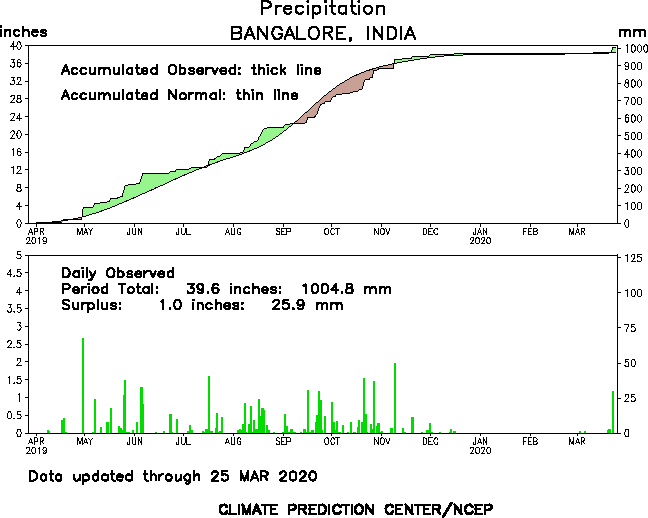

Lua error in Module:Sister_project_links at line 463: attempt to index field 'wikibase' (a nil value).
- Pages using the JsonConfig extension
- Good articles
- Pages with Kannada IPA
- Bengaluru
- 1537 establishments in India
- Cities and towns in Bengaluru Urban district
- Cities in Karnataka
- High-technology business districts in India
- Indian capital cities
- Metropolitan cities in India
- Populated places established in 1537
- Geographical articles missing image alternative text