




Ajay Kumar (talk | contribs) Created a new article |
quick fix |
||
| Line 1: | Line 1: | ||
{{Short description| | {{Short description|none}} | ||
{{Further|History of Punjab|PEPSU|label1=Before the formation of Haryana, Historically it was under the Regional Domain of Punjab, until the Declaration to established separate state,|label2=PAPSU state abolishment Act}} | |||
{{Multiple issues| | {{Multiple issues| | ||
{{more citations needed|date=April 2012}} | {{more citations needed|date=April 2012}} | ||
{{More footnotes needed|date=October 2021}} | {{More footnotes needed|date=October 2021}} | ||
}} | }} | ||
{{Use dmy dates|date= | {{Use dmy dates|date=November 2025}} | ||
{{Use Indian English|date= | {{Use Indian English|date=November 2025}} | ||
{{History of South Asia}} | {{History of South Asia}} | ||
[[Haryana]] is a state in India. The state houses several sites from the [[Indus Valley civilisation|Indus Valley Civilization]], which was a [[cradle of | [[Haryana]] is a state in India. The state houses several sites from the [[Indus Valley civilisation|Indus Valley Civilization]], which was a [[cradle of civilisation]]. In [[Mahabharata|the Mahabharata]], Haryana is mentioned as Bahudanayak Region.{{citation needed|date=May 2022}} | ||
Haryana has been ruled by various native and non-native polities including the [[Maurya Empire]], [[Gupta Empire]], [[Pushyabhuti dynasty]], [[ | Haryana has been ruled by various native and non-native polities including the [[Maurya Empire]], [[Gupta Empire]], [[Pushyabhuti dynasty]], [[Pratihara dynasty]], [[Tomara Dynasty]], [[Chahamanas of Shakambhari]], [[Ghurid dynasty]], [[Delhi Sultanate]], [[Mughal Empire]], [[Sikh Confederacy|Sikh Confedracy]], [[Durrani Empire]], [[Maratha Empire]], [[Sikh Empire]], [[George Thomas (soldier)|(George Thomas)]], [[Gwalior State]], [[Company Rule in India]] and [[British Raj]]. | ||
[[Sikhs]] during [[Sikh Empire|Khalsa Empire]] ruled | [[Sikhs]] during [[Sikh Empire|Khalsa Empire]] ruled some parts of the Haryana region which earlier came under [[Punjab]] division. Some [[Sikhs|Sikh]] states in Haryana were [[Jind]], [[Kaithal]], [[Hisar (city)|Hisar]], [[Ladwa]], [[Kalsia]] and others. Mostly Sikh rulers belong to [[Jat Sikh|Jats]] community of Punjab.<ref>{{Cite book |last=Bates |first=Crispin |url=https://books.google.com/books?id=-xZBDwAAQBAJ&q=Jind+Jat |title=Mutiny at the Margins: New Perspectives on the Indian Uprising of 1857: Volume I: Anticipations and Experiences in the Locality |date=26 March 2013 |publisher=SAGE Publishing India |isbn=978-81-321-1589-2 |language=en}}</ref><ref>{{Cite book |last=Hasan |first=Mushirul |url=https://books.google.com/books?id=yLDXAAAAMAAJ |title=Islam in South Asia: Encountering the West : before and after 1857 |date=2008 |publisher=Manohar Publishers & Distributors |isbn=978-81-7304-743-5 |language=en}}</ref><ref>{{Cite book |last=www.DiscoverSikhism.com |url=http://archive.org/details/HistoryOfTheSikhsVol.IvTheSikhCommonwealthOrRiseAndFallOfSikh |title=History Of The Sikhs Vol. IV The Sikh Commonwealth Or Rise And Fall Of Sikh Misls |language=English}}</ref> | ||
{{Misls}} | |||
During [[Delhi Sultanate]] and [[Mughal Empire]], Haryana was known as Delhi Subah. Many historically significant battles have been fought in it such as [[First Battle of Tarain|Battle of Tarain]], [[Second Battle of Panipat|Battle of Panipat]], and [[Battle of Karnal]]. The [[Khanzadas of Mewat]] ruled the [[Mewat|Mewat region]] until 1527. | |||
During the [[British Raj|British Colonial period]], from 1858 to 1947 it was administered as a part of the [[Punjab Province (British India)|Punjab province]]. It became a separate administrative state of India in 1966. [[Chandigarh]] is the joint capital for the states of Punjab and Haryana. | During the [[British Raj|British Colonial period]], from 1858 to 1947 it was administered as a part of the [[Punjab Province (British India)|Punjab province]]. It became a separate administrative state of India in 1966. [[Chandigarh]] is the joint capital for the states of Punjab and Haryana. | ||
| Line 28: | Line 28: | ||
{{see also | Cave paintings in India | South Asian Stone Age | Paleolithic }} | {{see also | Cave paintings in India | South Asian Stone Age | Paleolithic }} | ||
History of human presence in Haryana dates back to 100,000 years ago. [[Archaeology|Archaeologists]] discovered cave paintings and tools in [[Mangar Bani]] hill forest in May 2021; the cave paintings are estimated to be 100,000 years old. These are believed to be the largest in the [[Indian subcontinent]] and possibly the world's oldest.<ref name=":1">{{Cite web|date=2021 | History of human presence in Haryana dates back to 100,000 years ago. [[Archaeology|Archaeologists]] discovered cave paintings and tools in [[Mangar Bani]] hill forest in May 2021; the cave paintings are estimated to be 100,000 years old. These are believed to be the largest in the [[Indian subcontinent]] and possibly the world's oldest.<ref name=":1">{{Cite web|date=14 July 2021|title=Palaeolithic cave paintings found in corner of NCR could be among oldest|url=https://www.hindustantimes.com/india-news/palaeolithic-cave-paintings-found-in-corner-of-ncr-could-be-among-oldest-in-the-country-101626201354624.html|access-date=18 July 2021|website=Hindustan Times|language=en}}</ref><ref>{{Cite web|date=17 July 2021|title=Prehistoric Cave Paintings from One Lakh Years Ago Discovered in Faridabad|url=https://www.news18.com/news/buzz/prehistoric-cave-paintings-from-one-lakh-years-ago-discovered-in-faridabad-3973361.html|access-date=19 July 2021|website=News18}}</ref> Group of 43 sites was found in this area including Ankhir, [[Anangpur]], Anangpur Dam, Shilakhari, [[Mangar Bani]], Dhauj, Kot, Roj ka Gujjar, Nurpur, Dhumaspur, [[Surajkund]], etc.<ref name=mangr2>[https://timesofindia.indiatimes.com/city/gurgaon/rush-for-protected-tag-to-faridabad-site-where-stone-age-cave-art-found/articleshow/84875868.cms Rush for protected tag to Faridabad site where stone age cave art found], Times of India, 31 July 2021.</ref> | ||
Paleolithic and [[South Asian Stone Age#Neolithice|Neolithic Stone Age]] (7000 BCE - 5500 BCE) find were excavated from the [[Ghaggar-Hakra River|banks of the stream]] (paleochannel of [[Saraswati river]]) flowing through HMT complex,<ref>Manmohan Kumar : Archaeology of Ambala and Kurukshetra Districts, Haryana, 1978, Mss, pp.240-241.</ref><ref name=harsamvad1>[http://haryanasamvad.gov.in/store/document/Haryana%20Samvad%20October%202018.pdf Haryana Samvad] {{Webarchive|url=https://web.archive.org/web/20181129225259/http://haryanasamvad.gov.in/store/document/Haryana%20Samvad%20October%202018.pdf |date=29 November 2018 }}, Oct 2018, p38-40.</ref> by the [[Guy Ellcock Pilgrim]] who was a British geologist and [[palaeontology|palaeontologist]], who discovered 150,000 year old [[Archaic humans|prehistoric human]] teeth and part of a jaw denoting that the [[Peopling of India#Early hominins of Acheulean period|ancient people]], who were intelligent [[Hominini|hominins]] dating as far back as 150,000 [[Before Present|ybp]] [[Acheulean]] period,<ref name="sciencemag.org">{{Cite journal|title=Early Pleistocene Presence of Acheulian Hominins in South India|first1=Shanti|last1=Pappu|first2=Yanni|last2=Gunnell|first3=Kumar|last3=Akhilesh|first4=Régis|last4=Braucher|first5=Maurice|last5=Taieb|first6=François|last6=Demory|first7=Nicolas|last7=Thouveny|date=25 March 2011|journal=Science|volume=331|issue=6024|pages=1596–1599|doi=10.1126/science.1200183|pmid=21436450|s2cid=206531024}}</ref> lived in Pinjore region near [[Chandigarh]].<ref>Pilgrim, Guy, E. 'New Shivalik Primates and their Bearing on the Question, of the Evolution of Man and the Anthropoides, Records of the Geological Survey of India, 1915, Vol.XIV, pp. 2-61.</ref> [[Quartzite]] tools of [[ | Paleolithic and [[South Asian Stone Age#Neolithice|Neolithic Stone Age]] (7000 BCE - 5500 BCE) find were excavated from the [[Ghaggar-Hakra River|banks of the stream]] (paleochannel of [[Saraswati river]]) flowing through HMT complex,<ref>Manmohan Kumar : Archaeology of Ambala and Kurukshetra Districts, Haryana, 1978, Mss, pp.240-241.</ref><ref name=harsamvad1>[http://haryanasamvad.gov.in/store/document/Haryana%20Samvad%20October%202018.pdf Haryana Samvad] {{Webarchive|url=https://web.archive.org/web/20181129225259/http://haryanasamvad.gov.in/store/document/Haryana%20Samvad%20October%202018.pdf |date=29 November 2018 }}, Oct 2018, p38-40.</ref> by the [[Guy Ellcock Pilgrim]] who was a British geologist and [[palaeontology|palaeontologist]], who discovered 150,000 year old [[Archaic humans|prehistoric human]] teeth and part of a jaw denoting that the [[Peopling of India#Early hominins of Acheulean period|ancient people]], who were intelligent [[Hominini|hominins]] dating as far back as 150,000 [[Before Present|ybp]] [[Acheulean]] period,<ref name="sciencemag.org">{{Cite journal|title=Early Pleistocene Presence of Acheulian Hominins in South India|first1=Shanti|last1=Pappu|first2=Yanni|last2=Gunnell|first3=Kumar|last3=Akhilesh|first4=Régis|last4=Braucher|first5=Maurice|last5=Taieb|first6=François|last6=Demory|first7=Nicolas|last7=Thouveny|date=25 March 2011|journal=Science|volume=331|issue=6024|pages=1596–1599|doi=10.1126/science.1200183|pmid=21436450|bibcode=2011Sci...331.1596P |s2cid=206531024}}</ref> lived in Pinjore region near [[Chandigarh]].<ref>Pilgrim, Guy, E. 'New Shivalik Primates and their Bearing on the Question, of the Evolution of Man and the Anthropoides, Records of the Geological Survey of India, 1915, Vol.XIV, pp. 2-61.</ref> [[Quartzite]] tools of [[Lower Paleolithic]] period were excavated in this region extending from Pinjore in Haryana to [[Nalagarh]] ([[Solan district]] in Himachal Pradesh.<ref name=hargazc1>[http://revenueharyana.gov.in/Portals/0/hr-gaz-ch-5.pdf Haryana Gazateer], Revennue Dept of Haryana, Capter-V.</ref> | ||
=== Neolithic === | === Neolithic === | ||
| Line 41: | Line 41: | ||
{{see also | Saraswati | Periodisation of the Indus Valley Civilisation | List of inventions and discoveries of the Indus Valley Civilisation | Sanitation of the Indus Valley Civilization | Harappan architecture | l5= IVC architecture | Harappan language | l6= IVC language | Indus script | l7= Indus script | Indus–Mesopotamia relations }} | {{see also | Saraswati | Periodisation of the Indus Valley Civilisation | List of inventions and discoveries of the Indus Valley Civilisation | Sanitation of the Indus Valley Civilization | Harappan architecture | l5= IVC architecture | Harappan language | l6= IVC language | Indus script | l7= Indus script | Indus–Mesopotamia relations }} | ||
[[Indus Valley civilisation]] evolved on the banks of [[Rigvedic rivers]] [[Indus river|Indus]] and [[Sarasvati River|Sarasvati]] rivers. Sarasvati and its tributary [[Drishadvati river]] ([[Ghaggar-Hakra River|Ghaggar]]) flow through north and central Haryana and there are [[List of Indus Valley Civilisation sites|numerous IVC sites]] in haryana along [[paleochannel]]s of these rivers, notable among those are the [[Rakhi Garhi]], [[Banawali]], [[Bhirrana]], [[Farmana]], [[Jognakhera]], [[Mitathal]], [[Siswal]], and [[Tosham Hill range#Tosham Hill range Indus Valley Civilization mines & smelters|IVC mines and smelter at Tosham]]. Haryana govt is undertaking projects to [[Adi Badri, Haryana#Sarasvati river revival|revive Saraswati]] and [[Rakhigarhi Indus Valley Civilisation Museum]] has been constructed for the conservation of the | [[Indus Valley civilisation]] evolved on the banks of [[Rigvedic rivers]] [[Indus river|Indus]] and [[Sarasvati River|Sarasvati]] rivers. Sarasvati and its tributary [[Drishadvati river]] ([[Ghaggar-Hakra River|Ghaggar]]) flow through north and central Haryana and there are [[List of Indus Valley Civilisation sites|numerous IVC sites]] in haryana along [[paleochannel]]s of these rivers, notable among those are the [[Rakhi Garhi]], [[Banawali]], [[Bhirrana]], [[Farmana]], [[Jognakhera]], [[Mitathal]], [[Siswal]], and [[Tosham Hill range#Tosham Hill range Indus Valley Civilization mines & smelters|IVC mines and smelter at Tosham]]. Haryana govt is undertaking projects to [[Adi Badri, Haryana#Sarasvati river revival|revive Saraswati]] and [[Rakhigarhi Indus Valley Civilisation Museum]] has been constructed for the conservation of the artefacts. | ||
===Vedic period=== | ===Vedic period=== | ||
| Line 48: | Line 48: | ||
During the Vedic era, there were [[janapada]] in Haryana from 1500 BCE 6th century BCE, which evolved into [[mahajanapadas]] which lasted from 6th century BCE to 4th century BCE. During Janpada period [[Kuru Kingdom|Kuru]] janpada covered most of Haryana and their area was called Kurukshetra, except [[South Haryana]] where [[Matsya Kingdom|Matsaya janpada]] (700–300 BCE) covered [[Mewat]] in Haryana (and [[Alwar]] in Rajasthan) and [[Surasena]] janpada covered [[Braj]] region including parts of Haryana near [[Barsana]] (such as [[Punhana]] and [[Hodal]]). After [[mahabharta]] and subsequent [[ashvamedha]] [[yagna]], Kuru janpada evolved into a mahajanapada which sovereignty over other janpadas. The sandy [[bagar tract]] in northwestern and westcentral Haryana on Haryana-Rajasthan border was part of the larger [[jangladesh]] which also covered [[thar Desert|thar]] area of Rajasthan. Lord [[Krishna]] revealed [[Bhagavad Gita]] to [[Arjuna]] at [[Jyotisar]]. [[Śrauta]] were codified in Haryana during Kuru mahajanpada era, and notable sites in Haryana related to [[rishi]] authors are [[Bilaspur, Haryana|Bilaspur]] (Vyas Puri) and [[Kapal Mochan]] both related to Rishi [[Vyasa|Ved Vyasa]] who wrote mahabharta on the banks of Saraswati at hish [[ashram]] at Bilaspur, [[Dhosi Hill]] was ashram of Rishi [[Chyavana]], who is mentioned in mahabharta, and he is well known for creating [[chyavanprash]] and detailed formula for which first appeared in the [[ayurveda|ayurvedic]] text [[Charaka Samhita]]. | During the Vedic era, there were [[janapada]] in Haryana from 1500 BCE 6th century BCE, which evolved into [[mahajanapadas]] which lasted from 6th century BCE to 4th century BCE. During Janpada period [[Kuru Kingdom|Kuru]] janpada covered most of Haryana and their area was called Kurukshetra, except [[South Haryana]] where [[Matsya Kingdom|Matsaya janpada]] (700–300 BCE) covered [[Mewat]] in Haryana (and [[Alwar]] in Rajasthan) and [[Surasena]] janpada covered [[Braj]] region including parts of Haryana near [[Barsana]] (such as [[Punhana]] and [[Hodal]]). After [[mahabharta]] and subsequent [[ashvamedha]] [[yagna]], Kuru janpada evolved into a mahajanapada which sovereignty over other janpadas. The sandy [[bagar tract]] in northwestern and westcentral Haryana on Haryana-Rajasthan border was part of the larger [[jangladesh]] which also covered [[thar Desert|thar]] area of Rajasthan. Lord [[Krishna]] revealed [[Bhagavad Gita]] to [[Arjuna]] at [[Jyotisar]]. [[Śrauta]] were codified in Haryana during Kuru mahajanpada era, and notable sites in Haryana related to [[rishi]] authors are [[Bilaspur, Haryana|Bilaspur]] (Vyas Puri) and [[Kapal Mochan]] both related to Rishi [[Vyasa|Ved Vyasa]] who wrote mahabharta on the banks of Saraswati at hish [[ashram]] at Bilaspur, [[Dhosi Hill]] was ashram of Rishi [[Chyavana]], who is mentioned in mahabharta, and he is well known for creating [[chyavanprash]] and detailed formula for which first appeared in the [[ayurveda|ayurvedic]] text [[Charaka Samhita]]. | ||
In some ancient Hindu texts, the boundaries of [[Kurukshetra]] (the area under Kuru janpada, not just the modern day Kurukshetra city)<ref>{{Cite web|url=https://www.digitalgyanganga.com/haryana-gk-2020/|title=Haryana Gk 2020 : Ancient Haryana {{!}} प्राचीन हरियाणा {{!}} For all HSSC Exams|last=admin|date=22 January 2020|website=Digital Gyan Ganga|language=en|access-date=2020- | In some ancient Hindu texts, the boundaries of [[Kurukshetra]] (the area under Kuru janpada, not just the modern day Kurukshetra city)<ref>{{Cite web|url=https://www.digitalgyanganga.com/haryana-gk-2020/|title=Haryana Gk 2020 : Ancient Haryana {{!}} प्राचीन हरियाणा {{!}} For all HSSC Exams|last=admin|date=22 January 2020|website=Digital Gyan Ganga|language=en|access-date=23 January 2020|archive-date=25 September 2020|archive-url=https://web.archive.org/web/20200925141958/https://www.digitalgyanganga.com/haryana-gk-2020/|url-status=dead}}</ref> correspond roughly to the state of Haryana. Thus according to the [[Taittiriya Aranyaka]] 5.1.1., the Kurukshetra region is south of Turghna ([[Sugh Ancient Mound|Srughna/Sugh]]), north of [[Khandava Forest|Khandavprastha forest]] ([[Delhi]] and [[Mewat]] region), east of [[Maru Pradesh]] (marusthal or desert) and west of Parin.<ref>[http://www.omilosmeleton.gr/english/documents/VedicEvidenceforAMT.pdf Agarwal, Vishal: Is There Vedic Evidence for the Indo-Aryan Immigration to India?] {{webarchive |url=https://web.archive.org/web/20080528001253/http://www.omilosmeleton.gr/english/documents/VedicEvidenceforAMT.pdf |date=28 May 2008 }}</ref> Some of these historic places are included in the [[48 Kos Parikrama of Kurukshetra]]. | ||
<gallery> | <gallery> | ||
| Line 56: | Line 56: | ||
EpicIndia.jpg|Locations of kingdoms and republics in [[Bharata Khanda]] (India) mentioned in epics like mahabharta. | EpicIndia.jpg|Locations of kingdoms and republics in [[Bharata Khanda]] (India) mentioned in epics like mahabharta. | ||
</gallery> | </gallery> | ||
===Sultanate period=== | ===Sultanate period=== | ||
[[Muhammad Ghori]] conquered Haryana after the [[Second Battle of Tarain]]. Following his death, the [[Delhi Sultanate]] was established that ruled much of India for several centuries. The earliest reference to 'Hariana' occurs in a [[Sanskrit]] inscription dated 1328 AD kept in [[Delhi]] Museum, which refers to this region as ''The heaven on earth'', indicating that it was fertile and relatively peaceful at that time. [[Firuz Shah Tughlaq]] established a fort at Hisar in 1354 to further fortify the region, and also constructed canals or ''rajwahas'' as they were referred to in the Indo-Persian historical texts. | [[Muhammad Ghori]] conquered Haryana after the [[Second Battle of Tarain]]. Following his death, the [[Delhi Sultanate]] was established that ruled much of India for several centuries. The earliest reference to 'Hariana' occurs in a [[Sanskrit]] inscription dated 1328 AD kept in [[Delhi]] Museum, which refers to this region as ''The heaven on earth'', indicating that it was fertile and relatively peaceful at that time. [[Firuz Shah Tughlaq]] established a fort at Hisar in 1354 to further fortify the region, and also constructed canals or ''rajwahas'' as they were referred to in the Indo-Persian historical texts. | ||
The [[Khanzadas of Mewat]] were a ruling dynasty of [[Muslim Rajputs]], who traced their lineage to Raja Sonpar Pal, a Yaduvanshi Rajput who converted to Islam during the Delhi Sultanate. The Khanzadas were granted the Lordship of [[Mewat]] by [[Firuz Shah Tughlaq]] in 1372. [[Nahar Khan|Raja Nahar Khan]], formerly known as Raja Sonpar Pal, proclaimed the title of Wali-e-Mewat, solidifying a hereditary polity that endured until 1527.<ref>{{Citation |last=Chandra |first=Satish |title=Mughal India |date=1 April 1982 |work=The Cambridge Economic History of India |pages=458–471 |url=http://dx.doi.org/10.1017/chol9780521226929.027 |access-date=7 November 2023 |publisher=Cambridge University Press |doi=10.1017/chol9780521226929.027 |isbn=978-1-139-05451-5|url-access=subscription }}</ref> | |||
=== Mughal Empire === | === Mughal Empire === | ||
[[File:The_defeat_of_Hemu,_Akbarnama.jpg|thumb|The defeat of [[Hemu]] at the [[Second Battle of Panipat]], c. 1556, [[Akbarnama]].]] | [[File:The_defeat_of_Hemu,_Akbarnama.jpg|thumb|The defeat of [[Hemu]] at the [[Second Battle of Panipat]], c. 1556, [[Akbarnama]].]] | ||
The three famous battles of Panipat took place near the modern town of [[Panipat]]. The [[First Battle of Panipat|first battle]] took place in 1526, where [[Babur]], the ruler of [[Kabul]] defeated [[Ibrahim Lodi]] of the [[Delhi Sultanate]], through the use of [[field artillery]]. This battle marked the beginning of the [[Mughal Empire]] in India. | The three famous battles of Panipat took place near the modern town of [[Panipat]]. The [[First Battle of Panipat|first battle]] took place in 1526, where [[Babur]], the ruler of [[Kabul]] defeated [[Ibrahim Lodi]] of the [[Delhi Sultanate]], through the use of [[field artillery]]. This battle marked the beginning of the [[Mughal Empire]] in India. [[Hasan Khan Mewati]] was the son of [[Khanzada Alawal Khan|Raja Alawal Khan]], his dynasty ruled [[Mewat]] for nearly two centuries. Descended from Raja Nahar Khan, the Wali of Mewat in the 14th century, Hasan Khan Mewati assumed the role of a sovereign king. Babur acknowledged him as the leader of the 'Mewat country'. | ||
In the [[First Battle of Panipat]], Hasan Khan Mewati supported [[Ibrahim Lodi]] against Babur in 1526, marked a pivotal moment in the conflict between the Mughal Empire and the Delhi Sultanate. Hasan Khan Mewati later aligned himself with [[Rana Sanga]] in continued opposition against the Mughal Empire in the [[Battle of Khanwa]], where he was killed by the forces led by Babur.<ref>{{Cite web |date=18 December 2018 |title=अलवर का वीर देशभक्त सपूत, जिससे बाबर भी घबराता था, बाबर के खिलाफ जमकर किया था युद्ध {{!}} Hasan Khan Mewati Alwar Story In Hindi |url=https://www.patrika.com/alwar-news/hasan-khan-mewati-alwar-story-in-hindi-3854583/ |access-date=7 November 2023 |website=Patrika News |language=hi-IN}}</ref> | |||
In the [[Second Battle of Panipat]] (5 November 1556), [[Akbar]]'s general [[Bairam Khan]] defeated [[Hemu]], the local Haryanvi who grew up in [[Rewari]]. Hemu, who belonged to Rewari in Haryana, rose from a businessman to become adviser to Afghan kings and then Prime Minister-cum-Chief of Army. He fought and won 22 battles in between 1553 and 1556, from Punjab to Bengal against Afghans and Mughals and won all of them without losing any. Hemu defeated Akbar's army at Tughlaqabad in [[Battle of Delhi (1556)|Battle of Delhi-1556]] and became king at Delhi on 7 October 1556 declaring himself as Vikramaditya following the reigns of earlier Vedic kings.<ref name="MHI2">Kar, L. Colonel H. C. "Military History of India", Calcutta (1980), p.283</ref> Hemu died in the [[Second Battle of Panipat]]. | In the [[Second Battle of Panipat]] (5 November 1556), [[Akbar]]'s general [[Bairam Khan]] defeated [[Hemu]], the local Haryanvi who grew up in [[Rewari]]. Hemu, who belonged to Rewari in Haryana, rose from a businessman to become adviser to Afghan kings and then Prime Minister-cum-Chief of Army. He fought and won 22 battles in between 1553 and 1556, from Punjab to Bengal against Afghans and Mughals and won all of them without losing any. Hemu defeated Akbar's army at Tughlaqabad in [[Battle of Delhi (1556)|Battle of Delhi-1556]] and became king at Delhi on 7 October 1556 declaring himself as Vikramaditya following the reigns of earlier Vedic kings.<ref name="MHI2">Kar, L. Colonel H. C. "Military History of India", Calcutta (1980), p.283</ref> Hemu died in the [[Second Battle of Panipat]]. | ||
| Line 80: | Line 80: | ||
The [[Indian Rebellion of 1857]] war started first at [[Ambala Cantonment]], 8 hours before revolt started in [[Meerut]], when the soldiers of [[5th Indian Infantry Brigade]] and [[60th Indian Infantry Brigade]] revolted but it was crushed.<ref name=sarasnew1>[http://haryanasamvad.gov.in/store/document/11%2012%201%20HARYANA%20SAMVAD%20NOV-%20JAN%202017-2018%20FOR%20for%20web.pdf Haryana Samvad] {{Webarchive|url=https://web.archive.org/web/20180827125256/http://haryanasamvad.gov.in/store/document/11%2012%201%20HARYANA%20SAMVAD%20NOV-%20JAN%202017-2018%20FOR%20for%20web.pdf |date=27 August 2018 }}, Jan 2018.</ref> [[Bengal Native Infantry#Pre-1857 list of Bengal Native Infantry Regiments|5th and 60th Regiments of Benga Native Infantry]] rebelled at [[Ambala#1857 rebellion|Umballa]] (Ambala). During the [[Narnaul#Battle of Narnaul|Battle of Narnaul]] at Nasibpur on 16 November 1857, [[British Raj|British]] lost 70 British soldiers and their commanders colonel Gerrard and Captain Wallace. 40 British soldiers and officers Captain Craige, Captain Kennedy and Captain Pearse were wounded.<ref name=reb1>Dr Malti Malik, [https://books.google.com/books?id=bMg-DAAAQBAJ&dq=nahar+singh+ballabhgarh&pg=PA356 History of India], Page 356.</ref> The major centers of rebellion were at Hisar, Hansi, Sirsa, Rohtak, Jhajjar, Bahadurgarh, Farrukhnagar, Ballabhgarh, Rewari, Ambala, [[Panipat]] and [[Thanesar#British era|Thanesar]].<ref name=reb1/> Under the "Delhi Agency" there were seven [[Princely state]]s, [[Jhajjar#History|Jhajjar]], [[Farrukhnagar#British Raj|Farrukhnagar]], [[Ballabhgarh#History|Ballabhgarh]], [[Loharu State|Loharu]], [[Pataudi State|Pataudi]] and [[Dujana#History|Dujana]]. The Chiefs of the last two estates remained loyal to the British and others rebelled.<ref name=balidan16>Madan Gopal, 1977, [https://books.google.com/books?id=mrwBAAAAMAAJ Sir Chhotu Ram: a political biography], Page 9.</ref> The Rajput rulers of Rajasthan also kept out of the mutiny.<ref name=balidan21>M.K. Singh, 2009, [https://books.google.com/books?isbn=8126137452 Encyclopaedia Of Indian War Of Independence (1857–1947) (Set Of 19 Vols.)]</ref> | The [[Indian Rebellion of 1857]] war started first at [[Ambala Cantonment]], 8 hours before revolt started in [[Meerut]], when the soldiers of [[5th Indian Infantry Brigade]] and [[60th Indian Infantry Brigade]] revolted but it was crushed.<ref name=sarasnew1>[http://haryanasamvad.gov.in/store/document/11%2012%201%20HARYANA%20SAMVAD%20NOV-%20JAN%202017-2018%20FOR%20for%20web.pdf Haryana Samvad] {{Webarchive|url=https://web.archive.org/web/20180827125256/http://haryanasamvad.gov.in/store/document/11%2012%201%20HARYANA%20SAMVAD%20NOV-%20JAN%202017-2018%20FOR%20for%20web.pdf |date=27 August 2018 }}, Jan 2018.</ref> [[Bengal Native Infantry#Pre-1857 list of Bengal Native Infantry Regiments|5th and 60th Regiments of Benga Native Infantry]] rebelled at [[Ambala#1857 rebellion|Umballa]] (Ambala). During the [[Narnaul#Battle of Narnaul|Battle of Narnaul]] at Nasibpur on 16 November 1857, [[British Raj|British]] lost 70 British soldiers and their commanders colonel Gerrard and Captain Wallace. 40 British soldiers and officers Captain Craige, Captain Kennedy and Captain Pearse were wounded.<ref name=reb1>Dr Malti Malik, [https://books.google.com/books?id=bMg-DAAAQBAJ&dq=nahar+singh+ballabhgarh&pg=PA356 History of India], Page 356.</ref> The major centers of rebellion were at Hisar, Hansi, Sirsa, Rohtak, Jhajjar, Bahadurgarh, Farrukhnagar, Ballabhgarh, Rewari, Ambala, [[Panipat]] and [[Thanesar#British era|Thanesar]].<ref name=reb1/> Under the "Delhi Agency" there were seven [[Princely state]]s, [[Jhajjar#History|Jhajjar]], [[Farrukhnagar#British Raj|Farrukhnagar]], [[Ballabhgarh#History|Ballabhgarh]], [[Loharu State|Loharu]], [[Pataudi State|Pataudi]] and [[Dujana#History|Dujana]]. The Chiefs of the last two estates remained loyal to the British and others rebelled.<ref name=balidan16>Madan Gopal, 1977, [https://books.google.com/books?id=mrwBAAAAMAAJ Sir Chhotu Ram: a political biography], Page 9.</ref> The Rajput rulers of Rajasthan also kept out of the mutiny.<ref name=balidan21>M.K. Singh, 2009, [https://books.google.com/books?isbn=8126137452 Encyclopaedia Of Indian War Of Independence (1857–1947) (Set Of 19 Vols.)]</ref> | ||
[[Nahar Singh|Raja Nahar Singh]] was the ruler of Ballabhgarh, [[Rao Tula Ram]] ruler of [[Rewari#British colonial era|Rewari]] and his cousin Gopal Dev, Nawab Abdur Rahman Khan Jhajjar, Nawab Ahmad Ali of Farrukhnagar, Sadruddin the | [[Nahar Singh|Raja Nahar Singh]] was the ruler of Ballabhgarh, [[Rao Tula Ram]] ruler of [[Rewari#British colonial era|Rewari]] and his cousin Gopal Dev, Nawab Abdur Rahman Khan Jhajjar, Nawab Ahmad Ali of Farrukhnagar, Sadruddin was the leader of [[Mewat]], Harsukh Rai and Mirza Gauhar Ali of Palwal and [[Imam]] of [[Bu Ali Shah Qalandar]] mosque in Panipat played key role.<ref name=reb1/> | ||
After the failure of revolt by Indians, Haryana was taken out of [[North-Western Provinces]] and merged with Punjab as a punishment.<ref name=sarasnew1/> | After the failure of revolt by Indians, Haryana was taken out of [[North-Western Provinces]] and merged with Punjab as a punishment.<ref name=sarasnew1/> | ||
| Line 87: | Line 87: | ||
====Independence and riots==== | ====Independence and riots==== | ||
[[Lala Lajpat Rai]] worked towards the social reform, spread of [[Arya Samaj]], creation of mass support for the [[Indian independence movement]] and he died protesting against the [[Simon Commission#Protests and death of Lala Lajpat Rai|Simon Commission]]. Lala Murlidhar of Ambala and journalist Balmukund Gupt of Rewari were the members of the [[Indian National Congress#Foundation|founding session of congress]] who promoted [[Swadeshi movement]]. [[Chhotu Ram]], Pandit Nekiram Sharma, Lala Ugrasen and Ramswaroop Jaglan of [[Bidhwan]] were also key independence activists.<ref name=sarasnew1/> | [[Lala Lajpat Rai]] worked towards the social reform, spread of [[Arya Samaj]], creation of mass support for the [[Indian independence movement]] and he died protesting against the [[Simon Commission#Protests and death of Lala Lajpat Rai|Simon Commission]]. Lala Murlidhar of Ambala and journalist Balmukund Gupt of Rewari were the members of the [[Indian National Congress#Foundation|founding session of congress]] who promoted [[Swadeshi movement]]. [[Chhotu Ram]], Pandit Nekiram Sharma, Lala Ugrasen and Ramswaroop Jaglan of [[Bidhwan]] were also key independence activists.<ref name=sarasnew1/>{{Page needed|date=August 2024}} | ||
In 1907, two years after the [[Partition of Bengal (1905)|1905 Partition of Bengal]], [[British Indian Army]] soldiers in the [[6th Jat Light Infantry]] and [[10th Jats]] mutinied and sided with Bengali revolutionaries to takeover a government treasury. Their revolt was suppressed by the colonial government and several mutineers were sentenced to prison.<ref name=sarasnew1>[ | In 1907, two years after the [[Partition of Bengal (1905)|1905 Partition of Bengal]], [[British Indian Army]] soldiers in the [[6th Jat Light Infantry]] and [[10th Jats]] mutinied and sided with Bengali revolutionaries to takeover a government treasury. Their revolt was suppressed by the colonial government and several mutineers were sentenced to prison.<ref name=sarasnew1/> In early 1919, [[Jhanda Singh Giani]] was especially noted for his protests against the [[Rowlatt Act]], he was a pleader and resident of [[Ambala]]. In 1914, Kasi Ram Joshi a member of the [[Ghadar Party]] hailing from Haryana, returned to India from America. On 15 March 1915 he was hanged by the colonial rulers. [[Subhas Chandra Bose]]'s [[Azad Hind|Azad Hind Fauj]] had 2847 soldiers from Haryana, of whom 346 attained martyrdom.<ref name=sarasnew1/> | ||
During the partition of India in 1947, state experienced riots at many places, which also scores of death and migration of millions of people from Haryana to Pakistan and vice versa. | During the partition of India in 1947, state experienced riots at many places, which also scores of death and migration of millions of people from Haryana to Pakistan and vice versa. | ||
| Line 98: | Line 98: | ||
==== Hindi language movement ==== | ==== Hindi language movement ==== | ||
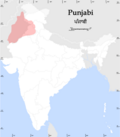
[[File:Punjabispeakers.png|thumb|right|A map of the distribution of native Punjabi speakers in India and Pakistan]] | [[File:Punjabispeakers.png|thumb|right|A map of the distribution of native Punjabi speakers in India and Pakistan]] | ||
[[Punjabi Suba | [[Punjabi Suba movement]] started in Punjab started in 1947 and lasted till 1966. During this time a Hindi language movement also started in Punjab for a short period | ||
that started on 30 April 1957 and lasted till 27 December 1957 in Hindi-speaking areas of Punjab. Movement started after government of post-independence Punjab tried to promote Punjabi as state language but many groups in modern Haryana | that started on 30 April 1957 and lasted till 27 December 1957 in Hindi-speaking areas of Punjab. Movement started after government of post-independence Punjab tried to promote Punjabi as state language but many groups in modern Haryana considered Punjabi as a threat. After this movement was successful in getting the ball rolling for a Hindi-speaking state. Another movement for leftover Punjabi-speaking parts started, this [[Punjabi Suba movement#Background|Punjabi suba & Punjabi language movement]] demanded under which [[Punjabi language|Punjabi]] and [[gurmukhi]] to be made official in after division.<ref name=hindimove1>[http://haryanasamvad.gov.in/store/document/Haryana%20Samvad%20September%20%202018.pdf Har Samvand] {{Webarchive|url=https://web.archive.org/web/20190712211737/http://haryanasamvad.gov.in/store/document/Haryana%20Samvad%20September%20%202018.pdf |date=12 July 2019 }}, Sept 2018, p12.</ref> After reorganisation, Haryana government banned Punjabi in the state. | ||
In 2018, the Government of Haryana started to award ₹10,000 per month pension to the ''Matribhasa Satyagrahis'' (Hindi language activists).<ref>[http://www.uniindia.com/haryana-to-include-matribhasha-satyagrahis-in-ayushman-bharat-pradhan-mantri-jan-arogya-yojana/north/news/1449651.html Haryana to include Matribhasa Satyagrahis in Ayushman bharat scheme], UNI, 27 December 2018.</ref> | In 2018, the Government of Haryana started to award ₹10,000 per month pension to the ''Matribhasa Satyagrahis'' (Hindi language activists).<ref>[http://www.uniindia.com/haryana-to-include-matribhasha-satyagrahis-in-ayushman-bharat-pradhan-mantri-jan-arogya-yojana/north/news/1449651.html Haryana to include Matribhasa Satyagrahis in Ayushman bharat scheme], UNI, 27 December 2018.</ref> | ||
| Line 108: | Line 108: | ||
In order to analyse and find a cooperative as well as universally acceptable solution, for the long going vexed linguistic problem, being faced by Punjab, the parliament announced the formation of the [https://indianculture.gov.in/flipbook/2535 Parliamentary Committee on Demand for Punjabi Suba (1966)] chairmanned by [[Sardar Hukam Singh]], on 23 September 1965. According to the 90 paged report, the committee initially came to an understanding that a 'co-operative solution' was not possible. Moreover, it stated that unanimity is also not possible or necessary on any matters in a democratic set-up. So, after perusing the large number of memoranda/representations received by the committee and hearing the various view-points expressed by the different witnesses representing the various shades of opinion, the committee suggested the re-organisation of the State of Punjab on linguistic basis. It also stated that the then Chief Minister of the Punjab State admitted that the situation needed a change and status quo in its entirety was not possible." Although a section of the people from the Punjab canvassed before the committee that the status quo might be maintained in the Punjab. Even a third argument advanced in favour of the status quo was that, any reorganisation of the State would not be in the interests of the security of the country and would weaken the defence of India, which was later struck off due to lack of authentic data or justifiable reasons.<ref>[https://indianculture.gov.in/report-parliamentary-committee-demand-punjabi-suba-1966 Report by Parliamentary Committee on Demand for Punjabi Suba 1966]</ref> | In order to analyse and find a cooperative as well as universally acceptable solution, for the long going vexed linguistic problem, being faced by Punjab, the parliament announced the formation of the [https://indianculture.gov.in/flipbook/2535 Parliamentary Committee on Demand for Punjabi Suba (1966)] chairmanned by [[Sardar Hukam Singh]], on 23 September 1965. According to the 90 paged report, the committee initially came to an understanding that a 'co-operative solution' was not possible. Moreover, it stated that unanimity is also not possible or necessary on any matters in a democratic set-up. So, after perusing the large number of memoranda/representations received by the committee and hearing the various view-points expressed by the different witnesses representing the various shades of opinion, the committee suggested the re-organisation of the State of Punjab on linguistic basis. It also stated that the then Chief Minister of the Punjab State admitted that the situation needed a change and status quo in its entirety was not possible." Although a section of the people from the Punjab canvassed before the committee that the status quo might be maintained in the Punjab. Even a third argument advanced in favour of the status quo was that, any reorganisation of the State would not be in the interests of the security of the country and would weaken the defence of India, which was later struck off due to lack of authentic data or justifiable reasons.<ref>[https://indianculture.gov.in/report-parliamentary-committee-demand-punjabi-suba-1966 Report by Parliamentary Committee on Demand for Punjabi Suba 1966]</ref> | ||
On 23 April 1966, while acting on the report submitted by the parliamentary committee, the Indian government set up the [https://indianculture.gov.in/flipbook/2418 Punjab Boundary Commission] under the chairmanship of Justice J. C. Shah | On 23 April 1966, while acting on the report submitted by the parliamentary committee, the Indian government set up the [https://indianculture.gov.in/flipbook/2418 Punjab Boundary Commission] under the chairmanship of Justice J. C. Shah & two members S.Dutt & M. M. Philip to divide and set up the boundaries of Punjab and Haryana. The commission gave its report on 31 May 1966. According to this report the then districts of [[Hissar District|Hissar]], [[Mahendragarh]], [[Gurgaon]], [[Rohtak]], and [[Karnal]] were to be a part of the new state of Haryana. Further the Tehsils of [[Jind]] (district Sangrur), [[Narwana]] (district [[Sangrur district|Sangrur]]) [[Naraingarh]], [[Ambala]], [[Jagadhri|Jagadhari]] tahsil of district Ambala were also included. The commission recommended that whole Tehsil [[Kharar, SAS Nagar|Kharar]] (including [[Chandigarh]]) should also be a part of Haryana.<ref>[https://indianculture.gov.in/report-punjab-boundary-commission Punjab Boundary Commission Report - 1966]</ref><ref name=":2">{{Cite book |url=https://archive.org/details/dli.ministry.21358 |title=Punjab Boundary Commission Report |date=1966-05-31 |pages=48–54 |publisher=New Delhi, General Manager, Government of India Press }}</ref> | ||
However, commission one member from three, Subimal Dutt submitted a dissenting note, arguing that [[Kharar, SAS Nagar|Kharar]] tehsil minus [[Kalka]] Police Station (He recommended for Himachal) area but including Chandigarh should merge with Punjabi state, citing its Punjabi-speaking rural majority, the migratory nature of the Hindi-speaking urban population, and its earlier classification under the Punjabi region as per the Sachar Formula of 1949.<ref name=":2" /> | |||
'''The Territorial changes as a result of the [[Punjab Reorganisation Act, 1966|Reorganisation]] 1966''' | |||
# Entire districts of [[Hisar district|Hisar]], [[Rohtak district|Rohtak]], [[Gurgaon district|Gurgaon]], [[Karnal district|Karnal]] and [[Mahendragarh district|Mahendragarh]], complete tahsils of [[Ambala district|Ambala]], [[Jagadhri]], [[Naraingarh]] and 153 villages along with [[Kalka|Kalka town]] of [[Kharar, SAS Nagar|Kharar tahsil]] of Ambala district and two tahsils viz., [[Jind]] and [[Narwana]] of [[Sangrur district|Sangrur District]] (44,222.0 [[Kilometre|kmsq.]]) were transferred for formation of the newly created State of [[Haryana]] on 1st November,1966.<ref name=":03">{{Cite book |url=https://censusindia.gov.in/nada/index.php/catalog/30738 |title=CENSUS OF INDIA-1971 SERIES-17 PUNJAB PART II-A GENERAL POPULATION TABLES |pages=13}}</ref><ref>{{Cite web |last=Government of Haryana |first=District Panchkula |title=District Panchkula, Government of Haryana |url=https://panchkula.nic.in/about-district/}}</ref><ref>{{Cite book |last=CENSUS OF INDIA 1971 |first=SERIES 6-HARYANA AMBALA DISTRICT |url=https://censusindia.gov.in/nada/index.php/catalog/28244 |title=Ambala District Census Handbook Part X-C Analytical Report District Census Tables and Administrative, Welfare and Developmental Statistics |pages=6}}</ref><ref name=":3">{{Cite book |url=https://censusindia.gov.in/nada/index.php/catalog/30760 |title=CENSUS OF INDIA 1971, SERIES 6, PART II-A GENERAL POPULATION TABLES, HARYANA |pages=9}}</ref> | |||
# 36 villages, [[Mani Majra|Manimajra]] and [[Chandigarh|Chandigarh towns]] of Kharar tahsil of Ambala district (114.0 [[Square kilometre|kmsq]].) were lumped together to come out a separate administrative unit stuled as Union Territory of [[Chandigarh]].<ref name=":04">{{Cite book |url=https://censusindia.gov.in/nada/index.php/catalog/30738 |title=CENSUS OF INDIA-1971 SERIES-17 PUNJAB PART II-A GENERAL POPULATION TABLES |pages=13}}</ref> | |||
# 282 villages along with [[Kharar, SAS Nagar|Kharar]] and [[Kurali]] towns [[Kharar, SAS Nagar|Kharar]] tahsil of composite [[Ambala district]] in Punjab.<ref name=":05">{{Cite book |url=https://censusindia.gov.in/nada/index.php/catalog/30738 |title=CENSUS OF INDIA-1971 SERIES-17 PUNJAB PART II-A GENERAL POPULATION TABLES |pages=13}}</ref> | |||
Initially, 153 villages and [[Kalka|Kalka town]] were added to [[Naraingarh]] Tahsil. Later, these areas were separated from [[Naraingarh]] Tahsil to form a new administrative unit—[[Kalka]] Tahsil—under the [[Haryana]] Government Notification No. 4575-E(V)-67/2626, dated the 25th July, 1967.<ref name=":3" /> | |||
[[Uttawar forced sterilisations]], occurred when on November 6, 1976, when [[Compulsory_sterilization#India|mass vasectomy]] of nearly 800 men of Uttawar village was done, in [[Palwal district]], Haryana during India’s [[The Emergency (India)|Emergency]] imposed by [[Indira Gandhi]].<ref name="times">{{cite web | last=Ghosh | first=Avijit | title=Nasbandi with handcuffs on... | website=The Times of India | date=21 June 2015 | url=https://timesofindia.indiatimes.com/home/sunday-times/deep-focus/nasbandi-with-handcuffs-on-/articleshow/47750238.cms | access-date=1 July 2025}}</ref> | |||
== | ==Thematic history of Haryana== | ||
<!-- These will be forked out into separate articles, once they grow large enough. You are welcome to split these into new article anytime and [[ | {{anchor | Theme | Thematic | Theme history of Haryana | Thematic history of Haryana }} | ||
<!-- These will be forked out into separate articles, once they grow large enough. You are welcome to split these into new article anytime and [[Bharatpedia:Piped link]] here and to main Haryana article --> | |||
<!-- Retain the redlinks to encourage creation. --> | <!-- Retain the redlinks to encourage creation. --> | ||
===Administration=== | ===Administration=== | ||
====Districts==== | |||
{{see also | List of districts of Haryana | Administrative divisions of Haryana }} | |||
* 1 Nov 1966: Haryana carved out as new state from Punjab with 7 districts: [[Ambala district#History|Ambala ]], [[Jind district#History|Jind]], [[Hisar district#History|Hisar]], [[Mahendragarh district#History|Mahendragarh ]], [[Gurgaon district#History|Gurgaon ]] (Gurugram), [[Karnal district#History|Karnal]], and [[Rohtak district#History|Rohtak]].<ref name=distform1/> | |||
* 1972: 2 new districts carved out, namely [[Bhiwani district#History|Bhiwani]] from Hisar district and [[Sonipat district#History|Sonipat]] from Rohtak district.<ref name=distform1/> | |||
* 1973: [[Kurukshetra district#History|Kurukshetra]] carved out from Karnal district.<ref name=distform1/> | |||
* 1975: [[Sirsa district#History|Sirsa]] district carved out of Hisar district.<ref name=distform1/> | |||
* 1979: [[Faridabad district#History|Faridabad]] district carved out of Gurgaon district.<ref name=distform1/> | |||
* 1989: 4 new districts carved out, namely [[Yamunanagar district#History|Yamunanagar]] from Ambala district, [[Kaithal district#History|Kaithal]] (Karnal district and Kurukshetra districts), [[Rewari district#History|Rewari]] from Gurgaon district, [[Panipat district#History|Panipat]] from Karnal district.<ref name=distform1/> | |||
* 1995: [[Panchkula district#History|Panchkula]] carved out of Ambala district.<ref name=distform1/> | |||
* 1996: [[Fatehabad district#History|Fatehabad]] carved out of Hisar district.<ref name=distform1/> | |||
* 1997: [[Jhajjar district#History|Jhajjar]] carved out of Rohtak district.<ref name=distform1/> | |||
* 2005: [[Nuh district#History|Nuh]] carved out of Gurgaon district.<ref name=distform1/> | |||
* 2008: [[Palwal district#History|Palwal]] carved out of Faridabad district.<ref name=distform1/> | |||
* 2016: [[Charkhi Dadri district#History|Charkhi Dadri]] carved out of Bhiwani district.<ref name=distform1>[https://nayaharyana.com/haryana-news/haryana-preparations-to-form-a-new-district-in-haryana/cid17692182.htm Haryana: हरियाणा में नया जिला बनने की तैयारी, सरकार 1 नवंबर 2025 को कर सकती है घोषणा], NayaHaryana, 27 oct 2025.</ref> | |||
====Municipalities==== | ====Municipalities==== | ||
<!-- Please contribute, first self managed system IVC and [[mahajanapadas], ancient pancha and panchayat system, first local governance committees in Haryana under [[British Raj]], first incorporated Municipal committee in Haryana under [[British Raj]], first incorporated Municipal Council in Haryana, first incorporated Municipal Corporation in Haryana, etc ---> | <!-- Please contribute, first self managed system IVC and [[mahajanapadas], ancient pancha and panchayat system, first local governance committees in Haryana under [[British Raj]], first incorporated Municipal committee in Haryana under [[British Raj]], first incorporated Municipal Council in Haryana, first incorporated Municipal Corporation in Haryana, etc ---> | ||
| Line 123: | Line 164: | ||
===Agriculture=== | ===Agriculture=== | ||
===Agrimarketing=== | ===Agrimarketing in India=== | ||
''''India International Horticulture Market (IIHM)''', asia's largest on 537 acre with 1200 shops & 17 massive | ''''India International Horticulture Market (IIHM's)''', asia's largest on 537 acre with 1200 shops & 17 massive specialised marketing sheds, is set up in [[Ganaur]] on [[National Highway 44 (India)|NH44]] in [[Sonipat district]] of Haryana with ₹2700 crore initial assessment in construction. It entails mechanism for cleaning, branding, sorting, packing & processing units, storing, and e-auction of the goods. There will be warehouses, cold storages, hostel, residential colony for the officials, large parking and automobile workshop, 4 electricity stations, and a sewage statement plant, etc.are in India | ||
====Farming==== | ====Farming==== | ||
| Line 133: | Line 174: | ||
====Irrigation==== | ====Irrigation==== | ||
<!-- From IVC and before, use sourced data, what kind of irrigation they had e.g. flood control and irrigation dam as well as irrigation channels on [[Drishadvati river]] at [[Rakhigarhi]], how did it work, upload drawings, scale and technology, etc, [[Western Yamuna canal]] from Feroz Shah and earlier times, modern irrigation starting with modern damns from Bhakra naggal and Rajasthan canal, first dam within boundaries of Haryana from rakhi garhi to Surajkund to modern British Raj dams in shivalik hills and Aravali hills and [[Nuh_(city)#Nuh_System_of_Lakes]] bund built by British Raj, etc, [[Johad]] wetlands and [[Haryana State Waterbody Management Board]], etc --> | <!-- From IVC and before, use sourced data, what kind of irrigation they had e.g. flood control and irrigation dam as well as irrigation channels on [[Drishadvati river]] at [[Rakhigarhi]], how did it work, upload drawings, scale and technology, etc, [[Western Yamuna canal]] from Feroz Shah and earlier times, modern irrigation starting with modern damns from Bhakra naggal and Rajasthan canal, first dam within boundaries of Haryana from rakhi garhi to Surajkund to modern British Raj dams in shivalik hills and Aravali hills and [[Nuh_(city)#Nuh_System_of_Lakes]] bund built by British Raj, etc, [[Johad]] wetlands and [[Haryana State Waterbody Management Board]], etc --> | ||
{{see also | Indus_River#Barrages,_bridges,_levees_and_dams | l1 = Dams on Indus | Jhelum_River#Dams | l2= Dams on Jhelum | Chenab_River#Dams | l3= Dams on Chenab | Ravi_River#Dams | l4= Dams on Ravi | Beas_River#Dams | l5= Dams on Beas| Sutlej_River#Dams | l6= Dams on Sutlej | Yamuna#Dams | l7= Dams on Yamuna | Indus Water Treaty | Lakhwar dam|l8=Lakhwar-Vyasi project | Kishau Dam | Giri River#Dams|l9=Reuka Ji Dam}} | |||
Haryana has network of canals across of state divided into 8 canal command areas. Haryana has 47% share (reduced from 70% after an agreement with Delhi in 1994) in [[Yamuna]] river water and ?% share in [[Sutlej]] river water too for which disputed [[Sutlej Yamuna link canal]] is still partially completed for several decades.<ref name="harsh1">{{Cite news |date=2019 | Haryana has network of canals across of state divided into 8 canal command areas. Haryana has 47% share (reduced from 70% after an agreement with Delhi in 1994) in [[Yamuna]] river water and ?% share in [[Sutlej]] river water too for which disputed [[Sutlej Yamuna link canal]] is still partially completed for several decades.<ref name="harsh1">{{Cite news |date=12 January 2019 |title=Haryana to benefit from Renukaji Dam |work=The Times of India |url=https://timesofindia.indiatimes.com/city/chandigarh/haryana-to-benefit-from-renukaji-dam/articleshow/67495820.cms |access-date=30 July 2023 |issn=0971-8257}}</ref> | ||
Indus treaty covers a total of {{convert|168|e6acre-ft|km3}} of water, of which India can | Indus treaty covers a total of {{convert|168|e6acre-ft|km3}} of water, of which India can utilise 33 million acre-feet (20% of total) from the three rivers assigned to India. In 2019, India utilises only 93–94% (30 million acre-feet) of its share, and 6–7% ({{convert|2|e6acre-ft|km3|disp=comma}} of India's unitised share flows to Pakistan, resulting in a total of 87% water flowing to Pakistan. India is building three dams to utilise 100% of its 33 million acre-feet share (20% of total water under treaty). India is undertaking 3 projects to ensure India utilises its full share of [[Indus Waters Treaty]], | ||
(a) [[Shahpurkandi dam project]] on [[Ravi River]] in [[Pathankot district]] of Punjab (b) Sutlej-Beas link in Punjab (see also [[Pandoh Dam]]) and the [[Ujh River|Ujh Dam project]] on Ujh River (a [[tributary]] of Ravi river) in Jammu and Kashmir. | (a) [[Shahpurkandi dam project]] on [[Ravi River]] in [[Pathankot district]] of Punjab (b) Sutlej-Beas link in Punjab (see also [[Pandoh Dam]]) and the [[Ujh River|Ujh Dam project]] on Ujh River (a [[tributary]] of Ravi river) in Jammu and Kashmir. | ||
<ref name="RenukaDam2">[https://economictimes.indiatimes.com/news/politics-and-nation/govt-giving-attention-to-stop-unutilised-water-from-entering-pak-nitin-gadkari/articleshow/67486420.cms], Economic Times, 11 January 2019.</ref> | <ref name="RenukaDam2">[https://economictimes.indiatimes.com/news/politics-and-nation/govt-giving-attention-to-stop-unutilised-water-from-entering-pak-nitin-gadkari/articleshow/67486420.cms], Economic Times, 11 January 2019.</ref> | ||
''Renukaji dam'', is INR4,596.76 crore 148m high rockfill gravity dam project being built on the Giri river in [[Sirmour district]] with live storage of 0.404 MAF on 1,508 hectares to supply 23 cusec water and generate 40MW peak flow power. An agreement for its construction and sharing of cost and benefits (water and electricity) was signed by the Union Minister for Water and Chief Ministers of six states, namely Haryana (47.8% share of water), UP and Uttakhand (33.65% joint share) Rajasthan (9.3%), Delhi (6.04%) and Himachal Pradesh (3.15), on 11 January 2019. It has been declared a national project, resulting in 90% funding from the centre govt and the rest from the stakeholder states.<ref name="RenukaDam">[https://www.tribuneindia.com/news/nation/6-states-sign-agreement-for-renukaji-dam-multipurpose-project/712141.html Six states sign agreement for Renukaji Dam Multipurpose project], The Tribune, 11 January 2019.</ref> Giri River (cord: 30.44549 °N and 77.67358 ° Ö) in the state of Uttrakhand and Himachal is a tributary of [[Yamuna]], which in turn is tributary of [[Ganges]].<ref name = "gn1271173">[{{Geonameslink|gnid=1271173|name=giri%20river}} Giri River] sa [{{Geonamesabout}} Geonames.org (cc-by)]; post updated 2015 | ''Renukaji dam'', is INR4,596.76 crore 148m high rockfill gravity dam project being built on the Giri river in [[Sirmour district]] with live storage of 0.404 MAF on 1,508 hectares to supply 23 cusec water and generate 40MW peak flow power. An agreement for its construction and sharing of cost and benefits (water and electricity) was signed by the Union Minister for Water and Chief Ministers of six states, namely Haryana (47.8% share of water), UP and Uttakhand (33.65% joint share) Rajasthan (9.3%), Delhi (6.04%) and Himachal Pradesh (3.15), on 11 January 2019. It has been declared a national project, resulting in 90% funding from the centre govt and the rest from the stakeholder states.<ref name="RenukaDam">[https://www.tribuneindia.com/news/nation/6-states-sign-agreement-for-renukaji-dam-multipurpose-project/712141.html Six states sign agreement for Renukaji Dam Multipurpose project] {{Webarchive|url=https://web.archive.org/web/20190415030957/https://www.tribuneindia.com/news/nation/6-states-sign-agreement-for-renukaji-dam-multipurpose-project/712141.html |date=15 April 2019 }}, The Tribune, 11 January 2019.</ref> Giri River (cord: 30.44549 °N and 77.67358 ° Ö) in the state of Uttrakhand and Himachal is a tributary of [[Yamuna]], which in turn is a tributary of [[Ganges]].<ref name = "gn1271173">[{{Geonameslink|gnid=1271173|name=giri%20river}} Giri River] sa [{{Geonamesabout}} Geonames.org (cc-by)]; post updated 8 March 2015; database download sa 15 August 2016</ref> | ||
(a) '''[[Lakhwar Dam]]''' on Yamuna in Uttrakhand, (b) '''Renukaji Dam''' on Giri river in Himchal and (c) '''[[Kishau Dam]]''' on [[Tons River]] in Uttrakhand. The agreements among the stakeholder states and centre govt has been signed for the Kishwar Dam (August 2018 and Renukaji Dam (January 2019) and the agreement for the remaining Kishau Dam is likely to be signed soon. The funding for the Kishwar Dam has already been approved for the centre govt's cabinet and the funding for the Renukaji Dam is expected to be approved soon.<ref name="RenukaDam" /> | (a) '''[[Lakhwar Dam]]''' on Yamuna in Uttrakhand, (b) '''Renukaji Dam''' on Giri river in Himchal and (c) '''[[Kishau Dam]]''' on [[Tons River]] in Uttrakhand. The agreements among the stakeholder states and centre govt has been signed for the Kishwar Dam (August 2018 and Renukaji Dam (January 2019) and the agreement for the remaining Kishau Dam is likely to be signed soon. The funding for the Kishwar Dam has already been approved for the centre govt's cabinet and the funding for the Renukaji Dam is expected to be approved soon.<ref name="RenukaDam" /> | ||
''Renukaji dam'', is INR4,596.76 crore 148m high rockfileld gravity dam project being built on the Giri river in [[Sirmour district]] with live storage of 0.404 MAF on 1,508 hectares to supply 23 cusec water and generate 40MW peak flow power. An agreement for its construction and sharing of cost and benefits (water and electricity) was signed by the Union Minister for Water and Chief Ministers of six states, namely Haryana (47.8% share of water), UP and Uttakhand (33.65% joint share) Rajasthan (9.3%), Delhi (6.04%) and Himachal Pradesh (3.15), on 11 January 2019. It has been declared a national project, resulting in 90% funding from the centre govt and the rest from the stakeholder states.<ref name="RenukaDam" /> Giri River (cord: 30.44549 °N and 77.67358 ° Ö) in the state of Uttrakhand and Himachal is a tributary of [[Yamuna]], which in turn is tributary of [[Ganges]].<ref name="gn1271173" /> | ''Renukaji dam'', is INR4,596.76 crore 148m high rockfileld gravity dam project being built on the Giri river in [[Sirmour district]] with live storage of 0.404 MAF on 1,508 hectares to supply 23 cusec water and generate 40MW peak flow power. An agreement for its construction and sharing of cost and benefits (water and electricity) was signed by the Union Minister for Water and Chief Ministers of six states, namely Haryana (47.8% share of water), UP and Uttakhand (33.65% joint share) Rajasthan (9.3%), Delhi (6.04%) and Himachal Pradesh (3.15), on 11 January 2019. It has been declared a national project, resulting in 90% funding from the centre govt and the rest from the stakeholder states.<ref name="RenukaDam" /> Giri River (cord: 30.44549 °N and 77.67358 ° Ö) in the state of Uttrakhand and Himachal is a tributary of [[Yamuna]], which in turn is a tributary of the [[Ganges]].<ref name="gn1271173" /> | ||
Haryana has 1356 canal tailends of which 250 had not seen the water for up to 39 years. Between 2016 and 2018, govt rejuvenated all but 10 worst tailends. Specially the canals in Narnaul, Loharu and Rewari area were rehabilitated and water started to reach the tailend of canals after a gap of 39 years.<ref name=harkrishi1/> | Haryana has 1356 canal tailends of which 250 had not seen the water for up to 39 years. Between 2016 and 2018, govt rejuvenated all but 10 worst tailends. Specially the canals in Narnaul, Loharu and Rewari area were rehabilitated and water started to reach the tailend of canals after a gap of 39 years.<ref name=harkrishi1/> | ||
| Line 157: | Line 199: | ||
* [[Yamuna]], Haryana has 47.8% share in Yamuna water to be distributed for irrigation.<ref name=capa1>[http://www.uniindia.com/haryana-cabinet-approves-signing-of-mou-for-construction-of-two-multipurpose-projects/north/news/1444765.html Haryana cabinet approves signing of MoU for construction of two multipurpose-projects], UNI, 21 December 2018.</ref> | * [[Yamuna]], Haryana has 47.8% share in Yamuna water to be distributed for irrigation.<ref name=capa1>[http://www.uniindia.com/haryana-cabinet-approves-signing-of-mou-for-construction-of-two-multipurpose-projects/north/news/1444765.html Haryana cabinet approves signing of MoU for construction of two multipurpose-projects], UNI, 21 December 2018.</ref> | ||
** [[Western Yamuna Canal]] | ** [[Western Yamuna Canal]] | ||
** [[Lakhwar Dam]]: Haryana share is 177 [[cusec]],<ref name=capa1/> construction on this national project started in 2018<ref name=harkrishi1>[http://haryanasamvad.gov.in/store/document/KRISHI%20SAMVAD%20October%202018.pdf Kirishi Samvad], Oct 2018.</ref> | ** [[Lakhwar Dam]]: Haryana share is 177 [[cusec]],<ref name=capa1/> construction on this national project started in 2018<ref name=harkrishi1>[http://haryanasamvad.gov.in/store/document/KRISHI%20SAMVAD%20October%202018.pdf Kirishi Samvad] {{Webarchive|url=https://web.archive.org/web/20181130113206/http://haryanasamvad.gov.in/store/document/KRISHI%20SAMVAD%20October%202018.pdf |date=30 November 2018 }}, Oct 2018.</ref> | ||
** [[Kishau Dam]]: Haryana share is 709 cusec<ref name=capa1/> in this under construction national project. | ** [[Kishau Dam]]: Haryana share is 709 cusec<ref name=capa1/> in this under construction national project. | ||
** [[ | ** [[Giri River#Dams|Renukaji Dam]]: Haryana share is 266 cusec<ref name=capa1/> in this under construction national project. | ||
** [[Tajewala Barrage]] (1873) <!-- was is it first British era barrage? Did princely states or British made barrages in Shivalik? was any dam or channel built during Mughal era to divert water to [[Pinjore Gardens]] find out with citations --> | ** [[Tajewala Barrage]] (1873) <!-- was is it first British era barrage? Did princely states or British made barrages in Shivalik? was any dam or channel built during Mughal era to divert water to [[Pinjore Gardens]] find out with citations --> | ||
** South haryana | ** South haryana | ||
| Line 166: | Line 208: | ||
**** [[Krishnavati river]] (drain 8) | **** [[Krishnavati river]] (drain 8) | ||
**** [[Dohan river]] | **** [[Dohan river]] | ||
*** [[Nuh (city)#Nuh System of Lakes|Nuh System of Lakes]] (also called Kotla lake) with [[ | *** [[Nuh (city)#Nuh System of Lakes|Nuh System of Lakes]] (also called Kotla lake) with [[wikt:bund|bund]] built by [[British Raj]].Haryana commenced an INR82 crore project in 2018 to restore these lakes.<ref name=harkrishi1/><!-- findout date of construction of bund with citation --> | ||
===Commerce and trade=== | ===Commerce and trade=== | ||
| Line 184: | Line 226: | ||
<!-- From IVC and before ornaments similar such as beads and pendant and bangles and ear rings for men and women such as [[Dancing_Girl_of_Mohenjo-daro.jpg]] and [[Mohenjo-daro_Priesterkönig.jpeg]], sourced data from google book and google scholar, what did they wear and how did they make, gender ornaments and age ornaments (children and older), materials and styles, modes of manufacture, etc. Impact of Islamic invasions on ornaments e.g. incorporation of turko-Persian ornaments, Western ornaments from british Raj, modern funk, etc --> | <!-- From IVC and before ornaments similar such as beads and pendant and bangles and ear rings for men and women such as [[Dancing_Girl_of_Mohenjo-daro.jpg]] and [[Mohenjo-daro_Priesterkönig.jpeg]], sourced data from google book and google scholar, what did they wear and how did they make, gender ornaments and age ornaments (children and older), materials and styles, modes of manufacture, etc. Impact of Islamic invasions on ornaments e.g. incorporation of turko-Persian ornaments, Western ornaments from british Raj, modern funk, etc --> | ||
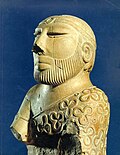
[[File:Mohenjo-daro_Priesterkönig.jpeg|thumb|Attire and ornament of Priest-King from [[Indus Valley civilisation]].]] | [[File:Mohenjo-daro_Priesterkönig.jpeg|thumb|Attire and ornament of Priest-King from [[Indus Valley civilisation]].]] | ||
[[Rakhigarhi#Discoveries|Rakhigarhi silver bronze ornaments]] finds and [[Dancing Girl (sculpture)|Dancing Girl]] ornaments. | [[Rakhigarhi#Discoveries|Rakhigarhi silver bronze ornaments]] finds and [[Dancing Girl (prehistoric sculpture)|Dancing Girl]] ornaments. | ||
=====Textiles===== | =====Textiles===== | ||
<!-- From IVC and before clothes similar to saari such as [[Dancing_Girl_of_Mohenjo-daro.jpg]] and [[Mohenjo-daro_Priesterkönig.jpeg]], sourced data from google book and google scholar, what did they wear and how did they make, gender clothing and age clothing (children and older), materials and styles, modes of manufacture, etc. Impact of islamic invasions on clothing from Khajuraho type liberla dressing to covered up arabic type dressing with veil for women, and Brist Era influence on dressing, etc --> | <!-- From IVC and before clothes similar to saari such as [[Dancing_Girl_of_Mohenjo-daro.jpg]] and [[Mohenjo-daro_Priesterkönig.jpeg]], sourced data from google book and google scholar, what did they wear and how did they make, gender clothing and age clothing (children and older), materials and styles, modes of manufacture, etc. Impact of islamic invasions on clothing from Khajuraho type liberla dressing to covered up arabic type dressing with veil for women, and Brist Era influence on dressing, etc --> | ||
[[File:Dancing_Girl_of_Mohenjo-daro.jpg|thumb|Dancing girl attire and ornaments from [[Indus Valley civilisation]].]] | [[File:Dancing_Girl_of_Mohenjo-daro.jpg|thumb|Dancing girl attire and ornaments from [[Indus Valley civilisation]].]] | ||
[[Dancing Girl (sculpture)|Dancing Girl]] attire. | [[Dancing Girl (prehistoric sculpture)|Dancing Girl]] attire. | ||
====Haryanvi language==== | ====Haryanvi language==== | ||
| Line 224: | Line 266: | ||
====Military ==== | ====Military ==== | ||
{{anchor | }} | {{anchor | HarMil}} | ||
'''Military establishments in Haryana:'''<br> | '''Military establishments in Haryana:'''<br> | ||
[[Indian National Defence University]] - India's only military university, [[National Security Guard]] (NSG) HQ in Gurugram, 4 major Air Force Stations (at [[Ambala Air Force Base|Ambala]], [[Raja Nahar Singh Faridabad Air Force Logistics Station|Faridabad]], [[Gurugram Air Force Station|Gurugram]] and [[Sirsa Air Force Station|Sirsa]]), 3 major Army Bases (at [[Chandimandir Cantonment|Western Command Chandimandir HQ in Panchkula]], [[Ambala Cantt|2nd Corp HQ at Ambala]] and [[Hisar Military Station|32 Div HQ at Hisar]]), [[Central Reserve Police Force]] (CRPF) base in Gurugram, 3 [[Sainik Schools]] ([[Sainik School, Kunjpura|Kunjpura]] - officially first sainik school in India, [[Sainik School, Rewari|Rewari]], and [[Matanhail#Education|Matanhail]].<ref name=harmh1>[http://tehelka.com/haryana-youths-have-11-share-in-indian-army/ Haryana youths have 11% share in Indian army], Tehalja.com, 24 | [[Indian Military]] stations n Haryana include the [[Indian National Defence University]] - India's only military university, [[National Security Guard]] (NSG) HQ in Gurugram, 4 major Air Force Stations (at [[Ambala Air Force Base|Ambala]], [[Raja Nahar Singh Faridabad Air Force Logistics Station|Faridabad]], [[Gurugram Air Force Station|Gurugram]] and [[Sirsa Air Force Station|Sirsa]]), 3 major Army Bases (at [[Chandimandir Cantonment|Western Command Chandimandir HQ in Panchkula]], [[Ambala Cantt|2nd Corp HQ at Ambala]] and [[Hisar Military Station|32 Div HQ at Hisar]]), [[Central Reserve Police Force]] (CRPF) base in Gurugram, 3 [[Sainik Schools]] ([[Sainik School, Kunjpura|Kunjpura]] - officially first sainik school in India, [[Sainik School, Rewari|Rewari]], and [[Matanhail#Education|Matanhail]].<ref name=harmh1>[http://tehelka.com/haryana-youths-have-11-share-in-indian-army/ Haryana youths have 11% share in Indian army], Tehalja.com, 24 January 2022.</ref> | ||
* [[Indian Airforce]] stations | |||
** [[Ambala Air Force Base]] | |||
[[ | ** [[Gurugram Air Force Station]] | ||
** [[Sirsa Air Force Station]] | |||
** [[Raja Nahar Singh Faridabad Air Force Logistics Station]] | |||
** see also [[List of Indian Air Force bases]] | |||
* [[Indian Army]] stations | |||
** [[Hisar Military Station]] | |||
** see also [[List of Cantonments in India]] | |||
Haryana, with 2% total population of India, contributes 11% soldiers of [[Indian Military]].<ref name=harmh1/> 10% (2,000,000) of Haryana's population belongs to the immediate family of soldiers, with 200,000 serving & 400,000 retired soldiers and their 1,400,000 dependent spouse and children.<ref name=harmh1/> | * [[Indian Navy]] stations | ||
** [[INS Aravali]], 2025, Gurugram | |||
** [[Information Management and Analysis Centre]] (IMAC), 2014, Gurugram | |||
** [[Information Fusion Centre – Indian Ocean region]] (IFC-IOR), 2018, Gurugram | |||
** see also [[List of Indian Navy bases]] | |||
{{anchor | HarMilCont}} | |||
'''Military contribution of Haryana''': | |||
Haryana, with 2% total population of India, contributes 11% soldiers of [[Indian Military]].<ref name="harmh1" /> 10% (2,000,000) of Haryana's population belongs to the immediate family of soldiers, with 200,000 serving & 400,000 retired soldiers and their 1,400,000 dependent spouse and children.<ref name="harmh1" /> | |||
[[Indian Air Force]]: Haryana (with 2% share in India's population) has the second highest number of air force officers (after Uttar Pradesh which has 11 times more population than Haryana) and the third highest number of airmen.<ref name=harmh2/> | [[Indian Air Force]]: Haryana (with 2% share in India's population) has the second highest number of air force officers (after Uttar Pradesh which has 11 times more population than Haryana) and the third highest number of airmen.<ref name=harmh2/> | ||
| Line 241: | Line 299: | ||
[[Indian Army]] non-officer soldiers of lower rank: In 2021, of the 1,151,726 serving non-officer soldiers, Haryana, Punjab, JK and Himachal had a much higher percentage of soldiers than their population share in India, e.g. highest number of soldiers come from Uttar Pradesh which had 11 times more population but only 2.5 times soldiers than Haryana, Maharashtra and Rajasthan have 3.5 to 4.5 times more population than Haryana but they contribute only 1.2 to 1.4 times more soldiers then Haryana. Of these non-officer soldiers, 14.5% (1,67,557) soldier are from [[Uttar Pradesh]] (16.5% population of India), 7.7% (89,088) are from [[Punjab, India|Punjab]] (2.3% population of India) in second place, 7.6% (87,835) are from Maharashtra (9.3% population of India), 6.9% (79,481) are from Rajasthan (5.6% population of India) in 4th place, 5.7% (65,987) are from Haryana (2% population of India) in 6th place, 4.1% (47,457) are from [[Jammu and Kashmir (union territory)|Jammu and Kashmir]] including [[Ladakh]] (1% population of India) in 10th place, 4% (46,960) are from Himachal Pradesh (0.6% population of India) in 11th place.<ref name=harmh2>[https://www.tribuneindia.com/news/punjab/punjab-second-among-all-states-in-contributing-to-armys-rank-and-file-225565 Punjab second among all states in contributing to Army’s rank and file], The Tribune, 16 March 2021.</ref> | [[Indian Army]] non-officer soldiers of lower rank: In 2021, of the 1,151,726 serving non-officer soldiers, Haryana, Punjab, JK and Himachal had a much higher percentage of soldiers than their population share in India, e.g. highest number of soldiers come from Uttar Pradesh which had 11 times more population but only 2.5 times soldiers than Haryana, Maharashtra and Rajasthan have 3.5 to 4.5 times more population than Haryana but they contribute only 1.2 to 1.4 times more soldiers then Haryana. Of these non-officer soldiers, 14.5% (1,67,557) soldier are from [[Uttar Pradesh]] (16.5% population of India), 7.7% (89,088) are from [[Punjab, India|Punjab]] (2.3% population of India) in second place, 7.6% (87,835) are from Maharashtra (9.3% population of India), 6.9% (79,481) are from Rajasthan (5.6% population of India) in 4th place, 5.7% (65,987) are from Haryana (2% population of India) in 6th place, 4.1% (47,457) are from [[Jammu and Kashmir (union territory)|Jammu and Kashmir]] including [[Ladakh]] (1% population of India) in 10th place, 4% (46,960) are from Himachal Pradesh (0.6% population of India) in 11th place.<ref name=harmh2>[https://www.tribuneindia.com/news/punjab/punjab-second-among-all-states-in-contributing-to-armys-rank-and-file-225565 Punjab second among all states in contributing to Army’s rank and file], The Tribune, 16 March 2021.</ref> | ||
Every year more than 6,000 soldiers from Haryana join the Indian military. [[Bisahan, Jhajjar|Bisahan]] in [[Jhajjar district]], a village of 700 families with at least one person from each family in military, has a reputation of being most prolific contributor to the Indian military.<ref name=harmh1/> In Haryana, a state dominated by the [[martial race]] ([[jat people|jats]] are 30% population of Haryana) where people traditionally & culturally aspire to join the military, excelling in sports provides better opportunity to secure a military job, and military in turn also nurtures the athletes.<ref name=minth1/><ref name=conth1/> "[[Indian Army]] had laid the foundation for the state to become a sports nursery" as people of haryana traditionally joined the military which nurtured the sporting talent. "The state’s domination in sports is somehow linked to the majority of its people’s collective preference for a robust physique that helps them work the fields under a sweltering sun, get jobs in the military, and indulge in sporting activities, more likely wrestling, experts say."<ref name=conth1/> | Every year more than 6,000 soldiers from Haryana join the Indian military. [[Bisahan, Jhajjar|Bisahan]] in [[Jhajjar district]], a village of 700 families with at least one person from each family in military, has a reputation of being most prolific contributor to the Indian military.<ref name=harmh1/> In Haryana, a state dominated by the [[martial race]] ([[jat people|jats]] are 30% population of Haryana) where people traditionally & culturally aspire to join the military, excelling in sports provides better opportunity to secure a military job, and military in turn also nurtures the athletes.<ref name="minth1">[https://www.livemint.com/Sports/NsXGRuUsw0lgK5zEjZYMvN/Haryanas-sports-policy-plays-a-key-role-in-nurturing-Olympi.html Haryana’s sports policy plays a key role in nurturing Olympians], Mint, 23 August 2016.</ref><ref name=conth1/> "[[Indian Army]] had laid the foundation for the state to become a sports nursery" as people of haryana traditionally joined the military which nurtured the sporting talent. "The state’s domination in sports is somehow linked to the majority of its people’s collective preference for a robust physique that helps them work the fields under a sweltering sun, get jobs in the military, and indulge in sporting activities, more likely wrestling, experts say."<ref name=conth1/> | ||
====Science and technology==== | ====Science and technology==== | ||
| Line 258: | Line 316: | ||
; Dominance of Haryana in India's international medals. | ; Dominance of Haryana in India's international medals. | ||
''" | ''"Haryana"''<ref name="jatification1">[https://www.hindustantimes.com/columns/a-level-playing-field/story-uc4Q5nsmf8xgTc6VNJ5v2M.html A level-playing field], Hindustan Times, 13 May 2911.</ref> is known as ''"India's Olympian state"'',<ref name=intdh1/> ''"The Sports State of India"'',<ref name=domin1/> ''"country's sports nursery"'',<ref name=conth1/> ''"sports powerhouse"'' in ''"multiple disciplines""'',<ref name=conth1/><ref name=jatification1/> due to their dominance in India's international medals "across categories and gender". With only 1.3% area and 1.5% population of India, Haryana consistently has been a top contributor of India's medals in major international events with 30% to 70% individual medals of India won by the people from Haryana.<ref name=intdh1>[https://www.indiatoday.in/opinion-columns/story/haryana-is-india-s-olympian-neeraj-chopra-lila-ram-ravi-dahiya-opinion-1840718-2021-08-14 Haryana is India's Olympian state], India Today, 19 Nov 2021.</ref><ref name="domin1">{{Cite web |title=Haryana: The Sports State of India [1 min read] |url=https://fairgaze.com/fgnews/haryana-the-sports-state-of-india_112564.html |access-date=2023-07-30 |website=Fairgaze |language=en}}</ref><ref name=sucj1/><ref name=conth1/> "Unlike other states, sports and issues related to sports in Haryana come under great scrutiny."<ref name=sucj1/> | ||
In Olympics, Haryana has won 52% (13/25) individual medals of India after Paris Olympics,2024.<ref name=harmt2/> In Asian Games, Haryana won 38% (18/48) individual & 26% (18/69) of total medals in 2018,<ref name=hintw4/><ref name=hintw5/> 63% (23/36) individual & 40% (23/57) of total medals in 2014.<ref name=hintw6/> | |||
In | In Commonwealth Games (CWG), Haryana won 42% (20/53) of individual & 33% (20/61) of total medals in 2022 CWG,<ref name=hintw1/> 41% (22/54) individual & 33% (22/66) of total medals in 2018 CWG,<ref name=hintw8/> 32% (19/61) individual & 30% (19/64) of total medals in 2014 CWG,<ref name=hintw8/> 32% (32/101) of medals in 2010 CWG,<ref name=hintw8/> 10% (5/50) medals in 2006 CWG.<ref name=hintw8/> | ||
Haryana (& its capital Chandigarh) is always among top 3 in the medal tally of [[National Games of India|National Games]], [[Khelo India University Games]], [[Khelo India Youth Games#Edition|Khelo India Youth Games]], etc. | |||
In | In the last 5 Khelo India national games, Haryana stood number-1 2-times and number-2 3-times on the overall medal tally. | ||
The actual number of medals from Haryana is much higher because Haryanvi players also represent [[Services Sports Control Board|Services]] and other states. | |||
The success of Haryana is due to government's policy intervention, rich reward system and job security for the budding athletes and the winners, where deep cultural interest of [[martial race|martial castes]] in [[Malla-yuddha|military and traditional sports]] meets the state infrastructure and incentives provided by the Haryana state government.<ref name="jatsm2">[https://www.downtoearth.org.in/news/environment/why-certain-parts-of-india-shone-during-the-recently-concluded-asian-games-61524 Why certain parts of India shone during the recently-concluded Asian Games], DownToEarth.org, 4 September 2018.</ref><ref name=orintsh1>[https://theprint.in/sport/how-does-haryana-top-indias-medal-tallies-the-answer-lies-in-history-and-incentives/113803/ How does Haryana top India’s medal tallies? The answer lies in history and incentives], The Print, 12 September 2018.</ref><ref name=minth1/> Plenty of analysis pieces attribute Haryana’s success in contact sports (boxing and wrestling) to the physical strength of the Jats, the influence of history and geography which has shaped the population.<ref name=sucj1>[https://www.dailyo.in/variety/dangal-20-vinesh-phogat-is-the-new-face-of-the-other-haryana-of-successful-sportspersons-can-these-two-haryanas-become-one-26190 Vinesh Phogat is the new face of the 'other Haryana'. Can the two Haryanas become one?], Dailyo, 21 August 2018.</ref> [[Indian Army]] had laid the foundation for the state to become a sports nursery" as people of haryana traditionally joined the military which nurtured the sporting talent. "The state’s domination in sports is somehow linked to the majority of its people’s collective preference for a robust physique that helps them work the fields under a sweltering sun, get jobs in the military, and indulge in sporting activities, more likely wrestling, experts say."<ref name=conth1>[https://www.hindustantimes.com/other-sports/why-haryana-state-powers-india-s-sports-engine/story-15Ciy3CWZu0CUmH2UjNi9I.html Why Haryana state powers India’s sports engine], Hindustan Times, 4 May 2018.</ref> | |||
This has created numerous inspirational national youth sports icons from Haryana and retired haryanvi olympians also continue to nurture the new sporting talent in Haryana which further enhances Haryana's dominance in sports.<ref name=conth1/> "Haryana succeeds in sports because everyone is aiming to excel. And by excel, they mean the Olympics. And an aim at gold.<ref name=sucj1/> | |||
; National Games of India | ; National Games of India | ||
In [[National Games of India]] medals tally, Haryana is always among top three states. | In [[National Games of India]] medals tally, Haryana is always among top three states. | ||
| Line 295: | Line 337: | ||
In [[Khelo India Youth Games#Edition|Khelo India Youth Games]], since it began in 2018 and till 2022, Haryana topped the medal tally in 2 editions and achieved second slot in 3 editions. | In [[Khelo India Youth Games#Edition|Khelo India Youth Games]], since it began in 2018 and till 2022, Haryana topped the medal tally in 2 editions and achieved second slot in 3 editions. | ||
In [[Khelo India University Games]], the universities from Haryana are always among top 3. | In [[Khelo India University Games]], the universities from Haryana are always among top 3. | ||
In National School Games, in June 2023 Haryana (109 medals) stood second behind Delhi (126),<ref name=nsgh1>[https://sgfionline.net/reports/MedalTally.aspx National School Games], School Games Federation of India, 13 June 2023.</ref> both of which have [[jat people|same ethnic demography]]. | In National School Games, in June 2023 Haryana (109 medals) stood second behind Delhi (126),<ref name=nsgh1>[https://sgfionline.net/reports/MedalTally.aspx National School Games], School Games Federation of India, 13 June 2023.</ref> both of which have [[jat people|same ethnic demography]]. | ||
;Olympics | ;Olympics | ||
Till 2020, India has won 21 individual metals, of which 19 have been won by the Indian citizens excluding 2 individual medals won by the India-born British-citizen [[Norman Pritchard]]. Of these 19 individual medals, at least 47% (9/19) have been won by athletes with connection with Haryana.<ref name="harmt2">{{Cite web |date=2023 | Till 2020, India has won 21 individual metals, of which 19 have been won by the Indian citizens excluding 2 individual medals won by the India-born British-citizen [[Norman Pritchard]]. Of these 19 individual medals, at least 47% (9/19) have been won by athletes with connection with Haryana.<ref name="harmt2">{{Cite web |date=29 May 2023 |title=Cut The Clutter : Wrestlers' protest, crackdown, what it takes to get Olympic medal, & Brij Bhushan Singh & his power - Podvine |url=https://podvine.com/podcast/theprint/cut-the-clutter-wrestlers-protest-crackdown-what-it-takes-to-get-olympic-medal-and-brij-bhushan-singh-and-his-power |access-date=30 July 2023 |website=podvine.com |language=en}}</ref><ref name=intdh1/> | ||
In [[ | In [[2024 Summer Olympics|2024 Olympics]], Haryana won 67% (4 out of total 6) medals for India including 100% (1/1) silver and 60% (3/5) bronze. 50% (3/6) medals for India won by jats. | ||
In [[India at the | In [[India at the 2020 Summer Olympics#Medalists|2020 Olympics]], Haryana won 50% (3 out of total 6) medals for India including 100% gold (1/1), 50% (1/2) silver and 33% (1/3) bronze.<ref name="harmt1" /> 33% (2/6) medals for India won by jats. | ||
In [[India at the | In [[India at the 2016 Summer Olympics#Medalists|2016 Olympics]], Haryana won 50% (1 out of total 2) medals for India.<ref name="harmt1" /> 50% (1/2) medals for India won by jats. | ||
In [[India at the | In [[India at the 2012 Summer Olympics#Medalists|2012 Olympics]], 67% (4 out of total 6) medal winners are associated with Haryana.<ref name=harmt1>[https://timesofindia.indiatimes.com/news/haryana-government-to-honour-olympic-medal-winners/articleshow/15518731.cms Haryana government to honour Olympic medalists], Times of India, 16 August 2012.</ref> 50% (3/6) medals for India won by jats. | ||
In [[India at the 2008 Summer Olympics#Medalists|2008 Olympics]], 100% (3 out of total 3) medal winners are associated with Haryana.<ref name=harmt1/> [[Vijender Singh]] from Bhiwani, [[Abhinav Bindra]] from Chandigarh and [[Sushil Kumar]]'s ancestral village in Sonipat. 67% (2/3) medals for India won by jats. | |||
; Asian Games | ; Asian Games | ||
In [[India at the 2018 Asian Games#Medalists|2018 Asian Games]], Haryana won 38% (18/48) individual & 26% (18/69) of total medals for India.<ref name=hintw4>[https://www.timesnownews.com/asian-games-2018-jakarta-palembang/article/asian-games-2018-medal-rush-continues-from-haryana-as-india-produce-best-ever-finish-at-asiads-with-69-medals/279127 Asian games 2018 metal rush continues from Haryana], Times Now, 3 | In [[India at the 2018 Asian Games#Medalists|2018 Asian Games]], Haryana won 38% (18/48) individual & 26% (18/69) of total medals for India.<ref name=hintw4>[https://www.timesnownews.com/asian-games-2018-jakarta-palembang/article/asian-games-2018-medal-rush-continues-from-haryana-as-india-produce-best-ever-finish-at-asiads-with-69-medals/279127 Asian games 2018 metal rush continues from Haryana], Times Now, 3 September 2018.</ref> Haryana (18 or 26%, 5G+5S+8B) was followed by Tamilnadu (12 or 17%) and 9 or 13% each for Delhi, UP, Kerala.<ref name=hintw5>[https://www.patrika.com/other-sport-news/asian-games-2018-statewise-medal-tally-of-india-haryana-won-most-1-3362944/ एशियाई खेल 2018: हरियाणा ने देश को दिलाए सबसे अधिक पदक, जानिए किस राज्य ने जीते कितने पदक], पत्रिका Patrika, 5 September 2018.</ref> Jats won 35% (24/69) India's medals, including 60% (9/15) gold, 30% (7/24) silver and 27% (8/30) bronze. | ||
In [[India at the 2014 Asian Games#Medalists|2014 Asian Games]], Haryana won 63% (23/36) individual & 40% (23/57) of total medals for India.<ref name="hintw6">{{Cite web |title=पूरे देश को उम्मीद एशियाई खेलों में हरियाणा के खिलाड़ी फिर दिखाएंगे जलवा - |url=https://www.jagran.com/haryana/panchkula-hopes-with-haryana-players-in-asian-games-18325640.html |access-date=2023 | In [[India at the 2014 Asian Games#Medalists|2014 Asian Games]], Haryana won 63% (23/36) individual & 40% (23/57) of total medals for India.<ref name="hintw6">{{Cite web |title=पूरे देश को उम्मीद एशियाई खेलों में हरियाणा के खिलाड़ी फिर दिखाएंगे जलवा - |url=https://www.jagran.com/haryana/panchkula-hopes-with-haryana-players-in-asian-games-18325640.html |access-date=30 July 2023 |website=Jagran |language=hi}}</ref> | ||
;Commonwealth Games | ;Commonwealth Games | ||
In [[India at the 2022 Commonwealth Games#Medalists|2022 CWG]], with a contingent of 21% (43/210) the Haryana sportspersons won 42% (20/53) of individual & 33% (20/61) of total medals for India including 43% (9/21) gold, 25% (4/16) silver and 31% (7/23) bronze.<ref name=hintw1>[https://www.hindustantimes.com/cities/chandigarh-news/with-20-medals-haryana-athletes-stamp-their-authority-in-commonwealth-games-101659998426552.html With 20 medals, Haryana athletes stamp their authority in Commonwealth Games], Hindustan Times, 9 | In [[India at the 2022 Commonwealth Games#Medalists|2022 CWG]], with a contingent of 21% (43/210) the Haryana sportspersons won 42% (20/53) of individual & 33% (20/61) of total medals for India including 43% (9/21) gold, 25% (4/16) silver and 31% (7/23) bronze.<ref name=hintw1>[https://www.hindustantimes.com/cities/chandigarh-news/with-20-medals-haryana-athletes-stamp-their-authority-in-commonwealth-games-101659998426552.html With 20 medals, Haryana athletes stamp their authority in Commonwealth Games], Hindustan Times, 9 August 2022.</ref> Jats dominated India's medal tally, they won 40% (21/53) total, 41% (9/22), 29% (3/16), 44% (9/23) bronze medals of India.<ref name=jatsm4>[https://jankaritoday.com/jat-players-commonwealth-games-2022/ भारतीय जाट खिलाड़ियों के शानदार प्रदर्शन के कारण 2022 कॉमनवेल्थ खेलों की पदक तालिका में भारत चौथे स्थान पर रहा।], JankariToday, accessed 10 June 2023.</ref> | ||
In [[India at the 2018 Commonwealth Games#Medalists|2018 CWG]], with a contingent of 13% (28/218) the Haryana sportspersons won 41% (22/54) individual & 33% (22/66) of total medals for India including 35% (9/26) gold, 30% (6/20) silver and 35% (7/20) bronze.<ref name=hintw8>[https://indianexpress.com/article/sports/commonwealth-games/with-22-medals-haryana-basks-in-cwg-glory-5138929/ CWG 2018: With 22 medals, Haryana basks in Commonwealth Games glory], Indian Express, 9 | In [[India at the 2018 Commonwealth Games#Medalists|2018 CWG]], with a contingent of 13% (28/218) the Haryana sportspersons won 41% (22/54) individual & 33% (22/66) of total medals for India including 35% (9/26) gold, 30% (6/20) silver and 35% (7/20) bronze.<ref name=hintw8>[https://indianexpress.com/article/sports/commonwealth-games/with-22-medals-haryana-basks-in-cwg-glory-5138929/ CWG 2018: With 22 medals, Haryana basks in Commonwealth Games glory], Indian Express, 9 August 2022.</ref> Jats dominated the medals.<ref name=jatsm2/> | ||
In [[India at the 2014 Commonwealth Games#Medalists|2014 CWG]], Haryana won 32% (19/61) individual & 30% (19/64) of total medals for India.<ref name=hintw8/> | In [[India at the 2014 Commonwealth Games#Medalists|2014 CWG]], Haryana won 32% (19/61) individual & 30% (19/64) of total medals for India.<ref name=hintw8/> | ||
| Line 337: | Line 381: | ||
=====Aviation===== | =====Aviation===== | ||
<!-- Please contribute, first flight, first scheduled service, first airport, etc ---> | <!-- Please contribute, first flight, first scheduled service, first airport, etc ---> | ||
{{see also | Haryana Institute of Civil Aviation | | {{see also | Haryana Institute of Civil Aviation}} | ||
* Existing airports in Haryana: | |||
** Civil airports | |||
*** [[Bhiwani Airport]] | |||
*** [[Hisar Airport]] | |||
*** [[Karnal Aerodrome|Karnal Airport]] | |||
*** [[Narnaul Airport]] | |||
*** [[Pinjore Aerodrome]] | |||
** Minor civil airstrip | |||
*** Gurugram Airstrip (Bhondsi Airstrip or Silokhera Airstrip) | |||
In 1919, first airstrip was built in Haryana when [[Ambala Air Force Station]] was established. Following the independence of India in 1947, it was also the home to the [[SEPECAT Jaguar]] of [[No. 5 Squadron IAF]] and [[No. 14 Squadron IAF]], and | ** Dual-use | ||
*** [[Ambala Air Force Station]] with civil aviation enclave | |||
** Military use only | |||
*** [[Sirsa Air Force Station]] no civil aviation enclave | |||
* Proposed | |||
** [[Chhara Airport]] (Jhajjar district) | |||
** [[Jind Airport]] | |||
** [[Kurukshetra Airport]] | |||
In 1919, first airstrip was built in Haryana when [[Ambala Air Force Station]] was established. Following the independence of India in 1947, it was also the home to the [[SEPECAT Jaguar]] of [[No. 5 Squadron IAF]] and [[No. 14 Squadron IAF]], and ageing [[Mikoyan-Gurevich MiG-21|MiG-21bis]] of ''No. 21 Squadron IAF''. | |||
In 1947–48, a [[Flying Instructors School (India)|Flying Instruction School]] (FIS) was formed here. | In 1947–48, a [[Flying Instructors School (India)|Flying Instruction School]] (FIS) was formed here. | ||
| Line 349: | Line 415: | ||
In 1965, Hisar airfield, spread over {{convert|194|acre|ha}}, was built for the Hisar Aviation Club. In 1999, Hisar Aviation Club was merged with [[Haryana Institute of Civil Aviation]] (HICA). The airport is managed by HICA, which provides flight training using [[light aircraft]].<ref name=training>{{cite web|title=Haryana Institute of Civil Aviation|url=http://www.karnal.gov.in/dept_aviation.asp|publisher=District Administration, Karnal|access-date=30 June 2012|url-status=dead|archive-url=https://web.archive.org/web/20120523172711/http://www.karnal.gov.in/dept_aviation.asp|archive-date=23 May 2012}}</ref> | In 1965, Hisar airfield, spread over {{convert|194|acre|ha}}, was built for the Hisar Aviation Club. In 1999, Hisar Aviation Club was merged with [[Haryana Institute of Civil Aviation]] (HICA). The airport is managed by HICA, which provides flight training using [[light aircraft]].<ref name=training>{{cite web|title=Haryana Institute of Civil Aviation|url=http://www.karnal.gov.in/dept_aviation.asp|publisher=District Administration, Karnal|access-date=30 June 2012|url-status=dead|archive-url=https://web.archive.org/web/20120523172711/http://www.karnal.gov.in/dept_aviation.asp|archive-date=23 May 2012}}</ref> | ||
In 1967, [[Karnal Airport|Karnal Air Strip]] was set up.<ref>{{cite web |url=http://www.karnal.gov.in/dept_aviation.asp |title=Civil Aviation (Flying Club) |access-date=30 June 2012 |url-status=dead |archive-url=https://web.archive.org/web/20120523172711/http://www.karnal.gov.in/dept_aviation.asp |archive-date=23 May 2012 }}</ref> The Karnal Flying Club has been running at this airfield since 1967 year.<ref name = "TOI">{{cite news|title= Three airports ready to take off in Haryana |url= | In 1967, [[Karnal Airport|Karnal Air Strip]] was set up.<ref>{{cite web |url=http://www.karnal.gov.in/dept_aviation.asp |title=Civil Aviation (Flying Club) |access-date=30 June 2012 |url-status=dead |archive-url=https://web.archive.org/web/20120523172711/http://www.karnal.gov.in/dept_aviation.asp |archive-date=23 May 2012 }}</ref> The Karnal Flying Club has been running at this airfield since 1967 year.<ref name = "TOI">{{cite news|title= Three airports ready to take off in Haryana |url=https://timesofindia.indiatimes.com/india/Three-airports-ready-to-take-off-in-Haryana/articleshow/15937320.cms |archive-url=https://archive.today/20130103105003/http://articles.timesofindia.indiatimes.com/2012-08-29/india/33475403_1_cargo-airport-aerodrome-runway |url-status=live |archive-date=3 January 2013 |work=[[The Times of India]] |date= 29 August 2012 |access-date=6 September 2012}}</ref> | ||
In 1970–71, a privately managed air service was introduced from Delhi-Patiala-Hisar and Delhi which was terminated after a period of about 6 months due to being financially unviable.<ref name=gaz1>{{cite web| url=http://revenueharyana.gov.in/html/gazeteers/gazetteer_india_hisar.pdf| title=Gazetteer of India: Haryana, Hisar, pp.136| author=Haryana Gazetteers Organization| publisher=Controller of Printing and Stationery| location=Chandigarh| date=1987| url-status=dead| archive-url=https://web.archive.org/web/20140501213030/http://revenueharyana.gov.in/html/gazeteers/gazetteer_india_hisar.pdf| archive-date=1 May 2014}}</ref> | In 1970–71, a privately managed air service was introduced from Delhi-Patiala-Hisar and Delhi which was terminated after a period of about 6 months due to being financially unviable.<ref name=gaz1>{{cite web| url=http://revenueharyana.gov.in/html/gazeteers/gazetteer_india_hisar.pdf| title=Gazetteer of India: Haryana, Hisar, pp.136| author=Haryana Gazetteers Organization| publisher=Controller of Printing and Stationery| location=Chandigarh| date=1987| url-status=dead| archive-url=https://web.archive.org/web/20140501213030/http://revenueharyana.gov.in/html/gazeteers/gazetteer_india_hisar.pdf| archive-date=1 May 2014}}</ref> | ||
During the 1980s, the [[Gurugram Airstrip]], hangar, air conditioned yoga ashram and TV studio were built by former Prime Minister [[Indira Gandhi]]'s | During the 1980s, the [[Gurugram Airstrip]], hangar, air conditioned yoga ashram and TV studio were built by former Prime Minister [[Indira Gandhi]]'s favourite godman and yoga guru [[Dhirendra Brahmachari]] who died in 1994 in a plane crash.<ref name=bhond6>1990, [https://books.google.com/books?id=I6R1g9aQqm0C "The Illustrated Weekly of India."], [[The Times Group]], Volume 111, Issues 13–25, p. 35.</ref> Indira used to visit Brahmachari here once a week.<ref name=bhond6/> The 1980s teleserials "India Quiz" and [[Hum Log (television series)|Hum Log]] (ran from July 1984 to 17 December 1985) were shot here.<ref name=bhond6/> Brahmachari charged INR25,000 per shift for the use of ashram's TV studio facilities here for the shooting of Hum Log.<ref name=bhond6/> In 1983, Brahmachari had written letter to then Chief Minister of Haryana, [[Bhajan Lal Bishnoi|Bhajan Lal]], with a request to acquire 5,000 acre land around [[Aravalli Range]], potentially up to 70,000 acres in total, to build facilities to rival [[Disneyland]], including a yoga research and training centre, a wildlife sanctuary, folk arts and crafts centre, amusement centre and other facilities such as helipad, aquarium, planetarium and games and thrillers.<ref name=bhond5>[https://www.indiatoday.in/magazine/indiascope/story/19830228-swami-dhirendra-brahmachari-plans-to-open-health-and-recreation-centre-in-gurgaon-771303-2013-08-23 "Swami's Disneyland."], [[India Today]], 28 February 1983.</ref> The aircraft hangar still has two ruined aircraft belonging to Brahmachari,{{cn|date=November 2025}} likely including a [[Maule M-5]] American aircraft owned by him that landed him in investigations for tax evasions.<ref name=bhond12>[https://www.indiatoday.in/magazine/cover-story/story/19801130-swami-dhirendra-brahmachari-a-man-with-no-official-standing-but-awesome-power-821648-2014-01-04 "Dhirendra Brahmachari: The controversial yogi."], [[India Today]], 30 November 1980.</ref> Ownership of some of the facilities is currently being disputed in the court (c. 2014), including 32 acre land and yoga studio.{{cn|date=November 2025}} | ||
In 2002, the Delhi Flying Club (DFC) shifted all its flying activities and aircraft to Hisar from [[Safdarjung Airport]] in [[Delhi]].<ref name="hisar airport">{{cite news|title=Safdarjung airport flies into history|url= | In 2002, the Delhi Flying Club (DFC) shifted all its flying activities and aircraft to Hisar from [[Safdarjung Airport]] in [[Delhi]].<ref name="hisar airport">{{cite news|title=Safdarjung airport flies into history|url=https://timesofindia.indiatimes.com/city/delhi/Safdarjung-airport-flies-into-history/articleshow/42404789.cms|archive-url=https://archive.today/20120712024828/http://articles.timesofindia.indiatimes.com/2003-04-05/delhi/27267580_1_safdarjung-airport-delhi-flying-club-civil-aviation|url-status=live|archive-date=12 July 2012|access-date=31 May 2012|newspaper=[[The Times of India]]|date=5 April 2003}}</ref> | ||
On 31 January 2010, the ''Rajiv Gandhi National Centre for Aero Sports'' was inaugurated at [[Narnaul Airport]]. 51 acres were acquired for this purpose.<ref name=b2>[https://web.archive.org/web/20170331115938/http://www.sify.com/news/train-for-aero-sports-at-haryana-centre-news-national-kloouejahbgsi.html Aerosports center in Haryana, Publication: www.sify.conm, Published on: 14-nov2010, Accessed: 31-mar-2017]</ref> Chief Minister [[Bhupinder Singh Hooda]] and Aero Club of India President Satish Sharma were present at the inauguration ceremony. The centre was set up by Aero Club of India and the Department of Civil Aviation, Haryana. It is the first ever modern state-of-the-art aero sports centre in India to provide training in comprehensive range of various aero sports, including para-jumping (simulated parachute jump from a tower), [[parasailing]], [[hot air ballooning]], [[gliding]], [[Powered aircraft|power flying]], [[sky diving]], [[Model aircraft|aero modelling]] and [[Ultralight aviation|micro light flying]],<ref name=b2/> with the purpose of introducing the state's youth to aviation and providing the general population a cheap opportunity to experience aero sports.<ref>{{cite news | url=http://www.tribuneindia.com/2010/20100201/main6.htm | title=Narnaul gets country's first aero sports centre | work=[[The Tribune (Chandigarh)]] | date=31 January 2010 | access-date=27 July 2016 | author=Dhawan, Sunit}}</ref><ref>{{cite news | url=http://timesofindia.indiatimes.com/city/delhi/Let-dreams-soar-at-this-flying-club-near-Gurgaon/articleshow/5521544.cms | title=Let dreams soar at this flying club near Gurgaon | work=[[The Times of India]] | date=1 February 2010 | access-date=27 July 2016 | author=Sukanya, Sumi}}</ref> On 27 November 2017, ''Runway 1'' a quirky restaurant based inside an [[Airbus A320 family|Airbus A320]] discarded by [[Air India]] was opened on [[Ambala Chandigarh Expressway]] by a [[Shahabad Markanda|Shahabad]] based business family.<ref name=et1>[https://economictimes.indiatimes.com/industry/services/hotels-/-restaurants/runway-1-this-old-aeroplane-is-now-a-quirky-restaurant-in-haryana/runway-1-sneak-peek/slideshow/62457433.cms Runway-1 sneak peek], Economic Times, Jan 2018.</ref> | On 31 January 2010, the ''Rajiv Gandhi National Centre for Aero Sports'' was inaugurated at [[Narnaul Airport]]. 51 acres were acquired for this purpose.<ref name=b2>[https://web.archive.org/web/20170331115938/http://www.sify.com/news/train-for-aero-sports-at-haryana-centre-news-national-kloouejahbgsi.html Aerosports center in Haryana, Publication: www.sify.conm, Published on: 14-nov2010, Accessed: 31-mar-2017]</ref> Chief Minister [[Bhupinder Singh Hooda]] and Aero Club of India President Satish Sharma were present at the inauguration ceremony. The centre was set up by Aero Club of India and the Department of Civil Aviation, Haryana. It is the first ever modern state-of-the-art aero sports centre in India to provide training in comprehensive range of various aero sports, including para-jumping (simulated parachute jump from a tower), [[parasailing]], [[hot air ballooning]], [[gliding]], [[Powered aircraft|power flying]], [[sky diving]], [[Model aircraft|aero modelling]] and [[Ultralight aviation|micro light flying]],<ref name=b2/> with the purpose of introducing the state's youth to aviation and providing the general population a cheap opportunity to experience aero sports.<ref>{{cite news | url=http://www.tribuneindia.com/2010/20100201/main6.htm | title=Narnaul gets country's first aero sports centre | work=[[The Tribune (Chandigarh)]] | date=31 January 2010 | access-date=27 July 2016 | author=Dhawan, Sunit}}</ref><ref>{{cite news | url=http://timesofindia.indiatimes.com/city/delhi/Let-dreams-soar-at-this-flying-club-near-Gurgaon/articleshow/5521544.cms | title=Let dreams soar at this flying club near Gurgaon | work=[[The Times of India]] | date=1 February 2010 | access-date=27 July 2016 | author=Sukanya, Sumi}}</ref> On 27 November 2017, ''Runway 1'' a quirky restaurant based inside an [[Airbus A320 family|Airbus A320]] discarded by [[Air India]] was opened on [[Ambala Chandigarh Expressway]] by a [[Shahabad Markanda|Shahabad]] based business family.<ref name=et1>[https://economictimes.indiatimes.com/industry/services/hotels-/-restaurants/runway-1-this-old-aeroplane-is-now-a-quirky-restaurant-in-haryana/runway-1-sneak-peek/slideshow/62457433.cms Runway-1 sneak peek], Economic Times, Jan 2018.</ref> | ||
In August 2018, [[Feasibility study|pre-feasibility study]] and field study for 3 new greenfield airports in Haryana commenced for the and [[Chhara Airport]] (Jhajjar district), [[Jind Airport]] and [[Kurukshetra Airport]] at the cost of INR30 lakh (3 million).<ref name=greenf1>[https://www.tribuneindia.com/news/haryana/survey-for-three-greenfield-airports-in-state-begins/644682.html Survey for 3 new greenfield airports in Haryana ], The Tribune, Aug 2018.</ref> | In August 2018, [[Feasibility study|pre-feasibility study]] and field study for 3 new greenfield airports in Haryana commenced for the and [[Chhara Airport]] (Jhajjar district), [[Jind Airport]] and [[Kurukshetra Airport]] at the cost of INR30 lakh (3 million).<ref name=greenf1>[https://www.tribuneindia.com/news/haryana/survey-for-three-greenfield-airports-in-state-begins/644682.html Survey for 3 new greenfield airports in Haryana ] {{Webarchive|url=https://web.archive.org/web/20190711063617/https://www.tribuneindia.com/news/haryana/survey-for-three-greenfield-airports-in-state-begins/644682.html |date=11 July 2019 }}, The Tribune, Aug 2018.</ref> | ||
On 26 December 2018, Haryana Health Minister [[Anil Vij]] announced that a third domestic airport will be established under [[UDAN]] III scheme 40 km from the Ambala city at Barnala village next to the [[Ambala Air Force Station]] for which a team of [[Airports Authority of India]] has already carried out the land survey.<ref name=lands1>[https://www.tribuneindia.com/news/haryana/ambala-to-get-domestic-airport-vij/704481.html Ambala to get domestic airport], The Tribune, 26 December 2018.</ref><ref name=lands2>[http://digitalglobalist.com/2018/12/28/ambala-to-get-airport/ Ambala to get airport], digitalglobalist.com, 28 December 2018.</ref> The new greenfield airport at Ambala is included in the 13 airports included in the UDAN III scheme.<ref name=lands2/> Since most of the technical formalities are complete, an early execution of the project is expected.<ref name=lands2/> Hisar and Karnal airports are already included in the list of airports for which airlines can make proposals for the UDAN scheme.<ref name=lands2/> | On 26 December 2018, Haryana Health Minister [[Anil Vij]] announced that a third domestic airport will be established under [[UDAN]] III scheme 40 km from the Ambala city at Barnala village next to the [[Ambala Air Force Station]] for which a team of [[Airports Authority of India]] has already carried out the land survey.<ref name=lands1>[https://www.tribuneindia.com/news/haryana/ambala-to-get-domestic-airport-vij/704481.html Ambala to get domestic airport], The Tribune, 26 December 2018.</ref><ref name=lands2>[http://digitalglobalist.com/2018/12/28/ambala-to-get-airport/ Ambala to get airport] {{Webarchive|url=https://web.archive.org/web/20231215230724/https://digitalglobalist.com/2018/12/28/ambala-to-get-airport/ |date=15 December 2023 }}, digitalglobalist.com, 28 December 2018.</ref> The new greenfield airport at Ambala is included in the 13 airports included in the UDAN III scheme.<ref name=lands2/> Since most of the technical formalities are complete, an early execution of the project is expected.<ref name=lands2/> Hisar and Karnal airports are already included in the list of airports for which airlines can make proposals for the UDAN scheme.<ref name=lands2/> | ||
As of January 2019, all five existing government airports in Haryana will be developed to have runway of at least 5000 feet for [[Aircraft#Size|midsize aircraft]] and [[business jet]]s, night landing and parking hangars, as airlines have approached the Haryana government to park their spillover "Non-scheduled Air Operations" (NSOP) aircraft from the congested IGI airport at Delhi to Bhiwani and Narnaul airport. Some of this development work at Hisar, Bhiwani and Narnaul airports is already underway.<ref>[https://www.tribuneindia.com/news/haryana/all-five-airports-in-state-to-be-developed-expanded/710300.html All five airports in state to be developed expanded], The Tribune 8 January 2019.</ref> Hisar will be extended to 10,000 ft by March 2022 for large air crafts. | As of January 2019, all five existing government airports in Haryana will be developed to have runway of at least 5000 feet for [[Aircraft#Size|midsize aircraft]] and [[business jet]]s, night landing and parking hangars, as airlines have approached the Haryana government to park their spillover "Non-scheduled Air Operations" (NSOP) aircraft from the congested IGI airport at Delhi to Bhiwani and Narnaul airport. Some of this development work at Hisar, Bhiwani and Narnaul airports is already underway.<ref>[https://www.tribuneindia.com/news/haryana/all-five-airports-in-state-to-be-developed-expanded/710300.html All five airports in state to be developed expanded] {{Webarchive|url=https://web.archive.org/web/20190414044303/https://www.tribuneindia.com/news/haryana/all-five-airports-in-state-to-be-developed-expanded/710300.html |date=14 April 2019 }}, The Tribune 8 January 2019.</ref> Hisar will be extended to 10,000 ft by March 2022 for large air crafts. | ||
In 2021, [[Gurugram Heliport Hub]] was envisaged and implementation started in 2024.<ref name=helih1>[https://timesofindia.indiatimes.com/city/gurgaon/heli-hub-over-25-acres-in-city-handed-over-to-centre/articleshow/94975974.cms Heli Hub: Over 25 Acres In Gurugram Handed Over To Centre CITY], Times of India, 20 October 2022.</ref> | |||
=====Railway===== | =====Railway===== | ||
| Line 379: | Line 447: | ||
The modern military history commenced with British colonial rule where [[George Thomas (soldier)|George Thomas]] established modern European style army in 1798 to 1801,<ref name=TOIgt1>[http://timesofindia.indiatimes.com/city/chandigarh/Desi-Irish-Raja-of-Haryana/articleshow/53360680.cms Desi Irish Raja of Haryana, Times of India newspaper, Jul-24-2016]</ref><ref name=GrBio1>[https://archive.org/details/militarymemoirs01frangoog Military memoirs of George Thomas, William_Francklin, 1805]</ref> and later [[James Skinner (East India Company officer)|Colonel James Skinner]] (1778 – 4 December 1841) the Anglo-Indian military adventurer in India, who founded [[1st Horse (Skinner's Horse)|1st Skinner's Horse]] and [[3rd Skinner's Horse]] at [[Asigarh Fort]] at Hansi in 1803, which are still part of the [[Indian Army]].<ref>[http://www.national-army-museum.ac.uk/exhibitions/shortVisits/iconic/page9.shtml Colonel James Skinner CB] {{webarchive|url=https://web.archive.org/web/20101218033415/http://national-army-museum.ac.uk/exhibitions/shortVisits/iconic/page9.shtml |date=18 December 2010 }} ''[[National Army Museum]]'' ([[British Army]]).</ref><ref name=EB1911>{{Cite EB1911 |wstitle=Skinner, James |volume=25 |page=192}}</ref> | The modern military history commenced with British colonial rule where [[George Thomas (soldier)|George Thomas]] established modern European style army in 1798 to 1801,<ref name=TOIgt1>[http://timesofindia.indiatimes.com/city/chandigarh/Desi-Irish-Raja-of-Haryana/articleshow/53360680.cms Desi Irish Raja of Haryana, Times of India newspaper, Jul-24-2016]</ref><ref name=GrBio1>[https://archive.org/details/militarymemoirs01frangoog Military memoirs of George Thomas, William_Francklin, 1805]</ref> and later [[James Skinner (East India Company officer)|Colonel James Skinner]] (1778 – 4 December 1841) the Anglo-Indian military adventurer in India, who founded [[1st Horse (Skinner's Horse)|1st Skinner's Horse]] and [[3rd Skinner's Horse]] at [[Asigarh Fort]] at Hansi in 1803, which are still part of the [[Indian Army]].<ref>[http://www.national-army-museum.ac.uk/exhibitions/shortVisits/iconic/page9.shtml Colonel James Skinner CB] {{webarchive|url=https://web.archive.org/web/20101218033415/http://national-army-museum.ac.uk/exhibitions/shortVisits/iconic/page9.shtml |date=18 December 2010 }} ''[[National Army Museum]]'' ([[British Army]]).</ref><ref name=EB1911>{{Cite EB1911 |wstitle=Skinner, James |volume=25 |page=192}}</ref> | ||
As of January 2020, 139 (>10%) out of 1,322 [[Vir Chakra]] in India have been awarded to soldiers from Haryana,<ref>[https://www.tribuneindia.com/news/archive/haryanatribune/haryanvi-meghdoot-who-defended-the-most-challenging-post-in-siachen-858562 Haryanvi Meghdoot who defended the most challenging post in Siachen], The Tribune, 9 | As of January 2020, 139 (>10%) out of 1,322 [[Vir Chakra]] in India have been awarded to soldiers from Haryana,<ref>[https://www.tribuneindia.com/news/archive/haryanatribune/haryanvi-meghdoot-who-defended-the-most-challenging-post-in-siachen-858562 Haryanvi Meghdoot who defended the most challenging post in Siachen], The Tribune, 9 November 2019.</ref> which has less than 2% population of India. | ||
Current military installations in Haryana are: | Current military installations in Haryana are: | ||
| Line 425: | Line 493: | ||
Following [[Mahajanapadas]] are mentioned in [[Mahabharata]] had their land in Haryana: {{Dubious|date=August 2020}} | Following [[Mahajanapadas]] are mentioned in [[Mahabharata]] had their land in Haryana: {{Dubious|date=August 2020}} | ||
* [[Kuru | * [[Kuru kingdom]], most of area of Haryana fell under this kingdom, their main capital in Haryana was at [[Sonipat|Swarnprastha]] (Sonipat), other 3 capital or main cities were Indraprastha (Delhi), Waghparastha ([[Baghpat]] in Uttar Prades) and Tilprastha ([[Tilpat]] in Haryana) | ||
* [[Matsya Kingdom]], present day [[South Haryana]] | * [[Matsya Kingdom]], present day [[South Haryana]] | ||
* [[Surasena]], present day [[Hodal]] as part of [[Braj]] region. | * [[Surasena]], present day [[Hodal]] as part of [[Braj]] region. | ||
| Line 473: | Line 541: | ||
** From [[Mathura]] in Uttar Pradesh, Buddha travelled along [[Grand Trunk Road]] in Haryana (also see [[#Buddhism|Buddhist pilgrimage sites in Haryana]]). | ** From [[Mathura]] in Uttar Pradesh, Buddha travelled along [[Grand Trunk Road]] in Haryana (also see [[#Buddhism|Buddhist pilgrimage sites in Haryana]]). | ||
** [[Kumashpur#Pagoda|Kamashpura Aastha Pugdal Pagoda]] (Kumashpur) in Sonipat city, the place where Buddha gave [[Mahasatipatthana sutta]].<ref name=kamas2>[https://patthana.dhamma.org/en/dhamma-patthana/ Dhamma patthana], dhamma.org.</ref><ref name=kamas1>[http://sdbst.org/Kumaspur.aspx Aastha Pugdal Pagoda at Kumaspur (Kamas Nigam in Sonepat], SDBST.</ref> | ** [[Kumashpur#Pagoda|Kamashpura Aastha Pugdal Pagoda]] (Kumashpur) in Sonipat city, the place where Buddha gave [[Mahasatipatthana sutta]].<ref name=kamas2>[https://patthana.dhamma.org/en/dhamma-patthana/ Dhamma patthana], dhamma.org.</ref><ref name=kamas1>[http://sdbst.org/Kumaspur.aspx Aastha Pugdal Pagoda at Kumaspur (Kamas Nigam in Sonepat], SDBST.</ref> | ||
** [[Bodh Stupa|Kurukshetra Stupa]] on the banks of sacred [[Brahma Sarovar]] in Kurukshetra city was also visited by [[Hieun Tsang]],<ref name=":0">{{Cite web|url=https://thebuddhistforum.com/buddhist-stupa-at-kurukshetra/|title=Buddhist Stupa at Kurukshetra|date=31 March 2012|website=The Buddhist Forum|language=en-US|access-date=2018 | ** [[Bodh Stupa|Kurukshetra Stupa]] on the banks of sacred [[Brahma Sarovar]] in Kurukshetra city was also visited by [[Hieun Tsang]],<ref name=":0">{{Cite web|url=https://thebuddhistforum.com/buddhist-stupa-at-kurukshetra/|title=Buddhist Stupa at Kurukshetra|date=31 March 2012|website=The Buddhist Forum|language=en-US|access-date=20 December 2018}}</ref> | ||
* [[Topra Kalan#Topra Ashokan Edicts Archaeological Park and Museum|Topra]] between Kurukshetra and Yamunanagar, now has a large open air museum park housing several replica of [[Ashoka]]'s edicts including largest [[Ashoka Chakra]] in the world,<ref> | * [[Topra Kalan#Topra Ashokan Edicts Archaeological Park and Museum|Topra]] between Kurukshetra and Yamunanagar, now has a large open air museum park housing several replica of [[Ashoka]]'s edicts including largest [[Ashoka Chakra]] in the world,<ref>{{Cite web |url=http://www.tribuneindia.com/news/haryana/community/khattar-announces-rs100-cr-to-develop-saraswati-topra-kalan/65676.html |title=Khattar announces Rs100 cr to develop Saraswati, Topra Kalan, The Tribune, 11-Apr-2015 |access-date=21 December 2019 |archive-date=2 August 2017 |archive-url=https://web.archive.org/web/20170802205357/http://www.tribuneindia.com/news/haryana/community/khattar-announces-rs100-cr-to-develop-saraswati-topra-kalan/65676.html |url-status=dead }}</ref><ref>[http://www.dnaindia.com/india/report-park-for-ashoka-stalled-2270801 Park for Ashoka stalled?, DNA India News, 7-Nov-2016]</ref> original site of Ashokan pillar which was moved to [[Feroz Shah Kotla]] in Delhi in 1356 CE by [[Firuz Shah Tughlaq]].<ref>HM Elliot & John Dawson (1871), [https://archive.org/stream/cu31924073036737#page/n367/mode/2up Tarikh I Ferozi Shahi – Records of Court Historian Sams-i-Siraj] [[The History of India, as Told by Its Own Historians]], Volume 3, Cornell University Archives, pp 352–353</ref> | ||
** [[Srughna]], now known as the [[Sugh Ancient Mound]], on outskirts of Yamunanagar city | ** [[Srughna]], now known as the [[Sugh Ancient Mound]], on outskirts of Yamunanagar city | ||
** [[Chaneti Buddhist Stupa]], on outskirts of Yamunanagar city, according to [[Hieun Tsang]] it was built by the [[Ashoka|King Ashoka]].<ref>{{Cite web|url=http://www.haryanatourism.gov.in/Destination/buddhist-stupa-chaneti|title=Buddhist Stupa Chaneti – Places of interest – Yamuna Nagar – Haryana Tourism Corporation Limited.|last=Corporation|first=Haryana Tourism|website=destination|language=en-IN|access-date=2019 | ** [[Chaneti Buddhist Stupa]], on outskirts of Yamunanagar city, according to [[Hieun Tsang]] it was built by the [[Ashoka|King Ashoka]].<ref>{{Cite web|url=http://www.haryanatourism.gov.in/Destination/buddhist-stupa-chaneti|title=Buddhist Stupa Chaneti – Places of interest – Yamuna Nagar – Haryana Tourism Corporation Limited.|last=Corporation|first=Haryana Tourism|website=destination|language=en-IN|access-date=25 August 2019}}</ref><ref>{{Cite web|url=http://archaeologyharyana.nic.in/sites/default/files/documents/signage-matter-5-12-17.pdf|title=Buddhist Stupa, Chaneti, Yamunanagar (Buddhist Stupa), circa 3rd Century BC}}</ref><ref>{{Cite web|url=https://thebuddhistforum.com/buddhist-stupa-at-chaneti/|title=Buddhist Stupa at Chaneti|date=31 March 2012|website=The Buddhist Forum|language=en-US|access-date=25 August 2019}}</ref> | ||
* Other [[Stupa]]s: [[Adi Badri, Haryana|Adi Badri Sharirika stupa]], [[Assandh#Assandh Stupa|Assandh Kushan stupa]] | * Other [[Stupa]]s: [[Adi Badri, Haryana|Adi Badri Sharirika stupa]], [[Assandh#Assandh Stupa|Assandh Kushan stupa]] | ||
| Line 491: | Line 559: | ||
* [[Jayanti Devi Temple]] | * [[Jayanti Devi Temple]] | ||
* [[Jhirkeshwar mahadev]] | * [[Jhirkeshwar mahadev]] | ||
* [[Kalesar National Park#Kalesar Mahadev temple|Kalesar Mahadev]] | * [[Kalesar National Park#Kalesar Mahadev temple|Kalesar Mahadev]] | ||
* [[Kapal Mochan]] | * [[Kapal Mochan]] | ||
| Line 497: | Line 564: | ||
* [[Kalayat Ancient Bricks Temple Complex]] | * [[Kalayat Ancient Bricks Temple Complex]] | ||
* [[Mata Mansa Devi]] | * [[Mata Mansa Devi]] | ||
* [[Panchkula|Saketri Shiv Mandir]] | |||
* [[Narnaul#Tourist attractions|Narnaul]] | * [[Narnaul#Tourist attractions|Narnaul]] | ||
* [[Pindara Temple]] | * [[Pindara Temple]] | ||
| Line 513: | Line 581: | ||
* [[Ranila Jain temple]] | * [[Ranila Jain temple]] | ||
* [[Agroha (town)|Agroha]] | * [[Agroha (town)|Agroha]] | ||
====Sikhism==== | ====Sikhism==== | ||
* [[Kapal Mochan]] | * [[Kapal Mochan|Kapal Mochan Gurudwara]] | ||
* [[Lohgarh (Bilaspur)|Lohgarh]] | * [[Lohgarh (Bilaspur)|Lohgarh Fort]] | ||
* [[Pehowa]] | * [[Pehowa]] | ||
===Tourism=== | |||
See [[Tourism_in_India_by_state#Haryana|tourism in Haryana]]. | |||
==See also== | ==See also== | ||
* [[Eastern Punjab (disambiguation)|Eastern Punjab]] | |||
* [[Punjabi Suba movement|Punjab Suba movement]] | |||
* [[Divisions of Haryana]] | * [[Divisions of Haryana]] | ||
* [[History of Punjab]] | * [[History of Punjab]] | ||
| Line 528: | Line 601: | ||
==References== | ==References== | ||
{{Reflist|20em}} | {{Reflist|20em}} | ||
==Further reading== | ==Further reading== | ||
| Line 537: | Line 609: | ||
==External links== | ==External links== | ||
* [http://www.haryana.gov.in/knowharyana/history.html History of Haryana] | * [http://www.haryana.gov.in/knowharyana/history.html History of Haryana] | ||
*[https://www.digitalgyanganga.com/haryana-gk-2020/ Ancient History of Haryana] | *[https://www.digitalgyanganga.com/haryana-gk-2020/ Ancient History of Haryana] {{Webarchive|url=https://web.archive.org/web/20200925141958/https://www.digitalgyanganga.com/haryana-gk-2020/ |date=25 September 2020 }} | ||
*[https://www.digitalgyanganga.com/harappa-civilization-in-haryana/ Harappa Civilization of Haryana] | *[https://www.digitalgyanganga.com/harappa-civilization-in-haryana/ Harappa Civilization of Haryana] {{Webarchive|url=https://web.archive.org/web/20200925141011/https://www.digitalgyanganga.com/harappa-civilization-in-haryana/ |date=25 September 2020 }} | ||
{{History of India by State}} | {{History of India by State}} | ||
Latest revision as of 05:37, 31 January 2026
 | This article has multiple issues. Please help improve it or discuss these issues on the talk page. (Learn how and when to remove these template messages)
|


| Outline of South Asian history |
|---|
_without_national_boundaries.svg) |
Haryana is a state in India. The state houses several sites from the Indus Valley Civilization, which was a cradle of civilisation. In the Mahabharata, Haryana is mentioned as Bahudanayak Region.[citation needed]
Haryana has been ruled by various native and non-native polities including the Maurya Empire, Gupta Empire, Pushyabhuti dynasty, Pratihara dynasty, Tomara Dynasty, Chahamanas of Shakambhari, Ghurid dynasty, Delhi Sultanate, Mughal Empire, Sikh Confedracy, Durrani Empire, Maratha Empire, Sikh Empire, (George Thomas), Gwalior State, Company Rule in India and British Raj.
Sikhs during Khalsa Empire ruled some parts of the Haryana region which earlier came under Punjab division. Some Sikh states in Haryana were Jind, Kaithal, Hisar, Ladwa, Kalsia and others. Mostly Sikh rulers belong to Jats community of Punjab.[1][2][3]
| Misls of the Sikh Confederacy |
|---|
 |
|
Phulkian Misl · Ahluwalia Misl · Bhangi Misl · Kanhaiya Misl · Ramgarhia Misl · Singhpuria Misl · Panjgarhia Misl · Nishanwalia Misl · Sukerchakia Misl · Dallewalia Misl · Nakai Misl · Shaheedan Misl |
During Delhi Sultanate and Mughal Empire, Haryana was known as Delhi Subah. Many historically significant battles have been fought in it such as Battle of Tarain, Battle of Panipat, and Battle of Karnal. The Khanzadas of Mewat ruled the Mewat region until 1527.
During the British Colonial period, from 1858 to 1947 it was administered as a part of the Punjab province. It became a separate administrative state of India in 1966. Chandigarh is the joint capital for the states of Punjab and Haryana.
Chronological history[edit | edit source]
Paleolithic[edit | edit source]
History of human presence in Haryana dates back to 100,000 years ago. Archaeologists discovered cave paintings and tools in Mangar Bani hill forest in May 2021; the cave paintings are estimated to be 100,000 years old. These are believed to be the largest in the Indian subcontinent and possibly the world's oldest.[4][5] Group of 43 sites was found in this area including Ankhir, Anangpur, Anangpur Dam, Shilakhari, Mangar Bani, Dhauj, Kot, Roj ka Gujjar, Nurpur, Dhumaspur, Surajkund, etc.[6]
Paleolithic and Neolithic Stone Age (7000 BCE - 5500 BCE) find were excavated from the banks of the stream (paleochannel of Saraswati river) flowing through HMT complex,[7][8] by the Guy Ellcock Pilgrim who was a British geologist and palaeontologist, who discovered 150,000 year old prehistoric human teeth and part of a jaw denoting that the ancient people, who were intelligent hominins dating as far back as 150,000 ybp Acheulean period,[9] lived in Pinjore region near Chandigarh.[10] Quartzite tools of Lower Paleolithic period were excavated in this region extending from Pinjore in Haryana to Nalagarh (Solan district in Himachal Pradesh.[11]
Neolithic[edit | edit source]
Neolithic are numerous in Haryana, specially the pre-IVC phases found at Bhirrana, Siswal, Rakhigarhi, Kunal,[12] etc.
Indus Valley Civilisation[edit | edit source]
Indus Valley civilisation evolved on the banks of Rigvedic rivers Indus and Sarasvati rivers. Sarasvati and its tributary Drishadvati river (Ghaggar) flow through north and central Haryana and there are numerous IVC sites in haryana along paleochannels of these rivers, notable among those are the Rakhi Garhi, Banawali, Bhirrana, Farmana, Jognakhera, Mitathal, Siswal, and IVC mines and smelter at Tosham. Haryana govt is undertaking projects to revive Saraswati and Rakhigarhi Indus Valley Civilisation Museum has been constructed for the conservation of the artefacts.
Vedic period[edit | edit source]
During the Vedic era, there were janapada in Haryana from 1500 BCE 6th century BCE, which evolved into mahajanapadas which lasted from 6th century BCE to 4th century BCE. During Janpada period Kuru janpada covered most of Haryana and their area was called Kurukshetra, except South Haryana where Matsaya janpada (700–300 BCE) covered Mewat in Haryana (and Alwar in Rajasthan) and Surasena janpada covered Braj region including parts of Haryana near Barsana (such as Punhana and Hodal). After mahabharta and subsequent ashvamedha yagna, Kuru janpada evolved into a mahajanapada which sovereignty over other janpadas. The sandy bagar tract in northwestern and westcentral Haryana on Haryana-Rajasthan border was part of the larger jangladesh which also covered thar area of Rajasthan. Lord Krishna revealed Bhagavad Gita to Arjuna at Jyotisar. Śrauta were codified in Haryana during Kuru mahajanpada era, and notable sites in Haryana related to rishi authors are Bilaspur (Vyas Puri) and Kapal Mochan both related to Rishi Ved Vyasa who wrote mahabharta on the banks of Saraswati at hish ashram at Bilaspur, Dhosi Hill was ashram of Rishi Chyavana, who is mentioned in mahabharta, and he is well known for creating chyavanprash and detailed formula for which first appeared in the ayurvedic text Charaka Samhita.
In some ancient Hindu texts, the boundaries of Kurukshetra (the area under Kuru janpada, not just the modern day Kurukshetra city)[13] correspond roughly to the state of Haryana. Thus according to the Taittiriya Aranyaka 5.1.1., the Kurukshetra region is south of Turghna (Srughna/Sugh), north of Khandavprastha forest (Delhi and Mewat region), east of Maru Pradesh (marusthal or desert) and west of Parin.[14] Some of these historic places are included in the 48 Kos Parikrama of Kurukshetra.
-
 Early Vedic Culture (1700-1100 BCE), era of janpadas.
 -
 Late Vedic Culture (1100-500 BCE), janpadas evolved into mahajanpadas.
 -
 Locations of kingdoms and republics in Bharata Khanda (India) mentioned in epics like mahabharta.
.png)
.png)

Sultanate period[edit | edit source]
Muhammad Ghori conquered Haryana after the Second Battle of Tarain. Following his death, the Delhi Sultanate was established that ruled much of India for several centuries. The earliest reference to 'Hariana' occurs in a Sanskrit inscription dated 1328 AD kept in Delhi Museum, which refers to this region as The heaven on earth, indicating that it was fertile and relatively peaceful at that time. Firuz Shah Tughlaq established a fort at Hisar in 1354 to further fortify the region, and also constructed canals or rajwahas as they were referred to in the Indo-Persian historical texts.
The Khanzadas of Mewat were a ruling dynasty of Muslim Rajputs, who traced their lineage to Raja Sonpar Pal, a Yaduvanshi Rajput who converted to Islam during the Delhi Sultanate. The Khanzadas were granted the Lordship of Mewat by Firuz Shah Tughlaq in 1372. Raja Nahar Khan, formerly known as Raja Sonpar Pal, proclaimed the title of Wali-e-Mewat, solidifying a hereditary polity that endured until 1527.[15]
Mughal Empire[edit | edit source]

The three famous battles of Panipat took place near the modern town of Panipat. The first battle took place in 1526, where Babur, the ruler of Kabul defeated Ibrahim Lodi of the Delhi Sultanate, through the use of field artillery. This battle marked the beginning of the Mughal Empire in India. Hasan Khan Mewati was the son of Raja Alawal Khan, his dynasty ruled Mewat for nearly two centuries. Descended from Raja Nahar Khan, the Wali of Mewat in the 14th century, Hasan Khan Mewati assumed the role of a sovereign king. Babur acknowledged him as the leader of the 'Mewat country'.
In the First Battle of Panipat, Hasan Khan Mewati supported Ibrahim Lodi against Babur in 1526, marked a pivotal moment in the conflict between the Mughal Empire and the Delhi Sultanate. Hasan Khan Mewati later aligned himself with Rana Sanga in continued opposition against the Mughal Empire in the Battle of Khanwa, where he was killed by the forces led by Babur.[16]
In the Second Battle of Panipat (5 November 1556), Akbar's general Bairam Khan defeated Hemu, the local Haryanvi who grew up in Rewari. Hemu, who belonged to Rewari in Haryana, rose from a businessman to become adviser to Afghan kings and then Prime Minister-cum-Chief of Army. He fought and won 22 battles in between 1553 and 1556, from Punjab to Bengal against Afghans and Mughals and won all of them without losing any. Hemu defeated Akbar's army at Tughlaqabad in Battle of Delhi-1556 and became king at Delhi on 7 October 1556 declaring himself as Vikramaditya following the reigns of earlier Vedic kings.[17] Hemu died in the Second Battle of Panipat.
Maratha period (1756–1801)[edit | edit source]
The Third Battle of Panipat was fought in 1761 between the Afghan Emperor Ahmad Shah Abdali and the Maratha Empire under Sadashivrao Bhau of Pune. Ahmad Shah won decisively, on 13 January 1761.
Colonial period[edit | edit source]
1857 war of independence[edit | edit source]
The Indian Rebellion of 1857 war started first at Ambala Cantonment, 8 hours before revolt started in Meerut, when the soldiers of 5th Indian Infantry Brigade and 60th Indian Infantry Brigade revolted but it was crushed.[18] 5th and 60th Regiments of Benga Native Infantry rebelled at Umballa (Ambala). During the Battle of Narnaul at Nasibpur on 16 November 1857, British lost 70 British soldiers and their commanders colonel Gerrard and Captain Wallace. 40 British soldiers and officers Captain Craige, Captain Kennedy and Captain Pearse were wounded.[19] The major centers of rebellion were at Hisar, Hansi, Sirsa, Rohtak, Jhajjar, Bahadurgarh, Farrukhnagar, Ballabhgarh, Rewari, Ambala, Panipat and Thanesar.[19] Under the "Delhi Agency" there were seven Princely states, Jhajjar, Farrukhnagar, Ballabhgarh, Loharu, Pataudi and Dujana. The Chiefs of the last two estates remained loyal to the British and others rebelled.[20] The Rajput rulers of Rajasthan also kept out of the mutiny.[21]
Raja Nahar Singh was the ruler of Ballabhgarh, Rao Tula Ram ruler of Rewari and his cousin Gopal Dev, Nawab Abdur Rahman Khan Jhajjar, Nawab Ahmad Ali of Farrukhnagar, Sadruddin was the leader of Mewat, Harsukh Rai and Mirza Gauhar Ali of Palwal and Imam of Bu Ali Shah Qalandar mosque in Panipat played key role.[19]
After the failure of revolt by Indians, Haryana was taken out of North-Western Provinces and merged with Punjab as a punishment.[18]
This rebellion was partly caused by the unjust tax system implemented through the use of The Great Hedge of India, a historic inland customs border which ran through several states including Haryana.
Independence and riots[edit | edit source]
Lala Lajpat Rai worked towards the social reform, spread of Arya Samaj, creation of mass support for the Indian independence movement and he died protesting against the Simon Commission. Lala Murlidhar of Ambala and journalist Balmukund Gupt of Rewari were the members of the founding session of congress who promoted Swadeshi movement. Chhotu Ram, Pandit Nekiram Sharma, Lala Ugrasen and Ramswaroop Jaglan of Bidhwan were also key independence activists.[18][page needed]
In 1907, two years after the 1905 Partition of Bengal, British Indian Army soldiers in the 6th Jat Light Infantry and 10th Jats mutinied and sided with Bengali revolutionaries to takeover a government treasury. Their revolt was suppressed by the colonial government and several mutineers were sentenced to prison.[18] In early 1919, Jhanda Singh Giani was especially noted for his protests against the Rowlatt Act, he was a pleader and resident of Ambala. In 1914, Kasi Ram Joshi a member of the Ghadar Party hailing from Haryana, returned to India from America. On 15 March 1915 he was hanged by the colonial rulers. Subhas Chandra Bose's Azad Hind Fauj had 2847 soldiers from Haryana, of whom 346 attained martyrdom.[18]
During the partition of India in 1947, state experienced riots at many places, which also scores of death and migration of millions of people from Haryana to Pakistan and vice versa.
Formation of Haryana[edit | edit source]
Hindi language movement[edit | edit source]

Punjabi Suba movement started in Punjab started in 1947 and lasted till 1966. During this time a Hindi language movement also started in Punjab for a short period that started on 30 April 1957 and lasted till 27 December 1957 in Hindi-speaking areas of Punjab. Movement started after government of post-independence Punjab tried to promote Punjabi as state language but many groups in modern Haryana considered Punjabi as a threat. After this movement was successful in getting the ball rolling for a Hindi-speaking state. Another movement for leftover Punjabi-speaking parts started, this Punjabi suba & Punjabi language movement demanded under which Punjabi and gurmukhi to be made official in after division.[22] After reorganisation, Haryana government banned Punjabi in the state.
In 2018, the Government of Haryana started to award ₹10,000 per month pension to the Matribhasa Satyagrahis (Hindi language activists).[23]
Re-organisation of the Punjab state[edit | edit source]
On 1 November 1966, Haryana was carved out of the East Punjab on linguistic grounds, with majorly consisting of the "Hindi Speaking areas". Same example was later followed in creation of Himachal Pradesh as well.
In order to analyse and find a cooperative as well as universally acceptable solution, for the long going vexed linguistic problem, being faced by Punjab, the parliament announced the formation of the Parliamentary Committee on Demand for Punjabi Suba (1966) chairmanned by Sardar Hukam Singh, on 23 September 1965. According to the 90 paged report, the committee initially came to an understanding that a 'co-operative solution' was not possible. Moreover, it stated that unanimity is also not possible or necessary on any matters in a democratic set-up. So, after perusing the large number of memoranda/representations received by the committee and hearing the various view-points expressed by the different witnesses representing the various shades of opinion, the committee suggested the re-organisation of the State of Punjab on linguistic basis. It also stated that the then Chief Minister of the Punjab State admitted that the situation needed a change and status quo in its entirety was not possible." Although a section of the people from the Punjab canvassed before the committee that the status quo might be maintained in the Punjab. Even a third argument advanced in favour of the status quo was that, any reorganisation of the State would not be in the interests of the security of the country and would weaken the defence of India, which was later struck off due to lack of authentic data or justifiable reasons.[24]
On 23 April 1966, while acting on the report submitted by the parliamentary committee, the Indian government set up the Punjab Boundary Commission under the chairmanship of Justice J. C. Shah & two members S.Dutt & M. M. Philip to divide and set up the boundaries of Punjab and Haryana. The commission gave its report on 31 May 1966. According to this report the then districts of Hissar, Mahendragarh, Gurgaon, Rohtak, and Karnal were to be a part of the new state of Haryana. Further the Tehsils of Jind (district Sangrur), Narwana (district Sangrur) Naraingarh, Ambala, Jagadhari tahsil of district Ambala were also included. The commission recommended that whole Tehsil Kharar (including Chandigarh) should also be a part of Haryana.[25][26]
However, commission one member from three, Subimal Dutt submitted a dissenting note, arguing that Kharar tehsil minus Kalka Police Station (He recommended for Himachal) area but including Chandigarh should merge with Punjabi state, citing its Punjabi-speaking rural majority, the migratory nature of the Hindi-speaking urban population, and its earlier classification under the Punjabi region as per the Sachar Formula of 1949.[26]
The Territorial changes as a result of the Reorganisation 1966
- Entire districts of Hisar, Rohtak, Gurgaon, Karnal and Mahendragarh, complete tahsils of Ambala, Jagadhri, Naraingarh and 153 villages along with Kalka town of Kharar tahsil of Ambala district and two tahsils viz., Jind and Narwana of Sangrur District (44,222.0 kmsq.) were transferred for formation of the newly created State of Haryana on 1st November,1966.[27][28][29][30]
- 36 villages, Manimajra and Chandigarh towns of Kharar tahsil of Ambala district (114.0 kmsq.) were lumped together to come out a separate administrative unit stuled as Union Territory of Chandigarh.[31]
- 282 villages along with Kharar and Kurali towns Kharar tahsil of composite Ambala district in Punjab.[32]
Initially, 153 villages and Kalka town were added to Naraingarh Tahsil. Later, these areas were separated from Naraingarh Tahsil to form a new administrative unit—Kalka Tahsil—under the Haryana Government Notification No. 4575-E(V)-67/2626, dated the 25th July, 1967.[30]
Uttawar forced sterilisations, occurred when on November 6, 1976, when mass vasectomy of nearly 800 men of Uttawar village was done, in Palwal district, Haryana during India’s Emergency imposed by Indira Gandhi.[33]
Thematic history of Haryana[edit | edit source]
Administration[edit | edit source]
Districts[edit | edit source]
- 1 Nov 1966: Haryana carved out as new state from Punjab with 7 districts: Ambala , Jind, Hisar, Mahendragarh , Gurgaon (Gurugram), Karnal, and Rohtak.[34]
- 1972: 2 new districts carved out, namely Bhiwani from Hisar district and Sonipat from Rohtak district.[34]
- 1973: Kurukshetra carved out from Karnal district.[34]
- 1989: 4 new districts carved out, namely Yamunanagar from Ambala district, Kaithal (Karnal district and Kurukshetra districts), Rewari from Gurgaon district, Panipat from Karnal district.[34]
- 2016: Charkhi Dadri carved out of Bhiwani district.[34]
Municipalities[edit | edit source]
Republican democracy[edit | edit source]
Agriculture[edit | edit source]
Agrimarketing in India[edit | edit source]
'India International Horticulture Market (IIHM's), asia's largest on 537 acre with 1200 shops & 17 massive specialised marketing sheds, is set up in Ganaur on NH44 in Sonipat district of Haryana with ₹2700 crore initial assessment in construction. It entails mechanism for cleaning, branding, sorting, packing & processing units, storing, and e-auction of the goods. There will be warehouses, cold storages, hostel, residential colony for the officials, large parking and automobile workshop, 4 electricity stations, and a sewage statement plant, etc.are in India
Farming[edit | edit source]
Irrigation[edit | edit source]
Haryana has network of canals across of state divided into 8 canal command areas. Haryana has 47% share (reduced from 70% after an agreement with Delhi in 1994) in Yamuna river water and ?% share in Sutlej river water too for which disputed Sutlej Yamuna link canal is still partially completed for several decades.[35]
Indus treaty covers a total of 168 million acre feet (207 km3) of water, of which India can utilise 33 million acre-feet (20% of total) from the three rivers assigned to India. In 2019, India utilises only 93–94% (30 million acre-feet) of its share, and 6–7% (2 million acre feet, 2.5 km3 of India's unitised share flows to Pakistan, resulting in a total of 87% water flowing to Pakistan. India is building three dams to utilise 100% of its 33 million acre-feet share (20% of total water under treaty). India is undertaking 3 projects to ensure India utilises its full share of Indus Waters Treaty, (a) Shahpurkandi dam project on Ravi River in Pathankot district of Punjab (b) Sutlej-Beas link in Punjab (see also Pandoh Dam) and the Ujh Dam project on Ujh River (a tributary of Ravi river) in Jammu and Kashmir. [36]
Renukaji dam, is INR4,596.76 crore 148m high rockfill gravity dam project being built on the Giri river in Sirmour district with live storage of 0.404 MAF on 1,508 hectares to supply 23 cusec water and generate 40MW peak flow power. An agreement for its construction and sharing of cost and benefits (water and electricity) was signed by the Union Minister for Water and Chief Ministers of six states, namely Haryana (47.8% share of water), UP and Uttakhand (33.65% joint share) Rajasthan (9.3%), Delhi (6.04%) and Himachal Pradesh (3.15), on 11 January 2019. It has been declared a national project, resulting in 90% funding from the centre govt and the rest from the stakeholder states.[37] Giri River (cord: 30.44549 °N and 77.67358 ° Ö) in the state of Uttrakhand and Himachal is a tributary of Yamuna, which in turn is a tributary of Ganges.[38]
(a) Lakhwar Dam on Yamuna in Uttrakhand, (b) Renukaji Dam on Giri river in Himchal and (c) Kishau Dam on Tons River in Uttrakhand. The agreements among the stakeholder states and centre govt has been signed for the Kishwar Dam (August 2018 and Renukaji Dam (January 2019) and the agreement for the remaining Kishau Dam is likely to be signed soon. The funding for the Kishwar Dam has already been approved for the centre govt's cabinet and the funding for the Renukaji Dam is expected to be approved soon.[37]
Renukaji dam, is INR4,596.76 crore 148m high rockfileld gravity dam project being built on the Giri river in Sirmour district with live storage of 0.404 MAF on 1,508 hectares to supply 23 cusec water and generate 40MW peak flow power. An agreement for its construction and sharing of cost and benefits (water and electricity) was signed by the Union Minister for Water and Chief Ministers of six states, namely Haryana (47.8% share of water), UP and Uttakhand (33.65% joint share) Rajasthan (9.3%), Delhi (6.04%) and Himachal Pradesh (3.15), on 11 January 2019. It has been declared a national project, resulting in 90% funding from the centre govt and the rest from the stakeholder states.[37] Giri River (cord: 30.44549 °N and 77.67358 ° Ö) in the state of Uttrakhand and Himachal is a tributary of Yamuna, which in turn is a tributary of the Ganges.[38]
Haryana has 1356 canal tailends of which 250 had not seen the water for up to 39 years. Between 2016 and 2018, govt rejuvenated all but 10 worst tailends. Specially the canals in Narnaul, Loharu and Rewari area were rehabilitated and water started to reach the tailend of canals after a gap of 39 years.[39]
- Johad wetlands and Haryana State Waterbody Management Board. In 2018, govt began rejuvenating 500 of these ponds in the initial phase, 390 injection well were built to pump rainwater into the ground to recharge the groundwater.[39]
- Saraswati
- Sutlej
- Yamuna, Haryana has 47.8% share in Yamuna water to be distributed for irrigation.[40]
- Western Yamuna Canal
- Lakhwar Dam: Haryana share is 177 cusec,[40] construction on this national project started in 2018[39]
- Kishau Dam: Haryana share is 709 cusec[40] in this under construction national project.
- Renukaji Dam: Haryana share is 266 cusec[40] in this under construction national project.
- Tajewala Barrage (1873)
- South haryana
- Masani barrage
- Sahibi River including Najafgarh drain
- Krishnavati river (drain 8)
- Dohan river
- Nuh System of Lakes (also called Kotla lake) with bund built by British Raj.Haryana commenced an INR82 crore project in 2018 to restore these lakes.[39]
Commerce and trade[edit | edit source]
Industries[edit | edit source]
- Metal smelter and manufacturing at Tosham from Indus Valley civilisation.
- Rakhigarhi silver bronze smelters and manufacturing
- Great Hedge of India for tariffs during British Raj
Mining[edit | edit source]
Mines at Tosham Hill range from Indus Valley civilisation.
Culture[edit | edit source]
Clothing[edit | edit source]
Jewelry and ornaments[edit | edit source]

Rakhigarhi silver bronze ornaments finds and Dancing Girl ornaments.
Textiles[edit | edit source]

Dancing Girl attire.
Haryanvi language[edit | edit source]
Haryanvi Music[edit | edit source]
Haryanvi movies[edit | edit source]
Infrastructure[edit | edit source]
Architecture[edit | edit source]
- IVC Black and red ware culture (1450BCE-1200BCE)
- Vedic Era Painted Grey Ware culture (1200BCE to 600BCE)
- Pre-Islamic architecture of Haryana
- Bhima Devi Temple Site Museum
- Kalayat Ancient Bricks Temple Complex
- Adi Badri, Haryana
- Morni Hills Shiva temple
- Pillars of Ashoka in Haryana.
- Topra Kalan pillar relocated as Delhi-Topra pillar at Feroz Shah Kotla
- Agroha Mound pillar relocated to Lat Mosque Hisar (bottom half)) and Fatehabad mosque (top half)
Nangal Sirohi in Mahendragarh district, 130 km from Delhi, is popular for its havelis of shekhavati architecture within NCR.[41]
Education[edit | edit source]
Chanetic Buddhist monastic university as chronicled by Hieun Tsang.
Military[edit | edit source]
Military establishments in Haryana:
Indian Military stations n Haryana include the Indian National Defence University - India's only military university, National Security Guard (NSG) HQ in Gurugram, 4 major Air Force Stations (at Ambala, Faridabad, Gurugram and Sirsa), 3 major Army Bases (at Western Command Chandimandir HQ in Panchkula, 2nd Corp HQ at Ambala and 32 Div HQ at Hisar), Central Reserve Police Force (CRPF) base in Gurugram, 3 Sainik Schools (Kunjpura - officially first sainik school in India, Rewari, and Matanhail.[42]
- Indian Airforce stations
- Indian Army stations
- Indian Navy stations
- INS Aravali, 2025, Gurugram
- Information Management and Analysis Centre (IMAC), 2014, Gurugram
- Information Fusion Centre – Indian Ocean region (IFC-IOR), 2018, Gurugram
- see also List of Indian Navy bases
Military contribution of Haryana: Haryana, with 2% total population of India, contributes 11% soldiers of Indian Military.[42] 10% (2,000,000) of Haryana's population belongs to the immediate family of soldiers, with 200,000 serving & 400,000 retired soldiers and their 1,400,000 dependent spouse and children.[42]
Indian Air Force: Haryana (with 2% share in India's population) has the second highest number of air force officers (after Uttar Pradesh which has 11 times more population than Haryana) and the third highest number of airmen.[43]
Indian Military Academy (IMA) officers: Haryana contributes second or third highest number of military officers and it contributes 4 to 5 times more military officers than its share of India's population. In 2023, of the 373 newly graduated officer cadets, UP (63) and Bihar (33), which had more officers than Haryana (32), had the percentage of officers similar to their population share in India whereas Haryana had 4.3 times more officers then its share in India's population. Of these officers, 16.9% (63) were from Uttar Pradesh (with 16.5% population of India), 8.8% (33 officers) were from Bihar (8.6% population of India), 8.6% (32 officers) were from Haryana (2% population of India), 6.7% (25 officers) were Uttrakhand (0.84% population of India), 6.2% (23 officers) were from Punjab (2.3% population of India).[44]
Indian Army non-officer soldiers of lower rank: In 2021, of the 1,151,726 serving non-officer soldiers, Haryana, Punjab, JK and Himachal had a much higher percentage of soldiers than their population share in India, e.g. highest number of soldiers come from Uttar Pradesh which had 11 times more population but only 2.5 times soldiers than Haryana, Maharashtra and Rajasthan have 3.5 to 4.5 times more population than Haryana but they contribute only 1.2 to 1.4 times more soldiers then Haryana. Of these non-officer soldiers, 14.5% (1,67,557) soldier are from Uttar Pradesh (16.5% population of India), 7.7% (89,088) are from Punjab (2.3% population of India) in second place, 7.6% (87,835) are from Maharashtra (9.3% population of India), 6.9% (79,481) are from Rajasthan (5.6% population of India) in 4th place, 5.7% (65,987) are from Haryana (2% population of India) in 6th place, 4.1% (47,457) are from Jammu and Kashmir including Ladakh (1% population of India) in 10th place, 4% (46,960) are from Himachal Pradesh (0.6% population of India) in 11th place.[43]
Every year more than 6,000 soldiers from Haryana join the Indian military. Bisahan in Jhajjar district, a village of 700 families with at least one person from each family in military, has a reputation of being most prolific contributor to the Indian military.[42] In Haryana, a state dominated by the martial race (jats are 30% population of Haryana) where people traditionally & culturally aspire to join the military, excelling in sports provides better opportunity to secure a military job, and military in turn also nurtures the athletes.[45][46] "Indian Army had laid the foundation for the state to become a sports nursery" as people of haryana traditionally joined the military which nurtured the sporting talent. "The state’s domination in sports is somehow linked to the majority of its people’s collective preference for a robust physique that helps them work the fields under a sweltering sun, get jobs in the military, and indulge in sporting activities, more likely wrestling, experts say."[46]
Science and technology[edit | edit source]
Electricity[edit | edit source]
Post and telegraph[edit | edit source]
Sports[edit | edit source]

Pashupati Shiva in yoga pose from Indus Valley civilisation.
- Dominance of Haryana in India's international medals.
"Haryana"[47] is known as "India's Olympian state",[48] "The Sports State of India",[49] "country's sports nursery",[46] "sports powerhouse" in "multiple disciplines"",[46][47] due to their dominance in India's international medals "across categories and gender". With only 1.3% area and 1.5% population of India, Haryana consistently has been a top contributor of India's medals in major international events with 30% to 70% individual medals of India won by the people from Haryana.[48][49][50][46] "Unlike other states, sports and issues related to sports in Haryana come under great scrutiny."[50]
In Olympics, Haryana has won 52% (13/25) individual medals of India after Paris Olympics,2024.[51] In Asian Games, Haryana won 38% (18/48) individual & 26% (18/69) of total medals in 2018,[52][53] 63% (23/36) individual & 40% (23/57) of total medals in 2014.[54]
In Commonwealth Games (CWG), Haryana won 42% (20/53) of individual & 33% (20/61) of total medals in 2022 CWG,[55] 41% (22/54) individual & 33% (22/66) of total medals in 2018 CWG,[56] 32% (19/61) individual & 30% (19/64) of total medals in 2014 CWG,[56] 32% (32/101) of medals in 2010 CWG,[56] 10% (5/50) medals in 2006 CWG.[56]
Haryana (& its capital Chandigarh) is always among top 3 in the medal tally of National Games, Khelo India University Games, Khelo India Youth Games, etc.
In the last 5 Khelo India national games, Haryana stood number-1 2-times and number-2 3-times on the overall medal tally.
The actual number of medals from Haryana is much higher because Haryanvi players also represent Services and other states.
The success of Haryana is due to government's policy intervention, rich reward system and job security for the budding athletes and the winners, where deep cultural interest of martial castes in military and traditional sports meets the state infrastructure and incentives provided by the Haryana state government.[57][58][45] Plenty of analysis pieces attribute Haryana’s success in contact sports (boxing and wrestling) to the physical strength of the Jats, the influence of history and geography which has shaped the population.[50] Indian Army had laid the foundation for the state to become a sports nursery" as people of haryana traditionally joined the military which nurtured the sporting talent. "The state’s domination in sports is somehow linked to the majority of its people’s collective preference for a robust physique that helps them work the fields under a sweltering sun, get jobs in the military, and indulge in sporting activities, more likely wrestling, experts say."[46]
This has created numerous inspirational national youth sports icons from Haryana and retired haryanvi olympians also continue to nurture the new sporting talent in Haryana which further enhances Haryana's dominance in sports.[46] "Haryana succeeds in sports because everyone is aiming to excel. And by excel, they mean the Olympics. And an aim at gold.[50]
- National Games of India
In National Games of India medals tally, Haryana is always among top three states.
- Khelo India Games
In Khelo India Youth Games, since it began in 2018 and till 2022, Haryana topped the medal tally in 2 editions and achieved second slot in 3 editions.
In Khelo India University Games, the universities from Haryana are always among top 3.
In National School Games, in June 2023 Haryana (109 medals) stood second behind Delhi (126),[59] both of which have same ethnic demography.
- Olympics
Till 2020, India has won 21 individual metals, of which 19 have been won by the Indian citizens excluding 2 individual medals won by the India-born British-citizen Norman Pritchard. Of these 19 individual medals, at least 47% (9/19) have been won by athletes with connection with Haryana.[51][48]
In 2024 Olympics, Haryana won 67% (4 out of total 6) medals for India including 100% (1/1) silver and 60% (3/5) bronze. 50% (3/6) medals for India won by jats.
In 2020 Olympics, Haryana won 50% (3 out of total 6) medals for India including 100% gold (1/1), 50% (1/2) silver and 33% (1/3) bronze.[60] 33% (2/6) medals for India won by jats.
In 2016 Olympics, Haryana won 50% (1 out of total 2) medals for India.[60] 50% (1/2) medals for India won by jats.
In 2012 Olympics, 67% (4 out of total 6) medal winners are associated with Haryana.[60] 50% (3/6) medals for India won by jats.
In 2008 Olympics, 100% (3 out of total 3) medal winners are associated with Haryana.[60] Vijender Singh from Bhiwani, Abhinav Bindra from Chandigarh and Sushil Kumar's ancestral village in Sonipat. 67% (2/3) medals for India won by jats.
- Asian Games
In 2018 Asian Games, Haryana won 38% (18/48) individual & 26% (18/69) of total medals for India.[52] Haryana (18 or 26%, 5G+5S+8B) was followed by Tamilnadu (12 or 17%) and 9 or 13% each for Delhi, UP, Kerala.[53] Jats won 35% (24/69) India's medals, including 60% (9/15) gold, 30% (7/24) silver and 27% (8/30) bronze.
In 2014 Asian Games, Haryana won 63% (23/36) individual & 40% (23/57) of total medals for India.[54]
- Commonwealth Games
In 2022 CWG, with a contingent of 21% (43/210) the Haryana sportspersons won 42% (20/53) of individual & 33% (20/61) of total medals for India including 43% (9/21) gold, 25% (4/16) silver and 31% (7/23) bronze.[55] Jats dominated India's medal tally, they won 40% (21/53) total, 41% (9/22), 29% (3/16), 44% (9/23) bronze medals of India.[61]
In 2018 CWG, with a contingent of 13% (28/218) the Haryana sportspersons won 41% (22/54) individual & 33% (22/66) of total medals for India including 35% (9/26) gold, 30% (6/20) silver and 35% (7/20) bronze.[56] Jats dominated the medals.[57]
In 2014 CWG, Haryana won 32% (19/61) individual & 30% (19/64) of total medals for India.[56]
In 2010 CWG, with 10% (50 from Haryana out of India's 495) athletes Haryana won 32% (32/101) of medals for India.[56] 24% (24/101) of India's & 75% of Haryana's (24/32) individual medals were won by jats from Haryana (excluding medals won by jats from other states). Haryanvi jats won more than half of India's gold medals.[62] These games had 50 Jats from all states who won 27% (27/101) individual medals for India (excludes 4 jats who won medal as part of hockey team, also excludes jats playing for other nations).[63]
In 2006 CWG, Haryana won 10% (5/50) medals for India including 5% (1/22) gold, 18% (3/17) silver and 9% (1/11) bronze.[56]
- Wrestling Championships
In April 2023 Asian Wrestling Championships in Kaxakastan, all 14 medals were won by Haryanvi jats.
In June, U21 & U17 Asian Wrestling Championship in Kyrgyzstan all 9 female medal winners were haryanvi jats, who won 7 gold, 1 silver and 1 bronze.[64]
Transport[edit | edit source]
Aviation[edit | edit source]
- Existing airports in Haryana:
- Civil airports
- Minor civil airstrip
- Gurugram Airstrip (Bhondsi Airstrip or Silokhera Airstrip)
- Minor civil airstrip
- Dual-use
- Ambala Air Force Station with civil aviation enclave
- Dual-use
- Military use only
- Sirsa Air Force Station no civil aviation enclave
- Military use only
- Proposed
- Chhara Airport (Jhajjar district)
- Jind Airport
- Kurukshetra Airport
In 1919, first airstrip was built in Haryana when Ambala Air Force Station was established. Following the independence of India in 1947, it was also the home to the SEPECAT Jaguar of No. 5 Squadron IAF and No. 14 Squadron IAF, and ageing MiG-21bis of No. 21 Squadron IAF.
In 1947–48, a Flying Instruction School (FIS) was formed here.
In 1954, FIS Ambala was moved to Tambaram near Chennai in Tamil Nadu, at Tambaram Air Force Station.
By 1964, the diversionary Indian Air Force airfield at Sirsa was ready.[65]
In 1965, Hisar airfield, spread over 194 acres (79 ha), was built for the Hisar Aviation Club. In 1999, Hisar Aviation Club was merged with Haryana Institute of Civil Aviation (HICA). The airport is managed by HICA, which provides flight training using light aircraft.[66]
In 1967, Karnal Air Strip was set up.[67] The Karnal Flying Club has been running at this airfield since 1967 year.[68]
In 1970–71, a privately managed air service was introduced from Delhi-Patiala-Hisar and Delhi which was terminated after a period of about 6 months due to being financially unviable.[69]
During the 1980s, the Gurugram Airstrip, hangar, air conditioned yoga ashram and TV studio were built by former Prime Minister Indira Gandhi's favourite godman and yoga guru Dhirendra Brahmachari who died in 1994 in a plane crash.[70] Indira used to visit Brahmachari here once a week.[70] The 1980s teleserials "India Quiz" and Hum Log (ran from July 1984 to 17 December 1985) were shot here.[70] Brahmachari charged INR25,000 per shift for the use of ashram's TV studio facilities here for the shooting of Hum Log.[70] In 1983, Brahmachari had written letter to then Chief Minister of Haryana, Bhajan Lal, with a request to acquire 5,000 acre land around Aravalli Range, potentially up to 70,000 acres in total, to build facilities to rival Disneyland, including a yoga research and training centre, a wildlife sanctuary, folk arts and crafts centre, amusement centre and other facilities such as helipad, aquarium, planetarium and games and thrillers.[71] The aircraft hangar still has two ruined aircraft belonging to Brahmachari,[citation needed] likely including a Maule M-5 American aircraft owned by him that landed him in investigations for tax evasions.[72] Ownership of some of the facilities is currently being disputed in the court (c. 2014), including 32 acre land and yoga studio.[citation needed]
In 2002, the Delhi Flying Club (DFC) shifted all its flying activities and aircraft to Hisar from Safdarjung Airport in Delhi.[73]
On 31 January 2010, the Rajiv Gandhi National Centre for Aero Sports was inaugurated at Narnaul Airport. 51 acres were acquired for this purpose.[74] Chief Minister Bhupinder Singh Hooda and Aero Club of India President Satish Sharma were present at the inauguration ceremony. The centre was set up by Aero Club of India and the Department of Civil Aviation, Haryana. It is the first ever modern state-of-the-art aero sports centre in India to provide training in comprehensive range of various aero sports, including para-jumping (simulated parachute jump from a tower), parasailing, hot air ballooning, gliding, power flying, sky diving, aero modelling and micro light flying,[74] with the purpose of introducing the state's youth to aviation and providing the general population a cheap opportunity to experience aero sports.[75][76] On 27 November 2017, Runway 1 a quirky restaurant based inside an Airbus A320 discarded by Air India was opened on Ambala Chandigarh Expressway by a Shahabad based business family.[77]
In August 2018, pre-feasibility study and field study for 3 new greenfield airports in Haryana commenced for the and Chhara Airport (Jhajjar district), Jind Airport and Kurukshetra Airport at the cost of INR30 lakh (3 million).[78]
On 26 December 2018, Haryana Health Minister Anil Vij announced that a third domestic airport will be established under UDAN III scheme 40 km from the Ambala city at Barnala village next to the Ambala Air Force Station for which a team of Airports Authority of India has already carried out the land survey.[79][80] The new greenfield airport at Ambala is included in the 13 airports included in the UDAN III scheme.[80] Since most of the technical formalities are complete, an early execution of the project is expected.[80] Hisar and Karnal airports are already included in the list of airports for which airlines can make proposals for the UDAN scheme.[80]
As of January 2019, all five existing government airports in Haryana will be developed to have runway of at least 5000 feet for midsize aircraft and business jets, night landing and parking hangars, as airlines have approached the Haryana government to park their spillover "Non-scheduled Air Operations" (NSOP) aircraft from the congested IGI airport at Delhi to Bhiwani and Narnaul airport. Some of this development work at Hisar, Bhiwani and Narnaul airports is already underway.[81] Hisar will be extended to 10,000 ft by March 2022 for large air crafts.
In 2021, Gurugram Heliport Hub was envisaged and implementation started in 2024.[82]
Railway[edit | edit source]
Railway in Haryana falls in 2 railway zones (Northern Railway zone and North Western Railway zone), and 3 divisions under those.
Roads and highways[edit | edit source]

GT Road with Kos Minar and Caravanserais
Military[edit | edit source]
The modern military history commenced with British colonial rule where George Thomas established modern European style army in 1798 to 1801,[83][84] and later Colonel James Skinner (1778 – 4 December 1841) the Anglo-Indian military adventurer in India, who founded 1st Skinner's Horse and 3rd Skinner's Horse at Asigarh Fort at Hansi in 1803, which are still part of the Indian Army.[85][86]
As of January 2020, 139 (>10%) out of 1,322 Vir Chakra in India have been awarded to soldiers from Haryana,[87] which has less than 2% population of India.
Current military installations in Haryana are:
- Indian Army
- Indian Air Force
- Indian Navy
- Information Management and Analysis Centre (IMAC) at Gurugram
- Border Security Force
- Hisar BSF Camp
- Central Reserve Police Force (CRPF)
- Hisar CRPF Camp
- Central Industrial Security Force (CISF)
- National Security Guard (NSG) at Manesar
Defunct British-era military installations in Haryana:
- Asigarh Fort at Hansi
- Karnal Cantonment
- Bharawas, 7 km southwest of Rewari (not to be confused with nearby Bariawas 7 km to the southeast of Rewari)
- Jharsa cantonment and palace of Begum Samru (b.1753 – d.1836), which later became a British cantonment at the same place when Bharwas cantonment was reclocated to Jharsa in Gurugram.[89][90][91][92]
Other cantonments
- Buria cantonment of Sikh ruler during British colonial rule
- Bahadurgarh state cantonment of nawab during British colonial rule
- Balramgarh state cantonment ofRaja Nahar Singh during British colonial rule
- Dujana cantonment of nawab during British colonial rule
- Jhajjar cantonment of nawab during British colonial rule
- Jind State cantonment of nawab Sikh ruler at Jind during British colonial rule
- Kalsia cantonment ofSikh ruler during British colonial rule
- Kapurthala State (Narwana cantonment) of Phulkian Sikh Raja
- Loharu State cantonment of nawab at Loharu during British colonial rule
Polity[edit | edit source]
Vedic era[edit | edit source]
Mahajanapadas[edit | edit source]
Following Mahajanapadas are mentioned in Mahabharata had their land in Haryana: [dubious ]
- Kuru kingdom, most of area of Haryana fell under this kingdom, their main capital in Haryana was at Swarnprastha (Sonipat), other 3 capital or main cities were Indraprastha (Delhi), Waghparastha (Baghpat in Uttar Prades) and Tilprastha (Tilpat in Haryana)
- Matsya Kingdom, present day South Haryana
- Surasena, present day Hodal as part of Braj region.
Ancient Khandavprastha forest mentioned in Mahabharata,[93] lay to the west of Yamuna river in modern-day Delhi territory. Pandavas cleared this forest to construct their capital city called Indraprastha. This forest was earlier inhabited by Naga tribes led by a king named Takshaka.[94] Arjuna and Krishna cleared this forest by setting up a fire. The inhabitants of this forest were displaced. This was the root cause of the enmity of the Naga Takshaka towards the Kuru kings who ruled from Indraprastha and Hastinapura.[94]
Janapads[edit | edit source]
![[icon]](/wiki/File:Wiki_letter_w_cropped.svg) | This section is empty. You can help by adding to it. (December 2019) |
The list of Janapadas falling within Haryana:
Princely states of late medieval and British colonial era[edit | edit source]
- States at the time of independence
- With headquarter based in Haryana
- Buria State of Sikhs
- Dujana State of Nawab
- Jind State of Phulkian Misl Sandhu Sikhs
- Kunjpura State of Nawab
- Loharu State
- Pataudi State
- With headquarter based outside of Haryana with parts of territory within Haryana
- Kapurthala State of Phulkian Misl Sandhu Sikhs included Narwana
- Nabha State of Phulkian Misl Sandhu Sikhs
- Malerkotla State of Nawab
- Patiala State of Phulkian Misl Sandhu Sikhs included Charkhi Dadri
- With headquarter based in Haryana
- Abolished states, due to Indian Rebellion of 1857 or for other reasons.
- Rewari State Abolished in 1857. The Last Ruler Rao Tula Ram was the key instigator of revolt.
- Ballabhgarh State of Tewatias. Abolished after 1857 revolution and Raja Nahar Singh hanged to death by British.
- Charkhi Dadri State
- Jhajjar State of Nawab
- Farrukhnagar State of Nawab
- Abolished states, at other times
- Hansi State of James Skinner and George Thomas
- Jharsa of Begum Samru
- Kaithal State of Sikhs of Phulkia Sidhu clan
- Rania State of Sikhs, Ranghars of Johiya and Bhatti clans
Religion[edit | edit source]
Buddhism[edit | edit source]
Main sites are
- Mounds: Agroha Mound, Sugh Ancient Mound,
- Pillars of Ashoka: Hisar, Fatehabad,[95] Topra Kalan Edicts Museum
- Stupas, pagodas and places in the order of travel by Lord Buddha:
- From Mathura in Uttar Pradesh, Buddha travelled along Grand Trunk Road in Haryana (also see Buddhist pilgrimage sites in Haryana).
- Kamashpura Aastha Pugdal Pagoda (Kumashpur) in Sonipat city, the place where Buddha gave Mahasatipatthana sutta.[96][97]
- Kurukshetra Stupa on the banks of sacred Brahma Sarovar in Kurukshetra city was also visited by Hieun Tsang,[98]
- Topra between Kurukshetra and Yamunanagar, now has a large open air museum park housing several replica of Ashoka's edicts including largest Ashoka Chakra in the world,[99][100] original site of Ashokan pillar which was moved to Feroz Shah Kotla in Delhi in 1356 CE by Firuz Shah Tughlaq.[101]
- Srughna, now known as the Sugh Ancient Mound, on outskirts of Yamunanagar city
- Chaneti Buddhist Stupa, on outskirts of Yamunanagar city, according to Hieun Tsang it was built by the King Ashoka.[102][103][104]
- Other Stupas: Adi Badri Sharirika stupa, Assandh Kushan stupa
Hinduism[edit | edit source]
- Adi Badri
- Agroha Dham
- Baba Thakur
- Bhima Devi Temple Complex at Pinjore
- Bhuteshwar Temple
- Chhapadeshwar Mahadev Mandir
- Dhosi Hill
- Eklavya temple
- Gurugram Bhim Kund
- Jayanti Devi Temple
- Jhirkeshwar mahadev
- Kalesar Mahadev
- Kapal Mochan
- Kurukshetra: 48 kos parikrama of Kurukshetra Harsh ka Tilla at Kurukshetra, Brahma Sarovar and Sannihit Sarovar, Jyotisar, Kartikeya Temple, Pehowa
- Kalayat Ancient Bricks Temple Complex
- Mata Mansa Devi
- Saketri Shiv Mandir
- Narnaul
- Pindara Temple
- Sheetla Mata Mandir Gurgaon
- Sharda Mata
- Sita Mai Temple
- Sthaneshwar Mahadev Temple
- Surajkund
- Tosham
- Nar Narayan Cave in Yamuna Nagar
- State Protected Monuments
- Monuments of National Importance
Jainism[edit | edit source]
Sikhism[edit | edit source]
Tourism[edit | edit source]
See tourism in Haryana.
See also[edit | edit source]
- Eastern Punjab
- Punjab Suba movement
- Divisions of Haryana
- History of Punjab
- History of India
- Timeline of Indian history
References[edit | edit source]
- ↑ Bates, Crispin (26 March 2013). Mutiny at the Margins: New Perspectives on the Indian Uprising of 1857: Volume I: Anticipations and Experiences in the Locality. SAGE Publishing India. ISBN 978-81-321-1589-2.
- ↑ Hasan, Mushirul (2008). Islam in South Asia: Encountering the West : before and after 1857. Manohar Publishers & Distributors. ISBN 978-81-7304-743-5.
- ↑ www.DiscoverSikhism.com. History Of The Sikhs Vol. IV The Sikh Commonwealth Or Rise And Fall Of Sikh Misls.
- ↑ "Palaeolithic cave paintings found in corner of NCR could be among oldest". Hindustan Times. 14 July 2021. Retrieved 18 July 2021.
- ↑ "Prehistoric Cave Paintings from One Lakh Years Ago Discovered in Faridabad". News18. 17 July 2021. Retrieved 19 July 2021.
- ↑ Rush for protected tag to Faridabad site where stone age cave art found, Times of India, 31 July 2021.
- ↑ Manmohan Kumar : Archaeology of Ambala and Kurukshetra Districts, Haryana, 1978, Mss, pp.240-241.
- ↑ Haryana Samvad Archived 29 November 2018 at the Wayback Machine, Oct 2018, p38-40.
- ↑ Pappu, Shanti; Gunnell, Yanni; Akhilesh, Kumar; Braucher, Régis; Taieb, Maurice; Demory, François; Thouveny, Nicolas (25 March 2011). "Early Pleistocene Presence of Acheulian Hominins in South India". Science. 331 (6024): 1596–1599. Bibcode:2011Sci...331.1596P. doi:10.1126/science.1200183. PMID 21436450. S2CID 206531024.
- ↑ Pilgrim, Guy, E. 'New Shivalik Primates and their Bearing on the Question, of the Evolution of Man and the Anthropoides, Records of the Geological Survey of India, 1915, Vol.XIV, pp. 2-61.
- ↑ Haryana Gazateer, Revennue Dept of Haryana, Capter-V.
- ↑ The Harappan Civilisation: Its Sub-cultures, Daily Pioneer, 10 May 2018.
- ↑ admin (22 January 2020). "Haryana Gk 2020 : Ancient Haryana | प्राचीन हरियाणा | For all HSSC Exams". Digital Gyan Ganga. Archived from the original on 25 September 2020. Retrieved 23 January 2020.
- ↑ Agarwal, Vishal: Is There Vedic Evidence for the Indo-Aryan Immigration to India? Archived 28 May 2008 at the Wayback Machine
- ↑ Chandra, Satish (1 April 1982), "Mughal India", The Cambridge Economic History of India, Cambridge University Press, pp. 458–471, doi:10.1017/chol9780521226929.027, ISBN 978-1-139-05451-5, retrieved 7 November 2023
{{citation}}: CS1 maint: work parameter with ISBN (link) - ↑ "अलवर का वीर देशभक्त सपूत, जिससे बाबर भी घबराता था, बाबर के खिलाफ जमकर किया था युद्ध | Hasan Khan Mewati Alwar Story In Hindi". Patrika News (in हिन्दी). 18 December 2018. Retrieved 7 November 2023.
- ↑ Kar, L. Colonel H. C. "Military History of India", Calcutta (1980), p.283
- ↑ 18.0 18.1 18.2 18.3 18.4 Haryana Samvad Archived 27 August 2018 at the Wayback Machine, Jan 2018.
- ↑ 19.0 19.1 19.2 Dr Malti Malik, History of India, Page 356.
- ↑ Madan Gopal, 1977, Sir Chhotu Ram: a political biography, Page 9.
- ↑ M.K. Singh, 2009, Encyclopaedia Of Indian War Of Independence (1857–1947) (Set Of 19 Vols.)
- ↑ Har Samvand Archived 12 July 2019 at the Wayback Machine, Sept 2018, p12.
- ↑ Haryana to include Matribhasa Satyagrahis in Ayushman bharat scheme, UNI, 27 December 2018.
- ↑ Report by Parliamentary Committee on Demand for Punjabi Suba 1966
- ↑ Punjab Boundary Commission Report - 1966
- ↑ 26.0 26.1 Punjab Boundary Commission Report. New Delhi, General Manager, Government of India Press. 31 May 1966. pp. 48–54.
- ↑ CENSUS OF INDIA-1971 SERIES-17 PUNJAB PART II-A GENERAL POPULATION TABLES. p. 13.
- ↑ Government of Haryana, District Panchkula. "District Panchkula, Government of Haryana".
- ↑ CENSUS OF INDIA 1971, SERIES 6-HARYANA AMBALA DISTRICT. Ambala District Census Handbook Part X-C Analytical Report District Census Tables and Administrative, Welfare and Developmental Statistics. p. 6.
{{cite book}}: CS1 maint: numeric names: authors list (link) - ↑ 30.0 30.1 CENSUS OF INDIA 1971, SERIES 6, PART II-A GENERAL POPULATION TABLES, HARYANA. p. 9.
- ↑ CENSUS OF INDIA-1971 SERIES-17 PUNJAB PART II-A GENERAL POPULATION TABLES. p. 13.
- ↑ CENSUS OF INDIA-1971 SERIES-17 PUNJAB PART II-A GENERAL POPULATION TABLES. p. 13.
- ↑ Ghosh, Avijit (21 June 2015). "Nasbandi with handcuffs on..." The Times of India. Retrieved 1 July 2025.
- ↑ 34.00 34.01 34.02 34.03 34.04 34.05 34.06 34.07 34.08 34.09 34.10 34.11 Haryana: हरियाणा में नया जिला बनने की तैयारी, सरकार 1 नवंबर 2025 को कर सकती है घोषणा, NayaHaryana, 27 oct 2025.
- ↑ "Haryana to benefit from Renukaji Dam". The Times of India. 12 January 2019. ISSN 0971-8257. Retrieved 30 July 2023.
- ↑ [1], Economic Times, 11 January 2019.
- ↑ 37.0 37.1 37.2 Six states sign agreement for Renukaji Dam Multipurpose project Archived 15 April 2019 at the Wayback Machine, The Tribune, 11 January 2019.
- ↑ 38.0 38.1 [[[:Template:Geonameslink]] Giri River] sa [[[:Template:Geonamesabout]] Geonames.org (cc-by)]; post updated 8 March 2015; database download sa 15 August 2016
- ↑ 39.0 39.1 39.2 39.3 Kirishi Samvad Archived 30 November 2018 at the Wayback Machine, Oct 2018.
- ↑ 40.0 40.1 40.2 40.3 Haryana cabinet approves signing of MoU for construction of two multipurpose-projects, UNI, 21 December 2018.
- ↑ Magnificent havelis of Nangal-Sirohi, The Tribune, 22 June 2002.
- ↑ 42.0 42.1 42.2 42.3 Haryana youths have 11% share in Indian army, Tehalja.com, 24 January 2022.
- ↑ 43.0 43.1 Punjab second among all states in contributing to Army’s rank and file, The Tribune, 16 March 2021.
- ↑ जिस मिलिटरी अकादमी को बनाने में दादा ने ईंटें ढोई थीं, पोता वहीं से आर्मी अफसर बनकर निकला, Navbharat Times, 11 June 2023.
- ↑ 45.0 45.1 Haryana’s sports policy plays a key role in nurturing Olympians, Mint, 23 August 2016.
- ↑ 46.0 46.1 46.2 46.3 46.4 46.5 46.6 Why Haryana state powers India’s sports engine, Hindustan Times, 4 May 2018.
- ↑ 47.0 47.1 A level-playing field, Hindustan Times, 13 May 2911.
- ↑ 48.0 48.1 48.2 Haryana is India's Olympian state, India Today, 19 Nov 2021.
- ↑ 49.0 49.1 "Haryana: The Sports State of India [1 min read]". Fairgaze. Retrieved 30 July 2023.
- ↑ 50.0 50.1 50.2 50.3 Vinesh Phogat is the new face of the 'other Haryana'. Can the two Haryanas become one?, Dailyo, 21 August 2018.
- ↑ 51.0 51.1 "Cut The Clutter : Wrestlers' protest, crackdown, what it takes to get Olympic medal, & Brij Bhushan Singh & his power - Podvine". podvine.com. 29 May 2023. Retrieved 30 July 2023.
- ↑ 52.0 52.1 Asian games 2018 metal rush continues from Haryana, Times Now, 3 September 2018.
- ↑ 53.0 53.1 एशियाई खेल 2018: हरियाणा ने देश को दिलाए सबसे अधिक पदक, जानिए किस राज्य ने जीते कितने पदक, पत्रिका Patrika, 5 September 2018.
- ↑ 54.0 54.1 "पूरे देश को उम्मीद एशियाई खेलों में हरियाणा के खिलाड़ी फिर दिखाएंगे जलवा -". Jagran (in हिन्दी). Retrieved 30 July 2023.
- ↑ 55.0 55.1 With 20 medals, Haryana athletes stamp their authority in Commonwealth Games, Hindustan Times, 9 August 2022.
- ↑ 56.0 56.1 56.2 56.3 56.4 56.5 56.6 56.7 CWG 2018: With 22 medals, Haryana basks in Commonwealth Games glory, Indian Express, 9 August 2022.
- ↑ 57.0 57.1 Why certain parts of India shone during the recently-concluded Asian Games, DownToEarth.org, 4 September 2018.
- ↑ How does Haryana top India’s medal tallies? The answer lies in history and incentives, The Print, 12 September 2018.
- ↑ National School Games, School Games Federation of India, 13 June 2023.
- ↑ 60.0 60.1 60.2 60.3 Haryana government to honour Olympic medalists, Times of India, 16 August 2012.
- ↑ भारतीय जाट खिलाड़ियों के शानदार प्रदर्शन के कारण 2022 कॉमनवेल्थ खेलों की पदक तालिका में भारत चौथे स्थान पर रहा।, JankariToday, accessed 10 June 2023.
- ↑ Jats lead the pack at Commonwealth Games, India today,13 Oct 2010.
- ↑ A level-playing field, Hindustan Times, 13 May 2011.
- ↑ एशियन कुश्ती चैंपियनशिप में हरियाणा की छोरियां का जलवा, दस में से 7 ने जीतें गोल्ड मेडल, accessed 15 June 2023.
- ↑ PC Lal, My Years with the IAF.
- ↑ "Haryana Institute of Civil Aviation". District Administration, Karnal. Archived from the original on 23 May 2012. Retrieved 30 June 2012.
- ↑ "Civil Aviation (Flying Club)". Archived from the original on 23 May 2012. Retrieved 30 June 2012.
- ↑ "Three airports ready to take off in Haryana". The Times of India. 29 August 2012. Retrieved 6 September 2012.
{{cite news}}: CS1 maint: deprecated archival service (link) - ↑ Haryana Gazetteers Organization (1987). "Gazetteer of India: Haryana, Hisar, pp.136" (PDF). Chandigarh: Controller of Printing and Stationery. Archived from the original (PDF) on 1 May 2014.
- ↑ 70.0 70.1 70.2 70.3 1990, "The Illustrated Weekly of India.", The Times Group, Volume 111, Issues 13–25, p. 35.
- ↑ "Swami's Disneyland.", India Today, 28 February 1983.
- ↑ "Dhirendra Brahmachari: The controversial yogi.", India Today, 30 November 1980.
- ↑ "Safdarjung airport flies into history". The Times of India. 5 April 2003. Retrieved 31 May 2012.
{{cite news}}: CS1 maint: deprecated archival service (link) - ↑ 74.0 74.1 Aerosports center in Haryana, Publication: www.sify.conm, Published on: 14-nov2010, Accessed: 31-mar-2017
- ↑ Dhawan, Sunit (31 January 2010). "Narnaul gets country's first aero sports centre". The Tribune (Chandigarh). Retrieved 27 July 2016.
- ↑ Sukanya, Sumi (1 February 2010). "Let dreams soar at this flying club near Gurgaon". The Times of India. Retrieved 27 July 2016.
- ↑ Runway-1 sneak peek, Economic Times, Jan 2018.
- ↑ Survey for 3 new greenfield airports in Haryana Archived 11 July 2019 at the Wayback Machine, The Tribune, Aug 2018.
- ↑ Ambala to get domestic airport, The Tribune, 26 December 2018.
- ↑ 80.0 80.1 80.2 80.3 Ambala to get airport Archived 15 December 2023 at the Wayback Machine, digitalglobalist.com, 28 December 2018.
- ↑ All five airports in state to be developed expanded Archived 14 April 2019 at the Wayback Machine, The Tribune 8 January 2019.
- ↑ Heli Hub: Over 25 Acres In Gurugram Handed Over To Centre CITY, Times of India, 20 October 2022.
- ↑ Desi Irish Raja of Haryana, Times of India newspaper, Jul-24-2016
- ↑ Military memoirs of George Thomas, William_Francklin, 1805
- ↑ Colonel James Skinner CB Archived 18 December 2010 at the Wayback Machine National Army Museum (British Army).
- ↑ Chisholm, Hugh, ed. (1911). . Encyclopædia Britannica. Vol. 25 (11th ed.). Cambridge University Press. p. 192.
- ↑ Haryanvi Meghdoot who defended the most challenging post in Siachen, The Tribune, 9 November 2019.
- ↑ Ten big projects approved in Haryana, 29 January 2019.
- ↑ Begum Samru Palace, Gurugram, Haryana Tourism.
- ↑ "A queen's magnificent church". The Indian Express. 2 September 2012.
- ↑ Hope for decrepit French memorial in Gurugram as official issues directions for restoration, Hindustan Times, Jun 2018.
- ↑ 200-year-old memorial in Gurugram dedicated to the Begum who commanded an army, Hindustan Times, Jun 2018.
- ↑ Sir William Wilson Hunter (1882), The Indian empire: its history, people and products, Trubner, 1882,
... the five Pandava brethren of the Mahabharata burned out the snake-king Takshaka from his primeval Khandava forest ...
- ↑ 94.0 94.1 The Mahabharata, Book 1 of 18: Adi Parva, Forgotten Books, ISBN 978-1-60506-611-0,
... I adore thee also, to obtain the ear-rings, O Takshaka, who formerly dwelt in Kurukshetra and the forest of Khandava! ... And Takshaka, surprised beyond measure and terrified by the heat of the fire, hastily came out ...
- ↑ Lat of Feroz Shah
- ↑ Dhamma patthana, dhamma.org.
- ↑ Aastha Pugdal Pagoda at Kumaspur (Kamas Nigam in Sonepat, SDBST.
- ↑ "Buddhist Stupa at Kurukshetra". The Buddhist Forum. 31 March 2012. Retrieved 20 December 2018.
- ↑ "Khattar announces Rs100 cr to develop Saraswati, Topra Kalan, The Tribune, 11-Apr-2015". Archived from the original on 2 August 2017. Retrieved 21 December 2019.
- ↑ Park for Ashoka stalled?, DNA India News, 7-Nov-2016
- ↑ HM Elliot & John Dawson (1871), Tarikh I Ferozi Shahi – Records of Court Historian Sams-i-Siraj The History of India, as Told by Its Own Historians, Volume 3, Cornell University Archives, pp 352–353
- ↑ Corporation, Haryana Tourism. "Buddhist Stupa Chaneti – Places of interest – Yamuna Nagar – Haryana Tourism Corporation Limited". destination. Retrieved 25 August 2019.
- ↑ "Buddhist Stupa, Chaneti, Yamunanagar (Buddhist Stupa), circa 3rd Century BC" (PDF).
- ↑ "Buddhist Stupa at Chaneti". The Buddhist Forum. 31 March 2012. Retrieved 25 August 2019.
Further reading[edit | edit source]
- Gazetteers of the Hisar District, 1883–1884
- Punjab District Gazetteers: Gurgaon District statistical tables, 1935. Vol. III
- Imperial Gazetteer of India. Vol. XXVI:
External links[edit | edit source]
- History of Haryana
- Ancient History of Haryana Archived 25 September 2020 at the Wayback Machine
- Harappa Civilization of Haryana Archived 25 September 2020 at the Wayback Machine

.png)


