

Article updated with latest changes |
CleanupBot (talk | contribs) m Robot: Replacing encoded entity with character |
||
| Line 15: | Line 15: | ||
}} | }} | ||
'''Laddu''' or '''laddoo''' is a spherical sweet from the [[Indian subcontinent]] made of various ingredients and [[sugar syrup]] or [[jaggery]]. It has been described as "perhaps the most universal and ancient of [[Sweets from the Indian subcontinent|Indian sweets]]." | '''Laddu''' or '''laddoo''' is a spherical sweet from the [[Indian subcontinent]] made of various ingredients and [[sugar syrup]] or [[jaggery]]. It has been described as "perhaps the most universal and ancient of [[Sweets from the Indian subcontinent|Indian sweets]]."<ref name = "bloom">{{cite book|date=2023|title=The Bloomsbury Handbook of Indian Cuisine|url=https://books.google.com/books?id=AzysEAAAQBAJ&pg=PAPT269|publisher=Bloomsbury Publishing|pages=269–270|isbn=978-1-350-12865-1 |access-date=2023-03-14|archive-date=2023-03-14|archive-url=https://web.archive.org/web/20230314103601/https://books.google.com/books?id=AzysEAAAQBAJ&pg=PAPT270|url-status=live}}</ref> | ||
Laddus are often served during celebrations and religious festivals, especially those associated with the [[Hindu]] deity [[Ganesha]]. | Laddus are often served during celebrations and religious festivals, especially those associated with the [[Hindu]] deity [[Ganesha]].<ref name = "bloom"/><ref>{{cite news |url=http://newindianexpress.com/cities/chennai/Sweet-shops-make-hay-in-Diwali-shine/2013/10/31/article1864851.ece |title=Sweet shops make hay in Diwali shine |work=The New Indian Express |date=31 October 2013 |access-date=17 January 2019 |archive-date=21 April 2016 |archive-url=https://web.archive.org/web/20160421022428/http://www.newindianexpress.com/cities/chennai/Sweet-shops-make-hay-in-Diwali-shine/2013/10/31/article1864851.ece |url-status=dead }}</ref><ref>{{cite news |url=http://www.thehindu.com/features/metroplus/Food/as-good-as-home/article5288375.ece |title=As good as home |author=Sangeetha Devi Dundoo |work=The Hindu |date=31 October 2013 |access-date=17 January 2019 |archive-date=23 January 2018 |archive-url=https://web.archive.org/web/20180123212432/http://www.thehindu.com/features/metroplus/Food/as-good-as-home/article5288375.ece |url-status=live }}</ref> | ||
== History and etymology== | == History and etymology== | ||
The word ''laddu'' is derived from a [[Sanskrit]] term meaning "small ball." | The word ''laddu'' is derived from a [[Sanskrit]] term meaning "small ball."<ref>{{cite book|last=Roufs|first=Timothy G.|date=2014|title= | ||
Sweet Treats Around the World: An Encyclopedia of Food and Culture|url={{Google books|hhXHEAAAQBAJ|page=PA171|plainurl=yes}}|publisher=ABC-CLIO|pages=171}} | Sweet Treats Around the World: An Encyclopedia of Food and Culture|url={{Google books|hhXHEAAAQBAJ|page=PA171|plainurl=yes}}|publisher=ABC-CLIO|pages=171}}</ref> | ||
In the 3rd-4th century [[Sanskrit]] medical text ''[[Sushruta Samhita]]'', ladduka are described as small balls of jaggery, [[peanut|peanuts]], and [[sesame seeds]] coated with [[honey]]. These balls were used as an [[antiseptic]] and to [[oral administration|deliver]] medication. | In the 3rd-4th century [[Sanskrit]] medical text ''[[Sushruta Samhita]]'', ladduka are described as small balls of jaggery, [[peanut|peanuts]], and [[sesame seeds]] coated with [[honey]]. These balls were used as an [[antiseptic]] and to [[oral administration|deliver]] medication.<ref name = "bloom"/> | ||
However, the first documented mention of laddu as a sweet is in the 11th-century [[Western India|Western Indian]] cookbook [[Indian cookbooks|''Lokopakara'']]. It gives a recipe for making laddus with [[sevai|shavige]] (rice vermicelli), ghee, and sugar syrup, which were formed into balls and fried in ghee. The 15th-century Indian cookbook ''[[Nimatnama-i-Nasiruddin-Shahi]]'' gives several recipes for laddus made with [[white flour]], [[dried fruits]], [[rosewater]], [[camphor]], and [[musk]]. | However, the first documented mention of laddu as a sweet is in the 11th-century [[Western India|Western Indian]] cookbook [[Indian cookbooks|''Lokopakara'']]. It gives a recipe for making laddus with [[sevai|shavige]] (rice vermicelli), ghee, and sugar syrup, which were formed into balls and fried in ghee. The 15th-century Indian cookbook ''[[Nimatnama-i-Nasiruddin-Shahi]]'' gives several recipes for laddus made with [[white flour]], [[dried fruits]], [[rosewater]], [[camphor]], and [[musk]].<ref name = "bloom"/> | ||
==Varieties== | ==Varieties== | ||
| Line 32: | Line 32: | ||
[[File:Besan Laddoo Sweets India cropped.jpg|thumb|200px|Besan (chickpea flour) laddus]] | [[File:Besan Laddoo Sweets India cropped.jpg|thumb|200px|Besan (chickpea flour) laddus]] | ||
Besan laddu is the most common variety. To prepare it, [[besan]] (chickpea flour) is fried in hot [[ghee]] (clarified butter). Sugar and [[cardamom]] powder are then mixed in. The mixture is formed into balls and allowed to cool and solidify. | Besan laddu is the most common variety. To prepare it, [[besan]] (chickpea flour) is fried in hot [[ghee]] (clarified butter). Sugar and [[cardamom]] powder are then mixed in. The mixture is formed into balls and allowed to cool and solidify.<ref name = "bloom"/><ref>{{cite book |last1=Collingham |first1=Lizzie |author-link=Lizzie Collingham |title=Curry : a tale of cooks and conquerors |date=2007 |publisher=Oxford University Press |location=Oxford |isbn=978-0195320015 |page=105 |url=https://books.google.com/books?id=Q2rRCwAAQBAJ&pg=Pg105 |access-date=2018-12-22 |archive-date=2023-03-14 |archive-url=https://web.archive.org/web/20230314103616/https://books.google.com/books?id=Q2rRCwAAQBAJ&pg=Pg105 |url-status=live }}</ref> | ||
===Motichoor laddu=== | ===Motichoor laddu=== | ||
[[File:Motichoor Ki Laadu Khajrana Indore.jpg|thumb|200px|Motichoor laddus]] | [[File:Motichoor Ki Laadu Khajrana Indore.jpg|thumb|200px|Motichoor laddus]] | ||
Motichoor ("crushed pearls" in [[Hindi]]) | Motichoor ("crushed pearls" in [[Hindi]])<ref>{{cite web | url=https://food.ndtv.com/food-drinks/motichoor-ladoo-a-sweet-dip-in-the-history-of-indias-favourite-festive-treat-1729993 | title=Motichoor Ladoo (Laddu): A Sweet Dip in the History of India's Favourite Festive Treat | access-date=2022-08-15 | archive-date=2022-09-02 | archive-url=https://web.archive.org/web/20220902165037/https://food.ndtv.com/food-drinks/motichoor-ladoo-a-sweet-dip-in-the-history-of-indias-favourite-festive-treat-1729993 | url-status=live }}</ref> laddu is made from [[boondi]], tiny fried balls of chickpea batter soaked in sugar syrup.<ref name = "bloom"/><ref>{{cite book |last1=Krondl |first1=Michael |title=Sweet invention a history of dessert |date=2011 |publisher=Chicago Review Press |location=Chicago, Ill. |isbn=9781569769522 |page=17 |edition=1st |url=https://books.google.com/books?id=Dt0RErSFvE8C&pg=PP17 |access-date=2018-12-22 |archive-date=2023-03-14 |archive-url=https://web.archive.org/web/20230314103602/https://books.google.com/books?id=Dt0RErSFvE8C&pg=PP17 |url-status=live }}</ref> | ||
===Thaggu ke laddu=== | ===Thaggu ke laddu=== | ||
Thaggu ke ("Cheat's") laddu is made from [[khoa]] (condensed milk), [[semolina]], and [[white sugar]] and is a specialty of [[Kanpur]], India. It was invented by Mattha Pandey, a follower of [[Mahatma Gandhi]]. Pandey heard Gandhi refer to white sugar, which was popularized in India by the British, as "white poison" and disease-causing. Since his laddu was made with white sugar, he named it accordingly. | Thaggu ke ("Cheat's") laddu is made from [[khoa]] (condensed milk), [[semolina]], and [[white sugar]] and is a specialty of [[Kanpur]], India. It was invented by Mattha Pandey, a follower of [[Mahatma Gandhi]]. Pandey heard Gandhi refer to white sugar, which was popularized in India by the British, as "white poison" and disease-causing. Since his laddu was made with white sugar, he named it accordingly.<ref name = "bloom"/> | ||
===Shahi laddu=== | ===Shahi laddu=== | ||
Shahi (royal) laddu is made from the sweets [[peda]] and [[barfi]], which are ground into a paste, mixed with cardamom, dried fruits, and nuts, and formed into balls. It is decorated with [[vark]] (edible foil). | Shahi (royal) laddu is made from the sweets [[peda]] and [[barfi]], which are ground into a paste, mixed with cardamom, dried fruits, and nuts, and formed into balls. It is decorated with [[vark]] (edible foil).<ref name = "bloom"/> | ||
=== Coconut laddu === | === Coconut laddu === | ||
[[File:Coconut Laddoo 5.jpg|thumb|Coconut laddus]] | [[File:Coconut Laddoo 5.jpg|thumb|Coconut laddus]] | ||
[[Coconut]] laddu originated in the medieval [[Chola Empire]], when it was packed for travelers and warriors for good luck on their expeditions. | [[Coconut]] laddu originated in the medieval [[Chola Empire]], when it was packed for travelers and warriors for good luck on their expeditions.<ref>{{cite news |url=http://indianexpress.com/article/lifestyle/food-wine/food-story-the-journey-of-ladoo-from-a-medicine-to-the-much-loved-indian-sweet/#sthash.6mHIen3o.dpuf |title=Food Story: The journey of ladoo from a medicine to the much-loved Indian sweet |work=The New Indian Express |date=16 October 2004 |author=Madhulika Dash |access-date=26 September 2015 |archive-date=27 September 2015 |archive-url=https://web.archive.org/web/20150927072954/http://indianexpress.com/article/lifestyle/food-wine/food-story-the-journey-of-ladoo-from-a-medicine-to-the-much-loved-indian-sweet/#sthash.6mHIen3o.dpuf |url-status=live }}</ref> | ||
===Gond ke laddu=== | ===Gond ke laddu=== | ||
[[File:Gondh ke ladoo.jpg|thumb|Gond ke laddus]] | [[File:Gondh ke ladoo.jpg|thumb|Gond ke laddus]] | ||
Gond ke laddu is made from roasted and powdered [[Gum arabic|gond]] (gum arabic), ghee, jaggery, and sometimes ''battisa'' or ''keoka'' powder. It is commonly served in North India as a [[postpartum]] food. | Gond ke laddu is made from roasted and powdered [[Gum arabic|gond]] (gum arabic), ghee, jaggery, and sometimes ''battisa'' or ''keoka'' powder. It is commonly served in North India as a [[postpartum]] food.<ref name = "bloom2">{{cite book|date=2023|title=The Bloomsbury Handbook of Indian Cuisine|url=https://books.google.com/books?id=3jusEAAAQBAJ&pg=PA322|publisher=Bloomsbury Publishing|pages=322|isbn=978-1-350-12865-1}}</ref> | ||
===Temple laddus=== | ===Temple laddus=== | ||
{{See also|Tirupati Laddu}} | {{See also|Tirupati Laddu}} | ||
Some [[Hindu temples]] have their own laddu versions, which are offered to the deities and then served to devotees as [[prasada]] (sanctified food). The besan laddu served in the [[Venkateswara Temple]] in [[Tirupati]], India, has been called "the most famous temple laddu." The [[Maa Tarini Temple, Ghatgaon|Maa Tarini Temple]] in [[Ghatgaon]], India serves laddus made from coconut and [[khoa]]. The special laddu at the [[Subramaniya Swamy Temple, Tiruchendur|Subramaniya Swamy Temple]] in [[Tiruchendur]], India is made from [[foxtail millet]]. | Some [[Hindu temples]] have their own laddu versions, which are offered to the deities and then served to devotees as [[prasada]] (sanctified food). The besan laddu served in the [[Venkateswara Temple]] in [[Tirupati]], India, has been called "the most famous temple laddu." The [[Maa Tarini Temple, Ghatgaon|Maa Tarini Temple]] in [[Ghatgaon]], India serves laddus made from coconut and [[khoa]]. The special laddu at the [[Subramaniya Swamy Temple, Tiruchendur|Subramaniya Swamy Temple]] in [[Tiruchendur]], India is made from [[foxtail millet]].<ref name = "bloom"/><ref>{{cite book |last1=Collingham |first1=Lizzie |title=Curry : a tale of cooks and conquerors |date=2007 |publisher=Oxford University Press |location=Oxford |isbn=978-0195320015 |page=105 |url=https://books.google.com/books?id=Q2rRCwAAQBAJ&pg=Pg105 |access-date=2018-12-22 |archive-date=2023-03-14 |archive-url=https://web.archive.org/web/20230314103616/https://books.google.com/books?id=Q2rRCwAAQBAJ&pg=Pg105 |url-status=live }}</ref> | ||
===Others=== | ===Others=== | ||
| Line 62: | Line 62: | ||
[[File:Til Ko Laddu.jpg|thumb|Til (sesame seed) laddus]] | [[File:Til Ko Laddu.jpg|thumb|Til (sesame seed) laddus]] | ||
[[File:RiceFlourLaddu Homemdae Mumbai.jpg|thumb|Rice flour laddus]] | [[File:RiceFlourLaddu Homemdae Mumbai.jpg|thumb|Rice flour laddus]] | ||
Every region of India has its own version of laddu. In [[Rajasthan]], laddus are made from [[wheat flour]], in [[Maharashtra]] from [[sesame seeds]], in [[Kerala]] from [[rice flour]], and in [[Andhra Pradesh]] from [[rice flakes]]. Optional ingredients include [[grated coconut]], roasted chickpeas, [[Nut (fruit)|nuts]], and [[raisins]]. | Every region of India has its own version of laddu. In [[Rajasthan]], laddus are made from [[wheat flour]], in [[Maharashtra]] from [[sesame seeds]], in [[Kerala]] from [[rice flour]], and in [[Andhra Pradesh]] from [[rice flakes]]. Optional ingredients include [[grated coconut]], roasted chickpeas, [[Nut (fruit)|nuts]], and [[raisins]].<ref name = "bloom"/> | ||
==World record== | ==World record== | ||
[[File:Largest Laddu (individual).jpg|thumb|200px|An advertisement depicting the world record holder]] | [[File:Largest Laddu (individual).jpg|thumb|200px|An advertisement depicting the world record holder]] | ||
According to ''[[Guinness World Records]]'', the world's largest laddu to date was created by PVVS Mallikharjuna Rao in [[Tapeswaram]], [[Andhra Pradesh]], India in 2016. It weighed 29,465 kilograms (64,959 pounds) and was made using a traditional boondi recipe with ghee, oil, cashews, sugar, almonds, cardamom, and water. | According to ''[[Guinness World Records]]'', the world's largest laddu to date was created by PVVS Mallikharjuna Rao in [[Tapeswaram]], [[Andhra Pradesh]], India in 2016. It weighed 29,465 kilograms (64,959 pounds) and was made using a traditional boondi recipe with ghee, oil, cashews, sugar, almonds, cardamom, and water.<ref>{{cite book|title=Guinness World Records|url=https://www.guinnessworldrecords.com/world-records/largest-laddu-(individual)}}</ref> | ||
==In popular culture== | ==In popular culture== | ||
In the ''[[Sesame Street]]'' episode "Rakhi Road", [[Elmo]] is shown eating laddus. | In the ''[[Sesame Street]]'' episode "Rakhi Road", [[Elmo]] is shown eating laddus.<ref>{{cite news|title=Guide to Deepavali|url=https://www.timeout.com/kuala-lumpur/things-to-do/guide-to-deepavali|newspaper=Time Out|date=October 24, 2019|quote= ‘Sesame Street’ even paid tribute with a Rakhi Road episode which shows Elmo chomping away at laddu. }}</ref> | ||
==See also== | ==See also== | ||
Revision as of 23:59, 21 March 2026
 | |
| Type | Sweet |
|---|---|
| Region or state | Indian subcontinent, Caribbean |
| Main ingredients | Flour, sugar, ghee, dry fruits |
| Variations | Gram flour, rava |
Laddu or laddoo is a spherical sweet from the Indian subcontinent made of various ingredients and sugar syrup or jaggery. It has been described as "perhaps the most universal and ancient of Indian sweets."[1]
Laddus are often served during celebrations and religious festivals, especially those associated with the Hindu deity Ganesha.[1][2][3]
History and etymology
The word laddu is derived from a Sanskrit term meaning "small ball."[4]
In the 3rd-4th century Sanskrit medical text Sushruta Samhita, ladduka are described as small balls of jaggery, peanuts, and sesame seeds coated with honey. These balls were used as an antiseptic and to deliver medication.[1]
However, the first documented mention of laddu as a sweet is in the 11th-century Western Indian cookbook Lokopakara. It gives a recipe for making laddus with shavige (rice vermicelli), ghee, and sugar syrup, which were formed into balls and fried in ghee. The 15th-century Indian cookbook Nimatnama-i-Nasiruddin-Shahi gives several recipes for laddus made with white flour, dried fruits, rosewater, camphor, and musk.[1]
Varieties
Besan laddu

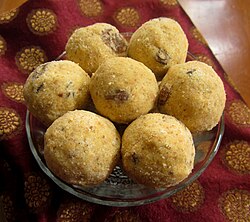
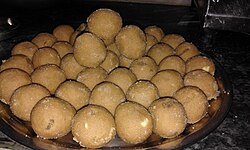
Besan laddu is the most common variety. To prepare it, besan (chickpea flour) is fried in hot ghee (clarified butter). Sugar and cardamom powder are then mixed in. The mixture is formed into balls and allowed to cool and solidify.[1][5]
Motichoor laddu

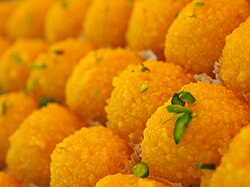
Motichoor ("crushed pearls" in Hindi)[6] laddu is made from boondi, tiny fried balls of chickpea batter soaked in sugar syrup.[1][7]
Thaggu ke laddu
Thaggu ke ("Cheat's") laddu is made from khoa (condensed milk), semolina, and white sugar and is a specialty of Kanpur, India. It was invented by Mattha Pandey, a follower of Mahatma Gandhi. Pandey heard Gandhi refer to white sugar, which was popularized in India by the British, as "white poison" and disease-causing. Since his laddu was made with white sugar, he named it accordingly.[1]
Shahi laddu
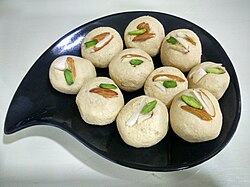
Shahi (royal) laddu is made from the sweets peda and barfi, which are ground into a paste, mixed with cardamom, dried fruits, and nuts, and formed into balls. It is decorated with vark (edible foil).[1]
Coconut laddu

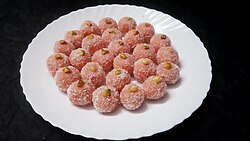
Coconut laddu originated in the medieval Chola Empire, when it was packed for travelers and warriors for good luck on their expeditions.[8]
Gond ke laddu

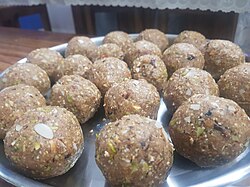
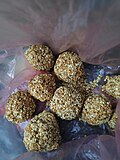
Gond ke laddu is made from roasted and powdered gond (gum arabic), ghee, jaggery, and sometimes battisa or keoka powder. It is commonly served in North India as a postpartum food.[9]
Temple laddus
Some Hindu temples have their own laddu versions, which are offered to the deities and then served to devotees as prasada (sanctified food). The besan laddu served in the Venkateswara Temple in Tirupati, India, has been called "the most famous temple laddu." The Maa Tarini Temple in Ghatgaon, India serves laddus made from coconut and khoa. The special laddu at the Subramaniya Swamy Temple in Tiruchendur, India is made from foxtail millet.[1][10]
Others


Every region of India has its own version of laddu. In Rajasthan, laddus are made from wheat flour, in Maharashtra from sesame seeds, in Kerala from rice flour, and in Andhra Pradesh from rice flakes. Optional ingredients include grated coconut, roasted chickpeas, nuts, and raisins.[1]
World record
.jpg)
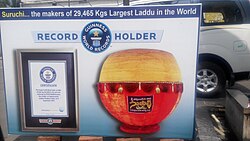
According to Guinness World Records, the world's largest laddu to date was created by PVVS Mallikharjuna Rao in Tapeswaram, Andhra Pradesh, India in 2016. It weighed 29,465 kilograms (64,959 pounds) and was made using a traditional boondi recipe with ghee, oil, cashews, sugar, almonds, cardamom, and water.[11]
In popular culture
In the Sesame Street episode "Rakhi Road", Elmo is shown eating laddus.[12]
See also
References
- ↑ 1.00 1.01 1.02 1.03 1.04 1.05 1.06 1.07 1.08 1.09 The Bloomsbury Handbook of Indian Cuisine. Bloomsbury Publishing. 2023. pp. 269–270. ISBN 978-1-350-12865-1. Archived from the original on 2023-03-14. Retrieved 2023-03-14.
- ↑ "Sweet shops make hay in Diwali shine". The New Indian Express. 31 October 2013. Archived from the original on 21 April 2016. Retrieved 17 January 2019.
- ↑ Sangeetha Devi Dundoo (31 October 2013). "As good as home". The Hindu. Archived from the original on 23 January 2018. Retrieved 17 January 2019.
- ↑ Roufs, Timothy G. (2014). Sweet Treats Around the World: An Encyclopedia of Food and Culture. ABC-CLIO. p. 171.
- ↑ Collingham, Lizzie (2007). Curry : a tale of cooks and conquerors. Oxford: Oxford University Press. p. 105. ISBN 978-0195320015. Archived from the original on 2023-03-14. Retrieved 2018-12-22.
- ↑ "Motichoor Ladoo (Laddu): A Sweet Dip in the History of India's Favourite Festive Treat". Archived from the original on 2022-09-02. Retrieved 2022-08-15.
- ↑ Krondl, Michael (2011). Sweet invention a history of dessert (1st ed.). Chicago, Ill.: Chicago Review Press. p. 17. ISBN 9781569769522. Archived from the original on 2023-03-14. Retrieved 2018-12-22.
- ↑ Madhulika Dash (16 October 2004). "Food Story: The journey of ladoo from a medicine to the much-loved Indian sweet". The New Indian Express. Archived from the original on 27 September 2015. Retrieved 26 September 2015.
- ↑ The Bloomsbury Handbook of Indian Cuisine. Bloomsbury Publishing. 2023. p. 322. ISBN 978-1-350-12865-1.
- ↑ Collingham, Lizzie (2007). Curry : a tale of cooks and conquerors. Oxford: Oxford University Press. p. 105. ISBN 978-0195320015. Archived from the original on 2023-03-14. Retrieved 2018-12-22.
- ↑ Guinness World Records.
- ↑ "Guide to Deepavali". Time Out. October 24, 2019.
'Sesame Street' even paid tribute with a Rakhi Road episode which shows Elmo chomping away at laddu.
| Main and side dishes |
|
|---|---|
| Snacks and sauces | |
| Breads | |
| Beverages | |
| Sweetmeats | |
| Bangladeshi diaspora | |


Pakistani dishes by cuisine and region | |||||
|---|---|---|---|---|---|
| Balochi |  | ||||
| Gilgiti | |||||
| Muhajir |
| ||||
| Pashtun | |||||
| Punjabi |
| ||||
| Saraiki | |||||
| Sindhi | |||||
| Common dishes |
| ||||
| Pakistani diaspora | |||||
Template:Burmese cuisine Template:Bruneian cuisine Template:Indonesian cuisine
| Common dishes |
| ||||||||||||
|---|---|---|---|---|---|---|---|---|---|---|---|---|---|
| Snacks |
| ||||||||||||
| Desserts | |||||||||||||
| Drinks |
| ||||||||||||
| Condiments | |||||||||||||
- Pages using the JsonConfig extension
- Bangladeshi desserts
- Bengali cuisine
- Bihari cuisine
- Bruneian snack foods
- Burmese desserts and snacks
- Chickpea dishes
- Kue
- Indian pastries
- Malay cuisine
- Malaysian snack foods
- Nepalese cuisine
- Pakistani desserts
- Singaporean cuisine
- Thai desserts and snacks
- Uttar Pradeshi cuisine
- Vegetarian dishes of India
- Indo-Caribbean cuisine