






m Removed empty portal template using script |
m cleanup intro for accuracy and improved wording per sources |
||
| Line 1: | Line 1: | ||
{{ | {{Short description|Rapid transit system in India serving Delhi NCR}} | ||
{{Use dmy dates|date=November 2020}} | {{Use dmy dates|date=November 2020}} | ||
{{ | {{Use Indian English|date=September 2023}} | ||
{{Infobox public transit | {{Infobox public transit | ||
| name = Delhi Metro | | name = Delhi Metro | ||
| image = | | image = Delhi Metro full logo.svg | ||
| imagesize = | | imagesize = 125px | ||
| image2 = | | image2 = DelhiMetroYellowLine.JPG | ||
| imagesize2 = | | imagesize2 = 300px | ||
| alt2 = | | image3 = | ||
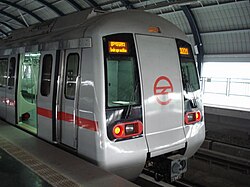
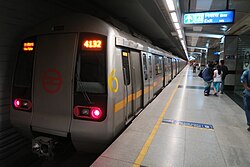
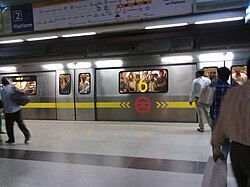
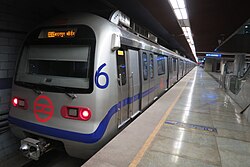
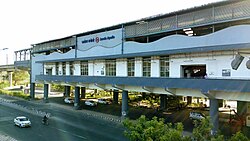
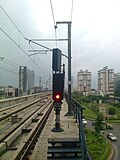
| caption2 = A [[Yellow Line (Delhi Metro)|Yellow Line]] train at [[Patel Chowk metro station]] | |||
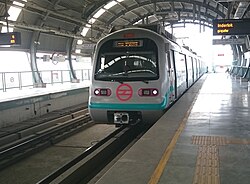
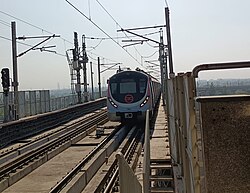
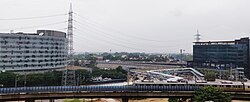
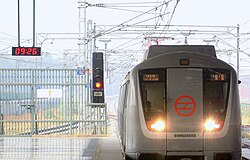
| caption3 = Delhi Metro coming from [[Noida]] | |||
| alt2 = See caption | |||
| owner = [[Delhi Metro Rail Corporation]] | | owner = [[Delhi Metro Rail Corporation]] | ||
| locale = [[National Capital Region (India)|National Capital Region]] | | locale = [[National Capital Region (India)|National Capital Region (NCR)]] | ||
| transit_type = [[Rapid transit]] | | transit_type = [[Rapid transit]] | ||
| lines = [[#Network|10]]<ref name="present network"/> | | lines = [[#Network|10]]<ref name="present network"/> | ||
| stations = [[List of Delhi | | stations = [[List of Delhi Metro stations|271]]{{efn|name=fn1}} | ||
| ridership = | | ridership = 64.6 [[lakh]] (6.46 million, 2025)<ref name="Ridshp"/> | ||
| | | key_people = Katikithala Srinivas (Chairman)<br />Vikas Kumar (Managing Director)<ref>{{Cite web |title=Board of Directors of DMRC |url=https://www.delhimetrorail.com/pages/en/corporate/board-of-directors-of-dmrc |access-date=2026-01-01 |website=www.delhimetrorail.com |archive-date=31 May 2022 |archive-url=https://web.archive.org/web/20220531063551/https://www.delhimetrorail.com/pages/en/corporate/board-of-directors-of-dmrc |url-status=live }}</ref> | ||
| headquarters = Metro Bhawan, [[Barakhamba Road]], [[New Delhi]] | | top_speed = {{convert|120|km/h|mph|0|abbr=on}}<ref name="DMRC Airport Line - Top speed - 120">{{cite web |url=https://www.livemint.com/news/india/delhi-metro-increases-speed-to-120kmph-on-airport-line-know-how-long-will-it-take-to-reach-delhi-airport-11694876761841.html |title=Delhi Metro increases speed to 120 kmph on Airport Line. Know how long will it take to reach Delhi airport |date=16 September 2023 |publisher=Live Mint |access-date=25 October 2023 |archive-date=6 November 2023 |archive-url=https://web.archive.org/web/20231106192819/https://www.livemint.com/news/india/delhi-metro-increases-speed-to-120kmph-on-airport-line-know-how-long-will-it-take-to-reach-delhi-airport-11694876761841.html |url-status=live }}</ref><ref name="DMRC Airport Line - Top speed - 100">{{cite web | url=https://indianexpress.com/article/cities/delhi/delhi-airport-metro-line-now-running-at-100-kmph-8513498 | title=Delhi airport metro line, now running at 100 KMPH | date=23 March 2023 }}</ref> | ||
| website = {{ | | average_speed = {{convert|45|km/h|mph|0|abbr=on}}<ref>{{cite web | url=https://www.timesnownews.com/business-economy/industry/vroom-delhi-metro-top-speed-increased-now-igi-airport-to-new-delhi-railway-station-in-just-article-98905394 | title=VROOM! Delhi metro top speed increased! Now, IGI Airport to New Delhi Railway Station in just | date=22 March 2023 | access-date=31 July 2023 | archive-date=31 July 2023 | archive-url=https://web.archive.org/web/20230731060158/https://www.timesnownews.com/business-economy/industry/vroom-delhi-metro-top-speed-increased-now-igi-airport-to-new-delhi-railway-station-in-just-article-98905394 | url-status=live }}</ref><ref name="DMRC Airport Line - Top speed - 100"/> | ||
| headquarters = Metro Bhawan, [[Barakhamba#Barakhamba Road|Barakhamba Road]], [[New Delhi]] | |||
| website = {{URL|https://www.delhimetrorail.com/|delhimetrorail.com}} | |||
| began_operation = {{start date and age|df=yes|24 December 2002}} | | began_operation = {{start date and age|df=yes|24 December 2002}} | ||
| operator = [[Delhi Metro Rail Corporation]] | | operator = [[Delhi Metro Rail Corporation]] | ||
| vehicles = | | vehicles = 350 trains<ref name = "DM - First train for Phase-4 in Delhi">{{cite press release |last=Dayal |first=Anuj |date=15 November 2024 |title=FIRST TRAIN SET ORDERED FOR DELHI METRO'S PHASE 4 OPERATIONS REACHES DELHI |url=https://delhimetrorail.com/pages/en/pressrelease_details/first-train-set-ordered-for-delhi-metros-phase-4-o |location= |publisher=[[Delhi Metro Rail Corporation|DMRC]] |agency= |quote=The Delhi Metro currently operates on a network of 392.4 kilometres with 288 Metro stations (including the Noida – Greater Noida corridor and the Rapid Metro, Gurugram) operating with a fleet of about 350 Metro trains with four, six and eight coach combinations on both, broad gauge as well as standard gauge tracks. |access-date=24 January 2026}}</ref><ref>{{Cite web |date=2021-04-04 |title=Delhi Metro adding 120 more coaches to upgrade remaining fleet of 6-coach trains |url=https://www.hindustantimes.com/cities/delhi-news/delhi-metro-adding-120-more-coaches-to-upgrade-remaining-fleet-of-6-coach-trains-101617557646079.html |access-date=2022-04-10 |website=Hindustan Times |language=en |archive-date=10 April 2022 |archive-url=https://web.archive.org/web/20220410212433/https://www.hindustantimes.com/cities/delhi-news/delhi-metro-adding-120-more-coaches-to-upgrade-remaining-fleet-of-6-coach-trains-101617557646079.html |url-status=live}}</ref> | ||
| train_length = 4/6/8 coaches<ref name="introduction"/> | | train_length = 4/6/8 coaches<ref name="introduction"/><ref name = "DM - First train for Phase-4 in Delhi" /> | ||
| headway = | | headway = 2 minutes<ref name = "DM - Train frequency" /> | ||
| system_length = {{convert| | | system_length = {{convert|374.47|km|abbr=on}}{{efn|name=fn2}}<ref>https://metrorailnews.in/modi-to-open-2-new-section-of-delhi-metro/</ref> | ||
| track_gauge = {{plainlist| | | track_gauge = {{plainlist| | ||
* {{Track gauge| | * {{Track gauge|1676mm|lk=on}} broad gauge ([[Red Line (Delhi Metro)|Red]], [[Blue Line (Delhi Metro)|Blue]] and [[Yellow Line (Delhi Metro)|Yellow]] lines) | ||
* {{Track gauge| | * {{Track gauge|sg|allk=on}} (Other lines) | ||
}} | }} | ||
| el = {{25 kV 50 Hz}} [[overhead line|overhead catenary]] | | el = {{25 kV 50 Hz}} [[overhead line|overhead catenary]] | ||
| Line 38: | Line 41: | ||
| area served = | | area served = | ||
| line_number = {{plainlist| | | line_number = {{plainlist| | ||
* | * {{rcb|Delhi Metro|Red|croute}} | ||
* | * {{rcb|Delhi Metro|Yellow|croute}} | ||
* | * {{rcb|Delhi Metro|Blue|croute}} | ||
* | * {{rcb|Delhi Metro|Green|croute}} | ||
* | * {{rcb|Delhi Metro|Violet|croute}} | ||
* | * {{rcb|Delhi Metro|Airport Express|croute}} | ||
* | * {{rcb|Delhi Metro|Pink|croute}} | ||
* | * {{rcb|Delhi Metro|Magenta|croute}} | ||
* | * {{rcb|Delhi Metro|Grey|croute}} | ||
* {{rcb|Delhi Metro|Golden|croute}} | |||
}} | }} | ||
| start = | | start = | ||
| end = | | end = | ||
| annual_ridership = | | annual_ridership = 235 [[crore]] (2.35 billion, 2025){{efn|name=line_util}}<ref name="Ridshp">{{cite news |last= |first= |date=16 March 2025 |title= Delhi Metro handles 235.8 crore passenger journeys in 2025 |url=https://dailypioneer.com/news/delhi-metro-handles-235-8-crore-passenger-journeys-in-2025 |work=The Pioneer |location= |access-date=24 March 2026}}</ref> | ||
| character = | | character = | ||
}} | }} | ||
The '''Delhi Metro''' is a [[rapid transit]] system that serves [[Delhi]] and the adjoining satellite cities of [[Faridabad]], [[Gurugram]], [[Ghaziabad]], [[Noida]], [[Bahadurgarh]], and [[Ballabhgarh]] in the [[National Capital Region (India)|National Capital Region]] of [[India]].<ref>{{cite news| title = After 5 years of riding the New York City subway, I tried the Delhi Metro at the busiest time of the year – and it showed me exactly what I'm missing| access-date = 24 February 2019| date = 24 November 2018| first = Tanya| last = Dua| work = Business Insider| url = https://www.businessinsider.in/after-5-years-of-riding-the-new-york-city-subway-i-tried-the-delhi-metro-at-the-busiest-time-of-the-year-and-it-showed-me-exactly-what-im-missing/articleshow/66778934.cms| archive-date = 26 November 2018| archive-url = https://web.archive.org/web/20181126092730/https://www.businessinsider.in/after-5-years-of-riding-the-new-york-city-subway-i-tried-the-delhi-metro-at-the-busiest-time-of-the-year-and-it-showed-me-exactly-what-im-missing/articleshow/66778934.cms| url-status = dead}}</ref> The system consists of [[#Network|10 colour-coded lines]]<ref name="present network">{{Cite web |title=Present Network |url=https://delhimetrorail.com/pages/es/introduction#:~:text=Presently%2C%20the%20Delhi%20Metro%20network,Bahadurgarh%20and%20Ballabhgarh%20in%20Haryana. |access-date=February 19, 2025 |website=www.delhimetrorail.com}}</ref> serving [[List of Delhi Metro stations|271 stations]],{{efn|name=fn1|Transfer stations are counted more than once. There are 26 transfer stations. If transfer stations are counted once, the result is 245 stations. [[Ashok Park Main metro station|Ashok Park Main]] station, where the two branches of the [[Green Line (Delhi Metro)|Green Line]] share tracks and platforms, is counted as one station. [[Aqua Line (Noida Metro)|Noida Metro]] and [[Rapid Metro Gurgaon|Gurgaon Metro]] stations are not counted; if they were, the result would be 303 stations.<ref name="route map">{{Cite web |title=Route map |url=https://www.delhimetrorail.com/network_map |access-date=2022-04-16 |website=www.delhimetrorail.com |archive-date=21 March 2023 |archive-url=https://web.archive.org/web/20230321225457/https://www.delhimetrorail.com/network_map |url-status=live }}</ref><ref name="present network"/><ref name="introduction">{{Cite web |title=Introduction {{!}} DMRC |url=https://www.delhimetrorail.com/pages/en/introduction |access-date=2022-04-16 |website=www.delhimetrorail.com |archive-date=16 April 2022 |archive-url=https://web.archive.org/web/20220416024331/https://www.delhimetrorail.com/pages/en/introduction |url-status=live }}</ref>}} with a total length of {{convert|374.466|km|abbr=on}}.{{efn|name=fn2|The Delhi Metro's own network length is 374.47 km. The [[Rapid Metro Gurgaon|Gurgaon Metro]] and [[Noida Metro]] are operated and maintained by the [[Delhi Metro Rail Corporation]], and the total length operated by the DMRC is {{convert|416.49|km}}.<ref name="route map"/><ref>{{cite web|url=https://timesofindia.indiatimes.com/city/delhi/pink-line-comes-full-circle-as-delhi-metro-grows-to-416km/articleshow/129286201.cms|title=Pink Line comes full circle as Delhi Metro grows to 416 km|publisher=[[The Times of India]]|author=Priyangi Aggarwal|place=New Delhi|date=2026-03-09|accessdate=2026-03-12}}</ref><ref name="introduction"/>}} It is India's [[Urban rail transit in India#List of systems|largest]] and busiest [[Urban rail transit in India|metro rail system]]. The metro has a mix of underground, at-grade, and elevated stations using [[5 ft 6 in gauge railway|broad-gauge]] and [[standard-gauge]] tracks. The metro makes over 4,300 trips daily.<ref>{{cite web | url= https://www.delhimetrorail.com/pages/en/pressrelease_details/dmrc-services-update-5 | title= DMRC Services Update | date= 24 October 2023 | website= delhimetrorail.com | publisher= Delhi Metro Rail Corporation (DMRC) | access-date= 14 November 2023 | archive-date= 6 November 2023 | archive-url= https://web.archive.org/web/20231106192824/https://www.delhimetrorail.com/pages/en/pressrelease_details/dmrc-services-update-5 | url-status= live }}</ref> | |||
[[Delhi Metro | Construction began in 1998, and the first elevated section ([[Shahdara metro station|Shahdara]] to [[Tis Hazari metro station|Tis Hazari]]) on the [[Red Line (Delhi Metro)|Red Line]] opened on 25 December 2002. The first underground section ([[Vishwa Vidyalaya metro station|Vishwa Vidyalaya]] – [[Kashmere Gate metro station|Kashmere Gate]]) on the [[Yellow Line (Delhi Metro)|Yellow Line]] opened on 20 December 2004.<ref>{{cite web|url=https://timesofindia.indiatimes.com/city/delhi/it-all-started-15-xmas-days-ago/articleshow/62234532.cms|title=Delhi Metro: It all started 15 Xmas days ago|last=Roy|first=Sidharatha|date=25 December 2017|website=[[The Times of India]]|location=New Delhi|archive-url= https://web.archive.org/web/20180107021824/https://timesofindia.indiatimes.com/city/delhi/it-all-started-15-xmas-days-ago/articleshow/62234532.cms |archive-date=7 January 2018|url-status=live|access-date=16 January 2018}}</ref> The network was developed in phases. Phase I was completed by 2006, followed by Phase II in 2011. Phase III was mostly complete in 2021, except for a small extension of the [[Airport Express Line (Delhi Metro)|Airport Line]] which opened in 2023.<ref>{{cite web|url=https://www.financialexpress.com/business/infrastructure-dmrcs-remarkable-growth-delhi-metro-surpasses-390-kms-becomes-indias-longest-metro-network-3246305/|title=DMRC's remarkable growth: Delhi Metro surpasses 390 kms, becomes India's longest metro network|date=18 September 2023|access-date=19 September 2023|archive-date=13 February 2024|archive-url=https://web.archive.org/web/20240213204234/https://www.financialexpress.com/business/infrastructure-dmrcs-remarkable-growth-delhi-metro-surpasses-390-kms-becomes-indias-longest-metro-network-3246305/|url-status=live}}</ref> Work on Phase IV began on 30 December 2019.<ref>{{cite web|url=https://www.delhimetrorail.com/pages/en/corporate/project-update|title=Project Update an Janakpuri West – R. K. Ashram Marg corridor|access-date=25 April 2022|archive-date=7 April 2023|archive-url=https://web.archive.org/web/20230407215449/https://www.delhimetrorail.com/pages/en/corporate/project-update|url-status=live}}</ref> | ||
Delhi Metro | The [[Delhi Metro Rail Corporation]] (DMRC), a joint venture between the [[Government of India]] and [[Government of Delhi|Delhi]], built and operates the Delhi Metro.<ref name="delhi300">{{Cite news|url=https://timesofindia.indiatimes.com/city/delhi/dmrc-to-join-global-club-of-metro-networks-having-span-of-over-300-km/articleshow/66417846.cms|title=Delhi Metro to join global club of metro networks having span of over 300 km|website=The Times of India|date=29 October 2018|archive-date=31 October 2018|access-date=29 October 2018|archive-url=https://web.archive.org/web/20181031162716/https://timesofindia.indiatimes.com/city/delhi/dmrc-to-join-global-club-of-metro-networks-having-span-of-over-300-km/articleshow/66417846.cms|url-status=live}}</ref><ref name="delhi300a">{{Cite web |url=https://www.tribuneindia.com/news/haryana/pm-inaugurates-kmp-expressway-ballabhgarh-mujesar-metro-rail-link/685668.html |title=PM inaugurates KMP expressway, Ballabhgarh-Mujesar Metro rail link |work=Tribuneindia News Service |last1=Service |first1=Tribune News |access-date=20 November 2018 |archive-date=26 April 2019 |archive-url=https://web.archive.org/web/20190426200529/https://www.tribuneindia.com/news/haryana/pm-inaugurates-kmp-expressway-ballabhgarh-mujesar-metro-rail-link/685668.html |url-status=dead }}</ref> The DMRC was certified by the [[United Nations]] in 2011 as the first metro rail and rail-based system in the world to receive carbon credits for reducing greenhouse-gas emissions, reducing annual carbon emission levels in the city by 630,000 tonnes.<ref name="introduction"/> | ||
The Delhi Metro has interchanges with the [[Rapid Metro Gurgaon]] (with a shared ticketing system) and [[Noida Metro]]. On 22 October 2019, DMRC took over operations of the financially troubled Rapid Metro Gurgaon.<ref>{{Cite web |date=23 October 2019 |title=Delhi Metro takes over operations of Gurgaon Rapid Metro |url=https://www.livemint.com/news/india/delhi-metro-takes-over-operations-of-gurgaon-rapid-metro-11571807783874.html |access-date=16 April 2022 |website=mint |language=en |archive-date=4 February 2024 |archive-url=https://web.archive.org/web/20240204032212/https://www.livemint.com/news/india/delhi-metro-takes-over-operations-of-gurgaon-rapid-metro-11571807783874.html |url-status=live }}</ref> The Delhi Metro's annual ridership was 235.8[[crore]] (2.35 billion) in 2025.{{efn|name=line_util|Based on line utilisation, which counts transit lines used for a single journey.}}<ref>{{cite news |last=|first= |date=18 January 2024 |title= Delhi Metro handles 235.8 crore passenger journeys in 2025 |url= https://dailypioneer.com/news/delhi-metro-handles-235-8-crore-passenger-journeys-in-2025 |work=Daily Pioneer |location=New Delhi |access-date=19 March 2026 |archive-date=18 January 2024 |archive-url=https://web.archive.org/web/20240118000618/https://www.hindustantimes.com/cities/delhi-news/delhi-metro-logs-2-billion-passenger-trips-for-2023-highest-ever-101705517441601.html |url-status=live }}</ref><ref name="ridership">{{Cite web|author=Ashish Chandrorkar|date=19 February 2021|title=A comprehensive report on Metro rail systems in India|url=https://indiainfrahub.com/wp-content/uploads/2021/02/Indian-Metro-Systems_A_Chandrorkar.pdf|url-status=live|archive-url=https://web.archive.org/web/20210831140650/https://indiainfrahub.com/wp-content/uploads/2021/02/Indian-Metro-Systems_A_Chandrorkar.pdf |archive-date=31 August 2021 }}</ref> The system also has interchanges with the [[Delhi–Meerut Regional Rapid Transit System|Delhi-Meerut RRTS]], India's fastest urban regional transit system.<ref>{{Cite news |date=2025-09-16 |title=Delhi-NCR travel boost: RRTS, metro together solve connectivity puzzle; Namo Bharat stations integrated with DMRC |url=https://timesofindia.indiatimes.com/city/delhi/rrts-metro-together-solve-connectivity-puzzle/articleshow/123907309.cms |access-date=2025-10-13 |work=The Times of India |issn=0971-8257 |archive-date=2 October 2025 |archive-url=https://web.archive.org/web/20251002185628/https://timesofindia.indiatimes.com/city/delhi/rrts-metro-together-solve-connectivity-puzzle/articleshow/123907309.cms |url-status=live }}</ref> | |||
==History== | ==History== | ||
===Background=== | ===Background=== | ||
The concept of | [[File:Delhi Metro evolution.gif|thumb|upright=1.4|alt=Non-Animated timeline of the metro|Evolution of the Delhi Metro from 2003 to 2018]] | ||
The concept of mass rapid transit for [[New Delhi]] first emerged from a 1969 traffic and travel characteristics study in the city.<ref name="Siemiatycki">{{cite journal |last=Siemiatycki |first=Matti |date=June 2006 |title=Message in a Metro: Building Urban Rail Infrastructure and Image in Delhi, India |journal=International Journal of Urban and Regional Research |pages=277–292 |volume=30 |issue=2 |doi=10.1111/j.1468-2427.2006.00664.x |bibcode=2006IJURR..30..277S |doi-access=free }}</ref> Over the next several years, committees in a number of government departments were commissioned to examine issues related to technology, route alignment, and governmental jurisdiction.<ref name="Siemiatycki"/> In 1984, the Urban Arts Commission proposed the development of a multi-modal transport system which would build three underground mass rapid transit corridors and augmenting the city's [[Delhi Suburban Railway|suburban railway]] and road transport networks.<ref name="History">{{cite web |url=http://www.delhimetrorail.com/needformetro/history.aspx |title=History of Delhi Metro |publisher=[[Delhi Metro Rail Corporation|DMRC]] |access-date=17 September 2009 |url-status=dead |archive-url=https://web.archive.org/web/20100925022045/http://www.delhimetrorail.com/needformetro/history.aspx |archive-date=25 September 2010 }}</ref> | |||
The city expanded significantly while technical studies and financing the project underway, doubling its population and increasing the number of vehicles five-fold between 1981 and 1998.<ref name="History"/> Traffic congestion and pollution soared as an increasing number of commuters used private vehicles, and the existing bus system was unable to bear the load.<ref name="Siemiatycki"/> A 1992 attempt to privatise the bus transport system compounded the problem, with inexperienced operators plying poorly maintained, noisy and polluting buses on lengthy routes; this resulted in long waiting times, unreliable service, overcrowding, unqualified drivers, speeding and reckless driving<ref>{{Cite journal |last=Pucher |first=John |author2=Nisha Korattyswaroopam |author3=Neenu Ittyerah |title=The Crisis of Public Transport in India |journal=Journal of Public Transportation |year=2004 |volume=7 |issue=4 |pages=1–20 |doi=10.5038/2375-0901.7.4.1 |doi-access=free }}</ref> which led to road accidents. The Government of India under Prime Minister [[H.D. Deve Gowda]]<ref>{{Cite web|url=https://timesofindia.indiatimes.com/india/the-derailment-of-e-sreedharan/articleshow/81295358.cms|title=The derailment of E Sreedharan|date=2 March 2021|website=TOI|language=en|access-date=4 March 2021|archive-date=4 March 2021|archive-url=https://web.archive.org/web/20210304013339/https://timesofindia.indiatimes.com/india/the-derailment-of-e-sreedharan/articleshow/81295358.cms|url-status=live}}</ref> and the Government of Delhi set up the Delhi Metro Rail Corporation (DMRC) on 3 May 1995, with [[Elattuvalapil Sreedharan]] its managing director.<ref>{{cite web |url=http://www.delhimetrorail.com/needformetro/metro-need.aspx |title=Structure of Delhi Metro |publisher=[[Delhi Metro Rail Corporation|DMRC]] |access-date=17 September 2009 |url-status=dead |archive-url=https://web.archive.org/web/20100916160251/http://delhimetrorail.com/needformetro/metro-need.aspx |archive-date=16 September 2010 }}</ref> | |||
[[Mangu Singh]] succeeded Sreedharan as DMRC managing director on 31 December 2011.<ref>{{Cite web |title=Sreedharan calls it a day; Mangu Singh takes over as new chief of Delhi Metro |url=https://www.ndtv.com/india-news/sreedharan-calls-it-a-day-mangu-singh-takes-over-as-new-chief-of-delhi-metro-567587 |access-date=2023-11-06 |website=NDTV.com |archive-date=6 November 2023 |archive-url=https://web.archive.org/web/20231106192807/https://www.ndtv.com/india-news/sreedharan-calls-it-a-day-mangu-singh-takes-over-as-new-chief-of-delhi-metro-567587 |url-status=live }}</ref> | |||
===Initial construction=== | ===Initial construction=== | ||
When the project was originally approved by the [[Union Cabinet]] in September 1996, it had three corridors. In 1997, [[Official Development Assistance (Japan)|official development assistance]] loans from Japan were granted to finance and conduct the first phase of the system.<ref>{{Cite web |title=Breaking Ground: A Narrative on the Making of Delhi Metro |url=https://www.jica.go.jp/Resource/activities/evaluation/ku57pq00001zf034-att/analysis_en_01.pdf |access-date=June 4, 2024 |website=jica.go.jp |archive-date=2 June 2024 |archive-url=https://web.archive.org/web/20240602145821/https://www.jica.go.jp/Resource/activities/evaluation/ku57pq00001zf034-att/analysis_en_01.pdf |url-status=live }}</ref> | |||
Construction of the Delhi Metro began on 1 October 1998.<ref name="construction">{{cite news |url=http://www.indianexpress.com/res/web/pIe/ie/daily/19981002/27550424.html |title=Delhi metro rail work begins but without fanfare |newspaper=[[The Indian Express]] |url-status=dead |archive-url=https://web.archive.org/web/20080418065417/http://www.indianexpress.com/res/web/pIe/ie/daily/19981002/27550424.html |archive-date=18 April 2008 }}</ref> To avoid problems experienced by the [[Kolkata Metro]], which witnessed substantial delays and ran 12 times over budget due to "political meddling, technical problems and bureaucratic delays", the DMRC was created as a [[Special-purpose entity|special-purpose vehicle]] vested with autonomy and power to execute the large project which involved many technical complexities in a difficult urban environment within a limited time frame. Putting the central and state governments on an equal footing gave an unprecedented level of autonomy and freedom to the company, which had full powers to hire people, decide on tenders, and control funds.<ref name="expindia">{{cite news |url=http://www.expressindia.com/news/fullstory.php?newsid=84775 |title=Delhi Metro showcases public sector success |website=[[The Indian Express]] |date=13 April 2007 |access-date=10 September 2009 |url-status=dead |archive-url=https://web.archive.org/web/20081225005743/http://www.expressindia.com/news/fullstory.php?newsid=84775 |archive-date=25 December 2008}}</ref><ref>{{cite report |author=CAG of India |date=2008 |title=Chapter 2, Coordination and Planning – Implementation of Phase I of Delhi Mass Rapid Transit System by DMRC Limited (Report No. PA 17 of 2008) |url=https://cag.gov.in/uploads/old_reports/union/union_performance/2007_2008/Commercial/Report_no_17/chap_2.pdf |page=1 |access-date=27 December 2023 |archive-date=29 June 2024 |archive-url=https://web.archive.org/web/20240629231104/https://cag.gov.in/uploads/old_reports/union/union_performance/2007_2008/Commercial/Report_no_17/chap_2.pdf |url-status=live }}</ref> The DMRC hired the [[MTR Corporation|Hong Kong MTRC]] as a technical consultant on rapid-transit operation and construction techniques.<ref>{{Cite web|url=http://www.mtr.com.hk/archive/corporate/ch/investor/2001frpt_c/annual%20report%202001(C).pdf|title=二零零一度|website=MTR Corporation|access-date=3 August 2017|archive-date=8 March 2020|archive-url=https://web.archive.org/web/20200308095559/http://www.mtr.com.hk/archive/corporate/ch/investor/2001frpt_c/annual%20report%202001(C).pdf|url-status=live}}</ref> Construction proceeded smoothly except for a major disagreement in 2000, when the [[Ministry of Railways (India)|Ministry of Railways]] forced the system to use {{Track gauge|5ft6in|lk=on}} [[broad gauge]] despite the DMRC's preference for [[standard gauge]].<ref>{{cite web|url=http://www.thehindubusinessline.com/2000/08/07/stories/140760l1.htm|title=Delhi Metro Rail to adopt BG system|date=7 August 2000|website=[[Business Line]]|publisher=[[The Hindu]]|location=New Delhi|archive-url=https://web.archive.org/web/20160201164121/http://www.thehindubusinessline.com/2000/08/07/stories/140760l1.htm|archive-date=1 February 2016|url-status=dead|access-date=16 January 2018}}</ref> This decision led to an additional capital expenditure of {{INRConvert|260|c}}.<ref>{{cite report |author=CAG of India |date=2008 |title=Chapter 3, Selection of Technologies – Implementation of Phase I of Delhi Mass Rapid Transit System by DMRC Limited (Report No. PA 17 of 2008) |url=https://cag.gov.in/uploads/old_reports/union/union_performance/2007_2008/Commercial/Report_no_17/chap_3.pdf |page=2 |access-date=27 December 2023 |quote=Based on their engineering judgment, the management had informed (December 2003) the MoUD that the adoption of the BG had resulted in an additional cost of Rs. 260 crore (Annexure II). The company also anticipated additional energy consumption of Rs. 2.26 crore per annum (Annexure III) due to adoption of the BG rolling stock and as such has decided to adopt the SG for all new lines in Phase II except for the extensions of the existing lines. |archive-date=2 July 2024 |archive-url=https://web.archive.org/web/20240702224824/https://cag.gov.in/uploads/old_reports/union/union_performance/2007_2008/Commercial/Report_no_17/chap_3.pdf |url-status=live }}</ref><ref>{{cite report |author=CAG of India |date=2008 |title=Annexures – Implementation of Phase I of Delhi Mass Rapid Transit System by DMRC Limited (Report No. PA 17 of 2008) |url=https://cag.gov.in/uploads/old_reports/union/union_performance/2007_2008/Commercial/Report_no_17/annexures.pdf |page=2 |access-date=27 December 2023 |archive-date=29 February 2024 |archive-url=https://web.archive.org/web/20240229135046/https://cag.gov.in/uploads/old_reports/union/union_performance/2007_2008/Commercial/Report_no_17/annexures.pdf |url-status=live }}</ref> | |||
The first line | The Delhi Metro's first line, the [[Red Line (Delhi Metro)|Red Line]], was inaugurated by Prime Minister [[Atal Bihari Vajpayee]] on 24 December 2002.<ref name="first">{{Cite news |title=Indian PM launches Delhi metro |url=https://news.bbc.co.uk/2/hi/south_asia/2602907.stm |newspaper=BBC News |date=24 December 2002 |access-date=22 April 2010 |url-status=live |archive-url=https://web.archive.org/web/20120422001958/http://news.bbc.co.uk/2/hi/south_asia/2602907.stm |archive-date=22 April 2012 }}</ref> The metro became India's second underground [[Rapid transit in India|rapid transit system]], after the [[Kolkata Metro]], when the [[Vishwavidyalaya metro station|Vishwavidyalaya]]–[[Kashmere Gate metro station|Kashmere Gate]] section of the [[Yellow Line (Delhi Metro)|Yellow Line]] opened on 20 December 2004. The underground line was inaugurated by Prime Minister [[Manmohan Singh]]. The project's first phase was completed in 2006,<ref>{{Cite web|url=http://www.tribuneindia.com/2006/20061027/delhi.htm#1|title=The Tribune, Chandigarh, India – Delhi and neighbourhood|website=The Tribune|access-date=12 February 2017|url-status=live|archive-url=https://web.archive.org/web/20160312114559/http://www.tribuneindia.com/2006/20061027/delhi.htm#1|archive-date=12 March 2016}}</ref><ref>{{Cite web|url=http://www.tribuneindia.com/2006/20060114/saturday/main1.htm|title=The Tribune – Magazine section – Saturday Extra|website=The Tribune|access-date=12 February 2017|url-status=live|archive-url=https://web.archive.org/web/20070716153346/http://www.tribuneindia.com/2006/20060114/saturday/main1.htm|archive-date=16 July 2007}}</ref> on budget and almost three years ahead of schedule, an achievement described by [[Business Week]] as "nothing short of a miracle".<ref>{{cite magazine |author=Nandini Lakshman |url=http://www.businessweek.com/magazine/content/07_12/b4026009.htm |title=The Miracle-Worker of the Delhi Metro |magazine=[[Bloomberg BusinessWeek]] |date=19 March 2007 |access-date=10 September 2009 |url-status=dead |archive-url=https://web.archive.org/web/20081225004202/http://www.businessweek.com/magazine/content/07_12/b4026009.htm |archive-date=25 December 2008 }}</ref> | ||
=== Phase I === | === Phase I === | ||
A | A 64.75 kilometer (40.23 miles) network of 59 stations was constructed in [[Delhi]], encompassing the initial sections of the Red, Yellow, and Blue Lines. The stations were opened to the public between 25 December 2002 and 11 November 2006. | ||
{| class="wikitable sortable" style="font-size:85%;margin:auto" | {| class="wikitable sortable" style="font-size:85%;margin:auto" | ||
! colspan="7" style="background:#ADD8E6;" |Phase 1 Network<ref name =" | ! colspan="7" style="background:#ADD8E6;" |Phase 1 Network<ref name="Economic Survey of Delhi 2022–23">{{Cite web |title=Economic Survey of Delhi 2022–23 |url=https://delhiplanning.delhi.gov.in/sites/default/files/Planning/ch._12_transport_0.pdf |access-date=30 March 2023 |pages=206–208|archive-url=https://web.archive.org/web/20231001164152/https://delhiplanning.delhi.gov.in/sites/default/files/Planning/ch._12_transport_0.pdf |archive-date=1 October 2023}}</ref><ref name="present network" /> | ||
|- | |- | ||
!No. | !No. | ||
!Line | !Line | ||
!Stations | !Stations | ||
!Length | !Length (km) | ||
! colspan="2" | Terminals | ! colspan="2" | Terminals | ||
!Opening | !Opening date<ref name="Economic Survey of Delhi 2014-15">{{Cite web |date= |title=Economic Survey of Delhi 2014-15 |url=https://delhiplanning.delhi.gov.in/sites/default/files/Planning/2016-17/2014-15/esd_2014-15_ch-12.pdf |archive-url=https://web.archive.org/web/20231020222834/https://delhiplanning.delhi.gov.in/sites/default/files/Planning/2016-17/2014-15/esd_2014-15_ch-12.pdf |archive-date=20 October 2023 |access-date=}}</ref> | ||
|- | |- | ||
! rowspan="3" |1 | ! rowspan="3" |1 | ||
| rowspan="3" style="background:#{{rail color|Delhi Metro|Red}}; text-align: center;" |[[Red Line (Delhi Metro)|<span style="color:white;"> | | rowspan="3" style="background:#{{rail color|Delhi Metro|Red}}; text-align: center;" |[[Red Line (Delhi Metro)|<span style="color:white;">Red Line</span>]]|| style="text-align:center;" |6 | ||
|8.35 | |8.35 | ||
|[[Shahdara metro station| | |[[Shahdara metro station|Shahdara]] | ||
|[[Tis Hazari metro station| | |[[Tis Hazari metro station|Tis Hazari]] | ||
|25 December 2002 | |25 December 2002<ref name=":17">{{Cite web |date=2019-05-07 |title=25 years of DMRC! How Delhi Metro has become a lifeline for the national capital – from 1995 to 2019 |url=https://www.financialexpress.com/business/infrastructure/25-years-of-dmrc-how-delhi-metro-has-become-a-lifeline-for-the-national-capital-from-1995-to-2019/1569685/ |access-date=2024-04-30 |website=Financialexpress |language=en |archive-date=12 January 2024 |archive-url=https://web.archive.org/web/20240112160417/https://www.financialexpress.com/business/infrastructure/25-years-of-dmrc-how-delhi-metro-has-become-a-lifeline-for-the-national-capital-from-1995-to-2019/1569685/ |url-status=live }}</ref> | ||
|- | |- | ||
| style="text-align:center;" | 4 | | style="text-align:center;" | 4 | ||
| 4.87 | | 4.87 | ||
| | |Tis Hazari | ||
|[[Inderlok metro station| | |[[Inderlok metro station|Inderlok]] | ||
|3 October 2003 | |3 October 2003<ref name=":17" /> | ||
|- | |- | ||
| style="text-align:center;" | 8 | | style="text-align:center;" | 8 | ||
|8.84 | |8.84 | ||
| | |Inderlok | ||
|[[Rithala metro station| | |[[Rithala metro station|Rithala]] | ||
|31 March 2004 | |31 March 2004<ref name=":17" /> | ||
|- | |- | ||
! rowspan="2" |2 | ! rowspan="2" |2 | ||
| rowspan="2" style="background:#{{rail color|Delhi Metro|yellow}};text-align:center; " |[[Yellow Line (Delhi Metro)|<span style="color:black;"> | | rowspan="2" style="background:#{{rail color|Delhi Metro|yellow}};text-align:center; " |[[Yellow Line (Delhi Metro)|<span style="color:black;">Yellow Line</span>]] | ||
| style="text-align:center;" |4 | | style="text-align:center;" |4 | ||
|4.06||[[Vishwa Vidyalaya metro station| | |4.06||[[Vishwa Vidyalaya metro station|Vishwavidyalaya]]||[[Kashmere Gate metro station|Kashmere Gate]] | ||
|20 December 2004 | |20 December 2004<ref name=":17" /> | ||
|- | |- | ||
| style="text-align:center;" | 6 | | style="text-align:center;" | 6 | ||
| 6.62 | | 6.62 | ||
| | |Kashmere Gate | ||
|[[Central Secretariat metro station| | |[[Central Secretariat metro station|Central Secretariat]] | ||
|3 July 2005 | |3 July 2005<ref>{{Cite news |date=2005-07-02 |title=Delhi Metro goes underground |url=https://timesofindia.indiatimes.com/india/delhi-metro-goes-underground/articleshow/1158393.cms |access-date=2024-04-30 |work=The Times of India |issn=0971-8257 |archive-date=30 April 2024 |archive-url=https://web.archive.org/web/20240430220129/https://timesofindia.indiatimes.com/india/delhi-metro-goes-underground/articleshow/1158393.cms |url-status=live }}</ref> | ||
|- | |- | ||
! rowspan="3" |3 | ! rowspan="3" |3 | ||
| rowspan="3" style="background:#{{rail color|Delhi Metro|blue}};text-align:center; " |[[Blue Line (Delhi Metro)|<span style="color:white;"> | | rowspan="3" style="background:#{{rail color|Delhi Metro|blue}};text-align:center; " |[[Blue Line (Delhi Metro)|<span style="color:white;">Blue Line</span>]] | ||
| style="text-align:center;" |22||22.74 | | style="text-align:center;" |22||22.74 | ||
| rowspan="2" |[[Dwarka metro station| | | rowspan="2" |[[Dwarka metro station|Dwarka]] | ||
|[[Barakhamba Road metro station| | |[[Barakhamba Road metro station|Barakhamba Road]] | ||
|31 December 2005 | |31 December 2005<ref name=":18">{{Cite news |date=2005-12-30 |title=PM inaugurates Barakhamba-Dwarka Metro line |url=https://timesofindia.indiatimes.com/india/pm-inaugurates-barakhamba-dwarka-metro-line/articleshow/1351999.cms |access-date=2024-04-30 |work=The Times of India |issn=0971-8257 |archive-date=30 April 2024 |archive-url=https://web.archive.org/web/20240430220130/https://timesofindia.indiatimes.com/india/pm-inaugurates-barakhamba-dwarka-metro-line/articleshow/1351999.cms |url-status=live }}</ref> | ||
|- | |- | ||
| style="text-align:center;" | 6 | | style="text-align:center;" | 6 | ||
|6.47 | |6.47 | ||
|[[Dwarka Sector 9 metro station| | |[[Dwarka Sector 9 metro station|Dwarka Sector 9]] | ||
|1 April 2006 | |1 April 2006<ref name=":17" /> | ||
|- | |- | ||
| style="text-align:center;" |3||2.80|| | | style="text-align:center;" |3||2.80||Barakhamba Road | ||
|[[Indraprastha metro station| | |[[Indraprastha metro station|Indraprastha]] | ||
|11 November 2006 | |11 November 2006<ref>{{Cite web |date=2006-11-11 |title=Barakhamba-Indraprastha section of Metro opens |url=https://www.hindustantimes.com/india/barakhamba-indraprastha-section-of-metro-opens/story-aGqWgKNlu0fqJUN5KfXfuL.html |access-date=2024-04-30 |website=Hindustan Times |language=en |archive-date=30 April 2024 |archive-url=https://web.archive.org/web/20240430220127/https://www.hindustantimes.com/india/barakhamba-indraprastha-section-of-metro-opens/story-aGqWgKNlu0fqJUN5KfXfuL.html |url-status=live }}</ref> | ||
|- | |- | ||
!Total | ! colspan="2" |Total | ||
!59 | !59 | ||
!64.75 | !64.75 | ||
| Line 146: | Line 150: | ||
=== Phase II === | === Phase II === | ||
A total of {{convert|123.3|km|mi}} | A total of {{convert|123.3|km|mi|adj=mid|-long}} network of 86 stations and 10 routes and extensions was built. Seven routes were extensions of the Phase I network, three were new colour-coded lines, and three routes connect to other cities (the Yellow Line to Gurgaon and the Blue Line to Noida and Ghaziabad) of the national capital region in the states of Haryana and Uttar Pradesh. At the end of Phases I and II, the network's total length was {{convert|188.05|km|abbr=on}} and 145 stations became operational between 4 June 2008 and 27 August 2011.<ref name="introduction" /> | ||
{| class="wikitable sortable" style="font-size:85%;margin:auto" | {| class="wikitable sortable" style="font-size:85%;margin:auto" | ||
! colspan="7" style="background:#ADD8E6;" |Phase 2 | ! colspan="7" style="background:#ADD8E6;" |Phase 2 network<ref name="Economic Survey of Delhi 2022–23"/><ref name="present network" /> | ||
|- | |- | ||
!No. | !No. | ||
!Line | !Line | ||
!Stations | !Stations | ||
!Length | !Length (km) | ||
! colspan="2" | Terminals | ! colspan="2" | Terminals | ||
!Opening | !Opening date<ref name="Economic Survey of Delhi 2014-15"/> | ||
|- | |- | ||
!1 | !1 | ||
| style="background:#{{rail color|Delhi Metro|Red}}; text-align: center;" |[[Red Line (Delhi Metro)|<span style="color:white;"> | | style="background:#{{rail color|Delhi Metro|Red}}; text-align: center;" |[[Red Line (Delhi Metro)|<span style="color:white;">Red Line</span>]]|| style="text-align:center;" |3 | ||
|2.86 | |style="text-align:center;" |2.86 | ||
|[[Shahdara metro station| | |[[Shahdara metro station|Shahdara]] | ||
|[[Dilshad Garden metro station| | |[[Dilshad Garden metro station|Dilshad Garden]] | ||
|4 June 2008 | |4 June 2008<ref>{{Cite web |date=2008-06-03 |title=Metro comes to Dilshad Garden |url=https://www.hindustantimes.com/delhi/metro-comes-to-dilshad-garden/story-gf9WM31ywRGP07krF3dDbL.html |access-date=2024-04-27 |website=Hindustan Times |language=en |archive-date=20 December 2023 |archive-url=https://web.archive.org/web/20231220171557/https://www.hindustantimes.com/delhi/metro-comes-to-dilshad-garden/story-gf9WM31ywRGP07krF3dDbL.html |url-status=live }}</ref> | ||
|- | |- | ||
! rowspan="4" |2 | ! rowspan="4" |2 | ||
| rowspan="4" style="background:#{{rail color|Delhi Metro|yellow}};text-align:center; " |[[Yellow Line (Delhi Metro)|<span style="color:black;"> | | rowspan="4" style="background:#{{rail color|Delhi Metro|yellow}};text-align:center; " |[[Yellow Line (Delhi Metro)|<span style="color:black;">Yellow Line</span>]] | ||
| style="text-align:center;" |5 | | style="text-align:center;" |5 | ||
|6.38 | |style="text-align:center;" |6.38 | ||
|4 February 2009 | |[[Vishwavidyalaya metro station|Vishwavidyalaya]]||[[Jahangirpuri metro station|Jahangirpuri]] | ||
|4 February 2009<ref>{{Cite web |date=2009-02-04 |title=DU-Jahangirpuri Metro line flagged off, opens to public from today |url=https://indianexpress.com/article/cities/delhi/dujahangirpuri-metro-line-flagged-off-opens-to-public-from-today/ |access-date=2024-04-27 |website=The Indian Express |language=en |archive-date=27 April 2024 |archive-url=https://web.archive.org/web/20240427211346/https://indianexpress.com/article/cities/delhi/dujahangirpuri-metro-line-flagged-off-opens-to-public-from-today/ |url-status=live }}</ref> | |||
|- | |- | ||
| style="text-align:center;" | 9 | | style="text-align:center;" | 9 | ||
| rowspan="2" | 15.82 | | rowspan="2" style="text-align:center;" |15.82 | ||
|[[ | |[[Millennium City Centre Gurugram metro station|Millennium City Centre Gurugram]] | ||
|[[Qutab Minar metro station| | |[[Qutab Minar metro station|Qutab Minar]] | ||
|21 June 2010 | |21 June 2010<ref>{{Cite web |date=2010-06-21 |title=Delhi Metro reaches Gurgaon, brings smiles to residents |url=https://www.indiatoday.in/latest-headlines/story/delhi-metro-reaches-gurgaon-brings-smiles-to-residents-77042-2010-06-20 |access-date=2024-04-27 |website=India Today |language=en |archive-date=27 April 2024 |archive-url=https://web.archive.org/web/20240427211344/https://www.indiatoday.in/latest-headlines/story/delhi-metro-reaches-gurgaon-brings-smiles-to-residents-77042-2010-06-20 |url-status=live }}</ref> | ||
|- | |- | ||
|style="text-align:center;" |1 | |style="text-align:center;" |1 | ||
| colspan="2 | | colspan="2"|[[Chhatarpur metro station|Chhatarpur]] | ||
|26 August 2010 | |26 August 2010<ref>{{Cite news |date=2010-08-26 |title=Chattarpur station to open today |url=https://timesofindia.indiatimes.com/city/delhi/chattarpur-station-to-open-today/articleshow/6435360.cms |access-date=2024-04-25 |work=The Times of India |issn=0971-8257 |archive-date=3 November 2012 |archive-url=https://web.archive.org/web/20121103054816/http://articles.timesofindia.indiatimes.com/2010-08-26/delhi/28316715_1_metro-station-cmrs-metro-rail-safety |url-status=live }}</ref> | ||
|- | |- | ||
|style="text-align:center;" |9 | |style="text-align:center;" |9 | ||
|11.76 | |style="text-align:center;" |11.76 | ||
| | |Qutab Minar | ||
|[[Central Secretariat metro station| | |[[Central Secretariat metro station|Central Secretariat]] | ||
|3 September 2010 | |3 September 2010<ref>{{Cite web |date=2010-09-03 |title=Central Secretariat-Qutub Minar Metro line gets operational |url=https://www.indiatoday.in/india/photo/central-secretariatqutub-minar-metro-line-gets-operational-364146-2010-09-03 |access-date=2024-04-27 |website=India Today |language=en |archive-date=27 April 2024 |archive-url=https://web.archive.org/web/20240427211344/https://www.indiatoday.in/india/photo/central-secretariatqutub-minar-metro-line-gets-operational-364146-2010-09-03 |url-status=live }}</ref> | ||
|- | |- | ||
! rowspan="3" |3 | ! rowspan="3" |3 | ||
| rowspan="3" style="background:#{{rail color|Delhi Metro|blue}};text-align:center; " |[[Blue Line (Delhi Metro)|<span style="color:white;"> | | rowspan="3" style="background:#{{rail color|Delhi Metro|blue}};text-align:center; " |[[Blue Line (Delhi Metro)|<span style="color:white;">Blue Line</span>]] | ||
| style="text-align:center;" |1 | | style="text-align:center;" |1 | ||
|2.17 | |style="text-align:center;" |2.17 | ||
|[[Indraprastha metro station| | |[[Indraprastha metro station|Indraprastha]] | ||
|[[Yamuna Bank metro station| | |[[Yamuna Bank metro station|Yamuna Bank]] | ||
|10 May 2009 | |10 May 2009<ref>{{Cite web |date=2009-05-10 |title=Delhi Metro chugs into East Delhi |url=https://indianexpress.com/article/india/india-others/delhi-metro-chugs-into-east-delhi/ |access-date=2024-04-27 |website=The Indian Express |language=en |archive-date=27 April 2024 |archive-url=https://web.archive.org/web/20240427211344/https://indianexpress.com/article/india/india-others/delhi-metro-chugs-into-east-delhi/ |url-status=live }}</ref> | ||
|- | |- | ||
| style="text-align:center;" | 10 | | style="text-align:center;" | 10 | ||
| 12.85 | | style="text-align:center;" |12.85 | ||
| | |Yamuna Bank | ||
|[[Noida City Centre metro station| | |[[Noida City Centre metro station|Noida City Centre]] | ||
|12 November 2009 | |12 November 2009<ref>{{Cite news |date=2009-11-12 |title=Delhi Metro enters Noida, to open to public tomorrow |url=https://timesofindia.indiatimes.com/city/delhi/delhi-metro-enters-noida-to-open-to-public-tomorrow/articleshow/5222704.cms |access-date=2024-04-27 |work=The Times of India |issn=0971-8257 |archive-date=27 April 2024 |archive-url=https://web.archive.org/web/20240427211344/https://timesofindia.indiatimes.com/city/delhi/delhi-metro-enters-noida-to-open-to-public-tomorrow/articleshow/5222704.cms |url-status=live }}</ref> | ||
|- | |- | ||
| style="text-align:center;" |2||2.28 | | style="text-align:center;" |2 | ||
|[[Dwarka Sector 21 metro station| | |style="text-align:center;" |2.28 | ||
|30 October 2010 | |[[Dwarka Sector 9 metro station|Dwarka Sector 9]] | ||
|[[Dwarka Sector 21 metro station|Dwarka Sector 21]] | |||
|30 October 2010<ref>{{Cite news |date=2010-10-30 |title=Noida Metro line extended to Dwarka Sec-21 |url=https://economictimes.indiatimes.com/industry/transportation/railways/noida-metro-line-extended-to-dwarka-sec-21/articleshow/6841808.cms?from=mdr |access-date=2024-04-27 |work=The Economic Times |issn=0013-0389 |archive-date=27 April 2024 |archive-url=https://web.archive.org/web/20240427211346/https://economictimes.indiatimes.com/industry/transportation/railways/noida-metro-line-extended-to-dwarka-sec-21/articleshow/6841808.cms?from=mdr |url-status=live }}</ref> | |||
|- | |- | ||
! rowspan="2" |4 | ! rowspan="2" |4 | ||
| rowspan="2" style="background:#{{rail color|Delhi Metro|blue}};text-align:center; "|[[Blue Line (Delhi Metro)|<span style="color:white;"> | | rowspan="2" style="background:#{{rail color|Delhi Metro|blue}};text-align:center; "|[[Blue Line (Delhi Metro)|<span style="color:white;">Blue Line Branch</span>]] | ||
|style="text-align:center;" |6 | |style="text-align:center;" |6 | ||
|6.25 | |style="text-align:center;" |6.25 | ||
| | |Yamuna Bank | ||
|[[Anand Vihar metro station| | |[[Anand Vihar metro station|Anand Vihar]] | ||
| | |6 January 2010<ref name=":19">{{Cite web |date=2010-01-07 |title=Anand Vihar Metro line opens for public |url=https://zeenews.india.com/news/delhi/anand-vihar-metro-line-opens-for-public_593434.html |access-date=2024-04-30 |website=Zee News |language=en |archive-date=2 May 2024 |archive-url=https://web.archive.org/web/20240502071553/https://zeenews.india.com/news/delhi/anand-vihar-metro-line-opens-for-public_593434.html |url-status=live }}</ref> | ||
|- | |- | ||
|style="text-align:center;" |2 | |style="text-align:center;" |2 | ||
|2.26 | |style="text-align:center;" |2.26 | ||
| | |Anand Vihar | ||
|[[Vaishali metro station| | |[[Vaishali metro station|Vaishali]] | ||
|14 July 2011 | |14 July 2011<ref name=":12">{{Cite web |date=2011-07-14 |title=Delhi Metro begins service to Ghaziabad |url=https://www.indiatoday.in/india/north/story/delhi-metro-begins-trains-to-ghaziabad-137526-2011-07-13 |access-date=2024-04-27 |website=India Today |language=en |archive-date=27 April 2024 |archive-url=https://web.archive.org/web/20240427213515/https://www.indiatoday.in/india/north/story/delhi-metro-begins-trains-to-ghaziabad-137526-2011-07-13 |url-status=live }}</ref> | ||
|- | |- | ||
! rowspan="2" |5 | ! rowspan="2" |5 | ||
| rowspan="2" style="background:#{{rail color|Delhi Metro|green}};text-align:center; " |[[Green Line (Delhi Metro)|<span style="color:white;"> | | rowspan="2" style="background:#{{rail color|Delhi Metro|green}};text-align:center; " |[[Green Line (Delhi Metro)|<span style="color:white;">Green Line</span>]] | ||
|style="text-align:center;" |14 | |style="text-align:center;" |14 | ||
|14.19 | |style="text-align:center;" |14.19 | ||
|[[Inderlok metro station| | |[[Inderlok metro station|Inderlok]] | ||
|[[Mundka metro station| | |[[Mundka metro station|Mundka]] | ||
| | |3 April 2010<ref name=":13">{{Cite news |date=2010-04-02 |title=Metro's Green Line opened |url=https://www.thehindu.com/news/cities/Delhi/Metrorsquos-Green-Line-opened/article16350846.ece |access-date=2024-04-26 |work=The Hindu |language=en-IN |issn=0971-751X |archive-date=26 April 2024 |archive-url=https://web.archive.org/web/20240426192131/https://www.thehindu.com/news/cities/Delhi/Metrorsquos-Green-Line-opened/article16350846.ece |url-status=live }}</ref> | ||
|- | |- | ||
|style="text-align:center;" |2 | |style="text-align:center;" |2 | ||
|3.41 | |style="text-align:center;" |3.41 | ||
|[[Ashok Park Main metro station| | |[[Ashok Park Main metro station|Ashok Park Main]] | ||
|[[Kirti Nagar metro station| | |[[Kirti Nagar metro station|Kirti Nagar]] | ||
|27 August 2011 | |27 August 2011<ref name=":14">{{Cite web |date=2011-08-27 |title=Kirti Nagar-Ashok Park Metro opens to public |url=https://zeenews.india.com/news/delhi/kirti-nagar-ashok-park-metro-opens-to-public_728679.html |access-date=2024-04-27 |website=Zee News |language=en |archive-date=27 April 2024 |archive-url=https://web.archive.org/web/20240427213517/https://zeenews.india.com/news/delhi/kirti-nagar-ashok-park-metro-opens-to-public_728679.html |url-status=live }}</ref> | ||
|- | |- | ||
! rowspan="2" |6 | ! rowspan="2" |6 | ||
| rowspan="2" style="background:#{{rail color|Delhi Metro|violet}};text-align:center; " |[[Violet Line (Delhi Metro)|<span style="color:white;"> | | rowspan="2" style="background:#{{rail color|Delhi Metro|violet}};text-align:center; " |[[Violet Line (Delhi Metro)|<span style="color:white;">Violet Line</span>]] | ||
|style="text-align:center;" |13 | |style="text-align:center;" |13 | ||
|15.34 | |style="text-align:center;" |15.34 | ||
|[[Central Secretariat metro station| | |[[Central Secretariat metro station|Central Secretariat]] | ||
|[[Sarita Vihar metro station| | |[[Sarita Vihar metro station|Sarita Vihar]] | ||
|3 October 2010 | |3 October 2010<ref name=":15">{{Cite web |date=2010-10-03 |title=Metro to JLN Stadium from today |url=https://indianexpress.com/article/cities/delhi/metro-to-jln-stadium-from-today/ |access-date=2024-04-27 |website=The Indian Express |language=en |archive-date=27 April 2024 |archive-url=https://web.archive.org/web/20240427213519/https://indianexpress.com/article/cities/delhi/metro-to-jln-stadium-from-today/ |url-status=live }}</ref> | ||
|- | |- | ||
|style="text-align:center;" |3 | |style="text-align:center;" |3 | ||
|4.82 | |style="text-align:center;" |4.82 | ||
| | |Sarita Vihar | ||
|[[Badarpur Border metro station| | |[[Badarpur Border metro station|Badarpur Border]] | ||
|14 January 2011 | |14 January 2011<ref>{{Cite news |date=2011-01-14 |title=DMRC opens Sarita Vihar-Badarpur section |url=https://www.thehindu.com/news/cities/Delhi/DMRC-opens-Sarita-Vihar-Badarpur-section/article15519517.ece |access-date=2024-04-27 |work=The Hindu |language=en-IN |issn=0971-751X |archive-date=27 April 2024 |archive-url=https://web.archive.org/web/20240427213515/https://www.thehindu.com/news/cities/Delhi/DMRC-opens-Sarita-Vihar-Badarpur-section/article15519517.ece |url-status=live }}</ref> | ||
|- | |- | ||
! rowspan="2" | | ! rowspan="2" |- | ||
| rowspan="2" style="background:#{{rail color|Delhi Metro|Airport Express}};text-align:center; "|[[Delhi Airport Metro Express|<span style="color:white;"> | | rowspan="2" style="background:#{{rail color|Delhi Metro|Airport Express}};text-align:center; "|[[Delhi Airport Metro Express|<span style="color:white;">Airport Express</span>]] | ||
|style="text-align:center;" |4 | |style="text-align:center;" |4 | ||
| rowspan="2" |22.91 | | rowspan="2" style="text-align:center;" |22.91 | ||
|[[New Delhi metro station| | |[[New Delhi metro station|New Delhi]] | ||
|[[Dwarka Sector 21 metro station| | |[[Dwarka Sector 21 metro station|Dwarka Sector 21]] | ||
|23 February 2011 | |23 February 2011<ref name=":16">{{Cite news |date=2011-02-23 |title=Airport Express Corridor opens; reach IGI in 18 minutes |url=https://www.thehindu.com/news/cities/Delhi/Airport-Express-Corridor-opens-reach-IGI-in-18-minutes/article15455824.ece |access-date=2024-04-27 |work=The Hindu |language=en-IN |issn=0971-751X |archive-date=27 April 2024 |archive-url=https://web.archive.org/web/20240427213517/https://www.thehindu.com/news/cities/Delhi/Airport-Express-Corridor-opens-reach-IGI-in-18-minutes/article15455824.ece |url-status=live }}</ref> | ||
|- | |- | ||
|style="text-align:center;" |2 | |style="text-align:center;" |2 | ||
| colspan="2" | | | colspan="2" |[[Dhaula Kuan metro station|Dhaula Kuan]] & [[Delhi Aerocity metro station|Delhi Aerocity]] | ||
|15 August 2011 | |15 August 2011<ref>{{Cite web |date=2011-08-15 |title=Airport Metro gets 2 new stations |url=https://www.hindustantimes.com/delhi/airport-metro-gets-2-new-stations/story-CSgHe4KGluoLS0WDUUQFqN.html |access-date=2024-04-25 |website=Hindustan Times |language=en |archive-date=25 April 2024 |archive-url=https://web.archive.org/web/20240425213404/https://www.hindustantimes.com/delhi/airport-metro-gets-2-new-stations/story-CSgHe4KGluoLS0WDUUQFqN.html |url-status=live }}</ref> | ||
|- | |- | ||
!Total | ! colspan="2" |Total | ||
!86 | !86 | ||
!123.30 | !123.30 | ||
| Line 269: | Line 275: | ||
=== Phase III === | === Phase III === | ||
Phase | Phase I (Red, Yellow and Blue Lines) and Phase II (Green, Violet, and Airport Express Lines) focused on adding radial lines to expand the network. To further reduce congestion and improve connectivity, Phase III included eight extensions to existing lines, two ring lines (the Pink and Magenta Lines) and the Grey Line. It has 28 underground stations, three new lines and seven route extensions, totaling {{convert|162.375|km|mi}}, at a cost of {{INRConvert|410.079|b}}.<ref name="delhimetrorail.com-2019">{{cite web |url=https://www.delhimetrorail.com/pages/en/funding |title=Funding |date=5 April 2019 |website=delhimetrorail.com |publisher=Delhi Metro Rail Corporation |access-date=12 January 2022 |quote=Phase III: The total estimated expenditure for Phase III expansion is Rs. 41,079 crores. |archive-date=17 April 2022 |archive-url=https://web.archive.org/web/20220417200603/https://www.delhimetrorail.com/pages/en/funding |url-status=live }}</ref><ref name="phase3">{{cite news|url=http://post.jagran.com/Delhi-Metro-rings-in-the-New-Year-under-new-chief-1325423311|title=Delhi Metro rings in the New Year under new chief|date=1 January 2012|newspaper=Jagran Post|access-date=16 January 2018|archive-url=https://web.archive.org/web/20170702223600/http://post.jagran.com/delhi-metro-rings-in-the-new-year-under-new-chief-1325423311|archive-date=2 July 2017|url-status=dead|publisher=[[Dainik Jagran]]|location=New Delhi}}</ref> The three new Phase III lines are the Pink Line on Inner Ring Road (Line 7), the Magenta Line on Outer Ring Road (Line 8) and the Grey Line connecting Dwarka and Najafgarh (Line 9).<ref name="present network" /> | ||
{| class="wikitable sortable" style="font-size:85%;margin:auto" | {| class="wikitable sortable" style="font-size:85%;margin:auto" | ||
! colspan="7" style="background:#ADD8E6;" |Phase 3 | ! colspan="7" style="background:#ADD8E6;" |Phase 3 network<ref name="Economic Survey of Delhi 2023–24">{{Cite web |title=Economic Survey of Delhi 2023–24, Chapter 12: Transport |url=https://delhiplanning.delhi.gov.in/sites/default/files/Planning/chapter_12.pdf |access-date=28 March 2024 |page=240|archive-url=https://web.archive.org/web/20240930092244/https://delhiplanning.delhi.gov.in/sites/default/files/Planning/chapter_12.pdf|archive-date=30 September 2024}}</ref><ref name="present network" /> | ||
|- | |- | ||
!No. | !No. | ||
!Line | !Line | ||
!Stations | !Stations | ||
!Length | !Length (km) | ||
! colspan="2" | Terminals | ! colspan="2" | Terminals | ||
!Opening date | !Opening date | ||
|- | |- | ||
!1 | !1 | ||
| style="background:#{{rail color|Delhi Metro|Red}} ; text-align: center;" |[[Red Line (Delhi Metro)|<span style="color:white;"> | | style="background:#{{rail color|Delhi Metro|Red}} ; text-align: center;" |[[Red Line (Delhi Metro)|<span style="color:white;">Red Line</span>]] | ||
| style="text-align:center;" |8 | |||
|style="text-align:center;" |9.64 | |||
|[[Dilshad Garden metro station|Dilshad Garden]]||[[Shaheed Sthal (New Bus Adda) metro station|Shaheed Sthal<br />(New Bus Adda)]]||9 March 2019<ref name=":0">{{Cite news |date=2019-03-08 |title=PM flags off Red Line extension |language=en-IN |work=The Hindu |url=https://www.thehindu.com/news/cities/Delhi/pm-flags-off-red-line-extension/article26476439.ece |access-date=2022-04-25 |issn=0971-751X |archive-date=12 April 2024 |archive-url=https://web.archive.org/web/20240412143442/https://www.thehindu.com/news/cities/Delhi/pm-flags-off-red-line-extension/article26476439.ece |url-status=live }}</ref> | |||
|- | |- | ||
!2 | !2 | ||
| style="background:#{{rail color|Delhi Metro|yellow}}; text-align: center;" |[[Yellow Line (Delhi Metro)|<span style="color:black;"> | | style="background:#{{rail color|Delhi Metro|yellow}}; text-align: center;" |[[Yellow Line (Delhi Metro)|<span style="color:black;">Yellow Line</span>]]|| style="text-align:center;" |3 | ||
|4. | |style="text-align:center;" |4.37 | ||
|[[Jahangirpuri metro station| | |[[Jahangirpuri metro station|Jahangirpuri]] | ||
|[[Samaypur Badli metro station| | |[[Samaypur Badli metro station|Samaypur Badli]] | ||
|10 November 2015 | |10 November 2015<ref name=":1">{{Cite web |date=2015-11-10 |title=Naidu, Kejriwal to flag-off Jahangirpuri-Samaypur Badli extension of Delhi Metro |url=https://zeenews.india.com/news/delhi/naidu-kejriwal-to-flag-off-jahangirpuri-samaypur-badli-extension-of-delhi-metro_1820546.html |access-date=2024-04-26 |website=Zee News |language=en |archive-date=1 May 2024 |archive-url=https://web.archive.org/web/20240501120446/https://zeenews.india.com/news/delhi/naidu-kejriwal-to-flag-off-jahangirpuri-samaypur-badli-extension-of-delhi-metro_1820546.html |url-status=live }}</ref> | ||
|- | |- | ||
!3 | !3 | ||
| style="background:#{{rail color|Delhi Metro|blue}}; text-align: center; " |[[Blue Line (Delhi Metro)|<span style="color:white;"> | | style="background:#{{rail color|Delhi Metro|blue}}; text-align: center; " |[[Blue Line (Delhi Metro)|<span style="color:white;">Blue Line</span>]] | ||
| style="text-align:center;" |6 | |||
|style="text-align:center;" |6.80 | |||
|[[Noida City Centre metro station|Noida City Centre]]||[[Noida Electronic City metro station|Noida Electronic City]]||9 March 2019<ref name=":2">{{Cite news|url=https://timesofindia.indiatimes.com/city/noida/pm-modi-inaugurates-delhi-metros-blue-line-extension/articleshow/68331659.cms|title=Blue Line Metro: PM Modi inaugurates Delhi Metro's Blue Line extension | Noida News|website=The Times of India|date=9 March 2019|archive-date=17 April 2023|access-date=9 March 2019|archive-url=https://web.archive.org/web/20230417215556/https://timesofindia.indiatimes.com/city/noida/pm-modi-inaugurates-delhi-metros-blue-line-extension/articleshow/68331659.cms|url-status=live}}</ref> | |||
|- | |- | ||
!5 | ! rowspan="2" |5 | ||
| style="background:#{{rail color|Delhi Metro|green}}; text-align: center; " |[[Green Line (Delhi Metro)|<span style="color:white;"> | | rowspan="2" style="background:#{{rail color|Delhi Metro|green}}; text-align: center; " |[[Green Line (Delhi Metro)|<span style="color:white;">Green Line</span>]] | ||
| style="text-align:center;" |7 | |||
|style="text-align:center;" |11.19 | |||
|[[Mundka metro station|Mundka]]||[[Brigadier Hoshiyar Singh metro station|Brigadier Hoshiyar Singh]]||24 June 2018<ref name=":3">{{Cite web |date=2018-06-24 |title=Delhi Metro Green Line: Mundka-Bahadurgarh section inaugurated by PM Modi; 5 facts every commuter should know |url=https://www.financialexpress.com/business/infrastructure/delhi-metro-green-line-mundka-bahadurgarh-pm-modi-haryana-stations/1217981/ |access-date=2024-04-26 |website=Financialexpress |language=en |archive-date=26 April 2024 |archive-url=https://web.archive.org/web/20240426212651/https://www.financialexpress.com/business/infrastructure/delhi-metro-green-line-mundka-bahadurgarh-pm-modi-haryana-stations/1217981/ |url-status=live }}</ref> | |||
|- | |- | ||
|style="text-align: center;" |1 | |||
| | |style="text-align: center;" |– | ||
| colspan="2" style="text-align: center;" |[[Punjabi Bagh West metro station|Punjabi Bagh West]] | |||
| | | 29 March 2022<ref>{{cite news | title = Delhi metro's first interchange station inaugurated at Punjabi Bagh, connects Green line to Pink line | url = https://www.livemint.com/news/india/delhi-metro-s-first-interchange-station-inaugurated-at-punjabi-bagh-connects-green-line-to-pink-line-read-here-11648552780696.html | work = Home News India | location = West Punjabi Bagh, Punjabi Bagh, Delhi | date = March 29, 2022 | access-date = March 31, 2022}}</ref> | ||
|- | |- | ||
| style="text-align:center;" |9||13.56 | ! rowspan="5" |6 | ||
|[[Badarpur Border metro station| | | rowspan="5" style="background:#{{rail color|Delhi Metro|violet}};text-align:center; " |[[Violet Line (Delhi Metro)|<span style="color:white;">Violet Line</span>]] | ||
|style="text-align:center;" |2 | |||
|style="text-align:center;" |3.23 | |||
|[[Mandi House metro station|Mandi House]] | |||
|[[Central Secretariat metro station|Central Secretariat]] | |||
|26 June 2014<ref>{{Cite news |date=2014-06-26 |title=Delhi Metro's Mandi House-Central Secretariat line opens |url=https://timesofindia.indiatimes.com/city/delhi/delhi-metros-mandi-house-central-secretariat-line-opens/articleshow/37243174.cms |access-date=2024-04-26 |work=The Times of India |issn=0971-8257 |archive-date=18 January 2019 |archive-url=https://web.archive.org/web/20190118215418/https://timesofindia.indiatimes.com/City/Delhi/Delhi-Metros-Mandi-House-Central-Secretariat-line-opens/articleshow/37243174.cms |url-status=live }}</ref> | |||
|- | |||
|style="text-align:center;" |1 | |||
|style="text-align:center;" |0.97 | |||
|[[Mandi House metro station|Mandi House]] | |||
|[[ITO metro station|ITO]] | |||
|8 June 2015<ref>{{Cite web |date=2015-06-08 |title=Delhi Metro services begin on ITO-Mandi House section |url=https://zeenews.india.com/news/delhi/delhi-metro-services-begin-on-ito-mandi-house-section_1609679.html |access-date=2024-04-26 |website=Zee News |language=en |archive-date=26 April 2024 |archive-url=https://web.archive.org/web/20240426214153/https://zeenews.india.com/news/delhi/delhi-metro-services-begin-on-ito-mandi-house-section_1609679.html |url-status=live }}</ref> | |||
|- | |||
| style="text-align:center;" |9 | |||
|style="text-align:center;" |13.56 | |||
|[[Badarpur Border metro station|Badarpur Border]]||[[Escorts Mujesar metro station|Escorts Mujesar]]||6 September 2015<ref>{{Cite web |date=2015-09-06 |title=PM Narendra Modi inaugurates Badarpur-Faridabad metro line |url=https://www.businesstoday.in/industry/infra/story/badarpur-faridabad-metro-line-flagged-off-by-pm-narendra-modi-52069-2015-09-06 |access-date=2024-04-26 |website=Business Today |language=en |archive-date=26 April 2024 |archive-url=https://web.archive.org/web/20240426205701/https://www.businesstoday.in/industry/infra/story/badarpur-faridabad-metro-line-flagged-off-by-pm-narendra-modi-52069-2015-09-06 |url-status=live }}</ref> | |||
|- | |||
| style="text-align:center;" |4 | |||
|style="text-align:center;" |5.07 | |||
|[[Kashmere Gate metro station|Kashmere Gate]]||[[ITO metro station|ITO]] | |||
|28 May 2017<ref>{{Cite web |date=28 May 2017 |title=Delhi Metro's ITO-Kashmere Gate 'Heritage Line' opens for public |url=https://www.business-standard.com/article/current-affairs/delhi-metro-s-ito-kashmere-gate-heritage-line-opens-for-public-117052800271_1.html |access-date=26 April 2024 |website=Business Standard |archive-date=26 April 2024 |archive-url=https://web.archive.org/web/20240426212650/https://www.business-standard.com/article/current-affairs/delhi-metro-s-ito-kashmere-gate-heritage-line-opens-for-public-117052800271_1.html |url-status=live }}</ref> | |||
|- | |||
| style="text-align:center;" |2 | |||
|style="text-align:center;" |3.35 | |||
|[[Escorts Mujesar metro station|Escorts Mujesar]]||[[Raja Nahar Singh metro station|Raja Nahar Singh (Ballabhgarh)]]||19 November 2018<ref name=":4">{{Cite web |date=2018-11-19 |title=Delhi Metro Violet Line: PM Modi flags off new Escorts Mujesar-Ballabhgarh section; check route, stations |url=https://www.financialexpress.com/business/infrastructure-delhi-metro-violet-line-pm-modi-flags-off-new-escorts-mujesar-ballabhgarh-section-check-route-stations-1386438/ |access-date=2024-04-26 |website=Financialexpress |language=en |archive-date=26 April 2024 |archive-url=https://web.archive.org/web/20240426211202/https://www.financialexpress.com/business/infrastructure-delhi-metro-violet-line-pm-modi-flags-off-new-escorts-mujesar-ballabhgarh-section-check-route-stations-1386438/ |url-status=live }}</ref> | |||
|- | |- | ||
| style="text-align:center;" | | !- | ||
| style="background:#{{rail color|Delhi Metro|Airport Express}};text-align:center;" |[[Delhi Airport Metro Express|<span style="color:white;">Airport Express</span>]] | |||
| style="text-align:center;" |1 | |||
|style="text-align:center;" |2.01 | |||
|[[Dwarka Sector 21 metro station|Dwarka Sector 21]]||[[IICC - Dwarka Sector 25 metro station|Yashobhoomi - Dwarka Sector 25]]||17 September 2023<ref name=":5">{{Cite news |date=2023-09-17 |title=Airport Line extension opens for passengers, ends at YashoBhoomi Dwarka Sector 25 station |url=https://timesofindia.indiatimes.com/business/india-business/airport-line-extension-opens-for-passengers-ends-at-yashobhoomi-dwarka-sector-25-station/articleshow/103733029.cms |access-date=2024-04-26 |work=The Times of India |issn=0971-8257 |archive-date=26 April 2024 |archive-url=https://web.archive.org/web/20240426212659/https://timesofindia.indiatimes.com/business/india-business/airport-line-extension-opens-for-passengers-ends-at-yashobhoomi-dwarka-sector-25-station/articleshow/103733029.cms |url-status=live }}</ref> | |||
|- | |- | ||
! rowspan="5" |7 | ! rowspan="5" |7 | ||
| rowspan="5" style="background:#{{rail color|Delhi Metro|pink}};text-align:center; " |[[Pink Line (Delhi Metro)|<span style="color:white;"> | | rowspan="5" style="background:#{{rail color|Delhi Metro|pink}};text-align:center; " |[[Pink Line (Delhi Metro)|<span style="color:white;">Pink Line</span>]] | ||
| style="text-align:center;" |12 | |||
|style="text-align:center;" |21.57 | |||
|[[Majlis Park metro station|Majlis Park]]||[[Durgabai Deshmukh South Campus metro station|Durgabai Deshmukh South Campus]]||14 March 2018<ref name=":9">{{Cite news |date=2018-03-14 |title=Majlis Park-South Campus corridor of Delhi Metro's Pink Line inaugurated |url=https://timesofindia.indiatimes.com/city/delhi/majlis-park-south-campus-corridor-of-delhi-metros-pink-line-inaugurated/articleshow/63301856.cms |access-date=2024-04-26 |work=The Times of India |issn=0971-8257 |archive-date=26 April 2024 |archive-url=https://web.archive.org/web/20240426203029/https://timesofindia.indiatimes.com/city/delhi/majlis-park-south-campus-corridor-of-delhi-metros-pink-line-inaugurated/articleshow/63301856.cms |url-status=live }}</ref> | |||
|- | |- | ||
| style="text-align:center;" |6||8.53 | | style="text-align:center;" |6 | ||
|style="text-align:center;" |8.53 | |||
|[[Durgabai Deshmukh South Campus metro station|Durgabai Deshmukh South Campus]]||[[Lajpat Nagar metro station|Lajpat Nagar]]||6 August 2018<ref>{{Cite web |date=2018-08-06 |title=Delhi Metro's South Campus-Lajpat Nagar section on Pink Line inaugurated |url=https://www.hindustantimes.com/delhi-news/delhi-metro-s-south-campus-lajpat-nagar-section-on-pink-line-inaugurated/story-8S3PBezoJKX1bs6cBdfzBJ.html |access-date=2024-04-26 |website=Hindustan Times |language=en |archive-date=26 April 2024 |archive-url=https://web.archive.org/web/20240426203028/https://www.hindustantimes.com/delhi-news/delhi-metro-s-south-campus-lajpat-nagar-section-on-pink-line-inaugurated/story-8S3PBezoJKX1bs6cBdfzBJ.html |url-status=live }}</ref> | |||
|- | |- | ||
| style="text-align:center;" |15 | | style="text-align:center;" |15 | ||
|17.86 | |style="text-align:center;" |17.86 | ||
|[[Trilokpuri metro station|Trilokpuri Sanjay Lake]]||[[Shiv Vihar metro station|Shiv Vihar]]||31 October 2018<ref>{{Cite web |date=2018-10-31 |title=Delhi Metro's Pink Line from Shiv Vihar to Trilokpuri now open for public |url=https://www.businesstoday.in/latest/economy-politics/story/delhi-metro-pink-line-from-shiv-vihar-to-trilokpuri-now-open-for-public-149670-2018-10-31 |access-date=2024-04-26 |website=Business Today |language=en |archive-date=26 April 2024 |archive-url=https://web.archive.org/web/20240426203028/https://www.businesstoday.in/latest/economy-politics/story/delhi-metro-pink-line-from-shiv-vihar-to-trilokpuri-now-open-for-public-149670-2018-10-31 |url-status=live }}</ref> | |||
|- | |- | ||
| style="text-align:center;" |5 | | style="text-align:center;" |5 | ||
|9.63 | |style="text-align:center;" |9.63 | ||
|[[Lajpat Nagar metro station|Lajpat Nagar]]||[[Shree Ram Mandir Mayur Vihar metro station|Shree Ram Mandir Mayur Vihar]]||31 December 2018<ref>{{Cite news |date=2018-12-31 |title=Delhi metro pink line: Lajpat Nagar-Mayur Vihar Pocket 1 corridor inaugurated |url=https://timesofindia.indiatimes.com/city/delhi/delhi-metro-pink-line-lajpat-nagar-mayur-vihar-pocket-1-corridor-inaugurated/articleshow/67320402.cms |access-date=2024-04-26 |work=The Times of India |issn=0971-8257 |archive-date=16 February 2019 |archive-url=https://web.archive.org/web/20190216045756/https://timesofindia.indiatimes.com/city/delhi/delhi-metro-pink-line-lajpat-nagar-mayur-vihar-pocket-1-corridor-inaugurated/articleshow/67320402.cms |url-status=live }}</ref> | |||
|- | |- | ||
| style="text-align:center;" |0 | | style="text-align:center;" |0 | ||
|1.65 | |style="text-align:center;" |1.65 | ||
|[[Shree Ram Mandir Mayur Vihar metro station|Shree Ram Mandir Mayur Vihar]]||[[Trilokpuri Sanjay Lake metro station|Trilokpuri Sanjay Lake]]||6 August 2021<ref name=":6">{{Cite web |date=2021-08-06 |title=Pink Line: Cut Travel Time & Save Money As Trilokpuri - Mayur Vihar Pocket 1 To Open Today |url=https://news.abplive.com/news/india/trilokpuri-sanjay-lake-mayur-vihar-pocket-1-section-of-the-pink-line-to-launch-today-dmrc-1474439 |access-date=2024-04-25 |website=news.abplive.com |language=en |archive-date=25 April 2024 |archive-url=https://web.archive.org/web/20240425213403/https://news.abplive.com/news/india/trilokpuri-sanjay-lake-mayur-vihar-pocket-1-section-of-the-pink-line-to-launch-today-dmrc-1474439 |url-status=live }}</ref> | |||
|- | |- | ||
! rowspan="2" |8 | ! rowspan="2" |8 | ||
| rowspan="2" style="background:#{{rail color|Delhi Metro|magenta}} ;text-align:center;" |[[Magenta Line (Delhi Metro)|<span style="color:white;"> | | rowspan="2" style="background:#{{rail color|Delhi Metro|magenta}} ;text-align:center;" |[[Magenta Line (Delhi Metro)|<span style="color:white;">Magenta Line</span>]]|| style="text-align:center;" |9 | ||
|style="text-align:center;" |12.64 | |||
|[[Kalkaji Mandir metro station|Kalkaji Mandir]]||[[Botanical Garden metro station|Botanical Garden]]||25 December 2017<ref name=":10">{{Cite web |date=2017-12-25 |title=Delhi Metro's Magenta Line open to public from 5 pm; expected to ferry over 3.6 lakh commuters daily |url=https://www.firstpost.com/india/delhi-metros-magenta-line-open-to-public-from-5-pm-expected-to-ferry-over-3-6-lakh-commuters-daily-4275079.html |access-date=2024-04-26 |website=Firstpost |language=en-us |archive-date=26 April 2024 |archive-url=https://web.archive.org/web/20240426203028/https://www.firstpost.com/india/delhi-metros-magenta-line-open-to-public-from-5-pm-expected-to-ferry-over-3-6-lakh-commuters-daily-4275079.html |url-status=live }}</ref> | |||
|- | |- | ||
| style="text-align:center;" |16||24.82 | | style="text-align:center;" |16 | ||
|style="text-align:center;" |24.82 | |||
|[[Janakpuri West metro station|Janakpuri West]]||[[Kalkaji Mandir metro station|Kalkaji Mandir]]||29 May 2018<ref name=":7">{{Cite web |date=2018-05-28 |title=Delhi Metro's Kalkaji Mandir-Janakpuri West stretch inaugurated |url=https://www.hindustantimes.com/delhi-news/kalkaji-mandir-janakpuri-west-stretch-of-delhi-metro-s-magenta-line-inaugurated/story-rdqM2YxNUnr0XcVq43ek1O.html |access-date=2024-04-26 |website=Hindustan Times |language=en |archive-date=26 April 2024 |archive-url=https://web.archive.org/web/20240426192958/https://www.hindustantimes.com/delhi-news/kalkaji-mandir-janakpuri-west-stretch-of-delhi-metro-s-magenta-line-inaugurated/story-rdqM2YxNUnr0XcVq43ek1O.html |url-status=live }}</ref> | |||
|- | |- | ||
! rowspan="2" |9 | ! rowspan="2" |9 | ||
| rowspan="2" style="background:#{{rail color|Delhi Metro|grey}}; text-align: center;" |[[Grey Line (Delhi Metro)|<span style="color:white;"> | | rowspan="2" style="background:#{{rail color|Delhi Metro|grey}}; text-align: center;" |[[Grey Line (Delhi Metro)|<span style="color:white;">Grey Line</span>]] | ||
| style="text-align:center;" |3 | |||
|style="text-align:center;" |4.30 | |||
|[[Dwarka metro station|Dwarka]]||[[Najafgarh metro station|Najafgarh]]||4 October 2019<ref name=":11">{{Cite web |date=2019-10-04 |title=Delhi Metro's Grey Line connecting Dwarka and Najafgarh inaugurated |url=https://www.businesstoday.in/latest/story/delhi-metro-grey-line-connecting-dwarka-and-najafgarh-inaugurated-232267-2019-10-04 |access-date=2024-04-26 |website=Business Today |language=en |archive-date=26 April 2024 |archive-url=https://web.archive.org/web/20240426203026/https://www.businesstoday.in/latest/story/delhi-metro-grey-line-connecting-dwarka-and-najafgarh-inaugurated-232267-2019-10-04 |url-status=live }}</ref> | |||
|- | |- | ||
| style="text-align:center;"|1 | | style="text-align:center;"|1 | ||
||0.89 | |style="text-align:center;" |0.89 | ||
|[[Najafgarh metro station| | |[[Najafgarh metro station|Najafgarh]] | ||
|[[Dhansa Bus Stand metro station| | |[[Dhansa Bus Stand metro station|Dhansa Bus Stand]] | ||
|18 September 2021 | |18 September 2021<ref name=":8">{{Cite news |date=2021-09-18 |title=Grey Line: Delhi Metro's Najafgarh-Dhansa Bus Stand corridor inaugurated |url=https://www.thehindu.com/news/cities/Delhi/grey-line-delhi-metros-najafgarh-dhansa-bus-stand-corridor-inaugurated/article36531274.ece |access-date=2024-04-25 |work=The Hindu |language=en-IN |issn=0971-751X |archive-date=25 April 2024 |archive-url=https://web.archive.org/web/20240425213405/https://www.thehindu.com/news/cities/Delhi/grey-line-delhi-metros-najafgarh-dhansa-bus-stand-corridor-inaugurated/article36531274.ece |url-status=live }}</ref> | ||
|- | |- | ||
! | ! colspan="2" |Total||111||162.375|| || || | ||
| | |||
|} | |} | ||
Work on Phase III | Work on Phase III began in 2011,<ref name="phaseThree1">{{cite news|url=http://articles.economictimes.indiatimes.com/2011-12-11/news/30504664_1_e-sreedharan-delhi-metro-modern-transport|archive-url=https://web.archive.org/web/20150613110439/http://articles.economictimes.indiatimes.com/2011-12-11/news/30504664_1_e-sreedharan-delhi-metro-modern-transport|url-status=dead|archive-date=13 June 2015|title=Metro to cover whole of Delhi by 2012|date=11 December 2011|newspaper=The Economic Times|access-date=8 April 2012}}</ref><ref name="approval">{{cite news|url=http://indianexpress.com/article/cities/delhi/jung-wants-better-access-to-all-metro-stations|title=Jung wants better access to all Metro stations|date=23 April 2014|newspaper=The Indian Express|access-date=24 April 2014|archive-url=https://web.archive.org/web/20140424171321/http://indianexpress.com/article/cities/delhi/jung-wants-better-access-to-all-metro-stations/|archive-date=24 April 2014|url-status=live}}</ref> with 2016 the planned deadline.<ref name="Deadlines">{{cite press release|title=Phase 3 Corridors|publisher=[[Delhi Metro Rail Corporation|DMRC]]|url=http://delhimetrorail.com/Corridors.aspx|access-date=4 June 2017|url-status=dead|archive-url=https://web.archive.org/web/20170606064936/http://delhimetrorail.com/Corridors.aspx|archive-date=6 June 2017}}</ref> Over 20 tunnel-boring machines were used simultaneously to expedite construction,<ref>{{cite news|url=http://articles.economictimes.indiatimes.com/2012-01-31/news/31010369_1_tunnelling-tbms-metro-s-phase-iii|archive-url=https://web.archive.org/web/20160305024414/http://articles.economictimes.indiatimes.com/2012-01-31/news/31010369_1_tunnelling-tbms-metro-s-phase-iii|url-status=dead|archive-date=5 March 2016|title=Tunnelling work starts for Metro's Phase III|date=31 January 2012|newspaper=The Economic Times|access-date=8 April 2012}}</ref> which was completed in March 2019 (except for a small stretch due to non-availability of land).<ref name="PhaseFour1">[http://economictimes.indiatimes.com/industry/transportation/railways/will-not-let-funding-row-derail-phase-iv-government/articleshow/59435629.cms Will not let funding row derail Phase-IV: Government] {{webarchive|url=https://web.archive.org/web/20170707054713/http://economictimes.indiatimes.com/industry/transportation/railways/will-not-let-funding-row-derail-phase-iv-government/articleshow/59435629.cms|date=7 July 2017}}, [[The Economic Times]], 4 July 2017.</ref> Short extensions were later added to Phase III, which was expected to be completed by the end of 2020, but construction was delayed due to the COVID-19 pandemic. It was completed on 18 September 2021 with the opening of the Grey Line extension from [[Najafgarh metro station|Najafgarh]] to [[Dhansa Bus Stand metro station|Dhansa Bus Stand]].<ref>{{cite news|last= Prasad|first= Nikita|date= 17 September 2021|title= Grey Line's Najafgarh-Dhansa Bus Stand Corridor To Open For Services Tomorrow|url= https://www.ndtv.com/business/delhi-metro-grey-line-delhi-metro-grey-line-najafgarh-dhansa-bus-stand-corridor-to-open-for-passengers-tomorrow-2543764|work= NDTV|access-date= 12 January 2022|archive-date= 13 January 2022|archive-url= https://web.archive.org/web/20220113093054/https://www.ndtv.com/business/delhi-metro-grey-line-delhi-metro-grey-line-najafgarh-dhansa-bus-stand-corridor-to-open-for-passengers-tomorrow-2543764|url-status= live}}</ref> An extension of the Airport Line to [[Yashobhoomi Dwarka Sector - 25 metro station|Yashobhoomi Dwarka Sector - 25]] metro station was later added, and it was completed on 17 September 2023.<ref>{{Cite news |date=2023-09-17 |title=Airport Line extension opens for passengers, ends at YashoBhoomi Dwarka Sector 25 station |work=The Times of India |url=https://timesofindia.indiatimes.com/business/india-business/airport-line-extension-opens-for-passengers-ends-at-yashobhoomi-dwarka-sector-25-station/articleshow/103733029.cms?from=mdr |access-date=2023-10-01 |issn=0971-8257 |archive-date=24 September 2024 |archive-url=https://web.archive.org/web/20240924154327/https://timesofindia.indiatimes.com/business/india-business/airport-line-extension-opens-for-passengers-ends-at-yashobhoomi-dwarka-sector-25-station/articleshow/103733029.cms?from=mdr |url-status=live }}</ref> | ||
Driverless operations on the 38- | Driverless operations on the {{convert|38|km|mi|adj=mid|-long}} Magenta line began on 28 December 2021, making it the Delhi Metro's (and India's) first driverless metro line.<ref>{{cite news |last=Bedi |first=Aneesa |date=28 December 2020 |title=PM Modi launches India's first driverless metro train in Delhi. Here's all you need to know |url=https://theprint.in/theprint-essential/pm-modi-launches-indias-first-driverless-metro-train-in-delhi-heres-all-you-need-to-know/575285/ |work=The Print |access-date=12 January 2022 |archive-date=31 May 2022 |archive-url=https://web.archive.org/web/20220531075304/https://theprint.in/theprint-essential/pm-modi-launches-indias-first-driverless-metro-train-in-delhi-heres-all-you-need-to-know/575285/ |url-status=live }}</ref> On 25 November 2021, the {{convert|59|km|mi|adj=mid|-long}} Pink Line also began driverless operations. The total driverless DMRC network is nearly {{convert|97|km|mi|abbr=on}}, putting Delhi Metro in fourth position globally among such networks behind [[Rapid Rail|Kuala Lumpur]].<ref>{{cite news|date= 25 November 2021|title= Driverless train operations on Pink Line flagged off|url= https://www.moneycontrol.com/news/india/driverless-train-operations-on-pink-line-flagged-off-7760501.html/amp|work= Money Control|access-date= 12 January 2022|archive-date= 31 May 2022|archive-url= https://web.archive.org/web/20220531155421/https://www.moneycontrol.com/news/india/driverless-train-operations-on-pink-line-flagged-off-7760501.html/amp|url-status= live}}</ref> | ||
The expected daily ridership of the | The expected daily ridership of the network after the completion of Phase III was estimated at 53.47 [[lakh]] passengers. Actual DMRC ridership was 27.79 lakh in 2019–20, 51.97 percent of the projected ridership. Actual ridership of the Phase III corridors was 4.38 lakh, compared with a projected ridership of 20.89 lakh in 2019–20 (a deficit of 79.02 percent).<ref name = "DM Ridership Half of the Figure Projected (HT)">{{cite web |url=https://www.hindustantimes.com/cities/delhi-news/delhi-metro-ridership-only-half-of-the-figure-projected-by-dmrc-cag-report-101638469842598.html |title=Delhi Metro ridership only half of the figure projected by DMRC: CAG report |last=Chitlangia |first=Risha |date=3 December 2021 |publisher=Hindustan Times |access-date=12 January 2022 |quote=The CAG report said pointed out that the DMRC had projected an average daily ridership in the entire network (phases I, II and III) would rise to 53.47 lakh in 2019-20 but the actual ridership was only around 27.79 lakh (51.97% of the projected figure). The report also claimed that DMRC had projected daily ridership of around 20.89 lakhs in the four Phase III corridors in 2019-20 but the actual ridership was just 4.38 lakh. |archive-date=13 January 2022 |archive-url=https://web.archive.org/web/20220113052514/https://www.hindustantimes.com/cities/delhi-news/delhi-metro-ridership-only-half-of-the-figure-projected-by-dmrc-cag-report-101638469842598.html |url-status=live }}</ref><ref name = "CAG Report: Phase-III of Delhi Metro (December 2021) - Page 16">{{cite web |url=https://cag.gov.in/uploads/download_audit_report/2021/Report%20No.%2011%20of%202021_DMRC_English-061a88483a1f130.47012068.pdf |title=Report No.11 of 2021 - Performance Audit on Implementation of Phase III, Delhi Mass Rapid Transit System by DMRC, Ministry of Housing and Urban Affairs |date=2 December 2021 |website=cag.gov.in |publisher=Comptroller and Auditor General of India |access-date=12 January 2022 |page=16 |archive-date=19 February 2022 |archive-url=https://web.archive.org/web/20220219135727/https://cag.gov.in/uploads/download_audit_report/2021/Report%20No.%2011%20of%202021_DMRC_English-061a88483a1f130.47012068.pdf |url-status=live }}</ref> The communication-based train control (CBTC) on Phase III trains enables them to run at a 90-second headway, although the actual headway between trains is higher because of the relatively low demand on the new corridors.<ref name = "DM - Train frequency">{{cite web |url=https://www.delhimetrorail.com/train-frequency |title=Delhi metro average train frequency during peak and off-peak hours (As on 31.12.2021) |website=delhimetrorail.com |publisher=[[Delhi Metro Rail Corporation|DMRC]] |access-date=12 January 2022 |archive-date=20 March 2022 |archive-url=https://web.archive.org/web/20220320180415/https://www.delhimetrorail.com/train-frequency |url-status=live}}</ref> Keeping the short headway and other constraints in mind, DMRC changed its decision to build nine-car-long stations for new lines and opted for shorter stations which can accommodate six-car trains.<ref name = "CAG Report: Phase-III of Delhi Metro (December 2021) - Page 12">{{cite web |url=https://cag.gov.in/uploads/download_audit_report/2021/Report%20No.%2011%20of%202021_DMRC_English-061a88483a1f130.47012068.pdf |title=Report No.11 of 2021 - Performance Audit on Implementation of Phase III, Delhi Mass Rapid Transit System by DMRC, Ministry of Housing and Urban Affairs |date=2 December 2021 |website=cag.gov.in |publisher=Comptroller and Auditor General of India |access-date=12 January 2022 |page=12 |archive-date=19 February 2022 |archive-url=https://web.archive.org/web/20220219135727/https://cag.gov.in/uploads/download_audit_report/2021/Report%20No.%2011%20of%202021_DMRC_English-061a88483a1f130.47012068.pdf |url-status=live }}</ref> | ||
The communication-based train control (CBTC) | |||
=== | === Phase IV === | ||
Phase IV, with a length of {{convert|103|km|mi|abbr=on}} and six lines, was finalized by the [[Government of Delhi]] in December 2018.<ref>{{Cite web |date=2018-12-20 |title=Delhi Metro's Much-awaited Phase 4 Gets AAP Govt's Nod, Likely to be Ready by 2024 |url=https://www.news18.com/news/india/delhi-metros-much-awaited-phase-4-gets-aap-govts-nod-likely-to-be-ready-by-2024-1978485.html |access-date=2022-05-16 |website=News18 |language=en |archive-date=16 May 2022 |archive-url=https://web.archive.org/web/20220516091600/https://www.news18.com/news/india/delhi-metros-much-awaited-phase-4-gets-aap-govts-nod-likely-to-be-ready-by-2024-1978485.html |url-status=live }}</ref> Approval from the government of India was received for three priority corridors in March 2019.<ref>{{Cite news |title=Delhi Metro: Cabinet approves three corridors of Delhi Metro Phase IV |work=The Economic Times |url=https://economictimes.indiatimes.com/industry/transportation/railways/cabinet-approves-three-corridors-of-delhi-metro-phase-iv/articleshow/68301051.cms |access-date=2022-05-16 |archive-date=16 May 2022 |archive-url=https://web.archive.org/web/20220516092251/https://economictimes.indiatimes.com/industry/transportation/railways/cabinet-approves-three-corridors-of-delhi-metro-phase-iv/articleshow/68301051.cms |url-status=live }}</ref> Construction of the corridors {{convert|65.1|km|mi|abbr=on|adj=on}} began on 30 December 2019, with an expected completion date of 2026.<ref>{{cite news |date= 20 June 2021 |title= Completion targets of Metro Phase-4 will depend on Covid-19 scenario: DMRC |url= https://www.hindustantimes.com/cities/delhi-news/completion-targets-of-metro-phase-4-will-depend-on-covid-19-scenario-dmrc-101624192413235.html |work= Hindustan Times |access-date= 11 January 2022 |quote= “DMRC is currently engaged in the construction of 65 kilometers of new lines across three priority corridors as part of its Phase 4 expansion. These corridors are expected to be completed by 2025. However, given the fact that the Covid-19 scenario is still evolving, the completion targets shall be reviewed accordingly,” said Anuj Dayal, executive director, of corporate communications, DMRC. |archive-date= 11 January 2022 |archive-url= https://web.archive.org/web/20220111140133/https://www.hindustantimes.com/cities/delhi-news/completion-targets-of-metro-phase-4-will-depend-on-covid-19-scenario-dmrc-101624192413235.html |url-status= live }}</ref> The metro's total length will exceed {{convert|450|km|mi}} at the end of Phase IV,<ref name="times1">[https://timesofindia.indiatimes.com/city/delhi/delhi-metro-phase-4-gets-government-nod/articleshow/56379166.cms Delhi Metro Phase-4 gets government nod] {{Webarchive|url=https://web.archive.org/web/20230419063513/https://timesofindia.indiatimes.com/city/delhi/delhi-metro-phase-4-gets-government-nod/articleshow/56379166.cms |date=19 April 2023 }}, ''[[The Times of India]]'', 6 January 2017.</ref><ref name="PhaseFour1" /> not including other independently operated systems in the National Capital Region such as the {{convert|29.7|km|mi|adj=mid|-long}} Aqua Line of the [[Noida-Greater Noida Metro]]<ref>{{cite news |author=Gaurav Vivek Bhatnagar |url=http://www.hindu.com/2006/12/25/stories/2006122514830100.htm |title=Delhi Metro map to cover Greater Noida |date=25 December 2006 |access-date=10 September 2009 |url-status=dead |archive-url=https://web.archive.org/web/20090601085515/http://www.hindu.com/2006/12/25/stories/2006122514830100.htm |newspaper=[[The Hindu]] |archive-date=1 June 2009 }}</ref> and the {{convert|11.7|km|mi|adj=on}} [[Rapid Metro Gurgaon]] which connect to the Delhi Metro.<ref>{{Cite news |author=Megha Suri |url=https://timesofindia.indiatimes.com/city/delhi/-Pvt-metro-link-to-get-Central-nod-soon/articleshow/5514881.cms |archive-url=https://web.archive.org/web/20121105163856/http://articles.timesofindia.indiatimes.com/2010-01-30/delhi/28137396_1_metro-link-dlf-metro-rapid-metro-rail-gurgaon |url-status=live |archive-date=5 November 2012 |title=Pvt metro link to get Central nod soon |newspaper=[[The Times of India]] |date=30 January 2010 |access-date=2 February 2010}}</ref><ref name="approval1">[https://www.financialexpress.com/infrastructure/delhi-metro-dmrc-to-come-up-with-elevated-road-network-below-these-3-new-lines-details-here/1420938/ Delhi Metro: DMRC to come up with elevated road network below these 3 new lines] {{Webarchive|url=https://web.archive.org/web/20181221130144/https://www.financialexpress.com/infrastructure/delhi-metro-dmrc-to-come-up-with-elevated-road-network-below-these-3-new-lines-details-here/1420938/ |date=21 December 2018 }}, ''The Financial Express'', 21 December 2018.</ref> | |||
{| class="wikitable sortable" style="font-size:85%;margin:auto" | |||
! colspan="9" style="background:#ADD8E6;" |Phase IV network | |||
|- | |||
! No. | |||
! Line | |||
{{ | ! Stations | ||
! Length (km) | |||
== | ! colspan="2" |Terminals | ||
! Status | |||
! Expected completion date | |||
! Opening date | |||
|- | |||
!rowspan="2" |7 | |||
| rowspan="2" style="background:#{{rail color|Delhi Metro|pink}};text-align:center; " | [[Pink Line (Delhi Metro)|<span style="color:white;">Pink Line</span>]] | |||
|7 | |||
|12.32 | |||
|[[Majlis Park metro station|Majlis Park]] | |||
|[[Maujpur - Babarpur metro station|Maujpur - Babarpur]] | |||
|Completed | |||
| | |||
| 8 March 2026<ref name="Hindustan Times-2026">{{Cite web |date=2026-03-08 |title=PM Modi inaugurates two new Delhi Metro corridors: Key details of Pink and Magenta line extension |url=https://www.hindustantimes.com/cities/delhi-news/pm-modi-new-delhi-metro-corridors-key-details-pink-and-magenta-line-extension-routes-majlis-park-deepali-chowk-101772949619664-amp.html |access-date=2026-03-08 |website=Hindustan Times |language=en}}</ref> | |||
|- | |||
|1 | |||
|– | |||
| colspan="2" style="text-align: center;" |[[Soorghat metro station|Soorghat]] | |||
|Under Construction | |||
| 2026 | |||
| | |||
|- | |- | ||
! | ! rowspan="5"|8 | ||
| rowspan="5"style="background:#{{rail color|Delhi Metro|magenta}};text-align:center;" |[[Magenta Line (Delhi Metro)|<span style="color:white;">Magenta Line</span>]] | |||
|1 | |||
|1.8 | |||
|[[Janakpuri West metro station|Janakpuri West]] | |||
|[[Krishna Park Extension metro station|Krishna Park Extension]] | |||
| Completed | |||
| | |||
| 5 January 2025 | |||
|- | |- | ||
|7 | |||
|9.9 | |||
| | |[[Majlis Park metro station|Majlis Park]] | ||
|[[Deepali Chowk metro station|Deepali Chowk]] | |||
|Completed | |||
| | | | ||
| 8 March 2026<ref name="Hindustan Times-2026"/> | |||
|- | |- | ||
|6 | |||
| rowspan="2"|17.53 | |||
| | |[[Krishna Park Extension metro station|Krishna Park Extension]] | ||
| | |[[Deepali Chowk metro station|Deepali Chowk]] | ||
| | |rowspan="2"|Under construction<ref name=":21">{{Cite news|url=https://www.thehindu.com/news/cities/Delhi/work-begins-on-delhi-metro-phase-iv/article30437781.ece|title=Work begins on Delhi Metro Phase-IV|date=31 December 2019|work=The Hindu|access-date=31 December 2019|language=en-IN|issn=0971-751X}}</ref> | ||
| | |rowspan="2"|2026<ref name="TimesNow-2023">{{Cite web |date=2023-11-05 |title=First section of Delhi Metro phase-IV to open by July 2024, says DMRC chief |url=https://www.timesnownews.com/delhi/first-section-of-delhi-metro-phase-iv-to-open-by-july-2024-says-dmrc-chief-article-104978294 |access-date=2023-11-24 |website=TimesNow |language=en |archive-date=24 November 2023 |archive-url=https://web.archive.org/web/20231124152229/https://www.timesnownews.com/delhi/first-section-of-delhi-metro-phase-iv-to-open-by-july-2024-says-dmrc-chief-article-104978294 |url-status=live }}</ref> | ||
| | |||
|- | |- | ||
|8 | |||
|[[Majlis Park metro station|Majlis Park]] | |||
|[[Ramakrishna Ashram Marg metro station|RK Ashram Marg]] | |||
| | | | ||
|- | |- | ||
|10 | |||
| | |12.38<ref>{{Cite web |date=March 13, 2024 |title=Cabinet approves two corridors of Delhi Metro Phase-IV projects namely (i) Lajpat Nagar to Saket G-Block and (ii) Inderlok to Indraprastha |url=https://www.pmindia.gov.in/en/news_updates/cabinet-approves-two-corridors-of-delhi-metro-phase-iv-projects-namely-i-lajpat-nagar-to-saket-g-block-and-ii-inderlok-to-indraprastha/ |access-date=13 March 2024 |archive-date=1 December 2024 |archive-url=https://web.archive.org/web/20241201003532/https://www.pmindia.gov.in/en/news_updates/cabinet-approves-two-corridors-of-delhi-metro-phase-iv-projects-namely-i-lajpat-nagar-to-saket-g-block-and-ii-inderlok-to-indraprastha/ |url-status=live }}</ref> | ||
| | |[[Inderlok metro station|Inderlok]] | ||
| | |[[Indraprastha metro station|Indraprastha]] | ||
|Under Construction<ref name=":22">{{Cite web |date=2024-03-13 |title=Cabinet okays two new Delhi Metro corridors at ₹8400 crore project cost {{!}} All you need to know |url=https://www.hindustantimes.com/india-news/cabinet-okays-two-new-delhi-metro-corridors-at-rs-8400-crore-project-cost-all-you-need-to-know-101710323830812.html |access-date=2024-03-13 |website=Hindustan Times |language=en |archive-date=12 October 2024 |archive-url=https://web.archive.org/web/20241012011634/https://www.hindustantimes.com/india-news/cabinet-okays-two-new-delhi-metro-corridors-at-rs-8400-crore-project-cost-all-you-need-to-know-101710323830812.html |url-status=live }}</ref> | |||
|2029<ref name=":23">{{Cite web |date=2024-03-13 |title=Delhi Metro Update: Two new metro lines announced for National Capital! Inderlok to Indraprastha and Lajpat Nagar to Saket G Block - Here' all you need to know - Infrastructure News {{!}} The Financial Express |url=https://www.financialexpress.com/business/infrastructure-delhi-metro-update-two-new-metro-lines-announced-for-national-capital-inderlok-to-indraprastha-and-lajpat-nagar-to-saket-g-block-here-all-you-need-to-know-3424118/ |access-date=2024-03-14 |website=www.financialexpress.com |language=en |archive-date=1 December 2024 |archive-url=https://web.archive.org/web/20241201004522/https://www.financialexpress.com/business/infrastructure-delhi-metro-update-two-new-metro-lines-announced-for-national-capital-inderlok-to-indraprastha-and-lajpat-nagar-to-saket-g-block-here-all-you-need-to-know-3424118/ |url-status=live }}</ref> | |||
| | |||
|- | |- | ||
! | !10 | ||
| style="background:#{{rail color|Delhi Metro|golden}};text-align:center;" |[[Golden Line (Delhi Metro)|<span style="color:white;">Golden Line</span>]] | |||
| | |15 | ||
| | |23.62 | ||
|[[Tughlakabad Station metro station|Tughlakabad]] | |||
| | |[[Delhi Aerocity metro station|Delhi Aerocity]] | ||
|Under construction<ref name=":21" /> | |||
|2026<ref name="TimesNow-2023" /> | |||
| | |||
|- | |- | ||
!11 | |||
| style="text-align: | | style="background:#{{rail color|Delhi Metro|golden}};text-align:center;" |[[Golden Line (Delhi Metro)|<span style="color:white;">Golden Branch Line</span>]] | ||
|8 | |||
|8.4 | |||
|[[Lajpat Nagar metro station|Lajpat Nagar]] | |||
|[[Saket G Block metro station|Saket G-Block]] | |||
|Under construction<ref>{{Cite news |date=2025-12-12 |title=Golden Line: DMRC begins work on Lajpat Nagar-Saket G block metro corridor |url=https://economictimes.indiatimes.com/industry/transportation/railways/golden-line-dmrc-begins-work-on-lajpat-nagar-saket-g-block-metro-corridor/articleshow/125933856.cms |access-date=2025-12-12 |work=The Economic Times |issn=0013-0389 |archive-date=16 December 2025 |archive-url=https://web.archive.org/web/20251216200507/https://economictimes.indiatimes.com/industry/transportation/railways/golden-line-dmrc-begins-work-on-lajpat-nagar-saket-g-block-metro-corridor/articleshow/125933856.cms |url-status=live }}</ref> | |||
|2029<ref name=":23" /> | |||
| | |||
|- | |- | ||
! | !1 | ||
| style="background:#{{rail color|Delhi Metro|Red}}; text-align: center;" |[[Red Line (Delhi Metro)|<span style="color:white;">Red Line</span>]] | |||
| | |21 | ||
| | |26.46<ref>{{Cite news |title=Delhi Metro: Red Line to Extend to Kundli in Haryana, Check Station Names - News18 |url=https://www.news18.com/auto/delhi-metro-red-line-to-extend-to-kundli-in-haryana-check-station-names-9151807.html |archive-url=https://web.archive.org/web/20250213100934/https://www.news18.com/auto/delhi-metro-red-line-to-extend-to-kundli-in-haryana-check-station-names-9151807.html |archive-date=13 February 2025 |access-date=2025-12-12 |work=News18 |language=en-US |url-status=live }}</ref> | ||
| | |[[Rithala metro station|Rithala]] | ||
|Kundli | |||
|Approved<ref>{{Cite news |date=2024-12-06 |title=Union Cabinet approves Rithala-Kundli corridor of Delhi Metro |url=https://www.thehindu.com/news/cities/Delhi/union-cabinet-approves-rithala-kundli-corridor-of-delhi-metro/article68955967.ece |access-date=2025-12-12 |work=The Hindu |language=en-IN |issn=0971-751X |archive-date=5 April 2025 |archive-url=https://web.archive.org/web/20250405231358/https://www.thehindu.com/news/cities/Delhi/union-cabinet-approves-rithala-kundli-corridor-of-delhi-metro/article68955967.ece |url-status=live }}</ref> | |||
|2029 | |||
| | |||
|- | |- | ||
! | ! colspan="2" |Total||84||112.427|| || || || || | ||
|} | |||
| | |||
=== Phase V === | |||
{| class="wikitable sortable" style="font-size:85%;margin:auto" | |||
! colspan="8" style="background:#ADD8E6;" |Phase V (A) network | |||
|- | |- | ||
!No. | |||
! | !Line | ||
! | !Stations | ||
!Length (km) | |||
! colspan="2" | Terminals | |||
!Status | |||
!Expected completion date | |||
|- | |- | ||
!8 | !8 | ||
| style="background:#{{rail color|Delhi Metro|Magenta}} ; text-align: center;" |[[Magenta Line (Delhi Metro)|<span style="color:white;">Magenta Line</span>]] | |||
| | | style="text-align:center;" |8 | ||
| | |style="text-align:center;" |9.913 | ||
| style="text-align:center;"| | |[[Ramakrishna Ashram Marg metro station|R K Ashram Marg]] | ||
|[[Indraprastha metro station|Indraprastha]] | |||
|Approved<ref name=":5a">{{Cite news |date=2015-12-25 |title=Cabinet approves 3 new corridors of Delhi Metro worth ₹12,015 crore; PM Modi says, Delhi Metro expansion to boost ‘Ease of Living’ in national capital |language=en-IN |work=News on air |url=https://www.newsonair.gov.in/cabinet-approves-delhi-metro-phase-5a-worth-%E2%82%B912015-crore/ |access-date=2026-02-26 }}</ref> | |||
|2029 | |||
|- | |||
! rowspan="2"|10 | |||
| rowspan="2" style="background:#{{rail color|Delhi Metro|Golden}} ; text-align: center;" |[[Golden Line (Delhi Metro)|<span style="color:white;">Golden Line</span>]] | |||
| style="text-align:center;" |3 | |||
|style="text-align:center;" |3.9 | |||
|[[Tughlakabad metro station|Tughlakabad]] | |||
|[[Kalindi Kunj metro station|Kalindi Kunj]] | |||
|Approved<ref name=":5a"/> | |||
|2029 | |||
|- | |- | ||
| style="text-align:center;" |1 | |||
|style="text-align:center;" |2.263 | |||
|[[Delhi Aerocity metro station|Delhi Aerocity]] | |||
|[[Terminal 1 IGI Airport metro station|Terminal 1 IGI Airport]] | |||
|style="text-align:center;" | | |Approved<ref name=":5a"/> | ||
|2029 | |||
|[[ | |||
| | |||
| | |||
|- | |- | ||
! | ! colspan="2" |Total | ||
! | !12 | ||
! | !16.076 | ||
! | |||
! | |||
! | |||
! | |||
|} | |} | ||
[[ | ===Construction Incidents=== | ||
On 19 October 2008, a [[launching gantry]] and part of the overhead Blue Line extension under construction in [[Laxmi Nagar (Delhi)|Laxmi Nagar]] collapsed and fell on a passing bus. Workers were using a crane to lift a 400-tonne concrete span of the bridge when the gantry and a {{convert|34|m|ft|adj=mid|-long}} span of the bridge collapsed on the bus. The driver and a construction worker were killed.<ref name="Delhi Metro bridge collapses; 1 dead">{{Cite news |url=http://www.ibnlive.com/news/delhi-metro-bridge-collapses-1-dead--your-say--pics/76209-3.html?from=rssfeed |title=Delhi Metro bridge collapses; 1 dead |newspaper=IBN Live |publisher=CNN-IBN |date=19 October 2008 |access-date=19 October 2008 |archive-date=28 December 2019 |archive-url=https://web.archive.org/web/20191228071537/https://www.news18.com/ |url-status=dead }}</ref> | |||
On 12 July 2009, a section of a bridge collapsed while it was being erected at Zamrudpur, east of Kailash, on the Central Secretariat – Badarpur corridor. Six people died and 15 were injured.<ref name="Delhi Metro bridge collapses; 5 dead">{{Cite news|url=http://www.hindustantimes.com/delhi-news/a-chronology-of-delhi-metro-accidents/story-sLeHNhHvW5diUXA8kIBk5K.html|title=A chronology of Delhi Metro accidents|date=12 July 2009|newspaper=[[Hindustan Times]]|access-date=22 January 2018|archive-url=https://web.archive.org/web/20180107180520/http://www.hindustantimes.com/delhi-news/a-chronology-of-delhi-metro-accidents/story-sLeHNhHvW5diUXA8kIBk5K.html|archive-date=7 January 2018|url-status=live}}</ref> A crane removing the debris collapsed the following day and collapsed two other nearby cranes, injuring six.<ref>{{Cite news|url=https://timesofindia.indiatimes.com/city/delhi/Day-2-3-cranes-fall-Metro-image-takes-beating/articleshow/4774296.cms?referral=PM|title=Day 2: 3 cranes fall, Metro image takes beating|last=Suri|first=Megha|date=14 July 2009|newspaper=[[The Times of India]]|access-date=22 January 2018|archive-url=https://web.archive.org/web/20140627200911/http://timesofindia.indiatimes.com/city/delhi/Day-2-3-cranes-fall-Metro-image-takes-beating/articleshow/4774296.cms?referral=PM|archive-date=27 June 2014|url-status=live|location=New Delhi}}</ref> On 22 July 2009, a worker at the Ashok Park Metro station was killed when a steel beam fell on him.<ref>{{cite news|url=http://www.centralchronicle.com/viewnews.asp?articleID=10567 |title=Labourer dies at Delhi Metro construction site |newspaper=Central Chronicle |date=22 July 2009 |access-date=22 April 2010 |url-status=dead |archive-url=https://web.archive.org/web/20110708131946/http://www.centralchronicle.com/viewnews.asp?articleID=10567 |archive-date=8 July 2011 }}</ref> Over a hundred people, including 93 workers, have died since work on the metro began in 1998.<ref>{{cite news|url=http://www.hindustantimes.com/delhi-news/city-s-nightmare-on-wheels/story-oXFBsU0IoAgu90F2uxfx7M.html|title=City's nightmare on wheels|last=Mathur|first=Atul|date=7 December 2009|newspaper=[[Hindustan Times]]|access-date=22 January 2018|archive-url=https://web.archive.org/web/20180122181558/http://www.hindustantimes.com/delhi-news/city-s-nightmare-on-wheels/story-oXFBsU0IoAgu90F2uxfx7M.html|archive-date=22 January 2018|url-status=live|location=Delhi}}</ref> | |||
On 23 April 2018, five people were injured when an iron girder fell off the elevated section of a Metro structure under construction at the Mohan Nagar intersection in Ghaziabad. A car, an auto rickshaw, and a motorbike were also damaged in the incident.<ref>{{cite news|url=https://www.hindustantimes.com/noida/five-injured-as-iron-girder-falls-off-metro-structure-in-ghaziabad/story-UTU1uSjNUWBJ8cMJI0SE3K.html|title=Five injured as iron girder falls off Metro structure in Ghaziabad|date=23 April 2018|newspaper=[[Hindustan Times]]|archive-url=https://web.archive.org/web/20180423141309/https://www.hindustantimes.com/noida/five-injured-as-iron-girder-falls-off-metro-structure-in-ghaziabad/story-UTU1uSjNUWBJ8cMJI0SE3K.html|archive-date=23 April 2018|url-status=live}}</ref> | |||
== Lines == | == Lines == | ||
===Red Line (Line 1)=== | ===Red Line (Line 1)=== | ||
{{Main|Red Line (Delhi Metro)}} | {{Main|Red Line (Delhi Metro)}} | ||
[[File:New Delhi Metro.jpg|thumb|alt=Older, but still modern, rapid-transit train at a station|Older rolling stock used by the DMRC on Line 1. Most of the stock running on Lines 2, 3, and 4 are planned to be sent to Line 1.]] | |||
The Red Line, the first metro line opened, connects [[Rithala metro station|Rithala]] in the west to [[Shaheed Sthal (New Bus Adda) metro station|Shaheed Sthal (New Bus Adda)]] in the east for a distance of {{convert|34.55|km|mi}}.<ref>{{cite news|url=http://www.delhimetrotimes.in/delhi-metro-red-line.html|title=Delhi Metro Red Line|access-date=20 September 2016|url-status=live|archive-url=https://web.archive.org/web/20161005183547/http://www.delhimetrotimes.in/delhi-metro-red-line.html|archive-date=5 October 2016}}</ref> Partly elevated and partly at grade, it crosses the [[Yamuna River]] between the [[Kashmere Gate metro station|Kashmere Gate]] and [[Shastri Park metro station|Shastri Park]] stations.<ref name="Yamuna">{{Cite news|url=https://timesofindia.indiatimes.com/city/delhi/On-May-2-Metro-to-cross-Yamuna-again/articleshow/4441285.cms?referral=PM|title=On May 2, Metro to cross the Yamuna again|date=24 April 2009|newspaper=[[The Times of India]]|access-date=16 January 2018|archive-url=https://web.archive.org/web/20150203232317/http://timesofindia.indiatimes.com/city/delhi/On-May-2-Metro-to-cross-Yamuna-again/articleshow/4441285.cms?referral=PM|archive-date=3 February 2015|url-status=live|location=New Delhi}}</ref> The opening of the first stretch on 24 December 2002, between [[Shahdara metro station|Shahdara]] and [[Tis Hazari metro station|Tis Hazari]], crashed the ticketing system due to demand.<ref>{{cite press release |url=http://pib.nic.in/archieve/lreleng/lyr2002/rdec2002/24122002/r241220027.html |title=Prime Minister inaugurates Metro Rail services between Tis Hazari and Shahdara |publisher=Press Information Bureau, Government of India |date=24 December 2002 |access-date=29 March 2010 |url-status=live |archive-url=https://web.archive.org/web/20110721174826/http://pib.nic.in/archieve/lreleng/lyr2002/rdec2002/24122002/r241220027.html |archive-date=21 July 2011 }}</ref><ref>{{Cite news|url=https://www.smh.com.au/articles/2002/12/26/1040511133673.html|title=Passengers swamp Delhi's new metro|date=27 December 2002|newspaper=[[The Sydney Morning Herald]]|access-date=16 January 2018|archive-url=https://web.archive.org/web/20180116141128/http://www.smh.com.au/articles/2002/12/26/1040511133673.html|archive-date=16 January 2018|url-status=live}}</ref> Subsequent sections were opened from Tis Hazari – Trinagar (later renamed [[Inderlok metro station|Inderlok]]) on 4 October 2003,<ref>{{Cite news|url=https://timesofindia.indiatimes.com/city/delhi/70000-travel-by-Tri-Nagar-Tis-Hazari-Metro-rail/articleshow/216425.cms?referral=PM|title=70,000 travel by Tri Nagar-Tis Hazari Metro rail|date=5 October 2003|newspaper=[[The Times of India]]|access-date=16 January 2018|archive-url=https://web.archive.org/web/20180116200552/https://timesofindia.indiatimes.com/city/delhi/70000-travel-by-Tri-Nagar-Tis-Hazari-Metro-rail/articleshow/216425.cms?referral=PM|archive-date=16 January 2018|url-status=live|location=New Delhi}}</ref> Inderlok – Rithala on 31 March 2004, and Shahdara – Dilshad Garden on 4 June 2008.<ref name="Stations">{{cite web |url=http://www.delhimetrorail.com/station-info.aspx |title=Metro Station Information |publisher=[[Delhi Metro Rail Corporation|DMRC]] |access-date=29 March 2009 |url-status=live |archive-url=https://web.archive.org/web/20100918092841/http://www.delhimetrorail.com/station-info.aspx |archive-date=18 September 2010 }}</ref> The Red Line has interchanges at [[Kashmere Gate metro station|Kashmere Gate]] with the [[Yellow Line (Delhi Metro)|Yellow]] and [[Violet Line (Delhi Metro)|Violet Lines]], at [[Inderlok metro station|Inderlok]] with the [[Green Line (Delhi Metro)|Green Line]], and at [[Netaji Subhash Place metro station|Netaji Subhash Place]] and [[Welcome metro station|Welcome]] with the [[Pink Line (Delhi Metro)|Pink Line]], and at [[Madhuban Chowk metro station|Madhuban Chowk]] with the [[Magenta Line (Delhi Metro)|Magenta Line]]. An interchange with the [[Blue Line (Delhi Metro)|Blue Line]] at [[Mohan Nagar metro station|Mohan Nagar]] is planned. Six-coach trains were commissioned on the line on 24 November 2013.<ref>{{cite news|url=https://timesofindia.indiatimes.com/city/delhi/DMRC-to-introduce-six-coach-trains-on-Dilshad-Garden-Rithala-line-on-Sunday/articleshow/26278242.cms?referral=PM|title=DMRC to introduce six-coach trains on Dilshad Garden-Rithala line on Sunday|date=23 November 2013|newspaper=[[The Times of India]]|access-date=16 January 2018|archive-url=https://web.archive.org/web/20150204191346/http://timesofindia.indiatimes.com/city/delhi/DMRC-to-introduce-six-coach-trains-on-Dilshad-Garden-Rithala-line-on-Sunday/articleshow/26278242.cms?referral=PM|archive-date=4 February 2015|url-status=live|location=New Delhi}}</ref> An extension from [[Dilshad Garden metro station|Dilshad Garden]] to [[Shaheed Sthal (New Bus Adda) metro station|Shaheed Sthal (New Bus Adda)]] opened on 8 March 2019. The metro introduced a set of two eight-coach trains on the Red Line, converted from the existing fleet of 39 six-coach trains, in November 2022.<ref>{{cite news|url=https://timesofindia.indiatimes.com/city/delhi/eight-coach-trains-introduced-on-red-line-delhi-metro/articleshow/95376369.cms|title=Eight-coach trains introduced on Red line: Delhi Metro|newspaper=The Times of India|date=8 November 2022|archive-date=20 February 2023|access-date=20 February 2023|archive-url=https://web.archive.org/web/20230220142229/https://timesofindia.indiatimes.com/city/delhi/eight-coach-trains-introduced-on-red-line-delhi-metro/articleshow/95376369.cms|url-status=live}}</ref> | |||
===Yellow Line (Line 2)=== | ===Yellow Line (Line 2)=== | ||
{{Main|Yellow Line (Delhi Metro)}} | |||
[[File: | [[File:DelhiMetroYellowLine2.JPG|thumb|alt=Still-modern train at a station|Old Yellow Line Mitsubishi-Rotem trainset]] | ||
[[File:Delhi metro train.jpg|thumb|alt=See caption|Train arriving at a Yellow Line station]] | |||
[[File:Delhi metro train.jpg|thumb| | |||
The Yellow Line, the metro's second line, was its first underground line.<ref>{{Cite news|url=https://timesofindia.indiatimes.com/city/delhi/A-subterranean-journey-begins/articleshow/964370.cms?referral=PM|title=A subterranean journey begins|date=20 December 2004|newspaper=[[The Times of India]]|access-date=22 January 2018|archive-url=https://web.archive.org/web/20180303140135/https://timesofindia.indiatimes.com/city/delhi/A-subterranean-journey-begins/articleshow/964370.cms?referral=PM|archive-date=3 March 2018|url-status=live|location=New Delhi}}</ref> Running {{convert|49|km|mi}} north to south, it connects [[Samaypur Badli metro station|Samaypur Badli]] with [[Millennium City Centre Gurugram metro station|Millennium City Centre Gurugram]] in [[Gurugram]]. The northern and southern parts of the line are elevated, and the central section (which passes through some of the most congested parts of Delhi) is underground. The underground section between [[Vishwavidyalaya metro station|Vishwavidyalaya]] and [[Kashmere Gate metro station|Kashmere Gate]] opened on 20 December 2004; the Kashmere Gate – [[Central Secretariat metro station|Central Secretariat]] section opened on 3 July 2005, and Vishwa Vidyalaya – [[Jahangirpuri metro station|Jahangirpuri]] on 4 February 2009.<ref name="Stations" /> The line has India's second-deepest metro station<ref name="railnews.co.in">{{cite web|url=http://www.railnews.co.in/delhi-metro-museum-celebrates-3rd-anniversary-unveils-exhibitations-at-7-metro-stations-organise-quiz-competition-for-homeless-children/|title=Delhi Metro Museum Celebrates 3rd Anniversary|website=RailNews Media India Ltd|url-status=live|archive-url=https://web.archive.org/web/20140911210823/http://www.railnews.co.in/delhi-metro-museum-celebrates-3rd-anniversary-unveils-exhibitations-at-7-metro-stations-organise-quiz-competition-for-homeless-children/|archive-date=11 September 2014}}</ref> at [[Chawri Bazar metro station|Chawri Bazar]], {{convert|25|m|ft}} below ground level.<ref>{{cite news|url=http://indianexpress.com/article/cities/delhi/hauz-khas-set-to-get-deepest-underground-metro-station-by-march-2016/|title=Hauz Khas set to get deepest underground metro station by March 2016|date=16 September 2014|newspaper=[[The Indian Express]]|access-date=22 January 2018|archive-url=https://web.archive.org/web/20180116004233/http://indianexpress.com/article/cities/delhi/hauz-khas-set-to-get-deepest-underground-metro-station-by-march-2016/|archive-date=16 January 2018|url-status=live|location=New Delhi}}</ref> | |||
An additional stretch from [[Qutab Minar metro station|Qutab Minar]] to [[Millennium City Centre Gurugram metro station|Millennium City Centre Gurugram]], initially operating separately from the mainline, opened on 21 June 2010; the [[Chhatarpur metro station|Chhatarpur station]] on this stretch opened on 26 August of that year. Due to delays in acquiring land to construct the station, it was built with prefabricated structures in nine months and is the only Delhi Metro station made completely of steel.<ref>{{Cite press release|title=Chhattarpur Metro Station To Become Operational From Tomorrow|date=25 August 2010|publisher=Delhi Metro Rail Corporation|location=New Delhi|url=http://www.delhimetrorail.com/press_reldetails.aspx?id=IT8bnclZM5cBAlld|access-date=22 January 2018|url-status=live|archive-url=https://web.archive.org/web/20171107004026/http://www.delhimetrorail.com/press_reldetails.aspx?id=IT8bnclZM5cBAlld|archive-date=7 November 2017}}</ref><ref>{{Cite news|url=https://timesofindia.indiatimes.com/city/delhi/Chattarpur-station-to-open-today/articleshow/6435360.cms?referral=PM|title=Chattarpur station to open today|date=26 August 2010|newspaper=[[The Times of India]]|access-date=22 January 2018|archive-url=https://web.archive.org/web/20180303140135/https://timesofindia.indiatimes.com/city/delhi/Chattarpur-station-to-open-today/articleshow/6435360.cms?referral=PM|archive-date=3 March 2018|url-status=live|location=New Delhi}}</ref> The connecting link between Central Secretariat and Qutub Minar opened on 3 September 2010.<ref>{{cite news|url=http://www.sify.com/news/gurgaon-gets-a-lifeline-as-cst-qutub-corridor-opens-news-national-kjduEhecbaj.html|title=Gurgaon gets a lifeline as CST-Qutub corridor opens|date=8 September 2010|newspaper=Sify News|access-date=22 January 2018|archive-url=https://web.archive.org/web/20171116122608/http://www.sify.com/news/gurgaon-gets-a-lifeline-as-cst-qutub-corridor-opens-news-national-kjduEhecbaj.html|archive-date=16 November 2017|url-status=dead}}</ref> On 10 November 2015, the line was further extended between Jahangirpuri and [[Samaypur Badli metro station|Samaypur Badli]] in Outer Delhi.<ref name="PR 9112015">{{cite news |title=The Jahangirpuri- Samaypur Badli section (Extension of Line-2) |url=http://www.delhimetrorail.com/press_reldetails.aspx?id=wELDXDv2xz0lld |access-date=9 November 2015 |publisher=Delhi Metro |url-status=live |archive-url=https://web.archive.org/web/20151113010320/http://www.delhimetrorail.com/press_reldetails.aspx?id=wELDXDv2xz0lld |archive-date=13 November 2015 }}</ref> | |||
Interchanges are available with the [[Red Line (Delhi Metro)|Red Line]] and [[Maharana Pratap Inter State Bus Terminus|Kashmere Gate ISBT]] at [[Kashmere Gate metro station|Kashmere Gate]], with the [[Blue Line (Delhi Metro)|Blue Line]] at [[Rajiv Chowk metro station|Rajiv Chowk]], with the [[Violet Line (Delhi Metro)|Violet Line]] at [[Kashmere Gate metro station|Kashmere Gate]] and [[Central Secretariat metro station|Central Secretariat]], with the [[Delhi Airport Metro Express|Airport Express]] at [[New Delhi metro station|New Delhi]], with the [[Pink Line (Delhi Metro)|Pink Line]] at [[Azadpur metro station|Azadpur]] and [[Dilli Haat - INA metro station|Dilli Haat - INA]], with the [[Magenta Line (Delhi Metro)|Magenta Line]] at [[Hauz Khas metro station|Hauz Khas]] and [[Haiderpur Badli Mor metro station|Haiderpur Badli Mor]], with [[Rapid Metro Gurgaon]] at [[Sikanderpur metro station|Sikanderpur]], and with [[Indian Railways]] at [[Chandni Chowk metro station, Delhi|Chandni Chowk]] and [[New Delhi metro station|New Delhi]].<ref>{{Cite news|url=https://timesofindia.indiatimes.com/city/delhi/New-Delhi-Metro-station-your-connect-with-National-rail/articleshow/1154950.cms?referral=PM|title=New Delhi Metro station, your connect with National rail|last=Sharma|first=Nidhi|date=29 June 2005|newspaper=[[The Times of India]]|access-date=22 January 2018|archive-url=https://web.archive.org/web/20180122191746/https://timesofindia.indiatimes.com/city/delhi/New-Delhi-Metro-station-your-connect-with-National-rail/articleshow/1154950.cms?referral=PM|archive-date=22 January 2018|url-status=live|location=New Delhi}}</ref><ref>{{cite news|url=http://www.thehindu.com/2005/07/01/stories/2005070111420400.htm|title=Secretariat to DU in 18 minutes flat|date=1 July 2005|newspaper=[[The Hindu]]|access-date=22 January 2018|archive-url=https://web.archive.org/web/20160201164123/http://www.thehindu.com/2005/07/01/stories/2005070111420400.htm|archive-date=1 February 2016|url-status=dead}}</ref> | |||
=== | The Yellow Line is the metro's first line to replace four-coach trains with six- and eight-coach configurations. The Metro Museum at [[Patel Chowk metro station]], [[South Asia]]'s only rapid-transit museum, has a collection of display panels, historical photographs and exhibits tracing the genesis of the Delhi Metro.<ref>{{Cite web |title=Metro Museum |url=https://museum.delhimetrorail.com/ |access-date=2022-07-21 |website=museum.delhimetrorail.com |archive-date=21 July 2022 |archive-url=https://web.archive.org/web/20220721130754/https://museum.delhimetrorail.com/ |url-status=live }}</ref> The museum was opened on 1 January 2009.<ref name="railnews.co.in" /> | ||
=== {{anchor|Blue Line (Line 3 & Line 4)}}Blue Line (Lines 3 and 4) === | |||
{{Main|Blue Line (Delhi Metro)}} | {{Main|Blue Line (Delhi Metro)}} | ||
The Blue Line | [[File:DelhiMetroBlueLineBombardier.jpg|thumb|alt=Modern train at a station|New Bombardier Blue Line trainset]] | ||
The Blue Line, the third line of the metro open, was the first to connect areas outside Delhi.<ref name="NoidaDNA">{{cite news |url=http://www.dnaindia.com/india/report_metro-enters-noida-set-to-change-travelling-habits-of-people_1310610 |title=Metro enters Noida, set to change travelling habits of people |newspaper=[[Daily News and Analysis]] |date=12 November 2009 |access-date=12 January 2009 |url-status=live |archive-url=https://web.archive.org/web/20120401164052/http://www.dnaindia.com/india/report_metro-enters-noida-set-to-change-travelling-habits-of-people_1310610 |archive-date=1 April 2012 }}</ref> Mainly elevated and partly underground,<ref name="BlueTOI">{{Cite news |url=http://articles.timesofindia.indiatimes.com/2005-12-28/delhi/27852475_1_delhi-metro-metro-line-barakhamba-station |archive-url=https://archive.today/20130126065324/http://articles.timesofindia.indiatimes.com/2005-12-28/delhi/27852475_1_delhi-metro-metro-line-barakhamba-station |url-status=dead |archive-date=26 January 2013 |title=Metro to travel underground and overhead |website=[[The Times of India]] |date=28 December 2005 |access-date=4 April 2010}}</ref> it connects [[Dwarka Sub City]] in the west with the satellite city of [[Noida]] in the east for a distance of {{convert|56.61|km|mi}}.<ref name="NoidaDNA"/> The line's first section, between [[Dwarka metro station|Dwarka]] and [[Barakhamba Road metro station|Barakhamba Road]], opened on 31 December 2005, and subsequent sections opened between Dwarka – [[Dwarka Sector 9 metro station|Dwarka Sector 9]] on 1 April 2006, Barakhamba Road – [[Indraprastha metro station|Indraprastha]] on 11 November 2006, Indraprastha – [[Yamuna Bank metro station|Yamuna Bank]] on 10 May 2009, Yamuna Bank – [[Noida City Centre metro station|Noida City Centre]] on 12 November 2009, and Dwarka Sector 9 – [[Dwarka Sector 21 metro station|Dwarka Sector 21]] on 30 October 2010.<ref name="Stations"/> The line crosses the Yamuna River between the [[Indraprastha]] and Yamuna Bank stations,<ref name="Yamuna"/> and has India's second [[extradosed bridge]] across the [[Northern Railways]] mainlines near [[Pragati Maidan]].<ref>{{cite news |author=Gaurav Vivek Bhatnagar |url=http://www.hindu.com/2006/11/12/stories/2006111212620100.htm |title=Delhi Metro just got bigger and better |date=12 November 2006 |access-date=4 April 2010 |url-status=dead |archive-url=https://web.archive.org/web/20110629014624/http://www.hindu.com/2006/11/12/stories/2006111212620100.htm |newspaper=[[The Hindu]] |archive-date=29 June 2011 }}</ref> | |||
A branch of the Blue | A branch of the Blue Line, inaugurated on 8 January 2010, runs for {{convert|6.25|km|mi}} from the Yamuna Bank station to [[Anand Vihar metro station|Anand Vihar]] in East Delhi.<ref name="Anand Vihar">{{Cite news |url=http://economictimes.indiatimes.com/news/news-by-industry/transportation/railways/Anand-Vihar-Metro-line-opens-for-public/articleshow/5419382.cms |title=Delhi Anand Vihar Metro line opens for public |newspaper=[[The Economic Times]] |date=7 January 2010 |access-date=8 January 2010 |url-status=dead |archive-url=https://web.archive.org/web/20100110055534/http://economictimes.indiatimes.com/News/News-By-Industry/Transportation/Railways/Anand-Vihar-Metro-line-opens-for-public/articleshow/5419382.cms |archive-date=10 January 2010 }}</ref> It was extended to [[Vaishali metro station|Vaishali]] on 14 July 2011.<ref name="Vaishali">{{Cite press release |url=http://www.delhimetrorail.com/press_reldetails.aspx?id=ibd0tm2x1GAlld |title=Anand Vihar – Vaishali Section To Open For Passenger Services From 14th July 2011 |publisher=[[Delhi Metro Rail Corporation|DMRC]] |date=13 July 2011 |url-status=live |archive-url=https://web.archive.org/web/20110727190330/http://www.delhimetrorail.com/press_reldetails.aspx?id=ibd0tm2x1GAlld |archive-date=27 July 2011 }}</ref> A {{convert|2.76|km|mi|adj=on}} stretch from [[Dwarka Sector 9 metro station|Dwarka Sector 9]] to [[Dwarka Sector 21 metro station|Dwarka Sector 21]] opened on 30 October 2010.<ref name="Dwarka21">{{Cite press release |url=http://www.delhimetrorail.com/press_reldetails.aspx?id=qZpXzaO5CaMlld |title=Press Release: DMRC Extends Metro Services To Dwarka Sector 21 on Line-3 |publisher=[[Delhi Metro Rail Corporation|DMRC]] |date=30 October 2010 |access-date=30 October 2010 |url-status=live |archive-url=https://web.archive.org/web/20101123032157/http://delhimetrorail.com/press_reldetails.aspx?id=qZpXzaO5CaMlld |archive-date=23 November 2010 }}</ref> On 9 March 2019, a {{Cvt|6.67|km|adj=on}} extension from [[Noida City Centre metro station|Noida City Centre]] to [[Noida Electronic City metro station|Noida Electronic City]] was opened by Prime Minister [[Narendra Modi]].<ref>{{Cite web|url=https://www.timesnownews.com/business-economy/industry/article/pm-modi-flags-off-noida-city-centre-noida-electronic-city-section-of-delhi-metro-s-blue-line/379517|title=PM Modi flags off Noida City Centre-Noida Electronic City section of Delhi Metro 's Blue Line {{!}} Business News|website=timesnownews.com|date=9 March 2019|language=en-GB|access-date=20 March 2019|archive-date=29 March 2019|archive-url=https://web.archive.org/web/20190329112940/https://www.timesnownews.com/business-economy/industry/article/pm-modi-flags-off-noida-city-centre-noida-electronic-city-section-of-delhi-metro-s-blue-line/379517|url-status=live}}</ref> Interchanges are available with the [[Aqua Line (Noida Metro)]] [[Noida Sector 51 metro station|Noida Sector 51]] station at [[Noida Sector 52 metro station|Noida Sector 52]], with the [[Yellow Line (Delhi Metro)|Yellow Line]] at [[Rajiv Chowk metro station|Rajiv Chowk]],<ref name="BlueTOI"/> with the [[Green Line (Delhi Metro)|Green Line]] at [[Kirti Nagar metro station|Kirti Nagar]], with the [[Violet Line (Delhi Metro)|Violet Line]] at [[Mandi House metro station|Mandi House]], with the [[Delhi Airport Metro Express|Airport Express]] at [[Dwarka Sector 21 metro station|Dwarka Sector 21]], with the [[Pink Line (Delhi Metro)|Pink Line]] at [[Rajouri Garden metro station|Rajouri Garden]], [[Mayur Vihar-I metro station|Mayur Vihar Phase-I]], [[Karkarduma metro station|Karkarduma]] and [[Anand Vihar metro station|Anand Vihar]], with the [[Magenta Line (Delhi Metro)|Magenta Line]] at [[Janakpuri West metro station|Janakpuri West]] and [[Botanical Garden metro station|Botanical Garden]], and with [[Indian Railways]] and the Interstate Bus Station (ISBT) at Anand Vihar station (which connects with [[Anand Vihar Railway Terminal]] and [[Inter State Bus Terminals|Anand Vihar ISBT]]).<ref>{{cite news |url=http://news.outlookindia.com/item.aspx?672357 |title=40000 Footfalls at Anand Vihar Metro on Day 1 |newspaper=[[Outlook India]] |date=7 January 2010 |access-date=4 April 2010 |url-status=dead |archive-url=https://web.archive.org/web/20100117171326/http://news.outlookindia.com/item.aspx?672357 |archive-date=17 January 2010 }}</ref> An interchange with the Red Line at [[Mohan Nagar metro station|Mohan Nagar]] is planned. | ||
=== Green Line (Line 5) === | === Green Line (Line 5) === | ||
{{Main|Green Line (Delhi Metro)}} | {{Main|Green Line (Delhi Metro)}} | ||
Opened in 2010, Green Line (Line 5) | [[File:Green Line Delhi metro.jpg|thumb|alt=A modern train pulling into a station|Mitsubishi-Rotem-BEML rolling stock on the Green Line]] | ||
Opened in 2010, the Green Line (Line 5) was Delhi Metro's fifth and its first standard-gauge line; the others were broad gauge. It runs between [[Inderlok metro station|Inderlok]] (a Red Line station) and [[Brigadier Hoshiyar Singh metro station|Brigadier Hoshiyar Singh]], with a branch line connecting its Ashok Park Main station with Kirti Nagar on the Blue Line. The elevated line, built as part of Phase-II, runs primarily along the busy [[National Highway 10 (India, old numbering)|NH-10]] route in West Delhi. It has 24 stations, including an interchange with the Pink Line at [[Punjabi Bagh West metro station|Punjabi Bagh West]], and covers a distance of {{convert|29.64|km|abbr=on}}. The line had India's first standard-gauge maintenance depot at Mundka.<ref>{{cite news |url=http://www.thehindu.com/news/cities/Delhi/Metro-gets-first-standard-gauge-depot/article16816399.ece |title=Metro gets first standard gauge depot |date=23 February 2010 |newspaper=[[The Hindu]] |access-date=16 January 2018 |location=New Delhi |archive-date=1 March 2021 |archive-url=https://web.archive.org/web/20210301213743/https://www.thehindu.com/news/cities/Delhi/Metro-gets-first-standard-gauge-depot/article16816399.ece |url-status=live}}</ref> | |||
It opened in two stages, with the {{convert|15.1|km|4=2|adj=on}} Inderlok–Mundka section opening on 3 April 2010 and the {{convert|3.5|km|4=2|adj=on}} Kirti Nagar–Ashok Park Main branch line opening on 27 August 2011. On 6 August 2012, to improve commuting in the National Capital Region, the government of India approved an extension from Mundka to Bahadurgarh in Haryana. The {{convert|11.18|km|adj=on}} stretch has seven stations ([[Mundka Industrial Area metro station|Mundka Industrial Area]], [[Ghevra metro station|Ghevra]], [[Tikri Kalan metro station|Tikri Kalan]], [[Tikri Border metro station|Tikri Border]], [[Pandit Shree Ram Sharma metro station|Pandit Shree Ram Sharma]], [[Bahadurgarh City metro station|Bahadurgarh City]] and [[Brigadier Hoshiyar Singh metro station|Brigadier Hoshiyar Singh]]) between Mundka and Bahadurgarh, and opened on 24 June 2018. | |||
=== Violet Line (Line 6) === | === Violet Line (Line 6) === | ||
{{Main|Violet Line (Delhi Metro)}} | {{Main|Violet Line (Delhi Metro)}} | ||
The Violet Line is the sixth line | [[File:DelhiMetroVioletLine.JPG|thumb|alt=Modern train with the number 6 in front|Mitsubishi-Rotem-BEML rolling stock on the Violet Line]] | ||
The Violet Line is the sixth metro line opened and the second standard-gauge corridor, after the Green Line. The {{convert|47|km|mi|adj=mid|-long}} line connects [[Raja Nahar Singh metro station|Raja Nahar Singh]] in [[Ballabgarh]] via [[Faridabad]] to [[Kashmere Gate metro station|Kashmere Gate]] in [[Delhi|New Delhi]], with {{convert|26|km|mi|abbr=on}} overhead and the rest underground. The first section between Central Secretariat and [[Sarita Vihar metro station|Sarita Vihar]] opened on 3 October 2010, hours before the inaugural ceremony of the [[2010 Commonwealth Games]], and connects [[Jawaharlal Nehru Stadium, Delhi|Jawaharlal Nehru Stadium]] (the venue for the games' opening and closing ceremonies).<ref name="inauguration">{{cite news|url=https://www.yahoo.com/news/now-metro-central-secretariat-sarita-vihar-too.html|title=Metro from Central Secretariat to Sarita Vihar too|date=3 October 2010|newspaper=[[Yahoo! News]]|access-date=16 January 2018|archive-url=https://web.archive.org/web/20180116193521/https://www.yahoo.com/news/now-metro-central-secretariat-sarita-vihar-too.html|archive-date=16 January 2018|url-status=live|location=New Delhi}}</ref> Completed in 41 months, it includes a {{convert|100|m|ft|adj=mid|-long}} bridge over the Indian Railways mainlines and a {{convert|167.5|m|ft|adj=mid|-long}} cable-stayed bridge across a road flyover; it connects several hospitals, tourist attractions, and an industrial estate. Service is provided at five-minute intervals.<ref name="inauguration" /><ref>{{Cite web|url=https://timesofindia.indiatimes.com/home/Train-services-on-Delhi-Metros-Central-Secretariat-to-Sarita-Vihar-section-will-start-one-hour-late-from-7-am-from-October-17-to-October-24-for-integration-of-the-section-with-the-extension-to-Badarpur-/articleshow/6759388.cms|title=Train services on Delhi Metro's Central Secretariat to Sarita Vihar section will start one hour late (from 7 am) from October 17 to October 24 for integration of the section with the extension to Badarpur.|last=Suri|first=Megha|date=16 October 2010|website=[[The Times of India]]|archive-url=https://web.archive.org/web/20180116200533/https://timesofindia.indiatimes.com/home/Train-services-on-Delhi-Metros-Central-Secretariat-to-Sarita-Vihar-section-will-start-one-hour-late-from-7-am-from-October-17-to-October-24-for-integration-of-the-section-with-the-extension-to-Badarpur-/articleshow/6759388.cms|archive-date=16 January 2018|url-status=live|access-date=16 January 2018}}</ref> An interchange with the Yellow Line is available at Central Secretariat through an integrated concourse. On 14 January 2011, the remaining portion from Sarita Vihar to Badarpur was opened; this added three new stations to the network.<ref name="Badarpur">{{cite news |url=http://www.hindustantimes.com/India-news/NewDelhi/DMRC-opens-Sarita-Vihar-Badarpur-section/Article1-650172.aspx |title=DMRC opens Sarita Vihar–Badarpur section |newspaper=Hindustan Times |date=14 January 2011 |access-date=14 January 2011 |url-status=dead |archive-url=https://web.archive.org/web/20121020000826/http://www.hindustantimes.com/India-news/NewDelhi/DMRC-opens-Sarita-Vihar-Badarpur-section/Article1-650172.aspx |archive-date=20 October 2012 }}</ref> | |||
The section between Mandi House and Central Secretariat | The section between Mandi House and Central Secretariat was opened on 26 June 2014, and a {{convert|971|m|ft|adj=mid|-long}} section between ITO and Mandi House was opened on 8 June 2015. A {{convert|14|km|mi|abbr=on}} extension south to Escorts Mujesar in [[Faridabad]] was inaugurated by Prime Minister Narendra Modi on 6 September 2015.<ref>{{cite news |title=Janpath to Faridabad: On Sunday morning, a Metro ride for PM Modi |url=http://www.hindustantimes.com/newdelhi/pm-modi-boards-delhi-metro-to-inaugurate-violet-line-extension-to-faridabad/article1-1387944.aspx |access-date=6 September 2015 |agency=Press Trust of India |website=Hindustan Times |date=6 September 2015 |url-status=live |archive-url=https://web.archive.org/web/20150906094002/http://www.hindustantimes.com/newdelhi/pm-modi-boards-delhi-metro-to-inaugurate-violet-line-extension-to-faridabad/article1-1387944.aspx |archive-date=6 September 2015 }}</ref> All nine stations on the Badarpur–Escorts Mujesar (Faridabad) section of the metro's Phase III received the highest rating (platinum) for adherence to green-building norms from the Indian Green Building Council (IGBC). The awards were given to DMRC Managing Director [[Mangu Singh]] by IGBC chair P. C. Jain on 10 September 2015.<ref>{{cite web |title=Faridabad Metro Stations get highest Green Building Rating |url=http://www.delhimetrorail.com/press_reldetails.aspx?id=FghLyznclJwZklld |url-status=live |archive-url=https://web.archive.org/web/20151208083221/http://www.delhimetrorail.com/press_reldetails.aspx?id=FghLyznclJwZklld |archive-date=8 December 2015 |website=delhimetrorail.com}}</ref> | ||
The line's Faridabad corridor is the longest corridor outside Delhi: 11 stations and {{convert|17|km|abbr=on}}.<ref>{{cite web|url=http://www.hindustantimes.com/delhi-news/ncr-s-longest-metro-line-in-faridabad/story-47VYXeZgAksDPwwb4zBQjK.html|title=NCR's longest Metro line in Faridabad|last=Ray|first=Subhendu|date=23 January 2012|website=[[Hindustan Times]]|location=Delhi|archive-url=https://web.archive.org/web/20180303140135/https://www.hindustantimes.com/delhi-news/ncr-s-longest-metro-line-in-faridabad/story-47VYXeZgAksDPwwb4zBQjK.html|archive-date=3 March 2018|url-status=live|access-date=16 January 2018}}</ref> On 28 May 2017, the [[ITO metro station|ITO]]–[[Kashmere Gate metro station|Kashmere Gate]] corridor was opened by Union Minister of Urban Development [[Venkaiah Naidu]] and [[Chief Minister of Delhi]] [[Arvind Kejriwal]]. The underground section is popularly known as the Heritage Line.<ref name="VL">{{cite web|url=http://indianexpress.com/article/cities/delhi/delhi-kashmere-gate-set-to-become-biggest-interchange-station-4674136/|title=Delhi: Kashmere Gate set to become biggest interchange station|date=26 May 2017|website=[[The Indian Express]]|location=New Delhi|archive-url=https://web.archive.org/web/20170825232428/http://indianexpress.com/article/cities/delhi/delhi-kashmere-gate-set-to-become-biggest-interchange-station-4674136/|archive-date=25 August 2017|url-status=live|access-date=15 January 2018}}</ref><ref name = "Delhi Metro - Phase 3 Challenges">{{cite book |last=Dayal |first=Anuj |author-link= |date=5 April 2018 |title=Delhi Metro - Phase 3 Challenges |location=New Delhi |publisher=Delhi Metro Rail Corporation}}</ref>{{rp|16}} Interchanges are available with the Red Line at Kashmere Gate, with the [[Yellow Line (Delhi Metro)|Yellow Line]] at Kashmere Gate and [[Central Secretariat metro station|Central Secretariat]], with the [[Blue Line (Delhi Metro)|Blue Line]] at [[Mandi House metro station|Mandi House]], with the [[Pink Line (Delhi Metro)|Pink Line]] at [[Lajpat Nagar metro station|Lajpat Nagar]] and with the [[Magenta Line (Delhi Metro)|Magenta Line]] at [[Kalkaji Mandir metro station|Kalkaji Mandir]]. | |||
=== | === Airport Express Line / Orange Line === | ||
{{Main| | {{Main|Airport Express Line (Delhi Metro)}} | ||
[[File:Delhi Metro Airport Express.jpg|thumb|alt=The outside of an Airport Express train, outdoors|The Airport Express Line]] | |||
[[File:DelhiMetro AirportExpress 20111214.jpg|thumb|alt=Roomy, comfortable-looking train interior|Interior of an Airport Express train]] | |||
The Airport Express line runs {{convert|22.7|km|mi|abbr=on}} from [[New Delhi metro station|New Delhi]] to [[Yashobhoomi Dwarka Sector - 25 metro station|Yashobhoomi Dwarka Sector - 25]], linking the [[New Delhi railway station]] and [[Indira Gandhi International Airport]]. The line was operated by Delhi Airport Metro Express Pvt. Limited (DAMEL), a subsidiary of [[Reliance Infrastructure]] (the line's [[concessionaire]] until 30 June 2013). It is now operated by DMRC.<ref>{{cite news|url=https://timesofindia.indiatimes.com/city/delhi/Hawk-eyed-vigil-on-airport-metro-line/articleshow/6321859.cms?referral=PM|title=Hawk-eyed vigil on airport metro line|last=Singh|first=Megha Suri|date=17 August 2010|newspaper=[[The Times of India]]|access-date=16 January 2018|archive-url=https://web.archive.org/web/20180116195012/https://timesofindia.indiatimes.com/city/delhi/Hawk-eyed-vigil-on-airport-metro-line/articleshow/6321859.cms?referral=PM|archive-date=16 January 2018|url-status=live|location=New Delhi}}</ref> The line was built at a cost of {{INRConvert|57|b}}, of which Reliance Infrastructure invested {{INRConvert|28.85|b}} and will pay fees in a revenue-share model.<ref name="rg7j">{{cite magazine |url=https://www.railwaygazette.com/nc/news/single-view/view/delhi-airport-express-rail-link-opens.html |title=Delhi Airport Express rail link opens |magazine=[[Railway Gazette International]] | archive-url=https://web.archive.org/web/20191203153334/https://www.railwaygazette.com/nc/news/single-view/view/delhi-airport-express-rail-link-opens.html |archive-date=3 December 2019 |access-date=27 April 2022 }}</ref> It has six stations (Dhaula Kuan and Delhi Aerocity became operational on 15 August 2011), and some have [[airport check-in|check-in facilities]], parking, and eateries.<ref name="airportnew">{{cite news|url=http://archive.indianexpress.com/news/airport-express-link-metro-gives-a-preview/537817/0|title=Airport Express Link: Metro gives a preview|date=6 November 2009|newspaper=[[The Indian Express]]|access-date=16 January 2018|archive-url=https://web.archive.org/web/20160201164122/http://archive.indianexpress.com/news/airport-express-link-metro-gives-a-preview/537817/0|archive-date=1 February 2016|url-status=live|location=New Delhi}}</ref> Rolling stock consists of six-coach trains, operating at ten-minute intervals, with a maximum speed of {{convert|120|km/h|mph|abbr=on}}.<ref name="airportnew" /> | |||
Originally scheduled to open before the [[2010 Commonwealth Games]], the line failed to obtain the mandatory safety clearance and was opened on 23 February 2011 after a delay of about five months. Sixteen months after beginning operations, it was shut down for viaduct repairs on 7 July 2012.<ref>{{cite news |url=http://www.ndtv.com/article/cities/airport-metro-misses-cwg-deadline-56656 |title=Airport Metro misses CWG deadline |publisher=[[NDTV]] |date=3 October 2010 |access-date=9 November 2010 |url-status=live |archive-url=https://web.archive.org/web/20101006063255/http://www.ndtv.com/article/cities/airport-metro-misses-cwg-deadline-56656 |archive-date=6 October 2010 }}</ref><ref>{{cite news |url=http://www.thehindu.com/news/cities/Delhi/article1477411.ece |title=Cities / Delhi : Airport to be 20 minutes from Connaught Place from Wednesday |newspaper=The Hindu |date=21 February 2011 |access-date=24 October 2011 |url-status=dead |archive-url=https://web.archive.org/web/20110928001539/http://www.thehindu.com/news/cities/Delhi/article1477411.ece |archive-date=28 September 2011 }}</ref> The line reopened on 22 January 2013.<ref name="reopen">{{cite news|url=http://www.livemint.com/Politics/hzMT4yr6aK1KXw9Y7S2ArJ/Delhi-Airport-Metro-Express-back-on-track.html|title=Delhi Airport Metro Express back on track|date=22 January 2013|newspaper=Livemint|access-date=16 January 2018|url-status=live|publisher=[[HT Media Ltd]]|location=New Delhi|archive-url=https://web.archive.org/web/20180117011820/http://www.livemint.com/Politics/hzMT4yr6aK1KXw9Y7S2ArJ/Delhi-Airport-Metro-Express-back-on-track.html|archive-date=17 January 2018}}</ref> On 27 June 2013, Reliance Infrastructure told DMRC that they were unable to operate the line beyond 30 June of that year. DMRC took over the line on 1 July 2013 with a 100-person operations and maintenance team.<ref>{{cite news |url=http://www.thehindu.com/news/cities/Delhi/delhi-metro-takes-over-operations-of-airport-express-line/article4869374.ece |title=Delhi Metro takes over operations of Airport Express Line |newspaper=The Hindu |date=1 July 2013 |access-date=5 July 2013 |url-status=live |archive-url=https://web.archive.org/web/20130704044343/http://www.thehindu.com/news/cities/Delhi/delhi-metro-takes-over-operations-of-airport-express-line/article4869374.ece |archive-date=4 July 2013 }}</ref> In January 2015, DMRC reported that the line's ridership had increased about 30 percent after a fare reduction of up to 40 percent the previous July.<ref>{{cite news |url=http://www.business-standard.com/article/pti-stories/airport-metro-sees-30-rise-in-ridership-after-fare-reduction-115010400104_1.html |title=Airport Metro sees 30% rise in ridership after fare reduction |newspaper=Business Standard |date=1 January 2015 |access-date=19 January 2015 |url-status=live |archive-url=https://web.archive.org/web/20150107175025/http://www.business-standard.com/article/pti-stories/airport-metro-sees-30-rise-in-ridership-after-fare-reduction-115010400104_1.html |archive-date=7 January 2015 }}</ref> DMRC announced a further fare reduction on 14 September 2015, with a maximum fare of ₹60 and minimum of ₹10 instead of ₹100 and ₹20.<ref>{{cite news |url=https://timesofindia.indiatimes.com/city/delhi/DMRC-to-reduce-Airport-line-fares/articleshow/48969098.cms |title=DMRC to reduce Airport line fares |newspaper=The Times of India |date=15 September 2015 |access-date=15 September 2015 |url-status=live |archive-url=https://web.archive.org/web/20150918093517/http://timesofindia.indiatimes.com/city/delhi/DMRC-to-reduce-Airport-line-fares/articleshow/48969098.cms |archive-date=18 September 2015 }}</ref> DMRC said that this was done to reduce crowding on the Blue Line, diverting some Dwarka-bound passengers to the Airport Express Line (which was underutilised and faster than the Blue Line). The line's speed was increased from {{Convert|100|km/h|abbr=on}} to {{Convert|110|km/h|abbr=on}} on 24 June 2023, enabling a 16-minute ride from [[New Delhi metro station|New Delhi]] to [[IGI Airport metro station|IGI Airport]]. | |||
Interchanges are available with the [[Yellow Line (Delhi Metro)|Yellow Line]] at [[New Delhi metro station|New Delhi]], with the [[Blue Line (Delhi Metro)|Blue Line]] at [[Dwarka Sector 21 metro station|Dwarka Sector 21]], with the [[Durgabai Deshmukh South Campus metro station|Durgabai Deshmukh South Campus]] metro station of the [[Pink Line (Delhi Metro)|Pink Line]] at [[Dhaula Kuan metro station|Dhaula Kuan]], and with Indian Railways at [[New Delhi railway station|New Delhi]]. An expansion of Dwarka Sector 25 was inaugurated on 17 September 2023 with the opening of the adjacent [[Yashobhoomi|India International Convention Centre]].<ref>{{Cite web |title=PM Modi Inaugurates Delhi Metro Airport Express Line Extension, Takes Ride To YashoBhoomi |url=https://zeenews.india.com/railways/pm-modi-inaugurates-delhi-metro-airport-express-line-extension-takes-ride-to-yashobhoomi-2663518.html |access-date=2023-09-17 |website=Zee News |language=en |archive-date=18 September 2023 |archive-url=https://web.archive.org/web/20230918160434/https://zeenews.india.com/railways/pm-modi-inaugurates-delhi-metro-airport-express-line-extension-takes-ride-to-yashobhoomi-2663518.html |url-status=live }}</ref> | |||
=== Pink Line (Line 7) === | === Pink Line (Line 7) === | ||
{{Main|Pink Line (Delhi Metro)}} | {{Main|Pink Line (Delhi Metro)}} | ||
The Pink Line is the second new line of the third phase | [[File:A Hyundai-Rotem coach of Delhi Metro's Pink Line at Mayur Vihar-I metro station.jpg|thumb|alt=Head-on photo of a train at an outdoor station|A [[Hyundai Rotem]] coach on the Pink Line at the Mayur Vihar-I station]] | ||
The Pink Line is the second new line of the Delhi Metro's third phase. It was opened on 14 March 2018, with an extension opening on 6 August. The [[Trilokpuri Sanjay Lake metro station|Trilokpuri Sanjay Lake]]-to-[[Shiv Vihar metro station|Shiv Vihar]] section was opened on 31 October, and the [[Lajpat Nagar metro station|Lajpat Nagar]]-to-[[Shree Ram Mandir Mayur Vihar metro station|Shree Ram Mandir Mayur Vihar]] section opened on 31 December of that year. The section, between [[Shree Ram Mandir Mayur Vihar metro station|Shree Ram Mandir Mayur Vihar]] and Trilokpuri Sanjay Lake, was opened on 6 August 2021 after delays due to land-acquisition and rehabilitation issues.<ref name=":20">{{Cite news| date=6 August 2021| title=Delhi Metro Pink Line's Trilokpuri Sanjay Lake-Mayur Vihar Pocket-1 stretch inaugurated| language=en-IN| work=The Hindu| url=https://www.thehindu.com/news/cities/Delhi/delhi-metro-pink-lines-trilokpuri-sanjay-lake-mayur-vihar-pocket-1-stretch-inaugurated/article35759836.ece| access-date=14 November 2023| archive-date=22 September 2022| archive-url=https://web.archive.org/web/20220922094112/https://www.thehindu.com/news/cities/Delhi/delhi-metro-pink-lines-trilokpuri-sanjay-lake-mayur-vihar-pocket-1-stretch-inaugurated/article35759836.ece| url-status=live}}</ref> The final section between [[Majlis Park metro station|Majlis Park]] and [[Maujpur - Babarpur metro station|Maujpur - Babarpur]] was opened on 8 March 2026.<ref name="Hindustan Times-2026"/> It covers Delhi in a Ring-shaped pattern which makes it India's first Ring metro which travels in clockwise or anti-clockwise direction with a brach line connecting [[Shiv Vihar metro station|Shiv Vihar]] to it. | |||
The Pink Line | The Pink Line has 46 stations from [[Maujpur - Babarpur metro station|Maujpur - Babarpur]] via [[Majlis Park metro station|Majlis Park]] to [[Shiv Vihar metro station|Shiv Vihar]], both in North Delhi. With a length of {{convert|73.49|km|mi}}, it is the Delhi Metro's longest line. The mostly elevated line covers Delhi in a Ring-shaped pattern. It is also known as the Ring Road Line, since it runs along the busy [[Inner Ring Road, Delhi|Ring Road]].<ref name = "Delhi Metro - Phase 3 Challenges" />{{rp|86}} | ||
The | The line has interchanges with most of the metro's other lines, including with the [[Red Line (Delhi Metro)|Red Line]] at [[Netaji Subhash Place metro station|Netaji Subhash Place]] and [[Welcome metro station|Welcome]], with the [[Yellow Line (Delhi Metro)|Yellow Line]] at [[Azadpur metro station|Azadpur]] and [[Dilli Haat – INA metro station|Dilli Haat – INA]], with the [[Blue Line (Delhi Metro)|Blue Line]] at [[Rajouri Garden metro station|Rajouri Garden]], [[Mayur Vihar-I metro station|Mayur Vihar Phase-I]], [[Anand Vihar metro station|Anand Vihar]] and [[Karkarduma metro station|Karkarduma]], with the [[Green Line (Delhi Metro)|Green Line]] at [[Punjabi Bagh West metro station|Punjabi Bagh West]], with [[Dhaula Kuan metro station|Dhaula Kuan]] of the Airport Express at [[Durgabai Deshmukh South Campus metro station|Durgabai Deshmukh South Campus]], with the [[Violet Line (Delhi Metro)|Violet Line]] at [[Lajpat Nagar metro station|Lajpat Nagar]], with the [[Magenta Line (Delhi Metro)|Magenta Line]] at [[Majlis Park metro station|Majlis Park]], with Indian Railways at [[Hazrat Nizamuddin railway station|Hazrat Nizamuddin]] and [[Anand Vihar Terminal railway station|Anand Vihar Terminal]], and the [[Inter-State Bus Terminals|ISBTs]] at [[Swami Vivekanand Inter State Bus Terminus|Anand Vihar]] and [[Sarai Kale Khan Inter-State Bus Terminus|Sarai Kale Khan]]. The Pink Line reaches the Delhi Metro's highest point at [[Dhaula Kuan]]{{snd}}{{convert|23.6|m|ftin}}, passing over the Dhaula Kuan grade-separator flyovers and the Airport Express Line.<ref>{{cite web|url=http://indianexpress.com/article/cities/delhi/new-high-for-metro-with-track-at-24m/|title=New high for Metro with the track at 24m|date=26 September 2014|work=The Indian Express|access-date=22 March 2018|archive-date=16 March 2018|archive-url=https://web.archive.org/web/20180316214324/http://indianexpress.com/article/cities/delhi/new-high-for-metro-with-track-at-24m/|url-status=live}}</ref><ref name = "Delhi Metro - Phase 3 Challenges" />{{rp|87}} | ||
=== Magenta Line (Line 8) === | === Magenta Line (Line 8) === | ||
[[File:Delhi Metro - Magenta Line.jpg|thumb|A Magenta Line | {{Main|Magenta Line (Delhi Metro)}} | ||
[[File:Delhi Metro - Magenta Line.jpg|thumb|alt=See caption|A Magenta Line train at a station]] | |||
The Magenta Line is the Delhi Metro's first new line of its third phase. The Botanical Garden-to-Kalkaji Mandir section opened on 25 December 2017, and the Janakpuri West-to-Kalkaji Mandir section of the line opened on 28 May 2018. Further in Phase IV extension the [[Janakpuri West metro station|Janakpuri West]]-to-[[Krishna Park Extension metro station|Krishna Park Extension]] section opened on 5 January 2026 and the [[Majlis Park metro station|Majlis Park]]-to-[[Deepali Chowk metro station|Deepali Chowk]] section opened on 8 March 2026. | |||
It | It has 33 stations of which 26 stations, from [[Krishna Park Extension metro station|Krishna Park Extension]] to [[Botanical Garden metro station|Botanical Garden]] and 7 stations, from [[Majlis Park metro station|Majlis Park]] to [[Deepali Chowk metro station|Deepali Chowk]]. The line directly connects to Terminal 1D of [[Indira Gandhi International Airport]]. The Hauz Khas station on this line and the Yellow Line is the deepest metro station, at a depth of {{convert|29|m|ft}}.<ref>{{Cite news|first=Sumegha|last=Gulati|url=https://indianexpress.com/article/cities/delhi/hauz-khas-set-to-get-deepest-underground-metro-station-by-march-2016/|title=Hauz Khas set to get deepest underground metro station|work=[[The Indian Express]]|date=2014-09-16|access-date=2022-04-30|archive-date=16 January 2018|archive-url=https://web.archive.org/web/20180116004233/http://indianexpress.com/article/cities/delhi/hauz-khas-set-to-get-deepest-underground-metro-station-by-march-2016/|url-status=live}}</ref> The Magenta Line has interchanges with the [[Yellow Line (Delhi Metro)|Yellow Line]] at [[Hauz Khas metro station|Hauz Khas]] and [[Haiderpur Badli Mor metro station|Haiderpur Badli Mor]], with the [[Blue Line (Delhi Metro)|Blue Line]] at [[Janakpuri West metro station|Janakpuri West]] and [[Botanical Garden metro station|Botanical Garden]], and with the [[Violet Line (Delhi Metro)|Violet Line]] at [[Kalkaji Mandir metro station|Kalkaji Mandir]], with the [[Red Line (Delhi Metro)|Red Line]] at [[Madhuban Chowk metro station|Madhuban Chowk]] and with the [[Pink Line (Delhi Metro)|Pink Line]] at [[Majlis Park metro station|Majlis Park]]. India's first driverless train service began on the Magenta Line in December 2020.<ref>{{Cite web|date=28 December 2020|title=First driverless metro in Delhi: All you need to know about Magenta line|url=https://www.indiatoday.in/information/story/first-driverless-metro-in-delhi-all-you-need-to-know-about-magenta-line-1753774-2020-12-28|access-date=2021-09-30|website=India Today|language=en|archive-date=30 September 2021|archive-url=https://web.archive.org/web/20210930013322/https://www.indiatoday.in/information/story/first-driverless-metro-in-delhi-all-you-need-to-know-about-magenta-line-1753774-2020-12-28|url-status=live}}</ref> | ||
As of February 2026, it was decided that the Inderlok-Indraprastha corridor under Green Line's extension for Phase 4 will now be implemented as an extension for Magenta Line instead, which will bring the total corridor length from Botanical Garden to Inderlok to about 89 km, making it the longest metro line in Delhi. Consequently, the line will form an interchange with itself at [[Nabi Karim metro station|Nabi Karim]]. | |||
=== Grey Line (Line 9) === | === Grey Line (Line 9) === | ||
{{Main|Grey Line (Delhi Metro)}} | {{Main|Grey Line (Delhi Metro)}} | ||
The [[Grey Line (Delhi Metro)|Grey Line]] (also known as Line 9) | [[File:GL 2.jpg|thumb|alt=A train at a station|A Hyundai Rotem train on the Grey Line]] | ||
The [[Grey Line (Delhi Metro)|Grey Line]] (also known as Line 9), the Delhi metro's shortest line, runs from [[Dwarka metro station|Dwarka]] to [[Dhansa Bus Stand metro station|Dhansa Bus Stand]] in western Delhi. The {{convert|4.295|km|abbr=on|adj=on}} line has four stations (Dhansa Bus Stand, [[Najafgarh metro station|Najafgarh]], [[Nangli metro station|Nangli]] and Dwarka), and has an interchange with the Blue Line at Dwarka. The Najafgarh-to-Dwarka section was opened on 4 October 2019. The extension to Dhansa Bus Stand was scheduled to open in December 2020, but construction was delayed by the [[COVID-19 pandemic]]; it opened on 18 September 2021.<ref>{{Cite web|title=Grey Line's Najafgarh- Dhansa Bus Stand Section Opens: How It Will Benefit Commuters|url=https://www.ndtv.com/business/delhi-metro-grey-line-delhi-metro-grey-line-najafgarh-dhansa-bus-stand-corridor-opens-for-passengers-today-2545488|access-date=2021-09-19|website=NDTV.com|date=18 September 2021|archive-date=19 September 2021|archive-url=https://web.archive.org/web/20210919054610/https://www.ndtv.com/business/delhi-metro-grey-line-delhi-metro-grey-line-najafgarh-dhansa-bus-stand-corridor-opens-for-passengers-today-2545488|url-status=live}}</ref> | |||
== | ==Network== | ||
{{Main|Delhi | {{Main|List of Delhi Metro stations}} | ||
The Delhi Metro has been undergoing construction in phases. Phase I consisted of 59 stations and {{convert|64.75|km|mi|abbr=on}} of route length,<ref name="DelhiMetro-PresentNetwork">{{cite web |url=https://www.delhimetrorail.com/network |title=Network |website=delhimetrorail.com |publisher=Delhi Metro Rail Corporation |access-date=11 January 2022 |archive-date=9 April 2022 |archive-url=https://web.archive.org/web/20220409143155/https://www.delhimetrorail.com/network |url-status=live }}</ref> of which {{convert|13.0|km|mi|abbr=on}} is underground and {{convert|52.0|km|mi|abbr=on}} at grade or elevated.<ref>{{Cite news |title=Underground network in Phase 1 is 13 km |work=The Economic Times |url=https://economictimes.indiatimes.com/industry/transportation/railways/delhi-metro-wraps-up-tunneling-works-of-phase-iii/articleshow/55689235.cms?from=mdr |access-date=2022-04-25 |archive-date=25 April 2022 |archive-url=https://web.archive.org/web/20220425065820/https://economictimes.indiatimes.com/industry/transportation/railways/delhi-metro-wraps-up-tunneling-works-of-phase-iii/articleshow/55689235.cms?from=mdr |url-status=live }}</ref> The inauguration of the [[Dwarka metro station|Dwarka]]–[[Barakhamba Road metro station|Barakhamba Road]] corridor of the Blue Line completed Phase I in October 2006.<ref name="End1">{{cite news|url=https://indianexpress.com/section/cities/?newsid=206789|archive-url=https://web.archive.org/web/20201231230947/https://indianexpress.com/section/cities/?newsid=206789|url-status=dead|archive-date=31 December 2020|title=Phase 1 complete, Pragati Maidan now on Metro map|date=27 October 2006|newspaper=Express India|access-date=18 April 2010}}</ref> Phase II consists of {{convert|123.3|km|mi|abbr=on}} of route length and 86 stations,<ref name="DelhiMetro-PresentNetwork"/> and is completed; the first section opened in June 2008, and the last section opened in August 2011.<ref name="Deadline">{{cite news|url=http://www.thehindu.com/todays-paper/tp-national/tp-newdelhi/Delhi-Metro-confident-of-meeting-deadline/article14836060.ece|title=Delhi Metro confident of meeting deadline|last=Ramachandran|first=Smriti Kak|date=17 September 2007|newspaper=[[The Hindu]]|access-date=10 September 2009|archive-url=https://web.archive.org/web/20180303140135/http://www.thehindu.com/todays-paper/tp-national/tp-newdelhi/Delhi-Metro-confident-of-meeting-deadline/article14836060.ece|archive-date=3 March 2018|url-status=live|location=New Delhi}}</ref> Phase III consists of 109 stations, three new lines and seven route extensions, totaling {{convert|160.07|km|mi|abbr=on}},<ref name="DelhiMetro-PresentNetwork"/> at a cost of {{INRConvert|410.79|b}}.<ref name="delhimetrorail.com-2019" /> Most of it was completed on 5 April 2019, except for a small section of the Pink Line between the Mayur Vihar Pocket 1 and Trilokpuri Sanjay Lake stations<ref name="Ramnani">{{cite news |last= Ramnani |first= Vandana |date= 6 August 2021 |title= Delhi's 59-km Pink Line Metro now fully operational; becomes longest operational corridor |url= https://www.moneycontrol.com/news/business/real-estate/delhis-59-km-pink-line-metro-now-fully-operational-becomes-longest-operational-corridor-7287061.html |work= Money Control |access-date= 11 January 2022 |archive-date= 11 January 2022 |archive-url= https://web.archive.org/web/20220111153631/https://www.moneycontrol.com/news/business/real-estate/delhis-59-km-pink-line-metro-now-fully-operational-becomes-longest-operational-corridor-7287061.html |url-status= live }}</ref> (opened on 6 August 2021), the Grey Line extension from Najafgarh to Dhansa Bus Stand<ref name="Prasad">{{cite news|last= Prasad|first= Nikita|date= 17 September 2021|title= Grey Line's Najafgarh-Dhansa Bus Stand Corridor To Open For Services Tomorrow|url= https://www.ndtv.com/business/delhi-metro-grey-line-delhi-metro-grey-line-najafgarh-dhansa-bus-stand-corridor-to-open-for-passengers-tomorrow-2543764|work= NDTV|access-date= 11 January 2022|archive-date= 13 January 2022|archive-url= https://web.archive.org/web/20220113093054/https://www.ndtv.com/business/delhi-metro-grey-line-delhi-metro-grey-line-najafgarh-dhansa-bus-stand-corridor-to-open-for-passengers-tomorrow-2543764|url-status= live}}</ref> (opened on 18 September 2021), and the Airport Express extension from Dwarka Sector 21 to Yashbhoomi-Dwarka Sector 25 (opened on 17 September 2023). Phase IV, with six lines totaling {{convert|103.93|km|mi|abbr=on}}, was finalized in July 2015. Of this, {{convert|61.679|km|mi|abbr=on}} across three lines (priority corridors) with 45 stations was approved by the government of India for construction on 7 March 2019. The Golden Line was lengthened in October 2020, making the project {{convert|65.1|km|mi|abbr=on}} long. Magenta Line's one station extension along the RK Ashram Marg opened on 5 January 2025 currently as far as Krishna Park Extension, with the rest of the network (Along with planned routes) is planned to be completed by at least 2029.<ref>{{cite web |url=https://backend.delhimetrorail.com/documents/1267/APPROVED-PHASE-IV-CORRIDORS-AS-ON-19.08.2021.pdf |title=Approved Phase IV (3 Priority) Corridors |website=delhimetrorail.com |publisher=Delhi Metro Rail Corporation |access-date=11 January 2022 |archive-date=26 April 2022 |archive-url=https://web.archive.org/web/20220426210748/https://backend.delhimetrorail.com/documents/1267/APPROVED-PHASE-IV-CORRIDORS-AS-ON-19.08.2021.pdf |url-status=live }}</ref><ref>{{cite news |date= 20 June 2021 |title= Completion targets of Metro Phase-4 will depend on Covid-19 scenario: DMRC |url= https://www.hindustantimes.com/cities/delhi-news/completion-targets-of-metro-phase-4-will-depend-on-covid-19-scenario-dmrc-101624192413235.html |work= Hindustan Times |access-date= 11 January 2022 |quote= “DMRC is currently engaged in the construction of 65 kilometers of new lines across three priority corridors as part of its Phase 4 expansion. These corridors are expected to be completed by 2025. However, given the fact that the Covid-19 scenario is still evolving, the completion targets shall be reviewed accordingly,” said Anuj Dayal, executive director, corporate communications, DMRC. |archive-date= 11 January 2022 |archive-url= https://web.archive.org/web/20220111140133/https://www.hindustantimes.com/cities/delhi-news/completion-targets-of-metro-phase-4-will-depend-on-covid-19-scenario-dmrc-101624192413235.html |url-status= live }}</ref> | |||
{| class="wikitable sortable" | |||
! style="background:#ADD8E6;" colspan="10" |Delhi Metro network | |||
{| class="wikitable sortable" | |||
! | |||
|- | |- | ||
!Line No. | !Line No. | ||
!Line Name | !Line Name | ||
!Stations | !Opened<ref name="present network"/> | ||
!Length (km) | !Last extension<ref name="present network"/> | ||
! colspan="2" |Terminals | !Stations<ref name="route map"/> | ||
! | !Length (km)<ref name="route map"/> | ||
! | !colspan="2"| Terminals | ||
! | !Rolling stock<ref>{{cite web| url= https://www.delhimetrorail.com/train-coach-run| title= Monthly average of trains/coaches run in delhi metro - (updated as on 31.12.2021)| website= delhimetrorail.com| publisher= Delhi Metro Rail Corporation| access-date= 11 January 2022| archive-date= 20 March 2022| archive-url= https://web.archive.org/web/20220320180626/https://www.delhimetrorail.com/train-coach-run| url-status= live}}</ref> | ||
!Track gauge<br />(mm) | |||
|- | |||
!1 | |||
! style="background:#{{rail color|Delhi Metro|Red}}; text-align: center;" |[[Red Line (Delhi Metro)|<span style="color:white;">Red Line</span>]] | |||
|25 December 2002<ref name=":17" /> | |||
|9 March 2019<ref name=":0" /> | |||
| style="text-align:center;"|29|| style="text-align:right;" |34.55||[[Shaheed Sthal metro station|Shaheed Sthal]]||[[Rithala metro station|Rithala]]||31 trains, 219 coaches | |||
| rowspan="4" |[[5 ft 6 in gauge railway|1676]] | |||
|- | |||
!2 | |||
! style="background:#{{rail color|Delhi Metro|yellow}}; text-align: center;" |[[Yellow Line (Delhi Metro)|<span style="color:Black;">Yellow Line</span>]] | |||
|20 December 2004<ref name=":17" /> | |||
|10 November 2015<ref name=":1" /> | |||
| style="text-align:center;"|37||style="text-align:right;"|49.02||[[Samaypur Badli metro station|Samaypur Badli]]||[[Millennium City Centre Gurugram metro station|Millennium City Centre Gurugram]] | |||
|54 trains, 429 coaches | |||
|- | |||
!3 | |||
! rowspan="2" style="background:#{{rail color|Delhi Metro|blue}}; text-align: center;" |[[Blue Line (Delhi Metro)|<span style="color:white;">Blue Line</span>]] | |||
|31 December 2005<ref name=":18" /> | |||
|9 March 2019<ref name=":2" /> | |||
| style="text-align:center;"|50|| style="text-align:right;" |56.11||[[Noida Electronic City metro station|Noida Electronic City]]||rowspan="2"|[[Dwarka Sector 21 metro station|Dwarka Sector 21]]||rowspan="2"|60 trains, 480 coaches | |||
|- | |- | ||
| | !4 | ||
| | |7 January 2010<ref name=":19" /> | ||
| | |14 July 2011<ref name=":12" /> | ||
| style="text-align:center;"|8||style="text-align:right;"|8.51||[[Vaishali metro station|Vaishali]] | |||
|- | |- | ||
| | ! rowspan="2" |5 | ||
! rowspan="2" style="background:#{{rail color|Delhi Metro|green}}; text-align: center;" |[[Green Line (Delhi Metro)|<span style="color:white;">Green Line</span>]] | |||
| | |3 April 2010<ref name=":13" /> | ||
| | | style="text-align:left;"|24 June 2018<ref name=":3" />|| rowspan="2" style="text-align:center;" |24 | ||
|[[ | |rowspan=2 style="text-align:right;"|28.78||[[Inderlok metro station|Inderlok]]||rowspan="2"|[[Brigadier Hoshiyar Singh metro station|Brigadier Hoshiyar Singh]]|| rowspan="2" |20 trains, 80 coaches | ||
|[[ | | rowspan="8" |[[Standard gauge|1435]] | ||
| | |||
|- | |- | ||
| | |27 August 2011<ref name=":14" /> | ||
| style=" | | style="text-align:left;"|–||[[Kirti Nagar metro station|Kirti Nagar]] | ||
| | |||
|[[ | |||
|- | |- | ||
!6 | |||
! style="background:#{{rail color|Delhi Metro|violet}};text-align:center;" |[[Violet Line (Delhi Metro)|<span style="color:white;">Violet Line</span>]] | |||
|19 | |3 October 2010<ref name=":15" /> | ||
| | |19 November 2018<ref name=":4" /> | ||
|[[ | | style="text-align:center;"|34|| style="text-align:right;" |46.34||[[Kashmere Gate metro station|Kashmere Gate]]||[[Raja Nahar Singh metro station|Raja Nahar Singh]]||37 trains, 220 coaches | ||
| | |||
|[[ | |||
|- | |- | ||
| | !- | ||
| | ! style="background:#{{rail color|Delhi Metro|Airport Express}};text-align:center;" |[[Delhi Airport Metro Express|<span style="color:white;">Airport Express Line</span>]] | ||
| | |23 February 2011<ref name=":16" /> | ||
| | | style="text-align:left;" |17 September 2023<ref name=":5" /> | ||
| | | style="text-align:center;" |7|| style="text-align:right;" |22.91||[[New Delhi metro station|New Delhi]]||[[IICC - Dwarka Sector 25 metro station|Yashobhoomi Dwarka Sector 25]]||6 trains, 36 coaches | ||
|- | |- | ||
!7 | |||
!style="text-align:center; background:#{{rail color|Delhi Metro|pink}};" |[[Pink Line (Delhi Metro)|<span style="color:White;">Pink Line</span>]] | |||
| | |14 March 2018<ref name=":9" /> | ||
| | | style="text-align:left;" |8 March 2026<ref name="Hindustan Times-2026"/> | ||
| | | style="text-align:center;" |46 | ||
| | | style="text-align:right;" |73.49 | ||
|[[ | |[[Maujpur - Babarpur metro station|Maujpur - Babarpur]] | ||
|[[Shiv Vihar metro station|Shiv Vihar]] | |||
|48 trains, 286 coaches<ref name="Phase 4 coaches"/> | |||
|- | |- | ||
| | ! rowspan="2" |8 | ||
! rowspan="2" style="background:#{{rail color|Delhi Metro|magenta}}; text-align: center;" |[[Magenta Line (Delhi Metro)|<span style="color:white;">Magenta Line</span>]] | |||
|7 | | rowspan="2" |25 December 2017<ref name=":10" /> | ||
| | |5 January 2025<ref name=":7" /> | ||
|[[ | | style="text-align:center;"|26 | ||
| style="text-align:right;" |40.26 | |||
|[[ | |[[Botanical Garden metro station|Botanical Garden]] | ||
|[[Krishna Park Extension metro station|Krishna Park Extension]] | |||
| 24 trains, 144 coaches | |||
|- | |- | ||
| | | 8 March 2026<ref name="Hindustan Times-2026"/> | ||
| style=" | | style="text-align:center;"|7 | ||
| | | style="text-align:right;" |9.92 | ||
| | |[[Deepali Chowk metro station|Deepali Chowk]] | ||
|[[Majlis Park metro station|Majlis Park]] | |||
| 24 trains, 144 coaches<ref name="Phase 4 coaches">{{cite web |url=https://www.ndtv.com/delhi-news/delhi-metro-receives-first-phase-4-train-marks-milestone-in-expansion-7025806 |title=Delhi Metro's First Phase-4 Train Arrives In Mukundpur Depot For Operation |website=www.ndtv.com|publisher=NDTV|access-date=12 March 2026 }}</ref> | |||
|- | |- | ||
!9 | |||
! style="background:#{{rail color|Delhi Metro|grey}} ; text-align: center;" |[[Grey Line (Delhi Metro)|<span style="color:white;">Grey Line</span>]] | |||
|4 | |4 October 2019<ref name=":11" /> | ||
|18 September 2021<ref name=":8" /> | |||
|[[ | |style="text-align:center;" |4 | ||
|[[ | |style="text-align:right;" |5.19 | ||
| | |[[Dwarka metro station|Dwarka]] | ||
|[[Dhansa Bus Stand metro station|Dhansa Bus Stand]] | |||
|3 trains, 17 coaches | |||
|- | |- | ||
| | ! colspan="4" | Total!! !style="text-align:right;" | 245<br/>(25 double, 1 triple transfer) | ||
! style="text-align:right;" |374.47 | |||
| | ! -!! -!!307 trains, 2055 coaches | ||
!- | |||
! | |||
! | |||
! | |||
|} | |} | ||
=== | == Expansion== | ||
=== Delhi === | |||
====Delhi Metro Expansion Phase-V==== | |||
Former DMRC managing director [[E. Sreedharan]] stated that by the time Phase IV is completed, the city will need Phase V to cope with increased population and transport needs.<ref name="phaseThree1" /> Following extensions are planned as part of Phase-V. | |||
=== | * {{anchor|BL1}}[[Blue Line (Delhi Metro)#Future|Delhi Blue Line Metro: Yamuna Bank to Loni]] <br />From the existing [[Yamuna Bank metro station]], the Blue Line will be further extended {{Convert|12|km|mi|abbr=on}} to the [[Loni, Ghaziabad|Loni]] on Delhi-Ghaziabad border in Phase-V.<ref>{{Cite web|url=https://www.indiatoday.in/india/north/story/delhi-metro-to-come-up-with-eight-new-corridors-in-phase-iv-194167-2014-05-24|title=Delhi Metro to come up with eight new corridors in Phase IV|website=India Today|date=24 May 2014|language=en|access-date=4 August 2018|archive-date=4 August 2018|archive-url=https://web.archive.org/web/20180804201454/https://www.indiatoday.in/india/north/story/delhi-metro-to-come-up-with-eight-new-corridors-in-phase-iv-194167-2014-05-24|url-status=live}}</ref> See also [[Delhi Metro#PL1|Delhi Pink Line: Shiv Vihar-Loni extension]] below. | ||
==== Haryana | * [[Central Vista Loop Line (Delhi Metro)|Central Vista Loop Line]] (4 stations, including 1 existing) <br />As part of [[Central Vista Redevelopment Project]], this underground line with 4 stations, including the existing [[Central Secretariat metro station]] interchange of existing [[Yellow Line (Delhi Metro)|Yellow Line]] and [[Violet Line (Delhi Metro)|Violet Line]], by connecting the new government buildings coming up as part of the Central Vista Redevelopment project.<ref>{{Cite web|url=https://keralakaumudi.com/en/news/mobile/news.php?id=1153954&u=new-delhi-underground-metro-aims-to-transform-central-vista-by-2026-1153954 | title=New Delhi underground metro aims to transform Central Vista by 2026 }}</ref> | ||
* [[Yellow Line (Delhi Metro)#Future|Delhi Yellow Line: Samaypur Badli to Khera Kalan extension]] (3 stations, 2 new and 1 existing) <br />From existing [[Samaypur Badli metro station]] to Khera Kalan in [[North Delhi]] via a proposed station at Siraspur has been proposed. This extension will have 2 new stations, Khera Kalan and Siraspur. A detailed project report (DPR) was prepared in 2024.<ref>{{Cite web |title=बादली-सिरसपुर मेट्रो कॉरिडोर की डीपीआर तैयार, छह महीने से सरकार से मंजूरी का इंतजार |url=https://navbharattimes.indiatimes.com/metro/delhi/development/dpr-of-badli-siraspur-metro-corridor-ready-and-now-awaiting-approval-from-government/articleshow/108834729.cms |access-date=2024-09-08 |website=Navbharat Times |language=hi |archive-date=5 April 2024 |archive-url=https://web.archive.org/web/20240405201349/https://navbharattimes.indiatimes.com/metro/delhi/development/dpr-of-badli-siraspur-metro-corridor-ready-and-now-awaiting-approval-from-government/articleshow/108834729.cms |url-status=live }}</ref> | |||
* [[Indira Gandhi International Airport#Air train|Delhi Airport Air Train]] (IGI APM). <br />It is a proposed [[People mover|Automated People Mover]] (APM) at [[Indira Gandhi International Airport]] (IGI Airport) which will have 4 airside and 1 outside station, namely Terminal T1 air side station, Aerocity Business Park outside air side station, Aerocity air side station, Cargo Terminal outside air side station, T2&T3 air side station.<ref>{{Cite web |date=2023-09-30 |title=Delhi: Air Train To Be Introduced At Indira Gandhi International Airport, Authorities To Decide Between Two Options |url=https://www.thedailyjagran.com/india/delhi-air-train-to-be-introduced-at-indira-gandhi-international-airport-authorities-to-decide-between-two-options-10104129 |access-date=2024-09-08 |website=English Jagran |language=en |archive-date=8 September 2024 |archive-url=https://web.archive.org/web/20240908143613/https://english.jagran.com/india/delhi-air-train-to-be-introduced-at-indira-gandhi-international-airport-authorities-to-decide-between-two-options-10104129 |url-status=live }}</ref> | |||
=== Haryana === | |||
{{anchor | Har | Haryana }} | {{anchor | Har | Haryana }} | ||
====Bahadurgarh==== | |||
Bahadurgarh or Rohtak do not have own separate metro network, these cities in Haryana state are or will be connected to Delhi by the Delhi Metro. | |||
* [[Green Line (Delhi Metro)#Future|Delhi Green Line Metro: Bahadurgarh to Asaudha]] (studies and DPR done): from the existing Bahadurgarh ([[Brigadier Hoshiyar Singh metro station]]) to [[Asaudha]] ([[Asaudah railway station]]<!-- Note: retain the red link to encourage article creation. -->) has been approved,<ref name="dna1" /> where it will interchange with [[Haryana Orbital Rail Corridor]].<ref name=mapb3>[https://www.dnaindia.com/india/report-ncr-news-new-metro-link-from-gurugram-s-rezang-la-chowk-to-delhi-igi-airport-two-more-proposed-kmp-manesar-3026125 NCR news: New Metro link from Gurugram’s Rezang La Chowk to Delhi IGI Airport, two more proposed] {{Webarchive|url=https://web.archive.org/web/20230609044404/https://www.dnaindia.com/india/report-ncr-news-new-metro-link-from-gurugram-s-rezang-la-chowk-to-delhi-igi-airport-two-more-proposed-kmp-manesar-3026125 |date=9 June 2023 }}, DNA, 24 Feb 2023.</ref> | |||
* [[Green Line (Delhi Metro)#Future|Delhi Green Line Metro: Asaudha to Rohtak]] (studies done): further extension to [[Rohtak]] city.<ref name="dna1" /> | |||
====Faridabad ==== | |||
Faridabad and Palwal do not have own separate metro network, these cities in Haryana state are or will be connected to Delhi by [[Violet Line (Delhi Metro)|Delhi Metro Violet Line]]. | |||
* Faridabad-Gurugram link (studied and DPR done): see below in Gurugram section. | |||
* Delhi-Palwal extension (studied and DPR done): extension of Delhi Metro Violet Line. | |||
* Palwal-Noida Airport extension (no studied done or approved): extension of Delhi Metro Violet Line. | |||
====Gurugram ==== | |||
Gurugram has own separate light metro network called the [[Rapid Metro Gurgaon]], with the following [[Rapid Metro Gurgaon#Future|several extensions planned]]: | |||
* Inter-city links | |||
{{anchor | GuruFarid }} | |||
** Faridabad-Gurugram link (studies and DPR done): from the existing Bata Chowk metro station on Delhi Metro Violet Line to Gurugram Vatika Chowk".<ref>{{Cite web|date=10 September 2020|title=Survey complete for Gurugram-Faridabad metro link {{!}} Gurgaon News|url=https://timesofindia.indiatimes.com/city/gurgaon/survey-complete-for-gurgaon-fbd-metro-link/articleshow/78027860.cms|access-date=2021-09-16|website=The Times of India|language=en|archive-date=29 June 2021|archive-url=https://web.archive.org/web/20210629063047/https://timesofindia.indiatimes.com/city/gurgaon/survey-complete-for-gurgaon-fbd-metro-link/articleshow/78027860.cms|url-status=live}}</ref><ref>[https://metrorailnews.in/gurgaon-faridabad-metro-system-fostering-connectivity-economic-development-and-seamless-travel/ Gurgaon – Faridabad Metro System: Fostering Connectivity, Economic Development and Seamless Travel] {{Webarchive|url=https://web.archive.org/web/20250318040113/https://metrorailnews.in/gurgaon-faridabad-metro-system-fostering-connectivity-economic-development-and-seamless-travel/ |date=18 March 2025 }}, metrorailnews.in, 7/1/2024.</ref><ref name=alloc25>[https://navbharattimes.indiatimes.com/state/punjab-and-haryana/faridabad/haryana-budget-2025-intercity-express-metro-will-run-from-bata-chowk-in-faridabad-to-gurugram/articleshow/119137639.cms फरीदाबाद के बाटा चौक से गुरुग्राम के लिए चलेगी इंटरसिटी एक्सप्रेस मेट्रो, हरियाणा सरकार ने बजट में की घोषणा] {{Webarchive|url=https://web.archive.org/web/20250318053159/https://navbharattimes.indiatimes.com/state/punjab-and-haryana/faridabad/haryana-budget-2025-intercity-express-metro-will-run-from-bata-chowk-in-faridabad-to-gurugram/articleshow/119137639.cms |date=18 March 2025 }}, navbharattimes, 18 Mar 2025.</ref> | |||
{{anchor | GuruIGI}} | |||
** Gurugram-IGI Airport link (studies and DPR done): from the Rezang La Chowk in Gurugram to the existing Delhi Orange Line Yashobhoomi Dwarka Sector 25 station for the IGI Airport.<ref name=newp1>[https://timesofindia.indiatimes.com/city/delhi/joy-after-long-wait-as-gurgaon-metro-gets-central-green-light/articleshow/100834637.cms Joy after long wait as Gurgaon Metro gets central green light] {{Webarchive|url=https://web.archive.org/web/20231216185444/https://timesofindia.indiatimes.com/city/delhi/joy-after-long-wait-as-gurgaon-metro-gets-central-green-light/articleshow/100834637.cms |date=16 December 2023 }}, Times of India, | |||
8 June 2023.</ref> | |||
** Gurugram-Southeast Delhi link (no studies done or approved): from Vatika Chowk on SPR in southeast Gurugram to Mehrauli in southeast Delhi, not yet approved and no studies done yet. | |||
* Intera-city links | |||
{{anchor | GuruLoop}} | |||
** Gurugram Metro Loop (studies and DPR done): from the existing [[Millennium City Centre Gurugram metro station]] to existing Cyber City station.<ref>{{Cite web|date=13 August 2020|title=Gurgaon Metro News: Haryana govt clears final DPR of Metro Rail Connection from HUDA City Centre to other parts of Gurugram {{!}} Gurgaon News|url=https://timesofindia.indiatimes.com/city/gurgaon/haryana-govt-clears-final-dpr-of-metro-rail-connection-from-huda-city-centre-to-other-parts-of-gurugram/articleshow/77529945.cms|access-date=2021-09-16|website=The Times of India|language=en|archive-date=16 September 2021|archive-url=https://web.archive.org/web/20210916193207/https://timesofindia.indiatimes.com/city/gurgaon/haryana-govt-clears-final-dpr-of-metro-rail-connection-from-huda-city-centre-to-other-parts-of-gurugram/articleshow/77529945.cms|url-status=live}}</ref><ref name=civilmet1>[https://www.hindustantimes.com/cities/gurugram-news/hry-budget-focuses-on-ai-metro-and-infra-growth-in-gurugram-101742235304928.html Hry budget focuses on AI, metro, and infra growth in Gurugram] {{Webarchive|url=https://web.archive.org/web/20250318015501/https://www.hindustantimes.com/cities/gurugram-news/hry-budget-focuses-on-ai-metro-and-infra-growth-in-gurugram-101742235304928.html |date=18 March 2025 }}, Hindustan Times, 1 Mar 2025.</ref> In March 2025, Haryana invited tenders to begin civil construction of 15 km section from Millennium City metro station to Sector 9 metro station.<ref name=consdpr1/> | |||
** Radial lines within Gurugram such as the following: | |||
{{anchor | GuruNS}} | |||
*** North–south link or Old Gurugram Metro (studies and DPR done): from Kapashera to Manesar-Panchgaon (Pachgaon to integrate with RRTS station and WPE).<ref>{{Cite news|url=https://timesofindia.indiatimes.com/city/chandigarh/tcp-dept-realigns-metro-route-linking-ggn-to-manesar/articleshow/57135101.cms|title=TCP department realigns metro route linking Gurgaon to Manesar|work=The Times of India|access-date=4 August 2018|archive-date=31 August 2018|archive-url=https://web.archive.org/web/20180831001935/https://timesofindia.indiatimes.com/city/chandigarh/tcp-dept-realigns-metro-route-linking-ggn-to-manesar/articleshow/57135101.cms|url-status=live}}</ref><ref name="dna1">[http://www.dnaindia.com/india/report-expected-pm-narendra-modi-to-announce-metro-s-extension-to-other-parts-of-haryana-says-cm-bhupinder-hooda-2122498 Expected PM Narendra Modi to announce Metro's extension to other parts of Haryana, says CM Bhupinder Hooda] {{webarchive|url=https://web.archive.org/web/20161026081907/http://www.dnaindia.com/india/report-expected-pm-narendra-modi-to-announce-metro-s-extension-to-other-parts-of-haryana-says-cm-bhupinder-hooda-2122498|date=26 October 2016}}, DNA India News, September 2015.</ref> | |||
{{anchor | GuruSS}} | |||
*** Southwest-South link, 17 km, DPR underway: from [[Gurgaon railway station]], Rajiv Chowk, Vatika Chowk on SPR (Souther Peripheral Road), and Bhondsi,<ref name=newr1>[https://timesofindia.indiatimes.com/city/gurgaon/rapid-rail-to-transform-commuting-multi-model-transit-hubs-proposed-in-gurgaon/articleshow/115540639.cms 5 Multimodel Hubs in Gurugram on Delhi-Alwar RRTS] {{Webarchive|url=https://web.archive.org/web/20250124213557/https://timesofindia.indiatimes.com/city/gurgaon/rapid-rail-to-transform-commuting-multi-model-transit-hubs-proposed-in-gurgaon/articleshow/115540639.cms |date=24 January 2025 }}, India TImes, 22 Nov 2024.</ref> will connect to Metro extension from Millennium City Centre metro station at the Gurugram railway station and Delhi-Gurugram-Alwar RRTS line at Rajiv Chowk. In March 2025, Haryana invited tenders to hire consultant to prepare DPR for this route.<ref name=consdpr1>[https://www.hindustantimes.com/cities/others/ggm-hmrtc-to-hire-consultant-for-2-new-metro-corridors-101742494383392.html Ggm: HMRTC to hire consultant for 2 new metro corridors] {{Webarchive|url=https://web.archive.org/web/20250421054857/https://www.hindustantimes.com/cities/others/ggm-hmrtc-to-hire-consultant-for-2-new-metro-corridors-101742494383392.html |date=21 April 2025 }}, Hindustan Times, 21 March 2025.</ref> | |||
{{anchor | GuruEW}} | |||
*** East–west link (no studies done or approved): from Gurugram Golf Course Extension Road to Gurugram Sector 5 along [[Sheetla Mata Mandir Gurgaon|Sheetla Mata Road]], with stations at Millennium City Centre Gurugram metro station (existing), Signature Tower crossing, Rana Pratap Chowk, and Atul Kataria Chowk. In March 2025, Haryana invited tenders to hire consultant to prepare DPR for this route.<ref name=consdpr1/> | |||
====Jhajjhar==== | |||
Jhajjhar does not have own separate metro network, this city in Haryana state will be connected to Delhi in future by extension to the Delhi Metro. | |||
* [[Grey Line (Delhi Metro)#Extension|Delhi Grey Line Metro Phase-V: Dhansa-Jhajjhar extension]] (studies done): Delhi Metro Grey Line from the existing [[Dhansa Bus Stand metro station|Dhansa Bus Stand]] in [[Najafgarh]] to [[Jhajjar district|Jhajjar City]] via Badli.<ref>{{Cite web|url=http://www.railnews.in/haryana-cm-announces-extension-of-delhi-metro-upto-jhajjar-town/|title=Haryana CM announces extension of Delhi Metro up to Jhajjar town – RailNews Media India Ltd|website=railnews.in|language=en-US|access-date=6 August 2018|archive-date=6 August 2018|archive-url=https://web.archive.org/web/20180806180506/http://www.railnews.in/haryana-cm-announces-extension-of-delhi-metro-upto-jhajjar-town/|url-status=live}}</ref> | |||
* Gurugram-Jhajjhar Metro (no studies done or approved): as extension of Gurugram Metro via Badsa AIIMS and Badli. | |||
====Sonipat==== | |||
Sonipat does not have own separate metro network, Sonepat city in Haryana state will be connected to Delhi in future through extensions to the Delhi Metro in the following two phases: | |||
* | * [[Red Line (Delhi Metro)#Phase IV|Red Line Phase-IV Rithala-Narela-Nathupur extension]] (under-construction).<ref name=soneext1/> | ||
* [[Red Line (Delhi Metro)#Phase V|Red Line Phase-V Nathupur-Sector7 extension]] (studies done):<ref name=soneext1>[https://www.dainiktribuneonline.com/news/haryana/there-is-hope-for-the-metro-line-to-be-extended-till-sonepat-sector-7/ मेट्रो लाइन का विस्तार सोनीपत सेक्टर-7 तक होने की उम्मीद बंधी] {{Webarchive|url=https://web.archive.org/web/20250420190352/https://www.dainiktribuneonline.com/news/haryana/there-is-hope-for-the-metro-line-to-be-extended-till-sonepat-sector-7/ |date=20 April 2025 }}, dainiktribuneonline, 16 Apr 2025.</ref> | |||
* | |||
=== Uttar Pradesh === | |||
{{anchor | UP}} | |||
==== Ghaziabad ==== | |||
Following are the extensions of Delhi Metro as Ghaziabad does not have separate Metro network. | |||
[[ | * {{anchor|PL1}}[[Pink Line (Delhi Metro)|Delhi Pink Line: Shiv Vihar-Loni extension]], from [[Shiv Vihar metro station|Shiv Vihar]] to [[Loni, Ghaziabad|Loni]] extension as part of Phase-V.<ref>{{Cite web|date=2020-01-01|title=Ghaziabad looks to extend three Metro lines, seeks DPRs|url=https://www.hindustantimes.com/cities/gzb-looks-to-extend-three-metro-lines-seeks-dprs/story-FOOPRCWXSa7UG1kC0LqUUJ.html|access-date=2021-09-16|website=Hindustan Times|language=en|archive-date=16 September 2021|archive-url=https://web.archive.org/web/20210916194847/https://www.hindustantimes.com/cities/gzb-looks-to-extend-three-metro-lines-seeks-dprs/story-FOOPRCWXSa7UG1kC0LqUUJ.html|url-status=live}}</ref> See also [[Delhi Metro#BL1|Delhi Blue Line Metro: Yamuna Bank to Loni]] above. | ||
[[ | * [[Pink Line (Delhi Metro)#Extension|Delhi Pink Line: Gokulpuri-Hindon Airport-Arthala extension]], 13 km link from the existing [[Gokulpuri metro station]] of pink Line to the west Ghaziabad (existing [[Arthala metro station]] of Red Line metro) via [[Hindon Airport]].<ref name=railext1>[https://www.timesnownews.com/delhi/new-metro-line-to-connect-north-east-delhi-with-trans-hindon-area-in-ghaziabad-article-113263970 New Metro Line To Connect North-East Delhi With Trans Hindon Area In Ghaziabad] {{Webarchive|url=https://web.archive.org/web/20250329183603/https://www.timesnownews.com/delhi/new-metro-line-to-connect-north-east-delhi-with-trans-hindon-area-in-ghaziabad-article-113263970 |date=29 March 2025 }}, timesnownews.com, 11 Sept 2024.</ref> | ||
[[ | |||
==== Noida ==== | |||
{{main|Noida Metro}} | |||
Noida has own separate network called Noida Metro, which connects to the Delhi Metro. | |||
* [[Noida Metro#KP|Noida Aqua Line: Sector 51 - Knowledge Park-V extension]].<ref>{{Cite web |date=2018-12-04 |title=Greater Noida Authority approves phase 2 of Aqua Line |url=https://www.moneycontrol.com/news/business/real-estate/greater-noida-authority-approves-phase-2-of-aqua-line-3253341.html |access-date=2023-11-30 |website=Moneycontrol |language=en |archive-date=5 April 2024 |archive-url=https://web.archive.org/web/20240405100351/https://www.moneycontrol.com/news/business/real-estate/greater-noida-authority-approves-phase-2-of-aqua-line-3253341.html |url-status=live }}</ref> | |||
* [[Noida Metro#PRT|Noida Airport-Greater Noida Sector 142 PRT]]<ref>{{Cite news |title=Driverless pod car between Jewar airport & amusement park in Film City: Plan details |url=https://timesofindia.indiatimes.com/city/noida/prt-between-jewar-airport-amusement-park-in-film-city-plan-details/articleshow/85997138.cms |work=The Times of India |date=7 September 2021 |access-date=7 September 2021 |archive-date=7 September 2021 |archive-url=https://web.archive.org/web/20210907034820/http://timesofindia.indiatimes.com/city/noida/prt-between-jewar-airport-amusement-park-in-film-city-plan-details/articleshow/85997138.cms |url-status=live }}</ref><ref>{{Cite web |date=2023-12-03 |title=Noida Metro: Extension Plan from Sector 142 to Botanical Garden Gains Momentum |url=https://www.news18.com/auto/noida-metro-extension-plan-from-sector-142-to-botanical-garden-gains-momentum-8689035.html |access-date=2023-12-20 |website=News18 |language=en |archive-date=23 August 2025 |archive-url=https://web.archive.org/web/20250823110353/https://www.news18.com/auto/noida-metro-extension-plan-from-sector-142-to-botanical-garden-gains-momentum-8689035.html |url-status=live }}</ref><ref>{{Cite web |date=2023-12-01 |title=Noida Metro Submits Report For Approval Of 11.5-km Aqua Line extension. Check Areas It will Connect |url=https://www.timesnownews.com/delhi/noida-metro-submit-report-for-approval-of-11-5-km-aqua-line-extension-check-areas-it-will-connect-article-105640428 |access-date=2023-12-20 |website=TimesNow |language=en |archive-date=25 August 2025 |archive-url=https://web.archive.org/web/20250825001017/https://www.timesnownews.com/delhi/noida-metro-submit-report-for-approval-of-11-5-km-aqua-line-extension-check-areas-it-will-connect-article-105640428 |url-status=live }}</ref> | |||
* [[Noida Metro#GN|Greater Noida-Noida Airport Metro]]: from the existing [[Noida Sector 148 metro station]] on Noida Aqua Line to Noida International Airport.<ref name=blh1>{{cite news |last1=Rajput |first1=Vinod |date=3 September 2021 |title=Metro corridor to link Capital, Jewar airport |url=https://www.hindustantimes.com/cities/others/metro-corridor-to-connect-noida-airport-and-delhi-s-igia-101630607174187.html |work=Hindustan Times |access-date=17 December 2023 |archive-date=18 October 2023 |archive-url=https://web.archive.org/web/20231018195810/https://www.hindustantimes.com/cities/others/metro-corridor-to-connect-noida-airport-and-delhi-s-igia-101630607174187.html |url-status=live }}</ref><ref name=blh2>{{Cite news |last=Shalabh |date=9 April 2021 |title=Greater Noida to Jewar airport in less than 25 minutes? DMRC to ready plan |url=https://timesofindia.indiatimes.com/city/noida/gr-noida-to-jewar-airport-in-less-than-25-mins-dmrc-to-ready-plan/articleshow/81978375.cms |work=The Times of India |access-date=7 September 2021 |archive-date=14 February 2023 |archive-url=https://web.archive.org/web/20230214182844/https://timesofindia.indiatimes.com/city/noida/gr-noida-to-jewar-airport-in-less-than-25-mins-dmrc-to-ready-plan/articleshow/81978375.cms |url-status=live }}</ref> | |||
* [[Noida Metro#Ballabh|Ballabhgarh-Noida Airport Metro]]: From [[Ballabhgarh metro station]] on [[Violet Line (Delhi Metro)|Delhi Metro Violet Line]] to [[Palwal]] and [[Jewar]] Airport.<ref name=blh1/><ref name=blh2/> | |||
=== | === {{anchor|Integration with RRTS (RapidX)|Stations and Overview}}Integration with RRTS=== | ||
[[ | Delhi RRTS system, a [[RapidX]] "Regional Rapid Transit System" (RRTS) which aims to connect Delhi with its neighbouring cities via eight lines of semi-high-speed trains operating at a maximum speed of {{Convert|160|km/h|abbr=on}}. Phase I of the project consists of three corridors: [[Delhi–Meerut Regional Rapid Transit System|Delhi–Meerut]], [[Delhi–Alwar Regional Rapid Transit System|Delhi–Alwar]], and [[Delhi–Sonipat–Panipat Regional Rapid Transit System|Delhi–Panipat]] corridor. The Delhi–Meerut corridor, also known as the [[Delhi–Meerut Regional Rapid Transit System|Delhi–Meerut RRTS]], is currently under development by the [[National Capital Region Transport Corporation]] (NCRTC).<ref>{{Cite web |title=NCRTC {{!}} Delhi – Meerut Corridor |url=https://ncrtc.in/details/ |access-date=11 June 2017 |website=ncrtc.in |language=en-US |archive-date=5 December 2022 |archive-url=https://web.archive.org/web/20221205183031/https://ncrtc.in/details/ |url-status=live }}</ref><ref>{{Cite news|url=https://www.ndtv.com/delhi-news/over-rs-30-000-crore-cleared-for-delhi-meerut-high-speed-rail-corridor-1996284|title=Delhi-Meerut rapid rail project gets green light|author=Staff Reporter|work=NDTV|access-date=20 February 2019|language=en|archive-date=27 August 2019|archive-url=https://web.archive.org/web/20190827050043/https://www.ndtv.com/delhi-news/over-rs-30-000-crore-cleared-for-delhi-meerut-high-speed-rail-corridor-1996284|url-status=live}}</ref><ref>{{cite news|title=India's first rapid rail to open next week, with women driving RAPIDX|url=https://www.constructionworld.in/transport-infrastructure/metro-rail-and-railways-infrastructure/indias-first-rapid-rail-to-open-next-week-with-women-driving-rapidx/45623|work=Construction World|date=12 October 2023|access-date=16 October 2023|language=en|archive-date=18 October 2023|archive-url=https://web.archive.org/web/20231018201705/https://www.constructionworld.in/transport-infrastructure/metro-rail-and-railways-infrastructure/indias-first-rapid-rail-to-open-next-week-with-women-driving-rapidx/45623|url-status=live}}</ref> | ||
Delhi | |||
The Delhi–Meerut RRTS is {{cvt|82.15|km}} long and costs {{INRConvert|30274|c}}. It will comprise 14 stations (with nine additional stations for the [[Meerut Metro]]) and two depots. Three of the 14 stations (Sarai Kale Khan, New Ashok Nagar, and Anand Vihar) will be in Delhi, and are planned for seamless integration with the Delhi Metro.<ref>{{cite web |url=https://ncrtc.in/details/ |title=Details - NCRTC |website=ncrtc.in |publisher=NCRTC |access-date=14 November 2023 |archive-date=5 December 2023 |archive-url=https://web.archive.org/web/20231205123038/https://ncrtc.in/details/ |url-status=live }}</ref><ref>{{Cite web|title=Delhi–Meerut RRTS – Information, Route Map, Fares, Tenders & Updates|url=https://themetrorailguy.com/delhi-meerut-rrts-information-route-maps-fares-tenders-updates/|website=themetrorailguy.com|publisher=The Metro Rail Guy|language=en-US|access-date=16 October 2023|archive-date=24 March 2024|archive-url=https://web.archive.org/web/20240324224546/https://themetrorailguy.com/delhi-meerut-rrts-information-route-maps-fares-tenders-updates/|url-status=live}}</ref> | |||
==Operations== | |||
[[File:HUDA City Center station (Delhi Metro).jpg|thumb|alt=Exterior of a modern building|[[Millennium City Centre Gurugram metro station]]]] | |||
[[File:Delhi Airport Metro standing on New Delhi metro station.jpg|thumb|alt=See caption|[[Platform screen doors]] at the New Delhi metro station]] | |||
Trains operate at a frequency of one to two minutes to five to ten minutes between 05:00 and 00:00, depending upon peak and off-peak hours. They typically travel up to {{convert|75|km/h|mph|abbr=on}}, and stop for about 20 seconds at each station. Automated station announcements are in Hindi and English. Many stations have [[Automatic teller machine|ATMs]], [[restaurants|food outlets]], [[cafés]], [[convenience stores]] and mobile recharge. Eating, drinking, smoking, and chewing gum are prohibited. The metro has a sophisticated [[fire alarm system]] for advance warning in emergencies, and [[fire retardant material]] is used in trains and stations.<ref>{{cite press release |url=http://pib.nic.in/newsite/erelease.aspx?relid=65407 |title=Measures to Ensure Safe Passage for Metro Train Passengers |publisher=Press Information Bureau, Government of India |date=27 August 2010 |access-date=27 April 2022 |url-status=dead |archive-url=https://web.archive.org/web/20140227041917/http://pib.nic.in/newsite/erelease.aspx?relid=65407 |archive-date=27 February 2014 }}</ref> Navigation information is available on [[Google Transit|Google Maps]].<ref name="Transit">{{Cite news |url=http://economictimes.indiatimes.com/news/news-by-industry/et-cetera/Delhi-Metro-routes-now-on-Google-Maps/articleshow/5644514.cms |title=Delhi Metro routes now on Google Maps |newspaper=[[The Economic Times]] |date=5 March 2010 |access-date=11 March 2010 |url-status=dead |archive-url=https://web.archive.org/web/20100307171527/http://economictimes.indiatimes.com/news/news-by-industry/et-cetera/Delhi-Metro-routes-now-on-Google-Maps/articleshow/5644514.cms |archive-date=7 March 2010 }}</ref> Since October 2010, the first coach of every train is reserved for women; the last coach is also reserved when the train changes tracks at the terminal stations on the Red, Green and Violet Lines.<ref name="times"/><ref>{{Cite news |url=http://www.hindustantimes.com/India-news/NewDelhi/Women-get-exclusive-coach-in-Delhi-Metro/Article1-607431.aspx |title=Women get exclusive coach in Delhi Metro |newspaper=[[Hindustan Times]] |date=2 October 2010 |access-date=2 October 2010 |url-status=dead |archive-url=https://web.archive.org/web/20141216161805/http://www.hindustantimes.com/india-news/newdelhi/women-get-exclusive-coach-in-delhi-metro/article1-607431.aspx |archive-date=16 December 2014 }}</ref> The mobile Delhi Metro Rail app has been introduced for [[iPhone]] and [[Android (operating system)|Android]] users with information such as the location of the nearest metro station,<ref>{{Cite web|url=https://www.livemint.com/Companies/CLRAfaBKdczSL03AkUvBjM/Delhi-Metro-launches-new-app-with-additional-features.html|title=Delhi Metro launches new app with additional features|date=24 July 2018|website=livemint.com|access-date=25 July 2018|archive-date=25 July 2018|archive-url=https://web.archive.org/web/20180725092628/https://www.livemint.com/Companies/CLRAfaBKdczSL03AkUvBjM/Delhi-Metro-launches-new-app-with-additional-features.html|url-status=live}}</ref> fares, parking availability, nearby tourist attractions, security and emergency helpline numbers.<ref>{{cite news|url=http://www.thehindu.com/todays-paper/tp-national/tp-newdelhi/dmrc-launches-smart-phone-app/article5050958.ece|title=DMRC launches smartphone app|date=23 August 2013|newspaper=[[The Hindu]]|access-date=16 January 2018|archive-url=https://web.archive.org/web/20160201164121/http://www.thehindu.com/todays-paper/tp-national/tp-newdelhi/dmrc-launches-smart-phone-app/article5050958.ece|archive-date=1 February 2016|url-status=live|location=New Delhi}}</ref> | |||
===Security=== | |||
Security has been provided by the [[CISF Unit Delhi Metro Rail Corporation|CISF Unit DMRC]] since 2007.<ref>{{Cite news |url=https://timesofindia.indiatimes.com/india/CISF-to-take-over-Delhi-Metro-security/articleshow/1730990.cms |archive-url=https://web.archive.org/web/20121103182406/http://articles.timesofindia.indiatimes.com/2007-03-07/india/27875703_1_cisf-delhi-metro-baggage |url-status=live |archive-date=3 November 2012 |title=CISF to take over Delhi Metro security |newspaper=[[The Times of India]] |date=7 March 2007 |access-date=15 April 2010}}</ref> [[Closed-circuit camera]]s monitor trains and stations, and their feeds are monitored by the CISF and Delhi Metro authorities.<ref>{{cite news |url=http://www.dnaindia.com/india/report_delhi-metro-parking-areas-to-be-bought-under-cctv-cameras_1361509 |title=Delhi metro parking areas to be bought under CCTV cameras |newspaper=Daily News and Analysis |date=21 March 2010 |access-date=15 April 2010 |url-status=dead |archive-url=https://web.archive.org/web/20100826091055/http://www.dnaindia.com/india/report_delhi-metro-parking-areas-to-be-bought-under-cctv-cameras_1361509 |archive-date=26 August 2010 }}</ref> Over 7,000 CISF personnel have been deployed for security in addition to [[metal detectors]], [[X-ray]] baggage-inspection systems, and [[detection dog]]s. Eighteen Delhi Metro Rail Police stations have been established, and about 5,200 CCTV cameras have been installed. Each underground station has 45 to 50 cameras, and each elevated station has 16 to 20 cameras. The cameras are monitored by the CISF and the Delhi Metro Rail Corporation.<ref>{{Cite news |author=Megha Suri Singh |url=https://timesofindia.indiatimes.com/city/delhi/Moscow-blasts-put-Metro-security-in-alert-mode/articleshow/5740559.cms |archive-url=https://web.archive.org/web/20121103182411/http://articles.timesofindia.indiatimes.com/2010-03-30/delhi/28140741_1_metro-stations-delhi-metro-metro-security |url-status=live |archive-date=3 November 2012 |title=Moscow blasts put Metro security in alert mode |newspaper=[[The Times of India]] |date=30 March 2010 |access-date=15 April 2010}}</ref> [[Intercom]]s are provided in each train car for emergency communication between passengers and the train operator.<ref>{{cite web |url=https://backend.delhimetrorail.com/documents/1028/security_english.pdf |title=Commuters Guide to Security on Delhi Metro |publisher=[[Delhi Metro Rail Corporation|DMRC]] |access-date=27 April 2022 |archive-date=5 July 2022 |archive-url=https://web.archive.org/web/20220705001552/https://backend.delhimetrorail.com/documents/1028/security_english.pdf |url-status=live }}</ref> Periodic [[Fire drill|security drills]] are carried out at stations and on trains.<ref>{{Cite news |url=https://timesofindia.indiatimes.com/city/delhi/Mock-drills-at-4-Metro-stations/articleshow/5724920.cms |archive-url=https://web.archive.org/web/20121103182417/http://articles.timesofindia.indiatimes.com/2010-03-26/delhi/28141931_1_drills-metro-stations-disaster-preparedness |url-status=live |archive-date=3 November 2012 |title=Mock drills at 4 Metro stations |newspaper=[[The Times of India]] |date=26 March 2010 |access-date=15 April 2010}}</ref> The DMRC is considering raising station walls and railings for passenger safety.<ref>{{cite news |url=https://timesofindia.indiatimes.com/city/delhi/Metro-to-raise-height-of-walls-at-stations/articleshow/13058113.cms |archive-url=https://web.archive.org/web/20130715185337/http://articles.timesofindia.indiatimes.com/2012-05-09/delhi/31641256_1_metro-chief-mangu-singh-metro-stations-dmrc-official |url-status=live |archive-date=15 July 2013 |title=Metro to raise height of walls at stations |newspaper=[[The Times of India]] |date=9 May 2012 |access-date=9 May 2012}}</ref> | |||
==={{anchor|Ticketing and recharge}}Ticketing=== | |||
*'''[[QR code|QR code based ticketing]]: | [[File:Delhi Metro token (44477075641).jpg|thumb|left|alt=A token with a picture of a train|A Delhi Metro token]] | ||
The metro's fares were last revised on 10 October 2017, based on the recommendation of the 4th Fare Fixation Committee in May 2016.<ref name="farerevision">{{cite web |url=https://www.financialexpress.com/india-news/delhi-metro-fare-hike-chart-dmrc-raises-ticket-prices-take-a-look-at-full-list-of-revised-fare/888315/ |title=Delhi Metro fare hike chart: DMRC raises ticket prices |date=10 October 2017 |access-date=25 April 2022 |website=financialexpress.com |archive-date=5 April 2020 |archive-url=https://web.archive.org/web/20200405140937/https://www.financialexpress.com/india-news/delhi-metro-fare-hike-chart-dmrc-raises-ticket-prices-take-a-look-at-full-list-of-revised-fare/888315/ |url-status=live }}</ref><ref>{{Cite web |title=Delhi Metro fares revised: Here's all you need to know about the fare hike and fare slabs {{!}} India.com |url=https://www.india.com/business/delhi-metro-fares-revised-heres-all-you-need-to-know-about-the-fare-hike-and-fare-slabs-2113696/ |date=10 May 2017 |access-date=2022-04-25 |website=www.india.com |language=en |archive-date=18 May 2022 |archive-url=https://web.archive.org/web/20220518024141/https://www.india.com/business/delhi-metro-fares-revised-heres-all-you-need-to-know-about-the-fare-hike-and-fare-slabs-2113696/ |url-status=live }}</ref> Metro commuters have five choices for ticket purchases:<ref>{{cite web |url=https://www.delhimetrorail.com/ticket |title=Ticket |website=delhimetrorail.com |publisher=Delhi Metro Rail Corporation |access-date=25 April 2022 |archive-date=25 April 2022 |archive-url=https://web.archive.org/web/20220425095420/https://www.delhimetrorail.com/ticket |url-status=live }}</ref> | |||
*[[RFID]] token: RFID tokens are valid only for a single journey on the day of purchase. Their value depends on the distance travelled, with fares for a single journey ranging from {{INRConvert|10}} to {{INRConvert|60}}. Fares are calculated based on the distance between the origin and destination stations. As of 2024 they are no longer in use.<ref name="farerevision"/> | |||
*Smart card: Smart cards are available for longer terms, and are the most convenient for frequent commuters. Valid for ten years from the date of purchase or the date of the last recharge, they are available in denominations of {{INRConvert|200}} to {{INRConvert|3000||1}}. A 10-percent discount is given, with an additional 10-percent discount for off-peak travel.<ref>{{cite web |url=https://www.delhimetrorail.com/smart-card |title=Smart Cards |publisher=[[Delhi Metro Rail Corporation|DMRC]] |access-date=25 April 2022 |archive-date=26 April 2022 |archive-url=https://web.archive.org/web/20220426172732/https://www.delhimetrorail.com/smart-card |url-status=live }}</ref> A new card has a {{INRConvert|50}} deposit, refundable on its return before expiry if physically undamaged.<ref>{{cite web |url=https://www.indiatoday.in/information/story/metro-information-regarding-token-cards-and-recharge-1605143-2019-10-01 |title=Information on Delhi metro's tokens and smart cards |publisher=[[India Today]] |date=1 October 2019 |access-date=25 April 2022 |archive-date=26 April 2022 |archive-url=https://web.archive.org/web/20220426172729/https://www.indiatoday.in/information/story/metro-information-regarding-token-cards-and-recharge-1605143-2019-10-01 |url-status=live }}</ref> For women commuters, the [[Government of Delhi|Delhi government]] unsuccessfully proposed a fare-exemption scheme.<ref>{{cite news |first=Devanjana |last=Nag |date=11 June 2019 |url=https://www.financialexpress.com/infrastructure/delhi-metro-free-rides-for-women-travelling-from-delhi-to-ncr-and-vice-versa-heres-the-proposed-rule/1603773/ |title=Delhi Metro free rides for women: Travelling from Delhi to NCR and vice-versa? Here's the proposed rule |newspaper=The Financial Express |archive-date=12 June 2019 |access-date=25 June 2019 |archive-url=https://web.archive.org/web/20190612141925/https://www.financialexpress.com/infrastructure/delhi-metro-free-rides-for-women-travelling-from-delhi-to-ncr-and-vice-versa-heres-the-proposed-rule/1603773/ |url-status=live }}</ref><ref>{{cite news |last=Bedi |first=Aneesha |date=6 November 2019 |title=Delhi Metro chief says free rides for women not possible until tech updated to check misuse |url=https://theprint.in/india/governance/delhi-metro-chief-says-free-rides-for-women-not-possible-until-tech-updated-to-check-misuse/316202/ |work=ThePrint |access-date=25 April 2022 |archive-date=31 May 2022 |archive-url=https://web.archive.org/web/20220531063550/https://theprint.in/india/governance/delhi-metro-chief-says-free-rides-for-women-not-possible-until-tech-updated-to-check-misuse/316202/ |url-status=live }}</ref> A common ticketing facility, allowing commuters to use smart cards on [[Delhi Transport Corporation]] (DTC) buses and the metro, was introduced on 28 August 2018.<ref>{{cite news |last=Dixit |first=Manas |url=https://edtimes.in/you-can-now-swipe-your-metro-card-to-pay-for-bus-rides-in-delhi/ |title=Common Mobility Card for DTC bus, metro |newspaper=ED Times |date=24 August 2018 |access-date=27 April 2022 |archive-date=26 September 2021 |archive-url=https://web.archive.org/web/20210926135224/https://edtimes.in/you-can-now-swipe-your-metro-card-to-pay-for-bus-rides-in-delhi/ |url-status=live }}</ref> | |||
*Tourist card: Tourist cards can be used for unlimited travel on the Delhi Metro for short periods of time. There are two kinds of tourist cards, valid for one and three days. The cost of a one-day card is {{INRConvert|0.2|k|1}} and a three-day card is {{INRConvert|0.5|k|1}}, including a refundable deposit of {{INRConvert|50}} paid at purchase.<ref>{{cite web |url=https://www.delhimetrorail.com/tourist-card |title=Tourist Card |access-date=25 April 2022 |website=delhimetrorail.com |archive-date=26 April 2022 |archive-url=https://web.archive.org/web/20220426172729/https://www.delhimetrorail.com/tourist-card |url-status=live }}</ref> | |||
*[[National Common Mobility Card]]: Part of the Indian government's One Nation, One Card policy, the National Common Mobility Card is an inter-operable transport card enabling a user to pay for travel, tolls, shopping and cash.<ref>{{cite web |url= https://npci.org.in/PDF/npci/knowledge-center/partner-whitepapers/NCMC-Tap-and-Transit-Pan-India-with-RuPay.pdf |title= NCMC - Tap & Transit, Pan India with RuPay |date= 1 September 2023 |website= npci.org.in |publisher= National Payments Corporation of India (NPCI) |access-date= 14 November 2023 |archive-date= 13 November 2023 |archive-url= https://web.archive.org/web/20231113200900/https://www.npci.org.in/PDF/npci/knowledge-center/partner-whitepapers/NCMC-Tap-and-Transit-Pan-India-with-RuPay.pdf |url-status= live }}</ref><ref>{{cite web |url= https://www.delhimetrorail.com/pages/en/pressrelease_details/indigenously-developed-national-common-mobility-ca |title= Indigenously Developed National Common Mobility Card, QR Ticket, Account Based Ticketing To Be Made Available in the Entire Metro Network; Contract for Implementing the Same Awarded |date= 25 February 2022 |website= delhimetrorail.com |publisher= DMRC |access-date= 14 November 2023 |archive-date= 13 November 2023 |archive-url= https://web.archive.org/web/20231113202807/https://www.delhimetrorail.com/pages/en/pressrelease_details/indigenously-developed-national-common-mobility-ca |url-status= live }}</ref><ref>{{cite web |url= https://www.drishtiias.com/daily-news-analysis/national-common-mobility-card |title= National Common Mobility Card |date= 5 March 2019 |website= drishtiias.com |publisher= Drishti IAS |access-date= 14 November 2023 |archive-date= 13 November 2023 |archive-url= https://web.archive.org/web/20231113200902/https://www.drishtiias.com/daily-news-analysis/national-common-mobility-card |url-status= live }}</ref> Enabled through [[RuPay]], the NCMC was commissioned on the Airport Express Line on 28 December 2020.<ref>{{Cite web|date=2020-12-28|title=Delhi Metro: National Common Mobility Card facility introduced on Airport Express Line|url=https://www.financialexpress.com/infrastructure/delhi-metro-national-common-mobility-card-facility-introduced-on-airport-express-line-see-features/2159052/|access-date=2021-10-09|website=The Financial Express|language=en-US|archive-date=11 February 2023|archive-url=https://web.archive.org/web/20230211091220/https://www.financialexpress.com/infrastructure/delhi-metro-national-common-mobility-card-facility-introduced-on-airport-express-line-see-features/2159052/|url-status=live}}</ref> In June 2023, DMRC completed the upgrade of its automatic fare collection (AFC) systems to be compliant with NCMC services.<ref>{{Cite web |url=https://travel.economictimes.indiatimes.com/news/destination/states/delhi-metro-network-to-be-fully-ncmc-compliant-by-jun-2023-dmrc/89858333 |title=Delhi Metro network to be fully NCMC-compliant by Jun 2023: DMRC |website=ettravelworld.com |access-date=2022-03-26 |language=en |archive-date=11 February 2023 |archive-url=https://web.archive.org/web/20230211091217/https://travel.economictimes.indiatimes.com/news/destination/states/delhi-metro-network-to-be-fully-ncmc-compliant-by-jun-2023-dmrc/89858333 |url-status=live }}</ref><ref>{{cite news |last=Web Team |first=BS |date=29 May 2023 |title=You can now use RuPay debit card for traveling in Delhi metro |url=https://www.business-standard.com/india-news/you-can-now-use-rupay-debit-card-for-traveling-in-delhi-metro-details-here-123052900323_1.html |work=Business Standard |location=New Delhi |access-date=14 November 2023 |archive-date=13 November 2023 |archive-url=https://web.archive.org/web/20231113204338/https://www.business-standard.com/india-news/you-can-now-use-rupay-debit-card-for-traveling-in-delhi-metro-details-here-123052900323_1.html |url-status=live }}</ref>[[File:QR based ticket - DMRC.jpg|alt=Paper QR ticket|thumb|Delhi Metro QR ticket]] | |||
*[[QR code|QR code based ticketing]]: A Delhi Metro QR ticket is a mobile-based ticket allowing travel like a token or recharge card.<ref>{{cite web |url=https://www.delhimetrorail.com/app-based-qr-ticketing |title=App based QR- Ticketing System |website=delhimetrorail.com |publisher=Delhi Metro Rail Corporation |access-date=25 April 2022 |archive-date=25 April 2022 |archive-url=https://web.archive.org/web/20220425095418/https://www.delhimetrorail.com/app-based-qr-ticketing |url-status=live }}</ref><ref>{{cite news |last=Singh |first=Ramneek |date=9 March 2022 |title=Delhi Metro QR ticket: How to book Delhi Metro ticket using QR code via Android mobile phone and iPhone |url=https://www.91mobiles.com/hub/delhi-metro-qr-ticket/ |work=91 Mobiles |access-date=25 April 2022 |archive-date=28 March 2022 |archive-url=https://web.archive.org/web/20220328142446/https://www.91mobiles.com/hub/delhi-metro-qr-ticket/ |url-status=live }}</ref> A ticket can be bought online with the RIDLR app. For entry and exit, the QR ticket is scanned at the AFC gates. Similar to mobile-based tickets, paper QR tickets can be bought at a station.<ref>{{cite web |url=https://www.delhimetrorail.com/paper-qr-ticketing |title=Paper QR Ticket |website=delhimetrorail.com |publisher=Delhi Metro Rail Corporation |access-date=25 April 2022 |archive-date=25 April 2022 |archive-url=https://web.archive.org/web/20220425095418/https://www.delhimetrorail.com/paper-qr-ticketing |url-status=live }}</ref><ref>{{cite news |last=Prashar |first=Sakshi |date=16 February 2021 |title=Delhi Metro to introduce QR code-based ticketing system in a bid to go contactless |url=https://economictimes.indiatimes.com/industry/transportation/railways/delhi-metro-to-introduce-qr-ticketing-mechanism-to-go-cashless-contactless-in-covid-times/articleshow/80963858.cms |work=The Economic Times |access-date=25 April 2022 |archive-date=25 April 2022 |archive-url=https://web.archive.org/web/20220425095419/https://economictimes.indiatimes.com/industry/transportation/railways/delhi-metro-to-introduce-qr-ticketing-mechanism-to-go-cashless-contactless-in-covid-times/articleshow/80963858.cms |url-status=live }}</ref><ref>{{cite news |last=Chitlangia |first=Risha |date=15 February 2021 |title=Delhi Metro to go contactless as DMRC pushes for QR code, RuPay-based ticketing |url=https://www.hindustantimes.com/cities/delhi-news/delhi-metro-to-go-cashless-touchfree-101613340496585.html |work=The Hindustan Times |access-date=25 April 2022 |archive-date=25 April 2022 |archive-url=https://web.archive.org/web/20220425095418/https://www.hindustantimes.com/cities/delhi-news/delhi-metro-to-go-cashless-touchfree-101613340496585.html |url-status=live }}</ref> | |||
===Problems=== | ===Problems=== | ||
[[File:Gurgaon IFFCO Chowk.jpg|thumb|The [[ | [[File:Gurgaon IFFCO Chowk.jpg|thumb|alt=An urban landscape|The Yellow Line near the [[IFFCO Chowk metro station]] in [[Gurgaon]]. After complaints from nearby residents, the Delhi Metro installed barriers in 2011 to reduce noise pollution from metro trains.<ref name="Essel">{{cite news|url=https://www.hindustantimes.com/gurugram/noise-barriers-not-enough-residents-want-speed-of-metro-trains-to-be-slowed/story-a6QkAmSQedKYzQgXiFpCEL.html|title=Noise barriers not enough, residents want speed of Metro trains to be slowed|year=2011|newspaper=[[Hindustan Times]]|access-date=14 July 2018|archive-date=14 July 2018|archive-url=https://web.archive.org/web/20180714110628/https://www.hindustantimes.com/gurugram/noise-barriers-not-enough-residents-want-speed-of-metro-trains-to-be-slowed/story-a6QkAmSQedKYzQgXiFpCEL.html|url-status=live}}</ref>]] | ||
After | [[File:Jasola Apollo Metro Station.jpg|thumb|alt=Exterior of a large station|The [[Jasola Apollo metro station]]]] | ||
As the metro has expanded, high ridership on new trains has led to increasing overcrowding and delays.<ref name="Rush">{{cite news|url=http://archive.indianexpress.com/news/widening-reach-metro-looks-at-ways-to-ease-rush/542010/0|title=Widening reach, Metro looks at ways to ease rush|last=Dutta|first=Sweta|date=16 November 2009|newspaper=[[The Indian Express]]|access-date=15 January 2018|archive-url=https://web.archive.org/web/20170628234904/http://archive.indianexpress.com/news/widening-reach-metro-looks-at-ways-to-ease-rush/542010/0|archive-date=28 June 2017|url-status=live|location=New Delhi}}</ref><ref>{{cite news |author=Atul Mathur |url=http://www.hindustantimes.com/News-Feed/newdelhi/Crowded-stations-slow-trains/Article1-477845.aspx |title=Crowded stations, slow trains |newspaper=Hindustan Times |date=19 November 2009 |access-date=21 November 2009 |url-status=dead |archive-url=https://web.archive.org/web/20091122205221/http://www.hindustantimes.com/News-Feed/newdelhi/Crowded-stations-slow-trains/Article1-477845.aspx |archive-date=22 November 2009 }}</ref> To alleviate the problem, eight-coach trains have been introduced on the Yellow and Blue Lines and more-frequent trains have been proposed.<ref name="Rush"/> Infrequent, overcrowded and erratic feeder bus services connecting stations to nearby localities have also been a concern.<ref>{{cite news |author=Atul Mathur |url=http://www.hindustantimes.com/News-Feed/newdelhi/Feeder-service-or-the-lack-of-it/Article1-484059.aspx |title=Feeder service or the lack of it |newspaper=Hindustan Times |date=8 December 2009 |access-date=8 December 2009 |url-status=dead |archive-url=https://web.archive.org/web/20110711170718/http://www.hindustantimes.com/News-Feed/newdelhi/Feeder-service-or-the-lack-of-it/Article1-484059.aspx |archive-date=11 July 2011 }}</ref><ref>{{Cite news|url=https://www.indiatoday.in/latest-headlines/story/parking-feeder-bus-woes-on-metro-s-noida-line-60642-2009-11-11|title=Parking, feeder bus woes on Metros Noida line|access-date=12 February 2017}}</ref> Although the quality and cleanliness of the Delhi Metro have been praised, rising fares have been criticized; fares are higher than those of the bus services the metro replaced.<ref name="Siemiatycki"/> According to a recent study, Delhi Metro fares are the second-most unaffordable among metros charging less than US$0.5 per ride.<ref>{{Cite news|url=https://timesofindia.indiatimes.com/city/delhi/delhi-metro-is-second-most-unaffordable-in-world-cse/articleshow/65678814.cms|title=Delhi Metro is second-most unaffordable in world: CSE|work=The Times of India|access-date=6 September 2018|archive-date=5 September 2018|archive-url=https://web.archive.org/web/20180905183227/https://timesofindia.indiatimes.com/city/delhi/delhi-metro-is-second-most-unaffordable-in-world-cse/articleshow/65678814.cms|url-status=live}}</ref> Another study finds that Delhi Metro may also have a low ridership problem compared to its size and may not be generating the amount of traffic a metro system generates.<ref>{{cite journal | last1=Roy | first1=Shubho | last2=Shah | first2=Ajay | date=December 2018 | title=Concerns with Delhi Metro | journal=The Leap Blog | url=https://blog.theleapjournal.org/2018/12/concerns-with-delhi-metro.html | access-date=21 January 2019 | archive-date=21 January 2019 | archive-url=https://web.archive.org/web/20190121232920/https://blog.theleapjournal.org/2018/12/concerns-with-delhi-metro.html | url-status=live }}</ref> | |||
[[File: | |||
| journal=The Leap Blog| url=https://blog.theleapjournal.org/2018/12/concerns-with-delhi-metro.html |access-date=21 January 2019}}</ref> | |||
===Feeder buses=== | ===Feeder buses=== | ||
DMRC | [[File:DMRC Electric Feeder Bus - Front view - Wide.jpg|alt=Front view of a bus|thumb|A DMRC electric feeder bus at the [[Anand Vihar metro station]]]] | ||
DMRC began its feeder bus service in 2007 with a fleet of 117 minibuses on 16 routes.<ref>{{cite news |date=4 November 2007 |title=DMRC to introduce new feeder buses from Monday |url=https://economictimes.indiatimes.com/industry/transportation/railways/dmrc-to-introduce-new-feeder-buses-from-monday/articleshow/2517256.cms |work=PTI |location=New Delhi |access-date=7 January 2024 |archive-date=7 January 2024 |archive-url=https://web.archive.org/web/20240107144558/https://economictimes.indiatimes.com/industry/transportation/railways/dmrc-to-introduce-new-feeder-buses-from-monday/articleshow/2517256.cms |url-status=live }}</ref><ref>{{cite web |url=https://www.delhimetrorail.com/otherdocuments/Feeder.pdf |title=Public Demands for Metro Feeder Services |website=delhimetrorail.com |publisher=DMRC |access-date=7 January 2024 |archive-date=7 January 2024 |archive-url=https://web.archive.org/web/20240107144555/https://www.delhimetrorail.com/otherdocuments/Feeder.pdf |url-status=live }}</ref> In January 2024, it had a fleet of 47 [[Electric bus|electric feeder buses]] on five routes to nine metro stations: [[Kashmere Gate metro station|Kashmere Gate]], [[Gokulpuri metro station|Gokulpuri]], [[Shastri Park metro station|Shastri Park]], [[Laxmi Nagar metro station|Laxmi Nagar]], [[East Vinod Nagar - Mayur Vihar-II metro station|East Vinod Nagar - Mayur Vihar-II]], [[Anand Vihar metro station|Anand Vihar]], [[Dilshad Garden metro station|Dilshad Garden]], [[Vishwa Vidyalaya metro station|Vishwavidyalaya]], and [[GTB Nagar metro station|GTB Nagar]]. The routes are:<ref>{{cite web |url=https://www.delhimetrorail.com/metro-feeder-buses-routes |title=Metro Feeder Buses - Routes |website=delhimetrorail.com |publisher=DMRC |access-date=7 January 2024 |archive-date=31 December 2023 |archive-url=https://web.archive.org/web/20231231163500/https://www.delhimetrorail.com/metro-feeder-buses-routes |url-status=live }}</ref><ref>{{cite web |url=https://www.delhimetrorail.com/search/feeder%20bus |title=Search Results: Feeder Bus |website=delhimetrorail.com |publisher=DMRC |access-date=7 January 2024 |archive-date=7 January 2024 |archive-url=https://web.archive.org/web/20240107144555/https://www.delhimetrorail.com/search/feeder%20bus |url-status=live }}</ref><ref>{{Cite web |title=Last Mile Connectivity |url=https://www.delhimetrorail.com/last-mile-connectivity |publisher=DMRC |access-date=17 July 2020 |website=delhimetrorail.com |archive-date=3 May 2022 |archive-url=https://web.archive.org/web/20220503094906/https://www.delhimetrorail.com/last-mile-connectivity |url-status=live }}</ref> | |||
* MC-127: Kashmere Gate to [[North East Delhi district|Harsh Vihar]] | |||
* MC-137: Shastri Park to [[Mayur Vihar|Mayur Vihar Phase-III]] | |||
* MC-137 (Mini): [[Udyog Bhawan metro station|Udyog Bhawan]] to [[Ministry of Commerce and Industry|Vanijya Bhawan]] | |||
* MC-341: Mayur Vihar Phase-III to Harsh Vihar | |||
* ML-06: Vishwavidyalaya to [[Burari, Delhi|Shankarpura]] | |||
===Ridership=== | |||
Note that DMRC reports different metrics versus the daily ridership below. DMRC report "daily passenger journeys" - for example, in 2022–23, DMRC reported that average daily passenger journeys were approx 4.63 million per day as compared to 5.16 million per day in 2019-20 (pre-Covid).<ref>{{Cite web|date=11 March 2024|title=Delhi Metro Annual Report 2022-23|url=https://backend.delhimetrorail.com/documents/5227/English_AR-2022-23.pdf|access-date=11 March 2024|language=en|archive-date=3 January 2024|archive-url=https://web.archive.org/web/20240103145127/https://backend.delhimetrorail.com/documents/5227/English_AR-2022-23.pdf|url-status=live}}</ref> | |||
Metro service was suspended on 25 March 2020 due to the [[COVID-19 pandemic in India|COVID-19 pandemic]].<ref>{{cite web |date=24 March 2020 |title=PM calls for a complete lockdown of the entire nation for 21 days |url=https://pib.gov.in/PressReleseDetail.aspx?PRID=1608009 |access-date=11 January 2022 |website=Press Information Bureau |archive-date=25 March 2020 |archive-url=https://web.archive.org/web/20200325005308/https://pib.gov.in/PressReleseDetail.aspx?PRID=1608009 |url-status=live }}</ref> Operations resumed on 12 September 2020,<ref>{{Cite web |date=12 September 2020 |title=Delhi Metro resumes full services from today. 5 facts you should know |url=https://www.livemint.com/news/india/delhi-metro-to-resume-full-services-from-today-7-facts-11599870743258.html |access-date=16 September 2022 |website=mint |language=en |archive-date=22 September 2022 |archive-url=https://web.archive.org/web/20220922042838/https://www.livemint.com/news/india/delhi-metro-to-resume-full-services-from-today-7-facts-11599870743258.html |url-status=live }}</ref> and the average daily ridership fell to 8.78 lakh (0.88 million) in FY 2020–21.<ref name ="Economic Survey of Delhi 2021–22">{{cite web| title=Economic Survey of Delhi 2021–22 | url=http://delhiplanning.nic.in/sites/default/files/E12_Transport.pdf#page=5|pages=217–219, 229 |access-date=30 April 2022|archive-url=https://web.archive.org/web/20220531151545/http://delhiplanning.nic.in/sites/default/files/E12_Transport.pdf |archive-date=31 May 2022}}</ref> | |||
}}</ref> | |||
The maximum daily ridership (passenger journeys) of 7.86 million was reported on 18 November 2024.<ref>{{Cite web |date=19 November 2024 |title=Delhi Metro recorded its highest-ever daily ridership on November 18 |work=The Times of India |url=https://timesofindia.indiatimes.com/india/delhi-metro-records-highest-ever-daily-ridership-amid-severe-pollution-crisis/articleshow/115452948.cms |access-date=19 November 2024 |language=en |archive-date=19 November 2024 |archive-url=https://web.archive.org/web/20241119122956/https://timesofindia.indiatimes.com/india/delhi-metro-records-highest-ever-daily-ridership-amid-severe-pollution-crisis/articleshow/115452948.cms |url-status=live }}</ref> | |||
{{Bar chart | {{Bar chart | ||
| title = Average daily ridership<ref | | title = Average daily ridership<ref>{{cite web |title=Average daily ridership 2004- 14 |url=https://backend.delhimetrorail.com/documents/21/EnglishAR201314Low.pdf#page=32 |archive-url=https://web.archive.org/web/20221112032123/https://backend.delhimetrorail.com/documents/21/EnglishAR201314Low.pdf |archive-date=12 November 2022 |access-date=25 April 2022 |page=30}}</ref><ref name="Economic Survey of Delhi 2023–24"/> | ||
| label_type = Year | | label_type = Year | ||
| data_type = Ridership | | data_type = Ridership | ||
| bar_width = 50 | | bar_width = 50 | ||
| width_units = em | | width_units = em | ||
| data_max = | | data_max = 5000000 | ||
| label1 = 2004–05 | | label1 = 2004–05 | ||
| data1 = 1,24,000 | | data1 = 1,24,000 | ||
| Line 758: | Line 913: | ||
| data9 = 19,26,000 | | data9 = 19,26,000 | ||
| label10 = 2013–14 | | label10 = 2013–14 | ||
| data10 = | | data10 = 22,04,908 | ||
| label11 = 2014–15 | | label11 = 2014–15 | ||
| data11 = | | data11 = 24,02,850 | ||
| label12 = 2015–16 | | label12 = 2015–16 | ||
| data12 = | | data12 = 26,15,050 | ||
| label13 = 2016–17 | | label13 = 2016–17 | ||
| data13 = | | data13 = 28,00,792 | ||
| label14 = 2017–18 | | label14 = 2017–18 | ||
| data14 = 25, | | data14 = 25,87,271 | ||
| label15 = 2018–19 | | label15 = 2018–19 | ||
| data15 = 25, | | data15 = 25,93,090 | ||
| label16 = | | label16 = 2019–20*^ | ||
| data16 = 27, | | data16 = 27,80,000 | ||
| label17 = 2020–21*^ | |||
| data17 = 8,78,000 | |||
| label18 = 2021–22*^ | |||
| data18 = 25,16,068 | |||
| label19 = 2022–23*^ | |||
| data19 = 46,26,592 | |||
}} | }} | ||
<nowiki>*</nowiki> Includes [[Rapid Metro Gurgaon]] | |||
^ From 2019 onwards the DMRC changed the ridership calculation to count every trip taken by a passenger on a line. This means that a passenger that takes 2 connections will count 3 times towards ridership. This is different from the more standard practice of counting entire journeys applied in other metro systems.<ref>{{Cite web |date=2024-01-18 |title=Delhi Metro logs 2 billion passenger trips for 2023 — highest ever |url=https://www.hindustantimes.com/cities/delhi-news/delhi-metro-logs-2-billion-passenger-trips-for-2023-highest-ever-101705517441601.html |access-date=2024-05-29 |website=Hindustan Times |language=en |archive-date=18 January 2024 |archive-url=https://web.archive.org/web/20240118000618/https://www.hindustantimes.com/cities/delhi-news/delhi-metro-logs-2-billion-passenger-trips-for-2023-highest-ever-101705517441601.html |url-status=live }}</ref> Therefore, Delhi metro reports approximately 55% higher ridership when compared to similar transit systems worldwide.<ref>{{Cite web |title=PERFORMANCE OF INDIAN METRO SYSTEMS: LESSONS FOR UPCOMING URBAN RAIL PROJECTS |url=https://cms.uitp.org/wp/wp-content/uploads/2022/01/Knowledge-Brief-November-2021.pdf |website=cms.uitp.org |access-date=13 February 2025 |archive-date=12 March 2025 |archive-url=https://web.archive.org/web/20250312082504/https://cms.uitp.org/wp/wp-content/uploads/2022/01/Knowledge-Brief-November-2021.pdf |url-status=live }}</ref> | |||
==Finances== | ==Finances== | ||
===Summary financials=== | ===Summary financials=== | ||
{{ | {{ChartDirect | ||
| width= | | width=575px | ||
| type=line | | type=line | ||
| x=2007,2008,2009,2010,2011,2012,2013,2014,2015,2016,2017,2018,2019,2020,2021 | | x=2007,2008,2009,2010,2011,2012,2013,2014,2015,2016,2017,2018,2019,2020,2021,2022,2023,2024,2025 | ||
| y1=543,504,724,738,1608,2248,2687,3198,3571,4355,5388,6211,6462,7015,3289 | | y1=543,504,724,738,1608,2248,2687,3198,3571,4355,5388,6211,6462,7015,3289,4677,6645,7662,8152 | ||
| y2=399,300,473,356,750,933,1028,1062,1240,1281,1433,1836,1963,2208,-696 | | y2=399,300,473,356,750,933,1028,1062,1240,1281,1433,1836,1963,2208,-696,-431,811,1477,1593 | ||
| y3=24,26,90,-90,-12,-68,-8,-60,-275,-471,-348,-145,-764,-626,-3553 | | y3=24,26,90,-90,-12,-68,-8,-60,-275,-471,-348,-145,-764,-626,-3553,-4716,-2153,-1782,-1598 | ||
| y1Title=Revenue | | y1Title=Revenue (₹ crore) | ||
| y2Title=EBITDA | | y2Title=EBITDA (₹ crore) | ||
| y3Title=Profit before tax | | y3Title=Profit before tax (₹ crore) | ||
}} | }} | ||
Source: <ref>{{Cite web|title=Annual Report 2006–07|url=http://old.delhimetrorail.com/OtherDocuments/AnnualReports/2006-07.pdf|website=Delhi Metro Rail Corporation|access-date=18 May 2022|archive-date=26 April 2022|archive-url=https://web.archive.org/web/20220426210732/http://old.delhimetrorail.com/OtherDocuments/AnnualReports/2006-07.pdf|url-status=live}}</ref><ref>{{Cite web|title=Annual Report 2007–08|url=http://old.delhimetrorail.com/OtherDocuments/AnnualReports/2007-08.pdf|website=Delhi Metro Rail Corporation|access-date=18 May 2022|archive-date=26 April 2022|archive-url=https://web.archive.org/web/20220426210650/http://old.delhimetrorail.com/OtherDocuments/AnnualReports/2007-08.pdf|url-status=live}}</ref><ref>{{Cite web|title=Annual Report 2008–09|url=http://old.delhimetrorail.com/OtherDocuments/AnnualReports/2008-09.pdf|website=Delhi Metro Rail Corporation|access-date=18 May 2022|archive-date=26 April 2022|archive-url=https://web.archive.org/web/20220426210651/http://old.delhimetrorail.com/OtherDocuments/AnnualReports/2008-09.pdf|url-status=live}}</ref><ref>{{Cite web|title=Annual Report 2009–10|url=http://old.delhimetrorail.com/OtherDocuments/AnnualReports/2009-10.pdf|website=Delhi Metro Rail Corporation|access-date=18 May 2022|archive-date=26 April 2022|archive-url=https://web.archive.org/web/20220426210739/http://old.delhimetrorail.com/OtherDocuments/AnnualReports/2009-10.pdf|url-status=live}}</ref><ref>{{Cite web|title=Annual Report 2010–11|url=http://old.delhimetrorail.com/OtherDocuments/AnnualReports/2010-11.pdf|website=Delhi Metro Rail Corporation|access-date=18 May 2022|archive-date=26 April 2022|archive-url=https://web.archive.org/web/20220426210839/http://old.delhimetrorail.com/OtherDocuments/AnnualReports/2010-11.pdf|url-status=live}}</ref><ref>{{Cite web|title=Annual Report 2011–12|url=https://backend.delhimetrorail.com/media/documents/Annual-Repot11-12English.pdf|website=Delhi Metro Rail Corporation|access-date=25 April 2022}}</ref><ref>{{Cite web|title=Annual Report 2012-13|url=https://backend.delhimetrorail.com/documents/15/DMRC_Annual-Report-2012-2013.pdf|website=Delhi Metro Rail Corporation|access-date=25 April 2022}}</ref><ref>{{Cite web|title=Annual Report 2013–14|url=https://backend.delhimetrorail.com/documents/21/EnglishAR201314Low.pdf|website=Delhi Metro Rail Corporation|access-date=25 April 2022}}</ref><ref name = "annual report 2015">{{Cite web|title=Annual Report 2014–15|url=https://backend.delhimetrorail.com/documents/14/DELHI1-92english.pdf|website=Delhi Metro Rail Corporation|access-date=25 April 2022}}</ref><ref name="annualreport2016">{{cite web|title=Annual Report 2015-16|url=https://backend.delhimetrorail.com/documents/16/DMRCAEnglhYear20156.pdf|website=Delhi Metro Rail Corporation|access-date=25 April 2022}}</ref><ref>{{Cite web|url=http://www.business-standard.com/article/economy-policy/delhi-metro-rail-finances-in-the-red-116053101257_1.html|title=Delhi Metro Rail finances in the red|last=Singh|first=Sudheer Pal|date=31 May 2016|website=[[Business Standard]]|location=New Delhi|archive-url=https://web.archive.org/web/20170930034706/http://www.business-standard.com/article/economy-policy/delhi-metro-rail-finances-in-the-red-116053101257_1.html|archive-date=30 September 2017|url-status=live|access-date=22 January 2018}}</ref><ref name="annualreport2017">{{Cite web|title=Annual Accounts And Directors Report 2016–17|url=https://backend.delhimetrorail.com/documents/17/DMRC-AR-2017-WEB_23118.pdf#page=35|page=32|website=Delhi Metro Rail Corporation|access-date=25 April 2022}}</ref><ref name="annualreport2018">{{Cite web |title=Annual Accounts And Directors Report 2017–18 |url=https://backend.delhimetrorail.com/documents/19/DMRC-English-AR-Year-2017-18.pdf#page=34|page=32 |access-date=25 April 2022 |website=Delhi Metro Rail Corporation}}</ref><ref>{{Cite web |title=Annual Report 2018-19 |url=https://backend.delhimetrorail.com/documents/20/DMRC-REPORT-2018-2019-English-Web.pdf#page=32|page=30 |website=Delhi Metro Rail Corporation}}</ref><ref>{{Cite web |title=Annual Report 2019-20 |url=https://backend.delhimetrorail.com/documents/18/DMRC-English-Annual-Report-2019-20.pdf#page=32|page=30 |website=Delhi Metro Rail Corporation}}</ref><ref>{{Cite web |title=Annual Report 2020-21 |url=https://backend.delhimetrorail.com/documents/1749/DMRC-AR-2020-21-14022022.PDF#page=32|page=30 |website=Delhi Metro Rail Corporation}}</ref> | Source:<ref>{{Cite web|title=Annual Report 2006–07|url=http://old.delhimetrorail.com/OtherDocuments/AnnualReports/2006-07.pdf|website=Delhi Metro Rail Corporation|access-date=18 May 2022|archive-date=26 April 2022|archive-url=https://web.archive.org/web/20220426210732/http://old.delhimetrorail.com/OtherDocuments/AnnualReports/2006-07.pdf|url-status=live}}</ref><ref>{{Cite web|title=Annual Report 2007–08|url=http://old.delhimetrorail.com/OtherDocuments/AnnualReports/2007-08.pdf|website=Delhi Metro Rail Corporation|access-date=18 May 2022|archive-date=26 April 2022|archive-url=https://web.archive.org/web/20220426210650/http://old.delhimetrorail.com/OtherDocuments/AnnualReports/2007-08.pdf|url-status=live}}</ref><ref>{{Cite web|title=Annual Report 2008–09|url=http://old.delhimetrorail.com/OtherDocuments/AnnualReports/2008-09.pdf|website=Delhi Metro Rail Corporation|access-date=18 May 2022|archive-date=26 April 2022|archive-url=https://web.archive.org/web/20220426210651/http://old.delhimetrorail.com/OtherDocuments/AnnualReports/2008-09.pdf|url-status=live}}</ref><ref>{{Cite web|title=Annual Report 2009–10|url=http://old.delhimetrorail.com/OtherDocuments/AnnualReports/2009-10.pdf|website=Delhi Metro Rail Corporation|access-date=18 May 2022|archive-date=26 April 2022|archive-url=https://web.archive.org/web/20220426210739/http://old.delhimetrorail.com/OtherDocuments/AnnualReports/2009-10.pdf|url-status=live}}</ref><ref>{{Cite web|title=Annual Report 2010–11|url=http://old.delhimetrorail.com/OtherDocuments/AnnualReports/2010-11.pdf|website=Delhi Metro Rail Corporation|access-date=18 May 2022|archive-date=26 April 2022|archive-url=https://web.archive.org/web/20220426210839/http://old.delhimetrorail.com/OtherDocuments/AnnualReports/2010-11.pdf|url-status=live}}</ref><ref>{{Cite web|title=Annual Report 2011–12|url=https://backend.delhimetrorail.com/media/documents/Annual-Repot11-12English.pdf|website=Delhi Metro Rail Corporation|access-date=25 April 2022|archive-date=25 April 2022|archive-url=https://web.archive.org/web/20220425104539/https://backend.delhimetrorail.com/media/documents/Annual-Repot11-12English.pdf|url-status=live}}</ref><ref>{{Cite web|title=Annual Report 2012-13|url=https://backend.delhimetrorail.com/documents/15/DMRC_Annual-Report-2012-2013.pdf|website=Delhi Metro Rail Corporation|access-date=25 April 2022|archive-date=25 April 2022|archive-url=https://web.archive.org/web/20220425104919/https://backend.delhimetrorail.com/documents/15/DMRC_Annual-Report-2012-2013.pdf|url-status=live}}</ref><ref>{{Cite web|title=Annual Report 2013–14|url=https://backend.delhimetrorail.com/documents/21/EnglishAR201314Low.pdf|website=Delhi Metro Rail Corporation|access-date=25 April 2022|archive-date=12 November 2022|archive-url=https://web.archive.org/web/20221112032123/https://backend.delhimetrorail.com/documents/21/EnglishAR201314Low.pdf|url-status=live}}</ref><ref name = "annual report 2015">{{Cite web|title=Annual Report 2014–15|url=https://backend.delhimetrorail.com/documents/14/DELHI1-92english.pdf|website=Delhi Metro Rail Corporation|access-date=25 April 2022|archive-date=25 April 2022|archive-url=https://web.archive.org/web/20220425104814/https://backend.delhimetrorail.com/documents/14/DELHI1-92english.pdf|url-status=live}}</ref><br /><ref name="annualreport2016">{{cite web|title=Annual Report 2015-16|url=https://backend.delhimetrorail.com/documents/16/DMRCAEnglhYear20156.pdf|website=Delhi Metro Rail Corporation|access-date=25 April 2022|archive-date=25 April 2022|archive-url=https://web.archive.org/web/20220425104631/https://backend.delhimetrorail.com/documents/16/DMRCAEnglhYear20156.pdf|url-status=live}}</ref><ref>{{Cite web|url=http://www.business-standard.com/article/economy-policy/delhi-metro-rail-finances-in-the-red-116053101257_1.html|title=Delhi Metro Rail finances in the red|last=Singh|first=Sudheer Pal|date=31 May 2016|website=[[Business Standard]]|location=New Delhi|archive-url=https://web.archive.org/web/20170930034706/http://www.business-standard.com/article/economy-policy/delhi-metro-rail-finances-in-the-red-116053101257_1.html|archive-date=30 September 2017|url-status=live|access-date=22 January 2018}}</ref><ref name="annualreport2017">{{Cite web|title=Annual Accounts And Directors Report 2016–17|url=https://backend.delhimetrorail.com/documents/17/DMRC-AR-2017-WEB_23118.pdf#page=35|page=32|website=Delhi Metro Rail Corporation|access-date=25 April 2022|archive-date=25 April 2022|archive-url=https://web.archive.org/web/20220425104539/https://backend.delhimetrorail.com/documents/17/DMRC-AR-2017-WEB_23118.pdf#page=35|url-status=live}}</ref><ref name="annualreport2018">{{Cite web |title=Annual Accounts And Directors Report 2017–18 |url=https://backend.delhimetrorail.com/documents/19/DMRC-English-AR-Year-2017-18.pdf#page=34 |page=32 |access-date=25 April 2022 |website=Delhi Metro Rail Corporation |archive-date=17 April 2022 |archive-url=https://web.archive.org/web/20220417101938/https://backend.delhimetrorail.com/documents/19/DMRC-English-AR-Year-2017-18.pdf#page=34 |url-status=live }}</ref><ref>{{Cite web |title=Annual Report 2018-19 |url=https://backend.delhimetrorail.com/documents/20/DMRC-REPORT-2018-2019-English-Web.pdf#page=32 |page=30 |website=Delhi Metro Rail Corporation |access-date=26 April 2022 |archive-date=17 April 2022 |archive-url=https://web.archive.org/web/20220417101913/https://backend.delhimetrorail.com/documents/20/DMRC-REPORT-2018-2019-English-Web.pdf#page=32 |url-status=live }}</ref><ref>{{Cite web |title=Annual Report 2019-20 |url=https://backend.delhimetrorail.com/documents/18/DMRC-English-Annual-Report-2019-20.pdf#page=32 |page=30 |website=Delhi Metro Rail Corporation |access-date=26 April 2022 |archive-date=17 April 2022 |archive-url=https://web.archive.org/web/20220417101950/https://backend.delhimetrorail.com/documents/18/DMRC-English-Annual-Report-2019-20.pdf#page=32 |url-status=live }}</ref><ref>{{Cite web |title=Annual Report 2020-21 |url=https://backend.delhimetrorail.com/documents/1749/DMRC-AR-2020-21-14022022.PDF#page=32 |page=30 |website=Delhi Metro Rail Corporation |access-date=26 April 2022 |archive-date=17 April 2022 |archive-url=https://web.archive.org/web/20220417101915/https://backend.delhimetrorail.com/documents/1749/DMRC-AR-2020-21-14022022.PDF#page=32 |url-status=live }}</ref><ref>{{Cite web|title=Annual Report 2021-22|url=https://backend.delhimetrorail.com/documents/3502/DMRC_Annaul_Report_2021-22_Lowres.pdf#page=37|page=35|access-date=14 February 2023|archive-date=14 February 2023|archive-url=https://web.archive.org/web/20230214132239/https://backend.delhimetrorail.com/documents/3502/DMRC_Annaul_Report_2021-22_Lowres.pdf#page=37|url-status=live}}</ref><ref>{{Cite web|title=Annual Report 2022-23|url=https://backend.delhimetrorail.com/documents/5227/English_AR-2022-23.pdf#page=35|page=33|access-date=3 January 2024|archive-date=3 January 2024|archive-url=https://web.archive.org/web/20240103145127/https://backend.delhimetrorail.com/documents/5227/English_AR-2022-23.pdf#page=35|url-status=live}}</ref><ref>{{Cite web |title=Annual Report 2023-24 |url=https://backend.delhimetrorail.com/documents/7611/Annual-Report-2023-24-English.pdf#page=37|page=35}}</ref><ref>{{Cite web |title=Annual Report 2024-25 |url=https://backend.delhimetrorail.com/documents/9862/Annual-Report-2024-2025-English.pdf |page=36}}</ref> | ||
Delhi Metro has been operating with a loss | The Delhi Metro has been operating with a loss in EBT (earnings before taxes) since 2010, although the loss has shrunk since 2015–16. Its [[Earnings before interest, taxes, depreciation and amortization|EBITDA]] (earnings before interest, taxes, depreciation, and amortization) declined from 73 percent in FY 2007 to 27 percent in FY 2016–17 before improving to 30 percent in 2017–18. The metro began a naming policy for stations in 2014, awarded by an open e-tendering process, to generate non-fare revenue.<ref>{{Cite news |title=Delhi: Station naming rights pushing up metro income {{!}} Delhi News |url=https://timesofindia.indiatimes.com/city/delhi/station-naming-rights-pushing-up-metro-income/articleshow/68661807.cms |access-date=2022-02-15 |website=The Times of India |date=April 2019 |language=en |archive-date=27 September 2019 |archive-url=https://web.archive.org/web/20190927144659/https://timesofindia.indiatimes.com/city/delhi/station-naming-rights-pushing-up-metro-income/articleshow/68661807.cms |url-status=live }}</ref><ref>{{Cite web|date=2018-05-03|title=43 and counting… station branding is doing wonders for Delhi Metro revenue|url=https://indianexpress.com/article/cities/delhi/43-and-counting-station-branding-is-doing-wonders-for-delhi-metro-revenue-5160850/|access-date=2022-02-15|website=The Indian Express|language=en|archive-date=3 September 2019|archive-url=https://web.archive.org/web/20190903161409/https://indianexpress.com/article/cities/delhi/43-and-counting-station-branding-is-doing-wonders-for-delhi-metro-revenue-5160850/|url-status=live}}</ref><ref>{{Cite news|title=IIT Delhi: How a premier IIT fought and won a brand war at Delhi's metro station|work=The Economic Times|url=https://economictimes.indiatimes.com/news/et-explains/how-a-premier-iit-fought-and-won-a-brand-war-at-delhis-metro-station/articleshow/66920311.cms|access-date=2022-02-15|archive-date=3 September 2019|archive-url=https://web.archive.org/web/20190903161722/https://economictimes.indiatimes.com/news/et-explains/how-a-premier-iit-fought-and-won-a-brand-war-at-delhis-metro-station/articleshow/66920311.cms|url-status=live}}</ref> | ||
===Funding and | ===Funding and Capitalisation=== | ||
DMRC is owned | DMRC is owned by the government of the National Capital Territory of Delhi and the government of India. Total debt was {{INRConvert|291.5|b|1}} in March 2016, and [[Equity (finance)|equity]] capital was {{INRConvert|239.9|b|1}}. The cost of the debt is zero percent for Union Government and Delhi Government loans, and from 0.01 and 2.3 percent for [[Japan International Cooperation Agency]] (JICA) loans. On 31 March 2016, {{INRConvert|193.1|b|1}} was paid-up capital; the rest is reserves and surplus.<ref name="annualreport2016" /> | ||
== Depots == | == Depots == | ||
Delhi Metro | As of March 2026, the Delhi Metro has 16 operational depots, with 3 more under construction. | ||
{| class="wikitable" | {| class="wikitable" | ||
|+ Delhi Metro | |+ Delhi Metro Depots | ||
|- | |- | ||
!Line | !Line | ||
| Line 816: | Line 971: | ||
|- | |- | ||
! rowspan="2" |1 | ! rowspan="2" |1 | ||
| rowspan="2" style="background:#{{rail color|Delhi Metro|red}}; text-align: center;" | [[Red Line (Delhi Metro)|<span style="color:white;"> | | rowspan="2" style="background:#{{rail color|Delhi Metro|red}}; text-align: center;" | [[Red Line (Delhi Metro)|<span style="color:white;">Red Line</span>]] | ||
| rowspan="2" style="text-align:center"|1 | | rowspan="2" style="text-align:center"|1 | ||
|[[Shastri Park metro station|Shastri Park]] | |[[Shastri Park metro station|Shastri Park]] | ||
|25 December 2002 | |25 December 2002 | ||
|- | |- | ||
|[[Narela]] | |[[Narela]] | ||
| | |''Under construction'' | ||
|- | |- | ||
! rowspan="3" |2 | ! rowspan="3" |2 | ||
| rowspan="3" style="background:#{{rail color|Delhi Metro|yellow}}; text-align: center;" | [[Yellow Line (Delhi Metro)|<span style="color:black;"> | | rowspan="3" style="background:#{{rail color|Delhi Metro|yellow}}; text-align: center;" | [[Yellow Line (Delhi Metro)|<span style="color:black;">Yellow Line</span>]] | ||
| rowspan="3" style="text-align:center"|3 | | rowspan="3" style="text-align:center"|3 | ||
| | |[[Vishwavidyalaya metro station|Khyber Pass]] | ||
|20 December 2004 | |20 December 2004 | ||
|- | |- | ||
|[[Sultanpur metro station|Sultanpur]] | |[[Sultanpur metro station|Sultanpur]] | ||
|21 June 2010 | |21 June 2010 | ||
|- | |||
|[[Samaypur Badli metro station|Samaypur Badli]] | |||
|28 May 2020 | |||
|- | |- | ||
! rowspan="2" |3 / 4 | ! rowspan="2" |3 / 4 | ||
| rowspan="2" style="background:#{{rail color|Delhi Metro|blue}}; text-align: center;" | [[Blue Line (Delhi Metro)|<span style="color:white;"> | | rowspan="2" style="background:#{{rail color|Delhi Metro|blue}}; text-align: center;" | [[Blue Line (Delhi Metro)|<span style="color:white;">Blue Line</span>]] | ||
| rowspan="2" style="text-align:center"|2 | | rowspan="2" style="text-align:center"|2 | ||
|[[ | |[[Dwarka metro station|Najafgarh]] | ||
|31 December 2005 | |||
|- | |||
|[[Yamuna Bank metro station|Yamuna Bank]] | |||
|10 May 2009 | |10 May 2009 | ||
|- | |- | ||
! rowspan="2" |5 | ! rowspan="2" |5 | ||
| rowspan="2" style="background:#{{rail color|Delhi Metro|green}}; text-align: center;" |[[Green Line (Delhi Metro)|<span style="color:white;"> | | rowspan="2" style="background:#{{rail color|Delhi Metro|green}}; text-align: center;" |[[Green Line (Delhi Metro)|<span style="color:white;">Green Line</span>]] | ||
| rowspan="2" style="text-align:center"|2 | | rowspan="2" style="text-align:center"|2 | ||
|[[Mundka metro station|Mundka]] | |[[Mundka metro station|Mundka]] | ||
|2 April 2010 | |2 April 2010 | ||
|- | |- | ||
| | |[[Bahadurgarh City metro station|Bahadurgarh]] | ||
|24 June 2018 | |||
|- | |- | ||
! rowspan="2" |6 | ! rowspan="2" |6 | ||
| rowspan="2" style="background:#{{rail color|Delhi Metro|violet}}; text-align: center;" |[[Violet Line (Delhi Metro)|<span style="color:white;"> | | rowspan="2" style="background:#{{rail color|Delhi Metro|violet}}; text-align: center;" |[[Violet Line (Delhi Metro)|<span style="color:white;">Violet Line</span>]] | ||
| rowspan="2" style="text-align:center"|2 | | rowspan="2" style="text-align:center"|2 | ||
|[[Sarita Vihar metro station|Sarita Vihar]] | |[[Sarita Vihar metro station|Sarita Vihar]] | ||
| Line 863: | Line 1,018: | ||
|6 September 2015 | |6 September 2015 | ||
|- | |- | ||
! | ! - | ||
| style="background:#{{rail color|Delhi Metro|Airport Express}}; text-align: center;" | [[Delhi Airport Metro Express|<span style="color:white;"> | | style="background:#{{rail color|Delhi Metro|Airport Express}}; text-align: center;" | [[Delhi Airport Metro Express|<span style="color:white;">Airport Express</span>]] | ||
| style="text-align:center" | 1 | | style="text-align:center" | 1 | ||
|[[Dwarka Sector 21 metro station|Dwarka Sector 21]] | |[[Dwarka Sector 21 metro station|Dwarka Sector 21]] | ||
| Line 870: | Line 1,025: | ||
|- | |- | ||
! rowspan="2" |7 | ! rowspan="2" |7 | ||
| rowspan="2" style="background:#{{rail color|Delhi Metro|Pink}}; text-align: center;" |[[Pink Line (Delhi Metro)|<span style="color:WHITE;"> | | rowspan="2" style="background:#{{rail color|Delhi Metro|Pink}}; text-align: center;" |[[Pink Line (Delhi Metro)|<span style="color:WHITE;">Pink Line</span>]] | ||
| rowspan="2" style="text-align:center"|2 | | rowspan="2" style="text-align:center"|2 | ||
|Mukundpur | |[[Majlis Park metro station|Mukundpur]] | ||
|14 March 2018 | |14 March 2018 | ||
|- | |- | ||
|Vinod Nagar - Ghazipur | |Vinod Nagar - Ghazipur | ||
|31 October 2018 | |31 October 2018 | ||
|- | |- | ||
! rowspan=" | ! rowspan="3" |8 | ||
| rowspan=" | | rowspan="3" style="background:#{{rail color|Delhi Metro|magenta}}; text-align: center;" |[[Magenta Line (Delhi Metro)|<span style="color:white;">Magenta Line</span>]] | ||
| rowspan=" | | rowspan="3" style="text-align:center"|2 | ||
|[[Kalindi Kunj metro station|Kalindi Kunj]] - [[Jasola Vihar Shaheen Bagh metro station|Jasola Vihar | |[[Kalindi Kunj metro station|Kalindi Kunj]] - [[Jasola Vihar Shaheen Bagh metro station|Jasola Vihar]] | ||
|25 December 2017 | |25 December 2017 | ||
|- | |- | ||
| | |[[Majlis Park metro station|Mukundpur]] | ||
| | | 8 March 2026 | ||
|- | |||
|[[Indraprastha metro station|Indraprastha]] | |||
|''Under construction'' | |||
|- | |- | ||
!9 | ! 9 | ||
| style="background:#{{rail color|Delhi Metro|grey}}; text-align: center;" | [[Grey Line (Delhi Metro)|<span style="color:white;"> | | style="background:#{{rail color|Delhi Metro|grey}}; text-align: center;" | [[Grey Line (Delhi Metro)|<span style="color:white;">Grey Line</span>]] | ||
|style="text-align:center"|1 | | style="text-align:center"|1 | ||
|[[Najafgarh metro station|Najafgarh]] | |[[Najafgarh metro station|Najafgarh]] | ||
| | |4 October 2019 | ||
|- | |- | ||
! 10 | |||
| style="background:#{{rail color|Delhi Metro|golden}}; text-align: center;" | [[Golden Line (Delhi Metro)|<span style="color:white;">Golden Line</span>]] | |||
| style="text-align:center"|1 | |||
|[[Sarita Vihar Depot metro station|Sarita Vihar Depot]] | |||
| ''Under construction'' | |||
|} | |} | ||
Some depots, such as [[Shastri Park metro station|Shastri Park]] and [[Yamuna Bank metro station|Yamuna Bank]], are near their respective at-grade station complexes; others, such as [[Sarita Vihar metro station|Sarita Vihar]] and [[Mundka metro station|Mundka]], are joined indirectly to the main line. The [[Najafgarh metro station|Najafgarh]] depot is unique in housing both broad gauge and standard gauge trains from the Blue and Grey Lines, respectively; the Sarita Vihar depot will house Violet and [[Golden Line (Delhi Metro)|Golden Line]] trains in the future.<ref>{{cite news |last=Pillai |first=Soumya |date=3 June 2019 |title=Grey Line puts villages of Najafgarh on Delhi Metro map |url=https://www.hindustantimes.com/india-news/grey-line-puts-villages-of-najafgarh-on-metro-map/story-TrFJLgfsVLowCW5dJ2NCKI.html |work=[[Hindustan Times]] |location= |publisher= |quote=Apart from making an entry into the rural pockets, the Grey Line's Najafgarh station will be the first train depot in the network to have both standard and broad gauges. Since the section, which is created on a standard gauge, will connect with the Blue Line, which runs on a broad gauge, the depot will both services. |access-date=24 January 2026}}</ref> The Phase III [[Kalindi Kunj metro station|Kalindi Kunj]] and [[Mandawali - West Vinod Nagar metro station|Vinod Nagar]] depots were built differently due to land-acquisition issues; the former has an extra elevated stabling yard adjacent to the [[Jasola Vihar Shaheen Bagh metro station|Jasola Vihar - Shaheen Bagh]] station, and the latter has two sub-depots (one with two floors). An elevated stabling yard was also built adjacent to the [[Noida Electronic City metro station|Noida Electronic City]] station, but it is not considered a depot.<ref>{{cite news |last=Sinha |first=Snehil |date=3 November 2021 |title=Electronic City station may become a depot by next March |url=https://timesofindia.indiatimes.com/city/noida/electronic-city-station-may-become-a-depot-by-next-march/articleshow/87496553.cms |work=[[Times of India]] |location= |publisher= |access-date=24 January 2026}}</ref> As part of Phase IV, the Mukundpur depot will be expanded to accommodate the Pink and Magenta Lines<ref>{{cite web |url=https://themetrorailguy.com/2022/04/24/himcon-begins-delhi-metro-mukundpur-depots-expansion-work/ |title=Himcon Begins Delhi Metro Mukundpur Depot's Expansion Work |date=24 April 2022 |website=themetrorailguy.com |publisher=The Metro Rail Guy |access-date=15 December 2023 |archive-date=14 December 2023 |archive-url=https://web.archive.org/web/20231214195350/https://themetrorailguy.com/2022/04/24/himcon-begins-delhi-metro-mukundpur-depots-expansion-work/ |url-status=live }}</ref><ref>{{cite news |date=17 April 2022 |title=Delhi Metro to expand capacity at Mukundpur depot to cater requirements of phase 4 corridors |url=https://www.livemint.com/news/delhi-metro-to-expand-capacity-at-mukundpur-depot-to-cater-requirements-of-phase-4-corridors-11650177572411.html |work=Livemint |location=New Delhi |access-date=15 December 2023 |archive-date=14 December 2023 |archive-url=https://web.archive.org/web/20231214195350/https://www.livemint.com/news/delhi-metro-to-expand-capacity-at-mukundpur-depot-to-cater-requirements-of-phase-4-corridors-11650177572411.html |url-status=live }}</ref> without land-acquisition issues.<ref>{{Cite web |date=2022-04-17 |title=Delhi Metro to augment capacity of Mukundpur depot: DMRC |url=https://theprint.in/india/delhi-metro-to-augment-capacity-of-mukundpur-depot-dmrc/920099/ |access-date=2024-09-08 |website=ThePrint |language=en-US |archive-date=14 December 2023 |archive-url=https://web.archive.org/web/20231214195350/https://theprint.in/india/delhi-metro-to-augment-capacity-of-mukundpur-depot-dmrc/920099/ |url-status=live }}</ref> | |||
[[File:New Delhi Metro.jpg|thumb|alt=See caption|A Phase I broad-gauge [[Mitsubishi Corporation]]–[[BEML]] train<ref>[https://web.archive.org/web/20180412082051/https://in.reuters.com/article/businessNews/idINIndia-30371920071107 Reuters – Hyundai Rotem gets m order to supply trains]. In.reuters.com. Retrieved 24 October 2011.</ref>]] | |||
[[File:DMRC Bombardier.jpg|thumb|alt=See caption|A Phase II broad-gauge [[Bombardier Transportation|Bombardier]] train]] | |||
The metro has two rail gauges. Phase I lines have {{Track gauge|5ft6in|lk=on}} [[broad gauge]] rolling stock, while all the newer lines have {{Railgauge|Standard}} rolling stock.<ref name="StandardGauge">{{cite news|url=http://www.thehindubusinessline.com/todays-paper/tp-logistics/article1044622.ece|title=Delhi Metro gets standard gauge train|date=18 March 2009|newspaper=[[Business Line]]|access-date=22 January 2018|archive-url=https://web.archive.org/web/20110811092034/http://www.thehindubusinessline.com/todays-paper/tp-logistics/article1044622.ece|archive-date=11 August 2011|url-status=dead|publisher=[[The Hindu]]|location=New Delhi}}</ref><ref>{{cite news |last= |first= |date=23 March 2009 |title=Delhi Metro begins shift to standard gauge rails |url=https://timesofindia.indiatimes.com/city/delhi/delhi-metro-begins-shift-to-standard-gauge-rails/articleshow/4320372.cms |work=[[Times of India]] |location= |publisher= |url-status=live |archive-url=https://web.archive.org/web/20170110183850/https://timesofindia.indiatimes.com/city/delhi/delhi-metro-begins-shift-to-standard-gauge-rails/articleshow/4320372.cms |archive-date=10 January 2017 |access-date=26 January 2026}}</ref> As mentioned in the above table, trains are maintained at 15 depots across Delhi.<ref>{{cite news|url=http://www.thehindu.com/news/cities/Delhi/Metro-gets-first-standard-gauge-depot/article16816399.ece|title=Metro gets first standard gauge depot|date=23 February 2010|newspaper=[[The Hindu]]|access-date=22 January 2018|archive-date=1 March 2021|archive-url=https://web.archive.org/web/20210301213743/https://www.thehindu.com/news/cities/Delhi/Metro-gets-first-standard-gauge-depot/article16816399.ece|url-status=live}}</ref><ref name="RW-Tech">{{cite web |url=http://www.railway-technology.com/projects/delhi-metro/ |title=Delhi Metro, India |website=Railway-Technology.com |access-date=12 May 2014 |url-status=live |archive-url=https://web.archive.org/web/20180228131955/http://www.railway-technology.com/projects/delhi-metro |archive-date=28 February 2018 }}</ref> [[Maglev]] trains were considered for some Phase III lines, but DMRC decided to continue with conventional rail in August 2012.<ref>{{cite news|url=http://archive.indianexpress.com/news/delhi-metro-says-no-to-maglev-technology/985544|title=Delhi Metro says no to Maglev technology|date=8 August 2012|newspaper=[[The Indian Express]]|access-date=22 January 2018|archive-url=https://web.archive.org/web/20160201164122/http://archive.indianexpress.com/news/delhi-metro-says-no-to-maglev-technology/985544|archive-date=1 February 2016|url-status=live|location=New Delhi}}</ref> | |||
[[File:New Delhi Metro.jpg|thumb|A Phase I broad gauge | |||
[[File:DMRC Bombardier.jpg|thumb|A Phase II broad gauge | |||
The | |||
By 31 March 2015, the company had a total of 1,306 coaches (220 trains). In addition to line extensions, two new lines (7 and 8) were proposed in Phase III. Unattended train operation (UTO) will be in 486 coaches (81 six-car trains). An additional 258 broad-gauge (BG) coaches for Lines 1 to 4 and 138 standard-gauge (SG) coaches for Lines 5 and 6 were proposed. At the end of Phase III, there would be 2,188 coaches (333 trains). Except for a few four-car trains on Line 5, 93 percent of the trains would have a six- or eight-car configuration at the end of Phase III.<ref name="annual report 2015"/> | |||
===Broad gauge=== | ===Broad gauge=== | ||
Rolling stock is provided by two major suppliers. Phase I rolling stock was supplied by a consortium of companies ([[Hyundai Rotem]], [[Mitsubishi Corporation]], and [[Mitsubishi Electric|MELCO]]). The coaches look similar to the [[MTR Rotem EMU]], but have only four doors; sliding doors, instead of [[plug door]]s, are used. The coaches were initially built in South Korea by Rotem,<ref name="RW-Tech" /> then in Bangalore by [[BEML]] through a [[technology transfer]] arrangement.<ref>{{cite news |author=P. Manoj |url=http://www.hindu.com/2005/08/25/stories/2005082504340500.htm |title=BEML to rake in big money from proposed metro projects |date=25 August 2005 |access-date=26 September 2009 |url-status=dead |archive-url=https://web.archive.org/web/20080328010423/http://www.hindu.com/2005/08/25/stories/2005082504340500.htm |newspaper=[[The Hindu]] |archive-date=28 March 2008 }}</ref> The trains consist of four lightweight {{convert|3.2|m|ftin|adj=mid|-wide}} stainless-steel coaches with vestibules (permitting movement throughout them) and can carry up to 1,500 passengers,<ref name="TOIcoaches">{{Cite news |url=https://timesofindia.indiatimes.com/city/delhi/Second-Metro-rail-arrives-in-Delhi/articleshow/25298669.cms |archive-url=https://web.archive.org/web/20110709210548/http://articles.timesofindia.indiatimes.com/2002-10-15/delhi/27293350_1_train-sets-first-metro-shahdara-tis-hazari |url-status=live |archive-date=9 July 2011 |title=Second Metro rail arrives in Delhi |newspaper=[[The Times of India]] |date=15 October 2002 |access-date=26 September 2009}}</ref> with 50 seated and 330 standing passengers per coach.<ref name="DMRC stock">{{cite web |url=http://www.delhimetrorail.com/OtherDocuments/metro_museum/images/7.jpg |title=Rolling Stock: Ensuring Passenger Comfort, Safety and Reliability |publisher=[[Delhi Metro Rail Corporation|DMRC]] |format=jpg |access-date=27 September 2010 |url-status=dead |archive-url=https://web.archive.org/web/20101021052831/http://delhimetrorail.com/OtherDocuments/metro_museum/images/7.jpg |archive-date=21 October 2010 }}</ref> The coaches are air-conditioned, equipped with automatic doors, microprocessor-controlled brakes and secondary air suspension,<ref>{{cite news |url=http://www.hinduonnet.com/2002/07/27/stories/2002072703730400.htm |title=Metro Rail gets first train |newspaper=The Hindu |date=27 July 2002 |access-date=26 September 2009 |url-status=dead |archive-url=https://web.archive.org/web/20110708082826/http://www.hinduonnet.com/2002/07/27/stories/2002072703730400.htm |archive-date=8 July 2011 }}</ref> and can maintain an average speed of {{convert|32|km/h|mph|abbr=on}} over a distance of {{convert|1.1|km|mi|abbr=on}}.<ref name="DMRC stock"/> The system is extendable to eight coaches, and platforms have been designed accordingly.<ref name="TOIcoaches"/> | |||
Phase II rolling stock is supplied by [[Bombardier Transportation]], which received an order for 614 cars at a cost of about {{USD|1.1 billion}}.<ref>{{cite web |url=http://www.bombardier.com/en/transportation/media-centre/press-releases/details?docID=0901260d8019ab49 |title=Bombardier to Deliver Further 76 MOVIA Metro Cars to Delhi Metro from Savli India Site |work=Press Release |publisher=Bombardier |date=5 September 2011 |access-date=3 November 2011 |url-status=live |archive-url=https://web.archive.org/web/20111116062057/http://www.bombardier.com/en/transportation/media-centre/press-releases/details?docID=0901260d8019ab49 |archive-date=16 November 2011 }}</ref> Although the initial trains were made in [[Waggonbau Görlitz|Görlitz]], Germany and Sweden, the remainder will be built at Bombardier's factory in Savli (near [[Vadodara]]).<ref>{{cite web|url=http://www.projectsmonitor.com/detailnews.asp?newsid=14183 |title=Bombardier to supply coaches to Delhi Metro |website=projectsmonitor.com |url-status=dead |archive-url=https://web.archive.org/web/20100114191152/http://projectsmonitor.com/detailnews.asp?newsid=14183 |archive-date=14 January 2010 }}</ref> The four- and six-car trains have a capacity of 1,178 and 1,792 commuters each, respectively. Coaches have [[closed-circuit television]] (CCTV) cameras with eight-hour backup, chargers for cell phones and laptops, and improved climate control.<ref>{{Cite news |url=https://timesofindia.indiatimes.com/city/delhi/Metro-to-get-swankier-bigger-coaches/articleshow/5019847.cms |archive-url=https://web.archive.org/web/20121105163832/http://articles.timesofindia.indiatimes.com/2009-09-17/delhi/28098189_1_train-sets-present-trains-anand-vihar |url-status=live |archive-date=5 November 2012 |title=Metro to get swankier, bigger coaches |newspaper=[[The Times of India]] |date=17 September 2009 |access-date=26 September 2009}}</ref> | |||
===Standard gauge=== | ===Standard gauge=== | ||
Standard-gauge rolling stock is manufactured by BEML at its factory in Bangalore, and most of these trains are supplied to BEML by Hyundai Rotem. The four-car trains have a capacity of 1,506 passengers,<ref>{{Cite news|url=https://economictimes.indiatimes.com/industry/transportation/railways/beml-delivers-indias-1st-standard-gauge-metro-car/articleshow/4999078.cms|title=BEML delivers India's 1st standard gauge metro car|date=11 September 2009|newspaper=[[The Economic Times]]|access-date=15 January 2018|archive-url=https://web.archive.org/web/20180115185943/https://economictimes.indiatimes.com/industry/transportation/railways/beml-delivers-indias-1st-standard-gauge-metro-car/articleshow/4999078.cms|archive-date=15 January 2018|url-status=live|location=New Delhi}}</ref> accommodating 50 seated and 292 standing passengers in each coach.<ref name="DMRC stock"/> The trains, with CCTV cameras in and outside the coaches, chargers for mobile phones and laptops, improved climate control and microprocessor-controlled disc brakes,<ref>{{cite news|url=http://www.thehindu.com/todays-paper/Trial-run-begins-on-first-standard-gauge-Metro-line/article16565587.ece|title=Trial run begins on first standard gauge Metro line|last=Ramachandran|first=Smriti Kak|date=30 July 2009|newspaper=[[The Hindu]]|access-date=15 January 2018|archive-url=https://web.archive.org/web/20180303140135/http://www.thehindu.com/todays-paper/Trial-run-begins-on-first-standard-gauge-Metro-line/article16565587.ece|archive-date=3 March 2018|url-status=live}}</ref> will be capable of maintaining an average speed of {{convert|34|km/h|mph|abbr=on}} over a distance of {{convert|1.1|km|mi|abbr=on}}.<ref name="DMRC stock"/> | |||
===Airport Express=== | ===Airport Express=== | ||
Eight | Eight six-car trains supplied by [[CAF Beasain]] were imported from Spain.<ref name="airport1">{{cite news |url=http://www.indianexpress.com/news/airport-line-handed-over-to-reliance-infra/621131/0 |title=Airport line handed over to Reliance Infra |newspaper=[[The Indian Express]] |date=20 May 2010 |access-date=5 June 2010 |url-status=live |archive-url=https://web.archive.org/web/20100905214535/http://www.indianexpress.com/news/airport-line-handed-over-to-reliance-infra/621131/0 |archive-date=5 September 2010 }}</ref> CAF held five-percent equity in the DAME project, and [[Reliance Infrastructure]] held the remaining 95 percent<ref name="caf.net">{{cite web |url=http://www.caf.net/img/prensa/notprensa/20090602113223railway3_may2009.pdf |title=Delhi Airport line contracts finalised |publisher=[[Construcciones y Auxiliar de Ferrocarriles]] |url-status=dead |archive-url=https://web.archive.org/web/20110718025505/http://www.caf.net/img/prensa/notprensa/20090602113223railway3_may2009.pdf |archive-date=18 July 2011 }}</ref> before DMRC took over operations. Trains on this line have noise reduction and padded fabric seats. Coaches are equipped with LCD screens for entertainment and flight information. Trains have an event recorder which can withstand high levels of temperature and impact, and wheels have a flange-lubrication system for reduced noise and improved comfort.<ref name="times">{{Cite news |url=http://timesofindia.indiatimes.com/city/delhi/Delhi-Metro-to-reserve-coach-for-women-from-October-2/articleshow/6629919.cms |title=Delhi Metro to reserve coach for women from October 2 |newspaper=[[The Times of India]] |date=26 September 2010 |access-date=27 September 2010 |url-status=dead |archive-url=https://web.archive.org/web/20100928204005/http://timesofindia.indiatimes.com/city/delhi/Delhi-Metro-to-reserve-coach-for-women-from-October-2/articleshow/6629919.cms |archive-date=28 September 2010 }}</ref> | ||
==Signaling and telecommunication== | |||
[[File:Metrocoach.jpg|thumb|alt=Interior of a metro car, with limited seating|Interior of a [[Mitsubishi Corporation]] coach]] | |||
[[File:Delhi metro 1.jpg|thumb|alt=Elevated-train signal, with high-rise buildings in the background|Metro signal]] | |||
The metro uses [[cab signalling|cab signaling]] with a centralised [[automatic train control]] system consisting of [[automatic train operation|automatic operation]], [[automatic train protection|protection]] and signaling modules.<ref>{{cite web |url=http://www.delhimetrorail.com/corporates/technicalnotes/tn_signalling.html |title=Technical Notes: Signalling |publisher=[[Delhi Metro Rail Corporation|DMRC]] |archive-url=https://web.archive.org/web/20080312053117/http://www.delhimetrorail.com/corporates/technicalnotes/tn_signalling.html |archive-date=12 March 2008 |access-date=23 November 2009}}</ref> A 380 MHz digital trunked TETRA radio communication system from [[Motorola Solutions]] is used on all lines to carry voice and data information.<ref>{{cite web |title=Delhi Metro Railway Corporation, India |url=https://www.motorolasolutions.com/content/dam/msi/docs/business/solutions/tetra_solutions/transport/tetra_rail/_document/tetra_transportation_india_delhi_metro_railway_corporation_gloria.pdf |access-date=3 January 2010 |publisher=Motorola Electronics |archive-date=29 September 2020 |archive-url=https://web.archive.org/web/20200929005736/https://www.motorolasolutions.com/content/dam/msi/docs/business/solutions/tetra_solutions/transport/tetra_rail/_document/tetra_transportation_india_delhi_metro_railway_corporation_gloria.pdf |url-status=dead }}</ref> For the Blue Line, [[Siemens Mobility|Siemens]] supplied the electronic interlocking Sicas, the Vicos OC 500 operation-control system and the LZB 700 M automation-control system.<ref>{{cite web |url=http://references.transportation.siemens.com/refdb/showReference.do?r=1881&div=2&l=en |title=Metro Line 3, New Delhi, India |publisher=Siemens |access-date=6 July 2008 |url-status=dead |archive-url=https://web.archive.org/web/20081211054343/http://references.transportation.siemens.com/refdb/showReference.do?r=1881&div=2&l=en |archive-date=11 December 2008 }}</ref> An integrated system with [[optical fibre cable]], on-train radio, CCTV, and a centralised clock and [[public address system]] is used for [[telecommunication]] during normal operations and emergencies.<ref>{{cite web |url=http://www.delhimetrorail.com/corporates/technicalnotes/tn_telecom.html |title=Technical Notes: Telecommunication |publisher=[[Delhi Metro Rail Corporation|DMRC]] |archive-url=https://web.archive.org/web/20071226184202/http://www.delhimetrorail.com/corporates/technicalnotes/tn_telecom.html |archive-date=26 December 2007 |access-date=23 November 2009}}</ref> [[Alstom]] supplied the signaling system for the Red and Yellow Lines, and [[Bombardier Transportation]] supplied its CITYFLO 350 signaling system for the Green and Violet Lines. | |||
A fully automated, operator-less train system | The Airport Express line introduced WiFi service at all its stations on 13 January 2012.<ref>{{cite news |url=http://www.delhimetrotimes.in/delhi-metro-airport-express-line.html |title=Delhi Airport Metro Express |newspaper=Delhi metro times |access-date=4 August 2012|archive-url=https://web.archive.org/web/20150120003705/http://www.delhimetrotimes.in/delhi-metro-airport-express-line.html |archive-date=20 January 2015 }}</ref> Connectivity in trains is expected in the future. WiFi service is provided by YOU Broadband and Cable India.<ref>{{cite news |url=http://www.sify.com/finance/reliance-metro-airport-express-goes-wifi-with-you-broadband-news-press-releases-mbxlkdhbhiasi.html |archive-url=https://web.archive.org/web/20180822113920/http://www.sify.com/finance/reliance-metro-airport-express-goes-wifi-with-you-broadband-news-press-releases-mbxlkdhbhiasi.html |url-status=dead |archive-date=22 August 2018 |title=Reliance Metro Airport Express, WiFi-enabled, EVS Chakravarthy, CEO YOU Broadband |newspaper=Business Wire India |access-date=22 August 2018 }}</ref> In August 2017, Wifi service began at all the 50 stations of the Blue Line.<ref>{{cite news |title=Delhi Metro launches WiFi on Blue Line stations |url=https://economictimes.indiatimes.com/industry/transportation/railways/delhi-metro-launches-wifi-on-blue-line-stations/articleshow/60222339.cms |access-date=22 August 2018 |work=The Economic Times |date=25 August 2017}}</ref> A fully automated, operator-less train system was offered to the metro by the French technology firm [[Thales Group|Thales]].<ref>{{cite news|url=http://economictimes.indiatimes.com/news/news-by-industry/transportation/railways/delhi-metro-offered-fully-automated-driverless-train-system/articleshow/13485201.cms |title=Delhi Metro offered {{sic |hide=y|fully|-}}automated, driverless train system |access-date=25 May 2012 |url-status=dead |archive-url=https://archive.today/20120721153908/http://economictimes.indiatimes.com/news/news-by-industry/transportation/railways/delhi-metro-offered-fully-automated-driverless-train-system/articleshow/13485201.cms |archive-date=21 July 2012 }}</ref> | ||
==Environment and aesthetics== | ==Environment and aesthetics== | ||
[[File:A Rooftop Solar System of Delhi Metro at the Anand Vihar metro station.jpg|thumb|alt=See caption|A rooftop solar-power system at the Anand Vihar metro station]] | |||
The metro has received awards for environmentally-friendly practices from organisations including the [[United Nations]],<ref>{{Cite news|url=https://timesofindia.indiatimes.com/city/delhi/Delhi-Metro-gets-UN-certificate-for-preventing-carbon-emission/articleshow/4169221.cms?referral=PM|title=Delhi Metro gets UN certificate for preventing carbon emission|date=22 February 2009|newspaper=[[The Times of India]]|access-date=15 January 2018|archive-url=https://web.archive.org/web/20140517111354/http://timesofindia.indiatimes.com/city/delhi/Delhi-Metro-gets-UN-certificate-for-preventing-carbon-emission/articleshow/4169221.cms?referral=PM|archive-date=17 May 2014|url-status=live|location=New Delhi}}</ref> [[RINA (company)|RINA]],<ref name="Ecofriendly">{{cite web |url=http://www.delhimetrorail.com/corporates/ecofriendly/ohsas18001.html |title=Delhi Metro gets OHSAS 18001 |publisher=[[Delhi Metro Rail Corporation|DMRC]] |archive-url=https://web.archive.org/web/20080607074341/http://www.delhimetrorail.com/corporates/ecofriendly/ohsas18001.html |archive-date=7 June 2008 |access-date=10 September 2009}}</ref> and the [[International Organization for Standardization]];<ref name="Ecofriendly"/> it is the second metro in the world, after the [[New York City Subway]], to be [[ISO 14001]] certified for environmentally-friendly construction.<ref>{{cite web|url=http://www.usaid.gov/in/newsroom/press_releases/dec24_2.htm |title=Press Release: Delhi Metro Receives ISO 14001 For Eco-friendly Systems |publisher=[[USAID]] |date=24 December 2002 |access-date=27 September 2010 |url-status=dead |archive-url=https://web.archive.org/web/20090913034728/http://www.usaid.gov/in/newsroom/press_releases/dec24_2.htm |archive-date=13 September 2009 }}</ref> By March 2023, 64 metro stations, four sections on the central verge between [[Pier (architecture)|piers]], and 12 other Phase I and II locations on the network have [[rainwater harvesting]] for environmental protection;<ref>{{cite web |url=https://backend.delhimetrorail.com/documents/1337/Rain-Water-Harvesting.pdf |title=Details of Rain Water Harvesting in Various Metro Lines / Stations |website=backend.delhimetrorail.com |publisher=Delhi Metro Rail Corporation |access-date=21 December 2023}}</ref><ref name="DelhiMetroRainWater">{{Cite news |url=https://timesofindia.indiatimes.com/city/delhi/Delhi-Metro-shows-the-way-with-water-harvesting-units/articleshow/1242306.cms |archive-url=https://web.archive.org/web/20121105163845/http://articles.timesofindia.indiatimes.com/2005-09-26/delhi/27867066_1_rain-water-water-harvesting-subcity |url-status=live |archive-date=5 November 2012 |title=Delhi Metro shows the way with water harvesting units |newspaper=[[The Times of India]] |date=26 September 2005 |access-date=27 September 2010}}</ref> all 27 Phase-IV elevated stations will also harvest rainwater, and 52 recharge pits are being constructed for this purpose.<ref>{{cite news |last=Agarwal |first=Priyangi |date=13 March 2023 |title=Metro Phase-IV elevated stations in Delhi to go for rainwater harvesting |url=https://timesofindia.indiatimes.com/city/delhi/metro-phase-iv-elevated-stations-in-delhi-to-go-for-rainwater-harvesting/articleshow/98591963.cms |work=Times of India |location=New Delhi |access-date=21 December 2023}}</ref> It is the world's first railway project to earn [[carbon credit]]s after being registered with the United Nations under the UN's [[Clean Development Mechanism]],<ref>{{Cite news|url=https://economictimes.indiatimes.com/industry/transportation/railways/delhi-metro-is-first-rail-project-to-earn-carbon-credits/articleshow/2676012.cms|title=Delhi Metro is first rail project to earn carbon credits|date=5 January 2008|newspaper=[[The Economic Times]]|access-date=22 January 2018|archive-url=https://web.archive.org/web/20180122181652/https://economictimes.indiatimes.com/industry/transportation/railways/delhi-metro-is-first-rail-project-to-earn-carbon-credits/articleshow/2676012.cms|archive-date=22 January 2018|url-status=live|location=New Delhi}}</ref> and has earned 400,000 carbon credits with the [[regenerative braking]] systems on its trains.<ref>{{cite news|url=http://indianexpress.com/article/cities/delhi/delhi-metro-on-track-to-earn-carbon-credits/|title=Delhi Metro on track to earn carbon credits|last=Sinha|first=Neha|date=20 December 2009|newspaper=[[The Indian Express]]|access-date=22 January 2018|url-status=live|archive-url=https://web.archive.org/web/20180123072420/http://indianexpress.com/article/cities/delhi/delhi-metro-on-track-to-earn-carbon-credits/|archive-date=23 January 2018}}</ref> | |||
DMRC installed the metro's first [[rooftop solar power]] plant at the [[Dwarka Sector 21 metro station|Dwarka Sector-21 station]] in 2014. The network received 35 percent of its energy from [[Renewable energy|renewable sources]] by April 2023, which it intends to increase to 50 percent by 2031. Of this, 30 percent comes from the [[Rewa Ultra Mega Solar]] park in [[Madhya Pradesh]];<ref>{{Cite web |title=60% of Delhi Metro now powered by solar energy from Madhya Pradesh |url=https://www.worldbank.org/en/news/feature/2019/06/05/delhi-metro-goes-solar |access-date=2023-02-05 |website=World Bank |language=en}}</ref> four percent (50 MWp) comes from rooftop solar panels, and one percent comes from a [[waste-to-energy plant]] in [[Ghazipur, Delhi|Ghazipur]].<ref name = "Solar Share of 50% in 8 Years">{{cite news |last=Agarwal |first=Priyangi |date=4 April 2023 |title=Elevated plans: Delhi Metro eyes solar share of 50% in 8 years |url=https://timesofindia.indiatimes.com/city/delhi/elevated-plans-delhi-metro-eyes-solar-share-of-50-in-8-years/articleshow/99222738.cms |work=Times of India |location=New Delhi |access-date=22 December 2023}}</ref><ref>{{cite news|url=https://timesofindia.indiatimes.com/city/delhi/Metro-mulls-solar-panels-at-stations-to-go-green/articleshow/13829728.cms?referral=PM|title=Metro mulls solar panels at stations to go green|date=5 June 2012|newspaper=[[The Times of India]]|access-date=22 January 2018|archive-url=https://web.archive.org/web/20180122191758/https://timesofindia.indiatimes.com/city/delhi/Metro-mulls-solar-panels-at-stations-to-go-green/articleshow/13829728.cms?referral=PM|archive-date=22 January 2018|url-status=live|location=New Delhi}}</ref> DMRC has installed [[solar panel]]s at 142 locations: 15 depots, 93 stations, and 34 other buildings.<ref name = "Solar Share of 50% in 8 Years" /><ref>{{cite news |last=Roy |first=Sidhartha |date=24 May 2022 |title=Vertical solar panels to help bridge power gap for metro |url=https://www.delhimetrorail.com/pages/en/news_details/416 |work=Times of India |location=New Delhi |access-date=22 December 2023}}</ref> | |||
The | The metro has been promoted as an integral part of community infrastructure, and artwork depicting the local way of life has been displayed at stations.<ref name="Siemiatycki"/>{{rp|284}} Students at local art colleges have designed murals at metro stations,<ref>{{Cite news|url=https://timesofindia.indiatimes.com/city/delhi/Vibrant-murals-bring-cheer/articleshow/31101558.cms?referral=PM|title=Vibrant murals bring cheer|last=Mukherjee|first=Anuradha|date=13 December 2002|newspaper=[[The Times of India]]|access-date=22 January 2018|archive-url=https://web.archive.org/web/20180122191740/https://timesofindia.indiatimes.com/city/delhi/Vibrant-murals-bring-cheer/articleshow/31101558.cms?referral=PM|archive-date=22 January 2018|url-status=live|location=New Delhi}}</ref> and the viaduct pillars of some elevated sections have been decorated with mosaic murals created by local schoolchildren.<ref>{{cite news|author=Preeti Jha |url=http://www.expressindia.com/latest-news/murals-by-salwan-public-school-students-decorate-metro-pillars-on-pusa-road/226660/ |title=Murals by Salwan Public School students decorate Metro pillars on Pusa Road |newspaper=The Indian Express |date=10 October 2007 |access-date=2 February 2010 |url-status=dead |archive-url=https://web.archive.org/web/20121014072617/http://www.expressindia.com/latest-news/murals-by-salwan-public-school-students-decorate-metro-pillars-on-pusa-road/226660/ |archive-date=14 October 2012 }}</ref> The metro station at [[INA Colony]] has a gallery of artwork and handicrafts from across India,<ref>{{cite news|url=http://archive.indianexpress.com/news/at-ina-metro-station-a-gallery-for-traditional-art-crafts/676125/0|title=At INA Metro station, a gallery for traditional art, crafts|date=2 September 2010|newspaper=[[The Indian Express]]|access-date=22 January 2018|archive-url=https://web.archive.org/web/20160201164122/http://archive.indianexpress.com/news/at-ina-metro-station-a-gallery-for-traditional-art-crafts/676125/0|archive-date=1 February 2016|url-status=live|location=New Delhi}}</ref> and all stations on the Central Secretariat – Qutub Minar section of the Yellow Line have panels depicting Delhi's architectural heritage.<ref>{{cite news |author=Smriti Kak Ramachandran |url=http://www.hindu.com/2010/09/02/stories/2010090252320200.htm |title=Delhi metro gets a handicrafts gallery |date=2 September 2010 |access-date=21 September 2010 |url-status=dead |archive-url=https://web.archive.org/web/20110629014903/http://www.hindu.com/2010/09/02/stories/2010090252320200.htm |newspaper=[[The Hindu]] |archive-date=29 June 2011 }}</ref> The Nobel Memorial Wall at Rajiv Chowk has portraits of the seven Indian Nobel laureates: [[Rabindranath Tagore]], [[CV Raman]], [[Hargobind Khorana]], [[Mother Teresa]], [[Subrahmanyan Chandrasekhar]], [[Amartya Sen]] and [[Venkatraman Ramakrishnan]]. | ||
==In popular culture== | |||
A number of films have been shot in the Delhi Metro;<ref>{{Cite news |last=Sharma |first=Garima |title=Delhi Metro in Bollywood films |work=The Times of India |url=https://timesofindia.indiatimes.com/entertainment/hindi/bollywood/news/delhi-metro-in-bollywood-films/articleshow/7071324.cms |access-date=2023-04-07 |issn=0971-8257}}</ref><ref>{{Cite news |last=Lal |first=Niharika |title=From 5-6 per year, films shot in Metro down to 1 |work=The Times of India |url=https://timesofindia.indiatimes.com/entertainment/hindi/bollywood/news/from-5-6-per-year-films-shot-in-metro-down-to-1/articleshow/51783309.cms |access-date=2023-04-07 |issn=0971-8257}}</ref> the first was ''[[Bewafaa (2005 film)|Bewafaa]]'' in November 2005.<ref>{{Cite news |date=2016-03-26 |title=Delhi Metro's fleeting 15 minutes of fame |language=en-IN |work=The Hindu |url=https://www.thehindu.com/news/national/other-states/delhi-metros-fleeting-15-minutes-of-fame/article8400611.ece |access-date=2023-04-07 |issn=0971-751X}}</ref> ''[[Delhi-6]]'', ''[[Love Aaj Kal (2009 film)|Love Aaj Kal]]'', ''[[PK (film)|PK]]'', and ''[[Paa (film)|Paa]]'' also have scenes filmed inside Delhi Metro trains and stations.<ref>{{Cite web |date=2014-07-21 |title=Delhi Metro finds many takers in film world |url=https://www.hindustantimes.com/delhi/delhi-metro-finds-many-takers-in-film-world/story-qeqAhJiX1Sz089Enx8tdFM.html |access-date=2023-04-07 |website=Hindustan Times |language=en}}</ref><ref>{{Cite web |title=Amitabh, Abhishek shoot for Paa in Delhi Metro |url=https://www.indiatoday.in/headlines-today-top-stories/story/amitabh-abhishek-shoot-for-paa-in-delhi-metro-49030-2009-05-30 |access-date=2023-04-07 |website=India Today |date=31 May 2009 |language=en}}</ref> ''[[Bang Bang!]]'' was filmed near the [[Mayur Vihar Extension metro station]] in March 2014,<ref>{{Cite news |date=2014-03-03 |title=Hrithik-Katrina film shoot creates traffic mess |work=The Times of India |url=https://timesofindia.indiatimes.com/city/delhi/hrithik-katrina-film-shoot-creates-traffic-mess/articleshow/31299777.cms |access-date=2023-04-07 |issn=0971-8257}}</ref><ref>{{Cite web |date=2014-03-02 |title=Hrithik Roshan, Katrina Kaif's Bang Bang shoot halts Delhi traffic |url=https://www.hindustantimes.com/bollywood/hrithik-roshan-katrina-kaif-s-bang-bang-shoot-halts-delhi-traffic/story-ULyOd57dllsTyNABc8dByK.html |access-date=2023-04-07 |website=Hindustan Times |language=en}}</ref> and the 2019 film ''[[War (2019 film)|War]]'' was filmed in the metro.<ref>{{Cite web |last1=Khan |first1=Murtaza Ali |date=2019-10-05 |title=War is entertaining and worth every penny |url=https://sundayguardianlive.com/culture/war-entertaining-worth-every-penny |access-date=2023-04-07 |website=The Sunday Guardian Live |language=en-US}}</ref> | |||
== | |||
==See also== | ==See also== | ||
* [[Urban rail transit in India]] | * [[Urban rail transit in India]] | ||
* [[Delhi Suburban Railway]] | |||
* [[Transport in Delhi]] | * [[Transport in Delhi]] | ||
** [[National Capital Region Transport Corporation]] | ** [[National Capital Region Transport Corporation]] | ||
** [[Delhi Transport Corporation]] | ** [[Delhi Transport Corporation]] | ||
* [[List of suburban and commuter rail systems]] | * [[List of suburban and commuter rail systems]] | ||
* [[Lists of | * [[Lists of urban rail transit systems]] | ||
* [[List of metro systems]] | * [[List of metro systems]] | ||
* [[Metro Tunneling Group]] | * [[Metro Tunneling Group]] | ||
{{Portal bar|Trains|Transport|Engineering}} | |||
== Notes == | == Notes == | ||
| Line 970: | Line 1,117: | ||
==Further reading== | ==Further reading== | ||
* {{cite book |last=Dayal |first=Anuj |date=5 April 2018 |title=Delhi Metro - Phase 3 Challenges |url=https://timesofindia.indiatimes.com/city/delhi/11-corridors-160km-and-why-it-was-so-tough/articleshow/63618231.cms |location=New Delhi |publisher=[[Delhi Metro Rail Corporation|DMRC]] |page= |isbn= |access-date=10 February 2026}} | |||
* {{Cite news |author=Rashmi Sadana |url=https://blogs.wsj.com/indiarealtime/2012/06/02/metrocity-journal-up-up-and-away/ |title=Metrocity Journal: Up, Up and Away |newspaper=[[The Wall Street Journal]] |date=30 May – 2 June 2012}} | * {{Cite news |author=Rashmi Sadana |url=https://blogs.wsj.com/indiarealtime/2012/06/02/metrocity-journal-up-up-and-away/ |title=Metrocity Journal: Up, Up and Away |newspaper=[[The Wall Street Journal]] |date=30 May – 2 June 2012}} | ||
* {{Cite journal |author=Rashmi Sadana |title=On the Delhi Metro: An Ethnographic View |journal=Economic and Political Weekly |volume=45 |issue=46 |pages=77–83 |date=13 November 2010}} | * {{Cite journal |author=Rashmi Sadana |title=On the Delhi Metro: An Ethnographic View |journal=Economic and Political Weekly |volume=45 |issue=46 |pages=77–83 |date=13 November 2010}} | ||
| Line 977: | Line 1,125: | ||
==External links== | ==External links== | ||
{{Commons | {{Commons}} | ||
{{Wikivoyage|Delhi}} | {{Wikivoyage|Delhi}} | ||
{{Rapid transit OSM map|display=title|text=Metro map}} | |||
<!-- per [[BP:ELMINOFFICIAL]], choose one official website only --> | |||
* [ | * {{Official website}} | ||
* [https://www.delhimetrorail.com/network_map Delhi Metro route map] | |||
* [https://www.indiacontent.in/search-topic/delhi-metro Collection of Delhi Metro | * [https://www.indiacontent.in/search-topic/delhi-metro Collection of Delhi Metro images] | ||
* [https://indianrailways.gov.in/railwayboard/uploads/directorate/Works_planning_Dte/Delhi_Metro/DMRC/DMRC%20-%20%20DBR%20Viaduct%20%20Station%20May%20-%202025.pdf Approval of design basis reports for viaduct and elevated stations of DMRC phase-IV project] | |||
{{Delhi}} | {{Delhi}} | ||
{{Delhi Metro}} | {{Delhi Metro}} | ||
{{Delhi & NCR Metro stations}} | {{Delhi & NCR Metro stations|all=yes}} | ||
{{Rapid transit in India}} | {{Rapid transit in India}} | ||
{{Rapid transit in Asia}} | {{Rapid transit in Asia}} | ||
{{Greater Delhi transit}} | {{Greater Delhi transit}} | ||
{{Automated trains and fixed-guideway transit}} | {{Automated trains and fixed-guideway transit}} | ||
{{Internationally Metro Organizations}} | {{Internationally Metro Organizations}} | ||
| Line 1,001: | Line 1,149: | ||
[[Category:Railway lines opened in 2002]] | [[Category:Railway lines opened in 2002]] | ||
[[Category:Transport in Delhi]] | [[Category:Transport in Delhi]] | ||
[[Category:Standard-gauge railways in India]] | |||
[[Category:Standard gauge railways in India]] | |||
[[Category:2002 establishments in Delhi]] | [[Category:2002 establishments in Delhi]] | ||
[[Category:Automated guideway transit]] | [[Category:Automated guideway transit]] | ||
Latest revision as of 17:06, 29 March 2026
 | |||
 A Yellow Line train at Patel Chowk metro station | |||
| Overview | |||
|---|---|---|---|
| Owner | Delhi Metro Rail Corporation | ||
| Locale | National Capital Region (NCR) | ||
| Transit type | Rapid transit | ||
| Number of lines | 10[1] | ||
| Line number | |||
| Number of stations | 271[lower-alpha 1] | ||
| Daily ridership | 64.6 lakh (6.46 million, 2025)[2] | ||
| Annual ridership | 235 crore (2.35 billion, 2025)[lower-alpha 2][2] | ||
| Key people | Katikithala Srinivas (Chairman) Vikas Kumar (Managing Director)[3] | ||
| Headquarters | Metro Bhawan, Barakhamba Road, New Delhi | ||
| Website | delhimetrorail.com | ||
| Operation | |||
| Began operation | 24 December 2002 | ||
| Operator(s) | Delhi Metro Rail Corporation | ||
| Number of vehicles | 350 trains[4][5] | ||
| Train length | 4/6/8 coaches[6][4] | ||
| Headway | 2 minutes[7] | ||
| Technical | |||
| System length | 374.47 km (232.68 mi)[lower-alpha 3][8] | ||
| Track gauge |
| ||
| Electrification | Template:25 kV 50 Hz overhead catenary | ||
| Average speed | 45 km/h (28 mph)[9][10] | ||
| Top speed | 120 km/h (75 mph)[11][10] | ||
| |||

The Delhi Metro is a rapid transit system that serves Delhi and the adjoining satellite cities of Faridabad, Gurugram, Ghaziabad, Noida, Bahadurgarh, and Ballabhgarh in the National Capital Region of India.[12] The system consists of 10 colour-coded lines[1] serving 271 stations,[lower-alpha 1] with a total length of 374.466 km (232.682 mi).[lower-alpha 3] It is India's largest and busiest metro rail system. The metro has a mix of underground, at-grade, and elevated stations using broad-gauge and standard-gauge tracks. The metro makes over 4,300 trips daily.[15]
Construction began in 1998, and the first elevated section (Shahdara to Tis Hazari) on the Red Line opened on 25 December 2002. The first underground section (Vishwa Vidyalaya – Kashmere Gate) on the Yellow Line opened on 20 December 2004.[16] The network was developed in phases. Phase I was completed by 2006, followed by Phase II in 2011. Phase III was mostly complete in 2021, except for a small extension of the Airport Line which opened in 2023.[17] Work on Phase IV began on 30 December 2019.[18]
The Delhi Metro Rail Corporation (DMRC), a joint venture between the Government of India and Delhi, built and operates the Delhi Metro.[19][20] The DMRC was certified by the United Nations in 2011 as the first metro rail and rail-based system in the world to receive carbon credits for reducing greenhouse-gas emissions, reducing annual carbon emission levels in the city by 630,000 tonnes.[6]
The Delhi Metro has interchanges with the Rapid Metro Gurgaon (with a shared ticketing system) and Noida Metro. On 22 October 2019, DMRC took over operations of the financially troubled Rapid Metro Gurgaon.[21] The Delhi Metro's annual ridership was 235.8crore (2.35 billion) in 2025.[lower-alpha 2][22][23] The system also has interchanges with the Delhi-Meerut RRTS, India's fastest urban regional transit system.[24]
History[edit | edit source]
Background[edit | edit source]

The concept of mass rapid transit for New Delhi first emerged from a 1969 traffic and travel characteristics study in the city.[25] Over the next several years, committees in a number of government departments were commissioned to examine issues related to technology, route alignment, and governmental jurisdiction.[25] In 1984, the Urban Arts Commission proposed the development of a multi-modal transport system which would build three underground mass rapid transit corridors and augmenting the city's suburban railway and road transport networks.[26]
The city expanded significantly while technical studies and financing the project underway, doubling its population and increasing the number of vehicles five-fold between 1981 and 1998.[26] Traffic congestion and pollution soared as an increasing number of commuters used private vehicles, and the existing bus system was unable to bear the load.[25] A 1992 attempt to privatise the bus transport system compounded the problem, with inexperienced operators plying poorly maintained, noisy and polluting buses on lengthy routes; this resulted in long waiting times, unreliable service, overcrowding, unqualified drivers, speeding and reckless driving[27] which led to road accidents. The Government of India under Prime Minister H.D. Deve Gowda[28] and the Government of Delhi set up the Delhi Metro Rail Corporation (DMRC) on 3 May 1995, with Elattuvalapil Sreedharan its managing director.[29] Mangu Singh succeeded Sreedharan as DMRC managing director on 31 December 2011.[30]
Initial construction[edit | edit source]
When the project was originally approved by the Union Cabinet in September 1996, it had three corridors. In 1997, official development assistance loans from Japan were granted to finance and conduct the first phase of the system.[31]
Construction of the Delhi Metro began on 1 October 1998.[32] To avoid problems experienced by the Kolkata Metro, which witnessed substantial delays and ran 12 times over budget due to "political meddling, technical problems and bureaucratic delays", the DMRC was created as a special-purpose vehicle vested with autonomy and power to execute the large project which involved many technical complexities in a difficult urban environment within a limited time frame. Putting the central and state governments on an equal footing gave an unprecedented level of autonomy and freedom to the company, which had full powers to hire people, decide on tenders, and control funds.[33][34] The DMRC hired the Hong Kong MTRC as a technical consultant on rapid-transit operation and construction techniques.[35] Construction proceeded smoothly except for a major disagreement in 2000, when the Ministry of Railways forced the system to use 5 ft 6 in (1,676 mm) broad gauge despite the DMRC's preference for standard gauge.[36] This decision led to an additional capital expenditure of ₹260 crore (US$36 million).[37][38]
The Delhi Metro's first line, the Red Line, was inaugurated by Prime Minister Atal Bihari Vajpayee on 24 December 2002.[39] The metro became India's second underground rapid transit system, after the Kolkata Metro, when the Vishwavidyalaya–Kashmere Gate section of the Yellow Line opened on 20 December 2004. The underground line was inaugurated by Prime Minister Manmohan Singh. The project's first phase was completed in 2006,[40][41] on budget and almost three years ahead of schedule, an achievement described by Business Week as "nothing short of a miracle".[42]
Phase I[edit | edit source]
A 64.75 kilometer (40.23 miles) network of 59 stations was constructed in Delhi, encompassing the initial sections of the Red, Yellow, and Blue Lines. The stations were opened to the public between 25 December 2002 and 11 November 2006.
| Phase 1 Network[43][1] | ||||||
|---|---|---|---|---|---|---|
| No. | Line | Stations | Length (km) | Terminals | Opening date[44] | |
| 1 | Red Line | 6 | 8.35 | Shahdara | Tis Hazari | 25 December 2002[45] |
| 4 | 4.87 | Tis Hazari | Inderlok | 3 October 2003[45] | ||
| 8 | 8.84 | Inderlok | Rithala | 31 March 2004[45] | ||
| 2 | Yellow Line | 4 | 4.06 | Vishwavidyalaya | Kashmere Gate | 20 December 2004[45] |
| 6 | 6.62 | Kashmere Gate | Central Secretariat | 3 July 2005[46] | ||
| 3 | Blue Line | 22 | 22.74 | Dwarka | Barakhamba Road | 31 December 2005[47] |
| 6 | 6.47 | Dwarka Sector 9 | 1 April 2006[45] | |||
| 3 | 2.80 | Barakhamba Road | Indraprastha | 11 November 2006[48] | ||
| Total | 59 | 64.75 | ||||
Phase II[edit | edit source]
A total of 123.3-kilometre-long (76.6 mi) network of 86 stations and 10 routes and extensions was built. Seven routes were extensions of the Phase I network, three were new colour-coded lines, and three routes connect to other cities (the Yellow Line to Gurgaon and the Blue Line to Noida and Ghaziabad) of the national capital region in the states of Haryana and Uttar Pradesh. At the end of Phases I and II, the network's total length was 188.05 km (116.85 mi) and 145 stations became operational between 4 June 2008 and 27 August 2011.[6]
| Phase 2 network[43][1] | ||||||
|---|---|---|---|---|---|---|
| No. | Line | Stations | Length (km) | Terminals | Opening date[44] | |
| 1 | Red Line | 3 | 2.86 | Shahdara | Dilshad Garden | 4 June 2008[49] |
| 2 | Yellow Line | 5 | 6.38 | Vishwavidyalaya | Jahangirpuri | 4 February 2009[50] |
| 9 | 15.82 | Millennium City Centre Gurugram | Qutab Minar | 21 June 2010[51] | ||
| 1 | Chhatarpur | 26 August 2010[52] | ||||
| 9 | 11.76 | Qutab Minar | Central Secretariat | 3 September 2010[53] | ||
| 3 | Blue Line | 1 | 2.17 | Indraprastha | Yamuna Bank | 10 May 2009[54] |
| 10 | 12.85 | Yamuna Bank | Noida City Centre | 12 November 2009[55] | ||
| 2 | 2.28 | Dwarka Sector 9 | Dwarka Sector 21 | 30 October 2010[56] | ||
| 4 | Blue Line Branch | 6 | 6.25 | Yamuna Bank | Anand Vihar | 6 January 2010[57] |
| 2 | 2.26 | Anand Vihar | Vaishali | 14 July 2011[58] | ||
| 5 | Green Line | 14 | 14.19 | Inderlok | Mundka | 3 April 2010[59] |
| 2 | 3.41 | Ashok Park Main | Kirti Nagar | 27 August 2011[60] | ||
| 6 | Violet Line | 13 | 15.34 | Central Secretariat | Sarita Vihar | 3 October 2010[61] |
| 3 | 4.82 | Sarita Vihar | Badarpur Border | 14 January 2011[62] | ||
| - | Airport Express | 4 | 22.91 | New Delhi | Dwarka Sector 21 | 23 February 2011[63] |
| 2 | Dhaula Kuan & Delhi Aerocity | 15 August 2011[64] | ||||
| Total | 86 | 123.30 | ||||
Phase III[edit | edit source]
Phase I (Red, Yellow and Blue Lines) and Phase II (Green, Violet, and Airport Express Lines) focused on adding radial lines to expand the network. To further reduce congestion and improve connectivity, Phase III included eight extensions to existing lines, two ring lines (the Pink and Magenta Lines) and the Grey Line. It has 28 underground stations, three new lines and seven route extensions, totaling 162.375 kilometres (100.895 mi), at a cost of ₹410.079 billion (US$5.7 billion).[65][66] The three new Phase III lines are the Pink Line on Inner Ring Road (Line 7), the Magenta Line on Outer Ring Road (Line 8) and the Grey Line connecting Dwarka and Najafgarh (Line 9).[1]
Work on Phase III began in 2011,[88][89] with 2016 the planned deadline.[90] Over 20 tunnel-boring machines were used simultaneously to expedite construction,[91] which was completed in March 2019 (except for a small stretch due to non-availability of land).[92] Short extensions were later added to Phase III, which was expected to be completed by the end of 2020, but construction was delayed due to the COVID-19 pandemic. It was completed on 18 September 2021 with the opening of the Grey Line extension from Najafgarh to Dhansa Bus Stand.[93] An extension of the Airport Line to Yashobhoomi Dwarka Sector - 25 metro station was later added, and it was completed on 17 September 2023.[94]
Driverless operations on the 38-kilometre-long (24 mi) Magenta line began on 28 December 2021, making it the Delhi Metro's (and India's) first driverless metro line.[95] On 25 November 2021, the 59-kilometre-long (37 mi) Pink Line also began driverless operations. The total driverless DMRC network is nearly 97 km (60 mi), putting Delhi Metro in fourth position globally among such networks behind Kuala Lumpur.[96]
The expected daily ridership of the network after the completion of Phase III was estimated at 53.47 lakh passengers. Actual DMRC ridership was 27.79 lakh in 2019–20, 51.97 percent of the projected ridership. Actual ridership of the Phase III corridors was 4.38 lakh, compared with a projected ridership of 20.89 lakh in 2019–20 (a deficit of 79.02 percent).[97][98] The communication-based train control (CBTC) on Phase III trains enables them to run at a 90-second headway, although the actual headway between trains is higher because of the relatively low demand on the new corridors.[7] Keeping the short headway and other constraints in mind, DMRC changed its decision to build nine-car-long stations for new lines and opted for shorter stations which can accommodate six-car trains.[99]
Phase IV[edit | edit source]
Phase IV, with a length of 103 km (64 mi) and six lines, was finalized by the Government of Delhi in December 2018.[100] Approval from the government of India was received for three priority corridors in March 2019.[101] Construction of the corridors 65.1 km (40.5 mi) began on 30 December 2019, with an expected completion date of 2026.[102] The metro's total length will exceed 450 kilometres (280 mi) at the end of Phase IV,[103][92] not including other independently operated systems in the National Capital Region such as the 29.7-kilometre-long (18.5 mi) Aqua Line of the Noida-Greater Noida Metro[104] and the 11.7-kilometre (7.3 mi) Rapid Metro Gurgaon which connect to the Delhi Metro.[105][106]
| Phase IV network | ||||||||
|---|---|---|---|---|---|---|---|---|
| No. | Line | Stations | Length (km) | Terminals | Status | Expected completion date | Opening date | |
| 7 | Pink Line | 7 | 12.32 | Majlis Park | Maujpur - Babarpur | Completed | 8 March 2026[107] | |
| 1 | – | Soorghat | Under Construction | 2026 | ||||
| 8 | Magenta Line | 1 | 1.8 | Janakpuri West | Krishna Park Extension | Completed | 5 January 2025 | |
| 7 | 9.9 | Majlis Park | Deepali Chowk | Completed | 8 March 2026[107] | |||
| 6 | 17.53 | Krishna Park Extension | Deepali Chowk | Under construction[108] | 2026[109] | |||
| 8 | Majlis Park | RK Ashram Marg | ||||||
| 10 | 12.38[110] | Inderlok | Indraprastha | Under Construction[111] | 2029[112] | |||
| 10 | Golden Line | 15 | 23.62 | Tughlakabad | Delhi Aerocity | Under construction[108] | 2026[109] | |
| 11 | Golden Branch Line | 8 | 8.4 | Lajpat Nagar | Saket G-Block | Under construction[113] | 2029[112] | |
| 1 | Red Line | 21 | 26.46[114] | Rithala | Kundli | Approved[115] | 2029 | |
| Total | 84 | 112.427 | ||||||
Phase V[edit | edit source]
| Phase V (A) network | |||||||
|---|---|---|---|---|---|---|---|
| No. | Line | Stations | Length (km) | Terminals | Status | Expected completion date | |
| 8 | Magenta Line | 8 | 9.913 | R K Ashram Marg | Indraprastha | Approved[116] | 2029 |
| 10 | Golden Line | 3 | 3.9 | Tughlakabad | Kalindi Kunj | Approved[116] | 2029 |
| 1 | 2.263 | Delhi Aerocity | Terminal 1 IGI Airport | Approved[116] | 2029 | ||
| Total | 12 | 16.076 | |||||
Construction Incidents[edit | edit source]
On 19 October 2008, a launching gantry and part of the overhead Blue Line extension under construction in Laxmi Nagar collapsed and fell on a passing bus. Workers were using a crane to lift a 400-tonne concrete span of the bridge when the gantry and a 34-metre-long (112 ft) span of the bridge collapsed on the bus. The driver and a construction worker were killed.[117]
On 12 July 2009, a section of a bridge collapsed while it was being erected at Zamrudpur, east of Kailash, on the Central Secretariat – Badarpur corridor. Six people died and 15 were injured.[118] A crane removing the debris collapsed the following day and collapsed two other nearby cranes, injuring six.[119] On 22 July 2009, a worker at the Ashok Park Metro station was killed when a steel beam fell on him.[120] Over a hundred people, including 93 workers, have died since work on the metro began in 1998.[121]
On 23 April 2018, five people were injured when an iron girder fell off the elevated section of a Metro structure under construction at the Mohan Nagar intersection in Ghaziabad. A car, an auto rickshaw, and a motorbike were also damaged in the incident.[122]
Lines[edit | edit source]
Red Line (Line 1)[edit | edit source]

The Red Line, the first metro line opened, connects Rithala in the west to Shaheed Sthal (New Bus Adda) in the east for a distance of 34.55 kilometres (21.47 mi).[123] Partly elevated and partly at grade, it crosses the Yamuna River between the Kashmere Gate and Shastri Park stations.[124] The opening of the first stretch on 24 December 2002, between Shahdara and Tis Hazari, crashed the ticketing system due to demand.[125][126] Subsequent sections were opened from Tis Hazari – Trinagar (later renamed Inderlok) on 4 October 2003,[127] Inderlok – Rithala on 31 March 2004, and Shahdara – Dilshad Garden on 4 June 2008.[128] The Red Line has interchanges at Kashmere Gate with the Yellow and Violet Lines, at Inderlok with the Green Line, and at Netaji Subhash Place and Welcome with the Pink Line, and at Madhuban Chowk with the Magenta Line. An interchange with the Blue Line at Mohan Nagar is planned. Six-coach trains were commissioned on the line on 24 November 2013.[129] An extension from Dilshad Garden to Shaheed Sthal (New Bus Adda) opened on 8 March 2019. The metro introduced a set of two eight-coach trains on the Red Line, converted from the existing fleet of 39 six-coach trains, in November 2022.[130]
Yellow Line (Line 2)[edit | edit source]


The Yellow Line, the metro's second line, was its first underground line.[131] Running 49 kilometres (30 mi) north to south, it connects Samaypur Badli with Millennium City Centre Gurugram in Gurugram. The northern and southern parts of the line are elevated, and the central section (which passes through some of the most congested parts of Delhi) is underground. The underground section between Vishwavidyalaya and Kashmere Gate opened on 20 December 2004; the Kashmere Gate – Central Secretariat section opened on 3 July 2005, and Vishwa Vidyalaya – Jahangirpuri on 4 February 2009.[128] The line has India's second-deepest metro station[132] at Chawri Bazar, 25 metres (82 ft) below ground level.[133]
An additional stretch from Qutab Minar to Millennium City Centre Gurugram, initially operating separately from the mainline, opened on 21 June 2010; the Chhatarpur station on this stretch opened on 26 August of that year. Due to delays in acquiring land to construct the station, it was built with prefabricated structures in nine months and is the only Delhi Metro station made completely of steel.[134][135] The connecting link between Central Secretariat and Qutub Minar opened on 3 September 2010.[136] On 10 November 2015, the line was further extended between Jahangirpuri and Samaypur Badli in Outer Delhi.[137]
Interchanges are available with the Red Line and Kashmere Gate ISBT at Kashmere Gate, with the Blue Line at Rajiv Chowk, with the Violet Line at Kashmere Gate and Central Secretariat, with the Airport Express at New Delhi, with the Pink Line at Azadpur and Dilli Haat - INA, with the Magenta Line at Hauz Khas and Haiderpur Badli Mor, with Rapid Metro Gurgaon at Sikanderpur, and with Indian Railways at Chandni Chowk and New Delhi.[138][139]
The Yellow Line is the metro's first line to replace four-coach trains with six- and eight-coach configurations. The Metro Museum at Patel Chowk metro station, South Asia's only rapid-transit museum, has a collection of display panels, historical photographs and exhibits tracing the genesis of the Delhi Metro.[140] The museum was opened on 1 January 2009.[132]
Blue Line (Lines 3 and 4)[edit | edit source]

The Blue Line, the third line of the metro open, was the first to connect areas outside Delhi.[141] Mainly elevated and partly underground,[142] it connects Dwarka Sub City in the west with the satellite city of Noida in the east for a distance of 56.61 kilometres (35.18 mi).[141] The line's first section, between Dwarka and Barakhamba Road, opened on 31 December 2005, and subsequent sections opened between Dwarka – Dwarka Sector 9 on 1 April 2006, Barakhamba Road – Indraprastha on 11 November 2006, Indraprastha – Yamuna Bank on 10 May 2009, Yamuna Bank – Noida City Centre on 12 November 2009, and Dwarka Sector 9 – Dwarka Sector 21 on 30 October 2010.[128] The line crosses the Yamuna River between the Indraprastha and Yamuna Bank stations,[124] and has India's second extradosed bridge across the Northern Railways mainlines near Pragati Maidan.[143]
A branch of the Blue Line, inaugurated on 8 January 2010, runs for 6.25 kilometres (3.88 mi) from the Yamuna Bank station to Anand Vihar in East Delhi.[144] It was extended to Vaishali on 14 July 2011.[145] A 2.76-kilometre (1.71 mi) stretch from Dwarka Sector 9 to Dwarka Sector 21 opened on 30 October 2010.[146] On 9 March 2019, a 6.67 km (4.14 mi) extension from Noida City Centre to Noida Electronic City was opened by Prime Minister Narendra Modi.[147] Interchanges are available with the Aqua Line (Noida Metro) Noida Sector 51 station at Noida Sector 52, with the Yellow Line at Rajiv Chowk,[142] with the Green Line at Kirti Nagar, with the Violet Line at Mandi House, with the Airport Express at Dwarka Sector 21, with the Pink Line at Rajouri Garden, Mayur Vihar Phase-I, Karkarduma and Anand Vihar, with the Magenta Line at Janakpuri West and Botanical Garden, and with Indian Railways and the Interstate Bus Station (ISBT) at Anand Vihar station (which connects with Anand Vihar Railway Terminal and Anand Vihar ISBT).[148] An interchange with the Red Line at Mohan Nagar is planned.
Green Line (Line 5)[edit | edit source]

Opened in 2010, the Green Line (Line 5) was Delhi Metro's fifth and its first standard-gauge line; the others were broad gauge. It runs between Inderlok (a Red Line station) and Brigadier Hoshiyar Singh, with a branch line connecting its Ashok Park Main station with Kirti Nagar on the Blue Line. The elevated line, built as part of Phase-II, runs primarily along the busy NH-10 route in West Delhi. It has 24 stations, including an interchange with the Pink Line at Punjabi Bagh West, and covers a distance of 29.64 km (18.42 mi). The line had India's first standard-gauge maintenance depot at Mundka.[149]
It opened in two stages, with the 15.1-kilometre (9.38 mi) Inderlok–Mundka section opening on 3 April 2010 and the 3.5-kilometre (2.17 mi) Kirti Nagar–Ashok Park Main branch line opening on 27 August 2011. On 6 August 2012, to improve commuting in the National Capital Region, the government of India approved an extension from Mundka to Bahadurgarh in Haryana. The 11.18-kilometre (6.95 mi) stretch has seven stations (Mundka Industrial Area, Ghevra, Tikri Kalan, Tikri Border, Pandit Shree Ram Sharma, Bahadurgarh City and Brigadier Hoshiyar Singh) between Mundka and Bahadurgarh, and opened on 24 June 2018.
Violet Line (Line 6)[edit | edit source]

The Violet Line is the sixth metro line opened and the second standard-gauge corridor, after the Green Line. The 47-kilometre-long (29 mi) line connects Raja Nahar Singh in Ballabgarh via Faridabad to Kashmere Gate in New Delhi, with 26 km (16 mi) overhead and the rest underground. The first section between Central Secretariat and Sarita Vihar opened on 3 October 2010, hours before the inaugural ceremony of the 2010 Commonwealth Games, and connects Jawaharlal Nehru Stadium (the venue for the games' opening and closing ceremonies).[150] Completed in 41 months, it includes a 100-metre-long (330 ft) bridge over the Indian Railways mainlines and a 167.5-metre-long (550 ft) cable-stayed bridge across a road flyover; it connects several hospitals, tourist attractions, and an industrial estate. Service is provided at five-minute intervals.[150][151] An interchange with the Yellow Line is available at Central Secretariat through an integrated concourse. On 14 January 2011, the remaining portion from Sarita Vihar to Badarpur was opened; this added three new stations to the network.[152]
The section between Mandi House and Central Secretariat was opened on 26 June 2014, and a 971-metre-long (3,186 ft) section between ITO and Mandi House was opened on 8 June 2015. A 14 km (8.7 mi) extension south to Escorts Mujesar in Faridabad was inaugurated by Prime Minister Narendra Modi on 6 September 2015.[153] All nine stations on the Badarpur–Escorts Mujesar (Faridabad) section of the metro's Phase III received the highest rating (platinum) for adherence to green-building norms from the Indian Green Building Council (IGBC). The awards were given to DMRC Managing Director Mangu Singh by IGBC chair P. C. Jain on 10 September 2015.[154]
The line's Faridabad corridor is the longest corridor outside Delhi: 11 stations and 17 km (11 mi).[155] On 28 May 2017, the ITO–Kashmere Gate corridor was opened by Union Minister of Urban Development Venkaiah Naidu and Chief Minister of Delhi Arvind Kejriwal. The underground section is popularly known as the Heritage Line.[156][157]:16 Interchanges are available with the Red Line at Kashmere Gate, with the Yellow Line at Kashmere Gate and Central Secretariat, with the Blue Line at Mandi House, with the Pink Line at Lajpat Nagar and with the Magenta Line at Kalkaji Mandir.
Airport Express Line / Orange Line[edit | edit source]


The Airport Express line runs 22.7 km (14.1 mi) from New Delhi to Yashobhoomi Dwarka Sector - 25, linking the New Delhi railway station and Indira Gandhi International Airport. The line was operated by Delhi Airport Metro Express Pvt. Limited (DAMEL), a subsidiary of Reliance Infrastructure (the line's concessionaire until 30 June 2013). It is now operated by DMRC.[158] The line was built at a cost of ₹57 billion (US$800 million), of which Reliance Infrastructure invested ₹28.85 billion (US$400 million) and will pay fees in a revenue-share model.[159] It has six stations (Dhaula Kuan and Delhi Aerocity became operational on 15 August 2011), and some have check-in facilities, parking, and eateries.[160] Rolling stock consists of six-coach trains, operating at ten-minute intervals, with a maximum speed of 120 km/h (75 mph).[160]
Originally scheduled to open before the 2010 Commonwealth Games, the line failed to obtain the mandatory safety clearance and was opened on 23 February 2011 after a delay of about five months. Sixteen months after beginning operations, it was shut down for viaduct repairs on 7 July 2012.[161][162] The line reopened on 22 January 2013.[163] On 27 June 2013, Reliance Infrastructure told DMRC that they were unable to operate the line beyond 30 June of that year. DMRC took over the line on 1 July 2013 with a 100-person operations and maintenance team.[164] In January 2015, DMRC reported that the line's ridership had increased about 30 percent after a fare reduction of up to 40 percent the previous July.[165] DMRC announced a further fare reduction on 14 September 2015, with a maximum fare of ₹60 and minimum of ₹10 instead of ₹100 and ₹20.[166] DMRC said that this was done to reduce crowding on the Blue Line, diverting some Dwarka-bound passengers to the Airport Express Line (which was underutilised and faster than the Blue Line). The line's speed was increased from 100 km/h (62 mph) to 110 km/h (68 mph) on 24 June 2023, enabling a 16-minute ride from New Delhi to IGI Airport.
Interchanges are available with the Yellow Line at New Delhi, with the Blue Line at Dwarka Sector 21, with the Durgabai Deshmukh South Campus metro station of the Pink Line at Dhaula Kuan, and with Indian Railways at New Delhi. An expansion of Dwarka Sector 25 was inaugurated on 17 September 2023 with the opening of the adjacent India International Convention Centre.[167]
Pink Line (Line 7)[edit | edit source]

The Pink Line is the second new line of the Delhi Metro's third phase. It was opened on 14 March 2018, with an extension opening on 6 August. The Trilokpuri Sanjay Lake-to-Shiv Vihar section was opened on 31 October, and the Lajpat Nagar-to-Shree Ram Mandir Mayur Vihar section opened on 31 December of that year. The section, between Shree Ram Mandir Mayur Vihar and Trilokpuri Sanjay Lake, was opened on 6 August 2021 after delays due to land-acquisition and rehabilitation issues.[168] The final section between Majlis Park and Maujpur - Babarpur was opened on 8 March 2026.[107] It covers Delhi in a Ring-shaped pattern which makes it India's first Ring metro which travels in clockwise or anti-clockwise direction with a brach line connecting Shiv Vihar to it.
The Pink Line has 46 stations from Maujpur - Babarpur via Majlis Park to Shiv Vihar, both in North Delhi. With a length of 73.49 kilometres (45.66 mi), it is the Delhi Metro's longest line. The mostly elevated line covers Delhi in a Ring-shaped pattern. It is also known as the Ring Road Line, since it runs along the busy Ring Road.[157]:86
The line has interchanges with most of the metro's other lines, including with the Red Line at Netaji Subhash Place and Welcome, with the Yellow Line at Azadpur and Dilli Haat – INA, with the Blue Line at Rajouri Garden, Mayur Vihar Phase-I, Anand Vihar and Karkarduma, with the Green Line at Punjabi Bagh West, with Dhaula Kuan of the Airport Express at Durgabai Deshmukh South Campus, with the Violet Line at Lajpat Nagar, with the Magenta Line at Majlis Park, with Indian Railways at Hazrat Nizamuddin and Anand Vihar Terminal, and the ISBTs at Anand Vihar and Sarai Kale Khan. The Pink Line reaches the Delhi Metro's highest point at Dhaula Kuan – 23.6 metres (77 ft 5 in), passing over the Dhaula Kuan grade-separator flyovers and the Airport Express Line.[169][157]:87
Magenta Line (Line 8)[edit | edit source]

The Magenta Line is the Delhi Metro's first new line of its third phase. The Botanical Garden-to-Kalkaji Mandir section opened on 25 December 2017, and the Janakpuri West-to-Kalkaji Mandir section of the line opened on 28 May 2018. Further in Phase IV extension the Janakpuri West-to-Krishna Park Extension section opened on 5 January 2026 and the Majlis Park-to-Deepali Chowk section opened on 8 March 2026.
It has 33 stations of which 26 stations, from Krishna Park Extension to Botanical Garden and 7 stations, from Majlis Park to Deepali Chowk. The line directly connects to Terminal 1D of Indira Gandhi International Airport. The Hauz Khas station on this line and the Yellow Line is the deepest metro station, at a depth of 29 metres (95 ft).[170] The Magenta Line has interchanges with the Yellow Line at Hauz Khas and Haiderpur Badli Mor, with the Blue Line at Janakpuri West and Botanical Garden, and with the Violet Line at Kalkaji Mandir, with the Red Line at Madhuban Chowk and with the Pink Line at Majlis Park. India's first driverless train service began on the Magenta Line in December 2020.[171]
As of February 2026, it was decided that the Inderlok-Indraprastha corridor under Green Line's extension for Phase 4 will now be implemented as an extension for Magenta Line instead, which will bring the total corridor length from Botanical Garden to Inderlok to about 89 km, making it the longest metro line in Delhi. Consequently, the line will form an interchange with itself at Nabi Karim.
Grey Line (Line 9)[edit | edit source]

The Grey Line (also known as Line 9), the Delhi metro's shortest line, runs from Dwarka to Dhansa Bus Stand in western Delhi. The 4.295 km (2.669 mi) line has four stations (Dhansa Bus Stand, Najafgarh, Nangli and Dwarka), and has an interchange with the Blue Line at Dwarka. The Najafgarh-to-Dwarka section was opened on 4 October 2019. The extension to Dhansa Bus Stand was scheduled to open in December 2020, but construction was delayed by the COVID-19 pandemic; it opened on 18 September 2021.[172]
Network[edit | edit source]
The Delhi Metro has been undergoing construction in phases. Phase I consisted of 59 stations and 64.75 km (40.23 mi) of route length,[173] of which 13.0 km (8.1 mi) is underground and 52.0 km (32.3 mi) at grade or elevated.[174] The inauguration of the Dwarka–Barakhamba Road corridor of the Blue Line completed Phase I in October 2006.[175] Phase II consists of 123.3 km (76.6 mi) of route length and 86 stations,[173] and is completed; the first section opened in June 2008, and the last section opened in August 2011.[176] Phase III consists of 109 stations, three new lines and seven route extensions, totaling 160.07 km (99.46 mi),[173] at a cost of ₹410.79 billion (US$5.8 billion).[65] Most of it was completed on 5 April 2019, except for a small section of the Pink Line between the Mayur Vihar Pocket 1 and Trilokpuri Sanjay Lake stations[177] (opened on 6 August 2021), the Grey Line extension from Najafgarh to Dhansa Bus Stand[178] (opened on 18 September 2021), and the Airport Express extension from Dwarka Sector 21 to Yashbhoomi-Dwarka Sector 25 (opened on 17 September 2023). Phase IV, with six lines totaling 103.93 km (64.58 mi), was finalized in July 2015. Of this, 61.679 km (38.326 mi) across three lines (priority corridors) with 45 stations was approved by the government of India for construction on 7 March 2019. The Golden Line was lengthened in October 2020, making the project 65.1 km (40.5 mi) long. Magenta Line's one station extension along the RK Ashram Marg opened on 5 January 2025 currently as far as Krishna Park Extension, with the rest of the network (Along with planned routes) is planned to be completed by at least 2029.[179][180]
| Delhi Metro network | |||||||||
|---|---|---|---|---|---|---|---|---|---|
| Line No. | Line Name | Opened[1] | Last extension[1] | Stations[13] | Length (km)[13] | Terminals | Rolling stock[181] | Track gauge (mm) | |
| 1 | Red Line | 25 December 2002[45] | 9 March 2019[68] | 29 | 34.55 | Shaheed Sthal | Rithala | 31 trains, 219 coaches | 1676 |
| 2 | Yellow Line | 20 December 2004[45] | 10 November 2015[69] | 37 | 49.02 | Samaypur Badli | Millennium City Centre Gurugram | 54 trains, 429 coaches | |
| 3 | Blue Line | 31 December 2005[47] | 9 March 2019[70] | 50 | 56.11 | Noida Electronic City | Dwarka Sector 21 | 60 trains, 480 coaches | |
| 4 | 7 January 2010[57] | 14 July 2011[58] | 8 | 8.51 | Vaishali | ||||
| 5 | Green Line | 3 April 2010[59] | 24 June 2018[71] | 24 | 28.78 | Inderlok | Brigadier Hoshiyar Singh | 20 trains, 80 coaches | 1435 |
| 27 August 2011[60] | – | Kirti Nagar | |||||||
| 6 | Violet Line | 3 October 2010[61] | 19 November 2018[77] | 34 | 46.34 | Kashmere Gate | Raja Nahar Singh | 37 trains, 220 coaches | |
| - | Airport Express Line | 23 February 2011[63] | 17 September 2023[78] | 7 | 22.91 | New Delhi | Yashobhoomi Dwarka Sector 25 | 6 trains, 36 coaches | |
| 7 | Pink Line | 14 March 2018[79] | 8 March 2026[107] | 46 | 73.49 | Maujpur - Babarpur | Shiv Vihar | 48 trains, 286 coaches[182] | |
| 8 | Magenta Line | 25 December 2017[84] | 5 January 2025[85] | 26 | 40.26 | Botanical Garden | Krishna Park Extension | 24 trains, 144 coaches | |
| 8 March 2026[107] | 7 | 9.92 | Deepali Chowk | Majlis Park | 24 trains, 144 coaches[182] | ||||
| 9 | Grey Line | 4 October 2019[86] | 18 September 2021[87] | 4 | 5.19 | Dwarka | Dhansa Bus Stand | 3 trains, 17 coaches | |
| Total | 245 (25 double, 1 triple transfer) |
374.47 | - | - | 307 trains, 2055 coaches | - | |||
Expansion[edit | edit source]
Delhi[edit | edit source]
Delhi Metro Expansion Phase-V[edit | edit source]
Former DMRC managing director E. Sreedharan stated that by the time Phase IV is completed, the city will need Phase V to cope with increased population and transport needs.[88] Following extensions are planned as part of Phase-V.
- Delhi Blue Line Metro: Yamuna Bank to Loni
From the existing Yamuna Bank metro station, the Blue Line will be further extended 12 km (7.5 mi) to the Loni on Delhi-Ghaziabad border in Phase-V.[183] See also Delhi Pink Line: Shiv Vihar-Loni extension below. - Central Vista Loop Line (4 stations, including 1 existing)
As part of Central Vista Redevelopment Project, this underground line with 4 stations, including the existing Central Secretariat metro station interchange of existing Yellow Line and Violet Line, by connecting the new government buildings coming up as part of the Central Vista Redevelopment project.[184] - Delhi Yellow Line: Samaypur Badli to Khera Kalan extension (3 stations, 2 new and 1 existing)
From existing Samaypur Badli metro station to Khera Kalan in North Delhi via a proposed station at Siraspur has been proposed. This extension will have 2 new stations, Khera Kalan and Siraspur. A detailed project report (DPR) was prepared in 2024.[185] - Delhi Airport Air Train (IGI APM).
It is a proposed Automated People Mover (APM) at Indira Gandhi International Airport (IGI Airport) which will have 4 airside and 1 outside station, namely Terminal T1 air side station, Aerocity Business Park outside air side station, Aerocity air side station, Cargo Terminal outside air side station, T2&T3 air side station.[186]
Haryana[edit | edit source]
Bahadurgarh[edit | edit source]
Bahadurgarh or Rohtak do not have own separate metro network, these cities in Haryana state are or will be connected to Delhi by the Delhi Metro.
- Delhi Green Line Metro: Bahadurgarh to Asaudha (studies and DPR done): from the existing Bahadurgarh (Brigadier Hoshiyar Singh metro station) to Asaudha (Asaudah railway station) has been approved,[187] where it will interchange with Haryana Orbital Rail Corridor.[188]
- Delhi Green Line Metro: Asaudha to Rohtak (studies done): further extension to Rohtak city.[187]
Faridabad[edit | edit source]
Faridabad and Palwal do not have own separate metro network, these cities in Haryana state are or will be connected to Delhi by Delhi Metro Violet Line.
- Faridabad-Gurugram link (studied and DPR done): see below in Gurugram section.
- Delhi-Palwal extension (studied and DPR done): extension of Delhi Metro Violet Line.
- Palwal-Noida Airport extension (no studied done or approved): extension of Delhi Metro Violet Line.
Gurugram[edit | edit source]
Gurugram has own separate light metro network called the Rapid Metro Gurgaon, with the following several extensions planned:
- Inter-city links
- Gurugram-IGI Airport link (studies and DPR done): from the Rezang La Chowk in Gurugram to the existing Delhi Orange Line Yashobhoomi Dwarka Sector 25 station for the IGI Airport.[192]
- Gurugram-Southeast Delhi link (no studies done or approved): from Vatika Chowk on SPR in southeast Gurugram to Mehrauli in southeast Delhi, not yet approved and no studies done yet.
- Intera-city links
- Gurugram Metro Loop (studies and DPR done): from the existing Millennium City Centre Gurugram metro station to existing Cyber City station.[193][194] In March 2025, Haryana invited tenders to begin civil construction of 15 km section from Millennium City metro station to Sector 9 metro station.[195]
- Radial lines within Gurugram such as the following:
- Southwest-South link, 17 km, DPR underway: from Gurgaon railway station, Rajiv Chowk, Vatika Chowk on SPR (Souther Peripheral Road), and Bhondsi,[197] will connect to Metro extension from Millennium City Centre metro station at the Gurugram railway station and Delhi-Gurugram-Alwar RRTS line at Rajiv Chowk. In March 2025, Haryana invited tenders to hire consultant to prepare DPR for this route.[195]
- East–west link (no studies done or approved): from Gurugram Golf Course Extension Road to Gurugram Sector 5 along Sheetla Mata Road, with stations at Millennium City Centre Gurugram metro station (existing), Signature Tower crossing, Rana Pratap Chowk, and Atul Kataria Chowk. In March 2025, Haryana invited tenders to hire consultant to prepare DPR for this route.[195]
Jhajjhar[edit | edit source]
Jhajjhar does not have own separate metro network, this city in Haryana state will be connected to Delhi in future by extension to the Delhi Metro.
- Delhi Grey Line Metro Phase-V: Dhansa-Jhajjhar extension (studies done): Delhi Metro Grey Line from the existing Dhansa Bus Stand in Najafgarh to Jhajjar City via Badli.[198]
- Gurugram-Jhajjhar Metro (no studies done or approved): as extension of Gurugram Metro via Badsa AIIMS and Badli.
Sonipat[edit | edit source]
Sonipat does not have own separate metro network, Sonepat city in Haryana state will be connected to Delhi in future through extensions to the Delhi Metro in the following two phases:
- Red Line Phase-IV Rithala-Narela-Nathupur extension (under-construction).[199]
- Red Line Phase-V Nathupur-Sector7 extension (studies done):[199]
Uttar Pradesh[edit | edit source]
Ghaziabad[edit | edit source]
Following are the extensions of Delhi Metro as Ghaziabad does not have separate Metro network.
- Delhi Pink Line: Shiv Vihar-Loni extension, from Shiv Vihar to Loni extension as part of Phase-V.[200] See also Delhi Blue Line Metro: Yamuna Bank to Loni above.
- Delhi Pink Line: Gokulpuri-Hindon Airport-Arthala extension, 13 km link from the existing Gokulpuri metro station of pink Line to the west Ghaziabad (existing Arthala metro station of Red Line metro) via Hindon Airport.[201]
Noida[edit | edit source]
Noida has own separate network called Noida Metro, which connects to the Delhi Metro.
- Noida Aqua Line: Sector 51 - Knowledge Park-V extension.[202]
- Noida Airport-Greater Noida Sector 142 PRT[203][204][205]
- Greater Noida-Noida Airport Metro: from the existing Noida Sector 148 metro station on Noida Aqua Line to Noida International Airport.[206][207]
- Ballabhgarh-Noida Airport Metro: From Ballabhgarh metro station on Delhi Metro Violet Line to Palwal and Jewar Airport.[206][207]
Integration with RRTS[edit | edit source]
Delhi RRTS system, a RapidX "Regional Rapid Transit System" (RRTS) which aims to connect Delhi with its neighbouring cities via eight lines of semi-high-speed trains operating at a maximum speed of 160 km/h (99 mph). Phase I of the project consists of three corridors: Delhi–Meerut, Delhi–Alwar, and Delhi–Panipat corridor. The Delhi–Meerut corridor, also known as the Delhi–Meerut RRTS, is currently under development by the National Capital Region Transport Corporation (NCRTC).[208][209][210]
The Delhi–Meerut RRTS is 82.15 km (51.05 mi) long and costs ₹30,274 crore (US$4.2 billion). It will comprise 14 stations (with nine additional stations for the Meerut Metro) and two depots. Three of the 14 stations (Sarai Kale Khan, New Ashok Nagar, and Anand Vihar) will be in Delhi, and are planned for seamless integration with the Delhi Metro.[211][212]
Operations[edit | edit source]
.jpg)

Trains operate at a frequency of one to two minutes to five to ten minutes between 05:00 and 00:00, depending upon peak and off-peak hours. They typically travel up to 75 km/h (47 mph), and stop for about 20 seconds at each station. Automated station announcements are in Hindi and English. Many stations have ATMs, food outlets, cafés, convenience stores and mobile recharge. Eating, drinking, smoking, and chewing gum are prohibited. The metro has a sophisticated fire alarm system for advance warning in emergencies, and fire retardant material is used in trains and stations.[213] Navigation information is available on Google Maps.[214] Since October 2010, the first coach of every train is reserved for women; the last coach is also reserved when the train changes tracks at the terminal stations on the Red, Green and Violet Lines.[215][216] The mobile Delhi Metro Rail app has been introduced for iPhone and Android users with information such as the location of the nearest metro station,[217] fares, parking availability, nearby tourist attractions, security and emergency helpline numbers.[218]
Security[edit | edit source]
Security has been provided by the CISF Unit DMRC since 2007.[219] Closed-circuit cameras monitor trains and stations, and their feeds are monitored by the CISF and Delhi Metro authorities.[220] Over 7,000 CISF personnel have been deployed for security in addition to metal detectors, X-ray baggage-inspection systems, and detection dogs. Eighteen Delhi Metro Rail Police stations have been established, and about 5,200 CCTV cameras have been installed. Each underground station has 45 to 50 cameras, and each elevated station has 16 to 20 cameras. The cameras are monitored by the CISF and the Delhi Metro Rail Corporation.[221] Intercoms are provided in each train car for emergency communication between passengers and the train operator.[222] Periodic security drills are carried out at stations and on trains.[223] The DMRC is considering raising station walls and railings for passenger safety.[224]
Ticketing[edit | edit source]
.jpg)
The metro's fares were last revised on 10 October 2017, based on the recommendation of the 4th Fare Fixation Committee in May 2016.[225][226] Metro commuters have five choices for ticket purchases:[227]
- RFID token: RFID tokens are valid only for a single journey on the day of purchase. Their value depends on the distance travelled, with fares for a single journey ranging from ₹10 (14¢ US) to ₹60 (84¢ US). Fares are calculated based on the distance between the origin and destination stations. As of 2024 they are no longer in use.[225]
- Smart card: Smart cards are available for longer terms, and are the most convenient for frequent commuters. Valid for ten years from the date of purchase or the date of the last recharge, they are available in denominations of ₹200 (US$2.80) to ₹3,000 (US$42.10). A 10-percent discount is given, with an additional 10-percent discount for off-peak travel.[228] A new card has a ₹50 (70¢ US) deposit, refundable on its return before expiry if physically undamaged.[229] For women commuters, the Delhi government unsuccessfully proposed a fare-exemption scheme.[230][231] A common ticketing facility, allowing commuters to use smart cards on Delhi Transport Corporation (DTC) buses and the metro, was introduced on 28 August 2018.[232]
- Tourist card: Tourist cards can be used for unlimited travel on the Delhi Metro for short periods of time. There are two kinds of tourist cards, valid for one and three days. The cost of a one-day card is ₹200 (US$2.80) and a three-day card is ₹500 (US$7.00), including a refundable deposit of ₹50 (70¢ US) paid at purchase.[233]
- National Common Mobility Card: Part of the Indian government's One Nation, One Card policy, the National Common Mobility Card is an inter-operable transport card enabling a user to pay for travel, tolls, shopping and cash.[234][235][236] Enabled through RuPay, the NCMC was commissioned on the Airport Express Line on 28 December 2020.[237] In June 2023, DMRC completed the upgrade of its automatic fare collection (AFC) systems to be compliant with NCMC services.[238][239]

Delhi Metro QR ticket - QR code based ticketing: A Delhi Metro QR ticket is a mobile-based ticket allowing travel like a token or recharge card.[240][241] A ticket can be bought online with the RIDLR app. For entry and exit, the QR ticket is scanned at the AFC gates. Similar to mobile-based tickets, paper QR tickets can be bought at a station.[242][243][244]

Problems[edit | edit source]


As the metro has expanded, high ridership on new trains has led to increasing overcrowding and delays.[246][247] To alleviate the problem, eight-coach trains have been introduced on the Yellow and Blue Lines and more-frequent trains have been proposed.[246] Infrequent, overcrowded and erratic feeder bus services connecting stations to nearby localities have also been a concern.[248][249] Although the quality and cleanliness of the Delhi Metro have been praised, rising fares have been criticized; fares are higher than those of the bus services the metro replaced.[25] According to a recent study, Delhi Metro fares are the second-most unaffordable among metros charging less than US$0.5 per ride.[250] Another study finds that Delhi Metro may also have a low ridership problem compared to its size and may not be generating the amount of traffic a metro system generates.[251]
Feeder buses[edit | edit source]

DMRC began its feeder bus service in 2007 with a fleet of 117 minibuses on 16 routes.[252][253] In January 2024, it had a fleet of 47 electric feeder buses on five routes to nine metro stations: Kashmere Gate, Gokulpuri, Shastri Park, Laxmi Nagar, East Vinod Nagar - Mayur Vihar-II, Anand Vihar, Dilshad Garden, Vishwavidyalaya, and GTB Nagar. The routes are:[254][255][256]
- MC-127: Kashmere Gate to Harsh Vihar
- MC-137: Shastri Park to Mayur Vihar Phase-III
- MC-137 (Mini): Udyog Bhawan to Vanijya Bhawan
- MC-341: Mayur Vihar Phase-III to Harsh Vihar
- ML-06: Vishwavidyalaya to Shankarpura
Ridership[edit | edit source]
Note that DMRC reports different metrics versus the daily ridership below. DMRC report "daily passenger journeys" - for example, in 2022–23, DMRC reported that average daily passenger journeys were approx 4.63 million per day as compared to 5.16 million per day in 2019-20 (pre-Covid).[257]
Metro service was suspended on 25 March 2020 due to the COVID-19 pandemic.[258] Operations resumed on 12 September 2020,[259] and the average daily ridership fell to 8.78 lakh (0.88 million) in FY 2020–21.[260]
The maximum daily ridership (passenger journeys) of 7.86 million was reported on 18 November 2024.[261]
| Year | Ridership |
|---|---|
| 2004–05 | 124,000
|
| 2005–06 | 268,000
|
| 2006–07 | 484,000
|
| 2007–08 | 625,000
|
| 2008–09 | 722,000
|
| 2009–10 | 919,000
|
| 2010–11 | 1,259,000
|
| 2011–12 | 1,660,000
|
| 2012–13 | 1,926,000
|
| 2013–14 | 2,204,908
|
| 2014–15 | 2,402,850
|
| 2015–16 | 2,615,050
|
| 2016–17 | 2,800,792
|
| 2017–18 | 2,587,271
|
| 2018–19 | 2,593,090
|
| 2019–20*^ | 2,780,000
|
| 2020–21*^ | 878,000
|
| 2021–22*^ | 2,516,068
|
| 2022–23*^ | 4,626,592
|
* Includes Rapid Metro Gurgaon
^ From 2019 onwards the DMRC changed the ridership calculation to count every trip taken by a passenger on a line. This means that a passenger that takes 2 connections will count 3 times towards ridership. This is different from the more standard practice of counting entire journeys applied in other metro systems.[263] Therefore, Delhi metro reports approximately 55% higher ridership when compared to similar transit systems worldwide.[264]
Finances[edit | edit source]
Summary financials[edit | edit source]
Template:ChartDirect
Source:[265][266][267][268][269][270][271][272][273]
[274][275][276][277][278][279][280][281][282][283][284]
The Delhi Metro has been operating with a loss in EBT (earnings before taxes) since 2010, although the loss has shrunk since 2015–16. Its EBITDA (earnings before interest, taxes, depreciation, and amortization) declined from 73 percent in FY 2007 to 27 percent in FY 2016–17 before improving to 30 percent in 2017–18. The metro began a naming policy for stations in 2014, awarded by an open e-tendering process, to generate non-fare revenue.[285][286][287]
Funding and Capitalisation[edit | edit source]
DMRC is owned by the government of the National Capital Territory of Delhi and the government of India. Total debt was ₹291.5 billion (US$4.1 billion) in March 2016, and equity capital was ₹239.9 billion (US$3.4 billion). The cost of the debt is zero percent for Union Government and Delhi Government loans, and from 0.01 and 2.3 percent for Japan International Cooperation Agency (JICA) loans. On 31 March 2016, ₹193.1 billion (US$2.7 billion) was paid-up capital; the rest is reserves and surplus.[274]
Depots[edit | edit source]
As of March 2026, the Delhi Metro has 16 operational depots, with 3 more under construction.
| Line | Line name | Number of depots | Location | Opening date |
|---|---|---|---|---|
| 1 | Red Line | 1 | Shastri Park | 25 December 2002 |
| Narela | Under construction | |||
| 2 | Yellow Line | 3 | Khyber Pass | 20 December 2004 |
| Sultanpur | 21 June 2010 | |||
| Samaypur Badli | 28 May 2020 | |||
| 3 / 4 | Blue Line | 2 | Najafgarh | 31 December 2005 |
| Yamuna Bank | 10 May 2009 | |||
| 5 | Green Line | 2 | Mundka | 2 April 2010 |
| Bahadurgarh | 24 June 2018 | |||
| 6 | Violet Line | 2 | Sarita Vihar | 3 October 2010 |
| Neelam Chowk Ajronda | 6 September 2015 | |||
| - | Airport Express | 1 | Dwarka Sector 21 | 23 February 2011 |
| 7 | Pink Line | 2 | Mukundpur | 14 March 2018 |
| Vinod Nagar - Ghazipur | 31 October 2018 | |||
| 8 | Magenta Line | 2 | Kalindi Kunj - Jasola Vihar | 25 December 2017 |
| Mukundpur | 8 March 2026 | |||
| Indraprastha | Under construction | |||
| 9 | Grey Line | 1 | Najafgarh | 4 October 2019 |
| 10 | Golden Line | 1 | Sarita Vihar Depot | Under construction |
Some depots, such as Shastri Park and Yamuna Bank, are near their respective at-grade station complexes; others, such as Sarita Vihar and Mundka, are joined indirectly to the main line. The Najafgarh depot is unique in housing both broad gauge and standard gauge trains from the Blue and Grey Lines, respectively; the Sarita Vihar depot will house Violet and Golden Line trains in the future.[288] The Phase III Kalindi Kunj and Vinod Nagar depots were built differently due to land-acquisition issues; the former has an extra elevated stabling yard adjacent to the Jasola Vihar - Shaheen Bagh station, and the latter has two sub-depots (one with two floors). An elevated stabling yard was also built adjacent to the Noida Electronic City station, but it is not considered a depot.[289] As part of Phase IV, the Mukundpur depot will be expanded to accommodate the Pink and Magenta Lines[290][291] without land-acquisition issues.[292]

The metro has two rail gauges. Phase I lines have 5 ft 6 in (1,676 mm) broad gauge rolling stock, while all the newer lines have Template:Railgauge rolling stock.[294][295] As mentioned in the above table, trains are maintained at 15 depots across Delhi.[296][297] Maglev trains were considered for some Phase III lines, but DMRC decided to continue with conventional rail in August 2012.[298]
By 31 March 2015, the company had a total of 1,306 coaches (220 trains). In addition to line extensions, two new lines (7 and 8) were proposed in Phase III. Unattended train operation (UTO) will be in 486 coaches (81 six-car trains). An additional 258 broad-gauge (BG) coaches for Lines 1 to 4 and 138 standard-gauge (SG) coaches for Lines 5 and 6 were proposed. At the end of Phase III, there would be 2,188 coaches (333 trains). Except for a few four-car trains on Line 5, 93 percent of the trains would have a six- or eight-car configuration at the end of Phase III.[273]
Broad gauge[edit | edit source]
Rolling stock is provided by two major suppliers. Phase I rolling stock was supplied by a consortium of companies (Hyundai Rotem, Mitsubishi Corporation, and MELCO). The coaches look similar to the MTR Rotem EMU, but have only four doors; sliding doors, instead of plug doors, are used. The coaches were initially built in South Korea by Rotem,[297] then in Bangalore by BEML through a technology transfer arrangement.[299] The trains consist of four lightweight 3.2-metre-wide (10 ft 6 in) stainless-steel coaches with vestibules (permitting movement throughout them) and can carry up to 1,500 passengers,[300] with 50 seated and 330 standing passengers per coach.[301] The coaches are air-conditioned, equipped with automatic doors, microprocessor-controlled brakes and secondary air suspension,[302] and can maintain an average speed of 32 km/h (20 mph) over a distance of 1.1 km (0.68 mi).[301] The system is extendable to eight coaches, and platforms have been designed accordingly.[300]
Phase II rolling stock is supplied by Bombardier Transportation, which received an order for 614 cars at a cost of about US$1.1 billion.[303] Although the initial trains were made in Görlitz, Germany and Sweden, the remainder will be built at Bombardier's factory in Savli (near Vadodara).[304] The four- and six-car trains have a capacity of 1,178 and 1,792 commuters each, respectively. Coaches have closed-circuit television (CCTV) cameras with eight-hour backup, chargers for cell phones and laptops, and improved climate control.[305]
Standard gauge[edit | edit source]
Standard-gauge rolling stock is manufactured by BEML at its factory in Bangalore, and most of these trains are supplied to BEML by Hyundai Rotem. The four-car trains have a capacity of 1,506 passengers,[306] accommodating 50 seated and 292 standing passengers in each coach.[301] The trains, with CCTV cameras in and outside the coaches, chargers for mobile phones and laptops, improved climate control and microprocessor-controlled disc brakes,[307] will be capable of maintaining an average speed of 34 km/h (21 mph) over a distance of 1.1 km (0.68 mi).[301]
Airport Express[edit | edit source]
Eight six-car trains supplied by CAF Beasain were imported from Spain.[308] CAF held five-percent equity in the DAME project, and Reliance Infrastructure held the remaining 95 percent[309] before DMRC took over operations. Trains on this line have noise reduction and padded fabric seats. Coaches are equipped with LCD screens for entertainment and flight information. Trains have an event recorder which can withstand high levels of temperature and impact, and wheels have a flange-lubrication system for reduced noise and improved comfort.[215]
Signaling and telecommunication[edit | edit source]


The metro uses cab signaling with a centralised automatic train control system consisting of automatic operation, protection and signaling modules.[310] A 380 MHz digital trunked TETRA radio communication system from Motorola Solutions is used on all lines to carry voice and data information.[311] For the Blue Line, Siemens supplied the electronic interlocking Sicas, the Vicos OC 500 operation-control system and the LZB 700 M automation-control system.[312] An integrated system with optical fibre cable, on-train radio, CCTV, and a centralised clock and public address system is used for telecommunication during normal operations and emergencies.[313] Alstom supplied the signaling system for the Red and Yellow Lines, and Bombardier Transportation supplied its CITYFLO 350 signaling system for the Green and Violet Lines.
The Airport Express line introduced WiFi service at all its stations on 13 January 2012.[314] Connectivity in trains is expected in the future. WiFi service is provided by YOU Broadband and Cable India.[315] In August 2017, Wifi service began at all the 50 stations of the Blue Line.[316] A fully automated, operator-less train system was offered to the metro by the French technology firm Thales.[317]
Environment and aesthetics[edit | edit source]

The metro has received awards for environmentally-friendly practices from organisations including the United Nations,[318] RINA,[319] and the International Organization for Standardization;[319] it is the second metro in the world, after the New York City Subway, to be ISO 14001 certified for environmentally-friendly construction.[320] By March 2023, 64 metro stations, four sections on the central verge between piers, and 12 other Phase I and II locations on the network have rainwater harvesting for environmental protection;[321][322] all 27 Phase-IV elevated stations will also harvest rainwater, and 52 recharge pits are being constructed for this purpose.[323] It is the world's first railway project to earn carbon credits after being registered with the United Nations under the UN's Clean Development Mechanism,[324] and has earned 400,000 carbon credits with the regenerative braking systems on its trains.[325]
DMRC installed the metro's first rooftop solar power plant at the Dwarka Sector-21 station in 2014. The network received 35 percent of its energy from renewable sources by April 2023, which it intends to increase to 50 percent by 2031. Of this, 30 percent comes from the Rewa Ultra Mega Solar park in Madhya Pradesh;[326] four percent (50 MWp) comes from rooftop solar panels, and one percent comes from a waste-to-energy plant in Ghazipur.[327][328] DMRC has installed solar panels at 142 locations: 15 depots, 93 stations, and 34 other buildings.[327][329]
The metro has been promoted as an integral part of community infrastructure, and artwork depicting the local way of life has been displayed at stations.[25]:284 Students at local art colleges have designed murals at metro stations,[330] and the viaduct pillars of some elevated sections have been decorated with mosaic murals created by local schoolchildren.[331] The metro station at INA Colony has a gallery of artwork and handicrafts from across India,[332] and all stations on the Central Secretariat – Qutub Minar section of the Yellow Line have panels depicting Delhi's architectural heritage.[333] The Nobel Memorial Wall at Rajiv Chowk has portraits of the seven Indian Nobel laureates: Rabindranath Tagore, CV Raman, Hargobind Khorana, Mother Teresa, Subrahmanyan Chandrasekhar, Amartya Sen and Venkatraman Ramakrishnan.
In popular culture[edit | edit source]
A number of films have been shot in the Delhi Metro;[334][335] the first was Bewafaa in November 2005.[336] Delhi-6, Love Aaj Kal, PK, and Paa also have scenes filmed inside Delhi Metro trains and stations.[337][338] Bang Bang! was filmed near the Mayur Vihar Extension metro station in March 2014,[339][340] and the 2019 film War was filmed in the metro.[341]
See also[edit | edit source]
- Urban rail transit in India
- Delhi Suburban Railway
- Transport in Delhi
- List of suburban and commuter rail systems
- Lists of urban rail transit systems
- List of metro systems
- Metro Tunneling Group
Notes[edit | edit source]
- ↑ 1.0 1.1 Transfer stations are counted more than once. There are 26 transfer stations. If transfer stations are counted once, the result is 245 stations. Ashok Park Main station, where the two branches of the Green Line share tracks and platforms, is counted as one station. Noida Metro and Gurgaon Metro stations are not counted; if they were, the result would be 303 stations.[13][1][6]
- ↑ 2.0 2.1 Based on line utilisation, which counts transit lines used for a single journey.
- ↑ 3.0 3.1 The Delhi Metro's own network length is 374.47 km. The Gurgaon Metro and Noida Metro are operated and maintained by the Delhi Metro Rail Corporation, and the total length operated by the DMRC is 416.49 kilometres (258.79 mi).[13][14][6]
References[edit | edit source]
- ↑ 1.0 1.1 1.2 1.3 1.4 1.5 1.6 1.7 1.8 "Present Network". www.delhimetrorail.com. Retrieved 19 February 2025.
- ↑ 2.0 2.1 "Delhi Metro handles 235.8 crore passenger journeys in 2025". The Pioneer. 16 March 2025. Retrieved 24 March 2026.
- ↑ "Board of Directors of DMRC". www.delhimetrorail.com. Archived from the original on 31 May 2022. Retrieved 1 January 2026.
- ↑ 4.0 4.1 Dayal, Anuj (15 November 2024). "FIRST TRAIN SET ORDERED FOR DELHI METRO'S PHASE 4 OPERATIONS REACHES DELHI" (Press release). DMRC. Retrieved 24 January 2026.
The Delhi Metro currently operates on a network of 392.4 kilometres with 288 Metro stations (including the Noida – Greater Noida corridor and the Rapid Metro, Gurugram) operating with a fleet of about 350 Metro trains with four, six and eight coach combinations on both, broad gauge as well as standard gauge tracks.
- ↑ "Delhi Metro adding 120 more coaches to upgrade remaining fleet of 6-coach trains". Hindustan Times. 4 April 2021. Archived from the original on 10 April 2022. Retrieved 10 April 2022.
- ↑ 6.0 6.1 6.2 6.3 6.4 "Introduction | DMRC". www.delhimetrorail.com. Archived from the original on 16 April 2022. Retrieved 16 April 2022.
- ↑ 7.0 7.1 "Delhi metro average train frequency during peak and off-peak hours (As on 31.12.2021)". delhimetrorail.com. DMRC. Archived from the original on 20 March 2022. Retrieved 12 January 2022.
- ↑ https://metrorailnews.in/modi-to-open-2-new-section-of-delhi-metro/
- ↑ "VROOM! Delhi metro top speed increased! Now, IGI Airport to New Delhi Railway Station in just". 22 March 2023. Archived from the original on 31 July 2023. Retrieved 31 July 2023.
- ↑ 10.0 10.1 "Delhi airport metro line, now running at 100 KMPH". 23 March 2023.
- ↑ "Delhi Metro increases speed to 120 kmph on Airport Line. Know how long will it take to reach Delhi airport". Live Mint. 16 September 2023. Archived from the original on 6 November 2023. Retrieved 25 October 2023.
- ↑ Dua, Tanya (24 November 2018). "After 5 years of riding the New York City subway, I tried the Delhi Metro at the busiest time of the year – and it showed me exactly what I'm missing". Business Insider. Archived from the original on 26 November 2018. Retrieved 24 February 2019.
- ↑ 13.0 13.1 13.2 13.3 "Route map". www.delhimetrorail.com. Archived from the original on 21 March 2023. Retrieved 16 April 2022.
- ↑ Priyangi Aggarwal (9 March 2026). "Pink Line comes full circle as Delhi Metro grows to 416 km". New Delhi: The Times of India. Retrieved 12 March 2026.
- ↑ "DMRC Services Update". delhimetrorail.com. Delhi Metro Rail Corporation (DMRC). 24 October 2023. Archived from the original on 6 November 2023. Retrieved 14 November 2023.
- ↑ Roy, Sidharatha (25 December 2017). "Delhi Metro: It all started 15 Xmas days ago". The Times of India. New Delhi. Archived from the original on 7 January 2018. Retrieved 16 January 2018.
- ↑ "DMRC's remarkable growth: Delhi Metro surpasses 390 kms, becomes India's longest metro network". 18 September 2023. Archived from the original on 13 February 2024. Retrieved 19 September 2023.
- ↑ "Project Update an Janakpuri West – R. K. Ashram Marg corridor". Archived from the original on 7 April 2023. Retrieved 25 April 2022.
- ↑ "Delhi Metro to join global club of metro networks having span of over 300 km". The Times of India. 29 October 2018. Archived from the original on 31 October 2018. Retrieved 29 October 2018.
- ↑ Service, Tribune News. "PM inaugurates KMP expressway, Ballabhgarh-Mujesar Metro rail link". Tribuneindia News Service. Archived from the original on 26 April 2019. Retrieved 20 November 2018.
- ↑ "Delhi Metro takes over operations of Gurgaon Rapid Metro". mint. 23 October 2019. Archived from the original on 4 February 2024. Retrieved 16 April 2022.
- ↑ "Delhi Metro handles 235.8 crore passenger journeys in 2025". Daily Pioneer. New Delhi. 18 January 2024. Archived from the original on 18 January 2024. Retrieved 19 March 2026.
- ↑ Ashish Chandrorkar (19 February 2021). "A comprehensive report on Metro rail systems in India" (PDF). Archived (PDF) from the original on 31 August 2021.
- ↑ "Delhi-NCR travel boost: RRTS, metro together solve connectivity puzzle; Namo Bharat stations integrated with DMRC". The Times of India. 16 September 2025. ISSN 0971-8257. Archived from the original on 2 October 2025. Retrieved 13 October 2025.
- ↑ 25.0 25.1 25.2 25.3 25.4 Siemiatycki, Matti (June 2006). "Message in a Metro: Building Urban Rail Infrastructure and Image in Delhi, India". International Journal of Urban and Regional Research. 30 (2): 277–292. Bibcode:2006IJURR..30..277S. doi:10.1111/j.1468-2427.2006.00664.x.
- ↑ 26.0 26.1 "History of Delhi Metro". DMRC. Archived from the original on 25 September 2010. Retrieved 17 September 2009.
- ↑ Pucher, John; Nisha Korattyswaroopam; Neenu Ittyerah (2004). "The Crisis of Public Transport in India". Journal of Public Transportation. 7 (4): 1–20. doi:10.5038/2375-0901.7.4.1.
- ↑ "The derailment of E Sreedharan". TOI. 2 March 2021. Archived from the original on 4 March 2021. Retrieved 4 March 2021.
- ↑ "Structure of Delhi Metro". DMRC. Archived from the original on 16 September 2010. Retrieved 17 September 2009.
- ↑ "Sreedharan calls it a day; Mangu Singh takes over as new chief of Delhi Metro". NDTV.com. Archived from the original on 6 November 2023. Retrieved 6 November 2023.
- ↑ "Breaking Ground: A Narrative on the Making of Delhi Metro" (PDF). jica.go.jp. Archived (PDF) from the original on 2 June 2024. Retrieved 4 June 2024.
- ↑ "Delhi metro rail work begins but without fanfare". The Indian Express. Archived from the original on 18 April 2008.
- ↑ "Delhi Metro showcases public sector success". The Indian Express. 13 April 2007. Archived from the original on 25 December 2008. Retrieved 10 September 2009.
- ↑ CAG of India (2008). Chapter 2, Coordination and Planning – Implementation of Phase I of Delhi Mass Rapid Transit System by DMRC Limited (Report No. PA 17 of 2008) (PDF) (Report). p. 1. Archived (PDF) from the original on 29 June 2024. Retrieved 27 December 2023.
- ↑ "二零零一度" (PDF). MTR Corporation. Archived (PDF) from the original on 8 March 2020. Retrieved 3 August 2017.
- ↑ "Delhi Metro Rail to adopt BG system". Business Line. New Delhi: The Hindu. 7 August 2000. Archived from the original on 1 February 2016. Retrieved 16 January 2018.
- ↑ CAG of India (2008). Chapter 3, Selection of Technologies – Implementation of Phase I of Delhi Mass Rapid Transit System by DMRC Limited (Report No. PA 17 of 2008) (PDF) (Report). p. 2. Archived (PDF) from the original on 2 July 2024. Retrieved 27 December 2023.
Based on their engineering judgment, the management had informed (December 2003) the MoUD that the adoption of the BG had resulted in an additional cost of Rs. 260 crore (Annexure II). The company also anticipated additional energy consumption of Rs. 2.26 crore per annum (Annexure III) due to adoption of the BG rolling stock and as such has decided to adopt the SG for all new lines in Phase II except for the extensions of the existing lines.
- ↑ CAG of India (2008). Annexures – Implementation of Phase I of Delhi Mass Rapid Transit System by DMRC Limited (Report No. PA 17 of 2008) (PDF) (Report). p. 2. Archived (PDF) from the original on 29 February 2024. Retrieved 27 December 2023.
- ↑ "Indian PM launches Delhi metro". BBC News. 24 December 2002. Archived from the original on 22 April 2012. Retrieved 22 April 2010.
- ↑ "The Tribune, Chandigarh, India – Delhi and neighbourhood". The Tribune. Archived from the original on 12 March 2016. Retrieved 12 February 2017.
- ↑ "The Tribune – Magazine section – Saturday Extra". The Tribune. Archived from the original on 16 July 2007. Retrieved 12 February 2017.
- ↑ Nandini Lakshman (19 March 2007). "The Miracle-Worker of the Delhi Metro". Bloomberg BusinessWeek. Archived from the original on 25 December 2008. Retrieved 10 September 2009.
- ↑ 43.0 43.1 "Economic Survey of Delhi 2022–23" (PDF). pp. 206–208. Archived from the original (PDF) on 1 October 2023. Retrieved 30 March 2023.
- ↑ 44.0 44.1 "Economic Survey of Delhi 2014-15" (PDF). Archived from the original (PDF) on 20 October 2023.
- ↑ 45.0 45.1 45.2 45.3 45.4 45.5 45.6 "25 years of DMRC! How Delhi Metro has become a lifeline for the national capital – from 1995 to 2019". Financialexpress. 7 May 2019. Archived from the original on 12 January 2024. Retrieved 30 April 2024.
- ↑ "Delhi Metro goes underground". The Times of India. 2 July 2005. ISSN 0971-8257. Archived from the original on 30 April 2024. Retrieved 30 April 2024.
- ↑ 47.0 47.1 "PM inaugurates Barakhamba-Dwarka Metro line". The Times of India. 30 December 2005. ISSN 0971-8257. Archived from the original on 30 April 2024. Retrieved 30 April 2024.
- ↑ "Barakhamba-Indraprastha section of Metro opens". Hindustan Times. 11 November 2006. Archived from the original on 30 April 2024. Retrieved 30 April 2024.
- ↑ "Metro comes to Dilshad Garden". Hindustan Times. 3 June 2008. Archived from the original on 20 December 2023. Retrieved 27 April 2024.
- ↑ "DU-Jahangirpuri Metro line flagged off, opens to public from today". The Indian Express. 4 February 2009. Archived from the original on 27 April 2024. Retrieved 27 April 2024.
- ↑ "Delhi Metro reaches Gurgaon, brings smiles to residents". India Today. 21 June 2010. Archived from the original on 27 April 2024. Retrieved 27 April 2024.
- ↑ "Chattarpur station to open today". The Times of India. 26 August 2010. ISSN 0971-8257. Archived from the original on 3 November 2012. Retrieved 25 April 2024.
- ↑ "Central Secretariat-Qutub Minar Metro line gets operational". India Today. 3 September 2010. Archived from the original on 27 April 2024. Retrieved 27 April 2024.
- ↑ "Delhi Metro chugs into East Delhi". The Indian Express. 10 May 2009. Archived from the original on 27 April 2024. Retrieved 27 April 2024.
- ↑ "Delhi Metro enters Noida, to open to public tomorrow". The Times of India. 12 November 2009. ISSN 0971-8257. Archived from the original on 27 April 2024. Retrieved 27 April 2024.
- ↑ "Noida Metro line extended to Dwarka Sec-21". The Economic Times. 30 October 2010. ISSN 0013-0389. Archived from the original on 27 April 2024. Retrieved 27 April 2024.
- ↑ 57.0 57.1 "Anand Vihar Metro line opens for public". Zee News. 7 January 2010. Archived from the original on 2 May 2024. Retrieved 30 April 2024.
- ↑ 58.0 58.1 "Delhi Metro begins service to Ghaziabad". India Today. 14 July 2011. Archived from the original on 27 April 2024. Retrieved 27 April 2024.
- ↑ 59.0 59.1 "Metro's Green Line opened". The Hindu. 2 April 2010. ISSN 0971-751X. Archived from the original on 26 April 2024. Retrieved 26 April 2024.
- ↑ 60.0 60.1 "Kirti Nagar-Ashok Park Metro opens to public". Zee News. 27 August 2011. Archived from the original on 27 April 2024. Retrieved 27 April 2024.
- ↑ 61.0 61.1 "Metro to JLN Stadium from today". The Indian Express. 3 October 2010. Archived from the original on 27 April 2024. Retrieved 27 April 2024.
- ↑ "DMRC opens Sarita Vihar-Badarpur section". The Hindu. 14 January 2011. ISSN 0971-751X. Archived from the original on 27 April 2024. Retrieved 27 April 2024.
- ↑ 63.0 63.1 "Airport Express Corridor opens; reach IGI in 18 minutes". The Hindu. 23 February 2011. ISSN 0971-751X. Archived from the original on 27 April 2024. Retrieved 27 April 2024.
- ↑ "Airport Metro gets 2 new stations". Hindustan Times. 15 August 2011. Archived from the original on 25 April 2024. Retrieved 25 April 2024.
- ↑ 65.0 65.1 "Funding". delhimetrorail.com. Delhi Metro Rail Corporation. 5 April 2019. Archived from the original on 17 April 2022. Retrieved 12 January 2022.
Phase III: The total estimated expenditure for Phase III expansion is Rs. 41,079 crores.
- ↑ "Delhi Metro rings in the New Year under new chief". Jagran Post. New Delhi: Dainik Jagran. 1 January 2012. Archived from the original on 2 July 2017. Retrieved 16 January 2018.
- ↑ 67.0 67.1 "Economic Survey of Delhi 2023–24, Chapter 12: Transport" (PDF). p. 240. Archived from the original (PDF) on 30 September 2024. Retrieved 28 March 2024.
- ↑ 68.0 68.1 "PM flags off Red Line extension". The Hindu. 8 March 2019. ISSN 0971-751X. Archived from the original on 12 April 2024. Retrieved 25 April 2022.
- ↑ 69.0 69.1 "Naidu, Kejriwal to flag-off Jahangirpuri-Samaypur Badli extension of Delhi Metro". Zee News. 10 November 2015. Archived from the original on 1 May 2024. Retrieved 26 April 2024.
- ↑ 70.0 70.1 "Blue Line Metro: PM Modi inaugurates Delhi Metro's Blue Line extension | Noida News". The Times of India. 9 March 2019. Archived from the original on 17 April 2023. Retrieved 9 March 2019.
- ↑ 71.0 71.1 "Delhi Metro Green Line: Mundka-Bahadurgarh section inaugurated by PM Modi; 5 facts every commuter should know". Financialexpress. 24 June 2018. Archived from the original on 26 April 2024. Retrieved 26 April 2024.
- ↑ "Delhi metro's first interchange station inaugurated at Punjabi Bagh, connects Green line to Pink line". Home News India. West Punjabi Bagh, Punjabi Bagh, Delhi. 29 March 2022. Retrieved 31 March 2022.
- ↑ "Delhi Metro's Mandi House-Central Secretariat line opens". The Times of India. 26 June 2014. ISSN 0971-8257. Archived from the original on 18 January 2019. Retrieved 26 April 2024.
- ↑ "Delhi Metro services begin on ITO-Mandi House section". Zee News. 8 June 2015. Archived from the original on 26 April 2024. Retrieved 26 April 2024.
- ↑ "PM Narendra Modi inaugurates Badarpur-Faridabad metro line". Business Today. 6 September 2015. Archived from the original on 26 April 2024. Retrieved 26 April 2024.
- ↑ "Delhi Metro's ITO-Kashmere Gate 'Heritage Line' opens for public". Business Standard. 28 May 2017. Archived from the original on 26 April 2024. Retrieved 26 April 2024.
- ↑ 77.0 77.1 "Delhi Metro Violet Line: PM Modi flags off new Escorts Mujesar-Ballabhgarh section; check route, stations". Financialexpress. 19 November 2018. Archived from the original on 26 April 2024. Retrieved 26 April 2024.
- ↑ 78.0 78.1 "Airport Line extension opens for passengers, ends at YashoBhoomi Dwarka Sector 25 station". The Times of India. 17 September 2023. ISSN 0971-8257. Archived from the original on 26 April 2024. Retrieved 26 April 2024.
- ↑ 79.0 79.1 "Majlis Park-South Campus corridor of Delhi Metro's Pink Line inaugurated". The Times of India. 14 March 2018. ISSN 0971-8257. Archived from the original on 26 April 2024. Retrieved 26 April 2024.
- ↑ "Delhi Metro's South Campus-Lajpat Nagar section on Pink Line inaugurated". Hindustan Times. 6 August 2018. Archived from the original on 26 April 2024. Retrieved 26 April 2024.
- ↑ "Delhi Metro's Pink Line from Shiv Vihar to Trilokpuri now open for public". Business Today. 31 October 2018. Archived from the original on 26 April 2024. Retrieved 26 April 2024.
- ↑ "Delhi metro pink line: Lajpat Nagar-Mayur Vihar Pocket 1 corridor inaugurated". The Times of India. 31 December 2018. ISSN 0971-8257. Archived from the original on 16 February 2019. Retrieved 26 April 2024.
- ↑ "Pink Line: Cut Travel Time & Save Money As Trilokpuri - Mayur Vihar Pocket 1 To Open Today". news.abplive.com. 6 August 2021. Archived from the original on 25 April 2024. Retrieved 25 April 2024.
- ↑ 84.0 84.1 "Delhi Metro's Magenta Line open to public from 5 pm; expected to ferry over 3.6 lakh commuters daily". Firstpost. 25 December 2017. Archived from the original on 26 April 2024. Retrieved 26 April 2024.
- ↑ 85.0 85.1 "Delhi Metro's Kalkaji Mandir-Janakpuri West stretch inaugurated". Hindustan Times. 28 May 2018. Archived from the original on 26 April 2024. Retrieved 26 April 2024.
- ↑ 86.0 86.1 "Delhi Metro's Grey Line connecting Dwarka and Najafgarh inaugurated". Business Today. 4 October 2019. Archived from the original on 26 April 2024. Retrieved 26 April 2024.
- ↑ 87.0 87.1 "Grey Line: Delhi Metro's Najafgarh-Dhansa Bus Stand corridor inaugurated". The Hindu. 18 September 2021. ISSN 0971-751X. Archived from the original on 25 April 2024. Retrieved 25 April 2024.
- ↑ 88.0 88.1 "Metro to cover whole of Delhi by 2012". The Economic Times. 11 December 2011. Archived from the original on 13 June 2015. Retrieved 8 April 2012.
- ↑ "Jung wants better access to all Metro stations". The Indian Express. 23 April 2014. Archived from the original on 24 April 2014. Retrieved 24 April 2014.
- ↑ "Phase 3 Corridors" (Press release). DMRC. Archived from the original on 6 June 2017. Retrieved 4 June 2017.
- ↑ "Tunnelling work starts for Metro's Phase III". The Economic Times. 31 January 2012. Archived from the original on 5 March 2016. Retrieved 8 April 2012.
- ↑ 92.0 92.1 Will not let funding row derail Phase-IV: Government Archived 7 July 2017 at the Wayback Machine, The Economic Times, 4 July 2017.
- ↑ Prasad, Nikita (17 September 2021). "Grey Line's Najafgarh-Dhansa Bus Stand Corridor To Open For Services Tomorrow". NDTV. Archived from the original on 13 January 2022. Retrieved 12 January 2022.
- ↑ "Airport Line extension opens for passengers, ends at YashoBhoomi Dwarka Sector 25 station". The Times of India. 17 September 2023. ISSN 0971-8257. Archived from the original on 24 September 2024. Retrieved 1 October 2023.
- ↑ Bedi, Aneesa (28 December 2020). "PM Modi launches India's first driverless metro train in Delhi. Here's all you need to know". The Print. Archived from the original on 31 May 2022. Retrieved 12 January 2022.
- ↑ "Driverless train operations on Pink Line flagged off". Money Control. 25 November 2021. Archived from the original on 31 May 2022. Retrieved 12 January 2022.
- ↑ Chitlangia, Risha (3 December 2021). "Delhi Metro ridership only half of the figure projected by DMRC: CAG report". Hindustan Times. Archived from the original on 13 January 2022. Retrieved 12 January 2022.
The CAG report said pointed out that the DMRC had projected an average daily ridership in the entire network (phases I, II and III) would rise to 53.47 lakh in 2019-20 but the actual ridership was only around 27.79 lakh (51.97% of the projected figure). The report also claimed that DMRC had projected daily ridership of around 20.89 lakhs in the four Phase III corridors in 2019-20 but the actual ridership was just 4.38 lakh.
- ↑ "Report No.11 of 2021 - Performance Audit on Implementation of Phase III, Delhi Mass Rapid Transit System by DMRC, Ministry of Housing and Urban Affairs" (PDF). cag.gov.in. Comptroller and Auditor General of India. 2 December 2021. p. 16. Archived (PDF) from the original on 19 February 2022. Retrieved 12 January 2022.
- ↑ "Report No.11 of 2021 - Performance Audit on Implementation of Phase III, Delhi Mass Rapid Transit System by DMRC, Ministry of Housing and Urban Affairs" (PDF). cag.gov.in. Comptroller and Auditor General of India. 2 December 2021. p. 12. Archived (PDF) from the original on 19 February 2022. Retrieved 12 January 2022.
- ↑ "Delhi Metro's Much-awaited Phase 4 Gets AAP Govt's Nod, Likely to be Ready by 2024". News18. 20 December 2018. Archived from the original on 16 May 2022. Retrieved 16 May 2022.
- ↑ "Delhi Metro: Cabinet approves three corridors of Delhi Metro Phase IV". The Economic Times. Archived from the original on 16 May 2022. Retrieved 16 May 2022.
- ↑ "Completion targets of Metro Phase-4 will depend on Covid-19 scenario: DMRC". Hindustan Times. 20 June 2021. Archived from the original on 11 January 2022. Retrieved 11 January 2022.
"DMRC is currently engaged in the construction of 65 kilometers of new lines across three priority corridors as part of its Phase 4 expansion. These corridors are expected to be completed by 2025. However, given the fact that the Covid-19 scenario is still evolving, the completion targets shall be reviewed accordingly," said Anuj Dayal, executive director, of corporate communications, DMRC.
- ↑ Delhi Metro Phase-4 gets government nod Archived 19 April 2023 at the Wayback Machine, The Times of India, 6 January 2017.
- ↑ Gaurav Vivek Bhatnagar (25 December 2006). "Delhi Metro map to cover Greater Noida". The Hindu. Archived from the original on 1 June 2009. Retrieved 10 September 2009.
- ↑ Megha Suri (30 January 2010). "Pvt metro link to get Central nod soon". The Times of India. Archived from the original on 5 November 2012. Retrieved 2 February 2010.
- ↑ Delhi Metro: DMRC to come up with elevated road network below these 3 new lines Archived 21 December 2018 at the Wayback Machine, The Financial Express, 21 December 2018.
- ↑ 107.0 107.1 107.2 107.3 107.4 "PM Modi inaugurates two new Delhi Metro corridors: Key details of Pink and Magenta line extension". Hindustan Times. 8 March 2026. Retrieved 8 March 2026.
- ↑ 108.0 108.1 "Work begins on Delhi Metro Phase-IV". The Hindu. 31 December 2019. ISSN 0971-751X. Retrieved 31 December 2019.
- ↑ 109.0 109.1 "First section of Delhi Metro phase-IV to open by July 2024, says DMRC chief". TimesNow. 5 November 2023. Archived from the original on 24 November 2023. Retrieved 24 November 2023.
- ↑ "Cabinet approves two corridors of Delhi Metro Phase-IV projects namely (i) Lajpat Nagar to Saket G-Block and (ii) Inderlok to Indraprastha". 13 March 2024. Archived from the original on 1 December 2024. Retrieved 13 March 2024.
- ↑ "Cabinet okays two new Delhi Metro corridors at ₹8400 crore project cost | All you need to know". Hindustan Times. 13 March 2024. Archived from the original on 12 October 2024. Retrieved 13 March 2024.
- ↑ 112.0 112.1 "Delhi Metro Update: Two new metro lines announced for National Capital! Inderlok to Indraprastha and Lajpat Nagar to Saket G Block - Here' all you need to know - Infrastructure News | The Financial Express". www.financialexpress.com. 13 March 2024. Archived from the original on 1 December 2024. Retrieved 14 March 2024.
- ↑ "Golden Line: DMRC begins work on Lajpat Nagar-Saket G block metro corridor". The Economic Times. 12 December 2025. ISSN 0013-0389. Archived from the original on 16 December 2025. Retrieved 12 December 2025.
- ↑ "Delhi Metro: Red Line to Extend to Kundli in Haryana, Check Station Names - News18". News18. Archived from the original on 13 February 2025. Retrieved 12 December 2025.
- ↑ "Union Cabinet approves Rithala-Kundli corridor of Delhi Metro". The Hindu. 6 December 2024. ISSN 0971-751X. Archived from the original on 5 April 2025. Retrieved 12 December 2025.
- ↑ 116.0 116.1 116.2 "Cabinet approves 3 new corridors of Delhi Metro worth ₹12,015 crore; PM Modi says, Delhi Metro expansion to boost 'Ease of Living' in national capital". News on air. 25 December 2015. Retrieved 26 February 2026.
- ↑ "Delhi Metro bridge collapses; 1 dead". IBN Live. CNN-IBN. 19 October 2008. Archived from the original on 28 December 2019. Retrieved 19 October 2008.
- ↑ "A chronology of Delhi Metro accidents". Hindustan Times. 12 July 2009. Archived from the original on 7 January 2018. Retrieved 22 January 2018.
- ↑ Suri, Megha (14 July 2009). "Day 2: 3 cranes fall, Metro image takes beating". The Times of India. New Delhi. Archived from the original on 27 June 2014. Retrieved 22 January 2018.
- ↑ "Labourer dies at Delhi Metro construction site". Central Chronicle. 22 July 2009. Archived from the original on 8 July 2011. Retrieved 22 April 2010.
- ↑ Mathur, Atul (7 December 2009). "City's nightmare on wheels". Hindustan Times. Delhi. Archived from the original on 22 January 2018. Retrieved 22 January 2018.
- ↑ "Five injured as iron girder falls off Metro structure in Ghaziabad". Hindustan Times. 23 April 2018. Archived from the original on 23 April 2018.
- ↑ "Delhi Metro Red Line". Archived from the original on 5 October 2016. Retrieved 20 September 2016.
- ↑ 124.0 124.1 "On May 2, Metro to cross the Yamuna again". The Times of India. New Delhi. 24 April 2009. Archived from the original on 3 February 2015. Retrieved 16 January 2018.
- ↑ "Prime Minister inaugurates Metro Rail services between Tis Hazari and Shahdara" (Press release). Press Information Bureau, Government of India. 24 December 2002. Archived from the original on 21 July 2011. Retrieved 29 March 2010.
- ↑ "Passengers swamp Delhi's new metro". The Sydney Morning Herald. 27 December 2002. Archived from the original on 16 January 2018. Retrieved 16 January 2018.
- ↑ "70,000 travel by Tri Nagar-Tis Hazari Metro rail". The Times of India. New Delhi. 5 October 2003. Archived from the original on 16 January 2018. Retrieved 16 January 2018.
- ↑ 128.0 128.1 128.2 "Metro Station Information". DMRC. Archived from the original on 18 September 2010. Retrieved 29 March 2009.
- ↑ "DMRC to introduce six-coach trains on Dilshad Garden-Rithala line on Sunday". The Times of India. New Delhi. 23 November 2013. Archived from the original on 4 February 2015. Retrieved 16 January 2018.
- ↑ "Eight-coach trains introduced on Red line: Delhi Metro". The Times of India. 8 November 2022. Archived from the original on 20 February 2023. Retrieved 20 February 2023.
- ↑ "A subterranean journey begins". The Times of India. New Delhi. 20 December 2004. Archived from the original on 3 March 2018. Retrieved 22 January 2018.
- ↑ 132.0 132.1 "Delhi Metro Museum Celebrates 3rd Anniversary". RailNews Media India Ltd. Archived from the original on 11 September 2014.
- ↑ "Hauz Khas set to get deepest underground metro station by March 2016". The Indian Express. New Delhi. 16 September 2014. Archived from the original on 16 January 2018. Retrieved 22 January 2018.
- ↑ "Chhattarpur Metro Station To Become Operational From Tomorrow" (Press release). New Delhi: Delhi Metro Rail Corporation. 25 August 2010. Archived from the original on 7 November 2017. Retrieved 22 January 2018.
- ↑ "Chattarpur station to open today". The Times of India. New Delhi. 26 August 2010. Archived from the original on 3 March 2018. Retrieved 22 January 2018.
- ↑ "Gurgaon gets a lifeline as CST-Qutub corridor opens". Sify News. 8 September 2010. Archived from the original on 16 November 2017. Retrieved 22 January 2018.
- ↑ "The Jahangirpuri- Samaypur Badli section (Extension of Line-2)". Delhi Metro. Archived from the original on 13 November 2015. Retrieved 9 November 2015.
- ↑ Sharma, Nidhi (29 June 2005). "New Delhi Metro station, your connect with National rail". The Times of India. New Delhi. Archived from the original on 22 January 2018. Retrieved 22 January 2018.
- ↑ "Secretariat to DU in 18 minutes flat". The Hindu. 1 July 2005. Archived from the original on 1 February 2016. Retrieved 22 January 2018.
- ↑ "Metro Museum". museum.delhimetrorail.com. Archived from the original on 21 July 2022. Retrieved 21 July 2022.
- ↑ 141.0 141.1 "Metro enters Noida, set to change travelling habits of people". Daily News and Analysis. 12 November 2009. Archived from the original on 1 April 2012. Retrieved 12 January 2009.
- ↑ 142.0 142.1 "Metro to travel underground and overhead". The Times of India. 28 December 2005. Retrieved 4 April 2010.
{{cite news}}: CS1 maint: deprecated archival service (link) - ↑ Gaurav Vivek Bhatnagar (12 November 2006). "Delhi Metro just got bigger and better". The Hindu. Archived from the original on 29 June 2011. Retrieved 4 April 2010.
- ↑ "Delhi Anand Vihar Metro line opens for public". The Economic Times. 7 January 2010. Archived from the original on 10 January 2010. Retrieved 8 January 2010.
- ↑ "Anand Vihar – Vaishali Section To Open For Passenger Services From 14th July 2011" (Press release). DMRC. 13 July 2011. Archived from the original on 27 July 2011.
- ↑ "Press Release: DMRC Extends Metro Services To Dwarka Sector 21 on Line-3" (Press release). DMRC. 30 October 2010. Archived from the original on 23 November 2010. Retrieved 30 October 2010.
- ↑ "PM Modi flags off Noida City Centre-Noida Electronic City section of Delhi Metro 's Blue Line | Business News". timesnownews.com. 9 March 2019. Archived from the original on 29 March 2019. Retrieved 20 March 2019.
- ↑ "40000 Footfalls at Anand Vihar Metro on Day 1". Outlook India. 7 January 2010. Archived from the original on 17 January 2010. Retrieved 4 April 2010.
- ↑ "Metro gets first standard gauge depot". The Hindu. New Delhi. 23 February 2010. Archived from the original on 1 March 2021. Retrieved 16 January 2018.
- ↑ 150.0 150.1 "Metro from Central Secretariat to Sarita Vihar too". Yahoo! News. New Delhi. 3 October 2010. Archived from the original on 16 January 2018. Retrieved 16 January 2018.
- ↑ Suri, Megha (16 October 2010). "Train services on Delhi Metro's Central Secretariat to Sarita Vihar section will start one hour late (from 7 am) from October 17 to October 24 for integration of the section with the extension to Badarpur". The Times of India. Archived from the original on 16 January 2018. Retrieved 16 January 2018.
- ↑ "DMRC opens Sarita Vihar–Badarpur section". Hindustan Times. 14 January 2011. Archived from the original on 20 October 2012. Retrieved 14 January 2011.
- ↑ "Janpath to Faridabad: On Sunday morning, a Metro ride for PM Modi". Hindustan Times. Press Trust of India. 6 September 2015. Archived from the original on 6 September 2015. Retrieved 6 September 2015.
- ↑ "Faridabad Metro Stations get highest Green Building Rating". delhimetrorail.com. Archived from the original on 8 December 2015.
- ↑ Ray, Subhendu (23 January 2012). "NCR's longest Metro line in Faridabad". Hindustan Times. Delhi. Archived from the original on 3 March 2018. Retrieved 16 January 2018.
- ↑ "Delhi: Kashmere Gate set to become biggest interchange station". The Indian Express. New Delhi. 26 May 2017. Archived from the original on 25 August 2017. Retrieved 15 January 2018.
- ↑ 157.0 157.1 157.2 Dayal, Anuj (5 April 2018). Delhi Metro - Phase 3 Challenges. New Delhi: Delhi Metro Rail Corporation.
- ↑ Singh, Megha Suri (17 August 2010). "Hawk-eyed vigil on airport metro line". The Times of India. New Delhi. Archived from the original on 16 January 2018. Retrieved 16 January 2018.
- ↑ "Delhi Airport Express rail link opens". Railway Gazette International. Archived from the original on 3 December 2019. Retrieved 27 April 2022.
- ↑ 160.0 160.1 "Airport Express Link: Metro gives a preview". The Indian Express. New Delhi. 6 November 2009. Archived from the original on 1 February 2016. Retrieved 16 January 2018.
- ↑ "Airport Metro misses CWG deadline". NDTV. 3 October 2010. Archived from the original on 6 October 2010. Retrieved 9 November 2010.
- ↑ "Cities / Delhi : Airport to be 20 minutes from Connaught Place from Wednesday". The Hindu. 21 February 2011. Archived from the original on 28 September 2011. Retrieved 24 October 2011.
- ↑ "Delhi Airport Metro Express back on track". Livemint. New Delhi: HT Media Ltd. 22 January 2013. Archived from the original on 17 January 2018. Retrieved 16 January 2018.
- ↑ "Delhi Metro takes over operations of Airport Express Line". The Hindu. 1 July 2013. Archived from the original on 4 July 2013. Retrieved 5 July 2013.
- ↑ "Airport Metro sees 30% rise in ridership after fare reduction". Business Standard. 1 January 2015. Archived from the original on 7 January 2015. Retrieved 19 January 2015.
- ↑ "DMRC to reduce Airport line fares". The Times of India. 15 September 2015. Archived from the original on 18 September 2015. Retrieved 15 September 2015.
- ↑ "PM Modi Inaugurates Delhi Metro Airport Express Line Extension, Takes Ride To YashoBhoomi". Zee News. Archived from the original on 18 September 2023. Retrieved 17 September 2023.
- ↑ "Delhi Metro Pink Line's Trilokpuri Sanjay Lake-Mayur Vihar Pocket-1 stretch inaugurated". The Hindu. 6 August 2021. Archived from the original on 22 September 2022. Retrieved 14 November 2023.
- ↑ "New high for Metro with the track at 24m". The Indian Express. 26 September 2014. Archived from the original on 16 March 2018. Retrieved 22 March 2018.
- ↑ Gulati, Sumegha (16 September 2014). "Hauz Khas set to get deepest underground metro station". The Indian Express. Archived from the original on 16 January 2018. Retrieved 30 April 2022.
- ↑ "First driverless metro in Delhi: All you need to know about Magenta line". India Today. 28 December 2020. Archived from the original on 30 September 2021. Retrieved 30 September 2021.
- ↑ "Grey Line's Najafgarh- Dhansa Bus Stand Section Opens: How It Will Benefit Commuters". NDTV.com. 18 September 2021. Archived from the original on 19 September 2021. Retrieved 19 September 2021.
- ↑ 173.0 173.1 173.2 "Network". delhimetrorail.com. Delhi Metro Rail Corporation. Archived from the original on 9 April 2022. Retrieved 11 January 2022.
- ↑ "Underground network in Phase 1 is 13 km". The Economic Times. Archived from the original on 25 April 2022. Retrieved 25 April 2022.
- ↑ "Phase 1 complete, Pragati Maidan now on Metro map". Express India. 27 October 2006. Archived from the original on 31 December 2020. Retrieved 18 April 2010.
- ↑ Ramachandran, Smriti Kak (17 September 2007). "Delhi Metro confident of meeting deadline". The Hindu. New Delhi. Archived from the original on 3 March 2018. Retrieved 10 September 2009.
- ↑ Ramnani, Vandana (6 August 2021). "Delhi's 59-km Pink Line Metro now fully operational; becomes longest operational corridor". Money Control. Archived from the original on 11 January 2022. Retrieved 11 January 2022.
- ↑ Prasad, Nikita (17 September 2021). "Grey Line's Najafgarh-Dhansa Bus Stand Corridor To Open For Services Tomorrow". NDTV. Archived from the original on 13 January 2022. Retrieved 11 January 2022.
- ↑ "Approved Phase IV (3 Priority) Corridors" (PDF). delhimetrorail.com. Delhi Metro Rail Corporation. Archived (PDF) from the original on 26 April 2022. Retrieved 11 January 2022.
- ↑ "Completion targets of Metro Phase-4 will depend on Covid-19 scenario: DMRC". Hindustan Times. 20 June 2021. Archived from the original on 11 January 2022. Retrieved 11 January 2022.
"DMRC is currently engaged in the construction of 65 kilometers of new lines across three priority corridors as part of its Phase 4 expansion. These corridors are expected to be completed by 2025. However, given the fact that the Covid-19 scenario is still evolving, the completion targets shall be reviewed accordingly," said Anuj Dayal, executive director, corporate communications, DMRC.
- ↑ "Monthly average of trains/coaches run in delhi metro - (updated as on 31.12.2021)". delhimetrorail.com. Delhi Metro Rail Corporation. Archived from the original on 20 March 2022. Retrieved 11 January 2022.
- ↑ 182.0 182.1 "Delhi Metro's First Phase-4 Train Arrives In Mukundpur Depot For Operation". www.ndtv.com. NDTV. Retrieved 12 March 2026.
- ↑ "Delhi Metro to come up with eight new corridors in Phase IV". India Today. 24 May 2014. Archived from the original on 4 August 2018. Retrieved 4 August 2018.
- ↑ "New Delhi underground metro aims to transform Central Vista by 2026".
- ↑ "बादली-सिरसपुर मेट्रो कॉरिडोर की डीपीआर तैयार, छह महीने से सरकार से मंजूरी का इंतजार". Navbharat Times (in हिन्दी). Archived from the original on 5 April 2024. Retrieved 8 September 2024.
- ↑ "Delhi: Air Train To Be Introduced At Indira Gandhi International Airport, Authorities To Decide Between Two Options". English Jagran. 30 September 2023. Archived from the original on 8 September 2024. Retrieved 8 September 2024.
- ↑ 187.0 187.1 187.2 Expected PM Narendra Modi to announce Metro's extension to other parts of Haryana, says CM Bhupinder Hooda Archived 26 October 2016 at the Wayback Machine, DNA India News, September 2015.
- ↑ NCR news: New Metro link from Gurugram’s Rezang La Chowk to Delhi IGI Airport, two more proposed Archived 9 June 2023 at the Wayback Machine, DNA, 24 Feb 2023.
- ↑ "Survey complete for Gurugram-Faridabad metro link | Gurgaon News". The Times of India. 10 September 2020. Archived from the original on 29 June 2021. Retrieved 16 September 2021.
- ↑ Gurgaon – Faridabad Metro System: Fostering Connectivity, Economic Development and Seamless Travel Archived 18 March 2025 at the Wayback Machine, metrorailnews.in, 7/1/2024.
- ↑ फरीदाबाद के बाटा चौक से गुरुग्राम के लिए चलेगी इंटरसिटी एक्सप्रेस मेट्रो, हरियाणा सरकार ने बजट में की घोषणा Archived 18 March 2025 at the Wayback Machine, navbharattimes, 18 Mar 2025.
- ↑ Joy after long wait as Gurgaon Metro gets central green light Archived 16 December 2023 at the Wayback Machine, Times of India, 8 June 2023.
- ↑ "Gurgaon Metro News: Haryana govt clears final DPR of Metro Rail Connection from HUDA City Centre to other parts of Gurugram | Gurgaon News". The Times of India. 13 August 2020. Archived from the original on 16 September 2021. Retrieved 16 September 2021.
- ↑ Hry budget focuses on AI, metro, and infra growth in Gurugram Archived 18 March 2025 at the Wayback Machine, Hindustan Times, 1 Mar 2025.
- ↑ 195.0 195.1 195.2 Ggm: HMRTC to hire consultant for 2 new metro corridors Archived 21 April 2025 at the Wayback Machine, Hindustan Times, 21 March 2025.
- ↑ "TCP department realigns metro route linking Gurgaon to Manesar". The Times of India. Archived from the original on 31 August 2018. Retrieved 4 August 2018.
- ↑ 5 Multimodel Hubs in Gurugram on Delhi-Alwar RRTS Archived 24 January 2025 at the Wayback Machine, India TImes, 22 Nov 2024.
- ↑ "Haryana CM announces extension of Delhi Metro up to Jhajjar town – RailNews Media India Ltd". railnews.in. Archived from the original on 6 August 2018. Retrieved 6 August 2018.
- ↑ 199.0 199.1 मेट्रो लाइन का विस्तार सोनीपत सेक्टर-7 तक होने की उम्मीद बंधी Archived 20 April 2025 at the Wayback Machine, dainiktribuneonline, 16 Apr 2025.
- ↑ "Ghaziabad looks to extend three Metro lines, seeks DPRs". Hindustan Times. 1 January 2020. Archived from the original on 16 September 2021. Retrieved 16 September 2021.
- ↑ New Metro Line To Connect North-East Delhi With Trans Hindon Area In Ghaziabad Archived 29 March 2025 at the Wayback Machine, timesnownews.com, 11 Sept 2024.
- ↑ "Greater Noida Authority approves phase 2 of Aqua Line". Moneycontrol. 4 December 2018. Archived from the original on 5 April 2024. Retrieved 30 November 2023.
- ↑ "Driverless pod car between Jewar airport & amusement park in Film City: Plan details". The Times of India. 7 September 2021. Archived from the original on 7 September 2021. Retrieved 7 September 2021.
- ↑ "Noida Metro: Extension Plan from Sector 142 to Botanical Garden Gains Momentum". News18. 3 December 2023. Archived from the original on 23 August 2025. Retrieved 20 December 2023.
- ↑ "Noida Metro Submits Report For Approval Of 11.5-km Aqua Line extension. Check Areas It will Connect". TimesNow. 1 December 2023. Archived from the original on 25 August 2025. Retrieved 20 December 2023.
- ↑ 206.0 206.1 Rajput, Vinod (3 September 2021). "Metro corridor to link Capital, Jewar airport". Hindustan Times. Archived from the original on 18 October 2023. Retrieved 17 December 2023.
- ↑ 207.0 207.1 Shalabh (9 April 2021). "Greater Noida to Jewar airport in less than 25 minutes? DMRC to ready plan". The Times of India. Archived from the original on 14 February 2023. Retrieved 7 September 2021.
- ↑ "NCRTC | Delhi – Meerut Corridor". ncrtc.in. Archived from the original on 5 December 2022. Retrieved 11 June 2017.
- ↑ Staff Reporter. "Delhi-Meerut rapid rail project gets green light". NDTV. Archived from the original on 27 August 2019. Retrieved 20 February 2019.
- ↑ "India's first rapid rail to open next week, with women driving RAPIDX". Construction World. 12 October 2023. Archived from the original on 18 October 2023. Retrieved 16 October 2023.
- ↑ "Details - NCRTC". ncrtc.in. NCRTC. Archived from the original on 5 December 2023. Retrieved 14 November 2023.
- ↑ "Delhi–Meerut RRTS – Information, Route Map, Fares, Tenders & Updates". themetrorailguy.com. The Metro Rail Guy. Archived from the original on 24 March 2024. Retrieved 16 October 2023.
- ↑ "Measures to Ensure Safe Passage for Metro Train Passengers" (Press release). Press Information Bureau, Government of India. 27 August 2010. Archived from the original on 27 February 2014. Retrieved 27 April 2022.
- ↑ "Delhi Metro routes now on Google Maps". The Economic Times. 5 March 2010. Archived from the original on 7 March 2010. Retrieved 11 March 2010.
- ↑ 215.0 215.1 "Delhi Metro to reserve coach for women from October 2". The Times of India. 26 September 2010. Archived from the original on 28 September 2010. Retrieved 27 September 2010.
- ↑ "Women get exclusive coach in Delhi Metro". Hindustan Times. 2 October 2010. Archived from the original on 16 December 2014. Retrieved 2 October 2010.
- ↑ "Delhi Metro launches new app with additional features". livemint.com. 24 July 2018. Archived from the original on 25 July 2018. Retrieved 25 July 2018.
- ↑ "DMRC launches smartphone app". The Hindu. New Delhi. 23 August 2013. Archived from the original on 1 February 2016. Retrieved 16 January 2018.
- ↑ "CISF to take over Delhi Metro security". The Times of India. 7 March 2007. Archived from the original on 3 November 2012. Retrieved 15 April 2010.
- ↑ "Delhi metro parking areas to be bought under CCTV cameras". Daily News and Analysis. 21 March 2010. Archived from the original on 26 August 2010. Retrieved 15 April 2010.
- ↑ Megha Suri Singh (30 March 2010). "Moscow blasts put Metro security in alert mode". The Times of India. Archived from the original on 3 November 2012. Retrieved 15 April 2010.
- ↑ "Commuters Guide to Security on Delhi Metro" (PDF). DMRC. Archived (PDF) from the original on 5 July 2022. Retrieved 27 April 2022.
- ↑ "Mock drills at 4 Metro stations". The Times of India. 26 March 2010. Archived from the original on 3 November 2012. Retrieved 15 April 2010.
- ↑ "Metro to raise height of walls at stations". The Times of India. 9 May 2012. Archived from the original on 15 July 2013. Retrieved 9 May 2012.
- ↑ 225.0 225.1 "Delhi Metro fare hike chart: DMRC raises ticket prices". financialexpress.com. 10 October 2017. Archived from the original on 5 April 2020. Retrieved 25 April 2022.
- ↑ "Delhi Metro fares revised: Here's all you need to know about the fare hike and fare slabs | India.com". www.india.com. 10 May 2017. Archived from the original on 18 May 2022. Retrieved 25 April 2022.
- ↑ "Ticket". delhimetrorail.com. Delhi Metro Rail Corporation. Archived from the original on 25 April 2022. Retrieved 25 April 2022.
- ↑ "Smart Cards". DMRC. Archived from the original on 26 April 2022. Retrieved 25 April 2022.
- ↑ "Information on Delhi metro's tokens and smart cards". India Today. 1 October 2019. Archived from the original on 26 April 2022. Retrieved 25 April 2022.
- ↑ Nag, Devanjana (11 June 2019). "Delhi Metro free rides for women: Travelling from Delhi to NCR and vice-versa? Here's the proposed rule". The Financial Express. Archived from the original on 12 June 2019. Retrieved 25 June 2019.
- ↑ Bedi, Aneesha (6 November 2019). "Delhi Metro chief says free rides for women not possible until tech updated to check misuse". ThePrint. Archived from the original on 31 May 2022. Retrieved 25 April 2022.
- ↑ Dixit, Manas (24 August 2018). "Common Mobility Card for DTC bus, metro". ED Times. Archived from the original on 26 September 2021. Retrieved 27 April 2022.
- ↑ "Tourist Card". delhimetrorail.com. Archived from the original on 26 April 2022. Retrieved 25 April 2022.
- ↑ "NCMC - Tap & Transit, Pan India with RuPay" (PDF). npci.org.in. National Payments Corporation of India (NPCI). 1 September 2023. Archived (PDF) from the original on 13 November 2023. Retrieved 14 November 2023.
- ↑ "Indigenously Developed National Common Mobility Card, QR Ticket, Account Based Ticketing To Be Made Available in the Entire Metro Network; Contract for Implementing the Same Awarded". delhimetrorail.com. DMRC. 25 February 2022. Archived from the original on 13 November 2023. Retrieved 14 November 2023.
- ↑ "National Common Mobility Card". drishtiias.com. Drishti IAS. 5 March 2019. Archived from the original on 13 November 2023. Retrieved 14 November 2023.
- ↑ "Delhi Metro: National Common Mobility Card facility introduced on Airport Express Line". The Financial Express. 28 December 2020. Archived from the original on 11 February 2023. Retrieved 9 October 2021.
- ↑ "Delhi Metro network to be fully NCMC-compliant by Jun 2023: DMRC". ettravelworld.com. Archived from the original on 11 February 2023. Retrieved 26 March 2022.
- ↑ Web Team, BS (29 May 2023). "You can now use RuPay debit card for traveling in Delhi metro". Business Standard. New Delhi. Archived from the original on 13 November 2023. Retrieved 14 November 2023.
- ↑ "App based QR- Ticketing System". delhimetrorail.com. Delhi Metro Rail Corporation. Archived from the original on 25 April 2022. Retrieved 25 April 2022.
- ↑ Singh, Ramneek (9 March 2022). "Delhi Metro QR ticket: How to book Delhi Metro ticket using QR code via Android mobile phone and iPhone". 91 Mobiles. Archived from the original on 28 March 2022. Retrieved 25 April 2022.
- ↑ "Paper QR Ticket". delhimetrorail.com. Delhi Metro Rail Corporation. Archived from the original on 25 April 2022. Retrieved 25 April 2022.
- ↑ Prashar, Sakshi (16 February 2021). "Delhi Metro to introduce QR code-based ticketing system in a bid to go contactless". The Economic Times. Archived from the original on 25 April 2022. Retrieved 25 April 2022.
- ↑ Chitlangia, Risha (15 February 2021). "Delhi Metro to go contactless as DMRC pushes for QR code, RuPay-based ticketing". The Hindustan Times. Archived from the original on 25 April 2022. Retrieved 25 April 2022.
- ↑ "Noise barriers not enough, residents want speed of Metro trains to be slowed". Hindustan Times. 2011. Archived from the original on 14 July 2018. Retrieved 14 July 2018.
- ↑ 246.0 246.1 Dutta, Sweta (16 November 2009). "Widening reach, Metro looks at ways to ease rush". The Indian Express. New Delhi. Archived from the original on 28 June 2017. Retrieved 15 January 2018.
- ↑ Atul Mathur (19 November 2009). "Crowded stations, slow trains". Hindustan Times. Archived from the original on 22 November 2009. Retrieved 21 November 2009.
- ↑ Atul Mathur (8 December 2009). "Feeder service or the lack of it". Hindustan Times. Archived from the original on 11 July 2011. Retrieved 8 December 2009.
- ↑ "Parking, feeder bus woes on Metros Noida line". Retrieved 12 February 2017.
- ↑ "Delhi Metro is second-most unaffordable in world: CSE". The Times of India. Archived from the original on 5 September 2018. Retrieved 6 September 2018.
- ↑ Roy, Shubho; Shah, Ajay (December 2018). "Concerns with Delhi Metro". The Leap Blog. Archived from the original on 21 January 2019. Retrieved 21 January 2019.
- ↑ "DMRC to introduce new feeder buses from Monday". PTI. New Delhi. 4 November 2007. Archived from the original on 7 January 2024. Retrieved 7 January 2024.
- ↑ "Public Demands for Metro Feeder Services" (PDF). delhimetrorail.com. DMRC. Archived (PDF) from the original on 7 January 2024. Retrieved 7 January 2024.
- ↑ "Metro Feeder Buses - Routes". delhimetrorail.com. DMRC. Archived from the original on 31 December 2023. Retrieved 7 January 2024.
- ↑ "Search Results: Feeder Bus". delhimetrorail.com. DMRC. Archived from the original on 7 January 2024. Retrieved 7 January 2024.
- ↑ "Last Mile Connectivity". delhimetrorail.com. DMRC. Archived from the original on 3 May 2022. Retrieved 17 July 2020.
- ↑ "Delhi Metro Annual Report 2022-23" (PDF). 11 March 2024. Archived (PDF) from the original on 3 January 2024. Retrieved 11 March 2024.
- ↑ "PM calls for a complete lockdown of the entire nation for 21 days". Press Information Bureau. 24 March 2020. Archived from the original on 25 March 2020. Retrieved 11 January 2022.
- ↑ "Delhi Metro resumes full services from today. 5 facts you should know". mint. 12 September 2020. Archived from the original on 22 September 2022. Retrieved 16 September 2022.
- ↑ "Economic Survey of Delhi 2021–22" (PDF). pp. 217–219, 229. Archived from the original (PDF) on 31 May 2022. Retrieved 30 April 2022.
- ↑ "Delhi Metro recorded its highest-ever daily ridership on November 18". The Times of India. 19 November 2024. Archived from the original on 19 November 2024. Retrieved 19 November 2024.
- ↑ "Average daily ridership 2004- 14" (PDF). p. 30. Archived from the original (PDF) on 12 November 2022. Retrieved 25 April 2022.
- ↑ "Delhi Metro logs 2 billion passenger trips for 2023 — highest ever". Hindustan Times. 18 January 2024. Archived from the original on 18 January 2024. Retrieved 29 May 2024.
- ↑ "PERFORMANCE OF INDIAN METRO SYSTEMS: LESSONS FOR UPCOMING URBAN RAIL PROJECTS" (PDF). cms.uitp.org. Archived (PDF) from the original on 12 March 2025. Retrieved 13 February 2025.
- ↑ "Annual Report 2006–07" (PDF). Delhi Metro Rail Corporation. Archived (PDF) from the original on 26 April 2022. Retrieved 18 May 2022.
- ↑ "Annual Report 2007–08" (PDF). Delhi Metro Rail Corporation. Archived (PDF) from the original on 26 April 2022. Retrieved 18 May 2022.
- ↑ "Annual Report 2008–09" (PDF). Delhi Metro Rail Corporation. Archived (PDF) from the original on 26 April 2022. Retrieved 18 May 2022.
- ↑ "Annual Report 2009–10" (PDF). Delhi Metro Rail Corporation. Archived (PDF) from the original on 26 April 2022. Retrieved 18 May 2022.
- ↑ "Annual Report 2010–11" (PDF). Delhi Metro Rail Corporation. Archived (PDF) from the original on 26 April 2022. Retrieved 18 May 2022.
- ↑ "Annual Report 2011–12" (PDF). Delhi Metro Rail Corporation. Archived (PDF) from the original on 25 April 2022. Retrieved 25 April 2022.
- ↑ "Annual Report 2012-13" (PDF). Delhi Metro Rail Corporation. Archived (PDF) from the original on 25 April 2022. Retrieved 25 April 2022.
- ↑ "Annual Report 2013–14" (PDF). Delhi Metro Rail Corporation. Archived (PDF) from the original on 12 November 2022. Retrieved 25 April 2022.
- ↑ 273.0 273.1 "Annual Report 2014–15" (PDF). Delhi Metro Rail Corporation. Archived (PDF) from the original on 25 April 2022. Retrieved 25 April 2022.
- ↑ 274.0 274.1 "Annual Report 2015-16" (PDF). Delhi Metro Rail Corporation. Archived (PDF) from the original on 25 April 2022. Retrieved 25 April 2022.
- ↑ Singh, Sudheer Pal (31 May 2016). "Delhi Metro Rail finances in the red". Business Standard. New Delhi. Archived from the original on 30 September 2017. Retrieved 22 January 2018.
- ↑ "Annual Accounts And Directors Report 2016–17" (PDF). Delhi Metro Rail Corporation. p. 32. Archived (PDF) from the original on 25 April 2022. Retrieved 25 April 2022.
- ↑ "Annual Accounts And Directors Report 2017–18" (PDF). Delhi Metro Rail Corporation. p. 32. Archived (PDF) from the original on 17 April 2022. Retrieved 25 April 2022.
- ↑ "Annual Report 2018-19" (PDF). Delhi Metro Rail Corporation. p. 30. Archived (PDF) from the original on 17 April 2022. Retrieved 26 April 2022.
- ↑ "Annual Report 2019-20" (PDF). Delhi Metro Rail Corporation. p. 30. Archived (PDF) from the original on 17 April 2022. Retrieved 26 April 2022.
- ↑ "Annual Report 2020-21" (PDF). Delhi Metro Rail Corporation. p. 30. Archived (PDF) from the original on 17 April 2022. Retrieved 26 April 2022.
- ↑ "Annual Report 2021-22" (PDF). p. 35. Archived (PDF) from the original on 14 February 2023. Retrieved 14 February 2023.
- ↑ "Annual Report 2022-23" (PDF). p. 33. Archived (PDF) from the original on 3 January 2024. Retrieved 3 January 2024.
- ↑ "Annual Report 2023-24" (PDF). p. 35.
- ↑ "Annual Report 2024-25" (PDF). p. 36.
- ↑ "Delhi: Station naming rights pushing up metro income | Delhi News". The Times of India. April 2019. Archived from the original on 27 September 2019. Retrieved 15 February 2022.
- ↑ "43 and counting… station branding is doing wonders for Delhi Metro revenue". The Indian Express. 3 May 2018. Archived from the original on 3 September 2019. Retrieved 15 February 2022.
- ↑ "IIT Delhi: How a premier IIT fought and won a brand war at Delhi's metro station". The Economic Times. Archived from the original on 3 September 2019. Retrieved 15 February 2022.
- ↑ Pillai, Soumya (3 June 2019). "Grey Line puts villages of Najafgarh on Delhi Metro map". Hindustan Times. Retrieved 24 January 2026.
Apart from making an entry into the rural pockets, the Grey Line's Najafgarh station will be the first train depot in the network to have both standard and broad gauges. Since the section, which is created on a standard gauge, will connect with the Blue Line, which runs on a broad gauge, the depot will both services.
- ↑ Sinha, Snehil (3 November 2021). "Electronic City station may become a depot by next March". Times of India. Retrieved 24 January 2026.
- ↑ "Himcon Begins Delhi Metro Mukundpur Depot's Expansion Work". themetrorailguy.com. The Metro Rail Guy. 24 April 2022. Archived from the original on 14 December 2023. Retrieved 15 December 2023.
- ↑ "Delhi Metro to expand capacity at Mukundpur depot to cater requirements of phase 4 corridors". Livemint. New Delhi. 17 April 2022. Archived from the original on 14 December 2023. Retrieved 15 December 2023.
- ↑ "Delhi Metro to augment capacity of Mukundpur depot: DMRC". ThePrint. 17 April 2022. Archived from the original on 14 December 2023. Retrieved 8 September 2024.
- ↑ Reuters – Hyundai Rotem gets m order to supply trains. In.reuters.com. Retrieved 24 October 2011.
- ↑ "Delhi Metro gets standard gauge train". Business Line. New Delhi: The Hindu. 18 March 2009. Archived from the original on 11 August 2011. Retrieved 22 January 2018.
- ↑ "Delhi Metro begins shift to standard gauge rails". Times of India. 23 March 2009. Archived from the original on 10 January 2017. Retrieved 26 January 2026.
- ↑ "Metro gets first standard gauge depot". The Hindu. 23 February 2010. Archived from the original on 1 March 2021. Retrieved 22 January 2018.
- ↑ 297.0 297.1 "Delhi Metro, India". Railway-Technology.com. Archived from the original on 28 February 2018. Retrieved 12 May 2014.
- ↑ "Delhi Metro says no to Maglev technology". The Indian Express. New Delhi. 8 August 2012. Archived from the original on 1 February 2016. Retrieved 22 January 2018.
- ↑ P. Manoj (25 August 2005). "BEML to rake in big money from proposed metro projects". The Hindu. Archived from the original on 28 March 2008. Retrieved 26 September 2009.
- ↑ 300.0 300.1 "Second Metro rail arrives in Delhi". The Times of India. 15 October 2002. Archived from the original on 9 July 2011. Retrieved 26 September 2009.
- ↑ 301.0 301.1 301.2 301.3 "Rolling Stock: Ensuring Passenger Comfort, Safety and Reliability". DMRC. Archived from the original (jpg) on 21 October 2010. Retrieved 27 September 2010.
- ↑ "Metro Rail gets first train". The Hindu. 27 July 2002. Archived from the original on 8 July 2011. Retrieved 26 September 2009.
- ↑ "Bombardier to Deliver Further 76 MOVIA Metro Cars to Delhi Metro from Savli India Site". Press Release. Bombardier. 5 September 2011. Archived from the original on 16 November 2011. Retrieved 3 November 2011.
- ↑ "Bombardier to supply coaches to Delhi Metro". projectsmonitor.com. Archived from the original on 14 January 2010.
- ↑ "Metro to get swankier, bigger coaches". The Times of India. 17 September 2009. Archived from the original on 5 November 2012. Retrieved 26 September 2009.
- ↑ "BEML delivers India's 1st standard gauge metro car". The Economic Times. New Delhi. 11 September 2009. Archived from the original on 15 January 2018. Retrieved 15 January 2018.
- ↑ Ramachandran, Smriti Kak (30 July 2009). "Trial run begins on first standard gauge Metro line". The Hindu. Archived from the original on 3 March 2018. Retrieved 15 January 2018.
- ↑ "Airport line handed over to Reliance Infra". The Indian Express. 20 May 2010. Archived from the original on 5 September 2010. Retrieved 5 June 2010.
- ↑ "Delhi Airport line contracts finalised" (PDF). Construcciones y Auxiliar de Ferrocarriles. Archived from the original (PDF) on 18 July 2011.
- ↑ "Technical Notes: Signalling". DMRC. Archived from the original on 12 March 2008. Retrieved 23 November 2009.
- ↑ "Delhi Metro Railway Corporation, India" (PDF). Motorola Electronics. Archived from the original (PDF) on 29 September 2020. Retrieved 3 January 2010.
- ↑ "Metro Line 3, New Delhi, India". Siemens. Archived from the original on 11 December 2008. Retrieved 6 July 2008.
- ↑ "Technical Notes: Telecommunication". DMRC. Archived from the original on 26 December 2007. Retrieved 23 November 2009.
- ↑ "Delhi Airport Metro Express". Delhi metro times. Archived from the original on 20 January 2015. Retrieved 4 August 2012.
- ↑ "Reliance Metro Airport Express, WiFi-enabled, EVS Chakravarthy, CEO YOU Broadband". Business Wire India. Archived from the original on 22 August 2018. Retrieved 22 August 2018.
- ↑ "Delhi Metro launches WiFi on Blue Line stations". The Economic Times. 25 August 2017. Retrieved 22 August 2018.
- ↑ "Delhi Metro offered fully-automated, driverless train system". Retrieved 25 May 2012.
{{cite news}}: CS1 maint: deprecated archival service (link) - ↑ "Delhi Metro gets UN certificate for preventing carbon emission". The Times of India. New Delhi. 22 February 2009. Archived from the original on 17 May 2014. Retrieved 15 January 2018.
- ↑ 319.0 319.1 "Delhi Metro gets OHSAS 18001". DMRC. Archived from the original on 7 June 2008. Retrieved 10 September 2009.
- ↑ "Press Release: Delhi Metro Receives ISO 14001 For Eco-friendly Systems". USAID. 24 December 2002. Archived from the original on 13 September 2009. Retrieved 27 September 2010.
- ↑ "Details of Rain Water Harvesting in Various Metro Lines / Stations" (PDF). backend.delhimetrorail.com. Delhi Metro Rail Corporation. Retrieved 21 December 2023.
- ↑ "Delhi Metro shows the way with water harvesting units". The Times of India. 26 September 2005. Archived from the original on 5 November 2012. Retrieved 27 September 2010.
- ↑ Agarwal, Priyangi (13 March 2023). "Metro Phase-IV elevated stations in Delhi to go for rainwater harvesting". Times of India. New Delhi. Retrieved 21 December 2023.
- ↑ "Delhi Metro is first rail project to earn carbon credits". The Economic Times. New Delhi. 5 January 2008. Archived from the original on 22 January 2018. Retrieved 22 January 2018.
- ↑ Sinha, Neha (20 December 2009). "Delhi Metro on track to earn carbon credits". The Indian Express. Archived from the original on 23 January 2018. Retrieved 22 January 2018.
- ↑ "60% of Delhi Metro now powered by solar energy from Madhya Pradesh". World Bank. Retrieved 5 February 2023.
- ↑ "Metro mulls solar panels at stations to go green". The Times of India. New Delhi. 5 June 2012. Archived from the original on 22 January 2018. Retrieved 22 January 2018.
- ↑ Roy, Sidhartha (24 May 2022). "Vertical solar panels to help bridge power gap for metro". Times of India. New Delhi. Retrieved 22 December 2023.
- ↑ Mukherjee, Anuradha (13 December 2002). "Vibrant murals bring cheer". The Times of India. New Delhi. Archived from the original on 22 January 2018. Retrieved 22 January 2018.
- ↑ Preeti Jha (10 October 2007). "Murals by Salwan Public School students decorate Metro pillars on Pusa Road". The Indian Express. Archived from the original on 14 October 2012. Retrieved 2 February 2010.
- ↑ "At INA Metro station, a gallery for traditional art, crafts". The Indian Express. New Delhi. 2 September 2010. Archived from the original on 1 February 2016. Retrieved 22 January 2018.
- ↑ Smriti Kak Ramachandran (2 September 2010). "Delhi metro gets a handicrafts gallery". The Hindu. Archived from the original on 29 June 2011. Retrieved 21 September 2010.
- ↑ Sharma, Garima. "Delhi Metro in Bollywood films". The Times of India. ISSN 0971-8257. Retrieved 7 April 2023.
- ↑ Lal, Niharika. "From 5-6 per year, films shot in Metro down to 1". The Times of India. ISSN 0971-8257. Retrieved 7 April 2023.
- ↑ "Delhi Metro's fleeting 15 minutes of fame". The Hindu. 26 March 2016. ISSN 0971-751X. Retrieved 7 April 2023.
- ↑ "Delhi Metro finds many takers in film world". Hindustan Times. 21 July 2014. Retrieved 7 April 2023.
- ↑ "Amitabh, Abhishek shoot for Paa in Delhi Metro". India Today. 31 May 2009. Retrieved 7 April 2023.
- ↑ "Hrithik-Katrina film shoot creates traffic mess". The Times of India. 3 March 2014. ISSN 0971-8257. Retrieved 7 April 2023.
- ↑ "Hrithik Roshan, Katrina Kaif's Bang Bang shoot halts Delhi traffic". Hindustan Times. 2 March 2014. Retrieved 7 April 2023.
- ↑ Khan, Murtaza Ali (5 October 2019). "War is entertaining and worth every penny". The Sunday Guardian Live. Retrieved 7 April 2023.
Further reading[edit | edit source]
- Dayal, Anuj (5 April 2018). Delhi Metro - Phase 3 Challenges. New Delhi: DMRC. Retrieved 10 February 2026.
- Rashmi Sadana (30 May – 2 June 2012). "Metrocity Journal: Up, Up and Away". The Wall Street Journal.
- Rashmi Sadana (13 November 2010). "On the Delhi Metro: An Ethnographic View". Economic and Political Weekly. 45 (46): 77–83.
- G. S. Dhillon (29 January 2004). "Trenchless tunnelling". The Tribune.
- A dream revisited: an archival journey into the making of the Delhi Metro Rail. DMRC. 2003. OCLC 54073649.
- A journey to remember. DMRC. 2008. p. 94. OCLC 300027063.
External links[edit | edit source]
Template:Rapid transit OSM map
{{URL|example.com|optional display text}}- Delhi Metro route map
- Collection of Delhi Metro images
- Approval of design basis reports for viaduct and elevated stations of DMRC phase-IV project
| Lines |
|  | ||||||||||||||||||||||||||
|---|---|---|---|---|---|---|---|---|---|---|---|---|---|---|---|---|---|---|---|---|---|---|---|---|---|---|---|---|

| Suburban rail |
| ||||||||
|---|---|---|---|---|---|---|---|---|---|
| Rapid transit |
| ||||||||
| Monorail |
| ||||||||
| Metrolite |
| ||||||||
| Tram |
| ||||||||
Rapid transit in Asia | |
|---|---|
 Azerbaijan Azerbaijan | |
 Armenia Armenia | |
 Bangladesh Bangladesh | |
 China (mainland) China (mainland) |
|
 Georgia Georgia | |
 Hong Kong Hong Kong |
|
 India India | |
 Indonesia Indonesia | |
 Iran Iran | |
 Israel Israel | |
 Japan Japan |
|
 Kazakhstan Kazakhstan | |
 North Korea North Korea | |
 Macau Macau | |
 Malaysia Malaysia | |
 Pakistan Pakistan | |
 Philippines Philippines | |
 Qatar Qatar | |
 Russia Russia | |
 Saudi Arabia Saudi Arabia | |
 Singapore Singapore | |
 South Korea South Korea | |
 Taiwan (ROC) Taiwan (ROC) | |
 Thailand Thailand | |
 Turkey Turkey | |
 United Arab Emirates United Arab Emirates | |
 Uzbekistan Uzbekistan | |
Public transportation in Greater Delhi | |
|---|---|
| Delhi Metro lines | |
| Other urban rail | |
| Commuter/intercity |
|
| Urban bus |
|
| Major terminals |
|
| Misc.transport |
|


Template:Automated trains and fixed-guideway transit Template:Internationally Metro Organizations