| image2 = East Gateway - Stupa 1 - Sanchi Hill 2013-02-21 4398.JPG
| color = white
| caption2 = [[Sanchi Stupa]]
| size = 275
|image3 = Heliodorus pillar (cropped).jpg
| foot_montage = ''From top, left to right:'' [[UNESCO]] Temples at the [[Khajuraho Group of Monuments]], [[Great Stupa of Sanchi]], [[Chital]] deer at [[Kanha National Park]], [[Marble Rocks]] near [[Jabalpur]], [[Bhimbetka rock shelters]] and Jahaz Mahal in the ancient city of [[Mandu, Madhya Pradesh|Mandu]]
| anthem = [[Mera Madhya Pradesh]] (My Madhya Pradesh)<ref>{{cite news |title=MP: State Song to be Sung Along with National Anthem |url=https://www.outlookindia.com/newswire/story/mp-state-song-to-be-sung-along-with-national-anthem/697068 |access-date=21 March 2020 |work=Outlook |date=12 October 2010 |archive-date=21 March 2020 |archive-url=https://web.archive.org/web/20200321173757/https://www.outlookindia.com/newswire/story/mp-state-song-to-be-sung-along-with-national-anthem/697068 |url-status=live}}</ref>
| anthem = [[Mera Madhya Pradesh]] ([[Hindi]])<ref>{{cite magazine |title=MP: State Song to be Sung Along with National Anthem |url=https://www.outlookindia.com/newswire/story/mp-state-song-to-be-sung-along-with-national-anthem/697068 |access-date=21 March 2020 |magazine=Outlook |date=12 October 2010 |archive-date=21 March 2020 |archive-url=https://web.archive.org/web/20200321173757/https://www.outlookindia.com/newswire/story/mp-state-song-to-be-sung-along-with-national-anthem/697068 |url-status=live}}</ref><br/>"My Madhya Pradesh"
| image_map = IN-MP.svg
| image_map = IN-MP.svg
| region = Central India
| region = Central India
| before_was = [[Central Provinces and Berar]]
| before_was = [[Central Provinces and Berar]] & [[Madhya Pradesh (1956–2000)]]
| formation_date2 = formation1
| formation_date2 = formation1
| formation_date4 = 26 January 1950
| formation_date4 = 1 November 1956
| capital = Bhopal
| capital = Bhopal
| largestcity = Indore
| largestcity = Indore
| districts = [[List of districts of Madhya Pradesh|52 (10 divisions)]]
| districts = [[List of districts of Madhya Pradesh|55 (10 divisions)]]
| Governor = [[Mangubhai C. Patel]]
| Governor = [[Mangubhai C. Patel]]
| Chief_Minister = [[Shivraj Singh Chouhan]]<ref>{{cite news |last1=Noronha |first1=Rahul |title=BJP's Shivraj Singh Chouhan sworn in as Madhya Pradesh CM for fourth time |url=https://www.indiatoday.in/india/story/bjp-s-shivraj-singh-chouhan-sworn-in-as-madhya-pradesh-cm-for-fourth-time-1658867-2020-03-23 |access-date=23 March 2020 |work=India Today |date=23 March 2020 |language=en |archive-date=19 November 2021 |archive-url=https://web.archive.org/web/20211119202332/https://www.indiatoday.in/india/story/bjp-s-shivraj-singh-chouhan-sworn-in-as-madhya-pradesh-cm-for-fourth-time-1658867-2020-03-23 |url-status=live}}</ref>
| population_footnotes = <ref name="2011_censusindia_gov_in">{{cite web |url=http://censusindia.gov.in/2011-prov-results/data_files/mp/01Content.pdf |title=2011 Census of India |website=Censusindia.gov.in |access-date=14 September 2012 |archive-url=https://web.archive.org/web/20111017092345/http://censusindia.gov.in/2011-prov-results/data_files/mp/01Content.pdf |archive-date=17 October 2011 |url-status=dead}}</ref>
| population_footnotes = <ref name="2011_censusindia_gov_in">{{cite web |url=http://censusindia.gov.in/2011-prov-results/data_files/mp/01Content.pdf |title=2011 Census of India |website=Censusindia.gov.in |access-date=14 September 2012 |archive-url=https://web.archive.org/web/20111017092345/http://censusindia.gov.in/2011-prov-results/data_files/mp/01Content.pdf |archive-date=17 October 2011 |url-status=dead}}</ref>
| 0fficial_Langs = [[Hindi]]<ref name="langoff">{{cite web |url=http://nclm.nic.in/shared/linkimages/NCLM47thReport.pdf |title=Report of the Commissioner for linguistic minorities: 47th report (July 2008 to June 2010) |pages=122–126 |publisher=Commissioner for Linguistic Minorities, Ministry of Minority Affairs, Government of India |access-date=16 February 2012 |archive-url=https://web.archive.org/web/20120513161847/http://nclm.nic.in/shared/linkimages/NCLM47thReport.pdf |archive-date=13 May 2012 |url-status=dead}}</ref>
| 0fficial_Langs = [[Hindi]]<ref name="langoff">{{cite web |url=http://nclm.nic.in/shared/linkimages/NCLM47thReport.pdf |title=Report of the Commissioner for linguistic minorities: 47th report (July 2008 to June 2010) |pages=122–126 |publisher=Commissioner for Linguistic Minorities, Ministry of Minority Affairs, Government of India |access-date=16 February 2012 |archive-url=https://web.archive.org/web/20120513161847/http://nclm.nic.in/shared/linkimages/NCLM47thReport.pdf |archive-date=13 May 2012 |url-status=dead}}</ref>
| GDP_footnotes = <ref name="MOSPI">{{cite web |url=http://mospi.nic.in/sites/default/files/press_releases_statements/State_wise_SDP_15_03_2021.xls |title=MOSPI State Domestic Product, Ministry of Statistics and Programme Implementation, Government of India |date=15 March 2021 |access-date=28 March 2021 |archive-date=15 April 2021 |archive-url=https://web.archive.org/web/20210415164725/http://www.mospi.nic.in/sites/default/files/press_releases_statements/State_wise_SDP_15_03_2021.xls |url-status=live}}</ref>
| GDP_footnotes = <ref name="MOSPI">{{cite web |url=http://mospi.nic.in/sites/default/files/press_releases_statements/State_wise_SDP_15_03_2021.xls |title=MOSPI State Domestic Product, Ministry of Statistics and Programme Implementation, Government of India |date=15 March 2021 |access-date=28 March 2021 |archive-date=15 April 2021 |archive-url=https://web.archive.org/web/20210415164725/http://www.mospi.nic.in/sites/default/files/press_releases_statements/State_wise_SDP_15_03_2021.xls |url-status=live}}</ref>
| GDP_per_capita = {{INRConvert|216523|r|0}} (2026–27)<ref name="auto2">{{Cite web |title=Madhya Pradesh Budget Analysis 2024-25 |url=https://prsindia.org/budgets/states/madhya-pradesh-budget-analysis-2024-25 |website=PRS Legislative Research |access-date=20 May 2025}}</ref>
| GDP_per_capita_rank = 24th
| GDP_per_capita_rank = 25th
| HDI = {{Increase}} 0.606 {{color|#fc0|Medium}}<ref name="snhdi-gdl">{{cite web |title=Sub-national HDI – Area Database |url=https://hdi.globaldatalab.org/areadata/shdi/ |website=Global Data Lab |publisher=Institute for Management Research, Radboud University |access-date=25 September 2018 |language=en |archive-url=https://web.archive.org/web/20180923120638/https://hdi.globaldatalab.org/areadata/shdi/ |archive-date=23 September 2018 |url-status=dead}}</ref>
| HDI = {{Increase}} 0.692 {{color|#fc0|Medium}}<ref>{{cite web |title=India: Subnational HDI |url=https://globaldatalab.org/shdi/table/shdi/IND/ |website=Global Data Labs |access-date=17 March 2026}}</ref>
| HDI_year = 2018
| HDI_year = 2023
| HDI_rank = 34th
| HDI_rank = 32nd
| literacy = {{Increase}} 69.32%
| literacy = 75.2%<ref>{{Cite book |url=https://www.mospi.gov.in/sites/default/files/publication_reports/AnnualReport_PLFS2023-24L2.pdf |title=Annual Report, Periodic Labour Force Survey (PLFS) (July 2023 – June 2024) |date=23 September 2024 |publisher=National Sample Survey Office, Ministry of Statistics and Programme Implementation, Government of India |pages=A-10 |chapter=Appendix-A: Detailed tables, Table (7): Literacy rate (in per cent) of persons of different age groups for each State/UT (persons, age-group (years): 7 & above, rural+urban (column 6))}}</ref>
| literacy_year = 2011
| literacy_year = 2024
| literacy_rank = 28th
| literacy_rank = 34th
| sex_ratio = 970[[female|♀]]/1000 [[male|♂]]<ref>{{Cite web|title=Sex ratio of State and Union Territories of India as per National Health survey (2019-2021)|url=https://main.mohfw.gov.in/basicpage-14|website=Ministry of Health and Family Welfare, India}}</ref>
| sex_ratio = 970[[female|♀]]/1000 [[male|♂]]<ref>{{Cite web|title=Sex ratio of State and Union Territories of India as per National Health survey (2019–2021)|url=https://main.mohfw.gov.in/basicpage-14|website=Ministry of Health and Family Welfare, India|access-date=8 January 2023|archive-date=8 January 2023|archive-url=https://web.archive.org/web/20230108164803/https://main.mohfw.gov.in/basicpage-14|url-status=live}}</ref>
| sexratio_year = 2011
| sexratio_year = 2011
| sexratio_rank = 15th
| sexratio_rank = 15th
| iso_code = IN-MP
| iso_code = IN-MP
| registration_plate = Mp
| registration_plate = MP
| website = mp.gov.in
| website = mp.gov.in
| mammal = [[Barasingha]]
| mammal = [[Barasingha]]
Line 83:
Line 106:
| flower = [[Butea monosperma|White lily]]
| flower = [[Butea monosperma|White lily]]
| tree = [[Banyan|Banyan Tree]]
| tree = [[Banyan|Banyan Tree]]
| crop = [[Soyabean]]
| fruit = [[Mango]]
| fruit = [[Mango]]
| image_highway = SH IN-MP.png
| image_highway = SH IN-MP.png
| SH_numbers = [[List of state highways in Madhya Pradesh|MP SH1 - MP SH53]]
| SH_numbers = [[List of state highways in Madhya Pradesh|MP SH1 – MP SH53]]
}}
}}
'''Madhya Pradesh''' ({{IPAc-en|ˌ|m|ɑː|d|j|ə|_|p|r|ə|ˈ|d|ɛ|ʃ}},<ref>{{MW|Madhya Pradesh}}</ref> {{IPA-hi|ˈməd̪ʱjə pɾəˈdeːʃ|lang|MadhyaPradesh.ogg}}; meaning 'central province') is a state in [[central India]]. Its [[capital city|capital]] is [[Bhopal]], and the largest city is [[Indore]], with [[Jabalpur]], [[Ujjain]], [[Gwalior]], [[Dewas]], [[Sagar, Madhya Pradesh|Sagar]], [[Satna]],and being the other major cities. Madhya Pradesh is the [[List of states and union territories of India by area|second largest Indian state by area]] and the [[List of states and union territories of India by population|fifth largest state by population]] with over 72 million residents. It borders the states of [[Uttar Pradesh]] to the northeast, [[Chhattisgarh]] to the east, [[Maharashtra]] to the south, [[Gujarat]] to the west, and [[Rajasthan]] to the northwest.<ref>{{Cite web |url=http://fsi.nic.in/cover_2011/madhyapradesh.pdf |title=Archived copy |access-date=30 October 2019 |archive-date=5 February 2020 |archive-url=https://web.archive.org/web/20200205231100/http://fsi.nic.in/cover_2011/madhyapradesh.pdf |url-status=live}}</ref>
'''Madhya Pradesh''' ({{IPAc-en|ˌ|m|ɑː|d|j|ə|_|p|r|ə|ˈ|d|ɛ|ʃ}};<ref>{{MW|Madhya Pradesh}}</ref> {{IPA|hi|ˈmədʱjə pɾəˈdeːʃ|lang|MadhyaPradesh.ogg}}; {{lit|Central Province}}) is a [[States and union territories of India|state]] in [[central India]]. Its capital is [[Bhopal]]. Other major cities include [[Indore]], [[Gwalior]], [[Jabalpur]], [[Chhindwara]], and [[Sagar, Madhya Pradesh|Sagar]]. Madhya Pradesh is the [[List of states and union territories of India by area|second largest Indian state by area]] and the [[List of states and union territories of India by population|fifth largest state by population]] with over 72 million residents. It borders the states of [[Rajasthan]] to the northwest, [[Uttar Pradesh]] to the northeast, [[Chhattisgarh]] to the east, [[Maharashtra]] to the south, [[Gujarat]] to the west.<ref>{{Cite web |url=http://fsi.nic.in/cover_2011/madhyapradesh.pdf |title=Indian State of Forest Department Report 2011 - Madhya Pradesh |work=[[Forest Survey of India]] |access-date=30 October 2019 |archive-date=5 February 2020 |archive-url=https://web.archive.org/web/20200205231100/http://fsi.nic.in/cover_2011/madhyapradesh.pdf |url-status=live}}</ref>
The area covered by the present-day Madhya Pradesh includes the area of the ancient [[Avanti (India)|Avanti]] [[Mahajanapada]], whose capital [[Ujjain]] (also known as Avantika) arose as a major city during the second wave of Indian urbanisation in the sixth century BCE. Subsequently, the region was ruled by the major dynasties of India. The [[Maratha Confederacy|Maratha Empire]] dominated the majority of the 18th century. After the [[Third Anglo-Maratha War]] in the 19th century, the region was divided into several [[princely states]] under the [[British Empire|British]] and incorporated into [[Central Provinces and Berar]] and the [[Central India Agency]]. After India's independence, the [[Central Provinces and Berar]] was renamed as Madhya Pradesh with [[Nagpur]] as its capital, this state included the southern parts of the present-day Madhya Pradesh and northeastern portion of today's Maharashtra while [[Central India Agency]] was renamed as [[Madhya Bharat]] which includes parts of present day north western Madhya Pradesh became a separate state with [[Gwalior]] as its capital and [[Jiwajirao Scindia]] as [[Rajpramukh]] (Governor). In 1956, these states were [[States Reorganisation Act|reorganised]] and its parts were combined with the states of [[Vindhya Pradesh]] and [[Bhopal State (1949–56)|Bhopal]] to form the new Madhya Pradesh state, the Marathi-speaking [[Vidarbha]] region was removed and merged with the [[Bombay State]]. This state was the largest in India by area until 2000, when its southeastern Chhattisgarh region was designated a separate state.
The area covered by the present-day Madhya Pradesh includes the area of the ancient [[Avanti (India)|Avanti]] [[Mahajanapada]], whose capital [[Ujjain]] (also known as Avantika) arose as a major city during the second wave of Indian urbanisation in the sixth century BCE. Subsequently, the region was ruled by the major dynasties of India. The [[Maratha empire|Maratha Empire]] dominated the majority of the 18th century. After the [[Anglo-Maratha Wars (disambiguation)|Anglo-Maratha Wars]] in the 19th century, the region was divided into several [[princely states]] under the [[British Empire|British]] and incorporated into [[Central Provinces and Berar]] and the [[Central India Agency]]. Some years after India's independence, the [[Central Provinces and Berar]] was renamed as [[Madhya Pradesh]] with [[Nagpur]] as its capital: this state included the southern parts of the present-day Madhya Pradesh and northeastern portion of today's Maharashtra. In 1956, this state was [[States Reorganisation Act|reorganised]] and its parts were combined with the states of [[Madhya Bharat]], [[Vindhya Pradesh]] and [[Bhopal State (1949–56)|Bhopal]] to form the new Madhya Pradesh state, the Marathi-speaking [[Vidarbha]] region was removed and merged with the [[Bombay State]]. This state was the largest in India by area until 2000, when its southeastern Chhattisgarh region was designated a separate state.
[[Economy of Madhya Pradesh|Madhya Pradesh's economy]] is the [[List of Indian states and union territories by GDP|10th-largest]] in India, with a gross state domestic product (GSDP) of {{INRConvert|9.17|t|lk=r}} and has the country's 26th highest per-capita income of {{INR}}109,372 (US$1272).<ref name="MOSPI" /> Madhya Pradesh [[List of Indian states and territories by Human Development Index|ranks 23rd]] among Indian states in [[human development index]].<ref>{{Cite web |url=https://www.sbi.co.in/documents/13958/14472/Ecowrap_20190308.pdf |title=Human Development Index Across Indian States: Is the Glass Still Half Empty? |access-date=9 June 2021 |archive-date=9 June 2021 |archive-url=https://web.archive.org/web/20210609140639/https://www.sbi.co.in/documents/13958/14472/Ecowrap_20190308.pdf |url-status=live}}</ref> Rich in mineral resources, Madhya Pradesh has the largest reserves of [[diamond]] and [[copper]] in India. 25.14% of its area is under forest cover.<ref>{{cite web |title=India State of Forest Report 2019 |url=https://fsi.nic.in/isfr19/vol2/isfr-2019-vol-ii-madhya-pradesh.pdf |access-date=17 July 2022 |archive-date=17 March 2022 |archive-url=https://web.archive.org/web/20220317054904/https://fsi.nic.in/isfr19/vol2/isfr-2019-vol-ii-madhya-pradesh.pdf |url-status=live }}</ref> Madhya Pradesh has posted country’s highest agricultural growth rate which had averaged above 20 per cent over last four years. The state leads the country in production of pulses, oilseeds, soya bean, gram, pea, garlic, guava, and medicinal and aromatic herbs. Horticulture is being promoted in a big way.<ref>{{cite web |title=Action Plan, States/UTs, 2024-25 |url=https://rural.gov.in/sites/default/files/Annual_Action_Plan_2024-2025_22102024.pdf |website=Ministry of Rural Development, Government of India |access-date=26 December 2024 |archive-date=7 December 2024 |archive-url=https://web.archive.org/web/20241207113854/https://rural.gov.in/sites/default/files/Annual_Action_Plan_2024-2025_22102024.pdf |url-status=dead }}</ref> Its tourism industry has seen considerable growth, with the state topping the National Tourism Awards in 2010–11.<ref>{{cite web |url=http://www.jagranjosh.com/current-affairs/madhya-pradesh-topped-the-national-tourism-awards-201011-1330588154-1 |title=Madhya Pradesh topped the National Tourism Awards 2010–11 |date=1 January 2012 |publisher=jagranjosh.com |access-date=14 September 2012 |archive-url=https://web.archive.org/web/20120619153447/http://www.jagranjosh.com/current-affairs/madhya-pradesh-topped-the-national-tourism-awards-201011-1330588154-1 |archive-date=19 June 2012 |url-status=dead}}</ref> In recent years, the state's GDP growth has been above the national average.<ref>{{cite news |url=http://economictimes.indiatimes.com/news/economy/indicators/madhya-pradesh-topples-bihar-new-no-1-in-economic-growth/articleshow/19286431.cms |title=Madhya Pradesh topples Bihar, new No 1 in economic growth |date=30 March 2013 |access-date=30 March 2013 |work=The Economic Times |archive-url=https://web.archive.org/web/20130402150505/http://economictimes.indiatimes.com/news/economy/indicators/madhya-pradesh-topples-bihar-new-no-1-in-economic-growth/articleshow/19286431.cms |archive-date=2 April 2013 |url-status=live}}</ref> In 2019–20, state's GSDP was recorded at 9.07%.<ref>{{Cite web |title=Madhya Pradesh Presentation and Economy Growth Report {{!}} IBEF |url=https://www.ibef.org/states/madhya-pradesh-presentation |access-date=26 February 2021 |website=ibef.org |archive-date=28 February 2017 |archive-url=https://web.archive.org/web/20170228082037/http://www.ibef.org/states/madhya-pradesh-presentation |url-status=live}}</ref>
The [[economy of Madhya Pradesh]] is the [[List of Indian states and union territories by GDP|10th-largest]] in India, with a gross state domestic product (GSDP) of {{INRConvert|9.17|t|lk=r}} and has the country's 26th highest per-capita income of {{INR}} 109372.<ref name="MOSPI" /> Madhya Pradesh [[List of Indian states and territories by Human Development Index|ranks 23rd]] among Indian states in [[human development index]].<ref>{{Cite web |url=https://www.sbi.co.in/documents/13958/14472/Ecowrap_20190308.pdf |title=Human Development Index Across Indian States: Is the Glass Still Half Empty? |access-date=9 June 2021 |archive-date=9 June 2021 |archive-url=https://web.archive.org/web/20210609140639/https://www.sbi.co.in/documents/13958/14472/Ecowrap_20190308.pdf |url-status=live}}</ref> Rich in mineral resources, Madhya Pradesh has the largest reserves of [[diamond]] and [[copper]] in India. 25.14% of its area is under forest cover.<ref>{{cite web |title=India State of Forest Report 2019 |url=https://fsi.nic.in/isfr19/vol2/isfr-2019-vol-ii-madhya-pradesh.pdf}}</ref> Its tourism industry has seen considerable growth, with the state topping the National Tourism Awards in 2010–11.<ref>{{cite web |url=http://www.jagranjosh.com/current-affairs/madhya-pradesh-topped-the-national-tourism-awards-201011-1330588154-1 |title=Madhya Pradesh topped the National Tourism Awards 2010–11 |date=1 January 2012 |publisher=jagranjosh.com |access-date=14 September 2012 |archive-url=https://web.archive.org/web/20120619153447/http://www.jagranjosh.com/current-affairs/madhya-pradesh-topped-the-national-tourism-awards-201011-1330588154-1 |archive-date=19 June 2012 |url-status=dead}}</ref> In recent years, the state's GDP growth has been above the national average.<ref>{{cite news |url=http://economictimes.indiatimes.com/news/economy/indicators/madhya-pradesh-topples-bihar-new-no-1-in-economic-growth/articleshow/19286431.cms |title=Madhya Pradesh topples Bihar, new No 1 in economic growth |date=30 March 2013 |access-date=30 March 2013 |work=Economic Times |archive-url=https://web.archive.org/web/20130402150505/http://economictimes.indiatimes.com/news/economy/indicators/madhya-pradesh-topples-bihar-new-no-1-in-economic-growth/articleshow/19286431.cms |archive-date=2 April 2013 |url-status=live}}</ref> In 2019–20, state's GSDP was recorded at 9.07.<ref>{{Cite web |title=Madhya Pradesh Presentation and Economy Growth Report {{!}} IBEF |url=https://www.ibef.org/states/madhya-pradesh-presentation |access-date=26 February 2021 |website=www.ibef.org |archive-date=28 February 2017 |archive-url=https://web.archive.org/web/20170228082037/http://www.ibef.org/states/madhya-pradesh-presentation |url-status=live}}</ref>
==Etymology==
''Madhya Pradesh'' name comes from the sanskrit words ''madhya'' (middle, central) and ''pradeś'' (state, province). It literally means "central province".
== History ==
== History ==
{{Main|History of Madhya Pradesh}}
{{Main|History of Madhya Pradesh}}
Isolated remains of ''[[Homo erectus]]'' found in Hathnora in the [[Narmada River|Narmada Valley]] indicates that Madhya Pradesh might have been inhabited in the [[Middle Pleistocene]] era.<ref>{{cite web |url=http://www.portal.gsi.gov.in/gsiDoc/pub/cs_hathnora.pdf |title=The Hathnora Skull Fossil from Madhya Pradesh, India |access-date=8 September 2012 |date=20 September 2005 |publisher=[[Geological Survey of India]] |archive-url=https://web.archive.org/web/20120916043423/http://www.portal.gsi.gov.in/gsiDoc/pub/cs_hathnora.pdf |archive-date=16 September 2012 |url-status=dead}}</ref> Painted pottery dated to the later [[mesolithic]] period has been found in the [[Bhimbetka rock shelters]].<ref name="Kenneth2000">{{cite book |author=Kenneth A. R. Kennedy |title=God-Apes and Fossil Men: Paleoanthropology of South Asia |url=https://books.google.com/books?id=W6zQHNavWlsC&pg=PA206 |access-date=8 September 2012 |year= 2000 |publisher=University of Michigan Press |isbn=978-0-472-11013-1 |pages=206– |archive-url=https://web.archive.org/web/20130607050919/http://books.google.com/books?id=W6zQHNavWlsC&pg=PA206 |archive-date=7 June 2013 |url-status=live}}</ref> [[Chalcolithic]] sites belonging to [[Kayatha]] culture ({{BCE|2100–1800|link=y}}) and [[Malwa culture]] (1700–1500 BCE) have been discovered in the western part of the state.<ref name="Srivastava2008">{{cite book |author=Vinod Chandra Srivastava |title=History of Agriculture in India, Up to C. 1200 A.D. |url=https://books.google.com/books?id=FvjZVwYVmNcC&pg=PA309 |access-date=8 September 2012 |date=2 January 2008 |publisher=Concept Publishing Company |isbn=978-81-8069-521-6 |pages=309–317 |archive-url=https://web.archive.org/web/20130606105715/http://books.google.com/books?id=FvjZVwYVmNcC&pg=PA309 |archive-date=6 June 2013 |url-status=live}}</ref> Madhya Pradesh is also the world's ninth-most populous [[Administrative division|subnational entity]].
Isolated remains of ''[[Homo erectus]]'' found in Hathnora in the [[Narmada River|Narmada Valley]] indicate that Madhya Pradesh might have been inhabited in the [[Middle Pleistocene]] era.<ref>{{cite web |url=http://www.portal.gsi.gov.in/gsiDoc/pub/cs_hathnora.pdf |title=The Hathnora Skull Fossil from Madhya Pradesh, India |access-date=8 September 2012 |date=20 September 2005 |publisher=[[Geological Survey of India]] |archive-url=https://web.archive.org/web/20120916043423/http://www.portal.gsi.gov.in/gsiDoc/pub/cs_hathnora.pdf |archive-date=16 September 2012 |url-status=dead}}</ref> Painted pottery, dated to the later [[Mesolithic]] period has been found in the [[Bhimbetka rock shelters]].<ref name="Kenneth2000">{{cite book |author=Kenneth A. R. Kennedy |title=God-Apes and Fossil Men: Paleoanthropology of South Asia |url=https://books.google.com/books?id=W6zQHNavWlsC&pg=PA206 |access-date=8 September 2012 |year= 2000 |publisher=University of Michigan Press |isbn=978-0-472-11013-1 |pages=206– |archive-url=https://web.archive.org/web/20130607050919/http://books.google.com/books?id=W6zQHNavWlsC&pg=PA206 |archive-date=7 June 2013 |url-status=live}}</ref> [[Chalcolithic]] sites belonging to the [[Kayatha]] culture ({{BCE|2100–1800|link=y}}) and [[Malwa culture]] (1700–1500 BCE) have been discovered in the western part of the state.<ref name="Srivastava2008">{{cite book |author=Vinod Chandra Srivastava |title=History of Agriculture in India, Up to C. 1200 A.D. |url=https://books.google.com/books?id=FvjZVwYVmNcC&pg=PA309 |access-date=8 September 2012 |date=2 January 2008 |publisher=Concept Publishing Company |isbn=978-81-8069-521-6 |pages=309–317 |archive-url=https://web.archive.org/web/20130606105715/http://books.google.com/books?id=FvjZVwYVmNcC&pg=PA309 |archive-date=6 June 2013 |url-status=live}}</ref> Madhya Pradesh is also the world's ninth-most populous [[Administrative division|subnational entity]].
The city of [[Ujjain]] arose as a major centre in the region, during the second wave of Indian urbanisation in the sixth century BCE. It has served as the capital of the [[Avanti (India)|Avanti kingdom]]. Other kingdoms mentioned in ancient epics{{snd}}[[Malava Kingdom|Malava]], [[Karusha Kingdom|Karusha]], [[Dasarna Kingdom|Dasarna]] and [[Nishada Kingdom|Nishada]]{{snd}}have also been identified with parts of Madhya Pradesh.
The city of [[Ujjain]] arose as a major centre in the region, during the second wave of Indian urbanisation in the sixth century BCE. It has served as the capital of the [[Avanti (India)|Avanti kingdom]]. Other kingdoms mentioned in ancient epics{{snd}}[[Malava Kingdom|Malava]], [[Karusha Kingdom|Karusha]], [[Dasarna Kingdom|Dasarna]] and [[Nishada Kingdom|Nishada]]{{snd}}have also been identified with parts of Madhya Pradesh.
Line 107:
Line 133:
The [[Satavahana dynasty|Satavahana]] King [[Gautamiputra Satakarni]] inflicted a crushing defeat upon the [[Saka]] rulers and conquered parts of [[Malwa]] and [[Gujarat]] in the 2nd century CE.<ref>''Ancient India'' by Ramesh Chandra Majumdar: p. 134.</ref>
The [[Satavahana dynasty|Satavahana]] King [[Gautamiputra Satakarni]] inflicted a crushing defeat upon the [[Saka]] rulers and conquered parts of [[Malwa]] and [[Gujarat]] in the 2nd century CE.<ref>''Ancient India'' by Ramesh Chandra Majumdar: p. 134.</ref>
Subsequently, the region was [[conquered]] by the [[Gupta empire]] in the 4th and 5th centuries, and their southern neighbours, the [[Vakataka]]'s. The rock-cut temples at [[Bagh Caves]] in the Kukshi tehsil of the Dhar District show the presence of the Gupta dynasty in the region, supported by the testimony of a Badwani inscription dated to the year of 487 CE.<ref>Verma, Archana (2007). ''Cultural and Visual Flux at Early Historical Bagh in Central India'', Oxford: Archaeopress, {{ISBN|978-1-4073-0151-8}}, p. 19.</ref> The attacks of the [[Hephthalite]]s or [[White Huns]] brought about the collapse of the Gupta empire, which broke up into smaller states. The King [[Yasodharman]] of [[Malwa]] defeated the Huns in 528, ending their expansion. Later, [[Harsha]] (c. 590–647) ruled the northern parts of the [[States and union territories of India|state]]. [[Malwa]] was ruled by the south Indian [[Rashtrakuta Dynasty]] from the late 8th century to the 10th century.<ref>''A Journey through India's Past (Great Hindu Kings after Harshavardhana)'', by Chandra Mauli Mani: p. 13.</ref> When the south Indian Emperor [[Govinda III]] of the [[Rashtrakuta dynasty]] annexed Malwa, he set up the family of one of his subordinates there, who took the name of [[Paramara]].<ref>''A Brief History of India'' by Alain Daniélou p. 185.</ref>
Subsequently, the region was [[conquered]] by the [[Gupta Empire]] in the 4th and 5th centuries, and their southern neighbours, the [[Vakataka]]s. The rock-cut temples at [[Bagh Caves]] in the Kukshi tehsil of the Dhar District show the presence of the Gupta dynasty in the region, supported by the testimony of a Badwani inscription dated to the year of 487 CE.<ref>Verma, Archana (2007). ''Cultural and Visual Flux at Early Historical Bagh in Central India'', Oxford: Archaeopress, {{ISBN|978-1-4073-0151-8}}, p. 19.</ref> The attacks and the subsequent seize of [[Gwalior]] by the [[Hephthalite]]s or [[White Huns]] brought about the collapse of the Gupta empire, which broke up into smaller states. The King [[Yasodharman]] of [[Malwa]] defeated the Huns in 528, ending their expansion. Later, [[Harsha]] (c. 590–647) ruled the northern parts of the [[States and union territories of India|state]]. [[Malwa]] was ruled by the south Indian [[Rashtrakuta Dynasty]] from the late 8th century to the 10th century.<ref>''A Journey through India's Past (Great Hindu Kings after Harshavardhana)'', by Chandra Mauli Mani: p. 13.</ref> When the south Indian Emperor [[Govinda III]] of the [[Rashtrakuta dynasty]] annexed Malwa, he set up the family of one of his subordinates there, who took the name of [[Paramara dynasty|Paramara]].<ref>''A Brief History of India'' by Alain Daniélou p. 185.</ref>
The Medieval period saw the rise of the [[Rajput]] clans, including the [[Paramara dynasty|Paramaras]] of [[Malwa]] and the [[Chandela]]s of [[Bundelkhand]] along with the [[Lodhi (caste)|Lodhis]]. The Chandellas built the majestic Hindu-Jain temples at [[Khajuraho Group of Monuments|Khajuraho]], which represent the culmination of Hindu temple architecture in Central India. The [[Gurjara-Pratihara dynasty]] also held sway in [[Gwalior]] and western Madhya Pradesh at this time. It also left some monuments of architectural value in [[Gwalior]]. Southern parts of Madhya Pradesh like [[Malwa]] were several times invaded by the south Indian [[Western Chalukya Empire]] which imposed its rule on the Paramara kingdom of Malwa.<ref>''History of India'' by N. Jayapalan pp. 149–151.</ref> The Paramara King [[Bhoja]] (c. 1010–1060) was claimed to be a renowned [[polymath]]. The small Gond kingdoms emerged in the [[Gondwana (India)|Gondwana]] and [[Mahakoshal]] regions of the state.
The Medieval period saw the rise of the [[Rajput]] clans, including the [[Paramara dynasty|Paramaras]] of [[Malwa]] and the [[Chandela]]s of [[Bundelkhand]]. The Chandellas built the majestic Hindu-Jain temples at [[Khajuraho Group of Monuments|Khajuraho]], which represent the culmination of Hindu temple architecture in Central India. The [[Gurjara-Pratihara dynasty]] also held sway in northern and western Madhya Pradesh at this time. It also left some monuments of architectural value in Gwalior. Southern parts of Madhya Pradesh like [[Malwa]] were several times invaded by the south Indian [[Western Chalukya Empire]] which imposed its rule on the Paramara kingdom of Malwa.<ref>''History of India'' by N. Jayapalan pp. 149–151.</ref> The Paramara King [[Bhoja]] (c. 1010–1060) was claimed to be a renowned [[polymath]]. The small Gond kingdoms emerged in the [[Gondwana (India)|Gondwana]] and [[Mahakoshal]] regions of the state. Northern Madhya Pradesh was conquered by the [[Turkic peoples|Turkic]] [[Delhi Sultanate]] in the 13th century. After the collapse of the [[Delhi Sultanate]] at the end of the 14th century, independent regional kingdoms re-emerged, including the [[Tomaras of Gwalior|Tomara]] kingdom of [[Gwalior]] and the Muslim Sultanate of [[Malwa Sultanate|Malwa]], with its capital at [[Mandu, Madhya Pradesh|Mandu]].
In early 10th century [[Gwalior]] and northern Madhya Pradesh came under the rule of [[Kachchhapaghata dynasty]], they belongs to the rajput clan. Gwalior was attacked and conquered by the [[Turkic peoples|Turkic]] [[Delhi Sultanate]] in the 12th century. Around [[Kachchhapaghata dynasty|1500 Kachchhapaghata]] women along with the ladies of royal family committed jauhar at [[Gwalior Fort]]. The Kachchhapaghata later shifted to [[Jaipur|Amer]] (Jaipur). After the collapse of the [[Delhi Sultanate]] at the end of the 14th century, independent regional kingdoms re-emerged, including the [[Tomaras of Gwalior|Tomara]] kingdom of [[Gwalior]] and the Muslim Sultanate of [[Malwa Sultanate|Malwa]], with its capital at [[Mandu, Madhya Pradesh|Mandu]].
The [[Malwa Sultanate]] was conquered by the [[Sultanate of Gujarat]] in 1531. In the 1540s, most parts of the state fell to [[Sher Shah Suri]], and subsequently to the Hindu King [[Hemu]]. Hemu, who had earlier served as the [[General]] of the [[Islamic]] [[Suri dynasty]], operated from the [[Gwalior Fort]] during 1553–56 and became the ruler of Delhi as a Vikramaditya king winning 22 battles continuously from Bengal to Gujrat and defeating Akbar's forces in the [[Battle of Tughlaqabad|Battle of Delhi]] on 7 October 1556. However, he chose Delhi as his capital after his formal Coronation and left Gwalior. After Hemu's defeat by [[Akbar]] at the [[Second Battle of Panipat]] in 1556, most of Madhya Pradesh came under the [[Mughal Empire|Mughal]] rule. Gondwana and Mahakoshal remained under the control of Gond kings, who acknowledged [[Mughal Empire|Mughal]] [[suzerainty]] but enjoyed virtual [[autonomy]].
The [[Malwa Sultanate]] was conquered by the [[Sultanate of Gujarat]] in 1531. In the 1540s, most parts of the state fell to [[Sher Shah Suri]], and subsequently to the [[Hindu king]] [[Hemu]]. Hemu, who had earlier served as the [[General]] of the [[Islamic]] [[Suri dynasty]], operated from the [[Gwalior Fort]] during 1553–56 and became the ruler of Delhi as a Vikramaditya king winning 22 battles continuously from Bengal to Gujarat and defeating Akbar's forces in the [[Battle of Tughlaqabad|Battle of Delhi]] on 7 October 1556. However, he chose Delhi as his capital after his formal Coronation in [[Gwalior]]. After Hemu's defeat by [[Akbar]] at the [[Second Battle of Panipat]] in 1556, Akbar seized [[Gwalior]] along with this most of Madhya Pradesh came under the [[Mughal Empire|Mughal]] rule. Gondwana and Mahakoshal remained under the control of Gond kings, who acknowledged [[Mughal Empire|Mughal]] [[suzerainty]] but enjoyed virtual [[autonomy]].
The Mughal control weakened considerably after the death of [[Emperor]] [[Aurangzeb]] in 1707. Between 1720 and 1760, the [[Marathas]] [[conquered]] most of Madhya Pradesh, resulting in the establishment of semi-autonomous states under the nominal control of the [[Peshwa]] of [[Pune]]: the [[Holkar]]s of [[Indore]] ruled much of Malwa, [[Pawars]] ruled [[Dewas State (Maratha Confederacy)|Dewas]] and [[Dhar State|Dhar]], the [[Bhonsle]]s of [[Nagpur kingdom|Nagpur]] dominated Mahakoshal-Gondwana area, while the [[Scindia]]s of [[Gwalior State|Gwalior]] controlled the northern parts of the state. The most notable Maratha rulers of the region were [[Mahadji Shinde]], [[Ahilyabai Holkar]] and [[Yashwantrao Holkar]]. Besides these, there were several other [[:Category:Princely states of Madhya Pradesh|small states]], including [[Bhopal State|Bhopal]], [[Orchha State|Orchha]], and [[Rewa (princely state)|Rewa]]. The [[Bhopal state]], which paid [[tribute]] to both the [[Marathas]] and the [[Nizam of Hyderabad]], was founded by [[Dost Mohammad Khan, Nawab of Bhopal|Dost Mohammed Khan]], a former General in the [[Mughal Empire|Mughal]] army.
The Mughal control weakened considerably after the death of [[Emperor]] [[Aurangzeb]] in 1707. [[Gwalior]] came under the rule of [[Jats]] and [[Bhim Singh Rana]] become ruler. However, he was defeated by the Scindias in 1735. Between 1720 and 1760, the [[Marathas]] [[conquered]] most of Madhya Pradesh, resulting in the establishment of semi-autonomous states under the nominal control of the [[Peshwa]] of [[Pune]]: the [[House of Holkar|Holkar]]s of [[Indore]] ruled much of Malwa, [[Pawars]] ruled [[Dewas State (Maratha Confederacy)|Dewas]] and [[Dhar State|Dhar]], the [[Bhonsle]]s of [[Nagpur kingdom|Nagpur]] dominated Mahakoshal-Gondwana area, while the [[Scindia]]s of [[Gwalior State|Gwalior]] controlled the vast northern parts of the state along with [[Ajmer]] and [[Agra]]. [[Later mughals]] accepted the surzenity of the [[House of Scindia|Scindia dynasty]]. The most notable Maratha rulers of the region were [[Mahadji Scindia]], [[Daulat Rao Sindhia|Daulat Rao Scindia]], [[Ahilyabai Holkar]] and [[Yashwantrao Holkar]]. Besides these, there were several other [[:Category:Princely states of Madhya Pradesh|small states]], including [[Bhopal State|Bhopal]], [[Orchha State|Orchha]], and [[Rewa (princely state)|Rewa]]. The [[Bhopal state]], which paid [[tribute]] to both the [[Marathas]] and the [[Nizam of Hyderabad]], was founded by [[Dost Mohammad Khan, Nawab of Bhopal|Dost Mohammed Khan]], a former General in the [[Mughal Empire|Mughal]] army.
After the [[Third Anglo-Maratha War]], the [[British Empire|British]] [[conquered]] the entire region. All the sovereign states in the region became [[princely state]]s of [[British India]], governed by the [[Central India Agency]]. The Mahakoshal region became a British province: the [[Saugor and Nerbudda Territories]]. In 1861, the British merged the [[Nagpur Province]] with the Saugor and Nerbudda Territories to form the [[Central Provinces]].
After the [[Third Anglo-Maratha War]], the [[British Empire|British]] [[conquered]] the entire region. All the sovereign states in the region became [[princely state]]s of [[British India]], governed by the [[Central India Agency]]. The Mahakoshal region became a British province: the [[Saugor and Nerbudda Territories]]. In 1861, the British merged the [[Nagpur Province]] with the Saugor and Nerbudda Territories to form the [[Central Provinces]].
During the [[Indian Rebellion of 1857|1857 uprising]], rebellions happened in the northern parts of the state, led by leaders like [[Tatya Tope]], [[Avantibai|Rani Avantibai Lodhi]]. However, these were crushed by the [[British Empire|British]] and the princes loyal to them. The state witnessed a number of anti-British activities and protests during the [[Indian independence movement]].<ref name="DwarkaPrasad1956">{{cite book |editor=Dwarka Prasad Misha |title=The History of freedom movement in Madhya Pradesh |year=1956 |publisher=Govt. Print., Madhya Pradesh}}</ref> Several notable leaders such as [[Chandra Shekhar Azad]], [[B. R. Ambedkar]], [[Shankar Dayal Sharma]], [[Atal Bihari Vajpayee]] and [[Arjun Singh (former politician)|Arjun Singh]] were born in what is now Madhya Pradesh.
During the [[Indian Rebellion of 1857|1857 uprising]], rebellions happened in the northern parts of the state, led by leaders like [[Tatya Tope]], [[Avantibai|Rani Avantibai Lodhi]]. However, these were crushed by the [[British Empire|British]] and the princes loyal to them. The state witnessed a number of anti-British activities and protests during the [[Indian independence movement]].<ref name="DwarkaPrasad1956">{{cite book |editor=Dwarka Prasad Misha |title=The History of freedom movement in Madhya Pradesh |year=1956 |publisher=Govt. Print., Madhya Pradesh}}</ref> Several notable leaders such as [[Chandra Shekhar Azad]], [[B. R. Ambedkar]], [[Shankar Dayal Sharma]], [[Atal Bihari Vajpayee]], [[Vijaya Raje Scindia|Rajmata Vijaya Raje Scindia]], [[Arjun Singh (former politician)|Arjun Singh]] and [[Madhavrao Scindia]] were born in what is now Madhya Pradesh.
[[File:Madhya Pradesh in India (1951).svg|thumb|Madhya Pradesh in 1951]]
After the independence of India, Madhya Pradesh was created in 1950 from the former British [[Central Provinces and Berar]] and the [[princely states]] of [[Makrai]] and Chhattisgarh, with [[Nagpur]] as the capital of the state. The new states of [[Madhya Bharat]], [[Vindhya Pradesh]], and [[Bhopal State (1949–56)|Bhopal]] were formed out of the Central India Agency. In 1956, the states of Madhya Bharat, [[Vindhya Pradesh]], and [[Bhopal]] were merged into Madhya Pradesh, and the [[Marathi language|Marathi]]-speaking southern region [[Vidarbha]], which included Nagpur, was ceded to [[Bombay state]]. [[Jabalpur]] was chosen to be the capital of the state but at the last moment, due to political interference, [[Bhopal]] was made the state capital.<ref>{{cite news |url=http://www.patrika.com/news/madhya-pradesh/that-s-why-jabalpur-could-not-make-capital-of-mp-3323/ |title=जबलपुर के हाथ से बस इसलिए निकल गई राजधानी की प्रबल दावेदारी |work=Patrika.com |access-date=25 July 2017 |archive-url=https://web.archive.org/web/20171115083131/https://www.patrika.com/news/madhya-pradesh/that-s-why-jabalpur-could-not-make-capital-of-mp-3323/ |archive-date=15 November 2017 |url-status=live}}</ref> In November 2000, as part of the Madhya Pradesh Reorganization Act, the southeastern portion of the state split off to form the new state of [[Chhattisgarh]].
[[File:Bhopal in India.png|thumb|Madhya Padesh after [[States Reorganisation Act, 1956]] with Bhopal as its capital]]
After the independence of India, Madhya Pradesh was created in 1950 from the former British [[Central Provinces and Berar]] and the [[princely states]] of [[Makrai]] and [[Chhattisgarh States Agency|Chhattisgarh]], with [[Nagpur]] as the capital of the state. The new states of [[Madhya Bharat]], [[Vindhya Pradesh]], and [[Bhopal State (1949–56)|Bhopal]] were formed out of the Central India Agency. In 1956, the states of Madhya Bharat, [[Vindhya Pradesh]], and [[Bhopal]] were merged into Madhya Pradesh, and the [[Marathi language|Marathi]]-speaking southern region [[Vidarbha]], which included Nagpur, was ceded to [[Bombay state]]. [[Jabalpur]] was chosen to be the capital of the state but at the last moment, due to political interference [[Jabalpur]] sacrificed his place of Capital but then [[Bhopal]] was made the state capital.<ref>{{cite news |last=Sen |first=Abha |url=http://www.patrika.com/news/madhya-pradesh/that-s-why-jabalpur-could-not-make-capital-of-mp-3323/ |title=जबलपुर के हाथ से बस इसलिए निकल गई राजधानी की प्रबल दावेदारी |work=Patrika.com |access-date=25 July 2017 |archive-url=https://web.archive.org/web/20171115083131/https://www.patrika.com/news/madhya-pradesh/that-s-why-jabalpur-could-not-make-capital-of-mp-3323/ |archive-date=15 November 2017 |url-status=dead}}</ref> In November 2000, as part of the Madhya Pradesh Reorganization Act, the southeastern portion of the state split off to form the new state of [[Chhattisgarh]].
<gallery mode="packed" heights="134">
<gallery mode="packed" heights="134">
File:Rock painting, Bhimbetka, Raisen district, MP.jpg|Mesolithic rock painting, [[Bhimbetka rock shelters]], a UNESCO World Heritage Site
File:Rock painting, Bhimbetka, Raisen district, MP.jpg|Mesolithic rock painting, [[Bhimbetka rock shelters]], a UNESCO World Heritage Site in [[Raisen district|Raisen]]
Madhya Pradesh also has three major seasons – Summer, Monsoon, and Winter. During summer (March–June), the temperature in the entire state ranges above 34.6 it has increased as it is all time high in Madhya Pradesh. In general, the eastern parts of Madhya Pradesh are hotter than the western parts. The regions like Gwalior, Morena and Datia record temperatures of over 42 °C in May. The humidity is relatively very low and the region usually experiences frequent mild dust storms. The southwest Monsoon usually breaks out in mid-June and the entire state receives a major share of its rainfall between June and September. The south and south-east regions tend to experience a higher rainfall whereas the parts of the north-west receive less. Mandla, Balaghat, Sidhi, Jabalpur, and other extreme eastern parts receive more than 150 cm of rainfall. The districts of western Madhya Pradesh receive less than 80 cm of rainfall.<ref>{{Cite web |url=https://mp.gov.in/state-profile |title=Government of Madhya Pradesh (M.P.) |access-date=9 June 2021 |archive-date=9 June 2021 |archive-url=https://web.archive.org/web/20210609142930/https://mp.gov.in/state-profile |url-status=live}}</ref>
Madhya Pradesh also has three major seasons – Summer, Monsoon, and Winter. During summer (March–June), the temperature in the entire state ranges above 34.6 it has increased as it is all-time high in Madhya Pradesh. In general, the eastern parts of Madhya Pradesh are hotter than the western parts. The regions like Gwalior, Morena and Datia record temperatures of over 42 °C in May. The humidity is relatively very low and the region usually experiences frequent mild dust storms. The southwest Monsoon usually breaks out in mid-June and the entire state receives a major share of its rainfall between June and September. The south and south-east regions tend to experience a higher rainfall whereas the parts of the north-west receive less. Jabalpur, Mandla, Balaghat, Sidhi, and other extreme eastern parts receive more than 150 cm of rainfall. The districts of western Madhya Pradesh receive less than 80 cm of rainfall.<ref>{{Cite web |url=https://mp.gov.in/state-profile |title=Government of Madhya Pradesh (M.P.) |access-date=9 June 2021 |archive-date=9 June 2021 |archive-url=https://web.archive.org/web/20210609142930/https://mp.gov.in/state-profile |url-status=live}}</ref>
The winter season starts in November. The temperature remains low in the northern parts of the state in comparison to the southern parts. The daily maximum temperature in most of the northern part of January remains between 15 and 18 °C. The climate is generally dry and pleasant with a clear sky. The average rainfall is about {{convert|1194|mm|in|1|abbr=on}}. The southeastern districts have the heaviest rainfall, some places receiving as much as {{convert|2150|mm|in|1|abbr=on}}, while the western and northwestern districts receive {{convert|1000|mm|in|1|abbr=on}} or less.
The winter season starts in November. The temperature remains low in the northern parts of the state in comparison to the southern parts. The daily maximum temperature in most of the northern part of January remains between 15 and 18 °C. The climate is generally dry and pleasant with a clear sky. The average rainfall is about {{convert|1194|mm|in|1|abbr=on}}. The southeastern districts have the heaviest rainfall, some places receiving as much as {{convert|2150|mm|in|1|abbr=on}}, while the western and northwestern districts receive {{convert|1000|mm|in|1|abbr=on}} or less.
=== Ecology ===
=== Ecology ===
According to the 2011 figures, the recorded forest area of the state is {{convert|94689|km2|mi2|abbr=on}} constituting 30.7% of the geographical area of the state.<ref name="FSI_2011">{{cite book |title=State of Forest Report |year=2011 |publisher=Forest Survey of India (Ministry of Environment & Forests) |url=http://www.fsi.org.in/cover_2011/madhyapradesh.pdf |access-date=10 September 2012 |archive-url=https://web.archive.org/web/20130512234452/http://www.fsi.org.in/cover_2011/madhyapradesh.pdf |archive-date=12 May 2013 |url-status=dead }}</ref> It constitutes 12.3% of the forest area of India. Legally this area has been classified into "Reserved Forest" (65.3%), "Protected Forest" (32.8%) and "Unclassified Forest" (0.2%). Per capita forest area is {{convert|2400|m2|acre|2|abbr=on}} as against the national average of {{convert|700|m2|acre|2|abbr=on}}. The forest cover is less dense in the northern and western parts of the state, which contain the major urban centres. Variability in climatic and [[edaphic]] conditions brings about significant difference in the forest types of the state. In January 2019 1.5 million volunteers in the state planted 66 million trees in 12 hours along the [[Narmada River|Narmada river]].<ref>{{Cite web |url=http://www.independent.co.uk/news/world/asia/india-plant-66-million-trees-12-hours-environment-campaign-madhya-pradesh-global-warming-climate-a7820416.html |title=India planted 66 million trees in 12 hours |date=3 July 2017 |website=The Independent |language=en |access-date=5 February 2019 |archive-url=https://web.archive.org/web/20190207080825/https://www.independent.co.uk/news/world/asia/india-plant-66-million-trees-12-hours-environment-campaign-madhya-pradesh-global-warming-climate-a7820416.html |archive-date=7 February 2019 |url-status=live}}</ref>
According to the 2011 figures, the recorded forest area of the state is {{convert|94689|km2|mi2|abbr=on}} constituting 30.7% of the geographical area of the state.<ref name="FSI_2011">{{cite book |title=State of Forest Report |year=2011 |publisher=Forest Survey of India (Ministry of Environment & Forests) |url=http://www.fsi.org.in/cover_2011/madhyapradesh.pdf |access-date=10 September 2012 |archive-url=https://web.archive.org/web/20130512234452/http://www.fsi.org.in/cover_2011/madhyapradesh.pdf |archive-date=12 May 2013 |url-status=dead }}</ref> It constitutes 12.3% of the forest area of India. Legally this area has been classified into "Reserved Forest" (65.3%), "Protected Forest" (32.8%) and "Unclassified Forest" (0.2%). Per capita forest area is {{convert|2400|m2|acre|2|abbr=on}} as against the national average of {{convert|700|m2|acre|2|abbr=on}}. The forest cover is less dense in the northern and western parts of the state, which contain the major urban centres. Variability in climatic and [[edaphic]] conditions brings about significant difference in the forest types of the state. In January 2019 1.5 million volunteers in the state planted 66 million trees in 12 hours along the [[Narmada River]].<ref>{{Cite web |url=http://www.independent.co.uk/news/world/asia/india-plant-66-million-trees-12-hours-environment-campaign-madhya-pradesh-global-warming-climate-a7820416.html |title=India planted 66 million trees in 12 hours |date=3 July 2017 |website=The Independent |language=en |access-date=5 February 2019 |archive-url=https://web.archive.org/web/20190207080825/https://www.independent.co.uk/news/world/asia/india-plant-66-million-trees-12-hours-environment-campaign-madhya-pradesh-global-warming-climate-a7820416.html |archive-date=7 February 2019 |url-status=live}}</ref>
The major types of soils found in the state are:
The major types of soils found in the state are:
Line 175:
Line 204:
* Alluvial soil, in Northern Madhya Pradesh
* Alluvial soil, in Northern Madhya Pradesh
* [[Laterite]] soil, in highland areas
* [[Laterite]] soil, in highland areas
* Mixed soil, in parts of the [[Gwalior]] and [[Chambal Division|Chambal]] divisions
* Mixed soil, in parts of the [[Gwalior]] [[Chambal Division|Chambal]] region.
=== Flora and fauna ===
=== Flora and fauna ===
{{Main|Flora and fauna of Madhya Pradesh}}
{{Main|Flora and fauna of Madhya Pradesh}}
Madhya Pradesh is home to ten [[National parks of India|National Parks]]; [[Bandhavgarh National Park]], [[Kanha National Park]], [[Satpura National Park]], [[Sanjay National Park]], [[Madhav National Park]], [[Van Vihar National Park]], [[Mandla Plant Fossils National Park]], [[Panna National Park]], [[Pench National Park]] and Dinosaur National Park, Dhar.<ref>[http://www.mpforest.org/wildlife.html Wild Life] {{Webarchive |url=https://web.archive.org/web/20121113174659/http://mpforest.org//wildlife.html |date=13 November 2012}}. Forest Department, Madhya Pradesh.</ref><ref>{{cite web |url=http://www.ummid.com/news/2010/December/19.12.2010/national_dinosaur_fossil_in_mp.htm |title=MP Govt. to set up National Dinosaur Fossil Park in Dhar district |website=Ummid.com |access-date=5 February 2018 |archive-url=https://web.archive.org/web/20180214092303/http://www.ummid.com/news/2010/December/19.12.2010/national_dinosaur_fossil_in_mp.htm |archive-date=14 February 2018 |url-status=dead}}</ref>
There are also a number of nature reserves, including [[Amarkantak]], [[Bagh Caves]], [[Balaghat]], Bori Natural Reserve, Ken Gharial, [[Ghatigaon]], [[Kuno Wildlife Sanctuary|Kuno Palpur]], [[Narwar]], [[Chambal River|Chambal]], Kukdeshwar, Chidi Kho, Nora Dehi, [[Pachmarhi]], Panpatha, Shikarganj, Patalkot, and [[Tamia]]. [[Pachmarhi Biosphere Reserve]] in Satpura Range, [[Achanakmar-Amarkantak Biosphere Reserve|Amarkantak biosphere reserve]] and Panna National Park are three of the 18 biosphere reserves in India. Most of them are located in eastern Madhya Pradesh near [[Jabalpur]].
Madhya Pradesh is home to eleven [[National parks of India|National Parks]]; [[Kuno National Park]], [[Bandhavgarh National Park]], [[Kanha National Park]], [[Satpura National Park]], [[Sanjay National Park]], [[Madhav National Park]], [[Van Vihar National Park]], [[Mandla Plant Fossils National Park]], [[Panna National Park]], [[Pench National Park]] and Dinosaur National Park, Dhar.<ref>[http://www.mpforest.org/wildlife.html Wild Life] {{Webarchive |url=https://web.archive.org/web/20121113174659/http://mpforest.org//wildlife.html |date=13 November 2012}}. Forest Department, Madhya Pradesh.</ref><ref>{{cite web |url=http://www.ummid.com/news/2010/December/19.12.2010/national_dinosaur_fossil_in_mp.htm |title=MP Govt. to set up National Dinosaur Fossil Park in Dhar district |website=Ummid.com |access-date=5 February 2018 |archive-url=https://web.archive.org/web/20180214092303/http://www.ummid.com/news/2010/December/19.12.2010/national_dinosaur_fossil_in_mp.htm |archive-date=14 February 2018 |url-status=dead}}</ref>
There are also a number of nature reserves, including [[Amarkantak]], [[Bagh Caves]], [[Balaghat]], Bori Natural Reserve, Ken Gharial, [[Ghatigaon]], [[Kuno Wildlife Sanctuary|Kuno Palpur]], [[Narwar]], [[Chambal River|Chambal]], Kukdeshwar, Chidi Kho, [[Nauradehi Wildlife Sanctuary|Nauradehi]], [[Pachmarhi]], [[Panpatha Wildlife Sanctuary|Panpatha]], Shikarganj, Patalkot, and [[Tamia]]. [[Pachmarhi Biosphere Reserve]] in Satpura Range, [[Achanakmar-Amarkantak Biosphere Reserve|Amarkantak biosphere reserve]] and Panna National Park are three of the 18 biosphere reserves in India. Most of them are located in eastern Madhya Pradesh near [[Jabalpur]].
Namibian Cheetah at Kuno.jpg|Namibian Cheetah at Kuno National Park
</gallery>
</gallery>
Line 224:
Line 255:
=== Rivers ===
=== Rivers ===
<gallery mode="packed" heights="134">
<gallery mode="packed" heights="134" caption="[[File:Kuno River.jpg|thumb|314x314px|Kuno River, Sheopur District ]]">
File:JhansiGhat.jpg|Narmada River
File:JhansiGhat.jpg|Narmada River
File:Son River, Umaria district, MP, India.jpg|Son River, Umaria district, MP, India
File:Son River, Umaria district, MP, India.jpg|Son River, Umaria district
File:Dhuandhar falls4.JPG|The River Narmada flows through a gorge of marble rocks in Bhedaghat, Jabalpur
File:Dhuandhar falls4.JPG|The River Narmada flows through a gorge of marble rocks in Bhedaghat, Jabalpur
File:Shri Ram Ghat 01.jpg|The Shri Ram Ghat on the Shipra River in Ujjain
File:Shri Ram Ghat 01.jpg|The Shri Ram Ghat on the Shipra River in Ujjain
File:Betwa in Ashoknagar.JPG|Betwa in the Ashoknagar District of Madhya Pradesh
File:Betwa in Ashoknagar.JPG|Betwa in the Ashoknagar district
</gallery>
</gallery>
The [[Narmada River|Narmada]] is the longest river in Madhya Pradesh. It flows westward through a rift valley, with the Vindhya ranges sprawling along its northern bank and the Satpura range of mountains along the southern. Its tributaries include the Banjar, the [[Tawa River|Tawa]], the [[Machna]], the [[Shakkar River|Shakkar]], the [[Denwa]] and the [[Sonbhadra]] rivers. The [[Tapti River]] runs parallel to Narmada, and also flows through a rift valley. The Narmada–Tapti systems carry an enormous volume of water and provide drainage for almost a quarter of the land area of Madhya Pradesh. The Narmada river is considered very sacred and is worshipped throughout the region. It is the main source of water and acts as a lifeline to the state.
The [[Narmada River|Narmada]] is the longest river in Madhya Pradesh. It flows westward through a rift valley, with the Vindhya ranges sprawling along its northern bank and the Satpura range of mountains along the southern. Its tributaries include the Banjar, the [[Tawa River|Tawa]], the [[Machna]], the [[Shakkar River|Shakkar]], the [[Denwa]] and the [[Sonbhadra]] rivers. The [[Tapti River]] runs parallel to Narmada, and also flows through a rift valley. The Narmada–Tapti systems carry an enormous volume of water and provide drainage for almost a quarter of the land area of Madhya Pradesh. The Narmada river is considered very sacred and is worshipped throughout the region. It is the main source of water and acts as a lifeline to the state.
The [[Vindhyas]] form the southern boundary of the Ganges basin, with the western part of the Ganges basin draining into the [[Yamuna]] and the eastern part directly into the Ganges itself. All the rivers, which drain into the Ganges, flow from south to north, with the [[Chambal River|Chambal]], [[Shipra River|Shipra]], [[Kali Sindh River|Kali Sindh]], [[Parbati River (Madhya Pradesh)|Parbati]], [[Kuno River|Kuno]], [[Sind River|Sind]], [[Betwa River|Betwa]], [[Dhasan River|Dhasan]] and [[Ken River|Ken]] rivers being the main tributaries of the Yamuna. Shipra River is one of the most sacred rivers of Hinduism. It is the site of the [[Ujjain Simhastha|Simhastha Kumbh Mela]], which is held every 12 years. Shipra is stretched across Indore, Ujjain and Dewas. The land drained by these rivers is agriculturally rich, with the natural vegetation largely consisting of grass and [[dry deciduous forest]] types, largely thorny. The eastern part of the Ganges basin consists of the [[Son River|Son]], the [[Tons River|Tons]] and the [[Rihand]] Rivers. Son, which arises in the Maikal hills around [[Amarkantak]], is the largest tributary that goes into the Ganges on the south bank and that does not arise from the [[Himalayas]]. Son and its tributaries contribute the bulk of the monsoon flow into the Ganges, because the north bank tributaries are all snow fed. The forests in their basins are much richer than the thorn forests of the northwestern part of Madhya Pradesh.
The [[Vindhyas]] form the southern boundary of the Ganges basin, with the western part of the Ganges basin draining into the [[Yamuna]] and the eastern part directly into the Ganges itself. All the rivers, which drain into the Ganges, flow from south to north, with the [[Chambal River|Chambal]], [[Shipra River|Shipra]], [[Kali Sindh River|Kali Sindh]], [[Parbati River (Madhya Pradesh)|Parbati]], [[Kuno River|Kuno]], [[Sind River|Sind]], [[Betwa River|Betwa]], [[Dhasan River|Dhasan]], [[Ken River|Ken]] and [[Sunar River|Sunar]]rivers being the main tributaries of the Yamuna. Shipra River is one of the most sacred rivers of Hinduism. It is the site of the [[Ujjain Simhastha|Simhastha Kumbh Mela]], which is held every 12 years. Shipra is stretched across Indore, Ujjain and Dewas. The land drained by these rivers is agriculturally rich, with the natural vegetation largely consisting of grass and [[dry deciduous forest]] types, largely thorny. The eastern part of the Ganges basin consists of the [[Son River|Son]], the [[Tons River|Tons]] and the [[Rihand]] Rivers. Son, which arises in the Maikal hills around [[Amarkantak]], is the largest tributary that goes into the Ganges on the south bank and that does not arise from the [[Himalayas]]. Son and its tributaries contribute the bulk of the monsoon flow into the Ganges, because the north bank tributaries are all snow fed. The forests in their basins are much richer than the thorn forests of the northwestern part of Madhya Pradesh.
After the formation of [[Chhattisgarh]] State, the major portion of [[Mahanadi]] basin now lies in Chhattisgarh. Presently, only 154 km<sup>2</sup> basin area of Hasdeo River in Anuppur District lies in Madhya Pradesh.
After the formation of [[Chhattisgarh]] State, the major portion of [[Mahanadi]] basin now lies in Chhattisgarh. Presently, only 154 km<sup>2</sup> basin area of Hasdeo River in Anuppur District lies in Madhya Pradesh.
The [[Satpura]]s, in the [[Gawilgarh]] and [[Mahadeo Hills]], also contain a watershed, which is south facing. The [[Wainganga River|Wainganga]], the [[Wardha River|Wardha]], the Pench, the [[Kanhan River|Kanhan]] rivers, discharge an enormous volume of water into the [[Godavari River|Godavari river]] system. The Godavari basin consists of [[sub-tropical]], semi-moist forests, mainly in the valley of the Indrawati. There are many important multi-state irrigation projects in development, including the [[Godavari River Basin Irrigation Projects]].
The [[Satpura]]s, in the [[Gawilgarh]] and [[Mahadeo Hills]], also contain a watershed, which is south facing. The [[Wainganga River|Wainganga]], the [[Wardha River|Wardha]], the Pench, the [[Kanhan River|Kanhan]] rivers, discharge an enormous volume of water into the [[Godavari River]] system. The Godavari basin consists of [[sub-tropical]], semi-moist forests, mainly in the valley of the Indrawati. There are many important multi-state irrigation projects in development, including the [[Godavari River Basin Irrigation Projects]].
=== Regions ===
=== Regions ===
Line 246:
Line 277:
* [[Narmada River|Narmada]] valley
* [[Narmada River|Narmada]] valley
* [[Wainganga]] valley
* [[Wainganga]] valley
* [[Gird, India|Gird]] ([[Gwalior]]) Region
* [[Chambal River|Chambal]] valley
* [[Gird, India|Gwalior]] Region
* [[Bundelkhand]] Region
* [[Bundelkhand]] Region
* [[Satpura]] Plateau (Hills)
* [[Satpura]] Plateau (Hills)
Line 256:
Line 288:
=== Administration ===
=== Administration ===
{{Main|List of districts of Madhya Pradesh}}
{{Main|List of districts of Madhya Pradesh}}
Madhya Pradesh is divided into 52 districts for administrative purposes. The district is the main unit of administration. These districts are arranged in 10 divisions, listed below:<ref>{{cite web |url=http://www.mponline.gov.in/Portal/Content/mpprofile.aspx?langid=hi-in |title=MPOnline: Contact Government |website=Mponline.gov.in |access-date=26 August 2018 |archive-url=https://web.archive.org/web/20180802102010/http://www.mponline.gov.in/Portal/Content/mpprofile.aspx?langid=hi-in |archive-date=2 August 2018 |url-status=live}}</ref>
Madhya Pradesh is divided into 55 districts for administrative purposes. The district is the main unit of administration. These districts are arranged in 10 divisions, listed below:<ref>{{cite web |url=http://www.mponline.gov.in/Portal/Content/mpprofile.aspx?langid=hi-in |title=MPOnline: Contact Government |website=Mponline.gov.in |access-date=26 August 2018 |archive-url=https://web.archive.org/web/20180802102010/http://www.mponline.gov.in/Portal/Content/mpprofile.aspx?langid=hi-in |archive-date=2 August 2018 |url-status=live}}</ref>
{{div col}}
{{div col}}
* [[Bhopal Division]]
* [[Bhopal Division]]
* [[Jabalpur Division]]
* [[Chambal Division]]
* [[Chambal Division]]
* [[Gwalior Division]]
* [[Gwalior Division]]
* [[Indore Division]]
* [[Indore Division]]
* [[Jabalpur Division]]
* [[Narmadapuram Division]]
* [[Narmadapuram Division]]
* [[Rewa Division]]
* [[Rewa Division]]
Line 272:
Line 306:
=== Cities ===
=== Cities ===
{{Main|List of cities in Madhya Pradesh by population}}
{{Main|List of cities in Madhya Pradesh by population}}
The population of Madhya Pradesh consists of a number of [[ethnic group]]s and [[tribe]]s, [[caste]]s and communities. The [[scheduled castes]] and the [[scheduled tribes]] constitute a significant portion of the [[population]] of the State 15.6% and 21.1% respectively.
The population of Madhya Pradesh consists of a number of [[ethnic group]]s and [[tribe]]s, [[caste]]s and communities. The [[scheduled castes]] and the [[scheduled tribes]] constitute a significant portion of the [[Population (human biology)|population]] of the State 15.6% and 21.1% respectively.
The main tribal groups in Madhya Pradesh are [[Gondi people|Gond]], [[Bhil]], [[Baiga (tribe)|Baiga]], [[Korku people|Korku]], [[Bharia people|Bhadia]] (or Bhariya), Halba, [[Kaul]], [[Madia Gond|Mariya]], [[Malto people|Malto]] and [[Sahariya]]. The districts of [[Mandla district|Mandla]], [[Dhar district, India|Dhar]], [[Dindori district|Dindori]], [[Barwani district|Barwani]], [[Jhabua district|Jhabua]] and [[Alirajpur district|Alirajpur]] have more than 50% tribal population, with Jhabua and Alirajpur having nearly 90% tribal population. In [[Khargone]], [[Khandwa district|Khandwa]], [[Burhanpur district|Burhanpur]], [[Betul district|Betul]], [[Chhindwara district|Chhindwara]], [[Seoni district|Seoni]], [[Anuppur district|Anuppur]], [[Umaria district|Umaria]], [[Shahdol district|Shahdol]] and [[Singrauli district|Singrauli]] districts 30–50% of the population is tribal. According to the 2011 census, the [[adivasi|tribal]] population in Madhya Pradesh was 15.34 million, constituting 21.1% of the total population. There were 46 recognised Scheduled Tribes and three of them have been identified as "Special Primitive Tribal Groups" in the State.<ref>[http://www.mp_gov_in_sc_st_welfare_2001/tribal/]{{dead link|date=January 2018|bot=InternetArchiveBot|fix-attempted=yes}}.</ref>
The main tribal groups in Madhya Pradesh are [[Gondi people|Gond]], [[Bhil]], [[Baiga (tribe)|Baiga]], [[Korku people|Korku]], [[Bharia people|Bhadia]] (or Bhariya), Halba, [[Kaul]], [[Madia Gond|Mariya]], [[Malto people|Malto]] and [[Sahariya]]. [[Mandla district|Mandla]], [[Dhar district, India|Dhar]], [[Dindori district|Dindori]], [[Barwani district|Barwani]], [[Jhabua district|Jhabua]] and [[Alirajpur district|Alirajpur]] districts have more than 50% tribal population, with Jhabua and Alirajpur having nearly 90% tribal population. In [[Khargone]], [[Khandwa district|Khandwa]], [[Burhanpur district|Burhanpur]], [[Betul district|Betul]], [[Chhindwara district|Chhindwara]], [[Seoni district|Seoni]], [[Anuppur district|Anuppur]], [[Umaria district|Umaria]], [[Shahdol district|Shahdol]] and [[Singrauli district|Singrauli]] districts 30–50% of the population is tribal. According to the 2011 census, the [[adivasi|tribal]] population in Madhya Pradesh was 15.34 million, constituting 21.1% of the total population. There were 46 recognised Scheduled Tribes and three of them have been identified as "Special Primitive Tribal Groups" in the State.<ref>[http://www.mp_gov_in_sc_st_welfare_2001/tribal/]{{dead link|date=January 2018|bot=InternetArchiveBot|fix-attempted=yes}}.</ref>
Madhya Pradesh ranks 33rd on the [[Human Development Index]] with a value of 0.606 (2018).<ref name="UNDP_HDI_2011">[http://www.undp.org/content/dam/india/docs/madhyapradesh_factsheet.pdf Madhya Pradesh: Economic and Human Development Indicators] {{Webarchive|url=https://web.archive.org/web/20120916043423/http://www.undp.org/content/dam/india/docs/madhyapradesh_factsheet.pdf |date=16 September 2012}}, UNDP (2011).</ref> The state's per-capita [[Gross state product|gross state domestic product]] (nominal GDP) is the 26th highest in the country (2018–19). According to the SDG India Index 2020–21 compiled by the [[NITI Aayog]], Madhya Pradesh ranks 21st on sustainable development goals, 9th on gender equality, and 10th on clean water and sanitation.<ref name=FinalReport>{{Cite web |url=https://niti.gov.in/writereaddata/files/SDG_3.0_Final_04.03.2021_Web_Spreads.pdf |title=SDG INDIA – Index & Dashboard 2020–21 – Partnerships in the Decade of Action |website=NITI Aayog|access-date=9 June 2021 |archive-date=12 June 2021 |archive-url=https://web.archive.org/web/20210612135413/https://niti.gov.in/writereaddata/files/SDG_3.0_Final_04.03.2021_Web_Spreads.pdf}}</ref>
Madhya Pradesh ranks(33rd) on the [[Human Development Index]] value of 0.606 (2018).<ref name="UNDP_HDI_2011">[http://www.undp.org/content/dam/india/docs/madhyapradesh_factsheet.pdf Madhya Pradesh: Economic and Human Development Indicators] {{Webarchive|url=https://web.archive.org/web/20120916043423/http://www.undp.org/content/dam/india/docs/madhyapradesh_factsheet.pdf |date=16 September 2012}}, UNDP (2011).</ref> According to the SDG India Index 2020–21 compiled by the NITI AAYOG, Madhya pradesh ranks 21 on sustainable development goals. The state's per-capita [[Gross state product|gross state domestic product]] (nominal GDP) is the 26th in the country (2018–19).<ref>{{Cite web |url=https://statisticstimes.com/economy/india/indian-states-gdp-per-capita.php |title=GDP per capita of Indian states - StatisticsTimes.com |access-date=9 June 2021 |archive-date=3 June 2021 |archive-url=https://web.archive.org/web/20210603211542/https://statisticstimes.com/economy/india/indian-states-gdp-per-capita.php |url-status=live}}</ref> According to NITI Aayog SDGs India index the state ranks 9th on gender equality, 10th on clean water and sanitation.<ref name=FinalReport>{{Cite web |url=https://niti.gov.in/writereaddata/files/SDG_3.0_Final_04.03.2021_Web_Spreads.pdf |title=SDG INDIA - Index & Dashboard 2020-21 - Partnerships in the Decade of Action |website=NITI Aayog|access-date=9 June 2021 |archive-date=12 June 2021 |archive-url=https://web.archive.org/web/20210612135413/https://niti.gov.in/writereaddata/files/SDG_3.0_Final_04.03.2021_Web_Spreads.pdf}}</ref>
Madhya pradesh ranked ninth in the Fiscal Health Index (FHI) 2025, with a score of 42.2.<ref>{{Cite news |last=Gupta |first=Cherry |date=28 January 2025 |title=India’s top 10 best-performing states in the Fiscal Health Index 2025 |url=https://indianexpress.com/article/trending/top-10-listing/indias-top-10-best-performing-states-in-the-fiscal-health-index-2025-9801341/ |work=The Indian Express |access-date=20 February 2025}}</ref>
{{See also|Tribals in Madhya Pradesh}}
{{See also|Tribals in Madhya Pradesh}}
Line 351:
Line 384:
File:Ploughing paddy field with oxen, Umaria district, MP, India.jpg|A young farmer in Umaria district
File:Ploughing paddy field with oxen, Umaria district, MP, India.jpg|A young farmer in Umaria district
File:Young Baiga women, India.jpg|Young [[Baiga (tribe)|Baiga]] women
File:Young Baiga women, India.jpg|Young [[Baiga (tribe)|Baiga]] women
File:Village Street of mehta (India).jpg|Village Street of mehta in seoni district
</gallery>
</gallery>
=== Languages ===
=== Languages ===
[[File:Language Map of Madhya Pradesh (2011 Census).svg|thumb|Languages spoken by district<br>
'''Hindi'''
{{legend|#ffe0d1|30–40%}}
{{legend|#ffcfb8|40–50%}}
{{legend|#ffac85|50–60%}}
{{legend|#ff8952|60–70%}}
{{legend|#eb5600|80–90%}}
{{legend|#cc4b00|90–100%}}
'''Rajasthani languages'''
{{legend|#b5b5d9|40–50%}}
{{legend|#9393c8|50–60%}}
{{legend|#303060|90–100%}}
'''Bhil languages'''
{{legend|#cdafdf|40–50%}}
{{legend|#6c378b|80–90%}}
'''Bundeli'''
{{legend|#ba9e97|60–80%}}
{{legend|#a58279|70–80%}}
{{legend|#8d675e|80–90%}}
'''Bagheli'''
{{legend|#e5766c|60–70%}}
{{legend|#dd4e41|70–80%}}
]]
{{Pie chart| thumb = right| caption = Languages in Madhya Pradesh (2011)<ref name="census2011-langreport">{{cite web |title=Language – India, States and Union Territories |url=http://www.censusindia.gov.in/2011Census/C-16_25062018_NEW.pdf |work=Census of India 2011 |publisher=Office of the Registrar General |pages=13–14 |access-date=15 December 2018 |archive-url=https://web.archive.org/web/20181114073412/http://www.censusindia.gov.in/2011Census/C-16_25062018_NEW.pdf |archive-date=14 November 2018 |url-status=live}}</ref>
{{Pie chart| thumb = right| caption = Languages in Madhya Pradesh (2011)<ref name="census2011-langreport">{{cite web |title=Language – India, States and Union Territories |url=http://www.censusindia.gov.in/2011Census/C-16_25062018_NEW.pdf |work=Census of India 2011 |publisher=Office of the Registrar General |pages=13–14 |access-date=15 December 2018 |archive-url=https://web.archive.org/web/20181114073412/http://www.censusindia.gov.in/2011Census/C-16_25062018_NEW.pdf |archive-date=14 November 2018 |url-status=live}}</ref>
[[File:Non-Hindi_language_in_Madhya_Pradesh_(2011).jpg|thumb|Largest language in Madhya Pradesh besides Hindi, 2011 census]]
The official language of the state is [[Hindi]], which is spoken by over two-thirds of the population and is used for all government business.<ref name="langoff" /> In urban areas Standard Hindi is the main language, while [[Urdu]] is spoken by Muslims. In rural areas, however, most speak varieties counted as dialects of Hindi in the census, although most are quite distinct. In the west are [[Malvi language|Malvi]] and [[Nimadi language|Nimadi]] in the [[Malwa]] and [[Nimar]] regions, which are more closely related to the [[Rajasthani languages]]. In [[Bundelkhand]] in the north and [[Bagelkhand|Baghelkhand]] in the east are spoken [[Bundeli language|Bundeli]] and [[Bagheli language|Bagheli]] which are eastern varieties of the Hindi languages, similar to [[Awadhi language|Awadhi]] or [[Chhattisgarhi language|Chhattisgarhi]]. In the southeast is spoken Chhattisgarhi and [[Powari language|Powari]] is the language of the far south, both Eastern Hindi languages. Most speakers of these languages consider them to be dialects of Hindi and so report their language as 'Hindi' on the census.<ref name="census2011-langreport"/>
The official language of the state is [[Hindi]], which is spoken by over two-thirds of the population and is used for all government business.<ref name="langoff" /> In urban areas Standard Hindi is the main language, while [[Urdu]] is spoken by Muslims. In rural areas, however, most speak varieties counted as dialects of Hindi in the census, although most are quite distinct. In the west are [[Malvi language|Malvi]] and [[Nimadi language|Nimadi]] in the [[Malwa]] and [[Nimar]] regions, which are more closely related to the [[Rajasthani languages]]. In [[Bundelkhand]] in the north and [[Bagelkhand|Baghelkhand]] in the east are spoken [[Bundeli language|Bundeli]] and [[Bagheli language|Bagheli]] which are eastern varieties of the Hindi languages, similar to [[Awadhi language|Awadhi]] or [[Chhattisgarhi language|Chhattisgarhi]]. In the southeast is spoken Chhattisgarhi and [[Powari language|Powari]] is the language of the far south, both Eastern Hindi languages. Most speakers of these languages consider them to be dialects of Hindi and so report their language as 'Hindi' on the census.<ref name="census2011-langreport"/>
Line 375:
Line 433:
There are several languages spoken by the Adivasis. The various [[Bhil languages]] are Indo-Aryan languages spoken by 50 lakh Bhils of western Madhya Pradesh. Although many, especially in the eastern parts of their range, have adopted the regional languages as mother tongue, the languages are still strong in the far-western hills especially Barwani, Jhabua and Alirajpur districts where they are in the majority. [[Bhili language|Bhili]], the [[Pauri Bareli language|Bareli languages]] and [[Bhilali language|Bhilali]] are the major varieties spoken in the state.
There are several languages spoken by the Adivasis. The various [[Bhil languages]] are Indo-Aryan languages spoken by 50 lakh Bhils of western Madhya Pradesh. Although many, especially in the eastern parts of their range, have adopted the regional languages as mother tongue, the languages are still strong in the far-western hills especially Barwani, Jhabua and Alirajpur districts where they are in the majority. [[Bhili language|Bhili]], the [[Pauri Bareli language|Bareli languages]] and [[Bhilali language|Bhilali]] are the major varieties spoken in the state.
[[Gondi language|Gondi]] is the second-largest Adivasi language, spoken by 11 lakh Gonds in the state. A [[Dravidian languages|Dravidian language]] related to [[Telugu language|Telugu]], it is mainly spoken in the southern Satpura highlands of Mahakoshal, where it is spoken with the regional languages. Some in the remoter valleys of the Satpuras speak a poorly-described Dravidian dialect called [[Bharia language|Bharia]]. Smaller minorities of Gondi speakers can be found in Khandwa and Dewas districts in the west as well as Anuppur, Sidhi and Singrauli districts in the east. Elsewhere in the state, the Gonds have almost totally abandoned their original language.
[[Gondi language|Gondi]] is the second-largest Adivasi language, spoken by 11 lakh Gonds in the state. A [[Dravidian languages|Dravidian language]] related to [[Telugu language|Telugu]], it is mainly spoken in the southern Satpura highlands of Mahakoshal, where it is spoken with the regional languages. Some in the more remote valleys of the Satpuras speak a poorly-described Dravidian dialect called [[Bharia language|Bharia]]. Smaller minorities of Gondi speakers can be found in Khandwa and Dewas districts in the west as well as Anuppur, Sidhi and Singrauli districts in the east. Elsewhere in the state, the Gonds have almost totally abandoned their original language.
[[Korku language|Korku]], a [[Munda languages|Munda language]], has over 4 lakh speakers in the central highlands of the state. In the far-southeast of Burhanpur can be found some speakers of the language isolate [[Nihali language|Nihali]] who live among the Korku. All speakers of tribal languages face significant pressure to switch to the dominant regional languages while their own tongues are considered 'backward' and 'rural'.<ref name="census2011-langreport" />
[[Korku language|Korku]], a [[Munda languages|Munda language]], has over 400,000 speakers in the central highlands of the state. In the far-southeast of Burhanpur can be found some speakers of the language isolate [[Nihali language|Nihali]] who live among the Korku. All speakers of tribal languages face significant pressure to switch to the dominant regional languages while their own tongues are considered 'backward' and 'rural'.<ref name="census2011-langreport" />
The following languages are taught in schools in Madhya Pradesh under the Three Language Formula:<ref>{{cite web |title=51st Report of the Commissioner for Linguistic Minorities in India |url=http://nclm.nic.in/shared/linkimages/NCLM51stReport.pdf |website=nclm.nic.in |publisher=[[Ministry of Minority Affairs]] |date=15 July 2015 |access-date=15 February 2018 |page=64 |archive-url=https://web.archive.org/web/20180216025959/http://nclm.nic.in/shared/linkimages/NCLM51stReport.pdf |archive-date=16 February 2018 |url-status=dead}}</ref>
The following languages are taught in schools in Madhya Pradesh under the Three Language Formula:<ref>{{cite web |title=51st Report of the Commissioner for Linguistic Minorities in India |url=http://nclm.nic.in/shared/linkimages/NCLM51stReport.pdf |website=nclm.nic.in |publisher=[[Ministry of Minority Affairs]] |date=15 July 2015 |access-date=15 February 2018 |page=64 |archive-url=https://web.archive.org/web/20180216025959/http://nclm.nic.in/shared/linkimages/NCLM51stReport.pdf |archive-date=16 February 2018 |url-status=dead}}</ref>
Line 388:
Line 446:
=== Religion ===
=== Religion ===
Hinduism is the main religion and is followed by 90.9% of the population.{{Pie chart
{{Pie chart
|thumb = right
| thumb = right
|caption = Religion in Madhya Pradesh (2011)<ref name=census2011/>
| caption = Religion in Madhya Pradesh (2011)<ref name=census2011/>
|label1 = [[Hinduism]]
| label1 = [[Hinduism]]
|value1 = 90.9
| value1 = 90.89
|color1 = darkorange
| color1 = darkorange
|label2 = [[Islam]]
| label2 = [[Islam]]
|value2 = 6.6
| value2 = 6.57
|color2 = green
| color2 = green
|label3 = [[Jainism]]
| label3 = [[Jainism]]
|value3 = 0.8
| value3 = 0.78
|color3 = pink
| color3 = pink
|label4 = [[Buddhism]]
| label4 = [[Buddhism]]
|value4 = 0.3
| value4 = 0.30
|color4 = Yellow
| color4 = Yellow
|label5 = [[Christianity]]
| label5 = [[Christianity]]
|value5 = 0.3
| value5 = 0.29
|color5 = blue
| color5 = blue
|label6 = [[Sikhism]]
| label6 = [[Sikhism]]
|value6 = 0.20
| value6 = 0.21
|color6 = Gold
| color6 = Gold
|label7 = Others
| label7 = Others
|value7 = 1.07
| value7 = 1.07
|color7 = black
| color7 = grey
}}
}}
According to the census of 2011, 90.9% of residents followed [[Hinduism]], while minorities are [[Muslim]] (6.6%), [[Jain]] (0.8%), [[Buddhists]] (0.3%), Christians (0.3%), and [[Sikhs]] (0.2%). Madhya Pradesh is home to several pilgrimage sites including [[Amarkantak]] at the source of the Narmada and the Ghats of [[Omkareshwar Temple|Omkareshwar]], also on the Narmada. Temples can be found throughout the state. Buddhism and Jainism were once prominent religions in the state, especially in the central plateau near Raisen and Bhopal. Malwa is still home to a significant Jain minority. Jains are particularly concentrated in the urban centres of the Malwa region. Islam arrived with Muslim rule in the 14th century, although its influence was and is limited to major urban centres. Islam is a major religion in Bhopal and Burhanpur, and Bhopal is home to many prominent Islamic shrines. Buddhism in modern times is mainly practiced by Marathis in the south. Most respondents who answered 'Other' self-identified as following Adivasi religions such as Koya Punem of the Gonds.<ref name=census2011>{{cite news |title=Percentage of Hindus, Sikhs in MP declines, of Muslims rises |url=https://www.hindustantimes.com/bhopal/percentage-of-hindus-sikhs-in-mp-declines-of-muslims-rises/story-Zxm66rsuByqHAaAxg6blNO.html |access-date=22 February 2020 |work=Hindustan Times |date=1 January 2016 |language=en |archive-date=29 January 2020 |archive-url=https://web.archive.org/web/20200129172304/https://www.hindustantimes.com/bhopal/percentage-of-hindus-sikhs-in-mp-declines-of-muslims-rises/story-Zxm66rsuByqHAaAxg6blNO.html |url-status=live}}</ref>
According to the census of 2011, 90.9% of residents followed [[Hinduism]], while minorities are [[Muslim]] (6.6%), [[Jain]] (0.8%), [[Buddhists]] (0.3%), Christians (0.3%), and [[Sikhs]] (0.2%). Madhya Pradesh is home to several pilgrimage sites including [[Amarkantak]] at the source of the Narmada and the Ghats of [[Omkareshwar Temple|Omkareshwar]], also on the Narmada. Temples can be found throughout the state. Buddhism and Jainism were once prominent religions in the state, especially in the central plateau near Raisen and Bhopal. Malwa is still home to a significant Jain minority. Jains are particularly concentrated in the urban centres of the Malwa region. Islam arrived with Muslim rule in the 14th century, although its influence was and is limited to major urban centres. Islam is a major religion in Bhopal and Burhanpur, and Bhopal is home to many prominent Islamic shrines. Buddhism in modern times is mainly practised by Marathis in the south. Most respondents who answered 'Other' self-identified as following Adivasi religions such as Koya Punem of the Gonds.<ref name=census2011>{{cite news |title=Percentage of Hindus, Sikhs in MP declines, of Muslims rises |url=https://www.hindustantimes.com/bhopal/percentage-of-hindus-sikhs-in-mp-declines-of-muslims-rises/story-Zxm66rsuByqHAaAxg6blNO.html |access-date=22 February 2020 |work=Hindustan Times |date=1 January 2016 |language=en |archive-date=29 January 2020 |archive-url=https://web.archive.org/web/20200129172304/https://www.hindustantimes.com/bhopal/percentage-of-hindus-sikhs-in-mp-declines-of-muslims-rises/story-Zxm66rsuByqHAaAxg6blNO.html |url-status=live}}</ref>
Madhya Pradesh is noted for its classical and folk music. Some of the noted [[Hindustani classical music]] [[gharana]]s in Madhya Pradesh include the [[Maihar gharana]], the [[Gwalior gharana]] and [[Aashish Khan|Senia gharana]]. Two of the medieval India's most noted singers, [[Tansen]] and [[Baiju Bawra]], were born near Gwalior in present-day Madhya Pradesh. Noted [[Dhrupad]] exponents [[Aminuddin Dagar]] (Indore), [[Gundecha Brothers]] (Ujjain) and [[Uday Bhawalkar]] (Ujjain) were also born in present-day Madhya Pradesh.<ref name="SimonMark2000">{{cite book |author1=Simon Broughton |author2=Mark Ellingham |author3=Richard Trillo |title=World Music: Latin and North America, Caribbean, India, Asia and Pacific |url=https://books.google.com/books?id=QzX8THIgRjUC&pg=PA91 |access-date=13 September 2012 |year=2000 |publisher=Rough Guides |isbn=978-1-85828-636-5 |pages=91– |archive-url=https://web.archive.org/web/20130606122902/http://books.google.com/books?id=QzX8THIgRjUC&pg=PA91 |archive-date=6 June 2013 |url-status=live }}</ref> Renowned classical singer [[Kumar Gandharva]] spent his life at Dewas. The birthplaces of noted [[playback singer]]s [[Kishore Kumar]] (Khandwa) and [[Lata Mangeshkar]] (Indore) and singer and composer Aadesh Shrivastava (Jabalpur) are also located in MP. The local styles of folk singing are Faga, Bhartahari, Sanja geet, Bhopa, [[Kalbelia]], Bhat/Bhand/Charan, Vasdeva, Videsia, Kalgi Turra, Nirgunia, Alha, Pandwani Gayan and Garba Garbi Govalan.<ref>{{cite web |url=http://www.mp.gov.in/en/web/guest/folksongs |title=Folk Songs – govt-of-mp-india |publisher=Government of Madhya Pradesh |access-date=14 August 2017 |archive-url=https://web.archive.org/web/20170814104544/http://www.mp.gov.in/en/web/guest/folksongs |archive-date=14 August 2017 |url-status=dead }}</ref>
Madhya Pradesh is noted for its classical and folk music. In 2023, UNESCO declared Gwalior as the [[Gwalior|City of Music]]. Some of the noted [[Hindustani classical music]] [[gharana]]s in Madhya Pradesh include the [[Gwalior gharana]], the [[Maihar gharana]] and [[Aashish Khan|Senia gharana]]. Gwalior is also known as the capital of Hindustani classical Music. Many of the medieval India's most noted sufi and mustic singers like [[Muhammad Ghawth|Muhammed Ghaus Gwaliori]], [[Tansen]] and [[Baiju Bawra]], were born in Gwalior. Noted [[Dhrupad]] exponents [[Aminuddin Dagar]] (Indore), [[Gundecha Brothers]] (Ujjain) and [[Uday Bhawalkar]] (Ujjain) were also born in present-day Madhya Pradesh.<ref name="SimonMark2000">{{cite book |author1=Simon Broughton |author2=Mark Ellingham |author3=Richard Trillo |title=World Music: Latin and North America, Caribbean, India, Asia and Pacific |url=https://books.google.com/books?id=QzX8THIgRjUC&pg=PA91 |access-date=13 September 2012 |year=2000 |publisher=Rough Guides |isbn=978-1-85828-636-5 |pages=91– |archive-url=https://web.archive.org/web/20130606122902/http://books.google.com/books?id=QzX8THIgRjUC&pg=PA91 |archive-date=6 June 2013 |url-status=live }}</ref> Renowned classical singer [[Kumar Gandharva]] spent his life at Dewas. The birthplaces of noted [[playback singer]]s [[Kishore Kumar]] (Khandwa) and [[Lata Mangeshkar]] (Indore) and singer and composer Aadesh Shrivastava (Jabalpur) are also located in MP. The local styles of folk singing are Faga, Bhartahari, Sanja geet, [[Bhopa]], [[Kalbelia]], Bhat, Bhand, Vasdeva, Videsia, Kalgi Turra, Nirgunia, Alha, Pandwani Gayan and [[Garba (dance)|Garba]] Garbi Govalan.<ref>{{cite web |url=http://www.mp.gov.in/en/web/guest/folksongs |title=Folk Songs – govt-of-mp-india |publisher=Government of Madhya Pradesh |access-date=14 August 2017 |archive-url=https://web.archive.org/web/20170814104544/http://www.mp.gov.in/en/web/guest/folksongs |archive-date=14 August 2017 |url-status=dead }}</ref> Annual Tansen Music Festival is organised by the MP Tourism Board in Gwalior.
The major folk dances of MP are Rai, Karma, Saila, Matki, Gangaur, Badhai, Baredi, Naurata, Ahiri and Bhagoria.<ref>{{cite web |url=http://www.mp.gov.in/en/web/guest/folkdances |title=Folk Dances – govt-of-mp-india |publisher=Government of Madhya Pradesh |access-date=14 August 2017 |archive-url=https://web.archive.org/web/20170814110514/http://www.mp.gov.in/en/web/guest/folkdances |archive-date=14 August 2017 |url-status=live |df= dmy-all}}</ref>
The major folk dances of MP are [[Rai (dance)|Rai]], Karma, Saila, Matki, Gangaur, [[Badhai]], Baredi, Naurata, Ahiri and Bhagoria.<ref>{{cite web |url=http://www.mp.gov.in/en/web/guest/folkdances |title=Folk Dances – govt-of-mp-india |publisher=Government of Madhya Pradesh |access-date=14 August 2017 |archive-url=https://web.archive.org/web/20170814110514/http://www.mp.gov.in/en/web/guest/folkdances |archive-date=14 August 2017 |url-status=live |df= dmy-all}}</ref>
== Economy ==
== Economy ==
{{Main|Economy of Madhya Pradesh}}
{{Main|Economy of Madhya Pradesh}}
[[File:Vehicle Factory Jabalpur (VFJ)'s Matang Truck for the Indian Army.jpg|Matang was completely developed and manufactured by [[Vehicle Factory Jabalpur]]|thumb|right]]
Madhya Pradesh's [[Gross state product|gross state domestic product]] (nominal GDP) for 2013–14 was {{INR}} 4,509 billion (approximately {{USD}} 72,726,000,000). The per-capita figure was {{USD}} 871.45 in 2013–14, the sixth-lowest in the country.<ref>{{cite web |url=http://planningcommission.nic.in/data/datatable/data_2312/DatabookDec2014%20160.pdf |title=Per Capita Net State Domestic Product at Current Prices |access-date=25 December 2014 |archive-url=https://web.archive.org/web/20141225101510/http://planningcommission.nic.in/data/datatable/data_2312/DatabookDec2014%20160.pdf |archive-date=25 December 2014| url-status=dead }}</ref> Between 1999 and 2008, the annualised growth rate of the state was very low: 3.5%.<ref name="lakshmi">{{Cite news |url=http://www.economist.com/surveys/displaystory.cfm?story_id=12749719&fsrc=rss |title=A special report on India: Ruled by Lakshmi 11 Dec 2008 from ''The Economist'' print edition |newspaper=The Economist |access-date=4 January 2009 |archive-url=https://web.archive.org/web/20100310214943/http://www.economist.com/surveys/displaystory.cfm?story_id=12749719&fsrc=rss |archive-date=10 March 2010 |url-status=live}}</ref> Subsequently, the state's GDP growth rate has improved significantly, rising to 8% during 2010–11 and 12% during 2011–12.<ref name="TOI_2012_GDP_12pc">{{cite news |url=http://articles.timesofindia.indiatimes.com/2012-06-29/india/32471751_1_growth-rate-agriculture-growth-negative-growth |title=Madhya Pradesh's GDP goes up to 12 per cent |author=Lemuel Lall |date=29 June 2012 |access-date=10 September 2012 |archive-url=https://web.archive.org/web/20130502174841/http://articles.timesofindia.indiatimes.com/2012-06-29/india/32471751_1_growth-rate-agriculture-growth-negative-growth |archive-date=2 May 2013 |url-status=dead |newspaper=[[The Times of India]] }}</ref>
Madhya Pradesh's [[Gross state product|gross state domestic product]] (nominal GDP) for 2013–14 was {{INR}} 4,509 billion (approximately {{USD}} 72,726,000,000). The per-capita figure was {{USD}} 871.45 in 2013–14, the sixth-lowest in the country.<ref>{{cite web |url=http://planningcommission.nic.in/data/datatable/data_2312/DatabookDec2014%20160.pdf |title=Per Capita Net State Domestic Product at Current Prices |access-date=25 December 2014 |archive-url=https://web.archive.org/web/20141225101510/http://planningcommission.nic.in/data/datatable/data_2312/DatabookDec2014%20160.pdf |archive-date=25 December 2014| url-status=dead }}</ref> Between 1999 and 2008, the annualised growth rate of the state was very low: 3.5%.<ref name="lakshmi">{{Cite news |url=http://www.economist.com/surveys/displaystory.cfm?story_id=12749719&fsrc=rss |title=A special report on India: Ruled by Lakshmi 11 Dec 2008 from ''The Economist'' print edition |newspaper=The Economist |access-date=4 January 2009 |archive-url=https://web.archive.org/web/20100310214943/http://www.economist.com/surveys/displaystory.cfm?story_id=12749719&fsrc=rss |archive-date=10 March 2010 |url-status=live}}</ref> Subsequently, the state's GDP growth rate has improved significantly, rising to 8% during 2010–11 and 12% during 2011–12.<ref name="TOI_2012_GDP_12pc">{{cite news |url=https://timesofindia.indiatimes.com/india/Madhya-Pradeshs-GDP-goes-up-to-12-per-cent/articleshow/14502670.cms |title=Madhya Pradesh's GDP goes up to 12 per cent |author=Lemuel Lall |date=29 June 2012 |access-date=10 September 2012 |archive-url=https://web.archive.org/web/20130502174841/http://articles.timesofindia.indiatimes.com/2012-06-29/india/32471751_1_growth-rate-agriculture-growth-negative-growth |archive-date=2 May 2013 |url-status=live |newspaper=[[The Times of India]] }}</ref>
Madhya Pradesh is also famous for honey production in district Morena.
Madhya Pradesh is also famous for honey production in district Morena.
Line 441:
Line 500:
Madhya Pradesh has 5 [[Special Economic Zones]] (SEZs): 3 [[Information technology in India|IT/ITeS]] (Indore, [[Gwalior]]), 1 mineral-based ([[Jabalpur]]) and 1 agro-based ([[Jabalpur]]). In October 2011, approval was given to 14 proposed SEZs, out of which 10 were IT/ITeS-based.<ref name="IBEF_2011" /> [[Indore]] is the major commercial centre of the state. Because of the state's central location, a number of [[consumer goods]] companies have established manufacturing bases in MP.<ref name="IBEF_2011">{{cite web |url=http://www.ibef.org/download/Madhya_Pradesh_271211.pdf |title=Madhya Pradesh : The Land of Diamonds |date=November 2011 |website=Ibef.org |access-date=26 August 2018 |archive-url=https://web.archive.org/web/20180927114553/https://www.ibef.org/download/Madhya_Pradesh_271211.pdf |archive-date=27 September 2018 |url-status=dead}}</ref>
Madhya Pradesh has 5 [[Special Economic Zones]] (SEZs): 3 [[Information technology in India|IT/ITeS]] (Indore, [[Gwalior]]), 1 mineral-based ([[Jabalpur]]) and 1 agro-based ([[Jabalpur]]). In October 2011, approval was given to 14 proposed SEZs, out of which 10 were IT/ITeS-based.<ref name="IBEF_2011" /> [[Indore]] is the major commercial centre of the state. Because of the state's central location, a number of [[consumer goods]] companies have established manufacturing bases in MP.<ref name="IBEF_2011">{{cite web |url=http://www.ibef.org/download/Madhya_Pradesh_271211.pdf |title=Madhya Pradesh : The Land of Diamonds |date=November 2011 |website=Ibef.org |access-date=26 August 2018 |archive-url=https://web.archive.org/web/20180927114553/https://www.ibef.org/download/Madhya_Pradesh_271211.pdf |archive-date=27 September 2018 |url-status=dead}}</ref>
The Industrial Belts of [[Indore]]-[[Dewas]]-[[Pithampur]] and [[Mandideep]] (Bhopal) are the prominent Industrial Hubs of Madhya Pradesh. Numerous industrial units and factories are present there such as Mechanical and Industrial Parts (gears, cables), Chemical Production Units, Pharmaceutical Units, Food Processing & FMCG Industries, Textile Production, Food Grain Processing Units, Leather Industry and Sanitary Products etc.
The Industrial Belts of [[Indore]]-[[Dewas]]-[[Pithampur]] and [[Mandideep]] (Bhopal) are the prominent Industrial Hubs of Madhya Pradesh. Numerous industrial units and factories are present there such as Mechanical and Industrial Parts (gears, cables), Chemical Production Units, Pharmaceutical Units, Food Processing & FMCG Industries, Textile Production, Food Grain Processing Units, Leather Industry and Sanitary Products etc.
Madhya Pradesh has natural white stone production in [[Gwalior]], which is exported worldwide.
The state has the largest reserves of diamond and copper in India. Other major mineral reserves include those of coal, [[coalbed methane]], [[manganese]] and [[Dolomite (mineral)|dolomite]].<ref name="IBEF_2011" />
The state has the largest reserves of diamond and copper in India. Other major mineral reserves include those of coal, [[coalbed methane]], [[manganese]] and [[Dolomite (mineral)|dolomite]].<ref name="IBEF_2011" />
Madhya Pradesh has six [[Ordnance Factories]], four of which are located at [[Jabalpur]] ([[Vehicle Factory Jabalpur|Vehicle Factory]], Grey Iron Foundry, [[Gun Carriage Factory Jabalpur|Gun Carriage Factory]], [[Ordnance Factory Khamaria]]) and one each at Katni and Itarsi. The factories are run by the [[Ordnance Factories Board]], and manufacture a variety of products for the [[Indian Armed Forces]].
Madhya Pradesh has six [[Ordnance Factories]], four of which are located at [[Jabalpur]] ([[Vehicle Factory Jabalpur|Vehicle Factory]], Grey Iron Foundry, [[Gun Carriage Factory Jabalpur|Gun Carriage Factory]], [[Ordnance Factory Khamaria]]) and one each at Katni and Itarsi. The factories are run by the [[Ordnance Factories Board]], and manufacture a variety of products for the [[Indian Armed Forces]].
There are two major Security Press Units of [[Security Printing and Minting Corporation of India|Security Printing and Minting Corporation of India Limited]] presently operating in the state. The first unit is situated in [[Dewas]]. Also known as Bank Note Press (BNP). It is an industrial unit of SPMCIL, established in the year 1974 is wholly owned by [[Government of India]], [[Ministry of Finance (India)|Ministry of Finance]] and [[Department of Economic Affairs (India)|Department of Economic Affairs]]. BNP Dewas prints Indian Currency Notes (known as [[Indian rupee|Indian Rupee]] or INR; Symbol: '₹') of denominations ₹50, ₹100, ₹500 and ₹2000 and is capable of printing Bank Notes of any denomination. There is also a specialised Security Ink Factory at BNP Dewas which supplies specialized inks for currency and other government approved documents.
There are two major Security Press Units of [[Security Printing and Minting Corporation of India|Security Printing and Minting Corporation of India Limited]] presently operating in the state. The first unit is situated in [[Dewas]]. Also known as Bank Note Press (BNP). It is an industrial unit of SPMCIL, established in the year 1974 is wholly owned by [[Government of India]], [[Ministry of Finance (India)|Ministry of Finance]] and [[Department of Economic Affairs (India)|Department of Economic Affairs]]. BNP Dewas prints Indian Currency Notes (known as [[Indian rupee]] or INR; Symbol: '₹') of denominations ₹50, ₹100, ₹500 and ₹2000 and is capable of printing Bank Notes of any denomination. There is also a specialised Security Ink Factory at BNP Dewas which supplies specialised inks for currency and other government approved documents.
The second unit is a Security Paper Mill was established in 1968 at [[Hoshangabad]]. It produces papers for banknotes and non–judicial stamps and further prints with new enhanced unit.
The second unit is a Security Paper Mill was established in 1968 at [[Hoshangabad]]. It produces papers for banknotes and non–judicial stamps and further prints with new enhanced unit.
Madhya Pradesh won the 10th National Award for excellent work in Mahatma Gandhi National Rural Employment Guarantee Act, 2005.
Madhya Pradesh won the 10th National Award for excellent work in Mahatma Gandhi National Rural Employment Guarantee Act, 2005.
The state's tourism industry is growing, fuelled by wildlife tourism and a number of places of historical and religious significance. [[Sanchi]] and [[Khajuraho]] are frequented by external tourists. Besides the major cities, [[Bhedaghat]], [[Jabalpur]], [[Bhimbetka]], [[Bhojpur, Madhya Pradesh|Bhojpur]], [[Maheshwar]], [[Mandu, Madhya Pradesh|Mandu]], [[Orchha]], [[Pachmarhi]], [[Kanha National Park|Kanha]], [[Amarkantak]] and [[Ujjain]], Tumen Vindhyavasini temple ancient temple. This south facing Ashok Nagar district located in Tuman (Tumvn).
The state's tourism industry is growing, fuelled by wildlife tourism and a number of places of historical and religious significance. [[Gwalior]], [[Sanchi]] and [[Khajuraho]] are frequented by external tourists. Alongwith cities like [[Bhedaghat]], [[Jabalpur]], [[Bhimbetka]], [[Bhojpur, Madhya Pradesh|Bhojpur]], [[Maheshwar]], [[Mandu, Madhya Pradesh|Mandu]], [[Orchha]], [[Pachmarhi]], [[Kanha National Park|Kanha]], [[Amarkantak]] and [[Ujjain]], Tumen Vindhyavasini temple ancient temple. This south facing Ashok Nagar district located in Tuman (Tumvn).
== Infrastructure ==
== Infrastructure ==
Line 459:
Line 520:
{{Bar chart
{{Bar chart
| table_width = 10
| table_width = 10
| title = Power generation in MP (30 November 2020)<ref>{{cite web |url=https://cea.nic.in/old/reports/monthly/installedcapacity/2020/installed_capacity-11.pdf |title=All India Installed Capacity (in MW) Of Power Stations (as on 30.11.2020)) |website=cea.nic.in |publisher=Central Electricity Authority, Government of India |access-date=23 December 2020 |archive-date=14 December 2020 |archive-url=https://web.archive.org/web/20201214140249/https://cea.nic.in/old/reports/monthly/installedcapacity/2020/installed_capacity-11.pdf |url-status=live}}</ref>
| title = Power generation in MP (31 March 2024)<ref>{{cite web |url=https://cea.nic.in/wp-content/uploads/installed/2024/03/IC_Mar_2024_allocation_wise.pdf |title=All India Installed Capacity (in MW) Of Power Stations (as on 31.03.2024)) |website=cea.nic.in |publisher=Central Electricity Authority, Government of India |access-date=25 April 2024}}</ref>
| float = right
| float = right
| data_max = 25064.53
| data_max = 25064.53
Line 467:
Line 528:
| data1 = 16387.09
| data1 = 16387.09
| label2 = Renewable
| label2 = Renewable
| data2 = 5180.78
| data2 = 7098.37
| label3 = Hydro
| label3 = Hydro
| data3 = 3223.66
| data3 = 3223.66
Line 473:
Line 534:
| data4 = 273.0
| data4 = 273.0
}}
}}
The state has a total installed power generation capacity of 24950.60 MW as of 30 November 2020. The Madhya Pradesh Electric Board is located at [[Jabalpur]]. The [[Rewa Ultra Mega Solar]] project is a photovoltaic solar park spread over an area of 1,590 acres (6.4 km<sup>2</sup>) in the Gurh tehsil of Rewa District of Madhya Pradesh.<ref>{{Cite web |title=Electricity {{!}} District Rewa, Government of Madhya Pradesh {{!}} India |url=https://rewa.nic.in/en/district-produce/electricity/ |access-date=10 July 2020 |language=en-US |archive-date=10 July 2020 |archive-url=https://web.archive.org/web/20200710150628/https://rewa.nic.in/en/district-produce/electricity/ |url-status=live}}</ref> The project was commissioned with 750 MW capacity.<ref>{{cite web |url=https://www.pv-magazine-india.com/2018/07/09/750-mw-rewa-solar-project-starts-supplying-power/ |title=750 MW Rewa solar project starts supplying power |website=pv magazine India |access-date=12 July 2020 |archive-date=12 July 2020 |archive-url=https://web.archive.org/web/20200712131255/https://www.pv-magazine-india.com/2018/07/09/750-mw-rewa-solar-project-starts-supplying-power/ |url-status=live}}</ref> 97% households have electricity access in the state.<ref>{{Cite web |url=http://energy.mp.gov.in/en/about-us |title=About Us | Energy Department, Government of Madhya Pradesh |access-date=9 June 2021 |archive-date=9 June 2021 |archive-url=https://web.archive.org/web/20210609142927/http://energy.mp.gov.in/en/about-us |url-status=live}}</ref>
The state has a total installed power generation capacity of 27108.55 MW as of 31 March 2024. The Madhya Pradesh Electric Board is located at [[Jabalpur]]. The [[Rewa Ultra Mega Solar]] project is a photovoltaic solar park spread over an area of 1,590 acres (6.4 km<sup>2</sup>) in the Gurh tehsil of Rewa District of Madhya Pradesh.<ref>{{Cite web |title=Electricity {{!}} District Rewa, Government of Madhya Pradesh {{!}} India |url=https://rewa.nic.in/en/district-produce/electricity/ |access-date=10 July 2020 |language=en-US |archive-date=10 July 2020 |archive-url=https://web.archive.org/web/20200710150628/https://rewa.nic.in/en/district-produce/electricity/ |url-status=live}}</ref> The project was commissioned with 750 MW capacity.<ref>{{cite web |url=https://www.pv-magazine-india.com/2018/07/09/750-mw-rewa-solar-project-starts-supplying-power/ |title=750 MW Rewa solar project starts supplying power |website=pv magazine India |date=9 July 2018 |access-date=12 July 2020 |archive-date=12 July 2020 |archive-url=https://web.archive.org/web/20200712131255/https://www.pv-magazine-india.com/2018/07/09/750-mw-rewa-solar-project-starts-supplying-power/ |url-status=live}}</ref> 97% households have electricity access in the state.<ref>{{Cite web |url=http://energy.mp.gov.in/en/about-us |title=About Us | Energy Department, Government of Madhya Pradesh |access-date=9 June 2021 |archive-date=9 June 2021 |archive-url=https://web.archive.org/web/20210609142927/http://energy.mp.gov.in/en/about-us |url-status=live}}</ref>
The Singrauli region on the eastern end of Madhya Pradesh is a major energy producer enclave for the country. The region has vast reserves of coal mines, which are excavated by Northern Coalfields Limited, a subsidiary of Coal India Limited, which is in turn used in local power plants of NTPC, Sasan Power and Hindalco. The area has more than 10,000 MW installed capacity for energy production.
The Singrauli region on the eastern end of Madhya Pradesh is a major energy producer enclave for the country. The region has vast reserves of coal mines, which are excavated by Northern Coalfields Limited, a subsidiary of Coal India Limited, which is in turn used in local power plants of NTPC, Sasan Power and Hindalco. The area has more than 10,000 MW installed capacity for energy production.
The region of Malwa were selected to establish Wind Energy Production units by State Government. Constant wind flows in the region are suitable for harvesting wind energy. There are more than 100 wind mills on a series of hills 13 km (8.1 mi) from [[Dewas]], generating more than 30 megawatts of power. These were financed by a few private companies which sought a reliable power supply.
The region of Malwa were selected to establish Wind Energy Production units by State Government. Constant wind flows in the region are suitable for harvesting wind energy. There are more than 100 wind mills on a series of hills 13 km (8.1 mi) from [[Dewas]], generating more than 30 megawatts of power. These were financed by a few private companies which sought a reliable power supply.
[[File:Mehta in night.png|thumb|The beautiful night view of village mehta]]
=== Transport ===
=== Transport ===
Line 495:
Line 557:
}}
}}
Bus and train services cover most of Madhya Pradesh. The {{convert|99,043|km|mi|adj=mid|-long}} road network of the state includes 20 [[List of National Highways in India|national highways]].<ref name="IBEF_2011" /> A {{convert|4,948|km|mi|adj=mid|-long}} rail network criss-crosses the state, with [[Jabalpur]] serving as headquarters for the [[West Central Railway]] Zone of the [[Indian Railways]]. The [[Central Railway zone|Central Railway]] and the [[Western Railway zone|Western Railway]] also cover parts of the state. Most of the western Madhya Pradesh comes under [[Ratlam Rail Division]] of [[Western Railways]], including cities like Indore, Ujjain, Dewas, Mandsaur, Khandwa, Neemuch and Bairagarh in Bhopal. The state has a total of 20 major railway junctions. More than 455 trains transit through Madhya Pradesh daily. 220 trains transit through the State’s capital Bhopal alone. North–South & East–West corridors cut across Madhya Pradesh, including the [[New Delhi–Chennai main line]].
Bus and train services cover most of Madhya Pradesh. The {{convert|99,043|km|mi|adj=mid|-long}} road network of the state includes 20 [[List of National Highways in India|national highways]].<ref name="IBEF_2011" /> A {{convert|4,948|km|mi|adj=mid|-long}} rail network criss-crosses the state, with [[Jabalpur]] serving as headquarters for the [[West Central Railway]] Zone of the [[Indian Railways]]. The [[Central Railway zone|Central Railway]] and the [[Western Railway zone|Western Railway]] also cover parts of the state. Most of the western Madhya Pradesh comes under [[Ratlam Rail Division]] of [[Western Railways]], including cities like Indore, Ujjain, Dewas, Mandsaur, Khandwa, [[Neemuch]] and Bairagarh in Bhopal. The state has a total of 20 major railway junctions. More than 455 trains transit through Madhya Pradesh daily. 220 trains transit through the State's capital Bhopal alone. North–South & East–West corridors cut across Madhya Pradesh, including the [[New Delhi–Chennai main line]].
The major [[Inter State Bus Terminals|inter-state bus terminals]] are located in [[Bhopal]], [[Indore]], [[Gwalior]] and [[Jabalpur]]. More than 2,000 buses are conducted daily from these four cities. The intra-city transit systems mostly consist of buses, private [[auto rickshaw|autos]] and taxis.
The [[Inter State Bus Terminals|inter-state bus terminals]] are located in [[Bhopal]], [[Gwalior]], [[Indore]] and [[Jabalpur]]. More than 2,000 buses are conducted daily from these four cities. The intra-city transit systems mostly consist of buses, private [[auto rickshaw|autos]] and taxis.
There is convenient access to major ports such as Kandla port and Jawaharlal Nehru port in the state<ref>{{Cite web |url=http://www.slbcmadhyapradesh.in/infrastructure.aspx |title=Infrastructure |access-date=9 June 2021 |archive-date=9 June 2021 |archive-url=https://web.archive.org/web/20210609145309/http://www.slbcmadhyapradesh.in/infrastructure.aspx |url-status=live}}</ref>
There is convenient access to major ports such as Kandla port and Jawaharlal Nehru port in the state<ref>{{Cite web |url=http://www.slbcmadhyapradesh.in/infrastructure.aspx |title=Infrastructure |access-date=9 June 2021 |archive-date=9 June 2021 |archive-url=https://web.archive.org/web/20210609145309/http://www.slbcmadhyapradesh.in/infrastructure.aspx |url-status=live}}</ref>
The state does not have a coastline. Most of the sea trade happens through the [[Kandla]] and [[Jawaharlal Nehru Port]] (Nhava Sheva) in the neighbouring states, which are well-connected to MP by road and rail networks.
The state does not have a coastline, but is home to 5 functional ICD's (Inland/Dry Ports) which provide facilities to clear and load cargoes directly for dispatch within the state, they are located in [[Bhopal]], [[Indore]] and [[Gwalior]]. Most of the sea trade happens through the [[Kandla]] and [[Jawaharlal Nehru Port]] (Nhava Sheva) in the neighbouring states, which are well-connected to MP by road and rail networks.
[[Devi Ahilyabai Holkar Airport]] in [[Indore]] is the busiest airport in Madhya Pradesh, followed by [[Raja Bhoj International Airport]] in the state capital of [[Bhopal]].
[[Gwalior Airport|Rajmata Vijayaraje Scindia Airport]], [[Gwalior]] is the largest airport of Madhya Pradesh having two take off runways.
[[Devi Ahilyabai Holkar Airport]] in [[Indore]] is the busiest airport in Madhya Pradesh. [[Raja Bhoj International Airport]] in [[Bhopal]], [[Dumna Airport]] in [[Jabalpur]], [[Gwalior Airport]] and [[Khajuraho Airport]] also have scheduled commercial passenger services. Besides these, minor [[airstrip]]s are located at [[Chhindwara]], Sagar, [[Neemuch]], [[Ratlam]], [[Mandsaur]], [[Ujjain]], [[Khandwa Airport|Khandwa]], [[Rewa district|Rewa]], [[Guna, India|Guna]] and [[Satna Airport|Satna]].
[[Dumna Airport]] in [[Jabalpur]] and [[Khajuraho Airport]] also have scheduled commercial passenger services. [[Rewa district|Rewa]] Airport is under construction with operations expected to start by 2025. Besides these, minor [[airstrip]]s are located at [[Chhindwara]], [[Dhana Airport|Sagar]], [[Neemuch]], [[Ratlam]], [[Mandsaur]], [[Ujjain]], [[Khandwa Airport|Khandwa]], [[Guna, India|Guna]] and [[Satna Airport|Satna]].
=== Other ===
=== Other ===
The state has 52 districts hospitals, 333 community health centres, 1,155 primary health centres and 8,860 sub-centres.<ref name="IBEF_2014">{{cite web |url=http://www.ibef.org/download/Madhya-Pradesh-March-2014.pdf |title=Madhya Pradesh: The Land of Diamonds |publisher=India Brand Equity Foundation |date=March 2014 |access-date=15 August 2014 |archive-url=https://web.archive.org/web/20140810070105/http://www.ibef.org/download/Madhya-Pradesh-March-2014.pdf |archive-date=10 August 2014 |url-status=dead}}</ref><ref>{{Cite news |url=https://timesofindia.indiatimes.com/city/bhopal/mp-govt-clears-proposal-for-52nd-district/articleshow/64875306.cms |title=MP govt clears proposal for 52nd district |date=5 July 2018 |first=Rajendra |last=Sharma|work=The Times of India |language=en |access-date=3 November 2019 |archive-date=17 September 2018 |archive-url=https://web.archive.org/web/20180917004908/https://timesofindia.indiatimes.com/city/bhopal/mp-govt-clears-proposal-for-52nd-district/articleshow/64875306.cms |url-status=live}}</ref>
The state has 55 districts hospitals, 333 community health centres, 1,155 primary health centres and 8,860 sub-centres.<ref name="IBEF_2014">{{cite web |url=http://www.ibef.org/download/Madhya-Pradesh-March-2014.pdf |title=Madhya Pradesh: The Land of Diamonds |publisher=India Brand Equity Foundation |date=March 2014 |access-date=15 August 2014 |archive-url=https://web.archive.org/web/20140810070105/http://www.ibef.org/download/Madhya-Pradesh-March-2014.pdf |archive-date=10 August 2014 |url-status=dead}}</ref><ref>{{Cite news |url=https://timesofindia.indiatimes.com/city/bhopal/mp-govt-clears-proposal-for-52nd-district/articleshow/64875306.cms |title=MP govt clears proposal for 52nd district |date=5 July 2018 |first=Rajendra |last=Sharma|work=The Times of India |language=en |access-date=3 November 2019 |archive-date=17 September 2018 |archive-url=https://web.archive.org/web/20180917004908/https://timesofindia.indiatimes.com/city/bhopal/mp-govt-clears-proposal-for-52nd-district/articleshow/64875306.cms |url-status=live}}</ref>
The urban infrastructure has improved considerably in the past decade. 22 projects costing above $500 million have been sanctioned under the [[Jawaharlal Nehru National Urban Renewal Mission]] for the development of Bhopal, Indore, [[Jabalpur]] and Ujjain.<ref name="IBEF_2011" />
The urban infrastructure has improved considerably in the past decade. 22 projects costing above $500 million have been sanctioned under the [[Jawaharlal Nehru National Urban Renewal Mission]] for the development of Bhopal, Indore, [[Jabalpur]] and Ujjain.<ref name="IBEF_2011" />
Seven Cities of Madhya Pradesh [[Smart City Bhopal|Bhopal]], [[Indore]], [[Gwalior]], [[Jabalpur]], [[Satna]], [[Ujjain]], and [[Sagar, Madhya Pradesh|Sagar]] have been selected under [[Smart Cities Mission|Smart cities mission]]<ref>{{Cite news |url=https://www.thehindu.com/news/national/centre-releases-list-of-98-cities-for-smart-city-project/article7586751.ece |title=Centre unveils list of 98 smart cities; UP, TN strike it rich |last=Jeelani|first=Mehboob|date=27 August 2015 |work=The Hindu |access-date=4 September 2018 |language=en-IN |issn=0971-751X |archive-url=https://web.archive.org/web/20171230030144/http://www.thehindu.com/news/national/centre-releases-list-of-98-cities-for-smart-city-project/article7586751.ece |archive-date=30 December 2017 |url-status=live}}</ref><ref>{{Cite news |url=http://timesofindia.com/india/Full-list-of-98-smart-cities/articleshow/48694723.cms |title=Full list of 98 smart cities – Times of India ► |work=The Times of India |access-date=4 September 2018 |archive-date=19 November 2021 |archive-url=https://web.archive.org/web/20211119202334/https://timesofindia.indiatimes.com/india/Full-list-of-98-smart-cities/articleshow/48694723.cms |url-status=live}}</ref>
Seven Cities of Madhya Pradesh [[Smart City Bhopal|Bhopal]], [[Indore]], [[Gwalior]], [[Jabalpur]], [[Satna]], [[Ujjain]], and [[Sagar, Madhya Pradesh|Sagar]] have been selected under [[Smart Cities Mission]]<ref>{{Cite news |url=https://www.thehindu.com/news/national/centre-releases-list-of-98-cities-for-smart-city-project/article7586751.ece |title=Centre unveils list of 98 smart cities; UP, TN strike it rich |last=Jeelani|first=Mehboob|date=27 August 2015 |work=The Hindu |access-date=4 September 2018 |language=en-IN |issn=0971-751X |archive-url=https://web.archive.org/web/20171230030144/http://www.thehindu.com/news/national/centre-releases-list-of-98-cities-for-smart-city-project/article7586751.ece |archive-date=30 December 2017 |url-status=live}}</ref><ref>{{Cite news |url=https://timesofindia.indiatimes.com/india/Full-list-of-98-smart-cities/articleshow/48694723.cms |title=Full list of 98 smart cities – Times of India ► |work=The Times of India |access-date=4 September 2018 |archive-date=19 November 2021 |archive-url=https://web.archive.org/web/20211119202334/https://timesofindia.indiatimes.com/india/Full-list-of-98-smart-cities/articleshow/48694723.cms |url-status=live}}</ref>
Indore has been part of the [[Swachh Survekshan]] Cleanliness Program initiated by Government of India. It has been ranked as [[List of cleanest cities in India|India's cleanest city]] seven years in a row as per the Swachh Survekshan for the years 2017, 2018, 2019, 2020, 2021, 2022 and 2023.
Indore has been part of the [[Swachh Survekshan]] Cleanliness Program initiated by Government of India. It has been ranked as [[List of cleanest cities in India|India's cleanest city]] six years in a row as per the Swachh Survekshan for the years 2017, 2018, 2019, 2020, 2021 and 2022.
Gwalior has been globally recognised by the UNESCO as the City of Music of India. This is considered as a remarkable and significant milestone putting Madhya Pradesh as music tourism hub worldwide.
=== Media ===
=== Media ===
Line 519:
Line 587:
== Government and politics ==
== Government and politics ==
{{Main|Government of Madhya Pradesh|Legislative Assembly of Madhya Pradesh}}
{{Main|Government of Madhya Pradesh|Legislative Assembly of Madhya Pradesh}}
{{See also|List of Chief Ministers of Madhya Pradesh|List of Governors of Madhya Pradesh}}
{{See also|List of Chief Ministers of Madhya Pradesh|List of Governors of Madhya Pradesh}}
Madhya Pradesh has a 230-seat state legislative assembly. The state also sends 40 members to the [[Parliament of India]]: 29 are elected to the [[Lok Sabha]] (Lower House) and 11 to the [[Rajya Sabha]] (Upper House). The constitutional head of the state is the [[List of Governors of Madhya Pradesh|Governor]], appointed by the [[President of India]]. The executive powers lie with the [[Chief Minister (India)|Chief Minister]], who is the elected leader of the state legislature. The current governor is Mangubhai C. Patel, and the current chief minister is [[Shivraj Singh Chouhan]] of the [[Bharatiya Janata Party]] (BJP).
Madhya Pradesh has a 230-seat state legislative assembly. The state also sends 40 members to the [[Parliament of India]]: 29 are elected to the [[Lok Sabha]] (Lower House) and 11 to the [[Rajya Sabha]] (Upper House). The constitutional head of the state is the [[List of Governors of Madhya Pradesh|Governor]], appointed by the [[President of India]]. The executive powers lie with the [[Chief Minister (India)|Chief Minister]], who is the elected leader of the state legislature. The current governor is Mangubhai C. Patel, and the current chief minister is [[Mohan Yadav]] of the [[Bharatiya Janata Party]] (BJP).
The political scenario of Madhya pradesh can be defines as below:
Post-Independence (1950s–1970s): The Indian National Congress (INC) held power for a significant period, with leaders like Ravishankar Shukla and Kailash Nath Katju as Chief Ministers. However, parties like Bharatiya Jana Sangh (BJS) – the precursor to BJP – started gaining ground in the 1960s.
Shifting Tides (1980s–1990s): This era saw a rise in regional parties and national alternatives. Janata Party (JP), Janata Dal (JD), and Bahujan Samaj Party (BSP) challenged the INC's dominance for a while.
Bi-polar Politics (2000s–present): Since the early 2000s, a two-party system has emerged. BJP and INC have become the main contenders, with occasional forays by smaller parties.
The dominant political parties in the state are the [[Bharatiya Janata Party]] (BJP) and the [[Indian National Congress]] (INC).
The dominant political parties in the state are the [[Bharatiya Janata Party]] (BJP) and the [[Indian National Congress]] (INC).
Line 526:
Line 603:
== Administration ==
== Administration ==
{{See also|List of districts of Madhya Pradesh|List of cities in Madhya Pradesh by population}}
{{See also|List of districts of Madhya Pradesh|List of cities in Madhya Pradesh by population}}
Madhya Pradesh state is made up of 52 [[List of districts of Madhya Pradesh|Districts]], which are grouped into 10 divisions. As of 2020, the state has 52 jila (district) [[Panchayati raj in India|panchayat]]s, 376 tehsil, 313 janpad panchayats/[[community development block in India|blocks]], and 23043 gram (village) panchayats. The municipalities in the state include 18 [[Nagar Nigam]]s, 100 [[Nagar Palika]]s and 264 [[Nagar Panchayat]]s.<ref>{{cite web |url=http://www.mpsbb.info/BMCInfo.aspx |title=Madhya Pradesh State Biodiversity Board |website=Mpsbb.info|access-date=15 September 2012 |archive-url=https://web.archive.org/web/20130317094034/http://www.mpsbb.info/BMCInfo.aspx |archive-date=17 March 2013 |url-status=dead}}</ref>
Madhya Pradesh state is made up of 55 [[List of districts of Madhya Pradesh|Districts]], which are grouped into 10 divisions. As of 2023, the state has 55 jila (district) [[Panchayati raj in India|panchayat]]s, 376 tehsil, 313 janpad panchayats/[[community development block in India|blocks]], and 23043 gram (village) [[Gram panchayat|panchayats]] for rural governance. The municipalities in the state include 18 [[Nagar Nigam]]s, 100 [[Nagar Palika]]s and 264 [[Nagar Panchayat]]s.<ref>{{cite web |url=http://www.mpsbb.info/BMCInfo.aspx |title=Madhya Pradesh State Biodiversity Board |website=Mpsbb.info|access-date=15 September 2012 |archive-url=https://web.archive.org/web/20130317094034/http://www.mpsbb.info/BMCInfo.aspx |archive-date=17 March 2013 |url-status=dead}}</ref>
The following is the list of Nagar Nigams (''[[Municipal corporation (India)|Municipal Corporations]]''), which govern urban areas in Madhya Pradesh;
{| class="wikitable sortable"
|-
! style="width:05%;" |S/N
! style="width:30%;" |Corporation Name
! style="width:10%;" |City
! style="width:20%;" |District(s)
! style="width:05%;" |Area (km<sup>2</sup>)
! style="width:05%;" |Population (2011)
! style="width:05%;" |No. of Wards
! style="width:05%;" |Year Established
! style="width:05%;" |Last Election
! style="width:05%;" |Ruling Party
! style="width:05%;" |Website
|-
|1
|[[Bhopal Municipal Corporation]]
|[[Bhopal]]
|[[Bhopal district|Bhopal]]
|463
|1,886,100
|85
|
|2022<ref name=":3">{{Cite web |date=17 July 2022 |title=Phase 1 Madhya Pradesh Municipal Election Result 2022 |url=https://www.hindustantimes.com/cities/bhopal-news/madhya-pradesh-municipal-election-result-2022-winners-list-indore-bhopal-jabalpur-satna-chhindwara-singrauli-gwalior-101658059075902.html |access-date=18 July 2022 |website=Hindustan Times |language=en |archive-date=26 April 2023 |archive-url=https://web.archive.org/web/20230426213033/https://www.hindustantimes.com/cities/bhopal-news/madhya-pradesh-municipal-election-result-2022-winners-list-indore-bhopal-jabalpur-satna-chhindwara-singrauli-gwalior-101658059075902.html |url-status=live }}</ref>
|[[Bharatiya Janata Party|BJP]]
|<ref>{{Cite web |title=Bhopal Municipal Corporation |url=http://bhopalmunicipal.com/ |access-date=18 July 2022 |website=Bhopal Municipal Corporation |language=en |archive-date=2 December 2016 |archive-url=https://web.archive.org/web/20161202060148/http://bhopalmunicipal.com/ |url-status=usurped }}</ref>
|-
|2
|[[Burhanpur Municipal Corporation]]
|[[Burhanpur]]
|[[Burhanpur district|Burhanpur]]
|181.06
|300,892
|
|
|2022<ref name=":3" />
|[[Bharatiya Janata Party|BJP]]
|
|-
|3
|[[Chhindwara Municipal Corporation]]
|[[Chhindwara]]
|[[Chhindwara District|Chhindwara]]
|110
|234,784
|48
|
|2022<ref name=":3" />
|[[Indian National Congress|INC]]
|<ref>{{Cite web |title=Chhindwara Municipal Corporation |url=https://chhindwaranagarnigam.com/ |access-date=19 June 2022 |language=en-US |archive-date=29 November 2023 |archive-url=https://web.archive.org/web/20231129141903/https://chhindwaranagarnigam.com/ |url-status=live }}</ref>
|-
|4
|[[Dewas Municipal Corporation]]
|[[Dewas]]
|[[Dewas district|Dewas]]
|50
|289,438
|
|
|2022<ref name=":4">{{Cite web |title=Phase 2 Madhya Pradesh Municipal Election Result 2022 |url=https://www.freepressjournal.in/bhopal/mp-municipal-polls-cong-bjp-win-two-mayoral-posts-each-in-second-phase |access-date=20 July 2022 |website=Free Press Journal |language=en |archive-date=3 May 2023 |archive-url=https://web.archive.org/web/20230503001717/https://www.freepressjournal.in/bhopal/mp-municipal-polls-cong-bjp-win-two-mayoral-posts-each-in-second-phase |url-status=live }}</ref>
|[[Bharatiya Janata Party|BJP]]
|<ref>{{Cite web |title=Dewas Municipal Corporation |url=https://dmcdewas.com/ |access-date=18 July 2022 |website=Dewas Municipal Corporation |language=en-US |archive-date=17 February 2024 |archive-url=https://web.archive.org/web/20240217074013/https://dmcdewas.com/ |url-status=live }}</ref>
|-
|5
|[[Gwalior Municipal Corporation]]
|[[Gwalior]]
|[[Gwalior district|Gwalior]]
|414<ref>{{Cite web |last=Gwalior District |first=Government of Madhya Pradesh |date=24 January 2025 |title=District Gwalior |url=https://gwalior.nic.in/en/ |access-date=24 February 2025 |website=Gwalior}}</ref>
|20,32,036
|66
|
|2022<ref name=":3" />
|[[Indian National Congress|INC]]
|
|-
|6
|[[Indore Municipal Corporation]]
|[[Indore]]
|[[Indore district|Indore]]
|530
|2,167,447
|85
|
|2022<ref name=":3" />
|[[Bharatiya Janata Party|BJP]]
|<ref>{{Cite web |title=Indore Municipal Corporation |url=https://imcindore.mp.gov.in/ |access-date=18 July 2022 |language=en-AU |archive-date=6 February 2022 |archive-url=https://web.archive.org/web/20220206221704/https://imcindore.mp.gov.in/ |url-status=live }}</ref>
|-
|7
|[[Jabalpur Municipal Corporation]]
|[[Jabalpur]]
|[[Jabalpur district|Jabalpur]]
|263
|1,268,848
|
|
|2022<ref name=":3" />
|[[Indian National Congress|INC]]
|
|-
|8
|Katni Municipal Corporation
|[[Katni]]
|[[Katni district|Katni]]
|
|221,875
|
|
|2022<ref name=":4" />
|[[Independent politician|Independent]]
|<ref>{{Cite web |title=Katni Municipal Corporation |url=https://www.kmckatni.org/ |access-date=18 July 2022 |website=kmckatni.org |archive-date=1 February 2022 |archive-url=https://web.archive.org/web/20220201234728/https://kmckatni.org/ |url-status=live }}</ref>
|-
|9
|[[Khandwa Municipal Corporation]]
|[[Khandwa]]
|[[Khandwa district|Khandwa]]
|
|259,436
|
|
|2022<ref name=":3" />
|[[Bharatiya Janata Party|BJP]]
|<ref>{{Cite web |title=Khandwa Municipal Corporation |url=https://khandwakmc.org/ |access-date=19 June 2022 |website=Municipal Corporation Khandwa |language=en-US |archive-date=17 February 2024 |archive-url=https://web.archive.org/web/20240217074014/https://khandwakmc.org/ |url-status=dead }}</ref>
|-
|10
|Morena Municipal Corporation
|[[Morena, Madhya Pradesh|Morena]]
|[[Morena District|Morena]]
|80
|218,768
|
|
|2022<ref name=":4" />
|[[Indian National Congress|INC]]
|
|-
|11
|Ratlam Municipal Corporation
|[[Ratlam]]
|[[Ratlam district|Ratlam]]
|39
|273,892
|49
|
|2022<ref name=":4" />
|[[Bharatiya Janata Party|BJP]]
|<ref>{{Cite web |title=Ratlam Municipal Corporation |url=https://rmcratlam.in/ |access-date=18 July 2022 |website=rmcratlam.in |archive-date=1 May 2023 |archive-url=https://web.archive.org/web/20230501133846/https://rmcratlam.in/ |url-status=live }}</ref>
|-
|12
|[[Rewa Municipal Corporation]]
|[[Rewa, Madhya Pradesh|Rewa]]
|[[Rewa district|Rewa]]
|69
|235,422
|45
|
|2022<ref name=":4" />
|[[Indian National Congress|INC]]
|<ref>{{Cite web |title=Rewa Municipal Corporation |url=https://mcrewa.com/ |access-date=18 July 2022 |language=en-US |archive-date=18 January 2023 |archive-url=https://web.archive.org/web/20230118171636/https://mcrewa.com/ |url-status=dead }}</ref>
|-
|13
|[[Sagar Municipal Corporation]]
|[[Sagar, Madhya Pradesh|Sagar]]
|[[Sagar District|Sagar]]
|49.76
|370,296
|
|
|2022<ref name=":3" />
|[[Bharatiya Janata Party|BJP]]
|
|-
|14
|Satna Municipal Corporation
|[[Satna]]
|[[Satna district|Satna]]
|71
|283,004
|
|
|2022<ref name=":3" />
|[[Bharatiya Janata Party|BJP]]
|
|-
|15
|Singrauli Municipal Corporation
|[[Singrauli]]
|[[Singrauli District|Singrauli]]
|
|225,676
|
|
|2022<ref name=":3" />
|[[Aam Aadmi Party|AAP]]
|
|-
|16
|[[Ujjain Municipal Corporation]]
|[[Ujjain]]
|[[Ujjain district|Ujjain]]
|151.83
|515,215
|54
|
|2022<ref name=":3" />
|[[Bharatiya Janata Party|BJP]]
|<ref>{{Cite web |title=Ujjain Municipal Corporation |url=http://nagarnigamujjain.org/ |access-date=18 July 2022 |website=nagarnigamujjain.org |archive-date=25 November 2015 |archive-url=https://web.archive.org/web/20151125123834/http://nagarnigamujjain.org/ |url-status=live }}</ref>
|}
=== Villages ===
=== Villages ===
Line 535:
Line 821:
== Education ==
== Education ==
{{See also|List of Engineering Colleges in Madhya Pradesh}}
{{See also|List of Engineering Colleges in Madhya Pradesh}}
<gallery mode="packed" heights="134">
<!---♦♦♦ Only add an institute if it already has its own article on the English Wikipedia ♦♦♦--->
File:UIT RGPV Bhopal's Main Gate.jpg|[[Rajiv Gandhi Technical University]]'s main gate
File:St. Aloysius Senior Secondary School.jpg|[[St. Aloysius Senior Secondary School|St. Aloysius Senior Secondary School, Jabalpur]], established in the year 1868 is among the oldest schools in India
</gallery>
According to the 2011 census, Madhya Pradesh had a literacy rate of 69.32%. According to the 2009–10 figures, the state had 105,592 primary schools, 6,352 high schools, and 5,161 higher secondary schools. The state has 208 engineering and architecture colleges, 208 management institutes, and 12 medical colleges.<ref name="IBEF_2011" />
According to the 2011 census, Madhya Pradesh had a literacy rate of 69.32%. According to the 2009–10 figures, the state had 105,592 primary schools, 6,352 high schools, and 5,161 higher secondary schools. The state has 208 engineering and architecture colleges, 208 management institutes, and 12 medical colleges.<ref name="IBEF_2011" />
The state is home to some of the premier educational and research institutions of India including [[IIT Indore]], [[Indian Institute of Management Indore|IIM Indore]], [[All India Institute of Medical Sciences|AIIMS Bhopal]], [[Maulana Azad National Institute of Technology|NIT Bhopal]], [[Indian Institute of Information Technology, Design and Manufacturing, Jabalpur|IIITDM Jabalpur]], [[Indian Institute of Information Technology and Management, Gwalior|IIITM Gwalior]], [[Indian Institute of Tourism and Travel Management|Indian Institute of Tourism and Travel Management (IITTM Gwalior)]], [[Indian Institute of Science Education and Research|Indian Institute of Science Education and Research (IISER) Bhopal]], [[School of Planning and Architecture, Bhopal]], [[Indian Institute of Forest Management|Indian Institute of Forest Management (IIFM) Bhopal]], [[National Law Institute University|National Law Institute University (NLIU) Bhopal]] [[Jabalpur Engineering College]], [[Dharmashastra National Law University, Jabalpur]].
The state is home to some of the premier scientific educational and research institutions of India including [[IIT Indore]], [[Indian Institute of Management Indore|IIM Indore]], [[All India Institute of Medical Sciences|AIIMS Bhopal]], [[Maulana Azad National Institute of Technology|NIT Bhopal]], [[Indian Institute of Science Education and Research, Bhopal|IISER Bhopal]], [[School of Planning and Architecture, Bhopal|SPA Bhopal]], [[Indian Institute of Information Technology, Design and Manufacturing, Jabalpur|IIIT Jabalpur]], [[Indian Institute of Information Technology and Management, Gwalior|IIIT Gwalior]].
Other premier institutes include [[Indian Institute of Tourism and Travel Management|Indian Institute of Tourism and Travel Management (IITTM Gwalior)]], [[Indian Institute of Forest Management|Indian Institute of Forest Management (IIFM) Bhopal]], [[Institute of Hotel Management|Institute of Hotel Management (IHM) Gwalior]], [[National Law Institute University|National Law Institute University (NLIU) Bhopal]], [[Lakshmibai National Institute of Physical Education|Lakshmi Bai National Institute of Physical Education, (LNIPE) Gwalior]], [[Jabalpur Engineering College]], [[Dharmashastra National Law University, Jabalpur]] and [[Vellore Institute of Technology|VIT University Bhopal]].
There are 500 degree colleges, which are affiliated with one of the universities in the state. The specialised universities include [[Rajiv Gandhi Technical University]], [[Madhya Pradesh Medical Science University]], [[Jawaharlal Nehru Krishi Vishwa Vidyalaya|Jawaharlal Nehru Agriculture University]] and [[Nanaji Deshmukh Veterinary Science University]]. The general universities are [[Awadhesh Pratap Singh University]] ([[Rewa, Madhya Pradesh|Rewa]]), [[Barkatullah University]] (Bhopal), [[Devi Ahilya Vishwavidyalaya]] ([[Indore]]), [[Rani Durgavati University]] ([[Jabalpur]]), [[Vikram University]] ([[Ujjain]]), [[Mansarovar Global University|Masarovar Global University]], [[Jiwaji University]] ([[Gwalior]]), [[Dr. Hari Singh Gour University]] ([[Sagar, Madhya Pradesh|Sagar]]), [[Indira Gandhi National Tribal University]] ([[Amarkantak]], [[Anuppur district|Anuppur]]), [[Makhanlal Chaturvedi National University of Journalism and Communication]] (Bhopal).
The state has two central universities namely [[Dr. Hari Singh Gour University]] ([[Sagar, Madhya Pradesh|Sagar]]) and [[Indira Gandhi National Tribal University]] ([[Amarkantak]], [[Anuppur district|Anuppur]]), while former being the first university of Madhya Pradesh.
There are 500 degree colleges, which are affiliated with one of the universities in the state. The specialised universities include [[Rajiv Gandhi Technical University]], [[Madhya Pradesh Medical Science University]], and [[Nanaji Deshmukh Veterinary Science University]]. The general universities are [[Barkatullah University]] (Bhopal), [[Devi Ahilya Vishwavidyalaya]] ([[Indore]]), [[Rani Durgavati University]] ([[Jabalpur]]), [[Vikram University]] ([[Ujjain]]), [[Mansarovar Global University|Masarovar Global University]], [[Jiwaji University]] ([[Gwalior]]), [[Dr. Hari Singh Gour University]] ([[Sagar, Madhya Pradesh|Sagar]]), [[Indira Gandhi National Tribal University]] ([[Amarkantak]], [[Anuppur district|Anuppur]]), [[Makhanlal Chaturvedi National University of Journalism and Communication]] (Bhopal).
Gwalior, Madhya Pradesh is home to [[Scindia School|the Scindia School]] (all boys private residential school) and [[Scindia Kanya Vidyalaya|the Scindia Kanya Vidyalaya]] (all girls private boarding school), which are among India's most expensive schools.
The Professional Examination Board was initialised as Pre Medical Test Board by Government of Madhya Pradesh in the year 1970. After some year in 1981, Pre Engineering Board was constituted. Then after, in the year 1982 both these boards were amalgamated and named as [[Madhya Pradesh Professional Examination Board]] (MPPEB).
The Professional Examination Board was initialised as Pre Medical Test Board by Government of Madhya Pradesh in the year 1970. After some year in 1981, Pre Engineering Board was constituted. Then after, in the year 1982 both these boards were amalgamated and named as [[Madhya Pradesh Professional Examination Board]] (MPPEB).
<gallery mode="packed" heights="110">
File:UIT RGPV Bhopal's Main Gate.jpg|[[Rajiv Gandhi Technical University]]'s main gate
File:St. Aloysius Senior Secondary School.jpg|[[St. Aloysius Senior Secondary School|St. Aloysius Senior Secondary School, Jabalpur]], established in the year 1868 is among the oldest schools in India
File:Scindia School.jpg|The [[Scindia School]], one among the most expensive elite schools in India situated in Gwalior
Sardars School.jpg|The Scindia School, Fort Gwalior
</gallery>
== Tourism ==
== Tourism ==
{{Main|Tourism in Madhya Pradesh}}
[[Madhya Pradesh Tourism]] promotes the central Indian state known as the “Heart of India” for its rich cultural heritage, wildlife, and natural beauty. It offers diverse attractions including [[UNESCO World Heritage Sites]] like [[Khajuraho]], [[Bhimbetka]] and [[Sanchi]], tiger reserves, historic forts like the Gwalior Fort, stunning Saas Bahu temples, Gwalior, and vibrant festivals, making it a major travel destination.<ref>{{cite web |title=Madhya Pradesh Tourism |url=https://www.mptourism.com/ |website=MP Tourism |access-date=26 August 2025}}</ref>
In 2013, state govt declared [[Mallakhamba]] as the state sport.<ref>{{cite web |last1=Singhi |first1=Ramendra| title=State sport status to malkhamb |url=http://timesofindia.indiatimes.com/sports/more-sports/others/State-sport-status-to-malkhamb/articleshow/20006539.cms |newspaper=The Times of India |access-date=24 December 2016 |archive-url=https://web.archive.org/web/20170521202109/http://timesofindia.indiatimes.com/sports/more-sports/others/State-sport-status-to-malkhamb/articleshow/20006539.cms |archive-date=21 May 2017 |url-status=live}}</ref>
In 2013, state govt declared [[Mallakhamba]] as the state sport.<ref>{{cite news |last1=Singhi |first1=Ramendra| title=State sport status to malkhamb |url=http://timesofindia.indiatimes.com/sports/more-sports/others/State-sport-status-to-malkhamb/articleshow/20006539.cms |newspaper=The Times of India |date=11 May 2013 |access-date=24 December 2016 |archive-url=https://web.archive.org/web/20170521202109/http://timesofindia.indiatimes.com/sports/more-sports/others/State-sport-status-to-malkhamb/articleshow/20006539.cms |archive-date=21 May 2017 |url-status=live}}</ref>
[[Cricket]], [[kabaddi]], [[field hockey|hockey]], [[association football|football]], [[basketball]], [[volleyball]], [[cycle sport|cycling]], [[Swimming (sport)|swimming]], [[badminton]], and [[table tennis]] are the popular sports in the state. Traditional games like [[kho kho]], [[gilli danda]], [[sitoliya]], [[kanche]], and [[Hopscotch|langdi]] are popular in the rural areas.
[[Cricket]], [[kabaddi]], [[field hockey|hockey]], [[association football|football]], [[basketball]], [[volleyball]], [[cycle sport|cycling]], [[Swimming (sport)|swimming]], [[badminton]], and [[table tennis]] are the popular sports in the state. Traditional games like [[kho kho]], [[gilli danda]], [[sitoliya]], [[kanche]], and [[Hopscotch|langdi]] are popular in the rural areas.
Cricket is the most popular sport in Madhya Pradesh.{{Citation needed|date=April 2021}} There are three international [[cricket]] stadiums in the state – [[Nehru Stadium, Indore|Nehru Stadium]] (Indore), [[Roop Singh Stadium]] (Gwalior) and [[Holkar Cricket Stadium]] (Indore). [[Madhya Pradesh cricket team]]'s best performances in [[Ranji Trophy]] was in 1998–99, when the [[Chandrakant Pandit]]-led team ended as the runner-up. Its predecessor, the Indore-based [[Holkar cricket team]], had won the Ranji Trophy four times. In year 2022, [[Chandrakant Pandit]] coached [[Madhya Pradesh cricket team]] defeated 41 time champion Mumbai Cricket Team in [[Ranji Trophy]] 2021-2022 season. It is Madhya Pradesh's maiden title at [[M. Chinnaswamy Stadium]].<ref>{{cite news |last1=Purohit |first1=Abhishek |title=Madhya Pradesh end long wait to win Ranji Trophy; beat Mumbai by 6 wickets |url=https://indianexpress.com/article/sports/cricket/madhya-pradesh-ends-long-wait-to-win-ranji-trophy-beat-mumbai-by-6-wickets-7992449/ |access-date=28 June 2022 |work=The Indian Express |date=27 June 2022 |language=en}}</ref>
Cricket is the most popular sport in Madhya Pradesh.{{Citation needed|date=April 2021}} There are three international [[cricket]] stadiums in the state – [[Nehru Stadium, Indore|Nehru Stadium]] (Indore), [[Roop Singh Stadium|Captain Roop Singh Stadium]] (Gwalior), [[Holkar Cricket Stadium]] (Indore) and [[Shrimant Madhavrao Scindia Cricket Stadium|Madhavrao Scindia Cricket Stadium]] (Gwalior). [[Madhya Pradesh cricket team]]'s best performances in [[Ranji Trophy]] was in 1998–99, when the [[Chandrakant Pandit]]-led team ended as the runner-up. Its predecessor, the Indore-based [[Holkar cricket team]], had won the Ranji Trophy four times. In year 2022, [[Chandrakant Pandit]] coached [[Madhya Pradesh cricket team]] defeated 41-time champion Mumbai Cricket Team in [[Ranji Trophy]] 2021–22 season. It is Madhya Pradesh's maiden title at [[M. Chinnaswamy Stadium]].<ref>{{cite news |last1=Purohit |first1=Abhishek |title=Madhya Pradesh end long wait to win Ranji Trophy; beat Mumbai by 6 wickets |url=https://indianexpress.com/article/sports/cricket/madhya-pradesh-ends-long-wait-to-win-ranji-trophy-beat-mumbai-by-6-wickets-7992449/ |access-date=28 June 2022 |work=The Indian Express |date=27 June 2022 |language=en |archive-date=27 June 2022 |archive-url=https://web.archive.org/web/20220627203357/https://indianexpress.com/article/sports/cricket/madhya-pradesh-ends-long-wait-to-win-ranji-trophy-beat-mumbai-by-6-wickets-7992449/ |url-status=live }}</ref>
[[Aishbagh Stadium]] in Bhopal is the home ground for [[World Series Hockey]] team [[Bhopal Badshahs]]. The state also has a [[Madhya Pradesh football team|football team]] that participates in the [[Santosh Trophy]].
[[Aishbagh Stadium]] in Bhopal is the home ground for [[World Series Hockey]] team [[Bhopal Badshahs]]. The state also has a [[Madhya Pradesh football team|football team]] that participates in the [[Santosh Trophy]].
[[MP United FC (India)|MP United FC]] is an Indian football that played in the [[I-League 2nd Division|2nd Division I-League]].
[[MP United FC (India)|MP United FC]] is an Indian football that played in the [[I-League 2|2nd Division I-League]].
On 6 December 2017, the [[Madhya Pradesh]] [[Chief Minister]] [[Shivraj Singh Chouhan]] announced that players from the state would be given government jobs on winning medals in international events.
On 6 December 2017, the Madhya Pradesh [[Chief Minister]] [[Shivraj Singh Chouhan]] announced that players from the state would be given government jobs on winning medals in international events.
[[Madhu Yadav]], the former Captain of the [[India women's national field hockey team]], a 1982 [[Asian Games]] gold medallist and an Arjuna Award recipient, is from [[Jabalpur]].<ref>{{Cite web |url=https://www.freepressjournal.in/bhopal/madhya-pradesh-former-indian-womens-hockey-team-captain-celebrates-indias-victory-against-australia |title=Madhya Pradesh: Former Indian women's hockey team captain celebrates India's victory against Australia |website=Free Press Journal |access-date=7 August 2021 |archive-date=7 August 2021 |archive-url=https://web.archive.org/web/20210807184708/https://www.freepressjournal.in/bhopal/madhya-pradesh-former-indian-womens-hockey-team-captain-celebrates-indias-victory-against-australia |url-status=live}}</ref>
[[Madhu Yadav]], the former Captain of the [[India women's national field hockey team]], a 1982 [[Asian Games]] gold medallist and an Arjuna Award recipient, is from [[Jabalpur]].<ref>{{Cite web |url=https://www.freepressjournal.in/bhopal/madhya-pradesh-former-indian-womens-hockey-team-captain-celebrates-indias-victory-against-australia |title=Madhya Pradesh: Former Indian women's hockey team captain celebrates India's victory against Australia |website=Free Press Journal |access-date=7 August 2021 |archive-date=7 August 2021 |archive-url=https://web.archive.org/web/20210807184708/https://www.freepressjournal.in/bhopal/madhya-pradesh-former-indian-womens-hockey-team-captain-celebrates-indias-victory-against-australia |url-status=live}}</ref>
The area covered by the present-day Madhya Pradesh includes the area of the ancient AvantiMahajanapada, whose capital Ujjain (also known as Avantika) arose as a major city during the second wave of Indian urbanisation in the sixth century BCE. Subsequently, the region was ruled by the major dynasties of India. The Maratha Empire dominated the majority of the 18th century. After the Third Anglo-Maratha War in the 19th century, the region was divided into several princely states under the British and incorporated into Central Provinces and Berar and the Central India Agency. After India's independence, the Central Provinces and Berar was renamed as Madhya Pradesh with Nagpur as its capital, this state included the southern parts of the present-day Madhya Pradesh and northeastern portion of today's Maharashtra while Central India Agency was renamed as Madhya Bharat which includes parts of present day north western Madhya Pradesh became a separate state with Gwalior as its capital and Jiwajirao Scindia as Rajpramukh (Governor). In 1956, these states were reorganised and its parts were combined with the states of Vindhya Pradesh and Bhopal to form the new Madhya Pradesh state, the Marathi-speaking Vidarbha region was removed and merged with the Bombay State. This state was the largest in India by area until 2000, when its southeastern Chhattisgarh region was designated a separate state.
Madhya Pradesh's economy is the 10th-largest in India, with a gross state domestic product (GSDP) of ₹9.17 trillion (US$130 billion) and has the country's 26th highest per-capita income of ₹109,372 (US$1272).[6] Madhya Pradesh ranks 23rd among Indian states in human development index.[12] Rich in mineral resources, Madhya Pradesh has the largest reserves of diamond and copper in India. 25.14% of its area is under forest cover.[13] Madhya Pradesh has posted country’s highest agricultural growth rate which had averaged above 20 per cent over last four years. The state leads the country in production of pulses, oilseeds, soya bean, gram, pea, garlic, guava, and medicinal and aromatic herbs. Horticulture is being promoted in a big way.[14] Its tourism industry has seen considerable growth, with the state topping the National Tourism Awards in 2010–11.[15] In recent years, the state's GDP growth has been above the national average.[16] In 2019–20, state's GSDP was recorded at 9.07%.[17]
The city of Ujjain arose as a major centre in the region, during the second wave of Indian urbanisation in the sixth century BCE. It has served as the capital of the Avanti kingdom. Other kingdoms mentioned in ancient epics – Malava, Karusha, Dasarna and Nishada – have also been identified with parts of Madhya Pradesh.
Chandragupta Mauryaconquered northern India around 320 BCE, establishing the Mauryan Empire, which included all of modern-day Madhya Pradesh. Ashoka the greatest of Mauryan rulers, conquered it, bringing the region under firmer control. After the decline of the Maurya empire, the region was contested among the Sakas, the Kushanas, the Satavahanas, and several local dynasties during the 1st to 3rd centuries CE. Heliodorus, the Greek Ambassador to the court of the Shunga King Bhagabhadra erected the Heliodorus pillar near Vidisha.
Ujjain emerged as the predominant commercial centre of western India from the first century CE, located on the trade routes between the Ganges plain and India's Arabian Sea ports. The Satavahana dynasty of the northern Deccan and the Saka dynasty of the Western Satraps fought for the control of Madhya Pradesh during the 1st to 3rd centuries CE.
Subsequently, the region was conquered by the Gupta Empire in the 4th and 5th centuries, and their southern neighbours, the Vakatakas. The rock-cut temples at Bagh Caves in the Kukshi tehsil of the Dhar District show the presence of the Gupta dynasty in the region, supported by the testimony of a Badwani inscription dated to the year of 487 CE.[22] The attacks and the subsequent seize of Gwalior by the Hephthalites or White Huns brought about the collapse of the Gupta empire, which broke up into smaller states. The King Yasodharman of Malwa defeated the Huns in 528, ending their expansion. Later, Harsha (c. 590–647) ruled the northern parts of the state. Malwa was ruled by the south Indian Rashtrakuta Dynasty from the late 8th century to the 10th century.[23] When the south Indian Emperor Govinda III of the Rashtrakuta dynasty annexed Malwa, he set up the family of one of his subordinates there, who took the name of Paramara.[24]
The Medieval period saw the rise of the Rajput clans, including the Paramaras of Malwa and the Chandelas of Bundelkhand along with the Lodhis. The Chandellas built the majestic Hindu-Jain temples at Khajuraho, which represent the culmination of Hindu temple architecture in Central India. The Gurjara-Pratihara dynasty also held sway in Gwalior and western Madhya Pradesh at this time. It also left some monuments of architectural value in Gwalior. Southern parts of Madhya Pradesh like Malwa were several times invaded by the south Indian Western Chalukya Empire which imposed its rule on the Paramara kingdom of Malwa.[25] The Paramara King Bhoja (c. 1010–1060) was claimed to be a renowned polymath. The small Gond kingdoms emerged in the Gondwana and Mahakoshal regions of the state.
In early 10th century Gwalior and northern Madhya Pradesh came under the rule of Kachchhapaghata dynasty, they belongs to the rajput clan. Gwalior was attacked and conquered by the TurkicDelhi Sultanate in the 12th century. Around 1500 Kachchhapaghata women along with the ladies of royal family committed jauhar at Gwalior Fort. The Kachchhapaghata later shifted to Amer (Jaipur). After the collapse of the Delhi Sultanate at the end of the 14th century, independent regional kingdoms re-emerged, including the Tomara kingdom of Gwalior and the Muslim Sultanate of Malwa, with its capital at Mandu.
The Malwa Sultanate was conquered by the Sultanate of Gujarat in 1531. In the 1540s, most parts of the state fell to Sher Shah Suri, and subsequently to the Hindu kingHemu. Hemu, who had earlier served as the General of the IslamicSuri dynasty, operated from the Gwalior Fort during 1553–56 and became the ruler of Delhi as a Vikramaditya king winning 22 battles continuously from Bengal to Gujarat and defeating Akbar's forces in the Battle of Delhi on 7 October 1556. However, he chose Delhi as his capital after his formal Coronation in Gwalior. After Hemu's defeat by Akbar at the Second Battle of Panipat in 1556, Akbar seized Gwalior along with this most of Madhya Pradesh came under the Mughal rule. Gondwana and Mahakoshal remained under the control of Gond kings, who acknowledged Mughalsuzerainty but enjoyed virtual autonomy.
After the independence of India, Madhya Pradesh was created in 1950 from the former British Central Provinces and Berar and the princely states of Makrai and Chhattisgarh, with Nagpur as the capital of the state. The new states of Madhya Bharat, Vindhya Pradesh, and Bhopal were formed out of the Central India Agency. In 1956, the states of Madhya Bharat, Vindhya Pradesh, and Bhopal were merged into Madhya Pradesh, and the Marathi-speaking southern region Vidarbha, which included Nagpur, was ceded to Bombay state. Jabalpur was chosen to be the capital of the state but at the last moment, due to political interference Jabalpur sacrificed his place of Capital but then Bhopal was made the state capital.[27] In November 2000, as part of the Madhya Pradesh Reorganization Act, the southeastern portion of the state split off to form the new state of Chhattisgarh.
Madhya Pradesh literally means "Central Province", and is located in the geographic heart of India in between the latitude of 21.6°N–26.30°N and longitude of 74°9'E–82°48'E. The state straddles the Narmada River, which runs east and west between the Vindhya and Satpura ranges; these ranges and the Narmada are the traditional boundaries between the north and south of India. The highest point in Madhya Pradesh is Dhupgarh, with an elevation of 1,350 m (4,429 ft).[28]
Madhya Pradesh also has three major seasons – Summer, Monsoon, and Winter. During summer (March–June), the temperature in the entire state ranges above 34.6 it has increased as it is all-time high in Madhya Pradesh. In general, the eastern parts of Madhya Pradesh are hotter than the western parts. The regions like Gwalior, Morena and Datia record temperatures of over 42 °C in May. The humidity is relatively very low and the region usually experiences frequent mild dust storms. The southwest Monsoon usually breaks out in mid-June and the entire state receives a major share of its rainfall between June and September. The south and south-east regions tend to experience a higher rainfall whereas the parts of the north-west receive less. Jabalpur, Mandla, Balaghat, Sidhi, and other extreme eastern parts receive more than 150 cm of rainfall. The districts of western Madhya Pradesh receive less than 80 cm of rainfall.[29]
The winter season starts in November. The temperature remains low in the northern parts of the state in comparison to the southern parts. The daily maximum temperature in most of the northern part of January remains between 15 and 18 °C. The climate is generally dry and pleasant with a clear sky. The average rainfall is about 1,194 mm (47.0 in). The southeastern districts have the heaviest rainfall, some places receiving as much as 2,150 mm (84.6 in), while the western and northwestern districts receive 1,000 mm (39.4 in) or less.
According to the 2011 figures, the recorded forest area of the state is 94,689 km2 (36,560 sq mi) constituting 30.7% of the geographical area of the state.[30] It constitutes 12.3% of the forest area of India. Legally this area has been classified into "Reserved Forest" (65.3%), "Protected Forest" (32.8%) and "Unclassified Forest" (0.2%). Per capita forest area is 2,400 m2 (0.59 acres) as against the national average of 700 m2 (0.17 acres). The forest cover is less dense in the northern and western parts of the state, which contain the major urban centres. Variability in climatic and edaphic conditions brings about significant difference in the forest types of the state. In January 2019 1.5 million volunteers in the state planted 66 million trees in 12 hours along the Narmada River.[31]
The River Narmada flows through a gorge of marble rocks in Bhedaghat, Jabalpur
The Shri Ram Ghat on the Shipra River in Ujjain
Betwa in the Ashoknagar district
The Narmada is the longest river in Madhya Pradesh. It flows westward through a rift valley, with the Vindhya ranges sprawling along its northern bank and the Satpura range of mountains along the southern. Its tributaries include the Banjar, the Tawa, the Machna, the Shakkar, the Denwa and the Sonbhadra rivers. The Tapti River runs parallel to Narmada, and also flows through a rift valley. The Narmada–Tapti systems carry an enormous volume of water and provide drainage for almost a quarter of the land area of Madhya Pradesh. The Narmada river is considered very sacred and is worshipped throughout the region. It is the main source of water and acts as a lifeline to the state.
The Vindhyas form the southern boundary of the Ganges basin, with the western part of the Ganges basin draining into the Yamuna and the eastern part directly into the Ganges itself. All the rivers, which drain into the Ganges, flow from south to north, with the Chambal, Shipra, Kali Sindh, Parbati, Kuno, Sind, Betwa, Dhasan, Ken and Sunarrivers being the main tributaries of the Yamuna. Shipra River is one of the most sacred rivers of Hinduism. It is the site of the Simhastha Kumbh Mela, which is held every 12 years. Shipra is stretched across Indore, Ujjain and Dewas. The land drained by these rivers is agriculturally rich, with the natural vegetation largely consisting of grass and dry deciduous forest types, largely thorny. The eastern part of the Ganges basin consists of the Son, the Tons and the Rihand Rivers. Son, which arises in the Maikal hills around Amarkantak, is the largest tributary that goes into the Ganges on the south bank and that does not arise from the Himalayas. Son and its tributaries contribute the bulk of the monsoon flow into the Ganges, because the north bank tributaries are all snow fed. The forests in their basins are much richer than the thorn forests of the northwestern part of Madhya Pradesh.
After the formation of Chhattisgarh State, the major portion of Mahanadi basin now lies in Chhattisgarh. Presently, only 154 km2 basin area of Hasdeo River in Anuppur District lies in Madhya Pradesh.
Madhya Pradesh is divided into 55 districts for administrative purposes. The district is the main unit of administration. These districts are arranged in 10 divisions, listed below:[39]
The main tribal groups in Madhya Pradesh are Gond, Bhil, Baiga, Korku, Bhadia (or Bhariya), Halba, Kaul, Mariya, Malto and Sahariya. The districts of Mandla, Dhar, Dindori, Barwani, Jhabua and Alirajpur have more than 50% tribal population, with Jhabua and Alirajpur having nearly 90% tribal population. In Khargone, Khandwa, Burhanpur, Betul, Chhindwara, Seoni, Anuppur, Umaria, Shahdol and Singrauli districts 30–50% of the population is tribal. According to the 2011 census, the tribal population in Madhya Pradesh was 15.34 million, constituting 21.1% of the total population. There were 46 recognised Scheduled Tribes and three of them have been identified as "Special Primitive Tribal Groups" in the State.[42]
Madhya Pradesh ranks 33rd on the Human Development Index with a value of 0.606 (2018).[43] The state's per-capita gross state domestic product (nominal GDP) is the 26th highest in the country (2018–19). According to the SDG India Index 2020–21 compiled by the NITI Aayog, Madhya Pradesh ranks 21st on sustainable development goals, 9th on gender equality, and 10th on clean water and sanitation.[44]
Madhya pradesh ranked ninth in the Fiscal Health Index (FHI) 2025, with a score of 42.2.[45]
Largest language in Madhya Pradesh besides Hindi, 2011 census
The official language of the state is Hindi, which is spoken by over two-thirds of the population and is used for all government business.[4] In urban areas Standard Hindi is the main language, while Urdu is spoken by Muslims. In rural areas, however, most speak varieties counted as dialects of Hindi in the census, although most are quite distinct. In the west are Malvi and Nimadi in the Malwa and Nimar regions, which are more closely related to the Rajasthani languages. In Bundelkhand in the north and Baghelkhand in the east are spoken Bundeli and Bagheli which are eastern varieties of the Hindi languages, similar to Awadhi or Chhattisgarhi. In the southeast is spoken Chhattisgarhi and Powari is the language of the far south, both Eastern Hindi languages. Most speakers of these languages consider them to be dialects of Hindi and so report their language as 'Hindi' on the census.[46]
Marathi is another significant language. Due to Maratha rule over much of what is now Madhya Pradesh, Madhya Pradesh is home to the largest number of Marathis outside Maharashtra. Although large numbers of Marathis can be found in urban centres like Indore, the highest concentrations are in the southern areas of the state adjoining Maharashtra. Marathi is the most-spoken language in Burhanpur district, while it is a major minority language in the southern parts of Mahakoshal especially Betul, Chhindwara and Balaghat districts.[46]
There are several languages spoken by the Adivasis. The various Bhil languages are Indo-Aryan languages spoken by 50 lakh Bhils of western Madhya Pradesh. Although many, especially in the eastern parts of their range, have adopted the regional languages as mother tongue, the languages are still strong in the far-western hills especially Barwani, Jhabua and Alirajpur districts where they are in the majority. Bhili, the Bareli languages and Bhilali are the major varieties spoken in the state.
Gondi is the second-largest Adivasi language, spoken by 11 lakh Gonds in the state. A Dravidian language related to Telugu, it is mainly spoken in the southern Satpura highlands of Mahakoshal, where it is spoken with the regional languages. Some in the more remote valleys of the Satpuras speak a poorly-described Dravidian dialect called Bharia. Smaller minorities of Gondi speakers can be found in Khandwa and Dewas districts in the west as well as Anuppur, Sidhi and Singrauli districts in the east. Elsewhere in the state, the Gonds have almost totally abandoned their original language.
Korku, a Munda language, has over 400,000 speakers in the central highlands of the state. In the far-southeast of Burhanpur can be found some speakers of the language isolate Nihali who live among the Korku. All speakers of tribal languages face significant pressure to switch to the dominant regional languages while their own tongues are considered 'backward' and 'rural'.[46]
The following languages are taught in schools in Madhya Pradesh under the Three Language Formula:[47]
According to the census of 2011, 90.9% of residents followed Hinduism, while minorities are Muslim (6.6%), Jain (0.8%), Buddhists (0.3%), Christians (0.3%), and Sikhs (0.2%). Madhya Pradesh is home to several pilgrimage sites including Amarkantak at the source of the Narmada and the Ghats of Omkareshwar, also on the Narmada. Temples can be found throughout the state. Buddhism and Jainism were once prominent religions in the state, especially in the central plateau near Raisen and Bhopal. Malwa is still home to a significant Jain minority. Jains are particularly concentrated in the urban centres of the Malwa region. Islam arrived with Muslim rule in the 14th century, although its influence was and is limited to major urban centres. Islam is a major religion in Bhopal and Burhanpur, and Bhopal is home to many prominent Islamic shrines. Buddhism in modern times is mainly practised by Marathis in the south. Most respondents who answered 'Other' self-identified as following Adivasi religions such as Koya Punem of the Gonds.[48]
Madhya Pradesh is noted for its classical and folk music. In 2023, UNESCO declared Gwalior as the City of Music. Some of the noted Hindustani classical musicgharanas in Madhya Pradesh include the Gwalior gharana, the Maihar gharana and Senia gharana. Gwalior is also known as the capital of Hindustani classical Music. Many of the medieval India's most noted sufi and mustic singers like Muhammed Ghaus Gwaliori, Tansen and Baiju Bawra, were born in Gwalior. Noted Dhrupad exponents Aminuddin Dagar (Indore), Gundecha Brothers (Ujjain) and Uday Bhawalkar (Ujjain) were also born in present-day Madhya Pradesh.[49] Renowned classical singer Kumar Gandharva spent his life at Dewas. The birthplaces of noted playback singersKishore Kumar (Khandwa) and Lata Mangeshkar (Indore) and singer and composer Aadesh Shrivastava (Jabalpur) are also located in MP. The local styles of folk singing are Faga, Bhartahari, Sanja geet, Bhopa, Kalbelia, Bhat, Bhand, Vasdeva, Videsia, Kalgi Turra, Nirgunia, Alha, Pandwani Gayan and Garba Garbi Govalan.[50] Annual Tansen Music Festival is organised by the MP Tourism Board in Gwalior.
The major folk dances of MP are Rai, Karma, Saila, Matki, Gangaur, Badhai, Baredi, Naurata, Ahiri and Bhagoria.[51]
Madhya Pradesh's gross state domestic product (nominal GDP) for 2013–14 was ₹ 4,509 billion (approximately US$ 72,726,000,000). The per-capita figure was US$ 871.45 in 2013–14, the sixth-lowest in the country.[52] Between 1999 and 2008, the annualised growth rate of the state was very low: 3.5%.[53] Subsequently, the state's GDP growth rate has improved significantly, rising to 8% during 2010–11 and 12% during 2011–12.[54]
Madhya Pradesh is also famous for honey production in district Morena.
The state has an agrarian economy.[54] The major crops of Madhya Pradesh are wheat, soybean, gram, sugarcane, rice, maize, cotton, rapeseed, mustard and arhar.[55]Minor Forest Produce (MFP), such as tendu leaves used to roll beedi, sal seed, teak seed, and lak also contribute to state's rural economy.
Woman harvesting wheat, Raisen district
Madhya Pradesh has 5 Special Economic Zones (SEZs): 3 IT/ITeS (Indore, Gwalior), 1 mineral-based (Jabalpur) and 1 agro-based (Jabalpur). In October 2011, approval was given to 14 proposed SEZs, out of which 10 were IT/ITeS-based.[55]Indore is the major commercial centre of the state. Because of the state's central location, a number of consumer goods companies have established manufacturing bases in MP.[55]
The Industrial Belts of Indore-Dewas-Pithampur and Mandideep (Bhopal) are the prominent Industrial Hubs of Madhya Pradesh. Numerous industrial units and factories are present there such as Mechanical and Industrial Parts (gears, cables), Chemical Production Units, Pharmaceutical Units, Food Processing & FMCG Industries, Textile Production, Food Grain Processing Units, Leather Industry and Sanitary Products etc.
Madhya Pradesh has natural white stone production in Gwalior, which is exported worldwide.
The state has the largest reserves of diamond and copper in India. Other major mineral reserves include those of coal, coalbed methane, manganese and dolomite.[55]
There are two major Security Press Units of Security Printing and Minting Corporation of India Limited presently operating in the state. The first unit is situated in Dewas. Also known as Bank Note Press (BNP). It is an industrial unit of SPMCIL, established in the year 1974 is wholly owned by Government of India, Ministry of Finance and Department of Economic Affairs. BNP Dewas prints Indian Currency Notes (known as Indian rupee or INR; Symbol: '₹') of denominations ₹50, ₹100, ₹500 and ₹2000 and is capable of printing Bank Notes of any denomination. There is also a specialised Security Ink Factory at BNP Dewas which supplies specialised inks for currency and other government approved documents.
The second unit is a Security Paper Mill was established in 1968 at Hoshangabad. It produces papers for banknotes and non–judicial stamps and further prints with new enhanced unit.
Madhya Pradesh won the 10th National Award for excellent work in Mahatma Gandhi National Rural Employment Guarantee Act, 2005.
The state's tourism industry is growing, fuelled by wildlife tourism and a number of places of historical and religious significance. Gwalior, Sanchi and Khajuraho are frequented by external tourists. Alongwith cities like Bhedaghat, Jabalpur, Bhimbetka, Bhojpur, Maheshwar, Mandu, Orchha, Pachmarhi, Kanha, Amarkantak and Ujjain, Tumen Vindhyavasini temple ancient temple. This south facing Ashok Nagar district located in Tuman (Tumvn).
The state has a total installed power generation capacity of 27108.55 MW as of 31 March 2024. The Madhya Pradesh Electric Board is located at Jabalpur. The Rewa Ultra Mega Solar project is a photovoltaic solar park spread over an area of 1,590 acres (6.4 km2) in the Gurh tehsil of Rewa District of Madhya Pradesh.[57] The project was commissioned with 750 MW capacity.[58] 97% households have electricity access in the state.[59]
The Singrauli region on the eastern end of Madhya Pradesh is a major energy producer enclave for the country. The region has vast reserves of coal mines, which are excavated by Northern Coalfields Limited, a subsidiary of Coal India Limited, which is in turn used in local power plants of NTPC, Sasan Power and Hindalco. The area has more than 10,000 MW installed capacity for energy production.
The region of Malwa were selected to establish Wind Energy Production units by State Government. Constant wind flows in the region are suitable for harvesting wind energy. There are more than 100 wind mills on a series of hills 13 km (8.1 mi) from Dewas, generating more than 30 megawatts of power. These were financed by a few private companies which sought a reliable power supply.
Bus and train services cover most of Madhya Pradesh. The 99,043-kilometre-long (61,542 mi) road network of the state includes 20 national highways.[55] A 4,948-kilometre-long (3,075 mi) rail network criss-crosses the state, with Jabalpur serving as headquarters for the West Central Railway Zone of the Indian Railways. The Central Railway and the Western Railway also cover parts of the state. Most of the western Madhya Pradesh comes under Ratlam Rail Division of Western Railways, including cities like Indore, Ujjain, Dewas, Mandsaur, Khandwa, Neemuch and Bairagarh in Bhopal. The state has a total of 20 major railway junctions. More than 455 trains transit through Madhya Pradesh daily. 220 trains transit through the State's capital Bhopal alone. North–South & East–West corridors cut across Madhya Pradesh, including the New Delhi–Chennai main line.
The inter-state bus terminals are located in Bhopal, Gwalior, Indore and Jabalpur. More than 2,000 buses are conducted daily from these four cities. The intra-city transit systems mostly consist of buses, private autos and taxis.
There is convenient access to major ports such as Kandla port and Jawaharlal Nehru port in the state[60]
The state does not have a coastline, but is home to 5 functional ICD's (Inland/Dry Ports) which provide facilities to clear and load cargoes directly for dispatch within the state, they are located in Bhopal, Indore and Gwalior. Most of the sea trade happens through the Kandla and Jawaharlal Nehru Port (Nhava Sheva) in the neighbouring states, which are well-connected to MP by road and rail networks.
The state has 55 districts hospitals, 333 community health centres, 1,155 primary health centres and 8,860 sub-centres.[61][62]
The urban infrastructure has improved considerably in the past decade. 22 projects costing above $500 million have been sanctioned under the Jawaharlal Nehru National Urban Renewal Mission for the development of Bhopal, Indore, Jabalpur and Ujjain.[55]
Indore has been part of the Swachh Survekshan Cleanliness Program initiated by Government of India. It has been ranked as India's cleanest city seven years in a row as per the Swachh Survekshan for the years 2017, 2018, 2019, 2020, 2021, 2022 and 2023.
Gwalior has been globally recognised by the UNESCO as the City of Music of India. This is considered as a remarkable and significant milestone putting Madhya Pradesh as music tourism hub worldwide.
Dainik Bhaskar, Dainik Jagran, The Indian Observer, Nava Bharat, Deshbandhu, Nai Duniya, Rajasthan Patrika, Raj Express and Dainik Dabang Dunia are the leading Hindi newspapers. Other local newspapers are published in the cities. In English Times of India, Hindustan Times, The Hitavada, Central Chronicle and Free Press have editions from Bhopal with The Hitavada also being in Jabalpur. A Sindhi daily, i.e., Challenge (Now also in Hindi) is published from Bhopal is the only Sindhi newspaper in state.
Madhya Pradesh has a 230-seat state legislative assembly. The state also sends 40 members to the Parliament of India: 29 are elected to the Lok Sabha (Lower House) and 11 to the Rajya Sabha (Upper House). The constitutional head of the state is the Governor, appointed by the President of India. The executive powers lie with the Chief Minister, who is the elected leader of the state legislature. The current governor is Mangubhai C. Patel, and the current chief minister is Mohan Yadav of the Bharatiya Janata Party (BJP).
The political scenario of Madhya pradesh can be defines as below:
Post-Independence (1950s–1970s): The Indian National Congress (INC) held power for a significant period, with leaders like Ravishankar Shukla and Kailash Nath Katju as Chief Ministers. However, parties like Bharatiya Jana Sangh (BJS) – the precursor to BJP – started gaining ground in the 1960s.
Shifting Tides (1980s–1990s): This era saw a rise in regional parties and national alternatives. Janata Party (JP), Janata Dal (JD), and Bahujan Samaj Party (BSP) challenged the INC's dominance for a while.
Bi-polar Politics (2000s–present): Since the early 2000s, a two-party system has emerged. BJP and INC have become the main contenders, with occasional forays by smaller parties.
Madhya Pradesh state is made up of 55 Districts, which are grouped into 10 divisions. As of 2023, the state has 55 jila (district) panchayats, 376 tehsil, 313 janpad panchayats/blocks, and 23043 gram (village) panchayats for rural governance. The municipalities in the state include 18 Nagar Nigams, 100 Nagar Palikas and 264 Nagar Panchayats.[65]
The following is the list of Nagar Nigams (Municipal Corporations), which govern urban areas in Madhya Pradesh;
According to the 2011 census, Madhya Pradesh had a literacy rate of 69.32%. According to the 2009–10 figures, the state had 105,592 primary schools, 6,352 high schools, and 5,161 higher secondary schools. The state has 208 engineering and architecture colleges, 208 management institutes, and 12 medical colleges.[55]
Gwalior, Madhya Pradesh is home to the Scindia School (all boys private residential school) and the Scindia Kanya Vidyalaya (all girls private boarding school), which are among India's most expensive schools.
The Professional Examination Board was initialised as Pre Medical Test Board by Government of Madhya Pradesh in the year 1970. After some year in 1981, Pre Engineering Board was constituted. Then after, in the year 1982 both these boards were amalgamated and named as Madhya Pradesh Professional Examination Board (MPPEB).
Madhya Pradesh Tourism promotes the central Indian state known as the “Heart of India” for its rich cultural heritage, wildlife, and natural beauty. It offers diverse attractions including UNESCO World Heritage Sites like Khajuraho, Bhimbetka and Sanchi, tiger reserves, historic forts like the Gwalior Fort, stunning Saas Bahu temples, Gwalior, and vibrant festivals, making it a major travel destination.[78]
Snooker, a cue sport, generally regarded as having been invented in Jabalpur by British Army officers, is popular in many of the English-speaking and Commonwealth countries, with top professional players attaining multimillion-pound career earnings from the game.
On 6 December 2017, the Madhya Pradesh Chief MinisterShivraj Singh Chouhan announced that players from the state would be given government jobs on winning medals in international events.
↑"Appendix-A: Detailed tables, Table (7): Literacy rate (in per cent) of persons of different age groups for each State/UT (persons, age-group (years): 7 & above, rural+urban (column 6))". Annual Report, Periodic Labour Force Survey (PLFS) (July 2023 – June 2024)(PDF). National Sample Survey Office, Ministry of Statistics and Programme Implementation, Government of India. 23 September 2024. pp. A-10.
↑State of Forest Report(PDF). Forest Survey of India (Ministry of Environment & Forests). 2011. Archived from the original(PDF) on 12 May 2013. Retrieved 10 September 2012.
↑"Census Population"(PDF). Census of India. Ministry of Finance India. Archived from the original(PDF) on 19 December 2008. Retrieved 18 December 2008.
Gyanendra Singh. Farm Mechanization in Madhya Pradesh. Bhopal: Central Institute of Agricultural Engineering, 2000.
Madhya Pradesh (India). The Madhya Pradesh Human Development Report 2002: Using the Power of Democracy for Development. [Bhopal: Govt. of Madhya Pradesh, 2002].
Rag, Pankaj. Vintage, Madhya Pradesh: A Collection of Old Photographs. Bhopal: Madhya Pradesh Madhyam jointly with the Directorate of Archaeology, Archives, and Museums, 2005. ISBN81-902702-7-3
Parmar, Shyam. Folk Tales of Madhya Pradesh. Folk tales of India series, 12". New Delhi: Sterling Publishers, 1973.
Rag, Pankaj, and O. P. Misra. Masterpieces of Madhya Pradesh. Bhopal: Directorate of Archaeology, Archives & Museums, Government of Madhya Pradesh, 2005.
Sampath, M. D., H. V. Trivedi, and Mandan Trivedi. Epigraphs of Madhya Pradesh. New Delhi: Archaeological Survey of India, 2001.
Shah, Shampa, and Aashi Manohar. Tribal Arts and Crafts of Madhya Pradesh. Living traditions of India. Ahmedabad: Mapin Pub./in Association with Vanya Prakashan, Bhopal, 1996. ISBN0-944142-71-0


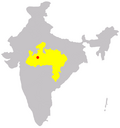
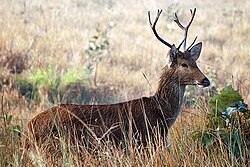
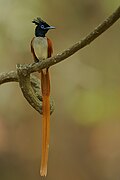
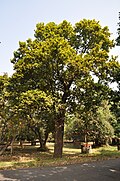
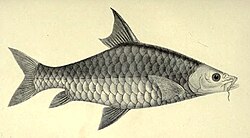
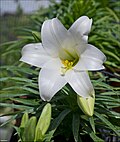
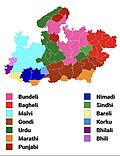


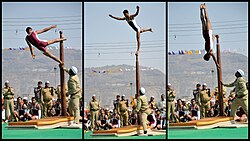
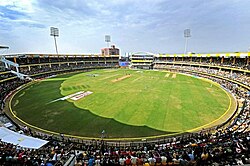

 India
India 72,597,565
 0.692 Medium[7] (32nd)
.jpg)

.jpg)


 [[:Media:MadhyaPradesh.ogg|]] (help·info); lit. 'Central Province') is a state in central India. Its capital is Bhopal. Other major cities include Indore, Gwalior, Jabalpur, Chhindwara, and Sagar. Madhya Pradesh is the second largest Indian state by area and the fifth largest state by population with over 72 million residents. It borders the states of Rajasthan to the northwest, Uttar Pradesh to the northeast, Chhattisgarh to the east, Maharashtra to the south, Gujarat to the west.[11]
.svg)

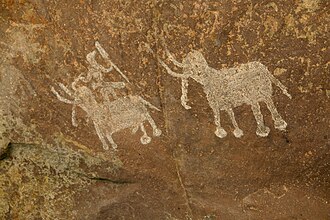 Mesolithic rock painting, Bhimbetka rock shelters, a UNESCO World Heritage Site in Raisen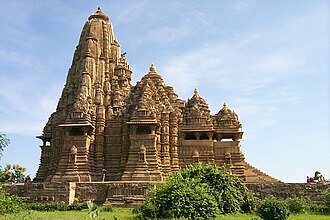
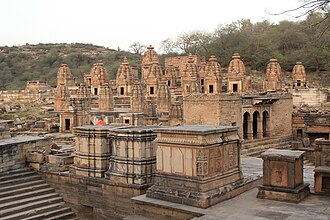 Bateshwar temple complex, Padavli, Morena
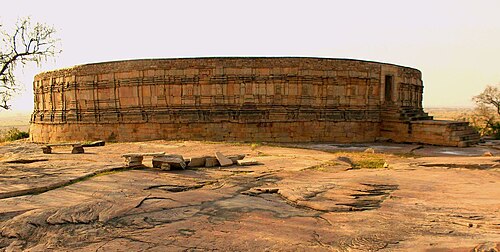 Ekatarso Mahadeva Temple, Mitaoli, Morena
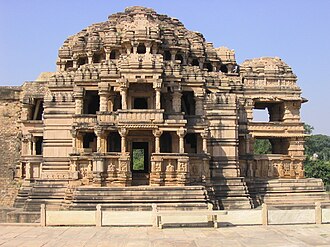 Saas and Bahu Temples, Gwalior Fort
 Teli Temple, Gwalior Fort
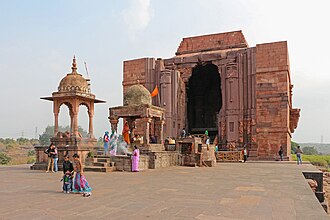 Shiva Temple, Bhojpur
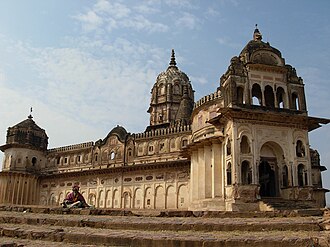 Lakshmi Temple, Orchha
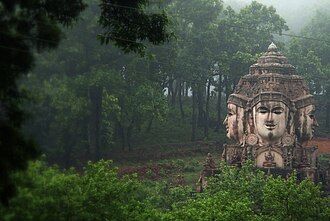 Brahma statue with various deities at Amarkantak
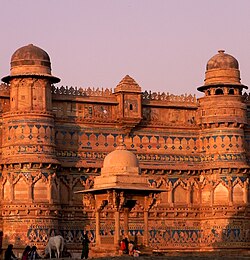 Man Mandir, Gwalior Fort
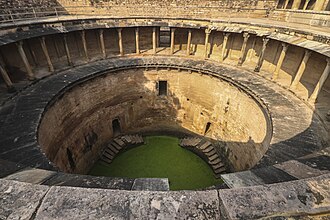 Assi Khambo ki Baoli, Gwalior Fort
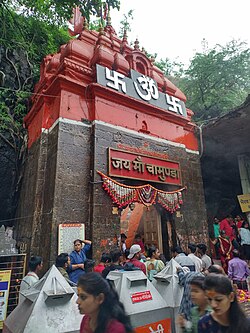 Maa Chamunda Mata Temple, Dewas
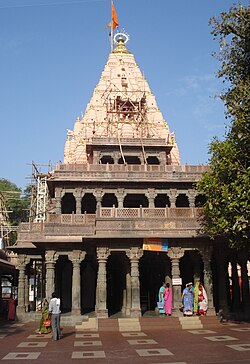 Mahakaleshwar Temple, Ujjain
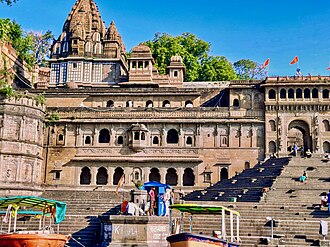 Maheshwar Ghats and Fort, Maheshwar, Khargone
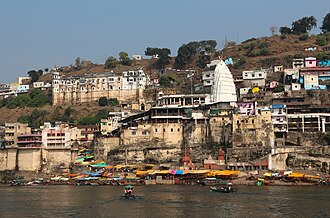 Omkareshwar Temple, Khandwa

.JPG)


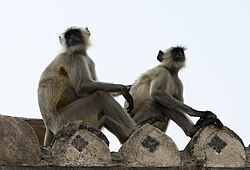 Langur monkey (Semnopithecus dussumieri), Orchha
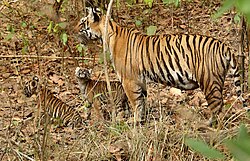 Tigress with cubs in Kanha Tiger Reserve
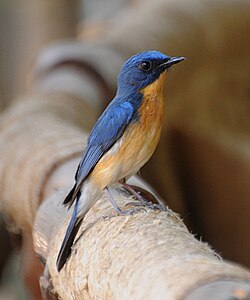 Tickell's blue flycatcher, Bandhavgarh National Park
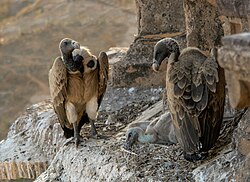 Vultures in the nest, Orchha
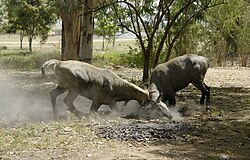 Male nilgais fighting, Lakeshwari, Gwalior district

.jpg)


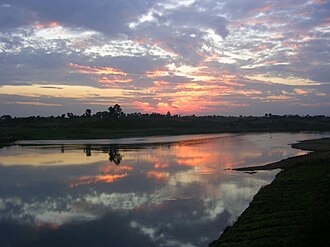 Narmada River
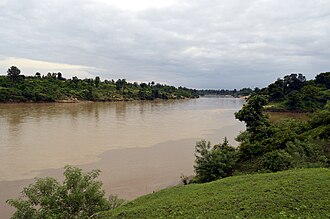 Son River, Umaria district
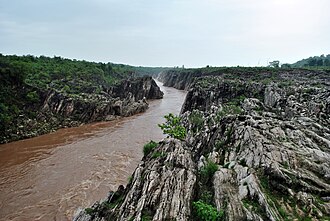 The River Narmada flows through a gorge of marble rocks in Bhedaghat, Jabalpur
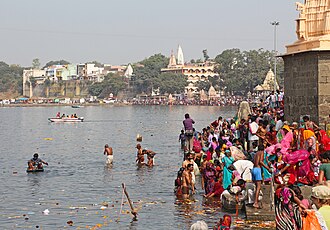 The Shri Ram Ghat on the Shipra River in Ujjain
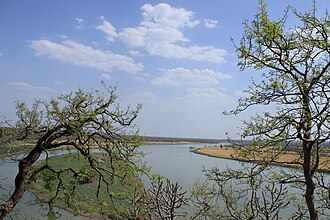 Betwa in the Ashoknagar district


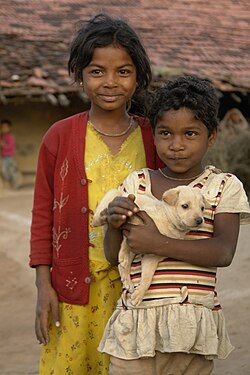 Children in Raisen district, Bhil tribe
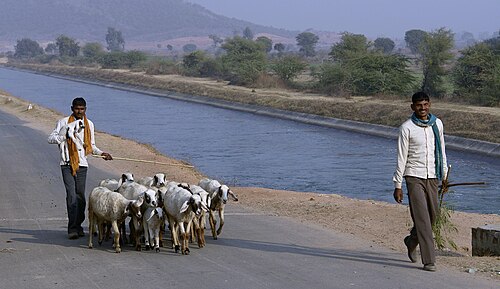 Shepherds in Chambal
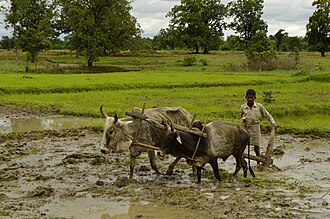 A young farmer in Umaria district
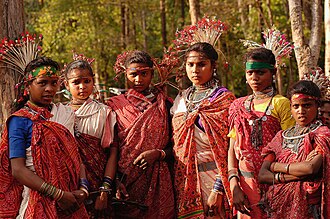 Young Baiga women
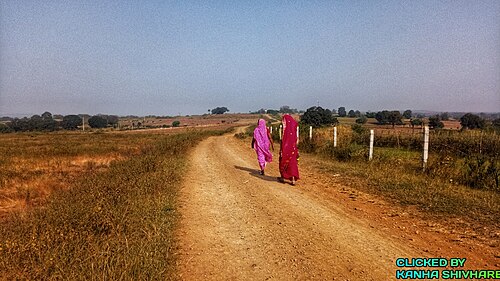 Village Street of mehta in seoni district


.jpg)
.svg)
.jpg)
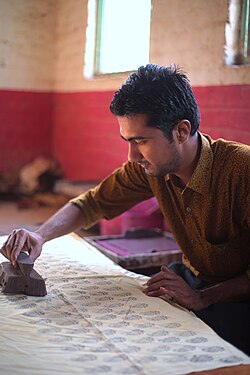 Bagh Print Traditional hand block print craft in Bagh.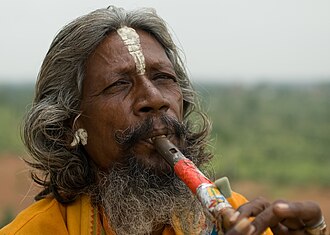
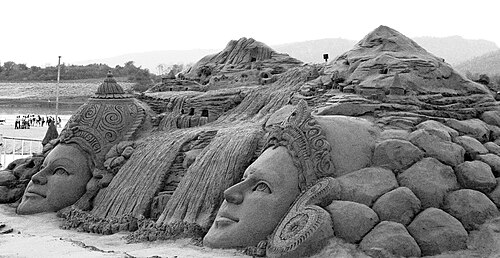 Sand sculpture by Sudarshan Pattnaik at Bandrabhan near Narmadapuram


%27s_Matang_Truck_for_the_Indian_Army.jpg)


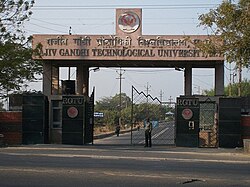 Rajiv Gandhi Technical University's main gate
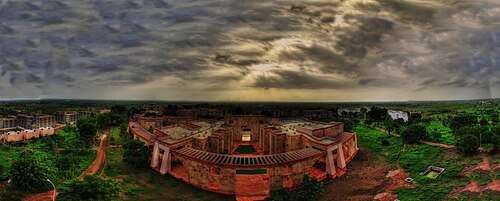 IIM Indore's aerial panoramic view
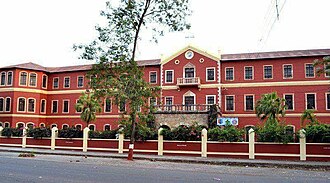 St. Aloysius Senior Secondary School, Jabalpur, established in the year 1868 is among the oldest schools in India


 Wikimedia Atlas of Madhya Pradesh
 Geographic data related to Madhya Pradesh at OpenStreetMap


