




m robot: Update article (please report if you notice any mistake or error in this edit) |
improved article |
||
| Line 1: | Line 1: | ||
{{Short description| | {{Short description|none}} | ||
{{Original research|date=July 2025}} | |||
{{History of Punjab}} | {{History of Punjab}} | ||
{{HistoryOfSouthAsia}} | {{HistoryOfSouthAsia}} | ||
{{Punjabis}} | {{Punjabis}} | ||
{{Use dmy dates|date=December 2020}} | {{Use dmy dates|date=December 2020}} | ||
{{Use | {{Use Pakistani English|date=November 2022}} | ||
The '''History of Punjab''' is the history of the [[Punjab]] region which is a geopolitical, cultural, and historical region in the [[Northwestern South Asia|northwest]] of [[South Asia]], comprising the [[Punjab, Pakistan|Punjab province]] in [[Pakistan]] and the [[Punjab, India|Punjab state]] in India.<ref name=EoS>{{cite encyclopedia|url=http://www.learnpunjabi.org/eos/PUNJAB.html |title=The Punjab |author=H K Manmohan Siṅgh|encyclopedia=The Encyclopedia of Sikhism, Editor-in-Chief Harbans Singh |publisher=[[Punjabi University]], Patiala|access-date=18 August 2015 |url-status=live |archive-url=https://web.archive.org/web/20160305062705/http://www.learnpunjabi.org/eos/PUNJAB.html |archive-date=5 March 2016}}</ref> It is believed that the earliest evidence of human habitation in Punjab traces to the [[Soan valley]] of the [[Pothohar Plateau|Pothohar]], between the [[Indus]] and the [[Jhelum river]]s, where [[Soanian|Soanian culture]] developed between 774,000 BC and 11,700 BC. This period goes back to the first interglacial period in the [[Cryogenian|second Ice Age]], from which remnants of stone and flint tools have been found.{{sfn|Singh|1989|p=1}} | |||
[[ | The Punjab region was the site of one of the earliest [[cradle of civilization]]s, the [[Bronze Age]] [[Harrapan civilization]] that flourished from about 3000 B.C. and declined rapidly 1,000 years later, following the [[Indo-Aryan migrations]] that overran the region in waves between 1500 and 500 B.C.<ref name=":9">{{Cite book |last=Minahan |first=James |url=https://books.google.com/books?id=abNDLZQ6quYC&pg=PA257 |title=Ethnic Groups of South Asia and the Pacific: An Encyclopedia |date=2012 |publisher=ABC-CLIO |isbn=978-1-59884-659-1 |pages=257–259 |language=en |access-date=21 August 2022 |archive-date=18 November 2022 |archive-url=https://web.archive.org/web/20221118182901/https://books.google.com/books?id=abNDLZQ6quYC&pg=PA257 |url-status=live }}</ref> The migrating Indo-Aryan tribes gave rise to the [[Iron Age]] [[Vedic civilization]], which lasted till 500 BC. During this era, the [[Rigveda]] was composed in [[Punjab]],{{sfn|Flood|1996|p=37}} laying the foundation of [[Hinduism]]. In the 6th century BC, [[Pushkarasarin]], the monarch of [[Gandhara]], assumed a role in halting the expansionary ambitions of the [[Achaemenid Empire]] until during the reign of [[Darius the Great|Darius]] wherein tribute rendered by Gandhara to him is first documented.<ref name="Prakash2">{{cite journal |last=Prakash |first=Buddha |date=1951 |title=Poros |url=https://www.jstor.org/stable/41784590 |journal=Annals of the Bhandarkar Oriental Research Institute |volume=32 |issue=1 |pages=198–233 |doi= |jstor=41784590 |access-date=12 June 2022}}</ref> A century later, the [[Janapada]]s of Punjab encountered the expansive undertakings of [[Alexander the Great|Alexander]]. The Janapadas exhibited resistance to his advances, notably the [[Aśvaka]] of Gandhara, the [[Mallian people|Mallians of South Punjab]], and [[Porus]] of Central Punjab.<ref>{{Cite web |title=3 alexander and his successors in central asia |url=https://fr.unesco.org/silkroad/sites/default/files/knowledge-bank-article/vol_II%20silk%20road_alexander%20and%20his%20successors%20in%20central%20asia.pdf |page= |quote=}}</ref> Following the demise of Alexander, [[Chandragupta Maurya]], who had received his education in the city of [[Taxila]]{{dubious|date=July 2025}}, garnered support from republics such as [[Trigarta Kingdom|Trigarta]] and [[Gandhara]].<ref>{{Cite book |last=Rajkamal Publications Limited |first=New Delhi |url=http://archive.org/details/in.ernet.dli.2015.189620 |title=Chandragupta Maurya And His Times |date=1943 |page=16 |quote=Chanakya, who is described as a resident of the city of Taxila, returned to his native city with the boy and had him educated for a period of 7 or 8 years at that famous seat of learning where all the ' sciences and arts ' of the times were taught, as we know from the Jatakas.}}</ref> He subsequently conquered the [[Nanda Empire]], with Taxila being designated as the provincial capital of the Northwestern territories. After its decline, the [[Indo-Greek Kingdom|Indo-Greeks]], [[Indo-Saka]]s and [[Indo-Parthian Kingdom|Indo-Parthians]] successively established reigns in Punjab however other states maintained autonomy and other janapadas such as that of the [[Yaudheya]] and the [[Audumbaras]] in Eastern Punjab resisted their expansions.<ref name="auto">{{Cite book |last=Tarn |first=William Woodthorpe |url=https://books.google.com/books?id=-HeJS3nE9cAC&pg=PA324 |title=The Greeks in Bactria and India |date=2010-06-24 |publisher=Cambridge University Press |isbn=978-1-108-00941-6 |language=en}}</ref><ref>{{Cite book |last=Ohri |first=Vishwa Chander |url=https://books.google.com/books?id=Qws1AAAAIAAJ&q=dharagosha+audumbaras |title=Himachal Art & Archaeology: Some Aspects |date=1980 |publisher=State Museum, Department of Languages & Culture, Himachal Pradesh |language=en}}</ref> In the late 1st century AD the [[Kushan Empire]] annexed Punjab, [[Gandhara]]s cultural zenith occurred during this period in which artwork from the region flourished. | ||
The [[ | The devastating [[Alchon Huns#Persecution of Buddhism|Hunnic invasions]] of Punjab occurred in the 5th and 6th century, which were ultimately repelled by the [[Pushyabhuti dynasty|Vardhana dynasty]].<ref>{{Cite book |last=Gokhale |first=Balkrishna Govind |author-link=Balkrishna Govind Gokhale |url=https://books.google.com/books?id=-_UHAQAAIAAJ&q=adityavardana+defeated+huns |title=Ancient India, History and Culture |date=1952 |publisher=Asia Publishing House |language=en}}</ref><ref>{{Cite book |last=Somānī |first=Rāmavallabha |url=https://books.google.com/books?id=NbTqAAAAMAAJ&q=adityavardhan+defeated+huns |title=Temples of Rajasthan |date=1996 |publisher=Publication Scheme |isbn=978-81-85263-87-8 |language=en}}</ref> Most of the western Punjab region became unified under the [[Taank Kingdom|Taank]] and [[Hindu Shahis|Odi Shahi Kingdoms]] in the early medieval period. Between the 8th and 12th century, the [[Tomara dynasty]] and [[Katoch Dynasty|Katoch dynasty]] controlled the eastern portions of Punjab.<ref>{{Cite book |last1=Hutchison |first1=John |url=https://books.google.com/books?id=3btDw4S2FmYC&q=diwan+i+salman+jalandhar |title=History of the Panjab Hill States |last2=Vogel |first2=Jean Philippe |date=1994 |publisher=Asian Educational Services |isbn=978-81-206-0942-6 |language=en}}</ref> [[Islam]] became established in Punjab when the [[Umayyad Caliphate]] conquered southern portions of the region up to Multan, which became independent from the caliphate under the [[Emirate of Multan]] in 855. The [[Ghaznavids]] conquered region in 1025, after whom the [[Delhi Sultanate]] followed. The [[Langah Sultanate]] ruled much of the south [[Punjab, Pakistan|Punjab]] in the 15th century. | ||
The [[Mughal Empire]], established in 1526 AD, has left an immense cultural and architectural legacy in Punjab. The city of [[Lahore]] became one of the largest in the world under Mughals. In the 16th century, [[Sikhism]] was founded by [[Guru Nanak]] in central Punjab which attracted many followers. After a long period of anarchy due to decline of Mughals in the 18th century, the [[Sikh Empire]] in 1799 unified most of the Punjab region. The region was conquered by the British EIC in 1849 after [[Second Anglo-Sikh War]] and [[Punjab Province (British India)|Punjab province]] was created in 1857. In 1947, [[Partition of India|Punjab was partitioned]] amidst wide-scale violence. | |||
== | ==Etymology== | ||
=== | Though the name Punjab is of [[Persian language|Persian]] origin, its two parts ({{Langx|fa|پنج|translit=panj|label=none|lit=five}} and {{Langx|fa|آب|translit=āb|label=none|lit=water}}) are cognates of the Sanskrit words, {{Langx|sa|पञ्च|lit=five|translit=pañca|label=none}} and {{Langx|sa|अप्|lit=water|translit=áp|label=none}}, of the same meaning.<ref name="EoS" /><ref>{{cite book |last=Gandhi |first=Rajmohan |title=Punjab: A History from Aurangzeb to Mountbatten |publisher=Aleph Book Company |year=2013 |isbn=978-93-83064-41-0 |location=New Delhi, India, Urbana, [[Illinois]] |page=1 ("Introduction")}}</ref> The word ''Pañjāb'' thus means 'The Land of Five Waters', referring to the rivers [[Jhelum River|Jhelum]], [[Chenab River|Chenab]], [[Ravi River|Ravi]], [[Sutlej]], and [[Beas River|Beas]].<ref>"Punjab." Pp. 107 in [[Encyclopædia Britannica, Ninth Edition|''Encyclopædia Britannica'' (9th ed.)]], vol. 20.</ref> All are [[Tributary|tributaries]] of the [[Indus River]], the Sutlej being the largest. References to a land of five rivers may be found in the ''[[Mahabharata]]'', which calls one of the regions in [[Aryavarta]] ''Panchanada'' ({{Langx|sa|पञ्चनद|lit=five rivers|translit=pañca-nada}}).<ref>{{cite book |url=https://books.google.com/books?id=GdKcAAAAQBAJ&pg=PA199 |title=The Geography of India: Sacred and Historic Places |publisher=Britannica Educational Publishing |year=2010 |isbn=978-1-61530-202-4 |editor=Kenneth Pletcher |pages=199 |quote=The word's origin can perhaps be traced to panca nada, Sanskrit for "five rivers" and the name of a region mentioned in the ancient epic the Mahabharata. |access-date=11 August 2022 |archive-date=18 November 2022 |archive-url=https://web.archive.org/web/20221118182901/https://books.google.com/books?id=GdKcAAAAQBAJ&pg=PA199 |url-status=live }}</ref><ref>{{cite book |author=Rajesh Bala |url=https://books.google.com/books?id=PzduAAAAMAAJ |title=Punjab History Conference, Thirty-seventh Session, March 18–20, 2005: Proceedings |publisher=Punjabi University |year=2005 |isbn=978-81-7380-990-3 |editor=Sukhdial Singh |page=80 |chapter=Foreign Invasions and their Effect on Punjab |quote="The word Punjab is a compound of two words-Panj (Five) and aab (Water), thus signifying the land of five waters or rivers. This origin can perhaps be traced to panch nada, Sanskrit for 'Five rivers' the word used before the advent of Muslims with a knowledge of Persian to describe the meeting point of the Jhelum, Chenab, Ravi, Beas, and Sutlej rivers, before they joined the Indus." |access-date=11 August 2022 |archive-date=18 November 2022 |archive-url=https://web.archive.org/web/20221118182926/https://books.google.com/books?id=PzduAAAAMAAJ |url-status=live }}</ref> The ancient [[Greek people|Greeks]] referred to the region as ''Pentapotamía'' ({{langx|el|Πενταποταμία}}),<ref>[[Christian Lassen|Lassen, Christian]]. 1827. ''[https://books.google.com/books?id=XbBCAAAAcAAJ&pg=PA3 Commentatio Geographica atque Historica de Pentapotamia Indica] {{Webarchive|url=https://web.archive.org/web/20221118182901/https://books.google.ca/books?id=XbBCAAAAcAAJ&pg=PA3&redir_esc=y |date=18 November 2022 }}'' [''A Geographical and Historical Commentary on Indian Pentapotamia'']. Weber. p. 4: "That part of India which today we call by the Persian name <nowiki>''</nowiki>Penjab<nowiki>''</nowiki> is named ''Panchanada'' in the sacred language of the Indians; either of which names may be rendered in Greek by Πενταποταμια. The Persian origin of the former name is not at all in doubt, although the words of which it is composed are both Indian and Persian.... But, in truth, that final word is never, to my knowledge, used by the Indians in proper names compounded in this way; on the other hand, there exist multiple Persian names which end with that word, e.g., ''Doab'' and ''Nilab''. Therefore, it is probable that the name Penjab, which is today found in all geographical books, is of more recent origin and is to be attributed to the Muslim kings of India, among whom the Persian language was mostly in use. That the Indian name Panchanada is ancient and genuine is evident from the fact that it is already seen in the ''Ramayana'' and ''Mahabharata'', the most ancient Indian poems, and that no other exists in addition to it among the Indians; for ''Panchála'', which English translations of the ''Ramayana'' render with Penjab...is the name of another region, entirely distinct from Pentapotamia...."{{whose translation|reason=has several mistakes – looks like Google translation|date=August 2022}}</ref><ref>{{cite book |author1-last=Latif |author1-first=Syad Muhammad |url=https://books.google.com/books?id=RzBAAQAAMAAJ&pg=PR1 |title=History of the Panjáb from the Remotest Antiquity to the Present Time |publisher=[[Calcultta Central Press Company]] |year=1891 |page=1 |quote=The Panjáb, the Pentapotamia of the Greek historians, the north-western region of the empire of Hindostán, derives its name from two Persian words, ''panj'' (five), an ''áb'' (water), having reference to the five rivers which confer on the country its distinguishing features." |access-date=11 August 2022 |archive-date=18 November 2022 |archive-url=https://web.archive.org/web/20221118182902/https://books.google.com/books?id=RzBAAQAAMAAJ&pg=PR1 |url-status=live }}</ref> which has the same meaning as the Persian word.<ref name="Khalid2">{{cite journal |year=2015 |title=Lahore of Pre Historic Era |url=http://pu.edu.pk/images/journal/history/PDF-FILES/7.%20Kanwal%20Khalid_v52_2_15.pdf |url-status=live |journal=Journal of the Research Society of Pakistan |volume=52 |issue=2 |page=73 |archive-url=https://web.archive.org/web/20220811210654/http://pu.edu.pk/images/journal/history/PDF-FILES/7.%20Kanwal%20Khalid_v52_2_15.pdf |archive-date=11 August 2022 |access-date=11 August 2022 |quote=The earliest mention of five rivers in the collective sense was found in Yajurveda and a word Panchananda was used, which is a Sanskrit word to describe a land where five rivers meet. [...] In the later period the word ''Pentapotamia'' was used by the Greeks to identify this land. (''Penta'' means 5 and potamia, water ___ the land of five rivers) Muslim Historians implied the word "Punjab " for this region. Again it was not a new word because in Persian-speaking areas, there are references of this name given to any particular place where five rivers or lakes meet. |author1-last=Khalid |author1-first=Kanwal}}</ref> | ||
{{ | |||
[[File: | ==Geographical extent== | ||
[[File:Punjab map (topographic) with cities.png|thumb|right|The region of Punjab ({{literally}} [Land of] the Five Rivers)]] | |||
Today Punjab region is usually considered to consist of [[Punjab, Pakistan|Punjab province]] in Pakistan and [[Punjab, India|Punjab state]] in India. The boundaries of the region are ill-defined and focus on historical accounts and thus the geographical definition of the term "Punjab" has changed over time. In the 16th century, [[Mughal Empire]] referred it to a relatively smaller area between the [[Indus River|Indus]] and the [[Sutlej River|Sutlej]] rivers.<ref name="JS_Grewal_1998">{{cite book |first=J. S. |last=Grewal |url=https://books.google.com/books?id=2_nryFANsoYC |title=The Sikhs of the Punjab |publisher=Cambridge University Press |year=1998 |isbn=978-0-521-63764-0 |edition=Revised |series=The New Cambridge History of India |page=1 |access-date=11 August 2022 |archive-date=18 November 2022 |archive-url=https://web.archive.org/web/20221118182902/https://books.google.com/books?id=2_nryFANsoYC |url-status=live }}</ref> In [[British Raj]], the [[Punjab Province (British India)|Punjab Province]] was a large administrative region encompassing the present-day Indian [[States and union territories of India|states and union territories]] of [[Punjab, India|Punjab]], [[Haryana]], [[Himachal Pradesh]], [[Chandigarh]], and [[Delhi]] and the [[Administrative units of Pakistan|Pakistani regions]] of [[Punjab, Pakistan|Punjab]] and [[Islamabad Capital Territory]]. It bordered [[Balochistan]] and [[North-West Frontier Province|North-West Frontier]] to the west, [[Jammu and Kashmir (princely state)|Jammu and Kashmir]] to the north, the [[Hindi Belt]] to the east, and [[Rajasthan]] and [[Sindh]] to the south.<ref name="Chisholm 1911, p. 653">{{cite EB1911|Volume 22|wstitle=Punjab|page=653}}</ref> | |||
=== | ==Prehistory== | ||
===Paleolithic=== | |||
{{main|Soanian}} | |||
[[Homo erectus]] lived on the [[Pothohar Plateau]], in upper Punjab, Pakistan along the [[Soan River]] (nearby modern-day [[Rawalpindi]]) during the [[Pleistocene Epoch]]. Soanian sites are found in the [[Sivalik Hills|Sivalik region]] across what are now India, Pakistan and Nepal.<ref>Parth R. Chauhan. [http://www.assemblage.group.shef.ac.uk/issue7/chauhan.html#distribution Distribution of Acheulian sites in the Siwalik region] {{webarchive|url=https://web.archive.org/web/20120104171240/http://www.assemblage.group.shef.ac.uk/issue7/chauhan.html |date=2012-01-04 }}. ''An Overview of the Siwalik Acheulian & Reconsidering Its Chronological Relationship with the Soanian – A Theoretical Perspective''.</ref> The Soanian culture was a prehistoric technological culture from the [[Sivalik Hills|Siwalik Hills]].<ref name="SchugWalimbe2016">{{cite book|author1=Gwen Robbins Schug|author2=Subhash R. Walimbe|title=A Companion to South Asia in the Past|url=https://books.google.com/books?id=7xv-CwAAQBAJ&pg=PA39|date=13 April 2016|publisher=John Wiley & Sons|isbn=978-1-119-05547-1|pages=39–|access-date=10 November 2022|archive-date=18 November 2022|archive-url=https://web.archive.org/web/20221118182902/https://books.google.com/books?id=7xv-CwAAQBAJ&pg=PA39|url-status=live}} Quote: "Soanian and Soanian‐like assemblages are known throughout the entire Siwalik or Sub‐ Himalayan region, from Pakistan to northeast India including Nepal..."</ref><ref name="sites.google.com">{{cite journal |last1=Lycett |first1=Stephen J. |title=Is the Soanian techno-complex a Mode 1 or Mode 3 phenomenon? A morphometric assessment |journal=Journal of Archaeological Science |date=2007 |volume=34 |issue=9 |pages=1434–1440 |doi=10.1016/j.jas.2006.11.001 |bibcode=2007JArSc..34.1434L |url=http://sites.google.com/site/sjlycett/Lycett_2007_Soan.pdf |access-date=10 November 2022 |archive-date=7 October 2021 |archive-url=https://web.archive.org/web/20211007112602/http://sites.google.com/site/sjlycett/Lycett_2007_Soan.pdf |url-status=dead }}</ref> It is named after the [[Soon Valley|Soan Valley]] in Punjab, Pakistan.<ref>{{cite web|url=https://www.dawn.com/news/1312059|title=Pakistan: The lesser-known histories of an ancient land|date=2 February 2017 |access-date=10 November 2022|archive-date=10 September 2018|archive-url=https://web.archive.org/web/20180910204149/https://www.dawn.com/news/1312059|url-status=live}}</ref> The Soanian culture has been approximated to have taken place during the [[Chibanian|Middle Pleistocene]] period or the [[Holocene climatic optimum|mid-Holocene]] epoch ([[Northgrippian]]). Soanian artifacts were manufactured on quartzite [[pebble]]s, [[Cobble (geology)|cobbles]], and occasionally on [[boulder]]s, all derived from various [[Fluvial processes|fluvial sources]] on the [[Sivalik Hills|Siwalik]] landscape. Soanian assemblages generally comprise varieties of [[Chopper (archaeology)|choppers]], discoids, [[Scraper (archaeology)|scrapers]], [[Core (archaeology)|cores]], and numerous flake type tools, all occurring in varying typo-technological frequencies at different sites.<ref>Paterson, T.T., Drummond, H.J.H., 1962. Soan the Palaeolithic of Pakistan.Department of Archaeology, Government of Pakistan Karachi.</ref> | |||
===Neolithic=== | |||
Relics and human skulls have been found dating back to 5000 BCE in the Pothohar Plateau in north of Punjab that indicate the region was home to [[Neolithic]] peoples who settled on the banks of the [[Swaan River]],<ref name="Pakistan net"/> and who later developed small communities in the region around 3000 BCE.<ref name="Pakistan net">{{cite web|title=Islamabad history |publisher=Pakistan.net |url=http://www.pakistan.net/cities/islamabad/islamabad.htm |archive-url=https://web.archive.org/web/20080630100106/http://www.pakistan.net/cities/islamabad/islamabad.htm |url-status=dead |archive-date=30 June 2008 }}</ref> | |||
==Bronze Age (3300 BC – 1300 BC)== | |||
{{Main|Indus Valley Civilisation|Cemetery H culture}} | |||
[[File:Ceremonial Vessel LACMA AC1997.93.1.jpg|thumb|175px|left|Ceremonial vessel; 2600 – 2450 BC; discovered from [[Harappa]], [[Punjab, Pakistan]].]] | |||
The [[Indus Valley Civilisation]] is also known as the ''Harappan civilisation'', after its [[type site]] [[Harappa]], the first to be excavated early in the 20th century in Punjab.{{Sfn|Habib|2015|p=13}}{{refn|Habib: "Harappa, in Sahiwal district of west Punjab, Pakistan, had long been known to archaeologists as an extensive site on the Ravi river, but its true significance as a major city of an early great civilization remained unrecognized until the discovery of Mohenjo-daro near the banks of the Indus, in the Larkana district of Sindh, by Rakhaldas Banerji in 1922. Sir John Marshall, then Director General of the Archaeological Survey of India, used the term 'Indus civilization' for the culture discovered at Harappa and Mohenjo-daro, a term doubly apt because of the geographical context implied in the name 'Indus' and the presence of cities implied in the word 'civilization'. Others, notably the Archaeological Survey of India after Independence, have preferred to call it `Harappan', or 'Mature Harappan', taking Harappa to be its type-site."{{Sfn|Habib|2015|p=13}}|group=lower-alpha}} The discovery of Harappa and soon afterwards Mohenjo-daro was the culmination of work that had begun after the founding of the [[Archaeological Survey of India]] in the [[British Raj]] in 1861.{{Sfn|Wright|2009|p=2}} | |||
The civilisation flourished both in the [[alluvial plain]] of the [[Indus River]], which flows through the length of Pakistan, and along a system of perennial [[monsoon]]-fed rivers that once coursed in the vicinity of the [[Ghaggar-Hakra River|Ghaggar-Hakra]], a seasonal river in northwest India and eastern Pakistan.{{Sfn|Wright|2009|p=1}}{{Sfn|Giosan|Clift|Macklin|Fuller|2012}}The cities of the ancient Indus were noted for their [[urban planning]], [[baked brick]] houses, elaborate [[drainage]] systems, [[water supply]] systems, clusters of large non-residential buildings, and techniques of handicraft and [[metallurgy]].{{efn|These covered [[carnelian]] products, seal carving, work in [[copper]], [[bronze]], lead, and tin.{{Sfn|Wright|2009|pp=115–125}}}} [[Mohenjo-daro]] and [[Harappa]] very likely grew to contain between 30,000 and 60,000 individuals,<ref>{{harvnb|Dyson|2018|p=29}} "Mohenjo-daro and Harappa may each have contained between 30,000 and 60,000 people (perhaps more in the former case). Water transport was crucial for the provisioning of these and other cities. That said, the vast majority of people lived in rural areas. At the height of the Indus valley civilization the subcontinent may have contained 4–6 million people."</ref> and the civilisation may have contained between one and five million individuals during its florescence.{{Sfn|McIntosh|2008|p=387|ps=: "The enormous potential of the greater Indus region offered scope for huge population increase; by the end of the Mature Harappan period, the Harappans are estimated to have numbered somewhere between 1 and 5 million, probably well below the region's carrying capacity."}} A gradual [[Aridification|drying]] of the region during the 3rd millennium BCE may have been the initial stimulus for its urbanisation. Eventually it also reduced the water supply enough to cause the civilisation's demise and to disperse its population to the east. | |||
==Iron Age (c. 1300 BC – 518 BC)== | |||
{{main|Vedic period}} | |||
==Ancient | === Vedic Era === | ||
===Achaemenid | In ancient times the region was known as [[Vahika]] as is attested by authors such as [[Pāṇini]] and [[Patanjali]] in the 6th century CE, in which they describe the region as a territory of [[Sangha]]s which denotes a republic form of government. [[Pāṇini]] further describes the ruling class of the Vahika republics with some dominated by [[Brahmin]]s and others of ‘Rajanyas’ otherwise known as [[Kshatriya]]s.<ref>{{Cite book |last=Agrawala |first=V. S. |url=http://archive.org/details/in.gov.ignca.4695 |title=India as known to Panini |date=1953 |page=77 |quote=Panini specially mentions the Vahika sanghas, some dominated by Brahmanas as ruling caste, others by Rajanyas, and called Rajanyaka}}</ref> The Udichya region was another region mentioned in ancient texts and is noted by [[Pāṇini]] as comprising both the regions of Vahika and [[Gandhara]].<ref>{{Cite book |last=Agrawala |first=V. S. |url=http://archive.org/details/in.gov.ignca.4695 |title=India as known to Panini |date=1953 |pages=38 |quote=Udichya and Prachya are the two broad divisions of the country mentioned by Panini, and these terms occur in connection with the linguistic forms known to the eastern and northern grammarians. The Udichya country included Gandhara and Vahika, the latter comprising Madra and Usinara.}}</ref> According to [[Rigveda|Rigvedic tradition]], [[Yayati]] was the progenitor of the prominent Udichya tribes and had numerous sons, including Anu, Puru, and Druhyu. The lineage of Anu gave rise to the [[Madra]], [[Kekaya]], [[Sivi Kingdom|Sivi]] and [[Uśīnara]] kingdoms of central Punjab, while the Druhyu tribe has been associated with the [[Gandhara]] kingdom based in modern day [[Khyber Pakhtunkhwa|KPK]] and the [[Pothohar Plateau]] of Punjab.<ref>{{Cite book |url=https://books.google.com/books?id=WIMlttRq_P4C&dq=Druhyu+Anu+Puru&pg=PA230 |title=Journal of the Royal Asiatic Society |date=1889 |publisher=University Press |page=212 |language=en}}</ref> | ||
[[File:Mahajanapadas (c. 500 BCE).png|thumb|upright=1.15|Map of Indian subcontinent in 500 BCE. Kingdoms of [[Gandhāra (kingdom)|Gandhara]], [[Kekaya]], [[Madra]], [[Trigarta]] and [[Shivi|Sivi]] can be seen in Punjab in northwest.]] | |||
Some of the early Janas of the ''Rig Veda'' can be strongly attributed to Punjab. ''Rig Vedic'' Janas such as the [[Turvasu Druhyu and Anu Dynasties|Druhyus]], [[Turvasu Druhyu and Anu Dynasties|Anus]], [[Puru (Vedic tribe)|Purus]], [[Yadu dynasty|Yadus]], [[Turvasu Druhyu and Anu Dynasties|Turvasas]], [[Bharatas]], and others were associated in Punjab and the Indo-Gangetic plain. Other ''Rig Vedic'' Janapadas such as the [[Pakhtas]], Bhalanasas, Visanins, and Sivas were associated with areas in the north and west of Punjab.{{sfn|Chattopadhyaya|2003|p=55}} | |||
==== Battle of the Ten Kings ==== | |||
An important event of the ''Rig Vedic'' era was the "[[Battle of Ten Kings]]" which was fought on the banks of the river Parusni ([[Ravi river]]) in central Punjab, in c. 14th century BCE, between the Bharata clan on the one hand and a confederation of ten tribes on the other. The ten tribes pitted against Sudas comprised five major tribes: the Purus, the Druhyus, the Anus, the Turvasas and the Yadus; in addition to five minor ones: the Pakthas, the Alinas, the Bhalanas, the Visanins and the Sivas. Sudas was supported by the Vedic [[Rishi]] [[Vasishtha]], while his former Purohita, the Rishi [[Viswamitra]], sided with the confederation of ten tribes.{{sfn | Frawley | 2000 | p=118}} Sudas had earlier defeated Samvaran and ousted him from Hastinapur. It was only after the death of Sudas that Samvaran could return to his kingdom.{{sfn|Singh|1989|p=4}} A second battle, referred to as the Mahabharat in ancient texts, was fought in Punjab on a battlefield known as [[Kurukshetra]]. This was fought between the Pandavas and the Kauravas. Duryodhana, a descendant of Kuru (who was the son of king Samvaran), had tried to insult the Panchali princess Draupadi in revenge for defeating his ancestor Samvaran.{{sfn|Singh|1989|p=4}} | |||
[[File:Karna Slays the Kaikeya Prince Vishoka.jpg|thumb|left|250px|The [[Battle of Ten Kings]] was fought on the banks of [[Ravi river|River Parusni]] in [[Punjab]] – A depiction from [[Razmnama]] (1585)]] | |||
Many Janapadas were mentioned from Vedic texts and there was a large level of contact between all the Janapadas with descriptions being given of trading caravans, movement of students from universities, and itineraries of princes.{{sfn|Chattopadhyaya|2003|pages=56—57}} In its heyday, the [[University of ancient Taxila]] attracted students from all over Indian subcontinent as well as those from surrounding countries.{{sfn|Singh|1989|p=4}} | |||
== Ancient Punjab (518 BC – c. 500 AD) == | |||
=== Pukkusāti and Achaemenid Gandāra (518 BC – 326 BC) === | |||
{{main|Achaemenid conquest of the Indus Valley}} | {{main|Achaemenid conquest of the Indus Valley}} | ||
[[ | During the 6th century BCE, Gandhara was governed under the reign of King [[Pushkarasarin|Pukkusāti]]. According to early [[Buddhism|Buddhist]] accounts, he had forged diplomatic ties with [[Magadha (Mahajanapada)|Magadha]] and achieved victories over neighbouring kingdoms such as that of the realm of [[Avanti (region)|Avanti]].<ref>{{Cite book |last=Chattopadhyaya |first=Sudhakar |url=http://archive.org/details/in.ernet.dli.2015.118140 |title=The Achaemenids And India |date=1974 |page=22 |quote=According to the Buddhist account Pukkusati, king of Taksasila, sent an embassy and a letter to king Bimbisara of Magadha and he also defeated Pradyota, king of Avanti.}}</ref> It is noted by [[R. C. Majumdar]] that Pukkusāti would have been contemporary to the [[Achamenid]] king [[Cyrus the Great]]<ref>{{Cite book |last=Chattopadhyaya |first=Sudhakar |url=http://archive.org/details/in.ernet.dli.2015.118140 |title=The Achaemenids And India |date=1974 |page=22 |quote=Bimbisara and his son Ajatasatru, he did not probably come to the throne before 540 or 530 bc, and Pukkusati also may be regarded as ruling in Gandhara about that time. He would be thus a contemporary of Cyrus who established his power and authority in 549 bc}}</ref> and according to the scholar Buddha Prakash, Pukkusāti might have acted as a bulwark against the expansion of the [[Persians|Persian]] [[Achaemenid Empire]] into Gandhara. This hypothesis posits that the army which [[Nearchus]] claimed Cyrus had lost in [[Gedrosia]] had been defeated by Pukkusāti's Gāndhārī kingdom.<ref name="Prakash2"/> Therefore, following Prakash's position, the Achaemenids would have been able to conquer Gandhāra only after a period of decline after the reign of Pukkusāti, combined with the growth of Achaemenid power under the kings [[Cambyses II]] and [[Darius the Great|Darius I]].<ref name="Prakash2" /> However, the presence of Gandhāra, referred to as {{transliteration|peo|Ga<sup>n</sup>dāra}} in [[Old Persian]], among the list of Achaemenid provinces in Darius's [[Behistun Inscription]] confirms that his empire had inherited this region from conquests carried out earlier by Cyrus.<ref name=":02">{{Cite book |url=http://archive.org/details/history-of-ancient-and-early-medeival-india-from-the-stone-age-to-the-12th-century-pdfdrive |title=History Of Ancient And Early Medieval India From The Stone Age To The 12th Century |page=604 |quote=The Behistun inscription of the Achaemenid emperor Darius indicates that Gandhara was conquered by the Persians in the later part of the 6th century BCE.}}</ref> It is unknown whether [[Pushkarasarin|Pukkusāti]] remained in power after the Achaemenid conquest as a Persian vassal or if he was replaced by a Persian [[satrap]], although [[Buddhism|Buddhist]] sources claim that he renounced his throne and became a monk after becoming a disciple of the [[Gautama Buddha|Buddha]].<ref>{{cite web |title=Pukkusāti |url=http://www.palikanon.com/english/pali_names/pu/pukkusati.htm |access-date=26 July 2020 |publisher=www.palikanon.com}}</ref> The annexation under Cyrus was limited to the Western sphere of Gandhāra as only during the reign of [[Darius the Great]] did the region between the [[Indus River]] and the [[Jhelum River]] become annexed.<ref name="Prakash2" /> However [[Megasthenes]] [[Indica (Megasthenes)|Indica]], states that the [[Achaemenid Empire|Achaemenids]] never conquered India and had only approached its borders after battling with the [[Massagetae]], it further states that the Persians summoned mercenaries specifically from the Oxydrakai tribe, who were previously known to have resisted the incursions of [[Alexander the Great]], but they never entered their armies into the region.<ref>{{Cite book |last=Mccrindle |first=J. W. |url=http://archive.org/details/AncientIndiaAsDescribedByMegasthenesAndArrianByMccrindleJ.W |title=Ancient India As Described By Megasthenes And Arrian by Mccrindle, J. W |page=109 |language=English |quote=The Persians indeed summoned the Hydrakai from India to serve as mercenaries, but they did not lead an army into the country and only approached its borders when Kyros marched against the Massagatai.}}</ref> | ||
=== Alexander's invasion === | |||
{{main|Indian campaign of Alexander the Great|Mallian campaign}} | |||
Frequent intertribal wars stimulated the growth of larger groupings ruled by chieftains and kings, who ruled local kingdoms known as [[Mahajanapadas]].<ref name=":9" /> The rise of kingdoms and dynasties in the Punjab is chronicled in the ancient Hindu epics, particularly the [[Mahabharata]].<ref name=":9" /> In 326 B.C. The earliest known notable local king of this region was known as [[King Porus]], who fought the famous [[Battle of the Hydaspes]] against [[Alexander the Great]]. His kingdom spanned between rivers ''Hydaspes'' ([[Jhelum River|Jhelum]]) and ''Acesines'' ([[Chenab River|Chenab]]); [[Strabo]] had held the territory to contain almost 300 cities.<ref name=":6">{{Cite book |last=Bosworth |first=Albert Brian |title=Conquest and Empire: The Reign of Alexander the Great |publisher=Cambridge University Press |year=1993 |pages=125–130 |chapter=The campaign of the Hydaspes}}</ref> He (alongside [[Abisares]]) had a hostile relationship with the Kingdom of [[Taxila]] which was ruled by his extended family.<ref name=":6" /> When the armies of Alexander crossed Indus in its eastward migration, probably in [[Udabhandapura]], he was greeted by the-then ruler of Taxila, [[Taxiles|Omphis]].<ref name=":6" /> Omphis had hoped to force both Porus and Abisares into submission leveraging the might of Alexander's forces and diplomatic missions were mounted, but while Abisares accepted the submission, Porus refused.<ref name=":6" /> This led Alexander to seek for a face-off with Porus.<ref name=":6" /> Thus began the Battle of the Hydaspes in [[326 BC]]; the exact site remains unknown.<ref name=":6" /> The battle is thought to have resulted in a decisive [[Greeks|Greek]] victory; however, A. B. Bosworth warns against an uncritical reading of Greek sources who were obviously exaggerative.<ref name=":6" /> Alexander later founded two cities—''[[Nicaea, Punjab|Nicaea]]'' at the site of victory and [[Alexandria Bucephalous|''Bucephalous'']] at the battle-ground, in memory of [[Bucephalus|his horse]], who died soon after the battle.<ref name=":6" />{{Efn|Craterus supervised the construction. These cities are yet to be identified.}} Later, [[tetradrachm]]s would be minted depicting Alexander on horseback, armed with a ''sarissa'' and attacking a pair of Indians on an elephant.<ref name=":6" /><ref>{{Cite book |last=Holt |first=Frank Lee |title=Alexander the Great and the mystery of the elephant medallions |publisher=University of California Press |year=2003}}</ref> Porus refused to surrender and wandered about atop an elephant, until he was wounded and his force routed.<ref name=":6" /> | |||
[[File:Le Brun, Alexander and Porus.jpg|thumb|350px|right| [[Alexander the Great|Alexander]] and [[Porus]] during the [[Battle of the Hydaspes]] – painting by [[Charles Le Brun]] (1673)]] | |||
When asked by Alexander how he wished to be treated, Porus replied "Treat me as a king would treat another king".<ref>Rogers, p.200</ref> Despite the apparently one-sided results, Alexander was impressed by Porus and chose to not depose him.<ref name=":7">{{Cite book |last=Bosworth |first=Albert Brian |title=Conquest and Empire: The Reign of Alexander the Great |publisher=Cambridge University Press |year=1993 |chapter=From the Hydaspes to the Southern Ocean}}</ref><ref>{{Cite book |last=Anson |first=Edward M. |title=Alexander the Great: Themes and Issues |publisher=Bloomsbury |year=2013 |isbn=9781441193797 |pages=151}}</ref>{{sfn|Roy|2004|pp=23–28}} Not only was his territory reinstated but also expanded with Alexander's forces annexing the territories of Glausaes, who ruled to the northeast of Porus' kingdom.<ref name=":7" /><ref>{{cite book |author1=Irfan Habib |url=https://books.google.com/books?id=nUvGQgAACAAJ |title=Mauryan India |author2=Vivekanand Jha |publisher=Aligarh Historians Society / [[Tulika Books]] |year=2004 |isbn=978-81-85229-92-8 |series=A People's History of India |page=16 |author1-link=Irfan Habib |access-date=11 August 2022 |archive-date=18 November 2022 |archive-url=https://web.archive.org/web/20221118182903/https://books.google.com/books?id=nUvGQgAACAAJ |url-status=live }}</ref> | |||
=== | After battle of Hydaspes, Alexander moved further southward during his campaign in Punjab which brought him in confrontation to the [[Mallian people|Mallian tribe]] in the south Punjab. The Malli, together with nearby tribe of oxydrakai, gathered an army of 90,000 personnel to fight against an army of 50,000 Greeks. Alexander started his [[Mallian campaign]] and advanced quickly than the expectations of the Mallians. Many of them were killed and rest fled to the Mallian capital, [[Multan]].{{sfn|Theodore Dodge|1890|p=597}} Alexander besieged the city after arriving there some days later. During the siege of the city's citadel, Alexander reputedly leaped into the inner area of the citadel, where he killed the Mallians' leader.<ref>Arrian (1893). Anabasis of Alexander. George Bell and Sons. OCLC 486120., p. 604</ref> Alexander was wounded by an arrow that had penetrated his lung, leaving him severely injured.<ref>Dodge, Theodore (1890). Alexander. New York: Da Capo Press. p. 604.</ref> The Greek army thereafter started killing civilians and animals and whatever came in their way to take revenge of their injured leader. The Mallian army eventually surrendered, preventing further bloodshed.<ref>{{cite book|title=History of Ancient India |author=Tripathi, Rama Shankar|year=1967|publisher=Motilal Banarsidass Publ. |isbn=9788120800182|url=https://books.google.com/books?id=WbrcVcT-GbUC&dq=Malloi++Alexander&pg=PA134}}</ref> | ||
=== Mauryan Empire (316 BC – 180 BC) === | |||
{{main|Maurya Empire}} | {{main|Maurya Empire}} | ||
Chandragupta's | During the [[Maurya Empire|Mauryan]] era, [[Punjab]] held a pivotal position as a core territory within the empire, with [[Taxila]] serving as the provincial capital of the North West in [[Gandhara]].<ref>{{Cite book |last=Tarn |first=William Woodthorpe |url=https://books.google.com/books?id=-HeJS3nE9cAC&dq=Taxila+capital+of+the+north+west+Mauryan+empire&pg=PA152 |title=The Greeks in Bactria and India |date=24 June 2010 |publisher=Cambridge University Press |isbn=978-1-108-00941-6 |page=152 |language=en |quote=The Mauryan empire proper, north of the line of the Nerbudda and the Vindhya mountains, had pivoted upon three great cities: pataliputra the capital and the seat of the emperor, Taxila the seat of the viceroy of the North West...}}</ref> [[Chanakya]], a prominent figure in the establishment of the [[Maurya Empire|Mauryan Empire]], played a key role by adopting [[Chandragupta Maurya]], the initial Mauryan emperor. Under Chanakya's tutelage, Chandragupta received a comprehensive education at Taxila, encompassing various arts of the time, including military training, for a duration spanning 7–8 years.<ref>{{Cite book |last=Sastri |first=K. a Nilakanta |url=http://archive.org/details/in.ernet.dli.2015.532644 |title=Comprehensive History Of India Vol.2 (mauryas And Satavahanas) |date=1957 |page=2 |quote=he bought the boy by paying on the spot 1000 kdrshapanas. Kautilya(Chanakya) then took the boy with him to his native city of Takshasila (Taxila), then the most renowned seat of learning in India, and had him educated there for a period of seven or eight years in the humanities and the practical arts and crafts of the time, including the military arts.}}</ref> [[Plutarch]]'s accounts suggest that [[Alexander the Great]] encountered a young [[Chandragupta Maurya]] in the [[Punjab]] region, possibly during his time at the university.<ref>{{Cite book |last=Sastri |first=K. a Nilakanta |url=http://archive.org/details/in.ernet.dli.2015.532644 |title=Comprehensive History Of India Vol.2 (mauryas And Satavahanas) |date=1957 |page=2 |quote=This tradition is curiously confirmed by Plutarch's statement that Chandragupta as a youth had met Alexander during his campaigns in the Panjab. This was possible because Chandragupta was already living in that locality with Kautilya (Chanakya).}}</ref> Subsequent to Alexander's death, Chanakya and Chandragupta allied with [[Trigarta Kingdom|Trigarta]] king Parvataka to conquer the [[Nanda Empire]].<ref>{{Cite book |last=Sastri |first=K. a Nilakanta |url=http://archive.org/details/in.ernet.dli.2015.532644 |title=Comprehensive History Of India Vol.2 (mauryas And Satavahanas) |date=1957 |page=3 |quote=According to tradition he began by strengthening his position by an alliance with the Himalayan chief Parvataka, as stated in both the Sanskrit and Jaina texts, Mudradkshasa and Parisishtaparvan.}}</ref> This alliance resulted in the formation of a composite army, comprising Gandharans and [[Kambojas]], as documented in the [[Mudrarakshasa]].<ref>{{Cite book |last=Sastri |first=K. a Nilakanta |url=http://archive.org/details/in.ernet.dli.2015.532644 |title=Comprehensive History Of India Vol.2 (mauryas And Satavahanas) |date=1957 |page=4 |quote=The army of Malayaketu (Parvataka) comprised recruits from the following peoples : Khasa, Magadha, Gandhara, Yavana, Saka, Chedi and Huna.}}</ref> | ||
According to the [[Taranatha]], following the death of [[Ashoka]], the northwestern region seceded from the [[Maurya Empire]], and Virasena emerged as its king.<ref>{{Cite web |last=Prakesh |first=Buddha |title=Studies In Indian History And Civilization |url=https://ia802902.us.archive.org/2/items/in.ernet.dli.2015.126821/2015.126821.Studies-In-Indian-History-And-Civilization_text.pdf |page=157 |quote=Subhagasena seems to be the successor of Virasena, who came to the throne after Ashoka, according to Taranatha. It appears that after the secession of the north-western half of India from the Maurya empire after the death of Ashoka, Virasena entrenched his hold over it while the other eastern and southern half of the country passed under the domination of Samprati.}}</ref> Noteworthy for his diplomatic endeavors, Virasena's successor, [[Subhagasena]], maintained relations with the [[Seleucid Empire|Seleucid Greeks]]. This engagement is corroborated by [[Polybius]], who records an instance where [[Antiochus III the Great]] descended into India to renew his ties with King Subhagasena in 206 BCE, subsequently receiving a substantial gift of 150 elephants from the monarch.<ref>{{Cite web |last=Prakesh |first=Buddha |title=Studies In Indian History And Civilization |url=https://ia802902.us.archive.org/2/items/in.ernet.dli.2015.126821/2015.126821.Studies-In-Indian-History-And-Civilization_text.pdf |page=155 |quote=Polybius states: “He (Antiochus the Great) crossed the Caucasus and descended into India, renewed his friendship with Sophogsenus the king of the Indians; received more elephants, until he had 150 altogether}}</ref><ref>{{Cite book |last1=Rapson |first1=Edward James |url=https://books.google.com/books?id=gYg8AAAAIAAJ&dq=virasena+maurya&pg=PA735 |title=The Cambridge History of India |last2=Haig |first2=Sir Wolseley |last3=Burn |first3=Sir Richard |last4=Dodwell |first4=Henry |last5=Wheeler |first5=Sir Robert Eric Mortimer |date=1968 |publisher=CUP Archive |page=512 |language=en |quote=..with whom Antiochus the Great renewed an ancestral relationship in 206 BCE}}</ref> | |||
The chief of the Mauryan military was also always a [[Yaudheya]]n warrior according to the Bijaygadh Pillar inscription, which states that the Yaudheyas elected their own chief who also served as the general for the Mauryans.<ref name="auto4">{{Cite book |last=Gupta |first=Gyan Swarup |url=https://books.google.com/books?id=jbjT9GG__nEC&dq=chief+of+the+mauryan+military+yaudheyas&pg=PA194 |title=India: From Indus Valley Civilisation to Mauryas |date=1999 |publisher=Concept Publishing Company |isbn=978-81-7022-763-2 |language=en}}</ref> The Mauryan military was also made up vastly of men from the Punjab Janapadas.<ref>{{Cite book |last=Mookerji |first=Radhakumud |url=https://books.google.com/books?id=t5g2EAAAQBAJ&dq=mauryan+military+mostly+Punjabi&pg=PA27 |title=Chandragupta Maurya and His Times |date=2016-01-01 |publisher=Motilal Banarsidass |isbn=978-81-208-0433-3 |language=en}}</ref> | |||
=== Indo-Greek Kingdom (c. 180 BC – c. 20 BC) === | |||
{{main|Indo-Greek Kingdom}} | |||
The Indo-Greek kingdom was founded when the [[Graeco-Bactrian]] king [[Demetrius I of Bactria|Demetrius]] (and later [[Eucratides I|Eucratides]]) invaded Punjab from Bactria in 200 BC, taking advantage of decline of Mauryans.<ref>{{Cite book |last=Thonemann |first=Peter |url=https://books.google.com/books?id=LamzCwAAQBAJ |title=The Hellenistic World: Using Coins as Sources |date=2016-01-14 |publisher=Cambridge University Press |isbn=978-1-316-43229-7 |pages=97 |language=en |access-date=11 August 2022 |archive-date=18 November 2022 |archive-url=https://web.archive.org/web/20221118182903/https://books.google.com/books?id=LamzCwAAQBAJ |url-status=live }}</ref> The Greeks in the [[Indian subcontinent]] were eventually divided from the [[Greco-Bactrian Kingdom|Graeco-Bactrians]] centered on Bactria (now the border between [[Afghanistan]] and [[Uzbekistan]]), and the Indo-Greeks in the present-day north-western Indian Subcontinent. Later, [[Menander I]] [[Soter]] conquered Punjab and made [[Sagala]] (present-day [[Sialkot]]) the capital of the [[Indo-Greek Kingdom]].<ref name="Hazel 2013">{{cite book |last=Hazel |first=John |title=Who's Who in the Greek World |publisher=Routledge |year=2013 |isbn=9781134802241 |page=155 |quote=Menander king in India, known locally as Milinda, born at a village named Kalasi near Alasanda (Alexandria-in-the-Caucasus), and who was himself the son of a king. After conquering the Punjab, where he made Sagala his capital, he made an expedition across northern India and visited Patna, the capital of the Mauraya empire, though he did not succeed in conquering this land as he appears to have been overtaken by wars on the north-west frontier with Eucratides.}}</ref><ref name="Ahir 1971">{{cite book |last=Ahir |first=D. C. |url=https://archive.org/details/in.gov.ignca.49756 |title=Buddhism in the Punjab, Haryana, and Himachal Pradesh |publisher=Maha Bodhi Society of India |year=1971 |page=31 |oclc=1288206 |quote=Demetrius died in 166 B.C., and Apollodotus, who was a near relation of the King died in 161 B.C. After his death, Menander carved out a kingdom in Punjab. Thus from 161 B.C. onward Menander was the ruler of Punjab till his death in 145 B.C. or 130 B.C.}}</ref> Menander is noted for having become a patron and convert to [[Greco-Buddhism]] and he is widely regarded as the greatest of the Indo-Greek kings.<ref>{{Cite web |title=Menander {{!}} Indo-Greek king |url=https://www.britannica.com/biography/Menander-Indo-Greek-king |url-status=live |access-date=2021-09-06 |website=[[Encyclopedia Britannica]] |language=en |archive-date=21 May 2022 |archive-url=https://web.archive.org/web/20220521113834/https://www.britannica.com/biography/Menander-Indo-Greek-king }}</ref> | |||
The expression "Indo-Greek Kingdom" loosely describes a number of various dynastic polities, traditionally associated with a number of regional capitals like Taxila,<ref>Mortimer Wheeler ''Flames over Persepolis'' (London, 1968). Pp. 112 ''ff.'' It is unclear whether the Hellenistic street plan found by Sir John Marshall's excavations dates from the Indo-Greeks or from the Kushans, who would have encountered it in Bactria; Tarn (1951, pp. 137, 179) ascribes the initial move of Taxila to the hill of Sirkap to Demetrius I, but sees this as "not a Greek city but an Indian one"; not a ''polis'' or with a [[Hippodamian plan]].</ref> [[Pushkalavati]] and [[Sagala]].<ref>"Menander had his capital in Sagala" Bopearachchi, "Monnaies", p. 83.</ref><ref>McEvilley supports Tarn on both points, citing Woodcock: "Menander was a Bactrian Greek king of the Euthydemid dynasty. His capital (was) at Sagala (Sialkot) in the Punjab, "in the country of the Yonakas (Greeks)"." McEvilley, p. 377. However, "Even if Sagala proves to be Sialkot, it does not seem to be Menander's capital for the Milindapanha states that Menander came down to Sagala to meet Nagasena, just as the Ganges flows to the sea."</ref> Other potential centers are only hinted at; for instance, [[Ptolemy]]'s ''[[Geographia (Ptolemy)|Geographia]]'' and the nomenclature of later kings suggest that a certain [[Theophilos (king)|Theophila]] in the south of the Indo-Greek sphere of influence may also have been a [[satrap]]al or royal seat at one time. | |||
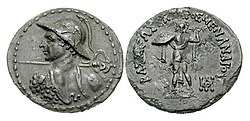
[[File:Menander Alexandria-Kapisa.jpg|thumb|300px|left|[[Menander I]] (155–130 BC) is the most famous Indo-Greek king mentioned in both Graeco-Roman and Indian sources. The capital of the Indo-Greeks during his reign was [[Sagala]] in Punjab.]] | |||
During the two centuries of their rule, the Indo-Greek kings [[Indosphere|combined the Greek and Indian languages]] and symbols, as seen on their coins, and blended Greek and Indian ideas, as seen in the archaeological remains.<ref>"A vast hoard of coins, with a mixture of Greek profiles and Indian symbols, along with interesting sculptures and some monumental remains from Taxila, Sirkap and Sirsukh, point to a rich fusion of Indian and Hellenistic influences", ''India, the Ancient Past'', Burjor Avari, p. 130</ref> The diffusion of Indo-Greek culture had consequences which are still felt today, particularly through the influence of [[Greco-Buddhist art]].<ref name="sanujit2">Ghose, Sanujit (2011). [https://www.worldhistory.org/article/208/ "Cultural links between India and the Greco-Roman world"] {{Webarchive|url=https://web.archive.org/web/20221118182908/https://www.worldhistory.org/article/208/cultural-links-between-india--the-greco-roman-worl/ |date=18 November 2022 }}. Ancient History Encyclopedia</ref> Following the death of Menander, most of his empire splintered and Indo-Greek influence was considerably reduced. Many new kingdoms and republics east of the Ravi River began to mint new coinage depicting military victories.<ref>"Most of the people east of the Ravi already noticed as within Menander's empire -Audumbaras, Trigartas, Kunindas, Yaudheyas, Arjunayanas- began to coins in the first century BC, which means that they had become independent kingdoms or republics.", Tarn, The Greeks in Bactria and India</ref> The most prominent entities to form were the [[Yaudheya]] Republic, [[Arjunayanas]], and the [[Audumbaras]]. The Yaudheyas and Arjunayanas both are said to have won "victory by the sword"<ref name="google1">{{Cite book |last1=Tarn |first1=William Woodthorpe |url=https://books.google.com/books?id=-HeJS3nE9cAC&pg=PA324 |title=The Greeks in Bactria and India |date=2010-06-24 |publisher=Cambridge University Press |isbn=9781108009416 |access-date=11 August 2022 |archive-date=18 November 2022 |archive-url=https://web.archive.org/web/20221118182906/https://books.google.com/books?id=-HeJS3nE9cAC&pg=PA324 |url-status=live }}</ref> and the Audumbaras are said to of checked the Indo-Greek advance all the way up the upper bari doab,<ref name="auto6">{{Cite book |last=Saklani |first=Dinesh Prasad |url=https://books.google.com/books?id=tK5y4iPArKQC&dq=dharaghosha+indo+greeks&pg=PA44 |title=Ancient Communities of the Himalaya |date=1998 |publisher=Indus Publishing |isbn=978-81-7387-090-3 |language=en}}</ref> depicting a short Indo-Greek rule in Eastern Punjab. The [[Datta dynasty]] and [[Mitra dynasty (Mathura)|Mitra dynasty]] soon followed in [[Mathura]]. The Indo-Greeks ultimately disappeared as a political entity around 10 AD following the invasions of the [[Indo-Scythians]], although pockets of Greek populations probably remained for several centuries longer under the subsequent rule of the [[Indo-Parthian]]s and [[Kushans]].{{efn|"When the Greeks of Bactria and India lost their kingdom they were not all killed, nor did they return to Greece. They merged with the people of the area and worked for the new masters; contributing considerably to the culture and civilization in southern and central Asia." Narain, "The Indo-Greeks" 2003, p. 278}} | |||
=== Indo-Scythian Kingdom === | |||
The [[Indo-Scythians]] were descended from the [[Sakas]] ([[Scythians]]) who migrated from southern [[Siberia]] to Punjab and [[Arachosia]] from the middle of the 2nd century BCE to the 1st century BCE. They displaced the earlier Indo-Greeks. The power of the Saka rulers started to decline in the 2nd century CE and soon they were replaced with Indo-Parthians by the mid 1st century AD.<ref>{{Cite book |last=Petrie |first=Cameron A. |url=https://books.google.com/books?id=Y7QWEAAAQBAJ&dq=punjab+indo+parthian+scythian&pg=PA105 |title=Resistance at the Edge of Empires: The Archaeology and History of the Bannu basin from 1000 BC to AD 1200 |date=2020-12-28 |publisher=Oxbow Books |isbn=978-1-78570-306-5 |pages=105 |language=en}}</ref> | |||
Some Aprachas are documented on the [[Silver Reliquary of Indravarman|Silver Reliquary]] discovered at [[Sirkap|Sirkap, near Taxila]], designating the title "Stratega," denoting a position equivalent to [[Senapati]], such as that of [[Indravarma]] who was a general during the reign of the Apracharaja [[Vijayamitra]]. [[Indravarma]] is additionally noteworthy for receiving the above-mentioned [[Silver Reliquary of Indravarman|Silver Reliquary]] from the [[Indo-Scythians|Indo-Scythian]] monarch [[Kharahostes]], which he subsequently re-dedicated as a [[Buddhism|Buddhist]] reliquary, indicating was a gift in exchange for tribute or assistance. According to another reliquary inscription Indravarma is noted as the Lord of Gandhara and general during the reign of Vijayamitra. According to Apracha chronology, [[Indravarma]] was the son of Visnuvarma, an Aprachraja preceding [[Vijayamitra]]. | |||
[[Indravarma]]s son [[Aspavarma]] is situated between 20 and 50 CE, during which numismatic evidence overlaps him with the [[Indo-Scythians|Indo-Scythian]] ruler [[Azes II]] and [[Gondophares]] of the [[Indo-Parthians]] whilst also describing him as 'Stratega' or general of the Aprachas. In accordance with a Buddhist [[Avadana]], [[Aspavarma]] and a [[Saka]] noble, Jhadamitra, engaged in discussions concerning the establishment of accommodation for monks during the rainy seasons, displaying that he was a patron of [[Buddhism]]. A reliquary inscription dedicated to 50 CE, by a woman named Ariasrava, describes that her donation was made during the reign of [[Gondophares]] nephew, [[Abdagases I]], and [[Aspavarma]], describing the joint rule by the Aprachas and the Indo-parthians.<ref>{{Cite web |title=Buddhism and Society in the Indic North and Northwest, 2nd Century BCE–3rd Century CE |url=https://core.ac.uk/download/pdf/345076701.pdf |page=163 |quote=the Reliquary Inscription of Ariaśrava et al (No. 31), dated 98 Azes (50/51 CE), whose donor, Ariaśrava, stipulates her relic dedication was made in the reign of Gondopahres’ nephew Abdagases and the General Aśpavarma, son of Indravarma I:}}</ref> | |||
==== Indo-Parthian Kingdom (c. 30 AD – c. 50 AD) ==== | |||
{{main|Indo-Parthian Kingdom}} | |||
The Indo-Parthian Kingdom was founded by [[Gondophares]], and active from 19 CE to c. 226 CE. The city of Taxila is thought to have been a capital of the Indo-Parthians however this is where the Eastern boundary of the empire was limited to.<ref>{{Cite book |last1=Fisher |first1=W. B. |url=https://books.google.com/books?id=Ko_RafMSGLkC&dq=indo+parthians+eastern+punjab&pg=PA41 |title=The Cambridge History of Iran |last2=Yarshater |first2=Ehsan |last3=Gershevitch |first3=Ilya |last4=Frye |first4=R. N. |last5=Boyle |first5=J. A. |last6=Avery |first6=Peter |last7=Jackson |first7=Peter |date=1968 |publisher=Cambridge University Press |isbn=978-0-521-20092-9 |language=en}}</ref> The Greek philosopher [[Apollonius of Tyana]] is related by [[Philostratus]] in ''[[Life of Apollonius of Tyana]]'' to have visited India, and specifically the city of Taxila around 46 AD. He describes constructions of the Greek type,<ref>Description of the Hellenistic urbanism of Taxila:<br /> | |||
* "Taxila, they tell us, is about as big as Nineveh, and was fortified fairly well after the manner of Greek cities" [https://www.livius.org/ap-ark/apollonius/life/va_2_16.html#§20 (Life of Apollonius Tyana, II 20)] {{Webarchive|url=https://web.archive.org/web/20160310044312/https://www.livius.org/ap-ark/apollonius/life/va_2_16.html#§20 |date=10 March 2016 }} | |||
*"I have already described the way in which the city is walled, but they say that it was divided up into narrow streets in the same irregular manner as in Athens, and that the houses were built in such a way that if you look at them from outside they had only one story, while if you went into one of them, you at once found subterranean chambers extending as far below the level of the earth as did the chambers above." [https://www.livius.org/ap-ark/apollonius/life/va_2_21.html#§23 (Life of Apollonius Tyana, II 23)] {{Webarchive|url=https://web.archive.org/web/20160310023858/https://www.livius.org/ap-ark/apollonius/life/va_2_21.html#§23 |date=10 March 2016 }}</ref> probably referring to [[Sirkap]], and explains that the Indo-Parthian king of Taxila, named [[Phraotes]], received a Greek education at the court. The kingdom was conquered in the 1st century AD by the Kushan empire.<ref>{{Cite book |last=Romane |first=Julian |url=https://books.google.com/books?id=RrPNDwAAQBAJ&dq=kushan+indo+parthian+punjab+century&pg=PT240 |title=Rise of the Tang Dynasty: The Reunification of China and the Military Response to the Steppe Nomads (AD 581–626) |date=2018-01-30 |publisher=Pen and Sword |isbn=978-1-4738-8779-4 |pages=240 |language=en}}</ref> | |||
During the dominion of the [[Indo-Parthian Kingdom|Indo-Parthians]], [[Apracharajas|Apracharaja]] [[Sases|Sasan]], as described on numismatic evidence identifying him as the nephew of [[Aspavarma]], emerged as a figure of significance.<ref>{{Cite book |last=Sastri |first=K. a Nilakanta |url=http://archive.org/details/in.ernet.dli.2015.532644 |title=Comprehensive History Of India Vol.2 (mauryas And Satavahanas) |date=1957 |page=215 |quote=The interesting additional information we get from these coins is that Sasan, a former associate of Gondophares and afterwards one of his successors in the Taxila region, was the son of Aspa's brother}}</ref> Aspavarman, a preceding Apracharaja contemporaneous with [[Gondophares]], was succeeded by [[Sases|Sasan]], after having ascended from a subordinate governance role to a recognized position as one of Gondophares's successors.<ref>{{Cite book |last=Sastri |first=K. a Nilakanta |url=http://archive.org/details/in.ernet.dli.2015.532644 |title=Comprehensive History Of India Vol.2 (mauryas And Satavahanas) |date=1957 |page=215 |quote=The coins further show that Sasan, who was at first a subordinate ruler under Gondophares, subsequently assumed independent or quasi-independent status.}}</ref> He assumed the position following [[Abdagases I]].<ref>{{Cite book |last=Srinivasan |first=Doris |url=https://books.google.com/books?id=ZuevCQAAQBAJ&dq=sases+apraca&pg=PA103 |title=On the Cusp of an Era: Art in the Pre-Kuṣāṇa World |date=30 April 2007 |publisher=BRILL |isbn=978-90-474-2049-1 |page=106 |language=en |quote=In the Indus valley Gondophares was succeeded by his nephew Abdagases and then by Sases.}}</ref> The [[Kushan Empire|Kushan]] ruler [[Vima Takto]] is known through numismatic evidence to have overstruck the coins of [[Sases|Sasan]], whilst a numismatic hoard had found coins of Sasan together with smaller coins of [[Kujula Kadphises]]<ref>{{Cite book |last=Srinivasan |first=Doris |url=https://books.google.com/books?id=ZuevCQAAQBAJ&dq=sases+apraca&pg=PA103 |title=On the Cusp of an Era: Art in the Pre-Kuṣāṇa World |date=30 April 2007 |publisher=BRILL |isbn=978-90-474-2049-1 |page=115 |language=en}}</ref> It has also been discovered that Sasan overstruck the coins of [[Nahapana]] of the [[Western Satraps]], this line of coinage dating between 40 and 78 CE.<ref>{{Cite book |last1=Rienjang |first1=Wannaporn |url=https://books.google.com/books?id=I7dTDwAAQBAJ&dq=Ubouzanes&pg=PA16 |title=Problems of Chronology in Gandhāran Art: Proceedings of the First International Workshop of the Gandhāra Connections Project, University of Oxford, 23rd-24th March, 2017 |last2=Stewart |first2=Peter |date=2018-03-14 |publisher=Archaeopress |isbn=978-1-78491-855-2 |pages=16–17 |language=en}}</ref> | |||
It was noted by [[Philostratus]] and [[Apollonius of Tyana]] upon their visit with [[Phraotes]] in 46 AD, that during this time the Gandharans living between the [[Kabul River]] and [[Taxila]] had coinage of [[Orichalcum]] and Black brass, and their houses appearing as single-story structures from the outside, but upon entering, underground rooms were also present.<ref>{{Cite book |last=Srinivasan |first=Doris |url=https://books.google.com/books?id=ZuevCQAAQBAJ&dq=sases+apraca&pg=PA103 |title=On the Cusp of an Era: Art in the Pre-Kuṣāṇa World |date=30 April 2007 |publisher=BRILL |isbn=978-90-474-2049-1 |page=107 |language=en |quote=Philostratus comments that the people who live between the River Kophen and Taxila have a coinage not of gold and silver but of Orichalcum and black brass. He describes the houses as designed so that if you look at them from the outside, they appear to have only one storey, but if you go inside they have underground rooms as well.}}</ref> They describe [[Taxila]] as being the same size as [[Nineveh]], being walled like a Greek city whilst also being shaped with Narrow roads,<ref>{{Cite journal |last=De Beauvoir Priaulx |first=Osmond |date=1860 |title=The Indian Travels of Apollonius of Tyana |url=https://www.jstor.org/stable/25581224 |journal=Journal of the Royal Asiatic Society of Great Britain and Ireland |volume=17 |pages=76 |issn=0035-869X |jstor=25581224 |quote=Taxila was about the size of Ninovoh, walled like a Greek city}}</ref><ref>{{Cite journal |last=De Beauvoir Priaulx |first=Osmond |date=1860 |title=The Indian Travels of Apollonius of Tyana |url=https://www.jstor.org/stable/25581224 |journal=Journal of the Royal Asiatic Society of Great Britain and Ireland |volume=17 |page=77 |issn=0035-869X |jstor=25581224 |quote=They are taken to the palace. They found the city divided by narrow streets, well-arranged, and reminding them of Athens.}}</ref> and further describe [[Phraotes]] kingdom as containing the old territory of [[Porus]].<ref>{{Cite journal |last=De Beauvoir Priaulx |first=Osmond |date=1860 |title=The Indian Travels of Apollonius of Tyana |url=https://www.jstor.org/stable/25581224 |journal=Journal of the Royal Asiatic Society of Great Britain and Ireland |volume=17 |page=76 |issn=0035-869X |jstor=25581224 |quote=and was the residence of a sovereign who ruled over what of old was the kingdom of Porus.}}</ref> Following an exchange with the king, [[Phraotes]] is reported to have subsidized both barbarians and neighbouring states, to avert incursions into his kingdom.<ref>{{Cite journal |last=De Beauvoir Priaulx |first=Osmond |date=1860 |title=The Indian Travels of Apollonius of Tyana |url=https://www.jstor.org/stable/25581224 |journal=Journal of the Royal Asiatic Society of Great Britain and Ireland |volume=17 |page=78 |issn=0035-869X |jstor=25581224 |quote=Phraotes, in answer, said that he was moderate because his wants were few, and that as he was wealthy, he employed his wealth in doing good to his friends, and in subsidizing the barbarians, his neighbours, to prevent them from themselves ravaging, or allowing other barbarians to ravage his territories.}}</ref> [[Phraotes]] also recounts that his father, being the son of a king, had become an orphan from a young age. In accordance with Indian customs, two of his relatives assumed responsibility for his upbringing until they were killed by rebellious nobles during a ritualistic ceremony along the [[Indus River]].<ref>{{Cite journal |last=De Beauvoir Priaulx |first=Osmond |date=1860 |title=The Indian Travels of Apollonius of Tyana |url=https://www.jstor.org/stable/25581224 |journal=Journal of the Royal Asiatic Society of Great Britain and Ireland |volume=17 |page=81 |issn=0035-869X |jstor=25581224 |quote=The king then told how his father, the son of a king, had been left very young an orphan; and how during his minority two of his relatives according to Indian custom acted as regents, but with so little regard to law, that some nobles conspired against them, and slow them as they were sacrificing to the Indus, and seized upon the government}}</ref> This event led to the usurpation of the throne, compelling Phraotes' father to seek refuge with the king situated beyond the [[Hydaspes River]], in modern-day [[Punjab]], a ruler esteemed greater than Phraotes' father. Moreover, [[Phraotes]] states that his father received an education facilitated by the [[Brahmin]]s upon request to the king and married the daughter of the [[Hydaspes|Hydaspian]] king, whilst having one son who was Phraotes himself.<ref>{{Cite journal |last=De Beauvoir Priaulx |first=Osmond |date=1860 |title=The Indian Travels of Apollonius of Tyana |url=https://www.jstor.org/stable/25581224 |journal=Journal of the Royal Asiatic Society of Great Britain and Ireland |volume=17 |page=81 |issn=0035-869X |jstor=25581224 |quote=How on this his father, then sixteen years of age, fled to the king beyond the Hydaspes, a greater king than himself, who received him kindly... he requested to be sent to the Brahmans; and how the Brahmans educated him; and how in time he married the daughter of the Hydaspian king, and received with her seven villages as pin-money, and had issue one son, himself, Phraotes.}}</ref> Phraotes proceeds to narrate the opportune moment he seized to reclaim his ancestral kingdom, sparked by a rebellion of the citizens of [[Taxila]] against the usurpers. With fervent support from the populace, Phraotes led a triumphant entry into the residence of the usurpers, whilst the citizens brandished torches, swords, and bows in a display of unified resistance.<ref>{{Cite journal |last=De Beauvoir Priaulx |first=Osmond |date=1860 |title=The Indian Travels of Apollonius of Tyana |url=https://www.jstor.org/stable/25581224 |journal=Journal of the Royal Asiatic Society of Great Britain and Ireland |volume=17 |page=81 |issn=0035-869X |jstor=25581224 |quote=When I crossed the Hydraotis, I heard that, of the usurpers, one was already dead, and the other besieged in this very palace; so I hurried on, proclaiming to the villages I passed through who I was, and what were my rights : and the people received me gladly, and declaring I was the very picture of my father and grandfather, they accompanied me, many of them armed with swords and bows, and our numbers increased daily; and when we reached this city, the inhabitants, with torches lit at the altar of the Sun, and singing the praises of my father and grandfather, came out and welcomed me, and brought me hither.}}</ref> | |||
=== Kushan Empire (c. 50 AD – c. 350 AD) === | |||
{{Main|Kushan Empire|Kushan coinage|Kanishka}} | |||
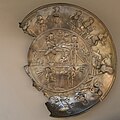
[[File:Silverplate with investiture scene. Sasanian 4th century CE, possibly Afghanistan. Middle East, 52 Ancient Iran - 28174064678.jpg|thumb|left|Possible [[Kushano-Sasanian]] plate, excavated in Rawalpindi, fourth century CE. [[British Museum]].<ref>{{cite web |title=Plate British Museum |url=https://www.britishmuseum.org/collection/object/W_1897-1231-188 |website=The British Museum |language=en |access-date=19 October 2020 |archive-date=19 October 2020 |archive-url=https://web.archive.org/web/20201019223056/https://www.britishmuseum.org/collection/object/W_1897-1231-188 |url-status=live }}</ref>]] | |||
=== | About the middle of the 1st century CE, the [[Kushan Empire]] expanded out of central Asia into the Punjab under the leadership of their first emperor, [[Kujula Kadphises]]. They were descended from an Indo-European, Central Asian people called the [[Yuezhi]],<ref>{{cite encyclopedia |url=http://www.britannica.com/EBchecked/topic/105520/Zhang-Qian |title=Zhang Qian |date=2015 |encyclopedia=Encyclopædia Britannica |access-date=9 November 2022 |archive-date=27 May 2015 |archive-url=https://web.archive.org/web/20150527215406/http://www.britannica.com/EBchecked/topic/105520/Zhang-Qian |url-status=live }}</ref><ref>{{cite encyclopedia |url=http://www.britannica.com/EBchecked/topic/654618/Yuezhi |title=Yuezhi |date=2015 |encyclopedia=Encyclopædia Britannica |access-date=9 November 2022 |archive-date=5 May 2015 |archive-url=https://web.archive.org/web/20150505004416/http://www.britannica.com/EBchecked/topic/654618/Yuezhi |url-status=live }}</ref> a branch of which was known as the Kushans. By the time of his grandson, [[Kanishka]], the empire spread to encompass much of south Asia<ref>Si-Yu-Ki, Buddhist Records of the Western World, (Tr. Samuel Beal: Travels of Fa-Hian, The Mission of Sung-Yun and Hwei-S?ng, Books 1–5), Kegan Paul, Trench, Trubner & Co. Ltd. London. 1906 and Hill (2009), pp. 29, 318–350</ref> at least as far as [[Saketa]] and [[Sarnath]] near [[Varanasi]] (Benares).<ref>which began about 127 CE. "Falk 2001, pp. 121–136", Falk (2001), pp. 121–136, Falk, Harry (2004), pp. 167–176 and Hill (2009), pp. 29, 33, 368–371.</ref> By the 3rd century, their empire in Indian subcontinent was disintegrating and their last known great emperor was [[Vasudeva I]].<ref>{{cite web|url=http://www.kushan.org/general/other/part1.htm|title=The History of Pakistan: The Kushans|website=www.kushan.org|access-date=30 April 2017|archive-date=7 July 2015|archive-url=https://web.archive.org/web/20150707162312/http://www.kushan.org/general/other/part1.htm|url-status=dead}}</ref><ref>Si-Yu-Ki, Buddhist Records of the Western World, (Tr. Samuel Beal: Travels of Fa-Hian, The Mission of Sung-Yun and Hwei-S?ng, Books 1–5), Kegan Paul, Trench, Trubner & Co. Ltd. London. 1906</ref> Following territory losses in the west ([[Bactria]] lost to the [[Kushano-Sasanians]]), and in the east (loss of [[Mathura]] to the [[Gupta Empire]]), several "Little Kushans" are known, who ruled locally in the area of Punjab with their capital at Taxila: [[Vasudeva II]] (270–300), [[Mahi (Kushan)|Mahi]] (300–305), [[Shaka (Kushan)|Shaka]] (305–335) and [[Kipunada]] (335–350).{{sfn|Rezakhani|2017b|p=203}} They probably were vassals of the Gupta Empire, until the invasion of the [[Kidarites]] destroyed the last remains of Kushan rule.{{sfn|Rezakhani|2017b|p=203}} In the early 3rd century BC, a union formed between the Punjab janapadas to expel the Kushans, resulting in a Kushan defeat and them being pushed all the way out of Eastern Punjab. Thus starting the fall of the empire and resulting in a century of peace in Punjab before the Gupta expansion.<ref>{{Cite book |last=Experts |first=Arihant |url=https://books.google.com/books?id=LhrzDwAAQBAJ&dq=yaudheyas+defeated+kushans&pg=PA10 |title=Know Your State Himachal Pradesh |date=2019-06-04 |publisher=Arihant Publications India limited |isbn=978-93-131-6765-5 |language=en}}</ref> | ||
===Hunnic migrations (c. 350 AD – c. 500 AD)=== | |||
{{main|Kidarites|Alchon Huns}} | |||
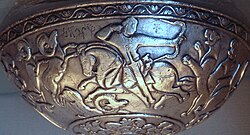
After decline of Kushan empire, the central Asian [[Huna people|Huns]] started migrating towards Punjab and other regions of Pakistan. First of them were the [[Kidarites]], who around 390 AD invaded Punjab and replaced remaining remnants of the Kushans. They seem to have retained the western part of the Gupta Empire, particularly central and western Punjab, until they were displaced by the invasion of the Alchon Huns at the end of the 5th century.<ref name="HCCC123">{{cite book |last1=Dani |first1=Ahmad Hasan |last2=Litvinsky |first2=B. A. |title=History of Civilizations of Central Asia: The crossroads of civilizations, A.D. 250 to 750 |date=1996 |publisher=UNESCO |isbn=9789231032110 |pages=123–126 |url=https://books.google.com/books?id=883OZBe2sMYC&pg=PA123 |language=en |access-date=11 November 2022 |archive-date=18 November 2022 |archive-url=https://web.archive.org/web/20221118182906/https://books.google.com/books?id=883OZBe2sMYC&pg=PA123 |url-status=live }}</ref> | |||
[[File:SilverBowlNFPPakistan5-6thcenturyCE.JPG|thumb|left|The [[Hephthalite bowl]] from [[Gandhara]] (5th century AD) features two Kidarite royal hunters as well as two Alchon hunters, suggesting a period of peaceful coexistence between the two entities.{{sfn|Alram|2014|pp=274–275}}]] | |||
The [[Alchon Huns]] were a nomadic people who invaded [[South Asia]] during the 5th and 6th centuries AD.<ref name="ROTS">{{cite book |last1=Rezakhani |first1=Khodadad |title=ReOrienting the Sasanians: East Iran in Late Antiquity |date=2017 |publisher=Edinburgh University Press |isbn=9781474400305 |pages=105–124 |url=https://books.google.com/books?id=bjRWDwAAQBAJ&pg=PA105 |language=en |access-date=11 November 2022 |archive-date=18 November 2022 |archive-url=https://web.archive.org/web/20221118183407/https://books.google.com/books?id=bjRWDwAAQBAJ&pg=PA105 |url-status=live }}</ref> They were first mentioned as being located in [[Paropamisadae|Paropamisus]]. Between 460 and 470 AD, the Alchons took over Gandhara and Western Punjab which also had remained under the control of the Kidarites, while the Gupta Empire remained further east.<ref name="HCCC123"/> Their most famous ruler was [[Mihirakula]] who had capital in Sagala in northern Punjab.<ref>{{Cite book |last=Bakker |first=Hans |url=https://books.google.com/books?id=6p2XCgAAQBAJ&q=sialkot+xuanzang&pg=PA113 |title=The World of the Skandapurāṇa |date=2014-07-16 |publisher=BRILL |isbn=9789004277144 |language=en}}</ref><ref>{{Cite book |last=Dani |first=Ahmad Hasan |url=https://books.google.com/books?id=FcKtIPVQ6REC&q=mihirakula+sialkot&pg=PA142 |title=History of Civilizations of Central Asia: The crossroads of civilizations: A.D. 250 to 750 |date=1999 |publisher=Motilal Banarsidass |isbn=9788120815407 |language=en}}</ref> | |||
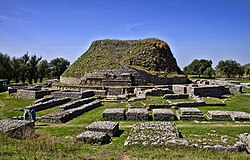
[[File:Dharmarajika stupa,Taxila.jpg|thumb|right|Ruins of [[Dharmarajika Stupa]] in [[Taxila]]. It was destroyed during the [[Alchon Huns|Hunnic invasions]] in the 5th century.]] | |||
The Alchons apparently undertook the mass destruction of Buddhist monasteries and [[stupas]] at Taxila, a high center of learning, which never recovered from the destruction.<ref name="AG">{{cite book |last1=Ghosh |first1=Amalananda |title=Taxila |date=1965 |publisher=CUP Archive |page=791 |url=https://books.google.com/books?id=0NA3AAAAIAAJ&pg=PA791 |language=en |access-date=11 November 2022 |archive-date=18 November 2022 |archive-url=https://web.archive.org/web/20221118183407/https://books.google.com/books?id=0NA3AAAAIAAJ&pg=PA791 |url-status=live }}</ref> | |||
== | ==Medieval Punjab (c. 500 AD – 1526 AD)== | ||
== | ===Hindu Shahis (9th century AD – 11th century AD)=== | ||
{{Main|Hindu Shahis}} | |||
[[File: | [[File:AMB Temple in Soon Sakasar Valley by Usman Ghani.JPG|thumb|[[Amb Temples]], built by the [[Hindu Shahi|Hindu Shahi dynasty]] between the 7th and 9th centuries CE in [[Sakesar]].|left]] | ||
[[ | In the ninth century, the [[Hindu Shahis|Hindu Shahi]] dynasty originating from the region of [[Oddiyana]] in the [[Swat Valley]],<ref>{{Cite journal |last=Rahman |first=Abdul |date=2002 |title=New Light on the Khingal, Turk and the Hindu Sahis |url=http://journals.uop.edu.pk/papers/AP_v15_37to42.pdf |journal=Ancient Pakistan |volume=XV |pages=37–42 |quote=The Hindu Śāhis were therefore neither Bhattis, or Janjuas, nor Brahmans. They were simply Uḍis/Oḍis. It can now be seen that the term Hindu Śāhi is a misnomer and, based as it is merely upon religious discrimination, should be discarded and forgotten. The correct name is Uḍi or Oḍi Śāhi dynasty.}}</ref><ref>{{Cite journal |last=Meister |first=Michael W. |date=2005 |title=The Problem of Platform Extensions at Kafirkot North |url=http://journals.uop.edu.pk/papers/AP_v16_41to48.pdf |journal=Ancient Pakistan |volume=XVI |pages=41–48 |quote=Rehman (2002: 41) makes a good case for calling the Hindu Śāhis by a more accurate name, "Uḍi Śāhis".}}</ref>{{sfn|Rehman|1976}} replaced the Taank kingdom in the Punjab, ruling much of Western Punjab along with eastern Afghanistan.<ref name=":9" /> In the 10th century, the tribe of the [[Gakhars]]/[[Khokhars]] formed a large part of the Hindu Shahi army according to the Persian historian [[Firishta]].{{sfn|Rehman|1976|pp=48–50}} Three of the most notable rulers were Lalliya, Bhimadeva and Jayapala. | ||
Lalliya had reclaimed the territory at and around Kabul between 879 and 901 BC after it had been lost under his predecessor to the [[Saffarid dynasty]]. He was described as a fearsome Shahi. Two of his ministers reconstructed by Rahman as Toramana and Asata are said to of have taken advantage of [[Amr ibn al-Layth|Amr al-Layth]]'s preoccupation with rebellions in Khorasan, by successfully raiding [[Ghazna]] around 900 BC.{{sfn|Rehman|1976}}{{page needed|date=January 2023}} | |||
After a defeat in Eastern Afghanistan suffered on the Shahi ally Lawik, Bhimadeva mounted a combined attack around 963 BC.{{sfn|Rehman|1976}}{{page needed|date=January 2023}} [[Abu Ishaq Ibrahim of Ghazna|Abu Ishaq Ibrahim]] was expelled from Ghazna and Shahi-Lawik strongholds were restored in Kabul and adjacent areas. This victory appears to have been commemorated in the Hund Slab Inscription (HSI):{{sfn|Rehman|1976}}{{page needed|date=January 2023}} | |||
=== Arrival of Islam and the Emirate of Multan === | |||
{{Main|Umayyad campaigns in India}}At the beginning of the 8th century, [[Arab]] armies of the [[Umayyad Caliphate]] penetrated into South Asia. In 712 the Umayyads conquered [[Sindh]] and Southern Punjab up to Multan, and [[Islam]] emerged as a major power in the southern Punjab.<ref name=":9"/> The newly conquered region became known as Sind and was the easternmost state of the Umayyad Caliphate. Umayyad rule was later replaced with [[Abbasid Caliphate|Abbasid]] rule in 750.<ref name="Unesco">{{cite book |title=History of Civilizations of Central Asia, Volume 4 |date=1 January 1998 |publisher=UNESCO |isbn=9231034677 |pages=294}}</ref> | |||
= | Around the 850s, Abbasid authority in Sind weakened and five independent principalities emerged. The Banu Munnabih [[Emirate of Multan|established themselves based at Multan]]. The Banu Munnabih later gave allegiance to the Abbasids, and remained unchallenged for over a century. Visitors at the time noted the power, prestige and prosperity brought to the region under Banu Munnabih rule.<ref name="Unesco"/> | ||
Between 982–5, the power of the Banu Munnabih began to erode and Multan was conquered by Halam b. Shayban on behalf of the [[Fatimid]] caliph based in [[Egypt]]. By 985, the traveller [[Al-Maqdisi]] noted that the city of Multan was [[Shia]], that the Friday sermon was in the name of the Fatimid and all decisions are taken in accordance with his commands.<ref name="The Ismailis in the Middle Ages">{{cite book |last1=Virani |first1=Shafique N. |title=The Ismailis in the Middle Ages: A History of Survival, a Search for Salvation |date=19 April 2007 |publisher=Oxford University Press |isbn=978-0198042594 |pages=100}}</ref> | |||
=== | ===Ghaznavid Empire (10th century AD – 12th century AD)=== | ||
{{Main|Ghaznavids}} | {{Main|Ghaznavids}} | ||
Sabuktigin's son [[Mahmud of Ghazni|Mahmud]] succeeded his father in 997, and began a series of raids into northern India. In 1001 he defeated [[Jayapala]] at the [[Battle of Peshawar (1001)|Battle of Peshawar]] and seized Hindu Shahi territory north of the river Sindh.<ref>{{cite book|title=Gazetteer of the Attock District, 1930, Part 1|date=1932|publisher=Sang-e-Meel Publications|url=https://books.google.com/books?id=gfdtAAAAMAAJ&q=amb+temple|access-date=9 February 2020}}</ref> | In 977, [[Sabuktigin]], the [[Samanid]] governor of [[Ghazni]], established an independent kingdom in western Afghanistan with Ghazni as its capital. When the Ghaznavids began expanding eastwards they came into conflict with the Hindu Shahis. This led to the Hindu Shahi ruler to form an alliance with Rajput rulers in the Punjab to check the Ghaznavid expansion.<ref>{{Cite book |last=Samad |first=Rafi U. |url=https://books.google.com/books?id=PMEd8Cqh-YQC&dq=hindu+shahi+rajputs+punjab&pg=PA275 |title=The Grandeur of Gandhara: The Ancient Buddhist Civilization of the Swat, Peshawar, Kabul and Indus Valleys |date=2011 |publisher=Algora Publishing |isbn=978-0-87586-860-8 |pages=275 |language=en}}</ref> | ||
{{sfn|Mohan |2010| pages=170—172}}{{sfn|Barua|2006|p=25}} In 1006 Mahmud attacked the | [[File:Mahmud of Ghazni bilingual dirham.jpg|thumb|200px|left|Silver ''jitals'' of Mahmud of Ghazni with bilingual Arabic and Sanskrit minted in [[Lahore]] in 1028 CE]] | ||
Sabuktigin's son [[Mahmud of Ghazni|Mahmud]] succeeded his father in 997, and began a series of raids into northern India. In 1001 he defeated [[Jayapala]] at the [[Battle of Peshawar (1001)|Battle of Peshawar]] and seized Hindu Shahi territory north of the river Sindh.<ref>{{cite book|title=Gazetteer of the Attock District, 1930, Part 1|date=1932|publisher=Sang-e-Meel Publications|isbn=9789693514131|url=https://books.google.com/books?id=gfdtAAAAMAAJ&q=amb+temple|access-date=9 February 2020|archive-date=18 November 2022|archive-url=https://web.archive.org/web/20221118183412/https://books.google.com/books?id=gfdtAAAAMAAJ&q=amb+temple|url-status=live}}</ref>{{sfn|Mohan |2010| pages=170—172}}{{sfn|Barua|2006|p=25}} In 1006 Mahmud attacked the Kingdom of Multan, returning a few years later to massacre the local Ismaili population.<ref name="The Ismailis in the Middle Ages"/> | |||
Jayapala's son and grandson, [[Anandapala]] and [[Trilochanapala]] respectively | Jayapala's son and grandson, [[Anandapala]] and [[Trilochanapala]] respectively, resisted Mahmud for another quarter of a century and later by Bhimapala and local Ghakkhar chieftains until Mu'izz ad-Din Muhammad's victory in Second battle of Tarain in 1192.{{sfn|Mohan|2010|pages=120—153}} Mahmud's battles against the Hindu Shahi between 1001 and 1026 were significant in establishing Muslim political dominance in the Afghanistan region and surrounding Gandhar region west of Punjab.<ref name="Algora Publishing">{{cite book |last1=Samad |first1=Rafi U. |title=The Grandeur of Gandhara: The Ancient Buddhist Civilization of the Swat, Peshawar, Kabul and Indus Valleys |date=2011 |publisher=Algora Publishing |isbn=978-0875868608 |pages=275}}</ref> After Ghazni was conquered by [[Ghurid Empire]], the capital of the Ghaznavids shifted to [[Lahore]] in Punjab which remained as their last capital.<ref name="CEB299">{{cite book |last1=Bosworth |first1=C. Edmund |url=https://books.google.com/books?id=CgawCQAAQBAJ&pg=PA299 |title=Historic Cities of the Islamic World |date=31 August 2007 |publisher=BRILL |isbn=978-90-474-2383-6 |page=299 |language=en}}</ref> | ||
| | |||
===Delhi Sultanate=== | ===Delhi Sultanate=== | ||
{{Main|Delhi Sultanate|}} | {{Main|Delhi Sultanate|}} | ||
In 1173 the [[Ghurid dynasty]] replaced the Ghaznavids in Ghazni, and under [[Muhammad of Ghor]] they began expanding eastwards. Between 1175 and 1192, the [[Ghurid dynasty]] occupied the cities of Uch, Multan, Peshawar, Lahore, and Delhi. In 1206, the Ghurid general Qutb-al-din Aybeg and his successor Iltutmish founded the first of the series of Delhi Sultanates. Each dynasty would be an alternation of various inner-Asian military lords and their clients, constantly vying for power. These sultanates would make Delhi a safe haven for Muslim Turks and Persians who would flee the eventual Mongol invasions.{{ | Earliest mention of the region under the name ''Panjāb'' date to the early period of Delhi Sultanate, such as in the ''Tārīkḣ-i Waṣṣāf'' of the 13th century historian [[Wassaf]], who described it as a region irrigated by Indus [''Sind''], Jhelum [''Jelum''], Lahore [''Lohawar''] (now known as Ravi), Satluj [''Satlut''] and Beas [''Biyaha''] rivers.<ref>{{Cite book |last=Malik |first=Ikram Ali |url=https://books.google.com/books?id=LAAbAAAAMAAJ |title=Tārīk̲h̲-i Panjāb: Qadīm daur tā Jang-i Āzādī, 1857 |date=1990 |publisher= |pages=3 |language=ur |trans-title=History of Punjab: From Ancient Age to War of Independence, 1857 |via=[[The University of Michigan]]}}</ref> | ||
In 1173 the [[Ghurid dynasty]] replaced the Ghaznavids in Ghazni, and under [[Muhammad of Ghor]] they began expanding eastwards. Between 1175 and 1192, the [[Ghurid dynasty]] occupied the cities of Uch, Multan, Peshawar, Lahore, and Delhi. In 1206, the Ghurid general Qutb-al-din Aybeg and his successor Iltutmish founded the first of the series of Delhi Sultanates. Each dynasty would be an alternation of various inner-Asian military lords and their clients, constantly vying for power. These sultanates would make Delhi a safe haven for Muslim Turks and Persians who would flee the eventual Mongol invasions.<ref name=":0" /> | |||
==== Khilji dynasty (1290 AD – 1320 AD) ==== | |||
The [[Khalji dynasty]] was the second dynasty of the Delhi sultanates, ruling from 1290 to 1320. This dynasty was a short-lived one, and extended Islamic rule to Gujarat, Rajasthan, the Deccan, and parts of Southern India.<ref name=":0">{{Cite book |last=Lapidus |first=Ira M. |url=https://books.google.com/books?id=kFJNBAAAQBAJ&dq=khalji+gujarat+rajasthan+deccan+short+lived&pg=PA391 |title=A History of Islamic Societies |date=2014-10-13 |publisher=Cambridge University Press |isbn=978-0-521-51430-9 |pages=391–394 |language=en}}</ref> The first Mongol invasion of Punjab occurred when they were pursuing the Khwarezmian Shah, [[Jalal ad-Din Mingburnu|Jalal ad-Din]], who was defeated in the [[battle of Indus]] in 1221. The early period of te dynasty saw [[Mongol invasions of India|numerous Mongol invasions of Punjab]], and the cities of Multan and Lahore were even sacked. Ultimately, they were defeated during the rule by its able generals, [[Zafar Khan (Indian general)|Zafar Khan]], [[Ayn al-Mulk Multani]] and [[Ghiyath al-Din Tughluq|Ghazi Malik]] who were [[Punjabi Muslims|Punjab Muslims]].<ref>{{cite book |author=Satish Chandra |url=https://books.google.com/books?id=L5eFzeyjBTQC&q=Medieval%20India%3A%20From%20Sultanat%20to%20the%20Mughals-Delhi%20Sultanat%20(1206-1526%20...&pg=PA269 |title=Medieval India: From Sultanat to the Mughals-Delhi Sultanat (1206–1526) – Part One |date=2004 |isbn=9788124110645 |page=267 | publisher=Har-Anand Publications |access-date=9 November 2022 |archive-url=https://web.archive.org/web/20221118183413/https://books.google.com/books?id=L5eFzeyjBTQC&q=Medieval%20India%3A%20From%20Sultanat%20to%20the%20Mughals-Delhi%20Sultanat%20%281206-1526%20...&pg=PA269 |archive-date=18 November 2022 |url-status=live}}</ref> In the winter of 1297, the Chagatai [[noyan]] Kadar led an army that ravaged the [[Punjab region]], and advanced as far as [[Kasur]].{{sfn|Banarsi Prasad Saksena|1992|p=332}} Alauddin's army, led by [[Ulugh Khan]] and probably [[Zafar Khan (Indian general)|Zafar Khan]] defeated the invaders on the [[Mongol invasion of India, 1297-98|Battle of Jaran-Manjur]] near Lahore in 1298{{sfn|Banarsi Prasad Saksena|1992|p=332}} where quite a large number of them were taken prisoner.<ref>{{Cite book |last=Saksena |first=Banarsi Prasad |url=https://books.google.com/books?id=_9cmAQAAMAAJ |title=A Comprehensive History of India: The Delhi Sultanat (A.D. 1206–1526) |publisher=The Indian History Congress / People's Publishing House |year=1992 |editor-last=Habib |editor-first=Mohammad |edition=2nd |volume=5 |pages=332 |chapter=The Khaljis: Alauddin Khalji |oclc=31870180 |author-link=Banarsi Prasad Saksena |orig-date=1970 |editor-last2=Nizami |editor-first2=Khaliq Ahmad}}</ref> | |||
==== Tughlaq dynasty (1320 AD – 1410 AD) ==== | |||
The Tughlaq dynasty's reign formally started in 1320 in [[Delhi]] when Ghazi Malik assumed the throne under the title of [[Ghiyath al-Din Tughluq]] after defeating [[Khusrau Khan]] at the [[Battle of Lahrawat]]. | |||
[[File:Tomb of Shah Rukn-e-Alam 2014-07-31.jpg|thumb|[[Tomb of Shah Rukn-e-Alam]] at [[Multan]], built during the reign of [[Ghiyath al-Din Tughluq|Ghiyas-ud-Din Tughluq]] in 1320 AD]] | |||
During Ghazi Maliks reign, in 1321 he sent his eldest son Jauna Khan, later known as Muhammad bin Tughlaq, to [[Deogir]] to plunder the Hindu kingdoms of Arangal and Tilang (now part of [[Telangana]]). His first attempt was a failure.<ref name="lowe296">William Lowe (Translator), {{Google books|RFNOAAAAYAAJ|Muntakhabu-t-tawārīkh|page=296}}, Volume 1, pages 296–301</ref> Four months later, Ghiyasuddin Tughlaq sent large army reinforcements for his son asking him to attempt plundering Arangal and Tilang again.<ref>[https://archive.org/stream/historyindiaast06elligoog#page/n240/mode/2up Tarikh-I Firoz Shahi] Ziauddin Barni, The History of India by its own Historians – The Muhammadan Period, Volume 3, Trubner London, pages 233–234</ref> This time Jauna Khan succeeded and Arangal fell, it was renamed to Sultanpur, and all plundered wealth, state treasury and captives were transferred from the captured kingdom to the Delhi Sultanate.The Muslim aristocracy in Lukhnauti (Bengal) invited Ghiyasuddin Tughlaq to extend his coup and expand eastwards into Bengal by attacking [[Shamsuddin Firoz Shah]], which he did over 1324–1325 AD,<ref name="lowe296" /> after placing Delhi under control of his son Ulugh Khan, and then leading his army to Lukhnauti. Ghiyasuddin Tughlaq succeeded in this campaign. | |||
After his father's death in 1325 CE, [[Muhammad bin Tughluq|Muhammed Bin Tughlaq]] assumed power and his rule saw the empire expand to most of the Indian subcontinent, its peak in terms of geographical reach.<ref name="ebmit">[http://www.britannica.com/EBchecked/topic/396460/Muhammad-ibn-Tughluq Muḥammad ibn Tughluq] Encyclopædia Britannica</ref> He attacked and plundered [[Malwa]], [[Gujarat]], [[Lakhnauti]], [[Chittagong]], [[Mithila (region)|Mithila]] and many other regions in India<ref>[https://archive.org/stream/historyindiaast06elligoog#page/n242/mode/2up Tarikh-I Firoz Shahi] Ziauddin Barni, The History of India by its own Historians – The Muhammadan Period, Volume 3, Trubner London, pp. 236–237</ref> His distant campaigns were expensive, although each raid and attack on non-Muslim kingdoms brought new looted wealth and ransom payments from captured people. The extended empire was difficult to retain, and rebellions all over Indian subcontinent became routine.<ref name="zbarni">[https://archive.org/stream/historyindiaast06elligoog#page/n242/mode/2up Tarikh-I Firoz Shahi] Ziauddin Barni, The History of India by its own Historians – The Muhammadan Period, Volume 3, Trubner London, pp. 235–240</ref> Muhammad bin Tughlaq died in March 1351<ref name="pjackson2003">{{Cite book |author=Jackson, Peter |title=The Delhi Sultanate: A Political and Military History |publisher=Cambridge University Press |year=2003 |isbn=978-0521543293 |location=Cambridge, England}}</ref> while trying to chase and punish people for rebellion and their refusal to pay taxes in [[Sindh]] and [[Gujarat]].<ref name="vsoxford3">Vincent A Smith, {{Google books|p2gxAQAAMAAJ|The Oxford History of India: From the Earliest Times to the End of 1911|page=217}}, Chapter 2, pp. 242–248, Oxford University Press</ref> | |||
The Tughlaq empire after Muhammed Bin Tughluqs death was in a state of disarray with many regions assuming independence, it was at this point that [[Firuz Shah Tughlaq]], Ghazi Maliks nephew, took reign. His father's name was Rajab (the younger brother of [[Ghiyath al-Din Tughlaq|Ghazi Malik]]) who had the title ''[[Sipahsalar]]''. His mother Naila was a Punjabi Bhatti princess (daughter of Rana Mal) from [[Dipalpur]] and [[Abohar]] according to the historian [[William Crooke]].<ref>{{Cite book |last=Crooke |first=William |url=https://books.google.com/books?id=tCc-AAAAYAAJ&dq=firoz+shah+tughlaq+mother&pg=PA144 |title=An Ethnographical Hand-book for the N.-W. Provinces and Oudh |date=1890 |publisher=North-Western provinces and Oudh government Press |page=144 |language=en}}</ref><ref>{{Cite book |url=https://books.google.com/books?id=WhFDAAAAYAAJ&q=bibi+naila+punjabi |title=Proceedings – Punjab History Conference |date=1966 |publisher=Publication Bureau, Punjab University |page=82 |language=en}}</ref> The southern states had drifted away from the Sultanate and there were rebellions in Gujarat and Sindh", while "Bengal asserted its independence." He led expeditions against Bengal in 1353 and 1358. He captured [[Cuttack]], desecrated the [[Jagannath Temple, Puri]], and forced Raja Gajpati of Jajnagar in [[Orissa, India|Orissa]] to pay tribute.<ref>{{Cite book |last1=Kulke |first1=Hermann |url=https://books.google.com/books?id=TPVq3ykHyH4C&dq=firoz+shah+orissa&pg=PA184 |title=A History of India |last2=Rothermund |first2=Dietmar |date=2004 |publisher=Psychology Press |isbn=978-0-415-32919-4 |page=184 |language=en}}</ref><ref>{{Cite book |last=Haque |first=Mohammed Anwarul |url=https://books.google.com/books?id=Co8eAAAAMAAJ&q=firoz+shah+cuttack |title=Muslim Administration in Orissa, 1568-1751 A.D. |date=1980 |publisher=Punthi Pustak |page=20 |language=en}}</ref> He also laid siege to the [[Kangra Fort]] and forced Nagarkot to pay tribute.<ref>{{Cite book |last=Jauhri |first=R. C. |url=https://books.google.com/books?id=ToRHAAAAMAAJ&q=firoz+shah+tughluq+kangra |title=Firoz Tughluq, 1351–1388 A.D. |date=1990 |publisher=ABS Publications |isbn=978-81-7072-029-4 |page=74 |language=en}}</ref> During his time Tatar Khan of [[Greater Khorasan]] attacked Punjab however he was defeated and his face slashed by the sword given by [[Feroz Shah Tughlaq]] to Raja [[Kailas Pal]] who ruled the Nagarkot region in Punjab.<ref>{{Cite book |last1=Hutchison |first1=John |url=https://books.google.com/books?id=3btDw4S2FmYC&dq=kailas+pal&pg=PA221 |title=History of the Panjab Hill States |last2=Vogel |first2=Jean Philippe |date=1994 |publisher=Asian Educational Services |isbn=978-81-206-0942-6 |page=221 |language=en}}</ref> | |||
==== Sayyid Dynasty (1410–40 AD) ==== | |||
After the death of the last Tughluq ruler Nasir-ud-din Mahmud, the [[Punjabi Muslims|Punjabi]] or Arab chieftain [[Khizr Khan]] established the [[Sayyid dynasty]], the fourth dynasty of the [[Delhi Sultanate]] after the fall of the [[Tughlaq dynasty|Tughlaqs]].<ref name=":022">{{cite book |author=Richard M. Eaton |title=India in the Persianate Age: 1000–1765 |year=2019 |isbn=978-0520325128 |page=117}}</ref><ref>{{cite book |title= India in the Persianate Age: 1000–1765 |author= [[Richard M. Eaton|Easton, Richard M.]] |year= 2019 | isbn=978-0520325128 |publisher= University of California Press |page=105|language=en|quote=The career of Khizr Khan, a Punjabi chieftain belonging to the Khokar clan, illustrates the transition to an increasingly polycentric north India.}}</ref><ref>{{Citation |author=[[Simon Digby (oriental scholar)|Digby, Simon]] |title=After Timur Left: North India in the Fifteenth Century |date=13 October 2014 |pages=47–59 |publisher=[[Oxford University Press]] |doi=10.1093/acprof:oso/9780199450664.003.0002 |url=http://dx.doi.org/10.1093/acprof:oso/9780199450664.003.0002 |isbn=978-0-19-945066-4 |access-date=25 January 2023 |quote=And we find that a Khokhar chieftain, Khizr Khan who was sent to Timur as an ambassador and negotiator from the most adjacent area, the Punjab, ultimately became the power holder in Delhi, thanks to the contacts he had {{sic|aqu|ired|nolink=y}}.|url-access=subscription }}</ref><ref>{{Cite book |last1=Orsini |first1=Francesca |url=https://books.google.com/books?id=59OFoAEACAAJ&q=after+timur+left |title=After Timur Left: Culture and Circulation in Fifteenth-century North India |last2=Sheikh |first2=Samira |date=2014 |publisher=Oxford University Press |isbn=978-0-19-945066-4 |language=en}}</ref><ref>{{Cite book |last=Srivastava |first=Ashirbadi Lal |url=https://books.google.com/books?id=ht21AAAAIAAJ&q=al+srivastava+delhi+sultanate |title=The Sultanate of Delhi: Including the Arab Invasion of Sindh, 711-1526 A. D. |date=1953 |publisher=S. L. Agarwala |isbn=978-8193009352 |pages=229 |quote="their claim of Descendants of Prophet Mohammad is dubious but it seems certain that Khizr Khan's ancestors came from Arabia"}}</ref><ref>{{Cite book |last=Eraly |first=Abraham |title=The Age of Wrath: A History of the Delhi Sultanate |date=2015-04-01 |publisher=Penguin UK |isbn=978-93-5118-658-8 |pages=261 |language=en |quote=The first of these two dynasties was founded by Khizr Khan, who bore the appellation 'Sayyid', which identified him as a descendant of prophet Muhammad, so the dynasty he founded came to be known as the Sayyid dynasty. The veracity of Khizr Khan's claimed lineage is uncertain, but it is likely that his forebears were Arabs, who had migrated to India in the early Tughluq period and settled in Multan. The family prospered in India, gaining wealth and power. This advancement culminated in Malik Suleiman, Khizr Khan's father, becoming the governor of Multan under the Tughluqs. When Suleiman died, Khizr Khan succeeded him to the post, but lost it during the political turmoil following the death of Firuz Tughluq.}}</ref> | |||
Following [[Timur|Timur's]] 1398 Sack of [[Delhi]],{{sfn|Jackson|2003|p=103}} he appointed [[Khizr Khan]] as deputy of [[Multan]] ([[Punjab region|Punjab]]).{{sfn|Kumar|2020|p=583}} He held Lahore, Dipalpur, Multan and Upper Sindh.<ref>{{cite book |author=Kenneth Pletcher |url=https://books.google.com/books?id=VsujRFvaHI8C&dq=khizr+khan+sind&pg=PA132 |title=The History of India |date=2010 |page=138| publisher=The Rosen Publishing Group | isbn=9781615301225 }}</ref><ref>{{cite book |author=V. D. Mahajan |url=https://books.google.com/books?id=nMWSQuf4oSIC&dq=khizr+khan+sind&pg=RA1-PA229 |title=History of Medieval India |date=2007 |page=229| publisher=S. Chand | isbn=9788121903646 }}</ref> Khizr Khan captured Delhi on 28 May 1414 thereby establishing the Sayyid dynasty.{{sfn|Kumar|2020|p=583}} Khizr Khan did not take up the title of [[Sultan]], but continued the fiction of his allegiance to Timur as ''Rayat-i-Ala''(vassal) of the [[Timurids]] – initially that of Timur, and later his son [[Shahrukh Mirza|Shah Rukh]].<ref>{{cite book |url=https://books.google.com/books?id=OghDAAAAYAAJ&q=It+is+generally+acknowledged+that+Khizr+Khan+continued+to+recognise+Timur+and+his+successors+,+Shah+Rukh+,+as+his+nominal+overlords+.+But+later+on+under+his+succesor+,+Mubarak+Khan+,+this+%27+fiction+%27+of+allegiance+to+the+Timurid+rulers |title=Proceedings:Volume 55 |year=1995 |publisher=Indian History Congress |page=216}}</ref><ref>Mahajan, V.D. (1991, reprint 2007). ''History of Medieval India'', Part I, New Delhi: S. Chand, {{ISBN|81-219-0364-5}}, p.237</ref> After the accession of Khizr Khan, the Punjab, [[Uttar Pradesh]] and Sindh were reunited under the Delhi Sultanate, where he spent his time subduing rebellions.<ref>{{cite book |url=https://books.google.com/books?id=F3QbAAAAIAAJ&q=khizr+khan+sindh |title=Rajasthan [district Gazetteers] Bharatpur |date=1971 |publisher=Printed at Government Central Press |page=52}}</ref> [[Punjab]] was the powerbase of Khizr Khan and his successors as the bulk of the Delhi army during their reigns came from [[Multan]] and [[Dipalpur]].<ref>{{Cite book |last=Lal |first=Kishori Saran |url=https://books.google.com/books?id=C-E_SwAACAAJ&q=twilight+of+the+sultanate |title=Twilight of the Sultanate: A Political, Social and Cultural History of the Sultanate of Delhi from the Invasion of Timur to the Conquest of Babur 1398–1526 |date=1980 |publisher=Munshiram Manoharlal |isbn=978-81-215-0227-6 |language=en |quote=This considerably depleted Iqbal's strength and encouraged Khizr Khan to collect his forces of Multan, Deopalpur and the Punjab}}</ref> | |||
Khizr Khan was succeeded by his son Sayyid [[Mubarak Shah (Sayyid dynasty)|Mubarak Shah]] after his death on 20 May 1421. Mubarak Shah referred to himself as ''Muizz-ud-Din Mubarak Shah'' on his coins, removing the Timurid name with the name of the Caliph, and declared himself a Shah.<ref>{{cite book |author=V. D. Mahajan |url=https://books.google.com/books?id=nMWSQuf4oSIC&dq=sultan+mubarak+shah+timur++caliph&pg=RA1-PA240 |title=History of Medieval India |date=2007| publisher=S. Chand | isbn=9788121903646 }}</ref><ref>{{cite book |author=Iqtidar Alam Khan |url=https://books.google.com/books?id=pzZFUcDpDzsC&dq=sultan+mubarak+shah&pg=PA103 |title=Historical Dictionary of Medieval India |date=2008 |page=103| publisher=Scarecrow Press | isbn=9780810855038 }}</ref> He defeated the advancing [[Hoshang Shah|Hoshang Shah Ghori]], ruler of [[Malwa Sultanate]] and forced him to pay heavy tribute early in his reign.<ref>{{Cite book |last=Lal |first=Kishori Saran |url=https://books.google.com/books?id=C-E_SwAACAAJ&q=twilight+of+the+sultanate |title=Twilight of the Sultanate: A Political, Social and Cultural History of the Sultanate of Delhi from the Invasion of Timur to the Conquest of Babur 1398–1526 |date=1980 |publisher=Munshiram Manoharlal |isbn=978-81-215-0227-6 |language=en |quote=Hoshang tried his luck against Sultan of Delhi but he was beaten back by Mubarak Shah Saiyyad to whom he had to pay a handsome tribute}}</ref> Mubarak Shah also put down the rebellion of [[Jasrat Khokhar|Jasrath Khokhar]] and managed to fend off multiple invasions by the Timurids of Kabul.<ref>{{Cite book |last=Lal |first=Kishori Saran |url=https://books.google.com/books?id=C-E_SwAACAAJ&q=twilight+of+the+sultanate |title=Twilight of the Sultanate: A Political, Social and Cultural History of the Sultanate of Delhi from the Invasion of Timur to the Conquest of Babur 1398–1526 |date=1980 |publisher=Munshiram Manoharlal |isbn=978-81-215-0227-6 |pages=109 |language=en}}</ref> | |||
The last ruler of the Sayyids, [[Alam Shah|Ala-ud-Din]], voluntarily abdicated the throne of the Delhi Sultanate in favour of [[Bahlul Khan Lodi]] on 19 April 1451, and left for Badaun, where he died in 1478.<ref>Mahajan, V.D. (1991, reprint 2007). ''History of Medieval India'', Part I, Now Delhi: S. Chand, {{ISBN|81-219-0364-5}}, p.244</ref> | |||
The neighboring [[Jaunpur Sultanate]] from 1399 to 1493 was ruled by Malik Qaranfal and his descendants who was stated to be a member of the [[Sayyid dynasty]].<ref>{{Cite book |url=https://books.google.com/books?id=pXxDAAAAYAAJ&q=Malik+Qaranfal+,+who+was+the+nephew+of+... |title=A Comprehensive History of India: The Delhi Sultanat, A.D. 1206-1526 |date=1970 |publisher=Orient Longmans |pages=714 |language=en}}</ref> | |||
==== Lodi Dynasty (1451 AD − 1526 AD) ==== | |||
Later, Bahlul Lodi captured Delhi and founded the [[Lodi dynasty]], the last of the [[Delhi sultanate]]. {{sfn|Jayapalan|2001|p=54}} The Lodi dynasty reached its peak under Bahlul's grandson [[Sikander Lodi]]. Various road and irrigation projects were taken under his rule, and the rule had patronized Persian culture. Despite this, there was still persecution of the local Hindu people as many temples, such as that of Mathura, were destroyed and had a system of widespread discrimination against Hindus.{{sfn|Jayapalan|2001|p=56}} The rule of [[Ibrahim Khan Lodi]], the last Lodi emperor, emperor was a weak one and was eclipsed by the [[First Battle of Panipat|arrival of Babur's army]]. {{sfn|Jayapalan|2001|p=57}} | |||
===Langah Sultanate=== | ===Langah Sultanate=== | ||
Langah Sultanate, | {{Main|Langah Sultanate}} | ||
[[File:Map of the Langah Sultanate circa 1475 CE.png|thumb|Approximate territory of the Langah Sultanate at its greatest extent, circa 1475 CE<ref name="UNESCO">{{cite book |last1=Baloch |first1=N. A. |url=https://en.unesco.org/silkroad/sites/default/files/knowledge-bank-article/vol_IVa%20silk%20road_the%20regions%20of%20sind%2C%20baluchistan%2C%20multan%20and%20kashmir.pdf |title=History of civilizations of Central Asia, v. 4: THE REGIONS OF SIND, BALUCHISTAN, MULTAN AND KASHMIR: THE HISTORICAL, SOCIAL AND ECONOMIC SETTING |last2=Rafi |first2=A. Q. |date=1998 |publisher=Unesco |isbn=978-92-3-103467-1 |page=305 |access-date=11 August 2022 |archive-date=6 March 2022 |archive-url=https://web.archive.org/web/20220306193338/https://en.unesco.org/silkroad/sites/default/files/knowledge-bank-article/vol_IVa%20silk%20road_the%20regions%20of%20sind%2C%20baluchistan%2C%20multan%20and%20kashmir.pdf |url-status=live }}</ref>]] | |||
==Early Modern period== | In 1445, Sultan Qutbudin, the chief of [[Langah (clan)|Langah clan]], established the [[Langah Sultanate]] in [[Multan]]. The reign of [[Husseyn Langah I|Sultan Husayn I]] who ruled from 1469 to 1498 is considered to most illustrious of the Langah Sultans.<ref name="UNESCO" /> Multan experienced prosperity during this time, and a large number of Baloch settlers arrived in the city at the invitation of Shah Husayn.<ref name="UNESCO" /> Shah Husayn successfully repulsed attempted invasion by the Delhi Sultans led by Tatar Khan and [[Rukunuddin Barbak Shah|Barbak Shah]].<ref name="UNESCO" /> He fought off attempts to reinstall Shiekh Yousaf who had taken refuge under Delhi Sultans. Eventually, he signed a peace treaty with [[Sikander Lodhi]] and abducted in the favour of his son. His successor, Budhan Khan, who assumed the title Sultan Mahmud Shah I, inherited the Sultanate stretched encompassing the neighbouring regions, including the cities of [[Chiniot]] and [[Shorkot]].<ref name="UNESCO" /> | ||
[[Husseyn Langah I|Sultan Husayn I]] being unable to hold his trans-Indus possessions, assigned the region around [[Dera Ismail Khan]] to Sardar [[Malik Sohrab Dodai]] Baloch in 1469 or 1471 and appointed him as "Jagir".<ref name="tolbort">{{cite book |last1=Tolbort |first1=T |url=https://books.google.com/books?id=RVQOAAAAQAAJ&q=dera+ismail+khan |title=The District of Dera Ismail Khan, Trans-Indus |date=1871 |access-date=12 December 2017 |archive-date=18 November 2022 |archive-url=https://web.archive.org/web/20221118183413/https://books.google.com/books?id=RVQOAAAAQAAJ&q=dera+ismail+khan |url-status=live }}</ref> The city was invaded during the reign of Sultan Husseyn II by ruler Shah Husayn of the [[Arghun dynasty]], probably at [[Babur]]'s insistence,<ref name="UNESCO" /> who was either ethnic Mongol,<ref>Davies, C. Collin. "Arghun." The Encyclopedia of Islam, Volume I. New ed. Leiden: E. J. Brill, 1960. {{ISBN|90-04-08114-3}}</ref> or of Turkic or [[Turco-Mongol]] extraction.<ref>Bosworth, Clifford Edmund. The New Islamic Dynasties: A Chronological and Genealogical Manual. New York: Columbia University Press, 1996. {{ISBN|0-231-10714-5}}</ref> [[Multan]] fell in 1528 after an extended siege and Shah Husayn appointed his son Mirza Askari as governor of the city, assisted by Langar Khan, one of the powerful amirs of Sultan Mahmud Langah I. Shortly after Shah Husayn departed Multan for [[Thatta]], however, the governor was thrown out of the city. The rebels under Sultan Mahmud II administered Multan for a time independently<ref>Davies, pp. 627–8</ref> but in 1541, [[Sher Shah Suri]] captured Multan, and the Sultanate ended.<ref name="Chandra">{{cite book |last1=Chandra |first1=Chandra |title=Medieval India: From Sultanat to the Mughals Part – II |date=2005 |publisher=Har-Anand Publications |isbn=9788124110669}}</ref> | |||
===Founding of Sikhism=== | |||
{{See also|History of Sikhism}} | |||
[[File:The Entrance of Janam Asthan-2.jpg|thumb|200px|left|The [[Gurdwara Janam Asthan]] in [[Nankana Sahib]], Pakistan, commemorates the site where Guru Nanak is believed to have been born.]] | |||
A significant event in the late 15th century Punjab was the formation of Sikhism by [[Guru Nanak]] who was born in [[Nankana Sahib]], [[Punjab, Pakistan|Punjab]], Pakistan in the [[Subah of Lahore|Lahore]] province of the [[Delhi Sultanate]].{{sfn|Singh|2006|pp=12–13}}{{sfn|Grewal|1998|p=6}} The history of the Sikh faith is closely associated with the history of Punjab and the socio-political situation in the north-west of the Indian subcontinent in the 17th century. The hymns composed by [[Guru Nanak]] were later collected in the [[Guru Granth Sahib]], the central religious scripture of the Sikhs.<ref>{{cite book|last=Singh|first=Khushwant|title=A History of the Sikhs: Vol. 1. 1469–1839|url=https://books.google.com/books?id=3i_htgAACAAJ|year=1991|publisher=Oxford University Press|page=46}}</ref> | |||
==Early Modern period (1526 AD – 1849 AD)== | |||
===Mughal Empire=== | ===Mughal Empire=== | ||
{{Main|Mughal Empire}} | {{Main|Mughal Empire}} | ||
{{see also|Subah of Lahore|Subah of Multan|Subah of Delhi}} | |||
In 1526, [[Babur]], a | In 1526, [[Babur]], a descendant of [[Timur]] and [[Descent from Genghis Khan|Genghis Khan]] from the [[Fergana Valley]] was ousted from his ancestral domain in Central Asia. Bābur turned to India and crossed the Khyber Pass.<ref>{{Cite web|url=https://www.ucalgary.ca/applied_history/tutor/islam/empires/mughals/|archive-url=https://web.archive.org/web/20110927121217/http://www.ucalgary.ca/applied_history/tutor/islam/empires/mughals/|title=The Islamic World to 1600: Rise of the Great Islamic Empires (The Mughal Empire)|archive-date=27 September 2011}}</ref> He was able to secure control of Punjab, and in 1526 he decisively defeated the forces of the Delhi sultan Ibrāhīm Lodī at the First Battle of Panipat. The next year, he defeated the Rajput confederacy under Rana Sanga of Mewar, and in 1529 defeated the remnants of the Delhi sultanates. At his death in 1530 the Mughal Empire encompassed almost all of Northern India.<ref name="Britannica">{{cite web|title=Mughal Dynasty|url=https://www.britannica.com/topic/Mughal-dynasty|website=Encyclopaedia Britannica|publisher=Britannica|access-date=15 February 2018|archive-date=24 February 2021|archive-url=https://web.archive.org/web/20210224114251/https://www.britannica.com/topic/Mughal-dynasty|url-status=live}}</ref> | ||
Bābur's son Humāyūn (reigned 1530–40 and 1555–56) had lost territory to [[Sher Shah Suri]]. | Bābur's son Humāyūn (reigned 1530–40 and 1555–56) had lost territory to [[Sher Shah Suri]], launched campaigns against the [[Gakkhars]], about whom he suspected of being friendly with the Mughals.<ref name="auto2">{{cite book |last1=Prasad |first1=Ishwari |title=The Life and Times of Humayun |date=1976 |publisher=Central Book Depot |page=92}}</ref> During this period, Sher Shah constructed the [[Rohtas Fort]] near [[Jhelum]]. Following the death of Sher Shah, in 1556, the Mughal forces under Humayun defeated Sikandar at the [[Second Battle of Panipat|Battle of Panipat]] in 1556 and re-established the Mughal Empire across the Punjab and northern India. In 1580 the Punjab was divided into two provinces, [[Subah of Lahore]] and [[Subah of Multan]]. From 1586 to 1598, [[Lahore]] remained capital of the Mughal Empire.<ref>{{Cite journal |last=Sinopoli |first=Carla M. |date=1994 |title=Monumentality and Mobility in Mughal Capitals |url=https://www.jstor.org/stable/42928323 |journal=Asian Perspectives |volume=33 |issue=2 |page=294 |issn=0066-8435 |jstor=42928323}}</ref> | ||
During the reign of Muḥammad Shah (1719–48), the empire began to decline, accelerated by warfare and rivalries, and. After the death of Muḥammad Shah in 1748, the Marathas attacked and ruled almost all of northern India. Mughal rule was reduced to only a small area around Delhi, which passed under Maratha (1785) and the British (1803) control. The last Mughal, Bahādur Shah II (reigned 1837–57), was exiled to Burma by the British.<ref name="Britannica"/> | Over the next twenty-four years, the Mughals gradually consolidated power in the Punjab. Campaigns followed to subdue local [[Zamindars]] and the Hill forts. The Gakkhars were co-opted and assimilated into the Mughal polity under Kamal Khan, son of [[Sultan Sarang Khan|Rai Sarang]].<ref name="auto1"/> Akbar (reigned 1556–1605) defeated [[Hemu]] at the Second Battle of Panipat (1556) and re-established Mughal rule. Akbar's son Jahangir had furthered the size of the Mughal Empire through conquest, yet left much of the state bankrupt as a result. He was later buried in Lahore. Jahangir's son Shah Jahan (reigned 1628–1658) was known for his monuments, including the Taj Mahal. He was born in Lahore. [[Saadullah Khan (Mughal Empire)|Saadullah Khan]], born into the [[Thaheem (tribe)|Thaheem tribe]] in Punjab<ref name="Quddus 1992 p.402">{{cite book |last=Quddus |first=S.A. |url=https://books.google.com/books?id=4y9zAAAAMAAJ |title=Punjab, the Land of Beauty, Love, and Mysticism |publisher=Royal Book Company |year=1992 |isbn=978-969-407-130-5 |page=402 |access-date=2022-07-29 |archive-date=18 November 2022 |archive-url=https://web.archive.org/web/20221118183413/https://books.google.com/books?id=4y9zAAAAMAAJ |url-status=live }}</ref> from [[Chiniot]]<ref name=":13">{{Cite journal |last=Siddiqui |first=Shabbir A. |title=Relations Between Dara Shukoh and Sa'adullah Khan |date=1986 |url=https://www.jstor.org/stable/44141552 |journal=Proceedings of the Indian History Congress |volume=47 |pages=273–276 |jstor=44141552 |issn=2249-1937 |access-date=11 August 2022 |archive-date=22 April 2022 |archive-url=https://web.archive.org/web/20220422052225/https://www.jstor.org/stable/44141552 |url-status=live }}</ref> remained [[Grand vizier]] (or Prime Minister) of the [[Mughal Empire|Mughal empire]] in the period 1645 to 1656.<ref name=":13" /> Shah Jahan's son Aurangzeb was deeply religious and undertook extensive campaign in Deccan. He built famous [[Badshahi Mosque]] in Lahore. Aurangzeb had instilled heavy taxes on Hindus and Sikhs that had later led to an economic depression.<ref name="Britannica"/>{{sfn | Seiple | 2013 | p=96}}<ref name=bbcgtb>{{cite web|url=https://www.bbc.co.uk/religion/religions/sikhism/people/teghbahadur.shtml|title=Religions – Sikhism: Guru Tegh Bahadur|publisher=[[BBC]]|access-date=20 October 2016|archive-date=14 April 2017|archive-url=https://web.archive.org/web/20170414075330/http://www.bbc.co.uk/religion/religions/sikhism/people/teghbahadur.shtml|url-status=live}}</ref>{{sfn | Singh | Fenech |2016 | pages=236—238}}{{sfn | Fenech | 2001 | pages=20—31, 623–642}}{{sfn | McLeod | 1999 | pages=155—165}} | ||
During the reign of Muḥammad Shah (1719–48), the empire began to decline, accelerated by warfare and rivalries, and. After the death of Muḥammad Shah in 1748, the Marathas attacked and ruled almost all of northern India. Mughal rule was reduced to only a small area around Delhi, which passed under Maratha (1785) and the British (1803) control. The last Mughal, Bahādur Shah II (reigned 1837–57), was exiled to Burma by the British.<ref name="Britannica"/> Muslims from Punjab who rose to nobility during the Mughal Era include [[Wazir Khan (Lahore)|Wazir Khan]],<ref name="Koch">{{Cite book |last=Koch |first=Ebba |title=The complete Taj Mahal : and the riverfront gardens of Agra |date=2006 |publisher=Thames & Hudson |others=Richard André. Barraud |isbn=978-0-500-34209-1 |location=London |pages=45 |oclc=69022179 }}</ref> [[Adina Beg|Adina Beg Arain]],<ref>{{Cite book |last=G.S. Chhabra |url=https://books.google.com/books?id=UkDi6rVbckoC&dq=adina+beg+punjab&pg=PA38 |title=Advance Study in the History of Modern India (Volume-1: 1707–1803) |date=2005 |publisher=Lotus Press |isbn=978-81-89093-06-8 |pages=38 |language=en |access-date=13 August 2022 |archive-date=18 November 2022 |archive-url=https://web.archive.org/web/20221118183415/https://books.google.com/books?id=UkDi6rVbckoC&dq=adina+beg+punjab&pg=PA38 |url-status=live }}</ref> and [[Shahbaz Khan Kamboh]].<ref>{{cite Banglapedia|article=Shahbaz Khan|author=Chisti, AA Sheikh Md Asrarul Hoque}}</ref> | |||
<gallery class="center" widths="180" heights="180"> | |||
File:Naulakha Pavilion near Sheesh Mahal in Lahore Fort.jpg|[[Naulakha pavilion]] (1633) in the [[Lahore Fort]] | |||
File:Lahore_Fort_view_from_Baradari.jpg|[[Alamgiri Gate]] of the [[Lahore Fort]], a [[UNESCO World Heritage Site]] | |||
File:Tomb_of_Jahangir,_Lahore.jpg|The [[Tomb of Jahangir]] in [[Lahore]] | |||
File:Beautiful pavilion of Faiz Baksh terrace.jpg|[[Shalimar Gardens, Lahore]] | |||
File:Main Entrance of Akbari Sarai.jpg|[[Akbari Sarai]] | |||
File:Badshahi Mosque, Lahore I.jpg|[[Badshahi Mosque]] | |||
</gallery> | |||
====Mughal conflicts with Sikhs==== | ====Mughal conflicts with Sikhs==== | ||
The lifetime of [[Guru Nanak]], the founder of [[Sikhism]], coincided with the conquest of northern India by [[Babur]] and establishment of the [[Mughal Empire]]. Jahangir ordered the execution of [[Guru | The lifetime of [[Guru Nanak]], the founder of [[Sikhism]], coincided with the conquest of northern India by [[Babur]] and establishment of the [[Mughal Empire]]. Jahangir ordered the execution of [[Guru Arjan Dev]], whilst in Mughal custody, for supporting his son [[Khusrau Mirza]]'s rival claim to the throne.<ref>{{cite book |last1=Fenech|first1=Louis E |last2=McLeod|first2= W.H. |title=Historical Dictionary of Sikhism |date=11 June 2014 |publisher=Rowman & Littlefield |isbn=978-1442236011 |pages=162 |edition=3}}</ref> Guru Arjan Dev's death led to the sixth Guru [[Guru Hargobind]] to declare sovereignty in the creation of the [[Akal Takht]] and the establishment of a fort to defend [[Amritsar]]. Jahangir then jailed Guru Hargobind at [[Gwalior]], but released him after a number of years when he no longer felt threatened. The succeeding son of Jahangir, [[Shah Jahan]], took offence at Guru Hargobind's declaration and after a series of assaults on Amritsar, forced the Sikhs to retreat to the [[Sivalik Hills]].{{sfn | Jestice | 2004 | pp=345—346}} The ninth Guru, [[Guru Tegh Bahadur]], moved the Sikh community to [[Anandpur Sahib|Anandpur]] and travelled extensively to visit and preach in defiance of [[Aurangzeb]], who attempted to install [[Ramraiya|Ram Rai]] as new guru.<ref name="McLeod2014p260">{{cite book |author1=Louis E. Fenech |url=https://books.google.com/books?id=xajcAwAAQBAJ |title=Historical Dictionary of Sikhism |author2=W. H. McLeod |publisher=Rowman & Littlefield |year=2014 |isbn=978-1-4422-3601-1 |pages=260–261}}</ref> | ||
====Durrani and Maratha invasions==== | |||
{{Main|Indian campaign of Ahmad Shah Durrani|Maratha conquest of North-west India}} | |||
In 1747, the [[Durrani Empire]] was established by [[Ahmad Shah Abdali]] with his crowning as ''[[List of heads of state of Afghanistan|King of the Afghans]]'' by a [[Pashtun tribes|Pashtun tribal]] ''[[jirga]]''. The first time Ahmad Shah invaded Punjab, the Mughal imperial army checked his advance successfully. Yet subsequent events led to a double alliance, one by marriage and another politically, between the Afghan King and the Mughal Emperor. The battle of Panipat was the effect of this political alliance. After the victory of Panipat, Ahmad Shah Durrani became the primary ruler over Northern India. The influence of Durrani monarch continued in Northern India up to his death.<ref>{{Cite book|title = All India Modern History Congress|last = Potdar|first = Datto Vaman|year = 1938}}</ref> | |||
In 1757, the Sikhs were persistently ambushing guards to loot trains. In order to send a message, and prevent such occurrences from recurring, Ahmad Shah destroyed the [[Golden Temple]] in [[Amritsar]] and filled the Sarovar (Holy water pool) with cow carcasses.{{sfn | Singh | 1984 | p=144-145}} | |||
In 1758 the [[Maratha Empire]]'s general [[Raghunathrao]] attacked and conquered northern and central Punjab up till [[Attock]] driving out [[Timur Shah Durrani]], the son and viceroy of Ahmad Shah Abdali, in the process. [[Subah of Lahore|Lahore]], [[Subah of Multan|Multan]], [[Kashmir]] and other provinces on the eastern side of Attock were under Maratha rule. In Punjab and Kashmir, the Marathas became major players.<ref name="K.RoyIHB">{{cite book | last=Roy |first=Kaushik |title=India's Historic Battles: From Alexander the Great to Kargil |publisher=Permanent Black, India |pages=80–1 |isbn=978-81-7824-109-8|year=2004 }}</ref> As Punjab served as the frontier province of the Marathas, [[Balaji Baji Rao|Nana Saheb I]] gave the province to his key ally [[Adina Beg|Adina Beg Khan]] who acquired the title of the ''[[List of monarchs of Punjab|Nawab of Punjab]]'' in 1758. In 1761, following the victory at the [[Third battle of Panipat]] between the [[Durrani Empire|Durrani]] and the [[Maratha Empire]], Ahmad Shah Abdali captured remnants of the Maratha Empire in Punjab and [[Kashmir]] regions and had consolidated control over them.{{citation needed|date=May 2018}} | |||
In 1762, there were persistent conflicts with the Sikhs. [[Vadda Ghalughara]] took place under the Durrani rule to wipe out the [[Sikh]]s, with 30,000 Sikhs being killed, an offensive that had begun with the Mughals, with the [[Chhota Ghallughara]],<ref>A Popular Dictionary of Sikhism: Sikh Religion and Philosophy, [https://books.google.com/books?id=vcSRAgAAQBAJ&pg=PA86 p.86] {{Webarchive|url=https://web.archive.org/web/20221118183414/https://books.google.com/books?id=vcSRAgAAQBAJ&pg=PA86&dq= |date=18 November 2022 }}, Routledge, W. Owen Cole, Piara Singh Sambhi, 2005</ref> and lasted several decades under its successor states.<ref>[[Khushwant Singh]], A History of the Sikhs, Volume I: 1469–1839, Delhi, Oxford University Press, 1978, pp. 127–129</ref> The rebuilt Golden Temple was destroyed, and the pool was filled with cow entrails, again.<ref name="SardarSingh1998">{{Cite book|title = The Encyclopedia of Sikhism, Volume IV|last = Bhatia|first = Sardar Singh|publisher = Punjabi University|year = 1998|pages = 396}}</ref><ref>{{Cite book|title = The History of Punjab from the Remotest Antiquity to the Present Time|last = Latif|first = Syad Muhammad|publisher = Eurasia Publishing House (Pvt.) Ltd.|year = 1964|pages = 283}}</ref> | |||
< | |||
</ | |||
=== | ====Pakpattan state (1692–1810 CE)==== | ||
{{ | Following the disintegration of the Mughal Empire, the shrine's ''Dīwān'' was able to forge a political independent state centered on [[Pakpattan]].<ref name=":3">{{Cite book |last=Metcalf |first=Barbara Daly |url=https://books.google.com/books?id=Y5-vzVq8hdkC&q=pakpattan&pg=PA349 |title=Moral Conduct and Authority: The Place of Adab in South Asian Islam |date=1984-01-01 |publisher=University of California Press |isbn=978-0-520-04660-3 |language=en}}</ref> In 1757, ''Dīwān'' 'Abd as-Subḥān gathered an army of his [[Jats|Jat]] [[Murid|murīds]], attacked the Raja of [[Bikaner]], and thereby expanded the shrine's territorial holdings for the first time east of the Sutlej.<ref name=":3" /> Around 1776, the ''Dīwān'', supported mainly by his [[Wattoo (surname)|Wattu]] [[Murid|murīds]], successfully repelled an attack by the Sikh [[Nakai Misl]], resulting in the death of the Nakai leader, [[Heera Singh Sandhu]].<ref name=":3" /> | ||
In | |||
====Sial State (1723 - 1816)==== | |||
{{See also |Sial dynasty}} | |||
[[Sial dynasty|Sial state]] was established by the 13 Sial Chief Nawab Walidad Khan Sial in 1723.<ref>{{Cite book |last=Gilmartin |first=David |url=https://books.google.com/books?id=GfXLDwAAQBAJ&pg=PA93 |title=Blood and Water: The Indus River Basin in Modern History |date=2020-04-14 |publisher=Univ of California Press |isbn=978-0-520-35553-8 |language=en}}</ref> He gradually gained control of the lower [[Rachna Doab|Rachna doab]], including the cities of [[Chiniot]], [[Pindi Bhattian]], [[Jhang]] and [[Mankera]].<ref>{{Cite book |last=Punjab Government |url=http://archive.org/details/in.ernet.dli.2015.105607 |title=Gazetteer Of The Jhang District |date=1883}}</ref> | |||
Next chief, [[Inayatullah Khan Sial|Inayatullah Khan]] (r. 1747– 1787) was a successful general who won 22 battles against [[Bhangi Misl]] and the Multan chiefs.<ref>{{Cite book |last=Punjab Government |url=http://archive.org/details/in.ernet.dli.2015.105607 |title=Gazetteer Of The Jhang District |date=1883}}</ref> | |||
Sikh Empire invaded Jhang multiple times from 1801 to 1816.<ref>{{Cite book |last=Punjab Government |url=http://archive.org/details/in.ernet.dli.2015.105607 |title=Gazetteer Of The Jhang District |date=1883}}</ref> [[Sial dynasty|Sial state]] was annexed by [[Sikh Empire]] and Ahmad Khan Sial was awarded a Jagir by [[Ranjit Singh]].<ref>{{Cite book |last=Yasmin |first=Robina |url=https://books.google.com/books?id=IRsCzwEACAAJ |title=Muslims Under Sikh Rule in the Nineteenth Century: Maharaja Ranjit Singh and Religious Tolerance |date=2022 |publisher=I.B. Tauris |isbn=978-0-7556-4035-5 |language=en}}</ref> | |||
===Sikh | ===Sikh Empire=== | ||
{{Main|Sikh Empire}} | {{Main|Sikh Empire}} | ||
The invasions of | ==== Punjabi Unification ==== | ||
In 1799, a process to unify Punjab was initiated by [[Ranjit Singh]]. Training his army under the style of the [[East India Company]], he was able to conquer much of Punjab and surrounding areas.{{sfn|Grewal|1990|p=99}} The invasions of [[Zaman Shah]], the second successor of [[Ahmad Shah Durrani]] had served as a catalyst, for various Punjabi states to accede. After the first invasion, Singh had recovered his own [[Rohtas Fort|fort at Rohtas]]. During the second invasion, he had emerged as a leading Sikh chief. After the third invasion, he had decisively defeated Zamah Shah. This had eventually led to the takeover of [[Lahore]] in 1799, officially forming the [[Sikh Empire]]. In 1809, Singh signed the [[Treaty of Amritsar, 1809|Treaty of Amritsar]] with the British; in this treaty, Singh was recognised as the sole ruler of Punjab up to [[River Sutlej]] by the British.{{sfn|Grewal|1990|pages=100—101}} | |||
Within ten years of Ranjit Singh's death in 1839, the Empire was taken over by the British who had already more or less exerted indirect or direct influence throughout the Subcontinent. At Lahore, there were increasing levels of nobles vying for power. A growing instability, allowed the British to come in and take over control of the area. After the British victories at the battles of the Sutlej in 1845–46, the army and territory of the boy Raja Duleep Singh was cut down. Lahore was garrisoned by British troops, and given a resident in the Durbar. In 1849, the British had formally taken control.{{sfn|Grewal|1990|p=99}} | Within ten years of Ranjit Singh's death in 1839, the Empire was taken over by the British who had already more or less exerted indirect or direct influence throughout the Subcontinent. At Lahore, there were increasing levels of nobles vying for power. A growing instability, allowed the British to come in and take over control of the area. After the British victories at the battles of the Sutlej in 1845–46, the army and territory of the boy Raja Duleep Singh was cut down. Lahore was garrisoned by British troops, and given a resident in the Durbar. In 1849, the British had formally taken control.{{sfn|Grewal|1990|p=99}} | ||
<gallery class="center" widths="160" heights="160"> | |||
File:Fort of Lahore.jpg|[[Hazuri Bagh Baradari]] in front of the [[Lahore Fort|Alamgiri gate]]. It was built by Ranjit Singh in 1818 to celebrate his capture of the ''[[Koh-i-Noor]]'' diamond from [[Shuja Shah Durrani]] in 1813. | |||
File:Samadhi of Ranjit Singh 123.jpg|The [[Samadhi of Ranjit Singh]] is located in [[Lahore]], Pakistan, adjacent to the [[Badshahi Mosque]] | |||
File:Ranjit Singh at Harmandir Sahib - August Schoefft - Vienna 1850 - Princess Bamba Collection - Lahore Fort.jpg|[[Ranjit Singh|Maharaja Ranjit Singh]] listening to [[Guru Granth Sahib]] being recited near the [[Akal Takht]] and [[Golden Temple, Amritsar]]. Painting by [[August Schoefft]] (1850) | |||
</gallery> | |||
==Colonial period== | ===Kingdom of Bahawalpur=== | ||
[[File:Bahawalpur Coin Gold.jpg|thumb|One Rupee gold coin of [[Sadeq Mohammad Khan V]]]] | |||
The [[Bahawalpur (princely state)|Bahawalpur state]] was founded in 1609 AD by [[Nawab]] Bahawal Khan Abbasi. The role of Bahawalpur state was important as the sole surviving Muslim state in Punjab. On 22 February 1833, Abbasi III entered into a [[subsidiary alliance]] with the [[British India|British]], to get protection against the expanding Sikh Empire. When British rule ended in 1947 and British India was partitioned into [[India]] and [[Pakistan]], Bahawalpur joined the [[Dominion of Pakistan]]. Bahawalpur remained an autonomous entity until 14 October 1955, when it was merged with the province of [[West Pakistan]].<ref>{{Cite book |last=Malik |first=Anas |url=https://books.google.com/books?id=9G3FBQAAQBAJ&dq=bahawalpur+1955+pakistan&pg=PT190 |title=Political Survival in Pakistan: Beyond Ideology |date=2010-10-22 |publisher=Routledge |isbn=978-1-136-90418-9 |pages=190 |language=en}}</ref> | |||
==Colonial period (1849 AD – 1947 AD)== | |||
{{main|Punjab Province (British India)}} | {{main|Punjab Province (British India)}} | ||
The Punjab was annexed by the [[East India Company]] in 1849. Although nominally part of the [[Bengal Presidency]] it was administratively independent. During the [[Indian Rebellion of 1857]], the Punjab remained relatively peaceful.<ref name="auto1">{{cite book |first1=N.|last1=Arielli|first2=B.|last2=Collins |title=Transnational Soldiers: Foreign Military Enlistment in the Modern Era |date=28 November 2012 |publisher=Springer |isbn=978-1137296634}}</ref> In 1858, under the terms of the Queen's Proclamation issued by [[Queen Victoria]], the Punjab came under the direct rule of Britain. | The Punjab was annexed by the [[East India Company]] in 1849. Although nominally part of the [[Bengal Presidency]] it was administratively independent. During the [[Indian Rebellion of 1857]], apart from [[Rai Ahmad Khan Kharal|Revolt led by Ahmed Khan Kharal]] and [[Murree rebellion of 1857]], the Punjab remained relatively peaceful.<ref name="auto1">{{cite book |first1=N.|last1=Arielli|first2=B.|last2=Collins |title=Transnational Soldiers: Foreign Military Enlistment in the Modern Era |date=28 November 2012 |publisher=Springer |isbn=978-1137296634}}</ref> In 1858, under the terms of the Queen's Proclamation issued by [[Queen Victoria]], the Punjab came under the direct rule of Britain.{{Citation needed|date=December 2022}} | ||
Colonial rule had a profound impact on all areas of Punjabi life. Economically it transformed the Punjab into the richest farming area of India, socially it sustained the power of large landowners and politically it encouraged cross-communal co-operation amongst land owning groups.<ref name="Punjab and the Raj, 1849-1947" | Colonial rule had a profound impact on all areas of Punjabi life. Economically it transformed the Punjab into the richest farming area of India, socially it sustained the power of large landowners and politically it encouraged cross-communal co-operation amongst land owning groups.<ref name="Punjab and the Raj, 1849-1947"/> The Punjab also became the major centre of recruitment into the [[British Indian Army|Indian Army]]. By patronising influential local allies and focusing administrative, economic and constitutional policies on the rural population, the British ensured the loyalty of its large rural population.<ref name="Punjab and the Raj, 1849-1947"/> | ||
Administratively, colonial rule instated a system of bureaucracy and measure of the law. The 'paternal' system of the ruling elite was replaced by 'machine rule' with a system of laws, codes, and procedures. For purposes of control, the British established new forms of communication and transportation, including post systems, railways, roads, and telegraphs. The creation of [[Punjab Canal Colonies|Canal Colonies]] in western Punjab between 1860 and 1947 brought 14 million acres of land under cultivation, and revolutionised agricultural practices in the region.<ref name="Punjab and the Raj, 1849-1947">{{cite book |last1=Talbot |first1=Ian |title=Punjab and the Raj, | Administratively, colonial rule instated a system of bureaucracy and measure of the law. The 'paternal' system of the ruling elite was replaced by 'machine rule' with a system of laws, codes, and procedures. For purposes of control, the British established new forms of communication and transportation, including post systems, railways, roads, and telegraphs. The creation of [[Punjab Canal Colonies|Canal Colonies]] in western Punjab between 1860 and 1947 brought 14 million acres of land under cultivation, and revolutionised agricultural practices in the region.<ref name="Punjab and the Raj, 1849-1947">{{cite book |last1=Talbot |first1=Ian |title=Punjab and the Raj, 1849–1947 |date=1988 |publisher=Riverdale Company|isbn=0913215287}}</ref> To the agrarian and commercial class was added a professional middle class that had risen the social ladder through the use of the English education, which opened up new professions in law, government, and medicine.{{sfn|Grewal|1990|p=131}} | ||
Despite these developments, colonial rule was marked by exploitation of resources. For the purpose of exports, the majority of external trade was controlled by British export banks. The Imperial government exercised control over the finances of Punjab and took the majority of the income for itself.{{sfn|Grewal|1990|pages=128—129}} | Despite these developments, colonial rule was marked by exploitation of resources. For the purpose of exports, the majority of external trade was controlled by British export banks. The Imperial government exercised control over the finances of Punjab and took the majority of the income for itself.{{sfn|Grewal|1990|pages=128—129}} | ||
===Religious revivalism=== | ===Religious revivalism=== | ||
A highlight of religious controversy during this time was that of the [[Ahmadiyya|Ahmaddiya movement]], initiated by [[Mirza Ghulam Ahmad]]. In his Burahin-i-Ahmaddiya, which was meant to rejuvenate Islam on the basis of the Quran, he had attempted to refute both Christian missionaries, and Hindus and Sikhs. In another work, Ahmad argued that [[Guru Nanak]] was a Muslim. He interpreted Jihad as a peaceful method, and declared himself to be the Messiah. This was met with significant controversy.{{sfn|Grewal|1990|p=134}} | |||
In the first and second decades of the early 20th century, the idea of Hindu and Muslim separation had become an active political tone. Muslims were told to remain aloof of the Indian National Congress, the main body seeking Indian Independence, because there was a general fear that representation based on elections and employment-based upon competition was not in their interest. The [[All-India Muslim League]]'s demand for separate electorates for Muslims was granted at Amritsar in 1909. The Muslim League also demanded separate electorates in every province, even in those without Muslim majority populations, which was also granted by the Indian National Congress in 1916.{{sfn|Grewal|1990|p=136}} | In the first and second decades of the early 20th century, the idea of Hindu and Muslim separation had become an active political tone. Muslims were told to remain aloof of the Indian National Congress, the main body seeking Indian Independence, because there was a general fear that representation based on elections and employment-based upon competition was not in their interest. The [[All-India Muslim League]]'s demand for separate electorates for Muslims was granted at Amritsar in 1909. The Muslim League also demanded separate electorates in every province, even in those without Muslim majority populations, which was also granted by the Indian National Congress in 1916.{{sfn|Grewal|1990|p=136}} | ||
===Railways=== | |||
In 1862, the first section of railway in the Punjab was constructed between Lahore and Amritsar, and [[Lahore Junction railway station]] opened. Lines were opened between Lahore and Multan in 1864, and Amritsar and Delhi in 1870.<ref name="Railway Development in Colonial Punjab">{{cite book |last1=Bhupinder Singh, Amandeep Kaur |title=Railway Development in Colonial Punjab: Social and Cultural Assimilation, Vol. 3, Issue 1 |date=2015 |publisher=International Journal of Social Science and Humanities Research |pages=(80–84)}}</ref> The Scinde, Punjab and Delhi railways merged to form the [[Scinde, Punjab & Delhi Railway]] in 1870, creating a link between Karachi and Lahore via Multan. The [[Punjab Northern State Railway]] linked Lahore and Peshawar in 1883. By 1886, the independent railways had amalgamated into [[North Western State Railway]].<ref name="Railway Development in Colonial Punjab"/> | |||
===Education=== | |||
In 1854, the Punjab education department was instituted with a policy to provide secular education in all government managed institutions.<ref name="autogenerated96">Robert Ivermee, Secularism, Islam and Education in India, 1830–1910, Routledge, 28 July 2015, p.96</ref> Privately run institutions would only receive grants-in-aid in return for providing secular instruction.<ref name="autogenerated96"/> By 1864 this had resulted in a situation whereby all grants-in-aid to higher education schools and colleges were received by institutions under European management, and no indigenous owned schools received government help.<ref name="autogenerated96"/> In 1882, [[University of Punjab]] was established in Lahore, the 4th university to be established in South Asia. In 1884, a reorganisation of the Punjab education system occurred, introducing measures tending towards decentralisation of control over education and the promotion of an indigenous education agency. As a consequence several new institutions were encouraged in the province. The [[Arya Samaj]] opened a college in Lahore in 1886, the Sikhs opened the [[Khalsa College, Amritsar|Khalsa College]] whilst the [[Anjuman-i-Himayat-i-Islam]] stepped in to organise Muslim education.<ref>Robert Ivermee, Secularism, Islam and Education in India, 1830–1910, Routledge, 28 July 2015, p.105</ref> | |||
===Unrest=== | ===Unrest=== | ||
An important event of the British Raj in Punjab was the [[Jallianwala Bagh massacre]]. In 1919, Brigadier-General [[Reginald Dyer]] led fifty riflemen from the 1/9th Gurkhas, 54th Sikhs, and 59th Sikhs into the Bagh and ordered them to open fire into the crowd that had gathered there. The official number of deaths, as reported by the British government, was given as 379 killed, but some reports claimed that more than 1,000 were killed.<ref>{{cite book|last1=Narain|first1=Savita|title=The Jallianwala Bagh Massacre|publisher=Lancer Publishers|isbn=978-1-935501-87-9|page=1|date=19 October 2013}}</ref> There had been many Indian independence movements in Punjab at the time as well. Notably, the actions of Bhagat Singh, Sukhdev, and Rajguru on 17 December 1928 in which the trio was responsible for killing J.P. Saunders in revenge for the latter's killing of [[Lala Lajpat Rai]]. They were also responsible for the bombing of the Legislative Assembly in Delhi on 8 April | An important event of the British Raj in Punjab was the [[Jallianwala Bagh massacre]]. In 1919, Brigadier-General [[Reginald Dyer]] led fifty riflemen from the 1/9th Gurkhas, 54th Sikhs, and 59th Sikhs into the Bagh and ordered them to open fire into the crowd that had gathered there. The official number of deaths, as reported by the British government, was given as 379 killed, but some reports claimed that more than 1,000 were killed.<ref>{{cite book|last1=Narain|first1=Savita|title=The Jallianwala Bagh Massacre|publisher=Lancer Publishers|isbn=978-1-935501-87-9|page=1|date=19 October 2013}}</ref> There had been many Indian independence movements in Punjab at the time as well. Notably, the actions of [[Bhagat Singh]], [[Sukhdev Thapar|Sukhdev]], and Rajguru on 17 December 1928 in which the trio was responsible for killing J.P. Saunders in revenge for the latter's killing of [[Lala Lajpat Rai]]. They were also responsible for the bombing of the Legislative Assembly in Delhi on 8 April 1929. The three believed that the nonviolent movement was a failure. Nevertheless, the use of violence in the Indian independence movement became unpopular after the execution of the trio on 23 March 1931.{{sfn|Grewal|1990|p=165}} | ||
===Politics=== | ===Politics=== | ||
The [[Unionist Party (Punjab)|Unionist Party]] dominated Punjabi politics from the 1920s until the [[Second World War]]. | [[Punjab Legislative Council (British India)|Punjab Legislative Council]] was established by colonial authorities under [[Government of India Act 1919]]. The [[Government of India Act 1935]] introduced increased provincial autonomy to Punjab replacing the system of dyarchy. It provided for the constitution of Punjab Legislative Assembly of 175 members presided by a Speaker and an executive government responsible to the Assembly. The [[Unionist Party (Punjab)|Unionist Party]] under Sir [[Sikandar Hayat Khan]] formed the government in 1937. Sir Sikandar was succeeded by [[Malik Khizar Hayat Tiwana]] in 1942 who remained the [[Premier of the Punjab]] till partition in 1947. The [[Unionist Party (Punjab)|Unionist Party]] dominated Punjabi politics from the 1920s until the [[Second World War]]. Its influence over the rural population severely limited the local appeal and reach of both the [[Indian National Congress]] and [[All-India Muslim League|Muslim League]].<ref name="Punjab and the Raj, 1849-1947"/> A strong supporter of colonial rule, the Unionists were weakened by the war as they were directed to sacrifice their political interests to support the war effort.<ref name="Punjab and the Raj, 1849-1947"/> Unable to placate their traditional support base with benefits from the colonial administration, they suffered a loss of authority which led to their disastrous performance at the [[1946 Punjab Provincial Assembly election]] and a breakdown in inter-communal cooperation at a political level.<ref name="Punjab and the Raj, 1849-1947"/> Although the term of the Assembly was five years, the Assembly continued for about eight years and its last sitting was held on 19 March 1945.<ref>http://www.pap.gov.pk/uploads/previous_members/S-1937-1945.htm {{Webarchive|url=https://web.archive.org/web/20160402123700/http://www.pap.gov.pk/uploads/previous_members/S-1937-1945.htm |date=2 April 2016 }} Provincial Assembly of the Punjab</ref> | ||
<gallery class="center" widths="160" heights="160"> | |||
File:Lahore Museum, Lahore.jpg|[[Lahore Museum]] in Lahore. It was built in 1865. | |||
File:Government College University, Lahore2.jpg|[[Government College University, Lahore|Government College, Lahore]], established in 1864. | |||
File:General_Post_Office_Lahore_by_Damn_Cruze.jpg|[[General Post Office, Lahore]], built in 1887. | |||
File:Punjab university Art & Design Dept.jpg|[[University of the Punjab]], built in 1882. It was the fourth university established in the [[Indian subcontinent]]. | |||
File:GHANTA GHAR MULTAN.jpg|[[Ghanta Ghar (Multan)|Multan Ghanta Ghar]] was built in the [[Indo-Saracenic]] style, in 1884. | |||
File:Jallianwala Bagh in Day light.JPG|Martyr's memorial at [[Jallianwala Bagh|Jallianwalla Bagh]]. In 1919, Brigadier-General [[Reginald Dyer]] ordered troops under his command to fire into a crowd of non-violent protestors, [[Jallianwala Bagh massacre|killing between 300 and 1,000 people]]. The act served to rally the Indian independence movement. | |||
</gallery> | |||
==Partition of Punjab (1947)== | |||
{{See also|Partition of India|Punjab, Pakistan|Punjab, India}} | |||
[[File:Punjab map.svg|thumb|250px|Map of Punjab region, as of today]] | |||
In 1947, the [[Punjab Province (British India)|Punjab Province]] of British India was divided along religious lines into [[West Punjab]] and [[East Punjab]], with East Punjab containing modern states of [[Punjab (India)|Indian Punjab]], [[Haryana]] and [[Himachal Pradesh]]. The [[Partition of India]] in 1947 split the former Raj province of Punjab; the mostly [[Muslim]] western part became the Pakistani province of West Punjab and the mostly Sikh and Hindu eastern part became the Indian province of Punjab. Many Sikhs and Hindus lived in the west, and many Muslims lived in the east, and so partition saw many people displaced and much intercommunal violence. All Punjabi [[princely states]], except [[Bahawalpur (princely state)|Bahawalpur]], also became part of India.{{Citation needed|date=December 2022}} | |||
The undivided Punjab, of which Punjab (Pakistan) forms a major region today, was home to a large minority population of Sikhs and Hindus unto 1947 apart from the Muslim majority.<ref>The Punjab in 1920s – A Case study of Muslims, Zarina Salamat, Royal Book Company, [[Karachi]], 1997. table 45, pp. 136. {{ISBN|969-407-230-1}}</ref> The Gurdaspur district which is partially now part of the Indian state of Punjab had a slight Muslim majority (50.2% according to the [[1941 Census of India|1941 census]]) prior to the partition. Many Muslims fled the partition violence to settle in Pakistan.<ref>{{cite journal |last1=Talbot |first1=Ian |year=1993 |title=The role of the crowd in the Muslim League struggled for Pakistan |journal=The Journal of Imperial and Commonwealth History |volume=21 |issue=2 |pages=307–333 |doi=10.1080/03086539308582893 }}</ref><ref>{{cite book |author=Nisid Hajari |url=https://books.google.com/books?id=bO5zCQAAQBAJ&pg=PA139 |title=Midnight's Furies: The Deadly Legacy of India's Partition |publisher=Houghton Mifflin Harcourt |year=2015 |isbn=978-0-547-66921-2 |pages=139– |access-date=18 December 2017}}</ref> While many cities in what is now Pakistan—such as [[Rawalpindi]], [[Nankana Sahib]], and [[Sargodha]] etc.—had Hindu and Sikh majorities before 1947, other districts like Lahore, Sheikhupura, and Lyallpur (now Faisalabad) had sizable Hindu and Sikh populations, though not in the majority. The migration of Hindus and Sikhs to India began following communal violence in the Hazara region in December 1946, and intensified after the [[1947 Rawalpindi massacres|Rawalpindi massacres]] in March 1947. This migration continued amid the broader wave of partition-related violence, lasting until and beyond the day of independence.<ref>{{Cite book |last=Ahmed |first=Ishtiaq |title=The Punjab: Bloodied, Partitioned and Cleansed |publisher=Oxford University Press |isbn=978-0199406593}}</ref><ref>{{Cite book |last=Ahmad |first=Ishtiaq |url=https://books.google.com/books?id=0_Xm_2BOI3MC |title=The Punjab: Bloodied, Partitioned and Cleansed |date=29 September 2012 |publisher=Rupa Publications India Pvt. |isbn=9788129119049}}</ref> | |||
As stated, a major consequence of partition was the sudden shift towards religious homogeneity occurred in all districts across Punjab owing to the new international border that cut through the province. This rapid demographic shift was primarily due to wide scale migration but also caused by large-scale [[Religious persecution#Religious cleansing|religious cleansing]] riots which were witnessed across the region at the time. According to historical demographer [[Tim Dyson]], in the eastern regions of Punjab that ultimately became [[Punjab, India|Indian Punjab]] following independence, districts that were 66% Hindu in 1941 became 80% Hindu in 1951; those that were 20% Sikh became 50% Sikh in 1951. Conversely, in the western regions of Punjab that ultimately became [[Punjab, Pakistan|Pakistani Punjab]], all districts became almost exclusively Muslim by 1951.{{sfn|Dyson|2018|pp=188–189}} | |||
A major religious population exchange happened in 1947, which resulted in the following 1951 census: Muslim population noted as 300,246 persons (1.77%) in [[East Punjab]] (India), while in [[West Punjab]] (Pakistan), the 1951 census recorded a Hindu population of 33,052 persons (0.16%) and only 35 others (some of whom may have been Sikh).<ref>{{Cite book |last=Population According to Religion Table-6 |first=CENSUS OF PAKISTAN, 1951 |url=https://censusindia.gov.in/nada/index.php/catalog/31311/download/34492/1422_1951_POP.pdf |title=CENSUS OF PAKISTAN, 1951 Population According to Religion Table 6 |publisher=Office of Census Commissioner, Govt. of Pakistan, Ministry of Interior |date=October 1951 |pages=12–21|archive-url=https://web.archive.org/web/20240219010813/https://censusindia.gov.in/nada/index.php/catalog/31311/download/34492/1422_1951_POP.pdf |archive-date=19 February 2024 }}</ref><ref>{{Cite book |last=Census Of India 1951, Vol 8 |first=Punjab |url=https://archive.org/details/dli.ernet.425679/page/8/mode/2up |title=Census Of India 1951, Vol 8 Punjab, Pepsu, Himachal Pradesh, Bilaspur and Delhi Part II-A General Population, Age and Social Tables |publisher=Govt. of India Census Commissioner LAKSHMI CHANDRA VASHISHTA, B.A.(Hons), LLB., P.C.S.}}</ref> | |||
A | |||
==After Independence== | |||
===Punjabi Subah=== | |||
After independence, the [[Akali Dal]], a Sikh-dominated political party active mainly in Punjab, sought to create a Sikh State but idea was not very popular. However, there was push in many regions of India for [[States Reorganisation Commission|reorganisation of states]] based on language. In Punjab, instead of religion, the Akalis launched the Punjabi Suba movement aimed at creation of a [[Punjabi language|Punjabi]]-majority [[Subah (province)|subah]] ("province") in the erstwhile [[East Punjab]] state of India in the 1950s.In 1966, it resulted in the formation of the Punjabi speaking -majority [[Punjab (India)|Punjab state]], the Haryanvi-Hindi-majority [[Haryana]] state and the [[Union Territory]] of [[Chandigarh]]. Some [[Western Pahari|Pahari]] majority parts of the East Punjab were also merged with [[Himachal Pradesh]] as a result of the movement.<ref name="paul_brass_north_india">{{cite book | first = Paul R. | last = Brass | title = Language, Religion and Politics in North India | publisher = iUniverse | year = 2005 | isbn = 978-0-595-34394-2 | page = 326 }}</ref> | |||
===Khalistan movement=== | |||
{{main|Khalistan movement}} | |||
Some Sikhs called for the creation of a separate Sikh homeland known as [[Khalistan]] in the 1970s, along the lines of Pakistan, which led to a state of emergency being declared by Indira Gandhi, who believed the creation of Khalistan would drastically weaken India, particularly since the Punjab region grew up to 70% of the country's wheat (during the [[Green Revolution in India]], incentives had been provided to the people of Punjab to switch to growing wheat exclusively). During [[Operation Blue Star]], Gandhi further called in Indian troops to extinguish the few militants who had taken shelter in the Golden Temple, killing thousands of civilians in the crossfire.<ref>{{cite book|last1=Martin|first1=Gus|title=Understanding Terrorism: Challenges, Perspectives, and Issues|url=https://books.google.com/books?id=uJ6MeYq_FbkC&q=khalistan&pg=PA190|date=2013|publisher=Sage|isbn=978-1-4522-0582-3|page=174|access-date=12 November 2020|archive-date=18 November 2022|archive-url=https://web.archive.org/web/20221118183415/https://books.google.com/books?id=uJ6MeYq_FbkC&q=khalistan&pg=PA190|url-status=live}}</ref> Attacks then targeted the Punjab State police and Indian Security forces that opposed the creation of Khalistan and wished Punjab stay under Indian rule.<ref>{{cite book|last1=Lutz|first1=James|last2=Lutz|first2=Brenda|title=Global Terrorism|year=2013 |publisher=Routledge|isbn=978-0-415-53785-8|page=88}}</ref> | |||
==See also== | ==See also== | ||
*[[History of Pakistan]] | |||
*[[History of India]] | *[[History of India]] | ||
*[[ | *[[Panjab Digital Library]] | ||
== Notes == | == Notes == | ||
| Line 216: | Line 321: | ||
{{reflist}} | {{reflist}} | ||
== | ==Bibliography== | ||
===Books=== | ===Books=== | ||
{{refbegin}} | {{refbegin}} | ||
* Ali, Imran. ''The Punjab under imperialism, | * Ali, Imran. ''The Punjab under imperialism, 1885–1947'' (2014). | ||
* {{cite journal |last=Alram |first=Michael |year=2014 |title=From the Sasanians to the Huns New Numismatic Evidence from the Hindu Kush |journal=The Numismatic Chronicle |volume=174 |pages=261–291 |jstor=44710198}} | |||
* {{citation|last=Barua|first=Pradeep|title=The State at War in South Asia|year=2006|publisher=University of Nebraska Press|isbn=978-0-8032-2785-9}} | * {{citation|last=Barua|first=Pradeep|title=The State at War in South Asia|year=2006|publisher=University of Nebraska Press|isbn=978-0-8032-2785-9}} | ||
* {{cite book | last1=Bhaṅgū | first1=R.S. | last2=Singh | first2=K. | last3=Singh | first3=K. | title=Sri Gur Panth Prakash: Episodes 1 to 81 | publisher=Institute of Sikh Studies | * {{cite book |author=Banarsi Prasad Saksena |author-link=Banarsi Prasad Saksena |chapter=The Khaljis: Alauddin Khalji |editor=Mohammad Habib and Khaliq Ahmad Nizami |title=A Comprehensive History of India: The Delhi Sultanat (A.D. 1206–1526) |volume=5 |edition=Second |year=1992 |orig-year=1970 |publisher=The Indian History Congress / People's Publishing House |url=https://books.google.com/books?id=_9cmAQAAMAAJ |oclc=31870180}} | ||
* {{cite book | last1=Bhaṅgū | first1=R.S. | last2=Singh | first2=K. | last3=Singh | first3=K. | title=Sri Gur Panth Prakash: Episodes 1 to 81 | publisher=Institute of Sikh Studies | year=2006 | isbn=978-81-85815-28-2 | url=https://books.google.com/books?id=6ah0nQAACAAJ | access-date=24 July 2018 | archive-date=18 November 2022 | archive-url=https://web.archive.org/web/20221118183415/https://books.google.com/books?id=6ah0nQAACAAJ | url-status=live }} | |||
* {{citation|last=Chattopadhyaya|first=Brajadulal|title=Studying Early India: Archaeology, Texts, and Historical Issues|year=2003|publisher=Permanent Black Publishers|isbn=81-7824-143-9}} | * {{citation|last=Chattopadhyaya|first=Brajadulal|title=Studying Early India: Archaeology, Texts, and Historical Issues|year=2003|publisher=Permanent Black Publishers|isbn=81-7824-143-9}} | ||
* Condos, | * Condos, Mark. ''The Insecurity State: Punjab and the Making of Colonial Power in British India'' (2020) [https://www.amazon.com/Insecurity-State-Punjab-Colonial-British/dp/1108407013/ excerpt] {{Webarchive|url=https://web.archive.org/web/20221118183411/https://www.amazon.com/Insecurity-State-Punjab-Colonial-British/dp/1108407013/ |date=18 November 2022 }} | ||
* {{citation|last=Daniélou|first=Alain|author-link=Alain Daniélou|title=A Brief History of India|year=2003|publisher=Simon and Schuster|isbn=978-0-89281-923-2|url-access=registration|url=https://archive.org/details/briefhistoryofin00dani}} | * {{citation|last=Daniélou|first=Alain|author-link=Alain Daniélou|title=A Brief History of India|year=2003|publisher=Simon and Schuster|isbn=978-0-89281-923-2|url-access=registration|url=https://archive.org/details/briefhistoryofin00dani}} | ||
* {{cite book | last=Dhanoa | first=S.S. | title=Raj Karega Khalsa | publisher=Sanbun Publishers | year=2005 | url=https://books.google.com/books?id=PNgVPP3dq4YC&pg=PA89 | language=et }} | * {{cite book | last=Dhanoa | first=S.S. | title=Raj Karega Khalsa | publisher=Sanbun Publishers | year=2005 | url=https://books.google.com/books?id=PNgVPP3dq4YC&pg=PA89 | language=et | access-date=24 July 2018 | archive-date=18 November 2022 | archive-url=https://web.archive.org/web/20221118183415/https://books.google.com/books?id=PNgVPP3dq4YC&pg=PA89 | url-status=live }} | ||
* {{citation | last=Frawley | first=David |author-link=David Frawley | title=Gods, Sages and Kings: Vedic Secrets of Ancient Civilization | publisher=Lotus Press | * {{cite book |author=Theodore Dodge |author-link=Theodore Ayrault Dodge |title=Alexander |year=1890 |publisher=Da Capo Press |location=New York |pages=592–608}} | ||
* {{citation|last=Dyson|first=Tim|title=A Population History of India: From the First Modern People to the Present Day|url=https://books.google.com/books?id=3TRtDwAAQBAJ|year=2018|publisher=Oxford University Press|isbn=978-0-19-882905-8}} | |||
* {{cite book|author=George Erdosy|title=The Indo-Aryans of Ancient South Asia: Language, Material Culture and Ethnicity |url=https://books.google.com/books?id=A6ZRShEIFwMC |year=1995|publisher=Walter de Gruyter|isbn=978-3-11-014447-5}} | |||
* {{Citation | last =Flood | first =Gavin D. | author-link = Gavin Flood | year =1996 | title =An Introduction to Hinduism | publisher =Cambridge University Press}} | |||
* {{citation | last=Frawley | first=David |author-link=David Frawley | title=Gods, Sages and Kings: Vedic Secrets of Ancient Civilization | publisher=Lotus Press | year=2000 | isbn=978-0-910261-37-1}} | |||
* Gandhi, R. (2013). ''of the Book: Punjab: A History from Aurangzeb to Mountbatten''. | * Gandhi, R. (2013). ''of the Book: Punjab: A History from Aurangzeb to Mountbatten''. | ||
* {{citation|last=Grewal|first=J. S. |title=The Sikhs of the Punjab|year=1990|publisher=Cambridge University Press|isbn=0-521-2688-4-2}}{{ | * {{citation|last=Grewal|first=J. S. |title=The Sikhs of the Punjab|year=1990|publisher=Cambridge University Press|isbn=0-521-2688-4-2}} | ||
* {{citation | last=Jayapalan | first=N. | title=History of India | publisher=Atlantic Publishers & Distributors (P) Limited | year=2001 | isbn=978-81-7156-928-1 | * {{cite book |last=Habib |first=Irfan |author-link=Irfan Habib |title=The Indus Civilization |year=2015 |publisher=[[Tulika Books]] |isbn=978-93-82381-53-2 |url=https://books.google.com/books?id=t4gUjwEACAAJ}} | ||
* {{citation | last=Jestice | first=Phyllis | title=Holy people of the world : a cross-cultural encyclopedia | publisher=ABC-CLIO | | * {{cite book |last=Jackson |first=Peter |title=The Delhi Sultanate: A Political and Military History |publisher=Cambridge University Press |year=2003}} | ||
* {{cite book | last=Johar | first=S.S. | title=Guru Tegh Bahadur: A Biography | publisher=Abhinav Publications | isbn=978-81-7017-030-3 | url=https://books.google.com/books?id=dFomYOVXsAkC | year=1975}} | * {{citation | last=Jayapalan | first=N. | title=History of India | publisher=Atlantic Publishers & Distributors (P) Limited | year=2001 | isbn=978-81-7156-928-1}} | ||
* {{citation | last=Lapidus | first=I. M. | title=A History of Islamic Societies | publisher=Cambridge University Press | year=2014 | isbn=978-1-139-99150-6 | url=https://books.google.com/books?id=ZkJpBAAAQBAJ}} | * {{citation | last=Jestice | first=Phyllis | title=Holy people of the world : a cross-cultural encyclopedia | publisher=ABC-CLIO | year=2004 | isbn=978-1-57607-355-1 | oclc=57407318}} | ||
* {{citation | last=Majumdar | first=R. C. |author-link=R. C. Majumdar| title=Ancient India | publisher=Motilal Banarsidass | year=1977 | isbn=978-81-208-0436-4 | url=https://books.google.com/books?id=XNxiN5tzKOgC}} | * {{cite book | last=Johar | first=S.S. | title=Guru Tegh Bahadur: A Biography | publisher=Abhinav Publications | isbn=978-81-7017-030-3 | url=https://books.google.com/books?id=dFomYOVXsAkC | year=1975 | access-date=24 July 2018 | archive-date=18 November 2022 | archive-url=https://web.archive.org/web/20221118183417/https://books.google.com/books?id=dFomYOVXsAkC | url-status=live }} | ||
* {{cite book |last=Kumar |first=Sunil |chapter=The Delhi Sultanate as Empire |title=The Oxford World History of Empire |volume=2 |editor-first1=Peter Fibiger |editor-last1=Bang |editor-first2=C. A. |editor-last2=Bayly |editor-first3=Walter |editor-last3=Scheidel |publisher=Oxford University Press |year=2020}} | |||
* {{citation | last=Lapidus | first=I. M. | title=A History of Islamic Societies | publisher=Cambridge University Press | year=2014 | isbn=978-1-139-99150-6 | url=https://books.google.com/books?id=ZkJpBAAAQBAJ | access-date=14 April 2018 | archive-date=18 November 2022 | archive-url=https://web.archive.org/web/20221118183420/https://books.google.com/books?id=ZkJpBAAAQBAJ | url-status=live }} | |||
* {{citation | last=Majumdar | first=R. C. | author-link=R. C. Majumdar | title=Ancient India | publisher=Motilal Banarsidass | year=1977 | isbn=978-81-208-0436-4 | url=https://books.google.com/books?id=XNxiN5tzKOgC }} | |||
* {{citation | last=Mani | first=C. M. | title=A Journey Through India's Past | publisher=Northern Book Centre | year=2005 | isbn=978-81-7211-194-6}} | * {{citation | last=Mani | first=C. M. | title=A Journey Through India's Past | publisher=Northern Book Centre | year=2005 | isbn=978-81-7211-194-6}} | ||
* {{cite book |last=McIntosh |first=Jane |title=The Ancient Indus Valley: New Perspectives |year=2008 |publisher=[[ABC-Clio]] |isbn=978-1-57607-907-2 |url=https://books.google.com/books?id=1AJO2A-CbccC |author-link=Jane McIntosh}} | |||
* {{citation | last=McLeod | first=Hew | title=Sikhs and Muslims in the Punjab | journal=South Asia: Journal of South Asian Studies | volume=22 | issue=sup001 | year=1999 | issn=0085-6401 | doi=10.1080/00856408708723379 | pages=155–165}} | * {{citation | last=McLeod | first=Hew | title=Sikhs and Muslims in the Punjab | journal=South Asia: Journal of South Asian Studies | volume=22 | issue=sup001 | year=1999 | issn=0085-6401 | doi=10.1080/00856408708723379 | pages=155–165}} | ||
* {{citation | last=Melton | first=J. G. | title=Faiths Across Time: 5,000 Years of Religious History | publisher=ABC-CLIO | year=2014 | isbn=978-1-61069-026-3 | * {{citation | last=Melton | first=J. G. | title=Faiths Across Time: 5,000 Years of Religious History | publisher=ABC-CLIO | year=2014 | isbn=978-1-61069-026-3}} | ||
* {{citation | last=Mohan | first=R. T. | title=Afghanistan Revisited: The Brahmana Hindu Shahis of Afghanistan and the Punjab ( | * {{citation | last=Mohan | first=R. T. | title=Afghanistan Revisited: The Brahmana Hindu Shahis of Afghanistan and the Punjab (c.840–1026 CE) | publisher= MLBD|year=2010}} | ||
* {{cite book | last=Nesbitt | first=E. | title=Sikhism: A Very Short Introduction | publisher=Oxford University Press | series=Very short introductions | year=2016 | isbn=978-0-19-874557-0 | url=https://books.google.com/books?id=XebnCwAAQBAJ&pg=PA58 }} | * {{cite book | last=Nesbitt | first=E. | title=Sikhism: A Very Short Introduction | publisher=Oxford University Press | series=Very short introductions | year=2016 | isbn=978-0-19-874557-0 | url=https://books.google.com/books?id=XebnCwAAQBAJ&pg=PA58 | access-date=24 July 2018 | archive-date=18 November 2022 | archive-url=https://web.archive.org/web/20221118183416/https://books.google.com/books?id=XebnCwAAQBAJ&pg=PA58 | url-status=live }} | ||
* {{cite book |last=Rezakhani |first=Khodadad |date=2017b |editor1-last=Daryaee |editor1-first=Touraj |title=King of the Seven Climes: A History of the Ancient Iranian World (3000 BCE – 651 CE) |publisher=UCI Jordan Center for Persian Studies |chapter=From the Kushans to the Western Turks |pages=1–236 |isbn=978-0-692-86440-1}} | |||
* {{citation|last=Romm|first=James S.|title=The Landmark Arrian: The Campaigns of Alexander|year=2012|publisher=Anchor Books|isbn=978-1-4000-7967-4}} | * {{citation|last=Romm|first=James S.|title=The Landmark Arrian: The Campaigns of Alexander|year=2012|publisher=Anchor Books|isbn=978-1-4000-7967-4}} | ||
* {{citation | last=Scharfe | first=H. | title=Handbook of Oriental Studies | publisher=Brill | year=2002 | isbn=978-90-04-12556-8 | url=https://books.google.com/books?id=7s19sZFRxCUC}} | * {{citation | last=Scharfe | first=H. | title=Handbook of Oriental Studies | publisher=Brill | year=2002 | isbn=978-90-04-12556-8 | url=https://books.google.com/books?id=7s19sZFRxCUC | access-date=3 April 2018 | archive-date=23 October 2022 | archive-url=https://web.archive.org/web/20221023234725/https://books.google.com/books?id=7s19sZFRxCUC | url-status=live }} | ||
* {{citation | last=Seiple | first=Chris | title=The Routledge Handbook of Religion and Security | publisher=Routledge | | * {{citation | last=Seiple | first=Chris | title=The Routledge Handbook of Religion and Security | publisher=Routledge | year=2013 | isbn=978-0-415-66744-9 | oclc=781277896}} | ||
* {{cite book | last=Singh | first=Khushwant | title=A history of the Sikhs | publisher=Princeton University Press | year=1984 | isbn=978-0-19-562643-8 | oclc=11819068 }} | * {{cite book | last=Singh | first=Khushwant | title=A history of the Sikhs | publisher=Princeton University Press | year=1984 | isbn=978-0-19-562643-8 | oclc=11819068 }} | ||
* {{citation|editor-last=Singh|editor-first=Mohinder|title=History and Culture of Panjab|year=1989|publisher=Atlantic Publishers |chapter-url=https://books.google.com/books?id=W95iulFxS6gC|first=Ganda |last=Singh|chapter=History and Culture of Panjab Through The Ages|isbn=978-8171560783|pages=1–16}} | *{{cite book |last=Singh |first=Khushwant |title=The Illustrated History of the Sikhs |year=2006 |author-link=Khushwant Singh |publisher=Oxford University Press |location=India |pages=12–13 |isbn=0-19-567747-1}} | ||
* {{cite book | last=Singh | first=H. | title=Game of Love | publisher=Akaal Publishers | year=2008 | isbn=978-0-9554587-1-2 | url=https://books.google.com/books?id=QJdcCAAAQBAJ&pg=PA28 }} | * {{citation|editor-last=Singh|editor-first=Mohinder|title=History and Culture of Panjab|year=1989|publisher=Atlantic Publishers|chapter-url=https://books.google.com/books?id=W95iulFxS6gC|first=Ganda|last=Singh|chapter=History and Culture of Panjab Through The Ages|isbn=978-8171560783|pages=1–16}} | ||
* {{cite book | last=Singh | first=H. | title=Game of Love | publisher=Akaal Publishers | year=2008 | isbn=978-0-9554587-1-2 | url=https://books.google.com/books?id=QJdcCAAAQBAJ&pg=PA28 | access-date=24 July 2018 | archive-date=18 November 2022 | archive-url=https://web.archive.org/web/20221118183416/https://books.google.com/books?id=QJdcCAAAQBAJ&pg=PA28 | url-status=live }} | |||
* {{citation | editor1-first=Pashaura |editor1-last=Singh |editor2-first=Louis E. |editor2-last=Fenech| title=The Oxford Handbook of Sikh Studies | publisher=Oxford University Press | year=2016 | isbn=978-0-19-969930-8 | oclc=874522334}} | * {{citation | editor1-first=Pashaura |editor1-last=Singh |editor2-first=Louis E. |editor2-last=Fenech| title=The Oxford Handbook of Sikh Studies | publisher=Oxford University Press | year=2016 | isbn=978-0-19-969930-8 | oclc=874522334}} | ||
* {{citation |last=Singh |first=Upinder |author-link=Upinder Singh |title=Political Violence in Ancient India |url=https://books.google.com/books?id=t6A4DwAAQBAJ |publisher=[[Harvard University Press]] |year=2017 |isbn=978-0-674-97527-9 |ref={{sfnref|Upinder Singh|2017}} }} | |||
* {{citation|last1=Thorpe|first1=Showick|last2=Thorpe|first2=Edgar|title=The Pearson General Studies Manual 2009|date=2009|publisher=Pearson|isbn=978-81-317-2133-9}} | * {{citation|last1=Thorpe|first1=Showick|last2=Thorpe|first2=Edgar|title=The Pearson General Studies Manual 2009|date=2009|publisher=Pearson|isbn=978-81-317-2133-9}} | ||
* {{citation | last=Wink | first=Andre | title=Al-Hind, the Making of the Indo-Islamic World: Early Medieval India and the Expansion of Islam 7Th-11th Centuries | publisher=Brill | year=2002 | isbn=978-0-391-04173-8}}{{ | * {{citation | last=Wink | first=Andre | title=Al-Hind, the Making of the Indo-Islamic World: Early Medieval India and the Expansion of Islam 7Th-11th Centuries | publisher=Brill | year=2002 | isbn=978-0-391-04173-8}} | ||
* {{cite book |last=Wright |first=Rita P. |author-link=Rita P. Wright |title=The Ancient Indus: Urbanism, Economy, and Society |url=https://books.google.com/books?id=gAgFPQAACAAJ |access-date=29 September 2013 |year=2009 |publisher=Cambridge University Press |isbn=978-0-521-57219-4}} | |||
===Journals=== | ===Journals=== | ||
* {{cite journal | last=Digby | first=Simon | title=Mohammad Habib: Politics and society during the early medieval period. Collected works, Vol. 1. Edited by K. A. Nizami. xx, 451 pp., front. New Delhi: People's Publishing House [for the] Centre of Advanced Study, Dept. of History, Aligarh Muslim University, 1974. Rs. 50. | journal=Bulletin of the School of Oriental and African Studies | publisher=Cambridge University Press (CUP) | volume=39 | issue=2 | year=1976 | issn=0041-977X | doi=10.1017/s0041977x0005028x | page=453 }} | * {{cite journal | last=Digby | first=Simon | title=Mohammad Habib: Politics and society during the early medieval period. Collected works, Vol. 1. Edited by K. A. Nizami. xx, 451 pp., front. New Delhi: People's Publishing House [for the] Centre of Advanced Study, Dept. of History, Aligarh Muslim University, 1974. Rs. 50. | journal=Bulletin of the School of Oriental and African Studies | publisher=Cambridge University Press (CUP) | volume=39 | issue=2 | year=1976 | issn=0041-977X | doi=10.1017/s0041977x0005028x | page=453 }} | ||
* {{citation | last=Fenech | first=Louis E. |author-link= | title=Martyrdom and the Execution of Guru Arjan in Early Sikh Sources | journal=Journal of the American Oriental Society | volume=121 | issue=1 | pages=20–31 | year=2001 | issn=0003-0279 | doi=10.2307/606726 | jstor=606726 }} | * {{citation | last=Fenech | first=Louis E. |author-link= | title=Martyrdom and the Execution of Guru Arjan in Early Sikh Sources | journal=Journal of the American Oriental Society | volume=121 | issue=1 | pages=20–31 | year=2001 | issn=0003-0279 | doi=10.2307/606726 | jstor=606726 }} | ||
* Talbot, I. A. (1980). "The 1946 Punjab Elections" ''Modern Asian Studies'' 14(1), | * {{cite journal |display-authors=4 |vauthors=Giosan L, Clift PD, Macklin MG, Fuller DQ, Constantinescu S, Durcan JA, Stevens T, ((Duller GAT)), Tabrez AR, Gangal K, Adhikari R, Alizai A, Filip F, VanLaningham S, ((Syvitski JPM)) |title=Fluvial landscapes of the Harappan civilization |journal=Proceedings of the National Academy of Sciences |volume=109 |issue=26 |year=2012 |pages=E1688–E1694 |issn=0027-8424 |doi=10.1073/pnas.1112743109 |pmid=22645375 |pmc=3387054 |bibcode=2012PNAS..109E1688G |doi-access=free}} | ||
* Talbot, I. A. (1980). "The 1946 Punjab Elections" ''Modern Asian Studies'' 14(1), 65–91 [https://www.jstor.org/stable/312214 online] {{Webarchive|url=https://web.archive.org/web/20210128084227/https://www.jstor.org/stable/312214 |date=28 January 2021 }}. | |||
===Theses=== | |||
* {{Cite thesis |type=PhD |last=Rehman |first=Abdur |date=1976 |title=The last two dynasties of the Sahis : an analysis of their history, archaeology, coinage and palaeography |url=https://openresearch-repository.anu.edu.au/handle/1885/11229 |language=en-AU |doi=10.25911/5d74e50054bb9}} | |||
{{refend}} | {{refend}} | ||
| Line 262: | Line 386: | ||
[[Category:History of Punjab| ]] | [[Category:History of Punjab| ]] | ||
[[Category:History of India by region|Punjab]] | [[Category:History of India by region|Punjab]] | ||
[[Category:History of Pakistan by location|Punjab]] | [[Category:History of Pakistan by location|Punjab]] | ||
Latest revision as of 23:49, 15 March 2026
 | This article possibly contains original research. (July 2025) |
| Outline of South Asian history |
|---|
_without_national_boundaries.svg) |
| Part of a series on |
| Punjabis |
|---|
 |
 Punjab portal |
The History of Punjab is the history of the Punjab region which is a geopolitical, cultural, and historical region in the northwest of South Asia, comprising the Punjab province in Pakistan and the Punjab state in India.[1] It is believed that the earliest evidence of human habitation in Punjab traces to the Soan valley of the Pothohar, between the Indus and the Jhelum rivers, where Soanian culture developed between 774,000 BC and 11,700 BC. This period goes back to the first interglacial period in the second Ice Age, from which remnants of stone and flint tools have been found.[2]
The Punjab region was the site of one of the earliest cradle of civilizations, the Bronze Age Harrapan civilization that flourished from about 3000 B.C. and declined rapidly 1,000 years later, following the Indo-Aryan migrations that overran the region in waves between 1500 and 500 B.C.[3] The migrating Indo-Aryan tribes gave rise to the Iron Age Vedic civilization, which lasted till 500 BC. During this era, the Rigveda was composed in Punjab,[4] laying the foundation of Hinduism. In the 6th century BC, Pushkarasarin, the monarch of Gandhara, assumed a role in halting the expansionary ambitions of the Achaemenid Empire until during the reign of Darius wherein tribute rendered by Gandhara to him is first documented.[5] A century later, the Janapadas of Punjab encountered the expansive undertakings of Alexander. The Janapadas exhibited resistance to his advances, notably the Aśvaka of Gandhara, the Mallians of South Punjab, and Porus of Central Punjab.[6] Following the demise of Alexander, Chandragupta Maurya, who had received his education in the city of Taxila[dubious ], garnered support from republics such as Trigarta and Gandhara.[7] He subsequently conquered the Nanda Empire, with Taxila being designated as the provincial capital of the Northwestern territories. After its decline, the Indo-Greeks, Indo-Sakas and Indo-Parthians successively established reigns in Punjab however other states maintained autonomy and other janapadas such as that of the Yaudheya and the Audumbaras in Eastern Punjab resisted their expansions.[8][9] In the late 1st century AD the Kushan Empire annexed Punjab, Gandharas cultural zenith occurred during this period in which artwork from the region flourished.
The devastating Hunnic invasions of Punjab occurred in the 5th and 6th century, which were ultimately repelled by the Vardhana dynasty.[10][11] Most of the western Punjab region became unified under the Taank and Odi Shahi Kingdoms in the early medieval period. Between the 8th and 12th century, the Tomara dynasty and Katoch dynasty controlled the eastern portions of Punjab.[12] Islam became established in Punjab when the Umayyad Caliphate conquered southern portions of the region up to Multan, which became independent from the caliphate under the Emirate of Multan in 855. The Ghaznavids conquered region in 1025, after whom the Delhi Sultanate followed. The Langah Sultanate ruled much of the south Punjab in the 15th century.
The Mughal Empire, established in 1526 AD, has left an immense cultural and architectural legacy in Punjab. The city of Lahore became one of the largest in the world under Mughals. In the 16th century, Sikhism was founded by Guru Nanak in central Punjab which attracted many followers. After a long period of anarchy due to decline of Mughals in the 18th century, the Sikh Empire in 1799 unified most of the Punjab region. The region was conquered by the British EIC in 1849 after Second Anglo-Sikh War and Punjab province was created in 1857. In 1947, Punjab was partitioned amidst wide-scale violence.
Etymology[edit | edit source]
Though the name Punjab is of Persian origin, its two parts (پنج, panj, 'five' and آب, āb, 'water') are cognates of the Sanskrit words, पञ्च, pañca, 'five' and अप्, áp, 'water', of the same meaning.[1][13] The word Pañjāb thus means 'The Land of Five Waters', referring to the rivers Jhelum, Chenab, Ravi, Sutlej, and Beas.[14] All are tributaries of the Indus River, the Sutlej being the largest. References to a land of five rivers may be found in the Mahabharata, which calls one of the regions in Aryavarta Panchanada (Sanskrit: पञ्चनद, romanized: pañca-nada, lit. 'five rivers').[15][16] The ancient Greeks referred to the region as Pentapotamía (Greek: Πενταποταμία),[17][18] which has the same meaning as the Persian word.[19]
Geographical extent[edit | edit source]
_with_cities.png)
Today Punjab region is usually considered to consist of Punjab province in Pakistan and Punjab state in India. The boundaries of the region are ill-defined and focus on historical accounts and thus the geographical definition of the term "Punjab" has changed over time. In the 16th century, Mughal Empire referred it to a relatively smaller area between the Indus and the Sutlej rivers.[20] In British Raj, the Punjab Province was a large administrative region encompassing the present-day Indian states and union territories of Punjab, Haryana, Himachal Pradesh, Chandigarh, and Delhi and the Pakistani regions of Punjab and Islamabad Capital Territory. It bordered Balochistan and North-West Frontier to the west, Jammu and Kashmir to the north, the Hindi Belt to the east, and Rajasthan and Sindh to the south.[21]
Prehistory[edit | edit source]
Paleolithic[edit | edit source]
Homo erectus lived on the Pothohar Plateau, in upper Punjab, Pakistan along the Soan River (nearby modern-day Rawalpindi) during the Pleistocene Epoch. Soanian sites are found in the Sivalik region across what are now India, Pakistan and Nepal.[22] The Soanian culture was a prehistoric technological culture from the Siwalik Hills.[23][24] It is named after the Soan Valley in Punjab, Pakistan.[25] The Soanian culture has been approximated to have taken place during the Middle Pleistocene period or the mid-Holocene epoch (Northgrippian). Soanian artifacts were manufactured on quartzite pebbles, cobbles, and occasionally on boulders, all derived from various fluvial sources on the Siwalik landscape. Soanian assemblages generally comprise varieties of choppers, discoids, scrapers, cores, and numerous flake type tools, all occurring in varying typo-technological frequencies at different sites.[26]
Neolithic[edit | edit source]
Relics and human skulls have been found dating back to 5000 BCE in the Pothohar Plateau in north of Punjab that indicate the region was home to Neolithic peoples who settled on the banks of the Swaan River,[27] and who later developed small communities in the region around 3000 BCE.[27]
Bronze Age (3300 BC – 1300 BC)[edit | edit source]

The Indus Valley Civilisation is also known as the Harappan civilisation, after its type site Harappa, the first to be excavated early in the 20th century in Punjab.[28][lower-alpha 1] The discovery of Harappa and soon afterwards Mohenjo-daro was the culmination of work that had begun after the founding of the Archaeological Survey of India in the British Raj in 1861.[29]
The civilisation flourished both in the alluvial plain of the Indus River, which flows through the length of Pakistan, and along a system of perennial monsoon-fed rivers that once coursed in the vicinity of the Ghaggar-Hakra, a seasonal river in northwest India and eastern Pakistan.[30][31]The cities of the ancient Indus were noted for their urban planning, baked brick houses, elaborate drainage systems, water supply systems, clusters of large non-residential buildings, and techniques of handicraft and metallurgy.[lower-alpha 2] Mohenjo-daro and Harappa very likely grew to contain between 30,000 and 60,000 individuals,[33] and the civilisation may have contained between one and five million individuals during its florescence.[34] A gradual drying of the region during the 3rd millennium BCE may have been the initial stimulus for its urbanisation. Eventually it also reduced the water supply enough to cause the civilisation's demise and to disperse its population to the east.
Iron Age (c. 1300 BC – 518 BC)[edit | edit source]
Vedic Era[edit | edit source]
In ancient times the region was known as Vahika as is attested by authors such as Pāṇini and Patanjali in the 6th century CE, in which they describe the region as a territory of Sanghas which denotes a republic form of government. Pāṇini further describes the ruling class of the Vahika republics with some dominated by Brahmins and others of ‘Rajanyas’ otherwise known as Kshatriyas.[35] The Udichya region was another region mentioned in ancient texts and is noted by Pāṇini as comprising both the regions of Vahika and Gandhara.[36] According to Rigvedic tradition, Yayati was the progenitor of the prominent Udichya tribes and had numerous sons, including Anu, Puru, and Druhyu. The lineage of Anu gave rise to the Madra, Kekaya, Sivi and Uśīnara kingdoms of central Punjab, while the Druhyu tribe has been associated with the Gandhara kingdom based in modern day KPK and the Pothohar Plateau of Punjab.[37]
.png)
Some of the early Janas of the Rig Veda can be strongly attributed to Punjab. Rig Vedic Janas such as the Druhyus, Anus, Purus, Yadus, Turvasas, Bharatas, and others were associated in Punjab and the Indo-Gangetic plain. Other Rig Vedic Janapadas such as the Pakhtas, Bhalanasas, Visanins, and Sivas were associated with areas in the north and west of Punjab.[38]
Battle of the Ten Kings[edit | edit source]
An important event of the Rig Vedic era was the "Battle of Ten Kings" which was fought on the banks of the river Parusni (Ravi river) in central Punjab, in c. 14th century BCE, between the Bharata clan on the one hand and a confederation of ten tribes on the other. The ten tribes pitted against Sudas comprised five major tribes: the Purus, the Druhyus, the Anus, the Turvasas and the Yadus; in addition to five minor ones: the Pakthas, the Alinas, the Bhalanas, the Visanins and the Sivas. Sudas was supported by the Vedic Rishi Vasishtha, while his former Purohita, the Rishi Viswamitra, sided with the confederation of ten tribes.[39] Sudas had earlier defeated Samvaran and ousted him from Hastinapur. It was only after the death of Sudas that Samvaran could return to his kingdom.[40] A second battle, referred to as the Mahabharat in ancient texts, was fought in Punjab on a battlefield known as Kurukshetra. This was fought between the Pandavas and the Kauravas. Duryodhana, a descendant of Kuru (who was the son of king Samvaran), had tried to insult the Panchali princess Draupadi in revenge for defeating his ancestor Samvaran.[40]

Many Janapadas were mentioned from Vedic texts and there was a large level of contact between all the Janapadas with descriptions being given of trading caravans, movement of students from universities, and itineraries of princes.[41] In its heyday, the University of ancient Taxila attracted students from all over Indian subcontinent as well as those from surrounding countries.[40]
Ancient Punjab (518 BC – c. 500 AD)[edit | edit source]
Pukkusāti and Achaemenid Gandāra (518 BC – 326 BC)[edit | edit source]
During the 6th century BCE, Gandhara was governed under the reign of King Pukkusāti. According to early Buddhist accounts, he had forged diplomatic ties with Magadha and achieved victories over neighbouring kingdoms such as that of the realm of Avanti.[42] It is noted by R. C. Majumdar that Pukkusāti would have been contemporary to the Achamenid king Cyrus the Great[43] and according to the scholar Buddha Prakash, Pukkusāti might have acted as a bulwark against the expansion of the Persian Achaemenid Empire into Gandhara. This hypothesis posits that the army which Nearchus claimed Cyrus had lost in Gedrosia had been defeated by Pukkusāti's Gāndhārī kingdom.[5] Therefore, following Prakash's position, the Achaemenids would have been able to conquer Gandhāra only after a period of decline after the reign of Pukkusāti, combined with the growth of Achaemenid power under the kings Cambyses II and Darius I.[5] However, the presence of Gandhāra, referred to as Gandāra in Old Persian, among the list of Achaemenid provinces in Darius's Behistun Inscription confirms that his empire had inherited this region from conquests carried out earlier by Cyrus.[44] It is unknown whether Pukkusāti remained in power after the Achaemenid conquest as a Persian vassal or if he was replaced by a Persian satrap, although Buddhist sources claim that he renounced his throne and became a monk after becoming a disciple of the Buddha.[45] The annexation under Cyrus was limited to the Western sphere of Gandhāra as only during the reign of Darius the Great did the region between the Indus River and the Jhelum River become annexed.[5] However Megasthenes Indica, states that the Achaemenids never conquered India and had only approached its borders after battling with the Massagetae, it further states that the Persians summoned mercenaries specifically from the Oxydrakai tribe, who were previously known to have resisted the incursions of Alexander the Great, but they never entered their armies into the region.[46]
Alexander's invasion[edit | edit source]
Frequent intertribal wars stimulated the growth of larger groupings ruled by chieftains and kings, who ruled local kingdoms known as Mahajanapadas.[3] The rise of kingdoms and dynasties in the Punjab is chronicled in the ancient Hindu epics, particularly the Mahabharata.[3] In 326 B.C. The earliest known notable local king of this region was known as King Porus, who fought the famous Battle of the Hydaspes against Alexander the Great. His kingdom spanned between rivers Hydaspes (Jhelum) and Acesines (Chenab); Strabo had held the territory to contain almost 300 cities.[47] He (alongside Abisares) had a hostile relationship with the Kingdom of Taxila which was ruled by his extended family.[47] When the armies of Alexander crossed Indus in its eastward migration, probably in Udabhandapura, he was greeted by the-then ruler of Taxila, Omphis.[47] Omphis had hoped to force both Porus and Abisares into submission leveraging the might of Alexander's forces and diplomatic missions were mounted, but while Abisares accepted the submission, Porus refused.[47] This led Alexander to seek for a face-off with Porus.[47] Thus began the Battle of the Hydaspes in 326 BC; the exact site remains unknown.[47] The battle is thought to have resulted in a decisive Greek victory; however, A. B. Bosworth warns against an uncritical reading of Greek sources who were obviously exaggerative.[47] Alexander later founded two cities—Nicaea at the site of victory and Bucephalous at the battle-ground, in memory of his horse, who died soon after the battle.[47][lower-alpha 3] Later, tetradrachms would be minted depicting Alexander on horseback, armed with a sarissa and attacking a pair of Indians on an elephant.[47][48] Porus refused to surrender and wandered about atop an elephant, until he was wounded and his force routed.[47]

When asked by Alexander how he wished to be treated, Porus replied "Treat me as a king would treat another king".[49] Despite the apparently one-sided results, Alexander was impressed by Porus and chose to not depose him.[50][51][52] Not only was his territory reinstated but also expanded with Alexander's forces annexing the territories of Glausaes, who ruled to the northeast of Porus' kingdom.[50][53]
After battle of Hydaspes, Alexander moved further southward during his campaign in Punjab which brought him in confrontation to the Mallian tribe in the south Punjab. The Malli, together with nearby tribe of oxydrakai, gathered an army of 90,000 personnel to fight against an army of 50,000 Greeks. Alexander started his Mallian campaign and advanced quickly than the expectations of the Mallians. Many of them were killed and rest fled to the Mallian capital, Multan.[54] Alexander besieged the city after arriving there some days later. During the siege of the city's citadel, Alexander reputedly leaped into the inner area of the citadel, where he killed the Mallians' leader.[55] Alexander was wounded by an arrow that had penetrated his lung, leaving him severely injured.[56] The Greek army thereafter started killing civilians and animals and whatever came in their way to take revenge of their injured leader. The Mallian army eventually surrendered, preventing further bloodshed.[57]
Mauryan Empire (316 BC – 180 BC)[edit | edit source]
During the Mauryan era, Punjab held a pivotal position as a core territory within the empire, with Taxila serving as the provincial capital of the North West in Gandhara.[58] Chanakya, a prominent figure in the establishment of the Mauryan Empire, played a key role by adopting Chandragupta Maurya, the initial Mauryan emperor. Under Chanakya's tutelage, Chandragupta received a comprehensive education at Taxila, encompassing various arts of the time, including military training, for a duration spanning 7–8 years.[59] Plutarch's accounts suggest that Alexander the Great encountered a young Chandragupta Maurya in the Punjab region, possibly during his time at the university.[60] Subsequent to Alexander's death, Chanakya and Chandragupta allied with Trigarta king Parvataka to conquer the Nanda Empire.[61] This alliance resulted in the formation of a composite army, comprising Gandharans and Kambojas, as documented in the Mudrarakshasa.[62]
According to the Taranatha, following the death of Ashoka, the northwestern region seceded from the Maurya Empire, and Virasena emerged as its king.[63] Noteworthy for his diplomatic endeavors, Virasena's successor, Subhagasena, maintained relations with the Seleucid Greeks. This engagement is corroborated by Polybius, who records an instance where Antiochus III the Great descended into India to renew his ties with King Subhagasena in 206 BCE, subsequently receiving a substantial gift of 150 elephants from the monarch.[64][65]
The chief of the Mauryan military was also always a Yaudheyan warrior according to the Bijaygadh Pillar inscription, which states that the Yaudheyas elected their own chief who also served as the general for the Mauryans.[66] The Mauryan military was also made up vastly of men from the Punjab Janapadas.[67]
Indo-Greek Kingdom (c. 180 BC – c. 20 BC)[edit | edit source]
The Indo-Greek kingdom was founded when the Graeco-Bactrian king Demetrius (and later Eucratides) invaded Punjab from Bactria in 200 BC, taking advantage of decline of Mauryans.[68] The Greeks in the Indian subcontinent were eventually divided from the Graeco-Bactrians centered on Bactria (now the border between Afghanistan and Uzbekistan), and the Indo-Greeks in the present-day north-western Indian Subcontinent. Later, Menander I Soter conquered Punjab and made Sagala (present-day Sialkot) the capital of the Indo-Greek Kingdom.[69][70] Menander is noted for having become a patron and convert to Greco-Buddhism and he is widely regarded as the greatest of the Indo-Greek kings.[71]
The expression "Indo-Greek Kingdom" loosely describes a number of various dynastic polities, traditionally associated with a number of regional capitals like Taxila,[72] Pushkalavati and Sagala.[73][74] Other potential centers are only hinted at; for instance, Ptolemy's Geographia and the nomenclature of later kings suggest that a certain Theophila in the south of the Indo-Greek sphere of influence may also have been a satrapal or royal seat at one time.

During the two centuries of their rule, the Indo-Greek kings combined the Greek and Indian languages and symbols, as seen on their coins, and blended Greek and Indian ideas, as seen in the archaeological remains.[75] The diffusion of Indo-Greek culture had consequences which are still felt today, particularly through the influence of Greco-Buddhist art.[76] Following the death of Menander, most of his empire splintered and Indo-Greek influence was considerably reduced. Many new kingdoms and republics east of the Ravi River began to mint new coinage depicting military victories.[77] The most prominent entities to form were the Yaudheya Republic, Arjunayanas, and the Audumbaras. The Yaudheyas and Arjunayanas both are said to have won "victory by the sword"[78] and the Audumbaras are said to of checked the Indo-Greek advance all the way up the upper bari doab,[79] depicting a short Indo-Greek rule in Eastern Punjab. The Datta dynasty and Mitra dynasty soon followed in Mathura. The Indo-Greeks ultimately disappeared as a political entity around 10 AD following the invasions of the Indo-Scythians, although pockets of Greek populations probably remained for several centuries longer under the subsequent rule of the Indo-Parthians and Kushans.[lower-alpha 4]
Indo-Scythian Kingdom[edit | edit source]
The Indo-Scythians were descended from the Sakas (Scythians) who migrated from southern Siberia to Punjab and Arachosia from the middle of the 2nd century BCE to the 1st century BCE. They displaced the earlier Indo-Greeks. The power of the Saka rulers started to decline in the 2nd century CE and soon they were replaced with Indo-Parthians by the mid 1st century AD.[80]
Some Aprachas are documented on the Silver Reliquary discovered at Sirkap, near Taxila, designating the title "Stratega," denoting a position equivalent to Senapati, such as that of Indravarma who was a general during the reign of the Apracharaja Vijayamitra. Indravarma is additionally noteworthy for receiving the above-mentioned Silver Reliquary from the Indo-Scythian monarch Kharahostes, which he subsequently re-dedicated as a Buddhist reliquary, indicating was a gift in exchange for tribute or assistance. According to another reliquary inscription Indravarma is noted as the Lord of Gandhara and general during the reign of Vijayamitra. According to Apracha chronology, Indravarma was the son of Visnuvarma, an Aprachraja preceding Vijayamitra.
Indravarmas son Aspavarma is situated between 20 and 50 CE, during which numismatic evidence overlaps him with the Indo-Scythian ruler Azes II and Gondophares of the Indo-Parthians whilst also describing him as 'Stratega' or general of the Aprachas. In accordance with a Buddhist Avadana, Aspavarma and a Saka noble, Jhadamitra, engaged in discussions concerning the establishment of accommodation for monks during the rainy seasons, displaying that he was a patron of Buddhism. A reliquary inscription dedicated to 50 CE, by a woman named Ariasrava, describes that her donation was made during the reign of Gondophares nephew, Abdagases I, and Aspavarma, describing the joint rule by the Aprachas and the Indo-parthians.[81]
Indo-Parthian Kingdom (c. 30 AD – c. 50 AD)[edit | edit source]
The Indo-Parthian Kingdom was founded by Gondophares, and active from 19 CE to c. 226 CE. The city of Taxila is thought to have been a capital of the Indo-Parthians however this is where the Eastern boundary of the empire was limited to.[82] The Greek philosopher Apollonius of Tyana is related by Philostratus in Life of Apollonius of Tyana to have visited India, and specifically the city of Taxila around 46 AD. He describes constructions of the Greek type,[83] probably referring to Sirkap, and explains that the Indo-Parthian king of Taxila, named Phraotes, received a Greek education at the court. The kingdom was conquered in the 1st century AD by the Kushan empire.[84]
During the dominion of the Indo-Parthians, Apracharaja Sasan, as described on numismatic evidence identifying him as the nephew of Aspavarma, emerged as a figure of significance.[85] Aspavarman, a preceding Apracharaja contemporaneous with Gondophares, was succeeded by Sasan, after having ascended from a subordinate governance role to a recognized position as one of Gondophares's successors.[86] He assumed the position following Abdagases I.[87] The Kushan ruler Vima Takto is known through numismatic evidence to have overstruck the coins of Sasan, whilst a numismatic hoard had found coins of Sasan together with smaller coins of Kujula Kadphises[88] It has also been discovered that Sasan overstruck the coins of Nahapana of the Western Satraps, this line of coinage dating between 40 and 78 CE.[89]
It was noted by Philostratus and Apollonius of Tyana upon their visit with Phraotes in 46 AD, that during this time the Gandharans living between the Kabul River and Taxila had coinage of Orichalcum and Black brass, and their houses appearing as single-story structures from the outside, but upon entering, underground rooms were also present.[90] They describe Taxila as being the same size as Nineveh, being walled like a Greek city whilst also being shaped with Narrow roads,[91][92] and further describe Phraotes kingdom as containing the old territory of Porus.[93] Following an exchange with the king, Phraotes is reported to have subsidized both barbarians and neighbouring states, to avert incursions into his kingdom.[94] Phraotes also recounts that his father, being the son of a king, had become an orphan from a young age. In accordance with Indian customs, two of his relatives assumed responsibility for his upbringing until they were killed by rebellious nobles during a ritualistic ceremony along the Indus River.[95] This event led to the usurpation of the throne, compelling Phraotes' father to seek refuge with the king situated beyond the Hydaspes River, in modern-day Punjab, a ruler esteemed greater than Phraotes' father. Moreover, Phraotes states that his father received an education facilitated by the Brahmins upon request to the king and married the daughter of the Hydaspian king, whilst having one son who was Phraotes himself.[96] Phraotes proceeds to narrate the opportune moment he seized to reclaim his ancestral kingdom, sparked by a rebellion of the citizens of Taxila against the usurpers. With fervent support from the populace, Phraotes led a triumphant entry into the residence of the usurpers, whilst the citizens brandished torches, swords, and bows in a display of unified resistance.[97]
Kushan Empire (c. 50 AD – c. 350 AD)[edit | edit source]

About the middle of the 1st century CE, the Kushan Empire expanded out of central Asia into the Punjab under the leadership of their first emperor, Kujula Kadphises. They were descended from an Indo-European, Central Asian people called the Yuezhi,[99][100] a branch of which was known as the Kushans. By the time of his grandson, Kanishka, the empire spread to encompass much of south Asia[101] at least as far as Saketa and Sarnath near Varanasi (Benares).[102] By the 3rd century, their empire in Indian subcontinent was disintegrating and their last known great emperor was Vasudeva I.[103][104] Following territory losses in the west (Bactria lost to the Kushano-Sasanians), and in the east (loss of Mathura to the Gupta Empire), several "Little Kushans" are known, who ruled locally in the area of Punjab with their capital at Taxila: Vasudeva II (270–300), Mahi (300–305), Shaka (305–335) and Kipunada (335–350).[105] They probably were vassals of the Gupta Empire, until the invasion of the Kidarites destroyed the last remains of Kushan rule.[105] In the early 3rd century BC, a union formed between the Punjab janapadas to expel the Kushans, resulting in a Kushan defeat and them being pushed all the way out of Eastern Punjab. Thus starting the fall of the empire and resulting in a century of peace in Punjab before the Gupta expansion.[106]
Hunnic migrations (c. 350 AD – c. 500 AD)[edit | edit source]
After decline of Kushan empire, the central Asian Huns started migrating towards Punjab and other regions of Pakistan. First of them were the Kidarites, who around 390 AD invaded Punjab and replaced remaining remnants of the Kushans. They seem to have retained the western part of the Gupta Empire, particularly central and western Punjab, until they were displaced by the invasion of the Alchon Huns at the end of the 5th century.[107]

The Alchon Huns were a nomadic people who invaded South Asia during the 5th and 6th centuries AD.[109] They were first mentioned as being located in Paropamisus. Between 460 and 470 AD, the Alchons took over Gandhara and Western Punjab which also had remained under the control of the Kidarites, while the Gupta Empire remained further east.[107] Their most famous ruler was Mihirakula who had capital in Sagala in northern Punjab.[110][111]

The Alchons apparently undertook the mass destruction of Buddhist monasteries and stupas at Taxila, a high center of learning, which never recovered from the destruction.[112]
Medieval Punjab (c. 500 AD – 1526 AD)[edit | edit source]
Hindu Shahis (9th century AD – 11th century AD)[edit | edit source]

In the ninth century, the Hindu Shahi dynasty originating from the region of Oddiyana in the Swat Valley,[113][114][115] replaced the Taank kingdom in the Punjab, ruling much of Western Punjab along with eastern Afghanistan.[3] In the 10th century, the tribe of the Gakhars/Khokhars formed a large part of the Hindu Shahi army according to the Persian historian Firishta.[116] Three of the most notable rulers were Lalliya, Bhimadeva and Jayapala.
Lalliya had reclaimed the territory at and around Kabul between 879 and 901 BC after it had been lost under his predecessor to the Saffarid dynasty. He was described as a fearsome Shahi. Two of his ministers reconstructed by Rahman as Toramana and Asata are said to of have taken advantage of Amr al-Layth's preoccupation with rebellions in Khorasan, by successfully raiding Ghazna around 900 BC.[115][page needed]
After a defeat in Eastern Afghanistan suffered on the Shahi ally Lawik, Bhimadeva mounted a combined attack around 963 BC.[115][page needed] Abu Ishaq Ibrahim was expelled from Ghazna and Shahi-Lawik strongholds were restored in Kabul and adjacent areas. This victory appears to have been commemorated in the Hund Slab Inscription (HSI):[115][page needed]
Arrival of Islam and the Emirate of Multan[edit | edit source]
At the beginning of the 8th century, Arab armies of the Umayyad Caliphate penetrated into South Asia. In 712 the Umayyads conquered Sindh and Southern Punjab up to Multan, and Islam emerged as a major power in the southern Punjab.[3] The newly conquered region became known as Sind and was the easternmost state of the Umayyad Caliphate. Umayyad rule was later replaced with Abbasid rule in 750.[117]
Around the 850s, Abbasid authority in Sind weakened and five independent principalities emerged. The Banu Munnabih established themselves based at Multan. The Banu Munnabih later gave allegiance to the Abbasids, and remained unchallenged for over a century. Visitors at the time noted the power, prestige and prosperity brought to the region under Banu Munnabih rule.[117]
Between 982–5, the power of the Banu Munnabih began to erode and Multan was conquered by Halam b. Shayban on behalf of the Fatimid caliph based in Egypt. By 985, the traveller Al-Maqdisi noted that the city of Multan was Shia, that the Friday sermon was in the name of the Fatimid and all decisions are taken in accordance with his commands.[118]
[edit | edit source]
In 977, Sabuktigin, the Samanid governor of Ghazni, established an independent kingdom in western Afghanistan with Ghazni as its capital. When the Ghaznavids began expanding eastwards they came into conflict with the Hindu Shahis. This led to the Hindu Shahi ruler to form an alliance with Rajput rulers in the Punjab to check the Ghaznavid expansion.[119]

Sabuktigin's son Mahmud succeeded his father in 997, and began a series of raids into northern India. In 1001 he defeated Jayapala at the Battle of Peshawar and seized Hindu Shahi territory north of the river Sindh.[120][121][122] In 1006 Mahmud attacked the Kingdom of Multan, returning a few years later to massacre the local Ismaili population.[118]
Jayapala's son and grandson, Anandapala and Trilochanapala respectively, resisted Mahmud for another quarter of a century and later by Bhimapala and local Ghakkhar chieftains until Mu'izz ad-Din Muhammad's victory in Second battle of Tarain in 1192.[123] Mahmud's battles against the Hindu Shahi between 1001 and 1026 were significant in establishing Muslim political dominance in the Afghanistan region and surrounding Gandhar region west of Punjab.[124] After Ghazni was conquered by Ghurid Empire, the capital of the Ghaznavids shifted to Lahore in Punjab which remained as their last capital.[125]
Delhi Sultanate[edit | edit source]
Earliest mention of the region under the name Panjāb date to the early period of Delhi Sultanate, such as in the Tārīkḣ-i Waṣṣāf of the 13th century historian Wassaf, who described it as a region irrigated by Indus [Sind], Jhelum [Jelum], Lahore [Lohawar] (now known as Ravi), Satluj [Satlut] and Beas [Biyaha] rivers.[126]
In 1173 the Ghurid dynasty replaced the Ghaznavids in Ghazni, and under Muhammad of Ghor they began expanding eastwards. Between 1175 and 1192, the Ghurid dynasty occupied the cities of Uch, Multan, Peshawar, Lahore, and Delhi. In 1206, the Ghurid general Qutb-al-din Aybeg and his successor Iltutmish founded the first of the series of Delhi Sultanates. Each dynasty would be an alternation of various inner-Asian military lords and their clients, constantly vying for power. These sultanates would make Delhi a safe haven for Muslim Turks and Persians who would flee the eventual Mongol invasions.[127]
Khilji dynasty (1290 AD – 1320 AD)[edit | edit source]
The Khalji dynasty was the second dynasty of the Delhi sultanates, ruling from 1290 to 1320. This dynasty was a short-lived one, and extended Islamic rule to Gujarat, Rajasthan, the Deccan, and parts of Southern India.[127] The first Mongol invasion of Punjab occurred when they were pursuing the Khwarezmian Shah, Jalal ad-Din, who was defeated in the battle of Indus in 1221. The early period of te dynasty saw numerous Mongol invasions of Punjab, and the cities of Multan and Lahore were even sacked. Ultimately, they were defeated during the rule by its able generals, Zafar Khan, Ayn al-Mulk Multani and Ghazi Malik who were Punjab Muslims.[128] In the winter of 1297, the Chagatai noyan Kadar led an army that ravaged the Punjab region, and advanced as far as Kasur.[129] Alauddin's army, led by Ulugh Khan and probably Zafar Khan defeated the invaders on the Battle of Jaran-Manjur near Lahore in 1298[129] where quite a large number of them were taken prisoner.[130]
Tughlaq dynasty (1320 AD – 1410 AD)[edit | edit source]
The Tughlaq dynasty's reign formally started in 1320 in Delhi when Ghazi Malik assumed the throne under the title of Ghiyath al-Din Tughluq after defeating Khusrau Khan at the Battle of Lahrawat.

During Ghazi Maliks reign, in 1321 he sent his eldest son Jauna Khan, later known as Muhammad bin Tughlaq, to Deogir to plunder the Hindu kingdoms of Arangal and Tilang (now part of Telangana). His first attempt was a failure.[131] Four months later, Ghiyasuddin Tughlaq sent large army reinforcements for his son asking him to attempt plundering Arangal and Tilang again.[132] This time Jauna Khan succeeded and Arangal fell, it was renamed to Sultanpur, and all plundered wealth, state treasury and captives were transferred from the captured kingdom to the Delhi Sultanate.The Muslim aristocracy in Lukhnauti (Bengal) invited Ghiyasuddin Tughlaq to extend his coup and expand eastwards into Bengal by attacking Shamsuddin Firoz Shah, which he did over 1324–1325 AD,[131] after placing Delhi under control of his son Ulugh Khan, and then leading his army to Lukhnauti. Ghiyasuddin Tughlaq succeeded in this campaign.
After his father's death in 1325 CE, Muhammed Bin Tughlaq assumed power and his rule saw the empire expand to most of the Indian subcontinent, its peak in terms of geographical reach.[133] He attacked and plundered Malwa, Gujarat, Lakhnauti, Chittagong, Mithila and many other regions in India[134] His distant campaigns were expensive, although each raid and attack on non-Muslim kingdoms brought new looted wealth and ransom payments from captured people. The extended empire was difficult to retain, and rebellions all over Indian subcontinent became routine.[135] Muhammad bin Tughlaq died in March 1351[136] while trying to chase and punish people for rebellion and their refusal to pay taxes in Sindh and Gujarat.[137]
The Tughlaq empire after Muhammed Bin Tughluqs death was in a state of disarray with many regions assuming independence, it was at this point that Firuz Shah Tughlaq, Ghazi Maliks nephew, took reign. His father's name was Rajab (the younger brother of Ghazi Malik) who had the title Sipahsalar. His mother Naila was a Punjabi Bhatti princess (daughter of Rana Mal) from Dipalpur and Abohar according to the historian William Crooke.[138][139] The southern states had drifted away from the Sultanate and there were rebellions in Gujarat and Sindh", while "Bengal asserted its independence." He led expeditions against Bengal in 1353 and 1358. He captured Cuttack, desecrated the Jagannath Temple, Puri, and forced Raja Gajpati of Jajnagar in Orissa to pay tribute.[140][141] He also laid siege to the Kangra Fort and forced Nagarkot to pay tribute.[142] During his time Tatar Khan of Greater Khorasan attacked Punjab however he was defeated and his face slashed by the sword given by Feroz Shah Tughlaq to Raja Kailas Pal who ruled the Nagarkot region in Punjab.[143]
Sayyid Dynasty (1410–40 AD)[edit | edit source]
After the death of the last Tughluq ruler Nasir-ud-din Mahmud, the Punjabi or Arab chieftain Khizr Khan established the Sayyid dynasty, the fourth dynasty of the Delhi Sultanate after the fall of the Tughlaqs.[144][145][146][147][148][149]
Following Timur's 1398 Sack of Delhi,[150] he appointed Khizr Khan as deputy of Multan (Punjab).[151] He held Lahore, Dipalpur, Multan and Upper Sindh.[152][153] Khizr Khan captured Delhi on 28 May 1414 thereby establishing the Sayyid dynasty.[151] Khizr Khan did not take up the title of Sultan, but continued the fiction of his allegiance to Timur as Rayat-i-Ala(vassal) of the Timurids – initially that of Timur, and later his son Shah Rukh.[154][155] After the accession of Khizr Khan, the Punjab, Uttar Pradesh and Sindh were reunited under the Delhi Sultanate, where he spent his time subduing rebellions.[156] Punjab was the powerbase of Khizr Khan and his successors as the bulk of the Delhi army during their reigns came from Multan and Dipalpur.[157]
Khizr Khan was succeeded by his son Sayyid Mubarak Shah after his death on 20 May 1421. Mubarak Shah referred to himself as Muizz-ud-Din Mubarak Shah on his coins, removing the Timurid name with the name of the Caliph, and declared himself a Shah.[158][159] He defeated the advancing Hoshang Shah Ghori, ruler of Malwa Sultanate and forced him to pay heavy tribute early in his reign.[160] Mubarak Shah also put down the rebellion of Jasrath Khokhar and managed to fend off multiple invasions by the Timurids of Kabul.[161]
The last ruler of the Sayyids, Ala-ud-Din, voluntarily abdicated the throne of the Delhi Sultanate in favour of Bahlul Khan Lodi on 19 April 1451, and left for Badaun, where he died in 1478.[162]
The neighboring Jaunpur Sultanate from 1399 to 1493 was ruled by Malik Qaranfal and his descendants who was stated to be a member of the Sayyid dynasty.[163]
Lodi Dynasty (1451 AD − 1526 AD)[edit | edit source]
Later, Bahlul Lodi captured Delhi and founded the Lodi dynasty, the last of the Delhi sultanate. [164] The Lodi dynasty reached its peak under Bahlul's grandson Sikander Lodi. Various road and irrigation projects were taken under his rule, and the rule had patronized Persian culture. Despite this, there was still persecution of the local Hindu people as many temples, such as that of Mathura, were destroyed and had a system of widespread discrimination against Hindus.[165] The rule of Ibrahim Khan Lodi, the last Lodi emperor, emperor was a weak one and was eclipsed by the arrival of Babur's army. [166]
Langah Sultanate[edit | edit source]

In 1445, Sultan Qutbudin, the chief of Langah clan, established the Langah Sultanate in Multan. The reign of Sultan Husayn I who ruled from 1469 to 1498 is considered to most illustrious of the Langah Sultans.[167] Multan experienced prosperity during this time, and a large number of Baloch settlers arrived in the city at the invitation of Shah Husayn.[167] Shah Husayn successfully repulsed attempted invasion by the Delhi Sultans led by Tatar Khan and Barbak Shah.[167] He fought off attempts to reinstall Shiekh Yousaf who had taken refuge under Delhi Sultans. Eventually, he signed a peace treaty with Sikander Lodhi and abducted in the favour of his son. His successor, Budhan Khan, who assumed the title Sultan Mahmud Shah I, inherited the Sultanate stretched encompassing the neighbouring regions, including the cities of Chiniot and Shorkot.[167]
Sultan Husayn I being unable to hold his trans-Indus possessions, assigned the region around Dera Ismail Khan to Sardar Malik Sohrab Dodai Baloch in 1469 or 1471 and appointed him as "Jagir".[168] The city was invaded during the reign of Sultan Husseyn II by ruler Shah Husayn of the Arghun dynasty, probably at Babur's insistence,[167] who was either ethnic Mongol,[169] or of Turkic or Turco-Mongol extraction.[170] Multan fell in 1528 after an extended siege and Shah Husayn appointed his son Mirza Askari as governor of the city, assisted by Langar Khan, one of the powerful amirs of Sultan Mahmud Langah I. Shortly after Shah Husayn departed Multan for Thatta, however, the governor was thrown out of the city. The rebels under Sultan Mahmud II administered Multan for a time independently[171] but in 1541, Sher Shah Suri captured Multan, and the Sultanate ended.[172]
Founding of Sikhism[edit | edit source]

A significant event in the late 15th century Punjab was the formation of Sikhism by Guru Nanak who was born in Nankana Sahib, Punjab, Pakistan in the Lahore province of the Delhi Sultanate.[173][174] The history of the Sikh faith is closely associated with the history of Punjab and the socio-political situation in the north-west of the Indian subcontinent in the 17th century. The hymns composed by Guru Nanak were later collected in the Guru Granth Sahib, the central religious scripture of the Sikhs.[175]
Early Modern period (1526 AD – 1849 AD)[edit | edit source]
Mughal Empire[edit | edit source]
In 1526, Babur, a descendant of Timur and Genghis Khan from the Fergana Valley was ousted from his ancestral domain in Central Asia. Bābur turned to India and crossed the Khyber Pass.[176] He was able to secure control of Punjab, and in 1526 he decisively defeated the forces of the Delhi sultan Ibrāhīm Lodī at the First Battle of Panipat. The next year, he defeated the Rajput confederacy under Rana Sanga of Mewar, and in 1529 defeated the remnants of the Delhi sultanates. At his death in 1530 the Mughal Empire encompassed almost all of Northern India.[177]
Bābur's son Humāyūn (reigned 1530–40 and 1555–56) had lost territory to Sher Shah Suri, launched campaigns against the Gakkhars, about whom he suspected of being friendly with the Mughals.[178] During this period, Sher Shah constructed the Rohtas Fort near Jhelum. Following the death of Sher Shah, in 1556, the Mughal forces under Humayun defeated Sikandar at the Battle of Panipat in 1556 and re-established the Mughal Empire across the Punjab and northern India. In 1580 the Punjab was divided into two provinces, Subah of Lahore and Subah of Multan. From 1586 to 1598, Lahore remained capital of the Mughal Empire.[179]
Over the next twenty-four years, the Mughals gradually consolidated power in the Punjab. Campaigns followed to subdue local Zamindars and the Hill forts. The Gakkhars were co-opted and assimilated into the Mughal polity under Kamal Khan, son of Rai Sarang.[180] Akbar (reigned 1556–1605) defeated Hemu at the Second Battle of Panipat (1556) and re-established Mughal rule. Akbar's son Jahangir had furthered the size of the Mughal Empire through conquest, yet left much of the state bankrupt as a result. He was later buried in Lahore. Jahangir's son Shah Jahan (reigned 1628–1658) was known for his monuments, including the Taj Mahal. He was born in Lahore. Saadullah Khan, born into the Thaheem tribe in Punjab[181] from Chiniot[182] remained Grand vizier (or Prime Minister) of the Mughal empire in the period 1645 to 1656.[182] Shah Jahan's son Aurangzeb was deeply religious and undertook extensive campaign in Deccan. He built famous Badshahi Mosque in Lahore. Aurangzeb had instilled heavy taxes on Hindus and Sikhs that had later led to an economic depression.[177][183][184][185][186][187]
During the reign of Muḥammad Shah (1719–48), the empire began to decline, accelerated by warfare and rivalries, and. After the death of Muḥammad Shah in 1748, the Marathas attacked and ruled almost all of northern India. Mughal rule was reduced to only a small area around Delhi, which passed under Maratha (1785) and the British (1803) control. The last Mughal, Bahādur Shah II (reigned 1837–57), was exiled to Burma by the British.[177] Muslims from Punjab who rose to nobility during the Mughal Era include Wazir Khan,[188] Adina Beg Arain,[189] and Shahbaz Khan Kamboh.[190]
-
 Naulakha pavilion (1633) in the Lahore Fort
 -

-
 The Tomb of Jahangir in Lahore
 -

-

-


Mughal conflicts with Sikhs[edit | edit source]
The lifetime of Guru Nanak, the founder of Sikhism, coincided with the conquest of northern India by Babur and establishment of the Mughal Empire. Jahangir ordered the execution of Guru Arjan Dev, whilst in Mughal custody, for supporting his son Khusrau Mirza's rival claim to the throne.[191] Guru Arjan Dev's death led to the sixth Guru Guru Hargobind to declare sovereignty in the creation of the Akal Takht and the establishment of a fort to defend Amritsar. Jahangir then jailed Guru Hargobind at Gwalior, but released him after a number of years when he no longer felt threatened. The succeeding son of Jahangir, Shah Jahan, took offence at Guru Hargobind's declaration and after a series of assaults on Amritsar, forced the Sikhs to retreat to the Sivalik Hills.[192] The ninth Guru, Guru Tegh Bahadur, moved the Sikh community to Anandpur and travelled extensively to visit and preach in defiance of Aurangzeb, who attempted to install Ram Rai as new guru.[193]
Durrani and Maratha invasions[edit | edit source]
In 1747, the Durrani Empire was established by Ahmad Shah Abdali with his crowning as King of the Afghans by a Pashtun tribal jirga. The first time Ahmad Shah invaded Punjab, the Mughal imperial army checked his advance successfully. Yet subsequent events led to a double alliance, one by marriage and another politically, between the Afghan King and the Mughal Emperor. The battle of Panipat was the effect of this political alliance. After the victory of Panipat, Ahmad Shah Durrani became the primary ruler over Northern India. The influence of Durrani monarch continued in Northern India up to his death.[194]
In 1757, the Sikhs were persistently ambushing guards to loot trains. In order to send a message, and prevent such occurrences from recurring, Ahmad Shah destroyed the Golden Temple in Amritsar and filled the Sarovar (Holy water pool) with cow carcasses.[195]
In 1758 the Maratha Empire's general Raghunathrao attacked and conquered northern and central Punjab up till Attock driving out Timur Shah Durrani, the son and viceroy of Ahmad Shah Abdali, in the process. Lahore, Multan, Kashmir and other provinces on the eastern side of Attock were under Maratha rule. In Punjab and Kashmir, the Marathas became major players.[196] As Punjab served as the frontier province of the Marathas, Nana Saheb I gave the province to his key ally Adina Beg Khan who acquired the title of the Nawab of Punjab in 1758. In 1761, following the victory at the Third battle of Panipat between the Durrani and the Maratha Empire, Ahmad Shah Abdali captured remnants of the Maratha Empire in Punjab and Kashmir regions and had consolidated control over them.[citation needed]
In 1762, there were persistent conflicts with the Sikhs. Vadda Ghalughara took place under the Durrani rule to wipe out the Sikhs, with 30,000 Sikhs being killed, an offensive that had begun with the Mughals, with the Chhota Ghallughara,[197] and lasted several decades under its successor states.[198] The rebuilt Golden Temple was destroyed, and the pool was filled with cow entrails, again.[199][200]
Pakpattan state (1692–1810 CE)[edit | edit source]
Following the disintegration of the Mughal Empire, the shrine's Dīwān was able to forge a political independent state centered on Pakpattan.[201] In 1757, Dīwān 'Abd as-Subḥān gathered an army of his Jat murīds, attacked the Raja of Bikaner, and thereby expanded the shrine's territorial holdings for the first time east of the Sutlej.[201] Around 1776, the Dīwān, supported mainly by his Wattu murīds, successfully repelled an attack by the Sikh Nakai Misl, resulting in the death of the Nakai leader, Heera Singh Sandhu.[201]
Sial State (1723 - 1816)[edit | edit source]
Sial state was established by the 13 Sial Chief Nawab Walidad Khan Sial in 1723.[202] He gradually gained control of the lower Rachna doab, including the cities of Chiniot, Pindi Bhattian, Jhang and Mankera.[203]
Next chief, Inayatullah Khan (r. 1747– 1787) was a successful general who won 22 battles against Bhangi Misl and the Multan chiefs.[204]
Sikh Empire invaded Jhang multiple times from 1801 to 1816.[205] Sial state was annexed by Sikh Empire and Ahmad Khan Sial was awarded a Jagir by Ranjit Singh.[206]
Sikh Empire[edit | edit source]
Punjabi Unification[edit | edit source]
In 1799, a process to unify Punjab was initiated by Ranjit Singh. Training his army under the style of the East India Company, he was able to conquer much of Punjab and surrounding areas.[207] The invasions of Zaman Shah, the second successor of Ahmad Shah Durrani had served as a catalyst, for various Punjabi states to accede. After the first invasion, Singh had recovered his own fort at Rohtas. During the second invasion, he had emerged as a leading Sikh chief. After the third invasion, he had decisively defeated Zamah Shah. This had eventually led to the takeover of Lahore in 1799, officially forming the Sikh Empire. In 1809, Singh signed the Treaty of Amritsar with the British; in this treaty, Singh was recognised as the sole ruler of Punjab up to River Sutlej by the British.[208]
Within ten years of Ranjit Singh's death in 1839, the Empire was taken over by the British who had already more or less exerted indirect or direct influence throughout the Subcontinent. At Lahore, there were increasing levels of nobles vying for power. A growing instability, allowed the British to come in and take over control of the area. After the British victories at the battles of the Sutlej in 1845–46, the army and territory of the boy Raja Duleep Singh was cut down. Lahore was garrisoned by British troops, and given a resident in the Durbar. In 1849, the British had formally taken control.[207]
-
 Hazuri Bagh Baradari in front of the Alamgiri gate. It was built by Ranjit Singh in 1818 to celebrate his capture of the Koh-i-Noor diamond from Shuja Shah Durrani in 1813.
 -

-
 Maharaja Ranjit Singh listening to Guru Granth Sahib being recited near the Akal Takht and Golden Temple, Amritsar. Painting by August Schoefft (1850)


Kingdom of Bahawalpur[edit | edit source]

The Bahawalpur state was founded in 1609 AD by Nawab Bahawal Khan Abbasi. The role of Bahawalpur state was important as the sole surviving Muslim state in Punjab. On 22 February 1833, Abbasi III entered into a subsidiary alliance with the British, to get protection against the expanding Sikh Empire. When British rule ended in 1947 and British India was partitioned into India and Pakistan, Bahawalpur joined the Dominion of Pakistan. Bahawalpur remained an autonomous entity until 14 October 1955, when it was merged with the province of West Pakistan.[209]
Colonial period (1849 AD – 1947 AD)[edit | edit source]
The Punjab was annexed by the East India Company in 1849. Although nominally part of the Bengal Presidency it was administratively independent. During the Indian Rebellion of 1857, apart from Revolt led by Ahmed Khan Kharal and Murree rebellion of 1857, the Punjab remained relatively peaceful.[180] In 1858, under the terms of the Queen's Proclamation issued by Queen Victoria, the Punjab came under the direct rule of Britain.[citation needed]
Colonial rule had a profound impact on all areas of Punjabi life. Economically it transformed the Punjab into the richest farming area of India, socially it sustained the power of large landowners and politically it encouraged cross-communal co-operation amongst land owning groups.[210] The Punjab also became the major centre of recruitment into the Indian Army. By patronising influential local allies and focusing administrative, economic and constitutional policies on the rural population, the British ensured the loyalty of its large rural population.[210]
Administratively, colonial rule instated a system of bureaucracy and measure of the law. The 'paternal' system of the ruling elite was replaced by 'machine rule' with a system of laws, codes, and procedures. For purposes of control, the British established new forms of communication and transportation, including post systems, railways, roads, and telegraphs. The creation of Canal Colonies in western Punjab between 1860 and 1947 brought 14 million acres of land under cultivation, and revolutionised agricultural practices in the region.[210] To the agrarian and commercial class was added a professional middle class that had risen the social ladder through the use of the English education, which opened up new professions in law, government, and medicine.[211]
Despite these developments, colonial rule was marked by exploitation of resources. For the purpose of exports, the majority of external trade was controlled by British export banks. The Imperial government exercised control over the finances of Punjab and took the majority of the income for itself.[212]
Religious revivalism[edit | edit source]
A highlight of religious controversy during this time was that of the Ahmaddiya movement, initiated by Mirza Ghulam Ahmad. In his Burahin-i-Ahmaddiya, which was meant to rejuvenate Islam on the basis of the Quran, he had attempted to refute both Christian missionaries, and Hindus and Sikhs. In another work, Ahmad argued that Guru Nanak was a Muslim. He interpreted Jihad as a peaceful method, and declared himself to be the Messiah. This was met with significant controversy.[213]
In the first and second decades of the early 20th century, the idea of Hindu and Muslim separation had become an active political tone. Muslims were told to remain aloof of the Indian National Congress, the main body seeking Indian Independence, because there was a general fear that representation based on elections and employment-based upon competition was not in their interest. The All-India Muslim League's demand for separate electorates for Muslims was granted at Amritsar in 1909. The Muslim League also demanded separate electorates in every province, even in those without Muslim majority populations, which was also granted by the Indian National Congress in 1916.[214]
Railways[edit | edit source]
In 1862, the first section of railway in the Punjab was constructed between Lahore and Amritsar, and Lahore Junction railway station opened. Lines were opened between Lahore and Multan in 1864, and Amritsar and Delhi in 1870.[215] The Scinde, Punjab and Delhi railways merged to form the Scinde, Punjab & Delhi Railway in 1870, creating a link between Karachi and Lahore via Multan. The Punjab Northern State Railway linked Lahore and Peshawar in 1883. By 1886, the independent railways had amalgamated into North Western State Railway.[215]
Education[edit | edit source]
In 1854, the Punjab education department was instituted with a policy to provide secular education in all government managed institutions.[216] Privately run institutions would only receive grants-in-aid in return for providing secular instruction.[216] By 1864 this had resulted in a situation whereby all grants-in-aid to higher education schools and colleges were received by institutions under European management, and no indigenous owned schools received government help.[216] In 1882, University of Punjab was established in Lahore, the 4th university to be established in South Asia. In 1884, a reorganisation of the Punjab education system occurred, introducing measures tending towards decentralisation of control over education and the promotion of an indigenous education agency. As a consequence several new institutions were encouraged in the province. The Arya Samaj opened a college in Lahore in 1886, the Sikhs opened the Khalsa College whilst the Anjuman-i-Himayat-i-Islam stepped in to organise Muslim education.[217]
Unrest[edit | edit source]
An important event of the British Raj in Punjab was the Jallianwala Bagh massacre. In 1919, Brigadier-General Reginald Dyer led fifty riflemen from the 1/9th Gurkhas, 54th Sikhs, and 59th Sikhs into the Bagh and ordered them to open fire into the crowd that had gathered there. The official number of deaths, as reported by the British government, was given as 379 killed, but some reports claimed that more than 1,000 were killed.[218] There had been many Indian independence movements in Punjab at the time as well. Notably, the actions of Bhagat Singh, Sukhdev, and Rajguru on 17 December 1928 in which the trio was responsible for killing J.P. Saunders in revenge for the latter's killing of Lala Lajpat Rai. They were also responsible for the bombing of the Legislative Assembly in Delhi on 8 April 1929. The three believed that the nonviolent movement was a failure. Nevertheless, the use of violence in the Indian independence movement became unpopular after the execution of the trio on 23 March 1931.[219]
Politics[edit | edit source]
Punjab Legislative Council was established by colonial authorities under Government of India Act 1919. The Government of India Act 1935 introduced increased provincial autonomy to Punjab replacing the system of dyarchy. It provided for the constitution of Punjab Legislative Assembly of 175 members presided by a Speaker and an executive government responsible to the Assembly. The Unionist Party under Sir Sikandar Hayat Khan formed the government in 1937. Sir Sikandar was succeeded by Malik Khizar Hayat Tiwana in 1942 who remained the Premier of the Punjab till partition in 1947. The Unionist Party dominated Punjabi politics from the 1920s until the Second World War. Its influence over the rural population severely limited the local appeal and reach of both the Indian National Congress and Muslim League.[210] A strong supporter of colonial rule, the Unionists were weakened by the war as they were directed to sacrifice their political interests to support the war effort.[210] Unable to placate their traditional support base with benefits from the colonial administration, they suffered a loss of authority which led to their disastrous performance at the 1946 Punjab Provincial Assembly election and a breakdown in inter-communal cooperation at a political level.[210] Although the term of the Assembly was five years, the Assembly continued for about eight years and its last sitting was held on 19 March 1945.[220]
-
 Lahore Museum in Lahore. It was built in 1865.
 -
 Government College, Lahore, established in 1864.
 -
 General Post Office, Lahore, built in 1887.
 -
 University of the Punjab, built in 1882. It was the fourth university established in the Indian subcontinent.
 -
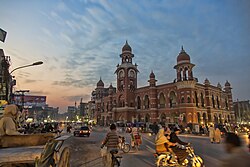 Multan Ghanta Ghar was built in the Indo-Saracenic style, in 1884.
 -
 Martyr's memorial at Jallianwalla Bagh. In 1919, Brigadier-General Reginald Dyer ordered troops under his command to fire into a crowd of non-violent protestors, killing between 300 and 1,000 people. The act served to rally the Indian independence movement.


Partition of Punjab (1947)[edit | edit source]

In 1947, the Punjab Province of British India was divided along religious lines into West Punjab and East Punjab, with East Punjab containing modern states of Indian Punjab, Haryana and Himachal Pradesh. The Partition of India in 1947 split the former Raj province of Punjab; the mostly Muslim western part became the Pakistani province of West Punjab and the mostly Sikh and Hindu eastern part became the Indian province of Punjab. Many Sikhs and Hindus lived in the west, and many Muslims lived in the east, and so partition saw many people displaced and much intercommunal violence. All Punjabi princely states, except Bahawalpur, also became part of India.[citation needed]
The undivided Punjab, of which Punjab (Pakistan) forms a major region today, was home to a large minority population of Sikhs and Hindus unto 1947 apart from the Muslim majority.[221] The Gurdaspur district which is partially now part of the Indian state of Punjab had a slight Muslim majority (50.2% according to the 1941 census) prior to the partition. Many Muslims fled the partition violence to settle in Pakistan.[222][223] While many cities in what is now Pakistan—such as Rawalpindi, Nankana Sahib, and Sargodha etc.—had Hindu and Sikh majorities before 1947, other districts like Lahore, Sheikhupura, and Lyallpur (now Faisalabad) had sizable Hindu and Sikh populations, though not in the majority. The migration of Hindus and Sikhs to India began following communal violence in the Hazara region in December 1946, and intensified after the Rawalpindi massacres in March 1947. This migration continued amid the broader wave of partition-related violence, lasting until and beyond the day of independence.[224][225]
As stated, a major consequence of partition was the sudden shift towards religious homogeneity occurred in all districts across Punjab owing to the new international border that cut through the province. This rapid demographic shift was primarily due to wide scale migration but also caused by large-scale religious cleansing riots which were witnessed across the region at the time. According to historical demographer Tim Dyson, in the eastern regions of Punjab that ultimately became Indian Punjab following independence, districts that were 66% Hindu in 1941 became 80% Hindu in 1951; those that were 20% Sikh became 50% Sikh in 1951. Conversely, in the western regions of Punjab that ultimately became Pakistani Punjab, all districts became almost exclusively Muslim by 1951.[226]
A major religious population exchange happened in 1947, which resulted in the following 1951 census: Muslim population noted as 300,246 persons (1.77%) in East Punjab (India), while in West Punjab (Pakistan), the 1951 census recorded a Hindu population of 33,052 persons (0.16%) and only 35 others (some of whom may have been Sikh).[227][228]
After Independence[edit | edit source]
Punjabi Subah[edit | edit source]
After independence, the Akali Dal, a Sikh-dominated political party active mainly in Punjab, sought to create a Sikh State but idea was not very popular. However, there was push in many regions of India for reorganisation of states based on language. In Punjab, instead of religion, the Akalis launched the Punjabi Suba movement aimed at creation of a Punjabi-majority subah ("province") in the erstwhile East Punjab state of India in the 1950s.In 1966, it resulted in the formation of the Punjabi speaking -majority Punjab state, the Haryanvi-Hindi-majority Haryana state and the Union Territory of Chandigarh. Some Pahari majority parts of the East Punjab were also merged with Himachal Pradesh as a result of the movement.[229]
Khalistan movement[edit | edit source]
Some Sikhs called for the creation of a separate Sikh homeland known as Khalistan in the 1970s, along the lines of Pakistan, which led to a state of emergency being declared by Indira Gandhi, who believed the creation of Khalistan would drastically weaken India, particularly since the Punjab region grew up to 70% of the country's wheat (during the Green Revolution in India, incentives had been provided to the people of Punjab to switch to growing wheat exclusively). During Operation Blue Star, Gandhi further called in Indian troops to extinguish the few militants who had taken shelter in the Golden Temple, killing thousands of civilians in the crossfire.[230] Attacks then targeted the Punjab State police and Indian Security forces that opposed the creation of Khalistan and wished Punjab stay under Indian rule.[231]
See also[edit | edit source]
Notes[edit | edit source]
- ↑ Habib: "Harappa, in Sahiwal district of west Punjab, Pakistan, had long been known to archaeologists as an extensive site on the Ravi river, but its true significance as a major city of an early great civilization remained unrecognized until the discovery of Mohenjo-daro near the banks of the Indus, in the Larkana district of Sindh, by Rakhaldas Banerji in 1922. Sir John Marshall, then Director General of the Archaeological Survey of India, used the term 'Indus civilization' for the culture discovered at Harappa and Mohenjo-daro, a term doubly apt because of the geographical context implied in the name 'Indus' and the presence of cities implied in the word 'civilization'. Others, notably the Archaeological Survey of India after Independence, have preferred to call it `Harappan', or 'Mature Harappan', taking Harappa to be its type-site."[28]
- ↑ These covered carnelian products, seal carving, work in copper, bronze, lead, and tin.[32]
- ↑ Craterus supervised the construction. These cities are yet to be identified.
- ↑ "When the Greeks of Bactria and India lost their kingdom they were not all killed, nor did they return to Greece. They merged with the people of the area and worked for the new masters; contributing considerably to the culture and civilization in southern and central Asia." Narain, "The Indo-Greeks" 2003, p. 278
References[edit | edit source]
- ↑ 1.0 1.1 H K Manmohan Siṅgh. "The Punjab". The Encyclopedia of Sikhism, Editor-in-Chief Harbans Singh. Punjabi University, Patiala. Archived from the original on 5 March 2016. Retrieved 18 August 2015.
- ↑ Singh 1989, p. 1.
- ↑ 3.0 3.1 3.2 3.3 3.4 Minahan, James (2012). Ethnic Groups of South Asia and the Pacific: An Encyclopedia. ABC-CLIO. pp. 257–259. ISBN 978-1-59884-659-1. Archived from the original on 18 November 2022. Retrieved 21 August 2022.
- ↑ Flood 1996, p. 37.
- ↑ 5.0 5.1 5.2 5.3 Prakash, Buddha (1951). "Poros". Annals of the Bhandarkar Oriental Research Institute. 32 (1): 198–233. JSTOR 41784590. Retrieved 12 June 2022.
- ↑ "3 alexander and his successors in central asia" (PDF).
- ↑ Rajkamal Publications Limited, New Delhi (1943). Chandragupta Maurya And His Times. p. 16.
Chanakya, who is described as a resident of the city of Taxila, returned to his native city with the boy and had him educated for a period of 7 or 8 years at that famous seat of learning where all the ' sciences and arts ' of the times were taught, as we know from the Jatakas.
- ↑ Tarn, William Woodthorpe (24 June 2010). The Greeks in Bactria and India. Cambridge University Press. ISBN 978-1-108-00941-6.
- ↑ Ohri, Vishwa Chander (1980). Himachal Art & Archaeology: Some Aspects. State Museum, Department of Languages & Culture, Himachal Pradesh.
- ↑ Gokhale, Balkrishna Govind (1952). Ancient India, History and Culture. Asia Publishing House.
- ↑ Somānī, Rāmavallabha (1996). Temples of Rajasthan. Publication Scheme. ISBN 978-81-85263-87-8.
- ↑ Hutchison, John; Vogel, Jean Philippe (1994). History of the Panjab Hill States. Asian Educational Services. ISBN 978-81-206-0942-6.
- ↑ Gandhi, Rajmohan (2013). Punjab: A History from Aurangzeb to Mountbatten. New Delhi, India, Urbana, Illinois: Aleph Book Company. p. 1 ("Introduction"). ISBN 978-93-83064-41-0.
- ↑ "Punjab." Pp. 107 in Encyclopædia Britannica (9th ed.), vol. 20.
- ↑ Kenneth Pletcher, ed. (2010). The Geography of India: Sacred and Historic Places. Britannica Educational Publishing. p. 199. ISBN 978-1-61530-202-4. Archived from the original on 18 November 2022. Retrieved 11 August 2022.
The word's origin can perhaps be traced to panca nada, Sanskrit for "five rivers" and the name of a region mentioned in the ancient epic the Mahabharata.
- ↑ Rajesh Bala (2005). "Foreign Invasions and their Effect on Punjab". In Sukhdial Singh (ed.). Punjab History Conference, Thirty-seventh Session, March 18–20, 2005: Proceedings. Punjabi University. p. 80. ISBN 978-81-7380-990-3. Archived from the original on 18 November 2022. Retrieved 11 August 2022.
The word Punjab is a compound of two words-Panj (Five) and aab (Water), thus signifying the land of five waters or rivers. This origin can perhaps be traced to panch nada, Sanskrit for 'Five rivers' the word used before the advent of Muslims with a knowledge of Persian to describe the meeting point of the Jhelum, Chenab, Ravi, Beas, and Sutlej rivers, before they joined the Indus.
- ↑ Lassen, Christian. 1827. Commentatio Geographica atque Historica de Pentapotamia Indica Archived 18 November 2022 at the Wayback Machine [A Geographical and Historical Commentary on Indian Pentapotamia]. Weber. p. 4: "That part of India which today we call by the Persian name ''Penjab'' is named Panchanada in the sacred language of the Indians; either of which names may be rendered in Greek by Πενταποταμια. The Persian origin of the former name is not at all in doubt, although the words of which it is composed are both Indian and Persian.... But, in truth, that final word is never, to my knowledge, used by the Indians in proper names compounded in this way; on the other hand, there exist multiple Persian names which end with that word, e.g., Doab and Nilab. Therefore, it is probable that the name Penjab, which is today found in all geographical books, is of more recent origin and is to be attributed to the Muslim kings of India, among whom the Persian language was mostly in use. That the Indian name Panchanada is ancient and genuine is evident from the fact that it is already seen in the Ramayana and Mahabharata, the most ancient Indian poems, and that no other exists in addition to it among the Indians; for Panchála, which English translations of the Ramayana render with Penjab...is the name of another region, entirely distinct from Pentapotamia...."[whose translation?]
- ↑ Latif, Syad Muhammad (1891). History of the Panjáb from the Remotest Antiquity to the Present Time. Calcultta Central Press Company. p. 1. Archived from the original on 18 November 2022. Retrieved 11 August 2022.
The Panjáb, the Pentapotamia of the Greek historians, the north-western region of the empire of Hindostán, derives its name from two Persian words, panj (five), an áb (water), having reference to the five rivers which confer on the country its distinguishing features."
- ↑ Khalid, Kanwal (2015). "Lahore of Pre Historic Era" (PDF). Journal of the Research Society of Pakistan. 52 (2): 73. Archived (PDF) from the original on 11 August 2022. Retrieved 11 August 2022.
The earliest mention of five rivers in the collective sense was found in Yajurveda and a word Panchananda was used, which is a Sanskrit word to describe a land where five rivers meet. [...] In the later period the word Pentapotamia was used by the Greeks to identify this land. (Penta means 5 and potamia, water ___ the land of five rivers) Muslim Historians implied the word "Punjab " for this region. Again it was not a new word because in Persian-speaking areas, there are references of this name given to any particular place where five rivers or lakes meet.
- ↑ Grewal, J. S. (1998). The Sikhs of the Punjab. The New Cambridge History of India (Revised ed.). Cambridge University Press. p. 1. ISBN 978-0-521-63764-0. Archived from the original on 18 November 2022. Retrieved 11 August 2022.
- ↑ Chisholm, Hugh, ed. (1911). . Encyclopædia Britannica (11th ed.). Cambridge University Press. p. 653.
- ↑ Parth R. Chauhan. Distribution of Acheulian sites in the Siwalik region Archived 2012-01-04 at the Wayback Machine. An Overview of the Siwalik Acheulian & Reconsidering Its Chronological Relationship with the Soanian – A Theoretical Perspective.
- ↑ Gwen Robbins Schug; Subhash R. Walimbe (13 April 2016). A Companion to South Asia in the Past. John Wiley & Sons. pp. 39–. ISBN 978-1-119-05547-1. Archived from the original on 18 November 2022. Retrieved 10 November 2022. Quote: "Soanian and Soanian‐like assemblages are known throughout the entire Siwalik or Sub‐ Himalayan region, from Pakistan to northeast India including Nepal..."
- ↑ Lycett, Stephen J. (2007). "Is the Soanian techno-complex a Mode 1 or Mode 3 phenomenon? A morphometric assessment" (PDF). Journal of Archaeological Science. 34 (9): 1434–1440. Bibcode:2007JArSc..34.1434L. doi:10.1016/j.jas.2006.11.001. Archived from the original (PDF) on 7 October 2021. Retrieved 10 November 2022.
- ↑ "Pakistan: The lesser-known histories of an ancient land". 2 February 2017. Archived from the original on 10 September 2018. Retrieved 10 November 2022.
- ↑ Paterson, T.T., Drummond, H.J.H., 1962. Soan the Palaeolithic of Pakistan.Department of Archaeology, Government of Pakistan Karachi.
- ↑ 27.0 27.1 "Islamabad history". Pakistan.net. Archived from the original on 30 June 2008.
- ↑ 28.0 28.1 Habib 2015, p. 13.
- ↑ Wright 2009, p. 2.
- ↑ Wright 2009, p. 1.
- ↑ Giosan et al. 2012.
- ↑ Wright 2009, pp. 115–125.
- ↑ Dyson 2018, p. 29 "Mohenjo-daro and Harappa may each have contained between 30,000 and 60,000 people (perhaps more in the former case). Water transport was crucial for the provisioning of these and other cities. That said, the vast majority of people lived in rural areas. At the height of the Indus valley civilization the subcontinent may have contained 4–6 million people."
- ↑ McIntosh 2008, p. 387: "The enormous potential of the greater Indus region offered scope for huge population increase; by the end of the Mature Harappan period, the Harappans are estimated to have numbered somewhere between 1 and 5 million, probably well below the region's carrying capacity."
- ↑ Agrawala, V. S. (1953). India as known to Panini. p. 77.
Panini specially mentions the Vahika sanghas, some dominated by Brahmanas as ruling caste, others by Rajanyas, and called Rajanyaka
- ↑ Agrawala, V. S. (1953). India as known to Panini. p. 38.
Udichya and Prachya are the two broad divisions of the country mentioned by Panini, and these terms occur in connection with the linguistic forms known to the eastern and northern grammarians. The Udichya country included Gandhara and Vahika, the latter comprising Madra and Usinara.
- ↑ Journal of the Royal Asiatic Society. University Press. 1889. p. 212.
- ↑ Chattopadhyaya 2003, p. 55.
- ↑ Frawley 2000, p. 118.
- ↑ 40.0 40.1 40.2 Singh 1989, p. 4.
- ↑ Chattopadhyaya 2003, pp. 56—57.
- ↑ Chattopadhyaya, Sudhakar (1974). The Achaemenids And India. p. 22.
According to the Buddhist account Pukkusati, king of Taksasila, sent an embassy and a letter to king Bimbisara of Magadha and he also defeated Pradyota, king of Avanti.
- ↑ Chattopadhyaya, Sudhakar (1974). The Achaemenids And India. p. 22.
Bimbisara and his son Ajatasatru, he did not probably come to the throne before 540 or 530 bc, and Pukkusati also may be regarded as ruling in Gandhara about that time. He would be thus a contemporary of Cyrus who established his power and authority in 549 bc
- ↑ History Of Ancient And Early Medieval India From The Stone Age To The 12th Century. p. 604.
The Behistun inscription of the Achaemenid emperor Darius indicates that Gandhara was conquered by the Persians in the later part of the 6th century BCE.
- ↑ "Pukkusāti". www.palikanon.com. Retrieved 26 July 2020.
- ↑ Mccrindle, J. W. Ancient India As Described By Megasthenes And Arrian by Mccrindle, J. W. p. 109.
The Persians indeed summoned the Hydrakai from India to serve as mercenaries, but they did not lead an army into the country and only approached its borders when Kyros marched against the Massagatai.
- ↑ 47.00 47.01 47.02 47.03 47.04 47.05 47.06 47.07 47.08 47.09 Bosworth, Albert Brian (1993). "The campaign of the Hydaspes". Conquest and Empire: The Reign of Alexander the Great. Cambridge University Press. pp. 125–130.
- ↑ Holt, Frank Lee (2003). Alexander the Great and the mystery of the elephant medallions. University of California Press.
- ↑ Rogers, p.200
- ↑ 50.0 50.1 Bosworth, Albert Brian (1993). "From the Hydaspes to the Southern Ocean". Conquest and Empire: The Reign of Alexander the Great. Cambridge University Press.
- ↑ Anson, Edward M. (2013). Alexander the Great: Themes and Issues. Bloomsbury. p. 151. ISBN 9781441193797.
- ↑ Roy 2004, pp. 23–28.
- ↑ Irfan Habib; Vivekanand Jha (2004). Mauryan India. A People's History of India. Aligarh Historians Society / Tulika Books. p. 16. ISBN 978-81-85229-92-8. Archived from the original on 18 November 2022. Retrieved 11 August 2022.
- ↑ Theodore Dodge 1890, p. 597.
- ↑ Arrian (1893). Anabasis of Alexander. George Bell and Sons. OCLC 486120., p. 604
- ↑ Dodge, Theodore (1890). Alexander. New York: Da Capo Press. p. 604.
- ↑ Tripathi, Rama Shankar (1967). History of Ancient India. Motilal Banarsidass Publ. ISBN 9788120800182.
- ↑ Tarn, William Woodthorpe (24 June 2010). The Greeks in Bactria and India. Cambridge University Press. p. 152. ISBN 978-1-108-00941-6.
The Mauryan empire proper, north of the line of the Nerbudda and the Vindhya mountains, had pivoted upon three great cities: pataliputra the capital and the seat of the emperor, Taxila the seat of the viceroy of the North West...
- ↑ Sastri, K. a Nilakanta (1957). Comprehensive History Of India Vol.2 (mauryas And Satavahanas). p. 2.
he bought the boy by paying on the spot 1000 kdrshapanas. Kautilya(Chanakya) then took the boy with him to his native city of Takshasila (Taxila), then the most renowned seat of learning in India, and had him educated there for a period of seven or eight years in the humanities and the practical arts and crafts of the time, including the military arts.
- ↑ Sastri, K. a Nilakanta (1957). Comprehensive History Of India Vol.2 (mauryas And Satavahanas). p. 2.
This tradition is curiously confirmed by Plutarch's statement that Chandragupta as a youth had met Alexander during his campaigns in the Panjab. This was possible because Chandragupta was already living in that locality with Kautilya (Chanakya).
- ↑ Sastri, K. a Nilakanta (1957). Comprehensive History Of India Vol.2 (mauryas And Satavahanas). p. 3.
According to tradition he began by strengthening his position by an alliance with the Himalayan chief Parvataka, as stated in both the Sanskrit and Jaina texts, Mudradkshasa and Parisishtaparvan.
- ↑ Sastri, K. a Nilakanta (1957). Comprehensive History Of India Vol.2 (mauryas And Satavahanas). p. 4.
The army of Malayaketu (Parvataka) comprised recruits from the following peoples : Khasa, Magadha, Gandhara, Yavana, Saka, Chedi and Huna.
- ↑ Prakesh, Buddha. "Studies In Indian History And Civilization" (PDF). p. 157.
Subhagasena seems to be the successor of Virasena, who came to the throne after Ashoka, according to Taranatha. It appears that after the secession of the north-western half of India from the Maurya empire after the death of Ashoka, Virasena entrenched his hold over it while the other eastern and southern half of the country passed under the domination of Samprati.
- ↑ Prakesh, Buddha. "Studies In Indian History And Civilization" (PDF). p. 155.
Polybius states: "He (Antiochus the Great) crossed the Caucasus and descended into India, renewed his friendship with Sophogsenus the king of the Indians; received more elephants, until he had 150 altogether
- ↑ Rapson, Edward James; Haig, Sir Wolseley; Burn, Sir Richard; Dodwell, Henry; Wheeler, Sir Robert Eric Mortimer (1968). The Cambridge History of India. CUP Archive. p. 512.
..with whom Antiochus the Great renewed an ancestral relationship in 206 BCE
- ↑ Gupta, Gyan Swarup (1999). India: From Indus Valley Civilisation to Mauryas. Concept Publishing Company. ISBN 978-81-7022-763-2.
- ↑ Mookerji, Radhakumud (1 January 2016). Chandragupta Maurya and His Times. Motilal Banarsidass. ISBN 978-81-208-0433-3.
- ↑ Thonemann, Peter (14 January 2016). The Hellenistic World: Using Coins as Sources. Cambridge University Press. p. 97. ISBN 978-1-316-43229-7. Archived from the original on 18 November 2022. Retrieved 11 August 2022.
- ↑ Hazel, John (2013). Who's Who in the Greek World. Routledge. p. 155. ISBN 9781134802241.
Menander king in India, known locally as Milinda, born at a village named Kalasi near Alasanda (Alexandria-in-the-Caucasus), and who was himself the son of a king. After conquering the Punjab, where he made Sagala his capital, he made an expedition across northern India and visited Patna, the capital of the Mauraya empire, though he did not succeed in conquering this land as he appears to have been overtaken by wars on the north-west frontier with Eucratides.
- ↑ Ahir, D. C. (1971). Buddhism in the Punjab, Haryana, and Himachal Pradesh. Maha Bodhi Society of India. p. 31. OCLC 1288206.
Demetrius died in 166 B.C., and Apollodotus, who was a near relation of the King died in 161 B.C. After his death, Menander carved out a kingdom in Punjab. Thus from 161 B.C. onward Menander was the ruler of Punjab till his death in 145 B.C. or 130 B.C.
- ↑ "Menander | Indo-Greek king". Encyclopedia Britannica. Archived from the original on 21 May 2022. Retrieved 6 September 2021.
- ↑ Mortimer Wheeler Flames over Persepolis (London, 1968). Pp. 112 ff. It is unclear whether the Hellenistic street plan found by Sir John Marshall's excavations dates from the Indo-Greeks or from the Kushans, who would have encountered it in Bactria; Tarn (1951, pp. 137, 179) ascribes the initial move of Taxila to the hill of Sirkap to Demetrius I, but sees this as "not a Greek city but an Indian one"; not a polis or with a Hippodamian plan.
- ↑ "Menander had his capital in Sagala" Bopearachchi, "Monnaies", p. 83.
- ↑ McEvilley supports Tarn on both points, citing Woodcock: "Menander was a Bactrian Greek king of the Euthydemid dynasty. His capital (was) at Sagala (Sialkot) in the Punjab, "in the country of the Yonakas (Greeks)"." McEvilley, p. 377. However, "Even if Sagala proves to be Sialkot, it does not seem to be Menander's capital for the Milindapanha states that Menander came down to Sagala to meet Nagasena, just as the Ganges flows to the sea."
- ↑ "A vast hoard of coins, with a mixture of Greek profiles and Indian symbols, along with interesting sculptures and some monumental remains from Taxila, Sirkap and Sirsukh, point to a rich fusion of Indian and Hellenistic influences", India, the Ancient Past, Burjor Avari, p. 130
- ↑ Ghose, Sanujit (2011). "Cultural links between India and the Greco-Roman world" Archived 18 November 2022 at the Wayback Machine. Ancient History Encyclopedia
- ↑ "Most of the people east of the Ravi already noticed as within Menander's empire -Audumbaras, Trigartas, Kunindas, Yaudheyas, Arjunayanas- began to coins in the first century BC, which means that they had become independent kingdoms or republics.", Tarn, The Greeks in Bactria and India
- ↑ Tarn, William Woodthorpe (24 June 2010). The Greeks in Bactria and India. Cambridge University Press. ISBN 9781108009416. Archived from the original on 18 November 2022. Retrieved 11 August 2022.
- ↑ Saklani, Dinesh Prasad (1998). Ancient Communities of the Himalaya. Indus Publishing. ISBN 978-81-7387-090-3.
- ↑ Petrie, Cameron A. (28 December 2020). Resistance at the Edge of Empires: The Archaeology and History of the Bannu basin from 1000 BC to AD 1200. Oxbow Books. p. 105. ISBN 978-1-78570-306-5.
- ↑ "Buddhism and Society in the Indic North and Northwest, 2nd Century BCE–3rd Century CE" (PDF). p. 163.
the Reliquary Inscription of Ariaśrava et al (No. 31), dated 98 Azes (50/51 CE), whose donor, Ariaśrava, stipulates her relic dedication was made in the reign of Gondopahres' nephew Abdagases and the General Aśpavarma, son of Indravarma I:
- ↑ Fisher, W. B.; Yarshater, Ehsan; Gershevitch, Ilya; Frye, R. N.; Boyle, J. A.; Avery, Peter; Jackson, Peter (1968). The Cambridge History of Iran. Cambridge University Press. ISBN 978-0-521-20092-9.
- ↑ Description of the Hellenistic urbanism of Taxila:
- "Taxila, they tell us, is about as big as Nineveh, and was fortified fairly well after the manner of Greek cities" (Life of Apollonius Tyana, II 20) Archived 10 March 2016 at the Wayback Machine
- "I have already described the way in which the city is walled, but they say that it was divided up into narrow streets in the same irregular manner as in Athens, and that the houses were built in such a way that if you look at them from outside they had only one story, while if you went into one of them, you at once found subterranean chambers extending as far below the level of the earth as did the chambers above." (Life of Apollonius Tyana, II 23) Archived 10 March 2016 at the Wayback Machine
- ↑ Romane, Julian (30 January 2018). Rise of the Tang Dynasty: The Reunification of China and the Military Response to the Steppe Nomads (AD 581–626). Pen and Sword. p. 240. ISBN 978-1-4738-8779-4.
- ↑ Sastri, K. a Nilakanta (1957). Comprehensive History Of India Vol.2 (mauryas And Satavahanas). p. 215.
The interesting additional information we get from these coins is that Sasan, a former associate of Gondophares and afterwards one of his successors in the Taxila region, was the son of Aspa's brother
- ↑ Sastri, K. a Nilakanta (1957). Comprehensive History Of India Vol.2 (mauryas And Satavahanas). p. 215.
The coins further show that Sasan, who was at first a subordinate ruler under Gondophares, subsequently assumed independent or quasi-independent status.
- ↑ Srinivasan, Doris (30 April 2007). On the Cusp of an Era: Art in the Pre-Kuṣāṇa World. BRILL. p. 106. ISBN 978-90-474-2049-1.
In the Indus valley Gondophares was succeeded by his nephew Abdagases and then by Sases.
- ↑ Srinivasan, Doris (30 April 2007). On the Cusp of an Era: Art in the Pre-Kuṣāṇa World. BRILL. p. 115. ISBN 978-90-474-2049-1.
- ↑ Rienjang, Wannaporn; Stewart, Peter (14 March 2018). Problems of Chronology in Gandhāran Art: Proceedings of the First International Workshop of the Gandhāra Connections Project, University of Oxford, 23rd-24th March, 2017. Archaeopress. pp. 16–17. ISBN 978-1-78491-855-2.
- ↑ Srinivasan, Doris (30 April 2007). On the Cusp of an Era: Art in the Pre-Kuṣāṇa World. BRILL. p. 107. ISBN 978-90-474-2049-1.
Philostratus comments that the people who live between the River Kophen and Taxila have a coinage not of gold and silver but of Orichalcum and black brass. He describes the houses as designed so that if you look at them from the outside, they appear to have only one storey, but if you go inside they have underground rooms as well.
- ↑ De Beauvoir Priaulx, Osmond (1860). "The Indian Travels of Apollonius of Tyana". Journal of the Royal Asiatic Society of Great Britain and Ireland. 17: 76. ISSN 0035-869X. JSTOR 25581224.
Taxila was about the size of Ninovoh, walled like a Greek city
- ↑ De Beauvoir Priaulx, Osmond (1860). "The Indian Travels of Apollonius of Tyana". Journal of the Royal Asiatic Society of Great Britain and Ireland. 17: 77. ISSN 0035-869X. JSTOR 25581224.
They are taken to the palace. They found the city divided by narrow streets, well-arranged, and reminding them of Athens.
- ↑ De Beauvoir Priaulx, Osmond (1860). "The Indian Travels of Apollonius of Tyana". Journal of the Royal Asiatic Society of Great Britain and Ireland. 17: 76. ISSN 0035-869X. JSTOR 25581224.
and was the residence of a sovereign who ruled over what of old was the kingdom of Porus.
- ↑ De Beauvoir Priaulx, Osmond (1860). "The Indian Travels of Apollonius of Tyana". Journal of the Royal Asiatic Society of Great Britain and Ireland. 17: 78. ISSN 0035-869X. JSTOR 25581224.
Phraotes, in answer, said that he was moderate because his wants were few, and that as he was wealthy, he employed his wealth in doing good to his friends, and in subsidizing the barbarians, his neighbours, to prevent them from themselves ravaging, or allowing other barbarians to ravage his territories.
- ↑ De Beauvoir Priaulx, Osmond (1860). "The Indian Travels of Apollonius of Tyana". Journal of the Royal Asiatic Society of Great Britain and Ireland. 17: 81. ISSN 0035-869X. JSTOR 25581224.
The king then told how his father, the son of a king, had been left very young an orphan; and how during his minority two of his relatives according to Indian custom acted as regents, but with so little regard to law, that some nobles conspired against them, and slow them as they were sacrificing to the Indus, and seized upon the government
- ↑ De Beauvoir Priaulx, Osmond (1860). "The Indian Travels of Apollonius of Tyana". Journal of the Royal Asiatic Society of Great Britain and Ireland. 17: 81. ISSN 0035-869X. JSTOR 25581224.
How on this his father, then sixteen years of age, fled to the king beyond the Hydaspes, a greater king than himself, who received him kindly... he requested to be sent to the Brahmans; and how the Brahmans educated him; and how in time he married the daughter of the Hydaspian king, and received with her seven villages as pin-money, and had issue one son, himself, Phraotes.
- ↑ De Beauvoir Priaulx, Osmond (1860). "The Indian Travels of Apollonius of Tyana". Journal of the Royal Asiatic Society of Great Britain and Ireland. 17: 81. ISSN 0035-869X. JSTOR 25581224.
When I crossed the Hydraotis, I heard that, of the usurpers, one was already dead, and the other besieged in this very palace; so I hurried on, proclaiming to the villages I passed through who I was, and what were my rights : and the people received me gladly, and declaring I was the very picture of my father and grandfather, they accompanied me, many of them armed with swords and bows, and our numbers increased daily; and when we reached this city, the inhabitants, with torches lit at the altar of the Sun, and singing the praises of my father and grandfather, came out and welcomed me, and brought me hither.
- ↑ "Plate British Museum". The British Museum. Archived from the original on 19 October 2020. Retrieved 19 October 2020.
- ↑ "Zhang Qian". Encyclopædia Britannica. 2015. Archived from the original on 27 May 2015. Retrieved 9 November 2022.
- ↑ "Yuezhi". Encyclopædia Britannica. 2015. Archived from the original on 5 May 2015. Retrieved 9 November 2022.
- ↑ Si-Yu-Ki, Buddhist Records of the Western World, (Tr. Samuel Beal: Travels of Fa-Hian, The Mission of Sung-Yun and Hwei-S?ng, Books 1–5), Kegan Paul, Trench, Trubner & Co. Ltd. London. 1906 and Hill (2009), pp. 29, 318–350
- ↑ which began about 127 CE. "Falk 2001, pp. 121–136", Falk (2001), pp. 121–136, Falk, Harry (2004), pp. 167–176 and Hill (2009), pp. 29, 33, 368–371.
- ↑ "The History of Pakistan: The Kushans". www.kushan.org. Archived from the original on 7 July 2015. Retrieved 30 April 2017.
- ↑ Si-Yu-Ki, Buddhist Records of the Western World, (Tr. Samuel Beal: Travels of Fa-Hian, The Mission of Sung-Yun and Hwei-S?ng, Books 1–5), Kegan Paul, Trench, Trubner & Co. Ltd. London. 1906
- ↑ 105.0 105.1 Rezakhani 2017b, p. 203.
- ↑ Experts, Arihant (4 June 2019). Know Your State Himachal Pradesh. Arihant Publications India limited. ISBN 978-93-131-6765-5.
- ↑ 107.0 107.1 Dani, Ahmad Hasan; Litvinsky, B. A. (1996). History of Civilizations of Central Asia: The crossroads of civilizations, A.D. 250 to 750. UNESCO. pp. 123–126. ISBN 9789231032110. Archived from the original on 18 November 2022. Retrieved 11 November 2022.
- ↑ Alram 2014, pp. 274–275.
- ↑ Rezakhani, Khodadad (2017). ReOrienting the Sasanians: East Iran in Late Antiquity. Edinburgh University Press. pp. 105–124. ISBN 9781474400305. Archived from the original on 18 November 2022. Retrieved 11 November 2022.
- ↑ Bakker, Hans (16 July 2014). The World of the Skandapurāṇa. BRILL. ISBN 9789004277144.
- ↑ Dani, Ahmad Hasan (1999). History of Civilizations of Central Asia: The crossroads of civilizations: A.D. 250 to 750. Motilal Banarsidass. ISBN 9788120815407.
- ↑ Ghosh, Amalananda (1965). Taxila. CUP Archive. p. 791. Archived from the original on 18 November 2022. Retrieved 11 November 2022.
- ↑ Rahman, Abdul (2002). "New Light on the Khingal, Turk and the Hindu Sahis" (PDF). Ancient Pakistan. XV: 37–42.
The Hindu Śāhis were therefore neither Bhattis, or Janjuas, nor Brahmans. They were simply Uḍis/Oḍis. It can now be seen that the term Hindu Śāhi is a misnomer and, based as it is merely upon religious discrimination, should be discarded and forgotten. The correct name is Uḍi or Oḍi Śāhi dynasty.
- ↑ Meister, Michael W. (2005). "The Problem of Platform Extensions at Kafirkot North" (PDF). Ancient Pakistan. XVI: 41–48.
Rehman (2002: 41) makes a good case for calling the Hindu Śāhis by a more accurate name, "Uḍi Śāhis".
- ↑ 115.0 115.1 115.2 115.3 Rehman 1976.
- ↑ Rehman 1976, pp. 48–50.
- ↑ 117.0 117.1 History of Civilizations of Central Asia, Volume 4. UNESCO. 1 January 1998. p. 294. ISBN 9231034677.
- ↑ 118.0 118.1 Virani, Shafique N. (19 April 2007). The Ismailis in the Middle Ages: A History of Survival, a Search for Salvation. Oxford University Press. p. 100. ISBN 978-0198042594.
- ↑ Samad, Rafi U. (2011). The Grandeur of Gandhara: The Ancient Buddhist Civilization of the Swat, Peshawar, Kabul and Indus Valleys. Algora Publishing. p. 275. ISBN 978-0-87586-860-8.
- ↑ Gazetteer of the Attock District, 1930, Part 1. Sang-e-Meel Publications. 1932. ISBN 9789693514131. Archived from the original on 18 November 2022. Retrieved 9 February 2020.
- ↑ Mohan 2010, pp. 170—172.
- ↑ Barua 2006, p. 25.
- ↑ Mohan 2010, pp. 120—153.
- ↑ Samad, Rafi U. (2011). The Grandeur of Gandhara: The Ancient Buddhist Civilization of the Swat, Peshawar, Kabul and Indus Valleys. Algora Publishing. p. 275. ISBN 978-0875868608.
- ↑ Bosworth, C. Edmund (31 August 2007). Historic Cities of the Islamic World. BRILL. p. 299. ISBN 978-90-474-2383-6.
- ↑ Malik, Ikram Ali (1990). Tārīk̲h̲-i Panjāb: Qadīm daur tā Jang-i Āzādī, 1857 [History of Punjab: From Ancient Age to War of Independence, 1857] (in اردو). p. 3 – via The University of Michigan.
- ↑ 127.0 127.1 Lapidus, Ira M. (13 October 2014). A History of Islamic Societies. Cambridge University Press. pp. 391–394. ISBN 978-0-521-51430-9.
- ↑ Satish Chandra (2004). Medieval India: From Sultanat to the Mughals-Delhi Sultanat (1206–1526) – Part One. Har-Anand Publications. p. 267. ISBN 9788124110645. Archived from the original on 18 November 2022. Retrieved 9 November 2022.
- ↑ 129.0 129.1 Banarsi Prasad Saksena 1992, p. 332.
- ↑ Saksena, Banarsi Prasad (1992) [1970]. "The Khaljis: Alauddin Khalji". In Habib, Mohammad; Nizami, Khaliq Ahmad (eds.). A Comprehensive History of India: The Delhi Sultanat (A.D. 1206–1526). Vol. 5 (2nd ed.). The Indian History Congress / People's Publishing House. p. 332. OCLC 31870180.
- ↑ 131.0 131.1 William Lowe (Translator), Muntakhabu-t-tawārīkh, p. 296, at Google Books, Volume 1, pages 296–301
- ↑ Tarikh-I Firoz Shahi Ziauddin Barni, The History of India by its own Historians – The Muhammadan Period, Volume 3, Trubner London, pages 233–234
- ↑ Muḥammad ibn Tughluq Encyclopædia Britannica
- ↑ Tarikh-I Firoz Shahi Ziauddin Barni, The History of India by its own Historians – The Muhammadan Period, Volume 3, Trubner London, pp. 236–237
- ↑ Tarikh-I Firoz Shahi Ziauddin Barni, The History of India by its own Historians – The Muhammadan Period, Volume 3, Trubner London, pp. 235–240
- ↑ Jackson, Peter (2003). The Delhi Sultanate: A Political and Military History. Cambridge, England: Cambridge University Press. ISBN 978-0521543293.
- ↑ Vincent A Smith, The Oxford History of India: From the Earliest Times to the End of 1911, p. 217, at Google Books, Chapter 2, pp. 242–248, Oxford University Press
- ↑ Crooke, William (1890). An Ethnographical Hand-book for the N.-W. Provinces and Oudh. North-Western provinces and Oudh government Press. p. 144.
- ↑ Proceedings – Punjab History Conference. Publication Bureau, Punjab University. 1966. p. 82.
- ↑ Kulke, Hermann; Rothermund, Dietmar (2004). A History of India. Psychology Press. p. 184. ISBN 978-0-415-32919-4.
- ↑ Haque, Mohammed Anwarul (1980). Muslim Administration in Orissa, 1568-1751 A.D. Punthi Pustak. p. 20.
- ↑ Jauhri, R. C. (1990). Firoz Tughluq, 1351–1388 A.D. ABS Publications. p. 74. ISBN 978-81-7072-029-4.
- ↑ Hutchison, John; Vogel, Jean Philippe (1994). History of the Panjab Hill States. Asian Educational Services. p. 221. ISBN 978-81-206-0942-6.
- ↑ Richard M. Eaton (2019). India in the Persianate Age: 1000–1765. p. 117. ISBN 978-0520325128.
- ↑ Easton, Richard M. (2019). India in the Persianate Age: 1000–1765. University of California Press. p. 105. ISBN 978-0520325128.
The career of Khizr Khan, a Punjabi chieftain belonging to the Khokar clan, illustrates the transition to an increasingly polycentric north India.
- ↑ Digby, Simon (13 October 2014), After Timur Left: North India in the Fifteenth Century, Oxford University Press, pp. 47–59, doi:10.1093/acprof:oso/9780199450664.003.0002, ISBN 978-0-19-945066-4, retrieved 25 January 2023,
And we find that a Khokhar chieftain, Khizr Khan who was sent to Timur as an ambassador and negotiator from the most adjacent area, the Punjab, ultimately became the power holder in Delhi, thanks to the contacts he had aquired [sic].
- ↑ Orsini, Francesca; Sheikh, Samira (2014). After Timur Left: Culture and Circulation in Fifteenth-century North India. Oxford University Press. ISBN 978-0-19-945066-4.
- ↑ Srivastava, Ashirbadi Lal (1953). The Sultanate of Delhi: Including the Arab Invasion of Sindh, 711-1526 A. D. S. L. Agarwala. p. 229. ISBN 978-8193009352.
their claim of Descendants of Prophet Mohammad is dubious but it seems certain that Khizr Khan's ancestors came from Arabia
- ↑ Eraly, Abraham (1 April 2015). The Age of Wrath: A History of the Delhi Sultanate. Penguin UK. p. 261. ISBN 978-93-5118-658-8.
The first of these two dynasties was founded by Khizr Khan, who bore the appellation 'Sayyid', which identified him as a descendant of prophet Muhammad, so the dynasty he founded came to be known as the Sayyid dynasty. The veracity of Khizr Khan's claimed lineage is uncertain, but it is likely that his forebears were Arabs, who had migrated to India in the early Tughluq period and settled in Multan. The family prospered in India, gaining wealth and power. This advancement culminated in Malik Suleiman, Khizr Khan's father, becoming the governor of Multan under the Tughluqs. When Suleiman died, Khizr Khan succeeded him to the post, but lost it during the political turmoil following the death of Firuz Tughluq.
- ↑ Jackson 2003, p. 103.
- ↑ 151.0 151.1 Kumar 2020, p. 583.
- ↑ Kenneth Pletcher (2010). The History of India. The Rosen Publishing Group. p. 138. ISBN 9781615301225.
- ↑ V. D. Mahajan (2007). History of Medieval India. S. Chand. p. 229. ISBN 9788121903646.
- ↑ Proceedings:Volume 55. Indian History Congress. 1995. p. 216.
- ↑ Mahajan, V.D. (1991, reprint 2007). History of Medieval India, Part I, New Delhi: S. Chand, ISBN 81-219-0364-5, p.237
- ↑ Rajasthan [district Gazetteers] Bharatpur. Printed at Government Central Press. 1971. p. 52.
- ↑ Lal, Kishori Saran (1980). Twilight of the Sultanate: A Political, Social and Cultural History of the Sultanate of Delhi from the Invasion of Timur to the Conquest of Babur 1398–1526. Munshiram Manoharlal. ISBN 978-81-215-0227-6.
This considerably depleted Iqbal's strength and encouraged Khizr Khan to collect his forces of Multan, Deopalpur and the Punjab
- ↑ V. D. Mahajan (2007). History of Medieval India. S. Chand. ISBN 9788121903646.
- ↑ Iqtidar Alam Khan (2008). Historical Dictionary of Medieval India. Scarecrow Press. p. 103. ISBN 9780810855038.
- ↑ Lal, Kishori Saran (1980). Twilight of the Sultanate: A Political, Social and Cultural History of the Sultanate of Delhi from the Invasion of Timur to the Conquest of Babur 1398–1526. Munshiram Manoharlal. ISBN 978-81-215-0227-6.
Hoshang tried his luck against Sultan of Delhi but he was beaten back by Mubarak Shah Saiyyad to whom he had to pay a handsome tribute
- ↑ Lal, Kishori Saran (1980). Twilight of the Sultanate: A Political, Social and Cultural History of the Sultanate of Delhi from the Invasion of Timur to the Conquest of Babur 1398–1526. Munshiram Manoharlal. p. 109. ISBN 978-81-215-0227-6.
- ↑ Mahajan, V.D. (1991, reprint 2007). History of Medieval India, Part I, Now Delhi: S. Chand, ISBN 81-219-0364-5, p.244
- ↑ A Comprehensive History of India: The Delhi Sultanat, A.D. 1206-1526. Orient Longmans. 1970. p. 714.
- ↑ Jayapalan 2001, p. 54.
- ↑ Jayapalan 2001, p. 56.
- ↑ Jayapalan 2001, p. 57.
- ↑ 167.0 167.1 167.2 167.3 167.4 167.5 Baloch, N. A.; Rafi, A. Q. (1998). History of civilizations of Central Asia, v. 4: THE REGIONS OF SIND, BALUCHISTAN, MULTAN AND KASHMIR: THE HISTORICAL, SOCIAL AND ECONOMIC SETTING (PDF). Unesco. p. 305. ISBN 978-92-3-103467-1. Archived (PDF) from the original on 6 March 2022. Retrieved 11 August 2022.
- ↑ Tolbort, T (1871). The District of Dera Ismail Khan, Trans-Indus. Archived from the original on 18 November 2022. Retrieved 12 December 2017.
- ↑ Davies, C. Collin. "Arghun." The Encyclopedia of Islam, Volume I. New ed. Leiden: E. J. Brill, 1960. ISBN 90-04-08114-3
- ↑ Bosworth, Clifford Edmund. The New Islamic Dynasties: A Chronological and Genealogical Manual. New York: Columbia University Press, 1996. ISBN 0-231-10714-5
- ↑ Davies, pp. 627–8
- ↑ Chandra, Chandra (2005). Medieval India: From Sultanat to the Mughals Part – II. Har-Anand Publications. ISBN 9788124110669.
- ↑ Singh 2006, pp. 12–13.
- ↑ Grewal 1998, p. 6.
- ↑ Singh, Khushwant (1991). A History of the Sikhs: Vol. 1. 1469–1839. Oxford University Press. p. 46.
- ↑ "The Islamic World to 1600: Rise of the Great Islamic Empires (The Mughal Empire)". Archived from the original on 27 September 2011.
- ↑ 177.0 177.1 177.2 "Mughal Dynasty". Encyclopaedia Britannica. Britannica. Archived from the original on 24 February 2021. Retrieved 15 February 2018.
- ↑ Prasad, Ishwari (1976). The Life and Times of Humayun. Central Book Depot. p. 92.
- ↑ Sinopoli, Carla M. (1994). "Monumentality and Mobility in Mughal Capitals". Asian Perspectives. 33 (2): 294. ISSN 0066-8435. JSTOR 42928323.
- ↑ 180.0 180.1 Arielli, N.; Collins, B. (28 November 2012). Transnational Soldiers: Foreign Military Enlistment in the Modern Era. Springer. ISBN 978-1137296634.
- ↑ Quddus, S.A. (1992). Punjab, the Land of Beauty, Love, and Mysticism. Royal Book Company. p. 402. ISBN 978-969-407-130-5. Archived from the original on 18 November 2022. Retrieved 29 July 2022.
- ↑ 182.0 182.1 Siddiqui, Shabbir A. (1986). "Relations Between Dara Shukoh and Sa'adullah Khan". Proceedings of the Indian History Congress. 47: 273–276. ISSN 2249-1937. JSTOR 44141552. Archived from the original on 22 April 2022. Retrieved 11 August 2022.
- ↑ Seiple 2013, p. 96.
- ↑ "Religions – Sikhism: Guru Tegh Bahadur". BBC. Archived from the original on 14 April 2017. Retrieved 20 October 2016.
- ↑ Singh & Fenech 2016, pp. 236—238.
- ↑ Fenech 2001, pp. 20—31, 623–642.
- ↑ McLeod 1999, pp. 155—165.
- ↑ Koch, Ebba (2006). The complete Taj Mahal : and the riverfront gardens of Agra. Richard André. Barraud. London: Thames & Hudson. p. 45. ISBN 978-0-500-34209-1. OCLC 69022179.
- ↑ G.S. Chhabra (2005). Advance Study in the History of Modern India (Volume-1: 1707–1803). Lotus Press. p. 38. ISBN 978-81-89093-06-8. Archived from the original on 18 November 2022. Retrieved 13 August 2022.
- ↑ Chisti, AA Sheikh Md Asrarul Hoque (2012). "Shahbaz Khan". In Islam, Sirajul; Miah, Sajahan; Khanam, Mahfuza; Ahmed, Sabbir (eds.). Banglapedia: the National Encyclopedia of Bangladesh (Online ed.). Dhaka, Bangladesh: Banglapedia Trust, Asiatic Society of Bangladesh. ISBN 984-32-0576-6. OCLC 52727562. Retrieved 23 October 2026.
- ↑ Fenech, Louis E; McLeod, W.H. (11 June 2014). Historical Dictionary of Sikhism (3 ed.). Rowman & Littlefield. p. 162. ISBN 978-1442236011.
- ↑ Jestice 2004, pp. 345—346.
- ↑ Louis E. Fenech; W. H. McLeod (2014). Historical Dictionary of Sikhism. Rowman & Littlefield. pp. 260–261. ISBN 978-1-4422-3601-1.
- ↑ Potdar, Datto Vaman (1938). All India Modern History Congress.
- ↑ Singh 1984, p. 144-145.
- ↑ Roy, Kaushik (2004). India's Historic Battles: From Alexander the Great to Kargil. Permanent Black, India. pp. 80–1. ISBN 978-81-7824-109-8.
- ↑ A Popular Dictionary of Sikhism: Sikh Religion and Philosophy, p.86 Archived 18 November 2022 at the Wayback Machine, Routledge, W. Owen Cole, Piara Singh Sambhi, 2005
- ↑ Khushwant Singh, A History of the Sikhs, Volume I: 1469–1839, Delhi, Oxford University Press, 1978, pp. 127–129
- ↑ Bhatia, Sardar Singh (1998). The Encyclopedia of Sikhism, Volume IV. Punjabi University. p. 396.
- ↑ Latif, Syad Muhammad (1964). The History of Punjab from the Remotest Antiquity to the Present Time. Eurasia Publishing House (Pvt.) Ltd. p. 283.
- ↑ 201.0 201.1 201.2 Metcalf, Barbara Daly (1 January 1984). Moral Conduct and Authority: The Place of Adab in South Asian Islam. University of California Press. ISBN 978-0-520-04660-3.
- ↑ Gilmartin, David (14 April 2020). Blood and Water: The Indus River Basin in Modern History. Univ of California Press. ISBN 978-0-520-35553-8.
- ↑ Punjab Government (1883). Gazetteer Of The Jhang District.
- ↑ Punjab Government (1883). Gazetteer Of The Jhang District.
- ↑ Punjab Government (1883). Gazetteer Of The Jhang District.
- ↑ Yasmin, Robina (2022). Muslims Under Sikh Rule in the Nineteenth Century: Maharaja Ranjit Singh and Religious Tolerance. I.B. Tauris. ISBN 978-0-7556-4035-5.
- ↑ 207.0 207.1 Grewal 1990, p. 99.
- ↑ Grewal 1990, pp. 100—101.
- ↑ Malik, Anas (22 October 2010). Political Survival in Pakistan: Beyond Ideology. Routledge. p. 190. ISBN 978-1-136-90418-9.
- ↑ 210.0 210.1 210.2 210.3 210.4 210.5 Talbot, Ian (1988). Punjab and the Raj, 1849–1947. Riverdale Company. ISBN 0913215287.
- ↑ Grewal 1990, p. 131.
- ↑ Grewal 1990, pp. 128—129.
- ↑ Grewal 1990, p. 134.
- ↑ Grewal 1990, p. 136.
- ↑ 215.0 215.1 Bhupinder Singh, Amandeep Kaur (2015). Railway Development in Colonial Punjab: Social and Cultural Assimilation, Vol. 3, Issue 1. International Journal of Social Science and Humanities Research. pp. (80–84).
- ↑ 216.0 216.1 216.2 Robert Ivermee, Secularism, Islam and Education in India, 1830–1910, Routledge, 28 July 2015, p.96
- ↑ Robert Ivermee, Secularism, Islam and Education in India, 1830–1910, Routledge, 28 July 2015, p.105
- ↑ Narain, Savita (19 October 2013). The Jallianwala Bagh Massacre. Lancer Publishers. p. 1. ISBN 978-1-935501-87-9.
- ↑ Grewal 1990, p. 165.
- ↑ http://www.pap.gov.pk/uploads/previous_members/S-1937-1945.htm Archived 2 April 2016 at the Wayback Machine Provincial Assembly of the Punjab
- ↑ The Punjab in 1920s – A Case study of Muslims, Zarina Salamat, Royal Book Company, Karachi, 1997. table 45, pp. 136. ISBN 969-407-230-1
- ↑ Talbot, Ian (1993). "The role of the crowd in the Muslim League struggled for Pakistan". The Journal of Imperial and Commonwealth History. 21 (2): 307–333. doi:10.1080/03086539308582893.
- ↑ Nisid Hajari (2015). Midnight's Furies: The Deadly Legacy of India's Partition. Houghton Mifflin Harcourt. pp. 139–. ISBN 978-0-547-66921-2. Retrieved 18 December 2017.
- ↑ Ahmed, Ishtiaq. The Punjab: Bloodied, Partitioned and Cleansed. Oxford University Press. ISBN 978-0199406593.
- ↑ Ahmad, Ishtiaq (29 September 2012). The Punjab: Bloodied, Partitioned and Cleansed. Rupa Publications India Pvt. ISBN 9788129119049.
- ↑ Dyson 2018, pp. 188–189.
- ↑ Population According to Religion Table-6, CENSUS OF PAKISTAN, 1951 (October 1951). CENSUS OF PAKISTAN, 1951 Population According to Religion Table 6 (PDF). Office of Census Commissioner, Govt. of Pakistan, Ministry of Interior. pp. 12–21. Archived from the original (PDF) on 19 February 2024.
{{cite book}}: CS1 maint: multiple names: authors list (link) CS1 maint: numeric names: authors list (link) - ↑ Census Of India 1951, Vol 8, Punjab. Census Of India 1951, Vol 8 Punjab, Pepsu, Himachal Pradesh, Bilaspur and Delhi Part II-A General Population, Age and Social Tables. Govt. of India Census Commissioner LAKSHMI CHANDRA VASHISHTA, B.A.(Hons), LLB., P.C.S.
{{cite book}}: CS1 maint: numeric names: authors list (link) - ↑ Brass, Paul R. (2005). Language, Religion and Politics in North India. iUniverse. p. 326. ISBN 978-0-595-34394-2.
- ↑ Martin, Gus (2013). Understanding Terrorism: Challenges, Perspectives, and Issues. Sage. p. 174. ISBN 978-1-4522-0582-3. Archived from the original on 18 November 2022. Retrieved 12 November 2020.
- ↑ Lutz, James; Lutz, Brenda (2013). Global Terrorism. Routledge. p. 88. ISBN 978-0-415-53785-8.
Bibliography[edit | edit source]
Books[edit | edit source]
- Ali, Imran. The Punjab under imperialism, 1885–1947 (2014).
- Alram, Michael (2014). "From the Sasanians to the Huns New Numismatic Evidence from the Hindu Kush". The Numismatic Chronicle. 174: 261–291. JSTOR 44710198.
- Barua, Pradeep (2006), The State at War in South Asia, University of Nebraska Press, ISBN 978-0-8032-2785-9
- Banarsi Prasad Saksena (1992) [1970]. "The Khaljis: Alauddin Khalji". In Mohammad Habib and Khaliq Ahmad Nizami (ed.). A Comprehensive History of India: The Delhi Sultanat (A.D. 1206–1526). Vol. 5 (Second ed.). The Indian History Congress / People's Publishing House. OCLC 31870180.
- Bhaṅgū, R.S.; Singh, K.; Singh, K. (2006). Sri Gur Panth Prakash: Episodes 1 to 81. Institute of Sikh Studies. ISBN 978-81-85815-28-2. Archived from the original on 18 November 2022. Retrieved 24 July 2018.
- Chattopadhyaya, Brajadulal (2003), Studying Early India: Archaeology, Texts, and Historical Issues, Permanent Black Publishers, ISBN 81-7824-143-9
- Condos, Mark. The Insecurity State: Punjab and the Making of Colonial Power in British India (2020) excerpt Archived 18 November 2022 at the Wayback Machine
- Daniélou, Alain (2003), A Brief History of India, Simon and Schuster, ISBN 978-0-89281-923-2
- Dhanoa, S.S. (2005). Raj Karega Khalsa (in eesti). Sanbun Publishers. Archived from the original on 18 November 2022. Retrieved 24 July 2018.
- Theodore Dodge (1890). Alexander. New York: Da Capo Press. pp. 592–608.
- Dyson, Tim (2018), A Population History of India: From the First Modern People to the Present Day, Oxford University Press, ISBN 978-0-19-882905-8
- George Erdosy (1995). The Indo-Aryans of Ancient South Asia: Language, Material Culture and Ethnicity. Walter de Gruyter. ISBN 978-3-11-014447-5.
- Flood, Gavin D. (1996), An Introduction to Hinduism, Cambridge University Press
- Frawley, David (2000), Gods, Sages and Kings: Vedic Secrets of Ancient Civilization, Lotus Press, ISBN 978-0-910261-37-1
- Gandhi, R. (2013). of the Book: Punjab: A History from Aurangzeb to Mountbatten.
- Grewal, J. S. (1990), The Sikhs of the Punjab, Cambridge University Press, ISBN 0-521-2688-4-2
- Habib, Irfan (2015). The Indus Civilization. Tulika Books. ISBN 978-93-82381-53-2.
- Jackson, Peter (2003). The Delhi Sultanate: A Political and Military History. Cambridge University Press.
- Jayapalan, N. (2001), History of India, Atlantic Publishers & Distributors (P) Limited, ISBN 978-81-7156-928-1
- Jestice, Phyllis (2004), Holy people of the world : a cross-cultural encyclopedia, ABC-CLIO, ISBN 978-1-57607-355-1, OCLC 57407318
- Johar, S.S. (1975). Guru Tegh Bahadur: A Biography. Abhinav Publications. ISBN 978-81-7017-030-3. Archived from the original on 18 November 2022. Retrieved 24 July 2018.
- Kumar, Sunil (2020). "The Delhi Sultanate as Empire". In Bang, Peter Fibiger; Bayly, C. A.; Scheidel, Walter (eds.). The Oxford World History of Empire. Vol. 2. Oxford University Press.
- Lapidus, I. M. (2014), A History of Islamic Societies, Cambridge University Press, ISBN 978-1-139-99150-6, archived from the original on 18 November 2022, retrieved 14 April 2018
- Majumdar, R. C. (1977), Ancient India, Motilal Banarsidass, ISBN 978-81-208-0436-4
- Mani, C. M. (2005), A Journey Through India's Past, Northern Book Centre, ISBN 978-81-7211-194-6
- McIntosh, Jane (2008). The Ancient Indus Valley: New Perspectives. ABC-Clio. ISBN 978-1-57607-907-2.
- McLeod, Hew (1999), "Sikhs and Muslims in the Punjab", South Asia: Journal of South Asian Studies, 22 (sup001): 155–165, doi:10.1080/00856408708723379, ISSN 0085-6401
- Melton, J. G. (2014), Faiths Across Time: 5,000 Years of Religious History, ABC-CLIO, ISBN 978-1-61069-026-3
- Mohan, R. T. (2010), Afghanistan Revisited: The Brahmana Hindu Shahis of Afghanistan and the Punjab (c.840–1026 CE), MLBD
- Nesbitt, E. (2016). Sikhism: A Very Short Introduction. Very short introductions. Oxford University Press. ISBN 978-0-19-874557-0. Archived from the original on 18 November 2022. Retrieved 24 July 2018.
- Rezakhani, Khodadad (2017b). "From the Kushans to the Western Turks". In Daryaee, Touraj (ed.). King of the Seven Climes: A History of the Ancient Iranian World (3000 BCE – 651 CE). UCI Jordan Center for Persian Studies. pp. 1–236. ISBN 978-0-692-86440-1.
- Romm, James S. (2012), The Landmark Arrian: The Campaigns of Alexander, Anchor Books, ISBN 978-1-4000-7967-4
- Scharfe, H. (2002), Handbook of Oriental Studies, Brill, ISBN 978-90-04-12556-8, archived from the original on 23 October 2022, retrieved 3 April 2018
- Seiple, Chris (2013), The Routledge Handbook of Religion and Security, Routledge, ISBN 978-0-415-66744-9, OCLC 781277896
- Singh, Khushwant (1984). A history of the Sikhs. Princeton University Press. ISBN 978-0-19-562643-8. OCLC 11819068.
- Singh, Khushwant (2006). The Illustrated History of the Sikhs. India: Oxford University Press. pp. 12–13. ISBN 0-19-567747-1.
- Singh, Ganda (1989), "History and Culture of Panjab Through The Ages", in Singh, Mohinder (ed.), History and Culture of Panjab, Atlantic Publishers, pp. 1–16, ISBN 978-8171560783
- Singh, H. (2008). Game of Love. Akaal Publishers. ISBN 978-0-9554587-1-2. Archived from the original on 18 November 2022. Retrieved 24 July 2018.
- Singh, Pashaura; Fenech, Louis E., eds. (2016), The Oxford Handbook of Sikh Studies, Oxford University Press, ISBN 978-0-19-969930-8, OCLC 874522334
- Singh, Upinder (2017), Political Violence in Ancient India, Harvard University Press, ISBN 978-0-674-97527-9
- Thorpe, Showick; Thorpe, Edgar (2009), The Pearson General Studies Manual 2009, Pearson, ISBN 978-81-317-2133-9
- Wink, Andre (2002), Al-Hind, the Making of the Indo-Islamic World: Early Medieval India and the Expansion of Islam 7Th-11th Centuries, Brill, ISBN 978-0-391-04173-8
- Wright, Rita P. (2009). The Ancient Indus: Urbanism, Economy, and Society. Cambridge University Press. ISBN 978-0-521-57219-4. Retrieved 29 September 2013.
Journals[edit | edit source]
- Digby, Simon (1976). "Mohammad Habib: Politics and society during the early medieval period. Collected works, Vol. 1. Edited by K. A. Nizami. xx, 451 pp., front. New Delhi: People's Publishing House [for the] Centre of Advanced Study, Dept. of History, Aligarh Muslim University, 1974. Rs. 50". Bulletin of the School of Oriental and African Studies. 39 (2). Cambridge University Press (CUP): 453. doi:10.1017/s0041977x0005028x. ISSN 0041-977X.
- Fenech, Louis E. (2001), "Martyrdom and the Execution of Guru Arjan in Early Sikh Sources", Journal of the American Oriental Society, 121 (1): 20–31, doi:10.2307/606726, ISSN 0003-0279, JSTOR 606726
- Giosan L, Clift PD, Macklin MG, Fuller DQ, et al. (2012). "Fluvial landscapes of the Harappan civilization". Proceedings of the National Academy of Sciences. 109 (26): E1688–E1694. Bibcode:2012PNAS..109E1688G. doi:10.1073/pnas.1112743109. ISSN 0027-8424. PMC 3387054. PMID 22645375.
- Talbot, I. A. (1980). "The 1946 Punjab Elections" Modern Asian Studies 14(1), 65–91 online Archived 28 January 2021 at the Wayback Machine.
Theses[edit | edit source]
Further reading[edit | edit source]
- R. M. Chopra, "The Legacy of the Punjab", (1997), Punjabee Bradree, Calcutta.
