








>ShadowMOD123 m Minor change! |
typo fix |
||
| Line 1: | Line 1: | ||
{{short description|Overview of the Bengali culture}} | |||
{{Further|Culture of Bangladesh|Culture of West Bengal}} | {{Further|Culture of Bangladesh|Culture of West Bengal}} | ||
{{ | {{Multiple issues| | ||
{{more citations needed|date=October 2016}} | {{more citations needed|date=October 2016}} | ||
{{Original research|date=August 2023}} | |||
{{Unreliable sources|date=August 2023}} | |||
{{Lead extra info|date=May 2025}} | |||
}} | |||
{{EngvarB|date=June 2015}} | {{EngvarB|date=June 2015}} | ||
{{Use dmy dates|date=June 2015}} | {{Use dmy dates|date=June 2015}} | ||
{{Culture of Bengal}} | |||
{{Bengalis}} | |||
{{ | |||
The '''culture of Bengal''' defines the cultural heritage of the [[Bengalis|Bengali]] people native to eastern regions of the [[Indian subcontinent]], mainly what is today [[Bangladesh]] and the [[India]]n states of [[West Bengal]], Assam's [[Barak Valley]], [[Tripura]], parts of [[Jharkhand]], where they form the dominant ethnolinguistic group and the [[Bengali language]] is the official and primary language. Bengal has a recorded history of 1,400 years. | |||
The | |||
[[ | The [[Bengalis]] are the dominant ethnolinguistic group. The [[Bengal]] region has been a historical melting point, blending indigenous traditions with cosmopolitan influences from pan-[[Indian subcontinent]]al empires. [[Dhaka]] ([[Dhaka|Dacca]]) became the capital of [[Mughal Bengal]] ([[Mughal Bengal|Bengal Subah]]) and the commercial (financial) capital (1610-1757) of [[Mughal Empire|Mughal India]]. [[Dhaka]] is the largest and richest [[Bengalis|Bengali]] ([[Bengalis|Bangali]]) mega city in the world and also the 3rd largest and richest mega city in ([[Indian sub continent]]) after [[Mumbai]] ([[Mumbai|Bombay]] or [[Mumbai Metropolitan Region|MMR]]) and [[Delhi]] ([[National Capital Region (India)|NCR]]). [[Dhaka]] is a [[Globalization and World Cities Research Network|Beta (β) Global City (Moderate Economic Centre)]]. As a part of the [[Bengal Presidency]], [[Bengal]] also hosted the region's most advanced political and cultural centers during [[British India|British rule]].<ref name="auto">{{cite book |last=Minahan |first=James B. |date=2012 |title=Ethnic Groups of South Asia and the Pacific: An Encyclopedia |url=https://books.google.com/books?id=fOQkpcVcd9AC |publisher=ABC-CLIO|isbn=9781598846607 }}</ref> | ||
==Fine arts== | ==Fine arts== | ||
===Performing arts=== | ===Performing arts=== | ||
{{See also|Performing arts of Bangladesh}} | |||
====Music==== | ====Music==== | ||
{{See also|Music of | {{See also|Music of Bengal|Music of Bangladesh|Music of West Bengal}} | ||
Bengal has produced leading figures of [[Indian classical music]], including [[Alauddin Khan]], [[Ravi Shankar]] and [[Ali Akbar Khan]]. Common musical instruments include the [[sitar]], [[tabla]] and [[sarod]]. The [[Baul]] tradition is a unique regional folk heritage. The most prominent practitioner was [[Lalon Shah]]. Other folk music forms include [[Gombhira]], [[Bhatiali]] and [[Bhawaiya]] (Jhumur). Folk music in | Bengal has produced leading figures of [[Indian classical music]], including [[Alauddin Khan]], [[Ravi Shankar]] and [[Ali Akbar Khan]]. Common musical instruments include the [[sitar]], [[tabla]] and [[sarod]]. The [[Baul]] tradition is a unique regional folk heritage. The most prominent practitioner was [[Lalon Shah]]. Other folk music forms include [[Gombhira]], [[Bhatiali]] and [[Bhawaiya]] (Jhumur). Folk music in Bengal is often accompanied by the [[ektara]], a one-stringed instrument. Other instruments include the [[dotara]], [[dhol]], [[bamboo flute]], and [[tabla]]. Songs written by Rabindranath Tagore ([[Rabindra Sangeet]]) and [[Kazi Nazrul Islam]] ([[Nazrul geeti]]) are highly popular. Bangladesh is the center of [[Bangladeshi rock|Bangla rock]], as well as [[indie rock|indie]], [[Sufi rock]] and fusion folk music. | ||
<gallery class="center"> | <gallery class="center"> | ||
File:Baul_performance_at_Baul_Fakiri_Mela.jpg|The mystic [[Baul]] song | |||
Nazrul teaching Nazrul Sangeet.jpg|[[Kazi Nazrul Islam|Nazrul]] teaching [[Nazrul Sangeet]] | |||
Ravi Shankar.jpg|[[Ravi Shankar]] | Ravi Shankar.jpg|[[Ravi Shankar]] | ||
Powersurge (4039205917).jpg|A [[Bangladeshi rock]] band | Powersurge (4039205917).jpg|A [[Bangladeshi rock]] band | ||
</gallery> | </gallery> | ||
====Theatre==== | ====Theatre==== | ||
{{See also|Theatre | {{See also|Bengali theatre|Theatre of Bangladesh|Theatre of India}} | ||
Bengali | [[Bengali theatre]] traces its roots to [[Indian classical drama]] under the [[Gupta Empire]] in the 4th century CE. It includes narrative forms, song and dance forms, supra-personae forms, performance with scroll paintings, puppet theatre and the processional forms like the [[Jatra (theatre)|Jatra]]. | ||
====Dance==== | ====Dance==== | ||
{{see also|Gaudiya Nritya|Chhau dance}} | {{see also|Gaudiya Nritya|Chhau dance|Kathak}} | ||
Bengal has an extremely rich heritage of dancing dating back to antiquity. It includes classical, folk and martial dance traditions.<ref>{{cite book |last=Hasan |first=Sheikh Mehedi |year=2012 |chapter=Dance |chapter-url=http://en.banglapedia.org/index.php?title=Dance |editor1-last=Islam |editor1-first=Sirajul |editor1-link=Sirajul Islam |editor2-last=Jamal |editor2-first=Ahmed A. |title=Banglapedia: National Encyclopedia of Bangladesh |edition=Second |publisher=[[Asiatic Society of Bangladesh]]}}</ref><ref>{{cite book |last=Ahmed |first=Wakil |year=2012 |chapter=Folk Dances |chapter-url=http://en.banglapedia.org/index.php?title=Folk_Dances | [[File:Nabanno_festival_in_folk_area.jpg|thumb|right|[[Bengalis|Bengali]] girls performing folk dance in the occasion of [[Nabanna]]]] | ||
Bengal has an extremely rich heritage of dancing dating back to antiquity. It includes classical, folk and martial dance traditions.<ref>{{cite book |last=Hasan |first=Sheikh Mehedi |year=2012 |chapter=Dance |chapter-url=http://en.banglapedia.org/index.php?title=Dance |editor1-last=Islam |editor1-first=Sirajul |editor1-link=Sirajul Islam |editor2-last=Jamal |editor2-first=Ahmed A. |title=Banglapedia: National Encyclopedia of Bangladesh |edition=Second |publisher=[[Asiatic Society of Bangladesh]] |access-date=30 July 2016 |archive-date=1 August 2015 |archive-url=https://web.archive.org/web/20150801145459/http://en.banglapedia.org/index.php?title=Dance |url-status=live }}</ref><ref>{{cite book |last=Ahmed |first=Wakil |year=2012 |chapter=Folk Dances |chapter-url=http://en.banglapedia.org/index.php?title=Folk_Dances |editor1-last=Islam |editor1-first=Sirajul |editor1-link=Sirajul Islam |editor2-last=Jamal |editor2-first=Ahmed A. |title=Banglapedia: National Encyclopedia of Bangladesh |edition=Second |publisher=[[Asiatic Society of Bangladesh]] |access-date=30 July 2016 |archive-date=1 August 2015 |archive-url=https://web.archive.org/web/20150801034916/http://en.banglapedia.org/index.php?title=Folk_Dances |url-status=live }}</ref> Dances in Bengal includes- | |||
* [[Gaudiya Nritya]] (Classical dance) | |||
* [[Rabindra Sangeet|Rabindra Nritya]] | |||
* [[Nazrul Sangeet|Nazrul Nritya]] | |||
* [[Dhunuchi Nritya]] | |||
* [[Rajbongshi]] [[Nritya]] | |||
* [[Baul]] dance | |||
* [[Sankirtana]] of Nadia/Gaudiya Vaishnavism | |||
*[[Chhau dance|Chhau]] dance | |||
* [[Jhumair]] dance | |||
* Chhokra dance | |||
* [[Fakir]] dance | |||
* [[Dhamail]] dance | |||
* [[Gombhira]] dance | |||
* [[Raibenshe]] dance | |||
* [[Chittagonian]] dance | |||
* [[Alkap]] dance | |||
* [[Jari gan|Jari]] dance | |||
* [[Lathi Khela|Lathi]] dance | |||
* [[Puppetry]] (''Putul naach'') <ref>{{Cite web |url=https://en.banglapedia.org/index.php/Folk_Dances |title=Folk Dances |website=Banglapedia |access-date=29 August 2023 |archive-date=29 August 2023 |archive-url=https://web.archive.org/web/20230829223630/https://en.banglapedia.org/index.php/Folk_Dances |url-status=live}}</ref> | |||
===Visual arts=== | ===Visual arts=== | ||
====Painting==== | ====Painting==== | ||
{{See also|List of Bangladeshi painters}} | {{See also|List of Bangladeshi painters|List of Indian painters}} | ||
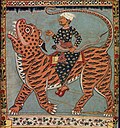
[[File:Pir Gazi and his tiger in Sundarbans.jpg|thumb|The Gazi scrolls ''(Gazir pat)'' narrate the story of [[Gazi Pir]], who was thought to have lived in the [[Sundarbans]] some time between the 12th to 13th century.]] | |||
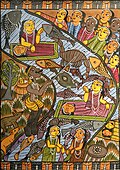
[[File:Manasa_Mangal.jpg|thumb|A [[Kalighat painting]] describing a scene from Manasamangal Kavya]] | [[File:Manasa_Mangal.jpg|thumb|A [[Kalighat painting]] describing a scene from Manasamangal Kavya]] | ||
Modern painting emerged in Calcutta with the [[Bengal school]]. [[East Pakistan]] developed its own contemporary painting tradition under [[Zainul Abedin]]. Modern [[Bangladeshi art]] has produced many of South Asia's leading painters, including [[SM Sultan]], [[Mohammad Kibria]], [[Shahabuddin Ahmed (artist)|Shahabuddin Ahmed]], [[Kanak Chanpa Chakma]], [[Kafil Ahmed]], [[Saifuddin Ahmed]], [[Qayyum Chowdhury]], [[Rashid Choudhury]], [[Quamrul Hassan]], [[Rafiqun Nabi]] and [[Syed Jahangir]] among others. | [[Mughal miniature|Miniature]] and scroll painting flourished in [[Mughal Bengal]]. [[Rickshaw painting of Bangladesh|Rickshaw Painting]] adorns colorful hoods featuring intricate designs like minarets and floral patterns with the word "[[God in Islam|Allah]]" and other islamic motifs,<ref>{{Cite web |url=https://www.researchgate.net/publication/361106657 |title=Devotion in Motion: The Image of Islam in Rickshaw Art of Bangladesh |access-date=23 September 2024 |archive-date=23 September 2024 |archive-url=https://web.archive.org/web/20240923123541/https://www.researchgate.net/publication/361106657_Devotion_in_Motion_The_Image_of_Islam_in_Rickshaw_Art_of_Bangladesh |url-status=live }}</ref> are recognized as UNESCO-listed intangible heritage. <ref>{{Cite web |url=https://ich.unesco.org/en/RL/rickshaws-and-rickshaw-painting-in-dhaka-01589 |title=Rickshaws and rickshaw painting in Dhaka - UNESCO Intangible Cultural Heritage |access-date=23 September 2024 |archive-date=8 December 2023 |archive-url=https://web.archive.org/web/20231208020946/https://ich.unesco.org/en/RL/rickshaws-and-rickshaw-painting-in-dhaka-01589 |url-status=live }}</ref> The [[Patua]] community specializes "[[Patta Chitra|Patachitra]]", with the Gazir Pata being their renowned artwork, depicting [[Gazi Pir]]. <ref>{{cite web | url=https://en.banglapedia.org/index.php/Gazir_Pat | title=Gazir Pat - Banglapedia }}</ref> | ||
[[Kalighat painting]] or Kalighat Pat originated in 19th-century Calcutta, in the vicinity of Kalighat Kali Temple of [[Kolkata]], and from being items of souvenir taken by the visitors to the Kali temple, the paintings over a period of time developed as a distinct school of Indian painting. From the depiction of [[Hindu deities|Hindu gods]] other mythological characters, the Kalighat paintings developed to reflect a variety of themes. | |||
Modern painting emerged in Calcutta with the [[Bengal school]]. [[East Pakistan]] developed its own contemporary painting tradition under [[Zainul Abedin]]. Modern [[Bangladeshi art]] has produced many of South Asia's leading painters, including [[SM Sultan]], [[Mohammad Kibria]], [[Shahabuddin Ahmed (artist)|Shahabuddin Ahmed]], [[Kanak Chanpa Chakma]], [[Kafil Ahmed]], [[Saifuddin Ahmed]], [[Qayyum Chowdhury]], [[Rashid Choudhury]], [[Quamrul Hassan]], [[Rafiqun Nabi]] and [[Syed Jahangir]] among others.<ref>{{cite web |url=https://en.banglapedia.org/index.php/Bengal_Art |title=Bengal Art |website=Banglapedia}}</ref> | |||
====Architecture==== | ====Architecture==== | ||
{{main|Architecture of Bengal}} | {{main|Architecture of Bengal}} | ||
The earliest fortified cities in the region include [[Wari-Bateshwar]], [[Chandraketugarh]] and [[Mahasthangarh]]. Bengal has a glorious legacy of [[terracotta]] architecture from the ancient and medieval periods. The style includes many mosques, temples, palaces, forts, monasteries and [[caravanserai]]s. Mughal Dhaka was known as the ''City of Mosques'' and the ''Venice of the East''. [[Indo-Saracenic]] architecture flourished during the British period, particularly among the [[zamindar|landed gentry]]. British Calcutta was known as the ''City of Palaces''. Modernist terracotta architecture in South Asia by architects like [[Muzharul Islam]] and [[Louis Kahn]]. | {{see also|Architecture of Bangladesh|Architecture of Dhaka|Architecture of India}} | ||
The earliest fortified cities in the region include [[Wari-Bateshwar]], [[Chandraketugarh]] and [[Mahasthangarh]]. Bengal has a glorious legacy of [[terracotta]] architecture from the ancient and medieval periods. The architecture of the [[Bengal Sultanate]] saw a distinct style of domed mosques with complex niche pillars that had no minarets. [[Ivory]], [[pottery]] and [[brass]] were also widely used in Bengali art. The style includes many mosques, temples, palaces, forts, monasteries and [[caravanserai]]s. Mughal Dhaka was known as the ''City of Mosques'' and the ''Venice of the East''. [[Indo-Saracenic]] architecture flourished during the British period, particularly among the [[zamindar|landed gentry]]. British Calcutta was known as the ''City of Palaces''. Modernist terracotta architecture in South Asia by architects like [[Muzharul Islam]] and [[Louis Kahn]]. | |||
Bengali village housing is noted as the origin of the [[bungalow]]. | Bengali village housing is noted as the origin of the [[bungalow]]. | ||
====Sculpture==== | ====Sculpture==== | ||
Ancient Bengal was home to the Pala-Sena school of | {{See also|Sculpture of Bangladesh|Sculpture in the Indian subcontinent}} | ||
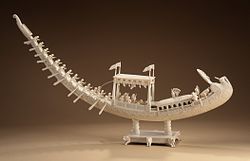
[[File:Royal Peacock Barge LACMA M.82.154.jpg|thumb|A sculpture of the [[Nawab of Bengal]]'s ''Royal Peacock Barge'' in [[Murshidabad]].]] | |||
[[Ancient Bengal]] was home to the [[Pala-sena|Pala-Sena]] school of sculptural art.<ref name="auto1"/> [[Ivory]] sculptural art flourished across the region under the [[Nawabs of Bengal]]. Notable modernist sculptors include [[Novera Ahmed]] and [[Nitun Kundu]]. | |||
==Lifestyle== | ==Lifestyle== | ||
===Textiles=== | ===Textiles=== | ||
{{See also|Textile arts of Bangladesh}} | {{See also|Textile arts of Bangladesh|Textile industry in India}} | ||
[[File:Kantha (Quilt) LACMA AC1994.131.1.jpg|thumb|220px|[[Kantha]], a Bengali cotton textile]] | [[File:Kantha (Quilt) LACMA AC1994.131.1.jpg|thumb|220px|[[Kantha]], a Bengali cotton textile]] | ||
[[File:Making of Jamdani-9.jpg|thumb|left|Traditional way of weaving [[Jamdani]].]] | |||
[[Muslin]] production in Bengal dates back to the 4th century BCE. The region exported the fabric to [[Ancient Greece]] and [[Ancient Rome|Rome]].<ref name="auto1">{{cite book |last=Snodgrass |first=Mary Ellen |date=2015 |title=World Clothing and Fashion: An Encyclopedia of History, Culture, and Social Influence |url=https://books.google.com/books?id=gO9nBwAAQBAJ |publisher=Routledge|isbn=9781317451679 }}</ref> | [[Muslin]] production in Bengal dates back to the 4th century BCE. The region exported the fabric to [[Ancient Greece]] and [[Ancient Rome|Rome]].<ref name="auto1">{{cite book |last=Snodgrass |first=Mary Ellen |date=2015 |title=World Clothing and Fashion: An Encyclopedia of History, Culture, and Social Influence |url=https://books.google.com/books?id=gO9nBwAAQBAJ |publisher=Routledge|isbn=9781317451679 }}</ref> | ||
Bengali [[silk]] was known as Ganges Silk in the 13th century [[Republic of Venice]].<ref>{{cite book |last=Van Schendel |first=Willem |year=2012 |chapter=Silk |chapter-url=http://en.banglapedia.org/index.php?title=Silk |editor1-last=Islam |editor1-first=Sirajul |editor1-link=Sirajul Islam |editor2-last=Jamal |editor2-first=Ahmed A. |title=Banglapedia: National Encyclopedia of Bangladesh |edition=Second |publisher=[[Asiatic Society of Bangladesh]]}}</ref> [[Mughal Bengal]] was a major silk exporter. The Bengali silk industry declined after the growth of Japanese silk production. [[Rajshahi silk]] continues to be produced in northern Bangladesh. [[Murshidabad]] and [[English Bazar|Malda]] are the centers of the silk industry in West Bengal. | Bengali [[silk]] was known as Ganges Silk in the 13th century [[Republic of Venice]].<ref>{{cite book |last=Van Schendel |first=Willem |year=2012 |chapter=Silk |chapter-url=http://en.banglapedia.org/index.php?title=Silk |editor1-last=Islam |editor1-first=Sirajul |editor1-link=Sirajul Islam |editor2-last=Jamal |editor2-first=Ahmed A. |title=Banglapedia: National Encyclopedia of Bangladesh |edition=Second |publisher=[[Asiatic Society of Bangladesh]] |access-date=28 July 2016 |archive-date=4 March 2016 |archive-url=https://web.archive.org/web/20160304195226/http://en.banglapedia.org/index.php?title=Silk |url-status=live }}</ref> [[Mughal Bengal]] was a major silk exporter. The Bengali silk industry declined after the growth of Japanese silk production. [[Rajshahi silk]] continues to be produced in northern Bangladesh. [[Murshidabad]] and [[English Bazar|Malda]] are the centers of the silk industry in West Bengal. | ||
After the reopening of European trade with medieval India, Mughal Bengal became the world's foremost muslin exporter in the 17th century. Mughal-era Dhaka was a center of the worldwide muslin trade. | After the reopening of European trade with medieval India, Mughal Bengal became the world's foremost muslin exporter in the 17th century. Mughal-era Dhaka was a center of the worldwide muslin trade. | ||
[[Mughal Bengal]]'s most celebrated artistic tradition was the weaving of [[Jamdani]] [[Motif (textile arts)|motifs]] on fine muslin, which is now classified by UNESCO as an [[intangible cultural heritage]]. Jamdani motifs were similar to Iranian textile art (buta motifs) and Western textile art ([[Paisley (design)|paisley]]). The Jamdani weavers in Dhaka received imperial patronage.<ref>{{cite web|url=http://www.metmuseum.org/blogs/ruminations/2015/bangladeshi-islamic-art|title=In Search of Bangladeshi Islamic Art|website=The Metropolitan Museum of Art, i.e. The Met Museum|date=12 November 2015 |access-date=19 September 2017|archive-url=https://web.archive.org/web/20160812083629/http://www.metmuseum.org/blogs/ruminations/2015/bangladeshi-islamic-art|archive-date=12 August 2016|url-status=live}}</ref> | |||
Modern Bangladesh is one of the world's [[Bangladesh textile industry|largest textile producers]], with a large cotton based [[Bangladeshi RMG Sector|ready made garments industry]]. | Modern Bangladesh is one of the world's [[Bangladesh textile industry|largest textile producers]], with a large cotton based [[Bangladeshi RMG Sector|ready made garments industry]]. | ||
===Clothing=== | ===Clothing=== | ||
Bengali women | {{multiple image | ||
| align = | |||
| direction = horizontal | |||
| image1 = Creative wedding photography.jpg | |||
| caption1 = A Bengali Muslim man sporting a simple black [[sherwani]]. | |||
| width1 = 180 | |||
| image2 = | |||
| caption2 = | |||
| width2 = | |||
}} | |||
[[File:Renaldis_muslin_woman.jpg|thumb|A Bengali woman in [[Dhaka]] clad in fine [[Muslin trade in Bengal|Bengali muslin]], 18th century.]] | |||
In rural areas, older women wear the ''[[sari|shari]]'' with ''[[hijab]]'' while the younger generation wear the {{lang|bn-Latn|[[salwar kameez|selwar kamiz]]}} with hijab, both with simple designs. In urban areas, the ''{{lang|bn-Latn|selwar kamiz}}'' and the combination of ''[[niqab]]-[[burqa]]-[[chador]]'' is more popular, and has distinct fashionable designs. [[Islamic clothing]] is really common among [[Bengali Muslims]]. [[World Hijab Day]] is an annual event founded by a [[Bengali-American]], Nazma Khan in 2013, taking place on 1 February each year. Traditionally urban Bengali men wore the ''[[jama (coat)|jama]]'', though costumes such as the ''panjabi''<ref>{{Cite news |url=https://www.thedailystar.net/lifestyle/spotlight/the-panjabi-story-1238983 |title=The panjabi story |work=The Daily Star |date=14 June 2016 |access-date=30 August 2023 |archive-date=30 August 2023 |archive-url=https://web.archive.org/web/20230830112000/https://www.thedailystar.net/lifestyle/spotlight/the-panjabi-story-1238983 |url-status=live }}</ref> with ''{{lang|bn-Latn|[[sirwal|selwar]]}}'' or ''[[pyjama]]'' have become more popular within the past three centuries. The popularity of the ''{{lang|bn-Latn|fotua}}'', a shorter upper garment, is undeniable among Bengalis in casual environments. The {{lang|bn-Latn|[[lungi]]}} and {{lang|bn-Latn|[[gamucha|gamcha]]}} are a common combination for rural Bengali men. During special occasions, Bengali women commonly wear either ''shari''s, {{lang|bn-Latn|selwar kamizes}}, covering their hair with [[hijab]] or {{lang|bn-Latn|[[dupatta|orna]]}}; and men wear a ''panjabi'', also covering their hair with a [[kufi|tupi]], {{lang|bn-Latn|[[Taqiyah (cap)|toqi]]}}, {{lang|bn-Latn|[[Turban|pagri]]}} or {{lang|bn-Latn|[[Hejazi turban|rumal]]}}. | |||
At Jorashanko ([[Rabindranath Tagore]] | ''Jama'' is the long, loose fitting, stitched garment of Bengali Women. Jama was originally worn by Bengali Women in the [[Mughal Empire|Mughal]] court as a symbol of status and wealth. Over time, it has now been more widely adopted by women in other parts of [[Bengal]], including [[Bangladesh]]. Jama may also fulfill some interpretations of [[Islamic rules]]. Jama is similar to [[dress]]. | ||
{{multiple image | |||
| align = left | |||
| direction = horizontal | |||
| image1 = In a Bengali Village IB1733.jpg | |||
| caption1 = A Bengali men in [[dhoti]], between 1939 and 1945. | |||
| width1 = 170 | |||
| image2 = Aarti-dance-bangalore-2009.jpg | |||
| caption2 = Bengali Hindu woman wearing traditional [[Garad saree|garad]] saree during the [[Dhunuchi Nritya]]. | |||
| width2 = 250 | |||
}} | |||
At Jorashanko ([[Rabindranath Tagore]]'s home in [[Kolkata]]) different drapes of sari were improvised on so that women could step out of the andarmahal (inner house) where they were relegated. This had Tagore's sister-in-law, [[Jnanadanandini Devi]], bringing the [[Parsi]] way of draping the sari from [[Mumbai]] to Bengal.<ref>{{Cite news|url=http://www.dnaindia.com/just-before-monday/report-have-you-heard-of-rabindra-vastra-2614376|title=Have you heard of Rabindra Vastra? {{!}} Latest News & Updates at Daily News & Analysis|date=2018-05-13|work=dna|access-date=2018-05-19|language=en-US|archive-date=19 May 2018|archive-url=https://web.archive.org/web/20180519121936/http://www.dnaindia.com/just-before-monday/report-have-you-heard-of-rabindra-vastra-2614376|url-status=live}}</ref> [[Chitra Deb]], in her book 'Thakurbarir Andarmahal', describes the entire process of how the Parsi sari was adapted into Bengali culture.<ref>{{Cite book|title=Ṭhākurabārira andaramahala|last=Deba|first= Citrā|date=2006|publisher=Ānanda|isbn=8177565966|edition=3. paribardita o parimārjita saṃskaraṇa|location=Kalakātā|oclc=225391789}}</ref> Before Devi's invention, Bengali women used to wear sari without a blouse underneath and stay in "Andarmahal" to follow "[[purdah]]", a concept of modesty bought by [[Bengali Muslims|Muslims native to Bengal]] and was followed by both Hindus and [[Bengali Muslims]]. [[Dhakai]] is another attire of women unique to [[Bengal]]. There are several variations of ''Shari'' (Bengali [[Sari]]) such as [[Jamdani]], [[Tant sari|Tant]], [[Muslin]], [[Tangail Saree|Tangail]], [[Kantha]], [[Rajshahi Silk]], Dhakai reshom, [[Baluchari sari|Baluchari]] etc. Bengali women also wear ''Fotua'', ''Bengali Kurti'' and ''Kapor'' which are also unique to [[Bangladesh]]. Men wear [[Gamucha]], Panjabi, [[Lungi]], [[Mujib Coat]], Genji and Kaabli which are unique to the men of [[Bangladesh]]. | |||
Bengal has produced several of South Asia's leading fashion designers, including [[Sabyasachi Mukherjee]], [[Bibi Russell]], Rukhsana Esrar Runi and Rina Latif. | Bengal has produced several of South Asia's leading fashion designers, including [[Sabyasachi Mukherjee]], [[Bibi Russell]], Rukhsana Esrar Runi and Rina Latif. | ||
===Cuisine=== | |||
{{See also|Bengali cuisine|Bangladeshi cuisine|West Bengal Cuisine|List of Bangladeshi spices|List of Indian spices}} | |||
[[File:Panta_Ilish_-_a_traditional_platter_in_Pohela_Boishakh_2016_(02).jpg|thumb|right|A very traditional meal of [[Bengal]]]] | |||
Rice is the staple food of Bengal. [[Bhurta|Bhortas]] (lit-"mashed") are a really common type of food used as an additive too rice. there are several types of [[Bhurta|Bhortas]] such as Ilish bhorta shutki bhorta, begoon bhorta and more. Fish and other seafood are also important because Bengal is a reverrine region. | |||
Some fishes like puti (Puntius species) are fermented. Fish curry is prepared with fish alone or in combination with vegetables.Shutki maach is made using the age-old method of preservation where the food item is dried in the sun and air, thus removing the water content. This allows for preservation that can make the fish last for months, even years in Bangladesh.<ref>Food Product - Banglapedia https://en.banglapedia.org/index.php/Food_Product {{Webarchive|url=https://web.archive.org/web/20221102224707/https://en.banglapedia.org/index.php/Food_Product |date=2 November 2022 }}</ref> | |||
[[South Asian Pickles|Bengali pickles]] are an integral part of Bengali cuisine, adding a burst of flavors to meals. These pickles are made by preserving various fruits, vegetables, and even fish or meat in a mixture of spices, oil, and vinegar or lemon juice, which is why pickles of Bangladesh are unique to the country. | |||
[[File:Kacchi_Biryani.jpg|thumb|right|Kacchi [[Biryani]], one of the most famous food in Bengali culture]] | |||
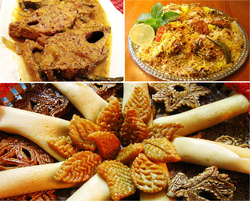
Side Dishes or (Torkari) are commonly eaten with meals in Bengal which are cooked with special [[List of Bangladeshi spices|Bengali spices]]. The main dish is almost always served with side dishes. Some typical Bengali dishes are [[Shorshe Ilish]], [[Machher Jhol]], [[Kala bhuna]], [[Shutki Shira]], [[Bhurta|Bhorta]], [[Chingri Malaikari]], [[Daab Chingri]], Katlar kaliya, Dal, Padar jhal, Ilish Pulao, Chingri Pulao, Rui Pulao, [[Haji biryani]], etc. [[List of Bangladeshi sweets and desserts|Bengali sweets]] like [[Chomchom]], [[Rasmalai]], [[Mishti Doi]], [[Curd of Bogra]], Muktagachhar monda, [[Sandesh (confectionery)|Sandesh]], [[Roshogolla]], [[Chhanamukhi]] and [[Pitha]]s are even popular outside of [[Bangladesh]]. [[Shemai]] originally came from the [[Bengali Muslim]] community, but most other Bengali sweets were invented by Hindu and Jain sweetmakers of Bengal. | |||
Shutki maach is made using the age-old method of preservation where the food item is dried in the sun and air, thus removing the water content. This allows for preservation that can make the fish last for months, even years in [[Bangladesh]].<ref>{{Cite news |url=https://www.thedailystar.net/news/bangladesh/news/the-shutki-trade-bangladesh-3248486 |title=The shutki trade in Bangladesh |work=The Daily Star |date=15 February 2023 |access-date=3 September 2023 |archive-date=3 September 2023 |archive-url=https://web.archive.org/web/20230903113713/https://www.thedailystar.net/news/bangladesh/news/the-shutki-trade-bangladesh-3248486 |url-status=live }}</ref> | |||
[[File:Bangladeshi_cuisine.png|thumb|right|Montage of [[Bangladeshi cuisine|Bengal's culinary delights]] [[Shorshe Ilish]] (top left), [[Biryani]] of [[Culture of Dhaka|Dhaka]] (top right), [[Pitha]] (bottom)]] | |||
[[File:Bangladeshi_Beef_curry.jpg|thumb|right|A Bangladeshi version of traditional Bengali mutton curry called Kosha Mangsho ({{ill|কষা মাংস|bn}}) substituted with Beef, popular during [[Eid Al Adha]]]] | |||
===Transport=== | ===Transport=== | ||
{{unsourced section|date=September 2023}} | |||
[[Kolkata]] is the only city in India to have a tram network. The trams are claimed to slow down other traffic, leading to groups who currently voice abolishing the trams, though the environment-friendliness and the old charm of the trams attract many people. | [[Kolkata]] is the only city in India to have a tram network. The trams are claimed to slow down other traffic, leading to groups who currently voice abolishing the trams, though the environment-friendliness and the old charm of the trams attract many people. | ||
| Line 88: | Line 150: | ||
Bangladesh has the world's largest number of [[cycle rickshaws]]. Its capital city Dhaka is known as the ''Rickshaw Capital of the World''. The country's rickshaws display colorful [[rickshaw art]], with each city and region have their own distinct style. Rickshaw driving provides employment for nearly a million Bangladeshis. Historically, [[Kolkata]] has been home to the hand-[[pulled rickshaw]]. Attempts to ban its use have largely failed. | Bangladesh has the world's largest number of [[cycle rickshaws]]. Its capital city Dhaka is known as the ''Rickshaw Capital of the World''. The country's rickshaws display colorful [[rickshaw art]], with each city and region have their own distinct style. Rickshaw driving provides employment for nearly a million Bangladeshis. Historically, [[Kolkata]] has been home to the hand-[[pulled rickshaw]]. Attempts to ban its use have largely failed. | ||
There are 150 different types of [[boats]] and [[canoe]]s in Bengal. The region was renowned for [[Shipbuilding in Bangladesh|shipbuilding]] in the medieval period, when its shipyards catered to major powers in Eurasia, including the Mughals and [[Ottomans]]. The types of timber used in boat making are from local woods Jarul (dipterocarpus turbinatus), sal (shorea robusta), sundari (heritiera fomes) and Burma teak (tectons grandis). | There are 150 different types of [[boats]] and [[canoe]]s in Bengal. The region was renowned for [[Shipbuilding in Bangladesh|shipbuilding]] in the medieval period, when its shipyards catered to major powers in Eurasia, including the Mughals and [[Ottoman Turks|Ottomans]]. The types of timber used in boat making are from local woods Jarul (dipterocarpus turbinatus), sal (shorea robusta), sundari (heritiera fomes) and Burma teak (tectons grandis). | ||
===Weddings=== | ===Weddings=== | ||
{{multiple image | {{multiple image | ||
| align = | | align = | ||
| direction = horizontal | | direction = horizontal | ||
| image1 =Xploring Weddings 4 (3679389912).jpg | | image1 = Xploring Weddings 4 (3679389912).jpg | ||
| caption1 =[[Bengali Muslim]] bride and groom | | caption1 = [[Bengali Muslim]] bride and groom | ||
| width1 = 200 | | width1 = 200 | ||
| image2 =Pani Grahan - Bengali Hindu Wedding - Howrah 2015-12-06 7722.JPG | | image2 = Pani Grahan - Bengali Hindu Wedding - Howrah 2015-12-06 7722.JPG | ||
| caption2 =[[Bengali Hindu wedding]] | | caption2 = [[Bengali Hindu wedding]] | ||
| width2 = 200 | | width2 = 200 | ||
}} | }} | ||
{{main|Bengali wedding | |||
Bengali weddings includes many rituals and ceremonies that can span several days. Although [[Islam|Muslim]] and [[Hinduism|Hindu]] marriages have their distinctive religious rituals, there are many common secular rituals.<ref>{{cite web|url=http://hinduism.about.com/od/matrimonial1/a/bengaliwedding.htm|title=Bengali Wedding Rituals | {{main|Bengali Hindu wedding|Bengali Muslim wedding}} | ||
Bengali weddings includes many rituals and ceremonies that can span several days. Although [[Islam|Muslim]] and [[Hinduism|Hindu]] marriages have their distinctive religious rituals, there are many common secular rituals.<ref>{{cite web|url=http://hinduism.about.com/od/matrimonial1/a/bengaliwedding.htm|title=Bengali Wedding Rituals – A Traditional Bengali Marriage Ceremony|publisher=[[about.com]]|access-date=2008-11-21|archive-date=26 November 2016|archive-url=https://web.archive.org/web/20161126101606/http://hinduism.about.com/od/matrimonial1/a/bengaliwedding.htm|url-status=dead}}</ref><ref>{{cite web|url=http://www.weddingsinindia.com/bengaliwedding.html|title=Weddings In India – Wedding in Exotic Indian Locations|publisher=www.weddingsinindia.com|access-date=2008-11-21|archive-date=7 January 2009|archive-url=https://web.archive.org/web/20090107043138/http://www.weddingsinindia.com/bengaliwedding.html|url-status=dead}}</ref> The [[Gaye Holud]] ceremony is held in Bengali weddings of all faiths. | |||
==Cultural institutions, organisations and events== | ==Cultural institutions, organisations and events== | ||
| Line 125: | Line 189: | ||
* [[Bangladeshi Photographers]] | * [[Bangladeshi Photographers]] | ||
* [[Bangladesh National Philatelic Association]] | * [[Bangladesh National Philatelic Association]] | ||
* [[Bangla Academy]] | * [[Bangla Academy (Bangladesh)|Bangla Academy]] | ||
* [[Moviyana Film Society]] | * [[Moviyana Film Society]] | ||
* [[Theatre Institute Chattagram]] | * [[Theatre Institute Chattagram]] | ||
| Line 138: | Line 202: | ||
;Festivals | ;Festivals | ||
{{main|List of festivals in Bangladesh|List of festivals in West Bengal}} | {{main|List of festivals in Bangladesh|List of festivals in West Bengal}} | ||
Both Bangladesh and West Bengal have many festivals and fairs throughout the year. | Both Bangladesh and West Bengal have many festivals and fairs throughout the year. | ||
{| class="wikitable" | {| class="wikitable" | ||
| Line 143: | Line 208: | ||
! Muslim !! Hindu !! Buddhist || Christian || Secular | ! Muslim !! Hindu !! Buddhist || Christian || Secular | ||
|- | |- | ||
| [[Eid al-Fitr]] || [[Durga Puja]] || [[Buddha Purnima]] || [[Christmas]] || [[ | | [[Eid al-Fitr]] || [[Durga Puja]] || [[Buddha Purnima]] || [[Christmas]] || [[Pohela Boishakh]] (New Year/ Summer); Wearing colour:{{colorbox|white|border=silver}} {{colorbox|red|border=silver}} | ||
|- | |- | ||
| [[Eid al-Adha]] || [[Kali Puja]] || [[Madhu Purnima]] || [[Easter]] || [[ | | [[Eid al-Adha]] || [[Kali Puja]] || [[Madhu Purnima]] || [[Easter]] || [[Pohela Falgun]] (Spring Festival); Wearing colour:{{colorbox|yellow|border=silver}} {{colorbox|red|border=silver}} | ||
|- | |- | ||
| [[Muharram]] || [[Saraswati Puja]] || [[Kathin Chibardan]] || || [[Barsha Utsab|Barsha Mangal]] (Monsoon salutation); Wearing colour:{{colorbox|White|border= | | [[Muharram]] || [[Saraswati puja|Saraswati Puja]] || [[Kathin Chibardan]] || || [[Barsha Utsab|Barsha Mangal]] (Monsoon salutation); Wearing colour:{{colorbox|White|border=silver}} {{colorbox|blue|border=silver}} | ||
|- | |- | ||
| [[Milad un Nabi]] || [[ | | [[Milad un Nabi]] || [[Lakshmi Puja]] || || || [[Nabanna]] (Harvest Festival); Wearing colour:{{colorbox|yellow|border=silver}} {{colorbox|green|border=silver}} | ||
|- | |- | ||
| [[Shab-e-Barat]] || [[ | | [[Shab-e-Barat]] || [[Dolyatra]] ([[Holi]]) || || ||[[Poush Sangkranti]] (Winter Festival) | ||
|- | |- | ||
| [[Laylat al-Qadr]] || [[Jagaddhatri|Jagaddhatri Puja]] || || || | | [[Laylat al-Qadr]] || [[Janmashtami]] || || || | ||
|- | |||
| [[Chaand Raat]] || [[Jagaddhatri|Jagaddhatri Puja]] || || || | |||
|} | |} | ||
| Line 170: | Line 237: | ||
<gallery class="center"> | <gallery class="center"> | ||
Eid Prayers at Barashalghar, Debidwar, Comilla.jpg|Eid | Eid Prayers at Barashalghar, Debidwar, Comilla.jpg|Congregation of [[Muslim holidays|Eid]] in [[Comilla]] | ||
Bijoya Dashami.jpg|Shindur khela in [[Durga Puja]] at [[Kolkata]] | Bijoya Dashami.jpg|Shindur khela in [[Durga Puja]] at [[Kolkata]] | ||
Colors of Celebration!-4.JPG|Celebration of [[Pohela Boishakh]] in [[Dhaka]] | Colors of Celebration!-4.JPG|Celebration of [[Pohela Boishakh]] in [[Dhaka]] | ||
Basanto Utsav.jpg|Bashanto Utsav festival | Basanto Utsav.jpg|Bashanto Utsav festival | ||
Bishwa Ijtema 2023 by Nayem Yahya 07.jpg|[[Bishwa Ijtema]], one of the world's largest congregations | |||
</gallery> | </gallery> | ||
==Pastimes== | ==Pastimes== | ||
{{see also| | {{see also|Bengali traditional games}} | ||
===Cinema=== | ===Cinema=== | ||
{{main|Cinema of Bangladesh|Cinema of West Bengal}} | {{main|Cinema of Bangladesh|Cinema of West Bengal}} | ||
Kolkata and Dhaka are the centers of [[Bengali cinema (disambiguation)|Bengali cinema]]. The region's film industry is notable for the history of [[art films]] in South Asia, including the works of [[Academy Award]] winning director [[Satyajit Ray]] and the [[Cannes Film Festival]] award-winning director [[Tareque Masud]]. | Kolkata and Dhaka are the centers of [[Bengali cinema (disambiguation)|Bengali cinema]]. The region's film industry is notable for the history of [[art films]] in South Asia, including the works of [[Academy Award]] winning director [[Satyajit Ray]] and the [[Cannes Film Festival]] award-winning director [[Tareque Masud]]. | ||
===Sports=== | ===Sports=== | ||
[[ | [[File:Lathi khela, Ancient Festival - Shamim Tirmizi.jpg|thumb|A ''[[lathi khela]]'' event taking place in [[Tangail District|Tangail]].]] | ||
[[File:Rowing on Canal.jpg|thumb|left|A ''[[Nouka Baich]]'' competition taking place in the monsoon season.]] | |||
[[Bengali traditional games|Traditional Bengali sports]] consisted of various [[martial arts]] and various [[racing]] sports, though the British-introduced sports of [[cricket]] and [[association football|football]] are now most popular amongst Bengalis. | |||
[[Lathi khela]] (stick-fighting) was historically a method of duelling as a way to protect or take land and others' possessions. The [[Zamindars of Bengal]] would hire ''lathial''s (trained stick-fighters) as a form of security and a means to forcefully collect tax from tenants.<ref name="prothom-alo">''[http://www.prothom-alo.com/art_and_literature/article/33350/%E0%A6%88%E0%A6%A6_%E0%A6%89%E0%A7%8E%E0%A6%B8%E0%A6%AC%E0%A7%87%E0%A6%B0_%E0%A6%A8%E0%A6%BE%E0%A6%A8%E0%A6%BE_%E0%A6%B0%E0%A6%82 ঈদ উৎসবের নানা রং] {{Webarchive|url=https://web.archive.org/web/20131103042311/http://www.prothom-alo.com/art_and_literature/article/33350/%E0%A6%88%E0%A6%A6_%E0%A6%89%E0%A7%8E%E0%A6%B8%E0%A6%AC%E0%A7%87%E0%A6%B0_%E0%A6%A8%E0%A6%BE%E0%A6%A8%E0%A6%BE_%E0%A6%B0%E0%A6%82 |date=3 November 2013 }}'',সাইমন জাকারিয়া, দৈনিক প্রথম আলো। ঢাকা থেকে প্রকাশের তারিখ: আগস্ট ০২, ২০১৩</ref> Nationwide ''lathi khela'' competitions used to take place annually in [[Kushtia District|Kushtia]] up until 1989, though its practice is now diminishing and being restricted to certain festivals and celebrations.<ref name=dhakamirror.com>{{cite web|url=http://www.dhakamirror.com/nation/lathi-khela-to-celebrate-tangail-free-day/|title=Lathi Khela to celebrate Tangail Free Day|publisher=dhakamirror.com|date=13 December 2011|access-date=9 June 2013|archive-date=29 October 2013|archive-url=https://web.archive.org/web/20131029191316/http://www.dhakamirror.com/nation/lathi-khela-to-celebrate-tangail-free-day/|url-status=live}}</ref> ''Chamdi'' is a variant of ''lathi khela'' popular in [[North Bengal]] during festivities such as [[Islamic holidays|Eid]] and [[Mid-Sha'ban|Shab e Barat]]. [[Bangladeshi martial arts|Kushti]] (wrestling) is also another popular fighting sport and it has developed regional forms such as ''[[Boli Khela|Jobbarer boli khela]]'' (wrestling of [[Jabbar (disambiguation)|Jobbar]]/the great) and ''[[Mokkar Boli Khela]]'' (wrestling of [[Mecca]]) which was introduced in 1889 by Zamindar Qadir Bakhsh of [[Chittagong District|Chittagong]]. A merchant known as Abdul Jabbar Saodagar adapted the sport in 1907 with the intention of cultivating a sport that would prepare Bengalis in fighting against British colonials.<ref name=independent>{{cite news |last=Zaman |first=Jaki |title=Jabbarer Boli Khela: Better Than WWE |url=http://theindependentbd.com/index.php?option=com_content&view=article&id=168299:jabbarer-boli-khela-better-than-wwe&catid=175:weekend-independent&Itemid=213 |newspaper=The Independent |location=Dhaka |date=10 May 2013 |access-date=8 June 2013 |url-status=dead |archive-url=https://web.archive.org/web/20131104225255/http://theindependentbd.com/index.php?option=com_content&view=article&id=168299%3Ajabbarer-boli-khela-better-than-wwe&catid=175%3Aweekend-independent&Itemid=213 |archive-date=4 November 2013 }}</ref><ref name=thedailystar.net>{{cite news |title=Jabbarer Boli Khela tomorrow |url=http://www.thedailystar.net/beta2/news/jabbarer-boli-khela-tomorrow/ |newspaper=The Daily Star |date=24 April 2013 |access-date=8 June 2013 |archive-date=26 May 2013 |archive-url=https://web.archive.org/web/20130526151448/http://www.thedailystar.net/beta2/news/jabbarer-boli-khela-tomorrow/ |url-status=live }}</ref> In 1972, a popular [[Contact sport|contact]] [[team sport]] called [[Kabaddi|Kabadi]] was made the [[national sport]] of [[Bangladesh]]. It is a regulated version of the rural [[Hadudu]] sport which had no fixed rules. The Amateur Kabaddi Federation of Bangladesh was formed in 1973.<ref>{{cite Banglapedia|author=Faroqi, Gofran|article=Kabadi}}</ref> [[Butthan]], a 20th-century Bengali martial arts invented by Grandmaster [[Mak Yuree]], is now practiced in different parts of the world under the International Butthan Federation.<ref name=unb>{{cite news |url=https://unb.com.bd/category/Sports/seminar-on-butthan-combat-sports-co-competition-system-held/30629 |date=13 October 2019 |title=Seminar on Butthan Combat Sports & Co-competition system held |access-date=20 May 2020 |work=[[United News of Bangladesh]] |archive-date=29 December 2019 |archive-url=https://web.archive.org/web/20191229153506/http://unb.com.bd/category/Sports/seminar-on-butthan-combat-sports-co-competition-system-held/30629 |url-status=live }}</ref> | |||
[[File:Mohammed Salim (Indian footballer) having feet bandaged at Celtic FC, 1936 photograph.jpg|thumb|left|[[Mohammed Salim (footballer)|Mohammed Salim]], the first South Asian footballer to play for a foreign club. Due to playing in bare feet, he is having them bandaged by [[Jimmy McMenemy]] in 1936.]] | |||
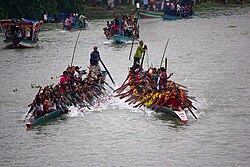
The [[Nouka Baich]] is a Bengali boat racing competition which takes place during and after the rainy season when much of the land goes under water. The long canoes were referred to as ''khel nao'' (meaning playing boats) and the use of [[cymbal]]s to accompany the singing was common. Different types of boats are used in different parts of Bengal.<ref>{{cite Banglapedia |author=S M Mahfuzur Rahman |article=Boat Race}}</ref> [[Horse racing]] was patronised most notably by the [[Dighapatia Raj]]as in [[Natore District|Natore]], and their [[Chalanbeel Horse Race]]s have continued to take place annually for centuries. | |||
[[File:Shakib Al Hasan (7).jpg|thumb|Cricketer [[Shakib Al Hasan]] is currently crowned the world's best [[all-rounder]] in all formats for [[One Day International|ODI cricket]],<ref>{{cite news|title=Bangladeshi Player Shakib Al Hasan named best all-rounder in all formats by ICC: Some interesting facts about the cricketer|location=New Delhi, India|date=27 June 2015|website=[[India Today]]}}</ref> and one of the greatest of all times.<ref name="shakib">{{Cite news|title=Why Shakib Al Hasan is one of cricket's greatest allrounders|url=https://www.espncricinfo.com/story/stats-analysis-why-shakib-al-hasan-is-one-of-cricket-s-greatest-allrounders-1219732|date=23 March 2020|access-date=23 March 2021|website=[[ESPNcricinfo]]|language=en|archive-date=22 April 2021|archive-url=https://web.archive.org/web/20210422042511/https://www.espncricinfo.com/story/stats-analysis-why-shakib-al-hasan-is-one-of-cricket-s-greatest-allrounders-1219732|url-status=live}}</ref><ref>{{Cite news|date=15 July 2020|title=Where does Shakib rank among the greatest all-rounders?|url=http://www.tbsnews.net/sports/where-does-shakib-rank-among-greatest-all-rounders-106672|access-date=23 March 2021|work=The Business Standard|archive-date=20 April 2021|archive-url=https://web.archive.org/web/20210420105626/https://www.tbsnews.net/sports/where-does-shakib-rank-among-greatest-all-rounders-106672|url-status=live}}</ref><ref>{{cite web|last=Z. Ahmed|title="I don't play to be the best all-rounder of all time": Shakib Al Hasan|url=https://www.cricfrenzy.com/en/article/127412/%E2%80%9CI-don%E2%80%99t-play-to-be-the-best-all-rounder-of-all-time%E2%80%9D--Shakib-Al-Hasan-|date=1 August 2020|access-date=23 March 2021|website=cricfrenzy.com|language=en-US|archive-date=13 May 2021|archive-url=https://web.archive.org/web/20210513213819/https://www.cricfrenzy.com/en/article/127412/%E2%80%9CI-don%E2%80%99t-play-to-be-the-best-all-rounder-of-all-time%E2%80%9D--Shakib-Al-Hasan-|url-status=live}}</ref><ref>{{cite web|date=24 March 2020|title=Why Shakib Al Hasan is one of cricket's greatest allrounders|url=https://www.espncricinfo.com/story/_/id/28945972/why-shakib-al-hasan-one-cricket-greatest-allrounders|access-date=23 March 2021|website=[[ESPN]]|language=en|archive-date=27 March 2020|archive-url=https://web.archive.org/web/20200327024900/https://www.espncricinfo.com/story/_/id/28945972/why-shakib-al-hasan-one-cricket-greatest-allrounders|url-status=live}}</ref><ref>{{cite web|last=Parida|first=Bastab K.|date=5 July 2019|title=Greatest all-rounder of 21st century debate – where does Shakib Al Hasan stand?|url=https://sportscafe.in/cricket/articles/2019/jul/05/greatest-all-rounder-of-21-st-century-debate-where-does-shakib-al-hasan-stand|access-date=23 March 2021|website=SportsCafe.in|language=en|archive-date=20 April 2021|archive-url=https://web.archive.org/web/20210420055956/https://sportscafe.in/cricket/articles/2019/jul/05/greatest-all-rounder-of-21-st-century-debate-where-does-shakib-al-hasan-stand|url-status=live}}</ref><ref>{{cite web|title=Best All-Rounders in Cricket History|url=https://www.thetoptens.com/cricket/all-rounders-cricket/|access-date=23 March 2021|website=TheTopTens|language=en|archive-date=15 April 2021|archive-url=https://web.archive.org/web/20210415110350/https://www.thetoptens.com/cricket/all-rounders-cricket/|url-status=live}}</ref><ref>{{cite web|title=Is Shakib Al Hasan a greater allrounder than Garry Sobers?|url=https://www.espncricinfo.com/story/anantha-narayanan-is-shakib-al-hasan-a-greater-allrounder-than-garry-sobers-1257937|access-date=25 April 2021|website=ESPNcricinfo|language=en|archive-date=24 April 2021|archive-url=https://web.archive.org/web/20210424182703/https://www.espncricinfo.com/story/anantha-narayanan-is-shakib-al-hasan-a-greater-allrounder-than-garry-sobers-1257937|url-status=live}}</ref>]] | |||
The oldest native football clubs of Bengal was [[Mohun Bagan A.C.]], which was founded in 1889, and [[Mohammedan SC (Kolkata)|Mohammedan SC]], founded in 1891. Mohun Bagan's first major victory was in 1911, when the team defeated an English club known as the Yorkshire Regiment to win the [[IFA Shield]]. Since then, more and more clubs emerged in [[West Bengal]], such as Mohun Bagan's main rival [[East Bengal FC]], a team of East Bengali Hindus who had migrated to West Bengal following the 1947 [[Partition of India]]. The rivalry also portrayed the societal problems at that time as many of the Mohun Bagan fans were [[Ghotis]] who hated the East Bengali immigrants, though Hindu. [[Mohammed Salim (footballer)|Mohammed Salim]] of [[Calcutta]] became the first [[South Asian]] to play for a European football club in 1936.<ref name="Breck">Breck, A. ''Alan Breck's Book of Scottish Football''. Scottish Daily Express, 1937, cited in {{cite web |url = http://www.thecelticwiki.com/page/Salim%2C+Mohammed |title = ''Salim, Mohammed'' |publisher = thecelticwiki.org |date = 29 May 2006 |work = All time A to Z of Celtic players |access-date = 15 April 2013 |archive-date = 29 May 2013 |archive-url = https://web.archive.org/web/20130529055952/http://www.thecelticwiki.com/page/Salim%2C+Mohammed |url-status = live }} See also, {{cite web |url = http://www.scotsman.com/sport/barefooted-indian-who-left-calcutta-to-join-celtic-1-1151472 |title = ''Barefooted Indian who left Calcutta to join Celtic'' |publisher = The Scotsman |date = 12 December 2008 |access-date = 15 April 2013 |archive-date = 30 December 2013 |archive-url = https://web.archive.org/web/20131230235208/http://www.scotsman.com/sport/barefooted-indian-who-left-calcutta-to-join-celtic-1-1151472 |url-status = live }}</ref> In his two appearances for [[Celtic F.C.]], he played the entire matches barefoot and scored several goals.<ref>''Scottish Daily Express'', 29 August 1936, cited in Majumdar, B. and Bandyopadhyay, K. [https://books.google.com/books?id=V-sMYjZkpigC&pg=PA68 ''A Social History Of Indian Football: Striving To Score''] {{Webarchive|url=https://web.archive.org/web/20221118051543/https://books.google.com/books?id=V-sMYjZkpigC&pg=PA68 |date=18 November 2022 }}. Routledge, 2006, p. 68.</ref> In 2015, [[Hamza Choudhury]] became the first Bengali to play in the [[Premier League]] and is predicted to be the first [[British Asian]] to play for the [[England national football team]].<ref>{{cite news |url=https://www.skysports.com/football/news/11712/11796199/hamza-choudhury-can-be-first-british-south-asian-to-play-for-england-says-michael-chopra |last=Trehan |first=Dev |publisher=[[Sky Sports]] |date=2 September 2019 |title=Hamza Choudhury can be first British South Asian to play for England, says Michael Chopra |access-date=23 May 2021 |archive-date=23 May 2021 |archive-url=https://web.archive.org/web/20210523150804/https://www.skysports.com/football/news/11712/11796199/hamza-choudhury-can-be-first-british-south-asian-to-play-for-england-says-michael-chopra |url-status=live }}</ref> | |||
Bengalis are very competitive when it comes to board and home games such as [[Pachisi]] and its modern counterpart [[Ludo (board game)|Ludo]], as well as [[Latim]], [[Carrom Board]], Chor-Pulish, [[Kanamachi]] and [[Chess]]. [[Rani Hamid]] is one of the most successful chess players in the world, winning championships in Asia and Europe multiple times. [[Ramnath Biswas]] was a revolutionary soldier who embarked on three world tours on a bicycle in the 19th century. [[Shakib Al Hasan]], [[Mushfiqur Rahim]], [[Mashrafe Bin Mortaza]], [[Tamim Iqbal]], [[Soumya Sarkar]], [[Liton Das]] from Bangladesh and [[Pankaj Roy]], [[Sourav Ganguly]], [[Manoj Tiwary (cricketer)|Manoj Tiwary]], [[Wriddhiman Saha]], [[Mohammed Shami]] from West Bengal are internationally known cricketers .<ref name=soccercenter>{{cite web | |||
|url=http://www.longlivesoccer.com/indiafootball.htm | |url=http://www.longlivesoccer.com/indiafootball.htm | ||
|title=Football in India | |title=Football in India – A Fact File | ||
|access-date=2006-10-26 | |access-date=2006-10-26 | ||
|last=Prabhakaran | |last=Prabhakaran | ||
| Line 196: | Line 280: | ||
|archive-date=23 October 2006 | |archive-date=23 October 2006 | ||
|df=dmy | |df=dmy | ||
}}</ref> Local games include sports such as [[Kho Kho]] and [[Kabaddi]], the latter being the national sport of Bangladesh. | }}</ref> [[Traditional games of Bangladesh|Local games]] include sports such as [[Kho Kho]] and [[Kabaddi]], the latter being the national sport of Bangladesh. | ||
===Media=== | ===Media=== | ||
Bangladesh's ''[[Prothom Alo]]'' is the largest circulated Bengali newspaper in the world. It is followed by ''[[Ananda Bazar Patrika]]'', which has the largest circulation for a single-edition, regional language newspaper in India. Other prominent Bengali newspapers include the ''[[The Daily Ittefaq|Ittefaq]]'', ''[[Jugantor]]'', ''[[Samakal]]'', ''[[Janakantha]]'' and ''[[Bartaman]]''. Major English-language newspapers in Bangladesh include ''[[The Daily Star (Bangladesh)|The Daily Star]]'', ''[[New Age (Bangladesh)|New Age]]'', and the weekly ''[[Holiday (newspaper)|Holiday]]''. ''[[The Statesman (India)|The Statesman]]'', published from Kolkata, is the region's oldest English-language publication. | Bangladesh's ''[[Prothom Alo]]'' is the largest circulated Bengali newspaper in the world. It is followed by ''[[Ananda Bazar Patrika]]'', which has the largest circulation for a single-edition, regional language newspaper in India. Other prominent Bengali newspapers include the ''[[The Daily Ittefaq|Ittefaq]]'', ''[[Jugantor]]'', ''[[Samakal]]'', ''[[Janakantha]]'' and ''[[Bartaman]]''. Major English-language newspapers in Bangladesh include ''[[The Daily Star (Bangladesh)|The Daily Star]]'', ''[[New Age (Bangladesh)|New Age]]'', and the weekly ''[[Holiday (newspaper)|Holiday]]''. ''[[The Statesman (India)|The Statesman]]'', published from Kolkata, is the region's oldest English-language publication. | ||
==Literature== | |||
{{Main|Bengali literature|Bengali poetry}} | |||
Bengal has one of the most developed literary traditions in Asia. A descent of ancient [[Sanskrit]] and [[Magadhi Prakrit]], the Bengali language evolved circa 1000–1200 CE under the [[Pala Empire]] and the [[Sena dynasty]]. It became an official court language of the [[Sultanate of Bengal]] and absorbed influences from [[Arabic literature|Arabic]] and [[Persian literature|Persian]]. Middle Bengali developed secular literature in the 16th and 17th centuries. It was also spoken in [[Kingdom of Arakan|Arakan]]. The [[Bengali Renaissance]] in [[Calcutta]] developed the modern standardized form of the language in the late 19th and early 20th centuries. [[Rabindranath Tagore]] became the first Bengali writer to win the [[Nobel Prize in Literature]] in 1913, and was also the first non-European Nobel laureate. [[Kazi Nazrul Islam]] became known as the ''Rebel Poet of British India''. After the partition of Bengal, a distinct literary culture developed in [[East Bengal]], which later became [[East Pakistan]] and Bangladesh. | |||
<gallery class="center"> | |||
File:Kazi Nazrul Islam 01.png|[[Kazi Nazrul Islam]] (''Bidrohi Kabi''; 'the rebel poet') | |||
File:Praha, Dejvice - Thakurova busta v Thakurove ulici.jpg|[[Rabindranath Tagore]] (''Biswa Kabi''; 'the poet of world') | |||
File:Ishwarchandra_Vidyasagar.jpg|[[Iswar Chandra Vidyasagar]] (''Father of modern Bengali alphabets and modern Bengali Prose'') | |||
File:Bankim Chattapadhyay.jpg|[[Bankim Chandra Chattopadhyay]] (''Sahityo Samrat''; 'the emperor of literature') | |||
File:Jasimuddin Lomax 1951 (2).jpg|[[Jasimuddin]] (''Polli Kabi''; 'the rural poet') | |||
File:Fakir Lalon Shah.jpg|[[Lalon|Lalon Fakir]] (''[[Baul]] shamrat''; 'the emperor of [[Baul|Bauls]]') | |||
</gallery> | |||
==Philosophy== | |||
The works of ancient philosophers from Bengal have been preserved at libraries in [[Tibet]], [[China]] and [[Central Asia]]. These include the works of [[Atisa]] and [[Tilopa]].<ref>{{cite book |last=Islam |first=Aminul |year=2012 |chapter=Philosophy |chapter-url=http://en.banglapedia.org/index.php?title=Philosophy |editor1-last=Islam |editor1-first=Sirajul |editor1-link=Sirajul Islam |editor2-last=Jamal |editor2-first=Ahmed A. |title=Banglapedia: National Encyclopedia of Bangladesh |edition=Second |publisher=[[Asiatic Society of Bangladesh]] |access-date=28 July 2016 |archive-date=8 August 2016 |archive-url=https://web.archive.org/web/20160808193321/http://en.banglapedia.org/index.php?title=Philosophy |url-status=live }}</ref> Medieval Hindu philosophy featured the works of [[Chaitanya Mahaprabhu|Chaitanya]]. | |||
[[Sufi]] philosophy was highly influential in Islamic Bengal. Prominent Sufi practitioners were disciples of [[Jalaluddin Rumi]], [[Abdul-Qadir Gilani]] and [[Moinuddin Chishti]]. One of the most revered [[Sufism in Bangladesh|Sufi saints of Bengal]] is [[Shah Jalal]]. | |||
==See also== | ==See also== | ||
* [[ | * [[Arts of West Bengal]] | ||
* [[ | * [[Performing arts of Bangladesh]] | ||
==Notes== | ==Notes== | ||
{{reflist}} | {{reflist}} | ||
{{Bangladesh topics}} | {{Bangladesh topics}} | ||
{{West Bengal topics}} | {{West Bengal topics}} | ||
[[Category: | [[Category:Culture of Bengal| ]] | ||
[[Category: | [[Category:Heritage of Bengal]] | ||
Latest revision as of 12:35, 6 May 2026
 | This article has multiple issues. Please help improve it or discuss these issues on the talk page. (Learn how and when to remove these template messages)
|


Template:Culture of Bengal Template:Bengalis
The culture of Bengal defines the cultural heritage of the Bengali people native to eastern regions of the Indian subcontinent, mainly what is today Bangladesh and the Indian states of West Bengal, Assam's Barak Valley, Tripura, parts of Jharkhand, where they form the dominant ethnolinguistic group and the Bengali language is the official and primary language. Bengal has a recorded history of 1,400 years.
The Bengalis are the dominant ethnolinguistic group. The Bengal region has been a historical melting point, blending indigenous traditions with cosmopolitan influences from pan-Indian subcontinental empires. Dhaka (Dacca) became the capital of Mughal Bengal (Bengal Subah) and the commercial (financial) capital (1610-1757) of Mughal India. Dhaka is the largest and richest Bengali (Bangali) mega city in the world and also the 3rd largest and richest mega city in (Indian sub continent) after Mumbai (Bombay or MMR) and Delhi (NCR). Dhaka is a Beta (β) Global City (Moderate Economic Centre). As a part of the Bengal Presidency, Bengal also hosted the region's most advanced political and cultural centers during British rule.[1]
Fine arts[edit | edit source]
Performing arts[edit | edit source]
Music[edit | edit source]
Bengal has produced leading figures of Indian classical music, including Alauddin Khan, Ravi Shankar and Ali Akbar Khan. Common musical instruments include the sitar, tabla and sarod. The Baul tradition is a unique regional folk heritage. The most prominent practitioner was Lalon Shah. Other folk music forms include Gombhira, Bhatiali and Bhawaiya (Jhumur). Folk music in Bengal is often accompanied by the ektara, a one-stringed instrument. Other instruments include the dotara, dhol, bamboo flute, and tabla. Songs written by Rabindranath Tagore (Rabindra Sangeet) and Kazi Nazrul Islam (Nazrul geeti) are highly popular. Bangladesh is the center of Bangla rock, as well as indie, Sufi rock and fusion folk music.
-
 The mystic Baul song
 -
 Nazrul teaching Nazrul Sangeet
 -
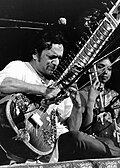
-
 A Bangladeshi rock band


.jpg)
Theatre[edit | edit source]
Bengali theatre traces its roots to Indian classical drama under the Gupta Empire in the 4th century CE. It includes narrative forms, song and dance forms, supra-personae forms, performance with scroll paintings, puppet theatre and the processional forms like the Jatra.
Dance[edit | edit source]

Bengal has an extremely rich heritage of dancing dating back to antiquity. It includes classical, folk and martial dance traditions.[2][3] Dances in Bengal includes-
- Gaudiya Nritya (Classical dance)
- Rabindra Nritya
- Nazrul Nritya
- Dhunuchi Nritya
- Rajbongshi Nritya
- Baul dance
- Sankirtana of Nadia/Gaudiya Vaishnavism
- Chhau dance
- Jhumair dance
- Chhokra dance
- Fakir dance
- Dhamail dance
- Gombhira dance
- Raibenshe dance
- Chittagonian dance
- Alkap dance
- Jari dance
- Lathi dance
- Puppetry (Putul naach) [4]
Visual arts[edit | edit source]
Painting[edit | edit source]


Miniature and scroll painting flourished in Mughal Bengal. Rickshaw Painting adorns colorful hoods featuring intricate designs like minarets and floral patterns with the word "Allah" and other islamic motifs,[5] are recognized as UNESCO-listed intangible heritage. [6] The Patua community specializes "Patachitra", with the Gazir Pata being their renowned artwork, depicting Gazi Pir. [7]
Kalighat painting or Kalighat Pat originated in 19th-century Calcutta, in the vicinity of Kalighat Kali Temple of Kolkata, and from being items of souvenir taken by the visitors to the Kali temple, the paintings over a period of time developed as a distinct school of Indian painting. From the depiction of Hindu gods other mythological characters, the Kalighat paintings developed to reflect a variety of themes.
Modern painting emerged in Calcutta with the Bengal school. East Pakistan developed its own contemporary painting tradition under Zainul Abedin. Modern Bangladeshi art has produced many of South Asia's leading painters, including SM Sultan, Mohammad Kibria, Shahabuddin Ahmed, Kanak Chanpa Chakma, Kafil Ahmed, Saifuddin Ahmed, Qayyum Chowdhury, Rashid Choudhury, Quamrul Hassan, Rafiqun Nabi and Syed Jahangir among others.[8]
Architecture[edit | edit source]
The earliest fortified cities in the region include Wari-Bateshwar, Chandraketugarh and Mahasthangarh. Bengal has a glorious legacy of terracotta architecture from the ancient and medieval periods. The architecture of the Bengal Sultanate saw a distinct style of domed mosques with complex niche pillars that had no minarets. Ivory, pottery and brass were also widely used in Bengali art. The style includes many mosques, temples, palaces, forts, monasteries and caravanserais. Mughal Dhaka was known as the City of Mosques and the Venice of the East. Indo-Saracenic architecture flourished during the British period, particularly among the landed gentry. British Calcutta was known as the City of Palaces. Modernist terracotta architecture in South Asia by architects like Muzharul Islam and Louis Kahn.
Bengali village housing is noted as the origin of the bungalow.
Sculpture[edit | edit source]

Ancient Bengal was home to the Pala-Sena school of sculptural art.[9] Ivory sculptural art flourished across the region under the Nawabs of Bengal. Notable modernist sculptors include Novera Ahmed and Nitun Kundu.
Lifestyle[edit | edit source]
Textiles[edit | edit source]
_LACMA_AC1994.131.1.jpg)

Muslin production in Bengal dates back to the 4th century BCE. The region exported the fabric to Ancient Greece and Rome.[9]
Bengali silk was known as Ganges Silk in the 13th century Republic of Venice.[10] Mughal Bengal was a major silk exporter. The Bengali silk industry declined after the growth of Japanese silk production. Rajshahi silk continues to be produced in northern Bangladesh. Murshidabad and Malda are the centers of the silk industry in West Bengal.
After the reopening of European trade with medieval India, Mughal Bengal became the world's foremost muslin exporter in the 17th century. Mughal-era Dhaka was a center of the worldwide muslin trade.
Mughal Bengal's most celebrated artistic tradition was the weaving of Jamdani motifs on fine muslin, which is now classified by UNESCO as an intangible cultural heritage. Jamdani motifs were similar to Iranian textile art (buta motifs) and Western textile art (paisley). The Jamdani weavers in Dhaka received imperial patronage.[11]
Modern Bangladesh is one of the world's largest textile producers, with a large cotton based ready made garments industry.
Clothing[edit | edit source]


In rural areas, older women wear the shari with hijab while the younger generation wear the selwar kamiz with hijab, both with simple designs. In urban areas, the selwar kamiz and the combination of niqab-burqa-chador is more popular, and has distinct fashionable designs. Islamic clothing is really common among Bengali Muslims. World Hijab Day is an annual event founded by a Bengali-American, Nazma Khan in 2013, taking place on 1 February each year. Traditionally urban Bengali men wore the jama, though costumes such as the panjabi[12] with selwar or pyjama have become more popular within the past three centuries. The popularity of the fotua, a shorter upper garment, is undeniable among Bengalis in casual environments. The lungi and gamcha are a common combination for rural Bengali men. During special occasions, Bengali women commonly wear either sharis, selwar kamizes, covering their hair with hijab or orna; and men wear a panjabi, also covering their hair with a tupi, toqi, pagri or rumal.
Jama is the long, loose fitting, stitched garment of Bengali Women. Jama was originally worn by Bengali Women in the Mughal court as a symbol of status and wealth. Over time, it has now been more widely adopted by women in other parts of Bengal, including Bangladesh. Jama may also fulfill some interpretations of Islamic rules. Jama is similar to dress.


At Jorashanko (Rabindranath Tagore's home in Kolkata) different drapes of sari were improvised on so that women could step out of the andarmahal (inner house) where they were relegated. This had Tagore's sister-in-law, Jnanadanandini Devi, bringing the Parsi way of draping the sari from Mumbai to Bengal.[13] Chitra Deb, in her book 'Thakurbarir Andarmahal', describes the entire process of how the Parsi sari was adapted into Bengali culture.[14] Before Devi's invention, Bengali women used to wear sari without a blouse underneath and stay in "Andarmahal" to follow "purdah", a concept of modesty bought by Muslims native to Bengal and was followed by both Hindus and Bengali Muslims. Dhakai is another attire of women unique to Bengal. There are several variations of Shari (Bengali Sari) such as Jamdani, Tant, Muslin, Tangail, Kantha, Rajshahi Silk, Dhakai reshom, Baluchari etc. Bengali women also wear Fotua, Bengali Kurti and Kapor which are also unique to Bangladesh. Men wear Gamucha, Panjabi, Lungi, Mujib Coat, Genji and Kaabli which are unique to the men of Bangladesh.
Bengal has produced several of South Asia's leading fashion designers, including Sabyasachi Mukherjee, Bibi Russell, Rukhsana Esrar Runi and Rina Latif.
Cuisine[edit | edit source]
.jpg)
Rice is the staple food of Bengal. Bhortas (lit-"mashed") are a really common type of food used as an additive too rice. there are several types of Bhortas such as Ilish bhorta shutki bhorta, begoon bhorta and more. Fish and other seafood are also important because Bengal is a reverrine region.
Some fishes like puti (Puntius species) are fermented. Fish curry is prepared with fish alone or in combination with vegetables.Shutki maach is made using the age-old method of preservation where the food item is dried in the sun and air, thus removing the water content. This allows for preservation that can make the fish last for months, even years in Bangladesh.[15]
Bengali pickles are an integral part of Bengali cuisine, adding a burst of flavors to meals. These pickles are made by preserving various fruits, vegetables, and even fish or meat in a mixture of spices, oil, and vinegar or lemon juice, which is why pickles of Bangladesh are unique to the country.

Side Dishes or (Torkari) are commonly eaten with meals in Bengal which are cooked with special Bengali spices. The main dish is almost always served with side dishes. Some typical Bengali dishes are Shorshe Ilish, Machher Jhol, Kala bhuna, Shutki Shira, Bhorta, Chingri Malaikari, Daab Chingri, Katlar kaliya, Dal, Padar jhal, Ilish Pulao, Chingri Pulao, Rui Pulao, Haji biryani, etc. Bengali sweets like Chomchom, Rasmalai, Mishti Doi, Curd of Bogra, Muktagachhar monda, Sandesh, Roshogolla, Chhanamukhi and Pithas are even popular outside of Bangladesh. Shemai originally came from the Bengali Muslim community, but most other Bengali sweets were invented by Hindu and Jain sweetmakers of Bengal.
Shutki maach is made using the age-old method of preservation where the food item is dried in the sun and air, thus removing the water content. This allows for preservation that can make the fish last for months, even years in Bangladesh.[16]


Transport[edit | edit source]
 |
Kolkata is the only city in India to have a tram network. The trams are claimed to slow down other traffic, leading to groups who currently voice abolishing the trams, though the environment-friendliness and the old charm of the trams attract many people.
Kolkata was also the first city in South Asia to have an underground railway system that started operating from 1984. It is considered to have the status of a zonal railway. The metered-cabs are mostly of the brand "Ambassador" manufactured by Hindustan Motors (now out of production). These taxis are painted with yellow colour, symbolising the transport tradition of Kolkata.
Bangladesh has the world's largest number of cycle rickshaws. Its capital city Dhaka is known as the Rickshaw Capital of the World. The country's rickshaws display colorful rickshaw art, with each city and region have their own distinct style. Rickshaw driving provides employment for nearly a million Bangladeshis. Historically, Kolkata has been home to the hand-pulled rickshaw. Attempts to ban its use have largely failed.
There are 150 different types of boats and canoes in Bengal. The region was renowned for shipbuilding in the medieval period, when its shipyards catered to major powers in Eurasia, including the Mughals and Ottomans. The types of timber used in boat making are from local woods Jarul (dipterocarpus turbinatus), sal (shorea robusta), sundari (heritiera fomes) and Burma teak (tectons grandis).
Weddings[edit | edit source]
.jpg)

Bengali weddings includes many rituals and ceremonies that can span several days. Although Muslim and Hindu marriages have their distinctive religious rituals, there are many common secular rituals.[17][18] The Gaye Holud ceremony is held in Bengali weddings of all faiths.
Cultural institutions, organisations and events[edit | edit source]
Major organisations responsible for funding and promoting Bengali culture are:
- National Art Gallery (Bangladesh)
- Shilpakala Academy
- Bangladesh Folk Arts and Crafts Foundation
- Ministry of Cultural Affairs (Republic of Bangladesh)
- Ministry of Information & Cultural Affairs (West Bengal)
- List of institutions and organisations
- Chhayanaut
- Bulbul Lalitakala Academy
- Nazrul Institute
- Samdani Art Foundation
- Bangladesh Shishu Academy
- Bangladesh Short Film Forum
- Bishwo Shahitto Kendro
- Bangladeshi Photographers
- Bangladesh National Philatelic Association
- Bangla Academy
- Moviyana Film Society
- Theatre Institute Chattagram
- Bangladesh Film Development Corporation
- Bangladesh Film Archive
- Biswa Bangla
- Paschimbanga Bangla Akademi
- Paschim Banga Natya Akademi
- Bangiya Sahitya Parishad
- Festivals
Both Bangladesh and West Bengal have many festivals and fairs throughout the year.
| Muslim | Hindu | Buddhist | Christian | Secular |
|---|---|---|---|---|
| Eid al-Fitr | Durga Puja | Buddha Purnima | Christmas | Pohela Boishakh (New Year/ Summer); Wearing colour: |
| Eid al-Adha | Kali Puja | Madhu Purnima | Easter | Pohela Falgun (Spring Festival); Wearing colour: |
| Muharram | Saraswati Puja | Kathin Chibardan | Barsha Mangal (Monsoon salutation); Wearing colour: | |
| Milad un Nabi | Lakshmi Puja | Nabanna (Harvest Festival); Wearing colour: | ||
| Shab-e-Barat | Dolyatra (Holi) | Poush Sangkranti (Winter Festival) | ||
| Laylat al-Qadr | Janmashtami | |||
| Chaand Raat | Jagaddhatri Puja |
- Events
-

-
 Shindur khela in Durga Puja at Kolkata
 -
 Celebration of Pohela Boishakh in Dhaka
 -
 Bashanto Utsav festival
 -
 Bishwa Ijtema, one of the world's largest congregations


Pastimes[edit | edit source]
Cinema[edit | edit source]
Kolkata and Dhaka are the centers of Bengali cinema. The region's film industry is notable for the history of art films in South Asia, including the works of Academy Award winning director Satyajit Ray and the Cannes Film Festival award-winning director Tareque Masud.
Sports[edit | edit source]


Traditional Bengali sports consisted of various martial arts and various racing sports, though the British-introduced sports of cricket and football are now most popular amongst Bengalis.
Lathi khela (stick-fighting) was historically a method of duelling as a way to protect or take land and others' possessions. The Zamindars of Bengal would hire lathials (trained stick-fighters) as a form of security and a means to forcefully collect tax from tenants.[19] Nationwide lathi khela competitions used to take place annually in Kushtia up until 1989, though its practice is now diminishing and being restricted to certain festivals and celebrations.[20] Chamdi is a variant of lathi khela popular in North Bengal during festivities such as Eid and Shab e Barat. Kushti (wrestling) is also another popular fighting sport and it has developed regional forms such as Jobbarer boli khela (wrestling of Jobbar/the great) and Mokkar Boli Khela (wrestling of Mecca) which was introduced in 1889 by Zamindar Qadir Bakhsh of Chittagong. A merchant known as Abdul Jabbar Saodagar adapted the sport in 1907 with the intention of cultivating a sport that would prepare Bengalis in fighting against British colonials.[21][22] In 1972, a popular contact team sport called Kabadi was made the national sport of Bangladesh. It is a regulated version of the rural Hadudu sport which had no fixed rules. The Amateur Kabaddi Federation of Bangladesh was formed in 1973.[23] Butthan, a 20th-century Bengali martial arts invented by Grandmaster Mak Yuree, is now practiced in different parts of the world under the International Butthan Federation.[24]
_having_feet_bandaged_at_Celtic_FC,_1936_photograph.jpg)
The Nouka Baich is a Bengali boat racing competition which takes place during and after the rainy season when much of the land goes under water. The long canoes were referred to as khel nao (meaning playing boats) and the use of cymbals to accompany the singing was common. Different types of boats are used in different parts of Bengal.[25] Horse racing was patronised most notably by the Dighapatia Rajas in Natore, and their Chalanbeel Horse Races have continued to take place annually for centuries.
.jpg)
The oldest native football clubs of Bengal was Mohun Bagan A.C., which was founded in 1889, and Mohammedan SC, founded in 1891. Mohun Bagan's first major victory was in 1911, when the team defeated an English club known as the Yorkshire Regiment to win the IFA Shield. Since then, more and more clubs emerged in West Bengal, such as Mohun Bagan's main rival East Bengal FC, a team of East Bengali Hindus who had migrated to West Bengal following the 1947 Partition of India. The rivalry also portrayed the societal problems at that time as many of the Mohun Bagan fans were Ghotis who hated the East Bengali immigrants, though Hindu. Mohammed Salim of Calcutta became the first South Asian to play for a European football club in 1936.[34] In his two appearances for Celtic F.C., he played the entire matches barefoot and scored several goals.[35] In 2015, Hamza Choudhury became the first Bengali to play in the Premier League and is predicted to be the first British Asian to play for the England national football team.[36]
Bengalis are very competitive when it comes to board and home games such as Pachisi and its modern counterpart Ludo, as well as Latim, Carrom Board, Chor-Pulish, Kanamachi and Chess. Rani Hamid is one of the most successful chess players in the world, winning championships in Asia and Europe multiple times. Ramnath Biswas was a revolutionary soldier who embarked on three world tours on a bicycle in the 19th century. Shakib Al Hasan, Mushfiqur Rahim, Mashrafe Bin Mortaza, Tamim Iqbal, Soumya Sarkar, Liton Das from Bangladesh and Pankaj Roy, Sourav Ganguly, Manoj Tiwary, Wriddhiman Saha, Mohammed Shami from West Bengal are internationally known cricketers .[37] Local games include sports such as Kho Kho and Kabaddi, the latter being the national sport of Bangladesh.
Media[edit | edit source]
Bangladesh's Prothom Alo is the largest circulated Bengali newspaper in the world. It is followed by Ananda Bazar Patrika, which has the largest circulation for a single-edition, regional language newspaper in India. Other prominent Bengali newspapers include the Ittefaq, Jugantor, Samakal, Janakantha and Bartaman. Major English-language newspapers in Bangladesh include The Daily Star, New Age, and the weekly Holiday. The Statesman, published from Kolkata, is the region's oldest English-language publication.
Literature[edit | edit source]
Bengal has one of the most developed literary traditions in Asia. A descent of ancient Sanskrit and Magadhi Prakrit, the Bengali language evolved circa 1000–1200 CE under the Pala Empire and the Sena dynasty. It became an official court language of the Sultanate of Bengal and absorbed influences from Arabic and Persian. Middle Bengali developed secular literature in the 16th and 17th centuries. It was also spoken in Arakan. The Bengali Renaissance in Calcutta developed the modern standardized form of the language in the late 19th and early 20th centuries. Rabindranath Tagore became the first Bengali writer to win the Nobel Prize in Literature in 1913, and was also the first non-European Nobel laureate. Kazi Nazrul Islam became known as the Rebel Poet of British India. After the partition of Bengal, a distinct literary culture developed in East Bengal, which later became East Pakistan and Bangladesh.
-
 Kazi Nazrul Islam (Bidrohi Kabi; 'the rebel poet')
 -
 Rabindranath Tagore (Biswa Kabi; 'the poet of world')
 -
 Iswar Chandra Vidyasagar (Father of modern Bengali alphabets and modern Bengali Prose)
 -
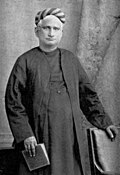 Bankim Chandra Chattopadhyay (Sahityo Samrat; 'the emperor of literature')
 -
 Jasimuddin (Polli Kabi; 'the rural poet')
 -


.jpg)

Philosophy[edit | edit source]
The works of ancient philosophers from Bengal have been preserved at libraries in Tibet, China and Central Asia. These include the works of Atisa and Tilopa.[38] Medieval Hindu philosophy featured the works of Chaitanya.
Sufi philosophy was highly influential in Islamic Bengal. Prominent Sufi practitioners were disciples of Jalaluddin Rumi, Abdul-Qadir Gilani and Moinuddin Chishti. One of the most revered Sufi saints of Bengal is Shah Jalal.
See also[edit | edit source]
Notes[edit | edit source]
- ↑ Minahan, James B. (2012). Ethnic Groups of South Asia and the Pacific: An Encyclopedia. ABC-CLIO. ISBN 9781598846607.
- ↑ Hasan, Sheikh Mehedi (2012). "Dance". In Islam, Sirajul; Jamal, Ahmed A. (eds.). Banglapedia: National Encyclopedia of Bangladesh (Second ed.). Asiatic Society of Bangladesh. Archived from the original on 1 August 2015. Retrieved 30 July 2016.
- ↑ Ahmed, Wakil (2012). "Folk Dances". In Islam, Sirajul; Jamal, Ahmed A. (eds.). Banglapedia: National Encyclopedia of Bangladesh (Second ed.). Asiatic Society of Bangladesh. Archived from the original on 1 August 2015. Retrieved 30 July 2016.
- ↑ "Folk Dances". Banglapedia. Archived from the original on 29 August 2023. Retrieved 29 August 2023.
- ↑ "Devotion in Motion: The Image of Islam in Rickshaw Art of Bangladesh". Archived from the original on 23 September 2024. Retrieved 23 September 2024.
- ↑ "Rickshaws and rickshaw painting in Dhaka - UNESCO Intangible Cultural Heritage". Archived from the original on 8 December 2023. Retrieved 23 September 2024.
- ↑ "Gazir Pat - Banglapedia".
- ↑ "Bengal Art". Banglapedia.
- ↑ 9.0 9.1 Snodgrass, Mary Ellen (2015). World Clothing and Fashion: An Encyclopedia of History, Culture, and Social Influence. Routledge. ISBN 9781317451679.
- ↑ Van Schendel, Willem (2012). "Silk". In Islam, Sirajul; Jamal, Ahmed A. (eds.). Banglapedia: National Encyclopedia of Bangladesh (Second ed.). Asiatic Society of Bangladesh. Archived from the original on 4 March 2016. Retrieved 28 July 2016.
- ↑ "In Search of Bangladeshi Islamic Art". The Metropolitan Museum of Art, i.e. The Met Museum. 12 November 2015. Archived from the original on 12 August 2016. Retrieved 19 September 2017.
- ↑ "The panjabi story". The Daily Star. 14 June 2016. Archived from the original on 30 August 2023. Retrieved 30 August 2023.
- ↑ "Have you heard of Rabindra Vastra? | Latest News & Updates at Daily News & Analysis". dna. 13 May 2018. Archived from the original on 19 May 2018. Retrieved 19 May 2018.
- ↑ Deba, Citrā (2006). Ṭhākurabārira andaramahala (3. paribardita o parimārjita saṃskaraṇa ed.). Kalakātā: Ānanda. ISBN 8177565966. OCLC 225391789.
- ↑ Food Product - Banglapedia https://en.banglapedia.org/index.php/Food_Product Archived 2 November 2022 at the Wayback Machine
- ↑ "The shutki trade in Bangladesh". The Daily Star. 15 February 2023. Archived from the original on 3 September 2023. Retrieved 3 September 2023.
- ↑ "Bengali Wedding Rituals – A Traditional Bengali Marriage Ceremony". about.com. Archived from the original on 26 November 2016. Retrieved 21 November 2008.
- ↑ "Weddings In India – Wedding in Exotic Indian Locations". www.weddingsinindia.com. Archived from the original on 7 January 2009. Retrieved 21 November 2008.
- ↑ ঈদ উৎসবের নানা রং Archived 3 November 2013 at the Wayback Machine,সাইমন জাকারিয়া, দৈনিক প্রথম আলো। ঢাকা থেকে প্রকাশের তারিখ: আগস্ট ০২, ২০১৩
- ↑ "Lathi Khela to celebrate Tangail Free Day". dhakamirror.com. 13 December 2011. Archived from the original on 29 October 2013. Retrieved 9 June 2013.
- ↑ Zaman, Jaki (10 May 2013). "Jabbarer Boli Khela: Better Than WWE". The Independent. Dhaka. Archived from the original on 4 November 2013. Retrieved 8 June 2013.
- ↑ "Jabbarer Boli Khela tomorrow". The Daily Star. 24 April 2013. Archived from the original on 26 May 2013. Retrieved 8 June 2013.
- ↑ Faroqi, Gofran (2012). "Kabadi". In Islam, Sirajul; Miah, Sajahan; Khanam, Mahfuza; Ahmed, Sabbir (eds.). Banglapedia: the National Encyclopedia of Bangladesh (Online ed.). Dhaka, Bangladesh: Banglapedia Trust, Asiatic Society of Bangladesh. ISBN 984-32-0576-6. OCLC 52727562. Retrieved 26 October 2026.
- ↑ "Seminar on Butthan Combat Sports & Co-competition system held". United News of Bangladesh. 13 October 2019. Archived from the original on 29 December 2019. Retrieved 20 May 2020.
- ↑ S M Mahfuzur Rahman (2012). "Boat Race". In Islam, Sirajul; Miah, Sajahan; Khanam, Mahfuza; Ahmed, Sabbir (eds.). Banglapedia: the National Encyclopedia of Bangladesh (Online ed.). Dhaka, Bangladesh: Banglapedia Trust, Asiatic Society of Bangladesh. ISBN 984-32-0576-6. OCLC 52727562. Retrieved 26 October 2026.
- ↑ "Bangladeshi Player Shakib Al Hasan named best all-rounder in all formats by ICC: Some interesting facts about the cricketer". India Today. New Delhi, India. 27 June 2015.
- ↑ "Why Shakib Al Hasan is one of cricket's greatest allrounders". ESPNcricinfo. 23 March 2020. Archived from the original on 22 April 2021. Retrieved 23 March 2021.
- ↑ "Where does Shakib rank among the greatest all-rounders?". The Business Standard. 15 July 2020. Archived from the original on 20 April 2021. Retrieved 23 March 2021.
- ↑ Z. Ahmed (1 August 2020). ""I don't play to be the best all-rounder of all time": Shakib Al Hasan". cricfrenzy.com. Archived from the original on 13 May 2021. Retrieved 23 March 2021.
- ↑ "Why Shakib Al Hasan is one of cricket's greatest allrounders". ESPN. 24 March 2020. Archived from the original on 27 March 2020. Retrieved 23 March 2021.
- ↑ Parida, Bastab K. (5 July 2019). "Greatest all-rounder of 21st century debate – where does Shakib Al Hasan stand?". SportsCafe.in. Archived from the original on 20 April 2021. Retrieved 23 March 2021.
- ↑ "Best All-Rounders in Cricket History". TheTopTens. Archived from the original on 15 April 2021. Retrieved 23 March 2021.
- ↑ "Is Shakib Al Hasan a greater allrounder than Garry Sobers?". ESPNcricinfo. Archived from the original on 24 April 2021. Retrieved 25 April 2021.
- ↑ Breck, A. Alan Breck's Book of Scottish Football. Scottish Daily Express, 1937, cited in "Salim, Mohammed". All time A to Z of Celtic players. thecelticwiki.org. 29 May 2006. Archived from the original on 29 May 2013. Retrieved 15 April 2013. See also, "Barefooted Indian who left Calcutta to join Celtic". The Scotsman. 12 December 2008. Archived from the original on 30 December 2013. Retrieved 15 April 2013.
- ↑ Scottish Daily Express, 29 August 1936, cited in Majumdar, B. and Bandyopadhyay, K. A Social History Of Indian Football: Striving To Score Archived 18 November 2022 at the Wayback Machine. Routledge, 2006, p. 68.
- ↑ Trehan, Dev (2 September 2019). "Hamza Choudhury can be first British South Asian to play for England, says Michael Chopra". Sky Sports. Archived from the original on 23 May 2021. Retrieved 23 May 2021.
- ↑ Prabhakaran, Shaji (18 January 2003). "Football in India – A Fact File". LongLiveSoccer.com. Archived from the original on 23 October 2006. Retrieved 2006-10-26.
- ↑ Islam, Aminul (2012). "Philosophy". In Islam, Sirajul; Jamal, Ahmed A. (eds.). Banglapedia: National Encyclopedia of Bangladesh (Second ed.). Asiatic Society of Bangladesh. Archived from the original on 8 August 2016. Retrieved 28 July 2016.
.png)