



m Removed empty portal template using script |
m expand lead for clarity and corrected details |
||
| Line 1: | Line 1: | ||
{{short description| | {{short description|None}} | ||
{{Use dmy dates|date=November 2018}} | {{Use dmy dates|date=November 2018}} | ||
{{Use Indian English|date=November 2018}} | {{Use Indian English|date=November 2018}} | ||
[[File:DTC AC Bus.jpg|thumb|DTC AC Buses]] | |||
[[File:DTC AC Bus.jpg|thumb|DTC | |||
[[Delhi]] has significant reliance on its transport infrastructure. The city | [[Delhi]] has significant reliance on its transport infrastructure. The city has developed a highly efficient public transport system with the introduction of the [[Delhi Metro]],<ref>{{cite web|url=http://www.expressindia.com/latest-news/delhi-metro-among-worlds-top-five-claim-dmrc-officials/534246/ |title=Delhi Metro among world's top mass transit systems |url-status=dead |archive-url=https://web.archive.org/web/20121002034207/http://www.expressindia.com/latest-news/delhi-metro-among-worlds-top-five-claim-dmrc-officials/534246/ |archive-date=2012-10-02 }}</ref> which is undergoing a rapid modernization and expansion since 2006.<ref>{{cite news | url=http://findarticles.com/p/articles/mi_m0BQQ/is_2_46/ai_n16071120/| title=Expansion to Gurgaon, Noida & Faridabad planned | work=International Railway Journal | date=2006-02-01}}</ref> There are 16.6 million registered vehicles in the city as of 30 June 2014, which is the highest in the world among all cities, most of which do not follow any pollution emission norm (within municipal limits), while the Delhi metropolitan region ([[NCR Delhi]]) has 11.2 million vehicles. Delhi and NCR lose nearly 42 crore (420 million) man-hours every month while commuting between home and office through public transport, due to the traffic congestion.<ref name="delhi traffic">{{cite web |url=http://www.igovernment.in/site/traffic-snarl-snaps-42-cr-man-hour-from-delhi-ncr-workers/ |title=Traffic snarl snaps 42 Cr man-hour from Delhi, NCR workers |author=Prithwi |date=9 January 2008 |website=iGovernment |url-status=usurped |archive-url=https://web.archive.org/web/20080110092330/http://www.igovernment.in/site/traffic-snarl-snaps-42-cr-man-hour-from-delhi-ncr-workers/ |archive-date=10 January 2008 }}</ref> Therefore, serious efforts, including a number of transport infrastructure projects, are under way to encourage usage of public transport in the city.<ref>{{Cite news|url=http://timesofindia.indiatimes.com/city/delhi/Delhi-roads-Indias-most-dangerous/articleshow/37107932.cms|title = Delhi roads India's most dangerous | Delhi News - Times of India|website = [[The Times of India]]| date=24 June 2014 }}</ref> | ||
==History== | ==History== | ||
| Line 12: | Line 11: | ||
==Overview== | ==Overview== | ||
Public transport in the metropolis includes the [[Delhi Metro]], the [[Delhi Transport Corporation]] (DTC) bus system, [[auto-rickshaw]]s, [[Cycle rickshaw|cycle-rickshaw]]s, e-rickshaws, Grameen Seva and taxis. With the introduction of Delhi Metro, a rail-based mass rapid transit system, rail-based transit systems have gained ground. Other means of transit include suburban railways, inter-state bus services and private taxis which can be rented for various purposes. However, buses continue to be the most popular means of transportation for intra-city travel, catering to about 60% of the total commuting requirements.<ref name=Transport>{{cite web | publisher=Delhi Govt.| url=http://delhiplanning.nic.in/Economic%20Survey/Ecosur2001-02/PDF/chapter12.pdf| title=Delhi Transport | access-date=2006-05-14}}</ref> | Public transport in the metropolis includes the [[Delhi Metro]], the [[Delhi Transport Corporation]] ('''DTC''') and '''DIMTS''' (Delhi Integrated Multi Modal Transit System) bus system, [[auto-rickshaw]]s, [[Cycle rickshaw|cycle-rickshaw]]s, e-rickshaws, Grameen Seva and taxis. With the introduction of Delhi Metro, a rail-based mass rapid transit system, rail-based transit systems have gained ground. Other means of transit include suburban railways, inter-state bus services and private taxis which can be rented for various purposes. However, buses continue to be the most popular means of transportation for intra-city travel, catering to about 60% of the total commuting requirements.<ref name=Transport>{{cite web | publisher=Delhi Govt.| url=http://delhiplanning.nic.in/Economic%20Survey/Ecosur2001-02/PDF/chapter12.pdf| title=Delhi Transport | access-date=2006-05-14}}</ref> | ||
Private vehicles account for 30%{{Citation needed|date=January 2008}} of the total demand for transport, while the rest of the demand is met largely by auto-rickshaws, taxis, rapid transit system and railways. | Private vehicles account for 30%{{Citation needed|date=January 2008}} of the total demand for transport, while the rest of the demand is met largely by auto-rickshaws, taxis, rapid transit system and railways. | ||
[[Indira Gandhi International Airport]] (IGI) serves Delhi for both domestic and international air connections, and is situated in the south-western corner of the city. In | [[Indira Gandhi International Airport]] (IGI) serves Delhi for both domestic and international air connections, and is situated in the south-western corner of the city. In 2024–2025, IGI recorded a traffic of 77,820,834 passengers, making it the ninth busiest airport worldwide.<ref name=essentialtravel>{{cite web|publisher=Essential Travel Ltd., UK. |url=http://parking.essentialtravel.co.uk/worldairport/india/delhi.htm |title=Delhi – Indira Gandhi International Airport (IGI Airport) information |access-date=2006-04-29 |url-status=dead |archive-url=https://web.archive.org/web/20060719165130/https://parking.essentialtravel.co.uk/worldairport/india/delhi.htm |archive-date=2006-07-19 }}</ref><ref name=":0">{{Cite web |date=2025-05-23 |title=Top 10 busiest airports by passenger traffic in 2024-25: Guess which Indian airport ranks 9th globally |url=https://indianexpress.com/article/trending/top-10-listing/world-top-10-busiest-airports-2025-delhi-igi-featured-10017001/ |access-date=2025-06-02 |website=The Indian Express |language=en}}</ref> [[Hindon Airport]] is a domestic airport operated by the [[Airports Authority of India]] at [[Hindan Air Force Station]] of the [[Indian Air Force]].<ref>{{Cite news |date=2019-01-30 |title=Hindon airport in Ghaziabad to be operational for UDAN flights by March |url=https://timesofindia.indiatimes.com/business/india-business/hindon-airport-in-ghaziabad-likely-be-operational-for-udan-flights-by-march/articleshow/67760287.cms |access-date=2025-06-02 |work=The Times of India |issn=0971-8257}}</ref> A new airport, the [[Noida International Airport]] is being built near [[Greater Noida]] alongside the Delhi-[[Agra]] highway.<ref>{{Cite web |date=2025-03-17 |title=Noida International Airport Latest Updates, Progress, Cost, Location and More - Infra Info Hub |url=https://infrainfohub.com/noida-international-airport-latest-updates-progress-cost-location-and-more/ |access-date=2025-06-02 |language=en-US}}</ref> | ||
The | The only international rail service in [[Delhi]] was the [[Samjhauta Express]] to [[Lahore]],which was stopped in 2019 following a standoff. It is possible to change trains to board rail services to [[Bangladesh]] and [[Nepal]] which commence in other cities of India. For the future, a high-speed rail link is being considered that would link [[New Delhi]] with [[Kunming]], [[PRC|China]] via [[Myanmar]]<ref name="Railway eyes rail link to China">{{cite news| url=https://timesofindia.indiatimes.com/city/patna/Railway-eyes-rail-link-to-China/articleshow/7675243.cms | archive-url=https://web.archive.org/web/20111121154226/http://articles.timesofindia.indiatimes.com/2011-03-10/patna/28676685_1_rail-link-trans-asian-china-and-india | url-status=live | archive-date=2011-11-21 | work=[[The Times of India]] | title=Railway eyes rail link to China | date=2011-03-10}}</ref> | ||
==Intra-city Transport== | ==Intra-city Transport== | ||
| Line 27: | Line 24: | ||
<!-- [[File:DelhiMetroElevatedTracksNearGulabiBagh.jpg|thumb|Delhi Flyover]] --> | <!-- [[File:DelhiMetroElevatedTracksNearGulabiBagh.jpg|thumb|Delhi Flyover]] --> | ||
<!-- Above image is a Metro elevated track, not a road flyover... --> | <!-- Above image is a Metro elevated track, not a road flyover... --> | ||
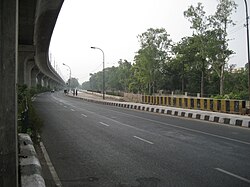
Roads in Delhi are maintained by [[Municipal Corporation of Delhi]] | Roads in Delhi are maintained by the [[Municipal Corporation of Delhi]], [[New Delhi Municipal Council]], [[Delhi Cantonment Board]], [[Central Public Works Department|Public Works Department]] and [[Delhi Development Authority]]. At 1749 km of road length per 100 km<sup>2</sup>, Delhi has one of the highest road densities in India. Major roadways include the Ring Road and the Outer Ring Road, which had a traffic density of 110,000 vehicles per day in 2001. Total road length of Delhi was 28,508 km including 388 km of National Highways. Major road-based public transport facilities in Delhi are provided by DTC buses, [[Auto rickshaw|auto-rickshaw]]s, [[Taxicab|taxi]]s and cycle-rickshaws. | ||
====Buses==== | ====Buses==== | ||
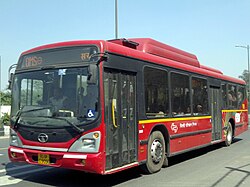
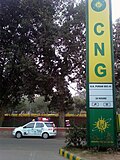
[[Delhi Transport Corporation]] (DTC) operates the world's largest fleet of CNG-powered buses. After [[Pune]], Delhi was the second city in India to have an operational [[Bus rapid transit|Bus rapid transit (BRT)]] system.<ref>{{cite web |url=http://www.outlookindia.com/pti_news.asp?gid=48&id=103516 |title=Delhi's CNG success inspiring many countries: Naik |work=Outlook |access-date=2011-02-17 |url-status=dead |archive-url=https://web.archive.org/web/20090201164114/http://www.outlookindia.com/pti_news.asp?gid=48&id=103516 |archive-date=2009-02-01 }}</ref> | [[Delhi Transport Corporation]] (DTC) operates the world's largest fleet of CNG-powered buses. After [[Pune]], Delhi was the second city in India to have an operational [[Bus rapid transit|Bus rapid transit (BRT)]] system. However the BRT was dismantled in 2016 due to accidents and congestion.<ref>{{cite web |url=http://www.outlookindia.com/pti_news.asp?gid=48&id=103516 |title=Delhi's CNG success inspiring many countries : Naik |work=Outlook |access-date=2011-02-17 |url-status=dead |archive-url=https://web.archive.org/web/20090201164114/http://www.outlookindia.com/pti_news.asp?gid=48&id=103516 |archive-date=2009-02-01 }}</ref> | ||
[[File:Gand.jpg|thumb|Delhi Integrated Multi-Modal Transits System [http://www.dimts.in]]] | [[File:Gand.jpg|thumb|Delhi Integrated Multi-Modal Transits System [http://www.dimts.in]]] | ||
Delhi has one of India's largest bus transport systems. Buses are the most popular means of transport catering to about 60% of Delhi's total demand.<ref name=ecosurv12>{{cite web| url = http://delhiplanning.nic.in/Economic%20Survey/ES%202005-06/Chpt/12.pdf| title = Chapter 12: Transport| access-date = 2006-12-21| work = Economic Survey of Delhi, 2005–2006| publisher = Planning Department, Government of National Capital Territory of Delhi| pages = 130–146| url-status = dead| archive-url = https://web.archive.org/web/20070116044119/http://delhiplanning.nic.in/Economic%20Survey/ES%202005-06/Chpt/12.pdf| archive-date = 2007-01-16}}</ref> Buses are operated by the state-owned Delhi Transport Corporation (DTC), which owns largest fleet of [[Compressed Natural Gas]] (CNG)-fueled buses in the world, private | Delhi has one of India's largest bus transport systems. Buses are the most popular means of transport catering to about 60% of Delhi's total demand.<ref name=ecosurv12>{{cite web| url = http://delhiplanning.nic.in/Economic%20Survey/ES%202005-06/Chpt/12.pdf| title = Chapter 12: Transport| access-date = 2006-12-21| work = Economic Survey of Delhi, 2005–2006| publisher = Planning Department, Government of National Capital Territory of Delhi| pages = 130–146| url-status = dead| archive-url = https://web.archive.org/web/20070116044119/http://delhiplanning.nic.in/Economic%20Survey/ES%202005-06/Chpt/12.pdf| archive-date = 2007-01-16}}</ref> Buses are operated by the state-owned Delhi Transport Corporation (DTC), which owns largest fleet of [[Compressed Natural Gas]] (CNG)-fueled buses in the world, private bus operators and several chartered bus operators. It is mandatory for all private bus operators to acquire a permit from the State Transport Authority. The buses traverse various well-defined intra-city routes. Other than regular routes, buses also travel on Railway Special routes; Metro Feeder routes. Mudrika (Ring) and Bahri Mudrika (Outer Ring) routes along Ring and Outer-Ring road respectively are amongst the longest intra-city bus routes in the world. The DTC has started introducing air-conditioned buses and brand new low-floor buses (with floor height of 400 mm and even higher on one third area as against 230 mm available internationally.) on city streets to replace the conventional buses. A revamp plan is underway to improve bus-shelters in the city and to integrate [[GPS]] systems in DTC buses and bus stops so as to provide reliable information about bus arrivals. | ||
In 2007, after public uproar concerning the large number of accidents caused by privately owned Blueline buses, the Delhi government, under pressure from the [[Delhi High Court]] decided that all Blueline Buses | In 2007, after public uproar concerning the large number of accidents caused by privately owned Blueline buses, the Delhi government, under pressure from the [[Delhi High Court]] decided that all Blueline Buses would be phased out and replaced by low floor buses of the state-owned DTC.<ref name=blo>{{cite web |url=http://sify.com/news/fullstory.php?id=14541909 |archive-url=https://web.archive.org/web/20141101032536/http://www.sify.com/news/fullstory.php?id=14541909 |url-status=dead |archive-date=2014-11-01 |title=Delhi to phase out Blueline buses |website=[[Sify]]}}</ref> The Delhi Government has decided to expedite this process and will procure 6,600 low floor buses for the DTC by commonwealth games next year in mid 2010.<ref>{{cite news | url=http://timesofindia.indiatimes.com/city/delhi/Blueline-buses-to-fade-out-soon-Lovely/articleshow/5323921.cms| title=Blueline buses to fade out soon | work=The Times Of India | date=2009-12-10}}</ref> | ||
The fleet size of buses in Delhi is as follows: | |||
{| class="wikitable" | |||
!Ownership | |||
!Fleet Strength | |||
!Notes | |||
|- | |||
|[[Delhi Transport Corporation|DTC]] | |||
|4359<ref name=":1">{{Cite news |date=2025-03-19 |title=900 New E-Buses To Be Rolled Out Soon |url=https://timesofindia.indiatimes.com/city/delhi/900-new-e-buses-to-be-rolled-out-soon/articleshow/119174215.cms |access-date=2025-06-02 |work=The Times of India |issn=0971-8257}}</ref> | |||
|including 1,250 e-buses<ref name=":1" /> | |||
|- | |||
|[[Delhi Integrated Multi-Modal Transit System|DIMTS]] | |||
|3126<ref name=":1" /> | |||
|also known as Cluster Buses | |||
|- | |||
|[[Delhi Metro#Feeder buses|Delhi Metro Feeder]] | |||
|742<ref>{{Cite web|url=https://online.dda.org.in/mpd2041dda/_layouts/MPD2041FINALSUGGESTION/Baseline_Transport_%20160721.pdf|title=BASELINE REPORT - Enabling Strategic Plan: Master Plan for Delhi 2041}}</ref> | |||
|including 100 e-buses and additional 380 buses operated by [[Government of Delhi|GNCTD]]<ref>{{Cite web |date=2023-02-21 |title=DMRC to handover feeder e-buses to Delhi govt from April onwards: Official |url=https://www.business-standard.com/article/companies/dmrc-to-handover-feeder-e-buses-to-delhi-govt-from-april-onwards-official-123022100388_1.html |access-date=2023-05-08 |website=www.business-standard.com |language=en-US}}</ref><ref>{{Cite news |date=2023-01-06 |title=2,000 e-feeder buses to connect interior areas of Delhi to Metro stations |work=The Times of India |url=https://timesofindia.indiatimes.com/city/delhi/2000-e-feeder-buses-to-connect-interior-areas-of-delhi-to-metro-stations/articleshow/96774153.cms |access-date=2023-05-08 |issn=0971-8257}}</ref> | |||
|- | |||
!Total | |||
|8227 | |||
| | |||
|} | |||
====Auto-rickshaws==== | ====Auto-rickshaws==== | ||
The auto-rickshaws (popularly known as ''Auto'') are an important and popular means of public transportation in Delhi, as they are cheaper than taxis. Hiring an ''Auto'' in Delhi is very tricky, as | The auto-rickshaws (popularly known as ''Auto'') are an important and popular means of public transportation in Delhi, as they are cheaper than taxis. Hiring an ''Auto'' in Delhi is very tricky, as very few auto-drivers agree to standard meter charges. The typical method is to [[haggling|haggle]] for an agreeable rate. | ||
====Taxis==== | ====Taxis==== | ||
[[File:CNG propelled radio taxi.jpg|thumb|Radio taxi powered by [[Compressed natural gas|CNG]] ]] | [[File:CNG propelled radio taxi.jpg|thumb|Radio taxi powered by [[Compressed natural gas|CNG]] ]] | ||
[[File:Airport1.png|thumb|Radio Taxi near airport]] | [[File:Airport1.png|thumb|Radio Taxi near airport]] | ||
Taxis can be easily hailed in Delhi. As of December 2017, there are over 148,434 registered taxis in Delhi.<ref>{{Cite news |date=2017-12-30 |title=Number of taxis rises 86% in 2 years, buses reduce in Delhi |url=https://www.hindustantimes.com/delhi-news/number-of-taxis-rises-86-in-2-years-buses-reduce-in-delhi/story-Fclx1TRJ4NMw60TXitB88I.html |archive-url=https://web.archive.org/web/20231203090557/https://www.hindustantimes.com/delhi-news/number-of-taxis-rises-86-in-2-years-buses-reduce-in-delhi/story-Fclx1TRJ4NMw60TXitB88I.html |archive-date=3 December 2023 |access-date=2025-06-02 |work=Hindustan Times |language=en-us |url-status=live }}</ref> The Indian Tourism Ministry and various private owners operate most taxis. The Tourism Ministry grants private companies permits to operate taxis. In recent years, online cab services like [[Uber]] and [[Ola Consumer|Ola]] have become popular in Delhi.<ref>{{Cite news |date=2025-01-09 |title=Uber Data Report 2024: How Indians Ubered in 2024; Delhi-NCR booked the most rides, while Mumbai booked most night-trips |url=https://www.thehindu.com/sci-tech/technology/how-indians-used-uber-in-2024/article69079950.ece |access-date=2025-06-02 |work=The Hindu |language=en-IN |issn=0971-751X}}</ref> | |||
====Cycle-rickshaws==== | ====Cycle-rickshaws==== | ||
Cycle-rickshaws are a popular mode of travel for short distance transits in the city. The pedal-powered rickshaws are easily available throughout the city and reckoned for being cheap and environment friendly. Often, tourists and citizens use them for joyrides, too. Of late, they have been phased out from the congested areas of [[Chandni Chowk]] because of their slow pace, which often leads to traffic snarls on the streets of [[Old Delhi]] | Cycle-rickshaws are a popular mode of travel for short distance transits in the city. The pedal-powered rickshaws are easily available throughout the city and reckoned for being cheap and environment friendly. Often, tourists and citizens use them for joyrides, too. Of late, they have been phased out from the congested areas of [[Chandni Chowk]] because of their slow pace, which often leads to traffic snarls on the streets of [[Old Delhi]]. | ||
====Major Arteries==== | ====Major Arteries==== | ||
{{Main|Highways passing from Delhi}} | {{Main|Highways passing from Delhi}} | ||
[[File:File-Gurgaon Expressway.jpg|thumb|Delhi-Gurgaon Expressway | [[File:File-Gurgaon Expressway.jpg|thumb|Delhi-Gurgaon Expressway connects both cities with the airport.]] | ||
=====Inner Ring Road===== | =====Inner Ring Road===== | ||
[[Ring Road, Delhi|Inner Ring Road]] is one of the most important "state highways" in Delhi. It is a 51 km long circular road, which connects | [[Ring Road, Delhi|Inner Ring Road]] is one of the most important "state highways" in Delhi. It is a 51 km long circular road, which connects northern, eastern, western and southern areas in Delhi. Owing to more than 2 dozen grade-separators/flyovers, the road is almost signal-free. The road is generally 8-laned with a few bottlenecks at certain stretches, which are being removed. The road has already achieved its carrying capacity of 110000 vehicles per day and would require an addition of more lanes to fulfill needs of increasing traffic by 2011. | ||
=====Outer Ring Road===== | =====Outer Ring Road===== | ||
| Line 65: | Line 79: | ||
=====Expressways and National Highways===== | =====Expressways and National Highways===== | ||
[[File:Delhi Gurgaon Toll Gate.jpg|thumb|left|The 32-lane toll gate at [[National Highway 48 (India)|National Highway 48]] was the largest in Asia and third largest in the world until it was dismantled in June 2015<ref>{{Cite | [[File:Delhi Gurgaon Toll Gate.jpg|thumb|left|The 32-lane toll gate at [[National Highway 48 (India)|National Highway 48]] was the largest in Asia and third largest in the world until it was dismantled in June 2015<ref>{{Cite news|url=https://timesofindia.indiatimes.com/city/gurgaon/Gone-Toll-plaza-fully-dismantled/articleshow/47728021.cms|title=Gone! Toll plaza fully dismantled {{!}} Gurgaon News|last1=Chander Joshi|first1=Vimal|website=The Times of India|language=en|access-date=2020-03-27|date=19 June 2015 }}</ref>]] | ||
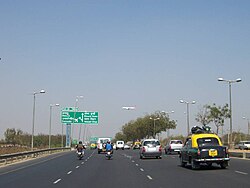
Delhi is connected by NH 1, NH 2, NH 8, NH 10 and NH 24. It also has three expressways (six- and eight-lane) that connect it with its suburbs. [[Delhi–Gurgaon Expressway]] connects Delhi with one of its financial hubs, [[Gurgaon]], [[DND Flyway]] connects Delhi with its other financial hub, [[Noida]] and [[Delhi–Faridabad Skyway]] which connects [[Faridabad]], major suburb to Delhi. Four more expressways are also planned. | Delhi is connected by NH 1, NH 2, NH 8, NH 10 and NH 24. It also has three expressways (six- and eight-lane) that connect it with its suburbs. [[Delhi–Gurgaon Expressway]] connects Delhi with one of its financial hubs, [[Gurgaon]], [[DND Flyway]] connects Delhi with its other financial hub, [[Noida]] and [[Delhi–Faridabad Skyway]] which connects [[Faridabad]], major suburb to Delhi. Four more expressways are also planned. | ||
[[File:DND Flyway.jpg|thumb|The DND Flyway]] | [[File:DND Flyway.jpg|thumb|The DND Flyway]] | ||
[[Noida–Greater Noida Expressway]] connects Noida with Greater Noida, which is an upcoming financial and commercial hub and is also to have a new Jewar International Airport. A 135.6-km long Western Peripheral Expressway, also known as the [[Kundli–Manesar–Palwal Expressway]], which became operational on 19 November 2018, will relieve Delhi of the congestion of heavy night traffic and will act as a bypass for the night vehicles. | [[Noida–Greater Noida Expressway]] connects Noida with Greater Noida, which is an upcoming financial and commercial hub and is also to have a new Jewar International Airport. A 135.6-km long Western Peripheral Expressway, also known as the [[Kundli–Manesar–Palwal Expressway]], which became operational on 19 November 2018, will relieve Delhi of the congestion of heavy night traffic and will act as a bypass for the night vehicles. | ||
The [[DND–KMP Expressway|DND–Faridabad–KMP Expressway]] connects the junction of [[DND Flyway]] and [[Inner Ring Road, Delhi|Ring Road]] at [[Maharani Bagh]] in [[Delhi]] with [[Western Peripheral Expressway|KMP Expressway]] at Khalilpur, [[Nuh district]] (near [[Sohna]]) in [[Haryana]].<ref>{{Cite web |title=Delhi-Mumbai Expressway link road opened for traffic; Check distance, total length, top speed to be.... |url=https://www.india.com/business/delhi-mumbai-expressway-link-road-dnd-kmp-expressway-opened-for-traffic-check-distance-total-length-top-speed-to-be-100-kmph-dnd-kmp-entry-exit-points-7383350/ |access-date=2025-06-02 |website=www.india.com |language=en}}</ref> | |||
NH 24 or Ghaziabad Road is a four-lane national highway which connects Delhi to Lucknow via [[Ghaziabad]]. As the Commonwealth Village is located close by Yamuna bridge on this highway, underpasses and flyover being built will help facilitate traffic between the eastern areas of Delhi/ Western UP and the rest of the city. | NH 24 or Ghaziabad Road is a four-lane national highway which connects Delhi to Lucknow via [[Ghaziabad]]. As the Commonwealth Village is located close by Yamuna bridge on this highway, underpasses and flyover being built will help facilitate traffic between the eastern areas of Delhi/ Western UP and the rest of the city. | ||
| Line 76: | Line 92: | ||
Rail based transport in the city has started to gain popularity with the introduction of Delhi Metro. Ring-Railway, which runs parallel to the Ring-Road system is another rail-based intra-city transport facility in Delhi. | Rail based transport in the city has started to gain popularity with the introduction of Delhi Metro. Ring-Railway, which runs parallel to the Ring-Road system is another rail-based intra-city transport facility in Delhi. | ||
====Metro==== | ====Metro Railway==== | ||
{{Main|Delhi Metro|List of Delhi Metro stations}} | {{Main|Delhi Metro|List of Delhi Metro stations}} | ||
[[File:DMRC Bombardier.jpg|thumb|left|Delhi Metro – Phase 2 [http://www.delhimetrorail.com/commuters/photo_gallery1.html Delhi Metro Rail Corporation Picture Gallery]]] | [[File:DMRC Bombardier.jpg|thumb|left|Delhi Metro – Phase 2 [http://www.delhimetrorail.com/commuters/photo_gallery1.html Delhi Metro Rail Corporation Picture Gallery]]] | ||
The Delhi Metro is being built in phases. Rapid increase of population coupled with large-scale immigration due to high economic growth has resulted in ever increasing demand for better transport, putting excessive pressure on the city's existent transport infrastructure. Like many other cities in the developing world, the city faces acute transport management problems leading to air pollution, congestion and resultant loss of productivity. In order to meet the transportation demand in Delhi, the State and Union government started the construction of a Mass Rapid Transit system, known as | The Delhi Metro is being built in phases. Rapid increase of population coupled with large-scale immigration due to high economic growth has resulted in ever increasing demand for better transport, putting excessive pressure on the city's existent transport infrastructure. Like many other cities in the developing world, the city faces acute transport management problems leading to air pollution, congestion and resultant loss of productivity. In order to meet the transportation demand in Delhi, the State and Union government started the construction of a Mass Rapid Transit system, known as Delhi Metro in 1998. The project started commercial operations on 25 December 2002 between [[Shahdara metro station|Shahdara]] and [[Tis Hazari metro station|Tis Hazari]]) on the [[Red Line (Delhi Metro)|Red Line]]. It has set performance and efficiency standards and is continuously expanding. As of June 2025, the network consists of nine colour-coded regular lines along with the faster [[Delhi Airport Metro Express|Airport Express]] line, with a total length of {{convert|353.23|km|mi}}<ref name="Delhi Metro Introduction">{{cite web |url=http://www.delhimetrorail.com/about_us.aspx#Introduction |title=Delhi Metro About Us Introduction |publisher=[[Delhi Metro Rail Corporation|DMRC]] |access-date=20 September 2016}}</ref> serving [[List of Delhi Metro stations|257 stations]].<ref name="Delhi Metro Introduction"/> The system has a mix of underground, at-grade, and elevated stations using both broad-gauge and standard-gauge.<ref>{{cite web |last=Sadana |first=Rashmi |url=https://blogs.wsj.com/indiarealtime/2012/05/30/metrocity-journal-delhis-changing-landscape// |title=Metrocity Journal: Delhi's Changing Landscape |newspaper=The Wall Street Journal |access-date=12 June 2012}}</ref> Phase IV (108.5 km) will be completed by 2026,<ref name=":2">{{Cite web |title=Delhi Metro Phase 4: National Capital To Get 44 New Stations By 2026 |url=https://www.ndtv.com/india-news/delhi-metro-phase-4-national-capital-to-get-44-new-stations-by-2026-7595179 |access-date=2025-06-02 |website=www.ndtv.com |language=en}}</ref> with the network totaling 413.8 km, making it longer than the [[London Underground]]. | ||
Phase I consisted of 58 stations and {{convert|65.0|km|mi|abbr=on}} of route length,<ref name="delhimetro-updates">{{cite web|url=http://www.delhimetrorail.com/project_updates.aspx|title=PROJECT UPDATE|website=Delhi Metro Rail Corporation|archive-url=https://web.archive.org/web/20140223072208/http://www.delhimetrorail.com/project_updates.aspx|archive-date=23 February 2014|url-status=live|access-date=2 March 2014}}</ref> of which {{convert|13.0|km|mi|abbr=on}} is underground and {{convert|52.1|km|mi|abbr=on}} surface or elevated. The inauguration of the [[Dwarka (Delhi Metro)|Dwarka]]–[[Barakhamba Road (Delhi Metro)|Barakhamba Road]] corridor of the Blue Line marked the completion of Phase I in October 2006.<ref name="End1">{{cite news|url=https://indianexpress.com/section/cities/?newsid=206789|archive-url=https://web.archive.org/web/20201231230947/https://indianexpress.com/section/cities/?newsid=206789|url-status=dead|archive-date=31 December 2020|title=Phase 1 complete, Pragati Maidan now on Metro map|date=27 October 2006|newspaper=Express India|access-date=18 April 2010}}</ref> | |||
Phase II of the network consists of {{convert|124.6|km|mi|abbr=on}} of route length and 85 stations,<ref name="delhimetro-updates"/> and is fully completed, with the first section opened in June 2008 and the last line opened in August 2011.<ref name="Deadline">{{cite news|url=http://www.thehindu.com/todays-paper/tp-national/tp-newdelhi/Delhi-Metro-confident-of-meeting-deadline/article14836060.ece|title=Delhi Metro confident of meeting deadline|last=Ramachandran|first=Smriti Kak|date=17 September 2007|newspaper=[[The Hindu]]|access-date=10 September 2009|archive-url=https://web.archive.org/web/20180303140135/http://www.thehindu.com/todays-paper/tp-national/tp-newdelhi/Delhi-Metro-confident-of-meeting-deadline/article14836060.ece|archive-date=3 March 2018|url-status=live|location=New Delhi}}</ref> | |||
Phase-III has 28 underground stations, 2 new lines and 11 route extensions, totaling {{convert|167.27|km|abbr=on}}, with a cost of {{INRConvert|350|b}} and having an expected completion date of mid 2019. Phase IV ({{convert|113.2|km|disp=or|abbr=on}}) is planned to be completed by 2026.<ref>{{cite news |date= 20 June 2021 |title=Completion targets of Metro Phase-4 will depend on Covid-19 scenario: DMRC |url=https://www.hindustantimes.com/cities/delhi-news/completion-targets-of-metro-phase-4-will-depend-on-covid-19-scenario-dmrc-101624192413235.html |work= Hindustan Times |access-date= 11 January 2022}}</ref><ref name=":2" /> | |||
Delhi Metro lines that operate as of January 2022: | |||
{| class="wikitable sortable" style=" | {| class="wikitable sortable" | ||
! style="background:#ADD8E6;" colspan="10" |Delhi Metro: present network | |||
|- | |- | ||
!Line | !Line No. | ||
!First operational | !Line Name | ||
!Last extension | !First operational<ref name="chronology">{{cite web |url=http://www.delhimetrorail.com/projectpresent.aspx |title=Present Network |publisher=Delhi Metro Rail Corporation Ltd. |access-date=8 March 2019}}</ref> | ||
!Stations | !Last extension<ref name="chronology" /> | ||
!Length<br />(km) | !Stations<ref name="stats"/> | ||
!Length<br />(km)<ref name="stats">{{cite web |url=http://www.delhimetrorail.com/Zoom_Map.aspx |title=Route Map |publisher=Delhi Metro Rail Corporation Ltd. |access-date=23 September 2018}}</ref> | |||
<!-- |url=http://www.delhimetrorail.com/otherdocuments/922/English_Map_121.pdf|title=Delhi Metro Route Map|website=Delhi Metro Rail Corporation|archive-url=https://web.archive.org/web/20180220033356/http://www.delhimetrorail.com/otherdocuments/922/English_Map_121.pdf|archive-date=20 February 2018|url-status=live|access-date=19 February 2018}}</ref --> | |||
!colspan="2"| Terminals | !colspan="2"| Terminals | ||
!Rolling stock | !Rolling stock | ||
!Track gauge<br />(mm) | !Track gauge<br />(mm) | ||
|- | |- | ||
!1 | |||
| 2002-12-24 | ! style="background:#{{rail color|Delhi Metro|Red}}; text-align: center;" |[[Red Line (Delhi Metro)|<span style="color:white;">Red Line</span>]] | ||
| | |2002-12-24 | ||
| style="text-align:center;"| | |2019-03-08 | ||
|[[5 ft 6 in gauge railway|1676]] | | style="text-align:center;"|29|| style="text-align:right;" |34.55||[[Shaheed Sthal metro station|'''Shaheed Sthal''']]||[[Rithala (Delhi Metro)|'''Rithala''']]||''39 trains'' | ||
| rowspan="4" |[[5 ft 6 in gauge railway|1676]] | |||
|- | |- | ||
!2 | |||
| 2004-12-20 | ! style="background:#{{rail color|Delhi Metro|yellow}}; text-align: center;" |[[Yellow Line (Delhi Metro)|<span style="color:Black;">Yellow Line</span>]] | ||
| 2015-11-10 | |2004-12-20 | ||
| style="text-align:center;"|37||style="text-align:right;"|49||[[Samaypur Badli (Delhi Metro)|Samaypur Badli]] ||[[HUDA City Centre (Delhi Metro)|HUDA City Centre]]| | |2015-11-10 | ||
| style="text-align:center;"|37||style="text-align:right;"|49.02||[[Samaypur Badli (Delhi Metro)|'''Samaypur Badli''']]||[[HUDA City Centre (Delhi Metro)|'''HUDA City Centre''']] | |||
|''64 trains'' | |||
|- | |- | ||
!3 | |||
| 2005-12-31 | ! rowspan="2" style="background:#{{rail color|Delhi Metro|blue}}; text-align: center;" |[[Blue Line (Delhi Metro)|<span style="color:white;">Blue Line</span>]] | ||
| | |2005-12-31 | ||
| style="text-align:center;"| | |2019-03-09 | ||
| style="text-align:center;"|50|| style="text-align:right;" |56.11||[[Noida Electronic City metro station|'''Noida Electronic City''']]||[[Dwarka Sector 21 (Delhi Metro)|'''Dwarka Sector 21''']]||rowspan="2"|''74 trains'' | |||
|- | |- | ||
| 2010-01-07 | !4 | ||
| 2011-07-14 | |2010-01-07 | ||
| style="text-align:center;"| | |2011-07-14 | ||
| style="text-align:center;"|8||style="text-align:right;"|8.51||[[Yamuna Bank (Delhi Metro)|'''Yamuna Bank''']]||[[Vaishali (Delhi Metro)|'''Vaishali''']] | |||
|- | |- | ||
|rowspan="2" | ! rowspan="2" |5 | ||
| 2010-04-03 | ! rowspan="2" style="background:#{{rail color|Delhi Metro|green}}; text-align: center;" |[[Green Line (Delhi Metro)|<span style="color:white;">Green Line</span>]] | ||
| style="text-align: | |2010-04-03 | ||
|style="text-align:right;"| | | style="text-align:left;"|2018-06-24|| rowspan="2" style="text-align:center;" |23 | ||
|[[Standard gauge|1435]] | |rowspan=2 style="text-align:right;"|28.79||[[Inderlok (Delhi Metro)|'''Inderlok''']]||[[Bahadurgarh City Park metro station|'''Brigadier Hoshiyar Singh''']]|| rowspan="2" |''20 trains'' | ||
| rowspan="7" |[[Standard gauge|1435]] | |||
|- | |- | ||
| 2011-08-27 | |2011-08-27 | ||
| style="text-align: | | style="text-align:left;"|–||[[Ashok Park Main (Delhi Metro)|'''Ashok Park Main''']]||[[Kirti Nagar (Delhi Metro)|'''Kirti Nagar''']] | ||
|- | |- | ||
!6 | |||
| 2010-10-03 | ! style="background:#{{rail color|Delhi Metro|violet}};text-align:center;" |[[Violet Line (Delhi Metro)|<span style="color:white;">Violet Line</span>]] | ||
| | |2010-10-03 | ||
| style="text-align:center;"| | |2018-11-19 | ||
| style="text-align:center;"|34|| style="text-align:right;" |46.34||[[Kashmere Gate (Delhi Metro)|'''Kashmere Gate''']]||[[Ballabhgarh metro station|'''Raja Nahar Singh''']]||''44 trains'' | |||
|- | |- | ||
!Airport Express | |||
| 2011-02-23 | ! style="background:#{{rail color|Delhi Metro|orange}};text-align:center;" |[[Delhi Airport Metro Express|<span style="color:white;">Orange Line</span>]] | ||
| style="text-align: | |2011-02-23 | ||
| style="text-align:left;" |– | |||
| style="text-align:center;" |6|| style="text-align:right;" |22.91||[[New Delhi (Delhi Metro)|'''New Delhi''']]||[[Dwarka Sector 21 (Delhi Metro)|'''Dwarka Sector 21''']]||''10 trains'' | |||
|- | |- | ||
| style="text-align:center;"|''' | |||
!7 | |||
!style="text-align:center; background:#{{rail color|Delhi Metro|pink}};" |[[Pink Line (Delhi Metro)|<span style="color:White;">Pink Line</span>]] | |||
|2018-03-14 | |||
| style="text-align:left;" |2021-08-06 | |||
| style="text-align:center;" |38|| style="text-align:right;" |59.24||[[Majlis Park metro station|'''Majlis Park''']]||[[Shiv Vihar metro station|'''Shiv Vihar''']]||''42 trains'' | |||
|- | |||
!8 | |||
! style="background:#{{rail color|Delhi Metro|magenta}}; text-align: center;" |[[Magenta Line (Delhi Metro)|<span style="color:white;">Magenta Line</span>]] | |||
|2017-12-24 | |||
|2018-05-29 | |||
| style="text-align:center;"|25||style="text-align:right;"|37.46||[[Botanical Garden (Delhi Metro)|'''Botanical Garden''']]||[[Janakpuri West (Delhi Metro)|'''Janakpuri West''']]||''26 trains'' | |||
|- | |||
!9 | |||
! style="background:#{{rail color|Delhi Metro|grey}} ; text-align: center;" |[[Grey Line (Delhi Metro)|<span style="color:white;">Grey Line</span>]] | |||
|2019-10-04 | |||
|2021-09-18 | |||
|style="text-align:center;" |4 | |||
|style="text-align:right;" |5.19 | |||
|[[Dwarka (Delhi Metro)|'''Dwarka''']] | |||
|'''[[Dhansa Bus Stand metro station|Dhansa Bus Stand]]''' | |||
|3 trains | |||
|- | |||
! !! !!2002-12-24!! style="text-align:center;" |2021-09-18!! !style="text-align:right;" | 254!!348.12 | |||
! !! !!310 trains | |||
! | |||
|} | |} | ||
====Ring Railway==== | [[File:Delhi_metro_rail_network.svg|thumb|Map of the Delhi Metro network]] | ||
====Ring & Suburban Railway==== | |||
{{Main|Delhi Ring Railway}} | |||
{{See also|Delhi Suburban Railway}} | {{See also|Delhi Suburban Railway}} | ||
{{Delhi Ring Railway}} | {{Delhi Ring Railway}} | ||
[[File:Delhi emu and memu.JPG|thumb|left|Delhi Suburban Railway trains]] | [[File:Delhi emu and memu.JPG|thumb|left|Delhi Suburban Railway trains]] | ||
Ring railway is a circular | Ring railway is a 35-kilometre circular railway network in Delhi that runs parallel to the [[Inner Ring Road, Delhi|Ring Road]]. It was laid back in 1975 primarily to service freight trains that could bypass the crowded and passenger-heavy [[Delhi Junction railway station|Old Delhi]] and [[New Delhi railway station|New Delhi]] railway stations. The network was upgraded for the [[1982 Asian Games]] with the introduction of 24 additional services. Its circular route is 35 km (22 mi) long, which the trains takes 90–120 minutes to complete, both clockwise and anti-clockwise, via the [[Hazrat Nizamuddin Railway Station]]. The ring railway service was quite popular through the 80s and 90s when Delhi's transport infrastructure was just gathering pace, but since then, with the rapid expansion of the [[Delhi Metro]] coupled with an [[Delhi Transport Corporation|extensive bus network]], the ring railway has remained neglected by the city as well as the [[Indian Railways|Railways]]. On average, only 3700 passengers take the trains every day. The biggest reason for the failure of the railway is a lack of a feeder network, such as approach roads and feeder buses to the stations. The stations are situated at remote locations and are difficult to access by passengers. There is also a problem of security as many stations have been encroached. The trains on this network also run behind schedule most of the time. The network is now utilized as a freight corridor and limited passenger train services are available during peak hours.<ref>{{cite news| last= Varma| first= Vishnu| date= 11 March 2016| title=Ring Railway left behind as Delhi swells beyond boundaries | url=https://indianexpress.com/article/cities/delhi/ring-railway-in-an-ever-expanding-delhi-a-ghost-railway-service-lingers/| work= The Indian Express| location= New Delhi |access-date= 11 December 2021}}</ref><ref>{{cite news |title=Changing Delhi map makes Ring Railway redundant |url=http://www.indianexpress.com/news/changing-delhi-map-makes-ring-railway-redundant/752994/0 |publisher=[[Indian Express]] |date=22 Feb 2011 }}</ref><ref>{{cite news|date=4 February 2012|title=Ring Rail service chugs into oblivion|publisher=[[Deccan Herald]]|url=http://www.deccanherald.com/content/224687/ring-rail-service-chugs-oblivion.html}}</ref> | ||
==Inter-state transport== | ==Inter-state transport== | ||
| Line 169: | Line 220: | ||
===Railway connectivity=== | ===Railway connectivity=== | ||
Delhi is connected to whole of the nation through [[Indian Railways]] vast network. [[New Delhi Railway Station]] which is one of the most busiest stations in Indian Railway system serves as headquarters of [[Northern Railway (India)|Northern Railways]]. A large load of inter-state transport is borne by railways | Delhi is connected to whole of the nation through [[Indian Railways]] vast network. [[New Delhi Railway Station]] which is one of the most busiest stations in Indian Railway system serves as headquarters of [[Northern Railway (India)|Northern Railways]]. A large load of inter-state transport is borne by railways. A large number of local passenger trains connect Delhi to its sub-urban areas and thus provide convenient travel for daily commuters. Railways also share a large amount of [[freight]] traffic in Delhi. | ||
====Train Services==== | |||
Regular train services available from railway stations in the city. The services are extended to all the states in the country. Services are provided by the national railway operator [[Indian Railways]]. The 5 railway stations in the city are: | |||
* [[New Delhi railway station|New Delhi Railway Station, Paharganj & Ajmeri Gate, Central Delhi district]] | |||
* [[Delhi Junction railway station|Delhi Junction, Mori Gate, Central Delhi district]] | |||
* [[Hazrat Nizamuddin railway station|Hazrat Nizamuddin Railway Station, Nizamuddin East, South East Delhi district]] | |||
* [[Delhi Sarai Rohilla railway station|Delhi Sarai Rohilla Railway Station, Sarai Rohilla, Central Delhi district]] | |||
* [[Anand Vihar Terminal railway station|Anand Vihar Terminal Railway Station, Anand Vihar, Shahdara district]] | |||
==== Regional Rapid Transport System (RRTS/RapidX)==== | |||
{{Main|RapidX}} | |||
* Sarai kale khan-Meerut RRTS (partially operational) | |||
* Sarai kale khan-Panipat RRTS (under construction) | |||
* Sarai kale khan-Gurugram-Alwar RRTS (under construction) | |||
===Delhi Metro=== | |||
===Road=== | ===Road=== | ||
| Line 175: | Line 242: | ||
====Highways==== | ====Highways==== | ||
{{Main|Highways passing from Delhi}} | {{Main|Highways passing from Delhi}} | ||
The city is believed to have the highest road density in the country and is well connected to rest of the nation through five major national highways, namely NH 1, NH 2, NH 8, NH 10 and NH 24. The highways around city are being upgraded into expressways with ultra-modern facilities. | The city is believed to have the highest road density in the country and is well connected to the rest of the nation through five major national highways, namely NH 1, NH 2, NH 8, NH 10 and NH 24. The highways around city are being upgraded into expressways with ultra-modern facilities. | ||
====Bus services==== | ====Bus services==== | ||
Regular bus services are available from [[Inter State Bus Terminals| | {{anchor | Intbus}} | ||
* [[Maharana Pratap Inter State Bus Terminus| | |||
* [[Swami Vivekanand Inter State Bus Terminus | Regular bus services are available from [[Inter State Bus Terminals|interstate bus terminals]] in the city. The services are extended to all the northern states and the neighbouring areas of Delhi. Services are provided by state transport corporations and several private operators. | ||
* [[Sarai Kale Khan Inter-State Bus Terminus | |||
[[Delhi Transport Corporation|Delhi Transport Infrastructure Development Corporation Limited]] (DTIDC) operates 4 major [[Inter-State Bus Terminals#Delhi|Inter-State Bus Terminals]] (ISBT):<ref name=dtctr1>[https://timesofindia.indiatimes.com/city/delhi/eye-on-igi-work-to-start-soon-at-dwarka-for-delhis-fourth-isbt/articleshow/90340984.cms Eye on IGI: Work to start soon at Dwarka], timesofindia, 22 march 2022.</ref> | |||
* Existing | |||
** [[Maharana Pratap Inter State Bus Terminus]] at [[Kashmiri Gate, Delhi|Kashmere Gate]] in central Delhi. | |||
** [[Swami Vivekanand Inter State Bus Terminus]] at [[Anand Vihar]] east of [[Yamuna]] river in East Delhi. | |||
** [[Sarai Kale Khan Inter-State Bus Terminus]] at [[Sarai Kale Khan]] in [[South East Delhi district|South East Delhi]]. | |||
* Proposed and approved by Delhi Govt and Delhi Leutinant General (listed north to south) | |||
** [[Narela Inter State Bus Terminus]]<!--NOTE: retain red link to encourage article creation.-->, planned in North Delhi in 100,000 sqm area at [[National Highway 48 (India)|NH48]] GT Road to Sonepat-Ambala. As of October 2024, DDC is identifying suitable land to handover to DTIDC.<ref name=dtctr1/><ref name=tikri/> Buses from Punjab and Haryana along the GT Road will terminate here instead of the Kashmiri Gate ISBT. | |||
** [[Tikri Inter State Bus Terminus]]<!--NOTE: retain red link to encourage article creation.-->, planned in West Delhi adjacent to the [[Tikri Border metro station]] on [[National Highway 9 (India)|NH9]] Delhi-Hisar Highway, it is nearly 4 km east of Bahadurgarh Bypass ISBT of [[Haryana Roadways]]. The PWD department has agreed to handover the required 29,500 sqm land to the DTIC in October 2024, and buses from Haryana from Tikri Border and Singhu Border will terminate here instead of Kashmiri Gate ISBT.<ref name=tikri>[https://www.jagran.com/delhi/new-delhi-city-ncr-delhi-government-will-build-three-isbt-at-tikri-border-narela-and-dwarka-sector-21-outer-state-will-stop-border-to-enter-national-capital-23811795.html दिल्ली की सीमा पर लगेंगे बाहरी राज्यों की 2000 बसों के ब्रेक, बनेंगे तीन नए ISBT], Jagran, 8 Oct 2024.</ref> | |||
** [[Dwarka Inter State Bus Terminus]]<!--NOTE: retain red link to encourage article creation.--> (under-construction in 2022 on 27 acres) at [[Urban Extension Road-II]] opposite [[Dwarka Sector 21 metro station]] in [[South Delhi]]. DTIDC already owns the required 27 acre land around which a new boundary wall already exists and [[Delhi Metro Rail Corporation|DMRC]] has been appointed consultant in October 2024, construction which was expected to commence in 2022 is being expedited in late 2024.<ref name=tikri/> | |||
* Proposed, pending various approvals | |||
** [[Aerocity Inter State Bus Terminus]] (Aerocity ISBT), adjacent to the [[Aerocity metro station]] near Terminal-1 of IGI in South Delhi, proposed in 2023.<ref name=isbti1>[https://navbharattimes.indiatimes.com/metro/delhi/other-news/new-isbt-will-be-built-near-igi-airport-up-punjab-and-many-state-passengers-use-it/articleshow/106011473.cms IGI एयरपोर्ट के पास बनेगा नया बस अड्डा, यूपी-पंजाब के यात्रियों को होगा सीधा फायदा], navbharattimes, 16 dec 2023.</ref> | |||
===Airports=== | ===Airports=== | ||
[[Indira Gandhi International Airport]] (IGI) serves Delhi for both domestic and international connections, and is situated in the southwestern corner of the city, alongside Delhi-Gurgaon Expressway. In the year | [[Indira Gandhi International Airport]] (IGI) serves Delhi for both domestic and international connections, and is situated in the southwestern corner of the city, alongside Delhi-Gurgaon Expressway. In the year 2024–25, IGI recorded a traffic of 77,280,234 passengers.<ref name=":0" /> Being the busiest airport in the South Asian region, IGI airport has three terminals - Terminal 1 & Terminal 2 for domestic operations only and Terminal 3 - with mixed use i.e. primarily International and the rest of the domestic operations([[Air India]], [[Air India Express]], and select flights of [[SpiceJet]] and [[IndiGo]]) - in addition to T1 & T2<ref>{{cite web|url=http://www.indianexpress.com/news/Delhi-s-airport-busier-than-Mumbai-s-by-40-flights-a-day/502562 |title=Delhi – Indira Gandhi International Airport (DEL) |publisher=Indianexpress.com |date=2009-08-16 |access-date=2011-02-17}}</ref> | ||
The airport | The airport is witnessing massive expansion and modernisation by a consortium led by GMR Infra. The new Terminal T3 was inaugurated in 2010 in line with the historic Commonwealth Games being held in the city and today, IGI is India's busiest airport and the ninth busiest airport in the world.<ref name=":0" /> Terminals 4, 5 and 6 will be built in a phased manner.<ref>{{cite web|author=Thursday, 10 Jan 2008 at 0000 hrs IST |url=http://www.financialexpress.com/news/2nd-airport-wont-hit-IGI-says-govt/259794/ |title=2nd airport won't hit IGI, says govt |publisher=Financialexpress.com |date=2008-01-10 |access-date=2011-02-17}}</ref> | ||
[[Hindon Airport|Hindon Domestic Airport]] in Ghaziabad was inaugurated by Prime Minister Narendra Modi as the second airport for the Delhi-NCR Region on the 8 March 2019.<ref>{{cite news | [[Hindon Airport|Hindon Domestic Airport]] in Ghaziabad was inaugurated by Prime Minister Narendra Modi as the second airport for the Delhi-NCR Region on the 8 March 2019.<ref>{{cite news |title=PM Narendra Modi inaugurates civil enclave at Hindon airport |url=https://economictimes.indiatimes.com/industry/transportation/airlines-/-aviation/pm-narendra-modi-inaugurates-civil-enclave-at-hindon-airport/articleshow/68322539.cms |access-date=10 March 2019 |work=[[The Economic Times]] |date=8 March 2019|author1-link=Press Trust of India }}</ref> | ||
Apart from the expanded IGI airport, Delhi | Apart from the expanded IGI airport, Delhi will also receive a second international airport by 2025. The airport, being named as [[Noida International Airport]], is being built in [[Jewar]] in Greater Noida. It will be around 75 km from IGI airport. | ||
==East-west connectivity bridges== | ==East-west connectivity bridges== | ||
<!-- Update the outdated section with the full list of all the bridges pipelinked. --> | <!-- Update the outdated section with the full list of all the bridges pipelinked. --> | ||
===Yamuna bridges in | ===Yamuna bridges in Delhi=== | ||
[[File:Signaturebridgenedelhi.png|thumb|right|[[Signature Bridge]] on Yamuna river | [[File:Signaturebridgenedelhi.png|thumb|right|[[Signature Bridge]] on Yamuna river is the tallest structure in Delhi]] | ||
Delhi has | |||
* | The total length of the [[Yamuna]] inside Delhi is 22 km from the [[Wazirabad barrage]] to the [[Okhla barrage]]. This stretch of the river has 14 bridges (nine of them for road traffic), including those built by [[Delhi Metro]] (4) and [[Indian Railways]] (1). 4 bridges are under construction — 1 for road traffic and 3 for rail traffic.<ref>{{cite web |url= | ||
* | https://www.urbanprecis.com/bridges-over-yamuna-in-delhi/ |title=Bridges Over Yamuna in Delhi |last= Doomra |first=Manik |date=28 June 2019 |website=urbanprecis.com |publisher=Urban Précis |access-date= 16 December 2021}}</ref><ref>{{cite news |last=Singh| first=Paras| date= 6 November 2018| title= Delhi needs 20 more bridges just to meet current road traffic load| | ||
* [[ | url=https://timesofindia.indiatimes.com/city/delhi/delhi-needs-20-more-bridges-just-to-meet-current-road-traffic-load/articleshow/66517200.cms|work=Times of India| access-date= 16 December 2021}}</ref><ref>{{cite news |last= Roy |first= Sidharatha |date= 23 February 2021 |title=Work kicks off on 17th bridge across Yamuna| url=https://timesofindia.indiatimes.com/city/delhi/work-kicks-off-on-17th-bridge-across-yamuna/articleshow/81160755.cms |work= Times of India |access-date= 16 December 2021}}</ref> | ||
** [[ | |||
* '''Road Bridges''' | |||
** [[ITO barrage|ITO bridge]] | ** Old Wazirabad bridge (barrage-cum-bridge) | ||
** [[Signature Bridge]] | |||
** [[ | ** Yudhishthir Setu | ||
** [[Geeta Colony bridge|Rajghat/Geeta Colony bridge]] | |||
** [[ITO barrage|Old ITO bridge, Vikas Marg]] (barrage-cum-bridge) | |||
** [[New Nizamuddin Bridge]] | |||
** [[DND Flyway]] | ** [[DND Flyway]] | ||
** Okhla barrage bridge | |||
** Barapullah Phase-III extension (under construction) | |||
* '''Road-Rail Bridges''' | |||
** [[Old Yamuna Bridge]] (Lohe-ka-Pul) | |||
* '''Rail bridges''' | |||
** [[Delhi Metro]] | |||
*** Kashmere Gate to Shastri Park [[Red Line (Delhi Metro)|(Red Line)]] | |||
*** Indraprastha to Yamuna Bank [[Blue Line (Delhi Metro)|(Blue Line)]] | |||
*** Nizamuddin to Mayur Vihar [[Pink Line (Delhi Metro)|(Pink Line)]] | |||
*** Kalindi Kunj to Okhla Bird Sanctuary [[Magenta Line (Delhi Metro)|(Magenta Line)]] | |||
*** Jagatpur to Sonia Vihar (Pink Line) (under construction) | |||
** [[Indian Railways]] | |||
*** New Yamuna Bridge (under construction)<ref>{{cite news|date= 18 November 2021|title=Construction ban extended till Nov 21, Metro projects among those exempted |url=https://www.hindustantimes.com/cities/delhi-news/construction-ban-extended-till-nov-21-metro-projects-among-those-exempted-101637177276998.html |work= Hindustan Times |access-date= 16 December 2021|quote= Among important railway projects in the city where work will continue is construction of the New Yamuna bridge – being built parallel to the Old Yamuna bridge (Loha Pul). The new structure was set to be completed by December 2020, but COVID-19 delayed work.}}</ref> | |||
** [[Delhi–Meerut Regional Rapid Transit System|Delhi-Meerut RRTS]] | |||
*** Under construction<ref>{{cite news |date=23 February 2021 |title=NCRTC starts work on bridge over Yamuna for Delhi-Meerut RRTS link |url=https://www.hindustantimes.com/cities/others/ncrtc-starts-work-on-bridge-over-yamuna-for-delhi-meerut-rrtslink-101614017548017.html |work=Hindustan Times |access-date= 16 December 2021}}</ref> | |||
===Other bridges in NCR=== | ===Other bridges in NCR=== | ||
| Line 213: | Line 309: | ||
==Future projects== | ==Future projects== | ||
There are many transport infrastructure projects underway in Delhi. They are listed below - | |||
There are many transport infrastructure projects underway in Delhi. | |||
===Rail=== | ===Rail=== | ||
* Upgrading of New Delhi and Old Delhi railway stations of Northern Railways. | * Upgrading of New Delhi and Old Delhi railway stations of Northern Railways.<ref>{{Cite web |title=New Delhi Railway Station Redevelopment: Old Design Scrapped, New Design Showcases Dual Building, Airport Like Features |url=https://zeenews.india.com/photos/mobility/new-delhi-railway-station-redevelopment-old-design-scrapped-new-design-features-dual-building-airport-like-features-2860103 |access-date=2025-06-02 |website=Zee News |language=en}}</ref><ref>{{Cite web |title=New Delhi Railway Station: Facilities, Redevelopment & Fares - Times Property |url=https://timesproperty.com/article/post/guide-to-new-delhi-railway-station-blid9299 |access-date=2025-06-02 |website=timesproperty}}</ref> | ||
* | * Phase 4 expansion of [[Delhi Metro]].<ref>{{Cite web |title=Delhi Metro Phase 4 – Information, Route Maps, Tenders & Updates |url=https://themetrorailguy.com/delhi-metro-phase-4-information-map/ |access-date=2025-06-02 |website=The Metro Rail Guy |language=en-US}}</ref> | ||
* Introduction of [[Delhi | * Introduction of [[Delhi Metroneo]], a [[metrolite]] system.<ref>{{Cite web |title=Delhi Metrolite - Info, Route Map, Fares, Tenders & Updates |url=https://themetrorailguy.com/delhi-metrolite-information-route-map-fares-timing-tenders-status-updates/ |access-date=2025-06-02 |website=The Metro Rail Guy |language=en-US}}</ref> | ||
* | * A proposal to re-introduce [[Tram]]s in the Chandni Chowk and Red Fort areas of the city.<ref name="Trams to ply on streets of Delhi again">{{cite news|url=http://articles.economictimes.indiatimes.com/2014-03-04/news/47894964_1_trams-delhi-government-proposal|archive-url=https://web.archive.org/web/20140306151343/http://articles.economictimes.indiatimes.com/2014-03-04/news/47894964_1_trams-delhi-government-proposal|url-status=dead|archive-date=6 March 2014|work=The Economic Times|title=Trams to ply on streets of Delhi again|date= 4 Mar 2014}}</ref><ref name="Delhi to bring back a slice of history — trams">{{cite news|url=http://indianexpress.com/article/cities/delhi/delhi-to-bring-back-a-slice-of-history-trams/|work=The Indian Express|title=Delhi to bring back a slice of history — trams|date=5 March 2014}}</ref> | ||
* A proposed high-speed rail link that would link [[New Delhi]] with [[Kunming]], [[PRC|China]] via [[Myanmar]]<ref name="Railway eyes rail link to China" /> | |||
* A high-speed rail link that would link [[New Delhi]] with [[Kunming]], [[PRC|China]] via [[Myanmar]]<ref name="Railway eyes rail link to China"/> | |||
===Road=== | ===Road=== | ||
* Two upcoming bridges over [[Yamuna]] will connect [[Faridabad]] to [[Noida]] and [[Greater Noida]]. One of the bridges would connect Faridabad-Noida-Ghaziabad (FNG) expressway from Noida's Sector 150 to [[National Highway 19 (India)|National Highway 1]] in Faridabad. The other bridge is proposed to link Noida's Sector 168 with Faridabad's Badoli village (Near Bypass Road)<ref>{{cite web | url=http://timesofindia.indiatimes.com/city/noida/Two-bridges-across-Yamuna-to-link-Noida-and-Haryana/articleshow/23362941.cms| title=Two bridges across Yamuna to link Noida and Haryana| access-date=2013-05-15}}</ref> Government has already approved construction of the road connecting Faridabad and [[Greater Noida]] that will improve the connectivity with clearances received from both [[Haryana]] and [[Uttar Pradesh]] Governments<ref>{{cite web | url=http://timesofindia.indiatimes.com/city/delhi/Nod-for-road-joining-Greater-Noida-Faridabad/articleshow/40205603.cms| title=Nod for road joining Greater Noida, Faridabad| access-date=2014-08-13}}</ref> The much-awaited FNG (Faridabad-Noida-Ghaziabad Expressway) is finally coming on track and will provide fast connectivity to daily commuters of the area once complete; apart from this, it is also emerging as an excellent stretch for real estate development. FNG Expressway is around 56 km long with 19.9 km in [[Noida]]–[[Greater Noida]] region, 8 km in [[Ghaziabad]], while the rest 28.1 km is in the Faridabad region, especially the developing sectors of [[Neharpar]] Faridabad or Greater Faridabad. According to the plan, FNG from Noida side will become operational in the next 14 months while it would take three years for the whole stretch to become fully operational<ref> | * Two upcoming bridges over [[Yamuna]] will connect [[Faridabad]] to [[Noida]] and [[Greater Noida]]. One of the bridges would connect Faridabad-Noida-Ghaziabad (FNG) expressway from Noida's Sector 150 to [[National Highway 19 (India)|National Highway 1]] in Faridabad. The other bridge is proposed to link Noida's Sector 168 with Faridabad's Badoli village (Near Bypass Road)<ref>{{cite web | url=http://timesofindia.indiatimes.com/city/noida/Two-bridges-across-Yamuna-to-link-Noida-and-Haryana/articleshow/23362941.cms| title=Two bridges across Yamuna to link Noida and Haryana| website=[[The Times of India]]| access-date=2013-05-15}}</ref> Government has already approved construction of the road connecting Faridabad and [[Greater Noida]] that will improve the connectivity with clearances received from both [[Haryana]] and [[Uttar Pradesh]] Governments<ref>{{cite web | url=http://timesofindia.indiatimes.com/city/delhi/Nod-for-road-joining-Greater-Noida-Faridabad/articleshow/40205603.cms| title=Nod for road joining Greater Noida, Faridabad| website=[[The Times of India]]| access-date=2014-08-13}}</ref> The much-awaited FNG (Faridabad-Noida-Ghaziabad Expressway) is finally coming on track and will provide fast connectivity to daily commuters of the area once complete; apart from this, it is also emerging as an excellent stretch for real estate development. FNG Expressway is around 56 km long with 19.9 km in [[Noida]]–[[Greater Noida]] region, 8 km in [[Ghaziabad]], while the rest 28.1 km is in the Faridabad region, especially the developing sectors of [[Neharpar]] Faridabad or Greater Faridabad. According to the plan, FNG from Noida side will become operational in the next 14 months while it would take three years for the whole stretch to become fully operational.<ref>{{Cite news |date=2014-07-24 |title=Squatters in way of FNG e-way removed |work=The Times of India |url=https://timesofindia.indiatimes.com/city/noida/Squatters-in-way-of-FNG-e-way-removed/articleshow/38946157.cms |access-date=2023-10-19 |issn=0971-8257}}</ref> The completed expressway designed by IIT-Roorkee will offer commuters direct connectivity between Noida and Greater Faridabad<ref>{{cite web |url=http://www.gurgaonscoop.com/new-e-way-to-link-noida-with-f-613156441.html |title=This page is closed for public access |access-date=2016-01-09 |url-status=dead |archive-url=https://web.archive.org/web/20160127093646/http://www.gurgaonscoop.com/new-e-way-to-link-noida-with-f-613156441.html |archive-date=2016-01-27 }}</ref> | ||
===Air=== | ===Air=== | ||
* Revamp of IGI Airport is underway to improve its infrastructure, passenger capacity and efficiency. | * Revamp of IGI Airport is underway to improve its infrastructure, passenger capacity and efficiency. | ||
* | * [[Noida International Airport]] in Gautam Budhh Nagar district will start operations in 2025. | ||
==Delhi Traffic Police transport helpline== | ==Delhi Traffic Police transport helpline== | ||
Owing to a large number of complaints from consumers, the Delhi Government in association with Delhi Traffic Police runs a | Owing to a large number of complaints from consumers, the Delhi Government in association with Delhi Traffic Police runs a staffed transport helpline which can be reached at 011-23010101 while dialing from within the city. Citizens can make traffic related complaints and suggestions. One can also report traffic violations observed and misbehavior/refusal/overcharging by autorickshaws, buses and taxis.<ref>{{cite web|url=http://delhitrafficpolice.nic.in/dial-our-helpline-number.htm |title=Delhi Traffic Police transport helpline number |publisher=Delhitrafficpolice.nic.in |access-date=2011-02-17 |url-status=dead |archive-url=https://web.archive.org/web/20110223155534/http://delhitrafficpolice.nic.in/dial-our-helpline-number.htm |archive-date=2011-02-23}}</ref> | ||
==See also== | ==See also== | ||
*[[Transport in India]] | *[[Transport in India]] | ||
*[https://parivahansewagovin.com Parivahan Sewa] | |||
*[[Bus rapid transit]] (BRT) | *[[Bus rapid transit]] (BRT) | ||
*[[Clean development mechanism]] | *[[Clean development mechanism]] | ||
| Line 244: | Line 337: | ||
*[[Highways passing from Delhi]] | *[[Highways passing from Delhi]] | ||
{{Clear}} | {{Clear}} | ||
{{Portal bar|Transport|Engineering}} | |||
==References and notes== | ==References and notes== | ||
Latest revision as of 22:12, 6 March 2026

Delhi has significant reliance on its transport infrastructure. The city has developed a highly efficient public transport system with the introduction of the Delhi Metro,[1] which is undergoing a rapid modernization and expansion since 2006.[2] There are 16.6 million registered vehicles in the city as of 30 June 2014, which is the highest in the world among all cities, most of which do not follow any pollution emission norm (within municipal limits), while the Delhi metropolitan region (NCR Delhi) has 11.2 million vehicles. Delhi and NCR lose nearly 42 crore (420 million) man-hours every month while commuting between home and office through public transport, due to the traffic congestion.[3] Therefore, serious efforts, including a number of transport infrastructure projects, are under way to encourage usage of public transport in the city.[4]
History[edit | edit source]
Prior to independence in the 1940s, public transport in the city was in private hands, with people relying mainly on tongas [citation needed] and the bus service of the 'Gwalior Transport Company' and 'Northern India Transport Company'.[5] But with the growing city, it soon proved inadequate, thus Delhi Transport Corporation (DTC) bus system was established in May 1948. The next big leap in city transport was the opening of Delhi Metro, a rapid transit system in 2002.
Overview[edit | edit source]
Public transport in the metropolis includes the Delhi Metro, the Delhi Transport Corporation (DTC) and DIMTS (Delhi Integrated Multi Modal Transit System) bus system, auto-rickshaws, cycle-rickshaws, e-rickshaws, Grameen Seva and taxis. With the introduction of Delhi Metro, a rail-based mass rapid transit system, rail-based transit systems have gained ground. Other means of transit include suburban railways, inter-state bus services and private taxis which can be rented for various purposes. However, buses continue to be the most popular means of transportation for intra-city travel, catering to about 60% of the total commuting requirements.[6]
Private vehicles account for 30%[citation needed] of the total demand for transport, while the rest of the demand is met largely by auto-rickshaws, taxis, rapid transit system and railways.
Indira Gandhi International Airport (IGI) serves Delhi for both domestic and international air connections, and is situated in the south-western corner of the city. In 2024–2025, IGI recorded a traffic of 77,820,834 passengers, making it the ninth busiest airport worldwide.[7][8] Hindon Airport is a domestic airport operated by the Airports Authority of India at Hindan Air Force Station of the Indian Air Force.[9] A new airport, the Noida International Airport is being built near Greater Noida alongside the Delhi-Agra highway.[10]
The only international rail service in Delhi was the Samjhauta Express to Lahore,which was stopped in 2019 following a standoff. It is possible to change trains to board rail services to Bangladesh and Nepal which commence in other cities of India. For the future, a high-speed rail link is being considered that would link New Delhi with Kunming, China via Myanmar[11]
Intra-city Transport[edit | edit source]
Road transport[edit | edit source]
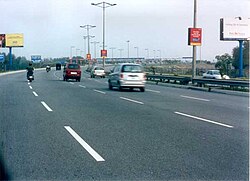
Roads in Delhi are maintained by the Municipal Corporation of Delhi, New Delhi Municipal Council, Delhi Cantonment Board, Public Works Department and Delhi Development Authority. At 1749 km of road length per 100 km2, Delhi has one of the highest road densities in India. Major roadways include the Ring Road and the Outer Ring Road, which had a traffic density of 110,000 vehicles per day in 2001. Total road length of Delhi was 28,508 km including 388 km of National Highways. Major road-based public transport facilities in Delhi are provided by DTC buses, auto-rickshaws, taxis and cycle-rickshaws.
Buses[edit | edit source]
Delhi Transport Corporation (DTC) operates the world's largest fleet of CNG-powered buses. After Pune, Delhi was the second city in India to have an operational Bus rapid transit (BRT) system. However the BRT was dismantled in 2016 due to accidents and congestion.[12]

Delhi has one of India's largest bus transport systems. Buses are the most popular means of transport catering to about 60% of Delhi's total demand.[13] Buses are operated by the state-owned Delhi Transport Corporation (DTC), which owns largest fleet of Compressed Natural Gas (CNG)-fueled buses in the world, private bus operators and several chartered bus operators. It is mandatory for all private bus operators to acquire a permit from the State Transport Authority. The buses traverse various well-defined intra-city routes. Other than regular routes, buses also travel on Railway Special routes; Metro Feeder routes. Mudrika (Ring) and Bahri Mudrika (Outer Ring) routes along Ring and Outer-Ring road respectively are amongst the longest intra-city bus routes in the world. The DTC has started introducing air-conditioned buses and brand new low-floor buses (with floor height of 400 mm and even higher on one third area as against 230 mm available internationally.) on city streets to replace the conventional buses. A revamp plan is underway to improve bus-shelters in the city and to integrate GPS systems in DTC buses and bus stops so as to provide reliable information about bus arrivals. In 2007, after public uproar concerning the large number of accidents caused by privately owned Blueline buses, the Delhi government, under pressure from the Delhi High Court decided that all Blueline Buses would be phased out and replaced by low floor buses of the state-owned DTC.[14] The Delhi Government has decided to expedite this process and will procure 6,600 low floor buses for the DTC by commonwealth games next year in mid 2010.[15]
The fleet size of buses in Delhi is as follows:
| Ownership | Fleet Strength | Notes |
|---|---|---|
| DTC | 4359[16] | including 1,250 e-buses[16] |
| DIMTS | 3126[16] | also known as Cluster Buses |
| Delhi Metro Feeder | 742[17] | including 100 e-buses and additional 380 buses operated by GNCTD[18][19] |
| Total | 8227 |
Auto-rickshaws[edit | edit source]
The auto-rickshaws (popularly known as Auto) are an important and popular means of public transportation in Delhi, as they are cheaper than taxis. Hiring an Auto in Delhi is very tricky, as very few auto-drivers agree to standard meter charges. The typical method is to haggle for an agreeable rate.
Taxis[edit | edit source]


Taxis can be easily hailed in Delhi. As of December 2017, there are over 148,434 registered taxis in Delhi.[20] The Indian Tourism Ministry and various private owners operate most taxis. The Tourism Ministry grants private companies permits to operate taxis. In recent years, online cab services like Uber and Ola have become popular in Delhi.[21]
Cycle-rickshaws[edit | edit source]
Cycle-rickshaws are a popular mode of travel for short distance transits in the city. The pedal-powered rickshaws are easily available throughout the city and reckoned for being cheap and environment friendly. Often, tourists and citizens use them for joyrides, too. Of late, they have been phased out from the congested areas of Chandni Chowk because of their slow pace, which often leads to traffic snarls on the streets of Old Delhi.
Major Arteries[edit | edit source]

Inner Ring Road[edit | edit source]
Inner Ring Road is one of the most important "state highways" in Delhi. It is a 51 km long circular road, which connects northern, eastern, western and southern areas in Delhi. Owing to more than 2 dozen grade-separators/flyovers, the road is almost signal-free. The road is generally 8-laned with a few bottlenecks at certain stretches, which are being removed. The road has already achieved its carrying capacity of 110000 vehicles per day and would require an addition of more lanes to fulfill needs of increasing traffic by 2011.
Outer Ring Road[edit | edit source]
Outer Ring Road is another major artery in Delhi. The road which was almost neglected till the early 2000s is now an important highway that links far-flung areas of Delhi. The road is 6-8 lane and has grade-separators and a large number are under construction as a part of project to make the artery signal free. The road along with the ring road forms a ring which intersects all the National Highways passing through Delhi.
Expressways and National Highways[edit | edit source]

Delhi is connected by NH 1, NH 2, NH 8, NH 10 and NH 24. It also has three expressways (six- and eight-lane) that connect it with its suburbs. Delhi–Gurgaon Expressway connects Delhi with one of its financial hubs, Gurgaon, DND Flyway connects Delhi with its other financial hub, Noida and Delhi–Faridabad Skyway which connects Faridabad, major suburb to Delhi. Four more expressways are also planned.

Noida–Greater Noida Expressway connects Noida with Greater Noida, which is an upcoming financial and commercial hub and is also to have a new Jewar International Airport. A 135.6-km long Western Peripheral Expressway, also known as the Kundli–Manesar–Palwal Expressway, which became operational on 19 November 2018, will relieve Delhi of the congestion of heavy night traffic and will act as a bypass for the night vehicles.
The DND–Faridabad–KMP Expressway connects the junction of DND Flyway and Ring Road at Maharani Bagh in Delhi with KMP Expressway at Khalilpur, Nuh district (near Sohna) in Haryana.[23]
NH 24 or Ghaziabad Road is a four-lane national highway which connects Delhi to Lucknow via Ghaziabad. As the Commonwealth Village is located close by Yamuna bridge on this highway, underpasses and flyover being built will help facilitate traffic between the eastern areas of Delhi/ Western UP and the rest of the city.
Rail transport[edit | edit source]
Rail based transport in the city has started to gain popularity with the introduction of Delhi Metro. Ring-Railway, which runs parallel to the Ring-Road system is another rail-based intra-city transport facility in Delhi.
Metro Railway[edit | edit source]

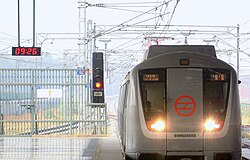
The Delhi Metro is being built in phases. Rapid increase of population coupled with large-scale immigration due to high economic growth has resulted in ever increasing demand for better transport, putting excessive pressure on the city's existent transport infrastructure. Like many other cities in the developing world, the city faces acute transport management problems leading to air pollution, congestion and resultant loss of productivity. In order to meet the transportation demand in Delhi, the State and Union government started the construction of a Mass Rapid Transit system, known as Delhi Metro in 1998. The project started commercial operations on 25 December 2002 between Shahdara and Tis Hazari) on the Red Line. It has set performance and efficiency standards and is continuously expanding. As of June 2025, the network consists of nine colour-coded regular lines along with the faster Airport Express line, with a total length of 353.23 kilometres (219.49 mi)[24] serving 257 stations.[24] The system has a mix of underground, at-grade, and elevated stations using both broad-gauge and standard-gauge.[25] Phase IV (108.5 km) will be completed by 2026,[26] with the network totaling 413.8 km, making it longer than the London Underground.
Phase I consisted of 58 stations and 65.0 km (40.4 mi) of route length,[27] of which 13.0 km (8.1 mi) is underground and 52.1 km (32.4 mi) surface or elevated. The inauguration of the Dwarka–Barakhamba Road corridor of the Blue Line marked the completion of Phase I in October 2006.[28]
Phase II of the network consists of 124.6 km (77.4 mi) of route length and 85 stations,[27] and is fully completed, with the first section opened in June 2008 and the last line opened in August 2011.[29]
Phase-III has 28 underground stations, 2 new lines and 11 route extensions, totaling 167.27 km (103.94 mi), with a cost of ₹350 billion (US$4.9 billion) and having an expected completion date of mid 2019. Phase IV (113.2 km or 70.3 mi) is planned to be completed by 2026.[30][26]
Delhi Metro lines that operate as of January 2022:
| Delhi Metro: present network | |||||||||
|---|---|---|---|---|---|---|---|---|---|
| Line No. | Line Name | First operational[31] | Last extension[31] | Stations[32] | Length (km)[32] |
Terminals | Rolling stock | Track gauge (mm) | |
| 1 | Red Line | 2002-12-24 | 2019-03-08 | 29 | 34.55 | Shaheed Sthal | Rithala | 39 trains | 1676 |
| 2 | Yellow Line | 2004-12-20 | 2015-11-10 | 37 | 49.02 | Samaypur Badli | HUDA City Centre | 64 trains | |
| 3 | Blue Line | 2005-12-31 | 2019-03-09 | 50 | 56.11 | Noida Electronic City | Dwarka Sector 21 | 74 trains | |
| 4 | 2010-01-07 | 2011-07-14 | 8 | 8.51 | Yamuna Bank | Vaishali | |||
| 5 | Green Line | 2010-04-03 | 2018-06-24 | 23 | 28.79 | Inderlok | Brigadier Hoshiyar Singh | 20 trains | 1435 |
| 2011-08-27 | – | Ashok Park Main | Kirti Nagar | ||||||
| 6 | Violet Line | 2010-10-03 | 2018-11-19 | 34 | 46.34 | Kashmere Gate | Raja Nahar Singh | 44 trains | |
| Airport Express | Orange Line | 2011-02-23 | – | 6 | 22.91 | New Delhi | Dwarka Sector 21 | 10 trains | |
| 7 | Pink Line | 2018-03-14 | 2021-08-06 | 38 | 59.24 | Majlis Park | Shiv Vihar | 42 trains | |
| 8 | Magenta Line | 2017-12-24 | 2018-05-29 | 25 | 37.46 | Botanical Garden | Janakpuri West | 26 trains | |
| 9 | Grey Line | 2019-10-04 | 2021-09-18 | 4 | 5.19 | Dwarka | Dhansa Bus Stand | 3 trains | |
| 2002-12-24 | 2021-09-18 | 254 | 348.12 | 310 trains | |||||

Ring & Suburban Railway[edit | edit source]


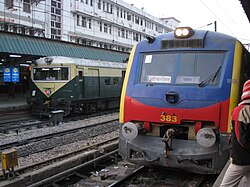
Ring railway is a 35-kilometre circular railway network in Delhi that runs parallel to the Ring Road. It was laid back in 1975 primarily to service freight trains that could bypass the crowded and passenger-heavy Old Delhi and New Delhi railway stations. The network was upgraded for the 1982 Asian Games with the introduction of 24 additional services. Its circular route is 35 km (22 mi) long, which the trains takes 90–120 minutes to complete, both clockwise and anti-clockwise, via the Hazrat Nizamuddin Railway Station. The ring railway service was quite popular through the 80s and 90s when Delhi's transport infrastructure was just gathering pace, but since then, with the rapid expansion of the Delhi Metro coupled with an extensive bus network, the ring railway has remained neglected by the city as well as the Railways. On average, only 3700 passengers take the trains every day. The biggest reason for the failure of the railway is a lack of a feeder network, such as approach roads and feeder buses to the stations. The stations are situated at remote locations and are difficult to access by passengers. There is also a problem of security as many stations have been encroached. The trains on this network also run behind schedule most of the time. The network is now utilized as a freight corridor and limited passenger train services are available during peak hours.[33][34][35]
Inter-state transport[edit | edit source]
Railway connectivity[edit | edit source]
Delhi is connected to whole of the nation through Indian Railways vast network. New Delhi Railway Station which is one of the most busiest stations in Indian Railway system serves as headquarters of Northern Railways. A large load of inter-state transport is borne by railways. A large number of local passenger trains connect Delhi to its sub-urban areas and thus provide convenient travel for daily commuters. Railways also share a large amount of freight traffic in Delhi.
Train Services[edit | edit source]
Regular train services available from railway stations in the city. The services are extended to all the states in the country. Services are provided by the national railway operator Indian Railways. The 5 railway stations in the city are:
- New Delhi Railway Station, Paharganj & Ajmeri Gate, Central Delhi district
- Delhi Junction, Mori Gate, Central Delhi district
- Hazrat Nizamuddin Railway Station, Nizamuddin East, South East Delhi district
- Delhi Sarai Rohilla Railway Station, Sarai Rohilla, Central Delhi district
- Anand Vihar Terminal Railway Station, Anand Vihar, Shahdara district
Regional Rapid Transport System (RRTS/RapidX)[edit | edit source]
- Sarai kale khan-Meerut RRTS (partially operational)
- Sarai kale khan-Panipat RRTS (under construction)
- Sarai kale khan-Gurugram-Alwar RRTS (under construction)
Delhi Metro[edit | edit source]
Road[edit | edit source]
Highways[edit | edit source]
The city is believed to have the highest road density in the country and is well connected to the rest of the nation through five major national highways, namely NH 1, NH 2, NH 8, NH 10 and NH 24. The highways around city are being upgraded into expressways with ultra-modern facilities.
Bus services[edit | edit source]
Regular bus services are available from interstate bus terminals in the city. The services are extended to all the northern states and the neighbouring areas of Delhi. Services are provided by state transport corporations and several private operators.
Delhi Transport Infrastructure Development Corporation Limited (DTIDC) operates 4 major Inter-State Bus Terminals (ISBT):[36]
- Existing
- Maharana Pratap Inter State Bus Terminus at Kashmere Gate in central Delhi.
- Swami Vivekanand Inter State Bus Terminus at Anand Vihar east of Yamuna river in East Delhi.
- Sarai Kale Khan Inter-State Bus Terminus at Sarai Kale Khan in South East Delhi.
- Proposed and approved by Delhi Govt and Delhi Leutinant General (listed north to south)
- Narela Inter State Bus Terminus, planned in North Delhi in 100,000 sqm area at NH48 GT Road to Sonepat-Ambala. As of October 2024, DDC is identifying suitable land to handover to DTIDC.[36][37] Buses from Punjab and Haryana along the GT Road will terminate here instead of the Kashmiri Gate ISBT.
- Tikri Inter State Bus Terminus, planned in West Delhi adjacent to the Tikri Border metro station on NH9 Delhi-Hisar Highway, it is nearly 4 km east of Bahadurgarh Bypass ISBT of Haryana Roadways. The PWD department has agreed to handover the required 29,500 sqm land to the DTIC in October 2024, and buses from Haryana from Tikri Border and Singhu Border will terminate here instead of Kashmiri Gate ISBT.[37]
- Dwarka Inter State Bus Terminus (under-construction in 2022 on 27 acres) at Urban Extension Road-II opposite Dwarka Sector 21 metro station in South Delhi. DTIDC already owns the required 27 acre land around which a new boundary wall already exists and DMRC has been appointed consultant in October 2024, construction which was expected to commence in 2022 is being expedited in late 2024.[37]
- Proposed, pending various approvals
- Aerocity Inter State Bus Terminus (Aerocity ISBT), adjacent to the Aerocity metro station near Terminal-1 of IGI in South Delhi, proposed in 2023.[38]
Airports[edit | edit source]
Indira Gandhi International Airport (IGI) serves Delhi for both domestic and international connections, and is situated in the southwestern corner of the city, alongside Delhi-Gurgaon Expressway. In the year 2024–25, IGI recorded a traffic of 77,280,234 passengers.[8] Being the busiest airport in the South Asian region, IGI airport has three terminals - Terminal 1 & Terminal 2 for domestic operations only and Terminal 3 - with mixed use i.e. primarily International and the rest of the domestic operations(Air India, Air India Express, and select flights of SpiceJet and IndiGo) - in addition to T1 & T2[39]
The airport is witnessing massive expansion and modernisation by a consortium led by GMR Infra. The new Terminal T3 was inaugurated in 2010 in line with the historic Commonwealth Games being held in the city and today, IGI is India's busiest airport and the ninth busiest airport in the world.[8] Terminals 4, 5 and 6 will be built in a phased manner.[40]
Hindon Domestic Airport in Ghaziabad was inaugurated by Prime Minister Narendra Modi as the second airport for the Delhi-NCR Region on the 8 March 2019.[41]
Apart from the expanded IGI airport, Delhi will also receive a second international airport by 2025. The airport, being named as Noida International Airport, is being built in Jewar in Greater Noida. It will be around 75 km from IGI airport.
East-west connectivity bridges[edit | edit source]
Yamuna bridges in Delhi[edit | edit source]

The total length of the Yamuna inside Delhi is 22 km from the Wazirabad barrage to the Okhla barrage. This stretch of the river has 14 bridges (nine of them for road traffic), including those built by Delhi Metro (4) and Indian Railways (1). 4 bridges are under construction — 1 for road traffic and 3 for rail traffic.[42][43][44]
- Road Bridges
- Old Wazirabad bridge (barrage-cum-bridge)
- Signature Bridge
- Yudhishthir Setu
- Rajghat/Geeta Colony bridge
- Old ITO bridge, Vikas Marg (barrage-cum-bridge)
- New Nizamuddin Bridge
- DND Flyway
- Okhla barrage bridge
- Barapullah Phase-III extension (under construction)
- Road-Rail Bridges
- Old Yamuna Bridge (Lohe-ka-Pul)
- Rail bridges
- Delhi Metro
- Kashmere Gate to Shastri Park (Red Line)
- Indraprastha to Yamuna Bank (Blue Line)
- Nizamuddin to Mayur Vihar (Pink Line)
- Kalindi Kunj to Okhla Bird Sanctuary (Magenta Line)
- Jagatpur to Sonia Vihar (Pink Line) (under construction)
- Indian Railways
- New Yamuna Bridge (under construction)[45]
- Delhi-Meerut RRTS
- Under construction[46]
- Delhi Metro
Other bridges in NCR[edit | edit source]
Future projects[edit | edit source]
There are many transport infrastructure projects underway in Delhi. They are listed below -
Rail[edit | edit source]
- Upgrading of New Delhi and Old Delhi railway stations of Northern Railways.[47][48]
- Phase 4 expansion of Delhi Metro.[49]
- Introduction of Delhi Metroneo, a metrolite system.[50]
- A proposal to re-introduce Trams in the Chandni Chowk and Red Fort areas of the city.[51][52]
- A proposed high-speed rail link that would link New Delhi with Kunming, China via Myanmar[11]
Road[edit | edit source]
- Two upcoming bridges over Yamuna will connect Faridabad to Noida and Greater Noida. One of the bridges would connect Faridabad-Noida-Ghaziabad (FNG) expressway from Noida's Sector 150 to National Highway 1 in Faridabad. The other bridge is proposed to link Noida's Sector 168 with Faridabad's Badoli village (Near Bypass Road)[53] Government has already approved construction of the road connecting Faridabad and Greater Noida that will improve the connectivity with clearances received from both Haryana and Uttar Pradesh Governments[54] The much-awaited FNG (Faridabad-Noida-Ghaziabad Expressway) is finally coming on track and will provide fast connectivity to daily commuters of the area once complete; apart from this, it is also emerging as an excellent stretch for real estate development. FNG Expressway is around 56 km long with 19.9 km in Noida–Greater Noida region, 8 km in Ghaziabad, while the rest 28.1 km is in the Faridabad region, especially the developing sectors of Neharpar Faridabad or Greater Faridabad. According to the plan, FNG from Noida side will become operational in the next 14 months while it would take three years for the whole stretch to become fully operational.[55] The completed expressway designed by IIT-Roorkee will offer commuters direct connectivity between Noida and Greater Faridabad[56]
Air[edit | edit source]
- Revamp of IGI Airport is underway to improve its infrastructure, passenger capacity and efficiency.
- Noida International Airport in Gautam Budhh Nagar district will start operations in 2025.
Delhi Traffic Police transport helpline[edit | edit source]
Owing to a large number of complaints from consumers, the Delhi Government in association with Delhi Traffic Police runs a staffed transport helpline which can be reached at 011-23010101 while dialing from within the city. Citizens can make traffic related complaints and suggestions. One can also report traffic violations observed and misbehavior/refusal/overcharging by autorickshaws, buses and taxis.[57]
See also[edit | edit source]
- Transport in India
- Parivahan Sewa
- Bus rapid transit (BRT)
- Clean development mechanism
- Delhi Metro
- Delhi Transport Corporation
- Highways passing from Delhi
References and notes[edit | edit source]
- ↑ "Delhi Metro among world's top mass transit systems". Archived from the original on 2 October 2012.
- ↑ "Expansion to Gurgaon, Noida & Faridabad planned". International Railway Journal. 1 February 2006.
- ↑ Prithwi (9 January 2008). "Traffic snarl snaps 42 Cr man-hour from Delhi, NCR workers". iGovernment. Archived from the original on 10 January 2008.
- ↑ "Delhi roads India's most dangerous | Delhi News - Times of India". The Times of India. 24 June 2014.
- ↑ "Capital story: Managing a New Delhi". Hindustan Times. 1 September 2011.
{{cite news}}: CS1 maint: deprecated archival service (link) - ↑ "Delhi Transport" (PDF). Delhi Govt. Retrieved 14 May 2006.
- ↑ "Delhi – Indira Gandhi International Airport (IGI Airport) information". Essential Travel Ltd., UK. Archived from the original on 19 July 2006. Retrieved 29 April 2006.
- ↑ 8.0 8.1 8.2 "Top 10 busiest airports by passenger traffic in 2024-25: Guess which Indian airport ranks 9th globally". The Indian Express. 23 May 2025. Retrieved 2 June 2025.
- ↑ "Hindon airport in Ghaziabad to be operational for UDAN flights by March". The Times of India. 30 January 2019. ISSN 0971-8257. Retrieved 2 June 2025.
- ↑ "Noida International Airport Latest Updates, Progress, Cost, Location and More - Infra Info Hub". 17 March 2025. Retrieved 2 June 2025.
- ↑ 11.0 11.1 "Railway eyes rail link to China". The Times of India. 10 March 2011. Archived from the original on 21 November 2011.
- ↑ "Delhi's CNG success inspiring many countries : Naik". Outlook. Archived from the original on 1 February 2009. Retrieved 17 February 2011.
- ↑ "Chapter 12: Transport" (PDF). Economic Survey of Delhi, 2005–2006. Planning Department, Government of National Capital Territory of Delhi. pp. 130–146. Archived from the original (PDF) on 16 January 2007. Retrieved 21 December 2006.
- ↑ "Delhi to phase out Blueline buses". Sify. Archived from the original on 1 November 2014.
- ↑ "Blueline buses to fade out soon". The Times Of India. 10 December 2009.
- ↑ 16.0 16.1 16.2 "900 New E-Buses To Be Rolled Out Soon". The Times of India. 19 March 2025. ISSN 0971-8257. Retrieved 2 June 2025.
- ↑ "BASELINE REPORT - Enabling Strategic Plan: Master Plan for Delhi 2041" (PDF).
- ↑ "DMRC to handover feeder e-buses to Delhi govt from April onwards: Official". www.business-standard.com. 21 February 2023. Retrieved 8 May 2023.
- ↑ "2,000 e-feeder buses to connect interior areas of Delhi to Metro stations". The Times of India. 6 January 2023. ISSN 0971-8257. Retrieved 8 May 2023.
- ↑ "Number of taxis rises 86% in 2 years, buses reduce in Delhi". Hindustan Times. 30 December 2017. Archived from the original on 3 December 2023. Retrieved 2 June 2025.
- ↑ "Uber Data Report 2024: How Indians Ubered in 2024; Delhi-NCR booked the most rides, while Mumbai booked most night-trips". The Hindu. 9 January 2025. ISSN 0971-751X. Retrieved 2 June 2025.
- ↑ Chander Joshi, Vimal (19 June 2015). "Gone! Toll plaza fully dismantled | Gurgaon News". The Times of India. Retrieved 27 March 2020.
- ↑ "Delhi-Mumbai Expressway link road opened for traffic; Check distance, total length, top speed to be..." www.india.com. Retrieved 2 June 2025.
- ↑ 24.0 24.1 "Delhi Metro About Us Introduction". DMRC. Retrieved 20 September 2016.
- ↑ Sadana, Rashmi. "Metrocity Journal: Delhi's Changing Landscape". The Wall Street Journal. Retrieved 12 June 2012.
- ↑ 26.0 26.1 "Delhi Metro Phase 4: National Capital To Get 44 New Stations By 2026". www.ndtv.com. Retrieved 2 June 2025.
- ↑ 27.0 27.1 "PROJECT UPDATE". Delhi Metro Rail Corporation. Archived from the original on 23 February 2014. Retrieved 2 March 2014.
- ↑ "Phase 1 complete, Pragati Maidan now on Metro map". Express India. 27 October 2006. Archived from the original on 31 December 2020. Retrieved 18 April 2010.
- ↑ Ramachandran, Smriti Kak (17 September 2007). "Delhi Metro confident of meeting deadline". The Hindu. New Delhi. Archived from the original on 3 March 2018. Retrieved 10 September 2009.
- ↑ "Completion targets of Metro Phase-4 will depend on Covid-19 scenario: DMRC". Hindustan Times. 20 June 2021. Retrieved 11 January 2022.
- ↑ 31.0 31.1 "Present Network". Delhi Metro Rail Corporation Ltd. Retrieved 8 March 2019.
- ↑ 32.0 32.1 "Route Map". Delhi Metro Rail Corporation Ltd. Retrieved 23 September 2018.
- ↑ Varma, Vishnu (11 March 2016). "Ring Railway left behind as Delhi swells beyond boundaries". The Indian Express. New Delhi. Retrieved 11 December 2021.
- ↑ "Changing Delhi map makes Ring Railway redundant". Indian Express. 22 February 2011.
- ↑ "Ring Rail service chugs into oblivion". Deccan Herald. 4 February 2012.
- ↑ 36.0 36.1 Eye on IGI: Work to start soon at Dwarka, timesofindia, 22 march 2022.
- ↑ 37.0 37.1 37.2 दिल्ली की सीमा पर लगेंगे बाहरी राज्यों की 2000 बसों के ब्रेक, बनेंगे तीन नए ISBT, Jagran, 8 Oct 2024.
- ↑ IGI एयरपोर्ट के पास बनेगा नया बस अड्डा, यूपी-पंजाब के यात्रियों को होगा सीधा फायदा, navbharattimes, 16 dec 2023.
- ↑ "Delhi – Indira Gandhi International Airport (DEL)". Indianexpress.com. 16 August 2009. Retrieved 17 February 2011.
- ↑ Thursday, 10 Jan 2008 at 0000 hrs IST (10 January 2008). "2nd airport won't hit IGI, says govt". Financialexpress.com. Retrieved 17 February 2011.
{{cite web}}: CS1 maint: numeric names: authors list (link) - ↑ "PM Narendra Modi inaugurates civil enclave at Hindon airport". The Economic Times. 8 March 2019. Retrieved 10 March 2019.
- ↑ Doomra, Manik (28 June 2019). "Bridges Over Yamuna in Delhi". urbanprecis.com. Urban Précis. Retrieved 16 December 2021.
- ↑ Singh, Paras (6 November 2018). "Delhi needs 20 more bridges just to meet current road traffic load". Times of India. Retrieved 16 December 2021.
- ↑ Roy, Sidharatha (23 February 2021). "Work kicks off on 17th bridge across Yamuna". Times of India. Retrieved 16 December 2021.
- ↑ "Construction ban extended till Nov 21, Metro projects among those exempted". Hindustan Times. 18 November 2021. Retrieved 16 December 2021.
Among important railway projects in the city where work will continue is construction of the New Yamuna bridge – being built parallel to the Old Yamuna bridge (Loha Pul). The new structure was set to be completed by December 2020, but COVID-19 delayed work.
- ↑ "NCRTC starts work on bridge over Yamuna for Delhi-Meerut RRTS link". Hindustan Times. 23 February 2021. Retrieved 16 December 2021.
- ↑ "New Delhi Railway Station Redevelopment: Old Design Scrapped, New Design Showcases Dual Building, Airport Like Features". Zee News. Retrieved 2 June 2025.
- ↑ "New Delhi Railway Station: Facilities, Redevelopment & Fares - Times Property". timesproperty. Retrieved 2 June 2025.
- ↑ "Delhi Metro Phase 4 – Information, Route Maps, Tenders & Updates". The Metro Rail Guy. Retrieved 2 June 2025.
- ↑ "Delhi Metrolite - Info, Route Map, Fares, Tenders & Updates". The Metro Rail Guy. Retrieved 2 June 2025.
- ↑ "Trams to ply on streets of Delhi again". The Economic Times. 4 March 2014. Archived from the original on 6 March 2014.
- ↑ "Delhi to bring back a slice of history — trams". The Indian Express. 5 March 2014.
- ↑ "Two bridges across Yamuna to link Noida and Haryana". The Times of India. Retrieved 15 May 2013.
- ↑ "Nod for road joining Greater Noida, Faridabad". The Times of India. Retrieved 13 August 2014.
- ↑ "Squatters in way of FNG e-way removed". The Times of India. 24 July 2014. ISSN 0971-8257. Retrieved 19 October 2023.
- ↑ "This page is closed for public access". Archived from the original on 27 January 2016. Retrieved 9 January 2016.
- ↑ "Delhi Traffic Police transport helpline number". Delhitrafficpolice.nic.in. Archived from the original on 23 February 2011. Retrieved 17 February 2011.
External links[edit | edit source]
- Department of Transport, Government of Delhi (Official Website)
- Delhi Integrated Multi Modal Transit System Ltd. (DIMTS)
Public transportation in Greater Delhi | |
|---|---|
 Delhi Metro lines Delhi Metro lines | |
| Other urban rail | |
| Commuter/intercity |
|
| Urban bus |
|
| Major terminals |
|
| Misc.transport |
|


| Road |  | ||||||||||||||||||||
|---|---|---|---|---|---|---|---|---|---|---|---|---|---|---|---|---|---|---|---|---|---|
| Rail |
| ||||||||||||||||||||
| Air | |||||||||||||||||||||
| Water | |||||||||||||||||||||
| Places |
| ||||||||||||||||||||
| Related | |||||||||||||||||||||