




m Removed empty portal template using script |
m quick rework lead as per guidelines further and corrected details |
||
| Line 1: | Line 1: | ||
{{Short description|Indian astrophysicist and politician (1893–1956)}} | {{Short description|Indian astrophysicist and politician (1893–1956)}} | ||
{{Use Indian English|date= | {{Use Indian English|date=October 2024}} | ||
{{Use dmy dates|date= | {{Use dmy dates|date=October 2024}} | ||
{{Infobox scientist | {{Infobox scientist | ||
| name = Meghnad Saha | | name = Meghnad Saha | ||
| honorific_suffix = {{ | | honorific_suffix = {{post-nominals|country=GBR|FRS}} | ||
| image = Dr-Meghnad-Saha.jpg | | image = Dr-Meghnad-Saha.jpg | ||
| caption = | | image_size = 250px | ||
| caption = | |||
| birth_date = {{Birth date|1893|10|6|df=y}} | | birth_date = {{Birth date|1893|10|6|df=y}} | ||
| birth_place = | | birth_place = Seoratali, [[Dhaka Division|Dhaka district]], [[Bengal Presidency]], British Raj | ||
| death_date = {{Death date and age|1956|2|16|1893|10|6|df=y}} | | death_date = {{Death date and age|1956|2|16|1893|10|6|df=y}} | ||
| death_place = | | death_place = New Delhi, India | ||
| nationality = [[ | | nationality = <!-- use only when necessary per [[WP:INFONAT]] --> | ||
| alma_mater = [[University of Calcutta]] | | alma_mater = [[Dhaka College]] <br /> | ||
| known_for = [[Thermal ionisation]] | [[Dhaka Collegiate School]]{{ubl|[[University of Calcutta]]|[[Presidency University, Kolkata|Presidency University]]|[[Rajabazar Science College]]}} | ||
| known_for = {{ubl|[[Thermal ionisation]]|[[Saha ionization equation]]}} | |||
| spouse = Radha Rani Saha | | spouse = Radha Rani Saha | ||
| awards = | | awards = | ||
| footnotes = | | footnotes = | ||
| fields = | | fields = Physics, [[astrophysics]] | ||
| work_institution = [[Allahabad University]] | | work_institution = {{ubl|[[Allahabad University]]|[[Rajabazar Science College]]|[[University of Calcutta]]|[[Imperial College London]]|[[Indian Association for the Cultivation of Science]]}} | ||
| academic_advisors = [[Jagdish Chandra Bose]] | | academic_advisors = {{ubl|[[Jagdish Chandra Bose]]|[[Prafulla Chandra Ray]]}} | ||
| doctoral_students = [[Samarendra Kumar Mitra]] | | doctoral_students = {{ubl|[[Samarendra Kumar Mitra]]|[[Daulat Singh Kothari]]}} | ||
| signature = Meghnad-Saha signature.svg | | signature = Meghnad-Saha signature.svg | ||
| module = {{Infobox officeholder | | module = {{Infobox officeholder | ||
|embed | | embed = yes | ||
| office = [[ | | office = [[Member of Parliament, Lok Sabha]] | ||
| | | term_start = 3 April 1952 | ||
| | | term_end = 16 February 1956 | ||
| constituency | | constituency = [[Calcutta North West (Lok Sabha constituency)|Calcutta North West]] | ||
| predecessor | | predecessor = ''Position established'' | ||
| successor | | successor = [[Ashoke Kumar Sen]] | ||
| party = [[Revolutionary Socialist Party (India)]] | |||
}} | }} | ||
}} | }} | ||
'''Meghnad Saha''' | '''Meghnad Saha''' (6 October 1893 – 16 February 1956) was an Indian [[astrophysicist]] and politician who helped devise the theory of [[Thermal ionization|thermal ionisation]]. His [[Saha ionization equation|Saha ionisation equation]] allowed astronomers to accurately relate the [[Stellar classification|spectral classes]] of [[stars]] to their actual temperatures.<ref name="PhysicsToday">{{Cite journal |last=Banerjee |first=Somaditya |date=1 August 2016 |title=Meghnad Saha: Physicist and nationalist |journal=Physics Today |language=en |volume=69 |issue=8 |pages=38–44 |doi=10.1063/PT.3.3267 |issn=0031-9228 |bibcode=2016PhT....69h..38B |doi-access=free}}</ref><ref>{{Cite encyclopedia |url=https://www.britannica.com/biography/Meghnad-N-Saha |title=Meghnad N. Saha {{!}} Indian astrophysicist |encyclopedia=[[Encyclopædia Britannica]] |date=12 February 2026 |access-date=23 February 2026}}</ref><ref name="Distillations">{{cite journal |last1=Kean |first1=Sam |title=A forgotten star |journal=Distillations |year=2017 |volume=3 |issue=1 |pages=4–5 |url=https://www.sciencehistory.org/stories/magazine/a-forgotten-star/ |access-date=22 March 2018}}</ref> | ||
==Biography== | ==Biography== | ||
[[File:Meghnad Saha 1934.jpg|thumb|left|upright|Meghnad Saha {{circa}} 1934]] | |||
Meghnad Saha was born on 6 October 1893 to a [[Bengalis|Bengali]] [[Bengali Hindu|Dalit]] [[hindu]] family in the village of [[Kaliakair Upazila|Sheoratali]] in [[Gazipur District|Gazipur]], then part of the [[Dhaka Division|Dacca district]] of the [[Bengal Presidency]] (now [[Bangladesh]]).<ref>{{Cite web |last=Ramesh |first=Sandhya |date=2023-10-06 |title=Meghnad Saha—polymath, politician, pioneer scientist who is called 'Darwin of astronomy' |url=https://theprint.in/theprint-profile/meghnad-saha-polymath-politician-pioneer-scientist-who-is-called-darwin-of-astronomy/1792478/ |access-date=2024-12-12 |website=ThePrint |language=en |quote=Born into a 'lower' caste family, he went on to become a polymath, politician, and pioneer scientist who made several seminal contributions to the world of physics.}}</ref><ref>{{Cite book |last=Arnold |first=David |url=https://books.google.com/books?id=3gk5j2u5AnUC |title=Science, Technology and Medicine in Colonial India |year=2000 |publisher=Cambridge University Press |isbn=978-1-139-42921-4 |pages=193 |language=en |quote=Although the list is in some respects unrepresentative of the widening range of science in late-colonial India, it reflects a growing social and regional diversity. Between 1924 and 1944 the Royal Society elected as Fellows Meghnad Saha, from a low-caste family in east Bengal, S. S. Bhatnagar (a Kayastha) and Birbal Sahni from Punjab, Homi Bhabha, a Parsi from Bombay, C. V. Raman, a Tamil Brahmin, his nephew S. Chandrasekhar, and K. S. Krishnan, Raman's associate and successor as Palit Professor of Physics, also originally from south India.}}</ref> He was the fifth of eight children born to Jagannath Saha, a poor shopkeeper, and his wife, Bhubaneshwari Devi.<ref>{{Cite journal |last=Banerjee |first=Somaditya |date=2016-08-01 |title=Meghnad Saha: Physicist and nationalist |url=https://physicstoday.aip.org/features/meghnad-saha-physicist-and-nationalist |journal=Physics Today |volume=69 |issue=8 |pages=38–44 |doi=10.1063/PT.3.3267 |bibcode=2016PhT....69h..38B |issn=0031-9228}}</ref> Having faced casteism in his childhood and professional life, Saha grew to detest the [[caste system]] from a young age.<ref>{{cite news |url=https://www.anandabazar.com/patrika/article-on-indian-astrophysicist-meghnad-saha-1.891680 |script-title=bn:মেঘনাথ থেকে মেঘনাদ |author=Manna, Arghya |date=3 November 2018 |work=[[Anandabazar Patrika]] |language=bn |access-date=2019-07-03}}</ref> | |||
During his youth, he was forced to leave [[Dhaka Collegiate School]] because he participated in the [[Swadeshi movement]].<ref name="Banglapedia">{{citation |author=Madhumita Mazumdar and Masud Hasan Chowdhury |chapter=Saha, Meghnad |chapter-url=http://en.banglapedia.org/index.php?title=Saha,_Meghnad |title=Banglapedia: National Encyclopedia of Bangladesh |editor=Sirajul Islam and Ahmed A. Jamal |publisher=[[Asiatic Society of Bangladesh]] |year=2012 |edition=Second |access-date=6 February 2016 |archive-date=10 January 2017 |archive-url=https://web.archive.org/web/20170110232853/http://en.banglapedia.org/index.php?title=Saha,_Meghnad |url-status=live}}</ref> After that, he joined [[K. L. Jubilee High School & College]]. He earned his [[Indian School Certificate]] from [[Dhaka College]].<ref name="Banglapedia" /> He was also a student at the [[Presidency College, Kolkata]], and [[Rajabazar Science College]] CU. Saha faced discrimination from other students due to his caste; when he was at the [[Eden Hindu Hostel]], communal students objected to him eating in the same dining hall as them.<ref name="PhysicsToday" /><ref>{{cite web |url=https://www.newslaundry.com/2017/10/27/even-a-scientist-wasnt-spared-caste-discrimination |title=Even a scientist wasn't spared caste discrimination |website=Newslaundry |date=27 October 2017}}</ref> | |||
He was a professor at [[Allahabad University]] from 1923 to 1938, and thereafter a professor and Dean of the Faculty of Science at the [[University of Calcutta]] until his death in 1956. He became a [[Fellow]] of the [[Royal Society]] in 1927.<ref>{{Cite journal |last=Kothari |first=D. S. |date=1 February 1960 |title=Meghnad Saha, 1893–1956 |journal=Biographical Memoirs of Fellows of the Royal Society |volume=5 |pages=216–236 |doi=10.1098/rsbm.1960.0017 |doi-access=free |s2cid=121719435}}</ref> He was president of the 21st session of the [[Indian Science Congress Association#Indian Science Congress sessions|Indian Science Congress]] in 1934.<ref name="Murty">{{cite book |last1=Murty |first1=K. Krishna |title=50 timeless scientists |year=2008 |publisher=[[Pustak Mahal]] |location=Delhi |isbn=978-81-223-1030-6 |pages=97–100 |url=https://books.google.com/books?id=WX9r7TAaWgEC&pg=PT51 |access-date=28 July 2017 |archive-date=26 December 2018 |archive-url=https://web.archive.org/web/20181226090453/https://books.google.com/books?id=WX9r7TAaWgEC&pg=PT51 |url-status=live}}</ref> | |||
Amongst Saha's classmates were [[Satyendra Nath Bose]], [[Jnan Chandra Ghosh|Jnan Ghosh]], and [[Jnanendra Nath Mukherjee]]. In his later life, he was close to Amiya Charan Banerjee.<ref name="Bose">{{cite journal |last1=Bose |first1=D.M. |title=Meghnad Saha Memorial Lecture, 1965 |journal=Proceedings of the Indian National Science Academy |year=1967 |volume=33A |pages=111–132 |url=http://www.insa.nic.in/writereaddata/UpLoadedFiles/PINSA/Vol33A_1967_3and4_Art01.pdf |access-date=28 July 2017 |archive-date=28 July 2017 |archive-url=https://web.archive.org/web/20170728215150/http://www.insa.nic.in/writereaddata/UpLoadedFiles/PINSA/Vol33A_1967_3and4_Art01.pdf |url-status=live}}</ref><ref name="Wali">{{cite book |last1=Wali |first1=Kameshar C. |title=Satyendra Nath Bose : his life and times |year=2009 |publisher=[[World Scientific]] |location=Singapore |isbn=978-981-279-071-2 |page=462 |url=https://books.google.com/books?id=Z2FhDQAAQBAJ&pg=PA462 |access-date=28 July 2017 |archive-date=26 December 2018 |archive-url=https://web.archive.org/web/20181226090450/https://books.google.com/books?id=Z2FhDQAAQBAJ&pg=PA462 |url-status=live}}</ref> | |||
==Career== | ==Career== | ||
Saha's study of the [[thermal ionisation]] of [[chemical element|elements]] led him to formulate what is known as the [[Saha ionization equation|Saha equation]]. This equation is one of the basic tools for | [[File:M N Saha, J C Bose, J C Ghosh, Snehamoy Dutt, S N Bose, D M Bose, N R Sen, J N Mukherjee, N C Nag.jpg|thumbnail|Saha (seated on left) with other scientists at Calcutta University]] | ||
Saha's study of the [[thermal ionisation]] of [[chemical element|elements]] led him to formulate what is known as the [[Saha ionization equation|Saha ionisation equation]]. This equation is one of the basic tools for interpreting the [[Stellar classification|spectra of stars]]. By studying the spectra of stars, one can find their temperature and, using Saha's equation, determine the ionisation state of the elements making up the star. This was extended by [[Ralph H. Fowler]] and [[Edward Arthur Milne]]. Saha had previously reached the following conclusion on the subject: | |||
{{blockquote|text=It will be admitted from what has gone before that the temperature plays the leading role in determining the nature of the stellar spectrum. Too much importance must not be attached to the figures given, for the theory is only a first attempt for quantitatively estimating the physical processes taking place at high temperature. We have practically no laboratory data to guide us, but the stellar spectra may be regarded as unfolding to us, in an unbroken sequence, the physical processes succeeding each other as the temperature is continually varied from 3000 K to 40,000 K.<ref>{{cite book |last=Hearnshaw |first=John B. |year=2014 |title=The Analysis of Starlight: Two Centuries of Astronomical Spectroscopy |edition=2nd |publisher=Cambridge University Press |page=136 |isbn=978-1-107-03174-6}}</ref>}} | |||
Saha also invented an instrument to measure the weight and pressure of solar rays. | |||
Meghnad Saha helped to establish several scientific institutions, including the Physics Department at [[University of Allahabad|Allahabad University]] in [[United Provinces (1937–1950)|United Provinces]] (now [[Uttar Pradesh]]) and the [[Saha Institute of Nuclear Physics|Institute of Nuclear Physics]] (now [[Saha Institute of Nuclear Physics]]) in [[Kolkata]]. He founded the journal ''Science and Culture'' and was the editor until his death.<ref>Eminent scientists published by Scholastic India pvt. Ltd.</ref> He was the leading figure in organising several scientific societies, such as the National Academy of Science (1930), the [[Indian Physical Society]] (1934), and the [[Indian Institute of Science]] (1935). He was the director at [[Indian Association for the Cultivation of Science]] from 1953 to 1956. The [[Saha Institute of Nuclear Physics]], founded in 1943 in Kolkata, is named after him.{{Sfn|Anderson|2010|p=626}} | |||
{{ | Saha stood as a candidate for North-West Calcutta in the [[1951–52 Indian general election|1951 Lok Sabha election]]. He ran as a member of the Union of Socialists and Progressives,<ref>{{Cite web |title=Members Bioprofile |url=http://164.100.47.194/loksabha/writereaddata/biodata_1_12/981.htm |url-status=live |archive-url=https://web.archive.org/web/20180306083652/http://164.100.47.194/loksabha/writereaddata/biodata_1_12/981.htm |archive-date=6 March 2018 |access-date=5 March 2018 |website=164.100.47.194}}</ref><ref>{{Cite web |title=Biographical Sketch of First Lok Sabha (State wise) |url=http://www.indiapress.org/election/archives/lok01/state/01lswb.php |url-status=live |archive-url=https://web.archive.org/web/20180306083659/http://www.indiapress.org/election/archives/lok01/state/01lswb.php |archive-date=6 March 2018 |access-date=5 March 2018 |website=indiapress.org}}</ref><ref>{{Cite web |title=Members : Lok Sabha |url=http://loksabha.nic.in/members/partyardetail.aspx?party_code=125&lsno=1 |url-status=live |archive-url=https://web.archive.org/web/20180306142321/http://loksabha.nic.in/members/partyardetail.aspx?party_code=125&lsno=1 |archive-date=6 March 2018 |access-date=5 March 2018 |website=loksabha.nic.in}}</ref> but maintained his independence from the party. His goal was to improve the planning of education, industrialisation, healthcare, and river valley development. He was up against [[Prabhu Dayal Himatsingka]]. Due to low funding for his campaign, Saha wrote to the publisher of his textbook ''Treatise on Heat'' to ask for an advance of ₹5000. He was elected by a margin of 16%.<ref>{{Cite web |url=http://eci.nic.in/eci_main/StatisticalReports/LS_1951/VOL_1_51_LS.PDF |title=Statistical Report on General Elections, 1951 to the First Lok Sabha |access-date=5 March 2018 |archive-date=4 March 2016 |archive-url=https://web.archive.org/web/20160304120817/http://eci.nic.in/eci_main/StatisticalReports/LS_1951/VOL_1_51_LS.PDF |url-status=live}}</ref> | ||
Saha | Saha participated in the areas of education, refugees, rehabilitation, atomic energy, multipurpose river projects, flood control, and long term planning. On the dust jacket flap of the book ''Meghnad Saha in Parliament,'' Saha is described as:<blockquote>"Never unduly critical... forthright, so incisive, so thorough in pointing out lapses that the treasury bench was constantly on the defensive. This is brought out by the way he was accused of leaving his laboratory and straying into a territory not his own. But the reason why he was slowly drifting towards this public role (he was never a politician in the correct sense of the term) was the gradually widening gulf between his dream and the reality—between his vision of an industrialised India and the Government implementation of the plan."<ref>{{Cite book |url=https://archive.org/details/in.ernet.dli.2015.181906 |title=Meghnad Saha In Parliament |editor1-last=Chatterjee |editor1-first=Santimay |editor2-last=Gupta |editor2-first=Jyotirmoy |year=1993 |location=Calcutta |publisher=The Asiatic Society |oclc=30000871}}</ref></blockquote>Saha was the chief architect of river planning in India and prepared the original plan for the [[Damodar Valley Project]]. His own observation with respect to his transition into government projects and political affairs was: | ||
{{blockquote|text=Scientists are often accused of living in the "Ivory Tower" and not troubling their mind with realities and apart from my association with political movements in my juvenile years, I had lived in ivory tower up to 1930. But science and technology are as important for administration now-a-days as law and order. I have gradually glided into politics because I wanted to be of some use to the country in my own humble way.<ref>{{cite web |title=Meghnad Saha |url=http://www.vigyanprasar.gov.in/scientists/saha/sahanew.htm |access-date=31 May 2008 |url-status=dead |archive-url=https://web.archive.org/web/20150223073932/http://www.vigyanprasar.gov.in/scientists/saha/sahanew.htm |archive-date=23 February 2015}}</ref>}} | |||
[[File:Meghnad Saha with his assistant.jpg|thumb|Meghnad Saha]] | |||
Saha | ==Personal life== | ||
Saha married Radha Rani Saha on 16 June 1918. They had a total of 7 children: 3 sons and 4 daughters.<ref>{{cite Q|Q131225635}}</ref> | |||
Saha was | Saha was an [[atheist]].<ref>{{cite book |title=Meghnad Saha, scientist with a vision |year=1984 |publisher=National Book Trust, India |author-first1=Santimay |author-last1=Chatterjee |author-first2=Enakshi |author-last2=Chatterjee |oclc=14411992 |page=5 |quote=Even though he later came to be known as an atheist, Saha was well-versed in all religious texts— though his interest in them was purely academic.}}</ref>{{Sfn|Anderson|2010|p=602, a self-described atheist, saha loved swimming in the river and his devout wife loved the sanctity of the spot. swimming and walking were among the few things they could do together.}} | ||
==Death== | |||
Saha died on the way to the hospital on 16 February 1956 after suffering from cardiac arrest. He was going to the office of the [[Planning Commission (India)|Planning Commission]] in the [[Rashtrapati Bhavan, New Delhi|Rashtrapati Bhavan]]. It was reported he had been dealing with [[hypertension]] for ten months prior to his death.<ref>{{cite news |title=Nation Mourns Meghnad Saha |newspaper=The Indian Express |date=17 February 1956 |pages=1, 7}}</ref> His remains were [[cremated]] at the [[Keoratola crematorium]], Kolkata, the following day.<ref>{{cite news |title=Saha's Remains Cremated |newspaper=The Indian Express |date=18 February 1956}}</ref> | |||
==Tributes | ==Tributes== | ||
[[File:MNSaha.jpg|thumb|Bust of Saha at | [[File:MNSaha.jpg|thumb|Bust of Saha at [[Indian Association for the Cultivation of Science]]]] | ||
[[File:Statue of Meghnad Saha.jpg|thumb|Statue of Saha, | [[File:Statue of Meghnad Saha.jpg|thumb|Statue of Saha, [[University College of Science, Technology & Agriculture]]]] | ||
[[File:Meghnad Saha bust BITM.JPG|thumb|Bust of Saha | [[File:Meghnad Saha bust BITM.JPG|thumb|Bust of Saha at [[Birla Industrial & Technological Museum]]]] | ||
* "Meghnad Saha's ionization equation (c. 1920), which opened the door to stellar astrophysics was one of the top ten achievements of 20th century Indian science [and] could be considered in the Nobel Prize class." — [[Jayant Narlikar]]<ref>{{cite book | author = Narlikar, Jayant | title = The Scientific Edge | | * "Meghnad Saha's ionization equation (c. 1920), which opened the door to stellar astrophysics was one of the top ten achievements of 20th century Indian science [and] could be considered in the Nobel Prize class." — [[Jayant Narlikar]]<ref>{{cite book |author=Narlikar, Jayant |title=The Scientific Edge: The Indian Scientist from Vedic to Modern Times |year=2003 |publisher=[[Penguin Books]] |isbn=978-0-14-303028-7 |page=127}}</ref> | ||
* "The impetus given to astrophysics by Saha's work can scarcely be overestimated, as nearly all later progress in this field has been influenced by it and much of the subsequent work has the character of refinements of | * "The impetus given to astrophysics by Saha's work can scarcely be overestimated, as nearly all later progress in this field has been influenced by it and much of the subsequent work has the character of refinements of Saha's ideas." — [[Svein Rosseland]]<ref>{{cite book |author=Rosseland, S. |title=Theoretical Astrophysics |publisher=[[Oxford University Press]] |year=1939 |url=http://www.vigyanprasar.gov.in/scientists/saha/sahanew.htm |url-status=dead |archive-url=https://web.archive.org/web/20150223073932/http://www.vigyanprasar.gov.in/scientists/saha/sahanew.htm |archive-date=23 February 2015}}</ref> | ||
* "He (Saha) was extremely simple, almost austere, in his habits and personal needs. Outwardly, he sometimes gave an impression of being remote, matter of fact, and even harsh, but once the outer shell was broken, one invariably found in him a person of extreme warmth, deep humanity, sympathy and understanding; and though almost altogether unmindful of his own personal comforts, he was extremely solicitous in the case of others. It was not in his nature to placate others. He was a man of undaunted spirit, resolute determination, untiring energy and dedication." — [[Daulat Singh Kothari]]<ref>{{cite book | author = Kothari, D. S. | title = Biographical Memoirs of Fellows of the National Institute of Sciences of India | volume = 2 | location = New Delhi | | * "He (Saha) was extremely simple, almost austere, in his habits and personal needs. Outwardly, he sometimes gave an impression of being remote, matter of fact, and even harsh, but once the outer shell was broken, one invariably found in him a person of extreme warmth, deep humanity, sympathy and understanding; and though almost altogether unmindful of his own personal comforts, he was extremely solicitous in the case of others. It was not in his nature to placate others. He was a man of undaunted spirit, resolute determination, untiring energy and dedication." — [[Daulat Singh Kothari]]<ref>{{cite book |author=Kothari, D. S. |title=Biographical Memoirs of Fellows of the National Institute of Sciences of India |volume=2 |publisher=National Institute of Sciences of India |location=New Delhi |year=1970 |url=http://www.vigyanprasar.gov.in/scientists/saha/sahanew.htm |url-status=dead |archive-url=https://web.archive.org/web/20150223073932/http://www.vigyanprasar.gov.in/scientists/saha/sahanew.htm |archive-date=23 February 2015}}</ref> | ||
==References== | ==References== | ||
{{ | {{reflist}} | ||
===Sources=== | |||
* {{cite book |last=Anderson |first=Robert S. |title=Nucleus and Nation: Scientists, International Networks, and Power in India |publisher=[[University of Chicago Press]] |year=2010 |isbn=978-0-226-01977-2 |url=https://books.google.com/books?id=3BcKqXOeSbAC}} | |||
==Further reading== | ==Further reading== | ||
* {{cite journal|title=Stars, Peripheral Scientists, and Equations: The Case of M. N. Saha|author=Dasgupta, Deepanwita|year=2015| journal=Physics in Perspective|volume=17|issue=2|doi=10.1007/s00016-015-0159-7|pages=83–106|bibcode = 2015PhP....17...83D |s2cid=118224210}} | * {{cite journal |title=Stars, Peripheral Scientists, and Equations: The Case of M. N. Saha |author=Dasgupta, Deepanwita |year=2015 |journal=Physics in Perspective |volume=17 |issue=2 |doi=10.1007/s00016-015-0159-7 |pages=83–106 |bibcode=2015PhP....17...83D |s2cid=118224210}} | ||
* [http://adsabs.harvard.edu//full/seri/Obs../0076//0000040.000.html Obituary - ''The Observatory'' '''76''' (1956) 40] | * [http://adsabs.harvard.edu//full/seri/Obs../0076//0000040.000.html Obituary - ''The Observatory'' '''76''' (1956) 40] | ||
* [http://adsabs.harvard.edu//full/seri/PASP./0068//0000282.000.html Obituary | * [http://adsabs.harvard.edu//full/seri/PASP./0068//0000282.000.html Obituary – ''Proceedings of the Astronomical Society of the Pacific'' '''68''' (1956) 282] | ||
* {{cite book|last1=Venkataraman|first1=Ganeshan|author-link1=Ganeshan Venkataraman|title=Saha and His Formula| | * {{cite book |last1=Venkataraman |first1=Ganeshan |author-link1=Ganeshan Venkataraman |title=Saha and His Formula |year=1995 |publisher=University Press |url=https://books.google.com/books?id=TCbjwQmaXawC |isbn=978-81-7371-017-9}} | ||
* Jibamitra Ganguly: ''Meghnad Saha : his science and persona through letters and writings''. Indian National Science Academy, New Delhi 2019. | * Jibamitra Ganguly: ''Meghnad Saha : his science and persona through letters and writings''. Indian National Science Academy, New Delhi 2019. | ||
* Collected works of Meghnad Saha. ed. by Santimay Chatterjee. Calcutta [u.a.]: Institute of Nuclear Physics [u.a.], 1982. | * Collected works of Meghnad Saha. ed. by Santimay Chatterjee. Calcutta [u.a.]: Institute of Nuclear Physics [u.a.], 1982. | ||
| Line 79: | Line 98: | ||
==External links== | ==External links== | ||
{{commons category}} | {{commons category}} | ||
* {{Internet Archive author|name=Meghnad Saha}} | * {{Internet Archive author|name=Meghnad Saha}} | ||
* {{cite web |title=Meghnad Saha |url=http://www.vigyanprasar.gov.in/scientists/saha/sahanew.htm |url-status=dead |archive-url=https://web.archive.org/web/20150223073932/http://www.vigyanprasar.gov.in/scientists/saha/sahanew.htm |archive-date=23 February 2015}} | |||
* {{cite web | title = Meghnad Saha | url = http://www.vigyanprasar.gov.in/scientists/saha/sahanew.htm | url-status = dead | archive-url = https://web.archive.org/web/20150223073932/http://www.vigyanprasar.gov.in/scientists/saha/sahanew.htm | archive-date = 23 February 2015 | * {{cite web |title=Meghnad Saha biography |url=http://www.calcuttaweb.com/people/msaha.shtml |archive-url=https://web.archive.org/web/20010627220307/http://www.calcuttaweb.com/people/msaha.shtml |archive-date=27 June 2001 |access-date=22 December 2007 |url-status=dead}} | ||
* {{cite web|title=Meghnad Saha biography|url=http://www.calcuttaweb.com/people/msaha.shtml|archive-url=https://web.archive.org/web/20010627220307/http://www.calcuttaweb.com/people/msaha.shtml|archive-date=27 June 2001|access-date=22 December 2007|url-status=dead | * {{cite web |title=Saha Equation |url=http://scienceworld.wolfram.com/physics/SahaEquation.html |archive-url=https://web.archive.org/web/20060503040640/http://scienceworld.wolfram.com/physics/SahaEquation.html |archive-date=3 May 2006 |access-date=17 July 2004 |url-status=live}} | ||
* {{cite web|title=Saha Equation|url=http://scienceworld.wolfram.com/physics/SahaEquation.html|archive-url=https://web.archive.org/web/20060503040640/http://scienceworld.wolfram.com/physics/SahaEquation.html|archive-date=3 May 2006|access-date=17 July 2004|url-status=live}} | |||
* {{YouTube|7z9NUV_YrOo|The Quantum Indians: film on Meghnad Saha, Bose and Raman}} by [[Raja Choudhury]] and produced by PSBT and [[Indian Public Diplomacy]]. | * {{YouTube|7z9NUV_YrOo|The Quantum Indians: film on Meghnad Saha, Bose and Raman}} by [[Raja Choudhury]] and produced by PSBT and [[Indian Public Diplomacy]]. | ||
{{Bengal Renaissance}} | {{Bengal Renaissance}} | ||
{{West Bengal}} | {{West Bengal}} | ||
{{Portal bar|Biography|India|Physics|Astronomy|Stars|Spaceflight|Outer space|Science}} | |||
{{Authority control}} | |||
{{DEFAULTSORT:Saha, Megh Nad}} | {{DEFAULTSORT:Saha, Megh Nad}} | ||
[[Category:1893 births]] | [[Category:1893 births]] | ||
[[Category:1956 deaths]] | [[Category:1956 deaths]] | ||
[[Category: | [[Category:India MPs 1952–1957]] | ||
[[Category:20th-century Indian physicists]] | [[Category:20th-century Indian physicists]] | ||
[[Category:Bengali astronomers]] | [[Category:Bengali astronomers]] | ||
[[Category:Bengali physicists]] | [[Category:Bengali physicists]] | ||
[[Category:Dhaka College alumni]] | [[Category:Dhaka College alumni]] | ||
[[Category:Indian atheists]] | |||
[[Category:Indian Hindus]] | |||
[[Category:Fellows of the Indian National Science Academy]] | [[Category:Fellows of the Indian National Science Academy]] | ||
[[Category:Fellows of the Royal Society]] | [[Category:Fellows of the Royal Society]] | ||
[[Category:Hare School alumni]] | [[Category:Hare School alumni]] | ||
[[Category:Indian astrophysicists]] | [[Category:Indian astrophysicists]] | ||
[[Category:Lok Sabha members from West Bengal]] | [[Category:Lok Sabha members from West Bengal]] | ||
[[Category:People from | [[Category:People from Gazipur District]] | ||
[[Category:Plasma physicists]] | [[Category:Plasma physicists]] | ||
[[Category:Politicians from Kolkata]] | [[Category:Politicians from Kolkata]] | ||
[[Category:Presidency University, Kolkata alumni]] | [[Category:Presidency University, Kolkata alumni]] | ||
[[Category:Presidents of The Asiatic Society]] | [[Category:Presidents of The Asiatic Society]] | ||
[[Category:University of Allahabad | [[Category:Academic staff of the University of Allahabad]] | ||
[[Category:University of Calcutta alumni]] | [[Category:University of Calcutta alumni]] | ||
[[Category:University of Calcutta | [[Category:Academic staff of the University of Calcutta]] | ||
[[Category:Bengali scientists]] | [[Category:Bengali scientists]] | ||
[[Category:Dhaka Collegiate School alumni]] | |||
[[Category:K. L. Jubilee High School & College alumni]] | |||
Latest revision as of 14:26, 30 April 2026
Meghnad Saha | |
|---|---|
 | |
| Born | 6 October 1893 Seoratali, Dhaka district, Bengal Presidency, British Raj |
| Died | 16 February 1956 (aged 62) New Delhi, India |
| Alma mater | Dhaka College Dhaka Collegiate School |
| Known for | |
| Spouse(s) | Radha Rani Saha |
| Scientific career | |
| Fields | Physics, astrophysics |
| Institutions | |
| Academic advisors | |
| Doctoral students | |
| Member of Parliament, Lok Sabha | |
| In office 3 April 1952 – 16 February 1956 | |
| Preceded by | Position established |
| Succeeded by | Ashoke Kumar Sen |
| Constituency | Calcutta North West |
| Personal details | |
| Political party | Revolutionary Socialist Party (India) |
| Signature | |
 | |
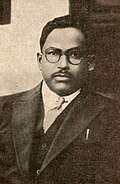
Meghnad Saha (6 October 1893 – 16 February 1956) was an Indian astrophysicist and politician who helped devise the theory of thermal ionisation. His Saha ionisation equation allowed astronomers to accurately relate the spectral classes of stars to their actual temperatures.[1][2][3]
Biography[edit | edit source]

Meghnad Saha was born on 6 October 1893 to a Bengali Dalit hindu family in the village of Sheoratali in Gazipur, then part of the Dacca district of the Bengal Presidency (now Bangladesh).[4][5] He was the fifth of eight children born to Jagannath Saha, a poor shopkeeper, and his wife, Bhubaneshwari Devi.[6] Having faced casteism in his childhood and professional life, Saha grew to detest the caste system from a young age.[7]
During his youth, he was forced to leave Dhaka Collegiate School because he participated in the Swadeshi movement.[8] After that, he joined K. L. Jubilee High School & College. He earned his Indian School Certificate from Dhaka College.[8] He was also a student at the Presidency College, Kolkata, and Rajabazar Science College CU. Saha faced discrimination from other students due to his caste; when he was at the Eden Hindu Hostel, communal students objected to him eating in the same dining hall as them.[1][9]
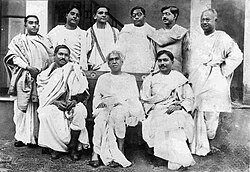
He was a professor at Allahabad University from 1923 to 1938, and thereafter a professor and Dean of the Faculty of Science at the University of Calcutta until his death in 1956. He became a Fellow of the Royal Society in 1927.[10] He was president of the 21st session of the Indian Science Congress in 1934.[11]
Amongst Saha's classmates were Satyendra Nath Bose, Jnan Ghosh, and Jnanendra Nath Mukherjee. In his later life, he was close to Amiya Charan Banerjee.[12][13]
Career[edit | edit source]

Saha's study of the thermal ionisation of elements led him to formulate what is known as the Saha ionisation equation. This equation is one of the basic tools for interpreting the spectra of stars. By studying the spectra of stars, one can find their temperature and, using Saha's equation, determine the ionisation state of the elements making up the star. This was extended by Ralph H. Fowler and Edward Arthur Milne. Saha had previously reached the following conclusion on the subject:
It will be admitted from what has gone before that the temperature plays the leading role in determining the nature of the stellar spectrum. Too much importance must not be attached to the figures given, for the theory is only a first attempt for quantitatively estimating the physical processes taking place at high temperature. We have practically no laboratory data to guide us, but the stellar spectra may be regarded as unfolding to us, in an unbroken sequence, the physical processes succeeding each other as the temperature is continually varied from 3000 K to 40,000 K.[14]
Saha also invented an instrument to measure the weight and pressure of solar rays.
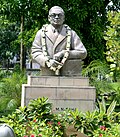
Meghnad Saha helped to establish several scientific institutions, including the Physics Department at Allahabad University in United Provinces (now Uttar Pradesh) and the Institute of Nuclear Physics (now Saha Institute of Nuclear Physics) in Kolkata. He founded the journal Science and Culture and was the editor until his death.[15] He was the leading figure in organising several scientific societies, such as the National Academy of Science (1930), the Indian Physical Society (1934), and the Indian Institute of Science (1935). He was the director at Indian Association for the Cultivation of Science from 1953 to 1956. The Saha Institute of Nuclear Physics, founded in 1943 in Kolkata, is named after him.[16]
Saha stood as a candidate for North-West Calcutta in the 1951 Lok Sabha election. He ran as a member of the Union of Socialists and Progressives,[17][18][19] but maintained his independence from the party. His goal was to improve the planning of education, industrialisation, healthcare, and river valley development. He was up against Prabhu Dayal Himatsingka. Due to low funding for his campaign, Saha wrote to the publisher of his textbook Treatise on Heat to ask for an advance of ₹5000. He was elected by a margin of 16%.[20]
Saha participated in the areas of education, refugees, rehabilitation, atomic energy, multipurpose river projects, flood control, and long term planning. On the dust jacket flap of the book Meghnad Saha in Parliament, Saha is described as:
"Never unduly critical... forthright, so incisive, so thorough in pointing out lapses that the treasury bench was constantly on the defensive. This is brought out by the way he was accused of leaving his laboratory and straying into a territory not his own. But the reason why he was slowly drifting towards this public role (he was never a politician in the correct sense of the term) was the gradually widening gulf between his dream and the reality—between his vision of an industrialised India and the Government implementation of the plan."[21]
Saha was the chief architect of river planning in India and prepared the original plan for the Damodar Valley Project. His own observation with respect to his transition into government projects and political affairs was:
Scientists are often accused of living in the "Ivory Tower" and not troubling their mind with realities and apart from my association with political movements in my juvenile years, I had lived in ivory tower up to 1930. But science and technology are as important for administration now-a-days as law and order. I have gradually glided into politics because I wanted to be of some use to the country in my own humble way.[22]

Personal life[edit | edit source]
Saha married Radha Rani Saha on 16 June 1918. They had a total of 7 children: 3 sons and 4 daughters.[23]
Death[edit | edit source]
Saha died on the way to the hospital on 16 February 1956 after suffering from cardiac arrest. He was going to the office of the Planning Commission in the Rashtrapati Bhavan. It was reported he had been dealing with hypertension for ten months prior to his death.[26] His remains were cremated at the Keoratola crematorium, Kolkata, the following day.[27]
Tributes[edit | edit source]


- "Meghnad Saha's ionization equation (c. 1920), which opened the door to stellar astrophysics was one of the top ten achievements of 20th century Indian science [and] could be considered in the Nobel Prize class." — Jayant Narlikar[28]
- "The impetus given to astrophysics by Saha's work can scarcely be overestimated, as nearly all later progress in this field has been influenced by it and much of the subsequent work has the character of refinements of Saha's ideas." — Svein Rosseland[29]
- "He (Saha) was extremely simple, almost austere, in his habits and personal needs. Outwardly, he sometimes gave an impression of being remote, matter of fact, and even harsh, but once the outer shell was broken, one invariably found in him a person of extreme warmth, deep humanity, sympathy and understanding; and though almost altogether unmindful of his own personal comforts, he was extremely solicitous in the case of others. It was not in his nature to placate others. He was a man of undaunted spirit, resolute determination, untiring energy and dedication." — Daulat Singh Kothari[30]
References[edit | edit source]
- ↑ 1.0 1.1 Banerjee, Somaditya (1 August 2016). "Meghnad Saha: Physicist and nationalist". Physics Today. 69 (8): 38–44. Bibcode:2016PhT....69h..38B. doi:10.1063/PT.3.3267. ISSN 0031-9228.
- ↑ "Meghnad N. Saha | Indian astrophysicist". Encyclopædia Britannica. 12 February 2026. Retrieved 23 February 2026.
- ↑ Kean, Sam (2017). "A forgotten star". Distillations. 3 (1): 4–5. Retrieved 22 March 2018.
- ↑ Ramesh, Sandhya (6 October 2023). "Meghnad Saha—polymath, politician, pioneer scientist who is called 'Darwin of astronomy'". ThePrint. Retrieved 12 December 2024.
Born into a 'lower' caste family, he went on to become a polymath, politician, and pioneer scientist who made several seminal contributions to the world of physics.
- ↑ Arnold, David (2000). Science, Technology and Medicine in Colonial India. Cambridge University Press. p. 193. ISBN 978-1-139-42921-4.
Although the list is in some respects unrepresentative of the widening range of science in late-colonial India, it reflects a growing social and regional diversity. Between 1924 and 1944 the Royal Society elected as Fellows Meghnad Saha, from a low-caste family in east Bengal, S. S. Bhatnagar (a Kayastha) and Birbal Sahni from Punjab, Homi Bhabha, a Parsi from Bombay, C. V. Raman, a Tamil Brahmin, his nephew S. Chandrasekhar, and K. S. Krishnan, Raman's associate and successor as Palit Professor of Physics, also originally from south India.
- ↑ Banerjee, Somaditya (1 August 2016). "Meghnad Saha: Physicist and nationalist". Physics Today. 69 (8): 38–44. Bibcode:2016PhT....69h..38B. doi:10.1063/PT.3.3267. ISSN 0031-9228.
- ↑ Manna, Arghya (3 November 2018). মেঘনাথ থেকে মেঘনাদ. Anandabazar Patrika (in Bengali). Retrieved 3 July 2019.
- ↑ 8.0 8.1 Madhumita Mazumdar and Masud Hasan Chowdhury (2012), "Saha, Meghnad", in Sirajul Islam and Ahmed A. Jamal (ed.), Banglapedia: National Encyclopedia of Bangladesh (Second ed.), Asiatic Society of Bangladesh, archived from the original on 10 January 2017, retrieved 6 February 2016
- ↑ "Even a scientist wasn't spared caste discrimination". Newslaundry. 27 October 2017.
- ↑ Kothari, D. S. (1 February 1960). "Meghnad Saha, 1893–1956". Biographical Memoirs of Fellows of the Royal Society. 5: 216–236. doi:10.1098/rsbm.1960.0017. S2CID 121719435.
- ↑ Murty, K. Krishna (2008). 50 timeless scientists. Delhi: Pustak Mahal. pp. 97–100. ISBN 978-81-223-1030-6. Archived from the original on 26 December 2018. Retrieved 28 July 2017.
- ↑ Bose, D.M. (1967). "Meghnad Saha Memorial Lecture, 1965" (PDF). Proceedings of the Indian National Science Academy. 33A: 111–132. Archived (PDF) from the original on 28 July 2017. Retrieved 28 July 2017.
- ↑ Wali, Kameshar C. (2009). Satyendra Nath Bose : his life and times. Singapore: World Scientific. p. 462. ISBN 978-981-279-071-2. Archived from the original on 26 December 2018. Retrieved 28 July 2017.
- ↑ Hearnshaw, John B. (2014). The Analysis of Starlight: Two Centuries of Astronomical Spectroscopy (2nd ed.). Cambridge University Press. p. 136. ISBN 978-1-107-03174-6.
- ↑ Eminent scientists published by Scholastic India pvt. Ltd.
- ↑ Anderson 2010, p. 626.
- ↑ "Members Bioprofile". 164.100.47.194. Archived from the original on 6 March 2018. Retrieved 5 March 2018.
- ↑ "Biographical Sketch of First Lok Sabha (State wise)". indiapress.org. Archived from the original on 6 March 2018. Retrieved 5 March 2018.
- ↑ "Members : Lok Sabha". loksabha.nic.in. Archived from the original on 6 March 2018. Retrieved 5 March 2018.
- ↑ "Statistical Report on General Elections, 1951 to the First Lok Sabha" (PDF). Archived (PDF) from the original on 4 March 2016. Retrieved 5 March 2018.
- ↑ Chatterjee, Santimay; Gupta, Jyotirmoy, eds. (1993). Meghnad Saha In Parliament. Calcutta: The Asiatic Society. OCLC 30000871.
- ↑ "Meghnad Saha". Archived from the original on 23 February 2015. Retrieved 31 May 2008.
- ↑
- ↑ Chatterjee, Santimay; Chatterjee, Enakshi (1984). Meghnad Saha, scientist with a vision. National Book Trust, India. p. 5. OCLC 14411992.
Even though he later came to be known as an atheist, Saha was well-versed in all religious texts— though his interest in them was purely academic.
- ↑ Anderson 2010, p. 602, a self-described atheist, saha loved swimming in the river and his devout wife loved the sanctity of the spot. swimming and walking were among the few things they could do together..
- ↑ "Nation Mourns Meghnad Saha". The Indian Express. 17 February 1956. pp. 1, 7.
- ↑ "Saha's Remains Cremated". The Indian Express. 18 February 1956.
- ↑ Narlikar, Jayant (2003). The Scientific Edge: The Indian Scientist from Vedic to Modern Times. Penguin Books. p. 127. ISBN 978-0-14-303028-7.
- ↑ Rosseland, S. (1939). Theoretical Astrophysics. Oxford University Press. Archived from the original on 23 February 2015.
- ↑ Kothari, D. S. (1970). Biographical Memoirs of Fellows of the National Institute of Sciences of India. Vol. 2. New Delhi: National Institute of Sciences of India. Archived from the original on 23 February 2015.
Sources[edit | edit source]
- Anderson, Robert S. (2010). Nucleus and Nation: Scientists, International Networks, and Power in India. University of Chicago Press. ISBN 978-0-226-01977-2.
Further reading[edit | edit source]
- Dasgupta, Deepanwita (2015). "Stars, Peripheral Scientists, and Equations: The Case of M. N. Saha". Physics in Perspective. 17 (2): 83–106. Bibcode:2015PhP....17...83D. doi:10.1007/s00016-015-0159-7. S2CID 118224210.
- Obituary - The Observatory 76 (1956) 40
- Obituary – Proceedings of the Astronomical Society of the Pacific 68 (1956) 282
- Venkataraman, Ganeshan (1995). Saha and His Formula. University Press. ISBN 978-81-7371-017-9.
- Jibamitra Ganguly: Meghnad Saha : his science and persona through letters and writings. Indian National Science Academy, New Delhi 2019.
- Collected works of Meghnad Saha. ed. by Santimay Chatterjee. Calcutta [u.a.]: Institute of Nuclear Physics [u.a.], 1982.
External links[edit | edit source]
- Works by or about Meghnad Saha at Internet Archive
- "Meghnad Saha". Archived from the original on 23 February 2015.
- "Meghnad Saha biography". Archived from the original on 27 June 2001. Retrieved 22 December 2007.
- "Saha Equation". Archived from the original on 3 May 2006. Retrieved 17 July 2004.
- The Quantum Indians: film on Meghnad Saha, Bose and Raman at YouTube by Raja Choudhury and produced by PSBT and Indian Public Diplomacy.

.png)
- Pages using the JsonConfig extension
- 1893 births
- 1956 deaths
- India MPs 1952–1957
- 20th-century Indian physicists
- Bengali astronomers
- Bengali physicists
- Dhaka College alumni
- Indian atheists
- Indian Hindus
- Fellows of the Indian National Science Academy
- Fellows of the Royal Society
- Hare School alumni
- Indian astrophysicists
- Lok Sabha members from West Bengal
- People from Gazipur District
- Plasma physicists
- Politicians from Kolkata
- Presidency University, Kolkata alumni
- Presidents of The Asiatic Society
- Academic staff of the University of Allahabad
- University of Calcutta alumni
- Academic staff of the University of Calcutta
- Bengali scientists
- Dhaka Collegiate School alumni
- K. L. Jubilee High School & College alumni