


robot: Update article (please report if you notice any mistake or error in this edit) |
refine details for accuracy and updated info for clarity |
||
| Line 1: | Line 1: | ||
{{Short description|Rice dish}} | {{Short description|Rice dish}} | ||
{{about|a dish|the country|Palau|the ''Dragon Ball'' character|Emperor Pilaf}} | |||
{{distinguish|Fried rice}} | |||
{{use dmy dates|cs1-dates=ly|date=August 2021}} | {{use dmy dates|cs1-dates=ly|date=August 2021}} | ||
{{ | {{more citations needed|date=March 2026}} | ||
{{Infobox food | {{Infobox food | ||
| name | | name = Pilaf | ||
| image | | image = Afghan Palo.jpg | ||
| image_size | | image_size = 280px | ||
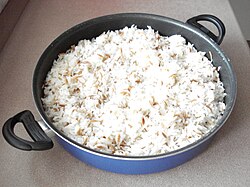
| caption | | caption = [[Kabuli palaw]], a variety of pilaf made in Afghanistan. | ||
| alternate_name | | alternate_name = Polao, pulao, plao, pela, pilav, pilov, pallao, pilau, [[pelau]], palau, polau, pulaav, palaw, palavu, plovas, palov, polov, polo, polu, kurysh, fulao, fulaaw, osh, aş, paloo, piles, kürüch | ||
| | | place_of_origin = | ||
| region | | region = Central Asia, West Asia, South Asia, South Caucasus, Maritime Southeast Asia, East Africa, Balkans | ||
| | | associated_cuisine = | ||
| creator | | creator = | ||
| course | | course = [[Main course|Main]] | ||
| served | | served = Hot | ||
| main_ingredient | | main_ingredient = [[Rice]], [[stock (cooking)|stock]] or [[broth]], [[spice]]s, [[meat]], [[vegetable]]s, [[dried fruit]]s | ||
| variations | | variations = | ||
| calories | | calories = | ||
| other | | other = | ||
}} | }} | ||
'''Pilaf''' ( | '''Pilaf''' ({{IPAc-en|US|ˈ|p|iː|l|ɑː|f|}}), '''pilav''', '''pilau''' or '''plov''' ({{IPAc-en|UK|ˈ|p|iː|l|aʊ|,_|p|iː|ˈ|l|aʊ}}) is a [[rice]] dish, or in some regions, a wheat dish, whose recipe usually involves cooking in [[stock (cooking)|stock]] or [[broth]], adding spices, and other ingredients such as vegetables and meat,<ref>{{cite OED|pilaf (n)|7487135986}}</ref><ref name="pilauOED">{{cite OED | pilau (n)|1467848783}}</ref>{{refn|group=note|refn=Oxford English Dictionary Online Edition (subscription required): pilaf (n) = pilau n.1; pilau n.1 = "A dish, partly of Middle Eastern, partly and ultimately of South Asian origin, consisting of rice (or, in certain areas, wheat) cooked in stock with spices, usually mixed with meat and various other ingredients.<ref name="pilauOED"/>}}{{Sfn|Merriam-Webster Unabridged Dictionary|2019}}{{refn|group=note|Merriam-Webster Unabridged Dictionary (subscription required): "rice usually combined with meat and vegetables, fried in oil, steamed in stock, and seasoned with any of numerous herbs (as saffron or cumin)."{{Sfn|Merriam-Webster Unabridged Dictionary|2019}}}} and employing some technique for achieving cooked grains that do not adhere.{{Sfn|Perry|2014|p=624}}{{refn|group=note|Perry: "A Middle-Eastern method of cooking rice so that every grain remains separate. ...However, there is no evidence that rice was cooked by this technique in India before the Muslim invasions, and Indians themselves associate pilaf-making with Muslim cities such as Hyderabad, Lucknow, and Delhi. .... The first descriptions of the pilaf technique appear in the 13th-century Arabic books Kitab al-Tabikh and Kitab al-Witsla ila al Habib, written in Baghdad and Syria, respectively. They show the technique in its entirety, including the cloth beneath the lid, and describe still-current flavourings such as meat, pulses, and fruit.{{Sfn|Perry|2014|p=624}}}}{{Sfn|Roger|2000|p=1144}}{{refn|group=note|Roger: "As noted, Iranians have a unique method of preparing rice. This method is designed to leave the grains separate and tasty, making the rice fluffy and very flavorful. After soaking, parboiling, and draining, the rice is poured into a dish smeared with melted butter. The lid is then sealed tightly with a cloth and a paste of flour and water. The last stage is to steam it on low heat for about half an hour, after which the rice is removed and fluffed."{{Sfn|Roger|2000|p=1144}}}} | ||
At the time of the [[Abbasid Caliphate]], such methods of cooking rice at first spread through a vast territory from [[ | At the time of the [[Abbasid Caliphate]], such methods of cooking rice at first spread through a vast territory from [[South Asia]] to [[Spain]], and eventually to a wider world. The Spanish ''[[paella]]'',{{Sfn|Roger|2000|p=1143}}{{refn|group=note|Roger: " (p. 1143) Under the Abbassids, for example (ninth to twelfth century), during the Golden Age of Islam, there was one single empire from Afghanistan to Spain and the North of Arabia. The size of the empire allowed many foods to spread throughout the Middle East. From India, rice went to Syria, Iraq, and Iran, and eventually, it became known and cultivated all the way to Spain. .... Many dishes of that period are still prepared today with ingredients available to the common people. Some of these are vinegar preserves, roasted meat, and cooked livers, which could be bought in the streets, eaten in the shops, or taken home. Such dishes considerably influenced medieval European and Indian cookery;''pilaf'' and meat patties that started out as ''samosa'' or ''sambusak''."{{Sfn|Roger|2000|p=1143}}}} and the South Asian ''pilau'' or ''pulao'',{{Sfn|Nandy|2004|p=11}}{{refn|group=note|name=Nandy11|Nandy: "(p. 11) Not merely ingredients came to the subcontinent, but also recipes. ... All around India one finds preparations that came originally from outside South Asia. ''Kebabs'' came from West and Central Asia and underwent radical metamorphosis in the hot and dusty plains of India. So did ''biryani'' and ''pulao'', two rice preparations, usually with meat. Without them, ceremonial dining in many parts of India, Pakistan, and Bangladesh is incomplete. Even the term ''pulao'' or ''pilav'' seems to have come from Arabic and Persian. It is true that in Sanskrit — in the Yajnavalkya Smriti — and in old Tamil, the term ''pulao'' occurs (Achaya, 1998b: 11), but it is also true that ''biryani'' and ''pulao'' today carry mainly the stamp of the Mughal times and its Persianized high culture."{{Sfn|Nandy|2004|p=11}}}} and ''[[biryani]]'',{{Sfn|Sengupta|2014|p=74}}{{refn|group=note |name=Sengupta74|Sengupta: "(p. 74) Muslim influence on the style and substance of Indian food was profound. K.T. Achaya writes that the Muslims imported a new refinement and a courtly etiquette of both group and individual dining into the austere dining ambience of Hindu society. ... Babur's son, Humayun, came back to India after spending a long period of exile in Kabul and the Safavid imperial court in Iran. He brought with him an entourage of Persian cooks who introduced the rich and elaborate rice cookery of the Safavid courts to India, combining Indian spices and Persian arts into a rich fusion that became the iconic dish of Islamic South Asian cuisine, the ''biryani''."{{Sfn|Sengupta|2014|p=74}}}} evolved from such dishes. | ||
Pilaf and similar dishes are common to [[Balkan cuisine|Balkan]], [[Caribbean cuisine|Caribbean]], [[Caucasian cuisine|South Caucasian]], [[Central Asian cuisine|Central Asian]], [[East African cuisine|East African]], [[Eastern European cuisine|Eastern European]], [[Latin American cuisine|Latin American]], [[ | Pilaf and similar dishes are common to [[Middle Eastern cuisine|Middle Eastern]], [[West Asia]]n, [[Balkan cuisine|Balkan]], [[Caribbean cuisine|Caribbean]], [[Caucasian cuisine|South Caucasian]], [[Central Asian cuisine|Central Asian]], [[East African cuisine|East African]], [[Eastern European cuisine|Eastern European]], [[Latin American cuisine|Latin American]], [[Maritime Southeast Asia]], and [[South Asian cuisine|South Asian]] cuisines; in these areas, they are regarded as [[Staple food|staple dishes]].<ref>{{Cite web |title=Башҡортса пылау (Плов по-башкирски) » Башкирская Кухня |url=https://www.bashkirskayakuhnya.com/vtoroe/%d0%bf%d0%bb%d0%be%d0%b2-%d0%bf%d0%be-%d0%b1%d0%b0%d1%88%d0%ba%d0%b8%d1%80%d1%81%d0%ba%d0%b8-%d0%b1%d0%b0%d1%88%d0%ba%d0%be%d1%80%d1%82%d1%81%d0%b0-%d0%bf%d1%8b%d0%bb%d0%b0%d1%83-2/ |access-date=2023-09-18 |language=ru-RU |archive-date=2023-10-29 |archive-url=https://web.archive.org/web/20231029010213/https://www.bashkirskayakuhnya.com/vtoroe/%D0%BF%D0%BB%D0%BE%D0%B2-%D0%BF%D0%BE-%D0%B1%D0%B0%D1%88%D0%BA%D0%B8%D1%80%D1%81%D0%BA%D0%B8-%D0%B1%D0%B0%D1%88%D0%BA%D0%BE%D1%80%D1%82%D1%81%D0%B0-%D0%BF%D1%8B%D0%BB%D0%B0%D1%83-2/ |url-status=live }}</ref><ref name="Marks">Gil Marks. ''Encyclopedia of Jewish Food''. Houghton Mifflin Harcourt, 2010. {{ISBN|9780544186316}}</ref><ref name="Cavendish">Marshall Cavendish. ''World and Its Peoples''. Marshall Cavendish, 2006, p. [https://books.google.com/books?id=j894miuOqc4C&pg=PA662 662]. {{ISBN|9780761475712}}</ref><ref name="StreetFood">Bruce Kraig, Colleen Taylor Sen. ''Street Food Around the World: An Encyclopedia of Food and Culture''. ABC-CLIO, 2013, p. [https://books.google.com/books?id=9XCjAQAAQBAJ&pg=PA384 384]. {{ISBN|9781598849554}}.</ref><ref>Russell Zanca. ''Life in a Muslim Uzbek Village: Cotton Farming After Communism CSCA''. Cengage Learning, 2010, p. 92 [https://books.google.com/books?id=etV63sfgYFYC&pg=PA92 92–96]. {{ISBN|9780495092810}}.</ref> | ||
==Etymology== | ==Etymology== | ||
According to the ''[[Oxford English Dictionary]]'' Online Edition's summary, the [[English language|English]] word ''pilaf'', which the OED, refers to the version with spelling "pilau," is a borrowing partly from [[Persian language|Persian]], partly from [[Hindi]], and partly also from [[French language|French]] and [[Italian language|Italian]]. In more detail, the English pilau, of first use 1609 CE, has come from Persian pulaw (16th cent. as palāv), in turn from [[Hindi]] pulāv dish of rice and meat, from [[Sanskrit]] pulāka ball of rice, probably from [[Dravidian languages|Dravidian]] (cf [[Tamil language|Tamil]] puḷukku (adjective) simmered, (noun) boiled or parboiled food, puḷukkal cooked rice); probably partly via [[French language|French]] pilau (1654; 1680 as pilaw; 1833 as pilaf), [[Italian language|Italian]] pilao (1542).<ref>{{cite OED|pilau (n)|1467848783}}</ref> | |||
According to the ''[[Oxford English Dictionary]]'', | |||
==History== | |||
[[File:Arroz enjoyado - Morasa Poló.JPG|thumb|left|Persian Pollo]] | |||
Although the cultivation of rice had spread much earlier from [[India]] to [[Central Asia|Central]] and [[West Asia]], it was at the time of the [[Abbasid Caliphate]] that methods of cooking rice which approximate modern styles of cooking pilaf at first spread through a vast territory from [[Spain]] to [[Afghanistan]], and eventually to a wider world. The Spanish ''[[paella]]'',{{Sfn|Roger|2000|p=1143}}{{refn|group=note|Roger: " (p. 1143) Under the Abbassids, for example (ninth to twelfth century), during the Golden Age of Islam, there was one single empire from Afghanistan to Spain and the North of Arabia. The size of the empire allowed many foods to spread throughout the Middle East. From India, rice went to Syria, Iraq, and Iran, and eventually, it became known and cultivated all the way to Spain. .... Many dishes of that period are still prepared today with ingredients available to the common people. Some of these are vinegar preserves, roasted meat, and cooked livers, which could be bought in the streets, eaten in the shops, or taken home. Such dishes considerably influenced medieval European and Indian cookery; for example, ''paella'', which evolved from ''pulao'', and ''pilaf'' and meat patties that started out as ''samosa'' or ''sambusak''."{{Sfn|Roger|2000|p=1143}}}} and the [[South Asia]]n ''pilau'' or ''pulao'',{{Sfn|Nandy|2004|p=11}}{{refn|group=note|Nandy: "(p. 11) All around India one finds preparations that came originally from outside South Asia. ''Kebabs'' came from West and Central Asia and underwent radical metamorphosis in the hot and dusty plains of India. So did ''biryani'' and ''pulao'', two rice preparations, usually with meat. Without them, ceremonial dining in many parts of India, Pakistan, and Bangladesh is incomplete."{{Sfn|Nandy|2004|p=11}}}} and ''[[biryani]]'',{{Sfn|Sengupta|2014|p=74}}{{refn|group=note|Sengupta: "(p. 74) Muslim influence on the style and substance of Indian food was profound. K.T. Achaya writes that the Muslims imported a new refinement and a courtly etiquette of both group and individual dining into the austere dining ambience of Hindu society. ... Babur's son, Humayun, came back to India after spending a long period of exile in Kabul and the Safavid imperial court in Iran. He brought with him an entourage of Persian cooks who introduced the rich and elaborate rice cookery of the Safavid courts to India, combining Indian spices and Persian arts into a rich fusion that became the iconic dish of Islamic South Asian cuisine, the ''biryani''."{{Sfn|Sengupta|2014|p=74}}}} evolved from such dishes. | |||
According to author [[K. T. Achaya]], the Indian epic ''[[Mahabharata]]'' mentions an instance of rice and meat cooked together. Also, according to Achaya, "pulao" or "pallao" is used to refer to a rice dish in ancient Sanskrit works such as the ''[[Yājñavalkya Smṛti]]''.<ref name="KTAchaya1994">{{cite book |author=[[K. T. Achaya]] |title=Indian food: a historical companion |url=https://books.google.com/books?id=-cFcH2ZHWLcC |year=1994 |publisher=Oxford University Press |page=11|isbn=978-0-19-562845-6 }}</ref> However, according to food writers [[Colleen Taylor Sen]] and [[Charles Perry (food writer)|Charles Perry]], and social theorist [[Ashis Nandy]], these references do not substantially correlate to the commonly used meaning and history implied in pilafs, which appear in Indian accounts after the medieval Central Asian conquests.<ref>{{citation|last=Sen|first=Colleen Taylor|title=Feasts and Fasts: A History of Food in India|url=https://books.google.com/books?id=VN_vCgAAQBAJ&pg=PA164|year=2014|publisher=Reaktion Books|isbn=978-1-78023-391-8|pages=164–5}} Quote: "(pp. 164–165) "Descriptions of the basic technique appear in thirteenth-century Arab cookbooks, although the name pulao is not used. The word itself is medieval Farsi, and the dish may have been created in the early sixteenth century at the Safavid court in Persia. ... Although dishes combining rice, meat and spices were prepared in ancient times, the technique of first sautéing the rice in ghee and then cooking it slowly to keep the grains separate probably came later with the Mughals."</ref><ref>{{citation|last=Perry|first=Charles|title=Annual Cookbook Issue: Book Review: An Armchair Guide to the Indian Table: Indian Food: A Historical Companion By K. T. Achaya (Oxford University Press: 1994; $35; 290 pp.)|journal=Los Angeles Times|date=December 15, 1994|url=https://www.latimes.com/archives/la-xpm-1994-12-15-fo-9100-story.html}} Quote: "The other flaw is more serious. Achaya has clearly read a lot about Indian food, but it was in what historians call secondary sources. In other words, he's mostly reporting what other people have concluded from the primary evidence. Rarely, if ever, does he go to the original data to verify their conclusions. This is a dangerous practice, particularly in India, because certain Indian scholars like to claim that everything in the world originated in India a long time ago. ... Achaya even invents one or two myths of his own. He says there is evidence that south Indians were making pilaf 2,000 years ago, but if you look up the book he footnotes, you find that the Old Tamil word pulavu had nothing to do with pilaf. It meant raw meat or fish."</ref><ref>{{citation|last1=Nandy|first1=Ashis|authorlink=Ashis Nandy|title=The Changing Popular Culture of Indian Food: Preliminary Notes|journal=South Asia Research|volume=24|issue=1|year=2004|pages=9–19|issn=0262-7280|doi=10.1177/0262728004042760|citeseerx=10.1.1.830.7136|s2cid=143223986 |ref=none}} Quote: " (p. 11) Not merely ingredients came to the subcontinent, but also recipes. ... All around India one finds preparations that came originally from outside South Asia. ''Kebabs'' came from West and Central Asia and underwent radical metamorphosis in the hot and dusty plains of India. So did ''biryani'' and ''pulao'', two rice preparations, usually with meat. Without them, ceremonial dining in many parts of India, Pakistan, and Bangladesh is incomplete. Even the term ''pulao'' or ''pilav'' seems to have come from Arabic and Persian. It is true that in Sanskrit — in the Yajnavalkya Smriti — and in old Tamil, the term ''pulao'' occurs (Achaya, 1998b: 11), but it is also true that ''biryani'' and ''pulao'' today carry mainly the stamp of the Mughal times and its Persianized high culture.</ref> | |||
[[ | |||
Similarly [[Alexander the Great]] and his army, many centuries earlier, in the 4th century BCE, have been reported to have been so impressed with the Eastern Iranian [[Bactria]]n and [[Sogdia]]n ''pilavs'' that his soldiers brought the recipes back to [[Macedonia (ancient kingdom)|Macedonia]] when they returned.<ref name=nabhan>{{cite book |last=Nabhan |first=Gary Paul |title=Cumin, Camels, and Caravans: A Spice Odyssey |url=https://books.google.com/books?id=e-glDQAAQBAJ&pg=PA135 |page=135 |publisher=[[University of California Press]] |date=2014 |isbn=978-0520267206}}</ref> Similar stories exist of Alexander bringing pilaf to the ancient Persian [[Samarkand]]; however, they are considered apocryphal by art historian [[John Boardman (art historian)|John Boardman]].{{Sfn|Boardman|2019|p=102}} Similarly, it has been reported that pilaf was consumed in the [[Byzantine Empire]] and in the [[Republic of Venice]].<ref>{{Cite book |last=Παναγιωτάκης |first=Νικόλαος |url=https://books.google.com/books?id=D4dXAAAAMAAJ |title=Ἄνθη χαρίτων: μελετήματα ἑόρτια συγγραφέντα ὑπὸ τῶν ὑποτρόφων τοῦ Ἑλληνικοῦ ἰνστιτούτου βυζαντινῶν καὶ μεταβυζαντινῶν σπουδῶν τῆς Βενετίας... |date=1998 |publisher=[[Hellenic Institute of Byzantine and Post-Byzantine Studies in Venice]] |isbn=978-960-7743-01-5 |pages=72 |language=el |access-date=2023-04-12 |archive-date=2023-08-27 |archive-url=https://web.archive.org/web/20230827182811/https://books.google.com/books?id=D4dXAAAAMAAJ |url-status=live }}</ref> | |||
The earliest documented recipe for pilaf comes from the tenth-century [[Persian people|Persian]] scholar [[Avicenna]] (Ibn Sīnā), who in his books on medical sciences dedicated a whole section to preparing various dishes, including several types of pilaf. In doing so, he described the advantages and disadvantages of every item used for preparing the dish. Accordingly, Persians consider Avicenna to be the "father" of modern pilaf.<ref name=nabhan /> | |||
Thirteenth-century texts describe the consistency of pilaf that the grains should be plump and somewhat firm to resemble peppercorns with no mushiness, and each grain should be separate with no clumping.<ref name="guardian">{{cite web|title=How to cook perfect pilaf|url=https://www.theguardian.com/lifeandstyle/wordofmouth/2012/sep/27/how-to-cook-perfect-pilaf|work=The Guardian|date=2012-09-26|access-date=2019-02-13 |archive-date=2023-03-07 |archive-url=https://web.archive.org/web/20230307094944/https://www.theguardian.com/lifeandstyle/wordofmouth/2012/sep/27/how-to-cook-perfect-pilaf|url-status=live}}</ref> | |||
Another primary source for pilaf dishes comes from the 17th-century Iranian philosopher [[Molla Sadra]].<ref name=algar>{{cite book|last=Algat |first=Ayla |title=Classical Turkish Cooking: Traditional Turkish Food for the America |publisher=HarperCollins |url=https://books.google.com/books?id=gn49svh2_KUC&pg=PT13|isbn=9780062039118 |date=2013-07-30 }}</ref> | Another primary source for pilaf dishes comes from the 17th-century Iranian philosopher [[Molla Sadra]].<ref name=algar>{{cite book|last=Algat |first=Ayla |title=Classical Turkish Cooking: Traditional Turkish Food for the America |publisher=HarperCollins |url=https://books.google.com/books?id=gn49svh2_KUC&pg=PT13|isbn=9780062039118 |date=2013-07-30 }}</ref> | ||
Pilau became standard fare in | Persian Pilau became the standard fare in West Asia and [[Transcaucasia]] over the years. | ||
During the period of the [[Soviet Union]], the Central Asian versions of the dish spread throughout all Soviet republics, becoming a part of the common [[Soviet cuisine]]. | During the period of the [[Soviet Union]], the Central Asian versions of the dish spread throughout all Soviet republics, becoming a part of the common [[Soviet cuisine]]. | ||
==Preparation== | ==Preparation== | ||
Some cooks prefer to use [[basmati]] rice because it is easier to prepare a pilaf where the grains stay "light, fluffy and separate" with this type of rice. However, other types of long-grain rice are also used. The rice is rinsed thoroughly before use to remove the starch. Pilaf can be cooked in water or stock. Common additions include fried onions and fragrant spices like [[cardamom]], [[bay leaves]] and [[cinnamon]].<ref name=guardian /> Pilaf is usually made with meat or vegetables, but it can also be made plain which is called ''sade pilav'' in [[Turkish language|Turkish]], ''chelo'' in [[Persian language|Persian]] and ''ruzz mufalfal'' in [[Arabic language|Arabic]].{{sfn|Davidson|2014|p=624}} | Some cooks prefer to use [[basmati]] rice because it is easier to prepare a pilaf where the grains stay "light, fluffy and separate" with this type of rice. However, other types of long-grain rice are also used. The rice is rinsed thoroughly before use to remove the surface starch. Pilaf can be cooked in water or stock. Common additions include fried onions and fragrant spices like [[cardamom]], [[bay leaves]] and [[cinnamon]].<ref name=guardian /> | ||
Pilaf is usually made with meat or vegetables, but it can also be made plain which is called ''sade pilav'' in [[Turkish language|Turkish]], ''chelo'' in [[Persian language|Persian]] and ''ruzz mufalfal'' in [[Arabic language|Arabic]].{{sfn|Davidson|2014|p=624}} Persian pilaf uses [[saffron]] which gives Persian rice its unique yellow color and taste. Pilaf is often made by adding the rice to hot fat and stirring briefly before adding the cooking liquid. The fat used varies from recipe to recipe. Cooking methods vary with respect to details such as pre-soaking the rice and steaming after boiling.<ref name=guardian /> | |||
==Local varieties== | ==Local varieties== | ||
There are thousands of variations of pilaf made with rice or other grains like [[bulgur]].<ref name=guardian /> | There are thousands of variations of pilaf made with rice or other grains like [[bulgur]].<ref name=guardian />Some include different combinations of meats, fruits or vegetables, while others are simple and served plain.<ref name=guardian /> | ||
[[Central Asian cuisine|Central Asian]], [[South Asian cuisine|South Asian]], [[Iranian cuisine|Iranian]] and [[Caribbean cuisine]] are some with distinctive styles of making pilaf.<ref name="perry">{{cite web|last=Perry|first=Charles|title=Rice Pilaf: Ingredients, Texture Varies|url=https://www.sun-sentinel.com/news/fl-xpm-1994-04-28-9404250390-story.html|work=Sun Sentinel|date=1992-04-28|access-date=2019-02-13 |archive-date=2019-02-13 |archive-url=https://web.archive.org/web/20190213124108/https://www.sun-sentinel.com/news/fl-xpm-1994-04-28-9404250390-story.html|url-status=live}}</ref> | |||
=== Afghanistan === | === Afghanistan === | ||
In [[Afghan cuisine]], ''[[Kabuli palaw]] | [[File:Bukhari Meal - Pilaf.jpg|thumb|Bukhari (pilaf) meal in Saudi Arabia]] | ||
In [[Afghan cuisine]], ''[[Kabuli palaw]]'' ({{langx|fa|کابلی پلو}}) is made by cooking [[basmati]] with mutton, lamb, beef or chicken, and oil. Kabuli palaw is cooked in large shallow and thick dishes. Fried sliced [[carrot]]s and [[raisin]]s are added. Chopped nuts like [[pistachio]]s, [[walnut]]s, or [[almond]]s may be added as well. The meat is covered by the rice or buried in the middle of the dish. Kabuli palaw rice with carrots and raisins is very popular in [[Saudi Arabia]], where it is known as ''roz Bukhari'' ({{langx|ar|رز بخاري}}), meaning '[[Emirate of Bukhara|Bukhara]]n rice'. | |||
=== Albania === | |||
In [[Albanian cuisine]], pilaf is a very common dish.<ref name="RiceConsumptionInEurope">{{cite web|url=https://landgeist.com/2022/06/25/rice-consumption-in-europe/|title=Rice consumption in Europe|website=landgeist.com |date=25 June 2022 }}</ref><ref> | |||
{{cite web |url=https://www.myalbanianfood.com/recipe/albanian-chicken-pilaf-pule-me-oriz/ |title=Albanian Chicken Pilaf (Pule me Oriz) |website=My Albanian Food |date=6 January 2017 |quote=In Albania you will find a lot of rice dishes and in almost every case served as a meal rather than a side. Albanian Baked Lamb and Rice with Yogurt (Tavë Kosi) is one of the most traditional and popular dishes or, fruits and spices are added to make the rice into a pudding known as Kabuni. |access-date=17 February 2025}}</ref> It is typically accompanied by yogurt and eaten with bean stew, meat soup or baked meats such as chicken and lamb. Medium-long grain rice is used, and it is cooked plainly with butter, resulting in a soft yet non-sticky texture. | |||
There are various rice dishes in Albania, which are all commonly referred to as pilaf. | |||
Albania ranks among the top three countries in Europe for rice consumption.<ref name="RiceConsumptionInEurope" /> | |||
===Armenia=== | ===Armenia=== | ||
[[File:Chou farci-Arménie.jpg|thumb|Armenian [[cabbage roll]] stuffed with chickpeas and bulgur pilaf]] | [[File:Chou farci-Arménie.jpg|thumb|Armenian [[cabbage roll]] stuffed with chickpeas and bulgur pilaf]] | ||
Armenians use a lot of ''[[bulgur]]'' (cracked wheat) in their pilaf dishes.<ref>{{Cite book| publisher = Oxford University Press| isbn = 978-0-19-280681-9| last = Davidson| first = Alan| editor1-first = Tom| editor1-last = Jaine| title = The Oxford Companion to Food| access-date = 2018-07-16| date = 2006| url = http://www.oxfordreference.com/view/10.1093/acref/9780192806819.001.0001/acref-9780192806819| doi = 10.1093/acref/9780192806819.001.0001}}</ref> Armenian recipes may combine [[vermicelli]] or [[orzo]] with rice cooked in stock seasoned with mint, parsley and allspice.<ref>{{cite news|title=Recipe for Armenian-style rice pilaf with vermicelli, peas, and herbs |url=https://www.bostonglobe.com/lifestyle/food-dining/2014/01/14/recipe-for-armenian-style-rice-pilaf-with-vermicelli-peas-and-herbs/Wcm7hyz9ChB530Viay5LeO/story.html |newspaper=Boston Globe|date=2014-01-14}}</ref> One traditional Armenian pilaf is made with the same noodle rice mixture cooked in stock with [[raisins]], [[almonds]] and allspice.<ref>{{cite news|title=Armenian Rice Pilaf With Raisins and Almonds|url=https://cooking.nytimes.com/recipes/1016976-armenian-rice-pilaf-with-raisins-and-almonds|work=[[The New York Times]]}}</ref> | Armenians use a lot of ''[[bulgur]]'' ("cracked wheat") in their pilaf dishes.<ref>{{Cite book| publisher = Oxford University Press| isbn = 978-0-19-280681-9| last = Davidson| first = Alan| editor1-first = Tom| editor1-last = Jaine| title = The Oxford Companion to Food| access-date = 2018-07-16| date = 2006| url = http://www.oxfordreference.com/view/10.1093/acref/9780192806819.001.0001/acref-9780192806819| doi = 10.1093/acref/9780192806819.001.0001| archive-date = 2018-06-03 | archive-url = https://web.archive.org/web/20180603175749/http://www.oxfordreference.com/view/10.1093/acref/9780192806819.001.0001/acref-9780192806819| url-status = live}}</ref> Armenian recipes may combine [[vermicelli]] or [[orzo]] with rice cooked in stock seasoned with mint, parsley and allspice.<ref>{{cite news |title=Recipe for Armenian-style rice pilaf with vermicelli, peas, and herbs |url=https://www.bostonglobe.com/lifestyle/food-dining/2014/01/14/recipe-for-armenian-style-rice-pilaf-with-vermicelli-peas-and-herbs/Wcm7hyz9ChB530Viay5LeO/story.html |newspaper=Boston Globe |date=2014-01-14 |access-date=2019-02-13 |archive-date=2019-02-14 |archive-url=https://web.archive.org/web/20190214174258/https://www.bostonglobe.com/lifestyle/food-dining/2014/01/14/recipe-for-armenian-style-rice-pilaf-with-vermicelli-peas-and-herbs/Wcm7hyz9ChB530Viay5LeO/story.html |url-status=live }}</ref> One traditional Armenian pilaf is made with the same noodle rice mixture cooked in stock with [[raisins]], [[almonds]] and allspice.<ref>{{cite news|title=Armenian Rice Pilaf With Raisins and Almonds|url=https://cooking.nytimes.com/recipes/1016976-armenian-rice-pilaf-with-raisins-and-almonds|work=[[The New York Times]]|access-date=2019-02-13 |archive-date=2019-02-14 |archive-url=https://web.archive.org/web/20190214061747/https://cooking.nytimes.com/recipes/1016976-armenian-rice-pilaf-with-raisins-and-almonds|url-status=live}}</ref> | ||
Armenian kinds of rice are discussed by | Armenian kinds of rice are discussed by Rose Baboian in her cookbook from 1964 which includes recipes for different pilafs, most rooted in her birthplace of [[Antep]] in Turkey.<ref name=":0" /> Baboian recommends that the noodles be stir-fried first in chicken fat before being added to the pilaf. Another Armenian cookbook written by Vağinag Pürad recommends to render poultry fat in the oven with red pepper until the fat mixture turns a red color before using the strained fat to prepare pilaf.<ref name=":0">{{Cite book |last=Baboian |first=Rose |url=https://books.google.com/books?id=zBhcGQAACAAJ |title=Rose Baboian's Armenian-American Cook Book |date=1964 |publisher= |language=en |access-date=2023-05-01 |archive-date=2023-08-27 |archive-url=https://web.archive.org/web/20230827182811/https://books.google.com/books?id=zBhcGQAACAAJ |url-status=live }}</ref> | ||
''Lapa'' is an Armenian word with several meanings one of which is a "watery boiled rice, thick rice soup, mush" and ''lepe'' which refers to various rice dishes differing by region.<ref>{{Cite book| publisher = Otto Harrassowitz Verlag| isbn = 978-3-447-03640-5| last = Dankoff| first = Robert| title = Armenian Loanwords in Turkish| date = 1995 |page=53}}</ref> | ''Lapa'' is an Armenian word with several meanings one of which is a "watery boiled rice, thick rice soup, mush" and ''lepe'' which refers to various rice dishes differing by region.<ref>{{Cite book| publisher = Otto Harrassowitz Verlag| isbn = 978-3-447-03640-5|author1-link=Robert Dankoff | last = Dankoff| first = Robert| title = Armenian Loanwords in Turkish| date = 1995 |page=53}}</ref> Antranig Azhderian describes Armenian pilaf as a "dish resembling porridge".<ref>{{Cite book| publisher = Mershon Company| last = Azhderian| first = Antranig| title = The Turk and the Land of Haig; Or, Turkey and Armenia: Descriptive, Historical, and Picturesque| date = 1898 |pages=171–172}}</ref> | ||
=== Azerbaijan === | === Azerbaijan === | ||
Azerbaijani cuisine includes more than 40 different plov recipes.<ref name=kukhnya>[http:// | Azerbaijani cuisine includes more than 40 different plov recipes.<ref name=kukhnya>[/ ''Азербайджанская кухня''] {{Cite web |url=http://azeri.ru/az/cuisine/azerbaydjanskaya_kuhnya |title=Archived copy |access-date=2017-12-14 |archive-date=2009-02-16 |archive-url=https://web.archive.org/web/20090216024404/http://azeri.ru/az/cuisine/azerbaydjanskaya_kuhnya |url-status=bot: unknown }}, (''Azerbaijani Cuisine'', Ishyg Publ. House, Baku {{in lang|ru}})</ref> One of the most reputed dishes is plov from saffron-covered rice, served with various herbs and greens, a combination distinctive from Central Asian pilaf. Traditional Azerbaijani plov consists of three distinct components, served simultaneously but on separate platters: rice (warm, never hot), ''gara'' (fried beef or chicken pieces with onion, chestnut and dried fruits prepared as an accompaniment to rice), and herbs. Gara is put on the rice when eating plov, but it is never mixed with rice and the other components. Pilaf is often called aş in Azerbaijani cuisine.<ref name=mamedov>[http://restaurant.dsnews.ua/art18684.html Interview with Jabar Mamedov] {{webarchive|url=https://web.archive.org/web/20081221125707/http://restaurant.dsnews.ua/art18684.html |date=2008-12-21 }}, Head Chef at the "Shirvan Shah" Azerbaijani restaurant in Kyiv, 31 January 2005.</ref> | ||
<gallery class="center" widths="180px" heights="145px" caption="Rice pilaf examples from Azerbaijan"> | <gallery class="center" widths="180px" heights="145px" caption="Rice pilaf examples from Azerbaijan"> | ||
File:Aş və salat.JPG|[[Azerbaijani cuisine|Azerbaijani]] plov with ''qazmaq'' (the same as Persian ''[[tahdig]]''), served with [[choban salad]] | File:Aş və salat.JPG|[[Azerbaijani cuisine|Azerbaijani]] plov with ''qazmaq'' (the same as Persian ''[[tahdig]]''), served with [[choban salad]] | ||
| Line 73: | Line 89: | ||
=== Bangladesh === | === Bangladesh === | ||
In [[Bangladesh]], '' | {{see also|Bangladeshi cuisine}} | ||
[[File:মোরগ পোলাও 2.jpg|thumb|right|Traditional [[Old Dhaka]] style chicken pilaf, locally known as ''Murog Polao'']] | |||
[[File:Traditional Holiday Lunch of Bangladesh( Polao Korma ilish vaja,kabab).jpg |thumb|right| A classic Bangladeshi holiday lunch: plain pilaf served with fried [[Ilish|hilsa]], kebab, and rich chicken or beef korma.]] | |||
In [[Bangladesh]], ''polao'' ({{lang|bn|পোলাও}}), is a popular ceremonial dish cooked only with aromatic rice. Bangladesh cultivates many varieties of aromatic rice, which can be found only in this country and some surrounding Indian states with predominantly Bengali populations. Historically, there were many varieties of aromatic rice. These included short-grain rice with buttery and other fragrances depending on the variety. Over a long span of time, many recipes were lost and then reinvented. | |||
Since the 1970s in Bangladesh ''pulao'' has referred to aromatic rice ({{lang|bn|বাসন্তী পোলাও}}) ''Bashonti polao'', first fried either in oil or clarified butter with onions, fresh ginger and whole aromatic spices such as cardamom, cinnamon, black pepper, and more, depending on each household and region. This is then cooked in stock or water, first boiled and then steamed. It is finished off with a bit more clarified butter and fragrant essences such as rose water or kewra water. For presentation, beresta (fried onions) are sprinkled on top. Chicken ''pulao'', (''morog pulao'') is a traditional ceremonial dish among the Bangladeshi Muslim community. There are several different types of ''morog pulao'' found only in particular regions or communities. | |||
In Sylhet and Chittagong, a popular ceremonial dish called ''[[akhni]] polao''. ''Aqni'' being the rich stock in which mutton is cooked and then used to cook the rice. Another very spicy ''Polao'' dish very popular and unique to Bangladesh is called ''Tehari''. It is very different in taste to the ''tahris'' found in some parts of neighboring India. They are most popularly eaten with beef and ''chevon'' (goat meat) but are also paired with chicken.<ref name="Long2015">{{cite book |last1=Long |first1=Lucy M. |title=Ethnic American Food Today: A Cultural Encyclopedia |year=2015 |publisher=Rowman & Littlefield |isbn=978-1-4422-2731-6 |page=52 |url=https://books.google.com/books?id=DBzYCQAAQBAJ&pg=PA52 |access-date=2022-07-22 |archive-date=2022-07-22 |archive-url=https://web.archive.org/web/20220722200740/https://books.google.com/books?id=DBzYCQAAQBAJ&pg=PA52 |url-status=live }}</ref> Young small potatoes, mustard oil (which is alternated with clarified butter or oil depending on individual taste), and a unique spice blend found in ''teharis'' distinguish them from other meat ''polaos''. The most famous ''tehari'' in the capital city of [[Dhaka]] is called ''[[Hajir biryani]]''. Although here the name ''biryani'' is a misnomer, in usage among the urban young population it differentiates the popular dish mutton ''biryanis'' (goat meat). | |||
=== Brazil === | === Brazil === | ||
A significantly modified version of the recipe, often seen as influenced by what is called {{lang|pt|arroz pilau}} there, is known in [[Brazilian cuisine|Brazil]] as {{lang|pt|arroz de frango desfiado}} or {{lang|pt|risoto de frango}} ({{IPA | A significantly modified version of the recipe, often seen as influenced by what is called {{lang|pt|arroz pilau}} there, is known in [[Brazilian cuisine|Brazil]] as {{lang|pt|arroz de frango desfiado}} or {{lang|pt|risoto de frango}} ({{IPA|pt|ɐˈʁoz dʒi ˈfɾɐ̃ɡu dʒisfiˈadu|lang}}, "shredded chicken rice"; {{IPA|pt|ʁiˈzotu|}}, "chicken [[risotto]]"). Rice lightly [[Sofrito|fried]] (and optionally seasoned), salted and cooked until soft (but neither soupy nor sticky) in either water or chicken stock is added to chicken stock, onions and sometimes cubed bell peppers (cooked in the stock), shredded chicken breast, green peas, tomato sauce, [[soy sauce|shoyu]], and optionally vegetables (e.g. canned sweet corn, cooked carrot cubes, courgette cubes, [[broccolini]] flowers, chopped broccoli or broccolini stalks or leaves fried in garlic seasoning) or herbs (e.g., mint, like in {{lang|pt|[[Canja de galinha|canja]]}}) to form a distantly [[risotto]]-like dish – but it is generally fluffy (depending on the texture of the rice being added), as generally, once all ingredients are mixed, it is not left to cook longer than five minutes. In the case shredded chicken breast is not added, with the rice being instead served alongside chicken and {{lang|fr|sauce suprême}}, it is known as {{lang|pt|arroz suprême de frango}} ({{IPA|pt|ɐˈʁos suˈpɾẽm(i) dʒi ˈfɾɐ̃ɡu|lang}}, "chicken [[supreme (cookery)|supreme]] rice"). | ||
=== Caribbean === | === Caribbean === | ||
| Line 86: | Line 110: | ||
[[Trinidad]] is recognized for its ''pelau'', a layered rice with meats and vegetables. It is a mix of traditional [[African cuisine]] and "New World" ingredients like [[ketchup]]. The process of browning the meat (usually chicken, but also stew beef or lamb) in [[sugar]] is an African technique.<ref name=ganeshram>{{cite book|last=Ganeshram|first=Ramin|title=Sweet Hands: Island Cooking from Trinidad & Tobago|url=https://books.google.com/books?id=zNA8RWWB3gwC|publisher=Hippocrene Books|isbn=9780781811255|date=2005-10-31}}</ref> | [[Trinidad]] is recognized for its ''pelau'', a layered rice with meats and vegetables. It is a mix of traditional [[African cuisine]] and "New World" ingredients like [[ketchup]]. The process of browning the meat (usually chicken, but also stew beef or lamb) in [[sugar]] is an African technique.<ref name=ganeshram>{{cite book|last=Ganeshram|first=Ramin|title=Sweet Hands: Island Cooking from Trinidad & Tobago|url=https://books.google.com/books?id=zNA8RWWB3gwC|publisher=Hippocrene Books|isbn=9780781811255|date=2005-10-31}}</ref> | ||
In [[Tobago]] ''pelau'' is commonly made with [[crab]].<ref name=ganeshram /> | In [[Tobago]], ''pelau'' is commonly made with [[Crab meat|crab]].<ref name=ganeshram /> | ||
=== Central Asia === | === Central Asia === | ||
[[File:Plov Tashkent.jpg|thumb|right| | [[File:Plov Tashkent.jpg|thumb|right|Restaurant cooking in [[Tashkent]]]] | ||
[[File:Samarkand Zigir-pilaf.jpg|thumb|right|[[Samarkand]] pilaf cooked with linseed oil]] | [[File:Samarkand Zigir-pilaf.jpg|thumb|right|[[Samarkand]] pilaf cooked with linseed oil]] | ||
[[Central Asian cuisine|Central Asian]], e.g. [[Uzbek cuisine|Uzbek]] and [[Tajik cuisine|Tajik]] | [[Central Asian cuisine|Central Asian]], e.g. [[Uzbek cuisine|Uzbek]], [[Kyrgyz cuisine|Kyrgyz]] and [[Tajik cuisine|Tajik]] ({{langx|uz|Osh, Palov}}, {{langx|ky|Аш, палоо}}, {{langx|tg|Палов|italic = palav}}) Kazakh, Turkmen, Karakalpak ({{langx|kk|Палау, Palaw}}) or ''osh'' differs from other preparations in that rice is not steamed, but instead [[simmer]]ed in a rich [[stew]] of meat and vegetables called ''zirvak'' ([[wikt:зирвак|зирвак]]), until all the liquid is absorbed into the rice. A limited degree of steaming is commonly achieved by covering the pot. It is usually cooked in a ''[[Kazon (cookware)|kazon]]'' (or ''deghi'') over an open fire. The cooking tradition includes many regional and occasional variations.<ref name="StreetFood" /><ref name="uzbek palov">{{cite web| url=http://www.people-travels.com/uzbekistan-photo-gallery/uzbek-cuisine-photos.html| title=Uzbek Cuisine Photos: Palov| access-date=2013-05-23| archive-date=2014-01-04 | archive-url=https://web.archive.org/web/20140104212638/http://www.people-travels.com/uzbekistan-photo-gallery/uzbek-cuisine-photos.html| url-status=live}}</ref> Commonly, it is prepared with [[Lamb and mutton|lamb]] or [[beef]], browned in lamb fat or oil, and then stewed with fried [[onion]]s, [[garlic]] and carrots. [[Chicken (food)|Chicken]] palov is rare but found in traditional recipes originating in [[Bukhara]]. Some regional varieties use distinct types of oil to cook the meat. For example, [[Samarkand]]-style plov commonly uses ''zig'ir'' oil, a mix of melon seed, [[cottonseed oil|cottonseed]], [[sesame seed]], and [[linseed oil|flaxseed]] oils. Plov is usually simply spiced with salt, [[black pepper|peppercorns]], and [[cumin]], but [[coriander]], [[Barberry|barberries]], [[Peppercorn|red pepper]], or [[Pot marigold|marigold]] may be added according to regional variation or the chef's preference. Heads of garlic and chickpeas are sometimes buried into the rice during cooking. Sweet variations with dried [[apricot]]s, [[cranberry|cranberries]] and raisins are prepared on special occasions.<ref>{{Cite web |title=chef.rustam - Central Asian, e.g. Tajik and Uzbek (Tajik:... |url=https://www.facebook.com/111350780491947/photos/a.122699232690435/133611988265826/?type=3 |access-date=2022-05-15 |website=www.facebook.com |language=en}}</ref> | ||
Plov is the national dish of [[Uzbekistan]] and was recognized by [[UNESCO]] and inscribed on its [[UNESCO Intangible Cultural Heritage Lists|Intangible Cultural Heritage of Humanity]] list in 2016. However neighbouring countries including [[Kazakhstan]], [[Azerbaijan]], and [[Tajikistan]] also considers plov a staple dish, with their own regional variations reflecting local ingredients and cooking.<ref>{{Cite book |last1=Eden |first1=Caroline |url=https://books.google.com/books?id=Z_UijgEACAAJ |title=Samarkand: Recipes & Stories from Central Asia & The Caucasus |last2=Ford |first2=Eleanor |date=2016-06-07 |publisher=Octopus Books |isbn=978-1-909487-42-0 |language=en}}</ref><ref>{{Cite web |last=Lev-Tov |first=Devorah |title=Rich or Poor, Uzbeks Eat Plov |url=https://www.smithsonianmag.com/travel/rich-or-poor-uzbeks-eat-plov-180983483/ |access-date=2025-11-17 |website=Smithsonian Magazine |language=en}}</ref> | |||
Uzbek-style | Although often prepared at home, plov is made on special occasions by an ''oshpaz'' or ''ashpoz'' (osh/ash master chef), who cooks it over an open flame, sometimes serving up to 1,000 people from a single cauldron on holidays or occasions such as weddings. ''Oshi nahor'', or "morning palov", is served in the early morning (between 6 and 9 am) to large gatherings of guests, typically as part of an ongoing wedding celebration.<ref>{{Cite web|title=Perfect Plov Recipe|url=https://nargiscafe.com/perfect_plov_recipe/|website=nargiscafe.com|access-date=2020-05-24|archive-date=2021-02-27 |archive-url=https://web.archive.org/web/20210227060432/https://nargiscafe.com/perfect_plov_recipe/|url-status=live}}</ref> | ||
Uzbek-style plov is found in the post-[[Soviet cuisine|Soviet]] countries and [[Xinjiang|Xinjiang Uyghur Autonomous Region]] of China. In Xinjiang, where the dish is known as polu, polo, or pola ({{Langx|ug|پولو، پولۇ، پولا|rtl=yes}}), it is often served with pickled vegetables, including carrots, onion and tomato.<ref>{{Cite web |last= |last2= |title=Going to Xinjiang? Here's What You'll Eat |url=https://www.tripsavvy.com/introduction-foods-of-xinjiang-province-3955772 |access-date=2022-05-15 |website=TripSavvy |language=en |archive-date=2022-07-03 |archive-url=https://web.archive.org/web/20220703154746/https://www.tripsavvy.com/introduction-foods-of-xinjiang-province-3955772 |url-status=live }}</ref> | |||
<gallery class="center" widths="180px" heights="145px" caption="Rice pilaf examples from Central Asia"> | <gallery class="center" widths="180px" heights="145px" caption="Rice pilaf examples from Central Asia"> | ||
File:Plov122.jpg|[[Uzbek | File:Plov122.jpg|[[Uzbek plov]] being prepared in a ''[[Kazon (cookware)|kazon]]'' in a Tashkent home | ||
File:Oshi palov tajik.jpg| | File:Oshi palov tajik.jpg|Tajik plov, or oshi palav, is a regional variation of pilaf in Tajikistan. | ||
File:Polu.jpg|[[Uyghur cuisine|Uyghur]] ''polu'' | File:Polu.jpg|[[Uyghur cuisine|Uyghur]] ''polu'' | ||
File:Tajik plov.jpg|[[Tajik cuisine|Tajik]] ''oshpaz'' | File:Tajik plov.jpg|[[Tajik cuisine|Tajik]] ''oshpaz'' | ||
</gallery> | </gallery> | ||
=== Greece === | === Greece === | ||
In | [[File:Greek foods.jpg|thumb|A Greek meal with rice pilaf (bottom right)]] | ||
In [[Greek cuisine]], ''piláfi'' (πιλάφι) is fluffy and soft, but neither soupy nor sticky, rice that has been boiled in a meat stock or [[Bouillon cube|bouillon broth]]. In Northern Greece, it is considered improper to prepare ''piláfi'' on a stovetop; the pot is properly placed in the oven.{{citation needed|date=March 2022}} ''Gamopílafo'' ("wedding pilaf") is the prized pilaf served traditionally at weddings and major celebrations in [[Crete]]: rice is boiled in lamb or goat broth, then finished with [[lemon]] juice. Although it bears the name, ''Gamopílafo'' is not a pilaf but rather a kind of [[risotto]], with a creamy and not fluffy texture. | |||
=== India === | === India === | ||
''Pulao'' is usually a mixture of | ''Pulao'' is usually a mixture of [[rice]] with vegetables, usually [[pea]]s, [[potato]]es, [[green bean]]s, [[carrot]]s and sometimes includes any one kind of meat like [[chicken]], [[fish]], [[Lamb and mutton|lamb]], [[goat]], [[pork]] or [[prawn]]s. A typical [[Bengali cuisine|Bengali]] style pulao is prepared using vegetarian ingredients like [[Long-grain rice|Long grain rice]] or [[aromatic rice]], [[cashewnut]], [[raisin]], [[ghee]] and various spices like [[nutmeg]], [[bay leaf]], [[cinnamon]], [[cardamom]], [[cumin]], [[clove]] and [[Mace (spice)|mace]]. There are also a few very elaborate ''pulaos'' with Persian names like ''hazar pasand'' ("a thousand delights").{{sfn|Davidson|2014|p=}} It is usually served on special occasions and weddings, though it is not uncommon to eat it for a regular lunch or dinner meal. It is considered very high in [[food energy]] and [[fat]]. A pulao is often complemented with either spiced yogurt or ''[[raita]]''. | ||
<gallery class="center" widths="180px" heights="145px" mode="packed" caption="Rice pilaf examples from India"> | <gallery class="center" widths="180px" heights="145px" mode="packed" caption="Rice pilaf examples from India"> | ||
File:Bengali Peas Pulao with Mutton Masala - Traditional Bengali Style.jpg|''Pulao Mutton'', from [[West Bengal, India]] | File:Bengali Peas Pulao with Mutton Masala - Traditional Bengali Style.jpg|''Pulao Mutton'', from [[West Bengal, India]] | ||
File:Kashmiri pulao (cropped).JPG|[[Kashmiri cuisine|Kashmiri]] pulao with nuts and fruit | File:Kashmiri pulao (cropped).JPG|[[Kashmiri cuisine|Kashmiri]] pulao with nuts and fruit | ||
File:Matar Pulao, boondi raita, dry roasted-papad.JPG|Matar pulao with peas served with [[boondi]] raita and [[papadum]] | File:Matar Pulao, boondi raita, dry roasted-papad.JPG|Matar pulao with peas served with [[boondi]] raita and [[papadum]] | ||
File:Kesar Pulao and Dim Kosha.jpg| | File:Kesar Pulao and Dim Kosha.jpg|Pulao served alongside eggs in gravy | ||
</gallery> | </gallery> | ||
===Indonesia=== | |||
{{further|Nasi kebuli}} | |||
[[File:Nasi Kebuli.jpg|thumb|200px|A portion of kebuli rice served with [[acar]] and [[sambal]].]] | |||
The [[Arab Indonesians|Arab community in Indonesia]], largely descended from migrants from [[Hadhramaut]] in [[Yemen]] who arrived in [[Java]] between the 18th and 19th centuries through Indian Ocean trade networks, brought not only coffee, culture, and Islamic religious traditions, but also culinary practices. Among these is a pilaf called [[nasi kebuli]], an accultured dish within [[Arab Indonesian cuisine]] and said to derive its name from the [[kabuli pulao]] of Afghanistan, along with nasi kebuli, another type of pilaf that has become popular among Arab Indonesians is [[Mandi (food)|nasi mandi]]. According to Gagas Ulung and Deerona in their book ''Jejak Kuliner Arab di Pulau Jawa'' (2014), the origin of nasi kebuli indicate that prior to settling in Java, Hadhrami migrants spent time in [[Gujarat]], where interaction with local food traditions, transmitted in part by Kerala cooks working aboard Gujarati trading vessels, contributed to the formation of the dish before it was further adapted to [[Bumbu (seasoning)|Indonesian tastes]] through intermarriage and cultural blending. Nasi kebuli is characterized by long grain Basmati rice, cooked in goat meat broth, milk and ghee, and seasoned with garlic, shallots and spices such as cardamom, cloves, cumin, coriander, nutmeg, black pepper, and cinnamon; it is typically served with goat meat or chicken, and may be accompanied by raisins or dates, sambal goreng ati, [[Maraq (dish)|maraq soup]], [[acar]] or pickled pinapples, [[sambal]], and [[emping]] crackers. In Indonesia, particularly within [[Betawi people|Betawi]] and Arab Indonesian communities, nasi kebuli is closely associated with Islamic religious festivals such as Eid al Fitr, Eid al Adha, and Mawlid, as well as weddings, cultural gatherings, and official state banquets.<ref name="Republika">{{cite web |author1=Hisanul Rizqa |title=Sejarah Nasi Kebuli |url=https://republika.id/posts/49797/sejarah-nasi-kebuli |website=Republika.id |publisher=Republika |access-date=28 February 2026 |date=19 January 2024}}</ref><ref name="etnis">{{cite web |author1=Sabil Ismail |title=Nasi Kebuli dan Akulturasi Arab-Nusantara |url=https://etnis.id/nasi-kebuli-dan-akulturasi-arab-nusantara/ |website=etnis.id |access-date=28 February 2026 |date=2019}}</ref><ref name="kumparan">{{cite news |title=Mengenal Asal-usul Nasi Kebuli yang Jadi Menu Makan Siang Raja Salman |url=https://kumparan.com/kumparanstyle/mengenal-asal-usul-nasi-kebuli-yang-jadi-menu-makan-siang-raja-salman/full |access-date=28 February 2026 |agency=kumparan.com |publisher=kumparan |date=28 February 2017}}</ref> | |||
=== Iran === | === Iran === | ||
[[File:Loobia Polo.jpg|thumb|right|''Lubia polo'', 'rice with green beans' in Iran]] | [[File:Loobia Polo.jpg|thumb|right|''Lubia polo'', 'Persian rice with green beans' in Iran]] | ||
[[Persian cuisine|Persian]] culinary terms referring to [[rice]] preparation are numerous and have found their way into the neighbouring languages: ''polow'' (rice cooked in broth while the grains remain separate, straining the half cooked rice before adding the broth and then "brewing"), ''chelow'' (white rice with separate grains), ''[[kateh]]'' (sticky rice) and ''[[tahchin]]'' (slow cooked rice, vegetables, and meat cooked in a specially designed dish). There are | [[Persian cuisine|Persian]] culinary terms referring to [[rice]] preparation are numerous and ancient and have influenced and found their way into the neighbouring languages: ''polow'' (from which the word "pilaf" is derived around the world; rice cooked in broth while the grains remain separate, straining the half cooked rice before adding the broth and then "brewing"), ''chelow'' (white rice with separate grains), ''[[kateh]]'' (sticky rice) and ''[[tahchin]]'' (slow cooked rice, vegetables, and meat cooked in a specially designed dish). One of the many unique ingredients used in Persian rice is saffron. There are a wide variety of Persian rice dishes (upto 100 dishes) with vegetables and herbs which are very popular among Iranians. | ||
There are four primary methods of cooking rice in Iran: | There are four primary methods of cooking rice in Iran: | ||
| Line 126: | Line 155: | ||
* ''Polow'': rice that is cooked exactly the same as ''chelo'', with the exception that after draining the rice, other ingredients are layered with the rice, and they are then steamed together. | * ''Polow'': rice that is cooked exactly the same as ''chelo'', with the exception that after draining the rice, other ingredients are layered with the rice, and they are then steamed together. | ||
* ''Kateh'': rice that is boiled until the water is absorbed. This is the traditional dish of Northern Iran. | * ''Kateh'': rice that is boiled until the water is absorbed. This is the traditional dish of Northern Iran. | ||
* '' | * ''Dami:'' Cooked almost the same as ''kateh'', except that the heat is reduced just before boiling and a towel is placed between the lid and the pot to prevent steam from escaping. ''Dami'' literally means "simmered". | ||
=== Japan === | |||
Japanese style Pilaf (ピラフ) is commonly eaten with Japanese school lunch, or kyūshoku (給食). The most common pilaf enjoyed with Japanese school lunch is a corn pilaf. | |||
=== Kenya === | |||
In [[Kenya]] pilau is mostly eaten in coastal regions. The spices are similar to Indian varieties. Potatoes are typically added to the masala and the dish can be eaten with meat, fish or meatless. It is often served with a side of [[kachumbari]]. | |||
=== Pakistan === | === Pakistan === | ||
[[File:Zafrani Pulao.jpg|thumb|upright|left|Zafrani | [[File:Zafrani Pulao.jpg|thumb|upright|left|Zafrani chicken pulao, Karachi, Pakistan]] | ||
[[File:Cholistani Camel Meat Pulao.JPG|thumb|right|Camel meat pulao, Pakistan]] | [[File:Cholistani Camel Meat Pulao.JPG|thumb|right|Camel meat pulao, Pakistan]] | ||
In [[Pakistan]], '' | In [[Pakistan]], ''pulao'' ({{lang|ur|{{Nastaliq|پلاؤ}}}}), also romanized as ''{{lang|ur-latn|pulāv}}''''',''' is a popular dish made with fragrant [[basmati]] rice cooked in a seasoned meat or bone broth. Typically non-spicy, it features tender pieces of meat, such as chicken, lamb, or beef, though vegetarian variations are also popular. As with Afghan cuisine, ''[[Kabuli palaw|Kabuli pulav]]'' is a staple dish in Pakistan, especially in the western regions. This variation of pulav is often adorned with sliced carrots, almonds, and raisins fried in a sweet syrup, adding a unique touch of sweetness and texture to the dish. | ||
Pulao is | [[Bannu|Bannu Beef Pulao]], also known as Bannu Gosht Pulao, is a traditional and popular variation of pulav recipe hailing from the [[Bannu District|Bannu district]] of the [[Khyber Pakhtunkhwa]] province in [[Pakistan]]. The dish is made with beef, basmati rice, and a blend of local spices, resulting in a flavor profile characteristic of the region. The beef is first cooked in a separate preparation known as [[Yahni|Beef Yakhni]], made using a combination of salt, ginger, garlic, onions, and garam masala. This broth enhances the flavor and ensures the meat is tender. The rice is then combined with the cooked beef, allowing the flavors to meld together. This delicacy is often served during special occasions and family dinners and is a [[Staple food|staple]] of the [[Pashtuns|Pashtun]] culinary tradition.<ref>{{Cite web |title=Home Bannu Beef Pulao Chuburji |url=https://www.bannubeefpulaoturabfoods.pk/chuburji/home |access-date=2023-01-22 |website=www.bannubeefpulaoturabfoods.pk |archive-date=2023-01-22 |archive-url=https://web.archive.org/web/20230122181708/https://www.bannubeefpulaoturabfoods.pk/chuburji/home |url-status=live }}</ref><ref>{{Cite web |title=Malang Jan Bannu Beef Pulao |url=http://niftyfoodz.com/recipe/malang-jan-bannu-beef-pulao |access-date=2023-01-22 |website=niftyfoodz.com |language=en |archive-date=2023-01-22 |archive-url=https://web.archive.org/web/20230122181719/https://niftyfoodz.com/recipe/malang-jan-bannu-beef-pulao |url-status=live }}</ref> | ||
Pulao is popular in all parts of Pakistan, but the cooking style can vary slightly in other parts of the country. It is prepared by [[Sindhi people]] of Pakistan in their marriage ceremonies, condolence meetings, and other occasions.<ref>{{cite book|last1=Reejhsinghani|first1=Aroona|title=Essential Sindhi Cookbook|date=2004|publisher=Penguin Books India|isbn=9780143032014|page=237|url=https://books.google.com/books?id=ym9IWIZELc8C&q=Sindhi+Pulao&pg=PA237|access-date=22 August 2015|archive-date=2023-04-15 |archive-url=https://web.archive.org/web/20230415083259/https://books.google.com/books?id=ym9IWIZELc8C&q=Sindhi+Pulao&pg=PA237|url-status=live}}</ref><ref>{{cite book|last1=Reejhsinghani|first1=Aroona|title=The Sindhi Kitchen|url=https://books.google.com/books?id=1HAYAgAAQBAJ&q=Sindhi+Pulao&pg=PT175|access-date=22 August 2015|isbn=9789383260171|date=2013-07-25|publisher=Westland }}</ref> | |||
===Romania=== | |||
Romanian style ''pilaf'' is often more watery in consistency, more akin to [[congee]], and uses chicken breast meat along with chopped red peppers, onion, and carrot. | |||
===Levant=== | ===Levant=== | ||
Traditional Levantine cooking includes a variety of Pilaf known as "[[Maqlubeh]]", known across the countries of the Eastern Mediterranean. The rice pilaf which is traditionally cooked with | Traditional Levantine cooking includes a variety of Pilaf known as "[[Maqlubeh]]", known across the countries of the Eastern Mediterranean.<ref>{{cite news |last1=Groundwater |first1=Ben |title=This Middle East one-pot wonder’s secret? It’s served upside down |url=https://www.smh.com.au/traveller/inspiration/this-middle-east-one-pot-wonder-s-secret-it-s-served-upside-down-20240827-p5k5pk.html |access-date=1 February 2026 |work=[[Sydney Morning Herald]] |date=1 September 2024 |language=en}}</ref> The rice pilaf which is traditionally cooked with meat, eggplant, tomatoes, potatoes, and cauliflower also has a fish variety known as "[[sayadieh]]", or the Fishermen's Dish. | ||
===Turkey=== | ===Turkey=== | ||
[[File:Pilav.JPG|thumb|right|Typical Turkish pilav. Rice with [[orzo (pasta)|orzo]].]] | [[File:Pilav.JPG|thumb|right|Typical Turkish pilav. Rice with [[orzo (pasta)|orzo]].]] | ||
Historically, mutton stock was the most common cooking liquid for Turkish | Historically, mutton stock was the most common cooking liquid for Turkish pilavs. | ||
Turkish cuisine contains many different | Turkish cuisine contains many different pilav types. Some of these variations are ''pirinç'' (rice) pilav, ''[[bulgur]]'' pilav, and ''arpa şehriye'' ([[orzo]]) pilav. Using mainly these three types, Turkish people make many dishes such as ''[[perdeli pilav]]'', and ''etli pilav'' (rice cooked with cubed beef). Unlike Chinese rice, if Turkish rice is sticky, it is considered unsuccessful. To make the best rice according to Turkish people, one must rinse the rice, cook in butter, then add the water and let it sit until it soaks all the water. This results in a pilaf that is not sticky and every single rice grain falls off of the spoon separately. | ||
The Greek Orthodox [[Pontic Greeks|Pontian]] minority had their own methods of preparing pilav.<ref>{{cite web |title=Five Pontian recipes for Lent |url=https://www.pontosnews.gr/293024/syntages/pente-pontiakes-syntages-gia-to-sarak/ |work=Pontos News |language=Greek |date=March 2, 2014}}</ref><ref>{{cite journal |last1=Voutira |first1=Eftihia |title=Genealogies across the cold war divide: The case of the Pontic Greeks from the former Soviet Union and their 'affinal repatriation' |journal=Ethnography |date=2020 |url=https://www.academia.edu/44724165 |volume=21 |issue=3 |page=360 |doi=10.1177/1466138120939589|s2cid=221040916 }}</ref><ref>{{cite web |title=Sinope Pilaf |work=Pontos News |language=Greek |date=October 7, 2012 |url=https://www.pontosnews.gr/260394/syntages/pilafi-sinopis/}}</ref> Pontians along the Black Sea coast might make pilav with anchovies (called {{lang|pnt|hapsipilavon}}) or mussels (called {{lang|pnt|mythopilavon}}).<ref>{{cite web |title=Mythopilavon: the Pontian mussel pilav |work=Pontos News |language=Greek |date=February 15, 2013 |url=https://www.pontosnews.gr/272040/syntages/mythopilavon-to-pontiako-mydopilafo/}}</ref><ref>{{cite web |title=Hapsipilavon, the Pontian pilaf with fish |work=Pontos News |language=Greek |date=February 19, 2021 |url=https://www.pontosnews.gr/640286/syntages/chapsopilavon-pontiako-pilafi-ta-psaria/}}</ref> Other varieties of Pontian pilav could include chicken,<ref>{{cite web |last1=Charmei |first1=Amber |title=Homecoming, Greek-Style |work=Greece Is |date=2018 |url=https://www.greece-is.com/article/homecoming-greek-style/}}</ref> lamb, and vegetables. Typical seasonings are anise, dill, parsley, salt, pepper, and saffron. Some Pontians cooked pine nuts, peanuts, or almonds into their pilav. While pilav was usually made from rice, it could also be made with buckwheat.<ref>{{cite web |author1=Aglaia Kremezi |title=Greece Culinary Travel with Aglaia Kremezi |website=Epicurious |url=https://www.epicurious.com/archive/diningtravel/culinarytravel/greecemacedoniathrace}}</ref> | The Greek Orthodox [[Pontic Greeks|Pontian]] minority had their own methods of preparing pilav.<ref>{{cite web |title=Five Pontian recipes for Lent |url=https://www.pontosnews.gr/293024/syntages/pente-pontiakes-syntages-gia-to-sarak/ |work=Pontos News |language=Greek |date=March 2, 2014 |access-date=2021-04-10 |archive-date=2023-03-07 |archive-url=https://web.archive.org/web/20230307095019/https://www.pontosnews.gr/293024/syntages/pente-pontiakes-syntages-gia-to-sarak/ |url-status=live }}</ref><ref>{{cite journal |last1=Voutira |first1=Eftihia |title=Genealogies across the cold war divide: The case of the Pontic Greeks from the former Soviet Union and their 'affinal repatriation' |journal=Ethnography |date=2020 |url=https://www.academia.edu/44724165 |volume=21 |issue=3 |page=360 |doi=10.1177/1466138120939589 |s2cid=221040916 |access-date=2021-04-10 |archive-date=2022-09-06 |archive-url=https://web.archive.org/web/20220906054108/https://www.academia.edu/44724165 |url-status=live }}</ref><ref>{{cite web |title=Sinope Pilaf |work=Pontos News |language=Greek |date=October 7, 2012 |url=https://www.pontosnews.gr/260394/syntages/pilafi-sinopis/ |access-date=2021-04-10 |archive-date=2023-03-07 |archive-url=https://web.archive.org/web/20230307095029/https://www.pontosnews.gr/260394/syntages/pilafi-sinopis/ |url-status=live }}</ref> Pontians along the Black Sea coast might make pilav with anchovies (called {{lang|pnt|hapsipilavon}}) or mussels (called {{lang|pnt|mythopilavon}}).<ref>{{cite web |title=Mythopilavon: the Pontian mussel pilav |work=Pontos News |language=Greek |date=February 15, 2013 |url=https://www.pontosnews.gr/272040/syntages/mythopilavon-to-pontiako-mydopilafo/ |access-date=2021-04-10 |archive-date=2023-03-07 |archive-url=https://web.archive.org/web/20230307095028/https://www.pontosnews.gr/272040/syntages/mythopilavon-to-pontiako-mydopilafo/ |url-status=live }}</ref><ref>{{cite web |title=Hapsipilavon, the Pontian pilaf with fish |work=Pontos News |language=Greek |date=February 19, 2021 |url=https://www.pontosnews.gr/640286/syntages/chapsopilavon-pontiako-pilafi-ta-psaria/ |access-date=2021-04-10 |archive-date=2023-03-07 |archive-url=https://web.archive.org/web/20230307095028/https://www.pontosnews.gr/640286/syntages/chapsopilavon-pontiako-pilafi-ta-psaria/ |url-status=live }}</ref> Other varieties of Pontian pilav could include chicken,<ref>{{cite web |last1=Charmei |first1=Amber |title=Homecoming, Greek-Style |work=Greece Is |date=2018 |url=https://www.greece-is.com/article/homecoming-greek-style/ |access-date=2021-04-10 |archive-date=2021-04-10 |archive-url=https://web.archive.org/web/20210410032246/https://www.greece-is.com/article/homecoming-greek-style/ |url-status=live }}</ref> lamb, and vegetables. Typical seasonings are anise, dill, parsley, salt, pepper, and saffron. Some Pontians cooked pine nuts, peanuts, or almonds into their pilav. While pilav was usually made from rice, it could also be made with buckwheat.<ref>{{cite web |author1=Aglaia Kremezi |title=Greece Culinary Travel with Aglaia Kremezi |website=Epicurious |url=https://www.epicurious.com/archive/diningtravel/culinarytravel/greecemacedoniathrace |access-date=2021-04-10 |archive-date=2021-04-10 |archive-url=https://web.archive.org/web/20210410032236/https://www.epicurious.com/archive/diningtravel/culinarytravel/greecemacedoniathrace |url-status=live }}</ref> | ||
===Crimea=== | |||
Traditional [[Crimean Tatar cuisine|Crimean Tatar pilyav]] (pilâv) is prepared from rice; meat, onions, or raisins can be added.<ref>{{Citation |title=Qırımtatar yemekleri: Пиляв | date=5 January 2023 |url=https://www.youtube.com/watch?v=eCGsCLwQvVI |access-date=2024-02-10 |language=en}}</ref><ref>{{Citation |title=Готовим къыймалы пиляв | date=20 August 2016 |url=https://www.youtube.com/watch?v=aVhfMlxnzfs |access-date=2024-02-10 |language=en}}</ref> | |||
===Baltics=== | |||
Lithuanian pilaf is often referred to as ''plovas''. It tends to consist of rice and vegetables; depending on the region the vegetables can be tomatoes, carrots, cabbage, and/or mushrooms. It often contains chicken pieces or cut-up pieces of pork, usually the meat around the neck or the stomach; seasonings can be heavy or light, and some ''plovas'' might be made with rice that is very soft, unlike other variants. | |||
Latvian pilaf is often referred to as ''plovs'' or ''plov''. It tends to contain the same ingredients as the Lithuanian ''plovas'' and can vary from county to county. | |||
==See also== | ==See also== | ||
{{portal|Food}} | {{portal|Food}} | ||
* [[List of rice dishes]] | * [[List of rice dishes]] | ||
* [[Bannu pulao]] | |||
* [[Fried rice]] | * [[Fried rice]] | ||
* [[Maqluba]] | |||
* ''[[Nasi lemak]]'' | * ''[[Nasi lemak]]'' | ||
* ''[[Nasi goreng]]'' | * ''[[Nasi goreng]]'' | ||
| Line 160: | Line 210: | ||
==Bibliography== | ==Bibliography== | ||
*{{Citation|title=Indian Food Tradition A Historical Companion|last=Achaya|first=K.T.|publisher=Oxford University Press India|year=1994|isbn=978-0195628456|page=44}} | *{{Citation|title=Indian Food Tradition A Historical Companion|last=Achaya|first=K.T.|publisher=Oxford University Press India|year=1994|isbn=978-0195628456|page=44}}. | ||
*{{citation|author=American Institute for Cancer Research|title=The New American Plate Cookbook: Recipes for a Healthy Weight and a Healthy Life|url=https://books.google.com/books?id=zaU4m46CHL4C&pg=RA1-PA58 |year=2005 |publisher=University of California Press|isbn=978-0-520-24234-0|pages=158–}} | *{{citation|author=American Institute for Cancer Research|title=The New American Plate Cookbook: Recipes for a Healthy Weight and a Healthy Life|url=https://books.google.com/books?id=zaU4m46CHL4C&pg=RA1-PA58 |year=2005 |publisher=University of California Press|isbn=978-0-520-24234-0|pages=158–}}. | ||
*{{citation|last=Boardman|first=John|title=Alexander the Great: From His Death to the Present Day|year=2019 |author-link=John Boardman (art historian)|publisher=Princeton University Press|isbn=978-0-691-18175-2 |url=https://books.google.com/books?id=qkZxDwAAQBAJ}} | *{{citation|last=Boardman|first=John|title=Alexander the Great: From His Death to the Present Day|year=2019 |author-link=John Boardman (art historian)|publisher=Princeton University Press|isbn=978-0-691-18175-2 |url=https://books.google.com/books?id=qkZxDwAAQBAJ}}. | ||
*{{citation|last=Collingham|first=Elizabeth M.|title=Curry: A Tale of Cooks and Conquerors|year=2007 |publisher=Oxford University Press|isbn=978-0-19-532001-5 |url=https://books.google.com/books?id=pH88DwAAQBAJ&pg=PA25}} | *{{citation|last=Collingham|first=Elizabeth M.|title=Curry: A Tale of Cooks and Conquerors|year=2007 |publisher=Oxford University Press|isbn=978-0-19-532001-5 |url=https://books.google.com/books?id=pH88DwAAQBAJ&pg=PA25}}. | ||
* {{citation|last=Davidson|first=Alan|title=The Oxford Companion to Food|url=https://books.google.com/books?id=RL6LAwAAQBAJ&pg=PA624|year=2014|publisher=Oxford University Press|isbn=978-0-19-967733-7|pages=624–625}} | * {{citation|last=Davidson|first=Alan|title=The Oxford Companion to Food|url=https://books.google.com/books?id=RL6LAwAAQBAJ&pg=PA624|year=2014|publisher=Oxford University Press|isbn=978-0-19-967733-7|pages=624–625}}. | ||
*{{citation|last=Kraig|first=Bruce|title=The Oxford Encyclopedia of Food and Drink in America |url=https://books.google.com/books?id=DOJMAgAAQBAJ&pg=PA140|year=2013|publisher=Oxford University Press USA |isbn=978-0-19-973496-2 |page=140}} | *{{citation|last=Kraig|first=Bruce|title=The Oxford Encyclopedia of Food and Drink in America |url=https://books.google.com/books?id=DOJMAgAAQBAJ&pg=PA140|year=2013|publisher=Oxford University Press USA |isbn=978-0-19-973496-2 |page=140}}. | ||
* {{citation|last=Marton|first=Renee|title=Rice: A Global History|url=https://books.google.com/books?id=CDwpCgAAQBAJ&pg=PT34|year=2014|publisher=Reaktion Books|isbn=978-1-78023-412-0|pages=34–}} | * {{citation|last=Marton|first=Renee|title=Rice: A Global History|url=https://books.google.com/books?id=CDwpCgAAQBAJ&pg=PT34|year=2014|publisher=Reaktion Books|isbn=978-1-78023-412-0|pages=34–}}. | ||
* {{citation|author=Merriam-Webster Unabridged Dictionary|year=2019|publisher=Merriam-Webster Incorporated Unabridged Dictionary; Online, Subscription Required|title=pilaf noun|url=http://unabridged.merriam-webster.com/unabridged/pilaf}} | * {{citation|author=Merriam-Webster Unabridged Dictionary|year=2019|publisher=Merriam-Webster Incorporated Unabridged Dictionary; Online, Subscription Required|title=pilaf noun|url=http://unabridged.merriam-webster.com/unabridged/pilaf}}. | ||
*{{citation|last=Nabhan|first=Gary Paul|title=Cumin, Camels, and Caravans: A Spice Odyssey|year=2014 |publisher=Univ of California Press|isbn=978-0-520-26720-6 |url=https://books.google.com/books?id=e-glDQAAQBAJ}} | *{{citation|last=Nabhan|first=Gary Paul|title=Cumin, Camels, and Caravans: A Spice Odyssey|year=2014 |publisher=Univ of California Press|isbn=978-0-520-26720-6 |url=https://books.google.com/books?id=e-glDQAAQBAJ}}. | ||
* {{citation|last1=Nandy|first1=Ashis|author-link=Ashis Nandy|title=The Changing Popular Culture of Indian Food: Preliminary Notes|journal=South Asia Research|volume=24|issue=1|year=2004|pages=9–19|issn=0262-7280 |doi=10.1177/0262728004042760|citeseerx=10.1.1.830.7136|s2cid=143223986}} | * {{citation|last1=Nandy|first1=Ashis|author-link=Ashis Nandy|title=The Changing Popular Culture of Indian Food: Preliminary Notes|journal=South Asia Research|volume=24|issue=1|year=2004|pages=9–19|issn=0262-7280 |doi=10.1177/0262728004042760|citeseerx=10.1.1.830.7136|s2cid=143223986}}. | ||
*{{citation|author=Oxford English Dictionary|title=pilaf (n)|publisher=Oxford English Dictionary, 3rd edition, online (subscription required)| year = 2006a|url=http://www.oed.com/view/Entry/265992?redirectedFrom=pilaf#eid}} | *{{citation|author=Oxford English Dictionary|title=pilaf (n)|publisher=Oxford English Dictionary, 3rd edition, online (subscription required)| year = 2006a|url=http://www.oed.com/view/Entry/265992?redirectedFrom=pilaf#eid}}. | ||
*{{citation|author=Oxford English Dictionary|title=pilau (n)|publisher=Oxford English Dictionary, 3rd edition, online (subscription required)| year = 2006b|url=http://www.oed.com/view/Entry/143814 |quote= "A dish, partly of Middle Eastern, partly and ultimately of South Asian origin, consisting of rice (or, in certain areas, wheat) cooked in stock with spices, usually mixed with meat and various other ingredients.}} | *{{citation|author=Oxford English Dictionary|title=pilau (n)|publisher=Oxford English Dictionary, 3rd edition, online (subscription required)| year = 2006b|url=http://www.oed.com/view/Entry/143814 |quote= "A dish, partly of Middle Eastern, partly and ultimately of South Asian origin, consisting of rice (or, in certain areas, wheat) cooked in stock with spices, usually mixed with meat and various other ingredients.}} | ||
*{{citation|last=Perry |first=Charles|author-link=Charles Perry (food writer) |editor=Jaine, Tom |title=The Oxford Companion to Food by Alan Davidson, 3rd Edition|chapter-url=https://books.google.com/books?id=RL6LAwAAQBAJ&pg=PA624|year=2014|publisher=Oxford University Press|isbn=978-0-19-967733-7|pages=624–625|chapter=Pilaf}} | *{{citation|last=Perry |first=Charles|author-link=Charles Perry (food writer) |editor=Jaine, Tom |title=The Oxford Companion to Food by Alan Davidson, 3rd Edition|chapter-url=https://books.google.com/books?id=RL6LAwAAQBAJ&pg=PA624|year=2014|publisher=Oxford University Press|isbn=978-0-19-967733-7|pages=624–625|chapter=Pilaf}}. | ||
*{{citation|last=Perry|first=Charles|author-link=Charles Perry (food writer)|title=Annual Cookbook Issue : | *{{citation|last=Perry|first=Charles|author-link=Charles Perry (food writer)|title=Annual Cookbook Issue: Book Review: An Armchair Guide to the Indian Table: Indian Food: A Historical Companion By K. T. Achaya (Oxford University Press: 1994; $35; 290 pp.)|journal=Los Angeles Times|date=15 December 1994|url=https://www.latimes.com/archives/la-xpm-1994-12-15-fo-9100-story.html}}. | ||
*{{citation|last=Perry|first=Charles|author-link=Charles Perry (food writer)|title= | *{{citation|last=Perry|first=Charles|author-link=Charles Perry (food writer)|title=Rice Pilaf: Ingredients, Texture Varies|date=28 April 1994|journal=Los Angeles Times |url=https://www.sun-sentinel.com/news/fl-xpm-1994-04-28-9404250390-story.html}}. | ||
* {{citation|last=Rasanayagam|first=C.|orig-year=1926|title=Ancient Jaffna: Being a Research Into the History of Jaffna from Very Early Times to the Portug[u]ese Period|url=https://archive.org/details/ancientjaffna00muda/page/154|year=1984|isbn=978-81-206-0210-6|pages=153–4|publisher=Everyman's Publisher (Madras)}} | * {{citation|last=Rasanayagam|first=C.|orig-year=1926|title=Ancient Jaffna: Being a Research Into the History of Jaffna from Very Early Times to the Portug[u]ese Period|url=https://archive.org/details/ancientjaffna00muda/page/154|year=1984|isbn=978-81-206-0210-6|pages=153–4|publisher=Everyman's Publisher (Madras)}}. | ||
* {{citation|last=Roger|first=Delphine|editor=Kiple, Kenneth F. |editor2=Ornelas, Kriemhild Coneè |title=The Cambridge World History of Food|chapter-url=https://books.google.com/books?id=Vr2qnK_QOuAC&pg=PA1140|volume=2|year=2000|publisher=Cambridge University Press|location=Cambridge and New York|isbn=978-0-521-40215-6|pages=1140–1150|chapter=The Middle East and South Asia (in Chapter: History and Culture of Food and Drink in Asia)}} | * {{citation|last=Roger|first=Delphine|editor=Kiple, Kenneth F. |editor2=Ornelas, Kriemhild Coneè |title=The Cambridge World History of Food|chapter-url=https://books.google.com/books?id=Vr2qnK_QOuAC&pg=PA1140|volume=2|year=2000|publisher=Cambridge University Press|location=Cambridge and New York|isbn=978-0-521-40215-6|pages=1140–1150|chapter=The Middle East and South Asia (in Chapter: History and Culture of Food and Drink in Asia)}}. | ||
*{{citation|last=Sen|first=Colleen Taylor|title=Feasts and Fasts: A History of Food in India|url=https://books.google.com/books?id=VN_vCgAAQBAJ&pg=PA164|year=2014|publisher=Reaktion Books|isbn=978-1-78023-391-8|pages=164–5}} | *{{citation|last=Sen|first=Colleen Taylor|title=Feasts and Fasts: A History of Food in India|url=https://books.google.com/books?id=VN_vCgAAQBAJ&pg=PA164|year=2014|publisher=Reaktion Books|isbn=978-1-78023-391-8|pages=164–5}}. | ||
* {{citation|last=Sengupta|first=Jayanta|editor=Freedman, Paul |editor2=Chaplin, Joyce E. |editor3=Albala, Ken |title=Food in Time and Place: The American Historical Association Companion to Food History|chapter-url=https://books.google.com/books?id=SNQkDQAAQBAJ&pg=PA68|year=2014|publisher=Univ of California Press|isbn=978-0-520-27745-8|pages=68–94|chapter=India}} | * {{citation|last=Sengupta|first=Jayanta|editor=Freedman, Paul |editor2=Chaplin, Joyce E. |editor3=Albala, Ken |title=Food in Time and Place: The American Historical Association Companion to Food History|chapter-url=https://books.google.com/books?id=SNQkDQAAQBAJ&pg=PA68|year=2014|publisher=Univ of California Press|isbn=978-0-520-27745-8|pages=68–94|chapter=India}}. | ||
==External links== | ==External links== | ||
{{Wiktionary}} | |||
{{Commons category|Pilaf}} | {{Commons category|Pilaf}} | ||
* {{Wiktionary-inline}} | * {{Wiktionary-inline}} | ||
| Line 201: | Line 252: | ||
}} | }} | ||
{{ | {{African cuisine}} | ||
{{Authority control}} | |||
[[Category:Ancient dishes]] | [[Category:Ancient dishes]] | ||
| Line 208: | Line 260: | ||
[[Category:Armenian cuisine]] | [[Category:Armenian cuisine]] | ||
[[Category:Balkan cuisine]] | [[Category:Balkan cuisine]] | ||
[[Category: | [[Category:Cuisine of the Caucasus]] | ||
[[Category:Central Asian cuisine]] | [[Category:Central Asian cuisine]] | ||
[[Category:French cuisine]] | [[Category:French cuisine]] | ||
[[Category:Indian rice dishes]] | |||
[[Category:Iranian cuisine]] | |||
[[Category:Iraqi cuisine]] | |||
[[Category:Israeli cuisine]] | |||
[[Category:Jewish cuisine]] | [[Category:Jewish cuisine]] | ||
[[Category: | [[Category:Kazakh cuisine]] | ||
[[Category:Kyrgyz cuisine]] | [[Category:Kyrgyz cuisine]] | ||
[[Category:Kurdish cuisine]] | [[Category:Kurdish cuisine]] | ||
[[Category: | [[Category:Brazilian cuisine]] | ||
[[Category:Latvian cuisine]] | |||
[[Category:Lithuanian cuisine]] | |||
[[Category:Mauritian cuisine]] | |||
[[Category:Middle Eastern cuisine]] | [[Category:Middle Eastern cuisine]] | ||
[[Category:Mizrahi Jewish cuisine]] | |||
[[Category:Ottoman cuisine]] | [[Category:Ottoman cuisine]] | ||
[[Category:Pakistani | [[Category:Pakistani rice dishes]] | ||
[[Category:South Asian cuisine]] | [[Category:South Asian cuisine]] | ||
[[Category:Fijian cuisine]] | |||
[[Category:Soviet cuisine]] | [[Category:Soviet cuisine]] | ||
[[Category:Tajik cuisine]] | [[Category:Tajik cuisine]] | ||
[[Category: | [[Category:Turkmen cuisine]] | ||
[[Category: | [[Category:Uyghur cuisine]] | ||
[[Category:Uzbek dishes]] | |||
[[Category:Pontic Greek cuisine]] | [[Category:Pontic Greek cuisine]] | ||
[[Category:Romani cuisine]] | [[Category:Romani cuisine]] | ||
| Line 229: | Line 291: | ||
[[Category:Types of food]] | [[Category:Types of food]] | ||
[[Category:Street food]] | [[Category:Street food]] | ||
[[Category: | [[Category:Azerbaijani cuisine]] | ||
[[Category:Yemeni cuisine]] | |||
Latest revision as of 12:53, 27 March 2026
 | This article needs more citations. (March 2026) |
 Kabuli palaw, a variety of pilaf made in Afghanistan. | |
| Alternative names | Polao, pulao, plao, pela, pilav, pilov, pallao, pilau, pelau, palau, polau, pulaav, palaw, palavu, plovas, palov, polov, polo, polu, kurysh, fulao, fulaaw, osh, aş, paloo, piles, kürüch |
|---|---|
| Course | Main |
| Region or state | Central Asia, West Asia, South Asia, South Caucasus, Maritime Southeast Asia, East Africa, Balkans |
| Serving temperature | Hot |
| Main ingredients | Rice, stock or broth, spices, meat, vegetables, dried fruits |
Pilaf (US: /ˈpiːlɑːf/), pilav, pilau or plov (UK: /ˈpiːlaʊ, piːˈlaʊ/) is a rice dish, or in some regions, a wheat dish, whose recipe usually involves cooking in stock or broth, adding spices, and other ingredients such as vegetables and meat,[1][2][note 1][3][note 2] and employing some technique for achieving cooked grains that do not adhere.[4][note 3][5][note 4]
At the time of the Abbasid Caliphate, such methods of cooking rice at first spread through a vast territory from South Asia to Spain, and eventually to a wider world. The Spanish paella,[6][note 5] and the South Asian pilau or pulao,[7][note 6] and biryani,[8][note 7] evolved from such dishes.
Pilaf and similar dishes are common to Middle Eastern, West Asian, Balkan, Caribbean, South Caucasian, Central Asian, East African, Eastern European, Latin American, Maritime Southeast Asia, and South Asian cuisines; in these areas, they are regarded as staple dishes.[9][10][11][12][13]
Etymology[edit | edit source]
According to the Oxford English Dictionary Online Edition's summary, the English word pilaf, which the OED, refers to the version with spelling "pilau," is a borrowing partly from Persian, partly from Hindi, and partly also from French and Italian. In more detail, the English pilau, of first use 1609 CE, has come from Persian pulaw (16th cent. as palāv), in turn from Hindi pulāv dish of rice and meat, from Sanskrit pulāka ball of rice, probably from Dravidian (cf Tamil puḷukku (adjective) simmered, (noun) boiled or parboiled food, puḷukkal cooked rice); probably partly via French pilau (1654; 1680 as pilaw; 1833 as pilaf), Italian pilao (1542).[14]
History[edit | edit source]

Although the cultivation of rice had spread much earlier from India to Central and West Asia, it was at the time of the Abbasid Caliphate that methods of cooking rice which approximate modern styles of cooking pilaf at first spread through a vast territory from Spain to Afghanistan, and eventually to a wider world. The Spanish paella,[6][note 8] and the South Asian pilau or pulao,[7][note 9] and biryani,[8][note 10] evolved from such dishes.
According to author K. T. Achaya, the Indian epic Mahabharata mentions an instance of rice and meat cooked together. Also, according to Achaya, "pulao" or "pallao" is used to refer to a rice dish in ancient Sanskrit works such as the Yājñavalkya Smṛti.[15] However, according to food writers Colleen Taylor Sen and Charles Perry, and social theorist Ashis Nandy, these references do not substantially correlate to the commonly used meaning and history implied in pilafs, which appear in Indian accounts after the medieval Central Asian conquests.[16][17][18]
Similarly Alexander the Great and his army, many centuries earlier, in the 4th century BCE, have been reported to have been so impressed with the Eastern Iranian Bactrian and Sogdian pilavs that his soldiers brought the recipes back to Macedonia when they returned.[19] Similar stories exist of Alexander bringing pilaf to the ancient Persian Samarkand; however, they are considered apocryphal by art historian John Boardman.[20] Similarly, it has been reported that pilaf was consumed in the Byzantine Empire and in the Republic of Venice.[21]
The earliest documented recipe for pilaf comes from the tenth-century Persian scholar Avicenna (Ibn Sīnā), who in his books on medical sciences dedicated a whole section to preparing various dishes, including several types of pilaf. In doing so, he described the advantages and disadvantages of every item used for preparing the dish. Accordingly, Persians consider Avicenna to be the "father" of modern pilaf.[19]
Thirteenth-century texts describe the consistency of pilaf that the grains should be plump and somewhat firm to resemble peppercorns with no mushiness, and each grain should be separate with no clumping.[22]
Another primary source for pilaf dishes comes from the 17th-century Iranian philosopher Molla Sadra.[23]
Persian Pilau became the standard fare in West Asia and Transcaucasia over the years.
During the period of the Soviet Union, the Central Asian versions of the dish spread throughout all Soviet republics, becoming a part of the common Soviet cuisine.
Preparation[edit | edit source]
Some cooks prefer to use basmati rice because it is easier to prepare a pilaf where the grains stay "light, fluffy and separate" with this type of rice. However, other types of long-grain rice are also used. The rice is rinsed thoroughly before use to remove the surface starch. Pilaf can be cooked in water or stock. Common additions include fried onions and fragrant spices like cardamom, bay leaves and cinnamon.[22]
Pilaf is usually made with meat or vegetables, but it can also be made plain which is called sade pilav in Turkish, chelo in Persian and ruzz mufalfal in Arabic.[24] Persian pilaf uses saffron which gives Persian rice its unique yellow color and taste. Pilaf is often made by adding the rice to hot fat and stirring briefly before adding the cooking liquid. The fat used varies from recipe to recipe. Cooking methods vary with respect to details such as pre-soaking the rice and steaming after boiling.[22]
Local varieties[edit | edit source]
There are thousands of variations of pilaf made with rice or other grains like bulgur.[22]Some include different combinations of meats, fruits or vegetables, while others are simple and served plain.[22]
Central Asian, South Asian, Iranian and Caribbean cuisine are some with distinctive styles of making pilaf.[25]
Afghanistan[edit | edit source]

In Afghan cuisine, Kabuli palaw (Persian: کابلی پلو) is made by cooking basmati with mutton, lamb, beef or chicken, and oil. Kabuli palaw is cooked in large shallow and thick dishes. Fried sliced carrots and raisins are added. Chopped nuts like pistachios, walnuts, or almonds may be added as well. The meat is covered by the rice or buried in the middle of the dish. Kabuli palaw rice with carrots and raisins is very popular in Saudi Arabia, where it is known as roz Bukhari (Arabic: رز بخاري), meaning 'Bukharan rice'.
Albania[edit | edit source]
In Albanian cuisine, pilaf is a very common dish.[26][27] It is typically accompanied by yogurt and eaten with bean stew, meat soup or baked meats such as chicken and lamb. Medium-long grain rice is used, and it is cooked plainly with butter, resulting in a soft yet non-sticky texture.
There are various rice dishes in Albania, which are all commonly referred to as pilaf.
Albania ranks among the top three countries in Europe for rice consumption.[26]
Armenia[edit | edit source]

Armenians use a lot of bulgur ("cracked wheat") in their pilaf dishes.[28] Armenian recipes may combine vermicelli or orzo with rice cooked in stock seasoned with mint, parsley and allspice.[29] One traditional Armenian pilaf is made with the same noodle rice mixture cooked in stock with raisins, almonds and allspice.[30]
Armenian kinds of rice are discussed by Rose Baboian in her cookbook from 1964 which includes recipes for different pilafs, most rooted in her birthplace of Antep in Turkey.[31] Baboian recommends that the noodles be stir-fried first in chicken fat before being added to the pilaf. Another Armenian cookbook written by Vağinag Pürad recommends to render poultry fat in the oven with red pepper until the fat mixture turns a red color before using the strained fat to prepare pilaf.[31]
Lapa is an Armenian word with several meanings one of which is a "watery boiled rice, thick rice soup, mush" and lepe which refers to various rice dishes differing by region.[32] Antranig Azhderian describes Armenian pilaf as a "dish resembling porridge".[33]
Azerbaijan[edit | edit source]
Azerbaijani cuisine includes more than 40 different plov recipes.[34] One of the most reputed dishes is plov from saffron-covered rice, served with various herbs and greens, a combination distinctive from Central Asian pilaf. Traditional Azerbaijani plov consists of three distinct components, served simultaneously but on separate platters: rice (warm, never hot), gara (fried beef or chicken pieces with onion, chestnut and dried fruits prepared as an accompaniment to rice), and herbs. Gara is put on the rice when eating plov, but it is never mixed with rice and the other components. Pilaf is often called aş in Azerbaijani cuisine.[35]
- Rice pilaf examples from Azerbaijan
-

-
 Azerbaijani shah-pilaf


Bangladesh[edit | edit source]

.jpg)
In Bangladesh, polao (পোলাও), is a popular ceremonial dish cooked only with aromatic rice. Bangladesh cultivates many varieties of aromatic rice, which can be found only in this country and some surrounding Indian states with predominantly Bengali populations. Historically, there were many varieties of aromatic rice. These included short-grain rice with buttery and other fragrances depending on the variety. Over a long span of time, many recipes were lost and then reinvented.
Since the 1970s in Bangladesh pulao has referred to aromatic rice (বাসন্তী পোলাও) Bashonti polao, first fried either in oil or clarified butter with onions, fresh ginger and whole aromatic spices such as cardamom, cinnamon, black pepper, and more, depending on each household and region. This is then cooked in stock or water, first boiled and then steamed. It is finished off with a bit more clarified butter and fragrant essences such as rose water or kewra water. For presentation, beresta (fried onions) are sprinkled on top. Chicken pulao, (morog pulao) is a traditional ceremonial dish among the Bangladeshi Muslim community. There are several different types of morog pulao found only in particular regions or communities.
In Sylhet and Chittagong, a popular ceremonial dish called akhni polao. Aqni being the rich stock in which mutton is cooked and then used to cook the rice. Another very spicy Polao dish very popular and unique to Bangladesh is called Tehari. It is very different in taste to the tahris found in some parts of neighboring India. They are most popularly eaten with beef and chevon (goat meat) but are also paired with chicken.[36] Young small potatoes, mustard oil (which is alternated with clarified butter or oil depending on individual taste), and a unique spice blend found in teharis distinguish them from other meat polaos. The most famous tehari in the capital city of Dhaka is called Hajir biryani. Although here the name biryani is a misnomer, in usage among the urban young population it differentiates the popular dish mutton biryanis (goat meat).
Brazil[edit | edit source]
A significantly modified version of the recipe, often seen as influenced by what is called arroz pilau there, is known in Brazil as arroz de frango desfiado or risoto de frango (Portuguese: [ɐˈʁoz dʒi ˈfɾɐ̃ɡu dʒisfiˈadu], "shredded chicken rice"; [ʁiˈzotu], "chicken risotto"). Rice lightly fried (and optionally seasoned), salted and cooked until soft (but neither soupy nor sticky) in either water or chicken stock is added to chicken stock, onions and sometimes cubed bell peppers (cooked in the stock), shredded chicken breast, green peas, tomato sauce, shoyu, and optionally vegetables (e.g. canned sweet corn, cooked carrot cubes, courgette cubes, broccolini flowers, chopped broccoli or broccolini stalks or leaves fried in garlic seasoning) or herbs (e.g., mint, like in canja) to form a distantly risotto-like dish – but it is generally fluffy (depending on the texture of the rice being added), as generally, once all ingredients are mixed, it is not left to cook longer than five minutes. In the case shredded chicken breast is not added, with the rice being instead served alongside chicken and sauce suprême, it is known as arroz suprême de frango (Portuguese: [ɐˈʁos suˈpɾẽm(i) dʒi ˈfɾɐ̃ɡu], "chicken supreme rice").
Caribbean[edit | edit source]

In the Eastern Caribbean and other Caribbean territories there are variations of pelau which include a wide range of ingredients such as pigeon peas, green peas, green beans, corn, carrots, pumpkin, and meat such as beef or chicken, or cured pig tail. The seasoned meat is usually cooked in a stew, with the rice and other vegetables added afterwards. Coconut milk and spices are also key additions in some islands.
Trinidad is recognized for its pelau, a layered rice with meats and vegetables. It is a mix of traditional African cuisine and "New World" ingredients like ketchup. The process of browning the meat (usually chicken, but also stew beef or lamb) in sugar is an African technique.[37]
In Tobago, pelau is commonly made with crab.[37]
Central Asia[edit | edit source]


Central Asian, e.g. Uzbek, Kyrgyz and Tajik (Uzbek: Osh, Palov, Kyrgyz: Аш, палоо, Tajik: Палов) Kazakh, Turkmen, Karakalpak (Kazakh: Палау, Palaw) or osh differs from other preparations in that rice is not steamed, but instead simmered in a rich stew of meat and vegetables called zirvak (зирвак), until all the liquid is absorbed into the rice. A limited degree of steaming is commonly achieved by covering the pot. It is usually cooked in a kazon (or deghi) over an open fire. The cooking tradition includes many regional and occasional variations.[12][38] Commonly, it is prepared with lamb or beef, browned in lamb fat or oil, and then stewed with fried onions, garlic and carrots. Chicken palov is rare but found in traditional recipes originating in Bukhara. Some regional varieties use distinct types of oil to cook the meat. For example, Samarkand-style plov commonly uses zig'ir oil, a mix of melon seed, cottonseed, sesame seed, and flaxseed oils. Plov is usually simply spiced with salt, peppercorns, and cumin, but coriander, barberries, red pepper, or marigold may be added according to regional variation or the chef's preference. Heads of garlic and chickpeas are sometimes buried into the rice during cooking. Sweet variations with dried apricots, cranberries and raisins are prepared on special occasions.[39]
Plov is the national dish of Uzbekistan and was recognized by UNESCO and inscribed on its Intangible Cultural Heritage of Humanity list in 2016. However neighbouring countries including Kazakhstan, Azerbaijan, and Tajikistan also considers plov a staple dish, with their own regional variations reflecting local ingredients and cooking.[40][41]
Although often prepared at home, plov is made on special occasions by an oshpaz or ashpoz (osh/ash master chef), who cooks it over an open flame, sometimes serving up to 1,000 people from a single cauldron on holidays or occasions such as weddings. Oshi nahor, or "morning palov", is served in the early morning (between 6 and 9 am) to large gatherings of guests, typically as part of an ongoing wedding celebration.[42]
Uzbek-style plov is found in the post-Soviet countries and Xinjiang Uyghur Autonomous Region of China. In Xinjiang, where the dish is known as polu, polo, or pola (Uyghur: پولو، پولۇ، پولا), it is often served with pickled vegetables, including carrots, onion and tomato.[43]
- Rice pilaf examples from Central Asia
-
 Uzbek plov being prepared in a kazon in a Tashkent home
 -
 Tajik plov, or oshi palav, is a regional variation of pilaf in Tajikistan.
 -
 Uyghur polu
 -
 Tajik oshpaz


Greece[edit | edit source]

In Greek cuisine, piláfi (πιλάφι) is fluffy and soft, but neither soupy nor sticky, rice that has been boiled in a meat stock or bouillon broth. In Northern Greece, it is considered improper to prepare piláfi on a stovetop; the pot is properly placed in the oven.[citation needed] Gamopílafo ("wedding pilaf") is the prized pilaf served traditionally at weddings and major celebrations in Crete: rice is boiled in lamb or goat broth, then finished with lemon juice. Although it bears the name, Gamopílafo is not a pilaf but rather a kind of risotto, with a creamy and not fluffy texture.
India[edit | edit source]
Pulao is usually a mixture of rice with vegetables, usually peas, potatoes, green beans, carrots and sometimes includes any one kind of meat like chicken, fish, lamb, goat, pork or prawns. A typical Bengali style pulao is prepared using vegetarian ingredients like Long grain rice or aromatic rice, cashewnut, raisin, ghee and various spices like nutmeg, bay leaf, cinnamon, cardamom, cumin, clove and mace. There are also a few very elaborate pulaos with Persian names like hazar pasand ("a thousand delights").[44] It is usually served on special occasions and weddings, though it is not uncommon to eat it for a regular lunch or dinner meal. It is considered very high in food energy and fat. A pulao is often complemented with either spiced yogurt or raita.
- Rice pilaf examples from India
-
 Pulao Mutton, from West Bengal, India
 -
 Kashmiri pulao with nuts and fruit
 -

-
 Pulao served alongside eggs in gravy

.JPG)


Indonesia[edit | edit source]

The Arab community in Indonesia, largely descended from migrants from Hadhramaut in Yemen who arrived in Java between the 18th and 19th centuries through Indian Ocean trade networks, brought not only coffee, culture, and Islamic religious traditions, but also culinary practices. Among these is a pilaf called nasi kebuli, an accultured dish within Arab Indonesian cuisine and said to derive its name from the kabuli pulao of Afghanistan, along with nasi kebuli, another type of pilaf that has become popular among Arab Indonesians is nasi mandi. According to Gagas Ulung and Deerona in their book Jejak Kuliner Arab di Pulau Jawa (2014), the origin of nasi kebuli indicate that prior to settling in Java, Hadhrami migrants spent time in Gujarat, where interaction with local food traditions, transmitted in part by Kerala cooks working aboard Gujarati trading vessels, contributed to the formation of the dish before it was further adapted to Indonesian tastes through intermarriage and cultural blending. Nasi kebuli is characterized by long grain Basmati rice, cooked in goat meat broth, milk and ghee, and seasoned with garlic, shallots and spices such as cardamom, cloves, cumin, coriander, nutmeg, black pepper, and cinnamon; it is typically served with goat meat or chicken, and may be accompanied by raisins or dates, sambal goreng ati, maraq soup, acar or pickled pinapples, sambal, and emping crackers. In Indonesia, particularly within Betawi and Arab Indonesian communities, nasi kebuli is closely associated with Islamic religious festivals such as Eid al Fitr, Eid al Adha, and Mawlid, as well as weddings, cultural gatherings, and official state banquets.[45][46][47]
Iran[edit | edit source]

Persian culinary terms referring to rice preparation are numerous and ancient and have influenced and found their way into the neighbouring languages: polow (from which the word "pilaf" is derived around the world; rice cooked in broth while the grains remain separate, straining the half cooked rice before adding the broth and then "brewing"), chelow (white rice with separate grains), kateh (sticky rice) and tahchin (slow cooked rice, vegetables, and meat cooked in a specially designed dish). One of the many unique ingredients used in Persian rice is saffron. There are a wide variety of Persian rice dishes (upto 100 dishes) with vegetables and herbs which are very popular among Iranians.
There are four primary methods of cooking rice in Iran:
- Chelow: rice that is carefully prepared through soaking and parboiling, at which point the water is drained and the rice is steamed. This method results in an exceptionally fluffy rice with the grains separated and not sticky; it also results in a golden rice crust at the bottom of the pot called tahdig (literally "bottom of the pot").
- Polow: rice that is cooked exactly the same as chelo, with the exception that after draining the rice, other ingredients are layered with the rice, and they are then steamed together.
- Kateh: rice that is boiled until the water is absorbed. This is the traditional dish of Northern Iran.
- Dami: Cooked almost the same as kateh, except that the heat is reduced just before boiling and a towel is placed between the lid and the pot to prevent steam from escaping. Dami literally means "simmered".
Japan[edit | edit source]
Japanese style Pilaf (ピラフ) is commonly eaten with Japanese school lunch, or kyūshoku (給食). The most common pilaf enjoyed with Japanese school lunch is a corn pilaf.
Kenya[edit | edit source]
In Kenya pilau is mostly eaten in coastal regions. The spices are similar to Indian varieties. Potatoes are typically added to the masala and the dish can be eaten with meat, fish or meatless. It is often served with a side of kachumbari.
Pakistan[edit | edit source]


In Pakistan, pulao (پلاؤ), also romanized as pulāv, is a popular dish made with fragrant basmati rice cooked in a seasoned meat or bone broth. Typically non-spicy, it features tender pieces of meat, such as chicken, lamb, or beef, though vegetarian variations are also popular. As with Afghan cuisine, Kabuli pulav is a staple dish in Pakistan, especially in the western regions. This variation of pulav is often adorned with sliced carrots, almonds, and raisins fried in a sweet syrup, adding a unique touch of sweetness and texture to the dish. Bannu Beef Pulao, also known as Bannu Gosht Pulao, is a traditional and popular variation of pulav recipe hailing from the Bannu district of the Khyber Pakhtunkhwa province in Pakistan. The dish is made with beef, basmati rice, and a blend of local spices, resulting in a flavor profile characteristic of the region. The beef is first cooked in a separate preparation known as Beef Yakhni, made using a combination of salt, ginger, garlic, onions, and garam masala. This broth enhances the flavor and ensures the meat is tender. The rice is then combined with the cooked beef, allowing the flavors to meld together. This delicacy is often served during special occasions and family dinners and is a staple of the Pashtun culinary tradition.[48][49]
Pulao is popular in all parts of Pakistan, but the cooking style can vary slightly in other parts of the country. It is prepared by Sindhi people of Pakistan in their marriage ceremonies, condolence meetings, and other occasions.[50][51]
Romania[edit | edit source]
Romanian style pilaf is often more watery in consistency, more akin to congee, and uses chicken breast meat along with chopped red peppers, onion, and carrot.
Levant[edit | edit source]
Traditional Levantine cooking includes a variety of Pilaf known as "Maqlubeh", known across the countries of the Eastern Mediterranean.[52] The rice pilaf which is traditionally cooked with meat, eggplant, tomatoes, potatoes, and cauliflower also has a fish variety known as "sayadieh", or the Fishermen's Dish.
Turkey[edit | edit source]

Historically, mutton stock was the most common cooking liquid for Turkish pilavs.
Turkish cuisine contains many different pilav types. Some of these variations are pirinç (rice) pilav, bulgur pilav, and arpa şehriye (orzo) pilav. Using mainly these three types, Turkish people make many dishes such as perdeli pilav, and etli pilav (rice cooked with cubed beef). Unlike Chinese rice, if Turkish rice is sticky, it is considered unsuccessful. To make the best rice according to Turkish people, one must rinse the rice, cook in butter, then add the water and let it sit until it soaks all the water. This results in a pilaf that is not sticky and every single rice grain falls off of the spoon separately.
The Greek Orthodox Pontian minority had their own methods of preparing pilav.[53][54][55] Pontians along the Black Sea coast might make pilav with anchovies (called hapsipilavon) or mussels (called mythopilavon).[56][57] Other varieties of Pontian pilav could include chicken,[58] lamb, and vegetables. Typical seasonings are anise, dill, parsley, salt, pepper, and saffron. Some Pontians cooked pine nuts, peanuts, or almonds into their pilav. While pilav was usually made from rice, it could also be made with buckwheat.[59]
Crimea[edit | edit source]
Traditional Crimean Tatar pilyav (pilâv) is prepared from rice; meat, onions, or raisins can be added.[60][61]
Baltics[edit | edit source]
Lithuanian pilaf is often referred to as plovas. It tends to consist of rice and vegetables; depending on the region the vegetables can be tomatoes, carrots, cabbage, and/or mushrooms. It often contains chicken pieces or cut-up pieces of pork, usually the meat around the neck or the stomach; seasonings can be heavy or light, and some plovas might be made with rice that is very soft, unlike other variants.
Latvian pilaf is often referred to as plovs or plov. It tends to contain the same ingredients as the Lithuanian plovas and can vary from county to county.
See also[edit | edit source]
References[edit | edit source]
- ↑ "pilaf (n)". Oxford English Dictionary (Online ed.). Oxford University Press. Template:OEDsub
- ↑ 2.0 2.1 "pilau (n)". Oxford English Dictionary (Online ed.). Oxford University Press. Template:OEDsub
- ↑ 3.0 3.1 Merriam-Webster Unabridged Dictionary 2019.
- ↑ 4.0 4.1 Perry 2014, p. 624.
- ↑ 5.0 5.1 Roger 2000, p. 1144.
- ↑ 6.0 6.1 6.2 6.3 Roger 2000, p. 1143.
- ↑ 7.0 7.1 7.2 7.3 Nandy 2004, p. 11.
- ↑ 8.0 8.1 8.2 8.3 Sengupta 2014, p. 74.
- ↑ "Башҡортса пылау (Плов по-башкирски) » Башкирская Кухня" (in русский). Archived from the original on 2023-10-29. Retrieved 2023-09-18.
- ↑ Gil Marks. Encyclopedia of Jewish Food. Houghton Mifflin Harcourt, 2010. ISBN 9780544186316
- ↑ Marshall Cavendish. World and Its Peoples. Marshall Cavendish, 2006, p. 662. ISBN 9780761475712
- ↑ 12.0 12.1 Bruce Kraig, Colleen Taylor Sen. Street Food Around the World: An Encyclopedia of Food and Culture. ABC-CLIO, 2013, p. 384. ISBN 9781598849554.
- ↑ Russell Zanca. Life in a Muslim Uzbek Village: Cotton Farming After Communism CSCA. Cengage Learning, 2010, p. 92 92–96. ISBN 9780495092810.
- ↑ "pilau (n)". Oxford English Dictionary (Online ed.). Oxford University Press. Template:OEDsub
- ↑ K. T. Achaya (1994). Indian food: a historical companion. Oxford University Press. p. 11. ISBN 978-0-19-562845-6.
- ↑ Sen, Colleen Taylor (2014), Feasts and Fasts: A History of Food in India, Reaktion Books, pp. 164–5, ISBN 978-1-78023-391-8 Quote: "(pp. 164–165) "Descriptions of the basic technique appear in thirteenth-century Arab cookbooks, although the name pulao is not used. The word itself is medieval Farsi, and the dish may have been created in the early sixteenth century at the Safavid court in Persia. ... Although dishes combining rice, meat and spices were prepared in ancient times, the technique of first sautéing the rice in ghee and then cooking it slowly to keep the grains separate probably came later with the Mughals."
- ↑ Perry, Charles (15 December 1994), "Annual Cookbook Issue: Book Review: An Armchair Guide to the Indian Table: Indian Food: A Historical Companion By K. T. Achaya (Oxford University Press: 1994; $35; 290 pp.)", Los Angeles Times Quote: "The other flaw is more serious. Achaya has clearly read a lot about Indian food, but it was in what historians call secondary sources. In other words, he's mostly reporting what other people have concluded from the primary evidence. Rarely, if ever, does he go to the original data to verify their conclusions. This is a dangerous practice, particularly in India, because certain Indian scholars like to claim that everything in the world originated in India a long time ago. ... Achaya even invents one or two myths of his own. He says there is evidence that south Indians were making pilaf 2,000 years ago, but if you look up the book he footnotes, you find that the Old Tamil word pulavu had nothing to do with pilaf. It meant raw meat or fish."
- ↑ Nandy, Ashis (2004), "The Changing Popular Culture of Indian Food: Preliminary Notes", South Asia Research, 24 (1): 9–19, CiteSeerX 10.1.1.830.7136, doi:10.1177/0262728004042760, ISSN 0262-7280, S2CID 143223986 Quote: " (p. 11) Not merely ingredients came to the subcontinent, but also recipes. ... All around India one finds preparations that came originally from outside South Asia. Kebabs came from West and Central Asia and underwent radical metamorphosis in the hot and dusty plains of India. So did biryani and pulao, two rice preparations, usually with meat. Without them, ceremonial dining in many parts of India, Pakistan, and Bangladesh is incomplete. Even the term pulao or pilav seems to have come from Arabic and Persian. It is true that in Sanskrit — in the Yajnavalkya Smriti — and in old Tamil, the term pulao occurs (Achaya, 1998b: 11), but it is also true that biryani and pulao today carry mainly the stamp of the Mughal times and its Persianized high culture.
- ↑ 19.0 19.1 Nabhan, Gary Paul (2014). Cumin, Camels, and Caravans: A Spice Odyssey. University of California Press. p. 135. ISBN 978-0520267206.
- ↑ Boardman 2019, p. 102.
- ↑ Παναγιωτάκης, Νικόλαος (1998). Ἄνθη χαρίτων: μελετήματα ἑόρτια συγγραφέντα ὑπὸ τῶν ὑποτρόφων τοῦ Ἑλληνικοῦ ἰνστιτούτου βυζαντινῶν καὶ μεταβυζαντινῶν σπουδῶν τῆς Βενετίας... (in Ελληνικά). Hellenic Institute of Byzantine and Post-Byzantine Studies in Venice. p. 72. ISBN 978-960-7743-01-5. Archived from the original on 2023-08-27. Retrieved 2023-04-12.
- ↑ 22.0 22.1 22.2 22.3 22.4 "How to cook perfect pilaf". The Guardian. 26 September 2012. Archived from the original on 2023-03-07. Retrieved 2019-02-13.
- ↑ Algat, Ayla (30 July 2013). Classical Turkish Cooking: Traditional Turkish Food for the America. HarperCollins. ISBN 9780062039118.
- ↑ Davidson 2014, p. 624.
- ↑ Perry, Charles (28 April 1992). "Rice Pilaf: Ingredients, Texture Varies". Sun Sentinel. Archived from the original on 2019-02-13. Retrieved 2019-02-13.
- ↑ 26.0 26.1 "Rice consumption in Europe". landgeist.com. 25 June 2022.
- ↑
"Albanian Chicken Pilaf (Pule me Oriz)". My Albanian Food. 6 January 2017. Retrieved 2025-02-17.
In Albania you will find a lot of rice dishes and in almost every case served as a meal rather than a side. Albanian Baked Lamb and Rice with Yogurt (Tavë Kosi) is one of the most traditional and popular dishes or, fruits and spices are added to make the rice into a pudding known as Kabuni.
- ↑ Davidson, Alan (2006). Jaine, Tom (ed.). The Oxford Companion to Food. Oxford University Press. doi:10.1093/acref/9780192806819.001.0001. ISBN 978-0-19-280681-9. Archived from the original on 2018-06-03. Retrieved 2018-07-16.
- ↑ "Recipe for Armenian-style rice pilaf with vermicelli, peas, and herbs". Boston Globe. 14 January 2014. Archived from the original on 2019-02-14. Retrieved 2019-02-13.
- ↑ "Armenian Rice Pilaf With Raisins and Almonds". The New York Times. Archived from the original on 2019-02-14. Retrieved 2019-02-13.
- ↑ 31.0 31.1 Baboian, Rose (1964). Rose Baboian's Armenian-American Cook Book. Archived from the original on 2023-08-27. Retrieved 2023-05-01.
- ↑ Dankoff, Robert (1995). Armenian Loanwords in Turkish. Otto Harrassowitz Verlag. p. 53. ISBN 978-3-447-03640-5.
- ↑ Azhderian, Antranig (1898). The Turk and the Land of Haig; Or, Turkey and Armenia: Descriptive, Historical, and Picturesque. Mershon Company. pp. 171–172.
- ↑ [/ Азербайджанская кухня] "Archived copy". Archived from the original on 2009-02-16. Retrieved 2017-12-14.
{{cite web}}: CS1 maint: archived copy as title (link) CS1 maint: bot: original URL status unknown (link), (Azerbaijani Cuisine, Ishyg Publ. House, Baku (in Russian)) - ↑ Interview with Jabar Mamedov Archived 2008-12-21 at the Wayback Machine, Head Chef at the "Shirvan Shah" Azerbaijani restaurant in Kyiv, 31 January 2005.
- ↑ Long, Lucy M. (2015). Ethnic American Food Today: A Cultural Encyclopedia. Rowman & Littlefield. p. 52. ISBN 978-1-4422-2731-6. Archived from the original on 2022-07-22. Retrieved 2022-07-22.
- ↑ 37.0 37.1 Ganeshram, Ramin (31 October 2005). Sweet Hands: Island Cooking from Trinidad & Tobago. Hippocrene Books. ISBN 9780781811255.
- ↑ "Uzbek Cuisine Photos: Palov". Archived from the original on 2014-01-04. Retrieved 2013-05-23.
- ↑ "chef.rustam - Central Asian, e.g. Tajik and Uzbek (Tajik:..." www.facebook.com. Retrieved 2022-05-15.
- ↑ Eden, Caroline; Ford, Eleanor (7 June 2016). Samarkand: Recipes & Stories from Central Asia & The Caucasus. Octopus Books. ISBN 978-1-909487-42-0.
- ↑ Lev-Tov, Devorah. "Rich or Poor, Uzbeks Eat Plov". Smithsonian Magazine. Retrieved 2025-11-17.
- ↑ "Perfect Plov Recipe". nargiscafe.com. Archived from the original on 2021-02-27. Retrieved 2020-05-24.
- ↑ "Going to Xinjiang? Here's What You'll Eat". TripSavvy. Archived from the original on 2022-07-03. Retrieved 2022-05-15.
- ↑ Davidson 2014.
- ↑ Hisanul Rizqa (19 January 2024). "Sejarah Nasi Kebuli". Republika.id. Republika. Retrieved 2026-02-28.
- ↑ Sabil Ismail (2019). "Nasi Kebuli dan Akulturasi Arab-Nusantara". etnis.id. Retrieved 2026-02-28.
- ↑ "Mengenal Asal-usul Nasi Kebuli yang Jadi Menu Makan Siang Raja Salman". kumparan. kumparan.com. 28 February 2017. Retrieved 2026-02-28.
- ↑ "Home Bannu Beef Pulao Chuburji". www.bannubeefpulaoturabfoods.pk. Archived from the original on 2023-01-22. Retrieved 2023-01-22.
- ↑ "Malang Jan Bannu Beef Pulao". niftyfoodz.com. Archived from the original on 2023-01-22. Retrieved 2023-01-22.
- ↑ Reejhsinghani, Aroona (2004). Essential Sindhi Cookbook. Penguin Books India. p. 237. ISBN 9780143032014. Archived from the original on 2023-04-15. Retrieved 2015-08-22.
- ↑ Reejhsinghani, Aroona (25 July 2013). The Sindhi Kitchen. Westland. ISBN 9789383260171. Retrieved 2015-08-22.
- ↑ Groundwater, Ben (1 September 2024). "This Middle East one-pot wonder's secret? It's served upside down". Sydney Morning Herald. Retrieved 2026-02-01.
- ↑ "Five Pontian recipes for Lent". Pontos News (in Greek). 2 March 2014. Archived from the original on 2023-03-07. Retrieved 2021-04-10.
{{cite web}}: CS1 maint: unrecognized language (link) - ↑ Voutira, Eftihia (2020). "Genealogies across the cold war divide: The case of the Pontic Greeks from the former Soviet Union and their 'affinal repatriation'". Ethnography. 21 (3): 360. doi:10.1177/1466138120939589. S2CID 221040916. Archived from the original on 2022-09-06. Retrieved 2021-04-10.
- ↑ "Sinope Pilaf". Pontos News (in Greek). 7 October 2012. Archived from the original on 2023-03-07. Retrieved 2021-04-10.
{{cite web}}: CS1 maint: unrecognized language (link) - ↑ "Mythopilavon: the Pontian mussel pilav". Pontos News (in Greek). 15 February 2013. Archived from the original on 2023-03-07. Retrieved 2021-04-10.
{{cite web}}: CS1 maint: unrecognized language (link) - ↑ "Hapsipilavon, the Pontian pilaf with fish". Pontos News (in Greek). 19 February 2021. Archived from the original on 2023-03-07. Retrieved 2021-04-10.
{{cite web}}: CS1 maint: unrecognized language (link) - ↑ Charmei, Amber (2018). "Homecoming, Greek-Style". Greece Is. Archived from the original on 2021-04-10. Retrieved 2021-04-10.
- ↑ Aglaia Kremezi. "Greece Culinary Travel with Aglaia Kremezi". Epicurious. Archived from the original on 2021-04-10. Retrieved 2021-04-10.
- ↑ Qırımtatar yemekleri: Пиляв, 5 January 2023, retrieved 2024-02-10
- ↑ Готовим къыймалы пиляв, 20 August 2016, retrieved 2024-02-10
Notes[edit | edit source]
- ↑ Oxford English Dictionary Online Edition (subscription required): pilaf (n) = pilau n.1; pilau n.1 = "A dish, partly of Middle Eastern, partly and ultimately of South Asian origin, consisting of rice (or, in certain areas, wheat) cooked in stock with spices, usually mixed with meat and various other ingredients.[2]
- ↑ Merriam-Webster Unabridged Dictionary (subscription required): "rice usually combined with meat and vegetables, fried in oil, steamed in stock, and seasoned with any of numerous herbs (as saffron or cumin)."[3]
- ↑ Perry: "A Middle-Eastern method of cooking rice so that every grain remains separate. ...However, there is no evidence that rice was cooked by this technique in India before the Muslim invasions, and Indians themselves associate pilaf-making with Muslim cities such as Hyderabad, Lucknow, and Delhi. .... The first descriptions of the pilaf technique appear in the 13th-century Arabic books Kitab al-Tabikh and Kitab al-Witsla ila al Habib, written in Baghdad and Syria, respectively. They show the technique in its entirety, including the cloth beneath the lid, and describe still-current flavourings such as meat, pulses, and fruit.[4]
- ↑ Roger: "As noted, Iranians have a unique method of preparing rice. This method is designed to leave the grains separate and tasty, making the rice fluffy and very flavorful. After soaking, parboiling, and draining, the rice is poured into a dish smeared with melted butter. The lid is then sealed tightly with a cloth and a paste of flour and water. The last stage is to steam it on low heat for about half an hour, after which the rice is removed and fluffed."[5]
- ↑ Roger: " (p. 1143) Under the Abbassids, for example (ninth to twelfth century), during the Golden Age of Islam, there was one single empire from Afghanistan to Spain and the North of Arabia. The size of the empire allowed many foods to spread throughout the Middle East. From India, rice went to Syria, Iraq, and Iran, and eventually, it became known and cultivated all the way to Spain. .... Many dishes of that period are still prepared today with ingredients available to the common people. Some of these are vinegar preserves, roasted meat, and cooked livers, which could be bought in the streets, eaten in the shops, or taken home. Such dishes considerably influenced medieval European and Indian cookery;pilaf and meat patties that started out as samosa or sambusak."[6]
- ↑ Nandy: "(p. 11) Not merely ingredients came to the subcontinent, but also recipes. ... All around India one finds preparations that came originally from outside South Asia. Kebabs came from West and Central Asia and underwent radical metamorphosis in the hot and dusty plains of India. So did biryani and pulao, two rice preparations, usually with meat. Without them, ceremonial dining in many parts of India, Pakistan, and Bangladesh is incomplete. Even the term pulao or pilav seems to have come from Arabic and Persian. It is true that in Sanskrit — in the Yajnavalkya Smriti — and in old Tamil, the term pulao occurs (Achaya, 1998b: 11), but it is also true that biryani and pulao today carry mainly the stamp of the Mughal times and its Persianized high culture."[7]
- ↑ Sengupta: "(p. 74) Muslim influence on the style and substance of Indian food was profound. K.T. Achaya writes that the Muslims imported a new refinement and a courtly etiquette of both group and individual dining into the austere dining ambience of Hindu society. ... Babur's son, Humayun, came back to India after spending a long period of exile in Kabul and the Safavid imperial court in Iran. He brought with him an entourage of Persian cooks who introduced the rich and elaborate rice cookery of the Safavid courts to India, combining Indian spices and Persian arts into a rich fusion that became the iconic dish of Islamic South Asian cuisine, the biryani."[8]
- ↑ Roger: " (p. 1143) Under the Abbassids, for example (ninth to twelfth century), during the Golden Age of Islam, there was one single empire from Afghanistan to Spain and the North of Arabia. The size of the empire allowed many foods to spread throughout the Middle East. From India, rice went to Syria, Iraq, and Iran, and eventually, it became known and cultivated all the way to Spain. .... Many dishes of that period are still prepared today with ingredients available to the common people. Some of these are vinegar preserves, roasted meat, and cooked livers, which could be bought in the streets, eaten in the shops, or taken home. Such dishes considerably influenced medieval European and Indian cookery; for example, paella, which evolved from pulao, and pilaf and meat patties that started out as samosa or sambusak."[6]
- ↑ Nandy: "(p. 11) All around India one finds preparations that came originally from outside South Asia. Kebabs came from West and Central Asia and underwent radical metamorphosis in the hot and dusty plains of India. So did biryani and pulao, two rice preparations, usually with meat. Without them, ceremonial dining in many parts of India, Pakistan, and Bangladesh is incomplete."[7]
- ↑ Sengupta: "(p. 74) Muslim influence on the style and substance of Indian food was profound. K.T. Achaya writes that the Muslims imported a new refinement and a courtly etiquette of both group and individual dining into the austere dining ambience of Hindu society. ... Babur's son, Humayun, came back to India after spending a long period of exile in Kabul and the Safavid imperial court in Iran. He brought with him an entourage of Persian cooks who introduced the rich and elaborate rice cookery of the Safavid courts to India, combining Indian spices and Persian arts into a rich fusion that became the iconic dish of Islamic South Asian cuisine, the biryani."[8]
Bibliography[edit | edit source]
- Achaya, K.T. (1994), Indian Food Tradition A Historical Companion, Oxford University Press India, p. 44, ISBN 978-0195628456.
- American Institute for Cancer Research (2005), The New American Plate Cookbook: Recipes for a Healthy Weight and a Healthy Life, University of California Press, pp. 158–, ISBN 978-0-520-24234-0.
- Boardman, John (2019), Alexander the Great: From His Death to the Present Day, Princeton University Press, ISBN 978-0-691-18175-2.
- Collingham, Elizabeth M. (2007), Curry: A Tale of Cooks and Conquerors, Oxford University Press, ISBN 978-0-19-532001-5.
- Davidson, Alan (2014), The Oxford Companion to Food, Oxford University Press, pp. 624–625, ISBN 978-0-19-967733-7.
- Kraig, Bruce (2013), The Oxford Encyclopedia of Food and Drink in America, Oxford University Press USA, p. 140, ISBN 978-0-19-973496-2.
- Marton, Renee (2014), Rice: A Global History, Reaktion Books, pp. 34–, ISBN 978-1-78023-412-0.
- Merriam-Webster Unabridged Dictionary (2019), pilaf noun, Merriam-Webster Incorporated Unabridged Dictionary; Online, Subscription Required.
- Nabhan, Gary Paul (2014), Cumin, Camels, and Caravans: A Spice Odyssey, Univ of California Press, ISBN 978-0-520-26720-6.
- Nandy, Ashis (2004), "The Changing Popular Culture of Indian Food: Preliminary Notes", South Asia Research, 24 (1): 9–19, CiteSeerX 10.1.1.830.7136, doi:10.1177/0262728004042760, ISSN 0262-7280, S2CID 143223986.
- Oxford English Dictionary (2006a), pilaf (n), Oxford English Dictionary, 3rd edition, online (subscription required).
- Oxford English Dictionary (2006b), pilau (n), Oxford English Dictionary, 3rd edition, online (subscription required),
"A dish, partly of Middle Eastern, partly and ultimately of South Asian origin, consisting of rice (or, in certain areas, wheat) cooked in stock with spices, usually mixed with meat and various other ingredients.
- Perry, Charles (2014), "Pilaf", in Jaine, Tom (ed.), The Oxford Companion to Food by Alan Davidson, 3rd Edition, Oxford University Press, pp. 624–625, ISBN 978-0-19-967733-7.
- Perry, Charles (15 December 1994), "Annual Cookbook Issue: Book Review: An Armchair Guide to the Indian Table: Indian Food: A Historical Companion By K. T. Achaya (Oxford University Press: 1994; $35; 290 pp.)", Los Angeles Times.
- Perry, Charles (28 April 1994), "Rice Pilaf: Ingredients, Texture Varies", Los Angeles Times.
- Rasanayagam, C. (1984) [1926], Ancient Jaffna: Being a Research Into the History of Jaffna from Very Early Times to the Portug[u]ese Period, Everyman's Publisher (Madras), pp. 153–4, ISBN 978-81-206-0210-6.
- Roger, Delphine (2000), "The Middle East and South Asia (in Chapter: History and Culture of Food and Drink in Asia)", in Kiple, Kenneth F.; Ornelas, Kriemhild Coneè (eds.), The Cambridge World History of Food, vol. 2, Cambridge and New York: Cambridge University Press, pp. 1140–1150, ISBN 978-0-521-40215-6.
- Sen, Colleen Taylor (2014), Feasts and Fasts: A History of Food in India, Reaktion Books, pp. 164–5, ISBN 978-1-78023-391-8.
- Sengupta, Jayanta (2014), "India", in Freedman, Paul; Chaplin, Joyce E.; Albala, Ken (eds.), Food in Time and Place: The American Historical Association Companion to Food History, Univ of California Press, pp. 68–94, ISBN 978-0-520-27745-8.
External links[edit | edit source]


- Pages using the JsonConfig extension
- Articles needing additional references from March 2026
- Pages with Portuguese IPA
- Articles containing French-language text
- Articles containing Uyghur-language text
- Ancient dishes
- Rice dishes
- African cuisine
- Armenian cuisine
- Balkan cuisine
- Cuisine of the Caucasus
- Central Asian cuisine
- French cuisine
- Indian rice dishes
- Iranian cuisine
- Iraqi cuisine
- Israeli cuisine
- Jewish cuisine
- Kazakh cuisine
- Kyrgyz cuisine
- Kurdish cuisine
- Brazilian cuisine
- Latvian cuisine
- Lithuanian cuisine
- Mauritian cuisine
- Middle Eastern cuisine
- Mizrahi Jewish cuisine
- Ottoman cuisine
- Pakistani rice dishes
- South Asian cuisine
- Fijian cuisine
- Soviet cuisine
- Tajik cuisine
- Turkmen cuisine
- Uyghur cuisine
- Uzbek dishes
- Pontic Greek cuisine
- Romani cuisine
- World cuisine
- Types of food
- Street food
- Azerbaijani cuisine
- Yemeni cuisine