|
|
| Line 1: |
Line 1: |
| {{Short description|Food cuisines in south India}} | | {{Short description|none}} |
| {{Short description|Food cuisines in south Indian}} | | {{Use Indian English|date=December 2025}} |
| {{EngvarB|date=September 2013}}
| | {{Use dmy dates|date=July 2024}} |
| {{Use dmy dates|date=September 2013}} | | [[File:"Paddy transplantation in Tamil Nadu".jpg|thumb|upright=1.35|[[Rice]] and [[coconut]] (seen here growing in [[Tamil Nadu]]) are key ingredients of South Indian cuisine.]] |
| {{multiple issues|
| | [[File:South India.svg|thumb|upright=1.2|The cuisine of [[South India]] encompasses those of five states, [[Andhra cuisine|Andhra Pradesh]], [[Karnataka cuisine|Karnataka]], [[Kerala cuisine|Kerala]], [[Telangana cuisine|Telangana]], and [[Tamil cuisine|Tamil Nadu]], and the union territory of [[Dhivehi cuisine|Lakshadweep]].]] |
| {{more citations needed|date=October 2013}}
| | '''South Indian cuisine''' includes the [[cuisine]]s of the five [[South India|southern states of India]]— [[Andhra cuisine|Andhra Pradesh]], [[Karnataka cuisine|Karnataka]], [[Kerala cuisine|Kerala]], [[Telangana cuisine|Telangana]], [[Tamil cuisine|Tamil Nadu]], and the union territory of [[Dhivehi cuisine|Lakshadweep]]. Sub-cuisines within these include [[Udupi cuisine|Udupi]], [[Chettinad cuisine|Chettinad]], [[Hyderabadi cuisine|Hyderabadi]], [[Thalassery cuisine|Thalassery]], [[Saraswat cuisine|Saraswat]], and [[Mangalorean Catholic cuisine|Mangalorean Catholic]]. South Indian cuisine shares similarities with the cuisines of [[Sri Lankan cuisine|Sri Lanka]] and the [[Maldivian cuisine|Maldives]] due to a similar geographic location and culture. |
| {{cleanup lang|date=May 2019}}
| |
| }} | |
| [[File:Tamil Nadu Non-Vegetarian Meals.png|thumb|Tamil Nadu non-vegetarian meals]] | |
| [[File:Pesarattu and Ginger chutney.jpg|thumb|[[Mung bean dosa|Pesarattu]] served with [[ginger]] [[pachadi]]]] | |
| [[File:Bisi Bele Bath (Bisibelebath).JPG|thumb|[[Bisi Bele Bath|Bisi Belebhath]], a popular rice-based dish in Karnataka]] | |
| {{Indian cuisine}}
| |
| '''South Indian cuisine''' includes the [[cuisine]]s of the five [[South India|southern states of India]]—[[Andhra Pradesh]], [[Karnataka]], [[Kerala]], [[Tamil Nadu]] and [[Telangana]]—and the union territories of [[Lakshadweep]], [[Pondicherry]], and the [[Andaman and Nicobar Islands]].There are typically vegetarian and non-vegetarian dishes for all five states. Additionally, all regions have typical main dishes, snacks, light meals, desserts, and drinks that are well known in their respective region. | |
|
| |
|
| ==Native vegetables and fruits== | | == History == |
| Coconut is native to Southern India and spread to Europe, Arabia and Persia over the centuries. Coconut of Indian origin was brought to the Americas by Portuguese merchants.The similarities among the five states' cuisines include the presence of rice as a staple food, the use of lentils and spices, dried red chilies and fresh green chilies, coconut, and native fruits and vegetables including tamarind, plantain,jackfruit, snake gourd, garlic, and ginger.<ref>{{Cite web|url=https://source.wustl.edu/2011/06/deep-history-of-coconuts-decoded/|title=Deep history of coconuts decoded {{!}} The Source {{!}} Washington University in St. Louis|date=2011-06-24|website=The Source|language=en-US|access-date=2019-12-19}}</ref>
| |
|
| |
|
| ==Similarities and differences among cuisines== | | === Early culinary texts === |
| [[File:Steamed rice in bowl 01.jpg|thumb|right|225px|[[Steamed rice|Rice]] is the staple food in the whole of [[South India]]]]
| |
| The similarities{{citation needed|date=November 2011}} among the five states' cuisines include the presence of rice as a [[staple food]], the use of [[lentil]]s and spices, dried red [[chili pepper|chilies]] and fresh green chilies, [[coconut]], and native fruits and vegetables including [[tamarind]], [[Plantain (cooking)|plantain]], [[snake gourd]], [[garlic]], and [[ginger]]. The four cuisines have much{{citation needed|date=November 2011}} in common and differ primarily{{citation needed|date=November 2011}} in the [[spiciness]] of the food.From Kerala comes Malabari cooking, with its repertoire of tasty seafood dishes. Hyderabad is the home of the Nizams (rulers of Hyderabad) and ranges from spicy to sour to sweet. Hyderabadi food is full of nuts, dried fruits and exotic, expensive spices like saffron.
| |
|
| |
|
| Kerala, Tamil Nadu, south and coastal Karnataka and most parts of Andhra Pradesh use more rice{{Citation needed|date=August 2013}}. People also consume [[Eleusine coracana|ragi]], or finger millet, in large quantities in southern Karnataka. North Karnataka, on the other hand, consumes more [[Pearl millet|bajra]] (pearl millet) and [[sorghum]]{{Citation needed|date=August 2013}}, while the [[Telangana]] state uses more jowar and [[pearl millet]].{{Citation needed|date=August 2013}}
| | {{main|Sangam literature|Indian cookbooks}} |
|
| |
|
| ==Telugu food== | | According to culinary historians [[K. T. Achaya]] and Ammini Ramachandran, the ancient [[Sangam literature]] dated from 3rd century BCE to 3rd century CE offers early references to food and recipes in the Sangam era, whether a feast at king's palace, meals in towns and countryside, at hamlets in forests, pilgrimage and the rest-houses during travels. It describes cuisine of various landscapes and people who reside there, how they prepared food and what they served their guests.<ref>{{cite book |last=Achaya |first=K. T. |author-link=K. T. Achaya |title=The Story of Our Food |year=2003 |publisher=[[Orient Blackswan]] |isbn=978-81-7371-293-7 |page=12}}</ref><ref name="Peppertrail 2024">{{cite web |last=Ramachandran |first=Ammini |title=Articles in Treasures from the Past – Peppertrail by Ammini Ramachandran |url=https://peppertrail.com/articles-in-treasures-from-the-past/ |publisher=Peppertrail |access-date=22 July 2024 |date=4 December 2024 |archive-url=https://web.archive.org/web/20241204031535/https://peppertrail.com/articles-in-treasures-from-the-past/ |archive-date=4 December 2024 }}</ref> Poet Avvaiyar for example describes her hearty summer lunch as "steamed rice, smoked and mashed aubergine and tangy frothy buttermilk", while poet Mudathama Kanniyar describes "Skewered goat meat, crispy fried vegetables, rice and over 16 varieties of dishes" as part of the royal lunch he was treated to in the palace of the [[Chola Empire|Chola]] king.<ref>{{cite news |last=Shrikumar |first=A. |date=2018-05-31 |title=Sangam Literature offers abundant references to food in the Tamil country |url=https://www.thehindu.com/life-and-style/food/sangam-literature-offers-abundant-references-to-food-in-the-tamil-country/article24046748.ece |access-date=23 May 2024 |work=[[The Hindu]]}}</ref> Sangam literature offers references to food eaten on several different types of [[Patravali|leaf]] platters and [[thali]]s with multiple bowls. Sangam period archeological sites like [[Tirunelveli]] has uncovered notable household [[bronze]]ware utensils including "ornamental vase stands, bowls, jars and cups of different patterns with ornamental bowl lids" which were likely used for thali presentation as described in Sangam texts.<ref>The Indian Association for the Cultivation |
| {{Main|Telugu cuisine}}
| | of Science. Copper in Ancient India by Panchanan Neogi 1918, pages 29 and 33 http://arxiv.iacs.res.in:8080/jspui/bitstream/10821/917/1/THE%20INDIAN%20ASSOCIATION%20FOR%20THE%20CULTIVATION%20OF%20SCIENCE%20COPPER%20IN%20ANCIENT%20INDIA_P%20NEOGI_IACS_1.pdf {{Webarchive|url=https://web.archive.org/web/20240604120131/http://arxiv.iacs.res.in:8080/jspui/bitstream/10821/917/1/THE%20INDIAN%20ASSOCIATION%20FOR%20THE%20CULTIVATION%20OF%20SCIENCE%20COPPER%20IN%20ANCIENT%20INDIA_P%20NEOGI_IACS_1.pdf |date=4 June 2024 }}</ref><ref>"Tamilar unavu : Food habits of the ancient Tamils, as represented in Sangam literature" by CE Namacivayam (1981), page 39</ref> |
| {{See also|Telangana cuisine|Andhra cuisine}} | |
| [[File:Vegetarian Andhra Meal.jpg|200px|thumb|right|A vegetarian Andhra meal served on important occasions]] | |
| The cuisines of [[Andhra cuisine|Andhra Pradesh]] and [[Telangana cuisine|Telangana]] are the spiciest in all of India. Generous use of [[Chili pepper|chili]] and [[tamarind]] make the dishes tangy and hot. The majority of dishes are vegetable- or lentil-based. The hot and spicy dishes are a speciality of the region. Mainly vegetarian dishes are served as part of the cuisine of the region.
| |
|
| |
|
| Rice is the staple food of the region. Sambar is a special kind of dal prepared in Andhra Pradesh. A traditional Andhra meal comprises five kinds of dishes. To cool the stomach after a spicy meal, curd is served at the end.
| | Several notable [[Indian cookbooks]] were written in southern India in the medieval period. These include ''Lokopakara'' (1025 CE), ''Manasollasa'' (1130 CE), ''Soopa Shastra'' (1508 CE), ''Bhojana Kutuhala'' (1675 CE), and ''[[Sivatattva Ratnakara]]'' (1699 CE). These cookbooks contains both vegetarian and non-vegetarian cuisines, with exception of ''Soopa Shastra'' which is a Jain vegetarian cookbook.<ref name="Peppertrail 2024"/> |
|
| |
|
| ===Regional variations=== | | === Maritime trade === |
| The three regions of Telugu Land vary in their cuisines. The Telangana region, which shares borders with Central India and [[Vidharba]], has more sorghum- and pearl millet-based [[Chapati|rottas]] in the staple diet.
| |
|
| |
|
| The [[Rayalaseema]] districts share borders with eastern Karnataka and Tamil Nadu, and its cuisine has similarities to that of those regions. The more fertile Andhra coastal region has a long coastline along the [[Bay of Bengal]], and its cuisine has a distinctive flavor with the inclusion of seafood.
| | {{main|Indian Ocean trade}} |
|
| |
|
| [[Hyderabad, India|Hyderabad]], the capital of [[Telangana]], has its own characteristic cuisine, which is considerably different from other Telugu cuisines. The [[Nizam]]s patronise the Hyderabadi cuisine, which is very much like the [[Nawab]]i and [[Lucknow]]i cuisine. The only difference is that the Nizams of Hyderabad prefer their food to be spicier, resulting in the distinct Hyderabadi cuisine, which includes delicacies like kacche gosht (raw meat) ki [[biryani]], dum ka murgh (chicken cooked in Hyderabadi style), [[baghara baingan]] (eggplant), and achaari subzi (vegetable gravy with the taste of pickles). | | Indian Ocean trade played an important role in the spread of Indian spices to the western world during the classical era. [[Black pepper]] is native to the [[Malabar Coast]] of India, while the [[Malabar pepper]] is extensively cultivated there. During the classical era, spices including black pepper, [[cinnamon]], and [[cardamom]], and fragrant woods like [[sandalwood]] and [[agarwood]], were part of the [[Indo-Roman trade relations|Indo-Roman trade]] network from the ancient port of [[Muziris]] in the [[Malabar coast|southwestern coast of India]].<ref name="Menon57">{{cite book |last=Menon |first=A. Sreedhara |title=A Survey of Kerala History |url=https://books.google.com/books?id=FVsw35oEBv4C&pg=PA57|access-date=10 October 2012 |year=2007 |publisher=[[DC Books]] |isbn=978-81-264-1578-6 |pages=57–58}}</ref><ref>[https://books.google.com/books?id=6jF4Q5jQWboC&pg=PA392 ''Faces of Goa: a journey through the history and cultural revolution of Goa and other communities influenced by the Portuguese''] By Karin Larsen (p. 392)</ref> During the [[Middle Age]]s prior to the [[Age of Discovery]], which began at the end of the 15th century CE, the kingdom of [[Kozhikode|Calicut (modern Kozhikode)]] on [[Malabar Coast]] was the centre of Indian pepper exports to the [[Red Sea]] and [[Europe]], with [[Arab]] traders being particularly active.<ref name="Diffie">''Foundations of the Portuguese empire, hi lo millo1415–1580'' Bailey Wallys Diffie p.234''ff'' [https://books.google.com/books?id=vtZtMBLJ7GgC&pg=PA236]</ref><ref>{{Cite web |date=2011-06-24 |title=Deep history of coconuts decoded |url=https://source.wustl.edu/2011/06/deep-history-of-coconuts-decoded/ |access-date=2019-12-19 |publisher=[[Washington University in St. Louis]]}}</ref> [[Tomatoes]] and [[chili pepper]]s were introduced from Central America by the Portuguese following the [[Columbian exchange]] (from 1492 onwards). "English Vegetables" such as [[cabbage]], [[cauliflower]], and [[turnip]], as they were at one time termed, became part of local cuisine by late 1800s.<ref>{{cite book |url=https://books.google.com/books?id=tZxBAAAAIAAJ&dq=%22English+vegetables%22+in+India+tomato+potato&pg=PA350 |title=Hand-book of Indian Agriculture |last=Mukerji |first=Nitya Gopal |date=1901 |publisher=[[Thacker, Spink & Company]] |page=350}}</ref> |
| All three regions — Coastal Andhra, Rayalaseema and Telangana — have distinctive cuisines, where in semi-arid Telangana state region millet-based breads (roti) is predominant staple food, while rice is predominant in irrigated Andhra and Rayalaseema regions and ragi is popular in Rayalaseema regions which is predominantly semi-arid. Many of the curries (known as koora), snacks and sweets vary in the method of preparation and differ in name, too.
| |
|
| |
|
| ===Popular Andhra/Telangana dishes=== | | == Cuisine == |
|
| |
|
| ====Vegetarian==== | | South Indian cuisine is distinguished by multiple elements, one being the use of intense aromatic mixtures of spices,<ref name="Sahni 2025"/> often extremely spicy hot,<ref name="Sarkar 2020"/> for [[curry]] dishes. These make use of roasted spices and aromatic herbs, the dishes made hot with [[Chili pepper|chili]] and [[Black pepper|pepper]], sometimes with [[coconut milk]].<ref name="Sahni 2025">{{cite web |last=Sahni |first=Toshita |title=10 Spicy South Indian Chicken Dishes That Will Warm You Up This Winter |url=https://food.ndtv.com/food-drinks/south-indian-food-spicy-south-indian-chicken-dishes-that-will-warm-you-up-this-winter-9672348 |publisher=[[NDTV]] Food |access-date=22 November 2025 |date=20 November 2025}}</ref> |
|
| |
|
| '''[[Tiffin]]s (breakfast):''' [[pesarattu]] ([[mung bean]] pancake), [[Dosa|attu]], [[Puran Poli|bobbatlu]], [[pulihora]] or pulihaara (tamarind and lemon rice), [[upma]]
| | [[Andhra Pradesh]] cuisine is hotly-spiced and often vegetarian, with [[seafood]] prominent along the coast; [[Kerala]] too has a range of seafood dishes from its coastline. The cuisine of [[Tamil Nadu]] is similarly mainly vegetarian, but even hotter.<ref name="Sarkar 2020">{{cite web |last=Sarkar |first=Petrina Verma |title=The Cuisine of South India |url=https://www.thespruceeats.com/cuisine-of-south-india-1957884 |website=The Spruce Eats |access-date=22 November 2025 |date=8 May 2020}}</ref> In [[Telangana]], [[Hyderabadi cuisine]] is somewhat milder but subtle and full of flavour, making use of saffron, nuts, and dried fruits as well as warmer spices in dishes for the [[Nizam of Hyderabad|Nizam]]s, the former rulers.<ref name="Sarkar 2020"/> A staple of [[Karnataka cuisine]] is [[jolada rotti]], a flat unleavened bread made of [[sorghum]] flour. It is eaten with pulse curries, ennegayi (stuffed [[aubergine]]) and chutneys.<ref>{{cite news |url=https://timesofindia.indiatimes.com/mysuru/celebrating-kannada-cuisine-culinary-feast-at-the-87th-akhila-bharata-kannada-sahitya-sammelana-in-karnatakas-mandya/articleshow/116070334.cms |title=Celebrating Kannada cuisine Culinary feast at the 87th Kannada Sahitya Sammelana in Mandya |work=[[The Indian Express]] |date=7 December 2024}}</ref> |
| [[File:TamarindAndhiaFishCurry.JPG|200px|thumb|right|Andhra chapala pulusu, or Andhra tamarind fish curry]] | | The [[Dhivehi cuisine|cuisine of Lakshadweep]] is based on coconut, fish, and starches; a range of dishes employ oconut milk.<ref>{{cite news |title=10 must-try dishes of Lakshadweep |url=https://recipes.timesofindia.com/web-stories/10-must-try-dishes-of-lakshadweep/photostory/106616046.cms |publisher=[[The Times of India]] |access-date=9 February 2026 |date=8 January 2024}}</ref> Fish, especially [[tuna]], is important in the cuisine; tuna meat is made into ''[[Rihaakuru]]'', a thick brown fish sauce.<ref>{{cite web |url=http://mifco.com.mv/rihaakuru.htm |publisher=MIFCO |title=Rihaakuru |archive-url=https://web.archive.org/web/20130604053341/http://mifco.com.mv/rihaakuru.htm |archive-date=4 June 2013 |access-date=9 February 2026}}</ref> |
| '''[[Telugu cuisine#Pickles|Pickles]] (pachhallu):'''(cut raw [[mango]]) pickle, maaghaya, [[gongura]] [[pachadi]], pandumirapakayala pachadi, tomato pachadi, allam (ginger) pachadi, dosakaya pachadi, dosavakaya, chintakaya (tamarind)
| |
|
| |
|
| '''[[Curry|Curries]] (kooralu):''' gutti vankaya, [[Okra|bendakaya]] fry, dondakaya fry, cabbage pesara pappu, carrot fry | | Rice is a staple element in South Indian cuisine, served boiled or made into ''[[uttapam]]'' pancakes, ''[[Dosa (food)|dosa]]s'', or ''[[idli]]'' steamed cakes.<ref name="Sarkar 2020"/> Other characteristic ingredients include [[coconut oil]] for cooking and lentils for [[dal]].<ref name="Sarkar 2020"/> |
|
| |
|
| '''[[Telugu cuisine#Pappu .28dal.29|Pappu]] (lentils) varieties:''' thotakura ([[amaranth]]–[[pigeon pea]] stew) pappu, chukkakoora pappu, menthikura pappu, palakura pappu (spinach – pigeon pea [[dal]]), dosakaya ([[cucumber#Varieties|yellow cucumber]] – pigeon pea stew), tomato, beerakaya, sorakaya
| | <gallery class=center mode=nolines widths=180 heights=180> |
| | | File:Lunch at saravan bhavan.jpg|Vegetarian south Indian meal served on banana leaf |
| '''[[Telugu cuisine#Pulusu|Pulusu]]:''' palakoora pulusu, sorakaya pulusu, thotakoora pulusu, anapakaya pulusu, [[gongura]] pulusu [[Telugu cuisine#Koora.2Fkura.2Fcurry .28main courses.29|koora]]
| | File:South Indian non-veg Meals.jpg|Non-vegetarian south Indian bhojanam thali |
| | | File:South Indian Thali at 1.56.30 PM.jpg|South Indian meal served in traditional bronzeware thali |
| '''[[Rasam (dish)|Chaaru]]:''' tomato chaaru, miriyala chaaru (pepper), [[Ulava charu|ulava chaaru]]
| | File:Idli sambar.JPG|Idli and sambar, a typical south Indian breakfast dish |
| | | File:Mantharai Ilai 1.jpg|South Indian meal served on dried mantharai [[patravali|ilai]] |
| '''Chaaru and curd variations:''' perugupachadi/majjiga chaaru with potlakaya ([[Trichosanthes cucumerina|snake gourd]]), sorakaya ([[Calabash|bottle gourd]])
| | File:Masala dosa 01.jpg|Dosa, a typical south Indian breakfast dish |
| | |
| '''Snacks:''' [[sakinalu]], chekkalu, murukulu, jantikalu, chakkilalu
| |
| | |
| '''Sweets:''' pootarekulu, kaaja, ravva [[laddu]], [[boondi]] laddu, pesara laddu, sunnundalu, thokkudu laddu, [[ariselu]], nuvvula laddu
| |
| | |
| ====Chutney and pickles==== | |
| Raw pachadi-vankaya pachadi, dosakaya vanakaya pachadi, tomato pachadi, cabbage pachadi, [[Pickling|pickles]] of [[Aavakaaya|avakaya]] (mango), usirikaya (Indian [[gooseberry]]), ginger, citroen, gongura, tomato, garlic
| |
| | |
| ====Non-vegetarian====
| |
| [[Hyderabadi biriyani]] and various Hyderabadi meat dishes make up part of Hyderabadi cuisine. The rest of Telugu cuisine has various versions of lamb and chicken, and the coastal region has extensive varieties of seafood. Dishes include kodi iguru (chicken stew), kodi pulusu (chicken gravy), chepa pulusu (fish stew), fish fry and [[prawn]] curry.Legend goes that the Nizam of Hyderabad had 49 types of Biryanis cooked in his kitchen which churned out delicacies that were an amalgamation of Turkish, Mughlai and Arabic influences blended with native Telugu and Maratha culinary traditions.
| |
| | |
| ==Karnataka food==
| |
| {{Main|Cuisine of Karnataka}}
| |
| [[image:Another Vegetarian Meal.jpg|220px|right|thumb|Staple vegetarian meal of Karnataka [[Jolada rotti]], Palya, and anna-saaru.]]
| |
| <!-- Deleted image removed: [[image:Belagavi Kunda.jpg|220px|right|thumb|Famous Vegetarian Milk Sweet of Belagavi, Karnataka [[Belagavi Kunda]].]] -->
| |
| <!-- Deleted image removed: [[image:Kardand.jpg|220px|right|thumb|Famous Vegetarian Gum and Dry Fruits Sweet of Gokak, Belagavi Dist. Karnataka [[Gokak Kardant]].]] -->
| |
| [[File:Bisi Bele Bath (Bisibelebath).JPG|220px|thumb|Karnataka is famous for ''[[Bisi Bele Bath]]'']]
| |
| [[File:Bennnedose.jpg|220px|thumb|right|[[Davangere]] [[Benne dose]]]]
| |
| [[File:Onion Dosey.jpg|thumb|Onion dose with coconut chutney and curry]]
| |
| [[File:Bonda soup.jpg|thumb|'''Bonda soup''', Urad dal bonda served with hot dal soup]]
| |
| [[Karnataka]] has a very diverse cuisine. Some of the most popular and traditional south Indian breakfast preparations like [[idli]], [[Vada (food)|vada]] and [[masala dose]] are believed to have originated in the temple streets of [[Udupi]] in Karnataka. Described as being the mildest in terms of spice content among the cuisines of the five south Indian states, the traditional cuisine of Karnataka is known for its generous use of [[jaggery]], [[palm sugar]] and limited use of [[chili powder]]; however, Northern Karnataka cuisine, which can be extremely hot in taste, is an exception. Since the percentage of vegetarians in Karnataka is higher than that of other southern states, vegetarian food enjoys widespread popularity.
| |
| Dating back to the Iron Age, Karnataka's cuisine is said to be one of the oldest surviving in the country. It combines a range of flavours, ingredients and cooking techniques from its neighbouring states of Kerala, Andhra Pradesh and Tamil Nadu to the south and Maharashtra to the north, along with its own rich gastronomic history.
| |
| | |
| ===Regional Karnataka cuisine===
| |
| | |
| ====North Karnataka cuisine====
| |
| In North Karnataka, the staple grains are [[sorghum]] and [[pearl millet]], along with rice. [[Roti]]s made out of these two grains, along with side dishes made of [[eggplant]], fresh spiced salads of vegetables sometimes with raw lentils, spiced and stewed lentils are popular and routinely eaten. North Karnataka people also consume a variety of spicy condiments including [[chutney]] powders — Shenga pudi (ಶೇಂಗಾ ಪುಡಿ), Gurella pudi (ಗುರೆಳ್ಳ ಪುಡಿ), agasi pudi (ಅಗಸಿ ಪುಡಿ), Ellu chatni pudi(ಎಳ್ಳು ಚಟ್ನಿ ಪುಡಿ)—, raw chutneys and pickles. Of all the other regional cuisines in Karnataka, this is known for its fiery spice level and heat. Eateries called ''Khanavali'', often run by families, serve inexpensive but tasty home-style food. Most of them are run by [[Lingayatism|Veerashaiva]] and are vegetarian, but Khanavalis serving non-vegetarian food are not uncommon. North Karnataka is one such geographical area in [[India]] with a lower per capita consumption of meat.The entire taste and flavours vary from one region to another depending on the availability of ingredients. You can take delight in Udupi, Malnadu, Mangaluru, Kodagu, North and South Karnataka dishes which are worth relishing.
| |
| The north Karnataka cuisines include something like Jolada rotti (ಜೋಳದ ರೊಟ್ಟಿ), Thallipeet which is prepared tastily from Jowar flour. These rotties are enjoyed with spicy and mouthwatering curies namely; Enne kathirikai, Badane kaayi palaya, Jhunka etc. In addition to this you can also hunt for lip-smacking sweets such as Belgaum kunda, godi huggi, yellu and shenga holige, etc.
| |
| | |
| ====Coastal Karnataka cuisine====
| |
| The cuisine of coastal Karnataka is marked by widespread use of seafood, coconut and coconut oil. Rice is the staple grain and is the centerpiece of every meal. Gravies called "gassi" in [[Tulu language]] made from chicken, fish, meats are served with rice. Lentils and vegetables cooked with coconut, spices and tempered with mustard, curry leaves, and generous [[asafoetida]], in a dish called [[Sambar (dish)|huli]], is also served with rice. A [[Rasam (dish)|rasam]]-like preparation called ''saaru'' is also served with rice. The meal will also contain vegetable side dishes called palya. Other accompaniments include curd-based ''tambli'', sweet-tangy [[Chitranna|gojju]], pickles and [[Papadum|''happala'']], sandige(fryums) or papads. Some of the distinct breakfast foods served here include bun, biscuit roti, goli bajji, and [[patrode]].The Mangalorean cuisine (Coastal Karnataka) is unique and diverse, owing to the different communities settled in the area. Curry leaves and coconut, along with local spices are the basic ingredients of most Mangalorean dishes. The famous local dishes include Neer dosa, Kori Rotti, Mangalore Buns and Macaroon, to name a few. Also being a coastal region, fish is the staple diet of many Mangaloreans. You'll find a variety of fish as well as chicken dishes.
| |
| | |
| Popular pickles dishes include appemidi (found in [[Dandeli]] forest), bettada nelli, lemon, amateykai, and mixed vegetables.{{Citation needed|date=June 2020}} Chutneys include ground nut chutney, coconut chutney, and onion chutney.
| |
| [[File:ಚುರುಮುರಿ.JPG|220px|thumb|[[Churumuri (food)|Churumuri]] or [[Churumuri (food)|Mandakki]] or [[Churumuri (food)|Girmitt]], a popular evening snack]]
| |
| | |
| ====Kodava cuisine====
| |
| [[Kodagu district|Coorgi]] cuisine is very distinct from the other regional cuisines of Karnataka, much like their culture. The hallmark of Kodava cuisine is the widespread use of pork, game, and meats. [[Kokum]] is generously used in their cooking. The staple food remains rice and rice-based preparations like kadambattu, steamed rice [[dumpling]]s and rice rotis.
| |
| | |
| ====South Karnataka cuisine====
| |
| [[File:Mandya style of non-veg food.jpg|thumb|Typical Mandya style of '''[[Ragi mudde]], Boti gojju''']]
| |
| [[File:Kesari Bhath.jpg|thumb|210px|center|Typical Karnataka style lemon coloured '''Kesari Bhath''' with cashew nuts]]
| |
| The south Karnataka or the old [[Mysore]] cuisine is dominated by [[Finger millet|ragi]], or finger millet, and rice. Ragi in the form of [[ragi mudde]] of dumplings or steamed rice is the centerpiece of a meal. Often served with these two dishes are vegetable sides or palya, and a selection of soups known as saaru. Items commonly made are gojju (a type of thick sweet and sour gravy with vegetables), uppinakai (pickled vegetables), tovve (a very mild soup of lentils, sometimes with vegetables), huli (a spiced sour soup of lentils, tamarind, and vegetables), and tili saaru (a type of thin, peppery soup). Certain preparations like bassaaru (a spiced soup of lentil stock with vegetables or greens), uppusaaru (a mild lentil stock based soup often accompanied with a raw chutney), masoppu (mashed spiced greens), and masekai (mashed spiced vegetables), are typical homestyle food from south Karnataka.{{Citation needed|date=June 2020}}
| |
| [[File:Dharwad peda.jpg|thumb|right|[[Dharwad pedha]], originated at the city of Dharwad]]
| |
| [[File:Mysore pak.jpg|thumb|right|[[Mysore pak]] is one of the popular sweets in Karnataka]]
| |
| Avare kal (Indian beans) is a popular vegetable consumed during winter. They are used in a variety of dishes including usali, [[uppittu]], huli, and hitakida bele saaru. Rice preparations usually served as the second course of a traditional meals include [[Bisi Bele Bath|bisi bele baath]], [[chitranna]] and ''puliyoggare'' (tamarind rice).You can savor on the most traditional dish that is Ragi mudde (Raagi ball) which is made from raagi flour. Ragi rotti, Akki rotti, Vangi bath, Kesari bath, Benne dose, Idli and Bisi bele bath are few other dishes you might like to taste.
| |
| | |
| [[Mosaru]] (curd) is a typical part of every meal in all the regions of Karnataka and is probably the most popular [[dairy product]]. Generally, yogurt with rice constitute the final course of a meal. [[Buttermilk]] laced with spices and curry leaves is also served with meals, especially during the summer. [[Ghee]] and butter are popular cooking mediums for those who can afford them, and are mostly reserved for festivals and special occasions.The South Karnataka cuisine is dominated by steamed rice, and ragi (finger millet) and the traditional dish is the Ragi ball (Ragi mudde). Other must-try dishes include Benne Dose (Butter dose), Akki Roti and Ragi Roti. Also, there is a vast variety of rice dishes, like Bisi bele bhath, Kesari Bath and Vangi Bath.
| |
| | |
| ====Udupi hotels====
| |
| The credit for popularising these foods elsewhere in India goes to Udupi hotels. In north India, Udupi hotels are often synonymous with south Indian food, even though the range of foods they serve is mostly restricted to the Karnataka cuisine. These small establishments serve inexpensive vegetarian breakfast dishes throughout the day all over India. The hotels are mostly run by people native to the [[Kanara|Canara]] region. The famous masala [[Dosa|dose]] traces its origin to [[Udupi cuisine]] and was subsequently popularised by Udupi restaurants. The Udupi cuisine emphasizes the use of local fruits, vegetables, grains and beans. It is entirely vegetarian food that makes use of jaggery, rice and coconut. It comprises different types of doses and spicy rices.
| |
| | |
| ====Karnataka dishes====
| |
| [[File:Kesari bhath.jpg|thumbnail|Green colored kesari bhath with cashew nuts. Commonly, it is prepared with orange or yellow color in [[Karnataka]]]]
| |
| Karnataka cuisine includes a wide variety of sweets. [[Belagavi Kunda]], [[Mysore pak]], [[Huran Holige|obbattu]]/holige, [[dharwad pedha]], pheni, and chiroti are some of the most popular sweets. Other lesser-known sweets include "hungu," kajjaya, coconut mithai, karjikai, rave unde, sajjappa, pakada pappu, chigali, a variety of kadubus, tambittu, paramaanna, and hayagreeva. Most of these sweets are not milk-based, unlike the popular sweetmaking tradition elsewhere in India, but rather are made using jaggery instead of refined sugar. Kosambari (south Indian salad), Pickle, Palya (vegetable side dish), Raita or gojju (vegetable cooked in tamarind juice), desserts, fried dishes, Thovve (cooked dal), huli (a thick broth of lentils and vegetables), Chitranna (rice-based dish), plain rice.
| |
| | |
| [[File:Set Dosey.jpg|thumb|'''Set dosey''', a set of 3 dosas with coconut chutney, curry and Mysore Bajji]]
| |
| Some typical breakfast dishes include masala [[Dosa|dose]], [[ragi rotti]], [[akki rotti]], [[Vangibath]], menthya baath, tomato baath, khara baath, kesari baath, shaavige baath, [[davanagere]] benne dose, [[Upma|uppittu]], plain, thatte idli(plate idli) and [[rave idli]], [[Mysooru]] masale dose, kadubu, [[Puri (food)|poori]], and [[Flattened rice|avalakki]].
| |
| | |
| Lunch items include ''huli'' ([[Sambar (dish)|sambar]]), ''thili'' ([[Rasam (dish)|rasam]]), ''[[kootu]]'', ''gojju'', a delicacy called bisi bele baath, [[chitranna]], ''kosambri'' (a type of salad), pachadi, and mosaru bajji.
| |
| | |
| Snack items include kodabale, chakkali, nippattu, [[maddur vade]], aamb vade(aambode), goli bajji, and mangalore bun. Children enjoy the tangy Tamarind [[Chigali]].
| |
| | |
| ==Kerala food==
| |
| {{Main|Cuisine of Kerala}}
| |
| [[File:Sadhya DSW.jpg|thumb|a typical Kerala lunch on plaintain leaf]]
| |
| [[File:Keralacuisinefish.jpg|thumb| fish fry]]
| |
| [[File:Kerala Style Lunch at Gundlupet.jpg|thumb|Typical Kerala lunch, served in hotel]]
| |
| Kerala cuisine is very diverse, a diversity is best classified on the basis of the various communities. Since Kerala's main export is coconuts{{citation needed|date=April 2016}}, almost all of the dishes, irrespective of the variety in the cuisines of the different communities, have coconuts associated with them, either in the form of shavings or the [[coconut oil|oil]] or [[Coconut milk|milk]] extracted from the nut. Seafood is also very popular in the coastal regions and eaten almost every day. Expect a generous use of coconut, chilli and spices, in mouth-tingling local recipes that differ with region and community.
| |
| '''Popular Kerala dishes:'''
| |
| | |
| '''Vegetarian:''' olan, paalpradaman, nendarangai chips, [[Avial|aviyal]], pulissery, erucherri, sambar, [[sadhya]], rasam, kalan, upperis, pachady, vegetable stew and kichadi
| |
| | |
| '''Non-vegetarian:''' With Greek, Roman, Chinese, Portuguese, Arab and Dutch traders making their way to the port towns of Kerala, it is no wonder that the food has been cast with a spectacular range of culinary influences. Though there are differences in the taste and style of preparations between north and south Kerala dishes, both use similar vegetables and ingredients. Plantains, coconut, gourds and yam are commonly used. Shrimp coconut curry, fish curry (various versions depending on the region), fish fry, chicken fry with shredded coconuts, fish pickle, podimeen fry, meen thoran (fish with coconut), karimeen (pearl spot fish) pollichathu, shrimp masala, chicken stew, mutton stew, malabari fish curry, fish molly, kallumekka, crabs, Pork Mappas (Panni Mappas), Pork vindallu (Panni Vindallu), Pork Roast,Thalassery biriyani, pearl spot fish, jewel fish, mussels, squid, kappa boiled, kappa (tapioca) vevichathu with non- vegetarian curries
| |
| | |
| [[File:Fish Moilee Kerala Style (aka KeralaFish Molly).JPG|thumb|Fish Moilee Kerala Style (aka KeralaFish Molly)]]
| |
| | |
| Malabar biriyani is a rice cuisine using khyma rice instead of basmati rice. This biriyani is known as Thalassery biriyani and is the only variety of biriyani in Kerala.<ref>[http://www.mysingaporekitchen.com/2012/11/thalassery-biriyani.html My Singapore Kitchen : Thalassery Biriyani<!-- Bot generated title -->] {{webarchive|url=https://web.archive.org/web/20130921055629/http://www.mysingaporekitchen.com/2012/11/thalassery-biriyani.html |date=21 September 2013 }}</ref>
| |
| | |
| '''Snacks:''' upperi, payasam, banana fry (ethaykkappam or pazham pori), ullivada, [[kozhukkatta]], avalosunda, unniyappam, neeyyappam, unnaykka, thira, churuttu, boli, modhakam, paal vazhaykka, cutlets, halwas, cakes, vattayappam, kinnathappam, and irattymadhuram
| |
| | |
| '''Breakfast:''' puttu (with banana, kadala curry or payyar curry[moong-dal cyrry]), [[Appam]] ([[Vellappam|velayappam]], palappam) with curry, vegetable stew, fish molee, chicken or mutton stew,duck roast,pork masala,egg curry, and idiyappam with kadala curry, pidi with mutton curry or chicken curry, porotta with chicken curry/fry/roast or mutton curry/roast and, idli, dosai with chutney, kanji with dry beans, pickle, pappadam made with black lentils.
| |
| | |
| Typical Indian masala dosa (Kerala style), is a combination of shredded, cooked, and fried vegetables with Indian sauce and several spices as the basic stuffing, enveloped by a thick brown dosa made out of a dal and rice batter. To embellish this unique preparation, it is served with hot sambhar and coconut chutney.
| |
| | |
| ==Tamil Nadu food==
| |
| {{Main|Tamil cuisine}}
| |
| Tamil Nadu has always been a hub for food connoisseurs to take a great pleasure of some of the finest traditional cuisine in the country. The state is reckoned to be one of the best places in India for offering a bagful of culinary treasure for tourists to savour. But, the fascinating things about Tamil Nadu is the touch of their customary culture which is served with its every delectable fare.The region is known to offer a wide variety of both vegetarian and non-vegetarian dishes with each holding a unique flavoursome taste.
| |
| | |
| [[File:Dosa with chutney and sambar traditionally served in banana leaf.jpg|thumb|left|Dosa with chutney and sambar are traditionally served in banana leaf.]]
| |
| [[File:Medhu Vadai is a popular snack in Tamil Nadu.JPG|thumb|[[medu vada|Medhu Vadai]] is a popular snack in Tamil Nadu served with chutneys]]
| |
| [[File:Masala Dosa as served in Tamil Nadu,India.JPG|thumb|left|Masala Dosa as served in Tamil Nadu]]
| |
| [[File:Veg Mini Meals in Tamil Nadu.JPG|thumb|Veg Mini Meals in Tamil Nadu served with Sambar rice, Tamarind rice, Curd rice, Sweet Pongal, Chappathi with gravy and chips.]]
| |
| [[File:A banana leaf with Tamil bites - Murukku.jpg|200 px|thumb|Murukku, a crunchy savoury]]
| |
| [[File:AK IndianFishFry.JPG|thumb|200px|Homemade Tamil Nadu Fish Fry]]
| |
| | |
| A typical Tamil meal consists of many spicy and non-spicy dishes. Many of these dishes are generally mixed and eaten with steamed rice, which is the staple food of the region. Except for Brahmins and a couple of non-Brahmin castes, most Tamilians eat non-vegetarian food. However, on a typical day, a Tamil family will eat mostly vegetarian food, and the intake of meat is lower than in most parts of the world.
| |
| | |
| Restaurants serving Tamil food are traditionally of two types: so-called ''Saiva'' restaurants (serving only [[vegetarian]] food) and so-called ''Asaiva'' restaurant (serving both non-vegetarian and vegetarian food). Fresh [[coffee]] and [[tea]] remain a staple drink served in both restaurants.<ref>{{cite news|last1=Shankar|first1=Shylashri|title=A coffee break in tradition|url=http://www.openthemagazine.com/article/a-moveable-feast/a-coffee-break-in-tradition|access-date=21 December 2016|publisher=Open the magazine|date=16 December 2016}}</ref>
| |
| | |
| Tamil cuisine groups dishes under five slightly overlapping categories.
| |
| | |
| ===Gravy dishes to be mixed in rice===
| |
| First are the dishes that necessarily are mixed with rice. The sub-categories under this head are: ''[[kuzhambu]]'', [[sambar (dish)|''sambar'']], [[Dal|''paruppu'']], [[Rasam (dish)|rasam]], and [[Curd|''thayir'']]. There is a great variety of dishes under each sub-category. For example, under "kuzhambu", common dishes include puli kuzhambu, vaththal kuzhambu, Molagu kozhambu, payarru kuzhambu, and mor kuzhambu. Non-vegetarian kuzhambu include chicken and fish curries are also now commonly mixed with rice meals.
| |
| | |
| ===Accompaniments===
| |
| Foods in the second category are the side dishes that accompany such mixtures, including [[kootu]], [[poriyal]], varuval, thokku, aviyal, usuli, [[Pickling|oorukaai]], vadaam, vaththal and [[Pappadam]].
| |
| | |
| ===Standalone snacks===
| |
| In the third category are the short snacks and their accompaniments, including [[Vada (food)|vada]], [[bonda]], [[bajji]], various [[chutney]]s, and [[Curd|thayir]] [[Pachadi]].
| |
| | |
| ===Dessert===
| |
| The fourth category encompasses the rich, sweet dishes that serve as desserts, including [[payasam]], [[Jigarthanda (drink)|jigarthanda]], [[Kesari bat|kesari bhaat]], [[Pongal (dish)|pongal]], [[Khoa|palkova]], [[poornalu]], and a plethora of other Indian sweets.
| |
| | |
| ===Fast foods, or light meals===
| |
| The fifth category includes "tiffin," or light meals, which includes various types of [[idli]]s, [[dosa]], poori, [[Pongal (dish)|pongal]], [[uppma]], [[idiyappam]], [[aappam]], [[Dosa|adai]], [[parotta]], and [[paniyaram]]. Preparations from the fifth category are served for breakfast and early dinners, but usually not as a midday meal.
| |
| | |
| Tamil cuisine offers primarily light breakfast, lighter dinner, a heavy midday meal and evening snacks, often served with tea or coffee. The [[Rasam (dish)|rasam]] is mixed with rice, usually eaten accompanied by crisps. The last of the courses will invariably be rice with curd or yogurt, usually taken along with [[Pickles in India and Pakistan|pickles]].
| |
| | |
| Throughout the meal, the side dishes are served and eaten with the courses, depending upon one's taste or choice. Side dishes are constantly replenished during any meal. Desserts are served as the last course. After the meal, guests retire to the living room and conclude with bananas and freshly made [[paan]], consisting of betel leaves, betel nuts and lime. Paan is considered a digestive aid.
| |
| | |
| Tamil non-vegetarian meals are similar, except that the first and second courses are usually replaced by various [[biryani]]s and non-vegetarian gravies.
| |
| | |
| In either case, a typical meal (lunch or dinner) will be served on a banana leaf. Meals are often accompanied by various pickles and [[Papadum|appalams]].
| |
| | |
| Food is generally classified into six tastes: sweet, sour, salt, bitter, pungent and astringent. A traditional Tamil culinary belief is that one should include all six tastes in each main meal eaten. Each taste has a balancing ability and including some of each provides complete nutrition, minimises cravings and balances the appetite and digestion.
| |
| | |
| *Sweet: milk, butter, sweet cream, wheat, ghee (clarified butter), rice, and honey
| |
| *Sour: limes and lemons, citrus fruits, yogurt, mango, and tamarind
| |
| *Salty: salt or pickles
| |
| *Bitter: bitter gourd, greens of many kinds, turmeric, and fenugreek
| |
| *Pungent: chili peppers, ginger, black pepper, clove, and mustard
| |
| *Astringent: beans, lentils, turmeric, vegetables like cauliflower and cabbage, and cilantro
| |
| | |
| === Chettinad cuisine ===
| |
| Chettinad Cuisine is the cuisine of the Chettinad region of Tamil Nadu. The Chettinad region comprises 76 villages and 2 towns and is dominated by the Chettiar community. Cuisine of Chettinad is uses a variety of freshly ground spices including cumin, fenugreek, fennel, clove, bay leaf, turmeric and tamarind. The cuisine is well known for the complexity of flavours.Celebrated across the country for its brilliant variety of delicacies, Chettinad Cuisine is vibrant, vivid and vivacious by all means. The traditional cuisine of Tamil Nadu's Chettiar community, Chettinad cuisine has a culinary tradition unlike any other. Generally synonymous very spicy food, in reality, Chettinad cuisine is a complex blend of well-balanced flavours.
| |
| [[Chettinad]] cuisine is known for its use of a variety of spices in preparing mainly non-vegetarian food. The dishes are hot and pungent with fresh ground masalas, and topped with a boiled egg that is usually considered an essential part of a meal. They also use a variety of sun-dried meats and salted vegetables, reflecting the dry environment of the region. The meat is restricted to fish, prawn, lobster, crab, chicken and mutton. Chettiars do not eat beef and pork.
| |
| | |
| Most of the dishes are eaten with rice and rice-based accompaniments such as dosais, appams, idiyappams, adais and idlis. The Chettinad people, through their mercantile contacts with Burma, learnt to prepare a type of rice pudding made with sticky red rice.
| |
| | |
| Chettinad cuisine offers a variety of vegetarian and non-vegetarian dishes. Some of the popular vegetarian dishes include idiyappam, paniyaram, vellai paniyaram, karuppatti paniyaram, paal paniyaram, kuzhi paniyaram, kozhakattai, masala paniyaram, adikoozh, kandharappam, seeyam, masala seeyam, kavuni arisi and athirasam.
| |
| | |
| '''Popular Chettinad dishes:'''
| |
| | |
| '''Vegetarian:''' [[kevar kalli]], [[idli]], [[sambar (dish)|sambar]], [[vadai]], [[Rasam (dish)|rasam]], [[dosa]], [[thayir sadam]] (yogurt rice), thayir vadai (yogurt-soaked fritters), [[kootu]] (vegetables in wet style), [[poriyal]]/kari (vegetables in dry style), [[murukku]], [[uthappam]], [[idiappam]], [[appalam]] (deep-fried lentil-flour crisps) and [[papadum]] (baked lentil-flour crips), freshly made thayir pachidi (yogurt mixed with fresh vegetables)
| |
| | |
| '''Non-vegetarian:''' karuvattu kuzhambu (salted, dried fish in sauce), chettinad pepper chicken, fish fry, and kanji with "old fish" gravy
| |
| | |
| ==Image gallery==
| |
| <gallery>
| |
| File:Rice Bath preparation.jpg|Mysore pulavu | |
| File:Veg Full Meals in Tamil Nadu.JPG|Vegetarian meals in Tamil Nadu traditionally served on banana leaves
| |
| File:Saravana bavan idly.JPG|Idli and sambar, a typical Tamil breakfast dish.
| |
| </gallery> | | </gallery> |
|
| |
|
| ==See also== | | ==References== |
| * [[Telugu cuisine]]
| |
| * [[Tamil cuisine]]
| |
| * [[Chettinad cuisine]]
| |
| * [[Udupi cuisine]]
| |
| * [[Saraswat cuisine]]
| |
| * [[Mangalorean Catholic cuisine]]
| |
| * [[Cuisine of Kerala]]
| |
|
| |
|
| ==References==
| | {{reflist}} |
| {{Reflist}} | |
|
| |
|
| {{Indian Dishes}} | | {{Indian Dishes}} |
| Line 225: |
Line 49: |
|
| |
|
| [[Category:South Indian cuisine| ]] | | [[Category:South Indian cuisine| ]] |
| [[Category:South India|cuisine]] | | [[Category:Culture of South India|Cuisine]] |


 Vegetarian south Indian meal served on banana leaf
 Non-vegetarian south Indian bhojanam thali
 South Indian meal served in traditional bronzeware thali
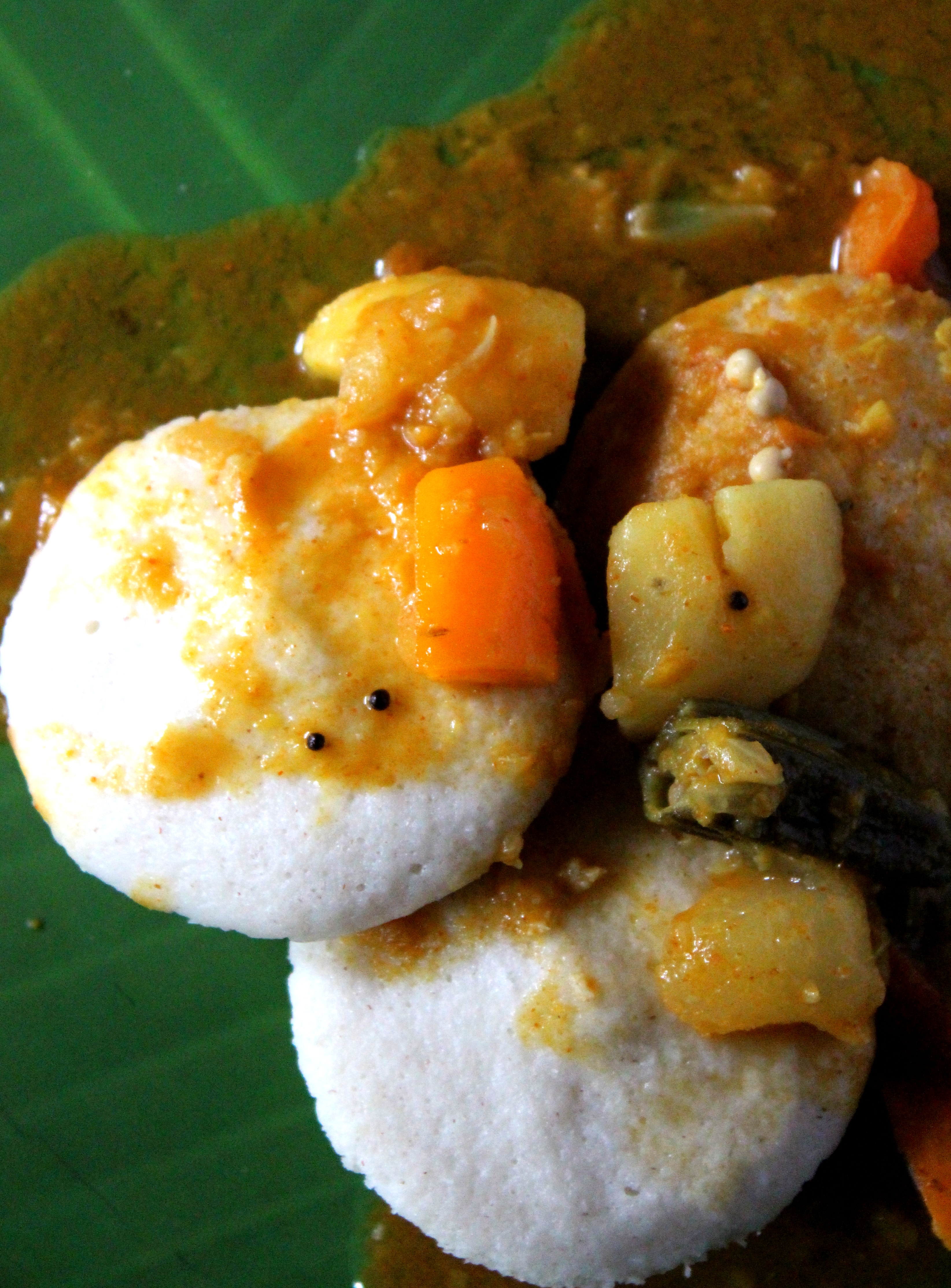 Idli and sambar, a typical south Indian breakfast dish
 South Indian meal served on dried mantharai ilai
 Dosa, a typical south Indian breakfast dish