

m Removed empty portal template using script |
Minor edits and structural improvements |
||
| Line 1: | Line 1: | ||
{{ | {{Short description|Rapid transit system in Mumbai, India}} | ||
{{Use Indian English|date=January 2016}} | {{Use Indian English|date=January 2016}} | ||
{{Infobox Public transit | {{Infobox Public transit | ||
| box_width = | | box_width = 25em | ||
| name = Mumbai Metro | | name = Mumbai Metro | ||
| | | image = Mmmocl-logo.svg | ||
| | | imagesize = 150px | ||
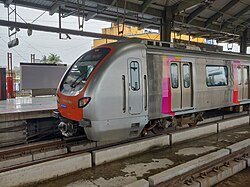
| | | image2 = Mumbai Metro at Gundavali Station.jpg | ||
| owner = [[Mumbai Metropolitan Region Development Authority | | imagesize2 = 300px | ||
| | | caption2 = Mumbai Metro at Gundavali Station | ||
| transit_type = [[ | | owner = {{ubl| | ||
| began_operation = {{start date and age|8 | *[[Mumbai Metropolitan Region Development Authority]] | ||
| operator = Maha Mumbai Metro Operation Corporation | *Mumbai Metro One Pvt Ltd | ||
| chief_executive = | *Mumbai Metro Rail Corporation Ltd}} | ||
| headquarters = [[Mumbai]] | | area served = [[Mumbai Metropolitan Region]] | ||
| lines = | | locale = [[Mumbai]] | ||
| line_number = {{ | | transit_type = [[Train]] | ||
| began_operation = {{start date and age|2014|6|8|df=yes}} | |||
| character = | | operator = {{ubl| | ||
| annual_ridership = | *Mumbai Metro One Pvt Ltd (Blue line) | ||
*Mumbai Metro Rail Corporation Ltd (Aqua line) | |||
| website = {{bulleted list|{{ | *Maha Mumbai Metro Operation Corporation Ltd (others)}} | ||
| train_length = {{bulleted list|4 ( | | chief_executive = S.V.R Srinivas, CMD & Metropolitan Commissioner | ||
| headquarters = NaMMTRI Building, Plot No. R-13, E-Block, [[Bandra Kurla Complex]], [[Bandra]] (E), [[Mumbai]], [[Maharashtra]] 400051. | |||
| lines = {{ubl| | |||
*Operational: 4 | |||
*Under-construction: 8 | |||
*Approved: 3}} | |||
| line_number = '''Operational'''{{ubl| | |||
*{{rcb|Mumbai Metro|1|route}} | |||
*{{rcb|Mumbai Metro|2A|route}} | |||
*{{rcb|Mumbai Metro|3|route}} | |||
*{{rcb|Mumbai Metro|7|route}}}} | |||
'''Under Construction'''{{ubl| | |||
*{{rcb|Mumbai Metro|2B|route}} | |||
*{{rcb|Mumbai Metro|4|route}} | |||
*{{rcb|Mumbai Metro|5|route}} | |||
*{{rcb|Mumbai Metro|6|route}} | |||
*{{rcb|Mumbai Metro|9|route}} | |||
*{{rcb|Mumbai Metro|10|route}} | |||
*{{rcb|Mumbai Metro|11|route}} | |||
*{{rcb|Mumbai Metro|12|route}}}} | |||
'''Approved & Proposed'''{{ubl| | |||
*{{rcb|Mumbai Metro|8|route}} | |||
*{{rcb|Mumbai Metro|13|route}} | |||
*{{rcb|Mumbai Metro|14|route}}}} | |||
| character = {{bulleted list|Elevated (Blue, Yellow, Red lines)|Underground and At-Grade (Aqua line)}} | |||
| annual_ridership = 27.3 [[crore]] (273 million, 2024-25) | |||
| ridership = 7.47 [[lakh]] (0.74 million, 2024-25) | |||
| website = {{bulleted list|{{URL|https://www.mmmocl.co.in/|MMMOCL}}|{{URL|https://mmrda.maharashtra.gov.in/mumbai-metro-rail-project|MMRDA}}}} | |||
| train_length = {{bulleted list|4 (Blue line)|6 (Yellow, Red lines)|8 (Aqua line)}} | |||
| headway = {{bulleted list|4 minutes (peak hours)|8 minutes (off-peak hours)}} | | headway = {{bulleted list|4 minutes (peak hours)|8 minutes (off-peak hours)}} | ||
| system_length = {{cvt| | | system_length = {{cvt|80.03|km|mi}} (Operational)<br />{{cvt|132.45|km|mi}} (Under Construction)<br />{{cvt|138.92|km|mi}} (Approved & Proposed) | ||
| track_gauge = {{ | | track_gauge = {{track gauge|sg|allk=on}} | ||
| el = 25 kV | | el = {{25 kV 50 Hz}} [[Overhead line]]<ref name="PoweringUp">{{cite news |url=http://www.hindustantimes.com/India-news/Mumbai/Overhead-Metro-wires-to-be-charged/Article1-1018028.aspx |title=Overhead Metro wires to be charged |newspaper=Hindustan Times |date=27 February 2014 |access-date=5 March 2013 |url-status=dead |archive-url=https://web.archive.org/web/20131223143403/http://www.hindustantimes.com/India-news/Mumbai/Overhead-Metro-wires-to-be-charged/Article1-1018028.aspx |archive-date=23 December 2013 }}</ref> | ||
| average_speed = {{ | | average_speed = | ||
| | | top_speed = {{cvt|80|km/h}}<ref>{{cite web | title=Mumbai metro lines 7, 2A get CCRS certification for full-speed operations | url=https://www.business-standard.com/india-news/mumbai-metro-lines-7-2a-get-ccrs-certification-for-full-speed-operations-125011100420_1.html }}</ref> | ||
| | | map = {{switcher | ||
| | |{{Rapid transit OSM map|system_qid=Q646414|single_line=y|stations_qid=Q646414|zoom=11|frame-width=270|frame-align=center|frame-height=640}} | ||
| | |Show interactive map | ||
| | |[[File:Mumbai Metro Schematic Map.svg|Mumbai Metro and Monorail Map|300px]] | ||
| map | |Show static map | ||
| | |{{Mumbai Metro}} | ||
| stations = | |Show route diagram map | ||
| | }} | ||
| stations = [[List of Mumbai Metro stations#Metro stations|68]] | |||
}} | }} | ||
The '''Mumbai Metro''' | The '''Mumbai Metro''' is a [[rapid transit|rapid transit train]] system serving the city of [[Mumbai]] and the wider [[Mumbai Metropolitan Region]] in [[Maharashtra]], [[India]]. | ||
While the [[Maharashtra Metro Rail Corporation Limited]] is responsible for all metro rail projects being developed in Maharashtra, except for those in the Mumbai Metropolitan Area, the [[Mumbai Metropolitan Region Development Authority]] is the authority responsible for maintaining the metro system in the Greater Mumbai area. | |||
[[ | The rapid transit metro system is designed to reduce traffic congestion in the city and supplement the overcrowded [[Mumbai Suburban Railway]] network. It is being built in three phases, over 15 years, with overall completion, expected in October 2026. The Mumbai Metro is the [[Urban rail transit in India#List of systems|third longest operational metro network in India]] with an operational length of {{cvt|80.43|km|mi}} as of October 2025. When completed, the core system will comprise sixteen high-capacity [[metro railway]] lines, spanning a total of more than {{convert|523|km|mi|1}} (25% underground, the rest elevated, with a minuscule portion built at-grade) and serviced by 350 stations.<ref>{{Cite web |date=2024-11-11 |title=Mumbai Metro: Route, Map, Metro Lines, Stations List and Latest Updates - Infra Info Hub |url=https://infrainfohub.com/mumbai-metro/ |access-date=2024-11-12 |language=en-US}}</ref> | ||
[[Blue Line (Mumbai Metro)|Blue Line 1]] of the Mumbai Metro is operated by Mumbai Metro One Private Limited (MMOPL), a joint venture between [[Reliance Infrastructure]] (74%), the [[Mumbai Metropolitan Region Development Authority]] (26%) and formerly by [[RATP Dev Transdev Asia]] (5%).<ref name=ratp>{{cite web|url=https://www.reliancemumbaimetro.com/web/reliance-mumbai-metro/overview|title=Mumbai Metro One Pvt. Ltd. (MMOPL)|publisher=MMOPL|access-date=4 March 2020|archive-date=21 April 2021|archive-url=https://web.archive.org/web/20210421053252/https://www.reliancemumbaimetro.com/web/reliance-mumbai-metro/overview|url-status=dead}}</ref> While lines [[Yellow Line (Mumbai Metro)|2]], [[Green Line (Mumbai Metro)|4]], [[Orange Line (Mumbai Metro)|5]], [[Pink Line (Mumbai Metro)|6]], [[Red Line (Mumbai Metro)|7]] and their extensions will be built by the [[Mumbai Metropolitan Region Development Authority]] (MMRDA) and operated by the Maha Mumbai Metro Operations Corporation Limited (MMMOCL), the completely underground [[Aqua Line (Mumbai Metro)|Aqua Line 3]] and [[Green Line (Mumbai Metro)|Green Line 11]] will be built by Mumbai Metro Railway Corporation Ltd (MMRC). | |||
In June 2006, [[Prime Minister of India|Prime Minister]] [[Manmohan Singh]] laid the foundation stone for the first phase of the Mumbai Metro project, although construction work began in February 2008.<ref name="BS">{{cite news|url= http://www.business-standard.com/india/news/mumbai-monorail-to-be-ready-by-dec-metro-by-march/174429/on|title=Mumbai monorail to be ready by Dec, Metro by March|work=[[Business Standard]]|date=12 June 2012|access-date=7 July 2013}}</ref><ref name="DNA-I2013">{{cite news|url=http://www.dnaindia.com/mumbai/report_mumbais-first-metro-may-chug-in-march-2013_1685026|title=Mumbai's first metro may chug in 2013|date=6 May 2012|newspaper=DNA India|access-date=8 May 2012}}</ref><ref>{{cite news|url=http://www.indianexpress.com/news/metro-monorail-projects-could-miss-deadline/831682/|title=Metro, Monorail projects could miss deadline|newspaper=[[The Indian Express]]|date=14 August 2011|access-date=21 September 2011}}</ref> A successful trial run was conducted in May 2013,<ref>{{cite news|url=http://www.livemint.com/Politics/drJn4FpNSSy2mGpbR4B91K/Mumbai-The-connected-city.html|title=Mumbai: The connected city|publisher=[[Mint (newspaper)|Mint]]|date=20 June 2013|access-date=7 July 2013}}</ref><ref name="VersGhatTrial">{{cite news|url=http://articles.timesofindia.indiatimes.com/2013-05-01/mumbai/38957142_1_versova-ghatkopar-mumbai-metro-metropolitan-region-development-authority |archive-url=https://archive.today/20130629124140/http://articles.timesofindia.indiatimes.com/2013-05-01/mumbai/38957142_1_versova-ghatkopar-mumbai-metro-metropolitan-region-development-authority|url-status=dead |archive-date=29 June 2013|title=Mumbai Metro trial run successful|date=1 May 2013|newspaper=[[Times of India]] |access-date=5 June 2013}}</ref><ref name="TrialRunNDTV2013">{{cite news|url=http://www.ndtv.com/article/cities/mumbai-metro-trial-run-with-train-draped-in-flowers-361185|title=Mumbai Metro: trial run with train draped in flowers|newspaper=NDTV|date=1 May 2013 |access-date=5 June 2013}}</ref> and the system's [[Blue Line (Mumbai Metro)|first line]] commenced operations on 8 June 2014. Many metro projects were delayed because of late environmental clearances, land acquisition troubles, and protests. | |||
After nearly eight years, two new metro corridors, 2A and 7, were inaugurated on 2 April 2022, and are now operational. On 5 October 2024, the {{Convert|12|km|abbr=on}} underground BKC to Aarey Jogeshwari-Vikhroli Link Road section of the [[Aqua Line (Mumbai Metro)|Aqua Line 3]] was inaugurated. On 9 October 2025, Aqua Line further extension till Cuffe Parade was inaugurated and is now fully operational. Additionally, there are 8 other metro lines currently under construction in the city. | |||
==History== | ==History== | ||
Being the capital of [[Maharashtra]], Mumbai is among the [[List of urban areas by population|largest cities in the world]], with a total [[metropolitan area]] population of over 2 [[crore]] (20 million) as of 2011,<ref>[http://esa.un.org/unup/p2k0data.asp United Nations Population Division - City Population] {{webarchive|url=https://web.archive.org/web/20070310025702/http://esa.un.org/unup/p2k0data.asp |date=10 March 2007 }}. Retrieved 5 October 2011.</ref> and a population growth rate of around 2% per annum.<ref>[http://esa.un.org/unup/p2k0data.asp Average Annual Rate of Change] {{webarchive|url=https://web.archive.org/web/20070310025702/http://esa.un.org/unup/p2k0data.asp |date=10 March 2007 }}. United Nations Population Division. Retrieved 5 October 2011.</ref> Mumbai has the advantage of a high [[modal share]] of the public (88%) in favour of a public mass transport system.<ref>{{Cite web |date=25 June 2009 |title=Businessworld - 7 Questions You Wanted to Ask |url=http://www.businessworld.in/index.php/7-Questions-You-Wanted-to-Ask.html |access-date=8 April 2024 |archive-url=https://web.archive.org/web/20090625151715/http://www.businessworld.in/index.php/7-Questions-You-Wanted-to-Ask.html |archive-date=25 June 2009 }}</ref> The existing [[Mumbai Suburban Railway]] carries over 70 [[lakh]] (7 million) passengers per day,<ref>[http://www.wr.indianrailways.gov.in/view_section.jsp?lang=0&id=0,1,283 Mumbai Suburban Railway Network]. Western Railway – Indian Railways. Updated 9 April 2012. Retrieved 26 April 2012.</ref> and is supplemented by the [[Brihanmumbai Electric Supply and Transport]] (BEST) bus system, which provides feeder services to station-going passengers to allow them to complete their journeys. Until 1980s, transport in Mumbai was not a big problem. The discontinuation of trams resulted in a direct increase of passenger pressure on the suburban railway network. By 2010, the population of Mumbai doubled. However, due to the city's geographical constraints and rapid population growth, road and rail infrastructure development has not been able to keep pace with the growing demand over the last 4-5 decades.<ref name = "mmrda1">{{cite web|url=http://202.54.119.40/projects_metro_rail.htm |title=Mmrda – Projects – Mumbai Metro Rail Project |publisher=Mmrdamumbai.org|access-date=12 March 2014|archive-url=https://web.archive.org/web/20120319164955/http://202.54.119.40/projects_metro_rail.htm|url-status=dead |archive-date=19 March 2012}}</ref> Moreover, the Mumbai Suburban Railway, though extensive, is not built to rapid transit specifications. The main objective of the Mumbai Metro is to provide mass rapid transit services to people within an approach distance of between {{Convert|1 and 2|km}}, and to serve the areas not connected by the existing Suburban Rail network. | |||
<!--<ref name = "mmrda1"/>-->The master plan unveiled by the MMRDA in 2004 encompassed a total of {{convert|146.5|km|mi|2}} of track, of which {{convert|32|km|mi|2}} would be underground.<ref name = "economictimes1">{{cite news |url=http://economictimes.indiatimes.com/news/news-by-industry/transportation/railways/metro-rail-i-to-be-operational-in-mumbai-in-2012/articleshow/9873315.cms |title=Metro Rail-I to be operational in Mumbai in 2012 |work=[[The Economic Times]] |date=5 September 2011 |access-date=24 October 2011 |archive-date=20 October 2012 |archive-url=https://web.archive.org/web/20121020042022/http://economictimes.indiatimes.com/news/news-by-industry/transportation/railways/metro-rail-i-to-be-operational-in-mumbai-in-2012/articleshow/9873315.cms |url-status=dead }}</ref> The Mumbai Metro was proposed to be built in three phases, at an estimated cost of {{INR}}19,525 crore.<ref name = "mmrda1"/> In September 2009, the proposed [[Hutatma Chowk]] – [[Ghatkopar]] was reduced to a line between Hutatma Chowk and [[Carnac Bunder metro station|Carnac Bunder]]. | |||
{| class="wikitable" style="margin-right: 5px | In 2011, the MMRDA unveiled plans for an extended [[Line 3 (Mumbai Metro)|Colaba-Bandra-SEEPZ]] metro line. According to its earlier plans, a {{Cvt|20|km|2}} [[Colaba]]-to-[[Bandra]] metro line was to be constructed, running underground for {{convert|10|km|mi|2}} from Colaba to [[Mahalaxmi, Mumbai|Mahalaxmi]], and then on an elevated track from Mahalaxmi to Bandra. However, the MMRDA decided to increase the ridership on the line by running it out past Bandra to [[Chhatrapati Shivaji Maharaj International Airport]]. The {{convert|33.5|km|mi|2|adj=on}} [[Line 3 (Mumbai Metro)|Colaba-Bandra-SEEPZ line]] will be built at a cost of {{INRConvert|21000|c}},<ref name=CSIAtalks>[http://www.indianexpress.com/news/development-body-in-talks-with-csia/899608/1 "Development body in talks with CSIA"]. ''The Indian Express''. 14 January 2012. Retrieved 16 January 2012.</ref> and will be the city's first underground metro line. It will have 27 stations.<ref>[http://www.dnaindia.com/mumbai/report_views-on-colaba-seepz-underground-metro-sought_1625495 "Views on Colaba-Seepz underground metro sought"]. DNA India. 14 December 2011. Retrieved 30 December 2011.</ref>[[File:Mumbai_Line_1_metro_rake.jpg|thumb|278x278px|[[CRRC Nanjing Puzhen|CRRC Puzhen]] trainset on [[Line 1 (Mumbai Metro)|Line 1]] approaching [[Andheri metro station|Andheri station]] in 2019]] On 27 February 2012, the [[Government of India|Union Government]] gave in-principle approval to the plan for Line 3. Money for the project is being borrowed from [[Japanese International Cooperation Agency]] (50%), the state government (16%), the central government (14%), and others.<ref>{{cite news|url=https://timesofindia.indiatimes.com/city/mumbai/Centre-paves-way-for-3rd-Metro-line/articleshow/12062872.cms |archive-url=https://web.archive.org/web/20140202094859/http://articles.timesofindia.indiatimes.com/2012-02-28/mumbai/31107110_1_colaba-bandra-underground-line-mmrda |url-status=live |archive-date=2 February 2014 |title=Centre paves way for 3rd Metro line |date=28 February 2012|work=[[The Times of India]] |access-date=28 March 2012}}</ref> In April 2012, the MMRDA announced plans to grant the Mumbai Metro Rail Company increased management autonomy, in an effort to enhance the project's operational efficiency.<ref>[http://www.dnaindia.com/mumbai/report_mumbai-metro-likely-to-get-autonomy-status-mmrda_1681205 "Mumbai Metro likely to get autonomy status: MMRDA"]. DNA India. 27 April 2012. Retrieved 3 May 2012.</ref> In July 2012, the MMRDA announced plans to add more metro lines to its existing plan, including a line parallel to the [[Western Express Highway]] from [[Bandra]] to [[Dahisar]]. This line is expected to reduce the passenger load on the [[Western line (Mumbai Suburban Railway)|Western Line]] and vehicle traffic on the highway. Another proposed route, the {{convert|30|km|mi|2|adj=on}}, 28-station [[Wadala]]–[[Kasarvadavali]] line, received in-principle approval from the state government in 2013.<ref>[http://www.hindustantimes.com/India-news/Mumbai/Soon-take-a-metro-from-south-Mumbai-to-Thane/Article1-1048837.aspx "Soon, take a metro from south Mumbai to Thane"] {{webarchive|url=https://web.archive.org/web/20130430164802/http://www.hindustantimes.com/India-news/Mumbai/Soon-take-a-metro-from-south-Mumbai-to-Thane/Article1-1048837.aspx |date=30 April 2013 }}. ''Hindustan Times''. 23 April 2013. Retrieved 5 June 2013.</ref> The MMRDA also intends to convert the proposed [[Mumbai Monorail|Lokhandwala–SEEPZ–Kanjurmarg monorail route]] into a metro line.<ref>[http://www.dnaindia.com/mumbai/report_mmrda-to-add-more-lines-to-mumbai-metro-railway-project_1712139 "MMRDA to add more lines to Mumbai Metro railway project"]. DNA India. 8 July 2012. Retrieved 27 July 2012.</ref> The Mumbai Metro master plan was revised by the MMRDA in 2012, increasing the total length of the proposed network to {{Cvt|160.90|km}}.<ref>{{Cite web|url=https://www.thehindubusinessline.com/economy/logistics/Third-phase-of-metro-rail-inaugurated/article20852374.ece|title=Third phase of metro rail inaugurated|website=@businessline|date=26 August 2014 }}</ref> In June 2015, two new lines were proposed. A line from [[Andheri|Andheri West]] to Dahisar West, and a line from BKC to [[Mankhurd]].<ref name="ReferenceA">{{Cite web|url=https://indianexpress.com/article/cities/mumbai/over-130-km-of-metro-lines-to-criss-cross-city-by-2020/|title=Over 130 km of Metro lines to criss-cross city by 2020|date=16 June 2015}}</ref> The following table shows the updated master plan unveiled by the MMRDA: | ||
{| class="wikitable" style="margin-right: 5px; float: left;" | |||
|+ Original Mumbai Metro master plan<ref name = "mmrda1"/> | |+ Original Mumbai Metro master plan<ref name = "mmrda1"/> | ||
! Phase !! Line !! Name of the corridor !! Length (km) | ! Phase !! Line !! Name of the corridor !! Length (km) | ||
|- | |- | ||
| rowspan="3" | Phase I<br />(2006–2011) || [[Line | | rowspan="3" | Phase I<br />(2006–2011) || [[Blue Line (Mumbai Metro)|1]] || [[Blue Line (Mumbai Metro)|Versova – Andheri – Ghatkopar]] || 11.07 | ||
|- | |- | ||
| 2 || [[Line | | 2 || [[Yellow Line (Mumbai Metro)|Bandra – Kurla – Mankhurd]] || 13.37 | ||
|- | |- | ||
|3 || [[Line | | 3 || [[Aqua Line (Mumbai Metro)|Colaba – Bandra – Charkop]] || 38.24 | ||
|- | |- | ||
| rowspan="2" | Phase II<br />(2011–2016) || 4 || [[Line | | rowspan="2" | Phase II<br />(2011–2016) || 4 || [[Yellow Line (Mumbai Metro)|Charkop – Dahisar]] || 7.5 | ||
|- | |- | ||
| 5 || [[Line | | 5 || [[Green Line (Mumbai Metro)|Ghatkopar – Mulund]] || 12.4 | ||
|- | |- | ||
| rowspan="4" | Phase III<br />(2016–2021) || 6 || BKC | | rowspan="4" | Phase III<br />(2016–2021) || 6 || [[Pink Line (Mumbai Metro)|BKC – Kanjur Marg via Airport]] || 19.5 | ||
|- | |- | ||
| [[Line | | [[Red Line (Mumbai Metro)|7]] || [[Red Line (Mumbai Metro)|Andheri (East) – Dahisar (East)]] || 16.5 | ||
|- | |- | ||
| 8 || Hutatma Chowk – Ghatkopar || 21.8 | | 8 || Hutatma Chowk – Ghatkopar || 21.8 | ||
| Line 75: | Line 107: | ||
|} | |} | ||
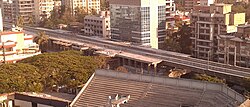
< | [[File:Azad Nagar Station.jpg|thumb|280x280px|A metro station under construction in [[Andheri]] in March 2012]] | ||
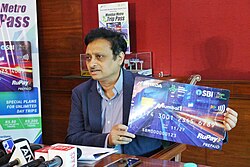
[[File:SVR Srinivas, IAS, CMD-MMMOCL while announcing trip based passes on Mumbai 1 card.jpg|thumb|Metro passes were included with the Mumbai 1 card introduced in 2021<ref>{{Cite web |last=Livemint |date=8 July 2021 |title=Mumbai: One Mumbai Metro Card launched for more convenience to commuters |url=https://www.livemint.com/news/india/mumbai-one-mumbai-metro-card-launched-for-more-convivence-to-commuters-11625742768319.html |access-date=26 February 2024 |website=mint |language=en}}</ref>]] | |||
On 18 February 2013, the MMRDA signed a [[memorandum of understanding]] with [[Transport for London]], the [[transit authority]] in [[Greater London]]. The arrangement will facilitate the exchange of information, personnel and technology in the transportation sector.<ref>[http://www.thehindubusinessline.com/industry-and-economy/logistics/mumbai-transport-body-london-counterpart-ink-mou/article4428664.ece "Mumbai transport body, London counterpart ink MoU"]. Business Line. 2 March 2013. Retrieved 5 June 2013.</ref><ref>[http://www.indianexpress.com/news/mmrda-inks-pact-with-uk-transport-authority/1076275/ "MMRDA inks pact with UK transport authority"]. ''Indian Express''. 19 February 2013. Retrieved 5 June 2013.</ref><ref>[http://www.business-standard.com/article/economy-policy/mmrda-transport-for-london-ink-mou-for-under-ground-metro-in-mumbai-113021800620_1.html "MMRDA, Transport for London ink MoU for under ground metro in Mumbai"]. ''Business Standard''. 18 February 2013. Retrieved 5 June 2013.</ref><ref>[http://www.deccanherald.com/content/313125/mumbai-metro-run-150-km.html Mumbai metro to run 150 km] ''[[Deccan Herald]]'' 18 February 2013</ref> | |||
The revised Mumbai Metro master plan had proposed a line along the [[Thane]]-Teen Haath Naka-Kapurbavadi-Ghodbunder Road route. The feasibility report concluded that the line was not feasible as most residents of Thane and its neighbouring areas travelled to Mumbai for work daily. On 14 June 2014, Chavan announced that the MMRDA was instead examining a proposal for a metro line along the new proposed route of Wadala-Ghatkopar-Teen Haat Naka route. RITES will prepare the detailed project report and is expected to submit it by August 2014. The preliminary report proposed a {{Cvt|32|km|2}} line with 29 stations, to be built at an estimated cost of {{INR}}22,000 crore.<ref>{{Cite news|url=https://economictimes.indiatimes.com/industry/transportation/railways/mumbai-metro-services-to-be-extended-till-thane-prithviraj-chavan/articleshow/36547492.cms|title=Mumbai Metro services to be extended till Thane: Prithviraj Chavan|date=14 June 2014|newspaper=The Economic Times}}</ref> This would be the fourth line of the metro, after the previously proposed Charkop-Dahisar route was merged with the Charkop-Bandra-Mankhurd route to form Line 2.<ref>{{Cite news|url=https://timesofindia.indiatimes.com/city/mumbai/First-Metro-line-to-be-extended-to-Wadala-and-Thane/articleshow/36565838.cms|title=First Metro line to be extended to Wadala and Thane|website=The Times of India|date=15 June 2014 }}</ref> | |||
In | In May 2015, the MMRDA said that it had begun planning for the Andheri-Dahisar line and Seepz-Kanjurmarg. Both lines are expected to be elevated, although the latter could be constructed underground if a proposal to extend Line 3 to Kanjurmarg is undertaken. DPRs for both lines had been prepared in 2004, along with the master plan, and the MMRDA would now update the DPRs. The agency also intends to construct Line 9 of the metro as an underground corridor from [[Sewri]] to [[Worli]]. However, planning for the project will only begun after the construction of the proposed [[Mumbai Trans Harbour Link]] commences.<ref>{{Cite web|url=https://www.hindustantimes.com/mumbai/mmrda-plans-two-new-metro-lines-for-mumbai/story-s5zWVrm5HYn1dJhKdhUNjM.html|title=MMRDA plans two new Metro lines for Mumbai|date=20 May 2015|website=Hindustan Times}}</ref> | ||
In a report on 14 November 2014 about the cancellation of the PPP agreement for Line 2, ''Mint'' quoted a senior MMRDA official: "''as decided earlier, all future lines of Mumbai Metro will be constructed by the Mumbai Metro Railway Corp. Ltd (MMRCL), a joint venture between the state government and the Union government.''"<ref name="livemint.com">{{Cite web|url=https://www.livemint.com/Companies/bKzM6yXoPKaxW1YelH9FBL/Reliance-Infra-pulls-out-of-Mumbai-Metro-Line-2.html|title=Reliance Infra pulls out of Mumbai Metro Line 2|date=13 November 2014|website=Mint}}</ref> On 20 May 2015, [[Chief minister of Maharashtra|Chief Minister]] [[Devendra Fadnavis]] requested officials to consider constructing the Charkop-Bandra-Dahisar and the Wadala-Thane-Kasarvadavali lines as elevated corridors. Although both corridors had been planned as elevated lines in the Mumbai Metro master plan, the previous [[Indian National Congress|Congress]]-NCP had decided to construct all metro lines underground, after delays and difficulties caused by acquiring land for Line 1. However, Fadnavis believes that the two proposed lines can be constructed quicker and cheaper if they were elevated due to the proposed route of the alignment.<ref>{{Cite web|url=https://indianexpress.com/article/cities/mumbai/mumbai-metro-rail-state-considers-elevated-metro-route/|title=Mumbai metro rail: State considers elevated Metro route|date=21 May 2015}}</ref> The Government plans to implement all future metro lines (except Line 3) as elevated corridors.<ref name="hindustantimes.com">{{Cite web|url=https://www.hindustantimes.com/mumbai/metro-2-to-be-built-in-three-phases-2-other-routes-also-on-cards/story-6eaO58ams57i7DyDX15LNM.html|title=Metro 2 to be built in three phases, 2 other routes also on cards|date=16 June 2015|website=Hindustan Times}}</ref> On 15 June 2015, the MMRDA announced that it would implement Line 2 of the metro in three parts. The Andheri-Dahisar line will have connectivity with the existing Line 1 and the proposed [[Jogeshwari–Vikhroli Link Road|JVLR]]-[[Kanjurmarg]] line.<ref name="hindustantimes.com"/> | |||
In June 2015, Fadnavis announced that he would request the [[Delhi Metro Rail Corporation]] (DMRC) to assist in the implementation of the Mumbai Metro. He said that he intends to expand the metro system by {{Cvt|109|km|2}} before the state assembly elections in October 2019.<ref>{{Cite web|url=http://www.financialexpress.com/article/economy/devendra-fadnavis-plans-to-ask-dmrc-team-to-assist-in-metro-expansion/82971/|title = Business News: Business News India, Business News Today, Latest Finance News, Business News Live| date=11 June 2015 }}</ref><ref>{{Cite news|url=https://www.business-standard.com/article/economy-policy/mumbai-metro-seeks-delhi-counterpart-s-help-to-expedite-project-115061500504_1.html|title=Mumbai Metro seeks Delhi counterpart's help to expedite project|newspaper=Business Standard India|date=16 June 2015|via=Business Standard|last1=Jog|first1=Sanjay}}</ref><ref>{{Cite web|url=https://indianexpress.com/article/business/business-others/pan-mumbai-metro-network-by-2019-targets-maharashtra/|title=Pan-Mumbai Metro network by 2019, targets Maharashtra|date=11 June 2015}}</ref> In July 2015, UPS Madan announced that the State Government formally appointed the DMRC to revise and update the Mumbai Metro master plan. The DMRC will prepare DPRs for the Andheri East to Dahisar East, Jogeshwari to Kanjurmarg, Andheri West to Dahisar West and Bandra Kurla Complex to Mankhurd lines.<ref name="ReferenceB">{{Cite web|url=https://www.dnaindia.com/mumbai/report-mumbai-metro-master-plan-maharashtra-government-nod-for-delhi-body-revise-and-update-blueprint-2100949|title=Mumbai Metro master plan: Maharashtra government nod for Delhi body revise and update blueprint|date=2 July 2015|website=dna}}</ref> The Andheri-Dahisar line will have connectivity with the existing Line 1 and the proposed JVLR-Kanjurmarg line.<ref name="hindustantimes.com"/> All four lines are proposed to be elevated and constructed as cash contracts. The lines are estimated to cost a total of {{INRConvert|21000|c|nolink=yes}}, or about {{INRConvert|350|c|nolink=yes}} per km.<ref name="ReferenceA"/> In addition, the planned Line 3 and Wadala-Ghatkopar-Thane-Kasarvadavli line of the metro would also be constructed.<ref name="ReferenceB"/> | |||
[[ | |||
{| class="wikitable" | Fadnavis announced on 8 April 2017 that the government was considering a circular metro loop line along the Kalyan-Dombivli-Taloja route. The proposed {{Cvt|15|km|2}} line would link [[Kalyan]] and [[Shil Phata]] with 13 stations, bring metro connectivity to [[Kalyan|Kalyan (East)]], [[Dombivli]], [[Ambarnath]] and [[Diva, Maharashtra|Diva]].<ref>{{cite web|title=Metro loop to connect central suburbs, Navi Mumbai on cards|url=http://www.asianage.com/metros/mumbai/090417/metro-loop-to-connect-central-suburbs-navi-mumbai-on-cards.html|website=Asian Age|access-date=9 April 2017|date=9 April 2017}}</ref><ref>{{cite news|title=Kalyan-Dombivli-Taloja metro under consideration: Devendra Fadnavis|url=http://economictimes.indiatimes.com/industry/transportation/railways/kalyan-dombivli-taloja-metro-under-consideration-devendra-fadnavis/articleshow/58082529.cms|website=The Economic Times|access-date=9 April 2017}}</ref> | ||
The Mumbai Metro resumed services for general public on 19 October 2020, after being shut down since March 2020 due to the [[COVID-19 pandemic]].<ref>{{Cite web|date=22 March 2020|title=Mumbai local services suspended till March 31 due to Covid-19: All you need to know|url=https://www.hindustantimes.com/india-news/mumbai-local-services-suspended-till-march-22-due-to-covid-19-all-you-need-to-know/story-YDrytVUldu4rsstKGTQWxM.html|access-date=10 August 2021|website=Hindustan Times|language=en}}</ref><ref>{{Cite web|agency=ANI|date=19 October 2020|title=Mumbai Metro News: Mumbai Metro resumes operations with Covid protocols |url=https://timesofindia.indiatimes.com/city/mumbai/mumbai-metro-resumes-operations-with-covid-protocols/articleshow/78744863.cms|access-date=10 August 2021|website=The Times of India|language=en}}</ref> | |||
;Protests and delay | |||
The project has faced significant and costly legal challenges.<ref>[https://infra.economictimes.indiatimes.com/news/urban-transportation/mumbai-litigations-delaying-metro-car-shed-project-and-causing-loss-of-public-money-hc-told/97978616 Mumbai: Litigations delaying metro car shed project and causing loss of public money, HC told.] ''Press Trust of India''. Published on ''Economic Times''. 16 February 2013.</ref> In 2018, protestors rallied to protect trees that were to be chopped down as part of construction plans. The central government first proposed the construction of a metro station at Aarey Milk colony.<ref>[https://scroll.in/article/937002/saving-aarey-why-a-city-with-a-weak-protest-culture-is-demonstrating-to-protect-mumbais-green-lung Saving Aarey: Why a city with a weak protest culture is demonstrating to protect Mumbai's green lung.] Aarefa Johari. ''Scroll''. 15 September 2019.</ref> The protest resulted in several arrests.<ref>[https://timesofindia.indiatimes.com/city/mumbai/18-protesters-held-at-aarey-as-metro-yard-trees-get-axed/articleshow/66011604.cms 18 protesters held at Aarey as Metro yard trees get axed.] ''Times News Network''. 30 September 2018.</ref> Protests again flared in 2022.<ref>[https://www.hindustantimes.com/cities/mumbai-news/finally-voices-of-aarey-protesters-fall-silent-101669749870675.html Finally, voices of Aarey protesters fall silent.] Prayag Arora-Desai. ''Hindustan Times''. 30 November 2022.</ref> | |||
==Network== | |||
{{main|List of Mumbai Metro stations}} | |||
[[File:Mumbai Metro and Suburban Railway Schematic Map.svg|thumb|left|Map showing all of the railway services in Mumbai, including the Metro, Monorail, and Suburban services]] | |||
Lines on the Mumbai Metro are currently identified by numbers. In March 2016, MMRDA Metropolitan Commissioner, U.P.S. Madan, announced that all lines on the system would be colour-coded after more lines are opened. | |||
{| class="wikitable sortable" style="text-align:center; width: 100%;" | |||
! colspan="8" style="background:#ADD8E6;" |Operational Lines | |||
|- | |- | ||
! Line !! | !No. | ||
!Line Name | |||
!Number | |||
! colspan="2" |Terminals | |||
!Stations | |||
!Distance (km) | |||
!Opening Date | |||
|- | |- | ||
| | !1 | ||
| style="background:#{{rail color|Mumbai Metro|blue}};text-align: center;" | [[Blue Line (Mumbai Metro)|<span style="color:white;">'''Blue'''</span>]] | |||
|1 | |||
|{{stl|Mumbai Metro|Versova}} | |||
|{{stl|Mumbai Metro|Ghatkopar}} | |||
| style="text-align:center;" |12 | |||
| style="text-align:center;" |{{Cvt|11.40|km|}} | |||
| style="text-align:center;" |8 June 2014 | |||
|- | |- | ||
|rowspan="2"| [[Line | ! rowspan="2" |2 | ||
| rowspan="2" style="background:#{{rcr|Mumbai Metro|yellow}}; text-align: center;" | [[Yellow Line (Mumbai Metro)|<span style="color:black;">'''Yellow'''</span>]] | |||
| rowspan="2 " |2A | |||
|{{stl|Mumbai Metro|Dahisar (East)}} | |||
|{{stl|Mumbai Metro|Dahanukarwadi}} | |||
| style="text-align:center;" |9 | |||
| style="text-align:center;" |{{Cvt|9.8|km|}} | |||
| style="text-align:center;" |2 April 2022 | |||
|- | |- | ||
| | |{{stl|Mumbai Metro|Dahanukarwadi}} | ||
|{{stl|Mumbai Metro|Andheri (West)}} | |||
| style="text-align:center;" |8 | |||
| style="text-align:center;" |{{Cvt|8.8|km|}} | |||
| style="text-align:center;" |19 January 2023 | |||
|- | |- | ||
| [[Line | ! rowspan="3" |3 | ||
|| | | rowspan="3" style="background:#{{rcr|Mumbai Metro|aqua}}; text-align: center;" | [[Aqua Line (Mumbai Metro)|<span style="color:white;">'''Aqua'''</span>]] | ||
| rowspan="3" |3 | |||
|{{stl|Mumbai Metro|Aarey JVLR}} | |||
|{{stl|Mumbai Metro|Bandra Kurla Complex}} | |||
| style="text-align:center;" |10 | |||
| style="text-align:center;" | {{Cvt|12.69|km|}} | |||
| style="text-align:center;" |7 October 2024 | |||
|- | |- | ||
| | |{{stl|Mumbai Metro|Bandra Kurla Complex}} | ||
| | |{{stl|Mumbai Metro|Acharya Atre Chowk}} | ||
|6 | |||
|{{Cvt|9.77|km|}} | |||
|9 May 2025 | |||
|- | |- | ||
|[[Line | |{{stl|Mumbai Metro|Acharya Atre Chowk}} | ||
| | |{{stl|Mumbai Metro|Cuffe Parade}} | ||
| | |11 | ||
| | |{{Cvt|10.99|km|}} | ||
| | |9 October 2025 | ||
| | |- | ||
| | ! rowspan="2" |4 | ||
| rowspan="2" style="background:#{{rcr|Mumbai Metro|red}}; text-align: center;" | [[Red Line (Mumbai Metro)|<span style="color:white;">'''Red'''</span>]] | |||
| rowspan="2 " |7 | |||
|{{stl|Mumbai Metro|Dahisar (East)}} | |||
|{{stl|Mumbai Metro|Aarey}} | |||
| style="text-align:center;" |10 | |||
| style="text-align:center;" |{{Cvt|10.7|km|}} | |||
| style="text-align:center;" |2 April 2022 | |||
|- | |- | ||
| | |{{stl|Mumbai Metro|Aarey}} | ||
|| | |{{stl|Mumbai Metro|Gundavali}} | ||
| style="text-align:center;" |4 | |||
| style="text-align:center;" |{{Cvt|5.8|km|}} | |||
| style="text-align:center;" |19 January 2023 | |||
|- | |- | ||
| | ! colspan="5" | | ||
!70 | |||
!{{Cvt|79.95|km|}} | |||
! | |||
|- | |- | ||
| | ! colspan="8" style="background:#ADD8E6;" |Under Construction Lines | ||
|- | |- | ||
|- | |- | ||
!No. | |||
!Line Name | |||
!Number | |||
! colspan="2" |Terminals | |||
!Stations | |||
!Distance (km) | |||
!Opening Date | |||
|- | |- | ||
| [[Line | ! rowspan="3" |1 | ||
| rowspan="3" style="background:#{{rcr|Mumbai Metro|yellow}}; text-align: center;" | [[Yellow Line (Mumbai Metro)|<span style="color:black;">'''Yellow'''</span>]] | |||
| [[Line | | rowspan="3 " |2B | ||
|{{stl|Mumbai Metro|Andheri (West)}} | |||
|[[Yellow Line (Mumbai Metro)|Saraswat Nagar]] | |||
|6 | |||
| rowspan="3" | {{Cvt|23.6|km|}} | |||
|April 2027 | |||
|- | |- | ||
| [[Line | |[[Yellow Line (Mumbai Metro)|Saraswat Nagar]] | ||
|{{stl|Mumbai Metro|Diamond Garden}} | |||
|9 | |||
|December 2027 | |||
|- | |- | ||
| | |{{stl|Mumbai Metro|Diamond Garden}} | ||
|{{stl|Mumbai Metro|Mandale}} | |||
|5 | |||
|March 2028 | |||
|- | |- | ||
| [[Line | ! rowspan="4" | 2 | ||
| rowspan="4" style="background:#{{rcr|Mumbai Metro|green}}; text-align: center;" | [[Green Line (Mumbai Metro)|<span style="color:white;">'''Green'''</span>]] | |||
|4A | |||
|{{stl|Mumbai Metro|Gaimukh}} | |||
|{{stl|Mumbai Metro|Kasarvadavali}} | |||
|2 | |||
|{{Cvt|2.88|km|}} | |||
|March 2027 | |||
|- | |- | ||
| | | rowspan="3" |4 | ||
|{{stl|Mumbai Metro|Kasarvadavali}} | |||
|{{stl|Mumbai Metro|Cadbury Junction}} | |||
|8 | |||
| rowspan="3" |{{Cvt|32.32|km|}} | |||
|March 2027 | |||
|- | |- | ||
|{{stl|Mumbai Metro|Cadbury Junction}} | |||
| | |{{stl|Mumbai Metro|Gandhi Nagar (Kanjurmarg)}} | ||
| | |11 | ||
| | |December 2027 | ||
| | |||
| | |||
| | |||
|- | |- | ||
| | |{{stl|Mumbai Metro|Gandhi Nagar (Kanjurmarg)}} | ||
|{{stl|Mumbai Metro|Bhakti Park (Wadala)}} | |||
|13 | |||
|November 2027 | |||
|- | |- | ||
! style="background:# | ! rowspan="2" |3 | ||
| | | rowspan="2" style="background:#{{rcr|Mumbai Metro|orange}}; text-align: center;" | [[Orange Line (Mumbai Metro)|<span style="color:white;">'''Orange'''</span>]] | ||
|5 | |||
|{{ | |{{stl|Mumbai Metro|Kapurbawdi}} | ||
|{{ | |{{stl|Mumbai Metro|Bhiwandi}} | ||
| | |8 | ||
|{{Cvt|12.81|km|}} | |||
| | |March 2028 | ||
|- | |- | ||
|12 | |||
| | |{{stl|Mumbai Metro|Kalyan APMC}} | ||
| | |{{stl|Mumbai Metro|Taloja}} | ||
|{{ | |17 | ||
| | |{{Cvt|20.75|km|}} | ||
|December 2032 | |||
| | |||
|- | |- | ||
! style="background:# | !4 | ||
| | | style="background:#{{rcr|Mumbai Metro|pink}}; text-align: center;" | [[Pink Line (Mumbai Metro)|<span style="color:black;">'''Pink'''</span>]] | ||
|6 | |||
|{{ | |{{stl|Mumbai Metro|Swami Samarth Nagar (Lokhandwala)}} | ||
|{{ | |{{stl|Mumbai Metro|Vikhroli EEH}} | ||
| | |13 | ||
|{{Cvt|14.47|km|}} | |||
| | |December 2028 | ||
|- | |- | ||
! rowspan="3" |5 | |||
| | | rowspan="3" style="background:#{{rcr|Mumbai Metro|red}}; text-align: center;" | [[Red Line (Mumbai Metro)|<span style="color:white;">'''Red'''</span>]] | ||
|7A | |||
|{{stl|Mumbai Metro|Gundavali}} | |||
| | |{{stl|Mumbai Metro|Chhatrapati Shivaji Maharaj International Airport - T2}} | ||
|2 | |||
| | |{{Cvt|3.17|km|}} | ||
|June 2028 | |||
{{ | |||
{{ | |||
{{ | |||
|- | |- | ||
| rowspan="2" |9 | |||
| | |{{stl|Mumbai Metro|Subhash Chandra Bose Stadium}} | ||
| | |{{stl|Mumbai Metro|Kashigaon}} | ||
| | |4 | ||
| | | rowspan="2" |{{Cvt|11.38|km|}} | ||
|December 2027 | |||
|- | |- | ||
|{{stl|Mumbai Metro|Kashigaon}} | |||
|{{stl|Mumbai Metro|Dahisar (East)}} | |||
|4 | |||
|December 2027 | |||
| | |||
|- | |- | ||
! | ! colspan="5" | | ||
!102 | |||
!{{Cvt|121.38|km|}} | |||
! | |||
|- | |- | ||
! | ! colspan="8" style="background:#ADD8E6;" |Proposed Lines | ||
|- | |- | ||
|- | |- | ||
! | !No. | ||
!Line Name | |||
!Number | |||
! colspan="2" |Terminals | |||
!Stations | |||
!Distance (km) | |||
!Opening Date | |||
|- | |- | ||
! style="background:# | ! rowspan="2" |1 | ||
| | | rowspan="2" style="background:#{{rcr|Mumbai Metro|green}}; text-align: center;" ; | [[Green Line (Mumbai Metro)|<span style="color:white;">'''Green'''</span>]] | ||
| | |10 | ||
|{{stl|Mumbai Metro|Gaimukh}} | |||
| | |{{stl|Mumbai Metro|Shivaji Chowk (Mira Road)}} | ||
|8 | |||
|{{Cvt|9.2|km|}} | |||
|Awaiting environment clearance | |||
|- | |- | ||
|11 | |||
| | |{{stl|Mumbai Metro|Bhakti Park (Wadala)}} | ||
| | |{{stl|Mumbai Metro|Chhatrapati Shivaji Maharaj Terminus}} | ||
| | |15 | ||
| | |{{Cvt|18|km|}} | ||
|Undergoing soil testing | |||
|- | |- | ||
! style="background:# | !2 | ||
| | | style="background:#{{rcr|Mumbai Metro|orange}}; text-align: center;" | [[Orange Line (Mumbai Metro)|<span style="color:white;">'''Orange'''</span>]] | ||
| | |5 | ||
| | |{{stl|Mumbai Metro|Bhiwandi}} | ||
| | |{{stl|Mumbai Metro|Kalyan APMC}} | ||
|9 | |||
|{{Cvt|10.72|km|}} | |||
|DPR undergoing modifications | |||
|- | |- | ||
! style="background:# | !3 | ||
| style="background:#{{rcr|Mumbai Metro|gold}}; text-align: center;" | [[Gold Line (Mumbai Metro)|<span style="color:white;">'''Gold'''</span>]] | |||
| | |[[Gold Line (Mumbai Metro)|8]] | ||
|{{stl|Mumbai Metro|Chhatrapati Shivaji Maharaj International Airport - T2}} | |||
| | |[[Navi Mumbai International Airport]] | ||
|20 | |||
|{{Cvt|35|km|}} | |||
|DPR submitted | |||
|- | |- | ||
! style="background:# | !4 | ||
| style="background:#{{rcr|Mumbai Metro|purple}}; text-align: center;" | [[Purple Line (Mumbai Metro)|<span style="color:white;">'''Purple'''</span>]] | |||
| | |[[Purple Line (Mumbai Metro)|13]] | ||
| | |{{stl|Mumbai Metro|Shivaji Chowk (Mira Road)}} | ||
|[[Virar]] | |||
|20 | |||
|{{Cvt|23|km|}} | |||
|DPR in preparation | |||
|- | |- | ||
! style="background:# | !5 | ||
| style="background:#{{rcr|Mumbai Metro|magenta}}; text-align: center;" | [[Magenta Line (Mumbai Metro)|<span style="color:white;">'''Magenta'''</span>]] | |||
| | |[[Magenta Line (Mumbai Metro)|14]] | ||
| | |{{stl|Mumbai Metro|Vikhroli EEH}} | ||
|[[Badlapur]] | |||
|40 | |||
|{{Cvt|45|km|}} | |||
|DPR submitted | |||
|- | |- | ||
! | ! colspan="5" | | ||
!112 | |||
!{{Cvt|140.92|km|}} | |||
! | |||
|- | |- | ||
|} | |} | ||
==Lines== | ==Lines== | ||
==={{ | ==={{rcb|Mumbai Metro|blue|route}}=== | ||
{{Main|Line | {{Main|Blue Line (Mumbai Metro)}} | ||
{{Multiple image | {{Multiple image | ||
| align = right | | align = right | ||
| direction = vertical | | direction = vertical | ||
| image1 = Mumbai Metro train arriving at Ghatkopar.jpg | | image1 = Mumbai Metro train arriving at Ghatkopar.jpg | ||
| image2 = Metro arriving at Sakinaka.jpg | | image2 = Metro arriving at Sakinaka.jpg | ||
| caption2 = Metro trains arriving | | caption2 = Metro trains arriving | ||
| caption3 = | |||
| caption3 = | | total_width = 300px | ||
| total_width = 300px | | alt1 = | ||
| alt1 = | |||
}} | }} | ||
Line | The Blue Line connects Versova in the Western Suburbs to Ghatkopar in the Central Suburbs, covering a distance of {{convert|11.4|km|mi}}.<ref name="features">{{cite web |url=http://www.reliancemumbaimetro.com/features.html |title=Know Your Metro - Features |publisher=Reliance Mumbai Metro |access-date=8 June 2014 |archive-url=https://web.archive.org/web/20150924085903/http://www.reliancemumbaimetro.com/features.html |archive-date=24 September 2015 |url-status=dead }}</ref> It is fully elevated, and consists of 12 stations.<ref name="features" /> Work on the [[Versova, Mumbai|Versova]]-[[Andheri]]-[[Ghatkopar]] corridor, a part of Phase I, began on 8 February 2008. A crucial bridge on the project was completed at the end of 2012.<ref>{{cite web |url=https://timesofindia.indiatimes.com/city/mumbai/Metro-ride-in-June-13-Work-on-crucial-bridge-completed/articleshow/17761691.cms |archive-url=https://web.archive.org/web/20130928194223/http://articles.timesofindia.indiatimes.com/2012-12-26/mumbai/36007202_1_metro-bridge-mumbai-metro-one-pvt-cable-stay-bridge |url-status=live |archive-date=28 September 2013 |title=Metro ride in June '13? Work on crucial bridge completed |newspaper=[[The Times of India]] |date=26 December 2012 |access-date=6 January 2013}}</ref> The line opened for service on 8 June 2014.<ref>{{cite news |url=http://timesofindia.indiatimes.com/city/mumbai/Maharashtra-CM-Prithivraj-Chavan-flags-off-Mumbai-Metro/articleshow/36238569.cms |title=Maharashtra CM Prithivraj Chavan flags off Mumbai Metro |newspaper=[[The Times of India]] |date=8 June 2014 |access-date=8 June 2014}}</ref> | ||
==={{rcb|Mumbai Metro|yellow|route}}=== | |||
{{Main|Yellow Line (Mumbai Metro)}} | |||
This corridor is being executed in two phases. Prime Minister [[Narendra Modi]] launched phase 2A in January 2023.<ref>[https://economictimes.indiatimes.com/news/india/pm-narendra-modi-to-launch-mumbai-metro-line-2a-line-7-all-you-need-to-know-about-these-lines/articleshow/97130932.cms PM Narendra Modi to launch Mumbai Metro Line 2A and Line 7, what you need to know about the new routes]. ''Economic Times''. 19 January 2023.</ref> The {{convert|18.589|km|mi|abbr=on}}<ref name="MM2A">{{cite web|url=https://mmrda.maharashtra.gov.in/metro-line-2a|title=Mumbai Metro Line 2A (DAHISAR - D.N. NAGAR)|date=6 June 2017|access-date=6 June 2017}}</ref> long 2A corridor was executed by [[Delhi Metro Rail Corporation|DMRC]] on behalf of MMRDA. The corridor has 17 stations ([[Dahisar (East) metro station|Dahisar (East)]] to [[D N Nagar metro station|D N Nagar]]), and cost {{INRConvert|6410|c|2|lk=|year=2017}}. The line had been partially operational since 2 April 2022 and became fully operational from 19 January 2023. | |||
The 2B line will be {{convert|23.643|km|mi|abbr=on}} long, and is estimated to cost {{INRConvert|109.7|b|2|year=2017|to=USD}}, including land acquisition cost of {{INRConvert|1274|c|2|lk=|year=2017}}. This section will have 22 stations ([[D N Nagar metro station|D N Nagar]] to [[Mandale metro station|Mandale]]), work on which began in mid 2018.<ref name="asianage.com">{{Cite news|url=http://www.asianage.com/metros/mumbai/040318/contractors-appointed-for-metro-2b-and-metro-4.html|title=Contractors appointed for Metro 2B and Metro 4|date=4 March 2018|work=asianage.com|access-date=6 March 2018}}</ref> | |||
==={{rcb|Mumbai Metro|aqua|route}}=== | |||
{{Main|Aqua Line (Mumbai Metro)}} | |||
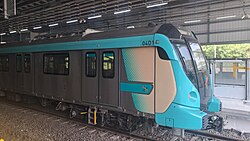
[[File:Metro_Line_3_Rake_at_Aarey_Metro_Station.jpg|thumb|300px|An Aqua line Driverless [[Alstom Metropolis]] departing [[Aarey JVLR metro station]], bound for [[Cuffe Parade]]]] | |||
A fully underground section of the metro, Line 3 is {{cvt|33.50|km|mi}} long, and has 27 stations.<ref name="CabinetClears">{{cite web|url=http://timesofindia.indiatimes.com/business/india-business/Cabinet-clears-Mumbai-Metros-third-line/articleshow/20826251.cms|title=Cabinet clears Mumbai Metro's third line|work=[[The Times of India]]|date=29 June 2013|access-date=7 July 2013}}</ref> The line connects the [[Cuffe Parade]] business district in the [[South Mumbai|south of Mumbai]] with [[SEEPZ]] and [[Aarey Forest|Aarey]] in the north.<ref name="business-standard">{{cite news|url=http://www.business-standard.com/article/pti-stories/further-delay-in-colaba-seepz-metro-as-govt-tweaks-bid-norms-114020401319_1.html|title=Further delay in Colaba-Seepz metro as govt tweaks bid norms | Business Standard|newspaper=Business Standard India|date=4 February 2014|publisher=business-standard.com|access-date=3 April 2014|agency=Press Trust of India}}</ref> It also passes through the Domestic and International terminals of Mumbai Airport, for which the airport operator ([[GVK (conglomerate)|GVK]]) has promised an equity infusion of {{INRConvert|777|c|2|lk=|year=2015}}. | |||
The cost of this corridor was estimated at {{INRConvert|23136|c|2|lk=|year=2017}}.<ref>{{cite web|url=http://www.mumbaimirror.com/mumbai/others/Mumbai-Metro-Line-3-plan-kicks-off/articleshow/20823732.cms|title=Mumbai Metro Line 3 plan kicks off|work=Mumbai Mirror|date=29 June 2013|access-date=7 July 2013}}</ref><ref>{{cite web|url=http://zeenews.india.com/business/news/economy/cabinet-approves-mumbai-metro-line-3-fm_78850.html|title=Cabinet approves Mumbai Metro Line 3: FM|publisher=Zee News|date=28 June 2013|access-date=7 July 2013}}</ref> The original deadline for the project was 2016, but it was extended due to several delays including COVID.<ref>{{Cite web |date=23 November 2023 |title=Mumbai Metro Aqua Line (3): Connecting the unconnected |url=https://www.moneycontrol.com/news/opinion/mumbai-metro-aqua-line-3-connecting-the-unconnected-11797381.html |access-date=24 November 2023 |website=Moneycontrol |language=en}}</ref><ref name="5lines">{{Cite web |date=4 March 2024 |title=Mumbai: Five New Metro Lines To Roll Out Next Year, Details Inside |url=https://www.lokmattimes.com/maharashtra/mumbai-five-new-metro-lines-to-roll-out-next-year-details-inside-a514/ |access-date=7 June 2024 |website=Lokmat Times |language=en}}</ref> A section of the corridor from Aarey Colony to BKC was opened on 5 October 2024.<ref>{{Cite web |date=2024-10-07 |title=BKC to Aarey stretch of Mumbai Metro Line 3 opens today — Know timings, fare, speed - CNBC TV18 |url=https://www.cnbctv18.com/india/mumbai-metro-line-3-bkc-to-aarey-jvlr-stretch-opens-today-know-timings-fare-speed-key-details-19488162.htm |access-date=2024-10-12 |website=CNBCTV18 |language=en}}</ref><ref>{{Cite web |date=2024-10-07 |title=Mumbai Metro-3 Second Phase On Track: Aarey-BKC Services Begin, Link To Cuffe Parade May Be Ready by 2025 |url=https://www.news18.com/india/mumbai-metro-3-second-phase-on-track-aarey-bkc-services-begin-bkc-to-cuffe-parade-link-may-be-ready-by-2025-9076938.html |access-date=2024-10-12 |website=News18 |language=en}}</ref> This section cost ₹14,120 crore, and consists of 10 stations in a {{Convert|12.44|km|abbr=on}} stretch. The stretch from BKC to [[Acharya Atre Chowk metro station|Acharya Atre Chowk]], consisting of six stations was opened on 10 May 2025.<ref>{{Cite news |date=2025-05-10 |title=Metro Line 3 (Aqua Line): Big relief for Mumbai commuters, BKC to Worli stretch now operational |url=https://timesofindia.indiatimes.com/city/mumbai/metro-line-3-aqua-line-big-relief-for-mumbai-commuters-bkc-to-worli-stretch-now-operational/articleshow/121051289.cms |access-date=2025-05-10 |work=The Times of India |issn=0971-8257}}</ref> The remaining 10.99 km long final stretch from Acharya Atre Chowk to [[Cuffe Parade metro station|Cuffe Parade]] was opened on 8 October 2025. | |||
The line | The line has interchanges with the [[Blue Line (Mumbai Metro)|Blue Line 1]] at [[Marol Naka metro station|Marol Naka]], under-construction [[Pink Line (Mumbai Metro)|Pink Line 6]] at [[Aarey JVLR metro station|Aarey JVLR]], under-construction [[Red Line (Mumbai Metro)|Red Line 7A]] and proposed [[Gold Line (Mumbai Metro)|Gold Line 8]] at CSMI Airport T-2, under-construction [[Yellow Line (Mumbai Metro)|Yellow Line 2B]] at [[Bandra Kurla Complex metro station|BKC]], [[Central line (Mumbai Suburban Railway)|Central Line]] & proposed [[Green Line (Mumbai Metro)|Green Line 11]] at [[Chhatrapati Shivaji Maharaj Terminus]], [[Mumbai Monorail]] at Mahalaxmi (Sant Gadge Maharaj Chowk) and [[Western line (Mumbai Suburban Railway)|Western Line]] at [[Dadar railway station|Dadar]], [[Mahalaxmi railway station|Mahalaxmi]], [[Mumbai Central railway station|Mumbai Central]], [[Grant Road railway station|Grant Road]] and [[Churchgate railway station|Churchgate]]. | ||
==={{rcb|Mumbai Metro|green|route}}=== | |||
{{main|Green Line (Mumbai Metro)}} | |||
The construction of | The {{Cvt|60.409|km|}} long Mira Bhayandar-Gaimukh-Kasarvadavali-Wadala connection will be fully elevated and have 38 stations. During the construction, this main line was divided into 3 smaller lines - Line 4 ({{stl|Mumbai Metro|Kasarvadavali}} to {{stl|Mumbai Metro|Bhakti Park (Wadala)}}), Line 4A ({{stl|Mumbai Metro|Kasarvadavali}} to {{stl|Mumbai Metro|Gaimukh}}), and the northwestern extension Line 10 ({{stl|Mumbai Metro|Gaimukh}} to {{stl|Mumbai Metro|Shivaji Chowk (Mira Road)}}). After giving proposed southern extension Line 11 from MMRDA to MMRC, there was a new, more central alignment announced to be a spur line from {{stl|Mumbai Metro|Anik Nagar Bus Depot}} to [[Gateway of India]] via Byculla. | ||
MMRCL has also proposed an extension of this line to [[Dharavi]], providing a connection with the Aqua line under the Dharavi Multi Modal Transport Hub (MMTH) Project. The extension contains 2 stations, including another station in [[Sion, Mumbai|Sion]]. | |||
Construction of Line 4 started in October 2018 while the construction of Line 4A started in September 2019. Meanwhile, the proposed Line 10 is currently under environmental review. Line 11 started construction at Zakaria Bunder Rd, but is on hold now, while other sections are still undergoing soil testing. 34 of the 38 elevated stations of the main line are under construction. In addition, the proposed new spur Line 11 has 15 stations of which 13 are proposed to be underground and the remaining 2 are elevated.<ref>{{cite web|url=https://themetrorailguy.com/2024/07/28/mmrc-publishes-mumbai-metro-line-11s-revised-alignment-map/|title=MMRC Publishes Mumbai Metro Line 11's Revised Alignment Map|publisher=TheMetroRailGuy|date=28 July 2024|access-date=2025-06-10}}</ref> | |||
==={{ | ==={{rcb|Mumbai Metro|orange|route}} === | ||
{{ | {{Main|Orange Line (Mumbai Metro)}} | ||
The | The {{Cvt|45.70|km|}}-long Thane-Bhiwandi-Kalyan-Taloja line will have 34 stations. During construction, the line was divided into 2 smaller lines - Line 5 ({{stl|Mumbai Metro|Kapurbawdi}} to {{stl|Mumbai Metro|Kalyan APMC}}) and Line 12 ({{stl|Mumbai Metro|Kalyan APMC}} to {{stl|Mumbai Metro|Taloja}}). Construction of Line 5 began in February 2020. However, the section from Bhiwandi to Kalyan APMC was put on hold by the State Government. Meanwhile, the construction of Line 12 started in March 2020. The line majorly elevated except for a small underground section in Bhiwandi. The line has a total of 34 stations of which 33 stations are elevated while the station in Bhiwandi is set to be the only underground station in the line. | ||
The | The line was approved by Chief Minister Devendra Fadnavis on 19 October 2016. The {{Convert|12,.811|km|abbr=on}} Thane – Bhiwandi section is under construction. Bhiwandi – Kalyan is on-hold (route modification in progress).<ref>{{cite web|title=MMRDA seeks nod to take Mumbai's Metro Line 5 underground|url=https://www.constructionworld.in/transport-infrastructure/metro-rail-and-railways-infrastructure/mmrda-seeks-nod-to-take-mumbai---s-metro-line-5-underground/35810}}</ref> The corridor is being constructed by [[Shapoorji Pallonji Group|Afcons]] in one package from Kalyan to Bhiwandi including 7 stations. | ||
==={{rcb|Mumbai Metro|pink|route}}=== | |||
{{main|Pink Line (Mumbai Metro)}} | |||
The {{convert|14.47|km|mi|abbr=on}} long Lokhandwala-Jogeshwari-Vikhroli-Kanjurmarg Metro-VI corridor will have 13 stations and cost ₹6,672 crore. It will be an elevated corridor. It will connect [[Lokhandwala Complex]] in Andheri in the western suburbs to [[Vikhroli]] and [[Kanjur Marg|Kanjurmarg]] in the eastern suburbs. The stations include Lokhandwala Complex, Adarsh Nagar, Momin Nagar, JVLR, Shyam Nagar, Mahakali Caves, SEEPZ Village, Saki Vihar Road, Ram Baug, Powai Lake, IIT Powai, Kanjurmarg (West), Vikhroli-Eastern Express Highway. | |||
Metro 6 will provide interchange with Metro 2 at Infinity Mall in Andheri, with Metro 3 at SEEPZ, with Metro 4 and the Mumbai Suburban Railway at Jogeshwari and Kanjurmarg, and with Metro 7 at JVLR.<ref>{{cite web|title=Mumbai's east-west connectivity to get a boost with another Metro corridor|url=http://www.hindustantimes.com/mumbai-news/mumbai-s-east-west-connectivity-to-get-a-boost-with-another-metro-corridor/story-TYqh3bLxtzHek6IJtjfYaM.html|website=Hindustan Times|access-date=2 March 2017|language=en|date=2 March 2017}}</ref> | |||
= | The line was approved by Chief Minister [[Devendra Fadnavis]] on 19 October 2016.<ref name="business-standard.com">{{cite news|title=New metro lines for Mumbai and Thane; project to cost Rs 15,000 crore|url=http://www.business-standard.com/article/economy-policy/new-metro-lines-for-mumbai-and-thane-project-to-cost-rs-15-000-crore-116101900847_1.html|website=Business Standard India|access-date=12 February 2017|date=19 October 2016}}</ref><ref name="dnaindia.com">{{cite web|title=Kalyan-Thane, Lokhandwala-Kanjurmarg metro lines get approval|url=http://www.dnaindia.com/mumbai/report-kalyan-thane-lokhandwala-kanjurmarg-metro-lines-get-approval-2265755|website=dna|access-date=12 February 2017|date=20 October 2016}}</ref> The MMRDA issued a tender to conduct a detailed aerial mapping survey of the alignment in April 2017. Authorities will also be able to determine the location of trees along the alignment accuracy of up to 10 cm utilizing a differential GPS (DGPS), while a digital aerial triangulation system will help determine the types of trees, their heights and diameters.<ref>{{cite web|title=MMRDA to begin tree count for Metro 6|url=http://www.mid-day.com/articles/mmrda-to-begin-tree-count-for-metro-6/18142172|website=mid-day|date=6 April 2017|access-date=6 April 2017|language=en}}</ref> | ||
==={{rcb|Mumbai Metro|red|route}}=== | |||
{{main|Red Line (Mumbai Metro)}} | |||
This corridor is {{Cvt|31.045|km|}} long Mira Bhayandar-Dahisar (East)-Gundavali-Chhatrapati Shivaji Maharaj International Airport corridor will have 23 stations. During construction the line was divided into 3 smaller lines - Line 7 ({{stl|Mumbai Metro|Dahisar (East)}} to {{stl|Mumbai Metro|Gundavali}}), Line 7A ({{stl|Mumbai Metro|Gundavali}} to {{stl|Mumbai Metro|Chhatrapati Shivaji Maharaj International Airport - T2}}), and Line 9 ({{stl|Mumbai Metro|Subhash Chandra Bose Stadium}} to {{stl|Mumbai Metro|Dahisar (East)}}). Construction of Line 7 began in August 2016, meanwhile Line 7A and Line 9 started their construction in March 2020. The line is majorly elevated with the Airport section being the only section underground. There are a total of 22 stations in the line of which 21 are elevated and 1 underground. | |||
A section of the line from Dahisar East to Aarey (along with the section of Yellow Line from Dahanukarwadi to Dahisar (East)) was opened on 2 April 2022, by the then CM [[Uddhav Thackeray]]. The next section of the line (along with the final section of Yellow Line 2A from Dahanukarwadi to Andheri (West)) was inaugurated on 19 January 2023 by Prime Minister [[Narendra Modi]]. | |||
==={{ | ==={{rcb|Mumbai Metro|gold|route}}=== | ||
{{main|Gold Line (Mumbai Metro)}} | |||
This is a proposed metro line between the [[Chhatrapati Shivaji Maharaj International Airport]] and the [[Navi Mumbai International Airport]].<ref name="MMRDA_L8plans">{{Cite web|url=https://mmrda.maharashtra.gov.in/metro-line-8|title=Mumbai Metropolitan Region Development Authority - Metro Line - 8|website=mmrda.maharashtra.gov.in}}{{Dead link|date=September 2023 |bot=InternetArchiveBot |fix-attempted=yes }}</ref> It will connect Mumbai airport to upcoming Navi Mumbai airport and its length would be approx 32 km. The corridor was initially to be executed by MMRDA, however, as per a government resolution (GR), the City & Industrial Development Corporation (CIDCO) has been appointed as the nodal agency to execute it under a PPP Model. | |||
It's expected to cost ₹15,000 crore and finish construction by October 2026. The line has an anticipated daily ridership of 3 lakh.<ref>https://mmrda.maharashtra.gov.in/documents/10180/11273712/62%2C943+cr+for+METRO+PROJECTS.pdf/cb92ba27-a1af-45d5-8047-7e145368e7cb{{Dead link|date=April 2020 |bot=InternetArchiveBot |fix-attempted=yes }}</ref> | |||
==={{rcb|Mumbai Metro|purple|route}}=== | |||
It is a proposed metro project to connect [[Mira Road]] with [[Virar]]. The project length is {{Cvt|23|km}} and the estimated cost of the project is ₹6,900 crore. | |||
==={{ | ==={{rcb|Mumbai Metro|magenta|route}}=== | ||
It is an approved metro project to connect Kanjurmarg to [[Ambarnath]]-[[Badlapur]]. It will have an intersection at Kanjurmarg with Line 6, the Pink Line. This project is now at the DPR stage. The project length is {{convert|45|km|mi|abbr=on}} and the estimated cost of the project is ₹13,500 crore. | |||
It is an approved metro project to connect | |||
It will have an intersection at Kanjurmarg with | |||
This project is now at the DPR stage. | |||
The project length is 45 | |||
<gallery widths="200px" heights="200px"> | <gallery widths="200px" heights="200px"> | ||
MumbaiMetroOne(747).jpg|[[Railcar]]s of the Mumbai Metro in 2010 | MumbaiMetroOne(747).jpg|[[Railcar]]s of the Mumbai Metro in 2010 | ||
Mumbai Metro Inside.jpg|Interior of a metro train | Mumbai Metro Inside.jpg|Interior of a metro train | ||
Trial Run of Metro.JPG|A metro train on an elevated [[viaduct]] | Trial Run of Metro.JPG|A metro train on an elevated [[viaduct]] | ||
Metro Bridge.jpg|Metro bridge, part of the Mumbai Metro | Metro Bridge.jpg|Metro bridge, part of the Mumbai Metro | ||
</gallery> | </gallery> | ||
==Rolling stock== | ==Rolling stock== | ||
Reliance Infrastructure consulted a number of major international [[rolling stock]] builders to provide the train fleet for the Mumbai Metro. Bidders for the contract included established metro-vehicle manufacturers such as [[Kawasaki Heavy Industries|Kawasaki]], [[Alstom]], [[Siemens Mobility|Siemens]] and [[Bombardier Transportation|Bombardier]], but [[CRRC Nanjing Puzhen]] of China was ultimately chosen to supply rolling stock for ₹600 crore.<ref name=RGI250310>[https://web.archive.org/web/20150306185020/http://www.railwaygazette.com/news/single-view/view/mumbais-beautiful-butterfly-emerges.html Mumbai's beautiful butterfly emerges] ''[[Railway Gazette International]]'' 25 March 2010</ref><ref>{{cite web |url=http://www.mumbai-metro.com/projec-update |title=Mumbai Metro One Project updates |publisher=mumbai-metro.com |access-date=25 August 2010 |url-status=dead |archive-url=https://web.archive.org/web/20111118081246/http://www.mumbai-metro.com/projec-update |archive-date=18 November 2011 | Reliance Infrastructure consulted a number of major international [[rolling stock]] builders to provide the train fleet for the Mumbai Metro. Bidders for the contract included established metro-vehicle manufacturers such as [[Kawasaki Heavy Industries|Kawasaki]], [[Alstom]], [[Siemens Mobility|Siemens]] and [[Bombardier Transportation|Bombardier]], but [[CRRC Nanjing Puzhen]] of China was ultimately chosen to supply rolling stock for ₹600 crore.<ref name=RGI250310>[https://web.archive.org/web/20150306185020/http://www.railwaygazette.com/news/single-view/view/mumbais-beautiful-butterfly-emerges.html Mumbai's beautiful butterfly emerges] ''[[Railway Gazette International]]'' 25 March 2010</ref><ref>{{cite web |url=http://www.mumbai-metro.com/projec-update |title=Mumbai Metro One Project updates |publisher=mumbai-metro.com |access-date=25 August 2010 |url-status=dead |archive-url=https://web.archive.org/web/20111118081246/http://www.mumbai-metro.com/projec-update |archive-date=18 November 2011 }}</ref> In May 2008, CSR Nanjing completed the first 16 trains, each comprising four cars.<ref name=RGI250310/> The first ten trains were reported to be ready for operation in January 2013.<ref name=January2013Where>{{cite web|url=http://www.dnaindia.com/mumbai/report_mumbai-metro-trains-rearing-to-run-but-where-are-tracks_1791594|publisher=DNAIndia|title=Mumbai metro trains raring to run, but where are tracks?|date=23 January 2013|access-date=6 February 2013}}</ref> | ||
The coaches are [[fire retardant]],<ref>[http://www.dnaindia.com/mumbai/1829482/report-a-mumbai-metro-train-every-three-minutes "A Mumbai Metro train every three minutes"]. DNA India. 1 May 2013. Retrieved 7 July 2013.</ref> [[air-conditioned]] and designed to reduce noise and vibration, and will feature both high [[seating capacity]] and ample space for standing passengers. They will be outfitted with a number of features for safety and convenience, including [[LCD]] screens, 3D route maps, first-aid kits, wheelchair facilities, fire-fighting equipment and intercom systems permitting communication with the train driver. Each coach will furthermore feature a [[Train event recorder|black box]] to assist in accident investigations.<ref name="ToI70">[https://web.archive.org/web/20130928033938/http://articles.timesofindia.indiatimes.com/2011-10-11/mumbai/30266316_1_pillars-metro-rail-mmopl "Metro first line hinges on Andheri bridge"]. ''[[Times of India]]''. 11 October 2011. Retrieved 18 October 2011.</ref> The trains will be capable of carrying over 1,100 passengers in a four-car unit, with each carriage being approximately {{convert|2 | The coaches are [[fire retardant]],<ref>[http://www.dnaindia.com/mumbai/1829482/report-a-mumbai-metro-train-every-three-minutes "A Mumbai Metro train every three minutes"]. DNA India. 1 May 2013. Retrieved 7 July 2013.</ref> [[air-conditioned]] and designed to reduce noise and vibration, and will feature both high [[seating capacity]] and ample space for standing passengers. They will be outfitted with a number of features for safety and convenience, including [[LCD]] screens, 3D route maps, first-aid kits, wheelchair facilities, fire-fighting equipment and intercom systems permitting communication with the train driver. Each coach will furthermore feature a [[Train event recorder|black box]] to assist in accident investigations.<ref name="ToI70">[https://web.archive.org/web/20130928033938/http://articles.timesofindia.indiatimes.com/2011-10-11/mumbai/30266316_1_pillars-metro-rail-mmopl "Metro first line hinges on Andheri bridge"]. ''[[Times of India]]''. 11 October 2011. Retrieved 18 October 2011.</ref> The trains will be capable of carrying over 1,100 passengers in a four-car unit, with each carriage being approximately {{convert|3.2|m|ftin}} wide.<ref>{{cite web|last=Katkurwar |first=Saurabh |url=http://www.mid-day.com/news/2012/feb/260212-CIDCO-opts-for-wider-metro-coaches.htm |title=CIDCO opts for wider metro coaches |publisher=[[MiD DAY]] |date=26 February 2012 |access-date=28 March 2012}}</ref> | ||
In 2018, the [[Mumbai Metro Rail Corporation]] chose [[Alstom]] to supply 31 eight car trains for [[Line 3 (Mumbai Metro)|Aqua line (line 3)]]. | In 2018, the [[Mumbai Metro Rail Corporation]] chose [[Alstom]] to supply 31 eight car trains for [[Line 3 (Mumbai Metro)|Aqua line (line 3)]]. These trains are capable of driverless operations and were built at Alstom's factory in [[Sri City]], [[Andhra Pradesh]].<ref>{{cite web|access-date=13 April 2020|title=Mumbai Metro Line 3: Alstom wins 'Make in India' contract for modern train sets worth 315 million euros|url=https://www.financialexpress.com/infrastructure/mumbai-metro-line-3-alstom-wins-make-in-india-contract-for-modern-train-sets-worth-315-million-euros/1309591/|date=11 September 2018|first=Devanjana|last=Nag|website=[[The Financial Express (India)|The Financial Express]]}}</ref> | ||
In 2018, [[Mumbai Metropolitan Region Development Authority]] which will operate all metro lines except Line 3, awarded a tender to [[Bharat Earth Movers]] ( | In 2018, [[Mumbai Metropolitan Region Development Authority]] which will operate all metro lines except Line 3, awarded a tender to [[Bharat Earth Movers Ltd.]] (BEML) to supply 63 trainsets (378 coaches) for [[Line 2 (Mumbai Metro)|Yellow Line (Line 2)]] and [[Line 7 (Mumbai Metro)|Red Line (Line 7)]] at a cost of ₹3,015 crores ($427.33 million). Capable of driverless operations, the trains are manufactured at BEML's factory in [[Bengaluru]] and the first train set for the Yellow Line arrived in [[Mumbai]] on 27 January 2021, and will continue to receive the rest of the sets until 2022.<ref name="beml3015">{{cite news |title=BEML receives order worth Rs 3015 crore for Mumbai Metro |url=https://www.business-standard.com/article/news-cm/beml-receives-order-worth-rs-3015-crore-for-mumbai-metro-118112400212_1.html |access-date=30 November 2018 |work=Capital Market |publisher=Business Standard |date=24 November 2018}}</ref><ref name="beml427">{{cite news |title=BEML secures $427.33m Mumbai metro car supply contract |url=https://www.railway-technology.com/news/beml-secures-427-33m-mumbai-metro-car-supply-contract/ |access-date=30 November 2018 |publisher=Railway Technology |date=26 November 2018}}</ref> On 17 January 2021, [[Bombardier Transportation|Bombardier]] won the tender to supply 234 driverless coaches for the [[Line 4 (Mumbai Metro)|Green Line (Line 4)]] of six-car configuration for Mumbai metro. However, the contract was cancelled in March 2022 due to delays and uncertainties of the project.<ref>{{cite news|url=https://www.railjournal.com/fleet/alstom-terminates-mumbai-line-4-fleet-contract/|title=Alstom terminates Mumbai Line 4 fleet contract|date=10 March 2022|access-date=6 April 2022}}</ref><ref>{{cite news|url=https://www.moneycontrol.com/news/business/economy/alstom-cancels-order-bagged-from-mmrda-for-supply-of-coaches-for-mumbai-metro-4-8195151.html|title=Alstom cancels order bagged from MMRDA for supply of coaches for Mumbai Metro 4|date=4 March 2022|accessdate=6 April 2022}}</ref> In August 2025, the MMRDA awarded a contract to [[Larsen & Toubro|L&T]] to supply 39 trainsets of 6 cars each for the Green Line (Line 4), to be manufactured by Alstom as part of an integrated systems package.<ref>{{cite news |last1=Sharma |first1=Swastika Das |title=Mumbai Metro Line 4 to get 39 driverless trainsets soon: Designed for comfort, made in India, check details |url=https://www.livemint.com/industry/infrastructure/mumbai-metro-line-4-to-get-39-driverless-trainsets-soon-designed-for-comfort-made-in-india-check-details-11756202909591.html |access-date=16 November 2025 |work=mint |date=26 August 2025 |language=en}}</ref> In the absence of a depot and delay in procuring rolling stock, the MMRDA also decided to temporarily transport eight idle trains from the Mandale depot on the Yellow Line to the Green Line to commence trials on a section of the line.<ref>{{cite news |title=Metro 4 to be first line to begin operations sans a depot |url=https://www.hindustantimes.com/cities/mumbai-news/metro-4-to-be-first-line-to-begin-operations-sans-a-depot-101752520866092.html |access-date=16 November 2025 |work=Hindustan Times |date=15 July 2025 |language=en}}</ref> | ||
In 2025, the MMRDA awarded two contracts to [[Titagarh Rail Systems]] for 108 coaches and 132 coaches to be delivered for the [[Orange Line (Mumbai Metro)|Orange Line]] and [[Pink Line (Mumbai Metro)|Pink Line]] respectively.<ref>{{cite news |title=Titagarh Rail Systems bags Rs 1,600-crore contract to supply 108 coaches to Mumbai Metro |url=https://economictimes.indiatimes.com/industry/transportation/railways/titagarh-rail-systems-bags-rs-1600-crore-contract-to-supply-108-coaches-to-mumbai-metro/articleshow/123094543.cms?from=mdr |access-date=16 November 2025 |work=The Economic Times |date=4 August 2025}}</ref><ref>{{cite news |title=Titagarh Rail bags ₹2,481 crore order from MMRDA for Mumbai Metro Line 5 |url=https://www.business-standard.com/companies/news/titagarh-rail-bags-2-481-crore-order-from-mmrda-for-mumbai-metro-line-5-125103101477_1.html |access-date=16 November 2025}}</ref> | |||
==Power supply== | ==Power supply== | ||
Mumbai Metro runs on alternating current (AC) which is typically more labour and cost-intensive. MMRDA joint project director Dilip Kawathkar stated that AC power was chosen "''after a proper study by a team of experts''" which found that the AC model was "a better option". Bidders for Line 3 were reportedly in favour of the DC model. Experts believe that the decision to use AC will escalate the project cost of underground lines by 15%, since more digging is required for the rail to work on AC.<ref>{{Cite web|url=https://www.mid-day.com/articles/mumbai-s-metro-3-will-be-one-of-the-few-in-the-world-to-run-on-ac/15298168|title=Mumbai's Metro-3 will be one of the few in the world to run on AC|date=15 May 2014|website=mid-day}}</ref> | |||
==Signalling and communications== | ==Signalling and communications== | ||
The Mumbai Metro will feature an advanced [[railway signal|signalling]] system, including an automatic [[train protection system]] (ATPS) and automated signalling to control train movements on the {{convert|11|km|mi|adj=on}} Line 1. A four-minute service interval is anticipated on the route.<ref name="Mummetro">{{cite web|url=http://www.mmrdamumbai.org/|title=Mumbai Metro project|publisher=[[MMRDA]]|date=1 January 2008|access-date=1 January 2010}}</ref> | The Mumbai Metro will feature an advanced [[railway signal|signalling]] system, including an automatic [[train protection system]] (ATPS) and automated signalling to control train movements on the {{convert|11|km|mi|adj=on}} Line 1. A four-minute service interval is anticipated on the route.<ref name="Mummetro">{{cite web|url=http://www.mmrdamumbai.org/|title=Mumbai Metro project|publisher=[[MMRDA]]|date=1 January 2008|access-date=1 January 2010|archive-date=31 August 2009|archive-url=https://web.archive.org/web/20090831070601/http://www.mmrdamumbai.org/|url-status=dead}}</ref> | ||
[[Siemens]] will supply the signalling systems required for the project, while [[Thales Group]] will supply the Metro's communication systems. The network's signalling and train control systems will be based on LZB 700M technology.<ref name="Contracts">{{cite web|url=http://www.projectstoday.com/News/NewsDetails.aspx?smid=16&nid=22722|title=MMOPL awards contract to ABB, Siemens, SEW |publisher=Projects Today|date=8 January 2008|access-date=15 January 2010}}</ref> | [[Siemens]] will supply the signalling systems required for the project, while [[Thales Group]] will supply the Metro's communication systems. The network's signalling and train control systems will be based on LZB 700M technology.<ref name="Contracts">{{cite web|url=http://www.projectstoday.com/News/NewsDetails.aspx?smid=16&nid=22722|title=MMOPL awards contract to ABB, Siemens, SEW |publisher=Projects Today|date=8 January 2008|access-date=15 January 2010}}</ref> | ||
==Ridership== | ==Ridership and Impact== | ||
On 21 October 2019, | In October 2025 after the Aqua line became fully operational, the average daily ridership on all Mumbai Metro lines is approximately 900,000 per day, with Blue line at about 460,000, followed by Yellow plus Red at 260,000 and Aqua at 160,000 daily average ridership. On 21 October 2019, 1,960 days (approx. 5 years) after Mumbai Metro Line 1's inception, the system crossed 600 million passengers, with an average daily ridership of around 450,000 passengers.<ref>{{cite news |url=https://timesofindia.indiatimes.com/city/mumbai/versova-ghatkopar-metro-one-crosses-60-crore-ridership-in-5-years/articleshow/71679574.cms |title=Versova-Ghatkopar Metro One crosses 60 crore ridership in 5 years |work=The Times of India |date=21 October 2019 |access-date=21 October 2019}}</ref> Opening of subsequent lines has relieved pressure on the [[Mumbai Suburban Railway]], which had become over congested and unsafe due to open doors, unlike the Metro which has closed door air-conditioned coaches.<ref>{{Cite web|url= https://www.msn.com/en-in/news/India/major-relief-for-mumbai-commuters-as-metro-line-2b-trial-run-begins/ar-AA1D1yMQ|title= Major relief for Mumbai commuters as Metro Line 2B trial run begins|website= [[MSN]]}}</ref> Furthermore, the Metro has been credited for sustainability due to reduced carbon emissions by employing energy saving methods like regenerative braking systems and cutting down traffic congestion, besides eco-friendly construction methods.<ref>{{cite web|url= https://www.mid-day.com/mumbai/mumbai-news/article/mumbai-metro-line-9-advancing-sustainable-growth-with-eco-friendly-infrastructure-23503310|title= Mumbai Metro Line-9: Advancing sustainable growth with eco-friendly infrastructure|date= 20 March 2025}}</ref> | ||
Furthermore, the Mumbai Metro has allowed bicycles with special racks for commuters at no extra charge on [[Red Line (Mumbai Metro)|Red]] and [[Yellow Line (Mumbai Metro)|Yellow]] lines.<ref>{{cite web|url= https://www.ndtv.com/offbeat/viral-video-man-travels-on-mumbai-metro-with-his-bicycle-calls-it-a-unique-adventure-4506135|title= Watch: Man Travels On Mumbai Metro With His Bicycle, Calls It A ''Unique Adventure''}}</ref> However, on [[Aqua Line (Mumbai Metro)|Aqua]] line, they are currently not allowed for crowd rush during peak hours, although officials plan to allow it on completion of the line, while on [[Blue Line (Mumbai Metro)|Blue]] line, foldable bicycles are allowed.<ref>{{cite web|url= https://www.msn.com/en-in/news/India/mumbai-no-cycles-allowed-on-metro-3-cyclists-claim-discrimination-against-riders/ar-AA1rZfHB|title= Mumbai: No Cycles Allowed On Metro 3, Cyclists Claim Discrimination Against Riders|website= [[MSN]]}}</ref> | |||
==See also== | ==See also== | ||
*[[Urban rail transit in India]] | *[[Urban rail transit in India]] | ||
*[[List of rapid transit systems]] | |||
*[[Public transport in Mumbai]] | |||
**[[Mumbai Suburban Railway]] | |||
**[[Brihanmumbai Electric Supply and Transport|BEST]] | |||
**[[Navi Mumbai Metro]] | **[[Navi Mumbai Metro]] | ||
**[[Thane Metro]] | **[[Thane Metro]] | ||
*[[ | *[[Mumbai Monorail]] | ||
*[[M-Indicator]] | *[[M-Indicator]] | ||
*[[Delhi Metro]] | |||
*[[Delhi–Meerut Regional Rapid Transit System|Delhi Meerut RRTS]] | |||
{{Clear}} | {{Clear}} | ||
{{Portal bar|Transport}} | |||
==References== | ==References== | ||
{{reflist|30em|refs= | {{reflist|30em|refs= | ||
<ref name="MMRDA plans to begin work">{{cite web|title=Mumbai: MMRDA plans to begin work on five more Metro lines by December|url=http://indianexpress.com/article/cities/mumbai/mumbai-mmrda-plans-to-begin-work-on-five-more-metro-lines-by-december-4602883/|website=The Indian Express|access-date=7 April 2017|date=7 April 2017}}</ref> | <!-- <ref name="MMRDA plans to begin work">{{cite web|title=Mumbai: MMRDA plans to begin work on five more Metro lines by December|url=http://indianexpress.com/article/cities/mumbai/mumbai-mmrda-plans-to-begin-work-on-five-more-metro-lines-by-december-4602883/|website=The Indian Express|access-date=7 April 2017|date=7 April 2017}}</ref> --> | ||
}} | }} | ||
==External links== | ==External links== | ||
{{ | {{commons category|Mumbai Metro}} | ||
{{Wikivoyage|Mumbai}} | |||
{{Rapid transit OSM map|display=title|text=Metro map}} | |||
*[https://web.archive.org/web/20120319164955/http://202.54.119.40/projects_metro_rail.htm Mumbai Metro Rail Project - MMRDA site] | *[https://web.archive.org/web/20120319164955/http://202.54.119.40/projects_metro_rail.htm Mumbai Metro Rail Project - MMRDA site] | ||
*[ | *[https://mumbaimetrorail.blogspot.com/ Mumbai Metro blog site] | ||
*[https://web.archive.org/web/20190627205221/http://mumbai-metro.com/ Mumbai Metro unofficial magazine] | *[https://web.archive.org/web/20190627205221/http://mumbai-metro.com/ Mumbai Metro unofficial magazine] | ||
*[https://trainonrails.com/metro-trains/mumbai/route/ghatkopar-mumbai-metro-station-to-andheri-mumbai-metro-station Mumbai Metro unofficial Information Site] | |||
{{Mumbai Metro navbox}} | {{Mumbai Metro navbox|all=yes}} | ||
{{Maharashtra transit}} | {{Maharashtra transit}} | ||
{{Rapid transit in India}} | {{Rapid transit in India}} | ||
{{Rapid transit in Asia}} | {{Rapid transit in Asia}} | ||
{{Mumbai topics}} | {{Mumbai topics}} | ||
{{Use dmy dates|date=October | {{Use dmy dates|date=October 2024}} | ||
[[Category:Mumbai Metro| ]] | [[Category:Mumbai Metro| ]] | ||
[[Category:Transport in Mumbai]] | [[Category:Transport in Mumbai]] | ||
[[Category:Underground rapid transit in India]] | [[Category:Underground rapid transit in India]] | ||
[[Category:Standard gauge railways in India]] | [[Category:Standard-gauge railways in India]] | ||
[[Category:25 kV AC railway electrification]] | [[Category:25 kV AC railway electrification]] | ||
[[Category:2014 establishments in Maharashtra]] | [[Category:2014 establishments in Maharashtra]] | ||
[[Category:Railway lines opened in 2014]] | [[Category:Railway lines opened in 2014]] | ||
Latest revision as of 21:01, 22 March 2026
 | ||||||||||||||||||||||||||||||||||||||||||||||||||||||||||||||||||||||||||||||||||||||||||||||||||||||||||||||||||||||||||||||||||||||||||||||||||||||||||||||||||||||||||||||||||||||||||||||||||||||||||||||||||||||||||||||||||||||||||||||||||||||||||||||||||||||||||||||||||||||||||||||||||||||||||||||||||||||||||||||||||||||||||||||||||||||||||||||||||||||||||||||||||||||||||||
 Mumbai Metro at Gundavali Station | ||||||||||||||||||||||||||||||||||||||||||||||||||||||||||||||||||||||||||||||||||||||||||||||||||||||||||||||||||||||||||||||||||||||||||||||||||||||||||||||||||||||||||||||||||||||||||||||||||||||||||||||||||||||||||||||||||||||||||||||||||||||||||||||||||||||||||||||||||||||||||||||||||||||||||||||||||||||||||||||||||||||||||||||||||||||||||||||||||||||||||||||||||||||||||||
| Overview | ||||||||||||||||||||||||||||||||||||||||||||||||||||||||||||||||||||||||||||||||||||||||||||||||||||||||||||||||||||||||||||||||||||||||||||||||||||||||||||||||||||||||||||||||||||||||||||||||||||||||||||||||||||||||||||||||||||||||||||||||||||||||||||||||||||||||||||||||||||||||||||||||||||||||||||||||||||||||||||||||||||||||||||||||||||||||||||||||||||||||||||||||||||||||||||
|---|---|---|---|---|---|---|---|---|---|---|---|---|---|---|---|---|---|---|---|---|---|---|---|---|---|---|---|---|---|---|---|---|---|---|---|---|---|---|---|---|---|---|---|---|---|---|---|---|---|---|---|---|---|---|---|---|---|---|---|---|---|---|---|---|---|---|---|---|---|---|---|---|---|---|---|---|---|---|---|---|---|---|---|---|---|---|---|---|---|---|---|---|---|---|---|---|---|---|---|---|---|---|---|---|---|---|---|---|---|---|---|---|---|---|---|---|---|---|---|---|---|---|---|---|---|---|---|---|---|---|---|---|---|---|---|---|---|---|---|---|---|---|---|---|---|---|---|---|---|---|---|---|---|---|---|---|---|---|---|---|---|---|---|---|---|---|---|---|---|---|---|---|---|---|---|---|---|---|---|---|---|---|---|---|---|---|---|---|---|---|---|---|---|---|---|---|---|---|---|---|---|---|---|---|---|---|---|---|---|---|---|---|---|---|---|---|---|---|---|---|---|---|---|---|---|---|---|---|---|---|---|---|---|---|---|---|---|---|---|---|---|---|---|---|---|---|---|---|---|---|---|---|---|---|---|---|---|---|---|---|---|---|---|---|---|---|---|---|---|---|---|---|---|---|---|---|---|---|---|---|---|---|---|---|---|---|---|---|---|---|---|---|---|---|---|---|---|---|---|---|---|---|---|---|---|---|---|---|---|---|---|---|---|---|---|---|---|---|---|---|---|---|---|---|---|---|---|---|---|---|---|---|---|---|---|---|---|---|---|---|---|---|---|---|---|---|---|---|---|---|---|---|---|---|---|---|---|---|---|---|---|---|---|---|---|---|---|---|---|---|---|---|---|---|---|---|---|---|---|---|
| Owner |
| |||||||||||||||||||||||||||||||||||||||||||||||||||||||||||||||||||||||||||||||||||||||||||||||||||||||||||||||||||||||||||||||||||||||||||||||||||||||||||||||||||||||||||||||||||||||||||||||||||||||||||||||||||||||||||||||||||||||||||||||||||||||||||||||||||||||||||||||||||||||||||||||||||||||||||||||||||||||||||||||||||||||||||||||||||||||||||||||||||||||||||||||||||||||||||
| Area served | Mumbai Metropolitan Region | |||||||||||||||||||||||||||||||||||||||||||||||||||||||||||||||||||||||||||||||||||||||||||||||||||||||||||||||||||||||||||||||||||||||||||||||||||||||||||||||||||||||||||||||||||||||||||||||||||||||||||||||||||||||||||||||||||||||||||||||||||||||||||||||||||||||||||||||||||||||||||||||||||||||||||||||||||||||||||||||||||||||||||||||||||||||||||||||||||||||||||||||||||||||||||
| Locale | Mumbai | |||||||||||||||||||||||||||||||||||||||||||||||||||||||||||||||||||||||||||||||||||||||||||||||||||||||||||||||||||||||||||||||||||||||||||||||||||||||||||||||||||||||||||||||||||||||||||||||||||||||||||||||||||||||||||||||||||||||||||||||||||||||||||||||||||||||||||||||||||||||||||||||||||||||||||||||||||||||||||||||||||||||||||||||||||||||||||||||||||||||||||||||||||||||||||
| Transit type | Train | |||||||||||||||||||||||||||||||||||||||||||||||||||||||||||||||||||||||||||||||||||||||||||||||||||||||||||||||||||||||||||||||||||||||||||||||||||||||||||||||||||||||||||||||||||||||||||||||||||||||||||||||||||||||||||||||||||||||||||||||||||||||||||||||||||||||||||||||||||||||||||||||||||||||||||||||||||||||||||||||||||||||||||||||||||||||||||||||||||||||||||||||||||||||||||
| Number of lines |
| |||||||||||||||||||||||||||||||||||||||||||||||||||||||||||||||||||||||||||||||||||||||||||||||||||||||||||||||||||||||||||||||||||||||||||||||||||||||||||||||||||||||||||||||||||||||||||||||||||||||||||||||||||||||||||||||||||||||||||||||||||||||||||||||||||||||||||||||||||||||||||||||||||||||||||||||||||||||||||||||||||||||||||||||||||||||||||||||||||||||||||||||||||||||||||
| Line number | Operational
| |||||||||||||||||||||||||||||||||||||||||||||||||||||||||||||||||||||||||||||||||||||||||||||||||||||||||||||||||||||||||||||||||||||||||||||||||||||||||||||||||||||||||||||||||||||||||||||||||||||||||||||||||||||||||||||||||||||||||||||||||||||||||||||||||||||||||||||||||||||||||||||||||||||||||||||||||||||||||||||||||||||||||||||||||||||||||||||||||||||||||||||||||||||||||||
| Number of stations | 68 | |||||||||||||||||||||||||||||||||||||||||||||||||||||||||||||||||||||||||||||||||||||||||||||||||||||||||||||||||||||||||||||||||||||||||||||||||||||||||||||||||||||||||||||||||||||||||||||||||||||||||||||||||||||||||||||||||||||||||||||||||||||||||||||||||||||||||||||||||||||||||||||||||||||||||||||||||||||||||||||||||||||||||||||||||||||||||||||||||||||||||||||||||||||||||||
| Daily ridership | 7.47 lakh (0.74 million, 2024-25) | |||||||||||||||||||||||||||||||||||||||||||||||||||||||||||||||||||||||||||||||||||||||||||||||||||||||||||||||||||||||||||||||||||||||||||||||||||||||||||||||||||||||||||||||||||||||||||||||||||||||||||||||||||||||||||||||||||||||||||||||||||||||||||||||||||||||||||||||||||||||||||||||||||||||||||||||||||||||||||||||||||||||||||||||||||||||||||||||||||||||||||||||||||||||||||
| Annual ridership | 27.3 crore (273 million, 2024-25) | |||||||||||||||||||||||||||||||||||||||||||||||||||||||||||||||||||||||||||||||||||||||||||||||||||||||||||||||||||||||||||||||||||||||||||||||||||||||||||||||||||||||||||||||||||||||||||||||||||||||||||||||||||||||||||||||||||||||||||||||||||||||||||||||||||||||||||||||||||||||||||||||||||||||||||||||||||||||||||||||||||||||||||||||||||||||||||||||||||||||||||||||||||||||||||
| Chief executive | S.V.R Srinivas, CMD & Metropolitan Commissioner | |||||||||||||||||||||||||||||||||||||||||||||||||||||||||||||||||||||||||||||||||||||||||||||||||||||||||||||||||||||||||||||||||||||||||||||||||||||||||||||||||||||||||||||||||||||||||||||||||||||||||||||||||||||||||||||||||||||||||||||||||||||||||||||||||||||||||||||||||||||||||||||||||||||||||||||||||||||||||||||||||||||||||||||||||||||||||||||||||||||||||||||||||||||||||||
| Headquarters | NaMMTRI Building, Plot No. R-13, E-Block, Bandra Kurla Complex, Bandra (E), Mumbai, Maharashtra 400051. | |||||||||||||||||||||||||||||||||||||||||||||||||||||||||||||||||||||||||||||||||||||||||||||||||||||||||||||||||||||||||||||||||||||||||||||||||||||||||||||||||||||||||||||||||||||||||||||||||||||||||||||||||||||||||||||||||||||||||||||||||||||||||||||||||||||||||||||||||||||||||||||||||||||||||||||||||||||||||||||||||||||||||||||||||||||||||||||||||||||||||||||||||||||||||||
| Website | ||||||||||||||||||||||||||||||||||||||||||||||||||||||||||||||||||||||||||||||||||||||||||||||||||||||||||||||||||||||||||||||||||||||||||||||||||||||||||||||||||||||||||||||||||||||||||||||||||||||||||||||||||||||||||||||||||||||||||||||||||||||||||||||||||||||||||||||||||||||||||||||||||||||||||||||||||||||||||||||||||||||||||||||||||||||||||||||||||||||||||||||||||||||||||||
| Operation | ||||||||||||||||||||||||||||||||||||||||||||||||||||||||||||||||||||||||||||||||||||||||||||||||||||||||||||||||||||||||||||||||||||||||||||||||||||||||||||||||||||||||||||||||||||||||||||||||||||||||||||||||||||||||||||||||||||||||||||||||||||||||||||||||||||||||||||||||||||||||||||||||||||||||||||||||||||||||||||||||||||||||||||||||||||||||||||||||||||||||||||||||||||||||||||
| Began operation | 8 June 2014 | |||||||||||||||||||||||||||||||||||||||||||||||||||||||||||||||||||||||||||||||||||||||||||||||||||||||||||||||||||||||||||||||||||||||||||||||||||||||||||||||||||||||||||||||||||||||||||||||||||||||||||||||||||||||||||||||||||||||||||||||||||||||||||||||||||||||||||||||||||||||||||||||||||||||||||||||||||||||||||||||||||||||||||||||||||||||||||||||||||||||||||||||||||||||||||
| Operator(s) |
| |||||||||||||||||||||||||||||||||||||||||||||||||||||||||||||||||||||||||||||||||||||||||||||||||||||||||||||||||||||||||||||||||||||||||||||||||||||||||||||||||||||||||||||||||||||||||||||||||||||||||||||||||||||||||||||||||||||||||||||||||||||||||||||||||||||||||||||||||||||||||||||||||||||||||||||||||||||||||||||||||||||||||||||||||||||||||||||||||||||||||||||||||||||||||||
| Character |
| |||||||||||||||||||||||||||||||||||||||||||||||||||||||||||||||||||||||||||||||||||||||||||||||||||||||||||||||||||||||||||||||||||||||||||||||||||||||||||||||||||||||||||||||||||||||||||||||||||||||||||||||||||||||||||||||||||||||||||||||||||||||||||||||||||||||||||||||||||||||||||||||||||||||||||||||||||||||||||||||||||||||||||||||||||||||||||||||||||||||||||||||||||||||||||
| Train length |
| |||||||||||||||||||||||||||||||||||||||||||||||||||||||||||||||||||||||||||||||||||||||||||||||||||||||||||||||||||||||||||||||||||||||||||||||||||||||||||||||||||||||||||||||||||||||||||||||||||||||||||||||||||||||||||||||||||||||||||||||||||||||||||||||||||||||||||||||||||||||||||||||||||||||||||||||||||||||||||||||||||||||||||||||||||||||||||||||||||||||||||||||||||||||||||
| Headway |
| |||||||||||||||||||||||||||||||||||||||||||||||||||||||||||||||||||||||||||||||||||||||||||||||||||||||||||||||||||||||||||||||||||||||||||||||||||||||||||||||||||||||||||||||||||||||||||||||||||||||||||||||||||||||||||||||||||||||||||||||||||||||||||||||||||||||||||||||||||||||||||||||||||||||||||||||||||||||||||||||||||||||||||||||||||||||||||||||||||||||||||||||||||||||||||
| Technical | ||||||||||||||||||||||||||||||||||||||||||||||||||||||||||||||||||||||||||||||||||||||||||||||||||||||||||||||||||||||||||||||||||||||||||||||||||||||||||||||||||||||||||||||||||||||||||||||||||||||||||||||||||||||||||||||||||||||||||||||||||||||||||||||||||||||||||||||||||||||||||||||||||||||||||||||||||||||||||||||||||||||||||||||||||||||||||||||||||||||||||||||||||||||||||||
| System length | 80.03 km (49.73 mi) (Operational) 132.45 km (82.30 mi) (Under Construction) 138.92 km (86.32 mi) (Approved & Proposed) | |||||||||||||||||||||||||||||||||||||||||||||||||||||||||||||||||||||||||||||||||||||||||||||||||||||||||||||||||||||||||||||||||||||||||||||||||||||||||||||||||||||||||||||||||||||||||||||||||||||||||||||||||||||||||||||||||||||||||||||||||||||||||||||||||||||||||||||||||||||||||||||||||||||||||||||||||||||||||||||||||||||||||||||||||||||||||||||||||||||||||||||||||||||||||||
| Track gauge | 1,435 mm (4 ft 8+1⁄2 in) standard gauge | |||||||||||||||||||||||||||||||||||||||||||||||||||||||||||||||||||||||||||||||||||||||||||||||||||||||||||||||||||||||||||||||||||||||||||||||||||||||||||||||||||||||||||||||||||||||||||||||||||||||||||||||||||||||||||||||||||||||||||||||||||||||||||||||||||||||||||||||||||||||||||||||||||||||||||||||||||||||||||||||||||||||||||||||||||||||||||||||||||||||||||||||||||||||||||
| Electrification | Template:25 kV 50 Hz Overhead line[1] | |||||||||||||||||||||||||||||||||||||||||||||||||||||||||||||||||||||||||||||||||||||||||||||||||||||||||||||||||||||||||||||||||||||||||||||||||||||||||||||||||||||||||||||||||||||||||||||||||||||||||||||||||||||||||||||||||||||||||||||||||||||||||||||||||||||||||||||||||||||||||||||||||||||||||||||||||||||||||||||||||||||||||||||||||||||||||||||||||||||||||||||||||||||||||||
| Top speed | 80 km/h (50 mph)[2] | |||||||||||||||||||||||||||||||||||||||||||||||||||||||||||||||||||||||||||||||||||||||||||||||||||||||||||||||||||||||||||||||||||||||||||||||||||||||||||||||||||||||||||||||||||||||||||||||||||||||||||||||||||||||||||||||||||||||||||||||||||||||||||||||||||||||||||||||||||||||||||||||||||||||||||||||||||||||||||||||||||||||||||||||||||||||||||||||||||||||||||||||||||||||||||
| ||||||||||||||||||||||||||||||||||||||||||||||||||||||||||||||||||||||||||||||||||||||||||||||||||||||||||||||||||||||||||||||||||||||||||||||||||||||||||||||||||||||||||||||||||||||||||||||||||||||||||||||||||||||||||||||||||||||||||||||||||||||||||||||||||||||||||||||||||||||||||||||||||||||||||||||||||||||||||||||||||||||||||||||||||||||||||||||||||||||||||||||||||||||||||||


The Mumbai Metro is a rapid transit train system serving the city of Mumbai and the wider Mumbai Metropolitan Region in Maharashtra, India.
While the Maharashtra Metro Rail Corporation Limited is responsible for all metro rail projects being developed in Maharashtra, except for those in the Mumbai Metropolitan Area, the Mumbai Metropolitan Region Development Authority is the authority responsible for maintaining the metro system in the Greater Mumbai area.
The rapid transit metro system is designed to reduce traffic congestion in the city and supplement the overcrowded Mumbai Suburban Railway network. It is being built in three phases, over 15 years, with overall completion, expected in October 2026. The Mumbai Metro is the third longest operational metro network in India with an operational length of 80.43 km (49.98 mi) as of October 2025. When completed, the core system will comprise sixteen high-capacity metro railway lines, spanning a total of more than 523 kilometres (325.0 mi) (25% underground, the rest elevated, with a minuscule portion built at-grade) and serviced by 350 stations.[3]
Blue Line 1 of the Mumbai Metro is operated by Mumbai Metro One Private Limited (MMOPL), a joint venture between Reliance Infrastructure (74%), the Mumbai Metropolitan Region Development Authority (26%) and formerly by RATP Dev Transdev Asia (5%).[4] While lines 2, 4, 5, 6, 7 and their extensions will be built by the Mumbai Metropolitan Region Development Authority (MMRDA) and operated by the Maha Mumbai Metro Operations Corporation Limited (MMMOCL), the completely underground Aqua Line 3 and Green Line 11 will be built by Mumbai Metro Railway Corporation Ltd (MMRC).
In June 2006, Prime Minister Manmohan Singh laid the foundation stone for the first phase of the Mumbai Metro project, although construction work began in February 2008.[5][6][7] A successful trial run was conducted in May 2013,[8][9][10] and the system's first line commenced operations on 8 June 2014. Many metro projects were delayed because of late environmental clearances, land acquisition troubles, and protests.
After nearly eight years, two new metro corridors, 2A and 7, were inaugurated on 2 April 2022, and are now operational. On 5 October 2024, the 12 km (7.5 mi) underground BKC to Aarey Jogeshwari-Vikhroli Link Road section of the Aqua Line 3 was inaugurated. On 9 October 2025, Aqua Line further extension till Cuffe Parade was inaugurated and is now fully operational. Additionally, there are 8 other metro lines currently under construction in the city.
History[edit | edit source]
Being the capital of Maharashtra, Mumbai is among the largest cities in the world, with a total metropolitan area population of over 2 crore (20 million) as of 2011,[11] and a population growth rate of around 2% per annum.[12] Mumbai has the advantage of a high modal share of the public (88%) in favour of a public mass transport system.[13] The existing Mumbai Suburban Railway carries over 70 lakh (7 million) passengers per day,[14] and is supplemented by the Brihanmumbai Electric Supply and Transport (BEST) bus system, which provides feeder services to station-going passengers to allow them to complete their journeys. Until 1980s, transport in Mumbai was not a big problem. The discontinuation of trams resulted in a direct increase of passenger pressure on the suburban railway network. By 2010, the population of Mumbai doubled. However, due to the city's geographical constraints and rapid population growth, road and rail infrastructure development has not been able to keep pace with the growing demand over the last 4-5 decades.[15] Moreover, the Mumbai Suburban Railway, though extensive, is not built to rapid transit specifications. The main objective of the Mumbai Metro is to provide mass rapid transit services to people within an approach distance of between 1 and 2 kilometres (0.62 and 1.24 mi), and to serve the areas not connected by the existing Suburban Rail network. The master plan unveiled by the MMRDA in 2004 encompassed a total of 146.5 kilometres (91.03 mi) of track, of which 32 kilometres (19.88 mi) would be underground.[16] The Mumbai Metro was proposed to be built in three phases, at an estimated cost of ₹19,525 crore.[15] In September 2009, the proposed Hutatma Chowk – Ghatkopar was reduced to a line between Hutatma Chowk and Carnac Bunder.
In 2011, the MMRDA unveiled plans for an extended Colaba-Bandra-SEEPZ metro line. According to its earlier plans, a 20 km (12.43 mi) Colaba-to-Bandra metro line was to be constructed, running underground for 10 kilometres (6.21 mi) from Colaba to Mahalaxmi, and then on an elevated track from Mahalaxmi to Bandra. However, the MMRDA decided to increase the ridership on the line by running it out past Bandra to Chhatrapati Shivaji Maharaj International Airport. The 33.5-kilometre (20.82 mi) Colaba-Bandra-SEEPZ line will be built at a cost of ₹21,000 crore (US$2.9 billion),[17] and will be the city's first underground metro line. It will have 27 stations.[18]

On 27 February 2012, the Union Government gave in-principle approval to the plan for Line 3. Money for the project is being borrowed from Japanese International Cooperation Agency (50%), the state government (16%), the central government (14%), and others.[19] In April 2012, the MMRDA announced plans to grant the Mumbai Metro Rail Company increased management autonomy, in an effort to enhance the project's operational efficiency.[20] In July 2012, the MMRDA announced plans to add more metro lines to its existing plan, including a line parallel to the Western Express Highway from Bandra to Dahisar. This line is expected to reduce the passenger load on the Western Line and vehicle traffic on the highway. Another proposed route, the 30-kilometre (18.64 mi), 28-station Wadala–Kasarvadavali line, received in-principle approval from the state government in 2013.[21] The MMRDA also intends to convert the proposed Lokhandwala–SEEPZ–Kanjurmarg monorail route into a metro line.[22] The Mumbai Metro master plan was revised by the MMRDA in 2012, increasing the total length of the proposed network to 160.90 km (99.98 mi).[23] In June 2015, two new lines were proposed. A line from Andheri West to Dahisar West, and a line from BKC to Mankhurd.[24] The following table shows the updated master plan unveiled by the MMRDA:
| Phase | Line | Name of the corridor | Length (km) |
|---|---|---|---|
| Phase I (2006–2011) |
1 | Versova – Andheri – Ghatkopar | 11.07 |
| 2 | Bandra – Kurla – Mankhurd | 13.37 | |
| 3 | Colaba – Bandra – Charkop | 38.24 | |
| Phase II (2011–2016) |
4 | Charkop – Dahisar | 7.5 |
| 5 | Ghatkopar – Mulund | 12.4 | |
| Phase III (2016–2021) |
6 | BKC – Kanjur Marg via Airport | 19.5 |
| 7 | Andheri (East) – Dahisar (East) | 16.5 | |
| 8 | Hutatma Chowk – Ghatkopar | 21.8 | |
| 9 | Sewri – Prabhadevi | 3.5 |


On 18 February 2013, the MMRDA signed a memorandum of understanding with Transport for London, the transit authority in Greater London. The arrangement will facilitate the exchange of information, personnel and technology in the transportation sector.[26][27][28][29]
The revised Mumbai Metro master plan had proposed a line along the Thane-Teen Haath Naka-Kapurbavadi-Ghodbunder Road route. The feasibility report concluded that the line was not feasible as most residents of Thane and its neighbouring areas travelled to Mumbai for work daily. On 14 June 2014, Chavan announced that the MMRDA was instead examining a proposal for a metro line along the new proposed route of Wadala-Ghatkopar-Teen Haat Naka route. RITES will prepare the detailed project report and is expected to submit it by August 2014. The preliminary report proposed a 32 km (19.88 mi) line with 29 stations, to be built at an estimated cost of ₹22,000 crore.[30] This would be the fourth line of the metro, after the previously proposed Charkop-Dahisar route was merged with the Charkop-Bandra-Mankhurd route to form Line 2.[31]
In May 2015, the MMRDA said that it had begun planning for the Andheri-Dahisar line and Seepz-Kanjurmarg. Both lines are expected to be elevated, although the latter could be constructed underground if a proposal to extend Line 3 to Kanjurmarg is undertaken. DPRs for both lines had been prepared in 2004, along with the master plan, and the MMRDA would now update the DPRs. The agency also intends to construct Line 9 of the metro as an underground corridor from Sewri to Worli. However, planning for the project will only begun after the construction of the proposed Mumbai Trans Harbour Link commences.[32]
In a report on 14 November 2014 about the cancellation of the PPP agreement for Line 2, Mint quoted a senior MMRDA official: "as decided earlier, all future lines of Mumbai Metro will be constructed by the Mumbai Metro Railway Corp. Ltd (MMRCL), a joint venture between the state government and the Union government."[33] On 20 May 2015, Chief Minister Devendra Fadnavis requested officials to consider constructing the Charkop-Bandra-Dahisar and the Wadala-Thane-Kasarvadavali lines as elevated corridors. Although both corridors had been planned as elevated lines in the Mumbai Metro master plan, the previous Congress-NCP had decided to construct all metro lines underground, after delays and difficulties caused by acquiring land for Line 1. However, Fadnavis believes that the two proposed lines can be constructed quicker and cheaper if they were elevated due to the proposed route of the alignment.[34] The Government plans to implement all future metro lines (except Line 3) as elevated corridors.[35] On 15 June 2015, the MMRDA announced that it would implement Line 2 of the metro in three parts. The Andheri-Dahisar line will have connectivity with the existing Line 1 and the proposed JVLR-Kanjurmarg line.[35]
In June 2015, Fadnavis announced that he would request the Delhi Metro Rail Corporation (DMRC) to assist in the implementation of the Mumbai Metro. He said that he intends to expand the metro system by 109 km (67.73 mi) before the state assembly elections in October 2019.[36][37][38] In July 2015, UPS Madan announced that the State Government formally appointed the DMRC to revise and update the Mumbai Metro master plan. The DMRC will prepare DPRs for the Andheri East to Dahisar East, Jogeshwari to Kanjurmarg, Andheri West to Dahisar West and Bandra Kurla Complex to Mankhurd lines.[39] The Andheri-Dahisar line will have connectivity with the existing Line 1 and the proposed JVLR-Kanjurmarg line.[35] All four lines are proposed to be elevated and constructed as cash contracts. The lines are estimated to cost a total of ₹21,000 crore (US$2.9 billion), or about ₹350 crore (US$49 million) per km.[24] In addition, the planned Line 3 and Wadala-Ghatkopar-Thane-Kasarvadavli line of the metro would also be constructed.[39]
Fadnavis announced on 8 April 2017 that the government was considering a circular metro loop line along the Kalyan-Dombivli-Taloja route. The proposed 15 km (9.32 mi) line would link Kalyan and Shil Phata with 13 stations, bring metro connectivity to Kalyan (East), Dombivli, Ambarnath and Diva.[40][41]
The Mumbai Metro resumed services for general public on 19 October 2020, after being shut down since March 2020 due to the COVID-19 pandemic.[42][43]
- Protests and delay
The project has faced significant and costly legal challenges.[44] In 2018, protestors rallied to protect trees that were to be chopped down as part of construction plans. The central government first proposed the construction of a metro station at Aarey Milk colony.[45] The protest resulted in several arrests.[46] Protests again flared in 2022.[47]
Network[edit | edit source]

Lines on the Mumbai Metro are currently identified by numbers. In March 2016, MMRDA Metropolitan Commissioner, U.P.S. Madan, announced that all lines on the system would be colour-coded after more lines are opened.
| Operational Lines | |||||||
|---|---|---|---|---|---|---|---|
| No. | Line Name | Number | Terminals | Stations | Distance (km) | Opening Date | |
| 1 | Blue | 1 | Lua error: expandTemplate: template "Mumbai Metro stations" does not exist. | Lua error: expandTemplate: template "Mumbai Metro stations" does not exist. | 12 | 11.40 km (7.08 mi) | 8 June 2014 |
| 2 | Yellow | 2A | Lua error: expandTemplate: template "Mumbai Metro stations" does not exist. | Lua error: expandTemplate: template "Mumbai Metro stations" does not exist. | 9 | 9.8 km (6.1 mi) | 2 April 2022 |
| Lua error: expandTemplate: template "Mumbai Metro stations" does not exist. | Lua error: expandTemplate: template "Mumbai Metro stations" does not exist. | 8 | 8.8 km (5.5 mi) | 19 January 2023 | |||
| 3 | Aqua | 3 | Lua error: expandTemplate: template "Mumbai Metro stations" does not exist. | Lua error: expandTemplate: template "Mumbai Metro stations" does not exist. | 10 | 12.69 km (7.89 mi) | 7 October 2024 |
| Lua error: expandTemplate: template "Mumbai Metro stations" does not exist. | Lua error: expandTemplate: template "Mumbai Metro stations" does not exist. | 6 | 9.77 km (6.07 mi) | 9 May 2025 | |||
| Lua error: expandTemplate: template "Mumbai Metro stations" does not exist. | Lua error: expandTemplate: template "Mumbai Metro stations" does not exist. | 11 | 10.99 km (6.83 mi) | 9 October 2025 | |||
| 4 | Red | 7 | Lua error: expandTemplate: template "Mumbai Metro stations" does not exist. | Lua error: expandTemplate: template "Mumbai Metro stations" does not exist. | 10 | 10.7 km (6.6 mi) | 2 April 2022 |
| Lua error: expandTemplate: template "Mumbai Metro stations" does not exist. | Lua error: expandTemplate: template "Mumbai Metro stations" does not exist. | 4 | 5.8 km (3.6 mi) | 19 January 2023 | |||
| 70 | 79.95 km (49.68 mi) | ||||||
| Under Construction Lines | |||||||
| No. | Line Name | Number | Terminals | Stations | Distance (km) | Opening Date | |
| 1 | Yellow | 2B | Lua error: expandTemplate: template "Mumbai Metro stations" does not exist. | Saraswat Nagar | 6 | 23.6 km (14.7 mi) | April 2027 |
| Saraswat Nagar | Lua error: expandTemplate: template "Mumbai Metro stations" does not exist. | 9 | December 2027 | ||||
| Lua error: expandTemplate: template "Mumbai Metro stations" does not exist. | Lua error: expandTemplate: template "Mumbai Metro stations" does not exist. | 5 | March 2028 | ||||
| 2 | Green | 4A | Lua error: expandTemplate: template "Mumbai Metro stations" does not exist. | Lua error: expandTemplate: template "Mumbai Metro stations" does not exist. | 2 | 2.88 km (1.79 mi) | March 2027 |
| 4 | Lua error: expandTemplate: template "Mumbai Metro stations" does not exist. | Lua error: expandTemplate: template "Mumbai Metro stations" does not exist. | 8 | 32.32 km (20.08 mi) | March 2027 | ||
| Lua error: expandTemplate: template "Mumbai Metro stations" does not exist. | Lua error: expandTemplate: template "Mumbai Metro stations" does not exist. | 11 | December 2027 | ||||
| Lua error: expandTemplate: template "Mumbai Metro stations" does not exist. | Lua error: expandTemplate: template "Mumbai Metro stations" does not exist. | 13 | November 2027 | ||||
| 3 | Orange | 5 | Lua error: expandTemplate: template "Mumbai Metro stations" does not exist. | Lua error: expandTemplate: template "Mumbai Metro stations" does not exist. | 8 | 12.81 km (7.96 mi) | March 2028 |
| 12 | Lua error: expandTemplate: template "Mumbai Metro stations" does not exist. | Lua error: expandTemplate: template "Mumbai Metro stations" does not exist. | 17 | 20.75 km (12.89 mi) | December 2032 | ||
| 4 | Pink | 6 | Lua error: expandTemplate: template "Mumbai Metro stations" does not exist. | Lua error: expandTemplate: template "Mumbai Metro stations" does not exist. | 13 | 14.47 km (8.99 mi) | December 2028 |
| 5 | Red | 7A | Lua error: expandTemplate: template "Mumbai Metro stations" does not exist. | Lua error: expandTemplate: template "Mumbai Metro stations" does not exist. | 2 | 3.17 km (1.97 mi) | June 2028 |
| 9 | Lua error: expandTemplate: template "Mumbai Metro stations" does not exist. | Lua error: expandTemplate: template "Mumbai Metro stations" does not exist. | 4 | 11.38 km (7.07 mi) | December 2027 | ||
| Lua error: expandTemplate: template "Mumbai Metro stations" does not exist. | Lua error: expandTemplate: template "Mumbai Metro stations" does not exist. | 4 | December 2027 | ||||
| 102 | 121.38 km (75.42 mi) | ||||||
| Proposed Lines | |||||||
| No. | Line Name | Number | Terminals | Stations | Distance (km) | Opening Date | |
| 1 | Green | 10 | Lua error: expandTemplate: template "Mumbai Metro stations" does not exist. | Lua error: expandTemplate: template "Mumbai Metro stations" does not exist. | 8 | 9.2 km (5.7 mi) | Awaiting environment clearance |
| 11 | Lua error: expandTemplate: template "Mumbai Metro stations" does not exist. | Lua error: expandTemplate: template "Mumbai Metro stations" does not exist. | 15 | 18 km (11 mi) | Undergoing soil testing | ||
| 2 | Orange | 5 | Lua error: expandTemplate: template "Mumbai Metro stations" does not exist. | Lua error: expandTemplate: template "Mumbai Metro stations" does not exist. | 9 | 10.72 km (6.66 mi) | DPR undergoing modifications |
| 3 | Gold | 8 | Lua error: expandTemplate: template "Mumbai Metro stations" does not exist. | Navi Mumbai International Airport | 20 | 35 km (22 mi) | DPR submitted |
| 4 | Purple | 13 | Lua error: expandTemplate: template "Mumbai Metro stations" does not exist. | Virar | 20 | 23 km (14 mi) | DPR in preparation |
| 5 | Magenta | 14 | Lua error: expandTemplate: template "Mumbai Metro stations" does not exist. | Badlapur | 40 | 45 km (28 mi) | DPR submitted |
| 112 | 140.92 km (87.56 mi) | ||||||
Lines[edit | edit source]
Lua error: expandTemplate: template "Mumbai Metro color" does not exist.[edit | edit source]


The Blue Line connects Versova in the Western Suburbs to Ghatkopar in the Central Suburbs, covering a distance of 11.4 kilometres (7.1 mi).[48] It is fully elevated, and consists of 12 stations.[48] Work on the Versova-Andheri-Ghatkopar corridor, a part of Phase I, began on 8 February 2008. A crucial bridge on the project was completed at the end of 2012.[49] The line opened for service on 8 June 2014.[50]
Lua error: expandTemplate: template "Mumbai Metro color" does not exist.[edit | edit source]
This corridor is being executed in two phases. Prime Minister Narendra Modi launched phase 2A in January 2023.[51] The 18.589 km (11.551 mi)[52] long 2A corridor was executed by DMRC on behalf of MMRDA. The corridor has 17 stations (Dahisar (East) to D N Nagar), and cost ₹6,410 crore (equivalent to ₹72 billion or US$1.01 billion in 2019). The line had been partially operational since 2 April 2022 and became fully operational from 19 January 2023.
The 2B line will be 23.643 km (14.691 mi) long, and is estimated to cost ₹109.7 billion (equivalent to ₹120 billion or US$1.74 billion in 2019), including land acquisition cost of ₹1,274 crore (equivalent to ₹14 billion or US$201.62 million in 2019). This section will have 22 stations (D N Nagar to Mandale), work on which began in mid 2018.[53]
Lua error: expandTemplate: template "Mumbai Metro color" does not exist.[edit | edit source]

A fully underground section of the metro, Line 3 is 33.50 km (20.82 mi) long, and has 27 stations.[54] The line connects the Cuffe Parade business district in the south of Mumbai with SEEPZ and Aarey in the north.[55] It also passes through the Domestic and International terminals of Mumbai Airport, for which the airport operator (GVK) has promised an equity infusion of ₹777 crore (equivalent to ₹944 crore or US$132.29 million in 2019).
The cost of this corridor was estimated at ₹23,136 crore (equivalent to ₹260 billion or US$3.66 billion in 2019).[56][57] The original deadline for the project was 2016, but it was extended due to several delays including COVID.[58][59] A section of the corridor from Aarey Colony to BKC was opened on 5 October 2024.[60][61] This section cost ₹14,120 crore, and consists of 10 stations in a 12.44 km (7.73 mi) stretch. The stretch from BKC to Acharya Atre Chowk, consisting of six stations was opened on 10 May 2025.[62] The remaining 10.99 km long final stretch from Acharya Atre Chowk to Cuffe Parade was opened on 8 October 2025.
The line has interchanges with the Blue Line 1 at Marol Naka, under-construction Pink Line 6 at Aarey JVLR, under-construction Red Line 7A and proposed Gold Line 8 at CSMI Airport T-2, under-construction Yellow Line 2B at BKC, Central Line & proposed Green Line 11 at Chhatrapati Shivaji Maharaj Terminus, Mumbai Monorail at Mahalaxmi (Sant Gadge Maharaj Chowk) and Western Line at Dadar, Mahalaxmi, Mumbai Central, Grant Road and Churchgate.
Lua error: expandTemplate: template "Mumbai Metro color" does not exist.[edit | edit source]
The 60.409 km (37.536 mi) long Mira Bhayandar-Gaimukh-Kasarvadavali-Wadala connection will be fully elevated and have 38 stations. During the construction, this main line was divided into 3 smaller lines - Line 4 (Lua error: expandTemplate: template "Mumbai Metro stations" does not exist. to Lua error: expandTemplate: template "Mumbai Metro stations" does not exist.), Line 4A (Lua error: expandTemplate: template "Mumbai Metro stations" does not exist. to Lua error: expandTemplate: template "Mumbai Metro stations" does not exist.), and the northwestern extension Line 10 (Lua error: expandTemplate: template "Mumbai Metro stations" does not exist. to Lua error: expandTemplate: template "Mumbai Metro stations" does not exist.). After giving proposed southern extension Line 11 from MMRDA to MMRC, there was a new, more central alignment announced to be a spur line from Lua error: expandTemplate: template "Mumbai Metro stations" does not exist. to Gateway of India via Byculla.
MMRCL has also proposed an extension of this line to Dharavi, providing a connection with the Aqua line under the Dharavi Multi Modal Transport Hub (MMTH) Project. The extension contains 2 stations, including another station in Sion.
Construction of Line 4 started in October 2018 while the construction of Line 4A started in September 2019. Meanwhile, the proposed Line 10 is currently under environmental review. Line 11 started construction at Zakaria Bunder Rd, but is on hold now, while other sections are still undergoing soil testing. 34 of the 38 elevated stations of the main line are under construction. In addition, the proposed new spur Line 11 has 15 stations of which 13 are proposed to be underground and the remaining 2 are elevated.[63]
Lua error: expandTemplate: template "Mumbai Metro color" does not exist.[edit | edit source]
The 45.70 km (28.40 mi)-long Thane-Bhiwandi-Kalyan-Taloja line will have 34 stations. During construction, the line was divided into 2 smaller lines - Line 5 (Lua error: expandTemplate: template "Mumbai Metro stations" does not exist. to Lua error: expandTemplate: template "Mumbai Metro stations" does not exist.) and Line 12 (Lua error: expandTemplate: template "Mumbai Metro stations" does not exist. to Lua error: expandTemplate: template "Mumbai Metro stations" does not exist.). Construction of Line 5 began in February 2020. However, the section from Bhiwandi to Kalyan APMC was put on hold by the State Government. Meanwhile, the construction of Line 12 started in March 2020. The line majorly elevated except for a small underground section in Bhiwandi. The line has a total of 34 stations of which 33 stations are elevated while the station in Bhiwandi is set to be the only underground station in the line.
The line was approved by Chief Minister Devendra Fadnavis on 19 October 2016. The 12.811 km (7.960 mi) Thane – Bhiwandi section is under construction. Bhiwandi – Kalyan is on-hold (route modification in progress).[64] The corridor is being constructed by Afcons in one package from Kalyan to Bhiwandi including 7 stations.
Lua error: expandTemplate: template "Mumbai Metro color" does not exist.[edit | edit source]
The 14.47 km (8.99 mi) long Lokhandwala-Jogeshwari-Vikhroli-Kanjurmarg Metro-VI corridor will have 13 stations and cost ₹6,672 crore. It will be an elevated corridor. It will connect Lokhandwala Complex in Andheri in the western suburbs to Vikhroli and Kanjurmarg in the eastern suburbs. The stations include Lokhandwala Complex, Adarsh Nagar, Momin Nagar, JVLR, Shyam Nagar, Mahakali Caves, SEEPZ Village, Saki Vihar Road, Ram Baug, Powai Lake, IIT Powai, Kanjurmarg (West), Vikhroli-Eastern Express Highway.
Metro 6 will provide interchange with Metro 2 at Infinity Mall in Andheri, with Metro 3 at SEEPZ, with Metro 4 and the Mumbai Suburban Railway at Jogeshwari and Kanjurmarg, and with Metro 7 at JVLR.[65]
The line was approved by Chief Minister Devendra Fadnavis on 19 October 2016.[66][67] The MMRDA issued a tender to conduct a detailed aerial mapping survey of the alignment in April 2017. Authorities will also be able to determine the location of trees along the alignment accuracy of up to 10 cm utilizing a differential GPS (DGPS), while a digital aerial triangulation system will help determine the types of trees, their heights and diameters.[68]
Lua error: expandTemplate: template "Mumbai Metro color" does not exist.[edit | edit source]
This corridor is 31.045 km (19.290 mi) long Mira Bhayandar-Dahisar (East)-Gundavali-Chhatrapati Shivaji Maharaj International Airport corridor will have 23 stations. During construction the line was divided into 3 smaller lines - Line 7 (Lua error: expandTemplate: template "Mumbai Metro stations" does not exist. to Lua error: expandTemplate: template "Mumbai Metro stations" does not exist.), Line 7A (Lua error: expandTemplate: template "Mumbai Metro stations" does not exist. to Lua error: expandTemplate: template "Mumbai Metro stations" does not exist.), and Line 9 (Lua error: expandTemplate: template "Mumbai Metro stations" does not exist. to Lua error: expandTemplate: template "Mumbai Metro stations" does not exist.). Construction of Line 7 began in August 2016, meanwhile Line 7A and Line 9 started their construction in March 2020. The line is majorly elevated with the Airport section being the only section underground. There are a total of 22 stations in the line of which 21 are elevated and 1 underground.
A section of the line from Dahisar East to Aarey (along with the section of Yellow Line from Dahanukarwadi to Dahisar (East)) was opened on 2 April 2022, by the then CM Uddhav Thackeray. The next section of the line (along with the final section of Yellow Line 2A from Dahanukarwadi to Andheri (West)) was inaugurated on 19 January 2023 by Prime Minister Narendra Modi.
Lua error: expandTemplate: template "Mumbai Metro color" does not exist.[edit | edit source]
This is a proposed metro line between the Chhatrapati Shivaji Maharaj International Airport and the Navi Mumbai International Airport.[69] It will connect Mumbai airport to upcoming Navi Mumbai airport and its length would be approx 32 km. The corridor was initially to be executed by MMRDA, however, as per a government resolution (GR), the City & Industrial Development Corporation (CIDCO) has been appointed as the nodal agency to execute it under a PPP Model.
It's expected to cost ₹15,000 crore and finish construction by October 2026. The line has an anticipated daily ridership of 3 lakh.[70]
Lua error: expandTemplate: template "Mumbai Metro color" does not exist.[edit | edit source]
It is a proposed metro project to connect Mira Road with Virar. The project length is 23 km (14 mi) and the estimated cost of the project is ₹6,900 crore.
Lua error: expandTemplate: template "Mumbai Metro color" does not exist.[edit | edit source]
It is an approved metro project to connect Kanjurmarg to Ambarnath-Badlapur. It will have an intersection at Kanjurmarg with Line 6, the Pink Line. This project is now at the DPR stage. The project length is 45 km (28 mi) and the estimated cost of the project is ₹13,500 crore.
-
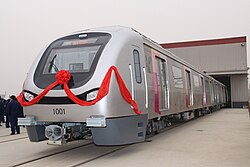 Railcars of the Mumbai Metro in 2010
 -
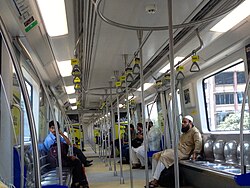 Interior of a metro train
 -
 A metro train on an elevated viaduct
 -
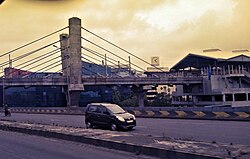 Metro bridge, part of the Mumbai Metro
.jpg)


Rolling stock[edit | edit source]
Reliance Infrastructure consulted a number of major international rolling stock builders to provide the train fleet for the Mumbai Metro. Bidders for the contract included established metro-vehicle manufacturers such as Kawasaki, Alstom, Siemens and Bombardier, but CRRC Nanjing Puzhen of China was ultimately chosen to supply rolling stock for ₹600 crore.[71][72] In May 2008, CSR Nanjing completed the first 16 trains, each comprising four cars.[71] The first ten trains were reported to be ready for operation in January 2013.[73]
The coaches are fire retardant,[74] air-conditioned and designed to reduce noise and vibration, and will feature both high seating capacity and ample space for standing passengers. They will be outfitted with a number of features for safety and convenience, including LCD screens, 3D route maps, first-aid kits, wheelchair facilities, fire-fighting equipment and intercom systems permitting communication with the train driver. Each coach will furthermore feature a black box to assist in accident investigations.[75] The trains will be capable of carrying over 1,100 passengers in a four-car unit, with each carriage being approximately 3.2 metres (10 ft 6 in) wide.[76]
In 2018, the Mumbai Metro Rail Corporation chose Alstom to supply 31 eight car trains for Aqua line (line 3). These trains are capable of driverless operations and were built at Alstom's factory in Sri City, Andhra Pradesh.[77]
In 2018, Mumbai Metropolitan Region Development Authority which will operate all metro lines except Line 3, awarded a tender to Bharat Earth Movers Ltd. (BEML) to supply 63 trainsets (378 coaches) for Yellow Line (Line 2) and Red Line (Line 7) at a cost of ₹3,015 crores ($427.33 million). Capable of driverless operations, the trains are manufactured at BEML's factory in Bengaluru and the first train set for the Yellow Line arrived in Mumbai on 27 January 2021, and will continue to receive the rest of the sets until 2022.[78][79] On 17 January 2021, Bombardier won the tender to supply 234 driverless coaches for the Green Line (Line 4) of six-car configuration for Mumbai metro. However, the contract was cancelled in March 2022 due to delays and uncertainties of the project.[80][81] In August 2025, the MMRDA awarded a contract to L&T to supply 39 trainsets of 6 cars each for the Green Line (Line 4), to be manufactured by Alstom as part of an integrated systems package.[82] In the absence of a depot and delay in procuring rolling stock, the MMRDA also decided to temporarily transport eight idle trains from the Mandale depot on the Yellow Line to the Green Line to commence trials on a section of the line.[83]
In 2025, the MMRDA awarded two contracts to Titagarh Rail Systems for 108 coaches and 132 coaches to be delivered for the Orange Line and Pink Line respectively.[84][85]
Power supply[edit | edit source]
Mumbai Metro runs on alternating current (AC) which is typically more labour and cost-intensive. MMRDA joint project director Dilip Kawathkar stated that AC power was chosen "after a proper study by a team of experts" which found that the AC model was "a better option". Bidders for Line 3 were reportedly in favour of the DC model. Experts believe that the decision to use AC will escalate the project cost of underground lines by 15%, since more digging is required for the rail to work on AC.[86]
Signalling and communications[edit | edit source]
The Mumbai Metro will feature an advanced signalling system, including an automatic train protection system (ATPS) and automated signalling to control train movements on the 11-kilometre (6.8 mi) Line 1. A four-minute service interval is anticipated on the route.[87]
Siemens will supply the signalling systems required for the project, while Thales Group will supply the Metro's communication systems. The network's signalling and train control systems will be based on LZB 700M technology.[88]
Ridership and Impact[edit | edit source]
In October 2025 after the Aqua line became fully operational, the average daily ridership on all Mumbai Metro lines is approximately 900,000 per day, with Blue line at about 460,000, followed by Yellow plus Red at 260,000 and Aqua at 160,000 daily average ridership. On 21 October 2019, 1,960 days (approx. 5 years) after Mumbai Metro Line 1's inception, the system crossed 600 million passengers, with an average daily ridership of around 450,000 passengers.[89] Opening of subsequent lines has relieved pressure on the Mumbai Suburban Railway, which had become over congested and unsafe due to open doors, unlike the Metro which has closed door air-conditioned coaches.[90] Furthermore, the Metro has been credited for sustainability due to reduced carbon emissions by employing energy saving methods like regenerative braking systems and cutting down traffic congestion, besides eco-friendly construction methods.[91]
Furthermore, the Mumbai Metro has allowed bicycles with special racks for commuters at no extra charge on Red and Yellow lines.[92] However, on Aqua line, they are currently not allowed for crowd rush during peak hours, although officials plan to allow it on completion of the line, while on Blue line, foldable bicycles are allowed.[93]
See also[edit | edit source]
- Urban rail transit in India
- List of rapid transit systems
- Public transport in Mumbai
- Mumbai Monorail
- M-Indicator
- Delhi Metro
- Delhi Meerut RRTS
References[edit | edit source]
- ↑ "Overhead Metro wires to be charged". Hindustan Times. 27 February 2014. Archived from the original on 23 December 2013. Retrieved 5 March 2013.
- ↑ "Mumbai metro lines 7, 2A get CCRS certification for full-speed operations".
- ↑ "Mumbai Metro: Route, Map, Metro Lines, Stations List and Latest Updates - Infra Info Hub". 11 November 2024. Retrieved 12 November 2024.
- ↑ "Mumbai Metro One Pvt. Ltd. (MMOPL)". MMOPL. Archived from the original on 21 April 2021. Retrieved 4 March 2020.
- ↑ "Mumbai monorail to be ready by Dec, Metro by March". Business Standard. 12 June 2012. Retrieved 7 July 2013.
- ↑ "Mumbai's first metro may chug in 2013". DNA India. 6 May 2012. Retrieved 8 May 2012.
- ↑ "Metro, Monorail projects could miss deadline". The Indian Express. 14 August 2011. Retrieved 21 September 2011.
- ↑ "Mumbai: The connected city". Mint. 20 June 2013. Retrieved 7 July 2013.
- ↑ "Mumbai Metro trial run successful". Times of India. 1 May 2013. Retrieved 5 June 2013.
{{cite news}}: CS1 maint: deprecated archival service (link) - ↑ "Mumbai Metro: trial run with train draped in flowers". NDTV. 1 May 2013. Retrieved 5 June 2013.
- ↑ United Nations Population Division - City Population Archived 10 March 2007 at the Wayback Machine. Retrieved 5 October 2011.
- ↑ Average Annual Rate of Change Archived 10 March 2007 at the Wayback Machine. United Nations Population Division. Retrieved 5 October 2011.
- ↑ "Businessworld - 7 Questions You Wanted to Ask". 25 June 2009. Archived from the original on 25 June 2009. Retrieved 8 April 2024.
- ↑ Mumbai Suburban Railway Network. Western Railway – Indian Railways. Updated 9 April 2012. Retrieved 26 April 2012.
- ↑ 15.0 15.1 15.2 "Mmrda – Projects – Mumbai Metro Rail Project". Mmrdamumbai.org. Archived from the original on 19 March 2012. Retrieved 12 March 2014.
- ↑ "Metro Rail-I to be operational in Mumbai in 2012". The Economic Times. 5 September 2011. Archived from the original on 20 October 2012. Retrieved 24 October 2011.
- ↑ "Development body in talks with CSIA". The Indian Express. 14 January 2012. Retrieved 16 January 2012.
- ↑ "Views on Colaba-Seepz underground metro sought". DNA India. 14 December 2011. Retrieved 30 December 2011.
- ↑ "Centre paves way for 3rd Metro line". The Times of India. 28 February 2012. Archived from the original on 2 February 2014. Retrieved 28 March 2012.
- ↑ "Mumbai Metro likely to get autonomy status: MMRDA". DNA India. 27 April 2012. Retrieved 3 May 2012.
- ↑ "Soon, take a metro from south Mumbai to Thane" Archived 30 April 2013 at the Wayback Machine. Hindustan Times. 23 April 2013. Retrieved 5 June 2013.
- ↑ "MMRDA to add more lines to Mumbai Metro railway project". DNA India. 8 July 2012. Retrieved 27 July 2012.
- ↑ "Third phase of metro rail inaugurated". @businessline. 26 August 2014.
- ↑ 24.0 24.1 "Over 130 km of Metro lines to criss-cross city by 2020". 16 June 2015.
- ↑ Livemint (8 July 2021). "Mumbai: One Mumbai Metro Card launched for more convenience to commuters". mint. Retrieved 26 February 2024.
- ↑ "Mumbai transport body, London counterpart ink MoU". Business Line. 2 March 2013. Retrieved 5 June 2013.
- ↑ "MMRDA inks pact with UK transport authority". Indian Express. 19 February 2013. Retrieved 5 June 2013.
- ↑ "MMRDA, Transport for London ink MoU for under ground metro in Mumbai". Business Standard. 18 February 2013. Retrieved 5 June 2013.
- ↑ Mumbai metro to run 150 km Deccan Herald 18 February 2013
- ↑ "Mumbai Metro services to be extended till Thane: Prithviraj Chavan". The Economic Times. 14 June 2014.
- ↑ "First Metro line to be extended to Wadala and Thane". The Times of India. 15 June 2014.
- ↑ "MMRDA plans two new Metro lines for Mumbai". Hindustan Times. 20 May 2015.
- ↑ "Reliance Infra pulls out of Mumbai Metro Line 2". Mint. 13 November 2014.
- ↑ "Mumbai metro rail: State considers elevated Metro route". 21 May 2015.
- ↑ 35.0 35.1 35.2 "Metro 2 to be built in three phases, 2 other routes also on cards". Hindustan Times. 16 June 2015.
- ↑ "Business News: Business News India, Business News Today, Latest Finance News, Business News Live". 11 June 2015.
- ↑ Jog, Sanjay (16 June 2015). "Mumbai Metro seeks Delhi counterpart's help to expedite project". Business Standard India – via Business Standard.
- ↑ "Pan-Mumbai Metro network by 2019, targets Maharashtra". 11 June 2015.
- ↑ 39.0 39.1 "Mumbai Metro master plan: Maharashtra government nod for Delhi body revise and update blueprint". dna. 2 July 2015.
- ↑ "Metro loop to connect central suburbs, Navi Mumbai on cards". Asian Age. 9 April 2017. Retrieved 9 April 2017.
- ↑ "Kalyan-Dombivli-Taloja metro under consideration: Devendra Fadnavis". The Economic Times. Retrieved 9 April 2017.
- ↑ "Mumbai local services suspended till March 31 due to Covid-19: All you need to know". Hindustan Times. 22 March 2020. Retrieved 10 August 2021.
- ↑ "Mumbai Metro News: Mumbai Metro resumes operations with Covid protocols". The Times of India. ANI. 19 October 2020. Retrieved 10 August 2021.
- ↑ Mumbai: Litigations delaying metro car shed project and causing loss of public money, HC told. Press Trust of India. Published on Economic Times. 16 February 2013.
- ↑ Saving Aarey: Why a city with a weak protest culture is demonstrating to protect Mumbai's green lung. Aarefa Johari. Scroll. 15 September 2019.
- ↑ 18 protesters held at Aarey as Metro yard trees get axed. Times News Network. 30 September 2018.
- ↑ Finally, voices of Aarey protesters fall silent. Prayag Arora-Desai. Hindustan Times. 30 November 2022.
- ↑ 48.0 48.1 "Know Your Metro - Features". Reliance Mumbai Metro. Archived from the original on 24 September 2015. Retrieved 8 June 2014.
- ↑ "Metro ride in June '13? Work on crucial bridge completed". The Times of India. 26 December 2012. Archived from the original on 28 September 2013. Retrieved 6 January 2013.
- ↑ "Maharashtra CM Prithivraj Chavan flags off Mumbai Metro". The Times of India. 8 June 2014. Retrieved 8 June 2014.
- ↑ PM Narendra Modi to launch Mumbai Metro Line 2A and Line 7, what you need to know about the new routes. Economic Times. 19 January 2023.
- ↑ "Mumbai Metro Line 2A (DAHISAR - D.N. NAGAR)". 6 June 2017. Retrieved 6 June 2017.
- ↑ "Contractors appointed for Metro 2B and Metro 4". asianage.com. 4 March 2018. Retrieved 6 March 2018.
- ↑ "Cabinet clears Mumbai Metro's third line". The Times of India. 29 June 2013. Retrieved 7 July 2013.
- ↑ "Further delay in Colaba-Seepz metro as govt tweaks bid norms | Business Standard". Business Standard India. business-standard.com. Press Trust of India. 4 February 2014. Retrieved 3 April 2014.
- ↑ "Mumbai Metro Line 3 plan kicks off". Mumbai Mirror. 29 June 2013. Retrieved 7 July 2013.
- ↑ "Cabinet approves Mumbai Metro Line 3: FM". Zee News. 28 June 2013. Retrieved 7 July 2013.
- ↑ "Mumbai Metro Aqua Line (3): Connecting the unconnected". Moneycontrol. 23 November 2023. Retrieved 24 November 2023.
- ↑ "Mumbai: Five New Metro Lines To Roll Out Next Year, Details Inside". Lokmat Times. 4 March 2024. Retrieved 7 June 2024.
- ↑ "BKC to Aarey stretch of Mumbai Metro Line 3 opens today — Know timings, fare, speed - CNBC TV18". CNBCTV18. 7 October 2024. Retrieved 12 October 2024.
- ↑ "Mumbai Metro-3 Second Phase On Track: Aarey-BKC Services Begin, Link To Cuffe Parade May Be Ready by 2025". News18. 7 October 2024. Retrieved 12 October 2024.
- ↑ "Metro Line 3 (Aqua Line): Big relief for Mumbai commuters, BKC to Worli stretch now operational". The Times of India. 10 May 2025. ISSN 0971-8257. Retrieved 10 May 2025.
- ↑ "MMRC Publishes Mumbai Metro Line 11's Revised Alignment Map". TheMetroRailGuy. 28 July 2024. Retrieved 10 June 2025.
- ↑ "MMRDA seeks nod to take Mumbai's Metro Line 5 underground".
- ↑ "Mumbai's east-west connectivity to get a boost with another Metro corridor". Hindustan Times. 2 March 2017. Retrieved 2 March 2017.
- ↑ "New metro lines for Mumbai and Thane; project to cost Rs 15,000 crore". Business Standard India. 19 October 2016. Retrieved 12 February 2017.
- ↑ "Kalyan-Thane, Lokhandwala-Kanjurmarg metro lines get approval". dna. 20 October 2016. Retrieved 12 February 2017.
- ↑ "MMRDA to begin tree count for Metro 6". mid-day. 6 April 2017. Retrieved 6 April 2017.
- ↑ "Mumbai Metropolitan Region Development Authority - Metro Line - 8". mmrda.maharashtra.gov.in.[permanent dead link]
- ↑ https://mmrda.maharashtra.gov.in/documents/10180/11273712/62%2C943+cr+for+METRO+PROJECTS.pdf/cb92ba27-a1af-45d5-8047-7e145368e7cb[permanent dead link]
- ↑ 71.0 71.1 Mumbai's beautiful butterfly emerges Railway Gazette International 25 March 2010
- ↑ "Mumbai Metro One Project updates". mumbai-metro.com. Archived from the original on 18 November 2011. Retrieved 25 August 2010.
- ↑ "Mumbai metro trains raring to run, but where are tracks?". DNAIndia. 23 January 2013. Retrieved 6 February 2013.
- ↑ "A Mumbai Metro train every three minutes". DNA India. 1 May 2013. Retrieved 7 July 2013.
- ↑ "Metro first line hinges on Andheri bridge". Times of India. 11 October 2011. Retrieved 18 October 2011.
- ↑ Katkurwar, Saurabh (26 February 2012). "CIDCO opts for wider metro coaches". MiD DAY. Retrieved 28 March 2012.
- ↑ Nag, Devanjana (11 September 2018). "Mumbai Metro Line 3: Alstom wins 'Make in India' contract for modern train sets worth 315 million euros". The Financial Express. Retrieved 13 April 2020.
- ↑ "BEML receives order worth Rs 3015 crore for Mumbai Metro". Capital Market. Business Standard. 24 November 2018. Retrieved 30 November 2018.
- ↑ "BEML secures $427.33m Mumbai metro car supply contract". Railway Technology. 26 November 2018. Retrieved 30 November 2018.
- ↑ "Alstom terminates Mumbai Line 4 fleet contract". 10 March 2022. Retrieved 6 April 2022.
- ↑ "Alstom cancels order bagged from MMRDA for supply of coaches for Mumbai Metro 4". 4 March 2022. Retrieved 6 April 2022.
- ↑ Sharma, Swastika Das (26 August 2025). "Mumbai Metro Line 4 to get 39 driverless trainsets soon: Designed for comfort, made in India, check details". mint. Retrieved 16 November 2025.
- ↑ "Metro 4 to be first line to begin operations sans a depot". Hindustan Times. 15 July 2025. Retrieved 16 November 2025.
- ↑ "Titagarh Rail Systems bags Rs 1,600-crore contract to supply 108 coaches to Mumbai Metro". The Economic Times. 4 August 2025. Retrieved 16 November 2025.
- ↑ "Titagarh Rail bags ₹2,481 crore order from MMRDA for Mumbai Metro Line 5". Retrieved 16 November 2025.
- ↑ "Mumbai's Metro-3 will be one of the few in the world to run on AC". mid-day. 15 May 2014.
- ↑ "Mumbai Metro project". MMRDA. 1 January 2008. Archived from the original on 31 August 2009. Retrieved 1 January 2010.
- ↑ "MMOPL awards contract to ABB, Siemens, SEW". Projects Today. 8 January 2008. Retrieved 15 January 2010.
- ↑ "Versova-Ghatkopar Metro One crosses 60 crore ridership in 5 years". The Times of India. 21 October 2019. Retrieved 21 October 2019.
- ↑ "Major relief for Mumbai commuters as Metro Line 2B trial run begins". MSN.
- ↑ "Mumbai Metro Line-9: Advancing sustainable growth with eco-friendly infrastructure". 20 March 2025.
- ↑ "Watch: Man Travels On Mumbai Metro With His Bicycle, Calls It A Unique Adventure".
- ↑ "Mumbai: No Cycles Allowed On Metro 3, Cyclists Claim Discrimination Against Riders". MSN.
External links[edit | edit source]
Template:Rapid transit OSM map
- Mumbai Metro Rail Project - MMRDA site
- Mumbai Metro blog site
- Mumbai Metro unofficial magazine
- Mumbai Metro unofficial Information Site


| Suburban rail |
| ||||||||
|---|---|---|---|---|---|---|---|---|---|
| Rapid transit |
| ||||||||
| Monorail |
| ||||||||
| Metrolite |
| ||||||||
| Tram |
| ||||||||


