


Timothyves (talk | contribs) Updated article with clearer structure |
|||
| Line 1: | Line 1: | ||
{{Short description|Adherents | {{Short description|Adherents of Hinduism}} | ||
{{For|the racehorse|Hindus (horse)}} | {{For-multi|the racehorse|Hindus (horse)|the journalist|Maurice G. Hindus}} | ||
{{Redirect2|Hindoo|Hindu|other uses|Hindoo (disambiguation)|and|Hindu (disambiguation)}} | {{Redirect2|Hindoo|Hindu|other uses|Hindoo (disambiguation)|and|Hindu (disambiguation)}} | ||
{{pp-semi-indef}} | |||
{{pp-move}} | |||
{{Use Indian English|date=July 2016}} | {{Use Indian English|date=July 2016}} | ||
{{Use dmy dates|date=March 2022}} | {{Use dmy dates|date=March 2022}} | ||
{{Infobox religious group | {{Infobox religious group | ||
| group = Hindus | | group = Hindus | ||
| population = '''1.2 billion''' | | population ={{circa}} '''1.2 billion''' <br /> (15% of the global population){{increase}} <br /> (Worldwide, 2020 est.)<ref>{{Cite web |last=Fahmy |first=Conrad Hackett, Marcin Stonawski, Yunping Tong, Stephanie Kramer, Anne Shi and Dalia |date=2025-06-09 |title=How the Global Religious Landscape Changed From 2010 to 2020 |url=https://www.pewresearch.org/religion/2025/06/09/how-the-global-religious-landscape-changed-from-2010-to-2020/ |access-date=2025-06-10 |website=Pew Research Center |language=en-US}}</ref> | ||
| image = Puran Reading in a Temple.jpg | | image = Puran Reading in a Temple.jpg | ||
| caption = | | caption = An early-20th-century painting by [[M. V. Dhurandhar]] portraying Hindu devotees gathered in '''[[satsang]]a''', attentively listening to a pravachana on the [[Puranas]] | ||
|region1 | |region1 = {{flag|India}} | ||
| pop1 = [[Hinduism in India|1, | | pop1 = [[Hinduism in India|1,113,200,000]] | ||
| ref1 = <ref | | ref1 = <ref name="Hindus">{{Cite web | url=https://www.pewresearch.org/religion/2025/06/09/hindu-population-change/| title=Hindu population change}}</ref> | ||
| region2 = {{flag|Nepal}} | |||
| pop2 = [[Hinduism in Nepal| | | pop2 = [[Hinduism in Nepal|23,520,000]] | ||
| ref2 =<ref name=" | | ref2 = <ref name="Hindus" /> | ||
| region3 = {{flag|Bangladesh}} | |||
| pop3 = [[Hinduism in Bangladesh|13, | | pop3 = [[Hinduism in Bangladesh|13,140,000]] | ||
| ref3 = <ref | | ref3 = <ref name="Hindus" /> | ||
|region4={{flag|Pakistan}} | |||
|pop4=[[Hinduism in | |pop4=[[Hinduism in Pakistan|5,030,000]] | ||
|ref4= | |ref4=<ref name="Hindus" /> | ||
|region5={{flag|Indonesia}} | |||
|pop5=[[Hinduism in | |pop5=[[Hinduism in Indonesia|4,350,000]] | ||
|ref5=<ref | |ref5=<ref name="Hindus" /> | ||
|region6= | |region6={{flag|Sri Lanka}} | ||
|pop6=[[Hinduism in Sri Lanka|3,280,000]] | |||
|ref6=<ref name="Hindus" /> | |||
| | |region7={{flag|United States}} | ||
|pop7=[[Hinduism in the United States|3,040,000]] | |||
| | |ref7=<ref name="Hindus" /> | ||
| | |region8={{flag|Malaysia}} | ||
|pop8=[[Hinduism in Malaysia|2,070,000]] | |||
|ref8=<ref name="Hindus" /> | |||
|region9={{flag|United Kingdom}} | |||
|pop9=[[Hinduism in the United Kingdom|1,140,000]] | |||
|ref9=<ref name="Hindus" /> | |||
| | |region10={{flag|United Arab Emirates}} | ||
|pop10=[[Hinduism in the United Arab Emirates|1,110,000]] | |||
| | |ref10=<ref name="Hindus" /> | ||
| | |||
| | |||
| | |||
| | |||
| | |||
| | |||
| | |||
| | |||
| languages = {{Plainlist| | | languages = {{Plainlist| | ||
* '''Sacred language:'''<br />{{Hlist|[[Vedic Sanskrit]]|[[Old Tamil]]}}<ref name="Wiley-Blackwell1">{{cite book|last1 = Johnson|first1 = Todd M.|last2 = Grim|first2 = Brian J.|title = The World's Religions in Figures: An Introduction to International Religious Demography|url = http://media.johnwiley.com.au/product_data/excerpt/47/04706745/0470674547-196.pdf|access-date = 24 November 2015|year = 2013|publisher = Wiley-Blackwell|location = Hoboken, NJ|pages = 10|url-status = dead|archive-url = https://web.archive.org/web/20131020100448/http://media.johnwiley.com.au/product_data/excerpt/47/04706745/0470674547-196.pdf|archive-date = 20 October 2013}}</ref> | * '''Sacred language:'''<br />{{Hlist|[[Vedic Sanskrit]]|[[Sanskrit]]|[[Old Tamil]]}}<ref name="Wiley-Blackwell1">{{cite book|last1 = Johnson|first1 = Todd M.|last2 = Grim|first2 = Brian J.|title = The World's Religions in Figures: An Introduction to International Religious Demography|url = http://media.johnwiley.com.au/product_data/excerpt/47/04706745/0470674547-196.pdf|access-date = 24 November 2015|year = 2013|publisher = Wiley-Blackwell|location = Hoboken, NJ|pages = 10|url-status = dead|archive-url = https://web.archive.org/web/20131020100448/http://media.johnwiley.com.au/product_data/excerpt/47/04706745/0470674547-196.pdf|archive-date = 20 October 2013}}</ref> | ||
}} | }} | ||
'''Predominant spoken languages:'''<br />{{Hlist| [[Ahirwati]] | [[Assamese language|Assamese]] | [[Awadhi language|Awadhi]] | [[Bagheli language|Bagheli]] | [[Bagri language|Bagri]] | [[Balochi language|Balochi]] | [[Bengali language|Bengali]] | [[Bhili language|Bhili]] | [[Bhojpuri language|Bhojpuri]] | [[ | '''Predominant spoken languages:'''<br />{{Hlist| [[Ahirwati]] | [[Assamese language|Assamese]] | [[Awadhi language|Awadhi]] | [[Bagheli language|Bagheli]] | [[Bagri language|Bagri]] | [[Balochi language|Balochi]] | [[Bengali language|Bengali]] | [[Bhili language|Bhili]] | [[Bhojpuri language|Bhojpuri]] | [[Bishnupriya Manipuri]] | [[Boro language (India)|Boro]] | [[Braj Bhasha]] | [[Bundeli language|Bundeli]] | [[Burmese language|Burmese]] | [[Chhattisgarhi language|Chhattisgarhi]] | [[Khowar|Chitrali]] | [[Chittagonian language|Chittagonian]] | [[Dhatki language|Dhatki]] | [[Dhundari language|Dhundari]] | [[Dogri language|Dogri]] | [[Doteli]] | [[Dzongkha]] | [[Garhwali language|Garhwali]] | [[Goaria language|Goaria]] | [[Gondi language|Gondi]] | [[Gujarati language|Gujarati]] |[[Gujari language|Gujari]] | [[Gurung people|Gurung]] | [[Hadauti language|Hadauti]] | [[Haryanvi language|Haryanvi]] | [[Hindi]] |[[Hindko]] | [[Kalasha-mun]] | [[Kannada]] | [[Kannauji language|Kannauji]] | [[Kashmiri language|Kashmiri]] | [[Khandeshi language|Khandeshi]] | [[Khortha language|Khortha]] | [[Kokborok]] | [[Konkani language|Konkani]] | [[Kumaoni language|Kumaoni]] | [[Kurukh language|Kurukh]] | [[Kutchi language|Kutchi]] | [[Ladakhi language|Ladakhi]] | [[Lambadi]] | [[Limbu language|Limbu]] | [[Magahi language|Magadhi]] | [[Magar language|Magar]] | [[Maithili language|Maithili]] | [[Malayalam]] | [[Malto language|Malto]] | [[Malvi language|Malvi]] | [[Marathi language|Marathi]] | [[Marwari language|Marwari]] | [[Meitei language|Manipuri]] | [[Mewati language|Mewati]] | [[Mundari language|Mundari]] | [[Nagpuri language|Nagpuri]] | [[Nepali language|Nepali]] | [[Newar language|Newar]] | [[Nimadi language|Nimadi]] | [[Od language|Od]] | [[Odia language|Odia]] | [[Pashto]] | [[Punjabi language|Punjabi]] | [[Sanskrit]] | [[Santali language|Santhali]] | [[Saraiki language|Saraiki]] | [[Saurashtra language|Saurashtra]] | [[Shekhawati language|Shekhawati]] | [[Sikkimese language|Sikkimese]] | [[Sindhi language|Sindhi]] | [[Sylheti language|Sylheti]] | [[Tamang language|Tamang]] | [[Tamil language|Tamil]] | [[Telugu language|Telugu]] | [[Tharu languages|Tharu]] | [[Tulu language|Tulu]] | [[Western Pahari]] | |[[Languages of South Asia|other South Asian languages]]| [[Balinese language|Balinese]] | [[Cham language|Cham]] | [[Indonesian language|Indonesian]] | [[Javanese language|Javanese]] | [[Khmer language|Khmer]] | [[Malay language|Malay]] | [[Osing language|Osing]] | [[Sundanese language|Sundanese]] | [[Thai language|Thai]] | [[Tenggerese dialect|Tenggerese]] | English | [[Dutch language|Dutch]] | French | [[Romani language|Romani]] | Russian | [[Malay Chetty creole language|Malay Chetty Creole]]|[[Caribbean Hindustani]] | [[Caribbean English]] | [[Fiji Hindi]] | [[Pidgin Fijian]] | [[Arabic]] | [[Afrikaans]] | [[Mauritian Creole]] | [[Réunion Creole]] | [[Seychellois Creole]] | and others}}<ref name="auto">{{Cite web |date=January 2012 |title=Chapter 1 Global Religious Populations |url=http://media.johnwiley.com.au/product_data/excerpt/47/04706745/0470674547-196.pdf |archive-url=https://web.archive.org/web/20131020100448/http://media.johnwiley.com.au/product_data/excerpt/47/04706745/0470674547-196.pdf |archive-date=20 October 2013 |url-status=dead}}</ref><ref>{{cite journal|first=Anjali |last=Pandey|title=Re-Englishing 'flat-world' fiction |journal=World Englishes|doi=10.1111/weng.12370 |volume=38|issue=1–2|pages=200–218 |year=2019|s2cid=199152662}}</ref> | ||
| [[Braj Bhasha]] | [[Bundeli language|Bundeli]] | [[Burmese language|Burmese]] | [[Chhattisgarhi language|Chhattisgarhi]] | [[Khowar | |||
| scriptures = {{Plainlist| | | scriptures = {{Plainlist| | ||
* '''[[Śruti]]'''<br />{{Hlist|[[Vedas]], [[Samhita]]s, [[Brahmana]]s, [[Aranyaka]]s, [[ | * '''[[Śruti]]'''<br />{{Hlist|[[Vedas]], [[Samhita]]s, [[Brahmana]]s, [[Aranyaka]]s, [[Upanishads]]}} | ||
}} | }} | ||
'''[[Smriti]]'''<br />{{Hlist|[[Upaveda]]s, [[Darśana]]s, [[Dharmashastras]], [[Shastra]]s, [[ | '''[[Smriti]]'''<br />{{Hlist|[[Upaveda]]s, [[Darśana]]s, [[Dharmashastras]], [[Shastra]]s, [[Agama (Hinduism)|Agamas]], [[Tantras (Hinduism)|Tantras]], [[Puranas]], [[Upapurana]]s, ''[[Ramayana]]'' (''[[Ramcharitmanas]]'' & [[Versions of the Ramayana|other ''Ramayana'' versions]]), ''[[Mahabharata]]'' (incl. ''[[Bhagavad Gita]]''), [[Sutra]]s, [[Stotra]]s, [[Subhashita]]s, [[Bhashya]]s and [[Hindu texts|others]]}}<ref name=goodallix>Dominic Goodall (1996), ''Hindu Scriptures'', University of California Press, {{ISBN|978-0-520-20778-3}}, pp. ix–xliii</ref><ref>RC Zaehner (1992), ''Hindu Scriptures'', Penguin Random House, {{ISBN|978-0-679-41078-2}}, pp. 1–11 and Preface</ref><ref>Ludo Rocher (1986), The Puranas, Otto Harrassowitz Verlag, {{ISBN|978-3-447-02522-5}}</ref><ref>{{cite book|author=Moriz Winternitz|author-link=Moriz Winternitz|title=A History of Indian Literature|url=https://books.google.com/books?id=JRfuJFRV_O8C|year=1996|publisher=Motilal Banarsidass|isbn=978-81-208-0264-3|pages=xv–xvi|access-date=16 June 2020|archive-date=26 December 2023|archive-url=https://web.archive.org/web/20231226083105/https://books.google.com/books?id=JRfuJFRV_O8C|url-status=live}}</ref><ref>{{cite book|author= Gyanshruti, Srividyananda|url=https://books.google.com/books?id=hK1IAQAAIAAJ|title=Yajna, a Comprehensive Survey|publisher=Yoga Publications Trust|page=338|year=2007|isbn=978-81-86336-47-2}}</ref> | ||
| religions = '''[[Hinduism]]'''<br />([[Sanātana Dharma]])<br />{{sfn|Knott|1998|pp=3, 5}}{{sfn|Hatcher|2015|pp=4–5, 69–71, 150–152}}{{sfn|Bowker|2000}}{{sfn|Harvey|2001|p=xiii}}{{unbulleted list | | religions = '''[[Hinduism]]'''<br />([[Sanātana Dharma]])<br />{{sfn|Knott|1998|pp=3, 5}}{{sfn|Hatcher|2015|pp=4–5, 69–71, 150–152}}{{sfn|Bowker|2000}}{{sfn|Harvey|2001|p=xiii}}{{unbulleted list | ||
|67.6% [[Vaishnavism]]<ref name="auto" /><br />26.6% [[Shaivism]]<ref name="auto" /><br />3.2% [[Shaktism]]<ref name="auto" | |67.6% [[Vaishnavism]]<ref name="auto" /><br />26.6% [[Shaivism]]<ref name="auto" /><br />3.2% [[Shaktism]]<ref name="auto" />|2.6% other [[Hindu denominations|Hindu traditions]], | ||
|e.g. [[Neo-Hinduism]], [[Hindu reform movements|Reform Hinduism]] and [[Hindu atheism]]}}<ref name="auto" /> | |e.g. [[Neo-Hinduism]], [[Hindu reform movements|Reform Hinduism]] and [[Hindu atheism]]}}<ref name="auto" /> | ||
}} | |flag=File:Om symbol.svg|flag_caption=[[Om]], a common symbol of the Hindu people|flag_size=100px}} | ||
{{Hinduism}} | {{Hinduism}} | ||
'''Hindus''' ({{IPA | '''Hindus''' ({{IPA|hns|ˈɦɪndu|lang|hi-Hindu.ogg}}; {{IPAc-en|'|h|ɪ|n|d|uː|z}}), also known as '''[[Sanātanī|Sanatanis]]''', are people who religiously adhere to [[Hinduism]], also known by its [[endonym]] [[Sanātana Dharma|Sanatana Dharma]].<ref>{{Cite journal |last=Zavos |first=John |date=April 2001 |title=Defending Hindu Tradition: Sanatana Dharma as a Symbol of Orthodoxy in Colonial India |url=http://www.tandfonline.com/doi/abs/10.1006/reli.2001.0322 |journal=Religion |language=en |volume=31 |issue=2 |pages=109–123 |doi=10.1006/reli.2001.0322 |issn=0048-721X|url-access=subscription }}</ref><ref name="jefferylong">[[Jeffery D. Long]] (2007), A Vision for Hinduism, IB Tauris, {{ISBN|978-1-84511-273-8}}, pp. 35–37</ref><ref>{{cite book|author=Lloyd Ridgeon|title=Major World Religions: From Their Origins to the Present|url=https://books.google.com/books?id=HFKBAgAAQBAJ |year= 2003|publisher= Routledge|isbn=978-1-134-42935-6|pages=10–11}}, Quote: "It is often said that Hinduism is very ancient, and in a sense this is true (...). It was formed by adding the English suffix -ism, of Greek origin, to the word ''Hindu'', of Persian origin; it was about the same time that the word ''Hindu'', without the suffix -ism, came to be used mainly as a religious term. (...) The name ''Hindu'' was first a geographical name, not a religious one, and it originated in the languages of Iran, not of India. (...) They referred to the non-Muslim majority, together with their culture, as 'Hindu'. (...) Since the people called Hindu differed from Muslims most notably in religion, the word came to have religious implications, and to denote a group of people who were identifiable by their Hindu religion. (...) However, it is a religious term that the word ''Hindu'' is now used in English, and Hinduism is the name of a religion, although, as we have seen, we should beware of any false impression of uniformity that this might give us."</ref> Historically, the term has also been used as a geographical, cultural, and later religious identifier for people living in the [[Indian subcontinent]].<ref name="brian111" />{{sfn|Lorenzen|2006|pp=xx, 2, 13–26}} | ||
It is assumed that the term ''"Hindu"'' traces back to [[Avestan]] scripture [[Vendidad]] which refers to land of seven rivers as [[Avestan geography|Hapta Hendu]] which itself is a cognate to [[Sanskrit]] term ''Sapta Sindhuḥ''. (The term ''Sapta Sindhuḥ'' is mentioned in [[Rig Veda]] and refers to a North western Indian region of seven rivers and to India as a whole.) The [[Greek language|Greek]] cognates of the same terms are "''Indus''" (for the river) and "''India''" (for the land of the river).<ref name="Bose2006">{{cite book|author=Mihir Bose|title=The Magic of Indian Cricket: Cricket and Society in India|url=https://books.google.com/books?id=6gyAAgAAQBAJ&pg=PA1|date=2006|publisher=Routledge|isbn=978-1-134-24924-4|pages=1–3}}</ref><ref>{{cite web|url=https://www.etymonline.com/word/india|title=India|publisher=Online Etymology Dictionary|access-date=13 January 2022|archive-date=13 January 2022|archive-url=https://web.archive.org/web/20220113063857/https://www.etymonline.com/word/india|url-status=live}}</ref>{{sfn|Flood|1996|p=6}} Likewise the [[Hebrew]] cognate ''hōd-dū'' refers to India mentioned in Hebrew Bible ([https://biblehub.com/text/esther/1-1.htm Esther 1:1]). The term "''Hindu''" also implied a geographic, ethnic or cultural identifier for people living in the Indian subcontinent around or beyond the [[Indus River|Sindhu (Indus) River]].<ref name="hawleynarayanan">{{citation|last1=Hawley|first1=John Stratton|last2=Narayanan|first2=Vasudha|title=The Life of Hinduism|url=https://books.google.com/books?id=9hairjdT-ekC&pg=PA10|year=2006|publisher=University of California Press|isbn=978-0-520-24914-1|pages=10–11}}</ref> By the 16th century CE, the term began to refer to residents of the subcontinent who were not [[Turkic peoples|Turkic]] or [[Muslims]].<ref name="hawleynarayanan" />{{Efn|{{harvtxt|Flood|1996|p=6}} adds: "(...) 'Hindu', or 'Hindoo', was used towards the end of the eighteenth century by the British to refer to the people of 'Hindustan', the people of northwest India. Eventually 'Hindu' became virtually equivalent to an 'Indian' who was not a Muslim, Sikh, Jain or Christian, thereby encompassing a range of religious beliefs and practices. The '-ism' was added to Hindu in around 1830 to denote the culture and religion of the high-caste [[Brahman]]s in contrast to other religions, and the term was soon appropriated by Indians themselves in the context of building a national identity opposed to colonialism, though the term 'Hindu' was used in Sanskrit and Bengali hagiographic texts in contrast to 'Yavana' or Muslim as early as the sixteenth century".}}{{Efn|{{harvtxt|von Stietencron|2005|p=229}}: For more than 100 years the word Hindu (plural) continued to denote the Indians in general. But when, from AD 712 onwards, Muslims began to settle permanently in the [[Indus valley]] and to make converts among low-caste Hindus, Persian authors distinguished between Hindus and Muslims in India: Hindus were Indians other than Muslim. We know that Persian scholars were able to distinguish a number of religions among the Hindus. But when Europeans started to use the term Hindoo, they applied it to the non-Muslim masses of India without those scholarly differentiations.}} | |||
The historical development of Hindu self-identity within the local Indian population, in a religious or cultural sense, is unclear.<ref name=brian111 /><ref name=lorenzenhidentity>{{harvnb|Lorenzen|2006|pp=24–33}}</ref> Competing theories state that Hindu identity developed in the [[British Raj|British colonial era]], or that it may have developed post-8th century CE after the [[Muslim conquests in the Indian subcontinent|Muslim invasions]] and medieval [[Islamic rulers in the Indian subcontinent|Hindu–Muslim wars]].<ref name=lorenzenhidentity /><ref name=pollockdevagiri /><ref name=brajadulal /> A sense of Hindu identity and the term ''Hindu'' appears in some texts dated between the 13th and 18th century in [[Sanskrit literature|Sanskrit]] and [[Bengali literature|Bengali]].<ref name=pollockdevagiri /><ref name="OConnell1973">{{cite journal |title=The Word 'Hindu' in Gauḍīya Vaiṣṇava Texts |author=O'Connell, Joseph T. |date=July–September 1973| journal= Journal of the American Oriental Society |volume=93 |issue=3 |pages=340–344 |doi=10.2307/599467 |jstor=599467}}</ref> The 14th- and 18th-century Indian poets such as [[Vidyapati]], [[Kabir]], [[Tulsidas]] and [[Eknath]] used the phrase ''Hindu dharma'' (Hinduism) and contrasted it with ''Turaka dharma'' ([[Islam]]).<ref name=lorenzenhidentity />{{sfn|Lorenzen|2010|p=29}} The [[Christians|Christian]] [[friar]] Sebastiao Manrique used the term 'Hindu' in a religious context in 1649.{{sfn|Lorenzen|2006|p=15}} In the 18th century, European merchants and colonists began to refer to the followers of [[Indian religions]] collectively as ''Hindus'', in contrast to ''Mohamedans'' for groups such as Turks, [[Mughal Empire|Mughals]] and [[Arabs]], who were adherents of Islam.<ref name=brian111 /><ref name=hawleynarayanan /> By the mid-19th century, colonial orientalist texts further distinguished Hindus from [[Buddhism|Buddhists]], [[Sikhs]] and [[Jainism|Jains]],<ref name=brian111 /> but the colonial laws continued to consider all of them to be within the scope of the term ''Hindu'' until about mid-20th century.<ref name=rachel /> Scholars state that the custom of distinguishing between Hindus, Buddhists, Jains and Sikhs is a modern phenomenon.<ref name=lipner17 /><ref name=leslie />{{Efn|Despite the commonplace use of the term "Hindu" for the followers of the Hindu religion, the term also continues to designate a cultural identity, the ownership of India's millennia-old cultural heritage. [[Arvind Sharma]] notes that the exclusivist conception of religion was foreign to India, and Indians did not yield to it during the centuries of Muslim rule but only under the British colonial rule. Resistance to the exclusivist conception led to [[Savarkar]]'s ''Hindutva'', where Hinduism was seen both as a religion and a culture.{{sfn|Sharma|2008|pp=25–26}} ''Hindutva'' is a national Hindu-ness, by which a Hindu is one born in India and behaves like a Hindu. [[M. S. Golwalkar]] even spoke of "Hindu Muslims, | The historical development of Hindu self-identity within the local Indian population, in a religious or cultural sense, is unclear.<ref name=brian111 /><ref name=lorenzenhidentity>{{harvnb|Lorenzen|2006|pp=24–33}}</ref> Competing theories state that Hindu identity developed in the [[British Raj|British colonial era]], or that it may have developed post-8th century CE after the [[Muslim conquests in the Indian subcontinent|Muslim invasions]] and medieval [[Islamic rulers in the Indian subcontinent|Hindu–Muslim wars]].<ref name=lorenzenhidentity /><ref name=pollockdevagiri /><ref name=brajadulal /> A sense of Hindu identity and the term ''Hindu'' appears in some texts dated between the 13th and 18th century in [[Sanskrit literature|Sanskrit]] and [[Bengali literature|Bengali]].<ref name=pollockdevagiri /><ref name="OConnell1973">{{cite journal |title=The Word 'Hindu' in Gauḍīya Vaiṣṇava Texts |author=O'Connell, Joseph T. |date=July–September 1973| journal= Journal of the American Oriental Society |volume=93 |issue=3 |pages=340–344 |doi=10.2307/599467 |jstor=599467}}</ref> The 14th- and 18th-century Indian poets such as [[Vidyapati]], [[Kabir]], [[Tulsidas]] and [[Eknath]] used the phrase ''Hindu dharma'' (Hinduism) and contrasted it with ''Turaka dharma'' ([[Islam]]).<ref name=lorenzenhidentity />{{sfn|Lorenzen|2010|p=29}} The [[Christians|Christian]] [[friar]] Sebastiao Manrique used the term 'Hindu' in a religious context in 1649.{{sfn|Lorenzen|2006|p=15}} In the 18th century, European merchants and colonists began to refer to the followers of [[Indian religions]] collectively as ''Hindus'', in contrast to ''Mohamedans'' for groups such as Turks, [[Mughal Empire|Mughals]] and [[Arabs]], who were adherents of Islam.<ref name=brian111 /><ref name=hawleynarayanan /> By the mid-19th century, colonial orientalist texts further distinguished Hindus from [[Buddhism|Buddhists]], [[Sikhs]] and [[Jainism|Jains]],<ref name=brian111 /> but the colonial laws continued to consider all of them to be within the scope of the term ''Hindu'' until about the mid-20th century.<ref name=rachel /> Scholars state that the custom of distinguishing between Hindus, Buddhists, Jains and Sikhs is a modern phenomenon.<ref name=lipner17 /><ref name=leslie />{{Efn|Despite the commonplace use of the term "Hindu" for the followers of the Hindu religion, the term also continues to designate a cultural identity, the ownership of India's millennia-old cultural heritage. [[Arvind Sharma]] notes that the exclusivist conception of religion was foreign to India, and Indians did not yield to it during the centuries of Muslim rule but only under the British colonial rule. Resistance to the exclusivist conception led to [[Savarkar]]'s ''Hindutva'', where Hinduism was seen both as a religion and a culture.{{sfn|Sharma|2008|pp=25–26}} ''Hindutva'' is a national Hindu-ness, by which a Hindu is one born in India and behaves like a Hindu. [[M. S. Golwalkar]] even spoke of "Hindu Muslims", meaning "Hindu by culture, Muslim by religion".{{sfn|Sridharan|2000|pp=13–14}}}} | ||
At approximately 1.2 billion,<ref>[http://www.pewforum.org/2015/04/02/hindus/pf_15-04-02_projectionstables92/ Hindu Population projections] Pew Research (2015), Washington DC</ref> Hindus are the world's [[Major religious groups|third-largest religious group]] after Christians and Muslims. The vast majority of Hindus, approximately 966 million (94.3% of the global Hindu population), [[Hinduism in India|live in India]], according to the 2011 Indian census.<ref>Rukmini S Vijaita Singh [http://www.thehindu.com/news/national/census-2011-data-on-population-by-religious-communities/article7579161.ece Muslim population growth slows] The Hindu, 25 August 2015; 79.8% of more than 121 crore Indians (as per 2011 census) are Hindus</ref> After India, the next nine [[Hinduism by country|countries with the largest Hindu populations]] are, in decreasing order: [[Hinduism in Nepal|Nepal]], [[Hinduism in Bangladesh|Bangladesh]], [[Hinduism in Indonesia|Indonesia]], [[Hinduism in Pakistan|Pakistan]], [[Hinduism in Sri Lanka|Sri Lanka]], the [[Hinduism in the United States|United States]], [[Hinduism in Malaysia|Malaysia]], the [[Hinduism in Arab | At approximately 1.2 billion,<ref>[http://www.pewforum.org/2015/04/02/hindus/pf_15-04-02_projectionstables92/ Hindu Population projections] {{Webarchive|url=https://web.archive.org/web/20180829082838/http://www.pewforum.org/2015/04/02/hindus/pf_15-04-02_projectionstables92/ |date=29 August 2018 }} Pew Research (2015), Washington DC</ref> Hindus are the world's [[Major religious groups|third-largest religious group]] after Christians and Muslims. The vast majority of Hindus, approximately 966 million (94.3% of the global Hindu population), [[Hinduism in India|live in India]], according to the 2011 Indian census.<ref>Rukmini S Vijaita Singh [http://www.thehindu.com/news/national/census-2011-data-on-population-by-religious-communities/article7579161.ece Muslim population growth slows] {{Webarchive|url=https://web.archive.org/web/20160110201326/http://www.thehindu.com/news/national/census-2011-data-on-population-by-religious-communities/article7579161.ece |date=10 January 2016 }} The Hindu, 25 August 2015; 79.8% of more than 121 crore Indians (as per 2011 census) are Hindus</ref> After India, the next nine [[Hinduism by country|countries with the largest Hindu populations]] are, in decreasing order: [[Hinduism in Nepal|Nepal]], [[Hinduism in Bangladesh|Bangladesh]], [[Hinduism in Indonesia|Indonesia]], [[Hinduism in Pakistan|Pakistan]], [[Hinduism in Sri Lanka|Sri Lanka]], the [[Hinduism in the United States|United States]], [[Hinduism in Malaysia|Malaysia]], the [[Hinduism in the United Arab Emirates|United Arab Emirates]] and the [[Hinduism in the United Kingdom|United Kingdom]].<ref name="pewforum.org">[http://www.pewforum.org/2015/04/02/hindus/pf_15-04-02_projectionstables96/ 10 Countries With the Largest Hindu Populations, 2010 and 2050] {{Webarchive|url=https://web.archive.org/web/20181226143905/http://www.pewforum.org/2015/04/02/hindus/pf_15-04-02_projectionstables96/ |date=26 December 2018 }} Pew Research Center (2015), Washington DC</ref> These together accounted for 99% of the world's Hindu population, and the remaining nations of the world combined had about 6 million Hindus {{As of|2010|lc=y}}.<ref name="pewforum.org" /> In the modern era, Hindus have faced religious persecution outside India in [[Pakistan]], [[Bangladesh]], [[Afghanistan]], [[Sri Lanka]], and [[Myanmar]].<ref>{{cite web|date=27 February 2014|title=Are Hindus in Pakistan being denied access to temples?|url=http://www.rediff.com/news/slide-show/slide-show-1-hindus-in-pakistan-denied-access-to-temples/20140227.htm#2|access-date=3 March 2014|website=rediff.com|publisher=PTI (Press Trust of India)|archive-date=2 March 2014|archive-url=https://web.archive.org/web/20140302070546/http://www.rediff.com/news/slide-show/slide-show-1-hindus-in-pakistan-denied-access-to-temples/20140227.htm#2|url-status=live}}</ref><ref>{{Cite news|title=Dacoits attack Hindu temple with rocket launchers in Pakistan|url=https://www.thehindu.com/news/international/dacoits-attack-hindu-temple-with-rocket-launchers-in-pakistan/article67087722.ece|access-date=16 July 2023|website=The Hindu|date=16 July 2023|language=en|archive-date=16 July 2023|archive-url=https://web.archive.org/web/20230716161421/https://www.thehindu.com/news/international/dacoits-attack-hindu-temple-with-rocket-launchers-in-pakistan/article67087722.ece|url-status=live}}</ref><ref>{{cite web|url=https://www.google.com/s/www.thehindu.com/news/international/No-Hindus-will-be-left-in-Bangladesh-after-30-years-professor/article16675228.ece/|title=No Hindus will be left in Bangladesh after 30 years: professor|date=22 November 2016}}</ref><ref name="indianexpress-28Jul20">{{cite news |url=https://indianexpress.com/article/explained/sikhs-and-hindus-of-afghanistan-how-many-remain-why-they-want-to-leave-6524825/ |title=Sikhs and Hindus of Afghanistan — how many remain, why they want to leave |date=28 July 2020 |first1=Divya |last1=Goyal |work=[[The Indian Express]] |access-date=13 February 2021 |archive-date=6 February 2021 |archive-url=https://web.archive.org/web/20210206234502/https://indianexpress.com/article/explained/sikhs-and-hindus-of-afghanistan-how-many-remain-why-they-want-to-leave-6524825/ |url-status=live }}</ref><ref>{{cite news | url=https://www.thehindu.com/news/international/sri-lankan-forces-ended-ltte-civil-war-through-humanitarian-operation-gotabaya/article65429657.ece | title=Sri Lankan forces ended LTTE civil war through 'humanitarian operation': Gotabaya | newspaper=The Hindu | date=19 May 2022 }}</ref><ref>{{cite web|url=https://www.amnesty.org.uk/myanmar-crisis-rohingya-armed-groups-massacred-hindus|title=Myanmar crisis: Rohingya armed groups massacred Hindus|date=1 April 2025}}</ref><ref>{{cite news|url=https://www.rfa.org/english/news/myanmar/witnesses-provide-new-details-of-killings-of-hindus-10052017152154.html|title=Witnesses Provide New Details of Killings of Hindus in Myanmar's Rakhine|publisher=Radio Free Asia}}</ref> | ||
== Etymology == | == Etymology == | ||
{{Further|Hinduism}} | {{Further|Hinduism}} | ||
The word ''Hindu'' is an [[Endonym and exonym|exonym]].<ref>{{cite book|url=https://books.google.com/books?id=L2sEL7Kj6lcC|title= Nietzsche, Power and Politics: Rethinking Nietzsche's Legacy for Political Thought |author=Herman Siemens, Vasti Roodt |publisher =Walter de Gruyter|year=2009 |page= 546|isbn= 978-3-11-021733-9 }}</ref><ref>{{cite book|url=https://books.google.com/books?id=NRavAwAAQBAJ|title= The Anthropology of Eastern Religions: Ideas, Organizations, and Constituencies |author=Murray J. Leaf |authorlink = Murray Leaf|publisher =Lexington Books|year=2014 |page= 36|isbn= 978-0-7391-9241-2 }}</ref> This word ''Hindu'' is derived from the [[Indo-Aryan languages|Indo-Aryan]]{{sfn|Flood|2008|p=3}} and [[Sanskrit]]{{sfn|Flood|2008|p=3}}{{sfn|Flood|1996|p=6}} word ''Sindhu'', which means "a large body of water", covering "river, ocean".<ref name="TakacsCline2015">{{citation |last1=Takacs |first1=Sarolta Anna |last2=Cline |first2=Eric H. |title=The Ancient World |url=https://books.google.com/books?id=SPcvCgAAQBAJ&pg=PA377 |date=17 July 2015 |publisher=Routledge |isbn=978-1-317-45839-5 |pages=377–}}</ref>{{efn|{{harvtxt|Flood|2008|p=3}}: The Indo-Aryan word ''Sindhu'' means "river", "ocean".}} It was used as the name of the [[Indus River]] and also referred to its tributaries. The actual term '{{not a typo|hindu}}' first occurs, states Gavin Flood, as "a [[Persian language|Persian]] geographical term for the people who lived beyond the river Indus (Sanskrit: ''Sindhu'')",{{sfn|Flood|1996|p=6}} more specifically in the | The word ''Hindu'' is an [[Endonym and exonym|exonym]].<ref>{{cite book |url= https://books.google.com/books?id=L2sEL7Kj6lcC |title= Nietzsche, Power and Politics: Rethinking Nietzsche's Legacy for Political Thought |author= Herman Siemens, Vasti Roodt |publisher= Walter de Gruyter |year= 2009 |page= 546 |isbn= 978-3-11-021733-9 |access-date= 4 October 2020 |archive-date= 31 March 2024 |archive-url= https://web.archive.org/web/20240331131328/https://books.google.com/books?id=L2sEL7Kj6lcC |url-status= live }}</ref><ref>{{cite book |url= https://books.google.com/books?id=NRavAwAAQBAJ |title= The Anthropology of Eastern Religions: Ideas, Organizations, and Constituencies |author= Murray J. Leaf |authorlink= Murray Leaf |publisher= Lexington Books |year= 2014 |page= 36 |isbn= 978-0-7391-9241-2 |access-date= 4 October 2020 |archive-date= 31 March 2024 |archive-url= https://web.archive.org/web/20240331131350/https://books.google.com/books?id=NRavAwAAQBAJ |url-status= live }}</ref> This word ''Hindu'' is derived from the [[Indo-Aryan languages|Indo-Aryan]]{{sfn|Flood|2008|p=3}} and [[Sanskrit]]{{sfn|Flood|2008|p=3}}{{sfn|Flood|1996|p=6}} word ''[[wikt:Sindhu|Sindhu]]'', which means "a large body of water", covering "river, ocean".<ref name="TakacsCline2015">{{citation |last1=Takacs |first1=Sarolta Anna |last2=Cline |first2=Eric H. |title=The Ancient World |url=https://books.google.com/books?id=SPcvCgAAQBAJ&pg=PA377 |date=17 July 2015 |publisher=Routledge |isbn=978-1-317-45839-5 |pages=377–}}</ref>{{efn|{{harvtxt|Flood|2008|p=3}}: The Indo-Aryan word ''Sindhu'' means "river", "ocean".}} It was used as the name of the [[Indus River]] and also referred to [[Indus Basin|its tributaries]]. The actual term '{{not a typo|hindu}}' first occurs, states Gavin Flood, as "a [[Persian language|Persian]] geographical term for the people who lived beyond the river Indus (Sanskrit: ''Sindhu'')",{{sfn|Flood|1996|p=6}} more specifically in the 5th-century BCE, [[DNa inscription|DNa inscription of Darius I]].{{sfn|Sharmaa|2002|p=2|ps= " An inscription of | ||
Darius I which is | Darius I which is "considered to have been carved between c. 518 and 515 BC, adds Hidu [Hindu] to the list of subject countries" (Raychaud- huri 1996:584). Similarly, clay tablets from Persepolis, in Elamite, "datable to different years from the thirteenth to the twenty-eighth reg- nal year of Darius" mention Hi-in-tu (India) (ib. 585). These examples, establishing the primacy of the territorial meaning, are confirmed by Herodotus (Historiae III, 91, 94, 98–102) in his employment of the word as 'Indoi' in Greek, which, "lacking an alphabetic character of the sound of h, did not in this case preserve it" (Narayanan 1996:14)."}} The [[Punjab region]], called [[Sapta Sindhu]] in the Vedas, is called ''Hapta Hindu'' in [[Zend Avesta]]. The 6th-century BCE inscription of Darius I mentions the province of ''Hi[n]dush'', referring to northwestern India.{{sfn|Sharmaa|2002|p=1-36}}{{sfn|Thapar|2003|p=38}}{{sfn|Jha|2009|p=15}} The people of India were referred to as ''Hinduvān'' and ''hindavī'' was used as the adjective for Indian language in the 8th century text ''[[Chachnama]]''.{{sfn|Jha|2009|p=15}} According to [[D. N. Jha]], the term 'Hindu' in these ancient records is an ethno-geographical term and did not refer to a religion.{{sfn|Jha|2009|p=16}} | ||
{{multiple image | {{multiple image | ||
| Line 127: | Line 76: | ||
| align = left | | align = left | ||
}} | }} | ||
The earliest known records of 'Hindu' with connotations of religion may be in the 7th-century CE Chinese text [[Great Tang Records on the Western Regions|''Records on the Western Regions'']] by the Buddhist scholar [[Xuanzang]]. Xuanzang uses the transliterated term ''In-tu'' whose "connotation overflows in the religious" according to [[Arvind Sharma]].{{sfn|Sharmaa|2002|p=3|ps=" The word Hindu derives, by common consent, from the word | |||
Sindhu. It is remarkable that the direction of transformation of Sindhu – Hindu – Ind is paralleled in the account of the Buddhist pilgrim | Sindhu. It is remarkable that the direction of transformation of Sindhu – Hindu – Ind is paralleled in the account of the Buddhist pilgrim | ||
Xanzuang (= Hiuen Tsang, 7th century), by the words Shin-tu-Hien-tau-Tien-chu, and even more surprising that it becomes In-tu, at which point its connotation overflows into the religious, at least in Xanzuang's interpretation of it (Beal 1969 [1884]:69)"}} While Xuanzang suggested that the term refers to the country named after the moon, another Buddhist scholar [[I-tsing]] contradicted the conclusion saying that ''In-tu'' was not a common name for the country.{{sfn|Jha|2009|p=14|ps="But the religious affiliation, if any, of these | Xanzuang (= Hiuen Tsang, 7th century), by the words Shin-tu-Hien-tau-Tien-chu, and even more surprising that it becomes In-tu, at which point its connotation overflows into the religious, at least in Xanzuang's interpretation of it (Beal 1969 [1884]:69)"}} While Xuanzang suggested that the term refers to the country named after the moon, another Buddhist scholar [[I-tsing]] contradicted the conclusion saying that ''In-tu'' was not a common name for the country.{{sfn|Jha|2009|p=14|ps="But the religious affiliation, if any, of these "holy men and sages" remains unknown, which hardly supports the view that Hsian Tsang used the word In-tu (Hindu) in a specifically religious sense: indeed, the later Chinese pilgrim I-tsing questioned the veracity of the statement that it was a common name for the country."}} | ||
[[Al-Biruni]]'s 11th-century text ''Tarikh Al-Hind'', and the texts of the [[Delhi Sultanate]] period use the term 'Hindu', where it includes all non-Islamic people such as Buddhists, and retains the ambiguity of being "a region or a religion".{{sfn|Sharmaa|2002|p=1-36}}{{request quotation|date=June 2023}} The 'Hindu' community occurs as the amorphous 'Other' of the Muslim community in the court chronicles, according to the Indian historian [[Romila Thapar]].<ref name="Thapar tyranny">{{citation |last=Thapar |first=Romila |author-link=Romila Thapar |date=September–October 1996 |title=The Tyranny of Labels |journal=Social Scientist |volume=24 |pages=3–23 |number=9/10 |jstor=3520140 |doi=10.2307/3520140}}</ref> The comparative religion scholar [[Wilfred Cantwell Smith]] notes that the term 'Hindu' retained its geographical reference initially: 'Indian', 'indigenous, local', virtually 'native'. Slowly, the Indian groups themselves started using the term, differentiating themselves and their "traditional ways" from those of the invaders.{{sfn|Wilfred Cantwell Smith|1981|p=62}} | |||
[[ | The text ''[[Prithviraj Raso]]'', by [[Chand Bardai]], about the 1192 CE defeat of [[Prithviraj Chauhan]] at the hands of [[Muhammad Ghori]], is full of references to "Hindus" and "Turks", and at one stage, says "both the religions have drawn their curved swords;" however, the date of this text is unclear and considered by most scholars to be more recent.{{sfn|Lorenzen|2006|p=33}} In Islamic literature, [[Isami (historian)|'Abd al-Malik Isami]]'s Persian work, ''Futuhu's-salatin'', composed in the [[Bahmani Sultanate|Deccan under Bahmani rule]] in 1350, uses the word ''{{'}}{{not a typo|hindi}}' '' to mean Indian in the ethno-geographical sense and the word ''{{'}}{{not a typo|hindu}}' '' to mean 'Hindu' in the sense of a follower of the Hindu religion".{{sfn|Lorenzen|2006|p=33}} The poet [[Vidyapati]]'s ''[[Kirtilata]]'' (1380) uses the term ''Hindu'' in the sense of a religion, it contrasts the cultures of Hindus and Turks (Muslims) in a city and concludes "The Hindus and the Turks live close together; Each makes fun of the other's religion (''dhamme'')"{{sfn|Lorenzen|2006|p=31}}<ref>{{cite book|title=Rethinking Religion in India: The Colonial Construction of Hinduism|editor=Esther Bloch|editor2=Marianne Keppens|editor3=Rajaram Hegde|url=https://books.google.com/books?id=ZrqLAgAAQBAJ&dq=India%27s+communities+kirtilata&pg=PA29|page=29|year=2009|publisher=Routledge|isbn=9781135182793|quote=For his part, Vidyapati, in his Apabhransha text Kirtilata, makes use of the phrase 'Hindu and Turk dharmas' in a clearly religious sense and highlights the local conflicts between the two communities.|access-date=9 July 2023|archive-date=18 September 2023|archive-url=https://web.archive.org/web/20230918024137/https://books.google.com/books?id=ZrqLAgAAQBAJ&dq=India%27s+communities+kirtilata&pg=PA29|url-status=live}}</ref><ref>{{cite book|title=The Felt Community|page=189|author=Rajat Kanta Ray|year=2003|publisher=Oxford University Press|isbn=978-0-19-565863-7|quote=The Kirtilata is said to have been composed in 1380.|url=https://books.google.com/books?id=3UxuAAAAMAAJ&q=Kirtilata+composed+in|access-date=9 July 2023|archive-date=18 September 2023|archive-url=https://web.archive.org/web/20230918024135/https://books.google.com/books?id=3UxuAAAAMAAJ&q=Kirtilata+composed+in|url-status=live}}</ref> albeit [[Naqshbandi]] [[Sufism in India|Indian sufi]] inhabitations in [[Constantinople]] were often attributed as ''Hindular Tekkesi'' in [[Ottoman Turkish]].<ref> {{cite web |last=Chowdhury |first=Rishad |date=2014-02-27 |title="Hindis" in Istanbul: Field Notes on the Making of an Archival Subject |url=https://items.ssrc.org/from-our-fellows/hindis-in-istanbul-field-notes-on-the-making-of-an-archival-subject-2/ |url-status=live |archiveurl=https://archive.today/20250218062840/https://items.ssrc.org/from-our-fellows/hindis-in-istanbul-field-notes-on-the-making-of-an-archival-subject-2/ |archivedate=2025-02-18 |access-date=2025-02-22 |website=Items insight for social sciences |quote=Established soon after the fall of Byzantine Constantinople, the "Horhor" Sufi lodge was often refer to after the street on which it once stood. But usually, it was called the Indian tekke, that is, the ''Hindiler'' or ''Hindular Tekkesi'' in Ottoman Turkish.}}</ref><ref>{{cite web | ||
| title = HİNDULAR TEKKESİ ÇEŞMESİ - AKSARAY-FATİH-İSTANBUL | |||
| url = https://www.turkiyenintarihieserleri.com/?oku=3345 | |||
| date = 2025-02-23 | |||
| archiveurl = https://archive.today/20250223140745/https://www.turkiyenintarihieserleri.com/?oku=3345 | |||
| archivedate = 2025-02-23 }}</ref><ref>{{cite web | |||
| title = Hindular Tekkesi - İstanbul Fatih Kıztaşı | |||
| url = https://www.neredekal.com/hindular-tekkesi-gezilecek-yer-detay/ | |||
| date = 2025-02-24 | |||
| archiveurl = https://archive.today/20250224021412/https://www.neredekal.com/hindular-tekkesi-gezilecek-yer-detay/ | |||
| archivedate = 2025-02-24 }}</ref><ref>{{cite web | |||
| title = Indian Cultural Heritage in Turkey: Indians Lodge in Fatih, Istanbul | |||
| url = https://www.booksonturkey.com/indian-cultural-heritage-in-turkey-indians-lodge-in-fatih-istanbul/ | |||
| date = 2025-02-24 | |||
| archiveurl = https://archive.today/20250224021752/https://www.booksonturkey.com/indian-cultural-heritage-in-turkey-indians-lodge-in-fatih-istanbul/ | |||
| archivedate = 2025-02-24 | |||
| quote = XX. Ubeydullah es-Sindî Efendi, who was struggling to free India from British domination at the beginning of the century, resided in the Hindu Lodge when he took refuge in the Ottoman Empire. Riyâzeddin Babür Efendi, the last hider of the lodge, helped the Ottoman armies during the First World War when he was the sheikh of the Hindus Lodge in Jerusalem. }}</ref> | |||
One of the earliest uses of the word 'Hindu' in a religious context, in a European language ([[Spanish language|Spanish]]), was in a publication in 1649 by [[Sebastien Manrique|Sebastio Manrique]].{{sfn|Lorenzen|2006|p=15}} In Indian historian [[D. N. Jha|DN Jha]]'s essay ''"Looking for a Hindu identity"'', he writes: "No Indians described themselves as Hindus before the fourteenth century" and that "The British borrowed the word 'Hindu' from India, gave it a new meaning and significance, [and] reimported it into India as a reified phenomenon called Hinduism."<ref name="amp.scroll.in">{{Cite web|url=http://scroll.in/article/801580/a-short-note-on-the-short-history-of-hinduism|title=A short note on the short history of Hinduism|first=Mukul|last=Dube|website=Scroll.in|date=10 January 2016|access-date=9 July 2022|archive-date=28 November 2022|archive-url=https://web.archive.org/web/20221128182331/https://scroll.in/article/801580/a-short-note-on-the-short-history-of-hinduism|url-status=live}}</ref> In the 18th century, the European merchants and colonists began to refer to the followers of Indian religions collectively as Hindus<ref name="amp.scroll.in" /> even though in the 19th century, this term was used for [[Afghans|Afghan]]-origin Muslim emperor [[Ibrahim Khan Lodi|Ibrahim Lodhi]] as ''Hindoo emperor'' in [[Encyclopedia Americana|Encyclopædia Americana (Lieber)]] of 1829.<ref>{{Cite book |last=LIEBER |first=FRANCIS LIEBER |title=Encyclopædia Americana (Lieber) Vol 1 |publisher=CAREY & LEA |year=1830 |location=Philadelphia |pages=506 |language=en|quote=After more than once recovering his fortunes, when they seemed to be almost desperate, he invaded Hindostan, and, in 1525, overthrew and killed sultan Ibrahim, the last Hindoo emperor of the Patan or Afghan race.}}</ref> | |||
Other prominent mentions of 'Hindu' include the epigraphical inscriptions from kingdoms (in present-day [[Andhra Pradesh]]) which battled military expansion of Muslim rulers in the 14th century, where the word 'Hindu' partly implies a religious identity in contrast to 'Turks' or Islamic religious identity.{{sfn|Lorenzen|2006|pp=32–33}} The term ''Hindu'' was later used occasionally in some Sanskrit texts such as the later [[Rajatarangini]]s of Kashmir (Hinduka, {{Circa|1450}}) and some 16th- to 18th-century [[Bengali language|Bengali]] [[Gaudiya Vaishnavism|Gaudiya Vaishnava]] texts, including ''[[Chaitanya Charitamrita]]'' and ''[[Chaitanya Bhagavata]]''. These texts used it to contrast Hindus from Muslims who are called [[Yona#Later meanings|Yavanas]] (foreigners) or [[Mlecchas]] (barbarians), with the 16th-century ''Chaitanya Charitamrita'' text and the 17th-century ''Bhakta Mala'' text using the phrase "Hindu [[dharma]]".<ref name="OConnell1973" /> | |||
The term ''Sanatani'' has often been used by Hindu nationalists in the recent era in order to use an [[endonym]] (native name) to the [[exonym]] (foreign name) of Hinduism.<ref>{{Cite book |last=N |first=Kannan K. |url=https://www.google.com.pk/books/edition/Hinduism_Beneath_the_Surface/1pBGEQAAQBAJ?hl=en&gbpv=1&dq=sanatani+meaning+hindu&pg=PT10&printsec=frontcover |title=Hinduism Beneath the Surface: A family's attempt to understand Sanatana Dharma |date=2025-02-01 |publisher=Notion Press |isbn=979-8-89699-495-4 |language=en}}</ref> | |||
== Terminology == | == Terminology == | ||
| Line 143: | Line 110: | ||
=== Medieval-era usage (8th to 18th century) === | === Medieval-era usage (8th to 18th century) === | ||
Scholar [[Arvind Sharma]] notes that the term "Hindus" was used in the 'Brahmanabad settlement' which Muhammad ibn Qasim made with non-Muslims after the Arab invasion of northwestern Sindh region of India, in 712 CE. The term 'Hindu' meant people who were non-Muslims, and it included Buddhists of the region.<ref name=arvindsharmahhhh2>Arvind Sharma (2002), [https://www.jstor.org/stable/3270470 On Hindu, Hindustān, Hinduism and Hindutva] Numen, Vol. 49, Fasc. 1, pages 5–9</ref> In the 11th-century text of Al Biruni, Hindus are referred to as "religious antagonists" to Islam, as those who believe in rebirth, presents them to hold a diversity of beliefs, and seems to oscillate between Hindus holding a centralist and pluralist religious views.<ref name=arvindsharmahhhh2 /> In the texts of Delhi Sultanate era, states Sharma, the term Hindu remains ambiguous on whether it means people of a region or religion, giving the example of Ibn Battuta's explanation of the name "Hindu Kush" for a mountain range in Afghanistan. It was so called, wrote Ibn Battuta, because many Indian slaves died there of | Scholar [[Arvind Sharma]] notes that the term "Hindus" was used in the 'Brahmanabad settlement' which Muhammad ibn Qasim made with non-Muslims after the Arab invasion of northwestern Sindh region of India, in 712 CE. The term 'Hindu' meant people who were non-Muslims, and it included Buddhists of the region.<ref name=arvindsharmahhhh2>Arvind Sharma (2002), [https://www.jstor.org/stable/3270470 On Hindu, Hindustān, Hinduism and Hindutva] {{Webarchive|url=https://web.archive.org/web/20170118045517/https://www.jstor.org/stable/3270470 |date=18 January 2017 }} Numen, Vol. 49, Fasc. 1, pages 5–9</ref> In the 11th-century text of Al Biruni, Hindus are referred to as "religious antagonists" to Islam, as those who believe in rebirth, presents them to hold a diversity of beliefs, and seems to oscillate between Hindus holding a centralist and pluralist religious views.<ref name=arvindsharmahhhh2 /> In the texts of Delhi Sultanate era, states Sharma, the term Hindu remains ambiguous on whether it means people of a region or religion, giving the example of [[Ibn Battuta]]'s explanation of the name "Hindu Kush" for a mountain range in [[Afghanistan]]. It was so called, wrote Ibn Battuta, because many Indian slaves died there of freezing cold, as they were marched across the mountain range. The term ''Hindu'' there is ambivalent and could mean geographical region or religion.<ref>Arvind Sharma (2002), [https://www.jstor.org/stable/3270470 On Hindu, Hindustān, Hinduism, and Hindutva] {{Webarchive|url=https://web.archive.org/web/20170118045517/https://www.jstor.org/stable/3270470 |date=18 January 2017 }} Numen, Vol. 49, Fasc. 1, page 9</ref> | ||
The term Hindu appears in the texts from the Mughal Empire era. [[Jahangir]], for example, called the Sikh [[Guru Arjan]] a Hindu:<ref>Pashaura Singh (2005), [http://www.global.ucsb.edu/punjab/sites/secure.lsit.ucsb.edu.gisp.d7_sp/files/sitefiles/journals/volume12/no1/3_singh.pdf Understanding the Martyrdom of Guru Arjan], Journal of Punjab Studies, 12(1), pages 29–31</ref> | The term Hindu also appears in the texts from the Mughal Empire era. [[Jahangir]], for example, called the Sikh [[Guru Arjan]] a Hindu:<ref>Pashaura Singh (2005), [http://www.global.ucsb.edu/punjab/sites/secure.lsit.ucsb.edu.gisp.d7_sp/files/sitefiles/journals/volume12/no1/3_singh.pdf Understanding the Martyrdom of Guru Arjan] {{Webarchive|url=https://web.archive.org/web/20170118094357/http://www.global.ucsb.edu/punjab/sites/secure.lsit.ucsb.edu.gisp.d7_sp/files/sitefiles/journals/volume12/no1/3_singh.pdf |date=18 January 2017 }}, Journal of Punjab Studies, 12(1), pages 29–31</ref> | ||
{{Blockquote|text= | {{Blockquote|text= | ||
There was a Hindu named Arjan in Gobindwal on the banks of the Beas River. Pretending to be a spiritual guide, he had won over as devotees many simple-minded Indians and even some ignorant, stupid Muslims by broadcasting his claims to be a saint. [...] When Khusraw stopped at his residence, [Arjan] came out and had an interview with [Khusraw]. Giving him some elementary spiritual precepts picked up here and there, he made a mark with saffron on his forehead, which is called qashqa in the idiom of the Hindus and which they consider lucky. When this was reported to me, I realized how perfectly false he was and ordered him brought to me. I awarded his houses and dwellings and those of his children to Murtaza Khan, and I ordered his possessions and goods | There was a Hindu named Arjan in Gobindwal on the banks of the Beas River. Pretending to be a spiritual guide, he had won over as devotees many simple-minded Indians and even some ignorant, stupid Muslims by broadcasting his claims to be a saint. [...] When Khusraw stopped at his residence, [Arjan] came out and had an interview with [Khusraw]. Giving him some elementary spiritual precepts picked up here and there, he made a mark with saffron on his forehead, which is called qashqa in the idiom of the Hindus and which they consider lucky. When this was reported to me, I realized how perfectly false he was and ordered him brought to me. I awarded his houses and dwellings and those of his children to Murtaza Khan, and I ordered his possessions and goods | ||
confiscated and him executed.|author=Emperor Jahangir |title=Jahangirnama |source=27b-28a (Translated by [[Wheeler Thackston]])<ref>{{cite book|author=[[Wheeler Thackston]]|year=1999| title=The Jahangirnama: Memoirs of Jahangir, Emperor of India|publisher=Oxford University Press|isbn=978-0-19-512718-8|page=59|url=https://books.google.com/books?id=T_QNAQAAMAAJ}}</ref>{{efn|Prince [[Khusrau Mirza|Khusrau]], Jahangir son, mounted a challenge to the emperor within the first year of his reign. The rebellion was put down and all the collaborators executed. (Pashaura Singh, 2005, pp. 31–34)}}}} | confiscated and him executed.|author=Emperor Jahangir |title=Jahangirnama |source=27b-28a (Translated by [[Wheeler Thackston]])<ref>{{cite book|author=[[Wheeler Thackston]]|year=1999|title=The Jahangirnama: Memoirs of Jahangir, Emperor of India|publisher=Oxford University Press|isbn=978-0-19-512718-8|page=59|url=https://books.google.com/books?id=T_QNAQAAMAAJ|access-date=16 February 2022|archive-date=31 March 2024|archive-url=https://web.archive.org/web/20240331131327/https://books.google.com/books?id=T_QNAQAAMAAJ|url-status=live}}</ref>{{efn|Prince [[Khusrau Mirza|Khusrau]], Jahangir son, mounted a challenge to the emperor within the first year of his reign. The rebellion was put down and all the collaborators executed. (Pashaura Singh, 2005, pp. 31–34)}}}} | ||
Sikh scholar [[Pashaura Singh (Sikh scholar)|Pashaura Singh]] states, "in Persian writings, [[Sikh]]s were regarded as Hindu in the sense of non-Muslim Indians".<ref>Pashaura Singh (2005), Understanding the Martyrdom of Guru Arjan, Journal of Punjab Studies, 12(1), page 37</ref> However, scholars like [[Robert Fraser (writer)|Robert Fraser]] and Mary Hammond opine that [[Sikhism]] began initially as a militant sect of Hinduism and it got formally separated from Hinduism only in the 20th century.<ref>{{cite book|title=Books Without Borders, Volume 2: Perspectives from South Asia|url=https://books.google.com/books?id=C9p8DAAAQBAJ&dq=sikhism+hindu+sect+during+mughal+rule&pg=PA21|page=21|publisher=Springer|author=R. Fraser, M. Hammond| date=10 July 2008 |isbn=978-0230289130|language=English|quote=The Sikhs arose initially as a militant sect of Hinduism in opposition and resistance to Muslim and especially Mughal rule and its discriminatory and oppressive policies and practices. It was only in the twentieth century that they legally and formally separated from Hinduism to constitute a distinct religion followed by about 1 per cent of the current population of India}}</ref> | Sikh scholar [[Pashaura Singh (Sikh scholar)|Pashaura Singh]] states, "in Persian writings, [[Sikh]]s were regarded as Hindu in the sense of non-Muslim Indians".<ref>Pashaura Singh (2005), Understanding the Martyrdom of Guru Arjan, Journal of Punjab Studies, 12(1), page 37</ref> However, scholars like [[Robert Fraser (writer)|Robert Fraser]] and Mary Hammond opine that [[Sikhism]] began initially as a militant sect of Hinduism and it got formally separated from Hinduism only in the 20th century.<ref>{{cite book|title=Books Without Borders, Volume 2: Perspectives from South Asia|url=https://books.google.com/books?id=C9p8DAAAQBAJ&dq=sikhism+hindu+sect+during+mughal+rule&pg=PA21|page=21|publisher=Springer|author=R. Fraser, M. Hammond|date=10 July 2008|isbn=978-0230289130|language=English|quote=The Sikhs arose initially as a militant sect of Hinduism in opposition and resistance to Muslim and especially Mughal rule and its discriminatory and oppressive policies and practices. It was only in the twentieth century that they legally and formally separated from Hinduism to constitute a distinct religion followed by about 1 per cent of the current population of India|access-date=9 July 2023|archive-date=18 September 2023|archive-url=https://web.archive.org/web/20230918024134/https://books.google.com/books?id=C9p8DAAAQBAJ&dq=sikhism+hindu+sect+during+mughal+rule&pg=PA21|url-status=live}}</ref> | ||
=== Colonial-era usage (18th to 20th century) === | === Colonial-era usage (18th to 20th century) === | ||
{{multiple image | {{multiple image | ||
| direction = vertical | |||
| width = 235 | |||
| footer = The distribution of Indian religions in India (1909). The upper map shows distribution of Hindus, the lower of Buddhists, Jains and Sikhs. | |||
| image1 = Hindu percent 1909.jpg | |||
| image2 = Sikhs buddhists jains percent1909.jpg | |||
}} | |||
[[File:A Hindu wedding ritual in progress b.jpg|thumb|upright=1.05|A Hindu wedding ritual in [[India]]]] | [[File:A Hindu wedding ritual in progress b.jpg|thumb|upright=1.05|A Hindu wedding ritual in [[India]]]] | ||
During the colonial era, the term Hindu had connotations of native religions of India, that is religions other than Christianity and Islam.<ref name=gauri>Gauri Viswanathan (1998), Outside the Fold: Conversion, Modernity, and Belief, Princeton University Press, {{ISBN|978-0-691-05899-3}}, page 78 | During the colonial era, the term Hindu had connotations of native religions of India, that is religions other than Christianity and Islam.<ref name=gauri>Gauri Viswanathan (1998), Outside the Fold: Conversion, Modernity, and Belief, Princeton University Press, {{ISBN|978-0-691-05899-3}}, page 78</ref> In early colonial era Anglo-Hindu laws and British India court system, the term Hindu referred to people of all Indian religions as well as two non-Indian religions: [[Judaism]] and [[Zoroastrianism]].<ref name=gauri /> In the 20th century, personal laws were formulated for Hindus, and the term 'Hindu' in these colonial 'Hindu laws' applied to Buddhists, Jains and Sikhs in addition to denominational Hindus.<ref name="rachel">Rachel Sturman (2010), Hinduism and Law: An Introduction (Editors: Timothy Lubin et al), Cambridge University Press, {{ISBN|978-0-521-71626-0}}, pag 90</ref>{{efn|According to Ram Bhagat, the term was used by the [[British Raj|Colonial British government]] in post-1871 census of colonial India that included a question on the individual's religion, especially in the aftermath of the [[Revolution of 1857|1857 revolution]].<ref name="iips">{{cite web |last1=Bhagat |first1=Ram |title=Hindu-Muslim Tension in India: An Interface between census and Politics during Colonial India |url=http://archive.iussp.org/members/restricted/publications/Oslo03/5-con-bhagat03.pdf |website=iussp.org |publisher=IIPS |access-date=17 April 2019 |archive-date=17 April 2019 |archive-url=https://web.archive.org/web/20190417052237/http://archive.iussp.org/members/restricted/publications/Oslo03/5-con-bhagat03.pdf |url-status=dead }}</ref><ref>{{cite web |title=Archive of All Colonial India documents |url=https://arrow.latrobe.edu.au/store/3/4/5/5/2/public/census.htm |website=arrow.latrobe.edu.au |publisher=The Centre for Data Digitisation and Analysis at The Queen's University of Belfast |access-date=17 April 2019 |archive-date=30 May 2019 |archive-url=https://web.archive.org/web/20190530131730/http://arrow.latrobe.edu.au/store/3/4/5/5/2/public/census.htm |url-status=live }}</ref>}} | ||
Beyond the stipulations of British colonial law, European [[Oriental studies|orientalists]] and particularly the influential Asiatick Researches founded in the 18th century, later called [[The Asiatic Society]], initially identified just two religions in India – Islam, and Hinduism. These orientalists included all Indian religions such as Buddhism as a subgroup of Hinduism in the 18th century.<ref name=brian111>{{citation|last=Pennington|first=Brian K.|title=Was Hinduism Invented?: Britons, Indians, and the Colonial Construction of Religion|url=https://books.google.com/books?id=7drluePK-acC&pg=PA111|year=2005|publisher=Oxford University Press|isbn=978-0-19-803729-3|pages=111–118}}</ref> These texts | Beyond the stipulations of British colonial law, European [[Oriental studies|orientalists]] and particularly the influential Asiatick Researches founded in the 18th century, later called [[The Asiatic Society]], initially identified just two religions in India – Islam, and Hinduism. These orientalists included all Indian religions such as Buddhism as a subgroup of Hinduism in the 18th century.<ref name=brian111>{{citation|last=Pennington|first=Brian K.|title=Was Hinduism Invented?: Britons, Indians, and the Colonial Construction of Religion|url=https://books.google.com/books?id=7drluePK-acC&pg=PA111|year=2005|publisher=Oxford University Press|isbn=978-0-19-803729-3|pages=111–118|access-date=31 July 2018|archive-date=31 March 2024|archive-url=https://web.archive.org/web/20240331131328/https://books.google.com/books?id=7drluePK-acC&pg=PA111#v=onepage&q&f=false|url-status=live}}</ref> These texts termed followers of Islam as ''Mohamedans'', and all others as ''Hindus''. The text, by the early 19th century, began dividing Hindus into separate groups, for chronology studies of the various beliefs. Among the earliest terms to emerge were ''Seeks and their College'' (later spelled Sikhs by Charles Wilkins), ''Boudhism'' (later spelled Buddhism), and in the 9th volume of Asiatick Researches report on religions in India, the term ''Jainism'' received notice.<ref name=brian111 /> | ||
According to Pennington, the terms Hindu and Hinduism were thus constructed for colonial studies of India. The various sub-divisions and separation of subgroup terms were assumed to be result of "communal conflict", and Hindu was constructed by these orientalists to imply people who adhered to "ancient default oppressive religious substratum of India", states Pennington.<ref name=brian111 /> Followers of other Indian religions so identified were later referred Buddhists, Sikhs or Jains and distinguished from Hindus, in an antagonistic two-dimensional manner, with Hindus and Hinduism stereotyped as irrational traditional and others as rational reform religions. However, these mid-19th-century reports offered no indication of doctrinal or ritual differences between Hindu and Buddhist, or other newly constructed religious identities.<ref name=brian111 /> These colonial studies, states Pennigton, "puzzled endlessly about the Hindus and intensely scrutinized them, but did not interrogate and avoided reporting the practices and religion of Mughal and Arabs in South Asia", and often relied on Muslim scholars to characterise Hindus.<ref name=brian111 /> | According to Pennington, the terms Hindu and Hinduism were thus constructed for colonial studies of India. The various sub-divisions and separation of subgroup terms were assumed to be result of "communal conflict", and Hindu was constructed by these orientalists to imply people who adhered to "ancient default oppressive religious substratum of India", states Pennington.<ref name=brian111 /> Followers of other Indian religions so identified were later referred Buddhists, Sikhs or Jains and distinguished from Hindus, in an antagonistic two-dimensional manner, with Hindus and Hinduism stereotyped as irrational traditional and others as rational reform religions. However, these mid-19th-century reports offered no indication of doctrinal or ritual differences between Hindu and Buddhist, or other newly constructed religious identities.<ref name=brian111 /> These colonial studies, states Pennigton, "puzzled endlessly about the Hindus and intensely scrutinized them, but did not interrogate and avoided reporting the practices and religion of Mughal and Arabs in South Asia", and often relied on Muslim scholars to characterise Hindus.<ref name=brian111 /> | ||
| Line 170: | Line 138: | ||
=== Contemporary usage === | === Contemporary usage === | ||
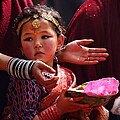
[[File:HinduDevoteeNepal.jpg|thumb|upright=1.1|A young [[Nepal]]i Hindu devotee during a traditional prayer ceremony at [[Kathmandu]]'s [[Durbar Square]].]] | [[File:HinduDevoteeNepal.jpg|thumb|upright=1.1|A young [[Nepal]]i Hindu devotee during a traditional prayer ceremony at [[Kathmandu]]'s [[Durbar Square]].]] | ||
In contemporary era, | In contemporary era, Hindus are individuals who identify with one or more aspects of [[Hinduism]], whether they are practising or non-practicing or ''[[Laissez-faire]]''.<ref>Bryan Turner (2010), The New Blackwell Companion to the Sociology of Religion, John Wiley & Sons, {{ISBN|978-1-4051-8852-4}}, pages 424–425</ref> The term does not include those who identify with other Indian religions such as Buddhism, Jainism, Sikhism or various animist tribal religions found in India such as [[Sarnaism]].<ref name="Marty1996" /><ref>James Minahan (2012), Ethnic Groups of South Asia and the Pacific: An Encyclopedia, {{ISBN|978-1-59884-659-1}}, pages 97–99</ref> The term Hindu, in contemporary parlance, includes people who accept themselves as culturally or ethnically Hindu rather than with a fixed set of religious beliefs within Hinduism.<ref name=jefferylong /> One need not be religious in the minimal sense, states [[Julius J. Lipner|Julius Lipner]], to be accepted as Hindu by Hindus, or to describe oneself as Hindu.<ref>Julius J. Lipner (2009), Hindus: Their Religious Beliefs and Practices, 2nd Edition, Routledge, {{ISBN|978-0-415-45677-7}}, page 8</ref> | ||
Hindus subscribe to a diversity of ideas on [[Spirituality#Hinduism|spirituality]] and traditions, but have no ecclesiastical order, no unquestionable religious authorities, no governing body, nor a single founding prophet; Hindus can choose to be polytheistic, pantheistic, monotheistic, monistic, agnostic, atheistic or humanist.<ref>[[Julius J. Lipner]] (2009), Hindus: Their Religious Beliefs and Practices, 2nd Edition, Routledge, {{ISBN|978-0-415-45677-7}}, page 8; Quote: "(...) one need not be religious in the minimal sense described to be accepted as a Hindu by Hindus, or describe oneself perfectly validly as Hindu. One may be polytheistic or monotheistic, monistic or pantheistic, even an agnostic, humanist or atheist, and still be considered a Hindu."</ref><ref>Lester Kurtz (Ed.), Encyclopedia of Violence, Peace and Conflict, {{ISBN|978-0-12-369503-1}}, Academic Press, 2008</ref><ref>MK Gandhi, [http://www.mkgandhi.org/ebks/essence_of_hinduism.pdf The Essence of Hinduism], Editor: VB Kher, Navajivan Publishing, see page 3; According to Gandhi, "a man may not believe in God and still call himself a Hindu."</ref> Because of the wide range of traditions and ideas covered by the term Hinduism, arriving at a comprehensive definition is difficult.{{sfn|Flood|1996|p=6}} The religion "defies our desire to define and categorize it".<ref>{{cite book |title= Hinduism: A Very Short Introduction|last= Knott|first= Kim|year= 1998|publisher= Oxford University press|location= Oxford|isbn= 978-0-19-285387-5|page= 117}}</ref> A Hindu may, by | Hindus subscribe to a diversity of ideas on [[Spirituality#Hinduism|spirituality]] and traditions, but have no ecclesiastical order, no unquestionable religious authorities, no governing body, nor a single founding [[prophet]]; Hindus can choose to be polytheistic, pantheistic, monotheistic, monistic, agnostic, atheistic or humanist.<ref>[[Julius J. Lipner]] (2009), Hindus: Their Religious Beliefs and Practices, 2nd Edition, Routledge, {{ISBN|978-0-415-45677-7}}, page 8; Quote: "(...) one need not be religious in the minimal sense described to be accepted as a Hindu by Hindus, or describe oneself perfectly validly as Hindu. One may be polytheistic or monotheistic, monistic or pantheistic, even an agnostic, humanist or atheist, and still be considered a Hindu."</ref><ref>Lester Kurtz (Ed.), Encyclopedia of Violence, Peace and Conflict, {{ISBN|978-0-12-369503-1}}, Academic Press, 2008</ref><ref>MK Gandhi, [http://www.mkgandhi.org/ebks/essence_of_hinduism.pdf The Essence of Hinduism] {{Webarchive|url=https://web.archive.org/web/20150724045756/http://www.mkgandhi.org/ebks/essence_of_hinduism.pdf |date=24 July 2015 }}, Editor: VB Kher, Navajivan Publishing, see page 3; According to Gandhi, "a man may not believe in God and still call himself a Hindu."</ref> Because of the wide range of traditions and ideas covered by the term Hinduism, arriving at a comprehensive definition is difficult.{{sfn|Flood|1996|p=6}} The religion "defies our desire to define and categorize it".<ref>{{cite book |title= Hinduism: A Very Short Introduction|last= Knott|first= Kim|year= 1998|publisher= Oxford University press|location= Oxford|isbn= 978-0-19-285387-5|page= 117}}</ref> A Hindu may, by choice, draw upon ideas of other Indian or non-Indian religious thought as a resource, follow or evolve their personal beliefs, and still identify as a Hindu.<ref name=jefferylong /> | ||
In 1995, Chief Justice [[P. B. Gajendragadkar]] was quoted in an [[Supreme Court of India|Indian Supreme Court]] ruling:<ref name=SCI>[[Supreme Court of India]], [https://web.archive.org/web/20061030015441/http://www.hinduismtoday.com/in-depth_issues/RKMission.html "Bramchari Sidheswar Shai and others Versus State of West Bengal"], 1995, [http://indiankanoon.org/doc/967081/ Archive2] Archived from [http://www.hinduismtoday.com/in-depth_issues/RKMission.html the original] {{webarchive|url=https://web.archive.org/web/20061030015441/http://www.hinduismtoday.com/in-depth_issues/RKMission.html |date=30 October 2006}}.</ref><ref name=SC1966>Supreme Court of India 1966 AIR 1119, [http://judis.nic.in/supremecourt/imgs1.aspx?filename=2757 ''Sastri Yagnapurushadji'' vs ''Muldas Brudardas Vaishya''] {{Webarchive|url=https://web.archive.org/web/20140512221716/http://judis.nic.in/supremecourt/imgs1.aspx?filename=2757 |date=12 May 2014}} (pdf), page 15, 14 January 1966</ref> | In 1995, Chief Justice [[P. B. Gajendragadkar]] was quoted in an [[Supreme Court of India|Indian Supreme Court]] ruling:<ref name=SCI>[[Supreme Court of India]], [https://web.archive.org/web/20061030015441/http://www.hinduismtoday.com/in-depth_issues/RKMission.html "Bramchari Sidheswar Shai and others Versus State of West Bengal"], 1995, [http://indiankanoon.org/doc/967081/ Archive2] {{Webarchive|url=https://web.archive.org/web/20151207043454/http://indiankanoon.org/doc/967081/ |date=7 December 2015 }} Archived from [http://www.hinduismtoday.com/in-depth_issues/RKMission.html the original] {{webarchive|url=https://web.archive.org/web/20061030015441/http://www.hinduismtoday.com/in-depth_issues/RKMission.html |date=30 October 2006 }}.</ref><ref name=SC1966>Supreme Court of India 1966 AIR 1119, [http://judis.nic.in/supremecourt/imgs1.aspx?filename=2757 ''Sastri Yagnapurushadji'' vs ''Muldas Brudardas Vaishya''] {{Webarchive|url=https://web.archive.org/web/20140512221716/http://judis.nic.in/supremecourt/imgs1.aspx?filename=2757 |date=12 May 2014}} (pdf), page 15, 14 January 1966</ref> | ||
:When we think of the Hindu religion, unlike other religions in the world, the Hindu religion does not claim any one prophet; it does not worship any one god; it does not subscribe to any one dogma; it does not believe in any one philosophic concept; it does not follow any one set of religious rites or performances; in fact, it does not appear to satisfy the narrow traditional features of any religion or [[creed]]. It may broadly be described as a way of life and nothing more. | :When we think of the Hindu religion, unlike other religions in the world, the Hindu religion does not claim any one prophet; it does not worship any one god; it does not subscribe to any one dogma; it does not believe in any one philosophic concept; it does not follow any one set of religious rites or performances; in fact, it does not appear to satisfy the narrow traditional features of any religion or [[creed]]. It may broadly be described as a way of life and nothing more. | ||
Although Hinduism contains a broad range of philosophies, Hindus share philosophical concepts, such as but not limiting to [[dharma]], [[karma]], [[kama]], [[artha]], [[moksha]] and [[samsara]], even if each subscribes to a diversity of views.<ref name=frazierintro /> Hindus also have shared texts such as the [[Veda]]s with embedded [[Mukhya Upanishad|Upanishads]], and common ritual grammar ([[Sanskara (rite of passage)]]) such as rituals during a wedding or when a baby is born or cremation rituals.<ref name=carlolson>Carl Olson (2007), The Many Colors of Hinduism: A Thematic-historical Introduction, Rutgers University Press, {{ISBN|978-0-8135-4068-9}}, pages 93–94</ref><ref>Rajbali Pandey (2013), Hindu Saṁskāras: Socio-religious Study of the Hindu Sacraments, 2nd Edition, Motilal Banarsidass, {{ISBN|978-81-208-0396-1}}, pages 15–36</ref> Some Hindus go on pilgrimage to shared sites they consider spiritually significant, practice one or more forms of [[bhakti]] or [[Puja (Hinduism)|puja]], celebrate mythology and epics, major festivals, love and respect for [[guru]] and family, and other cultural traditions.<ref name=frazierintro>{{cite book|last1=Frazier|first1=Jessica|title=The Continuum companion to Hindu studies | date=2011|publisher=Continuum|location=London|isbn=978-0-8264-9966-0|pages=1–15}}</ref><ref name = Flood>{{cite book|url=https://books.google.com/books?id=qSfneQ0YYY8C&q=uniting+and+dispersing+tendencies&pg=PA4|title=The Blackwell Companion to Hinduism|first=Gavin|last=Flood|date=7 February 2003|publisher=Wiley|via=Google Books|isbn=978-0-631-21535-6}}</ref> A Hindu could: | Although Hinduism contains a broad range of philosophies, Hindus share philosophical concepts, such as but not limiting to [[dharma]], [[karma]], [[kama]], [[artha]], [[moksha]] and [[samsara]], even if each subscribes to a diversity of views.<ref name=frazierintro /> Hindus also have shared texts such as the [[Veda]]s with embedded [[Mukhya Upanishad|Upanishads]], and common ritual grammar ([[Sanskara (rite of passage)]]) such as rituals during a wedding or when a baby is born or cremation rituals.<ref name=carlolson>Carl Olson (2007), The Many Colors of Hinduism: A Thematic-historical Introduction, Rutgers University Press, {{ISBN|978-0-8135-4068-9}}, pages 93–94</ref><ref>Rajbali Pandey (2013), Hindu Saṁskāras: Socio-religious Study of the Hindu Sacraments, 2nd Edition, Motilal Banarsidass, {{ISBN|978-81-208-0396-1}}, pages 15–36</ref> Some Hindus go on pilgrimage to shared sites they consider spiritually significant, practice one or more forms of [[bhakti]] or [[Puja (Hinduism)|puja]], celebrate mythology and epics, major festivals, love and respect for [[guru]] and family, and other cultural traditions.<ref name=frazierintro>{{cite book|last1=Frazier|first1=Jessica|title=The Continuum companion to Hindu studies | date=2011|publisher=Continuum|location=London|isbn=978-0-8264-9966-0|pages=1–15}}</ref><ref name = Flood>{{cite book|url=https://books.google.com/books?id=qSfneQ0YYY8C&q=uniting+and+dispersing+tendencies&pg=PA4|title=The Blackwell Companion to Hinduism|first=Gavin|last=Flood|date=7 February 2003|publisher=Wiley|via=Google Books|isbn=978-0-631-21535-6|access-date=2 October 2020|archive-date=26 January 2021|archive-url=https://web.archive.org/web/20210126071337/https://books.google.com/books?id=qSfneQ0YYY8C&q=uniting+and+dispersing+tendencies&pg=PA4|url-status=live}}</ref> A Hindu could: | ||
* follow any of the Hindu [[Hindu philosophy|schools of philosophy]], such as [[Advaita Vedanta|Advaita]] (non-[[Dualism (Indian philosophy)|dualism]]), [[Vishishtadvaita]] (non-dualism of the qualified whole), [[Dvaita]] ([[Dualism (Indian philosophy)|dualism]]), [[Dvaitadvaita]] (dualism with non-dualism), etc.<ref>Muller, F. Max. ''Six Systems of Indian Philosophy; Samkhya and Yoga; Naya and Vaiseshika''. 1899. This classic work helped to establish the major classification systems as we know them today. Reprint edition: (Kessinger Publishing: February 2003) {{ISBN|978-0-7661-4296-1}}.</ref><ref>{{cite book |last1=Radhakrishnan |first1=S. |author-link1=Sarvepalli Radhakrishnan |author2=Moore, CA |title=A Sourcebook in Indian Philosophy |year=1967 |publisher=Princeton |isbn=0-691-01958-4 |url=https://archive.org/details/sourcebookinindi00radh}}</ref> | * follow any of the Hindu [[Hindu philosophy|schools of philosophy]], such as [[Advaita Vedanta|Advaita]] (non-[[Dualism (Indian philosophy)|dualism]]), [[Vishishtadvaita]] (non-dualism of the qualified whole), [[Dvaita]] ([[Dualism (Indian philosophy)|dualism]]), [[Dvaitadvaita]] (dualism with non-dualism), etc.<ref>Muller, F. Max. ''Six Systems of Indian Philosophy; Samkhya and Yoga; Naya and Vaiseshika''. 1899. This classic work helped to establish the major classification systems as we know them today. Reprint edition: (Kessinger Publishing: February 2003) {{ISBN|978-0-7661-4296-1}}.</ref><ref>{{cite book |last1=Radhakrishnan |first1=S. |author-link1=Sarvepalli Radhakrishnan |author2=Moore, CA |title=A Sourcebook in Indian Philosophy |year=1967 |publisher=Princeton |isbn=0-691-01958-4 |url=https://archive.org/details/sourcebookinindi00radh}}</ref> | ||
* follow a tradition centred on any particular form of the Divine, such as [[Shaivism]], [[Vaishnavism]], [[Shaktism]], etc.<ref>{{cite book |last=Tattwananda |first=Swami|title=Vaisnava Sects, Saiva Sects, Mother Worship |year=1984 |publisher=Firma KLM Private Ltd. |location=Calcutta |edition=First revised }} This work gives an overview of many different subsets of the three main religious groups in India.</ref> | * follow a tradition centred on any particular form of the Divine, such as [[Shaivism]], [[Vaishnavism]], [[Shaktism]], etc.<ref>{{cite book |last=Tattwananda |first=Swami|title=Vaisnava Sects, Saiva Sects, Mother Worship |year=1984 |publisher=Firma KLM Private Ltd. |location=Calcutta |edition=First revised }} This work gives an overview of many different subsets of the three main religious groups in India.</ref> | ||
| Line 185: | Line 153: | ||
=== Disputes === | === Disputes === | ||
In the [[Constitution of India]], the word "Hindu" has been used in some places to denote persons professing any of these religions: [[Hinduism]], [[Jainism]], [[Buddhism]] or [[Sikhism]].<ref>[http://www.unesco.org/most/rr3indi.htm India-Constitution:Religious rights] Article 25:''"Explanation II: In sub-Clause (b) of clause (2), the reference to Hindus shall be construed as including a reference to persons professing the Sikh, Jaina or Buddhist religion"''</ref> This however has been challenged by the Sikhs<ref name="Marty1996">{{cite book|author=Martin E. Marty|title=Fundamentalisms and the State: Remaking Polities, Economies, and Militance|url=https://archive.org/details/fundamentalismss00mart|url-access=registration|date=1 July 1996|publisher=University of Chicago Press|isbn=978-0-226-50884-9|pages=[https://archive.org/details/fundamentalismss00mart/page/270 270]–271}}</ref><ref name="Fazal2014">{{cite book|author=Tanweer Fazal|title="Nation-state" and Minority Rights in India: Comparative Perspectives on Muslim and Sikh Identities|url=https://books.google.com/books?id=1WwtBAAAQBAJ&pg=PA136|date=1 August 2014|publisher=Routledge|isbn=978-1-317-75179-3|pages=20, 112–114}}</ref> and by neo-Buddhists who were formerly Hindus.<ref name="BoyleSheen2013">{{cite book|author1=Kevin Boyle|author2=Juliet Sheen|title=Freedom of Religion and Belief: A World Report|url=https://books.google.com/books?id=JxgFWwK8dXwC&pg=PA191|date=7 March 2013|publisher=Routledge|isbn=978-1-134-72229-7|pages=191–192}}</ref> According to Sheen and Boyle, Jains have not objected to being covered by personal laws termed under 'Hindu',<ref name="BoyleSheen2013" /> but Indian courts have acknowledged that Jainism is a distinct religion.<ref name="School Bal Vidya Mandir 2003">para 25, Committee of Management Kanya Junior High School Bal Vidya Mandir, Etah, Uttar Pradesh v. Sachiv, U.P. Basic Shiksha Parishad, Allahabad, U.P. and Ors., Per Dalveer Bhandari J., Civil Appeal No. 9595 of 2003, decided On: 21 August 2006, Supreme Court of India</ref> | In the [[Constitution of India]], the word "Hindu" has been used in some places to denote persons professing any of these religions: [[Hinduism]], [[Jainism]], [[Buddhism]] or [[Sikhism]].<ref>[http://www.unesco.org/most/rr3indi.htm India-Constitution:Religious rights] {{Webarchive|url=https://web.archive.org/web/20111007173401/http://www.unesco.org/most/rr3indi.htm |date=7 October 2011 }} Article 25:''"Explanation II: In sub-Clause (b) of clause (2), the reference to Hindus shall be construed as including a reference to persons professing the Sikh, Jaina or Buddhist religion"''</ref> This however has been challenged by the Sikhs<ref name="Marty1996">{{cite book|author=Martin E. Marty|title=Fundamentalisms and the State: Remaking Polities, Economies, and Militance|url=https://archive.org/details/fundamentalismss00mart|url-access=registration|date=1 July 1996|publisher=University of Chicago Press|isbn=978-0-226-50884-9|pages=[https://archive.org/details/fundamentalismss00mart/page/270 270]–271}}</ref><ref name="Fazal2014">{{cite book|author=Tanweer Fazal|title="Nation-state" and Minority Rights in India: Comparative Perspectives on Muslim and Sikh Identities|url=https://books.google.com/books?id=1WwtBAAAQBAJ&pg=PA136|date=1 August 2014|publisher=Routledge|isbn=978-1-317-75179-3|pages=20, 112–114}}</ref> and by neo-Buddhists who were formerly Hindus.<ref name="BoyleSheen2013">{{cite book|author1=Kevin Boyle|author2=Juliet Sheen|title=Freedom of Religion and Belief: A World Report|url=https://books.google.com/books?id=JxgFWwK8dXwC&pg=PA191|date=7 March 2013|publisher=Routledge|isbn=978-1-134-72229-7|pages=191–192}}</ref> According to Sheen and Boyle, Jains have not objected to being covered by personal laws termed under 'Hindu',<ref name="BoyleSheen2013" /> but Indian courts have acknowledged that Jainism is a distinct religion.<ref name="School Bal Vidya Mandir 2003">para 25, Committee of Management Kanya Junior High School Bal Vidya Mandir, Etah, Uttar Pradesh v. Sachiv, U.P. Basic Shiksha Parishad, Allahabad, U.P. and Ors., Per Dalveer Bhandari J., Civil Appeal No. 9595 of 2003, decided On: 21 August 2006, Supreme Court of India</ref> | ||
The [[Republic of India]] is in the peculiar situation that the [[Supreme Court of India]] has repeatedly been called upon to define "Hinduism" because the [[Constitution of India]], while it prohibits "discrimination of any citizen" on grounds of religion in article 15, article 30 foresees special rights for "All minorities, whether based on religion or language". As a consequence, religious groups have an interest in being recognised as distinct from the Hindu majority in order to qualify as a "religious minority". Thus, the Supreme Court was forced to consider the question whether [[Jainism]] is part of Hinduism in 2005 and 2006. | The [[Republic of India]] is in the peculiar situation that the [[Supreme Court of India]] has repeatedly been called upon to define "Hinduism" because the [[Constitution of India]], while it prohibits "discrimination of any citizen" on grounds of religion in article 15, article 30 foresees special rights for "All minorities, whether based on religion or language". As a consequence, religious groups have an interest in being recognised as distinct from the Hindu majority in order to qualify as a "religious minority". Thus, the Supreme Court was forced to consider the question whether [[Jainism]] is part of Hinduism in 2005 and 2006. | ||
== History of Hindu identity == | == History of Hindu identity == | ||
Starting after the 10th century and particularly after the 12th century Islamic invasion, states [[Sheldon Pollock]], the political response fused with the Indic religious culture and doctrines.<ref name=pollockdevagiri>Sheldon Pollock (1993), [https://www.jstor.org/stable/2059648 Rāmāyaṇa and political imagination in India], Journal of Asian studies, Vol. 52, No. 2, pages 266–269</ref> Temples dedicated to deity [[Rama]] were built from north to south India, and textual records as well as hagiographic inscriptions began comparing the Hindu epic of [[Ramayana]] to regional kings and their response to Islamic attacks. The [[Seuna (Yadava) dynasty|Yadava]] king of [[Devagiri]] named ''[[Ramachandra of Devagiri|Ramacandra]]'', for example states Pollock, is described in a 13th-century record as, "How is this Rama to be described.. who freed [[Varanasi]] from the ''mleccha'' (barbarian, Turk Muslim) horde, and built there a golden temple of Sarngadhara".<ref name=pollockdevagiri /> Pollock notes that the Yadava king ''Ramacandra'' is described as a devotee of deity [[Shiva]] (Shaivism), yet his political achievements and temple construction sponsorship in Varanasi, far from his kingdom's location in the Deccan region, is described in the historical records in Vaishnavism terms of Rama, a deity [[Vishnu]] avatar.<ref name=pollockdevagiri /> Pollock presents many such examples and suggests an emerging Hindu political identity that was grounded in the Hindu religious text of Ramayana, one that has continued into the modern times, and suggests that this historic process began with the arrival of Islam in India.<ref>Sheldon Pollock (1993), [https://www.jstor.org/stable/2059648 Rāmāyaṇa and political imagination in India], Journal of Asian studies, Vol. 52, No. 2, pages 261–297</ref> | Starting after the 10th century and particularly after the 12th-century Islamic invasion, states [[Sheldon Pollock]], the political response fused with the Indic religious culture and doctrines.<ref name=pollockdevagiri>Sheldon Pollock (1993), [https://www.jstor.org/stable/2059648 Rāmāyaṇa and political imagination in India] {{Webarchive|url=https://web.archive.org/web/20160820001056/http://www.jstor.org/stable/2059648 |date=20 August 2016 }}, Journal of Asian studies, Vol. 52, No. 2, pages 266–269</ref> Temples dedicated to deity [[Rama]] were built from north to south India, and textual records as well as hagiographic inscriptions began comparing the Hindu epic of [[Ramayana]] to regional kings and their response to Islamic attacks. The [[Seuna (Yadava) dynasty|Yadava]] king of [[Devagiri]] named ''[[Ramachandra of Devagiri|Ramacandra]]'', for example states Pollock, is described in a 13th-century record as, "How is this Rama to be described.. who freed [[Varanasi]] from the ''mleccha'' (barbarian, Turk Muslim) horde, and built there a golden temple of Sarngadhara".<ref name=pollockdevagiri /> Pollock notes that the Yadava king ''Ramacandra'' is described as a devotee of deity [[Shiva]] (Shaivism), yet his political achievements and temple construction sponsorship in Varanasi, far from his kingdom's location in the Deccan region, is described in the historical records in Vaishnavism terms of Rama, a deity [[Vishnu]] avatar.<ref name=pollockdevagiri /> Pollock presents many such examples and suggests an emerging Hindu political identity that was grounded in the Hindu religious text of Ramayana, one that has continued into the modern times, and suggests that this historic process began with the arrival of Islam in India.<ref>Sheldon Pollock (1993), [https://www.jstor.org/stable/2059648 Rāmāyaṇa and political imagination in India] {{Webarchive|url=https://web.archive.org/web/20160820001056/http://www.jstor.org/stable/2059648 |date=20 August 2016 }}, Journal of Asian studies, Vol. 52, No. 2, pages 261–297</ref> | ||
Brajadulal Chattopadhyaya has questioned the Pollock theory and presented textual and inscriptional evidence.<ref name=brajadulal2004 /> According to Chattopadhyaya, the Hindu identity and religious response to Islamic invasion and wars developed in different kingdoms, such as wars between Islamic Sultanates and the Vijayanagara kingdom, and Islamic raids on the kingdoms in [[Tamil Nadu]]. These wars were described not just using the mythical story of Rama from Ramayana, states Chattopadhyaya, the medieval records used a wide range of religious symbolism and myths that are now considered as part of Hindu literature.<ref name=brajadulal>Brajadulal Chattopadhyaya (1998), Representing the other?: Sanskrit sources and the Muslims (eighth to fourteenth century), Manohar Publications, {{ISBN|978-81-7304-252-2}}, pages 92–103, Chapter 1 and 2</ref><ref name=brajadulal2004>Brajadulal Chattopadhyaya (2004), Other or the Others? in ''The World in the Year 1000'' (Editors: James Heitzman, Wolfgang Schenkluhn), University Press of America, {{ISBN|978-0-7618-2561-6}}, pages 303–323</ref> This emergence of religious with political terminology began with the first Muslim invasion of Sindh in the 8th century CE, and intensified 13th century onwards. The 14th-century Sanskrit text, ''Madhuravijayam'', a memoir written by ''Gangadevi'', the wife of Vijayanagara prince, for example describes the consequences of war using religious terms,<ref name=brajadulal306 /> | Brajadulal Chattopadhyaya has questioned the Pollock theory and presented textual and inscriptional evidence.<ref name=brajadulal2004 /> According to Chattopadhyaya, the Hindu identity and religious response to Islamic invasion and wars developed in different kingdoms, such as wars between Islamic Sultanates and the Vijayanagara kingdom, and Islamic raids on the kingdoms in [[Tamil Nadu]]. These wars were described not just using the mythical story of Rama from Ramayana, states Chattopadhyaya, the medieval records used a wide range of religious symbolism and myths that are now considered as part of Hindu literature.<ref name=brajadulal>Brajadulal Chattopadhyaya (1998), Representing the other?: Sanskrit sources and the Muslims (eighth to fourteenth century), Manohar Publications, {{ISBN|978-81-7304-252-2}}, pages 92–103, Chapter 1 and 2</ref><ref name=brajadulal2004>Brajadulal Chattopadhyaya (2004), Other or the Others? in ''The World in the Year 1000'' (Editors: James Heitzman, Wolfgang Schenkluhn), University Press of America, {{ISBN|978-0-7618-2561-6}}, pages 303–323</ref> This emergence of religious with political terminology began with the first Muslim invasion of Sindh in the 8th century CE, and intensified 13th century onwards. The 14th-century Sanskrit text, ''Madhuravijayam'', a memoir written by ''Gangadevi'', the wife of Vijayanagara prince, for example describes the consequences of war using religious terms,<ref name=brajadulal306 /> | ||
| Line 216: | Line 184: | ||
=== Hindu identity amidst other Indian religions === | === Hindu identity amidst other Indian religions === | ||
{{multiple image | {{multiple image | ||
| direction = vertical | | direction = vertical | ||
| width = 235 | | width = 235 | ||
| footer = Hindus celebrating their major festivals, [[Holi]] (top) and [[Diwali]]. | | footer = Hindus celebrating their major festivals, [[Holi]] (top) and [[Diwali]]. | ||
| image1 = Holi | | image1 = The children celebrating Holi, in New Delhi on March 11, 2009.jpg | ||
| image2 = Deepawali-festival.jpg | | image2 = Deepawali-festival.jpg | ||
| align = left | | align = left | ||
}} | }} | ||
Scholars state that Hindu, Buddhist and Jain identities are retrospectively-introduced modern constructions.<ref name=leslie /> Inscriptional evidence from the 8th century onwards, in regions such as South India, suggests that medieval era India, at both elite and folk religious practices level, likely had a "shared religious culture",<ref name=leslie>Leslie Orr (2014), Donors, Devotees, and Daughters of God, Oxford University Press, {{ISBN|978-0-19-535672-4}}, pages 25–26, 204</ref> and their collective identities were "multiple, layered and fuzzy".<ref name=leslieorr>Leslie Orr (2014), Donors, Devotees, and Daughters of God, Oxford University Press, {{ISBN|978-0-19-535672-4}}, pages 42, 204</ref> Even among Hinduism denominations such as Shaivism and Vaishnavism, the Hindu identities, states Leslie Orr, lacked "firm definitions and clear boundaries".<ref name=leslieorr /> | Scholars state that Hindu, Buddhist and Jain identities are retrospectively-introduced modern constructions.<ref name=leslie /> Inscriptional evidence from the 8th century onwards, in regions such as South India, suggests that medieval era India, at both elite and folk religious practices level, likely had a "shared religious culture",<ref name=leslie>Leslie Orr (2014), Donors, Devotees, and Daughters of God, Oxford University Press, {{ISBN|978-0-19-535672-4}}, pages 25–26, 204</ref> and their collective identities were "multiple, layered and fuzzy".<ref name=leslieorr>Leslie Orr (2014), Donors, Devotees, and Daughters of God, Oxford University Press, {{ISBN|978-0-19-535672-4}}, pages 42, 204</ref> Even among Hinduism denominations such as Shaivism and Vaishnavism, the Hindu identities, states Leslie Orr, lacked "firm definitions and clear boundaries".<ref name=leslieorr /> | ||
| Line 230: | Line 199: | ||
=== Sacred geography === | === Sacred geography === | ||
Scholars such as Fleming and Eck state that the post-Epic era literature from the 1st millennium CE amply demonstrate that there was a historic concept of the Indian subcontinent as a sacred geography, where the sacredness was a shared set of religious ideas. For example, the twelve ''Jyotirlingas'' of Shaivism and fifty-one ''Shaktipithas'' of Shaktism are described in the early medieval era Puranas as pilgrimage sites around a theme.{{sfn|Fleming|2009|pp=51–56}}<ref>{{cite book|author=Knut A. Jacobsen|title=Pilgrimage in the Hindu Tradition: Salvific Space |url=https://books.google.com/books?id=Kn6_3oBFAqIC&pg=PA122 |year= 2013|publisher= Routledge|isbn=978-0-415-59038-9|pages=122–129}}</ref><ref>{{cite book|author=André Padoux|title=The Hindu Tantric World: An Overview |url=https://books.google.com/books?id=odQZDgAAQBAJ |year=2017|publisher=University of Chicago Press|isbn=978-0-226-42412-5|pages=136–149}}</ref> This sacred geography and Shaiva temples with same iconography, shared themes, motifs and embedded legends are found across India, from the [[Himalaya]]s to hills of South India, from [[Ellora Caves]] to [[Varanasi]] by about the middle of 1st millennium.{{sfn|Fleming|2009|pp=51–56}}<ref>{{cite book |author1=Linda Kay Davidson |author2=David Martin Gitlitz |year=2002 |title=Pilgrimage: From the Ganges to Graceland; an Encyclopedia |url=https://books.google.com/books?id=YVYkrNhPMQkC |publisher=ABC-CLIO|isbn=978-1-57607-004-8|pages=239–244}}</ref> Shakti temples, dated to a few centuries later, are verifiable across the subcontinent. Varanasi as a sacred pilgrimage site is documented in the ''Varanasimahatmya'' text embedded inside the ''[[Skanda Purana]]'', and the oldest versions of this text are dated to 6th to 8th-century CE.{{sfn|Fleming|2009|p=56}}<ref name=Eck2012p34 /> | Scholars such as Fleming and Eck state that the post-Epic era literature from the 1st millennium CE amply demonstrate that there was a historic concept of the Indian subcontinent as a sacred geography, where the sacredness was a shared set of religious ideas. For example, the twelve ''Jyotirlingas'' of Shaivism and fifty-one ''Shaktipithas'' of Shaktism are described in the early medieval era Puranas as pilgrimage sites around a theme.{{sfn|Fleming|2009|pp=51–56}}<ref>{{cite book|author=Knut A. Jacobsen|title=Pilgrimage in the Hindu Tradition: Salvific Space |url=https://books.google.com/books?id=Kn6_3oBFAqIC&pg=PA122 |year= 2013|publisher= Routledge|isbn=978-0-415-59038-9|pages=122–129}}</ref><ref>{{cite book|author=André Padoux|title=The Hindu Tantric World: An Overview |url=https://books.google.com/books?id=odQZDgAAQBAJ |year=2017|publisher=University of Chicago Press|isbn=978-0-226-42412-5|pages=136–149}}</ref> This sacred geography and Shaiva temples with same iconography, shared themes, motifs and embedded legends are found across India, from the [[Himalaya]]s to hills of South India, from [[Ellora Caves]] to [[Varanasi]] by about the middle of 1st millennium.{{sfn|Fleming|2009|pp=51–56}}<ref>{{cite book |author1=Linda Kay Davidson |author2=David Martin Gitlitz |year=2002 |title=Pilgrimage: From the Ganges to Graceland; an Encyclopedia |url=https://books.google.com/books?id=YVYkrNhPMQkC |publisher=ABC-CLIO |isbn=978-1-57607-004-8 |pages=239–244 |access-date=24 August 2017 |archive-date=4 July 2023 |archive-url=https://web.archive.org/web/20230704100931/https://books.google.com/books?id=YVYkrNhPMQkC |url-status=live }}</ref> Shakti temples, dated to a few centuries later, are verifiable across the subcontinent. Varanasi as a sacred pilgrimage site is documented in the ''Varanasimahatmya'' text embedded inside the ''[[Skanda Purana]]'', and the oldest versions of this text are dated to 6th to 8th-century CE.{{sfn|Fleming|2009|p=56}}<ref name=Eck2012p34 /> | ||
The idea of twelve sacred sites in Shiva Hindu tradition spread across the Indian subcontinent appears not only in the medieval era temples but also in copper plate inscriptions and temple seals discovered in different sites.{{sfn|Fleming|2009|pp=57–58}} According to Bhardwaj, non-Hindu texts such as the memoirs of Chinese Buddhist and Persian Muslim travellers attest to the existence and significance of the pilgrimage to sacred geography among Hindus by later 1st millennium CE.<ref>{{cite book|author=Surinder M. Bhardwaj|title=Hindu Places of Pilgrimage in India: A Study in Cultural Geography|url=https://books.google.com/books?id=D6XJFokSJzEC |year=1983|publisher=University of California Press|isbn=978-0-520-04951-2|pages=75–79}}</ref> | The idea of twelve sacred sites in Shiva Hindu tradition spread across the Indian subcontinent appears not only in the medieval era temples but also in copper plate inscriptions and temple seals discovered in different sites.{{sfn|Fleming|2009|pp=57–58}} According to Bhardwaj, non-Hindu texts such as the memoirs of Chinese Buddhist and Persian Muslim travellers attest to the existence and significance of the pilgrimage to sacred geography among Hindus by later 1st millennium CE.<ref>{{cite book|author=Surinder M. Bhardwaj|title=Hindu Places of Pilgrimage in India: A Study in Cultural Geography|url=https://books.google.com/books?id=D6XJFokSJzEC|year=1983|publisher=University of California Press|isbn=978-0-520-04951-2|pages=75–79|access-date=24 August 2017|archive-date=31 March 2024|archive-url=https://web.archive.org/web/20240331131330/https://books.google.com/books?id=D6XJFokSJzEC|url-status=live}}</ref> | ||
According to Fleming, those who question whether the term Hindu and Hinduism are a modern construction in a religious context present their arguments based on some texts that have survived into the modern era, either of Islamic courts or of literature published by Western missionaries or colonial-era Indologists aiming for a reasonable construction of history. However, the existence of non-textual evidence such as cave temples separated by thousands of kilometers, as well as lists of medieval era pilgrimage sites, is evidence of a shared sacred geography and existence of a community that was self-aware of shared religious premises and landscape.{{sfn|Fleming|2009|pp=51–58}}<ref name=Eck2012p34 /> Further, it is a norm in evolving cultures that there is a gap between the "lived and historical realities" of a religious tradition and the emergence of related "textual authorities".{{sfn|Fleming|2009|pp=57–58}} The tradition and temples likely existed well before the medieval era Hindu manuscripts appeared that describe them and the sacred geography. This, states Fleming, is apparent given the sophistication of the architecture and the sacred sites along with the variance in the versions of the Puranic literature.{{sfn|Fleming|2009|pp=51–58}}<ref>{{cite book|author=Surinder M. Bhardwaj|title=Hindu Places of Pilgrimage in India: A Study in Cultural Geography|url=https://books.google.com/books?id=D6XJFokSJzEC |year=1983|publisher=University of California Press|isbn=978-0-520-04951-2|pages=58–79}}</ref> According to [[Diana L. Eck]] and other Indologists such as André Wink, Muslim invaders were aware of Hindu sacred geography such as Mathura, Ujjain, and Varanasi by the 11th century. These sites became a target of their serial attacks in the centuries that followed.<ref name=Eck2012p34>{{cite book|author=Diana L Eck|author-link=Diana L. Eck|title=India: A Sacred Geography|url=https://books.google.com/books?id=rNlJOSf__xYC |year=2012|publisher=Harmony|isbn=978-0-385-53191-7|pages=34–40, 55–58, 88}}</ref> | According to Fleming, those who question whether the term Hindu and Hinduism are a modern construction in a religious context present their arguments based on some texts that have survived into the modern era, either of Islamic courts or of literature published by Western missionaries or colonial-era Indologists aiming for a reasonable construction of history. However, the existence of non-textual evidence such as cave temples separated by thousands of kilometers, as well as lists of medieval era pilgrimage sites, is evidence of a shared sacred geography and existence of a community that was self-aware of shared religious premises and landscape.{{sfn|Fleming|2009|pp=51–58}}<ref name=Eck2012p34 /> Further, it is a norm in evolving cultures that there is a gap between the "lived and historical realities" of a religious tradition and the emergence of related "textual authorities".{{sfn|Fleming|2009|pp=57–58}} The tradition and temples likely existed well before the medieval era Hindu manuscripts appeared that describe them and the sacred geography. This, states Fleming, is apparent given the sophistication of the architecture and the sacred sites along with the variance in the versions of the Puranic literature.{{sfn|Fleming|2009|pp=51–58}}<ref>{{cite book|author=Surinder M. Bhardwaj|title=Hindu Places of Pilgrimage in India: A Study in Cultural Geography|url=https://books.google.com/books?id=D6XJFokSJzEC|year=1983|publisher=University of California Press|isbn=978-0-520-04951-2|pages=58–79|access-date=24 August 2017|archive-date=31 March 2024|archive-url=https://web.archive.org/web/20240331131330/https://books.google.com/books?id=D6XJFokSJzEC|url-status=live}}</ref> According to [[Diana L. Eck]] and other Indologists such as André Wink, Muslim invaders were aware of Hindu sacred geography such as Mathura, Ujjain, and Varanasi by the 11th century. These sites became a target of their serial attacks in the centuries that followed.<ref name=Eck2012p34>{{cite book|author=Diana L Eck|author-link=Diana L. Eck|title=India: A Sacred Geography|url=https://books.google.com/books?id=rNlJOSf__xYC |year=2012|publisher=Harmony|isbn=978-0-385-53191-7|pages=34–40, 55–58, 88}}</ref> | ||
=== Hindu persecution === | === Hindu persecution === | ||
{{Main|Persecution of Hindus}} | {{Main|Persecution of Hindus}} | ||
Other recorded persecution of Hindus include those under the reign of 18th century [[Tipu Sultan]] in south India,<ref>{{cite book |author=Kate Brittlebank |year=1997 |title=Tipu Sultan's Search for Legitimacy: Islam and Kingship in a Hindu Domain |url=https://books.google.com/books?id=3zI-AAAAMAAJ |publisher=Oxford University Press |pages=12, 34–35 |isbn=978-0-19-563977-3}}</ref> and during the colonial era.<ref>{{cite book|author=Funso S. Afọlayan|title=Culture and Customs of South Africa|url=https://books.google.com/books?id=sJh4ziYPoksC&pg=PA78 |year=2004|publisher=Greenwood |isbn=978-0-313-32018-7 |pages=78–79}}</ref><ref>{{cite journal |last=Singh | first=Sherry-Ann | title=Hinduism and the State in Trinidad | journal=Inter-Asia Cultural Studies | volume=6 | issue=3 | year=2005 | pages=353–365 | doi=10.1080/14649370500169987| s2cid=144214455 }}</ref><ref>{{cite book|author1=Derek R. Peterson |author2=Darren R. Walhof |title=The Invention of Religion: Rethinking Belief in Politics and History|url=https://books.google.com/books?id=5k49IdzycwUC |year=2002|publisher=Rutgers University Press |isbn=978-0-8135-3093-2 |pages=82}}</ref> In the modern era, religious persecution of Hindus have been reported outside India in [[Pakistan]] and [[ | The Hindus have been persecuted during the medieval and modern era. The medieval persecution included waves of plunder, killing, destruction of temples and enslavement by Turk-Mongol Muslim armies from central Asia. This is documented in Islamic literature such as those relating to 8th century [[Muhammad bin-Qasim]],<ref>{{cite book|author=André Wink|title=Al-Hind, the Making of the Indo-Islamic World: Early Medieval India and the Expansion of Islam 7Th-11th Centuries| url=https://books.google.com/books?id=g2m7_R5P2oAC |year=2002|publisher=BRILL Academic|isbn=978-0-391-04173-8 |pages= 154–161, 203–205}}</ref> 11th century [[Mahmud of Ghazni]],<ref>{{cite book|author=André Wink|title=Al-Hind, the Making of the Indo-Islamic World: Early Medieval India and the Expansion of Islam 7Th-11th Centuries| url=https://books.google.com/books?id=g2m7_R5P2oAC |year=2002|publisher=BRILL Academic|isbn=978-0-391-04173-8 |pages= 162–163, 184–186}}</ref><ref>{{cite book|author=Victoria Schofield|title=Afghan Frontier: At the Crossroads of Conflict|url=https://books.google.com/books?id=2CXfd1johOAC&pg=PA25 |year=2010|publisher=Tauris|isbn=978-1-84885-188-7 |pages=25}}</ref> the Persian traveler Al Biruni,<ref>{{cite book|last=Sachau|first=Edward|title=Alberuni's India, Vol. 1|year=1910|publisher=Kegan Paul, Trench, Trübner & Co.|page=22|url=http://www.columbia.edu/cu/lweb/digital/collections/cul/texts/ldpd_5949073_001/pages/ldpd_5949073_001_00000078.html?toggle=image&menu=maximize&top=&left=|access-date=15 July 2016|archive-date=4 March 2016|archive-url=https://web.archive.org/web/20160304102408/http://www.columbia.edu/cu/lweb/digital/collections/cul/texts/ldpd_5949073_001/pages/ldpd_5949073_001_00000078.html?toggle=image&menu=maximize&top=&left=|url-status=live}}, Quote: "Mahmud utterly ruined the prosperity of the country, and performed there wonderful exploits, by which the Hindus became like atoms of dust scattered in all directions, and like a tale of old in the mouth of the people."</ref> the 14th century Islamic army invasion led by Timur,<ref>{{cite book|author1=Tapan Raychaudhuri|author2=Irfan Habib|title=Cambridge Economic History of India Vol-1|url=https://books.google.com/books?id=PsyatLixPsUC&pg=PA91 |year=1982|publisher=Cambridge University Press|isbn=978-81-250-2730-0 |pages=91}}, Quote: "When Timur invaded India in 1398–99, collection of slaves formed an important object for his army. 100,000 Hindu slaves had been seized by his soldiers and camp followers. Even a pious saint had gathered together fifteen slaves. Regrettably, all had to be slaughtered before the attack on Delhi for fear that they might rebel. But after the occupation of Delhi the inhabitants were brought out and distributed as slaves among Timur's nobles, the captives including several thousand artisans and professional people."</ref> and various Sunni Islamic rulers of the Delhi Sultanate and Mughal Empire.<ref>{{cite book|author=Farooqui Salma Ahmed|title=A Comprehensive History of Medieval India: Twelfth to the Mid-Eighteenth Century|url=https://books.google.com/books?id=sxhAtCflwOMC&pg=PA105 |year=2011|publisher=Pearson|isbn=978-81-317-3202-1 |pages=105}}</ref><ref>{{cite book|author1=Hermann Kulke|author2=Dietmar Rothermund|title=A History of India |url=https://books.google.com/books?id=TPVq3ykHyH4C&pg=PA180 |year=2004|publisher=Routledge |isbn=978-0-415-32919-4 |pages=180}}</ref><ref name=lorenzen50 /> There were occasional exceptions such as [[Akbar]] who stopped the persecution of Hindus,<ref name=lorenzen50>{{cite book|author=David N. Lorenzen |author-link=David Lorenzen |title=Who Invented Hinduism: Essays on Religion in History |url=https://books.google.com/books?id=SO-YmMWpcVEC&pg=PA50 |year=2006|publisher=Yoda |isbn=978-81-902272-6-1 |pages=50}}</ref> and occasional severe persecution such as under [[Aurangzeb]],{{sfn|Ayalon|1986|p=271}}{{sfn|Avari|2013|p=115 |ps=: citing a 2000 study, writes "Aurangzeb was perhaps no more culpable than most of the sultans before him; they desecrated the temples associated with Hindu power, not all temples. It is worth noting that, in contrast to the traditional claim of hundreds of Hindu temples having been destroyed by Aurangzeb, a recent study suggests a modest figure of just fifteen destructions."<br /><br />In contrast to Avari, the historian Abraham Eraly estimates Aurangzeb era destruction to be significantly higher; "in 1670, all temples around [[Ujjain]] were destroyed"; and later, "300 temples were destroyed in and around Chitor, [[Udaipur]] and [[Jaipur]]" among other Hindu temples destroyed elsewhere in campaigns through 1705.<ref>Abraham Eraly (2000), Emperors of the Peacock Throne: The Saga of the Great Mughals, Penguin Books, {{ISBN|978-0-14-100143-2}} pages 398–399</ref><br /><br />The persecution during the Islamic period targeted non-Hindus as well. Avari writes, "Aurangzeb's religious policy caused friction between him and the ninth [[Sikhism|Sikh]] guru, Tegh Bahadur. In both [[Punjab]] and Kashmir the [[Sikh]] leader was roused to action by Aurangzeb's excessively zealous Islamic policies. Seized and taken to Delhi, he was called upon by [[Aurangzeb]] to embrace [[Islam]] and, on refusal, was tortured for five days and then beheaded in November 1675. Two of the ten Sikh gurus thus died as martyrs at the hands of the [[Mughal Empire|Mughals]]. (Avari (2013), page 155)}}{{efn|See also "Aurangzeb, as he was according to Mughal Records"; more links at the bottom of that page. For Muslim historian's record on major Hindu temple destruction campaigns, from 1193 to 1729 AD, see Richard Eaton (2000), Temple Desecration and Indo-Muslim States, Journal of Islamic Studies, Vol. 11, Issue 3, pages 283–319}} who destroyed temples, forcibly converted non-Muslims to Islam and banned the celebration of Hindu festivals such as [[Holi]] and [[Diwali]].<ref>{{cite book|author=Kiyokazu Okita|title=Hindu Theology in Early Modern South Asia: The Rise of Devotionalism and the Politics of Genealogy |url=https://books.google.com/books?id=a9X1AwAAQBAJ&pg=PA28 |year=2014|publisher=Oxford University Press|isbn=978-0-19-870926-8 |pages=28–29}}</ref> | ||
Other recorded persecution of Hindus include those under the reign of 18th century [[Tipu Sultan]] in south India,<ref>{{cite book |author=Kate Brittlebank |year=1997 |title=Tipu Sultan's Search for Legitimacy: Islam and Kingship in a Hindu Domain |url=https://books.google.com/books?id=3zI-AAAAMAAJ |publisher=Oxford University Press |pages=12, 34–35 |isbn=978-0-19-563977-3}}</ref> and during the colonial era.<ref>{{cite book|author=Funso S. Afọlayan|title=Culture and Customs of South Africa|url=https://books.google.com/books?id=sJh4ziYPoksC&pg=PA78 |year=2004|publisher=Greenwood |isbn=978-0-313-32018-7 |pages=78–79}}</ref><ref>{{cite journal |last=Singh | first=Sherry-Ann | title=Hinduism and the State in Trinidad | journal=Inter-Asia Cultural Studies | volume=6 | issue=3 | year=2005 | pages=353–365 | doi=10.1080/14649370500169987| s2cid=144214455 }}</ref><ref>{{cite book |author1=Derek R. Peterson |author2=Darren R. Walhof |title=The Invention of Religion: Rethinking Belief in Politics and History |url=https://books.google.com/books?id=5k49IdzycwUC |year=2002 |publisher=Rutgers University Press |isbn=978-0-8135-3093-2 |pages=82 |access-date=2 October 2016 |archive-date=31 March 2024 |archive-url=https://web.archive.org/web/20240331131351/https://books.google.com/books?id=5k49IdzycwUC |url-status=live }}</ref> In the modern era, religious persecution of Hindus have been reported outside India in [[Pakistan]], [[Afghanistan]], [[Bangladesh]], [[Sri Lanka]], and [[Myanmar]].<ref>{{cite book|author=Paul A. Marshall|title=Religious Freedom in the World|url=https://books.google.com/books?id=PIq-whVzNxoC&pg=PA89 |year=2000|publisher=Rowman & Littlefield|isbn=978-0-7425-6213-4 |pages=88–89}}</ref><ref>{{cite journal |last1=Grim |first1=B. J. |last2=Finke |first2=R. |title=Religious Persecution in Cross-National Context: Clashing Civilizations or Regulated Religious Economies? | journal=American Sociological Review | volume=72 |issue=4 |year=2007 |pages=633–658 |doi=10.1177/000312240707200407|s2cid=145734744 }}, Quote: "Hindus are fatally persecuted in Bangladesh and elsewhere."</ref><ref>{{cite news |title=Hindus from Pakistan flee to India, citing religious persecution |newspaper=The Washington Post |date=15 August 2012 |url=https://www.washingtonpost.com/world/asia_pacific/hindus-from-pakistan-flee-to-india-citing-religious-persecution/2012/08/15/adf09888-e6e4-11e1-9739-eef99c5fb285_story.html |access-date=15 July 2016 |archive-date=9 October 2018 |archive-url=https://web.archive.org/web/20181009092547/https://www.washingtonpost.com/world/asia_pacific/hindus-from-pakistan-flee-to-india-citing-religious-persecution/2012/08/15/adf09888-e6e4-11e1-9739-eef99c5fb285_story.html |url-status=live }}</ref><ref>{{Cite web |last=Kumar |first=Ruchi |title=The decline of Afghanistan's Hindu and Sikh communities |url=https://www.aljazeera.com/features/2017/1/1/the-decline-of-afghanistans-hindu-and-sikh-communities |access-date=2025-01-15 |website=Al Jazeera |language=en}}</ref><ref>{{Cite web |title=What are Black July massacres that triggered Sri Lanka's 26-year civil war? |url=https://www.aljazeera.com/news/2023/7/27/what-are-black-july-massacres-that-triggered-sri-lankas-26-year-civil-war |access-date=2025-01-15 |website=Al Jazeera |language=en}}</ref><ref>{{Cite web |date=2018-05-22 |title=Myanmar: New evidence reveals Rohingya armed group massacred scores in Rakhine State |url=https://www.amnesty.org/en/latest/news/2018/05/myanmar-new-evidence-reveals-rohingya-armed-group-massacred-scores-in-rakhine-state/ |access-date=2025-01-15 |website=Amnesty International |language=en}}</ref> | |||
=== Hindu nationalism === | === Hindu nationalism === | ||
{{Main|Hindu nationalism|Hindutva}} | {{Main|Hindu nationalism|Hindutva}} | ||
Christophe Jaffrelot states that modern [[Hindu nationalism]] was born in [[Maharashtra]], in the 1920s, as a reaction to the Islamic [[Khilafat Movement]] wherein Indian Muslims championed and took the cause of the Turkish Ottoman sultan as the Caliph of all Muslims, at the end of the [[World War I]].<ref name=chrisjaffrelot /><ref name=minault>Gail Minault (1982), The Khilafat Movement: Religious Symbolism and Political Mobilization in India, Columbia University Press, {{ISBN|978-0-231-05072-2}}, pages 1–11 and Preface section</ref> Hindus viewed this development as one of divided loyalties of Indian Muslim population, of pan-Islamic hegemony, and questioned whether Indian Muslims were a part of an inclusive anti-colonial Indian nationalism.<ref name=minault /> The Hindu nationalism ideology that emerged, states Jeffrelot, was codified by Savarkar while he was a political prisoner of the British colonial authorities.<ref name=chrisjaffrelot>Christophe Jaffrelot (2007), Hindu Nationalism: A Reader, Princeton University Press, {{ISBN|978-0-691-13098-9}}, pages 13–15</ref><ref>Amalendu Misra (2004), Identity and Religion, SAGE Publications, {{ISBN|978-0-7619-3226-0}}, pages 148–188</ref> | Christophe Jaffrelot states that modern [[Hindu nationalism]] was born in [[Maharashtra]], in the 1920s, as a reaction to the Islamic [[Khilafat Movement]] wherein Indian Muslims championed and took the cause of the Turkish Ottoman sultan as the Caliph of all Muslims, at the end of the [[World War I]].<ref name=chrisjaffrelot /><ref name=minault>Gail Minault (1982), The Khilafat Movement: Religious Symbolism and Political Mobilization in India, Columbia University Press, {{ISBN|978-0-231-05072-2}}, pages 1–11 and Preface section</ref> Hindus viewed this development as one of divided loyalties of Indian Muslim population, of pan-Islamic hegemony, and questioned whether Indian Muslims were a part of an inclusive anti-colonial Indian nationalism.<ref name=minault /> The Hindu nationalism ideology that emerged, states Jeffrelot, was codified by Savarkar while he was a political prisoner of the British colonial authorities.<ref name=chrisjaffrelot>Christophe Jaffrelot (2007), Hindu Nationalism: A Reader, Princeton University Press, {{ISBN|978-0-691-13098-9}}, pages 13–15</ref><ref>Amalendu Misra (2004), Identity and Religion, SAGE Publications, {{ISBN|978-0-7619-3226-0}}, pages 148–188</ref> | ||
Chris Bayly traces the roots of Hindu nationalism to the Hindu identity and political independence achieved by the [[Maratha | Chris Bayly traces the roots of Hindu nationalism to the Hindu identity and political independence achieved by the [[Maratha Confederacy|Maratha confederacy]], that overthrew the Islamic [[Mughal empire]] in large parts of India, allowing Hindus the freedom to pursue any of their diverse religious beliefs and restored Hindu holy places such as Varanasi.<ref>CA Bayly (1985), The pre-history of communialism? Religious conflict in India 1700–1860, Modern Asian Studies, Vol. 19, No. 2, pages 186–187, 177–203</ref> A few scholars view Hindu mobilisation and consequent nationalism to have emerged in the 19th century as a response to [[British colonialism]] by Indian nationalists and [[neo-Hinduism]] gurus.<ref>Christophe Jaffrelot (2007), Hindu Nationalism: A Reader, Princeton University Press, {{ISBN|978-0-691-13098-9}}, pages 6–7</ref><ref>[[Antony Copley]] (2000), Gurus and their followers: New religious reform movements in Colonial India, Oxford University Press, {{ISBN|978-0-19-564958-1}}, pages 4–5, 24–27, 163–164</ref><ref name = Hardy>Hardy, F. "A radical assessment of the Vedic heritage" in ''Representing Hinduism: The Construction of Religious and National Identity'', Sage Publ., Delhi, 1995.</ref> Jaffrelot states that the efforts of Christian missionaries and Islamic proselytizers, during the British colonial era, each of whom tried to gain new converts to their own religion, by stereotyping and stigmatising Hindus to an identity of being inferior and superstitious, contributed to Hindus re-asserting their spiritual heritage and counter cross examining Islam and Christianity, forming organisations such as the ''Hindu Sabhas'' (Hindu associations), and ultimately a Hindu-identity driven nationalism in the 1920s.<ref name=chrisjaffrelot2>Christophe Jaffrelot (2007), Hindu Nationalism: A Reader, Princeton University Press, {{ISBN|978-0-691-13098-9}}, pages 13</ref> | ||
The colonial era Hindu revivalism and mobilisation, along with Hindu nationalism, states Peter van der Veer, was primarily a reaction to and competition with Muslim separatism and Muslim nationalism.<ref name=peterveer /> The successes of each side fed the fears of the other, leading to the growth of Hindu nationalism and Muslim nationalism in the Indian subcontinent.<ref name=peterveer>Peter van der Veer (1994), Religious Nationalism: Hindus and Muslims in India, University of California Press, {{ISBN|978-0-520-08256-4}}, pages 11–14, 1–24</ref> In the 20th century, the sense of religious nationalism grew in India, states van der Veer, but only Muslim nationalism succeeded with the formation of the West and East Pakistan (later split into Pakistan and Bangladesh), as "an Islamic state" upon independence.<ref name=peterveer31>Peter van der Veer (1994), Religious Nationalism: Hindus and Muslims in India, University of California Press, {{ISBN|978-0-520-08256-4}}, pages 31, 99, 102</ref><ref>{{cite book|author1=Jawad Syed|author2=Edwina Pio|author3=Tahir Kamran|display-authors=etal|title=Faith-Based Violence and Deobandi Militancy in Pakistan|url=https://books.google.com/books?id=0Mx5DQAAQBAJ |year=2016|publisher=Palgrave Macmillan |isbn=978-1-349-94966-3|pages=49–50}}</ref><ref>{{cite book|author=Farahnaz Ispahani|title=Purifying the Land of the Pure: A History of Pakistan's Religious Minorities|url=https://books.google.com/books?id=Jl7ODQAAQBAJ|year=2017|publisher=Oxford University Press|isbn=978-0-19-062167-4|pages=28–37}}</ref> Religious riots and social trauma followed as millions of Hindus, Jains, Buddhists and Sikhs moved out of the newly created Islamic states and resettled into the Hindu-majority post-British India.<ref name=peterveer53>Peter van der Veer (1994), Religious Nationalism: Hindus and Muslims in India, University of California Press, {{ISBN|978-0-520-08256-4}}, pages 26–32, 53–54</ref> After the separation of India and Pakistan in 1947, the Hindu nationalism movement developed the concept of [[Hindutva]] in second half of the 20th century.<ref name = RamPrasad>Ram-Prasad, C. "Contemporary political Hinduism" in ''Blackwell companion to Hinduism'', Blackwell Publishing, 2003. {{ISBN|0-631-21535-2}}</ref> | The colonial era Hindu revivalism and mobilisation, along with Hindu nationalism, states Peter van der Veer, was primarily a reaction to and competition with Muslim separatism and Muslim nationalism.<ref name=peterveer /> The successes of each side fed the fears of the other, leading to the growth of Hindu nationalism and Muslim nationalism in the Indian subcontinent.<ref name=peterveer>Peter van der Veer (1994), Religious Nationalism: Hindus and Muslims in India, University of California Press, {{ISBN|978-0-520-08256-4}}, pages 11–14, 1–24</ref> In the 20th century, the sense of religious nationalism grew in India, states van der Veer, but only Muslim nationalism succeeded with the formation of the West and East Pakistan (later split into Pakistan and Bangladesh), as "an Islamic state" upon independence.<ref name=peterveer31>Peter van der Veer (1994), Religious Nationalism: Hindus and Muslims in India, University of California Press, {{ISBN|978-0-520-08256-4}}, pages 31, 99, 102</ref><ref>{{cite book|author1=Jawad Syed|author2=Edwina Pio|author3=Tahir Kamran|display-authors=etal|title=Faith-Based Violence and Deobandi Militancy in Pakistan|url=https://books.google.com/books?id=0Mx5DQAAQBAJ|year=2016|publisher=Palgrave Macmillan|isbn=978-1-349-94966-3|pages=49–50|access-date=11 July 2017|archive-date=9 February 2024|archive-url=https://web.archive.org/web/20240209183715/https://books.google.com/books?id=0Mx5DQAAQBAJ|url-status=live}}</ref><ref>{{cite book|author=Farahnaz Ispahani|title=Purifying the Land of the Pure: A History of Pakistan's Religious Minorities|url=https://books.google.com/books?id=Jl7ODQAAQBAJ|year=2017|publisher=Oxford University Press|isbn=978-0-19-062167-4|pages=28–37}}</ref> Religious riots and social trauma followed as millions of Hindus, Jains, Buddhists and Sikhs moved out of the newly created Islamic states and resettled into the Hindu-majority post-British India.<ref name=peterveer53>Peter van der Veer (1994), Religious Nationalism: Hindus and Muslims in India, University of California Press, {{ISBN|978-0-520-08256-4}}, pages 26–32, 53–54</ref> After the separation of India and Pakistan in 1947, the Hindu nationalism movement developed the concept of [[Hindutva]] in second half of the 20th century.<ref name = RamPrasad>Ram-Prasad, C. "Contemporary political Hinduism" in ''Blackwell companion to Hinduism'', Blackwell Publishing, 2003. {{ISBN|0-631-21535-2}}</ref> | ||
The [[Hindu nationalism]] movement has sought to reform Indian laws, that critics say attempts to impose Hindu values on India's Islamic minority. Gerald Larson states, for example, that Hindu nationalists have sought a uniform civil code, where all citizens are subject to the same laws, everyone has equal civil rights, and individual rights do not depend on the individual's religion.<ref name=larson55>GJ Larson (2002), Religion and Personal Law in Secular India: A Call to Judgment, Indiana University Press, {{ISBN|978-0-253-21480-5}}, pages 55–56</ref> In contrast, opponents of Hindu nationalists remark that eliminating religious law from India poses a threat to the cultural identity and religious rights of Muslims, and people of Islamic faith have a constitutional right to Islamic [[sharia]]h-based personal laws.<ref name=larson55 /><ref>John Mansfield (2005), The Personal Laws or a Uniform Civil Code?, in Religion and Law in Independent India (Editor: Robert Baird), Manohar, {{ISBN|978-81-7304-588-2}}, page 121-127, 135–136, 151–156</ref> A specific law, contentious between Hindu nationalists and their opponents in India, relates to the legal age of marriage for girls.<ref name=sylviavatuk /> Hindu nationalists seek that the legal age for marriage be eighteen that is universally applied to all girls regardless of their religion and that marriages be registered with local government to verify the age of marriage. Muslim clerics consider this proposal as unacceptable because under the shariah-derived personal law, a Muslim girl can be married at any age after she reaches puberty.<ref name=sylviavatuk>Sylvia Vatuk (2013), Adjudicating Family Law in Muslim Courts (Editor: Elisa Giunchi), Routledge, {{ISBN|978-0-415-81185-9}}, pages 52–53</ref> | The [[Hindu nationalism]] movement has sought to reform Indian laws, that critics say attempts to impose Hindu values on India's Islamic minority. Gerald Larson states, for example, that Hindu nationalists have sought a uniform civil code, where all citizens are subject to the same laws, everyone has equal civil rights, and individual rights do not depend on the individual's religion.<ref name=larson55>GJ Larson (2002), Religion and Personal Law in Secular India: A Call to Judgment, Indiana University Press, {{ISBN|978-0-253-21480-5}}, pages 55–56</ref> In contrast, opponents of Hindu nationalists remark that eliminating religious law from India poses a threat to the cultural identity and religious rights of Muslims, and people of Islamic faith have a constitutional right to Islamic [[sharia]]h-based personal laws.<ref name=larson55 /><ref>John Mansfield (2005), The Personal Laws or a Uniform Civil Code?, in Religion and Law in Independent India (Editor: Robert Baird), Manohar, {{ISBN|978-81-7304-588-2}}, page 121-127, 135–136, 151–156</ref> A specific law, contentious between Hindu nationalists and their opponents in India, relates to the legal age of marriage for girls.<ref name=sylviavatuk /> Hindu nationalists seek that the legal age for marriage be eighteen that is universally applied to all girls regardless of their religion and that marriages be registered with local government to verify the age of marriage. Muslim clerics consider this proposal as unacceptable because under the shariah-derived personal law, a Muslim girl can be married at any age after she reaches puberty.<ref name=sylviavatuk>Sylvia Vatuk (2013), Adjudicating Family Law in Muslim Courts (Editor: Elisa Giunchi), Routledge, {{ISBN|978-0-415-81185-9}}, pages 52–53</ref> | ||
| Line 256: | Line 227: | ||
== Demographics == | == Demographics == | ||
{{Main|Hinduism by country}} | {{Main|Hinduism by country}} | ||
Most Hindus are found in Asian countries. The top twenty-five countries with the most Hindu residents and citizens (in decreasing order) are [[Hinduism in India|India]], [[Hinduism in Nepal|Nepal]], [[Hinduism in Bangladesh|Bangladesh]], [[Hinduism in Indonesia|Indonesia]], [[Hinduism in Pakistan|Pakistan]], [[Hinduism in Sri Lanka|Sri Lanka]], [[Hinduism in the United States|United States]], [[Hinduism in Malaysia|Malaysia]], [[Hinduism in Myanmar|Myanmar]], [[Hinduism in the United Kingdom|United Kingdom]], [[Hinduism in Mauritius|Mauritius]], [[Hinduism in South Africa|South Africa]], [[Hinduism in the United Arab Emirates|United Arab Emirates]], [[Hinduism in Canada|Canada]], [[Hinduism in Australia|Australia]], [[Hinduism in Saudi Arabia|Saudi Arabia]], [[Hinduism in Trinidad and Tobago|Trinidad and Tobago]], [[Hinduism in Singapore|Singapore]], [[Hinduism in Fiji|Fiji]], [[Hinduism in Arab states#Qatar|Qatar]], [[Hinduism in Kuwait|Kuwait]], [[Hinduism in Guyana|Guyana]], [[Hinduism in Bhutan|Bhutan]], [[Hinduism in Oman|Oman]] and [[Hinduism in Yemen|Yemen]].<ref name="pewforum.org" /><ref name=prctotals>[http://www.pewforum.org/2012/12/18/table-religious-composition-by-country-in-numbers/ Hindu population totals in 2010 by Country] Pew Research, Washington DC (2012)</ref> | [[File:Hinduism percent population in each nation World Map Hindu data by Pew Research.svg|thumb|upright=1.8|[[Hinduism]] by country, worldmap (estimate 2010).<ref name=prcwdc>Pew Research Center, Washington DC, [http://www.pewforum.org/files/2012/12/globalReligion-tables.pdf Religious Composition by Country (December 2012)] {{Webarchive|url=https://web.archive.org/web/20160310101254/https://www.pewforum.org/files/2012/12/globalReligion-tables.pdf |date=10 March 2016 }} (2012)</ref>]] | ||
There are 1.17 billion Hindus worldwide<ref name=":2">{{Cite web |last=Fahmy |first=Conrad Hackett, Marcin Stonawski, Yunping Tong, Stephanie Kramer, Anne Shi and Dalia |date=2025-06-09 |title=How the Global Religious Landscape Changed From 2010 to 2020 |url=https://www.pewresearch.org/religion/2025/06/09/how-the-global-religious-landscape-changed-from-2010-to-2020/ |access-date=2025-06-24 |website=Pew Research Center |language=en-US}}</ref><ref name=":12">{{Cite web |last=Fahmy |first=Conrad Hackett, Marcin Stonawski, Yunping Tong, Stephanie Kramer, Anne Shi and Dalia |date=2025-06-09 |title=Hindu population change |url=https://www.pewresearch.org/religion/2025/06/09/hindu-population-change/ |access-date=2025-12-19 |website=Pew Research Center |language=en-US}}</ref> (14.9% of world's population),<ref name=":22">{{Cite web |last=Fahmy |first=Conrad Hackett, Marcin Stonawski, Yunping Tong, Stephanie Kramer, Anne Shi and Dalia |date=2025-06-09 |title=How the Global Religious Landscape Changed From 2010 to 2020 |url=https://www.pewresearch.org/religion/2025/06/09/how-the-global-religious-landscape-changed-from-2010-to-2020/ |access-date=2025-06-24 |website=Pew Research Center |language=en-US}}</ref><ref name=":1">{{Cite web |last=Fahmy |first=Conrad Hackett, Marcin Stonawski, Yunping Tong, Stephanie Kramer, Anne Shi and Dalia |date=2025-06-09 |title=Hindu population change |url=https://www.pewresearch.org/religion/2025/06/09/hindu-population-change/ |access-date=2025-12-19 |website=Pew Research Center |language=en-US}}</ref> with about 95% of them being concentrated in [[India]] alone.<ref name="deccanherald.com"/><ref name=prctotals /> Along with [[Christians]] (31.5%), [[Muslims]] (23.2%) and [[Buddhists]] (7.1%), Hindus are one of the four major religious groups of the world.<ref name=prcpercent>[http://www.pewforum.org/files/2012/12/globalReligion-tables.pdf Table: Religious Composition (%) by Country] {{Webarchive|url=https://web.archive.org/web/20180219024554/http://www.pewforum.org/files/2012/12/globalReligion-tables.pdf |date=19 February 2018 }} Global Religious Composition, Pew Research Center (2012)</ref> | |||
Most Hindus are found in Asian countries. The top twenty-five countries with the most Hindu residents and citizens (in decreasing order) are [[Hinduism in India|India]], [[Hinduism in Nepal|Nepal]], [[Hinduism in Bangladesh|Bangladesh]], [[Hinduism in Indonesia|Indonesia]], [[Hinduism in Pakistan|Pakistan]], [[Hinduism in Sri Lanka|Sri Lanka]], [[Hinduism in the United States|United States]], [[Hinduism in Malaysia|Malaysia]], [[Hinduism in Myanmar|Myanmar]],<ref>{{cite web |date=July 2016 |title=Religious Composition (Census of Guyana – 2012) |url=http://www.statisticsguyana.gov.gy/download.php?file=93 |url-status=live |archive-url=https://web.archive.org/web/20180709011240/http://www.statisticsguyana.gov.gy/download.php?file=93 |archive-date=9 July 2018 |access-date=16 December 2017 |publisher=Bureau of Statistics – Guyana}}</ref> [[Hinduism in the United Kingdom|United Kingdom]], [[Hinduism in Mauritius|Mauritius]],<ref>{{cite web |date=July 2016 |title=Religious Composition (Census of Guyana – 2012) |url=http://www.statisticsguyana.gov.gy/download.php?file=93 |url-status=live |archive-url=https://web.archive.org/web/20180709011240/http://www.statisticsguyana.gov.gy/download.php?file=93 |archive-date=9 July 2018 |access-date=16 December 2017 |publisher=Bureau of Statistics – Guyana}}</ref><ref>{{Cite web |title=Trinidad and Tobago |url=https://2009-2017.state.gov/r/pa/ei/bgn/35638.htm |url-status=live |archive-url=https://web.archive.org/web/20190604192949/https://2009-2017.state.gov/r/pa/ei/bgn/35638.htm |archive-date=4 June 2019 |access-date=2 July 2020 |website=U.S. Department of State}}</ref> [[Hinduism in South Africa|South Africa]],<ref>{{cite web |date=July 2016 |title=Religious Composition (Census of Guyana – 2012) |url=http://www.statisticsguyana.gov.gy/download.php?file=93 |url-status=live |archive-url=https://web.archive.org/web/20180709011240/http://www.statisticsguyana.gov.gy/download.php?file=93 |archive-date=9 July 2018 |access-date=16 December 2017 |publisher=Bureau of Statistics – Guyana}}</ref> the [[Netherlands]],<ref>{{cite web |date=July 2016 |title=Religious Composition (Census of Guyana – 2012) |url=http://www.statisticsguyana.gov.gy/download.php?file=93 |url-status=live |archive-url=https://web.archive.org/web/20180709011240/http://www.statisticsguyana.gov.gy/download.php?file=93 |archive-date=9 July 2018 |access-date=16 December 2017 |publisher=Bureau of Statistics – Guyana}}</ref> [[France]],<ref>{{cite web |date=July 2016 |title=Religious Composition (Census of Guyana – 2012) |url=http://www.statisticsguyana.gov.gy/download.php?file=93 |url-status=live |archive-url=https://web.archive.org/web/20180709011240/http://www.statisticsguyana.gov.gy/download.php?file=93 |archive-date=9 July 2018 |access-date=16 December 2017 |publisher=Bureau of Statistics – Guyana}}</ref> [[Russia]],<ref name="Are naAtlas">{{cite web |title=Arena – Atlas of Religions and Nationalities in Russia |url=http://sreda.org/en/arena |url-status=live |archive-url=https://web.archive.org/web/20171206100344/http://sreda.org/en/arena |archive-date=6 December 2017 |access-date=31 July 2018 |website=Sreda.org}}</ref> [[Hinduism in the United Arab Emirates|United Arab Emirates]], [[Hinduism in Canada|Canada]],<ref name="Statistics Canada Religion">{{cite web |date=8 May 2013 |title=2011 National Household Survey |url=http://www12.statcan.gc.ca/nhs-enm/2011/dp-pd/dt-td/Rp-eng.cfm?LANG=E&APATH=7&DETAIL=0&DIM=0&FL=R&FREE=0&GC=0&GID=0&GK=0&GRP=0&PID=105399&PRID=0&PTYPE=105277&S=0&SHOWALL=0&SUB=0&Temporal=2013&THEME=0&VID=0&VNAMEE=Religion%20%28108%29&VNAMEF=Religion%20%28108%29 |url-status=live |archive-url=https://web.archive.org/web/20180301231632/http://www12.statcan.gc.ca/nhs-enm/2011/dp-pd/dt-td/Rp-eng.cfm?LANG=E&APATH=7&DETAIL=0&DIM=0&FL=R&FREE=0&GC=0&GID=0&GK=0&GRP=0&PID=105399&PRID=0&PTYPE=105277&S=0&SHOWALL=0&SUB=0&Temporal=2013&THEME=0&VID=0&VNAMEE=Religion%20(108)&VNAMEF=Religion%20(108) |archive-date=1 March 2018 |access-date=21 April 2016 |website=www12.statcan.gc.ca |publisher=Statistics Canada}}</ref> [[Hinduism in Australia|Australia]],<ref>{{cite web |date=July 2016 |title=Religious Composition (Census of Guyana – 2012) |url=http://www.statisticsguyana.gov.gy/download.php?file=93 |url-status=live |archive-url=https://web.archive.org/web/20180709011240/http://www.statisticsguyana.gov.gy/download.php?file=93 |archive-date=9 July 2018 |access-date=16 December 2017 |publisher=Bureau of Statistics – Guyana}}</ref> [[New Zealand]],<ref>{{cite web |date=July 2016 |title=Religious Composition (Census of Guyana – 2012) |url=http://www.statisticsguyana.gov.gy/download.php?file=93 |url-status=live |archive-url=https://web.archive.org/web/20180709011240/http://www.statisticsguyana.gov.gy/download.php?file=93 |archive-date=9 July 2018 |access-date=16 December 2017 |publisher=Bureau of Statistics – Guyana}}</ref> Italy,<ref>{{cite web |date=July 2016 |title=Religious Composition (Census of Guyana – 2012) |url=http://www.statisticsguyana.gov.gy/download.php?file=93 |url-status=live |archive-url=https://web.archive.org/web/20180709011240/http://www.statisticsguyana.gov.gy/download.php?file=93 |archive-date=9 July 2018 |access-date=16 December 2017 |publisher=Bureau of Statistics – Guyana}}</ref> [[Hinduism in Saudi Arabia|Saudi Arabia]],<ref>{{cite web |date=July 2016 |title=Religious Composition (Census of Guyana – 2012) |url=http://www.statisticsguyana.gov.gy/download.php?file=93 |url-status=live |archive-url=https://web.archive.org/web/20180709011240/http://www.statisticsguyana.gov.gy/download.php?file=93 |archive-date=9 July 2018 |access-date=16 December 2017 |publisher=Bureau of Statistics – Guyana}}</ref> [[Hinduism in Trinidad and Tobago|Trinidad and Tobago]],<ref>{{cite web |date=July 2016 |title=Religious Composition (Census of Guyana – 2012) |url=http://www.statisticsguyana.gov.gy/download.php?file=93 |url-status=live |archive-url=https://web.archive.org/web/20180709011240/http://www.statisticsguyana.gov.gy/download.php?file=93 |archive-date=9 July 2018 |access-date=16 December 2017 |publisher=Bureau of Statistics – Guyana}}</ref><ref>{{Cite web |title=Trinidad and Tobago |url=https://2009-2017.state.gov/r/pa/ei/bgn/35638.htm |url-status=live |archive-url=https://web.archive.org/web/20190604192949/https://2009-2017.state.gov/r/pa/ei/bgn/35638.htm |archive-date=4 June 2019 |access-date=2 July 2020 |website=U.S. Department of State}}</ref><ref>{{Cite web |last=Department Of State. The Office of Electronic Information |first=Bureau of Public Affairs |title=Trinidad and Tobago |url=https://2001-2009.state.gov/g/drl/rls/irf/2006/71476.htm |url-status=live |archive-url=https://web.archive.org/web/20200517213749/https://2001-2009.state.gov/g/drl/rls/irf/2006/71476.htm |archive-date=17 May 2020 |access-date=2 July 2020 |website=2001-2009.state.gov}}</ref> [[Hinduism in Singapore|Singapore]],<ref>{{cite web |date=July 2016 |title=Religious Composition (Census of Guyana – 2012) |url=http://www.statisticsguyana.gov.gy/download.php?file=93 |url-status=live |archive-url=https://web.archive.org/web/20180709011240/http://www.statisticsguyana.gov.gy/download.php?file=93 |archive-date=9 July 2018 |access-date=16 December 2017 |publisher=Bureau of Statistics – Guyana}}</ref><ref>{{Cite web |title=Trinidad and Tobago |url=https://2009-2017.state.gov/r/pa/ei/bgn/35638.htm |url-status=live |archive-url=https://web.archive.org/web/20190604192949/https://2009-2017.state.gov/r/pa/ei/bgn/35638.htm |archive-date=4 June 2019 |access-date=2 July 2020 |website=U.S. Department of State}}</ref> [[Hinduism in Fiji|Fiji]],<ref>{{cite web |date=July 2016 |title=Religious Composition (Census of Guyana – 2012) |url=http://www.statisticsguyana.gov.gy/download.php?file=93 |url-status=live |archive-url=https://web.archive.org/web/20180709011240/http://www.statisticsguyana.gov.gy/download.php?file=93 |archive-date=9 July 2018 |access-date=16 December 2017 |publisher=Bureau of Statistics – Guyana}}</ref><ref>{{Cite web |title=Trinidad and Tobago |url=https://2009-2017.state.gov/r/pa/ei/bgn/35638.htm |url-status=live |archive-url=https://web.archive.org/web/20190604192949/https://2009-2017.state.gov/r/pa/ei/bgn/35638.htm |archive-date=4 June 2019 |access-date=2 July 2020 |website=U.S. Department of State}}</ref> [[Hinduism in Arab states#Qatar|Qatar]], [[Hinduism in Kuwait|Kuwait]], [[Hinduism in Guyana|Guyana]],<ref>{{cite web |date=July 2016 |title=Religious Composition (Census of Guyana – 2012) |url=http://www.statisticsguyana.gov.gy/download.php?file=93 |url-status=live |archive-url=https://web.archive.org/web/20180709011240/http://www.statisticsguyana.gov.gy/download.php?file=93 |archive-date=9 July 2018 |access-date=16 December 2017 |publisher=Bureau of Statistics – Guyana}}</ref> [[Hinduism in Bhutan|Bhutan]],<ref>{{cite web |date=July 2016 |title=Religious Composition (Census of Guyana – 2012) |url=http://www.statisticsguyana.gov.gy/download.php?file=93 |url-status=live |archive-url=https://web.archive.org/web/20180709011240/http://www.statisticsguyana.gov.gy/download.php?file=93 |archive-date=9 July 2018 |access-date=16 December 2017 |publisher=Bureau of Statistics – Guyana}}</ref><ref>{{Cite web |title=Trinidad and Tobago |url=https://2009-2017.state.gov/r/pa/ei/bgn/35638.htm |url-status=live |archive-url=https://web.archive.org/web/20190604192949/https://2009-2017.state.gov/r/pa/ei/bgn/35638.htm |archive-date=4 June 2019 |access-date=2 July 2020 |website=U.S. Department of State}}</ref> [[Hinduism in Oman|Oman]], [[Suriname]]<ref>{{cite web |date=July 2016 |title=Religious Composition (Census of Guyana – 2012) |url=http://www.statisticsguyana.gov.gy/download.php?file=93 |url-status=live |archive-url=https://web.archive.org/web/20180709011240/http://www.statisticsguyana.gov.gy/download.php?file=93 |archive-date=9 July 2018 |access-date=16 December 2017 |publisher=Bureau of Statistics – Guyana}}</ref> and [[Hinduism in Yemen|Yemen]].<ref name="pewforum.org" /><ref name=prctotals>[http://www.pewforum.org/2012/12/18/table-religious-composition-by-country-in-numbers/ Hindu population totals in 2010 by Country] {{Webarchive|url=https://web.archive.org/web/20161209223553/http://www.pewforum.org/2012/12/18/table-religious-composition-by-country-in-numbers/ |date=9 December 2016 }} Pew Research, Washington DC (2012)</ref> | |||
The top fifteen countries with the highest percentage of Hindus (in decreasing order) are [[Nepal]], [[India]], [[Mauritius]], [[Fiji]], [[Guyana]], [[Bhutan]], [[Hinduism in Suriname|Suriname]], [[Trinidad and Tobago]], [[Qatar]], [[Sri Lanka]], [[Kuwait]], [[Bangladesh]], [[Hinduism in Réunion|Réunion]], [[Malaysia]], and [[Singapore]].<ref>{{Cite web|title=The World Factbook – The World Factbook|url=https://www.cia.gov/the-world-factbook/|access-date=18 May 2021|website=cia.gov}}</ref> | The top fifteen countries with the highest percentage of Hindus (in decreasing order) are [[Nepal]], [[India]], [[Mauritius]], [[Fiji]], [[Guyana]], [[Bhutan]], [[Hinduism in Suriname|Suriname]], [[Trinidad and Tobago]], [[Qatar]], [[Sri Lanka]], [[Kuwait]], [[Bangladesh]], [[Hinduism in Réunion|Réunion]], [[Malaysia]], and [[Singapore]].<ref>{{Cite web|title=The World Factbook – The World Factbook|url=https://www.cia.gov/the-world-factbook/|access-date=18 May 2021|website=cia.gov|archive-date=4 January 2021|archive-url=https://web.archive.org/web/20210104183935/https://www.cia.gov/the-world-factbook/|url-status=dead}}</ref> | ||
The fertility rate, that is children per woman, for Hindus is 2.4, which is less than the world average of 2.5.<ref>[http://www.pewforum.org/2015/04/02/hindus/pf_15-04-02_projectionstables97/ Total Fertility Rates of Hindus by Region, 2010–2050] Pew Research Center (2015), Washington DC</ref> Pew Research projects that there will be 1.4 billion Hindus by 2050.<ref>[http://www.pewforum.org/2015/04/02/hindus/pf_15-04-02_projectionstables92/ Projected Global Hindu Population, 2010–2050] Pew Research Center (2015), Washington DC</ref> | The fertility rate, that is children per woman, for Hindus is 2.4, which is less than the world average of 2.5.<ref>[http://www.pewforum.org/2015/04/02/hindus/pf_15-04-02_projectionstables97/ Total Fertility Rates of Hindus by Region, 2010–2050] {{Webarchive|url=https://web.archive.org/web/20180905133556/http://www.pewforum.org/2015/04/02/hindus/pf_15-04-02_projectionstables97/ |date=5 September 2018 }} Pew Research Center (2015), Washington DC</ref> Pew Research projects that there will be 1.4 billion Hindus by 2050.<ref>[http://www.pewforum.org/2015/04/02/hindus/pf_15-04-02_projectionstables92/ Projected Global Hindu Population, 2010–2050] {{Webarchive|url=https://web.archive.org/web/20180829082838/http://www.pewforum.org/2015/04/02/hindus/pf_15-04-02_projectionstables92/ |date=29 August 2018 }} Pew Research Center (2015), Washington DC</ref> | ||
{{Hatnote|Percentages may not total 100% because of rounding}} | {{Hatnote|Percentages may not total 100% because of rounding}} | ||
{| class="wikitable sortable" style="margin: 1em auto;" | {| class="wikitable sortable" style="margin: 1em auto;" | ||
|+Hinduism by continents (2017–18) | |+Hinduism by continents (2017–18){{Citation needed|date=July 2025}} | ||
!Continents | !Continents | ||
! scope="col" |Hindus population | ! scope="col" |Hindus population | ||
| Line 322: | Line 294: | ||
== Culture == | == Culture == | ||
{{Main|Hindu culture}} | {{Main|Hindu culture}} | ||
Hindu culture is a term used to describe the culture and identity of Hindus and [[Hinduism]], including the historic [[Vedic people]].{{Sfn|Fleming|2009}} Hindu culture can be intensively seen in the form of [[Hindu art|art]], [[Hindu architecture|architecture]], [[History of Hinduism|history]], [[Diet in Hinduism|diet]], [[Clothing in India|clothing]], [[Hindu astrology|astrology]] and other forms. The [[culture of India]] and Hinduism is deeply influenced and assimilated with each other. With the [[Indianisation]] of [[Indianization of Southeast Asia|southeast Asia]] and [[Greater India]], the culture has also influenced a long region and other religions people of that area.<ref>{{Cite web|last=Sengupta|first=Jayshree|title=India's cultural and civilisational influence on Southeast Asia|url=https://www.orfonline.org/expert-speak/indias-cultural-and-civilizational-influence-on-southeast-asia/|access-date=11 October 2021|website=ORF|language=en-US}}</ref> All [[Indian religions]], including [[ | |||
Hindu culture is a term used to describe the culture and identity of Hindus and [[Hinduism]], including the historic [[Vedic people]].{{Sfn|Fleming|2009}} Hindu culture can be intensively seen in the form of [[Hindu art|art]], [[Hindu architecture|architecture]], [[History of Hinduism|history]], [[Diet in Hinduism|diet]], [[Clothing in India|clothing]], [[Hindu astrology|astrology]] and other forms. The [[culture of India]] and Hinduism is deeply influenced and assimilated with each other. With the [[Indianisation]] of [[Indianization of Southeast Asia|southeast Asia]] and [[Greater India]], the culture has also influenced a long region and other religions people of that area.<ref>{{Cite web|last=Sengupta|first=Jayshree|title=India's cultural and civilisational influence on Southeast Asia|url=https://www.orfonline.org/expert-speak/indias-cultural-and-civilizational-influence-on-southeast-asia/|access-date=11 October 2021|website=ORF|language=en-US|archive-date=11 October 2021|archive-url=https://web.archive.org/web/20211011102538/https://www.orfonline.org/expert-speak/indias-cultural-and-civilizational-influence-on-southeast-asia/|url-status=live}}</ref> All [[Indian religions]], including [[Buddhism and Hinduism|Buddhism]], | |||
[[Jainism and Hinduism|Jainism]] and [[Sikhism and Hinduism|Sikhism]] are deeply influenced and soft-powered by [[Hinduism]].<ref>{{Cite web|date=6 March 2014|title=Religion and Indian Philosophy|url=https://geriatrics.stanford.edu/ethnomed/asian_indian/introduction/religion.html|access-date=11 October 2021|website=Geriatrics|language=en-US|archive-date=11 October 2021|archive-url=https://web.archive.org/web/20211011102540/https://geriatrics.stanford.edu/ethnomed/asian_indian/introduction/religion.html|url-status=live}}</ref> | |||
== See also == | == See also == | ||
{{Portal|Hinduism|Society|Religion | |||
}} | |||
* [[History of Hinduism]] | * [[History of Hinduism]] | ||
* [[List of Hindu empires and dynasties]] | * [[List of Hindu empires and dynasties]] | ||
| Line 348: | Line 323: | ||
{{Refbegin|30em}} | {{Refbegin|30em}} | ||
* {{Citation |last=Ayalon |first=David |author-link=David Ayalon |year=1986 |title=Studies in Islamic History and Civilisation |publisher=BRILL |isbn=965-264-014-X}} | * {{Citation |last=Ayalon |first=David |author-link=David Ayalon |year=1986 |title=Studies in Islamic History and Civilisation |publisher=BRILL |isbn=965-264-014-X}} | ||
* {{Cite book |last=Bowker |first=John |author-link=John Bowker (theologian) |title=The Concise Oxford Dictionary of World Religions |publisher=Oxford University Press |year=2000 |isbn=978-0-19-280094-7 |url=https://archive.org/details/isbn_9780192800947 |url-access=registration}} | * {{Cite book |last=Bowker |first=John |author-link=John Bowker (theologian) |title=The Concise Oxford Dictionary of World Religions |publisher=Oxford University Press |year=2000 |isbn=978-0-19-280094-7 |url=https://archive.org/details/isbn_9780192800947 |url-access=registration }} | ||
* {{cite book|first=Burjor| last= Avari|title=Islamic Civilization in South Asia: A History of Muslim Power and Presence in the Indian Subcontinent|url= https://books.google.com/books?id=hGHpVtQ8eKoC|year= 2013 |publisher=Routledge |isbn=978-0-415-58061-8}} | * {{cite book|first=Burjor|last=Avari|title=Islamic Civilization in South Asia: A History of Muslim Power and Presence in the Indian Subcontinent|url=https://books.google.com/books?id=hGHpVtQ8eKoC|year=2013|publisher=Routledge|isbn=978-0-415-58061-8|access-date=24 August 2017|archive-date=28 March 2023|archive-url=https://web.archive.org/web/20230328222543/https://books.google.com/books?id=hGHpVtQ8eKoC|url-status=live}} | ||
* {{citation|first= Benjamin J.|last= Fleming| year= 2009| title= Mapping Sacred Geography in Medieval India: The Case of the Twelve "Jyotirliṅgas"| journal = International Journal of Hindu Studies|volume= 13| number= 1| pages= 51–81|doi= 10.1007/s11407-009-9069-0|s2cid= 145421231}} | * {{citation|first= Benjamin J.|last= Fleming| year= 2009| title= Mapping Sacred Geography in Medieval India: The Case of the Twelve "Jyotirliṅgas"| journal = International Journal of Hindu Studies|volume= 13| number= 1| pages= 51–81|doi= 10.1007/s11407-009-9069-0|s2cid= 145421231}} | ||
* {{Citation | last =Flood | first =Gavin D. | author-link = Gavin Flood | year =1996 | title =An Introduction to Hinduism | publisher =Cambridge University Press }} | * {{Citation | last =Flood | first =Gavin D. | author-link = Gavin Flood | year =1996 | title =An Introduction to Hinduism | publisher =Cambridge University Press }} | ||
* {{Citation |editor-last=Flood |editor-first=Gavin |year=2008 |title=The Blackwell Companion to Hinduism |publisher=Blackwell Publishing Ltd. |location=Malden, MA |isbn=978-1-4051-3251-0 }} | * {{Citation |editor-last=Flood |editor-first=Gavin |year=2008 |title=The Blackwell Companion to Hinduism |publisher=Blackwell Publishing Ltd. |location=Malden, MA |isbn=978-1-4051-3251-0 }} | ||
* {{Cite book |last=Harvey |first=Andrew |title=Teachings of the Hindu Mystics |url=https://archive.org/details/teachingsofhindu0000unse |publisher=Shambhala |year=2001 |isbn=978-1-57062-449-0 |author-link=Andrew Harvey (religious writer)}} | * {{Cite book |last=Harvey |first=Andrew |title=Teachings of the Hindu Mystics |url=https://archive.org/details/teachingsofhindu0000unse |publisher=Shambhala |year=2001 |isbn=978-1-57062-449-0 |author-link=Andrew Harvey (religious writer) }} | ||
* {{Citation |last=Hatcher |first=Brian A. |title=Hinduism in the Modern World |url=https://books.google.com/books?id=IdeoCgAAQBAJ |year=2015 |publisher=Routledge |isbn=978-1-135-04631-6}} | * {{Citation |last=Hatcher |first=Brian A. |title=Hinduism in the Modern World |url=https://books.google.com/books?id=IdeoCgAAQBAJ |year=2015 |publisher=Routledge |isbn=978-1-135-04631-6 }} | ||
* {{citation |last=Jha |first=D. N. |author-link=D. N. Jha |title=Rethinking Hindu Identity |publisher=Routledge |year=2009 |isbn=978-1-84553-459-2}} | * {{citation |last=Jha |first=D. N. |author-link=D. N. Jha |title=Rethinking Hindu Identity |publisher=Routledge |year=2009 |isbn=978-1-84553-459-2}} | ||
* {{citation |first=David N. |last=Lorenzen |author-link=David Lorenzen |chapter=Who invented Hinduism? |editor=Davaid N. Lorentzen |title=Who Invented Hinduism? Essays on Religion in History |publisher=Yoda Press |year=2006 |isbn=81-902272-6-2 |chapter-url=https://books.google.com/books?id=SO-YmMWpcVEC&pg=PA1 |pages=1–36 |access-date=23 September 2020 |archive-date=14 April 2021 |archive-url=https://web.archive.org/web/20210414054229/https://books.google.com/books?id=SO-YmMWpcVEC&pg=PA1 |url-status=live }} | |||
* {{citation |first=David N. |last=Lorenzen |author-link=David Lorenzen |chapter=Who invented Hinduism? |editor=Davaid N. Lorentzen |title=Who Invented Hinduism? Essays on Religion in History |publisher=Yoda Press |year=2006 |isbn=81-902272-6-2 |chapter-url=https://books.google.com/books?id=SO-YmMWpcVEC&pg=PA1 |pages=1–36}} | * {{citation |first=David N. |last=Lorenzen |chapter=Hindus and others |editor1=Esther Bloch |editor2=Marianne Keppens |editor3=Rajaram Hegde |title=Rethinking Religion in India: The Colonial Construction of Hinduism |publisher=Routledge |year=2010 |isbn=978-1-135-18279-3 |pages=25–40 |chapter-url=https://books.google.com/books?id=ZrqLAgAAQBAJ&pg=PA25 |access-date=23 September 2020 |archive-date=7 January 2021 |archive-url=https://web.archive.org/web/20210107115838/https://books.google.com/books?id=ZrqLAgAAQBAJ&pg=PA25 |url-status=live }} | ||
* {{citation |first=David N. |last=Lorenzen |chapter=Hindus and others |editor1=Esther Bloch |editor2=Marianne Keppens |editor3=Rajaram Hegde |title=Rethinking Religion in India: The Colonial Construction of Hinduism |publisher=Routledge |year=2010 |isbn=978-1-135-18279-3 |pages=25–40 |chapter-url=https://books.google.com/books?id=ZrqLAgAAQBAJ&pg=PA25}} | * {{Citation |first=Kripa |last=Sridharan |chapter=Grasping the Nettle: Indian Nationalism and Globalization |title=Nationalism and globalization: east and west |editor=Leo Suryadinata |year=2000 |isbn=978-981-230-078-2 |publisher=Institute of Southeast Asian Studies |pages=294–318 |chapter-url=https://books.google.com/books?id=eEcHhROO_qUC&pg=PA310 |quote=''... The term Hindutva equates religious and national identity: an Indian is a Hindu ... 'the Indian Muslims are not aliens ethnically. They are flesh of our flesh and blood of our blood' ...'' }} | ||
* {{Citation |first=Kripa |last=Sridharan |chapter=Grasping the Nettle: Indian Nationalism and Globalization | title=Nationalism and globalization: east and west | editor=Leo Suryadinata | year=2000 | isbn=978-981-230-078-2 |publisher=Institute of Southeast Asian Studies |pages=294–318 | chapter-url=https://books.google.com/books?id=eEcHhROO_qUC&pg=PA310 | quote=''... The term Hindutva equates religious and national identity: an Indian is a Hindu ... 'the Indian Muslims are not aliens ethnically. They are flesh of our flesh and blood of our blood' ...''}} | * {{citation |last=Sharma |first=Arvind |author-link=Arvind Sharma |chapter=The Hermeneutics of the word "Religion" and Its Implications for the World of Indian Religions |editor1-last=Sherma |editor1-first=Rita |editor2-last=Sharma |editor2-first=Arvind |title=Hermeneutics and Hindu Thought: Toward a Fusion of Horizons |chapter-url=https://books.google.com/books?id=x4eXRvwyvtMC&pg=PA31 |year=2008 |publisher=Springer Science & Business Media |isbn=978-1-4020-8192-7 |pages=19–32 }} | ||
* {{citation |last=Sharma |first=Arvind |author-link=Arvind Sharma |chapter=The Hermeneutics of the word "Religion" and Its Implications for the World of Indian Religions |editor1-last=Sherma |editor1-first=Rita |editor2-last=Sharma |editor2-first=Arvind |title=Hermeneutics and Hindu Thought: Toward a Fusion of Horizons |chapter-url=https://books.google.com/books?id=x4eXRvwyvtMC&pg=PA31 |year=2008 |publisher=Springer Science & Business Media |isbn=978-1-4020-8192-7 |pages=19–32}} | * {{citation |last=Smith |first=Wilfred Cantwell |author-link=Wilfred Cantwell Smith |title=On Understanding Islam: Selected Studies |url=https://books.google.com/books?id=09sPiy1X3SsC&pg=PA195 |year=1981 |publisher=Walter de Gruyter |isbn=978-90-279-3448-2 |ref={{sfnref|Wilfred Cantwell Smith|1981}} }} | ||
* {{citation |last=Smith |first=Wilfred Cantwell |author-link=Wilfred Cantwell Smith |title=On Understanding Islam: Selected Studies |url=https://books.google.com/books?id=09sPiy1X3SsC&pg=PA195 |year=1981 |publisher=Walter de Gruyter |isbn=978-90-279-3448-2 |ref={{sfnref|Wilfred Cantwell Smith|1981}}}} | * {{citation |last=von Stietencron |first=Heinrich |author-link=Heinrich von Stietencron |chapter=Hinduism: On the Proper Use of a Deceptive Term |title=Hindu Myth, Hindu History, Religion, Art, and Politics |chapter-url=https://books.google.com/books?id=VFAVpGyo1X0C&pg=PA227 |year=2005 |publisher=Orient Blackswan |isbn=978-81-7824-122-7 |pages=227–248 }} | ||
* {{citation |last=von Stietencron |first=Heinrich |author-link=Heinrich von Stietencron |chapter=Hinduism: On the Proper Use of a Deceptive Term |title=Hindu Myth, Hindu History, Religion, Art, and Politics |chapter-url=https://books.google.com/books?id=VFAVpGyo1X0C&pg=PA227 |year=2005 |publisher=Orient Blackswan |isbn=978-81-7824-122-7 |pages=227–248 | * {{Citation | last =Thapar | first =Romula | author-link =Romila Thapar | year =2003 | title =The Penguin History of Early India: From the Origins to AD 1300 | publisher =Penguin Books India | url =https://books.google.com/books?id=gyiqZKDlSBMC&q=%22puranic+hinduism%22+-wikipedia | isbn =978-0-14-302989-2 | access-date =2 October 2020 | archive-date =23 December 2023 | archive-url =https://web.archive.org/web/20231223190310/https://books.google.com/books?id=gyiqZKDlSBMC&q=%22puranic+hinduism%22+-wikipedia#v=snippet&q=%22puranic%20hinduism%22%20-wikipedia&f=false | url-status =live }} | ||
* {{Citation | last =Thapar | first =Romula |author-link=Romila Thapar |year =2003 | title =The Penguin History of Early India: From the Origins to AD 1300 | publisher =Penguin Books India | url =https://books.google.com/books?id=gyiqZKDlSBMC&q=%22puranic+hinduism%22+-wikipedia | isbn =978-0-14-302989-2}} | |||
* {{citation |last=Sharmaa |first=Arvind |author-link=Arvind Sharma |title=On Hindu, Hindustān, Hinduism and Hindutva |journal=Numen |publisher=Brill |volume=49 |pages=1–36 |number=1 |year=2002 |jstor=3270470 |doi=10.1163/15685270252772759}} | * {{citation |last=Sharmaa |first=Arvind |author-link=Arvind Sharma |title=On Hindu, Hindustān, Hinduism and Hindutva |journal=Numen |publisher=Brill |volume=49 |pages=1–36 |number=1 |year=2002 |jstor=3270470 |doi=10.1163/15685270252772759}} | ||
{{Refend}} | {{Refend}} | ||
== Further reading == | == Further reading == | ||
* {{cite book|last= Dass|first=Baboo Ishuree|title=Domestic manners and customs of the Hindoos of northern India, or, more strictly speaking, of the north west provinces of India.|url=https://archive.org/stream/domesticmanners00dassgoog#page/n5/mode/2up|year=1860|publisher=Medical Hall Press, Benares }} | * {{cite book|last= Dass|first=Baboo Ishuree|title=Domestic manners and customs of the Hindoos of northern India, or, more strictly speaking, of the north west provinces of India.|url=https://archive.org/stream/domesticmanners00dassgoog#page/n5/mode/2up|year=1860|publisher=Medical Hall Press, Benares }} | ||
* {{citation |title=Hindu: A History |year=2023 |last1=Truschke |first1=Audrey |journal=Comparative Studies in Society and History |volume=65 |issue=2 |pages=246–271 |s2cid=256174694 |doi=10.1017/S0010417522000524 |doi-access=free }} | * {{citation |title=Hindu: A History |year=2023 |last1=Truschke |first1=Audrey |journal=Comparative Studies in Society and History |volume=65 |issue=2 |pages=246–271 |s2cid=256174694 |doi=10.1017/S0010417522000524 |doi-access=free }} | ||
== External links == | == External links == | ||
* {{Wikiquote-inline|Hindus}} | |||
* {{Commons category-inline|Hindus}} | |||
{{Hindudharma}} | {{Hindudharma}} | ||
{{Religion topics}} | {{Religion topics}} | ||
{{Authority control}} | |||
[[Category:Hindus| ]] | [[Category:Hindus| ]] | ||
[[Category:Religious identity]] | [[Category:Religious identity]] | ||
[[Category:Ethnoreligious groups]] | [[Category:Ethnoreligious groups in Asia]] | ||
[[Category:Hinduism]] | [[Category:Hinduism]] | ||
Latest revision as of 06:52, 24 March 2026


| Part of a series on |
| Hinduism |
|---|
 |


Hindus (Hindustani: [ˈɦɪndu]  [[:Media:hi-Hindu.ogg|]] (help·info); /ˈhɪnduːz/), also known as Sanatanis, are people who religiously adhere to Hinduism, also known by its endonym Sanatana Dharma.[15][16][17] Historically, the term has also been used as a geographical, cultural, and later religious identifier for people living in the Indian subcontinent.[18][19]
It is assumed that the term "Hindu" traces back to Avestan scripture Vendidad which refers to land of seven rivers as Hapta Hendu which itself is a cognate to Sanskrit term Sapta Sindhuḥ. (The term Sapta Sindhuḥ is mentioned in Rig Veda and refers to a North western Indian region of seven rivers and to India as a whole.) The Greek cognates of the same terms are "Indus" (for the river) and "India" (for the land of the river).[20][21][22] Likewise the Hebrew cognate hōd-dū refers to India mentioned in Hebrew Bible (Esther 1:1). The term "Hindu" also implied a geographic, ethnic or cultural identifier for people living in the Indian subcontinent around or beyond the Sindhu (Indus) River.[23] By the 16th century CE, the term began to refer to residents of the subcontinent who were not Turkic or Muslims.[23][lower-alpha 1][lower-alpha 2]
The historical development of Hindu self-identity within the local Indian population, in a religious or cultural sense, is unclear.[18][24] Competing theories state that Hindu identity developed in the British colonial era, or that it may have developed post-8th century CE after the Muslim invasions and medieval Hindu–Muslim wars.[24][25][26] A sense of Hindu identity and the term Hindu appears in some texts dated between the 13th and 18th century in Sanskrit and Bengali.[25][27] The 14th- and 18th-century Indian poets such as Vidyapati, Kabir, Tulsidas and Eknath used the phrase Hindu dharma (Hinduism) and contrasted it with Turaka dharma (Islam).[24][28] The Christian friar Sebastiao Manrique used the term 'Hindu' in a religious context in 1649.[29] In the 18th century, European merchants and colonists began to refer to the followers of Indian religions collectively as Hindus, in contrast to Mohamedans for groups such as Turks, Mughals and Arabs, who were adherents of Islam.[18][23] By the mid-19th century, colonial orientalist texts further distinguished Hindus from Buddhists, Sikhs and Jains,[18] but the colonial laws continued to consider all of them to be within the scope of the term Hindu until about the mid-20th century.[30] Scholars state that the custom of distinguishing between Hindus, Buddhists, Jains and Sikhs is a modern phenomenon.[31][32][lower-alpha 3]
At approximately 1.2 billion,[35] Hindus are the world's third-largest religious group after Christians and Muslims. The vast majority of Hindus, approximately 966 million (94.3% of the global Hindu population), live in India, according to the 2011 Indian census.[36] After India, the next nine countries with the largest Hindu populations are, in decreasing order: Nepal, Bangladesh, Indonesia, Pakistan, Sri Lanka, the United States, Malaysia, the United Arab Emirates and the United Kingdom.[37] These together accounted for 99% of the world's Hindu population, and the remaining nations of the world combined had about 6 million Hindus as of 2010[update].[37] In the modern era, Hindus have faced religious persecution outside India in Pakistan, Bangladesh, Afghanistan, Sri Lanka, and Myanmar.[38][39][40][41][42][43][44]
Etymology[edit | edit source]
The word Hindu is an exonym.[45][46] This word Hindu is derived from the Indo-Aryan[47] and Sanskrit[47][22] word Sindhu, which means "a large body of water", covering "river, ocean".[48][lower-alpha 4] It was used as the name of the Indus River and also referred to its tributaries. The actual term 'hindu' first occurs, states Gavin Flood, as "a Persian geographical term for the people who lived beyond the river Indus (Sanskrit: Sindhu)",[22] more specifically in the 5th-century BCE, DNa inscription of Darius I.[49] The Punjab region, called Sapta Sindhu in the Vedas, is called Hapta Hindu in Zend Avesta. The 6th-century BCE inscription of Darius I mentions the province of Hi[n]dush, referring to northwestern India.[50][51][52] The people of India were referred to as Hinduvān and hindavī was used as the adjective for Indian language in the 8th century text Chachnama.[52] According to D. N. Jha, the term 'Hindu' in these ancient records is an ethno-geographical term and did not refer to a religion.[53]


The earliest known records of 'Hindu' with connotations of religion may be in the 7th-century CE Chinese text Records on the Western Regions by the Buddhist scholar Xuanzang. Xuanzang uses the transliterated term In-tu whose "connotation overflows in the religious" according to Arvind Sharma.[54] While Xuanzang suggested that the term refers to the country named after the moon, another Buddhist scholar I-tsing contradicted the conclusion saying that In-tu was not a common name for the country.[55]
Al-Biruni's 11th-century text Tarikh Al-Hind, and the texts of the Delhi Sultanate period use the term 'Hindu', where it includes all non-Islamic people such as Buddhists, and retains the ambiguity of being "a region or a religion".[50][need quotation to verify] The 'Hindu' community occurs as the amorphous 'Other' of the Muslim community in the court chronicles, according to the Indian historian Romila Thapar.[56] The comparative religion scholar Wilfred Cantwell Smith notes that the term 'Hindu' retained its geographical reference initially: 'Indian', 'indigenous, local', virtually 'native'. Slowly, the Indian groups themselves started using the term, differentiating themselves and their "traditional ways" from those of the invaders.[57]
The text Prithviraj Raso, by Chand Bardai, about the 1192 CE defeat of Prithviraj Chauhan at the hands of Muhammad Ghori, is full of references to "Hindus" and "Turks", and at one stage, says "both the religions have drawn their curved swords;" however, the date of this text is unclear and considered by most scholars to be more recent.[58] In Islamic literature, 'Abd al-Malik Isami's Persian work, Futuhu's-salatin, composed in the Deccan under Bahmani rule in 1350, uses the word 'hindi' to mean Indian in the ethno-geographical sense and the word 'hindu' to mean 'Hindu' in the sense of a follower of the Hindu religion".[58] The poet Vidyapati's Kirtilata (1380) uses the term Hindu in the sense of a religion, it contrasts the cultures of Hindus and Turks (Muslims) in a city and concludes "The Hindus and the Turks live close together; Each makes fun of the other's religion (dhamme)"[59][60][61] albeit Naqshbandi Indian sufi inhabitations in Constantinople were often attributed as Hindular Tekkesi in Ottoman Turkish.[62][63][64][65]
One of the earliest uses of the word 'Hindu' in a religious context, in a European language (Spanish), was in a publication in 1649 by Sebastio Manrique.[29] In Indian historian DN Jha's essay "Looking for a Hindu identity", he writes: "No Indians described themselves as Hindus before the fourteenth century" and that "The British borrowed the word 'Hindu' from India, gave it a new meaning and significance, [and] reimported it into India as a reified phenomenon called Hinduism."[66] In the 18th century, the European merchants and colonists began to refer to the followers of Indian religions collectively as Hindus[66] even though in the 19th century, this term was used for Afghan-origin Muslim emperor Ibrahim Lodhi as Hindoo emperor in Encyclopædia Americana (Lieber) of 1829.[67]
Other prominent mentions of 'Hindu' include the epigraphical inscriptions from kingdoms (in present-day Andhra Pradesh) which battled military expansion of Muslim rulers in the 14th century, where the word 'Hindu' partly implies a religious identity in contrast to 'Turks' or Islamic religious identity.[68] The term Hindu was later used occasionally in some Sanskrit texts such as the later Rajataranginis of Kashmir (Hinduka, c. 1450) and some 16th- to 18th-century Bengali Gaudiya Vaishnava texts, including Chaitanya Charitamrita and Chaitanya Bhagavata. These texts used it to contrast Hindus from Muslims who are called Yavanas (foreigners) or Mlecchas (barbarians), with the 16th-century Chaitanya Charitamrita text and the 17th-century Bhakta Mala text using the phrase "Hindu dharma".[27]
The term Sanatani has often been used by Hindu nationalists in the recent era in order to use an endonym (native name) to the exonym (foreign name) of Hinduism.[69]
Terminology[edit | edit source]

Medieval-era usage (8th to 18th century)[edit | edit source]
Scholar Arvind Sharma notes that the term "Hindus" was used in the 'Brahmanabad settlement' which Muhammad ibn Qasim made with non-Muslims after the Arab invasion of northwestern Sindh region of India, in 712 CE. The term 'Hindu' meant people who were non-Muslims, and it included Buddhists of the region.[70] In the 11th-century text of Al Biruni, Hindus are referred to as "religious antagonists" to Islam, as those who believe in rebirth, presents them to hold a diversity of beliefs, and seems to oscillate between Hindus holding a centralist and pluralist religious views.[70] In the texts of Delhi Sultanate era, states Sharma, the term Hindu remains ambiguous on whether it means people of a region or religion, giving the example of Ibn Battuta's explanation of the name "Hindu Kush" for a mountain range in Afghanistan. It was so called, wrote Ibn Battuta, because many Indian slaves died there of freezing cold, as they were marched across the mountain range. The term Hindu there is ambivalent and could mean geographical region or religion.[71]
The term Hindu also appears in the texts from the Mughal Empire era. Jahangir, for example, called the Sikh Guru Arjan a Hindu:[72]
There was a Hindu named Arjan in Gobindwal on the banks of the Beas River. Pretending to be a spiritual guide, he had won over as devotees many simple-minded Indians and even some ignorant, stupid Muslims by broadcasting his claims to be a saint. [...] When Khusraw stopped at his residence, [Arjan] came out and had an interview with [Khusraw]. Giving him some elementary spiritual precepts picked up here and there, he made a mark with saffron on his forehead, which is called qashqa in the idiom of the Hindus and which they consider lucky. When this was reported to me, I realized how perfectly false he was and ordered him brought to me. I awarded his houses and dwellings and those of his children to Murtaza Khan, and I ordered his possessions and goods confiscated and him executed.
Sikh scholar Pashaura Singh states, "in Persian writings, Sikhs were regarded as Hindu in the sense of non-Muslim Indians".[74] However, scholars like Robert Fraser and Mary Hammond opine that Sikhism began initially as a militant sect of Hinduism and it got formally separated from Hinduism only in the 20th century.[75]
Colonial-era usage (18th to 20th century)[edit | edit source]


During the colonial era, the term Hindu had connotations of native religions of India, that is religions other than Christianity and Islam.[76] In early colonial era Anglo-Hindu laws and British India court system, the term Hindu referred to people of all Indian religions as well as two non-Indian religions: Judaism and Zoroastrianism.[76] In the 20th century, personal laws were formulated for Hindus, and the term 'Hindu' in these colonial 'Hindu laws' applied to Buddhists, Jains and Sikhs in addition to denominational Hindus.[30][lower-alpha 6]
Beyond the stipulations of British colonial law, European orientalists and particularly the influential Asiatick Researches founded in the 18th century, later called The Asiatic Society, initially identified just two religions in India – Islam, and Hinduism. These orientalists included all Indian religions such as Buddhism as a subgroup of Hinduism in the 18th century.[18] These texts termed followers of Islam as Mohamedans, and all others as Hindus. The text, by the early 19th century, began dividing Hindus into separate groups, for chronology studies of the various beliefs. Among the earliest terms to emerge were Seeks and their College (later spelled Sikhs by Charles Wilkins), Boudhism (later spelled Buddhism), and in the 9th volume of Asiatick Researches report on religions in India, the term Jainism received notice.[18]
According to Pennington, the terms Hindu and Hinduism were thus constructed for colonial studies of India. The various sub-divisions and separation of subgroup terms were assumed to be result of "communal conflict", and Hindu was constructed by these orientalists to imply people who adhered to "ancient default oppressive religious substratum of India", states Pennington.[18] Followers of other Indian religions so identified were later referred Buddhists, Sikhs or Jains and distinguished from Hindus, in an antagonistic two-dimensional manner, with Hindus and Hinduism stereotyped as irrational traditional and others as rational reform religions. However, these mid-19th-century reports offered no indication of doctrinal or ritual differences between Hindu and Buddhist, or other newly constructed religious identities.[18] These colonial studies, states Pennigton, "puzzled endlessly about the Hindus and intensely scrutinized them, but did not interrogate and avoided reporting the practices and religion of Mughal and Arabs in South Asia", and often relied on Muslim scholars to characterise Hindus.[18]
Contemporary usage[edit | edit source]

In contemporary era, Hindus are individuals who identify with one or more aspects of Hinduism, whether they are practising or non-practicing or Laissez-faire.[79] The term does not include those who identify with other Indian religions such as Buddhism, Jainism, Sikhism or various animist tribal religions found in India such as Sarnaism.[80][81] The term Hindu, in contemporary parlance, includes people who accept themselves as culturally or ethnically Hindu rather than with a fixed set of religious beliefs within Hinduism.[16] One need not be religious in the minimal sense, states Julius Lipner, to be accepted as Hindu by Hindus, or to describe oneself as Hindu.[82]
Hindus subscribe to a diversity of ideas on spirituality and traditions, but have no ecclesiastical order, no unquestionable religious authorities, no governing body, nor a single founding prophet; Hindus can choose to be polytheistic, pantheistic, monotheistic, monistic, agnostic, atheistic or humanist.[83][84][85] Because of the wide range of traditions and ideas covered by the term Hinduism, arriving at a comprehensive definition is difficult.[22] The religion "defies our desire to define and categorize it".[86] A Hindu may, by choice, draw upon ideas of other Indian or non-Indian religious thought as a resource, follow or evolve their personal beliefs, and still identify as a Hindu.[16]
In 1995, Chief Justice P. B. Gajendragadkar was quoted in an Indian Supreme Court ruling:[87][88]
- When we think of the Hindu religion, unlike other religions in the world, the Hindu religion does not claim any one prophet; it does not worship any one god; it does not subscribe to any one dogma; it does not believe in any one philosophic concept; it does not follow any one set of religious rites or performances; in fact, it does not appear to satisfy the narrow traditional features of any religion or creed. It may broadly be described as a way of life and nothing more.
Although Hinduism contains a broad range of philosophies, Hindus share philosophical concepts, such as but not limiting to dharma, karma, kama, artha, moksha and samsara, even if each subscribes to a diversity of views.[89] Hindus also have shared texts such as the Vedas with embedded Upanishads, and common ritual grammar (Sanskara (rite of passage)) such as rituals during a wedding or when a baby is born or cremation rituals.[90][91] Some Hindus go on pilgrimage to shared sites they consider spiritually significant, practice one or more forms of bhakti or puja, celebrate mythology and epics, major festivals, love and respect for guru and family, and other cultural traditions.[89][92] A Hindu could:
- follow any of the Hindu schools of philosophy, such as Advaita (non-dualism), Vishishtadvaita (non-dualism of the qualified whole), Dvaita (dualism), Dvaitadvaita (dualism with non-dualism), etc.[93][94]
- follow a tradition centred on any particular form of the Divine, such as Shaivism, Vaishnavism, Shaktism, etc.[95]
- practice any one of the various forms of yoga systems in order to achieve moksha – that is freedom in current life (jivanmukti) or salvation in after-life (videhamukti);[96]
- practice bhakti or puja for spiritual reasons, which may be directed to one's guru or to a divine image.[97] A visible public form of this practice is worship before an idol or statue. Jeaneane Fowler states that non-Hindu observers often confuse this practice as "stone or idol-worship and nothing beyond it", while for many Hindus, it is an image which represents or is symbolic manifestation of a spiritual Absolute (Brahman).[97] This practice may focus on a metal or stone statue, or a photographic image, or a linga, or any object or tree (pipal) or animal (cow) or tools of one's profession, or sunrise or expression of nature or to nothing at all, and the practice may involve meditation, japa, offerings or songs.[97][98] Inden states that this practice means different things to different Hindus, and has been misunderstood, misrepresented as idolatry, and various rationalisations have been constructed by both Western and native Indologists.[99]
Disputes[edit | edit source]
In the Constitution of India, the word "Hindu" has been used in some places to denote persons professing any of these religions: Hinduism, Jainism, Buddhism or Sikhism.[100] This however has been challenged by the Sikhs[80][101] and by neo-Buddhists who were formerly Hindus.[102] According to Sheen and Boyle, Jains have not objected to being covered by personal laws termed under 'Hindu',[102] but Indian courts have acknowledged that Jainism is a distinct religion.[103]
The Republic of India is in the peculiar situation that the Supreme Court of India has repeatedly been called upon to define "Hinduism" because the Constitution of India, while it prohibits "discrimination of any citizen" on grounds of religion in article 15, article 30 foresees special rights for "All minorities, whether based on religion or language". As a consequence, religious groups have an interest in being recognised as distinct from the Hindu majority in order to qualify as a "religious minority". Thus, the Supreme Court was forced to consider the question whether Jainism is part of Hinduism in 2005 and 2006.
History of Hindu identity[edit | edit source]
Starting after the 10th century and particularly after the 12th-century Islamic invasion, states Sheldon Pollock, the political response fused with the Indic religious culture and doctrines.[25] Temples dedicated to deity Rama were built from north to south India, and textual records as well as hagiographic inscriptions began comparing the Hindu epic of Ramayana to regional kings and their response to Islamic attacks. The Yadava king of Devagiri named Ramacandra, for example states Pollock, is described in a 13th-century record as, "How is this Rama to be described.. who freed Varanasi from the mleccha (barbarian, Turk Muslim) horde, and built there a golden temple of Sarngadhara".[25] Pollock notes that the Yadava king Ramacandra is described as a devotee of deity Shiva (Shaivism), yet his political achievements and temple construction sponsorship in Varanasi, far from his kingdom's location in the Deccan region, is described in the historical records in Vaishnavism terms of Rama, a deity Vishnu avatar.[25] Pollock presents many such examples and suggests an emerging Hindu political identity that was grounded in the Hindu religious text of Ramayana, one that has continued into the modern times, and suggests that this historic process began with the arrival of Islam in India.[104]
Brajadulal Chattopadhyaya has questioned the Pollock theory and presented textual and inscriptional evidence.[105] According to Chattopadhyaya, the Hindu identity and religious response to Islamic invasion and wars developed in different kingdoms, such as wars between Islamic Sultanates and the Vijayanagara kingdom, and Islamic raids on the kingdoms in Tamil Nadu. These wars were described not just using the mythical story of Rama from Ramayana, states Chattopadhyaya, the medieval records used a wide range of religious symbolism and myths that are now considered as part of Hindu literature.[26][105] This emergence of religious with political terminology began with the first Muslim invasion of Sindh in the 8th century CE, and intensified 13th century onwards. The 14th-century Sanskrit text, Madhuravijayam, a memoir written by Gangadevi, the wife of Vijayanagara prince, for example describes the consequences of war using religious terms,[106]
I very much lament for what happened to the groves in Madhura,
The coconut trees have all been cut and in their place are to be seen,
rows of iron spikes with human skulls dangling at the points,
In the highways which were once charming with anklets sound of beautiful women,
are now heard ear-piercing noises of Brahmins being dragged, bound in iron-fetters,
The waters of Tambraparni, which were once white with sandal paste,
are now flowing red with the blood of cows slaughtered by miscreants,
Earth is no longer the producer of wealth, nor does Indra give timely rains,
The God of death takes his undue toll of what are left lives if undestroyed by the Yavanas [Muslims],[107]
The Kali age now deserves deepest congratulations for being at the zenith of its power,
gone is the sacred learning, hidden is refinement, hushed is the voice of Dharma.— Madhuravijayam, Translated by Brajadulal Chattopadhyaya[106]
The historiographic writings in Telugu language from the 13th- and 14th-century Kakatiya dynasty period presents a similar "alien other (Turk)" and "self-identity (Hindu)" contrast.[108] Chattopadhyaya, and other scholars,[109] state that the military and political campaign during the medieval era wars in Deccan peninsula of India, and in the north India, were no longer a quest for sovereignty, they embodied a political and religious animosity against the "otherness of Islam", and this began the historical process of Hindu identity formation.[26][lower-alpha 7]
Andrew Nicholson, in his review of scholarship on Hindu identity history, states that the vernacular literature of Bhakti movement sants from 15th to 17th century, such as Kabir, Anantadas, Eknath, Vidyapati, suggests that distinct religious identities, between Hindus and Turks (Muslims), had formed during these centuries.[110] The poetry of this period contrasts Hindu and Islamic identities, states Nicholson, and the literature vilifies the Muslims coupled with a "distinct sense of a Hindu religious identity".[110]
Hindu identity amidst other Indian religions[edit | edit source]


Scholars state that Hindu, Buddhist and Jain identities are retrospectively-introduced modern constructions.[32] Inscriptional evidence from the 8th century onwards, in regions such as South India, suggests that medieval era India, at both elite and folk religious practices level, likely had a "shared religious culture",[32] and their collective identities were "multiple, layered and fuzzy".[111] Even among Hinduism denominations such as Shaivism and Vaishnavism, the Hindu identities, states Leslie Orr, lacked "firm definitions and clear boundaries".[111]
Overlaps in Jain-Hindu identities have included Jains worshipping Hindu deities, intermarriages between Jains and Hindus, and medieval era Jain temples featuring Hindu religious icons and sculpture.[112][113][114] Beyond India, on Java island of Indonesia, historical records attest to marriages between Hindus and Buddhists, medieval era temple architecture and sculptures that simultaneously incorporate Hindu and Buddhist themes,[115] where Hinduism and Buddhism merged and functioned as "two separate paths within one overall system", according to Ann Kenney and other scholars.[116] Similarly, there is an organic relation of Sikhs to Hindus, states Zaehner, both in religious thought and their communities, and virtually all Sikhs' ancestors were Hindus.[117] Marriages between Sikhs and Hindus, particularly among Khatris, were frequent.[117] Some Hindu families brought up a son as a Sikh, and some Hindus view Sikhism as a tradition within Hinduism, even though the Sikh faith is a distinct religion.[117]
Julius Lipner states that the custom of distinguishing between Hindus, Buddhists, Jains, and Sikhs is a modern phenomena, but one that is a convenient abstraction.[31] Distinguishing Indian traditions is a fairly recent practice, states Lipner, and is the result of "not only Western preconceptions about the nature of religion in general and of religion in India in particular, but also with the political awareness that has arisen in India" in its people and a result of Western influence during its colonial history.[31]
Sacred geography[edit | edit source]
Scholars such as Fleming and Eck state that the post-Epic era literature from the 1st millennium CE amply demonstrate that there was a historic concept of the Indian subcontinent as a sacred geography, where the sacredness was a shared set of religious ideas. For example, the twelve Jyotirlingas of Shaivism and fifty-one Shaktipithas of Shaktism are described in the early medieval era Puranas as pilgrimage sites around a theme.[118][119][120] This sacred geography and Shaiva temples with same iconography, shared themes, motifs and embedded legends are found across India, from the Himalayas to hills of South India, from Ellora Caves to Varanasi by about the middle of 1st millennium.[118][121] Shakti temples, dated to a few centuries later, are verifiable across the subcontinent. Varanasi as a sacred pilgrimage site is documented in the Varanasimahatmya text embedded inside the Skanda Purana, and the oldest versions of this text are dated to 6th to 8th-century CE.[122][123]
The idea of twelve sacred sites in Shiva Hindu tradition spread across the Indian subcontinent appears not only in the medieval era temples but also in copper plate inscriptions and temple seals discovered in different sites.[124] According to Bhardwaj, non-Hindu texts such as the memoirs of Chinese Buddhist and Persian Muslim travellers attest to the existence and significance of the pilgrimage to sacred geography among Hindus by later 1st millennium CE.[125]
According to Fleming, those who question whether the term Hindu and Hinduism are a modern construction in a religious context present their arguments based on some texts that have survived into the modern era, either of Islamic courts or of literature published by Western missionaries or colonial-era Indologists aiming for a reasonable construction of history. However, the existence of non-textual evidence such as cave temples separated by thousands of kilometers, as well as lists of medieval era pilgrimage sites, is evidence of a shared sacred geography and existence of a community that was self-aware of shared religious premises and landscape.[126][123] Further, it is a norm in evolving cultures that there is a gap between the "lived and historical realities" of a religious tradition and the emergence of related "textual authorities".[124] The tradition and temples likely existed well before the medieval era Hindu manuscripts appeared that describe them and the sacred geography. This, states Fleming, is apparent given the sophistication of the architecture and the sacred sites along with the variance in the versions of the Puranic literature.[126][127] According to Diana L. Eck and other Indologists such as André Wink, Muslim invaders were aware of Hindu sacred geography such as Mathura, Ujjain, and Varanasi by the 11th century. These sites became a target of their serial attacks in the centuries that followed.[123]
Hindu persecution[edit | edit source]
The Hindus have been persecuted during the medieval and modern era. The medieval persecution included waves of plunder, killing, destruction of temples and enslavement by Turk-Mongol Muslim armies from central Asia. This is documented in Islamic literature such as those relating to 8th century Muhammad bin-Qasim,[128] 11th century Mahmud of Ghazni,[129][130] the Persian traveler Al Biruni,[131] the 14th century Islamic army invasion led by Timur,[132] and various Sunni Islamic rulers of the Delhi Sultanate and Mughal Empire.[133][134][135] There were occasional exceptions such as Akbar who stopped the persecution of Hindus,[135] and occasional severe persecution such as under Aurangzeb,[136][138][lower-alpha 8] who destroyed temples, forcibly converted non-Muslims to Islam and banned the celebration of Hindu festivals such as Holi and Diwali.[139]
Other recorded persecution of Hindus include those under the reign of 18th century Tipu Sultan in south India,[140] and during the colonial era.[141][142][143] In the modern era, religious persecution of Hindus have been reported outside India in Pakistan, Afghanistan, Bangladesh, Sri Lanka, and Myanmar.[144][145][146][147][148][149]
Hindu nationalism[edit | edit source]
Christophe Jaffrelot states that modern Hindu nationalism was born in Maharashtra, in the 1920s, as a reaction to the Islamic Khilafat Movement wherein Indian Muslims championed and took the cause of the Turkish Ottoman sultan as the Caliph of all Muslims, at the end of the World War I.[150][151] Hindus viewed this development as one of divided loyalties of Indian Muslim population, of pan-Islamic hegemony, and questioned whether Indian Muslims were a part of an inclusive anti-colonial Indian nationalism.[151] The Hindu nationalism ideology that emerged, states Jeffrelot, was codified by Savarkar while he was a political prisoner of the British colonial authorities.[150][152]
Chris Bayly traces the roots of Hindu nationalism to the Hindu identity and political independence achieved by the Maratha confederacy, that overthrew the Islamic Mughal empire in large parts of India, allowing Hindus the freedom to pursue any of their diverse religious beliefs and restored Hindu holy places such as Varanasi.[153] A few scholars view Hindu mobilisation and consequent nationalism to have emerged in the 19th century as a response to British colonialism by Indian nationalists and neo-Hinduism gurus.[154][155][156] Jaffrelot states that the efforts of Christian missionaries and Islamic proselytizers, during the British colonial era, each of whom tried to gain new converts to their own religion, by stereotyping and stigmatising Hindus to an identity of being inferior and superstitious, contributed to Hindus re-asserting their spiritual heritage and counter cross examining Islam and Christianity, forming organisations such as the Hindu Sabhas (Hindu associations), and ultimately a Hindu-identity driven nationalism in the 1920s.[157]
The colonial era Hindu revivalism and mobilisation, along with Hindu nationalism, states Peter van der Veer, was primarily a reaction to and competition with Muslim separatism and Muslim nationalism.[158] The successes of each side fed the fears of the other, leading to the growth of Hindu nationalism and Muslim nationalism in the Indian subcontinent.[158] In the 20th century, the sense of religious nationalism grew in India, states van der Veer, but only Muslim nationalism succeeded with the formation of the West and East Pakistan (later split into Pakistan and Bangladesh), as "an Islamic state" upon independence.[159][160][161] Religious riots and social trauma followed as millions of Hindus, Jains, Buddhists and Sikhs moved out of the newly created Islamic states and resettled into the Hindu-majority post-British India.[162] After the separation of India and Pakistan in 1947, the Hindu nationalism movement developed the concept of Hindutva in second half of the 20th century.[163]
The Hindu nationalism movement has sought to reform Indian laws, that critics say attempts to impose Hindu values on India's Islamic minority. Gerald Larson states, for example, that Hindu nationalists have sought a uniform civil code, where all citizens are subject to the same laws, everyone has equal civil rights, and individual rights do not depend on the individual's religion.[164] In contrast, opponents of Hindu nationalists remark that eliminating religious law from India poses a threat to the cultural identity and religious rights of Muslims, and people of Islamic faith have a constitutional right to Islamic shariah-based personal laws.[164][165] A specific law, contentious between Hindu nationalists and their opponents in India, relates to the legal age of marriage for girls.[166] Hindu nationalists seek that the legal age for marriage be eighteen that is universally applied to all girls regardless of their religion and that marriages be registered with local government to verify the age of marriage. Muslim clerics consider this proposal as unacceptable because under the shariah-derived personal law, a Muslim girl can be married at any age after she reaches puberty.[166]
Hindu nationalism in India, states Katharine Adeney, is a controversial political subject, with no consensus about what it means or implies in terms of the form of government and religious rights of the minorities.[167]
Demographics[edit | edit source]

There are 1.17 billion Hindus worldwide[169][170] (14.9% of world's population),[171][172] with about 95% of them being concentrated in India alone.[173][174] Along with Christians (31.5%), Muslims (23.2%) and Buddhists (7.1%), Hindus are one of the four major religious groups of the world.[175]
Most Hindus are found in Asian countries. The top twenty-five countries with the most Hindu residents and citizens (in decreasing order) are India, Nepal, Bangladesh, Indonesia, Pakistan, Sri Lanka, United States, Malaysia, Myanmar,[176] United Kingdom, Mauritius,[177][178] South Africa,[179] the Netherlands,[180] France,[181] Russia,[182] United Arab Emirates, Canada,[183] Australia,[184] New Zealand,[185] Italy,[186] Saudi Arabia,[187] Trinidad and Tobago,[188][189][190] Singapore,[191][192] Fiji,[193][194] Qatar, Kuwait, Guyana,[195] Bhutan,[196][197] Oman, Suriname[198] and Yemen.[37][174]
The top fifteen countries with the highest percentage of Hindus (in decreasing order) are Nepal, India, Mauritius, Fiji, Guyana, Bhutan, Suriname, Trinidad and Tobago, Qatar, Sri Lanka, Kuwait, Bangladesh, Réunion, Malaysia, and Singapore.[199]
The fertility rate, that is children per woman, for Hindus is 2.4, which is less than the world average of 2.5.[200] Pew Research projects that there will be 1.4 billion Hindus by 2050.[201]
| Continents | Hindus population | % of the Hindu pop | % of the continent pop | Follower dynamics | World dynamics |
|---|---|---|---|---|---|
| Asia | 1,074,728,901 | 99.3 | 26.0 |  Growing Growing
|
Growing
|
| Europe | 2,030,904 | 0.2 | 0.3 | Growing
|
Growing
|
| The Americas | 2,806,344 | 0.3 | 0.3 | Growing
|
Growing
|
| Africa | 2,013,705 | 0.2 | 0.2 | Growing
|
Growing
|
| Oceania | 791,615 | 0.1 | 2.1 | Growing
|
Growing
|
| Cumulative | 1,082,371,469 | 100 | 15.0 | Growing
|
Growing
|
In more ancient times, Hindu kingdoms arose and spread the religion and traditions across Southeast Asia, particularly Thailand, Nepal, Burma, Malaysia, Indonesia, Cambodia,[202] Laos,[202] Philippines,[203] and what is now central Vietnam.[204]
Over 3 million Hindus are found in Bali Indonesia, a culture whose origins trace back to ideas brought by Hindu traders to Indonesian islands in the 1st millennium CE. Their sacred texts are also the Vedas and the Upanishads.[205] The Puranas and the Itihasa (mainly Ramayana and the Mahabharata) are enduring traditions among Indonesian Hindus, expressed in community dances and shadow puppet (wayang) performances. As in India, Indonesian Hindus recognise four paths of spirituality, calling it Catur Marga.[206] Similarly, like Hindus in India, Balinese Hindus believe that there are four proper goals of human life, calling it Catur Purusartha – dharma (pursuit of moral and ethical living), artha (pursuit of wealth and creative activity), kama (pursuit of joy and love) and moksha (pursuit of self-knowledge and liberation).[207][208]
Culture[edit | edit source]
Hindu culture is a term used to describe the culture and identity of Hindus and Hinduism, including the historic Vedic people.[209] Hindu culture can be intensively seen in the form of art, architecture, history, diet, clothing, astrology and other forms. The culture of India and Hinduism is deeply influenced and assimilated with each other. With the Indianisation of southeast Asia and Greater India, the culture has also influenced a long region and other religions people of that area.[210] All Indian religions, including Buddhism, Jainism and Sikhism are deeply influenced and soft-powered by Hinduism.[211]
See also[edit | edit source]

- History of Hinduism
- List of Hindu empires and dynasties
- Hinduism by country
- Hindu eschatology
- List of Hindu festivals
- Hindu calendar
- Suratrana
- Samskaram
- Diksha
- Sanātanī
Notes[edit | edit source]
- ↑ Flood (1996, p. 6) adds: "(...) 'Hindu', or 'Hindoo', was used towards the end of the eighteenth century by the British to refer to the people of 'Hindustan', the people of northwest India. Eventually 'Hindu' became virtually equivalent to an 'Indian' who was not a Muslim, Sikh, Jain or Christian, thereby encompassing a range of religious beliefs and practices. The '-ism' was added to Hindu in around 1830 to denote the culture and religion of the high-caste Brahmans in contrast to other religions, and the term was soon appropriated by Indians themselves in the context of building a national identity opposed to colonialism, though the term 'Hindu' was used in Sanskrit and Bengali hagiographic texts in contrast to 'Yavana' or Muslim as early as the sixteenth century".
- ↑ von Stietencron (2005, p. 229): For more than 100 years the word Hindu (plural) continued to denote the Indians in general. But when, from AD 712 onwards, Muslims began to settle permanently in the Indus valley and to make converts among low-caste Hindus, Persian authors distinguished between Hindus and Muslims in India: Hindus were Indians other than Muslim. We know that Persian scholars were able to distinguish a number of religions among the Hindus. But when Europeans started to use the term Hindoo, they applied it to the non-Muslim masses of India without those scholarly differentiations.
- ↑ Despite the commonplace use of the term "Hindu" for the followers of the Hindu religion, the term also continues to designate a cultural identity, the ownership of India's millennia-old cultural heritage. Arvind Sharma notes that the exclusivist conception of religion was foreign to India, and Indians did not yield to it during the centuries of Muslim rule but only under the British colonial rule. Resistance to the exclusivist conception led to Savarkar's Hindutva, where Hinduism was seen both as a religion and a culture.[33] Hindutva is a national Hindu-ness, by which a Hindu is one born in India and behaves like a Hindu. M. S. Golwalkar even spoke of "Hindu Muslims", meaning "Hindu by culture, Muslim by religion".[34]
- ↑ Flood (2008, p. 3): The Indo-Aryan word Sindhu means "river", "ocean".
- ↑ Prince Khusrau, Jahangir son, mounted a challenge to the emperor within the first year of his reign. The rebellion was put down and all the collaborators executed. (Pashaura Singh, 2005, pp. 31–34)
- ↑ According to Ram Bhagat, the term was used by the Colonial British government in post-1871 census of colonial India that included a question on the individual's religion, especially in the aftermath of the 1857 revolution.[77][78]
- ↑ Lorenzen (2010), p. 29: "When it comes to early sources written in Indian languages (and also Persian and Arabic), the word 'Hindu' is used in a clearly religious sense in a great number of texts at least as early as the sixteenth century. (...) Although al-Biruni's original Arabic text only uses a term equivalent to the religion of the people of India, his description of Hindu religion is in fact remarkably similar to those of nineteenth-century European orientalists. For his part Vidyapati, in his Apabhransha text Kirtilata, makes use of the phrase 'Hindu and Turk dharmas' in a clearly religious sense and highlights the local conflicts between the two communities. In the early sixteenth century texts attributed to Kabir, the references to 'Hindus' and to 'Turks' or 'Muslims' (musalamans) in a clearly religious context are numerous and unambiguous."
- ↑ See also "Aurangzeb, as he was according to Mughal Records"; more links at the bottom of that page. For Muslim historian's record on major Hindu temple destruction campaigns, from 1193 to 1729 AD, see Richard Eaton (2000), Temple Desecration and Indo-Muslim States, Journal of Islamic Studies, Vol. 11, Issue 3, pages 283–319
References[edit | edit source]
Citations[edit | edit source]
- ↑ Fahmy, Conrad Hackett, Marcin Stonawski, Yunping Tong, Stephanie Kramer, Anne Shi and Dalia (9 June 2025). "How the Global Religious Landscape Changed From 2010 to 2020". Pew Research Center. Retrieved 10 June 2025.
{{cite web}}: CS1 maint: multiple names: authors list (link) - ↑ 2.00 2.01 2.02 2.03 2.04 2.05 2.06 2.07 2.08 2.09 "Hindu population change".
- ↑ Knott 1998, pp. 3, 5.
- ↑ Hatcher 2015, pp. 4–5, 69–71, 150–152.
- ↑ Bowker 2000.
- ↑ Harvey 2001, p. xiii.
- ↑ 7.0 7.1 7.2 7.3 7.4 "Chapter 1 Global Religious Populations" (PDF). January 2012. Archived from the original (PDF) on 20 October 2013.
- ↑ Dominic Goodall (1996), Hindu Scriptures, University of California Press, ISBN 978-0-520-20778-3, pp. ix–xliii
- ↑ RC Zaehner (1992), Hindu Scriptures, Penguin Random House, ISBN 978-0-679-41078-2, pp. 1–11 and Preface
- ↑ Ludo Rocher (1986), The Puranas, Otto Harrassowitz Verlag, ISBN 978-3-447-02522-5
- ↑ Moriz Winternitz (1996). A History of Indian Literature. Motilal Banarsidass. pp. xv–xvi. ISBN 978-81-208-0264-3. Archived from the original on 26 December 2023. Retrieved 16 June 2020.
- ↑ Gyanshruti, Srividyananda (2007). Yajna, a Comprehensive Survey. Yoga Publications Trust. p. 338. ISBN 978-81-86336-47-2.
- ↑ Johnson, Todd M.; Grim, Brian J. (2013). The World's Religions in Figures: An Introduction to International Religious Demography (PDF). Hoboken, NJ: Wiley-Blackwell. p. 10. Archived from the original (PDF) on 20 October 2013. Retrieved 24 November 2015.
- ↑ Pandey, Anjali (2019). "Re-Englishing 'flat-world' fiction". World Englishes. 38 (1–2): 200–218. doi:10.1111/weng.12370. S2CID 199152662.
- ↑ Zavos, John (April 2001). "Defending Hindu Tradition: Sanatana Dharma as a Symbol of Orthodoxy in Colonial India". Religion. 31 (2): 109–123. doi:10.1006/reli.2001.0322. ISSN 0048-721X.
- ↑ 16.0 16.1 16.2 Jeffery D. Long (2007), A Vision for Hinduism, IB Tauris, ISBN 978-1-84511-273-8, pp. 35–37
- ↑ Lloyd Ridgeon (2003). Major World Religions: From Their Origins to the Present. Routledge. pp. 10–11. ISBN 978-1-134-42935-6., Quote: "It is often said that Hinduism is very ancient, and in a sense this is true (...). It was formed by adding the English suffix -ism, of Greek origin, to the word Hindu, of Persian origin; it was about the same time that the word Hindu, without the suffix -ism, came to be used mainly as a religious term. (...) The name Hindu was first a geographical name, not a religious one, and it originated in the languages of Iran, not of India. (...) They referred to the non-Muslim majority, together with their culture, as 'Hindu'. (...) Since the people called Hindu differed from Muslims most notably in religion, the word came to have religious implications, and to denote a group of people who were identifiable by their Hindu religion. (...) However, it is a religious term that the word Hindu is now used in English, and Hinduism is the name of a religion, although, as we have seen, we should beware of any false impression of uniformity that this might give us."
- ↑ 18.0 18.1 18.2 18.3 18.4 18.5 18.6 18.7 18.8 Pennington, Brian K. (2005), Was Hinduism Invented?: Britons, Indians, and the Colonial Construction of Religion, Oxford University Press, pp. 111–118, ISBN 978-0-19-803729-3, archived from the original on 31 March 2024, retrieved 31 July 2018
- ↑ Lorenzen 2006, pp. xx, 2, 13–26.
- ↑ Mihir Bose (2006). The Magic of Indian Cricket: Cricket and Society in India. Routledge. pp. 1–3. ISBN 978-1-134-24924-4.
- ↑ "India". Online Etymology Dictionary. Archived from the original on 13 January 2022. Retrieved 13 January 2022.
- ↑ 22.0 22.1 22.2 22.3 Flood 1996, p. 6.
- ↑ 23.0 23.1 23.2 Hawley, John Stratton; Narayanan, Vasudha (2006), The Life of Hinduism, University of California Press, pp. 10–11, ISBN 978-0-520-24914-1
- ↑ 24.0 24.1 24.2 Lorenzen 2006, pp. 24–33
- ↑ 25.0 25.1 25.2 25.3 25.4 Sheldon Pollock (1993), Rāmāyaṇa and political imagination in India Archived 20 August 2016 at the Wayback Machine, Journal of Asian studies, Vol. 52, No. 2, pages 266–269
- ↑ 26.0 26.1 26.2 Brajadulal Chattopadhyaya (1998), Representing the other?: Sanskrit sources and the Muslims (eighth to fourteenth century), Manohar Publications, ISBN 978-81-7304-252-2, pages 92–103, Chapter 1 and 2
- ↑ 27.0 27.1 O'Connell, Joseph T. (July–September 1973). "The Word 'Hindu' in Gauḍīya Vaiṣṇava Texts". Journal of the American Oriental Society. 93 (3): 340–344. doi:10.2307/599467. JSTOR 599467.
- ↑ Lorenzen 2010, p. 29.
- ↑ 29.0 29.1 Lorenzen 2006, p. 15.
- ↑ 30.0 30.1 Rachel Sturman (2010), Hinduism and Law: An Introduction (Editors: Timothy Lubin et al), Cambridge University Press, ISBN 978-0-521-71626-0, pag 90
- ↑ 31.0 31.1 31.2 Julius J. Lipner (2009), Hindus: Their Religious Beliefs and Practices, 2nd Edition, Routledge, ISBN 978-0-415-45677-7, pages 17–18
- ↑ 32.0 32.1 32.2 Leslie Orr (2014), Donors, Devotees, and Daughters of God, Oxford University Press, ISBN 978-0-19-535672-4, pages 25–26, 204
- ↑ Sharma 2008, pp. 25–26.
- ↑ Sridharan 2000, pp. 13–14.
- ↑ Hindu Population projections Archived 29 August 2018 at the Wayback Machine Pew Research (2015), Washington DC
- ↑ Rukmini S Vijaita Singh Muslim population growth slows Archived 10 January 2016 at the Wayback Machine The Hindu, 25 August 2015; 79.8% of more than 121 crore Indians (as per 2011 census) are Hindus
- ↑ 37.0 37.1 37.2 10 Countries With the Largest Hindu Populations, 2010 and 2050 Archived 26 December 2018 at the Wayback Machine Pew Research Center (2015), Washington DC
- ↑ "Are Hindus in Pakistan being denied access to temples?". rediff.com. PTI (Press Trust of India). 27 February 2014. Archived from the original on 2 March 2014. Retrieved 3 March 2014.
- ↑ "Dacoits attack Hindu temple with rocket launchers in Pakistan". The Hindu. 16 July 2023. Archived from the original on 16 July 2023. Retrieved 16 July 2023.
- ↑ "No Hindus will be left in Bangladesh after 30 years: professor". 22 November 2016.
- ↑ Goyal, Divya (28 July 2020). "Sikhs and Hindus of Afghanistan — how many remain, why they want to leave". The Indian Express. Archived from the original on 6 February 2021. Retrieved 13 February 2021.
- ↑ "Sri Lankan forces ended LTTE civil war through 'humanitarian operation': Gotabaya". The Hindu. 19 May 2022.
- ↑ "Myanmar crisis: Rohingya armed groups massacred Hindus". 1 April 2025.
- ↑ "Witnesses Provide New Details of Killings of Hindus in Myanmar's Rakhine". Radio Free Asia.
- ↑ Herman Siemens, Vasti Roodt (2009). Nietzsche, Power and Politics: Rethinking Nietzsche's Legacy for Political Thought. Walter de Gruyter. p. 546. ISBN 978-3-11-021733-9. Archived from the original on 31 March 2024. Retrieved 4 October 2020.
- ↑ Murray J. Leaf (2014). The Anthropology of Eastern Religions: Ideas, Organizations, and Constituencies. Lexington Books. p. 36. ISBN 978-0-7391-9241-2. Archived from the original on 31 March 2024. Retrieved 4 October 2020.
- ↑ 47.0 47.1 Flood 2008, p. 3.
- ↑ Takacs, Sarolta Anna; Cline, Eric H. (17 July 2015), The Ancient World, Routledge, pp. 377–, ISBN 978-1-317-45839-5
- ↑ Sharmaa 2002, p. 2" An inscription of Darius I which is "considered to have been carved between c. 518 and 515 BC, adds Hidu [Hindu] to the list of subject countries" (Raychaud- huri 1996:584). Similarly, clay tablets from Persepolis, in Elamite, "datable to different years from the thirteenth to the twenty-eighth reg- nal year of Darius" mention Hi-in-tu (India) (ib. 585). These examples, establishing the primacy of the territorial meaning, are confirmed by Herodotus (Historiae III, 91, 94, 98–102) in his employment of the word as 'Indoi' in Greek, which, "lacking an alphabetic character of the sound of h, did not in this case preserve it" (Narayanan 1996:14)."
- ↑ 50.0 50.1 Sharmaa 2002, p. 1-36.
- ↑ Thapar 2003, p. 38.
- ↑ 52.0 52.1 Jha 2009, p. 15.
- ↑ Jha 2009, p. 16.
- ↑ Sharmaa 2002, p. 3" The word Hindu derives, by common consent, from the word Sindhu. It is remarkable that the direction of transformation of Sindhu – Hindu – Ind is paralleled in the account of the Buddhist pilgrim Xanzuang (= Hiuen Tsang, 7th century), by the words Shin-tu-Hien-tau-Tien-chu, and even more surprising that it becomes In-tu, at which point its connotation overflows into the religious, at least in Xanzuang's interpretation of it (Beal 1969 [1884]:69)"
- ↑ Jha 2009, p. 14"But the religious affiliation, if any, of these "holy men and sages" remains unknown, which hardly supports the view that Hsian Tsang used the word In-tu (Hindu) in a specifically religious sense: indeed, the later Chinese pilgrim I-tsing questioned the veracity of the statement that it was a common name for the country."
- ↑ Thapar, Romila (September–October 1996), "The Tyranny of Labels", Social Scientist, 24 (9/10): 3–23, doi:10.2307/3520140, JSTOR 3520140
- ↑ Wilfred Cantwell Smith 1981, p. 62.
- ↑ 58.0 58.1 Lorenzen 2006, p. 33.
- ↑ Lorenzen 2006, p. 31.
- ↑ Esther Bloch; Marianne Keppens; Rajaram Hegde, eds. (2009). Rethinking Religion in India: The Colonial Construction of Hinduism. Routledge. p. 29. ISBN 9781135182793. Archived from the original on 18 September 2023. Retrieved 9 July 2023.
For his part, Vidyapati, in his Apabhransha text Kirtilata, makes use of the phrase 'Hindu and Turk dharmas' in a clearly religious sense and highlights the local conflicts between the two communities.
- ↑ Rajat Kanta Ray (2003). The Felt Community. Oxford University Press. p. 189. ISBN 978-0-19-565863-7. Archived from the original on 18 September 2023. Retrieved 9 July 2023.
The Kirtilata is said to have been composed in 1380.
- ↑ Chowdhury, Rishad (27 February 2014). ""Hindis" in Istanbul: Field Notes on the Making of an Archival Subject". Items insight for social sciences. Retrieved 22 February 2025.
Established soon after the fall of Byzantine Constantinople, the "Horhor" Sufi lodge was often refer to after the street on which it once stood. But usually, it was called the Indian tekke, that is, the Hindiler or Hindular Tekkesi in Ottoman Turkish.
{{cite web}}: CS1 maint: deprecated archival service (link) - ↑ "HİNDULAR TEKKESİ ÇEŞMESİ - AKSARAY-FATİH-İSTANBUL". 23 February 2025.
{{cite web}}: CS1 maint: deprecated archival service (link) - ↑ "Hindular Tekkesi - İstanbul Fatih Kıztaşı". 24 February 2025.
{{cite web}}: CS1 maint: deprecated archival service (link) - ↑ "Indian Cultural Heritage in Turkey: Indians Lodge in Fatih, Istanbul". 24 February 2025.
XX. Ubeydullah es-Sindî Efendi, who was struggling to free India from British domination at the beginning of the century, resided in the Hindu Lodge when he took refuge in the Ottoman Empire. Riyâzeddin Babür Efendi, the last hider of the lodge, helped the Ottoman armies during the First World War when he was the sheikh of the Hindus Lodge in Jerusalem.
{{cite web}}: CS1 maint: deprecated archival service (link) - ↑ 66.0 66.1 Dube, Mukul (10 January 2016). "A short note on the short history of Hinduism". Scroll.in. Archived from the original on 28 November 2022. Retrieved 9 July 2022.
- ↑ LIEBER, FRANCIS LIEBER (1830). Encyclopædia Americana (Lieber) Vol 1. Philadelphia: CAREY & LEA. p. 506.
After more than once recovering his fortunes, when they seemed to be almost desperate, he invaded Hindostan, and, in 1525, overthrew and killed sultan Ibrahim, the last Hindoo emperor of the Patan or Afghan race.
- ↑ Lorenzen 2006, pp. 32–33.
- ↑ N, Kannan K. (1 February 2025). Hinduism Beneath the Surface: A family's attempt to understand Sanatana Dharma. Notion Press. ISBN 979-8-89699-495-4.
- ↑ 70.0 70.1 Arvind Sharma (2002), On Hindu, Hindustān, Hinduism and Hindutva Archived 18 January 2017 at the Wayback Machine Numen, Vol. 49, Fasc. 1, pages 5–9
- ↑ Arvind Sharma (2002), On Hindu, Hindustān, Hinduism, and Hindutva Archived 18 January 2017 at the Wayback Machine Numen, Vol. 49, Fasc. 1, page 9
- ↑ Pashaura Singh (2005), Understanding the Martyrdom of Guru Arjan Archived 18 January 2017 at the Wayback Machine, Journal of Punjab Studies, 12(1), pages 29–31
- ↑ Wheeler Thackston (1999). The Jahangirnama: Memoirs of Jahangir, Emperor of India. Oxford University Press. p. 59. ISBN 978-0-19-512718-8. Archived from the original on 31 March 2024. Retrieved 16 February 2022.
- ↑ Pashaura Singh (2005), Understanding the Martyrdom of Guru Arjan, Journal of Punjab Studies, 12(1), page 37
- ↑ R. Fraser, M. Hammond (10 July 2008). Books Without Borders, Volume 2: Perspectives from South Asia. Springer. p. 21. ISBN 978-0230289130. Archived from the original on 18 September 2023. Retrieved 9 July 2023.
The Sikhs arose initially as a militant sect of Hinduism in opposition and resistance to Muslim and especially Mughal rule and its discriminatory and oppressive policies and practices. It was only in the twentieth century that they legally and formally separated from Hinduism to constitute a distinct religion followed by about 1 per cent of the current population of India
- ↑ 76.0 76.1 Gauri Viswanathan (1998), Outside the Fold: Conversion, Modernity, and Belief, Princeton University Press, ISBN 978-0-691-05899-3, page 78
- ↑ Bhagat, Ram. "Hindu-Muslim Tension in India: An Interface between census and Politics during Colonial India" (PDF). iussp.org. IIPS. Archived from the original (PDF) on 17 April 2019. Retrieved 17 April 2019.
- ↑ "Archive of All Colonial India documents". arrow.latrobe.edu.au. The Centre for Data Digitisation and Analysis at The Queen's University of Belfast. Archived from the original on 30 May 2019. Retrieved 17 April 2019.
- ↑ Bryan Turner (2010), The New Blackwell Companion to the Sociology of Religion, John Wiley & Sons, ISBN 978-1-4051-8852-4, pages 424–425
- ↑ 80.0 80.1 Martin E. Marty (1 July 1996). Fundamentalisms and the State: Remaking Polities, Economies, and Militance. University of Chicago Press. pp. 270–271. ISBN 978-0-226-50884-9.
- ↑ James Minahan (2012), Ethnic Groups of South Asia and the Pacific: An Encyclopedia, ISBN 978-1-59884-659-1, pages 97–99
- ↑ Julius J. Lipner (2009), Hindus: Their Religious Beliefs and Practices, 2nd Edition, Routledge, ISBN 978-0-415-45677-7, page 8
- ↑ Julius J. Lipner (2009), Hindus: Their Religious Beliefs and Practices, 2nd Edition, Routledge, ISBN 978-0-415-45677-7, page 8; Quote: "(...) one need not be religious in the minimal sense described to be accepted as a Hindu by Hindus, or describe oneself perfectly validly as Hindu. One may be polytheistic or monotheistic, monistic or pantheistic, even an agnostic, humanist or atheist, and still be considered a Hindu."
- ↑ Lester Kurtz (Ed.), Encyclopedia of Violence, Peace and Conflict, ISBN 978-0-12-369503-1, Academic Press, 2008
- ↑ MK Gandhi, The Essence of Hinduism Archived 24 July 2015 at the Wayback Machine, Editor: VB Kher, Navajivan Publishing, see page 3; According to Gandhi, "a man may not believe in God and still call himself a Hindu."
- ↑ Knott, Kim (1998). Hinduism: A Very Short Introduction. Oxford: Oxford University press. p. 117. ISBN 978-0-19-285387-5.
- ↑ Supreme Court of India, "Bramchari Sidheswar Shai and others Versus State of West Bengal", 1995, Archive2 Archived 7 December 2015 at the Wayback Machine Archived from the original Archived 30 October 2006 at the Wayback Machine.
- ↑ Supreme Court of India 1966 AIR 1119, Sastri Yagnapurushadji vs Muldas Brudardas Vaishya Archived 12 May 2014 at the Wayback Machine (pdf), page 15, 14 January 1966
- ↑ 89.0 89.1 Frazier, Jessica (2011). The Continuum companion to Hindu studies. London: Continuum. pp. 1–15. ISBN 978-0-8264-9966-0.
- ↑ Carl Olson (2007), The Many Colors of Hinduism: A Thematic-historical Introduction, Rutgers University Press, ISBN 978-0-8135-4068-9, pages 93–94
- ↑ Rajbali Pandey (2013), Hindu Saṁskāras: Socio-religious Study of the Hindu Sacraments, 2nd Edition, Motilal Banarsidass, ISBN 978-81-208-0396-1, pages 15–36
- ↑ Flood, Gavin (7 February 2003). The Blackwell Companion to Hinduism. Wiley. ISBN 978-0-631-21535-6. Archived from the original on 26 January 2021. Retrieved 2 October 2020 – via Google Books.
- ↑ Muller, F. Max. Six Systems of Indian Philosophy; Samkhya and Yoga; Naya and Vaiseshika. 1899. This classic work helped to establish the major classification systems as we know them today. Reprint edition: (Kessinger Publishing: February 2003) ISBN 978-0-7661-4296-1.
- ↑ Radhakrishnan, S.; Moore, CA (1967). A Sourcebook in Indian Philosophy. Princeton. ISBN 0-691-01958-4.
- ↑ Tattwananda, Swami (1984). Vaisnava Sects, Saiva Sects, Mother Worship (First revised ed.). Calcutta: Firma KLM Private Ltd. This work gives an overview of many different subsets of the three main religious groups in India.
- ↑ TS Rukmani (2008), Theory and Practice of Yoga (Editor: Knut Jacobsen), Motilal Banarsidass, ISBN 978-81-208-3232-9, pages 61–74
- ↑ 97.0 97.1 97.2 Jeaneane Fowler (1996), Hinduism: Beliefs and Practices, Sussex Academic Press, ISBN 978-1-898723-60-8, pages 41–44
- ↑ Stella Kramrisch (1958), Traditions of the Indian Craftsman, The Journal of American Folklore, Vol. 71, No. 281, pages 224–230
- ↑ Ronald Inden (2001), Imagining India, Indiana University Press, ISBN 978-0-253-21358-7, pages 110–115
- ↑ India-Constitution:Religious rights Archived 7 October 2011 at the Wayback Machine Article 25:"Explanation II: In sub-Clause (b) of clause (2), the reference to Hindus shall be construed as including a reference to persons professing the Sikh, Jaina or Buddhist religion"
- ↑ Tanweer Fazal (1 August 2014). "Nation-state" and Minority Rights in India: Comparative Perspectives on Muslim and Sikh Identities. Routledge. pp. 20, 112–114. ISBN 978-1-317-75179-3.
- ↑ 102.0 102.1 Kevin Boyle; Juliet Sheen (7 March 2013). Freedom of Religion and Belief: A World Report. Routledge. pp. 191–192. ISBN 978-1-134-72229-7.
- ↑ para 25, Committee of Management Kanya Junior High School Bal Vidya Mandir, Etah, Uttar Pradesh v. Sachiv, U.P. Basic Shiksha Parishad, Allahabad, U.P. and Ors., Per Dalveer Bhandari J., Civil Appeal No. 9595 of 2003, decided On: 21 August 2006, Supreme Court of India
- ↑ Sheldon Pollock (1993), Rāmāyaṇa and political imagination in India Archived 20 August 2016 at the Wayback Machine, Journal of Asian studies, Vol. 52, No. 2, pages 261–297
- ↑ 105.0 105.1 Brajadulal Chattopadhyaya (2004), Other or the Others? in The World in the Year 1000 (Editors: James Heitzman, Wolfgang Schenkluhn), University Press of America, ISBN 978-0-7618-2561-6, pages 303–323
- ↑ 106.0 106.1 Brajadulal Chattopadhyaya (2004), Other or the Others? in The World in the Year 1000 (Editors: James Heitzman, Wolfgang Schenkluhn), University Press of America, ISBN 978-0-7618-2561-6, pages 306–307
- ↑ the terms were Persians, Tajikas or Arabs, and Turushkas or Turks, states Brajadulal Chattopadhyaya (2004), Other or the Others? in The World in the Year 1000 (Editors: James Heitzman, Wolfgang Schenkluhn), University Press of America, ISBN 978-0-7618-2561-6, pages 303–319
- ↑ Cynthia Talbot (2000), Beyond Turk and Hindu: Rethinking Religious Identities in Islamicate South Asia (Editors: David Gilmartin, Bruce B. Lawrence), University Press of Florida, ISBN 978-0-8130-2487-5, pages 291–294
- ↑ Talbot, Cynthia (October 1995). "Inscribing the other, inscribing the self: Hindu-Muslim identities in pre-colonial India". Comparative Studies in Society and History. 37 (4): 701–706. doi:10.1017/S0010417500019927. JSTOR 179206. S2CID 111385524.
- ↑ 110.0 110.1 Andrew Nicholson (2013), Unifying Hinduism: Philosophy and Identity in Indian Intellectual History, Columbia University Press, ISBN 978-0-231-14987-7, pages 198–199
- ↑ 111.0 111.1 Leslie Orr (2014), Donors, Devotees, and Daughters of God, Oxford University Press, ISBN 978-0-19-535672-4, pages 42, 204
- ↑ Paul Dundas (2002), The Jains, 2nd Edition, Routledge, ISBN 978-0-415-26605-5, pages 6–10
- ↑ K Reddy (2011), Indian History, Tata McGraw Hill, ISBN 978-0-07-132923-1, page 93
- ↑ Margaret Allen (1992), Ornament in Indian Architecture, University of Delaware Press, ISBN 978-0-87413-399-8, page 211
- ↑ Trudy King et al. (1996), Historic Places: Asia and Oceania, Routledge, ISBN 978-1-884964-04-6, page 692
- ↑ Ann Kenney et al (2003), Worshiping Siva and Buddha: The Temple Art of East Java, University of Hawaii Press, ISBN 978-0-8248-2779-3, pages 24–25
- ↑ 117.0 117.1 117.2 Robert Zaehner (1997), Encyclopedia of the World's Religions, Barnes & Noble Publishing, ISBN 978-0-7607-0712-8, page 409
- ↑ 118.0 118.1 Fleming 2009, pp. 51–56.
- ↑ Knut A. Jacobsen (2013). Pilgrimage in the Hindu Tradition: Salvific Space. Routledge. pp. 122–129. ISBN 978-0-415-59038-9.
- ↑ André Padoux (2017). The Hindu Tantric World: An Overview. University of Chicago Press. pp. 136–149. ISBN 978-0-226-42412-5.
- ↑ Linda Kay Davidson; David Martin Gitlitz (2002). Pilgrimage: From the Ganges to Graceland; an Encyclopedia. ABC-CLIO. pp. 239–244. ISBN 978-1-57607-004-8. Archived from the original on 4 July 2023. Retrieved 24 August 2017.
- ↑ Fleming 2009, p. 56.
- ↑ 123.0 123.1 123.2 Diana L Eck (2012). India: A Sacred Geography. Harmony. pp. 34–40, 55–58, 88. ISBN 978-0-385-53191-7.
- ↑ 124.0 124.1 Fleming 2009, pp. 57–58.
- ↑ Surinder M. Bhardwaj (1983). Hindu Places of Pilgrimage in India: A Study in Cultural Geography. University of California Press. pp. 75–79. ISBN 978-0-520-04951-2. Archived from the original on 31 March 2024. Retrieved 24 August 2017.
- ↑ 126.0 126.1 Fleming 2009, pp. 51–58.
- ↑ Surinder M. Bhardwaj (1983). Hindu Places of Pilgrimage in India: A Study in Cultural Geography. University of California Press. pp. 58–79. ISBN 978-0-520-04951-2. Archived from the original on 31 March 2024. Retrieved 24 August 2017.
- ↑ André Wink (2002). Al-Hind, the Making of the Indo-Islamic World: Early Medieval India and the Expansion of Islam 7Th-11th Centuries. BRILL Academic. pp. 154–161, 203–205. ISBN 978-0-391-04173-8.
- ↑ André Wink (2002). Al-Hind, the Making of the Indo-Islamic World: Early Medieval India and the Expansion of Islam 7Th-11th Centuries. BRILL Academic. pp. 162–163, 184–186. ISBN 978-0-391-04173-8.
- ↑ Victoria Schofield (2010). Afghan Frontier: At the Crossroads of Conflict. Tauris. p. 25. ISBN 978-1-84885-188-7.
- ↑ Sachau, Edward (1910). Alberuni's India, Vol. 1. Kegan Paul, Trench, Trübner & Co. p. 22. Archived from the original on 4 March 2016. Retrieved 15 July 2016., Quote: "Mahmud utterly ruined the prosperity of the country, and performed there wonderful exploits, by which the Hindus became like atoms of dust scattered in all directions, and like a tale of old in the mouth of the people."
- ↑ Tapan Raychaudhuri; Irfan Habib (1982). Cambridge Economic History of India Vol-1. Cambridge University Press. p. 91. ISBN 978-81-250-2730-0., Quote: "When Timur invaded India in 1398–99, collection of slaves formed an important object for his army. 100,000 Hindu slaves had been seized by his soldiers and camp followers. Even a pious saint had gathered together fifteen slaves. Regrettably, all had to be slaughtered before the attack on Delhi for fear that they might rebel. But after the occupation of Delhi the inhabitants were brought out and distributed as slaves among Timur's nobles, the captives including several thousand artisans and professional people."
- ↑ Farooqui Salma Ahmed (2011). A Comprehensive History of Medieval India: Twelfth to the Mid-Eighteenth Century. Pearson. p. 105. ISBN 978-81-317-3202-1.
- ↑ Hermann Kulke; Dietmar Rothermund (2004). A History of India. Routledge. p. 180. ISBN 978-0-415-32919-4.
- ↑ 135.0 135.1 David N. Lorenzen (2006). Who Invented Hinduism: Essays on Religion in History. Yoda. p. 50. ISBN 978-81-902272-6-1.
- ↑ Ayalon 1986, p. 271.
- ↑ Abraham Eraly (2000), Emperors of the Peacock Throne: The Saga of the Great Mughals, Penguin Books, ISBN 978-0-14-100143-2 pages 398–399
- ↑ Avari 2013, p. 115: citing a 2000 study, writes "Aurangzeb was perhaps no more culpable than most of the sultans before him; they desecrated the temples associated with Hindu power, not all temples. It is worth noting that, in contrast to the traditional claim of hundreds of Hindu temples having been destroyed by Aurangzeb, a recent study suggests a modest figure of just fifteen destructions."
In contrast to Avari, the historian Abraham Eraly estimates Aurangzeb era destruction to be significantly higher; "in 1670, all temples around Ujjain were destroyed"; and later, "300 temples were destroyed in and around Chitor, Udaipur and Jaipur" among other Hindu temples destroyed elsewhere in campaigns through 1705.[137]
The persecution during the Islamic period targeted non-Hindus as well. Avari writes, "Aurangzeb's religious policy caused friction between him and the ninth Sikh guru, Tegh Bahadur. In both Punjab and Kashmir the Sikh leader was roused to action by Aurangzeb's excessively zealous Islamic policies. Seized and taken to Delhi, he was called upon by Aurangzeb to embrace Islam and, on refusal, was tortured for five days and then beheaded in November 1675. Two of the ten Sikh gurus thus died as martyrs at the hands of the Mughals. (Avari (2013), page 155) - ↑ Kiyokazu Okita (2014). Hindu Theology in Early Modern South Asia: The Rise of Devotionalism and the Politics of Genealogy. Oxford University Press. pp. 28–29. ISBN 978-0-19-870926-8.
- ↑ Kate Brittlebank (1997). Tipu Sultan's Search for Legitimacy: Islam and Kingship in a Hindu Domain. Oxford University Press. pp. 12, 34–35. ISBN 978-0-19-563977-3.
- ↑ Funso S. Afọlayan (2004). Culture and Customs of South Africa. Greenwood. pp. 78–79. ISBN 978-0-313-32018-7.
- ↑ Singh, Sherry-Ann (2005). "Hinduism and the State in Trinidad". Inter-Asia Cultural Studies. 6 (3): 353–365. doi:10.1080/14649370500169987. S2CID 144214455.
- ↑ Derek R. Peterson; Darren R. Walhof (2002). The Invention of Religion: Rethinking Belief in Politics and History. Rutgers University Press. p. 82. ISBN 978-0-8135-3093-2. Archived from the original on 31 March 2024. Retrieved 2 October 2016.
- ↑ Paul A. Marshall (2000). Religious Freedom in the World. Rowman & Littlefield. pp. 88–89. ISBN 978-0-7425-6213-4.
- ↑ Grim, B. J.; Finke, R. (2007). "Religious Persecution in Cross-National Context: Clashing Civilizations or Regulated Religious Economies?". American Sociological Review. 72 (4): 633–658. doi:10.1177/000312240707200407. S2CID 145734744., Quote: "Hindus are fatally persecuted in Bangladesh and elsewhere."
- ↑ "Hindus from Pakistan flee to India, citing religious persecution". The Washington Post. 15 August 2012. Archived from the original on 9 October 2018. Retrieved 15 July 2016.
- ↑ Kumar, Ruchi. "The decline of Afghanistan's Hindu and Sikh communities". Al Jazeera. Retrieved 15 January 2025.
- ↑ "What are Black July massacres that triggered Sri Lanka's 26-year civil war?". Al Jazeera. Retrieved 15 January 2025.
- ↑ "Myanmar: New evidence reveals Rohingya armed group massacred scores in Rakhine State". Amnesty International. 22 May 2018. Retrieved 15 January 2025.
- ↑ 150.0 150.1 Christophe Jaffrelot (2007), Hindu Nationalism: A Reader, Princeton University Press, ISBN 978-0-691-13098-9, pages 13–15
- ↑ 151.0 151.1 Gail Minault (1982), The Khilafat Movement: Religious Symbolism and Political Mobilization in India, Columbia University Press, ISBN 978-0-231-05072-2, pages 1–11 and Preface section
- ↑ Amalendu Misra (2004), Identity and Religion, SAGE Publications, ISBN 978-0-7619-3226-0, pages 148–188
- ↑ CA Bayly (1985), The pre-history of communialism? Religious conflict in India 1700–1860, Modern Asian Studies, Vol. 19, No. 2, pages 186–187, 177–203
- ↑ Christophe Jaffrelot (2007), Hindu Nationalism: A Reader, Princeton University Press, ISBN 978-0-691-13098-9, pages 6–7
- ↑ Antony Copley (2000), Gurus and their followers: New religious reform movements in Colonial India, Oxford University Press, ISBN 978-0-19-564958-1, pages 4–5, 24–27, 163–164
- ↑ Hardy, F. "A radical assessment of the Vedic heritage" in Representing Hinduism: The Construction of Religious and National Identity, Sage Publ., Delhi, 1995.
- ↑ Christophe Jaffrelot (2007), Hindu Nationalism: A Reader, Princeton University Press, ISBN 978-0-691-13098-9, pages 13
- ↑ 158.0 158.1 Peter van der Veer (1994), Religious Nationalism: Hindus and Muslims in India, University of California Press, ISBN 978-0-520-08256-4, pages 11–14, 1–24
- ↑ Peter van der Veer (1994), Religious Nationalism: Hindus and Muslims in India, University of California Press, ISBN 978-0-520-08256-4, pages 31, 99, 102
- ↑ Jawad Syed; Edwina Pio; Tahir Kamran; et al. (2016). Faith-Based Violence and Deobandi Militancy in Pakistan. Palgrave Macmillan. pp. 49–50. ISBN 978-1-349-94966-3. Archived from the original on 9 February 2024. Retrieved 11 July 2017.
- ↑ Farahnaz Ispahani (2017). Purifying the Land of the Pure: A History of Pakistan's Religious Minorities. Oxford University Press. pp. 28–37. ISBN 978-0-19-062167-4.
- ↑ Peter van der Veer (1994), Religious Nationalism: Hindus and Muslims in India, University of California Press, ISBN 978-0-520-08256-4, pages 26–32, 53–54
- ↑ Ram-Prasad, C. "Contemporary political Hinduism" in Blackwell companion to Hinduism, Blackwell Publishing, 2003. ISBN 0-631-21535-2
- ↑ 164.0 164.1 GJ Larson (2002), Religion and Personal Law in Secular India: A Call to Judgment, Indiana University Press, ISBN 978-0-253-21480-5, pages 55–56
- ↑ John Mansfield (2005), The Personal Laws or a Uniform Civil Code?, in Religion and Law in Independent India (Editor: Robert Baird), Manohar, ISBN 978-81-7304-588-2, page 121-127, 135–136, 151–156
- ↑ 166.0 166.1 Sylvia Vatuk (2013), Adjudicating Family Law in Muslim Courts (Editor: Elisa Giunchi), Routledge, ISBN 978-0-415-81185-9, pages 52–53
- ↑ Katharine Adeney and Lawrence Saez (2005), Coalition Politics and Hindu Nationalism, Routledge, ISBN 978-0-415-35981-8, pages 98–114
- ↑ Pew Research Center, Washington DC, Religious Composition by Country (December 2012) Archived 10 March 2016 at the Wayback Machine (2012)
- ↑ Fahmy, Conrad Hackett, Marcin Stonawski, Yunping Tong, Stephanie Kramer, Anne Shi and Dalia (9 June 2025). "How the Global Religious Landscape Changed From 2010 to 2020". Pew Research Center. Retrieved 24 June 2025.
{{cite web}}: CS1 maint: multiple names: authors list (link) - ↑ Fahmy, Conrad Hackett, Marcin Stonawski, Yunping Tong, Stephanie Kramer, Anne Shi and Dalia (9 June 2025). "Hindu population change". Pew Research Center. Retrieved 19 December 2025.
{{cite web}}: CS1 maint: multiple names: authors list (link) - ↑ Fahmy, Conrad Hackett, Marcin Stonawski, Yunping Tong, Stephanie Kramer, Anne Shi and Dalia (9 June 2025). "How the Global Religious Landscape Changed From 2010 to 2020". Pew Research Center. Retrieved 24 June 2025.
{{cite web}}: CS1 maint: multiple names: authors list (link) - ↑ Fahmy, Conrad Hackett, Marcin Stonawski, Yunping Tong, Stephanie Kramer, Anne Shi and Dalia (9 June 2025). "Hindu population change". Pew Research Center. Retrieved 19 December 2025.
{{cite web}}: CS1 maint: multiple names: authors list (link) - ↑ Cite error: Invalid
<ref>tag; no text was provided for refs nameddeccanherald.com - ↑ 174.0 174.1 Hindu population totals in 2010 by Country Archived 9 December 2016 at the Wayback Machine Pew Research, Washington DC (2012)
- ↑ Table: Religious Composition (%) by Country Archived 19 February 2018 at the Wayback Machine Global Religious Composition, Pew Research Center (2012)
- ↑ "Religious Composition (Census of Guyana – 2012)". Bureau of Statistics – Guyana. July 2016. Archived from the original on 9 July 2018. Retrieved 16 December 2017.
- ↑ "Religious Composition (Census of Guyana – 2012)". Bureau of Statistics – Guyana. July 2016. Archived from the original on 9 July 2018. Retrieved 16 December 2017.
- ↑ "Trinidad and Tobago". U.S. Department of State. Archived from the original on 4 June 2019. Retrieved 2 July 2020.
- ↑ "Religious Composition (Census of Guyana – 2012)". Bureau of Statistics – Guyana. July 2016. Archived from the original on 9 July 2018. Retrieved 16 December 2017.
- ↑ "Religious Composition (Census of Guyana – 2012)". Bureau of Statistics – Guyana. July 2016. Archived from the original on 9 July 2018. Retrieved 16 December 2017.
- ↑ "Religious Composition (Census of Guyana – 2012)". Bureau of Statistics – Guyana. July 2016. Archived from the original on 9 July 2018. Retrieved 16 December 2017.
- ↑ "Arena – Atlas of Religions and Nationalities in Russia". Sreda.org. Archived from the original on 6 December 2017. Retrieved 31 July 2018.
- ↑ "2011 National Household Survey". www12.statcan.gc.ca. Statistics Canada. 8 May 2013. Archived from the original on 1 March 2018. Retrieved 21 April 2016.
- ↑ "Religious Composition (Census of Guyana – 2012)". Bureau of Statistics – Guyana. July 2016. Archived from the original on 9 July 2018. Retrieved 16 December 2017.
- ↑ "Religious Composition (Census of Guyana – 2012)". Bureau of Statistics – Guyana. July 2016. Archived from the original on 9 July 2018. Retrieved 16 December 2017.
- ↑ "Religious Composition (Census of Guyana – 2012)". Bureau of Statistics – Guyana. July 2016. Archived from the original on 9 July 2018. Retrieved 16 December 2017.
- ↑ "Religious Composition (Census of Guyana – 2012)". Bureau of Statistics – Guyana. July 2016. Archived from the original on 9 July 2018. Retrieved 16 December 2017.
- ↑ "Religious Composition (Census of Guyana – 2012)". Bureau of Statistics – Guyana. July 2016. Archived from the original on 9 July 2018. Retrieved 16 December 2017.
- ↑ "Trinidad and Tobago". U.S. Department of State. Archived from the original on 4 June 2019. Retrieved 2 July 2020.
- ↑ Department Of State. The Office of Electronic Information, Bureau of Public Affairs. "Trinidad and Tobago". 2001-2009.state.gov. Archived from the original on 17 May 2020. Retrieved 2 July 2020.
- ↑ "Religious Composition (Census of Guyana – 2012)". Bureau of Statistics – Guyana. July 2016. Archived from the original on 9 July 2018. Retrieved 16 December 2017.
- ↑ "Trinidad and Tobago". U.S. Department of State. Archived from the original on 4 June 2019. Retrieved 2 July 2020.
- ↑ "Religious Composition (Census of Guyana – 2012)". Bureau of Statistics – Guyana. July 2016. Archived from the original on 9 July 2018. Retrieved 16 December 2017.
- ↑ "Trinidad and Tobago". U.S. Department of State. Archived from the original on 4 June 2019. Retrieved 2 July 2020.
- ↑ "Religious Composition (Census of Guyana – 2012)". Bureau of Statistics – Guyana. July 2016. Archived from the original on 9 July 2018. Retrieved 16 December 2017.
- ↑ "Religious Composition (Census of Guyana – 2012)". Bureau of Statistics – Guyana. July 2016. Archived from the original on 9 July 2018. Retrieved 16 December 2017.
- ↑ "Trinidad and Tobago". U.S. Department of State. Archived from the original on 4 June 2019. Retrieved 2 July 2020.
- ↑ "Religious Composition (Census of Guyana – 2012)". Bureau of Statistics – Guyana. July 2016. Archived from the original on 9 July 2018. Retrieved 16 December 2017.
- ↑ "The World Factbook – The World Factbook". cia.gov. Archived from the original on 4 January 2021. Retrieved 18 May 2021.
- ↑ Total Fertility Rates of Hindus by Region, 2010–2050 Archived 5 September 2018 at the Wayback Machine Pew Research Center (2015), Washington DC
- ↑ Projected Global Hindu Population, 2010–2050 Archived 29 August 2018 at the Wayback Machine Pew Research Center (2015), Washington DC
- ↑ 202.0 202.1 Vietnam, Laos, Cambodia. Hunter Publisher. Inc. 2003. p. 8. ISBN 978-2-88452-266-3.
- ↑ Philippine History Module-based Learning I' 2002 Ed. Rex Bookstore.Inc. p. 40. ISBN 978-971-23-3449-8.
- ↑ Gitesh Sharma (January 2009). Traces of Indian Culture in Vietnam. Rajkamal Prakshan Group. p. 74. ISBN 978-81-905401-4-8.
- ↑ Martin Ramstedt (2003), Hinduism in Modern Indonesia, Routledge, ISBN 978-0-7007-1533-6, pp. 2–23
- ↑ Murdana, I. Ketut (2008), BALINESE ARTS AND CULTURE: A flash understanding of Concept and Behavior, Mudra – JURNAL SENI BUDAYA, Indonesia; Volume 22, pp. 5–11
- ↑ Ida Bagus Sudirga (2009), Widya Dharma – Agama Hindu, Ganeca Indonesia, ISBN 978-979-571-177-3
- ↑ IGP Sugandhi (2005), Seni (Rupa) Bali Hindu Dalam Perspektif Epistemologi Brahma Widya, Ornamen, Vol 2, Number 1, pp. 58–69
- ↑ Fleming 2009.
- ↑ Sengupta, Jayshree. "India's cultural and civilisational influence on Southeast Asia". ORF. Archived from the original on 11 October 2021. Retrieved 11 October 2021.
- ↑ "Religion and Indian Philosophy". Geriatrics. 6 March 2014. Archived from the original on 11 October 2021. Retrieved 11 October 2021.
Bibliography[edit | edit source]
- Ayalon, David (1986), Studies in Islamic History and Civilisation, BRILL, ISBN 965-264-014-X
- Bowker, John (2000). The Concise Oxford Dictionary of World Religions. Oxford University Press. ISBN 978-0-19-280094-7.
- Avari, Burjor (2013). Islamic Civilization in South Asia: A History of Muslim Power and Presence in the Indian Subcontinent. Routledge. ISBN 978-0-415-58061-8. Archived from the original on 28 March 2023. Retrieved 24 August 2017.
- Fleming, Benjamin J. (2009), "Mapping Sacred Geography in Medieval India: The Case of the Twelve "Jyotirliṅgas"", International Journal of Hindu Studies, 13 (1): 51–81, doi:10.1007/s11407-009-9069-0, S2CID 145421231
- Flood, Gavin D. (1996), An Introduction to Hinduism, Cambridge University Press
- Flood, Gavin, ed. (2008), The Blackwell Companion to Hinduism, Malden, MA: Blackwell Publishing Ltd., ISBN 978-1-4051-3251-0
- Harvey, Andrew (2001). Teachings of the Hindu Mystics. Shambhala. ISBN 978-1-57062-449-0.
- Hatcher, Brian A. (2015), Hinduism in the Modern World, Routledge, ISBN 978-1-135-04631-6
- Jha, D. N. (2009), Rethinking Hindu Identity, Routledge, ISBN 978-1-84553-459-2
- Lorenzen, David N. (2006), "Who invented Hinduism?", in Davaid N. Lorentzen (ed.), Who Invented Hinduism? Essays on Religion in History, Yoda Press, pp. 1–36, ISBN 81-902272-6-2, archived from the original on 14 April 2021, retrieved 23 September 2020
- Lorenzen, David N. (2010), "Hindus and others", in Esther Bloch; Marianne Keppens; Rajaram Hegde (eds.), Rethinking Religion in India: The Colonial Construction of Hinduism, Routledge, pp. 25–40, ISBN 978-1-135-18279-3, archived from the original on 7 January 2021, retrieved 23 September 2020
- Sridharan, Kripa (2000), "Grasping the Nettle: Indian Nationalism and Globalization", in Leo Suryadinata (ed.), Nationalism and globalization: east and west, Institute of Southeast Asian Studies, pp. 294–318, ISBN 978-981-230-078-2,
... The term Hindutva equates religious and national identity: an Indian is a Hindu ... 'the Indian Muslims are not aliens ethnically. They are flesh of our flesh and blood of our blood' ...
- Sharma, Arvind (2008), "The Hermeneutics of the word "Religion" and Its Implications for the World of Indian Religions", in Sherma, Rita; Sharma, Arvind (eds.), Hermeneutics and Hindu Thought: Toward a Fusion of Horizons, Springer Science & Business Media, pp. 19–32, ISBN 978-1-4020-8192-7
- Smith, Wilfred Cantwell (1981), On Understanding Islam: Selected Studies, Walter de Gruyter, ISBN 978-90-279-3448-2
- von Stietencron, Heinrich (2005), "Hinduism: On the Proper Use of a Deceptive Term", Hindu Myth, Hindu History, Religion, Art, and Politics, Orient Blackswan, pp. 227–248, ISBN 978-81-7824-122-7
- Thapar, Romula (2003), The Penguin History of Early India: From the Origins to AD 1300, Penguin Books India, ISBN 978-0-14-302989-2, archived from the original on 23 December 2023, retrieved 2 October 2020
- Sharmaa, Arvind (2002), "On Hindu, Hindustān, Hinduism and Hindutva", Numen, 49 (1), Brill: 1–36, doi:10.1163/15685270252772759, JSTOR 3270470
Further reading[edit | edit source]
- Dass, Baboo Ishuree (1860). Domestic manners and customs of the Hindoos of northern India, or, more strictly speaking, of the north west provinces of India. Medical Hall Press, Benares.
- Truschke, Audrey (2023), "Hindu: A History", Comparative Studies in Society and History, 65 (2): 246–271, doi:10.1017/S0010417522000524, S2CID 256174694
External links[edit | edit source]
| Philosophy |
|  | |||||||||||||||
|---|---|---|---|---|---|---|---|---|---|---|---|---|---|---|---|---|---|
| Texts |
| ||||||||||||||||
| Deities |
| ||||||||||||||||
| Practices |
| ||||||||||||||||
| Related | |||||||||||||||||

