
>OgamD218 Fixed typo and improved delivery |
page updated |
||
| Line 1: | Line 1: | ||
{{ | {{Short description|none}} | ||
{{tone|date=January 2022}} | |||
{{Use British English|date=March 2013}} | {{Use British English|date=March 2013}} | ||
{{Use dmy dates|date= | {{Use dmy dates|date=July 2022}} | ||
The role and scale of British imperial policy during the [[British Raj]] (1858 to 1947) on India's relative decline in global GDP remains a topic of debate among economists, historians, and politicians. Some commentators argue that the effect of British rule was negative, and that Britain engaged in a policy of [[deindustrialisation in India]] for the benefit of British exporters, which left Indians relatively poorer than before British rule.<ref name="Tharoor">{{cite news |last=Tharoor |first=Shashi |url=https://www.bbc.co.uk/news/world-asia-india-33618621 |date=22 July 2015 |title=Viewpoint: Britain must pay reparations to India |work=BBC News |access-date=15 January 2020}}</ref> Others argue that Britain's impact on India was either broadly neutral or positive, and that India's declining share of global GDP was due to other factors, such as new [[mass production]] technologies or internal ethnic conflict.<ref>{{cite news |url=https://www.bbc.co.uk/news/world-asia-india-33647422 |title=Viewpoint: Why Britain does not owe reparations to India |last=MacKenzie |first=John |date=28 July 2015 |work=BBC News |access-date=15 January 2020}}</ref> | |||
The | |||
==Economic impact of British imperialism== | ==Economic impact of British imperialism== | ||
[[William Digby (writer)|William Digby]] estimated that from 1870 to 1900, £900 million was transferred from India.<ref>{{cite journal |last1=Roy |first1=Rama Dev |year=1987 |title=Some Aspects of the Economic Drain from India during the British Rule |journal=Social Scientist |volume=15 |issue=3 |pages=39–47 |doi=10.2307/3517499 |jstor=3517499}}</ref> In the 17th century, India was a relatively urbanized and commercialized nation with a large export trade, devoted largely to cotton textiles, but also silk, spices, and rice. India was the world's main producer of cotton textiles and had substantial export trade to Britain as well as many other European countries, via the East India Company. According to some commentators, after the British victory over the Mughal Empire ([[Battle of Buxar]]), India was deindustrialized by the East India Company, and then the British.<ref name="Tharoor"/> | |||
In contrast, historian [[Niall Ferguson]] argues that India benefited from the British investment of £270 million in Indian infrastructure, irrigation, and industry by the 1880s (representing nearly one-fifth of all British investment overseas). That amount reached £400 million by 1914. He also writes that the British increased the area of irrigated land eight-fold, to 25% of all land.<ref name="FergusonEmpire">{{cite book |last=Ferguson |first=Niall |author-link=Niall Ferguson |year=2003 |title=Empire: How Britain Made The Modern World |publisher=Penguin Books |pages=215–216 |isbn=0-713-99615-3}}</ref> The village economy's share of total after-tax income rose under British rule from 45% to 54%. Ferguson argues that since the sector represented three quarters of the entire population, their rising share reduced income inequality in India.<ref>{{cite book |last=Ferguson |first=Niall |author-link=Niall Ferguson |year=2003 |title=Empire: How Britain Made The Modern World |publisher=Penguin Books |page=218 |isbn=0-713-99615-3}}</ref> | |||
=== Impact on trade === | |||
The British [[East India Company]] had forced open the large Indian market to British [[goods]], which could be sold in India without [[tariff]]s or [[Duty (economics)|duties]], compared to local Indian producers who were heavily taxed. At the same time, [[protectionist]] policies in Britain, such as bans and high tariffs, were implemented to restrict Indian textiles from being sold there. The British enforced tariffs and duties of 70-80% on textiles produced in India, making them impractical for export.<ref name="shas1">[[Shashi Tharoor]], March 2017, [https://books.google.com/books?id=ZWwwDwAAQBAJ&pg=PT22 Inglorious Empire: What the British Did to India], [[Hurst Publishers|C. Hurst & Co.]], UK.</ref> In the early 1700s, India had a hold of 25% of the global textile trade.<ref name="shas1" /> Raw cotton, however, was imported without tariffs from India to British factories. The factories [[Manufacturing|manufactured]] textiles from Indian cotton and sold them back to the Indian market. British economic policies gave them a monopoly over India's large market and cotton resources.<ref name="Cypher">{{cite book |last1=Cypher |first1=James M. |year=2014 |orig-year=First published 1997 |title=The Process of Economic Development |url=https://books.google.com/books?id=TxFxAwAAQBAJ&pg=PA97 |edition=4th |publisher=[[Routledge]] |page=97 |isbn=978-0-415-64327-6}}</ref><ref name="gupta">{{cite web |last1=Broadberry |first1=Stephen |last2=Gupta |first2=Bishnupriya |year=2005 |title=Cotton textiles and the great divergence: Lancashire, India and shifting competitive advantage, 1600–1850 |url=http://www.iisg.nl/hpw/papers/broadberry-gupta.pdf |access-date=5 December 2016 |website=International Institute of Social History |publisher=Department of Economics, University of Warwick}}</ref> India served as both a significant supplier of raw goods to British manufacturers and a large [[captive market]] for British manufactured goods.<ref name="Henry Yule, A. C. Burnell 2013 20">{{cite book |author=[[Henry Yule]], [[A. C. Burnell]] |url=https://books.google.com/books?id=8NXOCgAAQBAJ&pg=PA20 |title=Hobson-Jobson: The Definitive Glossary of British India |publisher=[[Oxford University Press]] |year=2013 |isbn=9781317252931 |page=20}}</ref> With the export of manufactured goods rendered unviable over the period of British rule, India's share of global manufacturing exports dropped from 27% to 2%. In contrast, exports from Britain to India soared with duty-free goods that Indian goods could no longer compete with on quality or price.<ref name="shas1" /> | |||
The damage to the textile industry went beyond just a decrease in production and export. As industrial production was severely disrupted, Indian workers were forced into agriculture at levels unsustainable by the land. Rural wages were then driven down by the newly crowded market of agricultural workers. These workers had used cloth making as a backup source of income if weather affected their crops. This was no longer a viable option for them. Ultimately, poverty in rural India was catalyzed by the policies deployed by the British.<ref name="shas1" /> | |||
=== Taxation === | |||
Taxation by the British, up to 50% of income in parts of India, was so burdensome on the population that they were forced to flee their lands. This form of revenue generation was a departure from the practices deployed by Indian rulers in the past, who primarily raised funds through global and regional trade networks rather than through taxing farmers. Under the [[Zamindar#British era|zamindari revenue system deployed by the British]], farmers were no longer taxed a percentage of their crops produced. Rather, they were taxed a percentage of the land rent payments, regardless of the success or failure of the crops. According to estimates by the British, agricultural taxes were two to three times higher than before British rule, and the highest in the world.<ref name="shas1" /> | |||
However, [[P. J. Marshall]] argues that the British regime did not make any sharp breaks with the traditional economy, and that control was largely left in the hands of regional rulers. The economy was sustained by general conditions of prosperity through the latter part of the 18th century, excepting the frequent [[Famine in India|famines]] with high fatality rates. Marshall notes the British raised revenue through local tax administrators and kept the old Mughal rates of taxation. Marshall wrote that the British managed this primarily indigenous-controlled economy through cooperation with Indian elites.<ref>P.J. Marshall, "The British in Asia: Trade to Dominion, 1700–1765", in ''The Oxford History of the British Empire'': vol. 2, "The Eighteenth Century" ed. by P. J. Marshall, (1998), pp 487–507</ref> | |||
=== Impact to GDP === | |||
From 1850 to 1947, India's gross domestic product (GDP) in 1990 international dollar terms grew from $125.7 billion to $213.7 billion, a 70% increase, or an average annual growth rate of 0.55%. This was a higher rate of growth than during the [[Mughal era]] (1600–1700), when it had grown by 22%, an annual growth rate of 0.20%, or the longer period of mostly [[Economy of India under Company rule|British East Indian company rule]] from 1700 to 1850 where it grew 39%, or 0.22% annually.<ref name="MaddisonGDP">{{cite report |url=https://www.rug.nl/ggdc/historicaldevelopment/maddison/data/md2010_vertical.xlsx |title=Historical Statistics of the World Economy:1–2008 AD |last=Maddison |first=Angus |publisher=University of Groningen |access-date=26 March 2022 |format=XLSX |section=GDP}}</ref> However, by the end of British rule, India's economy represented a much smaller proportion of [[Gross world product|global GDP]]. In 1820, India's GDP was 16% of the global GDP. By 1870, it had fallen to 12%, and by 1947 to 4%. India's [[per-capita income]] remained mostly stagnant during the Raj, with most of its GDP growth coming from an expanding population. Per capita income growth from 1850 to 1900 is estimated to range from 0.75% to 1.25% annually. This figure is buoyed by a decrease in India's rate of population increase stemming from disease and famines.<ref name=":0" /> From 1850 to 1947, India's GDP per-capita had grown by 16%, from $533 to $618 in 1990 international dollars. According to [[List of regions by past GDP (PPP)|historical GDP estimates]] by economist [[Angus Maddison]], India's GDP grew in absolute terms but declined in relative share to the world.<ref name="MaddisonGDP" /> | |||
From the 1st century CE to the start of British colonization in India in the 17th century, India's GDP varied between [[List of regions by past GDP (PPP)#Indian empires|25% and 35%]] of the world's total GDP,<ref name="maddison">Maddison 2007, p. 379, table A.4.</ref> more than all of Europe combined.<ref name="shas1" /> It dropped to 2% by the time Britain departed India in 1947.<ref name="williamson">{{Cite web |author=[[Jeffrey G. Williamson]], David Clingingsmith |date=August 2005 |title=India's Deindustrialization in the 18th and 19th Centuries |url=http://www.tcd.ie/Economics/staff/orourkek/Istanbul/JGWGEHNIndianDeind.pdf |access-date=18 May 2017 |publisher=[[Harvard University]]}}</ref> At the same time, the United Kingdom's share of the world economy rose from 2.9% in 1700 to 9% in 1870 alone.<ref name="gupta" /> Politician [[Shashi Tharoor]] claims "The reason is simple: India was governed for the benefit of Britain. Britain's rise for 200 years was financed by its depredation of India."<ref name="shas1" /> | |||
Under British rule, India's share of the world economy declined from 23% at the beginning of the 18th century down to just over 3% when India gained independence. In 1700, that figure had been 27%.<ref name="shas1" /> India's GDP (PPP) per capita was [[Economic stagnation|stagnant]] during the [[Mughal Empire]] and began to decline prior to the onset of British rule.<ref name="maddison261">[[Angus Maddison|Maddison, Angus]] (2003): ''[https://books.google.com/books?id=rHJGz3HiJbcC&pg=PA261 Development Centre Studies The World Economy Historical Statistics: Historical Statistics]'', [[OECD Publishing]], {{ISBN|9264104143}}, page 261</ref> India's share of global industrial output declined from 25% in 1750 to 2% in 1900.<ref name="williamson" /> From 1600 to 1871 the ratio of [[GDP per capita]] in India to that in Britain fell from more than 60% to less than 15%.<ref>{{Cite journal |last1=Broadberry |first1=Stephen |last2=Custodis |first2=Johann |last3=Gupta |first3=Bishnupriya |year=2015 |title=India and the great divergence: An Anglo-Indian comparison of GDP per capita, 1600–1871 |url=http://eprints.lse.ac.uk/56838/ |journal=Explorations in Economic History |language=en |volume=55 |pages=58–75 |doi=10.1016/j.eeh.2014.04.003 |s2cid=130940341}}</ref> India's national debt ballooned under British rule, and half of India's revenue was being siphoned to foreign countries, primarily England. Indian taxes were also used to fund the British Army and its expeditions globally, with 64% of total revenue funding British Indian troops outside of India in 1922.<ref name="shas1" /> | |||
== | ==== Declining share of world GDP ==== | ||
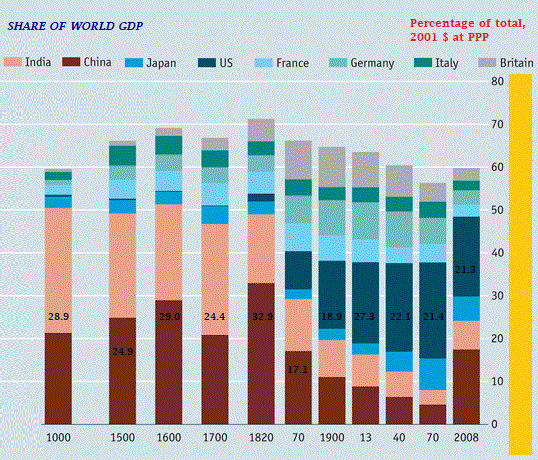
[[File:Share of Global GDP.gif|thumb|300px|The global contribution to world's GDP by major economies from 1 CE to 2003 CE according to Angus Maddison's estimates.<ref>Data table in Maddison A (2007), Contours of the World Economy I-2030AD, Oxford University Press, {{ISBN|978-0199227204}}</ref> Up until the early 18th century, China and India were the two largest economies by GDP output.]] | |||
{{ | |||
According to British economist Angus Maddison, India's total share of the [[world economy]] went from 24.4% in 1700 to 4.2% in 1950. Over the same period Maddison estimates that India's per capita GDP increased slightly from $550 to $619.{{cn|date=November 2025}}<!-- WP:RS needed; removed link to WP--> This would indicate that while India's economy did grow over the period, its total share of the world economy lost ground to the rapidly emerging economies of Europe as well as the newly created United States. India's GDP (PPP) per capita was stagnant during the Mughal Empire and began to decline prior to the onset of British rule.<ref name="maddison261" /> India's share of global industrial output also declined from 25% in 1750 down to 2% in 1900.<ref name="williamson" /> At the same time the economies of Western Europe and the United States grew rapidly. For example, the United Kingdom's share of the world economy rose from 2.9% in 1700 up to 9% in 1870,<ref name="maddison261" /> and Britain replaced India as the world's largest textile manufacturer in the 19th century.<ref name="gupta" /> Historian Shireen Moosvi also provides estimates of India's economic output over this period, which are slightly different to the estimates provided by Maddison. Moosvi estimates that [[Mughal India]] also had a per-capita income 1.24% higher in the late 16th century than British India had in the early 20th century, and the [[secondary sector]] contributed a higher percentage to the [[economy of the Mughal Empire]] (18.2%) than it did to the economy of early 20th-century British India (11.2%).<ref name="moosvi2015">{{cite book |author=Shireen Moosvi |url=http://www.oxfordscholarship.com/view/10.1093/acprof:oso/9780199450541.001.0001/acprof-9780199450541-chapter-18 |title=The Economy of the Mughal Empire c. 1595: A Statistical Study |publisher=Oxford University Press |year=2015 |isbn=978-0-19-908549-1 |edition=2nd |pages=432–433 |doi=10.1093/acprof:oso/9780199450541.001.0001 |orig-year=First published 1989}}</ref> In terms of urbanization, Mughal India also had a higher percentage of its population (15%) living in urban centers in 1600 than British India did in the 19th century.<ref name="eraly">[[Abraham Eraly]] (2007), [https://books.google.com/books?id=Zpa8gyGW_twC&pg=PA5 ''The Mughal World: Life in India's Last Golden Age'', page 5], [[Penguin Books]]</ref> | |||
According to British economist Angus Maddison, India's share of the world economy went from 24.4% in 1700 to 4.2% in 1950. India's GDP (PPP) per capita was stagnant during the Mughal Empire and began to decline prior to the onset of British rule. | |||
A number of modern [[Economic history|economic historians]] have blamed the colonial rule for the state of India's economy, with investment in Indian industries limited since it was a colony.<ref>{{cite book |author1=T.R. Jain |title=Statistics for Economics and indian economic development |author2=V.K. Ohri |publisher=VK publications |isbn=9788190986496 |page=15}}</ref> Under British rule, India experienced deindustrialization.<ref name="Cypher" /><ref name="gupta" /><ref name="Bairoch">{{cite book |last=Bairoch |first=Paul |author-link=Paul Bairoch |year=1993 |title=Economics and World History: Myths and Paradoxes |url=https://archive.org/details/economicsworldhi00bair/page/89/mode/1up |publisher=[[University of Chicago Press]] |page=89 |isbn=0-226-03462-3}}</ref> The [[yarn]] output of the handloom industry declined from 419 million pounds in 1850 to 240 million pounds in 1900.<ref name="williamson" /> Due to the colonial policies of the British, a significant transfer of capital from India to England occurred, leading to a massive drain of revenue rather than a systematic effort at modernisation of the domestic economy.<ref>{{cite book |last=Chaudhuri |first=K. N. |title=The Cambridge Economic History of India |publisher=Cambridge University Press |year=1983 |isbn=0-521-22802-6 |editor-last=Kumar |editor-first=Dharma |editor-link=Dharma Kumar |volume=2 |pages=876–877 |chapter=Foreign Trade and Balance of Payments (1757-1947) |author-link=Kirti N. Chaudhuri}}</ref> | |||
According to Historian Zareer Masani, "India in 1700 also had 25 per cent of the world's population, meaning that its per capita GDP, the real measure of prosperity, was relatively low, due to its poor productivity as a largely agrarian economy on the eve of global industrialisation, which exponentially multiplied world GDP." With "the major drop in India's per capita GDP occurring between 1600 and 1750".<ref>{{Cite web |date=2022-08-08 |title=THE BRITISH RAJ: An Assessment - History Reclaimed |url=https://historyreclaimed.co.uk/the-british-raj-an-assessment/#_edn1 |access-date=2025-05-21 |language=en-GB}}</ref> | |||
{| class="wikitable" | {| class="wikitable" | ||
|+ | |+ GDP ([[Purchasing power parity|PPP]]) in 1990 [[international dollars]]<ref name="MaddisonGDP" /> | ||
|- | |- | ||
! Year | ! Year | ||
! | ! GDP <br /> (Millions of [[International dollar|1990 dollars]]) | ||
!colspan="1"| [[GDP per capita]] <br /> (1990 dollars) | ! colspan="1" | [[GDP per capita]] <br /> (1990 dollars) | ||
! Avg % [[GDP growth]] | ! Avg % [[GDP growth]] | ||
|- | |- | ||
| Line 85: | Line 62: | ||
| 1947 || 213,680 || 618 || −3.052 | | 1947 || 213,680 || 618 || −3.052 | ||
|} | |} | ||
== Absence of industrialisation == | |||
{{See also|History of cotton}} | |||
===The views of historians and economists=== | |||
In the 17th century, India was a relatively urbanised and commercialised nation with a buoyant export trade devoted largely to cotton textiles, but also included silk, spices, and rice. India was the world's main producer of cotton textiles and had a substantial export trade to Britain, as well as many other European countries via the East India Company (EIC). | |||
India's share of global industrial output also declined from 25% in 1750 down to 2% in 1900. At the same time, the United Kingdom's share of the world economy rose from 2.9% in 1700 up to 9% in 1870, and Britain replaced India as the world's largest textile manufacturer in the 19th century. | |||
After the British victory over the Mughal Empire ([[Battle of Buxar]], 1764), India was deindustrialized by the EIC, British and colonial policies.<ref name="williamson"/> | |||
As the British cotton industry underwent a technological revolution during the late 18th to early 19th centuries, the Indian industry stagnated and was deindustrialized.<ref name="Cypher"/> | |||
As late as 1772, Henry Pattullo, writing about the economic resources of Bengal, commented that their textiles were of such unrivaled quality that demand for them could never wane.<ref>{{cite book |last1=Chaudhuri |first1=K. N. |author-link=K. N. Chaudhuri |year=2006 |orig-year=First published 1978 |title=The Trading World of Asia and the English East India Company, 1660–1760 |url=https://books.google.com/books?id=9xt7Fgzq9e8C&pg=PA237 |publisher=Cambridge University Press |page=237 |isbn=978-0-521-03159-2}}</ref> However, by the early 19th century, textile exports began to decline;<ref>{{cite book |title=India and the Contemporary World – II |year=2007 |publisher=[[National Council of Educational Research and Training]] |isbn=978-8174507075 |page=116 |edition=March 2007 |url=http://ncert.nic.in/NCERTS/textbook/textbook.htm?jess3=5-8}}</ref> in 1840, the chairman of the East India and China Association told the English parliament: "This company has succeeded in converting India from a manufacturing country into a country exporting raw produce".<ref>{{Cite news |last1=Sullivan |first1=Dylan |last2=Hickel |first2=Jason |title=How British colonialism killed 100 million Indians in 40 years |url=https://www.aljazeera.com/opinions/2022/12/2/how-british-colonial-policy-killed-100-million-indians |access-date=2023-08-31 |publisher=Al Jazeera |type=Opinion |language=en}}</ref> | |||
An oft repeated legend is that the EIC cut off the thumbs of weavers in Bengal to destroy the indigenous weaving industry in favour of British textile imports. However, this is generally considered to be a myth originating from [[William Bolts]]' 1772 account, in which he alleges that a number of silk spinners had cut off their own thumbs in protest of poor working conditions.<ref name="Doniger 2010, p. 582">{{cite book |last=Doniger |first=Wendy |author-link=Wendy Doniger |year=2009 |title=The Hindus: An Alternative History |publisher=The Penguin Press |page=582 |isbn=978-159420-205-6}}</ref><ref name="CoIA">{{cite book |last1=Bolts |first1=William |author-link=William Bolts |year=1772 |title=Considerations on India affairs: particularly respecting the present state of Bengal and its dependencies |publisher=J. Almon |page=[https://archive.org/details/in.ernet.dli.2015.195631/page/n686 194] |url=https://archive.org/details/in.ernet.dli.2015.195631 |access-date=21 March 2017}}</ref> | |||
Economic historian Prasannan Parthasarathi pointed to earnings data that show [[real wages]] in 18th-century [[Bengal Subah|Bengal]] and [[Kingdom of Mysore|Mysore]] were comparable to Britain. Workers in the textile industry, for example, earned more in Bengal and Mysore than they did in Britain.<ref name="williamson" /><ref>{{cite book |surname=Parthasarathi |given=Prasannan |year=2011 |title=Why Europe Grew Rich and Asia Did Not: Global Economic Divergence, 1600–1850 |url=https://books.google.com/books?id=1_YEcvo-jqcC&pg=PA38 |publisher=Cambridge University Press |pages=38–39 |isbn=978-1-139-49889-0}}</ref> There is also evidence that labour in Britain had to work longer hours than in Bengal and South India.<ref>{{cite book |surname=Parthasarathi |given=Prasannan |year=2011 |title=Why Europe Grew Rich and Asia Did Not: Global Economic Divergence, 1600–1850 |url=https://books.google.com/books?id=1_YEcvo-jqcC&pg=PA41 |publisher=Cambridge University Press |page=41 |isbn=978-1-139-49889-0 |quote=Weekly earnings in Britain and the Indian subcontinent must also be placed in relation to working hours. There is much evidence that the eighteenth-century working day was far longer in Britain than in Bengal or South India.}}</ref> According to economic historian [[Immanuel Wallerstein]], per-capita agricultural output and standards of consumption in 17th-century Mughal India were probably higher than in 17th-century Europe and certainly higher than in early 20th-century [[British India]].<ref name="suneja">{{Cite book |last=Suneja |first=Vivek |title=Understanding Business: A Multidimensional Approach to the Market Economy |page=13 |publisher=[[Psychology Press]] |year=2000 |url=https://books.google.com/books?id=8Stw3qadXG0C&pg=PA13 |isbn=9780415238571}}</ref> | |||
British control of trade and exports of cheap Manchester cotton are cited as significant factors for why Britain industrialized first before France, Germany, India and China,<ref>{{cite web |last=Griffin |first=Emma |title=Why was Britain first? The industrial revolution in global context |url=https://www.academia.edu/1940258 |access-date=9 March 2013}}</ref> though Indian textiles had maintained a competitive price advantage over British textiles until the 19th century.<ref name="gupta" /> Several historians point to the colonization of India as a major factor in both India's deindustrialization and Britain's [[Industrial Revolution]].<ref name="tong">Junie T. Tong (2016), [https://books.google.com/books?id=_UQGDAAAQBAJ&pg=PA151 ''Finance and Society in 21st Century China: Chinese Culture Versus Western Markets'', page 151], [[CRC Press]]</ref><ref name="esposito">{{cite encyclopedia |editor-last=Esposito |editor-first=John L. |editor-link=John L. Esposito |encyclopedia=The Islamic World: Past and Present |title=Great Britain |url=https://books.google.com/books?id=KZcohRpc4OsC&pg=PT190 |year=2004 |publisher=[[Oxford University Press]] |volume=1 |isbn=978-0-19-516520-3 |page=174 |quote=The sale of exports from these regions helped to support the Industrial Revolution in Britain}}</ref><ref name="ray">{{cite book |last=Ray |first=Indrajit |year=2011 |title=Bengal Industries and the British Industrial Revolution (1757–1857) |url={{google books |plainurl=y |id=CHOrAgAAQBAJ |page=7}} |publisher=Routledge |pages=7–10 |isbn=978-1-136-82552-1}}</ref> | |||
== Indian Ordnance Factories == | == Indian Ordnance Factories == | ||
The history and development of the [[Indian Ordnance Factories]] is directly linked | The history and development of the [[Indian Ordnance Factories]] is directly linked to the British Raj in India. The East India Company considered military hardware to be a vital element for securing their economic interest in India and for increasing their political power. In 1775, the British East India Company accepted the establishment of the Board of Ordnance at [[Fort William, India|Fort William]], [[Calcutta]]. This marked the official beginning of the Army Ordnance and the [[Industrial Revolution]] in India. | ||
In 1787, a [[gunpowder]] factory was established at Ichapore | In 1787, a [[gunpowder]] factory was established at Ichapore. Production began in 1791, and the site was later used as a rifle factory beginning in 1904. In 1801, Gun Carriage Agency (now known as Gun & Shell Factory), was established at Cossipore, Calcutta, and production began on 18 March 1802. This is the oldest ordnance factory in India still in existence. There were eighteen ordnance factories before India became independent in 1947.<ref>{{cite web |url=http://ofb.gov.in/units/index.php?unit=gsf&page=about&lang=en |title=Indian Ordnance Factories: Gun and Shell Factory |publisher=Ofb.gov.in |access-date=17 July 2012}}</ref> | ||
==Agriculture and industry== | ==Agriculture and industry== | ||
Between 1860 and 1914, agriculture grew by expanding the land frontier which became more difficult after 1914.<ref>{{cite book |author=Baten, Jörg |title=A History of the Global Economy. From 1500 to the Present. |date=2016 |publisher=Cambridge University Press |page=255 |isbn=9781107507180}}</ref> | |||
The entrepreneur [[Jamsetji Tata]] | The entrepreneur [[Jamsetji Tata]] began his industrial career in 1877 with the Central India Spinning, Weaving, and Manufacturing Company in Bombay. While other Indian mills produced cheap coarse yarn (and later cloth) using local short-staple cotton and cheap machinery imported from Britain, Tata did much better by importing expensive longer-stapled cotton from Egypt and buying more complex ring-spindle machinery from the United States to spin finer yarn that could compete with imports from Britain.<ref name="dnb">{{cite ODNB |last1=Brown |first1=F. H. |last2=Tomlinson |first2=B. R. |title=Tata, Jamshed Nasarwanji [Jamsetji] (1839–1904) |url=https://doi.org/10.1093/ref:odnb/36421 |doi=10.1093/ref:odnb/36421 |date=23 September 2004 |access-date=28 January 2012}}</ref> The effect on industry was a combination of two distinct processes: a robust growth of modern factories and a slow growth in artisanal industry, which achieved higher growth by changing from traditional household-based production to wage-based production.<ref>{{cite book |author=Baten, Jörg |title=A History of the Global Economy. From 1500 to the Present. |date=2016 |publisher=Cambridge University Press |page=255 |isbn=9781107507180}}</ref> | ||
The effect | |||
In the 1890s, Tata launched plans to expand into heavy industry using Indian funding. The Raj did not provide capital, but aware of Britain's declining position against the U.S. and Germany in the steel industry, it wanted steel mills in India so it | In the 1890s, Tata launched plans to expand into heavy industry using Indian funding after being denied permission by the British since 1883.<ref name="shas1" /> The Raj did not provide capital, but it was aware of Britain's declining position against the U.S. and Germany in the steel industry, and it wanted steel mills in India so it promised to purchase any surplus steel Tata could not sell.<ref>{{cite journal |last1=Bahl |first1=Vinay |title=The emergence of large-scale steel industry in India under British colonial rule, 1880-1907 |journal=The Indian Economic & Social History Review |date=December 1994 |volume=31 |issue=4 |pages=413–460 |doi=10.1177/001946469403100401 |s2cid=144471617}}</ref> However, the British controlled government and railways, the largest consumers of steel in the country, mandated the use of steel with a BSSS (British Standard Specification Steel) rating, while the rest of the world used a NBSSS (Non-British Standard Specification Steel) rating. This obstructed Indian steelmakers' ability to produce cheaper NBSSS rated steel, making Indian steel uncompetitive in the global market. Britain also placed restrictions on steel imports, making Indian produced BSSS rated steel difficult to export for profits.<ref name="shas1" /> The [[Tata Steel|Tata Iron and Steel Company]] (TISCO), opened its plant at Jamshedpur in Bihar in 1908. It became the leading iron and steel producer in India, with 120,000 employees in 1945.<ref>{{cite journal |last1=Nomura |first1=Chikayoshi |year=2011 |title=Selling steel in the 1920s: TISCO in a period of transition |journal=Indian Economic and Social History Review |volume=48 |pages=83–116 |doi=10.1177/001946461004800104 |s2cid=154594018}}</ref> According to ''The Oxford Dictionary of National Biography'', TISCO "became a symbol of Indian technical skill, managerial competence, and entrepreneurial flair".<ref name="dnb" /> | ||
==Irrigation== | ==Irrigation== | ||
{{Main|Irrigation in India}} | {{Main|Irrigation in India}} | ||
The British Raj invested | The British Raj invested in infrastructure including canals and [[irrigation]] systems.<ref>for the historiography, see {{cite journal |last1=D'Souza |first1=Rohan |title=Water in British India: The Making of a 'Colonial Hydrology' |url=http://www.sussex.ac.uk/cweh/documents/hcomroh.pdf |journal=History Compass |date=July 2006 |volume=4 |issue=4 |pages=621–628 |doi=10.1111/j.1478-0542.2006.00336.x}}</ref> The Ganges Canal reached 350 miles from Haridwar to Cawnpore, and supplied thousands of miles of distribution canals. By 1900, the Raj had the largest irrigation system in the world. In all, the amount of irrigated land rose eightfold. Historian [[Sir David Gilmour, 4th Baronet|David Gilmour]] says:<ref>{{cite book |author=David Gilmour |author-link=Sir David Gilmour, 4th Baronet |title=The Ruling Caste: Imperial Lives in the Victorian Raj |url=https://books.google.com/books?id=xEzx2zVHXSwC&pg=PA9 |year=2007 |orig-year=First published 2005 |publisher=Macmillan |page=9 |isbn=978-0-374-53080-8}}</ref> | ||
{{Blockquote | |||
|text=By the 1870s the peasantry in the districts irrigated by the Ganges Canal were visibly better fed, housed and dressed than before; by the end of the century the new network of canals in the Punjab had produced an even more prosperous peasantry there. | |||
}} | |||
== Railways == | == Railways == | ||
{{Main|Rail transport in India#History}} | |||
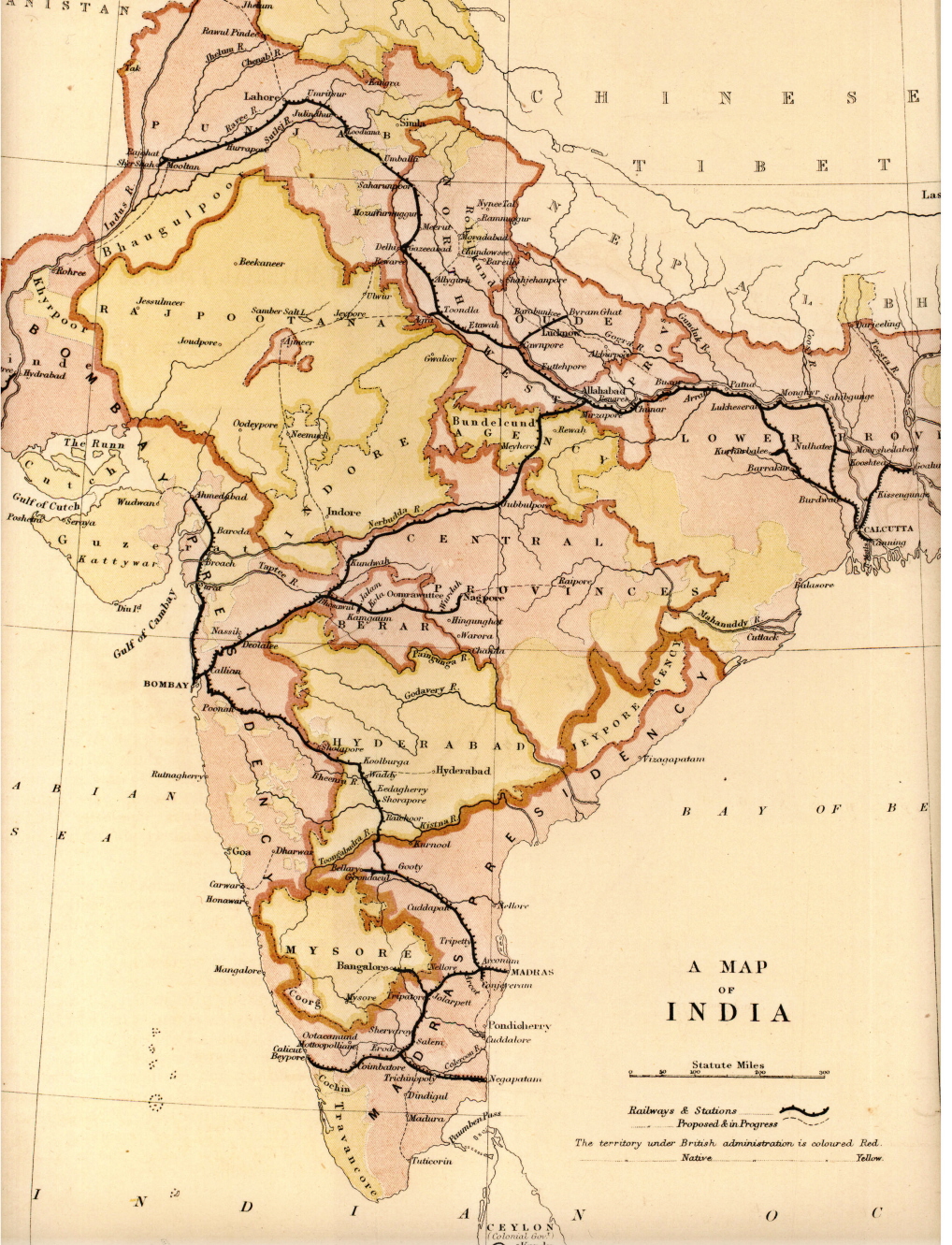
[[File:IndianRailways1871b.jpg|thumb|Railway map of India in 1871]] | [[File:IndianRailways1871b.jpg|thumb|Railway map of India in 1871]] | ||
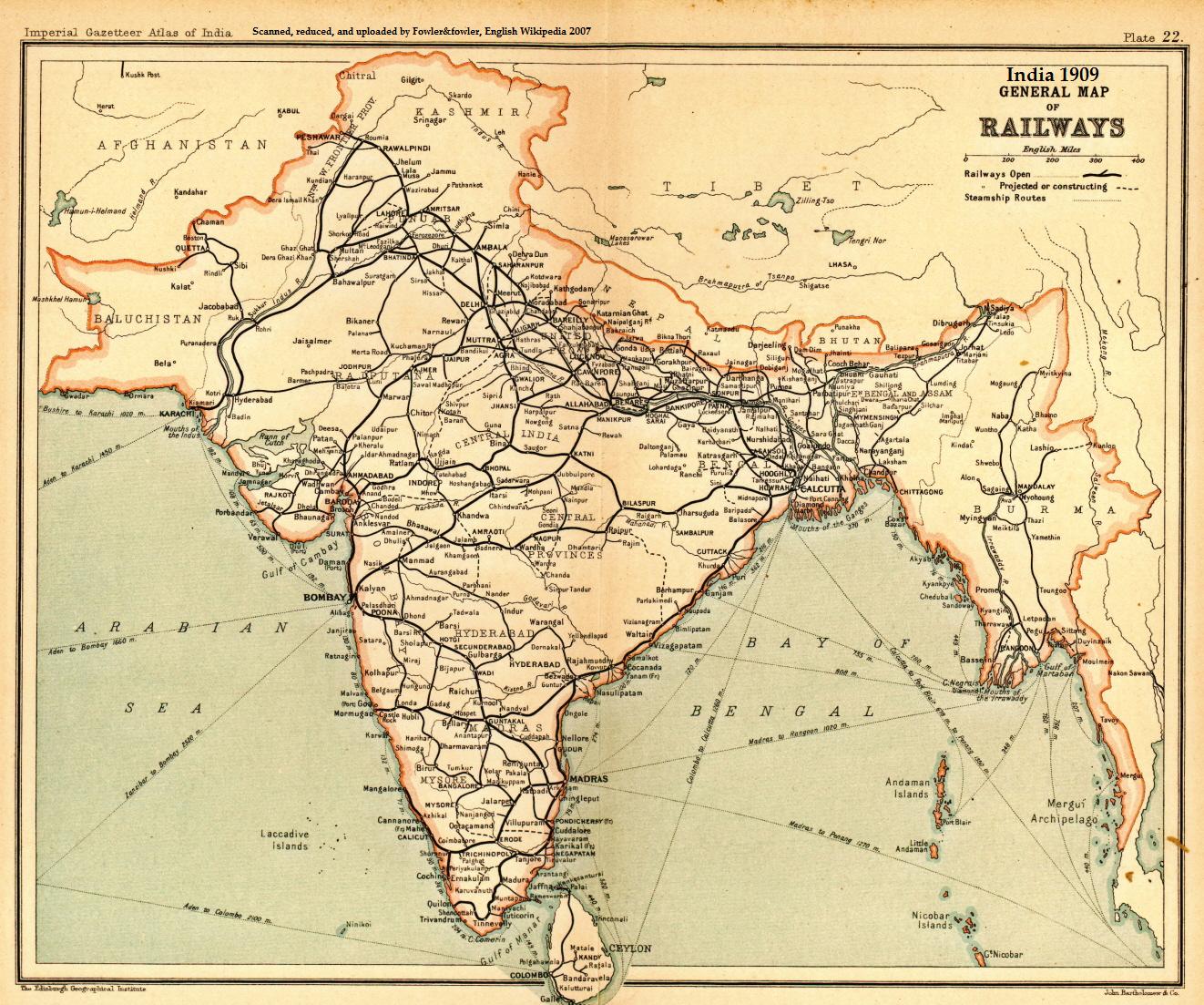
[[File:India railways1909a.jpg|thumb|Railway map of India in 1909]] | [[File:India railways1909a.jpg|thumb|Railway map of India in 1909]] | ||
British investors built a modern railway system in the late 19th century, which became the fourth largest in the world at the time.<ref>{{cite book |last=Kerr |first=Ian J. |title=Engines of change: the railroads that made India |year=2007 |publisher=Praeger |page=63 |isbn=978-0-275-98564-6}}</ref> The government was supportive of the railways, realizing their value for military use and economic growth, and they were designed to improve defense and foreign trade.<ref name=":0" /> While private British companies invested in the railways, they invested very little outside of this project. From 1890, the year main stage construction was completed, to 1914, the proportion of overseas British capital invested in India declined from 19% to 10%.<ref name=":0">{{Cite book |last=Washbrook |first=David |title=India and the British Empire |publisher=Oxford University Press |year=2012 |isbn=9780191744587 |pages=48, 49, 56, 58}}</ref> At first, the railways were privately owned and operated by British administrators, engineers, and craftsmen, and the only unskilled workers were Indians.<ref>{{cite journal |last=Derbyshire |first=I. D. |year=1987 |title=Economic Change and the Railways in North India, 1860–1914 |journal=Modern Asian Studies |volume=21 |issue=3 |pages=521–545 |doi=10.1017/S0026749X00009197 |jstor=312641 |s2cid=146480332}}</ref> | |||
British investors built a modern railway system in the late 19th | |||
A plan for a rail system in India was first put forward in 1832. The first train in India ran from [[Red Hills, Chennai|Red Hills]] to [[Chintadripet]] bridge in [[Madras]] in 1837. It was called ''Red Hill Railway''.<ref name = Bhandari_Chap1-2/> It was used for freight transport only. A few more short lines were built in the 1830s and 1840s, but they did not interconnect and were used for freight transport only. The East India Company, and later the colonial government, encouraged new railway companies backed by private investors under a scheme that would provide land and guarantee an annual return of up to 5% during the initial years of operation. The companies were to build and operate the lines under a 99-year lease, with the government having the option to buy them earlier.<ref name = Bhandari_Chap1-2>{{cite book |title=Indian Railways: Glorious 150 years |author=R.R. Bhandari |publisher=Ministry of Information and Broadcasting, Government of India |pages=1–19 |isbn=978-81-230-1254-4 |year=2005}}</ref> In 1854, Governor-General [[Lord Dalhousie]] formulated a plan to construct a network of trunk lines connecting the principal regions of India. Encouraged by the government guarantees, investments flowed in and a series of new rail companies were established, leading to rapid expansion of the rail system in India.<ref name = Thorner>{{cite book |last=Thorner |first=Daniel |author-link=Daniel Thorner |editor-last=Kerr |editor-first=Ian J. |year=2001 |chapter=The pattern of railway development in India |title=Railways in Modern India |location=New Delhi |publisher=Oxford University Press |pages=83–85 |isbn=978-0-19-564828-7}}</ref> | |||
In 1853, the first passenger train service was inaugurated between [[Bori Bunder]] in [[Bombay]] and [[Thane]], covering a distance of {{convert|34|km|mi|abbr=on}}.<ref name = Babu>{{cite magazine |last=Babu |first=T. Stanley |year=2004 |title=A shining testimony of progress |magazine=Indian Railways |publisher=Indian Railway Board |volume=50 |page=101}}</ref> The route mileage of this network increased from {{convert|1349|km|mi|abbr=on}} in 1860 to {{convert|25495|km|mi|abbr=on}} in 1890, mostly radiating inland from the three major port cities of Bombay, Madras, and Calcutta.<ref name = Hurd>{{cite book |last=Hurd |first=John |editor-last=Kerr |editor-first=Ian J. |year=2001 |chapter=Railways |title=Railways in Modern India |location=New Delhi |publisher=Oxford University Press |page=149 |isbn=978-0-19-564828-7}}</ref> Most of the railway construction was done by Indian companies supervised by British engineers. The system was heavily built, consisting of sturdy tracks and strong bridges. Several large princely states soon built their own rail systems, and the network spread to almost all the regions in India.<ref name = Bhandari_Chap1-2/> By 1900, India had a full range of rail services with diverse ownership and management, operating on broad, meter, and narrow gauge networks.<ref name = Bhandari_Chap7/> | |||
During [[World War I]], railways were used to transport troops and grain to the ports of Bombay and [[Port of Karachi|Karachi]] en route to Britain, Mesopotamia, and East Africa.{{citation needed|date=February 2023}} With shipments of equipment and parts from Britain curtailed, maintenance became much more difficult. Critical workers entered the army, workshops were converted to make munitions, and the locomotives, rolling stock, and track of some entire lines were shipped to the Middle East. The railways could barely keep up with the increased demand.<ref>{{cite book |last1=Headrick |first1=Daniel R. |author-link=Daniel R. Headrick |year=1988 |title=The Tentacles of Progress: Technology Transfer in the Age of Imperialism, 1850–1940 |publisher=Oxford University Press |pages=78–79 |isbn=0-19-505115-7}}</ref> By the end of the war, the railways had deteriorated badly.<ref name = Awasthi_Ch7-8>{{cite book |title=History and development of railways in India |last=Awasthi |first=Aruna |publisher=Deep & Deep Publications |location=New Delhi |year=1994 |pages=181–246}}</ref><ref name = Bhandari_Chap7>{{cite book |title=Indian Railways: Glorious 150 years |author=R.R. Bhandari |publisher=Ministry of Information and Broadcasting, Government of India |pages=44–52 |isbn=978-81-230-1254-4 |year=2005}}</ref> | |||
Headrick argues that both the Raj lines and the private companies hired only European supervisors, civil engineers, and even operating personnel such as locomotive engineers. The government's Stores Policy required that bids on railway contracts be made to the India Office in London, shutting out most Indian firms.{{citation needed|date=February 2023}} The railway companies purchased most of their hardware and parts in Britain. There were railway maintenance workshops in India, but they were rarely allowed to manufacture or repair [[locomotives]].<ref>{{cite book |last1=Headrick |first1=Daniel R. |author-link=Daniel R. Headrick |year=1988 |title=The Tentacles of Progress: Technology Transfer in the Age of Imperialism, 1850–1940 |publisher=Oxford University Press |pages=81–82 |isbn=0-19-505115-7}}</ref> | |||
Christensen looks at colonial purpose, local needs, capital, service, and private-versus-public interests. He concludes that making the railways a creature of the state hindered success because railway expenses had to go through the same time-consuming and political budgeting process as did all other state expenses. Railway costs could therefore not be tailored to the timely needs of the railways or their passengers.<ref>{{cite journal |last1=Christensen |first1=R. O. |title=The State and Indian Railway Performance, 1870–1920 Part I. Financial Efficiency and Standards of Service |journal=The Journal of Transport History |date=September 1981 |volume=2 |issue=2 |pages=1–15 |doi=10.1177/002252668100200201 |s2cid=168461253}}</ref> | |||
==Depression== | ==Great Depression== | ||
{{main|Great Depression in India}} | {{main|Great Depression in India}} | ||
The worldwide [[Great Depression]] of 1929 had little direct impact on India, with only slight impact on the modern secondary sector. | The worldwide [[Great Depression]] of 1929 had little direct impact on India, with only slight impact on the modern secondary sector. The government did little to alleviate distress, and was focused mostly on shipping gold to Britain.<ref>K. A. Manikumar, ''A colonial economy in the Great Depression, Madras (1929–1937)'' (2003) p 138-9</ref> The worst consequences involved deflation, which increased the burden of debt on villagers, while lowering the cost of living.<ref>Dietmar Rothermund, ''An Economic History of India to 1991'' (1993) p 95</ref> In terms of volume of total economic output, there was no decline between 1929 and 1934. Falling prices for jute and wheat hurt larger growers. The hardest hit sector was jute, based in Bengal, which was an important element in overseas trade. It had prospered in the 1920s, but was hard hit in the 1930s.<ref>{{cite journal |last1=Goswami |first1=Omkar |title=Agriculture in slump: the peasant economy of East and North Bengal in the 1930s |journal=The Indian Economic & Social History Review |date=August 1984 |volume=21 |issue=3 |pages=335–364 |doi=10.1177/001946468402100304 |s2cid=144852916}}</ref> In terms of employment, there was some decline, while agriculture and small-scale industry exhibited gains.<ref>{{cite journal |last1=Simmons |first1=Colin |title=The Great Depression and Indian Industry: Changing Interpretations and Changing Perceptions |journal=Modern Asian Studies |date=May 1987 |volume=21 |issue=3 |pages=585–623 |doi=10.1017/S0026749X00009215 |jstor=312643 |s2cid=145538790}}</ref> The most successful new industry was sugar, which experienced growth in the 1930s.<ref>Dietmar Rothermund, ''An Economic History of India to 1991'' (1993) p 111</ref><ref>{{cite book |last=Rothermund |first=Dietmar |author-link=Dietmar Rothermund |title=India in the Great Depression, 1929–1939 |year=1992 |location=New Delhi |publisher=Manohar |page=169 |isbn=81-85425-76-0}}</ref> | ||
==Aftermath== | ==Aftermath== | ||
The newly independent but weak Union government's treasury reported annual revenue of £334 million in 1950. In contrast, [[Osman Ali Khan, Asaf Jah VII|Nizam Asaf Jah VII]] of | The newly independent, but weak Union government's treasury reported annual revenue of £334 million in 1950. In contrast, [[Osman Ali Khan, Asaf Jah VII|Nizam Asaf Jah VII]] of [[Hyderabad State]] in South India was widely reported to have a fortune of almost £668 million at that time.<ref>{{cite magazine |url=http://www.time.com/time/magazine/article/0,9171,868973,00.html?iid=chix-sphere |archive-url=https://web.archive.org/web/20090203010704/http://www.time.com/time/magazine/article/0,9171,868973,00.html?iid=chix-sphere |url-status=dead |archive-date=3 February 2009 |title=The Nizam's Daughter |magazine=[[Time (magazine)|Time]] |date=19 January 1959 |access-date=16 October 2012}}</ref> Approximately one-sixth of the national population was urban by 1950.<ref>{{Cite web |url=http://globalis.gvu.unu.edu/indicator_detail.cfm?country=IN&indicatorid=30 |title=One-sixth of Indians were urban by 1950 |access-date=8 November 2013 |archive-url=https://web.archive.org/web/20090303095118/http://globalis.gvu.unu.edu/indicator_detail.cfm?country=IN&indicatorid=30 |archive-date=3 March 2009 |url-status=dead}}</ref> The US Dollar was exchanged at 4.97 Indian Rupees. | ||
In 1947, the year India gained Independence over the British Raj, 90% of India's population was rural and 55% lived below the international poverty line.<ref name=":0" /> The average life expectancy was 27 years, and the literacy rate (in 1951) was 16.7%.<ref>{{Cite news |last=Debroy |first=Bibek |date=2024-08-17 |title=A glass half full or half empty? |url=https://www.newindianexpress.com/opinions/2024/Aug/17/a-glass-half-full-or-half-empty |access-date=2024-09-01 |work=The New Indian Express |language=en}}</ref> | |||
==See also== | ==See also== | ||
* {{section link|List of regions by past GDP (PPP)|Indian}} | |||
* [[Exploitation colonialism]] | |||
* [[Economy of India under Company rule]] | * [[Economy of India under Company rule]] | ||
* [[Economic history of India]] | * [[Economic history of India]] | ||
* {{section link|Economy of India|British era (1793–1947)}} | |||
==Notes== | ==Notes== | ||
| Line 144: | Line 143: | ||
==References== | ==References== | ||
* {{Citation |last1=Oldenburg |first1=Philip |chapter="India: Movement for Freedom" |chapter-url=http://encarta.msn.com/encyclopedia_761557562_13/India.html#S133 |archive-url=https://archive.today/20240524174651/https://www.webcitation.org/5kwQMax7R?url=http://encarta.msn.com/encyclopedia_761557562_13/India.html |archive-date=24 May 2024 |url-status=dead |year=2007 |title=Encarta Encyclopedia}}. | |||
* {{Citation|last1=Oldenburg |first1=Philip |chapter="India: Movement for Freedom" |chapter-url=http://encarta.msn.com/encyclopedia_761557562_13/India.html#S133 |archive-url=https://www.webcitation.org/5kwQMax7R?url=http://encarta.msn.com/encyclopedia_761557562_13/India.html |archive-date= | |||
==Further reading== | ==Further reading== | ||
* {{Citation|doi=10.1017/S0022050700096297|last1=Adams|first1=John|last2=West|first2=Robert Craig|title=Money, Prices, and Economic Development in India, 1861–1895|journal=Journal of Economic History|volume=39|issue=1|year=1979|pages=55–68|jstor=2118910}} | * {{Citation |doi=10.1017/S0022050700096297 |last1=Adams |first1=John |last2=West |first2=Robert Craig |title=Money, Prices, and Economic Development in India, 1861–1895 |journal=Journal of Economic History |volume=39 |issue=1 |year=1979 |pages=55–68 |jstor=2118910 |s2cid=154570073}} | ||
* {{Citation|last=Appleyard|first=Dennis R.|title=The Terms of Trade between the United Kingdom and British India, 1858–1947|year=2006|journal=Economic Development and Cultural Change|volume=54|issue=3|pages=635–654|doi=10.1086/500031|s2cid=154484126}} | * {{Citation |last=Appleyard |first=Dennis R. |title=The Terms of Trade between the United Kingdom and British India, 1858–1947 |year=2006 |journal=Economic Development and Cultural Change |volume=54 |issue=3 |pages=635–654 |doi=10.1086/500031 |s2cid=154484126}} | ||
* {{Citation|doi=10.1257/0002828054825574|last1=Bannerjee|first1=Abhijit|last2=Iyer|first2=Lakshmi|title=History, Institutions, and Economic Performance: The Legacy of Colonial Land Tenure Systems in India|journal=American Economic Review|volume=95|issue=4|year=2005|pages=1190–1213|jstor=4132711|hdl=1721.1/63662|hdl-access=free}} | * {{Citation |doi=10.1257/0002828054825574 |last1=Bannerjee |first1=Abhijit |last2=Iyer |first2=Lakshmi |title=History, Institutions, and Economic Performance: The Legacy of Colonial Land Tenure Systems in India |journal=American Economic Review |volume=95 |issue=4 |year=2005 |pages=1190–1213 |jstor=4132711 |hdl=1721.1/63662 |hdl-access=free}} | ||
* {{Citation|doi=10.1111/j.1468-0289.1985.tb00391.x|last=Bayly|first=C. A.|author-link=Christopher Bayly|title=State and Economy in India over Seven Hundred Years|journal=The Economic History Review |series=New Series|volume=38|issue=4|date=November 1985|pages=583–596|jstor=2597191}} | * {{Citation |doi=10.1111/j.1468-0289.1985.tb00391.x |last=Bayly |first=C. A. |author-link=Christopher Bayly |title=State and Economy in India over Seven Hundred Years |journal=The Economic History Review |series=New Series |volume=38 |issue=4 |date=November 1985 |pages=583–596 |jstor=2597191}} | ||
* {{Citation|last=Bayly|first=C. A.|author-link=Christopher Bayly|title=Indigenous and Colonial Origins of Comparative Economic Development: The Case of Colonial India and Africa|journal = World Bank Policy Research Working Paper|volume=4474|year=2008|doi=10.1596/1813-9450-4474|series=Policy Research Working Papers|hdl=10535/6331|hdl-access=free}} | * {{Citation |last=Bayly |first=C. A. |author-link=Christopher Bayly |title=Indigenous and Colonial Origins of Comparative Economic Development: The Case of Colonial India and Africa |journal=World Bank Policy Research Working Paper |volume=4474 |year=2008 |doi=10.1596/1813-9450-4474 |series=Policy Research Working Papers |hdl=10535/6331 |hdl-access=free}} | ||
* {{Citation| last1=Bose| first1=Sumit | year=1993 | * {{Citation |last1=Bose |first1=Sumit |year=1993 |title=Peasant Labour and Colonial Capital: Rural Bengal since 1770 (New Cambridge History of India) |publisher=Cambridge and London: Cambridge University Press.}}. | ||
* {{Citation |last1=Broadberry |first1=Stephen |last2=Gupta |first2=Bishnupriya |title=Lancashire, India and shifting competitive advantage in cotton textiles, 1700–1850: the neglected role of factor prices |year=2007}} | |||
| publisher=Cambridge and London: Cambridge University Press.}}. | * {{Citation |last1=Clingingsmith |first1=David |last2=Williamson |first2=Jeffrey G. |year=2008 |title=Deindustrialization in 18th and 19th century India: Mughal decline, climate shocks and British industrial ascent |journal=Explorations in Economic History |volume=45 |issue=3 |pages=209–234 |doi=10.1016/j.eeh.2007.11.002 |url=http://osf.io/jy7u8/}} | ||
* {{Citation|last1=Broadberry|first1=Stephen|last2=Gupta| first2=Bishnupriya|title=Lancashire, India and shifting competitive advantage in cotton textiles, 1700–1850: the neglected role of factor prices|year=2007}} | * {{Citation |last=Cuenca-Esteban |first=Javier |title=India's contribution to the British balance of payments, 1757–1812 |journal=Explorations in Economic History |volume=44 |issue=1 |year=2007 |pages=154–176 |doi=10.1016/j.eeh.2005.10.007 |hdl=10016/435 |hdl-access=free}} | ||
* {{Citation|last1=Clingingsmith|first1=David|last2= Williamson|first2=Jeffrey G.|year=2008|title=Deindustrialization in 18th and 19th century India: Mughal decline, climate shocks and British industrial ascent|journal=Explorations in Economic History|volume=45|issue=3|pages=209–234|doi=10.1016/j.eeh.2007.11.002|url=http://osf.io/jy7u8/}} | * {{Citation |doi=10.1006/exeh.1999.0718 |last=Collins |first=William J. |title=Labor Mobility, Market Integration, and Wage Convergence in Late 19th Century India |journal=Explorations in Economic History |volume=36 |issue=3 |pages=246–277 |year=1999}} | ||
* {{Citation| last=Cuenca-Esteban|first=Javier|title= India's contribution to the British balance of payments, 1757–1812|journal= Explorations in Economic History|volume=44|issue=1|year=2007|pages=154–176|doi=10.1016/j.eeh.2005.10.007|hdl=10016/435|hdl-access=free}} | * {{Citation |last=Farnie |first=DA |year=1979 |title=The English Cotton Industry and the World Market, 1815–1896 |publisher=Oxford, UK: Oxford University Press. Pp. 414 |isbn=978-0-19-822478-5}} | ||
* {{Citation|doi=10.1006/exeh.1999.0718|last=Collins|first=William J.|title=Labor Mobility, Market Integration, and Wage Convergence in Late 19th Century India|journal=Explorations in Economic History|volume=36|issue=3|pages=246–277|year=1999}} | * {{Citation |last1=Ferguson |first1=Niall |last2=Schularick |first2=Moritz |title=The Empire Effect: The Determinants of Country Risk in the First Age of Globalization, 1880–1913 |year=2006 |journal=Journal of Economic History |volume=66 |issue=2 |pages=283–312 |doi=10.1017/S002205070600012X |s2cid=3950563 |url=http://w4.stern.nyu.edu/economics/docs/workingpapers/2004/04-03Ferguson.pdf |access-date=10 November 2020 |archive-date=9 July 2022 |archive-url=https://web.archive.org/web/20220709235037/https://w4.stern.nyu.edu/economics/docs/workingpapers/2004/04-03Ferguson.pdf |url-status=dead}} | ||
* {{Citation| last = Farnie| first = DA| year = 1979| title = The English Cotton Industry and the World Market, 1815–1896| publisher = Oxford, UK: Oxford University Press. Pp. 414| isbn = 978-0-19-822478-5}} | * {{Citation |last=Ghose |first=Ajit Kumar |title=Food Supply and Starvation: A Study of Famines with Reference to the Indian Subcontinent |year=1982 |journal=Oxford Economic Papers |series=New Series |volume=34 |issue=2 |pages=368–389 |doi=10.1093/oxfordjournals.oep.a041557 |pmid=11620403}} | ||
* {{Citation|last1=Ferguson|first1=Niall|last2=Schularick|first2=Moritz| title=The Empire Effect: The Determinants of Country Risk in the First Age of Globalization, 1880–1913|year=2006| journal=Journal of Economic History|volume=66|issue=2|pages=283–312|doi=10.1017/S002205070600012X|s2cid=3950563|url=http://w4.stern.nyu.edu/economics/docs/workingpapers/2004/04-03Ferguson.pdf | * {{Citation |doi=10.1016/S0165-1765(97)00228-0 |last=Grada |first=Oscar O. |title=Markets and famines: A simple test with Indian data |journal=Economics Letters |volume=57 |issue=2 |year=1997 |pages=241–244}} | ||
* {{Citation |last1=Guha |first1=R. |year=1995 |title=A Rule of Property for Bengal: An Essay on the Idea of the Permanent Settlement |publisher=Durham, NC: Duke University Press |isbn=978-0-521-59692-3}} | |||
* {{Citation | doi = 10.1016/S0165-1765(97)00228-0 | last = Grada | first = Oscar O. | title = Markets and famines: A simple test with Indian data | journal = Economics Letters | volume = 57 | issue = 2 | year = 1997 | pages = 241–244}} | * {{Citation |last=Habib |first=Irfan |title=Indian Economy 1858–1914 |year=2007 |publisher=Aligarh: Aligarh Historians Society and New Delhi: [[Tulika Books]]. Pp. xii, 249. |isbn=978-81-89487-12-6}} | ||
* {{Citation| last1=Guha| first1=R.| year=1995| title=A Rule of Property for Bengal: An Essay on the Idea of the Permanent Settlement| publisher=Durham, NC: Duke University Press| isbn=978-0-521-59692-3}} | * {{Citation |last=Harnetty |first=Peter |author-link=Peter Harnetty |date=July 1991 |title='Deindustrialization' Revisited: The Handloom Weavers of the Central Provinces of India, c. 1800-1947 |journal=Modern Asian Studies |volume=25 |issue=3 |pages=455–510 |doi=10.1017/S0026749X00013901 |jstor=312614 |s2cid=144468476}} | ||
* {{Citation|last=Habib|first=Irfan|title=Indian Economy 1858–1914|year=2007|publisher=Aligarh: Aligarh Historians Society and New Delhi: [[Tulika Books]]. Pp. xii, 249.|isbn=978-81-89487-12-6}} | * {{Citation |last=Imperial Gazetteer of India vol. III |title=The Indian Empire, Economic |publisher=Published under the authority of His Majesty's Secretary of State for India in Council, Oxford at the Clarendon Press. Pp. xxx, 1 map, 552. |year=1907}} | ||
* {{Citation| last = Harnetty| first = Peter| date = July 1991| title = 'Deindustrialization' Revisited: The Handloom Weavers of the Central Provinces of India, c. 1800-1947| journal = Modern Asian Studies| volume = 25| issue = 3| pages = 455–510| doi=10.1017/S0026749X00013901| jstor = 312614}} | * {{Citation |title=The Cambridge Economic History of India: c. 1757 – 2003 |editor1-last=Kumar |editor1-first=Dharma |editor2-last=Raychaudhuri |editor2-first=Tapan |year=2005 |publisher=Cambridge University Press. 2ND ED. Pp. 1078 |isbn=978-0-521-22802-2 |url=https://books.google.com/books?id=9ew8AAAAIAAJ |display-editors=etal}} | ||
* {{Citation | last = Imperial Gazetteer of India vol. III | title = | * {{Citation |doi=10.1017/S0022050700096352 |last=McAlpin |first=Michelle B. |title=Dearth, Famine, and Risk: The Changing Impact of Crop Failures in Western India, 1870–1920 |year=1979 |journal=The Journal of Economic History |volume=39 |issue=1 |pages=143–157 |s2cid=130101022}} | ||
* {{Citation|title=The Cambridge Economic History of India: c. 1757 – 2003|editor1-last=Kumar|editor1-first=Dharma|editor2-last=Raychaudhuri|editor2-first=Tapan|year =2005|publisher=Cambridge University Press. 2ND ED. Pp. 1078|isbn=978-0-521-22802-2|url=https://books.google.com/books?id=9ew8AAAAIAAJ|display-editors=etal}} | * {{Citation |doi=10.1017/S0026749X00013986 |last=Ray |first=Rajat Kanta |year=1995 |title=Asian Capital in the Age of European Domination: The Rise of the Bazaar, 1800–1914 |journal=Modern Asian Studies |volume=29 |issue=3 |pages=449–554 |jstor=312868 |s2cid=145744242}} | ||
* {{Citation | doi = 10.1017/S0022050700096352 | last = McAlpin | first = Michelle B. | title = Dearth, Famine, and Risk: The Changing Impact of Crop Failures in Western India, 1870–1920 | year = 1979 | journal = The Journal of Economic History | volume = 39 | issue = 1 | pages = 143–157}} | * {{Citation |last=Roy |first=Tirthankar |date=Summer 2002 |title=Economic History and Modern India: Redefining the Link |journal=The Journal of Economic Perspectives |volume=16 |issue=3 |pages=109–130 |doi=10.1257/089533002760278749 |jstor=3216953 |doi-access=free}} | ||
* {{Citation| doi = 10.1017/S0026749X00013986| last = Ray| first = Rajat Kanta| year = 1995| title = Asian Capital in the Age of European Domination: The Rise of the Bazaar, 1800–1914| journal = Modern Asian Studies| volume = 29| issue = 3| pages = 449–554 | * {{Citation |last=Roy |first=Tirthankar |title=The Economic History of India 1857–1947, Second Edition |year=2006 |publisher=New Delhi: Oxford University Press. Pp. xvi, 385. |isbn=978-0-19-568430-8}} | ||
* {{Citation |last=Roy |first=Tirthankar |title=Globalisation, factor prices, and poverty in colonial India |year=2007 |journal=Australian Economic History Review |volume=47 |issue=1 |pages=73–94 |doi=10.1111/j.1467-8446.2006.00197.x |doi-access=free}} | |||
* {{Citation |last=Roy |first=Tirthankar |title=Sardars, Jobbers, Kanganies: The Labour Contractor and Indian Economic History |journal=Modern Asian Studies |year=2008 |volume=42 |issue=5 |pages=971–998 |doi=10.1017/S0026749X07003071 |s2cid=154880051}} | |||
* {{Citation| last = Roy| first = Tirthankar| date = Summer 2002| title = Economic History and Modern India: Redefining the Link| journal = The Journal of Economic Perspectives| volume = 16| issue = 3| pages = 109–130| doi = 10.1257/089533002760278749| jstor=3216953| doi-access = free}} | * {{Citation |last=Sen |first=A. K. |title=Poverty and Famines: An Essay on Entitlement and Deprivation |publisher=Oxford: Clarendon Press. Pp. ix, 257 |year=1982 |isbn=978-0-19-828463-5}} | ||
* {{Citation|last=Roy|first=Tirthankar|title=The Economic History of India 1857–1947, Second Edition|year=2006|publisher=New Delhi: Oxford University Press. Pp. xvi, 385.|isbn=978-0-19-568430-8}} | * {{Citation |last=Studer |first=Roman |title=India and the Great Divergence: Assessing the Efficiency of Grain Markets in Eighteenth- and Nineteenth-Century India |year=2008 |journal=Journal of Economic History |volume=68 |issue=2 |pages=393–437 |doi=10.1017/S0022050708000351 |s2cid=55102614 |url=http://www.economics.ox.ac.uk/materials/papers/2880/68studer.pdf |access-date=16 August 2019 |archive-date=2 October 2019 |archive-url=https://web.archive.org/web/20191002222558/https://www.economics.ox.ac.uk/materials/papers/2880/68studer.pdf |url-status=dead}} | ||
* {{Citation|last=Roy|first=Tirthankar|title=Globalisation, factor prices, and poverty in colonial India|year=2007|journal=Australian Economic History Review|volume=47|issue=1|pages=73–94|doi=10.1111/j.1467-8446.2006.00197.x|doi-access=free}} | * Tirthankar, Roy. "Financing the Raj: the City of London and colonial India 1858–1940". ''Business History'' 56#6 (2014): 1024–1026. | ||
* {{Citation|last=Roy|first=Tirthankar|title=Sardars, Jobbers, Kanganies: The Labour Contractor and Indian Economic History|journal=Modern Asian Studies|year=2008|volume=42|issue=5|pages=971–998|doi=10.1017/S0026749X07003071}} | * {{Citation |last1=Tomlinson |first1=B. R. |year=1993 |title=The Economy of Modern India, 1860–1970 (The New Cambridge History of India, III.3) |publisher=Cambridge and London: Cambridge University Press. |isbn=978-0-521-58939-0 |title-link=The New Cambridge History of India}} | ||
* {{Citation | last = Sen | first = A. K. | title = Poverty and Famines: An Essay on Entitlement and Deprivation | publisher = Oxford: Clarendon Press. Pp. ix, 257 | year = 1982 | isbn = 978-0-19-828463-5}} | * {{Citation |last1=Tomlinson |first1=B. R. |chapter=Economics and Empire: The Periphery and the Imperial Economy |pages=53–74 |year=2001 |editor1-last=Porter |editor1-first=Andrew |title=Oxford History of the British Empire: The Nineteenth Century |publisher=Oxford University Press |isbn=978-0-19-924678-6}} | ||
* {{Citation|last=Studer|first=Roman|title=India and the Great Divergence: Assessing the Efficiency of Grain Markets in Eighteenth- and Nineteenth-Century India|year=2008|journal=Journal of Economic History |volume=68|issue=2|pages=393–437|doi=10.1017/S0022050708000351|url=http://www.economics.ox.ac.uk/materials/papers/2880/68studer.pdf | * {{Citation |last=Travers |first=T. R. |title='The Real Value of the Lands': The Nawabs, the British and the Land Tax in Eighteenth-Century Bengal |journal=Modern Asian Studies |year=2004 |volume=38 |issue=3 |pages=517–558 |doi=10.1017/S0026749X03001148 |s2cid=145666000}} | ||
* Tirthankar, Roy. "Financing the Raj: the City of London and colonial India 1858–1940. | |||
* {{Citation| last1=Tomlinson| first1=B. R.| year=1993| title=The Economy of Modern India, 1860–1970 (The New Cambridge History of India, III.3)| publisher=Cambridge and London: Cambridge University Press.|isbn=978-0-521-58939-0| title-link=The New Cambridge History of India}} | |||
* {{Citation| last1=Tomlinson| first1=B. R.| chapter=Economics and Empire: The Periphery and the Imperial Economy| pages = 53–74| year=2001| editor1-last=Porter| editor1-first=Andrew| title=Oxford History of the British Empire: The Nineteenth Century| publisher= | |||
* {{Citation|last=Travers|first=T. R.|title='The Real Value of the Lands': The Nawabs, the British and the Land Tax in Eighteenth-Century Bengal|journal=Modern Asian Studies|year=2004|volume=38|issue=3|pages=517–558|doi=10.1017/S0026749X03001148}} | |||
* Wolpert, Stanley, ed. ''Encyclopedia of India'' (4 vol. 2005) comprehensive coverage by scholars | * Wolpert, Stanley, ed. ''Encyclopedia of India'' (4 vol. 2005) comprehensive coverage by scholars | ||
* [[Jadunath Sarkar]], Economics of British India (1965) | * [[Jadunath Sarkar]], Economics of British India (1965) | ||
{{India topics}} | |||
{{United Kingdom topics}} | |||
{{United States – Commonwealth of Nations recessions}} | |||
{{DEFAULTSORT:Economy Of India Under The British Raj}} | {{DEFAULTSORT:Economy Of India Under The British Raj}} | ||
Latest revision as of 05:15, 17 February 2026
 |
The role and scale of British imperial policy during the British Raj (1858 to 1947) on India's relative decline in global GDP remains a topic of debate among economists, historians, and politicians. Some commentators argue that the effect of British rule was negative, and that Britain engaged in a policy of deindustrialisation in India for the benefit of British exporters, which left Indians relatively poorer than before British rule.[1] Others argue that Britain's impact on India was either broadly neutral or positive, and that India's declining share of global GDP was due to other factors, such as new mass production technologies or internal ethnic conflict.[2]
Economic impact of British imperialism[edit | edit source]
William Digby estimated that from 1870 to 1900, £900 million was transferred from India.[3] In the 17th century, India was a relatively urbanized and commercialized nation with a large export trade, devoted largely to cotton textiles, but also silk, spices, and rice. India was the world's main producer of cotton textiles and had substantial export trade to Britain as well as many other European countries, via the East India Company. According to some commentators, after the British victory over the Mughal Empire (Battle of Buxar), India was deindustrialized by the East India Company, and then the British.[1]
In contrast, historian Niall Ferguson argues that India benefited from the British investment of £270 million in Indian infrastructure, irrigation, and industry by the 1880s (representing nearly one-fifth of all British investment overseas). That amount reached £400 million by 1914. He also writes that the British increased the area of irrigated land eight-fold, to 25% of all land.[4] The village economy's share of total after-tax income rose under British rule from 45% to 54%. Ferguson argues that since the sector represented three quarters of the entire population, their rising share reduced income inequality in India.[5]
Impact on trade[edit | edit source]
The British East India Company had forced open the large Indian market to British goods, which could be sold in India without tariffs or duties, compared to local Indian producers who were heavily taxed. At the same time, protectionist policies in Britain, such as bans and high tariffs, were implemented to restrict Indian textiles from being sold there. The British enforced tariffs and duties of 70-80% on textiles produced in India, making them impractical for export.[6] In the early 1700s, India had a hold of 25% of the global textile trade.[6] Raw cotton, however, was imported without tariffs from India to British factories. The factories manufactured textiles from Indian cotton and sold them back to the Indian market. British economic policies gave them a monopoly over India's large market and cotton resources.[7][8] India served as both a significant supplier of raw goods to British manufacturers and a large captive market for British manufactured goods.[9] With the export of manufactured goods rendered unviable over the period of British rule, India's share of global manufacturing exports dropped from 27% to 2%. In contrast, exports from Britain to India soared with duty-free goods that Indian goods could no longer compete with on quality or price.[6]
The damage to the textile industry went beyond just a decrease in production and export. As industrial production was severely disrupted, Indian workers were forced into agriculture at levels unsustainable by the land. Rural wages were then driven down by the newly crowded market of agricultural workers. These workers had used cloth making as a backup source of income if weather affected their crops. This was no longer a viable option for them. Ultimately, poverty in rural India was catalyzed by the policies deployed by the British.[6]
Taxation[edit | edit source]
Taxation by the British, up to 50% of income in parts of India, was so burdensome on the population that they were forced to flee their lands. This form of revenue generation was a departure from the practices deployed by Indian rulers in the past, who primarily raised funds through global and regional trade networks rather than through taxing farmers. Under the zamindari revenue system deployed by the British, farmers were no longer taxed a percentage of their crops produced. Rather, they were taxed a percentage of the land rent payments, regardless of the success or failure of the crops. According to estimates by the British, agricultural taxes were two to three times higher than before British rule, and the highest in the world.[6]
However, P. J. Marshall argues that the British regime did not make any sharp breaks with the traditional economy, and that control was largely left in the hands of regional rulers. The economy was sustained by general conditions of prosperity through the latter part of the 18th century, excepting the frequent famines with high fatality rates. Marshall notes the British raised revenue through local tax administrators and kept the old Mughal rates of taxation. Marshall wrote that the British managed this primarily indigenous-controlled economy through cooperation with Indian elites.[10]
Impact to GDP[edit | edit source]
From 1850 to 1947, India's gross domestic product (GDP) in 1990 international dollar terms grew from $125.7 billion to $213.7 billion, a 70% increase, or an average annual growth rate of 0.55%. This was a higher rate of growth than during the Mughal era (1600–1700), when it had grown by 22%, an annual growth rate of 0.20%, or the longer period of mostly British East Indian company rule from 1700 to 1850 where it grew 39%, or 0.22% annually.[11] However, by the end of British rule, India's economy represented a much smaller proportion of global GDP. In 1820, India's GDP was 16% of the global GDP. By 1870, it had fallen to 12%, and by 1947 to 4%. India's per-capita income remained mostly stagnant during the Raj, with most of its GDP growth coming from an expanding population. Per capita income growth from 1850 to 1900 is estimated to range from 0.75% to 1.25% annually. This figure is buoyed by a decrease in India's rate of population increase stemming from disease and famines.[12] From 1850 to 1947, India's GDP per-capita had grown by 16%, from $533 to $618 in 1990 international dollars. According to historical GDP estimates by economist Angus Maddison, India's GDP grew in absolute terms but declined in relative share to the world.[11]
From the 1st century CE to the start of British colonization in India in the 17th century, India's GDP varied between 25% and 35% of the world's total GDP,[13] more than all of Europe combined.[6] It dropped to 2% by the time Britain departed India in 1947.[14] At the same time, the United Kingdom's share of the world economy rose from 2.9% in 1700 to 9% in 1870 alone.[8] Politician Shashi Tharoor claims "The reason is simple: India was governed for the benefit of Britain. Britain's rise for 200 years was financed by its depredation of India."[6]
Under British rule, India's share of the world economy declined from 23% at the beginning of the 18th century down to just over 3% when India gained independence. In 1700, that figure had been 27%.[6] India's GDP (PPP) per capita was stagnant during the Mughal Empire and began to decline prior to the onset of British rule.[15] India's share of global industrial output declined from 25% in 1750 to 2% in 1900.[14] From 1600 to 1871 the ratio of GDP per capita in India to that in Britain fell from more than 60% to less than 15%.[16] India's national debt ballooned under British rule, and half of India's revenue was being siphoned to foreign countries, primarily England. Indian taxes were also used to fund the British Army and its expeditions globally, with 64% of total revenue funding British Indian troops outside of India in 1922.[6]
[edit | edit source]

According to British economist Angus Maddison, India's total share of the world economy went from 24.4% in 1700 to 4.2% in 1950. Over the same period Maddison estimates that India's per capita GDP increased slightly from $550 to $619.[citation needed] This would indicate that while India's economy did grow over the period, its total share of the world economy lost ground to the rapidly emerging economies of Europe as well as the newly created United States. India's GDP (PPP) per capita was stagnant during the Mughal Empire and began to decline prior to the onset of British rule.[15] India's share of global industrial output also declined from 25% in 1750 down to 2% in 1900.[14] At the same time the economies of Western Europe and the United States grew rapidly. For example, the United Kingdom's share of the world economy rose from 2.9% in 1700 up to 9% in 1870,[15] and Britain replaced India as the world's largest textile manufacturer in the 19th century.[8] Historian Shireen Moosvi also provides estimates of India's economic output over this period, which are slightly different to the estimates provided by Maddison. Moosvi estimates that Mughal India also had a per-capita income 1.24% higher in the late 16th century than British India had in the early 20th century, and the secondary sector contributed a higher percentage to the economy of the Mughal Empire (18.2%) than it did to the economy of early 20th-century British India (11.2%).[18] In terms of urbanization, Mughal India also had a higher percentage of its population (15%) living in urban centers in 1600 than British India did in the 19th century.[19]
A number of modern economic historians have blamed the colonial rule for the state of India's economy, with investment in Indian industries limited since it was a colony.[20] Under British rule, India experienced deindustrialization.[7][8][21] The yarn output of the handloom industry declined from 419 million pounds in 1850 to 240 million pounds in 1900.[14] Due to the colonial policies of the British, a significant transfer of capital from India to England occurred, leading to a massive drain of revenue rather than a systematic effort at modernisation of the domestic economy.[22]
According to Historian Zareer Masani, "India in 1700 also had 25 per cent of the world's population, meaning that its per capita GDP, the real measure of prosperity, was relatively low, due to its poor productivity as a largely agrarian economy on the eve of global industrialisation, which exponentially multiplied world GDP." With "the major drop in India's per capita GDP occurring between 1600 and 1750".[23]
| Year | GDP (Millions of 1990 dollars) |
GDP per capita (1990 dollars) |
Avg % GDP growth |
|---|---|---|---|
| 1850 | 125,681 | 533 | — |
| 1870 | 134,882 | 533 | 0.354 |
| 1890 | 163,341 | 584 | 0.962 |
| 1900 | 170,466 | 599 | 0.428 |
| 1910 | 210,439 | 697 | 2.129 |
| 1920 | 194,051 | 635 | −0.807 |
| 1930 | 244,097 | 726 | 2.321 |
| 1940 | 265,455 | 686 | 0.842 |
| 1947 | 213,680 | 618 | −3.052 |
Absence of industrialisation[edit | edit source]
The views of historians and economists[edit | edit source]
In the 17th century, India was a relatively urbanised and commercialised nation with a buoyant export trade devoted largely to cotton textiles, but also included silk, spices, and rice. India was the world's main producer of cotton textiles and had a substantial export trade to Britain, as well as many other European countries via the East India Company (EIC).
India's share of global industrial output also declined from 25% in 1750 down to 2% in 1900. At the same time, the United Kingdom's share of the world economy rose from 2.9% in 1700 up to 9% in 1870, and Britain replaced India as the world's largest textile manufacturer in the 19th century.
After the British victory over the Mughal Empire (Battle of Buxar, 1764), India was deindustrialized by the EIC, British and colonial policies.[14]
As the British cotton industry underwent a technological revolution during the late 18th to early 19th centuries, the Indian industry stagnated and was deindustrialized.[7]
As late as 1772, Henry Pattullo, writing about the economic resources of Bengal, commented that their textiles were of such unrivaled quality that demand for them could never wane.[24] However, by the early 19th century, textile exports began to decline;[25] in 1840, the chairman of the East India and China Association told the English parliament: "This company has succeeded in converting India from a manufacturing country into a country exporting raw produce".[26]
An oft repeated legend is that the EIC cut off the thumbs of weavers in Bengal to destroy the indigenous weaving industry in favour of British textile imports. However, this is generally considered to be a myth originating from William Bolts' 1772 account, in which he alleges that a number of silk spinners had cut off their own thumbs in protest of poor working conditions.[27][28]
Economic historian Prasannan Parthasarathi pointed to earnings data that show real wages in 18th-century Bengal and Mysore were comparable to Britain. Workers in the textile industry, for example, earned more in Bengal and Mysore than they did in Britain.[14][29] There is also evidence that labour in Britain had to work longer hours than in Bengal and South India.[30] According to economic historian Immanuel Wallerstein, per-capita agricultural output and standards of consumption in 17th-century Mughal India were probably higher than in 17th-century Europe and certainly higher than in early 20th-century British India.[31]
British control of trade and exports of cheap Manchester cotton are cited as significant factors for why Britain industrialized first before France, Germany, India and China,[32] though Indian textiles had maintained a competitive price advantage over British textiles until the 19th century.[8] Several historians point to the colonization of India as a major factor in both India's deindustrialization and Britain's Industrial Revolution.[33][34][35]
Indian Ordnance Factories[edit | edit source]
The history and development of the Indian Ordnance Factories is directly linked to the British Raj in India. The East India Company considered military hardware to be a vital element for securing their economic interest in India and for increasing their political power. In 1775, the British East India Company accepted the establishment of the Board of Ordnance at Fort William, Calcutta. This marked the official beginning of the Army Ordnance and the Industrial Revolution in India.
In 1787, a gunpowder factory was established at Ichapore. Production began in 1791, and the site was later used as a rifle factory beginning in 1904. In 1801, Gun Carriage Agency (now known as Gun & Shell Factory), was established at Cossipore, Calcutta, and production began on 18 March 1802. This is the oldest ordnance factory in India still in existence. There were eighteen ordnance factories before India became independent in 1947.[36]
Agriculture and industry[edit | edit source]
Between 1860 and 1914, agriculture grew by expanding the land frontier which became more difficult after 1914.[37]
The entrepreneur Jamsetji Tata began his industrial career in 1877 with the Central India Spinning, Weaving, and Manufacturing Company in Bombay. While other Indian mills produced cheap coarse yarn (and later cloth) using local short-staple cotton and cheap machinery imported from Britain, Tata did much better by importing expensive longer-stapled cotton from Egypt and buying more complex ring-spindle machinery from the United States to spin finer yarn that could compete with imports from Britain.[38] The effect on industry was a combination of two distinct processes: a robust growth of modern factories and a slow growth in artisanal industry, which achieved higher growth by changing from traditional household-based production to wage-based production.[39]
In the 1890s, Tata launched plans to expand into heavy industry using Indian funding after being denied permission by the British since 1883.[6] The Raj did not provide capital, but it was aware of Britain's declining position against the U.S. and Germany in the steel industry, and it wanted steel mills in India so it promised to purchase any surplus steel Tata could not sell.[40] However, the British controlled government and railways, the largest consumers of steel in the country, mandated the use of steel with a BSSS (British Standard Specification Steel) rating, while the rest of the world used a NBSSS (Non-British Standard Specification Steel) rating. This obstructed Indian steelmakers' ability to produce cheaper NBSSS rated steel, making Indian steel uncompetitive in the global market. Britain also placed restrictions on steel imports, making Indian produced BSSS rated steel difficult to export for profits.[6] The Tata Iron and Steel Company (TISCO), opened its plant at Jamshedpur in Bihar in 1908. It became the leading iron and steel producer in India, with 120,000 employees in 1945.[41] According to The Oxford Dictionary of National Biography, TISCO "became a symbol of Indian technical skill, managerial competence, and entrepreneurial flair".[38]
Irrigation[edit | edit source]
The British Raj invested in infrastructure including canals and irrigation systems.[42] The Ganges Canal reached 350 miles from Haridwar to Cawnpore, and supplied thousands of miles of distribution canals. By 1900, the Raj had the largest irrigation system in the world. In all, the amount of irrigated land rose eightfold. Historian David Gilmour says:[43]
By the 1870s the peasantry in the districts irrigated by the Ganges Canal were visibly better fed, housed and dressed than before; by the end of the century the new network of canals in the Punjab had produced an even more prosperous peasantry there.
Railways[edit | edit source]


British investors built a modern railway system in the late 19th century, which became the fourth largest in the world at the time.[44] The government was supportive of the railways, realizing their value for military use and economic growth, and they were designed to improve defense and foreign trade.[12] While private British companies invested in the railways, they invested very little outside of this project. From 1890, the year main stage construction was completed, to 1914, the proportion of overseas British capital invested in India declined from 19% to 10%.[12] At first, the railways were privately owned and operated by British administrators, engineers, and craftsmen, and the only unskilled workers were Indians.[45]
A plan for a rail system in India was first put forward in 1832. The first train in India ran from Red Hills to Chintadripet bridge in Madras in 1837. It was called Red Hill Railway.[46] It was used for freight transport only. A few more short lines were built in the 1830s and 1840s, but they did not interconnect and were used for freight transport only. The East India Company, and later the colonial government, encouraged new railway companies backed by private investors under a scheme that would provide land and guarantee an annual return of up to 5% during the initial years of operation. The companies were to build and operate the lines under a 99-year lease, with the government having the option to buy them earlier.[46] In 1854, Governor-General Lord Dalhousie formulated a plan to construct a network of trunk lines connecting the principal regions of India. Encouraged by the government guarantees, investments flowed in and a series of new rail companies were established, leading to rapid expansion of the rail system in India.[47]
In 1853, the first passenger train service was inaugurated between Bori Bunder in Bombay and Thane, covering a distance of 34 km (21 mi).[48] The route mileage of this network increased from 1,349 km (838 mi) in 1860 to 25,495 km (15,842 mi) in 1890, mostly radiating inland from the three major port cities of Bombay, Madras, and Calcutta.[49] Most of the railway construction was done by Indian companies supervised by British engineers. The system was heavily built, consisting of sturdy tracks and strong bridges. Several large princely states soon built their own rail systems, and the network spread to almost all the regions in India.[46] By 1900, India had a full range of rail services with diverse ownership and management, operating on broad, meter, and narrow gauge networks.[50]
During World War I, railways were used to transport troops and grain to the ports of Bombay and Karachi en route to Britain, Mesopotamia, and East Africa.[citation needed] With shipments of equipment and parts from Britain curtailed, maintenance became much more difficult. Critical workers entered the army, workshops were converted to make munitions, and the locomotives, rolling stock, and track of some entire lines were shipped to the Middle East. The railways could barely keep up with the increased demand.[51] By the end of the war, the railways had deteriorated badly.[52][50]
Headrick argues that both the Raj lines and the private companies hired only European supervisors, civil engineers, and even operating personnel such as locomotive engineers. The government's Stores Policy required that bids on railway contracts be made to the India Office in London, shutting out most Indian firms.[citation needed] The railway companies purchased most of their hardware and parts in Britain. There were railway maintenance workshops in India, but they were rarely allowed to manufacture or repair locomotives.[53]
Christensen looks at colonial purpose, local needs, capital, service, and private-versus-public interests. He concludes that making the railways a creature of the state hindered success because railway expenses had to go through the same time-consuming and political budgeting process as did all other state expenses. Railway costs could therefore not be tailored to the timely needs of the railways or their passengers.[54]
Great Depression[edit | edit source]
The worldwide Great Depression of 1929 had little direct impact on India, with only slight impact on the modern secondary sector. The government did little to alleviate distress, and was focused mostly on shipping gold to Britain.[55] The worst consequences involved deflation, which increased the burden of debt on villagers, while lowering the cost of living.[56] In terms of volume of total economic output, there was no decline between 1929 and 1934. Falling prices for jute and wheat hurt larger growers. The hardest hit sector was jute, based in Bengal, which was an important element in overseas trade. It had prospered in the 1920s, but was hard hit in the 1930s.[57] In terms of employment, there was some decline, while agriculture and small-scale industry exhibited gains.[58] The most successful new industry was sugar, which experienced growth in the 1930s.[59][60]
Aftermath[edit | edit source]
The newly independent, but weak Union government's treasury reported annual revenue of £334 million in 1950. In contrast, Nizam Asaf Jah VII of Hyderabad State in South India was widely reported to have a fortune of almost £668 million at that time.[61] Approximately one-sixth of the national population was urban by 1950.[62] The US Dollar was exchanged at 4.97 Indian Rupees.
In 1947, the year India gained Independence over the British Raj, 90% of India's population was rural and 55% lived below the international poverty line.[12] The average life expectancy was 27 years, and the literacy rate (in 1951) was 16.7%.[63]
See also[edit | edit source]
- List of regions by past GDP (PPP) § Indian
- Exploitation colonialism
- Economy of India under Company rule
- Economic history of India
- Economy of India § British era (1793–1947)
Notes[edit | edit source]
- ↑ 1.0 1.1 Tharoor, Shashi (22 July 2015). "Viewpoint: Britain must pay reparations to India". BBC News. Retrieved 15 January 2020.
- ↑ MacKenzie, John (28 July 2015). "Viewpoint: Why Britain does not owe reparations to India". BBC News. Retrieved 15 January 2020.
- ↑ Roy, Rama Dev (1987). "Some Aspects of the Economic Drain from India during the British Rule". Social Scientist. 15 (3): 39–47. doi:10.2307/3517499. JSTOR 3517499.
- ↑ Ferguson, Niall (2003). Empire: How Britain Made The Modern World. Penguin Books. pp. 215–216. ISBN 0-713-99615-3.
- ↑ Ferguson, Niall (2003). Empire: How Britain Made The Modern World. Penguin Books. p. 218. ISBN 0-713-99615-3.
- ↑ 6.00 6.01 6.02 6.03 6.04 6.05 6.06 6.07 6.08 6.09 6.10 Shashi Tharoor, March 2017, Inglorious Empire: What the British Did to India, C. Hurst & Co., UK.
- ↑ 7.0 7.1 7.2 Cypher, James M. (2014) [First published 1997]. The Process of Economic Development (4th ed.). Routledge. p. 97. ISBN 978-0-415-64327-6.
- ↑ 8.0 8.1 8.2 8.3 8.4 Broadberry, Stephen; Gupta, Bishnupriya (2005). "Cotton textiles and the great divergence: Lancashire, India and shifting competitive advantage, 1600–1850" (PDF). International Institute of Social History. Department of Economics, University of Warwick. Retrieved 5 December 2016.
- ↑ Henry Yule, A. C. Burnell (2013). Hobson-Jobson: The Definitive Glossary of British India. Oxford University Press. p. 20. ISBN 9781317252931.
- ↑ P.J. Marshall, "The British in Asia: Trade to Dominion, 1700–1765", in The Oxford History of the British Empire: vol. 2, "The Eighteenth Century" ed. by P. J. Marshall, (1998), pp 487–507
- ↑ 11.0 11.1 11.2 Maddison, Angus. "GDP". Historical Statistics of the World Economy:1–2008 AD (XLSX) (Report). University of Groningen. Retrieved 26 March 2022.
- ↑ 12.0 12.1 12.2 12.3 Washbrook, David (2012). India and the British Empire. Oxford University Press. pp. 48, 49, 56, 58. ISBN 9780191744587.
- ↑ Maddison 2007, p. 379, table A.4.
- ↑ 14.0 14.1 14.2 14.3 14.4 14.5 Jeffrey G. Williamson, David Clingingsmith (August 2005). "India's Deindustrialization in the 18th and 19th Centuries" (PDF). Harvard University. Retrieved 18 May 2017.
- ↑ 15.0 15.1 15.2 Maddison, Angus (2003): Development Centre Studies The World Economy Historical Statistics: Historical Statistics, OECD Publishing, ISBN 9264104143, page 261
- ↑ Broadberry, Stephen; Custodis, Johann; Gupta, Bishnupriya (2015). "India and the great divergence: An Anglo-Indian comparison of GDP per capita, 1600–1871". Explorations in Economic History. 55: 58–75. doi:10.1016/j.eeh.2014.04.003. S2CID 130940341.
- ↑ Data table in Maddison A (2007), Contours of the World Economy I-2030AD, Oxford University Press, ISBN 978-0199227204
- ↑ Shireen Moosvi (2015) [First published 1989]. The Economy of the Mughal Empire c. 1595: A Statistical Study (2nd ed.). Oxford University Press. pp. 432–433. doi:10.1093/acprof:oso/9780199450541.001.0001. ISBN 978-0-19-908549-1.
- ↑ Abraham Eraly (2007), The Mughal World: Life in India's Last Golden Age, page 5, Penguin Books
- ↑ T.R. Jain; V.K. Ohri. Statistics for Economics and indian economic development. VK publications. p. 15. ISBN 9788190986496.
- ↑ Bairoch, Paul (1993). Economics and World History: Myths and Paradoxes. University of Chicago Press. p. 89. ISBN 0-226-03462-3.
- ↑ Chaudhuri, K. N. (1983). "Foreign Trade and Balance of Payments (1757-1947)". In Kumar, Dharma (ed.). The Cambridge Economic History of India. Vol. 2. Cambridge University Press. pp. 876–877. ISBN 0-521-22802-6.
- ↑ "THE BRITISH RAJ: An Assessment - History Reclaimed". 8 August 2022. Retrieved 21 May 2025.
- ↑ Chaudhuri, K. N. (2006) [First published 1978]. The Trading World of Asia and the English East India Company, 1660–1760. Cambridge University Press. p. 237. ISBN 978-0-521-03159-2.
- ↑ India and the Contemporary World – II (March 2007 ed.). National Council of Educational Research and Training. 2007. p. 116. ISBN 978-8174507075.
- ↑ Sullivan, Dylan; Hickel, Jason. "How British colonialism killed 100 million Indians in 40 years" (Opinion). Al Jazeera. Retrieved 31 August 2023.
- ↑ Doniger, Wendy (2009). The Hindus: An Alternative History. The Penguin Press. p. 582. ISBN 978-159420-205-6.
- ↑ Bolts, William (1772). Considerations on India affairs: particularly respecting the present state of Bengal and its dependencies. J. Almon. p. 194. Retrieved 21 March 2017.
- ↑ Parthasarathi, Prasannan (2011). Why Europe Grew Rich and Asia Did Not: Global Economic Divergence, 1600–1850. Cambridge University Press. pp. 38–39. ISBN 978-1-139-49889-0.
- ↑ Parthasarathi, Prasannan (2011). Why Europe Grew Rich and Asia Did Not: Global Economic Divergence, 1600–1850. Cambridge University Press. p. 41. ISBN 978-1-139-49889-0.
Weekly earnings in Britain and the Indian subcontinent must also be placed in relation to working hours. There is much evidence that the eighteenth-century working day was far longer in Britain than in Bengal or South India.
- ↑ Suneja, Vivek (2000). Understanding Business: A Multidimensional Approach to the Market Economy. Psychology Press. p. 13. ISBN 9780415238571.
- ↑ Griffin, Emma. "Why was Britain first? The industrial revolution in global context". Retrieved 9 March 2013.
- ↑ Junie T. Tong (2016), Finance and Society in 21st Century China: Chinese Culture Versus Western Markets, page 151, CRC Press
- ↑ Esposito, John L., ed. (2004). "Great Britain". The Islamic World: Past and Present. Vol. 1. Oxford University Press. p. 174. ISBN 978-0-19-516520-3.
The sale of exports from these regions helped to support the Industrial Revolution in Britain
- ↑ Ray, Indrajit (2011). Bengal Industries and the British Industrial Revolution (1757–1857). Routledge. pp. 7–10. ISBN 978-1-136-82552-1.
- ↑ "Indian Ordnance Factories: Gun and Shell Factory". Ofb.gov.in. Retrieved 17 July 2012.
- ↑ Baten, Jörg (2016). A History of the Global Economy. From 1500 to the Present. Cambridge University Press. p. 255. ISBN 9781107507180.
- ↑ 38.0 38.1 Brown, F. H.; Tomlinson, B. R. (23 September 2004). "Tata, Jamshed Nasarwanji [Jamsetji] (1839–1904)". Oxford Dictionary of National Biography (online ed.). Oxford University Press. doi:10.1093/ref:odnb/36421. Retrieved 28 January 2012. Template:ODNBsub
- ↑ Baten, Jörg (2016). A History of the Global Economy. From 1500 to the Present. Cambridge University Press. p. 255. ISBN 9781107507180.
- ↑ Bahl, Vinay (December 1994). "The emergence of large-scale steel industry in India under British colonial rule, 1880-1907". The Indian Economic & Social History Review. 31 (4): 413–460. doi:10.1177/001946469403100401. S2CID 144471617.
- ↑ Nomura, Chikayoshi (2011). "Selling steel in the 1920s: TISCO in a period of transition". Indian Economic and Social History Review. 48: 83–116. doi:10.1177/001946461004800104. S2CID 154594018.
- ↑ for the historiography, see D'Souza, Rohan (July 2006). "Water in British India: The Making of a 'Colonial Hydrology'" (PDF). History Compass. 4 (4): 621–628. doi:10.1111/j.1478-0542.2006.00336.x.
- ↑ David Gilmour (2007) [First published 2005]. The Ruling Caste: Imperial Lives in the Victorian Raj. Macmillan. p. 9. ISBN 978-0-374-53080-8.
- ↑ Kerr, Ian J. (2007). Engines of change: the railroads that made India. Praeger. p. 63. ISBN 978-0-275-98564-6.
- ↑ Derbyshire, I. D. (1987). "Economic Change and the Railways in North India, 1860–1914". Modern Asian Studies. 21 (3): 521–545. doi:10.1017/S0026749X00009197. JSTOR 312641. S2CID 146480332.
- ↑ 46.0 46.1 46.2 R.R. Bhandari (2005). Indian Railways: Glorious 150 years. Ministry of Information and Broadcasting, Government of India. pp. 1–19. ISBN 978-81-230-1254-4.
- ↑ Thorner, Daniel (2001). "The pattern of railway development in India". In Kerr, Ian J. (ed.). Railways in Modern India. New Delhi: Oxford University Press. pp. 83–85. ISBN 978-0-19-564828-7.
- ↑ Babu, T. Stanley (2004). "A shining testimony of progress". Indian Railways. Vol. 50. Indian Railway Board. p. 101.
- ↑ Hurd, John (2001). "Railways". In Kerr, Ian J. (ed.). Railways in Modern India. New Delhi: Oxford University Press. p. 149. ISBN 978-0-19-564828-7.
- ↑ 50.0 50.1 R.R. Bhandari (2005). Indian Railways: Glorious 150 years. Ministry of Information and Broadcasting, Government of India. pp. 44–52. ISBN 978-81-230-1254-4.
- ↑ Headrick, Daniel R. (1988). The Tentacles of Progress: Technology Transfer in the Age of Imperialism, 1850–1940. Oxford University Press. pp. 78–79. ISBN 0-19-505115-7.
- ↑ Awasthi, Aruna (1994). History and development of railways in India. New Delhi: Deep & Deep Publications. pp. 181–246.
- ↑ Headrick, Daniel R. (1988). The Tentacles of Progress: Technology Transfer in the Age of Imperialism, 1850–1940. Oxford University Press. pp. 81–82. ISBN 0-19-505115-7.
- ↑ Christensen, R. O. (September 1981). "The State and Indian Railway Performance, 1870–1920 Part I. Financial Efficiency and Standards of Service". The Journal of Transport History. 2 (2): 1–15. doi:10.1177/002252668100200201. S2CID 168461253.
- ↑ K. A. Manikumar, A colonial economy in the Great Depression, Madras (1929–1937) (2003) p 138-9
- ↑ Dietmar Rothermund, An Economic History of India to 1991 (1993) p 95
- ↑ Goswami, Omkar (August 1984). "Agriculture in slump: the peasant economy of East and North Bengal in the 1930s". The Indian Economic & Social History Review. 21 (3): 335–364. doi:10.1177/001946468402100304. S2CID 144852916.
- ↑ Simmons, Colin (May 1987). "The Great Depression and Indian Industry: Changing Interpretations and Changing Perceptions". Modern Asian Studies. 21 (3): 585–623. doi:10.1017/S0026749X00009215. JSTOR 312643. S2CID 145538790.
- ↑ Dietmar Rothermund, An Economic History of India to 1991 (1993) p 111
- ↑ Rothermund, Dietmar (1992). India in the Great Depression, 1929–1939. New Delhi: Manohar. p. 169. ISBN 81-85425-76-0.
- ↑ "The Nizam's Daughter". Time. 19 January 1959. Archived from the original on 3 February 2009. Retrieved 16 October 2012.
- ↑ "One-sixth of Indians were urban by 1950". Archived from the original on 3 March 2009. Retrieved 8 November 2013.
- ↑ Debroy, Bibek (17 August 2024). "A glass half full or half empty?". The New Indian Express. Retrieved 1 September 2024.
References[edit | edit source]
- Oldenburg, Philip (2007), ""India: Movement for Freedom"", Encarta Encyclopedia
{{citation}}: CS1 maint: deprecated archival service (link).
Further reading[edit | edit source]
- Adams, John; West, Robert Craig (1979), "Money, Prices, and Economic Development in India, 1861–1895", Journal of Economic History, 39 (1): 55–68, doi:10.1017/S0022050700096297, JSTOR 2118910, S2CID 154570073
- Appleyard, Dennis R. (2006), "The Terms of Trade between the United Kingdom and British India, 1858–1947", Economic Development and Cultural Change, 54 (3): 635–654, doi:10.1086/500031, S2CID 154484126
- Bannerjee, Abhijit; Iyer, Lakshmi (2005), "History, Institutions, and Economic Performance: The Legacy of Colonial Land Tenure Systems in India", American Economic Review, 95 (4): 1190–1213, doi:10.1257/0002828054825574, hdl:1721.1/63662, JSTOR 4132711
- Bayly, C. A. (November 1985), "State and Economy in India over Seven Hundred Years", The Economic History Review, New Series, 38 (4): 583–596, doi:10.1111/j.1468-0289.1985.tb00391.x, JSTOR 2597191
- Bayly, C. A. (2008), "Indigenous and Colonial Origins of Comparative Economic Development: The Case of Colonial India and Africa", World Bank Policy Research Working Paper, Policy Research Working Papers, 4474, doi:10.1596/1813-9450-4474, hdl:10535/6331
- Bose, Sumit (1993), Peasant Labour and Colonial Capital: Rural Bengal since 1770 (New Cambridge History of India), Cambridge and London: Cambridge University Press..
- Broadberry, Stephen; Gupta, Bishnupriya (2007), Lancashire, India and shifting competitive advantage in cotton textiles, 1700–1850: the neglected role of factor prices
- Clingingsmith, David; Williamson, Jeffrey G. (2008), "Deindustrialization in 18th and 19th century India: Mughal decline, climate shocks and British industrial ascent", Explorations in Economic History, 45 (3): 209–234, doi:10.1016/j.eeh.2007.11.002
- Cuenca-Esteban, Javier (2007), "India's contribution to the British balance of payments, 1757–1812", Explorations in Economic History, 44 (1): 154–176, doi:10.1016/j.eeh.2005.10.007, hdl:10016/435
- Collins, William J. (1999), "Labor Mobility, Market Integration, and Wage Convergence in Late 19th Century India", Explorations in Economic History, 36 (3): 246–277, doi:10.1006/exeh.1999.0718
- Farnie, DA (1979), The English Cotton Industry and the World Market, 1815–1896, Oxford, UK: Oxford University Press. Pp. 414, ISBN 978-0-19-822478-5
- Ferguson, Niall; Schularick, Moritz (2006), "The Empire Effect: The Determinants of Country Risk in the First Age of Globalization, 1880–1913" (PDF), Journal of Economic History, 66 (2): 283–312, doi:10.1017/S002205070600012X, S2CID 3950563, archived from the original (PDF) on 9 July 2022, retrieved 10 November 2020
- Ghose, Ajit Kumar (1982), "Food Supply and Starvation: A Study of Famines with Reference to the Indian Subcontinent", Oxford Economic Papers, New Series, 34 (2): 368–389, doi:10.1093/oxfordjournals.oep.a041557, PMID 11620403
- Grada, Oscar O. (1997), "Markets and famines: A simple test with Indian data", Economics Letters, 57 (2): 241–244, doi:10.1016/S0165-1765(97)00228-0
- Guha, R. (1995), A Rule of Property for Bengal: An Essay on the Idea of the Permanent Settlement, Durham, NC: Duke University Press, ISBN 978-0-521-59692-3
- Habib, Irfan (2007), Indian Economy 1858–1914, Aligarh: Aligarh Historians Society and New Delhi: Tulika Books. Pp. xii, 249., ISBN 978-81-89487-12-6
- Harnetty, Peter (July 1991), "'Deindustrialization' Revisited: The Handloom Weavers of the Central Provinces of India, c. 1800-1947", Modern Asian Studies, 25 (3): 455–510, doi:10.1017/S0026749X00013901, JSTOR 312614, S2CID 144468476
- Imperial Gazetteer of India vol. III (1907), The Indian Empire, Economic, Published under the authority of His Majesty's Secretary of State for India in Council, Oxford at the Clarendon Press. Pp. xxx, 1 map, 552.
- Kumar, Dharma; Raychaudhuri, Tapan; et al., eds. (2005), The Cambridge Economic History of India: c. 1757 – 2003, Cambridge University Press. 2ND ED. Pp. 1078, ISBN 978-0-521-22802-2
- McAlpin, Michelle B. (1979), "Dearth, Famine, and Risk: The Changing Impact of Crop Failures in Western India, 1870–1920", The Journal of Economic History, 39 (1): 143–157, doi:10.1017/S0022050700096352, S2CID 130101022
- Ray, Rajat Kanta (1995), "Asian Capital in the Age of European Domination: The Rise of the Bazaar, 1800–1914", Modern Asian Studies, 29 (3): 449–554, doi:10.1017/S0026749X00013986, JSTOR 312868, S2CID 145744242
- Roy, Tirthankar (Summer 2002), "Economic History and Modern India: Redefining the Link", The Journal of Economic Perspectives, 16 (3): 109–130, doi:10.1257/089533002760278749, JSTOR 3216953
- Roy, Tirthankar (2006), The Economic History of India 1857–1947, Second Edition, New Delhi: Oxford University Press. Pp. xvi, 385., ISBN 978-0-19-568430-8
- Roy, Tirthankar (2007), "Globalisation, factor prices, and poverty in colonial India", Australian Economic History Review, 47 (1): 73–94, doi:10.1111/j.1467-8446.2006.00197.x
- Roy, Tirthankar (2008), "Sardars, Jobbers, Kanganies: The Labour Contractor and Indian Economic History", Modern Asian Studies, 42 (5): 971–998, doi:10.1017/S0026749X07003071, S2CID 154880051
- Sen, A. K. (1982), Poverty and Famines: An Essay on Entitlement and Deprivation, Oxford: Clarendon Press. Pp. ix, 257, ISBN 978-0-19-828463-5
- Studer, Roman (2008), "India and the Great Divergence: Assessing the Efficiency of Grain Markets in Eighteenth- and Nineteenth-Century India" (PDF), Journal of Economic History, 68 (2): 393–437, doi:10.1017/S0022050708000351, S2CID 55102614, archived from the original (PDF) on 2 October 2019, retrieved 16 August 2019
- Tirthankar, Roy. "Financing the Raj: the City of London and colonial India 1858–1940". Business History 56#6 (2014): 1024–1026.
- Tomlinson, B. R. (1993), The Economy of Modern India, 1860–1970 (The New Cambridge History of India, III.3), Cambridge and London: Cambridge University Press., ISBN 978-0-521-58939-0
- Tomlinson, B. R. (2001), "Economics and Empire: The Periphery and the Imperial Economy", in Porter, Andrew (ed.), Oxford History of the British Empire: The Nineteenth Century, Oxford University Press, pp. 53–74, ISBN 978-0-19-924678-6
- Travers, T. R. (2004), "'The Real Value of the Lands': The Nawabs, the British and the Land Tax in Eighteenth-Century Bengal", Modern Asian Studies, 38 (3): 517–558, doi:10.1017/S0026749X03001148, S2CID 145666000
- Wolpert, Stanley, ed. Encyclopedia of India (4 vol. 2005) comprehensive coverage by scholars
- Jadunath Sarkar, Economics of British India (1965)

Template:United Kingdom topics Template:United States – Commonwealth of Nations recessions