


→Production: Information correction |
robot: Update article (please report if you notice any mistake or error in this edit) |
||
| Line 1: | Line 1: | ||
{{Short description|Species of fish related to the herring}} | |||
{{Redirect|Hilsa}} | {{Redirect|Hilsa}} | ||
{{Use dmy dates|date=September 2020}} | {{Use dmy dates|date=September 2020}} | ||
{{Speciesbox | {{Speciesbox | ||
| name = Ilish, Hilsha Fish. | | name = Ilish, Hilsha Fish. | ||
| image = ClupeaIlisha.png | | image = ClupeaIlisha.png | ||
| image2 = | | image2 = BHilsa123.jpg | ||
| status = LC | | status = LC | ||
| status_system = IUCN3.1 | | status_system = IUCN3.1 | ||
| status_ref = <ref name=iucn>{{cite iucn| | | status_ref = <ref name="iucn status 19 November 2021">{{cite iucn |author=Freyhof, J. |date=2014 |title=''Tenualosa ilisha'' |volume=2014 |page=e.T166442A1132697 |doi=10.2305/IUCN.UK.2014-1.RLTS.T166442A1132697.en |access-date=19 November 2021}}</ref> (Global) | ||
| status2 = NT | |||
| status2_system = IUCN3.1 | |||
| status2_ref = <ref name=IUCN>{{cite iucn |last1=Al-Khalaf |first1=K. |last2=Alam |first2=S. |last3=Almukhtar |first3=M. |last4=Bishop |first4=J. |last5=Abdulqader |first5=E. |last6=Alghawzi |first6=Q. |last7=Al-Husaini |first7=M. |last8=Hartmann |first8=S. |last9=Kaymaram |first9=F. |year=2015 |title=''Tenualosa ilisha'' |page=e.T166442A75259795}}</ref> ([[Persian Gulf]]) | |||
| genus = Tenualosa | | genus = Tenualosa | ||
| species = ilisha | | species = ilisha | ||
| authority = [[Francis Buchanan-Hamilton|F. Hamilton]], 1822 | | authority = [[Francis Buchanan-Hamilton|F. Hamilton]], 1822 | ||
| synonyms = | | synonyms = | ||
* ''Clupanodon ilisha'' <small>Hamilton, 1822</small> | * ''Clupanodon ilisha'' <small>Hamilton, 1822</small> | ||
* ''Clupea ilisha'' <small>(Hamilton, 1822)</small> | * ''Clupea ilisha'' <small>(Hamilton, 1822)</small> | ||
| Line 22: | Line 27: | ||
}} | }} | ||
The '''ilish''' (''Tenualosa ilisha'') ({{lang-bn|ইলিশ|translit= | The '''ilish''' (''Tenualosa ilisha'') ({{lang-bn|ইলিশ|translit=iliś}}; also known as the '''ilishi''', '''hilsa''', '''hilsa herring''' or '''hilsa shad''', is a species of fish related to the herring, in the family [[Clupeidae]]. It is a very popular and sought-after food fish in the [[Indian Subcontinent]], and is the [[National symbols of Bangladesh|national fish of Bangladesh]]<ref name=":0">{{citation |last1=Webb |first1=Lois Sinaiko |last2=Roten |first2=Lindsay Grace |year=2009 |title=The Multicultural Cookbook for Students |url=https://books.google.com/books?id=fgWrCQAAQBAJ |publisher=ABC-CLIO |isbn=978-0-313-37559-0}}</ref> and the state fish of [[West Bengal]].<ref>{{cite web |title=State Fishes of India |url=http://nfdb.gov.in/PDF/Fish%20&%20Fisheries%20of%20India/2.State%20Fishes%20of%20India.pdf |publisher=National Fisheries Development Board, Government of India |access-date=25 December 2020}}</ref> The most famous hilsha fish comes from [[Chandpur District|Chandpur]], [[Bangladesh]]. The fish contributes about 12% of the total fish production and about 1.15% of [[Gross domestic product|GDP]] in [[Bangladesh]]. On 6 August 2017, [[Department of Patents, Designs and Trademarks]] under the [[Ministry of Industries (Bangladesh)|Ministry of Industries]] of [[Bangladesh]] has declared the recognition of ilish as the product of [[Bangladesh]]. As of 2021, 86% of the world's total ilish supply originates in [[Bangladesh]] which applied for [[Geographical indication]] (GI) in 2004.<ref>{{Cite news |url=https://www.thedailystar.net/frontpage/recognition-hilsa-1445266 |title=Recognition for hilsa |date=2017-08-08 |work=The Daily Star |language=en |access-date=2019-01-16}}</ref> About 450,000 people are directly involved in the catching of the fish as a large part of their livelihood; around four to five million people are indirectly involved with the trade.<ref>{{cite news |last=Siddique |first=Abu Bakar |title=Country's 6th Ilish sanctuary coming soon |url=https://www.dhakatribune.com/uncategorized/2015/01/19/countrys-6th-ilish-sanctuary-coming-soon |newspaper=Dhaka Tribune |access-date=23 May 2015}}</ref> | ||
==Common names== | ==Common names== | ||
Other names include: jatka, ilish, ellis, palla fish, hilsha, ilih etc. ({{lang-as|ইলীহ/ইলীহি}}: ilih/ilihi, {{lang-bn|ইলিশ}} | Other names include: jatka, ilish, ellis, palla fish, hilsha, ilih etc. ({{lang-as|ইলীহ/ইলীহি}}: ilih/ilihi, {{lang-bn|ইলিশ|translit=iliś}}, {{lang-gu|મોદાર/પાલ્વા}}: Modar or Palva, {{lang-or|ଇଲିଶି|translit=iliśi}}, [[Sindhi language|Sindhī]]: پلو مڇي pallo machhi, {{lang-ta|உள்ள மீன்/Ulla Meen}}, [[Telugu language|Telugu]]: పులస pulasa). The name ilish is also used in [[India]]'s [[Assamese language|Assamese]], [[Bengali language|Bengali]] and [[Odia language|Odia]] community. In [[Iraq]] it is called sboor (صبور). In [[Malaysia]] and [[Indonesia]], it is commonly known as terubok. Due to its distinguished features as being oily and tender, some Malays, especially in northern Johore, call it '{{Not a typo|terubok umno}}' (to distinguish it from the toli - which species is rich of tiny bones and not so oily).{{Citation needed|date=June 2022}} In [[Myanmar]], it is called ({{lang-my|ငါးသလောက်}}) in [[Burmese language|Burmese]]. | ||
{{Missing information|the English translation of the Burmese name|date=June 2022}}[[File:Abundance of Hilsa Fish in Bangladesh.svg|alt=Abundance of Ilish in Bangladesh|thumb|File:Abundance of Hilsa Fish in Bangladesh.svg]] | |||
[[File:Doi Ilish.jpg|alt=|thumb|Doi Ilish]] | [[File:Doi Ilish.jpg|alt=|thumb|Doi Ilish]] | ||
[[File:Hilsa Fry.jpg|thumb|Ilish Fry | [[File:Hilsa Fry.jpg|thumb|Ilish Fry]] | ||
==Description and habitat== | ==Description and habitat== | ||
[[File:Ilish portrait by Rezowan.jpg|thumb|Ilish of Bangladesh]] | [[File:Ilish portrait by Rezowan.jpg|thumb|Ilish of Bangladesh]] | ||
The fish is marine; freshwater; brackish; pelagic-neritic; anadromous; depth range? - 200 m. Within a tropical range; 34°N - 5°N, 42°E - 97°E in marine and freshwater. It can grow up to 60 cm in length with weights of up to 3 kg. It is found in rivers and estuaries in [[Bangladesh]], [[India]], [[Pakistan]], [[Myanmar]] (also known as Burma) and the [[Persian Gulf]] area where it can be found in the Tigris and Euphrates rivers in and around [[Iran]] and southern [[Iraq]].<ref>{{Cite | The fish is marine; freshwater; brackish; pelagic-neritic; anadromous; depth range? - 200 m. Within a tropical range; 34°N - 5°N, 42°E - 97°E in marine and freshwater. It can grow up to 60 cm in length with weights of up to 3 kg. It is found in rivers and estuaries in [[Bangladesh]], [[India]], [[Pakistan]], [[Myanmar]] (also known as Burma) and the [[Persian Gulf]] area where it can be found in the Tigris and Euphrates rivers in and around [[Iran]] and southern [[Iraq]].<ref>{{Cite journal |last=Al-Dubakel |first=A. Y. |year=2011 |title=Commercial Fishing and Marketing of Hilsa Shad Tenualosa ilisha (Hamilton-Buchanon, 1822) in Basrah -Southern Iraq |url=http://ejfa.info/index.php/ejfa/article/viewFile/6455/3293 |journal=Emirates Journal of Food Agriculture |volume=23 |issue=2 |access-date=22 May 2014 |archive-url=https://web.archive.org/web/20140522105008/http://ejfa.info/index.php/ejfa/article/viewFile/6455/3293 |archive-date=22 May 2014 |url-status=dead}}</ref> It has no dorsal spines but 18 – 21 dorsal soft rays and anal soft rays. The belly has 30 to 33 scutes. There is a distinct median notch in the upper jaw. Gill rakers fine and numerous, about 100 to 250 on the lower part of the arch and the fins are hyaline. The fish shows a dark blotch behind gill opening, followed by a series of small spots along the flank in juveniles. Color in life, silver shot with gold and purple. The species filter feeds on plankton and by grubbing muddy bottoms.<ref>{{cite web |url=http://www.fishbase.org/summary/SpeciesSummary.php?ID=1596&AT=ilisha |title=Tenualosa ilisha |website=FishBase}}</ref> The fish schools in coastal waters and ascends up the rivers (anadromous) for around 50 – 100 km to spawn during the southwest monsoons (June to September) and also in January to April. April is the most fertile month for the breeding of ilish. The young fish returning to the sea are known in Bangladesh as jatka, which includes any ilish fish up to 9 inches long. | ||
==Production== | ==Production== | ||
The fish is found in 11 countries: [[Bangladesh]], [[India]], [[Myanmar]], [[Pakistan]], [[Iran]], [[Iraq]], [[Kuwait]], [[Bahrain]], [[Indonesia]], [[Malaysia]] and [[Thailand]]. [[Bangladesh]] is the top hilsa-producing country in the world, followed by Myanmar and then India. | The fish is found in 11 countries: [[Bangladesh]], [[India]], [[Myanmar]], [[Pakistan]], [[Iran]], [[Iraq]], [[Kuwait]], [[Bahrain]], [[Indonesia]], [[Malaysia]] and [[Thailand]]. [[Bangladesh]] is the top hilsa-producing country in the world, followed by Myanmar and then India. {{Citation needed|date=June 2022}} | ||
86 percent of the total hilsa catch is taken in [[Bangladesh]]. Production has dropped in the other ten hilsa-producing countries; in [[Bangladesh]], however, production reached 517,000 tons in FY 2017–18, up from 279,189 tons in 2006–07, as a result of a strategy implemented by the Bangladeshi government. | 86 percent of the total hilsa catch is taken in [[Bangladesh]]. Production has dropped in the other ten hilsa-producing countries; in [[Bangladesh]], however, production reached 517,000 tons in FY 2017–18, up from 279,189 tons in 2006–07, as a result of a strategy implemented by the Bangladeshi government. {{Citation needed|date=June 2022}} | ||
==Food value== | ==Food value== | ||
[[File:Hilsha egg curry.jpg|thumb|Hilsha roe plays an important role in [[Bengali cuisine]].]] | [[File:Hilsha egg curry.jpg|thumb|Hilsha roe plays an important role in [[Bengali cuisine]].]] | ||
The fish is popular food amongst the people of [[South Asia]] and in the Middle East, but especially with [[Bengali people|Bengalis]] | The fish is popular food amongst the people of [[South Asia]] and in the Middle East, but especially with [[Bengali people|Bengalis]], [[Odia people|Odias]] and [[Andhra people|Andhras]]. {{Citation needed|date=June 2022}}Bengali fish curry is a popular dish made with mustard oil or seed. The [[Bengalis]] popularly call this dish [[Shorshe Ilish]].{{Citation needed|date=June 2022}} It is very popular in [[Bengal]] ([[Bangladesh]] and India's [[West Bengal]]), as well as in [[Odisha]], [[Tripura]], [[Assam]], [[Gujarat]] and [[Andhra Pradesh]].{{Citation needed|date=June 2022}} It is also exported globally.{{Citation needed|date=June 2022}} | ||
In North America (where ilish is not always readily available) other [[shad]] fish are sometimes used as an ilish substitute, especially in [[Bengali cuisine]]. This typically occurs near the East coast of North America, where fresh shad fish having similar taste can be found. | In North America (where ilish is not always readily available) other [[shad]] fish are sometimes used as an ilish substitute, especially in [[Bengali cuisine]]. This typically occurs near the East coast of North America, where fresh shad fish having similar taste can be found.{{Citation needed|date=June 2022}} | ||
In Bangladesh, fish are caught in the [[Meghna river|Meghna]]-[[Jamuna River|Jamuna]] delta,<ref>{{cite news |title=Highway extortion responsible for surge in Ilish prices |url=http://www.dhakatribune.com/business/2016/apr/14/highway-extortion-responsible-surge-ilish-prices |newspaper=Dhaka Tribune |access-date=3 May 2016}}</ref> which flows into the [[Bay of Bengal]] and Meghna (lower [[Brahmaputra]]), and [[Jamuna River (Bangladesh)|Jamuna]] rivers. | In Bangladesh, fish are caught in the [[Meghna river|Meghna]]-[[Jamuna River|Jamuna]] delta,<ref>{{cite news |title=Highway extortion responsible for surge in Ilish prices |url=http://www.dhakatribune.com/business/2016/apr/14/highway-extortion-responsible-surge-ilish-prices |newspaper=Dhaka Tribune |access-date=3 May 2016}}</ref> which flows into the [[Bay of Bengal]] and Meghna (lower [[Brahmaputra]]), and [[Jamuna River (Bangladesh)|Jamuna]] rivers. | ||
In India | In India, [[Rupnarayan River|Rupnarayan]] (which has the ''[[Kolaghat]]er hilsa''), [[Hooghly river|Hooghly]], [[Mahanadi River|Mahanadi]],<ref>{{cite web |url=http://www.biosearch.in/publicOrganismPage.php?id=113036 |title=Bioinformatics Centre, National Institute of Oceanography, Goa, India |publisher=Biosearch.in |date=1 February 2012 |access-date=22 April 2013 |archive-url=https://web.archive.org/web/20130506014920/http://www.biosearch.in/publicOrganismPage.php?id=113036 |archive-date=6 May 2013 |url-status=dead}}</ref> [[Narmada]] and [[Godavari]] rivers and the [[Chilika Lake]] are famous for their fish yields. | ||
In Pakistan, most hilsa fish are caught in the [[Indus River Delta]] in [[Sindh]]. They are also caught in the sea, but some consider the marine stage of the fish as not so tasty. The fish has very sharp and tough bones, making it problematic to eat for some. | In Pakistan, most hilsa fish are caught in the [[Indus River Delta]] in [[Sindh]]. They are also caught in the sea, but some consider the marine stage of the fish as not so tasty. The fish has very sharp and tough bones, making it problematic to eat for some.{{Citation needed|date=June 2022}} | ||
Ilish is an [[oily fish]] rich in [[omega 3 fatty acids]].<ref> | Ilish is an [[oily fish]] rich in [[omega 3 fatty acids]].<ref>{{cite journal |last1=Mohanty |first1=Bimal |last2=Das |first2=Soma |last3=Bhaumik |first3=Utpal |last4=Sharma |first4=Anil |date=March 2011 |title=Tenualosa ilisha: A rich source of omega-3 PUFAs |url=http://www.cifri.res.in/Bulletins/Bulletin%20No.171.pdf |journal=Bulletin |issue=171 |publisher=Central Inland Fisheries Research Institute |issn=0970-616X}}</ref> Recent experiments have shown its beneficial effects in decreasing cholesterol level in rats<ref>{{cite journal |vauthors=Banerjee I, Saha S, Dutta J |title=Comparison of the effects of dietary fish oils with different n-3 polyunsaturated fatty acid compositions on plasma and liver lipids in rats |journal=Lipids |volume=27 |issue=6 |pages=425–8 |date=June 1992 |pmid=1630277 |doi=10.1007/BF02536383 |s2cid=4033041}}</ref> and insulin level.<ref>{{cite journal |vauthors=Mahmud I, Hossain A, Hossain S, Hannan A, Ali L, Hashimoto M |title=Effects of ''Hilsa ilisa'' fish oil on the atherogenic lipid profile and glycaemic status of streptozotocin-treated type 1 diabetic rats |journal=Clin. Exp. Pharmacol. Physiol. |volume=31 |issue=1–2 |pages=76–81 |year=2004 |pmid=14756688 |url=http://www3.interscience.wiley.com/resolve/openurl?genre=article&sid=nlm:pubmed&issn=0305-1870&date=2004&volume=31&issue=1-2&spage=76 |archive-url=https://archive.today/20130105074726/http://www3.interscience.wiley.com/resolve/openurl?genre=article&sid=nlm:pubmed&issn=0305-1870&date=2004&volume=31&issue=1-2&spage=76 |url-status=dead |archive-date=2013-01-05 |doi=10.1111/j.1440-1681.2004.03953.x |s2cid=25883400}}</ref> | ||
</ref> and insulin level.<ref>{{cite journal |vauthors=Mahmud I, Hossain A, Hossain S, Hannan A, Ali L, Hashimoto M |title=Effects of ''Hilsa ilisa'' fish oil on the atherogenic lipid profile and glycaemic status of streptozotocin-treated type 1 diabetic rats |journal=Clin. Exp. Pharmacol. Physiol. |volume=31 |issue=1–2 |pages=76–81 |year=2004 |pmid=14756688 |url=http://www3.interscience.wiley.com/resolve/openurl?genre=article&sid=nlm:pubmed&issn=0305-1870&date=2004&volume=31&issue=1-2&spage=76 |archive-url=https://archive.today/20130105074726/http://www3.interscience.wiley.com/resolve/openurl?genre=article&sid=nlm:pubmed&issn=0305-1870&date=2004&volume=31&issue=1-2&spage=76 |url-status=dead |archive-date=2013-01-05 |doi=10.1111/j.1440-1681.2004.03953.x|s2cid=25883400 }}</ref> | |||
In [[Bengal]] and [[Odisha]], ilish can be smoked, fried, steamed or baked in young [[Plantain (cooking)|plantain]] leaves, prepared with [[mustard seed]] paste, curd, [[eggplant]], different condiments like [[cumin|jira]] (cumin) and so on. It is said that people can cook ilish in more than 50 ways. Ilish [[roe]] is also popular as a side dish. Ilish can be cooked in very little oil since the fish itself is very oily. | In [[Bengal]] and [[Odisha]], ilish can be smoked, fried, steamed or baked in young [[Plantain (cooking)|plantain]] leaves, prepared with [[mustard seed]] paste, curd, [[eggplant]], different condiments like [[cumin|jira]] (cumin) and so on. It is said that people can cook ilish in more than 50 ways.{{Citation needed|date=June 2022}} Ilish [[roe]] is also popular as a side dish. Ilish can be cooked in very little oil since the fish itself is very oily.{{Citation needed|date=June 2022}} | ||
==Ilish in culture== | ==Ilish in culture== | ||
[[File:Smoked Hilsa cooked with Mustard seeds.jpg|thumb|upright|''Shorshe Ilish'', a dish of smoked ilish with [[mustard seeds]], has been an important part of [[Bengali cuisine]].]] | [[File:Smoked Hilsa cooked with Mustard seeds.jpg|thumb|upright|''[[Shorshe Ilish]]'', a dish of smoked ilish with [[mustard seeds]], has been an important part of [[Bengali cuisine]].]] | ||
* In [[Andhra Pradesh]], the saying goes "Pustelu ammi ayina Pulasa tinocchu", meaning roughly "It's worth eating Pulasa/Ilish even if you have to sell your [[mangala sutra]]."{{Citation needed|date=June 2022}} | |||
* In [[Andhra Pradesh]], the saying goes "Pustelu ammi ayina Pulasa tinocchu", meaning roughly "It's worth eating Pulasa/Ilish even if you have to sell your [[mangala sutra]]." | * In many [[Bengali Hindus|Bengali Hindu]] families a pair of ilish fishes (Bengali: ''Jora Ilish'') are bought on auspicious days, for example for special prayers or [[Puja (Hinduism)|puja]] days like for the Hindu Goddess of music, art and knowledge [[Saraswati Puja]], which takes place in the beginning of [[Spring (season)|Spring]] or on the day of [[Lakshmi Puja]] (The Goddess of Wealth and Prosperity) which takes place in [[autumn]].<ref>{{cite news |date=24 May 2014 |title=Ilish... a love story |newspaper=dna |url=http://www.dnaindia.com/lifestyle/column-ilish-a-love-story-1990784 |access-date=3 May 2016}}</ref> Some people offer the fish to the goddess [[Lakshmi]], without which the Puja is sometimes thought to be incomplete. | ||
* In many [[Bengali Hindus|Bengali Hindu]] families a pair of ilish fishes (Bengali: ''Jora Ilish'') are bought on auspicious days, for example for special prayers or [[Puja (Hinduism)|puja]] days like for the Hindu Goddess of music, art and knowledge [[Saraswati Puja]], which takes place in the beginning of [[Spring (season)|Spring]] or on the day of [[Lakshmi Puja]] (The Goddess of Wealth and Prosperity) which takes place in [[autumn]].<ref>{{cite news|date=24 May 2014|title=Ilish... a love story|newspaper=dna|url=http://www.dnaindia.com/lifestyle/column-ilish-a-love-story-1990784|access-date=3 May 2016}}</ref> Some people offer the fish to the goddess [[Lakshmi]], without which the Puja is sometimes thought to be incomplete. | * Ilish is the national fish of [[Bangladesh]].<ref name=":0" /> | ||
* Ilish is the national fish of [[Bangladesh]].<ref name=":0" /> | * In Bengal Ilish is also used during wedding as ''tattwa'' gift. During ''[[Gaye Holud]]'' ''tattwa'' the family of the groom presents a pair of Ilish to the family of the bride. However, due to the scarcity of Ilish, nowadays it is often replaced by [[Rohu]] in [[West Bengal]], while the tradition continues in [[Bangladesh]].{{Citation needed|date=June 2022}} | ||
* In Bengal Ilish is also used during wedding as ''tattwa'' gift. During ''[[Gaye Holud]]'' ''tattwa'' the family of the groom presents a pair of Ilish to the family of the bride. However, due to the scarcity of Ilish, nowadays it is often replaced by [[Rohu]] in [[West Bengal]], while the tradition continues in [[Bangladesh]]. | * In [[Bangladesh]] and [[West Bengal]], a famous dish which tastes good with fried ilish fish is '[[Khichdi|khichudi]]' (a special way of cooking lentils and rice together with some added herbs). It is popular among all Bengalis during monsoon which is known as the month of ilish. In [[Bangladesh]] and [[West Bengal]], ilish is often termed as the 'Queen' of fishes.{{Citation needed|date=June 2022}} | ||
* In [[Bangladesh]] and [[West Bengal]], a famous dish which tastes good with fried ilish fish is '[[Khichdi|khichudi]]' (a special way of cooking lentils and rice together with some added herbs). It is popular among all Bengalis during monsoon which is known as the month of ilish. In [[Bangladesh]] and [[West Bengal]], ilish is often termed as the 'Queen' of fishes. | * This fish is called as PULASA in Godavari districts of Andhra Pradesh State in India. The name Pulasa stays with the fish for a limited period between July-Sept of a year, when floods (muddy)water flow in Godavari River. This time the fish is in high demand and sometimes $100 per kilo.<ref>{{Cite news |url=https://timesofindia.indiatimes.com/city/visakhapatnam/what-the-fish-godavari-pulasa-selling-for-rs-4000-per-kg/articleshow/60251761.cms |title=What the fish! Godavari Pulasa selling for Rs 4,000 per kg |work=The Times of India |access-date=2018-02-18}}</ref><ref>{{Cite news |url=https://timesofindia.indiatimes.com/city/rajahmundry/Pulasa-season-starts-early/articleshow/53124756.cms |title=Pulasa season starts early |work=The Times of India |access-date=2018-02-18}}</ref> | ||
*This fish is called as PULASA in Godavari districts of Andhra Pradesh State in India. The name Pulasa stays with the fish for a limited period between July-Sept of a year, when floods (muddy)water flow in Godavari River. This time the fish is in high demand and sometimes $100 per kilo.<ref>{{Cite news|url=https://timesofindia.indiatimes.com/city/visakhapatnam/what-the-fish-godavari-pulasa-selling-for-rs-4000-per-kg/articleshow/60251761.cms|title=What the fish! Godavari Pulasa selling for Rs 4,000 per kg |work=The Times of India|access-date=2018-02-18}}</ref><ref>{{Cite news|url=https://timesofindia.indiatimes.com/city/rajahmundry/Pulasa-season-starts-early/articleshow/53124756.cms|title=Pulasa season starts early |work=The Times of India|access-date=2018-02-18}}</ref> | * Hilsha fish called Pallo Machi is important part of [[Sindhi cuisine]], prepared with numerous cooking methods. It can be deep fried and garnished with local spices, can be cooked with onions and potatoes into a traditional fish meal or barbequed. The fish often has roe, which is called "aani" in Sindhi and is enjoyed as a delicacy. Often fried alongside the palla and served with the fish fillets.<ref>{{cite news |last=Khan |first=M. Hussain |date=2 April 2019 |title=The palla, the shrine, the catch and the cook |url=https://www.dawn.com/news/1204243 |work=Dawn}}</ref><ref>{{cite web |url=https://food.ndtv.com/food-drinks/10-reasons-to-get-invited-to-a-sindhi-household-for-dinner-1670547 |title=10 Reasons to Get Invited to a Sindhi Household for Dinner |last=Karmakar |first=Kalyan |date=24 April 2018 |website=NDTV Food}}</ref><ref>{{cite news |last=Sen |first=Pritha |date=9 July 2017 |title=A fishy fable: If it's monsoon, it must rain hilsas |url=http://indianexpress.com/article/lifestyle/food-wine/a-fishy-fable-if-its-monsoon-it-must-rain-hilsas-4741945/ |work=The Indian Express}}</ref> | ||
*Hilsha fish called Pallo Machi is important part of [[Sindhi cuisine]], prepared with numerous cooking methods. It can be deep fried and garnished with local spices, can be cooked with onions and potatoes into a traditional fish meal or barbequed. The fish often has roe, which is called "aani" in Sindhi and is enjoyed as a delicacy. Often fried alongside the palla and served with the fish fillets.<ref>{{cite news |last=Khan |first=M. Hussain |date=2 April 2019 |title=The palla, the shrine, the catch and the cook |url=https://www.dawn.com/news/1204243 |work=Dawn}}</ref><ref>{{cite web |url=https://food.ndtv.com/food-drinks/10-reasons-to-get-invited-to-a-sindhi-household-for-dinner-1670547 |title=10 Reasons to Get Invited to a Sindhi Household for Dinner |last=Karmakar |first=Kalyan |date=24 April 2018 |website=NDTV Food}}</ref><ref>{{cite news |last=Sen |first=Pritha |date=9 July 2017 |title=A fishy fable: If it's monsoon, it must rain hilsas |url=http://indianexpress.com/article/lifestyle/food-wine/a-fishy-fable-if-its-monsoon-it-must-rain-hilsas-4741945/ |work=The Indian Express}}</ref> | * The rivalry of Eastbengal and Mohonbagan, two football clubs in Kolkata are celebrated by food. When Eastbengal prevails, its an Ilish dish which is cooked in the household of a fan. Similarly, when Mohonbagan wins, a prawn dish is prepared by the supporter.{{Citation needed|date=June 2022}} | ||
* The rivalry of Eastbengal and Mohonbagan, two football clubs in Kolkata are celebrated by food. When Eastbengal prevails, its an Ilish dish which is cooked in the household of a fan. Similarly, when Mohonbagan wins, a prawn dish is prepared by the supporter. | |||
==Overfishing and possible extinction== | ==Overfishing and possible extinction== | ||
Due to the demand and popularity of this species, [[overfishing]] is rampant. Fishes weighing around 2 to 3 kilograms have become rare, as even the smaller fish are caught using finer fishing nets.<ref>{{cite news |last=Dasgupta | Due to the demand and popularity of this species, [[overfishing]] is rampant. Fishes weighing around 2 to 3 kilograms have become rare in India, as even the smaller fish are caught using finer fishing nets as production in Bangladesh have increased.<ref>{{cite news |last=Dasgupta |first=Reshmi R. |date=13 August 2012 |title=Bengalis are loving Ilish to extinction |url=http://blogs.economictimes.indiatimes.com/SilkStalkings/entry/bengalis-are-loving-ilish-to-extinction |work=The Economic Times}}</ref><ref name=":1" /> As a consequence of this, prices of the fish have risen. In the past ilish were not harvested between [[Vijaya Dashami]] and [[Saraswati Puja]] due to some informal customs of [[Odia people|Odia]] and [[Bengali Hindus]] as it is the breeding period of the fish. But as disposable incomes grew, wealthier consumers abandoned the old traditions.<ref>{{cite magazine |last=Mazumdar |first=Jaideep |date=1 September 2008 |title=The Last Ilish Curry |url=http://www.outlookindia.com/article.aspx?238289 |magazine=Outlook}}</ref> The advent of finer [[fishing nets]] and advanced [[trawling]] techniques, and [[environmental degradation]] of the rivers, has worsened the situation. Fishermen have been ignoring calls to at least leave the juvenile "jatka" alone to repopulate the species. The fishing of the young jatka is now illegal in [[Bangladesh]]. This ban however has resulted in a rise in un-employment, as around 83,000 fishermen are unable to pursue their former livelihood for eight months every year. It has also led to the creation of a black market where jatka are sold for exorbitant prices.<ref>{{cite news |last=Moitra |first=Kalyan |date=1 July 2002 |title=Hilsa may soon become endangered: Experts |url=http://articles.timesofindia.indiatimes.com/2002-07-01/kolkata/27293404_1_hilsa-fingerlings-indiscriminate-fishing |archive-url=https://archive.today/20130701060646/http://articles.timesofindia.indiatimes.com/2002-07-01/kolkata/27293404_1_hilsa-fingerlings-indiscriminate-fishing |url-status=dead |newspaper=[[The Times of India]] |archive-date=1 July 2013}}</ref> Furthermore, the changes brought about by [[global warming]] have led to a gradual depletion of the ilish's breeding grounds, reducing populations of the fish even further.<ref>{{cite web |url=http://www.celsias.com/article/bangladeshs-hilsa-fish-acts-early-warning-climate/ |title=Bangladesh's Hilsa Fish Acts as Early Warning of Climate Change |access-date=2013-07-01 |url-status=dead |archive-url=https://web.archive.org/web/20140522103819/http://www.celsias.com/article/bangladeshs-hilsa-fish-acts-early-warning-climate/ |archive-date=22 May 2014}}</ref> Pollution in Indian rivers have worsened the situation, but due to slightly better waters the fishes are found more near Bangladesh delta.<ref name=":1">{{Cite web |title=Hilsa Fish: অসুস্থ গঙ্গা থেকে মুখ ফিরিয়ে মায়ানমার পাড়ি দিচ্ছে ইলিশের ঝাঁক |url=https://www.anandabazar.com/india/due-to-some-geological-factors-in-ganges-hilsa-fish-are-migrating-towards-myanmar/cid/1303419 |access-date=2021-09-24 |website=anandabazar.com |language=bn}}</ref> Owing to this situation ilish is used as a diplomatic trade item for COVID-19 vaccines too.<ref>{{Cite news |script-title=bn:ভ্যাকসিন নেই, তাই ইলিশও নেই! |url=https://www.dw.com/bn/%E0%A6%AD%E0%A7%8D%E0%A6%AF%E0%A6%BE%E0%A6%95%E0%A6%B8%E0%A6%BF%E0%A6%A8-%E0%A6%A8%E0%A7%87%E0%A6%87-%E0%A6%A4%E0%A6%BE%E0%A6%87-%E0%A6%87%E0%A6%B2%E0%A6%BF%E0%A6%B6%E0%A6%93-%E0%A6%A8%E0%A7%87%E0%A6%87/a-57988675 |access-date=2021-09-25 |publisher=Deutsche Welle |date=2021-06-22 |language=bn-BD}}</ref> | ||
==See also== | ==See also== | ||
Revision as of 02:51, 27 June 2022
| Ilish, Hilsha Fish. | |
|---|---|

| |

| |
Scientific classification 
| |
| : | [[Template:Taxonomy/Tenualosa]] |
| Species: | Template:Taxonomy/TenualosaT. ilisha
|
| Binomial name | |
| Template:Taxonomy/TenualosaTenualosa ilisha F. Hamilton, 1822
| |
| Synonyms | |
| |
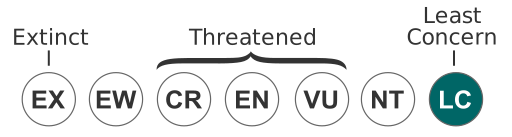

The ilish (Tenualosa ilisha) (Bengali: ইলিশ, romanized: iliś; also known as the ilishi, hilsa, hilsa herring or hilsa shad, is a species of fish related to the herring, in the family Clupeidae. It is a very popular and sought-after food fish in the Indian Subcontinent, and is the national fish of Bangladesh[3] and the state fish of West Bengal.[4] The most famous hilsha fish comes from Chandpur, Bangladesh. The fish contributes about 12% of the total fish production and about 1.15% of GDP in Bangladesh. On 6 August 2017, Department of Patents, Designs and Trademarks under the Ministry of Industries of Bangladesh has declared the recognition of ilish as the product of Bangladesh. As of 2021, 86% of the world's total ilish supply originates in Bangladesh which applied for Geographical indication (GI) in 2004.[5] About 450,000 people are directly involved in the catching of the fish as a large part of their livelihood; around four to five million people are indirectly involved with the trade.[6]
Common names
Other names include: jatka, ilish, ellis, palla fish, hilsha, ilih etc. (Assamese: ইলীহ/ইলীহি: ilih/ilihi, Bengali: ইলিশ, romanized: iliś, Gujarati: મોદાર/પાલ્વા: Modar or Palva, Odia: ଇଲିଶି, romanized: iliśi, Sindhī: پلو مڇي pallo machhi, Tamil: உள்ள மீன்/Ulla Meen, Telugu: పులస pulasa). The name ilish is also used in India's Assamese, Bengali and Odia community. In Iraq it is called sboor (صبور). In Malaysia and Indonesia, it is commonly known as terubok. Due to its distinguished features as being oily and tender, some Malays, especially in northern Johore, call it 'terubok umno' (to distinguish it from the toli - which species is rich of tiny bones and not so oily).[citation needed] In Myanmar, it is called (Burmese: ငါးသလောက်) in Burmese.
 | This article is missing information about the English translation of the Burmese name. (June 2022) |


Description and habitat

The fish is marine; freshwater; brackish; pelagic-neritic; anadromous; depth range? - 200 m. Within a tropical range; 34°N - 5°N, 42°E - 97°E in marine and freshwater. It can grow up to 60 cm in length with weights of up to 3 kg. It is found in rivers and estuaries in Bangladesh, India, Pakistan, Myanmar (also known as Burma) and the Persian Gulf area where it can be found in the Tigris and Euphrates rivers in and around Iran and southern Iraq.[7] It has no dorsal spines but 18 – 21 dorsal soft rays and anal soft rays. The belly has 30 to 33 scutes. There is a distinct median notch in the upper jaw. Gill rakers fine and numerous, about 100 to 250 on the lower part of the arch and the fins are hyaline. The fish shows a dark blotch behind gill opening, followed by a series of small spots along the flank in juveniles. Color in life, silver shot with gold and purple. The species filter feeds on plankton and by grubbing muddy bottoms.[8] The fish schools in coastal waters and ascends up the rivers (anadromous) for around 50 – 100 km to spawn during the southwest monsoons (June to September) and also in January to April. April is the most fertile month for the breeding of ilish. The young fish returning to the sea are known in Bangladesh as jatka, which includes any ilish fish up to 9 inches long.
Production
The fish is found in 11 countries: Bangladesh, India, Myanmar, Pakistan, Iran, Iraq, Kuwait, Bahrain, Indonesia, Malaysia and Thailand. Bangladesh is the top hilsa-producing country in the world, followed by Myanmar and then India. [citation needed]
86 percent of the total hilsa catch is taken in Bangladesh. Production has dropped in the other ten hilsa-producing countries; in Bangladesh, however, production reached 517,000 tons in FY 2017–18, up from 279,189 tons in 2006–07, as a result of a strategy implemented by the Bangladeshi government. [citation needed]
Food value

The fish is popular food amongst the people of South Asia and in the Middle East, but especially with Bengalis, Odias and Andhras. [citation needed]Bengali fish curry is a popular dish made with mustard oil or seed. The Bengalis popularly call this dish Shorshe Ilish.[citation needed] It is very popular in Bengal (Bangladesh and India's West Bengal), as well as in Odisha, Tripura, Assam, Gujarat and Andhra Pradesh.[citation needed] It is also exported globally.[citation needed]
In North America (where ilish is not always readily available) other shad fish are sometimes used as an ilish substitute, especially in Bengali cuisine. This typically occurs near the East coast of North America, where fresh shad fish having similar taste can be found.[citation needed]
In Bangladesh, fish are caught in the Meghna-Jamuna delta,[9] which flows into the Bay of Bengal and Meghna (lower Brahmaputra), and Jamuna rivers.
In India, Rupnarayan (which has the Kolaghater hilsa), Hooghly, Mahanadi,[10] Narmada and Godavari rivers and the Chilika Lake are famous for their fish yields.
In Pakistan, most hilsa fish are caught in the Indus River Delta in Sindh. They are also caught in the sea, but some consider the marine stage of the fish as not so tasty. The fish has very sharp and tough bones, making it problematic to eat for some.[citation needed]
Ilish is an oily fish rich in omega 3 fatty acids.[11] Recent experiments have shown its beneficial effects in decreasing cholesterol level in rats[12] and insulin level.[13]
In Bengal and Odisha, ilish can be smoked, fried, steamed or baked in young plantain leaves, prepared with mustard seed paste, curd, eggplant, different condiments like jira (cumin) and so on. It is said that people can cook ilish in more than 50 ways.[citation needed] Ilish roe is also popular as a side dish. Ilish can be cooked in very little oil since the fish itself is very oily.[citation needed]
Ilish in culture

- In Andhra Pradesh, the saying goes "Pustelu ammi ayina Pulasa tinocchu", meaning roughly "It's worth eating Pulasa/Ilish even if you have to sell your mangala sutra."[citation needed]
- In many Bengali Hindu families a pair of ilish fishes (Bengali: Jora Ilish) are bought on auspicious days, for example for special prayers or puja days like for the Hindu Goddess of music, art and knowledge Saraswati Puja, which takes place in the beginning of Spring or on the day of Lakshmi Puja (The Goddess of Wealth and Prosperity) which takes place in autumn.[14] Some people offer the fish to the goddess Lakshmi, without which the Puja is sometimes thought to be incomplete.
- Ilish is the national fish of Bangladesh.[3]
- In Bengal Ilish is also used during wedding as tattwa gift. During Gaye Holud tattwa the family of the groom presents a pair of Ilish to the family of the bride. However, due to the scarcity of Ilish, nowadays it is often replaced by Rohu in West Bengal, while the tradition continues in Bangladesh.[citation needed]
- In Bangladesh and West Bengal, a famous dish which tastes good with fried ilish fish is 'khichudi' (a special way of cooking lentils and rice together with some added herbs). It is popular among all Bengalis during monsoon which is known as the month of ilish. In Bangladesh and West Bengal, ilish is often termed as the 'Queen' of fishes.[citation needed]
- This fish is called as PULASA in Godavari districts of Andhra Pradesh State in India. The name Pulasa stays with the fish for a limited period between July-Sept of a year, when floods (muddy)water flow in Godavari River. This time the fish is in high demand and sometimes $100 per kilo.[15][16]
- Hilsha fish called Pallo Machi is important part of Sindhi cuisine, prepared with numerous cooking methods. It can be deep fried and garnished with local spices, can be cooked with onions and potatoes into a traditional fish meal or barbequed. The fish often has roe, which is called "aani" in Sindhi and is enjoyed as a delicacy. Often fried alongside the palla and served with the fish fillets.[17][18][19]
- The rivalry of Eastbengal and Mohonbagan, two football clubs in Kolkata are celebrated by food. When Eastbengal prevails, its an Ilish dish which is cooked in the household of a fan. Similarly, when Mohonbagan wins, a prawn dish is prepared by the supporter.[citation needed]
Overfishing and possible extinction
Due to the demand and popularity of this species, overfishing is rampant. Fishes weighing around 2 to 3 kilograms have become rare in India, as even the smaller fish are caught using finer fishing nets as production in Bangladesh have increased.[20][21] As a consequence of this, prices of the fish have risen. In the past ilish were not harvested between Vijaya Dashami and Saraswati Puja due to some informal customs of Odia and Bengali Hindus as it is the breeding period of the fish. But as disposable incomes grew, wealthier consumers abandoned the old traditions.[22] The advent of finer fishing nets and advanced trawling techniques, and environmental degradation of the rivers, has worsened the situation. Fishermen have been ignoring calls to at least leave the juvenile "jatka" alone to repopulate the species. The fishing of the young jatka is now illegal in Bangladesh. This ban however has resulted in a rise in un-employment, as around 83,000 fishermen are unable to pursue their former livelihood for eight months every year. It has also led to the creation of a black market where jatka are sold for exorbitant prices.[23] Furthermore, the changes brought about by global warming have led to a gradual depletion of the ilish's breeding grounds, reducing populations of the fish even further.[24] Pollution in Indian rivers have worsened the situation, but due to slightly better waters the fishes are found more near Bangladesh delta.[21] Owing to this situation ilish is used as a diplomatic trade item for COVID-19 vaccines too.[25]
See also
References
- ↑ Freyhof, J. (2014). "Tenualosa ilisha". IUCN Red List of Threatened Species. 2014: e.T166442A1132697. doi:10.2305/IUCN.UK.2014-1.RLTS.T166442A1132697.en. Retrieved 19 November 2021.
- ↑ Al-Khalaf, K.; Alam, S.; Almukhtar, M.; Bishop, J.; Abdulqader, E.; Alghawzi, Q.; Al-Husaini, M.; Hartmann, S.; Kaymaram, F. (2015). "Tenualosa ilisha". IUCN Red List of Threatened Species. 2015: e.T166442A75259795.
- ↑ 3.0 3.1 Webb, Lois Sinaiko; Roten, Lindsay Grace (2009), The Multicultural Cookbook for Students, ABC-CLIO, ISBN 978-0-313-37559-0
- ↑ "State Fishes of India" (PDF). National Fisheries Development Board, Government of India. Retrieved 25 December 2020.
- ↑ "Recognition for hilsa". The Daily Star. 8 August 2017. Retrieved 16 January 2019.
- ↑ Siddique, Abu Bakar. "Country's 6th Ilish sanctuary coming soon". Dhaka Tribune. Retrieved 23 May 2015.
- ↑ Al-Dubakel, A. Y. (2011). "Commercial Fishing and Marketing of Hilsa Shad Tenualosa ilisha (Hamilton-Buchanon, 1822) in Basrah -Southern Iraq". Emirates Journal of Food Agriculture. 23 (2). Archived from the original on 22 May 2014. Retrieved 22 May 2014.
- ↑ "Tenualosa ilisha". FishBase.
- ↑ "Highway extortion responsible for surge in Ilish prices". Dhaka Tribune. Retrieved 3 May 2016.
- ↑ "Bioinformatics Centre, National Institute of Oceanography, Goa, India". Biosearch.in. 1 February 2012. Archived from the original on 6 May 2013. Retrieved 22 April 2013.
- ↑ Mohanty, Bimal; Das, Soma; Bhaumik, Utpal; Sharma, Anil (March 2011). "Tenualosa ilisha: A rich source of omega-3 PUFAs" (PDF). Bulletin (171). Central Inland Fisheries Research Institute. ISSN 0970-616X.
- ↑ Banerjee I, Saha S, Dutta J (June 1992). "Comparison of the effects of dietary fish oils with different n-3 polyunsaturated fatty acid compositions on plasma and liver lipids in rats". Lipids. 27 (6): 425–8. doi:10.1007/BF02536383. PMID 1630277. S2CID 4033041.
- ↑ Mahmud I, Hossain A, Hossain S, Hannan A, Ali L, Hashimoto M (2004). "Effects of Hilsa ilisa fish oil on the atherogenic lipid profile and glycaemic status of streptozotocin-treated type 1 diabetic rats". Clin. Exp. Pharmacol. Physiol. 31 (1–2): 76–81. doi:10.1111/j.1440-1681.2004.03953.x. PMID 14756688. S2CID 25883400.
{{cite journal}}: CS1 maint: deprecated archival service (link) - ↑ "Ilish... a love story". dna. 24 May 2014. Retrieved 3 May 2016.
- ↑ "What the fish! Godavari Pulasa selling for Rs 4,000 per kg". The Times of India. Retrieved 18 February 2018.
- ↑ "Pulasa season starts early". The Times of India. Retrieved 18 February 2018.
- ↑ Khan, M. Hussain (2 April 2019). "The palla, the shrine, the catch and the cook". Dawn.
- ↑ Karmakar, Kalyan (24 April 2018). "10 Reasons to Get Invited to a Sindhi Household for Dinner". NDTV Food.
- ↑ Sen, Pritha (9 July 2017). "A fishy fable: If it's monsoon, it must rain hilsas". The Indian Express.
- ↑ Dasgupta, Reshmi R. (13 August 2012). "Bengalis are loving Ilish to extinction". The Economic Times.
- ↑ 21.0 21.1 "Hilsa Fish: অসুস্থ গঙ্গা থেকে মুখ ফিরিয়ে মায়ানমার পাড়ি দিচ্ছে ইলিশের ঝাঁক". anandabazar.com (in Bengali). Retrieved 24 September 2021.
- ↑ Mazumdar, Jaideep (1 September 2008). "The Last Ilish Curry". Outlook.
- ↑ Moitra, Kalyan (1 July 2002). "Hilsa may soon become endangered: Experts". The Times of India.
{{cite news}}: CS1 maint: deprecated archival service (link) - ↑ "Bangladesh's Hilsa Fish Acts as Early Warning of Climate Change". Archived from the original on 22 May 2014. Retrieved 1 July 2013.
- ↑ ভ্যাকসিন নেই, তাই ইলিশও নেই! (in Bengali). Deutsche Welle. 22 June 2021. Retrieved 25 September 2021.
External links
- Hilsa Research in the Bay of Bengal
- Tenualosa ilisha.BdFISH
- "Tenualosa ilisha". Integrated Taxonomic Information System. Retrieved 6 June 2006.
- Ilish Hut (ইলিশ হাট) | Online Ilish Fish Selling Website from Bangladesh
- Mazumder SK, Alam MS (January–March 2009). "High levels of genetic variability and differentiation in hilsa shad, Tenualosa ilisha (Clupeidae, Clupeiformes) populations revealed by PCR-RFLP analysis of the mitochondrial DNA D-loop region". Genet Mol Biol. 32 (1): 190–196. doi:10.1590/S1415-47572009005000023. PMC 3032976. PMID 21637667.
- Roomiani L, Sotudeh AM, Hakimi Mofrad R (October 2013). "Reproductive biology of Hilsa shad (Tenualosa ilisha) in coastal Waters of the Northwest of Persian Gulf" (PDF). Iranian Journal of Fisheries Sciences. 13 (1): 201–2015.
Template:Commercial fish topics
.png)