







Kumar Blog (talk | contribs) No edit summary |
Khalidmendi (talk | contribs) quick update references after review and corrected details for accuracy |
||
| Line 1: | Line 1: | ||
{{ | {{Short description|Capital of Uttar Pradesh, India}} | ||
{{About|the city in India|}} | {{About|the city in India|}} | ||
{{pp-vandalism|small=yes}} | |||
{{Use Indian English|date= | {{Use Indian English|date=July 2025}} | ||
{{Use dmy dates|date= | {{Use dmy dates|date=July 2025}} | ||
{{Infobox settlement | {{Infobox settlement | ||
| official_name | | official_name = Lucknow | ||
| image_blank_emblem | | native_name = ''Lakhanaū'' | ||
| blank_emblem_type | | native_name_lang = hi | ||
| blank_emblem_size | | image_blank_emblem = | ||
| blank_emblem_type = Seal of the [[Lucknow Municipal Corporation]] | |||
| blank_emblem_size = 100px | |||
| settlement_type | | settlement_type = [[Metropolis]] | ||
| image_skyline | | image_skyline = {{multiple image | ||
| border = infobox | | border = infobox | ||
| total_width = 300 | | total_width = 300 | ||
| image_style = | | image_style = | ||
| perrow = 1/2/2/2/2/2/1 | | perrow = 1/2/2/2/2/2/1 | ||
| image1 = | | image1 = Charbagh Lucknow Railway Station.jpg | ||
| caption1 = | | caption1 = [[Lucknow Charbagh railway station]] | ||
| image2 = | | image2 = Harzratganj Market, Lucknow.jpg | ||
| caption2 = [[ | | caption2 = [[Hazratganj|Hazratganj Market]] | ||
| image3 = | | image3 = KGMU Lucknow.jpg | ||
| caption3 = [[ | | caption3 = [[King George's Medical University]] | ||
| image4 = | | image4 = Ambedkar Memorial Park-Lucknow-Uttar Pradesh-MA22.jpg | ||
| caption4 = [[Ambedkar Memorial Park]] | |||
| image5 = La Martiniere, lucknow 39.jpg | |||
| caption5 = [[La Martinière College, Lucknow|La Martinière College]] | |||
| image6 = Ekana cricket stadium .jpg | |||
| | | caption6 = [[BRSABV Ekana Cricket Stadium|Ekana Cricket Stadium]] | ||
| | | image7 = Lucknow Metro under operation.jpg | ||
| caption7 = [[Lucknow Metro]] | |||
| image8 = Bara Imambara Lucknow.jpg | |||
| | | caption8 = [[Bara Imambara]] | ||
| | |||
| | |||
| | |||
| | |||
| | |||
| | |||
}} | }} | ||
| | | nicknames = The City of [[Lakshmana]], The City of Nawabs, The Golden City of India, Constantinople of the East, Shiraz-e-Hind | ||
| image_map | | image_map = {{Maplink|frame=yes|plain=y|frame-width=300|frame-height=300|frame-align=center|type=shape|from=India/Uttar Pradesh/Lucknow.map}} | ||
| map_caption | | map_caption = Interactive Map Outlining Lucknow District. | ||
| pushpin_map | | pushpin_map = #Uttar Pradesh#India#Asia#Earth | ||
| pushpin_mapsize | | pushpin_mapsize = 300 | ||
| pushpin_label_position | | pushpin_label_position = right | ||
| pushpin_relief | | pushpin_relief = | ||
| pushpin_map_alt | | pushpin_map_alt = <span style="color:pink;">Lucknow</span> | ||
| pushpin_map_caption | | pushpin_map_caption = Location in [[Uttar Pradesh]]##Location in [[India]]##Location in [[Asia]]##Location in [[Earth]] | ||
| coordinates | | coordinates = {{coord|26|51|N|80|57|E|type:city_region:IN-UP|display=it}} | ||
| subdivision_type | | subdivision_type = [[List of sovereign states|Country]] | ||
| subdivision_name | | subdivision_name = {{flag|India}} | ||
| subdivision_type1 | | subdivision_type1 = [[States and union territories of India|State]] | ||
| subdivision_type2 | | subdivision_type2 = [[Divisions of Uttar Pradesh|Division]] | ||
| subdivision_type3 | | subdivision_type3 = [[List of districts of India|District]] | ||
| subdivision_name1 | | subdivision_name1 = {{flagicon image|Flag of Uttar Pradesh.svg}} [[Uttar Pradesh]] | ||
| subdivision_name2 | | subdivision_name2 = [[Lucknow Division|Lucknow]] | ||
| subdivision_name3 | | subdivision_name3 = [[Lucknow District|Lucknow]] | ||
| established_title | | established_title = Establishment | ||
| established_date | | established_date = | ||
| founder | | founder = | ||
| named_for | | named_for = [[Lakshmana]] | ||
| government_type | | government_type = [[Municipal Corporation]] | ||
| governing_body | | governing_body = [[Lucknow Municipal Corporation]] | ||
| leader_party | | leader_party = [[Bharatiya Janata Party|BJP]] | ||
| leader_title | | leader_title = [[List of mayors of Lucknow|Mayor]] | ||
| leader_name | | leader_name = Sushma Kharakwal | ||
| leader_title1 | | leader_title1 = [[Municipal Commissioner]] | ||
| leader_name1 | | leader_name1 = Gaurav Kumar<br/>[[Indian Administrative Service|IAS]]<ref>{{cite web |title=Who's Who - District Lucknow |url=https://lucknow.nic.in/who-is-who/ |website=Government of Uttar Pradesh, India |access-date=28 May 2025}}</ref> | ||
| | | unit_pref = Metric | ||
| area_footnotes = <ref name='Lucknow City'>{{cite news|url=https://timesofindia.indiatimes.com/city/lucknow/lucknow-to-expand-88-new-villages-under-lmc-wings/articleshow/72356975.cms|title=Lucknow to expand, 88 new villages under LMC wings|newspaper=[[Times of India]]|date=4 December 2019 |access-date=20 October 2020}}</ref> | |||
| | | area_total_km2 = 631 | ||
| | | area_metro_km2 = | ||
| | | area_rank = [[List of cities in India by area|5th in India]] | ||
| | | elevation_m = 123 | ||
| population_total = 2,902,601 | |||
| | | population_as_of = 2011 | ||
| | | population_footnotes = <ref name='Lucknow City'/><ref name="population">{{cite web|url=https://www.censusindia.gov.in/2011-prov-results/paper2/data_files/India2/Table_2_PR_Cities_1Lakh_and_Above.pdf|title=Cities having population 1 lakh and above, Census 2011|publisher=The Registrar General & Census Commissioner, India|access-date=25 June 2014|archive-url=https://web.archive.org/web/20120507135928/https://www.censusindia.gov.in/2011-prov-results/paper2/data_files/India2/Table_2_PR_Cities_1Lakh_and_Above.pdf|archive-date=7 May 2012|url-status=live}}</ref> | ||
| population_density_km2 = auto | |||
| population_rank = [[List of cities in India by population|11th in India]] | |||
| population_demonym = {{hlist|Lakhnawi|Lucknowite}} | |||
| | | timezone1 = [[Indian Standard Time|IST]] | ||
| | | demographics_type1 = [[Language]] | ||
| | | demographics1_title1 = Official | ||
| demographics1_info1 | | demographics1_info1 = [[Hindi language|Hindi]]<ref name="langoff">{{cite web|title=52nd Report of the Commissioner for Linguistic Minorities in India|url=https://nclm.nic.in/shared/linkimages/NCLM52ndReport.pdf|website=nclm.nic.in|publisher=[[Ministry of Minority Affairs]]|access-date=12 February 2019 |page=49 |url-status=dead|archive-url=https://web.archive.org/web/20170525141614/http://nclm.nic.in/shared/linkimages/NCLM52ndReport.pdf|archive-date=25 May 2017}}</ref> | ||
| demographics1_title2 | | demographics1_title2 = Additional official | ||
| demographics1_info2 | | demographics1_info2 = [[Urdu]]<ref name="langoff"/> | ||
| demographics1_title3 | | demographics1_title3 = Regional | ||
| demographics1_info3 | | demographics1_info3 = [[Awadhi language|Awadhi]]<ref>{{cite web|url=https://www.ethnologue.com/language/awa |title=Awadhi |website=[[Ethnologue]] |access-date=7 May 2019}}</ref> | ||
| utc_offset1 | | utc_offset1 = +5:30 | ||
| postal_code_type | | postal_code_type = [[Postal Index Number|Pincode(s)]] | ||
| postal_code | | postal_code = 2260xx /2270xx | ||
| area_code | | area_code = [[Telephone numbers in India|+91-522]] | ||
| area_code_type | | area_code_type = Telephone code | ||
| registration_plate | | registration_plate = UP-32/UP-321 | ||
| blank_name_sec1 | | blank_name_sec1 = [[Gross domestic product|GDP Nominal]] | ||
| blank_info_sec1 | | blank_info_sec1 = $16 billion<ref name="UttarPradesh_gdp">{{Cite web |title=District Domestic Product Per Capita |url=https://updes.up.nic.in/updes/data/sdiaryenglish/files/diary%20eng%202021_merged.pdf |access-date=8 January 2023}}</ref> | ||
| blank1_name_sec1 | | blank1_name_sec1 = [[Gross domestic product|Percapita]] | ||
| blank1_info_sec1 | | blank1_info_sec1 = $2, 800 or ₹2.29 lakh<ref name="UttarPradesh_gdp"/> | ||
| blank2_name_sec1 | | blank2_name_sec1 = [[Gross domestic product|GDP Nominal]] ([[Lucknow district|Lucknow District]]) | ||
| blank2_info_sec1 | | blank2_info_sec1 = ₹1,31,200 cr(2022–23)<ref>{{cite web |last1=Records |first1=Official |title=District Domestic Product Estimates Uttar Pradesh Year 2020–21 |url=https://updes.up.nic.in/esd/Book/DDP2020-21(T)MARCH22%20%20new%20web.pdf |website=Directorate of Economics And Statistics Government Of Uttar Pradesh |access-date=6 November 2021}}</ref> | ||
| blank3_name_sec1 | | blank3_name_sec1 = [[Human sex ratio|Sex ratio]] | ||
| blank3_info_sec1 | | blank3_info_sec1 = 915 [[female|♀]]/1000 [[male|♂]] | ||
| blank4_name_sec1 | | blank4_name_sec1 = Effective literacy rate (2011) | ||
| blank4_info_sec1 | | blank4_info_sec1 = 85.5% | ||
| blank4_name_sec2 | | blank4_name_sec2 = [[Human Development Index|HDI]] | ||
| blank4_info_sec2 | | blank4_info_sec2 = {{increase}} 0.665<ref>{{cite journal|first1=Padam|last1=Singh|first2=Satyendra|last2=Keshari|url=http://ssca.org.in/media/4_2016_HDI_t1hcMZm.pdf|title=Development of Human Development Index at District Level for EAG States|journal=Statistics and Applications|date=8 March 2016|issn=2454-7395|volume=14|issue=1–2|pages=43–61|access-date=6 March 2019 |archive-url=https://web.archive.org/web/20180619103221/http://www.ssca.org.in/media/4_2016_HDI_t1hcMZm.pdf |archive-date=19 June 2018 |url-status=live }}</ref> ({{color|green|medium}}) | ||
| website | | blank1_info_sec2 = | ||
| unemployment_rate | | website = {{official website|lucknow.nic.in}} | ||
| pushpin_label | | unemployment_rate = | ||
| name | | pushpin_label = Lucknow | ||
| name = | |||
| blank2_name_sec2 = [[Rapid Transit]] | |||
| blank2_info_sec2 = [[File:UPMRC.svg|20px|UPMRC Logo|alt=UPMRC Logo]] [[Lucknow Metro]] | |||
| blank3_name_sec2 = [[International Airport]] | |||
| blank3_info_sec2 = [[File:Lucknow Airport Logo.svg|20px|Lucknow International Airport Logo|alt=Lucknow Airport Logo]] [[Chaudhary Charan Singh International Airport]] | |||
| blank_name_sec2 = [[Cricket field|International Cricket Stadium]] | |||
| blank_info_sec2 = [[Ekana Cricket Stadium|BRSABV Ekana Cricket Stadium]] | |||
| blank1_name_sec2 = | |||
}} | }} | ||
{{Contains special characters|Indic}} | {{Contains special characters|Indic}} | ||
'''Lucknow''' ({{ | '''Lucknow''' ({{Indic Transl|hi|Lakhanaū|ˈləkʰnə.uː|Lucknow.ogg}}) is a [[List of metropolitan areas in India|metropolis]] and the second largest city of the [[List of state and union territory capitals in India|Indian state]] of [[Uttar Pradesh]] where it serves as the [[List of state and union territory capitals in India|capital]] and the administrative headquarters of the eponymous [[Lucknow district|district]] and [[Lucknow division|division]]. The city had a population of 2.8 million according to the 2011 census making it the [[List of cities in India by population|eleventh most populous city]] and [[List of million-plus urban agglomerations in India|the twelfth-most populous urban agglomeration]] of India.<ref name="census" /> It is an important centre of education, commerce, aerospace, finance, pharmaceuticals, information technology, design, culture, tourism, music, and poetry.<ref>{{cite web|url=https://timesofindia.indiatimes.com/city/lucknow/LDA-begins-process-to-expand-Lucknows-territory/articleshow/45997595.cms|title=LDA begins process to expand Lucknow's territory|date=24 January 2015|website=[[The Times of India]]|location=Lucknow|access-date=12 January 2018|archive-url=https://web.archive.org/web/20171109021539/https://timesofindia.indiatimes.com/city/lucknow/LDA-begins-process-to-expand-Lucknows-territory/articleshow/45997595.cms|archive-date=9 November 2017|url-status=live}}</ref><ref>{{cite web|url=https://timesofindia.indiatimes.com/city/lucknow/Lucknow-gets-bigger-by-380-sq-km-in-10-yrs/articleshow/7479048.cms|title=Lucknow gets bigger by 380 sq km in 10 yrs|date=12 February 2011|website=[[The Times of India]]|location=Lucknow|access-date=12 January 2018|archive-url=https://web.archive.org/web/20171109020005/https://timesofindia.indiatimes.com/city/lucknow/Lucknow-gets-bigger-by-380-sq-km-in-10-yrs/articleshow/7479048.cms|archive-date=9 November 2017|url-status=live}}</ref><ref>{{cite web|url = http://www.thedivineconspiracy.org/Z5259B.pdf|title = Sacred space and holy war|access-date = 27 August 2014|website = Divine Conspiracy|last = Cole|first = Juan Ricardo|archive-url = https://web.archive.org/web/20140819090918/http://www.thedivineconspiracy.org/Z5259B.pdf|archive-date = 19 August 2014|url-status = usurped|df = dmy-all}}</ref> Lucknow, along with [[Agra]] and [[Varanasi]], forms the backbone of the [[Uttar Pradesh Heritage Arc]]. | ||
Lucknow | In the 6th century BCE, Lucknow was part of [[Kosala (Mahajanapada)|Kosala]], one of the 16 [[Mahajanapadas]] during the [[Vedic period#Later Vedic period (c. 1000 – c. 600 BCE)|late Vedic period]]. The [[Nawab of Awadh|Nawabs of Lucknow]] acquired the name after the reign of the third Nawab, when Lucknow became their capital. In 1856, the [[East India Company]] first moved its troops to the border, then annexed the state for alleged maladministration. Awadh was placed under a chief commissioner. Lucknow was one of the major centres of the [[Indian Rebellion of 1857]] and actively participated in [[Indian independence movement|India's independence movement]], emerging as a strategically important North Indian city. The city witnessed some of the pivotal moments in the history of India including the first meeting of [[Mahatma Gandhi]], [[Jawaharlal Nehru]] and [[Muhammad Ali Jinnah]] during the [[Indian National Congress|Congress]] session of 1916 when [[Lucknow Pact]] was signed. | ||
Multiple software and [[Information technology|IT]] companies are present in the city. Lucknow is an emerging automobile hub.<ref>{{cite magazine|date=13 January 2021|title=Tata Motors' Jamshedpur, Lucknow and Pantnagar plants win National Energy Conservation Award 2020|url=https://www.autocarpro.in/news-national/tata-motors%E2%80%99-jamshedpur--lucknow-and-pantnagar-plants-win-national-energy-conservation-award-2020-78222|access-date=4 April 2021|magazine=Autocar}}</ref> It has been the headquarters of the [[Central Command (India)|Central Command]] of the [[Indian Army]].<ref name="TOI-2009-05-03">{{cite news|url=https://timesofindia.indiatimes.com/city/lucknow/Central-Command-Raising-Day-concludes/articleshow/4477181.cms|title=Central Command Raising Day concludes|date=3 May 2009|access-date=21 June 2013|archive-url=https://web.archive.org/web/20131005010528/http://articles.timesofindia.indiatimes.com/2009-05-03/lucknow/28157520_1_ors-central-command-programmes|archive-date=5 October 2013|work=[[The Times of India]]|url-status=live}}</ref> It is the home of [[List of educational institutions in Lucknow|several prominent educational and research institutes and universities]], including the [[Indian Institute of Management Lucknow|IIM Lucknow]], the [[Indian Institute of Information Technology, Lucknow]], [[AKTU]] and the [[Central Drug Research Institute]]. Lucknow is designated as a [[City of Gastronomy]] by [[UNESCO]] heritage.<ref>https://indianexpress.com/article/cities/lucknow/lucknow-named-unesco-creative-city-of-gastronomy-second-indian-city-to-earn-the-tag-10339133/</ref><ref>https://www.indiatoday.in/india/story/unesco-recognises-lucknow-as-creative-city-of-gastronomy-for-its-culinary-heritage-2811850-2025-11-01</ref> | |||
Lucknow | ==Toponymy== | ||
"Lucknow" is the [[Anglicisation of names|anglicised]] spelling of the local pronunciation "Lakhnau". According to one legend, the city is named after [[Lakshmana]], a hero of the Hindu epic ''[[Ramayana]]''. The legend states that Lakshmana had a palace or an estate in the area, which was called ''Lakshmanapuri'' ([[Sanskrit]]: लक्ष्मणपुरी, lit. ''Lakshmana's city''). The settlement came to be known as Lakhanpur (or Lachhmanpur) by the 11th century, and later, Lucknow.<ref name="Veena2014">{{cite book |author=Veena Talwar Oldenburg |title=The Making of Colonial Lucknow, 1856–1877 |url={{GBurl|id=6tP_AwAAQBAJ|p=6}} |date=14 July 2014 |publisher=Princeton University Press |isbn=978-1-4008-5630-5 |page=6 }}</ref><ref name="PNas1993">{{cite book |author=P. Nas |title=Urban Symbolism |url={{GBurl|id=R7-xvYmg3HcC|p=329}} |year=1993 |publisher=BRILL |isbn=90-04-09855-0 |page=329 }}</ref> | |||
A similar theory states that the city was known as ''Lakshmanavati'' ({{langx|sa| लक्ष्मणवती}}, fortunate) after Lakshmana. The name changed to ''Lakhanavati'', then Lakhnauti and finally Lakhnau.<ref name="Philip2006">{{cite book |author=Philip Lutgendorf Professor of Hindi and Modern Indian Studies University of Iowa |title=Hanuman's Tale : The Messages of a Divine Monkey: The Messages of a Divine Monkey |url={{GBurl|id=fVFC2Nx-LP8C|p=245}} |date=13 December 2006 |publisher=Oxford University Press |isbn=978-0-19-804220-4 |page=245 }}</ref> Yet another theory states that the city's name is connected with [[Lakshmi]], the Hindu goddess of wealth. Over time, the name changed to Laksmanauti, Laksmnaut, Lakhsnaut, Lakhsnau and, finally, Lakhnau.<ref>{{cite book |author=Richard Stephen Charnock|authorlink=Richard Stephen Charnock |title=Local Etymology: A Derivative Dictionary of Geographical Names |url=https://archive.org/details/localetymologya00chargoog |year=1859 |publisher=Houlston and Wright |page=[https://archive.org/details/localetymologya00chargoog/page/n360 167]}}</ref> | |||
A similar theory states that the city was known as ''Lakshmanavati'' ({{ | |||
Another theory is that Lucknow was named after a very influential architect named Lakhna Ahir, who built the fort Qila Lakhna.<ref>{{Cite book |last=Architects |first=Indian Institute of |url=https://books.google.com/books?id=7YpUAAAAMAAJ&q=lakhna+ahir+ |title=Journal of the Indian Institute of Architects |date=1991 |publisher=S. Kumar |language=en}}</ref><ref>{{Cite book |last=Hasan |first=Amir |url=https://books.google.com/books?id=CnFuAAAAMAAJ&q=lakhna+ahir+ |title=Palace Culture of Lucknow |date=1983 |publisher=B.R. Publishing Corporation |isbn=978-93-5050-037-8 |language=en}}</ref> | Another theory is that Lucknow was named after a very influential architect named Lakhna Ahir, who built the fort Qila Lakhna.<ref>{{Cite book |last=Architects |first=Indian Institute of |url=https://books.google.com/books?id=7YpUAAAAMAAJ&q=lakhna+ahir+ |title=Journal of the Indian Institute of Architects |date=1991 |publisher=S. Kumar |language=en}}</ref><ref>{{Cite book |last=Hasan |first=Amir |url=https://books.google.com/books?id=CnFuAAAAMAAJ&q=lakhna+ahir+ |title=Palace Culture of Lucknow |date=1983 |publisher=B.R. Publishing Corporation |isbn=978-93-5050-037-8 |language=en}}</ref> | ||
| Line 132: | Line 130: | ||
==History== | ==History== | ||
{{See also|Awadh|Kosala|Oudh State}} | {{See also|Awadh|Kosala|Oudh State}} | ||
From the sixth to the fourth century BCE, Lucknow was part of the realm of [[Kosala (Mahajanapada)|Kosala]], one of the 16 [[Mahajanapadas]] in the [[Vedic period#Later Vedic period (c. 1000 – c. 600 BCE)|Late Vedic period]]. | |||
From 1350 onwards, Lucknow and parts of the Awadh region were ruled by the Delhi Sultanate, [[Jaunpur Sultanate|Sharqi Sultanate]], [[Mughal Empire]], [[Nawab of Awadh|Nawabs of Awadh]], the British [[East India Company]] and the [[British Raj]]. | From 1350 onwards, Lucknow and parts of the Awadh region were ruled by the Delhi Sultanate, [[Jaunpur Sultanate|Sharqi Sultanate]], [[Mughal Empire]], [[Nawab of Awadh|Nawabs of Awadh]], the British [[East India Company]] and the [[British Raj]]. | ||
For about eighty-four years (from 1394 to 1478), Awadh was part of the Sharqi Sultanate of Jaunpur. Emperor [[Humayun]] made it a part of the Mughal Empire around 1555. Emperor [[Jahangir]] (1569–1627) granted an estate in Awadh to a favoured nobleman, Sheikh Abdul Rahim, who later built Machchi Bhawan on this estate. It later became the seat of power from where his descendants, the ''Sheikhzadas'', controlled the region.<ref>{{cite web|url = http://lucknow.me/history.html|title = Introduction to Lucknow|access-date = 24 August 2014|publisher = Lucknow|archive-url = https://web.archive.org/web/20140107223010/https://lucknow.me/history.html|archive-date = 7 January 2014|url-status = live|df = dmy-all}}</ref> | For about eighty-four years (from 1394 to 1478), Awadh was part of the Sharqi Sultanate of Jaunpur. Emperor [[Humayun]] made it a part of the Mughal Empire around 1555. Emperor [[Jahangir]] (1569–1627) granted an estate in Awadh to a favoured nobleman, Sheikh Abdul Rahim, who later built Machchi Bhawan on this estate. It later became the seat of power from where his descendants, the ''Sheikhzadas'', controlled the region.<ref>{{cite web|url = http://lucknow.me/history.html|title = Introduction to Lucknow|access-date = 24 August 2014|publisher = Lucknow|archive-url = https://web.archive.org/web/20140107223010/https://lucknow.me/history.html|archive-date = 7 January 2014|url-status = live|df = dmy-all}}</ref> | ||
The Nawabs of Lucknow | The [[Nawab of Awadh|Nawabs of Lucknow]] acquired the name after the reign of the third Nawab when Lucknow became their capital. The city became North India's [[cultural capital]], and its nawabs, best remembered for their refined and extravagant lifestyles, were patrons of the arts. | ||
Under their dominion, music and dance flourished, and construction of numerous monuments took place.<ref>{{cite web |url=http://www.laxys.com/lucknow.html |title=Lucknow City |publisher=Laxys |access-date=29 April 2012 |archive-url=https://web.archive.org/web/20120426071814/http://www.laxys.com/lucknow.html |archive-date=26 April 2012 |url-status=live }}</ref> Of the monuments standing today, the [[Bara Imambara]], the [[Chota Imambara]], and the [[Rumi Darwaza]] are notable examples. One of the Nawab's enduring legacies is the region's syncretic Hindu–Muslim culture that has come to be known as the ''[[Ganga-Jamuni Tehzeeb]]''.<ref>{{cite web|url = http://www.dnaindia.com/analysis/standpoint-understanding-ganga-jamuni-tehzeeb-how-diverse-is-the-indian-multiculturalism-1995684|title = Understanding Ganga-Jamuni Tehzeeb: How diverse is the "Indian multiculturalism"|date = 15 June 2014|access-date = 27 August 2014|website = DNA India|publisher = DNA Webdesk|last = Safvi|first = Rana|location = Mumbai|archive-url = https://web.archive.org/web/20140903135602/http://www.dnaindia.com/analysis/standpoint-understanding-ganga-jamuni-tehzeeb-how-diverse-is-the-indian-multiculturalism-1995684|archive-date = 3 September 2014|url-status = live|df = dmy-all}}</ref> | |||
[[File:Chota Imambara , Lucknow 654 (11).jpg|thumb|left|Chota Imambara is a [[Shia Muslim]] [[Hussainiya]] and a [[mausoleum]] for [[Muhammad Ali Shah]].]] | [[File:Chota Imambara , Lucknow 654 (11).jpg|thumb|left|Chota Imambara is a [[Shia Muslim]] [[Hussainiya]] and a [[mausoleum]] for [[Muhammad Ali Shah]].]] | ||
Until 1719, the [[Subah (country subdivision)|''subah'']] of Awadh was a province of the Mughal Empire administered by a governor appointed by the emperor. Persian adventurer [[Saadat Ali Khan I|Saadat Khan]], also known as Burhan-ul-Mulk, was appointed [[Monarch|''Nizam'']] of Awadh in 1722 and established his court in [[Faizabad]], near Lucknow.<ref>{{cite web|url=http://www.bartleby.com/65/fa/FaizabdInd.html |title=Faizabad, Town, India |access-date=27 August 2014 |website=Bartleby |publisher=The Columbia Encyclopaedia |url-status=dead |archive-url=https://web.archive.org/web/20090602140017/http://www.bartleby.com/65/fa/FaizabdInd.html |archive-date=2 June 2009 }}</ref> | Until 1719, the [[Subah (country subdivision)|''subah'']] of Awadh was a province of the Mughal Empire administered by a governor appointed by the emperor. Persian adventurer [[Saadat Ali Khan I|Saadat Khan]], also known as Burhan-ul-Mulk, was appointed [[Monarch|''Nizam'']] of Awadh in 1722 and established his court in [[Faizabad]], near Lucknow.<ref>{{cite web|url=http://www.bartleby.com/65/fa/FaizabdInd.html |title=Faizabad, Town, India |access-date=27 August 2014 |website=Bartleby |publisher=The Columbia Encyclopaedia |url-status=dead |archive-url=https://web.archive.org/web/20090602140017/http://www.bartleby.com/65/fa/FaizabdInd.html |archive-date=2 June 2009 }}</ref> | ||
Many independent kingdoms, such as Awadh, were established as the Mughal Empire [[Historiography of the fall of the Mughal Empire|disintegrated]]. The third Nawab, [[Shuja-ud-Daula]] (r. 1753–1775), fell out with the British after aiding the fugitive [[Nawabs of Bengal and Murshidabad|Nawab of Bengal]], [[Mir Qasim]]. Roundly defeated at the [[Battle of Buxar]] by the [[East India Company]], he was forced to pay heavy penalties and surrender parts of his territory.<ref>{{cite web|url = http://lucknow.me/Shuja-ud-Daula.html|title = Shuja Ud Daula|access-date = 24 August 2014|website = Lucknow|archive-url = https://web.archive.org/web/20150917060606/http://lucknow.me/Shuja-ud-Daula.html|archive-date = 17 September 2015|url-status = live|df = dmy-all}}</ref> Awadh's capital, Lucknow rose to prominence when [[Asaf-ud-Daula]], the fourth Nawab, shifted his court to the city from Faizabad in 1775.<ref>{{cite web|url = http://lucknow.me/Asaf-ud-Daula.html|title = Asaf Ud Daula|access-date = 24 August 2014|website = Lucknow|archive-url = https://web.archive.org/web/20150911213226/http://lucknow.me/Asaf-ud-Daula.html|archive-date = 11 September 2015|url-status = live|df = dmy-all}}</ref> The British East India Company appointed a resident (ambassador) in 1773 and by early 19th century gained control of more territory and authority in the state. | Many independent kingdoms, such as Awadh, were established as the Mughal Empire [[Historiography of the fall of the Mughal Empire|disintegrated]]. The third Nawab, [[Shuja-ud-Daula]] (r. 1753–1775), fell out with the British after aiding the fugitive [[Nawabs of Bengal and Murshidabad|Nawab of Bengal]], [[Mir Qasim]]. Roundly defeated at the [[Battle of Buxar]] by the [[East India Company]], he was forced to pay heavy penalties and surrender parts of his territory.<ref>{{cite web|url = http://lucknow.me/Shuja-ud-Daula.html|title = Shuja Ud Daula|access-date = 24 August 2014|website = Lucknow|archive-url = https://web.archive.org/web/20150917060606/http://lucknow.me/Shuja-ud-Daula.html|archive-date = 17 September 2015|url-status = live|df = dmy-all}}</ref> Awadh's capital, Lucknow rose to prominence when [[Asaf-ud-Daula]], the fourth Nawab, shifted his court to the city from Faizabad in 1775.<ref>{{cite web|url = http://lucknow.me/Asaf-ud-Daula.html|title = Asaf Ud Daula|access-date = 24 August 2014|website = Lucknow|archive-url = https://web.archive.org/web/20150911213226/http://lucknow.me/Asaf-ud-Daula.html|archive-date = 11 September 2015|url-status = live|df = dmy-all}}</ref> The British East India Company appointed a resident (ambassador) in 1773 and by early 19th century gained control of more territory and authority in the state. | ||
[[ | They were, however, disinclined to capture Awadh outright and come face to face with the [[Maratha Confederacy|Maratha Empire]] and the remnants of the Mughal Empire. In 1798, the fifth Nawab [[Wazir Ali Khan]] alienated both his people and the British and was forced to abdicate. The British then helped [[Saadat Ali Khan II|Saadat Ali Khan]] take the throne.<ref>{{cite web|url = http://lucknow.me/Saadat-Ali-Khan.html|title = Saadat-Ali-Khan|access-date = 24 August 2014|website = Lucknow|archive-url = https://web.archive.org/web/20140612023841/http://lucknow.me/Saadat-Ali-Khan.html|archive-date = 12 June 2014|url-status = live|df = dmy-all}}</ref> He became a [[Puppet monarch|puppet king]], and in a treaty of 1801, yielded large part of Awadh to the East India Company while also agreeing to disband his own troops in favour of a hugely expensive, British-controlled army. | ||
In 1856, the East India Company first moved its troops to the border, then annexed the state for alleged maladministration. Awadh was placed under a chief commissioner – Sir [[Henry Montgomery Lawrence|Henry Lawrence]]. [[Wajid Ali Shah]], the then Nawab, was imprisoned, then exiled by the East India Company to [[Kolkata|Calcutta]].<ref>{{cite web|url = http://lucknow.me/Wajid-Ali-Shah.html|title = Wajid Ali Shah|access-date = 24 August 2014|website = Lucknow|archive-url = https://web.archive.org/web/20150429000451/http://lucknow.me/Wajid-Ali-Shah.html|archive-date = 29 April 2015|url-status = live|df = dmy-all}}</ref> In the subsequent [[Indian Rebellion of 1857]], his 14-year-old son [[Birjis Qadra]], whose mother was [[Begum Hazrat Mahal]], was crowned ruler. Following the rebellion's defeat, Begum Hazrat Mahal and other rebel leaders sought asylum in [[Nepal]].<ref>{{cite web|url = http://archive.deccanherald.com/deccanherald/sep122004/fp3.asp|title = Begum Hazrat Mahal: forgotten icon of India's freedom movement|date = 12 September 2004|access-date = 27 August 2014|work = Deccan Herald|last = Sarkar|first = Sudeshna|url-status = dead|archive-url = https://web.archive.org/web/20140903124538/http://archive.deccanherald.com/deccanherald/sep122004/fp3.asp|archive-date = 3 September 2014|df = dmy-all}}</ref> | This treaty effectively made the state of Awadh a vassal of the [[East India Company]], although it continued to be part of the Mughal Empire in name until 1819. The treaty of 1801 proved a beneficial arrangement for the East India Company as they gained access to Awadh's vast treasuries, repeatedly digging into them for loans at reduced rates. In addition, the revenues from running Awadh's armed forces brought them useful returns while the territory acted as a buffer state. The Nawabs were ceremonial kings, busy with pomp and show. By the mid-nineteenth century, however, the British had grown impatient with the arrangement and demanded direct control over Awadh.<ref>{{cite web|url = https://www.britannica.com/EBchecked/topic/673406/Awadh|title = Awadh|access-date = 27 August 2014|website = Encyclopædia Britannica|archive-url = https://web.archive.org/web/20140903202631/https://www.britannica.com/EBchecked/topic/673406/Awadh|archive-date = 3 September 2014|url-status = live|df = dmy-all}}</ref> | ||
[[File:Office - The Residency - Lucknow - India.jpg|thumb|The ruins of the [[The Residency, Lucknow|Residency]] at Lucknow show evidence of the gunfire sustained during the rebellion.|left]] | |||
In 1856, the [[East India Company]] first moved its troops to the border, then annexed the state for alleged maladministration. Awadh was placed under a chief commissioner – Sir [[Henry Montgomery Lawrence|Henry Lawrence]]. [[Wajid Ali Shah]], the then Nawab, was imprisoned, then exiled by the East India Company to [[Kolkata|Calcutta]].<ref>{{cite web|url = http://lucknow.me/Wajid-Ali-Shah.html|title = Wajid Ali Shah|access-date = 24 August 2014|website = Lucknow|archive-url = https://web.archive.org/web/20150429000451/http://lucknow.me/Wajid-Ali-Shah.html|archive-date = 29 April 2015|url-status = live|df = dmy-all}}</ref> In the subsequent [[Indian Rebellion of 1857]], his 14-year-old son [[Birjis Qadra]], whose mother was [[Begum Hazrat Mahal]], was crowned ruler. Following the rebellion's defeat, Begum Hazrat Mahal and other rebel leaders sought asylum in [[Nepal]].<ref>{{cite web|url = http://archive.deccanherald.com/deccanherald/sep122004/fp3.asp|title = Begum Hazrat Mahal: forgotten icon of India's freedom movement|date = 12 September 2004|access-date = 27 August 2014|work = Deccan Herald|last = Sarkar|first = Sudeshna|url-status = dead|archive-url = https://web.archive.org/web/20140903124538/http://archive.deccanherald.com/deccanherald/sep122004/fp3.asp|archive-date = 3 September 2014|df = dmy-all}}</ref> | |||
It is the most important center of Shia Islam in the Indian Subcontinent and has influence of Persian, Shiite, Arabic and British culture and tradition in the architecture, language and customs. | |||
[[File:7th Hussars, charging a body of the Mutineer's Cavalry.jpg|thumb|left|7th Hussars, charging a body of the Mutineer's Cavalry, Alambagh, Lucknow]] | [[File:7th Hussars, charging a body of the Mutineer's Cavalry.jpg|thumb|left|7th Hussars, charging a body of the Mutineer's Cavalry, Alambagh, Lucknow]] | ||
Lucknow was one of the major centres of the [[Indian Rebellion of 1857]] and actively participated in [[Indian independence movement|India's independence movement]], emerging as a strategically important North Indian city. During the Rebellion | Lucknow was one of the major centres of the [[Indian Rebellion of 1857]] and actively participated in [[Indian independence movement|India's independence movement]], emerging as a strategically important North Indian city. During the Rebellion, the majority of the East India Company's troops were recruited from both the people and nobility of Awadh. The rebels seized control of the state, and it took the British 18 months to reconquer the region. During that period, the [[garrison]] based at the [[The Residency, Lucknow|Residency]] in Lucknow was besieged by rebel forces during the [[Siege of Lucknow]]. The siege was relieved first by forces under the command of Sir [[Henry Havelock]] and Sir [[Sir James Outram, 1st Baronet|James Outram]], followed by a stronger force under Sir [[Colin Campbell, 1st Baron Clyde|Colin Campbell]]. Today, the ruins of the Residency and the ''Shaheed Smarak'' offer an insight into Lucknow's role in the events of 1857.<ref>{{cite web|url = http://asi.nic.in/asi_museums_lucknow.asp|title = 1857 Memorial Museum, Residency, Lucknow|access-date = 27 August 2014|website = Archaeological Survey of India|archive-url = https://web.archive.org/web/20140627101444/http://asi.nic.in/asi_museums_lucknow.asp|archive-date = 27 June 2014|url-status = dead|df = dmy-all}}</ref> | ||
With the rebellion over, [[Oudh State|Oudh]] returned to British governance under a chief commissioner. In 1877, the offices of lieutenant-governor of the North-Western Provinces and chief commissioner of Oudh were combined; then in 1902, the title of chief commissioner was dropped with the formation of the [[United Provinces of Agra and Oudh]], although Oudh still retained some marks of its former independence.<ref>{{cite web|url = http://www.iranicaonline.org/articles/avadh-english-also-audh-or-oudh-an-ancient-cultural-and-administrative-region-lying-between-the-himalayas-and-the-ganges-i|title = AVADH|access-date = 27 August 2014|website = Iranica Online|publisher = Encyclopaedia Iranica|archive-url = https://web.archive.org/web/20141027161219/http://www.iranicaonline.org/articles/avadh-english-also-audh-or-oudh-an-ancient-cultural-and-administrative-region-lying-between-the-himalayas-and-the-ganges-i|archive-date = 27 October 2014|url-status = dead|df = dmy-all}}</ref> | With the rebellion over, [[Oudh State|Oudh]] returned to British governance under a chief commissioner. In 1877, the offices of lieutenant-governor of the North-Western Provinces and chief commissioner of Oudh were combined; then in 1902, the title of chief commissioner was dropped with the formation of the [[United Provinces of Agra and Oudh]], although Oudh still retained some marks of its former independence.<ref>{{cite web|url = http://www.iranicaonline.org/articles/avadh-english-also-audh-or-oudh-an-ancient-cultural-and-administrative-region-lying-between-the-himalayas-and-the-ganges-i|title = AVADH|access-date = 27 August 2014|website = Iranica Online|publisher = Encyclopaedia Iranica|archive-url = https://web.archive.org/web/20141027161219/http://www.iranicaonline.org/articles/avadh-english-also-audh-or-oudh-an-ancient-cultural-and-administrative-region-lying-between-the-himalayas-and-the-ganges-i|archive-date = 27 October 2014|url-status = dead|df = dmy-all}}</ref> | ||
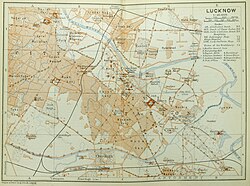
[[File:Lucknow (Baedeker, 1914).jpg|thumb|Map of parts of the Old City and the Civil Station, ca 1914]] | [[File:Lucknow (Baedeker, 1914).jpg|thumb|Map of parts of the Old City and the Civil Station, ca 1914]] | ||
The [[Khilafat Movement]] had an active base of support in Lucknow, creating united opposition to British rule. In 1901, after remaining the capital of Oudh since 1775, Lucknow, with a population of 264,049, was merged into the newly formed United Provinces of Agra and Oudh.<ref>{{cite EB1911 |wstitle=Lucknow |volume=17 |page=106}}</ref> In 1920, the [[Presidencies and provinces of British India|provincial]] seat of government moved from [[Allahabad]] to Lucknow. Upon [[Indian independence movement|Indian independence]] in 1947, the United Provinces were reorganised into the state of Uttar Pradesh, and Lucknow remained its capital.<ref>{{cite web|url = http://lucknowcity.com/history-of-lucknow.php|title = History of Lucknow|access-date = 24 August 2014|website = Lucknow City|url-status = dead|archive-url = https://web.archive.org/web/20141204180024/http://lucknowcity.com/history-of-lucknow.php|archive-date = 4 December 2014|df = dmy-all}}</ref> | The [[Khilafat Movement]] had an active base of support in Lucknow, creating united opposition to British rule, to create a Caliphate. In 1901, after remaining the capital of Oudh since 1775, Lucknow, with a population of 264,049, was merged into the newly formed United Provinces of Agra and Oudh.<ref>{{cite EB1911 |wstitle=Lucknow |volume=17 |page=106}}</ref> In 1920, the [[Presidencies and provinces of British India|provincial]] seat of government moved from [[Allahabad]] to Lucknow. Upon [[Indian independence movement|Indian independence]] in 1947, the United Provinces were reorganised into the state of Uttar Pradesh, and Lucknow remained its capital.<ref>{{cite web|url = http://lucknowcity.com/history-of-lucknow.php|title = History of Lucknow|access-date = 24 August 2014|website = Lucknow City|url-status = dead|archive-url = https://web.archive.org/web/20141204180024/http://lucknowcity.com/history-of-lucknow.php|archive-date = 4 December 2014|df = dmy-all}}</ref> | ||
Lucknow witnessed some of the pivotal moments in the history of India. One is the first meeting of the stalwarts [[Mahatma Gandhi]], Jawaharlal Nehru and [[Muhammad Ali Jinnah|Mohd Ali Jinnah]] during the [[Indian National Congress]] session of 1916 (the [[Lucknow pact]] was signed and moderates and extremists came together through the efforts of [[Annie Besant]] during this session only). | Lucknow witnessed some of the pivotal moments in the history of India. One is the first meeting of the stalwarts [[Mahatma Gandhi]], [[Jawaharlal Nehru]] and [[Muhammad Ali Jinnah|Mohd Ali Jinnah]] during the [[Indian National Congress]] session of 1916 (the [[Lucknow pact]] was signed and moderates and extremists came together through the efforts of [[Annie Besant]] during this session only). | ||
The Congress President for that session, [[Ambica Charan Mazumdar|Ambica Charan Majumdar]] in his address said that "If the [[Indian National Congress|Congress]] was buried at Surat, it is reborn in Lucknow in the garden of Wajid Ali Shah." | The Congress President for that session, [[Ambica Charan Mazumdar|Ambica Charan Majumdar]] in his address said that "If the [[Indian National Congress|Congress]] was buried at Surat, it is reborn in Lucknow in the garden of Wajid Ali Shah." | ||
The [[Kakori conspiracy]] involving [[Ram Prasad Bismil]], [[Ashfaqulla Khan|Ashfaq Ullah Khan]], [[Rajendra Lahiri|Rajendra Nath Lahiri]], [[Roshan Singh]] and others, followed by the Kakori trial which captured the imagination of the country, also took place in Lucknow.<ref>{{cite web|title=Big Moments in Lucknow History|url=http://genieforcity.com/lucknow/history-lucknow.html|access-date=13 August 2016|archive-url=https://web.archive.org/web/20160818085223/http://genieforcity.com/lucknow/history-lucknow.html|archive-date=18 August 2016|url-status=dead}}</ref> | The [[Kakori conspiracy]] involving [[Ram Prasad Bismil]], [[Ashfaqulla Khan|Ashfaq Ullah Khan]], [[Rajendra Lahiri|Rajendra Nath Lahiri]], [[Roshan Singh]] and others, followed by the Kakori trial which captured the imagination of the country, also took place in Lucknow.<ref>{{cite web|title=Big Moments in Lucknow History|url=http://genieforcity.com/lucknow/history-lucknow.html|access-date=13 August 2016|archive-url=https://web.archive.org/web/20160818085223/http://genieforcity.com/lucknow/history-lucknow.html|archive-date=18 August 2016|url-status=dead}}</ref> | ||
Culturally, Lucknow has also had a tradition of courtesans,<ref>{{cite web |url=https://www.academia.edu/8083893 |title=Prostituting the Tawa'if: Nawabi Patronage and Colonial Regulation of Courtesans in Lucknow, 1847–1899 | Zoya Sameen |publisher=Academia.edu |date=1 January 1970 |access-date=29 July 2015 |archive-url=https://web.archive.org/web/20160208233238/http://www.academia.edu/8083893/Prostituting_the_Tawa_if_Nawabi_Patronage_and_Colonial_Regulation_of_Courtesans_in_Lucknow_1847-1899 |archive-date=8 February 2016 |url-status=dead | Culturally, Lucknow has also had a tradition of courtesans,<ref>{{cite web |url=https://www.academia.edu/8083893 |title=Prostituting the Tawa'if: Nawabi Patronage and Colonial Regulation of Courtesans in Lucknow, 1847–1899 | Zoya Sameen |publisher=Academia.edu |date=1 January 1970 |access-date=29 July 2015 |archive-url=https://web.archive.org/web/20160208233238/http://www.academia.edu/8083893/Prostituting_the_Tawa_if_Nawabi_Patronage_and_Colonial_Regulation_of_Courtesans_in_Lucknow_1847-1899 |archive-date=8 February 2016 |url-status=dead }}</ref> with popular culture distilling it in the avatar of the fictional [[Umrao Jaan Ada|Umrao Jaan]]. | ||
Along with the rest of [[India]], Lucknow became independent from Britain on [[Independence Day (India)|15 August 1947]]. It has been listed as the 17th-fastest growing city in [[India]] and 74th in the world.<ref>{{cite web |title=World's fastest growing urban areas (1) |url=http://www.citymayors.com/statistics/urban_growth1.html |url-status=live |archive-url=https://web.archive.org/web/20101125090345/http://citymayors.com/statistics/urban_growth1.html |archive-date=25 November 2010 |access-date=29 July 2015 |publisher=City Mayors}}</ref> | |||
==Geography== | ==Geography== | ||
[[File:LucknowMap.PNG|thumb|Map of Lucknow city]] | [[File:LucknowMap.PNG|thumb|Map of Lucknow city]] | ||
{{Further|Cis-Gomti area}} | |||
[[File:Gomti River Front 6.jpg|thumb|[[Gomti River]]front]] | |||
The [[Gomti River]], Lucknow's chief geographical feature, meanders through the city and divides it into the Trans-Gomti and Cis-Gomti regions. Situated in the middle of the [[Indus-Gangetic Plain]], the city is surrounded by rural towns and villages: the orchard town of [[Malihabad]], [[Kakori]], Mohanlalganj, [[Gosainganj, Lucknow|Gosainganj]], Chinhat and [[Itaunja]]. To the east lies [[Barabanki district|Barabanki]], to the west [[Unnao district|Unnao]], to the south [[Raebareli district|Raebareli]], while to the north lie the [[Sitapur district|Sitapur]] and [[Hardoi district|Hardoi]]. Lucknow city is located in a [[earthquake hazard zoning of India|seismic zone III]].<ref> | The [[Gomti River]], Lucknow's chief geographical feature, meanders through the city and divides it into the Trans-Gomti and Cis-Gomti regions. Situated in the middle of the [[Indus-Gangetic Plain]], the city is surrounded by rural towns and villages: the orchard town of [[Malihabad]], [[Kakori]], Mohanlalganj, [[Gosainganj, Lucknow|Gosainganj]], Chinhat and [[Itaunja]]. To the east lies [[Barabanki district|Barabanki]], to the west [[Unnao district|Unnao]], to the south [[Raebareli district|Raebareli]], while to the north lie the [[Sitapur district|Sitapur]] and [[Hardoi district|Hardoi]]. Lucknow city is located in a [[earthquake hazard zoning of India|seismic zone III]].<ref> | ||
{{cite web | {{cite web | ||
| Line 175: | Line 184: | ||
|archive-date=29 December 2005 |title=UNDP report | |archive-date=29 December 2005 |title=UNDP report | ||
|access-date=26 September 2006 }}</ref> | |access-date=26 September 2006 }}</ref> | ||
{{ | |||
Lucknow stands at an elevation of approximately {{convert|123|m|ft}} above sea level. The city had an area of {{convert|402|km2|sqmi|abbr=in}} until December 2019, when 88 villages were added to the municipal limits and the area increased to {{convert|631|km2|sqmi|abbr=in}}.<ref>{{Cite news |last=Srivastava |first=Pranchal |date=4 December 2019 |title=Lucknow to expand, 88 new villages under LMC wings |url=https://timesofindia.indiatimes.com/city/lucknow/lucknow-to-expand-88-new-villages-under-lmc-wings/articleshow/72356975.cms |access-date=20 October 2020 |work=The Times of India |language=en}}</ref> | |||
Bounded on the east by [[Barabanki]], on the west by [[Unnao]], on the south by [[Raebareli]] and in the north by [[Sitapur]] and [[Hardoi]], Lucknow sits on the northwestern shore of the [[Gomti River]]. {{As of|2008}}, there were 110 wards in the city. Morphologically, three clear demarcations exist: The [[central business district]], which is a fully built up area, comprises [[Hazratganj]], [[Aminabad, Lucknow|Aminabad]] and Chowk. A middle zone surrounds the inner zone with concrete houses while the outer zone consists of villages.<ref>{{cite web |title=Lucknow Report |url=http://uhi-india.org/index.php?option=com_docman&task=doc_download&gid=318&Itemid=80 |url-status=dead |archive-url=https://web.archive.org/web/20140814041343/http://uhi-india.org/index.php?option=com_docman&task=doc_download&gid=318&Itemid=80 |archive-date=14 August 2014 |access-date=27 August 2014 |website=Urban Health Initiative}}</ref> | |||
===Climate=== | ===Climate=== | ||
Lucknow has a [[humid subtropical climate]] ([[Köppen climate classification|Köppen]] ''Cwa'') with cool, dry winters from | {{See also|Floods in Lucknow}} | ||
Lucknow has a [[humid subtropical climate]] ([[Köppen climate classification|Köppen]] ''Cwa'') with cool, dry winters from late November to February and dry, hot summers with sunshine from late March to June. More than nine-tenths of the annual rainfall occurs from July to October when the city receives an average of {{convert|827.2|mm|in|2}} from the southwest [[monsoon]] winds, although occasionally frontal rainfall from the northeast monsoon will occur in January. In winter the maximum temperature is around {{convert|25|C|F|disp=or}} and the minimum is in the {{convert|3|to|7|C|F|1}} range.<ref>{{cite news |title=Lucknow Minimum Temperature |url=https://timesofindia.indiatimes.com/city/lucknow/It-was-coldest-December-night-in-past-58-years/articleshow/17803240.cms |date=29 December 2012 |access-date=3 January 2013 |archive-url=https://web.archive.org/web/20130101083608/http://articles.timesofindia.indiatimes.com/2012-12-29/lucknow/36050401_1_minimum-temperature-maximum-temperature-celsius |archive-date=1 January 2013 |work=[[The Times of India]] |url-status=live }}</ref> | |||
Fog is quite common from mid-December to late January. Occasionally, Lucknow experiences colder winter spells than places like [[Shimla]] and [[Mussoorie]], which are situated high up in the [[Himalayas]].{{citation needed|date=October 2024}} | |||
In the extraordinary winter cold spell of 2012–2013, Lucknow recorded temperatures below freezing point on two consecutive days and the minimum temperature hovered around freezing point for over a week.<ref>{{Cite news |date=10 January 2013 |title=At 0.7 degree below zero, Lucknow set to break chill record |url=https://timesofindia.indiatimes.com/city/lucknow/at-0-7-degree-below-zero-lucknow-set-to-break-chill-record/articleshow/17961395.cms |access-date=17 June 2024 |work=The Times of India |issn=0971-8257}}</ref> Summers are very hot with temperatures rising into the {{convert|40|to|45|C|F|0}} range, the average maxima being in the high 30s Celsius. | |||
Lucknow has been ranked 4th best "National Clean Air City" (under Category 1 >10L Population cities) in India.<ref>{{Cite web |date=7 September 2024 |title=Swachh Vayu Sarvekshan 2024 |url=https://prana.cpcb.gov.in/ncapServices/robust/fetchFilesFromDrive/Swachh_Vayu_Survekshan_2024_Result.pdf |website=Swachh Vayu Sarvekshan 2024}}</ref> | |||
{{Weather box | {{Weather box | ||
| width = auto | | width = auto | ||
| location = Lucknow ([[Chaudhary Charan Singh International Airport]]) | | location = Lucknow ([[Chaudhary Charan Singh International Airport]]) 1991–2020, extremes 1952–present | ||
| metric first = yes | | metric first = yes | ||
| single line = yes | | single line = yes | ||
| Jan record high C = | | Jan record high C = 31.6 | ||
| Feb record high C = 35.9 | | Feb record high C = 35.9 | ||
| Mar record high C = | | Mar record high C = 41.1 | ||
| Apr record high C = 45.0 | | Apr record high C = 45.0 | ||
| May record high C = 46.5 | | May record high C = 46.5 | ||
| Line 194: | Line 213: | ||
| Aug record high C = 40.4 | | Aug record high C = 40.4 | ||
| Sep record high C = 40.1 | | Sep record high C = 40.1 | ||
| Oct record high C = | | Oct record high C = 38.7 | ||
| Nov record high C = 38.0 | | Nov record high C = 38.0 | ||
| Dec record high C = 29.9 | | Dec record high C = 29.9 | ||
| year record high C = 47.7 | | year record high C = 47.7 | ||
| Jan | | Jan high C = 21.4 | ||
| Feb high C = 26.2 | | Feb high C = 26.2 | ||
| Mar high C = 32. | | Mar high C = 32.2 | ||
| Apr high C = 38.2 | | Apr high C = 38.2 | ||
| May high C = 39. | | May high C = 39.9 | ||
| Jun high C = 38.3 | | Jun high C = 38.3 | ||
| Jul high C = 34. | | Jul high C = 34.2 | ||
| Aug high C = 33. | | Aug high C = 33.4 | ||
| Sep high C = 33. | | Sep high C = 33.4 | ||
| Oct high C = 32.8 | | Oct high C = 32.8 | ||
| Nov high C = 29. | | Nov high C = 29.0 | ||
| Dec high C = | | Dec high C = 23.6 | ||
| year high C = | | year high C = 31.9 | ||
| Jan mean C = | | Jan mean C = 14.6 | ||
| Feb mean C = 18. | | Feb mean C = 18.6 | ||
| Mar mean C = 23.8 | | Mar mean C = 23.8 | ||
| Apr mean C = 29. | | Apr mean C = 29.6 | ||
| May mean C = 32. | | May mean C = 32.4 | ||
| Jun mean C = 32. | | Jun mean C = 32.5 | ||
| Jul mean C = 30.1 | | Jul mean C = 30.1 | ||
| Aug mean C = 29. | | Aug mean C = 29.5 | ||
| Sep mean C = 28. | | Sep mean C = 28.9 | ||
| Oct mean C = 26. | | Oct mean C = 26.2 | ||
| Nov mean C = 21.2 | | Nov mean C = 21.2 | ||
| Dec mean C = 16. | | Dec mean C = 16.3 | ||
| year mean C = | | year mean C = | ||
| Jan low C = 7. | | Jan low C = 7.8 | ||
| Feb low C = | | Feb low C = 11.0 | ||
| Mar low C = 15. | | Mar low C = 15.4 | ||
| Apr low C = | | Apr low C = 21.0 | ||
| May low C = 24. | | May low C = 24.8 | ||
| Jun low C = 26. | | Jun low C = 26.7 | ||
| Jul low C = 26. | | Jul low C = 26.0 | ||
| Aug low C = 25. | | Aug low C = 25.6 | ||
| Sep low C = 24. | | Sep low C = 24.4 | ||
| Oct low C = 19. | | Oct low C = 19.5 | ||
| Nov low C = 13. | | Nov low C = 13.3 | ||
| Dec low C = 9 | | Dec low C = 8.9 | ||
| year low C = 18 | | year low C = 18.7 | ||
| Jan record low C = -1.0 | | Jan record low C = -1.0 | ||
| Feb record low C = 0.0 | | Feb record low C = 0.0 | ||
| Line 268: | Line 261: | ||
| Apr record low C = 10.9 | | Apr record low C = 10.9 | ||
| May record low C = 17.0 | | May record low C = 17.0 | ||
| Jun record low C = 19. | | Jun record low C = 19.2 | ||
| Jul record low C = 21.5 | | Jul record low C = 21.5 | ||
| Aug record low C = | | Aug record low C = 21.2 | ||
| Sep record low C = 17.2 | | Sep record low C = 17.2 | ||
| Oct record low C = 10.0 | | Oct record low C = 10.0 | ||
| Line 277: | Line 270: | ||
| year record low C = -1.0 | | year record low C = -1.0 | ||
| rain colour = green | | rain colour = green | ||
| Jan rain mm = | | Jan rain mm = 21.6 | ||
| Feb rain mm = | | Feb rain mm = 14.0 | ||
| Mar rain mm = | | Mar rain mm = 11.0 | ||
| Apr rain mm = 5. | | Apr rain mm = 5.5 | ||
| May rain mm = 24. | | May rain mm = 24.5 | ||
| Jun rain mm = 107. | | Jun rain mm = 107.4 | ||
| Jul rain mm = | | Jul rain mm = 238.5 | ||
| Aug rain mm = | | Aug rain mm = 241.6 | ||
| Sep rain mm = | | Sep rain mm = 162.1 | ||
| Oct rain mm = | | Oct rain mm = 27.9 | ||
| Nov rain mm = | | Nov rain mm = 2.5 | ||
| | | Dec rain mm = 4.7 | ||
| Jan rain days = 1. | |year rain mm = 861.4 | ||
| Jan rain days = 1.7 | |||
| Feb rain days = 1.4 | | Feb rain days = 1.4 | ||
| Mar rain days = | | Mar rain days = 1.1 | ||
| Apr rain days = 0. | | Apr rain days = 0.7 | ||
| May rain days = 2.0 | | May rain days = 2.0 | ||
| Jun rain days = 5. | | Jun rain days = 5.1 | ||
| Jul rain days = 11.8 | | Jul rain days = 11.8 | ||
| Aug rain days = 10.6 | | Aug rain days = 10.6 | ||
| Sep rain days = | | Sep rain days = 7.2 | ||
| Oct rain days = 1. | | Oct rain days = 1.4 | ||
| Nov rain days = 0. | | Nov rain days = 0.4 | ||
| Dec rain days = 0.8 | | Dec rain days = 0.5 | ||
|year rain days = 43.8 | |||
| time day = 17:30 [[Indian Standard Time|IST]] | | time day = 17:30 [[Indian Standard Time|IST]] | ||
| Jan humidity = | | Jan humidity = 61 | ||
| Feb humidity = | | Feb humidity = 49 | ||
| Mar humidity = | | Mar humidity = 35 | ||
| Apr humidity = | | Apr humidity = 26 | ||
| May humidity = 32 | | May humidity = 32 | ||
| Jun humidity = 49 | | Jun humidity = 49 | ||
| Jul humidity = 73 | | Jul humidity = 73 | ||
| Aug humidity = 77 | | Aug humidity = 77 | ||
| Sep humidity = | | Sep humidity = 73 | ||
| Oct humidity = | | Oct humidity = 62 | ||
| Nov humidity = | | Nov humidity = 59 | ||
| Dec humidity = | | Dec humidity = 63 | ||
| year humidity = 55 | | year humidity = 55 | ||
| Jan uv = 5 | | Jan uv = 5 | ||
| Line 327: | Line 322: | ||
| Nov uv = 6 | | Nov uv = 6 | ||
| Dec uv = 5 | | Dec uv = 5 | ||
| source 1 = [[India Meteorological Department]]<ref name= | | source 1 = [[India Meteorological Department]]<ref name=IMDcityrainfall>{{cite web |url=https://cdsp.imdpune.gov.in/extremes_1991_2020/?stn=42867 |title=Nagpur(42867) |publisher=India Meteorological Department |access-date=9 August 2022 |archive-date=9 August 2022 |archive-url=https://web.archive.org/web/20220809085837/https://cdsp.imdpune.gov.in/extremes_1991_2020/?stn=42867 |url-status=dead }}</ref><ref name=IMDcityextremes2> | ||
{{cite web | {{cite web | ||
| | | url = https://www.imdpune.gov.in/library/public/Climatological%20Tables%201991-2020.pdf | ||
| archive- | | archive-url = https://web.archive.org/web/20230101061732/https://www.imdpune.gov.in/library/public/Climatological%20Tables%201991-2020.pdf | ||
| archive-date = 1 January 2023 | |||
| | | title = Climatological Tables 1991-2020 | ||
| | |||
| publisher = India Meteorological Department | | publisher = India Meteorological Department | ||
| date = January | | access-date = 1 January 2023 | ||
| page = 21}}</ref><ref name=IMDextremes> | |||
| | |||
{{cite web | {{cite web | ||
| archive-url = https://web.archive.org/web/20200205042509/http://imdpune.gov.in/library/public/EXTREMES%20OF%20TEMPERATURE%20and%20RAINFALL%20upto%202012.pdf | | archive-url = https://web.archive.org/web/20200205042509/http://imdpune.gov.in/library/public/EXTREMES%20OF%20TEMPERATURE%20and%20RAINFALL%20upto%202012.pdf | ||
| Line 351: | Line 344: | ||
|publisher = Time and Date | |publisher = Time and Date | ||
|access-date = 19 July 2022}}</ref> | |access-date = 19 July 2022}}</ref> | ||
| source 2 = Weather Atlas<ref name="Weather Atlas"> | | source 2 = Weather Atlas,<ref name="Weather Atlas"> | ||
{{cite web | {{cite web | ||
| url = https://www.weather-atlas.com/en/india/lucknow-climate | | url = https://www.weather-atlas.com/en/india/lucknow-climate | ||
| Line 357: | Line 350: | ||
| publisher = Weather Atlas | | publisher = Weather Atlas | ||
| access-date = 13 June 2022 | | access-date = 13 June 2022 | ||
}}</ref> | }}</ref> Tokyo Climate Center (mean temperatures 1991–2020)<ref>{{cite web| url = https://ds.data.jma.go.jp/gmd/tcc/tcc/products/climate/normal/parts/NrmMonth_e.php?stn=42369| title = Normals Data: Lucknow/Amausi - India Latitude: 26.75°N Longitude: 80.88°E Height: 383 (m)| publisher = Japan Meteorological Agency| access-date = 2 March 2020}}</ref> | ||
| date = August 2012 | | date = August 2012 | ||
| source = | | source = | ||
| Line 374: | Line 367: | ||
}} | }} | ||
== Flora and fauna == | |||
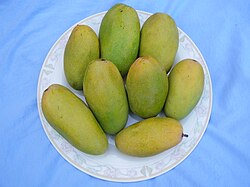
[[File:Dosehri.JPG|thumb|Lucknow is known for its [[Dasheri]] mangoes, which are exported to many countries.]] | |||
Lucknow has a total of 5.66 per cent of forest cover, the state average being around 7 per cent.<ref name="Forest">{{cite web|title=Government of India, Ministry of Environment & Forests|url=http://moefrolko.org/|publisher=Ministry of Environment and Forest lucknow|access-date=10 July 2012|archive-url=https://web.archive.org/web/20121120081036/http://www.moefrolko.org/|archive-date=20 November 2012|url-status=live}}</ref> Native tree species are: [[shisham]], [[Butea monosperma|dhak]], [[Madhuca longifolia|mahuamm]], [[Vachellia nilotica|babul]], [[neem]], [[peepal]], [[Saraca asoca|ashok]], [[khajur]], [[mango]] and [[Ficus racemosa|gular]].<ref name=species>{{cite journal|title=A new isidiate species of Graphis from India.|date=November 2004|last1=Adawadkar|first1=Bharati|last2=Makhija|first2=Urmila|publisher=Cambridge University Press|journal=The Lichenologist|volume=36|issue=6|pages=361–363|doi=10.1017/S0024282904014409|s2cid=86463133 }}</ref> | |||
Several varieties of mangoes, especially [[Dasheri]], are grown in the [[Malihabad]] adjacent to the city and a block of the [[Lucknow district]] for export.<ref>{{cite news |url=https://timesofindia.indiatimes.com/city/lucknow/Lucknow-mangoes-earn-fans-in-foreign-countries/articleshow/20784323.cms |title=Lucknow mangoes earn fans in foreign countries|newspaper=Times of India |date=26 June 2013|archive-url=https://web.archive.org/web/20150816022424/http://timesofindia.indiatimes.com/city/lucknow/Lucknow-mangoes-earn-fans-in-foreign-countries/articleshow/20784323.cms |archive-date=16 August 2015 |url-status=live }}</ref> The main crops are wheat, [[paddy field|paddy]], [[sugarcane]], mustard, potatoes, and vegetables such as cauliflower, cabbage, tomato and [[brinjal]]. Similarly, sunflowers, roses, and marigolds are cultivated over a fairly extensive area. Many medicinal and herbal plants are grown, while common Indian monkeys are found in patches in and around city forests such as [[Musa Bagh]].<ref>{{cite web|url=http://lucknow.me/Musa-Bagh.html |title=Musa Bagh |access-date=27 August 2014 |website=Lucknow |url-status=dead |archive-url=https://web.archive.org/web/20120611165938/http://lucknow.me/Musa-Bagh.html |archive-date=11 June 2012 }}</ref> | |||
[[File:Tiger in Lucknow Zoological Garden.jpg|thumb|left|[[Bengal Tiger]] at the [[Nawab Wajid Ali Shah Prani Udyan|Lucknow Zoo]] ]] | |||
File: | Established in 1921, the [[Lucknow Zoo]] is one of the oldest in the country. It houses a rich collection of animals from [[Asia]], and other continents. The zoo also has enjoyable toy train rides for visitors. The city has a botanical garden, which is a zone of wide botanical diversity.<ref>{{cite web|url = https://sites.google.com/site/visitlucknow/botanic-garden-lucknow|title = Botanic Garden Sikandar Bagh|access-date = 27 August 2014|website = Visit Lucknow|publisher = Google Sites|archive-url = https://web.archive.org/web/20140822043000/https://sites.google.com/site/visitlucknow/botanic-garden-lucknow|archive-date = 22 August 2014|url-status = live|df = dmy-all}}</ref> It is home to the [[Uttar Pradesh State Museum]], which has sculptural masterpieces dating back to the 3rd century AD, including intricately carved Mathura sculptures ranging from dancing girls to scenes from the life of Buddha.<ref>{{cite web|title = State Museum – Lonely Planet|url = http://www.lonelyplanet.com/india/uttar-pradesh/lucknow/sights/museums-galleries/state-museum|website = Lonely Planet|access-date = 25 May 2015|first = Lonely|last = Planet|archive-url = https://web.archive.org/web/20150525160929/http://www.lonelyplanet.com/india/uttar-pradesh/lucknow/sights/museums-galleries/state-museum|archive-date = 25 May 2015|url-status = dead|df = dmy-all}}</ref> | ||
</ | |||
==Economy== | ==Economy== | ||
The major industries in the Lucknow urban agglomeration include aeronautics, automotive, machine tools, distillery chemicals, furniture and [[Chikan (embroidery)|Chikan embroidery]].<ref>{{cite web|title=Economical Report of Lucknow|url=http://dcmsme.gov.in/dips/DIP%20Lucknow.pdf|url-status=live|archive-url=https://web.archive.org/web/20150319054233/http://dcmsme.gov.in/dips/DIP%20Lucknow.pdf|archive-date=19 March 2015|access-date=27 August 2014|website=Department of Micro, Small and Medium Enterprises|publisher=Government of India}}</ref> Lucknow is among the top cities of [[India]] by GDP.<ref>{{cite web|date=28 September 2012|title=The top 15 Indian cities by GDP | India's top 15 cities with the highest GDP – Yahoo India Finance|url=https://in.finance.yahoo.com/photos/the-top-15-indian-cities-by-gdp-1348807591-slideshow/the-top-15-indian-cities-by-gdp-photo-1348807066.html#crsl=%252Fphotos%252Fthe-top-15-indian-cities-by-gdp-1348807591-slideshow%252Fthe-top-15-indian-cities-by-gdp-photo-1348807071.html|url-status=live|archive-url=https://web.archive.org/web/20150703081833/https://in.finance.yahoo.com/photos/the-top-15-indian-cities-by-gdp-1348807591-slideshow/the-top-15-indian-cities-by-gdp-photo-1348807066.html#crsl=%252Fphotos%252Fthe-top-15-indian-cities-by-gdp-1348807591-slideshow%252Fthe-top-15-indian-cities-by-gdp-photo-1348807071.html|archive-date=3 July 2015|access-date=29 July 2015|publisher=In.finance.yahoo.com}}</ref> It is a centre for research and development as home to the R&D centres of the National Milk Grid of the National Dairy Development Board, the Central Institute of Medical and Aromatic Plants, the National Handloom Development Corporation and U.P. Export Corporation.<ref name="Lucknow Profile">{{cite web|title=Lucknow Profile|url=http://localbodies.up.nic.in/luck/chap2.pdf|url-status=dead|archive-url=https://web.archive.org/web/20140308061916/http://localbodies.up.nic.in/luck/chap2.pdf|archive-date=8 March 2014|access-date=27 August 2014|website=National Informatics Centre, Uttar Pradesh State Unit, Lucknow}}</ref> Lucknow is ranked sixth in a list of the ten fastest growing job-creating cities in [[India]] according to a study conducted by Assocham Placement Pattern,<ref>{{cite web|date=3 October 2010|title=The 10 fastest job-creating cities in India – Rediff.com Business|url=http://business.rediff.com/slide-show/2010/oct/01/slide-show-1-the-fastest-job-creating-cities-in-india.htm#7|url-status=live|archive-url=https://web.archive.org/web/20110609015312/http://business.rediff.com/slide-show/2010/oct/01/slide-show-1-the-fastest-job-creating-cities-in-india.htm#7|archive-date=9 June 2011|access-date=17 February 2014|publisher=Rediff}}</ref> Lucknow's economy was formerly based on the tertiary sector and the majority of the workforce were employed as government servants. Large-scale industrial establishments are few compared to other northern Indian state capitals like [[New Delhi]]. The economy is growing with contributions from the fields of IT, manufacturing and processing and medical/biotechnology. Business-promoting institutions such as the [[Confederation of Indian Industry|CII]] have set up their service centres in the city.<ref>{{cite web|last=Singh|first=Priyanka|date=12 July 2014|title=CII Young Indians unite Lucknow residents to empower women|url= | [[File:Chikan embroidery on a saree pallu.jpg|thumb|Traditional [[Chikankari|Chikan Embroidery]] ]] | ||
The major industries in the Lucknow urban agglomeration include aeronautics, automotive, machine tools, distillery chemicals, furniture and [[Chikan (embroidery)|Chikan embroidery]].<ref>{{cite web|title=Economical Report of Lucknow|url=http://dcmsme.gov.in/dips/DIP%20Lucknow.pdf|url-status=live|archive-url=https://web.archive.org/web/20150319054233/http://dcmsme.gov.in/dips/DIP%20Lucknow.pdf|archive-date=19 March 2015|access-date=27 August 2014|website=Department of Micro, Small and Medium Enterprises|publisher=Government of India}}</ref> Lucknow is among the top cities of [[India]] by GDP.<ref>{{cite web|date=28 September 2012|title=The top 15 Indian cities by GDP | India's top 15 cities with the highest GDP – Yahoo India Finance|url=https://in.finance.yahoo.com/photos/the-top-15-indian-cities-by-gdp-1348807591-slideshow/the-top-15-indian-cities-by-gdp-photo-1348807066.html#crsl=%252Fphotos%252Fthe-top-15-indian-cities-by-gdp-1348807591-slideshow%252Fthe-top-15-indian-cities-by-gdp-photo-1348807071.html|url-status=live|archive-url=https://web.archive.org/web/20150703081833/https://in.finance.yahoo.com/photos/the-top-15-indian-cities-by-gdp-1348807591-slideshow/the-top-15-indian-cities-by-gdp-photo-1348807066.html#crsl=%252Fphotos%252Fthe-top-15-indian-cities-by-gdp-1348807591-slideshow%252Fthe-top-15-indian-cities-by-gdp-photo-1348807071.html|archive-date=3 July 2015|access-date=29 July 2015|publisher=In.finance.yahoo.com}}</ref> It is a centre for research and development as home to the R&D centres of the National Milk Grid of the National Dairy Development Board, the Central Institute of Medical and Aromatic Plants, the National Handloom Development Corporation and U.P. Export Corporation.<ref name="Lucknow Profile">{{cite web|title=Lucknow Profile|url=http://localbodies.up.nic.in/luck/chap2.pdf|url-status=dead|archive-url=https://web.archive.org/web/20140308061916/http://localbodies.up.nic.in/luck/chap2.pdf|archive-date=8 March 2014|access-date=27 August 2014|website=National Informatics Centre, Uttar Pradesh State Unit, Lucknow}}</ref> Lucknow is ranked sixth in a list of the ten fastest growing job-creating cities in [[India]] according to a study conducted by Assocham Placement Pattern,<ref name="Rediff">{{cite web |date=3 October 2010 |title=The 10 fastest job-creating cities in India – Rediff.com Business |url=http://business.rediff.com/slide-show/2010/oct/01/slide-show-1-the-fastest-job-creating-cities-in-india.htm#7 |url-status=live |archive-url=https://web.archive.org/web/20110609015312/http://business.rediff.com/slide-show/2010/oct/01/slide-show-1-the-fastest-job-creating-cities-in-india.htm#7 |archive-date=9 June 2011 |access-date=17 February 2014 |publisher=Rediff}}</ref> Lucknow's economy was formerly based on the tertiary sector and the majority of the workforce were employed as government servants. Large-scale industrial establishments are few compared to other northern Indian state capitals like [[New Delhi]]. The economy is growing with contributions from the fields of IT, manufacturing and processing and medical/biotechnology. Business-promoting institutions such as the [[Confederation of Indian Industry|CII]] have set up their service centres in the city.<ref name="Singh">{{cite web |last=Singh |first=Priyanka |date=12 July 2014 |title=CII Young Indians unite Lucknow residents to empower women |url=https://timesofindia.indiatimes.com/city/lucknow/CII-Young-Indians-unite-Lucknow-residents-to-empower-women/articleshow/38268762.cms |url-status=live |archive-url=https://web.archive.org/web/20151026215833/http://timesofindia.indiatimes.com/city/lucknow/CII-Young-Indians-unite-Lucknow-residents-to-empower-women/articleshow/38268762.cms |archive-date=26 October 2015 |access-date=27 August 2014 |website=The Times of India}}</ref> Major export items are marbled products, handicrafts, art pieces, gems, jewellery, textiles, electronics, software products, computers, hardware products, apparel, brass products, silk, leather goods, glass items and chemicals. Lucknow has promoted public-private partnerships in sectors such as electricity supply, roads, expressways, and educational ventures.<ref>{{cite web|title=Economy of State.|url=http://www.phdcci.in/admin/userfiles/file/Research-Bureau/Uttar-Pradesh.pdf|url-status=dead|archive-url=https://web.archive.org/web/20121224141248/http://www.phdcci.in/admin/userfiles/file/Research-Bureau/Uttar-Pradesh.pdf|archive-date=24 December 2012|publisher=U.P economy}}</ref> | |||
Lucknow in recent times have lagged in growth and only ranks 7th in per capita income in the state of Uttar Pradesh, despite being the capital. Cities like [[Noida]], [[Ghaziabad]] and [[Meerut]] have dominated in terms of industrial growth and attracting IT jobs and opportunities. Noida ranks highest, followed by Meerut in per capita income in the state.<ref>{{Cite web |title=State-wise Data On Per Capita Income |url=https://www.pib.gov.in/www.pib.gov.in/Pressreleaseshare.aspx?PRID=1942055 |website=www.pib.gov.in |access-date=26 October 2023}}</ref> | |||
[[File:Tcs lucknow campus.jpg|thumb|Lucknow campus of the [[Tata Consultancy Services|TCS]]]] | |||
Multiple software and [[Information technology|IT]] companies are present in the city. [[Tata Consultancy Services]] and [[HCL Technologies]] are present in the city. IT companies are located in [[Gomti Nagar|Gomtinagar]].<ref>{{cite web|title=TCS News & Events: Press Release : Tata Consultancy Services Expands in Lucknow; New Facility Inaugurated|url=http://www.tcs.com/news_events/press_releases/Pages/TCS-Expands-in-Lucknow.aspx|url-status=live|archive-url=https://web.archive.org/web/20140824054055/http://www.tcs.com/news_events/press_releases/Pages/TCS-Expands-in-Lucknow.aspx|archive-date=24 August 2014|access-date=8 August 2014|publisher=Tata Consultancy Services}}</ref> While it still lags behind cities like [[Noida]], [[Greater Noida]] and [[Meerut]] in IT hubs.<ref>{{cite web|author=Diksha P Gupta|title="We are where we are because of open source technology" – LINUX For You|url=http://www.linuxforu.com/2013/12/open-source-technology|url-status=live|archive-url=https://web.archive.org/web/20140302102753/http://www.linuxforu.com/2013/12/open-source-technology/|archive-date=2 March 2014|access-date=8 August 2014|publisher=Linux For U}}</ref> The city is also home to a number of important national and state level headquarters for companies including [[Sony Corporation]] and Reliance Retail.<ref>{{cite news|date=19 April 2014|title=Govt gives approval to IT city in Lucknow on Sultanpur Road|newspaper=Times of India|url=https://timesofindia.indiatimes.com/city/lucknow/Govt-gives-approval-to-IT-city-in-Lucknow-on-Sultanpur-Road/articleshow/12724665.cms?referral=PM|url-status=live|access-date=8 August 2014|archive-url=https://web.archive.org/web/20160208233238/http://timesofindia.indiatimes.com/city/lucknow/Govt-gives-approval-to-IT-city-in-Lucknow-on-Sultanpur-Road/articleshow/12724665.cms?referral=PM|archive-date=8 February 2016}}</ref> The handicrafts sector accounts for 60 per cent of total exports from the state.<ref name="HANDICRAFTS">{{cite web|title=OFFICE OF THE DEVELOPMENT COMMISSIONER (HANDICRAFTS)|url=http://handicrafts.nic.in/advertisements/ahvy201112.htm|url-status=dead|archive-url=https://web.archive.org/web/20160116034435/http://handicrafts.nic.in/advertisements/ahvy201112.htm|archive-date=16 January 2016|publisher=MINISTRY OF TEXTILES}}</ref> | |||
Companies such as [[Hindustan Aeronautics Limited]], KARAM, [[Berger Paints]], [[Britannia Industries]], [[Exide Industries]], [[Tata Motors]] have set up their plants in Lucknow. Tata Motors has a plant primarily for light commercial vehicles. It was set up in 1992 and has a production capacity of 640 vehicles per day.<ref>{{cite magazine|date=13 January 2021|title=Tata Motors' Jamshedpur, Lucknow and Pantnagar plants win National Energy Conservation Award 2020|url=https://www.autocarpro.in/news-national/tata-motors%E2%80%99-jamshedpur--lucknow-and-pantnagar-plants-win-national-energy-conservation-award-2020-78222|access-date=4 April 2021|magazine=Autocar}}</ref><ref>{{cite news|last1=Nair|first1=Geeta|date=15 December 2020|title=Tata Motors' VRS may not interest workers at Pune plant|work=The Financial Express|url=https://www.financialexpress.com/industry/tata-motors-vrs-may-not-interest-workers-at-pune-plant/2150094/|access-date=4 April 2021}}</ref> There is also a [[Tata Marcopolo]] factory in the city. | |||
Traditionally, Lucknow has been a ''mandi'' town for mangoes, melons, and grains grown in the surrounding areas.{{ | To promote the textile industry in the city, the Indian government has allocated Rs. 2 billion (2000 million rupees) to set up a textile [[business cluster]] in the city.<ref>{{cite news|author=PTI|date=10 July 2014|title=Budget 2014: Rs 200 crore allocated to set up six textiles clusters|newspaper=Economic Times|url=http://articles.economictimes.indiatimes.com/2014-07-10/news/51301061_1_textile-sector-textile-industry-export-earnings|url-status=dead|access-date=8 August 2014|archive-url=https://web.archive.org/web/20140812205539/http://articles.economictimes.indiatimes.com/2014-07-10/news/51301061_1_textile-sector-textile-industry-export-earnings|archive-date=12 August 2014}}</ref> A sprawling {{convert|100|acre|ha km2 acre|order=out}} IT city costing 15 billion Rupees is planned by the state government at the Chak Ganjaria farms site on the road to [[Sultanpur, Uttar Pradesh|Sultanpur]] and they have already approved [[special economic zone]] status for the project, which is expected to create thousands of job opportunities in the state.<ref>{{cite web|date=29 October 2013|title=IT City Lucknow|url=http://upgov.nic.in/upinfo/uplc-itcity/IT-City-Lucknow-Schedules-Vol-III-29.10.13.pdf|url-status=dead|archive-url=https://web.archive.org/web/20140226154730/http://upgov.nic.in/upinfo/uplc-itcity/IT-City-Lucknow-Schedules-Vol-III-29.10.13.pdf|archive-date=26 February 2014|access-date=27 August 2014|publisher=UP Government|page=18}}</ref><ref>{{cite news|date=8 June 2013|title=Chak Gajaria farm land use changed|newspaper=Times of India|url=https://timesofindia.indiatimes.com/city/lucknow/Chak-Gajaria-farm-land-use-changed/articleshow/20485757.cms?referral=PM|url-status=live|access-date=8 August 2014|archive-url=https://web.archive.org/web/20160208233238/http://timesofindia.indiatimes.com/city/lucknow/Chak-Gajaria-farm-land-use-changed/articleshow/20485757.cms?referral=PM|archive-date=8 February 2016}}</ref> A defence industrial corridor is also coming in the city.<ref>{{cite web|date=24 August 2021|title=BrahMos Aerospace proposes facility in Lucknow for next-gen missile project|url=https://www.hindustantimes.com/cities/lucknow-news/brahmos-aerospace-proposes-facility-in-lucknow-for-next-gen-missile-project-101629825664326.html|access-date=28 August 2021|website=Hindustan Times|language=en}}</ref> | ||
* Lucknow is famous for its small scale industries that are based on unique styles of embroidery, namely, [[chikan (embroidery)|Chikan]] and ''Lakhnawi [[Zardozi]]'', both of which are significant foreign exchange earners. Chikan has caught the fancy of fashion designers in [[Bollywood]] and abroad.{{ | |||
Traditionally, Lucknow has been a ''mandi'' town for mangoes, melons, and grains grown in the surrounding areas.<ref name="pcdacc">{{Cite web |title=About Lucknow |url=https://pcdacc.gov.in/home_lucknow.html |website=Principal Controller of Defence Accounts (Central Command) |access-date=17 June 2024}}</ref> [[Sugarcane]]-growing plantations and sugar industries are also in close proximity. This attracted Edward Dyer to set up a unit based on [[molasses]] in the city. Dyer Breweries was incorporated in 1855 and was Asia's first commercial brewery. The company name was changed to [[Mohan Meakin Brewery]] in 1967 (the word "Breweries" was dropped in the eighties as the company diversified into other industries).<ref>{{cite news|author=Roger Protz |url=https://www.theguardian.com/lifeandstyle/2007/mar/28/foodanddrink.travelnews |title=Cheers! | Life and style |work=The Guardian |location=London |date= 28 March 2007|accessdate=26 March 2010 }}</ref> | |||
* Lucknow is famous for its small scale industries that are based on unique styles of embroidery, namely, [[chikan (embroidery)|Chikan]] and ''Lakhnawi [[Zardozi]]'', both of which are significant foreign exchange earners. Chikan has caught the fancy of fashion designers in [[Bollywood]] and abroad.<ref>{{Cite news |last=Singh |first=Aditi |date=21 September 2023 |title=Chikan in global chique |url=https://timesofindia.indiatimes.com/city/lucknow/chikan-in-global-chique/articleshow/103826921.cms |work=The Times of India |issn=0971-8257 |access-date=17 June 2024}}</ref> It is very popular in Indian markets and have very high demand. | |||
* During the period of the Nawabs, [[Fighter kite|kite]]-making reached a high level of artistry,<ref> | * During the period of the Nawabs, [[Fighter kite|kite]]-making reached a high level of artistry,<ref> | ||
{{cite web | {{cite web | ||
| Line 404: | Line 399: | ||
|archiveurl = https://web.archive.org/web/20060111072542/http://lucknow.nic.in/crafts.htm |archivedate = 11 January 2006}}</ref> and is still a small-scale industry. | |archiveurl = https://web.archive.org/web/20060111072542/http://lucknow.nic.in/crafts.htm |archivedate = 11 January 2006}}</ref> and is still a small-scale industry. | ||
The Ministry of Communications and Information Technology set up [[Software Technology Parks of India]]<ref>{{Cite web |url=http://lucknow.stpi.in/ |title=lucknow.stip.in |access-date=2 August 2019 |archive-url=https://web.archive.org/web/20120429080332/http://www.lucknow.stpi.in/ |archive-date=29 April 2012 |url-status=dead }}</ref> in 2001. Currently, [[biotechnology]] and information technology are the two focus areas to promote economic development in and around the city. | The Ministry of Communications and Information Technology set up [[Software Technology Parks of India]]<ref>{{Cite web |url=http://lucknow.stpi.in/ |title=lucknow.stip.in |access-date=2 August 2019 |archive-url=https://web.archive.org/web/20120429080332/http://www.lucknow.stpi.in/ |archive-date=29 April 2012 |url-status=dead }}</ref> in 2001. Currently, [[biotechnology]] and information technology are the two focus areas to promote economic development in and around the city.<ref name="pcdacc"/> The [[Ministry of Science and Technology (India)|Ministry of Science and Technology]] is setting up a biotech park<ref>{{cite web|url=http://www.biotechcitylucknow.org/index1.htm |title=Biotech city Lucknow |accessdate=23 October 2006 |archive-url=https://web.archive.org/web/20061021162905/http://www.biotechcitylucknow.org/index1.htm |archive-date=21 October 2006 |url-status=dead}}</ref> in the city. Lucknow is also one of the selected cities for the Smart City project of [[Software Technology Parks of India|STPI]]. | ||
|url=http://www.biotechcitylucknow.org/index1.htm | |||
|title=Biotech city Lucknow | The city is being developed on the lines of [[Delhi]]'s [[National Capital Region (India)|National Capital Region]] and will be the headquarters of the Uttar Pradesh State Capital Region or Lucknow State Capital Region.<ref>{{cite news |last1=Shalabh |date=30 September 2023 |title=State capital region to cover five districts adjacent to Lucknow |url=https://timesofindia.indiatimes.com/city/lucknow/state-capital-region-to-cover-five-districts-adjacent-to-lucknow/articleshow/104054990.cms |work=The Times of India |access-date=15 April 2024}}</ref> It will be developed as the country's first AI City and the largest IT hub in the country.<ref>{{Cite web |url=https://indiaai.gov.in/news/up-to-build-india-s-first-ai-city-in-lucknow |title=UP to build India's first AI city in Lucknow |website=INDIAai |access-date=15 April 2024}}</ref><ref>{{cite news |title=Yogi govt set to build India's largest IT hub in Lucknow |url=https://government.economictimes.indiatimes.com/news/digital-india/yogi-govt-set-to-build-indias-largest-it-hub-in-lucknow/102711790 |work=Economic Times |date=14 August 2023 |access-date=15 April 2024}}</ref> It ranks 7th in the state as per GDP per capita.<ref>{{cite news |title=Lucknow to be developed as India's eighth 'Magnet City' |url=https://www.hindustantimes.com/cities/lucknow-news/lucknow-to-be-developed-as-india-s-eighth-magnet-city-under-up-government-s-plan-to-build-first-ai-city-101687619230528.html |work=Hindustan Times |date=24 June 2023 |access-date=15 April 2024}}</ref> Lucknow is also being set to manufacture Bramhos Missile with the establishment of two Defence Research and Development Organisation (DRDO) centres.<ref>{{cite news |title=Rajnath lays foundation stone for two DRDO centres in Lucknow |url=https://www.thehindu.com/news/national/defence-minister-rajnath-singh-lays-foundation-stone-for-two-drdo-centres/article38042098.ece |work=The Hindu |date=26 December 2021 |access-date=15 April 2024}}</ref><ref>{{cite news |title=BrahMos manufacturing in Lucknow likely to begin from March: Rajnath Singh |url=https://economictimes.indiatimes.com/news/defence/brahmos-manufacturing-in-lucknow-likely-to-begin-from-march-rajnath-singh/articleshow/103719586.cms |work=The Economic Times |agency=PRI |date=16 September 2023 |access-date=15 April 2024}}</ref> Lucknow region is emerging as a key industrial and logistics hub in North India after Delhi-NCR as the warehousing sector.<ref>{{cite news |title=Lucknow next industrial, logistic hub; to generate 70K jobs in 5 yrs: CBRE |url=https://www.business-standard.com/india-news/lucknow-emerging-as-industrial-logistic-hub-sector-to-generate-70k-direct-jobs-in-next-5-yrs-cbre-123080300676_1.html |work=Business Standard |date=3 August 2023 |access-date=15 April 2024}}</ref> | ||
|accessdate=23 October 2006 | |||
|archive-url=https://web.archive.org/web/20061021162905/http://www.biotechcitylucknow.org/index1.htm | |||
|archive-date=21 October 2006 | |||
|url-status=dead | |||
}}</ref> in the city. Lucknow is also one of the selected cities for the Smart City project of [[Software Technology Parks of India|STPI]]. | |||
==Administration== | ==Administration== | ||
| Line 417: | Line 407: | ||
[[Lucknow division]] which consists of six districts, and is headed by the [[Divisional Commissioner]] of Lucknow, who is an [[Indian Administrative Service|IAS officer]] of high seniority, the [[Divisional Commissioner|Commissioner]] is the head of local government institutions (including municipal corporations) in the division, is in charge of infrastructure development in his division, and is also responsible for maintaining law and order in the division.<ref name=":22">{{cite web|url=http://up.gov.in/upconstitution.aspx|title=CONSTITUTIONAL SETUP|website=[[Government of Uttar Pradesh]]|access-date=30 August 2017|archive-url=https://web.archive.org/web/20170831000649/http://up.gov.in/upconstitution.aspx|archive-date=31 August 2017|url-status=dead}}</ref><ref name=":422">{{Cite book|title=Indian Administration|last=Maheshwari|first=S.R.|publisher=Orient Blackswan Private Ltd.|year=2000|isbn=81-250-1988-X|location=New Delhi|pages=563–572|edition=6th}}</ref><ref name=":52">{{Cite book|title=Revenue administration in India: A case study of Bihar|last=Singh|first=G. P.|publisher=Mittal Publications|year=1993|isbn=81-7099-381-4|location=Delhi|pages=26–129}}</ref><ref name=":62">{{Cite book|title=Governance in India|last=Laxmikanth|first=M.|publisher=McGraw Hill Education|year=2014|isbn=978-93-392-0478-5|location=Noida|pages=5.1–5.2|edition=2nd}}</ref><ref>{{cite web|url=http://www.yourarticlelibrary.com/india-2/role-and-functions-of-divisional-commissioner/46672/|title=Role and Functions of Divisional Commissioner|website=Your Article Library|access-date=20 August 2017|archive-url=https://web.archive.org/web/20170816065354/http://www.yourarticlelibrary.com/india-2/role-and-functions-of-divisional-commissioner/46672/|archive-date=16 August 2017|url-status=dead}}</ref> The [[District collector|District Magistrate]] of Lucknow reports to the divisional commissioner. The current commissioner is Mukesh Meshram.<ref name=":022">{{cite web|url=http://uphome.gov.in/DM-UP-Contact.htm|title=Contact Details of Commissioners and District Magistrates of U.P.|website=[[Department of Home (Uttar Pradesh)|Department of Home and Confidential]], [[Government of Uttar Pradesh]]|access-date=15 August 2017|archive-url=https://web.archive.org/web/20170816061300/http://uphome.gov.in/DM-UP-Contact.htm|archive-date=16 August 2017|url-status=live}}</ref><ref name=":1">{{cite web|url=http://niyuktionline.up.nic.in/DOCUMENTS/DMCFileCurrent.aspx |script-title=hi:जिलाधिकारी/मंडलायुक्त की सूची|website=Department of Appointments and Personnel, [[Government of Uttar Pradesh]]|language=hi|trans-title=List of District Magistrates and Divisional Commissioners|archive-url=https://web.archive.org/web/20110210045547/http://niyuktionline.up.nic.in/DOCUMENTS/DMCFileCurrent.aspx|archive-date=10 February 2011|url-status=dead|access-date=15 August 2017}}</ref> | [[Lucknow division]] which consists of six districts, and is headed by the [[Divisional Commissioner]] of Lucknow, who is an [[Indian Administrative Service|IAS officer]] of high seniority, the [[Divisional Commissioner|Commissioner]] is the head of local government institutions (including municipal corporations) in the division, is in charge of infrastructure development in his division, and is also responsible for maintaining law and order in the division.<ref name=":22">{{cite web|url=http://up.gov.in/upconstitution.aspx|title=CONSTITUTIONAL SETUP|website=[[Government of Uttar Pradesh]]|access-date=30 August 2017|archive-url=https://web.archive.org/web/20170831000649/http://up.gov.in/upconstitution.aspx|archive-date=31 August 2017|url-status=dead}}</ref><ref name=":422">{{Cite book|title=Indian Administration|last=Maheshwari|first=S.R.|publisher=Orient Blackswan Private Ltd.|year=2000|isbn=81-250-1988-X|location=New Delhi|pages=563–572|edition=6th}}</ref><ref name=":52">{{Cite book|title=Revenue administration in India: A case study of Bihar|last=Singh|first=G. P.|publisher=Mittal Publications|year=1993|isbn=81-7099-381-4|location=Delhi|pages=26–129}}</ref><ref name=":62">{{Cite book|title=Governance in India|last=Laxmikanth|first=M.|publisher=McGraw Hill Education|year=2014|isbn=978-93-392-0478-5|location=Noida|pages=5.1–5.2|edition=2nd}}</ref><ref>{{cite web|url=http://www.yourarticlelibrary.com/india-2/role-and-functions-of-divisional-commissioner/46672/|title=Role and Functions of Divisional Commissioner|website=Your Article Library|access-date=20 August 2017|archive-url=https://web.archive.org/web/20170816065354/http://www.yourarticlelibrary.com/india-2/role-and-functions-of-divisional-commissioner/46672/|archive-date=16 August 2017|url-status=dead}}</ref> The [[District collector|District Magistrate]] of Lucknow reports to the divisional commissioner. The current commissioner is Mukesh Meshram.<ref name=":022">{{cite web|url=http://uphome.gov.in/DM-UP-Contact.htm|title=Contact Details of Commissioners and District Magistrates of U.P.|website=[[Department of Home (Uttar Pradesh)|Department of Home and Confidential]], [[Government of Uttar Pradesh]]|access-date=15 August 2017|archive-url=https://web.archive.org/web/20170816061300/http://uphome.gov.in/DM-UP-Contact.htm|archive-date=16 August 2017|url-status=live}}</ref><ref name=":1">{{cite web|url=http://niyuktionline.up.nic.in/DOCUMENTS/DMCFileCurrent.aspx |script-title=hi:जिलाधिकारी/मंडलायुक्त की सूची|website=Department of Appointments and Personnel, [[Government of Uttar Pradesh]]|language=hi|trans-title=List of District Magistrates and Divisional Commissioners|archive-url=https://web.archive.org/web/20110210045547/http://niyuktionline.up.nic.in/DOCUMENTS/DMCFileCurrent.aspx|archive-date=10 February 2011|url-status=dead|access-date=15 August 2017}}</ref> | ||
Lucknow district administration is headed by the District Magistrate of Lucknow, who is an [[Indian Administrative Service|IAS officer]]. [[District collector|The DM]] is in charge of property records and revenue collection for the central government and oversees the [[Elections in India|elections]] held in the city. The district has five [[tehsil]]s, viz. Sadar, Mohanlalganj, Bakshi ka Talab, Malihabad and Sarojini Nagar, each headed by a [[Sub-Divisional Magistrate]].<ref name=":2">{{cite web|url=http://lucknow.nic.in/administration/admin.html|title=Administration|website=Lucknow District|access-date=15 August 2017|archive-url=https://web.archive.org/web/20170828151031/http://lucknow.nic.in/administration/admin.html|archive-date=28 August 2017|url-status=dead}}</ref> The current [[District collector|DM]] is | Lucknow district administration is headed by the District Magistrate of Lucknow, who is an [[Indian Administrative Service|IAS officer]]. [[District collector|The DM]] is in charge of property records and revenue collection for the central government and oversees the [[Elections in India|elections]] held in the city. The district has five [[tehsil]]s, viz. Sadar, Mohanlalganj, Bakshi ka Talab, Malihabad and Sarojini Nagar, each headed by a [[Sub-Divisional Magistrate]].<ref name=":2">{{cite web|url=http://lucknow.nic.in/administration/admin.html|title=Administration|website=Lucknow District|access-date=15 August 2017|archive-url=https://web.archive.org/web/20170828151031/http://lucknow.nic.in/administration/admin.html|archive-date=28 August 2017|url-status=dead}}</ref> The current [[District collector|DM]] is Vishak G.<ref>{{cite web |title=Vishak G(I.A.S.) {{!}} District Lucknow |url=https://lucknow.nic.in/dm-profile/vishak-g-i-a-s/ |website=Government of Uttar Pradesh {{!}} India |access-date=11 May 2025}}</ref><ref name=":022" /><ref name=":1" /><ref name=":2" /> The district magistrate is assisted by a Chief Development Officer (CDO), eight Additional District Magistrates (ADM) (Finance/Revenue, East, West Trans-Gomti, Executive, Land Acquisition-I, Land Acquisition-II, Civil Supply), one City Magistrate (CM) and seven Additional City Magistrates (ACM).<ref name=":2"/> | ||
=== Civic administration === | === Civic administration === | ||
| Line 425: | Line 415: | ||
The sources for revenue generation for Lucknow Municipal Corporation include property tax, user charges for SWM, penalties, rent from municipal properties, income from water storage, water transmission, drainage and sanitation, grants, and charges for services such as birth and death certificates.<ref>{{Cite news|date=31 March 2017|first=Priyanka|last=Singh|title=Lucknow Municipal Corporation: LMC targets Rs 22 crore surplus income |url=https://timesofindia.indiatimes.com/city/lucknow/lmc-targets-rs-22-crore-surplus-income/articleshow/57927515.cms|access-date=2 November 2020|work=The Times of India|language=en}}</ref><ref>{{cite web|title=Lucknow Municipal Corporation: Revenue Receipts|url=https://openbudgetsindia.org/dataset/lucknow-municipal-corporation-revenue-receipts|access-date=2 November 2020|website=openbudgetsindia.org|language=en}}</ref> There is also an executive committee (कार्यकारिणी समिति) made up of 12 elected councillors from different political parties, who decide on policy matters of the corporation.<ref>{{Cite news|date=20 January 2018|title=LMC gets its executive committee|url=https://timesofindia.indiatimes.com/city/lucknow/lmc-gets-its-executive-committee/articleshow/62576912.cms|access-date=20 October 2020|work=The Times of India|language=en}}</ref> | The sources for revenue generation for Lucknow Municipal Corporation include property tax, user charges for SWM, penalties, rent from municipal properties, income from water storage, water transmission, drainage and sanitation, grants, and charges for services such as birth and death certificates.<ref>{{Cite news|date=31 March 2017|first=Priyanka|last=Singh|title=Lucknow Municipal Corporation: LMC targets Rs 22 crore surplus income |url=https://timesofindia.indiatimes.com/city/lucknow/lmc-targets-rs-22-crore-surplus-income/articleshow/57927515.cms|access-date=2 November 2020|work=The Times of India|language=en}}</ref><ref>{{cite web|title=Lucknow Municipal Corporation: Revenue Receipts|url=https://openbudgetsindia.org/dataset/lucknow-municipal-corporation-revenue-receipts|access-date=2 November 2020|website=openbudgetsindia.org|language=en}}</ref> There is also an executive committee (कार्यकारिणी समिति) made up of 12 elected councillors from different political parties, who decide on policy matters of the corporation.<ref>{{Cite news|date=20 January 2018|title=LMC gets its executive committee|url=https://timesofindia.indiatimes.com/city/lucknow/lmc-gets-its-executive-committee/articleshow/62576912.cms|access-date=20 October 2020|work=The Times of India|language=en}}</ref> | ||
=== Municipal finance === | |||
According to financial data published on the CityFinance Portal of the Ministry of Housing and Urban Affairs,<ref>{{cite web |title=Lucknow Nagar Nigam Finance |url=https://www.cityfinance.in/municipal-data/city/lucknow |publisher=CityFinance Portal, Ministry of Housing and Urban Affairs |access-date=16 March 2026}}</ref> the Lucknow Nagar Nigam reported total revenue receipts of ₹1,505 crore (US$181 million) and total expenditure of ₹1,457 crore (US$175 million) in 2022–23. Tax revenue accounted for about 25.3% of the total revenue, while the corporation received ₹973 crore in grants during the financial year. | |||
=== Police administration === | === Police administration === | ||
| Line 433: | Line 426: | ||
There are more than 10,000 CCTV cameras deployed by the [[Lucknow City Police|Lucknow Police]] Department across the city roads and trijunctions, making Lucknow the first city in the country to do so.<ref>{{cite web |title=Lucknow police deploying smart surveillance system to make the city safer – The Economic Times |url=https://m-economictimes-com.cdn.ampproject.org/c/s/m.economictimes.com/news/politics-and-nation/lucknow-police-deploying-smart-surveillance-system-to-make-the-city-safer/amp_articleshow/46914134.cms |website=m-economictimes-com.cdn.ampproject.org}}</ref> | There are more than 10,000 CCTV cameras deployed by the [[Lucknow City Police|Lucknow Police]] Department across the city roads and trijunctions, making Lucknow the first city in the country to do so.<ref>{{cite web |title=Lucknow police deploying smart surveillance system to make the city safer – The Economic Times |url=https://m-economictimes-com.cdn.ampproject.org/c/s/m.economictimes.com/news/politics-and-nation/lucknow-police-deploying-smart-surveillance-system-to-make-the-city-safer/amp_articleshow/46914134.cms |website=m-economictimes-com.cdn.ampproject.org}}</ref> | ||
The Lucknow Modern Police Control Room (abbreviated as MCR) is India's biggest [[Dial 100 Service|'Dial 112' service centre]] with 300 communication officers to receive distress calls from all over the state and 200 dispatch officers to rush for police help.<ref>{{cite news |title=UP poised for nation's biggest Dial 100 service – The Times of India |url= | The Lucknow Modern Police Control Room (abbreviated as MCR) is India's biggest [[Dial 100 Service|'Dial 112' service centre]] with 300 communication officers to receive distress calls from all over the state and 200 dispatch officers to rush for police help.<ref>{{cite news |title=UP poised for nation's biggest Dial 100 service – The Times of India |url=https://timesofindia.indiatimes.com/uttar-pradesh/UP-poised-for-nations-biggest-Dial-100-service/articleshow/46993686.cms |url-status=live |archive-url=https://web.archive.org/web/20160208233238/http://timesofindia.indiatimes.com/uttar-pradesh/UP-poised-for-nations-biggest-Dial-100-service/articleshow/46993686.cms |archive-date=8 February 2016 |access-date=25 May 2015 |website=[[The Times of India]]|date=29 April 2015 }}</ref> It is billed as the India's most hi-tech police control room.<ref>{{cite news |title=What's inside the 'country's most hi-tech police control room'? |url=https://timesofindia.indiatimes.com/city/lucknow/Whats-inside-the-countrys-most-hi-tech-police-control-room/articleshow/46068306.cms |url-status=live |archive-url=https://web.archive.org/web/20150502094904/http://timesofindia.indiatimes.com/city/lucknow/Whats-inside-the-countrys-most-hi-tech-police-control-room/articleshow/46068306.cms |archive-date=2 May 2015 |access-date=25 May 2015 |website=The Times of India|date=30 January 2015 }}</ref> Lucknow is also the center for [[Women Power Line 1090|1090 Women Power line]], a call center based service directed at dealing with eve-teasing. An Integrated 'Dial 112' Control Room building is also there which is having the world's biggest modern Police Emergency Response System (PERS).<ref>{{cite web |title=UP CM lays foundation stone for integrated dial 100 control room |url=http://www.uniindia.com/up-cm-lays-foundation-stone-for-integrated-dial-100-control-room/states/news/313128.html |url-status=live |archive-url=https://web.archive.org/web/20160208233238/http://www.uniindia.com/up-cm-lays-foundation-stone-for-integrated-dial-100-control-room/states/news/313128.html |archive-date=8 February 2016 |access-date=29 December 2015 |website=UNI India}}</ref> | ||
== Judicial institutions == | == Judicial institutions == | ||
[[File:The High Court of Lucknow - Gomti Nagar.tif|thumb|right|Lucknow Bench of the [[Allahabad High Court]].]] | |||
There is a bench of the [[Allahabad High Court]] in Lucknow. Aside from this, Lucknow has a District & Sessions Court, five CBI Courts, one family court and two railway courts. The High Court Bench as well as the District & Sessions Court and the CBI courts are located in Qaiser Bagh, and the railway courts are in Charbagh.<ref>{{cite web|title=Lucknow/District Court in India {{!}} Official Website of District Court of India|url=https://districts.ecourts.gov.in/lucknow|access-date=2 November 2020|website=districts.ecourts.gov.in}}</ref> | |||
People have often criticised various governments for being judicial focussed on central UP. Where western Uttar Pradesh is the economic center and has long demanded the setting up of another high court bench in west Uttar Pradesh. | |||
Almost 54% of all cases reaching the High Court originate from the 22 districts of Western UP. Still, western Uttar Pradesh does not have a High Court. People have to travel 700 km away to Allahabad for hearings. In fact 6 high courts (Shimla, Delhi, Jaipur, Chandigarh, Nainital, Jammu) from other states are closer than Allahabad from western Uttar Pradesh. | |||
Western Uttar Pradesh has been advocating to have a high court bench in Meerut so that Western Uttar Pradesh can get justice. This is important as west UP accounts for '''51.71% of the state GDP.'''<ref>{{Cite news |last=Rai |first=Sandeep |date=3 September 2023 |title=Lawyers rally for Meerut HC bench, suspend all work on Saturdays |url=https://timesofindia.indiatimes.com/city/meerut/lawyers-rally-for-meerut-hc-bench-suspend-all-work-on-saturdays/articleshow/103318823.cms |work=The Times of India |issn=0971-8257 |access-date=26 October 2023}}</ref> | |||
== Central government offices == | == Central government offices == | ||
[[File:Vidhan Sabha Lucknow.jpg|thumb|Vidhan Bavan at VS Marg, seat of both | [[File:Vidhan Sabha Lucknow.jpg|thumb|upright=1.1|Vidhan Bavan at VS Marg, seat of both houses of the [[Uttar Pradesh Legislature]]]] | ||
Since 1 May 1963, Lucknow has been the headquarters of the [[Central Command (India)|Central Command]] of the [[Indian Army]], before which it was the headquarters of [[Eastern Command (India)|Eastern Command]].<ref name="TOI-2009-05-03" | Since 1 May 1963, Lucknow has been the headquarters of the [[Central Command (India)|Central Command]] of the [[Indian Army]], before which it was the headquarters of [[Eastern Command (India)|Eastern Command]].<ref name="TOI-2009-05-03"/> | ||
Lucknow also houses a branch office of [[National Investigation Agency]] which is responsible for combating terrorist activities in India.<ref>{{cite web|url=http://www.nia.gov.in/contactus_Branch.aspx|title=NIA :: Contact Us|website=nia.gov.in|access-date=29 December 2015|url-status=dead|archive-url=https://web.archive.org/web/20151222143752/http://www.nia.gov.in/contactus_Branch.aspx|archive-date=22 December 2015}}</ref> It oversees five states of [[Bihar]], [[Madhya Pradesh]], [[Uttarakhand]], [[Jharkhand]] and [[Chhattisgarh]] for Naxal and terrorist activities.<ref>{{cite news|url=http://www.business-standard.com/article/government-press-release/shri-rajnath-singh-to-lay-the-foundation-stone-of-office-cum-115122700446_1.html|title=Shri Rajnath Singh to lay the Foundation Stone of Office cum|newspaper=Business Standard India |date=27 December 2015 |access-date=29 December 2015|archive-url=https://web.archive.org/web/20160208233238/http://www.business-standard.com/article/government-press-release/shri-rajnath-singh-to-lay-the-foundation-stone-of-office-cum-115122700446_1.html|archive-date=8 February 2016|url-status=live}}</ref> | Lucknow also houses a branch office of [[National Investigation Agency]] which is responsible for combating terrorist activities in India.<ref>{{cite web|url=http://www.nia.gov.in/contactus_Branch.aspx|title=NIA :: Contact Us|website=nia.gov.in|access-date=29 December 2015|url-status=dead|archive-url=https://web.archive.org/web/20151222143752/http://www.nia.gov.in/contactus_Branch.aspx|archive-date=22 December 2015}}</ref> It oversees five states of [[Bihar]], [[Madhya Pradesh]], [[Uttarakhand]], [[Jharkhand]] and [[Chhattisgarh]] for Naxal and terrorist activities.<ref>{{cite news|url=http://www.business-standard.com/article/government-press-release/shri-rajnath-singh-to-lay-the-foundation-stone-of-office-cum-115122700446_1.html|title=Shri Rajnath Singh to lay the Foundation Stone of Office cum|newspaper=Business Standard India |date=27 December 2015 |access-date=29 December 2015|archive-url=https://web.archive.org/web/20160208233238/http://www.business-standard.com/article/government-press-release/shri-rajnath-singh-to-lay-the-foundation-stone-of-office-cum-115122700446_1.html|archive-date=8 February 2016|url-status=live}}</ref> | ||
The Commission of Railway Safety of India, under the [[Ministry of Civil Aviation (India)|Ministry of Civil Aviation]], | The [[Commission of Railway Safety of India]], under the [[Ministry of Civil Aviation (India)|Ministry of Civil Aviation]], formerly had its head office in the Northeast Railway Compound in Lucknow.<ref>"[http://civilaviation.gov.in/CRSS/Commission%20of%20Railway%20Safety.html Commission of Railway Safety]." ([https://web.archive.org/web/20120219082419/http://civilaviation.gov.in/CRSS/Commission%20of%20Railway%20Safety.html Archive]) [[Ministry of Civil Aviation (India)|Ministry of Civil Aviation]]. Retrieved 19 February 2012. "Ashok Marg, NE Railway compound, Lucknow- 226001." {{cite web|url=http://civilaviation.gov.in/CRSS/Commission%20of%20Railway%20Safety.html|title=Commission of Railway Safety- Ministry of civil aviation - India|archive-url=https://web.archive.org/web/20121029073620/http://civilaviation.gov.in/CRSS/Commission%20of%20Railway%20Safety.html|archive-date=29 October 2012|url-status=dead|access-date=20 February 2012}}</ref> | ||
=== Infrastructure === | === Infrastructure === | ||
The development of infrastructure in the city is overseen by Lucknow Development Authority (LDA), which comes under the Housing Department of [[Government of Uttar Pradesh|Uttar Pradesh government]]. The [[Divisional Commissioner]] of Lucknow acts as the ''ex-officio'' chairman of LDA, whereas a vice-chairman, a government-appointed [[Indian Administrative Service|IAS officer]], looks after the daily matters of the authority. The current vice-chairman of the Lucknow Development Authority is IAS Akshay Tripathi.<ref>{{cite web|date=19 April 2017|title=LDA gets new VC, GNoida new chairman|url= | [[File:Lucknow Development Authority.png|thumb|left|Seal of Lucknow Development Authority]] | ||
The development of infrastructure in the city is overseen by Lucknow Development Authority (LDA), which comes under the Housing Department of [[Government of Uttar Pradesh|Uttar Pradesh government]]. The [[Divisional Commissioner]] of Lucknow acts as the ''ex-officio'' chairman of LDA, whereas a vice-chairman, a government-appointed [[Indian Administrative Service|IAS officer]], looks after the daily matters of the authority. The current vice-chairman of the Lucknow Development Authority is IAS Akshay Tripathi.<ref>{{cite web|date=19 April 2017|title=LDA gets new VC, GNoida new chairman|url=https://timesofindia.indiatimes.com/city/lucknow/lda-gets-new-vc-gnoida-new-chairman/articleshow/58250228.cms|url-status=live|archive-url=https://web.archive.org/web/20170824160118/http://timesofindia.indiatimes.com/city/lucknow/lda-gets-new-vc-gnoida-new-chairman/articleshow/58250228.cms|archive-date=24 August 2017|access-date=15 August 2017|website=[[The Times of India]]}}</ref><ref name=":9">{{cite web|title=List of IAS officers who are Vice Chairmen of Development Authorities|url=http://niyuktionline.up.nic.in/ias/iaslist_posting.aspx?id1=MCMwIzQ0|url-status=dead|archive-url=https://web.archive.org/web/20170821130308/http://niyuktionline.up.nic.in/ias/iaslist_posting.aspx?id1=MCMwIzQ0|archive-date=21 August 2017|access-date=21 August 2017|website=Department of Appointment and Personnel, [[Government of Uttar Pradesh]]}}</ref> LDA prepared the Lucknow master plan 2031.<ref>{{cite web|title=Master Plan 2031|url=https://ldaonline.co.in/doc/LDA/welcome/homepage/DOWNLOADS/46/MasterPlan2031.pdf|access-date=2 November 2020|website=Lucknow Development Authority|language=hi}}</ref> | |||
=== Politics === | === Politics === | ||
As the seat of the [[government of Uttar Pradesh]], Lucknow is the site of the [[Uttar Pradesh Legislative Assembly|Uttar Pradesh Vidhan Sabha]], a bench of the [[Allahabad High Court]] and numerous government departments and agencies.<ref name="Government Departments">{{cite web|url=http://lucknow.nic.in/government-offices/cgon.htm|title=List of Central Government Departments|access-date=27 August 2014|archive-url=https://web.archive.org/web/20140530105040/http://lucknow.nic.in/government-offices/cgon.htm|archive-date=30 May 2014|url-status=dead}}</ref> [[Rajnath Singh]], the [[Minister of Defence (India)|Union Defense Minister]], from Bharatiya Janata Party is the [[Member of Parliament (India)|Member of Parliament]] from [[Lucknow (Lok Sabha constituency)|Lucknow Lok Sabha Constituency]].<ref>{{Cite news|date=23 May 2019|last=PTI|title=Lucknow Lok Sabha results 2019: Rajnath Singh wins with over 6.3 lakh votes|url=https://www.indiatoday.in/elections/lok-sabha-2019/story/lucknow-lok-sabha-result-rajnath-singh-wins-1533209-2019-05-23|access-date=20 October 2020|work=India Today|language=en}}</ref> [[Kaushal Kishore (politician)|Kaushal Kishore]]<ref>{{cite web|url=http://loksabhaph.nic.in/Members/MemberBioprofile.aspx?mpsno=4710 |title=Members : Lok Sabha |publisher=Loksabhaph.nic.in |date= |access-date=17 February 2022}}</ref> is the Member of Parliament from [[Mohanlalganj (Lok Sabha constituency)]], the second Lok Sabha constituency in Lucknow.<ref>{{cite web|url=https://lucknow.nic.in/result-sheet-lok-sabha-2014/ |title=Result Sheet Lok Sabha-2014 | District Lucknow , Government of Uttar Pradesh | India |publisher=Lucknow.nic.in |date= |access-date=17 February 2022}}</ref> | As the seat of the [[government of Uttar Pradesh]], Lucknow is the site of the [[Uttar Pradesh Legislative Assembly|Uttar Pradesh Vidhan Sabha]], a bench of the [[Allahabad High Court]] and numerous government departments and agencies.<ref name="Government Departments">{{cite web|url=http://lucknow.nic.in/government-offices/cgon.htm|title=List of Central Government Departments|access-date=27 August 2014|archive-url=https://web.archive.org/web/20140530105040/http://lucknow.nic.in/government-offices/cgon.htm|archive-date=30 May 2014|url-status=dead}}</ref> [[Rajnath Singh]], the [[Minister of Defence (India)|Union Defense Minister]], from Bharatiya Janata Party is the [[Member of Parliament (India)|Member of Parliament]] from [[Lucknow (Lok Sabha constituency)|Lucknow Lok Sabha Constituency]].<ref>{{Cite news|date=23 May 2019|last=PTI|title=Lucknow Lok Sabha results 2019: Rajnath Singh wins with over 6.3 lakh votes|url=https://www.indiatoday.in/elections/lok-sabha-2019/story/lucknow-lok-sabha-result-rajnath-singh-wins-1533209-2019-05-23|access-date=20 October 2020|work=India Today|language=en}}</ref> [[Kaushal Kishore (politician)|Kaushal Kishore]]<ref>{{cite web|url=http://loksabhaph.nic.in/Members/MemberBioprofile.aspx?mpsno=4710 |title=Members : Lok Sabha |publisher=Loksabhaph.nic.in |date= |access-date=17 February 2022}}</ref> is the Member of Parliament from [[Mohanlalganj (Lok Sabha constituency)]], the second Lok Sabha constituency in Lucknow.<ref>{{cite web|url=https://lucknow.nic.in/result-sheet-lok-sabha-2014/ |title=Result Sheet Lok Sabha-2014 | District Lucknow, Government of Uttar Pradesh | India |publisher=Lucknow.nic.in |date= |access-date=17 February 2022}}</ref> Apart from the Lok Sabha Constituency, there are nine Vidhan Sabha Constituencies within Lucknow city:<ref>{{cite web|title=Chief Electoral Officer, Uttar Pradesh|url=http://ceouttarpradesh.nic.in/035_PC_Statistics_English.aspx|access-date=20 October 2020|website=ceouttarpradesh.nic.in}}</ref><ref>{{cite web|title=Jan Pratinidhi {{!}} District Lucknow, Government of Uttar Pradesh {{!}} India|url=https://lucknow.nic.in/mla/|access-date=20 October 2020|language=en-US}}</ref> | ||
{| class="wikitable" | {| class="wikitable" | ||
|+Vidhan Sabha Constituencies in Lucknow | |+Vidhan Sabha Constituencies in Lucknow | ||
| Line 478: | Line 478: | ||
|[[Bharatiya Janata Party]] | |[[Bharatiya Janata Party]] | ||
|- | |- | ||
|[[Malihabad (Assembly constituency)|Malihabad]]<ref name="lucknow1">{{cite web|url=https://lucknow.nic.in/vidhan-sabha-list-2019/ |title=Vidhan Sabha List 2019 | District Lucknow , Government of Uttar Pradesh | India |publisher=Lucknow.nic.in |date= |access-date=17 February 2022}}</ref> | |[[Malihabad (Assembly constituency)|Malihabad]]<ref name="lucknow1">{{cite web|url=https://lucknow.nic.in/vidhan-sabha-list-2019/ |title=Vidhan Sabha List 2019 | District Lucknow, Government of Uttar Pradesh | India |publisher=Lucknow.nic.in |date= |access-date=17 February 2022}}</ref> | ||
|[[Jai Devi]]<ref name="uplegisassembly1">{{cite web|url=http://uplegisassembly.gov.in/Members/main_members_en.aspx#/ElectedMembers/17 |title=Members of Uttar Pradesh Legislative Assembly |publisher=Uplegisassembly.gov.in |date= |access-date=17 February 2022}}</ref> | |[[Jai Devi]]<ref name="uplegisassembly1">{{cite web|url=http://uplegisassembly.gov.in/Members/main_members_en.aspx#/ElectedMembers/17 |title=Members of Uttar Pradesh Legislative Assembly |publisher=Uplegisassembly.gov.in |date= |access-date=17 February 2022}}</ref> | ||
|[[Bharatiya Janata Party]] | |[[Bharatiya Janata Party]] | ||
| Line 496: | Line 496: | ||
== Public utilities == | == Public utilities == | ||
Madhyanchal Power Distribution Corporation Limited, also known as Madhyanchal Vidyut Vitaran Nigam is responsible for supplying electricity in Lucknow. It is under the [[Uttar Pradesh Power Corporation Limited|Uttar Pradesh Power Corporation Ltd]].<ref>{{cite web|title=Electricity {{!}} District Lucknow , Government of Uttar Pradesh {{!}} India|url=https://lucknow.nic.in/service/electricity/|access-date=2 November 2020|language=en-US}}</ref><ref>{{cite web|title=Welcome to Uttar Pradesh Power Corporation Limited, Government of Uttar Pradesh, India. / About UPPCL / Agencies under the Administrative Control|url=https://www.upenergy.in/uppcl/en/page/agencies-under-the-administrative-control|access-date=2 November 2020|website=www.upenergy.in|archive-date=24 October 2020|archive-url=https://web.archive.org/web/20201024112846/https://www.upenergy.in/uppcl/en/page/agencies-under-the-administrative-control|url-status=dead}}</ref> Fire safety services are provided by the Uttar Pradesh Fire Service, which is under the [[Government of Uttar Pradesh|state government.]]<ref>{{cite web|title=About Us|url=http://upfireservice.gov.in/upfire/|access-date=2 October 2020|website=Uttar Pradesh Fire Service|archive-date=19 September 2020|archive-url=https://web.archive.org/web/20200919045427/http://upfireservice.gov.in/upfire/|url-status=dead}}</ref> Jal Nigam is responsible for developing and maintaining the infrastructure for water supply, sewer lines, and storm water drains.<ref>{{cite web|title=About Jal Nigam|url=http://jn.upsdc.gov.in/page/en/about-jal-nigam,-uttar-pradesh|access-date=2 November 2020|website=Uttar Pradesh Jal Nigam|archive-date=25 October 2020|archive-url=https://web.archive.org/web/20201025163004/http://jn.upsdc.gov.in/page/en/about-jal-nigam,-uttar-pradesh|url-status=dead}}</ref> Jal Sansthan is responsible for supplying water and providing water and sewer connections.<ref>{{cite web|title=Lucknow Jal Sansthan|url=https://jklmc.gov.in/AboutUs.aspx|access-date=2 November 2020|website=jklmc.gov.in}}</ref> Lucknow Municipal Corporation is responsible for the solid waste management of Lucknow.<ref>{{cite web|date=11 April 2017|title=Waste management in a mess, Lucknow growing by heaps and bounds!|url=https://www.hindustantimes.com/lucknow/waste-management-in-a-mess-lucknow-growing-by-heaps-and-bounds/story-WyYbOYTmaOVpAJz0Hd4FjN.html|access-date=2 November 2020|website=Hindustan Times|language=en}}</ref> | Madhyanchal Power Distribution Corporation Limited, also known as Madhyanchal Vidyut Vitaran Nigam is responsible for supplying electricity in Lucknow. It is under the [[Uttar Pradesh Power Corporation Limited|Uttar Pradesh Power Corporation Ltd]].<ref>{{cite web|title=Electricity {{!}} District Lucknow, Government of Uttar Pradesh {{!}} India|url=https://lucknow.nic.in/service/electricity/|access-date=2 November 2020|language=en-US}}</ref><ref>{{cite web|title=Welcome to Uttar Pradesh Power Corporation Limited, Government of Uttar Pradesh, India. / About UPPCL / Agencies under the Administrative Control|url=https://www.upenergy.in/uppcl/en/page/agencies-under-the-administrative-control|access-date=2 November 2020|website=www.upenergy.in|archive-date=24 October 2020|archive-url=https://web.archive.org/web/20201024112846/https://www.upenergy.in/uppcl/en/page/agencies-under-the-administrative-control|url-status=dead}}</ref> Fire safety services are provided by the Uttar Pradesh Fire Service, which is under the [[Government of Uttar Pradesh|state government.]]<ref>{{cite web|title=About Us|url=http://upfireservice.gov.in/upfire/|access-date=2 October 2020|website=Uttar Pradesh Fire Service|archive-date=19 September 2020|archive-url=https://web.archive.org/web/20200919045427/http://upfireservice.gov.in/upfire/|url-status=dead}}</ref> Jal Nigam is responsible for developing and maintaining the infrastructure for water supply, sewer lines, and storm water drains.<ref>{{cite web|title=About Jal Nigam|url=http://jn.upsdc.gov.in/page/en/about-jal-nigam,-uttar-pradesh|access-date=2 November 2020|website=Uttar Pradesh Jal Nigam|archive-date=25 October 2020|archive-url=https://web.archive.org/web/20201025163004/http://jn.upsdc.gov.in/page/en/about-jal-nigam,-uttar-pradesh|url-status=dead}}</ref> Jal Sansthan is responsible for supplying water and providing water and sewer connections.<ref>{{cite web|title=Lucknow Jal Sansthan|url=https://jklmc.gov.in/AboutUs.aspx|access-date=2 November 2020|website=jklmc.gov.in}}</ref> Lucknow Municipal Corporation is responsible for the solid waste management of Lucknow.<ref>{{cite web|date=11 April 2017|title=Waste management in a mess, Lucknow growing by heaps and bounds!|url=https://www.hindustantimes.com/lucknow/waste-management-in-a-mess-lucknow-growing-by-heaps-and-bounds/story-WyYbOYTmaOVpAJz0Hd4FjN.html|access-date=2 November 2020|website=Hindustan Times|language=en}}</ref> | ||
==Transport== | ==Transport== | ||
===Roads=== | ===Roads=== | ||
{{See also|Purvanchal Expressway|Agra–Lucknow Expressway|Awadh Expressway|Lucknow Outer Ring Road}} | |||
[[File:6 lane Cloverleaf Interchange.jpg|thumb|Cloverleaf Interchange at [[Lucknow Outer Ring Road (NH 230)|Lucknow Outer Ring Road]]]] | |||
Two major Indian National Highways have their intersection at Lucknow's [[Hazratganj]] intersection: [[NH 30|NH-30]] to [[Shahjahanpur]] Via [[Sitapur]] in north and [[National Highway 24B (India)|NH-30]] to south [[Allahabad]] via [[Raebareli]], [[National Highway 27 (India)|NH-27]] to [[Kanpur]] and [[Porbandar]] via [[Jhansi]] and [[Silchar]] via [[Gorakhpur]].<ref>{{cite web|url=http://dorth.gov.in/writereaddata/sublinkimages/finaldoc6143316640.pdf|title=National Highways of India|website=Department of Road Transport And Highways|access-date=18 February 2017|archive-url=https://web.archive.org/web/20160201124738/http://dorth.gov.in/writereaddata/sublinkimages/finaldoc6143316640.pdf|archive-date=1 February 2016|url-status=dead}}</ref> Multiple modes of public transport are available such as metro rail, taxis, city buses, [[cycle rickshaw]]s, [[auto rickshaw]]s and [[Compressed natural gas|compressed natural gas (CNG)]] low-floor buses with and without air-conditioning. In recent times, air-conditioned buses have also been introduced. CNG was introduced as an auto fuel to keep air pollution under control. Radio Taxis are operated by several major companies like Ola and Uber. | |||
The [[Lucknow Outer Ring Road (NH 230)|Lucknow Outer Ring Road]] is a 104 km long, 8-lane highway project designed to improve traffic flow and connectivity in and around Lucknow, and facilitate faster travel to neighbouring districts. The road connects to several national and state highways, including Sultanpur Road, Rae Bareli Road, Hardoi Road, Kanpur Road, Ayodhya Road, and Sitapur Road.<ref>{{cite news |last1=Srivastava |first1=Anupam |date=27 February 2024 |title=Ring road to offload 1.60 lakh vehicles from Lucknow roads |url=https://www.hindustantimes.com/cities/lucknow-news/ring-road-to-offload-1-60-lakh-vehicles-from-lucknow-roads-101708972797238.html |work=Hindustan Times |access-date=10 July 2025}}</ref> | |||
[[ | |||
{{Further|topic=the road and street|Subhash Marg|Mahatma Gandhi Marg, Lucknow|label2=Mahatma Gandhi Marg}} | {{Further|topic=the road and street|Subhash Marg|Mahatma Gandhi Marg, Lucknow|label2=Mahatma Gandhi Marg}} | ||
| Line 514: | Line 512: | ||
[[File:Inside Bus W.jpg|thumb|Buses of [[Lucknow Mahanagar Parivahan Sewa]]]] | [[File:Inside Bus W.jpg|thumb|Buses of [[Lucknow Mahanagar Parivahan Sewa]]]] | ||
Lucknow city's bus service is operated by [[Lucknow City Transport Services|Lucknow City Transport Services Limited]] (LCTSL), a public sector passenger road transport corporation headquartered in Triloki Nath Margh. It has 260 buses operating in the city. There are around 35 routes in the city.<ref>{{cite web|url=http://www.tmu.ac.in/pdf/viewpointjantojune2012/final_inner_06.pdf|title=Study of Lucknow City (Final Report)|publisher=Teerthankar Mahaveer University|access-date=25 August 2014|url-status=dead|archive-url=https://web.archive.org/web/20140725204039/http://tmu.ac.in/pdf/viewpointjantojune2012/final_inner_06.pdf|archive-date=25 July 2014}}</ref> Terminals for city buses are located in Gudamba, Viraj Khand, [[Alambagh]], Scooter India, [[Institute of Engineering and Technology (college)|Institute of Engineering and Technology]], [[Babu Banarasi Das University]], Safedabad, Pasi qila, [[Lucknow Charbagh railway station|Charbagh]], Andhe Ki Chowki, Jankipuram, Gomti Nagar Railway Station, Budheshwar Intersection, Faizabad Road and [[Qaiserbagh]]. There are four bus depots in [[Gomti Nagar]], [[Charbagh Railway Station|Charbagh]], Amausi, and Dubagga.<ref>{{cite web|url = http://www.upsrtc.com/default.aspx?depots---bus-stations|title = Depots and Bus Stations|access-date = 27 August 2014|website = UPSRTC|archive-url = https://web.archive.org/web/20140903125944/http://www.upsrtc.com/default.aspx?depots---bus-stations|archive-date = 3 September 2014|url-status = live|df = dmy-all}}</ref> | Lucknow city's bus service is operated by [[Lucknow City Transport Services|Lucknow City Transport Services Limited]] (LCTSL), a [[public sector]] passenger road transport corporation headquartered in Triloki Nath Margh. It has 260 buses operating in the city. There are around 35 routes in the city.<ref>{{cite web|url=http://www.tmu.ac.in/pdf/viewpointjantojune2012/final_inner_06.pdf|title=Study of Lucknow City (Final Report)|publisher=Teerthankar Mahaveer University|access-date=25 August 2014|url-status=dead|archive-url=https://web.archive.org/web/20140725204039/http://tmu.ac.in/pdf/viewpointjantojune2012/final_inner_06.pdf|archive-date=25 July 2014}}</ref> Terminals for city buses are located in Gudamba, Viraj Khand, [[Alambagh]], Scooter India, [[Institute of Engineering and Technology (college)|Institute of Engineering and Technology]], [[Babu Banarasi Das University]], Safedabad, Pasi qila, [[Lucknow Charbagh railway station|Charbagh]], Andhe Ki Chowki, Jankipuram, Gomti Nagar Railway Station, Budheshwar Intersection, Faizabad Road and [[Qaiserbagh]]. There are four bus depots in [[Gomti Nagar]], [[Charbagh Railway Station|Charbagh]], Amausi, and Dubagga.<ref>{{cite web|url = http://www.upsrtc.com/default.aspx?depots---bus-stations|title = Depots and Bus Stations|access-date = 27 August 2014|website = UPSRTC|archive-url = https://web.archive.org/web/20140903125944/http://www.upsrtc.com/default.aspx?depots---bus-stations|archive-date = 3 September 2014|url-status = live|df = dmy-all}}</ref> | ||
====Inter-state buses==== | ====Inter-state buses==== | ||
{{See also|Kanpur Lucknow Roadways Service||Lucknow Upnagariya Parivahan Sewa}} | {{See also|Kanpur Lucknow Roadways Service||Lucknow Upnagariya Parivahan Sewa}} | ||
The major [[B. R. Ambedkar|Dr. Bhimrao Ambedkar]] Inter-state Bus Terminal (ISBT) in [[Alambagh]] provides the main inter and intrastate bus lines in Lucknow. Located on [[National Highway 25 (India)|National Highway 25]], it provides adequate services to ongoing and incoming customers. There is a smaller bus station at [[Qaiserbagh]]. The bus terminal formally operated at [[Charbagh]], in front of the [[Lucknow Charbagh railway station|main railway station]], has now been re-established as a city bus depot. This decision was taken by the state government and UPSRTC to decongest traffic in the railway station area. [[Kanpur Lucknow Roadways Service]] is a key service for daily commuters who travel back and forth to the city for business and educational purposes. Air conditioned "Royal Cruiser" buses manufactured by Volvo are operated by UPSRTC for inter state bus services. Main cities served by the UPSRTC intrastate bus service are [[Allahabad]], [[Varanasi]], [[Jaipur]], [[Jhansi]], [[Agra]], [[Delhi]], [[Gorakhpur]]. The cities outside Uttar Pradesh that are covered by inter-state bus services are [[Jaipur]], [[New Delhi]], [[Kota, Rajasthan|Kota]], [[Singrauli]], [[Faridabad]], [[Gurgaon]], [[Dausa]], [[Ajmer]], [[Dehradun]], and [[Haridwar]].<ref>{{cite | The major [[B. R. Ambedkar|Dr. Bhimrao Ambedkar]] Inter-state Bus Terminal (ISBT) in [[Alambagh]] provides the main inter and intrastate bus lines in Lucknow. Located on [[National Highway 25 (India)|National Highway 25]], it provides adequate services to ongoing and incoming customers. There is a smaller bus station at [[Qaiserbagh]]. The bus terminal formally operated at [[Charbagh]], in front of the [[Lucknow Charbagh railway station|main railway station]], has now been re-established as a city bus depot. This decision was taken by the state government and UPSRTC to decongest traffic in the railway station area. A third smaller bus stop, Awadh Bus Stand is situated in Gomti Nagar. [[Kanpur Lucknow Roadways Service]] is a key service for daily commuters who travel back and forth to the city for business and educational purposes. Air conditioned "Royal Cruiser" buses manufactured by Volvo are operated by UPSRTC for inter state bus services. Main cities served by the UPSRTC intrastate bus service are [[Allahabad]], [[Varanasi]], [[Jaipur]], [[Jhansi]], [[Agra]], [[Delhi]], [[Gorakhpur]]. The cities outside Uttar Pradesh that are covered by inter-state bus services are [[Jaipur]], [[New Delhi]], [[Kota, Rajasthan|Kota]], [[Singrauli]], [[Faridabad]], [[Gurgaon]], [[Dausa]], [[Ajmer]], [[Dehradun]], and [[Haridwar]].<ref>{{cite news|url = https://timesofindia.indiatimes.com/city/lucknow/Inter-state-bus-terminal-opened/articleshow/26300849.cms|title = Inter State Bus Terminal opened|access-date = 27 August 2014|work = The Times of India| date=26 October 2002 |archive-url = https://web.archive.org/web/20151025220425/http://timesofindia.indiatimes.com/city/lucknow/Inter-state-bus-terminal-opened/articleshow/26300849.cms|archive-date = 25 October 2015|url-status = live|df = dmy-all}}</ref> | ||
===Railways=== | ===Railways=== | ||
[[File:Charbagh Railway Station, Lucknow.jpg|thumb|left|[[Lucknow Charbagh railway station]]]] | [[File:Charbagh Railway Station, Lucknow.jpg|thumb|left|[[Lucknow Charbagh railway station]]]] | ||
[[ | Lucknow is served by several railway stations in different parts of the city. The main long-distance railway station is [[Lucknow Charbagh railway station|Lucknow Railway Station]] located at Charbagh. It has an imposing structure built in 1923 and acts as the divisional headquarters of the [[Northern Railway zone|Northern Railway]] division. Its neighbouring and second major long-distance railway station is [[Lucknow Junction railway station]] operated by the [[North Eastern Railway zone|North Eastern Railway]]. The city is an important junction with links to all major cities of the state and country such as [[New Delhi]], [[Mumbai]], [[Hyderabad]], [[Kolkata]], [[Chandigarh]], [[Nashik]], [[Amritsar]], [[Jammu]], [[Kota jn.]], [[Chennai]], [[Bangalore]], [[Ahmedabad]], [[Pune]], [[Indore]], [[Bhopal]], [[Jhansi]], [[Jabalpur]], [[Jaipur]], [[Raipur]] and [[Siwan, Bihar|Siwan]]. | ||
[[File:Lucknow NE.jpg|thumb|[[Lucknow Junction railway station]]]] | |||
The city has a total of fourteen railway stations.<ref>[[Lucknow Charbagh railway station#Railway stations in Lucknow]]</ref> Earlier the meter-gauge services originated at Aishbagh and connected to Lucknow city, Daliganj and Mohibullapur. Now all the stations have been converted to broad gauge. All stations lie within the city limits and are well interconnected by bus services and other public road transport. Suburban stations include Bakshi Ka Talab and Kakori. The [[Lucknow–Kanpur Suburban Railway]] was started in 1867 to cater for the needs of commuters travelling between Lucknow and Kanpur. Trains running on this service also stop at numerous stations at different locations in the city forming a suburban rail network.<ref>[[Suburban rail in India]]</ref> | |||
====Stations==== | |||
The city is served by the following stations- | |||
* [[Aishbagh Junction railway station|Aishbagh Junction]] | |||
* [[Alamnagar railway station|Alamnagar]] | |||
* [[Amausi railway station|Amausi]] | |||
* [[Badshahnagar railway station|Badshahnagar]] | |||
* [[Daliganj Junction railway station|Daliganj Junction]] | |||
* [[Gomti Nagar railway station|Gomti Nagar]] | |||
* [[Lucknow Charbagh railway station|Lucknow Charbagh]] | |||
* [[Lucknow City railway station|Lucknow City]] | |||
* [[Lucknow Junction railway station|Lucknow Junction]] | |||
* [[Malhaur railway station|Malhaur]] | |||
* [[Manak Nagar railway station|Manak Nagar]] | |||
* [[Mohibullapur railway station|Mohibullapur]] | |||
* [[Transport Nagar railway station|Transport Nagar]] | |||
* [[Utraitia Junction railway station|Utraitia Junction]] | |||
===Air transport=== | ===Air transport=== | ||
{{See also|Chaudhary Charan Singh International Airport|Lucknow Air Force Station}} | {{See also|Chaudhary Charan Singh International Airport|Lucknow Air Force Station}} | ||
[[File: | [[File:T3, Lucknow International Airport.jpg|thumb|[[Chaudhary Charan Singh International Airport|Terminal-3, CCS International Airport]]]] | ||
Lucknow is served by Chaudhary Charan Singh International Airport. The airport has been ranked the second-best in the world in the small airport category.<ref>{{cite web|url= | Lucknow is served by Chaudhary Charan Singh International Airport. The airport has been ranked the second-best in the world in the small airport category.<ref>{{cite web|url=https://timesofindia.indiatimes.com/city/lucknow/Lucknow-airport-judged-second-best-in-small-airport-category/articleshow/51244136.cms|title=Lucknow airport judged second best in small airport category|date=4 March 2016|publisher=TOI|access-date=3 March 2016|archive-url=https://web.archive.org/web/20170106202202/http://timesofindia.indiatimes.com/city/lucknow/Lucknow-airport-judged-second-best-in-small-airport-category/articleshow/51244136.cms|archive-date=6 January 2017|url-status=live}}</ref> The airport is suitable for all-weather operations and provides parking facilities for up to 14 aircraft. Covering {{convert|1187|acre|ha km2 acre|order=out}}, with Terminal 1 for international flights and Terminal 2 for domestic flights, the airport can handle [[Boeing 767]] to [[Boeing 747-400]] aircraft allowing significant passenger and cargo traffic.<ref>{{cite web |url=http://www.aai.aero/allAirports/lucknow_technicalinfo.jsp |title=Airports Authority of India |publisher=AAI |date=20 April 2010 |access-date=8 August 2014 |url-status=dead |archive-url=https://web.archive.org/web/20140915095108/http://www.aai.aero/allAirports/lucknow_technicalinfo.jsp |archive-date=15 September 2014 }}</ref><ref>{{cite web |url=http://www.aai.aero/allAirports/lucknow_passengerinfo.jsp |title=Airports Authority of India |publisher=AAI |date=20 April 2010 |access-date=17 February 2014 |url-status=dead |archive-url=https://web.archive.org/web/20140213210203/http://www.aai.aero/allAirports/lucknow_passengerinfo.jsp |archive-date=13 February 2014 }}</ref> International destinations include | ||
[[Dubai]], [[Muscat, Oman|Muscat]], [[Sharjah (city)|Sharjah]], [[Riyadh]], [[Bangkok]], [[Dammam]] and [[Jeddah]].<ref>{{cite web|url = http://www.world-airport-codes.com/india/lucknow-4260.html|title = Chaudhary Charan Singh International Airport|access-date = 28 August 2014|website = World Airport Codes|archive-url = https://web.archive.org/web/20140830103007/http://www.world-airport-codes.com/india/lucknow-4260.html|archive-date = 30 August 2014|url-status = live|df = dmy-all}}</ref> | [[Dubai]], [[Muscat, Oman|Muscat]], [[Sharjah (city)|Sharjah]], [[Riyadh]], [[Bangkok]], [[Dammam]] and [[Jeddah]].<ref>{{cite web|url = http://www.world-airport-codes.com/india/lucknow-4260.html|title = Chaudhary Charan Singh International Airport|access-date = 28 August 2014|website = World Airport Codes|archive-url = https://web.archive.org/web/20140830103007/http://www.world-airport-codes.com/india/lucknow-4260.html|archive-date = 30 August 2014|url-status = live|df = dmy-all}}</ref> | ||
The planned expansion of the airport will allow [[Airbus A380]] jumbo jets to land at the airport. The Nagarjuna construction company (NCC) has started the construction of the new terminal at [[Lucknow Airport]] which is expected to be completed by December 2021 to meet the growing demand.<ref>{{cite news|title= Pandemic delays work on swanky Terminal 3 at CCS Airport by a year|url=https:// | The planned expansion of the airport will allow [[Airbus A380]] jumbo jets to land at the airport. The Nagarjuna construction company (NCC) has started the construction of the new terminal at [[Lucknow Airport]] which is expected to be completed by December 2021 to meet the growing demand.<ref>{{cite news|title= Pandemic delays work on swanky Terminal 3 at CCS Airport by a year|url=https://timesofindia.indiatimes.com/city/lucknow/lucknow-pandemic-delays-work-on-swanky-terminal-3-at-ccs-airport-by-a-year/articleshow/77906039.cms|date=3 September 2020}}</ref> There is also a plan for runway expansion. The airport is the [[List of the busiest airports in India|eleventh busiest airport in India]], the busiest in [[Uttar Pradesh]], and the second-busiest in northern India. | ||
===Metro=== | ===Metro=== | ||
{{See also|Lucknow Metro}} | {{See also|Lucknow Metro}} | ||
[[File:Lucknow Metro under operation.jpg|thumb|left|[[Lucknow Metro]]]] | [[File:Lucknow Metro under operation.jpg|thumb|left|[[Lucknow Metro]]]] | ||
[[ | [[Lucknow Metro]] is a [[Rapid transit|rapid transit system]] which started its operations from 6 September 2017. Lucknow Metro system is the most-quickly built metro system in the world<ref>{{cite news | url=http://b-live.in/2017/06/23/metro-man-appeals-people-keep-metro-clean/ | title=Metro Man Appeals to People to Keep Metro Clean | publisher=Blive | date=23 June 2017 | access-date=2 April 2018 | archive-url=https://web.archive.org/web/20171108110912/http://b-live.in/2017/06/23/metro-man-appeals-people-keep-metro-clean/ | archive-date=8 November 2017 | url-status=dead | df=dmy-all }}</ref> and most economical high-speed rapid transit system project in India.<ref>{{cite web|title = Lucknow Metro Rail fastest and most economical project in India|url = http://www.business-standard.com/article/economy-policy/lucknow-metro-rail-fastest-and-most-economical-project-in-india-115111600808_1.html|access-date = 28 December 2015|archive-url = https://web.archive.org/web/20151219161028/http://www.business-standard.com/article/economy-policy/lucknow-metro-rail-fastest-and-most-economical-project-in-india-115111600808_1.html|archive-date = 19 December 2015|url-status = live|df = dmy-all}}</ref> The commencement of civil works started on 27 September 2014.<ref name="construct-Sept">{{cite news |url=https://timesofindia.indiatimes.com/city/lucknow/Lucknow-Metro-construction-begins-Akhilesh-fulfils-promise-to-father/articleshow/43663937.cms |title=Lucknow Metro construction begins, Akhilesh fulfils promise to father |newspaper=[[The Times of India]] |date=28 September 2014 |access-date=1 October 2014 |archive-url=https://web.archive.org/web/20141002041245/http://timesofindia.indiatimes.com/City/Lucknow/Lucknow-Metro-construction-begins-Akhilesh-fulfils-promise-to-father/articleshow/43663937.cms |archive-date=2 October 2014 |url-status=live }}</ref> | ||
In February, Chief Minister [[Akhilesh Yadav]] approved to set up of a metro rail system for the state capital. It is divided into two corridors the | Lucknow has the third largest metro network in the state after [[Noida]], [[Meerut]] and [[Ghaziabad]]. | ||
In February, Chief Minister [[Akhilesh Yadav]] approved to set up of a metro rail system for the state capital. It is divided into two corridors the north–south corridor connecting Munshipulia to CCS International Airport and the east–west corridor connecting Charbagh Railway Station to Vasant Kunj. This will be the most expensive public transport system in the state but will provide a rapid means of mass transport to decongest traffic on city roads. Construction of the first phase will be complete by March 2017. The completion of metro rail project is the primary object of Uttar Pradesh government currently headed by the chief minister [[Yogi Adityanath]]<ref>{{cite web|url = http://www.railnews.co.in/dmrc-assures-lucknow-metro-rail-first-phase-completion-by-february-2017/|title = DMRC assures Lucknow Metro first phase completion|access-date = 27 August 2014|website = railnews|archive-url = https://web.archive.org/web/20140819130005/http://www.railnews.co.in/dmrc-assures-lucknow-metro-rail-first-phase-completion-by-february-2017/|archive-date = 19 August 2014|url-status = dead|df = dmy-all}}</ref> | |||
On 5 September 2017, Home Minister [[Rajnath Singh]] and CM [[Yogi Adityanath]] showed green flag to the Lucknow Metro.<ref>{{cite web|url = http://www.amarujala.com/lucknow/lucknow-metro-inaugration-live|title = Lucknow Metro Inauguration Live.|access-date = 5 September 2017|website = [[Amar Ujala]]|archive-url = https://web.archive.org/web/20170905083647/http://www.amarujala.com/lucknow/lucknow-metro-inaugration-live|archive-date = 5 September 2017|url-status = live|df = dmy-all}}</ref> | On 5 September 2017, Home Minister [[Rajnath Singh]] and CM [[Yogi Adityanath]] showed green flag to the Lucknow Metro.<ref>{{cite web|url = http://www.amarujala.com/lucknow/lucknow-metro-inaugration-live|title = Lucknow Metro Inauguration Live.|access-date = 5 September 2017|website = [[Amar Ujala]]|archive-url = https://web.archive.org/web/20170905083647/http://www.amarujala.com/lucknow/lucknow-metro-inaugration-live|archive-date = 5 September 2017|url-status = live|df = dmy-all}}</ref> | ||
=== Cycling === | === Cycling === | ||
Lucknow is among the most bicycle-friendly cities in Uttar Pradesh. Bike-friendly tracks have been established near the chief minister's residence in the city. The {{convert|4+1/2|km|mi|spell=in|adj=on}} track encompasses La-Martiniere College Road next to a golf club on Kalidas Marg, where the chief minister resides, and Vikramaditya Marg, which houses the office of the ruling party. The dedicated {{convert|4|m|ft|spell=in|adj=on}} lane for cyclists is separate from the footpath and the main road. With [[Amsterdam]] as the inspiration, new cycle tracks are to be constructed in the city to make it more cycle-friendly, with facilities like [[bike rental]] also in the works.<ref>{{cite web|url = | Lucknow is among the most bicycle-friendly cities in Uttar Pradesh. Bike-friendly tracks have been established near the chief minister's residence in the city. The {{convert|4+1/2|km|mi|spell=in|adj=on}} track encompasses La-Martiniere College Road next to a golf club on Kalidas Marg, where the chief minister resides, and Vikramaditya Marg, which houses the office of the ruling party. The dedicated {{convert|4|m|ft|spell=in|adj=on}} lane for cyclists is separate from the footpath and the main road. With [[Amsterdam]] as the inspiration, new cycle tracks are to be constructed in the city to make it more cycle-friendly, with facilities like [[bike rental]] also in the works.<ref>{{cite web|url = https://timesofindia.indiatimes.com/city/lucknow/Lucknow-to-get-Amsterdam-inspired-cycling-tracks/articleshow/45062205.cms|title = Lucknow to get Amsterdam-inspired cycling tracks|date = 11 June 2014|access-date = 15 December 2014|website = Times of India|archive-url = https://web.archive.org/web/20150901163631/http://timesofindia.indiatimes.com/city/lucknow/Lucknow-to-get-Amsterdam-inspired-cycling-tracks/articleshow/45062205.cms|archive-date = 1 September 2015|url-status = live|df = dmy-all}}</ref><ref>{{cite web|url = http://www.thehindu.com/todays-paper/tp-national/tp-newdelhi/noida-agra-and-lucknow-to-be-cyclefriendly/article6310271.ece|title = Noida, Agra and Lucknow to be cycle-friendly|date = 13 August 2014|access-date = 15 December 2014|website = The Hindu|archive-url = https://web.archive.org/web/20160208233238/http://www.thehindu.com/todays-paper/tp-national/tp-newdelhi/noida-agra-and-lucknow-to-be-cyclefriendly/article6310271.ece|archive-date = 8 February 2016|url-status = live|df = dmy-all}}</ref> In the year 2015, Lucknow also hosted a national level cycling event called 'The Lucknow Cyclothon' in which professional and amateur cyclists took part.<ref>{{cite news|title = City hosts, cheers national level cycling event|url = https://timesofindia.indiatimes.com/city/lucknow/City-hosts-cheers-national-level-cycling-event/articleshow/46818203.cms|website = The Times of India| date=6 April 2015 |access-date = 25 May 2015|archive-url = https://web.archive.org/web/20160208233238/http://timesofindia.indiatimes.com/city/lucknow/City-hosts-cheers-national-level-cycling-event/articleshow/46818203.cms|archive-date = 8 February 2016|url-status = live|df = dmy-all}}</ref> An under-construction cycle track network by the government of Uttar Pradesh is set to make Lucknow the city with India's biggest cycle network.<ref>{{cite web|title = CM Akhilesh Yadav puts Lucknow on track to be city with country's largest cycle network|url = http://indianexpress.com/article/cities/lucknow/cm-akhilesh-yadav-puts-lucknow-on-track-to-be-city-with-countrys-largest-cycle-network/|website = The Indian Express|date = 29 December 2015|access-date = 29 December 2015|archive-url = https://web.archive.org/web/20151231073633/http://indianexpress.com/article/cities/lucknow/cm-akhilesh-yadav-puts-lucknow-on-track-to-be-city-with-countrys-largest-cycle-network/|archive-date = 31 December 2015|url-status = live|df = dmy-all}}</ref> | ||
==Demographics== | ==Demographics== | ||
| Line 584: | Line 600: | ||
}} | }} | ||
The population of Lucknow Urban Agglomeration (LUA) rose above one million in 1981, while the 2001 census estimated it had risen to 2.24 million. This included about 60,000 people in the Lucknow Cantonment and 2.18 million in Lucknow city and represented an increase of 34.53% over the 1991 figure.<ref name="Lko growth">{{cite news|title=Lucknow pips Kanpur, emerges as most populous city in UP|url= | The population of Lucknow Urban Agglomeration (LUA) rose above one million in 1981, while the 2001 census estimated it had risen to 2.24 million. This included about 60,000 people in the Lucknow Cantonment and 2.18 million in Lucknow city and represented an increase of 34.53% over the 1991 figure.<ref name="Lko growth">{{cite news|title=Lucknow pips Kanpur, emerges as most populous city in UP|url=https://timesofindia.indiatimes.com/city/lucknow/Lucknow-pips-Kanpur-emerges-as-most-populous-city-in-UP/articleshow/7879054.cms|access-date=18 April 2014|newspaper=The Times of India|date=6 April 2011|archive-url=https://web.archive.org/web/20150703193547/http://timesofindia.indiatimes.com/city/lucknow/Lucknow-pips-Kanpur-emerges-as-most-populous-city-in-UP/articleshow/7879054.cms|archive-date=3 July 2015|url-status=live}}</ref> | ||
According to the provisional report of [[2011 Census of India]], Lucknow city had a population of 2,815,601, of which 1,470,133 were men and 1,345,468 women.<ref name=" | According to the provisional report of [[2011 Census of India]], Lucknow city had a population of 2,815,601, of which 1,470,133 were men and 1,345,468 women.<ref name="census">{{cite web|title=District Census Handbook – Lucknow|url=http://www.censusindia.gov.in/2011census/dchb/0926_PART_B_DCHB_LUCKNOW.pdf|website=Census of India|publisher=The Registrar General & Census Commissioner|access-date=7 June 2016|page=28|archive-url=https://web.archive.org/web/20151114013200/http://www.censusindia.gov.in/2011census/dchb/0926_PART_B_DCHB_LUCKNOW.pdf|archive-date=14 November 2015|url-status=live}}</ref><ref name="Lko city census">{{cite web|title=Cities having population 100,000 and above|url=http://www.censusindia.gov.in/2011-prov-results/paper2/data_files/India2/Table_2_PR_Cities_1Lakh_and_Above.pdf|access-date=18 May 2014|archive-url=https://web.archive.org/web/20120507135928/http://www.censusindia.gov.in/2011-prov-results/paper2/data_files/India2/Table_2_PR_Cities_1Lakh_and_Above.pdf|archive-date=7 May 2012|url-status=live}}</ref> This was an increase of 25.36% compared to the 2001 figures. | ||
Between 1991 and 2001, the population registered growth of 32.03%, significantly lower than the 37.14% which was registered between 1981 and 1991.<ref name="Lko district census">{{cite web|title=Lucknow district population, Census 2011|url=http://www.census2011.co.in/census/district/528-lucknow.html|access-date=18 April 2014|archive-url=https://web.archive.org/web/20140416072822/http://www.census2011.co.in/census/district/528-lucknow.html|archive-date=16 April 2014|url-status=live}}</ref> The initial provisional data suggests a population density of {{convert|1815|PD/km2|PD/sqmi}} in 2011, compared to 1,443 in 2001.<ref name="Lko district census" /> As the total area covered by the Lucknow district is only about {{convert|2528|km2|mi2}}, the population density was much than the {{convert|690|PD/km2|PD/sqmi}} recorded at the state level. The [[Scheduled Castes and Scheduled Tribes|Scheduled Caste]] population of the state represented 21.3% of the total population, a figure higher than the state average of 21.15%.<ref name="caste population">{{cite web|title=Primary Census Abstract data|url=http://www.censusindia.gov.in/pca/SearchDetails.aspx?Id=152216|publisher=Census of India|access-date=15 August 2014|archive-url=https://web.archive.org/web/20150924043254/http://www.censusindia.gov.in/pca/SearchDetails.aspx?Id=152216|archive-date=24 September 2015|url-status=live}}</ref><ref name="SCHEDULED CASTES">{{cite web|title=DALITS/SCHEDULED CASTES – 2011 |url=http://www.isidelhi.org.in/hrnews/HR_THEMATIC_ISSUES/Dalits/Dalits2009.pdf |archive-url=https://web.archive.org/web/20130511075048/http://www.isidelhi.org.in/hrnews/HR_THEMATIC_ISSUES/Dalits/Dalits2009.pdf |archive-date=11 May 2013 |publisher=Human Rights Documentation |access-date=26 December 2009 |url-status=dead | Between 1991 and 2001, the population registered growth of 32.03%, significantly lower than the 37.14% which was registered between 1981 and 1991.<ref name="Lko district census">{{cite web|title=Lucknow district population, Census 2011|url=http://www.census2011.co.in/census/district/528-lucknow.html|access-date=18 April 2014|archive-url=https://web.archive.org/web/20140416072822/http://www.census2011.co.in/census/district/528-lucknow.html|archive-date=16 April 2014|url-status=live}}</ref> The initial provisional data suggests a population density of {{convert|1815|PD/km2|PD/sqmi}} in 2011, compared to 1,443 in 2001.<ref name="Lko district census" /> As the total area covered by the Lucknow district is only about {{convert|2528|km2|mi2}}, the population density was much than the {{convert|690|PD/km2|PD/sqmi}} recorded at the state level. The [[Scheduled Castes and Scheduled Tribes|Scheduled Caste]] population of the state represented 21.3% of the total population, a figure higher than the state average of 21.15%.<ref name="caste population">{{cite web|title=Primary Census Abstract data|url=http://www.censusindia.gov.in/pca/SearchDetails.aspx?Id=152216|publisher=Census of India|access-date=15 August 2014|archive-url=https://web.archive.org/web/20150924043254/http://www.censusindia.gov.in/pca/SearchDetails.aspx?Id=152216|archive-date=24 September 2015|url-status=live}}</ref><ref name="SCHEDULED CASTES">{{cite web|title=DALITS/SCHEDULED CASTES – 2011 |url=http://www.isidelhi.org.in/hrnews/HR_THEMATIC_ISSUES/Dalits/Dalits2009.pdf |archive-url=https://web.archive.org/web/20130511075048/http://www.isidelhi.org.in/hrnews/HR_THEMATIC_ISSUES/Dalits/Dalits2009.pdf |archive-date=11 May 2013 |publisher=Human Rights Documentation |access-date=26 December 2009 |url-status=dead }}</ref> [[Hindi]] is spoken by 88.16% of the population, while [[Urdu]] is spoken by 10.26%.<ref name="Lang">{{cite web |title=2011 Census of India, Population By Mother Tongue - Uttar Pradesh (Town Level) |url=https://censusindia.gov.in/nada/index.php/catalog/10235/download/13347/DDW-C16-TOWN-STMT-MDDS-0900.XLSX |access-date=27 June 2022 |website=censusindia.gov.in |publisher=[[Registrar General and Census Commissioner of India]]}}</ref> | ||
The sex ratio in Lucknow city stood at 915 females per 1000 males in 2011, compared to the 2001 census figure of 888. The average national sex ratio in India is 940 according to the Census 2011 Directorate.<ref name="Lko city census" /> The city has a total literacy level in 2011 of 84.72% compared to 67.68% for Uttar Pradesh as a whole.<ref name="Lko city census" /> In 2001 these same figures stood at 75.98% and 56.27%. In Lucknow city, the total literate population totalled 2,147,564 people of which 1,161,250 were male and 986,314 were female.<ref name="Lko city census" /><ref name="literacy improvement">{{cite news|title=UP improves literacy rate, child sex ratio dips: Census|url=http://articles.timesofindia.indiatimes.com/2011-04-02/lucknow/29374065_1_female-literacy-literacy-rate-growth-rate|access-date=2 April 2011|date=2 April 2011|archive-url=https://web.archive.org/web/20130505082254/http://articles.timesofindia.indiatimes.com/2011-04-02/lucknow/29374065_1_female-literacy-literacy-rate-growth-rate|archive-date=5 May 2013|work=[[The Times of India]]|url-status=dead}}</ref> Despite the fact that the overall work-participation rate in the district (32.24%) is higher than the state average (23.7%), the rate among females in Lucknow is very low at only 5.6% and shows a decline from the 1991 figure of 5.9%.<ref name="city literacy">{{cite news|title=Upsurge in state literacy|url=http://articles.timesofindia.indiatimes.com/2001-08-21/lucknow/27248494_1_literacy-rate-basic-education-primary-schools|access-date=21 August 2001|date=21 August 2001|archive-url=https://web.archive.org/web/20130505085303/http://articles.timesofindia.indiatimes.com/2001-08-21/lucknow/27248494_1_literacy-rate-basic-education-primary-schools|archive-date=5 May 2013|work=[[The Times of India]]|url-status=dead}}</ref><ref>{{cite magazine |url=http://www.outlookindia.com/article.aspx?284526 |title=Riding His Lucknow | Sharat Pradhan |magazine=Outlook India |access-date=27 August 2014 |archive-url=https://web.archive.org/web/20131227072926/http://www.outlookindia.com/article.aspx?284526 |archive-date=27 December 2013 |url-status=dead | The sex ratio in Lucknow city stood at 915 females per 1000 males in 2011, compared to the 2001 census figure of 888. The average national sex ratio in India is 940 according to the Census 2011 Directorate.<ref name="Lko city census" /> The city has a total literacy level in 2011 of 84.72% compared to 67.68% for Uttar Pradesh as a whole.<ref name="Lko city census" /> In 2001 these same figures stood at 75.98% and 56.27%. In Lucknow city, the total literate population totalled 2,147,564 people of which 1,161,250 were male and 986,314 were female.<ref name="Lko city census" /><ref name="literacy improvement">{{cite news|title=UP improves literacy rate, child sex ratio dips: Census|url=http://articles.timesofindia.indiatimes.com/2011-04-02/lucknow/29374065_1_female-literacy-literacy-rate-growth-rate|access-date=2 April 2011|date=2 April 2011|archive-url=https://web.archive.org/web/20130505082254/http://articles.timesofindia.indiatimes.com/2011-04-02/lucknow/29374065_1_female-literacy-literacy-rate-growth-rate|archive-date=5 May 2013|work=[[The Times of India]]|url-status=dead}}</ref> Despite the fact that the overall work-participation rate in the district (32.24%) is higher than the state average (23.7%), the rate among females in Lucknow is very low at only 5.6% and shows a decline from the 1991 figure of 5.9%.<ref name="city literacy">{{cite news|title=Upsurge in state literacy|url=http://articles.timesofindia.indiatimes.com/2001-08-21/lucknow/27248494_1_literacy-rate-basic-education-primary-schools|access-date=21 August 2001|date=21 August 2001|archive-url=https://web.archive.org/web/20130505085303/http://articles.timesofindia.indiatimes.com/2001-08-21/lucknow/27248494_1_literacy-rate-basic-education-primary-schools|archive-date=5 May 2013|work=[[The Times of India]]|url-status=dead}}</ref><ref>{{cite magazine |url=http://www.outlookindia.com/article.aspx?284526 |title=Riding His Lucknow | Sharat Pradhan |magazine=Outlook India |access-date=27 August 2014 |archive-url=https://web.archive.org/web/20131227072926/http://www.outlookindia.com/article.aspx?284526 |archive-date=27 December 2013 |url-status=dead }}</ref> | ||
==Architecture== | ==Architecture== | ||
{{Main|Architecture of Lucknow}} | {{Main|Architecture of Lucknow}} | ||
[[File:Lucknow Skyline From Gomti Nagar.jpg|thumb|left|{{center|Skyline of Lucknow as seen from Gomti Nagar}}]] | [[File:Lucknow Skyline From Gomti Nagar.jpg|thumb|left|{{center|Skyline of Lucknow as seen from Gomti Nagar}}]] | ||
Lucknow's buildings show different styles of architecture with the many iconic buildings built during the British and Mughal era. More than half of these buildings lie in the old part of the city. The Uttar Pradesh Tourism Department organises a "Heritage Walk" for tourists covering the popular monuments.<ref>{{cite web|url=http://www.up-tourism.com/heritage_lucknow.htm |title=Uttar Pradesh Tourism, Official Website of Government of Uttar Pradesh, India |publisher=UP Tourism |access-date=4 August 2014 |url-status=dead |archive-url=https://web.archive.org/web/20140620060925/http://www.up-tourism.com/heritage_lucknow.htm |archive-date=20 June 2014 }}</ref> Among the extant architecture, there are religious buildings such as [[Hussainiya|Imambaras]], mosques, and other [[Islam]]ic shrines as well as secular structures such as enclosed gardens, ''[[baradari (building)|baradaris]]'', and palace complexes.<ref>{{cite web|url = http://www.lucknow.com/architecture3.html|title = Architecture of Lucknow|access-date = 27 August 2014|website = Lucknow|archive-url = https://web.archive.org/web/20160304031637/http://www.lucknow.com/architecture3.html|archive-date = 4 March 2016|url-status = live|df = dmy-all}}</ref> | Lucknow's buildings show different styles of architecture with the many iconic buildings built during the British and Mughal era. More than half of these buildings lie in the old part of the city. The Uttar Pradesh Tourism Department organises a "Heritage Walk" for tourists covering the popular monuments.<ref>{{cite web|url=http://www.up-tourism.com/heritage_lucknow.htm |title=Uttar Pradesh Tourism, Official Website of Government of Uttar Pradesh, India |publisher=UP Tourism |access-date=4 August 2014 |url-status=dead |archive-url=https://web.archive.org/web/20140620060925/http://www.up-tourism.com/heritage_lucknow.htm |archive-date=20 June 2014 }}</ref> Among the extant architecture, there are religious buildings such as [[Hussainiya|Imambaras]], mosques, and other [[Islam]]ic shrines as well as secular structures such as enclosed gardens, ''[[baradari (building)|baradaris]]'', and palace complexes.<ref>{{cite web|url = http://www.lucknow.com/architecture3.html|title = Architecture of Lucknow|access-date = 27 August 2014|website = Lucknow|archive-url = https://web.archive.org/web/20160304031637/http://www.lucknow.com/architecture3.html|archive-date = 4 March 2016|url-status = live|df = dmy-all}}</ref> | ||
[[File:Old Lucknow.jpg|thumb|Ghanta Ghar, the tallest clock tower in India]] | [[File:Old Lucknow.jpg|thumb|Ghanta Ghar, the tallest clock tower in India]] | ||
[[File:Bara Imambara Lucknow.jpg|thumb|left|[[Bara Imambara]]]] | |||
[[Bara Imambara]] in Hussainabad is a colossal edifice built in 1784 by the then Nawab of Lucknow, [[Asaf-ud-Daula]]. It was originally built to provide assistance to people affected by the deadly famine, which struck the whole of Uttar Pradesh in the same year.<ref>{{cite web|url = http://www.timesofindiatravel.com/lucknow.html|title = Times of India-Lucknow|access-date = 13 August 2014|website = Lucknow Travel|publisher = Times of India Travel|archive-url = https://web.archive.org/web/20140902002802/http://www.timesofindiatravel.com/lucknow.html|archive-date = 2 September 2014|url-status = dead|df = dmy-all}}</ref> It is the largest hall in Asia without any external support from wood, iron or stone beams.<ref>{{cite web|url =http://www.iloveindia.com/indian-monuments/bada-imambara.html|title =Bada Imambara|access-date =27 August 2014|website =Indian Monuments|archive-url =https://web.archive.org/web/20140803184536/http://www.iloveindia.com/indian-monuments/bada-imambara.html|archive-date =3 August 2014|url-status =live|df =dmy-all}}</ref> The monument required approximately 22,000 labourers during construction.<ref>{{Cite book|title = Rulers, Townsmen and Bazaars: North Indian Society in the Age of British Expansion, 1770–1870|last = Bayly|first = C. A.|publisher = Cambridge University Press |isbn = 0-521-31054-7|page = 135|date =1988}}</ref> | [[Bara Imambara]] in Hussainabad is a colossal edifice built in 1784 by the then Nawab of Lucknow, [[Asaf-ud-Daula]]. It was originally built to provide assistance to people affected by the deadly famine, which struck the whole of Uttar Pradesh in the same year.<ref>{{cite web|url = http://www.timesofindiatravel.com/lucknow.html|title = Times of India-Lucknow|access-date = 13 August 2014|website = Lucknow Travel|publisher = Times of India Travel|archive-url = https://web.archive.org/web/20140902002802/http://www.timesofindiatravel.com/lucknow.html|archive-date = 2 September 2014|url-status = dead|df = dmy-all}}</ref> It is the largest hall in Asia without any external support from wood, iron or stone beams.<ref>{{cite web|url =http://www.iloveindia.com/indian-monuments/bada-imambara.html|title =Bada Imambara|access-date =27 August 2014|website =Indian Monuments|archive-url =https://web.archive.org/web/20140803184536/http://www.iloveindia.com/indian-monuments/bada-imambara.html|archive-date =3 August 2014|url-status =live|df =dmy-all}}</ref> The monument required approximately 22,000 labourers during construction.<ref>{{Cite book|title = Rulers, Townsmen and Bazaars: North Indian Society in the Age of British Expansion, 1770–1870|last = Bayly|first = C. A.|publisher = Cambridge University Press |isbn = 0-521-31054-7|page = 135|date =1988}}</ref> | ||
The {{convert|60|ft|m|abbr=in|order=flip}} tall [[Rumi Darwaza]], built by Nawab Asaf-ud-daula (r. 1775–1797) in 1784, served as the entrance to the city of Lucknow. It is also known as the Turkish Gateway, as it was erroneously thought to be identical to the gateway at [[Constantinople]]. The edifice provides the west entrance to the Great Imambara and is embellished with lavish decorations.<ref>{{cite web|url = http://www.bl.uk/onlinegallery/onlineex/apac/addorimss/t/019addor0002664u00000000.html|title = Roomi Darwaza|access-date = 13 August 2014|website = The Turkish Gate (Rumi Darwaza), Lucknow.|publisher = The British Library|archive-url = https://web.archive.org/web/20140814020817/http://www.bl.uk/onlinegallery/onlineex/apac/addorimss/t/019addor0002664u00000000.html|archive-date = 14 August 2014|url-status = live|df = dmy-all}}</ref> | The {{convert|60|ft|m|abbr=in|order=flip}} tall [[Rumi Darwaza]], built by Nawab Asaf-ud-daula (r. 1775–1797) in 1784, served as the entrance to the city of Lucknow. It is also known as the Turkish Gateway, as it was erroneously thought to be identical to the gateway at [[Constantinople]]. The edifice provides the west entrance to the Great Imambara and is embellished with lavish decorations.<ref>{{cite web|url = http://www.bl.uk/onlinegallery/onlineex/apac/addorimss/t/019addor0002664u00000000.html|title = Roomi Darwaza|access-date = 13 August 2014|website = The Turkish Gate (Rumi Darwaza), Lucknow.|publisher = The British Library|archive-url = https://web.archive.org/web/20140814020817/http://www.bl.uk/onlinegallery/onlineex/apac/addorimss/t/019addor0002664u00000000.html|archive-date = 14 August 2014|url-status = live|df = dmy-all}}</ref> | ||
[[File:Rumi Darwaza - The Breathtaking Architecture 01.jpg|thumb|[[Rumi Darwaza]]]] | |||
Various architectural styles can be seen in the historical areas of Lucknow. The [[University of Lucknow]] shows a huge inspiration from the European style while [[Indo-Saracenic Revival architecture]] is prominently present in the [[Uttar Pradesh Vidhan Sabha building]] and [[Charbagh Railway station]]. [[Dilkusha Kothi]] is the remains of a palace constructed by the British resident Major [[Gore Ouseley]] around 1800 and showcases [[English Baroque]] architecture. It served as a hunting lodge for the [[Nawab of Awadh]]s and as a summer resort.<ref>{{cite web|url = http://www.lucknowonline.in/city-guide/dilkusha-garden-lucknow|title = Dilkusha Garden Lucknow|access-date = 27 August 2014|website = Lucknow Online|archive-url = https://web.archive.org/web/20140903110332/http://www.lucknowonline.in/city-guide/dilkusha-garden-lucknow|archive-date = 3 September 2014|url-status = live|df = dmy-all}}</ref> | Various architectural styles can be seen in the historical areas of Lucknow. The [[University of Lucknow]] shows a huge inspiration from the European style while [[Indo-Saracenic Revival architecture]] is prominently present in the [[Uttar Pradesh Vidhan Sabha building]] and [[Charbagh Railway station]]. [[Dilkusha Kothi]] is the remains of a palace constructed by the British resident Major [[Gore Ouseley]] around 1800 and showcases [[English Baroque]] architecture. It served as a hunting lodge for the [[Nawab of Awadh]]s and as a summer resort.<ref>{{cite web|url = http://www.lucknowonline.in/city-guide/dilkusha-garden-lucknow|title = Dilkusha Garden Lucknow|access-date = 27 August 2014|website = Lucknow Online|archive-url = https://web.archive.org/web/20140903110332/http://www.lucknowonline.in/city-guide/dilkusha-garden-lucknow|archive-date = 3 September 2014|url-status = live|df = dmy-all}}</ref> | ||
| Line 609: | Line 628: | ||
Another example of mixed architectural styles is [[La Martiniere Lucknow|La Martiniere College]], which shows a fusion of Indian and European ideas. It was built by Major-General [[Claude Martin]] who was born in [[Lyon]] and died in Lucknow on 13 September 1800. Originally named "Constantia", the ceilings of the building are domed with no wooden beams used for construction.<ref>{{Cite book|title = Historic Lucknow|last = Hay|first = Sidney|publisher = Asian Educational Services|isbn = 81-206-0964-6|year = 2001|url = {{GBurl|id=yc3sqGgXgzkC}}}}</ref> Glimpses of [[Gothic architecture]] can also be seen in the college building.<ref>{{cite web|url = http://www.lamartinierelucknow.org/about/patron|title = About The Founder|access-date = 27 August 2014|website = La Martiniere College Lucknow|archive-url = https://web.archive.org/web/20150413181243/http://www.lamartinierelucknow.org/about/patron|archive-date = 13 April 2015|url-status = live|df = dmy-all}}</ref> | Another example of mixed architectural styles is [[La Martiniere Lucknow|La Martiniere College]], which shows a fusion of Indian and European ideas. It was built by Major-General [[Claude Martin]] who was born in [[Lyon]] and died in Lucknow on 13 September 1800. Originally named "Constantia", the ceilings of the building are domed with no wooden beams used for construction.<ref>{{Cite book|title = Historic Lucknow|last = Hay|first = Sidney|publisher = Asian Educational Services|isbn = 81-206-0964-6|year = 2001|url = {{GBurl|id=yc3sqGgXgzkC}}}}</ref> Glimpses of [[Gothic architecture]] can also be seen in the college building.<ref>{{cite web|url = http://www.lamartinierelucknow.org/about/patron|title = About The Founder|access-date = 27 August 2014|website = La Martiniere College Lucknow|archive-url = https://web.archive.org/web/20150413181243/http://www.lamartinierelucknow.org/about/patron|archive-date = 13 April 2015|url-status = live|df = dmy-all}}</ref> | ||
[[File:La Martiniere College, Lucknow - by Ahmad Faiz Mustafa.jpg|thumb|The Constantia, the main building of the [[La Martiniere College]]]] | |||
Lucknow's [[Bara Imambara|Asafi Imambara]] exhibits vaulted halls as its architectural speciality. | Lucknow's [[Bara Imambara|Asafi Imambara]] exhibits vaulted halls as its architectural speciality. | ||
The Bara Imambara, Chhota Imambara and Rumi Darwaza stand in testament to the city's Nawabi mixture of Mughlai and Turkish styles of architecture while La Martiniere college bears witness to the Indo-European style. Even the new buildings are fashioned using characteristic domes and pillars, and at night these illuminated monuments become the city's main attractions.<ref>{{cite web|url = http://tcpomud.gov.in/Divisions/IEP/Urban%20Land%20Price%20Scenario%20Lucknow/Chapter-3(Rich%20Urban%20Heritage%20Lcknow).doc|title = Rich Urban Heritage of Lucknow|access-date = 27 August 2014|website = Town and Country Planning Organisation|publisher = Government of India|archive-url = https://web.archive.org/web/20140903111516/http://tcpomud.gov.in/Divisions/IEP/Urban%20Land%20Price%20Scenario%20Lucknow/Chapter-3(Rich%20Urban%20Heritage%20Lcknow).doc|archive-date = 3 September 2014|url-status = dead|df = dmy-all}}</ref> | The Bara Imambara, Chhota Imambara and Rumi Darwaza stand in testament to the city's Nawabi mixture of Mughlai and Turkish styles of architecture while La Martiniere college bears witness to the Indo-European style. Even the new buildings are fashioned using characteristic domes and pillars, and at night these illuminated monuments become the city's main attractions.<ref>{{cite web|url = http://tcpomud.gov.in/Divisions/IEP/Urban%20Land%20Price%20Scenario%20Lucknow/Chapter-3(Rich%20Urban%20Heritage%20Lcknow).doc|title = Rich Urban Heritage of Lucknow|access-date = 27 August 2014|website = Town and Country Planning Organisation|publisher = Government of India|archive-url = https://web.archive.org/web/20140903111516/http://tcpomud.gov.in/Divisions/IEP/Urban%20Land%20Price%20Scenario%20Lucknow/Chapter-3(Rich%20Urban%20Heritage%20Lcknow).doc|archive-date = 3 September 2014|url-status = dead|df = dmy-all}}</ref> | ||
Around [[Hazratganj]], the city's central shopping area, there is a fusion of old and modern architecture. It has a multi-level parking lot in place of an old and dilapidated police station making way for extending the corridors into pebbled pathways, adorned with piazzas, green areas and wrought-iron and cast-iron lamp-posts, reminiscent of the [[Victorian architecture|Victorian era]], flank both sides of the street.<ref name="ibnlive.in.com 141311-3">{{cite web |url=http://ibnlive.in.com/news/magic-makeover-for-lucknows-famed-hazratganj/141311-3.html |title=Magic makeover for Lucknow's famed Hazratganj – IBNLive |publisher=IBN Live |access-date=4 August 2014 |archive-url=https://web.archive.org/web/20140730013905/http://ibnlive.in.com/news/magic-makeover-for-lucknows-famed-hazratganj/141311-3.html |archive-date=30 July 2014 |url-status=dead | [[File:Harzratganj Market, Lucknow.jpg|thumb|left|[[Hazratganj|Hazratganj Market]]]] | ||
Around [[Hazratganj]], the city's central shopping area, there is a fusion of old and modern architecture. It has a multi-level parking lot in place of an old and dilapidated police station making way for extending the corridors into pebbled pathways, adorned with piazzas, green areas and wrought-iron and cast-iron lamp-posts, reminiscent of the [[Victorian architecture|Victorian era]], flank both sides of the street.<ref name="ibnlive.in.com 141311-3">{{cite web |url=http://ibnlive.in.com/news/magic-makeover-for-lucknows-famed-hazratganj/141311-3.html |title=Magic makeover for Lucknow's famed Hazratganj – IBNLive |publisher=IBN Live |access-date=4 August 2014 |archive-url=https://web.archive.org/web/20140730013905/http://ibnlive.in.com/news/magic-makeover-for-lucknows-famed-hazratganj/141311-3.html |archive-date=30 July 2014 |url-status=dead }}</ref> | |||
==Culture== | ==Culture== | ||
| Line 618: | Line 639: | ||
[[File:Brijesh Pathak, Minister of Law & Justice and Additional Energy Resources in Uttar Pradesh, inaugurating the bada mangal festivities at UPNEDA office in Vibhuti Khand (May 2017).jpg|thumb|Brijesh Pathak, Minister of Law & Justice and Additional Energy Resources in Uttar Pradesh, inaugurating the bada mangal festivities at UPNEDA office in Vibhuti Khand (May 2017)]] | [[File:Brijesh Pathak, Minister of Law & Justice and Additional Energy Resources in Uttar Pradesh, inaugurating the bada mangal festivities at UPNEDA office in Vibhuti Khand (May 2017).jpg|thumb|Brijesh Pathak, Minister of Law & Justice and Additional Energy Resources in Uttar Pradesh, inaugurating the bada mangal festivities at UPNEDA office in Vibhuti Khand (May 2017)]] | ||
[[File:Free food being distributed on a Bada Mangal (May 2017).jpg|thumb|Free food being distributed on a Bada Mangal (May 2017). Bada Mangal is a ritual specific only to Lucknow.]] | [[File:Free food being distributed on a Bada Mangal (May 2017).jpg|thumb|Free food being distributed on a Bada Mangal (May 2017). Bada Mangal is a ritual specific only to Lucknow.]] | ||
In common with other metropolitan cities across India, Lucknow is multicultural and multilingual.<ref>{{cite news |url= | In common with other metropolitan cities across India, Lucknow is multicultural and multilingual.<ref>{{cite news |url=https://timesofindia.indiatimes.com/city/lucknow/Rain-brings-relief-to-Lucknowites/articleshow/38339591.cms |title=Rain brings relief to Lucknowites|newspaper=The Times of India |date=14 July 2014 |access-date=8 August 2014 |archive-url=https://web.archive.org/web/20150815213808/http://timesofindia.indiatimes.com/city/lucknow/Rain-brings-relief-to-Lucknowites/articleshow/38339591.cms |archive-date=15 August 2015 |url-status=live }}</ref><ref>{{cite news |url=https://timesofindia.indiatimes.com/news/Narendra-Modis-messages-to-Lucknowites/articleshow/34305188.cms |title=Narendra Modi's messages to Lucknowites|newspaper=The Times of India |date=28 April 2014 |access-date=4 August 2014 |archive-url=https://web.archive.org/web/20150816013914/http://timesofindia.indiatimes.com/news/Narendra-Modis-messages-to-Lucknowites/articleshow/34305188.cms |archive-date=16 August 2015 |url-status=live }}</ref> Many of the cultural traits and customs peculiar to Lucknow have become living legends today. The city's contemporary culture is the result of the amalgamation of the Hindu and Muslim rulers who ruled the city simultaneously. The credit for this goes to the secular and syncretic traditions of the [[Nawab]]s of Awadh, who took a keen interest in every walk of life and encouraged these traditions to attain a rare degree of sophistication. Modern-day Lucknowites are known for their polite and polished way of speaking which is noticed by visitors. The residents of Lucknow call themselves ''Lucknowites'' or ''Lakhnavi''.<ref>{{cite web|url = https://timesofindia.indiatimes.com/city/lucknow/Rain-brings-relief-to-Lucknowites/articleshow/38339591.cms|title = Rain brings relief to Lucknowites|date = 14 July 2014|access-date = 28 July 2014|website = The Times of India|publisher = Times News Network|archive-url = https://web.archive.org/web/20150815213808/http://timesofindia.indiatimes.com/city/lucknow/Rain-brings-relief-to-Lucknowites/articleshow/38339591.cms|archive-date = 15 August 2015|url-status = live|df = dmy-all}}</ref> It also represents the melting pot of globalisation where the legacy of Nawab's culture continues to be reflected in the traditional vocabulary of the [[Urdu]] language of the city along with better avenues for modernisation present here.{{citation needed|date=August 2023}} | ||
=== Traditional | === Traditional outfit === | ||
{{Main|Gharara}} | {{Main|Gharara}} | ||
Lucknow is known for its ghararas. It is a traditional women's outfit that originated from the [[Nawab]]s of [[Awadh]].<ref>{{Cite book|url={{GBurl|id=hXxCAAAAYAAJ}}|title=Yojana|date=1 January 1962|publisher=Publications Division, Ministry of Information and Broadcasting|language=en}}</ref> It is a pair of loose trousers with pleats below the knee worn with a [[kurta]] (shirt) and a [[dupatta]] (veil). It is embroidered with [[zari]] and [[zardozi]] along with gota (decorative lace on the knee area). This dress is made from over {{convert|24|m|yd}} of fabric, mostly silk, [[brocade]] and kamkhwab. | Lucknow is known for its ghararas. It is a traditional women's outfit that originated from the [[Nawab]]s of [[Awadh]].<ref>{{Cite book|url={{GBurl|id=hXxCAAAAYAAJ}}|title=Yojana|date=1 January 1962|publisher=Publications Division, Ministry of Information and Broadcasting|language=en}}</ref> It is a pair of loose trousers with pleats below the knee worn with a [[kurta]] (shirt) and a [[dupatta]] (veil). It is embroidered with [[zari]] and [[zardozi]] along with gota (decorative lace on the knee area). This dress is made from over {{convert|24|m|yd}} of fabric, mostly silk, [[brocade]] and kamkhwab. | ||
===Language and poetry=== | ===Language and poetry=== | ||
Although Uttar Pradesh's primary official language is [[Hindi]], the most commonly spoken language is colloquial [[Hindustani language|Hindustani]].<ref>{{cite web|url = http://www.lucknow.org.uk/culture/index.html|title = Culture of Lucknow|access-date = 25 August 2014|website = Lucknowcity|archive-url = https://web.archive.org/web/20150119025507/http://www.lucknow.org.uk/culture/index.html|archive-date = 19 January 2015|url-status = live|df = dmy-all}}</ref> [[Indian English]] is also well understood and is widely used for business and administrative purposes, as a result of [[British Raj|India's British heritage]] and [[English in the Commonwealth of Nations|Commonwealth tradition]], as well as globalisation. The Urdu language is also a part of Lucknowi culture and heritage. It is mostly used by wealthier families, the remaining members of the royal family as well as in [[Urdu poetry]] and on public signs. The government has taken many innovative steps to promote Urdu.<ref>{{cite news | url=http://articles.timesofindia.indiatimes.com/2012-11-30/lucknow/35484263_1_hindi-and-urdu-urdu-words-akhilesh-yadav | title=Govt committed to promote Urdu: Akhilesh Yadav | date=30 November 2012 | access-date=30 January 2013 | archive-url=https://web.archive.org/web/20130505064032/http://articles.timesofindia.indiatimes.com/2012-11-30/lucknow/35484263_1_hindi-and-urdu-urdu-words-akhilesh-yadav | archive-date=5 May 2013 | url-status=dead | work=[[The Times of India]] | df=dmy-all }}</ref> [[Awadhi language|Awadhi]], a dialect of the Hindi [[dialect continuum]], is the native dialect of Lucknow and has played an important role in Lucknow's history and is still used in the city's rural areas and by the urban population on the streets.<ref>{{cite web|url = http://lucknowliteraryfestival.com/about/|title = About Lucknow Literary Festival|access-date = | Although Uttar Pradesh's primary official language is [[Hindi]], the most commonly spoken language is colloquial [[Hindustani language|Hindustani]].<ref>{{cite web|url = http://www.lucknow.org.uk/culture/index.html|title = Culture of Lucknow|access-date = 25 August 2014|website = Lucknowcity|archive-url = https://web.archive.org/web/20150119025507/http://www.lucknow.org.uk/culture/index.html|archive-date = 19 January 2015|url-status = live|df = dmy-all}}</ref> [[Indian English]] is also well understood and is widely used for business and administrative purposes, as a result of [[British Raj|India's British heritage]] and [[English in the Commonwealth of Nations|Commonwealth tradition]], as well as globalisation. The Urdu language is also a part of Lucknowi culture and heritage. It is mostly used by wealthier families, the remaining members of the royal family as well as in [[Urdu poetry]] and on public signs. The government has taken many innovative steps to promote Urdu.<ref>{{cite news | url=http://articles.timesofindia.indiatimes.com/2012-11-30/lucknow/35484263_1_hindi-and-urdu-urdu-words-akhilesh-yadav | title=Govt committed to promote Urdu: Akhilesh Yadav | date=30 November 2012 | access-date=30 January 2013 | archive-url=https://web.archive.org/web/20130505064032/http://articles.timesofindia.indiatimes.com/2012-11-30/lucknow/35484263_1_hindi-and-urdu-urdu-words-akhilesh-yadav | archive-date=5 May 2013 | url-status=dead | work=[[The Times of India]] | df=dmy-all }}</ref> [[Awadhi language|Awadhi]], a dialect of the Hindi [[dialect continuum]], is the native dialect of Lucknow and has played an important role in Lucknow's history and is still used in the city's rural areas and by the urban population on the streets.<ref>{{cite web|url=http://lucknowliteraryfestival.com/about/|title = About Lucknow Literary Festival|access-date=6 February 2026|website=Lucknow Literary Festival|archive-url = https://web.archive.org/web/20140903085003/http://lucknowliteraryfestival.com/about/|archive-date =3 September 2014|url-status=dead|df = dmy-all}}</ref> | ||
Historically, Lucknow was considered one of the great centres of [[Islamic culture|Muslim culture]].<ref>{{cite book|author1=Yulia Egorova|author2=Tudor Parfitt|title=Jews, Muslims and Mass Media: Mediating the 'Other'|url={{GBurl|id=MryC2HZaciEC|p=84}}|year=2013|publisher=SUNY Press|isbn=978-0-203-47583-6|page=84}}</ref><ref>{{cite web |url=http://www.al-islam.org/four-californian-lectures-sayyid-akhtar-rizvi/lucknow-culture |title=Lucknow Culture | Four Californian Lectures | Books on Islam and Muslims |date=4 December 2012 |publisher=Al-Islam |access-date=17 February 2014 |archive-url=https://web.archive.org/web/20140222011510/http://www.al-islam.org/four-californian-lectures-sayyid-akhtar-rizvi/lucknow-culture |archive-date=22 February 2014 |url-status=live }}</ref> Two poets, [[Mir Babar Ali Anis]] and [[Mirza Salaamat Ali Dabeer|Mirza Dabeer]], became legendary exponents of a unique genre of Muslim elegiacal poetry called ''[[marsiya]]'' centred on Imam Husain's supreme sacrifice in the [[Battle of Karbala]], which is commemorated during the annual observance of [[Muharram]].<ref>{{Cite book|title = Shi'a Islam in Colonial India: Religion, Community and Sectarianism|last = Jones|first = Justin|publisher = Cambridge University Press|year = 2011|isbn = 978-1-139-50123-1|page = 93}}</ref> | Historically, Lucknow was considered one of the great centres of [[Islamic culture|Muslim culture]].<ref>{{cite book|author1=Yulia Egorova|author2=Tudor Parfitt|title=Jews, Muslims and Mass Media: Mediating the 'Other'|url={{GBurl|id=MryC2HZaciEC|p=84}}|year=2013|publisher=SUNY Press|isbn=978-0-203-47583-6|page=84}}</ref><ref>{{cite web |url=http://www.al-islam.org/four-californian-lectures-sayyid-akhtar-rizvi/lucknow-culture |title=Lucknow Culture | Four Californian Lectures | Books on Islam and Muslims |date=4 December 2012 |publisher=Al-Islam |access-date=17 February 2014 |archive-url=https://web.archive.org/web/20140222011510/http://www.al-islam.org/four-californian-lectures-sayyid-akhtar-rizvi/lucknow-culture |archive-date=22 February 2014 |url-status=live }}</ref> Two poets, [[Mir Babar Ali Anis]] and [[Mirza Salaamat Ali Dabeer|Mirza Dabeer]], became legendary exponents of a unique genre of Muslim elegiacal poetry called ''[[marsiya]]'' centred on Imam Husain's supreme sacrifice in the [[Battle of Karbala]], which is commemorated during the annual observance of [[Muharram]].<ref>{{Cite book|title = Shi'a Islam in Colonial India: Religion, Community and Sectarianism|last = Jones|first = Justin|publisher = Cambridge University Press|year = 2011|isbn = 978-1-139-50123-1|page = 93}}</ref> | ||
The revolutionary [[Ram Prasad Bismil]], who was hanged by the British at Gorakhpur jail, was largely influenced by the culture of Lucknow and remembered its name in his poetry.<ref>Madan Lal Verma 'Krant' ''Krantikari Bismil Aur Unki Shayri'' page-28 ("याद आयेगा बहुत लखनऊ का जेल हमें")</ref> Surrounding towns such as Kakori, Daryabad, [[Fatehpur, Barabanki|Fatehpur]], Barabanki, [[Rudauli]], and Malihabad produced many eminent Urdu poets and litterateurs including Mohsin Kakorvi, [[Majaz]], [[Khumar Barabankvi]] and [[Josh Malihabadi]].<ref>{{cite | The revolutionary [[Ram Prasad Bismil]], who was hanged by the British at Gorakhpur jail, was largely influenced by the culture of Lucknow and remembered its name in his poetry.<ref>Madan Lal Verma 'Krant' ''Krantikari Bismil Aur Unki Shayri'' page-28 ("याद आयेगा बहुत लखनऊ का जेल हमें")</ref> Surrounding towns such as Kakori, Daryabad, [[Fatehpur, Barabanki|Fatehpur]], Barabanki, [[Rudauli]], and Malihabad produced many eminent Urdu poets and litterateurs including Mohsin Kakorvi, [[Majaz Lakhnawi]], [[Khumar Barabankvi]] and [[Josh Malihabadi]].<ref>{{cite news|url=http://www.dawn.com/news/1106916|title = REVIEW: Josh Malihabadi|date=18 May 2014|access-date=6 February 2026|newspaper=Dawn newspaper|location =Pakistan|last=Piracha|first=Imtiaz|archive-url= https://web.archive.org/web/20140816185103/http://www.dawn.com/news/1106916|archive-date = 16 August 2014|url-status=dead|df = dmy-all}}</ref><ref>{{cite news|url=https://timesofindia.indiatimes.com/city/lucknow/Dastangoi-returns-home-to-Lucknow/articleshow/44872414.cms|url-status=dead|date=19 October 2014|author=Uzma Talha|archive-date=1 May 2015|access-date=6 February 2026|newspaper=Times of India|title=Dastangoi returns home to Lucknow|archive-url=https://web.archive.org/web/20150501092836/https://timesofindia.indiatimes.com/city/lucknow/Dastangoi-returns-home-to-Lucknow/articleshow/44872414.cms}}</ref> | ||
===Cuisine=== | ===Cuisine=== | ||
{{Main|Awadhi cuisine|Mughlai cuisine|Cuisine of Uttar Pradesh}} | {{Main|Awadhi cuisine|Mughlai cuisine|Cuisine of Uttar Pradesh}} | ||
[[File:263479-special-biryani-at-tunday.jpg|thumb|left|Tunday's Gelawati Kababs, Lucknow's speciality]] | [[File:263479-special-biryani-at-tunday.jpg|thumb|left|Tunday's Gelawati Kababs, Lucknow's speciality]] | ||
[[File:Malai makkhan.JPG|thumb|left|Malai Makkhan, a winter delicacy of Lucknow]] | |||
The Awadh region has its own distinct Nawabi-style cuisine. Since ages, the ''Bawarchis'' (chefs) and ''Rakabdars'' (royal chefs) have developed great finesse in cooking and presentation of food, under royal patronage. This gave rise to the art of cooking over a slow fire (or ''Dum'' style cooking), which has become synonymous with "Awadhi" cuisine. These ''Bawarchis'' added elaborately prepared dishes like ''kababs'', ''kormas'', ''kaliya'', ''nahari-kulchas'', ''zarda'', ''sheermal'', ''roomali rotis'' and ''warqi parathas'' to the traditional "Awadhi" ''dastarkhwaan'' (feast of dishes).<ref name="auto1">{{cite web|url=http://www.lucknow.nic.in/cuisine.htm |title=Cuisine of Lucknow |publisher=Lucknow |access-date=26 March 2010 |archive-url = https://web.archive.org/web/20070819044302/http://lucknow.nic.in/cuisine.htm |archive-date = 19 August 2007}}</ref> The best-known dishes of this area consist of [[biryani]]s, [[kebab]]s and breads. Kebabs are served in a variety of styles; ''kakori'', ''galawati'', ''shami'', ''boti'', ''patili-ke'', ''ghutwa'' and ''seekh'' are among the available varieties.<ref name="auto1"/> [[Tunde ke kabab]] restaurants are popular for a type of soft kebab developed by a one-armed chef (hence the name Tunday) for a Nawab who had lost his teeth.<ref>{{cite web|url = http://www.indianfoodsguide.com/food-articles/indian-food-articles/history-of-the-tunday-kabab.html|title = History of the Tunday Kabab|access-date = 25 August 2014|website = indianfoodsguide|archive-url = https://web.archive.org/web/20140826114256/http://www.indianfoodsguide.com/food-articles/indian-food-articles/history-of-the-tunday-kabab.html|archive-date = 26 August 2014|url-status = dead|df = dmy-all}}</ref> The reputation of Lucknow's kebabs is not limited to the local population and the dish attracts people from other cities as well as other countries.<ref>{{cite web |author=Shubha Singh |url=http://www.thealternative.in/lifestyle/lucknow-for-the-love-of-kebabs/ |title=Lucknow for the love of Kebabs | The Alternative |publisher=Thealternative |date=22 December 2012 |access-date=4 August 2014 |archive-url=https://web.archive.org/web/20140808051723/http://www.thealternative.in/lifestyle/lucknow-for-the-love-of-kebabs/ |archive-date=8 August 2014 |url-status=live }}</ref> | The Awadh region has its own distinct Nawabi-style cuisine. Since ages, the ''Bawarchis'' (chefs) and ''Rakabdars'' (royal chefs) have developed great finesse in cooking and presentation of food, under royal patronage. This gave rise to the art of cooking over a slow fire (or ''Dum'' style cooking), which has become synonymous with "Awadhi" cuisine. These ''Bawarchis'' added elaborately prepared dishes like ''kababs'', ''kormas'', ''kaliya'', ''nahari-kulchas'', ''zarda'', ''sheermal'', ''roomali rotis'' and ''warqi parathas'' to the traditional "Awadhi" ''dastarkhwaan'' (feast of dishes).<ref name="auto1">{{cite web|url=http://www.lucknow.nic.in/cuisine.htm |title=Cuisine of Lucknow |publisher=Lucknow |access-date=26 March 2010 |archive-url = https://web.archive.org/web/20070819044302/http://lucknow.nic.in/cuisine.htm |archive-date = 19 August 2007}}</ref> The best-known dishes of this area consist of [[biryani]]s, [[kebab]]s and breads. Kebabs are served in a variety of styles; ''kakori'', ''galawati'', ''shami'', ''boti'', ''patili-ke'', ''ghutwa'' and ''seekh'' are among the available varieties.<ref name="auto1"/> [[Tunde ke kabab]] restaurants are popular for a type of soft kebab developed by a one-armed chef (hence the name Tunday) for a Nawab who had lost his teeth.<ref>{{cite web|url = http://www.indianfoodsguide.com/food-articles/indian-food-articles/history-of-the-tunday-kabab.html|title = History of the Tunday Kabab|access-date = 25 August 2014|website = indianfoodsguide|archive-url = https://web.archive.org/web/20140826114256/http://www.indianfoodsguide.com/food-articles/indian-food-articles/history-of-the-tunday-kabab.html|archive-date = 26 August 2014|url-status = dead|df = dmy-all}}</ref> The reputation of Lucknow's kebabs is not limited to the local population and the dish attracts people from other cities as well as other countries.<ref>{{cite web |author=Shubha Singh |url=http://www.thealternative.in/lifestyle/lucknow-for-the-love-of-kebabs/ |title=Lucknow for the love of Kebabs | The Alternative |publisher=Thealternative |date=22 December 2012 |access-date=4 August 2014 |archive-url=https://web.archive.org/web/20140808051723/http://www.thealternative.in/lifestyle/lucknow-for-the-love-of-kebabs/ |archive-date=8 August 2014 |url-status=live }}</ref> | ||
Lucknow is also known for its [[chaat]]s, street food, [[kulfi]], [[Betel nut chewing|paan]] and sweets. Nahari, a dish prepared using mutton, is popular among non-vegetarians. Sheermal is a type of sweet bread (paratha) prepared in Lucknow | [[File:Lucknowi Delicacy- Sheermal, Kulcha, Naan.jpg|thumb|Breads of Lucknow- Kulcha, Sheermal, Naan etc.]] | ||
[[File:Kachori Sabji.JPG|thumb|Kachori Sabzi, traditional Lucknow breakfast]] | |||
Lucknow is also known for its [[chaat]]s, street food, [[kulfi]], [[Betel nut chewing|paan]] and sweets. Nahari kulche, a dish prepared using goat mutton, is popular among non-vegetarians. Sheermal is a type of sweet bread dish (paratha) prepared in Lucknow. Some restaurants in the city are around a century old; there are also many high-end restaurants, bakeries, lounges and pubs which cater to the affluent class and foreign travellers. | |||
===Festivals=== | ===Festivals=== | ||
| Line 660: | Line 685: | ||
* [[Chup Tazia]] | * [[Chup Tazia]] | ||
The procession originated in Lucknow before spreading to other parts of South Asia. Dating back to the era of the Nawabs, it was started by Nawab Ahmed Ali Khan Shaukat Yar Jung a descendant of Bahu Begum. It has become one of the most important Azadari processions in Lucknow and one of the nine permitted by the government. This last mourning procession takes place on the morning of the 8th of [[Rabi' al-awwal]], the third Muslim month and includes ''alam'' (flags), ''[[Zari]]'' and a ''[[ | The procession originated in Lucknow before spreading to other parts of South Asia. Dating back to the era of the Nawabs, it was started by Nawab Ahmed Ali Khan Shaukat Yar Jung a descendant of Bahu Begum. It has become one of the most important Azadari processions in Lucknow and one of the nine permitted by the government. This last mourning procession takes place on the morning of the 8th of [[Rabi' al-awwal]], the third Muslim month and includes ''alam'' (flags), ''[[Zari]]'' and a ''[[tazia]]'' (an imitation of the mausoleums in [[Karbala]]). It originates at the [[Hussainia|Imambara]] Nazim Saheb in Victoria Street then moves in complete silence through Patanala until it terminates at the Karbala Kazmain, where the colossal black ''ta'zieh'' is buried.<ref name="auto">{{cite web|url = http://twocircles.net/2010feb23/chup_tazia_procession_lucknow_religious_and_cultural_tradition.html#.U_2CgtK1bPw|title = Chup Tazia" procession in Lucknow: A religious and cultural tradition|date = 23 February 2010|access-date = 27 August 2014|publisher = twocircles|archive-url = https://web.archive.org/web/20140903032430/http://twocircles.net/2010feb23/chup_tazia_procession_lucknow_religious_and_cultural_tradition.html#.U_2CgtK1bPw|archive-date = 3 September 2014|url-status = live|df = dmy-all}}</ref> | ||
* [[Bada Mangal]] festival is celebrated in May as a birthday of the ancient Hanuman temple known as Purana Mandir. During this festival, fairs are conducted by the local public in the whole city. Bhandara is organised by local people almost in all streets across the city and serves free food to all the passersby irrespective of religion. Many of the Muslim Community also set up these Bhandara. It is celebrated in the name of Hindu God Lord Hanuman and reflects the Ganga Jamuni Tehzeeb.<ref name="auto"/> | * [[Bada Mangal]] festival is celebrated in May as a birthday of the ancient Hanuman temple known as Purana Mandir. During this festival, fairs are conducted by the local public in the whole city. Bhandara is organised by local people almost in all streets across the city and serves free food to all the passersby irrespective of religion. Many of the Muslim Community also set up these Bhandara. It is celebrated in the name of Hindu God Lord Hanuman and reflects the Ganga Jamuni Tehzeeb.<ref name="auto"/> | ||
| Line 677: | Line 702: | ||
''Chikankari'' is an embroidery work well known all over India. This 400-year-old art in its present form was developed in Lucknow and it remains the only location where the skill is practised today. ''Chikankari'' constitutes 'shadow work' and is a delicate and artistic hand embroidery done using white thread on fine white cotton cloth such as fine muslin or chiffon. Yellowish ''muga'' silk is sometimes used in addition to the white thread. The work is done on caps, ''[[kurta]]''s, ''[[sari]]''s, scarfs, and other vestments.<ref>{{cite web|url = http://lucknowcity.com/chikankari.php|title = Chikankari|access-date = 28 August 2014|website = Lucknow City|url-status = dead|archive-url = https://web.archive.org/web/20140903100747/http://lucknowcity.com/chikankari.php|archive-date = 3 September 2014|df = dmy-all}}</ref> The ''chikan'' industry, almost unknown under the Nawabs, has not only survived but has flourished. About 2,500 entrepreneurs have engaged in manufacturing ''chikan'' for sale in local, national and international markets with Lucknow the largest exporter of ''chikan'' embroidered garments.<ref>{{cite web|url=http://www.chikanbarn.com/Resources/85fd99ef-58a6-4bd8-9a2c-09494d8b8d20/Documents/671/Popularity%20of%20Chikankari%20outside%20India%20and%20its%20Export.pdf |title=Popularity of Chikankari outside India and exports |access-date=27 August 2014 |publisher=chikanbarn |url-status=dead |archive-url=https://web.archive.org/web/20140728214131/http://www.chikanbarn.com/Resources/85fd99ef-58a6-4bd8-9a2c-09494d8b8d20/Documents/671/Popularity%20of%20Chikankari%20outside%20India%20and%20its%20Export.pdf |archive-date=28 July 2014 }}</ref> | ''Chikankari'' is an embroidery work well known all over India. This 400-year-old art in its present form was developed in Lucknow and it remains the only location where the skill is practised today. ''Chikankari'' constitutes 'shadow work' and is a delicate and artistic hand embroidery done using white thread on fine white cotton cloth such as fine muslin or chiffon. Yellowish ''muga'' silk is sometimes used in addition to the white thread. The work is done on caps, ''[[kurta]]''s, ''[[sari]]''s, scarfs, and other vestments.<ref>{{cite web|url = http://lucknowcity.com/chikankari.php|title = Chikankari|access-date = 28 August 2014|website = Lucknow City|url-status = dead|archive-url = https://web.archive.org/web/20140903100747/http://lucknowcity.com/chikankari.php|archive-date = 3 September 2014|df = dmy-all}}</ref> The ''chikan'' industry, almost unknown under the Nawabs, has not only survived but has flourished. About 2,500 entrepreneurs have engaged in manufacturing ''chikan'' for sale in local, national and international markets with Lucknow the largest exporter of ''chikan'' embroidered garments.<ref>{{cite web|url=http://www.chikanbarn.com/Resources/85fd99ef-58a6-4bd8-9a2c-09494d8b8d20/Documents/671/Popularity%20of%20Chikankari%20outside%20India%20and%20its%20Export.pdf |title=Popularity of Chikankari outside India and exports |access-date=27 August 2014 |publisher=chikanbarn |url-status=dead |archive-url=https://web.archive.org/web/20140728214131/http://www.chikanbarn.com/Resources/85fd99ef-58a6-4bd8-9a2c-09494d8b8d20/Documents/671/Popularity%20of%20Chikankari%20outside%20India%20and%20its%20Export.pdf |archive-date=28 July 2014 }}</ref> | ||
As a sign of recognition, in December 2008, the Indian [[Geographical Indication Registry (India)|Geographical Indication Registry (GIR)]] accorded Geographical Indication (GI) status for ''chikankari'', recognising Lucknow as the exclusive hub for its manufacture.<ref>{{cite news|title=Chikankari GI a step towards international branding|url= | As a sign of recognition, in December 2008, the Indian [[Geographical Indication Registry (India)|Geographical Indication Registry (GIR)]] accorded Geographical Indication (GI) status for ''chikankari'', recognising Lucknow as the exclusive hub for its manufacture.<ref>{{cite news|title=Chikankari GI a step towards international branding|url=https://timesofindia.indiatimes.com/city/lucknow/Chikankari-GI-a-step-towards-international-branding/articleshow/3986050.cms|access-date=10 July 2013|date=16 January 2009|archive-url=https://web.archive.org/web/20140131113159/http://articles.timesofindia.indiatimes.com/2009-01-16/lucknow/28040361_1_geographical-indication-lucknow-gi-certification|archive-date=31 January 2014|newspaper=[[The Times of India]]|url-status=live}}</ref> | ||
=== Quality of life === | === Quality of life === | ||
Lucknow was ranked "India's second happiest city" in a survey conducted by [[IMRB International]] and [[LG Corporation]], after only [[Chandigarh]]. It fared better than other metropolitan cities in India including [[New Delhi]], [[Bangalore]] and [[Chennai]]. Lucknow was found to be better than other cities in areas such as food, transit and overall citizen satisfaction.<ref>{{cite | Lucknow was ranked "India's second happiest city" in a survey conducted by [[IMRB International]] and [[LG Corporation]], after only [[Chandigarh]]. It fared better than other metropolitan cities in India including [[New Delhi]], [[Bangalore]] and [[Chennai]]. Lucknow was found to be better than other cities in areas such as food, transit and overall citizen satisfaction.<ref>{{cite news|title = Happiest city survey: What makes Lucknow India's second happiest city?|url = https://timesofindia.indiatimes.com/city/lucknow/Happiest-city-survey-What-makes-Lucknow-Indias-second-happiest-city/articleshow/47657418.cms|website = The Times of India| date=13 June 2015 |access-date = 27 June 2015|archive-url = https://web.archive.org/web/20150618180951/http://timesofindia.indiatimes.com/city/lucknow/Happiest-city-survey-What-makes-Lucknow-Indias-second-happiest-city/articleshow/47657418.cms|archive-date = 18 June 2015|url-status = live|df = dmy-all}}</ref><ref>{{cite news|title = Lucknow ahead of Delhi, other metros on happiness quotient|url = https://timesofindia.indiatimes.com/city/lucknow/Lucknow-ahead-of-Delhi-other-metros-on-happiness-quotient/articleshow/47645787.cms|website = The Times of India| date=12 June 2015 |access-date = 27 June 2015|archive-url = https://web.archive.org/web/20150618181025/http://timesofindia.indiatimes.com/city/lucknow/Lucknow-ahead-of-Delhi-other-metros-on-happiness-quotient/articleshow/47645787.cms|archive-date = 18 June 2015|url-status = live|df = dmy-all}}</ref> | ||
==Education== | ==Education== | ||
{{See also| List of educational institutions in Lucknow}} | {{See also|List of educational institutions in Lucknow}} | ||
Lucknow is home to a number of prominent educational and research organisations including [[Indian Institute of Management Lucknow]] (IIM-L), [[Indian Institute of Information Technology, Lucknow]] (IIIT-L), [[Central Drug Research Institute]] (CDRI), [[Indian Institute of Toxicology Research]], [[National Botanical Research Institute]] (NBRI), [[Institute of Engineering and Technology]] (IET Lko), [[Dr. Ram Manohar Lohia National Law University|Dr'''. '''Ram Manohar Lohia National Law University]] (RMNLU), [[Institute of Hotel Management, Lucknow]] (IHM), [[Sanjay Gandhi Postgraduate Institute of Medical Sciences]] (SGPGI), [[Dr. Ram Manohar Lohia Institute of Medical Sciences]] and [[King George's Medical University]] (KGMU).<ref>{{cite web|url = http://www.career-info.in/india/colleges/list-of-colleges-in-lucknow.html|title = List of Top Colleges in Lucknow|access-date = 28 August 2014|website = Career Info|archive-url = https://web.archive.org/web/20140903111739/http://www.career-info.in/india/colleges/list-of-colleges-in-lucknow.html|archive-date = 3 September 2014|url-status = live|df = dmy-all}}</ref> The National P. G. College | Lucknow is home to a number of prominent educational and research organisations including [[Indian Institute of Management Lucknow]] (IIM-L), [[Indian Institute of Information Technology, Lucknow]] (IIIT-L), [[Central Drug Research Institute]] (CDRI), [[Indian Institute of Toxicology Research]], [[National Botanical Research Institute]] (NBRI), [[Institute of Engineering and Technology]] (IET Lko), [[Dr. Ram Manohar Lohia National Law University|Dr'''. '''Ram Manohar Lohia National Law University]] (RMNLU), [[Institute of Hotel Management, Lucknow]] (IHM), [[Sanjay Gandhi Postgraduate Institute of Medical Sciences]] (SGPGI), [[Dr. Ram Manohar Lohia Institute of Medical Sciences]] and [[King George's Medical University]] (KGMU).<ref>{{cite web|url = http://www.career-info.in/india/colleges/list-of-colleges-in-lucknow.html|title = List of Top Colleges in Lucknow|access-date = 28 August 2014|website = Career Info|archive-url = https://web.archive.org/web/20140903111739/http://www.career-info.in/india/colleges/list-of-colleges-in-lucknow.html|archive-date = 3 September 2014|url-status = live|df = dmy-all}}</ref> The [[National P.G. College]], affiliated to the [[University of Lucknow]], was ranked as the second-best college imparting formal education in the country by the [[National Assessment and Accreditation Council]] in 2014.<ref>{{cite web|url=https://timesofindia.indiatimes.com/city/lucknow/National-PG-College-rated-second-best-in-the-country/articleshow/30872493.cms|title=National PG College rated second best in the country|date=23 February 2014|work=The Times of India|access-date=4 August 2014|archive-url=https://web.archive.org/web/20160208233238/http://timesofindia.indiatimes.com/city/lucknow/National-PG-College-rated-second-best-in-the-country/articleshow/30872493.cms|archive-date=8 February 2016|url-status=live}}</ref> | ||
Educational institutions in the city include seven [[List of educational institutions in Lucknow|universities]] including the [[University of Lucknow]], a [[Babasaheb Bhimrao Ambedkar University]], a [[Uttar Pradesh Technical University|technical university (Uttar Pradesh Technical University)]], a [[Dr. Ram Manohar Lohiya National Law University|law university (RMLNLU)]], an [[Darul Uloom Nadwatul Ulama|Islamic university (DUNU)]] and many [[Government Polytechnic Lucknow|polytechnics]], engineering institutes and industrial-training institutes.<ref name="Institutes">{{cite web|title=Institutes in Lucknow|url=http://cbhidghs.nic.in/writereaddata/mainlinkFile/91to100.pdf|publisher=Central Bureau of Health Intelligence- Government of India|access-date=27 August 2014|archive-url=https://web.archive.org/web/20160304043331/http://cbhidghs.nic.in/writereaddata/mainlinkFile/91to100.pdf|archive-date=4 March 2016|url-status=dead}}</ref> Other research organisations in the state include the [[Central Institute of Medicinal and Aromatic Plants]], [[Central Food Technological Research Institute]], and the Central Glass and Ceramic Research Institute.<ref name=CFTR>{{cite web|title=Pursues in-depth research and development in food science and technology.|url=http://www.cftri.com/|publisher=Central Food Technological Research Institute|access-date=24 July 2012|archive-url=https://web.archive.org/web/20120801045035/http://www.cftri.com/|archive-date=1 August 2012|url-status=live}}</ref><ref name="PG">{{cite web|title=IUET-UG-PG-2012|url=http://www.successcds.net/Entrance-Exam/Integral-University-Lucknow-Entrance-Exam-IUET-UG-PG.html|publisher=Success Cds|access-date=27 August 2014|archive-url=https://web.archive.org/web/20140627031623/http://successcds.net/Entrance-Exam/Integral-University-Lucknow-Entrance-Exam-IUET-UG-PG.html|archive-date=27 June 2014|url-status=live}}</ref> | Educational institutions in the city include seven [[List of educational institutions in Lucknow|universities]] including the [[University of Lucknow]], a [[Babasaheb Bhimrao Ambedkar University]], a [[Uttar Pradesh Technical University|technical university (Uttar Pradesh Technical University)]], a [[Dr. Ram Manohar Lohiya National Law University|law university (RMLNLU)]], an [[Darul Uloom Nadwatul Ulama|Islamic university (DUNU)]] and many [[Government Polytechnic Lucknow|polytechnics]], engineering institutes and industrial-training institutes.<ref name="Institutes">{{cite web|title=Institutes in Lucknow|url=http://cbhidghs.nic.in/writereaddata/mainlinkFile/91to100.pdf|publisher=Central Bureau of Health Intelligence- Government of India|access-date=27 August 2014|archive-url=https://web.archive.org/web/20160304043331/http://cbhidghs.nic.in/writereaddata/mainlinkFile/91to100.pdf|archive-date=4 March 2016|url-status=dead}}</ref> Other research organisations in the state include the [[Central Institute of Medicinal and Aromatic Plants]], [[Central Food Technological Research Institute]], and the Central Glass and Ceramic Research Institute.<ref name=CFTR>{{cite web|title=Pursues in-depth research and development in food science and technology.|url=http://www.cftri.com/|publisher=Central Food Technological Research Institute|access-date=24 July 2012|archive-url=https://web.archive.org/web/20120801045035/http://www.cftri.com/|archive-date=1 August 2012|url-status=live}}</ref><ref name="PG">{{cite web|title=IUET-UG-PG-2012|url=http://www.successcds.net/Entrance-Exam/Integral-University-Lucknow-Entrance-Exam-IUET-UG-PG.html|publisher=Success Cds|access-date=27 August 2014|archive-url=https://web.archive.org/web/20140627031623/http://successcds.net/Entrance-Exam/Integral-University-Lucknow-Entrance-Exam-IUET-UG-PG.html|archive-date=27 June 2014|url-status=live}}</ref> | ||
Some of Uttar Pradesh's major schools are located in Lucknow including [[Delhi Public School Society|Delhi Public School]] having its branches in Eldeco, Indiranagar. Lucknow International Public School, [[City Montessori School]], Colvin Taluqdars' College, Centennial Higher Secondary School, [[St. Francis' College]], [[Loreto Convent Lucknow]], St. Mary's Convent Inter College, Kendriya Vidyalaya, [[Lucknow Public School]], Stella Maris Inter College, [[Seth M.R.Jaipuria School, Lucknow|Seth M.R. Jaipuria School]], Cathedral School, Mary Gardiner's Convent School, Modern School, Amity International School, St. Agnes, Army Public School, Mount Carmel College, Study Hall, Christ Church College, Rani Laxmi Bai School and Central Academy. | Some of Uttar Pradesh's major schools are located in Lucknow including [[Delhi Public School Society|Delhi Public School]] having its branches in Eldeco, Indiranagar. Lucknow International Public School, [[City Montessori School]], Colvin Taluqdars' College, Centennial Higher Secondary School, [[St. Francis' College]], [[Loreto Convent Lucknow]], St. Mary's Convent Inter College, Kendriya Vidyalaya, [[Lucknow Public School]], Stella Maris Inter College, [[Seth M.R.Jaipuria School, Lucknow|Seth M.R. Jaipuria School]], Cathedral School, Mary Gardiner's Convent School, Modern School, Amity International School, St. Agnes, Army Public School, Mount Carmel College, Study Hall, Christ Church College, Rani Laxmi Bai School and Central Academy, Study Hall School, Vidyasthali Kanar Inter College (Unit of SHEF foundation). | ||
[[City Montessori School]], with over 20 branches spread throughout the city, is the only school in the world to have been awarded a UNESCO Prize for Peace Education.<ref>{{cite web|url = http://www.cmseducation.org/guinness/|title = Guinness- City Montessori School|access-date = 28 August 2014|website = CMS enters 2013 Guinness Book of World Records|archive-url = https://web.archive.org/web/20140904104334/http://www.cmseducation.org/guinness/|archive-date = 4 September 2014|url-status = live|df = dmy-all}}</ref> CMS also holds a Guinness World Record for being the largest school in the world, with over 40,000 pupils.<ref>{{cite web |url=http://www.cmseducation.org/guinness/index.htm |title=City Montessori School [CMS], Lucknow, India |publisher=Cmseducation.org |access-date=29 July 2015 |url-status=dead |archive-url=https://web.archive.org/web/20150923205018/http://www.cmseducation.org/guinness/index.htm |archive-date=23 September 2015 }}</ref> The school consistently ranks among the top schools of India.<ref>{{cite web |url=http://www.thelearningpoint.net/home/examination-results-2013/top-icse-and-isc-schools-based-on-academic-performance |title=Top ICSE-ISC Schools Based on Academic Performance (Based on Otherwise Insider Information – Courtesy: Electronic Data Mining) |publisher=the learning point |access-date=29 July 2015 |archive-url=https://web.archive.org/web/20150807221852/http://www.thelearningpoint.net/home/examination-results-2013/top-icse-and-isc-schools-based-on-academic-performance |archive-date=7 August 2015 |url-status=live }}</ref> | [[City Montessori School]], with over 20 branches spread throughout the city, is the only school in the world to have been awarded a UNESCO Prize for Peace Education.<ref>{{cite web|url = http://www.cmseducation.org/guinness/|title = Guinness- City Montessori School|access-date = 28 August 2014|website = CMS enters 2013 Guinness Book of World Records|archive-url = https://web.archive.org/web/20140904104334/http://www.cmseducation.org/guinness/|archive-date = 4 September 2014|url-status = live|df = dmy-all}}</ref> CMS also holds a Guinness World Record for being the largest school in the world, with over 40,000 pupils.<ref>{{cite web |url=http://www.cmseducation.org/guinness/index.htm |title=City Montessori School [CMS], Lucknow, India |publisher=Cmseducation.org |access-date=29 July 2015 |url-status=dead |archive-url=https://web.archive.org/web/20150923205018/http://www.cmseducation.org/guinness/index.htm |archive-date=23 September 2015 }}</ref> The school consistently ranks among the top schools of India.<ref>{{cite web |url=http://www.thelearningpoint.net/home/examination-results-2013/top-icse-and-isc-schools-based-on-academic-performance |title=Top ICSE-ISC Schools Based on Academic Performance (Based on Otherwise Insider Information – Courtesy: Electronic Data Mining) |publisher=the learning point |access-date=29 July 2015 |archive-url=https://web.archive.org/web/20150807221852/http://www.thelearningpoint.net/home/examination-results-2013/top-icse-and-isc-schools-based-on-academic-performance |archive-date=7 August 2015 |url-status=live }}</ref> | ||
[[La Martiniere Lucknow]], founded in 1845, is the only school in the world to have been awarded a [[battle honour]].<ref>{{cite web|title = Infrastructure – La Martiniere College|url = http://www.lamartinierelucknow.org/about/infrastructure|website = lamartinierelucknow.org|access-date = 26 May 2015|archive-url = https://web.archive.org/web/20150526214103/http://www.lamartinierelucknow.org/about/infrastructure|archive-date = 26 May 2015|url-status = live|df = dmy-all}}</ref> It is one of the oldest schools in India, often ranked among the top ten schools in the country.<ref>{{cite | [[La Martiniere Lucknow]], founded in 1845, is the only school in the world to have been awarded a [[battle honour]].<ref>{{cite web|title = Infrastructure – La Martiniere College|url = http://www.lamartinierelucknow.org/about/infrastructure|website = lamartinierelucknow.org|access-date = 26 May 2015|archive-url = https://web.archive.org/web/20150526214103/http://www.lamartinierelucknow.org/about/infrastructure|archive-date = 26 May 2015|url-status = live|df = dmy-all}}</ref> It is one of the oldest schools in India, often ranked among the top ten schools in the country.<ref>{{cite news|title = Loreto, La Martiniere among top-10 schools in the country|url = https://timesofindia.indiatimes.com/education/news/loreto-la-martiniere-among-top-10-schools-in-the-country/articleshow/22472517.cms|website = The Times of India| date=11 September 2013 |access-date = 26 May 2015|archive-url = https://web.archive.org/web/20150524105318/http://timesofindia.indiatimes.com/home/education/news/Loreto-La-Martiniere-among-top-10-schools-in-the-country/articleshow/22472517.cms|archive-date = 24 May 2015|url-status = live|df = dmy-all}}</ref><ref>{{cite web|title = History – La Martiniere College|url = http://www.lamartinierelucknow.org/about/history|website = lamartinierelucknow.org|access-date = 26 May 2015|archive-url = https://web.archive.org/web/20150526212935/http://www.lamartinierelucknow.org/about/history|archive-date = 26 May 2015|url-status = dead|df = dmy-all}}</ref> Lucknow also has a sports college named [[Guru Gobind Singh Sports College]]. | ||
<gallery mode="packed" heights="120"> | <gallery mode="packed" heights="120"> | ||
| Line 699: | Line 724: | ||
File:IET college Lucknow.jpg|[[Institute of Engineering and Technology|Institute of Engineering and Technology, Lucknow]] | File:IET college Lucknow.jpg|[[Institute of Engineering and Technology|Institute of Engineering and Technology, Lucknow]] | ||
File:Iiitl3.png|[[Indian Institute of Information Technology, Lucknow]] | File:Iiitl3.png|[[Indian Institute of Information Technology, Lucknow]] | ||
File:Lucknowuniversity.jpg|[[University of Lucknow]] | File:Lucknowuniversity.jpg|[[University of Lucknow]] | ||
File: | File:Bhatkhande Sangeet Sansthan 1.jpg|[[Bhatkhande Sanskriti Vishwavidyalaya]] | ||
File:BBDU Main Building.jpg|[[Babu Banarasi Das University]] | |||
File:BBDU Main Building.jpg|[[Babu Banarasi Das | |||
</gallery> | </gallery> | ||
===Minority institutions and seminaries=== | |||
<!-- Please do not add redlinks. Include names of seminaries which have established Bharatpedia articles. --> | |||
There are several minority educational institutions in the city including [[Darul Uloom Nadwatul Ulama]], [[Integral University]], [[Khwaja Moinuddin Chishti Language University]], [[Lucknow Christian College]], [[Shia College, Lucknow|Shia College]], [[Era University]], [[Era's Lucknow Medical College]], and [[Maulana Azad National Urdu University]]'s satellite campus. | |||
==Media== | ==Media== | ||
Lucknow has had an influence on the [[Bollywood|Hindi film industry]] as the birthplace of poet, dialogue writer and script writer [[K. P. Saxena]], Suresh Chandra Shukla born 10 February 1954<ref>{{cite web|url=http://hindi.oneindia.in/news/lucknow/famous-poet-of-lucknow-kp-saxena-passes-away-270391.html#infinite-scroll-1|title=Famous Poet of Lucknow KP Saxena passes away|last=Mohan|first=Ajay|date=31 October 2013|publisher=One India|language=hi|access-date=4 August 2014|archive-url=https://web.archive.org/web/20140303220102/http://hindi.oneindia.in/news/lucknow/famous-poet-of-lucknow-kp-saxena-passes-away-270391.html#infinite-scroll-1|archive-date=3 March 2014|url-status= | Lucknow has had an influence on the [[Bollywood|Hindi film industry]] as the birthplace of poet, dialogue writer and script writer [[K. P. Saxena]], Suresh Chandra Shukla born 10 February 1954<ref>{{cite web|url=http://hindi.oneindia.in/news/lucknow/famous-poet-of-lucknow-kp-saxena-passes-away-270391.html#infinite-scroll-1|title=Famous Poet of Lucknow KP Saxena passes away|last=Mohan|first=Ajay|date=31 October 2013|publisher=One India|language=hi|access-date=4 August 2014|archive-url=https://web.archive.org/web/20140303220102/http://hindi.oneindia.in/news/lucknow/famous-poet-of-lucknow-kp-saxena-passes-away-270391.html#infinite-scroll-1|archive-date=3 March 2014|url-status=dead}}</ref> along with veteran Bollywood and Bengali film actor [[Pahari Sanyal]], who came from the city's well known Sanyal family.<ref>{{cite web|last=Mukhopadhyay|first=Sudhiranjan|title=Hemanta- The Early Years|url=http://faculty.ist.unomaha.edu/pdasgupta/hemanta/articles/early_years.html|publisher=University of Nebraska Ohama Faculty|access-date=8 September 2012|archive-url=https://web.archive.org/web/20120716210645/http://faculty.ist.unomaha.edu/pdasgupta/hemanta/articles/early_years.html|archive-date=16 July 2012|url-status=live}}</ref><ref>{{cite news|url=http://articles.timesofindia.indiatimes.com/2010-10-16/lucknow/28265718_1_bengali-club-puja-venues-durga-puja|date=16 October 2010|title=Gen X losing interest in Durga Puja|access-date=8 September 2012|archive-url=https://web.archive.org/web/20130505044510/http://articles.timesofindia.indiatimes.com/2010-10-16/lucknow/28265718_1_bengali-club-puja-venues-durga-puja|archive-date=5 May 2013|newspaper=[[The Times of India]]|url-status=dead}}</ref> Several movies have used Lucknow as their backdrop including Vinod Kumar’s 1968 film [[Mere Huzoor]], [[Shashi Kapoor]]'s ''[[Junoon (1978 film)|Junoon]]'', Muzaffar Ali's ''[[Umrao Jaan (1981 film)|Umrao Jaan]]'' and ''[[Gaman]]'', [[Satyajit Ray]]'s ''[[Shatranj ke khiladi]]''. [[Ismail Merchant]]'s ''[[Shakespeare Wallah]]'', [[Paa (film)|PAA]], the 2022 Hindi feature film ''[[Vikram Vedha (2022 film)|Vikram Vedha]]'' and Shailendra Pandey's ''[[JD (film)|JD]]''.<ref>{{cite news|url=https://timesofindia.indiatimes.com/entertainment/hindi/bollywood/news/Govind-Namdev-shoots-in-Lucknow/articleshow/46723413.cms|title=Govind Namdev shoots in Lucknow|website=[[The Times of India]]|date=28 March 2015 |access-date=30 July 2017|archive-url=https://web.archive.org/web/20160521050611/http://timesofindia.indiatimes.com/entertainment/hindi/bollywood/news/Govind-Namdev-shoots-in-Lucknow/articleshow/46723413.cms|archive-date=21 May 2016|url-status=live}}</ref><ref>{{cite web|url = http://www.bollywoodhungama.com/news/1159999/Teen-Patti-wont-release-with-Paa|title = Teen Patti won't release with Paa|date = 24 September 2009|access-date = 27 August 2014|website = Bolluwood Hungama|archive-url = https://web.archive.org/web/20140903142630/http://www.bollywoodhungama.com/news/1159999/Teen-Patti-wont-release-with-Paa|archive-date = 3 September 2014|url-status = dead|df = dmy-all}}</ref><ref>{{cite journal|url = https://www.academia.edu/492495|title = Cultural Imperialism and Intercultural Encounter in Merchant Ivory's Shakespeare Wallah|issue = 1|pages = 149–167|access-date = 27 August 2014|journal = Asian Theatre Journal|volume = 28|publisher = Project Muse- Johns Hopkins University|last = Venning|first = Dan|s2cid = 163049623|doi = 10.1353/atj.2011.0000|year = 2011}}</ref> In the movie ''[[Gadar: Ek Prem Katha]]'' Lucknow was used to depict [[Pakistan]],<ref>{{cite web |url=http://www.filmapia.com/published/movies/g/gadar-ek-prem-katha |title=Movie > Gadar: Ek Prem Katha | Movies and Locations | Filmapia – Reel Sites. Real Sights |publisher=Filmapia |date=8 June 2014 |access-date=4 August 2014 |archive-url=https://web.archive.org/web/20140221230526/http://www.filmapia.com/published/movies/g/gadar-ek-prem-katha |archive-date=21 February 2014 |url-status=live }}</ref> with locations including Lal Pul, the Taj Hotel and the [[Rumi Darwaza]] used in ''[[Tanu Weds Manu]]''.<ref>{{cite web |last=Adejonwo |first=Damilola |url=http://kanganaranautinfo.blogspot.in/2009/10/kangana-talks-about-shooting-tanu-weds.html |title=Number #1 Resource For Everything Kangana Ranaut: Kangana Talks About Shooting Tanu Weds Manu |publisher=Kangana Ranaut Info |date=26 October 2009 |access-date=4 August 2014 |archive-url=https://web.archive.org/web/20140222215801/http://kanganaranautinfo.blogspot.in/2009/10/kangana-talks-about-shooting-tanu-weds.html |archive-date=22 February 2014 |url-status=dead }}</ref> Some parts of ''[[Ladies vs Ricky Bahl]]'', ''[[Bullett Raja]]'',<ref>{{cite web |url=http://videos.oneindia.in/watch/77389/bullet-raja-shooting-at-lucknow.html |title=Bullet Raja shooting at Lucknow – Oneindia Videos |publisher=One India |date=27 November 2012 |access-date=4 August 2014 |archive-url=https://web.archive.org/web/20140222041132/http://videos.oneindia.in/watch/77389/bullet-raja-shooting-at-lucknow.html |archive-date=22 February 2014 |url-status=dead }}</ref> ''[[Ishaqzaade]]'',<ref>{{cite news|url=https://timesofindia.indiatimes.com/entertainment/bollywood/news-interviews/Ishaqzaade-release-preponed/articleshow/12569507.cms |archive-url=https://archive.today/20140217190107/http://articles.timesofindia.indiatimes.com/2012-04-07/news-interviews/31304721_1_ishaqzaade-release-preponed |url-status=live |archive-date=17 February 2014 |newspaper=[[The Times of India]] |title=Ishaqzaade release preponed|access-date=4 August 2014}}</ref> ''[[Ya Rab]]'' and ''[[Dabangg 2]]'' were shot in Lucknow or at other sites nearby.<ref>{{cite web|url = https://timesofindia.indiatimes.com/entertainment/hindi/bollywood/news/Dabangg-2-Salman-skips-shoot-in-Lucknow-Kanpur/articleshow/16383364.cms|title = Dabangg 2: Salman skips shoot in Lucknow, Kanpur|date = 13 September 2012|access-date = 27 August 2014|website = The Times of India|last = Jha|first = Subhash K|archive-url = https://web.archive.org/web/20151025221936/http://timesofindia.indiatimes.com/entertainment/hindi/bollywood/news/Dabangg-2-Salman-skips-shoot-in-Lucknow-Kanpur/articleshow/16383364.cms|archive-date = 25 October 2015|url-status = live|df = dmy-all}}</ref> A major section of the Bollywood movie, [[Daawat-e-Ishq]] starring [[Aditya Roy Kapur]] and [[Parineeti Chopra]] was shot in the city<ref>{{cite news|url=http://www.hindustantimes.com/entertainment/bollywood/spotted-aditya-roy-kapoor-parineeti-in-lucknow-for-yrf-s-dawaat-e-ishq/article1-1152812.aspx |title=SPOTTED! Aditya Roy Kapoor, Parineeti in Lucknow for YRF's Dawaat-e-Ishq |newspaper=Hindustan Times |date=18 November 2013 |access-date=4 August 2014 |url-status=dead |archive-url=https://web.archive.org/web/20140508210945/http://www.hindustantimes.com/entertainment/bollywood/spotted-aditya-roy-kapoor-parineeti-in-lucknow-for-yrf-s-dawaat-e-ishq/article1-1152812.aspx |archive-date=8 May 2014 }}</ref> as was [[Baawre]], an Indian TV drama, airing on the [[Life OK]] channel. The government has announced to develop two film cities in Lucknow.<ref>{{cite web |url=http://www.televisionpost.com/television/baawre-bringing-alive-the-quaintness-of-lucknow/ |title='Baawre': Bringing alive the quaintness of Lucknow |work=Television Post|access-date=4 August 2014 |archive-url=https://web.archive.org/web/20140808112631/http://www.televisionpost.com/television/baawre-bringing-alive-the-quaintness-of-lucknow/ |archive-date=8 August 2014 |url-status=dead }}</ref> | ||
Several movies have used Lucknow as their backdrop including [[Shashi Kapoor]]'s ''[[Junoon (1978 film)|Junoon]]'', Muzaffar Ali's ''[[Umrao Jaan (1981 film)|Umrao Jaan]]'' and ''[[Gaman]]'', [[Satyajit Ray]]'s ''[[Shatranj ke khiladi]]''. [[Ismail Merchant]]'s ''[[Shakespeare Wallah]]'', [[Paa (film)|PAA]] and Shailendra Pandey's ''[[JD (film)|JD]]''.<ref>{{cite | |||
The news channel ''[[Bharat Samachar]]'' is headquartered in Lucknow. Newspaper services in the city include [[Amar Ujala]],<ref name=NSP>{{cite news|title=Hindi Newspapers|url=http://www.amarujala.com/lucknow|newspaper=[[Amar Ujala]]|access-date=2 June 2016|archive-url=https://web.archive.org/web/20160602040830/http://www.amarujala.com/lucknow|archive-date=2 June 2016|url-status=live}}</ref> ''[[Dainik Jagran]], [[Hindustan Times]], [[The Times of India]]'' and ''[[Dainik Bhaskar]]''. | The news channel ''[[Bharat Samachar]]'' is headquartered in Lucknow. Newspaper services in the city include [[Amar Ujala]],<ref name=NSP>{{cite news|title=Hindi Newspapers|url=http://www.amarujala.com/lucknow|newspaper=[[Amar Ujala]]|access-date=2 June 2016|archive-url=https://web.archive.org/web/20160602040830/http://www.amarujala.com/lucknow|archive-date=2 June 2016|url-status=live}}</ref> ''[[Dainik Jagran]], [[Hindustan Times]], [[The Times of India]]'' and ''[[Dainik Bhaskar]]''. | ||
| Line 731: | Line 755: | ||
* BBDU FM 90.8 MHz (of Babu Banarsi Das University) | * BBDU FM 90.8 MHz (of Babu Banarsi Das University) | ||
"My Lucknow My Pride" is a [[mobile app]] launched by the district administration of Lucknow circa December 2015 in efforts to preserve "the cultural heritage of Lucknow" and to encourage tourism.<ref name="PTI 2016">{{cite web | author=PTI | title=Mobile App on Lucknow launched | website=BGR India | date=12 January 2016 | url=http://www.bgr.in/news/my-lucknow-my-pride-mobile-app-launched-to-boost-citys-tourism/ | access-date=22 October 2016 | archive-url=https://web.archive.org/web/20161023051056/http://www.bgr.in/news/my-lucknow-my-pride-mobile-app-launched-to-boost-citys-tourism/ | archive-date=23 October 2016 | url-status=live | df=dmy-all }}</ref><ref>{{cite news|last1=Sinha|first1=Arunav|title=District administration takes smart move, comes up with mobile app on Lucknow|url= | "My Lucknow My Pride" is a [[mobile app]] launched by the district administration of Lucknow circa December 2015 in efforts to preserve "the cultural heritage of Lucknow" and to encourage tourism.<ref name="PTI 2016">{{cite web | author=PTI | title=Mobile App on Lucknow launched | website=BGR India | date=12 January 2016 | url=http://www.bgr.in/news/my-lucknow-my-pride-mobile-app-launched-to-boost-citys-tourism/ | access-date=22 October 2016 | archive-url=https://web.archive.org/web/20161023051056/http://www.bgr.in/news/my-lucknow-my-pride-mobile-app-launched-to-boost-citys-tourism/ | archive-date=23 October 2016 | url-status=live | df=dmy-all }}</ref><ref>{{cite news|last1=Sinha|first1=Arunav|title=District administration takes smart move, comes up with mobile app on Lucknow|url=https://timesofindia.indiatimes.com/city/lucknow/District-administration-takes-smart-move-comes-up-with-mobile-app-on-Lucknow/articleshow/50537550.cms|access-date=18 January 2016|work=[[The Times of India]]|date=11 January 2016|archive-url=https://web.archive.org/web/20160114011730/http://timesofindia.indiatimes.com/city/lucknow/District-administration-takes-smart-move-comes-up-with-mobile-app-on-Lucknow/articleshow/50537550.cms|archive-date=14 January 2016|url-status=live}}</ref><ref>{{cite news|author1=Press Trust of India|title=Mobile App on Lucknow launched|url=http://www.business-standard.com/article/pti-stories/mobile-app-on-lucknow-launched-116011100922_1.html|access-date=18 January 2016|work=[[Business Standard]]|date=11 January 2016|location=Lucknow|archive-url=https://web.archive.org/web/20160131154532/http://www.business-standard.com/article/pti-stories/mobile-app-on-lucknow-launched-116011100922_1.html|archive-date=31 January 2016|url-status=live|author1-link=Press Trust of India}}</ref><ref>{{cite news|last1=Sinha|first1=Arunav|title=Lucknow district administration takes hi-tech route to boost tourism|url=https://timesofindia.indiatimes.com/tech-news/lucknow-district-administration-takes-hi-tech-route-to-boost-tourism/articleshow/49141965.cms|access-date=18 January 2016|work=[[The Times of India]]|date=28 September 2015|archive-url=https://web.archive.org/web/20151002051328/http://timesofindia.indiatimes.com/tech/tech-news/Lucknow-district-administration-takes-hi-tech-route-to-boost-tourism/articleshow/49141965.cms|archive-date=2 October 2015|url-status=live}}</ref> | ||
==Sports== | ==Sports== | ||
| Line 737: | Line 761: | ||
[[File:K D Singh Babu Stadium.jpg|thumb|[[K. D. Singh Babu Stadium, Lucknow]]]] | [[File:K D Singh Babu Stadium.jpg|thumb|[[K. D. Singh Babu Stadium, Lucknow]]]] | ||
[[File:Bbd-stadium.jpg|thumb|[[Dr. Akhilesh Das Gupta Stadium]]]] | [[File:Bbd-stadium.jpg|thumb|[[Dr. Akhilesh Das Gupta Stadium]]]] | ||
[[File:Ekana International Football Stadium.jpg|thumb|[[Ekana Football Stadium|Ekana International Football Stadium]]]] | |||
[[Cricket]], [[association football]], [[badminton]], [[golf]], and [[field hockey|hockey]] are among the most popular sports in the city. | [[Cricket]], [[association football]], [[badminton]], [[golf]], and [[field hockey|hockey]] are among the most popular sports in the city. | ||
| Line 744: | Line 769: | ||
In September 2017, [[BRSABV Ekana Cricket Stadium|Ekana International Cricket Stadium]] was opened to the public as it hosted [[2017–18 Duleep Trophy]]. On 6 November 2018 [[Ekana International Cricket Stadium]] hosted its first T20 international match between [[Indian national cricket team]] and [[West Indies cricket team]]. | In September 2017, [[BRSABV Ekana Cricket Stadium|Ekana International Cricket Stadium]] was opened to the public as it hosted [[2017–18 Duleep Trophy]]. On 6 November 2018 [[Ekana International Cricket Stadium]] hosted its first T20 international match between [[Indian national cricket team]] and [[West Indies cricket team]]. | ||
It is the third largest cricket stadium in India by capacity after [[Kolkata]]'s [[Eden Gardens]] and [[Ahmedabad]]'s [[Narendra Modi Stadium]].<ref>{{cite web|url=https://hindi.news18.com/news/uttar-pradesh/lucknow-lucknow-gets-first-international-stadium-set-to-host-cricket-matches-1102253.html|script-title=hi:लखनऊ को मिला देश का दूसरा 'ईडन गार्डन', अंतर्राष्ट्रीय क्रिकेट मैच की मेजबानी के लिए तैयार– News18 हिंदी|website=News18 India|access-date=28 September 2017|archive-url=https://web.archive.org/web/20170907123520/https://hindi.news18.com/news/uttar-pradesh/lucknow-lucknow-gets-first-international-stadium-set-to-host-cricket-matches-1102253.html|archive-date=7 September 2017|url-status=live|date=7 September 2017}}</ref><ref>{{Cite news|url=http://www.hindustantimes.com/cricket/duleep-trophy-2017-season-to-begin-at-lucknow-s-new-ekana-stadium/story-WZWXSbpNAN3NaxevilMYSO.html|title=Duleep Trophy 2017 season to begin at Lucknow's new Ekana stadium|date=31 August 2017|work=hindustantimes.com/|access-date=28 September 2017|language=en|archive-url=https://web.archive.org/web/20170928151629/http://www.hindustantimes.com/cricket/duleep-trophy-2017-season-to-begin-at-lucknow-s-new-ekana-stadium/story-WZWXSbpNAN3NaxevilMYSO.html|archive-date=28 September 2017|url-status=live}}</ref> For decades Lucknow hosted the | It is the third largest cricket stadium in India by capacity after [[Kolkata]]'s [[Eden Gardens]] and [[Ahmedabad]]'s [[Narendra Modi Stadium]].<ref>{{cite web|url=https://hindi.news18.com/news/uttar-pradesh/lucknow-lucknow-gets-first-international-stadium-set-to-host-cricket-matches-1102253.html|script-title=hi:लखनऊ को मिला देश का दूसरा 'ईडन गार्डन', अंतर्राष्ट्रीय क्रिकेट मैच की मेजबानी के लिए तैयार– News18 हिंदी|website=News18 India|access-date=28 September 2017|archive-url=https://web.archive.org/web/20170907123520/https://hindi.news18.com/news/uttar-pradesh/lucknow-lucknow-gets-first-international-stadium-set-to-host-cricket-matches-1102253.html|archive-date=7 September 2017|url-status=live|date=7 September 2017}}</ref><ref>{{Cite news|url=http://www.hindustantimes.com/cricket/duleep-trophy-2017-season-to-begin-at-lucknow-s-new-ekana-stadium/story-WZWXSbpNAN3NaxevilMYSO.html|title=Duleep Trophy 2017 season to begin at Lucknow's new Ekana stadium|date=31 August 2017|work=hindustantimes.com/|access-date=28 September 2017|language=en|archive-url=https://web.archive.org/web/20170928151629/http://www.hindustantimes.com/cricket/duleep-trophy-2017-season-to-begin-at-lucknow-s-new-ekana-stadium/story-WZWXSbpNAN3NaxevilMYSO.html|archive-date=28 September 2017|url-status=live}}</ref> For decades Lucknow hosted the Sheesh Mahal Cricket Tournament. | ||
Lucknow is the headquarters for the [[Badminton Association of India]]. Located in Gomti Nagar, it was formed in 1934 and has been holding national-level tournaments in India since 1936. | Lucknow is the headquarters for the [[Badminton Association of India]]. Located in Gomti Nagar, it was formed in 1934 and has been holding national-level tournaments in India since 1936. | ||
| Line 753: | Line 778: | ||
The Lucknow Golf Club is on the sprawling greens of [[La Martiniere College|La Martinière College]]. | The Lucknow Golf Club is on the sprawling greens of [[La Martiniere College|La Martinière College]]. | ||
The city has produced several national and world-class sporting personalities. Lucknow sports hostel has produced international-level cricketers [[Mohammad Kaif]], [[Piyush Chawla]], [[Suresh Raina]], Gyanendra Pandey, [[Praveen Kumar]] and [[R. P. Singh]]. Other notable sports personalities include hockey Olympians [[K. D. Singh]], [[Jaman Lal Sharma]], [[Mohammed Shahid]] and [[Ghaus Mohammad]], the tennis player who became the first Indian to reach the quarter finals at [[The Championships, Wimbledon|Wimbledon]].<ref>{{cite web|url = http://www.lucknowonline.in/city-guide/sports-in-lucknow|title = Sports in Lucknow|access-date = 27 August 2014|website = Lucknow Online|archive-url = https://web.archive.org/web/20140903110120/http://www.lucknowonline.in/city-guide/sports-in-lucknow|archive-date = 3 September 2014|url-status = live|df = dmy-all}}</ref> | The city has produced several national and world-class sporting personalities. Lucknow sports hostel has produced international-level cricketers [[Mohammad Kaif]], [[Piyush Chawla]], [[Suresh Raina]], Gyanendra Pandey, [[Praveen Kumar (cricketer)|Praveen Kumar]] and [[R. P. Singh]]. Other notable sports personalities include hockey Olympians [[K. D. Singh (field hockey)|K. D. Singh]], [[Jaman Lal Sharma]], [[Mohammed Shahid]] and [[Ghaus Mohammad]], the tennis player who became the first Indian to reach the quarter finals at [[The Championships, Wimbledon|Wimbledon]].<ref>{{cite web|url = http://www.lucknowonline.in/city-guide/sports-in-lucknow|title = Sports in Lucknow|access-date = 27 August 2014|website = Lucknow Online|archive-url = https://web.archive.org/web/20140903110120/http://www.lucknowonline.in/city-guide/sports-in-lucknow|archive-date = 3 September 2014|url-status = live|df = dmy-all}}</ref> | ||
In October 2021, an [[Indian Premier League|IPL]] franchise based in Lucknow was officially formed and was later named [[Lucknow Super Giants]]. It will play its home matches at [[BRSABV Ekana Cricket Stadium]]. | In October 2021, an [[Indian Premier League|IPL]] franchise based in Lucknow was officially formed and was later named [[Lucknow Super Giants]]. It will play its home matches at [[BRSABV Ekana Cricket Stadium]]. | ||
| Line 806: | Line 831: | ||
|[[BRSABV Ekana Cricket Stadium]] | |[[BRSABV Ekana Cricket Stadium]] | ||
|2023 | |2023 | ||
|- | |||
|[[UP Rudras]] | |||
|[[Field hockey]] | |||
|[[Hockey India League]] | |||
|[[Major Dhyan Chand Hockey Stadium, Lucknow]] | |||
|2024 | |||
|} | |} | ||
| Line 811: | Line 842: | ||
{{Main|List of tourist attractions in Lucknow}} | {{Main|List of tourist attractions in Lucknow}} | ||
[[File: | [[File:Lucknow's_parks_and_gardens_(English).png|thumb|A schematic map of Lucknow's parks and gardens in English]] | ||
The city has parks and [[recreation]] areas managed by the Lucknow Development Authority. These<ref>{{cite web |url=http://picnic-spots-parks-lucknow.blogspot.in/ |title=Picnik Spots and Parks in Lucknow |publisher=Picnik Spots and Parks in Lucknow Blog |date=12 October 2011 |access-date=4 August 2014 |archive-url=https://web.archive.org/web/20140808220526/http://picnic-spots-parks-lucknow.blogspot.in/ |archive-date=8 August 2014 |url-status=dead }}</ref> include [[Kukrail Reserve Forest]], [[Qaisar Bagh]], Gomti Riverfront Park, [[Dr. Ram Manohar Lohia Park, Gomti Nagar|Dr. Ram Manohar Lohia Park]], Eco Park, [[Ambedkar Memorial Park]], [[Janeshwar Mishra Park, Lucknow|Janeshwar Mishra park]], the largest park in [[Asia]], Buddha Park, Hathi Park. It boasts lush greenery, a human-made lake, India's longest cycling and jogging track and a variety of flora. The plan is also to set up a giant Ferris wheel inside the park on the lines of London Eye, providing a panoramic view of the city.<ref>{{cite web|url = https://sites.google.com/site/visitlucknow/|title = Picnic Spots, Parks in Lucknow|access-date = 27 August 2014|website = Visit Lucknow|publisher = Google Sites|archive-url = https://web.archive.org/web/20141231050900/https://sites.google.com/site/visitlucknow/|archive-date = 31 December 2014|url-status = live|df = dmy-all}}</ref> Kukrail Picnic Spot (crocodile-breeding sanctuary), located near Lucknow Indiranagar Area. This is Asia's largest crocodile-breeding center. This along with a small zoo and ample open space make it unique. | The city has parks and [[recreation]] areas managed by the Lucknow Development Authority. These<ref>{{cite web |url=http://picnic-spots-parks-lucknow.blogspot.in/ |title=Picnik Spots and Parks in Lucknow |publisher=Picnik Spots and Parks in Lucknow Blog |date=12 October 2011 |access-date=4 August 2014 |archive-url=https://web.archive.org/web/20140808220526/http://picnic-spots-parks-lucknow.blogspot.in/ |archive-date=8 August 2014 |url-status=dead }}</ref> include [[Kukrail Reserve Forest]], [[Qaisar Bagh]], Gomti Riverfront Park, [[Dr. Ram Manohar Lohia Park, Gomti Nagar|Dr. Ram Manohar Lohia Park]], Eco Park, [[Ambedkar Memorial Park]], [[Janeshwar Mishra Park, Lucknow|Janeshwar Mishra park]], the largest park in [[Asia]], Buddha Park, Hathi Park. It boasts lush greenery, a human-made lake, India's longest cycling and jogging track and a variety of flora. The plan is also to set up a giant Ferris wheel inside the park on the lines of London Eye, providing a panoramic view of the city.<ref>{{cite web|url = https://sites.google.com/site/visitlucknow/|title = Picnic Spots, Parks in Lucknow|access-date = 27 August 2014|website = Visit Lucknow|publisher = Google Sites|archive-url = https://web.archive.org/web/20141231050900/https://sites.google.com/site/visitlucknow/|archive-date = 31 December 2014|url-status = live|df = dmy-all}}</ref> Kukrail Picnic Spot (crocodile-breeding sanctuary), located near Lucknow Indiranagar Area. This is Asia's largest crocodile-breeding center. This along with a small zoo and ample open space make it unique. | ||
== Sister cities == | == Sister cities == | ||
*[[Brisbane]], [[Queensland]] {{flagicon|Australia}} [[Australia]]<ref>{{cite | *[[Brisbane]], [[Queensland]] {{flagicon|Australia}} [[Australia]]<ref>{{cite news|url=https://timesofindia.indiatimes.com/city/lucknow/Lucknow-chosen-Brisbanes-sister-city/articleshow/4343169.cms|title=Lucknow chosen Brisbane's sister city|website=The Times of India|date=April 2009 |access-date=21 March 2016|archive-url=https://web.archive.org/web/20160208233238/http://timesofindia.indiatimes.com/city/lucknow/Lucknow-chosen-Brisbanes-sister-city/articleshow/4343169.cms|archive-date=8 February 2016|url-status=live}}</ref> | ||
==Notable individuals== | ==Notable individuals== | ||
| Line 828: | Line 858: | ||
* [[Imambara Ghufran Ma'ab]] | * [[Imambara Ghufran Ma'ab]] | ||
* [[Aminabad, Lucknow|Aminabad]] | * [[Aminabad, Lucknow|Aminabad]] | ||
* [[La Martiniere Lucknow]] | * [[La Martiniere Lucknow]] | ||
* [[Isabella Thoburn College]] | * [[Isabella Thoburn College]] | ||
| Line 834: | Line 863: | ||
* [[Rumi Darwaza]] | * [[Rumi Darwaza]] | ||
* [[Shah Najaf Imambara]] | * [[Shah Najaf Imambara]] | ||
* [[Dargah]] of Hazrat Abbas | * [[Dargah]] of [[Abbas ibn Ali|Hazrat Abbas]] | ||
* [[Dilkusha Kothi]] | * [[Dilkusha Kothi]] | ||
* [[Karbala]] of Dayanat-ud-Daulah | * [[Karbala]] of Dayanat-ud-Daulah | ||
| Line 848: | Line 877: | ||
==See also== | ==See also== | ||
* [[Aastha Hospice & Geriatric Care Centre]] (2003) | |||
* [[Amir-ud-daula Public Library]] | * [[Amir-ud-daula Public Library]] | ||
* [[Fun Republic Mall (Lucknow)|Fun Republic Mall]] | * [[Fun Republic Mall (Lucknow)|Fun Republic Mall]] | ||
* [[List of cities in India by population]] | * [[List of cities in India by population]] | ||
* [[List of million-plus urban agglomerations in India]] | * [[List of million-plus urban agglomerations in India]] | ||
* [[List of twin towns and sister cities in India]] | * [[List of twin towns and sister cities in India]] | ||
* [[National Bureau of Fish Genetic Resources]] | * [[National Bureau of Fish Genetic Resources]] | ||
* [[Largest Indian cities by GDP]] | |||
==References== | ==References== | ||
| Line 861: | Line 890: | ||
==Further reading== | ==Further reading== | ||
* {{cite book|author=Darogha Ubbas Alli|title=The Lucknow Album|url=https://archive.org/details/gri_000033125008608313|year=1874|publisher=Baptist Mission Press,Calcutta|author-link=Darogha Ubbas Alli}} | * {{cite book|author=Darogha Ubbas Alli|title=The Lucknow Album|url=https://archive.org/details/gri_000033125008608313|year=1874|publisher=Baptist Mission Press, Calcutta|author-link=Darogha Ubbas Alli}} | ||
* {{cite book|author=Poorno Chunder Mookherji|title=The Pictorial Lucknow|url=https://archive.org/details/pictoriallucknow00pcmo|year=1883|publisher=P.C. Mookherji}} | * {{cite book|author=Poorno Chunder Mookherji|title=The Pictorial Lucknow|url=https://archive.org/details/pictoriallucknow00pcmo|year=1883|publisher=P.C. Mookherji|isbn=978-81-206-1701-8 }} | ||
* {{cite book|author=Veena Talwar Oldenburg|title=The Making of Colonial Lucknow, 1856–1877|url=https://archive.org/details/makingofcolonial0000olde|url-access=registration|year=1984|publisher=Princeton University Press|isbn=0-691-06590-X|author-link=Veena Talwar Oldenburg}} | * {{cite book|author=Veena Talwar Oldenburg|title=The Making of Colonial Lucknow, 1856–1877|url=https://archive.org/details/makingofcolonial0000olde|url-access=registration|year=1984|publisher=Princeton University Press|isbn=0-691-06590-X|author-link=Veena Talwar Oldenburg}} | ||
* {{cite book|author=Violette Graff|title=Lucknow: Memories of a City|url={{GBurl|id=oQcWAQAAMAAJ}}|date=13 November 1997|publisher=Oxford University Press|isbn=0-19-563790-9}} | * {{cite book|author=Violette Graff|title=Lucknow: Memories of a City|url={{GBurl|id=oQcWAQAAMAAJ}}|date=13 November 1997|publisher=Oxford University Press|isbn=0-19-563790-9}} | ||
| Line 873: | Line 902: | ||
==External links== | ==External links== | ||
{{Sister project links|Lucknow}} | |||
* {{Wikivoyage inline}} | |||
* [http://lucknow.nic.in/ Official Site of Lucknow] | * [http://lucknow.nic.in/ Official Site of Lucknow] | ||
* [https://query.nytimes.com/gst/fullpage.html?res=9C0CE5D71430F936A15751C0A966958260&sec=&spon=&pagewanted=1 The India of the Nawabs, The New York Times, Published: 25 February 1990] | * [https://query.nytimes.com/gst/fullpage.html?res=9C0CE5D71430F936A15751C0A966958260&sec=&spon=&pagewanted=1 The India of the Nawabs, The New York Times, Published: 25 February 1990] | ||
| Line 886: | Line 916: | ||
{{Lucknow division topics}} | {{Lucknow division topics}} | ||
}} | }} | ||
{{Portal bar|India}} | |||
{{Authority control}} | |||
<!--present-day capital of Uttar Pradesh state--> | <!--present-day capital of Uttar Pradesh state--> | ||
| Line 896: | Line 928: | ||
[[Category:Indian capital cities]] | [[Category:Indian capital cities]] | ||
[[Category:Cities in Uttar Pradesh]] | [[Category:Cities in Uttar Pradesh]] | ||
[[Category:Smart cities in India]] | |||
[[Category:Capitals of ancient kingdoms in Uttar Pradesh]] | |||
Latest revision as of 14:55, 16 March 2026
Lucknow
Lakhanaū | |
|---|---|
| Nicknames: The City of Lakshmana, The City of Nawabs, The Golden City of India, Constantinople of the East, Shiraz-e-Hind | |
  Lucknow Location in Uttar Pradesh  Lucknow Location in India  Lucknow Location in Asia .svg) Lucknow Location in Earth | |
| Coordinates: 26°51′N 80°57′E / 26.850°N 80.950°E | |
| Country |  India India |
| State |  Uttar Pradesh Uttar Pradesh |
| Division | Lucknow |
| District | Lucknow |
| Named for | Lakshmana |
| Government | |
| • Type | Municipal Corporation |
| • Body | Lucknow Municipal Corporation |
| • Mayor | Sushma Kharakwal (BJP) |
| • Municipal Commissioner | Gaurav Kumar IAS[1] |
| Area | |
| • Total | 631 km2 (244 sq mi) |
| • Rank | 5th in India |
| Elevation | 123 m (404 ft) |
| Population | |
| • Total | 2,902,601 |
| • Rank | 11th in India |
| • Density | 4,600/km2 (12,000/sq mi) |
| Demonyms |
|
| Language | |
| • Official | Hindi[4] |
| • Additional official | Urdu[4] |
| • Regional | Awadhi[5] |
| Time zone | UTC+5:30 (IST) |
| Pincode(s) | 2260xx /2270xx |
| Telephone code | +91-522 |
| Vehicle registration | UP-32/UP-321 |
| GDP Nominal | $16 billion[6] |
| Percapita | $2, 800 or ₹2.29 lakh[6] |
| GDP Nominal (Lucknow District) | ₹1,31,200 cr(2022–23)[7] |
| Sex ratio | 915 ♀/1000 ♂ |
| Effective literacy rate (2011) | 85.5% |
| International Cricket Stadium | BRSABV Ekana Cricket Stadium |
| Rapid Transit |  Lucknow Metro Lucknow Metro |
| International Airport |  Chaudhary Charan Singh International Airport Chaudhary Charan Singh International Airport |
| HDI |  0.665[8] (medium) 0.665[8] (medium) |
| Website | lucknow |


Lucknow (Template:Indic Transl) is a metropolis and the second largest city of the Indian state of Uttar Pradesh where it serves as the capital and the administrative headquarters of the eponymous district and division. The city had a population of 2.8 million according to the 2011 census making it the eleventh most populous city and the twelfth-most populous urban agglomeration of India.[9] It is an important centre of education, commerce, aerospace, finance, pharmaceuticals, information technology, design, culture, tourism, music, and poetry.[10][11][12] Lucknow, along with Agra and Varanasi, forms the backbone of the Uttar Pradesh Heritage Arc.
In the 6th century BCE, Lucknow was part of Kosala, one of the 16 Mahajanapadas during the late Vedic period. The Nawabs of Lucknow acquired the name after the reign of the third Nawab, when Lucknow became their capital. In 1856, the East India Company first moved its troops to the border, then annexed the state for alleged maladministration. Awadh was placed under a chief commissioner. Lucknow was one of the major centres of the Indian Rebellion of 1857 and actively participated in India's independence movement, emerging as a strategically important North Indian city. The city witnessed some of the pivotal moments in the history of India including the first meeting of Mahatma Gandhi, Jawaharlal Nehru and Muhammad Ali Jinnah during the Congress session of 1916 when Lucknow Pact was signed.
Multiple software and IT companies are present in the city. Lucknow is an emerging automobile hub.[13] It has been the headquarters of the Central Command of the Indian Army.[14] It is the home of several prominent educational and research institutes and universities, including the IIM Lucknow, the Indian Institute of Information Technology, Lucknow, AKTU and the Central Drug Research Institute. Lucknow is designated as a City of Gastronomy by UNESCO heritage.[15][16]
Toponymy[edit | edit source]
"Lucknow" is the anglicised spelling of the local pronunciation "Lakhnau". According to one legend, the city is named after Lakshmana, a hero of the Hindu epic Ramayana. The legend states that Lakshmana had a palace or an estate in the area, which was called Lakshmanapuri (Sanskrit: लक्ष्मणपुरी, lit. Lakshmana's city). The settlement came to be known as Lakhanpur (or Lachhmanpur) by the 11th century, and later, Lucknow.[17][18]
A similar theory states that the city was known as Lakshmanavati (Sanskrit: लक्ष्मणवती, fortunate) after Lakshmana. The name changed to Lakhanavati, then Lakhnauti and finally Lakhnau.[19] Yet another theory states that the city's name is connected with Lakshmi, the Hindu goddess of wealth. Over time, the name changed to Laksmanauti, Laksmnaut, Lakhsnaut, Lakhsnau and, finally, Lakhnau.[20]
Another theory is that Lucknow was named after a very influential architect named Lakhna Ahir, who built the fort Qila Lakhna.[21][22]
History[edit | edit source]
From the sixth to the fourth century BCE, Lucknow was part of the realm of Kosala, one of the 16 Mahajanapadas in the Late Vedic period.
From 1350 onwards, Lucknow and parts of the Awadh region were ruled by the Delhi Sultanate, Sharqi Sultanate, Mughal Empire, Nawabs of Awadh, the British East India Company and the British Raj.
For about eighty-four years (from 1394 to 1478), Awadh was part of the Sharqi Sultanate of Jaunpur. Emperor Humayun made it a part of the Mughal Empire around 1555. Emperor Jahangir (1569–1627) granted an estate in Awadh to a favoured nobleman, Sheikh Abdul Rahim, who later built Machchi Bhawan on this estate. It later became the seat of power from where his descendants, the Sheikhzadas, controlled the region.[23]
The Nawabs of Lucknow acquired the name after the reign of the third Nawab when Lucknow became their capital. The city became North India's cultural capital, and its nawabs, best remembered for their refined and extravagant lifestyles, were patrons of the arts.
Under their dominion, music and dance flourished, and construction of numerous monuments took place.[24] Of the monuments standing today, the Bara Imambara, the Chota Imambara, and the Rumi Darwaza are notable examples. One of the Nawab's enduring legacies is the region's syncretic Hindu–Muslim culture that has come to be known as the Ganga-Jamuni Tehzeeb.[25]
.jpg)
Until 1719, the subah of Awadh was a province of the Mughal Empire administered by a governor appointed by the emperor. Persian adventurer Saadat Khan, also known as Burhan-ul-Mulk, was appointed Nizam of Awadh in 1722 and established his court in Faizabad, near Lucknow.[26]
Many independent kingdoms, such as Awadh, were established as the Mughal Empire disintegrated. The third Nawab, Shuja-ud-Daula (r. 1753–1775), fell out with the British after aiding the fugitive Nawab of Bengal, Mir Qasim. Roundly defeated at the Battle of Buxar by the East India Company, he was forced to pay heavy penalties and surrender parts of his territory.[27] Awadh's capital, Lucknow rose to prominence when Asaf-ud-Daula, the fourth Nawab, shifted his court to the city from Faizabad in 1775.[28] The British East India Company appointed a resident (ambassador) in 1773 and by early 19th century gained control of more territory and authority in the state.
They were, however, disinclined to capture Awadh outright and come face to face with the Maratha Empire and the remnants of the Mughal Empire. In 1798, the fifth Nawab Wazir Ali Khan alienated both his people and the British and was forced to abdicate. The British then helped Saadat Ali Khan take the throne.[29] He became a puppet king, and in a treaty of 1801, yielded large part of Awadh to the East India Company while also agreeing to disband his own troops in favour of a hugely expensive, British-controlled army.
This treaty effectively made the state of Awadh a vassal of the East India Company, although it continued to be part of the Mughal Empire in name until 1819. The treaty of 1801 proved a beneficial arrangement for the East India Company as they gained access to Awadh's vast treasuries, repeatedly digging into them for loans at reduced rates. In addition, the revenues from running Awadh's armed forces brought them useful returns while the territory acted as a buffer state. The Nawabs were ceremonial kings, busy with pomp and show. By the mid-nineteenth century, however, the British had grown impatient with the arrangement and demanded direct control over Awadh.[30]

In 1856, the East India Company first moved its troops to the border, then annexed the state for alleged maladministration. Awadh was placed under a chief commissioner – Sir Henry Lawrence. Wajid Ali Shah, the then Nawab, was imprisoned, then exiled by the East India Company to Calcutta.[31] In the subsequent Indian Rebellion of 1857, his 14-year-old son Birjis Qadra, whose mother was Begum Hazrat Mahal, was crowned ruler. Following the rebellion's defeat, Begum Hazrat Mahal and other rebel leaders sought asylum in Nepal.[32]
It is the most important center of Shia Islam in the Indian Subcontinent and has influence of Persian, Shiite, Arabic and British culture and tradition in the architecture, language and customs.

Lucknow was one of the major centres of the Indian Rebellion of 1857 and actively participated in India's independence movement, emerging as a strategically important North Indian city. During the Rebellion, the majority of the East India Company's troops were recruited from both the people and nobility of Awadh. The rebels seized control of the state, and it took the British 18 months to reconquer the region. During that period, the garrison based at the Residency in Lucknow was besieged by rebel forces during the Siege of Lucknow. The siege was relieved first by forces under the command of Sir Henry Havelock and Sir James Outram, followed by a stronger force under Sir Colin Campbell. Today, the ruins of the Residency and the Shaheed Smarak offer an insight into Lucknow's role in the events of 1857.[33]
With the rebellion over, Oudh returned to British governance under a chief commissioner. In 1877, the offices of lieutenant-governor of the North-Western Provinces and chief commissioner of Oudh were combined; then in 1902, the title of chief commissioner was dropped with the formation of the United Provinces of Agra and Oudh, although Oudh still retained some marks of its former independence.[34]
.jpg)
The Khilafat Movement had an active base of support in Lucknow, creating united opposition to British rule, to create a Caliphate. In 1901, after remaining the capital of Oudh since 1775, Lucknow, with a population of 264,049, was merged into the newly formed United Provinces of Agra and Oudh.[35] In 1920, the provincial seat of government moved from Allahabad to Lucknow. Upon Indian independence in 1947, the United Provinces were reorganised into the state of Uttar Pradesh, and Lucknow remained its capital.[36]
Lucknow witnessed some of the pivotal moments in the history of India. One is the first meeting of the stalwarts Mahatma Gandhi, Jawaharlal Nehru and Mohd Ali Jinnah during the Indian National Congress session of 1916 (the Lucknow pact was signed and moderates and extremists came together through the efforts of Annie Besant during this session only). The Congress President for that session, Ambica Charan Majumdar in his address said that "If the Congress was buried at Surat, it is reborn in Lucknow in the garden of Wajid Ali Shah."
The Kakori conspiracy involving Ram Prasad Bismil, Ashfaq Ullah Khan, Rajendra Nath Lahiri, Roshan Singh and others, followed by the Kakori trial which captured the imagination of the country, also took place in Lucknow.[37]
Culturally, Lucknow has also had a tradition of courtesans,[38] with popular culture distilling it in the avatar of the fictional Umrao Jaan.
Along with the rest of India, Lucknow became independent from Britain on 15 August 1947. It has been listed as the 17th-fastest growing city in India and 74th in the world.[39]
Geography[edit | edit source]


The Gomti River, Lucknow's chief geographical feature, meanders through the city and divides it into the Trans-Gomti and Cis-Gomti regions. Situated in the middle of the Indus-Gangetic Plain, the city is surrounded by rural towns and villages: the orchard town of Malihabad, Kakori, Mohanlalganj, Gosainganj, Chinhat and Itaunja. To the east lies Barabanki, to the west Unnao, to the south Raebareli, while to the north lie the Sitapur and Hardoi. Lucknow city is located in a seismic zone III.[40]
Lucknow stands at an elevation of approximately 123 metres (404 ft) above sea level. The city had an area of 402 km2 (155 square miles) until December 2019, when 88 villages were added to the municipal limits and the area increased to 631 km2 (244 square miles).[41]
Bounded on the east by Barabanki, on the west by Unnao, on the south by Raebareli and in the north by Sitapur and Hardoi, Lucknow sits on the northwestern shore of the Gomti River. As of 2008[update], there were 110 wards in the city. Morphologically, three clear demarcations exist: The central business district, which is a fully built up area, comprises Hazratganj, Aminabad and Chowk. A middle zone surrounds the inner zone with concrete houses while the outer zone consists of villages.[42]
Climate[edit | edit source]
Lucknow has a humid subtropical climate (Köppen Cwa) with cool, dry winters from late November to February and dry, hot summers with sunshine from late March to June. More than nine-tenths of the annual rainfall occurs from July to October when the city receives an average of 827.2 millimetres (32.57 in) from the southwest monsoon winds, although occasionally frontal rainfall from the northeast monsoon will occur in January. In winter the maximum temperature is around 25 °C or 77 °F and the minimum is in the 3 to 7 °C (37.4 to 44.6 °F) range.[43]
Fog is quite common from mid-December to late January. Occasionally, Lucknow experiences colder winter spells than places like Shimla and Mussoorie, which are situated high up in the Himalayas.[citation needed]
In the extraordinary winter cold spell of 2012–2013, Lucknow recorded temperatures below freezing point on two consecutive days and the minimum temperature hovered around freezing point for over a week.[44] Summers are very hot with temperatures rising into the 40 to 45 °C (104 to 113 °F) range, the average maxima being in the high 30s Celsius.
Lucknow has been ranked 4th best "National Clean Air City" (under Category 1 >10L Population cities) in India.[45]
| Climate data for Lucknow (Chaudhary Charan Singh International Airport) 1991–2020, extremes 1952–present | |||||||||||||
|---|---|---|---|---|---|---|---|---|---|---|---|---|---|
| Month | Jan | Feb | Mar | Apr | May | Jun | Jul | Aug | Sep | Oct | Nov | Dec | Year |
| Record high °C (°F) | 31.6 (88.9) |
35.9 (96.6) |
41.1 (106.0) |
45.0 (113.0) |
46.5 (115.7) |
47.7 (117.9) |
44.2 (111.6) |
40.4 (104.7) |
40.1 (104.2) |
38.7 (101.7) |
38.0 (100.4) |
29.9 (85.8) |
47.7 (117.9) |
| Average high °C (°F) | 21.4 (70.5) |
26.2 (79.2) |
32.2 (90.0) |
38.2 (100.8) |
39.9 (103.8) |
38.3 (100.9) |
34.2 (93.6) |
33.4 (92.1) |
33.4 (92.1) |
32.8 (91.0) |
29.0 (84.2) |
23.6 (74.5) |
31.9 (89.4) |
| Daily mean °C (°F) | 14.6 (58.3) |
18.6 (65.5) |
23.8 (74.8) |
29.6 (85.3) |
32.4 (90.3) |
32.5 (90.5) |
30.1 (86.2) |
29.5 (85.1) |
28.9 (84.0) |
26.2 (79.2) |
21.2 (70.2) |
16.3 (61.3) |
25.3 (77.6) |
| Average low °C (°F) | 7.8 (46.0) |
11.0 (51.8) |
15.4 (59.7) |
21.0 (69.8) |
24.8 (76.6) |
26.7 (80.1) |
26.0 (78.8) |
25.6 (78.1) |
24.4 (75.9) |
19.5 (67.1) |
13.3 (55.9) |
8.9 (48.0) |
18.7 (65.7) |
| Record low °C (°F) | −1.0 (30.2) |
0.0 (32.0) |
5.4 (41.7) |
10.9 (51.6) |
17.0 (62.6) |
19.2 (66.6) |
21.5 (70.7) |
21.2 (70.2) |
17.2 (63.0) |
10.0 (50.0) |
3.9 (39.0) |
0.5 (32.9) |
−1.0 (30.2) |
| Average rainfall mm (inches) | 21.6 (0.85) |
14.0 (0.55) |
11.0 (0.43) |
5.5 (0.22) |
24.5 (0.96) |
107.4 (4.23) |
238.5 (9.39) |
241.6 (9.51) |
162.1 (6.38) |
27.9 (1.10) |
2.5 (0.10) |
4.7 (0.19) |
861.4 (33.91) |
| Average rainy days | 1.7 | 1.4 | 1.1 | 0.7 | 2.0 | 5.1 | 11.8 | 10.6 | 7.2 | 1.4 | 0.4 | 0.5 | 43.8 |
| Average relative humidity (%) (at 17:30 IST) | 61 | 49 | 35 | 26 | 32 | 49 | 73 | 77 | 73 | 62 | 59 | 63 | 55 |
| Average dew point °C (°F) | 9 (48) |
12 (54) |
13 (55) |
14 (57) |
19 (66) |
23 (73) |
26 (79) |
26 (79) |
25 (77) |
19 (66) |
14 (57) |
10 (50) |
18 (63) |
| Average ultraviolet index | 5 | 7 | 9 | 11 | 12 | 12 | 12 | 12 | 10 | 8 | 6 | 5 | 9 |
| Source 1: India Meteorological Department[46][47][48] Time and Date (dewpoints, 2005-2015)[49] | |||||||||||||
| Source 2: Weather Atlas,[50] Tokyo Climate Center (mean temperatures 1991–2020)[51] | |||||||||||||
Flora and fauna[edit | edit source]

Lucknow has a total of 5.66 per cent of forest cover, the state average being around 7 per cent.[52] Native tree species are: shisham, dhak, mahuamm, babul, neem, peepal, ashok, khajur, mango and gular.[53]
Several varieties of mangoes, especially Dasheri, are grown in the Malihabad adjacent to the city and a block of the Lucknow district for export.[54] The main crops are wheat, paddy, sugarcane, mustard, potatoes, and vegetables such as cauliflower, cabbage, tomato and brinjal. Similarly, sunflowers, roses, and marigolds are cultivated over a fairly extensive area. Many medicinal and herbal plants are grown, while common Indian monkeys are found in patches in and around city forests such as Musa Bagh.[55]

Established in 1921, the Lucknow Zoo is one of the oldest in the country. It houses a rich collection of animals from Asia, and other continents. The zoo also has enjoyable toy train rides for visitors. The city has a botanical garden, which is a zone of wide botanical diversity.[56] It is home to the Uttar Pradesh State Museum, which has sculptural masterpieces dating back to the 3rd century AD, including intricately carved Mathura sculptures ranging from dancing girls to scenes from the life of Buddha.[57]
Economy[edit | edit source]

The major industries in the Lucknow urban agglomeration include aeronautics, automotive, machine tools, distillery chemicals, furniture and Chikan embroidery.[58] Lucknow is among the top cities of India by GDP.[59] It is a centre for research and development as home to the R&D centres of the National Milk Grid of the National Dairy Development Board, the Central Institute of Medical and Aromatic Plants, the National Handloom Development Corporation and U.P. Export Corporation.[60] Lucknow is ranked sixth in a list of the ten fastest growing job-creating cities in India according to a study conducted by Assocham Placement Pattern,[61] Lucknow's economy was formerly based on the tertiary sector and the majority of the workforce were employed as government servants. Large-scale industrial establishments are few compared to other northern Indian state capitals like New Delhi. The economy is growing with contributions from the fields of IT, manufacturing and processing and medical/biotechnology. Business-promoting institutions such as the CII have set up their service centres in the city.[62] Major export items are marbled products, handicrafts, art pieces, gems, jewellery, textiles, electronics, software products, computers, hardware products, apparel, brass products, silk, leather goods, glass items and chemicals. Lucknow has promoted public-private partnerships in sectors such as electricity supply, roads, expressways, and educational ventures.[63]
Lucknow in recent times have lagged in growth and only ranks 7th in per capita income in the state of Uttar Pradesh, despite being the capital. Cities like Noida, Ghaziabad and Meerut have dominated in terms of industrial growth and attracting IT jobs and opportunities. Noida ranks highest, followed by Meerut in per capita income in the state.[64]

Multiple software and IT companies are present in the city. Tata Consultancy Services and HCL Technologies are present in the city. IT companies are located in Gomtinagar.[65] While it still lags behind cities like Noida, Greater Noida and Meerut in IT hubs.[66] The city is also home to a number of important national and state level headquarters for companies including Sony Corporation and Reliance Retail.[67] The handicrafts sector accounts for 60 per cent of total exports from the state.[68]
Companies such as Hindustan Aeronautics Limited, KARAM, Berger Paints, Britannia Industries, Exide Industries, Tata Motors have set up their plants in Lucknow. Tata Motors has a plant primarily for light commercial vehicles. It was set up in 1992 and has a production capacity of 640 vehicles per day.[69][70] There is also a Tata Marcopolo factory in the city.
To promote the textile industry in the city, the Indian government has allocated Rs. 2 billion (2000 million rupees) to set up a textile business cluster in the city.[71] A sprawling 40 hectares (0.40 km2; 100 acres) IT city costing 15 billion Rupees is planned by the state government at the Chak Ganjaria farms site on the road to Sultanpur and they have already approved special economic zone status for the project, which is expected to create thousands of job opportunities in the state.[72][73] A defence industrial corridor is also coming in the city.[74]
Traditionally, Lucknow has been a mandi town for mangoes, melons, and grains grown in the surrounding areas.[75] Sugarcane-growing plantations and sugar industries are also in close proximity. This attracted Edward Dyer to set up a unit based on molasses in the city. Dyer Breweries was incorporated in 1855 and was Asia's first commercial brewery. The company name was changed to Mohan Meakin Brewery in 1967 (the word "Breweries" was dropped in the eighties as the company diversified into other industries).[76]
- Lucknow is famous for its small scale industries that are based on unique styles of embroidery, namely, Chikan and Lakhnawi Zardozi, both of which are significant foreign exchange earners. Chikan has caught the fancy of fashion designers in Bollywood and abroad.[77] It is very popular in Indian markets and have very high demand.
- During the period of the Nawabs, kite-making reached a high level of artistry,[78] and is still a small-scale industry.
The Ministry of Communications and Information Technology set up Software Technology Parks of India[79] in 2001. Currently, biotechnology and information technology are the two focus areas to promote economic development in and around the city.[75] The Ministry of Science and Technology is setting up a biotech park[80] in the city. Lucknow is also one of the selected cities for the Smart City project of STPI.
The city is being developed on the lines of Delhi's National Capital Region and will be the headquarters of the Uttar Pradesh State Capital Region or Lucknow State Capital Region.[81] It will be developed as the country's first AI City and the largest IT hub in the country.[82][83] It ranks 7th in the state as per GDP per capita.[84] Lucknow is also being set to manufacture Bramhos Missile with the establishment of two Defence Research and Development Organisation (DRDO) centres.[85][86] Lucknow region is emerging as a key industrial and logistics hub in North India after Delhi-NCR as the warehousing sector.[87]
Administration[edit | edit source]
General administration[edit | edit source]
Lucknow division which consists of six districts, and is headed by the Divisional Commissioner of Lucknow, who is an IAS officer of high seniority, the Commissioner is the head of local government institutions (including municipal corporations) in the division, is in charge of infrastructure development in his division, and is also responsible for maintaining law and order in the division.[88][89][90][91][92] The District Magistrate of Lucknow reports to the divisional commissioner. The current commissioner is Mukesh Meshram.[93][94]
Lucknow district administration is headed by the District Magistrate of Lucknow, who is an IAS officer. The DM is in charge of property records and revenue collection for the central government and oversees the elections held in the city. The district has five tehsils, viz. Sadar, Mohanlalganj, Bakshi ka Talab, Malihabad and Sarojini Nagar, each headed by a Sub-Divisional Magistrate.[95] The current DM is Vishak G.[96][93][94][95] The district magistrate is assisted by a Chief Development Officer (CDO), eight Additional District Magistrates (ADM) (Finance/Revenue, East, West Trans-Gomti, Executive, Land Acquisition-I, Land Acquisition-II, Civil Supply), one City Magistrate (CM) and seven Additional City Magistrates (ACM).[95]
Civic administration[edit | edit source]
The Lucknow Municipal Corporation oversees civic activities in the city. The city's first municipal body dates from 1862 when the municipal board was established.[97] The first Indian mayor, Syed Nabiullah, was elected in 1917 after the enforcement of the UP Municipalities Act, 1916. In 1948, the Uttar Pradesh government changed the system from an electoral one to an administrator-run one and Bhairav Datt Sanwal became the administrator. In 1959, the UP Municipalities Act, 1916 was replaced with Uttar Pradesh Municipal Corporation Act, 1959 and Lucknow Municipal Corporation was established in 1960 with Raj Kumar Shrivastava becoming the mayor.[98]
The head of the corporation is the mayor, but the executive and administration of the corporation are the responsibility of the municipal commissioner, who is an Uttar Pradesh government-appointed Indian Administrative Services (IAS) officer of high seniority. The last municipal election took place in 2017 when Sanyukta Bhatia from Bharatiya Janata Party became the first female mayor of Lucknow.[99] Bharatiya Janata Party won 57 councillor seats, Samajwadi Party won 31 seats, independent candidates won 14 seats, and Indian National Congress won 8 seats.[100] Ajay Kumar Dwivedi, an IAS officer, is the present municipal commissioner since 17 August 2020.[101] The Uttar Pradesh Municipal Corporation Act, 1959 gives provisions for the establishment of ward committees, but they have not been formed yet.[102]
The sources for revenue generation for Lucknow Municipal Corporation include property tax, user charges for SWM, penalties, rent from municipal properties, income from water storage, water transmission, drainage and sanitation, grants, and charges for services such as birth and death certificates.[103][104] There is also an executive committee (कार्यकारिणी समिति) made up of 12 elected councillors from different political parties, who decide on policy matters of the corporation.[105]
Municipal finance[edit | edit source]
According to financial data published on the CityFinance Portal of the Ministry of Housing and Urban Affairs,[106] the Lucknow Nagar Nigam reported total revenue receipts of ₹1,505 crore (US$181 million) and total expenditure of ₹1,457 crore (US$175 million) in 2022–23. Tax revenue accounted for about 25.3% of the total revenue, while the corporation received ₹973 crore in grants during the financial year.
Police administration[edit | edit source]
The Police Commissionerate System was introduced in Lucknow on 14 January 2020. The district police is headed by a Commissioner of Police (CP), who is an IPS officer of ADGP rank and is assisted by two Joint Commissioners of Police (IG rank), and five Deputy Commissioners of Police (SP rank). Lucknow is divided into five zones, each headed by a Deputy Commissioner of Police. Of the two Joint Commissioners, one looks after law and order, the other crime. The current police commissioner of Lucknow City is IPS SB Shirodkar.[107]
The district police observes the citizenry through high-technology control rooms and all important streets and intersections are under surveillance with the help of CCTVs and drone cameras.[108] Crowd-control is carried out with the help of pepper-spraying drones.[109] There are more than 10,000 CCTV cameras deployed by the Lucknow Police Department across the city roads and trijunctions, making Lucknow the first city in the country to do so.[110]
The Lucknow Modern Police Control Room (abbreviated as MCR) is India's biggest 'Dial 112' service centre with 300 communication officers to receive distress calls from all over the state and 200 dispatch officers to rush for police help.[111] It is billed as the India's most hi-tech police control room.[112] Lucknow is also the center for 1090 Women Power line, a call center based service directed at dealing with eve-teasing. An Integrated 'Dial 112' Control Room building is also there which is having the world's biggest modern Police Emergency Response System (PERS).[113]
Judicial institutions[edit | edit source]
There is a bench of the Allahabad High Court in Lucknow. Aside from this, Lucknow has a District & Sessions Court, five CBI Courts, one family court and two railway courts. The High Court Bench as well as the District & Sessions Court and the CBI courts are located in Qaiser Bagh, and the railway courts are in Charbagh.[114]
People have often criticised various governments for being judicial focussed on central UP. Where western Uttar Pradesh is the economic center and has long demanded the setting up of another high court bench in west Uttar Pradesh.
Almost 54% of all cases reaching the High Court originate from the 22 districts of Western UP. Still, western Uttar Pradesh does not have a High Court. People have to travel 700 km away to Allahabad for hearings. In fact 6 high courts (Shimla, Delhi, Jaipur, Chandigarh, Nainital, Jammu) from other states are closer than Allahabad from western Uttar Pradesh.
Western Uttar Pradesh has been advocating to have a high court bench in Meerut so that Western Uttar Pradesh can get justice. This is important as west UP accounts for 51.71% of the state GDP.[115]
Central government offices[edit | edit source]

Since 1 May 1963, Lucknow has been the headquarters of the Central Command of the Indian Army, before which it was the headquarters of Eastern Command.[14]
Lucknow also houses a branch office of National Investigation Agency which is responsible for combating terrorist activities in India.[116] It oversees five states of Bihar, Madhya Pradesh, Uttarakhand, Jharkhand and Chhattisgarh for Naxal and terrorist activities.[117]
The Commission of Railway Safety of India, under the Ministry of Civil Aviation, formerly had its head office in the Northeast Railway Compound in Lucknow.[118]
Infrastructure[edit | edit source]

The development of infrastructure in the city is overseen by Lucknow Development Authority (LDA), which comes under the Housing Department of Uttar Pradesh government. The Divisional Commissioner of Lucknow acts as the ex-officio chairman of LDA, whereas a vice-chairman, a government-appointed IAS officer, looks after the daily matters of the authority. The current vice-chairman of the Lucknow Development Authority is IAS Akshay Tripathi.[119][120] LDA prepared the Lucknow master plan 2031.[121]
Politics[edit | edit source]
As the seat of the government of Uttar Pradesh, Lucknow is the site of the Uttar Pradesh Vidhan Sabha, a bench of the Allahabad High Court and numerous government departments and agencies.[122] Rajnath Singh, the Union Defense Minister, from Bharatiya Janata Party is the Member of Parliament from Lucknow Lok Sabha Constituency.[123] Kaushal Kishore[124] is the Member of Parliament from Mohanlalganj (Lok Sabha constituency), the second Lok Sabha constituency in Lucknow.[125] Apart from the Lok Sabha Constituency, there are nine Vidhan Sabha Constituencies within Lucknow city:[126][127]
| Constituency | MLA | Political Party |
|---|---|---|
| Lucknow West | Armaan Khan | Samajwadi Party |
| Lucknow North | Dr. Neeraj Bora | Bharatiya Janata Party |
| Lucknow East | Asutosh Tandon (Gopal Ji) | Bharatiya Janata Party |
| Lucknow Central | Ravidas Mehotra | Samajwadi Party |
| Lucknow Cantt | Brajesh Pathak | Bharatiya Janata Party |
| Malihabad[128] | Jai Devi[129] | Bharatiya Janata Party |
| Bakhshi Ka Talab[128] | Yogesh Shukla | Bharatiya Janata Party |
| Sarojni Nagar[128] | Rajeshwar Singh | Bharatiya Janata Party |
| Mohanlal Ganj[128] | Amresh Kumar | Bharatiya Janata Party |
Public utilities[edit | edit source]
Madhyanchal Power Distribution Corporation Limited, also known as Madhyanchal Vidyut Vitaran Nigam is responsible for supplying electricity in Lucknow. It is under the Uttar Pradesh Power Corporation Ltd.[130][131] Fire safety services are provided by the Uttar Pradesh Fire Service, which is under the state government.[132] Jal Nigam is responsible for developing and maintaining the infrastructure for water supply, sewer lines, and storm water drains.[133] Jal Sansthan is responsible for supplying water and providing water and sewer connections.[134] Lucknow Municipal Corporation is responsible for the solid waste management of Lucknow.[135]
Transport[edit | edit source]
Roads[edit | edit source]

Two major Indian National Highways have their intersection at Lucknow's Hazratganj intersection: NH-30 to Shahjahanpur Via Sitapur in north and NH-30 to south Allahabad via Raebareli, NH-27 to Kanpur and Porbandar via Jhansi and Silchar via Gorakhpur.[136] Multiple modes of public transport are available such as metro rail, taxis, city buses, cycle rickshaws, auto rickshaws and compressed natural gas (CNG) low-floor buses with and without air-conditioning. In recent times, air-conditioned buses have also been introduced. CNG was introduced as an auto fuel to keep air pollution under control. Radio Taxis are operated by several major companies like Ola and Uber.
The Lucknow Outer Ring Road is a 104 km long, 8-lane highway project designed to improve traffic flow and connectivity in and around Lucknow, and facilitate faster travel to neighbouring districts. The road connects to several national and state highways, including Sultanpur Road, Rae Bareli Road, Hardoi Road, Kanpur Road, Ayodhya Road, and Sitapur Road.[137]
Bus[edit | edit source]
City buses[edit | edit source]

Lucknow city's bus service is operated by Lucknow City Transport Services Limited (LCTSL), a public sector passenger road transport corporation headquartered in Triloki Nath Margh. It has 260 buses operating in the city. There are around 35 routes in the city.[138] Terminals for city buses are located in Gudamba, Viraj Khand, Alambagh, Scooter India, Institute of Engineering and Technology, Babu Banarasi Das University, Safedabad, Pasi qila, Charbagh, Andhe Ki Chowki, Jankipuram, Gomti Nagar Railway Station, Budheshwar Intersection, Faizabad Road and Qaiserbagh. There are four bus depots in Gomti Nagar, Charbagh, Amausi, and Dubagga.[139]
Inter-state buses[edit | edit source]
The major Dr. Bhimrao Ambedkar Inter-state Bus Terminal (ISBT) in Alambagh provides the main inter and intrastate bus lines in Lucknow. Located on National Highway 25, it provides adequate services to ongoing and incoming customers. There is a smaller bus station at Qaiserbagh. The bus terminal formally operated at Charbagh, in front of the main railway station, has now been re-established as a city bus depot. This decision was taken by the state government and UPSRTC to decongest traffic in the railway station area. A third smaller bus stop, Awadh Bus Stand is situated in Gomti Nagar. Kanpur Lucknow Roadways Service is a key service for daily commuters who travel back and forth to the city for business and educational purposes. Air conditioned "Royal Cruiser" buses manufactured by Volvo are operated by UPSRTC for inter state bus services. Main cities served by the UPSRTC intrastate bus service are Allahabad, Varanasi, Jaipur, Jhansi, Agra, Delhi, Gorakhpur. The cities outside Uttar Pradesh that are covered by inter-state bus services are Jaipur, New Delhi, Kota, Singrauli, Faridabad, Gurgaon, Dausa, Ajmer, Dehradun, and Haridwar.[140]
Railways[edit | edit source]

Lucknow is served by several railway stations in different parts of the city. The main long-distance railway station is Lucknow Railway Station located at Charbagh. It has an imposing structure built in 1923 and acts as the divisional headquarters of the Northern Railway division. Its neighbouring and second major long-distance railway station is Lucknow Junction railway station operated by the North Eastern Railway. The city is an important junction with links to all major cities of the state and country such as New Delhi, Mumbai, Hyderabad, Kolkata, Chandigarh, Nashik, Amritsar, Jammu, Kota jn., Chennai, Bangalore, Ahmedabad, Pune, Indore, Bhopal, Jhansi, Jabalpur, Jaipur, Raipur and Siwan.

The city has a total of fourteen railway stations.[141] Earlier the meter-gauge services originated at Aishbagh and connected to Lucknow city, Daliganj and Mohibullapur. Now all the stations have been converted to broad gauge. All stations lie within the city limits and are well interconnected by bus services and other public road transport. Suburban stations include Bakshi Ka Talab and Kakori. The Lucknow–Kanpur Suburban Railway was started in 1867 to cater for the needs of commuters travelling between Lucknow and Kanpur. Trains running on this service also stop at numerous stations at different locations in the city forming a suburban rail network.[142]
Stations[edit | edit source]
The city is served by the following stations-
- Aishbagh Junction
- Alamnagar
- Amausi
- Badshahnagar
- Daliganj Junction
- Gomti Nagar
- Lucknow Charbagh
- Lucknow City
- Lucknow Junction
- Malhaur
- Manak Nagar
- Mohibullapur
- Transport Nagar
- Utraitia Junction
Air transport[edit | edit source]
Lucknow is served by Chaudhary Charan Singh International Airport. The airport has been ranked the second-best in the world in the small airport category.[143] The airport is suitable for all-weather operations and provides parking facilities for up to 14 aircraft. Covering 480 hectares (4.80 km2; 1,187 acres), with Terminal 1 for international flights and Terminal 2 for domestic flights, the airport can handle Boeing 767 to Boeing 747-400 aircraft allowing significant passenger and cargo traffic.[144][145] International destinations include Dubai, Muscat, Sharjah, Riyadh, Bangkok, Dammam and Jeddah.[146]
The planned expansion of the airport will allow Airbus A380 jumbo jets to land at the airport. The Nagarjuna construction company (NCC) has started the construction of the new terminal at Lucknow Airport which is expected to be completed by December 2021 to meet the growing demand.[147] There is also a plan for runway expansion. The airport is the eleventh busiest airport in India, the busiest in Uttar Pradesh, and the second-busiest in northern India.
Metro[edit | edit source]

Lucknow Metro is a rapid transit system which started its operations from 6 September 2017. Lucknow Metro system is the most-quickly built metro system in the world[148] and most economical high-speed rapid transit system project in India.[149] The commencement of civil works started on 27 September 2014.[150]
Lucknow has the third largest metro network in the state after Noida, Meerut and Ghaziabad.
In February, Chief Minister Akhilesh Yadav approved to set up of a metro rail system for the state capital. It is divided into two corridors the north–south corridor connecting Munshipulia to CCS International Airport and the east–west corridor connecting Charbagh Railway Station to Vasant Kunj. This will be the most expensive public transport system in the state but will provide a rapid means of mass transport to decongest traffic on city roads. Construction of the first phase will be complete by March 2017. The completion of metro rail project is the primary object of Uttar Pradesh government currently headed by the chief minister Yogi Adityanath[151]
On 5 September 2017, Home Minister Rajnath Singh and CM Yogi Adityanath showed green flag to the Lucknow Metro.[152]
Cycling[edit | edit source]
Lucknow is among the most bicycle-friendly cities in Uttar Pradesh. Bike-friendly tracks have been established near the chief minister's residence in the city. The 4+1⁄2-kilometre (2.8 mi)* track encompasses La-Martiniere College Road next to a golf club on Kalidas Marg, where the chief minister resides, and Vikramaditya Marg, which houses the office of the ruling party. The dedicated 4-metre (13 ft)* lane for cyclists is separate from the footpath and the main road. With Amsterdam as the inspiration, new cycle tracks are to be constructed in the city to make it more cycle-friendly, with facilities like bike rental also in the works.[153][154] In the year 2015, Lucknow also hosted a national level cycling event called 'The Lucknow Cyclothon' in which professional and amateur cyclists took part.[155] An under-construction cycle track network by the government of Uttar Pradesh is set to make Lucknow the city with India's biggest cycle network.[156]
Demographics[edit | edit source]
| Year | Pop. | ±% |
|---|---|---|
| 1865 | 300,000 | — |
| 1871 | 284,800 | −5.1% |
| 1881 | 261,300 | −8.3% |
| 1891 | 273,000 | +4.5% |
| 1901 | 264,000 | −3.3% |
| 1911 | 259,800 | −1.6% |
| 1921 | 240,600 | −7.4% |
| 1931 | 274,700 | +14.2% |
| 1941 | 387,177 | +40.9% |
| 1951 | 496,900 | +28.3% |
| 1961 | 595,400 | +19.8% |
| 1968 | 763,600 | +28.2% |
| 1971 | 814,000 | +6.6% |
| 1981 | 1,007,604 | +23.8% |
| 1991 | 1,669,204 | +65.7% |
| 2001 | 2,245,509 | +34.5% |
| 2011 | 2,902,601 | +29.3% |
| Source: [157] | ||
The population of Lucknow Urban Agglomeration (LUA) rose above one million in 1981, while the 2001 census estimated it had risen to 2.24 million. This included about 60,000 people in the Lucknow Cantonment and 2.18 million in Lucknow city and represented an increase of 34.53% over the 1991 figure.[160]
According to the provisional report of 2011 Census of India, Lucknow city had a population of 2,815,601, of which 1,470,133 were men and 1,345,468 women.[9][161] This was an increase of 25.36% compared to the 2001 figures.
Between 1991 and 2001, the population registered growth of 32.03%, significantly lower than the 37.14% which was registered between 1981 and 1991.[162] The initial provisional data suggests a population density of 1,815 inhabitants per square kilometre (4,700/sq mi) in 2011, compared to 1,443 in 2001.[162] As the total area covered by the Lucknow district is only about 2,528 square kilometres (976 sq mi), the population density was much than the 690 inhabitants per square kilometre (1,800/sq mi) recorded at the state level. The Scheduled Caste population of the state represented 21.3% of the total population, a figure higher than the state average of 21.15%.[163][164] Hindi is spoken by 88.16% of the population, while Urdu is spoken by 10.26%.[165]
The sex ratio in Lucknow city stood at 915 females per 1000 males in 2011, compared to the 2001 census figure of 888. The average national sex ratio in India is 940 according to the Census 2011 Directorate.[161] The city has a total literacy level in 2011 of 84.72% compared to 67.68% for Uttar Pradesh as a whole.[161] In 2001 these same figures stood at 75.98% and 56.27%. In Lucknow city, the total literate population totalled 2,147,564 people of which 1,161,250 were male and 986,314 were female.[161][166] Despite the fact that the overall work-participation rate in the district (32.24%) is higher than the state average (23.7%), the rate among females in Lucknow is very low at only 5.6% and shows a decline from the 1991 figure of 5.9%.[167][168]
Architecture[edit | edit source]

Lucknow's buildings show different styles of architecture with the many iconic buildings built during the British and Mughal era. More than half of these buildings lie in the old part of the city. The Uttar Pradesh Tourism Department organises a "Heritage Walk" for tourists covering the popular monuments.[169] Among the extant architecture, there are religious buildings such as Imambaras, mosques, and other Islamic shrines as well as secular structures such as enclosed gardens, baradaris, and palace complexes.[170]


Bara Imambara in Hussainabad is a colossal edifice built in 1784 by the then Nawab of Lucknow, Asaf-ud-Daula. It was originally built to provide assistance to people affected by the deadly famine, which struck the whole of Uttar Pradesh in the same year.[171] It is the largest hall in Asia without any external support from wood, iron or stone beams.[172] The monument required approximately 22,000 labourers during construction.[173]
The 18 m (60 feet) tall Rumi Darwaza, built by Nawab Asaf-ud-daula (r. 1775–1797) in 1784, served as the entrance to the city of Lucknow. It is also known as the Turkish Gateway, as it was erroneously thought to be identical to the gateway at Constantinople. The edifice provides the west entrance to the Great Imambara and is embellished with lavish decorations.[174]

Various architectural styles can be seen in the historical areas of Lucknow. The University of Lucknow shows a huge inspiration from the European style while Indo-Saracenic Revival architecture is prominently present in the Uttar Pradesh Vidhan Sabha building and Charbagh Railway station. Dilkusha Kothi is the remains of a palace constructed by the British resident Major Gore Ouseley around 1800 and showcases English Baroque architecture. It served as a hunting lodge for the Nawab of Awadhs and as a summer resort.[175]
The Chattar Manzil, which served as the palace for the rulers of Awadh and their wives is topped by an umbrella-like dome and so named on account of Chattar being the Hindi word for "umbrella". Opposite Chattar Manzil stands the 'Lal Baradari' built by Nawab Saadat Ali Khan I between 1789 and 1814. It functioned as a throne room at coronations for the royal courts. The building is now used as a museum and contains delicately executed portraits of men who played major roles in the administration of the kingdom of Oudh.

Another example of mixed architectural styles is La Martiniere College, which shows a fusion of Indian and European ideas. It was built by Major-General Claude Martin who was born in Lyon and died in Lucknow on 13 September 1800. Originally named "Constantia", the ceilings of the building are domed with no wooden beams used for construction.[176] Glimpses of Gothic architecture can also be seen in the college building.[177]

Lucknow's Asafi Imambara exhibits vaulted halls as its architectural speciality. The Bara Imambara, Chhota Imambara and Rumi Darwaza stand in testament to the city's Nawabi mixture of Mughlai and Turkish styles of architecture while La Martiniere college bears witness to the Indo-European style. Even the new buildings are fashioned using characteristic domes and pillars, and at night these illuminated monuments become the city's main attractions.[178]

Around Hazratganj, the city's central shopping area, there is a fusion of old and modern architecture. It has a multi-level parking lot in place of an old and dilapidated police station making way for extending the corridors into pebbled pathways, adorned with piazzas, green areas and wrought-iron and cast-iron lamp-posts, reminiscent of the Victorian era, flank both sides of the street.[179]
Culture[edit | edit source]
.jpg)
.jpg)
In common with other metropolitan cities across India, Lucknow is multicultural and multilingual.[180][181] Many of the cultural traits and customs peculiar to Lucknow have become living legends today. The city's contemporary culture is the result of the amalgamation of the Hindu and Muslim rulers who ruled the city simultaneously. The credit for this goes to the secular and syncretic traditions of the Nawabs of Awadh, who took a keen interest in every walk of life and encouraged these traditions to attain a rare degree of sophistication. Modern-day Lucknowites are known for their polite and polished way of speaking which is noticed by visitors. The residents of Lucknow call themselves Lucknowites or Lakhnavi.[182] It also represents the melting pot of globalisation where the legacy of Nawab's culture continues to be reflected in the traditional vocabulary of the Urdu language of the city along with better avenues for modernisation present here.[citation needed]
Traditional outfit[edit | edit source]
Lucknow is known for its ghararas. It is a traditional women's outfit that originated from the Nawabs of Awadh.[183] It is a pair of loose trousers with pleats below the knee worn with a kurta (shirt) and a dupatta (veil). It is embroidered with zari and zardozi along with gota (decorative lace on the knee area). This dress is made from over 24 metres (26 yd) of fabric, mostly silk, brocade and kamkhwab.
Language and poetry[edit | edit source]
Although Uttar Pradesh's primary official language is Hindi, the most commonly spoken language is colloquial Hindustani.[184] Indian English is also well understood and is widely used for business and administrative purposes, as a result of India's British heritage and Commonwealth tradition, as well as globalisation. The Urdu language is also a part of Lucknowi culture and heritage. It is mostly used by wealthier families, the remaining members of the royal family as well as in Urdu poetry and on public signs. The government has taken many innovative steps to promote Urdu.[185] Awadhi, a dialect of the Hindi dialect continuum, is the native dialect of Lucknow and has played an important role in Lucknow's history and is still used in the city's rural areas and by the urban population on the streets.[186]
Historically, Lucknow was considered one of the great centres of Muslim culture.[187][188] Two poets, Mir Babar Ali Anis and Mirza Dabeer, became legendary exponents of a unique genre of Muslim elegiacal poetry called marsiya centred on Imam Husain's supreme sacrifice in the Battle of Karbala, which is commemorated during the annual observance of Muharram.[189]
The revolutionary Ram Prasad Bismil, who was hanged by the British at Gorakhpur jail, was largely influenced by the culture of Lucknow and remembered its name in his poetry.[190] Surrounding towns such as Kakori, Daryabad, Fatehpur, Barabanki, Rudauli, and Malihabad produced many eminent Urdu poets and litterateurs including Mohsin Kakorvi, Majaz Lakhnawi, Khumar Barabankvi and Josh Malihabadi.[191][192]
Cuisine[edit | edit source]


The Awadh region has its own distinct Nawabi-style cuisine. Since ages, the Bawarchis (chefs) and Rakabdars (royal chefs) have developed great finesse in cooking and presentation of food, under royal patronage. This gave rise to the art of cooking over a slow fire (or Dum style cooking), which has become synonymous with "Awadhi" cuisine. These Bawarchis added elaborately prepared dishes like kababs, kormas, kaliya, nahari-kulchas, zarda, sheermal, roomali rotis and warqi parathas to the traditional "Awadhi" dastarkhwaan (feast of dishes).[193] The best-known dishes of this area consist of biryanis, kebabs and breads. Kebabs are served in a variety of styles; kakori, galawati, shami, boti, patili-ke, ghutwa and seekh are among the available varieties.[193] Tunde ke kabab restaurants are popular for a type of soft kebab developed by a one-armed chef (hence the name Tunday) for a Nawab who had lost his teeth.[194] The reputation of Lucknow's kebabs is not limited to the local population and the dish attracts people from other cities as well as other countries.[195]


Lucknow is also known for its chaats, street food, kulfi, paan and sweets. Nahari kulche, a dish prepared using goat mutton, is popular among non-vegetarians. Sheermal is a type of sweet bread dish (paratha) prepared in Lucknow. Some restaurants in the city are around a century old; there are also many high-end restaurants, bakeries, lounges and pubs which cater to the affluent class and foreign travellers.
Festivals[edit | edit source]
Indian festivals such as Christmas, Diwali, Durga Puja, Eid, Holi, Raksha Bandhan and Vijayadashami are celebrated with great pomp and show in the city.[196] Some of the other festivals or processions are as follows:
Lucknow Festival is organised every year to showcase Uttar Pradesh art and culture and to promote tourism.[197] With 1975–76 designated South Asian Tourism Year, Lucknow took the opportunity to promote the city's art, culture and tourism to national and international tourists. The first Lucknow Festival was staged as a part of this promotion and ever since, with some exceptions, Lucknow Mahotsava has taken place annually.[198]
- Lucknow Literature Festival
This is an annual literature festival held in the month of November every year since 2013. Lucknow LitFest is India's second-largest literature festival featuring some of the greatest writers and thinkers from across the globe.[199]
- Lucknow is known as a seat of Shia Islam and the epitome of Shia culture in India. Muslims observe Muharram, the first month of the Islamic calendar and on Ashura (the tenth day of the month) mourn the memory of Imam Husain, grandson of the Islamic prophet, Muhammad.[200] Muharram processions in Lucknow have a special significance and began during the reign of the Awadh Nawabs.
- Processions such as Shahi Zarih, Jaloos-e-Mehndi, Alam-e-Ashura and Chup Tazia had special significance by the Shia community and were affected with great religious zeal and fervour until 1977 the government of Uttar Pradesh banned public Azadari processions. For the following twenty years, processions and gatherings took place in private or community spaces including Talkatora Karbala, Bara Imambara (Imambara Asifi), Chota Imambara (Imambara Husainabad), Dargah Hazrat Abbas, Shah Najaf and Imambara Ghufran Ma'ab. The ban was partially lifted in 1997 and Shias were successful in taking out the first Azadari procession in January 1998 on the 21st of Ramadan, the Muslim fasting month. The Shias are authorised to stage nine processions out of the nine hundred that are listed in the register of the Shias.[201]
- Deva Mela

Deva Mela is celebrated during the anniversary of Sufi saint Haji Waris Ali Shah at Dewa, India which is 26 K.M from Lucknow city. Sufi songs (Qawwalis) are recited at the Dargah. Devotees also carry sheets/Chadars to the shrines.
The procession originated in Lucknow before spreading to other parts of South Asia. Dating back to the era of the Nawabs, it was started by Nawab Ahmed Ali Khan Shaukat Yar Jung a descendant of Bahu Begum. It has become one of the most important Azadari processions in Lucknow and one of the nine permitted by the government. This last mourning procession takes place on the morning of the 8th of Rabi' al-awwal, the third Muslim month and includes alam (flags), Zari and a tazia (an imitation of the mausoleums in Karbala). It originates at the Imambara Nazim Saheb in Victoria Street then moves in complete silence through Patanala until it terminates at the Karbala Kazmain, where the colossal black ta'zieh is buried.[202]
- Bada Mangal festival is celebrated in May as a birthday of the ancient Hanuman temple known as Purana Mandir. During this festival, fairs are conducted by the local public in the whole city. Bhandara is organised by local people almost in all streets across the city and serves free food to all the passersby irrespective of religion. Many of the Muslim Community also set up these Bhandara. It is celebrated in the name of Hindu God Lord Hanuman and reflects the Ganga Jamuni Tehzeeb.[202]
Dance, drama and music[edit | edit source]

The classical Indian dance form Kathak originated from Lucknow.[203] Wajid Ali Shah, the last Nawab of Awadh, was a great patron and a passionate champion of Kathak. Lachhu Maharaj, Acchchan Maharaj, Shambhu Maharaj and Birju Maharaj have kept this tradition alive.[204][205]
Lucknow is also the home city of the eminent ghazal singer Begum Akhtar. A pioneer of the style, "Ae Mohabbat Tere anjaam pe rona aaya" is one of her best known musical renditions.[206] Bhatkande Music Institute University at Lucknow is named after the musician Vishnu Narayan Bhatkhande[207] Bhartendu Academy of Dramatic Arts (BNA), also known as Bhartendu Natya Academy, is a theatre-training institute situated at Gomti Nagar. It is a deemed university and an autonomous organisation under the Ministry of Culture, Government of Uttar Pradesh. It was set up in 1975 by the Sangeet Natak Akademy (government of Uttar Pradesh), and became an independent drama school in 1977.[208] Apart from government institutes, there are many private theatre groups including IPTA, Theatre Arts Workshop (TAW), Darpan, Manchkriti and the largest youth theatre group, Josh. This is a group for young people to experience theatre activities, workshops and training.[209]
Lucknow is also the birthplace of musicians including Naushad, Talat Mahmood, Anup Jalota and Baba Sehgal as well as British pop celebrity Sir Cliff Richard.
Lucknow Chikan[edit | edit source]
Lucknow is known for embroidery works including chikankari, zari, zardozi, kamdani and gota making (gold lace weaving).[210]
Chikankari is an embroidery work well known all over India. This 400-year-old art in its present form was developed in Lucknow and it remains the only location where the skill is practised today. Chikankari constitutes 'shadow work' and is a delicate and artistic hand embroidery done using white thread on fine white cotton cloth such as fine muslin or chiffon. Yellowish muga silk is sometimes used in addition to the white thread. The work is done on caps, kurtas, saris, scarfs, and other vestments.[211] The chikan industry, almost unknown under the Nawabs, has not only survived but has flourished. About 2,500 entrepreneurs have engaged in manufacturing chikan for sale in local, national and international markets with Lucknow the largest exporter of chikan embroidered garments.[212]
As a sign of recognition, in December 2008, the Indian Geographical Indication Registry (GIR) accorded Geographical Indication (GI) status for chikankari, recognising Lucknow as the exclusive hub for its manufacture.[213]
Quality of life[edit | edit source]
Lucknow was ranked "India's second happiest city" in a survey conducted by IMRB International and LG Corporation, after only Chandigarh. It fared better than other metropolitan cities in India including New Delhi, Bangalore and Chennai. Lucknow was found to be better than other cities in areas such as food, transit and overall citizen satisfaction.[214][215]
Education[edit | edit source]
Lucknow is home to a number of prominent educational and research organisations including Indian Institute of Management Lucknow (IIM-L), Indian Institute of Information Technology, Lucknow (IIIT-L), Central Drug Research Institute (CDRI), Indian Institute of Toxicology Research, National Botanical Research Institute (NBRI), Institute of Engineering and Technology (IET Lko), Dr. Ram Manohar Lohia National Law University (RMNLU), Institute of Hotel Management, Lucknow (IHM), Sanjay Gandhi Postgraduate Institute of Medical Sciences (SGPGI), Dr. Ram Manohar Lohia Institute of Medical Sciences and King George's Medical University (KGMU).[216] The National P.G. College, affiliated to the University of Lucknow, was ranked as the second-best college imparting formal education in the country by the National Assessment and Accreditation Council in 2014.[217]
Educational institutions in the city include seven universities including the University of Lucknow, a Babasaheb Bhimrao Ambedkar University, a technical university (Uttar Pradesh Technical University), a law university (RMLNLU), an Islamic university (DUNU) and many polytechnics, engineering institutes and industrial-training institutes.[218] Other research organisations in the state include the Central Institute of Medicinal and Aromatic Plants, Central Food Technological Research Institute, and the Central Glass and Ceramic Research Institute.[219][220]
Some of Uttar Pradesh's major schools are located in Lucknow including Delhi Public School having its branches in Eldeco, Indiranagar. Lucknow International Public School, City Montessori School, Colvin Taluqdars' College, Centennial Higher Secondary School, St. Francis' College, Loreto Convent Lucknow, St. Mary's Convent Inter College, Kendriya Vidyalaya, Lucknow Public School, Stella Maris Inter College, Seth M.R. Jaipuria School, Cathedral School, Mary Gardiner's Convent School, Modern School, Amity International School, St. Agnes, Army Public School, Mount Carmel College, Study Hall, Christ Church College, Rani Laxmi Bai School and Central Academy, Study Hall School, Vidyasthali Kanar Inter College (Unit of SHEF foundation).
City Montessori School, with over 20 branches spread throughout the city, is the only school in the world to have been awarded a UNESCO Prize for Peace Education.[221] CMS also holds a Guinness World Record for being the largest school in the world, with over 40,000 pupils.[222] The school consistently ranks among the top schools of India.[223]
La Martiniere Lucknow, founded in 1845, is the only school in the world to have been awarded a battle honour.[224] It is one of the oldest schools in India, often ranked among the top ten schools in the country.[225][226] Lucknow also has a sports college named Guru Gobind Singh Sports College.


Minority institutions and seminaries[edit | edit source]
There are several minority educational institutions in the city including Darul Uloom Nadwatul Ulama, Integral University, Khwaja Moinuddin Chishti Language University, Lucknow Christian College, Shia College, Era University, Era's Lucknow Medical College, and Maulana Azad National Urdu University's satellite campus.
Media[edit | edit source]
Lucknow has had an influence on the Hindi film industry as the birthplace of poet, dialogue writer and script writer K. P. Saxena, Suresh Chandra Shukla born 10 February 1954[227] along with veteran Bollywood and Bengali film actor Pahari Sanyal, who came from the city's well known Sanyal family.[228][229] Several movies have used Lucknow as their backdrop including Vinod Kumar’s 1968 film Mere Huzoor, Shashi Kapoor's Junoon, Muzaffar Ali's Umrao Jaan and Gaman, Satyajit Ray's Shatranj ke khiladi. Ismail Merchant's Shakespeare Wallah, PAA, the 2022 Hindi feature film Vikram Vedha and Shailendra Pandey's JD.[230][231][232] In the movie Gadar: Ek Prem Katha Lucknow was used to depict Pakistan,[233] with locations including Lal Pul, the Taj Hotel and the Rumi Darwaza used in Tanu Weds Manu.[234] Some parts of Ladies vs Ricky Bahl, Bullett Raja,[235] Ishaqzaade,[236] Ya Rab and Dabangg 2 were shot in Lucknow or at other sites nearby.[237] A major section of the Bollywood movie, Daawat-e-Ishq starring Aditya Roy Kapur and Parineeti Chopra was shot in the city[238] as was Baawre, an Indian TV drama, airing on the Life OK channel. The government has announced to develop two film cities in Lucknow.[239]
The news channel Bharat Samachar is headquartered in Lucknow. Newspaper services in the city include Amar Ujala,[240] Dainik Jagran, Hindustan Times, The Times of India and Dainik Bhaskar.
The Pioneer newspaper, headquartered in Lucknow and started in 1865, is the second-oldest English-language newspaper in India still in production.[241] The country's first prime minister Jawaharlal Nehru founded The National Herald in the city prior to World War II with Manikonda Chalapathi Rau as its editor.[242]
One of the earliest All India Radio stations has been operational in Lucknow since 1938.[243]
FM radio transmission started in Lucknow in 2000. The city has the following FM radio stations:[244]
- Radio City 91.1 MHz
- Red FM 93.5 MHz
- Radio Mirchi 98.3 MHz
- AIR FM Rainbow 100.7 MHz
- Fever 104 FM 104.0 MHz
- Gyan Vani 105.6 MHz (educational)
- AIR FM Vividh Bharti 101.6 MHz
- CMS FM 90.4 MHz (educational)
- Mirchi Love 107.2 FM
- BBDU FM 90.8 MHz (of Babu Banarsi Das University)
"My Lucknow My Pride" is a mobile app launched by the district administration of Lucknow circa December 2015 in efforts to preserve "the cultural heritage of Lucknow" and to encourage tourism.[245][246][247][248]
Sports[edit | edit source]


Cricket, association football, badminton, golf, and hockey are among the most popular sports in the city.
The main sports hub is the K. D. Singh Babu Stadium, which also has a swimming pool and indoor games complex. There are plans to develop KDSB stadium along the lines of Ekana Stadium. KDSB stadium needs Rs 2 billion in funds to redesign and upgrade as per international standards. The other stadiums are Dhyan Chand Astroturf Stadium, Mohammed Shahid Synthetic Hockey Stadium, Dr. Akhilesh Das Gupta Stadium at Northern India Engineering College,[249] Babu Banarsi Das UP Badminton Academy, Charbagh, Mahanagar, Chowk and the Sports College near the Integral University.
In September 2017, Ekana International Cricket Stadium was opened to the public as it hosted 2017–18 Duleep Trophy. On 6 November 2018 Ekana International Cricket Stadium hosted its first T20 international match between Indian national cricket team and West Indies cricket team.
It is the third largest cricket stadium in India by capacity after Kolkata's Eden Gardens and Ahmedabad's Narendra Modi Stadium.[250][251] For decades Lucknow hosted the Sheesh Mahal Cricket Tournament.
Lucknow is the headquarters for the Badminton Association of India. Located in Gomti Nagar, it was formed in 1934 and has been holding national-level tournaments in India since 1936. Syed Modi Grand Prix is an international Badminton competition held here. Junior-level Badminton players receive their training in Lucknow after which they are sent to Bangalore.[252][253]
The Lucknow Race Course in Lucknow Cantonment is spread over 28.42 hectares (0.2842 km2; 70.22 acres); the course's 3.2 kilometres (2.0 mi)-long race track is the longest in India.[254]
The Lucknow Golf Club is on the sprawling greens of La Martinière College.
The city has produced several national and world-class sporting personalities. Lucknow sports hostel has produced international-level cricketers Mohammad Kaif, Piyush Chawla, Suresh Raina, Gyanendra Pandey, Praveen Kumar and R. P. Singh. Other notable sports personalities include hockey Olympians K. D. Singh, Jaman Lal Sharma, Mohammed Shahid and Ghaus Mohammad, the tennis player who became the first Indian to reach the quarter finals at Wimbledon.[255]
In October 2021, an IPL franchise based in Lucknow was officially formed and was later named Lucknow Super Giants. It will play its home matches at BRSABV Ekana Cricket Stadium.
City-based clubs[edit | edit source]
Parks and recreation[edit | edit source]
.png)
The city has parks and recreation areas managed by the Lucknow Development Authority. These[256] include Kukrail Reserve Forest, Qaisar Bagh, Gomti Riverfront Park, Dr. Ram Manohar Lohia Park, Eco Park, Ambedkar Memorial Park, Janeshwar Mishra park, the largest park in Asia, Buddha Park, Hathi Park. It boasts lush greenery, a human-made lake, India's longest cycling and jogging track and a variety of flora. The plan is also to set up a giant Ferris wheel inside the park on the lines of London Eye, providing a panoramic view of the city.[257] Kukrail Picnic Spot (crocodile-breeding sanctuary), located near Lucknow Indiranagar Area. This is Asia's largest crocodile-breeding center. This along with a small zoo and ample open space make it unique.
Sister cities[edit | edit source]

Notable individuals[edit | edit source]
Historical places[edit | edit source]
- Bara Imambara
- Chhota Imambara
- Imambara Ghufran Ma'ab
- Aminabad
- La Martiniere Lucknow
- Isabella Thoburn College
- Qaisar Bagh
- Rumi Darwaza
- Shah Najaf Imambara
- Dargah of Hazrat Abbas
- Dilkusha Kothi
- Karbala of Dayanat-ud-Daulah
- Tomb of Mir Babar Ali Anis
- Imambara Sibtainabad (Maqbara of Amjad Ali Shah)
- Rauza Kazmain
- Residency
- Usman Enclave
- All Saints Garrison Church, Lucknow
- Alambagh
- Begum Hazrat Mahal Park
See also[edit | edit source]
- Aastha Hospice & Geriatric Care Centre (2003)
- Amir-ud-daula Public Library
- Fun Republic Mall
- List of cities in India by population
- List of million-plus urban agglomerations in India
- List of twin towns and sister cities in India
- National Bureau of Fish Genetic Resources
- Largest Indian cities by GDP
References[edit | edit source]
- ↑ "Who's Who - District Lucknow". Government of Uttar Pradesh, India. Retrieved 28 May 2025.
- ↑ 2.0 2.1 "Lucknow to expand, 88 new villages under LMC wings". Times of India. 4 December 2019. Retrieved 20 October 2020.
- ↑ "Cities having population 1 lakh and above, Census 2011" (PDF). The Registrar General & Census Commissioner, India. Archived (PDF) from the original on 7 May 2012. Retrieved 25 June 2014.
- ↑ 4.0 4.1 "52nd Report of the Commissioner for Linguistic Minorities in India" (PDF). nclm.nic.in. Ministry of Minority Affairs. p. 49. Archived from the original (PDF) on 25 May 2017. Retrieved 12 February 2019.
- ↑ "Awadhi". Ethnologue. Retrieved 7 May 2019.
- ↑ 6.0 6.1 "District Domestic Product Per Capita" (PDF). Retrieved 8 January 2023.
- ↑ Records, Official. "District Domestic Product Estimates Uttar Pradesh Year 2020–21" (PDF). Directorate of Economics And Statistics Government Of Uttar Pradesh. Retrieved 6 November 2021.
- ↑ Singh, Padam; Keshari, Satyendra (8 March 2016). "Development of Human Development Index at District Level for EAG States" (PDF). Statistics and Applications. 14 (1–2): 43–61. ISSN 2454-7395. Archived (PDF) from the original on 19 June 2018. Retrieved 6 March 2019.
- ↑ 9.0 9.1 "District Census Handbook – Lucknow" (PDF). Census of India. The Registrar General & Census Commissioner. p. 28. Archived (PDF) from the original on 14 November 2015. Retrieved 7 June 2016.
- ↑ "LDA begins process to expand Lucknow's territory". The Times of India. Lucknow. 24 January 2015. Archived from the original on 9 November 2017. Retrieved 12 January 2018.
- ↑ "Lucknow gets bigger by 380 sq km in 10 yrs". The Times of India. Lucknow. 12 February 2011. Archived from the original on 9 November 2017. Retrieved 12 January 2018.
- ↑ Cole, Juan Ricardo. "Sacred space and holy war" (PDF). Divine Conspiracy. Archived from the original on 19 August 2014. Retrieved 27 August 2014.
- ↑ "Tata Motors' Jamshedpur, Lucknow and Pantnagar plants win National Energy Conservation Award 2020". Autocar. 13 January 2021. Retrieved 4 April 2021.
- ↑ 14.0 14.1 "Central Command Raising Day concludes". The Times of India. 3 May 2009. Archived from the original on 5 October 2013. Retrieved 21 June 2013.
- ↑ https://indianexpress.com/article/cities/lucknow/lucknow-named-unesco-creative-city-of-gastronomy-second-indian-city-to-earn-the-tag-10339133/
- ↑ https://www.indiatoday.in/india/story/unesco-recognises-lucknow-as-creative-city-of-gastronomy-for-its-culinary-heritage-2811850-2025-11-01
- ↑ Veena Talwar Oldenburg (14 July 2014). The Making of Colonial Lucknow, 1856–1877. Princeton University Press. p. 6. ISBN 978-1-4008-5630-5.
- ↑ P. Nas (1993). Urban Symbolism. BRILL. p. 329. ISBN 90-04-09855-0.
- ↑ Philip Lutgendorf Professor of Hindi and Modern Indian Studies University of Iowa (13 December 2006). Hanuman's Tale : The Messages of a Divine Monkey: The Messages of a Divine Monkey. Oxford University Press. p. 245. ISBN 978-0-19-804220-4.
- ↑ Richard Stephen Charnock (1859). Local Etymology: A Derivative Dictionary of Geographical Names. Houlston and Wright. p. 167.
- ↑ Architects, Indian Institute of (1991). Journal of the Indian Institute of Architects. S. Kumar.
- ↑ Hasan, Amir (1983). Palace Culture of Lucknow. B.R. Publishing Corporation. ISBN 978-93-5050-037-8.
- ↑ "Introduction to Lucknow". Lucknow. Archived from the original on 7 January 2014. Retrieved 24 August 2014.
- ↑ "Lucknow City". Laxys. Archived from the original on 26 April 2012. Retrieved 29 April 2012.
- ↑ Safvi, Rana (15 June 2014). "Understanding Ganga-Jamuni Tehzeeb: How diverse is the "Indian multiculturalism"". DNA India. Mumbai: DNA Webdesk. Archived from the original on 3 September 2014. Retrieved 27 August 2014.
- ↑ "Faizabad, Town, India". Bartleby. The Columbia Encyclopaedia. Archived from the original on 2 June 2009. Retrieved 27 August 2014.
- ↑ "Shuja Ud Daula". Lucknow. Archived from the original on 17 September 2015. Retrieved 24 August 2014.
- ↑ "Asaf Ud Daula". Lucknow. Archived from the original on 11 September 2015. Retrieved 24 August 2014.
- ↑ "Saadat-Ali-Khan". Lucknow. Archived from the original on 12 June 2014. Retrieved 24 August 2014.
- ↑ "Awadh". Encyclopædia Britannica. Archived from the original on 3 September 2014. Retrieved 27 August 2014.
- ↑ "Wajid Ali Shah". Lucknow. Archived from the original on 29 April 2015. Retrieved 24 August 2014.
- ↑ Sarkar, Sudeshna (12 September 2004). "Begum Hazrat Mahal: forgotten icon of India's freedom movement". Deccan Herald. Archived from the original on 3 September 2014. Retrieved 27 August 2014.
- ↑ "1857 Memorial Museum, Residency, Lucknow". Archaeological Survey of India. Archived from the original on 27 June 2014. Retrieved 27 August 2014.
- ↑ "AVADH". Iranica Online. Encyclopaedia Iranica. Archived from the original on 27 October 2014. Retrieved 27 August 2014.
- ↑ Chisholm, Hugh, ed. (1911). . Encyclopædia Britannica. Vol. 17 (11th ed.). Cambridge University Press. p. 106.
- ↑ "History of Lucknow". Lucknow City. Archived from the original on 4 December 2014. Retrieved 24 August 2014.
- ↑ "Big Moments in Lucknow History". Archived from the original on 18 August 2016. Retrieved 13 August 2016.
- ↑ "Prostituting the Tawa'if: Nawabi Patronage and Colonial Regulation of Courtesans in Lucknow, 1847–1899 | Zoya Sameen". Academia.edu. 1 January 1970. Archived from the original on 8 February 2016. Retrieved 29 July 2015.
- ↑ "World's fastest growing urban areas (1)". City Mayors. Archived from the original on 25 November 2010. Retrieved 29 July 2015.
- ↑ "UNDP report" (PDF). Archived from the original (PDF) on 29 December 2005. Retrieved 26 September 2006.
- ↑ Srivastava, Pranchal (4 December 2019). "Lucknow to expand, 88 new villages under LMC wings". The Times of India. Retrieved 20 October 2020.
- ↑ "Lucknow Report". Urban Health Initiative. Archived from the original on 14 August 2014. Retrieved 27 August 2014.
- ↑ "Lucknow Minimum Temperature". The Times of India. 29 December 2012. Archived from the original on 1 January 2013. Retrieved 3 January 2013.
- ↑ "At 0.7 degree below zero, Lucknow set to break chill record". The Times of India. 10 January 2013. ISSN 0971-8257. Retrieved 17 June 2024.
- ↑ "Swachh Vayu Sarvekshan 2024" (PDF). Swachh Vayu Sarvekshan 2024. 7 September 2024.
- ↑ "Nagpur(42867)". India Meteorological Department. Archived from the original on 9 August 2022. Retrieved 9 August 2022.
- ↑ "Climatological Tables 1991-2020" (PDF). India Meteorological Department. p. 21. Archived from the original (PDF) on 1 January 2023. Retrieved 1 January 2023.
- ↑ "Extremes of Temperature & Rainfall for Indian Stations (Up to 2012)" (PDF). India Meteorological Department. December 2016. p. M218. Archived from the original (PDF) on 5 February 2020. Retrieved 27 April 2020.
- ↑ "Climate & Weather Averages in Lucknow, Uttar Pradesh, India". Time and Date. Retrieved 19 July 2022.
- ↑ "Climate and monthly weather forecast Lucknow, India". Weather Atlas. Retrieved 13 June 2022.
- ↑ "Normals Data: Lucknow/Amausi - India Latitude: 26.75°N Longitude: 80.88°E Height: 383 (m)". Japan Meteorological Agency. Retrieved 2 March 2020.
- ↑ "Government of India, Ministry of Environment & Forests". Ministry of Environment and Forest lucknow. Archived from the original on 20 November 2012. Retrieved 10 July 2012.
- ↑ Adawadkar, Bharati; Makhija, Urmila (November 2004). "A new isidiate species of Graphis from India". The Lichenologist. 36 (6). Cambridge University Press: 361–363. doi:10.1017/S0024282904014409. S2CID 86463133.
- ↑ "Lucknow mangoes earn fans in foreign countries". Times of India. 26 June 2013. Archived from the original on 16 August 2015.
- ↑ "Musa Bagh". Lucknow. Archived from the original on 11 June 2012. Retrieved 27 August 2014.
- ↑ "Botanic Garden Sikandar Bagh". Visit Lucknow. Google Sites. Archived from the original on 22 August 2014. Retrieved 27 August 2014.
- ↑ Planet, Lonely. "State Museum – Lonely Planet". Lonely Planet. Archived from the original on 25 May 2015. Retrieved 25 May 2015.
- ↑ "Economical Report of Lucknow" (PDF). Department of Micro, Small and Medium Enterprises. Government of India. Archived (PDF) from the original on 19 March 2015. Retrieved 27 August 2014.
- ↑ "The top 15 Indian cities by GDP | India's top 15 cities with the highest GDP – Yahoo India Finance". In.finance.yahoo.com. 28 September 2012. Archived from the original on 3 July 2015. Retrieved 29 July 2015.
- ↑ "Lucknow Profile" (PDF). National Informatics Centre, Uttar Pradesh State Unit, Lucknow. Archived from the original (PDF) on 8 March 2014. Retrieved 27 August 2014.
- ↑ "The 10 fastest job-creating cities in India – Rediff.com Business". Rediff. 3 October 2010. Archived from the original on 9 June 2011. Retrieved 17 February 2014.
- ↑ Singh, Priyanka (12 July 2014). "CII Young Indians unite Lucknow residents to empower women". The Times of India. Archived from the original on 26 October 2015. Retrieved 27 August 2014.
- ↑ "Economy of State" (PDF). U.P economy. Archived from the original (PDF) on 24 December 2012.
- ↑ "State-wise Data On Per Capita Income". www.pib.gov.in. Retrieved 26 October 2023.
- ↑ "TCS News & Events: Press Release : Tata Consultancy Services Expands in Lucknow; New Facility Inaugurated". Tata Consultancy Services. Archived from the original on 24 August 2014. Retrieved 8 August 2014.
- ↑ Diksha P Gupta. ""We are where we are because of open source technology" – LINUX For You". Linux For U. Archived from the original on 2 March 2014. Retrieved 8 August 2014.
- ↑ "Govt gives approval to IT city in Lucknow on Sultanpur Road". Times of India. 19 April 2014. Archived from the original on 8 February 2016. Retrieved 8 August 2014.
- ↑ "OFFICE OF THE DEVELOPMENT COMMISSIONER (HANDICRAFTS)". MINISTRY OF TEXTILES. Archived from the original on 16 January 2016.
- ↑ "Tata Motors' Jamshedpur, Lucknow and Pantnagar plants win National Energy Conservation Award 2020". Autocar. 13 January 2021. Retrieved 4 April 2021.
- ↑ Nair, Geeta (15 December 2020). "Tata Motors' VRS may not interest workers at Pune plant". The Financial Express. Retrieved 4 April 2021.
- ↑ PTI (10 July 2014). "Budget 2014: Rs 200 crore allocated to set up six textiles clusters". Economic Times. Archived from the original on 12 August 2014. Retrieved 8 August 2014.
- ↑ "IT City Lucknow" (PDF). UP Government. 29 October 2013. p. 18. Archived from the original (PDF) on 26 February 2014. Retrieved 27 August 2014.
- ↑ "Chak Gajaria farm land use changed". Times of India. 8 June 2013. Archived from the original on 8 February 2016. Retrieved 8 August 2014.
- ↑ "BrahMos Aerospace proposes facility in Lucknow for next-gen missile project". Hindustan Times. 24 August 2021. Retrieved 28 August 2021.
- ↑ 75.0 75.1 "About Lucknow". Principal Controller of Defence Accounts (Central Command). Retrieved 17 June 2024.
- ↑ Roger Protz (28 March 2007). "Cheers! | Life and style". The Guardian. London. Retrieved 26 March 2010.
- ↑ Singh, Aditi (21 September 2023). "Chikan in global chique". The Times of India. ISSN 0971-8257. Retrieved 17 June 2024.
- ↑ "Lucknow crafts". Archived from the original on 11 January 2006. Retrieved 23 October 2006.
- ↑ "lucknow.stip.in". Archived from the original on 29 April 2012. Retrieved 2 August 2019.
- ↑ "Biotech city Lucknow". Archived from the original on 21 October 2006. Retrieved 23 October 2006.
- ↑ Shalabh (30 September 2023). "State capital region to cover five districts adjacent to Lucknow". The Times of India. Retrieved 15 April 2024.
- ↑ "UP to build India's first AI city in Lucknow". INDIAai. Retrieved 15 April 2024.
- ↑ "Yogi govt set to build India's largest IT hub in Lucknow". Economic Times. 14 August 2023. Retrieved 15 April 2024.
- ↑ "Lucknow to be developed as India's eighth 'Magnet City'". Hindustan Times. 24 June 2023. Retrieved 15 April 2024.
- ↑ "Rajnath lays foundation stone for two DRDO centres in Lucknow". The Hindu. 26 December 2021. Retrieved 15 April 2024.
- ↑ "BrahMos manufacturing in Lucknow likely to begin from March: Rajnath Singh". The Economic Times. PRI. 16 September 2023. Retrieved 15 April 2024.
- ↑ "Lucknow next industrial, logistic hub; to generate 70K jobs in 5 yrs: CBRE". Business Standard. 3 August 2023. Retrieved 15 April 2024.
- ↑ "CONSTITUTIONAL SETUP". Government of Uttar Pradesh. Archived from the original on 31 August 2017. Retrieved 30 August 2017.
- ↑ Maheshwari, S.R. (2000). Indian Administration (6th ed.). New Delhi: Orient Blackswan Private Ltd. pp. 563–572. ISBN 81-250-1988-X.
- ↑ Singh, G. P. (1993). Revenue administration in India: A case study of Bihar. Delhi: Mittal Publications. pp. 26–129. ISBN 81-7099-381-4.
- ↑ Laxmikanth, M. (2014). Governance in India (2nd ed.). Noida: McGraw Hill Education. pp. 5.1–5.2. ISBN 978-93-392-0478-5.
- ↑ "Role and Functions of Divisional Commissioner". Your Article Library. Archived from the original on 16 August 2017. Retrieved 20 August 2017.
- ↑ 93.0 93.1 "Contact Details of Commissioners and District Magistrates of U.P." Department of Home and Confidential, Government of Uttar Pradesh. Archived from the original on 16 August 2017. Retrieved 15 August 2017.
- ↑ 94.0 94.1 जिलाधिकारी/मंडलायुक्त की सूची [List of District Magistrates and Divisional Commissioners]. Department of Appointments and Personnel, Government of Uttar Pradesh (in हिन्दी). Archived from the original on 10 February 2011. Retrieved 15 August 2017.
- ↑ 95.0 95.1 95.2 "Administration". Lucknow District. Archived from the original on 28 August 2017. Retrieved 15 August 2017.
- ↑ "Vishak G(I.A.S.) | District Lucknow". Government of Uttar Pradesh | India. Retrieved 11 May 2025.
- ↑ Kumari, Kiran. "Urban Sprawl: A Case Study of Lucknow City" (PDF). International Journal of Humanities and Social Science Invention. Retrieved 20 October 2020.
- ↑ Jain, Isha (24 November 2017). "Lucknow to get its first woman mayor in 100 years". The Times of India. Retrieved 20 October 2020.
- ↑ "Lucknow's first woman mayor, 110 corporators sworn in". The New Indian Express. Retrieved 20 October 2020.
- ↑ "Lucknow Nagar Nigam Election Results: Ward-wise List of Winning Candidates". India.com. 1 December 2017. Retrieved 20 October 2020.
- ↑ "प्रशासक |मुख्यनगर अधिकारी | नगरआयुक्त" (PDF). Lucknow Municipal Corporation. Retrieved 20 October 2020.
- ↑ "National Consultation on Urban Governance" (PDF). Praja Foundation. Retrieved 20 October 2020.
- ↑ Singh, Priyanka (31 March 2017). "Lucknow Municipal Corporation: LMC targets Rs 22 crore surplus income". The Times of India. Retrieved 2 November 2020.
- ↑ "Lucknow Municipal Corporation: Revenue Receipts". openbudgetsindia.org. Retrieved 2 November 2020.
- ↑ "LMC gets its executive committee". The Times of India. 20 January 2018. Retrieved 20 October 2020.
- ↑ "Lucknow Nagar Nigam Finance". CityFinance Portal, Ministry of Housing and Urban Affairs. Retrieved 16 March 2026.
- ↑ "Lucknow, Kanpur commissioners transferred in reshuffle of 7 IPS officers in UP". Hindustan Times. 1 August 2022. Retrieved 21 August 2022.
- ↑ "Lucknow Police Plans to Use Drones for Dispersing Mobs". Archived from the original on 25 May 2015. Retrieved 25 May 2015.
- ↑ "Lucknow cops get 'pepper-drones' for mob control, surveillance". The Hindu. 13 April 2015. ISSN 0971-751X. Archived from the original on 8 February 2016. Retrieved 25 May 2015.
- ↑ "Lucknow police deploying smart surveillance system to make the city safer – The Economic Times". m-economictimes-com.cdn.ampproject.org.
- ↑ "UP poised for nation's biggest Dial 100 service – The Times of India". The Times of India. 29 April 2015. Archived from the original on 8 February 2016. Retrieved 25 May 2015.
- ↑ "What's inside the 'country's most hi-tech police control room'?". The Times of India. 30 January 2015. Archived from the original on 2 May 2015. Retrieved 25 May 2015.
- ↑ "UP CM lays foundation stone for integrated dial 100 control room". UNI India. Archived from the original on 8 February 2016. Retrieved 29 December 2015.
- ↑ "Lucknow/District Court in India | Official Website of District Court of India". districts.ecourts.gov.in. Retrieved 2 November 2020.
- ↑ Rai, Sandeep (3 September 2023). "Lawyers rally for Meerut HC bench, suspend all work on Saturdays". The Times of India. ISSN 0971-8257. Retrieved 26 October 2023.
- ↑ "NIA :: Contact Us". nia.gov.in. Archived from the original on 22 December 2015. Retrieved 29 December 2015.
- ↑ "Shri Rajnath Singh to lay the Foundation Stone of Office cum". Business Standard India. 27 December 2015. Archived from the original on 8 February 2016. Retrieved 29 December 2015.
- ↑ "Commission of Railway Safety." (Archive) Ministry of Civil Aviation. Retrieved 19 February 2012. "Ashok Marg, NE Railway compound, Lucknow- 226001." "Commission of Railway Safety- Ministry of civil aviation - India". Archived from the original on 29 October 2012. Retrieved 20 February 2012.
- ↑ "LDA gets new VC, GNoida new chairman". The Times of India. 19 April 2017. Archived from the original on 24 August 2017. Retrieved 15 August 2017.
- ↑ "List of IAS officers who are Vice Chairmen of Development Authorities". Department of Appointment and Personnel, Government of Uttar Pradesh. Archived from the original on 21 August 2017. Retrieved 21 August 2017.
- ↑ "Master Plan 2031" (PDF). Lucknow Development Authority (in हिन्दी). Retrieved 2 November 2020.
- ↑ "List of Central Government Departments". Archived from the original on 30 May 2014. Retrieved 27 August 2014.
- ↑ PTI (23 May 2019). "Lucknow Lok Sabha results 2019: Rajnath Singh wins with over 6.3 lakh votes". India Today. Retrieved 20 October 2020.
- ↑ "Members : Lok Sabha". Loksabhaph.nic.in. Retrieved 17 February 2022.
- ↑ "Result Sheet Lok Sabha-2014 | District Lucknow, Government of Uttar Pradesh | India". Lucknow.nic.in. Retrieved 17 February 2022.
- ↑ "Chief Electoral Officer, Uttar Pradesh". ceouttarpradesh.nic.in. Retrieved 20 October 2020.
- ↑ "Jan Pratinidhi | District Lucknow, Government of Uttar Pradesh | India". Retrieved 20 October 2020.
- ↑ 128.0 128.1 128.2 128.3 "Vidhan Sabha List 2019 | District Lucknow, Government of Uttar Pradesh | India". Lucknow.nic.in. Retrieved 17 February 2022.
- ↑ "Members of Uttar Pradesh Legislative Assembly". Uplegisassembly.gov.in. Retrieved 17 February 2022.
- ↑ "Electricity | District Lucknow, Government of Uttar Pradesh | India". Retrieved 2 November 2020.
- ↑ "Welcome to Uttar Pradesh Power Corporation Limited, Government of Uttar Pradesh, India. / About UPPCL / Agencies under the Administrative Control". www.upenergy.in. Archived from the original on 24 October 2020. Retrieved 2 November 2020.
- ↑ "About Us". Uttar Pradesh Fire Service. Archived from the original on 19 September 2020. Retrieved 2 October 2020.
- ↑ "About Jal Nigam". Uttar Pradesh Jal Nigam. Archived from the original on 25 October 2020. Retrieved 2 November 2020.
- ↑ "Lucknow Jal Sansthan". jklmc.gov.in. Retrieved 2 November 2020.
- ↑ "Waste management in a mess, Lucknow growing by heaps and bounds!". Hindustan Times. 11 April 2017. Retrieved 2 November 2020.
- ↑ "National Highways of India" (PDF). Department of Road Transport And Highways. Archived from the original (PDF) on 1 February 2016. Retrieved 18 February 2017.
- ↑ Srivastava, Anupam (27 February 2024). "Ring road to offload 1.60 lakh vehicles from Lucknow roads". Hindustan Times. Retrieved 10 July 2025.
- ↑ "Study of Lucknow City (Final Report)" (PDF). Teerthankar Mahaveer University. Archived from the original (PDF) on 25 July 2014. Retrieved 25 August 2014.
- ↑ "Depots and Bus Stations". UPSRTC. Archived from the original on 3 September 2014. Retrieved 27 August 2014.
- ↑ "Inter State Bus Terminal opened". The Times of India. 26 October 2002. Archived from the original on 25 October 2015. Retrieved 27 August 2014.
- ↑ Lucknow Charbagh railway station#Railway stations in Lucknow
- ↑ Suburban rail in India
- ↑ "Lucknow airport judged second best in small airport category". TOI. 4 March 2016. Archived from the original on 6 January 2017. Retrieved 3 March 2016.
- ↑ "Airports Authority of India". AAI. 20 April 2010. Archived from the original on 15 September 2014. Retrieved 8 August 2014.
- ↑ "Airports Authority of India". AAI. 20 April 2010. Archived from the original on 13 February 2014. Retrieved 17 February 2014.
- ↑ "Chaudhary Charan Singh International Airport". World Airport Codes. Archived from the original on 30 August 2014. Retrieved 28 August 2014.
- ↑ "Pandemic delays work on swanky Terminal 3 at CCS Airport by a year". 3 September 2020.
- ↑ "Metro Man Appeals to People to Keep Metro Clean". Blive. 23 June 2017. Archived from the original on 8 November 2017. Retrieved 2 April 2018.
- ↑ "Lucknow Metro Rail fastest and most economical project in India". Archived from the original on 19 December 2015. Retrieved 28 December 2015.
- ↑ "Lucknow Metro construction begins, Akhilesh fulfils promise to father". The Times of India. 28 September 2014. Archived from the original on 2 October 2014. Retrieved 1 October 2014.
- ↑ "DMRC assures Lucknow Metro first phase completion". railnews. Archived from the original on 19 August 2014. Retrieved 27 August 2014.
- ↑ "Lucknow Metro Inauguration Live". Amar Ujala. Archived from the original on 5 September 2017. Retrieved 5 September 2017.
- ↑ "Lucknow to get Amsterdam-inspired cycling tracks". Times of India. 11 June 2014. Archived from the original on 1 September 2015. Retrieved 15 December 2014.
- ↑ "Noida, Agra and Lucknow to be cycle-friendly". The Hindu. 13 August 2014. Archived from the original on 8 February 2016. Retrieved 15 December 2014.
- ↑ "City hosts, cheers national level cycling event". The Times of India. 6 April 2015. Archived from the original on 8 February 2016. Retrieved 25 May 2015.
- ↑ "CM Akhilesh Yadav puts Lucknow on track to be city with country's largest cycle network". The Indian Express. 29 December 2015. Archived from the original on 31 December 2015. Retrieved 29 December 2015.
- ↑ "Historical Census of India". Archived from the original on 17 February 2013. Retrieved 29 December 2014.
- ↑ "C-1 Population By Religious Community". Government of India, Ministry of Home Affairs. Archived from the original on 13 September 2015. Retrieved 11 May 2016. On this page, select "Uttar Pradesh" from the download menu. "Lucknow (M.Corp.)" is at line 890 of the excel file.
- ↑ "Lucknow City Census 2011 data". Census2011. Archived from the original on 7 May 2017. Retrieved 9 March 2017.
- ↑ "Lucknow pips Kanpur, emerges as most populous city in UP". The Times of India. 6 April 2011. Archived from the original on 3 July 2015. Retrieved 18 April 2014.
- ↑ 161.0 161.1 161.2 161.3 "Cities having population 100,000 and above" (PDF). Archived (PDF) from the original on 7 May 2012. Retrieved 18 May 2014.
- ↑ 162.0 162.1 "Lucknow district population, Census 2011". Archived from the original on 16 April 2014. Retrieved 18 April 2014.
- ↑ "Primary Census Abstract data". Census of India. Archived from the original on 24 September 2015. Retrieved 15 August 2014.
- ↑ "DALITS/SCHEDULED CASTES – 2011" (PDF). Human Rights Documentation. Archived from the original (PDF) on 11 May 2013. Retrieved 26 December 2009.
- ↑ "2011 Census of India, Population By Mother Tongue - Uttar Pradesh (Town Level)". censusindia.gov.in. Registrar General and Census Commissioner of India. Retrieved 27 June 2022.
- ↑ "UP improves literacy rate, child sex ratio dips: Census". The Times of India. 2 April 2011. Archived from the original on 5 May 2013. Retrieved 2 April 2011.
- ↑ "Upsurge in state literacy". The Times of India. 21 August 2001. Archived from the original on 5 May 2013. Retrieved 21 August 2001.
- ↑ "Riding His Lucknow | Sharat Pradhan". Outlook India. Archived from the original on 27 December 2013. Retrieved 27 August 2014.
- ↑ "Uttar Pradesh Tourism, Official Website of Government of Uttar Pradesh, India". UP Tourism. Archived from the original on 20 June 2014. Retrieved 4 August 2014.
- ↑ "Architecture of Lucknow". Lucknow. Archived from the original on 4 March 2016. Retrieved 27 August 2014.
- ↑ "Times of India-Lucknow". Lucknow Travel. Times of India Travel. Archived from the original on 2 September 2014. Retrieved 13 August 2014.
- ↑ "Bada Imambara". Indian Monuments. Archived from the original on 3 August 2014. Retrieved 27 August 2014.
- ↑ Bayly, C. A. (1988). Rulers, Townsmen and Bazaars: North Indian Society in the Age of British Expansion, 1770–1870. Cambridge University Press. p. 135. ISBN 0-521-31054-7.
- ↑ "Roomi Darwaza". The Turkish Gate (Rumi Darwaza), Lucknow. The British Library. Archived from the original on 14 August 2014. Retrieved 13 August 2014.
- ↑ "Dilkusha Garden Lucknow". Lucknow Online. Archived from the original on 3 September 2014. Retrieved 27 August 2014.
- ↑ Hay, Sidney (2001). Historic Lucknow. Asian Educational Services. ISBN 81-206-0964-6.
- ↑ "About The Founder". La Martiniere College Lucknow. Archived from the original on 13 April 2015. Retrieved 27 August 2014.
- ↑ "Rich Urban Heritage of Lucknow". Town and Country Planning Organisation. Government of India. Archived from the original on 3 September 2014. Retrieved 27 August 2014.
- ↑ "Magic makeover for Lucknow's famed Hazratganj – IBNLive". IBN Live. Archived from the original on 30 July 2014. Retrieved 4 August 2014.
- ↑ "Rain brings relief to Lucknowites". The Times of India. 14 July 2014. Archived from the original on 15 August 2015. Retrieved 8 August 2014.
- ↑ "Narendra Modi's messages to Lucknowites". The Times of India. 28 April 2014. Archived from the original on 16 August 2015. Retrieved 4 August 2014.
- ↑ "Rain brings relief to Lucknowites". The Times of India. Times News Network. 14 July 2014. Archived from the original on 15 August 2015. Retrieved 28 July 2014.
- ↑ Yojana. Publications Division, Ministry of Information and Broadcasting. 1 January 1962.
- ↑ "Culture of Lucknow". Lucknowcity. Archived from the original on 19 January 2015. Retrieved 25 August 2014.
- ↑ "Govt committed to promote Urdu: Akhilesh Yadav". The Times of India. 30 November 2012. Archived from the original on 5 May 2013. Retrieved 30 January 2013.
- ↑ "About Lucknow Literary Festival". Lucknow Literary Festival. Archived from the original on 3 September 2014. Retrieved 6 February 2026.
- ↑ Yulia Egorova; Tudor Parfitt (2013). Jews, Muslims and Mass Media: Mediating the 'Other'. SUNY Press. p. 84. ISBN 978-0-203-47583-6.
- ↑ "Lucknow Culture | Four Californian Lectures | Books on Islam and Muslims". Al-Islam. 4 December 2012. Archived from the original on 22 February 2014. Retrieved 17 February 2014.
- ↑ Jones, Justin (2011). Shi'a Islam in Colonial India: Religion, Community and Sectarianism. Cambridge University Press. p. 93. ISBN 978-1-139-50123-1.
- ↑ Madan Lal Verma 'Krant' Krantikari Bismil Aur Unki Shayri page-28 ("याद आयेगा बहुत लखनऊ का जेल हमें")
- ↑ Piracha, Imtiaz (18 May 2014). "REVIEW: Josh Malihabadi". Dawn newspaper. Pakistan. Archived from the original on 16 August 2014. Retrieved 6 February 2026.
- ↑ Uzma Talha (19 October 2014). "Dastangoi returns home to Lucknow". Times of India. Archived from the original on 1 May 2015. Retrieved 6 February 2026.
- ↑ 193.0 193.1 "Cuisine of Lucknow". Lucknow. Archived from the original on 19 August 2007. Retrieved 26 March 2010.
- ↑ "History of the Tunday Kabab". indianfoodsguide. Archived from the original on 26 August 2014. Retrieved 25 August 2014.
- ↑ Shubha Singh (22 December 2012). "Lucknow for the love of Kebabs | The Alternative". Thealternative. Archived from the original on 8 August 2014. Retrieved 4 August 2014.
- ↑ "Festivals in Lucknow". Lucknow. Archived from the original on 26 February 2015. Retrieved 27 August 2014.
- ↑ "Lucknow Festival". Incredible India. Retrieved 27 August 2014.
{{cite web}}: CS1 maint: deprecated archival service (link) - ↑ "About Mahotsava". Lucknow Mahotsav. Archived from the original on 3 September 2014. Retrieved 28 August 2014.
- ↑ "Lucknow Literature Festival™". Lucknow Literature Festival™. 3 October 2016. Archived from the original on 1 October 2021.
- ↑ "The Third Imam, Husayn Ibn 'Ali". Al-Islam. Archived from the original on 3 September 2014. Retrieved 28 August 2014.
- ↑ "Festivals in Lucknow". lucknowlive. Archived from the original on 3 September 2014. Retrieved 27 August 2014.
- ↑ 202.0 202.1 "Chup Tazia" procession in Lucknow: A religious and cultural tradition". twocircles. 23 February 2010. Archived from the original on 3 September 2014. Retrieved 27 August 2014.
- ↑ "A North Indian Classical Dance Form: Lucknow Kathak" (PDF). Journal for Anthropological Study of Human Movement. Illinois University. Archived (PDF) from the original on 16 August 2014. Retrieved 25 August 2014.
- ↑ "Pandit Birju Maharaj". Pt. Birju Maharaj Kalashram. Archived from the original on 3 September 2014. Retrieved 28 August 2014.
- ↑ "Famous Kathak Dancers". Bhavalaya. Archived from the original on 23 April 2012. Retrieved 28 August 2014.
- ↑ Chakraborty, Tapas (29 October 2012). "Tomb tribute to Begum Akhtar". The Telegraph. Telegraph India. Archived from the original on 3 September 2014. Retrieved 28 August 2014.
- ↑ "Bhatkhande Music Institute Deemed University". Bhatkhande Music Institute. Archived from the original on 2 May 2014. Retrieved 27 August 2014.
- ↑ "About Us". BNA Lucknow. Archived from the original on 3 September 2014. Retrieved 28 August 2014.
- ↑ "Josh Group". We are Josh. Blogger. 17 November 2009. Archived from the original on 3 September 2014. Retrieved 28 August 2014.
- ↑ "The art of chikankari". Lucknow Chikan House. Retrieved 28 August 2014.
{{cite web}}: CS1 maint: deprecated archival service (link) - ↑ "Chikankari". Lucknow City. Archived from the original on 3 September 2014. Retrieved 28 August 2014.
- ↑ "Popularity of Chikankari outside India and exports" (PDF). chikanbarn. Archived from the original (PDF) on 28 July 2014. Retrieved 27 August 2014.
- ↑ "Chikankari GI a step towards international branding". The Times of India. 16 January 2009. Archived from the original on 31 January 2014. Retrieved 10 July 2013.
- ↑ "Happiest city survey: What makes Lucknow India's second happiest city?". The Times of India. 13 June 2015. Archived from the original on 18 June 2015. Retrieved 27 June 2015.
- ↑ "Lucknow ahead of Delhi, other metros on happiness quotient". The Times of India. 12 June 2015. Archived from the original on 18 June 2015. Retrieved 27 June 2015.
- ↑ "List of Top Colleges in Lucknow". Career Info. Archived from the original on 3 September 2014. Retrieved 28 August 2014.
- ↑ "National PG College rated second best in the country". The Times of India. 23 February 2014. Archived from the original on 8 February 2016. Retrieved 4 August 2014.
- ↑ "Institutes in Lucknow" (PDF). Central Bureau of Health Intelligence- Government of India. Archived from the original (PDF) on 4 March 2016. Retrieved 27 August 2014.
- ↑ "Pursues in-depth research and development in food science and technology". Central Food Technological Research Institute. Archived from the original on 1 August 2012. Retrieved 24 July 2012.
- ↑ "IUET-UG-PG-2012". Success Cds. Archived from the original on 27 June 2014. Retrieved 27 August 2014.
- ↑ "Guinness- City Montessori School". CMS enters 2013 Guinness Book of World Records. Archived from the original on 4 September 2014. Retrieved 28 August 2014.
- ↑ "City Montessori School [CMS], Lucknow, India". Cmseducation.org. Archived from the original on 23 September 2015. Retrieved 29 July 2015.
- ↑ "Top ICSE-ISC Schools Based on Academic Performance (Based on Otherwise Insider Information – Courtesy: Electronic Data Mining)". the learning point. Archived from the original on 7 August 2015. Retrieved 29 July 2015.
- ↑ "Infrastructure – La Martiniere College". lamartinierelucknow.org. Archived from the original on 26 May 2015. Retrieved 26 May 2015.
- ↑ "Loreto, La Martiniere among top-10 schools in the country". The Times of India. 11 September 2013. Archived from the original on 24 May 2015. Retrieved 26 May 2015.
- ↑ "History – La Martiniere College". lamartinierelucknow.org. Archived from the original on 26 May 2015. Retrieved 26 May 2015.
- ↑ Mohan, Ajay (31 October 2013). "Famous Poet of Lucknow KP Saxena passes away" (in हिन्दी). One India. Archived from the original on 3 March 2014. Retrieved 4 August 2014.
- ↑ Mukhopadhyay, Sudhiranjan. "Hemanta- The Early Years". University of Nebraska Ohama Faculty. Archived from the original on 16 July 2012. Retrieved 8 September 2012.
- ↑ "Gen X losing interest in Durga Puja". The Times of India. 16 October 2010. Archived from the original on 5 May 2013. Retrieved 8 September 2012.
- ↑ "Govind Namdev shoots in Lucknow". The Times of India. 28 March 2015. Archived from the original on 21 May 2016. Retrieved 30 July 2017.
- ↑ "Teen Patti won't release with Paa". Bolluwood Hungama. 24 September 2009. Archived from the original on 3 September 2014. Retrieved 27 August 2014.
- ↑ Venning, Dan (2011). "Cultural Imperialism and Intercultural Encounter in Merchant Ivory's Shakespeare Wallah". Asian Theatre Journal. 28 (1). Project Muse- Johns Hopkins University: 149–167. doi:10.1353/atj.2011.0000. S2CID 163049623. Retrieved 27 August 2014.
- ↑ "Movie > Gadar: Ek Prem Katha | Movies and Locations | Filmapia – Reel Sites. Real Sights". Filmapia. 8 June 2014. Archived from the original on 21 February 2014. Retrieved 4 August 2014.
- ↑ Adejonwo, Damilola (26 October 2009). "Number #1 Resource For Everything Kangana Ranaut: Kangana Talks About Shooting Tanu Weds Manu". Kangana Ranaut Info. Archived from the original on 22 February 2014. Retrieved 4 August 2014.
- ↑ "Bullet Raja shooting at Lucknow – Oneindia Videos". One India. 27 November 2012. Archived from the original on 22 February 2014. Retrieved 4 August 2014.
- ↑ "Ishaqzaade release preponed". The Times of India. Retrieved 4 August 2014.
{{cite news}}: CS1 maint: deprecated archival service (link) - ↑ Jha, Subhash K (13 September 2012). "Dabangg 2: Salman skips shoot in Lucknow, Kanpur". The Times of India. Archived from the original on 25 October 2015. Retrieved 27 August 2014.
- ↑ "SPOTTED! Aditya Roy Kapoor, Parineeti in Lucknow for YRF's Dawaat-e-Ishq". Hindustan Times. 18 November 2013. Archived from the original on 8 May 2014. Retrieved 4 August 2014.
- ↑ "'Baawre': Bringing alive the quaintness of Lucknow". Television Post. Archived from the original on 8 August 2014. Retrieved 4 August 2014.
- ↑ "Hindi Newspapers". Amar Ujala. Archived from the original on 2 June 2016. Retrieved 2 June 2016.
- ↑ "Lucknow Edition". Daily Pioneer. Archived from the original on 16 September 2014. Retrieved 27 August 2014.
- ↑ Bansal, Shuchi (14 November 2012). "Tracing the journey of the 'National Herald'". LiveMint and Wall Street Journal. Archived from the original on 3 September 2014. Retrieved 27 August 2014.
- ↑ "All India Radio Lucknow". Prasar Bharti. Archived from the original on 13 September 2014. Retrieved 25 August 2014.
- ↑ "FM Radio Stations". Archived from the original on 4 November 2006. Retrieved 27 October 2006.
- ↑ PTI (12 January 2016). "Mobile App on Lucknow launched". BGR India. Archived from the original on 23 October 2016. Retrieved 22 October 2016.
- ↑ Sinha, Arunav (11 January 2016). "District administration takes smart move, comes up with mobile app on Lucknow". The Times of India. Archived from the original on 14 January 2016. Retrieved 18 January 2016.
- ↑ Press Trust of India (11 January 2016). "Mobile App on Lucknow launched". Business Standard. Lucknow. Archived from the original on 31 January 2016. Retrieved 18 January 2016.
- ↑ Sinha, Arunav (28 September 2015). "Lucknow district administration takes hi-tech route to boost tourism". The Times of India. Archived from the original on 2 October 2015. Retrieved 18 January 2016.
- ↑ "DR Akhilesh Das Gupta Stadium, Faizabad Road, Lucknow | Outdoor Stadiums in Faizabad Road, Lucknow | buy tickets for venues". Buzzintown. Archived from the original on 23 September 2015. Retrieved 4 August 2014.
- ↑ लखनऊ को मिला देश का दूसरा 'ईडन गार्डन', अंतर्राष्ट्रीय क्रिकेट मैच की मेजबानी के लिए तैयार– News18 हिंदी. News18 India. 7 September 2017. Archived from the original on 7 September 2017. Retrieved 28 September 2017.
- ↑ "Duleep Trophy 2017 season to begin at Lucknow's new Ekana stadium". hindustantimes.com/. 31 August 2017. Archived from the original on 28 September 2017. Retrieved 28 September 2017.
- ↑ Here, Your. "The Official website of Badminton Association of India | BadmintonIndia.org". badmintonindia.org. Archived from the original on 27 May 2015. Retrieved 25 May 2015.
- ↑ "Badminton Association of India Announce Rewards for Saina, Kashyap". NDTV. Press Trust of India. 17 March 2015. Archived from the original on 3 July 2015. Retrieved 2 July 2015.
- ↑ "Lucknow Race course". Times of India E-Paper. Archived from the original on 28 July 2014. Retrieved 27 August 2014.
- ↑ "Sports in Lucknow". Lucknow Online. Archived from the original on 3 September 2014. Retrieved 27 August 2014.
- ↑ "Picnik Spots and Parks in Lucknow". Picnik Spots and Parks in Lucknow Blog. 12 October 2011. Archived from the original on 8 August 2014. Retrieved 4 August 2014.
- ↑ "Picnic Spots, Parks in Lucknow". Visit Lucknow. Google Sites. Archived from the original on 31 December 2014. Retrieved 27 August 2014.
- ↑ "Lucknow chosen Brisbane's sister city". The Times of India. April 2009. Archived from the original on 8 February 2016. Retrieved 21 March 2016.
Further reading[edit | edit source]
- Darogha Ubbas Alli (1874). The Lucknow Album. Baptist Mission Press, Calcutta.
- Poorno Chunder Mookherji (1883). The Pictorial Lucknow. P.C. Mookherji. ISBN 978-81-206-1701-8.
- Veena Talwar Oldenburg (1984). The Making of Colonial Lucknow, 1856–1877. Princeton University Press. ISBN 0-691-06590-X.
- Violette Graff (13 November 1997). Lucknow: Memories of a City. Oxford University Press. ISBN 0-19-563790-9.
- Amaresh Misra (1998). Lucknow, Fire of Grace: The Story of its Renaissance, Revolution and the Aftermath. HarperCollins Publishers India. ISBN 81-7223-288-8.
- Rosie Llewellyn-Jones; Ravi Kapoor (2003). Lucknow, Then and Now. Marg Publications. ISBN 81-85026-61-0.
- Rosie Llewellyn-Jones (2006). Lucknow: City of Illusion. Prestel Verlag. ISBN 3-7913-3130-2.
- Shamim A. Aarzoo (2014). Discovering Lucknow. Lucknow Society. ISBN 978-81-928747-0-8. ASIN 8192874702.
- Vipul B. Varshney (2017). Lucknow: The City of Heritage and Culture, A walk through history. Niyogi Books. ISBN 978-93-85285-52-3.
- Vipul B. Varshney; Shaam -e Awadh (2017). A visual journey of Lucknow. Bloomsbury.
External links[edit | edit source]
- Template:Wikivoyage inline
- Official Site of Lucknow
- The India of the Nawabs, The New York Times, Published: 25 February 1990


