

m Removed empty portal template using script |
Amanshrbiz (talk | contribs) brief adjust article after review |
||
| Line 1: | Line 1: | ||
{{Short description|pulses used | {{Short description|Dried, split pulses used for cooking}} | ||
{{redirect|Dhal|the Arabic | {{redirect|Dhal|the shield|Dhal (shield)|text=For the Arabic letters, see [[Dāl]] or [[Ḏāl]]}} | ||
{{Other uses}} | |||
{{Use dmy dates|date=April 2019}} | {{Use dmy dates|date=April 2019}} | ||
{{Use Indian English|date=August 2013}} | {{Use Indian English|date=August 2013}} | ||
{{Infobox food | {{Infobox food | ||
| name | | name = Dal | ||
| image | | image = 3 types of lentil.png | ||
| caption | | caption = Lentils are a staple ingredient in cuisines from the [[Indian subcontinent]]. Clockwise from upper right: split red lentils, common green whole lentils, and [[Le Puy green lentil|Le Puy lentils]]. Whole lentils have their outer coats visible. | ||
| alternate_name | | alternate_name = Daal, dail, dahl, parripu, pappu, ooti, daje | ||
| region = [[Indian subcontinent]] | |||
| region | | creator = | ||
| creator | | course = | ||
| course | | type = | ||
| type | | served = | ||
| served | | main_ingredient = [[Lentil]]s, [[pea]]s or [[bean]]s | ||
| main_ingredient | | variations = | ||
| variations | | calories = | ||
| calories | | other = | ||
| other | | image_size = 300 | ||
|image_size=300 | }} | ||
''' | In [[Indian cuisine]], '''dal''' (also spelled '''daal''' or '''dhal''' <ref name="BBC Good Food - 20 Dhal recipes">{{cite news |title=20 Dhal recipes |url=https://www.bbcgoodfood.com/recipes/collection/dhal-recipes |access-date=19 April 2023 |work=[[BBC Good Food]] |publisher=[[Immediate Media Company]]}}</ref> pronunciation: {{IPA|hns|d̪aːl|}}) are dried, split [[Pulse (botany)|pulses]] (e.g., [[lentil]]s, [[pea]]s, and [[bean]]s) that do not require soaking before cooking. India is the largest producer of pulses in the world.<ref>{{cite web |url=http://www.fao.org/india/fao-in-india/india-at-a-glance/en/#:~:text=India%20is%20the%20largest%20producer,population%20190%20million%20in%202012. |title=FAO in India |access-date=2 September 2020}}</ref> The term is also used for various [[soup]]s prepared from these pulses. These pulses are among the leading [[staple food]]s in [[South Asia|South Asian countries]], and form an important part of the [[cuisines of the Indian subcontinent]].<ref>{{Cite book |chapter-url=https://books.google.com/books?id=RL6LAwAAQBAJ&pg=PA246 |title=The Oxford Companion to Food |last1=Davidson |first1=Alan |last2=Jaine |first2=Tom |year=2014 |publisher=Oxford University Press |page=246 |isbn=9780199677337 |language=en |chapter=Dal}}</ref> | ||
== | ==Etymology== | ||
The word ''dāl'' (dal) derives from the [[Sanskrit]] verbal root ''dal-'' "to split",<ref>{{cite book |author=John Ayto |title=The Diner's Dictionary: Word Origins of Food and Drink |url=https://books.google.com/books?id=NoicAQAAQBAJ&pg=PA116 |year=2012 |publisher=Oxford University Press |isbn=978-0-19-964024-9 |page=116}}</ref><ref>{{cite book |last=Williams |first=Monier |year=1899 |title=A Sanskrit–English Dictionary |location=Oxford |publisher=Clarendon Press |oclc=458052227 |page=471}}</ref> which is inherited from [[Proto-Indo-European]] ''*delh₁-'' "to split, divide".<ref>Mallory, J. P.; Adams, D. Q. (2006) The Oxford Introduction to Proto-Indo-European and the Proto-Indo-European World (Oxford Linguistics), New York: Oxford University Press, page 372</ref><ref>Rix, Helmut, editor (2001) Lexikon der indogermanischen Verben [Lexicon of Indo-European Verbs] (in German), 2nd edition, Wiesbaden: Dr. Ludwig Reichert Verlag, page 114</ref><ref> | |||
Pokorny, Julius (1959) Indogermanisches etymologisches Wörterbuch [Indo-European Etymological Dictionary] (in German), volume 1, Bern, München: Francke Verlag, page 0194</ref> | |||
The | |||
== History == | |||
Lentils are among the most ancient cultivated foods; they have been found in human settlements dating back to the [[Bronze Age]].<ref>{{cite web|url=https://www.britannica.com/plant/lentil-plant|publisher=Encyclopædia Britannica|title=Lentil}}</ref> Researchers have dated the preparation and cooking of split dal as far back as 800–300 BC.<ref>{{cite web|url=https://www.bonappetit.com/story/what-is-dal|publisher=Bon Appetit|title=What is dal?|last1=Agrawal|first1=Chitra|date=22 November 2021}}</ref> | |||
= | Dal as a staple food has been mentioned in many ancient religious texts, including the [[Yajurveda]] and the [[Mahayana Buddhist]] [[Laṅkāvatāra Sūtra]]. | ||
{{Blockquote | |||
|text=May for me strength, righteousness, milk, sap, ghee, honey, eating and drinking in company, ploughing, rain, conquest, victory, wealth, riches, prosperity, prospering, plenteousness, lordship, much, more, fun, fuller, imperishableness, bad crops, food, freedom from hunger, rice, barley, beans, sesame, kidney beans, vetches, wheat, lentils, millet, ''Panicum miliaceum'', ''Panicum frumentaceum'', and wild rice (prosper through the sacrifice). | |||
|source=''[[Yajurveda]], Kanda IV, Prapathaka VII, trans. [[Arthur Berriedale Keith]]''<ref>{{cite book|title=The Yajur Veda (Taittiriya Sanhita)|last1=Berriedale Keith|first1=Arthur|author-link=Arthur Berriedale Keith}}</ref> | |||
}} | |||
{{Blockquote | |||
|text=Now, Mahāmati, the food I have permitted [my disciples to take] is gratifying to all wise people but is avoided by the unwise; it is productive of many merits, it keeps away many evils; and it has been prescribed by the ancient Rishis. It comprises rice, barley, wheat, kidney beans, beans, lentils, etc., [...] food prepared with these is proper food. | |||
|source=''[[Laṅkāvatāra Sūtra]] 249–250, trans. [[D. T. Suzuki]]''<ref>{{cite book|last1=Suzuki|first1=D.T.|year=1999|author-link=D. T. Suzuki|title=''The Laṅkāvatāra Sūtra: A Mahāyāna Text''}}</ref> | |||
}} | |||
== Use | == Use == | ||
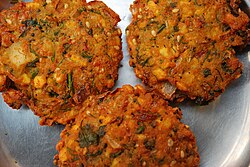
Dal | [[File:Vada (gare).jpg|thumb|Dal or paruppu is the main ingredient of the Indian snack [[Vada (food)|vada]].|alt=]] | ||
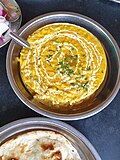
[[File:Dal tadka and naan.jpg|thumb|Dal tadka and naan]] | |||
Dal are often prepared in three different forms: | |||
* Unhulled and whole, known as ''sabut'' ('whole' in Hindi), such as ''sabut urad dal'' or ''mung sabut''; | |||
* Unhulled and split, known as ''chilka'' ('shell' in Hindi), such as ''chilka urad dal'' or ''mung dal chilka''; | |||
* [[Hulled]] and split, known as ''dhuli'' ('washed' in Hindi), e.g. ''urad dhuli'', or ''mung dhuli''.<ref>{{cite news |url=https://www.theguardian.com/lifeandstyle/2014/jun/13/yotam-ottolenghi-dried-bean-and-pea-recipes |title=Pulse points: Yotam Ottolenghi's dried bean and pea recipes |last1=Ottolenghi |first1=Yotam |author-link=Yotam Ottolenghi |work=The Guardian |access-date=29 September 2015}}</ref><ref>{{cite web |url=http://www.chefandherkitchen.com/2012/10/chilka-moong-dhal-split-green-lentils.html |title=Sample recipe for Chilka Urad dhal, split unhulled urad}}</ref><ref>Mehta, Nita (2006). ''Dal & Roti''. SNAB. p12. {{ISBN|978-81-86004-06-7}}.</ref> | |||
== | The hulling of a pulse is intended to improve digestibility and palatability. It also affects the nutrition provided by the dish, significantly increasing protein and reducing [[dietary fiber|dietary fibre]] content.<ref>{{cite journal |last1=Wang |first1=N. |last2=Hatcher |first2=D.W. |last3=Toews |first3=R. |last4=Gawalko |first4=E.J. |title=Influence of cooking and dehulling on nutritional composition of several varieties of lentils (''Lens culinaris'') |journal=LWT - Food Science and Technology |volume=42 |issue=4 |pages=842–848 |doi=10.1016/j.lwt.2008.10.007 |year=2009 |bibcode=2009LWTFS..42..842W }}</ref> Pulses with their outer hulls intact are also quite popular in the Indian subcontinent as the main cuisine. Over 50 different varieties of pulses are known in the Indian subcontinent.{{citation needed|date=April 2019}} | ||
Dal is frequently eaten with [[flatbread]]s, such as ''[[roti]]s'' or ''[[chapati]]s,'' or with rice. The latter combination is called ''[[dal bhat]]'' in [[Nepali language|Nepali]], [[Gujarati language|Gujarati]], and various other Indian languages. In addition, certain types of dal are fried, salted, and eaten as a dry snack, and a variety of savory snacks are made by frying a paste made from soaked and ground dals in different combinations, to which other ingredients, such as spices and nuts (commonly [[cashews]]) may be added. | |||
Dal preparations are eaten with rice, [[chapati]] and [[naan]] on the [[Indian subcontinent]]. The manner in which it is cooked and presented varies by region. In South India, dal is often called "paruppu". It is primarily used to make a dish called [[Sambar (dish)|sambar]]. It is also used to make [[Telugu cuisine#Pappu (dal)|parippu]] that is mixed with [[charu]] and rice. Ground chana dal is used to make a paste called [[besan]], which is used in the preparation of many dishes including [[bhaji]]<ref>{{cite news |last1=Cloake |first1=Felicity |author-link=Felicity Cloake |title=How to make the perfect onion bhajis|url=https://www.theguardian.com/lifeandstyle/wordofmouth/2013/nov/13/how-to-make-perfect-onion-bhajis|work=The Guardian}}</ref> and Mediterranean dishes like [[farinata]]. | |||
[[ | |||
=={{anchor|Tadka}}Preparation== | |||
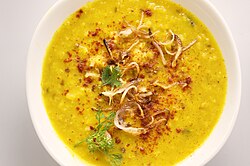
[[File:Dal Tadka 01 (36779549481).jpg|thumb|Dal tadka garnished with fried onion]] | |||
Most dal recipes are quite simple to prepare. The standard preparation begins with boiling a variety of dal (or a mix) in water with some [[turmeric]], salt to taste, and then adding a fried garnish at the end of the cooking process.<ref>{{cite news|url=https://www.theguardian.com/lifeandstyle/2011/jun/02/how-to-cook-perfect-dal|title=How to cook perfect dal|last1=Cloake|first1=Felicity|author-link=Felicity Cloake|work=The Guardian|date=2 June 2011 }}</ref> In some recipes, tomatoes, [[kokum]], unripe [[mango]], [[jaggery]], or other ingredients are added while cooking the dal, often to impart a sweet-sour flavour. | |||
The fried garnish for dal goes by many names, including ''[[chaunk]]'', ''tadka/tarka'', ''bagar'', ''fodni'', and ''phoran''. The ingredients in the ''chaunk'' for each variety of dal vary by region and individual tastes. The raw spices (more commonly [[cumin seed]]s, [[mustard seed]]s, [[asafoetida]], and sometimes [[fenugreek seed]]s and dried [[chili pepper|red chili pepper]]) are first fried for a few seconds in the hot oil on medium/low heat. This is generally followed by [[ginger]], garlic, and onion, which are generally fried for 10 minutes. After the onion turns golden brown, ground spices ([[turmeric]], [[coriander]], [[chili powder|red chili powder]], [[garam masala]], etc.) are added. The ''chaunk'' is then poured over the cooked dal. | |||
| | |||
==Nutrition== | |||
{{See also|Legume#Nutritional value}} | |||
As the main ingredient of dal is the pulse used, it gains much of its nutritional properties from the pulse. | |||
==Common ingredients== | ==Common ingredients== | ||
* [[Pigeon pea]], i.e., yellow pigeon pea, is available either plain or oily. It is called ''toor dal'' in Hindi. It is called ''thuvaram paruppu'' in Tamil Nadu, ''thuvara parippu'' in Kerala and is the main ingredient for the dish ''[[Sambar (dish)|sambar]]''. In Karnataka, it is called ''togari bele'' and is an important ingredient in ''[[Bisi Bele Bath|bisi bele bath]]''. It is called ''kandi pappu'' in Telugu and is used in the preparation of a staple dish ''pappu charu''. It is also known as arhar dal in northern India.{{citation needed|date=September 2024}} | |||
*[[Pigeon pea]], i.e., yellow pigeon | * ''Chana dal'' is produced by removing the outer layer of black [[chickpeas]] and then splitting the kernel''.'' Although machines can do this, it can be done at home by soaking the whole chickpeas and removing the loose skins by rubbing. In [[Karnataka]] it is called {{Transliteration|kn|kadle bele}}. [[Chickpea#Varieties|Other varieties of chickpea]] may be used, e.g., ''[[kabuli chana|kabuli]] dal''. | ||
*''Chana dal'' is produced by removing the outer layer of black [[chickpeas]] and then splitting the kernel''.'' Although machines can do this, it can be done at home by soaking the whole chickpeas and removing the loose skins by rubbing. In [[Karnataka]] it is called {{ | * [[Yellow split peas]] are very prevalent in the Indian communities of [[Guyana]], [[Fiji]], [[Suriname]], [[Jamaica]], [[South Africa]], [[Mauritius]], [[Trinidad and Tobago]], and are popular amongst Indians in the United States as well as India. There, it is referred to generically as dal and is the most popular dal. It is prepared similarly to dals found in India, but may be used in recipes. The whole dried pea is called ''matar'' or ''matar dal'' in India. The whole dried yellow pea is the main ingredient in the common [[Bengalis|Bengali]] street food ''[[ghugni]]''. | ||
* Split [[mung bean]]s (''mung dal'') is by far the most popular in [[Bangladesh]] and [[West Bengal]] (''moog dal'', (মুগ ডাল)). It is used in parts of South India, such as in the [[Tamil cuisine|Tamil]] dish ''[[Pongal (dish)#Venn pongal|ven pongal]]''. Roasted and lightly salted or spiced mung bean is a popular snack in most parts of India. | |||
*[[Yellow split peas]] are very prevalent in the Indian communities of [[Guyana]], [[Fiji]], [[Suriname]], [[Jamaica]], [[South Africa]], [[Mauritius]], [[Trinidad and Tobago]], and are popular amongst Indians in the United States as well as | * ''[[Vigna mungo|Urad dal]]'', sometimes referred to as "black gram", is a primary ingredient of the south Indian dishes ''[[idli]]'' and ''[[Dosa (food)|dosa]]''. It is one of the main ingredients of East Indian ([[Oriya cuisine|Odia]] and [[Bengali cuisine|Bengali]] or [[Assamese people|Assamese]]) ''[[Bori (food)|bori]]'', sun-dried dumplings. The [[Punjabi cuisine|Punjabi]] version is {{Transliteration|pa|[[dal makhani]]}}. It is called {{Transliteration|kn|uddina bele}} in Karnataka, {{Transliteration|bn|biulir dal}} in Bengali. It is rich in protein. | ||
*Split [[mung bean]]s (''mung dal'') is by far the most popular in [[Bangladesh]] and [[West Bengal]] (''moog dal'', (মুগ ডাল)). It is used in parts of South India, such as in the [[Tamil cuisine|Tamil]] dish ''[[Pongal (dish)# | |||
*''[[Vigna mungo|Urad dal]]'', sometimes referred to as "black gram", is a primary ingredient of the south Indian dishes ''[[idli]]'' and ''[[dosa]]''. It is one of the main ingredients of East Indian ([[Oriya cuisine| | |||
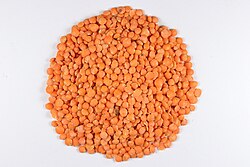
* ''Masoor dal:'' split red [[lentil]]s. In Karnataka, it is called ''kempu'' (red)'' togari bele''. | * ''Masoor dal:'' split red [[lentil]]s. In Karnataka, it is called ''kempu'' (red)'' togari bele''. | ||
*''Rajma dal'': split [[kidney bean]]s. | * ''Rajma dal'': split [[kidney bean]]s. | ||
* ''[[Mussyang]]'' is from dals of various colours found in various hilly regions of Nepal. | * ''[[Mussyang]]'' is made from dals of various colours found in various hilly regions of Nepal. | ||
* ''[[Panchratna Dal|Panchratna dal]]'' (Hindi | * ''[[Panchratna Dal|Panchratna dal]]'' (Hindi) ("five jewels") is a mixture of five varieties of dal, which produces a dish with a unique flavour. | ||
* ''[[Navrangi dal]]'' is a lesser known Dal variety from Himachal Pradesh. It is mostly cultivated in Himachal and is multicoloured. | |||
* ''Moth bean'': is an Indian dal main ingredient for popular Indian snack bikaneri bhujia and Maharashtrian snacks misal and usal. | |||
* Pulses may be split but not hulled; they are distinguished from hulled dals by adding the word ''chilka'' (skin). | * Pulses may be split but not hulled; they are distinguished from hulled dals by adding the word ''chilka'' (skin). | ||
== | == Gallery == | ||
<gallery widths="200" heights="200"> | |||
File:Split Red Lentil.jpg|Split red lentil seeds | |||
File:Tur Dal.JPG|Split [[pigeon pea]], commonly used in dal | |||
File:Dal tadka and chapati.jpg|Dal tadka and chapati | |||
File:A thali with daal roti bhindi ki sabzi and mango pickle.jpg|Plain dal served with roti, sauteed okra and green-mango pickle. | |||
File:Sanna (Commons).jpg|[[Idli]]s, steamed rice and black lentil cakes | |||
File:Dal Fry Tadka, Cumin Rice, Roasted Papad on the side.jpg|''Dal tadka'' served with rice and [[papadum|papadam]], a staple meal in the Indian subcontinent | |||
File:Roasted Papad - Howrah 2013-11-02 4068.jpg|Fire-toasted [[papad]]s, using lentils as a major ingredient | |||
File:Dhokla on Gujrart.jpg|[[Dhokla]], a steamed, fermented chana dal snack using lentils | |||
</gallery> | |||
==See also== | ==See also== | ||
{{Portal|Food}} | |||
* ''[[Dal bhat]]'' | |||
* ''[[ | |||
* ''[[Dal bati churma]]'' | * ''[[Dal bati churma]]'' | ||
* ''[[Dal biji]]'' | * ''[[Dal biji]]'' | ||
* [[Ezogelin soup]] | * [[Ezogelin soup]] | ||
* [[Fasole bătută]] | * [[Fasole bătută]] | ||
* [[Lentil soup]] | * [[Lentil soup]] | ||
* [[Monggo]] (Philippine version of dal) | |||
* [[Pea soup]] | * [[Pea soup]] | ||
{{Clear}} | |||
==References== | ==References== | ||
| Line 376: | Line 133: | ||
[[Category:Indian cuisine]] | [[Category:Indian cuisine]] | ||
[[Category:Pakistani cuisine]] | [[Category:Pakistani cuisine]] | ||
[[Category:Fijian cuisine]] | |||
[[Category:Assamese cuisine]] | |||
Latest revision as of 12:14, 6 March 2026
 Lentils are a staple ingredient in cuisines from the Indian subcontinent. Clockwise from upper right: split red lentils, common green whole lentils, and Le Puy lentils. Whole lentils have their outer coats visible. | |
| Alternative names | Daal, dail, dahl, parripu, pappu, ooti, daje |
|---|---|
| Region or state | Indian subcontinent |
| Main ingredients | Lentils, peas or beans |
In Indian cuisine, dal (also spelled daal or dhal [1] pronunciation: [d̪aːl]) are dried, split pulses (e.g., lentils, peas, and beans) that do not require soaking before cooking. India is the largest producer of pulses in the world.[2] The term is also used for various soups prepared from these pulses. These pulses are among the leading staple foods in South Asian countries, and form an important part of the cuisines of the Indian subcontinent.[3]
Etymology[edit | edit source]
The word dāl (dal) derives from the Sanskrit verbal root dal- "to split",[4][5] which is inherited from Proto-Indo-European *delh₁- "to split, divide".[6][7][8]
History[edit | edit source]
Lentils are among the most ancient cultivated foods; they have been found in human settlements dating back to the Bronze Age.[9] Researchers have dated the preparation and cooking of split dal as far back as 800–300 BC.[10]
Dal as a staple food has been mentioned in many ancient religious texts, including the Yajurveda and the Mahayana Buddhist Laṅkāvatāra Sūtra.
May for me strength, righteousness, milk, sap, ghee, honey, eating and drinking in company, ploughing, rain, conquest, victory, wealth, riches, prosperity, prospering, plenteousness, lordship, much, more, fun, fuller, imperishableness, bad crops, food, freedom from hunger, rice, barley, beans, sesame, kidney beans, vetches, wheat, lentils, millet, Panicum miliaceum, Panicum frumentaceum, and wild rice (prosper through the sacrifice).
Now, Mahāmati, the food I have permitted [my disciples to take] is gratifying to all wise people but is avoided by the unwise; it is productive of many merits, it keeps away many evils; and it has been prescribed by the ancient Rishis. It comprises rice, barley, wheat, kidney beans, beans, lentils, etc., [...] food prepared with these is proper food.
Use[edit | edit source]
.jpg)

Dal are often prepared in three different forms:
- Unhulled and whole, known as sabut ('whole' in Hindi), such as sabut urad dal or mung sabut;
- Unhulled and split, known as chilka ('shell' in Hindi), such as chilka urad dal or mung dal chilka;
- Hulled and split, known as dhuli ('washed' in Hindi), e.g. urad dhuli, or mung dhuli.[13][14][15]
The hulling of a pulse is intended to improve digestibility and palatability. It also affects the nutrition provided by the dish, significantly increasing protein and reducing dietary fibre content.[16] Pulses with their outer hulls intact are also quite popular in the Indian subcontinent as the main cuisine. Over 50 different varieties of pulses are known in the Indian subcontinent.[citation needed]
Dal is frequently eaten with flatbreads, such as rotis or chapatis, or with rice. The latter combination is called dal bhat in Nepali, Gujarati, and various other Indian languages. In addition, certain types of dal are fried, salted, and eaten as a dry snack, and a variety of savory snacks are made by frying a paste made from soaked and ground dals in different combinations, to which other ingredients, such as spices and nuts (commonly cashews) may be added.
Dal preparations are eaten with rice, chapati and naan on the Indian subcontinent. The manner in which it is cooked and presented varies by region. In South India, dal is often called "paruppu". It is primarily used to make a dish called sambar. It is also used to make parippu that is mixed with charu and rice. Ground chana dal is used to make a paste called besan, which is used in the preparation of many dishes including bhaji[17] and Mediterranean dishes like farinata.
Preparation[edit | edit source]
.jpg)
Most dal recipes are quite simple to prepare. The standard preparation begins with boiling a variety of dal (or a mix) in water with some turmeric, salt to taste, and then adding a fried garnish at the end of the cooking process.[18] In some recipes, tomatoes, kokum, unripe mango, jaggery, or other ingredients are added while cooking the dal, often to impart a sweet-sour flavour.
The fried garnish for dal goes by many names, including chaunk, tadka/tarka, bagar, fodni, and phoran. The ingredients in the chaunk for each variety of dal vary by region and individual tastes. The raw spices (more commonly cumin seeds, mustard seeds, asafoetida, and sometimes fenugreek seeds and dried red chili pepper) are first fried for a few seconds in the hot oil on medium/low heat. This is generally followed by ginger, garlic, and onion, which are generally fried for 10 minutes. After the onion turns golden brown, ground spices (turmeric, coriander, red chili powder, garam masala, etc.) are added. The chaunk is then poured over the cooked dal.
Nutrition[edit | edit source]
As the main ingredient of dal is the pulse used, it gains much of its nutritional properties from the pulse.
Common ingredients[edit | edit source]
- Pigeon pea, i.e., yellow pigeon pea, is available either plain or oily. It is called toor dal in Hindi. It is called thuvaram paruppu in Tamil Nadu, thuvara parippu in Kerala and is the main ingredient for the dish sambar. In Karnataka, it is called togari bele and is an important ingredient in bisi bele bath. It is called kandi pappu in Telugu and is used in the preparation of a staple dish pappu charu. It is also known as arhar dal in northern India.[citation needed]
- Chana dal is produced by removing the outer layer of black chickpeas and then splitting the kernel. Although machines can do this, it can be done at home by soaking the whole chickpeas and removing the loose skins by rubbing. In Karnataka it is called kadle bele. Other varieties of chickpea may be used, e.g., kabuli dal.
- Yellow split peas are very prevalent in the Indian communities of Guyana, Fiji, Suriname, Jamaica, South Africa, Mauritius, Trinidad and Tobago, and are popular amongst Indians in the United States as well as India. There, it is referred to generically as dal and is the most popular dal. It is prepared similarly to dals found in India, but may be used in recipes. The whole dried pea is called matar or matar dal in India. The whole dried yellow pea is the main ingredient in the common Bengali street food ghugni.
- Split mung beans (mung dal) is by far the most popular in Bangladesh and West Bengal (moog dal, (মুগ ডাল)). It is used in parts of South India, such as in the Tamil dish ven pongal. Roasted and lightly salted or spiced mung bean is a popular snack in most parts of India.
- Urad dal, sometimes referred to as "black gram", is a primary ingredient of the south Indian dishes idli and dosa. It is one of the main ingredients of East Indian (Odia and Bengali or Assamese) bori, sun-dried dumplings. The Punjabi version is dal makhani. It is called uddina bele in Karnataka, biulir dal in Bengali. It is rich in protein.
- Masoor dal: split red lentils. In Karnataka, it is called kempu (red) togari bele.
- Rajma dal: split kidney beans.
- Mussyang is made from dals of various colours found in various hilly regions of Nepal.
- Panchratna dal (Hindi) ("five jewels") is a mixture of five varieties of dal, which produces a dish with a unique flavour.
- Navrangi dal is a lesser known Dal variety from Himachal Pradesh. It is mostly cultivated in Himachal and is multicoloured.
- Moth bean: is an Indian dal main ingredient for popular Indian snack bikaneri bhujia and Maharashtrian snacks misal and usal.
- Pulses may be split but not hulled; they are distinguished from hulled dals by adding the word chilka (skin).
Gallery[edit | edit source]
-
 Split red lentil seeds
 -
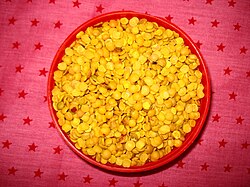 Split pigeon pea, commonly used in dal
 -
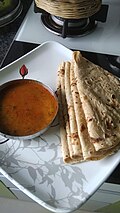 Dal tadka and chapati
 -
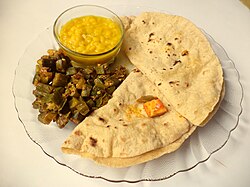 Plain dal served with roti, sauteed okra and green-mango pickle.
 -
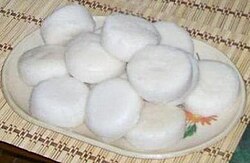 Idlis, steamed rice and black lentil cakes
 -
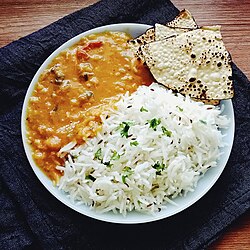 Dal tadka served with rice and papadam, a staple meal in the Indian subcontinent
 -
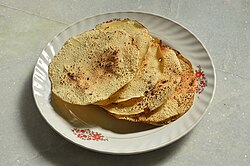 Fire-toasted papads, using lentils as a major ingredient
 -
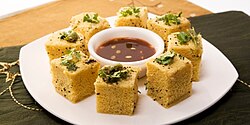 Dhokla, a steamed, fermented chana dal snack using lentils


.jpg)


See also[edit | edit source]
- Dal bhat
- Dal bati churma
- Dal biji
- Ezogelin soup
- Fasole bătută
- Lentil soup
- Monggo (Philippine version of dal)
- Pea soup
References[edit | edit source]
- ↑ "20 Dhal recipes". BBC Good Food. Immediate Media Company. Retrieved 19 April 2023.
- ↑ "FAO in India". Retrieved 2 September 2020.
- ↑ Davidson, Alan; Jaine, Tom (2014). "Dal". The Oxford Companion to Food. Oxford University Press. p. 246. ISBN 9780199677337.
- ↑ John Ayto (2012). The Diner's Dictionary: Word Origins of Food and Drink. Oxford University Press. p. 116. ISBN 978-0-19-964024-9.
- ↑ Williams, Monier (1899). A Sanskrit–English Dictionary. Oxford: Clarendon Press. p. 471. OCLC 458052227.
- ↑ Mallory, J. P.; Adams, D. Q. (2006) The Oxford Introduction to Proto-Indo-European and the Proto-Indo-European World (Oxford Linguistics), New York: Oxford University Press, page 372
- ↑ Rix, Helmut, editor (2001) Lexikon der indogermanischen Verben [Lexicon of Indo-European Verbs] (in German), 2nd edition, Wiesbaden: Dr. Ludwig Reichert Verlag, page 114
- ↑ Pokorny, Julius (1959) Indogermanisches etymologisches Wörterbuch [Indo-European Etymological Dictionary] (in German), volume 1, Bern, München: Francke Verlag, page 0194
- ↑ "Lentil". Encyclopædia Britannica.
- ↑ Agrawal, Chitra (22 November 2021). "What is dal?". Bon Appetit.
- ↑ Berriedale Keith, Arthur. The Yajur Veda (Taittiriya Sanhita).
- ↑ Suzuki, D.T. (1999). The Laṅkāvatāra Sūtra: A Mahāyāna Text.
- ↑ Ottolenghi, Yotam. "Pulse points: Yotam Ottolenghi's dried bean and pea recipes". The Guardian. Retrieved 29 September 2015.
- ↑ "Sample recipe for Chilka Urad dhal, split unhulled urad".
- ↑ Mehta, Nita (2006). Dal & Roti. SNAB. p12. ISBN 978-81-86004-06-7.
- ↑ Wang, N.; Hatcher, D.W.; Toews, R.; Gawalko, E.J. (2009). "Influence of cooking and dehulling on nutritional composition of several varieties of lentils (Lens culinaris)". LWT - Food Science and Technology. 42 (4): 842–848. Bibcode:2009LWTFS..42..842W. doi:10.1016/j.lwt.2008.10.007.
- ↑ Cloake, Felicity. "How to make the perfect onion bhajis". The Guardian.
- ↑ Cloake, Felicity (2 June 2011). "How to cook perfect dal". The Guardian.
Further reading[edit | edit source]
- Salma Husain; Vijay Thukral (2018). Pull of Pulses: Full of Beans. Niyogi. ISBN 978-93-86906-19-9.


Pakistani dishes by cuisine and region | |||||
|---|---|---|---|---|---|
| Balochi |  | ||||
| Gilgiti | |||||
| Muhajir |
| ||||
| Pashtun | |||||
| Punjabi |
| ||||
| Saraiki | |||||
| Sindhi | |||||
| Common dishes |
| ||||
| Pakistani diaspora | |||||
| |
| See also | |
- Pages using the JsonConfig extension
- Pages with Hindustani IPA
- Andhra cuisine
- Bangladeshi soups and stews
- Bengali cuisine
- Bihari cuisine
- Indian soups and stews
- Indo-Caribbean cuisine
- Legume dishes
- Lentil dishes
- Muhajir cuisine
- Nepalese cuisine
- Pakistani soups and stews
- Plant common names
- Punjabi cuisine
- Rajasthani cuisine
- Uttar Pradeshi cuisine
- Sri Lankan legume dishes
- Gujarati cuisine
- Kutchi cuisine
- Indian cuisine
- Pakistani cuisine
- Fijian cuisine
- Assamese cuisine