



m Removed empty portal template using script |
m formatting fix |
||
| Line 1: | Line 1: | ||
{{short description|Creator | {{short description|Creator god in Hinduism}} | ||
{{About|Hindu creation god|the genderless metaphysical concept of Ultimate Reality in Hindu philosophy|Brahman}} | {{About|the Hindu creation god|the genderless metaphysical concept of Ultimate Reality in Hindu philosophy|Brahman}}{{For|Buddhist version of Brahma|Brahma (Buddhism)}} | ||
{{other uses}} | {{other uses}}{{Use Indian English|date=March 2015}} | ||
{{Use Indian English|date=March 2015}} | {{Use dmy dates|date=April 2023}} | ||
{{Use dmy dates|date= | |||
{{Infobox deity <!--Wikipedia:WikiProject Hindu mythology--> | {{Infobox deity <!--Wikipedia:WikiProject Hindu mythology--> | ||
| type = Hindu | | type = Hindu | ||
| image = | | image = File:Brahma, dal soffitto del tempio di huchchappaiyya gudi, aihole (balgakot), karnataka, VII secolo (cropped).jpg | ||
| caption = | | caption = 6th-century sculpture of Brahma | ||
| name = Brahma | | name = Brahma | ||
| devanagari = ब्रह्मा | | devanagari = ब्रह्मा | ||
| sanskrit_transliteration = Brahmā | | sanskrit_transliteration = Brahmā | ||
| affiliation = [[ | | affiliation = [[Trimurti]], [[Deva (Hinduism)|Deva]] | ||
| deity_of = | | deity_of = Creator of the Universe <br> God of Creation, Knowledge and the [[Veda]]s<ref>{{cite web |url=https://www.wisdomlib.org/definition/brahma |title=Brahma, Brahmā, Brāhma: 66 definitions |publisher=Wisdomlib.org |date=6 June 2022 |access-date=5 August 2022 |archive-date=5 August 2022 |archive-url=https://web.archive.org/web/20220805095313/https://www.wisdomlib.org/definition/brahma |url-status=live }}</ref> | ||
Creator of the Universe | | abode = [[Brahmaloka]] | ||
| weapon = [[Brahmastra]], [[Brahmashirastra]] | |||
| abode = | | mantra = ॐ वेदात्मनाय विद्महे हिरण्यगर्भाय धीमही तन्नो ब्रह्मा प्रचोदयात्: <br /> ''{{IAST|[[Oṃ]] vedātmanāya vidmahe [[Hiranyagarbha|hiraṇyagarbhāya]] dhīmahī tan no brahmā pracodayāt}}'' | ||
| weapon = [[Brahmastra]], [[ | ॐ ब्रह्मणे नम: <br /> ''{{IAST|Om Brahmane Namah}}'' | ||
| mantra = ॐ वेदात्मनाय विद्महे हिरण्यगर्भाय धीमही तन्नो ब्रह्मा प्रचोदयात् | | symbol = [[Nelumbo nucifera|Lotus]], [[Vedas]], ''[[Japamala]]'', ''[[Kamandalu]]'' | ||
| symbol = [[Nelumbo nucifera|Lotus]], | | consort = Savitri (identified with [[Sarasvati]] or [[Gayatri]]) | ||
| consort = [[ | | mount = [[Hamsa (bird)|Hamsa]] | ||
| mount = [[ | |||
| festivals = [[Kartik Purnima]] | | festivals = [[Kartik Purnima]] | ||
| member_of = [[Trimurti]] | | member_of = [[Trimurti]] | ||
| other_names = Svayambhu, Virinchi, Prajapati | | other_names = Svayambhu, Virinchi, [[Prajapati]] | ||
| children = [[ | | children = [[Mānasaputra|Mind-created children]] including: {{hlist|[[Agni]]|[[Ahalya]]|[[Angiras (sage)|Angiras]]|[[Atri]]|[[Bhrigu]]|[[Chitragupta]]|[[Daksha]]|[[Himavan]]|[[Jambavan]]|[[Kamadeva]]|[[Kratu]]|[[Four Kumaras|Kumara]]s|[[Marichi]]|[[Narada]]|[[Pulaha]]|[[Pulastya]]|[[Shatarupa]]|[[Svayambhuva Manu]]|[[Vashishtha]]}}}} | ||
}} | {{Ayyavazhi}} | ||
'''Brahma''' ({{ | {{Hinduism}} | ||
{{Hindu mythology}}{{Indonesian mythology and folklore}} | |||
'''Brahma''' ({{langx|sa|[[wikt:ब्रह्मा|ब्रह्मा]]}}, {{IAST3|Brahmā}}) is a [[Hindu god]], referred to as "the Creator" within the [[Trimurti]], the [[triple deity|trinity]] of [[Para Brahman|supreme divinity]] that includes [[Vishnu]] and [[Shiva]].<ref name="davidwhite29">{{cite book|first=David|last=White|author-link=David Gordon White|year=2006|title=Kiss of the Yogini|publisher=University of Chicago Press|isbn=978-0226894843|pages=4, 29}}</ref><ref name="gonda212">Jan Gonda (1969), [https://www.jstor.org/stable/40457085 The Hindu Trinity] {{Webarchive|url=https://web.archive.org/web/20200425200435/https://www.jstor.org/stable/40457085 |date=25 April 2020 }}, Anthropos, Bd 63/64, H 1/2, pp. 212–226.</ref><ref name=":1">Jan Gonda (1969), [https://www.jstor.org/stable/40457085 The Hindu Trinity] {{Webarchive|url=https://web.archive.org/web/20200425200435/https://www.jstor.org/stable/40457085 |date=25 April 2020 }}, Anthropos, Bd 63/64, H 1/2, pp. 218–219.</ref> He is associated with creation of everything, knowledge, and the ''[[Veda]]s''.<ref>{{cite book|url=https://archive.org/details/dli.bengal.10689.12977|title=THE VAYU PURANA PART. 1|last=N.A|date=1960|publisher=MOTILAL BANARSIDASS PUBLISHERS PVT. LTD, DELHI|pages=[https://archive.org/details/dli.bengal.10689.12977/page/n184 174] (26.31)}}</ref><ref>{{cite book|first1=Charles Russell|last1=Coulter|first2=Patricia|last2=Turner|title=Encyclopedia of Ancient Deities|url=https://books.google.com/books?id=VWxekbhM1yEC&pg=PT240|year=2013|publisher=Routledge|isbn=978-1-135-96397-2|page=240}}, Quote: "Brahma, a creator god, received the basics of his mythological history from Purusha. During the Brahmanic period, the Hindu Trimurti was represented by Brahma with his attribute of creation, Shiva with his attribute of destruction and Vishnu with his attribute of preservation."</ref><ref name="bruce86">{{cite book|first=Bruce|last=Sullivan|year=1999|title=Seer of the Fifth Veda: Kr̥ṣṇa Dvaipāyana Vyāsa in the Mahābhārata|publisher=Motilal Banarsidass|isbn=978-8120816763|pages=85–86}}</ref><ref>{{cite book|first=Barbara|last=Holdrege|year=2012|title=Veda and Torah: Transcending the Textuality of Scripture|publisher=State University of New York Press|isbn=978-1438406954|pages=88–89}}</ref> Brahma is prominently mentioned in [[Creation myth|creation legends]]. In some ''[[Purana]]s'', he created himself in a golden embryo known as the [[Hiranyagarbha]]. | |||
Brahma is frequently identified with the [[Rigvedic deities|Vedic god]] [[Prajapati]].<ref name="david183">{{cite book |last=Leeming |first=David |title=Creation Myths of the World |year=2009 |isbn=978-1598841749 |edition=2nd |page=146 |author-link=David Adams Leeming}};<br />David Leeming (2005), The Oxford Companion to World Mythology, Oxford University Press, {{ISBN|978-0195156690}}, page 54, '''Quote:''' "Especially in the Vedanta Hindu Philosophy, Brahman is the Absolute. In the Upanishads, Brahman becomes the eternal first cause, present everywhere and nowhere, always and never. Brahman can be incarnated in Brahma, in Vishnu, in Shiva. To put it another way, everything that is, owes its existence to Brahman. In this sense, Hinduism is ultimately monotheistic or monistic, all gods being aspects of Brahman"; Also see pages 183-184, Quote: "Prajapati, himself the source of creator god Brahma – in a sense, a personification of Brahman (...) [[Moksha]], the connection between the transcendental absolute Brahman and the inner absolute [[Atman (Hinduism)|Atman]]."</ref> During the post-Vedic period, Brahma was a prominent deity and his sect existed; however, by the 7th century, he had lost his significance. He was also overshadowed by other major deities like [[Vishnu]], [[Shiva]], and [[Mahadevi]]<ref name = "Dalal1" /> and demoted to the role of a secondary creator, who was created by the major deities.<ref>{{Cite book|last=Achuthananda|first=Swami|url=https://books.google.com/books?id=F9FqDwAAQBAJ&q=in+which+sect+Brahma+is+considered+supreme|title=The Ascent of Vishnu and the Fall of Brahma|date=2018 | Brahma is frequently identified with the [[Rigvedic deities|Vedic god]] [[Prajapati]].<ref name="david183">{{cite book |last=Leeming |first=David |title=Creation Myths of the World |year=2009 |isbn=978-1598841749 |edition=2nd |page=146 |publisher=Bloomsbury Academic |author-link=David Adams Leeming}};<br />David Leeming (2005), The Oxford Companion to World Mythology, Oxford University Press, {{ISBN|978-0195156690}}, page 54, '''Quote:''' "Especially in the Vedanta Hindu Philosophy, Brahman is the Absolute. In the Upanishads, Brahman becomes the eternal first cause, present everywhere and nowhere, always and never. Brahman can be incarnated in Brahma, in Vishnu, in Shiva. To put it another way, everything that is, owes its existence to Brahman. In this sense, Hinduism is ultimately monotheistic or monistic, all gods being aspects of Brahman"; Also see pages 183-184, Quote: "Prajapati, himself the source of creator god Brahma – in a sense, a personification of Brahman (...) [[Moksha]], the connection between the transcendental absolute Brahman and the inner absolute [[Atman (Hinduism)|Atman]]."</ref> During the post-Vedic period, Brahma was a prominent deity and his sect existed; however, by the 7th century, he had lost his significance. He was also overshadowed by other major deities like [[Vishnu]], [[Shiva]], and [[Mahadevi]]<ref name = "Dalal1" /> and demoted to the role of a secondary creator, who was created by the major deities.<ref>{{Cite book|last=Achuthananda|first=Swami|url=https://books.google.com/books?id=F9FqDwAAQBAJ&q=in+which+sect+Brahma+is+considered+supreme|title=The Ascent of Vishnu and the Fall of Brahma|date=27 August 2018|publisher=Relianz Communications Pty Ltd|isbn=978-0-9757883-3-2|language=en}}</ref><ref name="Stella Kramrisch 1994 pages 205-206">{{cite book|first=Stella|last=Kramrisch|author-link=Stella Kramrisch|year=1994|title=The Presence of Siva|publisher=Princeton University Press|isbn=978-0691019307|pages=205–206}}</ref><ref>{{Cite book|last=Pattanaik|first=Devdutt|url=https://books.google.com/books?id=rjL3ogbdJNkC&q=devi+created+brahma+vishnu&pg=PA123|title=The Goddess in India:The Five Faces of the Eternal Feminine|date=September 2000|publisher=Inner Traditions / Bear & Co|isbn=978-0-89281-807-5|language=en}}</ref> | ||
Brahma is commonly depicted as a red or golden-[[complexion]]ed bearded man with four heads and hands. His four heads represent the four Vedas and are pointed to the four cardinal directions. He is seated on a lotus and his ''[[vahana]]'' (mount) is a ''[[hamsa (bird)|hamsa]]'' (swan, goose or crane). According to the scriptures, Brahma created his children from his mind and thus, they are referred to as ''[[Manasputra|Manasaputra]]''.<ref>{{Cite book|url=https://books.google.com/books?id=87k0AwAAQBAJ&pg=PT936|title=The Religions of India: A Concise Guide to Nine Major Faiths|last=Dalal|first=Roshen|author-link=Roshen Dalal|date=2014 | Brahma is commonly depicted as a red or golden-[[complexion]]ed bearded man with four heads and hands. His four heads represent the four [[Vedas]] and are pointed to the four cardinal directions.<ref name=":0">{{Cite book |last1=Carrasco |first1=David |title=Merriam-Webster's Encyclopedia of World Religions |last2=Warmind |first2=Morten |last3=Hawley |first3=John Stratton |last4=Reynolds |first4=Frank |last5=Giarardot |first5=Norman |last6=Neusner |first6=Jacob |last7=Pelikan |first7=Jaroslav |last8=Campo |first8=Juan |last9=Penner |first9=Hans |collaboration=Authors |publisher=[[Merriam-Webster]] |others=Edited by [[Wendy Doniger]] |year=1999 |isbn=9780877790440 |location=United States |pages=140 |language=en |author-link=David Carrasco |author-link4=Frank Reynolds (academic) |author-link6=Jacob Neusner |author-link7=Jaroslav Pelikan}}</ref> He is seated on a lotus and his ''[[vahana]]'' (mount) is a ''[[hamsa (bird)|hamsa]]'' (swan, goose or crane). According to the scriptures, Brahma created his children from his mind and thus, they are referred to as ''[[Manasputra|Manasaputra]]''.<ref>{{Cite book|url=https://books.google.com/books?id=87k0AwAAQBAJ&pg=PT936|title=The Religions of India: A Concise Guide to Nine Major Faiths|last=Dalal|first=Roshen|author-link=Roshen Dalal|date=18 April 2014|publisher=Penguin UK|isbn=9788184753967|language=en}}</ref><ref name="turner258">Charles Coulter and Patricia Turner (2000), Encyclopedia of Ancient Deities, Routledge, {{ISBN|978-0786403172}}, page 258, Quote: "When Brahma is acknowledged as the supreme god, it was said that Kama sprang from his heart."</ref> | ||
In contemporary Hinduism, Brahma does not enjoy popular worship and has substantially less | In contemporary Hinduism, Brahma does not enjoy popular worship and has substantially less importance than the other two members of the Trimurti. Brahma is revered in the ancient texts, yet rarely worshipped as a primary deity in India, owing to the absence of any significant sect dedicated to his reverence.<ref name=morris123>{{cite book|author-link1=Brian Morris (anthropologist)|first=Brian|last=Morris|year=2005|title=Religion and Anthropology: A Critical Introduction|publisher=Cambridge University Press|isbn=978-0521852418|page=123}}</ref> Few temples dedicated to him exist in India, the most famous being the [[Brahma Temple, Pushkar]] in Rajasthan.<ref name=chakravarti15>{{cite book|first=SS|last=Charkravarti|year=2001|title=Hinduism, a Way of Life|publisher=Motilal Banarsidass|isbn=978-8120808997|page=15}}</ref> Some Brahma temples are found outside India, such as at the [[Erawan Shrine]] in [[Bangkok]], which in turn has found immense popularity within the [[Buddhism in Thailand|Thai Buddhist]] community.<ref name=ellenlondon74>{{cite book|first=Ellen|last=London|year=2008|title=Thailand Condensed: 2,000 Years of History & Culture|publisher=Marshall Cavendish|isbn=978-9812615206|page=74}}</ref> | ||
==Origin and meaning== | ==Origin and meaning== | ||
The origins of the term {{IAST|brahmā}} are uncertain, partly because several related words are found in the Vedic literature, such as ''[[Brahman]]'' for the 'Ultimate Reality' and [[ | The origins of the term {{IAST|brahmā}} are uncertain, partly because several related words are found in the Vedic literature, such as ''[[Brahman]]'' for the 'Ultimate Reality' and ''[[Brahmana|Brāhmaṇa]]'' for 'priest'. A distinction between the spiritual concept of ''brahman'' and the god Brahmā is that the former is a genderless abstract metaphysical concept in Hinduism,<ref>James Lochtefeld, Brahman, The Illustrated Encyclopedia of Hinduism, Vol. 1: A–M, Rosen Publishing. {{ISBN|978-0823931798}}, page 122</ref> while the latter is one of the many masculine gods in Hindu tradition.<ref>James Lochtefeld, Brahma, The Illustrated Encyclopedia of Hinduism, Vol. 1: A–M, Rosen Publishing. {{ISBN|978-0823931798}}, page 119</ref> The spiritual concept of ''brahman'' is quite old and some scholars suggest that the god Brahma may have emerged as a god and visible icon of the impersonal universal principle ''of brahman''.<ref name="brucesullivan">Bruce Sullivan (1999), Seer of the Fifth Veda, Motilal Banarsidass, {{ISBN|978-8120816763}}, pages 82-83</ref> The existence of a distinct god named ''Brahma'' is evidenced in late Vedic texts.<ref name="brucesullivan" /> | ||
Grammatically, the nominal stem ''Brahma-'' has two distinct forms: the [[Grammatical gender|neuter]] noun ''bráhman'', whose [[nominative case|nominative singular form]] is ''{{IAST|brahma}}'' ({{lang|sa|ब्रह्म}}); and the [[Grammatical gender|masculine]] noun ''brahmán'', whose nominative singular form is ''{{IAST|brahmā}}'' ({{lang|sa|ब्रह्मा}}). The former, the neuter form, has a generalized and abstract meaning<ref>{{cite book|last=Gopal|first=Madan|url=https://archive.org/details/indiathroughages00mada|title=India through the ages|publisher=Publication Division, Ministry of Information and Broadcasting, Government of India|year=1990|editor=K.S. Gautam|page=[https://archive.org/details/indiathroughages00mada/page/79 79]}}</ref> while the latter, the masculine form, is used as the proper name of the deity Brahma. | |||
However, Brahman was sometimes used as a synonym for Brahma's name during the time the [[Mahabharata]] was written.<ref>{{Cite book |last=Armstrong |first=Karen |title=A History of God: The 4000-year Quest of Judaism, Christianity, and Islam |publisher=[[Alfred A. Knopf Inc]] |year=1996 |isbn=978-0-679-42600-4 |location=New York |pages=85–86 |author-link=Karen Armstrong}}</ref> | |||
==Literature and legends== | ==Literature and legends == | ||
===Vedic literature=== | ===Vedic literature=== | ||
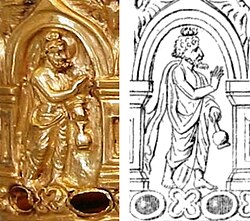
[[File:Brahma Bimaran casket.jpg|thumb|An early depiction of Brahma, on the [[Bimaran casket]], early 1st century CE. [[British Museum]].<ref>"The Bimaran Reliquary, a Gandharan work, which is now housed in the British Museum, London, is of great historical and iconographic significance. It shows Buddha in the centre, attended by Brahma to his right and Indra to the left." in {{cite book |last1=Banerjee |first1=Priyatosh |title=Central Asian art: new revelations from Xinjiang |date=2001 |publisher=Abha Prakashan |page=48 |isbn=9788185704241 |url=https://books.google.com/books?id=iazpAAAAMAAJ |language=en}}</ref><ref>"Standing Buddha in the arched compartment, flanked by figures of Brahma and Indra standing in similar compartments, detail of the side of Bimaran gold casket" in {{cite book |last1=Agrawala |first1=Prithvi Kumar |title=Early Indian Bronzes |date=1977 |publisher=Prithvi Prakashan |page=152 |url=https://books.google.com/books?id=kZUrAAAAMAAJ |language=en}}</ref>]] | [[File:Brahma Bimaran casket.jpg|thumb|An early depiction of Brahma, on the [[Bimaran casket]], early 1st century CE. [[British Museum]].<ref>"The Bimaran Reliquary, a Gandharan work, which is now housed in the British Museum, London, is of great historical and iconographic significance. It shows Buddha in the centre, attended by Brahma to his right and Indra to the left." in {{cite book |last1=Banerjee |first1=Priyatosh |title=Central Asian art: new revelations from Xinjiang |date=2001 |publisher=Abha Prakashan |page=48 |isbn=9788185704241 |url=https://books.google.com/books?id=iazpAAAAMAAJ |language=en}}</ref><ref>"Standing Buddha in the arched compartment, flanked by figures of Brahma and Indra standing in similar compartments, detail of the side of Bimaran gold casket" in {{cite book |last1=Agrawala |first1=Prithvi Kumar |title=Early Indian Bronzes |date=1977 |publisher=Prithvi Prakashan |page=152 |url=https://books.google.com/books?id=kZUrAAAAMAAJ |language=en}}</ref>]] | ||
One of the earliest mentions of Brahma with Vishnu and Shiva is in the fifth ''Prapathaka'' (lesson) of the ''[[Maitrayaniya Upanishad]]'', probably composed around the late 1st millennium BCE. Brahma is first discussed in verse 5,1, also called the ''Kutsayana Hymn'', and then expounded in verse 5,2.<ref name="hume51">{{citation|first=Robert Ernest|last=Hume|author-link=Robert Ernest Hume|title=The Thirteen Principal Upanishads |url=https://archive.org/stream/thirteenprincipa028442mbp#page/n443/mode/2up|publisher=Oxford University Press|year=1921|pages=422–424}}</ref> | |||
One of the earliest mentions of Brahma with Vishnu and Shiva is in the fifth ''Prapathaka'' (lesson) of the ''[[Maitrayaniya Upanishad]]'', probably composed around the late 1st millennium BCE. Brahma is first discussed in verse 5,1, also called the ''Kutsayana Hymn'', and then expounded in verse 5,2.<ref name=hume51>{{citation|first=Robert Ernest|last=Hume|author-link=Robert Ernest Hume|title=The Thirteen Principal Upanishads |url=https://archive.org/stream/thirteenprincipa028442mbp#page/n443/mode/2up|publisher=Oxford University Press|year=1921|pages=422–424}}</ref> | |||
In the pantheistic ''Kutsayana Hymn'',<ref name=hume51/> the Upanishad asserts that one's Soul is Brahman, and this Ultimate Reality, Cosmic Universal or God is within each living being. It equates the [[Ātman (Hinduism)|''atman'']] (Soul, Self) within to be Brahma and various alternate manifestations of Brahman, as follows, "Thou art Brahma, thou art Vishnu, thou art | In the pantheistic ''Kutsayana Hymn'',<ref name="hume51" /> the Upanishad asserts that one's Soul is Brahman, and this Ultimate Reality, Cosmic Universal or God is within each living being. It equates the [[Ātman (Hinduism)|''atman'']] (Soul, Self) within to be Brahma and various alternate manifestations of Brahman, as follows, "Thou art Brahma, thou art Vishnu, thou art Shiva, thou art [[Agni]], [[Varuna]], [[Vayu]], [[Indra]], thou art All."<ref name="hume51" /> | ||
In verse (5,2), Brahma, Vishnu, | In verse (5,2), Brahma, Vishnu, Shiva are mapped into the theory of [[Guṇa|Guṇas]], that is qualities, psyche and innate tendencies the text describes can be found in all living beings.<ref name="maxmuller51">[[Max Müller|Max Muller]], The Upanishads, Part 2, [https://archive.org/stream/upanishads02ml#page/302/mode/2up Maitrayana-Brahmana Upanishad], Oxford University Press, pages 303-304</ref><ref>Jan Gonda (1968), The Hindu Trinity, Anthropos, Vol. 63, pages 215-219</ref> This chapter of the ''[[Maitrayaniya Upanishad]]'' asserts that the universe emerged from darkness (''[[Tamas (philosophy)|tamas]]''), first as passion characterized by innate quality (''[[rajas]]''), which then refined and differentiated into purity and goodness (''[[sattva]]'').<ref name="hume51" /><ref name="maxmuller51" /> Of these three qualities, ''rajas'' are then mapped to ''Brahma'', as follows:<ref>[[Paul Deussen]], Sixty Upanishads of the Veda, Volume 1, Motilal Banarsidass, {{ISBN|978-8120814684}}, pages 344-346</ref> | ||
{{Blockquote| | {{Blockquote|<poem> | ||
<poem> | Now then, that part of him which belongs to ''tamas'', that, O students of sacred knowledge ([[Brahmacharya|Brahmacharins]]), is this Shiva. | ||
Now then, that part of him which belongs to ''tamas'', that, O students of sacred knowledge ([[Brahmacharya|Brahmacharins]]), is this | |||
That part of him which belongs to ''rajas'', that O students of sacred knowledge, is this '''Brahma'''. | That part of him which belongs to ''rajas'', that O students of sacred knowledge, is this '''Brahma'''. | ||
That part of him which belongs to ''sattva'', that O students of sacred knowledge, is this Vishnu. | That part of him which belongs to ''sattva'', that O students of sacred knowledge, is this Vishnu. | ||
| Line 69: | Line 57: | ||
This Being (neuter) entered all beings, he became the overlord of all beings. | This Being (neuter) entered all beings, he became the overlord of all beings. | ||
That is the [[Atman (Hinduism)|Atman]] (Soul, Self) within and without – yea, within and without! | That is the [[Atman (Hinduism)|Atman]] (Soul, Self) within and without – yea, within and without! | ||
</poem> | </poem>|[[Maitrayaniya Upanishad]], 5.2|<ref name=hume51/><ref name=maxmuller51/>|source=[[Maitrayaniya Upanishad]]}} | ||
|[[Maitrayaniya | |||
While the '' | While the ''Maitrayaniya Upanishad'' maps Brahma with one of the elements of ''the guṇas'' theory of Hinduism, the text does not depict him as one of the trifunctional elements of the Hindu ''Trimurti'' idea found in later Puranic literature.<ref>GM Bailey (1979), [https://www.jstor.org/stable/3269716 Trifunctional Elements in the theology of the Hindu Trimūrti] {{Webarchive|url=https://web.archive.org/web/20220709145622/https://www.jstor.org/stable/3269716 |date=9 July 2022 }}, Numen, Vol. 26, Fasc. 2, pages 152-163</ref> | ||
===Post-Vedic, Epics and Puranas=== | ===Post-Vedic, Epics and Puranas=== | ||
{{multiple image | |||
| align = right | |||
| image1 = 12th century Chennakesava temple at Somanathapura, Karnataka, India Lord Brahma.jpg | |||
| width1 = | |||
| alt1 = | |||
| caption1 = | |||
| image2 = Brahma on hamsa.jpg | |||
| width2 = | |||
| alt2 = | |||
| caption2 = | |||
| footer = Left: Brahma at the 12th century CE [[Chennakesava Temple, Somanathapura]]; Right: Painting depicting Brahma on a Hamsa, c. 1700 CE | |||
}} | |||
During the post-Vedic period, Brahma was a prominent god and his sect existed during the 2nd century CE to 6th century CE. Early texts like the [[Brahmanda Purana]] describe that there was nothing but an eternal ocean. From this, a golden egg called [[Hiranyagarbha]], emerged. The egg broke open and Brahma, who had created himself within it, came into existence (gaining the name [[Svayambhu]]). Then, he created the universe, the earth, and other things. He also created people to populate and live on his creation.<ref name = "ACK" >{{Cite book|last=Srinivasan|first=Shalini|title=Stories of Creation|date=April 1971|publisher=Amar Chitra Katha private limited|isbn=8184826478}}</ref><ref name = "Fall" >{{Cite book|last=Achuthananda|first=Swami|url=https://books.google.com/books?id=F9FqDwAAQBAJ&q=Brahma|title=The Ascent of Vishnu and the Fall of Brahma|date=27 August 2018|publisher=Relianz Communications Pty Ltd|isbn=978-0-9757883-3-2|language=en}}</ref><ref name = "Dalal1" >{{Cite book|last=Dalal|first=Roshen|url=https://books.google.com/books?id=DH0vmD8ghdMC&q=Brahma|title=Hinduism: An Alphabetical Guide|date=2010|publisher=Penguin Books India|isbn=978-0-14-341421-6|language=en|pages=78–79}}</ref> | |||
However, by the 7th century CE, Brahma lost his importance. Historians believe that some of the major reasons for Brahma's downfall were the rise of [[Shaivism]] and [[Vaishnavism]], their replacement of him with [[Tridevi]] in the [[Smarta tradition]], and the frequent attacks by [[Buddhism|Buddhists]], [[Jainism|Jains]], [[Hinduism|Hindus]] who worship [[Indra]] and all the other [[Hindu deities|Hindu gods]].<ref name="Dalal1" /><ref name="Fall" />[[File:COLLECTIE TROPENMUSEUM Beeld van Brahma op de Candi Lara Jonggrang oftewel het Prambanan tempelcomplex TMnr 10016204.jpg|thumb|Sculpture of Brahma in [[Prambanan]], Java [[Indonesia]]|left]]Various Puranic legends mention various reasons for his decline in worship now. There are primarily two prominent versions of why Brahma lost his ground in worship popularly. The first version refers to the ''[[Shiva Purana]]'', where Brahma and Vishnu argued about who was the greatest among them. While they debated, they saw a huge column of fire piercing through the sky which was Shiva as [[Lingodbhava]]. They decided to locate the beginning and end of this column of fire which is Shiva. Vishnu assumed the form of a boar as [[Varaha]] and journeyed towards the earth and Brahma assumed the form of a swan as [[Hamsa (bird)|Hamsa]] and journeyed towards the sky. Vishnu found about his defeat, revealing that he had been unable to locate the end, which was at the end of the universe and he got tired before he reached that so he was defeated in it there. However, Brahma had recruited the ''[[Pandanus tectorius|ketaki]]'' flower which fell from Shiva's head by his powers to end the debate here now, which was at the beginning of the universe with his beginning at there now and he got tired before he reached that so he was defeated in it there and this came to him and he took him as a false witness to support his lie that he had located the beginning. Shiva then took his true form and cut off one of Brahma's five heads for his dishonesty, proclaiming that he would no longer receive an active following to his worship and would get a low status of popularity. Pleased with Vishnu's honesty, he offered him a high status of popularity and an active following dedicated to his worship and took the ketaki flower as an ornament on his head then and fused that head into him then. The second version refers to the ''[[Vishnu Purana]]'', where Vishnu created Brahma and Shiva from his navel and forehead respectively, thus making Brahma along with Shiva both as inferior to Vishnu, who created them both as the supreme god above them in all aspects of power in this universe and after that, when the creation of the universe was completed, Brahma lost all of his importance after his role as creator of the universe ended and was removed from worship by everyone in the world, while Shiva was always worshipped as the destroyer of the universe after his role of the destruction of the universe was always happening and Vishnu was always worshipped as he was the preserver of the universe and his preserving role in the universe was always happening and he was the supreme god of this universe.<ref>{{Cite book |last=Eck |first=Diana L. |url=https://books.google.com/books?id=2LgO6TJhFDwC&pg=PT146 |title=Banaras: CITY OF LIGHT |date=2013-06-05 |publisher=Knopf Doubleday Publishing Group |isbn=978-0-307-83295-5 |pages=146 |language=en |access-date=29 October 2023 |archive-date=2 November 2023 |archive-url=https://web.archive.org/web/20231102104632/https://books.google.com/books?id=2LgO6TJhFDwC&pg=PT146 |url-status=live }}</ref> | |||
The post-Vedic texts of Hinduism offer multiple theories of [[cosmogony]], many involving Brahma. These include ''Sarga'' (primary creation of the universe) and ''Visarga'' (secondary creation), ideas related to the Indian thought that there are two levels of reality, one primary that is unchanging ([[metaphysics|metaphysical]]) and other secondary that is always changing ([[empiricism|empirical]]), and that all observed reality of the latter is in an endlessly repeating cycle of existence, that cosmos and life we experience is continually created, evolved, dissolved and then re-created.<ref name=tpinchman125>Tracy Pintchman (1994), The Rise of the Goddess in the Hindu Tradition, State University of New York Press, {{ISBN|978-0791421123}}, pages 122-138</ref> The primary creator is extensively discussed in Vedic cosmogonies with ''[[Brahman]]'' or ''[[Purusha]]'' or ''[[Prakṛti|Prakrti]]'' among the terms used for the primary creator,<ref name=tpinchman125/><ref>Jan Gonda (1969), [https://www.jstor.org/stable/40457085 The Hindu Trinity] {{Webarchive|url=https://web.archive.org/web/20200425200435/https://www.jstor.org/stable/40457085 |date=25 April 2020 }}, Anthropos, Bd 63/64, H 1/2, pages 213-214</ref> In contrast the Vedic and post-Vedic texts name different gods and goddesses as secondary creators (often Brahma in post-Vedic texts), and in some cases a different god or goddess is the secondary creator at the start of each cosmic cycle (''kalpa'', that is an aeon).<ref name="Stella Kramrisch 1994 pages 205-206"/><ref name=tpinchman125/> | |||
Brahma is a "secondary creator" as described in the ''[[Mahabharata]]'' and [[Puranas]], and among the most studied and described.<ref>{{cite book|editor-last1=Bryant|editor-first1=Edwin F.|title=Krishna : a sourcebook|date=2007|publisher=Oxford University Press|location=New York|isbn=978-0-19-514891-6|page=7}}</ref><ref>{{cite book|last1=Sutton|first1=Nicholas|title=Religious doctrines in the Mahābhārata|date=2000|publisher=Motilal Banarsidass Publishers|location=Delhi|isbn=81-208-1700-1|page=182|edition=1st}}</ref><ref>Asian Mythologies by Yves Bonnefoy & Wendy Doniger. Page 46</ref> Vishnu-focused Puranas describe that Brahma was born from a lotus emerging from the navel of the god [[Vishnu]] and [[Shiva]] was born from a fire emerging from the forehead of the god [[Vishnu]].<ref>{{cite book|author=S. M. Srinivasa Chari |title=Vaiṣṇavism: Its Philosophy, Theology, and Religious Discipline|url=https://books.google.com/books?id=evmiLInyxBMC |year=1994|publisher=Motilal Banarsidass |isbn=978-81-208-1098-3 |page=147 }}</ref><ref>[https://www.britannica.com/topic/Brahma-Hindu-god Brahma: Hindu god] {{Webarchive|url=https://web.archive.org/web/20161011101951/https://www.britannica.com/topic/Brahma-Hindu-god |date=11 October 2016 }} Encyclopædia Britannica.</ref> In contrast, the [[Shiva]]-focused Puranas describe Brahma and [[Vishnu]] to be born from Shiva's right and left sides of his waist; and in other [[Puranas]], [[Shiva]] and [[Vishnu]] were born from Brahma's right and left sides of his waist or Vishnu, Shiva, Brahma creating each other cyclically in different aeons ([[Kalpa (time)|kalpas]]).<ref name="Stella Kramrisch 1994 pages 205-206"/><ref>{{cite book|author=Wendy Doniger O'Flaherty |title=Siva: The Erotic Ascetic |url=https://books.google.com/books?id=dnfZ_MBErlQC |year=1981|publisher=Oxford University Press |isbn=978-0-19-972793-3 |page=125 }}</ref> Yet others describe that the [[Tridevi]] created Brahma, Vishnu, Shiva,<ref name=kinsley137>{{cite book|author=David Kinsley |title=Hindu Goddesses: Visions of the Divine Feminine in the Hindu Religious Tradition|url=https://archive.org/details/hindugoddessesvi0000kins |url-access=registration |year=1988|publisher=University of California Press |isbn=978-0-520-90883-3 |pages=[https://archive.org/details/hindugoddessesvi0000kins/page/137 137] }}</ref> and these texts then state that Brahma is a secondary creator of the world working respectively on their behalf.<ref name=kinsley137/><ref>{{cite book|author=Stella Kramrisch|title=The Presence of Siva|url=https://books.google.com/books?id=O5BanndcIgUC&pg=PA205|year=1992|publisher=Princeton University Press|isbn=0-691-01930-4 |pages=205–206 }}</ref> Brahma creates all the forms in the universe, but not the primordial universe itself.<ref name=bryant18>{{cite book|editor-last1=Bryant|editor-first1=Edwin F.|title=Krishna : a sourcebook|date=2007|publisher=Oxford University Press|location=New York|isbn=978-0-19-514891-6|page=18}}</ref> Thus in most Puranic texts, Brahma's creative activity depends on the presence and power of a higher god or higher goddess.<ref name="Continuum">{{cite book|last1=Frazier|first1=Jessica|title=The Continuum companion to Hindu studies | date=2011|publisher=Continuum|location=London|isbn=978-0-8264-9966-0|page=72}}</ref> Further, the medieval era texts of these major theistic traditions of Hinduism assert that the ''saguna'' (representation with face and attributes)<ref>{{cite book|author=Arvind Sharma|title=Classical Hindu Thought: An Introduction|url=https://books.google.com/books?id=gDmUToaeMJ0C |year=2000|publisher=Oxford University Press|isbn=978-0-19-564441-8|page=4}}</ref> Brahma is Vishnu,<ref>{{cite book |author1=Mark Juergensmeyer |author2=Wade Clark Roof |title=Encyclopedia of Global Religion |url=https://books.google.com/books?id=WwJzAwAAQBAJ |year=2011 |publisher=SAGE Publications |isbn=978-1-4522-6656-5 |page=1335 |access-date=14 October 2016 |archive-date=11 January 2023 |archive-url=https://web.archive.org/web/20230111060832/https://books.google.com/books?id=WwJzAwAAQBAJ |url-status=live }}</ref> Shiva,<ref>{{cite book |author=Stella Kramrisch |title=The Presence of Siva |url=https://books.google.com/books?id=O5BanndcIgUC |year=1992 |publisher=Princeton University Press |isbn=0-691-01930-4 |page=171 |access-date=14 October 2016 |archive-date=19 October 2023 |archive-url=https://web.archive.org/web/20231019092524/https://books.google.com/books?id=O5BanndcIgUC |url-status=live }}</ref> or Tridevi,<ref>{{cite book|author=David Kinsley |title=Hindu Goddesses: Visions of the Divine Feminine in the Hindu Religious Tradition |url=https://archive.org/details/hindugoddessesvi0000kins |url-access=registration |year=1988|publisher=University of California Press |isbn=978-0-520-90883-3 |pages=[https://archive.org/details/hindugoddessesvi0000kins/page/136 136] }}</ref> respectively. | |||
In the post-Vedic Puranic literature,<ref name=pandeyp40>{{cite book|author=R. M. Matthijs Cornelissen|title=Foundations of Indian Psychology Volume 2: Practical Applications|url=https://books.google.com/books?id=BkkgeKXyiOIC |year=2011|publisher=Pearson |isbn=978-81-317-3085-0 |page=40 }}</ref> Brahma creates but neither preserves nor destroys anything. He is envisioned in some Hindu texts to have emerged from the metaphysical [[Brahman]] along with Vishnu (preserver), Shiva (destroyer), all other deities, matter and other beings. In theistic schools of Hinduism where the deity Brahma is described as part of its cosmology, he is a mortal god like all deities and dissolves into the abstract immortal Brahman when the universe ends, and then a new cosmic cycle (kalpa) restarts and all of them are recreated.<ref name=pandeyp40/><ref name="Fowler2002p330">{{cite book|author=Jeaneane D. Fowler|title=Perspectives of Reality: An Introduction to the Philosophy of Hinduism|url=https://books.google.com/books?id=8dRZ4E-qgz8C|year=2002|publisher=Sussex Academic Press|isbn=978-1-898723-93-6|page=330}}{{Dead link|date=October 2023 |bot=InternetArchiveBot |fix-attempted=yes }}</ref> | |||
[[File:Sculpture of Brahma, Tamil Nadu.jpg|thumb|left|A sculpture of Brahma flanked by [[Yama]] and [[Chitragupta]], [[Tamil Nadu]], 10th century CE, [[Mela Kadambur Amirthakadeswarar Temple|Melakadambur Amirtakadeshvarar Temple]]]] | |||
In the ''[[Bhagavata Purana]]'', Brahma is portrayed several times as the one who rises from the "[[Causal Ocean|Ocean of Causes]]".<ref name=richard>Richard Anderson (1967), [https://www.jstor.org/stable/1769398 Hindu Myths in Mallarmé: Un Coup de Dés] {{Webarchive|url=https://web.archive.org/web/20181001035235/https://www.jstor.org/stable/1769398 |date=1 October 2018 }}, Comparative Literature, Vol. 19, No. 1, pages 28-35</ref> Brahma, states this Purana, emerges at the moment when time and universe are born, inside a lotus rooted in the navel of Vishnu, along with Shiva, who emerged inside a fire rooted in the forehead of the god Vishnu. This Purana states that both Brahma and Shiva are drowsy, err, are temporarily incompetent as they put together the universe.<ref name=richard/> They then become aware of their confusion and drowsiness, meditates as two ascetics, then realizes Vishnu in their bodies, see the beginning and end of the universe, and then their creative powers are revived. Brahma and Shiva, states the Bhagavata Purana, thereafter combine ''[[Prakṛti|Prakriti]]'' (nature, matter) and ''[[Purusha]]'' (spirit, soul) to create a dazzling variety of living creatures, and a tempest of causal nexus.<ref name=richard/> The Bhagavata Purana thus attributes the creation of [[Maya (religion)|Maya]] to Brahma and Shiva,{{Citation needed|date=June 2020}} wherein they creates for the sake of creation, imbuing everything with both the good and the evil, the material and the spiritual, a beginning and an end.<ref>Richard Anderson (1967), [https://www.jstor.org/stable/1769398 Hindu Myths in Mallarmé: Un Coup de Dés] {{Webarchive|url=https://web.archive.org/web/20181001035235/https://www.jstor.org/stable/1769398 |date=1 October 2018 }}, Comparative Literature, Vol. 19, No. 1, page 31-33</ref> | |||
The Puranas describe Brahma as the god creating time.{{Citation needed|date=June 2020}} They correlate human time to Brahma's time, such as a [[Kalpa (time)|mahākalpa]] being a large cosmic period, correlating to one day and one night in Brahma's existence.<ref name="Continuum"/>{{Citation needed|date=June 2020}} | |||
The stories about Brahma in various Puranas are diverse and inconsistent. In [[Skanda Purana]], for example, the Tridevi are called the "mothers of the universe", and they are credited with creating Brahma, all the complete other gods including Vishnu, Shiva, the three worlds, the entire universe. They are the ones, states Skanda Purana, who combined the three ''Gunas'' - Sattva, Rajas, Tamas - into matter (''Prakrti'') to create the empirically observed world.<ref>Nicholas Gier (1998), The Yogi and the Goddess, International Journal of Hindu Studies, Vol. 1, No. 2, pages 279-280</ref> | |||
In | |||
The | The Vedic discussion of Brahma as a ''[[Rajas]]''-quality god expands in the Puranic and [[Tantra|Tantric]] literature. However, these texts state that his wife [[Saraswati|Sarasvati]] has ''[[Sattva]]'' (quality of balance, harmony, goodness, purity, holistic, constructive, creative, positive, peaceful, virtuous), thus complementing Brahma's ''Rajas'' (quality of passion, activity, neither good nor bad and sometimes either, action qua action, individualizing, driven, dynamic) with her ''Sattva qualities''.<ref>H Woodward (1989), The Lakṣmaṇa Temple, Khajuraho and Its Meanings, Ars Orientalis, Vol. 19, pages 30-34</ref><ref>Alban Widgery (1930), The principles of Hindu Ethics, International Journal of Ethics, Vol. 40, No. 2, pages 234-237</ref><ref>[[Joseph Alter]] (2004), Yoga in modern India, Princeton University Press, page 55</ref> | ||
====Sangam literature==== | |||
The Vedic | The [[Sangam literature]] mentions all [[Hindu deities|Hindu gods and goddesses]] and [[Historical Vedic religion|Vedic practices]] in [[Tamilakam]]. Tamilians considered the [[Vedas]] as books of Hinduism and used it to perform [[Yajna]]s.<ref>{{cite web | url=https://www.poetrynook.com/poem/purananuru-part-362 | title=Poem: Purananuru - Part 362 by George L. III Hart | access-date=9 October 2023 | archive-date=26 September 2023 | archive-url=https://web.archive.org/web/20230926135934/https://www.poetrynook.com/poem/purananuru-part-362 | url-status=live }}</ref><ref>{{cite web | url=https://www.poetrynook.com/poem/purananuru-part-15 | title=Poem: Purananuru - Part 15 by George L. III Hart | access-date=9 October 2023 | archive-date=30 September 2023 | archive-url=https://web.archive.org/web/20230930223547/https://www.poetrynook.com/poem/purananuru-part-15 | url-status=live }}</ref> Several Tamil Hindu kings and queens have performed Vedic sacrifices and worshipped various gods and goddesses of [[Hinduism]]. Several Sangam texts mention that Brahma as a creator god born from the navel of [[Vishnu]] along with [[Shiva]] as a destroyer god born from his forehead while he was the preserver god. As he is a direct biological ancestor of all royal families, the [[Chola Empire|Cholas]] said that Brahma and Shiva as their direct biological ancestors and Vishnu as their creator and the creator of this entire [[universe]].<ref name="archive.org">{{cite web | url=https://archive.org/details/pattupattutentamilidyllschelliahj.v._108_Q/page/129/mode/2up | title=Pattupattu Ten Tamil Idylls Chelliah J. V. }}</ref> [[Cilappatikaram]] also has several mentions of Brahma as the creator god.<ref>{{cite book |translator=R Parthasarathy |title=The Cilappatikāram: The Tale of an Anklet (Iḷaṅkōvaṭikaḷ) |url=https://books.google.com/books?id=HWPg7EvPirgC |year=2004 |publisher=Penguin Books |isbn=978-0-14-303196-3 |ref={{harvid|R Parthasarathy (Translator)|2004}} |pages=6–8 |access-date=9 October 2023 |archive-date=31 March 2024 |archive-url=https://web.archive.org/web/20240331131007/https://books.google.com/books?id=HWPg7EvPirgC |url-status=live }}</ref> | ||
==Iconography== | ==Iconography== | ||
{{multiple image | {{multiple image | ||
| align = right | | align = right | ||
| image1 = Brahma | | image1 = A roundel of Brahma.jpg | ||
| total_width=400px | | total_width = 400px | ||
| caption1 = | | caption1 = | ||
| alt1 = | | alt1 = | ||
| image2 = 6th century Brahma on Cave 3 ceiling, Badami Hindu cave temple Karnataka 3.jpg | | image2 = 6th century Brahma on Cave 3 ceiling, Badami Hindu cave temple Karnataka 3.jpg | ||
| alt2 = | | alt2 = | ||
| caption2 = | | caption2 = | ||
| footer = Left: | | footer = Left: 19th century CE painting of four-headed Brahma as an aged man, holding lotus, manuscript (Vedas) and a [[Ladle (spoon)|ladle]]; Right: 6th century CE statue of Brahma as a middle-aged man in [[Badami cave temples]] holding a stylus, ladle, mala; Beneath of Painting and Badami statue: 10-11th century CE Chandela Era sculptor depicting Brahma and his consort Saraswati, Chitragupta (Surya) Temple, [[Khajuraho]]. | ||
| image3 = Brahma and his consort.jpg | |||
}} | }} | ||
Brahma is traditionally depicted with four faces and four arms.<ref name=kenmorgan>Kenneth Morgan (1996), The Religion of the Hindus, Motilal Banarsidass, {{ISBN|978-8120803879}}, page 74</ref> Each face of his points to a cardinal direction. His hands hold no weapons, rather symbols of knowledge and creation. In one hand he holds the sacred texts of [[Vedas]], in | Brahma is traditionally depicted with four faces and four arms.<ref name="kenmorgan">Kenneth Morgan (1996), The Religion of the Hindus, Motilal Banarsidass, {{ISBN|978-8120803879}}, page 74</ref> Each face of his points to a cardinal direction. His hands hold no weapons, rather symbols of knowledge and creation. In one hand, he holds the sacred texts of [[Vedas]], in the other hand, he holds a ''[[Japamala|mala]],'' symbolizing the time to create the universe, in the other hand, he holds a ''shruka,'' — a [[Ladle (spoon)|ladle]] symbolizing the means to feed sacrificial fire, and in the even another hand, a ''[[kamandalu]]'' – a utensil with water symbolizing the means from where all creation emits.<ref name="dalal2010p67">{{cite book|author=Roshen Dalal|title=The Religions of India: A Concise Guide to Nine Major Faiths|url=https://books.google.com/books?id=pNmfdAKFpkQC&pg=PA67|year=2010|publisher=Penguin Books|isbn=978-0-14-341517-6|pages=66–67|access-date=10 October 2017|archive-date=31 March 2024|archive-url=https://web.archive.org/web/20240331130953/https://books.google.com/books?id=pNmfdAKFpkQC&pg=PA67#v=onepage&q&f=false|url-status=live}}</ref><ref>{{cite book|author= Thomas E. Donaldson|title= Iconography of the Buddhist Sculpture of Orissa|url= https://books.google.com/books?id=DbxE8zOuRbUC&pg=PA99|year= 2001|publisher= Abhinav|isbn= 978-81-7017-406-6|page= 99|access-date= 10 October 2017|archive-date= 31 March 2024|archive-url= https://web.archive.org/web/20240331131027/https://books.google.com/books?id=DbxE8zOuRbUC&pg=PA99#v=onepage&q&f=false|url-status= live}}</ref> His four mouths are credited with creating the four Vedas.<ref name="bruce86" /> He is often depicted with a white beard, implying his sage-like experience. He sits on lotus, dressed in white (or red and pink), with his vehicle ([[vahana]]) – [[Hamsa (bird)|hamsa]], a swan – nearby.<ref name="kenmorgan" /><ref>Philip Wilkinson and Neil Philip (2009), Mythology, Penguin, {{ISBN|978-0756642211}}, page 156</ref> | ||
Chapter 51 of ''[[Manasara | Chapter 51 of the ''[[Manasara]]'', an ancient design manual in Sanskrit for making [[Murti|murtis]] and temples, states that a Brahma statue should be gold in color.<ref name="pkacharya50">PK Acharya, A summary of the Mānsāra, a treatise on architecture and cognate subjects, PhD Thesis awarded by Rijksuniversiteit te Leiden, published by BRILL, {{oclc|898773783}}, page 50</ref> The text recommends that the statue have four faces and four arms, have ''jata-mukuta-mandita'' (matted hair of an ascetic), and wear a [[diadem]] (crown).<ref name="pkacharya50" /> Two of his hands should be in refuge granting and gift giving [[mudra]], while he should be shown with ''kundika'' (water pot), ''akshamala'' (rosary), a small ''shruka'' and a large ''shruka'' (two ladles used in yajna ceremonies).<ref name="pkacharya50" /> The text details the different proportions of the ''murti'', describes the ornaments, and suggests that the idol wear ''chira'' (bark strip) as a lower garment, and either be alone or be accompanied with goddess [[Saraswati|Sarasvati]]. Brahma is associated largely with the Vedic culture of [[yajna]] and knowledge. In some Vedic [[yajna]], Brahma is summoned in the ritual to reside and supervise the ritual in the form of [[Prajapati]]. | ||
Brahma's wife is the goddess | Brahma's wife is the goddess Sarasvati.<ref name="elizabeth204">Elizabeth Dowling and W George Scarlett (2005), Encyclopedia of Religious and Spiritual Development, SAGE Publications, {{ISBN|978-0761928836}} page 204</ref><ref>David Kinsley (1988), Hindu Goddesses: Vision of the Divine Feminine in the Hindu Religious Traditions, University of California Press, {{ISBN|0-520063392}}, pages 55-64</ref> She is the embodiment of his power, the instrument of creation and the energy that drives his actions. | ||
==Epochs of Brahma== | |||
Brahma, despite being believed to be the creator, is considered mortal according to scriptures. The Age of Brahma, according to [[Hindu cosmology]], spans vast epochs of time. A [[Kalpa (time)|kalpa]] is a day of Brahmā, and one day of Brahmā consists of a thousand cycles of four [[yuga]]s, or ages: Satya Yuga, Treta Yuga, Dvapara Yuga and Kali Yuga. These four yugas, rotating a thousand times, comprise one day of Brahmā, and the same number comprise one night. Brahmā lives one hundred of such "years" and then dies. These "hundred years" total 311 trillion 40 billion (311,040,000,000,000) earth years. Brahma's lifespan is 311.04 trillion solar years, and humanity is in the 28th Kali Yuga of the 51st year of the current Brahma's life.<ref>{{cite book|last=Johnson|first=W.J.|title=A Dictionary of Hinduism|publisher=Oxford University Press|year=2009|isbn=978-0-19-861025-0|page=165}}</ref><ref>{{cite book |author-last=Gupta |author-first=S. V. |year=2010 |chapter=Ch. 1.2.4 Time Measurements |editor-last1=Hull |editor-first1=Robert |editor-last2=Osgood |editor-first2=Richard M. Jr. |editor-link2=Richard M. Osgood Jr. |editor-last3=Parisi |editor-first3=Jurgen |editor-last4=Warlimont |editor-first4=Hans |title=Units of Measurement: Past, Present and Future. International System of Units |chapter-url=https://books.google.com/books?id=pHiKycrLmEQC&pg=PA7 |series=Springer Series in Materials Science: 122 |publisher=[[Springer Publishing|Springer]] |pages=6–8 |isbn=9783642007378 |quote=Paraphrased: Deva day equals solar year. Deva lifespan (36,000 solar years) equals 100 360-day years, each 12 months. Mahayuga equals 12,000 Deva (divine) years (4,320,000 solar years), and is divided into 10 charnas consisting of four Yugas: Satya Yuga (4 charnas of 1,728,000 solar years), Treta Yuga (3 charnas of 1,296,000 solar years), Dvapara Yuga (2 charnas of 864,000 solar years), and Kali Yuga (1 charna of 432,000 solar years). Manvantara equals 71 Mahayugas (306,720,000 solar years). Kalpa (day of Brahma) equals an Adi Sandhya, 14 Manvantaras, and 14 Sandhya Kalas, where 1st Manvantara preceded by Adi Sandhya and each Manvantara followed by Sandhya Kala, each Sandhya lasting same duration as Satya yuga (1,728,000 solar years), during which the entire earth is submerged in water. Day of Brahma equals 1,000 Mahayugas, the same length for a night of Brahma (Bhagavad-gita 8.17). Brahma lifespan (311.04 trillion solar years) equals 100 360-day years, each 12 months. Parardha is 50 Brahma years and we are in the 2nd half of his life. After 100 years of Brahma, the universe starts with a new Brahma. We are currently in the 28th Kali yuga of the first day of the 51st year of the second Parardha in the reign of the 7th (Vaivasvata) Manu. This is the 51st year of the present Brahma and so about 155 trillion years have elapsed. The current Kali Yuga (Iron Age) began at midnight on 17/18 February 3102 BC in the proleptic Julian calendar. |access-date=14 February 2024 |archive-date=31 March 2024 |archive-url=https://web.archive.org/web/20240331131004/https://books.google.com/books?id=pHiKycrLmEQC&pg=PA7 |url-status=live }}</ref> | |||
==Worship== | ==Worship== | ||
===India=== | ===India=== | ||
[[File:BrahmaPushkarGurjarPilgrimage.jpg|thumb|Brahma | [[File:BrahmaPushkarGurjarPilgrimage.jpg|thumb|[[Brahma Temple, Pushkar|Brahma Temple]] in [[Pushkar]], [[Rajasthan]]]] | ||
Very few temples in India are primarily dedicated to Brahma and his worship.<ref name=morris123/> The most prominent Hindu temple for Brahma is the [[Brahma Temple, Pushkar]].<ref name=chakravarti15/> | Very few temples in India are primarily dedicated to Brahma and his worship.<ref name=morris123/><ref name=":1" /> | ||
* Brahmaji Temple [[Chhinch]] | Legends tell that Savitri, Brahma's wife, pronounced a curse restricting his worship to Pushkara.<ref>{{cite news | ||
[[ | |title=Sāvitrī’s curses and Gāyatrī’s boons | ||
|url=https://www.wisdomlib.org/hinduism/book/the-padma-purana/d/doc364137.html#:~:text=Goddess%20(S%C4%81vitr%C4%AB)%20seeing%20that%20said,lady%20as)%20his%20wife?%E2%80%9D | |||
|work=Wisdom Library | |||
|access-date=4 January 2026 | |||
}}</ref> | |||
The most prominent Hindu temple for Brahma is the [[Brahma Temple, Pushkar]].<ref name=chakravarti15/> Others include: | |||
* Shri Kheteshwar Brahmadham Teerth, [[Asotra]], [[Barmer district|Barmer]], [[Rajasthan]] | |||
* Adi Brahma Temple, [[Khokhan]], [[Kullu district|Kullu]], [[Himachal Pradesh]] | |||
* Brahma Karmali Temple, Nagargao, [[Valpoi]], [[Goa]] | |||
* Brahmaji Temple, [[Chhinch]], [[Banswara district|Banswara]], [[Rajasthan]] | |||
* [[Brahma Temple, Khedbrahma]], [[Sabarkantha district|Sabarkantha]], [[Gujarat]] | |||
* [[Brahma Kuti Temple]], [[Bithoor]], [[Kanpur]], [[Uttar Pradesh]] | |||
* [[Kumbakonam Brahma Temple]], [[Thanjavur district|Thanjavur]], [[Tamil Nadu]] | |||
[[File:BRAHMAJI TEMPLE CHHINCH.jpg|thumb|12th century CE statue of Brahma in [[Chhinch]], [[Banswara]], [[Rajasthan]]]] | |||
Brahma is also worshipped in temple complexes dedicated to the [[Trimurti]]. Some of these are: [[Thanumalayan Temple]],<ref>History of Suchindram temples". The Hindu. 29 January 2002. Retrieved 24 May 2020.</ref> [[Uthamar Kovil|Sri Purushothaman Temple]], [[Thripaya Trimurti Temple]], [[Mithrananthapuram Trimurti Temple]], [[Kodumudi Magudeswarar Temple]], [[Brahmapureeswarar Temple]] | |||
In Kerala, there is also a shrine for Brahma in [[Kandiyoor Sree Mahadeva Temple|Kandiyoor Mahadeva Temple]] where according to legend, Lord Shiva beheaded Brahma.<ref>{{cite web | url=https://keralamythology.blogspot.com/2016/11/legend-of-kandiyoor-mahadeva-temple.html | title=Kerala Mythology: Legend of Kandiyoor Mahadeva Temple | date=11 November 2016 }}</ref> | |||
Chaturmukeshvara temple at the temple town of [[Srikalahasti]] near [[Tirupati]], [[Andhra Pradesh]] has an image of Lord Shiva with four faces and has bas-relief carvings. At this temple, Lord Brahma and Lord Shiva are both worshipped. According to a legend, this is the place where Lord Brahma regained His ability to create after He pleaded forgiveness from Lord Shiva for getting rid of His Sisihathya sins.<ref>{{cite web | url=https://srikalahasthitemple.com/about-temple/ | title=About Srikalahasti Temple - Temple Open Timings - Rahu Ketu Pooja }}</ref> | |||
There is a Chaturmukha Brahma temple in [[Chebrolu, Guntur district|Chebrolu]], Andhra Pradesh, and a seven feet height of Chatrumukha (Four Faces) Brahma temple at [[Bangalore]], [[Karnataka]]. In the coastal state of [[Goa]], a shrine belonging to the fifth century, in the small and remote village of [[Carambolim]], [[Sattari]] Taluka in the northeast region of the state is found.<ref>{{cite web | url=https://www.goaholidayhomes.com/information/brahma-temple-at-carambolim.html | title=Brahma Temple at Brahma Carambolim in Goa, Brahma Temple in Goa, About Brahma Temple in Goa, Lord Brahma Goa Temple information }}</ref><ref>{{cite web | url=https://www.navhindtimes.in/2019/07/13/magazines/zest/the-rare-temple-of-sri-brahma-in-brahmakarmali/ | title=The rare temple of Sri Brahma in Brahmakarmali | the Navhind Times | Goa News | date=13 July 2019 }}</ref><ref>{{cite web | url=https://brah.ma/devalayam/brahma-karmali-mandir | title=🪔 Brahma Karmali Mandir देवालयं | Brah.ma }}</ref> | |||
A famous icon of Brahma exists at [[Mangalwedha]],<ref>{{cite web | url=https://www.harekrsna.com/sun/features/09-09/features1483.htm | title=The Sampradaya Sun - Independent Vaisnava News - Feature Stories - September 2009 }}</ref> 52 km from the [[Solapur]] district of [[Maharashtra]] and in [[Sopara]] near [[Mumbai]]. Temples exist in [[Khokhan]], [[Annamputhur]] and [[Hosur]]. | |||
===Southeast and East Asia=== | ===Southeast and East Asia=== | ||
{{multiple image | {{multiple image | ||
| direction = horizontal | |||
| width1 = 143 | |||
| width2 = 175 | |||
| width3 = 109 | |||
| width4 = 129 | |||
| footer = '''Left:''' The four-faced Brahma ([[Phra Phrom]]) statue, Erawan Shrine, [[Thailand]]<br />'''Center''': 12th-century CE Brahma with missing book and water pot, [[Cambodia]]<br />'''Right''': 9th-century CE Brahma Sculpture in [[Prambanan]] [[Java]], [[Indonesia]] | |||
| image1 = Thai 4 Buddies.jpg | |||
| image2 = Cambodian - The Hindu God Brahma - Walters 542734.jpg | |||
| image3 = Brahma temple Prambanan 2017-08-02 (3).jpg | |||
}} | |||
A shrine of Brahma can be found in Cambodia's [[Angkor Wat]]. One of the three largest temples in the 9th-century CE [[Prambanan]] temples complex in Yogyakarta, central [[Java]] (Indonesia) is dedicated to Brahma, the other two to Shiva (largest of three) and Vishnu respectively.<ref>Trudy Ring et al (1996), International Dictionary of Historic Places: Asia and Oceania, Routledge, {{ISBN|978-1884964046}}, page 692</ref> The temple dedicated to Brahma is on the southern side of Shiva temple and Vishnu temple. | |||
A | A statue of Brahma is present at the [[Erawan Shrine]] in [[Bangkok]], [[Thailand]] and continues to be revered in modern times.<ref name="ellenlondon74" /> The golden dome of the [[Government House of Thailand]] houses a statue of [[Phra Phrom]] (Thai representation of Brahma). An early 18th-century CE painting at [[Wat Yai Suwannaram]] in [[Phetchaburi]] city of Thailand depicts Brahma.<ref>Chami Jotisalikorn et al (2002), Classic Thai: Design, Interiors, Architecture., Tuttle, {{ISBN|978-9625938493}}, pages 164-165</ref> | ||
The name of the country [[Myanmar|Burma]] is derived from Brahma. In medieval texts, it is referred to as ''Brahma-desa''.<ref>Arthur P. Phayre (2013), History of Burma, Routledge, {{ISBN|978-0415865920}}, pages 2-5</ref><ref>Gustaaf Houtman (1999), Mental Culture in Burmese Crisis Politics, Tokyo University of Foreign Studies, {{ISBN|978-4872977486}}, page 352</ref> | |||
[[Brahmā (Buddhism)|Brahma in Buddhism]] is known in Chinese as ''Simianshen'' ({{lang|zh|四面神}}, "Four-Faced God"), ''Simianfo'' ({{lang|zh|四面佛}}, "Four-Faced Buddha") or ''Fantian'' ({{lang|zh|梵天}}), ''Tshangs pa'' (<big>ཚངས་པ</big>) in Tibetan, ''Phạm Thiên'' ({{lang|vi|梵天}}) in Vietnamese, ''[[Japanese Buddhist pantheon#Level 4: Heavenly deities (Ten-bu)|Bonten]]'' ({{lang|ja|梵天}}) in Japanese,<ref name=buswelllopez141>{{cite book|author1=Robert E. Buswell Jr.|author2=Donald S. Lopez Jr.|title=The Princeton Dictionary of Buddhism|url=https://books.google.com/books?id=DXN2AAAAQBAJ |year=2013|publisher=Princeton University Press |isbn=978-1-4008-4805-8 |pages=141–142 }}</ref> and Beomcheon ({{lang|ko|범천,梵天}}) in Korean.<ref> | |||
Korean Buddhist Sculpture: Art and Truth, Woo bang Kang</ref> In [[Chinese Buddhism]], he is regarded as one of the ''[[Twenty-Four Protective Deities|Twenty Devas]]'' ({{lang|zh|二十諸天}} ''Èrshí Zhūtiān'') or the ''[[Twenty-Four Protective Deities|Twenty-Four Devas]]'' ({{lang|zh|二十四諸天}} ''Èrshísì zhūtiān''), a group of protective [[dharmapala]]s.<ref>{{Cite book|title=A dictionary of Chinese Buddhist terms : with Sanskrit and English equivalents and a Sanskrit-Pali index|date=2004|publisher=RoutledgeCurzon|author1=Lewis Hodous|author2=William Edward Soothill|isbn=0-203-64186-8|location=London|oclc=275253538}}</ref> | |||
[[ | [[Hinduism in Indonesia|Hindus in Indonesia]] still have a high regard for Brahma ([[Indonesian language|Indonesian]] and [[Javanese language|Javanese]]: ''Batara Brahma'' and ''Sanghyang Brahma''). In [[Prambanan]] there is a special temple made for Brahma, side by side with Vishnu and Shiva, and in [[Bali]] there is Andakasa Temple dedicated to Brahma.<ref>{{citation |url= https://baliexpress.jawapos.com/read/2017/08/24/9520/menyingkap-misteri-dewa-brahma-jarang-dipuja |title= Menyingkap Misteri Dewa Brahma Jarang Dipuja (Indonesian) |work= Baliexpress |access-date= 30 June 2021 |archive-date= 9 July 2021 |archive-url= https://web.archive.org/web/20210709181345/https://baliexpress.jawapos.com/read/2017/08/24/9520/menyingkap-misteri-dewa-brahma-jarang-dipuja |url-status= live }}</ref> | ||
In the past, although not as popular as Vishnu and Shiva, the name Brahma appeared on several occasions. In the legend that developed in [[East Java]] about Ken Arok, for example, Brahma is believed to be the biological father of [[Ken Arok]]. It is said that Brahma was fascinated by the beauty of Ken Arok's mother, Ken Endok and made her a lover. From this relationship was born Ken Arok. | |||
The name Brahma is also used as the name of a mountain in the Tengger mountain range, Mount Bromo. Mount Bromo is believed to be derived from the word Brahma and there was once a sect that believed that Brahmaloka - the universe where Brahma resides - was connected to Mount Bromo. To this day, Mount Bromo is still considered a sacred place for Javanese Hindus, making it the location for the annual Yadnya Kasada or Kasodo ceremony. People around Mount Bromo will celebrate the Kasodo festival every year by presenting offerings such as vegetables, chickens and money that are revealed to the Gods and poured into the crater of Mount Bromo as a sign of gratitude to the Almighty.<ref>{{cite web | url=https://authentic-indonesia.com/activities/the-bromo-volcano/ | title=Java | the Bromo Volcano | Authentic-Indonesia }}</ref> | |||
In the [[Javanese people|Javanese]] version of [[wayang]](shadow puppet play), Brahma has a very different role from his initial role. When Hindu society began to disappear from [[Java]] and the era of [[Walisongo]]'s [[wayang kulit]] began to emerge, Brahma's role as creator in the shadow puppet standard was given to a figure named Sang Hyang Wenang, while Brahma himself was renamed to Brama (fire) where he was a ruling god. Brama, the son of the figure of [[ | In the [[Javanese people|Javanese]] version of [[wayang]] (shadow puppet play), Brahma has a very different role from his initial role. When Hindu society began to disappear from [[Java]] and the era of [[Wali Sanga|Walisongo]]'s [[wayang kulit]] began to emerge, Brahma's role as creator in the shadow puppet standard was given to a figure named Sang Hyang Wenang, while Brahma himself was renamed to Brama (fire) where he was a ruling god. Brama, the son of the figure of [[Batara Guru]] (Shiva). The figure of Brahma in Javanese wayang is fused and mixed with the figure of Agni.<ref>{{citation|url=https://gamabali.com/dewa-brahma/|title=Dewa Brahma|work=GamaBali|access-date=30 June 2021|archive-date=24 June 2021|archive-url=https://web.archive.org/web/20210624064010/http://gamabali.com/dewa-brahma/|url-status=dead}}</ref> | ||
==See also== | ==See also== | ||
| Line 168: | Line 188: | ||
* [[Brahma from Mirpur-Khas]] | * [[Brahma from Mirpur-Khas]] | ||
* [[Brahmakumari]] | * [[Brahmakumari]] | ||
* [[Brahmani]] | * [[Brahmani (Matrika)|Brahmani]] | ||
* [[Demiurge]] | * [[Demiurge]] | ||
* [[Svetovid]] | * [[Svetovid]] | ||
| Line 185: | Line 205: | ||
* [http://www.oldandsold.com/articles25/hindu-23.shtml Hinduism - Brahma And The Trimurti] | * [http://www.oldandsold.com/articles25/hindu-23.shtml Hinduism - Brahma And The Trimurti] | ||
* [http://www.siamese-heritage.org/jsspdf/1981/JSS_069_0f_ManeepinPromsuthirak_HinduBrahmaInThaiLiterature.pdf Hindu Brahma in Thai Literature - Maneepin Phromsuthirak] | * [http://www.siamese-heritage.org/jsspdf/1981/JSS_069_0f_ManeepinPromsuthirak_HinduBrahmaInThaiLiterature.pdf Hindu Brahma in Thai Literature - Maneepin Phromsuthirak] | ||
{{Portal bar|Hinduism|India|Asea|Religion|History|Hyderabad|Arithmetic }} | |||
{{Hindu Culture and Epics}} | {{Hindu Culture and Epics}} | ||
{{Hindudharma}} | {{Hindudharma}} | ||
{{ | {{Chaitanya sampradaya}} | ||
{{Burmese nats}} | {{Burmese nats}} | ||
{{Melakarta ragas}} | |||
{{Brahmanda}} | |||
{{Names of God}} | |||
{{Vaishnava philosophy}} | |||
{{Hinduism topics}} | |||
{{Authority control}} | {{Authority control}} | ||
[[Category:Brahma| ]] | |||
[[Category:Brahma]] | |||
[[Category:Hindu gods]] | [[Category:Hindu gods]] | ||
[[Category:Creator gods]] | [[Category:Creator gods]] | ||
[[Category:Lokapala]] | [[Category:Lokapala]] | ||
[[Category: | [[Category:Trimurti]] | ||
[[Category:Wisdom gods]] | [[Category:Wisdom gods]] | ||
Latest revision as of 10:07, 15 March 2026
| Brahma | |
|---|---|
| Member of Trimurti | |
,_karnataka,_VII_secolo_(cropped).jpg) 6th-century sculpture of Brahma | |
| Other names | Svayambhu, Virinchi, Prajapati |
| Devanagari | ब्रह्मा |
| Sanskrit transliteration | Brahmā |
| Affiliation | Trimurti, Deva |
| Abode | Brahmaloka |
| Mantra | ॐ वेदात्मनाय विद्महे हिरण्यगर्भाय धीमही तन्नो ब्रह्मा प्रचोदयात्: Oṃ vedātmanāya vidmahe hiraṇyagarbhāya dhīmahī tan no brahmā pracodayāt ॐ ब्रह्मणे नम: Om Brahmane Namah |
| Weapon | Brahmastra, Brahmashirastra |
| Symbol | Lotus, Vedas, Japamala, Kamandalu |
| Mount | Hamsa |
| Festivals | Kartik Purnima |
| Personal information | |
| Consort | Savitri (identified with Sarasvati or Gayatri) |
| Children | Mind-created children including: |
| Part of the series on |
| Ayyavazhi |
|---|
 |

| Part of a series on |
| Hinduism |
|---|
 |
| Part of a series on |
| Hindu mythology |
|---|
 |
| Hinduism Portal |
Template:Indonesian mythology and folklore
Brahma (Sanskrit: ब्रह्मा, IAST: Brahmā) is a Hindu god, referred to as "the Creator" within the Trimurti, the trinity of supreme divinity that includes Vishnu and Shiva.[2][3][4] He is associated with creation of everything, knowledge, and the Vedas.[5][6][7][8] Brahma is prominently mentioned in creation legends. In some Puranas, he created himself in a golden embryo known as the Hiranyagarbha.
Brahma is frequently identified with the Vedic god Prajapati.[9] During the post-Vedic period, Brahma was a prominent deity and his sect existed; however, by the 7th century, he had lost his significance. He was also overshadowed by other major deities like Vishnu, Shiva, and Mahadevi[10] and demoted to the role of a secondary creator, who was created by the major deities.[11][12][13]
Brahma is commonly depicted as a red or golden-complexioned bearded man with four heads and hands. His four heads represent the four Vedas and are pointed to the four cardinal directions.[14] He is seated on a lotus and his vahana (mount) is a hamsa (swan, goose or crane). According to the scriptures, Brahma created his children from his mind and thus, they are referred to as Manasaputra.[15][16]
In contemporary Hinduism, Brahma does not enjoy popular worship and has substantially less importance than the other two members of the Trimurti. Brahma is revered in the ancient texts, yet rarely worshipped as a primary deity in India, owing to the absence of any significant sect dedicated to his reverence.[17] Few temples dedicated to him exist in India, the most famous being the Brahma Temple, Pushkar in Rajasthan.[18] Some Brahma temples are found outside India, such as at the Erawan Shrine in Bangkok, which in turn has found immense popularity within the Thai Buddhist community.[19]
Origin and meaning[edit | edit source]
The origins of the term brahmā are uncertain, partly because several related words are found in the Vedic literature, such as Brahman for the 'Ultimate Reality' and Brāhmaṇa for 'priest'. A distinction between the spiritual concept of brahman and the god Brahmā is that the former is a genderless abstract metaphysical concept in Hinduism,[20] while the latter is one of the many masculine gods in Hindu tradition.[21] The spiritual concept of brahman is quite old and some scholars suggest that the god Brahma may have emerged as a god and visible icon of the impersonal universal principle of brahman.[22] The existence of a distinct god named Brahma is evidenced in late Vedic texts.[22]
Grammatically, the nominal stem Brahma- has two distinct forms: the neuter noun bráhman, whose nominative singular form is brahma (ब्रह्म); and the masculine noun brahmán, whose nominative singular form is brahmā (ब्रह्मा). The former, the neuter form, has a generalized and abstract meaning[23] while the latter, the masculine form, is used as the proper name of the deity Brahma.
However, Brahman was sometimes used as a synonym for Brahma's name during the time the Mahabharata was written.[24]
Literature and legends[edit | edit source]
Vedic literature[edit | edit source]

One of the earliest mentions of Brahma with Vishnu and Shiva is in the fifth Prapathaka (lesson) of the Maitrayaniya Upanishad, probably composed around the late 1st millennium BCE. Brahma is first discussed in verse 5,1, also called the Kutsayana Hymn, and then expounded in verse 5,2.[27]
In the pantheistic Kutsayana Hymn,[27] the Upanishad asserts that one's Soul is Brahman, and this Ultimate Reality, Cosmic Universal or God is within each living being. It equates the atman (Soul, Self) within to be Brahma and various alternate manifestations of Brahman, as follows, "Thou art Brahma, thou art Vishnu, thou art Shiva, thou art Agni, Varuna, Vayu, Indra, thou art All."[27]
In verse (5,2), Brahma, Vishnu, Shiva are mapped into the theory of Guṇas, that is qualities, psyche and innate tendencies the text describes can be found in all living beings.[28][29] This chapter of the Maitrayaniya Upanishad asserts that the universe emerged from darkness (tamas), first as passion characterized by innate quality (rajas), which then refined and differentiated into purity and goodness (sattva).[27][28] Of these three qualities, rajas are then mapped to Brahma, as follows:[30]
Now then, that part of him which belongs to tamas, that, O students of sacred knowledge (Brahmacharins), is this Shiva.
That part of him which belongs to rajas, that O students of sacred knowledge, is this Brahma.
That part of him which belongs to sattva, that O students of sacred knowledge, is this Vishnu.
Verily, that One became threefold, became eightfold, elevenfold, twelvefold, into infinite fold.
This Being (neuter) entered all beings, he became the overlord of all beings.
That is the Atman (Soul, Self) within and without – yea, within and without!
While the Maitrayaniya Upanishad maps Brahma with one of the elements of the guṇas theory of Hinduism, the text does not depict him as one of the trifunctional elements of the Hindu Trimurti idea found in later Puranic literature.[31]
Post-Vedic, Epics and Puranas[edit | edit source]


During the post-Vedic period, Brahma was a prominent god and his sect existed during the 2nd century CE to 6th century CE. Early texts like the Brahmanda Purana describe that there was nothing but an eternal ocean. From this, a golden egg called Hiranyagarbha, emerged. The egg broke open and Brahma, who had created himself within it, came into existence (gaining the name Svayambhu). Then, he created the universe, the earth, and other things. He also created people to populate and live on his creation.[32][33][10]
However, by the 7th century CE, Brahma lost his importance. Historians believe that some of the major reasons for Brahma's downfall were the rise of Shaivism and Vaishnavism, their replacement of him with Tridevi in the Smarta tradition, and the frequent attacks by Buddhists, Jains, Hindus who worship Indra and all the other Hindu gods.[10][33]

Various Puranic legends mention various reasons for his decline in worship now. There are primarily two prominent versions of why Brahma lost his ground in worship popularly. The first version refers to the Shiva Purana, where Brahma and Vishnu argued about who was the greatest among them. While they debated, they saw a huge column of fire piercing through the sky which was Shiva as Lingodbhava. They decided to locate the beginning and end of this column of fire which is Shiva. Vishnu assumed the form of a boar as Varaha and journeyed towards the earth and Brahma assumed the form of a swan as Hamsa and journeyed towards the sky. Vishnu found about his defeat, revealing that he had been unable to locate the end, which was at the end of the universe and he got tired before he reached that so he was defeated in it there. However, Brahma had recruited the ketaki flower which fell from Shiva's head by his powers to end the debate here now, which was at the beginning of the universe with his beginning at there now and he got tired before he reached that so he was defeated in it there and this came to him and he took him as a false witness to support his lie that he had located the beginning. Shiva then took his true form and cut off one of Brahma's five heads for his dishonesty, proclaiming that he would no longer receive an active following to his worship and would get a low status of popularity. Pleased with Vishnu's honesty, he offered him a high status of popularity and an active following dedicated to his worship and took the ketaki flower as an ornament on his head then and fused that head into him then. The second version refers to the Vishnu Purana, where Vishnu created Brahma and Shiva from his navel and forehead respectively, thus making Brahma along with Shiva both as inferior to Vishnu, who created them both as the supreme god above them in all aspects of power in this universe and after that, when the creation of the universe was completed, Brahma lost all of his importance after his role as creator of the universe ended and was removed from worship by everyone in the world, while Shiva was always worshipped as the destroyer of the universe after his role of the destruction of the universe was always happening and Vishnu was always worshipped as he was the preserver of the universe and his preserving role in the universe was always happening and he was the supreme god of this universe.[34]
The post-Vedic texts of Hinduism offer multiple theories of cosmogony, many involving Brahma. These include Sarga (primary creation of the universe) and Visarga (secondary creation), ideas related to the Indian thought that there are two levels of reality, one primary that is unchanging (metaphysical) and other secondary that is always changing (empirical), and that all observed reality of the latter is in an endlessly repeating cycle of existence, that cosmos and life we experience is continually created, evolved, dissolved and then re-created.[35] The primary creator is extensively discussed in Vedic cosmogonies with Brahman or Purusha or Prakrti among the terms used for the primary creator,[35][36] In contrast the Vedic and post-Vedic texts name different gods and goddesses as secondary creators (often Brahma in post-Vedic texts), and in some cases a different god or goddess is the secondary creator at the start of each cosmic cycle (kalpa, that is an aeon).[12][35]
Brahma is a "secondary creator" as described in the Mahabharata and Puranas, and among the most studied and described.[37][38][39] Vishnu-focused Puranas describe that Brahma was born from a lotus emerging from the navel of the god Vishnu and Shiva was born from a fire emerging from the forehead of the god Vishnu.[40][41] In contrast, the Shiva-focused Puranas describe Brahma and Vishnu to be born from Shiva's right and left sides of his waist; and in other Puranas, Shiva and Vishnu were born from Brahma's right and left sides of his waist or Vishnu, Shiva, Brahma creating each other cyclically in different aeons (kalpas).[12][42] Yet others describe that the Tridevi created Brahma, Vishnu, Shiva,[43] and these texts then state that Brahma is a secondary creator of the world working respectively on their behalf.[43][44] Brahma creates all the forms in the universe, but not the primordial universe itself.[45] Thus in most Puranic texts, Brahma's creative activity depends on the presence and power of a higher god or higher goddess.[46] Further, the medieval era texts of these major theistic traditions of Hinduism assert that the saguna (representation with face and attributes)[47] Brahma is Vishnu,[48] Shiva,[49] or Tridevi,[50] respectively.
In the post-Vedic Puranic literature,[51] Brahma creates but neither preserves nor destroys anything. He is envisioned in some Hindu texts to have emerged from the metaphysical Brahman along with Vishnu (preserver), Shiva (destroyer), all other deities, matter and other beings. In theistic schools of Hinduism where the deity Brahma is described as part of its cosmology, he is a mortal god like all deities and dissolves into the abstract immortal Brahman when the universe ends, and then a new cosmic cycle (kalpa) restarts and all of them are recreated.[51][52]

In the Bhagavata Purana, Brahma is portrayed several times as the one who rises from the "Ocean of Causes".[53] Brahma, states this Purana, emerges at the moment when time and universe are born, inside a lotus rooted in the navel of Vishnu, along with Shiva, who emerged inside a fire rooted in the forehead of the god Vishnu. This Purana states that both Brahma and Shiva are drowsy, err, are temporarily incompetent as they put together the universe.[53] They then become aware of their confusion and drowsiness, meditates as two ascetics, then realizes Vishnu in their bodies, see the beginning and end of the universe, and then their creative powers are revived. Brahma and Shiva, states the Bhagavata Purana, thereafter combine Prakriti (nature, matter) and Purusha (spirit, soul) to create a dazzling variety of living creatures, and a tempest of causal nexus.[53] The Bhagavata Purana thus attributes the creation of Maya to Brahma and Shiva,[citation needed] wherein they creates for the sake of creation, imbuing everything with both the good and the evil, the material and the spiritual, a beginning and an end.[54]
The Puranas describe Brahma as the god creating time.[citation needed] They correlate human time to Brahma's time, such as a mahākalpa being a large cosmic period, correlating to one day and one night in Brahma's existence.[46][citation needed]
The stories about Brahma in various Puranas are diverse and inconsistent. In Skanda Purana, for example, the Tridevi are called the "mothers of the universe", and they are credited with creating Brahma, all the complete other gods including Vishnu, Shiva, the three worlds, the entire universe. They are the ones, states Skanda Purana, who combined the three Gunas - Sattva, Rajas, Tamas - into matter (Prakrti) to create the empirically observed world.[55]
The Vedic discussion of Brahma as a Rajas-quality god expands in the Puranic and Tantric literature. However, these texts state that his wife Sarasvati has Sattva (quality of balance, harmony, goodness, purity, holistic, constructive, creative, positive, peaceful, virtuous), thus complementing Brahma's Rajas (quality of passion, activity, neither good nor bad and sometimes either, action qua action, individualizing, driven, dynamic) with her Sattva qualities.[56][57][58]
Sangam literature[edit | edit source]
The Sangam literature mentions all Hindu gods and goddesses and Vedic practices in Tamilakam. Tamilians considered the Vedas as books of Hinduism and used it to perform Yajnas.[59][60] Several Tamil Hindu kings and queens have performed Vedic sacrifices and worshipped various gods and goddesses of Hinduism. Several Sangam texts mention that Brahma as a creator god born from the navel of Vishnu along with Shiva as a destroyer god born from his forehead while he was the preserver god. As he is a direct biological ancestor of all royal families, the Cholas said that Brahma and Shiva as their direct biological ancestors and Vishnu as their creator and the creator of this entire universe.[61] Cilappatikaram also has several mentions of Brahma as the creator god.[62]
Iconography[edit | edit source]


Brahma is traditionally depicted with four faces and four arms.[63] Each face of his points to a cardinal direction. His hands hold no weapons, rather symbols of knowledge and creation. In one hand, he holds the sacred texts of Vedas, in the other hand, he holds a mala, symbolizing the time to create the universe, in the other hand, he holds a shruka, — a ladle symbolizing the means to feed sacrificial fire, and in the even another hand, a kamandalu – a utensil with water symbolizing the means from where all creation emits.[64][65] His four mouths are credited with creating the four Vedas.[7] He is often depicted with a white beard, implying his sage-like experience. He sits on lotus, dressed in white (or red and pink), with his vehicle (vahana) – hamsa, a swan – nearby.[63][66]
Chapter 51 of the Manasara, an ancient design manual in Sanskrit for making murtis and temples, states that a Brahma statue should be gold in color.[67] The text recommends that the statue have four faces and four arms, have jata-mukuta-mandita (matted hair of an ascetic), and wear a diadem (crown).[67] Two of his hands should be in refuge granting and gift giving mudra, while he should be shown with kundika (water pot), akshamala (rosary), a small shruka and a large shruka (two ladles used in yajna ceremonies).[67] The text details the different proportions of the murti, describes the ornaments, and suggests that the idol wear chira (bark strip) as a lower garment, and either be alone or be accompanied with goddess Sarasvati. Brahma is associated largely with the Vedic culture of yajna and knowledge. In some Vedic yajna, Brahma is summoned in the ritual to reside and supervise the ritual in the form of Prajapati.
Brahma's wife is the goddess Sarasvati.[68][69] She is the embodiment of his power, the instrument of creation and the energy that drives his actions.
Epochs of Brahma[edit | edit source]
Brahma, despite being believed to be the creator, is considered mortal according to scriptures. The Age of Brahma, according to Hindu cosmology, spans vast epochs of time. A kalpa is a day of Brahmā, and one day of Brahmā consists of a thousand cycles of four yugas, or ages: Satya Yuga, Treta Yuga, Dvapara Yuga and Kali Yuga. These four yugas, rotating a thousand times, comprise one day of Brahmā, and the same number comprise one night. Brahmā lives one hundred of such "years" and then dies. These "hundred years" total 311 trillion 40 billion (311,040,000,000,000) earth years. Brahma's lifespan is 311.04 trillion solar years, and humanity is in the 28th Kali Yuga of the 51st year of the current Brahma's life.[70][71]
Worship[edit | edit source]
India[edit | edit source]

Very few temples in India are primarily dedicated to Brahma and his worship.[17][4] Legends tell that Savitri, Brahma's wife, pronounced a curse restricting his worship to Pushkara.[72] The most prominent Hindu temple for Brahma is the Brahma Temple, Pushkar.[18] Others include:
- Shri Kheteshwar Brahmadham Teerth, Asotra, Barmer, Rajasthan
- Adi Brahma Temple, Khokhan, Kullu, Himachal Pradesh
- Brahma Karmali Temple, Nagargao, Valpoi, Goa
- Brahmaji Temple, Chhinch, Banswara, Rajasthan
- Brahma Temple, Khedbrahma, Sabarkantha, Gujarat
- Brahma Kuti Temple, Bithoor, Kanpur, Uttar Pradesh
- Kumbakonam Brahma Temple, Thanjavur, Tamil Nadu

Brahma is also worshipped in temple complexes dedicated to the Trimurti. Some of these are: Thanumalayan Temple,[73] Sri Purushothaman Temple, Thripaya Trimurti Temple, Mithrananthapuram Trimurti Temple, Kodumudi Magudeswarar Temple, Brahmapureeswarar Temple
In Kerala, there is also a shrine for Brahma in Kandiyoor Mahadeva Temple where according to legend, Lord Shiva beheaded Brahma.[74]
Chaturmukeshvara temple at the temple town of Srikalahasti near Tirupati, Andhra Pradesh has an image of Lord Shiva with four faces and has bas-relief carvings. At this temple, Lord Brahma and Lord Shiva are both worshipped. According to a legend, this is the place where Lord Brahma regained His ability to create after He pleaded forgiveness from Lord Shiva for getting rid of His Sisihathya sins.[75]
There is a Chaturmukha Brahma temple in Chebrolu, Andhra Pradesh, and a seven feet height of Chatrumukha (Four Faces) Brahma temple at Bangalore, Karnataka. In the coastal state of Goa, a shrine belonging to the fifth century, in the small and remote village of Carambolim, Sattari Taluka in the northeast region of the state is found.[76][77][78]
A famous icon of Brahma exists at Mangalwedha,[79] 52 km from the Solapur district of Maharashtra and in Sopara near Mumbai. Temples exist in Khokhan, Annamputhur and Hosur.
Southeast and East Asia[edit | edit source]


.jpg)
A shrine of Brahma can be found in Cambodia's Angkor Wat. One of the three largest temples in the 9th-century CE Prambanan temples complex in Yogyakarta, central Java (Indonesia) is dedicated to Brahma, the other two to Shiva (largest of three) and Vishnu respectively.[80] The temple dedicated to Brahma is on the southern side of Shiva temple and Vishnu temple.
A statue of Brahma is present at the Erawan Shrine in Bangkok, Thailand and continues to be revered in modern times.[19] The golden dome of the Government House of Thailand houses a statue of Phra Phrom (Thai representation of Brahma). An early 18th-century CE painting at Wat Yai Suwannaram in Phetchaburi city of Thailand depicts Brahma.[81]
The name of the country Burma is derived from Brahma. In medieval texts, it is referred to as Brahma-desa.[82][83]
Brahma in Buddhism is known in Chinese as Simianshen (四面神, "Four-Faced God"), Simianfo (四面佛, "Four-Faced Buddha") or Fantian (梵天), Tshangs pa (ཚངས་པ) in Tibetan, Phạm Thiên (梵天) in Vietnamese, Bonten (梵天) in Japanese,[84] and Beomcheon (범천,梵天) in Korean.[85] In Chinese Buddhism, he is regarded as one of the Twenty Devas (二十諸天 Èrshí Zhūtiān) or the Twenty-Four Devas (二十四諸天 Èrshísì zhūtiān), a group of protective dharmapalas.[86]
Hindus in Indonesia still have a high regard for Brahma (Indonesian and Javanese: Batara Brahma and Sanghyang Brahma). In Prambanan there is a special temple made for Brahma, side by side with Vishnu and Shiva, and in Bali there is Andakasa Temple dedicated to Brahma.[87]
In the past, although not as popular as Vishnu and Shiva, the name Brahma appeared on several occasions. In the legend that developed in East Java about Ken Arok, for example, Brahma is believed to be the biological father of Ken Arok. It is said that Brahma was fascinated by the beauty of Ken Arok's mother, Ken Endok and made her a lover. From this relationship was born Ken Arok.
The name Brahma is also used as the name of a mountain in the Tengger mountain range, Mount Bromo. Mount Bromo is believed to be derived from the word Brahma and there was once a sect that believed that Brahmaloka - the universe where Brahma resides - was connected to Mount Bromo. To this day, Mount Bromo is still considered a sacred place for Javanese Hindus, making it the location for the annual Yadnya Kasada or Kasodo ceremony. People around Mount Bromo will celebrate the Kasodo festival every year by presenting offerings such as vegetables, chickens and money that are revealed to the Gods and poured into the crater of Mount Bromo as a sign of gratitude to the Almighty.[88]
In the Javanese version of wayang (shadow puppet play), Brahma has a very different role from his initial role. When Hindu society began to disappear from Java and the era of Walisongo's wayang kulit began to emerge, Brahma's role as creator in the shadow puppet standard was given to a figure named Sang Hyang Wenang, while Brahma himself was renamed to Brama (fire) where he was a ruling god. Brama, the son of the figure of Batara Guru (Shiva). The figure of Brahma in Javanese wayang is fused and mixed with the figure of Agni.[89]
See also[edit | edit source]
References[edit | edit source]
- ↑ "Brahma, Brahmā, Brāhma: 66 definitions". Wisdomlib.org. 6 June 2022. Archived from the original on 5 August 2022. Retrieved 5 August 2022.
- ↑ White, David (2006). Kiss of the Yogini. University of Chicago Press. pp. 4, 29. ISBN 978-0226894843.
- ↑ Jan Gonda (1969), The Hindu Trinity Archived 25 April 2020 at the Wayback Machine, Anthropos, Bd 63/64, H 1/2, pp. 212–226.
- ↑ 4.0 4.1 Jan Gonda (1969), The Hindu Trinity Archived 25 April 2020 at the Wayback Machine, Anthropos, Bd 63/64, H 1/2, pp. 218–219.
- ↑ N.A (1960). THE VAYU PURANA PART. 1. MOTILAL BANARSIDASS PUBLISHERS PVT. LTD, DELHI. pp. 174 (26.31).
- ↑ Coulter, Charles Russell; Turner, Patricia (2013). Encyclopedia of Ancient Deities. Routledge. p. 240. ISBN 978-1-135-96397-2., Quote: "Brahma, a creator god, received the basics of his mythological history from Purusha. During the Brahmanic period, the Hindu Trimurti was represented by Brahma with his attribute of creation, Shiva with his attribute of destruction and Vishnu with his attribute of preservation."
- ↑ 7.0 7.1 Sullivan, Bruce (1999). Seer of the Fifth Veda: Kr̥ṣṇa Dvaipāyana Vyāsa in the Mahābhārata. Motilal Banarsidass. pp. 85–86. ISBN 978-8120816763.
- ↑ Holdrege, Barbara (2012). Veda and Torah: Transcending the Textuality of Scripture. State University of New York Press. pp. 88–89. ISBN 978-1438406954.
- ↑ Leeming, David (2009). Creation Myths of the World (2nd ed.). Bloomsbury Academic. p. 146. ISBN 978-1598841749.;
David Leeming (2005), The Oxford Companion to World Mythology, Oxford University Press, ISBN 978-0195156690, page 54, Quote: "Especially in the Vedanta Hindu Philosophy, Brahman is the Absolute. In the Upanishads, Brahman becomes the eternal first cause, present everywhere and nowhere, always and never. Brahman can be incarnated in Brahma, in Vishnu, in Shiva. To put it another way, everything that is, owes its existence to Brahman. In this sense, Hinduism is ultimately monotheistic or monistic, all gods being aspects of Brahman"; Also see pages 183-184, Quote: "Prajapati, himself the source of creator god Brahma – in a sense, a personification of Brahman (...) Moksha, the connection between the transcendental absolute Brahman and the inner absolute Atman." - ↑ 10.0 10.1 10.2 Dalal, Roshen (2010). Hinduism: An Alphabetical Guide. Penguin Books India. pp. 78–79. ISBN 978-0-14-341421-6.
- ↑ Achuthananda, Swami (27 August 2018). The Ascent of Vishnu and the Fall of Brahma. Relianz Communications Pty Ltd. ISBN 978-0-9757883-3-2.
- ↑ 12.0 12.1 12.2 Kramrisch, Stella (1994). The Presence of Siva. Princeton University Press. pp. 205–206. ISBN 978-0691019307.
- ↑ Pattanaik, Devdutt (September 2000). The Goddess in India:The Five Faces of the Eternal Feminine. Inner Traditions / Bear & Co. ISBN 978-0-89281-807-5.
- ↑ Carrasco, David; Warmind, Morten; Hawley, John Stratton; Reynolds, Frank; Giarardot, Norman; Neusner, Jacob; Pelikan, Jaroslav; Campo, Juan; Penner, Hans; et al. (Authors) (1999). Merriam-Webster's Encyclopedia of World Religions. Edited by Wendy Doniger. United States: Merriam-Webster. p. 140. ISBN 9780877790440.
- ↑ Dalal, Roshen (18 April 2014). The Religions of India: A Concise Guide to Nine Major Faiths. Penguin UK. ISBN 9788184753967.
- ↑ Charles Coulter and Patricia Turner (2000), Encyclopedia of Ancient Deities, Routledge, ISBN 978-0786403172, page 258, Quote: "When Brahma is acknowledged as the supreme god, it was said that Kama sprang from his heart."
- ↑ 17.0 17.1 Morris, Brian (2005). Religion and Anthropology: A Critical Introduction. Cambridge University Press. p. 123. ISBN 978-0521852418.
- ↑ 18.0 18.1 Charkravarti, SS (2001). Hinduism, a Way of Life. Motilal Banarsidass. p. 15. ISBN 978-8120808997.
- ↑ 19.0 19.1 London, Ellen (2008). Thailand Condensed: 2,000 Years of History & Culture. Marshall Cavendish. p. 74. ISBN 978-9812615206.
- ↑ James Lochtefeld, Brahman, The Illustrated Encyclopedia of Hinduism, Vol. 1: A–M, Rosen Publishing. ISBN 978-0823931798, page 122
- ↑ James Lochtefeld, Brahma, The Illustrated Encyclopedia of Hinduism, Vol. 1: A–M, Rosen Publishing. ISBN 978-0823931798, page 119
- ↑ 22.0 22.1 Bruce Sullivan (1999), Seer of the Fifth Veda, Motilal Banarsidass, ISBN 978-8120816763, pages 82-83
- ↑ Gopal, Madan (1990). K.S. Gautam (ed.). India through the ages. Publication Division, Ministry of Information and Broadcasting, Government of India. p. 79.
- ↑ Armstrong, Karen (1996). A History of God: The 4000-year Quest of Judaism, Christianity, and Islam. New York: Alfred A. Knopf Inc. pp. 85–86. ISBN 978-0-679-42600-4.
- ↑ "The Bimaran Reliquary, a Gandharan work, which is now housed in the British Museum, London, is of great historical and iconographic significance. It shows Buddha in the centre, attended by Brahma to his right and Indra to the left." in Banerjee, Priyatosh (2001). Central Asian art: new revelations from Xinjiang. Abha Prakashan. p. 48. ISBN 9788185704241.
- ↑ "Standing Buddha in the arched compartment, flanked by figures of Brahma and Indra standing in similar compartments, detail of the side of Bimaran gold casket" in Agrawala, Prithvi Kumar (1977). Early Indian Bronzes. Prithvi Prakashan. p. 152.
- ↑ 27.0 27.1 27.2 27.3 27.4 Hume, Robert Ernest (1921), The Thirteen Principal Upanishads, Oxford University Press, pp. 422–424
- ↑ 28.0 28.1 28.2 Max Muller, The Upanishads, Part 2, Maitrayana-Brahmana Upanishad, Oxford University Press, pages 303-304
- ↑ Jan Gonda (1968), The Hindu Trinity, Anthropos, Vol. 63, pages 215-219
- ↑ Paul Deussen, Sixty Upanishads of the Veda, Volume 1, Motilal Banarsidass, ISBN 978-8120814684, pages 344-346
- ↑ GM Bailey (1979), Trifunctional Elements in the theology of the Hindu Trimūrti Archived 9 July 2022 at the Wayback Machine, Numen, Vol. 26, Fasc. 2, pages 152-163
- ↑ Srinivasan, Shalini (April 1971). Stories of Creation. Amar Chitra Katha private limited. ISBN 8184826478.
- ↑ 33.0 33.1 Achuthananda, Swami (27 August 2018). The Ascent of Vishnu and the Fall of Brahma. Relianz Communications Pty Ltd. ISBN 978-0-9757883-3-2.
- ↑ Eck, Diana L. (5 June 2013). Banaras: CITY OF LIGHT. Knopf Doubleday Publishing Group. p. 146. ISBN 978-0-307-83295-5. Archived from the original on 2 November 2023. Retrieved 29 October 2023.
- ↑ 35.0 35.1 35.2 Tracy Pintchman (1994), The Rise of the Goddess in the Hindu Tradition, State University of New York Press, ISBN 978-0791421123, pages 122-138
- ↑ Jan Gonda (1969), The Hindu Trinity Archived 25 April 2020 at the Wayback Machine, Anthropos, Bd 63/64, H 1/2, pages 213-214
- ↑ Bryant, Edwin F., ed. (2007). Krishna : a sourcebook. New York: Oxford University Press. p. 7. ISBN 978-0-19-514891-6.
- ↑ Sutton, Nicholas (2000). Religious doctrines in the Mahābhārata (1st ed.). Delhi: Motilal Banarsidass Publishers. p. 182. ISBN 81-208-1700-1.
- ↑ Asian Mythologies by Yves Bonnefoy & Wendy Doniger. Page 46
- ↑ S. M. Srinivasa Chari (1994). Vaiṣṇavism: Its Philosophy, Theology, and Religious Discipline. Motilal Banarsidass. p. 147. ISBN 978-81-208-1098-3.
- ↑ Brahma: Hindu god Archived 11 October 2016 at the Wayback Machine Encyclopædia Britannica.
- ↑ Wendy Doniger O'Flaherty (1981). Siva: The Erotic Ascetic. Oxford University Press. p. 125. ISBN 978-0-19-972793-3.
- ↑ 43.0 43.1 David Kinsley (1988). Hindu Goddesses: Visions of the Divine Feminine in the Hindu Religious Tradition. University of California Press. pp. 137. ISBN 978-0-520-90883-3.
- ↑ Stella Kramrisch (1992). The Presence of Siva. Princeton University Press. pp. 205–206. ISBN 0-691-01930-4.
- ↑ Bryant, Edwin F., ed. (2007). Krishna : a sourcebook. New York: Oxford University Press. p. 18. ISBN 978-0-19-514891-6.
- ↑ 46.0 46.1 Frazier, Jessica (2011). The Continuum companion to Hindu studies. London: Continuum. p. 72. ISBN 978-0-8264-9966-0.
- ↑ Arvind Sharma (2000). Classical Hindu Thought: An Introduction. Oxford University Press. p. 4. ISBN 978-0-19-564441-8.
- ↑ Mark Juergensmeyer; Wade Clark Roof (2011). Encyclopedia of Global Religion. SAGE Publications. p. 1335. ISBN 978-1-4522-6656-5. Archived from the original on 11 January 2023. Retrieved 14 October 2016.
- ↑ Stella Kramrisch (1992). The Presence of Siva. Princeton University Press. p. 171. ISBN 0-691-01930-4. Archived from the original on 19 October 2023. Retrieved 14 October 2016.
- ↑ David Kinsley (1988). Hindu Goddesses: Visions of the Divine Feminine in the Hindu Religious Tradition. University of California Press. pp. 136. ISBN 978-0-520-90883-3.
- ↑ 51.0 51.1 R. M. Matthijs Cornelissen (2011). Foundations of Indian Psychology Volume 2: Practical Applications. Pearson. p. 40. ISBN 978-81-317-3085-0.
- ↑ Jeaneane D. Fowler (2002). Perspectives of Reality: An Introduction to the Philosophy of Hinduism. Sussex Academic Press. p. 330. ISBN 978-1-898723-93-6.[permanent dead link]
- ↑ 53.0 53.1 53.2 Richard Anderson (1967), Hindu Myths in Mallarmé: Un Coup de Dés Archived 1 October 2018 at the Wayback Machine, Comparative Literature, Vol. 19, No. 1, pages 28-35
- ↑ Richard Anderson (1967), Hindu Myths in Mallarmé: Un Coup de Dés Archived 1 October 2018 at the Wayback Machine, Comparative Literature, Vol. 19, No. 1, page 31-33
- ↑ Nicholas Gier (1998), The Yogi and the Goddess, International Journal of Hindu Studies, Vol. 1, No. 2, pages 279-280
- ↑ H Woodward (1989), The Lakṣmaṇa Temple, Khajuraho and Its Meanings, Ars Orientalis, Vol. 19, pages 30-34
- ↑ Alban Widgery (1930), The principles of Hindu Ethics, International Journal of Ethics, Vol. 40, No. 2, pages 234-237
- ↑ Joseph Alter (2004), Yoga in modern India, Princeton University Press, page 55
- ↑ "Poem: Purananuru - Part 362 by George L. III Hart". Archived from the original on 26 September 2023. Retrieved 9 October 2023.
- ↑ "Poem: Purananuru - Part 15 by George L. III Hart". Archived from the original on 30 September 2023. Retrieved 9 October 2023.
- ↑ "Pattupattu Ten Tamil Idylls Chelliah J. V."
- ↑ The Cilappatikāram: The Tale of an Anklet (Iḷaṅkōvaṭikaḷ). Translated by R Parthasarathy. Penguin Books. 2004. pp. 6–8. ISBN 978-0-14-303196-3. Archived from the original on 31 March 2024. Retrieved 9 October 2023.
- ↑ 63.0 63.1 Kenneth Morgan (1996), The Religion of the Hindus, Motilal Banarsidass, ISBN 978-8120803879, page 74
- ↑ Roshen Dalal (2010). The Religions of India: A Concise Guide to Nine Major Faiths. Penguin Books. pp. 66–67. ISBN 978-0-14-341517-6. Archived from the original on 31 March 2024. Retrieved 10 October 2017.
- ↑ Thomas E. Donaldson (2001). Iconography of the Buddhist Sculpture of Orissa. Abhinav. p. 99. ISBN 978-81-7017-406-6. Archived from the original on 31 March 2024. Retrieved 10 October 2017.
- ↑ Philip Wilkinson and Neil Philip (2009), Mythology, Penguin, ISBN 978-0756642211, page 156
- ↑ 67.0 67.1 67.2 PK Acharya, A summary of the Mānsāra, a treatise on architecture and cognate subjects, PhD Thesis awarded by Rijksuniversiteit te Leiden, published by BRILL, OCLC 898773783, page 50
- ↑ Elizabeth Dowling and W George Scarlett (2005), Encyclopedia of Religious and Spiritual Development, SAGE Publications, ISBN 978-0761928836 page 204
- ↑ David Kinsley (1988), Hindu Goddesses: Vision of the Divine Feminine in the Hindu Religious Traditions, University of California Press, ISBN 0-520063392, pages 55-64
- ↑ Johnson, W.J. (2009). A Dictionary of Hinduism. Oxford University Press. p. 165. ISBN 978-0-19-861025-0.
- ↑ Gupta, S. V. (2010). "Ch. 1.2.4 Time Measurements". In Hull, Robert; Osgood, Richard M. Jr.; Parisi, Jurgen; Warlimont, Hans (eds.). Units of Measurement: Past, Present and Future. International System of Units. Springer Series in Materials Science: 122. Springer. pp. 6–8. ISBN 9783642007378. Archived from the original on 31 March 2024. Retrieved 14 February 2024.
Paraphrased: Deva day equals solar year. Deva lifespan (36,000 solar years) equals 100 360-day years, each 12 months. Mahayuga equals 12,000 Deva (divine) years (4,320,000 solar years), and is divided into 10 charnas consisting of four Yugas: Satya Yuga (4 charnas of 1,728,000 solar years), Treta Yuga (3 charnas of 1,296,000 solar years), Dvapara Yuga (2 charnas of 864,000 solar years), and Kali Yuga (1 charna of 432,000 solar years). Manvantara equals 71 Mahayugas (306,720,000 solar years). Kalpa (day of Brahma) equals an Adi Sandhya, 14 Manvantaras, and 14 Sandhya Kalas, where 1st Manvantara preceded by Adi Sandhya and each Manvantara followed by Sandhya Kala, each Sandhya lasting same duration as Satya yuga (1,728,000 solar years), during which the entire earth is submerged in water. Day of Brahma equals 1,000 Mahayugas, the same length for a night of Brahma (Bhagavad-gita 8.17). Brahma lifespan (311.04 trillion solar years) equals 100 360-day years, each 12 months. Parardha is 50 Brahma years and we are in the 2nd half of his life. After 100 years of Brahma, the universe starts with a new Brahma. We are currently in the 28th Kali yuga of the first day of the 51st year of the second Parardha in the reign of the 7th (Vaivasvata) Manu. This is the 51st year of the present Brahma and so about 155 trillion years have elapsed. The current Kali Yuga (Iron Age) began at midnight on 17/18 February 3102 BC in the proleptic Julian calendar.
- ↑ "Sāvitrī's curses and Gāyatrī's boons". Wisdom Library. Retrieved 4 January 2026.
- ↑ History of Suchindram temples". The Hindu. 29 January 2002. Retrieved 24 May 2020.
- ↑ "Kerala Mythology: Legend of Kandiyoor Mahadeva Temple". 11 November 2016.
- ↑ "About Srikalahasti Temple - Temple Open Timings - Rahu Ketu Pooja".
- ↑ "Brahma Temple at Brahma Carambolim in Goa, Brahma Temple in Goa, About Brahma Temple in Goa, Lord Brahma Goa Temple information".
- ↑ "The rare temple of Sri Brahma in Brahmakarmali | the Navhind Times | Goa News". 13 July 2019.
- ↑ "🪔 Brahma Karmali Mandir देवालयं | Brah.ma".
- ↑ "The Sampradaya Sun - Independent Vaisnava News - Feature Stories - September 2009".
- ↑ Trudy Ring et al (1996), International Dictionary of Historic Places: Asia and Oceania, Routledge, ISBN 978-1884964046, page 692
- ↑ Chami Jotisalikorn et al (2002), Classic Thai: Design, Interiors, Architecture., Tuttle, ISBN 978-9625938493, pages 164-165
- ↑ Arthur P. Phayre (2013), History of Burma, Routledge, ISBN 978-0415865920, pages 2-5
- ↑ Gustaaf Houtman (1999), Mental Culture in Burmese Crisis Politics, Tokyo University of Foreign Studies, ISBN 978-4872977486, page 352
- ↑ Robert E. Buswell Jr.; Donald S. Lopez Jr. (2013). The Princeton Dictionary of Buddhism. Princeton University Press. pp. 141–142. ISBN 978-1-4008-4805-8.
- ↑ Korean Buddhist Sculpture: Art and Truth, Woo bang Kang
- ↑ Lewis Hodous; William Edward Soothill (2004). A dictionary of Chinese Buddhist terms : with Sanskrit and English equivalents and a Sanskrit-Pali index. London: RoutledgeCurzon. ISBN 0-203-64186-8. OCLC 275253538.
- ↑ "Menyingkap Misteri Dewa Brahma Jarang Dipuja (Indonesian)", Baliexpress, archived from the original on 9 July 2021, retrieved 30 June 2021
- ↑ "Java | the Bromo Volcano | Authentic-Indonesia".
- ↑ "Dewa Brahma", GamaBali, archived from the original on 24 June 2021, retrieved 30 June 2021
External links[edit | edit source]
- Brahma at Encyclopædia Britannica
- Hinduism - Brahma And The Trimurti
- Hindu Brahma in Thai Literature - Maneepin Phromsuthirak


Hindu deities and texts | ||
|---|---|---|
| Gods |  | |
| Goddesses | ||
| Other deities | ||
| Texts | ||
| Philosophy |
|  | |||||||||||||||
|---|---|---|---|---|---|---|---|---|---|---|---|---|---|---|---|---|---|
| Texts |
| ||||||||||||||||
| Deities |
| ||||||||||||||||
| Practices |
| ||||||||||||||||
| Related | |||||||||||||||||
Template:Brahmanda Template:Names of God Template:Vaishnava philosophy Template:Hinduism topics