| region = [[Gujarat]], [[Maharashtra]] , Rajasthan
| region = [[Gujarat]]
| creator =
| creator =
| course = [[Breakfast]], side dish, main course
| course = Breakfast, side dish, main course
| served = hot
| served = hot & cold
| main_ingredient = mix of split [[lentil]] and [[rice]]
| main_ingredient = mix of split [[lentil]]s and rice
| variations = [[Khaman]]
| variations = [[Khaman]]
| calories =
| calories =
| other =
| other =
}}
}}
Dhokla is a [[vegetarian]] culinary dish that is native to the [[India]]n state of [[Gujarat]] and parts of adjacent states. Although a [[Gujarat|Gujarati]] delicacy.<ref>{{cite book|first1=N. R.|last1=Reddy|title=Legume Based Fermented Foods|url=https://books.google.com/books?id=bPlKDwAAQBAJ&pg=PT271|publisher=[[CRC Press]]|date=6 February 2018|isbn=9781351090902|via=Google Books}}</ref>, it is also commonly served in other parts of India. It is made with a [[fermentation (food)|fermented]] [[Batter (cooking)|batter]] derived from legumes like [[Chickpea]], [[Pigeon pea]] and [[Urad (bean)|Urad]] and [[rice]].<ref>{{cite book |url=https://www.google.ca/books/edition/The_Indian_Grocery_Store_Demystified/Yg6zCwAAQBAJ |title=The Indian Grocery Store Demystified |author=Linda Bladholm |year=2016 |publisher=St. Martin's |isbn=9781250120793 |page=216}}</ref><ref>{{cite book|last=Redhead|first=J. F.|title=Utilization of tropical foods|publisher=Food & Agriculture Org.|year=1989|pages=26|isbn=978-92-5-102774-5|url=https://books.google.com/books?id=xeGVaboCHnAC&pg=PA26}}</ref> Dhokla can be eaten for breakfast, as a main course, as a side dish, or as a snack. Dhokla is very similar to [[Khaman]], however Khaman is typically made from [[Chickpea]]s gram and looks yellow in color. [[Khaman]] has become widely popular outside Gujarat but is misunderstood or incorrectly known as Dhokla.
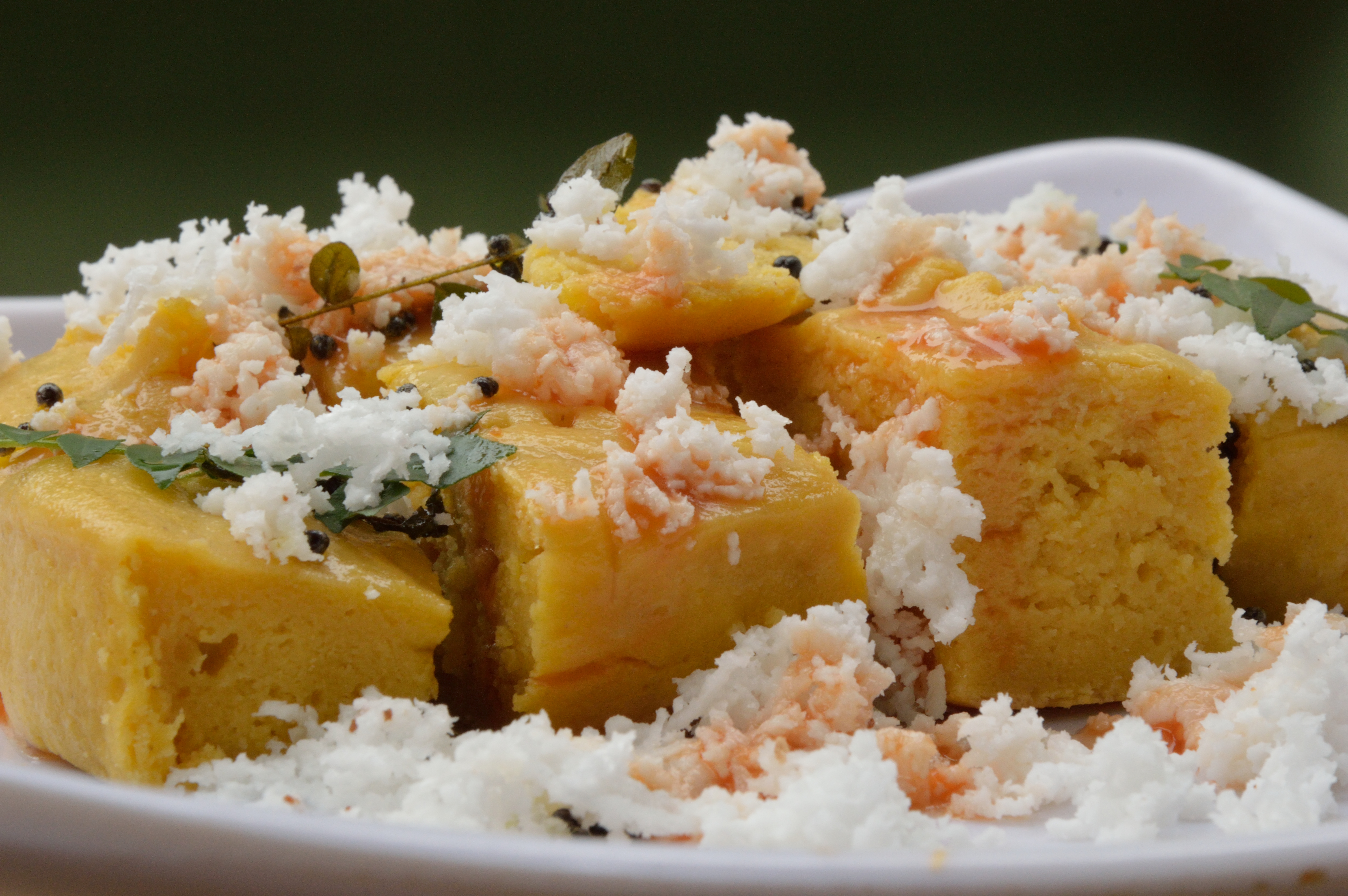
'''Dhokla''' or '''dokla''' is a savoury sponge dish that is native to the [[India]]n state of [[Gujarat]] and parts of adjacent states,<ref>{{cite book|first1=N. R.|last1=Reddy|title=Legume Based Fermented Foods|url=https://books.google.com/books?id=bPlKDwAAQBAJ&pg=PT271|publisher=[[CRC Press]]|date=6 February 2018|isbn=9781351090902|via=Google Books}}</ref> and is popular throughout the country. It is made with a fermented batter that is steamed to a cake-like consistency. The batter consists of a mixture of rice with the pulse ''[[Bengal gram]]'',<ref>{{cite book |last1=Sreeja |first1=J |last2=Prjapati |first2=Jhashbhai B. |title=Ethnic fermented foods and beverages of India : science history and culture |date=2020 |publisher=Springer |location=Singapore |isbn=9789811514852 |page=178 |url=https://books.google.com/books?id=HRHUDwAAQBAJ&dq=dhokla&pg=PA178 |access-date=1 December 2022}}</ref> but has several variants with the gram replaced by [[chickpea]]s, [[pigeon pea]]s, or [[Urad (bean)|urad beans]].<ref>{{cite book |url=https://books.google.com/books?id=Yg6zCwAAQBAJ |title=The Indian Grocery Store Demystified |author=Linda Bladholm |year=2016 |publisher=St. Martin's |isbn=9781250120793 |page=216}}</ref><ref>{{cite book|last=Redhead|first=J. F.|title=Utilization of tropical foods|publisher=Food & Agriculture Org.|year=1989|pages=26|isbn=978-92-5-102774-5|url=https://books.google.com/books?id=xeGVaboCHnAC&pg=PA26}}</ref>
== History ==
== History ==
''Dukkia'', a [[pulse (legume)|pulse]]-based precursor of the dhokla, is mentioned in a [[Jain literature|Jain]] text dated to 1066 CE. The earliest extant work to mention the word "dhokla" is the [[Gujarati language|Gujarati]] ''Varanaka Samuchaya'' (1520 CE).<ref name="KTAchaya1994">{{cite book |author=K. T. Achaya |author-link=K. T. Achaya |title=Indian food: a historical companion |url=https://books.google.com/books?id=-cFcH2ZHWLcC |year=1994 |publisher=Oxford University Press |page=134 |isbn=978-0-19-562845-6 }}</ref>
''Dukkia'', a [[pulse (legume)|pulse]]-based precursor of dhokla, is mentioned in a [[Jain literature|Jain]] text dated to 1066 CE. The earliest extant work to mention the word "dhokla" is the [[Gujarati language|Gujarati]] ''Varanaka Samuchaya'' (1520 CE).<ref name="KTAchaya1994">{{cite book |author=K. T. Achaya |author-link=K. T. Achaya |title=Indian food: a historical companion |url=https://books.google.com/books?id=-cFcH2ZHWLcC |year=1994 |publisher=Oxford University Press |page=134 |isbn=978-0-19-562845-6 }}</ref>
==Preparation==
==Preparation==
Rice and split chickpeas ([[chana dal]]), in a particular ratio (to achieve the desired texture and taste), are soaked overnight. The mixture is ground, and the paste is [[Fermentation|fermented]] for four to five hours or overnight. This is spiced by adding [[chili pepper]], [[Coriander]], [[ginger]] and [[baking soda]].
Dried rice and split chickpeas ([[chana dal]]) are soaked overnight. The mixture is ground, and the paste is fermented for at least four hours. Spices are added, such as chili pepper, coriander, and ginger.
The fermented batter is then [[Steaming|steamed]] for about 15 minutes on a flat dish and cut into pieces. These chopped pieces are seasoned in hot oil with mustard seeds. [[Asafoetida]] and chopped green chillies can also be fried and, sometimes, an equal amount of water. The pieces are then removed from the dish. Sometimes it is also fried in hot oil with cumin seeds.
The fermented batter is then steamed for about 15 minutes and cut into pieces. These chopped pieces are seasoned in sauteed mustard seeds or cumin seeds, green chilis and curry leaves.
It is usually served with deep fried chillies and [[chutney]] made from coriander. It is garnished with [[coriander]] and often with grated coconut.<ref name=Times_of_India>{{cite web|url=https://recipes.timesofindia.com/recipes/khaman-dhokla/rs53908858.cms |title=Khaman Dhokla Recipe |access-date=2 Feb 2020 |url-status=live |archive-url=https://web.archive.org/web/20170222132211/https://recipes.timesofindia.com/recipes/khaman-dhokla/rs53908858.cms |archive-date=22 Feb 2017 }}</ref>
Dhokla is usually served with deep fried chillies and coriander chutney and garnished with fresh coriander and/or grated coconut.<ref name=Times_of_India>{{cite web|url=https://recipes.timesofindia.com/recipes/khaman-dhokla/rs53908858.cms |title=Khaman Dhokla Recipe |access-date=2 Feb 2020 |url-status=live |archive-url=https://web.archive.org/web/20170222132211/https://recipes.timesofindia.com/recipes/khaman-dhokla/rs53908858.cms |archive-date=22 Feb 2017 }}</ref>
Another method is to steam the fermented batter for 10 to 15 minutes on plates placed inside a container that does not allow steam to escape. To avoid steam water falling on the batter during preparation, a cloth may be placed inside the container. The plates are not directly placed on the base, or the batter will burn, so a small stand is used. When the batter is steamed properly, the plates are taken out of the container and then served with raw oil poured over the dhokla, or used as a dip. Other ingredients like curd, tomato sauce, garlic paste, or coriander paste may be used in serving, however, none of these is traditionally eaten with dhokla.<ref name=Times_of_India/> Besides using raw oil, in some preparations Rai seeds (brown mustard seeds) are fried in oil along with curry leaves, this fried spices and oil is then poured over the Dhokla.<ref>{{Cite web|url=https://www.indianrecipeshindi.com/2021/05/dhokla-recipe-in-hindi.html|title = ढोकला रेसिपी - Dhokla Recipe in Hindi}}</ref>
==Types==
[[File:SPECIAL SURATI KHAMAN.jpg|thumb|In contrast to Dhokla, [[khaman]] is made entirely of chickpea batter.]]
==Types of Dhokla==
[[File:SPECIAL SURATI KHAMAN.jpg|thumb|In contrast to Dhokla, [[Khaman]] is made entirely of chickpea batter.]]
There are different kinds of dhokla prepared with different ingredients and ratios of chickpeas. Some of the popular kinds of dhoklas are:
Popular variants of dhokla include:
* Khatta dhokla
* Khatta dhokla
* Rasia dhokla
* Rasia dhokla
Line 46:
Line 45:
* Meetha dhokla
* Meetha dhokla
*[[Besan]] dhokla
*[[Besan]] dhokla
*[[Khaman]] dhokla
[[Khaman]] is a similar gram flour-based food. Whereas dhokla is made with rice and chickpeas, khaman is made from chickpeas only. It is generally lighter in color and softer than dhokla. To make dhokla, a small proportion of baking soda is added while to make khaman more baking soda is added to make it more fluffy, spongy and porous.
[[Khaman]] is similar but made from chickpea flour without rice. It is generally lighter in colour and softer than dhokla.
Idada/Edada is another variety of dhokla, which is made by using different lentils like black grams, also known as [[urad dal]], instead of chickpeas. Dhokla is very commonly used as a breakfast or as a snack in western parts of India including Madhya Pradesh, though nowadays it's available in every Indian state. It is an easy to cook and easy to digest snack.
==See also==
==See also==
Line 58:
Line 54:
* [[List of steamed foods]]
* [[List of steamed foods]]
* [[Khandvi (food)|Khandvi]]
* [[Khandvi (food)|Khandvi]]
* [[Khaman]]
* [[Idli]]
[[File:Stamp of India - 2017 - Colnect 805338 - Popular Dhokla.jpeg|thumb|Dhokla depicted on 2017 stamp from India]]
Dhokla or dokla is a savoury sponge dish that is native to the Indian state of Gujarat and parts of adjacent states,[1] and is popular throughout the country. It is made with a fermented batter that is steamed to a cake-like consistency. The batter consists of a mixture of rice with the pulse Bengal gram,[2] but has several variants with the gram replaced by chickpeas, pigeon peas, or urad beans.[3][4]
Dukkia, a pulse-based precursor of dhokla, is mentioned in a Jain text dated to 1066 CE. The earliest extant work to mention the word "dhokla" is the GujaratiVaranaka Samuchaya (1520 CE).[5]
Dried rice and split chickpeas (chana dal) are soaked overnight. The mixture is ground, and the paste is fermented for at least four hours. Spices are added, such as chili pepper, coriander, and ginger.
The fermented batter is then steamed for about 15 minutes and cut into pieces. These chopped pieces are seasoned in sauteed mustard seeds or cumin seeds, green chilis and curry leaves.
Dhokla is usually served with deep fried chillies and coriander chutney and garnished with fresh coriander and/or grated coconut.[6]