




→What Sankaranti is celebrated in different places as: alphabetised and some cleanup. Article needs more cleanup in future iterations. |
m minor edit |
||
| Line 1: | Line 1: | ||
{{short description|Hindu festival that reveres Surya (sun god)}} | {{short description|Hindu festival that reveres Surya (sun god)}} | ||
{{EngvarB|date=April 2015}} | {{EngvarB|date=April 2015}} | ||
{{Use dmy dates|date= | {{Use dmy dates|date=November 2021}} | ||
{{Infobox holiday | {{Infobox holiday | ||
|holiday_name = Makar Sankranti | | holiday_name = Makar Sankranti | ||
|type = Hindu | | type = Hindu | ||
|image = | | image = Photo of makar sankranti devootees.jpg | ||
|caption = | | caption = Holy dip by devotees in river Ganga on the occasion of Makar Sankranti | ||
|nickname = | | nickname = Uttarayana<br />Sankranti<br />Til Sakraat<br />Magha<br />Môkôr Sôṅkrānti<br /> Mela<br />Ghughuti<br />Pedda Panduga<br /> Bhogi<br /> Sakraat<br />Pongal<br />Peddha Panduga<br/>Sakrat<br />Khichaṛi<br />Sankramana | ||
|longtype = Religious | | longtype = Religious and cultural, harvest festival | ||
|date = | | date = First day of ''makara'' [[Astronomical basis of the Hindu calendar#sauramasa|masa, Bhogi]] (15 January in [[leap year]]s; 14 January on all other years) | ||
| celebrations = Kite flying, bonfires, fairs, feast, arts, dance, socialization | |||
| relatedto = [[Pongal (festival)|Pongal]], [[Lohri]], [[Lal Loi]], [[Maghe Sankranti]], [[Magh Bihu]], [[Tusu Festival]] | |||
|celebrations = Kite flying, bonfires, fairs | | firsttime = | ||
|relatedto = [[Pongal (festival)|Pongal]], [[ | | weekday = | ||
|firsttime=|weekday=|frequency=Annual|duration= | | frequency = Annual | ||
| duration = 1 day | |||
| scheduling = | |||
| official_name = | |||
| ends = | |||
| significance = A harvest festival, a celebration of the mid-winter solstice | |||
| litcolor = Red | |||
| observedby = [[Hindu]]s, [[Buddhist]]s, [[Sikh]]s, [[Jain]]s | |||
| alt = | |||
| startedby = | |||
}} | |||
{{Hinduism}} | {{Hinduism}} | ||
'''< | '''Makar(a) Sankrānti''' ({{Langx|sa|मकरसङ्क्रान्ति|translit=Makarasaṅkrānti}}),<ref>{{Cite web |last=www.wisdomlib.org |date=2019-03-20 |title=Makarasankranti, Makarasaṅkrānti, Makara-sankranti, Makarasamkramti: 3 definitions |url=https://www.wisdomlib.org/definition/makarasankranti |access-date=2022-12-05 |website=www.wisdomlib.org |language=en |archive-date=5 December 2022 |archive-url=https://web.archive.org/web/20221205040625/https://www.wisdomlib.org/definition/makarasankranti |url-status=live }}</ref> ({{Translation|Capricorn Festival}}) also referred to as '''Uttarāyana''', '''Makara''', or simply '''Sankrānti''', is a [[Hinduism|Hindu]] observance and a mid-winter [[harvest festival]] in [[India]] and [[Nepal]].<ref>{{cite web | url=https://books.google.com/books?id=aGcsEQAAQBAJ&q=harvest+festival | title=The Journey of Light: Makar Sankranti and the Equinox | last1=Jacobson | first1=Jayson | date=26 October 2024 }}</ref><ref>{{cite web |last1=Thakur |first1=Anjali |title=Makar Sankranti 2025: Know The Importance Of Flying Kites During This Time Of The Year |url=https://www.ndtv.com/offbeat/makar-sankranti-2025-know-the-importance-of-flying-kites-during-this-time-of-the-year-7463511 |website=[[NDTV]] |access-date=13 January 2025 |date=13 January 2025}}</ref> It is typically celebrated on 14 January annually (15 January on a leap year),<ref name="Tumuluru2015p30">{{cite book|author=Kamal Kumar Tumuluru|title=Hindu Prayers, Gods and Festivals|url= https://books.google.com/books?id=b2iyCAAAQBAJ&pg=PT30 |year=2015| publisher=Partridge|isbn= 978-1-4828-4707-9|page=30}}</ref><ref name="Melton2011p547" /><ref>{{Cite book|title=Holidays, festivals, and celebrations of the world dictionary Third edition.|last=Henderson|first=Helene|publisher=Detroit: Omnigraphics|year=2005|isbn= 0-7808-0982-3|location=Electronic edition|page=xxix}}</ref> this occasion marks the transition of the sun from the zodiac of Sagittarius (''dhanu'') to Capricorn (''[[makara]]'').<ref name="Tumuluru2015p30" /><ref>{{Cite book |last=Singh |first=K. V. |url=https://books.google.com/books?id=uzoHCwAAQBAJ&dq=makar+sankranti+transition&pg=PT33 |title=Hindu Rites and Rituals: Origins and Meanings |date=2015-11-25 |publisher=Penguin UK |isbn=978-93-85890-04-8 |pages=33 |language=en |access-date=30 January 2023 |archive-date=22 July 2023 |archive-url=https://web.archive.org/web/20230722083847/https://books.google.com/books?id=uzoHCwAAQBAJ&dq=makar+sankranti+transition&pg=PT33 |url-status=live }}</ref><ref name="Lochtefeld2002p411">{{cite book|author=James G. Lochtefeld|title=The Illustrated Encyclopedia of Hinduism: A–M|url=https://books.google.com/books?id=VNzLMgEACAAJ|year=2002|publisher=Rosen Publishing Group|isbn=978-0-8239-2287-1|page=411|access-date=23 January 2018|archive-date=22 July 2023|archive-url=https://web.archive.org/web/20230722083848/https://books.google.com/books?id=VNzLMgEACAAJ|url-status=live}}</ref> As this transition coincides with the sun's movement from south to north, the festival is dedicated to the solar deity, [[Surya]],<ref>{{Cite book |last=Melton |first=J. Gordon |url=https://books.google.com/books?id=KDU30Ae4S4cC&dq=makar+sankranti+surya&pg=PA547 |title=Religious Celebrations: An Encyclopedia of Holidays, Festivals, Solemn Observances, and Spiritual Commemorations |date=2011 |publisher=ABC-CLIO |isbn=978-1-59884-205-0 |pages=547 |language=en |access-date=30 January 2023 |archive-date=22 July 2023 |archive-url=https://web.archive.org/web/20230722083849/https://books.google.com/books?id=KDU30Ae4S4cC&dq=makar+sankranti+surya&pg=PA547 |url-status=live }}</ref> and is observed to mark a new beginning.<ref>{{Cite book |last=Fieldhouse |first=Paul |url=https://books.google.com/books?id=P-FqDgAAQBAJ&dq=makar+sankranti+moksha&pg=PA349 |title=Food, Feasts, and Faith: An Encyclopedia of Food Culture in World Religions [2 volumes] |date=2017-04-17 |publisher=ABC-CLIO |isbn=978-1-61069-412-4 |pages=349 |language=en |access-date=30 January 2023 |archive-date=22 July 2023 |archive-url=https://web.archive.org/web/20230722083849/https://books.google.com/books?id=P-FqDgAAQBAJ&dq=makar+sankranti+moksha&pg=PA349 |url-status=live }}</ref> Across India, the occasion is celebrated with numerous multi-day festivals. | ||
The festivities associated with Makar Sankranti are known by various names including ''Sankranthi or Peddha Panduga'' in [[Andhra Pradesh]] and [[Telangana]],<ref name="htmakar">{{Cite web |date=2017-01-14 |title=After a 100 years, Makar Sankranti gets a new date |url=https://www.hindustantimes.com/india-news/after-a-100-years-makar-sankranti-gets-a-new-date/story-pvh98WVqDQBXdvP9LFOoUO.html |access-date=2024-03-12 |website=Hindustan Times |language=en |archive-date=12 March 2024 |archive-url=https://web.archive.org/web/20240312091804/https://www.hindustantimes.com/india-news/after-a-100-years-makar-sankranti-gets-a-new-date/story-pvh98WVqDQBXdvP9LFOoUO.html |url-status=live }}</ref><ref name="desai30">{{cite book |author=Nikita Desai |url=https://books.google.com/books?id=5VsaBwAAQBAJ&pg=PA30 |title=A Different Freedom: Kite Flying in Western India; Culture and Tradition |publisher=Cambridge Scholars Publishing |year=2010 |isbn=978-1-4438-2310-4 |pages=30–33}}</ref> ''Khichari'' in [[Bhojpuri region]], ''[[Magh Bihu]]'' in [[Assam]], ''Maghi Saaji'' in [[Himachal Pradesh]], ''[[Makaravilakku]]'' in [[Kerala]], Makara sankranti in [[Karnataka]], ''Maghi Sangrand'' in Punjab, [[Pongal (festival)|''Pongal'']] in Tamil Nadu, ''Maghi Sangrand'' or ''Uttarain'' (Uttarayana) in Jammu, ''Sakrat'' in Haryana, Sakraat in Rajasthan, ''Sukarat'' in central India, ''[[Uttarayana]]'' in [[Gujarat]] and Uttar Pradesh, ''Ghughuti'' in Uttarakhand, ''Dahi Chura'' in Bihar, ''Makar Sankranti'' in Odisha, Jharkhand, Maharashtra, Goa, West Bengal (also called ''Poush Sankranti or Mokor Sonkranti''), Uttar Pradesh (also called ''Khichidi Sankranti''), Uttarakhand (also called ''Uttarayani'') or as simply, ''[[Maghe Sankranti]]'' (Nepal), [[Songkran (Thailand)|''Songkran'']] (Thailand), ''Thingyan'' (Myanmar), ''Mohan Songkran'' (Cambodia), Til Sakraat in Mithila, and ''Shishur Senkrath'' (Kashmir). On Makar Sankranti, [[Surya]] (Hindu solar deity) is worshipped along with [[Vishnu]] and goddess [[Lakshmi]] throughout India.<ref>{{cite news|title=Makar Sankranti 2021: Know Why Makar Sankranti Festival Is Celebrated|url=https://www.ndtv.com/india-news/makar-sankranti-2021-date-history-significance-of-makar-sankranti-festival-2350647|publisher=NDTV|date=11 January 2021|access-date=7 July 2021|archive-date=9 July 2021|archive-url=https://web.archive.org/web/20210709190323/https://www.ndtv.com/india-news/makar-sankranti-2021-date-history-significance-of-makar-sankranti-festival-2350647|url-status=live}}</ref> | |||
Makar Sankranti is observed with social festivities such as colourful decorations, rural children going house to house, singing and asking for treats in some areas,<ref name="PuriNesbitt2013p34">{{cite book|author1=Kailash Puri|author2=Eleanor Nesbitt|title=Pool of Life: The Autobiography of a Panjabi Agony Aunt|url=https://books.google.com/books?id=L_NWAgAAQBAJ&pg=PA34|year=2013|publisher=Sussex Academic Press|isbn=978-1-78284-067-1|pages=34–35}}</ref> ''melas'' (fairs), dances, kite flying, bonfires and feasts.<ref name=desai30/><ref>{{cite book|author=[[Kapila Vatsyayan]]|title=Traditions of Indian folk dance|url=https://books.google.com/books?id=I2K1AAAAIAAJ|year=1987|publisher=Clarion Books |isbn=978-0-85655-253-3|pages=192–193}}</ref> The ''Magha Mela'' is mentioned in the Hindu epic ''[[Mahabharata]]''.<ref name=eck153 /> Many observers go to sacred rivers or lakes and bathe in a ceremony of thanks to the Sun.<ref name=eck153>{{cite book|author=Diana L. Eck|title=India: A Sacred Geography|url=https://books.google.com/books?id=PyC4o7i9tnEC&pg=PA153|year=2013|publisher=Random House|author-link=Diana L. Eck|isbn=978-0-385-53192-4|pages=152–154|access-date=7 March 2017|archive-date=22 July 2023|archive-url=https://web.archive.org/web/20230722083855/https://books.google.com/books?id=PyC4o7i9tnEC&pg=PA153|url-status=live}}</ref> Every twelve years, the Hindus observe ''Makar Sankranti'' with [[Kumbha Mela]] – one of the world's largest mass pilgrimage, with an estimated 60 to 100 million people attending the event.<ref name=eck153 /><ref>[https://www.theatlantic.com/photo/2013/01/kumbh-mela-the-largest-gathering-on-earth/100438/ Kumbha Mela: The Largest Gathering on Earth] {{Webarchive|url=https://web.archive.org/web/20201229174128/https://www.theatlantic.com/photo/2013/01/kumbh-mela-the-largest-gathering-on-earth/100438/ |date=29 December 2020 }}, Alan Taylor, ''The Atlantic'' (14 January 2013)</ref><ref>[http://www.npr.org/sections/thetwo-way/2013/01/14/169313222/biggest-gathering-on-earth-begins-in-india-kumbha-mela-may-draw-100-million Biggest Gathering On Earth' Begins In India; Kumbha Mela May Draw 100 Million] {{Webarchive|url=https://web.archive.org/web/20230722083832/https://www.npr.org/sections/thetwo-way/2013/01/14/169313222/biggest-gathering-on-earth-begins-in-india-kumbh-mela-may-draw-100-million |date=22 July 2023 }}, Mark Memmott, NPR, Washington DC (14 January 2013)</ref> At this event, they say a prayer to the Sun and bathe at the [[Triveni Sangam|Prayagaraj confluence]] of the River Ganga and River Yamuna,<ref name=eck153 /> a tradition attributed to [[Adi Shankaracharya]].<ref>Roshan Dalal (2011), The Religions of India: A Concise Guide to Nine Major Faiths, Penguin, {{ISBN|978-0-14-341517-6}}, see Kumbh Mela entry</ref> Makar Sankranti is a time of celebration and thanks giving, and is marked by a variety of rituals and tradition.<ref>{{Cite web |url=https://www.nayasafar.in/2023/07/makar-sankranti.html |title=Makar Sankranti |access-date=19 July 2023 |archive-date=22 July 2023 |archive-url=https://web.archive.org/web/20230722084522/https://www.nayasafar.in/2023/07/makar-sankranti.html |url-status=live }}</ref> | |||
== Date variations == | |||
{{Solstice-equinox-sankranti}} | |||
Makar Sankranti is set by the [[solar cycle]] and corresponds to the exact time astronomical event of the Sun entering Capricorn and is observed on a day that usually falls on 14 January of the Gregorian calendar, but on 15 January in leap years. Makar Sankranti's date and time is analogous to [[Sidereal and tropical astrology|Sidereal time of Zodiac]] sign of Capricorn (when sun enters).<ref name="Capricorn-zodiac-1" >{{cite web |title=sun enters Capricorn zodiac |url=https://www.drikpanchang.com/sankranti/info/makar-sankranti.html |access-date=28 October 2021 |archive-date=28 October 2021 |archive-url=https://web.archive.org/web/20211028130954/https://www.drikpanchang.com/sankranti/info/makar-sankranti.html |url-status=live }}</ref> | |||
The | The year is 365.24 days long and the time difference between the two consecutive instances of Makar Sankranti is almost the same as the year. There are 365 days in a year. Thus, every four years the calendar is offset by one day which is adjusted by adding leap day (29 February). Hence, Makar Sankranti falls on 15 January every leap year. Sidereal time of sign of Capricorn also shifts by a day due to leap year. Similarly, the time of equinoxes also shifts by a day in each four year window. For example, the equinox of September does not fall on the same date each year nor does the winter solstice. Any event related to one revolution of the Earth around the Sun will have this date shift within a four year cycle. Similar changes can be seen in the exact time of solstices and equinoxes. See the table, how the time of the equinox and a solstice increases and decreases in a cycle of four years.<ref>{{cite web |title=Solstices, Equinoxes and Leap Years |url=https://www.gi.alaska.edu/alaska-science-forum/solstices-equinoxes-and-leap-years |access-date=28 October 2021 |archive-date=28 October 2021 |archive-url=https://web.archive.org/web/20211028131957/https://www.gi.alaska.edu/alaska-science-forum/solstices-equinoxes-and-leap-years |url-status=live }}</ref> | ||
The time difference between two consecutive winter solstices is about 5 hours 49 minutes 59 seconds, with respect to winter solstice time, and the time difference between two consecutive Mankar Sankranti is about 6 hours and 10 minutes. Towards the end of the 21st century, there will be more occurrences of Makar Sankranti on 15 January in a four-year cycle. | |||
And Makar Sankranti will be on 16 January for the first in the year 2102 as 2100 will not be a leap year.<ref>{{Cite news|date=January 10, 2022|first1=Chirag Bejan|last1=Daruwalla|title=Makar Sankranti 2022: Know how Uttarayan 2022 will impact your zodiac sign|url=https://timesofindia.indiatimes.com/astrology/planets-transits/makar-sankranti-2022-know-how-uttarayan-2022-will-impact-your-zodiac-sign/articleshow/88803744.cms|access-date=2022-01-14|newspaper=The Times of India|language=en|archive-date=15 January 2022|archive-url=https://web.archive.org/web/20220115023012/https://timesofindia.indiatimes.com/astrology/planets-transits/makar-sankranti-2022-know-how-uttarayan-2022-will-impact-your-zodiac-sign/articleshow/88803744.cms|url-status=live}}</ref> | |||
== | === Makar Sankranti and Uttar Ayana === | ||
[[ | {{See also|Astronomical basis of the Hindu calendar}} | ||
Makar Sankranti is celebrated when the Sun's [[Ecliptic coordinate system|ecliptic longitude]] becomes [[Hindu astrology#rashi|270° measured from a fixed starting point]] which is in opposition to [[Spica]],{{refn|name=chitrapaksha|{{cite book|title= Traditions of Science. Cross--cultural Perspectives. Essays in honour of B.V. Subbarayappa|first=Raymond|last=Mercier|publisher=Munshiram Manoharlal Publishers|date=2007|location=New Delhi|editor-first1=Purushottama|editor-last1=Bilimoria|editor-first2=Sridhar|editor-last2=Melukote|at=See discussion of ''Citrā pakṣa''}} }} i.e. this is a [[Sidereal year|sidereal]] measure. [[Uttarayan|Uttarayana]] begins when the Sun's ecliptic longitude becomes 270° measured from the Vernal equinox,{{refn|This is the same as saying "when the Sun reaches the [[winter solstice|December solstice]] point"}} i.e. this is a [[tropical year|tropical]] measure. While both concern a measure of 270° their starting points are different. Hence, Makar Sankranti and Uttarayana occur on different days. On the Gregorian calendar, Makar Sankranti occurs on 14 or 15 January; Uttarayana starts on 21 December. | |||
Due to the [[Axial precession|precession of the equinoxes]] the tropical zodiac (i.e. all the equinoxes and solstices) shifts by about 1° in 72 years. As a result, the December solstice (Uttarayana) is continuously but very slowly moving away from Makar Sankranti. Conversely, the December solstice (Uttarayana) and Makar Sankranti must have coincided at some time in the distant past. Such a coincidence last happened 1700 years back, in 291 CE.{{refn|name=chitrapaksha}} | |||
== Significance == | == Significance == | ||
Every year ''Makar Sankranti'' is celebrated in the month of January | Every year ''Makar Sankranti'' is celebrated in the month of January. This festival is dedicated to the Hindu religious sun god ''Surya''.<ref name="Melton2011p547">{{cite book|author=J. Gordon Melton|title=Religious Celebrations: An Encyclopedia of Holidays, Festivals, Solemn Observances, and Spiritual Commemorations|url=https://books.google.com/books?id=KDU30Ae4S4cC&pg=PA547|year=2011|publisher=ABC-CLIO|isbn=978-1-59884-205-0|pages=547–548|access-date=7 March 2017|archive-date=22 July 2023|archive-url=https://web.archive.org/web/20230722084357/https://books.google.com/books?id=KDU30Ae4S4cC&pg=PA547|url-status=live}}, ''Quote:'' "Makara Sankranti (14 January); Makara Sankranti is a festival held across India, under a variety of names, to honor the god of the sun, Surya."</ref><ref>{{cite journal | last=Beteille | first=Andre | title=A Note on the Pongal Festival in a Tanjore Village | journal=Man | volume=64 | year=1964 | issue=2 | doi=10.2307/2797924 | pages=73–75, see discussion of Makar Sankranti| jstor=2797924 }}</ref> This significance of Surya is traceable to the Vedic texts, particularly the [[Gayatri Mantra]], a sacred hymn of Hinduism found in its scripture named the ''[[Rigveda]]''. Makara Sankranti is also associated with the birth and coming of the final Avatar of the Hindu God Vishnu, Kalki. | ||
Makara Sankranti is regarded as important for spiritual practices and accordingly, people take a holy dip in rivers, especially [[Ganges|Ganga]], [[Yamuna]], [[Godavari]], [[Krishna River|Krishna]] and [[Kaveri]]. The bathing is believed to result in merit or absolution of past sins. They also pray to the | Makara Sankranti is regarded as important for spiritual practices and accordingly, people take a holy dip in rivers, especially [[Ganges|Ganga]], [[Yamuna]], [[Godavari]], [[Krishna River|Krishna]] and [[Kaveri]]. The bathing is believed to result in merit or absolution of past sins. They also pray to the Sun and give thanks for their successes and prosperity.<ref name="books.google.co.uk">Tumuluru, Kamal Kumar (2015 hi me rpota), [https://books.google.com/books?id=b2iyCAAAQBAJ&pg=PT31 Hindu Prayers, Gods and Festivals] {{Webarchive|url=https://web.archive.org/web/20230722084340/https://books.google.com/books?id=b2iyCAAAQBAJ&pg=PT31 |date=22 July 2023 }}, Partridge Publishing</ref> A shared cultural practices found amongst Hindus of various parts of India is making sticky, bound sweets particularly from sesame (''til'') and a sugar base such as jaggery (''gud, gur, gul''). This type of sweet is a symbolism for being together in peace and joyfulness, despite the uniqueness and differences between individuals.<ref name="Melton2011p547"/> For most parts of India, this period is a part of early stages of the Rabi crop and agricultural cycle, where crops have been sown and the hard work in the fields is mostly over. The time thus signifies a period of socializing and families enjoying each other's company, taking care of the cattle, and celebrating around bonfires, in Gujarat the festival is celebrated by flying kites.<ref name="Melton2011p547"/> | ||
Makara Sankranti is an important pan-Indian solar festival, known by different names though observed on the same date, sometimes for multiple dates around the Makar Sankranti. It is known as Pedda Panduga in Andhra Pradesh | Makara Sankranti is an important pan-Indian solar festival, known by different names though observed on the same date, sometimes for multiple dates around the Makar Sankranti. It is known as ''Pedda Panduga'/'Makara Sankranti'' in Andhra Pradesh, ''Makara Sankranti'' in Karnataka, Telangana, and Maharashtra, ''Pongal'' in Tamil Nadu,<ref>{{Cite web|title=Sankranti in India|url=https://www.news18.com/news/lifestyle/makar-sankranti-the-way-it-is-celebrated-in-states-across-india-1335352.html|access-date=2022-01-14|website=News18|date=14 January 2020|language=en|archive-date=13 January 2021|archive-url=https://web.archive.org/web/20210113062614/https://www.news18.com/news/lifestyle/makar-sankranti-the-way-it-is-celebrated-in-states-across-india-1335352.html|url-status=live}}</ref> ''[[Magh Bihu]]'' in Assam, ''Magha Mela'' in parts of central and north India, as ''Makar Sankranti'' in the west, ''Makara Sankranti'' or ''Shankaranti'' in Kerala,<ref>{{Cite web|title=Sankranti in India|url=https://www.news18.com/news/lifestyle/makar-sankranti-the-way-it-is-celebrated-in-states-across-india-1335352.html|access-date=2022-01-14|website=News18|date=14 January 2020|language=en|archive-date=13 January 2021|archive-url=https://web.archive.org/web/20210113062614/https://www.news18.com/news/lifestyle/makar-sankranti-the-way-it-is-celebrated-in-states-across-india-1335352.html|url-status=live}}</ref> and by other names.<ref name="Melton2011p547"/> | ||
==Nomenclature and regional names== | ==Nomenclature and regional names== | ||
{{more citations needed section|date=January 2022}} | |||
[[File:A night lit up on Makar Sankranti Uttarayana Festival with Kites and Lights India.jpg|thumb|A night lit up on Makar Sankranti Uttarayana Festival with Kites and Lights.]] | [[File:A night lit up on Makar Sankranti Uttarayana Festival with Kites and Lights India.jpg|thumb|A night lit up on Makar Sankranti Uttarayana Festival with Kites and Lights.]] | ||
Makara | Makar or Makara Sankranti is celebrated in many parts of the [[Indian subcontinent]] with some regional variations. It is known by different names and celebrated with different customs in different Indian states and South Asian countries: | ||
* ''' | *'''Sankranti, Makara Sankranti, Makara Sankramanam, Pedda Panduga:''' [[Andhra Pradesh]], [[Telangana]]<ref>{{Cite web|title=Sankranti 2022: పండుగ ఒక్కటే.. వేడుకలు అనేకం.. మకర సంక్రాంతి ప్రత్యేకత ఇదే!|url=https://telugu.news18.com/news/astrology/different-names-for-makar-sankranthi-across-india-rnk-1152544.html|access-date=2022-01-14|website=News18 Telugu|language=te|archive-date=14 January 2022|archive-url=https://web.archive.org/web/20220114172732/https://telugu.news18.com/news/astrology/different-names-for-makar-sankranthi-across-india-rnk-1152544.html|url-status=live}}</ref> | ||
* ''' | *'''Pusna:''' [[West Bengal]], [[Assam]], [[Meghalaya]]<ref>{{Cite web|title=Assam {{!}} History, Map, Population, & Facts {{!}} Britannica|url=https://www.britannica.com/place/Assam|access-date=2022-01-14|website=www.britannica.com|language=en|archive-date=7 January 2022|archive-url=https://web.archive.org/web/20220107134318/https://www.britannica.com/place/Assam|url-status=live}}</ref> | ||
*''' | * '''Suggi Habba, Makara Sankramana, Makara Sankranti:''' [[Karnataka]]<ref>{{Cite web|last=Roy|first=Nikita|title=Makar Sankranti In Karnataka: Date, Significance And Celebration Of Suggi Habba|url=https://www.india.com/festivals-events/makar-sankranti-in-karnataka-date-significance-and-celebration-of-suggi-habba-2843830/|access-date=2022-01-14|website=www.india.com|date=15 January 2018|language=en|archive-date=9 August 2021|archive-url=https://web.archive.org/web/20210809082617/https://www.india.com/festivals-events/makar-sankranti-in-karnataka-date-significance-and-celebration-of-suggi-habba-2843830/|url-status=live}}</ref> | ||
* ''' | * '''Makar Sankranti''', '''Uttarayana''' or '''Ghughuti''': [[Uttarakhand]] | ||
* ''' | * '''Makar Sankranti''' or''' Makara Mela''' and '''Makara Chaula''': [[Odisha]] | ||
* ''' | * '''Makar Sankranti''' or '''Sankaranti''' or '''Shankaranti''': [[Kerala]]<ref>{{Cite web|title=Sankranti in India|url=https://www.news18.com/news/lifestyle/makar-sankranti-the-way-it-is-celebrated-in-states-across-india-1335352.html|access-date=2022-01-14|website=News18|date=14 January 2020|language=en|archive-date=13 January 2021|archive-url=https://web.archive.org/web/20210113062614/https://www.news18.com/news/lifestyle/makar-sankranti-the-way-it-is-celebrated-in-states-across-india-1335352.html|url-status=live}}</ref> | ||
* '''Makar Sankranti''', '''Maghi | * '''Makar Sankranti''' or '''Dahi Chura''' or '''Til Sankranti''': [[Mithila (region)|Mithila]], [[Jharkhand]], [[Bihar]], [[Chhattisgarh]], [[Madhya Pradesh]], [[Rajasthan]], [[Delhi]] | ||
* '''Hangrai''' : [[Tripura]] | * '''Makar Sankranti''', '''Maghi Sankranti''', '''[[Haldi Kumkum]]''' or '''Sankranti''': [[Maharashtra]], [[Jammu]], [[Goa]], [[Nepal]], [[Sikkim]] | ||
* '''[[ | * '''Hangrai''': [[Tripura]]<ref>{{cite web | url=https://www.india.com/viral/11-different-names-of-makar-sankranti-across-the-world-861293/ | title=Makara Sankranti 2023: 11 Different names of Makar Sankranti Across the world! | access-date=1 November 2022 | archive-date=1 November 2022 | archive-url=https://web.archive.org/web/20221101103249/https://www.india.com/viral/11-different-names-of-makar-sankranti-across-the-world-861293/ | url-status=live }}</ref> | ||
* '''[[Uttarayan]]:''' [[Gujarat]] | * '''[[Pongal (festival)|Pongal]]''' or '''Uzhavar Thirunal''': [[Tamil Nadu]], [[Sri Lanka]], [[Singapore]], [[Malaysia]] | ||
* '''[[Maghi]]:''' [[Haryana]], [[Himachal Pradesh]] | * '''[[Uttarayan|Uttarayana]]:''' [[Gujarat]] | ||
* '''[[Maghi]]:''' [[Haryana]], [[Himachal Pradesh]] [[Punjab, India|Punjab]] | |||
* '''[[Magh Bihu]]''' or '''Bhogali Bihu''': [[Assam]] | * '''[[Magh Bihu]]''' or '''Bhogali Bihu''': [[Assam]] | ||
* '''[[Parshuram Kund]] Mela''' or '''Makara Sankranti''': [[Arunachal Pradesh]] | |||
* '''Shishur Saenkraat:''' [[Kashmir Valley]]<ref name="books.google.co.uk"/> | * '''Shishur Saenkraat:''' [[Kashmir Valley]]<ref name="books.google.co.uk"/> | ||
* '''Sakraat''' or '''Khichdi:''' [[Uttar Pradesh]] and western [[Bihar]] | * '''Makar Sakraat''' or '''Khichdi Parv:''' [[Uttar Pradesh]] and western [[Bihar]] | ||
* '''Poush Sangkranti''': [[West Bengal]], [[Bangladesh]] | * '''Poush Sangkranti''': [[West Bengal]], [[Bangladesh]] | ||
* '''Tila Sakrait:''' [[Mithila, India|Mithila]] | * '''Tila Sakrait:''' [[Mithila, India|Mithila]] | ||
* '''Tirmoori:''' | * '''Tirmoori:''' Pakistan | ||
In most regions of India, Sankranti festivities last for two to four days of which each day is celebrated with distinct names and rituals.<ref>{{Cite web|url=http://www.drikpanchang.com/sankranti/info/makar-sankranti.html|title=Makar Sankranti | In most regions of India, Sankranti festivities last for two to four days of which each day is celebrated with distinct names and rituals.<ref name="capricorn-zodiac">{{Cite web|url=http://www.drikpanchang.com/sankranti/info/makar-sankranti.html|title=Makar Sankranti|website=drikpanchang.com|language=en|access-date=2020-01-15|archive-date=15 January 2020|archive-url=https://web.archive.org/web/20200115103333/https://www.drikpanchang.com/sankranti/info/makar-sankranti.html|url-status=live}}</ref> | ||
* Day 1 – Maghi (preceded by Lohri), Bhogi Panduga | * Day 1 – Maghi (preceded by Lohri), Bhogi Panduga | ||
* Day 2 – | * Day 2 – Makara Sankranti, Pongal, Pedda Panduga, Uttarayana, Magh Bihu | ||
* Day 3 – Mattu Pongal, Kanuma Panduga | * Day 3 – Mattu Pongal, Kanuma Panduga | ||
* Day 4 – Kaanum Pongal, Mukkanuma | * Day 4 – Kaanum Pongal, Mukkanuma | ||
| Line 71: | Line 91: | ||
[[File:It called makar sankranti or a festival of kite flying. when sun go to north pole or in his zodiac sign Capricorn.this festival organized then or every year 14 th January. - panoramio.jpg|thumb|Kite flying is a tradition of Makar Sankranti in many parts of India.]] | [[File:It called makar sankranti or a festival of kite flying. when sun go to north pole or in his zodiac sign Capricorn.this festival organized then or every year 14 th January. - panoramio.jpg|thumb|Kite flying is a tradition of Makar Sankranti in many parts of India.]] | ||
It is celebrated differently across the Indian subcontinent. Many people take a dip in places like [[Sagar Island|Ganga Sagar]] and pray to the Sun God ([[Surya]]). It is celebrated with pomp in southern parts of India as Sankranti in [[Andhra Pradesh]], Telangana and Karnataka (Pongal in Tamil Nadu), and in [[Punjab, India|Punjab]] as [[Maghi]]. | It is celebrated differently across the Indian subcontinent. Many people take a dip in places like [[Sagar Island|Ganga Sagar]] and pray to the Sun God ([[Surya]]). It is celebrated with pomp in southern parts of India as Sankranti in [[Andhra Pradesh]], Telangana and Karnataka (Pongal in Tamil Nadu), and in [[Punjab, India|Punjab]] as [[Lohri]] | ||
Many [[mela]]s or fairs are held on Makar Sankranti the most famous being the [[Kumbha Mela]], held every 12 years at one of four holy locations, namely ''[[Haridwar]]'', ''Prayag'' (''[[Prayagraj]]''), ''[[Ujjain]]'' and ''[[Nashik]],'' the ''Magha Mela'' (or ''mini-Kumbh Mela'' held annually at Prayag) and the ''[[Gangasagar Mela]]'' (held at the head of the [[Ganges River]], where it flows into the [[Bay of Bengal]]).<ref name="Lochtefeld2002p411" /> Makar Mela in [[Odisha]]. Tusu Mela also called as Tusu Porab is celebrated in many parts of Jharkhand and West Bengal. [[Poush Mela]], held traditionally on the seventh day of Poush, at [[Shantiniketan]], in [[West Bengal]], is unrelated to this festival. [[Mela Maghi]] is held in memory of the forty Sikh martyrs (''Chalis Mukte'') who gave their lives to protect [[Guru Gobind Singh]], the tenth Guru of Sikhism, every year at Muktsar Sahib in Punjab. Before this tradition, the festival was observed and mentioned by [[Guru Amar Das]], the third Guru of Sikhism.<ref>{{Cite book|title=Glimpses of Sikhism|last=Jawandha|first=Nahar Singh|publisher=Sanbun Publishers.|date=1 January 2010}}</ref> | |||
[[File:Festive bites.jpg|thumb|right|Feast of Makar Sankranti]] | |||
===Andhra Pradesh and Telangana=== | |||
The festival Sankranti is celebrated for four days in Andhra Pradesh and Telangana.<ref>{{cite book |last1=Rajat |first1=Gupta |last2=Singh |first2=Nishant |last3=Kirar |first3=Ishita |last4=Kumar Bairwa |first4=Mahesh |title=Hospitality & Tourism Management |publisher=Vikas Publishing House |isbn=978-93-259-8244-4 |page=78 |url=https://books.google.com/books?id=DatDDAAAQBAJ&dq=Bhogi+festival+andhra+pradesh&pg=PA78 |access-date=14 March 2023 |archive-date=22 July 2023 |archive-url=https://web.archive.org/web/20230722084340/https://books.google.com/books?id=DatDDAAAQBAJ&dq=Bhogi+festival+andhra+pradesh&pg=PA78 |url-status=live }}</ref> [[Telugu people|Telugu]] women decorate the entrance of their homes by geometric patterns drawn using colored rice flour, called [[Kolam|Muggu]]. | |||
*Day 1 – [[Bhogi]] | |||
*Day 2 – Pedda Panduga/Sankranti, the main festival day | |||
*Day 3 – Kanuma | |||
*Day 4 – Mukkanuma | |||
'''Bhogi''' | |||
[[ | [[Bhogi]] is the first day of the four-day festival. It is celebrated with a bonfire with logs of wood, other solid-fuels, and wooden furniture at home that are no longer useful. In the evening, a ceremony called Bhogi Pallu, fruits of the harvest such as [[Jujube|regi pallu]] and [[sugarcane]] are collected along with flowers of the season. Money is often placed into a mixture of treats and is poured over children. The children then collect the money and sweet fruits. | ||
===[[ | ;Pedda Panduga/Sankranti | ||
The second and main day of the four-day festival, and is dedicated to the Hindu god [[Surya]].<ref name="Mathews2017p207">{{cite book |last1=Mathew |first1=Mathews |title=Singapore Ethnic Mosaic, The: Many Cultures, One People |date=2017 |publisher=World Scientific |isbn=978-981-323-475-8 |page=207 }}</ref> The day marks the start of the [[Uttarayana]], when the sun enters the 10th house of the zodiac [[Capricorn (astrology)|Makara]].<ref name="Ramaswamy2017p274">{{cite book|author=Vijaya Ramaswamy|url=https://books.google.com/books?id=ALUvDwAAQBAJ&pg=PA274|title=Historical Dictionary of the Tamils|publisher=Rowman & Littlefield Publishers|year=2017|isbn=978-1-5381-0686-0|pages=274–275|access-date=13 January 2022|archive-date=21 April 2023|archive-url=https://web.archive.org/web/20230421115406/https://books.google.com/books?id=ALUvDwAAQBAJ&pg=PA274|url-status=live}}</ref> It is commonly called as Pedda Panduga (Big festival) in the [[Andhra Pradesh]] state.<ref>{{Cite news|date=2016-01-11|title=The Speciality of Sankranti|language=en-IN|work=The Hindu|url=https://www.thehindu.com/news/national/andhra-pradesh/The-Speciality-of-Sankranti/article13993803.ece|access-date=2022-01-13 |archive-date=13 January 2022|archive-url=https://web.archive.org/web/20220113085423/https://www.thehindu.com/news/national/andhra-pradesh/The-Speciality-of-Sankranti/article13993803.ece|url-status=live}}</ref> [[Ariselu]], a traditional sweet dish is offered to the god. | |||
The festival '' | ;Kanuma | ||
The third day of the four-day festival, it is dedicated to the cattle and other domestic animals. The cattle are decorated, especially cows, they are offered bananas, a special meal and worshipped.<ref name="Stewart2015">According to James Stewart, this reverence for cattle – as ''Kiri amma'' – is common in Tamil Hindus in India and Sri Lanka, as well as Sinhalese Buddhists: {{cite book|author=James Stewart|url=https://books.google.com/books?id=s9BgCgAAQBAJ&pg=PT165|title=Vegetarianism and Animal Ethics in Contemporary Buddhism|publisher=Taylor & Francis|year=2015|isbn=978-1-317-62397-7|pages=126–128|access-date=13 January 2022|archive-date=21 April 2023|archive-url=https://web.archive.org/web/20230421115406/https://books.google.com/books?id=s9BgCgAAQBAJ&pg=PT165|url-status=live}}</ref> On this day, popular community sport [[Cockfighting in India|Kodi Pandem]] will begun playing until the next one to two days, especially in the [[Coastal Andhra]] region of Andhra Pradesh.<ref>{{Cite web|date=2021-12-20|title=Kodi Pandalu|url=https://tv9telugu.com/andhra-pradesh/andhra-pradesh-special-story-on-sankranti-kodi-pandalu-600242.html|access-date=2022-01-13|website=TV9 Telugu|language=te|archive-date=2 January 2022|archive-url=https://web.archive.org/web/20220102041422/https://tv9telugu.com/andhra-pradesh/andhra-pradesh-special-story-on-sankranti-kodi-pandalu-600242.html|url-status=live}}</ref> | |||
[[File:Samkranti muggulu 2015 (3).JPG|thumb|Colorful floor artwork (''muggulu'') decorate entrances and streets during Sankranti]] | ;Mukkanuma | ||
It is the fourth and last day of the four-day festival. Many families hold reunions on this day. [[File:Samkranti muggulu 2015 (3).JPG|thumb|Colorful floor artwork (''muggulu'') decorate entrances and streets during Sankranti]] | |||
=== | ===Assam=== | ||
[[File:Buffalo fight.jpg|thumbnail|right|A Buffalo fight held at Ranthali, in Nagaon District of Assam, on the occasion of Magh bihu.]] | [[File:Buffalo fight.jpg|thumbnail|right|A Buffalo fight held at Ranthali, in Nagaon District of Assam, on the occasion of Magh bihu.]] | ||
'''Magh Bihu''' | '''Magh Bihu''' (also called '''Bhogali Bihu''' ([[Bihu]] of eating foods and enjoyment) or '''Maghar Domahi''' is a [[harvest festival]] celebrated in [[Assam]], India, which marks the end of harvesting season in the month of [[Maagha]] (January–February).<ref>{{cite news |title=Celebrating Nature's Bounty – Magh Bihu |url=http://www.efi-news.com/2012/01/celebrating-natures-bounty-magh-bihu.html |work=EF News International |access-date=14 January 2012 |url-status=usurped |archive-url=https://web.archive.org/web/20120117010132/http://www.efi-news.com/2012/01/celebrating-natures-bounty-magh-bihu.html |archive-date=17 January 2012 }}</ref> It is the Assam celebration of Makar Sankranti, with feasting lasting for a week.<ref>{{cite book |title=Fairs & Festivals of India |last=Sharma |first=S. P. |author2=Seema Gupta |year=2006 |publisher=[[Pustak Mahal]] |isbn=978-81-223-0951-5 |page=25 }}</ref> | ||
The festival is marked by feasts and bonfires.<ref>{{cite book |title=The New Encyclopædia Britannica |year=1987 |publisher=[[Encyclopaedia Britannica]] |isbn=978-0-85229-571-7 |volume=21 |page=[https://archive.org/details/newencyclopaedia07ency/page/137 137] |url=https://archive.org/details/newencyclopaedia07ency/page/137 }}</ref> Young people erect makeshift huts, known as ''Meji'' and ''Bhelaghar'', from bamboo, leaves and thatch, and in ''Bhelaghar'' they eat the food prepared for the feast, and then burn the huts the next morning.<ref>{{cite news |title=Bihu being celebrated with joy across Assam |url=http://www.hindu.com/2005/01/14/stories/2005011410220300.htm |archive-url=https://web.archive.org/web/20050204202109/http://www.hindu.com/2005/01/14/stories/2005011410220300.htm | The festival is marked by feasts and bonfires. The day of the Bihu starts at early dawn by a post-harvesting ceremony called "Meji". In this, bonfires are burned in the house, temples, fields and people pray to Agnidev for blessings<ref>{{cite book |title=The New Encyclopædia Britannica |year=1987 |publisher=[[Encyclopaedia Britannica]] |isbn=978-0-85229-571-7 |volume=21 |page=[https://archive.org/details/newencyclopaedia07ency/page/137 137] |url=https://archive.org/details/newencyclopaedia07ency/page/137 }}</ref> Young people erect makeshift huts, known as ''Meji'' and ''Bhelaghar'', from bamboo, leaves and thatch, and in ''Bhelaghar'' they eat the food prepared for the feast, and then burn the huts the next morning.<ref>{{cite news |title=Bihu being celebrated with joy across Assam |url=http://www.hindu.com/2005/01/14/stories/2005011410220300.htm |archive-url=https://web.archive.org/web/20050204202109/http://www.hindu.com/2005/01/14/stories/2005011410220300.htm |archive-date=4 February 2005 |work=[[The Hindu]] |date=14 January 2005 |access-date=2009-05-02 }}</ref> The celebrations also feature traditional Assamese games such as tekeli bhonga (pot-breaking) and buffalo fighting.<ref>{{cite news |title=Bonfire, feast & lots more – Jorhat celebrations promise traditional joy this Magh Bihu |url=http://www.telegraphindia.com/1080112/jsp/northeast/story_8771062.jsp |work=[[The Telegraph (Kolkata)|The Telegraph]] |date=12 January 2008 |access-date=2009-05-02 |archive-url=https://web.archive.org/web/20090615132816/http://www.telegraphindia.com/1080112/jsp/northeast/story_8771062.jsp |archive-date=15 June 2009 }}</ref> Magh Bihu celebrations start on the last day of the previous month, the month of "Pooh", usually the 29th of Pooh and usually 14 January, and is the only day of Magh Bihu in modern times (earlier, the festival would last for the whole month of Magh, and so the name Magh Bihu).<ref>{{cite web |url= http://www.markinkalpataru.org/MK/assamese_date/assamese_cal.php |title= Assamese calendar |access-date= 15 January 2017 |archive-date= 6 February 2016 |archive-url= https://web.archive.org/web/20160206062626/http://www.markinkalpataru.org/MK/assamese_date/assamese_cal.php |url-status= live }}</ref> The night before is "Uruka" (28th of Pooh), when people gather around a bonfire, cook dinner, and make merry. | ||
During Magh Bihu people of Assam make cakes of rice with various names such as Shunga Pitha, Til Pitha etc. and some other sweets of coconut called Laru or Laskara. | During Magh Bihu people of Assam make cakes of rice with various names such as Shunga Pitha, Til Pitha etc. and some other sweets of coconut called Laru or Laskara. | ||
[[File:Til gud Ladoo.png|thumb|A traditional sweet sesame-jaggery based ''ladoo'' exchanged and eaten on Makar Sankranti.]] | [[File:Til gud Ladoo.png|thumb|A traditional sweet sesame-jaggery based ''ladoo'' exchanged and eaten on Makar Sankranti.]] | ||
=== Bihar === | |||
It is popularly known as Sakraat or Khichdi in western Bihar and Til Sakraat or Dahi Chura in rest of Bihar where people usually eat [[Dahi (curd)|Dahi]] and Chura (Flattened Rice), sweets made of Til [[Sesame seeds]] and Chini (Sugar)/Gud(Jaggery) such as [[Tilkut]], Tilwa (Til ke Ladoo) etc. In the state, the crops harvested around the time are Sesame Seeds, Paddy, etc. | |||
===Goa=== | ===Goa=== | ||
Known as ''Sankrant'' in Goa and like in the rest of the country, people distribute sweets in the form of granules of sugar-coated till pulses among family members and friends. Newly married women offer five sughat or small clay pots with black beaded threads tied around them, to the deity. These pots are filled with newly harvested food grains and are offered with betel leaves and areca nut.<ref>{{cite news|url=https://timesofindia.indiatimes.com/city/goa/Of-sesame-laddoos-and-prayers-for-husbands/articleshow/7288470.cms|title=Of sesame laddoos and prayers for husbands – Times of India|website=The Times of India|date=15 January 2011|access-date=16 January 2019|archive-date=15 July 2018|archive-url=https://web.archive.org/web/20180715181754/https://timesofindia.indiatimes.com/city/goa/Of-sesame-laddoos-and-prayers-for-husbands/articleshow/7288470.cms|url-status=live}}</ref> Its observance takes place on a rather subdued note, unlike major festivals of the region like [[Ganesh chaturthi]]. | |||
Known as ''Sankrant'' in Goa and like in the rest of the country, people distribute sweets in the form of granules of sugar-coated till pulses among family members and friends. Newly married women offer five | |||
===Gujarat=== | ===Gujarat=== | ||
{{Main|International Kite Festival in Gujarat – Uttarayan}} | {{Main|International Kite Festival in Gujarat – Uttarayan}} | ||
Uttarayana, as Makar Sankranti is called in Gujarati, is a major festival in the state of Gujarat<ref>{{Cite book |url=https://books.google.com/books?id=gZRLGZNZEoEC&dq=uttarayan+gujarat&pg=PA66 |title=Desai, Anjali H. (2007) ''India Guide Gujarat''. India Guide Publications |isbn=978-0-9789517-0-2 |access-date=14 March 2023 |archive-date=22 July 2023 |archive-url=https://web.archive.org/web/20230722084359/https://books.google.com/books?id=gZRLGZNZEoEC&dq=uttarayan+gujarat&pg=PA66 |url-status=live |last1=Desai |first1=Anjali H. |date=November 2006 |publisher=India Guide Publications }}</ref> which lasts for two days. | |||
* 14 January is | * 14 January is Uttarayana | ||
* 15 January is Vasi- | * 15 January is Vasi-Uttarayana (Stale Uttarayana).<ref>{{cite web|url=https://books.google.com/books?id=KUduAAAAMAAJ&q=Vasi-Uttarayan|title=Welcome to Gujarat|first=Rajnee|last=Vyas|date=16 January 2019|publisher=Akshara Prakashan|via=Google Books|access-date=13 September 2020|archive-date=22 April 2022|archive-url=https://web.archive.org/web/20220422220627/https://books.google.com/books?id=KUduAAAAMAAJ&q=Vasi-Uttarayan|url-status=live}}</ref> | ||
Gujarati people keenly await this festival to fly kites, called 'patang'. Kites for | Gujarati people keenly await this festival to fly kites, called ''[[Fighter kite|patang]]''. Kites for Uttarayana are made of special light-weight paper and bamboo and are mostly rhombus shaped with central spine and a single bow. The string often contains [[Manja (kite)|abrasives to cut down rival kites]]. The large number of kites leads to injuries and fatalities among birds. [[Jivdaya Charitable Trust]], a local animal welfare charity, started a Save the Birds campaign, for example asking people to fly kites at times of day when birds are less likely to be flying to find food. | ||
In Gujarat, from December through to Makar Sankranti, people start enjoying | In Gujarat, from December through to Makar Sankranti, people start enjoying Uttarayana. [[Undhiyu]] (spicy, baked mix of winter vegetables) and chikkis (made from til (sesame seeds), peanuts and jaggery) are the special festival recipes savoured on this day. The Hindu Sindhi community in western regions of India, that is also found in southeastern parts of Pakistan, celebrate Makar Sankranti as Tirmoori. On this day, parents sending sweet dishes to their daughters.<ref>Reejhsinghani, Aroona (2004) Essential Sindhi Cookbook. Penguin Books India [https://books.google.com/books?id=ym9IWIZELc8C&pg=PA14] {{Webarchive|url=https://web.archive.org/web/20230722084422/https://books.google.com/books?id=ym9IWIZELc8C&pg=PA14|date=22 July 2023}}</ref> | ||
===Haryana and Delhi=== | ===Haryana and Delhi=== | ||
{{anchor | Sakraant | Sakrant | Sakrand | Sakraand | Sindhara | Sidha | Manana }} | {{anchor | Sakraant | Sakrant | Sakrand | Sakraand | Sindhara | Sidha | Manana }}"Sakraant" in Haryana and Delhi rural areas, is celebrated with traditional Hindu rituals of North India similar to Western UP and border areas of Rajasthan and Punjab. This includes [[Ritual purification#Hinduism|ritual purification]] by taking the holy dip in rivers, especially in Yamuna, or at sacred ponds such as ancient sarovars [[Kurukshetra]] and at local [[Tirtha (Hinduism)|tirtha]] ponds associated with the ancestral guardian/founder deity of the village called [[Punjabi folk religion#Jathera ancestral shrines|Jathera or Dhok]] (dahak in Sanskrit or fire) in villages to wash away sins. People prepare [[kheer]], [[churma]], [[halva]] with [[desi]] [[ghee]] and distribute til-gud ([[sesame]] and [[jaggery]]) [[laddoo]]s or [[chikki]]s. Brothers of married woman visits her home with a gift pack, called "Sindhara" or "Sidha", of wood and warm clothing for her and her husband's family. Women give gift to their in-laws called "Manana". Women congregate in the nearby [[haveli]]s to [[Music of Haryana|sing Haryani folk songs]] and exchange gifts.<ref name="harn1">[https://www.news18.com/news/india/makar-sankranti-2019-date-time-history-and-how-it-is-celebrated-across-the-country-1997375.html] {{Webarchive|url=https://web.archive.org/web/20190110184454/https://www.news18.com/news/india/makar-sankranti-2019-date-time-history-and-how-it-is-celebrated-across-the-country-1997375.html|date=10 January 2019}}, News18, 10 January 2019.</ref> | ||
"Sakraant" in Haryana and Delhi rural areas, is celebrated with traditional Hindu rituals of North India similar to Western UP and border areas of Rajasthan and Punjab. This includes [[Ritual purification#Hinduism|ritual purification]] by taking the holy dip in rivers, especially in Yamuna, or at sacred ponds such as ancient sarovars [[Kurukshetra]] and at local [[Tirtha (Hinduism)|tirtha]] ponds associated with the ancestral guardian/founder deity of the village called [[Punjabi folk religion#Jathera ancestral shrines|Jathera or Dhok]] (dahak in Sanskrit or fire) in villages to wash away sins. People prepare [[kheer]], [[churma]], [[halva]] with [[desi]] [[ghee]] and distribute til-gud ([[sesame]] and [[jaggery]]) [[laddoo]]s or [[chikki]]s. Brothers of married woman visits her home with a gift pack, called "Sindhara" or "Sidha", of wood and warm clothing for her and her husband's family. Women give gift to their in-laws called "Manana". Women congregate in the nearby [[haveli]]s to [[Music of Haryana|sing Haryani folk songs]] and exchange gifts.<ref name=harn1>[https://www.news18.com/news/india/makar-sankranti-2019-date-time-history-and-how-it-is-celebrated-across-the-country-1997375.html], News18, 10 | |||
===Jammu=== | ===Jammu=== | ||
In [[Jammu Division|Jammu]], ''Makar Sankranti'' is celebrated as ' | In [[Jammu Division|Jammu]], ''Makar Sankranti'' is celebrated as {{'}}''Uttrain''{{'}} (derived from Sanskrit: [[Uttarayana]]).<ref>{{Cite book|url=https://books.google.com/books?id=k7RjAAAAMAAJ&q=%E0%A4%89%E0%A4%A4%E0%A5%8D%E0%A4%A4%E0%A4%B0%E0%A5%88%E0%A4%A8|title=Ḍogarī-Hindī-śabdakośa|date=2000|publisher=Je. eṇḍa Ke. Akaiḍamī ôpha Ārṭa, Kalcara eṇḍa Laiṅgvejiza|language=hi|access-date=14 February 2021|archive-date=22 April 2022|archive-url=https://web.archive.org/web/20220422220627/https://books.google.com/books?id=k7RjAAAAMAAJ&q=%E0%A4%89%E0%A4%A4%E0%A5%8D%E0%A4%A4%E0%A4%B0%E0%A5%88%E0%A4%A8|url-status=live}}</ref><ref>{{Cite book|last1=Śāstrī|first1=Rāmanātha|url=https://books.google.com/books?id=SAASAQAAIAAJ&q=%E0%A4%89%E0%A4%A4%E0%A5%8D%E0%A4%A4%E0%A4%B0%E0%A5%88%E0%A4%A8|title=(Rajata jayantī abhinandana grantha).|last2=Mohana|first2=Madana|last3=Langeh|first3=Baldev Singh|date=1970|publisher=Ḍogarī Saṃsthā|language=hi|access-date=14 February 2021|archive-date=22 April 2022|archive-url=https://web.archive.org/web/20220422220627/https://books.google.com/books?id=SAASAQAAIAAJ&q=%E0%A4%89%E0%A4%A4%E0%A5%8D%E0%A4%A4%E0%A4%B0%E0%A5%88%E0%A4%A8|url-status=live}}</ref> Alternatively, terms {{'}}''Attrain''{{'}} or {{'}}''Attrani''{{'}} have also been used to describe this festival. A day before is celebrated as Lohri by [[Dogras]] to commemorate end of ''Poh'' ([[Pausha]]) month.<ref>{{Cite book|url=https://books.google.com/books?id=kbNjAAAAMAAJ&q=%E0%A4%85%E0%A4%A4%E0%A5%8D%E0%A4%B0%E0%A5%88%E0%A4%A3|title=Ḍogarī|date=2003|publisher=Bhāratīya Bhāshā Saṃsthāna, Mānava Saṃsādhana Vikāsa Mantrālaya, Mādhyamika aura Uccatara Śikshā Vibhāga, Bhārata Sarakāra evaṃ Ḍogarī Saṃsthā|language=hi|access-date=14 February 2021|archive-date=22 April 2022|archive-url=https://web.archive.org/web/20220422220627/https://books.google.com/books?id=kbNjAAAAMAAJ&q=%E0%A4%85%E0%A4%A4%E0%A5%8D%E0%A4%B0%E0%A5%88%E0%A4%A3|url-status=live}}</ref> It is also beginning of the [[Magha (month)|Magha]] month as per Hindu Solar Calendar, hence also known as {{'}}''Maghi Sangrand''{{'}} ([[Sankranti]] of ''Magh'' month). | ||
Among Dogras, there is a tradition of ' | Among Dogras, there is a tradition of {{'}}''Mansana''{{'}} (charity) of [[Khichdi]] of [[Urad dal|Maah Dal]]. ''Khichdi'' of ''Maah di Dal'' is also prepared on this day and that is why this day is also referred to as {{'}}''Khichdi wala Parva''{{'}}. There is also a tradition of sending ''Khichdi'' & other food items to house of married daughters. Fairs are organised on holy places and pilgrimages on this day.<ref>{{Cite book|url=https://books.google.com/books?id=ps61AAAAIAAJ&q=%E0%A4%96%E0%A4%BF%E0%A4%9A%E0%A4%A1%E0%A4%BC%E0%A5%80|title=Ḍuggara dā sāṃskr̥taka itihāsa|date=1985|publisher=Je. eṇḍa Ke. Akaiḍamī ôpha Ārṭa, Kalcara, eṇḍa Laiṅgvejiza|language=hi|access-date=14 February 2021|archive-date=22 April 2022|archive-url=https://web.archive.org/web/20220422220627/https://books.google.com/books?id=ps61AAAAIAAJ&q=%E0%A4%96%E0%A4%BF%E0%A4%9A%E0%A4%A1%E0%A4%BC%E0%A5%80|url-status=live}}</ref> Dhagwal in [[Hiranagar (Vidhan Sabha constituency)|Hiranagar]] tehsil is known for Fair on ''Makar Sankranti'' and [[Krishna Janmashtami|Janamashtami]].<ref>{{Cite book|last=Nirmohī|first=Śiva|url=https://books.google.com/books?id=vgo9AAAAMAAJ&q=%E0%A4%A7%E0%A4%97%E0%A4%B5%E0%A4%BE%E0%A4%B2+%E0%A4%AE%E0%A4%95%E0%A4%B0|title=Ḍuggara kī saṃskr̥ti|date=1988|publisher=Narendra Pabliśiṅga Hāusa|language=hi|access-date=14 February 2021|archive-date=22 April 2022|archive-url=https://web.archive.org/web/20220422220628/https://books.google.com/books?id=vgo9AAAAMAAJ&q=%E0%A4%A7%E0%A4%97%E0%A4%B5%E0%A4%BE%E0%A4%B2+%E0%A4%AE%E0%A4%95%E0%A4%B0|url-status=live}}</ref> | ||
People of Jammu also take holy bath in ''Devika'' river and pilgrimages like ''Uttar Behni'' and [[Purmandal]] on this occasion.<ref>{{Cite book|last=Śāstrī|first=Bī Ke|url=https://books.google.com/books?id=L14JAQAAIAAJ&q=%E0%A4%AE%E0%A4%95%E0%A4%B0+%E0%A4%B8%E0%A4%82%E0%A4%95%E0%A5%8D%E0%A4%B0%E0%A4%BE%E0%A4%82%E0%A4%A4%E0%A4%BF+|title=Duggara ca Devika Nadi da samskrtaka mahatava : On the importance and significance of the Devika River, Jammu region, on the sociocultural life of the people|date=1980|publisher=Ajaya Prakasana|language=hi}}</ref> This day is also celebrated as birth anniversary of ''Baba Ambo ji'', a local deity of Jammu region.<ref>{{Cite book|url=https://books.google.com/books?id=XLv-ch3DeNQC&q=%E0%A4%AE%E0%A4%BE%E0%A4%98%E0%A5%80+%E0%A4%9C%E0%A4%AE%E0%A5%8D%E0%A4%AE%E0%A5%82|title=University Review: Journal of the University of Jammu|date=1996|publisher=The University|language=hi}}</ref> | People of Jammu also take holy bath in ''Devika'' river and pilgrimages like ''Uttar Behni'' and [[Purmandal]] on this occasion.<ref>{{Cite book|last=Śāstrī|first=Bī Ke|url=https://books.google.com/books?id=L14JAQAAIAAJ&q=%E0%A4%AE%E0%A4%95%E0%A4%B0+%E0%A4%B8%E0%A4%82%E0%A4%95%E0%A5%8D%E0%A4%B0%E0%A4%BE%E0%A4%82%E0%A4%A4%E0%A4%BF+|title=Duggara ca Devika Nadi da samskrtaka mahatava: On the importance and significance of the Devika River, Jammu region, on the sociocultural life of the people|date=1980|publisher=Ajaya Prakasana|language=hi|access-date=14 February 2021|archive-date=22 April 2022|archive-url=https://web.archive.org/web/20220422220628/https://books.google.com/books?id=L14JAQAAIAAJ&q=%E0%A4%AE%E0%A4%95%E0%A4%B0+%E0%A4%B8%E0%A4%82%E0%A4%95%E0%A5%8D%E0%A4%B0%E0%A4%BE%E0%A4%82%E0%A4%A4%E0%A4%BF+|url-status=live}}</ref> This day is also celebrated as birth anniversary of ''Baba Ambo ji'', a local deity of Jammu region.<ref>{{Cite book|url=https://books.google.com/books?id=XLv-ch3DeNQC&q=%E0%A4%AE%E0%A4%BE%E0%A4%98%E0%A5%80+%E0%A4%9C%E0%A4%AE%E0%A5%8D%E0%A4%AE%E0%A5%82|title=University Review: Journal of the University of Jammu|date=1996|publisher=The University|language=hi|access-date=14 February 2021|archive-date=22 April 2022|archive-url=https://web.archive.org/web/20220422220627/https://books.google.com/books?id=XLv-ch3DeNQC&q=%E0%A4%AE%E0%A4%BE%E0%A4%98%E0%A5%80+%E0%A4%9C%E0%A4%AE%E0%A5%8D%E0%A4%AE%E0%A5%82|url-status=live}}</ref> | ||
At Vasuki temple of [[Bhaderwah]] of [[Jammu Division|Jammu]], the idols of ''Vasuki Nag'' are covered on '' | At Vasuki temple of [[Bhaderwah]] of [[Jammu Division|Jammu]], the idols of ''Vasuki Nag'' are covered on ''Magh Sankranti'' and they are uncovered only after three months on [[Vaisakhi|''Vaisakha Sankranti'']].<ref>{{Cite book|last=Nirmohī|first=Śiva|url=https://books.google.com/books?id=vgo9AAAAMAAJ&q=%E0%A4%B8%E0%A4%82%E0%A4%95%E0%A5%8D%E0%A4%B0%E0%A4%BE%E0%A4%82%E0%A4%A4%E0%A4%BF+%E0%A4%AD%E0%A4%A6%E0%A5%8D%E0%A4%B0%E0%A4%B5%E0%A4%BE%E0%A4%B9|title=Ḍuggara kī saṃskr̥ti|date=1988|publisher=Narendra Pabliśiṅga Hāusa|language=hi|access-date=14 February 2021|archive-date=22 April 2022|archive-url=https://web.archive.org/web/20220422220629/https://books.google.com/books?id=vgo9AAAAMAAJ&q=%E0%A4%B8%E0%A4%82%E0%A4%95%E0%A5%8D%E0%A4%B0%E0%A4%BE%E0%A4%82%E0%A4%A4%E0%A4%BF+%E0%A4%AD%E0%A4%A6%E0%A5%8D%E0%A4%B0%E0%A4%B5%E0%A4%BE%E0%A4%B9|url-status=live}}</ref><ref>{{Cite book|last=Jasta|first=Hariram|url=https://books.google.com/books?id=9mY4AAAAMAAJ&q=%E0%A4%AE%E0%A4%BE%E0%A4%98+%E0%A4%B8%E0%A4%82%E0%A4%95%E0%A5%8D%E0%A4%B0%E0%A4%BE%E0%A4%82%E0%A4%A4%E0%A4%BF+|title=Bhārata meṃ Nāgapūjā aura paramparā|date=1982|publisher=Sanmārga Prakāśana|language=hi|access-date=14 February 2021|archive-date=22 April 2022|archive-url=https://web.archive.org/web/20220422220627/https://books.google.com/books?id=9mY4AAAAMAAJ&q=%E0%A4%AE%E0%A4%BE%E0%A4%98+%E0%A4%B8%E0%A4%82%E0%A4%95%E0%A5%8D%E0%A4%B0%E0%A4%BE%E0%A4%82%E0%A4%A4%E0%A4%BF+|url-status=live}}</ref> | ||
===Karnataka=== | ===Karnataka=== | ||
[[File:2017 Mysore 140.jpg|alt=Mysuru Decorated Cow. January 2017|thumb|Mysuru Decorated Cows. January 2017.]] | [[File:2017 Mysore 140.jpg|alt=Mysuru Decorated Cow. January 2017|thumb|Mysuru Decorated Cows. January 2017.]] | ||
This is the Suggi (ಸುಗ್ಗಿ) or harvest festival for farmers of Karnataka. On this auspicious day, girls wear new clothes to visit near and dear ones with a Sankranti offering in a plate and exchange the same with other families. This ritual is called "Ellu Birodhu." Here the plate would normally contain "Ellu" (white sesame seeds) mixed with fried groundnuts, neatly cut dry coconut and fine cut bella (jaggery). The mixture is called "Ellu-Bella" (ಎಳ್ಳು ಬೆಲ್ಲ). The plate contains shaped sugar candy moulds (Sakkare Acchu, ಸಕ್ಕರೆ ಅಚ್ಚು) with a piece of sugarcane. There is a saying in Kannada "ellu bella thindu olle maathadi" that translates to 'eat the mixture of sesame seeds and jaggery and speak only good.' This festival signifies the harvest of the season, since sugarcane is predominant in these parts. Ellu Bella, Ellu Unde, bananas, sugarcane, red berries, haldi and kumkum and small gift items useful in everyday lives are often exchanged among women in Karnataka. | This is the ''Suggi'' (ಸುಗ್ಗಿ) or harvest festival for farmers of Karnataka. On this auspicious day, girls wear new clothes to visit near and dear ones with a Sankranti offering in a plate and exchange the same with other families. This ritual is called "Ellu Birodhu." Here the plate would normally contain "Ellu" (white sesame seeds) mixed with fried groundnuts, neatly cut dry coconut and fine cut bella (jaggery). The mixture is called "Ellu-Bella" (ಎಳ್ಳು ಬೆಲ್ಲ). The plate contains shaped sugar candy moulds (Sakkare Acchu, ಸಕ್ಕರೆ ಅಚ್ಚು) with a piece of sugarcane. There is a saying in Kannada "ellu bella thindu olle maathadi" that translates to 'eat the mixture of sesame seeds and jaggery and speak only good.' This festival signifies the harvest of the season, since sugarcane is predominant in these parts. Ellu Bella, Ellu Unde, bananas, sugarcane, red berries, haldi and kumkum and small gift items useful in everyday lives are often exchanged among women in Karnataka. | ||
During the occasion, newly married women give away bananas for five years to married women from the first year of her marriage. Kite flying, drawing rangolis, giving away of red berries known as Yalchi kai are some of the intrinsic parts of the festival. Another vital ritual in rural Karnataka is the display of decorated cows and bulls and their procession is done and they are also made to cross a fire and this custom is known as | During the occasion, newly married women give away bananas for five years to married women from the first year of her marriage. Kite flying, drawing rangolis, giving away of red berries known as Yalchi kai are some of the intrinsic parts of the festival. Another vital ritual in rural Karnataka is the display of decorated cows and bulls and their procession is done and they are also made to cross a fire and this custom is known as "Kichchu Haayisuvudu".<ref>{{Cite web|date=2020-01-13|title=Shankranti {{!}} Sankranti {{!}} Pongal {{!}} Makara Shankranti {{!}} Harvest festival {{!}} New Year|url=https://www.karnataka.com/festivals/sankranti/|access-date=2021-01-15|website=Karnataka.com|language=en-US|archive-date=19 January 2021|archive-url=https://web.archive.org/web/20210119113013/https://www.karnataka.com/festivals/sankranti/|url-status=live}}</ref><ref>{{Cite web|date=2018-01-15|title=Makara sankranti|url=https://www.india.com/festivals-events/makar-sankranti-in-karnataka-date-significance-and-celebration-of-suggi-habba-2843830/|access-date=2021-08-09|website=india.com|language=en-US|archive-date=9 August 2021|archive-url=https://web.archive.org/web/20210809082617/https://www.india.com/festivals-events/makar-sankranti-in-karnataka-date-significance-and-celebration-of-suggi-habba-2843830/|url-status=live}}</ref> | ||
===Maharashtra=== | ===Maharashtra=== | ||
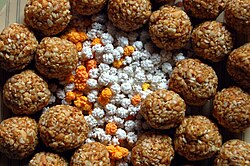
[[File:Tilgul kha god god bola.jpg|thumb|Multicolored sugar halwa surrounded by til-gul (sesame and jaggery) ladoos. These exchanged and eaten on Makar Sankranti in Maharashtra.]] | [[File:Tilgul kha god god bola.jpg|thumb|Multicolored sugar halwa surrounded by til-gul (sesame and jaggery) ladoos. These exchanged and eaten on Makar Sankranti in Maharashtra.]] | ||
In Maharashtra on Makar Sankranti day people exchange | Day 1-Bhogi | ||
Day 2-Sankranti | |||
Sankranti | |||
In Maharashtra, on Makar Sankranti day, people exchange til-gul (sweetmeats made from sesame seeds and jaggery). A famous line associated with this joyous occasion is ''til gul ghya god god bola'' (Eat this sesame and jaggery and speak sweet words). Tilacha halwa (sugar granules) are also offered as prasad in the ''Devghar'' (Prayer room) after seeking blessings. Gulachi poli is a popular flat bread stuffed with shredded jaggery and ground til in pure ghee are enjoyed for lunch as well as dinner. | |||
Married women invite friends/family members and celebrate Haldi-Kunku. Guests are given til-gul and some small gift, as a part of the ritual. | Married women invite friends/family members and celebrate ''Haldi-Kunku''. Guests are given til-gul and some small gift, as a part of the ritual.<ref name=":1">{{Cite web |date=2020-01-14 |title=Makar Sankranti: The Way It Is Celebrated in States Across India |url=https://www.news18.com/news/lifestyle/makar-sankranti-the-way-it-is-celebrated-in-states-across-india-1335352.html |access-date=2021-01-15 |website=News18 |language=en |archive-date=13 January 2021 |archive-url=https://web.archive.org/web/20210113062614/https://www.news18.com/news/lifestyle/makar-sankranti-the-way-it-is-celebrated-in-states-across-india-1335352.html |url-status=live }}</ref> On this day, Hindu women and men make it a point to wear black clothes. As Sakranti falls in the [[winter]] months of the region, wearing black adds to the body warmth.<ref name=":1" /> This is an essential reason behind wearing black, which is otherwise barred on festival days. As per another legend, Lord [[Surya]] forgave his son [[Shani]] and his son visited him on Sankranti.<ref>{{Cite web|last=Satpathy|first=Kriti Saraswat|date=2017-01-12|title=Makar Sankranti 2017: How is Sankranti celebrated in Maharashtra|url=https://www.india.com/travel/articles/makar-sankranti-2017-how-is-sankranti-celebrated-in-maharashtra-3230741/|access-date=2021-01-15|website=India News, Breaking News {{!}} India.com|language=en|archive-date=21 January 2021|archive-url=https://web.archive.org/web/20210121072225/https://www.india.com/travel/articles/makar-sankranti-2017-how-is-sankranti-celebrated-in-maharashtra-3230741/|url-status=live}}</ref> That is the essential reason why people distribute sweets and urge them to let go of any negative or angry feelings. Also, newly married women offer five sunghat or small clay pots with black beaded threads tied around them, to the [[Shakti]] deity. These pots are filled with newly harvested food grains and are offered with betel leaves and areca nut. Its observance takes place on a rather subdued note, unlike major festivals of the region like [[Ganesh Chaturthi]]. | ||
===Odisha=== | ===Odisha=== | ||
The festival is known as Makara Sankranti in [[Odisha]]<ref>Goyal, Ashutosh (2014) ''RBS Visitors Guide India – Odisha: Odisha Travel Guide''. Data and Expo India Pvt Ltd [https://books.google. | The festival is known as Makara Sankranti in [[Odisha]]<ref>Goyal, Ashutosh (2014) ''RBS Visitors Guide India – Odisha: Odisha Travel Guide''. Data and Expo India Pvt Ltd [https://books.google.com/books?id=MHw7CQAAQBAJ&dq=makar+sankranti+in+odisha&pg=PT78] {{Webarchive|url=https://web.archive.org/web/20230722084847/https://books.google.com/books?id=MHw7CQAAQBAJ&dq=makar+sankranti+in+odisha&pg=PT78|date=22 July 2023}}</ref> where people prepare ''makara chaula'' ({{langx|or|'''ମକର ଚାଉଳ'''}}): uncooked newly harvested rice, banana, [[coconut]], [[jaggery]], [[sesame]], [[Rasgulla|rasagola]], Khai/Liaa and [[chhena]] puddings for naivedya to gods and goddesses. The withdrawing winter entails a change in food habits and intake of nourishing and rich food. Therefore, this festival holds traditional cultural significance. It is astronomically important for devotees who worship the sun god at the great Konark temple with fervour and enthusiasm as the sun starts its annual swing northwards.<ref name="Bhubaneswar-MS">{{Cite news|author=Times News Network (TNN) |date=15 January 2014 |title=Makar Sankranti observed with pomp in state |newspaper=The Times of India |url=http://timesofindia.indiatimes.com/city/bhubaneswar/Makar-Sankranti-observed-with-pomp-in-state/articleshow/28805682.cms? |archive-url=https://web.archive.org/web/20140115181106/http://timesofindia.indiatimes.com/city/bhubaneswar/Makar-Sankranti-observed-with-pomp-in-state/articleshow/28805682.cms |archive-date=15 January 2014 |url-status=live }}</ref> According to various Indian calendars, the Sun's movement changes and the days from this day onwards become lengthier and warmer and so the Sun-God is worshiped on this day as a great benefactor. Many individuals at the start of the day perform a ritual bath while fasting.<ref name="Bhubaneswar-MS" /> Makara Mela (Fun fair) is observed at Dhabaleswar in [[Cuttack]], Hatakeshwar at Atri in [[Khordha]], Makara Muni temple in [[Balasore]] and near deities in each district of Odisha. In [[Puri]] special rituals are carried out at the temple of Lord [[Jagannath]].<ref name="Bhubaneswar-MS" /> In Mayurbhanj, Keonjhar, Kalahandi, Koraput and Sundargarh where the tribal population is greater, the festival is celebrated with great joy. They celebrate this festival with great enthusiasm, singing, dancing and generally having an enjoyable time. This Makara Sankranti celebration is next to the Odia traditional new year [[Maha Vishuva Sankranti]] which falls in mid April. Tribal groups celebrate with traditional dancing, eating their particular dishes sitting together, and by lighting bonfires. | ||
===Punjab=== | ===Punjab=== | ||
{{Main|Maghi}} | {{Main|Maghi}} | ||
[[File:Kothe-da-mela.jpg|thumb|Mela]] | [[File:Kothe-da-mela.jpg|thumb|Mela]] | ||
In [[Punjab, India|Punjab]], Makar Sankranti is celebrated as [[Maghi]] which is a religious and cultural festival. Bathing in a river in the early hours on [[Maghi]] is important. Hindus light lamps with sesame oil as this is supposed to give prosperity and drive away all sins. A major mela is held at [[Sri Muktsar Sahib]] on Maghi which commemorates a historical event in Sikh history. | In [[Punjab, India|Punjab]], Makar Sankranti is celebrated as [[Maghi]] which is a religious and cultural festival. Bathing in a river in the early hours on [[Maghi]] is important. Hindus light lamps with sesame oil as this is supposed to give prosperity and drive away all sins. A major mela is held at [[Sri Muktsar Sahib]] on Maghi which commemorates a historical event in Sikh history.<ref>{{Cite web|title=Makar Sankranti {{!}} What, When, Why, How To Celebrate {{!}} All Indian Festivals|date=7 November 2021|url=https://www.allindianfestivals.in/makar-sankranti/|access-date=2021-11-08|language=en-US|archive-date=8 November 2021|archive-url=https://web.archive.org/web/20211108144919/https://www.allindianfestivals.in/makar-sankranti/|url-status=live}}</ref> | ||
===Rajasthan and Western Madhya Pradesh (Malwa and Nimar)=== | |||
"Makar Sankrati" or "Sakraat" in the [[Rajasthani language]]<ref>{{Cite news|author=Krishnan, Rukmini|date=10 January 2014|title=Makar Sankranti Celebrations|newspaper=DNA (Diligent Media Corporation)|url=http://www.dnaindia.com/blogs/post-makar-sankranti-celebrations-1948796|archive-url=https://web.archive.org/web/20140115160505/http://www.dnaindia.com/blogs/post-makar-sankranti-celebrations-1948796|archive-date=15 January 2014|url-status=live}}</ref> is one of the major festivals in the state of Rajasthan. The day is celebrated with special Rajasthani delicacies and sweets such as pheeni (either with sweet milk or sugar syrup dipped), til-patti, gajak, kheer, ghevar, pakodi, puwa, and til-laddoo.<ref name="ifoodtv">{{Cite web |title=Makar Sankranti Food |publisher=Ifood TV |url=http://www.ifood.tv/network/makar_sankranti |archive-url=https://web.archive.org/web/20140116101046/http://www.ifood.tv/network/makar_sankranti |archive-date=16 January 2014 }}</ref> | |||
Specially, the women of this region observe a ritual in which they give any type of object (related to household, make-up or food) to 13 married women. The first Sankranti experienced by a married woman is of significance as she is invited by her parents and brothers to their houses with her husband for a big feast. People invite friends and relatives (specially their sisters and daughters) to their home for special festival meals (called as "Sankrant Bhoj"). People give out many kind of small gifts such as til-gud (jaggery), fruits, dry khichadi, etc. to Brahmins or the needy ones. | |||
Kite flying is traditionally observed as a part of this festival.<ref name="PTI-kites">{{Cite news|author=Press Trust of India (PTI)|author-link=Press Trust of India|date=14 January 2014|title=Makar Sankranti celebrations: Sky lanterns dot the sky|url=http://articles.timesofindia.indiatimes.com/2014-01-14/jaipur/46184221_1_sky-lanterns-colourful-kites-handipura|archive-url=https://web.archive.org/web/20140115155501/http://articles.timesofindia.indiatimes.com/2014-01-14/jaipur/46184221_1_sky-lanterns-colourful-kites-handipura|newspaper=[[The Times of India]]|archive-date=15 January 2014}}</ref> On this occasion the sky in Jaipur and Hadoti regions is filled with kites, and youngsters engage in contests trying to cut each other's strings.<ref name="PTI-kites" /> | |||
In Malwa and Nimar region kite flying is popular during makar Sankranti.<ref>{{Cite web |title=Indore: People excited to celebrate Makar Sankranti |url=https://www.freepressjournal.in/indore/indore-people-excited-to-celebrate-makar-sankranti |access-date=2023-11-20 |website=Free Press Journal |language=en |archive-date=20 November 2023 |archive-url=https://web.archive.org/web/20231120072425/https://www.freepressjournal.in/indore/indore-people-excited-to-celebrate-makar-sankranti |url-status=live }}</ref> | |||
=== | ===Tamil Nadu and Puducherry=== | ||
{{Main| | {{Main|Pongal (festival)}} | ||
[[File:Pongal.jpg|thumb|The Tamil festival of Pongal coincides with Makar Sankranti, and celebrates ''Surya''.]] | [[File:Pongal.jpg|thumb|The Tamil festival of Pongal coincides with Makar Sankranti, and celebrates ''Surya''.]] | ||
It is a four-day festival in | It is a four-day festival in South India: | ||
* Day 1: [[Bhogi|Bhogi | * Day 1: [[Bhogi|Bhogi Pandigai]] | ||
* Day 2: [[Pongal (festival)|Thai Pongal]] | * Day 2: [[Pongal (festival)|Thai Pongal]] | ||
* Day 3: [[Mattu Pongal|Maattu Pongal]] | * Day 3: [[Mattu Pongal|Maattu Pongal]] | ||
* Day 4: [[Kaanum Pongal]] | * Day 4: [[Kaanum Pongal]] | ||
The festival is celebrated four days from the last day of the Tamil month [[Margazhi]] to the third day of the Tamil month [[Pausha|Thai (Pausha)]]. | |||
The first day of festival is Bhogi | ;Bhogi | ||
The first day of festival is [[Bhogi]] . It is celebrated on the last day of [[Margazhi]]<ref>{{cite web|url=https://books.google.com/books?id=mg1WAAAAYAAJ&q=Bogi+Pandigai+|title=Eastern World|date=16 January 2019|via=Google Books|access-date=27 October 2020|archive-date=22 April 2022|archive-url=https://web.archive.org/web/20220422220628/https://books.google.com/books?id=mg1WAAAAYAAJ&q=Bogi+Pandigai+|url-status=live}}</ref> by discarding household items and setting them on fire, marking the end of the old and the emergence of the new.<ref name=":2">{{Cite book |last=Mukundananda |first=Swami |url=https://books.google.com/books?id=RYUaBgAAQBAJ&dq=bhogi+makar+sankranti&pg=PA21 |title=Festivals of India |date=2015-01-04 |publisher=Jagadguru Kripaluji Yog |language=en}}</ref> Kaappu kattu (kappu means secure) is a tradition of tying leaves of [[Azadirachta indica]], [[Senna auriculata]] and [[Ouret lanata|Aerva lanata]] along the roofs and walls of houses and residential areas that is widely practiced in the [[Kongu Nadu]] region. This is set to eliminate evil forces. This day is also held in honor of [[Indra]], the Hindu god of rain.<ref name=":2" /> | |||
; | ;Thai Pongal | ||
[[File:A Hindu girl in traditional dress for the Tamil Pongal festival.jpg|thumb|left|A Tamil Hindu girl in traditional dress for Pongal.]] | [[File:A Hindu girl in traditional dress for the Tamil Pongal festival.jpg|thumb|left|A Tamil Hindu girl in traditional dress for Pongal.]] | ||
The second day of festival is [[Thai Pongal]] or simply Pongal. | The second day of festival is [[Thai Pongal]] or simply Pongal.<ref>{{Cite book |last=NEOG |first=DR PRADIP |url=https://books.google.com/books?id=Bd0XEAAAQBAJ&dq=makar+sankranti&pg=PT22 |title=BIHU FESTIVALS: All-inclusive elucidations |date=2021-01-30 |publisher=Notion Press |isbn=978-1-63745-494-7 |language=en |access-date=23 March 2023 |archive-date=22 July 2023 |archive-url=https://web.archive.org/web/20230722084940/https://books.google.com/books?id=Bd0XEAAAQBAJ&dq=makar+sankranti&pg=PT22 |url-status=live }}</ref> It is celebrated by boiling rice with fresh milk and jaggery in new pots, which are later topped with brown sugar, cashew nuts and raisins early in the morning and allowing it to boil over the vessel. This tradition gives Pongal its name. The moment the rice boils over and bubbles out of the vessel, the tradition is to shout "பொங்கலோ பொங்கல் (Ponggalo Ponggal)!" and blow the ''sangu'' (a conch), a custom practised to announce it was going to be a year blessed with good tidings. Then, new boiled rice is offered to the Sun god during sunrise, as a prayer which symbolises thanks to the sun for providing prosperity. It is later served to the people in the house for the ceremony. People prepare savouries and sweets such as ''vadai, murukku, payasam'' and visit each other and exchange greetings. | ||
; | ;Maattu Pongal | ||
[[File:Madurai-alanganallur-jallikattu.jpg|thumb|Jallikattu, or "taming the bull", is an ancient Pongal tradition.]] | [[File:Madurai-alanganallur-jallikattu.jpg|thumb|Jallikattu, or "taming the bull", is an ancient Pongal tradition.]] | ||
The third day of festival is Maattu Pongal | The third day of festival is Maattu Pongal. It is for offering thanks to cattle, as they help farmers in agriculture. On this day the cattle are decorated with paint, flowers and bells. They are allowed to roam free and fed sweet rice and sugar cane. Some people decorate the horns with gold or other metallic covers. In some places, [[Jallikattu]], or taming the wild bull contest, is the main event of this day and this is mostly seen in the villages. | ||
; | ;Kaanum Pongal | ||
The fourth day of the festival is Kaanum Pongal (காணும் பொங்கல்: the word kaanum means "to view"). During this day people visit their relatives, friends to enjoy the festive season. It is a day to thank relatives and friends for their support in the harvest. It started as a farmers festival, called as Uzhavar Thirunaal in Tamil. ''[[Kolam]]'' (கோலம்) decorations are made in front of the house during Thai Pongal festival. | The fourth day of the festival is Kaanum Pongal (காணும் பொங்கல்: the word kaanum means "to view"). During this day people visit their relatives, friends to enjoy the festive season. It is a day to thank relatives and friends for their support in the harvest. It started as a farmers festival, called as Uzhavar Thirunaal in Tamil. ''[[Kolam]]'' (கோலம்) decorations are made in front of the house during Thai Pongal festival. | ||
===Kerala=== | |||
In Kerala, this is called as '''Sankranti''' or '''Makara Sankranti'''. In Malabar villages, this used to be celebrated as the victory over a demon. In Sabarimala, on this day, the [[Makaravilakku]] is lit to show the significance of the almighty. | |||
===Tripura=== | |||
The Tripuri is the promoter of Hangrai festivals. They have first introduced this festival of immersing of ancestors' remains in the [[holy river]]. Since then it was adopted by other groups in India and popularized over the years. | |||
Mythology inform us that when the world was just created by Lord Siva or Sibrai there was only the grassland and nothing was present. The god then created an egg to produce a human being. The egg hatched to give birth to a human being, creating a big bang. He crawled out of eggshells and looked around for anyone like him, but he found none. There was total silence, peace tranquility, and harmony on the earth. He was frightened by seeing this scenario of earth. He remained near the eggshell most of the time and went back near to the empty eggshell, went inside of half of the shell and covered it with another one, and hid there. | |||
The almighty God was upset by this development. Years later he created another egg, and after ten months it hatched. There was a big bang when it hatched that shook the earth and gave birth to another human. He was very courageous and powerful, as soon as he came out of the human eggshell, he started shouting and announced to the whole of the world, 'I am the first to be born in this earth, I am the eldest on the earth, no one is elder to me in this earth. He named himself Subrai and declared to the whole of the earth that he is the ruler of this earth and king of this universe. Hearing the big bang Hangrai got more frightened, closed his eyes, and silently remained inside the shell. But when he heard the voice like his own, he came out of his shell and met Subrai. At this Subrai told that he is older than Hangrai, since then Subrai became the elder brother of Hangrai, and people knew them as it is. | |||
Thousand of years later when they grew older, the time had come to leave this world. As Hangrai grew older than Subrai, one day he felt sick very seriously, Hangrai was on his death bed, Subrai was taking care of him. Then god came before them and said, 'Among both of you, Hangrai is elder than Subrai, I only know this, because I have created both of you. Hangrai will leave this earth very soon. Subrai will do all necessary rituals to cremate the body of Hangrai.' And god disappeared from there. | |||
Then Subrai cried like a baby, touching the feet of Hangrai, saying, 'Elder brother, I have treated you like a younger brother for thousands of years, forgive me for my wrongdoing unto you.' | |||
Hangrai said, 'I have done so!' and touched his head as gesture of forgiving and blessing unto him, and then breadth for his last. | |||
After the death of Hangrai, his younger brother Subrai cremated his body and did all the rituals, and immerged Hangrai's remaining in the holy water of the river on the last day of Pousa month. Since then, people observed these rituals and festivals every year and continued to this day. That is why the day is named "Hangrai", which has later adopted by other ethnic groups of people of India. | |||
Every year on the day of Hangrai the Tripuri people observe it in grand pomp and show. In every house of Tripuri preparation for Hangrai starts two-three days before. Houses are cleaned, washed whitewashed. All the utensils, clothes, articles are cleaned, homes are decorated. Different types of Tripura cakes, dishes, and drinks are prepared, near and dear ones, relatives are invited for a feast.{{Citation needed|date=March 2023}} | |||
===Uttar Pradesh=== | ===Uttar Pradesh=== | ||
The festival is known as ''Kicheri'' in [[Purvanchal]] and [[Awadh]] parts of [[Uttar Pradesh]] and involves ritual bathing.<ref>Bhalla, Kartar Singh (2005) Let's Know Festivals of India. Star Publications [https://books.google.com/books?id=WORYY5Vl0ygC&dq=makar+sankranti&pg=PA11] {{Webarchive|url=https://web.archive.org/web/20230722084940/https://books.google.com/books?id=WORYY5Vl0ygC&dq=makar+sankranti&pg=PA11|date=22 July 2023}}</ref> Over two million people gather at their respective sacred places for this holy bathing such as [[Prayagraj]] and [[Varanasi]] in Uttar Pradesh and [[Haridwar]] in Uttarakhand.<ref name="UP-sankranti">{{Cite news|date=15 January 2012|title=Traditional fervour marks Makar Sankranti|url=http://articles.timesofindia.indiatimes.com/2012-01-15/kanpur/30629290_1_tilkut-traditional-fervour-marks-makar-sankranti|archive-url=https://web.archive.org/web/20140115172152/http://articles.timesofindia.indiatimes.com/2012-01-15/kanpur/30629290_1_tilkut-traditional-fervour-marks-makar-sankranti|newspaper=[[The Times of India]]|archive-date=15 January 2014}}</ref> The day at a domestic household begins by taking ritual bath before sunrise, doing ritualistic prayers to the rising [[Sun]]. It also includes pledging for and donating Food, clothing and money to Brahmin/s called [[Purohita]]. It is followed by generous gifting of Food, Clothing, jewelleries and money to female relatives like to married Daughters, Sisters and Daughter-in-Laws and their families. | |||
[[Sesame]] seeds, [[Jaggery]], [[Poha (rice)|chiura]] and [[Yogurt]] are eaten post the prayers. This is followed by [[Khichdi]] as the next meal (hence the vernacular name of the Festival). | |||
The festival is known as ''Kicheri'' in [[Uttar Pradesh]] and involves ritual bathing.<ref>Bhalla, Kartar Singh (2005) Let's Know Festivals of India. Star Publications [https://books.google. | |||
===Uttarakhand=== | ===Uttarakhand=== | ||
{{Main|Ghughutiya Festival}} | |||
Makar Sankranti is a popular festival in Uttarakhand. It known by various names in the different parts of the state such as Uttarayani, Khichri Sangrand, Pusyodia, Ghughutia, Ghughuti Tyar, Kale Kauva, Makrain, Makraini, Gholda, Gwalda and Chunyatyar.<ref>{{Cite web|url=https://www.euttaranchal.com/culture/makar-sankranti-ghugutia|title=eUttaranchal | Makar Sankranti is a popular festival in Uttarakhand. It known by various names in the different parts of the state such as Uttarayani, Khichri Sangrand, Pusyodia, [[Ghughutiya Festival|Ghughutia]], Ghughuti Tyar, Kale Kauva, Makrain, Makraini, Gholda, Gwalda and Chunyatyar.<ref>{{Cite web|url=https://www.euttaranchal.com/culture/makar-sankranti-ghugutia|title=eUttaranchal – Rediscover Uttarakhand – Tourism, Culture & People|website=euttaranchal.com|date=6 March 2013|language=en-US|access-date=2020-01-18|archive-date=22 September 2020|archive-url=https://web.archive.org/web/20200922204855/https://www.euttaranchal.com/culture/makar-sankranti-ghugutia|url-status=live}}</ref> | ||
[[File:Bagnath Temple, Uttrayani 2018.jpg|thumb|[[Bagnath Temple]] in [[Bageshwar]] during the Uttarayani Fair, 2018.]] | [[File:Bagnath Temple, Uttrayani 2018.jpg|thumb|[[Bagnath Temple]] in [[Bageshwar]] during the Uttarayani Fair, 2018.]] | ||
In the [[Kumaon division|Kumaon]] region of Uttarakhand, Makar Sankranti (also called as Ghughuti (घुघुति) or Ghughuti Tyar or Ghughutia or Kale Kauva or Uttarayani) is celebrated with great gusto. The famous | In the [[Kumaon division|Kumaon]] region of Uttarakhand, Makar Sankranti (also called as Ghughuti (घुघुति) or [[Ghughutiya Festival|Ghughuti Tyar]] or Ghughutia or Kale Kauva or Uttarayani) is celebrated with great gusto. The famous [[Uttarayani Fair]] is held in [[Bageshwar]] town each year in the month of January on the occasion of Makar Sankrati.<ref>{{cite book |editor-last1=Singh |editor-first1=S.K. |editor-last2=Nag |editor-first2=P. |title=Tourism and trekking in Nainital Region|date=1999|publisher=Concept Pub.|location=New Delhi|isbn=978-81-7022-769-4}}</ref><ref>{{cite news|title=पतित पावनी सरयू-गोमती नदी का संगम गंदगी मुक्त हुआ|url=http://www.amarujala.com/uttarakhand/bageshwar/dirt-is-the-confluence-of-gomti-river-sarayu-degenerate-pawnee|access-date=24 May 2017|work=Amar Ujala Bureau|publisher=Amar Ujala|date=26 December 2016|location=Bageshwar|language=hi|archive-date=16 January 2014|archive-url=https://web.archive.org/web/20140116101046/http://www.ifood.tv/network/makar_sankranti|url-status=live}}</ref> According to the Almora Gazetteer, even in the early twentieth century, the annual Uttarayani mela at Bageshwar was visited by approximately 15,000 people and was the largest fair of [[Kumaon division]].<ref>{{Cite book|title=Almora: A Gazetter|last=Walton|first=H. G.|publisher=The Government Press, United Provinces.|year=1911|location=Allahabad|pages=Appendix XXIV}}</ref> The religious ritual of the Uttarayani mela consists of bathing before daybreak at the confluence of Saryu and Gomati followed by an offering of water to [[Lord Shiva]] inside the [[Bagnath Temple]].<ref name="pant">{{cite book|url=https://books.google.com/books?id=dcXNpmsxSn0C&q=bagnath+temple&pg=PA197|title=The Social Economy of the Himalayans: Based on a Survey in the Kumaon Himalayas|last1=Pant|first1=Shiva Darshan|year=1988|publisher=Mittal Publications|page=197|language=en|access-date=15 October 2016|archive-date=22 July 2023|archive-url=https://web.archive.org/web/20230722084851/https://books.google.com/books?id=dcXNpmsxSn0C&q=bagnath+temple&pg=PA197|url-status=live}}</ref><ref>{{cite news|url=http://www.makarsankranti.in/|title=Choliya dances enthrall at Bageshwar mela|date=14 June 2016|access-date=15 December 2018|publisher=Harsha S|agency=TNN|location=Almora|archive-date=16 December 2018|archive-url=https://web.archive.org/web/20181216032129/https://www.makarsankranti.in/|url-status=live}}</ref> Those who are more religiously disposed, continue this practice for three days in succession, which is known as "Trimaghi".<ref name="pant" /> On this day, people also give '[[Khichdi|khichdi']] (a dish made by mixing pulses and rice) in charity, take ceremonial dips in holy rivers, participate in Uttarayani fairs and offer deep fried sweetmeats consisting of flour and jaggery to crows and other birds as a way to pay homage to the departed souls of their ancestors.<ref name=":0">{{Cite web|url=https://www.euttarakhand.com/ghughuti-the-mouth-watering-festival-of-kumaon|title=Ghughuti 'The Mouth-Watering Festival of Kumaon', Ghughuti Festival|date=2016-11-02|website=Uttarakhand Stories – Connect to Uttarakhand with eUttarakhand and Share Stories|language=en|access-date=2020-01-15|archive-date=15 January 2020|archive-url=https://web.archive.org/web/20200115122046/https://www.euttarakhand.com/ghughuti-the-mouth-watering-festival-of-kumaon|url-status=live}}</ref> | ||
===West Bengal=== | ===West Bengal=== | ||
[[File:Poush Sankranti Special.JPG|thumb|A feast at Poush Sankranti]] | [[File:Poush Sankranti Special.JPG|thumb|A feast at Poush Sankranti]] | ||
In West Bengal, Sankranti, also known as Poush Sankranti<ref>{{cite web|url=https://books.google.com/books?id=z8FFAQAAIAAJ&q=poush+sankranti+bengal|title=West Bengal District Gazetteers: Calcutta and Howrah | In West Bengal, Sankranti, also known as Poush Sankranti<ref>{{cite web|url=https://books.google.com/books?id=z8FFAQAAIAAJ&q=poush+sankranti+bengal|title=West Bengal District Gazetteers: Calcutta and Howrah|date=16 January 1972|publisher=State editor, West Bengal District Gazetteers|via=Google Books|access-date=13 September 2020|archive-date=22 April 2022|archive-url=https://web.archive.org/web/20220422220629/https://books.google.com/books?id=z8FFAQAAIAAJ&q=poush+sankranti+bengal|url-status=live}}</ref> named after the Bengali month in which it falls (last date of that month), is celebrated as a harvest festival Poush Parbon ([[Bengali language|Bengali]]: পৌষ পার্বণ). (It falls on 14 January on the Western calendar.) The freshly harvested paddy and the date palm syrup in the form of Khejurer Gur ([[Bengali language|Bengali]]: খেজুরের গুড়) and Patali ([[Bengali language|Bengali]]: পাটালি) is used in the preparation of a variety of traditional Bengali sweets made with rice flour, coconut, milk and 'khejurer gur' (date palm jaggery) and known as '[[Pitha]]' ([[Bengali language|Bengali]]: পিঠে). All sections of society participate in a three-day festival that begins on the day before Sankranti and ends on the day after. The Goddess Lakshmi is usually worshipped on the day of Sankranti. | ||
In the Himalayan regions of Darjeeling, the festival is as known as Magey Sakrati. It is distinctly associated with the worship of Lord Shiva. Traditionally, people bathe at sunrise and then commence their pooja. Elsewhere, many people take a dip in places like [[Sagar Island|Ganga Sagar]] | In the Himalayan regions of Darjeeling, the festival is as known as Magey Sakrati. It is distinctly associated with the worship of Lord Shiva. Traditionally, people bathe at sunrise and then commence their pooja. Elsewhere, many people take a dip in places like [[Sagar Island|Ganga Sagar]].<ref>{{cite news|url=http://www.thehindu.com/news/states/other-states/article2803812.ece|title=Devotees throng Gangasagar on Makara Sankranti|website=[[The Hindu]]|date=15 January 2012 |access-date=15 January 2012|archive-date=20 January 2012|archive-url=https://web.archive.org/web/20120120003705/http://www.thehindu.com/news/states/other-states/article2803812.ece|url-status=live}}</ref> Ganga Sagar falls in West Bengal. | ||
==Outside India== | ==Outside India== | ||
[[File:Magar woman dancing with traditional basket in Maghe Sakranti festival.jpg|thumb|The festival is known as Maghe Sakranti by Hindus in [[Nepal]], and above is a traditional basket dance festivity to celebrate it.]] | [[File:Magar woman dancing with traditional basket in Maghe Sakranti festival.jpg|thumb|The festival is known as Maghe Sakranti by Hindus in [[Nepal]], and above is a traditional basket dance festivity to celebrate it.]] | ||
===Bangladesh=== | ===Bangladesh === | ||
{{ | {{See also|Shakrain}} | ||
[[Shakrain]] is an annual celebration of [[winter]] in [[Bangladesh]], observed with the flying of [[kite]]s.<ref>http://www.thedailystar.net/star-weekend/shakrain-festival-kites-and-fireworks-205195</ref> | [[Shakrain]] is an annual celebration of [[winter]] in [[Bangladesh]] in the downtown of [[Dhaka]], observed with the flying of [[kite]]s. Many families in villages across Bangladesh observe Makar Sankranti in many ways. At midnight on January 14/15, people light fireworks to mark the beginning of the holiday. Betting games are played, but with fruits, similar to [[List of dice games|dice games]]. Families round up ingredients to compete with others in their village to see who can create the largest variety of [[Pitha|pithas]]. Others go fishing in ponds, creeks and streams to see who can catch the largest fish. It is a fun holiday that many wait for year-long. | ||
The holiday is observed by a significant amount of the Bengali diaspora as well.<ref>{{Cite web|url = http://www.thedailystar.net/star-weekend/shakrain-festival-kites-and-fireworks-205195|title = Shakrain: A festival of Kites and Fireworks|date = 22 January 2016|access-date = 6 February 2018|archive-date = 6 February 2018|archive-url = https://web.archive.org/web/20180206190333/http://www.thedailystar.net/star-weekend/shakrain-festival-kites-and-fireworks-205195|url-status = live}}</ref> | |||
===Nepal=== | ===Nepal=== | ||
Maghe Sankranti | [[File:Maghe Sankranti Food.jpg|thumb|Maghe Sankranti Food]] | ||
[[Maghe Sankranti]] is a Nepalese festival observed on the first of [[Magha (month)|Magha]] in the [[Vikram Samvat|Vikram Sambat]] (B.S) calendar (about 14 January). [[Tharu people]] celebrate this particular day as new year. It is also regarded as the major government declared annual festival of the [[Magars|Magar community]].<ref>{{Cite web |title=Magar, Tharu communities observe Maghi festival (in pictures) |url=https://kathmandupost.com/valley/2016/01/15/magar-tharu-communities-observe-maghi-festival-in-pictures |access-date=2022-09-27 |website=kathmandupost.com |language=English |archive-date=27 September 2022 |archive-url=https://web.archive.org/web/20220927133744/https://kathmandupost.com/valley/2016/01/15/magar-tharu-communities-observe-maghi-festival-in-pictures |url-status=live }}</ref> | |||
Observant Hindus take ritual baths during this festival. These include Sankhamul on the Bagmati near Patan; In the Gandaki/Narayani river basin at Triveni, [[Devghat]] near [[Chitwan Valley]] and Ridi on the Kaligandaki; and in the Koshi River basin at [[Dolalghat]] on the [[Sunkoshi River|Sun Koshi]]. Festive foods like laddoo, ghee and [[ | Observant Hindus take ritual baths during this festival. These include Sankhamul on the Bagmati near Patan; In the Gandaki/Narayani river basin at Triveni, [[Devghat]] near [[Chitwan Valley]] and Ridi on the Kaligandaki; and in the Koshi River basin at [[Dolalghat]] on the [[Sunkoshi River|Sun Koshi]]. Festive foods like laddoo, ghee and [[sweet potato]]es are distributed. | ||
===Pakistan (Sindh)=== | ===Pakistan (Sindh)=== | ||
On this festive day, [[Sindhis|Sindhi]] parents send ladoos and chiki (Laaee) made of sesame seeds to their married daughters. The Sindhi community in India too celebrate Makar Sankranti as Tirmoori which involves parents sending sweet dishes to their daughters.<ref>Reejhsinghani, Aroona (2004) Essential Sindhi Cookbook. Penguin Books India [https://books.google. | On this festive day, [[Sindhis|Sindhi]] parents send ladoos and chiki (Laaee) made of sesame seeds to their married daughters. The Sindhi community in India too celebrate Makar Sankranti as Tirmoori which involves parents sending sweet dishes to their daughters.<ref>Reejhsinghani, Aroona (2004) Essential Sindhi Cookbook. Penguin Books India [https://books.google.com/books?id=ym9IWIZELc8C&dq=sindh+sankranti&pg=PA14] {{Webarchive|url=https://web.archive.org/web/20230722084848/https://books.google.com/books?id=ym9IWIZELc8C&dq=sindh+sankranti&pg=PA14|date=22 July 2023}}</ref> | ||
===Sri Lanka, Malaysia, Singapore, and among Tamil diasporas worldwide=== | |||
On this day, the [[Tamil language|Tamil]] farmers and the [[Tamils|Tamil People]] honour and perform a pooja to the Sun God [[Surya|Suriya Narayanan]]. This happens when the sun enters the zodiac sign of [[Capricorn (astrology)|Capricorn]] (Makara). The [[Pongal (festival)|Thai Pongal]] festival is celebrated in mid-January, or the [[Tamil language|Tamil]] month of Thai, to coincide with the rice harvest.<ref>{{cite web|url=http://www.pongalfestival.org/ulavar-thirunaal-sri-lanka.html|title=Harvest Festival in Sri Lanka – Ulavar Thirunaal, Pongal Festival|website=pongalfestival.org|access-date=14 January 2018|archive-date=15 January 2018|archive-url=https://web.archive.org/web/20180115001415/http://www.pongalfestival.org/ulavar-thirunaal-sri-lanka.html|url-status=live}}</ref> | |||
Pongal practices and rituals in Sri Lanka and diasporic countries aren't much differentiated from those followed in Southern India, outside notably the Jalikkattu practice, which is not existent among Sri Lankan Tamils and diasporic Tamil communities. | |||
In Sri Lanka, celebrations of Pongal extend generally to two days and not four, and instead of the [[Pongal (dish)|Pongal]] dish, a similar food called Pukkai is offered. Its preparation happen on the first day and not on the second as in India (where Pongal start one day earlier with Boghi day). Hence here, Pongal celebration is focused on the day of Thai Pongal only.<ref>{{Cite web |last=Indrakumar |first=Menaka |title=Thai Pongal: The Harvest Festival |url=https://archives1.dailynews.lk/2021/01/14/features/238757/thai-pongal-harvest-festival |access-date=2024-01-15 |website=[[Daily News (Sri Lanka)]] |language=en |publication-date=2021-01-14 |archive-date=15 January 2024 |archive-url=https://web.archive.org/web/20240115205834/https://archives1.dailynews.lk/2021/01/14/features/238757/thai-pongal-harvest-festival |url-status=live }}</ref> | |||
==See also== | ==See also== | ||
* [[Hindu festivals]] | * [[Astronomical basis of the Hindu calendar]] | ||
* [[List of Hindu festivals]] | |||
* [[Jallikattu]] | |||
* [[List of harvest festivals]] | |||
* [[Uttarayana]] | * [[Uttarayana]] | ||
==References== | ==References== | ||
| Line 238: | Line 295: | ||
{{Wikiquote}} | {{Wikiquote}} | ||
{{Navboxes|list= | |||
{{Hindu festivals}} | {{Hindu festivals}} | ||
{{Hindudharma}} | {{Hindudharma}} | ||
{{Sindhi festivals}} | {{Sindhi festivals}} | ||
{{Winter solstice}} | {{Winter solstice}} | ||
}} | |||
[[Category:Sankranti]] | |||
[[Category:Religious festivals in India]] | [[Category:Religious festivals in India]] | ||
[[Category:Festivals in Maharashtra]] | [[Category:Festivals in Maharashtra]] | ||
[[Category: | [[Category:Hindu festivals in Nepal]] | ||
[[Category: | [[Category:Culture of Gujarat]] | ||
[[Category:Hindu astronomy]] | [[Category:Hindu astronomy]] | ||
[[Category:Hindu festivals]] | [[Category:Hindu festivals]] | ||
| Line 258: | Line 319: | ||
[[Category:Religious festivals in Bangladesh]] | [[Category:Religious festivals in Bangladesh]] | ||
[[Category:Harvest festivals]] | [[Category:Harvest festivals]] | ||
[[Category:Hindu festivals in Bangladesh]] | |||
Revision as of 02:13, 17 January 2026
| Makar Sankranti | |
|---|---|
 Holy dip by devotees in river Ganga on the occasion of Makar Sankranti | |
| Also called | Uttarayana Sankranti Til Sakraat Magha Môkôr Sôṅkrānti Mela Ghughuti Pedda Panduga Bhogi Sakraat Pongal Peddha Panduga Sakrat Khichaṛi Sankramana |
| Observed by | Hindus, Buddhists, Sikhs, Jains |
| Liturgical Color | Red |
| Type | Religious and cultural, harvest festival |
| Significance | A harvest festival, a celebration of the mid-winter solstice |
| Celebrations | Kite flying, bonfires, fairs, feast, arts, dance, socialization |
| Date | First day of makara masa, Bhogi (15 January in leap years; 14 January on all other years) |
| Frequency | Annual |
| Related to | Pongal, Lohri, Lal Loi, Maghe Sankranti, Magh Bihu, Tusu Festival |
| Part of a series on |
| Hinduism |
|---|
 |


Makar(a) Sankrānti (Sanskrit: मकरसङ्क्रान्ति, romanized: Makarasaṅkrānti),[1] (transl. Capricorn Festival) also referred to as Uttarāyana, Makara, or simply Sankrānti, is a Hindu observance and a mid-winter harvest festival in India and Nepal.[2][3] It is typically celebrated on 14 January annually (15 January on a leap year),[4][5][6] this occasion marks the transition of the sun from the zodiac of Sagittarius (dhanu) to Capricorn (makara).[4][7][8] As this transition coincides with the sun's movement from south to north, the festival is dedicated to the solar deity, Surya,[9] and is observed to mark a new beginning.[10] Across India, the occasion is celebrated with numerous multi-day festivals.
The festivities associated with Makar Sankranti are known by various names including Sankranthi or Peddha Panduga in Andhra Pradesh and Telangana,[11][12] Khichari in Bhojpuri region, Magh Bihu in Assam, Maghi Saaji in Himachal Pradesh, Makaravilakku in Kerala, Makara sankranti in Karnataka, Maghi Sangrand in Punjab, Pongal in Tamil Nadu, Maghi Sangrand or Uttarain (Uttarayana) in Jammu, Sakrat in Haryana, Sakraat in Rajasthan, Sukarat in central India, Uttarayana in Gujarat and Uttar Pradesh, Ghughuti in Uttarakhand, Dahi Chura in Bihar, Makar Sankranti in Odisha, Jharkhand, Maharashtra, Goa, West Bengal (also called Poush Sankranti or Mokor Sonkranti), Uttar Pradesh (also called Khichidi Sankranti), Uttarakhand (also called Uttarayani) or as simply, Maghe Sankranti (Nepal), Songkran (Thailand), Thingyan (Myanmar), Mohan Songkran (Cambodia), Til Sakraat in Mithila, and Shishur Senkrath (Kashmir). On Makar Sankranti, Surya (Hindu solar deity) is worshipped along with Vishnu and goddess Lakshmi throughout India.[13]
Makar Sankranti is observed with social festivities such as colourful decorations, rural children going house to house, singing and asking for treats in some areas,[14] melas (fairs), dances, kite flying, bonfires and feasts.[12][15] The Magha Mela is mentioned in the Hindu epic Mahabharata.[16] Many observers go to sacred rivers or lakes and bathe in a ceremony of thanks to the Sun.[16] Every twelve years, the Hindus observe Makar Sankranti with Kumbha Mela – one of the world's largest mass pilgrimage, with an estimated 60 to 100 million people attending the event.[16][17][18] At this event, they say a prayer to the Sun and bathe at the Prayagaraj confluence of the River Ganga and River Yamuna,[16] a tradition attributed to Adi Shankaracharya.[19] Makar Sankranti is a time of celebration and thanks giving, and is marked by a variety of rituals and tradition.[20]
Date variations
Template:Solstice-equinox-sankranti Makar Sankranti is set by the solar cycle and corresponds to the exact time astronomical event of the Sun entering Capricorn and is observed on a day that usually falls on 14 January of the Gregorian calendar, but on 15 January in leap years. Makar Sankranti's date and time is analogous to Sidereal time of Zodiac sign of Capricorn (when sun enters).[21]
The year is 365.24 days long and the time difference between the two consecutive instances of Makar Sankranti is almost the same as the year. There are 365 days in a year. Thus, every four years the calendar is offset by one day which is adjusted by adding leap day (29 February). Hence, Makar Sankranti falls on 15 January every leap year. Sidereal time of sign of Capricorn also shifts by a day due to leap year. Similarly, the time of equinoxes also shifts by a day in each four year window. For example, the equinox of September does not fall on the same date each year nor does the winter solstice. Any event related to one revolution of the Earth around the Sun will have this date shift within a four year cycle. Similar changes can be seen in the exact time of solstices and equinoxes. See the table, how the time of the equinox and a solstice increases and decreases in a cycle of four years.[22]
The time difference between two consecutive winter solstices is about 5 hours 49 minutes 59 seconds, with respect to winter solstice time, and the time difference between two consecutive Mankar Sankranti is about 6 hours and 10 minutes. Towards the end of the 21st century, there will be more occurrences of Makar Sankranti on 15 January in a four-year cycle. And Makar Sankranti will be on 16 January for the first in the year 2102 as 2100 will not be a leap year.[23]
Makar Sankranti and Uttar Ayana
Makar Sankranti is celebrated when the Sun's ecliptic longitude becomes 270° measured from a fixed starting point which is in opposition to Spica,[24] i.e. this is a sidereal measure. Uttarayana begins when the Sun's ecliptic longitude becomes 270° measured from the Vernal equinox,[25] i.e. this is a tropical measure. While both concern a measure of 270° their starting points are different. Hence, Makar Sankranti and Uttarayana occur on different days. On the Gregorian calendar, Makar Sankranti occurs on 14 or 15 January; Uttarayana starts on 21 December.
Due to the precession of the equinoxes the tropical zodiac (i.e. all the equinoxes and solstices) shifts by about 1° in 72 years. As a result, the December solstice (Uttarayana) is continuously but very slowly moving away from Makar Sankranti. Conversely, the December solstice (Uttarayana) and Makar Sankranti must have coincided at some time in the distant past. Such a coincidence last happened 1700 years back, in 291 CE.[24]
Significance
Every year Makar Sankranti is celebrated in the month of January. This festival is dedicated to the Hindu religious sun god Surya.[5][26] This significance of Surya is traceable to the Vedic texts, particularly the Gayatri Mantra, a sacred hymn of Hinduism found in its scripture named the Rigveda. Makara Sankranti is also associated with the birth and coming of the final Avatar of the Hindu God Vishnu, Kalki.
Makara Sankranti is regarded as important for spiritual practices and accordingly, people take a holy dip in rivers, especially Ganga, Yamuna, Godavari, Krishna and Kaveri. The bathing is believed to result in merit or absolution of past sins. They also pray to the Sun and give thanks for their successes and prosperity.[27] A shared cultural practices found amongst Hindus of various parts of India is making sticky, bound sweets particularly from sesame (til) and a sugar base such as jaggery (gud, gur, gul). This type of sweet is a symbolism for being together in peace and joyfulness, despite the uniqueness and differences between individuals.[5] For most parts of India, this period is a part of early stages of the Rabi crop and agricultural cycle, where crops have been sown and the hard work in the fields is mostly over. The time thus signifies a period of socializing and families enjoying each other's company, taking care of the cattle, and celebrating around bonfires, in Gujarat the festival is celebrated by flying kites.[5]
Makara Sankranti is an important pan-Indian solar festival, known by different names though observed on the same date, sometimes for multiple dates around the Makar Sankranti. It is known as Pedda Panduga'/'Makara Sankranti in Andhra Pradesh, Makara Sankranti in Karnataka, Telangana, and Maharashtra, Pongal in Tamil Nadu,[28] Magh Bihu in Assam, Magha Mela in parts of central and north India, as Makar Sankranti in the west, Makara Sankranti or Shankaranti in Kerala,[29] and by other names.[5]
Nomenclature and regional names
 | This section needs more citations. (January 2022) |

Makar or Makara Sankranti is celebrated in many parts of the Indian subcontinent with some regional variations. It is known by different names and celebrated with different customs in different Indian states and South Asian countries:
- Sankranti, Makara Sankranti, Makara Sankramanam, Pedda Panduga: Andhra Pradesh, Telangana[30]
- Pusna: West Bengal, Assam, Meghalaya[31]
- Suggi Habba, Makara Sankramana, Makara Sankranti: Karnataka[32]
- Makar Sankranti, Uttarayana or Ghughuti: Uttarakhand
- Makar Sankranti or Makara Mela and Makara Chaula: Odisha
- Makar Sankranti or Sankaranti or Shankaranti: Kerala[33]
- Makar Sankranti or Dahi Chura or Til Sankranti: Mithila, Jharkhand, Bihar, Chhattisgarh, Madhya Pradesh, Rajasthan, Delhi
- Makar Sankranti, Maghi Sankranti, Haldi Kumkum or Sankranti: Maharashtra, Jammu, Goa, Nepal, Sikkim
- Hangrai: Tripura[34]
- Pongal or Uzhavar Thirunal: Tamil Nadu, Sri Lanka, Singapore, Malaysia
- Uttarayana: Gujarat
- Maghi: Haryana, Himachal Pradesh Punjab
- Magh Bihu or Bhogali Bihu: Assam
- Parshuram Kund Mela or Makara Sankranti: Arunachal Pradesh
- Shishur Saenkraat: Kashmir Valley[27]
- Makar Sakraat or Khichdi Parv: Uttar Pradesh and western Bihar
- Poush Sangkranti: West Bengal, Bangladesh
- Tila Sakrait: Mithila
- Tirmoori: Pakistan
In most regions of India, Sankranti festivities last for two to four days of which each day is celebrated with distinct names and rituals.[35]
- Day 1 – Maghi (preceded by Lohri), Bhogi Panduga
- Day 2 – Makara Sankranti, Pongal, Pedda Panduga, Uttarayana, Magh Bihu
- Day 3 – Mattu Pongal, Kanuma Panduga
- Day 4 – Kaanum Pongal, Mukkanuma
Regional variations and customs
| This section needs more citations. (January 2013) |

It is celebrated differently across the Indian subcontinent. Many people take a dip in places like Ganga Sagar and pray to the Sun God (Surya). It is celebrated with pomp in southern parts of India as Sankranti in Andhra Pradesh, Telangana and Karnataka (Pongal in Tamil Nadu), and in Punjab as Lohri
Many melas or fairs are held on Makar Sankranti the most famous being the Kumbha Mela, held every 12 years at one of four holy locations, namely Haridwar, Prayag (Prayagraj), Ujjain and Nashik, the Magha Mela (or mini-Kumbh Mela held annually at Prayag) and the Gangasagar Mela (held at the head of the Ganges River, where it flows into the Bay of Bengal).[8] Makar Mela in Odisha. Tusu Mela also called as Tusu Porab is celebrated in many parts of Jharkhand and West Bengal. Poush Mela, held traditionally on the seventh day of Poush, at Shantiniketan, in West Bengal, is unrelated to this festival. Mela Maghi is held in memory of the forty Sikh martyrs (Chalis Mukte) who gave their lives to protect Guru Gobind Singh, the tenth Guru of Sikhism, every year at Muktsar Sahib in Punjab. Before this tradition, the festival was observed and mentioned by Guru Amar Das, the third Guru of Sikhism.[36]

Andhra Pradesh and Telangana
The festival Sankranti is celebrated for four days in Andhra Pradesh and Telangana.[37] Telugu women decorate the entrance of their homes by geometric patterns drawn using colored rice flour, called Muggu.
- Day 1 – Bhogi
- Day 2 – Pedda Panduga/Sankranti, the main festival day
- Day 3 – Kanuma
- Day 4 – Mukkanuma
Bhogi
Bhogi is the first day of the four-day festival. It is celebrated with a bonfire with logs of wood, other solid-fuels, and wooden furniture at home that are no longer useful. In the evening, a ceremony called Bhogi Pallu, fruits of the harvest such as regi pallu and sugarcane are collected along with flowers of the season. Money is often placed into a mixture of treats and is poured over children. The children then collect the money and sweet fruits.
- Pedda Panduga/Sankranti
The second and main day of the four-day festival, and is dedicated to the Hindu god Surya.[38] The day marks the start of the Uttarayana, when the sun enters the 10th house of the zodiac Makara.[39] It is commonly called as Pedda Panduga (Big festival) in the Andhra Pradesh state.[40] Ariselu, a traditional sweet dish is offered to the god.
- Kanuma
The third day of the four-day festival, it is dedicated to the cattle and other domestic animals. The cattle are decorated, especially cows, they are offered bananas, a special meal and worshipped.[41] On this day, popular community sport Kodi Pandem will begun playing until the next one to two days, especially in the Coastal Andhra region of Andhra Pradesh.[42]
- Mukkanuma
It is the fourth and last day of the four-day festival. Many families hold reunions on this day.
.JPG)
Assam

Magh Bihu (also called Bhogali Bihu (Bihu of eating foods and enjoyment) or Maghar Domahi is a harvest festival celebrated in Assam, India, which marks the end of harvesting season in the month of Maagha (January–February).[43] It is the Assam celebration of Makar Sankranti, with feasting lasting for a week.[44]
The festival is marked by feasts and bonfires. The day of the Bihu starts at early dawn by a post-harvesting ceremony called "Meji". In this, bonfires are burned in the house, temples, fields and people pray to Agnidev for blessings[45] Young people erect makeshift huts, known as Meji and Bhelaghar, from bamboo, leaves and thatch, and in Bhelaghar they eat the food prepared for the feast, and then burn the huts the next morning.[46] The celebrations also feature traditional Assamese games such as tekeli bhonga (pot-breaking) and buffalo fighting.[47] Magh Bihu celebrations start on the last day of the previous month, the month of "Pooh", usually the 29th of Pooh and usually 14 January, and is the only day of Magh Bihu in modern times (earlier, the festival would last for the whole month of Magh, and so the name Magh Bihu).[48] The night before is "Uruka" (28th of Pooh), when people gather around a bonfire, cook dinner, and make merry.
During Magh Bihu people of Assam make cakes of rice with various names such as Shunga Pitha, Til Pitha etc. and some other sweets of coconut called Laru or Laskara.

Bihar
It is popularly known as Sakraat or Khichdi in western Bihar and Til Sakraat or Dahi Chura in rest of Bihar where people usually eat Dahi and Chura (Flattened Rice), sweets made of Til Sesame seeds and Chini (Sugar)/Gud(Jaggery) such as Tilkut, Tilwa (Til ke Ladoo) etc. In the state, the crops harvested around the time are Sesame Seeds, Paddy, etc.
Goa
Known as Sankrant in Goa and like in the rest of the country, people distribute sweets in the form of granules of sugar-coated till pulses among family members and friends. Newly married women offer five sughat or small clay pots with black beaded threads tied around them, to the deity. These pots are filled with newly harvested food grains and are offered with betel leaves and areca nut.[49] Its observance takes place on a rather subdued note, unlike major festivals of the region like Ganesh chaturthi.
Gujarat
Uttarayana, as Makar Sankranti is called in Gujarati, is a major festival in the state of Gujarat[50] which lasts for two days.
- 14 January is Uttarayana
- 15 January is Vasi-Uttarayana (Stale Uttarayana).[51]
Gujarati people keenly await this festival to fly kites, called patang. Kites for Uttarayana are made of special light-weight paper and bamboo and are mostly rhombus shaped with central spine and a single bow. The string often contains abrasives to cut down rival kites. The large number of kites leads to injuries and fatalities among birds. Jivdaya Charitable Trust, a local animal welfare charity, started a Save the Birds campaign, for example asking people to fly kites at times of day when birds are less likely to be flying to find food.
In Gujarat, from December through to Makar Sankranti, people start enjoying Uttarayana. Undhiyu (spicy, baked mix of winter vegetables) and chikkis (made from til (sesame seeds), peanuts and jaggery) are the special festival recipes savoured on this day. The Hindu Sindhi community in western regions of India, that is also found in southeastern parts of Pakistan, celebrate Makar Sankranti as Tirmoori. On this day, parents sending sweet dishes to their daughters.[52]
Haryana and Delhi
"Sakraant" in Haryana and Delhi rural areas, is celebrated with traditional Hindu rituals of North India similar to Western UP and border areas of Rajasthan and Punjab. This includes ritual purification by taking the holy dip in rivers, especially in Yamuna, or at sacred ponds such as ancient sarovars Kurukshetra and at local tirtha ponds associated with the ancestral guardian/founder deity of the village called Jathera or Dhok (dahak in Sanskrit or fire) in villages to wash away sins. People prepare kheer, churma, halva with desi ghee and distribute til-gud (sesame and jaggery) laddoos or chikkis. Brothers of married woman visits her home with a gift pack, called "Sindhara" or "Sidha", of wood and warm clothing for her and her husband's family. Women give gift to their in-laws called "Manana". Women congregate in the nearby havelis to sing Haryani folk songs and exchange gifts.[53]
Jammu
In Jammu, Makar Sankranti is celebrated as 'Uttrain' (derived from Sanskrit: Uttarayana).[54][55] Alternatively, terms 'Attrain' or 'Attrani' have also been used to describe this festival. A day before is celebrated as Lohri by Dogras to commemorate end of Poh (Pausha) month.[56] It is also beginning of the Magha month as per Hindu Solar Calendar, hence also known as 'Maghi Sangrand' (Sankranti of Magh month).
Among Dogras, there is a tradition of 'Mansana' (charity) of Khichdi of Maah Dal. Khichdi of Maah di Dal is also prepared on this day and that is why this day is also referred to as 'Khichdi wala Parva'. There is also a tradition of sending Khichdi & other food items to house of married daughters. Fairs are organised on holy places and pilgrimages on this day.[57] Dhagwal in Hiranagar tehsil is known for Fair on Makar Sankranti and Janamashtami.[58]
People of Jammu also take holy bath in Devika river and pilgrimages like Uttar Behni and Purmandal on this occasion.[59] This day is also celebrated as birth anniversary of Baba Ambo ji, a local deity of Jammu region.[60]
At Vasuki temple of Bhaderwah of Jammu, the idols of Vasuki Nag are covered on Magh Sankranti and they are uncovered only after three months on Vaisakha Sankranti.[61][62]
Karnataka

This is the Suggi (ಸುಗ್ಗಿ) or harvest festival for farmers of Karnataka. On this auspicious day, girls wear new clothes to visit near and dear ones with a Sankranti offering in a plate and exchange the same with other families. This ritual is called "Ellu Birodhu." Here the plate would normally contain "Ellu" (white sesame seeds) mixed with fried groundnuts, neatly cut dry coconut and fine cut bella (jaggery). The mixture is called "Ellu-Bella" (ಎಳ್ಳು ಬೆಲ್ಲ). The plate contains shaped sugar candy moulds (Sakkare Acchu, ಸಕ್ಕರೆ ಅಚ್ಚು) with a piece of sugarcane. There is a saying in Kannada "ellu bella thindu olle maathadi" that translates to 'eat the mixture of sesame seeds and jaggery and speak only good.' This festival signifies the harvest of the season, since sugarcane is predominant in these parts. Ellu Bella, Ellu Unde, bananas, sugarcane, red berries, haldi and kumkum and small gift items useful in everyday lives are often exchanged among women in Karnataka. During the occasion, newly married women give away bananas for five years to married women from the first year of her marriage. Kite flying, drawing rangolis, giving away of red berries known as Yalchi kai are some of the intrinsic parts of the festival. Another vital ritual in rural Karnataka is the display of decorated cows and bulls and their procession is done and they are also made to cross a fire and this custom is known as "Kichchu Haayisuvudu".[63][64]
Maharashtra

Day 1-Bhogi
Day 2-Sankranti
Sankranti
In Maharashtra, on Makar Sankranti day, people exchange til-gul (sweetmeats made from sesame seeds and jaggery). A famous line associated with this joyous occasion is til gul ghya god god bola (Eat this sesame and jaggery and speak sweet words). Tilacha halwa (sugar granules) are also offered as prasad in the Devghar (Prayer room) after seeking blessings. Gulachi poli is a popular flat bread stuffed with shredded jaggery and ground til in pure ghee are enjoyed for lunch as well as dinner.
Married women invite friends/family members and celebrate Haldi-Kunku. Guests are given til-gul and some small gift, as a part of the ritual.[65] On this day, Hindu women and men make it a point to wear black clothes. As Sakranti falls in the winter months of the region, wearing black adds to the body warmth.[65] This is an essential reason behind wearing black, which is otherwise barred on festival days. As per another legend, Lord Surya forgave his son Shani and his son visited him on Sankranti.[66] That is the essential reason why people distribute sweets and urge them to let go of any negative or angry feelings. Also, newly married women offer five sunghat or small clay pots with black beaded threads tied around them, to the Shakti deity. These pots are filled with newly harvested food grains and are offered with betel leaves and areca nut. Its observance takes place on a rather subdued note, unlike major festivals of the region like Ganesh Chaturthi.
Odisha
The festival is known as Makara Sankranti in Odisha[67] where people prepare makara chaula (Odia: ମକର ଚାଉଳ): uncooked newly harvested rice, banana, coconut, jaggery, sesame, rasagola, Khai/Liaa and chhena puddings for naivedya to gods and goddesses. The withdrawing winter entails a change in food habits and intake of nourishing and rich food. Therefore, this festival holds traditional cultural significance. It is astronomically important for devotees who worship the sun god at the great Konark temple with fervour and enthusiasm as the sun starts its annual swing northwards.[68] According to various Indian calendars, the Sun's movement changes and the days from this day onwards become lengthier and warmer and so the Sun-God is worshiped on this day as a great benefactor. Many individuals at the start of the day perform a ritual bath while fasting.[68] Makara Mela (Fun fair) is observed at Dhabaleswar in Cuttack, Hatakeshwar at Atri in Khordha, Makara Muni temple in Balasore and near deities in each district of Odisha. In Puri special rituals are carried out at the temple of Lord Jagannath.[68] In Mayurbhanj, Keonjhar, Kalahandi, Koraput and Sundargarh where the tribal population is greater, the festival is celebrated with great joy. They celebrate this festival with great enthusiasm, singing, dancing and generally having an enjoyable time. This Makara Sankranti celebration is next to the Odia traditional new year Maha Vishuva Sankranti which falls in mid April. Tribal groups celebrate with traditional dancing, eating their particular dishes sitting together, and by lighting bonfires.
Punjab

In Punjab, Makar Sankranti is celebrated as Maghi which is a religious and cultural festival. Bathing in a river in the early hours on Maghi is important. Hindus light lamps with sesame oil as this is supposed to give prosperity and drive away all sins. A major mela is held at Sri Muktsar Sahib on Maghi which commemorates a historical event in Sikh history.[69]
Rajasthan and Western Madhya Pradesh (Malwa and Nimar)
"Makar Sankrati" or "Sakraat" in the Rajasthani language[70] is one of the major festivals in the state of Rajasthan. The day is celebrated with special Rajasthani delicacies and sweets such as pheeni (either with sweet milk or sugar syrup dipped), til-patti, gajak, kheer, ghevar, pakodi, puwa, and til-laddoo.[71]
Specially, the women of this region observe a ritual in which they give any type of object (related to household, make-up or food) to 13 married women. The first Sankranti experienced by a married woman is of significance as she is invited by her parents and brothers to their houses with her husband for a big feast. People invite friends and relatives (specially their sisters and daughters) to their home for special festival meals (called as "Sankrant Bhoj"). People give out many kind of small gifts such as til-gud (jaggery), fruits, dry khichadi, etc. to Brahmins or the needy ones.
Kite flying is traditionally observed as a part of this festival.[72] On this occasion the sky in Jaipur and Hadoti regions is filled with kites, and youngsters engage in contests trying to cut each other's strings.[72]
In Malwa and Nimar region kite flying is popular during makar Sankranti.[73]
Tamil Nadu and Puducherry

It is a four-day festival in South India:
- Day 1: Bhogi Pandigai
- Day 2: Thai Pongal
- Day 3: Maattu Pongal
- Day 4: Kaanum Pongal
The festival is celebrated four days from the last day of the Tamil month Margazhi to the third day of the Tamil month Thai (Pausha).
- Bhogi
The first day of festival is Bhogi . It is celebrated on the last day of Margazhi[74] by discarding household items and setting them on fire, marking the end of the old and the emergence of the new.[75] Kaappu kattu (kappu means secure) is a tradition of tying leaves of Azadirachta indica, Senna auriculata and Aerva lanata along the roofs and walls of houses and residential areas that is widely practiced in the Kongu Nadu region. This is set to eliminate evil forces. This day is also held in honor of Indra, the Hindu god of rain.[75]
- Thai Pongal

The second day of festival is Thai Pongal or simply Pongal.[76] It is celebrated by boiling rice with fresh milk and jaggery in new pots, which are later topped with brown sugar, cashew nuts and raisins early in the morning and allowing it to boil over the vessel. This tradition gives Pongal its name. The moment the rice boils over and bubbles out of the vessel, the tradition is to shout "பொங்கலோ பொங்கல் (Ponggalo Ponggal)!" and blow the sangu (a conch), a custom practised to announce it was going to be a year blessed with good tidings. Then, new boiled rice is offered to the Sun god during sunrise, as a prayer which symbolises thanks to the sun for providing prosperity. It is later served to the people in the house for the ceremony. People prepare savouries and sweets such as vadai, murukku, payasam and visit each other and exchange greetings.
- Maattu Pongal

The third day of festival is Maattu Pongal. It is for offering thanks to cattle, as they help farmers in agriculture. On this day the cattle are decorated with paint, flowers and bells. They are allowed to roam free and fed sweet rice and sugar cane. Some people decorate the horns with gold or other metallic covers. In some places, Jallikattu, or taming the wild bull contest, is the main event of this day and this is mostly seen in the villages.
- Kaanum Pongal
The fourth day of the festival is Kaanum Pongal (காணும் பொங்கல்: the word kaanum means "to view"). During this day people visit their relatives, friends to enjoy the festive season. It is a day to thank relatives and friends for their support in the harvest. It started as a farmers festival, called as Uzhavar Thirunaal in Tamil. Kolam (கோலம்) decorations are made in front of the house during Thai Pongal festival.
Kerala
In Kerala, this is called as Sankranti or Makara Sankranti. In Malabar villages, this used to be celebrated as the victory over a demon. In Sabarimala, on this day, the Makaravilakku is lit to show the significance of the almighty.
Tripura
The Tripuri is the promoter of Hangrai festivals. They have first introduced this festival of immersing of ancestors' remains in the holy river. Since then it was adopted by other groups in India and popularized over the years.
Mythology inform us that when the world was just created by Lord Siva or Sibrai there was only the grassland and nothing was present. The god then created an egg to produce a human being. The egg hatched to give birth to a human being, creating a big bang. He crawled out of eggshells and looked around for anyone like him, but he found none. There was total silence, peace tranquility, and harmony on the earth. He was frightened by seeing this scenario of earth. He remained near the eggshell most of the time and went back near to the empty eggshell, went inside of half of the shell and covered it with another one, and hid there.
The almighty God was upset by this development. Years later he created another egg, and after ten months it hatched. There was a big bang when it hatched that shook the earth and gave birth to another human. He was very courageous and powerful, as soon as he came out of the human eggshell, he started shouting and announced to the whole of the world, 'I am the first to be born in this earth, I am the eldest on the earth, no one is elder to me in this earth. He named himself Subrai and declared to the whole of the earth that he is the ruler of this earth and king of this universe. Hearing the big bang Hangrai got more frightened, closed his eyes, and silently remained inside the shell. But when he heard the voice like his own, he came out of his shell and met Subrai. At this Subrai told that he is older than Hangrai, since then Subrai became the elder brother of Hangrai, and people knew them as it is.
Thousand of years later when they grew older, the time had come to leave this world. As Hangrai grew older than Subrai, one day he felt sick very seriously, Hangrai was on his death bed, Subrai was taking care of him. Then god came before them and said, 'Among both of you, Hangrai is elder than Subrai, I only know this, because I have created both of you. Hangrai will leave this earth very soon. Subrai will do all necessary rituals to cremate the body of Hangrai.' And god disappeared from there.
Then Subrai cried like a baby, touching the feet of Hangrai, saying, 'Elder brother, I have treated you like a younger brother for thousands of years, forgive me for my wrongdoing unto you.'
Hangrai said, 'I have done so!' and touched his head as gesture of forgiving and blessing unto him, and then breadth for his last.
After the death of Hangrai, his younger brother Subrai cremated his body and did all the rituals, and immerged Hangrai's remaining in the holy water of the river on the last day of Pousa month. Since then, people observed these rituals and festivals every year and continued to this day. That is why the day is named "Hangrai", which has later adopted by other ethnic groups of people of India.
Every year on the day of Hangrai the Tripuri people observe it in grand pomp and show. In every house of Tripuri preparation for Hangrai starts two-three days before. Houses are cleaned, washed whitewashed. All the utensils, clothes, articles are cleaned, homes are decorated. Different types of Tripura cakes, dishes, and drinks are prepared, near and dear ones, relatives are invited for a feast.[citation needed]
Uttar Pradesh
The festival is known as Kicheri in Purvanchal and Awadh parts of Uttar Pradesh and involves ritual bathing.[77] Over two million people gather at their respective sacred places for this holy bathing such as Prayagraj and Varanasi in Uttar Pradesh and Haridwar in Uttarakhand.[78] The day at a domestic household begins by taking ritual bath before sunrise, doing ritualistic prayers to the rising Sun. It also includes pledging for and donating Food, clothing and money to Brahmin/s called Purohita. It is followed by generous gifting of Food, Clothing, jewelleries and money to female relatives like to married Daughters, Sisters and Daughter-in-Laws and their families. Sesame seeds, Jaggery, chiura and Yogurt are eaten post the prayers. This is followed by Khichdi as the next meal (hence the vernacular name of the Festival).
Uttarakhand
Makar Sankranti is a popular festival in Uttarakhand. It known by various names in the different parts of the state such as Uttarayani, Khichri Sangrand, Pusyodia, Ghughutia, Ghughuti Tyar, Kale Kauva, Makrain, Makraini, Gholda, Gwalda and Chunyatyar.[79]

In the Kumaon region of Uttarakhand, Makar Sankranti (also called as Ghughuti (घुघुति) or Ghughuti Tyar or Ghughutia or Kale Kauva or Uttarayani) is celebrated with great gusto. The famous Uttarayani Fair is held in Bageshwar town each year in the month of January on the occasion of Makar Sankrati.[80][81] According to the Almora Gazetteer, even in the early twentieth century, the annual Uttarayani mela at Bageshwar was visited by approximately 15,000 people and was the largest fair of Kumaon division.[82] The religious ritual of the Uttarayani mela consists of bathing before daybreak at the confluence of Saryu and Gomati followed by an offering of water to Lord Shiva inside the Bagnath Temple.[83][84] Those who are more religiously disposed, continue this practice for three days in succession, which is known as "Trimaghi".[83] On this day, people also give 'khichdi' (a dish made by mixing pulses and rice) in charity, take ceremonial dips in holy rivers, participate in Uttarayani fairs and offer deep fried sweetmeats consisting of flour and jaggery to crows and other birds as a way to pay homage to the departed souls of their ancestors.[85]
West Bengal

In West Bengal, Sankranti, also known as Poush Sankranti[86] named after the Bengali month in which it falls (last date of that month), is celebrated as a harvest festival Poush Parbon (Bengali: পৌষ পার্বণ). (It falls on 14 January on the Western calendar.) The freshly harvested paddy and the date palm syrup in the form of Khejurer Gur (Bengali: খেজুরের গুড়) and Patali (Bengali: পাটালি) is used in the preparation of a variety of traditional Bengali sweets made with rice flour, coconut, milk and 'khejurer gur' (date palm jaggery) and known as 'Pitha' (Bengali: পিঠে). All sections of society participate in a three-day festival that begins on the day before Sankranti and ends on the day after. The Goddess Lakshmi is usually worshipped on the day of Sankranti.
In the Himalayan regions of Darjeeling, the festival is as known as Magey Sakrati. It is distinctly associated with the worship of Lord Shiva. Traditionally, people bathe at sunrise and then commence their pooja. Elsewhere, many people take a dip in places like Ganga Sagar.[87] Ganga Sagar falls in West Bengal.
Outside India

Bangladesh
Shakrain is an annual celebration of winter in Bangladesh in the downtown of Dhaka, observed with the flying of kites. Many families in villages across Bangladesh observe Makar Sankranti in many ways. At midnight on January 14/15, people light fireworks to mark the beginning of the holiday. Betting games are played, but with fruits, similar to dice games. Families round up ingredients to compete with others in their village to see who can create the largest variety of pithas. Others go fishing in ponds, creeks and streams to see who can catch the largest fish. It is a fun holiday that many wait for year-long.
The holiday is observed by a significant amount of the Bengali diaspora as well.[88]
Nepal

Maghe Sankranti is a Nepalese festival observed on the first of Magha in the Vikram Sambat (B.S) calendar (about 14 January). Tharu people celebrate this particular day as new year. It is also regarded as the major government declared annual festival of the Magar community.[89]
Observant Hindus take ritual baths during this festival. These include Sankhamul on the Bagmati near Patan; In the Gandaki/Narayani river basin at Triveni, Devghat near Chitwan Valley and Ridi on the Kaligandaki; and in the Koshi River basin at Dolalghat on the Sun Koshi. Festive foods like laddoo, ghee and sweet potatoes are distributed.
Pakistan (Sindh)
On this festive day, Sindhi parents send ladoos and chiki (Laaee) made of sesame seeds to their married daughters. The Sindhi community in India too celebrate Makar Sankranti as Tirmoori which involves parents sending sweet dishes to their daughters.[90]
Sri Lanka, Malaysia, Singapore, and among Tamil diasporas worldwide
On this day, the Tamil farmers and the Tamil People honour and perform a pooja to the Sun God Suriya Narayanan. This happens when the sun enters the zodiac sign of Capricorn (Makara). The Thai Pongal festival is celebrated in mid-January, or the Tamil month of Thai, to coincide with the rice harvest.[91]
Pongal practices and rituals in Sri Lanka and diasporic countries aren't much differentiated from those followed in Southern India, outside notably the Jalikkattu practice, which is not existent among Sri Lankan Tamils and diasporic Tamil communities.
In Sri Lanka, celebrations of Pongal extend generally to two days and not four, and instead of the Pongal dish, a similar food called Pukkai is offered. Its preparation happen on the first day and not on the second as in India (where Pongal start one day earlier with Boghi day). Hence here, Pongal celebration is focused on the day of Thai Pongal only.[92]
See also
- Astronomical basis of the Hindu calendar
- List of Hindu festivals
- Jallikattu
- List of harvest festivals
- Uttarayana
References
- ↑ www.wisdomlib.org (20 March 2019). "Makarasankranti, Makarasaṅkrānti, Makara-sankranti, Makarasamkramti: 3 definitions". www.wisdomlib.org. Archived from the original on 5 December 2022. Retrieved 5 December 2022.
- ↑ Jacobson, Jayson (26 October 2024). "The Journey of Light: Makar Sankranti and the Equinox".
- ↑ Thakur, Anjali (13 January 2025). "Makar Sankranti 2025: Know The Importance Of Flying Kites During This Time Of The Year". NDTV. Retrieved 13 January 2025.
- ↑ 4.0 4.1 Kamal Kumar Tumuluru (2015). Hindu Prayers, Gods and Festivals. Partridge. p. 30. ISBN 978-1-4828-4707-9.
- ↑ 5.0 5.1 5.2 5.3 5.4 J. Gordon Melton (2011). Religious Celebrations: An Encyclopedia of Holidays, Festivals, Solemn Observances, and Spiritual Commemorations. ABC-CLIO. pp. 547–548. ISBN 978-1-59884-205-0. Archived from the original on 22 July 2023. Retrieved 7 March 2017., Quote: "Makara Sankranti (14 January); Makara Sankranti is a festival held across India, under a variety of names, to honor the god of the sun, Surya."
- ↑ Henderson, Helene (2005). Holidays, festivals, and celebrations of the world dictionary Third edition. Electronic edition: Detroit: Omnigraphics. p. xxix. ISBN 0-7808-0982-3.
{{cite book}}: CS1 maint: publisher location (link) - ↑ Singh, K. V. (25 November 2015). Hindu Rites and Rituals: Origins and Meanings. Penguin UK. p. 33. ISBN 978-93-85890-04-8. Archived from the original on 22 July 2023. Retrieved 30 January 2023.
- ↑ 8.0 8.1 James G. Lochtefeld (2002). The Illustrated Encyclopedia of Hinduism: A–M. Rosen Publishing Group. p. 411. ISBN 978-0-8239-2287-1. Archived from the original on 22 July 2023. Retrieved 23 January 2018.
- ↑ Melton, J. Gordon (2011). Religious Celebrations: An Encyclopedia of Holidays, Festivals, Solemn Observances, and Spiritual Commemorations. ABC-CLIO. p. 547. ISBN 978-1-59884-205-0. Archived from the original on 22 July 2023. Retrieved 30 January 2023.
- ↑ Fieldhouse, Paul (17 April 2017). Food, Feasts, and Faith: An Encyclopedia of Food Culture in World Religions [2 volumes]. ABC-CLIO. p. 349. ISBN 978-1-61069-412-4. Archived from the original on 22 July 2023. Retrieved 30 January 2023.
- ↑ "After a 100 years, Makar Sankranti gets a new date". Hindustan Times. 14 January 2017. Archived from the original on 12 March 2024. Retrieved 12 March 2024.
- ↑ 12.0 12.1 Nikita Desai (2010). A Different Freedom: Kite Flying in Western India; Culture and Tradition. Cambridge Scholars Publishing. pp. 30–33. ISBN 978-1-4438-2310-4.
- ↑ "Makar Sankranti 2021: Know Why Makar Sankranti Festival Is Celebrated". NDTV. 11 January 2021. Archived from the original on 9 July 2021. Retrieved 7 July 2021.
- ↑ Kailash Puri; Eleanor Nesbitt (2013). Pool of Life: The Autobiography of a Panjabi Agony Aunt. Sussex Academic Press. pp. 34–35. ISBN 978-1-78284-067-1.
- ↑ Kapila Vatsyayan (1987). Traditions of Indian folk dance. Clarion Books. pp. 192–193. ISBN 978-0-85655-253-3.
- ↑ 16.0 16.1 16.2 16.3 Diana L. Eck (2013). India: A Sacred Geography. Random House. pp. 152–154. ISBN 978-0-385-53192-4. Archived from the original on 22 July 2023. Retrieved 7 March 2017.
- ↑ Kumbha Mela: The Largest Gathering on Earth Archived 29 December 2020 at the Wayback Machine, Alan Taylor, The Atlantic (14 January 2013)
- ↑ Biggest Gathering On Earth' Begins In India; Kumbha Mela May Draw 100 Million Archived 22 July 2023 at the Wayback Machine, Mark Memmott, NPR, Washington DC (14 January 2013)
- ↑ Roshan Dalal (2011), The Religions of India: A Concise Guide to Nine Major Faiths, Penguin, ISBN 978-0-14-341517-6, see Kumbh Mela entry
- ↑ "Makar Sankranti". Archived from the original on 22 July 2023. Retrieved 19 July 2023.
- ↑ "sun enters Capricorn zodiac". Archived from the original on 28 October 2021. Retrieved 28 October 2021.
- ↑ "Solstices, Equinoxes and Leap Years". Archived from the original on 28 October 2021. Retrieved 28 October 2021.
- ↑ Daruwalla, Chirag Bejan (10 January 2022). "Makar Sankranti 2022: Know how Uttarayan 2022 will impact your zodiac sign". The Times of India. Archived from the original on 15 January 2022. Retrieved 14 January 2022.
- ↑ 24.0 24.1 Mercier, Raymond (2007). Bilimoria, Purushottama; Melukote, Sridhar (eds.). Traditions of Science. Cross--cultural Perspectives. Essays in honour of B.V. Subbarayappa. New Delhi: Munshiram Manoharlal Publishers. See discussion of Citrā pakṣa.
- ↑ This is the same as saying "when the Sun reaches the December solstice point"
- ↑ Beteille, Andre (1964). "A Note on the Pongal Festival in a Tanjore Village". Man. 64 (2): 73–75, see discussion of Makar Sankranti. doi:10.2307/2797924. JSTOR 2797924.
- ↑ 27.0 27.1 Tumuluru, Kamal Kumar (2015 hi me rpota), Hindu Prayers, Gods and Festivals Archived 22 July 2023 at the Wayback Machine, Partridge Publishing
- ↑ "Sankranti in India". News18. 14 January 2020. Archived from the original on 13 January 2021. Retrieved 14 January 2022.
- ↑ "Sankranti in India". News18. 14 January 2020. Archived from the original on 13 January 2021. Retrieved 14 January 2022.
- ↑ "Sankranti 2022: పండుగ ఒక్కటే.. వేడుకలు అనేకం.. మకర సంక్రాంతి ప్రత్యేకత ఇదే!". News18 Telugu (in తెలుగు). Archived from the original on 14 January 2022. Retrieved 14 January 2022.
- ↑ "Assam | History, Map, Population, & Facts | Britannica". www.britannica.com. Archived from the original on 7 January 2022. Retrieved 14 January 2022.
- ↑ Roy, Nikita (15 January 2018). "Makar Sankranti In Karnataka: Date, Significance And Celebration Of Suggi Habba". www.india.com. Archived from the original on 9 August 2021. Retrieved 14 January 2022.
- ↑ "Sankranti in India". News18. 14 January 2020. Archived from the original on 13 January 2021. Retrieved 14 January 2022.
- ↑ "Makara Sankranti 2023: 11 Different names of Makar Sankranti Across the world!". Archived from the original on 1 November 2022. Retrieved 1 November 2022.
- ↑ "Makar Sankranti". drikpanchang.com. Archived from the original on 15 January 2020. Retrieved 15 January 2020.
- ↑ Jawandha, Nahar Singh (1 January 2010). Glimpses of Sikhism. Sanbun Publishers.
- ↑ Rajat, Gupta; Singh, Nishant; Kirar, Ishita; Kumar Bairwa, Mahesh. Hospitality & Tourism Management. Vikas Publishing House. p. 78. ISBN 978-93-259-8244-4. Archived from the original on 22 July 2023. Retrieved 14 March 2023.
- ↑ Mathew, Mathews (2017). Singapore Ethnic Mosaic, The: Many Cultures, One People. World Scientific. p. 207. ISBN 978-981-323-475-8.
- ↑ Vijaya Ramaswamy (2017). Historical Dictionary of the Tamils. Rowman & Littlefield Publishers. pp. 274–275. ISBN 978-1-5381-0686-0. Archived from the original on 21 April 2023. Retrieved 13 January 2022.
- ↑ "The Speciality of Sankranti". The Hindu. 11 January 2016. Archived from the original on 13 January 2022. Retrieved 13 January 2022.
- ↑ According to James Stewart, this reverence for cattle – as Kiri amma – is common in Tamil Hindus in India and Sri Lanka, as well as Sinhalese Buddhists: James Stewart (2015). Vegetarianism and Animal Ethics in Contemporary Buddhism. Taylor & Francis. pp. 126–128. ISBN 978-1-317-62397-7. Archived from the original on 21 April 2023. Retrieved 13 January 2022.
- ↑ "Kodi Pandalu". TV9 Telugu (in తెలుగు). 20 December 2021. Archived from the original on 2 January 2022. Retrieved 13 January 2022.
- ↑ "Celebrating Nature's Bounty – Magh Bihu". EF News International. Archived from the original on 17 January 2012. Retrieved 14 January 2012.
- ↑ Sharma, S. P.; Seema Gupta (2006). Fairs & Festivals of India. Pustak Mahal. p. 25. ISBN 978-81-223-0951-5.
- ↑ The New Encyclopædia Britannica. Vol. 21. Encyclopaedia Britannica. 1987. p. 137. ISBN 978-0-85229-571-7.
- ↑ "Bihu being celebrated with joy across Assam". The Hindu. 14 January 2005. Archived from the original on 4 February 2005. Retrieved 2 May 2009.
- ↑ "Bonfire, feast & lots more – Jorhat celebrations promise traditional joy this Magh Bihu". The Telegraph. 12 January 2008. Archived from the original on 15 June 2009. Retrieved 2 May 2009.
- ↑ "Assamese calendar". Archived from the original on 6 February 2016. Retrieved 15 January 2017.
- ↑ "Of sesame laddoos and prayers for husbands – Times of India". The Times of India. 15 January 2011. Archived from the original on 15 July 2018. Retrieved 16 January 2019.
- ↑ Desai, Anjali H. (November 2006). Desai, Anjali H. (2007) India Guide Gujarat. India Guide Publications. India Guide Publications. ISBN 978-0-9789517-0-2. Archived from the original on 22 July 2023. Retrieved 14 March 2023.
- ↑ Vyas, Rajnee (16 January 2019). "Welcome to Gujarat". Akshara Prakashan. Archived from the original on 22 April 2022. Retrieved 13 September 2020 – via Google Books.
- ↑ Reejhsinghani, Aroona (2004) Essential Sindhi Cookbook. Penguin Books India [1] Archived 22 July 2023 at the Wayback Machine
- ↑ [2] Archived 10 January 2019 at the Wayback Machine, News18, 10 January 2019.
- ↑ Ḍogarī-Hindī-śabdakośa (in हिन्दी). Je. eṇḍa Ke. Akaiḍamī ôpha Ārṭa, Kalcara eṇḍa Laiṅgvejiza. 2000. Archived from the original on 22 April 2022. Retrieved 14 February 2021.
- ↑ Śāstrī, Rāmanātha; Mohana, Madana; Langeh, Baldev Singh (1970). (Rajata jayantī abhinandana grantha) (in हिन्दी). Ḍogarī Saṃsthā. Archived from the original on 22 April 2022. Retrieved 14 February 2021.
- ↑ Ḍogarī (in हिन्दी). Bhāratīya Bhāshā Saṃsthāna, Mānava Saṃsādhana Vikāsa Mantrālaya, Mādhyamika aura Uccatara Śikshā Vibhāga, Bhārata Sarakāra evaṃ Ḍogarī Saṃsthā. 2003. Archived from the original on 22 April 2022. Retrieved 14 February 2021.
- ↑ Ḍuggara dā sāṃskr̥taka itihāsa (in हिन्दी). Je. eṇḍa Ke. Akaiḍamī ôpha Ārṭa, Kalcara, eṇḍa Laiṅgvejiza. 1985. Archived from the original on 22 April 2022. Retrieved 14 February 2021.
- ↑ Nirmohī, Śiva (1988). Ḍuggara kī saṃskr̥ti (in हिन्दी). Narendra Pabliśiṅga Hāusa. Archived from the original on 22 April 2022. Retrieved 14 February 2021.
- ↑ Śāstrī, Bī Ke (1980). Duggara ca Devika Nadi da samskrtaka mahatava: On the importance and significance of the Devika River, Jammu region, on the sociocultural life of the people (in हिन्दी). Ajaya Prakasana. Archived from the original on 22 April 2022. Retrieved 14 February 2021.
- ↑ University Review: Journal of the University of Jammu (in हिन्दी). The University. 1996. Archived from the original on 22 April 2022. Retrieved 14 February 2021.
- ↑ Nirmohī, Śiva (1988). Ḍuggara kī saṃskr̥ti (in हिन्दी). Narendra Pabliśiṅga Hāusa. Archived from the original on 22 April 2022. Retrieved 14 February 2021.
- ↑ Jasta, Hariram (1982). Bhārata meṃ Nāgapūjā aura paramparā (in हिन्दी). Sanmārga Prakāśana. Archived from the original on 22 April 2022. Retrieved 14 February 2021.
- ↑ "Shankranti | Sankranti | Pongal | Makara Shankranti | Harvest festival | New Year". Karnataka.com. 13 January 2020. Archived from the original on 19 January 2021. Retrieved 15 January 2021.
- ↑ "Makara sankranti". india.com. 15 January 2018. Archived from the original on 9 August 2021. Retrieved 9 August 2021.
- ↑ 65.0 65.1 "Makar Sankranti: The Way It Is Celebrated in States Across India". News18. 14 January 2020. Archived from the original on 13 January 2021. Retrieved 15 January 2021.
- ↑ Satpathy, Kriti Saraswat (12 January 2017). "Makar Sankranti 2017: How is Sankranti celebrated in Maharashtra". India News, Breaking News | India.com. Archived from the original on 21 January 2021. Retrieved 15 January 2021.
- ↑ Goyal, Ashutosh (2014) RBS Visitors Guide India – Odisha: Odisha Travel Guide. Data and Expo India Pvt Ltd [3] Archived 22 July 2023 at the Wayback Machine
- ↑ 68.0 68.1 68.2 Times News Network (TNN) (15 January 2014). "Makar Sankranti observed with pomp in state". The Times of India. Archived from the original on 15 January 2014.
- ↑ "Makar Sankranti | What, When, Why, How To Celebrate | All Indian Festivals". 7 November 2021. Archived from the original on 8 November 2021. Retrieved 8 November 2021.
- ↑ Krishnan, Rukmini (10 January 2014). "Makar Sankranti Celebrations". DNA (Diligent Media Corporation). Archived from the original on 15 January 2014.
- ↑ "Makar Sankranti Food". Ifood TV. Archived from the original on 16 January 2014.
- ↑ 72.0 72.1 Press Trust of India (PTI) (14 January 2014). "Makar Sankranti celebrations: Sky lanterns dot the sky". The Times of India. Archived from the original on 15 January 2014.
- ↑ "Indore: People excited to celebrate Makar Sankranti". Free Press Journal. Archived from the original on 20 November 2023. Retrieved 20 November 2023.
- ↑ "Eastern World". 16 January 2019. Archived from the original on 22 April 2022. Retrieved 27 October 2020 – via Google Books.
- ↑ 75.0 75.1 Mukundananda, Swami (4 January 2015). Festivals of India. Jagadguru Kripaluji Yog.
- ↑ NEOG, DR PRADIP (30 January 2021). BIHU FESTIVALS: All-inclusive elucidations. Notion Press. ISBN 978-1-63745-494-7. Archived from the original on 22 July 2023. Retrieved 23 March 2023.
- ↑ Bhalla, Kartar Singh (2005) Let's Know Festivals of India. Star Publications [4] Archived 22 July 2023 at the Wayback Machine
- ↑ "Traditional fervour marks Makar Sankranti". The Times of India. 15 January 2012. Archived from the original on 15 January 2014.
- ↑ "eUttaranchal – Rediscover Uttarakhand – Tourism, Culture & People". euttaranchal.com. 6 March 2013. Archived from the original on 22 September 2020. Retrieved 18 January 2020.
- ↑ Singh, S.K.; Nag, P., eds. (1999). Tourism and trekking in Nainital Region. New Delhi: Concept Pub. ISBN 978-81-7022-769-4.
- ↑ "पतित पावनी सरयू-गोमती नदी का संगम गंदगी मुक्त हुआ". Amar Ujala Bureau (in हिन्दी). Bageshwar: Amar Ujala. 26 December 2016. Archived from the original on 16 January 2014. Retrieved 24 May 2017.
- ↑ Walton, H. G. (1911). Almora: A Gazetter. Allahabad: The Government Press, United Provinces. pp. Appendix XXIV.
- ↑ 83.0 83.1 Pant, Shiva Darshan (1988). The Social Economy of the Himalayans: Based on a Survey in the Kumaon Himalayas. Mittal Publications. p. 197. Archived from the original on 22 July 2023. Retrieved 15 October 2016.
- ↑ "Choliya dances enthrall at Bageshwar mela". Almora: Harsha S. TNN. 14 June 2016. Archived from the original on 16 December 2018. Retrieved 15 December 2018.
- ↑ "Ghughuti 'The Mouth-Watering Festival of Kumaon', Ghughuti Festival". Uttarakhand Stories – Connect to Uttarakhand with eUttarakhand and Share Stories. 2 November 2016. Archived from the original on 15 January 2020. Retrieved 15 January 2020.
- ↑ "West Bengal District Gazetteers: Calcutta and Howrah". State editor, West Bengal District Gazetteers. 16 January 1972. Archived from the original on 22 April 2022. Retrieved 13 September 2020 – via Google Books.
- ↑ "Devotees throng Gangasagar on Makara Sankranti". The Hindu. 15 January 2012. Archived from the original on 20 January 2012. Retrieved 15 January 2012.
- ↑ "Shakrain: A festival of Kites and Fireworks". 22 January 2016. Archived from the original on 6 February 2018. Retrieved 6 February 2018.
- ↑ "Magar, Tharu communities observe Maghi festival (in pictures)". kathmandupost.com. Archived from the original on 27 September 2022. Retrieved 27 September 2022.
- ↑ Reejhsinghani, Aroona (2004) Essential Sindhi Cookbook. Penguin Books India [5] Archived 22 July 2023 at the Wayback Machine
- ↑ "Harvest Festival in Sri Lanka – Ulavar Thirunaal, Pongal Festival". pongalfestival.org. Archived from the original on 15 January 2018. Retrieved 14 January 2018.
- ↑ Indrakumar, Menaka (14 January 2021). "Thai Pongal: The Harvest Festival". Daily News (Sri Lanka). Archived from the original on 15 January 2024. Retrieved 15 January 2024.
External links


_name_of_the_God_as_per_the_Vedas.svg)
- Pages using the JsonConfig extension
- Articles needing additional references from January 2022
- Articles needing additional references from January 2013
- Sankranti
- Religious festivals in India
- Festivals in Maharashtra
- Hindu festivals in Nepal
- Culture of Gujarat
- Hindu astronomy
- Hindu festivals
- January observances
- Public holidays in Nepal
- Bengali festivals
- Punjabi festivals
- Winter festivals
- Hindu festivals in India
- Observances set by the Vikram Samvat calendar
- Religious festivals in Bangladesh
- Harvest festivals
- Hindu festivals in Bangladesh