



Vanmathiscp (talk | contribs) refined intro also and updated info after review |
|||
| Line 1: | Line 1: | ||
{{Short description|Northernmost railway zone of India}} | |||
{{About|the northernmost zone of the [[Indian Railways]]||Northern Railway (disambiguation)}} | {{About|the northernmost zone of the [[Indian Railways]]||Northern Railway (disambiguation)}} | ||
{{Use Indian English|date=December 2014}} | {{Use Indian English|date=December 2014}} | ||
{{Use dmy dates|date=June 2021}} | {{Use dmy dates|date=June 2021}} | ||
{{Infobox rail | {{Infobox rail | ||
| railroad_name | | name = | ||
| logo_filename | | other_name = | ||
| logo_size = | | railroad_name = Northern Railway | ||
| system_map | | logo = | ||
| map_caption | | logo_filename = Northern Railway Zone.svg | ||
| | | logo_size = 100px | ||
| | | logo_alt = | ||
| | | system_map = Indianrailwayzones-numbered.png | ||
| | | map_size = | ||
| | | map_alt = | ||
| locale | | map_caption = 1-Northern Railway | ||
| start_year | | image = | ||
| end_year | | image_size = | ||
| predecessor_line | | alt = | ||
| successor_line | | caption = | ||
| gauge | | franchise = | ||
| old_gauge | | nameforarea = | ||
| electrification | | regions = | ||
| length = | | secregions = | ||
| | | fleet = | ||
| website | | stations = | ||
| stationsop = 1021<ref name = "Northern Railways - Statistics (31-03-25)">{{cite web |last= |first= |date= |title=Northern Railways - Important Statistics (as of 31-03-2025) |url=https://nr.indianrailways.gov.in/uploads/files/1750745196307-Table1_NR%20SYS%20MAP_2025.pdf |website= |location= |publisher=[[Northern Railways]] |access-date=11 January 2026}}</ref> | |||
| parent_company = | |||
| headquarters = [[Baroda House]], [[New Delhi]] | |||
| founders = | |||
| key_people = {{plainlist| | |||
* Ashok Kumar Verma <small>(General Manager)</small><ref>{{cite web |last= |first= |date=1 October 2025 |title=Shri Ashok Kumar Verma assumes the charge of General Manager, Northern Railway |url=https://nr.indianrailways.gov.in/view_section.jsp?lang=0&id=0,1,261,1440 |website=nr.indianrailways.gov.in |location= |publisher= |access-date=11 January 2026}}</ref> | |||
* Mohit Chandra <small>(Additional General Manager)</small><ref>{{cite web |last= |first= |date=17 November 2024 |title=Shri Mohit Chandra has assumed the charge of Additional General Manager, Northern Railway |url=https://nr.indianrailways.gov.in/view_section.jsp?fontColor=black&backgroundColor=LIGHTSTEELBLUE&lang=0&id=0,1,261,1441 |website=nr.indianrailways.gov.in |location= |publisher= |access-date=11 January 2026}}</ref> | |||
}} | |||
| marks = | |||
| locale = | |||
| start_year = {{start date and age|df=yes|1952|4|14}} | |||
| end_year = Present | |||
| predecessor_line = {{unbulleted list|[[Eastern Punjab Railway]]|[[Jodhpur State Railway]]|[[Bikaner State Railway]]|[[East Indian Railway]]}} | |||
| successor_line = | |||
| gauge = Mixed | |||
| old_gauge = | |||
| electrification = | |||
| length = {{cvt|7405|km|mi|0}}<ref name = "Northern Railways - Statistics (31-03-25)" /> | |||
| tracklength = {{cvt|10702|km|mi|0}}<ref name = "Northern Railways - Statistics (31-03-25)" /> | |||
| notrack = | |||
| speed = | |||
| elevation = | |||
| website = {{URL|nr.indianrailways.gov.in}} | |||
| embedded = | |||
| map = | |||
| map_state = | |||
| map_name = | |||
}} | }} | ||
The '''Northern Railway''' (abbreviated '''NR''') is one of the | The '''Northern Railway''' (abbreviated '''NR''') is one of the 17 [[Indian Railways Zones and Divisions|Railway zones of India]] and the northernmost zone of the [[Indian Railways]]. It is headquartered at [[Baroda House]] in [[New Delhi]].<ref name="zones_and_divisions">{{cite web |title=Railway Zones and Divisions in The Country |url=https://pib.gov.in/newsite/PrintRelease.aspx?relid=168812. |website=Press Information Bureau |publisher=Ministry of Railways (Government of India) |access-date=1 January 2025 |date=21 July 2017}}</ref> | ||
== {{anchor | Northern Railway zone history | NR zone history | History}} History == | == {{anchor | Northern Railway zone history | NR zone history | History}} History == | ||
{{see also | | {{see also | Rail transport in India#History | label 1 = Indian railway history | North Western Railway zone#History | label 2 = NWR history | North Central Railway zone#History | label 3 = NCR history | North Eastern Railway zone#History | label 4 = NER history }} | ||
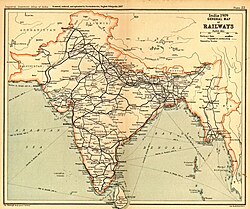
[[File:India_railways1909a.jpg|thumb|240px|right|Extent of the Indian railway network in 1909]] | [[File:India_railways1909a.jpg|thumb|240px|right|Extent of the Indian railway network in 1909]] | ||
| Line 36: | Line 64: | ||
On 14 April 1952, the Northern Railway zone was created by merging [[Jodhpur State Railway|Jodhpur Railway]], [[Bikaner State Railway|Bikaner Railway]], [[Eastern Punjab Railway]] and three divisions of the [[East Indian Railway Company|East Indian Railway]] north-west of [[Mughalsarai]] ([[Uttar Pradesh]]). | On 14 April 1952, the Northern Railway zone was created by merging [[Jodhpur State Railway|Jodhpur Railway]], [[Bikaner State Railway|Bikaner Railway]], [[Eastern Punjab Railway]] and three divisions of the [[East Indian Railway Company|East Indian Railway]] north-west of [[Mughalsarai]] ([[Uttar Pradesh]]). | ||
On 3 March 1859, [[Allahabad]] | On 3 March 1859, [[Allahabad]]–[[Kanpur]], the first passenger railway line in North India was opened, which falls under Northern Railway zone.<ref name="Indian Railways">{{cite web|author=Asiatradehub.com.com|title=India – Infrastructure Railways|url=http://www.asiatradehub.com/India/railways.asp|access-date=4 December 2009|archive-url=https://web.archive.org/web/20081016092740/http://www.asiatradehub.com/India/railways.asp|archive-date=16 October 2008|url-status=dead}}</ref> | ||
In 1864, a [[broad gauge]] track from [[Calcutta]] to [[Delhi]] was laid.<ref name=del1/> | In 1864, a [[broad-gauge]] track from [[Calcutta]] to [[Delhi]] was laid.<ref name=del1/> | ||
In 1864, the railway line between [[Delhi Junction railway station|Old Delhi]] and [[Meerut City railway station]] was constructed. [[Meerut Cantt railway station]] was established by British India government around 1865 after the [[Indian Rebellion of 1857|sepoy mutiny]] of 1857.{{citation needed|date=May 2020}} | In 1864, the railway line between [[Delhi Junction railway station|Old Delhi]] and [[Meerut City railway station]] was constructed. [[Meerut Cantt railway station]] was established by British India government around 1865 after the [[Indian Rebellion of 1857|sepoy mutiny]] of 1857.{{citation needed|date=May 2020}} | ||
In 1866, through trains started running on the [[East Indian Railway Company]]'s | In 1866, through trains started running on the [[East Indian Railway Company]]'s Howrah–Delhi line.<ref name=irfcai>{{cite web| url=http://www.irfca.org/faq/faq-hist.html |title=IR History: Early History (1832-1869)| publisher=IRFCA| access-date=28 June 2013}}</ref> | ||
In 1870, the [[Scinde, Punjab & Delhi Railway]] completed the {{convert|483|km|mi|0|abbr=on}} long | In 1870, the [[Scinde, Punjab & Delhi Railway]] completed the {{convert|483|km|mi|0|abbr=on}}-long {{stnlnk|Amritsar}}–[[Ambala Cantonment Junction railway station|Ambala]]–[[Jagadhri]]–{{stnlnk|Saharanpur}}–{{stnlnk|Ghaziabad}} line connecting [[Multan Cantonment railway station|Multan]] (now in Pakistan) with {{stnlnk|Delhi Junction}}.<ref name=timeline>{{cite web|last=R. P. Saxena|title=Indian Railway History Time line|url=http://irse.bravehost.com/IRHTML.htm|work=Irse.bravehost.com|access-date=24 January 2014|archive-url=https://web.archive.org/web/20120229092028/http://irse.bravehost.com/IRHTML.htm|archive-date=29 February 2012}}</ref> | ||
In 1872, [[Sarai Rohilla railway station]] was established when the [[metre gauge]] | In 1872, [[Delhi Sarai Rohilla railway station]] was established when the [[metre-gauge railway]] line from Delhi to [[Jaipur]] and [[Ajmer]] was being laid. It was a small station just outside Delhi as Delhi was confined to walled city then. All the metre-gauge trains starting from (and terminating at) Delhi to [[Rewari]], Punjab, Rajasthan and Gujarat passed through this station. The track from Delhi to Sarai Rohilla was double. The single track from Sarai Rohilla to Rewari was doubled up to Rewari, from where single tracks diverged in five directions. | ||
In 1876, [[metre gauge]] track from Delhi to [[Rewari railway junction|Rewari]] and further to Ajmer was laid in 1873 by [[Rajputana State Railway]].<ref name=del1/> | In 1876, [[metre-gauge]] track from Delhi to [[Rewari railway junction|Rewari]] and further to Ajmer was laid in 1873 by [[Rajputana State Railway]].<ref name=del1/> | ||
In 1879, the Sind, Punjab and Delhi railway completed the {{convert|483|km|mi|0|adj=mid|-long}} Amritsar–Ambala–Saharanpur–Ghaziabad line connecting [[Multan Cantonment railway station|Multan]] (now in | In 1879, the Sind, Punjab and Delhi railway completed the {{convert|483|km|mi|0|adj=mid|-long}} Amritsar–Ambala–Saharanpur–Ghaziabad line connecting [[Multan Cantonment railway station|Multan]] (now in Pakistan) with Delhi.<ref name=EarlyDays>{{cite web |title=IR History: Early Days II (1870-1899) |url=http://www.irfca.org/faq/faq-history2.html |access-date=7 March 2014 |archive-date=26 July 2016 |archive-url=https://web.archive.org/web/20160726192451/http://www.irfca.org/faq/faq-history2.html |url-status=dead }}</ref> | ||
In 1884, the [[ | In 1884, the [[Rajputana–Malwa Railway]] extended the {{track gauge|1000mm}}-wide [[metre gauge]] Delhi–Rewari line to Bathinda.<ref name=hisar>{{cite web| url= http://revenueharyana.gov.in/html/gazeteers/gazetteer_india_hisar.pdf| title= Gazetteer of India, Haryana, Hisar| work= Communications, page 135| publisher= Haryana Government| access-date= 10 May 2014| url-status= dead| archive-url= https://web.archive.org/web/20140501213030/http://revenueharyana.gov.in/html/gazeteers/gazetteer_india_hisar.pdf| archive-date= 1 May 2014}}</ref><ref>{{cite web| url = http://wiki.fibis.org/index.php/Rajputana-Malwa_State_Railway |title = Rajputana Malwa State Railway| publisher= fibis| access-date = 10 May 2014}}</ref>{{unreliable source?|date=February 2019}} The Bathinda–Rewari metre-gauge line was converted to {{Track gauge|5ft6in|lk=on}} [[broad gauge]] in 1994.<ref>{{cite web| url = http://www.nwr.indianrailways.gov.in/uploads/files/1390378076313-Overview%20dt.21.01.14.pdf| title = Overview of Bikaner Division| publisher = Indian Railways| access-date = 10 May 2014| url-status = dead| archive-url = https://web.archive.org/web/20140508030427/http://www.nwr.indianrailways.gov.in/uploads/files/1390378076313-Overview%20dt.21.01.14.pdf| archive-date = 8 May 2014}}</ref> | ||
On 9 March 1885, the first train ran from [[Jodhpur Junction railway station]] to Luni. The [[New Jodhpur Railway]] was later combined with [[Bikaner Railway]] to form [[ | On 9 March 1885, the first train ran from [[Jodhpur Junction railway station]] to Luni. The [[New Jodhpur Railway]] was later combined with [[Bikaner Railway]] to form [[Jodhpur–Bikaner Railway]] in 1889. A Railway line was completed between Jodhpur and Bikaner in 1891. Later in 1900, it combined with Jodhpur–Hyderabad Railway (some part of this railway is in Pakistan) leading to connection with Hyderabad of Sindh Province. Later in 1924 Jodhpur and Bikaner Railways worked as independent Railways. After Independence, a part of Jodhpur Railway went to West Pakistan.<ref>{{cite web | url = http://www.irfca.org/faq/faq-history2.html | title = IR History: Part - 2 (1870–1900) | publisher = IRFCA | access-date = 2014-02-01 | archive-date = 26 July 2016 | archive-url = https://web.archive.org/web/20160726192451/http://www.irfca.org/faq/faq-history2.html | url-status = dead }}</ref><ref>{{cite web | url = http://www.wiki.fibis.org/index.php?title=Jodhpur-Bikaner_Railway | title = Jodhpur bikaner railway | url-status = dead | archive-url = https://web.archive.org/web/20140202124719/http://www.wiki.fibis.org/index.php?title=Jodhpur-Bikaner_Railway | archive-date = 2 February 2014 }}</ref><ref>{{cite web | url = https://trainsrunningstatus.net/station/jodhpur-jn-railway-station | title = Jodhpur jn Railway Station | access-date = 12 December 2017 | archive-url = https://web.archive.org/web/20180820235018/https://trainsrunningstatus.net/station/jodhpur-jn-railway-station | archive-date = 20 August 2018 | url-status = usurped }}</ref> | ||
In 1891, the [[ | In 1891, the [[Delhi–Kalka line|Delhi–Panipat–Ambala–Kalka line]] was opened.<ref name=EarlyDays /> | ||
In 1891, the [[ | In 1891, the [[Delhi–Kalka line|Delhi–Panipat–Ambala–Kalka line]] was opened<ref name=EarlyDays /> The {{track gauge|610mm}}-wide [[narrow-gauge]] Kalka–Shimla Railway was constructed by Delhi–Panipat–Ambala–Kalka Railway Company and opened for traffic in 1903.<ref>"Engineer" journal article, circa 1915, reprinted in ''Narrow Gauge & Industrial Railway Modelling Review'', no. 75, July 2008</ref> In 1905 the line was regauged to {{track gauge|762mm}}-wide narrow gauge. | ||
In 1897, the Southern Punjab Railway Co. opened the | In 1897, the Southern Punjab Railway Co. opened the Delhi–Bhatinda–Samasatta line in 1897.<ref name=EarlyDays /> The line passed through Muktasar and Fazilka tehsils and provided direct connection through [[Samma Satta]] (now in Pakistan) to Karachi.<ref>{{cite web|url= http://punjabrevenue.nic.in/muktsar/Chapter%207.htm|title= Chapter VII Communications|access-date= 1 March 2014|archive-url= https://web.archive.org/web/20140223172820/http://punjabrevenue.nic.in/muktsar/Chapter%207.htm|archive-date= 23 February 2014|url-status= dead}}</ref> | ||
In 1900, the present building of the [[Delhi Junction railway station]] was built with 2 platforms and opened for public in 1903.<ref name=del1/> | In 1900, the present building of the [[Delhi Junction railway station]] was built with 2 platforms and opened for public in 1903.<ref name=del1/> | ||
In 1900, the | In 1900, the {{stnlnk|Ghaziabad}}–Moradabad link was established by [[Oudh and Rohilkhand Railway]].<ref name=orr>{{cite web| url=https://www.educateacademic.com/2019/04/oudh-and-rohilkhand-railway.html| title=The Oudh and Rohilkhand Railway| work=Educate Academic| access-date=28 April 2019}}</ref> | ||
In 1901–02, the metre gauge | In 1901–02, the metre gauge Jodhpur–Bikaner line was extended to Bathinda by Jodhpur–Bikaner Railway.<ref name=fibis>{{cite web| url = http://www.wiki.fibis.org/index.php?title=Jodhpur–Bikaner_Railway| title = Jodhpur–Bikaner Railway| publisher = fibis| access-date = 10 May 2014| url-status = dead| archive-url = https://web.archive.org/web/20140202124719/http://www.wiki.fibis.org/index.php?title=Jodhpur-Bikaner_Railway| archive-date = 2 February 2014}}</ref><ref name=irfcaii>{{cite web | url = http://www.irfca.org/faq/faq-history2.html | title = IR History: Part II (1870-1899) | publisher = IRFCA | access-date = 10 May 2014 | archive-date = 26 July 2016 | archive-url = https://web.archive.org/web/20160726192451/http://www.irfca.org/faq/faq-history2.html | url-status = dead }}</ref> It was subsequently converted to broad gauge.<ref>{{cite web| url = http://pib.nic.in/newsite/erelease.aspx?relid=37655|title = Railway line along Indian border| publisher= Press Information Bureau, Govt. of India, 21 April 2008| access-date = 10 May 2014}}</ref> | ||
[[File:Old Delhi Junction.jpg|thumb|Old Delhi Junction]] | [[File:Old Delhi Junction.jpg|thumb|Old Delhi Junction]] | ||
[[File:Delhi railway station.jpg|thumb|Delhi railway station]] | [[File:Delhi railway station.jpg|thumb|Delhi railway station]] | ||
In 1904 the | In 1904 the Agra–Delhi line was opened. Six railway lines then entered Delhi. [[East Indian Railway Company|East Indian Railway]], [[North Western Railway (British India)|North-Western Railway]], and [[Oudh and Rohilkhand Railway]] entered from {{stnlnk|Ghaziabad}} crossing the [[Yamuna river]]. [[Delhi]]–[[Sonipat Junction railway station]]–{{stnlnk|Panipat Junction}}–{{stnlnk|Ambala Cantonment Junction}}–{{stnlnk|Kalka}} Railway ran northwards from Delhi, and the [[Rajputana–Malwa Railway]] traversed the Delhi district for a short distance in the direction of [[Gurgaon]] and {{stnlnk|Rewari Junction}}.<ref name=del1>{{cite book |title=The Imperial Gazetteer of India|volume=11 |chapter=Delhi District: Trade and communications|publisher=Oxford at Clarendon Press |year=1909|page=229 |chapter-url=https://dsal.uchicago.edu/reference/gazetteer/pager.html?objectid=DS405.1.I34_V11_235.gif |ref=Hist |title-link=The Imperial Gazetteer of India}}</ref> Delhi Railway Station was built in red stone to give the effect of nearby historic [[Red Fort]]. The station building had six clock towers and tower 4 is still in use as a water tank. The station was remodelled in 1934–35, when its platforms were extended and power signals were introduced.<ref name=htimes>{{cite news|title=A fine balance of luxury and care |url=http://www.hindustantimes.com/News-Feed/chunk-ht-ui-newdelhi100years-topstories/A-fine-balance-of-luxury-and-care/Article1-723880.aspx |work=[[Hindustan Times]] |date=21 July 2011 |url-status=dead |archive-url=https://web.archive.org/web/20141214175839/http://www.hindustantimes.com/news-feed/chunk-ht-ui-newdelhi100years-topstories/a-fine-balance-of-luxury-and-care/article1-723880.aspx |archive-date=14 December 2014 }}</ref><ref>{{cite news|title=When Railways nearly derailed New Delhi |url=http://www.hindustantimes.com/News-Feed/newdelhi/When-Railways-nearly-derailed-New-Delhi/Article1-652023.aspx |work=Hindustan Times |date=18 January 2011 |url-status=dead |archive-url=https://web.archive.org/web/20130926091104/http://www.hindustantimes.com/News-Feed/newdelhi/When-Railways-nearly-derailed-New-Delhi/Article1-652023.aspx |archive-date=26 September 2013 }}</ref> A new entrance from [[Kashmiri Gate (Delhi)|Kashmere Gate]] side was created in 1990s and new platforms were added. The platforms were renumbered in September 2011. The numbers that started from Kashmere Gate entrance as 1A and ended at 18 near the main entrance were renumbered starting as 1 from the main entrance and ending at 16 at Kashmere Gate entrance and some platforms were merged to form long platforms to accommodate trains of 24 coaches.<ref>[http://www.expressindia.com/latest-news/confusion-after-old-delhi-railway-station-reverses-order-of-platforms/842151/ Confusion after Old Delhi railway station reverses order of platforms]{{dead link|date=February 2018 |bot=InternetArchiveBot |fix-attempted=yes }}</ref> The station building was renovated in 2012–13. Delhi earlier handled both broad and meter gauge trains. Since 1994, it is a purely broad-gauge station, metre-gauge traffic having been shifted to [[Delhi Sarai Rohilla railway station|Delhi Sarai Rohilla station]].<ref>{{Cite web|url=http://www.nr.indianrailways.gov.in/view_section.jsp?lang=0&id=0,1,263,314,315|title=Northern Railways / Indian Railways Portal|website=www.nr.indianrailways.gov.in|access-date=2017-06-02}}</ref> | ||
In 1926, [[New Delhi railway station]] opened ahead of the inauguration of the New Delhi as city in 1931. [[Agra Cantonment railway station|Agra]] | In 1926, [[New Delhi railway station]] opened ahead of the inauguration of the New Delhi as city in 1931. [[Agra Cantonment railway station|Agra]]–Delhi railway track cut through the site earmarked for the hexagonal War Memorial (now called [[India Gate]]) and Kingsway (now called [[Rajpath]]). [[East Indian Railway Company]] shifted the line along the [[Yamuna river]] and opened the new track in 1924. Before the new imperial capital New Delhi was established after 1911, the [[Delhi Junction railway station|Old Delhi railway station]] served the entire city and the [[Agra]]–Delhi railway line cut through what is today called ''[[Lutyens' Delhi]]'' and the site earmarked for the hexagonal All-India War Memorial (now ''[[India Gate]]'') and Kingsway (now ''[[Rajpath]]''). The railway line was shifted along Yamuna river and opened in 1924 to make way for the new capital. Minto (now ''Shivaji'') and Hardinge (now ''Tilak'') rail bridges came up for this realigned line. The [[East Indian Railway Company]], that overlooked railways in the region, sanctioned the construction of a single story building and a single platform between [[Gates of Delhi#Gates in the 7th city|Ajmeri Gate]] and [[Paharganj]] in 1926. This was later known as New Delhi Railway station. The government's plans to have the new station built inside the Central Park of [[Connaught Place, New Delhi|Connaught Place]] was rejected by the Railways as it found the idea impractical.<ref name="htcresent">{{cite news|url=http://www.hindustantimes.com/CP-s-blueprint-Bath-s-Crescent/Article1-659739.aspx|title=CP's blueprint: Bath's Crescent|date=8 February 2011|work=Hindustan Times|url-status=dead|archive-url=https://archive.today/20130103040022/http://www.hindustantimes.com/CP-s-blueprint-Bath-s-Crescent/Article1-659739.aspx|archive-date=3 January 2013}}</ref> In 1927–28, New Delhi Capital Works project involving construction of {{convert|4.79|mi|km}} of new lines was completed. The Viceroy and royal retinue entered the city through the new railway station during the inauguration of New Delhi in 1931. New structures were added to the railway station later and the original building served as the parcel office for many years.<ref name=ht>{{cite news|title=A fine balance of luxury and care|url=http://www.hindustantimes.com/News-Feed/chunk-ht-ui-newdelhi100years-topstories/A-fine-balance-of-luxury-and-care/Article1-723880.aspx|work=Hindustan Times|date=21 July 2011|url-status=dead|archive-url=https://web.archive.org/web/20141214175839/http://www.hindustantimes.com/news-feed/chunk-ht-ui-newdelhi100years-topstories/a-fine-balance-of-luxury-and-care/article1-723880.aspx|archive-date=14 December 2014}}</ref><ref>{{cite news|title=When Railways nearly derailed New Delhi|url=http://www.hindustantimes.com/News-Feed/newdelhi/When-Railways-nearly-derailed-New-Delhi/Article1-652023.aspx|work=Hindustan Times|date=18 January 2011|url-status=dead|archive-url=https://web.archive.org/web/20130926091104/http://www.hindustantimes.com/News-Feed/newdelhi/When-Railways-nearly-derailed-New-Delhi/Article1-652023.aspx|archive-date=26 September 2013}}</ref> | ||
In | In 1975–76, the Tundla–Aligarh–Ghaziabad track was electrified.<ref name=tun1/> | ||
In 1976–77, the | In 1976–77, the Ghaziabad–Nizamuddin–New Delhi–Delhi track was electrified.<ref name=tun1>{{cite web| url=http://irfca.org/docs/electrification-history.html| title=History of Electrification| publisher=IRFCA| access-date=28 June 2013}}</ref> | ||
On 1 July 1987, [[Ambala railway division]] was created by transferring 639 km tracks from Delhi Division and 348 km from Firozpur Division, and it became completely operational from 15 August 1988. 62% its are lies Punjab and the rest in Haryana, Himachal Pradesh, Uttar Pradesh, Rajasthan and Chandigarh. It has 141 stations, including [[UNESCO World Heritage Site|UNESCO World Heritage]] [[Kalka Shimla Railway]].<ref name=amb1>[http://www.nr.indianrailways.gov.in/view_section.jsp?lang=0&id=0,1,263,314,319 Ambala Division map and history].</ref> | On 1 July 1987, [[Ambala railway division]] was created by transferring 639 km tracks from Delhi Division and 348 km from Firozpur Division, and it became completely operational from 15 August 1988. 62% its are lies Punjab and the rest in Haryana, Himachal Pradesh, Uttar Pradesh, Rajasthan and Chandigarh. It has 141 stations, including [[UNESCO World Heritage Site|UNESCO World Heritage]] [[Kalka Shimla Railway]].<ref name=amb1>[http://www.nr.indianrailways.gov.in/view_section.jsp?lang=0&id=0,1,263,314,319 Ambala Division map and history].</ref> | ||
In 1992–1995, | In 1992–1995, Sabjimandi–Panipat–Karnal sector was electrified.<ref>{{cite web| url = http://irfca.org/docs/electrification-history.html|title = History of Electrification| publisher= IRFCA| access-date = 3 March 2014}}</ref> | ||
In 1994 December, the | In 1994 December, the Delhi–Rewari railway line had double metre-gauge tracks and one of the tracks was converted to broad gauge as a part of conversion of Ajmer–Delhi line.<ref>{{cite web|url=http://www.irfca.org/faq/faq-history5.html|title=[IRFCA] Indian Railways FAQ: IR History: Part 5|publisher=IRFCA}}</ref> Within a few years, both the tracks from Sarai Rohilla to Delhi railway station were converted to broad gauge and all metre gauge trains stopped operating from Delhi station.<ref name=roh1/> | ||
In 1998–99, | In 1998–99, Ambala–Chandigarh sector was electrified.<ref name=ir1>{{cite web| url = http://irfca.org/docs/electrification-history.html|title = History of Electrification| publisher= IRFCA| access-date = 21 February 2014}}</ref> | ||
In 1999–2000, | In 1999–2000, Chandigarh–Kalka.<ref name=ir1/> | ||
In 2003, [[Anand Vihar Terminal railway station]]'s was announced as new station to be built,<ref name="Station here">{{cite web|url=http://cities.expressindia.com/fullstory.php?newsid=45049|title=With rly station, Anand Vihar is prime property|publisher=cities.expressindia.com|author=Shruti Kohli|date=28 February 2003|access-date=2009-12-20|archive-url=https://web.archive.org/web/20030331080253/http://cities.expressindia.com/fullstory.php?newsid=45049|archive-date=31 March 2003|url-status=dead}}</ref> foundation stone laid on 25 January 2004.<ref name="Stationnew4">{{cite web|url=http://pib.nic.in/release/rel_print_page1.asp?relid=792|title=Railway Minister to lay foundation for Anand Vihar Coaching Terminal|publisher=pib.nic.in|date=23 January 2004|access-date=2010-06-27}}</ref> construction commenced in October 2006,<ref name="Station2">{{cite web|url=http://www.highbeam.com/doc/1G1-153048627.html|archive-url=https://web.archive.org/web/20121103065257/http://www.highbeam.com/doc/1G1-153048627.html|url-status=dead|archive-date=3 November 2012|title=Northern Railway has begun construction of a new station at Anand Vihar in Delhi|publisher=Highbeam.com|date=1 October 2006|access-date=2009-12-06}}</ref> and opened on 20 October 2009.<ref name="Stationnew1">{{cite web|url=http://www.dnaindia.com/india/report_anand-vihar-railway-terminal-set-for-launch-in-2-weeks-time_1320598|title=Anand Vihar railway terminal set for launch in 2 weeks' time|publisher=DNAIndia.com|date=6 December 2009|access-date=2010-06-26}}</ref> The city of [[Delhi]] heavily depends on the Rail transport to cater for the increasing load of passengers to their destinations. The long-distance trains from Delhi used to ply from three stations namely | In 2003, [[Anand Vihar Terminal railway station]]'s was announced as new station to be built,<ref name="Station here">{{cite web|url=http://cities.expressindia.com/fullstory.php?newsid=45049|title=With rly station, Anand Vihar is prime property|publisher=cities.expressindia.com|author=Shruti Kohli|date=28 February 2003|access-date=2009-12-20|archive-url=https://web.archive.org/web/20030331080253/http://cities.expressindia.com/fullstory.php?newsid=45049|archive-date=31 March 2003|url-status=dead}}</ref> foundation stone laid on 25 January 2004.<ref name="Stationnew4">{{cite web|url=http://pib.nic.in/release/rel_print_page1.asp?relid=792|title=Railway Minister to lay foundation for Anand Vihar Coaching Terminal|publisher=pib.nic.in|date=23 January 2004|access-date=2010-06-27}}</ref> construction commenced in October 2006,<ref name="Station2">{{cite web|url=http://www.highbeam.com/doc/1G1-153048627.html|archive-url=https://web.archive.org/web/20121103065257/http://www.highbeam.com/doc/1G1-153048627.html|url-status=dead|archive-date=3 November 2012|title=Northern Railway has begun construction of a new station at Anand Vihar in Delhi|publisher=Highbeam.com|date=1 October 2006|access-date=2009-12-06}}</ref> and opened on 20 October 2009.<ref name="Stationnew1">{{cite web|url=http://www.dnaindia.com/india/report_anand-vihar-railway-terminal-set-for-launch-in-2-weeks-time_1320598|title=Anand Vihar railway terminal set for launch in 2 weeks' time|publisher=DNAIndia.com|date=6 December 2009|access-date=2010-06-26}}</ref> The city of [[Delhi]] heavily depends on the Rail transport to cater for the increasing load of passengers to their destinations. The long-distance trains from Delhi used to ply from three stations namely {{stnlnk|Delhi Junction}} (Old Delhi), {{stnlnk|New Delhi}} and [[Hazrat Nizamuddin railway station]]s. These stations lacked the infrastructure facilities to handle such high passenger rush. Also, Delhi is the connecting station for the cities in the Northern states [[Punjab (India)|Punjab]], [[Haryana]], [[Himachal Pradesh]], [[Uttarakhand]] and [[Jammu and Kashmir (union territory)|Jammu and Kashmir]]. With increasing passenger pressure at the existing stations, the requirement of additional major passenger terminals was identified by the Northern Railways. The East-bound trains from Delhi to the states of [[Uttar Pradesh]], [[Bihar]], [[Orissa, India|Orissa]], [[Jharkhand]] [[West Bengal]] and other [[North East India|North-eastern states]] had to cross the bridge over [[River Yamuna]] as all the three stations are located on the other side of the river. Thus, the area of Anand Vihar was selected in the trans-Yamuna region to construct a mega-railway terminal.<ref name="Station3">{{cite web|work=The Hindu|title=Anand Vihar railway terminal to open this month|url=http://www.thehindu.com/news/cities/Delhi/article61417.ece|date=7 December 2009|access-date=2009-12-08}}</ref> | ||
In | In 2010–11 Rail Budget, [[Panipat–Meerut line]] 104 km survey was announced and the project implementation was approved in 2017–18 budget with an outlay of {{INR}}948 crore.<ref name="pani2">[https://www.jagran.com/haryana/panchkula-haryana-got-much-lower-than-expected-in-rail-budget-13635778.html Haryana gets much less than expected in rail budget], [https://www.jagran.com/haryana/panchkula-haryana-got-much-lower-than-expected-in-rail-budget-13635778.html Jagran], 25 February 2016.</ref> | ||
In 2013, [[ | In 2013, [[Chandigarh–Sahnewal line]] (also referred to as Ludhiana–Chandigarh rail link) was inaugurated.<ref>{{cite web|url= http://www.tribuneindia.com/2013/20130419/ldh1.htm |title= New Rail Link |work= The Tribune|date=19 April 2013| access-date=21 February 2014}}</ref> | ||
In 2013, the foundation stone for the shifting of | In 2013, the foundation stone for the shifting of Rohtak–[[Makrauli]] section of Rohtak–Gohana–Panipat line was laid.<ref>{{cite web| url = http://www.nr.indianrailways.gov.in/view_detail.jsp?lang=0&dcd=2919&id=0,4,268 |title = Minister for Railways Sh. Mallikarjun Kharge lays the foundation stones of 'Rohtak–Meham–Hansi new line and shifting of Rohtak–Makrauli section of Rohtak–Gohana–Panipat section today | publisher= Northern Railway | access-date = 3 March 2014 }}</ref> | ||
In May 2013, a tender was awarded to enable free Wi-Fi connectivity at the [[ | In May 2013, a tender was awarded to enable free Wi-Fi connectivity at the [[New Delhi railway station]], at an approximate cost of {{INRConvert|8|m}} and service became functional later in the year.<ref name="medianama">{{cite web|url=http://www.medianama.com/2013/07/223-free-wifi-at-new-delhi-railway-station/|title=New Delhi Railway Station To Offer Free WiFi Service; Yet Another Pilot? – MediaNama|date=29 July 2013 |publisher=medianama.com|access-date=30 May 2014}}</ref><ref name="thehindubusinessline">{{cite web|url=http://www.thehindubusinessline.com/news/states/free-wifi-connectivity-at-delhi-railway-station-soon/article4963152.ece|title=Free Wi-Fi connectivity at Delhi railway station soon | Business Line|publisher=thehindubusinessline.com|access-date=30 May 2014}}</ref> | ||
By September 2006, the second metre gauge track from Sarai Rohilla to Rewari was also converted to broad gauge and all metre gauge trains stopped operating between Rewari and Sarai Rohilla (though the converted track was opened for public use only in October 2007).<ref name=roh1>{{cite web|url=http://pib.nic.in/newsite/erelease.aspx?relid=31676|title=Press Information Bureau|website=pib.nic.in}}</ref><ref>{{cite news| url=http://www.hindu.com/2007/10/08/stories/2007100854500400.htm | archive-url=https://web.archive.org/web/20071013182649/http://hindu.com/2007/10/08/stories/2007100854500400.htm | url-status=dead | archive-date=13 October 2007 | work=[[The Hindu]] | title= | By September 2006, the second metre-gauge track from Sarai Rohilla to Rewari was also converted to broad gauge and all metre-gauge trains stopped operating between Rewari and Sarai Rohilla (though the converted track was opened for public use only in October 2007).<ref name=roh1>{{cite web|url=http://pib.nic.in/newsite/erelease.aspx?relid=31676|title=Press Information Bureau|website=pib.nic.in}}</ref><ref>{{cite news| url=http://www.hindu.com/2007/10/08/stories/2007100854500400.htm | archive-url=https://web.archive.org/web/20071013182649/http://hindu.com/2007/10/08/stories/2007100854500400.htm | url-status=dead | archive-date=13 October 2007 | work=[[The Hindu]] | title=Delhi–Haryana rail link gets better | date=8 October 2007}}</ref> | ||
In 2015 | In 2015 and 2016, work of doubling of Ghaziabad–Meerut–Khatauli (Muzaffarnagar) section of Meerut–{{stnlnk|Muzaffarnagar}}–Saharanpur tracks was completed. | ||
In January 2016, the {{convert|140|km|mi|0|adj=mid|long}} | In January 2016, the {{convert|140|km|mi|0|adj=mid|-long}} Ghaziabad–Moradabad line was completely electrified. The Ghaziabad–Meerut–Muzaffarnagar–Saharanpur–Roorkee–Haridwar line is also open to electric trains with effect from March 2016. | ||
In 2016, Vivaan Solar, a [[Gwalior]] based company won the contract to install 2.2 MW of [[rooftop solar]] project at the [[Delhi Junction railway station]] in late 2016. The [[solar power]] project to be set up under [[ | In 2016, Vivaan Solar, a [[Gwalior]]-based company won the contract to install 2.2 MW of [[rooftop solar]] project at the [[Delhi Junction railway station]] in late 2016. The [[solar power]] project to be set up under [[public–private partnership]] will be executed on design, build, finance, operate and transfer (DBFOT) basis. The company will also be responsible for maintenance of the plant for a period of 25 years.<ref name="auto">{{cite news|title=NORTHERN RAILWAYS TO INSTALL 5 MW ROOFTOP SOLAR IN FOUR OF ITS STATIONS|url=http://mercomcapital.com/northern-railways-to-install-5-mw-rooftop-solar-in-four-of-its-stations#sthash.5S8zaJPl.dpuf|access-date=3 March 2017|archive-url=https://web.archive.org/web/20170303201130/http://mercomcapital.com/northern-railways-to-install-5-mw-rooftop-solar-in-four-of-its-stations#sthash.5S8zaJPl.dpuf|archive-date=3 March 2017|url-status=dead}}</ref> | ||
In | In 2016–17 Rail Budget, [[Yamunanagar–Chandigarh line]] re-survey for this {{INR}}875 crore line was announced at the cost of {{INR}}25 crore.<ref name="pani2"/> | ||
In 2017–18, Indian Railway approved | In 2017–18, Indian Railway approved Panipat–Jind line and Panipat–Rohtak line electrification for {{INR}}980 crore and new rail line Panipat–Shamli–Baghpat–Meerut for {{INR}}2200 crore. | ||
In 2017 | In December 2017, [[National Capital Region Transport Corporation]] signed agreements with {{lang|es|[[Administrador de Infraestructuras Ferroviarias]]}} (Spain's state owned company) and [[SNCF|Société nationale des chemins de fer français]] (France's state owned company) to cooperate on the development of rapid rail smart projects, including Delhi–Meerut Smart Line, Delhi–Panipat Smart Line and Delhi–Alwar Smart Line have been prioritised for implementation in the [[National Capital Region Transport Corporation#Phase I|first phase of NCR RRTS]] where these three lines will operate from [[Sarai Kale Khan]] in Delhi. Designed with 180 km/h design speed, 160 km/h operational speed, and 100 km/h average speed, of six-car trains carrying 1,154 passengers running every 5 to 10 minutes on either underground or elevated point-to-point tracks where passengers will not have to change trains. 35-40% funding will be equity from Centre and state governments and the remaining 60% will come from multilateral funding agencies. In 2017 December, [[National Capital Region Transport Corporation]] signed agreements with {{lang|es|[[Administrador de Infraestructuras Ferroviarias]]}} (Spain's state owned company) and [[SNCF|Société nationale des chemins de fer français]] (France's state owned company) to cooperate on the development of rapid rail smart projects, including Delhi–Meerut Smart Line, Delhi–Panipat Smart Line and Delhi–Alwar Smart Line have been prioritised for implementation in the [[National Capital Region Transport Corporation#Phase I|first phase of NCR RRTS]] where these three lines will operate from [[Sarai Kale Khan]] in Delhi. NCRTC has commissioned a traffic pattern study by the [[Delhi Integrated Multi-Modal Transit System]] (DIMTS) that will determine rote and the design of stations depending on the traffic. {{INR}}32,598 crore Delhi–Ghaziabad–Meerut RRTS will be implemented first, ground clearance is underway in December 2017, construction will commence by June 2018 and completed by 2024, for which pre-construction activities including geo-technical investigations, detailed design, utility-shifting planning and traffic diversion planning are in progress. {{INR}}30,000 crore Delhi–Panipat Smart Line and 180.5 km will cost around {{INR}}37,539 crore Delhi–Alwar Smart Line are awaiting DPR approval, construction to commence by the end of 2018 and completed before 2025.<ref name="smart1">[https://www.newindianexpress.com/nation/2017/dec/01/india-spain-to-cooperate-on-rapid-rail-project-1715366.html], 1 December 2017.</ref><ref name=smart2>[http://www.hindustantimes.com/delhi-news/on-tracks-direct-trains-on-high-speed-rail-corridor-to-and-from-most-ncr-towns/story-jpcYpkBt5gs8H7SmcR8dwK.html "On track: Direct trains on high-speed rail corridor to and from most NCR towns"], ''Hindustan Times'', 28 November 2017.</ref><ref name=smart3>[https://economictimes.indiatimes.com/news/economy/infrastructure/high-speed-rail-link-by-2023-to-cut-journey-time-to-30-minutes-at-100-km/h-between-kashmere-gate-and-gurgaon/articleshow/58324162.cms "High speed rail link by 2023 to cut journey time to 30 minutes at 100 km/h between Kashmere Gate and Gurgaon"], ''[[The Economic Times]]'', 23 April 2017.</ref> Delhi–Alwar line will have 19 stations, 9 underground stations from [[Maharana Pratap Inter State Bus Terminus|ISBT Kashmere Gate]] to [[Kherki Daula]] and 10 elevated stations on 124.5 km route.<ref name=smart3/> | ||
By December 2017, railways for the first time installed 6,095 [[Global Positioning System|GPS]]-enabled "Fog Pilot Assistance System" [[railway signalling]] devices in four most affected zones, Northern Railway zone, [[North Central Railway zone]], [[North Eastern Railway zone]] and [[North Western Railway zone]], by doing away with the old practice of putting firecrackers on train tracks to | By December 2017, railways for the first time installed 6,095 [[Global Positioning System|GPS]]-enabled "Fog Pilot Assistance System" [[railway signalling]] devices in four most affected zones, Northern Railway zone, [[North Central Railway zone]], [[North Eastern Railway zone]] and [[North Western Railway zone]], by doing away with the old practice of putting firecrackers on train tracks to alert train divers running trains on snail's pace. With these devices, train pilots precisely know in advance, about the location of signals, level-crossing gates and other such approaching markers.<ref name=fog1>[https://economictimes.indiatimes.com/articleshow/62042305.cms "Indian Railways to use GPS-enabled devices to fight fog this season"], ''The Economic Times'', 12 December 2017.</ref> | ||
==Divisions== | ==Divisions== | ||
The Zonal Headquarters Office of Northern Railways is at [[Baroda House]], [[New Delhi]], and | The Zonal Headquarters Office of Northern Railways is at [[Baroda House]], [[New Delhi]], and it has 6 railway divisions, whose divisional headquarters are located at: | ||
* [[Ambala railway division]] at [[Ambala]] ([[Haryana]]), | * [[Ambala railway division]] at [[Ambala]] ([[Haryana]]), | ||
* [[Delhi railway division]] at [[Delhi]], | * [[Delhi railway division]] at [[Delhi]], | ||
* [[Firozpur railway division]] at [[Firozpur]] ([[Punjab, India|Punjab]]), | * [[Firozpur railway division]] at [[Firozpur]] ([[Punjab, India|Punjab]]), | ||
* [[Lucknow NR railway division]] at [[Lucknow]] ([[Uttar Pradesh]]) | * [[Lucknow NR railway division]] at [[Lucknow]] ([[Uttar Pradesh]]) | ||
* [[Moradabad railway division]] at [[Moradabad]] (Uttar Pradesh). | * [[Moradabad railway division]] at [[Moradabad]] ([[Western Uttar Pradesh]]) | ||
* [[Jammu railway division]] at [[Jammu]] ([[Jammu and Kashmir (union territory)|Jammu and Kashmir]]). | |||
The first passenger railway line in [[North India]] opened from [[Railways in Kanpur|Allahabad to Kanpur]] on 3 March 1859. This was followed in 1889, by the | The first passenger railway line in [[North India]] opened from [[Railways in Kanpur|Allahabad to Kanpur]] on 3 March 1859. This was followed in 1889, by the Delhi–Panipat–Ambala–[[Kalka]] line. Northern Railways previously consisted of eight divisional zones: [[Allahabad]], [[Bikaner]], [[Jodhpur]], [[Delhi]], [[Moradabad]], [[Ferozpur]], [[Ambala]], and [[Lucknow]], spanning most of North India. With the re-organisation of zones by the Indian Railways, Northern Railway zone came to its present form on 14 April 1952 and it now consists of six divisional zones. The [[Jammu railway division]] is the latest division which came to existence in 2025. | ||
== Major stations in Northern Railway Zone<ref>{{Cite web|url=http://www.indianrailways.gov.in/StationRedevelopment/AI&ACategoryStns.pdf|archive-url=https://web.archive.org/web/20160128044328/http://www.indianrailways.gov.in/StationRedevelopment/AI%26ACategoryStns.pdf|url-status=dead|archive-date=28 January 2016|date=2016-01-28|access-date=2019-04-18}}</ref> | == Major stations in Northern Railway Zone == | ||
Below is a list of the breakup of stations by category.<ref>{{Cite web|title=Statement showing Category-wise No.of stations|url=http://www.indianrailways.gov.in/StationRedevelopment/AI&ACategoryStns.pdf|archive-url=https://web.archive.org/web/20160128044328/http://www.indianrailways.gov.in/StationRedevelopment/AI%26ACategoryStns.pdf|url-status=dead|archive-date=28 January 2016|date=2016-01-28|access-date=2019-04-18}}</ref> | |||
{| class="wikitable sortable" style="background:#fff;" | {| class="wikitable sortable" style="background:#fff;" | ||
! style="background:#ffd750;" |Category of station | ! style="background:#ffd750;" |Category of station | ||
| Line 132: | Line 161: | ||
| style="text-align:center;" |'''A-1''' Category | | style="text-align:center;" |'''A-1''' Category | ||
| style="text-align:center;" |17 | | style="text-align:center;" |17 | ||
| style="text-align:center;" | | | style="text-align:center;" |{{stnlnk|Delhi Junction}}, {{stnlnk|New Delhi}}, {{stnlnk|Hazrat Nizamuddin}}, {{stnlnk|Anand Vihar Terminal}}, {{stnlnk|Ayodhya Junction}}, {{stnlnk|Ambala Cantonment Junction}}, {{stnlnk|Chandigarh Junction}}, {{stnlnk|Amritsar Junction}}, {{stnlnk|Jammu Tawi}}, {{stnlnk|Ludhiana Junction}}, {{stnlnk|Lucknow Charbagh}}, {{stnlnk|Rae Bareli Junction}}, {{stnlnk|Moradabad}}, {{stnlnk|Varanasi Junction}}, {{stnlnk|Banaras}}, {{stnlnk|Haridwar Junction}}, {{stnlnk|Bareilly Junction}}, {{stnlnk|Dehradun}} | ||
|- | |- | ||
| style="text-align:center;" |'''A''' | | style="text-align:center;" |'''A''' category | ||
| style="text-align:center;" |48 | | style="text-align:center;" |48 | ||
| style="text-align:center;" |[[Adarsh Nagar railway station|Adarsh Nagar Delhi]], | | style="text-align:center;" |[[Adarsh Nagar railway station|Adarsh Nagar Delhi]], {{stnlnk|Ballabhgarh}}, {{stnlnk|Delhi Sarai Rohilla}}, {{stnlnk|Delhi Cantonment}}, {{stnlnk|Delhi Shahdara Junction}}, {{stnlnk|Faridabad}}, {{stnlnk|Ghaziabad Junction}}, {{stnlnk|Gurgaon}}, {{stnlnk|Karnal}}, {{stnlnk|Meerut City}}, {{stnlnk|Meerut Cantt}}, {{stnlnk|Muzaffarnagar}}, {{stnlnk|Panipat Junction}}, {{stnlnk|Rohtak Junction}}, {{stnlnk|Sonipat Junction}}, {{stnlnk|Bathinda Junction}}, {{stnlnk|Jagadhri}}, {{stnlnk|Kalka}}, {{stnlnk|Patiala}}, {{stnlnk|Rajpura Junction}}, {{stnlnk|Saharanpur Junction}}, {{stnlnk|Sirhind}}, {{stnlnk|Beas Junction}}, {{stnlnk|Pathankot Cantonment}}, {{stnlnk|Firozpur Cantonment}}, {{stnlnk|Jalandhar City Junction}}, {{stnlnk|Jalandhar Cantonment}}, {{stnlnk|Pathankot Junction}}, {{stnlnk|Phagwara Junction}}, [[Phillaur Junction railway station|Phillaur Junction]], {{stnlnk|Udhampur}}, {{stnlnk|Akbarpur Junction}}, {{stnlnk|Ayodhya Junction}}, {{stnlnk|Barabanki Junction}}, {{stnlnk|Bhadohi}}, {{stnlnk|Faizabad Junction}}, {{stnlnk|Janghai Junction}}, {{stnlnk|Pratapgarh Junction}}, [[Shahganj Junction Railway Station|Shahganj Junction]], {{stnlnk|Sultanpur}}, {{stnlnk|Unnao Junction}}, {{stnlnk|Chandausi Junction}}, {{stnlnk|Hapur Junction}}, {{stnlnk|Hardoi}}, {{stnlnk|Moradabad}}, {{stnlnk|Rampur Junction}}, {{stnlnk|Roorkee}}, {{stnlnk|Shahjahanpur}}, {{stnlnk|Roza Junction}} | ||
|- | |- | ||
|- | |- | ||
|- | |- | ||
| style="text-align:center;" |'''B''' | | style="text-align:center;" |'''B''' category | ||
| style="text-align:center;" | - | | style="text-align:center;" | - | ||
| style="text-align:center;" | | | style="text-align:center;" | {{stnlnk|Jaunpur Junction}} | ||
|- | |- | ||
| style="text-align:center;" |'''C''' | | style="text-align:center;" |'''C''' category | ||
(Suburban station) | (Suburban station) | ||
| style="text-align:center;" | - | | style="text-align:center;" | - | ||
| Line 150: | Line 179: | ||
|- | |- | ||
|- | |- | ||
| style="text-align:center;" |'''D''' | | style="text-align:center;" |'''D''' category<ref>{{cite web|title=VIJAYAWADA DIVISION: A PROFILE|url=http://www.scr.indianrailways.gov.in/cris/uploads/files/1448370249434-Division%20Profile.pdf|archive-url=https://web.archive.org/web/20160128163230/http://www.scr.indianrailways.gov.in/cris/uploads/files/1448370249434-Division%20Profile.pdf|url-status=dead|archive-date=2016-01-28}}</ref> | ||
| style="text-align:center;" | - | | style="text-align:center;" | - | ||
| style="text-align:center;" | - | | style="text-align:center;" | - | ||
|- | |- | ||
| style="text-align:center;" |'''E''' | | style="text-align:center;" |'''E''' category<ref>{{cite web|title=VIJAYAWADA DIVISION: A PROFILE|url=http://www.scr.indianrailways.gov.in/cris/uploads/files/1448370249434-Division%20Profile.pdf|archive-url=https://web.archive.org/web/20160128163230/http://www.scr.indianrailways.gov.in/cris/uploads/files/1448370249434-Division%20Profile.pdf|url-status=dead|archive-date=2016-01-28}}</ref> | ||
| style="text-align:center;" | - | | style="text-align:center;" | - | ||
| style="text-align:center;" | - | | style="text-align:center;" | - | ||
|- | |- | ||
|- | |- | ||
| style="text-align:center;" |'''F''' | | style="text-align:center;" |'''F''' category | ||
Halt | Halt station | ||
| style="text-align:center;" | - | | style="text-align:center;" | - | ||
| style="text-align:center;" | - | | style="text-align:center;" | - | ||
| Line 167: | Line 196: | ||
| style="text-align:center;" |'''-''' | | style="text-align:center;" |'''-''' | ||
| style="text-align:center;" | - | | style="text-align:center;" | - | ||
|} | |||
== Amrit Bharat Station Scheme in Northern Railway Zone == | |||
The Amrit Bharat Station Scheme in Northern Railway Zone is a significant infrastructure project under the Ministry of Railways, aimed at the long-term redevelopment of 151 railway stations in the Northern Railway (NR) zone. Launched as part of a national initiative by Prime Minister Narendra Modi in August 2023 and furthered in February 2024, the scheme aims to transform these stations into modern "City Centres" that integrate transportation with social and economic hubs. The table below lists all the stations under the project.<ref>https://nr.indianrailways.gov.in/view_detail.jsp?lang=0&dcd=9123&id=0,4,268{{Dead link | date=March 2026 | fix-attempted=yes}}</ref> | |||
{| class="wikitable" style="font-size:small" | |||
|- | |||
!S.no | |||
!Division | |||
!Count | |||
!Name of stations | |||
|- | |||
| 1 | |||
| Ambala (UMB) | |||
| 19 | |||
|Abohar, Amb andaura, Ambala Cantt. Jn., Ambala City, Anandpur Sahib, Bathinda Jn., Chandigarh, Dhuri Jn., Kalka, Malerkotla, Nangal Dam, Patiala, Roop Nagar, Saharanpur Jn., Sahibzada Ajit Singh Nagar (Mohali), Sangrur, Shimla, Sirhind Jn. & Yamunanagar jagadhari | |||
|- | |||
| 2 | |||
|Delhi (DLI) | |||
|34 | |||
|Adarsh Nagar Delhi, Anand Vihar Terminal, Bahadurgarh, Ballabgarh, Bijwasan, Delhi Cantt., Delhi Jn., Delhi-Safdar Jang, Delhi-Sarai Rohilla, Delhi-Shahdara Jn., Faridabad, Faridabad New Town, Ghaziabad Jn., Gohana, Gurgaon, Hazrat Nizamuddin Jn. , Jind Jn., Karnal, Kurukshetra Jn., Mansa, Meerut City Jn., Modinagar, Muzaffarnagar, Narela,Narwana Jn., New Delhi, Palwal,Panipat Jn., Pataudi Road, Rohtak Jn., Shamli, Sonipat, Subzi Mandi & Tilak Bridge | |||
|- | |||
| 3 | |||
|Firozpur (FZR) | |||
|15 | |||
|Amritsar Jn., Beas JN., Dhandari Kalan, Fazilka Jn., Firozpur Cantt. Jn., Hoshiarpur, Jalandhar Cantt. Jn., Jalandhar City Jn., Kapurthala, Kot Kapura Jn., Ludhiana Jn., Moga, Muktsar, Phagwara Jn. & Phillaur Jn. | |||
|- | |||
| 4 | |||
|Jammu (JAT) Included under Firozpur/Northern HQ for administrative ABSS purposes. | |||
| 9 | |||
| Budgam, Baijnath Paprola, Gurdaspur, Jammu Tawi, Martyr Captain Tushar Mahajan, Palampur Himachal, Pathankot Cantt, Pathankot Jn. & Shri Mata Vaishno Devi Katra | |||
|- | |||
| 5 | |||
|Lucknow (LKO) | |||
|44 | |||
| Akbarpur Jn., Amethi, Ayodhya Dham Junction, Babatpur, Bachhrawn, Badshahpur, Bara Banki Jn., Bhadohi, Bharatkund, Chilbila Jn., Darshannagar, Gauriganj, Haidergarh, Janghai Jn., Jaunpur City, Jaunpur jn., Kanpur Bridge, Kashi, Kunda Harnamganj, Lalganj, Lambhua, Lohta, Lucknow Jn., Maa Belha Devi Dham Pratapgarh Junction, Maharaja Bijli Pasi, Malhour, Manak Nagar, Mariahu, Mohanlalganj, Phaphamau Jn., Phulpur, Prayag Jn., Rae Bareli Jn., Shahganj Jn., Shiupur, Sri Krishna Nagar, Sultanpur Jn., Takia, Unchahar Jn., Unnao Jn., Utraitia Jn., Varanasi Jn., Vyasanagar & Zafarabad Jn. | |||
|- | |||
| 6 | |||
| Moradabad (MB) | |||
| 23 | |||
| Amroha, Aonla, Balamau Jn., Bareilly Jn., Bijnor, Bulandshahr, Chandausi Jn., Dehra Dun, Dhampur, Gajraula Jn., Garhmuktesar, Hapur jn., Hardoi , Haridwar Jn., Harrawala, Kotdwara, Moradabad Jn., Nagina, Najibabad Jn., Rampur, Roorkee, Seohara & Shahjahanpur Jn. | |||
|} | |||
== State wise Stations under Amrit Bharat Station scheme == | |||
The Amrit Bharat Station Scheme, as of March 2026, encompasses 144 railway stations under the jurisdiction of the Northern Railway (NR) zone, distributed across several states and union territories in North India. Uttar Pradesh holds the largest share of the project with 61 stations, primarily managed by the Lucknow and Moradabad divisions, including major hubs like Varanasi Jn. and Ayodhya Dham Junction. Punjab follows with 29 stations, featuring significant redevelopment at sites such as Amritsar Jn., Ludhiana Jn., and Jalandhar City Jn. In Haryana, 20 stations have been identified for upgrades, with a heavy concentration in the Delhi and Ambala divisions, covering locations like Faridabad, Rohtak Jn. and Ambala Cantt. | |||
The National Capital Territory of Delhi includes 14 stations under the scheme, with New Delhi (NDLS) representing the most significant financial investment at a project cost of 4,744 Cr. In the Himalayan regions, Himachal Pradesh and Uttarakhand have 6 and 5 stations respectively, including high-profile tourist destinations like Shimla, Haridwar Jn., and Dehra Dun. The Union Territory of Jammu and Kashmir accounts for 4 stations, notably Jammu Tawi and Shri Mata Vaishno Devi Katra. The Union Territory of Chandigarh is represented by a single station Chandigarh (CDG) which has an allocated project cost of 436.29 Cr. | |||
<ref>{{Cite web | url=https://indianrailways.gov.in/railwayboard/uploads/directorate/GATI-SHAKTI/2023/Amrit%20Bharat%20Station%20Scheme.pdf | title=Amrit Bharat Station Scheme for Indian Railways | archive-url=https://web.archive.org/web/20231011150940/https://indianrailways.gov.in/railwayboard/uploads/directorate/GATI-SHAKTI/2023/Amrit%20Bharat%20Station%20Scheme.pdf | archive-date=2023-10-11}}</ref> <ref>{{Cite web | url=https://nr.indianrailways.gov.in/uploads/files/1701334226670-Amrit%20stations%20Description.pdf | title=Amrit station:ABSS Overview | website=nr.indianrailways.gov.in}}</ref> | |||
{| class="wikitable sortable" | |||
|- | |||
! S. No. !! Name of Station !! State !! Division !! Category !! Executing Agency | |||
|- | |||
| 1 || [[Abohar Junction railway station|Abohar (ABS)]] || Punjab || Ambala || NSG4 || Gati Shakti Unit | |||
|- | |||
| 2 || [[Amb Andaura railway station|Amb Andaura (AADR)]] || Himachal Pradesh || Ambala || NSG4 || Gati Shakti Unit | |||
|- | |||
| 3 || [[Ambala Cantt Junction railway station|Ambala Cantt. Jn. (UMB)]] || Haryana || Ambala || NSG2 || RLDA | |||
|- | |||
| 4 || [[Ambala City railway station|Ambala City (UBC)]] || Haryana || Ambala || NSG5 || Gati Shakti Unit | |||
|- | |||
| 5 || [[Anandpur Sahib railway station|Anandpur Sahib (ANSB)]] || Punjab || Ambala || NSG5 || Gati Shakti Unit | |||
|- | |||
| 6 || [[Bathinda Junction railway station|Bathinda Jn. (BTI)]] || Punjab || Ambala || NSG3 || Construction Unit | |||
|- | |||
| 7 || [[Chandigarh Junction railway station|Chandigarh (CDG)]] || Chandigarh || Ambala || NSG2 || RLDA | |||
|- | |||
| 8 || [[Dhuri Junction railway station|Dhuri Jn. (DUI)]] || Punjab || Ambala || NSG5 || Gati Shakti Unit | |||
|- | |||
| 9 || [[Kalka railway station|Kalka (KLK)]] || Haryana || Ambala || NSG3 || Gati Shakti Unit | |||
|- | |||
| 10 || [[Malerkotla railway station|Malerkotla (MET)]] || Punjab || Ambala || NSG5 || Gati Shakti Unit | |||
|- | |||
| 11 || [[Nangal Dam railway station|Nangal Dam (NLDM)]] || Punjab || Ambala || NSG5 || Gati Shakti Unit | |||
|- | |||
| 12 || [[Patiala railway station|Patiala (PTA)]] || Punjab || Ambala || NSG4 || Gati Shakti Unit | |||
|- | |||
| 13 || [[Rupnagar railway station|Roop Nagar (RPAR)]] || Punjab || Ambala || NSG5 || Gati Shakti Unit | |||
|- | |||
| 14 || [[Saharanpur Junction railway station|Saharanpur Jn. (SRE)]] || Uttar Pradesh || Ambala || NSG3 || Gati Shakti Unit | |||
|- | |||
| 15 || [[Sahibzada Ajit Singh Nagar railway station|SAS Nagar Mohali (SASN)]] || Punjab || Ambala || NSG5 || Gati Shakti Unit | |||
|- | |||
| 16 || [[Sangrur railway station|Sangrur (SAG)]] || Punjab || Ambala || NSG5 || Gati Shakti Unit | |||
|- | |||
| 17 || [[Shimla railway station|Shimla (SML)]] || Himachal Pradesh || Ambala || NSG5 || Gati Shakti Unit | |||
|- | |||
| 18 || [[Sirhind Junction railway station|Sirhind Jn. (SIR)]] || Punjab || Ambala || NSG4 || Gati Shakti Unit | |||
|- | |||
| 19 || [[Yamunanagar-Jagadhri railway station|Yamunanagar Jagadhari (YJUD)]] || Haryana || Ambala || NSG3 || Gati Shakti Unit | |||
|- | |||
| 20 || [[Adarsh Nagar Delhi railway station|Adarsh Nagar Delhi (ANDI)]] || Delhi || Delhi || NSG5 || Construction Unit | |||
|- | |||
| 21 || [[Anand Vihar Terminal railway station|Anand Vihar Terminal (ANVT)]] || Delhi || Delhi || NSG1 || RLDA | |||
|- | |||
| 22 || [[Bahadurgarh railway station|Bahadurgarh (BGZ)]] || Haryana || Delhi || NSG4 || Gati Shakti Unit | |||
|- | |||
| 23 || [[Ballabhgarh railway station|Ballabgarh (BVH)]] || Haryana || Delhi || NSG5 || Gati Shakti Unit | |||
|- | |||
| 24 || [[Bijwasan railway station|Bijwasan (BWSN)]] || Delhi || Delhi || NSG6 || RLDA | |||
|- | |||
| 25 || [[Delhi Cantt railway station|Delhi Cantt. (DEC)]] || Delhi || Delhi || NSG3 || RLDA | |||
|- | |||
| 26 || [[Old Delhi railway station|Delhi Jn. (DLI)]] || Delhi || Delhi || NSG1 || RLDA | |||
|- | |||
| 27 || [[Delhi Safdarjung railway station|Delhi-Safdar Jang (DSJ)]] || Delhi || Delhi || NSG4 || RLDA | |||
|- | |||
| 28 || [[Delhi Sarai Rohilla railway station|Delhi-Sarai Rohilla (DEE)]] || Delhi || Delhi || NSG2 || Gati Shakti Unit | |||
|- | |||
| 29 || [[Delhi Shahdara Junction railway station|Delhi-Shahdara Jn. (DSA)]] || Delhi || Delhi || NSG4 || Construction Unit | |||
|- | |||
| 30 || [[Faridabad railway station|Faridabad (FDB)]] || Haryana || Delhi || NSG3 || Construction Unit | |||
|- | |||
| 31 || [[Faridabad New Town railway station|Faridabad New Town (FDN)]] || Haryana || Delhi || NSG5 || Gati Shakti Unit | |||
|- | |||
| 32 || [[Ghaziabad Junction railway station|Ghaziabad Jn. (GZB)]] || Uttar Pradesh || Delhi || NSG2 || Construction Unit | |||
|- | |||
| 33 || [[Gohana Junction railway station|Gohana (GHNA)]] || Haryana || Delhi || NSG6 || Gati Shakti Unit | |||
|- | |||
| 34 || [[Gurgaon railway station|Gurgaon (GGN)]] || Haryana || Delhi || NSG3 || RLDA | |||
|- | |||
| 35 || [[Hazrat Nizamuddin railway station|Hazrat Nizamuddin Jn. (NZM)]] || Delhi || Delhi || NSG1 || RLDA | |||
|- | |||
| 36 || [[Jind Junction railway station|Jind Jn. (JIND)]] || Haryana || Delhi || NSG4 || Gati Shakti Unit | |||
|- | |||
| 37 || [[Karnal railway station|Karnal (KUN)]] || Haryana || Delhi || NSG3 || Construction Unit | |||
|- | |||
| 38 || [[Kurukshetra Junction railway station|Kurukshetra Jn. (KKDE)]] || Haryana || Delhi || NSG3 || Construction Unit | |||
|- | |||
| 39 || [[Mansa railway station|Mansa (MSZ)]] || Punjab || Delhi || NSG5 || Gati Shakti Unit | |||
|- | |||
| 40 || [[Meerut City Junction railway station|Meerut City Jn. (MTC)]] || Uttar Pradesh || Delhi || NSG3 || Construction Unit | |||
|- | |||
| 41 || [[Modinagar railway station|Modinagar (MDNR)]] || Uttar Pradesh || Delhi || NSG4 || Gati Shakti Unit | |||
|- | |||
| 42 || [[Muzaffarnagar railway station|Muzaffarnagar (MOZ)]] || Uttar Pradesh || Delhi || NSG3 || Gati Shakti Unit | |||
|- | |||
| 43 || [[Narela railway station|Narela (NUR)]] || Delhi || Delhi || NSG4 || Gati Shakti Unit | |||
|- | |||
| 44 || [[Narwana Junction railway station|Narwana Jn. (NRW)]] || Haryana || Delhi || NSG5 || Gati Shakti Unit | |||
|- | |||
| 45 || [[New Delhi railway station|New Delhi (NDLS)]] || Delhi || Delhi || NSG1 || RLDA | |||
|- | |||
| 46 || [[Palwal railway station|Palwal (PWL)]] || Haryana || Delhi || NSG4 || Gati Shakti Unit | |||
|- | |||
| 47 || [[Panipat Junction railway station|Panipat Jn. (PNP)]] || Haryana || Delhi || NSG3 || Construction Unit | |||
|- | |||
| 48 || [[Pataudi Road railway station|Pataudi Road (PTRD)]] || Haryana || Delhi || NSG5 || Gati Shakti Unit | |||
|- | |||
| 49 || [[Rohtak Junction railway station|Rohtak Jn. (ROK)]] || Haryana || Delhi || NSG3 || Gati Shakti Unit | |||
|- | |||
| 50 || [[Shamli railway station|Shamli (SMQL)]] || Uttar Pradesh || Delhi || NSG5 || Gati Shakti Unit | |||
|- | |||
| 51 || [[Sonipat Junction railway station|Sonipat (SNP)]] || Haryana || Delhi || NSG3 || Gati Shakti Unit | |||
|- | |||
| 52 || [[Sabzi Mandi railway station|Subzi Mandi (SZM)]] || Delhi || Delhi || NSG4 || Gati Shakti Unit | |||
|- | |||
| 53 || [[Tilak Bridge railway station|Tilak Bridge (TKJ)]] || Delhi || Delhi || NSG6 || Gati Shakti Unit | |||
|- | |||
| 54 || [[Amritsar Junction railway station|Amritsar Jn. (ASR)]] || Punjab || Firozpur || NSG2 || Construction Unit | |||
|- | |||
| 55 || [[Beas Junction railway station|Beas JN (BEAS)]] || Punjab || Firozpur || NSG3 || Construction Unit | |||
|- | |||
| 56 || [[Dhandari Kalan railway station|Dhandari Kalan (DDL)]] || Punjab || Firozpur || NSG4 || Gati Shakti Unit | |||
|- | |||
| 57 || [[Fazilka Junction railway station|Fazilka Jn. (FKA)]] || Punjab || Firozpur || NSG5 || Gati Shakti Unit | |||
|- | |||
| 58 || [[Firozpur Cantt railway station|Firozpur Cantt. Jn. (FZR)]] || Punjab || Firozpur || NSG3 || Gati Shakti Unit | |||
|- | |||
| 59 || [[Hoshiarpur railway station|Hoshiarpur (HSX)]] || Punjab || Firozpur || NSG5 || Gati Shakti Unit | |||
|- | |||
| 60 || [[Jalandhar Cantt Junction railway station|Jalandhar Cantt. Jn. (JRC)]] || Punjab || Firozpur || NSG3 || Construction Unit | |||
|- | |||
| 61 || [[Jalandhar City Junction railway station|Jalandhar City Jn. (JUC)]] || Punjab || Firozpur || NSG2 || Construction Unit | |||
|- | |||
| 62 || [[Kapurthala railway station|Kapurthala (KXH)]] || Punjab || Firozpur || NSG5 || Gati Shakti Unit | |||
|- | |||
| 63 || [[Kot Kapura Junction railway station|Kot Kapura Jn. (KKP)]] || Punjab || Firozpur || NSG5 || Gati Shakti Unit | |||
|- | |||
| 64 || [[Ludhiana Junction railway station|Ludhiana Jn. (LDH)]] || Punjab || Firozpur || NSG2 || Construction Unit | |||
|- | |||
| 65 || [[Moga railway station|Moga (MOGA)]] || Punjab || Firozpur || NSG5 || Gati Shakti Unit | |||
|- | |||
| 66 || [[Muktsar railway station|Muktsar (MKS)]] || Punjab || Firozpur || NSG5 || Gati Shakti Unit | |||
|- | |||
| 67 || [[Phagwara Junction railway station|Phagwara Jn. (PGW)]] || Punjab || Firozpur || NSG3 || Gati Shakti Unit | |||
|- | |||
| 68 || [[Phillaur Junction railway station|Phillaur Jn. (PHR)]] || Punjab || Firozpur || NSG4 || Gati Shakti Unit | |||
|- | |||
| 69 || [[Baijnath Paprola railway station|Baijnath Paprola (BJPL)]] || Himachal Pradesh || Jammu || NSG6 || Gati Shakti Unit | |||
|- | |||
| 70 || [[Budgam railway station|Budgam (BDGM)]] || Jammu and Kashmir || Jammu || NSG6 || Gati Shakti Unit | |||
|- | |||
| 71 || [[Gurdaspur railway station|Gurdaspur (GSP)]] || Punjab || Jammu || NSG5 || Gati Shakti Unit | |||
|- | |||
| 72 || [[Jammu Tawi railway station|Jammu Tawi (JAT)]] || Jammu and Kashmir || Jammu || NSG2 || Construction Unit | |||
|- | |||
| 73 || [[Martyr Captain Tushar Mahajan railway station|MCT Mahajan (MCTM)]] || Jammu and Kashmir || Jammu || NSG3 || Gati Shakti Unit | |||
|- | |||
| 74 || [[Palampur Himachal railway station|Palampur Himachal (PLMX)]] || Himachal Pradesh || Jammu || NSG4 || Construction Unit | |||
|- | |||
| 75 || [[Pathankot Cantt railway station|Pathankot Cantt (PTKC)]] || Punjab || Jammu || NSG3 || Construction Unit | |||
|- | |||
| 76 || [[Pathankot Junction railway station|Pathankot Jn. (PTK)]] || Punjab || Jammu || NSG4 || Gati Shakti Unit | |||
|- | |||
| 77 || [[Shri Mata Vaishno Devi Katra railway station|SMVD Katra (SVDK)]] || Jammu and Kashmir || Jammu || NSG2 || Gati Shakti Unit | |||
|- | |||
| 78 || [[Akbarpur Junction railway station|Akbarpur Jn. (ABP)]] || Uttar Pradesh || Lucknow || NSG3 || Gati Shakti Unit | |||
|- | |||
| 79 || [[Amethi railway station|Amethi (AME)]] || Uttar Pradesh || Lucknow || NSG4 || Gati Shakti Unit | |||
|- | |||
| 80 || [[Ayodhya Dham Junction railway station|Ayodhya Dham Jn. (AY)]] || Uttar Pradesh || Lucknow || NSG3 || Construction Unit | |||
|- | |||
| 81 || [[Babatpur railway station|Babatpur (BTP)]] || Uttar Pradesh || Lucknow || NSG6 || Gati Shakti Unit | |||
|- | |||
| 82 || [[Bachhrawan railway station|Bachhrawn (BCN)]] || Uttar Pradesh || Lucknow || NSG5 || Gati Shakti Unit | |||
|- | |||
| 83 || [[Badshahpur railway station|Badshahpur (BSE)]] || Uttar Pradesh || Lucknow || NSG5 || Gati Shakti Unit | |||
|- | |||
| 84 || [[Barabanki Junction railway station|Bara Banki Jn. (BBK)]] || Uttar Pradesh || Lucknow || NSG3 || Gati Shakti Unit | |||
|- | |||
| 85 || [[Bhadohi railway station|Bhadohi (BOY)]] || Uttar Pradesh || Lucknow || NSG3 || Gati Shakti Unit | |||
|- | |||
| 86 || [[Bharatkund railway station|Bharatkund (BTKD)]] || Uttar Pradesh || Lucknow || NSG6 || Gati Shakti Unit | |||
|- | |||
| 87 || [[Chilbila Junction railway station|Chilbila Jn. (CIL)]] || Uttar Pradesh || Lucknow || NSG6 || Gati Shakti Unit | |||
|- | |||
| 88 || [[Darshannagar railway station|Darshannagar (DRG)]] || Uttar Pradesh || Lucknow || NSG6 || Gati Shakti Unit | |||
|- | |||
| 89 || [[Gauriganj railway station|Gauriganj (GNG)]] || Uttar Pradesh || Lucknow || NSG5 || Gati Shakti Unit | |||
|- | |||
| 90 || [[Haidergarh railway station|Haidergarh (HGH)]] || Uttar Pradesh || Lucknow || NSG6 || Gati Shakti Unit | |||
|- | |||
| 91 || [[Janghai Junction railway station|Janghai Jn. (JNH)]] || Uttar Pradesh || Lucknow || NSG3 || Gati Shakti Unit | |||
|- | |||
| 92 || [[Jaunpur City railway station|Jaunpur City (JOP)]] || Uttar Pradesh || Lucknow || NSG4 || Gati Shakti Unit | |||
|- | |||
| 93 || [[Jaunpur Junction railway station|Jaunpur Jn. (JNU)]] || Uttar Pradesh || Lucknow || NSG3 || Gati Shakti Unit | |||
|- | |||
| 94 || [[Kanpur Bridge Left Bank railway station|Kanpur Bridge (RB) (CPB)]] || Uttar Pradesh || Lucknow || NSG6 || Gati Shakti Unit | |||
|- | |||
| 95 || [[Kashi railway station|Kashi (KEI)]] || Uttar Pradesh || Lucknow || NSG5 || Construction Unit | |||
|- | |||
| 96 || [[Kunda Harnamganj railway station|Kunda Harnamganj (KHNM)]] || Uttar Pradesh || Lucknow || NSG5 || Gati Shakti Unit | |||
|- | |||
| 97 || [[Lalganj railway station|Lalganj (LLJ)]] || Uttar Pradesh || Lucknow || NSG5 || Gati Shakti Unit | |||
|- | |||
| 98 || [[Lambhua railway station|Lambhua (LBA)]] || Uttar Pradesh || Lucknow || NSG5 || Gati Shakti Unit | |||
|- | |||
| 99 || [[Lohta railway station|Lohta (LOT)]] || Uttar Pradesh || Lucknow || NSG6 || Gati Shakti Unit | |||
|- | |||
| 100 || [[Lucknow Charbagh railway station|Lucknow Jn. (LKO)]] || Uttar Pradesh || Lucknow || NSG2 || RLDA | |||
|- | |||
| 101 || [[Maa Belha Devi Dham Pratapgarh Junction railway station|MBDD Pratapgarh Jn. (MBDP)]] || Uttar Pradesh || Lucknow || NSG3 || Gati Shakti Unit | |||
|- | |||
| 102 || [[Maharaja Bijli Pasi railway station|Maharaja Bijli Pasi (MBLP)]] || Uttar Pradesh || Lucknow || NSG4 || Gati Shakti Unit | |||
|- | |||
| 103 || [[Malhour railway station|Malhour (ML)]] || Uttar Pradesh || Lucknow || NSG6 || Gati Shakti Unit | |||
|- | |||
| 104 || [[Manak Nagar railway station|Manak Nagar (MKG)]] || Uttar Pradesh || Lucknow || NSG6 || Gati Shakti Unit | |||
|- | |||
| 105 || [[Mariahu railway station|Mariahu (MAY)]] || Uttar Pradesh || Lucknow || NSG5 || Gati Shakti Unit | |||
|- | |||
| 106 || [[Mohanlalganj railway station|Mohanlalganj (MLJ)]] || Uttar Pradesh || Lucknow || NSG6 || Gati Shakti Unit | |||
|- | |||
| 107 || [[Phaphamau Junction railway station|Phaphamau Jn. (PFM)]] || Uttar Pradesh || Lucknow || NSG5 || Division (Open Line) Unit | |||
|- | |||
| 108 || [[Phulpur railway station|Phulpur (PLP)]] || Uttar Pradesh || Lucknow || NSG5 || Gati Shakti Unit | |||
|- | |||
| 109 || [[Prayag Junction railway station|Prayag Jn. (PRG)]] || Uttar Pradesh || Lucknow || NSG4 || Division (Open Line) Unit | |||
|- | |||
| 110 || [[Rae Bareli Junction railway station|Rae Bareli Jn. (RBL)]] || Uttar Pradesh || Lucknow || NSG3 || Gati Shakti Unit | |||
|- | |||
| 111 || [[Shahganj Junction railway station|Shahganj Jn. (SHG)]] || Uttar Pradesh || Lucknow || NSG3 || Gati Shakti Unit | |||
|- | |||
| 112 || [[Shiupur railway station|Shiupur (SOP)]] || Uttar Pradesh || Lucknow || NSG6 || Gati Shakti Unit | |||
|- | |||
| 113 || [[Sri Krishna Nagar railway station|Sri Krishna Nagar (SKN)]] || Uttar Pradesh || Lucknow || NSG5 || Gati Shakti Unit | |||
|- | |||
| 114 || [[Sultanpur Junction railway station|Sultanpur Jn. (SLN)]] || Uttar Pradesh || Lucknow || NSG3 || Gati Shakti Unit | |||
|- | |||
| 115 || [[Takia railway station|Takia (TQA)]] || Uttar Pradesh || Lucknow || NSG5 || Gati Shakti Unit | |||
|- | |||
| 116 || [[Unchahar Junction railway station|Unchahar Jn. (UCR)]] || Uttar Pradesh || Lucknow || NSG5 || Gati Shakti Unit | |||
|- | |||
| 117 || [[Unnao Junction railway station|Unnao Jn. (ON)]] || Uttar Pradesh || Lucknow || NSG3 || Gati Shakti Unit | |||
|- | |||
| 118 || [[Utraitia Junction railway station|Utraitia Jn. (UTR)]] || Uttar Pradesh || Lucknow || NSG6 || Gati Shakti Unit | |||
|- | |||
| 119 || [[Varanasi Junction railway station|Varanasi Jn. (BSB)]] || Uttar Pradesh || Lucknow || NSG1 || Construction Unit | |||
|- | |||
| 120 || [[Vyasanagar railway station|Vyasanagar (VYN)]] || Uttar Pradesh || Lucknow || NSG6 || Gati Shakti Unit | |||
|- | |||
| 121 || [[Zafarabad Junction railway station|Zafarabad Jn. (ZBD)]] || Uttar Pradesh || Lucknow || NSG5 || Gati Shakti Unit | |||
|- | |||
| 122 || [[Amroha railway station|Amroha (AMRO)]] || Uttar Pradesh || Moradabad || NSG5 || Gati Shakti Unit | |||
|- | |||
| 123 || [[Aonla railway station|Aonla (AO)]] || Uttar Pradesh || Moradabad || NSG5 || Gati Shakti Unit | |||
|- | |||
| 124 || [[Balamau Junction railway station|Balamau Jn. (BLM)]] || Uttar Pradesh || Moradabad || NSG5 || Gati Shakti Unit | |||
|- | |||
| 125 || [[Bareilly Junction railway station|Bareilly Jn. (BE)]] || Uttar Pradesh || Moradabad || NSG2 || Construction Unit | |||
|- | |||
| 126 || [[Bijnor railway station|Bijnor (BJO)]] || Uttar Pradesh || Moradabad || NSG5 || Division (Open Line) Unit | |||
|- | |||
| 127 || [[Bulandshahr railway station|Bulandshahr (BSC)]] || Uttar Pradesh || Moradabad || NSG5 || Gati Shakti Unit | |||
|- | |||
| 128 || [[Chandausi Junction railway station|Chandausi Jn. (CH)]] || Uttar Pradesh || Moradabad || NSG4 || Gati Shakti Unit | |||
|- | |||
| 129 || [[Dehradun railway station|Dehra Dun (DDN)]] || Uttarakhand || Moradabad || NSG2 || Gati Shakti Unit | |||
|- | |||
| 130 || [[Dhampur railway station|Dhampur (DPR)]] || Uttar Pradesh || Moradabad || NSG5 || Division (Open Line) Unit | |||
|- | |||
| 131 || [[Gajraula Junction railway station|Gajraula Jn. (GJL)]] || Uttar Pradesh || Moradabad || NSG5 || Gati Shakti Unit | |||
|- | |||
| 132 || [[Garhmuktesar railway station|Garhmuktesar (GMS)]] || Uttar Pradesh || Moradabad || NSG5 || Gati Shakti Unit | |||
|- | |||
| 133 || [[Hapur Junction railway station|Hapur Jn. (HPU)]] || Uttar Pradesh || Moradabad || NSG4 || Gati Shakti Unit | |||
|- | |||
| 134 || [[Hardoi railway station|Hardoi (HRI)]] || Uttar Pradesh || Moradabad || NSG3 || Gati Shakti Unit | |||
|- | |||
| 135 || [[Haridwar railway station|Haridwar Jn. (HW)]] || Uttarakhand || Moradabad || NSG2 || Gati Shakti Unit | |||
|- | |||
| 136 || [[Harrawala railway station|Harrawala (HRW)]] || Uttarakhand || Moradabad || NSG6 || Gati Shakti Unit | |||
|- | |||
| 137 || [[Kotdwar railway station|Kotdwara (KTW)]] || Uttarakhand || Moradabad || NSG5 || Gati Shakti Unit | |||
|- | |||
| 138 || [[Moradabad Junction railway station|Moradabad Jn. (MB)]] || Uttar Pradesh || Moradabad || NSG2 || Construction Unit | |||
|- | |||
| 139 || [[Nagina railway station|Nagina (NGG)]] || Uttar Pradesh || Moradabad || NSG5 || Gati Shakti Unit | |||
|- | |||
| 140 || [[Najibabad Junction railway station|Najibabad Jn. (NBD)]] || Uttar Pradesh || Moradabad || NSG4 || Gati Shakti Unit | |||
|- | |||
| 141 || [[Rampur Junction railway station|Rampur (RMU)]] || Uttar Pradesh || Moradabad || NSG3 || Gati Shakti Unit | |||
|- | |||
| 142 || [[Roorkee railway station|Roorkee (RK)]] || Uttarakhand || Moradabad || NSG3 || Gati Shakti Unit | |||
|- | |||
| 143 || [[Seohara railway station|Seohara (SEO)]] || Uttar Pradesh || Moradabad || NSG5 || Gati Shakti Unit | |||
|- | |||
| 144 || [[Shahjahanpur Junction railway station|Shahjahanpur Jn. (SPN)]] || Uttar Pradesh || Moradabad || NSG3 || Gati Shakti Unit | |||
|} | |} | ||
| Line 172: | Line 547: | ||
On 19 February 1986, Northern Railways was the first zone to introduce the computerized passenger reservation system and was the first zone to do so. To facilitate the Unreserved travellers to also plan their journey ahead, Northern Railway introduced the Unreserved Ticketing System (UTS) whereby the unreserved rail passenger can purchase an unreserved ticket three days in advance from the current booking counters. | On 19 February 1986, Northern Railways was the first zone to introduce the computerized passenger reservation system and was the first zone to do so. To facilitate the Unreserved travellers to also plan their journey ahead, Northern Railway introduced the Unreserved Ticketing System (UTS) whereby the unreserved rail passenger can purchase an unreserved ticket three days in advance from the current booking counters. | ||
The first diesel and electric locomotive simulators in | The first diesel and electric locomotive simulators in India at the [[Diesel Loco Shed, Tughlakabad|Tughlakabad]] and [[Electric Loco Shed, Kanpur|Kanpur]] locomotive sheds were introduced by Northern Railways. These help upgrading the skills of the working and new drivers, providing them training for high-speed train operation. All workshops, diesel sheds and air brake freight departments are [[ISO 9000]] certified. Diesel shed, Tughlaqabad has the distinction of being the first diesel shed to get [[ISO 14000]] certification on the Indian Railway. | ||
There are eight workshops operated by Northern Railways | There are eight workshops operated by Northern Railways | ||
| Line 182: | Line 557: | ||
! style="background:#1e90ff;"|State | ! style="background:#1e90ff;"|State | ||
|- | |- | ||
| Locomotive Workshop|| [[Charbagh | | Locomotive Workshop|| [[Charbagh railway station]], [[Lucknow]]||[[Uttar Pradesh]] | ||
|- | |- | ||
| Carriage & Wagon Workshop<ref>{{cite web|url=http://www.nrcnwlko.gov.in/|title=Northern Railway Carriage and wagon Workshop Lucknow|website=nrcnwlko.gov.in|access-date=8 April 2010|archive-url=https://web.archive.org/web/20100328232553/http://www.nrcnwlko.gov.in/|archive-date=28 March 2010|url-status=dead}}</ref>|| [[Alambagh]], Lucknow||Uttar Pradesh | | Carriage & Wagon Workshop<ref>{{cite web|url=http://www.nrcnwlko.gov.in/|title=Northern Railway Carriage and wagon Workshop Lucknow|website=nrcnwlko.gov.in|access-date=8 April 2010|archive-url=https://web.archive.org/web/20100328232553/http://www.nrcnwlko.gov.in/|archive-date=28 March 2010|url-status=dead}}</ref>|| [[Alambagh]], Lucknow||Uttar Pradesh | ||
|- | |- | ||
| Carriage & Wagon Workshop|| [[Jagadhri railway station|Yamunanagar-Jagadhari | | Carriage & Wagon Workshop|| [[Jagadhri railway station|Yamunanagar-Jagadhari railway station]], [[Yamunanagar]]||[[Haryana]] | ||
|- | |- | ||
| Carriage & Wagon Workshop||[[Kalka]]||Haryana | | Carriage & Wagon Workshop||[[Kalka]]||Haryana | ||
| Line 199: | Line 574: | ||
|} | |} | ||
'''Zonal Railway Training Institute (ZRTI)''' at [[Chandausi]], Moradabad UP is the oldest (and North India's only) Railway Training Institute, where group C railway employees like Driver, Guard, Ticket Checker, Station Master, Traffic Inspector, Commercial Inspector, JE (signal & Telecom) etc. are trained for initial, promotional and refresher courses. ZRTI is an ISO 9001 Institute. Applicants pass All India Railway Examinations to get admission into the institute. ZRTI is headed by a senior Civil Services Officer.<ref>{{cite web|url=http://www.zrti.in|title=ZRTI, Chandausi|website=www.zrti.in}}</ref> | '''Zonal Railway Training Institute (ZRTI)''' at [[Chandausi]], Moradabad UP is the oldest (and North India's only) Railway Training Institute, where group C railway employees like Driver, Guard, Ticket Checker, Station Master, Traffic Inspector, Commercial Inspector, JE (signal & Telecom) etc. are trained for initial, promotional and refresher courses. ZRTI is an ISO 9001 Institute. Applicants pass All India Railway Examinations to get admission into the institute. ZRTI is headed by a senior Civil Services Officer.<ref>{{cite web|url=http://www.zrti.in/|title=ZRTI, Chandausi|website=www.zrti.in|access-date=7 January 2014|archive-date=12 January 2014|archive-url=https://web.archive.org/web/20140112154440/http://zrti.in/|url-status=dead}}</ref> | ||
==Routes== | ==Routes== | ||
===Express=== | ===Express=== | ||
* [[ | * [[Haridwar–Jammu Tawi Express]], between {{stnlnk|Haridwar}} and {{stnlnk|Jammu Tawi}} | ||
* [[ | * [[Kalka–Shri Mata Vaishno Devi Katra Express]], between {{stnlnk|Kalka}} and {{stnlnk|Shri Mata Vaishno Devi Katra}} | ||
== Jurisdiction == | == Jurisdiction == | ||
Northern Railways is one of nine old zones of Indian Railways and also the biggest in terms of network having 6807 kilometre route.<ref name="Northern Railways">{{cite web|author=iloveindia.com|title=Northern Indian Railway|url=http://www.iloveindia.com/indian-railways/railway-zones/northern-railway.html}}</ref> It covers the states of | Northern Railways is one of nine old zones of Indian Railways and also the biggest in terms of network having 6807 kilometre route.<ref name="Northern Railways">{{cite web|author=iloveindia.com|title=Northern Indian Railway|url=http://www.iloveindia.com/indian-railways/railway-zones/northern-railway.html|access-date=2 December 2009|archive-date=12 December 2009|archive-url=https://web.archive.org/web/20091212063408/http://www.iloveindia.com/indian-railways/railway-zones/northern-railway.html|url-status=dead}}</ref> It covers the states of [[Punjab, India|Punjab]], [[Haryana]], [[Himachal Pradesh]], [[Uttarakhand]] and [[Uttar Pradesh]] and the [[Union Territory|Union territories]] of [[Jammu and Kashmir (union territory)|Jammu and Kashmir]], [[Delhi]] and [[Chandigarh]]. | ||
== Background == | == Background == | ||
Northern Railways implemented the [[route relay interlocking]] (RRI) system at [[New Delhi railway station]] which is a modern signaling system for enhancing efficiency and safety in the operations. This RRI system at New Delhi is one of the world's largest route relay interlocking system certified by the Guinness Book of Records. Northern Railway is equipped with 40 RRI systems including the system at Delhi Main. | |||
Northern Railways implemented the [[ | |||
[[Delhi Suburban Railway]] services is a commuter rail service operated by Northern Railway. It covers the city state of Delhi, along with the adjoining districts of [[Faridabad]], Ghaziabad and other adjoining places in Haryana and Uttar Pradesh. These services are mostly run using [[Electric multiple unit|EMU]] and MEMU rakes. In 2009 Ladies Special trains were introduced between New Delhi and [[Palwal]]. Two more ladies special trains will be connecting from the city to Ghaziabad and [[Panipat]]. | [[Delhi Suburban Railway]] services is a commuter rail service operated by Northern Railway. It covers the city state of Delhi, along with the adjoining districts of [[Faridabad]], Ghaziabad and other adjoining places in Haryana and Uttar Pradesh. These services are mostly run using [[Electric multiple unit|EMU]] and MEMU rakes. In 2009 Ladies Special trains were introduced between New Delhi and [[Palwal]]. Two more ladies special trains will be connecting from the city to Ghaziabad and [[Panipat]]. | ||
Starting with a part of [[Firozpur]] | Starting with a part of [[Firozpur railway division|Firozpur division]] of the Northern Railway zone, the line has been under construction since 1983; the Jammu–Udhampur–Srinagar–Baramulla Railway Link (JUSBRL) of the [[Jammu–Baramulla line]] is under construction in perhaps the most difficult terrain on the Indian subcontinent. The Northern Railway reached another landmark achievement by extending rail services in the Kashmir Valley on 28 October 2009 by commencing rail services between [[Anantnag]] and [[Qazigund]] of the Qazigund-Baramula rail project.<ref name="Qazigund-Baramula rail project">{{cite web|author=Sify.com|title=Tracking Jammu and Kashmir's rail history|website=[[Sify]] |url=http://sify.com/news/Tracking-Jammu-and-Kashmir-39-s-rail-history-news-jk2sOdacaeg.html|archive-url=https://web.archive.org/web/20131030012610/http://www.sify.com/news/Tracking-Jammu-and-Kashmir-39-s-rail-history-news-jk2sOdacaeg.html|url-status=dead|archive-date=2013-10-30}}</ref> [[Pir Panjal Railway Tunnel]], the 10.96 km long railway tunnel, passes through the [[Pir Panjal Range]] of middle [[Himalayas]] in [[Jammu and Kashmir (union territory)|Jammu and Kashmir]]. It is a part of its [[Udhampur]]–[[Srinagar]]–[[Baramulla]] rail link project, opened in October 2011, India's longest and Asia's second longest railway tunnel and reduced the distance between [[Quazigund]] and [[Banihal]] to only 11 km.<ref name="TOI">{{cite news| title=India's longest railway tunnel unveiled in Jammu & Kashmir| url=http://timesofindia.indiatimes.com/india/Indias-longest-railway-tunnel-unveiled-in-Jammu-Kashmir/articleshow/10354892.cms| work=[[The Times of India]]| date=14 October 2011| access-date=14 October 2011}}</ref> | ||
Northern Railways in keeping the objective to achieve the target under [[National Solar Mission]] to maximize the use of solar power selected Vivaan Solar, a [[Gwalior]] based | Northern Railways in keeping the objective to achieve the target under [[National Solar Mission]] to maximize the use of solar power selected Vivaan Solar, a [[Gwalior]]-based company to install a total of five MW rooftop solar power project in 4 major railway stations of [[National Capital Region (India)|Delhi]] namely {{stnlnk|Anand Vihar}}, {{stnlnk|New Delhi}}, {{stnlnk|Old Delhi}} and {{stnlnk|Hazrat Nizamuddin}} respectively. The [[Public Private Partnership]] to install [[rooftop solar]] project was signed in late 2016. The [[solar power]] project is to be executed on design, build, finance, operate and transfer (DBFOT) basis and expected to be operational by August 2017. The company will also be responsible for maintaining the respective solar power plants with break up of 1.1 MW, 1.1 MW, 2.2 MW, and 0.6 MW respectively for a period of 25 years.<ref name="auto"/> | ||
==Loco sheds== | ==Loco sheds== | ||
| Line 232: | Line 607: | ||
==See also== | ==See also== | ||
* [[All India Station Masters' Association (AISMA) | * [[All India Station Masters' Association]] (AISMA) | ||
* [[Zones and divisions of Indian Railways]] | * [[Zones and divisions of Indian Railways]] | ||
* [[New Delhi | * [[New Delhi railway station]] | ||
* [[Delhi Junction | * [[Delhi Junction railway station]] | ||
* [[Sarai Rohilla | * [[Delhi Sarai Rohilla railway station]] | ||
* [[Lucknow Charbagh railway station|Lucknow NR]] | * [[Lucknow Charbagh railway station|Lucknow NR]] | ||
| Line 252: | Line 627: | ||
[[Category:Zones of Indian Railways]] | [[Category:Zones of Indian Railways]] | ||
[[Category:Northern Railway | [[Category:Northern Railway zone| ]] | ||
[[Category:1952 establishments in India]] | [[Category:1952 establishments in India]] | ||
Latest revision as of 03:17, 14 March 2026
 1-Northern Railway | |
| Overview | |
|---|---|
| Stations operated | 1021[1] |
| Headquarters | Baroda House, New Delhi |
| Dates of operation | 14 April 1952–Present |
| Predecessor | |
| Technical | |
| Track gauge | Mixed |
| Length | 7,405 km (4,601 mi)[1] |
| Track length | 10,702 km (6,650 mi)[1] |
| Other | |
| Website | nr |
The Northern Railway (abbreviated NR) is one of the 17 Railway zones of India and the northernmost zone of the Indian Railways. It is headquartered at Baroda House in New Delhi.[4]
History[edit | edit source]

Officially notified as a new railway zone on 14 April 1952, its origin goes back to 3 March 1859.
On 14 April 1952, the Northern Railway zone was created by merging Jodhpur Railway, Bikaner Railway, Eastern Punjab Railway and three divisions of the East Indian Railway north-west of Mughalsarai (Uttar Pradesh).
On 3 March 1859, Allahabad–Kanpur, the first passenger railway line in North India was opened, which falls under Northern Railway zone.[5]
In 1864, a broad-gauge track from Calcutta to Delhi was laid.[6]
In 1864, the railway line between Old Delhi and Meerut City railway station was constructed. Meerut Cantt railway station was established by British India government around 1865 after the sepoy mutiny of 1857.[citation needed]
In 1866, through trains started running on the East Indian Railway Company's Howrah–Delhi line.[7]
In 1870, the Scinde, Punjab & Delhi Railway completed the 483 km (300 mi)-long Amritsar–Ambala–Jagadhri–Saharanpur–Ghaziabad line connecting Multan (now in Pakistan) with Delhi Junction.[8]
In 1872, Delhi Sarai Rohilla railway station was established when the metre-gauge railway line from Delhi to Jaipur and Ajmer was being laid. It was a small station just outside Delhi as Delhi was confined to walled city then. All the metre-gauge trains starting from (and terminating at) Delhi to Rewari, Punjab, Rajasthan and Gujarat passed through this station. The track from Delhi to Sarai Rohilla was double. The single track from Sarai Rohilla to Rewari was doubled up to Rewari, from where single tracks diverged in five directions.
In 1876, metre-gauge track from Delhi to Rewari and further to Ajmer was laid in 1873 by Rajputana State Railway.[6]
In 1879, the Sind, Punjab and Delhi railway completed the 483-kilometre-long (300 mi) Amritsar–Ambala–Saharanpur–Ghaziabad line connecting Multan (now in Pakistan) with Delhi.[9]
In 1884, the Rajputana–Malwa Railway extended the 1,000 mm (3 ft 3+3⁄8 in)-wide metre gauge Delhi–Rewari line to Bathinda.[10][11][unreliable source?] The Bathinda–Rewari metre-gauge line was converted to 5 ft 6 in (1,676 mm) broad gauge in 1994.[12]
On 9 March 1885, the first train ran from Jodhpur Junction railway station to Luni. The New Jodhpur Railway was later combined with Bikaner Railway to form Jodhpur–Bikaner Railway in 1889. A Railway line was completed between Jodhpur and Bikaner in 1891. Later in 1900, it combined with Jodhpur–Hyderabad Railway (some part of this railway is in Pakistan) leading to connection with Hyderabad of Sindh Province. Later in 1924 Jodhpur and Bikaner Railways worked as independent Railways. After Independence, a part of Jodhpur Railway went to West Pakistan.[13][14][15]
In 1891, the Delhi–Panipat–Ambala–Kalka line was opened.[9]
In 1891, the Delhi–Panipat–Ambala–Kalka line was opened[9] The 610 mm (2 ft)-wide narrow-gauge Kalka–Shimla Railway was constructed by Delhi–Panipat–Ambala–Kalka Railway Company and opened for traffic in 1903.[16] In 1905 the line was regauged to 762 mm (2 ft 6 in)-wide narrow gauge.
In 1897, the Southern Punjab Railway Co. opened the Delhi–Bhatinda–Samasatta line in 1897.[9] The line passed through Muktasar and Fazilka tehsils and provided direct connection through Samma Satta (now in Pakistan) to Karachi.[17]
In 1900, the present building of the Delhi Junction railway station was built with 2 platforms and opened for public in 1903.[6]
In 1900, the Ghaziabad–Moradabad link was established by Oudh and Rohilkhand Railway.[18] In 1901–02, the metre gauge Jodhpur–Bikaner line was extended to Bathinda by Jodhpur–Bikaner Railway.[19][20] It was subsequently converted to broad gauge.[21]


In 1904 the Agra–Delhi line was opened. Six railway lines then entered Delhi. East Indian Railway, North-Western Railway, and Oudh and Rohilkhand Railway entered from Ghaziabad crossing the Yamuna river. Delhi–Sonipat Junction railway station–Panipat Junction–Ambala Cantonment Junction–Kalka Railway ran northwards from Delhi, and the Rajputana–Malwa Railway traversed the Delhi district for a short distance in the direction of Gurgaon and Rewari Junction.[6] Delhi Railway Station was built in red stone to give the effect of nearby historic Red Fort. The station building had six clock towers and tower 4 is still in use as a water tank. The station was remodelled in 1934–35, when its platforms were extended and power signals were introduced.[22][23] A new entrance from Kashmere Gate side was created in 1990s and new platforms were added. The platforms were renumbered in September 2011. The numbers that started from Kashmere Gate entrance as 1A and ended at 18 near the main entrance were renumbered starting as 1 from the main entrance and ending at 16 at Kashmere Gate entrance and some platforms were merged to form long platforms to accommodate trains of 24 coaches.[24] The station building was renovated in 2012–13. Delhi earlier handled both broad and meter gauge trains. Since 1994, it is a purely broad-gauge station, metre-gauge traffic having been shifted to Delhi Sarai Rohilla station.[25]
In 1926, New Delhi railway station opened ahead of the inauguration of the New Delhi as city in 1931. Agra–Delhi railway track cut through the site earmarked for the hexagonal War Memorial (now called India Gate) and Kingsway (now called Rajpath). East Indian Railway Company shifted the line along the Yamuna river and opened the new track in 1924. Before the new imperial capital New Delhi was established after 1911, the Old Delhi railway station served the entire city and the Agra–Delhi railway line cut through what is today called Lutyens' Delhi and the site earmarked for the hexagonal All-India War Memorial (now India Gate) and Kingsway (now Rajpath). The railway line was shifted along Yamuna river and opened in 1924 to make way for the new capital. Minto (now Shivaji) and Hardinge (now Tilak) rail bridges came up for this realigned line. The East Indian Railway Company, that overlooked railways in the region, sanctioned the construction of a single story building and a single platform between Ajmeri Gate and Paharganj in 1926. This was later known as New Delhi Railway station. The government's plans to have the new station built inside the Central Park of Connaught Place was rejected by the Railways as it found the idea impractical.[26] In 1927–28, New Delhi Capital Works project involving construction of 4.79 miles (7.71 km) of new lines was completed. The Viceroy and royal retinue entered the city through the new railway station during the inauguration of New Delhi in 1931. New structures were added to the railway station later and the original building served as the parcel office for many years.[27][28]
In 1975–76, the Tundla–Aligarh–Ghaziabad track was electrified.[29]
In 1976–77, the Ghaziabad–Nizamuddin–New Delhi–Delhi track was electrified.[29]
On 1 July 1987, Ambala railway division was created by transferring 639 km tracks from Delhi Division and 348 km from Firozpur Division, and it became completely operational from 15 August 1988. 62% its are lies Punjab and the rest in Haryana, Himachal Pradesh, Uttar Pradesh, Rajasthan and Chandigarh. It has 141 stations, including UNESCO World Heritage Kalka Shimla Railway.[30]
In 1992–1995, Sabjimandi–Panipat–Karnal sector was electrified.[31]
In 1994 December, the Delhi–Rewari railway line had double metre-gauge tracks and one of the tracks was converted to broad gauge as a part of conversion of Ajmer–Delhi line.[32] Within a few years, both the tracks from Sarai Rohilla to Delhi railway station were converted to broad gauge and all metre gauge trains stopped operating from Delhi station.[33]
In 1998–99, Ambala–Chandigarh sector was electrified.[34]
In 1999–2000, Chandigarh–Kalka.[34]
In 2003, Anand Vihar Terminal railway station's was announced as new station to be built,[35] foundation stone laid on 25 January 2004.[36] construction commenced in October 2006,[37] and opened on 20 October 2009.[38] The city of Delhi heavily depends on the Rail transport to cater for the increasing load of passengers to their destinations. The long-distance trains from Delhi used to ply from three stations namely Delhi Junction (Old Delhi), New Delhi and Hazrat Nizamuddin railway stations. These stations lacked the infrastructure facilities to handle such high passenger rush. Also, Delhi is the connecting station for the cities in the Northern states Punjab, Haryana, Himachal Pradesh, Uttarakhand and Jammu and Kashmir. With increasing passenger pressure at the existing stations, the requirement of additional major passenger terminals was identified by the Northern Railways. The East-bound trains from Delhi to the states of Uttar Pradesh, Bihar, Orissa, Jharkhand West Bengal and other North-eastern states had to cross the bridge over River Yamuna as all the three stations are located on the other side of the river. Thus, the area of Anand Vihar was selected in the trans-Yamuna region to construct a mega-railway terminal.[39]
In 2010–11 Rail Budget, Panipat–Meerut line 104 km survey was announced and the project implementation was approved in 2017–18 budget with an outlay of ₹948 crore.[40]
In 2013, Chandigarh–Sahnewal line (also referred to as Ludhiana–Chandigarh rail link) was inaugurated.[41]
In 2013, the foundation stone for the shifting of Rohtak–Makrauli section of Rohtak–Gohana–Panipat line was laid.[42]
In May 2013, a tender was awarded to enable free Wi-Fi connectivity at the New Delhi railway station, at an approximate cost of ₹8 million (US$110,000) and service became functional later in the year.[43][44]
By September 2006, the second metre-gauge track from Sarai Rohilla to Rewari was also converted to broad gauge and all metre-gauge trains stopped operating between Rewari and Sarai Rohilla (though the converted track was opened for public use only in October 2007).[33][45]
In 2015 and 2016, work of doubling of Ghaziabad–Meerut–Khatauli (Muzaffarnagar) section of Meerut–Muzaffarnagar–Saharanpur tracks was completed.
In January 2016, the 140-kilometre-long (87 mi) Ghaziabad–Moradabad line was completely electrified. The Ghaziabad–Meerut–Muzaffarnagar–Saharanpur–Roorkee–Haridwar line is also open to electric trains with effect from March 2016.
In 2016, Vivaan Solar, a Gwalior-based company won the contract to install 2.2 MW of rooftop solar project at the Delhi Junction railway station in late 2016. The solar power project to be set up under public–private partnership will be executed on design, build, finance, operate and transfer (DBFOT) basis. The company will also be responsible for maintenance of the plant for a period of 25 years.[46]
In 2016–17 Rail Budget, Yamunanagar–Chandigarh line re-survey for this ₹875 crore line was announced at the cost of ₹25 crore.[40]
In 2017–18, Indian Railway approved Panipat–Jind line and Panipat–Rohtak line electrification for ₹980 crore and new rail line Panipat–Shamli–Baghpat–Meerut for ₹2200 crore.
In December 2017, National Capital Region Transport Corporation signed agreements with Administrador de Infraestructuras Ferroviarias (Spain's state owned company) and Société nationale des chemins de fer français (France's state owned company) to cooperate on the development of rapid rail smart projects, including Delhi–Meerut Smart Line, Delhi–Panipat Smart Line and Delhi–Alwar Smart Line have been prioritised for implementation in the first phase of NCR RRTS where these three lines will operate from Sarai Kale Khan in Delhi. Designed with 180 km/h design speed, 160 km/h operational speed, and 100 km/h average speed, of six-car trains carrying 1,154 passengers running every 5 to 10 minutes on either underground or elevated point-to-point tracks where passengers will not have to change trains. 35-40% funding will be equity from Centre and state governments and the remaining 60% will come from multilateral funding agencies. In 2017 December, National Capital Region Transport Corporation signed agreements with Administrador de Infraestructuras Ferroviarias (Spain's state owned company) and Société nationale des chemins de fer français (France's state owned company) to cooperate on the development of rapid rail smart projects, including Delhi–Meerut Smart Line, Delhi–Panipat Smart Line and Delhi–Alwar Smart Line have been prioritised for implementation in the first phase of NCR RRTS where these three lines will operate from Sarai Kale Khan in Delhi. NCRTC has commissioned a traffic pattern study by the Delhi Integrated Multi-Modal Transit System (DIMTS) that will determine rote and the design of stations depending on the traffic. ₹32,598 crore Delhi–Ghaziabad–Meerut RRTS will be implemented first, ground clearance is underway in December 2017, construction will commence by June 2018 and completed by 2024, for which pre-construction activities including geo-technical investigations, detailed design, utility-shifting planning and traffic diversion planning are in progress. ₹30,000 crore Delhi–Panipat Smart Line and 180.5 km will cost around ₹37,539 crore Delhi–Alwar Smart Line are awaiting DPR approval, construction to commence by the end of 2018 and completed before 2025.[47][48][49] Delhi–Alwar line will have 19 stations, 9 underground stations from ISBT Kashmere Gate to Kherki Daula and 10 elevated stations on 124.5 km route.[49]
By December 2017, railways for the first time installed 6,095 GPS-enabled "Fog Pilot Assistance System" railway signalling devices in four most affected zones, Northern Railway zone, North Central Railway zone, North Eastern Railway zone and North Western Railway zone, by doing away with the old practice of putting firecrackers on train tracks to alert train divers running trains on snail's pace. With these devices, train pilots precisely know in advance, about the location of signals, level-crossing gates and other such approaching markers.[50]
Divisions[edit | edit source]
The Zonal Headquarters Office of Northern Railways is at Baroda House, New Delhi, and it has 6 railway divisions, whose divisional headquarters are located at:
- Ambala railway division at Ambala (Haryana),
- Delhi railway division at Delhi,
- Firozpur railway division at Firozpur (Punjab),
- Lucknow NR railway division at Lucknow (Uttar Pradesh)
- Moradabad railway division at Moradabad (Western Uttar Pradesh)
- Jammu railway division at Jammu (Jammu and Kashmir).
The first passenger railway line in North India opened from Allahabad to Kanpur on 3 March 1859. This was followed in 1889, by the Delhi–Panipat–Ambala–Kalka line. Northern Railways previously consisted of eight divisional zones: Allahabad, Bikaner, Jodhpur, Delhi, Moradabad, Ferozpur, Ambala, and Lucknow, spanning most of North India. With the re-organisation of zones by the Indian Railways, Northern Railway zone came to its present form on 14 April 1952 and it now consists of six divisional zones. The Jammu railway division is the latest division which came to existence in 2025.
Major stations in Northern Railway Zone[edit | edit source]
Below is a list of the breakup of stations by category.[51]
Amrit Bharat Station Scheme in Northern Railway Zone[edit | edit source]
The Amrit Bharat Station Scheme in Northern Railway Zone is a significant infrastructure project under the Ministry of Railways, aimed at the long-term redevelopment of 151 railway stations in the Northern Railway (NR) zone. Launched as part of a national initiative by Prime Minister Narendra Modi in August 2023 and furthered in February 2024, the scheme aims to transform these stations into modern "City Centres" that integrate transportation with social and economic hubs. The table below lists all the stations under the project.[54]
| S.no | Division | Count | Name of stations |
|---|---|---|---|
| 1 | Ambala (UMB) | 19 | Abohar, Amb andaura, Ambala Cantt. Jn., Ambala City, Anandpur Sahib, Bathinda Jn., Chandigarh, Dhuri Jn., Kalka, Malerkotla, Nangal Dam, Patiala, Roop Nagar, Saharanpur Jn., Sahibzada Ajit Singh Nagar (Mohali), Sangrur, Shimla, Sirhind Jn. & Yamunanagar jagadhari |
| 2 | Delhi (DLI) | 34 | Adarsh Nagar Delhi, Anand Vihar Terminal, Bahadurgarh, Ballabgarh, Bijwasan, Delhi Cantt., Delhi Jn., Delhi-Safdar Jang, Delhi-Sarai Rohilla, Delhi-Shahdara Jn., Faridabad, Faridabad New Town, Ghaziabad Jn., Gohana, Gurgaon, Hazrat Nizamuddin Jn. , Jind Jn., Karnal, Kurukshetra Jn., Mansa, Meerut City Jn., Modinagar, Muzaffarnagar, Narela,Narwana Jn., New Delhi, Palwal,Panipat Jn., Pataudi Road, Rohtak Jn., Shamli, Sonipat, Subzi Mandi & Tilak Bridge |
| 3 | Firozpur (FZR) | 15 | Amritsar Jn., Beas JN., Dhandari Kalan, Fazilka Jn., Firozpur Cantt. Jn., Hoshiarpur, Jalandhar Cantt. Jn., Jalandhar City Jn., Kapurthala, Kot Kapura Jn., Ludhiana Jn., Moga, Muktsar, Phagwara Jn. & Phillaur Jn. |
| 4 | Jammu (JAT) Included under Firozpur/Northern HQ for administrative ABSS purposes. | 9 | Budgam, Baijnath Paprola, Gurdaspur, Jammu Tawi, Martyr Captain Tushar Mahajan, Palampur Himachal, Pathankot Cantt, Pathankot Jn. & Shri Mata Vaishno Devi Katra |
| 5 | Lucknow (LKO) | 44 | Akbarpur Jn., Amethi, Ayodhya Dham Junction, Babatpur, Bachhrawn, Badshahpur, Bara Banki Jn., Bhadohi, Bharatkund, Chilbila Jn., Darshannagar, Gauriganj, Haidergarh, Janghai Jn., Jaunpur City, Jaunpur jn., Kanpur Bridge, Kashi, Kunda Harnamganj, Lalganj, Lambhua, Lohta, Lucknow Jn., Maa Belha Devi Dham Pratapgarh Junction, Maharaja Bijli Pasi, Malhour, Manak Nagar, Mariahu, Mohanlalganj, Phaphamau Jn., Phulpur, Prayag Jn., Rae Bareli Jn., Shahganj Jn., Shiupur, Sri Krishna Nagar, Sultanpur Jn., Takia, Unchahar Jn., Unnao Jn., Utraitia Jn., Varanasi Jn., Vyasanagar & Zafarabad Jn. |
| 6 | Moradabad (MB) | 23 | Amroha, Aonla, Balamau Jn., Bareilly Jn., Bijnor, Bulandshahr, Chandausi Jn., Dehra Dun, Dhampur, Gajraula Jn., Garhmuktesar, Hapur jn., Hardoi , Haridwar Jn., Harrawala, Kotdwara, Moradabad Jn., Nagina, Najibabad Jn., Rampur, Roorkee, Seohara & Shahjahanpur Jn. |
State wise Stations under Amrit Bharat Station scheme[edit | edit source]
The Amrit Bharat Station Scheme, as of March 2026, encompasses 144 railway stations under the jurisdiction of the Northern Railway (NR) zone, distributed across several states and union territories in North India. Uttar Pradesh holds the largest share of the project with 61 stations, primarily managed by the Lucknow and Moradabad divisions, including major hubs like Varanasi Jn. and Ayodhya Dham Junction. Punjab follows with 29 stations, featuring significant redevelopment at sites such as Amritsar Jn., Ludhiana Jn., and Jalandhar City Jn. In Haryana, 20 stations have been identified for upgrades, with a heavy concentration in the Delhi and Ambala divisions, covering locations like Faridabad, Rohtak Jn. and Ambala Cantt.
The National Capital Territory of Delhi includes 14 stations under the scheme, with New Delhi (NDLS) representing the most significant financial investment at a project cost of 4,744 Cr. In the Himalayan regions, Himachal Pradesh and Uttarakhand have 6 and 5 stations respectively, including high-profile tourist destinations like Shimla, Haridwar Jn., and Dehra Dun. The Union Territory of Jammu and Kashmir accounts for 4 stations, notably Jammu Tawi and Shri Mata Vaishno Devi Katra. The Union Territory of Chandigarh is represented by a single station Chandigarh (CDG) which has an allocated project cost of 436.29 Cr.
| S. No. | Name of Station | State | Division | Category | Executing Agency |
|---|---|---|---|---|---|
| 1 | Abohar (ABS) | Punjab | Ambala | NSG4 | Gati Shakti Unit |
| 2 | Amb Andaura (AADR) | Himachal Pradesh | Ambala | NSG4 | Gati Shakti Unit |
| 3 | Ambala Cantt. Jn. (UMB) | Haryana | Ambala | NSG2 | RLDA |
| 4 | Ambala City (UBC) | Haryana | Ambala | NSG5 | Gati Shakti Unit |
| 5 | Anandpur Sahib (ANSB) | Punjab | Ambala | NSG5 | Gati Shakti Unit |
| 6 | Bathinda Jn. (BTI) | Punjab | Ambala | NSG3 | Construction Unit |
| 7 | Chandigarh (CDG) | Chandigarh | Ambala | NSG2 | RLDA |
| 8 | Dhuri Jn. (DUI) | Punjab | Ambala | NSG5 | Gati Shakti Unit |
| 9 | Kalka (KLK) | Haryana | Ambala | NSG3 | Gati Shakti Unit |
| 10 | Malerkotla (MET) | Punjab | Ambala | NSG5 | Gati Shakti Unit |
| 11 | Nangal Dam (NLDM) | Punjab | Ambala | NSG5 | Gati Shakti Unit |
| 12 | Patiala (PTA) | Punjab | Ambala | NSG4 | Gati Shakti Unit |
| 13 | Roop Nagar (RPAR) | Punjab | Ambala | NSG5 | Gati Shakti Unit |
| 14 | Saharanpur Jn. (SRE) | Uttar Pradesh | Ambala | NSG3 | Gati Shakti Unit |
| 15 | SAS Nagar Mohali (SASN) | Punjab | Ambala | NSG5 | Gati Shakti Unit |
| 16 | Sangrur (SAG) | Punjab | Ambala | NSG5 | Gati Shakti Unit |
| 17 | Shimla (SML) | Himachal Pradesh | Ambala | NSG5 | Gati Shakti Unit |
| 18 | Sirhind Jn. (SIR) | Punjab | Ambala | NSG4 | Gati Shakti Unit |
| 19 | Yamunanagar Jagadhari (YJUD) | Haryana | Ambala | NSG3 | Gati Shakti Unit |
| 20 | Adarsh Nagar Delhi (ANDI) | Delhi | Delhi | NSG5 | Construction Unit |
| 21 | Anand Vihar Terminal (ANVT) | Delhi | Delhi | NSG1 | RLDA |
| 22 | Bahadurgarh (BGZ) | Haryana | Delhi | NSG4 | Gati Shakti Unit |
| 23 | Ballabgarh (BVH) | Haryana | Delhi | NSG5 | Gati Shakti Unit |
| 24 | Bijwasan (BWSN) | Delhi | Delhi | NSG6 | RLDA |
| 25 | Delhi Cantt. (DEC) | Delhi | Delhi | NSG3 | RLDA |
| 26 | Delhi Jn. (DLI) | Delhi | Delhi | NSG1 | RLDA |
| 27 | Delhi-Safdar Jang (DSJ) | Delhi | Delhi | NSG4 | RLDA |
| 28 | Delhi-Sarai Rohilla (DEE) | Delhi | Delhi | NSG2 | Gati Shakti Unit |
| 29 | Delhi-Shahdara Jn. (DSA) | Delhi | Delhi | NSG4 | Construction Unit |
| 30 | Faridabad (FDB) | Haryana | Delhi | NSG3 | Construction Unit |
| 31 | Faridabad New Town (FDN) | Haryana | Delhi | NSG5 | Gati Shakti Unit |
| 32 | Ghaziabad Jn. (GZB) | Uttar Pradesh | Delhi | NSG2 | Construction Unit |
| 33 | Gohana (GHNA) | Haryana | Delhi | NSG6 | Gati Shakti Unit |
| 34 | Gurgaon (GGN) | Haryana | Delhi | NSG3 | RLDA |
| 35 | Hazrat Nizamuddin Jn. (NZM) | Delhi | Delhi | NSG1 | RLDA |
| 36 | Jind Jn. (JIND) | Haryana | Delhi | NSG4 | Gati Shakti Unit |
| 37 | Karnal (KUN) | Haryana | Delhi | NSG3 | Construction Unit |
| 38 | Kurukshetra Jn. (KKDE) | Haryana | Delhi | NSG3 | Construction Unit |
| 39 | Mansa (MSZ) | Punjab | Delhi | NSG5 | Gati Shakti Unit |
| 40 | Meerut City Jn. (MTC) | Uttar Pradesh | Delhi | NSG3 | Construction Unit |
| 41 | Modinagar (MDNR) | Uttar Pradesh | Delhi | NSG4 | Gati Shakti Unit |
| 42 | Muzaffarnagar (MOZ) | Uttar Pradesh | Delhi | NSG3 | Gati Shakti Unit |
| 43 | Narela (NUR) | Delhi | Delhi | NSG4 | Gati Shakti Unit |
| 44 | Narwana Jn. (NRW) | Haryana | Delhi | NSG5 | Gati Shakti Unit |
| 45 | New Delhi (NDLS) | Delhi | Delhi | NSG1 | RLDA |
| 46 | Palwal (PWL) | Haryana | Delhi | NSG4 | Gati Shakti Unit |
| 47 | Panipat Jn. (PNP) | Haryana | Delhi | NSG3 | Construction Unit |
| 48 | Pataudi Road (PTRD) | Haryana | Delhi | NSG5 | Gati Shakti Unit |
| 49 | Rohtak Jn. (ROK) | Haryana | Delhi | NSG3 | Gati Shakti Unit |
| 50 | Shamli (SMQL) | Uttar Pradesh | Delhi | NSG5 | Gati Shakti Unit |
| 51 | Sonipat (SNP) | Haryana | Delhi | NSG3 | Gati Shakti Unit |
| 52 | Subzi Mandi (SZM) | Delhi | Delhi | NSG4 | Gati Shakti Unit |
| 53 | Tilak Bridge (TKJ) | Delhi | Delhi | NSG6 | Gati Shakti Unit |
| 54 | Amritsar Jn. (ASR) | Punjab | Firozpur | NSG2 | Construction Unit |
| 55 | Beas JN (BEAS) | Punjab | Firozpur | NSG3 | Construction Unit |
| 56 | Dhandari Kalan (DDL) | Punjab | Firozpur | NSG4 | Gati Shakti Unit |
| 57 | Fazilka Jn. (FKA) | Punjab | Firozpur | NSG5 | Gati Shakti Unit |
| 58 | Firozpur Cantt. Jn. (FZR) | Punjab | Firozpur | NSG3 | Gati Shakti Unit |
| 59 | Hoshiarpur (HSX) | Punjab | Firozpur | NSG5 | Gati Shakti Unit |
| 60 | Jalandhar Cantt. Jn. (JRC) | Punjab | Firozpur | NSG3 | Construction Unit |
| 61 | Jalandhar City Jn. (JUC) | Punjab | Firozpur | NSG2 | Construction Unit |
| 62 | Kapurthala (KXH) | Punjab | Firozpur | NSG5 | Gati Shakti Unit |
| 63 | Kot Kapura Jn. (KKP) | Punjab | Firozpur | NSG5 | Gati Shakti Unit |
| 64 | Ludhiana Jn. (LDH) | Punjab | Firozpur | NSG2 | Construction Unit |
| 65 | Moga (MOGA) | Punjab | Firozpur | NSG5 | Gati Shakti Unit |
| 66 | Muktsar (MKS) | Punjab | Firozpur | NSG5 | Gati Shakti Unit |
| 67 | Phagwara Jn. (PGW) | Punjab | Firozpur | NSG3 | Gati Shakti Unit |
| 68 | Phillaur Jn. (PHR) | Punjab | Firozpur | NSG4 | Gati Shakti Unit |
| 69 | Baijnath Paprola (BJPL) | Himachal Pradesh | Jammu | NSG6 | Gati Shakti Unit |
| 70 | Budgam (BDGM) | Jammu and Kashmir | Jammu | NSG6 | Gati Shakti Unit |
| 71 | Gurdaspur (GSP) | Punjab | Jammu | NSG5 | Gati Shakti Unit |
| 72 | Jammu Tawi (JAT) | Jammu and Kashmir | Jammu | NSG2 | Construction Unit |
| 73 | MCT Mahajan (MCTM) | Jammu and Kashmir | Jammu | NSG3 | Gati Shakti Unit |
| 74 | Palampur Himachal (PLMX) | Himachal Pradesh | Jammu | NSG4 | Construction Unit |
| 75 | Pathankot Cantt (PTKC) | Punjab | Jammu | NSG3 | Construction Unit |
| 76 | Pathankot Jn. (PTK) | Punjab | Jammu | NSG4 | Gati Shakti Unit |
| 77 | SMVD Katra (SVDK) | Jammu and Kashmir | Jammu | NSG2 | Gati Shakti Unit |
| 78 | Akbarpur Jn. (ABP) | Uttar Pradesh | Lucknow | NSG3 | Gati Shakti Unit |
| 79 | Amethi (AME) | Uttar Pradesh | Lucknow | NSG4 | Gati Shakti Unit |
| 80 | Ayodhya Dham Jn. (AY) | Uttar Pradesh | Lucknow | NSG3 | Construction Unit |
| 81 | Babatpur (BTP) | Uttar Pradesh | Lucknow | NSG6 | Gati Shakti Unit |
| 82 | Bachhrawn (BCN) | Uttar Pradesh | Lucknow | NSG5 | Gati Shakti Unit |
| 83 | Badshahpur (BSE) | Uttar Pradesh | Lucknow | NSG5 | Gati Shakti Unit |
| 84 | Bara Banki Jn. (BBK) | Uttar Pradesh | Lucknow | NSG3 | Gati Shakti Unit |
| 85 | Bhadohi (BOY) | Uttar Pradesh | Lucknow | NSG3 | Gati Shakti Unit |
| 86 | Bharatkund (BTKD) | Uttar Pradesh | Lucknow | NSG6 | Gati Shakti Unit |
| 87 | Chilbila Jn. (CIL) | Uttar Pradesh | Lucknow | NSG6 | Gati Shakti Unit |
| 88 | Darshannagar (DRG) | Uttar Pradesh | Lucknow | NSG6 | Gati Shakti Unit |
| 89 | Gauriganj (GNG) | Uttar Pradesh | Lucknow | NSG5 | Gati Shakti Unit |
| 90 | Haidergarh (HGH) | Uttar Pradesh | Lucknow | NSG6 | Gati Shakti Unit |
| 91 | Janghai Jn. (JNH) | Uttar Pradesh | Lucknow | NSG3 | Gati Shakti Unit |
| 92 | Jaunpur City (JOP) | Uttar Pradesh | Lucknow | NSG4 | Gati Shakti Unit |
| 93 | Jaunpur Jn. (JNU) | Uttar Pradesh | Lucknow | NSG3 | Gati Shakti Unit |
| 94 | Kanpur Bridge (RB) (CPB) | Uttar Pradesh | Lucknow | NSG6 | Gati Shakti Unit |
| 95 | Kashi (KEI) | Uttar Pradesh | Lucknow | NSG5 | Construction Unit |
| 96 | Kunda Harnamganj (KHNM) | Uttar Pradesh | Lucknow | NSG5 | Gati Shakti Unit |
| 97 | Lalganj (LLJ) | Uttar Pradesh | Lucknow | NSG5 | Gati Shakti Unit |
| 98 | Lambhua (LBA) | Uttar Pradesh | Lucknow | NSG5 | Gati Shakti Unit |
| 99 | Lohta (LOT) | Uttar Pradesh | Lucknow | NSG6 | Gati Shakti Unit |
| 100 | Lucknow Jn. (LKO) | Uttar Pradesh | Lucknow | NSG2 | RLDA |
| 101 | MBDD Pratapgarh Jn. (MBDP) | Uttar Pradesh | Lucknow | NSG3 | Gati Shakti Unit |
| 102 | Maharaja Bijli Pasi (MBLP) | Uttar Pradesh | Lucknow | NSG4 | Gati Shakti Unit |
| 103 | Malhour (ML) | Uttar Pradesh | Lucknow | NSG6 | Gati Shakti Unit |
| 104 | Manak Nagar (MKG) | Uttar Pradesh | Lucknow | NSG6 | Gati Shakti Unit |
| 105 | Mariahu (MAY) | Uttar Pradesh | Lucknow | NSG5 | Gati Shakti Unit |
| 106 | Mohanlalganj (MLJ) | Uttar Pradesh | Lucknow | NSG6 | Gati Shakti Unit |
| 107 | Phaphamau Jn. (PFM) | Uttar Pradesh | Lucknow | NSG5 | Division (Open Line) Unit |
| 108 | Phulpur (PLP) | Uttar Pradesh | Lucknow | NSG5 | Gati Shakti Unit |
| 109 | Prayag Jn. (PRG) | Uttar Pradesh | Lucknow | NSG4 | Division (Open Line) Unit |
| 110 | Rae Bareli Jn. (RBL) | Uttar Pradesh | Lucknow | NSG3 | Gati Shakti Unit |
| 111 | Shahganj Jn. (SHG) | Uttar Pradesh | Lucknow | NSG3 | Gati Shakti Unit |
| 112 | Shiupur (SOP) | Uttar Pradesh | Lucknow | NSG6 | Gati Shakti Unit |
| 113 | Sri Krishna Nagar (SKN) | Uttar Pradesh | Lucknow | NSG5 | Gati Shakti Unit |
| 114 | Sultanpur Jn. (SLN) | Uttar Pradesh | Lucknow | NSG3 | Gati Shakti Unit |
| 115 | Takia (TQA) | Uttar Pradesh | Lucknow | NSG5 | Gati Shakti Unit |
| 116 | Unchahar Jn. (UCR) | Uttar Pradesh | Lucknow | NSG5 | Gati Shakti Unit |
| 117 | Unnao Jn. (ON) | Uttar Pradesh | Lucknow | NSG3 | Gati Shakti Unit |
| 118 | Utraitia Jn. (UTR) | Uttar Pradesh | Lucknow | NSG6 | Gati Shakti Unit |
| 119 | Varanasi Jn. (BSB) | Uttar Pradesh | Lucknow | NSG1 | Construction Unit |
| 120 | Vyasanagar (VYN) | Uttar Pradesh | Lucknow | NSG6 | Gati Shakti Unit |
| 121 | Zafarabad Jn. (ZBD) | Uttar Pradesh | Lucknow | NSG5 | Gati Shakti Unit |
| 122 | Amroha (AMRO) | Uttar Pradesh | Moradabad | NSG5 | Gati Shakti Unit |
| 123 | Aonla (AO) | Uttar Pradesh | Moradabad | NSG5 | Gati Shakti Unit |
| 124 | Balamau Jn. (BLM) | Uttar Pradesh | Moradabad | NSG5 | Gati Shakti Unit |
| 125 | Bareilly Jn. (BE) | Uttar Pradesh | Moradabad | NSG2 | Construction Unit |
| 126 | Bijnor (BJO) | Uttar Pradesh | Moradabad | NSG5 | Division (Open Line) Unit |
| 127 | Bulandshahr (BSC) | Uttar Pradesh | Moradabad | NSG5 | Gati Shakti Unit |
| 128 | Chandausi Jn. (CH) | Uttar Pradesh | Moradabad | NSG4 | Gati Shakti Unit |
| 129 | Dehra Dun (DDN) | Uttarakhand | Moradabad | NSG2 | Gati Shakti Unit |
| 130 | Dhampur (DPR) | Uttar Pradesh | Moradabad | NSG5 | Division (Open Line) Unit |
| 131 | Gajraula Jn. (GJL) | Uttar Pradesh | Moradabad | NSG5 | Gati Shakti Unit |
| 132 | Garhmuktesar (GMS) | Uttar Pradesh | Moradabad | NSG5 | Gati Shakti Unit |
| 133 | Hapur Jn. (HPU) | Uttar Pradesh | Moradabad | NSG4 | Gati Shakti Unit |
| 134 | Hardoi (HRI) | Uttar Pradesh | Moradabad | NSG3 | Gati Shakti Unit |
| 135 | Haridwar Jn. (HW) | Uttarakhand | Moradabad | NSG2 | Gati Shakti Unit |
| 136 | Harrawala (HRW) | Uttarakhand | Moradabad | NSG6 | Gati Shakti Unit |
| 137 | Kotdwara (KTW) | Uttarakhand | Moradabad | NSG5 | Gati Shakti Unit |
| 138 | Moradabad Jn. (MB) | Uttar Pradesh | Moradabad | NSG2 | Construction Unit |
| 139 | Nagina (NGG) | Uttar Pradesh | Moradabad | NSG5 | Gati Shakti Unit |
| 140 | Najibabad Jn. (NBD) | Uttar Pradesh | Moradabad | NSG4 | Gati Shakti Unit |
| 141 | Rampur (RMU) | Uttar Pradesh | Moradabad | NSG3 | Gati Shakti Unit |
| 142 | Roorkee (RK) | Uttarakhand | Moradabad | NSG3 | Gati Shakti Unit |
| 143 | Seohara (SEO) | Uttar Pradesh | Moradabad | NSG5 | Gati Shakti Unit |
| 144 | Shahjahanpur Jn. (SPN) | Uttar Pradesh | Moradabad | NSG3 | Gati Shakti Unit |
Infrastructure[edit | edit source]
On 19 February 1986, Northern Railways was the first zone to introduce the computerized passenger reservation system and was the first zone to do so. To facilitate the Unreserved travellers to also plan their journey ahead, Northern Railway introduced the Unreserved Ticketing System (UTS) whereby the unreserved rail passenger can purchase an unreserved ticket three days in advance from the current booking counters.
The first diesel and electric locomotive simulators in India at the Tughlakabad and Kanpur locomotive sheds were introduced by Northern Railways. These help upgrading the skills of the working and new drivers, providing them training for high-speed train operation. All workshops, diesel sheds and air brake freight departments are ISO 9000 certified. Diesel shed, Tughlaqabad has the distinction of being the first diesel shed to get ISO 14000 certification on the Indian Railway.
There are eight workshops operated by Northern Railways
| Workshop | Location | State |
|---|---|---|
| Locomotive Workshop | Charbagh railway station, Lucknow | Uttar Pradesh |
| Carriage & Wagon Workshop[57] | Alambagh, Lucknow | Uttar Pradesh |
| Carriage & Wagon Workshop | Yamunanagar-Jagadhari railway station, Yamunanagar | Haryana |
| Carriage & Wagon Workshop | Kalka | Haryana |
| Bridge Workshop | Jalandhar Cantonment | Punjab |
| Bridge Workshop | Lucknow | Uttar Pradesh |
| Engineering workshop | Jalandhar | Punjab |
| Signal & Telecom Workshop | Ghaziabad | Uttar Pradesh |
Zonal Railway Training Institute (ZRTI) at Chandausi, Moradabad UP is the oldest (and North India's only) Railway Training Institute, where group C railway employees like Driver, Guard, Ticket Checker, Station Master, Traffic Inspector, Commercial Inspector, JE (signal & Telecom) etc. are trained for initial, promotional and refresher courses. ZRTI is an ISO 9001 Institute. Applicants pass All India Railway Examinations to get admission into the institute. ZRTI is headed by a senior Civil Services Officer.[58]
Routes[edit | edit source]
Express[edit | edit source]
- Haridwar–Jammu Tawi Express, between Haridwar and Jammu Tawi
- Kalka–Shri Mata Vaishno Devi Katra Express, between Kalka and Shri Mata Vaishno Devi Katra
Jurisdiction[edit | edit source]
Northern Railways is one of nine old zones of Indian Railways and also the biggest in terms of network having 6807 kilometre route.[59] It covers the states of Punjab, Haryana, Himachal Pradesh, Uttarakhand and Uttar Pradesh and the Union territories of Jammu and Kashmir, Delhi and Chandigarh.
Background[edit | edit source]
Northern Railways implemented the route relay interlocking (RRI) system at New Delhi railway station which is a modern signaling system for enhancing efficiency and safety in the operations. This RRI system at New Delhi is one of the world's largest route relay interlocking system certified by the Guinness Book of Records. Northern Railway is equipped with 40 RRI systems including the system at Delhi Main.
Delhi Suburban Railway services is a commuter rail service operated by Northern Railway. It covers the city state of Delhi, along with the adjoining districts of Faridabad, Ghaziabad and other adjoining places in Haryana and Uttar Pradesh. These services are mostly run using EMU and MEMU rakes. In 2009 Ladies Special trains were introduced between New Delhi and Palwal. Two more ladies special trains will be connecting from the city to Ghaziabad and Panipat.
Starting with a part of Firozpur division of the Northern Railway zone, the line has been under construction since 1983; the Jammu–Udhampur–Srinagar–Baramulla Railway Link (JUSBRL) of the Jammu–Baramulla line is under construction in perhaps the most difficult terrain on the Indian subcontinent. The Northern Railway reached another landmark achievement by extending rail services in the Kashmir Valley on 28 October 2009 by commencing rail services between Anantnag and Qazigund of the Qazigund-Baramula rail project.[60] Pir Panjal Railway Tunnel, the 10.96 km long railway tunnel, passes through the Pir Panjal Range of middle Himalayas in Jammu and Kashmir. It is a part of its Udhampur–Srinagar–Baramulla rail link project, opened in October 2011, India's longest and Asia's second longest railway tunnel and reduced the distance between Quazigund and Banihal to only 11 km.[61]
Northern Railways in keeping the objective to achieve the target under National Solar Mission to maximize the use of solar power selected Vivaan Solar, a Gwalior-based company to install a total of five MW rooftop solar power project in 4 major railway stations of Delhi namely Anand Vihar, New Delhi, Old Delhi and Hazrat Nizamuddin respectively. The Public Private Partnership to install rooftop solar project was signed in late 2016. The solar power project is to be executed on design, build, finance, operate and transfer (DBFOT) basis and expected to be operational by August 2017. The company will also be responsible for maintaining the respective solar power plants with break up of 1.1 MW, 1.1 MW, 2.2 MW, and 0.6 MW respectively for a period of 25 years.[46]
Loco sheds[edit | edit source]
- Electric Loco Shed, Ghaziabad
- Electric Loco Shed, Ludhiana
- Electric Loco Shed, Saharanpur
- Electric Loco Shed, Khanalampura
- Diesel Loco Shed, Tughlakabad
- Diesel Loco Shed, Ludhiana
- Diesel Loco Shed, Lucknow
- Diesel Loco Shed, Roza
- Diesel Loco Shed, Alambagh
See also[edit | edit source]
- All India Station Masters' Association (AISMA)
- Zones and divisions of Indian Railways
- New Delhi railway station
- Delhi Junction railway station
- Delhi Sarai Rohilla railway station
- Lucknow NR
References[edit | edit source]
- ↑ 1.0 1.1 1.2 "Northern Railways - Important Statistics (as of 31-03-2025)" (PDF). Northern Railways. Retrieved 11 January 2026.
- ↑ "Shri Ashok Kumar Verma assumes the charge of General Manager, Northern Railway". nr.indianrailways.gov.in. 1 October 2025. Retrieved 11 January 2026.
- ↑ "Shri Mohit Chandra has assumed the charge of Additional General Manager, Northern Railway". nr.indianrailways.gov.in. 17 November 2024. Retrieved 11 January 2026.
- ↑ "Railway Zones and Divisions in The Country". Press Information Bureau. Ministry of Railways (Government of India). 21 July 2017. Retrieved 1 January 2025.
- ↑ Asiatradehub.com.com. "India – Infrastructure Railways". Archived from the original on 16 October 2008. Retrieved 4 December 2009.
- ↑ 6.0 6.1 6.2 6.3 "Delhi District: Trade and communications". The Imperial Gazetteer of India. Vol. 11. Oxford at Clarendon Press. 1909. p. 229.
- ↑ "IR History: Early History (1832-1869)". IRFCA. Retrieved 28 June 2013.
- ↑ R. P. Saxena. "Indian Railway History Time line". Irse.bravehost.com. Archived from the original on 29 February 2012. Retrieved 24 January 2014.
- ↑ 9.0 9.1 9.2 9.3 "IR History: Early Days II (1870-1899)". Archived from the original on 26 July 2016. Retrieved 7 March 2014.
- ↑ "Gazetteer of India, Haryana, Hisar" (PDF). Communications, page 135. Haryana Government. Archived from the original (PDF) on 1 May 2014. Retrieved 10 May 2014.
- ↑ "Rajputana Malwa State Railway". fibis. Retrieved 10 May 2014.
- ↑ "Overview of Bikaner Division" (PDF). Indian Railways. Archived from the original (PDF) on 8 May 2014. Retrieved 10 May 2014.
- ↑ "IR History: Part - 2 (1870–1900)". IRFCA. Archived from the original on 26 July 2016. Retrieved 1 February 2014.
- ↑ "Jodhpur bikaner railway". Archived from the original on 2 February 2014.
- ↑ "Jodhpur jn Railway Station". Archived from the original on 20 August 2018. Retrieved 12 December 2017.
- ↑ "Engineer" journal article, circa 1915, reprinted in Narrow Gauge & Industrial Railway Modelling Review, no. 75, July 2008
- ↑ "Chapter VII Communications". Archived from the original on 23 February 2014. Retrieved 1 March 2014.
- ↑ "The Oudh and Rohilkhand Railway". Educate Academic. Retrieved 28 April 2019.
- ↑ "Jodhpur–Bikaner Railway". fibis. Archived from the original on 2 February 2014. Retrieved 10 May 2014.
- ↑ "IR History: Part II (1870-1899)". IRFCA. Archived from the original on 26 July 2016. Retrieved 10 May 2014.
- ↑ "Railway line along Indian border". Press Information Bureau, Govt. of India, 21 April 2008. Retrieved 10 May 2014.
- ↑ "A fine balance of luxury and care". Hindustan Times. 21 July 2011. Archived from the original on 14 December 2014.
- ↑ "When Railways nearly derailed New Delhi". Hindustan Times. 18 January 2011. Archived from the original on 26 September 2013.
- ↑ Confusion after Old Delhi railway station reverses order of platforms[permanent dead link]
- ↑ "Northern Railways / Indian Railways Portal". www.nr.indianrailways.gov.in. Retrieved 2 June 2017.
- ↑ "CP's blueprint: Bath's Crescent". Hindustan Times. 8 February 2011.
{{cite news}}: CS1 maint: deprecated archival service (link) - ↑ "A fine balance of luxury and care". Hindustan Times. 21 July 2011. Archived from the original on 14 December 2014.
- ↑ "When Railways nearly derailed New Delhi". Hindustan Times. 18 January 2011. Archived from the original on 26 September 2013.
- ↑ 29.0 29.1 "History of Electrification". IRFCA. Retrieved 28 June 2013.
- ↑ Ambala Division map and history.
- ↑ "History of Electrification". IRFCA. Retrieved 3 March 2014.
- ↑ "[IRFCA] Indian Railways FAQ: IR History: Part 5". IRFCA.
- ↑ 33.0 33.1 "Press Information Bureau". pib.nic.in.
- ↑ 34.0 34.1 "History of Electrification". IRFCA. Retrieved 21 February 2014.
- ↑ Shruti Kohli (28 February 2003). "With rly station, Anand Vihar is prime property". cities.expressindia.com. Archived from the original on 31 March 2003. Retrieved 20 December 2009.
- ↑ "Railway Minister to lay foundation for Anand Vihar Coaching Terminal". pib.nic.in. 23 January 2004. Retrieved 27 June 2010.
- ↑ "Northern Railway has begun construction of a new station at Anand Vihar in Delhi". Highbeam.com. 1 October 2006. Archived from the original on 3 November 2012. Retrieved 6 December 2009.
- ↑ "Anand Vihar railway terminal set for launch in 2 weeks' time". DNAIndia.com. 6 December 2009. Retrieved 26 June 2010.
- ↑ "Anand Vihar railway terminal to open this month". The Hindu. 7 December 2009. Retrieved 8 December 2009.
- ↑ 40.0 40.1 Haryana gets much less than expected in rail budget, Jagran, 25 February 2016.
- ↑ "New Rail Link". The Tribune. 19 April 2013. Retrieved 21 February 2014.
- ↑ "Minister for Railways Sh. Mallikarjun Kharge lays the foundation stones of 'Rohtak–Meham–Hansi new line and shifting of Rohtak–Makrauli section of Rohtak–Gohana–Panipat section today". Northern Railway. Retrieved 3 March 2014.
- ↑ "New Delhi Railway Station To Offer Free WiFi Service; Yet Another Pilot? – MediaNama". medianama.com. 29 July 2013. Retrieved 30 May 2014.
- ↑ "Free Wi-Fi connectivity at Delhi railway station soon | Business Line". thehindubusinessline.com. Retrieved 30 May 2014.
- ↑ "Delhi–Haryana rail link gets better". The Hindu. 8 October 2007. Archived from the original on 13 October 2007.
- ↑ 46.0 46.1 "NORTHERN RAILWAYS TO INSTALL 5 MW ROOFTOP SOLAR IN FOUR OF ITS STATIONS". Archived from the original on 3 March 2017. Retrieved 3 March 2017.
- ↑ [1], 1 December 2017.
- ↑ "On track: Direct trains on high-speed rail corridor to and from most NCR towns", Hindustan Times, 28 November 2017.
- ↑ 49.0 49.1 "High speed rail link by 2023 to cut journey time to 30 minutes at 100 km/h between Kashmere Gate and Gurgaon", The Economic Times, 23 April 2017.
- ↑ "Indian Railways to use GPS-enabled devices to fight fog this season", The Economic Times, 12 December 2017.
- ↑ "Statement showing Category-wise No.of stations" (PDF). 28 January 2016. Archived from the original (PDF) on 28 January 2016. Retrieved 18 April 2019.
- ↑ "VIJAYAWADA DIVISION: A PROFILE" (PDF). Archived from the original (PDF) on 28 January 2016.
- ↑ "VIJAYAWADA DIVISION: A PROFILE" (PDF). Archived from the original (PDF) on 28 January 2016.
- ↑ https://nr.indianrailways.gov.in/view_detail.jsp?lang=0&dcd=9123&id=0,4,268[permanent dead link]
- ↑ "Amrit Bharat Station Scheme for Indian Railways" (PDF). Archived from the original (PDF) on 11 October 2023.
- ↑ "Amrit station:ABSS Overview" (PDF). nr.indianrailways.gov.in.
- ↑ "Northern Railway Carriage and wagon Workshop Lucknow". nrcnwlko.gov.in. Archived from the original on 28 March 2010. Retrieved 8 April 2010.
- ↑ "ZRTI, Chandausi". www.zrti.in. Archived from the original on 12 January 2014. Retrieved 7 January 2014.
- ↑ iloveindia.com. "Northern Indian Railway". Archived from the original on 12 December 2009. Retrieved 2 December 2009.
- ↑ Sify.com. "Tracking Jammu and Kashmir's rail history". Sify. Archived from the original on 30 October 2013.
- ↑ "India's longest railway tunnel unveiled in Jammu & Kashmir". The Times of India. 14 October 2011. Retrieved 14 October 2011.
External links[edit | edit source]

