




->Kvwiki1234 |
robot: Update article |
||
| Line 1: | Line 1: | ||
{{short description| | {{short description|Former Prime Minister of India (1964–1966)}} | ||
{{About||the 2014 comedy film|Lal Bahadur Shastri (film)}} | {{About||the 2014 comedy film|Lal Bahadur Shastri (film)}} | ||
{{Use dmy dates|date=October 2020}} | {{Use dmy dates|date=October 2020}} | ||
{{use Indian English|date=August 2021}} | {{use Indian English|date=August 2021}} | ||
{{Infobox officeholder | {{Infobox officeholder | ||
| image = | | image = Shashtri2.jpg | ||
| caption = | | caption = Official Portrait | ||
| office = 2nd [[Prime Minister of India]] | | office = 2nd [[Prime Minister of India]] | ||
| term_start = 9 June 1964 | | term_start = 9 June 1964 | ||
| term_end = 11 January 1966 | | term_end = 11 January 1966 | ||
| president = [[Sarvepalli Radhakrishnan]] | | president = [[Sarvepalli Radhakrishnan]] | ||
| predecessor = [[Jawaharlal Nehru]] | | predecessor = [[Jawaharlal Nehru]]{{efn|[[Gulzarilal Nanda]] served as acting prime minister in the interim for 13 days.}} | ||
| successor = [[Gulzarilal Nanda]] | | successor = [[Indira Gandhi]]{{efn|[[Gulzarilal Nanda]] served as acting prime minister in the interim for 13 days.}} | ||
| office2 = [[Minister of External Affairs (India)|Minister of External Affairs]] | | office2 = [[Minister of External Affairs (India)|Minister of External Affairs]] | ||
| primeminister2 = ''Himself'' | | primeminister2 = ''Himself'' | ||
| Line 31: | Line 31: | ||
| successor4 = [[Jagjivan Ram]] | | successor4 = [[Jagjivan Ram]] | ||
| birth_name = Lal Bahadur Srivastava | | birth_name = Lal Bahadur Srivastava | ||
| birth_date = {{birth date|1904|10|2|df= | | birth_date = {{birth date|1904|10|2|df=yes}} | ||
| birth_place = [[Mughalsarai]], [[United Provinces of Agra and Oudh]], [[British Raj|British India]] (present-day [[Mughalsarai|Pt. Deen Dayal Upadhyaya Nagar]], [[Uttar Pradesh]], [[India]]) | | birth_place = [[Mughalsarai]], [[United Provinces of Agra and Oudh]], [[British Raj|British India]]<br>{{small|(present-day [[Mughalsarai|Pt. Deen Dayal Upadhyaya Nagar]], [[Uttar Pradesh]], [[India]])}} | ||
| | | death_date = {{death date and age|1966|01|11|1904|10|2|df=yes}} | ||
| death_place = [[Tashkent]], [[Uzbek SSR]], [[Soviet Union]]<br>{{small|(present-day [[Uzbekistan]])}} | |||
{{labeldata|Monuments|[[Raj Ghat and associated memorials|Vijay Ghat]]}} | {{labeldata|Monuments|[[Raj Ghat and associated memorials|Vijay Ghat]]}} | ||
| party = [[Indian National Congress]] | | party = [[Indian National Congress]] | ||
| nationality = [[ | | nationality = [[Indian people|Indian]] | ||
| spouse = {{married|[[Lalita Shastri]]|1928}} | | spouse = {{married|[[Lalita Shastri]]|1928}} | ||
| children = 6 | | children = 6 | ||
| | | profession = [[Politician]] | ||
| alma_mater = Gandhi Kashi Vidyapeeth | | alma_mater = Gandhi Kashi Vidyapeeth | ||
| awards = [[Bharat Ratna]] (1966) (posthumous) | | awards = [[Bharat Ratna]] (1966) (posthumous) | ||
| nickname = [[ | | nickname = [[List of nicknames of prime ministers of India#Lal Bahadur Shastri|see article]] | ||
}} | }} | ||
{{Lal Bahadur Shastri}} | {{Lal Bahadur Shastri}} | ||
'''Lal Bahadur Shastri''' ({{IPA-hi|lɑːl bəˈhɑːd̪ʊɾ ˈʃɑːst̪ɾi|pron|Lal Bahadur Shastri.ogg}} | '''Lal Bahadur Shastri''' ({{IPA-hi|lɑːl bəˈhɑːd̪ʊɾ ˈʃɑːst̪ɾi|pron|Lal Bahadur Shastri.ogg}}; 2 October 1904 – 11 January 1966) was an Indian statesman who served as the second [[Prime Minister of India|prime minister of India]]. He promoted the [[Operation Flood|White Revolution]] – a national campaign to increase the production and supply of milk – by supporting the [[Amul]] milk co-operative of [[Anand, Gujarat]] and creating the [[National Dairy Development Board]]. Underlining the need to boost India's food production, Shastri also promoted the [[Green Revolution in India]] in 1965. This led to an increase in food grain production, especially in Punjab, Haryana and Uttar Pradesh. | ||
Shastri was born to Sharada Prasad Srivastava and Ramdulari Devi in [[Mughalsarai]] on 2 October 1904. He studied in East Central Railway Inter college and | Shastri was born to Sharada Prasad Srivastava and Ramdulari Devi in [[Mughalsarai]] on 2 October 1904. He studied in East Central Railway Inter college and Harish Chandra High School, which he left to join the [[non-cooperation movement]]. He worked for the betterment of the [[Harijan]]s at [[Muzaffarpur]] and dropped his caste-derived surname of "Srivastava". Shastri's thoughts were influenced by reading about [[Swami Vivekananda]], Gandhi and [[Annie Besant]]. Deeply impressed and influenced by Gandhi, he joined the [[Indian independence movement]] in the 1920s. He served as the president of [[Servants of the People Society]] (Lok Sevak Mandal), founded by [[Lala Lajpat Rai]] and held prominent positions in [[Indian National Congress]]. Following independence in 1947, he joined the Indian government and became one of [[Prime Minister]] Nehru's key cabinet colleagues, first as [[Minister of Railways (India)|Railways Minister]] (1951–56), and then in numerous other prominent positions, including the [[Ministry of Home Affairs (India)|Home Minister]]. | ||
He led the country during the [[Indo-Pakistan War of 1965]]. His slogan "[[Jai Jawan Jai Kisan|Jai Jawan, Jai Kisan]]" ("Hail to the soldier; Hail to the farmer") became very popular during the war. The war formally ended with the [[Tashkent Agreement]] on 10 January 1966; he died the following day, still in [[Tashkent]], with the cause of his death in dispute; it was reported to be a cardiac arrest, but his family was not satisfied with the proffered reason. He was posthumously awarded the [[Bharat Ratna]]. | He led the country during the [[Indo-Pakistan War of 1965]]. His slogan "[[Jai Jawan Jai Kisan|Jai Jawan, Jai Kisan]]" ("Hail to the soldier; Hail to the farmer") became very popular during the war. The war formally ended with the [[Tashkent Agreement]] on 10 January 1966; he died the following day, still in [[Tashkent]], with the cause of his death in dispute; it was reported to be a cardiac arrest, but his family was not satisfied with the proffered reason. He was posthumously awarded the [[Bharat Ratna]]. | ||
==Early years ( | ==Early years (1904–1920)== | ||
Shastri was born on 2 October 1904 at the home of his maternal grandparents in a [[Chitraguptavanshi Kayastha|Kayastha]] family.<ref name="britannica">{{citation |title=Lal Bahadur Shastri |url=https://www.britannica.com/biography/Lal-Bahadur-Shastri |encyclopedia=britannica.com }}</ref> Shastri's paternal ancestors had been in the service of the ''[[zamindar]]'' of [[Ramnagar, Varanasi]] and Shastri lived there for the first year of his life. Shastri's father, Sharada Prasad Srivastava, was a school teacher who later became a clerk in the revenue office at [[Allahabad]], while his mother, Ramdulari Devi, was the daughter of Munshi Hazari Lal, the headmaster and English teacher at a railway school in Mughalsarai. Shastri was the second child and eldest son of his parents; he had an elder sister, Kailashi Devi (b. 1900).{{sfn|Bakshi|1991|pp=1, 2}}{{sfn|Dhawan|1991|p=81}} | Shastri was born on 2 October 1904 at the home of his maternal grandparents in a [[Chitraguptavanshi Kayastha|Kayastha]] family.<ref name="britannica">{{citation |title=Lal Bahadur Shastri |url=https://www.britannica.com/biography/Lal-Bahadur-Shastri |encyclopedia=britannica.com }}</ref> Shastri's paternal ancestors had been in the service of the ''[[zamindar]]'' of [[Ramnagar, Varanasi]] and Shastri lived there for the first year of his life. Shastri's father, Sharada Prasad Srivastava, was a school teacher who later became a clerk in the revenue office at [[Allahabad]], while his mother, Ramdulari Devi, was the daughter of Munshi Hazari Lal, the headmaster and English teacher at a railway school in Mughalsarai. Shastri was the second child and eldest son of his parents; he had an elder sister, Kailashi Devi (b. 1900).{{sfn|Bakshi|1991|pp=1, 2}}{{sfn|Dhawan|1991|p=81}} | ||
In April 1906, | In April 1906, when Shastri was hardly 18 months old, his father, who had only recently been promoted to the post of deputy tahsildar, died in an epidemic of [[bubonic plague]]. Ramdulari Devi, then only 23 and pregnant with her third child, took her two children and moved from Ramnagar to her father's house in Mughalsarai and settled there for good. She gave birth to a daughter, Sundari Devi, in July 1906.{{sfn|C.P. Srivastava|1995|pp=12–17}}<ref name="pmindia">{{citation |title=Shri Lal Bahadur Shastri |url=https://www.pmindia.gov.in/en/former_pm/shri-lal-bahadur-shastri/ |publisher=[[Government Of India]] |work=pmindia.gov.in }}</ref> Thus, Shastri and his sisters grew up in the household of his maternal grandfather, Hazari Lalji.<ref>{{Cite book|last=Narayan|first=Narayan Agrawal|url=https://books.google.com/books?id=Lwoae1jbcc0C|title=Lal Bahadur Shastri, Churn of Conscience|date=2006|publisher=Eternal Gandhi|isbn=978-81-231-0193-4|language=en}}</ref> However, Hazari Lalji himself died from a [[stroke]] in mid-1908, after which the family was looked after by his brother (Shastri's great-uncle) Darbari Lal, who was the head clerk in the opium regulation department at Ghazipur, and later by his son (Ramdulari Devi's cousin) Bindeshwari Prasad, a school teacher in Mughalsarai.{{Sfn|Chokkan|2020|p=9}} | ||
In Shastri's family, as with many [[Kayastha]] families,{{Sfn|Gupta|2003|p=78}} it was | In Shastri's family, as with many [[Chitraguptavanshi Kayastha|Kayastha]] families of the era,{{Sfn|Gupta|2003|p=78}} it was customary for children to receive an education in the [[Urdu]] language and culture. This is because Urdu/[[Persian language|Persian]] had been the language of government for centuries, before being replaced by English, and old traditions persisted into the 20th century.{{Sfn|Chokkan|2020|p=16}} Therefore, Shastri began his education at the age of four under the tutelage of a ''[[maulvi]]'' (a Muslim cleric), Budhan Mian, at the East Central Railway Inter college in Mughalsarai. He studied there until the sixth standard.{{Sfn|Bakshi|1991|p=5-6}} In 1917, Bindeshwari Prasad (who was now head of the household) was transferred to Varanasi, and the entire family moved there, including Ramdulari Devi and her three children. In Varanasi, Shastri joining the seventh standard at Harish Chandra High School.{{Sfn|C. P. Srivastava|1995|p=35}} At this time, he decided to drop his caste-derived surname of "Srivastava" (which is a traditional surname for a sub-caste of Kayastha families).<ref>{{Cite web|title=Srivastava Name Meaning & Srivastava Family History at Ancestry.com®|url=https://www.ancestry.com/name-origin?surname=srivastava|access-date=2020-12-07|website=www.ancestry.com}}</ref> | ||
==Gandhi's disciple (1921–1945)== | ==Gandhi's disciple (1921–1945)== | ||
While his family had no links to the independence movement then taking shape, among his teachers at Harish Chandra High School was an intensely patriotic and highly respected teacher named Nishkameshwar Prasad Mishra, who gave Shastri much-needed financial support by allowing him to tutor his children. Inspired by Mishra's patriotism, Shastri took a deep interest in the freedom struggle, and began to study its history and the works of several of its noted personalities, including those of Swami Vivekananda, Mahatma Gandhi and Annie Besant.{{Sfn|Ankit|2016|p=7}} In January 1921, when Shastri was in the 10th standard and three months from sitting the final examinations, he attended a public meeting in [[Benares]] hosted by Gandhi and [[Pandit Madan Mohan Malaviya]]. Inspired by the Mahatma's call for students to withdraw from government schools and join the non-cooperation movement, Shastri withdrew from Harish Chandra High School the next day and joined the local branch of the Congress Party as a volunteer, actively participating in picketing and anti-government demonstrations.<ref>{{Cite web|title=Contact Us - IndiaInfoline|url=https://www.indiainfoline.com/contactus|access-date=2020-12-07|website=www.indiainfoline.com|language=en}}</ref> He was soon arrested and jailed, but was then let off as he was still a minor.<ref>{{cite web|url=http://www.freeindia.org/biographies/greatleaders/shastri/page9.htm|title=Lal Bahadur Shastri: The Young Satyagrahi|work=Free India|access-date=13 March 2007|archive-url=https://web.archive.org/web/20070119032817/http://www.freeindia.org/biographies/greatleaders/shastri/page9.htm|archive-date=19 January 2007|url-status=dead}}</ref>{{sfn|C.P. Srivastava|1995|pp=20–22}} | While his family had no links to the independence movement then taking shape, among his teachers at Harish Chandra High School was an intensely patriotic and highly respected teacher named Nishkameshwar Prasad Mishra, who gave Shastri much-needed financial support by allowing him to tutor his children. Inspired by Mishra's patriotism, Shastri took a deep interest in the freedom struggle, and began to study its history and the works of several of its noted personalities, including those of Swami Vivekananda, Mahatma Gandhi and Annie Besant.{{Sfn|Ankit|2016|p=7}} In January 1921, when Shastri was in the 10th standard and three months from sitting the final examinations, he attended a public meeting in [[Benares]] hosted by Gandhi and [[Pandit Madan Mohan Malaviya]]. Inspired by the Mahatma's call for students to withdraw from government schools and join the non-cooperation movement, Shastri withdrew from Harish Chandra High School the next day and joined the local branch of the Congress Party as a volunteer, actively participating in picketing and anti-government demonstrations.<ref>{{Cite web|title=Contact Us - IndiaInfoline|url=https://www.indiainfoline.com/contactus|access-date=2020-12-07|website=www.indiainfoline.com|language=en}}</ref> He was soon arrested and jailed, but was then let off as he was still a minor.<ref>{{cite web|url=http://www.freeindia.org/biographies/greatleaders/shastri/page9.htm|title=Lal Bahadur Shastri: The Young Satyagrahi|work=Free India|access-date=13 March 2007|archive-url=https://web.archive.org/web/20070119032817/http://www.freeindia.org/biographies/greatleaders/shastri/page9.htm|archive-date=19 January 2007|url-status=dead}}</ref>{{sfn|C.P. Srivastava|1995|pp=20–22}} | ||
[[File:Inauguration of MNREC Building Allahabad by Indian PM Shri Lal Bahadur Shashtri.JPG|thumb|left| Inauguration of Main Building of MNREC Allahabad by Indian | [[File:Inauguration of MNREC Building Allahabad by Indian PM Shri Lal Bahadur Shashtri.JPG|thumb|left| Inauguration of the Main Building of MNREC Allahabad by Indian prime minister Shri Lal Bahadur Shashtri on 18 April 1965]] | ||
Shastri's immediate supervisor was a former [[Benares Hindu University]] lecturer named [[J.B. Kripalani]], who would become one of the most prominent leaders of the Indian independence movement and one among Gandhi's closest followers.<ref>{{Cite web|date=2017-10-02|title=मां ने कर्ज लेकर करवाई शास्त्री जी की पढ़ाई, पढ़ें कुछ दिलचस्प बातें|url=https://www.bhaskar.com/news/UP-VAR-interesting-facts-about-lal-bahadur-shastri-on-his-birth-anniversary-5710057-PHO.html|url-status=live|archive-url=https://web.archive.org/web/20201111230835/https://www.bhaskar.com/news/UP-VAR-interesting-facts-about-lal-bahadur-shastri-on-his-birth-anniversary-5710057-PHO.html|archive-date=2020-11-11|access-date=2020-12-07|website=Dainik Bhaskar|language=hi}}</ref> Recognising the need for the younger volunteers to continue their educations, Kripalani and a friend, V.N. Sharma, had founded an informal school centered around "nationalist education" to educate the young activists in their nation's heritage and with the support of a wealthy philanthropist and ardent Congress nationalist, Shiv Prasad Gupta, the [[Kashi Vidyapith]] was inaugurated by Gandhi in Benares as a national institution of higher education on 10 February 1921. Among the first students of the new institution, Shastri graduated with a first-class degree in philosophy and ethics from the Vidyapith in 1925. He was given the title ''[[Shastri]]'' ("scholar").<ref>{{Cite web|title='वर्मा' से 'शास्त्री' कैसे बने पूर्व प्रधानमंत्री लाल बहादुर?|url=https://hindi.news18.com/news/knowledge/lal-bahadur-shastri-birth-anniversary-how-he-changed-verma-title-into-shastri-know-interesting-story-dlva-2476165.html|url-status=live|archive-url=https://web.archive.org/web/20191004032425/https://hindi.news18.com/news/knowledge/lal-bahadur-shastri-birth-anniversary-how-he-changed-verma-title-into-shastri-know-interesting-story-dlva-2476165.html|archive-date=2019-10-04|access-date=2020-12-07|website=News18 India|date=2 October 2019}}</ref> The title was a bachelor's degree awarded by the institution but it stuck as part of his name.{{sfn|C.P. Srivastava|1995|pp=23–28}}<ref>{{cite web|url=http://www.freeindia.org/biographies/greatleaders/shastri/page8.htm|title=Lal Bahadur Shastri: Tilak and Gandhi|work=Free India|access-date=13 March 2007|archive-url=https://web.archive.org/web/20061217030052/http://freeindia.org/biographies/greatleaders/shastri/page8.htm|archive-date=17 December 2006|url-status=dead}}</ref> | Shastri's immediate supervisor was a former [[Benares Hindu University]] lecturer named [[J.B. Kripalani]], who would become one of the most prominent leaders of the Indian independence movement and one among Gandhi's closest followers.<ref>{{Cite web|date=2017-10-02|title=मां ने कर्ज लेकर करवाई शास्त्री जी की पढ़ाई, पढ़ें कुछ दिलचस्प बातें|url=https://www.bhaskar.com/news/UP-VAR-interesting-facts-about-lal-bahadur-shastri-on-his-birth-anniversary-5710057-PHO.html|url-status=live|archive-url=https://web.archive.org/web/20201111230835/https://www.bhaskar.com/news/UP-VAR-interesting-facts-about-lal-bahadur-shastri-on-his-birth-anniversary-5710057-PHO.html|archive-date=2020-11-11|access-date=2020-12-07|website=Dainik Bhaskar|language=hi}}</ref> Recognising the need for the younger volunteers to continue their educations, Kripalani and a friend, V.N. Sharma, had founded an informal school centered around "nationalist education" to educate the young activists in their nation's heritage and with the support of a wealthy philanthropist and ardent Congress nationalist, Shiv Prasad Gupta, the [[Kashi Vidyapith]] was inaugurated by Gandhi in Benares as a national institution of higher education on 10 February 1921. Among the first students of the new institution, Shastri graduated with a first-class degree in philosophy and ethics from the Vidyapith in 1925. He was given the title ''[[Shastri]]'' ("scholar").<ref>{{Cite web|title='वर्मा' से 'शास्त्री' कैसे बने पूर्व प्रधानमंत्री लाल बहादुर?|url=https://hindi.news18.com/news/knowledge/lal-bahadur-shastri-birth-anniversary-how-he-changed-verma-title-into-shastri-know-interesting-story-dlva-2476165.html|url-status=live|archive-url=https://web.archive.org/web/20191004032425/https://hindi.news18.com/news/knowledge/lal-bahadur-shastri-birth-anniversary-how-he-changed-verma-title-into-shastri-know-interesting-story-dlva-2476165.html|archive-date=2019-10-04|access-date=2020-12-07|website=News18 India|date=2 October 2019}}</ref> The title was a bachelor's degree awarded by the institution but it stuck as part of his name.{{sfn|C.P. Srivastava|1995|pp=23–28}}<ref>{{cite web|url=http://www.freeindia.org/biographies/greatleaders/shastri/page8.htm|title=Lal Bahadur Shastri: Tilak and Gandhi|work=Free India|access-date=13 March 2007|archive-url=https://web.archive.org/web/20061217030052/http://freeindia.org/biographies/greatleaders/shastri/page8.htm|archive-date=17 December 2006|url-status=dead}}</ref> | ||
| Line 68: | Line 70: | ||
In 1928 Shastri became an active and mature member of the Indian National Congress at the call of Mahatma Gandhi. He was imprisoned for two and a half years.<ref name="freeindia_freedom_soldier">{{cite web|url=http://www.freeindia.org/biographies/greatleaders/shastri/page11.htm|title=Lal Bahadur Shastri: Freedom's Soldier|work=Free India|access-date=13 March 2007|archive-url=https://web.archive.org/web/20070119032758/http://www.freeindia.org/biographies/greatleaders/shastri/page11.htm|archive-date=19 January 2007|url-status=dead}}</ref> Later, he worked as the Organizing Secretary of the Parliamentary Board of [[United Provinces of Agra and Oudh|U.P.]] in 1937.<ref>{{Cite web|last=WD|title=लाल बहादुर शास्त्री पर हिन्दी निबंध|url=http://hindi.webdunia.com/hindi-essay/lal-bahadur-shastri-113093000078_1.html|url-status=live|archive-url=https://web.archive.org/web/20191202140834/http://hindi.webdunia.com/hindi-essay/lal-bahadur-shastri-113093000078_1.html|archive-date=2019-12-02|access-date=2020-12-07|website=hindi.webdunia.com|language=hi}}</ref> In 1940, he was sent to prison for one year, for offering individual [[Satyagraha]] support to the independence movement.<ref name="freeindia_prison_again">{{cite web|url=http://www.freeindia.org/biographies/greatleaders/shastri/page13.htm|title=Lal Bahadur Shastri: In Prison Again|work=Free India|access-date=13 March 2007|archive-url=https://web.archive.org/web/20070119032519/http://www.freeindia.org/biographies/greatleaders/shastri/page13.htm|archive-date=19 January 2007|url-status=dead}}</ref> | In 1928 Shastri became an active and mature member of the Indian National Congress at the call of Mahatma Gandhi. He was imprisoned for two and a half years.<ref name="freeindia_freedom_soldier">{{cite web|url=http://www.freeindia.org/biographies/greatleaders/shastri/page11.htm|title=Lal Bahadur Shastri: Freedom's Soldier|work=Free India|access-date=13 March 2007|archive-url=https://web.archive.org/web/20070119032758/http://www.freeindia.org/biographies/greatleaders/shastri/page11.htm|archive-date=19 January 2007|url-status=dead}}</ref> Later, he worked as the Organizing Secretary of the Parliamentary Board of [[United Provinces of Agra and Oudh|U.P.]] in 1937.<ref>{{Cite web|last=WD|title=लाल बहादुर शास्त्री पर हिन्दी निबंध|url=http://hindi.webdunia.com/hindi-essay/lal-bahadur-shastri-113093000078_1.html|url-status=live|archive-url=https://web.archive.org/web/20191202140834/http://hindi.webdunia.com/hindi-essay/lal-bahadur-shastri-113093000078_1.html|archive-date=2019-12-02|access-date=2020-12-07|website=hindi.webdunia.com|language=hi}}</ref> In 1940, he was sent to prison for one year, for offering individual [[Satyagraha]] support to the independence movement.<ref name="freeindia_prison_again">{{cite web|url=http://www.freeindia.org/biographies/greatleaders/shastri/page13.htm|title=Lal Bahadur Shastri: In Prison Again|work=Free India|access-date=13 March 2007|archive-url=https://web.archive.org/web/20070119032519/http://www.freeindia.org/biographies/greatleaders/shastri/page13.htm|archive-date=19 January 2007|url-status=dead}}</ref> | ||
On 8 August 1942, Mahatma Gandhi issued the [[Quit India speech]] at [[Gowalia Tank]] in [[Bombay]], demanding that the British leave India. Shastri, who had just then come out after a year in prison, travelled to [[Allahabad]]. For a week, he sent instructions to the independence activists from [[Jawaharlal Nehru]]'s home, [[Anand Bhavan]].<ref>{{cite web|author=Chopra, Swami Rajesh |url=http://www.liveindia.com/freedomfighters/LalBahadurShastri.html |title= Lal Bahadur Shastri |work=Live India|access-date=5 December 2012}}</ref> He served as an elected representative for [[ | On 8 August 1942, Mahatma Gandhi issued the [[Quit India speech]] at [[Gowalia Tank]] in [[Bombay]], demanding that the British leave India. Shastri, who had just then come out after a year in prison, travelled to [[Allahabad]]. For a week, he sent instructions to the independence activists from [[Jawaharlal Nehru]]'s home, [[Anand Bhavan]].<ref>{{cite web|author=Chopra, Swami Rajesh |url=http://www.liveindia.com/freedomfighters/LalBahadurShastri.html |title= Lal Bahadur Shastri |work=Live India|access-date=5 December 2012}}</ref> He served as an elected representative for [[United Provinces (1937–50)|United Provinces]] in [[1937 Indian provincial elections|1937]] and [[1946 Indian provincial elections|1946]].<ref>{{Cite web|title=स्वाभिमान के लिए लाल बहादुर शास्त्री जब उफनाती गंगा नदी में तैरकर पहुंचे थे घर|url=https://khabar.ndtv.com/news/india/know-facts-about-former-lal-bahadur-shastri-on-his-birth-anniversary-1757513|url-status=live|archive-url=https://web.archive.org/web/20190913235710/https://khabar.ndtv.com/news/india/know-facts-about-former-lal-bahadur-shastri-on-his-birth-anniversary-1757513|archive-date=2019-09-13|access-date=2020-12-07|website=[[NDTV|NDTVIndia]]}}</ref> | ||
==Political Career (1947–1964)== | ==Political Career (1947–1964)== | ||
| Line 78: | Line 80: | ||
{{See also|Cabinet of India}} | {{See also|Cabinet of India}} | ||
In 1951, Shastri was made the General Secretary of the [[All India Congress Committee|All-India Congress Committee]] with Jawaharlal Nehru as the | In 1951, Shastri was made the General Secretary of the [[All India Congress Committee|All-India Congress Committee]] with Jawaharlal Nehru as the prime minister. He was directly responsible for the selection of candidates and the direction of publicity and electioneering activities. He played an important role in the landslide successes of the Congress Party in the Indian [[General Elections]] of 1952, 1957 and 1962. In 1952, he successfully contested UP Vidhansabha from Soraon North cum Phulpur West seat and won by getting over 69% of vote. He was believed to be retained as home minister of UP, but in a surprise move was called to Centre as minister by Nehru. Shastri was made [[Minister of Railways (India)|Minister of Railways]] and [[Minister of Transport (India)|Transport]] in [[First Cabinet of India 1952|First Cabinet]] of [[Republic of India]] on 13 May 1952.<ref>{{Cite web|title=Shri Lal Bahadur Shastri|url=https://www.inc.in/en/our-inspiration/shri-lal-bahadur-shastri|url-status=live|archive-url=https://web.archive.org/web/20201025020854/https://www.inc.in/en/our-inspiration/shri-lal-bahadur-shastri|archive-date=2020-10-25|access-date=2020-12-07|website=Indian National Congress}}</ref> He served as the [[Minister of Commerce and Industry (India)|Minister of Commerce and Industry]] in 1959 and [[Minister of Home Affairs (India)|Minister of Home Affairs]] in 1961.{{sfn|Rajeshwar Prasad|1991|p=11-12}} Shastri laid the foundation of [[New Mangalore Port|Mangalore Port]] in 1964 as a minister without a portfolio.{{sfn|Rajeshwar Prasad|1991|p=5}} | ||
==Prime | ==Prime minister (1964–1966)== | ||
{{main|Premiership of Lal Bahadur Shastri}}{{See also|Lal Bahadur Shastri ministry}} | {{main|Premiership of Lal Bahadur Shastri}}{{See also|Lal Bahadur Shastri ministry}} | ||
Jawaharlal Nehru died in office on 27 May 1964. Then Congress Party president [[K. Kamaraj]] was instrumental in making Shastri | Jawaharlal Nehru died in office on 27 May 1964. Then Congress Party president [[K. Kamaraj]] was instrumental in making Shastri prime minister on 9 June. Shastri, though mild-mannered and soft-spoken, was a Nehruvian [[socialist]] and thus held appeal to those wishing to prevent the ascent of conservative right-winger [[Morarji Desai]]. | ||
In his first broadcast as | In his first broadcast as prime minister, on 11 June 1964, Shastri stated:<ref name="pib_might_of_peace">{{cite web|url=http://pib.nic.in/release/release.asp?relid=21051|title=Lal Bahadur Shastri: The Might of Peace|publisher=Press Information Bureau, Government Of India|date=29 September 2006|access-date=13 March 2007|archive-url=https://web.archive.org/web/20070922025401/http://pib.nic.in/release/release.asp?relid=21051|archive-date=22 September 2007|url-status=dead}}</ref> | ||
{{ | {{blockquote|There comes a time in the life of every nation when it stands at the cross-roads of history and must choose which way to go. But for us, there need be no difficulty or hesitation, no looking to right or left. Our way is straight and clear—the building up of a socialist democracy at home with freedom and prosperity for all, and the maintenance of world peace and friendship with all nations.}} | ||
===Domestic policies=== | ===Domestic policies=== | ||
| Line 95: | Line 97: | ||
Lal Bahadur Shastri's tenure witnessed the Madras anti-Hindi agitation of 1965. The government of India had for a long time made an effort to establish [[Hindi]] as the sole national language of India. This was resisted by the non-Hindi speaking states particularly [[Madras State]].<ref>{{cite book|last=Irschick|first=Eugene F.|url=http://history.berkeley.edu/faculty/Irschick/Tamil.pdf|title=Tamil revivalism in the 1930s|publisher=Cre-A|year=1986|location=Madras|oclc=15015416|access-date=2020-12-06|archive-url=https://web.archive.org/web/20100610180818/http://history.berkeley.edu/faculty/Irschick/Tamil.pdf|archive-date=10 June 2010|url-status=dead}}</ref> To calm the situation, Shastri gave assurances that English would continue to be used as the official language as long the non-Hindi speaking states wanted. The riots subsided after Shastri's assurance, as did the student agitation.{{Sfn|Guha|2008|p=187-189}} | Lal Bahadur Shastri's tenure witnessed the Madras anti-Hindi agitation of 1965. The government of India had for a long time made an effort to establish [[Hindi]] as the sole national language of India. This was resisted by the non-Hindi speaking states particularly [[Madras State]].<ref>{{cite book|last=Irschick|first=Eugene F.|url=http://history.berkeley.edu/faculty/Irschick/Tamil.pdf|title=Tamil revivalism in the 1930s|publisher=Cre-A|year=1986|location=Madras|oclc=15015416|access-date=2020-12-06|archive-url=https://web.archive.org/web/20100610180818/http://history.berkeley.edu/faculty/Irschick/Tamil.pdf|archive-date=10 June 2010|url-status=dead}}</ref> To calm the situation, Shastri gave assurances that English would continue to be used as the official language as long the non-Hindi speaking states wanted. The riots subsided after Shastri's assurance, as did the student agitation.{{Sfn|Guha|2008|p=187-189}} | ||
===Economic policies=== | ===Economic policies=== | ||
Shastri continued Nehru's socialist economic policies with central planning.{{Sfn|Bakshi|1991|p=49}} He promoted the [[Operation Flood|White Revolution]] – a national campaign to increase the production and supply of milk – by supporting the [[Amul]] milk co-operative of [[Anand, Gujarat]] and creating the [[National Dairy Development Board]].<ref name="pib_text9089">{{cite web|url=http://pib.nic.in/release/release.asp?relid=9089|title=Prime Minister Inaugurates Lal Bahadur Shastri Memorial: Text Of Dr Manmohan Singh's Speech|publisher=Press Information Bureau, Government Of India|date=7 May 2005|access-date=13 March 2007}}</ref> He visited Anand on 31 October 1964 for inauguration of the Cattle Feed Factory of Amul at Kanjari. As he was keenly interested in knowing the success of this co-operative, he stayed overnight with farmers in a village, and even had dinner with a farmer's family. He discussed his wish with [[Verghese Kurien]], then the General Manager of Kaira District Co-operative Milk Producers' Union Ltd (Amul) to replicate this model to other parts of the country for improving the socio-economic conditions of farmers. As a result of this visit, the National Dairy Development Board (NDDB) was established at Anand in 1965.<ref>{{Cite | Shastri continued Nehru's socialist economic policies with central planning.{{Sfn|Bakshi|1991|p=49}} He promoted the [[Operation Flood|White Revolution]] – a national campaign to increase the production and supply of milk – by supporting the [[Amul]] milk co-operative of [[Anand, Gujarat]] and creating the [[National Dairy Development Board]].<ref name="pib_text9089">{{cite web|url=http://pib.nic.in/release/release.asp?relid=9089|title=Prime Minister Inaugurates Lal Bahadur Shastri Memorial: Text Of Dr Manmohan Singh's Speech|publisher=Press Information Bureau, Government Of India|date=7 May 2005|access-date=13 March 2007}}</ref> He visited Anand on 31 October 1964 for inauguration of the Cattle Feed Factory of Amul at Kanjari. As he was keenly interested in knowing the success of this co-operative, he stayed overnight with farmers in a village, and even had dinner with a farmer's family. He discussed his wish with [[Verghese Kurien]], then the General Manager of Kaira District Co-operative Milk Producers' Union Ltd (Amul) to replicate this model to other parts of the country for improving the socio-economic conditions of farmers. As a result of this visit, the National Dairy Development Board (NDDB) was established at Anand in 1965.<ref>{{Cite magazine|author=Shyam Benegal |date=September 16, 2017 |title=White knight Verghese Kurien made India largest producer of milk|url=https://www.indiatoday.in/magazine/news-makers/story/20170925-lal-bahadur-shastri-gujarat-amul-verghese-kurien-anand-operation-flood-1045163-2017-09-16|url-status=live|archive-url=https://web.archive.org/web/20200913105915/https://www.hindustantimes.com/inspiring-lives/verghese-kurien-father-of-the-white-revolution/story-53Kkrt5QYRv9dqlGwGPkWN.html|archive-date=2020-09-13|access-date=2020-12-07|magazine=India Today|language=en}}</ref> | ||
While speaking on the chronic food shortages across the country, Shastri urged people to voluntarily give up one meal so that the food saved could be distributed to the affected populace. However, he ensured that he first implemented the system in his own family before appealing to the country. He went on air to appeal to his countrymen to skip a meal a week. The response to his appeal was overwhelming. Even restaurants and eateries downed the shutters on Monday evenings. Many parts of the country observed the "Shastri Vrat". He motivated the country to maximize the cultivation of food grains by ploughing the lawn himself, at his official residence in New Delhi. During the 22-day war with Pakistan in 1965, On 19 October 1965, Shastri gave the seminal 'Jai Jawan Jai Kishan' ("Hail the soldier, Hail the farmer") slogan at Urwa in Allahabad that became a national slogan. Underlining the need to boost India's food production, Shastri also promoted the [[Green Revolution in India]] in 1965.<ref>{{Cite web|url=https://www.financialexpress.com/archive/from-green-to-ever-green-revolution/499699/|title=From Green to Ever-Green Revolution|date=10 August 2009|website=The Financial Express|language=en-US|access-date=16 April 2020}}</ref><ref>{{Cite web|url=https://medium.com/@worldleadersbio/all-about-the-green-revolution-by-indira-impacts-and-path-ahead-2afeb7cac85d|title=All About The Green Revolution By Indira : Impacts and Path Ahead|last=Biography|first=World Leaders|date=23 February 2017|website=Medium|language=en|access-date=16 April 2020}}</ref><ref>{{Cite web|url=https://thewire.in/agriculture/paul-ehrlich-norman-borlaug-green-revolution|title=The Stories of Ehrlich, Borlaug and the Green Revolution|website=thewire.in|language=en|access-date=16 April 2020}}</ref> This led to an increase in food grain production, especially in [[Punjab, India|Punjab]], [[Haryana]], and Uttar Pradesh. Major milestones in this undertaking were the development of high-yielding varieties of [[wheat]],<ref name="about IARI">{{cite web|title=About IARI|url=http://www.iari.res.in/index.php?option=com_content&view=article&id=161&Itemid=1730|website=IARI|access-date=11 June 2015}}</ref> and [[rust (fungus)|rust]] resistant strains of wheat.<ref name=":0">{{cite web | title = Rust-resistant Wheat Varieties. Work at Pusa Institute|work=The Indian Express| url = https://news.google.com/newspapers?id=Jcc-AAAAIBAJ&pg=3228,3861741&dq=pusa+institute&hl=en|date=7 February 1950| access-date = 13 September 2013}}</ref><ref>Newman | While speaking on the chronic food shortages across the country, Shastri urged people to voluntarily give up one meal so that the food saved could be distributed to the affected populace. However, he ensured that he first implemented the system in his own family before appealing to the country. He went on air to appeal to his countrymen to skip a meal a week. The response to his appeal was overwhelming. Even restaurants and eateries downed the shutters on Monday evenings. Many parts of the country observed the "Shastri Vrat". He motivated the country to maximize the cultivation of food grains by ploughing the lawn himself, at his official residence in New Delhi. During the 22-day war with Pakistan in 1965, On 19 October 1965, Shastri gave the seminal 'Jai Jawan Jai Kishan' ("Hail the soldier, Hail the farmer") slogan at Urwa in Allahabad that became a national slogan. Underlining the need to boost India's food production, Shastri also promoted the [[Green Revolution in India]] in 1965.<ref>{{Cite web|url=https://www.financialexpress.com/archive/from-green-to-ever-green-revolution/499699/|title=From Green to Ever-Green Revolution|date=10 August 2009|website=The Financial Express|language=en-US|access-date=16 April 2020}}</ref><ref>{{Cite web|url=https://medium.com/@worldleadersbio/all-about-the-green-revolution-by-indira-impacts-and-path-ahead-2afeb7cac85d|title=All About The Green Revolution By Indira : Impacts and Path Ahead|last=Biography|first=World Leaders|date=23 February 2017|website=Medium|language=en|access-date=16 April 2020}}</ref><ref>{{Cite web|url=https://thewire.in/agriculture/paul-ehrlich-norman-borlaug-green-revolution|title=The Stories of Ehrlich, Borlaug and the Green Revolution|website=thewire.in|language=en|access-date=16 April 2020}}</ref> This led to an increase in food grain production, especially in [[Punjab, India|Punjab]], [[Haryana]], and Uttar Pradesh. Major milestones in this undertaking were the development of high-yielding varieties of [[wheat]],<ref name="about IARI">{{cite web|title=About IARI|url=http://www.iari.res.in/index.php?option=com_content&view=article&id=161&Itemid=1730|website=IARI|access-date=11 June 2015}}</ref> and [[rust (fungus)|rust]] resistant strains of wheat.<ref name=":0">{{cite web | title = Rust-resistant Wheat Varieties. Work at Pusa Institute|work=The Indian Express| url = https://news.google.com/newspapers?id=Jcc-AAAAIBAJ&pg=3228,3861741&dq=pusa+institute&hl=en|date=7 February 1950| access-date = 13 September 2013}}</ref><ref>{{cite web|last=Newman|first= Bryan|title=A Bitter Harvest: Farmer Suicide and the Unforeseen Social, Environmental and Economic Impacts of the Green Revolution in Punjab, India ." Development Report No. 15. Jan 2007. |publisher=Food First: Institute for Food and Development Policy|accessdate= 16 November 2018 |via=DigitalCommons@University of Nebraska - Lincoln |url=https://digitalcommons.unl.edu/cgi/viewcontent.cgi?article=1027&context=envstudtheses}}</ref> | ||
Though he was a socialist, Shastri stated that India cannot have a regimented type of economy. His government passed the [[National Agricultural Products Board Act]] and was responsible for setting up the [[Food Corporation of India]] under the Food Corporation's Act 1964.<ref>{{Cite web|title=National Agricultural Products Board Act, 1964 [39 of 1964] {{!}} Tanzania Legal Information Institute|url=https://tanzlii.org/node/14439|access-date=2020-12-07|website=tanzlii.org}}</ref> | Though he was a socialist, Shastri stated that India cannot have a regimented type of economy. His government passed the [[National Agricultural Products Board Act]] and was responsible for setting up the [[Food Corporation of India]] under the Food Corporation's Act 1964.<ref>{{Cite web|title=National Agricultural Products Board Act, 1964 [39 of 1964] {{!}} Tanzania Legal Information Institute|url=https://tanzlii.org/node/14439|access-date=2020-12-07|website=tanzlii.org}}</ref> | ||
| Line 107: | Line 109: | ||
For the outstanding [[slogan]] given by him during Indo-Pak war of 1965 [[Ministry of Information and Broadcasting (India)]] commemorated Shastri even after 47 years of his death on his 48th martyr's day:<ref>{{Cite web|date=2006-04-27|title=Rediff On The NeT: 'Jai jawan, jai kisan aur jai vigyan', Vajpayee coins new slogan|url=http://www.rediff.com/news/1998/may/20bomb8.htm|url-status=live|archive-url=https://web.archive.org/web/20060427163522/http://www.rediff.com/news/1998/may/20bomb8.htm|archive-date=27 April 2006|access-date=2020-12-06}}</ref> | For the outstanding [[slogan]] given by him during Indo-Pak war of 1965 [[Ministry of Information and Broadcasting (India)]] commemorated Shastri even after 47 years of his death on his 48th martyr's day:<ref>{{Cite web|date=2006-04-27|title=Rediff On The NeT: 'Jai jawan, jai kisan aur jai vigyan', Vajpayee coins new slogan|url=http://www.rediff.com/news/1998/may/20bomb8.htm|url-status=live|archive-url=https://web.archive.org/web/20060427163522/http://www.rediff.com/news/1998/may/20bomb8.htm|archive-date=27 April 2006|access-date=2020-12-06}}</ref> | ||
{{ | {{Blockquote|Former Prime Minister Lal Bahadur Shastri was one of those great Indians who has left an indelible impression on our collective life. Lal Bahadur Shastri's contribution to our public life were unique in that they were made in the closest proximity to the life of the common man in India. Lal Bahadur Shastri was looked upon by Indians as one of their own, one who shared their ideals, hopes and aspirations. His achievements were looked upon not as the isolated achievements of an individual but of our society collectively. | ||
Under Shastri's leadership India faced and repulsed the Pakistani invasion of 1965. It is not only a matter of pride for the Indian Army but also for every citizen of the country. His slogan '''Jai Jawan! Jai Kisan!!''' reverberates even today through the length and breadth of the country. Underlying this is the inner-most sentiments 'Jai Hind'. The war of 1965 was fought and won for our self-respect and our national prestige. For using our Defence Forces with such admirable skill, the nation remains beholden to Shri Lal Bahadur Shastri. He will be remembered for all times to come for his large heartedness and public service.<ref>''[[Hindustan Times]]'', [[New Delhi]], 11 January 2013, p. 5</ref>}} | Under Shastri's leadership India faced and repulsed the Pakistani invasion of 1965. It is not only a matter of pride for the Indian Army but also for every citizen of the country. His slogan '''Jai Jawan! Jai Kisan!!''' reverberates even today through the length and breadth of the country. Underlying this is the inner-most sentiments 'Jai Hind'. The war of 1965 was fought and won for our self-respect and our national prestige. For using our Defence Forces with such admirable skill, the nation remains beholden to Shri Lal Bahadur Shastri. He will be remembered for all times to come for his large heartedness and public service.<ref>''[[Hindustan Times]]'', [[New Delhi]], 11 January 2013, p. 5</ref>}} | ||
| Line 114: | Line 116: | ||
Shastri continued Nehru's policy of [[Non-Aligned Movement|non-alignment]] but also built closer relations with the [[Soviet Union]]. In the aftermath of the [[Sino-Indian War]] of 1962 and the formation of military ties between China and Pakistan, Shastri's government decided to expand the country's defence budget.{{Sfn|Bakshi|1991|p=23-26}} | Shastri continued Nehru's policy of [[Non-Aligned Movement|non-alignment]] but also built closer relations with the [[Soviet Union]]. In the aftermath of the [[Sino-Indian War]] of 1962 and the formation of military ties between China and Pakistan, Shastri's government decided to expand the country's defence budget.{{Sfn|Bakshi|1991|p=23-26}} | ||
In 1964, Shastri signed an accord with Sri Lankan | In 1964, Shastri signed an accord with Sri Lankan prime minister [[Sirimavo Bandaranaike]] regarding the status of [[Indian Tamils of Sri Lanka|Indian Tamils]] in Sri Lanka, then called Ceylon.<ref name="IRBC_Srimavo_Pact_2007">''Encyclopedia of the Third World'', as quoted in {{cite web | url = http://www.unhcr.org/refworld/topic,4565c2252c,4565c25f38f,3ae6acf314,0,,,LKA.html | title=Srimavo-Shastri Pact between India and Sri Lanka | access-date=26 April 2012 | date = 1 September 1997 | publisher = Immigration and Refugee Board of Canada }}</ref> This agreement is also known as the [[Sirima-Shastri Pact]] or the Bandaranaike-Shastri Pact. | ||
Under the terms of this agreement, 600,000 Indian Tamils were to be repatriated, while 375,000 were to be granted Sri Lankan citizenship. This settlement was to be done by 31 October 1981. However, after Shastri's death, by 1981, India had taken only 300,000 Tamils as repatriates, while Sri Lanka had granted citizenship to only 185,000 citizens (plus another 62,000 born after 1964). Later, India declined to consider any further applications for citizenship, stating that the 1964 agreement had lapsed.<ref name="IRBC_Srimavo_Pact_2007"/> | Under the terms of this agreement, 600,000 Indian Tamils were to be repatriated, while 375,000 were to be granted Sri Lankan citizenship. This settlement was to be done by 31 October 1981. However, after Shastri's death, by 1981, India had taken only 300,000 Tamils as repatriates, while Sri Lanka had granted citizenship to only 185,000 citizens (plus another 62,000 born after 1964). Later, India declined to consider any further applications for citizenship, stating that the 1964 agreement had lapsed.<ref name="IRBC_Srimavo_Pact_2007"/> | ||
| Line 123: | Line 125: | ||
Shastri's greatest moment came when he led India in the [[Indo-Pakistani War of 1965|1965 Indo-Pak War]].<ref name="britannica" /> Laying claim to half the [[Kutch|Kutch peninsula]], the [[Pakistan Army order of battle, December 1971|Pakistani army]] skirmished with Indian forces in August 1965. In his report to the [[Lok Sabha]] on the confrontation in [[Kutch]], Shastri stated:<ref name="pib_might_of_peace"/> | Shastri's greatest moment came when he led India in the [[Indo-Pakistani War of 1965|1965 Indo-Pak War]].<ref name="britannica" /> Laying claim to half the [[Kutch|Kutch peninsula]], the [[Pakistan Army order of battle, December 1971|Pakistani army]] skirmished with Indian forces in August 1965. In his report to the [[Lok Sabha]] on the confrontation in [[Kutch]], Shastri stated:<ref name="pib_might_of_peace"/> | ||
{{ | {{blockquote|In the utilization of our limited resources, we have always given primacy to plans and projects for economic development. It would, therefore, be obvious for anyone who is prepared to look at things objectively that India can have no possible interest in provoking border incidents or in building up an atmosphere of strife... In these circumstances, the duty of Government is quite clear and this duty will be discharged fully and effectively... We would prefer to live in poverty for as long as necessary but we shall not allow our freedom to be subverted.}} | ||
On 1 August 1965, major incursions of militants and Pakistani soldiers began, hoping not only to break down the government but incite a sympathetic revolt. The revolt did not happen, and India sent its forces across the Ceasefire Line (now [[Line of Control]]) and threatened Pakistan by crossing the International Border near [[Lahore]] as war broke out on a general scale. Massive tank battles occurred in the [[Punjab region|Punjab]], and while the Pakistani forces made gains in the northern part of subcontinent, Indian forces captured the key post at Haji Pir, in Kashmir, and brought the Pakistani city of [[Lahore]] under artillery and mortar fire. | On 1 August 1965, major incursions of militants and Pakistani soldiers began, hoping not only to break down the government but incite a sympathetic revolt. The revolt did not happen, and India sent its forces across the Ceasefire Line (now [[Line of Control]]) and threatened Pakistan by crossing the International Border near [[Lahore]] as war broke out on a general scale. Massive tank battles occurred in the [[Punjab region|Punjab]], and while the Pakistani forces made gains in the northern part of subcontinent, Indian forces captured the key post at Haji Pir, in Kashmir, and brought the Pakistani city of [[Lahore]] under artillery and mortar fire. | ||
| Line 129: | Line 131: | ||
The Indo-Pak war ended on 23 September 1965 with a [[United Nations]]-mandated ceasefire. In a broadcast to the nation on the day of the ceasefire, Shastri stated:<ref name="pib_might_of_peace"/> | The Indo-Pak war ended on 23 September 1965 with a [[United Nations]]-mandated ceasefire. In a broadcast to the nation on the day of the ceasefire, Shastri stated:<ref name="pib_might_of_peace"/> | ||
{{ | {{blockquote|While the conflict between the armed forces of the two countries has come to an end, the more important thing for the United Nations and all those who stand for peace is to bring to an end the deeper conflict.... How can this be brought about? In our view, the only answer lies in peaceful coexistence. India has stood for the principle of coexistence and championed it all over the world. Peaceful coexistence is possible among nations no matter how deep the differences between them, how far apart they are in their political and economic systems, no matter how intense the issues that divide them.}} | ||
During his tenure as | During his tenure as prime minister, Shastri visited many countries including the [[Soviet Union]], [[Yugoslavia]], England, [[Canada]], Nepal, Egypt and [[Burma]].<ref name="rrtd_lbs"/> In October 1964 while returning from the Non Alliance Conference in Cairo, on the invitation of the-then president of Pakistan, [[Mohammed Ayub Khan]], to have lunch with him, Shastri made a stopover at Karachi Airport for a few hours. Breaking with protocol, Ayub Khan personally received him at the airport and they had an informal meeting. After the ceasefire with Pakistan in 1965, Shastri and Ayub Khan attended a summit in [[Tashkent]] (former [[USSR]], now in modern [[Uzbekistan]]), organized by [[Alexei Kosygin]]. On 10 January 1966, Shastri and Ayub Khan signed the [[Tashkent Declaration]].<ref name="britannica" /> | ||
==Family and personal life== | |||
Shastri was 5 ft 2 inches tall<ref>{{Cite news|url=https://www.nytimes.com/1964/01/25/archives/man-in-the-news-devoted-aide-to-nehru-lal-bahadur-shastri.html|title=Man in the News; Devoted Aide to Nehru Lal Bahadur Shastri|date=25 January 1964|work=The New York Times|access-date=1 March 2020|language=en-US|issn=0362-4331|quote=A tiny, ascetic man 5 feet 2 inches tall and weighing 100 pounds, Mr. Shastri wears simple homespun cotton garments.}}</ref> and always used to wear ''[[dhoti]]''. The only occasion on which he wore ''pyjamas'' was dinner in honor of the Queen of the United Kingdom in 1961 in the Rashtrapati Bhavan.{{sfn|Rajeshwar Prasad|1991|p=11}} On 16 May 1928, Shastri married [[Lalita Shastri|Lalita Devi]] who was from [[Mirzapur]].<ref>{{Cite web|title=Lalita Shastri, wife of Lal Bahadur Shastri|url=https://mirzapurofficial.in/lalita-shastri-a-great-woman-housewife-freedom-fighter-know-the-whole-story-mirzapur/|access-date=2020-12-06|website=Mirzapur.com}}</ref> The couple had four sons and two daughters, namely Kusum Shastri, the eldest daughter, [[Hari Krishna Shastri]], the eldest son, Suman Shastri, whose son, [[Siddharth Nath Singh]] is a spokesman of the [[Bharatiya Janata Party]] and Minister of Health, [[Government of Uttar Pradesh]], [[Anil Shastri]] who is a member of his father's Congress Party, his son [[Adarsh Shastri]] gave up his corporate career with [[Apple Inc]] to contest the [[2014 Indian general election|General elections of 2014]] from [[Allahabad]] on an [[Aam Aadmi Party]] ticket.<ref>{{Cite web|title=Adarsh Shastri: Latest News & Videos, Photos about Adarsh Shastri {{!}} The Economic Times|url=https://economictimes.indiatimes.com/topic/Adarsh-Shastri|access-date=2020-12-06|website=The Economic Times}}</ref> He lost that election but was elected in 2015 as a member of the [[Delhi Legislative Assembly]].<ref>{{cite news|title=Grandson banks on Lal Bahadur Shastri's legacy to conquer Allahabad|url=http://www.thehindu.com/elections/loksabha2014/north/grandson-banks-on-lal-bahadur-shastris-legacy-to-conquer-allahabad/article5982302.ece|access-date=13 May 2014|newspaper=The Hindu|date=6 May 2014}}</ref><ref>{{Cite web|title=Adarsh Shastri(AAP):Constituency- DWARKA(SOUTH-WEST) - Affidavit Information of Candidate|url=http://myneta.info/delhi2015/candidate.php?candidate_id=112|access-date=2020-12-06|website=myneta.info}}</ref> [[Sunil Shastri]] who is a member of the [[Bharatiya Janata Party]] and Ashok Shastri, the youngest son who worked in the corporate world before his death at the age of 37,<ref>{{cite web |url=http://www.hinduonnet.com/thehindu/mp/2004/10/02/stories/2004100200930300.htm |title=The Shastri saga |work=The Hindu |date=2 October 2004 |access-date=16 February 2007 |archive-url=https://web.archive.org/web/20100810151053/http://www.hinduonnet.com/thehindu/mp/2004/10/02/stories/2004100200930300.htm |archive-date=10 August 2010 |url-status=usurped }}</ref> his wife Neera Shastri was a member of the [[Bharatiya Janata Party]] national executive.<ref>{{Cite web|title=शास्त्री जी की मौत के रहस्य का पर्दा उठाया जाए: नीरा शास्त्री|url=https://www.amarujala.com/chandigarh/bjp-leader-neera-shastri-lal-bahadur-shastri-bjp-neera-shastri-press-confrense-chandigarh|url-status=live|archive-url=https://www.amarujala.com/tags/bjp-leader-neera-shastri|archive-date=2019-08-30|access-date=2020-12-06|website=Amar Ujala|language=hi}}</ref> Other members of the family, have also been involved in the corporate and social life of India.{{explain|date=August 2021}}{{citation needed|date=August 2021}} | |||
==Death== | ==Death== | ||
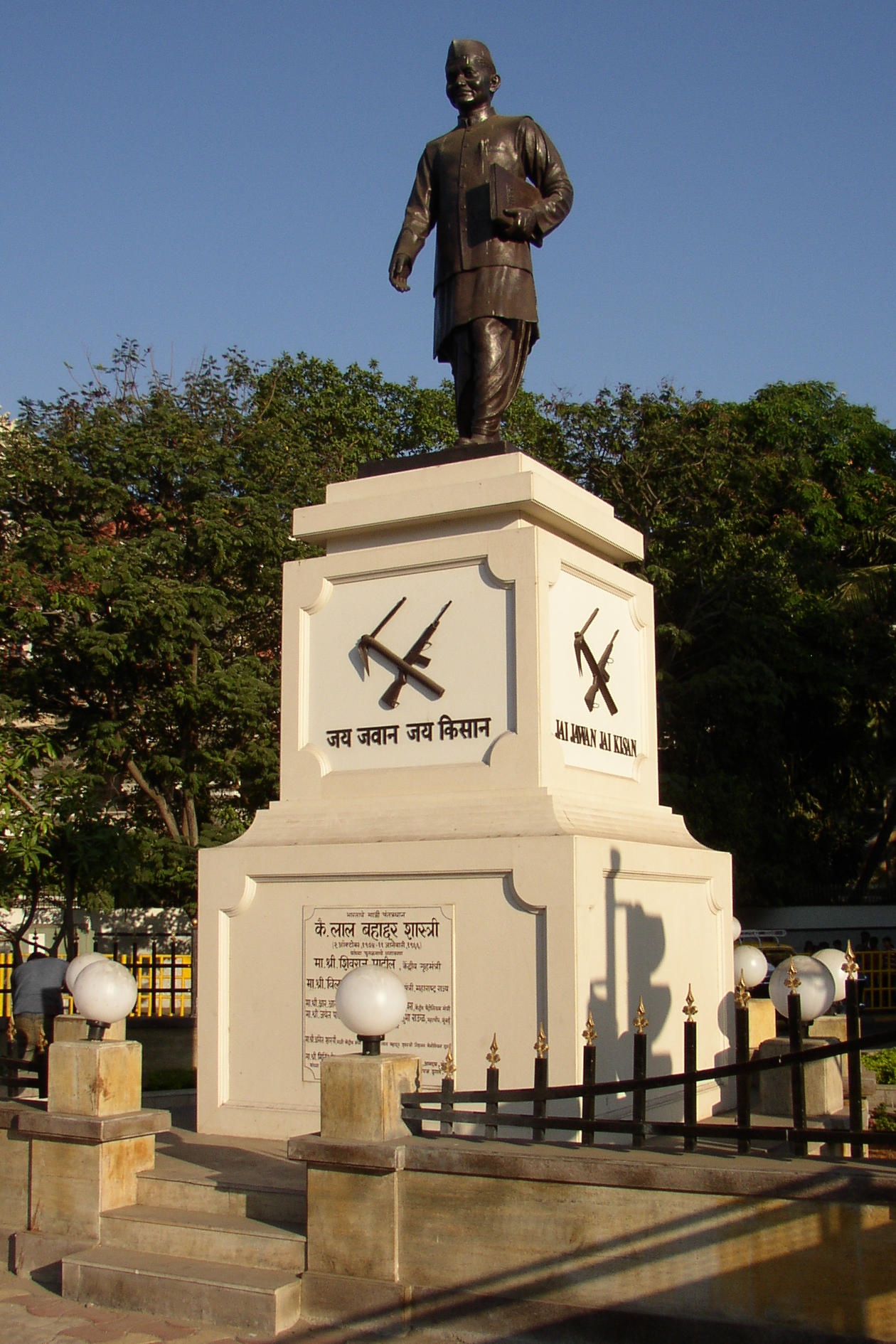
[[File:Mumbai Shastri statue.jpg|thumb|left|Shastri's statue in [[Mumbai]] ]] | [[File:Mumbai Shastri statue.jpg|thumb|left|Shastri's statue in [[Mumbai]] ]] | ||
Shastri died in Tashkent, Uzbekistan (then Soviet Union) on 11 January 1966, one day after signing a peace treaty to end the 1965 [[Indo-Pakistani War of 1965|Indo-Pakistan War]].<ref>{{Cite web|last=Sonal|first=Swapnal|date=2018-10-02|title=शास्त्रीजी: 15 मिनट में तबीयत बिगड़ी और हमने प्रधानमंत्री खो दिया|url=https://navbharattimes.indiatimes.com/viral-adda/photo-gallery/lal-bahadur-shastri-jayanti-rti-reveals-death-mystery-of-former-prime-minister-of-india-in-russia-news-in-hindi-13038/|access-date=2020-12-07|website=वायरल अड्डा|language=hi-IN}}</ref> Many among Shastri's supporters and close relatives, refused at the time, and have refused since, to believe the circumstances of his death and allege foul play.<ref name="bbc.co.uk">{{cite web|url=https://www.bbc.co.uk/blogs/thereporters/soutikbiswas/2009/08/was_mr_shastri_murdered.html|title=Was Mr Shastri murdered|publisher=bbc.co.uk|access-date=31 May 2013}}</ref><ref name="hindustantimes.com">{{cite web|url=http://www.hindustantimes.com/India-news/Jaipur/Clear-air-on-Lal-Bahadur-Shastri-s-death-Son/Article1-915545.aspx|title=Clear air on Lal Bahadur Shastri's death: Son|author=Naqvi, Saba|date=16 July 2012|work=[[Hindustan Times]]|archive-url=https://web.archive.org/web/20130513171010/http://www.hindustantimes.com/India-news/Jaipur/Clear-air-on-Lal-Bahadur-Shastri-s-death-Son/Article1-915545.aspx|archive-date=13 May 2013|url-status=dead|access-date=11 June 2013}}</ref> Conspiracy theories appeared within hours of his death and have thereafter persisted. He was eulogized as a national hero and the [[Vijay Ghat]] memorial established in his memory. Upon his death, [[Gulzarilal Nanda]] once again assumed the role of | Shastri died in Tashkent, Uzbekistan (then Soviet Union) on 11 January 1966, one day after signing a peace treaty to end the 1965 [[Indo-Pakistani War of 1965|Indo-Pakistan War]].<ref>{{Cite web|last=Sonal|first=Swapnal|date=2018-10-02|title=शास्त्रीजी: 15 मिनट में तबीयत बिगड़ी और हमने प्रधानमंत्री खो दिया|url=https://navbharattimes.indiatimes.com/viral-adda/photo-gallery/lal-bahadur-shastri-jayanti-rti-reveals-death-mystery-of-former-prime-minister-of-india-in-russia-news-in-hindi-13038/|access-date=2020-12-07|website=वायरल अड्डा|language=hi-IN}}</ref> Many among Shastri's supporters and close relatives, refused at the time, and have refused since, to believe the circumstances of his death and allege foul play.<ref name="bbc.co.uk">{{cite web|url=https://www.bbc.co.uk/blogs/thereporters/soutikbiswas/2009/08/was_mr_shastri_murdered.html|title=Was Mr Shastri murdered|publisher=bbc.co.uk|access-date=31 May 2013}}</ref><ref name="hindustantimes.com">{{cite web|url=http://www.hindustantimes.com/India-news/Jaipur/Clear-air-on-Lal-Bahadur-Shastri-s-death-Son/Article1-915545.aspx|title=Clear air on Lal Bahadur Shastri's death: Son|author=Naqvi, Saba|date=16 July 2012|work=[[Hindustan Times]]|archive-url=https://web.archive.org/web/20130513171010/http://www.hindustantimes.com/India-news/Jaipur/Clear-air-on-Lal-Bahadur-Shastri-s-death-Son/Article1-915545.aspx|archive-date=13 May 2013|url-status=dead|access-date=11 June 2013}}</ref> Conspiracy theories appeared within hours of his death and have thereafter persisted. He was eulogized as a national hero and the [[Vijay Ghat]] memorial established in his memory. Upon his death, [[Gulzarilal Nanda]] once again assumed the role of acting prime minister until the [[Congress Parliamentary Party]] elected Indira Gandhi over [[Morarji Desai]] to officially succeed Shastri.{{sfn|U.N. Gupta|2003|p=121}} | ||
After Shastri's death, his wife [[Lalita Shastri]] alleged he was poisoned. An epic poetry book in [[Hindi]] titled ''Lalita Ke Aansoo''{{sfn|Krant M. L. Verma|1978|p=}} written by Krant M. L. Verma was published in 1978.<ref>''Hindustan'' ([[Hindi]] daily) [[New Delhi]] 12 January 1978 (ललिता के आँसू का विमोचन)</ref> In this book, the tragic story about the death of Shastri has been narrated by his wife Lalita.<ref>[[Panchjanya (newspaper)]] A literary review 24 February 1980</ref> | After Shastri's death, his wife [[Lalita Shastri]] alleged he was poisoned. An epic poetry book in [[Hindi]] titled ''Lalita Ke Aansoo''{{sfn|Krant M. L. Verma|1978|p=}} written by Krant M. L. Verma was published in 1978.<ref>''Hindustan'' ([[Hindi]] daily) [[New Delhi]] 12 January 1978 (ललिता के आँसू का विमोचन)</ref> In this book, the tragic story about the death of Shastri has been narrated by his wife Lalita.<ref>[[Panchjanya (newspaper)]] A literary review 24 February 1980</ref> | ||
The Indian Government released no information about his death and the media then was kept silent. The possible existence of a conspiracy was covered in India by the [[Outlook (Indian magazine)|'Outlook' magazine]].<ref name="outlookindia.com">{{cite web|url=https://www.outlookindia.com/magazine/story/tashkent-whodunit-an-enduring-tale/281537|title=Tashkent Whodunit: An Enduring Tale | Saba Naqvi|publisher=Outlookindia.com|access-date=16 July 2012}}</ref> A query was later posed by [[Anuj Dhar]], author of ''CIA's Eye on South Asia'', under the [[Right to Information Act]] to declassify a document supposedly related to Shastri's death, but the [[Prime Minister's Office (India)|Prime Minister's Office]] refused to oblige, reportedly citing that this could lead to harming of foreign relations, cause disruption in the country and cause breach of parliamentary privileges.<ref name="hindustan_times_july11_2009">Dhawan, H. (11 July 2009) "45 years on, Shastri's death a mystery – PMO refuses to Entertain RTI Plea Seeking Declassification of Document". ''The Times of India'', New Delhi, p. 11, cols. 1–5 (top left)</ref> Another RTI plea by Kuldip Nayar was also declined, as PMO cited exemption from disclosure on the plea. The home ministry is yet to respond to queries whether India conducted a post-mortem on Shastri, and if the government had investigated allegations of foul play. The Delhi Police in their reply to an RTI application said they do not have any record pertaining to Shastri's death. The Ministry of External Affairs has already said no post-mortem was conducted in the USSR. The Central Public Information Officer of Delhi Police in his reply dated 29 July 2009<ref>{{Cite news|date=2 August 2009|title=43 years on, mystery shrouds post-mortem of Shastri|work=[[The Indian Express]]|url=http://archive.indianexpress.com/news/43-years-on-mystery-shrouds-postmortem-of-shastri/497076/0|access-date=5 March 2021}}</ref> said, "No such record related to the death of the former | The Indian Government released no information about his death and the media then was kept silent. The possible existence of a conspiracy was covered in India by the [[Outlook (Indian magazine)|'Outlook' magazine]].<ref name="outlookindia.com">{{cite web|url=https://www.outlookindia.com/magazine/story/tashkent-whodunit-an-enduring-tale/281537|title=Tashkent Whodunit: An Enduring Tale | Saba Naqvi|publisher=Outlookindia.com|access-date=16 July 2012}}</ref> A query was later posed by [[Anuj Dhar]], author of ''CIA's Eye on South Asia'', under the [[Right to Information Act]] to declassify a document supposedly related to Shastri's death, but the [[Prime Minister's Office (India)|Prime Minister's Office]] refused to oblige, reportedly citing that this could lead to harming of foreign relations, cause disruption in the country and cause breach of parliamentary privileges.<ref name="hindustan_times_july11_2009">Dhawan, H. (11 July 2009) "45 years on, Shastri's death a mystery – PMO refuses to Entertain RTI Plea Seeking Declassification of Document". ''The Times of India'', New Delhi, p. 11, cols. 1–5 (top left)</ref> Another RTI plea by Kuldip Nayar was also declined, as PMO cited exemption from disclosure on the plea. The home ministry is yet to respond to queries whether India conducted a post-mortem on Shastri, and if the government had investigated allegations of foul play. The Delhi Police in their reply to an RTI application said they do not have any record pertaining to Shastri's death. The Ministry of External Affairs has already said no post-mortem was conducted in the USSR. The Central Public Information Officer of Delhi Police in his reply dated 29 July 2009<ref>{{Cite news|date=2 August 2009|title=43 years on, mystery shrouds post-mortem of Shastri|work=[[The Indian Express]]|url=http://archive.indianexpress.com/news/43-years-on-mystery-shrouds-postmortem-of-shastri/497076/0|access-date=5 March 2021}}</ref> said, "No such record related to the death of the former prime minister of India Lal Bahadur Shastri is available in this district. Hence the requisite information pertaining to New Delhi district may please be treated as nil."<ref name="ndtv.com">{{cite web|url=http://www.ndtv.com/article/india/post-mortem-on-shastri-could-have-been-done-6893 |title=Post-mortem on Shastri could have been done |publisher=[[NDTV]]|date=9 August 2009 |access-date=5 December 2012}}</ref> This has created more doubts.<ref name="timesofindia.indiatimes.com">{{cite web|author=Dhawan, Himanshi |url=http://articles.timesofindia.indiatimes.com/2009-07-11/india/28198880_1_lalita-shastri-declassification-policy-r-n-chugh |archive-url=https://web.archive.org/web/20130401232127/http://articles.timesofindia.indiatimes.com/2009-07-11/india/28198880_1_lalita-shastri-declassification-policy-r-n-chugh |url-status=dead |archive-date=1 April 2013 |title=45 yrs on, Shastri's death a mystery |work=[[The Times of India]] |date=11 July 2009 |access-date=5 December 2012}}</ref> The death of Lal Bahadur Shastri is considered to be one of the biggest unsolved mysteries of Indian politics.<ref>{{Cite web|date=2020-10-01|title=Lal Bahadur Shastri's death is still one of the biggest mysteries of Indian politics|url=https://www.dnaindia.com/india/report-lal-bahadur-shastri-s-death-is-still-one-of-the-biggest-mysteries-of-indian-politics-remembering-shashtri-on-birth-anniversary-2nd-october-2846672|url-status=live|archive-url=https://web.archive.org/web/20201005020920/https://www.dnaindia.com/india/report-lal-bahadur-shastri-s-death-is-still-one-of-the-biggest-mysteries-of-indian-politics-remembering-shashtri-on-birth-anniversary-2nd-october-2846672|archive-date=2020-10-05|access-date=2020-12-07|website=DNA India|language=en}}</ref> | ||
The PMO answered only two questions of the RTI application, saying it has only one classified document pertaining to the death of Shastri, which is exempted from disclosure under the RTI Act. It sent the rest of the questions to the Ministry of External Affairs and Home Ministry to answer. The MEA said the only document from the erstwhile Soviet Government is "the report of the Joint Medical Investigation conducted by a team comprising R. N. Chugh, Doctor in-Attendance to the PM and some Russian doctors" and added no post-mortem was conducted in the [[USSR]]. The Home Ministry referred the matter to Delhi Police and National Archives for the response pertaining to any post-mortem conducted on the body of Shastri in India.<ref name="dnaindia.com">{{cite web|url=http://www.dnaindia.com/india/report_43-years-on-mystery-shrouds-post-mortem-of-lal-bahadur-shastri_1279124 |title=43 years on, mystery shrouds post-mortem of Lal Bahadur Shastri – India – DNA |publisher=Dnaindia.com |access-date=5 December 2012|date=2 August 2009 }}</ref><ref>{{Cite web|author=Arunav Sinha|date=Jan 11, 2016|title=Lal Bahadur Shastri's wife blamed herself for his death, says ex-PM's son {{!}} India News - Times of India|url=https://timesofindia.indiatimes.com/india/Lal-Bahadur-Shastris-wife-blamed-herself-for-his-death-says-ex-PMs-son/articleshow/50533772.cms|access-date=2020-12-06|website=The Times of India|language=en}}</ref> | |||
Later, Gregory Douglas, a journalist who interviewed former CIA operative [[Robert Crowley (CIA)|Robert Crowley]] over a period of 4 years, recorded their telephone conversations and published a transcription in a book titled ''Conversations with the Crow''. In the book, Crowley claimed that the CIA was responsible for eliminating [[Death of Lal Bhadur Shastri|Lal Bahadur Shastri]] and [[Homi J. Bhabha|Homi Bhabha]], an Indian nuclear scientist whose plane crashed in the Alps, when he was going to attend a conference in Vienna. Crowley said that the USA was wary of India's rigid stand on nuclear policy and of then prime minister Lal Bahadur Shastri, who wanted to go ahead with [[nuclear tests]]. He also said that the agency was worried about collective domination by India and Russia over the region, for which a strong deterrent was required.{{Citation needed|date=March 2022}} | |||
==Legacy== | ==Legacy== | ||
| Line 160: | Line 162: | ||
Although Shastri had been a cabinet minister for many years in the 1950s, he was poor when he died. All he owned at the end was an old car, which he had bought in instalments from the government and for which he still owed money. He was a member of Servants of India society (which included [[Mahatma Gandhi]], [[Lala Lajpat Rai]], [[Gopal Krishna Gokhle]]) which asked all its members to shun accumulation of private property and remain in public life as servants of the people. He was the first railway minister who resigned from office following a major train accident as he felt moral responsibility.{{Sfnm|1a1=Grover|1y=1993|1pp=23-29, 34|2a1=Dhawan|2y=1991|2p=98}} | Although Shastri had been a cabinet minister for many years in the 1950s, he was poor when he died. All he owned at the end was an old car, which he had bought in instalments from the government and for which he still owed money. He was a member of Servants of India society (which included [[Mahatma Gandhi]], [[Lala Lajpat Rai]], [[Gopal Krishna Gokhle]]) which asked all its members to shun accumulation of private property and remain in public life as servants of the people. He was the first railway minister who resigned from office following a major train accident as he felt moral responsibility.{{Sfnm|1a1=Grover|1y=1993|1pp=23-29, 34|2a1=Dhawan|2y=1991|2p=98}} | ||
The foundation stone of [[Bal Vidya Mandir, Lucknow|Bal Vidya Mandir]], a distinguished school of [[Lucknow]], was laid by him during his tenure as the | The foundation stone of [[Bal Vidya Mandir, Lucknow|Bal Vidya Mandir]], a distinguished school of [[Lucknow]], was laid by him during his tenure as the prime minister, on 19 November 1964. He inaugurated the Central Institute of Technology Campus at Tharamani, Chennai, in November 1964.{{Sfn|Dhawan|1991|p=}} He inaugurated the Plutonium Reprocessing Plant at Trombay in 1965. As suggested by [[Homi J. Bhabha|Dr. Homi Jehangir Bhabha]], Shastri authorized the development of nuclear explosives. Bhabha initiated the effort by setting up the nuclear explosive design group Study of Nuclear Explosions for Peaceful Purposes (SNEPP).<ref>{{cite journal|author=Bhabha, Homi J.|author2=Heitler, Walter|author3=Mott, Nevill Francis|year=1937|title=The passage of fast electrons and the theory of cosmic showers|journal=Proceedings of the Royal Society of London. Series A, Mathematical and Physical Sciences|volume=159|issue=898|pages=432–458|bibcode=1937RSPSA.159..432B|doi=10.1098/rspa.1937.0082|doi-access=free}}</ref> He inaugurated the Andhra Pradesh Agricultural University at Hyderabad on 20 March 1965 which was renamed the Acharya N. G. Ranga Agricultural University in 1996 and was separated into two universities after the formation of Telangana State. The university in Telangana was named in July 2014 as [[University of Selangor|Professor Jayashanker Agricultural University]]. Shastri also inaugurated the National Institute of Technology, [[Allahabad]]. Lal Bahadur Shastri inaugurated the Jawahar Dock of the Chennai Port Trust and started the construction work of [[V. O. Chidambaranar Port Trust]] in November 1964.<ref>{{Cite web|title=60.72 MB - VO Chidambaranar Port Trust|url=https://www.vocport.gov.in/port/UserInterface/PDF/AdministrationReport__2017-201829112018185338.pdf|url-status=live|archive-url=https://web.archive.org/web/20210201050158/https://www.vocport.gov.in/port/UserInterface/PDF/AdministrationReport__2017-201829112018185338.pdf |archive-date=2021-02-01|access-date=2020-12-06|website=Vocport.com}}</ref> He inaugurated the Sainik School Balachadi, in the state of Gujarat. He laid the foundation stone of Almatti dam. The commissioned dam bears his name.{{Sfnm|1a1=Guha|1y=2008|1p=67|2a1=Srivastava|2y=1995|2p=48}} | ||
[[File:Shastri Circle Jodhpur.jpg|thumb|Shastri Circle Jodhpur]] | [[File:Shastri Circle Jodhpur.jpg|thumb|Shastri Circle Jodhpur]] | ||
| Line 166: | Line 168: | ||
{{See also|:Category:Memorials to Lal Bahadur Shastri}}[[File:Lal Bahadur Shastri National Academy of Administration, Mussoorie, at night.JPG|thumb|right|200px|Lal Bahadur Shastri National Academy of Administration, [[Mussoorie]]]] | {{See also|:Category:Memorials to Lal Bahadur Shastri}}[[File:Lal Bahadur Shastri National Academy of Administration, Mussoorie, at night.JPG|thumb|right|200px|Lal Bahadur Shastri National Academy of Administration, [[Mussoorie]]]] | ||
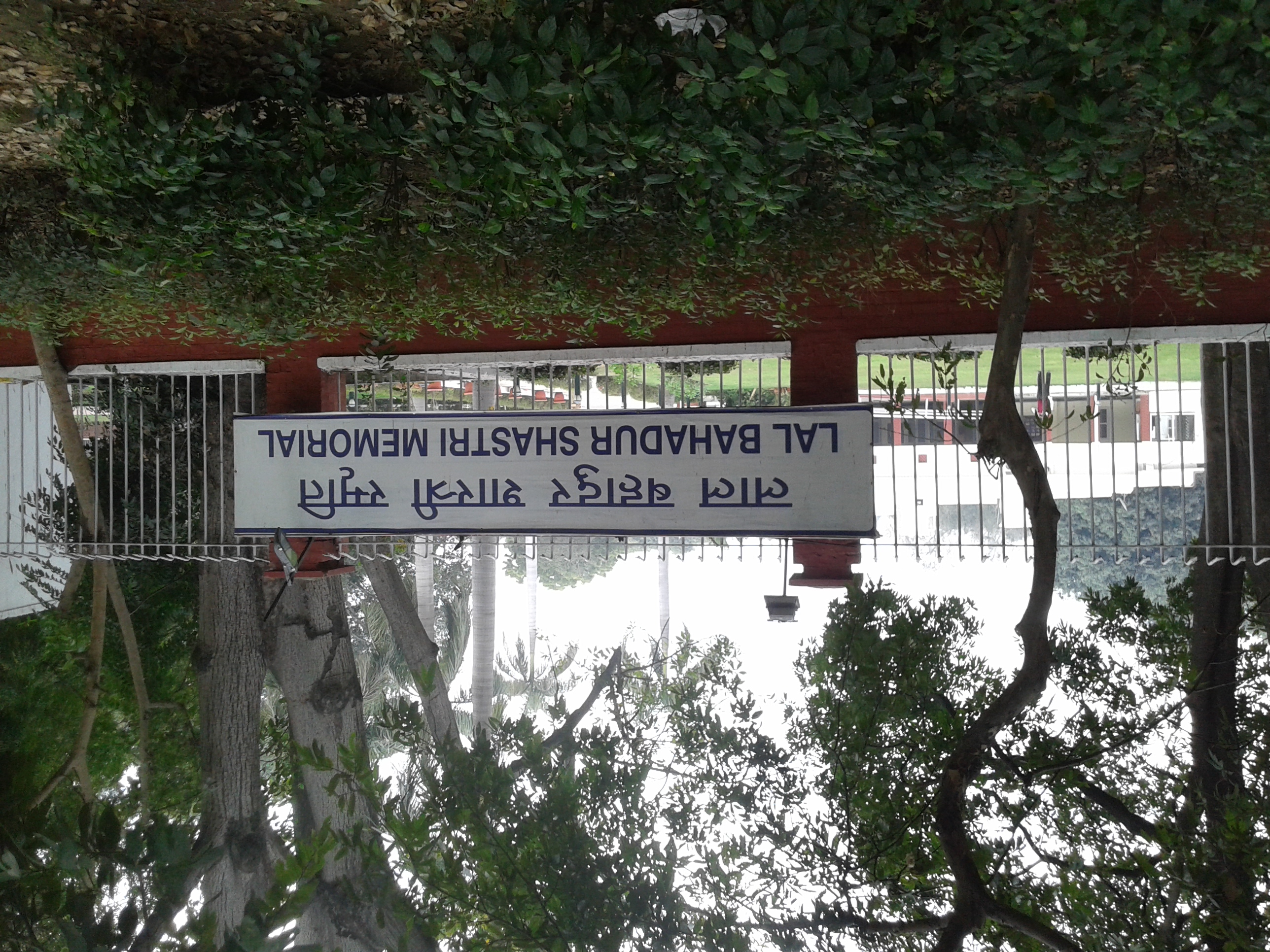
Shastri was known for his honesty and humility throughout his life. He was posthumously awarded the [[Bharat Ratna]], and a memorial "[[Raj Ghat and associated memorials|Vijay Ghat]]" was built for him in Delhi. Several educational institutes including [[Lal Bahadur Shastri National Academy of Administration]] (Mussorie, Uttarakhand) bear his name. The [[Lal Bahadur Shastri Institute of Management]] was established in Delhi by the Lal Bahadur Shastri Educational Trust in 1995. The Shastri Indo-Canadian Institute was named after Shastri due to his role in promoting scholarly activity between India and Canada.<ref>{{cite web |url=http://www.sici.org/about/|title= Mission of the Shastri Institute}}</ref> ''Lal Bahadur Shastri Memorial'' run by the Lal Bahadur Shastri National Memorial Trust, is situated next to [[10 Janpath]] his residence when he was | Shastri was known for his honesty and humility throughout his life. He was posthumously awarded the [[Bharat Ratna]], and a memorial "[[Raj Ghat and associated memorials|Vijay Ghat]]" was built for him in Delhi. Several educational institutes including [[Lal Bahadur Shastri National Academy of Administration]] (Mussorie, Uttarakhand) bear his name. The [[Lal Bahadur Shastri Institute of Management]] was established in Delhi by the Lal Bahadur Shastri Educational Trust in 1995. The Shastri Indo-Canadian Institute was named after Shastri due to his role in promoting scholarly activity between India and Canada.<ref>{{cite web |url=http://www.sici.org/about/|title= Mission of the Shastri Institute}}</ref> ''Lal Bahadur Shastri Memorial'' run by the Lal Bahadur Shastri National Memorial Trust, is situated next to [[10 Janpath]] his residence when he was prime minister,{{sfn|Rajeshwar Prasad|1991|p=16}} at 1, Motilal Nehru Place, New Delhi.<ref>{{Cite news|title=Declassify documents on Lal Bahadur Shastri's death, says ex-PM's son|work=The Economic Times|url=https://economictimes.indiatimes.com/news/politics-and-nation/declassify-documents-on-lal-bahadur-shastris-death-says-ex-pms-son/articleshow/64699947.cms?from=mdr|access-date=2020-12-06}}</ref> One of the halls of residence of [[IIT Kharagpur]] is named after him as ''Lal Bahadur Shastri Hall of Residence''.<ref>{{cite web|url=http://lbsiitkgp.in/|title=Lal Bahadur Shastri Hall of Residence|access-date=7 June 2020}}</ref> | ||
In 2011, on Shastri's 45th death anniversary, the Uttar Pradesh Government announced the renovation of Shastri's ancestral house at [[Ramnagar, Varanasi|Ramnagar]] in [[Varanasi]] and declared plans to convert it into a biographical museum.<ref name=hind>{{cite news |title=Lest we FORGET... |url=http://www.hindu.com/mp/2004/10/02/stories/2004100200850200.htm |archive-url=https://web.archive.org/web/20050122083034/http://www.hindu.com/mp/2004/10/02/stories/2004100200850200.htm |url-status=dead |archive-date=22 January 2005 |work=[[The Hindu]]|date=2 October 2004 }}</ref><ref>{{cite news |title=Shastri memorial losing out to Sonia security|url=http://www.indianexpress.com/news/shastri-memorial-losing-out-to-sonia-security/738420/0 |work=[[The Indian Express]] |date=17 January 2011 }}</ref> [[Lal Bahadur Shastri Airport|Varanasi International Airport]] is named after him.<ref>[http://pib.nic.in/newsite/erelease.aspx?relid=12805 Varanasi Airport renamed]. Press Information Bureau India (20 October 2005). Retrieved on 18 December 2018.</ref> The Lal Bahadur Shastri Centre for Indian Culture with a monument and a street named after him are in the city of [[Tashkent]], [[Uzbekistan]]. A few stadiums are named after him in the cities of [[Hyderabad, India|Hyderabad]], [[Telangana]], | In 2011, on Shastri's 45th death anniversary, the Uttar Pradesh Government announced the renovation of Shastri's ancestral house at [[Ramnagar, Varanasi|Ramnagar]] in [[Varanasi]] and declared plans to convert it into a biographical museum.<ref name=hind>{{cite news |title=Lest we FORGET... |url=http://www.hindu.com/mp/2004/10/02/stories/2004100200850200.htm |archive-url=https://web.archive.org/web/20050122083034/http://www.hindu.com/mp/2004/10/02/stories/2004100200850200.htm |url-status=dead |archive-date=22 January 2005 |work=[[The Hindu]]|date=2 October 2004 }}</ref><ref>{{cite news |title=Shastri memorial losing out to Sonia security|url=http://www.indianexpress.com/news/shastri-memorial-losing-out-to-sonia-security/738420/0 |work=[[The Indian Express]] |date=17 January 2011 }}</ref> [[Lal Bahadur Shastri Airport|Varanasi International Airport]] is named after him.<ref>[http://pib.nic.in/newsite/erelease.aspx?relid=12805 Varanasi Airport renamed]. Press Information Bureau India (20 October 2005). Retrieved on 18 December 2018.</ref> The Lal Bahadur Shastri Centre for Indian Culture with a monument and a street named after him are in the city of [[Tashkent]], [[Uzbekistan]]. A few stadiums are named after him in the cities of [[Hyderabad, India|Hyderabad]], [[Telangana]], Ahmedabad in Gujarat, Kollam in Kerala, Ghazhiabad and Bhawanipatna in Odisha. The Almatti Dam across the River Krishna in northern Karnataka was renamed the Lal Bahadur Shastri Sagar. The foundation stone was laid by him. MV Lal Bahadur Shastri, a cargo ship, is named after him. The Reserve Bank of India released coins in the denomination of 5 rupees during his birth century celebrations. An All India Lal Bahadur Shastri Hockey tournament has been held every year since 1991 - it is a major hockey tournament. The Left Bank Canal of the Nagarjuna Sagar Dam in Andhra Pradesh is named the Lal Bahadur Shastri Canal and is 295 km in Length.<ref>{{Cite news|last=Kurian|first=Nimi|date=2020-09-29|title=Many colours of his success|language=en-IN|work=The Hindu|url=https://www.thehindu.com/children/learn-more-about-indias-second-prime-minister-lal-bahadur-shastri/article32721078.ece|access-date=2020-12-06|issn=0971-751X}}</ref> | ||
[[File:Lok Sabha Speaker, Shri Om Birla and other dignitaries paid tributes to the former Prime Minister, Pandit Jawaharlal Nehru on his 130th birth anniversary.jpg|thumb|The portrait of Shastri (left) in the Central Hall of the Parliament House of India.]]Life-sized statues of Shastri are erected at Mumbai, Bangalore (Vidhana Soudha), New Delhi (CGO Complex), Gorakhpur, Almatti Dam Site, Ramnagar, UP, Hisar, Vishakapatnam, Nagarjuna Dam site, Warangal, Nagpur, Wardha,Bokaro,Jodhpur,Hyderabad,Patna,Dhanbad and at the Varanasi Airport. | [[File:Lok Sabha Speaker, Shri Om Birla and other dignitaries paid tributes to the former Prime Minister, Pandit Jawaharlal Nehru on his 130th birth anniversary.jpg|thumb|The portrait of Shastri (left) in the Central Hall of the Parliament House of India.]]Life-sized statues of Shastri are erected at Mumbai, Bangalore (Vidhana Soudha), New Delhi (CGO Complex), Gorakhpur, Almatti Dam Site, Ramnagar, UP, Hisar, Vishakapatnam, Nagarjuna Dam site, Warangal, Nagpur, Wardha,Bokaro,Jodhpur,Hyderabad,Patna,Dhanbad and at the Varanasi Airport. | ||
| Line 180: | Line 182: | ||
''[[Jai Jawaan Jai Kisaan (film)|Jai Jawaan Jai Kisaan]]'' is a 2015 Indian [[Hindi]]-language biographical drama film by Milan Ajmera, titled after the popular slogan by Shastri it portrays his entire life from birth to death where he is portrayed by Akhilesh Jain. ''Lal Bahadur Shastri's Death'', a 2018 television documentary film by [[Jyoti Kapur Das]] reconstructs his death and covers various conspiracy theories around it, including interviews with his son [[Sunil Shastri]].<ref>{{Cite web|title=Lal Bahadur Shastri's Death - An Unfinished Story - Trailer|url=https://www.zee5.com/global/videos/details/lal-bahadur-shastris-death-an-unfinished-story-trailer/0-0-movie_219104936|access-date=2021-06-10|website=[[ZEE5]]|language=en}}</ref> A film titled ''[[The Tashkent Files]]'' (2019), directed by [[Vivek Agnihotri]] revolves around the mystery of the death of Lal Bahadur Shastri.<ref>{{cite web|author1=Giridhar Jha|date=11 April 2019|title=Everybody Loves R.A.W. Material|url=https://www.outlookindia.com/magazine/story/entertainment-news-everybody-loves-raw-material/301448|access-date=23 April 2019|website=[[Outlook India]]}}</ref> | ''[[Jai Jawaan Jai Kisaan (film)|Jai Jawaan Jai Kisaan]]'' is a 2015 Indian [[Hindi]]-language biographical drama film by Milan Ajmera, titled after the popular slogan by Shastri it portrays his entire life from birth to death where he is portrayed by Akhilesh Jain. ''Lal Bahadur Shastri's Death'', a 2018 television documentary film by [[Jyoti Kapur Das]] reconstructs his death and covers various conspiracy theories around it, including interviews with his son [[Sunil Shastri]].<ref>{{Cite web|title=Lal Bahadur Shastri's Death - An Unfinished Story - Trailer|url=https://www.zee5.com/global/videos/details/lal-bahadur-shastris-death-an-unfinished-story-trailer/0-0-movie_219104936|access-date=2021-06-10|website=[[ZEE5]]|language=en}}</ref> A film titled ''[[The Tashkent Files]]'' (2019), directed by [[Vivek Agnihotri]] revolves around the mystery of the death of Lal Bahadur Shastri.<ref>{{cite web|author1=Giridhar Jha|date=11 April 2019|title=Everybody Loves R.A.W. Material|url=https://www.outlookindia.com/magazine/story/entertainment-news-everybody-loves-raw-material/301448|access-date=23 April 2019|website=[[Outlook India]]}}</ref> | ||
''[[Pradhanmantri]]'' ({{Literal translation|Prime Minister}}), a 2013 Indian documentary television series which aired on [[ABP News]] and covers the various policies and political tenures of Indian PMs, dedicated the entire seventh episode "Lal Bahadur Shastri" to his term as the country's leader with [[Akhil Mishra]] in the role of Shastri.<ref>{{Cite web|date=25 August 2013|title=Pradhanmantri - Episode 7: Lal Bahadur Shastri|url=https://www.youtube.com/watch?v=DWXwVK7rrNY| archive-url=https://ghostarchive.org/varchive/youtube/20211211/DWXwVK7rrNY| archive-date=2021-12-11 | url-status=live|publisher=ABP News}}{{cbignore}}</ref> | ''[[Pradhanmantri]]'' ({{Literal translation|Prime Minister}}), a 2013 Indian documentary television series which aired on [[ABP News]] and covers the various policies and political tenures of Indian PMs, dedicated the entire seventh episode "Lal Bahadur Shastri" to his term as the country's leader with [[Akhil Mishra]] in the role of Shastri.<ref>{{Cite web|date=25 August 2013|title=Pradhanmantri - Episode 7: Lal Bahadur Shastri|url=https://www.youtube.com/watch?v=DWXwVK7rrNY| archive-url=https://ghostarchive.org/varchive/youtube/20211211/DWXwVK7rrNY| archive-date=2021-12-11 | url-status=live|publisher=[[ABP News]]}}{{cbignore}}</ref> | ||
The 1967 film ''[[Upkar]]'' by [[Manoj Kumar]], which is based on the 1965 war, was dedicated to Shastri.<ref>{{cite web |title=Upkar |url=https://www.zee5.com/movies/details/upkar/0-0-upkar |website=[[ZEE5]] |language=en}}</ref> [[Lal Bahadur Shastri (film)|''Lal Bahadur Shastri'']], a 2014 Indian [[Malayalam]]-language comedy film by Rejishh Midhila is titled after the prime minister but has no apparent connection with his life.<ref>{{Cite web|last=G.|first=Vijay|date=2014-11-21|title=Jayasurya's Lal Bahadur Shastri releases today|url=https://www.rediff.com/movies/report/jayasuryas-lal-bahadur-shastri-releases-today-south/20141121.htm|access-date=2021-06-10|website=[[Rediff.com]]|language=en}}</ref> | The 1967 film ''[[Upkar]]'' by [[Manoj Kumar]], which is based on the 1965 war, was dedicated to Shastri.<ref>{{cite web |title=Upkar |url=https://www.zee5.com/movies/details/upkar/0-0-upkar |website=[[ZEE5]] |language=en}}</ref> [[Lal Bahadur Shastri (film)|''Lal Bahadur Shastri'']], a 2014 Indian [[Malayalam]]-language comedy film by Rejishh Midhila is titled after the prime minister but has no apparent connection with his life.<ref>{{Cite web|last=G.|first=Vijay|date=2014-11-21|title=Jayasurya's Lal Bahadur Shastri releases today|url=https://www.rediff.com/movies/report/jayasuryas-lal-bahadur-shastri-releases-today-south/20141121.htm|access-date=2021-06-10|website=[[Rediff.com]]|language=en}}</ref> | ||
==See also== | ==See also== | ||
* [[List of | * [[List of prime ministers of India]] | ||
* [[List of unsolved deaths]] | * [[List of unsolved deaths]] | ||
==References== | ==References== | ||
===Footnotes=== | |||
{{Notelist}} | |||
===Citations=== | ===Citations=== | ||
{{Reflist}} | {{Reflist}} | ||
| Line 227: | Line 232: | ||
{{Wikiquote}} | {{Wikiquote}} | ||
* {{OL author}} | * {{OL author}} | ||
* {{ | * {{IMDb name|1991951}} | ||
* [http://krantmlverma.blogspot.com/2012/10/tears-of-lalita-english-translation-of.html Tears of Lalita]. Krant M. L. Verma. | * [http://krantmlverma.blogspot.com/2012/10/tears-of-lalita-english-translation-of.html Tears of Lalita]. Krant M. L. Verma. | ||
| Line 273: | Line 278: | ||
[[Category:Prisoners and detainees of British India]] | [[Category:Prisoners and detainees of British India]] | ||
[[Category:Shastri administration]] | [[Category:Shastri administration]] | ||
[[Category:Railway Ministers of India]] | [[Category:Railway Ministers of India]] | ||
[[Category:Rajya Sabha members from Uttar Pradesh]] | [[Category:Rajya Sabha members from Uttar Pradesh]] | ||
Revision as of 16:31, 26 April 2022
Lal Bahadur Shastri | |
|---|---|
| File:Shashtri2.jpg Official Portrait | |
| 2nd Prime Minister of India | |
| In office 9 June 1964 – 11 January 1966 | |
| President | Sarvepalli Radhakrishnan |
| Preceded by | Jawaharlal Nehru[lower-alpha 1] |
| Succeeded by | Indira Gandhi[lower-alpha 2] |
| Minister of External Affairs | |
| In office 9 June 1964 – 18 July 1964 | |
| Prime Minister | Himself |
| Preceded by | Gulzarilal Nanda |
| Succeeded by | Sardar Swaran Singh |
| Minister of Home Affairs | |
| In office 4 April 1961 – 29 August 1963 | |
| Prime Minister | Jawaharlal Nehru |
| Preceded by | Govind Ballabh Pant |
| Succeeded by | Gulzarilal Nanda |
| Minister of Railways | |
| In office 13 May 1952 – 7 December 1956 | |
| Prime Minister | Jawaharlal Nehru |
| Preceded by | N. Gopalaswami Ayyangar |
| Succeeded by | Jagjivan Ram |
| Personal details | |
| Born | Lal Bahadur Srivastava 2 October 1904 Mughalsarai, United Provinces of Agra and Oudh, British India (present-day Pt. Deen Dayal Upadhyaya Nagar, Uttar Pradesh, India) |
| Died | 11 January 1966 (aged 61) Tashkent, Uzbek SSR, Soviet Union (present-day Uzbekistan) |
Monuments | |
| Nationality | Indian |
| Political party | Indian National Congress |
| Spouse(s) | ( m. 1928) |
| Children | 6 |
| Alma mater | Gandhi Kashi Vidyapeeth |
| Profession | Politician |
| Awards | Bharat Ratna (1966) (posthumous) |
| Nickname(s) | see article |
| ||
|---|---|---|
|
(1964-1966)
Events
|
||
.jpg)
Lal Bahadur Shastri (pronounced [lɑːl bəˈhɑːd̪ʊɾ ˈʃɑːst̪ɾi] ( listen); 2 October 1904 – 11 January 1966) was an Indian statesman who served as the second prime minister of India. He promoted the White Revolution – a national campaign to increase the production and supply of milk – by supporting the Amul milk co-operative of Anand, Gujarat and creating the National Dairy Development Board. Underlining the need to boost India's food production, Shastri also promoted the Green Revolution in India in 1965. This led to an increase in food grain production, especially in Punjab, Haryana and Uttar Pradesh.
Shastri was born to Sharada Prasad Srivastava and Ramdulari Devi in Mughalsarai on 2 October 1904. He studied in East Central Railway Inter college and Harish Chandra High School, which he left to join the non-cooperation movement. He worked for the betterment of the Harijans at Muzaffarpur and dropped his caste-derived surname of "Srivastava". Shastri's thoughts were influenced by reading about Swami Vivekananda, Gandhi and Annie Besant. Deeply impressed and influenced by Gandhi, he joined the Indian independence movement in the 1920s. He served as the president of Servants of the People Society (Lok Sevak Mandal), founded by Lala Lajpat Rai and held prominent positions in Indian National Congress. Following independence in 1947, he joined the Indian government and became one of Prime Minister Nehru's key cabinet colleagues, first as Railways Minister (1951–56), and then in numerous other prominent positions, including the Home Minister.
He led the country during the Indo-Pakistan War of 1965. His slogan "Jai Jawan, Jai Kisan" ("Hail to the soldier; Hail to the farmer") became very popular during the war. The war formally ended with the Tashkent Agreement on 10 January 1966; he died the following day, still in Tashkent, with the cause of his death in dispute; it was reported to be a cardiac arrest, but his family was not satisfied with the proffered reason. He was posthumously awarded the Bharat Ratna.
Early years (1904–1920)
Shastri was born on 2 October 1904 at the home of his maternal grandparents in a Kayastha family.[1] Shastri's paternal ancestors had been in the service of the zamindar of Ramnagar, Varanasi and Shastri lived there for the first year of his life. Shastri's father, Sharada Prasad Srivastava, was a school teacher who later became a clerk in the revenue office at Allahabad, while his mother, Ramdulari Devi, was the daughter of Munshi Hazari Lal, the headmaster and English teacher at a railway school in Mughalsarai. Shastri was the second child and eldest son of his parents; he had an elder sister, Kailashi Devi (b. 1900).[2][3]
In April 1906, when Shastri was hardly 18 months old, his father, who had only recently been promoted to the post of deputy tahsildar, died in an epidemic of bubonic plague. Ramdulari Devi, then only 23 and pregnant with her third child, took her two children and moved from Ramnagar to her father's house in Mughalsarai and settled there for good. She gave birth to a daughter, Sundari Devi, in July 1906.[4][5] Thus, Shastri and his sisters grew up in the household of his maternal grandfather, Hazari Lalji.[6] However, Hazari Lalji himself died from a stroke in mid-1908, after which the family was looked after by his brother (Shastri's great-uncle) Darbari Lal, who was the head clerk in the opium regulation department at Ghazipur, and later by his son (Ramdulari Devi's cousin) Bindeshwari Prasad, a school teacher in Mughalsarai.[7]
In Shastri's family, as with many Kayastha families of the era,[8] it was customary for children to receive an education in the Urdu language and culture. This is because Urdu/Persian had been the language of government for centuries, before being replaced by English, and old traditions persisted into the 20th century.[9] Therefore, Shastri began his education at the age of four under the tutelage of a maulvi (a Muslim cleric), Budhan Mian, at the East Central Railway Inter college in Mughalsarai. He studied there until the sixth standard.[10] In 1917, Bindeshwari Prasad (who was now head of the household) was transferred to Varanasi, and the entire family moved there, including Ramdulari Devi and her three children. In Varanasi, Shastri joining the seventh standard at Harish Chandra High School.[11] At this time, he decided to drop his caste-derived surname of "Srivastava" (which is a traditional surname for a sub-caste of Kayastha families).[12]
Gandhi's disciple (1921–1945)
While his family had no links to the independence movement then taking shape, among his teachers at Harish Chandra High School was an intensely patriotic and highly respected teacher named Nishkameshwar Prasad Mishra, who gave Shastri much-needed financial support by allowing him to tutor his children. Inspired by Mishra's patriotism, Shastri took a deep interest in the freedom struggle, and began to study its history and the works of several of its noted personalities, including those of Swami Vivekananda, Mahatma Gandhi and Annie Besant.[13] In January 1921, when Shastri was in the 10th standard and three months from sitting the final examinations, he attended a public meeting in Benares hosted by Gandhi and Pandit Madan Mohan Malaviya. Inspired by the Mahatma's call for students to withdraw from government schools and join the non-cooperation movement, Shastri withdrew from Harish Chandra High School the next day and joined the local branch of the Congress Party as a volunteer, actively participating in picketing and anti-government demonstrations.[14] He was soon arrested and jailed, but was then let off as he was still a minor.[15][16]

Shastri's immediate supervisor was a former Benares Hindu University lecturer named J.B. Kripalani, who would become one of the most prominent leaders of the Indian independence movement and one among Gandhi's closest followers.[17] Recognising the need for the younger volunteers to continue their educations, Kripalani and a friend, V.N. Sharma, had founded an informal school centered around "nationalist education" to educate the young activists in their nation's heritage and with the support of a wealthy philanthropist and ardent Congress nationalist, Shiv Prasad Gupta, the Kashi Vidyapith was inaugurated by Gandhi in Benares as a national institution of higher education on 10 February 1921. Among the first students of the new institution, Shastri graduated with a first-class degree in philosophy and ethics from the Vidyapith in 1925. He was given the title Shastri ("scholar").[18] The title was a bachelor's degree awarded by the institution but it stuck as part of his name.[19][20]
Shastri enrolled himself as a life member of the Servants of the People Society (Lok Sevak Mandal), founded by Lala Lajpat Rai, and began to work for the betterment of the Harijans under Gandhi's direction at Muzaffarpur.[21] Later he became the President of the Society.[22][23]
Independence Activism of Lal Bahadur Shastri
In 1928 Shastri became an active and mature member of the Indian National Congress at the call of Mahatma Gandhi. He was imprisoned for two and a half years.[24] Later, he worked as the Organizing Secretary of the Parliamentary Board of U.P. in 1937.[25] In 1940, he was sent to prison for one year, for offering individual Satyagraha support to the independence movement.[26]
On 8 August 1942, Mahatma Gandhi issued the Quit India speech at Gowalia Tank in Bombay, demanding that the British leave India. Shastri, who had just then come out after a year in prison, travelled to Allahabad. For a week, he sent instructions to the independence activists from Jawaharlal Nehru's home, Anand Bhavan.[27] He served as an elected representative for United Provinces in 1937 and 1946.[28]
Political Career (1947–1964)
State minister
Following India's independence, Shastri was appointed Parliamentary Secretary in his home state, Uttar Pradesh.[29] He became the Minister of Police and Transport under Govind Ballabh Pant's Chief Ministership on 15 August 1947 following Rafi Ahmed Kidwai's departure to become a minister at the centre. As the Transport Minister, he was the first to appoint women conductors. As the minister in charge of the Police Department, he ordered that police use water jets, whose instructions was given by him, instead of lathis to disperse unruly crowds.[30] His tenure as police minister (As Home Minister was called prior to 1950) saw successful curbing of communal riots in 1947, mass migration and resettlement of refugees.[31]
Cabinet minister
In 1951, Shastri was made the General Secretary of the All-India Congress Committee with Jawaharlal Nehru as the prime minister. He was directly responsible for the selection of candidates and the direction of publicity and electioneering activities. He played an important role in the landslide successes of the Congress Party in the Indian General Elections of 1952, 1957 and 1962. In 1952, he successfully contested UP Vidhansabha from Soraon North cum Phulpur West seat and won by getting over 69% of vote. He was believed to be retained as home minister of UP, but in a surprise move was called to Centre as minister by Nehru. Shastri was made Minister of Railways and Transport in First Cabinet of Republic of India on 13 May 1952.[32] He served as the Minister of Commerce and Industry in 1959 and Minister of Home Affairs in 1961.[33] Shastri laid the foundation of Mangalore Port in 1964 as a minister without a portfolio.[34]
Prime minister (1964–1966)
Jawaharlal Nehru died in office on 27 May 1964. Then Congress Party president K. Kamaraj was instrumental in making Shastri prime minister on 9 June. Shastri, though mild-mannered and soft-spoken, was a Nehruvian socialist and thus held appeal to those wishing to prevent the ascent of conservative right-winger Morarji Desai.
In his first broadcast as prime minister, on 11 June 1964, Shastri stated:[35]
There comes a time in the life of every nation when it stands at the cross-roads of history and must choose which way to go. But for us, there need be no difficulty or hesitation, no looking to right or left. Our way is straight and clear—the building up of a socialist democracy at home with freedom and prosperity for all, and the maintenance of world peace and friendship with all nations.
Domestic policies
Shastri retained many members of Nehru's Council of Ministers. T. T. Krishnamachari was retained as the Finance Minister of India, as was Defence Minister Yashwantrao Chavan. He appointed Swaran Singh to succeed him as External Affairs Minister. He also appointed Indira Gandhi, daughter of Jawaharlal Nehru and former Congress President, as the Minister of Information and Broadcasting. Gulzarilal Nanda continued as the Minister of Home Affairs.[36]
Lal Bahadur Shastri's tenure witnessed the Madras anti-Hindi agitation of 1965. The government of India had for a long time made an effort to establish Hindi as the sole national language of India. This was resisted by the non-Hindi speaking states particularly Madras State.[37] To calm the situation, Shastri gave assurances that English would continue to be used as the official language as long the non-Hindi speaking states wanted. The riots subsided after Shastri's assurance, as did the student agitation.[38]
Economic policies
Shastri continued Nehru's socialist economic policies with central planning.[39] He promoted the White Revolution – a national campaign to increase the production and supply of milk – by supporting the Amul milk co-operative of Anand, Gujarat and creating the National Dairy Development Board.[40] He visited Anand on 31 October 1964 for inauguration of the Cattle Feed Factory of Amul at Kanjari. As he was keenly interested in knowing the success of this co-operative, he stayed overnight with farmers in a village, and even had dinner with a farmer's family. He discussed his wish with Verghese Kurien, then the General Manager of Kaira District Co-operative Milk Producers' Union Ltd (Amul) to replicate this model to other parts of the country for improving the socio-economic conditions of farmers. As a result of this visit, the National Dairy Development Board (NDDB) was established at Anand in 1965.[41]
While speaking on the chronic food shortages across the country, Shastri urged people to voluntarily give up one meal so that the food saved could be distributed to the affected populace. However, he ensured that he first implemented the system in his own family before appealing to the country. He went on air to appeal to his countrymen to skip a meal a week. The response to his appeal was overwhelming. Even restaurants and eateries downed the shutters on Monday evenings. Many parts of the country observed the "Shastri Vrat". He motivated the country to maximize the cultivation of food grains by ploughing the lawn himself, at his official residence in New Delhi. During the 22-day war with Pakistan in 1965, On 19 October 1965, Shastri gave the seminal 'Jai Jawan Jai Kishan' ("Hail the soldier, Hail the farmer") slogan at Urwa in Allahabad that became a national slogan. Underlining the need to boost India's food production, Shastri also promoted the Green Revolution in India in 1965.[42][43][44] This led to an increase in food grain production, especially in Punjab, Haryana, and Uttar Pradesh. Major milestones in this undertaking were the development of high-yielding varieties of wheat,[45] and rust resistant strains of wheat.[46][47]
Though he was a socialist, Shastri stated that India cannot have a regimented type of economy. His government passed the National Agricultural Products Board Act and was responsible for setting up the Food Corporation of India under the Food Corporation's Act 1964.[48]
Jai Jawan Jai Kisan
For the outstanding slogan given by him during Indo-Pak war of 1965 Ministry of Information and Broadcasting (India) commemorated Shastri even after 47 years of his death on his 48th martyr's day:[49]
Former Prime Minister Lal Bahadur Shastri was one of those great Indians who has left an indelible impression on our collective life. Lal Bahadur Shastri's contribution to our public life were unique in that they were made in the closest proximity to the life of the common man in India. Lal Bahadur Shastri was looked upon by Indians as one of their own, one who shared their ideals, hopes and aspirations. His achievements were looked upon not as the isolated achievements of an individual but of our society collectively. Under Shastri's leadership India faced and repulsed the Pakistani invasion of 1965. It is not only a matter of pride for the Indian Army but also for every citizen of the country. His slogan Jai Jawan! Jai Kisan!! reverberates even today through the length and breadth of the country. Underlying this is the inner-most sentiments 'Jai Hind'. The war of 1965 was fought and won for our self-respect and our national prestige. For using our Defence Forces with such admirable skill, the nation remains beholden to Shri Lal Bahadur Shastri. He will be remembered for all times to come for his large heartedness and public service.[50]
Foreign policies
Shastri continued Nehru's policy of non-alignment but also built closer relations with the Soviet Union. In the aftermath of the Sino-Indian War of 1962 and the formation of military ties between China and Pakistan, Shastri's government decided to expand the country's defence budget.[51]
In 1964, Shastri signed an accord with Sri Lankan prime minister Sirimavo Bandaranaike regarding the status of Indian Tamils in Sri Lanka, then called Ceylon.[52] This agreement is also known as the Sirima-Shastri Pact or the Bandaranaike-Shastri Pact.
Under the terms of this agreement, 600,000 Indian Tamils were to be repatriated, while 375,000 were to be granted Sri Lankan citizenship. This settlement was to be done by 31 October 1981. However, after Shastri's death, by 1981, India had taken only 300,000 Tamils as repatriates, while Sri Lanka had granted citizenship to only 185,000 citizens (plus another 62,000 born after 1964). Later, India declined to consider any further applications for citizenship, stating that the 1964 agreement had lapsed.[52]
India's relationship with Burma had been strained after the 1962 military coup followed by the repatriation of many Indian families in 1964 by Burma. While the central government in New Delhi monitored the overall process of repatriation and arranged for identification and transportation of the Indian returnees from Burma, it fell under the responsibilities of local governments to provide adequate facilities to shelter the repatriates upon disembarkation on Indian soil. Particularly in the Madras State the Chief Minister during that time, Minjur K. Bhaktavatsalam, showed care in rehabilitation of the returnees. In December 1965, Shastri made an official visit with his family to Rangoon, Burma and re-established cordial relations with the country's military government of General Ne Win.[53]
War with Pakistan
Shastri's greatest moment came when he led India in the 1965 Indo-Pak War.[1] Laying claim to half the Kutch peninsula, the Pakistani army skirmished with Indian forces in August 1965. In his report to the Lok Sabha on the confrontation in Kutch, Shastri stated:[35]
In the utilization of our limited resources, we have always given primacy to plans and projects for economic development. It would, therefore, be obvious for anyone who is prepared to look at things objectively that India can have no possible interest in provoking border incidents or in building up an atmosphere of strife... In these circumstances, the duty of Government is quite clear and this duty will be discharged fully and effectively... We would prefer to live in poverty for as long as necessary but we shall not allow our freedom to be subverted.
On 1 August 1965, major incursions of militants and Pakistani soldiers began, hoping not only to break down the government but incite a sympathetic revolt. The revolt did not happen, and India sent its forces across the Ceasefire Line (now Line of Control) and threatened Pakistan by crossing the International Border near Lahore as war broke out on a general scale. Massive tank battles occurred in the Punjab, and while the Pakistani forces made gains in the northern part of subcontinent, Indian forces captured the key post at Haji Pir, in Kashmir, and brought the Pakistani city of Lahore under artillery and mortar fire.
The Indo-Pak war ended on 23 September 1965 with a United Nations-mandated ceasefire. In a broadcast to the nation on the day of the ceasefire, Shastri stated:[35]
While the conflict between the armed forces of the two countries has come to an end, the more important thing for the United Nations and all those who stand for peace is to bring to an end the deeper conflict.... How can this be brought about? In our view, the only answer lies in peaceful coexistence. India has stood for the principle of coexistence and championed it all over the world. Peaceful coexistence is possible among nations no matter how deep the differences between them, how far apart they are in their political and economic systems, no matter how intense the issues that divide them.
During his tenure as prime minister, Shastri visited many countries including the Soviet Union, Yugoslavia, England, Canada, Nepal, Egypt and Burma.[21] In October 1964 while returning from the Non Alliance Conference in Cairo, on the invitation of the-then president of Pakistan, Mohammed Ayub Khan, to have lunch with him, Shastri made a stopover at Karachi Airport for a few hours. Breaking with protocol, Ayub Khan personally received him at the airport and they had an informal meeting. After the ceasefire with Pakistan in 1965, Shastri and Ayub Khan attended a summit in Tashkent (former USSR, now in modern Uzbekistan), organized by Alexei Kosygin. On 10 January 1966, Shastri and Ayub Khan signed the Tashkent Declaration.[1]
Family and personal life
Shastri was 5 ft 2 inches tall[54] and always used to wear dhoti. The only occasion on which he wore pyjamas was dinner in honor of the Queen of the United Kingdom in 1961 in the Rashtrapati Bhavan.[55] On 16 May 1928, Shastri married Lalita Devi who was from Mirzapur.[56] The couple had four sons and two daughters, namely Kusum Shastri, the eldest daughter, Hari Krishna Shastri, the eldest son, Suman Shastri, whose son, Siddharth Nath Singh is a spokesman of the Bharatiya Janata Party and Minister of Health, Government of Uttar Pradesh, Anil Shastri who is a member of his father's Congress Party, his son Adarsh Shastri gave up his corporate career with Apple Inc to contest the General elections of 2014 from Allahabad on an Aam Aadmi Party ticket.[57] He lost that election but was elected in 2015 as a member of the Delhi Legislative Assembly.[58][59] Sunil Shastri who is a member of the Bharatiya Janata Party and Ashok Shastri, the youngest son who worked in the corporate world before his death at the age of 37,[60] his wife Neera Shastri was a member of the Bharatiya Janata Party national executive.[61] Other members of the family, have also been involved in the corporate and social life of India.[further explanation needed][citation needed]
Death

Shastri died in Tashkent, Uzbekistan (then Soviet Union) on 11 January 1966, one day after signing a peace treaty to end the 1965 Indo-Pakistan War.[62] Many among Shastri's supporters and close relatives, refused at the time, and have refused since, to believe the circumstances of his death and allege foul play.[63][64] Conspiracy theories appeared within hours of his death and have thereafter persisted. He was eulogized as a national hero and the Vijay Ghat memorial established in his memory. Upon his death, Gulzarilal Nanda once again assumed the role of acting prime minister until the Congress Parliamentary Party elected Indira Gandhi over Morarji Desai to officially succeed Shastri.[65]
After Shastri's death, his wife Lalita Shastri alleged he was poisoned. An epic poetry book in Hindi titled Lalita Ke Aansoo[66] written by Krant M. L. Verma was published in 1978.[67] In this book, the tragic story about the death of Shastri has been narrated by his wife Lalita.[68]
The Indian Government released no information about his death and the media then was kept silent. The possible existence of a conspiracy was covered in India by the 'Outlook' magazine.[69] A query was later posed by Anuj Dhar, author of CIA's Eye on South Asia, under the Right to Information Act to declassify a document supposedly related to Shastri's death, but the Prime Minister's Office refused to oblige, reportedly citing that this could lead to harming of foreign relations, cause disruption in the country and cause breach of parliamentary privileges.[70] Another RTI plea by Kuldip Nayar was also declined, as PMO cited exemption from disclosure on the plea. The home ministry is yet to respond to queries whether India conducted a post-mortem on Shastri, and if the government had investigated allegations of foul play. The Delhi Police in their reply to an RTI application said they do not have any record pertaining to Shastri's death. The Ministry of External Affairs has already said no post-mortem was conducted in the USSR. The Central Public Information Officer of Delhi Police in his reply dated 29 July 2009[71] said, "No such record related to the death of the former prime minister of India Lal Bahadur Shastri is available in this district. Hence the requisite information pertaining to New Delhi district may please be treated as nil."[72] This has created more doubts.[73] The death of Lal Bahadur Shastri is considered to be one of the biggest unsolved mysteries of Indian politics.[74]
The PMO answered only two questions of the RTI application, saying it has only one classified document pertaining to the death of Shastri, which is exempted from disclosure under the RTI Act. It sent the rest of the questions to the Ministry of External Affairs and Home Ministry to answer. The MEA said the only document from the erstwhile Soviet Government is "the report of the Joint Medical Investigation conducted by a team comprising R. N. Chugh, Doctor in-Attendance to the PM and some Russian doctors" and added no post-mortem was conducted in the USSR. The Home Ministry referred the matter to Delhi Police and National Archives for the response pertaining to any post-mortem conducted on the body of Shastri in India.[75][76]
Later, Gregory Douglas, a journalist who interviewed former CIA operative Robert Crowley over a period of 4 years, recorded their telephone conversations and published a transcription in a book titled Conversations with the Crow. In the book, Crowley claimed that the CIA was responsible for eliminating Lal Bahadur Shastri and Homi Bhabha, an Indian nuclear scientist whose plane crashed in the Alps, when he was going to attend a conference in Vienna. Crowley said that the USA was wary of India's rigid stand on nuclear policy and of then prime minister Lal Bahadur Shastri, who wanted to go ahead with nuclear tests. He also said that the agency was worried about collective domination by India and Russia over the region, for which a strong deterrent was required.[citation needed]
Legacy
Shastri was a secularist who refused to mix religion with politics. In a public meeting held at the Ram Lila grounds in Delhi, a few days after the ceasefire, he complained against a BBC report which claimed that Shastri's identity as a Hindu meant that he was ready for a war with Pakistan. He stated:[77]
Kuldip Nayar, Shastri's media advisor from 1960 to 1964, recalls that, during the Quit India Movement, his daughter was ill and he was released on parole from jail. However, he could not save her life because doctors had prescribed costly drugs. Later on in 1963, on the day when he was dropped from the cabinet, he was sitting in his home in the dark, without a light. When asked about the reason, he said as he no longer is a minister, all expenses will have to be paid by himself and that as an MP and minister he didn't earn enough to save for time of need.[78]
Although Shastri had been a cabinet minister for many years in the 1950s, he was poor when he died. All he owned at the end was an old car, which he had bought in instalments from the government and for which he still owed money. He was a member of Servants of India society (which included Mahatma Gandhi, Lala Lajpat Rai, Gopal Krishna Gokhle) which asked all its members to shun accumulation of private property and remain in public life as servants of the people. He was the first railway minister who resigned from office following a major train accident as he felt moral responsibility.[79]
The foundation stone of Bal Vidya Mandir, a distinguished school of Lucknow, was laid by him during his tenure as the prime minister, on 19 November 1964. He inaugurated the Central Institute of Technology Campus at Tharamani, Chennai, in November 1964.[80] He inaugurated the Plutonium Reprocessing Plant at Trombay in 1965. As suggested by Dr. Homi Jehangir Bhabha, Shastri authorized the development of nuclear explosives. Bhabha initiated the effort by setting up the nuclear explosive design group Study of Nuclear Explosions for Peaceful Purposes (SNEPP).[81] He inaugurated the Andhra Pradesh Agricultural University at Hyderabad on 20 March 1965 which was renamed the Acharya N. G. Ranga Agricultural University in 1996 and was separated into two universities after the formation of Telangana State. The university in Telangana was named in July 2014 as Professor Jayashanker Agricultural University. Shastri also inaugurated the National Institute of Technology, Allahabad. Lal Bahadur Shastri inaugurated the Jawahar Dock of the Chennai Port Trust and started the construction work of V. O. Chidambaranar Port Trust in November 1964.[82] He inaugurated the Sainik School Balachadi, in the state of Gujarat. He laid the foundation stone of Almatti dam. The commissioned dam bears his name.[83]

Memorials

Shastri was known for his honesty and humility throughout his life. He was posthumously awarded the Bharat Ratna, and a memorial "Vijay Ghat" was built for him in Delhi. Several educational institutes including Lal Bahadur Shastri National Academy of Administration (Mussorie, Uttarakhand) bear his name. The Lal Bahadur Shastri Institute of Management was established in Delhi by the Lal Bahadur Shastri Educational Trust in 1995. The Shastri Indo-Canadian Institute was named after Shastri due to his role in promoting scholarly activity between India and Canada.[84] Lal Bahadur Shastri Memorial run by the Lal Bahadur Shastri National Memorial Trust, is situated next to 10 Janpath his residence when he was prime minister,[85] at 1, Motilal Nehru Place, New Delhi.[86] One of the halls of residence of IIT Kharagpur is named after him as Lal Bahadur Shastri Hall of Residence.[87]
In 2011, on Shastri's 45th death anniversary, the Uttar Pradesh Government announced the renovation of Shastri's ancestral house at Ramnagar in Varanasi and declared plans to convert it into a biographical museum.[88][89] Varanasi International Airport is named after him.[90] The Lal Bahadur Shastri Centre for Indian Culture with a monument and a street named after him are in the city of Tashkent, Uzbekistan. A few stadiums are named after him in the cities of Hyderabad, Telangana, Ahmedabad in Gujarat, Kollam in Kerala, Ghazhiabad and Bhawanipatna in Odisha. The Almatti Dam across the River Krishna in northern Karnataka was renamed the Lal Bahadur Shastri Sagar. The foundation stone was laid by him. MV Lal Bahadur Shastri, a cargo ship, is named after him. The Reserve Bank of India released coins in the denomination of 5 rupees during his birth century celebrations. An All India Lal Bahadur Shastri Hockey tournament has been held every year since 1991 - it is a major hockey tournament. The Left Bank Canal of the Nagarjuna Sagar Dam in Andhra Pradesh is named the Lal Bahadur Shastri Canal and is 295 km in Length.[91]

Life-sized statues of Shastri are erected at Mumbai, Bangalore (Vidhana Soudha), New Delhi (CGO Complex), Gorakhpur, Almatti Dam Site, Ramnagar, UP, Hisar, Vishakapatnam, Nagarjuna Dam site, Warangal, Nagpur, Wardha,Bokaro,Jodhpur,Hyderabad,Patna,Dhanbad and at the Varanasi Airport.
Life-sized busts of Shastri are erected at Thiruvananthapuram, Pune, Varanasi (airport), Ahmedabad (lakeside), Kurukshetra, Shimla, Kasargod, Indore, Jalandar, Mhow, Uran, Raheempura, Dharmsala, Midnapore and Bhopal. Some major roads in the cities of New Delhi, Mumbai, Pune, Puduchery, Lucknow, Warangal and Allahabad and Ernakulam are named after him, as is Sashtri Road, Kottayam, Kerala. There is a Lal Bahadur Shastri Medical College in Mandi, Himachal Pradesh and Shastri Bhavans in New Delhi, Chennai and Lucknow. In 2005, the Government of India created a chair in his honour in the field of democracy and governance at Delhi University.[5]
A portrait of Shastri hangs in the Central Hall of the Parliament House of India. The portrait, painted by Vidya Bhushan, was unveiled by the then President of India, Dr. Shankar Dayal Sharma on 2 October 1993.[92]
In popular culture
Shastri's life and death, in particular, have been a subject of Indian popular culture. Homage to Lal Bahadur Shastri is a 1967 short documentary film directed by S. Sukhdev and produced by the Films Division of India which pays tribute to the former prime minister.[93] Apne Shastri Ji (1986) was also made as a homage to him.[94]
Jai Jawaan Jai Kisaan is a 2015 Indian Hindi-language biographical drama film by Milan Ajmera, titled after the popular slogan by Shastri it portrays his entire life from birth to death where he is portrayed by Akhilesh Jain. Lal Bahadur Shastri's Death, a 2018 television documentary film by Jyoti Kapur Das reconstructs his death and covers various conspiracy theories around it, including interviews with his son Sunil Shastri.[95] A film titled The Tashkent Files (2019), directed by Vivek Agnihotri revolves around the mystery of the death of Lal Bahadur Shastri.[96]
Pradhanmantri (lit. 'Prime Minister'), a 2013 Indian documentary television series which aired on ABP News and covers the various policies and political tenures of Indian PMs, dedicated the entire seventh episode "Lal Bahadur Shastri" to his term as the country's leader with Akhil Mishra in the role of Shastri.[97]
The 1967 film Upkar by Manoj Kumar, which is based on the 1965 war, was dedicated to Shastri.[98] Lal Bahadur Shastri, a 2014 Indian Malayalam-language comedy film by Rejishh Midhila is titled after the prime minister but has no apparent connection with his life.[99]
See also
References
Footnotes
- ↑ Gulzarilal Nanda served as acting prime minister in the interim for 13 days.
- ↑ Gulzarilal Nanda served as acting prime minister in the interim for 13 days.
Citations
- ↑ 1.0 1.1 1.2 "Lal Bahadur Shastri", britannica.com
- ↑ Bakshi 1991, pp. 1, 2.
- ↑ Dhawan 1991, p. 81.
- ↑ C.P. Srivastava 1995, pp. 12–17.
- ↑ 5.0 5.1 "Shri Lal Bahadur Shastri", pmindia.gov.in, Government Of India
- ↑ Narayan, Narayan Agrawal (2006). Lal Bahadur Shastri, Churn of Conscience. Eternal Gandhi. ISBN 978-81-231-0193-4.
- ↑ Chokkan 2020, p. 9.
- ↑ Gupta 2003, p. 78.
- ↑ Chokkan 2020, p. 16.
- ↑ Bakshi 1991, p. 5-6.
- ↑ C. P. Srivastava 1995, p. 35.
- ↑ "Srivastava Name Meaning & Srivastava Family History at Ancestry.com®". www.ancestry.com. Retrieved 7 December 2020.
- ↑ Ankit 2016, p. 7.
- ↑ "Contact Us - IndiaInfoline". www.indiainfoline.com. Retrieved 7 December 2020.
- ↑ "Lal Bahadur Shastri: The Young Satyagrahi". Free India. Archived from the original on 19 January 2007. Retrieved 13 March 2007.
- ↑ C.P. Srivastava 1995, pp. 20–22.
- ↑ "मां ने कर्ज लेकर करवाई शास्त्री जी की पढ़ाई, पढ़ें कुछ दिलचस्प बातें". Dainik Bhaskar (in हिन्दी). 2 October 2017. Archived from the original on 11 November 2020. Retrieved 7 December 2020.
- ↑ "'वर्मा' से 'शास्त्री' कैसे बने पूर्व प्रधानमंत्री लाल बहादुर?". News18 India. 2 October 2019. Archived from the original on 4 October 2019. Retrieved 7 December 2020.
- ↑ C.P. Srivastava 1995, pp. 23–28.
- ↑ "Lal Bahadur Shastri: Tilak and Gandhi". Free India. Archived from the original on 17 December 2006. Retrieved 13 March 2007.
- ↑ 21.0 21.1 "Lal Bahadur Shastri (1904–1966)". Research Reference and Training Division, Ministry Of Information And Broadcasting, Government Of India. Retrieved 13 March 2007.
- ↑ "Lal Bahadur Shastri: The Servants of the People Society". Free India. Archived from the original on 19 January 2007. Retrieved 13 March 2007.
- ↑ Grover 1993, pp. 547–.
- ↑ "Lal Bahadur Shastri: Freedom's Soldier". Free India. Archived from the original on 19 January 2007. Retrieved 13 March 2007.
- ↑ WD. "लाल बहादुर शास्त्री पर हिन्दी निबंध". hindi.webdunia.com (in हिन्दी). Archived from the original on 2 December 2019. Retrieved 7 December 2020.
- ↑ "Lal Bahadur Shastri: In Prison Again". Free India. Archived from the original on 19 January 2007. Retrieved 13 March 2007.
- ↑ Chopra, Swami Rajesh. "Lal Bahadur Shastri". Live India. Retrieved 5 December 2012.
- ↑ "स्वाभिमान के लिए लाल बहादुर शास्त्री जब उफनाती गंगा नदी में तैरकर पहुंचे थे घर". NDTVIndia. Archived from the original on 13 September 2019. Retrieved 7 December 2020.
- ↑ Prasad 1991, p. 23.
- ↑ "Lal Bahadur Shastri:The Responsibility of Freedom". Free India. Archived from the original on 19 January 2007. Retrieved 13 March 2007.
- ↑ U.N. Gupta (2003). Indian Parliamentary Democracy. Atlantic Publishers & Distributors. p. 121. ISBN 8126901934.
- ↑ "Shri Lal Bahadur Shastri". Indian National Congress. Archived from the original on 25 October 2020. Retrieved 7 December 2020.
- ↑ Rajeshwar Prasad 1991, p. 11-12.
- ↑ Rajeshwar Prasad 1991, p. 5.
- ↑ 35.0 35.1 35.2 "Lal Bahadur Shastri: The Might of Peace". Press Information Bureau, Government Of India. 29 September 2006. Archived from the original on 22 September 2007. Retrieved 13 March 2007.
- ↑ "LOK SABHA". legislativebodiesinindia.nic.in. Archived from the original on 21 May 2014. Retrieved 6 December 2020.
- ↑ Irschick, Eugene F. (1986). Tamil revivalism in the 1930s (PDF). Madras: Cre-A. OCLC 15015416. Archived from the original (PDF) on 10 June 2010. Retrieved 6 December 2020.
- ↑ Guha 2008, p. 187-189.
- ↑ Bakshi 1991, p. 49.
- ↑ "Prime Minister Inaugurates Lal Bahadur Shastri Memorial: Text Of Dr Manmohan Singh's Speech". Press Information Bureau, Government Of India. 7 May 2005. Retrieved 13 March 2007.
- ↑ Shyam Benegal (16 September 2017). "White knight Verghese Kurien made India largest producer of milk". India Today. Archived from the original on 13 September 2020. Retrieved 7 December 2020.
- ↑ "From Green to Ever-Green Revolution". The Financial Express. 10 August 2009. Retrieved 16 April 2020.
- ↑ Biography, World Leaders (23 February 2017). "All About The Green Revolution By Indira : Impacts and Path Ahead". Medium. Retrieved 16 April 2020.
- ↑ "The Stories of Ehrlich, Borlaug and the Green Revolution". thewire.in. Retrieved 16 April 2020.
- ↑ "About IARI". IARI. Retrieved 11 June 2015.
- ↑ "Rust-resistant Wheat Varieties. Work at Pusa Institute". The Indian Express. 7 February 1950. Retrieved 13 September 2013.
- ↑ Newman, Bryan. "A Bitter Harvest: Farmer Suicide and the Unforeseen Social, Environmental and Economic Impacts of the Green Revolution in Punjab, India ." Development Report No. 15. Jan 2007". Food First: Institute for Food and Development Policy. Retrieved 16 November 2018 – via DigitalCommons@University of Nebraska - Lincoln.
- ↑ "National Agricultural Products Board Act, 1964 [39 of 1964] | Tanzania Legal Information Institute". tanzlii.org. Retrieved 7 December 2020.
- ↑ "Rediff On The NeT: 'Jai jawan, jai kisan aur jai vigyan', Vajpayee coins new slogan". 27 April 2006. Archived from the original on 27 April 2006. Retrieved 6 December 2020.
- ↑ Hindustan Times, New Delhi, 11 January 2013, p. 5
- ↑ Bakshi 1991, p. 23-26.
- ↑ 52.0 52.1 Encyclopedia of the Third World, as quoted in "Srimavo-Shastri Pact between India and Sri Lanka". Immigration and Refugee Board of Canada. 1 September 1997. Retrieved 26 April 2012.
- ↑ Maung (U), Maung (1969). Burma and General Ne Win. Religious Affairs Department Press. pp. 145–146.
- ↑ "Man in the News; Devoted Aide to Nehru Lal Bahadur Shastri". The New York Times. 25 January 1964. ISSN 0362-4331. Retrieved 1 March 2020.
A tiny, ascetic man 5 feet 2 inches tall and weighing 100 pounds, Mr. Shastri wears simple homespun cotton garments.
- ↑ Rajeshwar Prasad 1991, p. 11.
- ↑ "Lalita Shastri, wife of Lal Bahadur Shastri". Mirzapur.com. Retrieved 6 December 2020.
- ↑ "Adarsh Shastri: Latest News & Videos, Photos about Adarsh Shastri | The Economic Times". The Economic Times. Retrieved 6 December 2020.
- ↑ "Grandson banks on Lal Bahadur Shastri's legacy to conquer Allahabad". The Hindu. 6 May 2014. Retrieved 13 May 2014.
- ↑ "Adarsh Shastri(AAP):Constituency- DWARKA(SOUTH-WEST) - Affidavit Information of Candidate". myneta.info. Retrieved 6 December 2020.
- ↑ "The Shastri saga". The Hindu. 2 October 2004. Archived from the original on 10 August 2010. Retrieved 16 February 2007.
- ↑ "शास्त्री जी की मौत के रहस्य का पर्दा उठाया जाए: नीरा शास्त्री". Amar Ujala (in हिन्दी). Archived from the original on 30 August 2019. Retrieved 6 December 2020.
- ↑ Sonal, Swapnal (2 October 2018). "शास्त्रीजी: 15 मिनट में तबीयत बिगड़ी और हमने प्रधानमंत्री खो दिया". वायरल अड्डा (in हिन्दी). Retrieved 7 December 2020.
- ↑ "Was Mr Shastri murdered". bbc.co.uk. Retrieved 31 May 2013.
- ↑ Naqvi, Saba (16 July 2012). "Clear air on Lal Bahadur Shastri's death: Son". Hindustan Times. Archived from the original on 13 May 2013. Retrieved 11 June 2013.
- ↑ U.N. Gupta 2003, p. 121.
- ↑ Krant M. L. Verma 1978.
- ↑ Hindustan (Hindi daily) New Delhi 12 January 1978 (ललिता के आँसू का विमोचन)
- ↑ Panchjanya (newspaper) A literary review 24 February 1980
- ↑ "Tashkent Whodunit: An Enduring Tale | Saba Naqvi". Outlookindia.com. Retrieved 16 July 2012.
- ↑ Dhawan, H. (11 July 2009) "45 years on, Shastri's death a mystery – PMO refuses to Entertain RTI Plea Seeking Declassification of Document". The Times of India, New Delhi, p. 11, cols. 1–5 (top left)
- ↑ "43 years on, mystery shrouds post-mortem of Shastri". The Indian Express. 2 August 2009. Retrieved 5 March 2021.
- ↑ "Post-mortem on Shastri could have been done". NDTV. 9 August 2009. Retrieved 5 December 2012.
- ↑ Dhawan, Himanshi (11 July 2009). "45 yrs on, Shastri's death a mystery". The Times of India. Archived from the original on 1 April 2013. Retrieved 5 December 2012.
- ↑ "Lal Bahadur Shastri's death is still one of the biggest mysteries of Indian politics". DNA India. 1 October 2020. Archived from the original on 5 October 2020. Retrieved 7 December 2020.
- ↑ "43 years on, mystery shrouds post-mortem of Lal Bahadur Shastri – India – DNA". Dnaindia.com. 2 August 2009. Retrieved 5 December 2012.
- ↑ Arunav Sinha (11 January 2016). "Lal Bahadur Shastri's wife blamed herself for his death, says ex-PM's son | India News - Times of India". The Times of India. Retrieved 6 December 2020.
- ↑ Guha 2008, pp. 400–401.
- ↑ "The politician who made no money". Rediff.com. 6 October 2004. Archived from the original on 4 October 2010. Retrieved 2 October 2012.
- ↑ Grover 1993, pp. 23-29, 34; Dhawan 1991, p. 98.
- ↑ Dhawan 1991.
- ↑ Bhabha, Homi J.; Heitler, Walter; Mott, Nevill Francis (1937). "The passage of fast electrons and the theory of cosmic showers". Proceedings of the Royal Society of London. Series A, Mathematical and Physical Sciences. 159 (898): 432–458. Bibcode:1937RSPSA.159..432B. doi:10.1098/rspa.1937.0082.
- ↑ "60.72 MB - VO Chidambaranar Port Trust" (PDF). Vocport.com. Archived (PDF) from the original on 1 February 2021. Retrieved 6 December 2020.
- ↑ Guha 2008, p. 67; Srivastava 1995, p. 48.
- ↑ "Mission of the Shastri Institute".
- ↑ Rajeshwar Prasad 1991, p. 16.
- ↑ "Declassify documents on Lal Bahadur Shastri's death, says ex-PM's son". The Economic Times. Retrieved 6 December 2020.
- ↑ "Lal Bahadur Shastri Hall of Residence". Retrieved 7 June 2020.
- ↑ "Lest we FORGET..." The Hindu. 2 October 2004. Archived from the original on 22 January 2005.
- ↑ "Shastri memorial losing out to Sonia security". The Indian Express. 17 January 2011.
- ↑ Varanasi Airport renamed. Press Information Bureau India (20 October 2005). Retrieved on 18 December 2018.
- ↑ Kurian, Nimi (29 September 2020). "Many colours of his success". The Hindu. ISSN 0971-751X. Retrieved 6 December 2020.
- ↑ "Rajya Sabha". rajyasabha.nic.in. Retrieved 6 December 2020.
- ↑ "HOMAGE TO LAL BAHADUR SHASTRI | Films Division". filmsdivision.org. Retrieved 10 June 2021.
- ↑ Apne Shastri Ji (1986 Video) on IMDb
- ↑ "Lal Bahadur Shastri's Death - An Unfinished Story - Trailer". ZEE5. Retrieved 10 June 2021.
- ↑ Giridhar Jha (11 April 2019). "Everybody Loves R.A.W. Material". Outlook India. Retrieved 23 April 2019.
- ↑ "Pradhanmantri - Episode 7: Lal Bahadur Shastri". ABP News. 25 August 2013. Archived from the original on 11 December 2021.
- ↑ "Upkar". ZEE5.
- ↑ G., Vijay (21 November 2014). "Jayasurya's Lal Bahadur Shastri releases today". Rediff.com. Retrieved 10 June 2021.
Sources
- Bakshi, Shiri Ram (1991), Struggle for Independence: Lal Bahadur Shastri, Anmol Publications, ISBN 9788170411420
- Dhawan, S. K. (1991), Bharat Ratnas, 1954-1991, Wave Publications
- Grover, Verinder (1993), Political Thinkers of Modern India: Lala Lajpat Rai, Deep & Deep Publications, ISBN 978-81-7100-426-3
- Guha, Ramachandra (2008), India After Gandhi: The History of the World's Largest Democracy, Pan Macmillan, ISBN 978-0-330-39611-0
- Gupta, U.N. (2003), Indian Parliamentary Democracy, Atlantic Publishers & Distributors, ISBN 978-8126901937
- Prasad, Rajeshwar (1991), Days with Lal Bahadur Shastri: Glimpses from The Last Seven Years, Allied Publishers, ISBN 978-81-7023-331-2
- Srivastava, C.P. (1995), Lal Bahadur Shastri, Prime Minister of India; a life of truth in politics (1st ed.), Delhi: Oxford University Press, ISBN 978-0-19-563499-0
- Verma, Krant M. L. (1978), Lalita Ke Ansoo on worldcat, OCLC 60419441
- Chokkan, N. (2020). Lal Bahadur Shastri. Pustaka Digital Media.
- Ankit, Rakesh (26 April 2020). "Lal Bahadur Shastri, 1964–1966: Leader at a Glance". Studies in Indian Politics. 8: 39–57. doi:10.1177/2321023020918062. S2CID 218999983.
Further reading
- Guha, Ramachandra. India After Gandhi: The History of the World's Largest Democracy (2007 ) pp 390–405.
- Mankekar, Dinker Rao. Lal Bahadur A Political Biography (Popular Prakashan; Bombay, 1965) online.
- Srivastava, C.P. Lal Bahadur Shastri: a life of truth in politics (New Delhi: Oxford University Press, 1995) ISBN 0-19-563499-3
- Gujrati, Balwant Singh, ed. A Study of Lal Bahadur Shastri (Sterling Publishers, 1966).
- Pavan Choudary and Anil Shastri. Lal Bahadur Shastri: Lessons in Leadership. Wisdom Village Publications, 2014 ISBN 9789380710365
- John Noyce. Lal Bahadur Shastri: an English-language bibliography. Lulu.com, 2002.
- Shastri, Lal Bahadur. "Selected Speeches of Lal Bahadur Shastri, June 11, 1964 to January 10, 1966." (1974).
- Lal Bahadur Shastri, 'Reflections on Indian politics', Indian Journal of Political Science, vol.23, 1962, pp1–7
- Lal Bahadur Shastri, The Fight For Peace The Long Road To Tashkent (1966) online
- L.P. Singh, Portrait of Lal Bahadur Shastri (Delhi: Ravi Dayal Publishers, 1996) ISBN 81-7530-006-X
- (Sir) C.P. Srivastava, Corruption: India's enemy within (New Delhi: Macmillan India, 2001) chapter 3 ISBN 0-333-93531-4
- India Unbound From Independence to Global Information Age by Shri Gurucharan Das chapter 11
- The spiritual master of Sri Lal Bahadur Shastri was Sri Sri Thakur Anukul Chandra Chakravarty.
External links
- Works by Lal Bahadur Shastri at Open Library
- Lal Bahadur Shastri on IMDb
- Tears of Lalita. Krant M. L. Verma.
| Political offices | ||
|---|---|---|
| Preceded by Govind Ballabh Pant |
Minister of Home Affairs 1961–1963 |
Succeeded by Gulzarilal Nanda |
| Preceded by Gulzarilal Nanda Acting |
Minister of External Affairs 1964 |
Succeeded by Sardar Swaran Singh |
| Prime Minister of India 1964–1966 |
Succeeded by Gulzarilal Nanda Acting | |
| Chairperson of the Planning Commission 1966 | ||

| Prime ministers |  | |
|---|---|---|
| Acting | ||

| Department of Commerce |
| | ||||||||||||||
|---|---|---|---|---|---|---|---|---|---|---|---|---|---|---|---|---|
| DPIIT |
| |||||||||||||||
| Secretaries |
| |||||||||||||||
| Ministers |
| |||||||||||||||
| MOS |
| |||||||||||||||
| Organizations |
| | ||||||||
|---|---|---|---|---|---|---|---|---|---|---|
| Schemes | ||||||||||
| Missions | ||||||||||
| Projects | ||||||||||
| Secretaries |
| |||||||||
| Ministers |
| |||||||||
| Other | ||||||||||
| Department of Telecommunications |
| | ||||||||||||||||||||||
|---|---|---|---|---|---|---|---|---|---|---|---|---|---|---|---|---|---|---|---|---|---|---|---|---|
| Department of Posts | ||||||||||||||||||||||||
| Ministers |
| |||||||||||||||||||||||
| Ministers of State |
| |||||||||||||||||||||||
Bharat Ratna laureates | ||
|---|---|---|
| 1954–1960 |
|  |
| 1961–1980 |
| |
| 1981–2000 |
| |
| 2001–2019 |
| |
| History | |||
|---|---|---|---|
| Organisation | |||
| Pradesh Congress Committees (PCC, TCC & RCC) |
| ||
| Presidents |
| ||
| Prime ministers | |||
| Leaders in the Lok Sabha | |||
| Leaders in the Rajya Sabha | |||
| Political wings | |||
| Chief ministers |
| ||

