



m Removed empty portal template using script |
updated page |
||
| Line 1: | Line 1: | ||
{{Short description| | {{Short description|Indic script used in the Indian subcontinent}} | ||
{{Use Indian English|date=June 2016}} | {{Use Indian English|date=June 2016}} | ||
{{Use dmy dates|date=May 2016}} | {{Use dmy dates|date=May 2016}} | ||
{{Infobox writing system | {{Infobox writing system | ||
|name= | | name = Devanāgarī <br> | ||
|altname = {{lang| | | altname = {{lang|inc-Deva|देवनागरी}} | ||
|sample= | | sample = Devanagari letters.svg | ||
|caption= | | caption = Devanāgarī script (vowels top three rows, consonants below) | ||
|type=[[Abugida]] | | type = [[Abugida]] | ||
|languages=[[Apabhramsha]], [[Awadhi language|Awadhi]], [[Bhili language|Bhili]], [[Bhojpuri language|Bhojpuri]], [[ | | languages = [[Apabhramsha]], [[Angika language|Angika]], [[Awadhi language|Awadhi]], [[Bajjika language|Bajjika]], [[Bhili language|Bhili]], [[Bhojpuri language|Bhojpuri]], [[Boro language (India)|Boro]], [[Braj Bhasha|Braj]], [[Chhattisgarhi language|Chhattisgarhi]], [[Dogri language|Dogri]], [[Fiji Hindi]], [[Garhwali language|Garhwali]], [[Haryanvi language|Haryanvi]], [[Hindi language|Hindi]], [[Kashmiri language|Kashmiri]], [[Khandeshi language|Khandeshi]], [[Konkani language|Konkani]], [[Kumaoni language|Kumaoni]], [[Magahi language|Magahi]], [[Maithili language|Maithili]], [[Marathi language|Marathi]], [[Marwari language|Marwari]], [[Mundari language|Mundari]], [[Nagpuri language|Nagpuri]], [[Newar language|Newari]], [[Nepali language|Nepali]], [[Pāli]], [[Pahari languages|Pahari]], [[Prakrit]], [[Rajasthani languages|Rajasthani]], [[Sanskrit]], [[Santali language|Santali]], [[Sarnámi Hindustáni|Sarnami]], [[Sherpa language|Sherpa]], [[Sindhi language|Sindhi]], [[Surjapuri language|Surjapuri]], and many more. | ||
|time= | | time = 11th century to present | ||
| | | official script = {{ubli|[[India]]|[[Nepal]] |[[Fiji]]}} | ||
| fam1 = [[Egyptian hieroglyphs]]<ref>Himelfarb, Elizabeth J. "First Alphabet Found in Egypt", Archaeology 53, Issue 1 (January/February 2000): 21.</ref> | |||
| fam2 = [[Proto-Sinaitic script|Proto-Sinaitic]]{{efn|name=sem|A Semitic origin for the Brāhmī script is not universally accepted.}} | |||
| fam3 = [[Phoenician alphabet|Phoenician]]{{efn|name=sem}} | |||
| fam4 = [[Aramaic alphabet|Aramaic]]{{sfn|Salomon|1996|p=378}}<ref name="Salomon 1995">{{Citation |last=Salomon |first=Richard |title=On The Origin Of The Early Indian Scripts: A Review Article. ''Journal of the American Oriental Society'' 115.2 (1995), 271–279 |url=https://indology.info/papers/salomon/ |access-date=27 March 2021 |archive-url=https://web.archive.org/web/20190522210705/https://www.indology.info/papers/salomon/ |url-status=dead |archive-date=22 May 2019}}</ref>{{efn|name=sem}} | |||
| | | fam5 = [[Brāhmī script|Brāhmī]] | ||
| | | fam6 = [[Gupta script|Gupta]] | ||
| | | fam7 = [[Siddhaṃ script|Siddhaṃ]]<ref name="daniels">{{Cite book |last=Daniels |first=P.T. |title=Language in South Asia |date=January 2008 |publisher=Cambridge University Press |isbn=9780521786539 |editor-last=B. Kachru |location=Cambridge |pages=285–308 |chapter=Writing systems of major and minor languages |doi=10.1017/CBO9780511619069.017 |editor-last2=Y. Kachru |editor-last3=S. Sridhar}}</ref><ref name="masica">{{Cite book |last=Masica |first=Colin |title=The Indo-Aryan languages |date=1993 |page=143}}</ref> | ||
| | | fam8 = [[Nāgarī script|Nāgarī]] | ||
| | | sisters = [[Nandināgarī]]<br />[[Kaithi script|Kaithi]]<br />[[Gujarati script|Gujarātī]]<br />[[Moḍī script|Moḍī]] | ||
| | | children = | ||
| | | unicode = [https://www.unicode.org/charts/PDF/U0900.pdf U+0900–U+097F] Devanagari,<br />[https://www.unicode.org/charts/PDF/UA8E0.pdf U+A8E0–U+A8FF] Devanagari Extended,<br />[https://www.unicode.org/charts/PDF/U11B00.pdf U+11B00–11B5F] Devanagari Extended-A,<br />[https://www.unicode.org/charts/PDF/U1CD0.pdf U+1CD0–U+1CFF] Vedic Extensions | ||
|sisters=[[ | | iso15924 = Deva | ||
|children= | | footnotes = {{notelist}} | ||
|unicode=[https://www.unicode.org/charts/PDF/U0900.pdf U+0900–U+097F] Devanagari, <br />[https://www.unicode.org/charts/PDF/UA8E0.pdf U+A8E0–U+A8FF] Devanagari Extended, <br />[https://www.unicode.org/charts/PDF/U1CD0.pdf U+1CD0–U+1CFF] Vedic Extensions | }} | ||
|iso15924=Deva | |||
{{Devanagari abugida sidebar}} | {{Devanagari abugida sidebar}} | ||
'''Devanagari''' ({{IPAc-en|ˌ|d|eɪ|v|ə|ˈ|n|ɑː|ɡ| | '''Devanagari''' ({{IPAc-en|ˌ|d|eɪ|v|ə|ˈ|n|ɑː|ɡ|ə|r|i}} {{respell|DAY|və|NAH|gə|ree}};<ref>{{Cite OED|Devanagari|access-date=30 September 2024}}</ref> in script: {{lang|sa|देवनागरी}}, {{IAST3|'''Devanāgarī'''}}, {{IPA|sa|deːʋɐˈnaːɡɐriː}}) is an [[Indic script]] used in the [[Indian subcontinent]].<ref name="kathleen">{{Cite book |first=Kathleen |last=Kuiper |date=2010 |title=The Culture of India |location=New York |publisher=The Rosen Publishing Group |isbn=978-1615301492 |page=83}}</ref> It is a left-to-right [[abugida]] (a type of segmental [[Writing systems#Segmental systems: alphabets|writing system]]),<ref name="georgec" /> based on the ancient ''[[Brāhmī script|Brāhmī]]'' script.<ref name=gazett/> It is one of the [[official scripts of India|official scripts]] of [[India]] and [[Nepal]]. It was developed in, and was in regular use by, the 8th century CE.<ref name=kathleen/> It had achieved its modern form by 1000 CE.<ref name=salomon1000/> The Devanāgarī script, composed of 48 primary characters, including 14 vowels and 34 consonants,<ref>{{cite book |doi=10.1016/B978-0-444-70113-8.50062-X |quote=Devanagari has 48 letters: 34 consonants (plus a few additional borrowed consonants according to Oommen, 1973), 10 vowels, and 4 diphthongs. |chapter=Synchronic Description of Present-Day Writing Systems: Some Implications for Reading Research |title=Eye Movements from Physiology to Cognition |date=1987 |last1=Holender |first1=Daniel |pages=397–420 |isbn=978-0-444-70113-8 |chapter-url=https://dipot.ulb.ac.be/dspace/bitstream/2013/22523/1/Holender-EM-1987.pdf |via=ULB |url-status=live |archive-url=https://web.archive.org/web/20250120163816/https://dipot.ulb.ac.be/dspace/bitstream/2013/22523/1/Holender-EM-1987.pdf |archive-date= Jan 20, 2025 }}</ref> is the fourth most widely [[List of writing systems by adoption|adopted writing system]] in the world,<ref>{{Cite web |last=Vaughan |first=Don |title=The World's 5 Most Commonly Used Writing Systems |url=https://www.britannica.com/list/the-worlds-5-most-commonly-used-writing-systems |access-date=15 September 2024 |website=Britannica}}</ref><ref name="mostused1">{{Cite web |last=Templin |first=David |title=The Devanagari Script |url=https://www.omniglot.com/language/articles/devanagari.htm |url-status=live |archive-url=https://web.archive.org/web/20150401062015/https://www.omniglot.com/language/articles/devanagari.htm |archive-date=1 April 2015 |access-date=5 April 2015 |website=Omniglot }}</ref> being used for over 120 languages, the most popular of which is [[Hindi]] ({{Lang|hi|हिन्दी|size=120%}}).<ref name="devasilusa">{{Citation |url=https://scriptsource.org/cms/scripts/page.php?item_id=script_detail&key=Deva |archive-url=https://web.archive.org/web/20170702003440/https://scriptsource.org/cms/scripts/page.php?item_id=script_detail&key=Deva |archive-date=2 July 2017 |title= Devanagari (Nagari) |publisher=[[SIL International]] |website=ScriptSource |location=United States}}</ref> | ||
The [[orthography]] of this script reflects the pronunciation of the language.<ref name=devasilusa/> Unlike the Latin alphabet, the script has no concept of [[letter case]].<ref>Akira Nakanishi | The [[orthography]] of this script reflects the pronunciation of the language.<ref name=devasilusa/> Unlike the Latin alphabet, the script has no concept of [[letter case]], meaning the script is a [[unicase|unicameral alphabet]].<ref>{{Cite book |first=Akira |last=Nakanishi |title=Writing systems of the World |isbn=978-0804816540 |page=48}}</ref> It is written from left to right, has a strong preference for symmetrical, rounded shapes within squared outlines, and is recognisable by a horizontal line, known as a {{lang|hi|शिरोरेखा}} {{IAST|śirorekhā}}, that runs along the top of full letters.<ref name=georgec/> In a cursory look, the Devanāgarī script appears different from other [[Indic scripts]], such as [[Bengali–Assamese script|Bengali-Assamese]] or [[Gurmukhi]], but a closer examination reveals they are very similar, except for angles and structural emphasis.<ref name="georgec">{{Cite encyclopedia |last1=Salomon |first1=Richard |title=Writing systems of the Indo-Aryan languages |editor1-last=Cardona |editor1-first=George |editor2-last=Jain |editor2-first=Danesh |url=https://books.google.com/books?id=OtCPAgAAQBAJ&pg=PA72 |encyclopedia=The Indo-Aryan Languages |date=26 July 2007 |publisher=Routledge |isbn=978-1-135-79710-2 |page=72 |quote=Each Brāhmī-derived script has a characteristic stylistic format or ductus, which tends to exaggerate their apparent differences and mask their underlying similarities. For example, Nagari has a strong preference for symmetrical shapes, especially squared outlines and right angles... <!--[quoted text located 7 lines above the character grid on p. 72]--> |access-date=1 July 2023 }}</ref> | ||
Among the languages using it | Among the languages using it as a primary or secondary script are [[Marathi language|Marathi]], [[Pali|Pāḷi]], [[Sanskrit]],<ref name=george/> [[Hindi]],<ref>{{Cite web |url=https://www.omniglot.com/writing/hindi.htm |title=Hindi |archive-url=https://web.archive.org/web/20120528075558/https://www.omniglot.com/writing/hindi.htm |archive-date=28 May 2012 |publisher=Omniglot Encyclopedia of Writing Systems and Languages}}</ref> [[Boro language (India)|Boro]], [[Nepali language|Nepali]], [[Sherpa language|Sherpa]], [[Prakrit]], [[Apabhramsha]], [[Awadhi language|Awadhi]], [[Bhojpuri language|Bhojpuri]], [[Braj Bhasha]],<ref>{{Cite book |last=Snell |first=Rupert |title=The Hindi classical tradition : a Braj Bhāṣā reader |date=1991 |publisher=School of Oriental and African studies |isbn=0-7286-0175-3 |location=London |oclc=24794163}}</ref> [[Chhattisgarhi language|Chhattisgarhi]], [[Haryanvi language|Haryanvi]], [[Magahi language|Magahi]], [[Sadri language|Nagpuri]], [[Rajasthani languages|Rajasthani]], [[Khandeshi language|Khandeshi]], [[Bhili language|Bhili]], [[Dogri language|Dogri]], [[Kashmiri language|Kashmiri]], [[Maithili language|Maithili]], [[Konkani language|Konkani]], [[Sindhi language|Sindhi]], [[Newar language|Nepal Bhasa]], [[Mundari language|Mundari]], [[Angika]], [[Bajjika]] and [[Santali language|Santali]].<ref name=devasilusa/> The Devanāgarī script is closely related to the [[Nandināgarī]] script commonly found in numerous ancient [[manuscripts]] of [[South India]],<ref>{{Cite book |first1=George |last1=Cardona |first2=Danesh |last2=Jain |date=2003 |title=The Indo-Aryan Languages |publisher=Routledge |isbn=978-0415772945 |page=75}}</ref><ref>{{Cite book |first=Reinhold |last=Grünendahl |date=2001 |title=South Indian Scripts in Sanskrit Manuscripts and Prints |publisher=Otto Harrassowitz Verlag |isbn=978-3447045049 |pages=xxii, 201–210}}</ref> and it is distantly related to a number of Southeast Asian scripts.<ref name=devasilusa/> | ||
== Etymology == | ==Etymology== | ||
{{IAST|Devanāgarī}} is formed by combining the word {{IAST|[[Deva (Hinduism)|deva]]}} ({{lang|sa|[[wikt:देव|देव]]}}) with {{IAST|[[Nāgarī script|nāgarī]]}} ({{lang|sa|[[wikt:नागरी|नागरी]]}}). {{IAST|Nāgarī}} is an adjective derived from {{IAST|nagara}} ({{lang|sa|[[wikt:नगर|नगर]]}}), a Sanskrit word meaning "town" or "city", and literally means "urban" or "urbane".<ref>{{MWSD|nagara|page=525}}</ref> | |||
The word {{IAST|Nāgarī}} (implicitly modifying [[Lipi (script)|{{IAST|lipi}}]], meaning "script") was used independently to refer to a North Indian script, or possibly a group of such scripts, as attested by Al-Biruni in the 11th century. The form {{IAST|Devanāgarī}} is attested later, at least by the 18th century.<ref>{{Cite journal |last=Maurer |first=Walter H. |date=1976 |title=On the Name Devanāgarī |url=https://www.jstor.org/stable/599893 |url-status=live |journal=Journal of the American Oriental Society |volume=96 |issue=1 |pages=101–104 |doi=10.2307/599893 |issn=0003-0279 |jstor=599893 |archive-url=https://web.archive.org/web/20210522070843/https://www.jstor.org/stable/599893 |archive-date=22 May 2021 |access-date=22 May 2021 |url-access=subscription}}</ref> | |||
The name of the [[Nandinagari|Nandināgarī]] script is also formed by adding a prefix to the generic script name {{IAST|nāgarī}}. The precise origin and significance of the prefix {{IAST|deva}}- ("heavenly" or "god") remains unclear. | |||
== History == | |||
{{Brahmic}} | |||
{{Writing systems in India}} | |||
{{Further|Sanskrit epigraphy}} | |||
{{IAST|Devanāgarī}} is part of the [[Brahmic family]] of scripts of [[India]], [[Nepal]], [[Tibet]], and [[Southeast Asia]].<ref>{{Cite book |first1=George |last1=Cardona |first2=Danesh |last2=Jain |date=2003 |title=The Indo-Aryan Languages |publisher=Routledge |isbn=978-0415772945 |pages=68–69}}</ref><ref name="fischer2004">{{Cite book |last=Fischer |first=Steven Roger |title=A History of Writing |url=https://books.google.com/books?id=Ywo0M9OpbXoC |date=2004 |access-date=15 November 2015 |archive-url=https://web.archive.org/web/20200307151643/https://books.google.com/books?id=Ywo0M9OpbXoC |url-status=live |publisher=Reaktion Books |isbn=978-1-86189-167-9 |quote=(p. 110) "{{omission}} an early branch of this, as of the fourth century CE, was the Gupta script, Brahmi's first main daughter. {{omission}} The Gupta alphabet became the ancestor of most Indic scripts (usually through later Devanagari). {{omission}} Beginning around AD 600, Gupta inspired the important Nagari, Sarada, Tibetan and Pāḷi scripts. Nagari, of India's northwest, first appeared around AD 633. Once fully developed in the eleventh century, Nagari had become Devanagari, or "heavenly Nagari", since it was now the main vehicle, out of several, for Sanskrit literature." |archive-date=7 March 2020}}</ref> It is a descendant of the 3rd century BCE [[Brāhmī script]], which evolved into the [[Nagari script]] which in turn gave birth to Devanāgarī and [[Nandināgarī]]. {{IAST|Devanāgarī}} has been widely adopted across India and Nepal to write [[Sanskrit]], [[Marathi language|Marathi]], [[Hindi]], [[Central Indo-Aryan languages]], [[Konkani language|Konkani]], [[Boro language (India)|Boro]], and various Nepalese languages. | |||
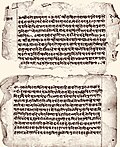
Some of the earliest [[Epigraphy|epigraphic]] evidence attesting to the developing [[Sanskrit]] [[Nāgarī script]] in ancient India is from the 1st to 4th century CE inscriptions discovered in [[Gujarat]].<ref name="gazett">{{Cite book |url={{Google books|0bkMAAAAIAAJ|Gazetteer of the Bombay Presidency|plainurl=yes}} |chapter=Rudradaman's inscription from 1st through 4th century CE found in Gujarat, India |title=Gazetteer of the Bombay Presidency |publisher=Stanford University Archives |pages=30–45, particularly {{IAST|Devanāgarī}} inscription on Jayadaman's coins (pp. 33–34)}}</ref> Variants of script called {{IAST|Nāgarī}}, recognisably close to Devanāgarī, are first attested from the 1st century CE [[Rudradaman I|Rudradaman]] inscriptions in Sanskrit, while the modern standardised form of Devanāgarī was in use by about 1000 CE.<ref name="salomon1000">{{Cite book |first=Richard |last=Salomon |date=2014 |title=Indian Epigraphy |publisher=Oxford University Press |isbn=978-0195356663 |pages=40–42}}</ref><ref>{{Cite book |first=Krishna Chandra |last=Sagar |date=1993 |title=Foreign Influence on Ancient India |publisher=South Asia Books |isbn=978-8172110284 |page=137}}</ref> Medieval inscriptions suggest widespread diffusion of Nāgarī-related scripts, with [[biscript]]s presenting local script along with the adoption of {{IAST|Nāgarī}} scripts. For example, the mid 8th-century [[Pattadakal|Pattadakal pillar]] in [[Karnataka]] has text in both [[Siddhamatrka|Siddha Matrika]] script, and an early [[Telugu-Kannada alphabet|Telugu-Kannada]] script; while, the [[Kangra, Himachal Pradesh|Kangra]] [[Jawalamukhi]] inscription in [[Himachal Pradesh]] is written in both [[Sharada script|Sharada]] and Devanāgarī scripts.<ref name="richardbiscript">{{Cite book |first=Richard |last=Salomon |date=2014 |title=Indian Epigraphy |publisher=Oxford University Press |isbn=978-0195356663 |page=71}}</ref> | |||
== | The {{IAST|Nāgarī}} script was in regular use by the 7th century CE, and it was fully developed by about the end of first millennium.<ref name=kathleen/><ref name=salomon1000/> The use of Sanskrit in {{IAST|Nāgarī}} script in medieval India is attested by numerous pillar and cave-temple inscriptions, including the 11th-century [[Udayagiri Caves|Udayagiri inscriptions]] in [[Madhya Pradesh]],<ref>{{Cite journal |first=Michael |last=Willis |date=2001 |title=Inscriptions from Udayagiri: locating domains of devotion, patronage and power in the eleventh century |journal=South Asian Studies |volume=17 |issue=1 |pages=41–53|doi=10.1080/02666030.2001.9628591 |s2cid=161258027 }}</ref> and an inscribed brick found in [[Uttar Pradesh]], dated to be from 1217 CE, which is now held at the [[British Museum]].<ref>{{Cite web |url=https://www.britishmuseum.org/explore/highlights/highlight_objects/asia/b/brick_with_sanskrit_inscriptio.aspx |title=Brick with Sanskrit inscription in Nāgarī script, 1217 CE, found in Uttar Pradesh, India (British Museum) |archive-url=https://web.archive.org/web/20151019091410/https://www.britishmuseum.org/explore/highlights/highlight_objects/asia/b/brick_with_sanskrit_inscriptio.aspx |archive-date=19 October 2015}}</ref> The script's prototypes and related versions have been discovered with ancient relics outside India, in places such as [[Sri Lanka]], [[Myanmar]] and [[Indonesia]]. In East Asia, the {{IAST|Siddhaṃ matrika}} script (considered as the closest precursor to {{IAST|Nāgarī}}) was in use by [[Buddhism|Buddhists]].<ref name=george/><ref>{{Cite book |first=Wayan |last=Ardika |date=2009 |title=Form, Macht, Differenz: Motive und Felder ethnologischen Forschens |editor-first=Elfriede |editor-last=Hermann |display-editors=et al. |publisher=Universitätsverlag Göttingen |isbn=978-3940344809 |language=de |pages=251–252|quote="Nagari script and Sanskrit language in the inscription at Blangjong suggests that Indian culture was already influencing Bali (Indonesia) by the 10th century CE."}}</ref> Nāgarī has been the {{lang|la|[[primus inter pares]]}} of the Indic scripts.<ref name="george">{{Cite book |first1=George |last1=Cardona |first2=Danesh |last2=Jain |date=2003 |title=The Indo-Aryan Languages |publisher=Routledge |isbn=978-0415772945 |pages=75–77}}</ref> It has long been used traditionally by religiously educated people in [[South Asia]] to record and transmit information, existing throughout the land in parallel with a wide variety of local scripts (such as [[Moḍī script|Moḍī]], [[Kaithi script|Kaithi]], and [[Mahajani script|Mahajani]]) used for administration, commerce, and other daily uses. | ||
Sharada remained in parallel use in [[Kashmir]]. An early version of {{IAST|Devanāgarī}} is visible in the [[Kutila inscription of Bareilly]] dated to [[Vikram Samvat|VS]] 1049 (992 CE), which demonstrates the emergence of the horizontal bar to group letters belonging to a word.<ref name="taylor2003">{{Cite book |last=Taylor |first=Isaac |url=https://archive.org/stream/alphabet00unkngoog#page/n348/mode/2up/ |title=History of the Alphabet: Aryan Alphabets, Part 2 |publisher=Kegan Paul, Trench & Co |date=1883 |isbn=978-0-7661-5847-4 |pages=324, 333 |quote={{omission}} In the Kutila this develops into a short horizontal bar, which, in the Devanagari, becomes a continuous horizontal line {{omission}} three cardinal inscriptions of this epoch, namely, the Kutila or Bareli inscription of 992, the [[Chalukya]] or Kistna inscription of 945, and a Kawi inscription of 919 {{omission}} the Kutila inscription is of great importance in Indian epigraphy, not only from its precise date, but from its offering a definite early form of the standard Indian alphabet, the Devanagari {{omission}}}}</ref> One of the oldest surviving Sanskrit texts from the early post-[[Maurya Empire|Maurya]] period consists of 1,413 {{IAST|Nāgarī}} pages of a commentary by [[Patanjali]], with a composition date of about 150 BCE, the surviving copy transcribed about 14th century CE.<ref>{{Cite encyclopedia |last=Witzel |first= Michael |author-link=Michael Witzel |title=17. Brahmanical Reactions to Foreign Influences and to Social and Religious Change |date=2006 |encyclopedia=Between the Empires: Society in India 300 BCE to 400 CE |editor-last=Olivelle |editor-first= Patrick |editor-link=Patrick Olivelle |publisher=Oxford University Press |isbn=978-0195305326 |doi=10.1093/acprof:oso/9780195305326.003.0017 |pages=477–480 with footnote 60}};<br />Original manuscript, dates in Saka Samvat, and uncertainties associated with it: {{Citation |url=https://archive.org/stream/vykaraamahbhshy00kielgoog#page/n8/mode/2up |title=Mahabhasya of Patanjali |year=1880 |publisher=Bombay, Government central Book depôt |editor-first=F. |editor-last=Kielhorn}}</ref> | |||
In [[Sinja Valley]], mid-western [[Nepal]] where the Nepali language originates from, the earliest examples of the Devanagari script from the 13th century were found on the cliffs and in nearby Dullu.<ref>{{Cite web|url=https://whc.unesco.org/en/tentativelists/5263/|title=Sinja valley - UNESCO World Heritage Centre|last=Centre|first=UNESCO World Heritage|website=whc.unesco.org|language=en|access-date=2018-10-23}}</ref> | |||
{{Gallery | |||
| mode = packed | |||
| height = 120 | |||
| align = center | |||
| title = Examples of Devanāgarī manuscripts created between the 18th and 19th centuries | |||
|File:Isha Upanishad Verses 1 to 3, Shukla Yajurveda, Sanskrit, Devanagari.jpg| | |||
|File:13th-century Shatapatha Brahmana 14th Khanda Prapathaka 3-4, page 1 front, Sanskrit, Devanagari script.jpg| | |||
|File:Yajurveda 44.8, page 1 front and back, Sanskrit, Devanagari lipi (script).jpg| | |||
|File:1593 CE, Adi Shankara bhasya Aitareya Upanishad, Varanasi Jain temple bhandara, Sanskrit, Devanagari, MS Add.2092.jpg| | |||
}} | |||
=== East Asia === | === East Asia === | ||
In the 7th century, under the rule of [[Songtsen Gampo]] of the [[Tibetan Empire]], [[Thonmi Sambhota]] was sent to Nepal to open marriage negotiations with a [[Licchavi (kingdom)|Nepali]] princess and to find a writing system suitable for the [[Classical Tibetan|Tibetan]] language. He then invented the [[Tibetan script]] based on the Nāgarī used in Kashmir. He added 6 new characters for sounds that did not exist in Sanskrit.<ref>{{Cite book |first=William Woodville |last=Rockhill |url={{Google books|avFDAQAAMAAJ|Annual Report of the Board of Regents of the Smithsonian Institution|page=671|plainurl=yes}} |title=Annual Report of the Board of Regents of the Smithsonian Institution |publisher=United States National Museum |page=671}}</ref> | |||
Other scripts closely related to | Other scripts closely related to Nāgarī (such as [[Siddhaṃ script|Siddhaṃ]]) were introduced throughout East and Southeast Asia from the 7th to the 10th centuries CE: notably in Indonesia, Vietnam, and Japan.<ref>{{Cite book |first=David |last=Quinter |date=2015 |title=From Outcasts to Emperors: Shingon Ritsu and the Mañjuśrī Cult in Medieval Japan |publisher=Brill |isbn=978-9004293397 |pages=63–65 with discussion on [[Uṣṇīṣa Vijaya Dhāraṇī Sūtra]]}}</ref><ref name="richard">{{Cite book |first=Richard |last=Salomon |date=2014 |title=Indian Epigraphy |publisher=Oxford University Press |isbn=978-0195356663 |pages=157–160}}</ref> | ||
Most of the | Most of the Southeast Asian scripts have roots in Dravidian scripts, but a few found in south-central regions of Java and isolated parts of southeast Asia resemble Devanāgarī or its prototypes. The [[Kawi script]] in particular is similar to the Devanāgarī in many respects, though the morphology of the script has local changes. The earliest inscriptions in the Devanāgarī-like scripts are from around the 10th century CE, with many more between the 11th and 14th centuries.<ref>{{Cite book |last=Teselkin |first=Avenir S. |url=https://books.google.com/books?id=xJ1kAAAAMAAJ |title=Old Javanese (Kawi) |publisher=Cornell University Press |date=1972 |pages=9–14 |access-date=28 October 2018 |archive-url=https://web.archive.org/web/20200126234553/https://books.google.com/books?id=xJ1kAAAAMAAJ |archive-date=26 January 2020 |url-status=live}}</ref><ref>{{Cite book |last1=de Casparis |first1=J. G. |url=https://books.google.com/books?id=cLUfAAAAIAAJ |title=Indonesian Palaeography: A History of Writing in Indonesia from the Beginnings to c. AD 1500 |publisher=BRILL Academic |date=1975 |isbn=90-04-04172-9 |pages=35–43 |access-date=28 October 2018 |archive-url=https://web.archive.org/web/20200313164916/https://books.google.com/books?id=cLUfAAAAIAAJ |archive-date=13 March 2020 |url-status=live}}</ref> | ||
Some of the old-Devanāgarī inscriptions are found in Hindu temples of Java, such as the [[Prambanan]] temple.<ref>{{Cite book |last=Zurbuchen |first=Mary S. |url=https://books.google.com/books?id=y4kOAAAAYAAJ |title=Introduction to Old Javanese Language and Literature: A Kawi Prose Anthology |publisher=Center for South and Southeast Asian Studies, University of Michigan |date=1976 |isbn=978-0-89148-053-2 |pages=xi–xii |access-date=28 October 2018 |archive-url=https://web.archive.org/web/20200227150848/https://books.google.com/books?id=y4kOAAAAYAAJ |archive-date=27 February 2020 |url-status=live}}</ref> The Ligor and the Kalasan inscriptions of central Java, dated to the 8th century, are also in the Nāgarī script of north India. According to the epigraphist and Asian Studies scholar Lawrence Briggs, these may be related to the 9th century copper plate inscription of Devapaladeva (Bengal) which is also in early Devanāgarī script.<ref>{{Cite journal |last=Briggs |first=Lawrence Palmer |date=1950 |title=The Origin of the Sailendra Dynasty: Present Status of the Question |journal=Journal of the American Oriental Society |publisher=JSTOR |volume=70 |issue=2 |pages=79–81 |doi=10.2307/595536 |issn=0003-0279 |jstor=595536}}</ref> The term kawi in Kawi script is a loan word from {{IAST|[[kāvya]]}} (poetry). According to anthropologists and Asian studies scholars [[John Norman Miksic]] and Goh Geok Yian, the 8th century version of early Nāgarī or Devanāgarī script was adopted in Java, [[Bali]], and Khmer around the 8th–9th centuries, as evidenced by the many contemporaneous inscriptions of this period.<ref name="MiksicYian2016p177">{{Cite book |last1=Miksic |first1=John Norman |last2=Yian |first2=Goh Geok |url=https://books.google.com/books?id=zjklDwAAQBAJ |title=Ancient Southeast Asia |publisher=Taylor & Francis |date=2016 |isbn=978-1-317-27904-4 |pages=177–179, 314–322 |author-link=John N. Miksic |access-date=28 October 2018 |archive-url=https://web.archive.org/web/20200306072439/https://books.google.com/books?id=zjklDwAAQBAJ |archive-date=6 March 2020 |url-status=live}}</ref>{{Gallery | |||
| mode = packed | |||
| align = center | |||
|File:Falongsibeiye.png| [[Uṣṇīṣa Vijaya Dhāraṇī Sūtra]] in [[Siddhaṃ script|Siddhaṃ]] on [[Arecaceae|palm]] leaf in 609 CE found in [[Hōryū-ji]], Japan. The last line is a complete Sanskrit [[syllabary]] in Siddhaṃ script. | |||
}} | |||
{{Brahmi evolution|brahmi=early|middlebrahmi=y|latebrahmi=y|devanagari=y|girnar=n|gujarat=n}} | |||
== Letters == | == Letters == | ||
The [[collating sequence|letter order]] of | The [[collating sequence|letter order]] of Devanāgarī, like nearly all Brāhmic scripts, is based on [[phonetics|phonetic]] principles that consider both the [[manner of articulation|manner]] and [[place of articulation]] of the consonants and vowels they represent. This arrangement is usually referred to as the {{IAST|varṇamālā}} ("[[garland]] of letters").<ref>{{Harvcoltxt|Salomon|2003|p=71}}</ref> The format of Devanāgarī for Sanskrit serves as the prototype for its application, with minor variations or additions, to other languages.<ref name="Salomon 2003 75">{{Harvcoltxt|Salomon|2003|p=75}}</ref> | ||
The name "Devanagari" comes from the Sanskrit term {{lang|sa|देवनागरी}} ({{IAST|devanāgarī}}), meaning "script of the divine city" or "script of the city of God".{{cn|date=October 2025}} | |||
The vowels and their arrangement are: | |||
The vowels and their arrangement are: | |||
{|class="wikitable" style="text-align:center; | {|class="wikitable" style="margin: auto; border: none; text-align:center;" | ||
|- | |- | ||
! | ! | ||
| rowspan="10" | | | rowspan="10" | | ||
! Independent form | ! Independent form | ||
! [[IAST]] | ! [[International Alphabet of Sanskrit Transliteration|IAST]] | ||
! [[ISO 15919|ISO]] | ! [[ISO 15919|ISO]] | ||
! As diacritic with {{lang| | ! [[International Phonetic Alphabet|IPA]] | ||
! As diacritic with {{lang|inc-Deva|प}} ([[#Barakhadi|Barakhadi]]) | |||
| rowspan="10" | | | rowspan="10" | | ||
! Independent form | ! Independent form | ||
! IAST | ! IAST | ||
! ISO | ! ISO | ||
! As diacritic with {{lang| | ! IPA | ||
! As diacritic with {{lang|inc-Deva|प}} (Barakhadi) | |||
|- | |- | ||
!''{{IAST|kaṇṭhya}}''<br />([[ | !''{{IAST|kaṇṭhya}}''<br />([[Velar]]) | ||
| style="background:#ccc; font-size:24px;"|{{lang| | | style="background:#ccc; font-size:24px;"|{{lang|inc-Deva|अ}} | ||
| colspan="2" | {{IAST|a}} | | colspan="2" | {{IAST|a}} | ||
| style="background:#ccc; font-size:24px;"|{{lang| | | {{IPAblink|ɐ}} | ||
| style="background:#ccc; font-size:24px;"|{{lang| | | style="background:#ccc; font-size:24px;"|{{lang|inc-Deva|प}} | ||
| style="background:#ccc; font-size:24px;"|{{lang|inc-Deva|आ}} | |||
| colspan="2" | {{IAST|ā}} | | colspan="2" | {{IAST|ā}} | ||
| style="background:#ccc; font-size:24px;"|{{lang| | | {{IPAblink|äː|aː}} | ||
| style="background:#ccc; font-size:24px;"|{{lang|inc-Deva|पा}} | |||
|- | |- | ||
!''{{IAST|tālavya}}''<br />([[Palatal]]) | !''{{IAST|tālavya}}''<br />([[Palatal]]) | ||
| style="background:#ccc; font-size:24px;"|{{lang| | | style="background:#ccc; font-size:24px;"|{{lang|inc-Deva|इ}} | ||
| colspan="2" | {{IAST|i}} | | colspan="2" | {{IAST|i}} | ||
| style="background:#ccc; font-size:24px;"|{{lang| | | {{IPAblink|i}} | ||
| style="background:#ccc; font-size:24px;"|{{lang|inc-Deva|पि}} | |||
<!--When you input [p] [i], you should see [i] [p] as the correct result. | <!--When you input [p] [i], you should see [i] [p] as the correct result. | ||
If not, that means your computer does not support Indic script. Please do not swap.--> | If not, that means your computer does not support Indic script. Please do not swap.--> | ||
| style="background:#ccc; font-size:24px;"|{{lang| | | style="background:#ccc; font-size:24px;"|{{lang|inc-Deva|ई}} | ||
| colspan="2" | {{IAST|ī}} | | colspan="2" | {{IAST|ī}} | ||
| style="background:#ccc; font-size:24px;"|{{lang| | | {{IPAblink|iː}} | ||
| style="background:#ccc; font-size:24px;"|{{lang|inc-Deva|पी}} | |||
|- | |- | ||
! | !{{IAST|oṣṭhya}}<br />([[Labial consonant|Labial]]) | ||
| style="background:#ccc; font-size:24px;"|{{lang| | | style="background:#ccc; font-size:24px;"|{{lang|inc-Deva|उ}} | ||
| colspan="2" | {{IAST|u}} | | colspan="2" | {{IAST|u}} | ||
| style="background:#ccc; font-size:24px;"|{{lang| | | {{IPAblink|u}} | ||
| style="background:#ccc; font-size:24px;"|{{lang| | | style="background:#ccc; font-size:24px;"|{{lang|inc-Deva|पु}}<small> <sup>8</sup></small> | ||
| style="background:#ccc; font-size:24px;"|{{lang|inc-Deva|ऊ}} | |||
| colspan="2" | {{IAST|ū}} | | colspan="2" | {{IAST|ū}} | ||
| style="background:#ccc; font-size:24px;"|{{lang| | | {{IPAblink|uː}} | ||
| style="background:#ccc; font-size:24px;"|{{lang|inc-Deva|पू}}<small> <sup>8</sup></small> | |||
|- | |- | ||
!''{{IAST|mūrdhanya}}''<br />([[Retroflex consonant|Retroflex]]) | !''{{IAST|mūrdhanya}}''<br />([[Retroflex consonant|Retroflex]]) | ||
| style="background:#ccc; font-size:24px;"|{{lang| | | style="background:#ccc; font-size:24px;"|{{lang|inc-Deva|ऋ}}<small> <sup>5,</sup> <sup>8</sup></small> | ||
| {{IAST|ṛ}} | | {{IAST|ṛ}} | ||
| {{ | | {{transliteration|sa|ISO|r̥}} | ||
| style="background:#ccc; font-size:24px;"|{{lang| | | {{IPAblink|r̩}} | ||
| style="background:#ccc; font-size:24px;"|{{lang| | | style="background:#ccc; font-size:24px;"|{{lang|inc-Deva|पृ}} | ||
| style="background:#ccc; font-size:24px;"|{{lang|inc-Deva|ॠ}}<small> <sup>6</sup></small> | |||
| {{IAST|ṝ}} | | {{IAST|ṝ}} | ||
| {{ | | {{transliteration|sa|ISO|r̥̄}} | ||
| style="background:#ccc; font-size:24px;"|{{lang| | | {{IPAblink|r̩ː}} | ||
| style="background:#ccc; font-size:24px;"|{{lang|inc-Deva|पॄ}} | |||
|- | |- | ||
! | !{{IAST|dantya}}<br />([[Dental consonant|Dental]]) | ||
| style="background:#ccc; font-size:24px;"|{{lang| | | style="background:#ccc; font-size:24px;"|{{lang|inc-Deva|ऌ}}<small> <sup>6</sup></small> | ||
| {{IAST|ḷ}} | | {{IAST|ḷ}} | ||
| {{ | | {{transliteration|sa|ISO|l̥}} | ||
| style="background:#ccc; font-size:24px;"|{{lang| | | {{IPAblink|l̩}} | ||
| style="background:#ccc; font-size:24px;"|{{lang| | | style="background:#ccc; font-size:24px;"|{{lang|inc-Deva|पॢ}} | ||
| style="background:#ccc; font-size:24px;"|{{lang|inc-Deva|ॡ}}<small> <sup>6,</sup> <sup>7</sup></small> | |||
| {{IAST|ḹ}} | | {{IAST|ḹ}} | ||
| {{ | | {{transliteration|sa|ISO|l̥̄}} | ||
| style="background:#ccc; font-size:24px;"|{{lang| | | {{IPAblink|l̩ː}} | ||
| style="background:#ccc; font-size:24px;"|{{lang|inc-Deva|पॣ}} | |||
|- | |- | ||
!''{{IAST|kaṇṭhatālavya}}''<br />( | !''{{IAST|kaṇṭhatālavya}}''<br />(Palatovelar) | ||
| style="background:#ccc; font-size:24px;"|{{lang| | | style="background:#ccc; font-size:24px;"|{{lang|inc-Deva|ए}} | ||
| {{IAST|e}} | | {{IAST|e}} | ||
| {{ | | {{transliteration|sa|ISO|ē}} | ||
| style="background:#ccc; font-size:24px;"|{{lang| | | {{IPAblink|eː}} | ||
| style="background:#ccc; font-size:24px;"|{{lang| | | style="background:#ccc; font-size:24px;"|{{lang|inc-Deva|पे}} | ||
| style="background:#ccc; font-size:24px;"|{{lang|inc-Deva|ऐ}} | |||
| colspan="2" | {{IAST|ai}} | | colspan="2" | {{IAST|ai}} | ||
| style="background:#ccc; font-size:24px;"|{{lang| | | {{IPA|[aːɪ]}} (in Hindi: {{IPAblink|ɛː}}) | ||
| style="background:#ccc; font-size:24px;"|{{lang|inc-Deva|पै}} | |||
|- | |- | ||
!''{{IAST|kaṇṭhoṣṭhya}}''<br />( | !''{{IAST|kaṇṭhoṣṭhya}}''<br />(Labiovelar) | ||
| style="background:#ccc; font-size:24px;"|{{lang| | | style="background:#ccc; font-size:24px;"|{{lang|inc-Deva|ओ}} | ||
| {{IAST|o}} | | {{IAST|o}} | ||
| {{ | | {{transliteration|sa|ISO|ō}} | ||
| style="background:#ccc; font-size:24px;"|{{lang| | | {{IPAblink|oː}} | ||
| style="background:#ccc; font-size:24px;"|{{lang| | | style="background:#ccc; font-size:24px;"|{{lang|inc-Deva|पो}} | ||
| style="background:#ccc; font-size:24px;"|{{lang|inc-Deva|औ}} | |||
| colspan="2" | {{IAST|au}} | | colspan="2" | {{IAST|au}} | ||
| style="background:#ccc; font-size:24px;"|{{lang| | | {{IPA|[aːʊ]}} (in Hindi: {{IPAblink|ɔː}}) | ||
| style="background:#ccc; font-size:24px;"|{{lang|inc-Deva|पौ}} | |||
|- | |- | ||
! | ! | ||
| style="background:#ccc; font-size:24px;"|{{lang| | | style="background:#ccc; font-size:24px;"|{{lang|inc-Deva|अं}} / {{lang|inc-Deva|[[ं]]}}<small> <sup>1,2</sup></small> | ||
| {{IAST| | | {{IAST|ṃ}} | ||
| {{ | | {{transliteration|sa|ISO|ṁ}} | ||
| {{IPAblink|◌̃}} | |||
| style="background:#ccc; font-size:24px;"|{{lang| | | style="background:#ccc; font-size:24px;"|{{lang|inc-Deva|पं}} | ||
| style="background:#ccc; font-size:24px;"|{{lang|inc-Deva|अः}} / {{lang|inc-Deva|[[ः]]}}<small> <sup>1</sup></small> | |||
| style="background:#ccc; font-size:24px;"|{{lang| | | colspan="2" | {{IAST|ḥ}} | ||
| {{IPAblink|h}} | |||
| style="background:#ccc; font-size:24px;"|{{lang|inc-Deva|पः}} | |||
| | |||
| style="background:#ccc; font-size:24px;"|{{lang| | |||
|} | |} | ||
# Arranged with the vowels are two consonantal [[diacritics]], the final [[nasal stop|nasal]] {{IAST|[[anusvāra]]}} {{lang|inc-Deva|[[ं]]|size=140%}} {{IAST|ṃ}} and the final [[fricative]] {{IAST|[[visarga]]}} {{lang|inc-Deva|[[ः]]|size=140%}} {{IAST|ḥ}} (called {{lang|inc-Deva|[[अं]]|size=140%}} {{IAST|aṃ}} and {{lang|inc-Deva|[[अः]]|size=140%}} {{IAST|aḥ}}). {{Harvcoltxt|Masica|1991|p=146}} notes of the {{IAST|anusvāra}} in Sanskrit that "there is some controversy as to whether it represents a homorganic [[nasal stop]] {{omission}}, a [[nasalized vowel|nasalised vowel]], a nasalised [[semivowel]], or all these according to context". The {{IAST|visarga}} represents post-vocalic [[voiceless glottal fricative]] {{IPA|[h]}}, in Sanskrit an [[allophone]] of {{IAST|s}}, or less commonly {{IAST|r}}, usually in word-final position. Some traditions of recitation append an echo of the [[vowel]] after the breath:<ref>{{Harvcoltxt|Wikner|1996|p=6}}</ref> {{lang|inc-Deva|इः|size=140%}} {{IPA|[ihi]}}. {{Harvcoltxt|Masica|1991|p=146}} considers the {{IAST|visarga}} along with letters {{lang|inc-Deva|ङ|size=140%}} {{IAST|ṅa}} and {{lang|inc-Deva|ञ|size=140%}} {{IAST|ña}} for the "largely predictable" [[velar nasal|velar]] and [[palatal nasal]]s to be examples of "phonetic overkill in the system". | |||
# Another diacritic is the {{IAST|[[Chandrabindu|candrabindu]]}}/{{IAST|[[anunāsika]]}} {{lang|inc-Deva|[[ँ]]|size=140%}} {{lang|inc-Deva|[[अँ]]|size=140%}}. {{Harvcoltxt|Salomon|2003|pp=76–77}} describes it as a "more emphatic form" of the {{IAST|anusvāra}}, "sometimes {{omission}} used to mark a true [vowel] nasalization". In a new Indo-Aryan language such as Hindi the distinction is formal: the {{IAST|candrabindu}} indicates [[nasalized vowel|vowel nasalisation]]<ref>{{Harvcoltxt|Snell|2000|pp=44–45}}</ref> while the {{IAST|anusvār}} indicates a homorganic [[nasal stop|nasal]] preceding another consonant:<ref>{{Harvcoltxt|Snell|2000|p=64}}</ref> e.g., {{lang|hi|हँसी}} {{IPA|[ɦə̃si]}} "[[laughter]]", {{lang|hi|गंगा}} {{IPA|[ɡəŋɡɑ]}} "the [[Ganges]]". When an {{IAST|akṣara}} has a vowel diacritic above the top line, that leaves no room for the {{IAST|candra}} ("moon") stroke {{IAST|candrabindu}}, which is dispensed with in favour of the lone dot:<ref>{{Harvcoltxt|Snell|2000|p=45}}</ref> {{lang|hi|हूँ|size=140%}} {{IPA|[ɦũ]}} "am", but {{lang|hi|हैं|size=140%}} {{IPA|[ɦɛ̃]}} "are". Some writers and typesetters dispense with the "moon" stroke altogether, using only the dot in all situations.<ref>{{Harvcoltxt|Snell|2000|p=46}}</ref> | |||
# The ''[[Virama|virāma]]'' or ''halanta'' diacritic ् expresses the absence of a vowel after the consonant, e.g. क्ष can represent ''kṣa.'' | |||
# The {{IAST|[[avagraha]]}} ({{lang|inc-Deva|[[ऽ]]|size=140%}} {{lang|inc-Deva|[[अऽ]]|size=140%}}) (usually [[transliteration|transliterated]] with an [[apostrophe]]) is a Sanskrit [[punctuation mark]] for the [[elision]] of a [[vowel]] in [[sandhi]]: {{lang|sa|एकोऽयम्}} {{IAST|eko'yam}} ( ← {{lang|sa|एकस्}} {{IAST|ekas}} + {{lang|sa|अयम्}} {{IAST|ayam}}) ("this one"). An original [[long vowel]] lost to coalescence is sometimes marked with a double {{IAST|avagraha}}: {{lang|sa|सदाऽऽत्मा}} {{IAST|sadā'tmā}} ( ← {{lang|sa|सदा}} {{IAST|sadā}} + {{lang|sa|आत्मा}} {{IAST|ātmā}}) "always, the self".<ref>{{Harvcoltxt|Salomon|2003|p=77}}</ref> In Hindi, {{Harvcoltxt|Snell|2000|p=77}} states that its "main function is to show that a vowel is sustained in a cry or a shout": {{lang|hi|आईऽऽऽ!}} {{IAST|āīīī!}}<!-- include bit on 77 about prosody? -->. In Madhyadeshi languages like Bhojpuri, Awadhi, Maithili, etc. which have "quite a number of verbal forms that end in that inherent vowel",<ref>{{Harvcoltxt|Verma|2003|p=501}}</ref> the {{IAST|avagraha}} is used to mark the ''non-''elision of word-final inherent {{IAST|a}}, which otherwise is a modern orthographic convention: {{lang|inc-Deva|बइठऽ}} {{IAST|baiṭha}} "sit" versus {{lang|inc-Deva|बइठ}} {{IAST|baiṭh}} | |||
# The sound represented by {{lang|inc-Deva|ऋ|size=140%}} {{IAST|ṛ}} has largely been lost in the modern languages, and its pronunciation now ranges from {{IPA|[ɾɪ]}} (Hindi) to {{IPA|[ɾu]}} (Marathi). | |||
# The syllabic consonants {{lang|inc-Deva|ॠ|size=140%}} {{IAST|ṝ}}, {{lang|inc-Deva|ऌ|size=140%}} {{IAST|ḷ}}, and {{lang|inc-Deva|ॡ|size=140%}} {{IAST|ḹ}} are specific to Sanskrit and not included in the {{IAST|varṇamālā}} of other languages. | |||
# {{IAST|ḹ}} is not an actual [[phoneme]] of Sanskrit, but rather a graphic convention included among the vowels in order to maintain the symmetry of short–long pairs of letters.<ref name="Salomon 2003 75" /> | |||
# There are non-regular formations of {{lang|inc-Deva|रु|size=140%}} {{IAST|ru}}, {{lang|inc-Deva|रू|size=140%}} {{IAST|rū}}, and {{lang|inc-Deva|हृ|size=140%}} {{IAST|hṛ}}. | |||
# There are two more vowels in [[Marathi language|Marathi]], {{lang|mr|ॲ|size=140%}} and {{lang|mr|ऑ|size=140%}}, that respectively represent [{{IPA|æ}}], similar to the [[received pronunciation|RP]] English pronunciation of {{angbr|a}} in ''act'', and [{{IPA|ɒ}}], similar to the RP pronunciation of {{angbr|o}} in ''cot''. These vowels are sometimes used in Hindi too, as in {{Langx|hi|डॉलर|label=none}} {{IAST|dôlar}} ("dollar").<ref>{{Cite web |title=Hindi Translation of "dollar" |url=https://www.collinsdictionary.com/dictionary/english-hindi/dollar |url-status=live |archive-url=https://web.archive.org/web/20190512040722/https://www.collinsdictionary.com/dictionary/english-hindi/dollar |archive-date=12 May 2019 |access-date=2019-05-12 |website=Collins English-Hindi Dictionary |language=en}}</ref> IAST transliteration is not defined. In [[ISO 15919]], the transliteration is {{transliteration|sa|ISO|ê}} and {{transliteration|sa|ISO|ô}}, respectively. | |||
# Kashmiri Devanagari uses letters like {{lang|inc-Deva|ॳ|size=140%}}, {{lang|inc-Deva|ॴ|size=140%}}, {{lang|inc-Deva|ॶ|size=140%}}, {{lang|inc-Deva|ॷ|size=140%}}, {{lang|inc-Deva|ऎ|size=140%}}, {{lang|inc-Deva|ऒ|size=140%}}, {{lang|inc-Deva|औ|size=140%}}, {{lang|inc-Deva|ॵ|size=140%}} to represent its vowels (see [[Kashmiri language#Devanagari]]). | |||
# | |||
=== Consonants === | === Consonants === | ||
The table below shows the consonant letters (in combination with [[inherent vowel]] | The table below shows the consonant letters (in combination with [[inherent vowel]] {{IAST|a}}) and their arrangement. To the right of the Devanāgarī letter it shows the Latin script transliteration using [[International Alphabet of Sanskrit Transliteration]],<ref>{{Harvcoltxt|Wikner|1996|p=73}}</ref> and the phonetic value ([[International Phonetic Alphabet|IPA]]) in [[Hindi]].<ref>{{Cite book |last=Sandahl |first=Stella |url=https://books.google.com/books?id=Hm0aAQAAIAAJ |title=A Hindi reference grammar |publisher=Peeters |date=2000 |isbn=978-9042908802 |pages=1–4 |access-date=26 April 2017 |archive-url=https://web.archive.org/web/20170427114134/https://books.google.com/books?id=Hm0aAQAAIAAJ |archive-date=27 April 2017 |url-status=live}}</ref><ref>{{Cite book |last=Bhatia |first=Tej K. |url=https://books.google.com/books?id=jJOXzRXsSK0C |title=A History of the Hindi Grammatical Tradition |publisher=BRILL Academic |date=1987 |isbn=90-04-07924-6 |pages=51–63, 77–94 |access-date=15 November 2015 |archive-url=https://web.archive.org/web/20160610230915/https://books.google.com/books?id=jJOXzRXsSK0C |archive-date=10 June 2016 |url-status=live}}</ref> | ||
{|class="wikitable" style="text-align:center; width:95%" | |||
{|class="wikitable" style="margin: auto; border: none; text-align:center; width:95%" | |||
|- | |- | ||
! [[Phonetic]]s → | ! [[Phonetic]]s → | ||
! colspan=8 | | ! colspan=8 | {{IAST|sparśa}}<br />([[Occlusive]]) | ||
! colspan=2 | | ! colspan=2 | {{IAST|anunāsika}}<br />([[Nasal stop|Nasal]]) | ||
! colspan=2 | | ! colspan=2 | {{IAST|antastha}}<br />([[Approximant]]) | ||
! colspan=4 | | ! colspan=4 | {{IAST|ūṣman}}/{{IAST|saṃgharṣī}}<br />([[Fricative consonant|Fricative]]) | ||
|- | |- | ||
! [[Voice (phonetics)|Voicing]] → | ! [[Voice (phonetics)|Voicing]] → | ||
| colspan="4"| | | colspan="4"| {{IAST|aghoṣa}} | ||
| colspan="8" style="background:beige;"| | | colspan="8" style="background:beige;"| {{IAST|saghoṣa}} | ||
| colspan="2"| | | colspan="2"| {{IAST|aghoṣa}} | ||
| colspan="2" style="background:beige;"| | | colspan="2" style="background:beige;"| {{IAST|saghoṣa}} | ||
|- | |- | ||
! [[Aspiration (phonetics)|Aspiration]] → | ! [[Aspiration (phonetics)|Aspiration]] → | ||
| colspan=2 | | | colspan=2 | {{IAST|alpaprāṇa}} | ||
| colspan=2 style="background:beige;"| | | colspan=2 style="background:beige;"| {{IAST|mahāprāṇa}} | ||
| colspan=2 | | | colspan=2 | {{IAST|alpaprāṇa}} | ||
| colspan=2 style="background:beige;"| | | colspan=2 style="background:beige;"| {{IAST|mahāprāṇa}} | ||
| colspan=4 | | | colspan=4 | {{IAST|alpaprāṇa}} | ||
| colspan=4 style="background:beige;"| | | colspan=4 style="background:beige;"| {{IAST|mahāprāṇa}} | ||
|- | |- | ||
! | !{{IAST|kaṇṭhya}}<br />([[Velar consonant|Velar]]) | ||
| style="background:#ccc; font-size:24px;"|{{lang| | | style="background:#ccc; font-size:24px;"|{{lang|inc-Deva|क}}||{{IAST|ka}}<br />{{IPAblink|k}} | ||
| style="background:#ccc; font-size:24px;"|{{lang| | | style="background:#ccc; font-size:24px;"|{{lang|inc-Deva|ख}}||{{IAST|kha}}<br />{{IPAblink|kʰ}} | ||
| style="background:#ccc; font-size:24px;"|{{lang| | | style="background:#ccc; font-size:24px;"|{{lang|inc-Deva|ग}}||{{IAST|ga}}<br />{{IPAblink|ɡ}} | ||
| style="background:#ccc; font-size:24px;"|{{lang| | | style="background:#ccc; font-size:24px;"|{{lang|inc-Deva|घ}}||{{IAST|gha}}<br />{{IPAblink|ɡʱ}} | ||
| style="background:#ccc; font-size:24px;"|{{lang| | | style="background:#ccc; font-size:24px;"|{{lang|inc-Deva|ङ}}||{{IAST|ṅa}}<br />{{IPAblink|ŋ}} | ||
| colspan=4 | | | colspan=4 | | ||
| style="background:#ccc; font-size:24px;"|{{lang| | | style="background:#ccc; font-size:24px;"|{{lang|inc-Deva|ह}}||{{IAST|ha}}<br />{{IPAblink|ɦ}} | ||
|- | |- | ||
! | !{{IAST|tālavya}}<br />([[Palatal consonant|Palatal]]) | ||
| style="background:#ccc; font-size:24px;"|{{lang| | | style="background:#ccc; font-size:24px;"|{{lang|inc-Deva|च}}||{{IAST|ca}}<br />{{IPAblink|tʃ}} | ||
| style="background:#ccc; font-size:24px;"|{{lang| | | style="background:#ccc; font-size:24px;"|{{lang|inc-Deva|छ}}||{{IAST|cha}}<br />{{IPA|[tʃʰ]}} | ||
| style="background:#ccc; font-size:24px;"|{{lang| | | style="background:#ccc; font-size:24px;"|{{lang|inc-Deva|ज}}||{{IAST|ja}}<br />{{IPAblink|dʒ}} | ||
| style="background:#ccc; font-size:24px;"|{{lang| | | style="background:#ccc; font-size:24px;"|{{lang|inc-Deva|झ}}||{{IAST|jha}}<br />{{IPA|[dʒʱ]}} | ||
| style="background:#ccc; font-size:24px;"|{{lang| | | style="background:#ccc; font-size:24px;"|{{lang|inc-Deva|ञ}}||{{IAST|ña}}<br />{{IPAblink|ɲ}} | ||
| style="background:#ccc; font-size:24px;"|{{lang| | | style="background:#ccc; font-size:24px;"|{{lang|inc-Deva|य}}||{{IAST|ya}}<br />{{IPAblink|j}} | ||
| style="background:#ccc; font-size:24px;"|{{lang| | | style="background:#ccc; font-size:24px;"|{{lang|inc-Deva|श}}||{{IAST|śa}}<br />{{IPAblink|ʃ}} | ||
| colspan=2 rowspan=4 | | | colspan=2 rowspan=4 | | ||
|- | |- | ||
! | !{{IAST|mūrdhanya}}<br />([[Retroflex consonant|Retroflex]]) | ||
| style="background:#ccc; font-size:24px;"|{{lang| | | style="background:#ccc; font-size:24px;"|{{lang|inc-Deva|ट}}||{{IAST|ṭa}}<br />{{IPAblink|ʈ}} | ||
| style="background:#ccc; font-size:24px;"|{{lang| | | style="background:#ccc; font-size:24px;"|{{lang|inc-Deva|ठ}}||{{IAST|ṭha}}<br />{{IPA|[ʈʰ]}} | ||
| style="background:#ccc; font-size:24px;"|{{lang| | | style="background:#ccc; font-size:24px;"|{{lang|inc-Deva|ड}}||{{IAST|ḍa}}<br />{{IPAblink|ɖ}} | ||
| style="background:#ccc; font-size:24px;"|{{lang| | | style="background:#ccc; font-size:24px;"|{{lang|inc-Deva|ढ}}||{{IAST|ḍha}}<br />{{IPA|[ɖʱ]}} | ||
| style="background:#ccc; font-size:24px;"|{{lang| | | style="background:#ccc; font-size:24px;"|{{lang|inc-Deva|ण}}||{{IAST|ṇa}}<br />{{IPAblink|ɳ}} | ||
| style="background:#ccc; font-size:24px;"|{{lang| | | style="background:#ccc; font-size:24px;"|{{lang|inc-Deva|र}}||{{IAST|[[Ra (Indic)|ra]]}}<br />{{IPAblink|r}} | ||
| style="background:#ccc; font-size:24px;"|{{lang| | | style="background:#ccc; font-size:24px;"|{{lang|inc-Deva|ष}}||{{IAST|ṣa}}<br />{{IPAblink|ʂ}} | ||
|- | |- | ||
! | !{{IAST|dantya}}<br />([[Dental consonant|Dental]]) | ||
| style="background:#ccc; font-size:24px;"|{{lang| | | style="background:#ccc; font-size:24px;"|{{lang|inc-Deva|त}}||{{IAST|ta}}<br />{{IPAblink|t̪}} | ||
| style="background:#ccc; font-size:24px;"|{{lang| | | style="background:#ccc; font-size:24px;"|{{lang|inc-Deva|थ}}||{{IAST|tha}}<br />{{IPA|[t̪ʰ]}} | ||
| style="background:#ccc; font-size:24px;"|{{lang| | | style="background:#ccc; font-size:24px;"|{{lang|inc-Deva|द}}||{{IAST|da}}<br />{{IPAblink|d̪}} | ||
| style="background:#ccc; font-size:24px;"|{{lang| | | style="background:#ccc; font-size:24px;"|{{lang|inc-Deva|ध}}||{{IAST|dha}}<br />{{IPA|[d̪ʱ]}} | ||
| style="background:#ccc; font-size:24px;"|{{lang| | | style="background:#ccc; font-size:24px;"|{{lang|inc-Deva|न}}||{{IAST|na}}<br />{{IPAblink|n}} | ||
| style="background:#ccc; font-size:24px;"|{{lang| | | style="background:#ccc; font-size:24px;"|{{lang|inc-Deva|ल}}||{{IAST|la}}<br />{{IPAblink|l}} | ||
| style="background:#ccc; font-size:24px;"|{{lang| | | style="background:#ccc; font-size:24px;"|{{lang|inc-Deva|स}}||{{IAST|sa}}<br />{{IPAblink|s}} | ||
|- | |- | ||
! | !{{IAST|oṣṭhya}}<br />([[Labial consonant|Labial]]) | ||
| style="background:#ccc; font-size:24px;"|{{lang| | | style="background:#ccc; font-size:24px;"|{{lang|inc-Deva|प}}||{{IAST|pa}}<br />{{IPAblink|p}} | ||
| style="background:#ccc; font-size:24px;"|{{lang| | | style="background:#ccc; font-size:24px;"|{{lang|inc-Deva|फ}}||{{IAST|pha}}<br />{{IPA|[pʰ]}} | ||
| style="background:#ccc; font-size:24px;"|{{lang| | | style="background:#ccc; font-size:24px;"|{{lang|inc-Deva|ब}}||{{IAST|ba}}<br />{{IPAblink|b}} | ||
| style="background:#ccc; font-size:24px;"|{{lang| | | style="background:#ccc; font-size:24px;"|{{lang|inc-Deva|भ}}||{{IAST|bha}}<br />{{IPA|[bʱ]}} | ||
| style="background:#ccc; font-size:24px;"|{{lang| | | style="background:#ccc; font-size:24px;"|{{lang|inc-Deva|म}}||{{IAST|ma}}<br />{{IPAblink|m}} | ||
| style="background:#ccc; font-size:24px;"|{{lang| | | style="background:#ccc; font-size:24px;"|{{lang|inc-Deva|व}}||{{IAST|va}}<br />{{IPAblink|ʋ}} | ||
| colspan="2"| | | colspan="2"| | ||
|} | |} | ||
* Additionally, there is {{lang| | |||
* Beyond the Sanskritic set, new shapes have rarely been formulated. {{Harvcoltxt|Masica|1991|p=146}} offers the following, "In any case, according to some, all possible sounds had already been described and provided for in this system, as Sanskrit was the original and perfect language. Hence it was difficult to provide for or even to conceive ''other'' sounds, unknown to the [[phonetician]]s of Sanskrit | * Additionally, there is {{lang|inc-Deva|ळ|size=140%}} {{IAST|ḷa}} ([[International Phonetic Alphabet|IPA]]: {{IPAblink|ɭ}} or {{IPAblink|ɭ̆}}), the intervocalic [[retroflex lateral flap|lateral flap]] allophone of the [[voiced retroflex stop]] in [[Vedic Sanskrit]], which is a [[phoneme]] in languages such as [[Marathi language|Marathi]], [[Konkani language|Konkani]], [[Garhwali language|Garhwali]], and [[Rajasthani language|Rajasthani]].<ref>{{Harvcoltxt|Masica|1991|p=97}}</ref> | ||
** The most prolific diacritic has been the [[subscript]] dot ( | * Beyond the Sanskritic set, new shapes have rarely been formulated. {{Harvcoltxt|Masica|1991|p=146}} offers the following, "In any case, according to some, all possible sounds had already been described and provided for in this system, as Sanskrit was the original and perfect language. Hence it was difficult to provide for or even to conceive ''other'' sounds, unknown to the [[phonetician]]s of Sanskrit (The phoneticians did describe certain sounds qua sounds — bilabial fricatives, for instance — which, being either sporadic or completely predictable, were never represented in the writing system.)". Where foreign borrowings and internal developments did inevitably accrue and arise in New Indo-Aryan languages, they have been ignored in writing or dealt through means such as [[diacritic]]s and [[Typographic ligature|ligatures]] (ignored in recitation). | ||
** | ** The most prolific diacritic has been the [[subscript]] dot ({{IAST|[[Nukta|nuqtā]]}}) {{lang|inc-Deva|़|size=140%}}. [[Hindi]] uses it for the [[Persian language|Persian]], [[Arabic language|Arabic]] and English sounds {{lang|hi|क़|size=140%}} {{IAST|qa}} [[Voiceless uvular plosive|/q/]], {{lang|hi|ख़|size=140%}} {{IAST|xa}} [[Voiceless velar fricative|/x/]], {{lang|hi|[[ग़]]|size=140%}} {{IAST|ġa}} [[Voiced velar fricative|/ɣ/]], {{lang|hi|[[ज़]]|size=140%}} {{IAST|za}} [[Voiced alveolar fricative|/z/]], {{lang|hi|[[झ़]]|size=140%}} {{IAST|zha}} [[Voiced postalveolar fricative|/ʒ/]], and {{lang|hi|फ़|size=140%}} {{IAST|fa}} [[Voiceless labiodental fricative|/f/]], and for the [[allophonic]] developments {{lang|hi|ड़|size=140%}} {{IAST|ṛa}} [[Retroflex flap|/ɽ/]] and {{lang|hi|ढ़|size=140%}} {{IAST|ṛha}} {{IPA|/ɽʱ/}}.<ref name="PandeyMondalAgrawalBangalore2013">{{Cite book |last1=Pandey |first1=Dipti |last2=Mondal |first2=Tapabrata |last3=Agrawal |first3=S. S. |last4=Bangalore |first4=Srinivas |title=2013 International Conference Oriental COCOSDA held jointly with 2013 Conference on Asian Spoken Language Research and Evaluation (O-COCOSDA/CASLRE) |chapter=Development and suitability of Indian languages speech database for building watson based ASR system |date=2013 |page=3 |doi=10.1109/ICSDA.2013.6709861 |isbn=978-1-4799-2378-6 |s2cid=26461938 |quote=Only in Hindi 10 Phonemes व /v/ क़ /q/ ञ /ɲ/ य /j/ ष /ʂ/ ख़ /x/ ग़ /ɣ/ ज़ /z/ झ़ /ʒ/ फ़ /f/}}</ref> (Although {{lang|inc-Deva|ऴ|size=140%}} {{transliteration|inc|ISO|ḻa}} {{IPA|/ɻ/}} could also exist, it is not used in Hindi.) | ||
** [[ | ** Devanagari used to write Mahl dialect of Dhivehi uses nukta on {{lang|inc-Deva|च़|size=140%}}, {{lang|inc-Deva|त़|size=140%}}, {{lang|inc-Deva|द़|size=140%}}, {{lang|inc-Deva|ल़|size=140%}}, {{lang|inc-Deva|श़|size=140%}}, {{lang|inc-Deva|स़|size=140%}}, {{lang|inc-Deva|ह़|size=140%}} to represent other Perso-Arabic phonemes (see [[Maldivian writing systems#Devanagari script for Mahl]]). | ||
** [[Sindhi language|Sindhi]]'s and [[Saraiki language|Saraiki]]'s [[implosive]]s are accommodated with a line attached below: {{lang|sd-Deva|[[Voiced velar implosive|ॻ]]|size=140%}} {{IPA|[ɠə]}}, {{lang|sd-Deva|[[Voiced palatal implosive|ॼ]]|size=140%}} {{IPA|[ʄə]}}, {{lang|sd-Deva|[[Voiced alveolar implosive|ॾ]]|size=140%}} {{IPA|[ɗə]}}, {{lang|sd-Deva|[[Voiced bilabial implosive|ॿ]]|size=140%}} {{IPA|[ɓə]}}. | |||
** [[Aspiration (phonetics)|Aspirated]] [[sonorant]]s may be represented as conjuncts/[[Typographic ligature|ligatures]] with {{lang|inc-Deva|ह|size=140%}} {{IAST|ha}}: {{lang|inc-Deva|म्ह|size=140%}} {{IAST|mha}}, {{lang|inc-Deva|न्ह|size=140%}} {{IAST|nha}}, {{lang|inc-Deva|ण्ह|size=140%}} {{IAST|ṇha}}, {{lang|inc-Deva|व्ह|size=140%}} {{IAST|vha}}, {{lang|inc-Deva|ल्ह|size=140%}} {{IAST|lha}}, {{lang|inc-Deva|ळ्ह|size=140%}} {{IAST|ḷha}}, {{lang|inc-Deva|र्ह|size=140%}} {{IAST|rha}}. | |||
** {{Harvcoltxt|Masica|1991|p=147}} notes [[Marwari language|Marwari]] as using {{lang|mwr-Deva|ॸ|size=140%}} for {{IAST|ḍa}} {{IPA|[ɗə]}} (while {{lang|mwr-Deva|ड|size=140%}} represents {{IPA|[ɽə]}}). | |||
** When used to write [[Avestan]], Devanagari uses letters like {{lang|inc-Deva|ॹ|size=140%}} /ʒ/ to represent its sounds. | |||
=== Vowel diacritics === | === Vowel diacritics === | ||
[[File:Devanagari matras. | [[File:Devanagari matras.svg|thumb|center|upright=3.3|{{lang|inc-Deva|क|size=140%}} ({{transliteration|inc|ISO|ka}}) modified by dependent vowels marks ({{tlit|inc|ISO|mātrā}}) and diacritics, namely the {{tlit|inc|ISO|anusvāra}}, {{tlit|inc|ISO|visarga}}, {{tlit|inc|ISO|halanta}}, and {{tlit|inc|ISO|nuqtā}}]] | ||
{| class="wikitable Unicode" style="text-align:center | The table below shows the syllabic letter {{lang|inc-Deva|क|size=140%}} ({{transliteration|inc|ISO|ka}}) modified by common dependent vowel marks and diacritics, with the [[ISO 15919]] transliterations for each combination. Vowels in their independent form (without a consonant) are on the top, and in their corresponding dependent form (vowel diacritic) combined with the consonant '{{transliteration|inc|ISO|k}}' on the bottom. The table begins with '{{transliteration|inc|ISO|ka}}' without any added vowel mark, where the vowel '{{transliteration|inc|ISO|a}}' is [[Inherent vowel|inherent]]. | ||
|- | |||
! | <div class="overflowbugx" style="overflow-x:auto;"> | ||
{| class="wikitable Unicode" style="text-align:center; width:100%" | |||
|- | |- lang="inc-Latn"| | ||
!a !!ā !!i !!ī !!u !!ū !!e !!ê !!ē !!ai !!o !!ô !!ō !!au !!r̥ !!r̥̄ !!l̥ !!l̥̄ !!ṁ !!m̐ !!ḥ !!{{tooltip| |Omission of the inherent vowel 'a'}} !!{{tooltip| |Substitution of the consonant}} | |||
|-style="font-size: 150%; line-height: 150%;" lang="inc-Deva" | |||
!ka | |अ ||आ ||इ ||ई ||उ ||ऊ ||ऄ<br/>{{tooltip|ऎ|Varies; the vowel 'e' has two isolated forms}} ||ॲ<br/>{{tooltip|ऍ|Varies; the vowel 'ê' has two isolated forms}} ||ए ||ऐ ||ऒ ||ऑ ||ओ ||औ ||ऋ ||ॠ ||ऌ ||ॡ ||अं ||अँ ||अः ||{{tooltip| |No isolated form}} ||{{tooltip| |No isolated form}} | ||
! | |-style="font-size: 150%; line-height: 150%;" lang="inc-Deva" | ||
!kā | |{{tooltip| |Unmarked inherent vowel}} || ा || ि || ी || ु || ू || ॆ || ॅ || े || ै || ॊ || ॉ || ो || ौ || ृ || ॄ || ॢ || ॣ || ं || ँ || ः || ् ||़ | ||
! | |- lang="inc-Latn"| | ||
!ka!!kā!!ki!!kī!!ku!!kū!!ke!!kê!!kē!!kai!!ko!!kô!!kō!!kau!!kr̥!!kr̥̄!!kl̥!!kl̥̄!!kaṁ!!kam̐!!kaḥ!!k!!qa | |||
|-style="font-size: 150%; line-height: 150%;" lang="inc-Deva"| | |||
|क ||का ||कि ||की ||कु ||कू ||कॆ ||कॅ ||के ||कै ||कॊ ||कॉ ||को ||कौ ||कृ ||कॄ ||कॢ ||कॣ ||कं ||कँ ||कः ||क् ||क़ | |||
|}</div> | |||
!ki | |||
! | |||
!kī | |||
! | |||
!ku | |||
! | |||
!kū | |||
! | |||
!ke | |||
! | |||
!kē | |||
! | |||
!kai | |||
! | |||
!ko | |||
! | |||
!kō | |||
! | |||
!kau | |||
! | |||
!kr̥ | |||
! | |||
!kr̥̄ | |||
! | |||
!kl̥ | |||
! | |||
!kl̥̄ | |||
! | |||
!kaṁ | |||
! | |||
!kaḥ | |||
!k | |||
|- | |||
|क् | |||
|} | |||
A vowel combines with a consonant in their diacritic form. For example, the vowel {{lang| | A vowel combines with a consonant in their diacritic form. For example, the vowel {{lang|inc-Deva|ऊ|size=140%}} ({{IAST|ū}}) combines with the consonant {{lang|inc-Deva|छ्|size=140%}} ({{IAST|ch}}) to form the syllabic letter {{lang|inc-Deva|छू|size=140%}} ({{transliteration|inc|ISO|chū}}), with [[Halanta|{{tlit|inc|ISO|halanta}}]] (cancel sign) removed and added vowel sign which is indicated by [[diacritic]]s. The vowel {{lang|inc-Deva|अ|size=140%}} ({{IAST|a}}) combines with the consonant {{lang|inc-Deva|छ्|size=140%}} ({{IAST|ch}}) to form {{lang|inc-Deva|छ|size=140%}} ({{transliteration|inc|ISO|cha}}) with {{tlit|inc|ISO|halanta}} removed. But the diacritic series of {{lang|inc-Deva|च|size=140%}}, {{lang|inc-Deva|छ|size=140%}}, {{lang|inc-Deva|ज|size=140%}}, {{lang|inc-Deva|झ|size=140%}} ({{IAST|ca, cha, ja, jha}}, respectively) is without any added vowel sign, as the vowel {{lang|inc-Deva|अ|size=140%}} ({{IAST|a}}) is [[Inherent vowel|inherent]]. | ||
[[File:1765 Saka, 1843 CE, Jnanesvari Jnandeva Dnyaneshwar manuscript page 1 and 2, Devanagari Marathi.jpg|thumb|upright=1.5| The {{IAST|Jñānēśvarī}} is a commentary on the ''[[Bhagavad Gita]]'', dated to 1290 CE. It is in written in [[Marathi language|Marathi]] using the Devanāgarī script.]] | |||
[[File:1765 Saka, 1843 CE, Jnanesvari Jnandeva Dnyaneshwar manuscript page 1 and 2, Devanagari Marathi.jpg|thumb|upright=1. | |||
{{anchor|Barakhadi}} The combinations of all [[Sanskrit]] consonants and vowels, each in alphabetical order, are laid out in the {{IAST|bārākhaḍī}} ({{lang|mr|{{linktext|बाराखडी}}}}) or {{IAST|bārahkhaṛī}} ({{lang|inc|{{linktext|बारहखड़ी}}}}) table. In the following {{transliteration|inc|barakhadi}} table, the [[IAST]] transliteration of each combination will appear on mouseover: | |||
{{ | |||
The | |||
=== | {| class="wikitable" style="font-size: 120%; line-height: 120%; border: none; text-align: center; margin: 0; margin-left: 1em;" | ||
|+ style="font-size: 83%;" | Barakhadi table | |||
|- style="background: white; font-size: 83%; line-height: 83%;" lang="inc-Latn" | | |||
| style="border: none;" | | |||
| style="border: none;" |a | |||
| style="border: none;" |ā | |||
| style="border: none;" |i | |||
| style="border: none;" |ī | |||
| style="border: none;" |u | |||
| style="border: none;" |ū | |||
| style="border: none;" |e | |||
| style="border: none;" |ai | |||
| style="border: none;" |o | |||
| style="border: none;" |au | |||
| style="border: none;" |aṁ | |||
| style="border: none;" |aḥ | |||
|- | |||
| style="border: none;background: white; font-size: 83%;" | | |||
!{{tooltip|अ|a|dotted=no}} | |||
!{{tooltip|आ|ā|dotted=no}} | |||
!{{tooltip|इ|i|dotted=no}} | |||
!{{tooltip|ई|ī|dotted=no}} | |||
!{{tooltip|उ|u|dotted=no}} | |||
!{{tooltip|ऊ|ū|dotted=no}} | |||
!{{tooltip|ए|e|dotted=no}} | |||
!{{tooltip|ऐ|ai|dotted=no}} | |||
!{{tooltip|ओ|o|dotted=no}} | |||
!{{tooltip|औ|au|dotted=no}} | |||
!{{tooltip|अं|aṁ|dotted=no}} | |||
!{{tooltip|अः|aḥ|dotted=no}} | |||
|- lang="inc-Deva" | | |||
| style="border: none;background: white; font-size: 83%; text-align: right;" lang="inc-Latn" | k- | |||
|{{tooltip|क|ka|dotted=no}} | |||
|{{tooltip|का|kā|dotted=no}} | |||
|{{tooltip|कि|ki|dotted=no}} | |||
|{{tooltip|की|kī|dotted=no}} | |||
|{{tooltip|कु|ku|dotted=no}} | |||
|{{tooltip|कू|kū|dotted=no}} | |||
|{{tooltip|के|ke|dotted=no}} | |||
|{{tooltip|कै|kai|dotted=no}} | |||
|{{tooltip|को|ko|dotted=no}} | |||
|{{tooltip|कौ|kau|dotted=no}} | |||
|{{tooltip|कं|kaṁ|dotted=no}} | |||
|{{tooltip|कः|kaḥ|dotted=no}} | |||
|- lang="inc-Deva" | | |||
| style="border: none;background: white; font-size: 83%; text-align: right;" lang="inc-Latn" | kh- | |||
|{{tooltip|ख|kha|dotted=no}} | |||
|{{tooltip|खा|khā|dotted=no}} | |||
|{{tooltip|खि|khi|dotted=no}} | |||
|{{tooltip|खी|khī|dotted=no}} | |||
|{{tooltip|खु|khu|dotted=no}} | |||
|{{tooltip|खू|khū|dotted=no}} | |||
|{{tooltip|खे|khe|dotted=no}} | |||
|{{tooltip|खै|khai|dotted=no}} | |||
|{{tooltip|खो|kho|dotted=no}} | |||
|{{tooltip|खौ|khau|dotted=no}} | |||
|{{tooltip|खं|khaṁ|dotted=no}} | |||
|{{tooltip|खः|khaḥ|dotted=no}} | |||
|- lang="inc-Deva" | | |||
| style="border: none;background: white; font-size: 83%; text-align: right;" lang="inc-Latn" | g- | |||
|{{tooltip|ग|ga|dotted=no}} | |||
|{{tooltip|गा|gā|dotted=no}} | |||
|{{tooltip|गि|gi|dotted=no}} | |||
|{{tooltip|गी|gī|dotted=no}} | |||
|{{tooltip|गु|gu|dotted=no}} | |||
|{{tooltip|गू|gū|dotted=no}} | |||
|{{tooltip|गे|ge|dotted=no}} | |||
|{{tooltip|गै|gai|dotted=no}} | |||
|{{tooltip|गो|go|dotted=no}} | |||
|{{tooltip|गौ|gau|dotted=no}} | |||
|{{tooltip|गं|gaṁ|dotted=no}} | |||
|{{tooltip|गः|gaḥ|dotted=no}} | |||
|- lang="inc-Deva" | | |||
| style="border: none;background: white; font-size: 83%; text-align: right;" lang="inc-Latn" | gh- | |||
|{{tooltip|घ|gha|dotted=no}} | |||
|{{tooltip|घा|ghā|dotted=no}} | |||
|{{tooltip|घि|ghi|dotted=no}} | |||
|{{tooltip|घी|ghī|dotted=no}} | |||
|{{tooltip|घु|ghu|dotted=no}} | |||
|{{tooltip|घू|ghū|dotted=no}} | |||
|{{tooltip|घे|ghe|dotted=no}} | |||
|{{tooltip|घै|ghai|dotted=no}} | |||
|{{tooltip|घो|gho|dotted=no}} | |||
|{{tooltip|घौ|ghau|dotted=no}} | |||
|{{tooltip|घं|ghaṁ|dotted=no}} | |||
|{{tooltip|घः|ghaḥ|dotted=no}} | |||
|- lang="inc-Deva" | | |||
| style="border: none;background: white; font-size: 83%; text-align: right;" lang="inc-Latn" | ṅ- | |||
|{{tooltip|ङ|ṅa|dotted=no}} | |||
|{{tooltip|ङा|ṅā|dotted=no}} | |||
|{{tooltip|ङि|ṅi|dotted=no}} | |||
|{{tooltip|ङी|ṅī|dotted=no}} | |||
|{{tooltip|ङु|ṅu|dotted=no}} | |||
|{{tooltip|ङू|ṅū|dotted=no}} | |||
|{{tooltip|ङे|ṅe|dotted=no}} | |||
|{{tooltip|ङै|ṅai|dotted=no}} | |||
|{{tooltip|ङो|ṅo|dotted=no}} | |||
|{{tooltip|ङौ|ṅau|dotted=no}} | |||
|{{tooltip|ङं|ṅaṁ|dotted=no}} | |||
|{{tooltip|ङः|ṅaḥ|dotted=no}} | |||
|- lang="inc-Deva" | | |||
| style="border: none;background: white; font-size: 83%; text-align: right;" lang="inc-Latn" | c- | |||
|{{tooltip|च|ca|dotted=no}} | |||
|{{tooltip|चा|cā|dotted=no}} | |||
|{{tooltip|चि|ci|dotted=no}} | |||
|{{tooltip|ची|cī|dotted=no}} | |||
|{{tooltip|चु|cu|dotted=no}} | |||
|{{tooltip|चू|cū|dotted=no}} | |||
|{{tooltip|चे|ce|dotted=no}} | |||
|{{tooltip|चै|cai|dotted=no}} | |||
|{{tooltip|चो|co|dotted=no}} | |||
|{{tooltip|चौ|cau|dotted=no}} | |||
|{{tooltip|चं|caṁ|dotted=no}} | |||
|{{tooltip|चः|caḥ|dotted=no}} | |||
|- lang="inc-Deva" | | |||
| style="border: none;background: white; font-size: 83%; text-align: right;" lang="inc-Latn" | ch- | |||
|{{tooltip|छ|cha|dotted=no}} | |||
|{{tooltip|छा|chā|dotted=no}} | |||
|{{tooltip|छि|chi|dotted=no}} | |||
|{{tooltip|छी|chī|dotted=no}} | |||
|{{tooltip|छु|chu|dotted=no}} | |||
|{{tooltip|छू|chū|dotted=no}} | |||
|{{tooltip|छे|che|dotted=no}} | |||
|{{tooltip|छै|chai|dotted=no}} | |||
|{{tooltip|छो|cho|dotted=no}} | |||
|{{tooltip|छौ|chau|dotted=no}} | |||
|{{tooltip|छं|chaṁ|dotted=no}} | |||
|{{tooltip|छः|chaḥ|dotted=no}} | |||
|- lang="inc-Deva" | | |||
| style="border: none;background: white; font-size: 83%; text-align: right;" lang="inc-Latn" | j- | |||
|{{tooltip|ज|a|dotted=no}} | |||
|{{tooltip|जा|jā|dotted=no}} | |||
|{{tooltip|जि|ji|dotted=no}} | |||
|{{tooltip|जी|jī|dotted=no}} | |||
|{{tooltip|जु|ju|dotted=no}} | |||
|{{tooltip|जू|jū|dotted=no}} | |||
|{{tooltip|जे|je|dotted=no}} | |||
|{{tooltip|जै|jai|dotted=no}} | |||
|{{tooltip|जो|jo|dotted=no}} | |||
|{{tooltip|जौ|jau|dotted=no}} | |||
|{{tooltip|जं|jaṁ|dotted=no}} | |||
|{{tooltip|जः|jaḥ|dotted=no}} | |||
|- lang="inc-Deva" | | |||
| style="border: none;background: white; font-size: 83%; text-align: right;" lang="inc-Latn" | jh- | |||
|{{tooltip|झ|jha|dotted=no}} | |||
|{{tooltip|झा|jhā|dotted=no}} | |||
|{{tooltip|झि|jhi|dotted=no}} | |||
|{{tooltip|झी|jhī|dotted=no}} | |||
|{{tooltip|झु|jhu|dotted=no}} | |||
|{{tooltip|झू|jhū|dotted=no}} | |||
|{{tooltip|झे|jhe|dotted=no}} | |||
|{{tooltip|झै|jhai|dotted=no}} | |||
|{{tooltip|झो|jho|dotted=no}} | |||
|{{tooltip|झौ|jhau|dotted=no}} | |||
|{{tooltip|झं|jhaṁ|dotted=no}} | |||
|{{tooltip|झः|jhaḥ|dotted=no}} | |||
|- lang="inc-Deva" | | |||
| style="border: none;background: white; font-size: 83%; text-align: right;" lang="inc-Latn" | ñ- | |||
|{{tooltip|ञ|ña|dotted=no}} | |||
|{{tooltip|ञा|ñā|dotted=no}} | |||
|{{tooltip|ञि|ñi|dotted=no}} | |||
|{{tooltip|ञी|ñī|dotted=no}} | |||
|{{tooltip|ञु|ñu|dotted=no}} | |||
|{{tooltip|ञू|ñū|dotted=no}} | |||
|{{tooltip|ञे|ñe|dotted=no}} | |||
|{{tooltip|ञै|ñai|dotted=no}} | |||
|{{tooltip|ञो|ño|dotted=no}} | |||
|{{tooltip|ञौ|ñau|dotted=no}} | |||
|{{tooltip|ञं|ñaṁ|dotted=no}} | |||
|{{tooltip|ञः|ñaḥ|dotted=no}} | |||
|- lang="inc-Deva" | | |||
| style="border: none;background: white; font-size: 83%; text-align: right;" lang="inc-Latn" | ṭ- | |||
|{{tooltip|ट|ṭa|dotted=no}} | |||
|{{tooltip|टा|ṭā|dotted=no}} | |||
|{{tooltip|टि|ṭi|dotted=no}} | |||
|{{tooltip|टी|ṭī|dotted=no}} | |||
|{{tooltip|टु|ṭu|dotted=no}} | |||
|{{tooltip|टू|ṭū|dotted=no}} | |||
|{{tooltip|टे|ṭe|dotted=no}} | |||
|{{tooltip|टै|ṭai|dotted=no}} | |||
|{{tooltip|टो|ṭo|dotted=no}} | |||
|{{tooltip|टौ|ṭau|dotted=no}} | |||
|{{tooltip|टं|ṭaṁ|dotted=no}} | |||
|{{tooltip|टः|ṭaḥ|dotted=no}} | |||
|- lang="inc-Deva" | | |||
| style="border: none;background: white; font-size: 83%; text-align: right;" lang="inc-Latn" | ṭh- | |||
|{{tooltip|ठ|ṭha|dotted=no}} | |||
|{{tooltip|ठा|ṭhā|dotted=no}} | |||
|{{tooltip|ठि|ṭhi|dotted=no}} | |||
|{{tooltip|ठी|ṭhī|dotted=no}} | |||
|{{tooltip|ठु|ṭhu|dotted=no}} | |||
|{{tooltip|ठू|ṭhū|dotted=no}} | |||
|{{tooltip|ठे|ṭhe|dotted=no}} | |||
|{{tooltip|ठै|ṭhai|dotted=no}} | |||
|{{tooltip|ठो|ṭho|dotted=no}} | |||
|{{tooltip|ठौ|ṭhau|dotted=no}} | |||
|{{tooltip|ठं|ṭhaṁ|dotted=no}} | |||
|{{tooltip|ठः|ṭhaḥ|dotted=no}} | |||
|- lang="inc-Deva" | | |||
| style="border: none;background: white; font-size: 83%; text-align: right;" lang="inc-Latn" | ḍ- | |||
|{{tooltip|ड|ḍa|dotted=no}} | |||
|{{tooltip|डा|ḍā|dotted=no}} | |||
|{{tooltip|डि|ḍi|dotted=no}} | |||
|{{tooltip|डी|ḍī|dotted=no}} | |||
|{{tooltip|डु|ḍu|dotted=no}} | |||
|{{tooltip|डू|ḍū|dotted=no}} | |||
|{{tooltip|डे|ḍe|dotted=no}} | |||
|{{tooltip|डै|ḍai|dotted=no}} | |||
|{{tooltip|डो|ḍo|dotted=no}} | |||
|{{tooltip|डौ|ḍau|dotted=no}} | |||
|{{tooltip|डं|ḍaṁ|dotted=no}} | |||
|{{tooltip|डः|ḍaḥ|dotted=no}} | |||
|- lang="inc-Deva" | | |||
| style="border: none;background: white; font-size: 83%; text-align: right;" lang="inc-Latn" | ḍh- | |||
|{{tooltip|ढ|ḍha|dotted=no}} | |||
|{{tooltip|ढा|ḍhā|dotted=no}} | |||
|{{tooltip|ढि|ḍhi|dotted=no}} | |||
|{{tooltip|ढी|ḍhī|dotted=no}} | |||
|{{tooltip|ढु|ḍhu|dotted=no}} | |||
|{{tooltip|ढू|ḍhū|dotted=no}} | |||
|{{tooltip|ढे|ḍhe|dotted=no}} | |||
|{{tooltip|ढै|ḍhai|dotted=no}} | |||
|{{tooltip|ढो|ḍho|dotted=no}} | |||
|{{tooltip|ढौ|ḍhau|dotted=no}} | |||
|{{tooltip|ढं|ḍhaṁ|dotted=no}} | |||
|{{tooltip|ढः|ḍhaḥ|dotted=no}} | |||
|- lang="inc-Deva" | | |||
| style="border: none;background: white; font-size: 83%; text-align: right;" lang="inc-Latn" | ṇ- | |||
|{{tooltip|ण|ṇa|dotted=no}} | |||
|{{tooltip|णा|ṇā|dotted=no}} | |||
|{{tooltip|णि|ṇi|dotted=no}} | |||
|{{tooltip|णी|ṇī|dotted=no}} | |||
|{{tooltip|णु|ṇu|dotted=no}} | |||
|{{tooltip|णू|ṇū|dotted=no}} | |||
|{{tooltip|णे|ṇe|dotted=no}} | |||
|{{tooltip|णै|ṇai|dotted=no}} | |||
|{{tooltip|णो|ṇo|dotted=no}} | |||
|{{tooltip|णौ|ṇau|dotted=no}} | |||
|{{tooltip|णं|ṇaṁ|dotted=no}} | |||
|{{tooltip|णः|ṇaḥ|dotted=no}} | |||
|- lang="inc-Deva" | | |||
| style="border: none;background: white; font-size: 83%; text-align: right;" lang="inc-Latn" | t- | |||
|{{tooltip|त|ta|dotted=no}} | |||
|{{tooltip|ता|tā|dotted=no}} | |||
|{{tooltip|ति|ti|dotted=no}} | |||
|{{tooltip|ती|tī|dotted=no}} | |||
|{{tooltip|तु|tu|dotted=no}} | |||
|{{tooltip|तू|tū|dotted=no}} | |||
|{{tooltip|ते|te|dotted=no}} | |||
|{{tooltip|तै|tai|dotted=no}} | |||
|{{tooltip|तो|to|dotted=no}} | |||
|{{tooltip|तौ|tau|dotted=no}} | |||
|{{tooltip|तं|taṁ|dotted=no}} | |||
|{{tooltip|तः|taḥ|dotted=no}} | |||
|- lang="inc-Deva" | | |||
| style="border: none;background: white; font-size: 83%; text-align: right;" lang="inc-Latn" | th- | |||
|{{tooltip|थ|tha|dotted=no}} | |||
|{{tooltip|था|thā|dotted=no}} | |||
|{{tooltip|थि|thi|dotted=no}} | |||
|{{tooltip|थी|thī|dotted=no}} | |||
|{{tooltip|थु|thu|dotted=no}} | |||
|{{tooltip|थू|thū|dotted=no}} | |||
|{{tooltip|थे|the|dotted=no}} | |||
|{{tooltip|थै|thai|dotted=no}} | |||
|{{tooltip|थो|tho|dotted=no}} | |||
|{{tooltip|थौ|thau|dotted=no}} | |||
|{{tooltip|थं|thaṁ|dotted=no}} | |||
|{{tooltip|थः|thaḥ|dotted=no}} | |||
|- lang="inc-Deva" | | |||
| style="border: none;background: white; font-size: 83%; text-align: right;" lang="inc-Latn" | d- | |||
|{{tooltip|द|da|dotted=no}} | |||
|{{tooltip|दा|dā|dotted=no}} | |||
|{{tooltip|दि|di|dotted=no}} | |||
|{{tooltip|दी|dī|dotted=no}} | |||
|{{tooltip|दु|du|dotted=no}} | |||
|{{tooltip|दू|dū|dotted=no}} | |||
|{{tooltip|दे|de|dotted=no}} | |||
|{{tooltip|दै|dai|dotted=no}} | |||
|{{tooltip|दो|do|dotted=no}} | |||
|{{tooltip|दौ|dau|dotted=no}} | |||
|{{tooltip|दं|daṁ|dotted=no}} | |||
|{{tooltip|दः|daḥ|dotted=no}} | |||
|- lang="inc-Deva" | | |||
| style="border: none;background: white; font-size: 83%; text-align: right;" lang="inc-Latn" | dh- | |||
|{{tooltip|ध|dha|dotted=no}} | |||
|{{tooltip|धा|dhā|dotted=no}} | |||
|{{tooltip|धि|dhi|dotted=no}} | |||
|{{tooltip|धी|dhī|dotted=no}} | |||
|{{tooltip|धु|dhu|dotted=no}} | |||
|{{tooltip|धू|dhū|dotted=no}} | |||
|{{tooltip|धे|dhe|dotted=no}} | |||
|{{tooltip|धै|dhai|dotted=no}} | |||
|{{tooltip|धो|dho|dotted=no}} | |||
|{{tooltip|धौ|dhau|dotted=no}} | |||
|{{tooltip|धं|dhaṁ|dotted=no}} | |||
|{{tooltip|धः|dhaḥ|dotted=no}} | |||
|- lang="inc-Deva" | | |||
| style="border: none;background: white; font-size: 83%; text-align: right;" lang="inc-Latn" | n- | |||
|{{tooltip|न|na|dotted=no}} | |||
|{{tooltip|ना|nā|dotted=no}} | |||
|{{tooltip|नि|ni|dotted=no}} | |||
|{{tooltip|नी|nī|dotted=no}} | |||
|{{tooltip|नु|nu|dotted=no}} | |||
|{{tooltip|नू|nū|dotted=no}} | |||
|{{tooltip|ने|ne|dotted=no}} | |||
|{{tooltip|नै|nai|dotted=no}} | |||
|{{tooltip|नो|no|dotted=no}} | |||
|{{tooltip|नौ|nau|dotted=no}} | |||
|{{tooltip|नं|naṁ|dotted=no}} | |||
|{{tooltip|नः|naḥ|dotted=no}} | |||
|- lang="inc-Deva" | | |||
| style="border: none;background: white; font-size: 83%; text-align: right;" lang="inc-Latn" | p- | |||
|{{tooltip|प|pa|dotted=no}} | |||
|{{tooltip|पा|pā|dotted=no}} | |||
|{{tooltip|पि|pi|dotted=no}} | |||
|{{tooltip|पी|pī|dotted=no}} | |||
|{{tooltip|पु|pu|dotted=no}} | |||
|{{tooltip|पू|pū|dotted=no}} | |||
|{{tooltip|पे|pe|dotted=no}} | |||
|{{tooltip|पै|pai|dotted=no}} | |||
|{{tooltip|पो|po|dotted=no}} | |||
|{{tooltip|पौ|pau|dotted=no}} | |||
|{{tooltip|पं|paṁ|dotted=no}} | |||
|{{tooltip|पः|paḥ|dotted=no}} | |||
|- lang="inc-Deva" | | |||
| style="border: none;background: white; font-size: 83%; text-align: right;" lang="inc-Latn" | ph- | |||
|{{tooltip|फ|pha|dotted=no}} | |||
|{{tooltip|फा|phā|dotted=no}} | |||
|{{tooltip|फि|phi|dotted=no}} | |||
|{{tooltip|फी|phī|dotted=no}} | |||
|{{tooltip|फु|phu|dotted=no}} | |||
|{{tooltip|फू|phū|dotted=no}} | |||
|{{tooltip|फे|phe|dotted=no}} | |||
|{{tooltip|फै|phai|dotted=no}} | |||
|{{tooltip|फो|pho|dotted=no}} | |||
|{{tooltip|फौ|phau|dotted=no}} | |||
|{{tooltip|फं|phaṁ|dotted=no}} | |||
|{{tooltip|फः|phaḥ|dotted=no}} | |||
|- lang="inc-Deva" | | |||
| style="border: none;background: white; font-size: 83%; text-align: right;" lang="inc-Latn" | b- | |||
|{{tooltip|ब|ba|dotted=no}} | |||
|{{tooltip|बा|bā|dotted=no}} | |||
|{{tooltip|बि|bi|dotted=no}} | |||
|{{tooltip|बी|bī|dotted=no}} | |||
|{{tooltip|बु|bu|dotted=no}} | |||
|{{tooltip|बू|bū|dotted=no}} | |||
|{{tooltip|बे|be|dotted=no}} | |||
|{{tooltip|बै|bai|dotted=no}} | |||
|{{tooltip|बो|bo|dotted=no}} | |||
|{{tooltip|बौ|bau|dotted=no}} | |||
|{{tooltip|बं|baṁ|dotted=no}} | |||
|{{tooltip|बः|baḥ|dotted=no}} | |||
|- lang="inc-Deva" | | |||
| style="border: none;background: white; font-size: 83%; text-align: right;" lang="inc-Latn" | bh- | |||
|{{tooltip|भ|bha|dotted=no}} | |||
|{{tooltip|भा|bhā|dotted=no}} | |||
|{{tooltip|भि|bhi|dotted=no}} | |||
|{{tooltip|भी|bhī|dotted=no}} | |||
|{{tooltip|भु|bhu|dotted=no}} | |||
|{{tooltip|भू|bhū|dotted=no}} | |||
|{{tooltip|भे|bhe|dotted=no}} | |||
|{{tooltip|भै|bhai|dotted=no}} | |||
|{{tooltip|भो|bho|dotted=no}} | |||
|{{tooltip|भौ|bhau|dotted=no}} | |||
|{{tooltip|भं|bhaṁ|dotted=no}} | |||
|{{tooltip|भः|bhaḥ|dotted=no}} | |||
|- lang="inc-Deva" | | |||
| style="border: none;background: white; font-size: 83%; text-align: right;" lang="inc-Latn" | m- | |||
|{{tooltip|म|ma|dotted=no}} | |||
|{{tooltip|मा|mā|dotted=no}} | |||
|{{tooltip|मि|mi|dotted=no}} | |||
|{{tooltip|मी|mī|dotted=no}} | |||
|{{tooltip|मु|mu|dotted=no}} | |||
|{{tooltip|मू|mū|dotted=no}} | |||
|{{tooltip|मे|me|dotted=no}} | |||
|{{tooltip|मै|mai|dotted=no}} | |||
|{{tooltip|मो|mo|dotted=no}} | |||
|{{tooltip|मौ|mau|dotted=no}} | |||
|{{tooltip|मं|maṁ|dotted=no}} | |||
|{{tooltip|मः|maḥ|dotted=no}} | |||
|- lang="inc-Deva" | | |||
| style="border: none;background: white; font-size: 83%; text-align: right;" lang="inc-Latn" | y- | |||
|{{tooltip|य|ya|dotted=no}} | |||
|{{tooltip|या|yā|dotted=no}} | |||
|{{tooltip|यि|yi|dotted=no}} | |||
|{{tooltip|यी|yī|dotted=no}} | |||
|{{tooltip|यु|yu|dotted=no}} | |||
|{{tooltip|यू|yū|dotted=no}} | |||
|{{tooltip|ये|ye|dotted=no}} | |||
|{{tooltip|यै|yai|dotted=no}} | |||
|{{tooltip|यो|yo|dotted=no}} | |||
|{{tooltip|यौ|yau|dotted=no}} | |||
|{{tooltip|यं|yaṁ|dotted=no}} | |||
|{{tooltip|यः|yaḥ|dotted=no}} | |||
|- lang="inc-Deva" | | |||
| style="border: none;background: white; font-size: 83%; text-align: right;" lang="inc-Latn" | r- | |||
|{{tooltip|र|ra|dotted=no}} | |||
|{{tooltip|रा|rā|dotted=no}} | |||
|{{tooltip|रि|ri|dotted=no}} | |||
|{{tooltip|री|rī|dotted=no}} | |||
|{{tooltip|रु|ru|dotted=no}} | |||
|{{tooltip|रू|rū|dotted=no}} | |||
|{{tooltip|रे|re|dotted=no}} | |||
|{{tooltip|रै|rai|dotted=no}} | |||
|{{tooltip|रो|ro|dotted=no}} | |||
|{{tooltip|रौ|rau|dotted=no}} | |||
|{{tooltip|रं|raṁ|dotted=no}} | |||
|{{tooltip|रः|raḥ|dotted=no}} | |||
|- lang="inc-Deva" | | |||
| style="border: none;background: white; font-size: 83%; text-align: right;" lang="inc-Latn" | l- | |||
|{{tooltip|ल|la|dotted=no}} | |||
|{{tooltip|ला|lā|dotted=no}} | |||
|{{tooltip|लि|li|dotted=no}} | |||
|{{tooltip|ली|lī|dotted=no}} | |||
|{{tooltip|लु|lu|dotted=no}} | |||
|{{tooltip|लू|lū|dotted=no}} | |||
|{{tooltip|ले|le|dotted=no}} | |||
|{{tooltip|लै|lai|dotted=no}} | |||
|{{tooltip|लो|lo|dotted=no}} | |||
|{{tooltip|लौ|lau|dotted=no}} | |||
|{{tooltip|लं|laṁ|dotted=no}} | |||
|{{tooltip|लः|laḥ|dotted=no}} | |||
|- lang="inc-Deva" | | |||
| style="border: none;background: white; font-size: 83%; text-align: right;" lang="inc-Latn" | ḷ- | |||
|{{tooltip|ळ|ḷa|dotted=no}} | |||
|{{tooltip|ळा|ḷā|dotted=no}} | |||
|{{tooltip|ळि|ḷi|dotted=no}} | |||
|{{tooltip|ळी|ḷī|dotted=no}} | |||
|{{tooltip|ळु|ḷu|dotted=no}} | |||
|{{tooltip|ळू|ḷū|dotted=no}} | |||
|{{tooltip|ळे|ḷe|dotted=no}} | |||
|{{tooltip|ळै|ḷai|dotted=no}} | |||
|{{tooltip|ळो|ḷo|dotted=no}} | |||
|{{tooltip|ळौ|ḷau|dotted=no}} | |||
|{{tooltip|ळं|ḷaṁ|dotted=no}} | |||
|{{tooltip|ळः|ḷaḥ|dotted=no}} | |||
|- lang="inc-Deva" | | |||
| style="border: none;background: white; font-size: 83%; text-align: right;" lang="inc-Latn" | v- | |||
|{{tooltip|व|va|dotted=no}} | |||
|{{tooltip|वा|vā|dotted=no}} | |||
|{{tooltip|वि|vi|dotted=no}} | |||
|{{tooltip|वी|vī|dotted=no}} | |||
|{{tooltip|वु|vu|dotted=no}} | |||
|{{tooltip|वू|vū|dotted=no}} | |||
|{{tooltip|वे|ve|dotted=no}} | |||
|{{tooltip|वै|vai|dotted=no}} | |||
|{{tooltip|वो|vo|dotted=no}} | |||
|{{tooltip|वौ|vau|dotted=no}} | |||
|{{tooltip|वं|vaṁ|dotted=no}} | |||
|{{tooltip|वः|vaḥ|dotted=no}} | |||
|- lang="inc-Deva" | | |||
| style="border: none;background: white; font-size: 83%; text-align: right;" lang="inc-Latn" | ś- | |||
|{{tooltip|श|śa|dotted=no}} | |||
|{{tooltip|शा|śā|dotted=no}} | |||
|{{tooltip|शि|śi|dotted=no}} | |||
|{{tooltip|शी|śī|dotted=no}} | |||
|{{tooltip|शु|śu|dotted=no}} | |||
|{{tooltip|शू|śū|dotted=no}} | |||
|{{tooltip|शे|śe|dotted=no}} | |||
|{{tooltip|शै|śai|dotted=no}} | |||
|{{tooltip|शो|śo|dotted=no}} | |||
|{{tooltip|शौ|śau|dotted=no}} | |||
|{{tooltip|शं|śaṁ|dotted=no}} | |||
|{{tooltip|शः|śaḥ|dotted=no}} | |||
|- lang="inc-Deva" | | |||
| style="border: none;background: white; font-size: 83%; text-align: right;" lang="inc-Latn" | ṣ- | |||
|{{tooltip|ष|ṣa|dotted=no}} | |||
|{{tooltip|षा|ṣā|dotted=no}} | |||
|{{tooltip|षि|ṣi|dotted=no}} | |||
|{{tooltip|षी|ṣī|dotted=no}} | |||
|{{tooltip|षु|ṣu|dotted=no}} | |||
|{{tooltip|षू|ṣū|dotted=no}} | |||
|{{tooltip|षे|ṣe|dotted=no}} | |||
|{{tooltip|षै|ṣai|dotted=no}} | |||
|{{tooltip|षो|ṣo|dotted=no}} | |||
|{{tooltip|षौ|ṣau|dotted=no}} | |||
|{{tooltip|षं|ṣaṁ|dotted=no}} | |||
|{{tooltip|षः|ṣaḥ|dotted=no}} | |||
|- lang="inc-Deva" | | |||
| style="border: none;background: white; font-size: 83%; text-align: right;" lang="inc-Latn" | s- | |||
|{{tooltip|स|sa|dotted=no}} | |||
|{{tooltip|सा|sā|dotted=no}} | |||
|{{tooltip|सि|si|dotted=no}} | |||
|{{tooltip|सी|sī|dotted=no}} | |||
|{{tooltip|सु|su|dotted=no}} | |||
|{{tooltip|सू|sū|dotted=no}} | |||
|{{tooltip|से|se|dotted=no}} | |||
|{{tooltip|सै|sai|dotted=no}} | |||
|{{tooltip|सो|so|dotted=no}} | |||
|{{tooltip|सौ|sau|dotted=no}} | |||
|{{tooltip|सं|saṁ|dotted=no}} | |||
|{{tooltip|सः|saḥ|dotted=no}} | |||
|- lang="inc-Deva" | | |||
| style="border: none;background: white; font-size: 83%; text-align: right;" lang="inc-Latn" | h- | |||
|{{tooltip|ह|ha|dotted=no}} | |||
|{{tooltip|हा|hā|dotted=no}} | |||
|{{tooltip|हि|hi|dotted=no}} | |||
|{{tooltip|ही|hī|dotted=no}} | |||
|{{tooltip|हु|hu|dotted=no}} | |||
|{{tooltip|हू|hū|dotted=no}} | |||
|{{tooltip|हे|he|dotted=no}} | |||
|{{tooltip|है|hai|dotted=no}} | |||
|{{tooltip|हो|ho|dotted=no}} | |||
|{{tooltip|हौ|hau|dotted=no}} | |||
|{{tooltip|हं|haṁ|dotted=no}} | |||
|{{tooltip|हः|haḥ|dotted=no}} | |||
|} | |||
=== Old forms === | === Old forms === | ||
[[File:10th century college foundation grant Devanagari inscription in Sanskrit on stone, Kaladgi Karnataka.jpg|thumb|upright=1.2|A mid-10th century Sanskrit land grant for a college, written in Devanāgarī, and discovered on a stone buried in north Karnataka. Parts of the inscription are written in [[Kannada script]].<ref>{{Cite book |chapter-url=https://archive.org/stream/TheIndianAntiquaryVol.1/The-Indian-Antiquary%2CVol.%201#page/n219/mode/2up |chapter=Salotgi Inscription |title=The Indian Antiquary: A Journal of Oriental Research |first=S.P. |last=Pandit |date=1872 |pages=205–211 |quote="The inscription of which a translation is given below, is engraved on a stone pillar about 4 feet 10 inches in height, 1 foot 2 inches thick, and 1 foot 9 inches broad. It is cut in Devanagari characters on three of its four sides, and {{omission}}"}}</ref>]] | |||
[[File:10th century college foundation grant Devanagari inscription in Sanskrit on stone, Kaladgi Karnataka.jpg|thumb|upright=1. | |||
The following letter variants are also in use, particularly in older texts | The following letter variants are also in use, particularly in older texts and in specific regions:<ref>{{Cite book |last=Bahri |first=Harder |title=Hindi-Angrezi Shabdkosh |date=2004 |page=xiii}}</ref> | ||
{| class="wikitable" style="text-align: center; margin: 0; margin-left: | {| class="wikitable" class="skin-invert-image" style="text-align: center; margin: 0; margin-left: 3em; border: none;" | ||
|+ Letter variants | |+ Letter variants | ||
|- style="font-size: small;" | |- style="font-size: small;" | ||
! | ! Standard !! Ancient | ||
|- | |- | ||
| [[File:Devanagari a.svg| | | [[File:Devanagari a.svg|25px]] || [[File:Devanagari a old.svg|15px]] | ||
|- | |- | ||
| [[File:Devanagari | | [[File:Devanagari झ.svg|25px]] || [[File:Devanagari jh old.svg|15px]] | ||
|- | |- | ||
| [[File:Devanagari | | [[File:Devanagari ण.svg|25px]] || [[File:Devanagari Ṇ (old).svg|15px]] | ||
|- | |- | ||
| [[File:Devanagari | | [[File:Devanagari ल.svg|25px]] || [[File:Devanagari l old.svg|15px]] | ||
|} | |} | ||
=== | === Conjunct consonants === | ||
{{ | {{main|Devanagari conjuncts}} | ||
[[File:Devanagari ligatures Monier-Williams 1846.png|thumb|300px|Picture with conjuncts from ''An Elementary Grammar of the Sanscrit Language'', page 25, [[Monier Monier-Williams]] (1846).]] | |||
As mentioned, successive consonants lacking a vowel in between them may physically join as a [[conjunct consonant]] or [[Ligature (typography)|ligature]]. When Devanāgarī is used for writing languages other than Sanskrit, conjuncts are used mostly with Sanskrit words and loan words. Native words typically use the basic consonant and native speakers know to suppress the vowel when it is conventional to do so. For example, the native Hindi word {{IAST|karnā}} is written {{lang|hi|करना}} ({{IAST|ka-ra-nā}}).<ref>{{Cite encyclopedia |last=Saloman |first=Richard |date=2007 |url=https://www.ideals.illinois.edu/handle/2142/9640 |title=Typological Observations on the Indic Scripts |archive-url=https://web.archive.org/web/20181104170021/https://www.ideals.illinois.edu/handle/2142/9640 |archive-date=4 November 2018 |encyclopedia=The Indic Scripts: Paleographic and Linguistic Perspectives |publisher=D.K. Printworld Ltd. |location=New Delhi |isbn=978-812460406-9 |page=33}}</ref> The government of these clusters ranges from widely to narrowly applicable rules, with special exceptions within. While standardised for the most part, there are certain variations in clustering, of which the [[Unicode]] used on this page is just one scheme. The following are a number of rules: | |||
[[File:Devanagari letter forms.svg|alt=Complete made by CB|thumb|upright=0.9|Few examples of {{lang|inc-Deva|श|size=140%}} consonant clusters.]] | |||
* 24 out of the 36 consonants contain a vertical right stroke ({{lang|inc-Deva|य|size=140%}} {{IAST|ya}}, {{lang|inc-Deva|न|size=140%}} {{IAST|na}}, {{lang|inc-Deva|ग|size=140%}} {{IAST|ga}} etc.). As first or middle fragments/members of a cluster (when letters are to be written as half pronounced), they lose that stroke. e.g. {{lang|inc-Deva|त्|size=140%}} + {{lang|inc-Deva|व|size=140%}} = {{lang|inc-Deva|त्व|size=140%}} {{IAST|tva}}, {{lang|inc-Deva|ण्|size=140%}} + {{lang|inc-Deva|ढ|size=140%}} = {{lang|inc-Deva|ण्ढ|size=140%}} {{IAST|ṇḍha}}, {{lang|inc-Deva|स्|size=140%}} + {{lang|inc-Deva|थ|size=140%}} = {{lang|inc-Deva|स्थ|size=140%}} {{IAST|stha}}. In Unicode, as in Hindi, these consonants without their vertical stems are called "half forms".<ref name="Unicode ch. 9">{{Cite web |title=The Unicode Standard, chapter 9, South Asian Scripts I |url=https://www.unicode.org/versions/Unicode6.0.0/ch09.pdf |url-status=live |archive-url=https://web.archive.org/web/20190803120834/https://www.unicode.org/versions/Unicode6.0.0/ch09.pdf |archive-date=3 August 2019 |access-date=Feb 12, 2012 |website=The Unicode Standard, v. 6.0 |publisher=Unicode, Inc}}</ref> {{lang|inc-Deva|श|size=140%}} {{IAST|śa}} appears as a different, simple ribbon-shaped fragment preceding {{lang|inc-Deva|व|size=140%}} {{IAST|va}}, {{lang|inc-Deva|न|size=140%}} {{IAST|na}}, {{lang|inc-Deva|च|size=140%}} {{IAST|ca}}, {{lang|inc-Deva|ल|size=140%}} {{IAST|la}}, and {{lang|inc-Deva|र|size=140%}} {{IAST|ra}}, causing these second members to be shifted down and reduced in size. Thus {{lang|inc-Deva|श्व|size=140%}} {{IAST|śva}}, {{lang|inc-Deva|श्न|size=140%}} {{IAST|śna}}, {{lang|inc-Deva|श्च|size=140%}} {{IAST|śca}}, {{lang|inc-Deva|श्ल|size=140%}} {{IAST|śla}}, {{lang|inc-Deva|श्र|size=140%}} {{IAST|śra}}, and {{lang|inc-Deva|शृ|size=140%}} {{IAST|śṛi}}. | |||
* {{lang|inc-Deva|र|size=140%}} {{IAST|ra}} as a first member takes the form of a curved upward dash above the final character or its {{IAST|ā-}} diacritic. e.g. {{lang|inc-Deva|र्व|size=140%}} {{IAST|rva}}, {{lang|inc-Deva|र्वा|size=140%}} {{IAST|rvā}}, {{lang|inc-Deva|र्स्प|size=140%}} {{IAST|rspa}}, {{lang|inc-Deva|र्स्पा|size=140%}} {{IAST|rspā}}. In Marathi and Nepali, {{lang|inc-Deva|र|size=140%}} {{IAST|ra}} as a first member of a conjunct also takes on an eyelash form when in front of glides and semivowels. e.g. {{lang|inc-Deva|र्य|size=140%}} {{IAST|rya}}, {{lang|inc-Deva|र्व|size=140%}} {{IAST|rva}}. As a final member with {{lang|inc-Deva|ट|size=140%}} {{IAST|ṭa}}, {{lang|inc-Deva|ठ|size=140%}} {{IAST|ṭha}}, {{lang|inc-Deva|ड|size=140%}} {{IAST|ḍa}}, {{lang|inc-Deva|ढ|size=140%}} {{IAST|ḍha}}, {{lang|inc-Deva|ड़|size=140%}} {{IAST|ṛa}}, {{lang|inc-Deva|छ|size=140%}} {{IAST|cha}}, it is two lines together below the character pointed downwards. Thus {{lang|inc-Deva|ट्र|size=140%}} {{IAST|ṭra}}, {{lang|inc-Deva|ठ्र|size=140%}} {{IAST|ṭhra}}, {{lang|inc-Deva|ड्र|size=140%}} {{IAST|ḍra}}, {{lang|inc-Deva|ढ्र|size=140%}} {{IAST|ḍhra}}, {{lang|inc-Deva|ड़्र|size=140%}} {{IAST|ṛra}}, {{lang|inc-Deva|छ्र|size=140%}} {{IAST|chra}}. Elsewhere as a final member it is a diagonal stroke extending leftwards and down. e.g. {{lang|inc-Deva|क्र ग्र भ्र ब्र|size=140%}}. {{lang|inc-Deva|त|size=140%}} {{IAST|ta}} is shifted up to make the conjunct {{lang|inc-Deva|त्र|size=140%}} {{IAST|tra}}. | |||
* As first members, remaining characters lacking vertical strokes such as {{lang|inc-Deva|द|size=140%}} {{IAST|da}} and {{lang|inc-Deva|ह|size=140%}} {{IAST|ha}} may have their second member, reduced in size and lacking its horizontal stroke, placed underneath. {{lang|inc-Deva|क|size=140%}} {{IAST|ka}}, {{lang|inc-Deva|छ|size=140%}} {{IAST|cha}}, and {{lang|inc-Deva|फ|size=140%}} {{IAST|pha}} shorten their right hooks and join them directly to the following member. | |||
* The conjuncts for {{IAST|kṣa}} and {{IAST|jña}} are not clearly derived from the letters making up their components. The conjunct for {{IAST|kṣa}} is {{lang|inc-Deva|क्ष|size=140%}} ({{lang|inc-Deva|क्|size=140%}} + {{lang|inc-Deva|ष|size=140%}}) and for {{IAST|jña}} it is {{lang|inc-Deva|ज्ञ|size=140%}} ({{lang|inc-Deva|ज्|size=140%}} + {{lang|inc-Deva|ञ|size=140%}}). | |||
=== Accent marks === | |||
{{Main|Vedic accent#Notation}} | |||
The [[pitch accent]] of [[Vedic Sanskrit]] is written with various symbols depending on [[shakha]]. In the [[Rigveda]], {{IAST|anudātta}} is written with a bar below the line ({{lang|sa|◌॒|size=140%}}), {{IAST|svarita}} with a stroke above the line ({{lang|sa|◌॑|size=140%}}) while {{IAST|udātta}} is unmarked. | |||
=== Punctuation === | |||
The end of a sentence or half-verse may be marked with the "{{script|Deva|।}}" symbol (called a {{IAST|[[Danda|daṇḍa]]}}, meaning "bar", or called a {{IAST|pūrṇa virām}}, meaning "full stop/pause"). The end of a full verse may be marked with a double-{{IAST|daṇḍa}}, a "{{script|Deva|॥}}" symbol. A comma (called an ''{{IAST|alpa virām}}'', meaning "short stop/pause") is used to denote a natural pause in speech.<ref>{{Citation |author=Unicode Consortium |title=The Unicode Standard, Version 3.0, Volume 1 |year=2000 |isbn=978-0201616330 |publisher=Addison-Wesley |pages=221–223}}</ref><ref name="ijetr">{{Citation |url=https://www.ijetr.org/finalpdf/1386305476.pdf |title=Transliteration from Hindi Script to Meetei Mayek |archive-url=https://web.archive.org/web/20160206062848/https://www.ijetr.org/finalpdf/1386305476.pdf |archive-date=6 February 2016 |last1=Watham |last2=Vimal |date=2013 |publisher=IJETR |page=550}}</ref> Punctuation marks of [[Western world|Western]] origin, such as the [[colon (punctuation)|colon]], [[semicolon]], [[exclamation mark]], [[dash]], and [[question mark]] have been in use in Devanāgarī script since at least the 1900s,{{citation needed|date=May 2020}} matching their use in European languages.<ref>{{Cite encyclopedia |first=Michael |last=Shapiro |date=2014 |title=The Devanagari Writing System |encyclopedia=A Primer of Modern Standard Hindi |publisher=Motilal Banarsidass |isbn=978-8120805088 |page=26}}</ref> | |||
=== Fonts === | |||
A variety of [[computer fonts]] are in use for Devanāgarī. These include Akshar,<ref>[https://salrc.uchicago.edu/resources/fonts/available/hindi/akshar.shtml Akshar Unicode] {{Webarchive|url=https://web.archive.org/web/20150709144453/https://salrc.uchicago.edu/resources/fonts/available/hindi/akshar.shtml|date=9 July 2015}} South Asia Language Resource, University of Chicago (2009)</ref> Annapurna,<ref>[https://software.sil.org/annapurna/ Annapurna SIL Unicode] {{Webarchive|url=https://web.archive.org/web/20150924160930/https://software.sil.org/annapurna/|date=24 September 2015}}, SIL International (2013)</ref> [[Arial]],<ref>[https://salrc.uchicago.edu/resources/fonts/available/hindi/arialunicode.shtml Arial Unicode] {{Webarchive|url=https://web.archive.org/web/20150709131928/https://salrc.uchicago.edu/resources/fonts/available/hindi/arialunicode.shtml|date=9 July 2015}} South Asia Language Resource, University of Chicago (2009)</ref> CDAC-Gist Surekh,<ref name="surekhfont">[https://salrc.uchicago.edu/resources/fonts/available/hindi/surekh.shtml CDAC-GIST Surekh Unicode] {{Webarchive|url=https://web.archive.org/web/20150709135457/https://salrc.uchicago.edu/resources/fonts/available/hindi/surekh.shtml|date=9 July 2015}} South Asia Language Resource, University of Chicago (2009)</ref> CDAC-Gist Yogesh,<ref>[https://salrc.uchicago.edu/resources/fonts/available/hindi/yogesh.shtml CDAC-GIST Yogesh] {{Webarchive|url=https://web.archive.org/web/20150709154256/https://salrc.uchicago.edu/resources/fonts/available/hindi/yogesh.shtml|date=9 July 2015}} South Asia Language Resource, University of Chicago (2009)</ref> Chandas,<ref name="hindimeguide">[https://hindimeguide.blogspot.com/keyword=k21214&pageid=icb.page104271 Sanskrit Devanagari Fonts]{{Dead link|date=January 2020|bot=InternetArchiveBot|fix-attempted=yes}} Harvard University (2010); see [https://www.sanskritweb.net/cakram/ Chanda and Uttara ttf] {{Webarchive|url=https://web.archive.org/web/20150310144046/https://www.sanskritweb.net/cakram/|date=10 March 2015}} 2010 archive (Accessed: July 8, 2015)</ref> Gargi,<ref>[https://salrc.uchicago.edu/resources/fonts/available/hindi/gargi.shtml Gargi] {{Webarchive|url=https://web.archive.org/web/20150709150622/https://salrc.uchicago.edu/resources/fonts/available/hindi/gargi.shtml|date=9 July 2015}} South Asia Language Resource, University of Chicago (2009)</ref> Gurumaa,<ref>[https://kde-look.org/content/show.php?content=16645 Gurumaa Unicode – a sans font] {{Webarchive|url=https://web.archive.org/web/20150711005342/https://kde-look.org/content/show.php?content=16645|date=11 July 2015}} KDE (2012)</ref> Jaipur,<ref>[https://salrc.uchicago.edu/resources/fonts/available/hindi/jaipur.shtml Jaipur] {{Webarchive|url=https://web.archive.org/web/20150709143501/https://salrc.uchicago.edu/resources/fonts/available/hindi/jaipur.shtml|date=9 July 2015}} South Asia Language Resource, University of Chicago (2009)</ref> Jana,<ref>[https://salrc.uchicago.edu/resources/fonts/available/hindi/janahindi.shtml Jana] {{Webarchive|url=https://web.archive.org/web/20150709140706/https://salrc.uchicago.edu/resources/fonts/available/hindi/janahindi.shtml|date=9 July 2015}} South Asia Language Resource, University of Chicago (2009)</ref> Kalimati,<ref>[https://salrc.uchicago.edu/resources/fonts/available/hindi/kalimati.shtml Kalimati] {{Webarchive|url=https://web.archive.org/web/20150709143109/https://salrc.uchicago.edu/resources/fonts/available/hindi/kalimati.shtml|date=9 July 2015}} South Asia Language Resource, University of Chicago (2009)</ref> Kanjirowa,<ref>[https://salrc.uchicago.edu/resources/fonts/available/hindi/kanjirowa.shtml Kanjirowa] {{Webarchive|url=https://web.archive.org/web/20150709125349/https://salrc.uchicago.edu/resources/fonts/available/hindi/kanjirowa.shtml|date=9 July 2015}} South Asia Language Resource, University of Chicago (2009)</ref> Lohit Devanagari, Mangal,<ref>[https://salrc.uchicago.edu/resources/fonts/available/hindi/mangal.shtml Mangal] {{Webarchive|url=https://web.archive.org/web/20150709143607/https://salrc.uchicago.edu/resources/fonts/available/hindi/mangal.shtml|date=9 July 2015}} South Asia Language Resource, University of Chicago (2009)</ref> Kokila,<ref>{{Cite web |last=alib-ms |title=Kokila font family – Typography |url=https://docs.microsoft.com/en-us/typography/font-list/kokila |url-status=live |archive-url=https://web.archive.org/web/20201003042113/https://docs.microsoft.com/en-us/typography/font-list/kokila |archive-date=3 October 2020 |access-date=2020-09-19 |website=Microsoft Learn |language=en-us}}</ref> ,Preeti,<ref>{{Cite web |title=Preeti Font |url=https://shikshasanjal.com/preeti-to-unicode-converter |website=shikshasanjal}}</ref> Raghu,<ref>[https://salrc.uchicago.edu/resources/fonts/available/hindi/raghindi.shtml Raghu] {{Webarchive|url=https://web.archive.org/web/20150709145319/https://salrc.uchicago.edu/resources/fonts/available/hindi/raghindi.shtml|date=9 July 2015}} South Asia Language Resource, University of Chicago (2009)</ref> Sanskrit2003,<ref>[https://salrc.uchicago.edu/resources/fonts/available/hindi/sanskrit2003.shtml Sanskrit Ashram] {{Webarchive|url=https://web.archive.org/web/20150709131926/https://salrc.uchicago.edu/resources/fonts/available/hindi/sanskrit2003.shtml|date=9 July 2015}} South Asia Language Resource, University of Chicago (2009)</ref> Santipur OT,<ref name="harvard">[https://isites.harvard.edu/icb/icb.do?keyword=k21214&pageid=icb.page104271 Sanskrit Devanagari Fonts]{{Dead link|date=July 2019|bot=InternetArchiveBot|fix-attempted=yes}} Harvard University (2010); see [https://www.sanskritweb.net/cakram/ Chanda and Uttara ttf] {{Webarchive|url=https://web.archive.org/web/20150310144046/https://www.sanskritweb.net/cakram/|date=10 March 2015}} 2010 archive (Accessed: July 8, 2015)</ref> Siddhanta, and Thyaka.<ref>[https://salrc.uchicago.edu/resources/fonts/available/hindi/thyakarabison.shtml Thyaka] {{Webarchive|url=https://web.archive.org/web/20150709125244/https://salrc.uchicago.edu/resources/fonts/available/hindi/thyakarabison.shtml|date=9 July 2015}} South Asia Language Resource, University of Chicago (2009)</ref> | |||
The form of Devanāgarī fonts vary with function. According to Harvard College for Sanskrit studies:<ref name="harvard" /> | |||
{| class="wikitable" style="margin:auto;" | {{blockquote|text=Uttara [companion to [[Chandas (typeface)|Chandas]]] is the best in terms of ligatures but, because it is designed for Vedic as well, requires so much vertical space that it is not well suited for the "user interface font" (though an excellent choice for the "original field" font). Santipur OT is a beautiful font reflecting a very early [medieval era] typesetting style for Devanagari. Sanskrit 2003<ref>[https://www.unicode.org/charts/PDF/U0900.pdf Devanagari font] {{webarchive |url=https://web.archive.org/web/20141113210320/https://www.unicode.org/charts/PDF/U0900.pdf |date=13 November 2014 }} Unicode Standard 8.0 (2015)</ref> is a good all-around font and has more ligatures than most fonts, though students will probably find the spacing of the CDAC-Gist Surekh<ref name=surekhfont/> font makes for quicker comprehension and reading.}} | ||
The Google Fonts project has a number of typefaces for Devanāgarī in a variety of fonts in serif, sans-serif, display and handwriting categories. | |||
== Numerals == | |||
{{See also|Devanagari numerals|Indian numerals|Brāhmī numerals|Hindu–Arabic numeral system}} | |||
{| class="wikitable" style="margin:auto; border: none;" | |||
|- | |- | ||
|+ ''' | |+ '''Devanāgarī digits''' | ||
|- style="font-size:14pt;" | |- style="font-size:14pt;" | ||
| {{lang| | | {{lang|inc-Deva|[[०]]|size=140%}} || {{lang|inc-Deva|[[१]]|size=140%}} || {{lang|inc-Deva|[[२]]|size=140%}} || {{lang|inc-Deva|[[३]]|size=140%}} || {{lang|inc-Deva|[[४]]|size=140%}} | ||
| {{lang| | | {{lang|inc-Deva|[[५]]|size=140%}} || {{lang|inc-Deva|[[६]]|size=140%}} || {{lang|inc-Deva|[[७]]|size=140%}} || {{lang|inc-Deva|[[८]]|size=140%}} || {{lang|inc-Deva|[[९]]|size=140%}} | ||
|- | |- | ||
| 0 || 1 || 2 || 3 || 4 | | {{font|0|size=140%}} || {{font|1|size=140%}} || {{font|2|size=140%}} || {{font|3|size=140%}} || {{font|4|size=140%}} | ||
| 5 || 6 || 7 || 8 || 9 | | {{font|5|size=140%}} || {{font|6|size=140%}} || {{font|7|size=140%}} || {{font|8|size=140%}} || {{font|9|size=140%}} | ||
|} | |} | ||
== Transliteration == | == Transliteration == | ||
{{Main|Devanagari transliteration}} | {{Main|Devanagari transliteration}} | ||
[[File:Examples of complex text rendering. | [[File:Examples.of.complex.text.rendering.svg|thumb|upright=1.6|Indic scripts share common features, and along with Devanāgarī, all major Indic scripts have been historically used to preserve Vedic and post-Vedic Sanskrit texts.]] | ||
There are several methods of [[Romanisation]] or [[transliteration]] from | |||
There are several methods of [[Romanisation]] or [[transliteration]] from Devanāgarī to the [[Latin alphabet|Roman script]].<ref name="ref17yebif">{{Cite book |last=Sharma |first=Daya Nand |title=Transliteration into Roman and Devanagari of the languages of the Indian group |url=https://books.google.com/books?id=HWJJAAAAYAAJ |date=1972 |access-date=15 November 2015 |archive-url=https://web.archive.org/web/20160603120418/https://books.google.com/books?id=HWJJAAAAYAAJ |url-status=live |publisher=Survey of India, 1972 |quote=''{{omission}} With the passage of time there has emerged a practically uniform system of transliteration of Devanagari and allied alphabets. Nevertheless, no single system of Romanisation has yet developed {{omission}}'' |archive-date=3 June 2016}}</ref> | |||
=== Hunterian system === | === Hunterian system === | ||
{{Main|Hunterian transliteration}} | {{Main|Hunterian transliteration}} | ||
The [[Hunterian transliteration|Hunterian system]] is the | |||
The [[Hunterian transliteration|Hunterian system]] is the national system of romanisation in [[India]], officially adopted by the [[Government of India]].<ref name="ref04xufam">{{Citation |author=United Nations Group of Experts on Geographical Names, United Nations Department of Economic and Social Affairs |title=Technical reference manual for the standardisation of geographical names |url=https://books.google.com/books?id=mh8u32ANQxAC |date=2007 |access-date=15 November 2015 |archive-url=https://web.archive.org/web/20160424091625/https://books.google.com/books?id=mh8u32ANQxAC |url-status=live |publisher=United Nations Publications, 2007 |isbn=978-92-1-161500-5 |quote=''{{omission}} ISO 15919 {{omission}} There is no evidence of the use of the system either in India or in international cartographic products {{omission}} The Hunterian system is the actually used national system of romanisation in India {{omission}}'' |archive-date=24 April 2016}}</ref><ref name="ref48luvep">{{Citation |author=United Nations Department of Economic and Social Affairs |title=United Nations Regional Cartographic Conference for Asia and the Far East, Volume 2 |url=https://books.google.com/books?id=QKsvAAAAYAAJ |date=1955 |access-date=15 November 2015 |archive-url=https://web.archive.org/web/20160427154047/https://books.google.com/books?id=QKsvAAAAYAAJ |url-status=live |publisher=United Nations, 1955 |quote=''{{omission}} In India the Hunterian system is used, whereby every sound in the local language is uniformly represented by a certain letter in the Roman alphabet {{omission}}'' |archive-date=27 April 2016}}</ref><ref name="ref65puqac">{{Citation |author=National Library (India) |title=Indian scientific & technical publications, exhibition 1960: a bibliography |url=https://books.google.com/books?id=8VYEAQAAIAAJ |date=1960 |access-date=15 November 2015 |archive-url=https://web.archive.org/web/20160427232617/https://books.google.com/books?id=8VYEAQAAIAAJ |url-status=live |publisher=Council of Scientific & Industrial Research, Government of India, 1960 |quote=''{{omission}} The Hunterian system of transliteration, which has international acceptance, has been used {{omission}}'' |archive-date=27 April 2016}}</ref> | |||
=== ISO 15919 === | === ISO 15919 === | ||
{{Main|ISO 15919}} | {{Main|ISO 15919}} | ||
A standard transliteration convention was codified in the ISO 15919 standard of 2001. It uses diacritics to map the much larger set of | A standard transliteration convention was codified in the ISO 15919 standard of 2001. It uses diacritics to map the much larger set of Brāhmic graphemes to the Latin script. The Devanāgarī-specific portion is nearly identical to the academic standard for Sanskrit, [[IAST]].<ref name=scriptsource/> | ||
=== IAST === | === IAST === | ||
The [[IAST|International Alphabet of Sanskrit Transliteration (IAST)]] is the academic standard for the romanisation of Sanskrit. IAST is the de facto standard used in printed publications, like books, magazines, and electronic texts with Unicode fonts. It is based on a standard established by the ''Congress of Orientalists'' at [[Athens]] in 1912. The ISO 15919 standard of 2001 codified the transliteration convention to include an expanded standard for sister scripts of | The [[IAST|International Alphabet of Sanskrit Transliteration (IAST)]] is the academic standard for the romanisation of Sanskrit. IAST is the de facto standard used in printed publications, like books, magazines, and electronic texts with Unicode fonts. It is based on a standard established by the ''Congress of Orientalists'' at [[Athens]] in 1912. The ISO 15919 standard of 2001 codified the transliteration convention to include an expanded standard for sister scripts of Devanāgarī.<ref name="scriptsource">{{Cite web |url=https://scriptsource.org/cms/scripts/page.php?item_id=script_detail_sort&key=Deva |title=Devanagari IAST conventions |archive-url=https://web.archive.org/web/20151114045204/https://scriptsource.org/cms/scripts/page.php?item_id=script_detail_sort&key=Deva |archive-date=14 November 2015 |author=Script Source |date=2009 |publisher=SIL International |location=United States}}</ref> | ||
The [[National Library at Kolkata romanisation]], intended for the romanisation of all Indic scripts, is an extension of IAST. | The [[National Library at Kolkata romanisation]], intended for the romanisation of all Indic scripts, is an extension of IAST. | ||
| Line 400: | Line 906: | ||
=== ITRANS === | === ITRANS === | ||
[[ITRANS]] is a lossless transliteration scheme of | [[ITRANS]] is a lossless transliteration scheme of Devanāgarī into [[ASCII]] that is widely used on [[Usenet]]. It is an extension of the [[Harvard-Kyoto]] scheme. In ITRANS, the word {{IAST|devanāgarī}} is written "devanaagarii" or "devanAgarI". ITRANS is associated with an application of the same name that enables typesetting in [[Brāhmic family|Indic scripts]]. The user inputs in Roman letters and the ITRANS pre-processor translates the Roman letters into Devanāgarī (or other Indic languages). The latest version of [[ITRANS]] is version 5.30 released in July 2001. It is similar to Velthuis system and was created by Avinash Chopde to help print various Indic scripts with personal computers.<ref name="translitwijastyk">{{Cite web |url=https://indology.info/email/members/wujastyk/ |title=Transliteration of Devanāgarī |archive-url=https://web.archive.org/web/20070606204758/https://indology.info/email/members/wujastyk/ |archive-date=6 June 2007 |first=D. |last=Wujastyk |date=1996}}</ref> | ||
==== Velthuis ==== | ==== Velthuis ==== | ||
| Line 408: | Line 914: | ||
=== ALA-LC Romanisation === | === ALA-LC Romanisation === | ||
ALA-LC<ref>{{ | ALA-LC<ref>{{Cite web |title=LOC.gov |url=https://www.loc.gov/catdir/cpso/roman.html |url-status=live |archive-url=https://web.archive.org/web/20201106232607/https://www.loc.gov/catdir/cpso/roman.html |archive-date=6 November 2020 |access-date=2011-06-13 |publisher=LOC.gov}}</ref> romanisation is a transliteration scheme approved by the Library of Congress and the American Library Association, and widely used in North American libraries. Transliteration tables are based on languages, so there is a table for Hindi,<ref>{{Cite web |title=0001.eps |url=https://www.loc.gov/catdir/cpso/romanization/hindi.pdf |url-status=live |archive-url=https://web.archive.org/web/20170217052605/https://www.loc.gov/catdir/cpso/romanization/hindi.pdf |archive-date=17 February 2017 |access-date=2011-06-13 |website=[[Library of Congress]]}}</ref> one for Sanskrit and Prakrit,<ref>{{Cite web |title=LOC.gov |url=https://www.loc.gov/catdir/cpso/romanization/sanskrit.pdf |url-status=live |archive-url=https://web.archive.org/web/20180413080838/https://www.loc.gov/catdir/cpso/romanization/sanskrit.pdf |archive-date=13 April 2018 |access-date=2011-06-13 |website=[[Library of Congress]]}}</ref> etc. | ||
=== WX === | === WX === | ||
| Line 421: | Line 927: | ||
[[ISCII]] is an 8-bit encoding. The lower 128 codepoints are plain [[ASCII]], the upper 128 codepoints are ISCII-specific. | [[ISCII]] is an 8-bit encoding. The lower 128 codepoints are plain [[ASCII]], the upper 128 codepoints are ISCII-specific. | ||
It has been designed for representing not only | It has been designed for representing not only Devanāgarī but also various other [[Indic scripts]] as well as a Latin-based script with diacritic marks used for transliteration of the Indic scripts. | ||
ISCII has largely been superseded by Unicode, which has, however, attempted to preserve the ISCII layout for its Indic language blocks. | ISCII has largely been superseded by Unicode, which has, however, attempted to preserve the ISCII layout for its Indic language blocks. | ||
=== Unicode === | === Unicode === | ||
{{Main|Devanagari (Unicode block)|Devanagari Extended|Vedic Extensions|l2=Devanagari Extended (Unicode block)|l3=Vedic Extensions (Unicode block)}} | {{Main|Devanagari (Unicode block)|Devanagari Extended|Devanagari Extended-A|Vedic Extensions|l2=Devanagari Extended (Unicode block)|l3=Devanagari Extended-A (Unicode block)|l4=Vedic Extensions (Unicode block)}} | ||
The Unicode Standard defines | The Unicode Standard defines four blocks for Devanāgarī: Devanagari (U+0900–U+097F), Devanagari Extended (U+A8E0–U+A8FF), Devanagari Extended-A (U+11B00–11B5F), and Vedic Extensions (U+1CD0–U+1CFF). | ||
{{Unicode chart Devanagari}} | {{Unicode chart Devanagari}} | ||
{{Unicode chart Devanagari Extended}} | {{Unicode chart Devanagari Extended}} | ||
{{Unicode chart Devanagari Extended-A}} | |||
{{Unicode chart Vedic Extensions}} | {{Unicode chart Vedic Extensions}} | ||
== | == Devanāgari keyboard layouts == | ||
<!-- [[Keyboard layout# | <!-- [[Keyboard layout#Devanāgarī]] links here --> | ||
{{Hatnote|For a list of | {{Hatnote|For a list of Devanāgari input tools and fonts, please see [[Help:Multilingual support (Indic)]].}} | ||
[[File:इन्स्क्रिप्ट कळपाटाची ओळख.ogg| | [[File:इन्स्क्रिप्ट कळपाटाची ओळख.ogg|thumb|upright=0.9|Introduction to Inscript Key board]] | ||
=== InScript layout === | === InScript layout === | ||
[[InScript]] is the standard [[Keyboard (computing)|keyboard]] layout for | [[InScript]] is the standard [[Keyboard (computing)|keyboard]] layout for Devanāgarī as standardized by the Government of India. It is inbuilt in all modern major [[operating system]]s. [[Microsoft Windows]] supports the InScript layout, which can be used to input unicode Devanāgarī characters. InScript is also available in some touchscreen mobile phones. | ||
[[File:Devanagari INSCRIPT Keyboard.JPG|thumb|none|upright=4| | |||
[[File:Devanagari INSCRIPT Keyboard.JPG|thumb|none|upright=4|Devanāgarī INSCRIPT bilingual keyboard layout]] | |||
=== Typewriter === | === Typewriter === | ||
| Line 447: | Line 955: | ||
=== Phonetic === | === Phonetic === | ||
[[File:AKphonetic.jpg|thumb| | [[File:AKphonetic.jpg|thumb|upright=1.2|Devanāgari Phonetic Keyboard Layout]] | ||
[[File: | [[File:Devanagari ULS input.webm|thumb|upright=1.2|One can use ULS "{{lang|hi|लिप्यन्तरण}}" ([[w:Transliteration|Transliteration]]) or "{{lang|hi|इनस्क्रिप्ट}}" ([[w:InScript keyboard|Inscript]]) typing options to search or edit Devanagari-script articles as shown in this video clip example. CC instructions are available for British English.]] | ||
Such tools work on phonetic transliteration. The user writes in | Such tools work on phonetic transliteration. The user writes in the Latin alphabet and the [[Input method editor|IME]] automatically converts it into Devanāgarī. Some popular phonetic typing tools are Akruti, [[Baraha]] IME and [[Google IME]]. | ||
The [[Mac OS X]] operating system includes two different [[keyboard layout]]s for | The [[Mac OS X]] operating system includes two different [[keyboard layout]]s for Devanāgarī: one resembles the INSCRIPT/KDE Linux, while the other is a phonetic layout called "Devanāgarī QWERTY". | ||
Any one of Unicode fonts input | Any one of the Unicode fonts input systems is fine for the Indic language Wikipedia and other wikiprojects, including Hindi, Bhojpuri, Marathi, and Nepali Wikipedia. While some people use [[InScript keyboard|InScript]], the majority uses either [[Google transliteration|Google phonetic transliteration]] or the input facility [[:MW:Universal Language Selector|Universal Language Selector]] provided on Wikipedia. On Indic language wikiprojects, the phonetic facility provided initially was java-based, and was later supported by Narayam extension for phonetic input facility. Currently Indic language Wiki projects are supported by [[:MW:Universal Language Selector|Universal Language Selector (ULS)]], that offers both phonetic keyboard (Aksharantaran, Marathi: {{lang|inc-Deva|अक्षरांतरण}}, Hindi: {{lang|hi|लिप्यन्तरण, बोलनागरी}}) and [[InScript keyboard]] (Marathi: {{lang|mr|मराठी लिपी}}). | ||
The [[Ubuntu Linux]] operating system supports several [[keyboard layouts]] for | The [[Ubuntu Linux]] operating system supports several [[keyboard layouts]] for Devanāgarī, including Harvard-Kyoto, [[WX notation]], Bolanagari and phonetic. The 'remington' typing method in Ubuntu IBUS is similar to the Krutidev typing method, popular in Rajasthan. The 'itrans' method is useful for those who know English (and the English keyboard) well but are not familiar with typing in Devanāgarī. | ||
{{clear}} | {{clear}} | ||
== See also == | == See also == | ||
{{Portal|Linguistics|Writing}} | |||
{{columnslist|colwidth=30em| | |||
* {{Annotated link |Languages of India}} | |||
* {{Annotated link |Clip font}} | |||
* {{Annotated link |Devanagari transliteration|Devanāgarī transliteration}} | |||
* {{Annotated link |Devanagari Braille|Devanāgarī Braille}} | |||
* {{Annotated link |ISCII}} | |||
* {{Annotated link |Nagari Pracharini Sabha}} | |||
* {{Annotated link |Nepali language|Nepali}} | |||
* {{Annotated link |Schwa deletion in Indo-Aryan languages}} | |||
* {{Annotated link |Shiksha}} | |||
}} | |||
== References == | |||
=== Citations === | === Citations === | ||
{{Reflist|30em}} | {{Reflist|30em}} | ||
=== General sources === | === General sources === | ||
* {{Citation | * {{Citation |last=Lambert |first=Hester Marjorie |title=Introduction to the Devanagari Script: For Students of Sanskrit, Hindi, Marathi, Gujarati and Bengali |date=1953 |place=London |publisher=Geoffrey Cumberlege (Oxford University Press)}}. | ||
|last=Lambert | * {{Citation |last=Masica |first=Colin |title=The Indo-Aryan Languages |url=https://books.google.com/books?id=J3RSHWePhXwC&q=indo-aryan+languages |date=1991 |place=Cambridge |publisher=Cambridge University Press |isbn=978-0-521-29944-2 |author-link=Colin Masica}}. | ||
|first=Hester Marjorie | * {{Citation |last=Snell |first=Rupert |title=Teach Yourself Beginner's Hindi Script |date=2000 |publisher=Hodder & Stoughton |isbn=978-0-07-141984-0}}. | ||
* {{Cite book |last=Salomon |first=Richard |title=The World's Writing Systems |title-link=The World's Writing Systems |publisher=Oxford University Press |date=1996 |isbn=0-19-507993-0 |editor-last=Daniels, Peter T. |chapter=Brahmi and Kharoshthi |editor-last2=Bright, William}} | |||
|title=Introduction to the Devanagari Script: For Students of Sanskrit, Hindi, Marathi, Gujarati and Bengali | * {{Citation |last=Salomon |first=Richard |title=The Indo-Aryan Languages |pages=67–103 |date=2003 |editor-last=Cardona |editor-first=George |chapter=Writing Systems of the Indo-Aryan Languages |publisher=Routledge |isbn=978-0-415-77294-5 |editor2-last=Jain |editor2-first=Dhanesh}}. | ||
|place=London | * {{Citation |last=Verma |first=Sheela |title=The Indo-Aryan Languages |pages=498–514 |date=2003 |editor-last=Cardona |editor-first=George |chapter=Magahi |publisher=Routledge |isbn=978-0-415-77294-5 |editor2-last=Jain |editor2-first=Dhanesh}}. | ||
|publisher=Geoffrey Cumberlege (Oxford University Press) | * {{Citation |last=Wikner |first=Charles |title=A Practical Sanskrit Introductory |url=https://sanskritdocuments.org/learning_tutorial_wikner/index.html |date=1996}}. | ||
}}. | |||
* {{Citation | |||
|last=Masica | |||
|first=Colin | |||
|title=The Indo-Aryan Languages | |||
|url=https://books.google.com/books?id=J3RSHWePhXwC&q=indo-aryan+languages | |||
}}. | |||
* {{Citation | |||
|last=Snell | |||
|first=Rupert | |||
|title=Teach Yourself Beginner's Hindi Script | |||
|publisher=Hodder & Stoughton | |||
|isbn=978-0-07-141984-0 | |||
}}. | |||
* {{ | |||
|last=Salomon | |||
|first=Richard | |||
| | |||
| | |||
| | |||
| | |||
| | |||
| | |||
| | |||
|publisher=Routledge | |||
|isbn=978-0-415-77294-5 | |||
| | |||
}}. | |||
* {{Citation | |||
|last=Verma | |||
|first=Sheela | |||
| | |||
| | |||
| | |||
| | |||
| | |||
|publisher=Routledge | |||
|isbn=978-0-415-77294-5 | |||
| | |||
}}. | |||
* {{Citation | |||
|last=Wikner | |||
|first=Charles | |||
|title=A Practical Sanskrit Introductory | |||
|url= | |||
}}. | |||
=== Census and catalogues of manuscripts in | === Census and catalogues of manuscripts in Devanāgarī === | ||
Thousands of manuscripts of ancient and medieval era Sanskrit texts in | Thousands of manuscripts of ancient and medieval era Sanskrit texts in Devanāgarī have been discovered since the 19th century. Major catalogues and census include: | ||
* {{Google books|JjxFAAAAYAAJ|A Catalogue of Sanskrit Manuscripts in Private Libraries}}, Medical Hall Press, Princeton University Archive | * {{Google books|JjxFAAAAYAAJ|A Catalogue of Sanskrit Manuscripts in Private Libraries}}, Medical Hall Press, Princeton University Archive | ||
* {{Google books|QD-Qmb2XIr8C|A Descriptive Catalogue of the Sanskrit Manuscripts}}, Vol 1: Upanishads, Friedrich Otto Schrader (Compiler), University of Michigan Library Archives | * {{Google books|QD-Qmb2XIr8C|A Descriptive Catalogue of the Sanskrit Manuscripts}}, Vol 1: Upanishads, Friedrich Otto Schrader (Compiler), University of Michigan Library Archives | ||
* [https://archive.org/stream/preliminarylisto00adya#page/n3/mode/2up A preliminary list of the Sanskrit and Prakrit manuscripts], Vedas, Sastras, Sutras, Schools of Hindu Philosophies, Arts, Design, Music and other fields, Friedrich Otto Schrader (Compiler), ( | * [https://archive.org/stream/preliminarylisto00adya#page/n3/mode/2up A preliminary list of the Sanskrit and Prakrit manuscripts], Vedas, Sastras, Sutras, Schools of Hindu Philosophies, Arts, Design, Music and other fields, Friedrich Otto Schrader (Compiler), (Devanagari manuscripts are identified by Character code '''De.''') | ||
* [https://archive.org/stream/p1a4catalogueofs01greauoft#page/n7/mode/2up Catalogue of the Sanskrit Manuscripts], Part 1: Vedic Manuscripts, Harvard University Archives (mostly | * [https://archive.org/stream/p1a4catalogueofs01greauoft#page/n7/mode/2up Catalogue of the Sanskrit Manuscripts], Part 1: Vedic Manuscripts, Harvard University Archives (mostly Devanāgarī) | ||
* [https://archive.org/stream/catalogueofsansk04wind#page/n15/mode/2up Catalogue of the Sanskrit Manuscripts], Part 4: Manuscripts of Hindu schools of Philosophy and Tantra, Harvard University Archives (mostly | * [https://archive.org/stream/catalogueofsansk04wind#page/n15/mode/2up Catalogue of the Sanskrit Manuscripts], Part 4: Manuscripts of Hindu schools of Philosophy and Tantra, Harvard University Archives (mostly Devanāgarī) | ||
* [https://archive.org/stream/catalogueofsansk04wind#page/n15/mode/2up Catalogue of the Sanskrit Manuscripts], Part 5: Manuscripts of Medicine, Astronomy and Mathematics, Architecture and Technical Science Literature, Julius Eggeling (Compiler), Harvard University Archives (mostly | * [https://archive.org/stream/catalogueofsansk04wind#page/n15/mode/2up Catalogue of the Sanskrit Manuscripts], Part 5: Manuscripts of Medicine, Astronomy and Mathematics, Architecture and Technical Science Literature, Julius Eggeling (Compiler), Harvard University Archives (mostly Devanāgarī) | ||
* {{Google books|6nooAAAAYAAJ|Catalogue of the Sanskrit Manuscripts}}, Part 6: Poetic, Epic and Purana Literature, Harvard University Archives (mostly | * {{Google books|6nooAAAAYAAJ|Catalogue of the Sanskrit Manuscripts}}, Part 6: Poetic, Epic and Purana Literature, Harvard University Archives (mostly Devanāgarī) | ||
* [[David Pingree]] (1970–1981), Census of the Exact Sciences in Sanskrit: Volumes 1 through 5, [ | * [[David Pingree]] (1970–1981), Census of the Exact Sciences in Sanskrit: Volumes 1 through 5, [https://www.dianepublishing.net/SearchResults.asp?Search=david+pingree&Search.x=0&Search.y=0 American Philosophical Society] {{Webarchive|url=https://web.archive.org/web/20220211124520/https://www.dianepublishing.net/SearchResults.asp?Search=david+pingree&Search.x=0&Search.y=0 |date=11 February 2022 }}, Manuscripts in various Indic scripts including Devanāgarī | ||
== External links == | == External links == | ||
{{Wikibooks|Devanagari}} | {{Wikibooks|Devanagari}} | ||
{{Commons | {{Commons}} | ||
{{Wikivoyage|Learning Devanagari}} | {{Wikivoyage|Learning Devanagari}} | ||
* [ | * [https://www.rajtool.com/krutidev-converter KrutiDev to Unicode Converter] | ||
* [ | * [https://salrc.uchicago.edu/resources/fonts/ Digital Nāgarī fonts], University of Chicago | ||
* [https://web.archive.org/web/20090318134358/ | * [https://web.archive.org/web/20090318134358/https://www.wazu.jp/gallery/Fonts_Devanagari.html Devanāgarī in different fonts], Wazu, Japan (Alternate collection: [https://luc.devroye.org/indic.html Luc Devroye's comprehensive Indic Fonts] {{Webarchive|url=https://web.archive.org/web/20220125175027/http://luc.devroye.org/indic.html |date=25 January 2022 }}, McGill University) | ||
* {{Google books|0bkMAAAAIAAJ|Gazetteer of the Bombay Presidency|page=30}}, Rudradaman's inscription in Sanskrit | * {{Google books|0bkMAAAAIAAJ|Gazetteer of the Bombay Presidency|page=30}}, Rudradaman's inscription in Sanskrit Nāgarī script from 1st through 4th century CE (coins and epigraphy), found in Gujarat, India, pages 30–45 | ||
* [ | * [https://www.currentscience.ac.in/cs/Volumes/100/02/0150.pdf Numerals and Text in Devanāgarī] {{Webarchive|url=https://web.archive.org/web/20201122093529/https://www.currentscience.ac.in/cs/Volumes/100/02/0150.pdf |date=22 November 2020 }}, 9th century temple in Gwalior Madhya Pradesh, India, Current Science | ||
* {{ | * {{Cite journal |last=Maurer |first=Walter H. |date=1976 |title=On the Name Devanāgarī |journal=Journal of the American Oriental Society |volume=96 |issue=1 |pages=101–104 |doi=10.2307/599893 |jstor=599893}} | ||
{{Devanagari abugida}} | {{Devanagari abugida}} | ||
{{Navboxes|title=Other related articles|state=autocollapse|list= | |||
{{Sanskrit language topics}} | |||
{{Hindi topics}} | {{Hindi topics}} | ||
{{Marathi language topics}} | {{Marathi language topics}} | ||
{{Nepali language}} | |||
{{list of writing systems}} | {{list of writing systems}} | ||
}} | |||
{{Authority control}} | {{Authority control}} | ||
Revision as of 02:53, 27 March 2026
| Devanāgarī देवनागरी | |
|---|---|
 Devanāgarī script (vowels top three rows, consonants below) | |
| Script type | |
Time period | 11th century to present |
| Official script | |
| Languages | Apabhramsha, Angika, Awadhi, Bajjika, Bhili, Bhojpuri, Boro, Braj, Chhattisgarhi, Dogri, Fiji Hindi, Garhwali, Haryanvi, Hindi, Kashmiri, Khandeshi, Konkani, Kumaoni, Magahi, Maithili, Marathi, Marwari, Mundari, Nagpuri, Newari, Nepali, Pāli, Pahari, Prakrit, Rajasthani, Sanskrit, Santali, Sarnami, Sherpa, Sindhi, Surjapuri, and many more. |
| Related scripts | |
Parent systems | |
Sister systems | Nandināgarī Kaithi Gujarātī Moḍī |
| ISO 15924 | |
| ISO 15924 | Deva, , Devanagari (Nagari) |
| Unicode | |
Unicode alias | Devanagari |
| U+0900–U+097F Devanagari, U+A8E0–U+A8FF Devanagari Extended, U+11B00–11B5F Devanagari Extended-A, U+1CD0–U+1CFF Vedic Extensions | |
Template:Devanagari abugida sidebar
Devanagari (/ˌdeɪvəˈnɑːɡəri/ DAY-və-NAH-gə-ree;[6] in script: देवनागरी, IAST: Devanāgarī, Sanskrit pronunciation: [deːʋɐˈnaːɡɐriː]) is an Indic script used in the Indian subcontinent.[7] It is a left-to-right abugida (a type of segmental writing system),[8] based on the ancient Brāhmī script.[9] It is one of the official scripts of India and Nepal. It was developed in, and was in regular use by, the 8th century CE.[7] It had achieved its modern form by 1000 CE.[10] The Devanāgarī script, composed of 48 primary characters, including 14 vowels and 34 consonants,[11] is the fourth most widely adopted writing system in the world,[12][13] being used for over 120 languages, the most popular of which is Hindi (हिन्दी).[14]
The orthography of this script reflects the pronunciation of the language.[14] Unlike the Latin alphabet, the script has no concept of letter case, meaning the script is a unicameral alphabet.[15] It is written from left to right, has a strong preference for symmetrical, rounded shapes within squared outlines, and is recognisable by a horizontal line, known as a शिरोरेखा śirorekhā, that runs along the top of full letters.[8] In a cursory look, the Devanāgarī script appears different from other Indic scripts, such as Bengali-Assamese or Gurmukhi, but a closer examination reveals they are very similar, except for angles and structural emphasis.[8]
Among the languages using it as a primary or secondary script are Marathi, Pāḷi, Sanskrit,[16] Hindi,[17] Boro, Nepali, Sherpa, Prakrit, Apabhramsha, Awadhi, Bhojpuri, Braj Bhasha,[18] Chhattisgarhi, Haryanvi, Magahi, Nagpuri, Rajasthani, Khandeshi, Bhili, Dogri, Kashmiri, Maithili, Konkani, Sindhi, Nepal Bhasa, Mundari, Angika, Bajjika and Santali.[14] The Devanāgarī script is closely related to the Nandināgarī script commonly found in numerous ancient manuscripts of South India,[19][20] and it is distantly related to a number of Southeast Asian scripts.[14]
Etymology
Devanāgarī is formed by combining the word deva (देव) with nāgarī (नागरी). Nāgarī is an adjective derived from nagara (नगर), a Sanskrit word meaning "town" or "city", and literally means "urban" or "urbane".[21]
The word Nāgarī (implicitly modifying lipi, meaning "script") was used independently to refer to a North Indian script, or possibly a group of such scripts, as attested by Al-Biruni in the 11th century. The form Devanāgarī is attested later, at least by the 18th century.[22]
The name of the Nandināgarī script is also formed by adding a prefix to the generic script name nāgarī. The precise origin and significance of the prefix deva- ("heavenly" or "god") remains unclear.
History
| Brahmic scripts |
|---|
| The Brahmic script and its descendants |
| Part of a series on |
| Writing systems in India |
|---|
 |

Devanāgarī is part of the Brahmic family of scripts of India, Nepal, Tibet, and Southeast Asia.[23][24] It is a descendant of the 3rd century BCE Brāhmī script, which evolved into the Nagari script which in turn gave birth to Devanāgarī and Nandināgarī. Devanāgarī has been widely adopted across India and Nepal to write Sanskrit, Marathi, Hindi, Central Indo-Aryan languages, Konkani, Boro, and various Nepalese languages.
Some of the earliest epigraphic evidence attesting to the developing Sanskrit Nāgarī script in ancient India is from the 1st to 4th century CE inscriptions discovered in Gujarat.[9] Variants of script called Nāgarī, recognisably close to Devanāgarī, are first attested from the 1st century CE Rudradaman inscriptions in Sanskrit, while the modern standardised form of Devanāgarī was in use by about 1000 CE.[10][25] Medieval inscriptions suggest widespread diffusion of Nāgarī-related scripts, with biscripts presenting local script along with the adoption of Nāgarī scripts. For example, the mid 8th-century Pattadakal pillar in Karnataka has text in both Siddha Matrika script, and an early Telugu-Kannada script; while, the Kangra Jawalamukhi inscription in Himachal Pradesh is written in both Sharada and Devanāgarī scripts.[26]
The Nāgarī script was in regular use by the 7th century CE, and it was fully developed by about the end of first millennium.[7][10] The use of Sanskrit in Nāgarī script in medieval India is attested by numerous pillar and cave-temple inscriptions, including the 11th-century Udayagiri inscriptions in Madhya Pradesh,[27] and an inscribed brick found in Uttar Pradesh, dated to be from 1217 CE, which is now held at the British Museum.[28] The script's prototypes and related versions have been discovered with ancient relics outside India, in places such as Sri Lanka, Myanmar and Indonesia. In East Asia, the Siddhaṃ matrika script (considered as the closest precursor to Nāgarī) was in use by Buddhists.[16][29] Nāgarī has been the primus inter pares of the Indic scripts.[16] It has long been used traditionally by religiously educated people in South Asia to record and transmit information, existing throughout the land in parallel with a wide variety of local scripts (such as Moḍī, Kaithi, and Mahajani) used for administration, commerce, and other daily uses.
Sharada remained in parallel use in Kashmir. An early version of Devanāgarī is visible in the Kutila inscription of Bareilly dated to VS 1049 (992 CE), which demonstrates the emergence of the horizontal bar to group letters belonging to a word.[30] One of the oldest surviving Sanskrit texts from the early post-Maurya period consists of 1,413 Nāgarī pages of a commentary by Patanjali, with a composition date of about 150 BCE, the surviving copy transcribed about 14th century CE.[31]
In Sinja Valley, mid-western Nepal where the Nepali language originates from, the earliest examples of the Devanagari script from the 13th century were found on the cliffs and in nearby Dullu.[32]


.jpg)

East Asia
In the 7th century, under the rule of Songtsen Gampo of the Tibetan Empire, Thonmi Sambhota was sent to Nepal to open marriage negotiations with a Nepali princess and to find a writing system suitable for the Tibetan language. He then invented the Tibetan script based on the Nāgarī used in Kashmir. He added 6 new characters for sounds that did not exist in Sanskrit.[33]
Other scripts closely related to Nāgarī (such as Siddhaṃ) were introduced throughout East and Southeast Asia from the 7th to the 10th centuries CE: notably in Indonesia, Vietnam, and Japan.[34][35]
Most of the Southeast Asian scripts have roots in Dravidian scripts, but a few found in south-central regions of Java and isolated parts of southeast Asia resemble Devanāgarī or its prototypes. The Kawi script in particular is similar to the Devanāgarī in many respects, though the morphology of the script has local changes. The earliest inscriptions in the Devanāgarī-like scripts are from around the 10th century CE, with many more between the 11th and 14th centuries.[36][37]
Some of the old-Devanāgarī inscriptions are found in Hindu temples of Java, such as the Prambanan temple.[38] The Ligor and the Kalasan inscriptions of central Java, dated to the 8th century, are also in the Nāgarī script of north India. According to the epigraphist and Asian Studies scholar Lawrence Briggs, these may be related to the 9th century copper plate inscription of Devapaladeva (Bengal) which is also in early Devanāgarī script.[39] The term kawi in Kawi script is a loan word from kāvya (poetry). According to anthropologists and Asian studies scholars John Norman Miksic and Goh Geok Yian, the 8th century version of early Nāgarī or Devanāgarī script was adopted in Java, Bali, and Khmer around the 8th–9th centuries, as evidenced by the many contemporaneous inscriptions of this period.[40]
-
 Uṣṇīṣa Vijaya Dhāraṇī Sūtra in Siddhaṃ on palm leaf in 609 CE found in Hōryū-ji, Japan. The last line is a complete Sanskrit syllabary in Siddhaṃ script.

Letters
The letter order of Devanāgarī, like nearly all Brāhmic scripts, is based on phonetic principles that consider both the manner and place of articulation of the consonants and vowels they represent. This arrangement is usually referred to as the varṇamālā ("garland of letters").[41] The format of Devanāgarī for Sanskrit serves as the prototype for its application, with minor variations or additions, to other languages.[42]
The name "Devanagari" comes from the Sanskrit term देवनागरी (devanāgarī), meaning "script of the divine city" or "script of the city of God".[citation needed]
The vowels and their arrangement are:
| Independent form | IAST | ISO | IPA | As diacritic with प (Barakhadi) | Independent form | IAST | ISO | IPA | As diacritic with प (Barakhadi) | |||
|---|---|---|---|---|---|---|---|---|---|---|---|---|
| kaṇṭhya (Velar) |
अ | a | [ɐ] | प | आ | ā | [aː] | पा | ||||
| tālavya (Palatal) |
इ | i | [i] | पि | ई | ī | [iː] | पी | ||||
| oṣṭhya (Labial) |
उ | u | [u] | पु 8 | ऊ | ū | [uː] | पू 8 | ||||
| mūrdhanya (Retroflex) |
ऋ 5, 8 | ṛ | r̥ | [r̩] | पृ | ॠ 6 | ṝ | r̥̄ | [r̩ː] | पॄ | ||
| dantya (Dental) |
ऌ 6 | ḷ | l̥ | [l̩] | पॢ | ॡ 6, 7 | ḹ | l̥̄ | [l̩ː] | पॣ | ||
| kaṇṭhatālavya (Palatovelar) |
ए | e | ē | [eː] | पे | ऐ | ai | [aːɪ] (in Hindi: [ɛː]) | पै | |||
| kaṇṭhoṣṭhya (Labiovelar) |
ओ | o | ō | [oː] | पो | औ | au | [aːʊ] (in Hindi: [ɔː]) | पौ | |||
| अं / ं 1,2 | ṃ | ṁ | [◌̃] | पं | अः / ः 1 | ḥ | [h] | पः | ||||
- Arranged with the vowels are two consonantal diacritics, the final nasal anusvāra ं ṃ and the final fricative visarga ः ḥ (called अं aṃ and अः aḥ). Masica (1991:146) notes of the anusvāra in Sanskrit that "there is some controversy as to whether it represents a homorganic nasal stop Template:Omission, a nasalised vowel, a nasalised semivowel, or all these according to context". The visarga represents post-vocalic voiceless glottal fricative [h], in Sanskrit an allophone of s, or less commonly r, usually in word-final position. Some traditions of recitation append an echo of the vowel after the breath:[43] इः [ihi]. Masica (1991:146) considers the visarga along with letters ङ ṅa and ञ ña for the "largely predictable" velar and palatal nasals to be examples of "phonetic overkill in the system".
- Another diacritic is the candrabindu/anunāsika ँ अँ. Salomon (2003:76–77) describes it as a "more emphatic form" of the anusvāra, "sometimes Template:Omission used to mark a true [vowel] nasalization". In a new Indo-Aryan language such as Hindi the distinction is formal: the candrabindu indicates vowel nasalisation[44] while the anusvār indicates a homorganic nasal preceding another consonant:[45] e.g., हँसी [ɦə̃si] "laughter", गंगा [ɡəŋɡɑ] "the Ganges". When an akṣara has a vowel diacritic above the top line, that leaves no room for the candra ("moon") stroke candrabindu, which is dispensed with in favour of the lone dot:[46] हूँ [ɦũ] "am", but हैं [ɦɛ̃] "are". Some writers and typesetters dispense with the "moon" stroke altogether, using only the dot in all situations.[47]
- The virāma or halanta diacritic ् expresses the absence of a vowel after the consonant, e.g. क्ष can represent kṣa.
- The avagraha (ऽ अऽ) (usually transliterated with an apostrophe) is a Sanskrit punctuation mark for the elision of a vowel in sandhi: एकोऽयम् eko'yam ( ← एकस् ekas + अयम् ayam) ("this one"). An original long vowel lost to coalescence is sometimes marked with a double avagraha: सदाऽऽत्मा sadā'tmā ( ← सदा sadā + आत्मा ātmā) "always, the self".[48] In Hindi, Snell (2000:77) states that its "main function is to show that a vowel is sustained in a cry or a shout": आईऽऽऽ! āīīī!. In Madhyadeshi languages like Bhojpuri, Awadhi, Maithili, etc. which have "quite a number of verbal forms that end in that inherent vowel",[49] the avagraha is used to mark the non-elision of word-final inherent a, which otherwise is a modern orthographic convention: बइठऽ baiṭha "sit" versus बइठ baiṭh
- The sound represented by ऋ ṛ has largely been lost in the modern languages, and its pronunciation now ranges from [ɾɪ] (Hindi) to [ɾu] (Marathi).
- The syllabic consonants ॠ ṝ, ऌ ḷ, and ॡ ḹ are specific to Sanskrit and not included in the varṇamālā of other languages.
- ḹ is not an actual phoneme of Sanskrit, but rather a graphic convention included among the vowels in order to maintain the symmetry of short–long pairs of letters.[42]
- There are non-regular formations of रु ru, रू rū, and हृ hṛ.
- There are two more vowels in Marathi, ॲ and ऑ, that respectively represent [æ], similar to the RP English pronunciation of ⟨a⟩ in act, and [ɒ], similar to the RP pronunciation of ⟨o⟩ in cot. These vowels are sometimes used in Hindi too, as in डॉलर dôlar ("dollar").[50] IAST transliteration is not defined. In ISO 15919, the transliteration is ê and ô, respectively.
- Kashmiri Devanagari uses letters like ॳ, ॴ, ॶ, ॷ, ऎ, ऒ, औ, ॵ to represent its vowels (see Kashmiri language#Devanagari).
Consonants
The table below shows the consonant letters (in combination with inherent vowel a) and their arrangement. To the right of the Devanāgarī letter it shows the Latin script transliteration using International Alphabet of Sanskrit Transliteration,[51] and the phonetic value (IPA) in Hindi.[52][53]
| Phonetics → | sparśa (Occlusive) |
anunāsika (Nasal) |
antastha (Approximant) |
ūṣman/saṃgharṣī (Fricative) | ||||||||||||
|---|---|---|---|---|---|---|---|---|---|---|---|---|---|---|---|---|
| Voicing → | aghoṣa | saghoṣa | aghoṣa | saghoṣa | ||||||||||||
| Aspiration → | alpaprāṇa | mahāprāṇa | alpaprāṇa | mahāprāṇa | alpaprāṇa | mahāprāṇa | ||||||||||
| kaṇṭhya (Velar) |
क | ka [k] |
ख | kha [kʰ] |
ग | ga [ɡ] |
घ | gha [ɡʱ] |
ङ | ṅa [ŋ] |
ह | ha [ɦ] | ||||
| tālavya (Palatal) |
च | ca [tʃ] |
छ | cha [tʃʰ] |
ज | ja [dʒ] |
झ | jha [dʒʱ] |
ञ | ña [ɲ] |
य | ya [j] |
श | śa [ʃ] |
||
| mūrdhanya (Retroflex) |
ट | ṭa [ʈ] |
ठ | ṭha [ʈʰ] |
ड | ḍa [ɖ] |
ढ | ḍha [ɖʱ] |
ण | ṇa [ɳ] |
र | ra [r] |
ष | ṣa [ʂ] | ||
| dantya (Dental) |
त | ta [t̪] |
थ | tha [t̪ʰ] |
द | da [d̪] |
ध | dha [d̪ʱ] |
न | na [n] |
ल | la [l] |
स | sa [s] | ||
| oṣṭhya (Labial) |
प | pa [p] |
फ | pha [pʰ] |
ब | ba [b] |
भ | bha [bʱ] |
म | ma [m] |
व | va [ʋ] |
||||
- Additionally, there is ळ ḷa (IPA: [ɭ] or [ɭ̆]), the intervocalic lateral flap allophone of the voiced retroflex stop in Vedic Sanskrit, which is a phoneme in languages such as Marathi, Konkani, Garhwali, and Rajasthani.[54]
- Beyond the Sanskritic set, new shapes have rarely been formulated. Masica (1991:146) offers the following, "In any case, according to some, all possible sounds had already been described and provided for in this system, as Sanskrit was the original and perfect language. Hence it was difficult to provide for or even to conceive other sounds, unknown to the phoneticians of Sanskrit (The phoneticians did describe certain sounds qua sounds — bilabial fricatives, for instance — which, being either sporadic or completely predictable, were never represented in the writing system.)". Where foreign borrowings and internal developments did inevitably accrue and arise in New Indo-Aryan languages, they have been ignored in writing or dealt through means such as diacritics and ligatures (ignored in recitation).
- The most prolific diacritic has been the subscript dot (nuqtā) ़. Hindi uses it for the Persian, Arabic and English sounds क़ qa /q/, ख़ xa /x/, ग़ ġa /ɣ/, ज़ za /z/, झ़ zha /ʒ/, and फ़ fa /f/, and for the allophonic developments ड़ ṛa /ɽ/ and ढ़ ṛha /ɽʱ/.[55] (Although ऴ ḻa /ɻ/ could also exist, it is not used in Hindi.)
- Devanagari used to write Mahl dialect of Dhivehi uses nukta on च़, त़, द़, ल़, श़, स़, ह़ to represent other Perso-Arabic phonemes (see Maldivian writing systems#Devanagari script for Mahl).
- Sindhi's and Saraiki's implosives are accommodated with a line attached below: ॻ [ɠə], ॼ [ʄə], ॾ [ɗə], ॿ [ɓə].
- Aspirated sonorants may be represented as conjuncts/ligatures with ह ha: म्ह mha, न्ह nha, ण्ह ṇha, व्ह vha, ल्ह lha, ळ्ह ḷha, र्ह rha.
- Masica (1991:147) notes Marwari as using ॸ for ḍa [ɗə] (while ड represents [ɽə]).
- When used to write Avestan, Devanagari uses letters like ॹ /ʒ/ to represent its sounds.
Vowel diacritics

The table below shows the syllabic letter क (ka) modified by common dependent vowel marks and diacritics, with the ISO 15919 transliterations for each combination. Vowels in their independent form (without a consonant) are on the top, and in their corresponding dependent form (vowel diacritic) combined with the consonant 'k' on the bottom. The table begins with 'ka' without any added vowel mark, where the vowel 'a' is inherent.
| a | ā | i | ī | u | ū | e | ê | ē | ai | o | ô | ō | au | r̥ | r̥̄ | l̥ | l̥̄ | ṁ | m̐ | ḥ | ||
|---|---|---|---|---|---|---|---|---|---|---|---|---|---|---|---|---|---|---|---|---|---|---|
| अ | आ | इ | ई | उ | ऊ | ऄ ऎ |
ॲ ऍ |
ए | ऐ | ऒ | ऑ | ओ | औ | ऋ | ॠ | ऌ | ॡ | अं | अँ | अः | ||
| ा | ि | ी | ु | ू | ॆ | ॅ | े | ै | ॊ | ॉ | ो | ौ | ृ | ॄ | ॢ | ॣ | ं | ँ | ः | ् | ़ | |
| ka | kā | ki | kī | ku | kū | ke | kê | kē | kai | ko | kô | kō | kau | kr̥ | kr̥̄ | kl̥ | kl̥̄ | kaṁ | kam̐ | kaḥ | k | qa |
| क | का | कि | की | कु | कू | कॆ | कॅ | के | कै | कॊ | कॉ | को | कौ | कृ | कॄ | कॢ | कॣ | कं | कँ | कः | क् | क़ |
A vowel combines with a consonant in their diacritic form. For example, the vowel ऊ (ū) combines with the consonant छ् (ch) to form the syllabic letter छू (chū), with [[Halanta|Template:Tlit]] (cancel sign) removed and added vowel sign which is indicated by diacritics. The vowel अ (a) combines with the consonant छ् (ch) to form छ (cha) with Template:Tlit removed. But the diacritic series of च, छ, ज, झ (ca, cha, ja, jha, respectively) is without any added vowel sign, as the vowel अ (a) is inherent.

The combinations of all Sanskrit consonants and vowels, each in alphabetical order, are laid out in the bārākhaḍī (बाराखडी) or bārahkhaṛī (बारहखड़ी) table. In the following barakhadi table, the IAST transliteration of each combination will appear on mouseover:
| a | ā | i | ī | u | ū | e | ai | o | au | aṁ | aḥ | |
| अ | आ | इ | ई | उ | ऊ | ए | ऐ | ओ | औ | अं | अः | |
|---|---|---|---|---|---|---|---|---|---|---|---|---|
| k- | क | का | कि | की | कु | कू | के | कै | को | कौ | कं | कः |
| kh- | ख | खा | खि | खी | खु | खू | खे | खै | खो | खौ | खं | खः |
| g- | ग | गा | गि | गी | गु | गू | गे | गै | गो | गौ | गं | गः |
| gh- | घ | घा | घि | घी | घु | घू | घे | घै | घो | घौ | घं | घः |
| ṅ- | ङ | ङा | ङि | ङी | ङु | ङू | ङे | ङै | ङो | ङौ | ङं | ङः |
| c- | च | चा | चि | ची | चु | चू | चे | चै | चो | चौ | चं | चः |
| ch- | छ | छा | छि | छी | छु | छू | छे | छै | छो | छौ | छं | छः |
| j- | ज | जा | जि | जी | जु | जू | जे | जै | जो | जौ | जं | जः |
| jh- | झ | झा | झि | झी | झु | झू | झे | झै | झो | झौ | झं | झः |
| ñ- | ञ | ञा | ञि | ञी | ञु | ञू | ञे | ञै | ञो | ञौ | ञं | ञः |
| ṭ- | ट | टा | टि | टी | टु | टू | टे | टै | टो | टौ | टं | टः |
| ṭh- | ठ | ठा | ठि | ठी | ठु | ठू | ठे | ठै | ठो | ठौ | ठं | ठः |
| ḍ- | ड | डा | डि | डी | डु | डू | डे | डै | डो | डौ | डं | डः |
| ḍh- | ढ | ढा | ढि | ढी | ढु | ढू | ढे | ढै | ढो | ढौ | ढं | ढः |
| ṇ- | ण | णा | णि | णी | णु | णू | णे | णै | णो | णौ | णं | णः |
| t- | त | ता | ति | ती | तु | तू | ते | तै | तो | तौ | तं | तः |
| th- | थ | था | थि | थी | थु | थू | थे | थै | थो | थौ | थं | थः |
| d- | द | दा | दि | दी | दु | दू | दे | दै | दो | दौ | दं | दः |
| dh- | ध | धा | धि | धी | धु | धू | धे | धै | धो | धौ | धं | धः |
| n- | न | ना | नि | नी | नु | नू | ने | नै | नो | नौ | नं | नः |
| p- | प | पा | पि | पी | पु | पू | पे | पै | पो | पौ | पं | पः |
| ph- | फ | फा | फि | फी | फु | फू | फे | फै | फो | फौ | फं | फः |
| b- | ब | बा | बि | बी | बु | बू | बे | बै | बो | बौ | बं | बः |
| bh- | भ | भा | भि | भी | भु | भू | भे | भै | भो | भौ | भं | भः |
| m- | म | मा | मि | मी | मु | मू | मे | मै | मो | मौ | मं | मः |
| y- | य | या | यि | यी | यु | यू | ये | यै | यो | यौ | यं | यः |
| r- | र | रा | रि | री | रु | रू | रे | रै | रो | रौ | रं | रः |
| l- | ल | ला | लि | ली | लु | लू | ले | लै | लो | लौ | लं | लः |
| ḷ- | ळ | ळा | ळि | ळी | ळु | ळू | ळे | ळै | ळो | ळौ | ळं | ळः |
| v- | व | वा | वि | वी | वु | वू | वे | वै | वो | वौ | वं | वः |
| ś- | श | शा | शि | शी | शु | शू | शे | शै | शो | शौ | शं | शः |
| ṣ- | ष | षा | षि | षी | षु | षू | षे | षै | षो | षौ | षं | षः |
| s- | स | सा | सि | सी | सु | सू | से | सै | सो | सौ | सं | सः |
| h- | ह | हा | हि | ही | हु | हू | हे | है | हो | हौ | हं | हः |
Old forms

The following letter variants are also in use, particularly in older texts and in specific regions:[57]
| Standard | Ancient |
|---|---|
 |

|
 |

|
 |
.svg)
|
 |

|
Conjunct consonants

As mentioned, successive consonants lacking a vowel in between them may physically join as a conjunct consonant or ligature. When Devanāgarī is used for writing languages other than Sanskrit, conjuncts are used mostly with Sanskrit words and loan words. Native words typically use the basic consonant and native speakers know to suppress the vowel when it is conventional to do so. For example, the native Hindi word karnā is written करना (ka-ra-nā).[58] The government of these clusters ranges from widely to narrowly applicable rules, with special exceptions within. While standardised for the most part, there are certain variations in clustering, of which the Unicode used on this page is just one scheme. The following are a number of rules:

- 24 out of the 36 consonants contain a vertical right stroke (य ya, न na, ग ga etc.). As first or middle fragments/members of a cluster (when letters are to be written as half pronounced), they lose that stroke. e.g. त् + व = त्व tva, ण् + ढ = ण्ढ ṇḍha, स् + थ = स्थ stha. In Unicode, as in Hindi, these consonants without their vertical stems are called "half forms".[59] श śa appears as a different, simple ribbon-shaped fragment preceding व va, न na, च ca, ल la, and र ra, causing these second members to be shifted down and reduced in size. Thus श्व śva, श्न śna, श्च śca, श्ल śla, श्र śra, and शृ śṛi.
- र ra as a first member takes the form of a curved upward dash above the final character or its ā- diacritic. e.g. र्व rva, र्वा rvā, र्स्प rspa, र्स्पा rspā. In Marathi and Nepali, र ra as a first member of a conjunct also takes on an eyelash form when in front of glides and semivowels. e.g. र्य rya, र्व rva. As a final member with ट ṭa, ठ ṭha, ड ḍa, ढ ḍha, ड़ ṛa, छ cha, it is two lines together below the character pointed downwards. Thus ट्र ṭra, ठ्र ṭhra, ड्र ḍra, ढ्र ḍhra, ड़्र ṛra, छ्र chra. Elsewhere as a final member it is a diagonal stroke extending leftwards and down. e.g. क्र ग्र भ्र ब्र. त ta is shifted up to make the conjunct त्र tra.
- As first members, remaining characters lacking vertical strokes such as द da and ह ha may have their second member, reduced in size and lacking its horizontal stroke, placed underneath. क ka, छ cha, and फ pha shorten their right hooks and join them directly to the following member.
- The conjuncts for kṣa and jña are not clearly derived from the letters making up their components. The conjunct for kṣa is क्ष (क् + ष) and for jña it is ज्ञ (ज् + ञ).
Accent marks
The pitch accent of Vedic Sanskrit is written with various symbols depending on shakha. In the Rigveda, anudātta is written with a bar below the line (◌॒), svarita with a stroke above the line (◌॑) while udātta is unmarked.
Punctuation
The end of a sentence or half-verse may be marked with the "।" symbol (called a daṇḍa, meaning "bar", or called a pūrṇa virām, meaning "full stop/pause"). The end of a full verse may be marked with a double-daṇḍa, a "॥" symbol. A comma (called an alpa virām, meaning "short stop/pause") is used to denote a natural pause in speech.[60][61] Punctuation marks of Western origin, such as the colon, semicolon, exclamation mark, dash, and question mark have been in use in Devanāgarī script since at least the 1900s,[citation needed] matching their use in European languages.[62]
Fonts
A variety of computer fonts are in use for Devanāgarī. These include Akshar,[63] Annapurna,[64] Arial,[65] CDAC-Gist Surekh,[66] CDAC-Gist Yogesh,[67] Chandas,[68] Gargi,[69] Gurumaa,[70] Jaipur,[71] Jana,[72] Kalimati,[73] Kanjirowa,[74] Lohit Devanagari, Mangal,[75] Kokila,[76] ,Preeti,[77] Raghu,[78] Sanskrit2003,[79] Santipur OT,[80] Siddhanta, and Thyaka.[81]
The form of Devanāgarī fonts vary with function. According to Harvard College for Sanskrit studies:[80]
Uttara [companion to Chandas] is the best in terms of ligatures but, because it is designed for Vedic as well, requires so much vertical space that it is not well suited for the "user interface font" (though an excellent choice for the "original field" font). Santipur OT is a beautiful font reflecting a very early [medieval era] typesetting style for Devanagari. Sanskrit 2003[82] is a good all-around font and has more ligatures than most fonts, though students will probably find the spacing of the CDAC-Gist Surekh[66] font makes for quicker comprehension and reading.
The Google Fonts project has a number of typefaces for Devanāgarī in a variety of fonts in serif, sans-serif, display and handwriting categories.
Numerals
| ० | १ | २ | ३ | ४ | ५ | ६ | ७ | ८ | ९ |
| 0 | 1 | 2 | 3 | 4 | 5 | 6 | 7 | 8 | 9 |
Transliteration

There are several methods of Romanisation or transliteration from Devanāgarī to the Roman script.[83]
Hunterian system
The Hunterian system is the national system of romanisation in India, officially adopted by the Government of India.[84][85][86]
ISO 15919
A standard transliteration convention was codified in the ISO 15919 standard of 2001. It uses diacritics to map the much larger set of Brāhmic graphemes to the Latin script. The Devanāgarī-specific portion is nearly identical to the academic standard for Sanskrit, IAST.[87]
IAST
The International Alphabet of Sanskrit Transliteration (IAST) is the academic standard for the romanisation of Sanskrit. IAST is the de facto standard used in printed publications, like books, magazines, and electronic texts with Unicode fonts. It is based on a standard established by the Congress of Orientalists at Athens in 1912. The ISO 15919 standard of 2001 codified the transliteration convention to include an expanded standard for sister scripts of Devanāgarī.[87]
The National Library at Kolkata romanisation, intended for the romanisation of all Indic scripts, is an extension of IAST.
Harvard-Kyoto
Compared to IAST, Harvard-Kyoto looks much simpler. It does not contain all the diacritic marks that IAST contains. It was designed to simplify the task of putting large amount of Sanskrit textual material into machine readable form, and the inventors stated that it reduces the effort needed in transliteration of Sanskrit texts on the keyboard.[88] This makes typing in Harvard-Kyoto much easier than IAST. Harvard-Kyoto uses capital letters that can be difficult to read in the middle of words.
ITRANS
ITRANS is a lossless transliteration scheme of Devanāgarī into ASCII that is widely used on Usenet. It is an extension of the Harvard-Kyoto scheme. In ITRANS, the word devanāgarī is written "devanaagarii" or "devanAgarI". ITRANS is associated with an application of the same name that enables typesetting in Indic scripts. The user inputs in Roman letters and the ITRANS pre-processor translates the Roman letters into Devanāgarī (or other Indic languages). The latest version of ITRANS is version 5.30 released in July 2001. It is similar to Velthuis system and was created by Avinash Chopde to help print various Indic scripts with personal computers.[88]
Velthuis
The disadvantage of the above ASCII schemes is case-sensitivity, implying that transliterated names may not be capitalised. This difficulty is avoided with the system developed in 1996 by Frans Velthuis for TeX, loosely based on IAST, in which case is irrelevant.
ALA-LC Romanisation
ALA-LC[89] romanisation is a transliteration scheme approved by the Library of Congress and the American Library Association, and widely used in North American libraries. Transliteration tables are based on languages, so there is a table for Hindi,[90] one for Sanskrit and Prakrit,[91] etc.
WX
WX is a Roman transliteration scheme for Indian languages, widely used among the natural language processing community in India. It originated at IIT Kanpur for computational processing of Indian languages. The salient features of this transliteration scheme are as follows.
- Every consonant and every vowel has a single mapping into Roman. Hence it is a prefix code, advantageous from computation point of view.
- Lower-case letters are used for unaspirated consonants and short vowels, while capital letters are used for aspirated consonants and long vowels. While the retroflex stops are mapped to 't, T, d, D, N', the dentals are mapped to 'w, W, x, X, n'. Hence the name 'WX', a reminder of this idiosyncratic mapping.
Encodings
ISCII
ISCII is an 8-bit encoding. The lower 128 codepoints are plain ASCII, the upper 128 codepoints are ISCII-specific.
It has been designed for representing not only Devanāgarī but also various other Indic scripts as well as a Latin-based script with diacritic marks used for transliteration of the Indic scripts.
ISCII has largely been superseded by Unicode, which has, however, attempted to preserve the ISCII layout for its Indic language blocks.
Unicode
The Unicode Standard defines four blocks for Devanāgarī: Devanagari (U+0900–U+097F), Devanagari Extended (U+A8E0–U+A8FF), Devanagari Extended-A (U+11B00–11B5F), and Vedic Extensions (U+1CD0–U+1CFF).
| Devanagari[1] Official Unicode Consortium code chart (PDF) | ||||||||||||||||
| 0 | 1 | 2 | 3 | 4 | 5 | 6 | 7 | 8 | 9 | A | B | C | D | E | F | |
| U+090x | ऀ | ँ | ं | ः | ऄ | अ | आ | इ | ई | उ | ऊ | ऋ | ऌ | ऍ | ऎ | ए |
| U+091x | ऐ | ऑ | ऒ | ओ | औ | क | ख | ग | घ | ङ | च | छ | ज | झ | ञ | ट |
| U+092x | ठ | ड | ढ | ण | त | थ | द | ध | न | ऩ | प | फ | ब | भ | म | य |
| U+093x | र | ऱ | ल | ळ | ऴ | व | श | ष | स | ह | ऺ | ऻ | ़ | ऽ | ा | ि |
| U+094x | ी | ु | ू | ृ | ॄ | ॅ | ॆ | े | ै | ॉ | ॊ | ो | ौ | ् | ॎ | ॏ |
| U+095x | ॐ | ॑ | ॒ | ॓ | ॔ | ॕ | ॖ | ॗ | क़ | ख़ | ग़ | ज़ | ड़ | ढ़ | फ़ | य़ |
| U+096x | ॠ | ॡ | ॢ | ॣ | । | ॥ | ० | १ | २ | ३ | ४ | ५ | ६ | ७ | ८ | ९ |
| U+097x | ॰ | ॱ | ॲ | ॳ | ॴ | ॵ | ॶ | ॷ | ॸ | ॹ | ॺ | ॻ | ॼ | ॽ | ॾ | ॿ |
Notes
| ||||||||||||||||
Template:Unicode chart Devanagari Extended Template:Unicode chart Devanagari Extended-A Template:Unicode chart Vedic Extensions
Devanāgari keyboard layouts
InScript layout
InScript is the standard keyboard layout for Devanāgarī as standardized by the Government of India. It is inbuilt in all modern major operating systems. Microsoft Windows supports the InScript layout, which can be used to input unicode Devanāgarī characters. InScript is also available in some touchscreen mobile phones.

Typewriter
This layout was used on manual typewriters when computers were not available or were uncommon. For backward compatibility some typing tools like Indic IME still provide this layout.
Phonetic

Such tools work on phonetic transliteration. The user writes in the Latin alphabet and the IME automatically converts it into Devanāgarī. Some popular phonetic typing tools are Akruti, Baraha IME and Google IME.
The Mac OS X operating system includes two different keyboard layouts for Devanāgarī: one resembles the INSCRIPT/KDE Linux, while the other is a phonetic layout called "Devanāgarī QWERTY".
Any one of the Unicode fonts input systems is fine for the Indic language Wikipedia and other wikiprojects, including Hindi, Bhojpuri, Marathi, and Nepali Wikipedia. While some people use InScript, the majority uses either Google phonetic transliteration or the input facility Universal Language Selector provided on Wikipedia. On Indic language wikiprojects, the phonetic facility provided initially was java-based, and was later supported by Narayam extension for phonetic input facility. Currently Indic language Wiki projects are supported by Universal Language Selector (ULS), that offers both phonetic keyboard (Aksharantaran, Marathi: अक्षरांतरण, Hindi: लिप्यन्तरण, बोलनागरी) and InScript keyboard (Marathi: मराठी लिपी).
The Ubuntu Linux operating system supports several keyboard layouts for Devanāgarī, including Harvard-Kyoto, WX notation, Bolanagari and phonetic. The 'remington' typing method in Ubuntu IBUS is similar to the Krutidev typing method, popular in Rajasthan. The 'itrans' method is useful for those who know English (and the English keyboard) well but are not familiar with typing in Devanāgarī.
See also
References
Citations
- ↑ Himelfarb, Elizabeth J. "First Alphabet Found in Egypt", Archaeology 53, Issue 1 (January/February 2000): 21.
- ↑ Salomon 1996, p. 378.
- ↑ Salomon, Richard, On The Origin Of The Early Indian Scripts: A Review Article. Journal of the American Oriental Society 115.2 (1995), 271–279, archived from the original on 22 May 2019, retrieved 27 March 2021
- ↑ Daniels, P.T. (January 2008). "Writing systems of major and minor languages". In B. Kachru; Y. Kachru; S. Sridhar (eds.). Language in South Asia. Cambridge: Cambridge University Press. pp. 285–308. doi:10.1017/CBO9780511619069.017. ISBN 9780521786539.
- ↑ Masica, Colin (1993). The Indo-Aryan languages. p. 143.
- ↑ "Devanagari". Oxford English Dictionary (Online ed.). Oxford University Press. Retrieved 30 September 2024. Template:OEDsub
- ↑ 7.0 7.1 7.2 Kuiper, Kathleen (2010). The Culture of India. New York: The Rosen Publishing Group. p. 83. ISBN 978-1615301492.
- ↑ 8.0 8.1 8.2 Salomon, Richard (26 July 2007). "Writing systems of the Indo-Aryan languages". In Cardona, George; Jain, Danesh (eds.). The Indo-Aryan Languages. Routledge. p. 72. ISBN 978-1-135-79710-2. Retrieved 1 July 2023.
Each Brāhmī-derived script has a characteristic stylistic format or ductus, which tends to exaggerate their apparent differences and mask their underlying similarities. For example, Nagari has a strong preference for symmetrical shapes, especially squared outlines and right angles...
- ↑ 9.0 9.1 "Rudradaman's inscription from 1st through 4th century CE found in Gujarat, India". Gazetteer of the Bombay Presidency. Stanford University Archives. pp. 30–45, particularly Devanāgarī inscription on Jayadaman's coins (pp. 33–34).
- ↑ 10.0 10.1 10.2 Salomon, Richard (2014). Indian Epigraphy. Oxford University Press. pp. 40–42. ISBN 978-0195356663.
- ↑ Holender, Daniel (1987). "Synchronic Description of Present-Day Writing Systems: Some Implications for Reading Research" (PDF). Eye Movements from Physiology to Cognition. pp. 397–420. doi:10.1016/B978-0-444-70113-8.50062-X. ISBN 978-0-444-70113-8. Archived (PDF) from the original on 20 January 2025 – via ULB.
Devanagari has 48 letters: 34 consonants (plus a few additional borrowed consonants according to Oommen, 1973), 10 vowels, and 4 diphthongs.
- ↑ Vaughan, Don. "The World's 5 Most Commonly Used Writing Systems". Britannica. Retrieved 15 September 2024.
- ↑ Templin, David. "The Devanagari Script". Omniglot. Archived from the original on 1 April 2015. Retrieved 5 April 2015.
- ↑ 14.0 14.1 14.2 14.3 "Devanagari (Nagari)", ScriptSource, United States: SIL International, archived from the original on 2 July 2017
- ↑ Nakanishi, Akira. Writing systems of the World. p. 48. ISBN 978-0804816540.
- ↑ 16.0 16.1 16.2 Cardona, George; Jain, Danesh (2003). The Indo-Aryan Languages. Routledge. pp. 75–77. ISBN 978-0415772945.
- ↑ "Hindi". Omniglot Encyclopedia of Writing Systems and Languages. Archived from the original on 28 May 2012.
- ↑ Snell, Rupert (1991). The Hindi classical tradition : a Braj Bhāṣā reader. London: School of Oriental and African studies. ISBN 0-7286-0175-3. OCLC 24794163.
- ↑ Cardona, George; Jain, Danesh (2003). The Indo-Aryan Languages. Routledge. p. 75. ISBN 978-0415772945.
- ↑ Grünendahl, Reinhold (2001). South Indian Scripts in Sanskrit Manuscripts and Prints. Otto Harrassowitz Verlag. pp. xxii, 201–210. ISBN 978-3447045049.
- ↑ Monier-Williams, Monier (1899). "nagara". A Sanskrit-English Dictionary: Etymologically and Philologically Arranged with Special Reference to Cognate Indo-European Languages. Oxford: Clarendon Press. p. 525. OCLC 685239912.
- ↑ Maurer, Walter H. (1976). "On the Name Devanāgarī". Journal of the American Oriental Society. 96 (1): 101–104. doi:10.2307/599893. ISSN 0003-0279. JSTOR 599893. Archived from the original on 22 May 2021. Retrieved 22 May 2021.
- ↑ Cardona, George; Jain, Danesh (2003). The Indo-Aryan Languages. Routledge. pp. 68–69. ISBN 978-0415772945.
- ↑ Fischer, Steven Roger (2004). A History of Writing. Reaktion Books. ISBN 978-1-86189-167-9. Archived from the original on 7 March 2020. Retrieved 15 November 2015.
(p. 110) "Template:Omission an early branch of this, as of the fourth century CE, was the Gupta script, Brahmi's first main daughter. Template:Omission The Gupta alphabet became the ancestor of most Indic scripts (usually through later Devanagari). Template:Omission Beginning around AD 600, Gupta inspired the important Nagari, Sarada, Tibetan and Pāḷi scripts. Nagari, of India's northwest, first appeared around AD 633. Once fully developed in the eleventh century, Nagari had become Devanagari, or "heavenly Nagari", since it was now the main vehicle, out of several, for Sanskrit literature."
- ↑ Sagar, Krishna Chandra (1993). Foreign Influence on Ancient India. South Asia Books. p. 137. ISBN 978-8172110284.
- ↑ Salomon, Richard (2014). Indian Epigraphy. Oxford University Press. p. 71. ISBN 978-0195356663.
- ↑ Willis, Michael (2001). "Inscriptions from Udayagiri: locating domains of devotion, patronage and power in the eleventh century". South Asian Studies. 17 (1): 41–53. doi:10.1080/02666030.2001.9628591. S2CID 161258027.
- ↑ "Brick with Sanskrit inscription in Nāgarī script, 1217 CE, found in Uttar Pradesh, India (British Museum)". Archived from the original on 19 October 2015.
- ↑ Ardika, Wayan (2009). Hermann, Elfriede; et al. (eds.). Form, Macht, Differenz: Motive und Felder ethnologischen Forschens (in Deutsch). Universitätsverlag Göttingen. pp. 251–252. ISBN 978-3940344809.
Nagari script and Sanskrit language in the inscription at Blangjong suggests that Indian culture was already influencing Bali (Indonesia) by the 10th century CE.
- ↑ Taylor, Isaac (1883). History of the Alphabet: Aryan Alphabets, Part 2. Kegan Paul, Trench & Co. pp. 324, 333. ISBN 978-0-7661-5847-4.
Template:Omission In the Kutila this develops into a short horizontal bar, which, in the Devanagari, becomes a continuous horizontal line Template:Omission three cardinal inscriptions of this epoch, namely, the Kutila or Bareli inscription of 992, the Chalukya or Kistna inscription of 945, and a Kawi inscription of 919 Template:Omission the Kutila inscription is of great importance in Indian epigraphy, not only from its precise date, but from its offering a definite early form of the standard Indian alphabet, the Devanagari Template:Omission
- ↑ Witzel, Michael (2006). "17. Brahmanical Reactions to Foreign Influences and to Social and Religious Change". In Olivelle, Patrick (ed.). Between the Empires: Society in India 300 BCE to 400 CE. Oxford University Press. pp. 477–480 with footnote 60. doi:10.1093/acprof:oso/9780195305326.003.0017. ISBN 978-0195305326.;
Original manuscript, dates in Saka Samvat, and uncertainties associated with it: Kielhorn, F., ed. (1880), Mahabhasya of Patanjali, Bombay, Government central Book depôt - ↑ Centre, UNESCO World Heritage. "Sinja valley - UNESCO World Heritage Centre". whc.unesco.org. Retrieved 23 October 2018.
- ↑ Rockhill, William Woodville. Annual Report of the Board of Regents of the Smithsonian Institution. United States National Museum. p. 671.
- ↑ Quinter, David (2015). From Outcasts to Emperors: Shingon Ritsu and the Mañjuśrī Cult in Medieval Japan. Brill. pp. 63–65 with discussion on Uṣṇīṣa Vijaya Dhāraṇī Sūtra. ISBN 978-9004293397.
- ↑ Salomon, Richard (2014). Indian Epigraphy. Oxford University Press. pp. 157–160. ISBN 978-0195356663.
- ↑ Teselkin, Avenir S. (1972). Old Javanese (Kawi). Cornell University Press. pp. 9–14. Archived from the original on 26 January 2020. Retrieved 28 October 2018.
- ↑ de Casparis, J. G. (1975). Indonesian Palaeography: A History of Writing in Indonesia from the Beginnings to c. AD 1500. BRILL Academic. pp. 35–43. ISBN 90-04-04172-9. Archived from the original on 13 March 2020. Retrieved 28 October 2018.
- ↑ Zurbuchen, Mary S. (1976). Introduction to Old Javanese Language and Literature: A Kawi Prose Anthology. Center for South and Southeast Asian Studies, University of Michigan. pp. xi–xii. ISBN 978-0-89148-053-2. Archived from the original on 27 February 2020. Retrieved 28 October 2018.
- ↑ Briggs, Lawrence Palmer (1950). "The Origin of the Sailendra Dynasty: Present Status of the Question". Journal of the American Oriental Society. 70 (2). JSTOR: 79–81. doi:10.2307/595536. ISSN 0003-0279. JSTOR 595536.
- ↑ Miksic, John Norman; Yian, Goh Geok (2016). Ancient Southeast Asia. Taylor & Francis. pp. 177–179, 314–322. ISBN 978-1-317-27904-4. Archived from the original on 6 March 2020. Retrieved 28 October 2018.
- ↑ Salomon (2003:71)
- ↑ 42.0 42.1 Salomon (2003:75)
- ↑ Wikner (1996:6)
- ↑ Snell (2000:44–45)
- ↑ Snell (2000:64)
- ↑ Snell (2000:45)
- ↑ Snell (2000:46)
- ↑ Salomon (2003:77)
- ↑ Verma (2003:501)
- ↑ "Hindi Translation of "dollar"". Collins English-Hindi Dictionary. Archived from the original on 12 May 2019. Retrieved 12 May 2019.
- ↑ Wikner (1996:73)
- ↑ Sandahl, Stella (2000). A Hindi reference grammar. Peeters. pp. 1–4. ISBN 978-9042908802. Archived from the original on 27 April 2017. Retrieved 26 April 2017.
- ↑ Bhatia, Tej K. (1987). A History of the Hindi Grammatical Tradition. BRILL Academic. pp. 51–63, 77–94. ISBN 90-04-07924-6. Archived from the original on 10 June 2016. Retrieved 15 November 2015.
- ↑ Masica (1991:97)
- ↑ Pandey, Dipti; Mondal, Tapabrata; Agrawal, S. S.; Bangalore, Srinivas (2013). "Development and suitability of Indian languages speech database for building watson based ASR system". 2013 International Conference Oriental COCOSDA held jointly with 2013 Conference on Asian Spoken Language Research and Evaluation (O-COCOSDA/CASLRE). p. 3. doi:10.1109/ICSDA.2013.6709861. ISBN 978-1-4799-2378-6. S2CID 26461938.
Only in Hindi 10 Phonemes व /v/ क़ /q/ ञ /ɲ/ य /j/ ष /ʂ/ ख़ /x/ ग़ /ɣ/ ज़ /z/ झ़ /ʒ/ फ़ /f/
- ↑ Pandit, S.P. (1872). "Salotgi Inscription". The Indian Antiquary: A Journal of Oriental Research. pp. 205–211.
The inscription of which a translation is given below, is engraved on a stone pillar about 4 feet 10 inches in height, 1 foot 2 inches thick, and 1 foot 9 inches broad. It is cut in Devanagari characters on three of its four sides, and Template:Omission
- ↑ Bahri, Harder (2004). Hindi-Angrezi Shabdkosh. p. xiii.
- ↑ Saloman, Richard (2007). "Typological Observations on the Indic Scripts". The Indic Scripts: Paleographic and Linguistic Perspectives. New Delhi: D.K. Printworld Ltd. p. 33. ISBN 978-812460406-9. Archived from the original on 4 November 2018.
- ↑ "The Unicode Standard, chapter 9, South Asian Scripts I" (PDF). The Unicode Standard, v. 6.0. Unicode, Inc. Archived (PDF) from the original on 3 August 2019. Retrieved 12 February 2012.
- ↑ Unicode Consortium (2000), The Unicode Standard, Version 3.0, Volume 1, Addison-Wesley, pp. 221–223, ISBN 978-0201616330
- ↑ Watham; Vimal (2013), Transliteration from Hindi Script to Meetei Mayek (PDF), IJETR, p. 550, archived from the original (PDF) on 6 February 2016
- ↑ Shapiro, Michael (2014). "The Devanagari Writing System". A Primer of Modern Standard Hindi. Motilal Banarsidass. p. 26. ISBN 978-8120805088.
- ↑ Akshar Unicode Archived 9 July 2015 at the Wayback Machine South Asia Language Resource, University of Chicago (2009)
- ↑ Annapurna SIL Unicode Archived 24 September 2015 at the Wayback Machine, SIL International (2013)
- ↑ Arial Unicode Archived 9 July 2015 at the Wayback Machine South Asia Language Resource, University of Chicago (2009)
- ↑ 66.0 66.1 CDAC-GIST Surekh Unicode Archived 9 July 2015 at the Wayback Machine South Asia Language Resource, University of Chicago (2009)
- ↑ CDAC-GIST Yogesh Archived 9 July 2015 at the Wayback Machine South Asia Language Resource, University of Chicago (2009)
- ↑ Sanskrit Devanagari Fonts[permanent dead link] Harvard University (2010); see Chanda and Uttara ttf Archived 10 March 2015 at the Wayback Machine 2010 archive (Accessed: July 8, 2015)
- ↑ Gargi Archived 9 July 2015 at the Wayback Machine South Asia Language Resource, University of Chicago (2009)
- ↑ Gurumaa Unicode – a sans font Archived 11 July 2015 at the Wayback Machine KDE (2012)
- ↑ Jaipur Archived 9 July 2015 at the Wayback Machine South Asia Language Resource, University of Chicago (2009)
- ↑ Jana Archived 9 July 2015 at the Wayback Machine South Asia Language Resource, University of Chicago (2009)
- ↑ Kalimati Archived 9 July 2015 at the Wayback Machine South Asia Language Resource, University of Chicago (2009)
- ↑ Kanjirowa Archived 9 July 2015 at the Wayback Machine South Asia Language Resource, University of Chicago (2009)
- ↑ Mangal Archived 9 July 2015 at the Wayback Machine South Asia Language Resource, University of Chicago (2009)
- ↑ alib-ms. "Kokila font family – Typography". Microsoft Learn. Archived from the original on 3 October 2020. Retrieved 19 September 2020.
- ↑ "Preeti Font". shikshasanjal.
- ↑ Raghu Archived 9 July 2015 at the Wayback Machine South Asia Language Resource, University of Chicago (2009)
- ↑ Sanskrit Ashram Archived 9 July 2015 at the Wayback Machine South Asia Language Resource, University of Chicago (2009)
- ↑ 80.0 80.1 Sanskrit Devanagari Fonts[permanent dead link] Harvard University (2010); see Chanda and Uttara ttf Archived 10 March 2015 at the Wayback Machine 2010 archive (Accessed: July 8, 2015)
- ↑ Thyaka Archived 9 July 2015 at the Wayback Machine South Asia Language Resource, University of Chicago (2009)
- ↑ Devanagari font Archived 13 November 2014 at the Wayback Machine Unicode Standard 8.0 (2015)
- ↑ Sharma, Daya Nand (1972). Transliteration into Roman and Devanagari of the languages of the Indian group. Survey of India, 1972. Archived from the original on 3 June 2016. Retrieved 15 November 2015.
Template:Omission With the passage of time there has emerged a practically uniform system of transliteration of Devanagari and allied alphabets. Nevertheless, no single system of Romanisation has yet developed Template:Omission
- ↑ United Nations Group of Experts on Geographical Names, United Nations Department of Economic and Social Affairs (2007), Technical reference manual for the standardisation of geographical names, United Nations Publications, 2007, ISBN 978-92-1-161500-5, archived from the original on 24 April 2016, retrieved 15 November 2015,
Template:Omission ISO 15919 Template:Omission There is no evidence of the use of the system either in India or in international cartographic products Template:Omission The Hunterian system is the actually used national system of romanisation in India Template:Omission
- ↑ United Nations Department of Economic and Social Affairs (1955), United Nations Regional Cartographic Conference for Asia and the Far East, Volume 2, United Nations, 1955, archived from the original on 27 April 2016, retrieved 15 November 2015,
Template:Omission In India the Hunterian system is used, whereby every sound in the local language is uniformly represented by a certain letter in the Roman alphabet Template:Omission
- ↑ National Library (India) (1960), Indian scientific & technical publications, exhibition 1960: a bibliography, Council of Scientific & Industrial Research, Government of India, 1960, archived from the original on 27 April 2016, retrieved 15 November 2015,
Template:Omission The Hunterian system of transliteration, which has international acceptance, has been used Template:Omission
- ↑ 87.0 87.1 Script Source (2009). "Devanagari IAST conventions". United States: SIL International. Archived from the original on 14 November 2015.
- ↑ 88.0 88.1 Wujastyk, D. (1996). "Transliteration of Devanāgarī". Archived from the original on 6 June 2007.
- ↑ "LOC.gov". LOC.gov. Archived from the original on 6 November 2020. Retrieved 13 June 2011.
- ↑ "0001.eps" (PDF). Library of Congress. Archived (PDF) from the original on 17 February 2017. Retrieved 13 June 2011.
- ↑ "LOC.gov" (PDF). Library of Congress. Archived (PDF) from the original on 13 April 2018. Retrieved 13 June 2011.
General sources
- Lambert, Hester Marjorie (1953), Introduction to the Devanagari Script: For Students of Sanskrit, Hindi, Marathi, Gujarati and Bengali, London: Geoffrey Cumberlege (Oxford University Press).
- Masica, Colin (1991), The Indo-Aryan Languages, Cambridge: Cambridge University Press, ISBN 978-0-521-29944-2.
- Snell, Rupert (2000), Teach Yourself Beginner's Hindi Script, Hodder & Stoughton, ISBN 978-0-07-141984-0.
- Salomon, Richard (1996). "Brahmi and Kharoshthi". In Daniels, Peter T.; Bright, William (eds.). The World's Writing Systems. Oxford University Press. ISBN 0-19-507993-0.
- Salomon, Richard (2003), "Writing Systems of the Indo-Aryan Languages", in Cardona, George; Jain, Dhanesh (eds.), The Indo-Aryan Languages, Routledge, pp. 67–103, ISBN 978-0-415-77294-5.
- Verma, Sheela (2003), "Magahi", in Cardona, George; Jain, Dhanesh (eds.), The Indo-Aryan Languages, Routledge, pp. 498–514, ISBN 978-0-415-77294-5.
- Wikner, Charles (1996), A Practical Sanskrit Introductory.
Census and catalogues of manuscripts in Devanāgarī
Thousands of manuscripts of ancient and medieval era Sanskrit texts in Devanāgarī have been discovered since the 19th century. Major catalogues and census include:
- A Catalogue of Sanskrit Manuscripts in Private Libraries at Google Books, Medical Hall Press, Princeton University Archive
- A Descriptive Catalogue of the Sanskrit Manuscripts at Google Books, Vol 1: Upanishads, Friedrich Otto Schrader (Compiler), University of Michigan Library Archives
- A preliminary list of the Sanskrit and Prakrit manuscripts, Vedas, Sastras, Sutras, Schools of Hindu Philosophies, Arts, Design, Music and other fields, Friedrich Otto Schrader (Compiler), (Devanagari manuscripts are identified by Character code De.)
- Catalogue of the Sanskrit Manuscripts, Part 1: Vedic Manuscripts, Harvard University Archives (mostly Devanāgarī)
- Catalogue of the Sanskrit Manuscripts, Part 4: Manuscripts of Hindu schools of Philosophy and Tantra, Harvard University Archives (mostly Devanāgarī)
- Catalogue of the Sanskrit Manuscripts, Part 5: Manuscripts of Medicine, Astronomy and Mathematics, Architecture and Technical Science Literature, Julius Eggeling (Compiler), Harvard University Archives (mostly Devanāgarī)
- Catalogue of the Sanskrit Manuscripts at Google Books, Part 6: Poetic, Epic and Purana Literature, Harvard University Archives (mostly Devanāgarī)
- David Pingree (1970–1981), Census of the Exact Sciences in Sanskrit: Volumes 1 through 5, American Philosophical Society Archived 11 February 2022 at the Wayback Machine, Manuscripts in various Indic scripts including Devanāgarī
External links
- KrutiDev to Unicode Converter
- Digital Nāgarī fonts, University of Chicago
- Devanāgarī in different fonts, Wazu, Japan (Alternate collection: Luc Devroye's comprehensive Indic Fonts Archived 25 January 2022 at the Wayback Machine, McGill University)
- Gazetteer of the Bombay Presidency, p. 30, at Google Books, Rudradaman's inscription in Sanskrit Nāgarī script from 1st through 4th century CE (coins and epigraphy), found in Gujarat, India, pages 30–45
- Numerals and Text in Devanāgarī Archived 22 November 2020 at the Wayback Machine, 9th century temple in Gwalior Madhya Pradesh, India, Current Science
- Maurer, Walter H. (1976). "On the Name Devanāgarī". Journal of the American Oriental Society. 96 (1): 101–104. doi:10.2307/599893. JSTOR 599893.