

WikiDwarfBOT (talk | contribs) Cleanup: |
m added info |
||
| Line 3: | Line 3: | ||
{{Use dmy dates|date=June 2023}} | {{Use dmy dates|date=June 2023}} | ||
{{Infobox Hindu temple | {{Infobox Hindu temple | ||
|name = Dakshineswar Kali Temple | |name = Dakshineswar Kali Temple | ||
|image = Dakhineshwar Temple beside the Hoogly, West Bengal.JPG | |image = File:Dakhineshwar Temple beside the Hoogly, West Bengal.JPG | ||
|caption = | |caption = View of the temple complex. | ||
|map_type = India Kolkata | |map_type = India Kolkata | ||
|map_caption = Location in Kolkata | |map_caption = Location in Kolkata | ||
|coordinates = {{coord|22|39|18|N|88|21|28|E|type:landmark_region:IN-WB|display=inline,title}} | |coordinates = {{coord|22|39|18|N|88|21|28|E|type:landmark_region:IN-WB|display=inline,title}} | ||
|country = | |country = {{flag|India}} | ||
|state = [[West Bengal]] | |state = [[West Bengal]] | ||
|district = [[North 24 Parganas]] | |district = [[North 24 Parganas]] | ||
| Line 16: | Line 16: | ||
|festivals = [[Kali Puja]], [[Durga Puja]], [[Snana Yatra]], [[Kalpataru Day]] | |festivals = [[Kali Puja]], [[Durga Puja]], [[Snana Yatra]], [[Kalpataru Day]] | ||
|architecture = [[Bengal architecture]] | |architecture = [[Bengal architecture]] | ||
|temple_quantity = 12 Shiva temples | |temple_quantity = 1 main temple of [[Kali]]<br>12 [[Shiva]] temples<br>1 temple of [[Radha]]–[[Krishna]]<br>1 temple for [[Sankirtana]] | ||
|monument_quantity= | |monument_quantity= | ||
|year_completed = {{ | |year_completed = {{start date and age|1855|5|31|df=y}} | ||
|founded_by = [[Rani Rashmoni]] | |founded_by = [[Rani Rashmoni]] | ||
|creator = | |creator = | ||
| Line 27: | Line 27: | ||
{{Hinduism}} | {{Hinduism}} | ||
'''Dakshineswar Kali Temple''' or '''Dakshineswar Kalibari''' is a | '''Dakshineswar Kali Temple''' or '''Dakshineswar Kalibari''' is a Hindu [[Navaratna (architecture)|navaratna style]] temple in [[Dakshineswar]], Kolkata, West Bengal, India, on the eastern bank of the [[Hooghly River]]. The presiding deity of the temple is [[Bhavatarini]] (Kali), a form of [[Mahadevi]] or Parashakti Adya Kali, otherwise known as Adishakti Kalika.<ref name="Mehrotra">{{Harvnb|Mehrotra|2008}} p.11.</ref> The temple was built in 1855 by [[Rani Rashmoni]], a [[zamindar]] (feudal lord), and a devotee of Kali. The temple is associated with [[avatar]] Sri [[Ramakrishna]] and [[Sarada Devi]], his wife and devotee mystic, both of 19th century Bengal.<ref name=l>{{cite web|title=History of the temple|url=http://www.dakshineswarkalitemple.org/history.html|publisher=Dakshineswar Kali Temple|access-date=21 April 2018}}</ref><ref name=Bengal>{{cite web|title=Dakshineswar - ''A Heritage''|url=http://www.westbengaltourism.gov.in/web/guest/dakhineswar|publisher=Government of West Bengal|access-date=26 November 2012|url-status=dead|archive-url=https://web.archive.org/web/20130902101045/http://westbengaltourism.gov.in/web/guest/dakhineswar|archive-date=2 September 2013 |df=dmy}}</ref> | ||
The main temple was inspired by | The main temple was inspired by [[Radhakanta Temple, Chetla|Radhakanta temple]] in [[Tollygunge]], built by Babu Ramnath Mondal of the [[Bawali Raj]] family.<ref name = kaliokalikshetra>{{cite book |last1=Roy |first1= Diptimoy |title=Paschimbanger Kali O Kalikshetra |trans-title= Kali and Kali Temples in West Bengal |year= 2001 |publisher= Mondal Book House |location=Kolata |language=Bengali |pages=64–65 }}</ref><ref>{{Cite web|title=কংক্রিটের আড়ালে মুখ ঢেকেছে মন্দিরশিল্প|url=https://www.anandabazar.com/west-bengal/unique-nabaratna-temple-in-tollygunj-the-inspiration-of-dakshineswar-temple-obscured-amid-buildings-1.147761|access-date=2022-01-19|website=www.anandabazar.com|language=bn}}</ref><ref>{{Cite web |title=রানিকাহিনি |url=https://www.anandabazar.com/patrika/র-ন-ক-হ-ন-1.49156 |access-date=2022-09-12 |website=www.anandabazar.com |language=bn}}</ref><ref>{{Cite book |last=Basu |first=Debashish Ed |url=http://archive.org/details/in.ernet.dli.2015.265626 |title=Kolkatar Purakatha |date=1990 |pages=71, 78}}</ref> The temple compound, apart from the nine-spired main temple, contains a large courtyard surrounding the temple, with rooms along the boundary walls. Along the riverfront, there are twelve shrines dedicated to [[Shiva]], Kali's consort, a temple to [[Radha]]–[[Krishna]], a bathing ghat at the river, and a shrine dedicated to Rani Rashmoni. The 'Nahabat', or "music tower," northeast and beyond the last of the Shiva temples, is where [[Sarada Devi|Maa Sarada]] spent a considerable part of her life.<ref name=l/><ref name=Kolkata>{{cite book|title=Kolkata: City Guide|year=2011|publisher=Goodearth Publications|url=https://books.google.com/books?id=eUq9heKpjEIC&pg=PA125E|editor=Swati Mitra|isbn=978-93-80262-15-4}}</ref> Sri Ramakrishna's room is in the northwest corner of the courtyard, with a semicircular verandah facing the river.<ref>{{cite web |last1=Gupta |first1=Mahendranath |title=Sri Ramakrishna at Dakshineswar |url=https://www.kathamrita.org/kathamrita/vol-1-kathamrita/sri-ramakrishna-at-dakshineswar |website=Kathamitra |publisher=Sri Ma Trust |access-date=3 June 2025}}</ref> | ||
==History== | ==History== | ||
The Dakshineswar Kali Temple was founded around the middle of the 19th century by [[Rani Rashmoni]].<ref>{{Harvnb|Harding|1998}}, p.xii</ref> | The Dakshineswar Kali Temple was founded around the middle of the 19th century by [[Mahishya]] zamindar [[Rani Rashmoni]].<ref>{{Harvnb|Harding|1998}}, p.xii</ref><ref>{{cite journal|doi=10.1080/13688790600657835|last=Sen|first=Amiya P.|title=Sri Ramakrishna, the ''Kathamrita'' and the Calcutta middle classes: an old problematic revisited|journal=Postcolonial Studies|volume=9|issue=2|pages=165–177|date=June 2006|s2cid=144046925}}</ref><ref>{{Cite book |last=Sen |first=Dr Soumen |url=https://www.google.co.in/books/edition/Folklore_Tradition_Urbanity/4c_qAwAAQBAJ?hl=en&gbpv=1&dq=Dakshineswar+mahishya&pg=PA76&printsec=frontcover |title=Folklore Tradition Urbanity |date=2010-01-21 |publisher=Anjali Publishers |isbn=978-81-89620-67-7 |pages=76 |language=en}}</ref> She was well known for her philanthropic activities. In the year 1847, Rashmoni prepared to go upon a long [[pilgrimage]] to the sacred Hindu city of [[Varanasi|Kashi]] (known also as Varanasi or Benares) to express her devotions to the [[Adi Parashakti|Divine Mother]]. Rani was to travel in twenty-four boats, carrying relatives, servants, and supplies.<ref name=Kolkata/> According to traditional accounts, the night before the pilgrimage began, Rashmoni had a [[vision (spirituality)|vision]] of the Divine Mother goddess [[Kali]] in a dream, who said,<ref>{{cite book|last=Rosen|first=Steven |title=Essential Hinduism|publisher=Greenwood Publishing Group|year=2006|pages=201–202|url=https://books.google.com/books?id=WuVG8PxKq_0C&pg=PA201|isbn=978-0-275-99006-0}}</ref> | ||
{{Blockquote|There is no need to go to Banaras. Install my statue in a beautiful temple on the banks of the Ganges river and arrange for my worship there. Then I shall manifest myself in the image and accept worship at that place.}} | {{Blockquote|There is no need to go to Banaras. Install my statue in a beautiful temple on the banks of the Ganges river and arrange for my worship there. Then I shall manifest myself in the image and accept worship at that place.}} | ||
Profoundly affected by the dream, Rani immediately looked for and purchased a | Profoundly affected by the dream, Rani immediately looked for and purchased a {{convert|30000|acre|ha|adj=on|order=flip}} plot in the village of Dakshineswar. The large temple complex was built between 1847 and 1855. The {{convert|20|acre|ha|adj=on|order=flip}} plot was bought from an Englishman, Jake Hastie, and was then popularly known as ''Saheban Bagicha''.<ref>{{Harvnb|Prabhananda|2003}}</ref> Built partly on ground shaped like a tortoise and thus considered befitting for the worship of Shakti according to Tantra traditions, it took eight years and nine hundred thousand rupees to complete the construction. | ||
Rani Rashmoni lived for only five years and nine months after the inauguration of the temple. She fell seriously ill in 1861. Realizing that her death was near, she decided to hand over the property she had purchased in Dinajpur (now in [[Bangladesh]]) as a legacy for the maintenance of the temple to the temple trust. She accomplished her task on 18 February 1861 and died on the next day.<ref name = l/> | The image of Goddess Kali was installed on the ''[[Snana Yatra]]'' day on 31 May 1855, amid grand festivities. The temple was known then as ''Sri Sri Jagadishwari Mahakali'',<ref>{{cite web |last1=Anonymous |title=A Queen of Every Faith |url=https://www.incredibleindia.gov.in/en/west-bengal/kolkata/dakshineswar-kali-temple |website=Incredible India! |publisher=Government of India |access-date=3 June 2025}}</ref> with Ramkumar Chhattopadhyay as the head priest. His younger brother Gadadhar (later known as [[Ramakrishna]]) and his nephew Hriday moved in to assist him.<ref name="Mehrotra"/><ref name=l/><ref name=Bengal/><ref name=Kolkata/><ref>{{cite book|title=God lived with them|year=2001|publisher=Advaita Ashrama|author=Swami Chetanananda|pages=655|isbn=978-0-916356-79-8}}</ref> On 31 May 1855, more than 1 lakh (one hundred thousand) [[Brahmin]]s were invited from different parts of the country to grace the auspicious occasion. The next year, 1856, Ramkumar died, and the position of head priest was given to [[Ramakrishna]]. His wife, [[Sarada Devi#At Dakshineswar Kali Temple|Sarada Devi]], stayed in the south side of the ''Nahabat'' (music tower), in a small room on the ground floor which is now a shrine dedicated to her.<ref>{{cite book|title=The Top Ten Temple Towns of India|publisher=Mark Age Publication|first=S.C.|last=Karkar|location=Kolkota|isbn=978-81-87952-12-1|year=2009|page=91}}</ref> | ||
[[Rani Rashmoni]] lived for only five years and nine months after the inauguration of the temple. She fell seriously ill in 1861. Realizing that her death was near, she decided to hand over the property she had purchased in [[Dinajpur]] (now in [[Bangladesh]]) as a legacy for the maintenance of the temple to the temple trust. She accomplished her task on 18 February 1861 and died on the next day.<ref name = l/> | |||
Due to his inspirational devotion to the Divine Mother as Goddess Kali, realized God-consciousness and practical teachings for laypersons, Ramakrishna was responsible for bringing much in the way of both fame and pilgrims to the temple.<ref name="Hindu_SB">{{cite news|url=http://www.thehindu.com/thehindu/fr/2003/05/09/stories/2003050901460700.htm|archive-url=https://web.archive.org/web/20030611024249/http://thehindu.com/thehindu/fr/2003/05/09/stories/2003050901460700.htm|url-status=dead|archive-date=11 June 2003|title=Kali Mandir of Kolkata|last=Balakrishnan|first=S|date=9 May 2003|work=[[The Hindu]]|access-date=21 April 2018}}</ref> From 1902-1932, lay disciple [[Mahendranath Gupta]] published the [[Sri Sri Ramakrishna Kathamrita]], known in English as The Gospel of Sri Ramakrishna. It contains practical teachings given by Sri Ramakrishna over a four year period to his lay devotees and disciples, including moments with Naredranath Dutta, later world-famous as [[Swami Vivekananda]]. | |||
==Architecture== | ==Architecture== | ||
Built in the [[Navaratna (architecture)|navaratna]] or nine spires style of [[Bengal architecture]], the three-storeyed south-facing temple has nine spires distributed in the upper two storeys, and stands on a high platform with a flight of stairs, overall it measures {{convert|46|ft|m}} square and rises over {{convert|100|ft|m}} high.<ref name=Bengal/><ref name=Kolkata/> | Built in the [[Navaratna (architecture)|navaratna]] or nine spires style of [[Bengal architecture]], the three-storeyed south-facing temple has nine spires distributed in the upper two storeys, and stands on a high platform with a flight of stairs, overall it measures {{convert|46|ft|m|order=flip}} square and rises over {{convert|100|ft|m|order=flip}} high.<ref name=Bengal/><ref name=Kolkata/> | ||
The ''[[garbha griha]]'' ([[sanctum sanctorum]]) houses an | The ''[[garbha griha]]'' (or [[sanctum sanctorum]]) houses an image of goddess Kali, known as ''Bhavatarini'', standing on the chest of a supine [[Shiva]], with both figures placed on a thousand-petaled [[lotus throne]] made of silver.<ref name=Bengal/><ref name=Kolkata/> | ||
[[ | West of the main temple and between the entrance to the [[ghat]] on the [[Hooghly River|Hooghly river]] lies the row of twelve identical Shiva temples, built facing the east in the typical ''[[At-chala|aat-chala]]'' Bengal architecture. To the northeast of the temple complex is the Vishnu/Radha Kanta Temple. A flight of steps lead up to a columned verandah and into the temple. There, a silver throne holds the {{convert|21+1/2|in|adj=on}} image of Lord [[Krishna]] and a {{convert|16|in|adj=on}} image of [[Radha]].<ref name=Bengal/><ref name=Kolkata/> | ||
==Gallery== | ==Gallery== | ||
<gallery> | <gallery> | ||
File:Maa Bhavatarini at Dakshineshwar Temple (Photo Frame Type).JPG|The name of the idol of [[Kali]] worshiped in the temple is | File:Maa Bhavatarini at Dakshineshwar Temple (Photo Frame Type).JPG|The name of the idol of [[Kali]] worshiped in the temple is '''Jagadishwari''', also widely known as '''Bhavatarini'''. | ||
File:Ramakrishna.jpg|[[Ramakrishna]] came to the temple in 1855 | File:Ramakrishna.jpg|Sri [[Ramakrishna]] came to the temple in 1855 as an assistant to his elder brother, Ramkumar, the head priest; later he took job as the priest of Radhakanta Jiu temple, and eventually became the head priest of the Kali temple. | ||
File:Dakshineshwar Temple - Calcutta (Kolkata) - 1865.jpg|Photograph of | File:Dakshineshwar Temple - Calcutta (Kolkata) - 1865.jpg|Photograph of [[Radhakanta Temple, Chetla|Radhakanta Temple]] from "Views of Calcutta and Barrackpore," taken by [[Samuel Bourne]]. | ||
File: | File:The twelve Shiva temples at the Dakshineswar Kali temple complex, in West Bengal, India, photographed by Yogabrata Chakraborty, on November 5, 2022.jpg|Partial view of the Shiva temples, west side of the complex. [[File:Lokmata Ranirashmani Temple.jpg|alt=Lokmata Rani Rashmani Temple inside Dakshineswar Kali Temple Campus|thumb|143x143px|Lokmata Rani Rashmani Temple inside Dakshineswar Kali Temple complex]] | ||
File: | File:Dakshineswar Kali Temple on the bank River Ganges.jpg|Dakshineswar Temple on the banks of the [[Hooghly river]], a tributary of the Ganges. | ||
File:Main entrance ("Singha Dwar"; সিংহ দুয়ার) of the iconic Dakshineswar Temple in West Bengal, India.jpg|Main entrance (Lion gate/"Singha Dwar"; সিংহ দুয়ার) of Dakshineswar Temple. | |||
File:Dakshineswar Kali Temple on the bank River Ganges.jpg|Temple on the banks of Ganges | |||
File:Main entrance ("Singha Dwar"; সিংহ দুয়ার) of the iconic Dakshineswar Temple in West Bengal, India.jpg|Main entrance (Lion gate/"Singha Dwar"; সিংহ দুয়ার) of | |||
</gallery> | </gallery> | ||
==See also== | ==See also== | ||
*[[Kali | |||
* [[Rani Rashmoni]] | |||
* [[Ramakrishna|Ramkrishna]] | |||
*[[Basirhat Dakshina Kali Temple]] | |||
*[[Belur Math]] | *[[Belur Math]] | ||
*[[Annapurna Temple, Titagarh]] | *[[Annapurna Temple, Titagarh]] | ||
*[[Relationship between Ramakrishna and Swami Vivekananda|Ramakrishna and Swami Vivekananda relationship]] | *[[Relationship between Ramakrishna and Swami Vivekananda|Ramakrishna and Swami Vivekananda relationship]] | ||
| Line 83: | Line 83: | ||
==External links== | ==External links== | ||
{{Commons category|Dakshineswar Kali Temple}} | |||
*{{Official website}} | *{{Official website}} | ||
* | *{{Wikivoyage inline|Dakshineswar}} | ||
*{{Osmway|291865633}} | *{{Osmway|291865633}} | ||
* [https://templeorigins.com/dakshineswar-temple-opening-time/ Dakshineswar Kali temple] | * [https://templeorigins.com/dakshineswar-temple-opening-time/ Dakshineswar Kali temple] | ||
{{Navboxes | |||
|title= | |||
|list1= | |||
{{Kolkata topics}} | {{Kolkata topics}} | ||
{{Tourist attractions in Kolkata}} | {{Tourist attractions in Kolkata}} | ||
| Line 94: | Line 98: | ||
{{North 24 Parganas topics}} | {{North 24 Parganas topics}} | ||
{{Hindu temples in West Bengal}} | {{Hindu temples in West Bengal}} | ||
}} | |||
{{Authority control}} | {{Authority control}} | ||
[[Category:20th-century Hindu temples]] | |||
[[Category:1855 establishments in India]] | [[Category:1855 establishments in India]] | ||
[[Category:Hindu temples in Kolkata]] | [[Category:Hindu temples in Kolkata]] | ||
Latest revision as of 10:54, 22 April 2026
| Dakshineswar Kali Temple | |
|---|---|
 View of the temple complex. | |
| Religion | |
| District | North 24 Parganas |
| Deity | Sri Jagadishvari Bhavatarini Kalimata Thakurani |
| Location | |
| Location | Greater Kolkata |
| State | West Bengal |
| Country |  India India |
| Coordinates | 22°39′18″N 88°21′28″E / 22.65500°N 88.35778°E |
| Architecture | |
| Style | Navaratna |
| Founder | Rani Rashmoni |
| Temples | 1 main temple of Kali 12 Shiva temples 1 temple of Radha–Krishna 1 temple for Sankirtana |
| Part of a series on |
| Hinduism |
|---|
 |


Dakshineswar Kali Temple or Dakshineswar Kalibari is a Hindu navaratna style temple in Dakshineswar, Kolkata, West Bengal, India, on the eastern bank of the Hooghly River. The presiding deity of the temple is Bhavatarini (Kali), a form of Mahadevi or Parashakti Adya Kali, otherwise known as Adishakti Kalika.[1] The temple was built in 1855 by Rani Rashmoni, a zamindar (feudal lord), and a devotee of Kali. The temple is associated with avatar Sri Ramakrishna and Sarada Devi, his wife and devotee mystic, both of 19th century Bengal.[2][3]
The main temple was inspired by Radhakanta temple in Tollygunge, built by Babu Ramnath Mondal of the Bawali Raj family.[4][5][6][7] The temple compound, apart from the nine-spired main temple, contains a large courtyard surrounding the temple, with rooms along the boundary walls. Along the riverfront, there are twelve shrines dedicated to Shiva, Kali's consort, a temple to Radha–Krishna, a bathing ghat at the river, and a shrine dedicated to Rani Rashmoni. The 'Nahabat', or "music tower," northeast and beyond the last of the Shiva temples, is where Maa Sarada spent a considerable part of her life.[2][8] Sri Ramakrishna's room is in the northwest corner of the courtyard, with a semicircular verandah facing the river.[9]
History[edit | edit source]
The Dakshineswar Kali Temple was founded around the middle of the 19th century by Mahishya zamindar Rani Rashmoni.[10][11][12] She was well known for her philanthropic activities. In the year 1847, Rashmoni prepared to go upon a long pilgrimage to the sacred Hindu city of Kashi (known also as Varanasi or Benares) to express her devotions to the Divine Mother. Rani was to travel in twenty-four boats, carrying relatives, servants, and supplies.[8] According to traditional accounts, the night before the pilgrimage began, Rashmoni had a vision of the Divine Mother goddess Kali in a dream, who said,[13]
There is no need to go to Banaras. Install my statue in a beautiful temple on the banks of the Ganges river and arrange for my worship there. Then I shall manifest myself in the image and accept worship at that place.
Profoundly affected by the dream, Rani immediately looked for and purchased a 12,000-hectare (30,000-acre) plot in the village of Dakshineswar. The large temple complex was built between 1847 and 1855. The 8.1-hectare (20-acre) plot was bought from an Englishman, Jake Hastie, and was then popularly known as Saheban Bagicha.[14] Built partly on ground shaped like a tortoise and thus considered befitting for the worship of Shakti according to Tantra traditions, it took eight years and nine hundred thousand rupees to complete the construction.
The image of Goddess Kali was installed on the Snana Yatra day on 31 May 1855, amid grand festivities. The temple was known then as Sri Sri Jagadishwari Mahakali,[15] with Ramkumar Chhattopadhyay as the head priest. His younger brother Gadadhar (later known as Ramakrishna) and his nephew Hriday moved in to assist him.[1][2][3][8][16] On 31 May 1855, more than 1 lakh (one hundred thousand) Brahmins were invited from different parts of the country to grace the auspicious occasion. The next year, 1856, Ramkumar died, and the position of head priest was given to Ramakrishna. His wife, Sarada Devi, stayed in the south side of the Nahabat (music tower), in a small room on the ground floor which is now a shrine dedicated to her.[17]
Rani Rashmoni lived for only five years and nine months after the inauguration of the temple. She fell seriously ill in 1861. Realizing that her death was near, she decided to hand over the property she had purchased in Dinajpur (now in Bangladesh) as a legacy for the maintenance of the temple to the temple trust. She accomplished her task on 18 February 1861 and died on the next day.[2]
Due to his inspirational devotion to the Divine Mother as Goddess Kali, realized God-consciousness and practical teachings for laypersons, Ramakrishna was responsible for bringing much in the way of both fame and pilgrims to the temple.[18] From 1902-1932, lay disciple Mahendranath Gupta published the Sri Sri Ramakrishna Kathamrita, known in English as The Gospel of Sri Ramakrishna. It contains practical teachings given by Sri Ramakrishna over a four year period to his lay devotees and disciples, including moments with Naredranath Dutta, later world-famous as Swami Vivekananda.
Architecture[edit | edit source]
Built in the navaratna or nine spires style of Bengal architecture, the three-storeyed south-facing temple has nine spires distributed in the upper two storeys, and stands on a high platform with a flight of stairs, overall it measures 14 metres (46 ft) square and rises over 30 metres (100 ft) high.[3][8]
The garbha griha (or sanctum sanctorum) houses an image of goddess Kali, known as Bhavatarini, standing on the chest of a supine Shiva, with both figures placed on a thousand-petaled lotus throne made of silver.[3][8]
West of the main temple and between the entrance to the ghat on the Hooghly river lies the row of twelve identical Shiva temples, built facing the east in the typical aat-chala Bengal architecture. To the northeast of the temple complex is the Vishnu/Radha Kanta Temple. A flight of steps lead up to a columned verandah and into the temple. There, a silver throne holds the 21+1⁄2-inch (550 mm) image of Lord Krishna and a 16-inch (410 mm) image of Radha.[3][8]
Gallery[edit | edit source]
-
 The name of the idol of Kali worshiped in the temple is Jagadishwari, also widely known as Bhavatarini.
 -
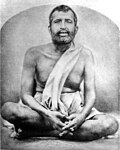 Sri Ramakrishna came to the temple in 1855 as an assistant to his elder brother, Ramkumar, the head priest; later he took job as the priest of Radhakanta Jiu temple, and eventually became the head priest of the Kali temple.
 -
 Photograph of Radhakanta Temple from "Views of Calcutta and Barrackpore," taken by Samuel Bourne.
 -
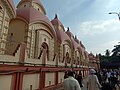 Partial view of the Shiva temples, west side of the complex.
Lokmata Rani Rashmani Temple inside Dakshineswar Kali Temple complex -
 Dakshineswar Temple on the banks of the Hooghly river, a tributary of the Ganges.
 -
 Main entrance (Lion gate/"Singha Dwar"; সিংহ দুয়ার) of Dakshineswar Temple.
.JPG)

_-_1865.jpg)


_of_the_iconic_Dakshineswar_Temple_in_West_Bengal,_India.jpg)
See also[edit | edit source]
- Rani Rashmoni
- Ramkrishna
- Basirhat Dakshina Kali Temple
- Belur Math
- Annapurna Temple, Titagarh
- Ramakrishna and Swami Vivekananda relationship
References[edit | edit source]
- ↑ 1.0 1.1 Mehrotra 2008 p.11.
- ↑ 2.0 2.1 2.2 2.3 "History of the temple". Dakshineswar Kali Temple. Retrieved 21 April 2018.
- ↑ 3.0 3.1 3.2 3.3 3.4 "Dakshineswar - A Heritage". Government of West Bengal. Archived from the original on 2 September 2013. Retrieved 26 November 2012.
- ↑ Roy, Diptimoy (2001). Paschimbanger Kali O Kalikshetra [Kali and Kali Temples in West Bengal] (in Bengali). Kolata: Mondal Book House. pp. 64–65.
- ↑ "কংক্রিটের আড়ালে মুখ ঢেকেছে মন্দিরশিল্প". www.anandabazar.com (in Bengali). Retrieved 19 January 2022.
- ↑ "রানিকাহিনি". www.anandabazar.com (in Bengali). Retrieved 12 September 2022.
- ↑ Basu, Debashish Ed (1990). Kolkatar Purakatha. pp. 71, 78.
- ↑ 8.0 8.1 8.2 8.3 8.4 8.5 Swati Mitra, ed. (2011). Kolkata: City Guide. Goodearth Publications. ISBN 978-93-80262-15-4.
- ↑ Gupta, Mahendranath. "Sri Ramakrishna at Dakshineswar". Kathamitra. Sri Ma Trust. Retrieved 3 June 2025.
- ↑ Harding 1998, p.xii
- ↑ Sen, Amiya P. (June 2006). "Sri Ramakrishna, the Kathamrita and the Calcutta middle classes: an old problematic revisited". Postcolonial Studies. 9 (2): 165–177. doi:10.1080/13688790600657835. S2CID 144046925.
- ↑ Sen, Dr Soumen (21 January 2010). Folklore Tradition Urbanity. Anjali Publishers. p. 76. ISBN 978-81-89620-67-7.
- ↑ Rosen, Steven (2006). Essential Hinduism. Greenwood Publishing Group. pp. 201–202. ISBN 978-0-275-99006-0.
- ↑ Prabhananda 2003
- ↑ Anonymous. "A Queen of Every Faith". Incredible India!. Government of India. Retrieved 3 June 2025.
- ↑ Swami Chetanananda (2001). God lived with them. Advaita Ashrama. p. 655. ISBN 978-0-916356-79-8.
- ↑ Karkar, S.C. (2009). The Top Ten Temple Towns of India. Kolkota: Mark Age Publication. p. 91. ISBN 978-81-87952-12-1.
- ↑ Balakrishnan, S (9 May 2003). "Kali Mandir of Kolkata". The Hindu. Archived from the original on 11 June 2003. Retrieved 21 April 2018.
Bibliography[edit | edit source]
- Dutta, Krishna (2003). Calcutta: a cultural and literary history. Signal Books. p. 255. ISBN 978-1-902669-59-5.
- Prabhananda, Swami (October 2003). "The Kali Temple at Dakshineswar and Sri Ramakrishna". Vedanta Kesari.
- "Map of Kali Temple at Dakshineshwar". Archived from the original on 12 June 2008. Retrieved 5 November 2008.
- Harding, Elizabeth U. (1998). Kali: The Black Goddess of Dakshineswar. Motilal Banarsidass. ISBN 81-208-1450-9.
- Mehrotra, Rajiv (2008). Thakur: A Life Of Sri Ramakrishna. Penguin Books India. ISBN 978-0-14-306371-1.
External links[edit | edit source]
{{URL|example.com|optional display text}}- Template:Wikivoyage inline
- Template:Osmway
- Dakshineswar Kali temple


