








CleanupBot (talk | contribs) m →top: robot: remove incorrect protection templates |
robot: Update article |
||
| Line 1: | Line 1: | ||
{{Short description|State in Eastern India}} | {{Short description|State in Eastern India}} | ||
{{pp-protected|small=yes}} | |||
{{Pp-move-indef|small=yes}} | {{Pp-move-indef|small=yes}} | ||
{{pp-pc}} | |||
{{ | {{about|the state of India|the flowering plant|Odisha cleistantha|other uses|Odisha (disambiguation)}} | ||
{{redirect|Orissa|other uses|Orissa (disambiguation)}} | {{redirect|Orissa|other uses|Orissa (disambiguation)}} | ||
{{Use Indian English|date=June 2020}} | {{Use Indian English|date=June 2020}} | ||
| Line 83: | Line 83: | ||
| demographics1_footnotes = <ref name="MOSPI">{{cite web|url=https://www.prsindia.org/parliamenttrack/budgets/odisha-budget-analysis-2020-21|title=Odisha Budget analysis|date=18 February 2020|website=PRS India|access-date=27 September 2020}}</ref> | | demographics1_footnotes = <ref name="MOSPI">{{cite web|url=https://www.prsindia.org/parliamenttrack/budgets/odisha-budget-analysis-2020-21|title=Odisha Budget analysis|date=18 February 2020|website=PRS India|access-date=27 September 2020}}</ref> | ||
| demographics1_title1 = [[List of Indian states and union territories by GDP|Total]] | | demographics1_title1 = [[List of Indian states and union territories by GDP|Total]] | ||
| demographics1_info1 = {{INRConvert| | | demographics1_info1 = {{INRConvert|5.34|t|lk=r}} | ||
| demographics1_title2 = [[List of Indian states and union territories by GDP per capita|Per capita]] | | demographics1_title2 = [[List of Indian states and union territories by GDP per capita|Per capita]] | ||
| demographics1_info2 = {{INRConvert|116614}} | | demographics1_info2 = {{INRConvert|116614|lk=r}} | ||
| blank_name_sec2 = [[Human Development Index|HDI]] {{nobold|(2018)}} | | blank_name_sec2 = [[Human Development Index|HDI]] {{nobold|(2018)}} | ||
| blank_info_sec2 = {{increase}} 0.606<ref>{{Cite web|url=https://globaldatalab.org/shdi/shdi/?interpolation=0&extrapolation=0&nearest_real=0|title=Sub-national HDI – Subnational HDI – Global Data Lab|website=globaldatalab.org|access-date=2020-04-17}}</ref><br />{{color|#FFA500|medium}} · [[List of Indian states and union territories by Human Development Index|32nd]] | | blank_info_sec2 = {{increase}} 0.606<ref>{{Cite web|url=https://globaldatalab.org/shdi/shdi/?interpolation=0&extrapolation=0&nearest_real=0|title=Sub-national HDI – Subnational HDI – Global Data Lab|website=globaldatalab.org|access-date=2020-04-17}}</ref><br />{{color|#FFA500|medium}} · [[List of Indian states and union territories by Human Development Index|32nd]] | ||
| Line 109: | Line 109: | ||
}} | }} | ||
}} | }} | ||
'''Odisha''' (<small>English</small>: {{IPAc-en|ə|ˈ|d|ɪ|s|ə}},<ref>{{lexico|Odisha}}</ref> {{IPA-or|oɽiˈsa|lang|Or-ଓଡ଼ିଶା.oga}}), formerly '''Orissa''' ({{IPAc-en|ɒ|ˈ|r|ɪ|s|ə|,_|ɔː|-|,_|oʊ|-}}<ref>{{cite book |last=Jones |first=Daniel |author-link=Daniel Jones (phonetician) |editor1-last=Roach |editor1-first=Peter |editor2-last=Hartmann |editor2-first=James |editor3-last=Setter |editor3-first=Jane |year=2003 |orig-year=1917 |title=English Pronouncing Dictionary |publisher=Cambridge University Press |place=Cambridge |isbn=3-12-539683-2}}</ref>), is an [[States and union territories of India|Indian state]] located in [[East India|Eastern India]]. It is the [[List of states and union territories of India by area|8th largest state by area]], and the [[List of states and union territories of India by population|11th largest by population]]. The state has the third largest population of [[Scheduled Castes and Scheduled Tribes|Scheduled Tribes]] in India.<ref>{{cite web|url=http://www.stscodisha.gov.in/Aboutus.asp?GL=abt&PL=1|title=ST & SC Development, Minorities & Backward Classes Welfare Department:: Government of Odisha|website=stscodisha.gov.in|access-date=10 December 2018|archive-url=https://web.archive.org/web/20180901131912/http://www.stscodisha.gov.in/Aboutus.asp?GL=abt&PL=1|archive-date=1 September 2018|url-status=dead}}</ref> It neighbours the states of [[West Bengal]] and [[Jharkhand]] to the north, [[Chhattisgarh]] to the west, [[Andhra Pradesh]] to the south | '''Odisha''' (<small>English</small>: {{IPAc-en|ə|ˈ|d|ɪ|s|ə}},<ref>{{lexico|Odisha}}</ref> {{IPA-or|oɽiˈsa|lang|Or-ଓଡ଼ିଶା.oga}}), formerly '''Orissa''' ({{IPAc-en|ɒ|ˈ|r|ɪ|s|ə|,_|ɔː|-|,_|oʊ|-}}<ref>{{cite book |last=Jones |first=Daniel |author-link=Daniel Jones (phonetician) |editor1-last=Roach |editor1-first=Peter |editor2-last=Hartmann |editor2-first=James |editor3-last=Setter |editor3-first=Jane |year=2003 |orig-year=1917 |title=English Pronouncing Dictionary |publisher=Cambridge University Press |place=Cambridge |isbn=3-12-539683-2}}</ref> [[List of renamed places in India|the official name until 2011]]), is an [[States and union territories of India|Indian state]] located in [[East India|Eastern India]]. It is the [[List of states and union territories of India by area|8th largest state by area]], and the [[List of states and union territories of India by population|11th largest by population]]. The state has the third largest population of [[Scheduled Castes and Scheduled Tribes|Scheduled Tribes]] in India.<ref>{{cite web|url=http://www.stscodisha.gov.in/Aboutus.asp?GL=abt&PL=1|title=ST & SC Development, Minorities & Backward Classes Welfare Department:: Government of Odisha|website=stscodisha.gov.in|access-date=10 December 2018|archive-url=https://web.archive.org/web/20180901131912/http://www.stscodisha.gov.in/Aboutus.asp?GL=abt&PL=1|archive-date=1 September 2018|url-status=dead}}</ref> It neighbours the states of [[West Bengal]] and [[Jharkhand]] to the north, [[Chhattisgarh]] to the west, [[Andhra Pradesh]] to the south. Odisha has a coastline of {{convert|485|km}} along the [[Bay of Bengal]].<ref name=CoastalSecurity>{{cite web |title=Coastal security |publisher=[[Odisha Police]] |url=http://odishapolice.gov.in/?q=node/163 |access-date=1 February 2015 |archive-url=https://web.archive.org/web/20150206043803/http://odishapolice.gov.in/?q=node%2F163 |archive-date=6 February 2015 |url-status=live }}</ref> The region is also known as '''Utkala''' and is mentioned in India's national anthem, "[[Jana Gana Mana]]".<ref name=NationalAnthem>{{cite web|title=The National Anthem of India|url=http://www.columbia.edu/itc/mealac/pritchett/00urduhindilinks/txt_janaganamana.pdf|archive-url=https://web.archive.org/web/20120124230152/http://www.columbia.edu/itc/mealac/pritchett/00urduhindilinks/txt_janaganamana.pdf|url-status=live|archive-date=24 January 2012|publisher=[[Columbia University]]|access-date=1 February 2015}}</ref> The language of Odisha is [[Odia language|Odia]], which is one of the [[Languages of India#Classical|Classical Languages of India]].<ref>{{Cite web|url=https://www.jagranjosh.com/current-affairs/cabinet-approved-odia-as-classical-language-1392954604-1|title=Cabinet approved Odia as Classical Language|date=21 February 2014}}</ref> | ||
The ancient kingdom of [[Kalinga (historical region)|Kalinga]], which was invaded by the [[Maurya Empire|Mauryan]] | The ancient kingdom of [[Kalinga (historical region)|Kalinga]], which was invaded by the [[Maurya Empire|Mauryan]] Emperor [[Ashoka]] (which was again won back from them by King [[Kharavela]]) in 261 BCE resulting in the [[Kalinga War]], coincides with the borders of modern-day Odisha.<ref name=GovHistory>{{cite web|title=Detail History of Orissa|url=http://www.orissa.gov.in/history1.htm|publisher=[[Government of Odisha]]|archive-url=https://web.archive.org/web/20061112195307/http://www.orissa.gov.in/history1.htm|archive-date=12 November 2006}}</ref> The modern boundaries of Odisha were demarcated by the [[Presidencies and provinces of British India|British Indian]] government when [[Orissa Province]] was established on 1 April 1936, consisting of the Odia-speaking districts of [[Bihar and Orissa Province]].<ref name=GovHistory /> The first of April is celebrated as [[Odisha Day|Utkala Dibasa]].<ref name=FlavoursOfOdisha>{{cite news|title=Utkala Dibasa hails colours, flavours of Odisha|url=http://timesofindia.indiatimes.com/city/lucknow/Utkala-Dibasa-hails-colours-flavours-of-Odisha/articleshow/33095967.cms|access-date=1 February 2015|work=[[The Times of India]]|date=2 April 2014|archive-url=https://web.archive.org/web/20150708211533/http://timesofindia.indiatimes.com/city/lucknow/Utkala-Dibasa-hails-colours-flavours-of-Odisha/articleshow/33095967.cms|archive-date=8 July 2015|url-status=live}}</ref> [[Cuttack]] was made the capital of the region by [[Anantavarman Chodaganga]] in {{circa|1135}},<ref name="Chakraborty1985">{{cite book|author=Rabindra Nath Chakraborty|title=National Integration in Historical Perspective: A Cultural Regeneration in Eastern India|url=https://books.google.com/books?id=PItbvfAvVggC&pg=PA17|access-date=30 November 2012|year=1985|publisher=Mittal Publications|pages=17–|id=GGKEY:CNFHULBK119|archive-url=https://web.archive.org/web/20130515095045/http://books.google.com/books?id=PItbvfAvVggC&pg=PA17|archive-date=15 May 2013|url-status=live}}</ref> after which the city was used as the capital by many rulers, through the British era until 1948. Thereafter, [[Bhubaneswar]] became the capital of Odisha.<ref name="Kalia1994">{{cite book|author=Ravi Kalia|title=Bhubaneswar: From a Temple Town to a Capital City|url=https://books.google.com/books?id=F2YSPiKbmHkC&pg=PA23|access-date=2 February 2015|year=1994|publisher=SIU Press|isbn=978-0-8093-1876-6|page=23|archive-url=https://web.archive.org/web/20160105110847/https://books.google.com/books?id=F2YSPiKbmHkC&pg=PA23|archive-date=5 January 2016|url-status=live}}</ref> | ||
The economy of Odisha is the 16th-largest state [[List of Indian states and union territories by GDP|economy]] in India with {{INRConvert|5.33| | The economy of Odisha is the 16th-largest state [[List of Indian states and union territories by GDP|economy]] in India with {{INRConvert|5.33|t|lk=r}} in gross domestic product and a per capita GDP of {{INRConvert|116614}}.<ref name="MOSPI" /> Odisha ranks [[List of Indian states and union territories by Human Development Index|32nd]] among Indian states in [[Human Development Index]].<ref name="snhdi-gdl">{{cite web |title=Sub-national HDI – Area Database |url=https://hdi.globaldatalab.org/areadata/shdi/ |website=Global Data Lab |publisher=Institute for Management Research, Radboud University |access-date=25 September 2018 |archive-url=https://web.archive.org/web/20180923120638/https://hdi.globaldatalab.org/areadata/shdi/ |archive-date=23 September 2018 |url-status=live }}</ref> | ||
== Etymology == | == Etymology == | ||
{{See also|History of Odisha#Historical names of Odisha}} | {{See also|History of Odisha#Historical names of Odisha}} | ||
The | The terms ''Odisha'' and ''Orissa'' ({{Lang-or|ଓଡ଼ିଶା}}) derive from the ancient [[Prakrit]] word ''"Odda Visaya"'' (also "''Udra Bibhasha''" or "''Odra Bibhasha''") as in the [[Tirumalai (Jain complex)|Tirumalai]] inscription of [[Rajendra Chola I]], which is dated to 1025.<ref name=orissareview>{{cite book|last1=Patel|first1=C.B|title=Origin and Evolution of the Name ODISA|date=April 2010|publisher=I&PR Department, Government of Odisha|location=Bhubaneswar|pages=28, 29, 30|url=http://odisha.gov.in/e-magazine/Orissareview/2010/April/engpdf/28-30.pdf|access-date=19 June 2015|archive-url=https://web.archive.org/web/20150619163833/http://odisha.gov.in/e-magazine/Orissareview/2010/April/engpdf/28-30.pdf|archive-date=19 June 2015|url-status=dead}}</ref> [[Sarala Das]], who translated the ''[[Mahabharata]]'' into the [[Odia language]] in the 15th century, calls the region 'Odra Rashtra' as Odisha. The inscriptions of [[Kapilendra Deva]] of the [[Gajapati Kingdom]] (1435–67) on the walls of temples in [[Puri]] call the region ''Odisha'' or ''Odisha Rajya''.<ref name="Acharya2008">{{cite book|author=Pritish Acharya|title=National Movement and Politics in Orissa, 1920–1929|url=https://books.google.com/books?id=LoaHAwAAQBAJ&pg=PR19|access-date=3 February 2015|date=11 March 2008|publisher=SAGE Publications|isbn=978-81-321-0001-0|page=19|archive-url=https://web.archive.org/web/20160105110846/https://books.google.com/books?id=LoaHAwAAQBAJ&pg=PR19|archive-date=5 January 2016|url-status=live}}</ref> | ||
In 2011 the English rendering of {{Lang-or|ଓଡ଼ିଶା|label=none}} was changed from "Orissa" to "Odisha", and the name of its language from "Oriya" to "Odia", by the passage of the ''Orissa (Alteration of Name) Bill, 2010'' and the ''Constitution (113th Amendment) Bill, 2010'' in the [[Indian Parliament|Parliament]]. The Hindi rendering {{Lang-hi|उड़ीसा|label=none}} ( | In 2011, the English rendering of {{Lang-or|ଓଡ଼ିଶା|label=none}} was changed from "Orissa" to "Odisha", and the name of its language from "Oriya" to "Odia", by the passage of the ''Orissa (Alteration of Name) Bill, 2010'' and the ''Constitution (113th Amendment) Bill, 2010'' in the [[Indian Parliament|Parliament]]. The Hindi rendering {{Lang-hi|उड़ीसा|label=none}} ({{transl|hi|ISO|uṛīsā}}) was also modified to {{Lang-hi|ओड़िशा|label=none}} ({{transl|hi|ISO|or̥iśā}}). After a brief debate, the lower house, [[Lok Sabha]], passed the bill and amendment on 9 November 2010.<ref name=AmidClashBillPass>{{cite news|title=Amid clash, House passes Bills to rename Orissa, its language|url=http://www.thehindu.com/news/national/amid-clash-house-passes-bills-to-rename-orissa-its-language/article876145.ece|access-date=2 February 2015|work=[[The Hindu]]|date=9 November 2010|archive-url=https://web.archive.org/web/20151017164642/http://www.thehindu.com/news/national/amid-clash-house-passes-bills-to-rename-orissa-its-language/article876145.ece|archive-date=17 October 2015|url-status=live}}</ref> On 24 March 2011, [[Rajya Sabha]], the upper house of [[Parliament]], also passed the bill and the amendment.<ref name=ChangeOrissaName>{{cite news|title=Parliament passes bill to change Orissa's name|url=http://www.ndtv.com/bhubaneshwar-news/parliament-passes-bill-to-change-orissas-name-451027|access-date=2 February 2015|publisher=[[NDTV]]|date=24 March 2011|archive-url=https://web.archive.org/web/20150203144151/http://www.ndtv.com/bhubaneshwar-news/parliament-passes-bill-to-change-orissas-name-451027|archive-date=3 February 2015|url-status=live}}</ref> The changes in spelling were made with the intention of having the English and Hindi renditions conform to the Odia transliteration.<ref>{{cite news|title=Orissa wants to change its name to Odisha|url=https://www.rediff.com/news/2008/jun/10orissa.htm|access-date=23 June 2020|work=[[Rediff.com]]|date=10 June 2008}}</ref> However, the underlying Odia texts were nevertheless transliterated incorrectly as per the [[Hunterian transliteration|Hunterian system]], the official national transliteration standard, in which the transliterations would be {{transl|or|hunterian|Orisha}} and {{transl|or|hunterian|Oria}} instead. | ||
== History == | == History == | ||
| Line 129: | Line 129: | ||
[[Ashoka]] of the [[Mauryan]] dynasty conquered Kalinga in the bloody [[Kalinga War]] in 261 BCE,<ref name=ashoka>{{cite book|title=A History of India|year=2004|publisher=Routledge|page=66|url=https://books.google.com/books?id=TPVq3ykHyH4C&q=ashoka%20261%20BC%20history&pg=PA66|author=Hermann Kulke|author2=Dietmar Rothermund|isbn=9780415329194|access-date=12 November 2012|archive-url=https://web.archive.org/web/20160105110846/https://books.google.com/books?id=TPVq3ykHyH4C&lpg=PA66&dq=ashoka%20261%20BC%20history&pg=PA66#v=onepage&q=ashoka%20261%20BC%20history&f=false|archive-date=5 January 2016|url-status=live}}</ref> which was the eighth year of his reign.<ref name="Radhakumud1995">{{cite book|author=Mookerji Radhakumud|title=Asoka|url=https://books.google.com/books?id=uXyftdtE1ygC&pg=PA214|access-date=6 August 2015|year=1995|publisher=Motilal Banarsidass|isbn=978-81-208-0582-8|page=214|archive-url=https://web.archive.org/web/20160105110846/https://books.google.com/books?id=uXyftdtE1ygC&pg=PA214|archive-date=5 January 2016|url-status=live}}</ref> According to his own [[edicts]], in that war about 100,000 people were killed, 150,000 were captured and more were affected.<ref name=ashoka /> The resulting bloodshed and suffering of the war is said to have deeply affected Ashoka. He turned into a pacifist and converted to Buddhism.<ref name="Radhakumud1995" /><ref name="Sen1999">{{cite book|author=Sailendra Nath Sen|title=Ancient Indian History and Civilization|url=https://books.google.com/books?id=Wk4_ICH_g1EC&pg=PA153|access-date=6 August 2015|date=1 January 1999|publisher=New Age International|isbn=978-81-224-1198-0|page=153|archive-url=https://web.archive.org/web/20160105110846/https://books.google.com/books?id=Wk4_ICH_g1EC&pg=PA153|archive-date=5 January 2016|url-status=live}}</ref> | [[Ashoka]] of the [[Mauryan]] dynasty conquered Kalinga in the bloody [[Kalinga War]] in 261 BCE,<ref name=ashoka>{{cite book|title=A History of India|year=2004|publisher=Routledge|page=66|url=https://books.google.com/books?id=TPVq3ykHyH4C&q=ashoka%20261%20BC%20history&pg=PA66|author=Hermann Kulke|author2=Dietmar Rothermund|isbn=9780415329194|access-date=12 November 2012|archive-url=https://web.archive.org/web/20160105110846/https://books.google.com/books?id=TPVq3ykHyH4C&lpg=PA66&dq=ashoka%20261%20BC%20history&pg=PA66#v=onepage&q=ashoka%20261%20BC%20history&f=false|archive-date=5 January 2016|url-status=live}}</ref> which was the eighth year of his reign.<ref name="Radhakumud1995">{{cite book|author=Mookerji Radhakumud|title=Asoka|url=https://books.google.com/books?id=uXyftdtE1ygC&pg=PA214|access-date=6 August 2015|year=1995|publisher=Motilal Banarsidass|isbn=978-81-208-0582-8|page=214|archive-url=https://web.archive.org/web/20160105110846/https://books.google.com/books?id=uXyftdtE1ygC&pg=PA214|archive-date=5 January 2016|url-status=live}}</ref> According to his own [[edicts]], in that war about 100,000 people were killed, 150,000 were captured and more were affected.<ref name=ashoka /> The resulting bloodshed and suffering of the war is said to have deeply affected Ashoka. He turned into a pacifist and converted to Buddhism.<ref name="Radhakumud1995" /><ref name="Sen1999">{{cite book|author=Sailendra Nath Sen|title=Ancient Indian History and Civilization|url=https://books.google.com/books?id=Wk4_ICH_g1EC&pg=PA153|access-date=6 August 2015|date=1 January 1999|publisher=New Age International|isbn=978-81-224-1198-0|page=153|archive-url=https://web.archive.org/web/20160105110846/https://books.google.com/books?id=Wk4_ICH_g1EC&pg=PA153|archive-date=5 January 2016|url-status=live}}</ref> | ||
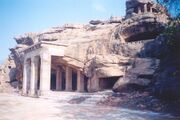
By c. 150 BCE, | By c. 150 BCE, Emperor [[Kharavela]], who was possibly a contemporary of [[Demetrius I of Bactria]],<ref name="Texas2006">{{cite book|author=Austin Patrick Olivelle Alma Cowden Madden Centennial Professor in Liberal Arts University of Texas|title=Between the Empires : Society in India 300 BCE to 400 CE: Society in India 300 BCE to 400 CE|url=https://books.google.com/books?id=efaOR_-YsIcC&pg=PA78|access-date=3 February 2015|date=19 June 2006|publisher=Oxford University Press|isbn=978-0-19-977507-1|page=78|archive-url=https://web.archive.org/web/20160105110846/https://books.google.com/books?id=efaOR_-YsIcC&pg=PA78|archive-date=5 January 2016|url-status=live}}</ref> conquered a major part of the Indian sub-continent. Kharavela was a [[Jain]] ruler. He also built the monastery atop the [[Udayagiri and Khandagiri Caves|Udayagiri]] hill.<ref name="Reddy2006">{{cite book|author=Reddy|title=Indian Hist (Opt)|url=https://books.google.com/books?id=CeEmpfmbxKEC&pg=SL1-PA253|access-date=3 February 2015|date=1 December 2006|publisher=Tata McGraw-Hill Education|isbn=978-0-07-063577-7|page=A254|archive-url=https://web.archive.org/web/20160105110846/https://books.google.com/books?id=CeEmpfmbxKEC&pg=SL1-PA253|archive-date=5 January 2016|url-status=live}}</ref> Subsequently, the region was ruled by monarchs, such as [[Samudragupta]]<ref>{{cite book|title=Indian History|year = 1988|url=https://books.google.com/books?id=MazdaWXQFuQC&pg=PA74|access-date=3 February 2015|publisher=Allied Publishers|isbn=978-81-8424-568-4|page=74|archive-url=https://web.archive.org/web/20160105110846/https://books.google.com/books?id=MazdaWXQFuQC&pg=PA74|archive-date=5 January 2016|url-status=live}}</ref> and [[Shashanka]].<ref name="Davidson2013">{{cite book|author=Ronald M. Davidson|title=Indian Esoteric Buddhism: A Social History of the Tantric Movement|url=https://books.google.com/books?id=nwyeIyWTlEMC&pg=PT60|access-date=3 February 2015|date=13 August 2013|publisher=Columbia University Press|isbn=978-0-231-50102-6|page=60|archive-url=https://web.archive.org/web/20160105110846/https://books.google.com/books?id=nwyeIyWTlEMC&pg=PT60|archive-date=5 January 2016|url-status=live}}</ref> It was also a part of [[Harsha]]'s empire.<ref name="Majumdar1996">{{cite book|author=R. C. Majumdar|title=Outline of the History of Kalinga|url=https://books.google.com/books?id=LNCcpkqesJ0C&pg=PA28|access-date=3 February 2015|year=1996|publisher=Asian Educational Services|isbn=978-81-206-1194-8|page=28|archive-url=https://web.archive.org/web/20160105110846/https://books.google.com/books?id=LNCcpkqesJ0C&pg=PA28|archive-date=5 January 2016|url-status=live}}</ref> | ||
The city of [[Brahmapur, Odisha|Brahmapur]] in Odisha is also known to have been the capital of the [[Pauravas]] during the closing years of 4th Century CE. Nothing was heard from the Pauravas from about the 3rd Century CE, because they were annexed by the [[Yaudheya|Yaudheya Republic]], who in turn submitted to the [[Mauryans]]. It was only at the end of 4th century CE, that they established royalty at Brahmapur, after about 700 years. | The city of [[Brahmapur, Odisha|Brahmapur]] in Odisha is also known to have been the capital of the [[Pauravas]] during the closing years of 4th Century CE. Nothing was heard from the Pauravas from about the 3rd Century CE, because they were annexed by the [[Yaudheya|Yaudheya Republic]], who in turn submitted to the [[Mauryans]]. It was only at the end of 4th century CE, that they established royalty at Brahmapur, after about 700 years. | ||
Later, the kings of the [[Somavaṃśī dynasty|Somavamsi]] dynasty began to unite the region. By the reign of Yayati II, c. 1025 CE, they had integrated the region into a single kingdom. Yayati II is supposed to have built the [[Lingaraj temple]] at [[Bhubaneswar]].<ref name=GovHistory /> They were replaced by the [[Eastern Ganga dynasty]]. Notable rulers of the dynasty were [[Anantavarman Chodaganga]], who began | Later, the kings of the [[Somavaṃśī dynasty|Somavamsi]] dynasty began to unite the region. By the reign of Yayati II, c. 1025 CE, they had integrated the region into a single kingdom. Yayati II is supposed to have built the [[Lingaraj temple]] at [[Bhubaneswar]].<ref name=GovHistory /> They were replaced by the [[Eastern Ganga dynasty]]. Notable rulers of the dynasty were [[Anantavarman Chodaganga]], who began reconstruction on the present-day Shri [[Jagannath Temple, Puri|Jagannath Temple]] in [[Puri]] (c. 1135), and [[Narasimhadeva I]], who constructed the [[Konark temple]] (c. 1250).<ref name="Dalal2014">{{cite book|author=Roshen Dalal|title=The Religions of India: A Concise Guide to Nine Major Faiths|url=https://books.google.com/books?id=87k0AwAAQBAJ&pg=PT559|access-date=3 February 2015|date=18 April 2014|publisher=Penguin Books Limited|isbn=978-81-8475-396-7|page=559|archive-url=https://web.archive.org/web/20160105110846/https://books.google.com/books?id=87k0AwAAQBAJ&pg=PT559|archive-date=5 January 2016|url-status=live}}</ref><ref name="IndianHistory">{{cite book|title=Indian History|url=https://books.google.com/books?id=X4j7Nf_MU24C&pg=SL2-PA3|access-date=3 May 2013|publisher=Tata McGraw-Hill Education|isbn=978-0-07-132923-1|page=2|archive-url=https://web.archive.org/web/20140101141813/http://books.google.com/books?id=X4j7Nf_MU24C&pg=SL2-PA3|archive-date=1 January 2014|url-status=live}}</ref> | ||
The Eastern Ganga Dynasty was followed by the [[Gajapati Kingdom]]. The region resisted integration into the [[Mughal empire]] until 1568, when it was conquered by [[Sultanate of Bengal]].<ref name="sen2">{{Cite book |last=Sen |first=Sailendra |title=A Textbook of Medieval Indian History |publisher=Primus Books |year=2013 |isbn=978-93-80607-34-4 |pages=121–122}}</ref> Mukunda Deva, who is considered the last independent king of Kalinga, was defeated and was killed in battle by a rebel Ramachandra Bhanja. Ramachandra Bhanja himself was killed by [[Bayazid Khan Karrani]].<ref>{{cite book|title=Orissa General Knowledge|url=https://books.google.com/books?id=hMCbjkhA_ncC&pg=PA27|access-date=3 February 2015|publisher=Bright Publications|isbn=978-81-7199-574-5|page=27|archive-url=https://web.archive.org/web/20160105110846/https://books.google.com/books?id=hMCbjkhA_ncC&pg=PA27|archive-date=5 January 2016|url-status=live}}</ref> In 1591, [[Man Singh I]], then governor of [[Bihar]], led an army to take Odisha from the [[List of rulers of Bengal#Karrani dynasty (Mughal vassals)|Karranis of Bengal]]. They agreed to treaty because their leader Qutlu Khan Lohani had recently died. But | The Eastern Ganga Dynasty was followed by the [[Gajapati Kingdom]]. The region resisted integration into the [[Mughal empire]] until 1568, when it was conquered by [[Sultanate of Bengal]].<ref name="sen2">{{Cite book |last=Sen |first=Sailendra |title=A Textbook of Medieval Indian History |publisher=Primus Books |year=2013 |isbn=978-93-80607-34-4 |pages=121–122}}</ref> Mukunda Deva, who is considered the last independent king of Kalinga, was defeated and was killed in battle by a rebel Ramachandra Bhanja. Ramachandra Bhanja himself was killed by [[Bayazid Khan Karrani]].<ref>{{cite book|title=Orissa General Knowledge|url=https://books.google.com/books?id=hMCbjkhA_ncC&pg=PA27|access-date=3 February 2015|publisher=Bright Publications|isbn=978-81-7199-574-5|page=27|archive-url=https://web.archive.org/web/20160105110846/https://books.google.com/books?id=hMCbjkhA_ncC&pg=PA27|archive-date=5 January 2016|url-status=live}}</ref> In 1591, [[Man Singh I]], then governor of [[Bihar]], led an army to take Odisha from the [[List of rulers of Bengal#Karrani dynasty (Mughal vassals)|Karranis of Bengal]]. They agreed to treaty because their leader Qutlu Khan Lohani had recently died. But they then broke the treaty by attacking the temple town of [[Puri]]. Man Singh returned in 1592 and pacified the region.<ref name="O'malley2007">{{cite book|author=L.S.S. O'Malley|title=Bengal District Gazetteer : Puri|url=https://books.google.com/books?id=pwD0-YV2LCYC&pg=PA33|access-date=3 February 2015|date=1 January 2007|publisher=Concept Publishing Company|isbn=978-81-7268-138-8|page=33|archive-url=https://web.archive.org/web/20160105110847/https://books.google.com/books?id=pwD0-YV2LCYC&pg=PA33|archive-date=5 January 2016|url-status=live}}</ref> | ||
In 1751, the Nawab of Bengal [[Alivardi Khan]] ceded the region to the [[Maratha Empire]].<ref name=GovHistory /> | In 1751, the Nawab of Bengal [[Alivardi Khan]] ceded the region to the [[Maratha Empire]].<ref name=GovHistory /> | ||
| Line 146: | Line 146: | ||
{{Main|Geography of Odisha}} | {{Main|Geography of Odisha}} | ||
[[File:Chahata near mahanadi river.jpg|thumb|right|200px|[[Mahanadi]] river near Cuttack]] | [[File:Chahata near mahanadi river.jpg|thumb|right|200px|[[Mahanadi]] river near Cuttack]] | ||
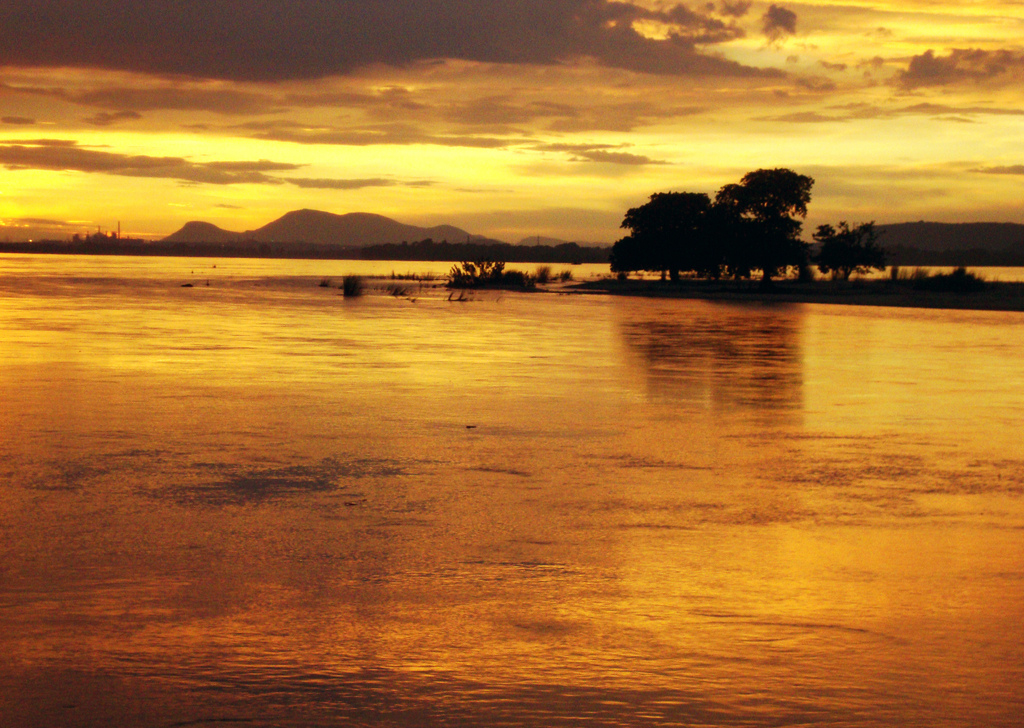
Odisha lies between the latitudes 17.780N and 22.730N, and between longitudes 81.37E and 87.53E. The state has an area of 155,707 km<sup>2</sup>, which is 4.87% of total area of India, and a coastline of 450 km.<ref name=GeographyKnowIndia>{{cite web|title=Geography of Odisha|url=http://www.archive.india.gov.in/knowindia/state_uts.php?id=81|website=Know India|publisher=[[Government of India]]|access-date=3 February 2015|archive-url=https://web.archive.org/web/20150204220248/http://www.archive.india.gov.in/knowindia/state_uts.php?id=81|archive-date=4 February 2015|url-status=live}}</ref> In the eastern part of the state lies the coastal plain. It extends from the [[Subarnarekha River]] in the north to the [[Rushikulya]] | Odisha lies between the latitudes 17.780N and 22.730N, and between longitudes 81.37E and 87.53E. The state has an area of 155,707 km<sup>2</sup>, which is 4.87% of total area of India, and a coastline of 450 km.<ref name=GeographyKnowIndia>{{cite web|title=Geography of Odisha|url=http://www.archive.india.gov.in/knowindia/state_uts.php?id=81|website=Know India|publisher=[[Government of India]]|access-date=3 February 2015|archive-url=https://web.archive.org/web/20150204220248/http://www.archive.india.gov.in/knowindia/state_uts.php?id=81|archive-date=4 February 2015|url-status=live}}</ref> In the eastern part of the state lies the coastal plain. It extends from the [[Subarnarekha River]] in the north to the [[Rushikulya]] River in the south. The lake [[Chilika]] is part of the coastal plains. The plains are rich in fertile [[silt]] deposited by the six major rivers flowing into the [[Bay of Bengal]]: [[Subarnarekha river|Subarnarekha]], [[Budhabalanga]], [[Baitarani]], [[Brahmani River|Brahmani]], [[Mahanadi]] and [[Rushikulya]].<ref name=GeographyKnowIndia /> The [[Central Rice Research Institute]] (CRRI), a [[Food and Agriculture Organization]]-recognised rice [[gene bank]] and research institute, is situated on the banks of Mahanadi in [[Cuttack]].<ref>{{cite web|title=Cuttack |url=http://odisha.gov.in/ |publisher=[[Government of Odisha]] |access-date=6 August 2015 |url-status=dead |archive-url=https://web.archive.org/web/20121206115854/http://odisha.gov.in//portal/ViewDetails.asp?vchglinkid=GL010&vchplinkid=PL066&vchslinkid=SL050 |archive-date=6 December 2012 }}</ref> The stretch between Puri and Bhadrak in Odisha juts out a little into the sea, making it vulnerable to any cyclonic activity.<ref>{{cite journal |last1=Dasgupta |first1=Alakananda |last2=Priyadarshini |first2=Subhra |title=Why Odisha is a sitting duck for extreme cyclones |journal=Nature India |date=29 May 2019 |doi=10.1038/nindia.2019.69 |doi-broken-date=28 February 2022 |url=https://www.natureasia.com/en/nindia/article/10.1038/nindia.2019.69}}</ref> | ||
[[File:Mahanadi-river-delta.jpg|thumb|right|200px|Satellite view of the [[Mahanadi]] [[river delta]]]] | [[File:Mahanadi-river-delta.jpg|thumb|right|200px|Satellite view of the [[Mahanadi]] [[river delta]]]] | ||
Three-quarters of the state is covered in mountain ranges. Deep and broad valleys have been made in them by rivers. These valleys have fertile soil and are densely populated. Odisha also has [[plateau]]s and [[Highland|rolling uplands]], which have lower elevation than the plateaus.<ref name=GeographyKnowIndia /> The [[List of Indian states and union territories by highest point|highest point in the state]] is [[Deomali (mountain)|Deomali]] at 1,672 metres in [[Koraput district]]. Some other high peaks are: Sinkaram (1,620 m), Golikoda (1,617 m), and Yendrika (1,582 metres).<ref>{{cite book|title=Socio-economic Profile of Rural India (series II).: Eastern India (Orissa, Jharkhand, West Bengal, Bihar and Uttar Pradesh)|url=https://books.google.com/books?id=Fi_rz0_1ELUC&pg=PA73|access-date=4 February 2015|year=2011|publisher=Concept Publishing Company|isbn=978-81-8069-723-4|page=73|archive-url=https://web.archive.org/web/20160105110846/https://books.google.com/books?id=Fi_rz0_1ELUC&pg=PA73|archive-date=5 January 2016|url-status=live}}</ref> | Three-quarters of the state is covered in mountain ranges. Deep and broad valleys have been made in them by rivers. These valleys have fertile soil and are densely populated. Odisha also has [[plateau]]s and [[Highland|rolling uplands]], which have lower elevation than the plateaus.<ref name=GeographyKnowIndia /> The [[List of Indian states and union territories by highest point|highest point in the state]] is [[Deomali (mountain)|Deomali]] at 1,672 metres in [[Koraput district]]. Some other high peaks are: Sinkaram (1,620 m), Golikoda (1,617 m), and Yendrika (1,582 metres).<ref>{{cite book|title=Socio-economic Profile of Rural India (series II).: Eastern India (Orissa, Jharkhand, West Bengal, Bihar and Uttar Pradesh)|url=https://books.google.com/books?id=Fi_rz0_1ELUC&pg=PA73|access-date=4 February 2015|year=2011|publisher=Concept Publishing Company|isbn=978-81-8069-723-4|page=73|archive-url=https://web.archive.org/web/20160105110846/https://books.google.com/books?id=Fi_rz0_1ELUC&pg=PA73|archive-date=5 January 2016|url-status=live}}</ref> | ||
| Line 365: | Line 365: | ||
Arcelor-Mittal has also announced plans to invest in another mega steel project amounting to $10 billion. Russian major [[Magnitogorsk Iron and Steel Works|Magnitogorsk Iron and Steel Company (MMK)]] plans to set up a 10 MT steel plant in Odisha, too. [[Bandhabahal]] is a major area of open cast coal mines in Odisha. The state is attracting an unprecedented amount of investment in aluminium, coal-based power plants, petrochemicals, and information technology as well. In power generation, [[Reliance Power]] (Anil Ambani Group) is putting up the world's largest power plant with an investment of US$13 billion at Hirma in [[Jharsuguda district]].<ref>{{cite web|url=http://www.dnaindia.com/money/report-reliance-to-invest-rs-60000-cr-for-orissa-power-plant-1042928|title=Reliance to invest Rs 60,000-cr for Orissa power plant|work=dna|date=21 July 2006|access-date=31 August 2014|archive-url=https://web.archive.org/web/20140903141606/http://www.dnaindia.com/money/report-reliance-to-invest-rs-60000-cr-for-orissa-power-plant-1042928|archive-date=3 September 2014|url-status=live}}</ref> | Arcelor-Mittal has also announced plans to invest in another mega steel project amounting to $10 billion. Russian major [[Magnitogorsk Iron and Steel Works|Magnitogorsk Iron and Steel Company (MMK)]] plans to set up a 10 MT steel plant in Odisha, too. [[Bandhabahal]] is a major area of open cast coal mines in Odisha. The state is attracting an unprecedented amount of investment in aluminium, coal-based power plants, petrochemicals, and information technology as well. In power generation, [[Reliance Power]] (Anil Ambani Group) is putting up the world's largest power plant with an investment of US$13 billion at Hirma in [[Jharsuguda district]].<ref>{{cite web|url=http://www.dnaindia.com/money/report-reliance-to-invest-rs-60000-cr-for-orissa-power-plant-1042928|title=Reliance to invest Rs 60,000-cr for Orissa power plant|work=dna|date=21 July 2006|access-date=31 August 2014|archive-url=https://web.archive.org/web/20140903141606/http://www.dnaindia.com/money/report-reliance-to-invest-rs-60000-cr-for-orissa-power-plant-1042928|archive-date=3 September 2014|url-status=live}}</ref> | ||
In 2009 Odisha was the second top domestic investment destination with [[Gujarat]] first and [[Andhra Pradesh]] in third place according to an analysis of [[ASSOCHAM]] Investment Meter (AIM) study on corporate investments. Odisha's share was 12.6 percent in total investment in the country. It received investment proposal worth {{ | In 2009 Odisha was the second top domestic investment destination with [[Gujarat]] first and [[Andhra Pradesh]] in third place according to an analysis of [[ASSOCHAM]] Investment Meter (AIM) study on corporate investments. Odisha's share was 12.6 percent in total investment in the country. It received an investment proposal worth {{INRConvert|2.01|t|year=2010}} in 2010. Steel and power were among the sectors which attracted maximum investments in the state.<ref>{{cite web |url=http://www.assocham.org/prels/shownews.php?id=2303 |title=Gujarat, Odisha and Andhra top 3 Domestic Investment Destinations of 2009 |publisher=Assocham |date=21 January 2010 |access-date=18 July 2010 |archive-url=https://web.archive.org/web/20110723170222/http://www.assocham.org/prels/shownews.php?id=2303 |archive-date=23 July 2011 |url-status=dead }}</ref> | ||
== Transportation == | == Transportation == | ||
| Line 521: | Line 521: | ||
{{Pie chart| thumb = right | {{Pie chart| thumb = right | ||
|caption=Languages of Odisha (2011)<ref name="census2011-langreport">{{cite web |title=Language – India, States and Union Territories |url=http://www.censusindia.gov.in/2011Census/C-16_25062018_NEW.pdf |work=Census of India 2011 |publisher=Office of the Registrar General |pages=13–14 |access-date=7 January 2019 |archive-url=https://web.archive.org/web/20181114073412/http://www.censusindia.gov.in/2011Census/C-16_25062018_NEW.pdf |archive-date=14 November 2018 |url-status=live }}</ref> | |caption=Languages of Odisha (2011)<ref name="census2011-langreport">{{cite web |title=Language – India, States and Union Territories |url=http://www.censusindia.gov.in/2011Census/C-16_25062018_NEW.pdf |work=Census of India 2011 |publisher=Office of the Registrar General |pages=13–14 |access-date=7 January 2019 |archive-url=https://web.archive.org/web/20181114073412/http://www.censusindia.gov.in/2011Census/C-16_25062018_NEW.pdf |archive-date=14 November 2018 |url-status=live }}</ref> | ||
|label1= [[Odia language|Odia]] (incl [[Sambalpuri language|Sambalpuri]]) | |label1 = [[Odia language|Odia]] <small>(incl [[Sambalpuri language|Sambalpuri]])</small> |value1 = 81.32 |color1 = gold | ||
|value1= 81.32 | |label2 = [[Kui language (India)|Kui]] |value2 = 2.24 |color2 = deepskyblue | ||
|color1= gold | |label3 = [[Santali language|Santali]] |value3 = 2.06 |color3 = olive | ||
|label2= [[Kui language (India)|Kui]] | |label4 = [[Urdu]] |value4 = 1.60 |color4 = green | ||
|value2= 2.24 | |label5 = [[Telugu language|Telugu]] |value5 = 1.59 |color5 = maroon | ||
|color2= deepskyblue | |label6 = [[Hindi]] |value6 = 1.23 |color6 = orange | ||
|label3= [[Santali language|Santali]] | |label7 = [[Bengali language|Bengali]] |value7 = 1.20 |color7 = orangered | ||
|value3= 2.06 | |label8 = [[Mundari language|Mundari]] |value8 = 1.09 |color8 = hotpink | ||
|color3= olive | |label9 = Others |value9 = 7.67 |color9 = grey | ||
|label4= [[Urdu]] | |style=align="left" | ||
|value4= 1.60 | }} | ||
|color4= green | [[File:Bilingual signboard for Registration at a Hospital in Bhubaneswar.jpg|thumb|Bilingual signboard in English and Odia]] | ||
|label5= [[Telugu language|Telugu]] | |||
|value5= 1.59 | |||
|color5= maroon | |||
|label6= [[Hindi]] | |||
|value6= 1.23 | |||
|color6= orange | |||
|label7= [[Bengali language|Bengali]] | |||
|value7= 1.20 | |||
|color7= orangered | |||
|label8= | |||
|value8= | |||
| | |||
|style=align="left"}} | |||
[[File:Bilingual signboard for Registration at a Hospital in Bhubaneswar.jpg|thumb|Bilingual signboard in Odia | |||
[[Odia language|Odia]] is the official language of Odisha<ref>{{Cite web|url=http://lawodisha.gov.in/pages/viewYearActOrdinances/1954|title=:: Law Department (Government of Odisha) ::|website=lawodisha.gov.in|access-date=19 October 2019|archive-date=2 March 2021|archive-url=https://web.archive.org/web/20210302165024/http://lawodisha.gov.in/pages/viewYearActOrdinances/1954|url-status=dead}}</ref> and is spoken by 81.32% of the population according to the [[2011 Census of India|2011 census of India]].<ref name="census2011-langreport" /> It is also one of the [[Languages of India#Classical languages of India|classical languages of India]]. English is the official language of correspondence between state and the union of India. Spoken Odia is not homogeneous as one can find different dialects spoken across the state. Some of the major dialects found inside the state are Sambalpuri, Cuttacki, Puri, Baleswari, Ganjami, Desiya and Phulbani. In addition to Odia, significant population of people speaking other major Indian languages like [[Hindi]], [[Telugu language|Telugu]], [[Urdu]] and [[Bengali language|Bengali]] are also found in the state.<ref name=LSI-Orissa>{{cite book|last=Mahapatra|first=B. P.|title=Linguistic Survey of India: Orissa|year=2002|publisher=Language Division, Office of the Registrar General|location=Kolkata, India|pages=13–14|url=http://www.censusindia.gov.in/2011-documents/lsi/ling_Orissa.html|access-date=20 February 2014|format=PDF|archive-url=https://web.archive.org/web/20131113153328/http://www.censusindia.gov.in/2011-documents/lsi/ling_Orissa.html|archive-date=13 November 2013|url-status=live}}</ref> | [[Odia language|Odia]] is the official language of Odisha<ref>{{Cite web|url=http://lawodisha.gov.in/pages/viewYearActOrdinances/1954|title=:: Law Department (Government of Odisha) ::|website=lawodisha.gov.in|access-date=19 October 2019|archive-date=2 March 2021|archive-url=https://web.archive.org/web/20210302165024/http://lawodisha.gov.in/pages/viewYearActOrdinances/1954|url-status=dead}}</ref> and is spoken by 81.32% of the population according to the [[2011 Census of India|2011 census of India]].<ref name="census2011-langreport" /> It is also one of the [[Languages of India#Classical languages of India|classical languages of India]]. English is the official language of correspondence between state and the union of India. Spoken Odia is not homogeneous as one can find different dialects spoken across the state. Some of the major dialects found inside the state are Sambalpuri, Cuttacki, Puri, Baleswari, Ganjami, Desiya and Phulbani. In addition to Odia, significant population of people speaking other major Indian languages like [[Hindi]], [[Telugu language|Telugu]], [[Urdu]] and [[Bengali language|Bengali]] are also found in the state.<ref name=LSI-Orissa>{{cite book|last=Mahapatra|first=B. P.|title=Linguistic Survey of India: Orissa|year=2002|publisher=Language Division, Office of the Registrar General|location=Kolkata, India|pages=13–14|url=http://www.censusindia.gov.in/2011-documents/lsi/ling_Orissa.html|access-date=20 February 2014|format=PDF|archive-url=https://web.archive.org/web/20131113153328/http://www.censusindia.gov.in/2011-documents/lsi/ling_Orissa.html|archive-date=13 November 2013|url-status=live}}</ref> | ||
The different ''[[Adivasi|adibasi]]'' communities who mostly reside in [[Western Odisha]] have their own languages belonging to [[Austroasiatic languages|Austroasiatic]] and [[Dravidian languages|Dravidian]] family of languages. Some of these major ''adibasi'' languages are [[Santali language|Santali]], [[Kui language (India)|Kui]] and [[Ho language|Ho]]. Due to increasing contact with outsiders, migration and socioeconomic reasons many of these indigenous languages are slowly getting extinct or are on the verge of getting extinct.<ref name=":1">{{Cite web|title=Atlas of languages in danger {{!}} United Nations Educational, Scientific and Cultural Organization|url=http://www.unesco.org/new/en/culture/themes/endangered-languages/atlas-of-languages-in-danger/|access-date=19 October 2019|publisher=UNESCO}}</ref> | The different ''[[Adivasi|adibasi]]'' communities who mostly reside in [[Western Odisha]] have their own languages belonging to [[Austroasiatic languages|Austroasiatic]] and [[Dravidian languages|Dravidian]] family of languages. Some of these major ''adibasi'' languages are [[Santali language|Santali]], [[Kui language (India)|Kui]], [[Bhumij language|Bhumij]] and [[Ho language|Ho]]. Due to increasing contact with outsiders, migration and socioeconomic reasons many of these indigenous languages are slowly getting extinct or are on the verge of getting extinct.<ref name=":1">{{Cite web|title=Atlas of languages in danger {{!}} United Nations Educational, Scientific and Cultural Organization|url=http://www.unesco.org/new/en/culture/themes/endangered-languages/atlas-of-languages-in-danger/|access-date=19 October 2019|publisher=UNESCO}}</ref> | ||
The Odisha Sahitya Academy Award was established in 1957 to actively develop Odia language and literature. The Odisha government launched a portal https://ova.gov.in/en in 2018 to promote Odia language and literature. | The Odisha Sahitya Academy Award was established in 1957 to actively develop Odia language and literature. The Odisha government launched a portal https://ova.gov.in/en in 2018 to promote Odia language and literature. | ||
| Line 641: | Line 627: | ||
[[Odissi]] dance and music are classical art forms. Odissi is the oldest surviving dance form in India on the basis of archaeological evidence.<ref>{{cite web |title=Odissi Kala Kendra |publisher=odissi.itgo.com |url=http://odissi.itgo.com/ |access-date=18 July 2010 |archive-url=https://web.archive.org/web/20110512041730/http://odissi.itgo.com/ |archive-date=12 May 2011 |url-status=live }}</ref> Odissi has a long, unbroken tradition of 2,000 years, and finds mention in the ''[[Natya Shastra|Natyashastra]]'' of [[Bharata Muni|Bharatamuni]], possibly written c. 200 BC. However, the dance form nearly became extinct during the British period, only to be revived after India's independence by a few gurus. | [[Odissi]] dance and music are classical art forms. Odissi is the oldest surviving dance form in India on the basis of archaeological evidence.<ref>{{cite web |title=Odissi Kala Kendra |publisher=odissi.itgo.com |url=http://odissi.itgo.com/ |access-date=18 July 2010 |archive-url=https://web.archive.org/web/20110512041730/http://odissi.itgo.com/ |archive-date=12 May 2011 |url-status=live }}</ref> Odissi has a long, unbroken tradition of 2,000 years, and finds mention in the ''[[Natya Shastra|Natyashastra]]'' of [[Bharata Muni|Bharatamuni]], possibly written c. 200 BC. However, the dance form nearly became extinct during the British period, only to be revived after India's independence by a few gurus. | ||
The variety of dances includes [[Ghumura dance]], [[Chhau dance]], [[Jhumair]], [[Mahari dance]], [[Dalkhai]] and [[Gotipua]]. | The variety of dances includes [[Ghumura dance]], [[Chhau dance]], [[Jhumair]], [[Mahari dance]], [[Dalkhai]], [[Dhemsa]] and [[Gotipua]]. | ||
== Sports == | == Sports == | ||
| Line 657: | Line 643: | ||
# [[KIIT Stadium]] | # [[KIIT Stadium]] | ||
#[[Birsa Munda International Hockey Stadium]]<ref>{{Cite news|last=Suffian|first=Mohammad|date=February 16, 2021|title=Odisha CM Lays Foundation of India's Largest Hockey Stadium named after 'Birsa Munda' In Rourkela|work=India Today|url=https://www.indiatoday.in/sports/hockey/story/odisha-cm-lays-foundation-of-india-s-largest-hockey-stadium-named-after-birsa-munda-in-rourkela-1769860-2021-02-16}}</ref> | #[[Birsa Munda International Hockey Stadium]]<ref>{{Cite news|last=Suffian|first=Mohammad|date=February 16, 2021|title=Odisha CM Lays Foundation of India's Largest Hockey Stadium named after 'Birsa Munda' In Rourkela|work=India Today|url=https://www.indiatoday.in/sports/hockey/story/odisha-cm-lays-foundation-of-india-s-largest-hockey-stadium-named-after-birsa-munda-in-rourkela-1769860-2021-02-16}}</ref> | ||
There are some High Performance Centres in the state as well which have been set up at Kalinga Stadium for the development of respective sports in Odisha. Some of the HPCs are as follows: | |||
* [[Abhinav Bindra]] Targeting Performance (ABTP) | |||
* [[Dalmia Group|Dalmia Bharat]] Gopichand Badminton Academy | |||
* [[JSW Steel Ltd|JSW]] Swimming HPC | |||
* [[Khelo India]] State Centre of Excellence (KISCE) for Athletics, Hockey, and Weightlifting | |||
* KJS Ahluwalia and Tenvic Sports HPC for Weightlifting | |||
* [[Odisha Naval Tata Hockey High Performance Centre]] (ONTHHPC) <ref>{{cite web |url=https://kalingatv.com/state/naval-tata-hockey-academy-inaugurated-in-odisha-capital/ |title=Naval Tata Hockey Academy Inaugurated In Odisha Capital |website=Kalinga TV |access-date= August 13, 2019}}</ref> | |||
* Odisha [[Aditya Vikram Birla|Aditya Birla]] and [[Gagan Narang]] Shooting HPC | |||
* [[Reliance Industries|Reliance]] Foundation Odisha Athletics HPC | |||
*[[Sports Authority of India|SAI]] Regional Badminton Academy<ref>{{Cite web|author=Minati Singha|date=May 15, 2017|title=Odisha-SAI Regional Badminton Academy inaugurated in Bhubaneswar {{!}} Bhubaneswar News – Times of India|url=https://timesofindia.indiatimes.com/city/bhubaneswar/odisha-sai-regional-badminton-academy-inaugurated-in-bhubaneswar/articleshow/58686446.cms|access-date=2021-05-30|website=The Times of India|language=en}}</ref> | |||
*Udaan Badminton Academy<ref>{{Cite web|title=Udaan Badminton Academy-HOME|url=https://www.theudaan.net/|access-date=2021-05-30|website=www.theudaan.net}}</ref> | |||
*[[All India Football Federation|AIFF]] High Performance Centre<ref>{{Cite web|title=High Performance Centre deal a big boost for Odisha and AIFF {{!}} Goal.com|url=https://www.goal.com/en-in/news/odisha-aiff-high-performance-centre-big-boost/1cwe57j3pqvvu14c7f7q7a8r0d|access-date=2021-06-07|website=www.goal.com}}</ref> | |||
== Tourism == | == Tourism == | ||
| Line 669: | Line 669: | ||
In the western part of Odisha, [[Hirakud Dam]] in [[Sambalpur district]] is the longest earthen dam in the World. It also forms the biggest artificial lake in Asia. The [[Debrigarh Wildlife Sanctuary]] is situated near Hirakud Dam. [[Samaleswari Temple]] is a Hindu temple in [[Sambalpur]] city, dedicated to the goddess known as 'Samaleswari', the presiding deity of Sambalpur, is a strong religious force in western part of Odisha and [[Chhattisgarh]] state. The [[Leaning Temple of Huma]] is located near Sambalpur. The temple is dedicated to the Hindu god Lord Bimaleshwar. Sri Sri [[Harishankar]] Devasthana, is a temple on the slopes of [[Gandhamardhan hills]], [[Balangir district]]. It is popular for its scenes of nature and connection to two Hindu lords, [[Vishnu]] and [[Shiva]]. On the opposite side of the Gandhamardhan hills is the temple of Sri [[Nrusinghanath]], is situated at the foothills of Gandhamardhan Hill near [[Paikmal]], [[Bargarh district]]. | In the western part of Odisha, [[Hirakud Dam]] in [[Sambalpur district]] is the longest earthen dam in the World. It also forms the biggest artificial lake in Asia. The [[Debrigarh Wildlife Sanctuary]] is situated near Hirakud Dam. [[Samaleswari Temple]] is a Hindu temple in [[Sambalpur]] city, dedicated to the goddess known as 'Samaleswari', the presiding deity of Sambalpur, is a strong religious force in western part of Odisha and [[Chhattisgarh]] state. The [[Leaning Temple of Huma]] is located near Sambalpur. The temple is dedicated to the Hindu god Lord Bimaleshwar. Sri Sri [[Harishankar]] Devasthana, is a temple on the slopes of [[Gandhamardhan hills]], [[Balangir district]]. It is popular for its scenes of nature and connection to two Hindu lords, [[Vishnu]] and [[Shiva]]. On the opposite side of the Gandhamardhan hills is the temple of Sri [[Nrusinghanath]], is situated at the foothills of Gandhamardhan Hill near [[Paikmal]], [[Bargarh district]]. | ||
In the southern part of Odisha, The [[Taratarini Temple]] on the Kumari hills at the bank of the Rushikulya | In the southern part of Odisha, The [[Taratarini Temple]] on the Kumari hills at the bank of the Rushikulya River near [[Berhampur]] city in [[Ganjam district]]. Here worshiped as the Breast Shrine (Sthana Peetha) and manifestations of Adi Shakti. The Tara Tarini Shakti Peetha is one of the oldest pilgrimage centers of the Mother Goddess and is one of four major ancient Tantra Peetha and [[Shakti Peethas]] in India. [[Deomali]] is a mountain peak of the [[Eastern Ghats]]. It is located in [[Koraput district]]. This peak with an elevation of about 1,672 m, is the highest peak in Odisha. | ||
The share of foreign tourists’ arrival in the state is below one percent of total foreign tourist arrivals at all India level.<ref>{{Cite web |url=http://www.odisha.gov.in/pc/Download/Economic_Survey_2014-15.pdf |title=Odisha - Economic Survey 2014-15 |access-date=14 February 2017 |archive-url=https://web.archive.org/web/20170215005858/http://www.odisha.gov.in/pc/Download/Economic_Survey_2014-15.pdf |archive-date=15 February 2017 |url-status=dead }}</ref> | The share of foreign tourists’ arrival in the state is below one percent of total foreign tourist arrivals at all India level.<ref>{{Cite web |url=http://www.odisha.gov.in/pc/Download/Economic_Survey_2014-15.pdf |title=Odisha - Economic Survey 2014-15 |access-date=14 February 2017 |archive-url=https://web.archive.org/web/20170215005858/http://www.odisha.gov.in/pc/Download/Economic_Survey_2014-15.pdf |archive-date=15 February 2017 |url-status=dead }}</ref> | ||
| Line 710: | Line 710: | ||
* {{osmrelation-inline|1984022}} | * {{osmrelation-inline|1984022}} | ||
{{Languages spoken in Orissa}} | |||
{{Geographic location | {{Geographic location | ||
|Centre=Odisha | |Centre=Odisha | ||
| Line 723: | Line 724: | ||
{{Odisha|ଓଡ଼ିଶା}} | {{Odisha|ଓଡ଼ିଶା}} | ||
{{States and territories of India}} | {{States and territories of India}} | ||
{{Authority control}} | {{Authority control}} | ||
Revision as of 16:48, 3 May 2022
Lua error in Module:Effective_protection_level at line 16: attempt to index field 'FlaggedRevs' (a nil value).


_Photograph_by_Shantanu_Kuveskar.jpg)

_flowers_in_Kolkata_W_IMG_4146.jpg)


Odisha (English: /əˈdɪsə/,[12] Odia: [oɽiˈsa] ( listen)), formerly Orissa (/ɒˈrɪsə, ɔː-, oʊ-/[13] the official name until 2011), is an Indian state located in Eastern India. It is the 8th largest state by area, and the 11th largest by population. The state has the third largest population of Scheduled Tribes in India.[14] It neighbours the states of West Bengal and Jharkhand to the north, Chhattisgarh to the west, Andhra Pradesh to the south. Odisha has a coastline of 485 kilometres (301 mi) along the Bay of Bengal.[15] The region is also known as Utkala and is mentioned in India's national anthem, "Jana Gana Mana".[16] The language of Odisha is Odia, which is one of the Classical Languages of India.[17]
The ancient kingdom of Kalinga, which was invaded by the Mauryan Emperor Ashoka (which was again won back from them by King Kharavela) in 261 BCE resulting in the Kalinga War, coincides with the borders of modern-day Odisha.[18] The modern boundaries of Odisha were demarcated by the British Indian government when Orissa Province was established on 1 April 1936, consisting of the Odia-speaking districts of Bihar and Orissa Province.[18] The first of April is celebrated as Utkala Dibasa.[19] Cuttack was made the capital of the region by Anantavarman Chodaganga in c. 1135,[20] after which the city was used as the capital by many rulers, through the British era until 1948. Thereafter, Bhubaneswar became the capital of Odisha.[21]
The economy of Odisha is the 16th-largest state economy in India with ₹5.33 trillion (US$75 billion) in gross domestic product and a per capita GDP of ₹116,614 (US$1,600).[3] Odisha ranks 32nd among Indian states in Human Development Index.[22]
Etymology
The terms Odisha and Orissa (Odia: ଓଡ଼ିଶା) derive from the ancient Prakrit word "Odda Visaya" (also "Udra Bibhasha" or "Odra Bibhasha") as in the Tirumalai inscription of Rajendra Chola I, which is dated to 1025.[23] Sarala Das, who translated the Mahabharata into the Odia language in the 15th century, calls the region 'Odra Rashtra' as Odisha. The inscriptions of Kapilendra Deva of the Gajapati Kingdom (1435–67) on the walls of temples in Puri call the region Odisha or Odisha Rajya.[24]
In 2011, the English rendering of ଓଡ଼ିଶା was changed from "Orissa" to "Odisha", and the name of its language from "Oriya" to "Odia", by the passage of the Orissa (Alteration of Name) Bill, 2010 and the Constitution (113th Amendment) Bill, 2010 in the Parliament. The Hindi rendering उड़ीसा (uṛīsā) was also modified to ओड़िशा (or̥iśā). After a brief debate, the lower house, Lok Sabha, passed the bill and amendment on 9 November 2010.[25] On 24 March 2011, Rajya Sabha, the upper house of Parliament, also passed the bill and the amendment.[26] The changes in spelling were made with the intention of having the English and Hindi renditions conform to the Odia transliteration.[27] However, the underlying Odia texts were nevertheless transliterated incorrectly as per the Hunterian system, the official national transliteration standard, in which the transliterations would be Orisha and Oria instead.
History

Prehistoric Acheulian tools dating to Lower Paleolithic era have been discovered in various places in the region, implying an early settlement by humans.[28] Kalinga has been mentioned in ancient texts like Mahabharata, Vayu Purana and Mahagovinda Suttanta.[29][30] The Sabar people of Odisha have also been mentioned in the Mahabharata.[31][32] Baudhayana mentions Kalinga as not yet being influenced by Vedic traditions, implying it followed mostly tribal traditions.[33]


Ashoka of the Mauryan dynasty conquered Kalinga in the bloody Kalinga War in 261 BCE,[34] which was the eighth year of his reign.[35] According to his own edicts, in that war about 100,000 people were killed, 150,000 were captured and more were affected.[34] The resulting bloodshed and suffering of the war is said to have deeply affected Ashoka. He turned into a pacifist and converted to Buddhism.[35][36]
By c. 150 BCE, Emperor Kharavela, who was possibly a contemporary of Demetrius I of Bactria,[37] conquered a major part of the Indian sub-continent. Kharavela was a Jain ruler. He also built the monastery atop the Udayagiri hill.[38] Subsequently, the region was ruled by monarchs, such as Samudragupta[39] and Shashanka.[40] It was also a part of Harsha's empire.[41]
The city of Brahmapur in Odisha is also known to have been the capital of the Pauravas during the closing years of 4th Century CE. Nothing was heard from the Pauravas from about the 3rd Century CE, because they were annexed by the Yaudheya Republic, who in turn submitted to the Mauryans. It was only at the end of 4th century CE, that they established royalty at Brahmapur, after about 700 years.
Later, the kings of the Somavamsi dynasty began to unite the region. By the reign of Yayati II, c. 1025 CE, they had integrated the region into a single kingdom. Yayati II is supposed to have built the Lingaraj temple at Bhubaneswar.[18] They were replaced by the Eastern Ganga dynasty. Notable rulers of the dynasty were Anantavarman Chodaganga, who began reconstruction on the present-day Shri Jagannath Temple in Puri (c. 1135), and Narasimhadeva I, who constructed the Konark temple (c. 1250).[42][43]
The Eastern Ganga Dynasty was followed by the Gajapati Kingdom. The region resisted integration into the Mughal empire until 1568, when it was conquered by Sultanate of Bengal.[44] Mukunda Deva, who is considered the last independent king of Kalinga, was defeated and was killed in battle by a rebel Ramachandra Bhanja. Ramachandra Bhanja himself was killed by Bayazid Khan Karrani.[45] In 1591, Man Singh I, then governor of Bihar, led an army to take Odisha from the Karranis of Bengal. They agreed to treaty because their leader Qutlu Khan Lohani had recently died. But they then broke the treaty by attacking the temple town of Puri. Man Singh returned in 1592 and pacified the region.[46]
In 1751, the Nawab of Bengal Alivardi Khan ceded the region to the Maratha Empire.[18]
The British had occupied the Northern Circars, comprising the southern coast of Odisha, as a result of the Second Carnatic War by 1760, and incorporated them into the Madras Presidency gradually.[47] In 1803, the British ousted the Marathas from the Puri-Cuttack region of Odisha during the Second Anglo-Maratha War. The northern and western districts of Odisha were incorporated into the Bengal Presidency.[48]
The Orissa famine of 1866 caused an estimated 1 million deaths.[49] Following this, large-scale irrigation projects were undertaken.[50] In 1903, the Utkal Sammilani organisation was founded to demand the unification of Odia-speaking regions into one state.[51] On 1 April 1912, the Bihar and Orissa Province was formed.[52] On 1 April 1936, Bihar and Orissa were split into separate provinces.[53] The new province of Orissa came into existence on a linguistic basis during the British rule in India, with Sir John Austen Hubback as the first governor.[53][54] Following India's independence, on 15 August 1947, 27 princely states signed the document to join Orissa.[55] Most of the Orissa Tributary States, a group of princely states, acceded to Orissa in 1948, after the collapse of the Eastern States Union.[56]
Geography

Odisha lies between the latitudes 17.780N and 22.730N, and between longitudes 81.37E and 87.53E. The state has an area of 155,707 km2, which is 4.87% of total area of India, and a coastline of 450 km.[57] In the eastern part of the state lies the coastal plain. It extends from the Subarnarekha River in the north to the Rushikulya River in the south. The lake Chilika is part of the coastal plains. The plains are rich in fertile silt deposited by the six major rivers flowing into the Bay of Bengal: Subarnarekha, Budhabalanga, Baitarani, Brahmani, Mahanadi and Rushikulya.[57] The Central Rice Research Institute (CRRI), a Food and Agriculture Organization-recognised rice gene bank and research institute, is situated on the banks of Mahanadi in Cuttack.[58] The stretch between Puri and Bhadrak in Odisha juts out a little into the sea, making it vulnerable to any cyclonic activity.[59]

Three-quarters of the state is covered in mountain ranges. Deep and broad valleys have been made in them by rivers. These valleys have fertile soil and are densely populated. Odisha also has plateaus and rolling uplands, which have lower elevation than the plateaus.[57] The highest point in the state is Deomali at 1,672 metres in Koraput district. Some other high peaks are: Sinkaram (1,620 m), Golikoda (1,617 m), and Yendrika (1,582 metres).[60]
Rehabilitation
876 families of East Pakistan displaced persons have been rehabilitated in Orissa up to 31 October 1958 [61]
Climate
The state experiences four meteorological seasons: winter (January to February), pre-monsoon season (March to May), south-west monsoon season (June to September) and north east monsoon season (October–December). However, locally the year is divided into six traditional seasons (or rutus): Grishma (summer), Barsha (rainy season), Sharata (autumn), Hemanta (dewy),Sheeta(winter season) and Basanta (spring).[57]
| Mean Temp and Precipitation of Selected Weather Stations[62] | ||||||||||||
|---|---|---|---|---|---|---|---|---|---|---|---|---|
| Bhubaneswar (1952–2000) |
Balasore (1901–2000) |
Gopalpur (1901–2000) |
Sambalpur (1901–2000) | |||||||||
| Max (C) | Min (C) | Rainfall (mm) | Max (C) | Min (C) | Rainfall (mm) | Max (C) | Min (C) | Rainfall (mm) | Max (C) | Min (C) | Rainfall (mm) | |
| January | 28.5 | 15.5 | 13.1 | 27.0 | 13.9 | 17.0 | 27.2 | 16.9 | 11.0 | 27.6 | 12.6 | 14.2 |
| February | 31.6 | 18.6 | 25.5 | 29.5 | 16.7 | 36.3 | 28.9 | 19.5 | 23.6 | 30.1 | 15.1 | 28.0 |
| March | 35.1 | 22.3 | 25.2 | 33.7 | 21.0 | 39.4 | 30.7 | 22.6 | 18.1 | 35.0 | 19.0 | 20.9 |
| April | 37.2 | 25.1 | 30.8 | 36.0 | 24.4 | 54.8 | 31.2 | 25.0 | 20.3 | 39.3 | 23.5 | 14.2 |
| May | 37.5 | 26.5 | 68.2 | 36.1 | 26.0 | 108.6 | 32.4 | 26.7 | 53.8 | 41.4 | 27.0 | 22.7 |
| June | 35.2 | 26.1 | 204.9 | 34.2 | 26.2 | 233.4 | 32.3 | 26.8 | 138.1 | 36.9 | 26.7 | 218.9 |
| July | 32.0 | 25.2 | 326.2 | 31.8 | 25.8 | 297.9 | 31.0 | 26.1 | 174.6 | 31.1 | 24.9 | 459.0 |
| August | 31.6 | 25.1 | 366.8 | 31.4 | 25.8 | 318.3 | 31.2 | 25.9 | 195.9 | 30.7 | 24.8 | 487.5 |
| September | 31.9 | 24.8 | 256.3 | 31.7 | 25.5 | 275.8 | 31.7 | 25.7 | 192.0 | 31.7 | 24.6 | 243.5 |
| October | 31.7 | 23.0 | 190.7 | 31.3 | 23.0 | 184.0 | 31.4 | 23.8 | 237.8 | 31.7 | 21.8 | 56.6 |
| November | 30.2 | 18.8 | 41.7 | 29.2 | 17.8 | 41.6 | 29.5 | 19.7 | 95.3 | 29.4 | 16.2 | 17.6 |
| December | 28.3 | 15.2 | 4.9 | 26.9 | 13.7 | 6.5 | 27.4 | 16.4 | 11.4 | 27.2 | 12.1 | 4.8 |
Biodiversity
According to a Forest Survey of India report released in 2012, Odisha has 48,903 km2 of forests which cover 31.41% of the state's total area. The forests are classified into: dense forest (7,060 km2), medium dense forest (21,366 km2), open forest (forest without closed canopy; 20,477 km2) and scrub forest (4,734 km2). The state also has bamboo forests (10,518 km2) and mangroves (221 km2). The state is losing its forests to timber smuggling, mining, industrialisation and grazing. There have been attempts at conservation and reforestation.[63]
Due to the climate and good rainfall, Odisha's evergreen and moist forests are suitable habitats for wild orchids. Around 130 species have been reported from the state.[64] 97 of them are found in Mayurbhanj district alone. The Orchid House of Nandakanan Biological Park hosts some of these species.[65]
Simlipal National Park is a protected wildlife area and tiger reserve spread over 2,750 km2 of the northern part of Mayurbhanj district. It has 1078 species of plants, including 94 orchids. The sal tree is the primary tree species there. The park has 55 mammals, including barking deer, Bengal tiger, common langur, four-horned antelope, Indian bison, Indian elephant, Indian giant squirrel, Indian leopard, jungle cat, sambar deer, and wild boar. There are 304 species of birds in the park, such as the common hill myna, grey hornbill, Indian pied hornbill and Malabar pied hornbill. It also has 60 species of reptiles, notable among which are the king cobra, banded krait, and tricarinate hill turtle. There is also a mugger crocodile breeding program in nearby Ramtirtha.[66] The Chandaka Elephant Sanctuary is a 190 km2 protected area near the capital city, Bhubaneswar. However, urban expansion and over-grazing have reduced the forests and are driving herds of elephants to migration. In 2002, there were about 80 elephants. But by 2012, their numbers had been reduced to 20. Many of the animals have migrated toward the Barbara reserve forest, Chilika, Nayagarh district, and Athagad. Some elephants have died in conflicts with villagers, while some have died during migration from being electrocuted by power lines or hit by trains. Outside the protected area, they are killed by poachers.[67][68] Besides elephants, the sanctuary also has Indian leopards, jungle cats and chitals.[69]
The Bhitarkanika National Park in Kendrapara district covers 650 km2, of which 150 km2 are mangroves. The Gahirmatha Beach in Bhitarkanika is the world's largest nesting site for olive ridley sea turtles.[70] Other major nesting grounds for the turtle in the state are Rushikulya, in Ganjam district,[71] and the mouth of the Devi river.[72] The Bhitarkanika sanctuary is also noted for its large population of salt-water crocodiles.[73] In winter, the sanctuary is also visited by migratory birds. Among the species of birds spotted in the sanctuary are the black-crowned night heron, darter, grey heron, Indian cormorant, Oriental white ibis, purple heron, and sarus crane.[74] The possibly endangered horseshoe crab is also found in this region.[75]
Chilika Lake is a brackish water lagoon on the east coast of Odisha with an area of 1,105 km2. It is connected to the Bay of Bengal by a 35-km-long narrow channel and is a part of the Mahanadi delta. In the dry season, the tides bring in salt water. In the rainy season, the rivers falling into the lagoon decrease its salinity.[76] Birds from places like the Caspian Sea, Lake Baikal, other parts of Russia, Central Asia, South-East Asia, Ladakh and the Himalayas migrate to the lagoon in winter.[77] Among the birds spotted there are Eurasian wigeon, pintail, bar-headed goose, greylag goose, flamingo, mallard and Goliath heron.[78][79] The lagoon also has a small population of the endangered Irrawaddy dolphins.[80] The state's coastal region has also had sightings of finless porpoise, bottlenose dolphin, humpback dolphin and spinner dolphin in its waters.[81]
Satapada is situated close to the northeast cape of Chilika Lake and Bay of Bengal. It is famous for dolphin watching in their natural habitat. There is a tiny island en route for watching dolphins, where tourists often take a short stop. Apart from that, this island is also home for tiny red crabs.
According to a census conducted in 2016, there are around 2000 elephants in the state. [82]
-
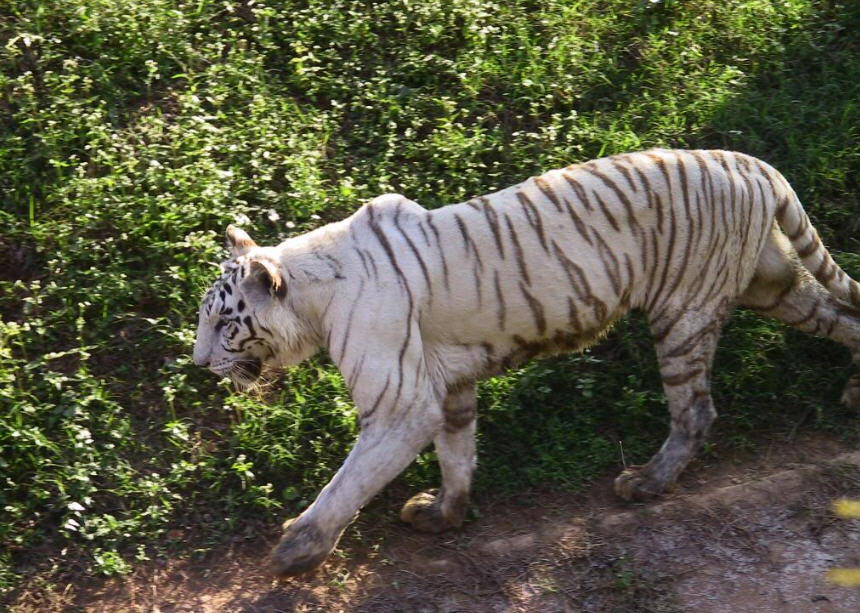 White tiger in the Nandankanan Zoo
 -
 Irrawaddy dolphins can be found in Chilika
 -
![Vanda tessellata, one of the orchids found in Odisha[83]](https://upload.wikimedia.org/wikipedia/commons/6/67/Vanda_tessellata_Orchi_001.jpg) Vanda tessellata, one of the orchids found in Odisha[83]
Vanda tessellata, one of the orchids found in Odisha[83] -
 Birds at Chilika Lake
 -
 Crocodile in Bhitarkanika National Park


![Vanda tessellata, one of the orchids found in Odisha[83]](/wiki/File:Vanda_tessellata_Orchi_001.jpg)


Government and politics

All states in India are governed by a parliamentary system of government based on universal adult franchise.[84][85]
The main parties active in the politics of Odisha are the Biju Janata Dal, the Indian National Congress and Bharatiya Janata Party. Following the Odisha State Assembly Election in 2019, the Naveen Patnaik-led Biju Janata Dal stayed in power for the sixth consecutive term, he is the 14th chief minister of odisha since 2000.[86]
Legislative assembly
The Odisha state has a unicameral legislature.[87] The Odisha Legislative Assembly consists of 147 elected members,[86] and special office bearers such as the Speaker and Deputy Speaker, who are elected by the members. Assembly meetings are presided over by the Speaker, or by the Deputy Speaker in the Speaker's absence.[88] Executive authority is vested in the Council of Ministers headed by the Chief Minister, although the titular head of government is the Governor of Odisha. The governor is appointed by the President of India. The leader of the party or coalition with a majority in the Legislative Assembly is appointed as the Chief Minister by the governor, and the Council of Ministers are appointed by the governor on the advice of the Chief Minister. The Council of Ministers reports to the Legislative Assembly.[89] The 147 elected representatives are called Members of the Legislative Assembly, or MLAs. One MLA may be nominated from the Anglo-Indian community by the governor.[90] The term of the office is for five years, unless the Assembly is dissolved prior to the completion of the term.[88]
The judiciary is composed of the Odisha High Court, located at Cuttack, and a system of lower courts.
Subdivisions
Odisha has been divided into 30 districts. These 30 districts have been placed under three different revenue divisions to streamline their governance. The divisions are North, Central and South, with their headquarters at Sambalpur, Cuttack and Berhampur respectively. Each division consists of ten districts and has as its administrative head a Revenue Divisional Commissioner (RDC).[91] The position of the RDC in the administrative hierarchy is that between that of the district administration and the state secretariat.[92] The RDCs report to the Board of Revenue, which is headed by a senior officer of the Indian Administrative Service.[91]

| Northern Division (HQ – Sambalpur) | Central Division (HQ – Cuttack) | Southern Division (HQ – Berhampur) |
|---|---|---|
Each district is governed by a collector and district magistrate, who is appointed from the Indian Administrative Service or a very senior officer from Odisha Administrative Service.[94][95] The collector and district magistrate is responsible for collecting the revenue and maintaining law and order in the district. Each district is separated into sub-divisions, each governed by a sub-collector and sub-divisional magistrate. The sub-divisions are further divided into tahasils. The tahasils are headed by tahasildar. Odisha has 58 sub-divisions, 317 tahasils and 314 blocks.[93] Blocks consists of Panchayats (village councils) and town municipalities.
The capital and largest city of the state is Bhubaneswar. The other major cities are Cuttack, Rourkela, Berhampur and Sambalpur. Municipal Corporations in Odisha include Bhubaneswar, Cuttack, Berhampur, Sambalpur and Rourkela.
Other municipalities of Odisha include Angul, Balangir, Balasore, Barbil, Bargarh, Baripada, Belpahar, Bhadrak, Bhawanipatna, Biramitrapur, Boudh, Brajarajnagar, Byasanagar, Chhatrapur, Deogarh, Dhenkanal, Gopalpur, Gunupur, Hinjilicut, Jagatsinghpur, Jajpur, Jeypore, Jharsuguda, Joda, Kendrapara, Kendujhar, Khordha, Konark, Koraput, Malkangiri, Nabarangpur, Nayagarh, Nuapada, Paradeep, Paralakhemundi, Phulbani, Puri, Rajgangpur, Rayagada, Sonepur, Sundargarh, Talcher, Titilagarh and Umerkote.
| Rank | Name | District | Pop. | ||||||
|---|---|---|---|---|---|---|---|---|---|
 Bhubaneswar  Cuttack |
1 | Bhubaneswar | Khurda | 881,988 |  Rourkela  Brahmapur | ||||
| 2 | Cuttack | Cuttack | 658,986 | ||||||
| 3 | Rourkela | Sundargarh | 552,970 | ||||||
| 4 | Brahmapur | Ganjam | 355,823 | ||||||
| 5 | Sambalpur | Sambalpur | 270,331 | ||||||
| 6 | Puri | Puri | 201,026 | ||||||
| 7 | Balasore | Balasore | 144,373 | ||||||
| 8 | Bhadrak | Bhadrak | 121,338 | ||||||
| 9 | Baripada | Mayurbhanj | 116,874 | ||||||
| 10 | Balangir | Balangir | 98,238 | ||||||
Auxiliary authorities known as panchayats, for which local body elections are regularly held, govern local affairs in rural areas.
Economy
Macro-economic trend
Odisha is experiencing steady economic growth. The impressive growth in gross domestic product of the state has been reported by the Ministry of Statistics and Programme Implementation. Odisha's growth rate is above the national average.[96] The central Government's Urban Development Ministry has recently announced the names of 20 cities selected to be developed as smart cities. The state capital Bhubaneswar is the first city in the list of smart Cities released in January 2016, a pet project of the Indian Government. The announcement also marked with sanction of Rs 508.02 billion over the five years for development.[97]
Industrial development


Odisha has abundant natural resources and a large coastline. Odisha has emerged as the most preferred destination for overseas investors with investment proposals.[98] It contains a fifth of India's coal, a quarter of its iron ore, a third of its bauxite reserves and most of the chromite.
Rourkela Steel Plant[99] was the first integrated steel plant in the public sector in India, built with collaboration of Germany.
Arcelor-Mittal has also announced plans to invest in another mega steel project amounting to $10 billion. Russian major Magnitogorsk Iron and Steel Company (MMK) plans to set up a 10 MT steel plant in Odisha, too. Bandhabahal is a major area of open cast coal mines in Odisha. The state is attracting an unprecedented amount of investment in aluminium, coal-based power plants, petrochemicals, and information technology as well. In power generation, Reliance Power (Anil Ambani Group) is putting up the world's largest power plant with an investment of US$13 billion at Hirma in Jharsuguda district.[100]
In 2009 Odisha was the second top domestic investment destination with Gujarat first and Andhra Pradesh in third place according to an analysis of ASSOCHAM Investment Meter (AIM) study on corporate investments. Odisha's share was 12.6 percent in total investment in the country. It received an investment proposal worth ₹2.01 trillion (equivalent to ₹3.6 trillion or US$51 billion in 2019) in 2010. Steel and power were among the sectors which attracted maximum investments in the state.[101]
Transportation
Odisha has a network of roads, railways, airports and seaports. Bhubaneswar is well connected by air, rail and road with the rest of India. Some highways are getting expanded to four lanes.[102] Plans for metro rail connecting Bhubaneshwar and Cuttack, a journey of 30 km, have also started.[103]
Air

Odisha has a total of two operational airports, 17 airstrips and 16 helipads.[104][105][106] The airport at Jharsuguda was upgraded to a full-fledged domestic airport in May 2018.[107] The government of Odisha also plans five greenfield airports at Angul, Dhamra, Kalinganagar, Paradeep and Rayagada in an effort to boost intrastate and inter-state civil aviation. Existing aerodromes at Barbil, Gopalpur, Jharsuguda and Rourkela were also to be upgraded.[108] The Dhamra Port Company Limited plans to build Dhamra Airport 20 km from Dhamra Port.[109] Air Odisha, is Odisha's sole air charter company based in Bhubaneswar.[citation needed]
- Angul – Savitri Jindal Airport
- Bargarh – Sativata Airstrip
- Bhawanipatna – Utkela Airstrip (being prepared under UDAN scheme)
- Bhubaneswar – Biju Patnaik Airport (functioning regularly)
- Brahmapur – Berhampur Airport
- Cuttack – Charbatia Air Base
- Jeypore – Jeypore Airport (being prepared under UDAN scheme)
- Jharsuguda – Veer Surendra Sai Airport (functioning under UDAN scheme)
- Rourkela – Rourkela Airport (being prepared under UDAN scheme)
- Sambalpur – Hirakud Airstrip
Seaports


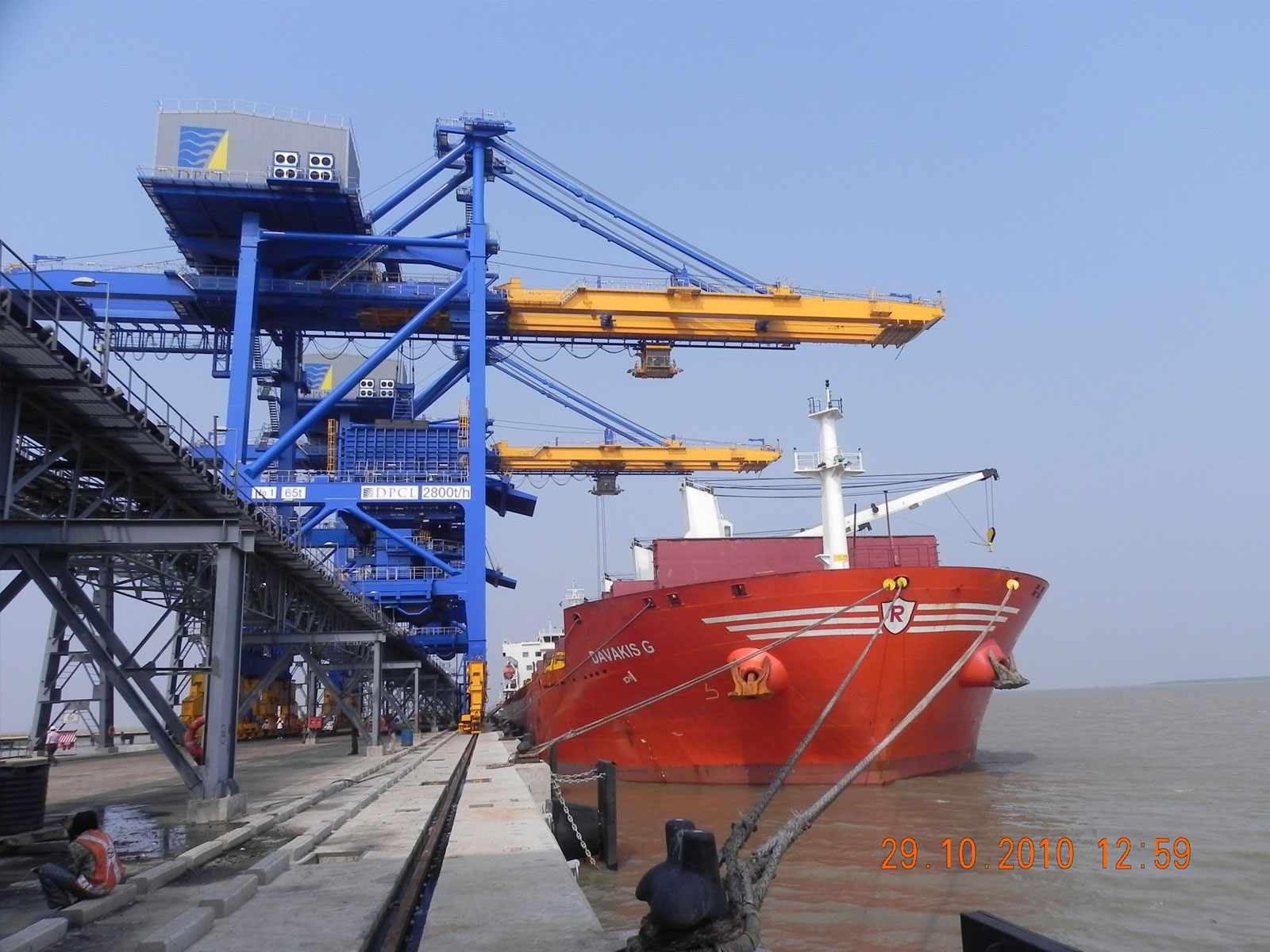
Odisha has a coastline of 485 Kilometers. It has one major port at Paradip and few minor ports. some of them are:[110][111]
- Port of Dhamara
- Port of Gopalpur
- Port of Paradip
- Port of Subarnarekha
- Port of Astarang
- Port of Chandipur
- Port of Chudamani
- Port of Palur
Railways
Major cities of Odisha are well connected to all the major cities of India by direct daily trains and weekly trains. Most of the railway network in Odisha lies under the jurisdiction of the East Coast Railway (ECoR) with headquarters at Bhubaneswar and some parts under South Eastern Railway and South East Central Railway.
Demographics
| Year | Pop. | ±% p.a. |
|---|---|---|
| 1901 | 10,302,917 | — |
| 1911 | 11,378,875 | +1.00% |
| 1921 | 11,158,586 | −0.20% |
| 1931 | 12,491,056 | +1.13% |
| 1941 | 13,767,988 | +0.98% |
| 1951 | 14,645,946 | +0.62% |
| 1961 | 17,548,846 | +1.82% |
| 1971 | 21,944,615 | +2.26% |
| 1981 | 26,370,271 | +1.85% |
| 1991 | 31,659,736 | +1.84% |
| 2001 | 36,804,660 | +1.52% |
| 2011 | 41,974,218 | +1.32% |
| source:[112] | ||

According to the 2011 census of India, the total population of Odisha is 41,974,218, of which 21,212,136 (50.54%) are male and 20,762,082 (49.46%) are female, or 978 females per 1000 males. This represents a 13.97% increase over the population in 2001. The population density is 270 per km2.[1]
The literacy rate is 73%, with 82% of males and 64% of females being literate, according to the 2011 census.
The proportion of people living below the poverty line in 2004–2005 was 57.15% which was nearly double the Indian average of 26.10%. Since 2005 the state has reduced poverty rate dramatically by 24.6 percentage points. According to current estimate proportion of people living under poverty line was 32.6%[113][114]
Data of 1996–2001 showed the life expectancy in the state was 61.64 years, higher than the national value of years. The state has a birth rate of 23.2 per 1,000 people per year, a death rate of 9.1 per 1,000 people per year, an infant mortality rate of 65 per 1000 live birth and a maternal mortality rate of 358 per 1,000,000 live births. Odisha has a Human Development Index of 0.606 as of 2018.[115]
| District | Headquarters | Population (2011) |
Males | Females | Percentage decadal growth 2001–2011 |
Sex ratio | Density (persons per km2) |
Child population 0–6 years |
Child sex ratio |
Literacy rate | |
|---|---|---|---|---|---|---|---|---|---|---|---|
| 1 | Angul | Angul | 1,271,703 | 654,898 | 616,805 | 11.55 | 942 | 199 | 145,690 | 884 | 78.96 |
| 2 | Balangir | Balangir | 1,648,574 | 831,349 | 817,225 | 23.29 | 983 | 251 | 206,964 | 951 | 65.50 |
| 3 | Balasore | Baleswar | 2,317,419 | 1,184,371 | 1,133,048 | 14.47 | 957 | 609 | 274,432 | 941 | 80.66 |
| 4 | Bargarh | Bargarh | 1,478,833 | 748,332 | 730,501 | 9.84 | 976 | 253 | 156,185 | 946 | 75.16 |
| 5 | Bhadrak | Bhadrak | 1,506,522 | 760,591 | 745,931 | 12.95 | 981 | 601 | 176,793 | 931 | 83.25 |
| 6 | Boudh | Boudh | 439,917 | 220,993 | 218,924 | 17.82 | 991 | 142 | 59,094 | 975 | 72.51 |
| 7 | Cuttack | Cuttack | 2,618,708 | 1,339,153 | 1,279,555 | 11.87 | 955 | 666 | 251,152 | 913 | 84.20 |
| 8 | Debagarh | Debagarh | 312,164 | 158,017 | 154,147 | 13.88 | 976 | 106 | 38,621 | 917 | 73.07 |
| 9 | Dhenkanal | Dhenkanal | 1,192,948 | 612,597 | 580,351 | 11.82 | 947 | 268 | 132,647 | 870 | 79.41 |
| 10 | Gajapati | Paralakhemundi | 575,880 | 282,041 | 293,839 | 10.99 | 1,042 | 133 | 82,777 | 964 | 54.29 |
| 11 | Ganjam | Chhatrapur | 3,520,151 | 1,777,324 | 1,742,827 | 11.37 | 981 | 429 | 397,920 | 899 | 71.88 |
| 12 | Jagatsinghpur | Jagatsinghpur | 1,136,604 | 577,699 | 558,905 | 7.44 | 967 | 681 | 103,517 | 929 | 87.13 |
| 13 | Jajpur | Jajpur | 1,826,275 | 926,058 | 900,217 | 12.43 | 972 | 630 | 207,310 | 921 | 80.44 |
| 14 | Jharsuguda | Jharsuguda | 579,499 | 297,014 | 282,485 | 12.56 | 951 | 274 | 61,823 | 938 | 78.36 |
| 15 | Kalahandi | Bhawanipatna | 1,573,054 | 785,179 | 787,875 | 17.79 | 1,003 | 199 | 214,111 | 947 | 60.22 |
| 16 | Kandhamal | Phulbani | 731,952 | 359,401 | 372,551 | 12.92 | 1,037 | 91 | 106,379 | 960 | 65.12 |
| 17 | Kendrapara | Kendrapara | 1,439,891 | 717,695 | 722,196 | 10.59 | 1,006 | 545 | 153,443 | 921 | 85.93 |
| 18 | Kendujhar | Kendujhar | 1,802,777 | 907,135 | 895,642 | 15.42 | 987 | 217 | 253,418 | 957 | 69.00 |
| 19 | Khordha | Khordha | 2,246,341 | 1,166,949 | 1,079,392 | 19.65 | 925 | 799 | 222,275 | 910 | 87.51 |
| 20 | Koraput | Koraput | 1,376,934 | 677,864 | 699,070 | 16.63 | 1,031 | 156 | 215,518 | 970 | 49.87 |
| 21 | Malkangiri | Malkangiri | 612,727 | 303,913 | 308,814 | 21.53 | 1,016 | 106 | 105,636 | 979 | 49.49 |
| 22 | Mayurbhanj | Baripada | 2,513,895 | 1,253,633 | 1,260,262 | 13.06 | 1,005 | 241 | 337,757 | 952 | 63.98 |
| 23 | Nabarangapur | Nabarangpur | 1,218,762 | 604,046 | 614,716 | 18.81 | 1,018 | 230 | 201,901 | 988 | 48.20 |
| 24 | Nayagarh | Nayagarh | 962,215 | 502,194 | 460,021 | 11.30 | 916 | 247 | 101,337 | 851 | 79.17 |
| 25 | Nuapada | Nuapada | 606,490 | 300,307 | 306,183 | 14.28 | 1,020 | 157 | 84,893 | 971 | 58.20 |
| 26 | Puri | Puri | 1,697,983 | 865,209 | 832,774 | 13.00 | 963 | 488 | 164,388 | 924 | 85.37 |
| 27 | Rayagada | Rayagada | 961,959 | 469,672 | 492,287 | 15.74 | 1,048 | 136 | 141,167 | 955 | 50.88 |
| 28 | Sambalpur | Sambalpur | 1,044,410 | 529,424 | 514,986 | 12.24 | 973 | 158 | 112,946 | 931 | 76.91 |
| 29 | Subarnapur | Sonepur | 652,107 | 332,897 | 319,210 | 20.35 | 959 | 279 | 76,536 | 947 | 74.42 |
| 30 | Sundergarh | Sundergarh | 2,080,664 | 1,055,723 | 1,024,941 | 13.66 | 971 | 214 | 249,020 | 937 | 74.13 |
Religion

The majority (almost 94%[117]) of people in Odisha are Hindu and there is also a rich cultural heritage in the state. For example, Odisha is home to several Hindu figures. Sant Bhima Bhoi was a leader of the Mahima sect. Sarala Das, a Hindu Khandayat, was the translator of the epic Mahabharata into Odia. Chaitanya Das was a Buddhistic-Vaishnava and writer of the Nirguna Mahatmya. Jayadeva was the author of the Gita Govinda.
The Odisha Temple Authorisation Act of 1948 empowered the government of Odisha to open temples for all Hindus, including Dalits.[118]
Perhaps the oldest scripture of Odisha is the Madala Panji from the Puri Temple believed from 1042 AD. Famous Hindu Odia scripture includes the 16th-century Bhagabata of Jagannatha Dasa.[119] In the modern times Madhusudan Rao was a major Odia writer, who was a Brahmo Samajist and shaped modern Odia literature at the start of the 20th century.[120]
Christians in Odisha account for about 2.8% of the population while Odia Muslims account for 2.2% as per census figures of 2001. The Sikh, Buddhist and Jain communities together account for 0.1% of the population.[117]
Languages

Odia is the official language of Odisha[122] and is spoken by 81.32% of the population according to the 2011 census of India.[121] It is also one of the classical languages of India. English is the official language of correspondence between state and the union of India. Spoken Odia is not homogeneous as one can find different dialects spoken across the state. Some of the major dialects found inside the state are Sambalpuri, Cuttacki, Puri, Baleswari, Ganjami, Desiya and Phulbani. In addition to Odia, significant population of people speaking other major Indian languages like Hindi, Telugu, Urdu and Bengali are also found in the state.[123]
The different adibasi communities who mostly reside in Western Odisha have their own languages belonging to Austroasiatic and Dravidian family of languages. Some of these major adibasi languages are Santali, Kui, Bhumij and Ho. Due to increasing contact with outsiders, migration and socioeconomic reasons many of these indigenous languages are slowly getting extinct or are on the verge of getting extinct.[124]
The Odisha Sahitya Academy Award was established in 1957 to actively develop Odia language and literature. The Odisha government launched a portal https://ova.gov.in/en in 2018 to promote Odia language and literature.
Education


Educational Institutions
- Indian Institutes of Handloom Technology(IIHT Bargarh) at Bargarh
- Indian Institute of Tourism and Travel Management (IITTM BBSR) at Bhubaneswar
- C. V. Raman Global University (CVRGU) at Bhubaneswar
- Regional Institute of Education (RIE BBSR) at Bhubaneswar
- Indian Institute of Technology Bhubaneswar(IIT BBS) at Bhubaneswar
- National Institute of Science Education and Research (NISER) at Bhubaneswar
- National Institute of Technology Rourkela (NIT) at Rourkela
- Indian Institute of Management (IIM-SB) at Sambalpur
- Indian Institutes of Science Education and Research (IISER BPR) at Brahmapur
- All India Institute of Medical Sciences (AIIMS) at Bhubaneswar
- Veer Surendra Sai University of Technology (VSSUT) at Burla
- National Law University at Cuttack
- International Institute of Information Technology (IIIT) at Bhubaneswar
- Berhampur University at Brahmapur
- Biju Patnaik University of Technology at Rourkela
- Ispat Autonomous College, Rourkela
- Buxi Jagabandhu Bidyadhar College at Bhubaneswar
- Central University of Odisha at Koraput
- College of Agriculture, Bhawanipatna
- College of Basic Science and Humanities at Bhubaneswar
- College of Engineering and Technology at Bhubaneswar
- Dharanidhar College at Keonjhar
- Fakir Mohan University at Balasore
- Gangadhar Meher University at Sambalpur
- Government College of Engineering, Kalahandi at Bhawanipatna
- Hi-Tech Medical College & Hospital, Bhubaneswar at Bhubaneswar
- Indira Gandhi Institute of Technology at Sarang
- Government College of Engineering, Keonjhar at Keonjhar
- KIIT University at Bhubaneswar
- Khallikote University at Brahmapur
- Maharaja Krishna Chandra Gajapati Medical College and Hospital at Brahmapur
- National Institute of Science and Technology at Brahmapur
- North Orissa University at Baripada
- Odisha State Open University at Sambalpur
- Orissa Engineering College at Bhubaneswar
- Odisha University of Agriculture and Technology at Bhubaneswar
- Parala Maharaja Engineering College at Brahmapur
- Rama Devi Women's University at Bhubaneswar
- Ravenshaw University at Cuttack
- Sambalpur University at Sambalpur
- Sambalpur University Institute of Information Technology Sambalpur
- Shri Ramachandra Bhanj Medical College at Cuttack
- Siksha O Anusandhan University at Bhubaneswar
- Utkal University at Bhubaneswar
- Utkal University of Culture at Bhubaneswar
- Veer Surendra Sai Institute of Medical Sciences and Research (VIMSAR) at Burla, Sambalpur
- Xavier Institute of Management, Bhubaneswar
- Xavier University, Bhubaneswar
- Institute of Mathematics and Applications, Bhubaneswar
- Sri Sri University at Cuttack
- Centurion University at Jatni, Bhubaneswar
- Stewart School at Buxibazar, Cuttack
- National Institute of Rehabilitation Training and Research at Cuttack
- National Institute of Social Work and Social Science, Bhubaneswar (NISWASS)
- Rajendra Narayan University Balangir
- Kalahandi University Bhawanipatna
- Bhima Bhoi Medical College and Hospital Balangir
- Pandit Raghunath Murmu Medical College and Hospital, Baripada[125]
- Saheed Laxman Nayak Medical College and Hospital, Koraput[126]
Entry to various institutes of higher education especially into engineering degrees is through a centralised Odisha Joint Entrance Examination, conducted by the Biju Patnaik University of Technology (BPUT), Rourkela, since 2003, where seats are provided according to order of merit.[127] Few of the engineering institutes enroll students by through Joint Entrance Examination. For medical courses, there is a corresponding National Eligibility Cum Entrance Test.
Culture

Cuisine
Odisha has a culinary tradition spanning centuries. The kitchen of the Shri Jagannath Temple, Puri is reputed to be the largest in the world, with 1,000 chefs, working around 752 wood-burning clay hearths called chulas, to feed over 10,000 people each day.[128][129]
The syrupy dessert Pahala rasagola made in Odisha is known throughout the world.[130] Chhenapoda is another major Odisha sweet cuisine, which originated in Nayagarh.[131] Dalma (a mix of dal and selected vegetables) is widely known cuisine, better served with ghee.[citation needed]
The "Odisha Rasagola" was awarded a GI tag 29 July 2019 after a long battle about the origin of the famous sweet with West Bengal.[132]
Dance

Odissi dance and music are classical art forms. Odissi is the oldest surviving dance form in India on the basis of archaeological evidence.[133] Odissi has a long, unbroken tradition of 2,000 years, and finds mention in the Natyashastra of Bharatamuni, possibly written c. 200 BC. However, the dance form nearly became extinct during the British period, only to be revived after India's independence by a few gurus.
The variety of dances includes Ghumura dance, Chhau dance, Jhumair, Mahari dance, Dalkhai, Dhemsa and Gotipua.
Sports

The state of Odisha has hosted several international sporting events, including the 2018 Men's Hockey World Cup, and will host matches for the 2020 FIFA U-17 Women's World Cup and the 2023 Men's Hockey World Cup.
There are so many stadium and field available to promote sports. Some of well known stadium are ;
- Kalinga Stadium
- Barabati Stadium
- Jawaharlal Nehru Indoor Stadium
- East Coast Railway Stadium
- Biju Patnaik Hockey Stadium
- KIIT Stadium
- Birsa Munda International Hockey Stadium[134]
There are some High Performance Centres in the state as well which have been set up at Kalinga Stadium for the development of respective sports in Odisha. Some of the HPCs are as follows:
- Abhinav Bindra Targeting Performance (ABTP)
- Dalmia Bharat Gopichand Badminton Academy
- JSW Swimming HPC
- Khelo India State Centre of Excellence (KISCE) for Athletics, Hockey, and Weightlifting
- KJS Ahluwalia and Tenvic Sports HPC for Weightlifting
- Odisha Naval Tata Hockey High Performance Centre (ONTHHPC) [135]
- Odisha Aditya Birla and Gagan Narang Shooting HPC
- Reliance Foundation Odisha Athletics HPC
- SAI Regional Badminton Academy[136]
- Udaan Badminton Academy[137]
- AIFF High Performance Centre[138]
Tourism
The Lingaraja Temple at Bhubaneswar has a 150-foot (46 m) high deula while the Jagannath Temple, Puri is about 200 feet (61 m) high and dominates the skyline. Only a portion of the Konark Sun Temple at Konark in Puri district, the largest of the temples of the "Holy Golden Triangle" exists today, and it is still staggering in size. It stands out as a masterpiece in Odisha architecture. Sarala Temple, regarded as one of the most spiritually elevated expressions of Shaktism is in Jagatsinghpur district. It is also one of the holiest places in Odisha and a major tourist attraction. Maa Tarini Temple situated in Kendujhar district is also a famous pilgrimage destination. Every day thousands of coconuts are given to Maa Tarini by devotees for fulfilling their wishes.[139]
Odisha's varying topography – from the wooded Eastern Ghats to the fertile river basin – has proven ideal for evolution of compact and unique ecosystems. This creates treasure troves of flora and fauna that are inviting to many migratory species of birds and reptiles. Bhitarkanika National Park in Kendrapada district is famous for its second largest mangrove ecosystem. The bird sanctuary in Chilika Lake (Asia's largest brackish water lake). The tiger reserve and waterfalls in Simlipal National Park, Mayurbhanj district are integral parts of eco-tourism in Odisha, arranged by Odisha Tourism.[140]
Daringbadi is a hill station in the Kandhamal district. It is known as "Kashmir of Odisha", for its climatic similarity. Chandipur, in Baleswar district is a calm and serene site, is mostly unexplored by tourists. The unique specialty of this beach is the ebb tides that recede up to 4 km and tend to disappear rhythmically.
In the western part of Odisha, Hirakud Dam in Sambalpur district is the longest earthen dam in the World. It also forms the biggest artificial lake in Asia. The Debrigarh Wildlife Sanctuary is situated near Hirakud Dam. Samaleswari Temple is a Hindu temple in Sambalpur city, dedicated to the goddess known as 'Samaleswari', the presiding deity of Sambalpur, is a strong religious force in western part of Odisha and Chhattisgarh state. The Leaning Temple of Huma is located near Sambalpur. The temple is dedicated to the Hindu god Lord Bimaleshwar. Sri Sri Harishankar Devasthana, is a temple on the slopes of Gandhamardhan hills, Balangir district. It is popular for its scenes of nature and connection to two Hindu lords, Vishnu and Shiva. On the opposite side of the Gandhamardhan hills is the temple of Sri Nrusinghanath, is situated at the foothills of Gandhamardhan Hill near Paikmal, Bargarh district.
In the southern part of Odisha, The Taratarini Temple on the Kumari hills at the bank of the Rushikulya River near Berhampur city in Ganjam district. Here worshiped as the Breast Shrine (Sthana Peetha) and manifestations of Adi Shakti. The Tara Tarini Shakti Peetha is one of the oldest pilgrimage centers of the Mother Goddess and is one of four major ancient Tantra Peetha and Shakti Peethas in India. Deomali is a mountain peak of the Eastern Ghats. It is located in Koraput district. This peak with an elevation of about 1,672 m, is the highest peak in Odisha.
The share of foreign tourists’ arrival in the state is below one percent of total foreign tourist arrivals at all India level.[141]
-
 The Rath Yatra in Jagannath Temple, Puri
 -
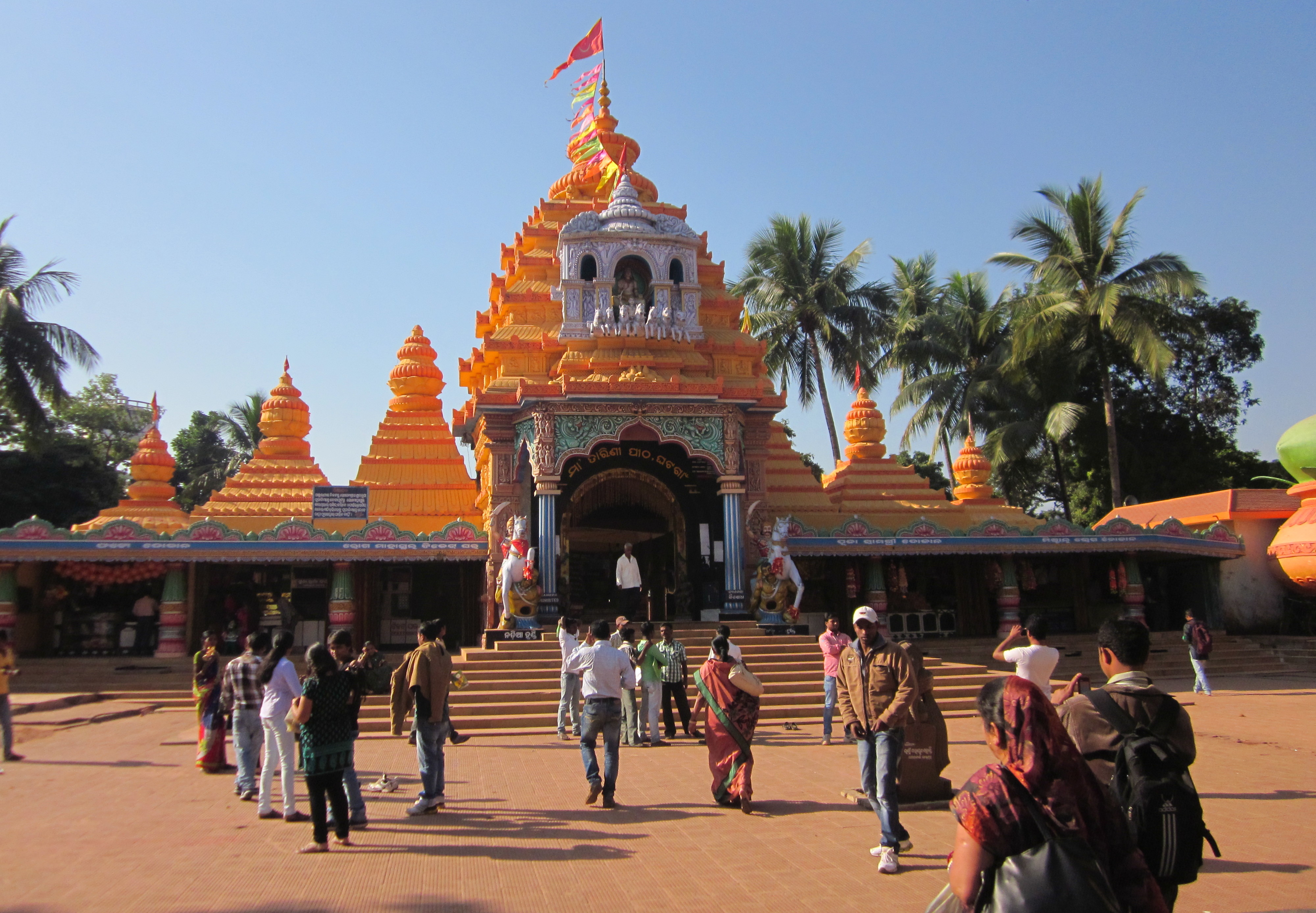
-
 Gundichaghagi waterfall Keonjhar during monsoons


See also
- Cinema of Odisha
- Festivals of Odisha
- List of Odia writers
- List of schools in Odisha
- Odia literature
- List of schemes of the government of Odisha
- Odissi music
References
- ↑ 1.0 1.1 "Population, Size and Decadal Change" (PDF). Primary Census Abstract Data Highlights, Census of India. Registrar General and Census Commissioner of India. 2018. Archived (PDF) from the original on 19 October 2019. Retrieved 16 June 2020.
- ↑ "Cities having population 1 lakh and above, Census 2011" (PDF). Government of India. Archived (PDF) from the original on 25 November 2014. Retrieved 2 February 2015.
- ↑ 3.0 3.1 "Odisha Budget analysis". PRS India. 18 February 2020. Retrieved 27 September 2020.
- ↑ "Sub-national HDI – Subnational HDI – Global Data Lab". globaldatalab.org. Retrieved 17 April 2020.
- ↑ "State of Literacy" (PDF). Census of India. p. 110. Archived (PDF) from the original on 6 July 2015. Retrieved 5 August 2015.
- ↑ "Report of the Commissioner for linguistic minorities: 47th report (July 2008 to June 2010)" (PDF). Commissioner for Linguistic Minorities, Ministry of Minority Affairs, Government of India. pp. 122–126. Archived from the original (PDF) on 13 May 2012. Retrieved 16 February 2012.
- ↑ 7.0 7.1 7.2 Blue Jay (PDF), Orissa Review, 2005, p. 87
- ↑ "Palapitta: How a mindless dasara ritual is killing our state bird palapitta – Hyderabad News". The Times of India. 29 September 2017. Retrieved 7 October 2019.
- ↑ Blue Jay (PDF), Orissa Review, 2005
- ↑ "State Fishes of India" (PDF). National Fisheries Development Board, Government of India. Retrieved 25 December 2020.
- ↑ Pipal(Ficus religiosa) – The State Tree of Odisha (PDF), RPRC, 2014
- ↑ Template:Lexico
- ↑ Jones, Daniel (2003) [1917]. Roach, Peter; Hartmann, James; Setter, Jane (eds.). English Pronouncing Dictionary. Cambridge: Cambridge University Press. ISBN 3-12-539683-2.
- ↑ "ST & SC Development, Minorities & Backward Classes Welfare Department:: Government of Odisha". stscodisha.gov.in. Archived from the original on 1 September 2018. Retrieved 10 December 2018.
- ↑ "Coastal security". Odisha Police. Archived from the original on 6 February 2015. Retrieved 1 February 2015.
- ↑ "The National Anthem of India" (PDF). Columbia University. Archived (PDF) from the original on 24 January 2012. Retrieved 1 February 2015.
- ↑ "Cabinet approved Odia as Classical Language". 21 February 2014.
- ↑ 18.0 18.1 18.2 18.3 "Detail History of Orissa". Government of Odisha. Archived from the original on 12 November 2006.
- ↑ "Utkala Dibasa hails colours, flavours of Odisha". The Times of India. 2 April 2014. Archived from the original on 8 July 2015. Retrieved 1 February 2015.
- ↑ Rabindra Nath Chakraborty (1985). National Integration in Historical Perspective: A Cultural Regeneration in Eastern India. Mittal Publications. pp. 17–. GGKEY:CNFHULBK119. Archived from the original on 15 May 2013. Retrieved 30 November 2012.
- ↑ Ravi Kalia (1994). Bhubaneswar: From a Temple Town to a Capital City. SIU Press. p. 23. ISBN 978-0-8093-1876-6. Archived from the original on 5 January 2016. Retrieved 2 February 2015.
- ↑ "Sub-national HDI – Area Database". Global Data Lab. Institute for Management Research, Radboud University. Archived from the original on 23 September 2018. Retrieved 25 September 2018.
- ↑ Patel, C.B (April 2010). Origin and Evolution of the Name ODISA (PDF). Bhubaneswar: I&PR Department, Government of Odisha. pp. 28, 29, 30. Archived from the original (PDF) on 19 June 2015. Retrieved 19 June 2015.
- ↑ Pritish Acharya (11 March 2008). National Movement and Politics in Orissa, 1920–1929. SAGE Publications. p. 19. ISBN 978-81-321-0001-0. Archived from the original on 5 January 2016. Retrieved 3 February 2015.
- ↑ "Amid clash, House passes Bills to rename Orissa, its language". The Hindu. 9 November 2010. Archived from the original on 17 October 2015. Retrieved 2 February 2015.
- ↑ "Parliament passes bill to change Orissa's name". NDTV. 24 March 2011. Archived from the original on 3 February 2015. Retrieved 2 February 2015.
- ↑ "Orissa wants to change its name to Odisha". Rediff.com. 10 June 2008. Retrieved 23 June 2020.
- ↑ Amalananda Ghosh (1990). An Encyclopaedia of Indian Archaeology. BRILL. p. 24. ISBN 9004092641. Archived from the original on 5 January 2016. Retrieved 29 October 2012.
- ↑ Subodh Kapoor, ed. (2004). An Introduction to Epic Philosophy: Epic Period, History, Literature, Pantheon, Philosophy, Traditions, and Mythology, Volume 3. Genesis Publishing. p. 784. ISBN 9788177558814. Archived from the original on 5 January 2016. Retrieved 10 November 2012.
Finally Srutayudha, a valiant hero, was son Varuna and of the river Parnasa.
- ↑ Devendrakumar Rajaram Patil (1946). Cultural History from the Vāyu Purāna. Motilal Banarsidass Pub. p. 46. ISBN 9788120820852. Archived from the original on 5 January 2016. Retrieved 15 November 2015.
- ↑ "Dance bow (1965.3.5)". Pitt Rivers Museum. Archived from the original on 2 February 2015. Retrieved 4 February 2015.
- ↑ Rabindra Nath Pati (1 January 2008). Family Planning. APH Publishing. p. 97. ISBN 978-81-313-0352-8. Archived from the original on 5 January 2016. Retrieved 2 February 2015.
- ↑ Suhas Chatterjee (1 January 1998). Indian Civilization And Culture. M.D. Publications Pvt. Ltd. p. 68. ISBN 978-81-7533-083-2. Archived from the original on 15 May 2013. Retrieved 11 February 2013.
- ↑ 34.0 34.1 Hermann Kulke; Dietmar Rothermund (2004). A History of India. Routledge. p. 66. ISBN 9780415329194. Archived from the original on 5 January 2016. Retrieved 12 November 2012.
- ↑ 35.0 35.1 Mookerji Radhakumud (1995). Asoka. Motilal Banarsidass. p. 214. ISBN 978-81-208-0582-8. Archived from the original on 5 January 2016. Retrieved 6 August 2015.
- ↑ Sailendra Nath Sen (1 January 1999). Ancient Indian History and Civilization. New Age International. p. 153. ISBN 978-81-224-1198-0. Archived from the original on 5 January 2016. Retrieved 6 August 2015.
- ↑ Austin Patrick Olivelle Alma Cowden Madden Centennial Professor in Liberal Arts University of Texas (19 June 2006). Between the Empires : Society in India 300 BCE to 400 CE: Society in India 300 BCE to 400 CE. Oxford University Press. p. 78. ISBN 978-0-19-977507-1. Archived from the original on 5 January 2016. Retrieved 3 February 2015.
- ↑ Reddy (1 December 2006). Indian Hist (Opt). Tata McGraw-Hill Education. p. A254. ISBN 978-0-07-063577-7. Archived from the original on 5 January 2016. Retrieved 3 February 2015.
- ↑ Indian History. Allied Publishers. 1988. p. 74. ISBN 978-81-8424-568-4. Archived from the original on 5 January 2016. Retrieved 3 February 2015.
- ↑ Ronald M. Davidson (13 August 2013). Indian Esoteric Buddhism: A Social History of the Tantric Movement. Columbia University Press. p. 60. ISBN 978-0-231-50102-6. Archived from the original on 5 January 2016. Retrieved 3 February 2015.
- ↑ R. C. Majumdar (1996). Outline of the History of Kalinga. Asian Educational Services. p. 28. ISBN 978-81-206-1194-8. Archived from the original on 5 January 2016. Retrieved 3 February 2015.
- ↑ Roshen Dalal (18 April 2014). The Religions of India: A Concise Guide to Nine Major Faiths. Penguin Books Limited. p. 559. ISBN 978-81-8475-396-7. Archived from the original on 5 January 2016. Retrieved 3 February 2015.
- ↑ Indian History. Tata McGraw-Hill Education. p. 2. ISBN 978-0-07-132923-1. Archived from the original on 1 January 2014. Retrieved 3 May 2013.
- ↑ Sen, Sailendra (2013). A Textbook of Medieval Indian History. Primus Books. pp. 121–122. ISBN 978-93-80607-34-4.
- ↑ Orissa General Knowledge. Bright Publications. p. 27. ISBN 978-81-7199-574-5. Archived from the original on 5 January 2016. Retrieved 3 February 2015.
- ↑ L.S.S. O'Malley (1 January 2007). Bengal District Gazetteer : Puri. Concept Publishing Company. p. 33. ISBN 978-81-7268-138-8. Archived from the original on 5 January 2016. Retrieved 3 February 2015.
- ↑ Sailendra Nath Sen (2010). An Advanced History of Modern India. Macmillan India. p. 32. ISBN 978-0-230-32885-3. Archived from the original on 5 January 2016. Retrieved 3 February 2015.
- ↑ Devi, Bandita (January 1992). Some Aspects of British Administration in Orissa, 1912–1936. Academic Foundation. p. 14. ISBN 978-81-7188-072-0. Archived from the original on 21 December 2016. Retrieved 5 December 2016.
- ↑ William A. Dando (13 February 2012). Food and Famine in the 21st Century [2 volumes]. ABC-CLIO. p. 47. ISBN 978-1-59884-731-4. Archived from the original on 5 January 2016. Retrieved 3 February 2015.
- ↑ J. K. Samal; Pradip Kumar Nayak (1 January 1996). Makers of Modern Orissa: Contributions of Some Leading Personalities of Orissa in the 2nd Half of the 19th Century. Abhinav Publications. p. 32. ISBN 978-81-7017-322-9. Archived from the original on 5 January 2016. Retrieved 3 February 2015.
- ↑ K.S. Padhy (30 July 2011). Indian Political Thought. PHI Learning Pvt. Ltd. p. 287. ISBN 978-81-203-4305-4. Archived from the original on 5 January 2016. Retrieved 3 February 2015.
- ↑ Usha Jha (1 January 2003). Land, Labour, and Power: Agrarian Crisis and the State in Bihar (1937–52). Aakar Books. p. 246. ISBN 978-81-87879-07-7. Archived from the original on 5 January 2016. Retrieved 3 February 2015.
- ↑ 53.0 53.1 Bandita Devi (1 January 1992). Some Aspects of British Administration in Orissa, 1912–1936. Academic Foundation. p. 214. ISBN 978-81-7188-072-0. Archived from the original on 5 January 2016. Retrieved 3 February 2015.
- ↑ "Hubback's memoirs: First Governor Of State Reserved Tone Of Mild Contempt For Indians". The Telegraph. 29 November 2010. Archived from the original on 4 February 2015. Retrieved 3 February 2015.
- ↑ B. Krishna (2007). India's Bismarck, Sardar Vallabhbhai Patel. Indus Source. pp. 243–244. ISBN 978-81-88569-14-4. Archived from the original on 5 January 2016. Retrieved 3 February 2015.
- ↑ "Merger of the Princely States of Odisha – History of Odisha". Retrieved 12 May 2020.
- ↑ 57.0 57.1 57.2 57.3 "Geography of Odisha". Know India. Government of India. Archived from the original on 4 February 2015. Retrieved 3 February 2015.
- ↑ "Cuttack". Government of Odisha. Archived from the original on 6 December 2012. Retrieved 6 August 2015.
- ↑ Dasgupta, Alakananda; Priyadarshini, Subhra (29 May 2019). "Why Odisha is a sitting duck for extreme cyclones". Nature India. doi:10.1038/nindia.2019.69 ( (inactive $1) 28 February 2022).
{{cite journal}}: CS1 maint: DOI inactive as of February 2022 (link) - ↑ Socio-economic Profile of Rural India (series II).: Eastern India (Orissa, Jharkhand, West Bengal, Bihar and Uttar Pradesh). Concept Publishing Company. 2011. p. 73. ISBN 978-81-8069-723-4. Archived from the original on 5 January 2016. Retrieved 4 February 2015.
- ↑ https://eparlib.nic.in/bitstream/123456789/1589/1/lsd_02_06_17-11-1958.pdf page 46
- ↑ "Monthly mean maximum & minimum temperature and total rainfall based upon 1901–2000 data" (PDF). India Meteorological Department. Archived from the original (PDF) on 13 April 2015. Retrieved 6 February 2015.
- ↑ "Study shows Odisha forest cover shrinking". The Times of India. 16 February 2012. Archived from the original on 17 October 2015. Retrieved 5 February 2015.
- ↑ Underutilized and Underexploited Horticultural Crops. New India Publishing. 1 January 2007. p. 116. ISBN 978-81-89422-60-8. Archived from the original on 5 January 2016. Retrieved 5 February 2015.
- ↑ "Orchid House a haven for nature lovers". The Telegraph. 23 August 2010. Archived from the original on 5 February 2015. Retrieved 5 February 2015.
- ↑ "Similipal Tiger Reserve". World Wide Fund for Nature, India. Archived from the original on 5 February 2015. Retrieved 5 February 2015.
- ↑ "Banished from their homes". The Pioneer. 29 August 2012. Archived from the original on 4 September 2012. Retrieved 5 February 2015.
- ↑ "Away from home, Chandaka elephants face a wipeout". The New Indian Express. 23 August 2013. Archived from the original on 5 February 2015. Retrieved 5 February 2015.
- ↑ Sharad Singh Negi (1 January 1993). Biodiversity and Its Conservation in India. Indus Publishing. p. 242. ISBN 978-81-85182-88-9. Archived from the original on 5 January 2016. Retrieved 5 February 2015.
- ↑ Venkatesh Salagrama (2006). Trends in Poverty and Livelihoods in Coastal Fishing Communities of Orissa State, India. Food & Agriculture Org. pp. 16–17. ISBN 978-92-5-105566-3. Archived from the original on 5 January 2016. Retrieved 5 February 2015.
- ↑ "Olive Ridley turtles begin mass nesting". The Hindu. 12 February 2014. Archived from the original on 17 October 2015. Retrieved 5 February 2015.
- ↑ "Mass nesting of Olive Ridleys begins at Rushikulya beach". The Hindu. 15 March 2004. Archived from the original on 17 October 2015. Retrieved 5 February 2015.
- ↑ "Bhitarkanika Park to be Closed for Crocodile Census". The New Indian Express. 3 December 2013. Archived from the original on 5 February 2015. Retrieved 5 February 2015.
- ↑ "Bird Count Rises in Bhitarkanika". The New Indian Express. 14 September 2014. Archived from the original on 5 February 2015. Retrieved 5 February 2015.
- ↑ "Concern over dwindling horseshoe crab population". The Hindu. 8 December 2013. Archived from the original on 17 October 2015. Retrieved 5 February 2015.
- ↑ Pushpendra K. Agarwal; Vijay P. Singh (16 May 2007). Hydrology and Water Resources of India. Springer Science & Business Media. p. 984. ISBN 978-1-4020-5180-7. Archived from the original on 5 January 2016. Retrieved 5 February 2015.
- ↑ "Number of birds visiting Chilika falls but new species found". The Hindu. 9 January 2013. Archived from the original on 31 August 2014. Retrieved 5 February 2015.
- ↑ "Chilika registers sharp drop in winged visitors". The Hindu. 13 January 2014. Archived from the original on 17 October 2015. Retrieved 5 February 2015.
- ↑ "Two new species of migratory birds sighted in Chilika Lake". The Hindu. 8 January 2013. Archived from the original on 17 October 2015. Retrieved 5 February 2015.
- ↑ "Dolphin population on rise in Chilika Lake". The Hindu. 18 February 2010. Archived from the original on 17 October 2015. Retrieved 5 February 2015.
- ↑ "Maiden Dolphin Census in State's Multiple Places on Cards". The New Indian Express. 20 January 2015. Archived from the original on 23 January 2015. Retrieved 5 February 2015.
- ↑ "Wildlife Census - Odisha Wildlife Organisation".
- ↑ P.K. Dash; Santilata Sahoo; Subhasisa Bal (2008). "Ethnobotanical Studies on Orchids of Niyamgiri Hill Ranges, Orissa, India". Ethnobotanical Leaflets (12): 70–78. Archived from the original on 5 February 2015. Retrieved 5 February 2015.
- ↑ Chandan Sengupta; Stuart Corbridge (28 October 2013). Democracy, Development and Decentralisation in India: Continuing Debates. Routledge. p. 8. ISBN 978-1-136-19848-9. Archived from the original on 5 January 2016. Retrieved 15 February 2015.
- ↑ "Our Parliament" (PDF). Lok Sabha. Government of India. Archived from the original (PDF) on 3 February 2015. Retrieved 2 February 2015.
- ↑ 86.0 86.1 "BJD's landslide victory in Odisha, wins 20 of 21 Lok Sabha seats". CNN-IBN. 17 May 2014. Archived from the original on 8 September 2014. Retrieved 18 March 2015.
- ↑ Ada W. Finifter. Political Science. FK Publications. p. 94. ISBN 978-81-89597-13-9. Archived from the original on 5 January 2016. Retrieved 15 February 2015.
- ↑ 88.0 88.1 Rajesh Kumar. Universal's Guide to the Constitution of India. Universal Law Publishing. pp. 107–110. ISBN 978-93-5035-011-9. Archived from the original on 5 January 2016. Retrieved 18 March 2015.
- ↑ Ramesh Kumar Arora; Rajni Goyal (1995). Indian Public Administration: Institutions and Issues. New Age International. pp. 205–207. ISBN 978-81-7328-068-9. Archived from the original on 5 January 2016. Retrieved 18 March 2015.
- ↑ Subhash Shukla (2008). Issues in Indian Polity. Anamika Pub. & distributors. p. 99. ISBN 978-81-7975-217-3. Archived from the original on 5 January 2016. Retrieved 18 March 2015.
- ↑ 91.0 91.1 "About Department". Revenue & Disaster Management Department, Government of Odisha. Archived from the original on 6 December 2012. Retrieved 27 March 2015.
{{cite web}}: CS1 maint: bot: original URL status unknown (link) - ↑ Laxmikanth. Governance in India. McGraw-Hill Education (India) Pvt Limited. pp. 6–17. ISBN 978-0-07-107466-7. Archived from the original on 5 January 2016. Retrieved 27 March 2015.
- ↑ 93.0 93.1 "Administrative Unit". Revenue & Disaster Management Department, Government of Odisha. Archived from the original on 21 August 2013. Retrieved 27 March 2015.
- ↑ Siuli Sarkar (9 November 2009). Public Administration in India. PHI Learning Pvt. Ltd. p. 117. ISBN 978-81-203-3979-8. Archived from the original on 5 January 2016. Retrieved 11 August 2015.
- ↑ Public Administration Dictionary. Tata McGraw Hill Education. 2012. p. 263. ISBN 978-1-259-00382-0. Archived from the original on 5 January 2016. Retrieved 11 August 2015.
- ↑ "GDP growth: Most states grew faster than national rate in 2012–13". The Financial Express. 12 December 2013. Archived from the original on 15 December 2013. Retrieved 23 May 2012.
- ↑ "Bhubaneswar leads Govt's Smart City list, Rs 50,802 crore to be invested over five years". The Indian Express. 29 January 2016. Archived from the original on 18 March 2016. Retrieved 21 March 2016.
- ↑ "Indian states that attracted highest FDI". Rediff. 29 August 2012. Archived from the original on 8 April 2014. Retrieved 8 April 2014.
- ↑ "Rourkela Steel Plant". Sail.co.in. Archived from the original on 31 May 2012. Retrieved 23 May 2012.
- ↑ "Reliance to invest Rs 60,000-cr for Orissa power plant". dna. 21 July 2006. Archived from the original on 3 September 2014. Retrieved 31 August 2014.
- ↑ "Gujarat, Odisha and Andhra top 3 Domestic Investment Destinations of 2009". Assocham. 21 January 2010. Archived from the original on 23 July 2011. Retrieved 18 July 2010.
- ↑ "NH 42". Odishalinks.com. 16 June 2004. Archived from the original on 25 November 2010. Retrieved 18 July 2010.
- ↑ "Odisha plans metro, signs contract for detailed project report preparation". The Times of India. Archived from the original on 31 August 2014. Retrieved 16 January 2016.
- ↑ "Ten-year roadmap for State's civil aviation". The Pioneer. India. 2012. Archived from the original on 30 May 2013. Retrieved 5 August 2012.
at present there are 17 airstrips and 16 helipads in Odisha,
- ↑ "10-year roadmap set up to boost Odisha civil aviation". odishanow.in. 2012. Archived from the original on 15 October 2014. Retrieved 5 August 2012.
Odisha has 17 airstrips and 16 helipads.
- ↑ "Odisha initiate steps for intra and inter state aviation facilities". news.webindia123.com. 2012. Archived from the original on 13 January 2015. Retrieved 5 August 2012.
Odisha has 17 airstrips and 16 helipads
- ↑ "J'suguda Airport fit for 320 Airbus flight". The Pioneer. 2 August 2018. Retrieved 11 September 2018.
- ↑ "Odisha plans five new airports". Business Line. 14 August 2012. Archived from the original on 3 November 2013. Retrieved 14 May 2013.
- ↑ "Adani Group plans airport at Dhamra". Times of India. 13 November 2018. Retrieved 3 February 2020.
- ↑ Division, P. INDIA 2019: A REFERENCE ANNUAL. Publications Division Ministry of Information & Broadcasting. p. 701. ISBN 978-81-230-3026-5. Retrieved 16 July 2019.
- ↑ India. Parliament. Rajya Sabha (2012). Parliamentary Debates: Official Report. Council of States Secretariat. Retrieved 16 July 2019.
- ↑ Decadal Variation In Population Since 1901
- ↑ "India States Briefs – Odisha". World Bank. 31 May 2016. Retrieved 12 July 2019.
- ↑ "NITI Aayog report: Odisha tops in poverty reduction rate among other states". Pragativadi: Leading Odia Dailly. 30 July 2017. Retrieved 12 July 2019.
- ↑ "Sub-national HDI - Subnational HDI - Global Data Lab". globaldatalab.org. Retrieved 31 March 2021.
- ↑ "Population by religion community – 2011". Census of India, 2011. The Registrar General & Census Commissioner, India. Archived from the original on 25 August 2015.
- ↑ 117.0 117.1 "Census of India – Socio-cultural aspects". Government of India, Ministry of Home Affairs. Archived from the original on 20 May 2011. Retrieved 2 March 2011.
- ↑ P. 63 Case studies on human rights and fundamental freedoms: a world survey, Volume 4 By Willem Adriaan Veenhoven
- ↑ P. 77 Encyclopedia Americana, Volume 30 By Scholastic Library Publishing
- ↑ Madhusudan Rao By Jatindra Mohan Mohanty, Sahitya Akademi
- ↑ 121.0 121.1 "Language – India, States and Union Territories" (PDF). Census of India 2011. Office of the Registrar General. pp. 13–14. Archived (PDF) from the original on 14 November 2018. Retrieved 7 January 2019.
- ↑ ":: Law Department (Government of Odisha) ::". lawodisha.gov.in. Archived from the original on 2 March 2021. Retrieved 19 October 2019.
- ↑ Mahapatra, B. P. (2002). Linguistic Survey of India: Orissa (PDF). Kolkata, India: Language Division, Office of the Registrar General. pp. 13–14. Archived from the original on 13 November 2013. Retrieved 20 February 2014.
- ↑ "Atlas of languages in danger | United Nations Educational, Scientific and Cultural Organization". UNESCO. Retrieved 19 October 2019.
- ↑ "Pandit Raghunath Murmu Medical College & Hospital". prmmchbaripada.in. Archived from the original on 9 September 2017. Retrieved 9 September 2017.
- ↑ "SLN Medical College & Hospital". slnmch.nic.in. Archived from the original on 9 September 2017. Retrieved 9 September 2017.
- ↑ "Biju Patnaik University of Technology". Bput.org. Archived from the original on 5 December 2008. Retrieved 18 July 2010.
- ↑ National Association on Indian Affairs; American Association on Indian Affairs (1949). Indian Affairs. Archived from the original on 6 June 2013. Retrieved 23 June 2012.
- ↑ S.P. Sharma; Seema Gupta (3 October 2006). Fairs & Festivals of India. Pustak Mahal. pp. 103–. ISBN 978-81-223-0951-5. Archived from the original on 8 June 2013. Retrieved 23 June 2012.
- ↑ Mitra Bishwabijoy (6 July 2015). "Who invented the rasgulla?". The Times of India. Archived from the original on 9 July 2015. Retrieved 2 August 2015.
- ↑ "Chhenapoda". Simply TADKA. Archived from the original on 9 January 2015. Retrieved 9 January 2015.
- ↑ "Odisha Rasagola receives geographical indication tag; here's what it means". www.businesstoday.in. Retrieved 17 November 2019.
- ↑ "Odissi Kala Kendra". odissi.itgo.com. Archived from the original on 12 May 2011. Retrieved 18 July 2010.
- ↑ Suffian, Mohammad (16 February 2021). "Odisha CM Lays Foundation of India's Largest Hockey Stadium named after 'Birsa Munda' In Rourkela". India Today.
- ↑ "Naval Tata Hockey Academy Inaugurated In Odisha Capital". Kalinga TV. Retrieved 13 August 2019.
- ↑ Minati Singha (15 May 2017). "Odisha-SAI Regional Badminton Academy inaugurated in Bhubaneswar | Bhubaneswar News – Times of India". The Times of India. Retrieved 30 May 2021.
- ↑ "Udaan Badminton Academy-HOME". www.theudaan.net. Retrieved 30 May 2021.
- ↑ "High Performance Centre deal a big boost for Odisha and AIFF | Goal.com". www.goal.com. Retrieved 7 June 2021.
- ↑ Norenzayan, Ara (25 August 2013). Big Gods: How Religion Transformed Cooperation and Conflict. Princeton University Press. pp. 55–56. ISBN 978-1-4008-4832-4. Archived from the original on 8 February 2016. Retrieved 24 December 2015.
- ↑ "MTN 82:9–10 Olive ridley tagged in Odisha recovered in the coastal waters of eastern Sri Lanka". Seaturtle.org. Archived from the original on 7 December 2013. Retrieved 18 July 2010.
- ↑ "Odisha - Economic Survey 2014-15" (PDF). Archived from the original (PDF) on 15 February 2017. Retrieved 14 February 2017.
External links
- Government
- General information
- Odisha Encyclopædia Britannica entry
- Odisha at Curlie
 Geographic data related to Odisha at OpenStreetMap
Template:Languages spoken in Orissa
Places adjacent to Odisha | ||||||||||
|---|---|---|---|---|---|---|---|---|---|---|
| ||||||||||


