



 | This article may require copy editing for grammar, style, cohesion, tone, or spelling. (April 2021) |
 |
The climate of West Bengal is varied, with tropical savannah in the southern portions of the state, to humid subtropical in the north.


Seasons
There are five main seasons in West Bengal: spring, summer, rainy season, a short autumn, and winter.
Spring
Some parts of the state experience a short spring season, particularly in North Bengal. This is the time when Holi takes place.
Summer
Period
The summer season is observed from March to May in most of Bengal.
Temperature
In Bengal summer can be extremely hot and have high humidity. The plains of South Bengal have a daily maximum temperature around 35-38 °C.[1][2]It can also exceed 40 °C.[3][4][5][6][7] The western highlands experience a dry summer like northern India. During the day, the temperature ranges from 38 to 42 °C, though it can reach or exceed 45 °C.[8][9][10][11][12] In summer, the plains of North Bengal are generally cooler than the west and south.[13][14][15] In this area, the daily maximum temperature varies from 26 to 32 °C.[16]It occasionally crosses 35 °C. The minimum temperature in summer is approximately 18-22 °C. The Darjeeling hill region is the coolest area in summer. Here, the daily highest temperature is 15-25 °C.
Rainfall
In South Bengal, the kalbaishakhi storms bring some rainfall, due to low pressure, while the Himalayan region and Terai Dooars plains get heavy rainfall during this period.
Average temperature and Rainfall for some cities in summer (March to May)[17]
| City | Average temperature (°C) | Average Rainfall (mm) |
|---|---|---|
| Darjeeling | 13.1 | 446 |
| Siliguri | 24.2 | 447 |
| Jalpaiguri | 24.0 | 453 |
| Malda | 28.3 | 188 |
| Shantiniketan | 29.4 | 264 |
| Behrampore | 29.3 | 136 |
| Krishnagar | 29.5 | 96 |
| Asansol | 30.0 | 114 |
| Bankura | 29.9 | 146 |
| Kolkata | 29.8 | 227 |
| Digha | 28.4 | 214 |
| West Bengal | 26.9 | 248.3 |
Monsoon
Period
In mid-June, the southwest monsoon wind enters West Bengal, and the monsoon season starts.[18]It continues until the end of September.
Temperature
In most places, the temperature drops as cloud cover increases. This is less true for the mountains and the Terai Dooars plains, where temperature gradually increases until August.
The maximum temperature of South Bengal plains and Western highlands is 32 °C,[19]31 °C in North Bengal plains and around 19-20 °C in mountains. Sometimes, when the sky gets clear, which is known as monsoon break, the temperature rises suddenly. This incident occurs mostly in North Bengal plains and in mountains in July and August when the temperature soars over 36 °C and 24 °C respectively.[20][21][22][23][24]
Rainfall
Most of the annual rainfall occurs during this period. Heavy rainfall above 250 cm is observed in the Darjeeling, Jalpaiguri, Alipurduar and Cooch Behar district.[25][26][27][28][29]Later, blowing westwards, the winds cause average rainfall of 125 cm in the northern plains and western plateau region.
Average temperature and Rainfall for some cities in monsoons (June to September)
| City | Average temperature (°C) | Average Rainfall (mm) |
|---|---|---|
| Darjeeling | 16.4 | 2796 |
| Siliguri | 28.1 | 2651 |
| Jalpaiguri | 28.0 | 2674 |
| Malda | 29.6 | 1207 |
| Shantiniketan | 29.4 | 1510 |
| Behrampore | 30.2 | 1036 |
| Krishnagar | 29.4 | 1348 |
| Asansol | 29.5 | 1140 |
| Bankura | 30.3 | 1227 |
| Kolkata | 29.6 | 1358 |
| Digha | 29.1 | 1192 |
| West Bengal | 28.1 | 1649.0 |
Autumn
Period
Autumn lasts for two months, October and November.
Temperature
In autumn, the southwest monsoon wind returns and clears the sky. So, the state gets enough sunshine to be warm in the day and releases a lot of heat to be cool at night.
At this time, a maximum temperature of 30-33 °C is felt over the plains and 17-19 °C in mountains. The minimum temperature is normally around 19-22 °C in plains and 6-11 °C in mountains.[30]Sometimes, cold waves blow over the state in autumn.[31][32][33]
Rainfall
In autumn, the southwest monsoon wind returns, and northeast monsoon wind starts entering West Bengal. Due to their collision in Bay of Bengal, some cyclones are created.[34][35] The cyclones cause some rainfall in the state.
Average temperature and Rainfall for some cities in autumn (October and November)
| City | Average temperature (°C) | Average Rainfall (mm) |
|---|---|---|
| Darjeeling | 13.4 | 74 |
| Siliguri | 23.2 | 181 |
| Jalpaiguri | 23.6 | 169 |
| Malda | 26.2 | 132 |
| Shantiniketan | 25.3 | 212 |
| Behrampore | 26.2 | 146 |
| Krishnagar | 26.5 | 175 |
| Asansol | 24.8 | 125 |
| Bankura | 25.9 | 94 |
| Kolkata | 26.6 | 216 |
| Digha | 25.9 | 240 |
| West Bengal | 24.3 | 160.4 |
Winter
Period
The winter season usually sets in December and ends in February.[36]
Temperature
In winter, a mild temperature is felt over the plains. The maximum temperature goes 23-26 °C and the minimum temperature remains 9-15 °C in plains of the state. In mountains, winter is severe with the maximum and minimum temperature ranging between 0-12 °C. Higher regions of the Darjeeling Himalayas get heavy snowfall during winter.[37][38][39]
Though, the night temperatures of western highlands can drop 7-9 °C,[40][41][42]4-7 °C in Siliguri, Jalpaiguri, Coochbehar plains[43][44][45][46]and 10-11 °C in Kolkata,[47][48][49][50] the capital city when cold waves blow. Darjeeling city's temperature drops below freezing point.
Rainfall
Winter is generally dry. Most of the days are sunny. Occasionally slight rainfall occurs under the influence of low depressions in northwest India. These are known as western disturbances.
Average temperature and Rainfall for some cities in Winter (December to February)
| City | Average temperature (°C) | Average Rainfall (mm) |
|---|---|---|
| Darjeeling | 7.6 | 30 |
| Siliguri | 17.3 | 60 |
| Jalpaiguri | 18.9 | 36 |
| Malda | 20.6 | 27 |
| Shantiniketan | 19.7 | 44 |
| Behrampore | 20.6 | 32 |
| Krishnagar | 20.5 | 29 |
| Asansol | 19.7 | 46 |
| Bankura | 20.1 | 42 |
| Kolkata | 21.6 | 35 |
| Digha | 21.1 | 43 |
| West Bengal | 17.0 | 38.5 |
Extremes
Sources: India Meteorological Department[51][52]
Highest Temperature
The chart below shows the highest recorded temperatures for all months in West Bengal, with place and date.
| Month | Highest Recorded Temperature(°C) | Place | Date |
|---|---|---|---|
| January | style="Template:Weather box/colt"| 36.8 | Krishnagar | 1 January 1977 |
| February | style="Template:Weather box/colt"| 39.3 | Bankura | 26 February 2006 |
| March | style="Template:Weather box/colt"| 44.5 | Behrampore | 27 March 1980 |
| April | style="Template:Weather box/colt"| 46.7 | Bankura | 23 April 2016 |
| May | style="Template:Weather box/colt"| 48.3 | Behrampore | 23 May 1981 |
| June | style="Template:Weather box/colt"| 47.8 | Suri | 10 June 1966 |
| July | style="Template:Weather box/colt"| 43.0 | Krishnagar | 22 July 1994 |
| August | style="Template:Weather box/colt"| 48.3 | Behrampore | 2 August 1981 |
| September | style="Template:Weather box/colt"| 41.0 | Coochbehar | 11 September 1977 |
| October | style="Template:Weather box/colt"| 40.5 | Malda | 1 October 1978 |
| November | style="Template:Weather box/colt"| 38.5 | Bagati | 6 November 1976 |
| December | style="Template:Weather box/colt"| 36.5 | Bagati | 30 December 1984 |
| West Bengal | style="Template:Weather box/colt"| 48.3 | Behrampore | 23 May 1981 & 2 August 1981 |
Lowest Temperature
The chart below shows the lowest recorded temperatures for all months in West Bengal, with place and date.
| Month | Lowest Recorded Temperature(°C) | Place | Date |
|---|---|---|---|
| January | style="Template:Weather box/colt"| -7.2 | Darjeeling | 30 January 1971 |
| February | style="Template:Weather box/colt"| -6.4 | Darjeeling | 2 February 1971 |
| March | style="Template:Weather box/colt"| -4.8 | Darjeeling | 1 March 1971 |
| April | style="Template:Weather box/colt"| 0.0 | Darjeeling | 16 April 1971 |
| May | style="Template:Weather box/colt"| 1.4 | Darjeeling | 1 May 1981 |
| June | style="Template:Weather box/colt"| 4.6 | Kalimpong | 14 June 1991 |
| July | style="Template:Weather box/colt"| 3.9 | Darjeeling | 26 July 1944 |
| August | style="Template:Weather box/colt"| 7.4 | Kalimpong | 24 August 1971 |
| September | style="Template:Weather box/colt"| 5.9 | Kalimpong | 10 September 1991 |
| October | style="Template:Weather box/colt"| 3.2 | Darjeeling | 31 October 1972 |
| November | style="Template:Weather box/colt"| -4.4 | Darjeeling | 26 November 1970 |
| December | style="Template:Weather box/colt"| -4.6 | Darjeeling | 29 December 1970 |
| West Bengal | style="Template:Weather box/colt"| -7.2 | Darjeeling | 30 January 1971 |
Temperature
 |
The Tropic of Cancer passes 6 km north of Nabadwip, so, according to latitude, the northern part of the state falls in the temperate belt and the southern part fall in the tropical belt. But the southern part receives adequate rainfall and because of maritime influence is not severely hot. Barring the mountainous parts of Darjeeling and Jalpaiguri, the entire state experiences a warm wet tropical monsoon climate. Regional differences are visible in the climate. In the western plateau region, rainfall is low and variations in temperature are more common; maritime influence in the coastal region makes the climate here moderate and pleasant. The summer temperatures in the state ranges between 26 °C (79 °F) and 43 °C (109 °F) while the winter temperatures range from 10 °C (50 °F) to 19 °C (66 °F).
Rainfall
|
The annual rainfall varies in the different parts of the state. North Bengal receives the highest rainfall, 200 to 400 cm. In the coastal areas rainfall is about 200 cm, in the Ganga plain and in the central part of the state rainfall is about 150–200 cm, and in the western plateau region the amount of rainfall received is about 100 to 125 cm. Drought is a common phenomenon in the Bankura and Purulia districts. Rainfall that occurs in the summer months often brings about heavy storms called Kalbaishakhi.
Cyclones affecting West Bengal
| Name | Lowest Pressure (mbar) | Year | Winds(in km/h) | Image |
|---|---|---|---|---|
| 1970 Bhola Cyclone | 966 | 1970 |  | |
| BOB 03 | 964 | 1981 |  | |
| BOB 07 | 994 | 1997 |  | |
| BOB 06 | 984 | 1998 |  | |
| BOB 04 | 998 | 2000 |  | |
| BOB 03 | 970 | 2002 | 100 |  |
| Sidr | 944 | 2007 | 215 |  |
| Rashmi | 996 | 2008 | 85 |  |
| Aila | 970 | 2009 | 120 |  |
| Komen | 986 | 2015 | 75 |  |
| Roanu | 983 | 2016 | 85 |  |
| Mora | 978 | 2017 | 110 |  |
| Amphan | 925 | 2020 | 240 |
Mountainous region
|
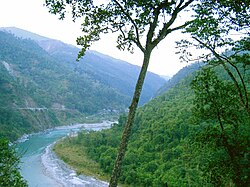
Because of the high altitude, mountainous parts of Darjeeling and Jalpaiguri experience a cool temperate and climate. The average temperature in summer is about 15 °C (59 °F), and winter temperature is about 2 °C (36 °F). Snowfall occurs in some parts of this region. Being obstructed by the Himalayas, the region receives heavy rainfall. Due to the scenic beauty and temperate climate of the region, a huge number of tourists visit the areas. Here Kalimpong is another hill station that is visited by many tourists in all seasons for its scenic beauty and the averagely cool temperature throughout the year.
Influences
|
Adequate rainfall in the plains of West Bengal influences crop production. The hot wet climate is good for the production of rice and jute. Higher rainfall received in the northern mountainous region is favorable for the production of tea, which is popular all over the world. Pulses and oilseeds are also produced in large quantities.
The people prefer to wear loose and thin cotton clothes because of the hot humid climate. Rice and fish the staple food of the Bengalis because they are easy to digest in this climate and are easily available.[citation needed] The hot and humid climate hampers the efficiency of the people, as the people tend to get tired easily. For protection against heavy rainfall and snowfall in the north, the people live in houses with sloping roofs.
References
- ↑ "চার জেলায় বৃষ্টির সম্ভাবনা, বাকি রাজ্য থাকবে 'শুখা'". Retrieved 5 November 2020.
- ↑ "আগামী কয়েকদিন তাপমাত্রা বাড়লেও ঝড়বৃষ্টি পেতে পারে দক্ষিণবঙ্গ". Retrieved 5 November 2020.
- ↑ "Kolkata records year's highest temperature at 39.6". Retrieved 25 October 2020.
- ↑ "Kolkata records hottest day of the season as heat wave heats hard". Retrieved 25 October 2020.
- ↑ "Temperature touches 41 degrees on hottest day". Retrieved 25 October 2020.
- ↑ "৪৪ ডিগ্রি সেলসিয়াসে শ্রীনিকেতন, ঘামে নাকাল কলকাতা". Retrieved 25 October 2020.
- ↑ "৪০ ডিগ্রিতে পুড়ছে পশ্চিমবঙ্গ". Retrieved 25 October 2020.
- ↑ "বর্ষা খুঁড়িয়ে হাঁটায় দহনও বে-লাগাম". Retrieved 5 November 2020.
- ↑ "Kolkata reels under heatwave, Bankura sizzles at 45.1 degrees Celsius". Retrieved 25 October 2020.
- ↑ "Purulia scorches at 49 degrees". Retrieved 25 October 2020.
- ↑ "summer agony in monsoon season heat wave persists in several states". Retrieved 25 October 2020.
- ↑ "৪৩ ডিগ্রি গরমে পুড়ছে বাঁকুড়া". Retrieved 27 October 2020.
- ↑ "জ্বলছে বাংলা, একেবারেই অন্য চিত্র উত্তরবঙ্গের এলাকাগুলোতে". Retrieved 26 October 2020.
- ↑ "Kalbaishakhi may come in south Bengal, says Weather Offce". Retrieved 30 October 2020.
- ↑ "Pre monsoon rain will continue in North Bengal, South Bengal will face discomfort weather". Retrieved 30 October 2020.
- ↑ "ঘূর্ণিঝড় 'ফনি'-র প্রভাব বাংলায়! কবে কোথায়, জেনে নিন আবহাওয়া দফতরের সতর্কবার্তা". Retrieved 5 November 2020.
- ↑ "Regional Meteorological Department, Kolkata". Retrieved 25 October 2020.
- ↑ "স্বাভাবিক সময়েই এলো বর্ষা, ভারী বর্ষণের পূর্বাভাস বঙ্গে". Retrieved 28 October 2020.
- ↑ "১০ বছরে উষ্ণতম জুলাই, শহরে ৩৭ ডিগ্রি!". Retrieved 5 November 2020.
- ↑ "গরমে নাকাল শিলিগুড়ি". Retrieved 30 October 2020.
- ↑ "ঘড়িতে সাড়ে বারোটা, পারদে ৪০ ডিগ্রি". Retrieved 30 October 2020.
- ↑ "দার্জিলিঙে ঘুরছে পাখা, সমতলে ৩৯ ডিগ্রি!". Retrieved 30 October 2020.
- ↑ "রেকর্ড ভেঙে ৪১ ডিগ্রিতে জলপাইগুড়ির পারদ". Retrieved 30 October 2020.
- ↑ "Many parts of Sikkim is feeling above 30 degrees temperatures". Retrieved 1 November 2020.
- ↑ "ভারী বর্ষণের সম্ভাবনা বাড়ছে উত্তরবঙ্গে". Retrieved 28 October 2020.
- ↑ "ভাসছে উত্তর, বৃষ্টির প্রতীক্ষায় দক্ষিণবঙ্গ". Retrieved 28 October 2020.
- ↑ "Good Monsoon rains in Siliguri and Jalpaiguri". Retrieved 28 October 2020.
- ↑ "Siliguri is logging in 337 mm rain". Retrieved 28 October 2020.
- ↑ "250 mm of rainfall destroyed lifestyle of North". Retrieved 28 October 2020.
- ↑ "Regional Meteorological Department, Kolkata". Retrieved 9 November 2020.
- ↑ "শহর-শহরতলির তাপমাত্রা নামল স্বাভাবিকের ৩ ডিগ্রি নীচে, দেশজুড়ে শৈত্যপ্রবাহের সতর্কতা". Retrieved 8 November 2020.
- ↑ "রাজ্যের ৫ জেলায় বৃষ্টির পূর্বাভাস, শৈত্যপ্রবাহ নিয়ে বিশেষ সতর্কবার্তা দিল হাওয়া অফিস". Retrieved 8 November 2020.
- ↑ "উত্তরে যেমন নামছে পারদ , সঙ্গে মিলছে বৃষ্টির পূর্বাভাস". Retrieved 8 November 2020.
- ↑ https://m.economictimes.com/topic/Cyclone-Bulbul-in-West-Bengal/amp
- ↑ https://m.timesofindia.com/topic/Bay-of-Bengal-Cyclone/ampdefault
- ↑ "Winter Season from December to February likely to be Warmer in Various Parts of Country". Retrieved 7 December 2020.
- ↑ "সান্দাকফুতে তুষারপাত, বরফে ঢাকল ছাঙ্গুও". Retrieved 25 November 2020.
- ↑ "বরফমোড়া সান্দাকফু, সম্ভাবনা দার্জিলিঙেও". Retrieved 25 November 2020.
- ↑ "এপ্রিলে তুষারপাত বাংলায়". Retrieved 25 November 2020.
- ↑ "মাঘে এল বাঘা শীত". Retrieved 25 November 2020.
- ↑ "রাজ্য জুড়ে শৈত্যপ্রবাহ". Retrieved 25 November 2020.
- ↑ "পারদ পড়ে রোজই রেকর্ড গড়ছে ঠান্ডা". Retrieved 24 November 2020.
- ↑ "শীতে কাঁপছে উত্তরবঙ্গ, শিলিগুড়িতে পারদ নামল ৩ ডিগ্রিতে". Retrieved 24 November 2020.
- ↑ "৪.৪ ডিগ্রি! শিলিগুড়ির চাই রুম হিটার". Retrieved 24 November 2020.
- ↑ "কমছে পারদ, আগামী ২৪ ঘন্টায় জাঁকিয়ে পড়বে শীত". Retrieved 25 November 2020.
- ↑ "তীব্র শীতে কাঁপছে কলকাতা সহ রাজ্য". Retrieved 24 November 2020.
- ↑ "কলকাতায় ১০.৬ ডিগ্রি, দমদমে ৯.৫, শ্রীনিকেতনে ৫.৮". Retrieved 24 November 2020.
- ↑ "শীতের দাপটে কাঁপছে রাজ্য, পারদ নামল তিন ডিগ্রি". Retrieved 24 November 2020.
- ↑ "আরও নামল তাপমাত্রা! ১০ বছরে দ্বিতীয় সর্বনিম্ন কলকাতা, শিলিগুড়ি ৫.৫ ডিগ্রি". Retrieved 24 November 2020.
- ↑ "১১.৯ ডিগ্রি, শীতলতম দিন কলকাতায়". Retrieved 25 November 2020.
- ↑ "Climatological Normals for Indian Stations" (PDF). Climatological Normals 1981–2010. India Meteorological Department. January 2015. Archived from the original (PDF) on 5 February 2020. Retrieved 29 November 2020.
- ↑ "Extremes of Temperature & Rainfall for Indian Stations (Up to 2012)" (PDF). India Meteorological Department. December 2016. Archived from the original (PDF) on 5 February 2020. Retrieved 29 November 2020.
.png)