



>BrownHairedGirl add {{West Bengal}}, which links to this page |
m corrected information for clarity based on references |
||
| Line 1: | Line 1: | ||
{{Short description|Feudal estate in India (1592–1952)}} | |||
{{more citations needed|date=January 2018}} | {{more citations needed|date=January 2018}} | ||
{{EngvarB|date=April 2017}} | {{EngvarB|date=April 2017}} | ||
| Line 32: | Line 33: | ||
}} | }} | ||
{{Bengal Zamindars series}} | {{Bengal Zamindars series}} | ||
'''Jhargram Raj''' was a ''[[zamindari]]'' (feudatory kingdom) which occupied a position in [[Bengal region]] (present-day [[West Bengal, India]]) of [[British India]]. The zamindari came into being during the later part of the 16th century when [[Man Singh I|Man Singh]] of [[Amer, India|Amer]] was the [[Dewan]]/[[Subahdar]] of Bengal (1594–1606). Their territory was centered around present-day [[Jhargram district]]. Jhargram was never an independent territory since the chiefs of the family held it basically as the [[zamindars]] of the British Raj in India after Lord Cornwallis's Permanent Settlement of 1793. Although its owners were both rich and powerful, with the chiefs of the family holding the title of Raja, the Jhargram estate was not defined as a [[Princely State]] with freedom to decide its future course of action at the time of Indian independence in 1947.<ref>[http://www.indianrajputs.com/view/jhargram Rajput Provinces of India]</ref> Later, the Vice-Roy of India agreed to recognize Jhargram as "Princely State" after the [[Second World War]], but the proposal taken back as the British had decided to give independence to India.<ref>{{cite news |title=JhargramEstate|url=https://cbkwgl.wordpress.com/2014/05/19/jhargram-estate/ |publisher=WordPress.com |date=May 19, 2014|access-date=December 1, 2014}}</ref> | '''Jhargram Raj''' was a ''[[zamindari]]'' (feudatory kingdom) which occupied a position in [[Bengal region]] (present-day [[West Bengal, India]]) of [[British India]]. The zamindari came into being during the later part of the 16th century when [[Man Singh I|Man Singh]] of [[Amer, India|Amer]] was the [[Dewan]]/[[Subahdar]] of Bengal (1594–1606). Their territory was centered around present-day [[Jhargram district]]. Jhargram was never an independent territory since the chiefs of the family held it basically as the [[zamindars]] of the British Raj in India after Lord Cornwallis's Permanent Settlement of 1793. Although its owners were both rich and powerful, with the chiefs of the family holding the title of Raja, the Jhargram estate was not defined as a [[Princely State]] with freedom to decide its future course of action at the time of Indian independence in 1947.<ref>[http://www.indianrajputs.com/view/jhargram Rajput Provinces of India]</ref> Later, the Vice-Roy of India agreed to recognize Jhargram as "Princely State" after the [[Second World War]], but the proposal taken back as the British had decided to give independence to India.<ref>{{cite news |title=JhargramEstate|url=https://cbkwgl.wordpress.com/2014/05/19/jhargram-estate/ |publisher=WordPress.com |date=May 19, 2014|access-date=December 1, 2014}}</ref>{{sps|date=January 2025}} | ||
==History== | ==History== | ||
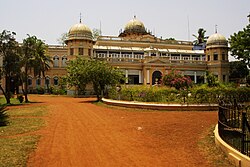
[[File:Jhargram Palace.jpg|thumb|Palace of the Rajas]] | [[File:Jhargram Palace.jpg|thumb|Palace of the Rajas]] | ||
Jhargram Raj was founded around 1592 AD by Sarveshwar Singh who along with his elder brother were Generals under [[Man Singh I|Man Singh]] of [[Amer, India|Amer]] and came to conquer Bengal when Emperor Akbar granted Subehdari of Bengal, Bihar, and Orissa to Raja Man Singh. He defeated and vanquished the local [[Mal (caste)|Mal]] tribal kings who were ruling the region known as Junglekhand, even today in order to commemorate this victory, every year an idol of Mal Raja is made and slain on [[Vijayadashami]] day. As a reward, Raja Man Singh, granted ''mansabdari'' of the entire region of Junglekhand to his victorious generals Sarveshwar Singh and his elder brother, under suzerainty and subordination as a tributary vassal state to the Mughal Emperor Akbar. He named his capital Jhargram which means a village surrounded by deep forests, hence the rulers of Jhargram assumed the title “Malla Deb”.<ref>[http://www.royalfamilyofindia.com/jhargram/ Royal Families of India]</ref> | Jhargram Raj was founded around 1592 AD by Sarveshwar Singh who along with his elder brother were Generals under [[Man Singh I|Man Singh]] of [[Amer, India|Amer]] and came to conquer Bengal when Emperor Akbar granted Subehdari of Bengal, Bihar, and Orissa to Raja Man Singh. He defeated and vanquished the local [[Mal (caste)|Mal]] tribal kings who were ruling the region known as Junglekhand, even today in order to commemorate this victory, every year an idol of Mal Raja is made and slain on [[Vijayadashami]] day. As a reward, Raja Man Singh, granted ''mansabdari'' of the entire region of Junglekhand to his victorious generals Sarveshwar Singh and his elder brother, under suzerainty and subordination as a tributary vassal state to the Mughal Emperor Akbar. He named his capital Jhargram which means a village surrounded by deep forests, hence the rulers of Jhargram assumed the title “Malla Deb”.<ref>[http://www.royalfamilyofindia.com/jhargram/ Royal Families of India]</ref>{{Better source needed|date=January 2025}} | ||
==Administration== | ==Administration== | ||
| Line 52: | Line 43: | ||
The royal family were [[Zamindars]] of Jhargram under the [[United Kingdom|British]] government rule, they were politically powerful and financially wealthy. The Zamindar was conferred with the title of [[Raja]] and was appointed to the Legislative Council of Bengal. The Zamindari ruled their dominions and estates from [[Jhargram Palace]] in present-day [[West Bengal]], they had 8 ''sardars'' under the system and one Sub Zamindar of [[Beliaberah]]. | The royal family were [[Zamindars]] of Jhargram under the [[United Kingdom|British]] government rule, they were politically powerful and financially wealthy. The Zamindar was conferred with the title of [[Raja]] and was appointed to the Legislative Council of Bengal. The Zamindari ruled their dominions and estates from [[Jhargram Palace]] in present-day [[West Bengal]], they had 8 ''sardars'' under the system and one Sub Zamindar of [[Beliaberah]]. | ||
The period 1922–1950 was considered as the golden era for Jhargram Raj, with Rai Bahadur Debendra Mohan Bhattacharya as the [[Dewan]], Jhargram developed into a township, and many educational institutions were established. The [[Jhargram Kumud Kumari Institution]] was founded in 1924. In 1925, an annual sports fund was created to encourage athletic activities and to construct a football stadium and the Jhargram Club. Raja Bahadur established Jhargram Agricultural College, which was later renamed | The period 1922–1950 was considered as the golden era for Jhargram Raj, with Rai Bahadur Debendra Mohan Bhattacharya as the [[Dewan]], Jhargram developed into a township, and many educational institutions were established. The [[Jhargram Kumud Kumari Institution]] was founded in 1924. In 1925, an annual sports fund was created to encourage athletic activities and to construct a football stadium and the Jhargram Club. Raja Bahadur established Jhargram Agricultural College, which was later renamed Jhargram Raj College, as well as Vidyasagar Polytechnic for industrial training. He provided funds to set up Sri Ramkrishna Saradapeeth Girls High School and Bharat Sevashram Sangha. In 1931, he commissioned a new palace on 23 acres of land; it is a prominent example of Indo-Saracenic architecture. During World War II, he constructed [[Dudhkundi Airfield]] for the United States Air Force and provided the Allied forces with elephants, vehicles, and other help.<ref>{{Cite web|url=http://www.jhargrampalace.com/about.php|title=About | JHARGRAM PALACE}}</ref>{{sps|date=January 2025}} | ||
==Legacy of the Raj family== | ==Legacy of the Raj family== | ||
| Line 60: | Line 49: | ||
The last and the 16th king Raja [[Narasingha Malla Deb]] reigned from 1916 until his royal powers were abolished by an amendment to the [[Constitution of India]] in 1954. After losing his royal title, he served for two terms as a member of the Legislative Council of [[Bengal]]. He also served in the [[Lok Sabha]],<ref>{{cite web|title=1957 Midnapur loksabha vote|url=http://www.indiavotes.com/pc/detail/783/9/2|website=www.indiavotes.com}}</ref> the [[lower house]] of the Indian Parliament. | The last and the 16th king Raja [[Narasingha Malla Deb]] reigned from 1916 until his royal powers were abolished by an amendment to the [[Constitution of India]] in 1954. After losing his royal title, he served for two terms as a member of the Legislative Council of [[Bengal]]. He also served in the [[Lok Sabha]],<ref>{{cite web|title=1957 Midnapur loksabha vote|url=http://www.indiavotes.com/pc/detail/783/9/2|website=www.indiavotes.com}}</ref> the [[lower house]] of the Indian Parliament. | ||
The royal family was known for working to rehabilitate refugees after the [[partition of India]]. After India gained its independence, they owned a business in Kolkata and large real estate properties in Kolkata, Midnapore, and [[Digha]]. Narsingha's son Yuvraj Birendra Bijoy got involved in politics and was a two-time member of the Legislative Assembly of West Bengal from [[Jhargram (Vidhan Sabha constituency)|Jhargram's Vidhan Sabha constituency]], representing the [[Indian National Congress]]. His son Shivendra Bijoy Malla Deb—Narasingha Malla Deb's grandson—is a social worker and politician associated with the [[All India Trinamool Congress]], and the chairman of the municipality of Jhargram.<ref>[http://members.iinet.net.au/~royalty/ips/j/jhargram.html Indian Princely States]</ref> They currently reside in [[Jhargram Palace]] and have converted about 15 rooms on the ground floor into a Heritage Hotel run by them.<ref>{{cite news |title=Royal retreats: Jhargram Palace/ Midnapore |url=http://www.telegraphindia.com/1080705/jsp/personaltt/story_9503606.jsp |publisher=The Telegraph |date=July 5, 2008 |access-date=Feb 16, 2013}}</ref> | The royal family was known for working to rehabilitate refugees after the [[partition of India]]. After India gained its independence, they owned a business in Kolkata and large real estate properties in Kolkata, Midnapore, and [[Digha]]. Narsingha's son Yuvraj Birendra Bijoy got involved in politics and was a two-time member of the Legislative Assembly of West Bengal from [[Jhargram (Vidhan Sabha constituency)|Jhargram's Vidhan Sabha constituency]], representing the [[Indian National Congress]]. His son Shivendra Bijoy Malla Deb—Narasingha Malla Deb's grandson—is a social worker and politician associated with the [[All India Trinamool Congress]], and the chairman of the municipality of Jhargram.<ref>[http://members.iinet.net.au/~royalty/ips/j/jhargram.html Indian Princely States]</ref> They currently reside in [[Jhargram Palace]] and have converted about 15 rooms on the ground floor into a Heritage Hotel run by them.<ref>{{cite news |title=Royal retreats: Jhargram Palace/ Midnapore |url=http://www.telegraphindia.com/1080705/jsp/personaltt/story_9503606.jsp |archive-url=https://web.archive.org/web/20080920012322/http://www.telegraphindia.com/1080705/jsp/personaltt/story_9503606.jsp |url-status=dead |archive-date=20 September 2008 |publisher=The Telegraph |date=July 5, 2008 |access-date=Feb 16, 2013}}</ref> | ||
==See also== | ==See also== | ||
| Line 76: | Line 65: | ||
{{West Bengal}} | {{West Bengal}} | ||
[[Category: | [[Category:Bengali zamindars]] | ||
[[Category:Zamindari estates]] | [[Category:Zamindari estates]] | ||
[[Category:Quasi-princely estates of India]] | [[Category:Quasi-princely estates of India]] | ||
[[Category:1710 establishments in Asia]] | [[Category:1710 establishments in Asia]] | ||
[[Category:1950 disestablishments in India]] | [[Category:1950 disestablishments in India]] | ||
Latest revision as of 17:23, 4 March 2026
 | This article needs more citations. (January 2018) |
| Jhargram Raj ঝাড়গ্রাম রাজ | |||||||||
|---|---|---|---|---|---|---|---|---|---|
| Zamindari of British India | |||||||||
| 1592–1952 | |||||||||
 Coat of arms
| |||||||||
| Area | |||||||||
• 1922 | 655 km2 (253 sq mi) | ||||||||
| Population | |||||||||
• 1922 | 71350 | ||||||||
| History | |||||||||
| History | |||||||||
• Established | 1592 | ||||||||
| 1952 | |||||||||
| |||||||||
| Today part of | Jhargram, West Bengal, India | ||||||||


Template:Bengal Zamindars series Jhargram Raj was a zamindari (feudatory kingdom) which occupied a position in Bengal region (present-day West Bengal, India) of British India. The zamindari came into being during the later part of the 16th century when Man Singh of Amer was the Dewan/Subahdar of Bengal (1594–1606). Their territory was centered around present-day Jhargram district. Jhargram was never an independent territory since the chiefs of the family held it basically as the zamindars of the British Raj in India after Lord Cornwallis's Permanent Settlement of 1793. Although its owners were both rich and powerful, with the chiefs of the family holding the title of Raja, the Jhargram estate was not defined as a Princely State with freedom to decide its future course of action at the time of Indian independence in 1947.[1] Later, the Vice-Roy of India agreed to recognize Jhargram as "Princely State" after the Second World War, but the proposal taken back as the British had decided to give independence to India.[2]Template:Sps
History[edit | edit source]

Jhargram Raj was founded around 1592 AD by Sarveshwar Singh who along with his elder brother were Generals under Man Singh of Amer and came to conquer Bengal when Emperor Akbar granted Subehdari of Bengal, Bihar, and Orissa to Raja Man Singh. He defeated and vanquished the local Mal tribal kings who were ruling the region known as Junglekhand, even today in order to commemorate this victory, every year an idol of Mal Raja is made and slain on Vijayadashami day. As a reward, Raja Man Singh, granted mansabdari of the entire region of Junglekhand to his victorious generals Sarveshwar Singh and his elder brother, under suzerainty and subordination as a tributary vassal state to the Mughal Emperor Akbar. He named his capital Jhargram which means a village surrounded by deep forests, hence the rulers of Jhargram assumed the title “Malla Deb”.[3][better source needed]
Administration[edit | edit source]

The royal family were Zamindars of Jhargram under the British government rule, they were politically powerful and financially wealthy. The Zamindar was conferred with the title of Raja and was appointed to the Legislative Council of Bengal. The Zamindari ruled their dominions and estates from Jhargram Palace in present-day West Bengal, they had 8 sardars under the system and one Sub Zamindar of Beliaberah.
The period 1922–1950 was considered as the golden era for Jhargram Raj, with Rai Bahadur Debendra Mohan Bhattacharya as the Dewan, Jhargram developed into a township, and many educational institutions were established. The Jhargram Kumud Kumari Institution was founded in 1924. In 1925, an annual sports fund was created to encourage athletic activities and to construct a football stadium and the Jhargram Club. Raja Bahadur established Jhargram Agricultural College, which was later renamed Jhargram Raj College, as well as Vidyasagar Polytechnic for industrial training. He provided funds to set up Sri Ramkrishna Saradapeeth Girls High School and Bharat Sevashram Sangha. In 1931, he commissioned a new palace on 23 acres of land; it is a prominent example of Indo-Saracenic architecture. During World War II, he constructed Dudhkundi Airfield for the United States Air Force and provided the Allied forces with elephants, vehicles, and other help.[4]Template:Sps
Legacy of the Raj family[edit | edit source]

The last and the 16th king Raja Narasingha Malla Deb reigned from 1916 until his royal powers were abolished by an amendment to the Constitution of India in 1954. After losing his royal title, he served for two terms as a member of the Legislative Council of Bengal. He also served in the Lok Sabha,[5] the lower house of the Indian Parliament.
The royal family was known for working to rehabilitate refugees after the partition of India. After India gained its independence, they owned a business in Kolkata and large real estate properties in Kolkata, Midnapore, and Digha. Narsingha's son Yuvraj Birendra Bijoy got involved in politics and was a two-time member of the Legislative Assembly of West Bengal from Jhargram's Vidhan Sabha constituency, representing the Indian National Congress. His son Shivendra Bijoy Malla Deb—Narasingha Malla Deb's grandson—is a social worker and politician associated with the All India Trinamool Congress, and the chairman of the municipality of Jhargram.[6] They currently reside in Jhargram Palace and have converted about 15 rooms on the ground floor into a Heritage Hotel run by them.[7]
See also[edit | edit source]
Further study[edit | edit source]
- The Indian princes and their states Author Barbara Ramusack ISBN 978-0-521-26727-4[8]
References[edit | edit source]
- ↑ Rajput Provinces of India
- ↑ "JhargramEstate". WordPress.com. 19 May 2014. Retrieved 1 December 2014.
- ↑ Royal Families of India
- ↑ "About | JHARGRAM PALACE".
- ↑ "1957 Midnapur loksabha vote". www.indiavotes.com.
- ↑ Indian Princely States
- ↑ "Royal retreats: Jhargram Palace/ Midnapore". The Telegraph. 5 July 2008. Archived from the original on 20 September 2008. Retrieved 16 February 2013.
- ↑ Ramusack, Barbara N. (2004). The Indian princes and their states. Cambridge University Press. p. 278. ISBN 978-0-521-26727-4. Retrieved 6 November 2011.
.png)