


Ajay Kumar (talk | contribs) Created a new article Tag: Disambiguation links |
KobyQ0272234 (talk | contribs) added page based on references as per guidelines |
||
| Line 1: | Line 1: | ||
{{ | {{Short description|Small wild cat}} | ||
{{ | {{Distinguish|text=the [[fisher (animal)]], a mustelid sometimes called a "fisher cat"; nor the [[Van cat]], a landrace of domestic cat nicknamed the "swimming cat"}} | ||
{{ | {{Good article}} | ||
{{Speciesbox | |||
| image = Prionailurus_viverrinus_01.jpg | | image = Prionailurus_viverrinus_01.jpg | ||
| image_caption = | | image_alt = A fishing cat laying on a large rocky surface | ||
| image_caption = At [[Cincinnati Zoo and Botanical Garden]], Ohio | |||
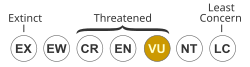
| status = VU | | status = VU | ||
| status_system = IUCN3.1 | | status_system = IUCN3.1 | ||
| status_ref = <ref name=iucn>{{cite iucn | | status_ref = <ref name=iucn>{{cite iucn |author=Mukherjee, S. |author2=Appel, A. |author3=Adhya, T. |author4=Aziz, M.A. |author5=Borah, J. |author6=Chakraborty, S. |author7=Dey, A. |author8=Herranz Muñoz, V. |author9=Kantimahanti, M. |author10=Kittle, A. |author11=Mahar, J.A. |author12=Mishra, R. |author13=Naing Lin, Ngoprasert, D. |author14=Phosri, K. |author15=Qureshi, Q. |author16=Rana, D. |author17=Ratnayaka, A. |author18=Tantipisanuh, N. |author19=Watson, A.C. |year=2025 |title=''Prionailurus viverrinus'' |article-number=e.T18150A268618387 |doi=10.2305/IUCN.UK.2025-1.RLTS.T18150A268618387.en |language=en}}</ref> | ||
| status2 = CITES_A2 | | status2 = CITES_A2 | ||
| status2_system = CITES | | status2_system = CITES | ||
| Line 14: | Line 15: | ||
| species = viverrinus | | species = viverrinus | ||
| authority = ([[Edward Turner Bennett|Bennett]], 1833) | | authority = ([[Edward Turner Bennett|Bennett]], 1833) | ||
| range_map = FishingCat_distribution.jpg | | range_map =FishingCat_distribution.jpg | ||
| range_map_caption = Distribution of the fishing cat as of 2016<ref name=iucn /> | | range_map_caption = Distribution of the fishing cat as of 2016<ref name=iucn /> | ||
}} | }} | ||
The '''fishing cat''' ('''''Prionailurus viverrinus''''') is a medium-sized wild [[felidae|cat]] of [[South Asia|South]] and [[Southeast Asia]]. | The '''fishing cat''' ('''''Prionailurus viverrinus''''') is a medium-sized wild [[felidae|cat]] of [[South Asia|South]] and [[Southeast Asia]]. It has a deep yellowish-grey fur with black lines and spots. Adults have a head-to-body length of {{cvt|57|to|78|cm}}, with a {{cvt|20|to|30|cm|0}} long tail. Males are larger than females, weighing {{cvt|8|to|17|kg}}, while females average {{cvt|5|to|9|kg}}. It lives mostly in the vicinity of [[wetland]]s, along [[river]]s, [[stream]]s, [[oxbow lake]]s, in [[swamp]]s and [[mangrove]]s where it preys mostly on fish. Other prey items include [[bird]]s, [[insect]]s, small [[rodent]]s, [[mollusc]]s, [[reptile]]s including [[snake]]s, [[amphibian]]s and [[carrion]] of [[cattle]]. The fishing cat is thought to be primarily nocturnal. It is a good swimmer and can swim long distances, even underwater. | ||
The fishing cat | The fishing cat has been listed as a [[vulnerable species]] on the [[IUCN Red List]] since 2016, as the global population is thought to have declined by about 30% in the past three fishing cat generations during the period 2010–2015. The destruction of wetlands and killing by local people are the major threats throughout its range. | ||
== Taxonomy == | == Taxonomy == | ||
''Felis viverrinus'' was proposed by [[Edward Turner Bennett]] in 1833 who [[Scientific description|described]] a | ''Felis viverrinus'' was proposed by [[Edward Turner Bennett]] in 1833, who [[Scientific description|described]] a cat skin sent from India by [[Josiah Marshall Heath]].<ref name="Bennett1833">{{cite journal |last1=Bennett |first1=E. T. |year=1833 |title=Characters of a New Species of Cat (Felis, Linn.) from the Continent of India, presented by J. M. Heath, Esq. |url=http://www.archive.org/stream/lietuvostsrmoksl33liet#page/n81/mode/2up |journal=Proceedings of the Zoological Society of London |volume=Part I |pages=68–69 }}</ref> The genus name ''[[Prionailurus]]'' was proposed by [[Nikolai Severtzov]] in 1858 for spotted wild cats native to Asia.<ref>{{cite journal |last1=Severtzow |first1=M. N. |year=1858 |title=Notice sur la classification multisériale des Carnivores, spécialement des Félidés, et les études de zoologie générale qui s'y rattachent |journal=Revue et Magasin de Zoologie Pure et Appliquée |volume=X |pages=385–396 |url=https://archive.org/stream/revueetmagasinde10soci#page/386/mode/2up |language=fr }}</ref> A subspecies ''Felis viverrinus rhizophoreus'' was proposed in 1936 by [[Henri Jacob Victor Sody]], who described a specimen from the north coast of [[West Java]] that had a slightly shorter skull than fishing cat specimens from Thailand.<ref>{{cite journal |last1=Sody |first1=H. J. V. |year=1936 |title=Seventeen generic, specific and subspecific names for Dutch East Indian mammals |journal=Natuurkundig Tijdschrift voor Nederlandsch Indië |volume=96 |pages=42−55 }}</ref> There is evidence that the nominate taxon and the Javan fishing cat are distinguishable by skull morphometrics.<ref>{{Cite journal |last1=Jusoh |first1=W. F. A. |last2=Chua |first2=M. A. H. |last3=Bakker |first3=P. A. J. |last4=Kamminga |first4=P. |last5=Weiler |first5=D. |last6=Rookmaaker |first6=K. |last7=Low |first7=M. E. Y. |name-list-style=amp |date=2022 |title=A historical specimen of the Fishing Cat, ''Prionailurus viverrinus'' (Bennett, 1833) (Carnivora, Felidae) from Singapore in the zoological collection of the Naturalis Biodiversity Center, Leiden |url=https://zse.pensoft.net/article/76940/ |journal=Zoosystematics and Evolution |volume=98 |issue=1 |pages=43–53 |doi=10.3897/zse.98.76940 |s2cid=246172906 |doi-access=free |access-date=22 July 2022 |archive-date=22 July 2022 |archive-url=https://web.archive.org/web/20220722144241/https://zse.pensoft.net/article/76940/ |url-status=live }}</ref> | ||
=== Phylogeny === | === Phylogeny === | ||
[[Phylogenetic]] analysis of the [[nuclear DNA]] in tissue samples from all Felidae species revealed that the [[evolutionary radiation]] of the Felidae began in Asia in the [[Miocene]] around {{mya|14.45|8.38}}.<ref name=Johnson2006>{{cite journal |last1=Johnson |first1=W. E. |last2=Eizirik |first2=E. |last3=Pecon-Slattery |first3=J. |last4=Murphy |first4=W. J. | author5=Antunes, A. |author6=Teeling, E. |author7=O'Brien, S. J. |name-list-style=amp |year=2006 | [[Phylogenetic]] analysis of the [[nuclear DNA]] in tissue samples from all Felidae species revealed that the [[evolutionary radiation]] of the Felidae began in Asia in the [[Miocene]] around {{mya|14.45|8.38}}.<ref name=Johnson2006>{{cite journal |last1=Johnson |first1=W. E. |last2=Eizirik |first2=E. |last3=Pecon-Slattery |first3=J. |last4=Murphy |first4=W. J. |author5=Antunes, A. |author6=Teeling, E. |author7=O'Brien, S. J. |name-list-style=amp |year=2006 |title=The Late Miocene radiation of modern Felidae: A genetic assessment |journal=[[Science (journal)|Science]] |volume=311 |issue=5757 |pages=73–77 |doi=10.1126/science.1122277 |pmid=16400146 |bibcode=2006Sci...311...73J |s2cid=41672825 }}</ref><ref name=Werdelin2010>{{cite book |last1=Werdelin |first1=L. |last2=Yamaguchi |first2=N. |last3=Johnson |first3=W. E. |last4=O'Brien |first4=S. J. |name-list-style=amp |chapter=Phylogeny and evolution of cats (Felidae) |year=2010 |pages=59–82 |chapter-url=https://www.researchgate.net/publication/266755142 |editor1-last=Macdonald |editor1-first=D. W. |editor2-last=Loveridge |editor2-first=A. J. |title=Biology and Conservation of Wild Felids |publisher=Oxford University Press |location=Oxford, UK |isbn=978-0-19-923445-5 |access-date=30 April 2020 |archive-date=25 September 2018 |archive-url=https://web.archive.org/web/20180925141956/https://www.researchgate.net/publication/266755142 |url-status=live }}</ref> Analysis of [[mitochondrial DNA]] of all Felidae species indicates a radiation at around {{mya|16.76|6.46}}.<ref name=Li_al2016>{{cite journal |author=Li, G. |author2=Davis, B. W. |author3=Eizirik, E. |name-list-style=amp |author4=Murphy, W. J. |year=2016 |title=Phylogenomic evidence for ancient hybridization in the genomes of living cats (Felidae) |journal=Genome Research |volume=26 |issue=1 |pages=1–11 |doi=10.1101/gr.186668.114 |pmid=26518481 |pmc=4691742 }}</ref> | ||
The ''Prionailurus'' species are estimated to have had a [[common ancestor]] between {{mya|8.16|4.53}},<ref name=Johnson2006/> and {{mya|8.76|0.73}}.<ref name=Li_al2016/> | The ''Prionailurus'' species are estimated to have had a [[common ancestor]] between {{mya|8.16|4.53}},<ref name=Johnson2006/> and {{mya|8.76|0.73}}.<ref name=Li_al2016/> | ||
| Line 32: | Line 33: | ||
The following [[cladogram]] shows the phylogenetic relationships of the fishing cat as derived through analysis of nuclear DNA:<ref name=Johnson2006/><ref name=Werdelin2010/> | The following [[cladogram]] shows the phylogenetic relationships of the fishing cat as derived through analysis of nuclear DNA:<ref name=Johnson2006/><ref name=Werdelin2010/> | ||
{{cladogram |align=left |style=font-size:90%;line-height:100%;width:500px; | {{cladogram |align=left |style=font-size:90%;line-height:100%;width:500px; | ||
|cladogram={{clade |label1=[[Felidae]] | |cladogram={{clade |label1=[[Felidae]] | ||
|1={{clade |label1= | |1={{clade |label1=[[Felinae]] | ||
|1={{clade | |1={{clade | ||
|1={{clade | |1={{clade | ||
|1={{clade |label1= | |1={{clade |label1=''Prionailurus'' | ||
|1={{clade | |1={{clade | ||
|1={{clade | |1={{clade | ||
| Line 45: | Line 46: | ||
|2=Flat-headed cat }} | |2=Flat-headed cat }} | ||
|2=Rusty-spotted cat }} }} | |2=Rusty-spotted cat }} }} | ||
|2=[[Pallas's cat]] (''O. manul'') |label2=''Otocolobus'' | |2=[[Pallas's cat]] (''O. manul'') |label2=''Otocolobus''}} }} | ||
|2=other | |2=other lineages }} | ||
|2=[[Pantherinae]] }} }} }} | |2=[[Pantherinae]] }} }} }} | ||
{{clear}} | {{clear}} | ||
==Characteristics== | == Characteristics == | ||
[[File: | [[File:Prionailurus viverrinus in Smithsonian National Zoological Park (2689196827).jpg|thumb|alt=A fishing cat showing off its teeth. Four fairly sized canine teeth are visible, along with premolars, molars, carnassials and other teeth.|A fishing cat at the [[National Zoological Park (United States)|National Zoological Park]]]] | ||
The fishing cat has a deep yellowish-grey fur with black lines and spots. Two stripes are on the cheeks, and two above the eyes running to the neck with broken lines on the forehead. It has two rows of spots around the throat. The spots on the shoulder are longitudinal, and those on the sides, limbs and tail are roundish.<ref name=Bennett1833/> The background colour of its fur varies between individuals from yellowish tawny to ashy grey, and the size of the stripes from narrow to broad. The fur on the belly is lighter than on the back and sides. The short and rounded ears are set low on the head, and the back of the ears bear a white spot. The tail is short, less than half the length of head and body, and with a few black rings at the end.<ref name=Pocock1939>{{cite book |author=Pocock, R. I. |year=1939 |chapter=''Prionailurus | The fishing cat has a deep yellowish-grey [[fur]] with black lines and spots. Two stripes are on the cheeks, and two are above the eyes running to the neck with broken lines on the forehead. It has two rows of spots around the throat. The spots on the shoulder are longitudinal, and those on the sides, limbs and tail are roundish.<ref name=Bennett1833/> The background colour of its fur varies between individuals from yellowish tawny to ashy grey, and the size of the stripes ranges from narrow to broad. The fur on the belly is lighter than on the back and sides. The short and rounded ears are set low on the head, and the back of the ears bear a white spot. The tail is short, less than half the length of head and body, and with a few black rings at the end.<ref name=Pocock1939>{{cite book |author=Pocock, R. I. |year=1939 |chapter=''Prionailurus'' |pages=266–284 |title=The Fauna of British India, including Ceylon and Burma |volume=((Mammalia. Vol. 1. Primates and Carnivora)) |publisher=Taylor and Francis, Ltd. |location=London |chapter-url=https://archive.org/stream/PocockMammalia1/pocock1#page/n357/mode/2up}}</ref> The short dense layered fur is thought to be an aquatic adaptation providing a water barrier and thermal insulation, while another layer of protruding long guard hairs provides its pattern and glossy sheen.<ref>{{cite web |title=Fishing Cat |url=http://wildcatconservation.org/wild-cats/asia/fishing-cat/ |work=The International Society for Endangered Cats Canada |date=2012 |access-date=25 May 2020 |archive-date=16 July 2020 |archive-url=https://web.archive.org/web/20200716194221/https://wildcatconservation.org/wild-cats/asia/fishing-cat/ |url-status=live}}</ref> | ||
The fishing cat is the largest cat of the ''Prionailurus''.<ref name=Pocock1939/> It is | The fishing cat is the largest cat of the ''Prionailurus''.<ref name=Pocock1939/> It is stocky and muscular with a head-to-body length ranging from {{cvt|57|to|78|cm}}, a tail length of {{cvt|20|to|30|cm|0}} and medium to short legs. Females weigh {{cvt|5|to|9|kg}} and males {{cvt|8|to|17|kg}}, showing pronounced [[sexual dimorphism]].<ref name=WCoW/><ref>{{Cite journal |last1=Santymire |first1=R.M. |last2=Brown |first2=J.L. |last3=Stewart |first3=R.A. |last4=Santymire |first4=R.C. |last5=Wildt |first5=D.E. |last6=Howard |first6=J. |date=2011 |title=Reproductive gonadal steroidogenic activity in the fishing cat (''Prionailurus viverrinus'') assessed by fecal steroid analyses |journal=Animal Reproduction Science |volume=128 |issue=1–4 |pages=60–72 |doi=10.1016/j.anireprosci.2011.09.001 |pmid=21975304}}</ref> Its skull is elongated, with a basal length of {{cvt|123|-|153|mm}} and a post-orbital width of {{cvt|27|-|31|mm}}.<ref name=Pocock1939/> Its tongue is about {{cvt|12|cm}} long and has large, cylindrical [[lingual papillae|papillae]] near the front.<ref>{{Cite journal |last1=Emura |first1=S. |last2=Okumura |first2=T. |last3=Chen |first3=H. |date=2014 |title=Morphology of the lingual papillae in the fishing cat |url=https://www.jstage.jst.go.jp/article/ofaj/90/4/90_79/_article/-char/ja/ |journal=Okajimas Folia Anatomica Japonica |volume=90 |issue=4 |pages=79–83 |doi=10.2535/ofaj.90.79 |pmid=24815105}}</ref> | ||
Fishing cat paws are partly [[Webbed foot|webbed]], and the claws are incompletely sheathed, only becoming partially covered when fully retracted.<ref name=Pocock1939/> It is about twice the size of a [[domestic cat]].<ref name=WCoW/> | |||
==Distribution and habitat== | == Distribution and habitat == | ||
[[File:Fishing_Cat_in_Sundarban,_West_Bengal,_India.jpg|thumb|A fishing cat in the Sundarbans]] | [[File:Fishing_Cat_in_Sundarban,_West_Bengal,_India.jpg|thumb|A fishing cat in the [[Sundarbans]] |alt=A fishing cat in the [[Sundarbans]]. The image also shows a mangrove swamp with short trees]] | ||
[[File:Prionailurus viverrinus 03.jpg|thumb| | [[File:Prionailurus viverrinus 03.jpg|thumb |alt=A fishing cat sitting in a grassy habitat in Nepal at night. Its eyes are shining.|A fishing cat in Nepal]] | ||
The fishing cat is broadly but discontinuously distributed in South and Southeast Asia.<ref name=iucn /> | The fishing cat is broadly but discontinuously distributed in South and Southeast Asia.<ref name=iucn /> It predominantly inhabits densely vegetated [[wetland]]s around slow-moving bodies of water like [[swamp]]s and [[marsh]]es.<ref name=WCoW/> These include low-[[salinity]] bodies such as [[oxbow lake]]s, and high-salinity ones such as [[tidal creek]]s and [[mangrove forest]]s.<ref name=Nowell96>{{cite book |author1=Nowell, K. |author2=Jackson, P. |name-list-style=amp |year=1996 |chapter=Fishing Cat, ''Prionailurus viverrinus'' (Bennett, 1833) |url=http://carnivoractionplans1.free.fr/wildcats.pdf |title=Wild Cats: status survey and conservation action plan |publisher=IUCN/SSC Cat Specialist Group |location=Gland, Switzerland |isbn=978-2-8317-0045-8 |pages=74−76 |access-date=8 May 2018 |archive-date=29 May 2005 |archive-url=https://web.archive.org/web/20050529182212/http://carnivoractionplans1.free.fr/wildcats.pdf |url-status=live}}</ref> Along these bodies of water, it conceals itself within the thick cover of [[forest]]s, [[shrubland]]s, [[reed bed]]s and [[grassland]]s.<ref name=WCoW/> Most records are from lowland areas.<ref name=iucn/> | ||
It | |||
In | In Pakistan's Sindh Province, the fishing cat was recorded in the [[Chotiari Dam]] area in 2012.<ref>{{cite journal |last1=Islam |first1=S. |last2=Nawaz |first2=R. |last3=Moazzam |first3=M. |name-list-style=amp |year=2015 |title=A survey of Smooth-coated Otter (''Lutrogale perspicillata sindica'') and Fishing Cat (''Prionailurus viverrinus'') in Chotiari Reservoir, Sanghar, Pakistan using camera traps |journal=International Journal of Biology and Biotechnology |volume=12 |issue=4 |pages=579–584 |url=https://www.researchgate.net/publication/286440744 |access-date=12 October 2020 |archive-date=16 March 2024 |archive-url=https://web.archive.org/web/20240316212528/https://www.researchgate.net/publication/286440744_A_Survey_of_Smooth-Coated_Otter_Lutrogale_Perspicillata_Sindica_and_Fishing_Cat_Prionailurus_Viverrinus_in_Chotiari_Reservoir_Sanghar_Pakistan_Using_Camera_Traps |url-status=live}}</ref> In the Nepal [[Terai]], it has been recorded in [[Shuklaphanta National Park|Shuklaphanta]], [[Bardia National Park|Bardia]], [[Chitwan National Park|Chitwan]] and [[Parsa National Park]]s and in [[Koshi Tappu Wildlife Reserve]].<ref name=Yadav_al2020>{{cite journal |author1=Yadav, B.P. |author2=Appel, A. |author3=Shrestha, B.P. |author4=Dahal, B.R. |name-list-style=amp |author5=M. Dhakal |year=2020 |title=The Fishing Cat ''Prionailurus viverrinus'' (Bennett, 1833) (Mammalia: Carnivora: Felidae) in Shuklaphanta National Park, Nepal |journal=Journal of Threatened Taxa |volume=12 |issue=16 |pages=17203–17212 |doi=10.11609/jott.6145.12.16.17203-17212 |doi-access=free}}</ref><ref>{{cite journal |author1=Yadav, S.K. |name-list-style=amp |author2=Lamichhane, B.R. |author3=Subedi, N. |author4=Dhakal, M. |author5=Thapa, R.K. |author6=Poudyal, L. |author7=Dahal, B.R. |year=2018 |title=Fishing Cat camera trapped in Babai Valley of Bardia National Park, Nepal |journal=Cat News |issue=67 |pages=31–33}}</ref><ref>{{Cite journal |last1=Mishra |first1=R. |last2=De Longh |first2=H.H. |last3=Leirs |first3=H. |last4=Lamichhane |first4=B.R. |last5=Subedi |first5=N. |last6=Kolipaka |first6=S.S. |date=2022 |title=Fishing Cat ''Prionailurus viverrinus'' distribution and habitat suitability in Nepal |journal=Ecology and Evolution |volume=12 |issue=4 |article-number=e8857 |doi=10.1002/ece3.8857 |pmc=9034449 |pmid=35475187 |bibcode=2022EcoEv..12E8857M}}</ref> In India, its presence has been documented in [[Ranthambore National Park]],<ref>{{cite journal |author1=Sadhu, A. |author2=Reddy, G. V. |name-list-style=amp |year=2013 |title=First evidence of Fishing Cat in the Ranthambhore Tiger Reserve, Rajasthan, India |journal=Cat News |issue=58 |pages=36–37}}</ref> in [[Pilibhit Tiger Reserve|Pilibhit]],<ref name=Yadav_al2020/> [[Dudhwa Tiger Reserve|Dudhwa]] and [[Valmiki Tiger Reserve]]s,<ref name=iucn/> in [[Sur Sarovar]] Bird Sanctuary,<ref>{{cite journal |author=Prerna, S. |author2=Raj, B. |author3=Sharma, V. |author4=Seshamani, G. |author5=Satayanarayan, K. |name-list-style=amp |year=2016 |title=First record of Fishing Cat in Sur Sarovar Bird Sanctuary, Agra, India |journal=Cat News |issue=63 |pages=19–20}}</ref> outside protected areas in [[West Bengal]],<ref name=Mukherjee_al2012>{{cite journal |last1=Mukherjee |first1=S. |last2=Adhya |first2=T. |last3=Thatte |first3=P. |last4=Ramakrishnan |first4=U. |name-list-style=amp |year=2012 |title=Survey of the Fishing Cat ''Prionailurus viverrinus'' Bennett, 1833 (Carnivora: Felidae) and some aspects impacting its conservation in India |journal=Journal of Threatened Taxa |volume=4 |issue=14 |pages=3355–3361 |doi=10.11609/JoTT.o3199.3355-61 |doi-access=free}}</ref> in [[Lothian Island Wildlife Sanctuary]] in the [[Sundarbans]],<ref>{{cite journal |last1=Das |first1=S. K. |last2=Saha |first2=R. |last3=Mukherjee |first3=S. |last4=Danda |first4=A. A. |last5=Borah |first5=J. |name-list-style=amp |year=2017 |title=First estimates of fishing cat abundance and density in Lothian WS, Sundarbans, India |journal=Cat News |issue=66 |pages=25−27}}</ref> in Odisha's [[Bhitarkanika Wildlife Sanctuary]] and coastal districts outside protected areas,<ref name=Palei2018>{{Cite journal |last1=Palei |first1=S.H. |last2=Das |first2=P.U. |last3=Debata |first3=S. |date=2018 |title=The vulnerable fishing cat ''Prionailurus viverrinus'' in Odisha, eastern India: status and conservation implications |journal=Zoology and Ecology |volume=28 |issue=2 |pages=69–74 |doi=10.1080/21658005.2018.1468646 |bibcode=2018ZooEc..28...69S}}</ref> in [[Andhra Pradesh]]'s [[Coringa Wildlife Sanctuary]], [[Krishna Wildlife Sanctuary]] and adjoining reserve forests.<ref>{{cite book |author=Malla, G. |chapter=Ecology and conservation of Fishing Cat in Godavari mangroves of Andhra Pradesh |pages=48–50 |year=2016 |editor=A. Appel |editor2=J. W. Duckworth |title=Proceedings of the First International Fishing Cat Conservation Symposium, 25–29 November 2015, Nepal |chapter-url=http://www.wild-cat.org/viverrinus/infos/FCWG2016_1stInt_FishingCat_Conservation_Symposium_proceedings.pdf |publisher=Fishing Cat Working Group |location=Bad Marienberg, Germany and Saltford, Bristol, United Kingdom |access-date=4 October 2016 |archive-date=8 October 2017 |archive-url=https://web.archive.org/web/20171008030845/http://www.wild-cat.org/viverrinus/infos/FCWG2016_1stInt_FishingCat_Conservation_Symposium_proceedings.pdf }}</ref><ref>{{cite book |author1=Sathiyaselvam, P. |author2=Eswar Satyanarayana, J. |name-list-style=amp |year=2016 |title=Status of Fishing Cat and Indian Smooth-coated Otter in Coringa Wildlife Sanctuary |url=http://www.egreefoundation.org/cms/wp-content/uploads/2016/09/fishing-cat-and-otter-book-pdf.pdf |publisher=EGREE Foundation |location=Kakinada |access-date=24 September 2016 |archive-url=https://web.archive.org/web/20160924195226/http://www.egreefoundation.org/cms/wp-content/uploads/2016/09/fishing-cat-and-otter-book-pdf.pdf |archive-date=24 September 2016 |url-status=usurped}}</ref><ref>{{cite book |author=Kantimahanti, M. |chapter=Community-based Fishing Cat conservation in the Eastern Ghats of South India |pages=51–54 |year=2016 |editor=A. Appel |editor2=J. W. Duckworth |title=Proceedings of the First International Fishing Cat Conservation Symposium, 25–29 November 2015, Nepal |chapter-url=http://www.wild-cat.org/viverrinus/infos/FCWG2016_1stInt_FishingCat_Conservation_Symposium_proceedings.pdf |publisher=Fishing Cat Working Group |location=Bad Marienberg, Germany and Saltford, Bristol, United Kingdom |access-date=4 October 2016 |archive-date=8 October 2017 |archive-url=https://web.archive.org/web/20171008030845/http://www.wild-cat.org/viverrinus/infos/FCWG2016_1stInt_FishingCat_Conservation_Symposium_proceedings.pdf }}</ref> Reports in Bangladeshi newspapers indicate that fishing cats live in most divisions of Bangladesh.<ref name=Chowdhury2015>{{cite journal |author=Chowdhury, S. U. |author2=Chowdhury, A. R. |author3=Ahmed S. |author4=Muzaffar, S. B. |name-list-style=amp |year=2015 |title=Human-fishing cat conflicts and conservation needs of fishing cats in Bangladesh |journal=Cat News |issue=62 |pages=4–7}}</ref> In [[Sri Lanka]], it has been recorded in tea estates, [[Maduru Oya National Park]] and multiple localities in coastal to hilly regions.<ref>{{cite journal |author1=Kittle, A.M. |name-list-style=amp |author2=Watson, A.C. |year=2018 |title=Small wildcats of Sri Lanka – some recent records |journal=Cat News |issue=68 |pages=9–12}}</ref><ref>{{cite journal |author1=Jayasekara, D. |name-list-style=amp |author2=Mahaulpatha, W.A.D. |year=2022 |title=Modeling the habitat suitability for sympatric small and medium sized felids and investigating the spatiotemporal niche overlapping in Maduru Oya National Park, Sri Lanka |journal=Journal of Wildlife and Biodiversity |volume=6 |issue=1 |pages=31–56 |doi=10.22120/jwb.2022.542338.1378 |doi-broken-date=12 July 2025 |doi-access=free}}</ref> | ||
In | In Myanmar, it was recorded in the [[Ayeyarwady Delta]] in 2016 and 2018.<ref>{{cite journal |author=Naing Lin |author2=Platt, S. G. |name-list-style=amp |year=2019 |title=Recent photographic records of Fishing Cat ''Prionailurus viverrinus'' (Bennett, 1833) (Carnivora: Felidae) in the Ayeyarwady Delta of Myanmar |journal=Journal of Threatened Taxa |volume=11 |issue=7 |pages=13910–13914 |doi=10.11609/jott.4795.11.7.13910-13914 |doi-access=free}}</ref> In Thailand, its presence has been documented in [[Khao Sam Roi Yot National Park]], [[Thale Noi Non-Hunting Area]] and in [[Kaeng Krachan National Park]].<ref>{{cite journal |last1=Cutter |first1=P. |last2=Cutter |first2=P.G. |name-list-style=amp |year=2009 |title=Recent sightings of fishing cats in Thailand |journal=Cat News |issue=51 |pages=12–13 |url=https://www.researchgate.net/publication/215756695}}</ref><ref>{{cite journal |author=Lynam, A. J. |author2=Jenks, K. E. |author3=Tantipisanuh, N. |author4=Chutipong, W. |author5=Ngoprasert, D. |author6=Gale, G. A. |name-list-style=amp |year=2012 |url=http://rmbr.nus.edu.sg/rbz/biblio/61/61rbz407-415.pdf |title=Terrestrial activity patterns of wild cats from camera-trapping |journal=Raffles Bulletin of Zoology |pages=407–415 |archive-url=https://web.archive.org/web/20140201124505/http://rmbr.nus.edu.sg/rbz/biblio/61/61rbz407-415.pdf |archive-date=1 February 2014}}</ref><ref>{{cite journal |author1=Phosri, K. |name-list-style=amp |author2=Tantipisanuh, N. |author3=Chutipong, W. |author4=Gore, M.L. |author5=Giordano, A.J. |author6=Ngoprasert, D. |year=2021 |title=Fishing Cats in an anthropogenic landscape: A multi-method assessment of local population status and threats |journal=Global Ecology and Conservation |volume=27 |article-number=e01615 |doi=10.1016/j.gecco.2021.e01615 |doi-access=free |bibcode=2021GEcoC..2701615P}}</ref> Between 2007 and 2016, it was also recorded near wetlands outside protected areas in [[Phitsanulok Province]], [[Bang Khun Thian District]], [[Samut Sakhon Province|Samut Sakhon]], [[Phetchaburi Province|Phetchaburi]] and [[Songkhla Province]]s, and near a mangrove site in [[Pattani, Thailand|Pattani]].<ref>{{cite journal |last1=Chutipong |first1=W. |last2=Kamjing |first2=A. |last3=Klinsawat |first3=W. |last4=Ngoprasert |first4=D. |last5=Phosri |first5=K. |last6=Sukumal |first6=N. |last7=Wongtung |first7=P. |last8=Tantipisanuh |first8=N. |name-list-style=amp |year=2019 |title=An update on the status of Fishing Cat ''Prionailurus viverrinus'' Bennett, 1833 (Carnivora: Felidae) in Thailand |journal=Journal of Threatened Taxa |volume=11 |issue=4 |pages=13459–13469 |doi=10.11609/jott.4557.11.4.13459-13469 |doi-access=free}}</ref> In Cambodia, a single fishing cat was photographed by a [[camera trap]] in [[Kulen Promtep Wildlife Sanctuary]] in March 2003.<ref>{{cite journal |author=Rainey, H. J. |author2=Kong, K. |name-list-style=amp |year=2010 |url=http://wild-cat.org/viverrinus/infos/Rainey+Kong2010-Fishing-cat-Cambodia.pdf |title=A fishing cat observation from northern Cambodia |journal=Cat News |issue=52 |pages=8–9 |access-date=23 October 2011 |archive-url=https://web.archive.org/web/20160319231829/http://wild-cat.org/viverrinus/infos/Rainey+Kong2010-Fishing-cat-Cambodia.pdf |archive-date=19 March 2016 }}</ref> In 2015, it was also recorded in [[Peam Krasop Wildlife Sanctuary]] and [[Ream National Park]].<ref>{{cite book |author1=Thaung R. |name-list-style=amp |author2=Herranz Muñoz, V. |chapter=Identifying priority sites and conservation actions for Fishing Cat in Cambodia |pages=37–40 |editor=A. Appel |editor2=J. W. Duckworth |title=Proceedings of the First International Fishing Cat Conservation Symposium, 25–29 November 2015, Nepal |year=2016 |chapter-url=http://www.wild-cat.org/viverrinus/infos/FCWG2016_1stInt_FishingCat_Conservation_Symposium_proceedings.pdf |publisher=Fishing Cat Working Group |location=Bad Marienberg, Germany and Saltford, Bristol, United Kingdom |access-date=4 October 2016 |archive-date=8 October 2017 |archive-url=https://web.archive.org/web/20171008030845/http://www.wild-cat.org/viverrinus/infos/FCWG2016_1stInt_FishingCat_Conservation_Symposium_proceedings.pdf }}</ref> The island of [[Java]] constitutes the southern limit of the fishing cat's range, but by the 1990s fishing cats were thought to be scarce and restricted to tidal forests with sandy or muddy shores, older mangrove stands, and abandoned mangrove plantation areas with fishponds.<ref>{{cite journal |author=Melisch, R. |author2=Asmoro, P. B. |author3=Lubis, I. R. |author4=Kusumawardhani, L. |name-list-style=amp |year=1996 |title=Distribution and status of the Fishing Cat (''Prionailurus viverrinus rhizophoreus'' Sody, 1936) in West Java, Indonesia (Mammalia: Carnivora: Felidae) |journal=Faunistische Abhandlungen, Staatliches Museum für Tierkunde Dresden |volume=20 |issue=17 |pages=311–319 |url=http://www.traffic.org/non-traffic/non-traffic_pub4.pdf |access-date=24 April 2011 |archive-url=https://web.archive.org/web/20130323234153/http://www.traffic.org/non-traffic/non-traffic_pub4.pdf |archive-date=23 March 2013 }}</ref> There are no confirmed records in [[Peninsular Malaysia]], [[Vietnam]] and [[Laos]].<ref>{{cite journal |author=Duckworth, J. W. |author2=Stones, T. |author3=Tizard, R. |author4=Watson, S. |author5=Wolstencroft, J. |name-list-style=amp |year=2010 |title=Does the fishing cat inhabit Laos? |journal=Cat News |issue=52 |pages=4–7 |url=https://fishingcat.org/wp-content/uploads/2020/10/duckworth-et-al-2010.pdf}}</ref> | ||
== Behaviour and ecology == | |||
[[File:Fishing_cat_amidst_mangroves.jpg|thumb|A fishing cat in the [[Godavari–Krishna mangroves|Godavari mangroves]] at night |alt=A fishing in the [[Godavari–Krishna mangroves]] laying near a muddy area at night. Green leaves can also be seen surrounding the animal.]] | |||
The fishing cat lives among dense vegetation near water and is thought to be primarily [[nocturnal]]. It is known to be a proficient long-distance and underwater swimmer. Adult males and females without dependent young are solitary. Females have been reported to range over areas of {{cvt|4|to|6|km2}}, while males range over {{cvt|16|to|22|km2}}. It has been observed resting in thick grassy habitats, often near a water body but sometimes far away from them. Adults have been recorded to vocalise "chuckling" sounds.<ref name=WCoW>{{cite book |author1=Sunquist, M. |author2=Sunquist, F. |name-list-style=amp |year=2002 |title=Wild Cats of the World |publisher=University of Chicago Press |location=Chicago |isbn=978-0-226-77999-7 |pages=241–245 |chapter=Fishing Cat ''Prionailurus viverrinus'' (Bennett, 1833) |chapter-url=https://books.google.com/books?id=hFbJWMh9-OAC&pg=PA242 |access-date=12 October 2020 |archive-date=16 March 2024 |archive-url=https://web.archive.org/web/20240316212412/https://books.google.com/books?id=hFbJWMh9-OAC&pg=PA242#v=onepage&q&f=false |url-status=live}}</ref> | |||
It marks its [[home range]] using cheek-rubbing, [[Bunting (animal behavior)|head rubbing]], chin rubbing, neck rubbing and [[urine-spraying]] to leave [[Scent marking|scent marks]]; it also sharpens its claws and displays [[Flehmen response|flehmen]].<ref name=Mellen1993>{{cite journal |last1=Mellen |first1=J. D. |title=A comparative analysis of scent-marking, social and reproductive behavior in 20 species of small cats (''Felis'') |journal=American Zoologist |year=1993 |volume=33 |issue=2 |pages=151–166 |doi=10.1093/icb/33.2.151 |jstor=3883837 |doi-access=free}}</ref> The pungent smell of fishing cat urine markings is due to [[3-Mercapto-3-methylbutan-1-ol]], a breakdown product of [[felinine]].<ref>{{cite journal |last1=Das |first1=S. |last2=Manna |first2=S. |last3=Chowdhury |first3=S. P. |last4=Sarkar |first4=M. P. |title=Sulfur-Markers, from urine of Fishing Cat: the putative pheromonal compounds of water-loving, vulnerable State Animal of West Bengal |journal=Proceedings of the Zoological Society |date=2023 |volume=76 |issue=4 |pages=448–452 |doi=10.1007/s12595-023-00503-3 |bibcode=2023PZooS..76..448D}}</ref> | |||
Fishing cat [[feces]] collected in India's [[Keoladeo National Park]] revealed that fish comprises about three-quarter of its diet, with the remainder consisting of [[bird]]s, small [[rodent]]s and [[insect]]s; [[mollusc]]s, [[reptile]]s, [[amphibian]]s, [[carrion]] of [[cattle]] and [[grass]] supplement its diet.<ref>{{cite journal |author1=Haque, N. M. |name-list-style=amp |author2=Vijayan, V. |year=1993 |title=Food habits of the fishing cat ''Felis viverrina'' in Keoladeo National Park, Bharatpur, Rajasthan |journal=Journal of the Bombay Natural History Society |volume=90 |issue=3 |pages=498–500 |url=https://archive.org/details/journalofbombay901993bomb/page/498/mode/2up}}</ref> Its main prey in the [[Godavari River]] delta is [[fish]], including [[flathead grey mullet]], [[green chromide]] and [[Mozambique tilapia]], which comprised three fifths of its diet, whereas rodents and [[crab]]s made up the remainder of the diet. The diet make-up remained relatively constant throughout the year.<ref name="Malla et al. 2024">{{Cite journal |last1=Malla |first1=G. |last2=Ray |first2=P. |last3=Srinivas |first3=Y. |last4=Malla |first4=S. |last5=Reddy |first5=T.B. |last6=Hayward |first6=M. |last7=Sivakumar |first7=K. |date=2024 |title=Fish on the platter! Dietary habits of fishing cats (''Prionailurus viverrinus'') in the Godavari Delta, India |journal=Mammal Research |volume=69 |issue=2 |pages=221–230 |doi=10.1007/s13364-023-00731-0}}</ref> Fishing cats have been observed while hunting along the edges of watercourses, grabbing prey from the water, and sometimes diving into the water to catch prey further from the banks.<ref name=WCoW/><ref>{{cite thesis |author=Mukherjee, S. |year=1989 |title=Ecological separation of four sympatric carnivores in Keoladeo Ghana National Park, Bharatpur, Rajasthan, India |type=MSc. Thesis |publisher=Wildlife Institute of India |location=Dehra Dun |url=https://fishingcat.org/wp-content/uploads/2020/10/mukherjee-1989.pdf}}</ref> It prefers hunting in shallow water and spends about half the time lying in wait for prey to approach.<ref>{{Cite journal |last1=Ganguly |first1=D. |last2=Adhya |first2=T. |date=2022 |title=How fishing cats ''Prionailurus viverrinus'' Bennett, 1833 fish: describing a felid's strategy to hunt aquatic prey |journal=Mammalia |volume=86 |issue=2 |pages=182–189 |doi=10.1515/mammalia-2020-0133 |url=https://www.researchgate.net/publication/357314052}}</ref> | |||
=== Reproduction and development === | |||
[[File:Prionailurus_viverrinus_07.jpg|thumb|Juvenile fishing cat at the National Zoological Park |alt=A juvenile fishing cat scaling down a thin tree branch headfirst in a left leaning manner. This kitten is surrounded by large green leaves.]] | |||
In | Wild fishing cats most likely mate during January and February; most kittens in the wild were observed in March and April.<ref name=WCoW/> However, fishing cats may mate as late as June.<ref name=Nowell96/> In captivity, the [[gestation]] period lasts 63–70 days; females give birth to an average of two to three kittens; the litter size can be as small as one to as large as four.<ref name=Mellen1993/><ref name=Nowell96/> Kittens weigh around {{cvt|170|g}} at birth and are able to actively move around by the age of one month. They begin to play in water and to take solid food when about two months old, but are not fully [[weaning|weaned]] until six months old. They reach full adult size when about eight and a half months old, acquire their adult [[canine tooth|canine teeth]] by 11 months and are sexually mature when approximately 15 months old. They live up to 10 years in captivity.<ref name=WCoW/> The [[Generation time|generation length]] of the fishing cat is five years.<ref name=iucn/> | ||
=== Health=== | |||
Fishing cats are susceptible to [[Carnivore protoparvovirus 1|carnivore protoparvovirus]], a disease known to kill them. This disease significantly damages the [[kidney]], [[spleen]] and [[gastrointestinal tract]] of the body.<ref>{{Cite journal |last1=Piewbang |first1=C. |last2=Wardhani |first2=S.W. |last3=Chanseanroj |first3=J. |last4=Yostawonkul |first4=J. |last5=Boonrungsiman |first5=S. |last6=Saengkrit |first6=N. |last7=Kongmakee |first7=P. |last8=Banlunara |first8=W. |last9=Poovorawan |first9=Y. |last10=Kasantikul |first10=T. |last11=Techangamsuwan |first11=S. |date=2021 |title=Natural infection of parvovirus in wild fishing cats (''Prionailurus viverrinus'') reveals extant viral localization in kidneys |journal=PLOS ONE |volume=16 |issue=3 |article-number=e0247266 |doi=10.1371/journal.pone.0247266 |doi-access=free |pmc=7924760 |pmid=33651823 |bibcode=2021PLoSO..1647266P}}</ref> The fishing cat is also vulnerable to diseases and medical conditions such as feline [[hemoplasmas]], [[transitional cell carcinoma]] and [[canine distemper]] virus.<ref>{{Cite journal |last1=Suksai |first1=P. |last2=Tangsudjai |first2=S. |last3=Sariya |first3=L. |last4=Chamsai |first4=T. |last5=Sedwisai |first5=P. |last6=Patumrattanathan |first6=S. |last7=Prasittichai |first7=L. |last8=Cutter |first8=P. |last9=Ratanakorn |first9=P. |last10=Sangkachai |first10=N. |date=2016 |title=Molecular study of feline hemoplasmas in free- ranging fishing cats (''Prionailurus viverrinus'') in Thailand |journal=The Japanese Journal of Veterinary Research |volume=64 |issue=3 |pages=205–213 |pmid=29786992 |url=https://www.researchgate.net/publication/308906860}}</ref><ref>{{Cite journal |last1=Sutherland-Smith |first1=M. |last2=Harvey |first2=C. |last3=Campbell |first3=M. |last4=McAloose |first4=D. |last5=Rideout |first5=B. |last6=Morris |first6=P. |date=2004 |title=Transitional cell carcinomas in four fishing cats (''Prionailurus verrinus'') |journal=Journal of Zoo and Wildlife Medicine |volume=35 |issue=3 |pages=370–380 |doi=10.1638/03-106 |pmid=15526893 |doi-access=free}}</ref><ref>{{Cite journal |last1=Kadam |first1=R.G. |last2=Karikalan |first2=M. |last3=Siddappa |first3=C.M. |last4=Mahendran |first4=K. |last5=Srivastava |first5=G. |last6=Rajak |first6=K.K. |last7=Bhardwaj |first7=Y. |last8=Varshney |first8=R. |last9=War |first9=Z.A. |last10=Singh |first10=R. |last11=Ghosh |first11=M. |last12=Beena |first12=V. |last13=Pawde |first13=A.M. |last14=Singh |first14=K.P. |last15=Sharma |first15=A.K. |date=2022 |title=Molecular and pathological screening of canine distemper virus in Asiatic lions, tigers, leopards, snow leopards, clouded leopards, leopard cats, jungle cats, civet cats, fishing cat, and jaguar of different states, India |journal=Infection, Genetics and Evolution |volume=98 |article-number=105211 |doi=10.1016/j.meegid.2022.105211 |pmid=35051653 |doi-access=free |bibcode=2022InfGE..9805211K}}</ref> One captive individual was even recorded with [[chlamydiota]].<ref>{{Cite journal |last1=Kik |first1=M.J.L. |last2=van der Hage |first2=M.H. |last3=Greydanus-van der Putten |first3=S.W.M. |date=1997 |title=Chlamydiosis in a Fishing Cat (''Felis viverrina'') |journal=Journal of Zoo and Wildlife Medicine |volume=28 |issue=2 |pages=212–214 |jstor=20095645 |pmid=9279414}}</ref> Additionally, in a 2012 case study, ''[[Toxocara cati]]'' was reported as the cause of death of young captive fishing cats.<ref>{{Cite journal |last1=Bhattacharya |first1=S. |last2=Dutta |first2=B. |last3=Mukherjee |first3=J. |last4=Chakraborty |first4=G.C. |last5=Mitra |first5=M. |date=2012 |title=''Toxocara cati'' infestation in fishing kitten - a case report |url=http://www.animalmedicalresearch.org/Vol.1_Issue-2_January_2012/S%20Bhattacherya.pdf |journal=Exploratory Animal and Medical Research |volume=1 |issue=2 |pages=184–186}}</ref> | |||
== | |||
== Threats == | == Threats == | ||
Since 2016, the fishing cat is listed as a [[vulnerable species]] on the [[IUCN Red List]], as the global population is thought to have declined by around 30% in the years 2010–2015; the destruction of [[wetland]]s and killings by local people are major threats to the fishing cat.<ref name=iucn /> | |||
The destruction of wetlands includes increased [[pollution]] or conversion for agricultural use and human settlements. The conversion of [[mangrove forest]]s to commercial [[aquaculture]] ponds is a major threat in Andhra Pradesh, and in some places fishing cats are killed. [[Over-exploitation]] of local [[fish stocks]] and retaliatory killing by local people are also significant threats. The fishing cat's habitat in India is predominantly marshlands, which are subject to agricultural usage under the country's laws, resulting in [[human–wildlife conflict]]. Coastal wetlands are an important habitat for the fishing cat in Thailand and Cambodia, however, estimates predict that only 6% of wetlands remain undisturbed.<ref name=iucn/> | |||
The fishing cat is possibly extinct in coastal [[Kerala]], | In West Bengal's [[Howrah district]], 27 dead fishing cats were recorded between April 2010 and May 2011, and in [[Sagar Island]], the fishing cat was possibly extirpated by local people for reasons unknown.<ref name=Mukherjee_al2012/> Deaths are more frequent in the dry season, when people use wetlands more frequently.<ref name=iucn/> At least 30 fishing cats were killed by local people in Bangladesh between January 2010 and March 2013.<ref name=Chowdhury2015/> They are often killed because they are mistaken as tiger cubs.<ref>{{Cite journal |last1=Eva |first1=A. N. |last2=Suzuki |first2=A. |last3=Numata |first3=S. |date=2022 |title=Spatiotemporal patterns of human–carnivore encounters in a seasonally changing landscape: A case study of the Fishing Cat in Hakaluki Haor, Bangladesh |journal=Conservation |volume=2 |issue=3 |pages=402–413 |doi=10.3390/conservation2030027 |doi-access=free }}</ref> In Thailand, 31% of radio-collared fishing cats were killed by local people between 2012 and 2015.<ref name="Cutter 2015">{{cite thesis |last=Cutter |first=P. |title=Fishing cat ecology: Food habits, home ranges, habitat use and mortality in a human-dominated landscape around Khao Sam Roi Yot Area, Peninsular Thailand |date=2015 |type=Master of Science thesis |publisher=University of Minnesota |url=https://conservancy.umn.edu/server/api/core/bitstreams/be871412-e49a-48de-8281-97982d8a9e99/content }}</ref> Fish farmers in Koshi Tappu Wildlife Reserve have killed fishing cats in retaliation for perceived loss of fish.<ref name=Mishra2021>{{Cite journal |last1=Mishra |first1=R. |last2=Gautam |first2=B. |last3=Kaspal |first3=P. |last4=Shah |first4=S.K. |date=2021 |title=Population status and threats to fishing cat ''Prionailurus viverrinus'' (Bennett, 1833) in Koshi Tappu Wildlife Reserve, Eastern Nepal |url=https://www.cdztu.edu.np/njz/index.php/NJZ/article/view/115 |journal=Nepalese Journal of Zoology |volume=5 |issue=1 |pages=13–21 |doi=10.3126/njz.v5i1.38284 |doi-access=free }}</ref> [[Roadkill]]s are a major mortality factor in Odisha.<ref name=Palei2018/> The fishing cat is possibly extinct in coastal [[Kerala]], but it is doubtful whether it ever occurred there at all.<ref>{{Cite journal |last1=Janardhanan |first1=R. |doi=10.11609/JoTT.o3780.5569-73 |title=On the occurrence of the Fishing Cat ''Prionailurus viverrinus'' Bennett, 1833 (Carnivora: Felidae) in coastal Kerala, India |journal=Journal of Threatened Taxa |volume=6 |issue=3 |pages=5569–5573 |year=2014 |last2=Mukherjee |first2=S. |last3=Karunakaran |first3=P. V. |last4=Athreya |first4=R. |name-list-style=amp |doi-access=free }}</ref> | ||
== Conservation == | == Conservation == | ||
The fishing cat is included on [[CITES Appendix II]] and protected by national legislation over most of its range. Hunting is prohibited in Bangladesh, China, India, Indonesia, Myanmar, Nepal, Pakistan, Sri Lanka, and Thailand. Hunting regulations apply in Laos. In Bhutan, Malaysia, and Vietnam, it is not protected outside protected areas, and no information is known about its legal protections in Cambodia.<ref name=Nowell96/> It is the state animal of the Indian state of [[West Bengal]].<ref name=Mowbray2024/> Its survival depends on protection of wetlands, prevention of indiscriminate trapping, snaring and poisoning.<ref name=iucn /> | |||
Its survival depends on protection of wetlands, prevention of indiscriminate trapping, snaring and poisoning.<ref name=iucn /> | |||
In areas where habitat degradation is a major concern, such as coastal Andhra Pradesh, [[ | In areas where habitat degradation is a major concern, such as coastal Andhra Pradesh, [[non-governmental organization]]s are working to slow habitat conversion in collaboration with local villagers. Part of this work involves creating alternative livelihood programs that allow villagers to earn money without damaging natural habitats.<ref>{{Cite web |author=Eng, K.F. |date=2020 |title=By saving this adorable, elusive wild cat, you could help save the planet (really!) |url=https://ideas.ted.com/by-saving-this-adorable-elusive-wildcat-you-could-help-save-the-planet-really/ |access-date=29 November 2020 |website=Ideas Ted |archive-date=10 December 2020 |archive-url=https://web.archive.org/web/20201210091845/https://ideas.ted.com/by-saving-this-adorable-elusive-wildcat-you-could-help-save-the-planet-really/ |url-status=live }}</ref><ref>{{Cite web |url=https://www.fishingcatconservancy.org/programs |title=Projects {{!}} Fishing Cat Conservancy {{!}} United States |website=Fishing Cat Conservancy |access-date=7 March 2019 |archive-date=8 March 2019 |archive-url=https://web.archive.org/web/20190308081334/https://www.fishingcatconservancy.org/programs |url-status=live }}</ref> A Fishing Cat Conservation Alliance provides an umbrella for the cooperation of national fishing cat conservation groups, which began with the establishment of India's in 2010.<ref name=Mowbray2024>{{cite news |url=https://news.mongabay.com/2024/05/saving-asias-fishing-cat-means-protecting-threatened-wetland-habitat/ |title=Saving Asia's fishing cat means protecting threatened wetland habitat |author=Mowbray, S. |work=Mongabay |date=2024 |access-date=20 May 2024}}</ref> | ||
=== In captivity === | === In captivity === | ||
Fishing cat captive breeding programmes have been established by the [[European Association of Zoos and Aquaria]] and the American [[Association of Zoos and Aquariums]]. All the fishing cats kept in zoos around the world are listed in the International Studbook of the [[World Association of Zoos and Aquariums]].<ref>{{Cite book |last1=Johnson |first1=A. |url=https://books.google.com/books?id=Vt99EAAAQBAJ&dq=info:pFHu912L85IJ:scholar.google.com/&pg=PA269 |title=Feline Reproduction |last2=Kutzler |first2=M. |date=2022 |publisher=CABI |isbn=978-1-78924-708-4 |pages=270–271 }}</ref><ref>{{Cite book |last=Fazio |first=J. M. |url=https://books.google.com/books?id=mdRB0AEACAAJ |title=Assessment of adrenal activity and reproductive cycles during captive management in the fishing cat (''Prionailurus viverrinus'') |date=2016 |publisher=George Mason University |pages=1–6}}</ref> Zoos in Thailand house around 30 individuals; birth rates are not particularly high.<ref>{{Cite journal |last1=Khonmee |first1=J. |last2=Vorawattanatham |first2=N. |last3=Pinyopummin |first3=A. |last4=Thitaram |first4=C. |last5=Somgird |first5=C. |last6=Punyapornwithaya |first6=V. |last7=Brown |first7=J.L. |date=2016 |title=Assessment of faecal glucocorticoid metabolite excretion in captive female fishing cats (''Prionailurus viverinus'') in Thailand |journal=Conservation Physiology |volume=4 |issue=1 |article-number=cow021 |doi=10.1093/conphys/cow021 |doi-access=free |pmid=27293767 |pmc=4892097}}</ref> They have been placed in captivity as an "insurance population" due to their vulnerable status in the wild.<ref>{{Cite journal |last1=Sukparangsi |first1=W. |last2=Thongphakdee |first2=A. |last3=Karoon |first3=S. |last4=Suban Na Ayuthaya |first4=N. |last5=Hengkhunthod |first5=I. |last6=Prakongkaew |first6=R. |last7=Bootsri |first7=R. |last8=Sikaeo |first8=W. |date=2022 |title=Establishment of fishing cat cell biobanking for sustainable conservation |journal=Frontiers in Veterinary Science |volume=9 |article-number=989670 |doi=10.3389/fvets.2022.989670 |doi-access=free |pmid=36439340 |pmc=9684188}}</ref> | |||
Fishing cat captive breeding programmes have been established by the [[European Association of Zoos and Aquaria]] and the American [[Association of Zoos and Aquariums]]. All the fishing cats kept in zoos around the world are listed in the International Studbook of the [[World Association of Zoos and Aquariums]]. | |||
==References== | ==References== | ||
{{Reflist | {{Reflist}} | ||
==External links== | ==External links== | ||
{{ | {{Sister project links|1=Prionailurus viverrinus|commonscat=yes|species=yes|wikt=fishing cat|s=The New International Encyclopædia/Fishing Cat|n=no|b=no|v=no|q=no|d=yes}} | ||
{{ | * {{Cite web |title=Fishing cat ''Prionailurus viverrinus'' |publisher=IUCN/SSC Cat Specialist Group |url=http://www.catsg.org/index.php?id=121 |access-date=2014-12-16 |archive-date=2017-06-22 |archive-url=https://web.archive.org/web/20170622034623/http://www.catsg.org/index.php?id=121 }} | ||
* [https://web.archive.org/web/20170510213154/http://www.biographic.com/posts/sto/fishing-cats-cradle BioGraphic: Fishing Cat's Cradle] by Morgan Heim and Katie Jewett, October 2016 | |||
*[https://web.archive.org/web/20170510213154/http://www.biographic.com/posts/sto/fishing-cats-cradle BioGraphic: Fishing Cat's Cradle] by Morgan Heim and Katie Jewett, October 2016 | * {{Cite NIE |wstitle=Fishing Cat |short=x}} | ||
*{{Cite NIE|wstitle=Fishing Cat|short=x}} | * [https://www.fishingcatconservancy.org/ Fishing Cat Conservancy] | ||
*[https://www.fishingcatconservancy.org/ Fishing Cat Conservancy] | * [http://www.fishing-cat.wild-cat.org Fishing Cat Working Group] | ||
*[http://www.fishing-cat.wild-cat.org Fishing Cat Working Group | |||
{{Carnivora|Fe.}} | {{Carnivora|Fe.}} | ||
{{West Bengal}} | |||
{{Taxonbar|from=Q190674}} | {{Taxonbar|from=Q190674}} | ||
[[Category:Felidae of India]] | |||
[[Category: | |||
[[Category:Mammals described in 1833]] | [[Category:Mammals described in 1833]] | ||
[[Category:Mammals of Bangladesh]] | |||
[[Category:Mammals of Cambodia]] | |||
[[Category:Mammals of Myanmar]] | |||
[[Category:Mammals of Nepal]] | |||
[[Category:Mammals of Sindh]] | |||
[[Category:Mammals of South Asia]] | [[Category:Mammals of South Asia]] | ||
[[Category:Mammals of Sri Lanka]] | [[Category:Mammals of Sri Lanka]] | ||
[[Category:Mammals of Thailand]] | [[Category:Mammals of Thailand]] | ||
[[Category: | [[Category:Prionailurus]] | ||
[[Category:Symbols of West Bengal]] | [[Category:Symbols of West Bengal]] | ||
[[Category:Taxa named by Edward Turner Bennett]] | |||
Latest revision as of 19:17, 2 April 2026
| Fishing cat | |
|---|---|

| |
| At Cincinnati Zoo and Botanical Garden, Ohio | |
Scientific classification 
| |
| : | [[Template:Taxonomy/Prionailurus]] |
| Species: | Template:Taxonomy/PrionailurusP. viverrinus
|
| Binomial name | |
| Template:Taxonomy/PrionailurusPrionailurus viverrinus (Bennett, 1833)
| |

| |
| Distribution of the fishing cat as of 2016[1] | |
The fishing cat (Prionailurus viverrinus) is a medium-sized wild cat of South and Southeast Asia. It has a deep yellowish-grey fur with black lines and spots. Adults have a head-to-body length of 57 to 78 cm (22 to 31 in), with a 20 to 30 cm (8 to 12 in) long tail. Males are larger than females, weighing 8 to 17 kg (18 to 37 lb), while females average 5 to 9 kg (11 to 20 lb). It lives mostly in the vicinity of wetlands, along rivers, streams, oxbow lakes, in swamps and mangroves where it preys mostly on fish. Other prey items include birds, insects, small rodents, molluscs, reptiles including snakes, amphibians and carrion of cattle. The fishing cat is thought to be primarily nocturnal. It is a good swimmer and can swim long distances, even underwater.
The fishing cat has been listed as a vulnerable species on the IUCN Red List since 2016, as the global population is thought to have declined by about 30% in the past three fishing cat generations during the period 2010–2015. The destruction of wetlands and killing by local people are the major threats throughout its range.
Taxonomy[edit | edit source]
Felis viverrinus was proposed by Edward Turner Bennett in 1833, who described a cat skin sent from India by Josiah Marshall Heath.[2] The genus name Prionailurus was proposed by Nikolai Severtzov in 1858 for spotted wild cats native to Asia.[3] A subspecies Felis viverrinus rhizophoreus was proposed in 1936 by Henri Jacob Victor Sody, who described a specimen from the north coast of West Java that had a slightly shorter skull than fishing cat specimens from Thailand.[4] There is evidence that the nominate taxon and the Javan fishing cat are distinguishable by skull morphometrics.[5]
Phylogeny[edit | edit source]
Phylogenetic analysis of the nuclear DNA in tissue samples from all Felidae species revealed that the evolutionary radiation of the Felidae began in Asia in the Miocene around Template:Mya.[6][7] Analysis of mitochondrial DNA of all Felidae species indicates a radiation at around Template:Mya.[8]
The Prionailurus species are estimated to have had a common ancestor between Template:Mya,[6] and Template:Mya.[8] Both models agree in the rusty-spotted cat (P. rubiginosus) having been the first cat of the Prionailurus lineage that genetically diverged, followed by the flat-headed cat (P. planiceps) and then the fishing cat.[6][8] It is estimated to have diverged together with the leopard cat (P. bengalensis) between Template:Mya[6] and Template:Mya.[8] The following cladogram shows the phylogenetic relationships of the fishing cat as derived through analysis of nuclear DNA:[6][7] Template:Cladogram
Characteristics[edit | edit source]
.jpg)
The fishing cat has a deep yellowish-grey fur with black lines and spots. Two stripes are on the cheeks, and two are above the eyes running to the neck with broken lines on the forehead. It has two rows of spots around the throat. The spots on the shoulder are longitudinal, and those on the sides, limbs and tail are roundish.[2] The background colour of its fur varies between individuals from yellowish tawny to ashy grey, and the size of the stripes ranges from narrow to broad. The fur on the belly is lighter than on the back and sides. The short and rounded ears are set low on the head, and the back of the ears bear a white spot. The tail is short, less than half the length of head and body, and with a few black rings at the end.[9] The short dense layered fur is thought to be an aquatic adaptation providing a water barrier and thermal insulation, while another layer of protruding long guard hairs provides its pattern and glossy sheen.[10]
The fishing cat is the largest cat of the Prionailurus.[9] It is stocky and muscular with a head-to-body length ranging from 57 to 78 cm (22 to 31 in), a tail length of 20 to 30 cm (8 to 12 in) and medium to short legs. Females weigh 5 to 9 kg (11 to 20 lb) and males 8 to 17 kg (18 to 37 lb), showing pronounced sexual dimorphism.[11][12] Its skull is elongated, with a basal length of 123–153 mm (4.8–6.0 in) and a post-orbital width of 27–31 mm (1.1–1.2 in).[9] Its tongue is about 12 cm (4.7 in) long and has large, cylindrical papillae near the front.[13]
Fishing cat paws are partly webbed, and the claws are incompletely sheathed, only becoming partially covered when fully retracted.[9] It is about twice the size of a domestic cat.[11]
Distribution and habitat[edit | edit source]


The fishing cat is broadly but discontinuously distributed in South and Southeast Asia.[1] It predominantly inhabits densely vegetated wetlands around slow-moving bodies of water like swamps and marshes.[11] These include low-salinity bodies such as oxbow lakes, and high-salinity ones such as tidal creeks and mangrove forests.[14] Along these bodies of water, it conceals itself within the thick cover of forests, shrublands, reed beds and grasslands.[11] Most records are from lowland areas.[1]
In Pakistan's Sindh Province, the fishing cat was recorded in the Chotiari Dam area in 2012.[15] In the Nepal Terai, it has been recorded in Shuklaphanta, Bardia, Chitwan and Parsa National Parks and in Koshi Tappu Wildlife Reserve.[16][17][18] In India, its presence has been documented in Ranthambore National Park,[19] in Pilibhit,[16] Dudhwa and Valmiki Tiger Reserves,[1] in Sur Sarovar Bird Sanctuary,[20] outside protected areas in West Bengal,[21] in Lothian Island Wildlife Sanctuary in the Sundarbans,[22] in Odisha's Bhitarkanika Wildlife Sanctuary and coastal districts outside protected areas,[23] in Andhra Pradesh's Coringa Wildlife Sanctuary, Krishna Wildlife Sanctuary and adjoining reserve forests.[24][25][26] Reports in Bangladeshi newspapers indicate that fishing cats live in most divisions of Bangladesh.[27] In Sri Lanka, it has been recorded in tea estates, Maduru Oya National Park and multiple localities in coastal to hilly regions.[28][29]
In Myanmar, it was recorded in the Ayeyarwady Delta in 2016 and 2018.[30] In Thailand, its presence has been documented in Khao Sam Roi Yot National Park, Thale Noi Non-Hunting Area and in Kaeng Krachan National Park.[31][32][33] Between 2007 and 2016, it was also recorded near wetlands outside protected areas in Phitsanulok Province, Bang Khun Thian District, Samut Sakhon, Phetchaburi and Songkhla Provinces, and near a mangrove site in Pattani.[34] In Cambodia, a single fishing cat was photographed by a camera trap in Kulen Promtep Wildlife Sanctuary in March 2003.[35] In 2015, it was also recorded in Peam Krasop Wildlife Sanctuary and Ream National Park.[36] The island of Java constitutes the southern limit of the fishing cat's range, but by the 1990s fishing cats were thought to be scarce and restricted to tidal forests with sandy or muddy shores, older mangrove stands, and abandoned mangrove plantation areas with fishponds.[37] There are no confirmed records in Peninsular Malaysia, Vietnam and Laos.[38]
Behaviour and ecology[edit | edit source]

The fishing cat lives among dense vegetation near water and is thought to be primarily nocturnal. It is known to be a proficient long-distance and underwater swimmer. Adult males and females without dependent young are solitary. Females have been reported to range over areas of 4 to 6 km2 (1.5 to 2.3 sq mi), while males range over 16 to 22 km2 (6.2 to 8.5 sq mi). It has been observed resting in thick grassy habitats, often near a water body but sometimes far away from them. Adults have been recorded to vocalise "chuckling" sounds.[11] It marks its home range using cheek-rubbing, head rubbing, chin rubbing, neck rubbing and urine-spraying to leave scent marks; it also sharpens its claws and displays flehmen.[39] The pungent smell of fishing cat urine markings is due to 3-Mercapto-3-methylbutan-1-ol, a breakdown product of felinine.[40]
Fishing cat feces collected in India's Keoladeo National Park revealed that fish comprises about three-quarter of its diet, with the remainder consisting of birds, small rodents and insects; molluscs, reptiles, amphibians, carrion of cattle and grass supplement its diet.[41] Its main prey in the Godavari River delta is fish, including flathead grey mullet, green chromide and Mozambique tilapia, which comprised three fifths of its diet, whereas rodents and crabs made up the remainder of the diet. The diet make-up remained relatively constant throughout the year.[42] Fishing cats have been observed while hunting along the edges of watercourses, grabbing prey from the water, and sometimes diving into the water to catch prey further from the banks.[11][43] It prefers hunting in shallow water and spends about half the time lying in wait for prey to approach.[44]
Reproduction and development[edit | edit source]

Wild fishing cats most likely mate during January and February; most kittens in the wild were observed in March and April.[11] However, fishing cats may mate as late as June.[14] In captivity, the gestation period lasts 63–70 days; females give birth to an average of two to three kittens; the litter size can be as small as one to as large as four.[39][14] Kittens weigh around 170 g (6.0 oz) at birth and are able to actively move around by the age of one month. They begin to play in water and to take solid food when about two months old, but are not fully weaned until six months old. They reach full adult size when about eight and a half months old, acquire their adult canine teeth by 11 months and are sexually mature when approximately 15 months old. They live up to 10 years in captivity.[11] The generation length of the fishing cat is five years.[1]
Health[edit | edit source]
Fishing cats are susceptible to carnivore protoparvovirus, a disease known to kill them. This disease significantly damages the kidney, spleen and gastrointestinal tract of the body.[45] The fishing cat is also vulnerable to diseases and medical conditions such as feline hemoplasmas, transitional cell carcinoma and canine distemper virus.[46][47][48] One captive individual was even recorded with chlamydiota.[49] Additionally, in a 2012 case study, Toxocara cati was reported as the cause of death of young captive fishing cats.[50]
Threats[edit | edit source]
Since 2016, the fishing cat is listed as a vulnerable species on the IUCN Red List, as the global population is thought to have declined by around 30% in the years 2010–2015; the destruction of wetlands and killings by local people are major threats to the fishing cat.[1] The destruction of wetlands includes increased pollution or conversion for agricultural use and human settlements. The conversion of mangrove forests to commercial aquaculture ponds is a major threat in Andhra Pradesh, and in some places fishing cats are killed. Over-exploitation of local fish stocks and retaliatory killing by local people are also significant threats. The fishing cat's habitat in India is predominantly marshlands, which are subject to agricultural usage under the country's laws, resulting in human–wildlife conflict. Coastal wetlands are an important habitat for the fishing cat in Thailand and Cambodia, however, estimates predict that only 6% of wetlands remain undisturbed.[1]
In West Bengal's Howrah district, 27 dead fishing cats were recorded between April 2010 and May 2011, and in Sagar Island, the fishing cat was possibly extirpated by local people for reasons unknown.[21] Deaths are more frequent in the dry season, when people use wetlands more frequently.[1] At least 30 fishing cats were killed by local people in Bangladesh between January 2010 and March 2013.[27] They are often killed because they are mistaken as tiger cubs.[51] In Thailand, 31% of radio-collared fishing cats were killed by local people between 2012 and 2015.[52] Fish farmers in Koshi Tappu Wildlife Reserve have killed fishing cats in retaliation for perceived loss of fish.[53] Roadkills are a major mortality factor in Odisha.[23] The fishing cat is possibly extinct in coastal Kerala, but it is doubtful whether it ever occurred there at all.[54]
Conservation[edit | edit source]
The fishing cat is included on CITES Appendix II and protected by national legislation over most of its range. Hunting is prohibited in Bangladesh, China, India, Indonesia, Myanmar, Nepal, Pakistan, Sri Lanka, and Thailand. Hunting regulations apply in Laos. In Bhutan, Malaysia, and Vietnam, it is not protected outside protected areas, and no information is known about its legal protections in Cambodia.[14] It is the state animal of the Indian state of West Bengal.[55] Its survival depends on protection of wetlands, prevention of indiscriminate trapping, snaring and poisoning.[1]
In areas where habitat degradation is a major concern, such as coastal Andhra Pradesh, non-governmental organizations are working to slow habitat conversion in collaboration with local villagers. Part of this work involves creating alternative livelihood programs that allow villagers to earn money without damaging natural habitats.[56][57] A Fishing Cat Conservation Alliance provides an umbrella for the cooperation of national fishing cat conservation groups, which began with the establishment of India's in 2010.[55]
In captivity[edit | edit source]
Fishing cat captive breeding programmes have been established by the European Association of Zoos and Aquaria and the American Association of Zoos and Aquariums. All the fishing cats kept in zoos around the world are listed in the International Studbook of the World Association of Zoos and Aquariums.[58][59] Zoos in Thailand house around 30 individuals; birth rates are not particularly high.[60] They have been placed in captivity as an "insurance population" due to their vulnerable status in the wild.[61]
References[edit | edit source]
- ↑ 1.00 1.01 1.02 1.03 1.04 1.05 1.06 1.07 1.08 1.09 1.10 Mukherjee, S.; Appel, A.; Adhya, T.; Aziz, M.A.; Borah, J.; Chakraborty, S.; Dey, A.; Herranz Muñoz, V.; Kantimahanti, M.; Kittle, A.; Mahar, J.A.; Mishra, R.; Naing Lin, Ngoprasert, D.; Phosri, K.; Qureshi, Q.; Rana, D.; Ratnayaka, A.; Tantipisanuh, N.; Watson, A.C. (2025). "Prionailurus viverrinus". IUCN Red List of Threatened Species. 2025 e.T18150A268618387. doi:10.2305/IUCN.UK.2025-1.RLTS.T18150A268618387.en.
{{cite journal}}: CS1 maint: multiple names: authors list (link) - ↑ 2.0 2.1 Bennett, E. T. (1833). "Characters of a New Species of Cat (Felis, Linn.) from the Continent of India, presented by J. M. Heath, Esq". Proceedings of the Zoological Society of London. Part I: 68–69.
- ↑ Severtzow, M. N. (1858). "Notice sur la classification multisériale des Carnivores, spécialement des Félidés, et les études de zoologie générale qui s'y rattachent". Revue et Magasin de Zoologie Pure et Appliquée (in français). X: 385–396.
- ↑ Sody, H. J. V. (1936). "Seventeen generic, specific and subspecific names for Dutch East Indian mammals". Natuurkundig Tijdschrift voor Nederlandsch Indië. 96: 42−55.
- ↑ Jusoh, W. F. A.; Chua, M. A. H.; Bakker, P. A. J.; Kamminga, P.; Weiler, D.; Rookmaaker, K. & Low, M. E. Y. (2022). "A historical specimen of the Fishing Cat, Prionailurus viverrinus (Bennett, 1833) (Carnivora, Felidae) from Singapore in the zoological collection of the Naturalis Biodiversity Center, Leiden". Zoosystematics and Evolution. 98 (1): 43–53. doi:10.3897/zse.98.76940. S2CID 246172906. Archived from the original on 22 July 2022. Retrieved 22 July 2022.
- ↑ 6.0 6.1 6.2 6.3 6.4 Johnson, W. E.; Eizirik, E.; Pecon-Slattery, J.; Murphy, W. J.; Antunes, A.; Teeling, E. & O'Brien, S. J. (2006). "The Late Miocene radiation of modern Felidae: A genetic assessment". Science. 311 (5757): 73–77. Bibcode:2006Sci...311...73J. doi:10.1126/science.1122277. PMID 16400146. S2CID 41672825.
- ↑ 7.0 7.1 Werdelin, L.; Yamaguchi, N.; Johnson, W. E. & O'Brien, S. J. (2010). "Phylogeny and evolution of cats (Felidae)". In Macdonald, D. W. & Loveridge, A. J. (eds.). Biology and Conservation of Wild Felids. Oxford, UK: Oxford University Press. pp. 59–82. ISBN 978-0-19-923445-5. Archived from the original on 25 September 2018. Retrieved 30 April 2020.
- ↑ 8.0 8.1 8.2 8.3 Li, G.; Davis, B. W.; Eizirik, E. & Murphy, W. J. (2016). "Phylogenomic evidence for ancient hybridization in the genomes of living cats (Felidae)". Genome Research. 26 (1): 1–11. doi:10.1101/gr.186668.114. PMC 4691742. PMID 26518481.
- ↑ 9.0 9.1 9.2 9.3 Pocock, R. I. (1939). "Prionailurus". The Fauna of British India, including Ceylon and Burma. Vol. Mammalia. Vol. 1. Primates and Carnivora. London: Taylor and Francis, Ltd. pp. 266–284.
- ↑ "Fishing Cat". The International Society for Endangered Cats Canada. 2012. Archived from the original on 16 July 2020. Retrieved 25 May 2020.
- ↑ 11.0 11.1 11.2 11.3 11.4 11.5 11.6 11.7 Sunquist, M. & Sunquist, F. (2002). "Fishing Cat Prionailurus viverrinus (Bennett, 1833)". Wild Cats of the World. Chicago: University of Chicago Press. pp. 241–245. ISBN 978-0-226-77999-7. Archived from the original on 16 March 2024. Retrieved 12 October 2020.
- ↑ Santymire, R.M.; Brown, J.L.; Stewart, R.A.; Santymire, R.C.; Wildt, D.E.; Howard, J. (2011). "Reproductive gonadal steroidogenic activity in the fishing cat (Prionailurus viverrinus) assessed by fecal steroid analyses". Animal Reproduction Science. 128 (1–4): 60–72. doi:10.1016/j.anireprosci.2011.09.001. PMID 21975304.
- ↑ Emura, S.; Okumura, T.; Chen, H. (2014). "Morphology of the lingual papillae in the fishing cat". Okajimas Folia Anatomica Japonica. 90 (4): 79–83. doi:10.2535/ofaj.90.79. PMID 24815105.
- ↑ 14.0 14.1 14.2 14.3 Nowell, K. & Jackson, P. (1996). "Fishing Cat, Prionailurus viverrinus (Bennett, 1833)". Wild Cats: status survey and conservation action plan (PDF). Gland, Switzerland: IUCN/SSC Cat Specialist Group. pp. 74−76. ISBN 978-2-8317-0045-8. Archived (PDF) from the original on 29 May 2005. Retrieved 8 May 2018.
- ↑ Islam, S.; Nawaz, R. & Moazzam, M. (2015). "A survey of Smooth-coated Otter (Lutrogale perspicillata sindica) and Fishing Cat (Prionailurus viverrinus) in Chotiari Reservoir, Sanghar, Pakistan using camera traps". International Journal of Biology and Biotechnology. 12 (4): 579–584. Archived from the original on 16 March 2024. Retrieved 12 October 2020.
- ↑ 16.0 16.1 Yadav, B.P.; Appel, A.; Shrestha, B.P.; Dahal, B.R. & M. Dhakal (2020). "The Fishing Cat Prionailurus viverrinus (Bennett, 1833) (Mammalia: Carnivora: Felidae) in Shuklaphanta National Park, Nepal". Journal of Threatened Taxa. 12 (16): 17203–17212. doi:10.11609/jott.6145.12.16.17203-17212.
- ↑ Yadav, S.K.; Lamichhane, B.R.; Subedi, N.; Dhakal, M.; Thapa, R.K.; Poudyal, L. & Dahal, B.R. (2018). "Fishing Cat camera trapped in Babai Valley of Bardia National Park, Nepal". Cat News (67): 31–33.
- ↑ Mishra, R.; De Longh, H.H.; Leirs, H.; Lamichhane, B.R.; Subedi, N.; Kolipaka, S.S. (2022). "Fishing Cat Prionailurus viverrinus distribution and habitat suitability in Nepal". Ecology and Evolution. 12 (4) e8857. Bibcode:2022EcoEv..12E8857M. doi:10.1002/ece3.8857. PMC 9034449. PMID 35475187.
- ↑ Sadhu, A. & Reddy, G. V. (2013). "First evidence of Fishing Cat in the Ranthambhore Tiger Reserve, Rajasthan, India". Cat News (58): 36–37.
- ↑ Prerna, S.; Raj, B.; Sharma, V.; Seshamani, G. & Satayanarayan, K. (2016). "First record of Fishing Cat in Sur Sarovar Bird Sanctuary, Agra, India". Cat News (63): 19–20.
- ↑ 21.0 21.1 Mukherjee, S.; Adhya, T.; Thatte, P. & Ramakrishnan, U. (2012). "Survey of the Fishing Cat Prionailurus viverrinus Bennett, 1833 (Carnivora: Felidae) and some aspects impacting its conservation in India". Journal of Threatened Taxa. 4 (14): 3355–3361. doi:10.11609/JoTT.o3199.3355-61.
- ↑ Das, S. K.; Saha, R.; Mukherjee, S.; Danda, A. A. & Borah, J. (2017). "First estimates of fishing cat abundance and density in Lothian WS, Sundarbans, India". Cat News (66): 25−27.
- ↑ 23.0 23.1 Palei, S.H.; Das, P.U.; Debata, S. (2018). "The vulnerable fishing cat Prionailurus viverrinus in Odisha, eastern India: status and conservation implications". Zoology and Ecology. 28 (2): 69–74. Bibcode:2018ZooEc..28...69S. doi:10.1080/21658005.2018.1468646.
- ↑ Malla, G. (2016). "Ecology and conservation of Fishing Cat in Godavari mangroves of Andhra Pradesh" (PDF). In A. Appel; J. W. Duckworth (eds.). Proceedings of the First International Fishing Cat Conservation Symposium, 25–29 November 2015, Nepal. Bad Marienberg, Germany and Saltford, Bristol, United Kingdom: Fishing Cat Working Group. pp. 48–50. Archived from the original (PDF) on 8 October 2017. Retrieved 4 October 2016.
- ↑ Sathiyaselvam, P. & Eswar Satyanarayana, J. (2016). Status of Fishing Cat and Indian Smooth-coated Otter in Coringa Wildlife Sanctuary (PDF). Kakinada: EGREE Foundation. Archived from the original on 24 September 2016. Retrieved 24 September 2016.
- ↑ Kantimahanti, M. (2016). "Community-based Fishing Cat conservation in the Eastern Ghats of South India" (PDF). In A. Appel; J. W. Duckworth (eds.). Proceedings of the First International Fishing Cat Conservation Symposium, 25–29 November 2015, Nepal. Bad Marienberg, Germany and Saltford, Bristol, United Kingdom: Fishing Cat Working Group. pp. 51–54. Archived from the original (PDF) on 8 October 2017. Retrieved 4 October 2016.
- ↑ 27.0 27.1 Chowdhury, S. U.; Chowdhury, A. R.; Ahmed S. & Muzaffar, S. B. (2015). "Human-fishing cat conflicts and conservation needs of fishing cats in Bangladesh". Cat News (62): 4–7.
- ↑ Kittle, A.M. & Watson, A.C. (2018). "Small wildcats of Sri Lanka – some recent records". Cat News (68): 9–12.
- ↑ Jayasekara, D. & Mahaulpatha, W.A.D. (2022). "Modeling the habitat suitability for sympatric small and medium sized felids and investigating the spatiotemporal niche overlapping in Maduru Oya National Park, Sri Lanka". Journal of Wildlife and Biodiversity. 6 (1): 31–56. doi:10.22120/jwb.2022.542338.1378 ( (inactive $1) 12 July 2025).
{{cite journal}}: CS1 maint: DOI inactive as of July 2025 (link) - ↑ Naing Lin & Platt, S. G. (2019). "Recent photographic records of Fishing Cat Prionailurus viverrinus (Bennett, 1833) (Carnivora: Felidae) in the Ayeyarwady Delta of Myanmar". Journal of Threatened Taxa. 11 (7): 13910–13914. doi:10.11609/jott.4795.11.7.13910-13914.
- ↑ Cutter, P. & Cutter, P.G. (2009). "Recent sightings of fishing cats in Thailand". Cat News (51): 12–13.
- ↑ Lynam, A. J.; Jenks, K. E.; Tantipisanuh, N.; Chutipong, W.; Ngoprasert, D. & Gale, G. A. (2012). "Terrestrial activity patterns of wild cats from camera-trapping" (PDF). Raffles Bulletin of Zoology: 407–415. Archived from the original (PDF) on 1 February 2014.
- ↑ Phosri, K.; Tantipisanuh, N.; Chutipong, W.; Gore, M.L.; Giordano, A.J. & Ngoprasert, D. (2021). "Fishing Cats in an anthropogenic landscape: A multi-method assessment of local population status and threats". Global Ecology and Conservation. 27 e01615. Bibcode:2021GEcoC..2701615P. doi:10.1016/j.gecco.2021.e01615.
- ↑ Chutipong, W.; Kamjing, A.; Klinsawat, W.; Ngoprasert, D.; Phosri, K.; Sukumal, N.; Wongtung, P. & Tantipisanuh, N. (2019). "An update on the status of Fishing Cat Prionailurus viverrinus Bennett, 1833 (Carnivora: Felidae) in Thailand". Journal of Threatened Taxa. 11 (4): 13459–13469. doi:10.11609/jott.4557.11.4.13459-13469.
- ↑ Rainey, H. J. & Kong, K. (2010). "A fishing cat observation from northern Cambodia" (PDF). Cat News (52): 8–9. Archived from the original (PDF) on 19 March 2016. Retrieved 23 October 2011.
- ↑ Thaung R. & Herranz Muñoz, V. (2016). "Identifying priority sites and conservation actions for Fishing Cat in Cambodia" (PDF). In A. Appel & J. W. Duckworth (eds.). Proceedings of the First International Fishing Cat Conservation Symposium, 25–29 November 2015, Nepal. Bad Marienberg, Germany and Saltford, Bristol, United Kingdom: Fishing Cat Working Group. pp. 37–40. Archived from the original (PDF) on 8 October 2017. Retrieved 4 October 2016.
- ↑ Melisch, R.; Asmoro, P. B.; Lubis, I. R. & Kusumawardhani, L. (1996). "Distribution and status of the Fishing Cat (Prionailurus viverrinus rhizophoreus Sody, 1936) in West Java, Indonesia (Mammalia: Carnivora: Felidae)" (PDF). Faunistische Abhandlungen, Staatliches Museum für Tierkunde Dresden. 20 (17): 311–319. Archived from the original (PDF) on 23 March 2013. Retrieved 24 April 2011.
- ↑ Duckworth, J. W.; Stones, T.; Tizard, R.; Watson, S. & Wolstencroft, J. (2010). "Does the fishing cat inhabit Laos?" (PDF). Cat News (52): 4–7.
- ↑ 39.0 39.1 Mellen, J. D. (1993). "A comparative analysis of scent-marking, social and reproductive behavior in 20 species of small cats (Felis)". American Zoologist. 33 (2): 151–166. doi:10.1093/icb/33.2.151. JSTOR 3883837.
- ↑ Das, S.; Manna, S.; Chowdhury, S. P.; Sarkar, M. P. (2023). "Sulfur-Markers, from urine of Fishing Cat: the putative pheromonal compounds of water-loving, vulnerable State Animal of West Bengal". Proceedings of the Zoological Society. 76 (4): 448–452. Bibcode:2023PZooS..76..448D. doi:10.1007/s12595-023-00503-3.
- ↑ Haque, N. M. & Vijayan, V. (1993). "Food habits of the fishing cat Felis viverrina in Keoladeo National Park, Bharatpur, Rajasthan". Journal of the Bombay Natural History Society. 90 (3): 498–500.
- ↑ Malla, G.; Ray, P.; Srinivas, Y.; Malla, S.; Reddy, T.B.; Hayward, M.; Sivakumar, K. (2024). "Fish on the platter! Dietary habits of fishing cats (Prionailurus viverrinus) in the Godavari Delta, India". Mammal Research. 69 (2): 221–230. doi:10.1007/s13364-023-00731-0.
- ↑ Mukherjee, S. (1989). Ecological separation of four sympatric carnivores in Keoladeo Ghana National Park, Bharatpur, Rajasthan, India (PDF) (MSc. Thesis). Dehra Dun: Wildlife Institute of India.
- ↑ Ganguly, D.; Adhya, T. (2022). "How fishing cats Prionailurus viverrinus Bennett, 1833 fish: describing a felid's strategy to hunt aquatic prey". Mammalia. 86 (2): 182–189. doi:10.1515/mammalia-2020-0133.
- ↑ Piewbang, C.; Wardhani, S.W.; Chanseanroj, J.; Yostawonkul, J.; Boonrungsiman, S.; Saengkrit, N.; Kongmakee, P.; Banlunara, W.; Poovorawan, Y.; Kasantikul, T.; Techangamsuwan, S. (2021). "Natural infection of parvovirus in wild fishing cats (Prionailurus viverrinus) reveals extant viral localization in kidneys". PLOS ONE. 16 (3) e0247266. Bibcode:2021PLoSO..1647266P. doi:10.1371/journal.pone.0247266. PMC 7924760. PMID 33651823.
- ↑ Suksai, P.; Tangsudjai, S.; Sariya, L.; Chamsai, T.; Sedwisai, P.; Patumrattanathan, S.; Prasittichai, L.; Cutter, P.; Ratanakorn, P.; Sangkachai, N. (2016). "Molecular study of feline hemoplasmas in free- ranging fishing cats (Prionailurus viverrinus) in Thailand". The Japanese Journal of Veterinary Research. 64 (3): 205–213. PMID 29786992.
- ↑ Sutherland-Smith, M.; Harvey, C.; Campbell, M.; McAloose, D.; Rideout, B.; Morris, P. (2004). "Transitional cell carcinomas in four fishing cats (Prionailurus verrinus)". Journal of Zoo and Wildlife Medicine. 35 (3): 370–380. doi:10.1638/03-106. PMID 15526893.
- ↑ Kadam, R.G.; Karikalan, M.; Siddappa, C.M.; Mahendran, K.; Srivastava, G.; Rajak, K.K.; Bhardwaj, Y.; Varshney, R.; War, Z.A.; Singh, R.; Ghosh, M.; Beena, V.; Pawde, A.M.; Singh, K.P.; Sharma, A.K. (2022). "Molecular and pathological screening of canine distemper virus in Asiatic lions, tigers, leopards, snow leopards, clouded leopards, leopard cats, jungle cats, civet cats, fishing cat, and jaguar of different states, India". Infection, Genetics and Evolution. 98 105211. Bibcode:2022InfGE..9805211K. doi:10.1016/j.meegid.2022.105211. PMID 35051653.
- ↑ Kik, M.J.L.; van der Hage, M.H.; Greydanus-van der Putten, S.W.M. (1997). "Chlamydiosis in a Fishing Cat (Felis viverrina)". Journal of Zoo and Wildlife Medicine. 28 (2): 212–214. JSTOR 20095645. PMID 9279414.
- ↑ Bhattacharya, S.; Dutta, B.; Mukherjee, J.; Chakraborty, G.C.; Mitra, M. (2012). "Toxocara cati infestation in fishing kitten - a case report" (PDF). Exploratory Animal and Medical Research. 1 (2): 184–186.
- ↑ Eva, A. N.; Suzuki, A.; Numata, S. (2022). "Spatiotemporal patterns of human–carnivore encounters in a seasonally changing landscape: A case study of the Fishing Cat in Hakaluki Haor, Bangladesh". Conservation. 2 (3): 402–413. doi:10.3390/conservation2030027.
- ↑ Cutter, P. (2015). Fishing cat ecology: Food habits, home ranges, habitat use and mortality in a human-dominated landscape around Khao Sam Roi Yot Area, Peninsular Thailand (Master of Science thesis). University of Minnesota.
- ↑ Mishra, R.; Gautam, B.; Kaspal, P.; Shah, S.K. (2021). "Population status and threats to fishing cat Prionailurus viverrinus (Bennett, 1833) in Koshi Tappu Wildlife Reserve, Eastern Nepal". Nepalese Journal of Zoology. 5 (1): 13–21. doi:10.3126/njz.v5i1.38284.
- ↑ Janardhanan, R.; Mukherjee, S.; Karunakaran, P. V. & Athreya, R. (2014). "On the occurrence of the Fishing Cat Prionailurus viverrinus Bennett, 1833 (Carnivora: Felidae) in coastal Kerala, India". Journal of Threatened Taxa. 6 (3): 5569–5573. doi:10.11609/JoTT.o3780.5569-73.
- ↑ 55.0 55.1 Mowbray, S. (2024). "Saving Asia's fishing cat means protecting threatened wetland habitat". Mongabay. Retrieved 20 May 2024.
- ↑ Eng, K.F. (2020). "By saving this adorable, elusive wild cat, you could help save the planet (really!)". Ideas Ted. Archived from the original on 10 December 2020. Retrieved 29 November 2020.
- ↑ "Projects | Fishing Cat Conservancy | United States". Fishing Cat Conservancy. Archived from the original on 8 March 2019. Retrieved 7 March 2019.
- ↑ Johnson, A.; Kutzler, M. (2022). Feline Reproduction. CABI. pp. 270–271. ISBN 978-1-78924-708-4.
- ↑ Fazio, J. M. (2016). Assessment of adrenal activity and reproductive cycles during captive management in the fishing cat (Prionailurus viverrinus). George Mason University. pp. 1–6.
- ↑ Khonmee, J.; Vorawattanatham, N.; Pinyopummin, A.; Thitaram, C.; Somgird, C.; Punyapornwithaya, V.; Brown, J.L. (2016). "Assessment of faecal glucocorticoid metabolite excretion in captive female fishing cats (Prionailurus viverinus) in Thailand". Conservation Physiology. 4 (1) cow021. doi:10.1093/conphys/cow021. PMC 4892097. PMID 27293767.
- ↑ Sukparangsi, W.; Thongphakdee, A.; Karoon, S.; Suban Na Ayuthaya, N.; Hengkhunthod, I.; Prakongkaew, R.; Bootsri, R.; Sikaeo, W. (2022). "Establishment of fishing cat cell biobanking for sustainable conservation". Frontiers in Veterinary Science. 9 989670. doi:10.3389/fvets.2022.989670. PMC 9684188. PMID 36439340.
External links[edit | edit source]
- "Fishing cat Prionailurus viverrinus". IUCN/SSC Cat Specialist Group. Archived from the original on 2017-06-22. Retrieved 2014-12-16.
- BioGraphic: Fishing Cat's Cradle by Morgan Heim and Katie Jewett, October 2016
- . New International Encyclopedia. 1905.
- Fishing Cat Conservancy
- Fishing Cat Working Group
.png)
- Pages using the JsonConfig extension
- Good articles
- IUCN Red List vulnerable species
- Bharatpedia articles incorporating a citation from the New International Encyclopedia
- Felidae of India
- Mammals described in 1833
- Mammals of Bangladesh
- Mammals of Cambodia
- Mammals of Myanmar
- Mammals of Nepal
- Mammals of Sindh
- Mammals of South Asia
- Mammals of Sri Lanka
- Mammals of Thailand
- Prionailurus
- Symbols of West Bengal
- Taxa named by Edward Turner Bennett