

JoanneMoffit (talk | contribs) general refine structure to improve readability and fixed typos |
|||
| Line 1: | Line 1: | ||
{{Short description| | {{Short description|Mosque in Delhi, India}} | ||
{{for|similarly named mosques|List of grand mosques}} | |||
{{good article}} | {{good article}} | ||
{{Use Indian English|date=March 2015}} | {{Use Indian English|date=March 2015}} | ||
{{Use dmy dates|date=May 2014}} | {{Use dmy dates|date=May 2014}} | ||
{{Infobox | {{Infobox religious building | ||
|name = Jama Masjid | | name = Jama Masjid | ||
|image =Jama Masjid - In the Noon.jpg | | image = Jama Masjid - In the Noon.jpg | ||
|image_upright= | | image_upright = | ||
|map_size = | | caption = The mosque exterior, in 2008 | ||
|map_caption = Location in Delhi | | location = [[Old Delhi]], [[Central Delhi]] | ||
|coordinates = {{coord|28.6507|77.2334|display= | | country = [[India]] | ||
|religious_affiliation = Islam | | map_type = India Delhi central | ||
| | | map_size = 250 | ||
''[[ | | map_alt = | ||
| | | map_relief = 1 | ||
| map_caption = Location of the mosque in [[Central Delhi]] | |||
| | | coordinates = {{coord|28.6507|77.2334|format=dms|type:landmark_region:IN-DL|display=it}} | ||
|architecture_type = [[Mosque]] | | religious_affiliation = [[Sunni Islam]] | ||
|architecture_style = [[Indo-Islamic architecture|Indo-Islamic]] | | rite = [[Hanafi]] | ||
|construction_cost= | | status = {{nowrap|[[Congregational mosque]]}} | ||
|length = {{convert|40|m|ft}} | | functional_status = Active | ||
|width = {{convert|27|m|ft}} | | leadership = {{ubl|{{nowrap|[[Syed Ahmed Bukhari]]}}<br/>{{small|(''[[Shahi Imam]]'')}}|[[Syed Shaban Bukhari]]<br/>{{small|(''Naib Shahi Imam'')}}}} | ||
|dome_quantity = 3 | | governing_body = | ||
|minaret_quantity = 2 | | year_completed = {{start date and age| 1656}} | ||
|minaret_height = {{convert|41|m|ft}} | | architecture_type = [[Mosque]] | ||
|materials = | | architect = | ||
|website = {{URL|http://delhitourism.gov.in/delhitourism/tourist_place/jama_masjid.jsp|Jama Masjid}} | | architecture_style = {{ubl|[[Indo-Islamic architecture|Indo-Islamic]]|[[Mughal architecture|Mughal]]}} | ||
| | | construction_cost = {{INR}}1 million | ||
| capacity = 25,000 worshippers | |||
| facade_direction = West | |||
| length = {{convert|40|m|ft}} | |||
| width = {{convert|27|m|ft}} | |||
| dome_quantity = 3 | |||
| minaret_quantity = 2 | |||
| minaret_height = {{convert|41|m|ft}} | |||
| materials = [[Red sandstone]], [[marble]] | |||
| website = {{URL|http://delhitourism.gov.in/delhitourism/tourist_place/jama_masjid.jsp|Jama Masjid}} | |||
| module = {{Infobox historic site | |||
| embed = yes | |||
| designation1 = MANI | designation1_offname = Ancient Mosque | designation1_type = | designation1_criteria = | designation1_date = | delisted1_date = | designation1_partof = | designation1_number = N-DL-162 | designation1_free1name = | designation1_free1value = | designation1_free2name = | designation1_free2value = | designation1_free3name = | designation1_free3value = }} | |||
}} | |||
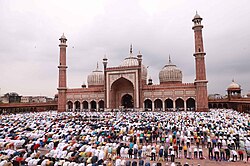
The '''Masjid-i-Jehan-Numa''', commonly known as the '''Jama Masjid''', in [[Old Delhi]] area of [[Delhi]], is one of the largest [[mosques]] in [[India]].<ref name="JM">{{cite web |title=Jama Masjid, Delhi |url=http://www.culturalindia.net/monuments/jama-masjid.html |access-date=19 May 2017 |publisher=Cultural India website |date=n.d. |archive-date=5 December 2023 |archive-url=https://web.archive.org/web/20231205153101/https://www.culturalindia.net/monuments/jama-masjid.html |url-status=dead }}</ref> Its builder was the [[List of emperors of the Mughal Empire|Mughal emperor]] [[Shah Jahan]], between 1644 and 1656, and it was inaugurated by its first [[Imam]], Syed Abdul Ghafoor Shah Bukhari. Situated in the Mughal capital of ''[[Shahjahanabad]]'' (today Old Delhi), it served as the imperial mosque of the [[Mughal emperors]] until the demise of the empire in 1857. The Jama Masjid was regarded as a symbolic gesture of Mughal power across India. It was also a site of political significance during several key periods of British rule. It remains in active use, and is one of Delhi's most iconic sites, closely identified with the methods of Old Delhi. The mosque structure is a [[Monuments of National Importance (India)|Monument of National Importance]].<ref name="ASI MNI">{{Cite web|url=http://asi.nic.in/alphabetical-list-of-monuments-delhi/|title=List of Ancient Monuments and Archaeological Sites and Remains of Delhi |work=[[Archaeological Survey of India]] |access-date=2018-10-02}}</ref> | |||
== Names == | == Names == | ||
The mosque has two names. The older one, bestowed by Shah Jahan, is ' | The mosque has two names. The older one, bestowed by Shah Jahan, is ''Masjid-i-Jehān-Numā'', interpreted as "mosque that reflects the whole world", probably an [[allusion]] to the [[Cup of Jamshid|''Jām-e-Jehān Numā'']]. The other more common one is ''Jāmā Masjid'' ({{langx|ur|{{Nastaliq|جامع مسجد}}}}, from the Arabic meaning "[[congregational mosque]]"), which emerged among the common populace.{{Sfn|Aziz|2017|p=18}} The term ''Jama Masjid'' is not unique to this mosque; since the 7th century, it has been used to denote the community mosque or Friday mosque, and hence many around the world bear this name and variants of it.{{Sfn|Aziz|2017|p=16-17}} | ||
== Location == | == Location == | ||
The mosque is located within the historic city of [[Shahjahanabad]], today known as the locality of | [[File:Old Delhi market, Jama Masjid.jpg|thumb|Old Delhi market opposite Jama Masjid, Delhi]] | ||
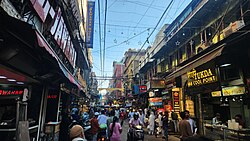
The mosque is located within the historic city of [[Shahjahanabad]], today known as the locality of Old Delhi. Across from the mosque are the [[Red Fort]] and [[Sunehri Masjid (Chandni Chowk)|Sunehri Masjid]].<ref>{{Cite web |date=2018-01-27 |title=Shahjahanabad: How a planned city came undone |url=https://www.hindustantimes.com/delhi-news/shahjahanabad-how-a-planned-city-came-undone/story-z7Gg3imYzCjCQQP3CBuZCO.html |access-date=2021-09-12 |work=[[Hindustan Times]] |language=en}}</ref> As one of the focal points of Old Delhi, Jama Masjid is surrounded by various commercial centres, such as the historic [[Chandni Chowk]].{{Sfn|Rajagopalan|2016|p=102}} The tomb of [[Abul Kalam Azad]], Indian independence activist, is located adjacent to the mosque.{{Sfn|Rajagopalan|2016|p=114}} | |||
== History == | == History == | ||
=== Construction and Mughal | === Construction and Mughal era === | ||
[[Mughal Empire|Mughal]] | [[Mughal Empire|Mughal]] emperor [[Shah Jahan]] built the Jama Masjid between 1650 and 1656, at the highest point of Shahjahanabad. It was constructed by approximately 5,000 workers.<ref name=":0">{{Cite web |last=Lews |first=Robert |title=Jama Masjid of Delhi |url=https://www.britannica.com/place/Jami-Masjid-mosque-Delhi-India |website=Britannica}}</ref><ref name=Asher>{{cite book |author=Asher, Catherine B. |year=1992 |title=The New Cambridge History of India: Architecture of Mughal India |publisher=[[Cambridge University Press]] |page=193 |isbn=978-0-521-26728-1}}</ref><ref name=":2" /> The workforce was diverse, consisting of Indians, Arabs, Persians, Turks, and Europeans. The construction was supervised primarily by [[Saadullah Khan (Mughal Empire)|Sadullah Khan]], the [[Vizier|wazir]] (or prime minister) during Shah Jahan's reign, and Fazil Khan, the [[comptroller]] of Shah Jahan's household. The cost of the construction at the time was ten lakh (one million) rupees.<ref name="Ur-Rahman">{{Cite book |last=Ur-Rahman |first=Aziz |url=https://www.indianculture.gov.in/rarebooks/history-jama-masjid-and-interpretation-muslim-devotions |title=History of Jama Masjid and interpretation of Muslim devotions |year=1936 |isbn= }}</ref>{{rp|8–9}} The mosque was inaugurated on 23 July 1656 by Syed Abdul Ghafoor Shah Bukhari, from [[Bukhara]], [[Uzbekistan]]. He had been invited by Shah Jahan to be the ''[[Shahi Imam]]'' (Royal [[Imam]]) of the mosque.<ref>Dalrymple, p.252</ref> | ||
The mosque was one of the last monuments built under Shah Jahan. After its completion, it served as the royal mosque of the emperors until the end of the Mughal period. The ''[[Khutbah|khutba]]'' was recited by the Mughal emperor during the Friday noon prayer, legitimising his rule. The mosque was hence a symbol of Mughal sovereignty in India, carrying political significance. It was also an important centre of social life for the residents of Shahjahanabad, providing a space transcending class divide for diverse people to interact.{{Sfn|Aziz|2017|p=18}}{{Sfn|Rajagopalan|2016|p=92-93}} | The mosque was one of the last monuments built under Shah Jahan. After its completion, it served as the royal mosque of the emperors until the end of the Mughal period. The ''[[Khutbah|khutba]]'' was recited by the Mughal emperor during the Friday noon prayer, legitimising his rule. The mosque was hence a symbol of Mughal sovereignty in India, carrying political significance. It was also an important centre of social life for the residents of Shahjahanabad, providing a space transcending class divide for diverse people to interact.{{Sfn|Aziz|2017|p=18}}{{Sfn|Rajagopalan|2016|p=92-93}} In 1757, the ''khutba'' was read in the name of [[Ahmad Shah Durrani]], the Afghan conqueror who was invited to Delhi by Emperor [[Alamgir II]].<ref>''[https://books.google.com.au/books/about/Marathas_and_Panipat.html?id=TmU9AAAAMAAJ&redir_esc=y Marathas and Panipat]'' by Hari Ram Gupta (1961) pg. 326</ref> | ||
=== British | === British rule === | ||
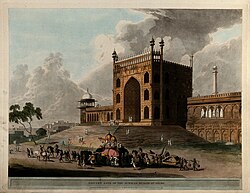
[[File:Eastern gate of the Jami Masjid at Delhi, India. Coloured aq Wellcome V0050460.jpg|thumb|245x245px|Eastern gate of the Jami Masjid, painted in 1795 by [[Thomas Daniell]]]] | [[File:Eastern gate of the Jami Masjid at Delhi, India. Coloured aq Wellcome V0050460.jpg|thumb|245x245px|Eastern gate of the Jami Masjid, painted in 1795 by [[Thomas Daniell]]]] | ||
The British took over Shahjahanabad in 1803. The Mughal Emperor remained the ritual imperial head of the mosque, but Mughal power and patronage had significantly waned.{{Sfn|Aziz|2017|p=19}}{{Sfn|Rajagopalan|2016|p=106}} The initial policy of the British in the city was favourable towards its residents; the British undertook repairs and even renovations of the Jama Masjid.{{Sfn|Aziz|2017|p=19}} The Masjid continued to serve as a site of social and political discourse, in keeping with other mosques of Delhi at the time; for example, theological and philosophical debates were held between Muslims and Christians.{{Sfn|Rajagopalan|2016|p=94}} | The British took over Shahjahanabad in 1803. The Mughal Emperor remained the ritual imperial head of the mosque, but Mughal power and patronage had significantly waned.{{Sfn|Aziz|2017|p=19}}{{Sfn|Rajagopalan|2016|p=106}} The initial policy of the British in the city was favourable towards its residents; the British undertook repairs and even renovations of the Jama Masjid.{{Sfn|Aziz|2017|p=19}} The Masjid continued to serve as a site of social and political discourse, in keeping with other mosques of Delhi at the time; for example, theological and philosophical debates were held between Muslims and Christians.{{Sfn|Rajagopalan|2016|p=94}} | ||
The [[Revolt of 1857]] was a major turning point in this situation. This event resulted in the deaths of many British people in the city, and weakened colonial authority, deeply affronting the British.{{Sfn|Aziz|2017|p=19}} It also ended the Mughal empire. The British perceived the revolt as instigated by Muslims, cultivated within Delhi's mosques.{{Sfn|Rajagopalan|2016|p=95}} After the British reclaimed the city in the same year, they razed many mosques and banned the congregation of Muslims in any remaining mosques. The Jama Masjid fell into British confiscation during this time, and was barred from any religious use. It was repeatedly considered for destruction, but the British eventually began using it as barracks for its Sikh and European soldiers. This was a desecration of the space; Aziz characterises the decision as deliberate, in order to insult the sentiments of the city's Muslim inhabitants.{{Sfn|Aziz|2017|p=20-21}} | The [[Revolt of 1857]] was a major turning point in this situation. This event resulted in the deaths of many British people in the city, and weakened colonial authority, deeply affronting the British.{{Sfn|Aziz|2017|p=19}} It also ended the Mughal empire. The British perceived the revolt as instigated by Muslims, cultivated within Delhi's mosques.{{Sfn|Rajagopalan|2016|p=95}} After the British reclaimed the city in the same year, they razed many mosques and banned the congregation of Muslims in any remaining mosques. The Jama Masjid fell into British confiscation during this time, and was barred from any religious use. It was repeatedly considered for destruction, but the British eventually began using it as barracks for its Sikh and European soldiers. This was a desecration of the space; Aziz characterises the decision as deliberate, in order to insult the sentiments of the city's Muslim inhabitants.{{Sfn|Aziz|2017|p=20-21}} | ||
The Masjid was eventually returned to the Muslim population in 1862, due to their increasing resentment of British actions. Multiple conditions were imposed, including the usage of Jama Masjid as strictly a religious site, as well as mandatory policing by the British. The Jama Masjid Managing Committee (JMMC), consisting of respected Muslims of Delhi, was established as a formal body to represent the mosque and enforce these conditions.{{Sfn|Aziz|2017|p=24-27}}{{Sfn|Rajagopalan|2016|p=93}} | The Masjid was eventually returned to the Muslim population in 1862, due to their increasing resentment of British actions. Multiple conditions were imposed, including the usage of Jama Masjid as strictly a religious site, as well as mandatory policing by the British. The Jama Masjid Managing Committee (JMMC), consisting of respected Muslims of Delhi, was established as a formal body to represent the mosque and enforce these conditions.{{Sfn|Aziz|2017|p=24-27}}{{Sfn|Rajagopalan|2016|p=93}} | ||
Upon its return, the Jama Masjid was reestablished as a mosque. Though the Mughal state had been dissolved, the mosque received patronage from various regional Islamic rulers and nobles. In 1886, the [[Nawab of Rampur]] donated a large sum of 1,55,000 rupees to facilitate repairs. In 1926, a donation from the [[Nizam of Hyderabad]] of 1,00,000 rupees was used for similar purposes.{{Sfn|Rajagopalan|2016|p=103-104}} | Upon its return, the Jama Masjid was reestablished as a mosque. Though the Mughal state had been dissolved, the mosque received patronage from various regional Islamic rulers and nobles. In 1886, the [[Nawab of Rampur]] donated a large sum of 1,55,000 rupees to facilitate repairs. In 1926, a donation from the [[Nizam of Hyderabad]] of 1,00,000 rupees was used for similar purposes.{{Sfn|Rajagopalan|2016|p=103-104}} | ||
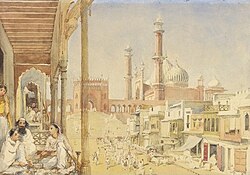
[[File:Jama Masjid, Delhi, watercolour, 1852.jpg|thumb|Jama Masjid in 1852, as seen from the adjacent [[Urdu Bazaar]].|252x252px]]Growing unrest against British rule manifested in Delhi's mosques from 1911. The Jama Masjid was frequently used for non-religious, political purposes, against the rules instituted. While the British could police and clamp down on political activities in public spaces, the Jama Masjid was a religious space and was hence protected from such action, by both law (Religious Endowment Act, 1863) and the sentiments of Delhi.{{Sfn|Rajagopalan|2016|p=96-97}} Hindus often gathered with Muslims in the mosque to express anti-colonial solidarity, in spite of simmering tension between the communities in the colonial period.{{Sfn|Rajagopalan|2016|p=111}} | [[File:Jama Masjid, Delhi, watercolour, 1852.jpg|thumb|Jama Masjid in 1852, as seen from the adjacent [[Urdu Bazaar]].|252x252px]]Growing unrest against British rule manifested in Delhi's mosques from 1911. The Jama Masjid was frequently used for non-religious, political purposes, against the rules instituted. While the British could police and clamp down on political activities in public spaces, the Jama Masjid was a religious space and was hence protected from such action, by both law (Religious Endowment Act, 1863) and the sentiments of Delhi.{{Sfn|Rajagopalan|2016|p=96-97}} Hindus often gathered with Muslims in the mosque to express anti-colonial solidarity, in spite of simmering tension between the communities in the colonial period.{{Sfn|Rajagopalan|2016|p=111}} | ||
=== Post-Colonial | === Post-Colonial era === | ||
The Jama Masjid continued to be a political symbol after independence. Indian independence activist [[Abul Kalam Azad]] delivered a speech from its pulpit during the | The Jama Masjid continued to be a political symbol after independence. Indian independence activist [[Abul Kalam Azad]] delivered a speech from its pulpit during the Thursday (''Jumerat'') prayers of 23 October 1947. The Partition of India was underway, causing massive population movements in Delhi. Azad implored the Muslims of Delhi to remain in India, and attempted to reassure them that India was still their homeland.{{Sfn|Rajagopalan|2016|p=113-114}} | ||
During 1948, the last [[Nizam of Hyderabad]], [[Mir Osman Ali Khan|Asaf Jah VII]] was asked for a donation of 75,000 rupees to repair one-fourth of the mosque floor. The Nizam instead sanctioned 3,00,000 rupees, stating that the remaining three-fourths of the mosque should not look old.<ref>{{cite web|date= | During 1948, the last [[Nizam of Hyderabad]], [[Mir Osman Ali Khan|Asaf Jah VII]] was asked for a donation of 75,000 rupees to repair one-fourth of the mosque floor. The Nizam instead sanctioned 3,00,000 rupees, stating that the remaining three-fourths of the mosque should not look old.<ref>{{cite web |date=February 24, 2017 |title=Remembering Mir Osman Ali Khan on his 51st death anniversary |url=https://medium.com/@hyderabadhistoryproject/remembering-mir-osman-ali-khan-on-his-51st-death-anniversary-3aaf53430998 |access-date=June 17, 2018 |work=Medium corporation}}</ref><ref>{{cite news |date=February 25, 2017 |title=Surviving aides say Mir Osman Ali Khan donated generously for social causes, but did not like to spend on himself |work=[[The Hindu]] |url=http://www.thehindu.com/news/cities/Hyderabad/the-last-nizam-of-hyderabad-was-not-a-miser/article17367987.ece |access-date=June 18, 2018}}</ref> | ||
The mosque served as a site of significance with regards to the infamously communal [[Ayodhya dispute|Babri Masjid dispute]]. [[Abdullah Bukhari]], the Shahi Imam of the Jama Masjid at the time, made several speeches in 1986 regarding the issue from the Masjid, condemning the political support given to the Hindu cause and mobilising Muslim sentiments. In one instance this ignited riots and clashes in Old Delhi. In 1987, Jama Masjid was the staging point for a major peaceful protest regarding the Babri Masjid dispute. On 28 May 1987, amidst rising communal tensions and riots all over India, the Jama Masjid was closed by the Imam and adorned in black cloth, symbolising Muslim resentment of government actions at the time. The decision was highly controversial among Islamic leadership.<ref>{{Cite journal|last=Ahmed|first=Hilal|date=2013|title=Mosque as Monument: The Afterlives of Jama Masjid and the Political Memories of a Royal Muslim Past|url=https://doi.org/10.1080/02666030.2013.772814|journal=South Asian Studies|volume=29|pages= | The mosque served as a site of significance with regards to the infamously communal [[Ayodhya dispute|Babri Masjid dispute]]. [[Abdullah Bukhari]], the Shahi Imam of the Jama Masjid at the time, made several speeches in 1986 regarding the issue from the Masjid, condemning the political support given to the Hindu cause and mobilising Muslim sentiments. In one instance this ignited riots and clashes in Old Delhi. In 1987, Jama Masjid was the staging point for a major peaceful protest regarding the Babri Masjid dispute. On 28 May 1987, amidst rising communal tensions and riots all over India, the Jama Masjid was closed by the Imam and adorned in black cloth, symbolising Muslim resentment of government actions at the time. The decision was highly controversial among Islamic leadership.<ref name=ahmed>{{Cite journal |last=Ahmed |first=Hilal |date=2013 |title=Mosque as Monument: The Afterlives of Jama Masjid and the Political Memories of a Royal Muslim Past |url=https://doi.org/10.1080/02666030.2013.772814 |journal=South Asian Studies |volume=29 |pages=52–55, 56 |doi=10.1080/02666030.2013.772814 |s2cid=85512513 |url-access=subscription }}</ref> | ||
== Modern era == | === Modern era === | ||
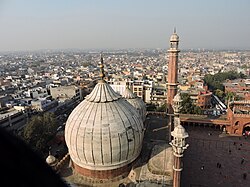
[[File:Jama Masjid,Delhi,India 05.jpg|thumb|248x248px|View of Delhi from the mosque's domes. Jama Masjid has been an enduring symbol of Delhi throughout its history.]] | [[File:Jama Masjid,Delhi,India 05.jpg|thumb|248x248px|View of Delhi from the mosque's domes. Jama Masjid has been an enduring symbol of Delhi throughout its history.]] | ||
[[File:People offering Namaz on the occasion of Id-Ul-Zuha, at Jama Masjid, in New Delhi on August 12, 2019 (1).jpg|thumb|People offering [[Namaz]] on the occasion of [[Id-ul-Zuha]], | [[File:People offering Namaz on the occasion of Id-Ul-Zuha, at Jama Masjid, in New Delhi on August 12, 2019 (1).jpg|thumb|People offering [[Namaz]] on the occasion of [[Id-ul-Zuha]], in 2019]] | ||
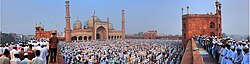
The Jama Masjid serves as Delhi's primary mosque, and has a largely congregational function. The Muslims of the city traditionally gather here to offer communal Friday prayer, as well as for major festivals such as [[Eid al-Fitr|Eid]]. | The Jama Masjid serves as Delhi's primary mosque,<ref name=":0" /> and has a largely congregational function. The Muslims of the city traditionally gather here to offer communal Friday prayer, as well as for major festivals such as [[Eid al-Fitr|Eid]]. The mosque is also a major [[tourist attraction]], and derives a significant amount of income through the visits of foreigners.<ref name=ahmed/> | ||
The function of the mosque as an autonomous political space has continued in the modern era. For example, in 2001 (in the aftermath of the [[9/11 attacks]]) the mosque was a site of protest against U.S bombings in Afghanistan.{{Sfn|Rajagopalan|2016|p=116}} In 2019, massive protests occurred at the site due to the controversial [[Citizenship Amendment Act]].<ref>{{Cite news|title=Thousands protest against citizenship law near Jama Masjid|work=Telangana Today|url=https://telanganatoday.com/thousands-protest-against-citizenship-law-near-jama-masjid}}</ref> | The function of the mosque as an autonomous political space has continued in the modern era. For example, in 2001 (in the aftermath of the [[9/11 attacks]]) the mosque was a site of protest against U.S bombings in Afghanistan.{{Sfn|Rajagopalan|2016|p=116}} In 2019, massive protests occurred at the site due to the controversial [[Citizenship Amendment Act]].<ref>{{Cite news |title=Thousands protest against citizenship law near Jama Masjid |work=Telangana Today |url=https://telanganatoday.com/thousands-protest-against-citizenship-law-near-jama-masjid |date= |access-date= }}</ref> | ||
=== Renovation === | ==== Renovation ==== | ||
In 2006, it was reported that the mosque was in urgent need of repair, following which the [[Saudi Arabia]]n king [[Abdullah of Saudi Arabia|Abdullah]] offered to pay for it. The Imam said that he had received the offer directly from the Saudi authorities, but requested them to approach the [[Government of India|Indian | In 2006, it was reported that the mosque was in urgent need of repair, following which the [[Saudi Arabia]]n king [[Abdullah of Saudi Arabia|Abdullah]] offered to pay for it. The Imam said that he had received the offer directly from the Saudi authorities, but requested them to approach the [[Government of India|Indian Government]].<ref>{{cite news |title=Saudi offer to fix Delhi mosque |date=4 January 2006 |url=https://news.bbc.co.uk/2/hi/south_asia/4581056.stm |access-date=23 March 2015 |work=[[BBC News]] }}</ref> However, the [[Delhi High Court]] said that this matter had no "legal sanctity" giving no "special equities" to the Imam. | ||
A project aiming to renovate the Jama Masjid and its surroundings has remained unimplemented since the early 2000s, due to several administrative and logistical roadblocks.<ref>{{cite web|title=Jama Masjid: Restorations plans for | A project aiming to renovate the Jama Masjid and its surroundings has remained unimplemented since the early 2000s, due to several administrative and logistical roadblocks.<ref>{{cite web |title=Jama Masjid: Restorations plans for Delhi's grand old mosque put on fast track |url=https://www.hindustantimes.com/delhi-news/jama-masjid-restorations-plans-for-delhi-s-grand-old-mosque-put-on-fast-track/story-dQDFtjfKwXJDvQdP1892MK.html |work=[[Hindustan Times]] |date= |access-date= }}</ref><ref>{{cite news |title=Lack of funds holds up Jama Masjid refurbishment |url=https://www.thehindu.com/news/cities/Delhi/Lack-of-funds-holds-up-Jama-Masjid-refurbishment/article16836616.ece |work=[[The Hindu]] |date=8 January 2010 |access-date= }}</ref>[[File:Jama Maszid.jpg|thumb|500px| Eid panorama at the mosque]] | ||
=== 2006 Jama Masjid explosions === | ==== 2006 Jama Masjid explosions ==== | ||
{{main|2006 Jama Masjid explosions}} | {{main|2006 Jama Masjid explosions}} | ||
On | On 14 April 2006, there were [[2006 Jama Masjid explosions|two explosions]] which came soon after Friday prayers and occurred in swift succession. It was unclear how the blasts occurred. Among the casualties, one was in serious condition, whereas eight other people sustained minor injuries. Imam [[Ahmed Bukhari]] commented, "there is anger among our people but I am appealing to them to maintain calm".<ref>{{cite news |url=https://news.bbc.co.uk/2/hi/south_asia/4910028.stm |title=Nine hurt in Delhi mosque blast |date=14 April 2006 |work=[[BBC News]] |access-date=23 March 2015 }}</ref> | ||
===2010 Jama Masjid attack=== | ====2010 Jama Masjid attack==== | ||
{{main|2010 Jama Masjid attack}} | {{main|2010 Jama Masjid attack}} | ||
On | On 15 September 2010, two Taiwanese tourists were injured after gunmen on a motorcycle opened fire on a bus parked near gate number three of the mosque.<ref>{{cite news |url=https://www.bbc.co.uk/news/world-south-asia-11361549 |title=Tourists shot near Delhi mosque |date=19 September 2010 |work=[[BBC News]] |access-date=19 May 2017 }}</ref> After the attack, the police detained 30 people to question and the area was turned into a fortress because policemen were heavily deployed.<ref>{{cite web |url=https://www.indiatoday.in/india/north/story/4-terrorists-involved-in-jama-masjid-firing-intelligence-sources-82374-2010-09-19 |title=4 terrorists involved in Jama Masjid firing: Intelligence sources |work=India Today |date=20 September 2010 |access-date=10 April 2015}}</ref> | ||
In November 2011, the [[Delhi Police]] arrested six members of the [[Indian Mujahideen]] who were believed to be behind the Jama Masjid blast along with the [[2010 Pune bombing|Pune German bakery]] blast. Sources said that the "'main man' Imran" allegedly planted the bomb in a car outside the mosque.<ref>{{cite web|url=http://ibnlive.in.com/news/delhi-6-indian-mujahideen-operatives-arrested/207114-3.html|archive-url=https://web.archive.org/web/20111201183929/http://ibnlive.in.com/news/delhi-6-indian-mujahideen-operatives-arrested/207114-3.html|url-status=dead|archive-date=1 December 2011|title=6 arrested for Pune blast, Jama Masjid attack| | In November 2011, the [[Delhi Police]] arrested six members of the [[Indian Mujahideen]] who were believed to be behind the Jama Masjid blast along with the [[2010 Pune bombing|Pune German bakery]] blast. Sources said that the "'main man' Imran" allegedly planted the bomb in a car outside the mosque.<ref>{{cite web |url=http://ibnlive.in.com/news/delhi-6-indian-mujahideen-operatives-arrested/207114-3.html |archive-url=https://web.archive.org/web/20111201183929/http://ibnlive.in.com/news/delhi-6-indian-mujahideen-operatives-arrested/207114-3.html |url-status=dead |archive-date=1 December 2011 |title=6 arrested for Pune blast, Jama Masjid attack |work=IBN Live |access-date=10 April 2015}}</ref> In September 2013 it was reported that [[Yasin Bhatkal]], a leader of the group, along with Assadullah Akhtar, were arrested the month before and they admitted that they carried out the attack with the on-the-run Pakistani national Waqas. Yasin said that he was ordered by Karachi-based IM head Riyaz Bhatkal to do the task as the Imam allowed "semi-naked" foreigners inside it.<ref>{{cite web |url=http://www.hindustantimes.com/newdelhi/cops-got-wrong-man-for-jama-masjid-attack-bhatkal/article1-1122253.aspx |archive-url=https://web.archive.org/web/20150425123019/http://www.hindustantimes.com/newdelhi/cops-got-wrong-man-for-jama-masjid-attack-bhatkal/article1-1122253.aspx |url-status=dead |archive-date=25 April 2015 |date= |title=Cops got wrong man for Jama Masjid attack: Bhatkal |work=[[Hindustan Times]] |access-date=10 April 2015}}</ref> | ||
== Architecture == | == Architecture == | ||
The Jama Masjid was built as a part of Shah Jahan's new capital in Delhi, [[Shahjahanabad]]. At the time of its construction, it was the largest mosque in the Indian subcontinent. Shah Jahan claimed | The Jama Masjid was built as a part of Shah Jahan's new capital in Delhi, [[Shahjahanabad]]. At the time of its construction, it was the largest mosque in the Indian subcontinent. Shah Jahan claimed the mosque was modelled after the [[Jama Mosque, Fatehpur Sikri|Jama Masjid of Fatehpur Sikri]], and this is reflected in the design of many exterior features, such as the [[façade]] and courtyard. However, the interior of the mosque more closely resembles the [[Jama Mosque, Agra|Jama Masjid in Agra]].<ref name=Asher/>{{rp|202}} The mosque predominantly uses [[red sandstone]], and is set apart from its predecessors by a more extensive usage of white marble. Black marble also features as a decorative element.<ref name=":2">{{Cite web|title=Jama Masjid (Delhi)|url=https://archnet.org/sites/1571|website=Archnet}}</ref><ref name=Asher/>{{rp|250}} Arabic and Persian calligraphic pieces are found on various surfaces of the structure, whose content ranges from religious to [[panegyric]].<ref name=":2" /><ref name=Asher/>{{rp|202}}<ref name=":0" /> | ||
Having been built on a hill, the mosque is situated on a plinth elevated 10 | Having been built on a hill, the mosque is situated on a plinth elevated {{convert|10|m}} above the surrounding city.<ref name=":2" /><ref name=":0" /> The complex is oriented to the west, towards [[Mecca]].<ref name=":0" /> An imperial college, imperial dispensary, and [[madrasa]] used to lie adjacent to the structure, but were destroyed in the uprisings of 1857.{{Sfn|Aziz|2017|p=17-18}} | ||
=== | === Gates === | ||
[[File:Visitor at Jama entrance.jpg|thumb|Eastern (main) gate | [[File:Visitor at Jama entrance.jpg|thumb|Eastern (main) gate]] | ||
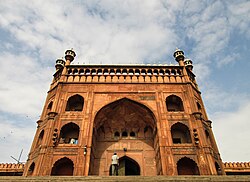
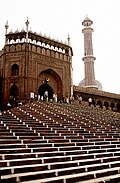
The mosque is accessed by three sandstone gates. The most prominent of these is the three-storey high eastern gate, which historically acted as the ''shahi'' (royal) entrance, reserved only for the use of the Emperor and his associates. The other two entrances are the northern and southern gates, which are two stories high and were used by the general population.<ref name=":2" /><ref name=":3">{{Cite book| | The mosque is accessed by three sandstone gates. The most prominent of these is the three-storey high eastern gate, which historically acted as the ''shahi'' (royal) entrance, reserved only for the use of the Emperor and his associates. The other two entrances are the northern and southern gates, which are two stories high and were used by the general population.<ref name=":2" /><ref name=":3">{{Cite book |last1=Alfieri |first1=Bianca Maria |title=Islamic Architecture of the Indian Subcontinent |last2=Borromeo |first2=Federico |publisher=Lawrence King Publishing |year=2000 |isbn=978-1-85669-189-5 |pages=248}}</ref> Each gate is accompanied by a three-sided sandstone stairway, with white markings to designate prayer positions.<ref name=":2" /> The cabinet located in the north gate has a collection of relics of [[Muhammad]] – the [[Quran]] written on deerskin, a red beard-hair of the prophet, his sandals and his footprints embedded in a marble block.<ref name="JM" />{{Better source needed|date=May 2021}} | ||
=== Courtyard === | === Courtyard === | ||
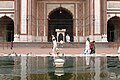
The square ''[[sahn]]'' (courtyard) is paved with red sandstone, and faces the eastern gate. It has a side length of at least 99 m, and can accommodate 25,000 worshippers. In its centre lies a marble [[Wudu|ablution]] tank, measuring 17 m | The square ''[[sahn]]'' (courtyard) is paved with red sandstone, and faces the eastern gate. It has a side length of at least {{convert|99|m|ft}}, and can accommodate 25,000 worshippers. In its centre lies a marble [[Wudu|ablution]] tank, measuring {{convert|17|m}} long and {{convert|15|m}} wide. Open arcades run along the edges of the courtyard, through which the surroundings of the masjid are visible. [[Chhatris]] mark the four corners of the courtyard, rising above the arcades.<ref name=":2" /><ref name=":0" /> | ||
=== Prayer Hall === | === Prayer Hall === | ||
[[File:Jama Masjid, Prayer area and interior arches, Delhi, India.jpg|thumb|Interior section of the prayer hall | [[File:Jama Masjid, Prayer area and interior arches, Delhi, India.jpg|thumb|Interior section of the prayer hall]] | ||
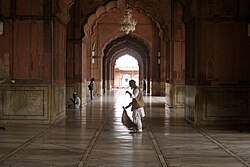
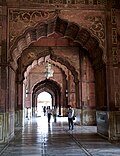
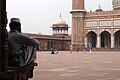
The prayer hall measures 61 | The prayer hall measures {{convert|61|m|ft}} long and {{convert|27|m|ft}} wide. Three marble domes rise up from its roof, featuring golden [[finial]]s. The [[façade]] of the prayer hall features a grand ''[[pishtaq]]'' in the centre, flanked by five smaller, cusped archways on either side. Above each archway of the prayer hall are some calligraphic pieces. The interior of the hall bears seven ''[[mihrab]]s'' (prayer niches) on the western ''[[qibla]]'' wall, corresponding to the seven bays into which the hall is divided. The central ''mihrab'' is intricately decorated and clad in marble, with a marble ''[[minbar]]'' (pulpit) lying to its right. The hall is floored with white and black ornamented marble to look like a Muslim prayer mat.<ref name=":2" /> | ||
=== Minarets === | === Minarets === | ||
The mosque's domes are flanked by two sandstone [[ | The mosque's domes are flanked by two sandstone [[minaret]]s, at the northeast and southeast corners.<ref name=":2" /><ref name=":0" /> They are {{convert|41|m|ft}} high and longitudinally striped with white marble. Each minaret consists of 130 steps, along which viewing galleries occur at three places. Both minarets are topped with a marble chhatri.<ref name=":2" /> | ||
== Shahi Imam == | == Shahi Imam == | ||
{{Main|Shahi Imam}} | {{Main|Shahi Imam}} | ||
The [[Imam | Shah Jahān's wish was apparently to build the most important mosque in India, without any parallel anywhere in the Mughal Empire. He also decided that its Imam (the Muslim religious leader who leads the prayer) was to become the most important religious leader of his reign. The Imam of Jama Masjid thus received the title of Shahī Imam (religious leader installed by emperor). All subsequent Mughal emperors from Aurangzeb to Bahadur Shah II (1837-1857) were crowned by the Shahi Imam of the Jama Masjid in Delhi.<ref>{{cite book |last1=Hajianfard |first1=Ramin |title=Building of the Jama Masjid in Delhi (1650-1656) |date=2016 |publisher=CA, ABC-CLIO |location=Santa Barbara |isbn=978-1610695664 |page=784 }}</ref> | ||
{| class="wikitable" | The [[Imam]]s of Delhi's Jama Masjid have traditionally been the direct descendants of the first Imam of the Masjid, Syed Abdul Ghafoor Shah Bukhari, who was appointed by Shah Jahan.<ref name="Ur-Rahman"/>{{rp|34–35}} Their position is known as that of the ''Shahi Imam,'' or Royal Imam. The person next-in-line to the position is known as the ''Naib Imam'', or Deputy Imam.<ref name=ahmed/> The Shahi Imams bear the last name of ''Bukhari,'' denoting their ancestral origin in [[Bukhara]] (of modern day Uzbekistan). The imams who have occupied the position are listed below. | ||
{| class="wikitable sortable" | |||
|- | |- | ||
! Ordinal !! Name !! Title !! Term start !! Term end !! Time in office | |||
|- | |- | ||
| | |align=center| {{nts|1}} || Abdul Ghafoor Shah Bukhari || ''Imam-us-Sultan'' ||align=center|{{start date|1656|07|23|df=y}} ||align=center| ||align=right| | ||
|Abdul | |||
| | |||
| | |||
|- | |- | ||
| | |align=center| {{nts|2}} || Abdul Shakoor Shah Bukhari || ||align=center| ||align=center| ||align=right| | ||
|Abdul | |||
| | |||
| | |||
|- | |- | ||
| | |align=center| {{nts|3}} || Abdul Raheem Shah Bukhari || ||align=center| ||align=center| ||align=right| | ||
|Abdul | |||
| | |||
| | |||
|- | |- | ||
| | |align=center| {{nts|4}} || Abdul Ghafoor Shah Bukhari Thani || ||align=center| ||align=center| ||align=right| | ||
|Abdul | |||
| | |||
| | |||
|- | |- | ||
| | |align=center| {{nts|5}} || Abdul Rehman Shah Bukhari || ||align=center| ||align=center| ||align=right| | ||
|Abdul | |||
| | |||
| | |||
|- | |- | ||
| | |align=center| {{nts|6}} || Abdul Kareem Shah Bukhari || ||align=center| ||align=center| ||align=right| | ||
| | |||
| | |||
| | |||
|- | |- | ||
| | |align=center| {{nts|7}} || Mir Jeewan Shah Bukhari || ||align=center| ||align=center| ||align=right| | ||
|Mir | |||
| | |||
| | |||
|- | |- | ||
| | |align=center| {{nts|8}} || Mir Ahmed Ali Shah Bukhari || ||align=center| ||align=center| ||align=right| | ||
| | |||
| | |||
| | |||
|- | |- | ||
|10 | |align=center| {{nts|9}} || Mohammed Shah Bukhari || ||align=center| {{start date|1892|10|16|df=y}} ||align=center| ||align=right| | ||
| | |||
| | |||
| | |||
|- | |- | ||
| | |align=center| {{nts|10}} || Ahmed Bukhari || ''Shams-ul-Ulama'' ||align=center| ||align=center| ||align=right| | ||
| | |||
| | |||
| | |||
|- | |- | ||
| | |align=center| {{nts|11}} || Hameed Bukhari || ||align=center| {{start date|1942|02|20|df=y}} ||align=center| {{end date|1973|07|08|df=y}} ||align=right| {{age in years and days|1942|02|20|1973|07|08}} | ||
| | |||
| | |||
| | |||
|- | |- | ||
| | |align=center| {{nts|12}} || [[Abdullah Bukhari]] || ||align=center| {{start date|1973|07|08|df=y}} ||align=center| {{end date|2000|10|14|df=y}} ||align=right| {{age in years and days|1973|07|08|2000|10|14}} | ||
|[[ | |||
| | |||
|14 | |||
|- | |- | ||
! colspan=" | |align=center| {{nts|13}} || [[Ahmed Bukhari]] I || ||align=center| {{start date|2000|10|14|df=y}} ||align=center| {{end date|2024|02|25|df=y}} ||align=right| {{age in years and days|2000|10|14|2024|02|25}} | ||
|- | |||
|align=center| {{nts|14}} || [[Shaban Bukhari]] || ||align=center| {{start date|2024|02|25|df=y}} ||align=center| ''incumbent'' ||align=right| {{age in years and days|2024|02|25}} | |||
|- | |||
! colspan="6" |Sources:<ref>{{Cite web|date=October 15, 2008|title=Imam Bukhari's family tree|url=http://twocircles.net/2008oct15/imam_bukhari_s_family_tree.html}}</ref><ref name="Ur-Rahman"/>{{rp|34–35}} | |||
|} | |} | ||
== Gallery == | == Gallery == | ||
<gallery> | <gallery> | ||
Jama Masjid, Delhi, India (2006) 1.jpg|Northern gate | |||
Detail of the arches inside Jama Masjid, Delhi.jpg|Inlay detail of interior arches | |||
Jama Masjid, Delhi, India.jpg|Facade | |||
Jama Masjid, Islamic art, Delhi, India.jpg|Pool | |||
Jama Masjid-Delhi-India4309.JPG|Detail of a balcony | |||
Jama Masjid, Courtyard, Delhi, India.jpg|Courtyard | |||
Courtyard, Jama Masjid, Delhi (01).jpg|Courtyard | |||
Jama Mosque Old Delhi, full view.jpg|Courtyard | |||
Jama Masjid-Delhi-India4255.JPG|Exterior wall | |||
</gallery> | </gallery> | ||
== See also == | == See also == | ||
* [[ | {{stack|{{portal|India|Islam}}}} | ||
* [[ | * [[Islam in India]] | ||
* [[List of mosques in India]] | |||
* [[List of Monuments of National Importance in Delhi]] | |||
== | == References == | ||
{{Reflist|30em}} | {{Reflist|30em}} | ||
== Bibliography == | == Bibliography == | ||
* {{ | * {{Cite journal |last=Aziz |first=Sadia |date=April 2017 |title=Mosque, Memory and State: A Case Study of Jama Masjid (India) and the Colonial State c. 1857 |url=http://pjaesthetics.uj.edu.pl/art/47/pja_47_1.pdf |journal=The Polish Journal of Aesthetics |language=en |publisher=Institute of Philosophy of the [[Jagiellonian University]] |volume=47 |pages=13-29 |doi=10.19205/47.17.1 |eissn=2544-8242 |archive-url=https://web.archive.org/web/20200712223728/https://pjaesthetics.uj.edu.pl/documents/138618288/138653014/pja_47_1.pdf/7015d859-c423-40ef-a054-02c299a252c5 |archive-date=2020-07-12}} | ||
* {{cite book|author=William | * {{cite book |author=Dalrymple, William |author-link=William Dalrymple (historian) |title=City of Djinns: A year in Delhi|year=2004 |publisher=Penguin books |isbn=978-0-14-303106-2}} | ||
* {{cite book|author=Swapna Liddle|title=Delhi: 14 Historic Walks|publisher=Tranquebar Press|isbn= | * {{cite book |last=Liddle |first=Swapna |author-link=Swapna Liddle |title=Delhi: 14 Historic Walks |year=2011 |publisher=Tranquebar Press |isbn=978-93-81626-24-5}} | ||
*{{Citation|last= | * {{Citation |last=Rajagopalan |first=Mrinalini |title=Building Histories: The Archival and Affective Lives of Five Monuments in Modern Delhi |year=2016 |publisher=University of Chicago Press |isbn=978-0-226-28347-0}} | ||
*{{ | * {{cite book|author1=Stott, David |author2=McCulloch, Victoria |title=Rajasthan, Delhi & Agra: Footprint Focus Guide |date=14 January 2014 |publisher=Footprint Handbooks |isbn=978-1-909268-39-5}} | ||
== External links == | == External links == | ||
{{ | {{sister project links}} | ||
{{commons category-inline|Jama Masjid, Delhi}} | {{commons category-inline|Jama Masjid, Delhi}} | ||
*{{Wikivoyage | * {{Wikivoyage inline|Jama Masjid}} | ||
* [https://www.topworldimages.com/The_Jama_Masjid_of_Delhi_A_Majestic_Testament_to_Mughal_Artistry_and_Historical_Res.htm The Jama Masjid Of Delhi] | |||
{{Mughal Empire}} | {{Mughal Empire}} | ||
{{Delhi landmarks}}{{Mosques in India}}{{Authority control}} | {{Delhi landmarks}} | ||
{{Mosques in India}} | |||
{{Authority control}} | |||
[[Category:1656 establishments in India]] | [[Category:1656 establishments in India]] | ||
[[Category: | [[Category:17th-century mosques in India]] | ||
[[Category:Grand mosques|Delhi]] | [[Category:Grand mosques|Delhi]] | ||
[[Category:Legendary footprints]] | |||
[[Category:Monuments of National Importance in Delhi]] | [[Category:Monuments of National Importance in Delhi]] | ||
[[Category: | [[Category:Mosque buildings with domes in India]] | ||
[[Category:Mosque buildings with minarets in India]] | |||
[[Category:Mosques completed in the 1650s]] | |||
[[Category:Mosques in Delhi]] | |||
[[Category:Mughal mosques]] | |||
[[Category:Sunni mosques in India]] | |||
Latest revision as of 19:40, 26 March 2026
| Jama Masjid | |
|---|---|
| Religion | |
| Affiliation | Sunni Islam |
| Rite | Hanafi |
| Congregational mosque | |
| Leadership |
|
| Status | Active |
| Location | |
| Location | Old Delhi, Central Delhi |
| Country | India |
| Lua error in Module:Location_map at line 851: Unable to find the specified location map definition: "Module:Location map/data/India Delhi central" does not exist. | |
| Coordinates | 28°39′03″N 77°14′00″E / 28.6507°N 77.2334°E |
| Architecture | |
| Type | Mosque |
| Style | |
| Completed | 1656 |
Construction cost | ₹1 million |
| Specifications | |
Direction of façade | West |
| Capacity | 25,000 worshippers |
| Length | 40 metres (130 ft) |
| Width | 27 metres (89 ft) |
| Dome | 3 |
| Minaret | 2 |
Minaret height | 41 metres (135 ft) |
| Materials | Red sandstone, marble |
| Website | |
| Jama Masjid | |
| Lua error: bad argument #1 to 'mw.loadJsonData' ('Module:Designation/list' is not a valid JSON page). | |
Official name | Ancient Mosque |
| Reference no. | N-DL-162 |
The Masjid-i-Jehan-Numa, commonly known as the Jama Masjid, in Old Delhi area of Delhi, is one of the largest mosques in India.[1] Its builder was the Mughal emperor Shah Jahan, between 1644 and 1656, and it was inaugurated by its first Imam, Syed Abdul Ghafoor Shah Bukhari. Situated in the Mughal capital of Shahjahanabad (today Old Delhi), it served as the imperial mosque of the Mughal emperors until the demise of the empire in 1857. The Jama Masjid was regarded as a symbolic gesture of Mughal power across India. It was also a site of political significance during several key periods of British rule. It remains in active use, and is one of Delhi's most iconic sites, closely identified with the methods of Old Delhi. The mosque structure is a Monument of National Importance.[2]
Names[edit | edit source]
The mosque has two names. The older one, bestowed by Shah Jahan, is Masjid-i-Jehān-Numā, interpreted as "mosque that reflects the whole world", probably an allusion to the Jām-e-Jehān Numā. The other more common one is Jāmā Masjid (Urdu: جامع مسجد, from the Arabic meaning "congregational mosque"), which emerged among the common populace.[3] The term Jama Masjid is not unique to this mosque; since the 7th century, it has been used to denote the community mosque or Friday mosque, and hence many around the world bear this name and variants of it.[4]
Location[edit | edit source]

The mosque is located within the historic city of Shahjahanabad, today known as the locality of Old Delhi. Across from the mosque are the Red Fort and Sunehri Masjid.[5] As one of the focal points of Old Delhi, Jama Masjid is surrounded by various commercial centres, such as the historic Chandni Chowk.[6] The tomb of Abul Kalam Azad, Indian independence activist, is located adjacent to the mosque.[7]
History[edit | edit source]
Construction and Mughal era[edit | edit source]
Mughal emperor Shah Jahan built the Jama Masjid between 1650 and 1656, at the highest point of Shahjahanabad. It was constructed by approximately 5,000 workers.[8][9][10] The workforce was diverse, consisting of Indians, Arabs, Persians, Turks, and Europeans. The construction was supervised primarily by Sadullah Khan, the wazir (or prime minister) during Shah Jahan's reign, and Fazil Khan, the comptroller of Shah Jahan's household. The cost of the construction at the time was ten lakh (one million) rupees.[11]:8–9 The mosque was inaugurated on 23 July 1656 by Syed Abdul Ghafoor Shah Bukhari, from Bukhara, Uzbekistan. He had been invited by Shah Jahan to be the Shahi Imam (Royal Imam) of the mosque.[12]
The mosque was one of the last monuments built under Shah Jahan. After its completion, it served as the royal mosque of the emperors until the end of the Mughal period. The khutba was recited by the Mughal emperor during the Friday noon prayer, legitimising his rule. The mosque was hence a symbol of Mughal sovereignty in India, carrying political significance. It was also an important centre of social life for the residents of Shahjahanabad, providing a space transcending class divide for diverse people to interact.[3][13] In 1757, the khutba was read in the name of Ahmad Shah Durrani, the Afghan conqueror who was invited to Delhi by Emperor Alamgir II.[14]
British rule[edit | edit source]

The British took over Shahjahanabad in 1803. The Mughal Emperor remained the ritual imperial head of the mosque, but Mughal power and patronage had significantly waned.[15][16] The initial policy of the British in the city was favourable towards its residents; the British undertook repairs and even renovations of the Jama Masjid.[15] The Masjid continued to serve as a site of social and political discourse, in keeping with other mosques of Delhi at the time; for example, theological and philosophical debates were held between Muslims and Christians.[17]
The Revolt of 1857 was a major turning point in this situation. This event resulted in the deaths of many British people in the city, and weakened colonial authority, deeply affronting the British.[15] It also ended the Mughal empire. The British perceived the revolt as instigated by Muslims, cultivated within Delhi's mosques.[18] After the British reclaimed the city in the same year, they razed many mosques and banned the congregation of Muslims in any remaining mosques. The Jama Masjid fell into British confiscation during this time, and was barred from any religious use. It was repeatedly considered for destruction, but the British eventually began using it as barracks for its Sikh and European soldiers. This was a desecration of the space; Aziz characterises the decision as deliberate, in order to insult the sentiments of the city's Muslim inhabitants.[19]
The Masjid was eventually returned to the Muslim population in 1862, due to their increasing resentment of British actions. Multiple conditions were imposed, including the usage of Jama Masjid as strictly a religious site, as well as mandatory policing by the British. The Jama Masjid Managing Committee (JMMC), consisting of respected Muslims of Delhi, was established as a formal body to represent the mosque and enforce these conditions.[20][21]
Upon its return, the Jama Masjid was reestablished as a mosque. Though the Mughal state had been dissolved, the mosque received patronage from various regional Islamic rulers and nobles. In 1886, the Nawab of Rampur donated a large sum of 1,55,000 rupees to facilitate repairs. In 1926, a donation from the Nizam of Hyderabad of 1,00,000 rupees was used for similar purposes.[22]

Growing unrest against British rule manifested in Delhi's mosques from 1911. The Jama Masjid was frequently used for non-religious, political purposes, against the rules instituted. While the British could police and clamp down on political activities in public spaces, the Jama Masjid was a religious space and was hence protected from such action, by both law (Religious Endowment Act, 1863) and the sentiments of Delhi.[23] Hindus often gathered with Muslims in the mosque to express anti-colonial solidarity, in spite of simmering tension between the communities in the colonial period.[24]
Post-Colonial era[edit | edit source]
The Jama Masjid continued to be a political symbol after independence. Indian independence activist Abul Kalam Azad delivered a speech from its pulpit during the Thursday (Jumerat) prayers of 23 October 1947. The Partition of India was underway, causing massive population movements in Delhi. Azad implored the Muslims of Delhi to remain in India, and attempted to reassure them that India was still their homeland.[25]
During 1948, the last Nizam of Hyderabad, Asaf Jah VII was asked for a donation of 75,000 rupees to repair one-fourth of the mosque floor. The Nizam instead sanctioned 3,00,000 rupees, stating that the remaining three-fourths of the mosque should not look old.[26][27]
The mosque served as a site of significance with regards to the infamously communal Babri Masjid dispute. Abdullah Bukhari, the Shahi Imam of the Jama Masjid at the time, made several speeches in 1986 regarding the issue from the Masjid, condemning the political support given to the Hindu cause and mobilising Muslim sentiments. In one instance this ignited riots and clashes in Old Delhi. In 1987, Jama Masjid was the staging point for a major peaceful protest regarding the Babri Masjid dispute. On 28 May 1987, amidst rising communal tensions and riots all over India, the Jama Masjid was closed by the Imam and adorned in black cloth, symbolising Muslim resentment of government actions at the time. The decision was highly controversial among Islamic leadership.[28]
Modern era[edit | edit source]

.jpg)
The Jama Masjid serves as Delhi's primary mosque,[8] and has a largely congregational function. The Muslims of the city traditionally gather here to offer communal Friday prayer, as well as for major festivals such as Eid. The mosque is also a major tourist attraction, and derives a significant amount of income through the visits of foreigners.[28]
The function of the mosque as an autonomous political space has continued in the modern era. For example, in 2001 (in the aftermath of the 9/11 attacks) the mosque was a site of protest against U.S bombings in Afghanistan.[29] In 2019, massive protests occurred at the site due to the controversial Citizenship Amendment Act.[30]
Renovation[edit | edit source]
In 2006, it was reported that the mosque was in urgent need of repair, following which the Saudi Arabian king Abdullah offered to pay for it. The Imam said that he had received the offer directly from the Saudi authorities, but requested them to approach the Indian Government.[31] However, the Delhi High Court said that this matter had no "legal sanctity" giving no "special equities" to the Imam.
A project aiming to renovate the Jama Masjid and its surroundings has remained unimplemented since the early 2000s, due to several administrative and logistical roadblocks.[32][33]

2006 Jama Masjid explosions[edit | edit source]
On 14 April 2006, there were two explosions which came soon after Friday prayers and occurred in swift succession. It was unclear how the blasts occurred. Among the casualties, one was in serious condition, whereas eight other people sustained minor injuries. Imam Ahmed Bukhari commented, "there is anger among our people but I am appealing to them to maintain calm".[34]
2010 Jama Masjid attack[edit | edit source]
On 15 September 2010, two Taiwanese tourists were injured after gunmen on a motorcycle opened fire on a bus parked near gate number three of the mosque.[35] After the attack, the police detained 30 people to question and the area was turned into a fortress because policemen were heavily deployed.[36]
In November 2011, the Delhi Police arrested six members of the Indian Mujahideen who were believed to be behind the Jama Masjid blast along with the Pune German bakery blast. Sources said that the "'main man' Imran" allegedly planted the bomb in a car outside the mosque.[37] In September 2013 it was reported that Yasin Bhatkal, a leader of the group, along with Assadullah Akhtar, were arrested the month before and they admitted that they carried out the attack with the on-the-run Pakistani national Waqas. Yasin said that he was ordered by Karachi-based IM head Riyaz Bhatkal to do the task as the Imam allowed "semi-naked" foreigners inside it.[38]
Architecture[edit | edit source]
The Jama Masjid was built as a part of Shah Jahan's new capital in Delhi, Shahjahanabad. At the time of its construction, it was the largest mosque in the Indian subcontinent. Shah Jahan claimed the mosque was modelled after the Jama Masjid of Fatehpur Sikri, and this is reflected in the design of many exterior features, such as the façade and courtyard. However, the interior of the mosque more closely resembles the Jama Masjid in Agra.[9]:202 The mosque predominantly uses red sandstone, and is set apart from its predecessors by a more extensive usage of white marble. Black marble also features as a decorative element.[10][9]:250 Arabic and Persian calligraphic pieces are found on various surfaces of the structure, whose content ranges from religious to panegyric.[10][9]:202[8]
Having been built on a hill, the mosque is situated on a plinth elevated 10 metres (33 ft) above the surrounding city.[10][8] The complex is oriented to the west, towards Mecca.[8] An imperial college, imperial dispensary, and madrasa used to lie adjacent to the structure, but were destroyed in the uprisings of 1857.[39]
Gates[edit | edit source]

The mosque is accessed by three sandstone gates. The most prominent of these is the three-storey high eastern gate, which historically acted as the shahi (royal) entrance, reserved only for the use of the Emperor and his associates. The other two entrances are the northern and southern gates, which are two stories high and were used by the general population.[10][40] Each gate is accompanied by a three-sided sandstone stairway, with white markings to designate prayer positions.[10] The cabinet located in the north gate has a collection of relics of Muhammad – the Quran written on deerskin, a red beard-hair of the prophet, his sandals and his footprints embedded in a marble block.[1][better source needed]
Courtyard[edit | edit source]
The square sahn (courtyard) is paved with red sandstone, and faces the eastern gate. It has a side length of at least 99 metres (325 ft), and can accommodate 25,000 worshippers. In its centre lies a marble ablution tank, measuring 17 metres (56 ft) long and 15 metres (49 ft) wide. Open arcades run along the edges of the courtyard, through which the surroundings of the masjid are visible. Chhatris mark the four corners of the courtyard, rising above the arcades.[10][8]
Prayer Hall[edit | edit source]

The prayer hall measures 61 metres (200 ft) long and 27 metres (89 ft) wide. Three marble domes rise up from its roof, featuring golden finials. The façade of the prayer hall features a grand pishtaq in the centre, flanked by five smaller, cusped archways on either side. Above each archway of the prayer hall are some calligraphic pieces. The interior of the hall bears seven mihrabs (prayer niches) on the western qibla wall, corresponding to the seven bays into which the hall is divided. The central mihrab is intricately decorated and clad in marble, with a marble minbar (pulpit) lying to its right. The hall is floored with white and black ornamented marble to look like a Muslim prayer mat.[10]
Minarets[edit | edit source]
The mosque's domes are flanked by two sandstone minarets, at the northeast and southeast corners.[10][8] They are 41 metres (135 ft) high and longitudinally striped with white marble. Each minaret consists of 130 steps, along which viewing galleries occur at three places. Both minarets are topped with a marble chhatri.[10]
Shahi Imam[edit | edit source]
Shah Jahān's wish was apparently to build the most important mosque in India, without any parallel anywhere in the Mughal Empire. He also decided that its Imam (the Muslim religious leader who leads the prayer) was to become the most important religious leader of his reign. The Imam of Jama Masjid thus received the title of Shahī Imam (religious leader installed by emperor). All subsequent Mughal emperors from Aurangzeb to Bahadur Shah II (1837-1857) were crowned by the Shahi Imam of the Jama Masjid in Delhi.[41] The Imams of Delhi's Jama Masjid have traditionally been the direct descendants of the first Imam of the Masjid, Syed Abdul Ghafoor Shah Bukhari, who was appointed by Shah Jahan.[11]:34–35 Their position is known as that of the Shahi Imam, or Royal Imam. The person next-in-line to the position is known as the Naib Imam, or Deputy Imam.[28] The Shahi Imams bear the last name of Bukhari, denoting their ancestral origin in Bukhara (of modern day Uzbekistan). The imams who have occupied the position are listed below.
| Ordinal | Name | Title | Term start | Term end | Time in office |
|---|---|---|---|---|---|
| 1 | Abdul Ghafoor Shah Bukhari | Imam-us-Sultan | 23 July 1656 | ||
| 2 | Abdul Shakoor Shah Bukhari | ||||
| 3 | Abdul Raheem Shah Bukhari | ||||
| 4 | Abdul Ghafoor Shah Bukhari Thani | ||||
| 5 | Abdul Rehman Shah Bukhari | ||||
| 6 | Abdul Kareem Shah Bukhari | ||||
| 7 | Mir Jeewan Shah Bukhari | ||||
| 8 | Mir Ahmed Ali Shah Bukhari | ||||
| 9 | Mohammed Shah Bukhari | 16 October 1892 | |||
| 10 | Ahmed Bukhari | Shams-ul-Ulama | |||
| 11 | Hameed Bukhari | 20 February 1942 | 8 July 1973 | 31 years, 138 days | |
| 12 | Abdullah Bukhari | 8 July 1973 | 14 October 2000 | 27 years, 98 days | |
| 13 | Ahmed Bukhari I | 14 October 2000 | 25 February 2024 | 23 years, 134 days | |
| 14 | Shaban Bukhari | 25 February 2024 | incumbent | 2 years, 239 days | |
| Sources:[42][11]:34–35 | |||||
Gallery[edit | edit source]
-
 Northern gate
 -
 Inlay detail of interior arches
 -
 Facade
 -
 Pool
Pool -
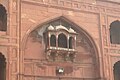 Detail of a balcony
 -
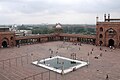 Courtyard
 -
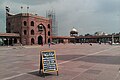 Courtyard
 -
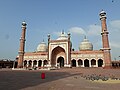 Courtyard
 -
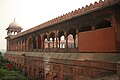 Exterior wall
_1.jpg)


.jpg)


See also[edit | edit source]

References[edit | edit source]
- ↑ 1.0 1.1 "Jama Masjid, Delhi". Cultural India website. n.d. Archived from the original on 5 December 2023. Retrieved 19 May 2017.
- ↑ "List of Ancient Monuments and Archaeological Sites and Remains of Delhi". Archaeological Survey of India. Retrieved 2 October 2018.
- ↑ 3.0 3.1 Aziz 2017, p. 18.
- ↑ Aziz 2017, p. 16-17.
- ↑ "Shahjahanabad: How a planned city came undone". Hindustan Times. 27 January 2018. Retrieved 12 September 2021.
- ↑ Rajagopalan 2016, p. 102.
- ↑ Rajagopalan 2016, p. 114.
- ↑ 8.0 8.1 8.2 8.3 8.4 8.5 8.6 Lews, Robert. "Jama Masjid of Delhi". Britannica.
- ↑ 9.0 9.1 9.2 9.3 Asher, Catherine B. (1992). The New Cambridge History of India: Architecture of Mughal India. Cambridge University Press. p. 193. ISBN 978-0-521-26728-1.
- ↑ 10.00 10.01 10.02 10.03 10.04 10.05 10.06 10.07 10.08 10.09 "Jama Masjid (Delhi)". Archnet.
- ↑ 11.0 11.1 11.2 Ur-Rahman, Aziz (1936). History of Jama Masjid and interpretation of Muslim devotions.
- ↑ Dalrymple, p.252
- ↑ Rajagopalan 2016, p. 92-93.
- ↑ Marathas and Panipat by Hari Ram Gupta (1961) pg. 326
- ↑ 15.0 15.1 15.2 Aziz 2017, p. 19.
- ↑ Rajagopalan 2016, p. 106.
- ↑ Rajagopalan 2016, p. 94.
- ↑ Rajagopalan 2016, p. 95.
- ↑ Aziz 2017, p. 20-21.
- ↑ Aziz 2017, p. 24-27.
- ↑ Rajagopalan 2016, p. 93.
- ↑ Rajagopalan 2016, p. 103-104.
- ↑ Rajagopalan 2016, p. 96-97.
- ↑ Rajagopalan 2016, p. 111.
- ↑ Rajagopalan 2016, p. 113-114.
- ↑ "Remembering Mir Osman Ali Khan on his 51st death anniversary". Medium corporation. 24 February 2017. Retrieved 17 June 2018.
- ↑ "Surviving aides say Mir Osman Ali Khan donated generously for social causes, but did not like to spend on himself". The Hindu. 25 February 2017. Retrieved 18 June 2018.
- ↑ 28.0 28.1 28.2 Ahmed, Hilal (2013). "Mosque as Monument: The Afterlives of Jama Masjid and the Political Memories of a Royal Muslim Past". South Asian Studies. 29: 52–55, 56. doi:10.1080/02666030.2013.772814. S2CID 85512513.
- ↑ Rajagopalan 2016, p. 116.
- ↑ "Thousands protest against citizenship law near Jama Masjid". Telangana Today.
- ↑ "Saudi offer to fix Delhi mosque". BBC News. 4 January 2006. Retrieved 23 March 2015.
- ↑ "Jama Masjid: Restorations plans for Delhi's grand old mosque put on fast track". Hindustan Times.
- ↑ "Lack of funds holds up Jama Masjid refurbishment". The Hindu. 8 January 2010.
- ↑ "Nine hurt in Delhi mosque blast". BBC News. 14 April 2006. Retrieved 23 March 2015.
- ↑ "Tourists shot near Delhi mosque". BBC News. 19 September 2010. Retrieved 19 May 2017.
- ↑ "4 terrorists involved in Jama Masjid firing: Intelligence sources". India Today. 20 September 2010. Retrieved 10 April 2015.
- ↑ "6 arrested for Pune blast, Jama Masjid attack". IBN Live. Archived from the original on 1 December 2011. Retrieved 10 April 2015.
- ↑ "Cops got wrong man for Jama Masjid attack: Bhatkal". Hindustan Times. Archived from the original on 25 April 2015. Retrieved 10 April 2015.
- ↑ Aziz 2017, p. 17-18.
- ↑ Alfieri, Bianca Maria; Borromeo, Federico (2000). Islamic Architecture of the Indian Subcontinent. Lawrence King Publishing. p. 248. ISBN 978-1-85669-189-5.
- ↑ Hajianfard, Ramin (2016). Building of the Jama Masjid in Delhi (1650-1656). Santa Barbara: CA, ABC-CLIO. p. 784. ISBN 978-1610695664.
- ↑ "Imam Bukhari's family tree". 15 October 2008.
Bibliography[edit | edit source]
- Aziz, Sadia (April 2017). "Mosque, Memory and State: A Case Study of Jama Masjid (India) and the Colonial State c. 1857". The Polish Journal of Aesthetics. 47. Institute of Philosophy of the Jagiellonian University: 13–29. doi:10.19205/47.17.1. eISSN 2544-8242. Archived from the original (PDF) on 12 July 2020.
- Dalrymple, William (2004). City of Djinns: A year in Delhi. Penguin books. ISBN 978-0-14-303106-2.
- Liddle, Swapna (2011). Delhi: 14 Historic Walks. Tranquebar Press. ISBN 978-93-81626-24-5.
- Rajagopalan, Mrinalini (2016), Building Histories: The Archival and Affective Lives of Five Monuments in Modern Delhi, University of Chicago Press, ISBN 978-0-226-28347-0
- Stott, David; McCulloch, Victoria (14 January 2014). Rajasthan, Delhi & Agra: Footprint Focus Guide. Footprint Handbooks. ISBN 978-1-909268-39-5.
External links[edit | edit source]


- Pages using the JsonConfig extension
- Good articles
- 1656 establishments in India
- 17th-century mosques in India
- Grand mosques
- Legendary footprints
- Monuments of National Importance in Delhi
- Mosque buildings with domes in India
- Mosque buildings with minarets in India
- Mosques completed in the 1650s
- Mosques in Delhi
- Mughal mosques
- Sunni mosques in India