


















robot: Update article (please report if you notice any mistake or error in this edit) |
m updated details |
||
| Line 1: | Line 1: | ||
{{Short description|none}} | {{Short description|none}} | ||
{{Use British English|date=October 2014}} | {{Use British English|date=October 2014}} | ||
The state of [[Kerala]], [[India]], has 567 bird species within its boundaries. | The state of [[Kerala]], [[India]], has 567 bird species within its boundaries. | ||
This list's [[Taxonomy (biology)|taxonomic]] treatment (designation and sequence of orders, families and species) and nomenclature (common and scientific names) follow the conventions of the IOC World Bird List, version 11.2. This list also uses British English throughout. | This list's [[Taxonomy (biology)|taxonomic]] treatment (designation and sequence of orders, families and species) and nomenclature (common and scientific names) follow the conventions of the IOC World Bird List, version 11.2. This list also uses British English throughout. Any bird names or other wording follows that convention. The species list and English names are entirely based on the Checklist of Birds of Kerala<ref name=KeralaChecklist>{{cite journal|year=2015|author=Praveen, J|title=A checklist of birds of Kerala, India|journal=Journal of Threatened Taxa|volume=7|issue=13|pages=7983–8009|url=http://threatenedtaxa.org/ZooPrintJournal/2015/November/o4305-200117xi157983-8009.pdf|doi=10.11609/jott.2001.7.13.7983-8009|doi-access=free}}</ref> published in November 2015. | ||
The following | The following tag has been used to highlight accidental species. The commonly occurring native species do not fit within this category. | ||
*(A) | *(A) [[Vagrancy (biology)|Accidental]] - Also known as a rarity, it refers to a species that rarely or accidentally occurs in Kerala-typically less than ten confirmed records. | ||
<br/>{{horizontal TOC|nonum=yes}} | <br />{{horizontal TOC|nonum=yes}} | ||
==Ducks, geese, and swans== | ==Ducks, geese, and swans== | ||
[[File:LesserWhistling Duck.jpg|thumb|right|Lesser whistling duck at [[Kannur]]]] | [[File:LesserWhistling Duck.jpg|thumb|right|Lesser whistling duck at [[Kannur]]]] | ||
[[File:Indian Spot-Billed Duck.jpg|thumb|right|Indian spot-billed | [[File:Indian Spot-Billed Duck.jpg|thumb|right|Indian spot-billed ducks, [[Karanji Lake]]]] | ||
Order: [[Anseriformes]]{{nbsp|3}}Family: [[Anatidae]] | |||
Anatidae includes the [[duck]]s and most duck-like waterfowl, such as [[Goose|geese]] and [[swan]]s. These birds are adapted to an aquatic existence with webbed feet, flattened bills, and feathers that are excellent at shedding water due to an oily coating. | Anatidae includes the [[duck]]s and most duck-like waterfowl, such as [[Goose|geese]] and [[swan]]s. These birds are adapted to an aquatic existence with webbed feet, flattened bills, and feathers that are excellent at shedding water due to an oily coating. | ||
| Line 25: | Line 25: | ||
*[[Knob-billed duck]], ''Sarkidiornis melanotos'' | *[[Knob-billed duck]], ''Sarkidiornis melanotos'' | ||
*[[Ruddy shelduck]], ''Tadorna ferruginea'' | *[[Ruddy shelduck]], ''Tadorna ferruginea'' | ||
*[[Cotton pygmy goose]], ''Nettapus coromandelianus'' | *[[Cotton pygmy goose]], ''Nettapus coromandelianus'' | ||
*[[Garganey]], ''Spatula querquedula'' | *[[Garganey]], ''Spatula querquedula'' | ||
*[[Northern shoveler]], ''Spatula clypeata'' | *[[Northern shoveler]], ''Spatula clypeata'' | ||
| Line 34: | Line 34: | ||
*[[Eurasian teal]], ''Anas crecca'' | *[[Eurasian teal]], ''Anas crecca'' | ||
*[[Common pochard]], ''Aythya ferina'' (A) | *[[Common pochard]], ''Aythya ferina'' (A) | ||
*[[Ferruginous duck]], ''Aythya nyroca'' | *[[Ferruginous duck]], ''Aythya nyroca'' | ||
*[[Tufted duck]], ''Aythya fuligula'' (A) | *[[Tufted duck]], ''Aythya fuligula'' (A) | ||
{{colend}} | {{colend}} | ||
==Pheasants and allies== | ==Pheasants and allies== | ||
'''Order | [[File:Peacock-courtship-Sandeep.jpg|thumb|Indian peafowl, male (''Pavo cristatus'')]] | ||
Order: [[Galliformes]]{{nbsp|3}}Family: [[Phasianidae]] | |||
The Phasianidae are a family of terrestrial birds. In general, they are plump (although they vary in size) and have broad, relatively short wings. | The Phasianidae are a family of terrestrial birds. In general, they are plump (although they vary in size) and have broad, relatively short wings. | ||
| Line 46: | Line 46: | ||
*[[Grey francolin]], ''Francolinus pondicerianus'' | *[[Grey francolin]], ''Francolinus pondicerianus'' | ||
*[[Rain quail]], ''Coturnix coromandelica'' | *[[Rain quail]], ''Coturnix coromandelica'' | ||
*[[Jungle bush quail]], ''Perdicula asiatica'' | *[[Jungle bush quail]], ''Perdicula asiatica'' | ||
*[[Painted bush quail]], ''Perdicula erythrorhyncha'' | *[[Painted bush quail]], ''Perdicula erythrorhyncha'' | ||
*[[Red spurfowl]], ''Galloperdix spadicea'' | *[[Red spurfowl]], ''Galloperdix spadicea'' | ||
| Line 54: | Line 54: | ||
==Frogmouths== | ==Frogmouths== | ||
Order: [[Caprimulgiformes]]{{nbsp|3}}Family: [[Podargidae]] | |||
The frogmouths are a group of nocturnal birds related to the [[nightjar]]s. They are named for their large flattened hooked bill and huge frog-like gape, which they use to take insects. | The frogmouths are a group of nocturnal birds related to the [[nightjar]]s. They are named for their large flattened hooked bill and huge frog-like gape, which they use to take insects. | ||
| Line 62: | Line 61: | ||
==Nightjars== | ==Nightjars== | ||
[[File:Common Indian Nightjar joby.JPG|thumb|right|[[Indian nightjar]], [[Hyderabad]]]] | |||
Order: [[Caprimulgiformes]]{{nbsp|3}}Family: [[Caprimulgidae]] | |||
[[Nightjar]]s are medium-sized nocturnal birds that usually nest on the ground. They have long wings, short legs and very short bills. Most have small feet, of little use for walking, and long pointed wings. Their soft plumage is camouflaged to resemble bark or leaves. | [[Nightjar]]s are medium-sized nocturnal birds that usually nest on the ground. They have long wings, short legs and very short bills. Most have small feet, of little use for walking, and long pointed wings. Their soft plumage is camouflaged to resemble bark or leaves. | ||
| Line 73: | Line 74: | ||
==Treeswifts== | ==Treeswifts== | ||
Order: [[Apodiformes]]{{nbsp|3}}Family: [[Hemiprocnidae]] | |||
The treeswifts, or crested swifts, are closely related to the [[Swift (bird)|true swifts]]. They differ from the other swifts in that they have crests, long forked tails and softer plumage. | The treeswifts, or crested swifts, are closely related to the [[Swift (bird)|true swifts]]. They differ from the other swifts in that they have crests, long forked tails and softer plumage. | ||
*[[Crested treeswift]], ''Hemiprocne coronata'' | *[[Crested treeswift]], ''Hemiprocne coronata'' | ||
==Swifts== | ==Swifts== | ||
Order: [[Apodiformes]]{{nbsp|3}}Family: [[Apodidae]] | |||
[[Swift (bird)|Swift]]s are small birds which spend the majority of their lives flying. These birds have very short legs and never settle voluntarily on the ground, perching instead only on vertical surfaces. Many swifts have long swept-back wings which resemble a crescent or boomerang. | [[Swift (bird)|Swift]]s are small birds which spend the majority of their lives flying. These birds have very short legs and never settle voluntarily on the ground, perching instead only on vertical surfaces. Many swifts have long swept-back wings which resemble a crescent or boomerang. | ||
| Line 90: | Line 91: | ||
*[[Asian palm swift]], ''Cypsiurus balasiensis'' | *[[Asian palm swift]], ''Cypsiurus balasiensis'' | ||
*[[Alpine swift]], ''Tachymarptis melba'' | *[[Alpine swift]], ''Tachymarptis melba'' | ||
*[[Common swift]], ''Apus apus'' <ref>{{cite journal|author=Karuthedathu, D., Das, V. N., & Palot, M. J.|year=2014| title=Sighting of Common Swift ''Apus apus'' from southern India| journal=Indian Birds|volume=9|issue=3|pages=78–79 }}</ref> | *[[Common swift]], ''Apus apus'' <ref>{{cite journal|author=Karuthedathu, D., Das, V. N., & Palot, M. J.|year=2014| title=Sighting of Common Swift ''Apus apus'' from southern India| journal=Indian Birds|volume=9|issue=3|pages=78–79}}</ref> | ||
*[[Blyth's swift]], ''Apus leuconyx'' | *[[Blyth's swift]], ''Apus leuconyx'' | ||
*[[Little swift]], ''Apus affinis'' | *[[Little swift]], ''Apus affinis'' | ||
==Bustards== | ==Bustards== | ||
Order: [[Otidiformes]]{{nbsp|3}}Family: [[Otididae]] | |||
Bustards are large terrestrial birds mainly associated with dry open country and steppes in the Old World. They are omnivorous and nest on the ground. They walk steadily on strong legs and big toes, pecking for food as they go. They have long broad wings with "fingered" wingtips and striking patterns in flight. Many have interesting mating displays. | Bustards are large terrestrial birds mainly associated with dry open country and steppes in the Old World. They are omnivorous and nest on the ground. They walk steadily on strong legs and big toes, pecking for food as they go. They have long broad wings with "fingered" wingtips and striking patterns in flight. Many have interesting mating displays. | ||
*[[ | *[[MacQueen's bustard]], ''Chlamydotis undulata'' | ||
*[[Lesser florican]], ''Sypheotides indicus'' | *[[Lesser florican]], ''Sypheotides indicus'' | ||
==Cuckoos== | ==Cuckoos== | ||
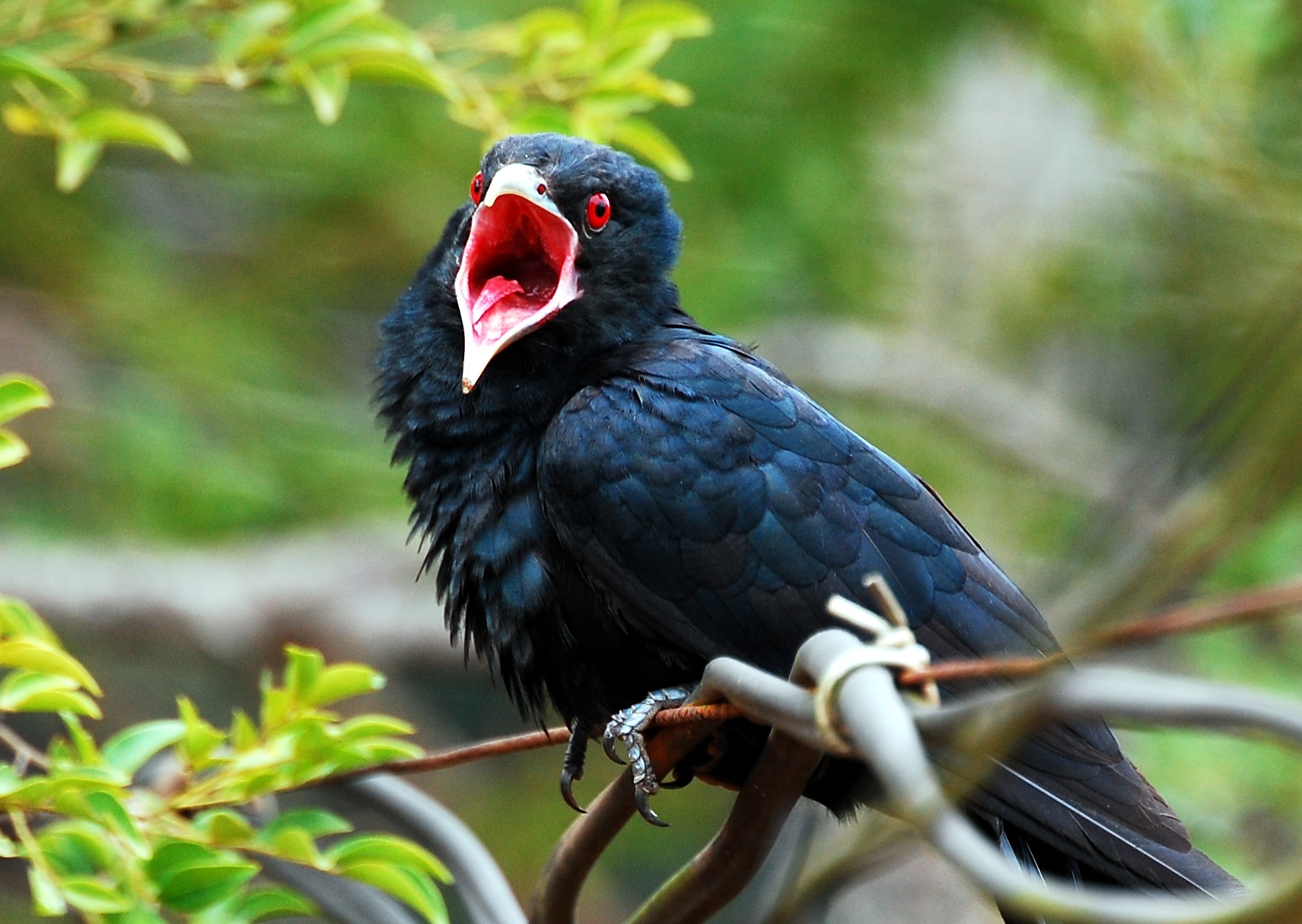
[[File:Asian koel2.jpg|thumb|right|[[Asian koel]] in Chalakudy]] | [[File:Asian koel2.jpg|thumb|right|[[Asian koel]] in Chalakudy]] | ||
Order: [[Cuculiformes]]{{nbsp|3}}Family: [[Cuculidae]] | |||
[[File: | [[File:BandedBayCuckoo.jpg|thumb|right|[[Banded bay cuckoo]] in [[Kannur]], Kerala]] | ||
The family Cuculidae includes [[cuckoo]]s, [[Geococcyx|roadrunner]]s and [[Ani (bird)|anis]]. These birds are of variable size with slender bodies, long tails and strong legs. Many are [[brood parasite]]s. | The family Cuculidae includes [[cuckoo]]s, [[Geococcyx|roadrunner]]s and [[Ani (bird)|anis]]. These birds are of variable size with slender bodies, long tails and strong legs. Many are [[brood parasite]]s. | ||
| Line 129: | Line 130: | ||
==Sandgrouse== | ==Sandgrouse== | ||
Order: [[Pterocliformes]]{{nbsp|3}}Family: [[Pteroclidae]] | |||
[[Sandgrouse]] have small, pigeon like heads and necks, but sturdy compact bodies. They have long pointed wings and sometimes tails and a fast direct flight. Flocks fly to watering holes at dawn and dusk. Their legs are feathered down to the toes. | [[Sandgrouse]] have small, pigeon like heads and necks, but sturdy compact bodies. They have long pointed wings and sometimes tails and a fast direct flight. Flocks fly to watering holes at dawn and dusk. Their legs are feathered down to the toes. | ||
*[[Chestnut-bellied sandgrouse]], ''Pterocles exustus''<ref>{{cite journal|author=Ammas, N. |year=2012|title=Breeding of Chestnut-bellied Sandgrouse at Malamel Rock, Kollam District, Kerala}}</ref> | *[[Chestnut-bellied sandgrouse]], ''Pterocles exustus''<ref>{{cite journal|author=Ammas, N. |year=2012|title=Breeding of Chestnut-bellied Sandgrouse at Malamel Rock, Kollam District, Kerala|journal = Malabar Trogon|volume=10}}</ref> | ||
==Pigeons and doves== | ==Pigeons and doves== | ||
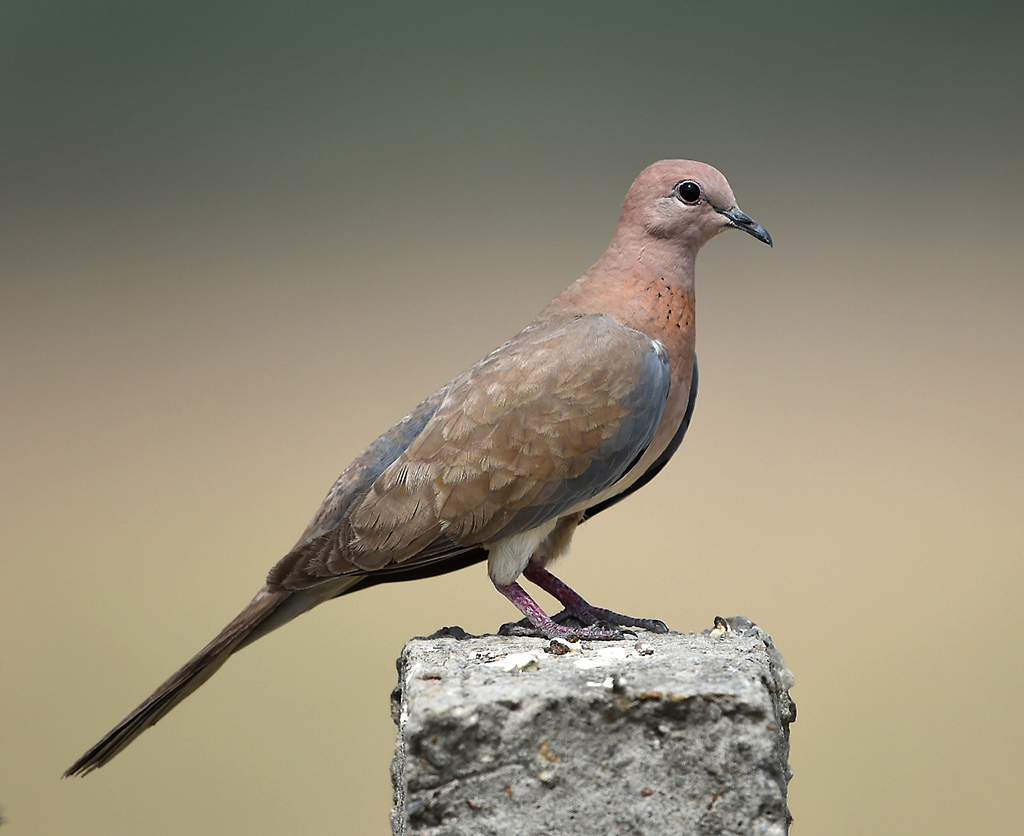
[[File:Laughing Dove (13845819085).jpg|thumb|right|Laughing dove at [[Sultanpur National Park]], [[Haryana]]]] | [[File:Laughing Dove (13845819085).jpg|thumb|right|[[Laughing dove]] at [[Sultanpur National Park]], [[Haryana]]]] | ||
Order: [[Columbiformes]]{{nbsp|3}}Family: [[Columbidae]] | |||
[[Pigeon]]s and [[dove]]s are stout-bodied birds with short necks and short slender bills with a fleshy [[cere]]. | [[Pigeon]]s and [[dove]]s are stout-bodied birds with short necks and short slender bills with a fleshy [[cere]]. | ||
*[[Rock | *[[Rock dove]], ''Columba livia'' | ||
*[[Nilgiri wood pigeon]], ''Columba elphinstonii'' | *[[Nilgiri wood pigeon]], ''Columba elphinstonii'' | ||
*[[Oriental turtle dove]], ''Streptopelia orientalis'' | *[[Oriental turtle dove]], ''Streptopelia orientalis'' | ||
*[[Eurasian collared dove]], ''Streptopelia decaocto'' | *[[Eurasian collared dove]], ''Streptopelia decaocto'' | ||
*[[Red collared dove]], ''Streptopelia tranqubarica'' <ref>{{cite journal|author1=Mannar, H |author2=Ambika, D | *[[Red collared dove]], ''Streptopelia tranqubarica'' <ref>{{cite journal|author1=Mannar, H |author2=Ambika, D.S. |year=2014| title=Snapshot Sightings: Red Turtle Dove from Haripad, Kerala| journal=Indian Birds|volume=9|issue=5&6|pages=168A}}</ref> | ||
*[[Spotted dove]], ''Spilopelia chinensis'' | *[[Spotted dove]], ''Spilopelia chinensis'' | ||
*[[Laughing dove]], ''Spilopelia senegalensis'' | *[[Laughing dove]], ''Spilopelia senegalensis'' | ||
| Line 156: | Line 157: | ||
==Rails, crakes, and coots== | ==Rails, crakes, and coots== | ||
[[File: | [[File:GH-Swamphen-Sandeep.jpg|thumb|right|[[Grey-headed swamphen]], [[Kannur]], [[Kerala]]]] | ||
Order: [[Gruiformes]]{{nbsp|3}}Family: [[Rallidae]] | |||
Rallidae is a large family of small to medium-sized birds which includes the [[Rail (bird)|rails]], [[crake]]s, [[coot]]s and [[Rallidae|gallinule]]s. Typically they inhabit dense vegetation in damp environments near lakes, swamps or rivers. In general they are shy and secretive birds, making them difficult to observe. Most species have strong legs and long toes which are well adapted to soft uneven surfaces. They tend to have short, rounded wings and to be weak fliers. | Rallidae is a large family of small to medium-sized birds which includes the [[Rail (bird)|rails]], [[crake]]s, [[coot]]s and [[Rallidae|gallinule]]s. Typically they inhabit dense vegetation in damp environments near lakes, swamps or rivers. In general they are shy and secretive birds, making them difficult to observe. Most species have strong legs and long toes which are well adapted to soft uneven surfaces. They tend to have short, rounded wings and to be weak fliers. | ||
| Line 173: | Line 174: | ||
==Grebes== | ==Grebes== | ||
Order: [[Podicipediformes]]{{nbsp|3}}Family: [[Podicipedidae]] | |||
[[Grebe]]s are small to medium-large freshwater diving birds. They have lobed toes and are excellent swimmers and divers. However, they have their feet placed far back on the body, making them quite ungainly on land. | [[Grebe]]s are small to medium-large freshwater diving birds. They have lobed toes and are excellent swimmers and divers. However, they have their feet placed far back on the body, making them quite ungainly on land. | ||
| Line 180: | Line 181: | ||
==Flamingos== | ==Flamingos== | ||
Order: [[Phoenicopteriformes]]{{nbsp|3}}Family: [[Phoenicopteridae]] | |||
[[Flamingo]]s are gregarious wading birds, usually {{convert| | [[Flamingo]]s are gregarious wading birds, usually {{convert|1|to|1.5|m|ft|0}} tall, found in both the Western and Eastern Hemispheres. Flamingos filter-feed on shellfish and algae. Their oddly shaped beaks are specially adapted to separate mud and silt from the food they consume and, uniquely, are used upside-down. | ||
*[[Greater flamingo]], ''Phoenicopterus roseus'' | *[[Greater flamingo]], ''Phoenicopterus roseus'' | ||
==Buttonquail== | ==Buttonquail== | ||
Order: [[Charadriiformes]]{{nbsp|3}}Family: [[Turnicidae]] | |||
The buttonquail are small, drab, running birds which resemble the true quails. The female is the brighter of the sexes and initiates courtship. The male incubates the eggs and tends the young. | The buttonquail are small, drab, running birds which resemble the true quails. The female is the brighter of the sexes and initiates courtship. The male incubates the eggs and tends the young. | ||
| Line 195: | Line 196: | ||
==Stone-curlews and thick-knees== | ==Stone-curlews and thick-knees== | ||
[[ | [[File:Great Thick-knee.jpg|thumb|right|[[Great thick-knee]], [[Ranganathittu]]]] | ||
Order: [[Charadriiformes]]{{nbsp|3}}Family: [[Burhinidae]] | |||
The thick-knees are a group of largely tropical waders in the family Burhinidae. They are found worldwide within the tropical zone, with some species also breeding in temperate Europe and Australia. They are medium to large waders with strong black or yellow-black bills, large yellow eyes and cryptic plumage. Despite being classed as waders, most species have a preference for arid or semi-arid habitats. | The stone-curlews and thick-knees are a group of largely tropical waders in the family Burhinidae. They are found worldwide within the tropical zone, with some species also breeding in temperate Europe and Australia. They are medium to large waders with strong black or yellow-black bills, large yellow eyes and cryptic plumage. Despite being classed as waders, most species have a preference for arid or semi-arid habitats. | ||
*[[Indian stone-curlew]], ''Burhinus indicus'' | *[[Indian stone-curlew]], ''Burhinus indicus'' | ||
| Line 205: | Line 206: | ||
==Oystercatchers== | ==Oystercatchers== | ||
Order: [[Charadriiformes]]{{nbsp|3}}Family: [[Haematopodidae]] | |||
The [[oystercatcher]]s are large and noisy [[plover]]-like birds, with strong bills used for smashing or prising open [[mollusc]]s. | The [[oystercatcher]]s are large and noisy [[plover]]-like birds, with strong bills used for smashing or prising open [[mollusc]]s. | ||
| Line 212: | Line 213: | ||
==Stilts and avocets== | ==Stilts and avocets== | ||
Order: [[Charadriiformes]]{{nbsp|3}}Family: [[Recurvirostridae]] | |||
Recurvirostridae is a family of large wading birds, which includes the [[avocet]]s and [[stilt]]s. The avocets have long legs and long up-curved bills. The stilts have extremely long legs and long, thin, straight bills. | Recurvirostridae is a family of large wading birds, which includes the [[avocet]]s and [[stilt]]s. The avocets have long legs and long up-curved bills. The stilts have extremely long legs and long, thin, straight bills. | ||
| Line 220: | Line 221: | ||
==Plovers== | ==Plovers== | ||
[[File: | [[File:RW-lapwing-Sandeep.jpg|thumb|right|[[Red-wattled lapwing]], Kerala]] | ||
[[File:Kentish_Plover.jpg|thumb|right|Kentish plover at [[Kannur]], Kerala]] | [[File:Kentish_Plover.jpg|thumb|right|[[Kentish plover]] at [[Kannur]], Kerala]] | ||
Order: [[Charadriiformes]]{{nbsp|3}}Family: [[Charadriidae]] | |||
The family Charadriidae includes the [[plover]]s, [[dotterel]]s and [[lapwing]]s. They are small to medium-sized birds with compact bodies, short, thick necks and long, usually pointed, wings. They are found in open country worldwide, mostly in habitats near water. | The family Charadriidae includes the [[plover]]s, [[dotterel]]s and [[lapwing]]s. They are small to medium-sized birds with compact bodies, short, thick necks and long, usually pointed, wings. They are found in open country worldwide, mostly in habitats near water. | ||
| Line 235: | Line 236: | ||
*[[American golden plover]], ''Pluvialis dominica'' (A) | *[[American golden plover]], ''Pluvialis dominica'' (A) | ||
*[[Grey plover]], ''Pluvialis squatarola'' | *[[Grey plover]], ''Pluvialis squatarola'' | ||
*[[Common ringed plover]], ''Charadrius hiaticula'' | *[[Common ringed plover]], ''Charadrius hiaticula'' | ||
*[[Little ringed plover]], ''Charadrius dubius'' | *[[Little ringed plover]], ''Charadrius dubius'' | ||
*[[Kentish plover]], ''Charadrius alexandrinus'' | *[[Kentish plover]], ''Charadrius alexandrinus'' | ||
*[[White-faced plover]], ''Charadrius dealbatus'' | *[[White-faced plover]], ''Charadrius dealbatus'' (A) | ||
*[[Lesser sand plover]], ''Charadrius mongolus'' | *[[Lesser sand plover]], ''Charadrius mongolus'' | ||
*[[Greater sand plover]], ''Charadrius leschenaultii'' | *[[Greater sand plover]], ''Charadrius leschenaultii'' | ||
| Line 244: | Line 245: | ||
==Painted-snipes== | ==Painted-snipes== | ||
Order: [[Charadriiformes]]{{nbsp|3}}Family: [[Rostratulidae]] | |||
Painted-snipes are short-legged, long-billed birds similar in shape to the true snipes, but more brightly coloured. | Painted-snipes are short-legged, long-billed birds similar in shape to the true snipes, but more brightly coloured. | ||
| Line 251: | Line 252: | ||
==Jacanas== | ==Jacanas== | ||
Order: [[Charadriiformes]]{{nbsp|3}}Family: [[Jacanidae]] | |||
The jacanas are a group of tropical waders in the family Jacanidae. They are found throughout the tropics. They are identifiable by their huge feet and claws which enable them to walk on floating vegetation in the shallow lakes that are their preferred habitat. | The jacanas are a group of tropical waders in the family Jacanidae. They are found throughout the tropics. They are identifiable by their huge feet and claws which enable them to walk on floating vegetation in the shallow lakes that are their preferred habitat. | ||
| Line 259: | Line 260: | ||
==Sandpipers and snipes== | ==Sandpipers and snipes== | ||
[[File:Running Whimbrel.jpg|thumb|right| | [[File:Running Whimbrel.jpg|thumb|right|[[Eurasian whimbrel]] at [[Kannur]], Kerala]] | ||
[[File:WoodSandpiper.jpg|thumb|right|Wood sandpiper at Kannur, Kerala]] | [[File:WoodSandpiper.jpg|thumb|right|[[Wood sandpiper]] at Kannur, Kerala]] | ||
[[File:RuddyTurnstone.jpg|thumb|right|Ruddy turnstone at Kannur, Kerala]] | [[File:RuddyTurnstone.jpg|thumb|right|[[Ruddy turnstone]] at Kannur, Kerala]] | ||
Order: [[Charadriiformes]]{{nbsp|3}}Family: [[Scolopacidae]] | |||
Scolopacidae is a large diverse family of small to medium-sized shorebirds including the [[sandpiper]]s, [[curlew]]s, [[godwit]]s, [[Tringa|shanks]], [[tattler (bird)|tattler]]s, [[woodcock]]s, [[snipe]]s, [[dowitcher]]s and [[phalarope]]s. The majority of these species eat small invertebrates picked out of the mud or soil. Variation in length of legs and bills enables multiple species to feed in the same habitat, particularly on the coast, without direct competition for food. | Scolopacidae is a large diverse family of small to medium-sized shorebirds including the [[sandpiper]]s, [[curlew]]s, [[godwit]]s, [[Tringa|shanks]], [[tattler (bird)|tattler]]s, [[woodcock]]s, [[snipe]]s, [[dowitcher]]s and [[phalarope]]s. The majority of these species eat small invertebrates picked out of the mud or soil. Variation in length of legs and bills enables multiple species to feed in the same habitat, particularly on the coast, without direct competition for food. | ||
| Line 305: | Line 306: | ||
==Crab-plover== | ==Crab-plover== | ||
Order: [[Charadriiformes]]{{nbsp|3}}Family: [[Dromadidae]] | |||
The crab-plover is related to the waders. It resembles a plover but with very long grey legs and a strong heavy black bill similar to a tern. It has black-and-white plumage, a long neck, partially webbed feet and a bill designed for eating crabs. | The crab-plover is related to the waders. It resembles a plover but with very long grey legs and a strong heavy black bill similar to a tern. It has black-and-white plumage, a long neck, partially webbed feet and a bill designed for eating crabs. | ||
| Line 312: | Line 313: | ||
==Coursers and pratincoles== | ==Coursers and pratincoles== | ||
Order: [[Charadriiformes]]{{nbsp|3}}Family: [[Glareolidae]] | |||
Glareolidae is a family of wading birds comprising the [[pratincole]]s, which have short legs, long pointed wings and long forked tails, and the [[courser]]s, which have long legs, short wings and long, pointed bills which curve downwards. | Glareolidae is a family of wading birds comprising the [[pratincole]]s, which have short legs, long pointed wings and long forked tails, and the [[courser]]s, which have long legs, short wings and long, pointed bills which curve downwards. | ||
| Line 323: | Line 324: | ||
==Gulls, terns, and skimmers== | ==Gulls, terns, and skimmers== | ||
[[File:Whiskered tern2.jpg|thumb|right|[[Whiskered tern]] in Thommana, Chalakudy]] | [[File:Whiskered tern2.jpg|thumb|right|[[Whiskered tern]] in Thommana, Chalakudy]] | ||
[[ | [[File:OneSandwichAmongLesserCrestedTerns.jpg|thumb|right|Many [[lesser crested tern]]s with a solitary Sandwich tern in [[Kannur]], Kerala]] | ||
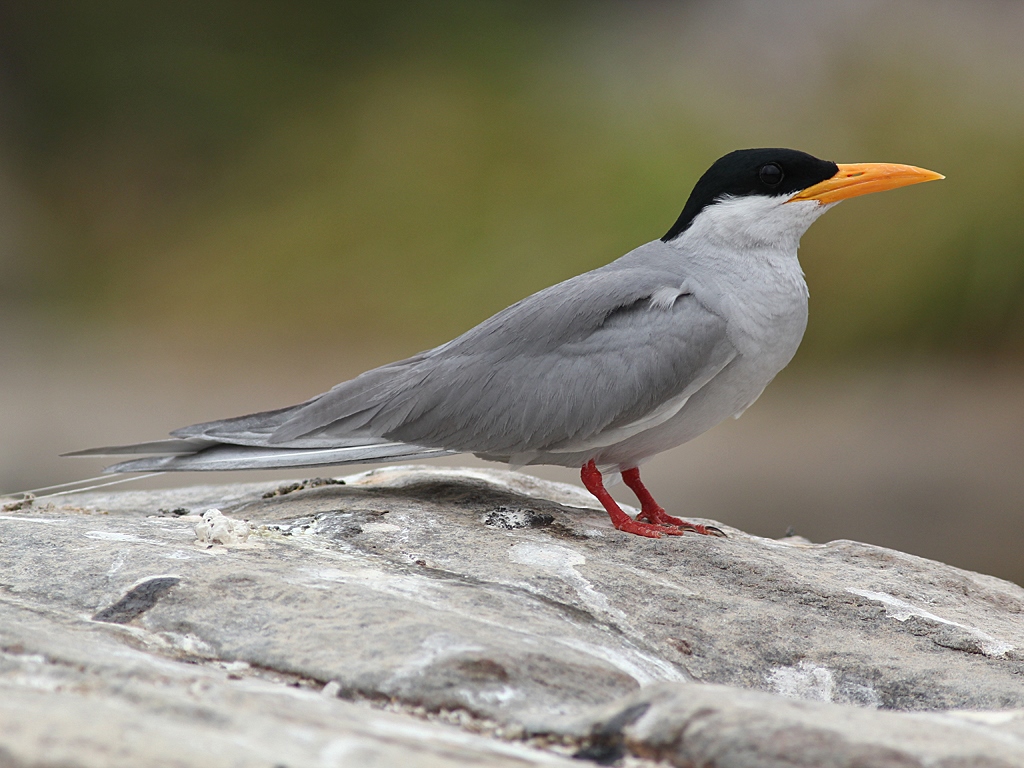
[[File:IndianRiverTern.jpg|thumb|right|River tern at [[Ranganthittu]], Mysore]] | [[File:IndianRiverTern.jpg|thumb|right|[[River tern]] at [[Ranganthittu]], Mysore]] | ||
Order: [[Charadriiformes]]{{nbsp|3}}Family: [[Laridae]] | |||
Laridae is a family of both gulls and terns. [[Gull]]s are medium to large seabirds including [[kittiwake]]s. They are typically grey or white, often with black markings on the head or wings. They have stout, longish bills and webbed feet. [[Tern]]s are a group of generally medium to large seabirds typically with grey or white plumage, often with black markings on the head. Most terns hunt fish by diving but some pick insects off the surface of fresh water. Terns are generally long-lived birds, with several species known to live in excess of 30 years. | Laridae is a family of both gulls and terns. [[Gull]]s are medium to large seabirds including [[kittiwake]]s. They are typically grey or white, often with black markings on the head or wings. They have stout, longish bills and webbed feet. [[Tern]]s are a group of generally medium to large seabirds typically with grey or white plumage, often with black markings on the head. Most terns hunt fish by diving but some pick insects off the surface of fresh water. Terns are generally long-lived birds, with several species known to live in excess of 30 years. | ||
| Line 333: | Line 334: | ||
*[[Brown noddy]], ''Anous stolidus''<ref>{{cite journal|author=Praveen, J. |year=2011| title=A Review of Pelagic Bird Records in Sea Swallow from the off-shore waters of Kerala| journal=Malabar Trogon|volume=9|issue=1&2|pages=7–10| url=https://archive.org/details/AReviewOfPelagicBirdRecordsInSeaSwalllowFromTheOff-shoreWatersOf}}</ref> | *[[Brown noddy]], ''Anous stolidus''<ref>{{cite journal|author=Praveen, J. |year=2011| title=A Review of Pelagic Bird Records in Sea Swallow from the off-shore waters of Kerala| journal=Malabar Trogon|volume=9|issue=1&2|pages=7–10| url=https://archive.org/details/AReviewOfPelagicBirdRecordsInSeaSwalllowFromTheOff-shoreWatersOf}}</ref> | ||
*[[Lesser noddy]], ''Anous tenuirostris'' | *[[Lesser noddy]], ''Anous tenuirostris'' | ||
*[[White tern]], ''Gygis alba''<ref>{{cite journal|author=Jayson, E. A., Babu S., Govind, S. K. |year=2013| title=Recovery of White Tern ''Gygis alba'' at Athirapilly, Kerala, India| journal=Indian Birds|volume=8|issue=6|pages=163 }}</ref> | *[[White tern]], ''Gygis alba''<ref>{{cite journal|author=Jayson, E. A., Babu S., Govind, S. K. |year=2013| title=Recovery of White Tern ''Gygis alba'' at Athirapilly, Kerala, India| journal=Indian Birds|volume=8|issue=6|pages=163}}</ref> | ||
*[[Black-legged kittiwake]], ''Rissa tridactyla''<ref name=kittiwake>{{cite journal|author=Das, S., Kechery, S., Sreenivasan P. P., & Sreeranj C. |year=2013| title=Black-legged Kittiwake ''Rissa tridactyla'' from Puthankadapuram, Kerala, India| journal=Indian Birds|volume=8|issue=3|pages=73}}</ref> (A) | *[[Black-legged kittiwake]], ''Rissa tridactyla''<ref name=kittiwake>{{cite journal|author=Das, S., Kechery, S., Sreenivasan P. P., & Sreeranj C. |year=2013| title=Black-legged Kittiwake ''Rissa tridactyla'' from Puthankadapuram, Kerala, India| journal=Indian Birds|volume=8|issue=3|pages=73}}</ref> (A) | ||
*[[Sabine's gull]], ''Xema sabini''<ref>{{cite journal|author=Sreenivasan P. P., Praveen J., Prince, M. & Karuthedathu, D. |year=2013| title=Sabine's Gull ''Xema sabini'' from Puthankadapuram, Kerala, India: a first record for South Asia| journal=Indian Birds|volume=8|issue=4|pages=99–100}}</ref> (A) | *[[Sabine's gull]], ''Xema sabini''<ref>{{cite journal|author=Sreenivasan P. P., Praveen J., Prince, M. & Karuthedathu, D. |year=2013| title=Sabine's Gull ''Xema sabini'' from Puthankadapuram, Kerala, India: a first record for South Asia| journal=Indian Birds|volume=8|issue=4|pages=99–100}}</ref> (A) | ||
| Line 347: | Line 348: | ||
*[[Lesser crested tern]], ''Thalasseus bengalensis'' | *[[Lesser crested tern]], ''Thalasseus bengalensis'' | ||
*[[Sandwich tern]], ''Thalasseus sandvicensis'' | *[[Sandwich tern]], ''Thalasseus sandvicensis'' | ||
*[[Little tern]], ''Sternula albifrons'' | *[[Little tern]], ''Sternula albifrons'' | ||
*[[Bridled tern]], ''Onychoprion anaethetus'' | *[[Bridled tern]], ''Onychoprion anaethetus'' | ||
*[[Sooty tern]], ''Onychoprion fuscatus'' | *[[Sooty tern]], ''Onychoprion fuscatus'' | ||
| Line 361: | Line 362: | ||
==Skuas== | ==Skuas== | ||
Order: [[Charadriiformes]]{{nbsp|3}}Family: [[Stercorariidae]] | |||
The family Stercorariidae are, in general, medium to large birds, typically with grey or brown plumage, often with white markings on the wings. They nest on the ground in temperate and arctic regions and are long-distance migrants. | The family Stercorariidae are, in general, medium to large birds, typically with grey or brown plumage, often with white markings on the wings. They nest on the ground in temperate and arctic regions and are long-distance migrants. | ||
| Line 367: | Line 368: | ||
*[[South polar skua]], ''Catharcta maccormicki''<ref>{{cite journal|author=Praveen J., Karuthedathu, D., Prince, M., Palot, M. J. & Dalvi, S. |year=2013| title=Identification of South Polar Skua ''Catharacta maccormicki'' in the Arabian Sea and Indian Ocean| journal=BirdingASIA|volume=19|pages=83–88}}</ref> | *[[South polar skua]], ''Catharcta maccormicki''<ref>{{cite journal|author=Praveen J., Karuthedathu, D., Prince, M., Palot, M. J. & Dalvi, S. |year=2013| title=Identification of South Polar Skua ''Catharacta maccormicki'' in the Arabian Sea and Indian Ocean| journal=BirdingASIA|volume=19|pages=83–88}}</ref> | ||
*[[Brown skua]], ''Catharcta antarctica'' (A) | *[[Brown skua]], ''Catharcta antarctica'' (A) | ||
*[[Pomarine | *[[Pomarine skua]], ''Stercorarius pomarinus'' | ||
*[[ | *[[Arctic skua]], ''Stercorarius parasiticus''<ref name=pelagic/><ref>{{cite journal|author=Prince, M.|year=2011| title=Some Observations from Lakshadweep and the Laccadive Sea off Kerala| journal=Indian Birds|volume=7|issue=3|pages=63–65}}</ref> | ||
*[[Long-tailed | *[[Long-tailed skua]], ''Stercorarius longicaudus'' (A) | ||
==Tropicbirds== | ==Tropicbirds== | ||
Order: [[Phaethontiformes]]{{nbsp|3}}Family: [[Phaethontidae]] | |||
[[Tropicbird]]s are slender white birds of tropical oceans, with exceptionally long central tail feathers. Their heads and long wings have black markings. | [[Tropicbird]]s are slender white birds of tropical oceans, with exceptionally long central tail feathers. Their heads and long wings have black markings. | ||
| Line 380: | Line 381: | ||
==Austral storm petrels== | ==Austral storm petrels== | ||
[[File: | [[File:White-faced Storm-petrel 0A2A9606.jpg|thumb|right|[[White-faced storm petrel]], [[Hobart]]]] | ||
Order: [[Procellariiformes]]{{nbsp|3}}Family: [[Oceanitidae]] | |||
The [[austral storm petrel]]s are relatives of the [[petrel]]s and are the smallest seabirds. They feed on [[plankton]]ic crustaceans and small fish picked from the surface, typically while hovering. The flight is fluttering and sometimes [[bat]]-like. | The [[austral storm petrel]]s are relatives of the [[petrel]]s and are the smallest seabirds. They feed on [[plankton]]ic crustaceans and small fish picked from the surface, typically while hovering. The flight is fluttering and sometimes [[bat]]-like. | ||
*[[Wilson's storm petrel]], ''Oceanites oceanicus''<ref name=pelagic/><ref name=petrel>{{cite journal|author1=Vivek Chandran, A. |author2=Praveen, J. |author3=Sreenivasan, P. P. |author4=Nameer, P. O. |author5=Dilip, K. G. |year=2011| title=Swinhoe's Storm-petrel ''Oceanodroma monorhis'' and other pelagic birds from the Thrissur coast, Kerala| journal=Indian Birds|volume=7|issue=3|pages=73–74}}</ref> | *[[Wilson's storm petrel]], ''Oceanites oceanicus''<ref name=pelagic/><ref name=petrel>{{cite journal|author1=Vivek Chandran, A. |author2=Praveen, J. |author3=Sreenivasan, P. P. |author4=Nameer, P. O. |author5=Dilip, K. G. |year=2011| title=Swinhoe's Storm-petrel ''Oceanodroma monorhis'' and other pelagic birds from the Thrissur coast, Kerala| journal=Indian Birds|volume=7|issue=3|pages=73–74}}</ref> | ||
*[[White-faced storm petrel]], ''Pelagodroma marina'' <ref name=indiachecklist>{{cite journal|author1=Praveen, J. |author2=Jayapal, R. |author3=Pittie, A. |year=2013| title=Notes on Indian rarities—1: Seabirds| journal=Indian Birds|volume=8|issue=5|pages=113–125}}</ref> [historical] (A) | *[[White-faced storm petrel]], ''Pelagodroma marina'' <ref name=indiachecklist>{{cite journal|author1=Praveen, J. |author2=Jayapal, R. |author3=Pittie, A. |year=2013| title=Notes on Indian rarities—1: Seabirds| journal=Indian Birds|volume=8|issue=5|pages=113–125}}</ref> [historical] (A) | ||
==Northern storm petrels== | ==Northern storm petrels== | ||
Order: [[Procellariiformes]]{{nbsp|3}}Family: [[Hydrobatidae]] | |||
The [[northern storm petrel]]s are relatives of the [[petrel]]s and are the smallest seabirds. They feed on [[plankton]]ic crustaceans and small fish picked from the surface, typically while hovering. The flight is fluttering and sometimes [[bat]]-like. | The [[northern storm petrel]]s are relatives of the [[petrel]]s and are the smallest seabirds. They feed on [[plankton]]ic crustaceans and small fish picked from the surface, typically while hovering. The flight is fluttering and sometimes [[bat]]-like. | ||
| Line 396: | Line 397: | ||
==Petrels, shearwaters, and diving petrels== | ==Petrels, shearwaters, and diving petrels== | ||
Order: [[Procellariiformes]]{{nbsp|3}}Family: [[Procellariidae]] | |||
The procellariids are the main group of medium-sized | The procellariids are the main group of medium-sized shearwaters and petrels, characterised by united nostrils with medium septum and a long outer functional primary. | ||
*[[Streaked shearwater]], ''Calonectris leucomelas''<ref>{{cite journal|author1=Karuthedathu, D. |author2=Palot, M. J. |author3=Praveen J. |author4=Sreenivasan, P. P. |author5=Uthaman, K. V. |year=2013| title=Streaked Shearwater ''Calonectrics leucomelas'' from Kannur coast, Kerala | journal=Indian Birds|volume=8|issue=2|pages=44–45}}</ref> | *[[Streaked shearwater]], ''Calonectris leucomelas''<ref>{{cite journal|author1=Karuthedathu, D. |author2=Palot, M. J. |author3=Praveen J. |author4=Sreenivasan, P. P. |author5=Uthaman, K. V. |year=2013| title=Streaked Shearwater ''Calonectrics leucomelas'' from Kannur coast, Kerala | journal=Indian Birds|volume=8|issue=2|pages=44–45}}</ref> | ||
| Line 410: | Line 411: | ||
==Storks== | ==Storks== | ||
[[File:AsianOpenbill.jpg|thumb|right| | [[File:AsianOpenbill.jpg|thumb|right|[[Asian openbill]]]] | ||
Order: [[Ciconiiformes]]{{nbsp|3}}Family: [[Ciconiidae]] | |||
Storks are large, long-legged, long-necked, wading birds with long, stout bills. Storks are mute, but bill-clattering is an important mode of communication at the nest. Their nests can be large and may be reused for many years. Many species are migratory. | Storks are large, long-legged, long-necked, wading birds with long, stout bills. Storks are mute, but bill-clattering is an important mode of communication at the nest. Their nests can be large and may be reused for many years. Many species are migratory. | ||
| Line 423: | Line 424: | ||
==Frigatebirds== | ==Frigatebirds== | ||
Order: [[Suliformes]]{{nbsp|3}}Family: [[Fregatidae]] | |||
[[Frigatebird]]s are large seabirds usually found over tropical oceans. They are large, black-and-white or completely black, with long wings and deeply forked tails. The males have coloured inflatable throat pouches. They do not swim or walk and cannot take off from a flat surface. Having the largest wingspan-to-body-weight ratio of any bird, they are essentially aerial, able to stay aloft for more than a week. | [[Frigatebird]]s are large seabirds usually found over tropical oceans. They are large, black-and-white or completely black, with long wings and deeply forked tails. The males have coloured inflatable throat pouches. They do not swim or walk and cannot take off from a flat surface. Having the largest wingspan-to-body-weight ratio of any bird, they are essentially aerial, able to stay aloft for more than a week. | ||
| Line 432: | Line 433: | ||
==Gannets and boobies== | ==Gannets and boobies== | ||
Order: [[Suliformes]]{{nbsp|3}}Family: [[Sulidae]] | |||
The sulids comprise the [[gannet]]s and [[Booby|boobies]]. Both groups are medium to large coastal seabirds that plunge-dive for fish. | The sulids comprise the [[gannet]]s and [[Booby|boobies]]. Both groups are medium to large coastal seabirds that plunge-dive for fish. | ||
| Line 440: | Line 441: | ||
==Anhingas and darters== | ==Anhingas and darters== | ||
[[File:Snake bird nesting.jpg|thumb|right|[[Oriental darter]]s' nesting | [[File:Snake bird nesting.jpg|thumb|right|[[Oriental darter]]s' nesting, [[Kalletumkara]]]] | ||
Order: [[Suliformes]]{{nbsp|3}}Family: [[Anhingidae]] | |||
Anhingas or darters are often called "snake-birds" because of their long thin neck, which gives a snake-like appearance when they swim with their bodies submerged. The males have black and dark-brown plumage, an erectile crest on the nape and a larger bill than the female. The females have much paler plumage especially on the neck and underparts. The darters have completely webbed feet and their legs are short and set far back on the body. Their plumage is somewhat permeable, like that of cormorants, and they spread their wings to dry after diving. | Anhingas or darters are often called "snake-birds" because of their long thin neck, which gives a snake-like appearance when they swim with their bodies submerged. The males have black and dark-brown plumage, an erectile crest on the nape and a larger bill than the female. The females have much paler plumage especially on the neck and underparts. The darters have completely webbed feet and their legs are short and set far back on the body. Their plumage is somewhat permeable, like that of cormorants, and they spread their wings to dry after diving. | ||
| Line 448: | Line 449: | ||
==Cormorants and shags== | ==Cormorants and shags== | ||
[[File:GreatCormorantPair.jpg|thumb|right|[[Great cormorant]] | [[File:GreatCormorantPair.jpg|thumb|right|[[Great cormorant]], [[Banasura Sagar Dam]]]] | ||
Order: [[Suliformes]]{{nbsp|3}}Family: [[Phalacrocoracidae]] | |||
Phalacrocoracidae is a family of medium to large coastal, fish-eating seabirds that includes cormorants and shags. Plumage colouration varies, with the majority having mainly dark plumage, some species being black-and-white and a few being colourful. | Phalacrocoracidae is a family of medium to large coastal, fish-eating seabirds that includes cormorants and shags. Plumage colouration varies, with the majority having mainly dark plumage, some species being black-and-white and a few being colourful. | ||
| Line 459: | Line 460: | ||
==Ibises and spoonbills== | ==Ibises and spoonbills== | ||
[[File:Spoonbill at Ranganathittu Bird Sanctuary.jpg|thumb|right|Eurasian | [[File:Spoonbill at Ranganathittu Bird Sanctuary.jpg|thumb|right|Eurasian spoonbill at [[Ranganathittu]]]] | ||
Order: [[Pelecaniformes]]{{nbsp|3}}Family: [[Threskiornithidae]] | |||
Threskiornithidae is a family of large terrestrial and wading birds which includes the [[ibis]]es and [[spoonbill]]s. They have long, broad wings with 11 primary and about 20 secondary feathers. They are strong fliers and despite their size and weight, very capable soarers. | Threskiornithidae is a family of large terrestrial and wading birds which includes the [[ibis]]es and [[spoonbill]]s. They have long, broad wings with 11 primary and about 20 secondary feathers. They are strong fliers and despite their size and weight, very capable soarers. | ||
| Line 470: | Line 471: | ||
==Herons and bitterns== | ==Herons and bitterns== | ||
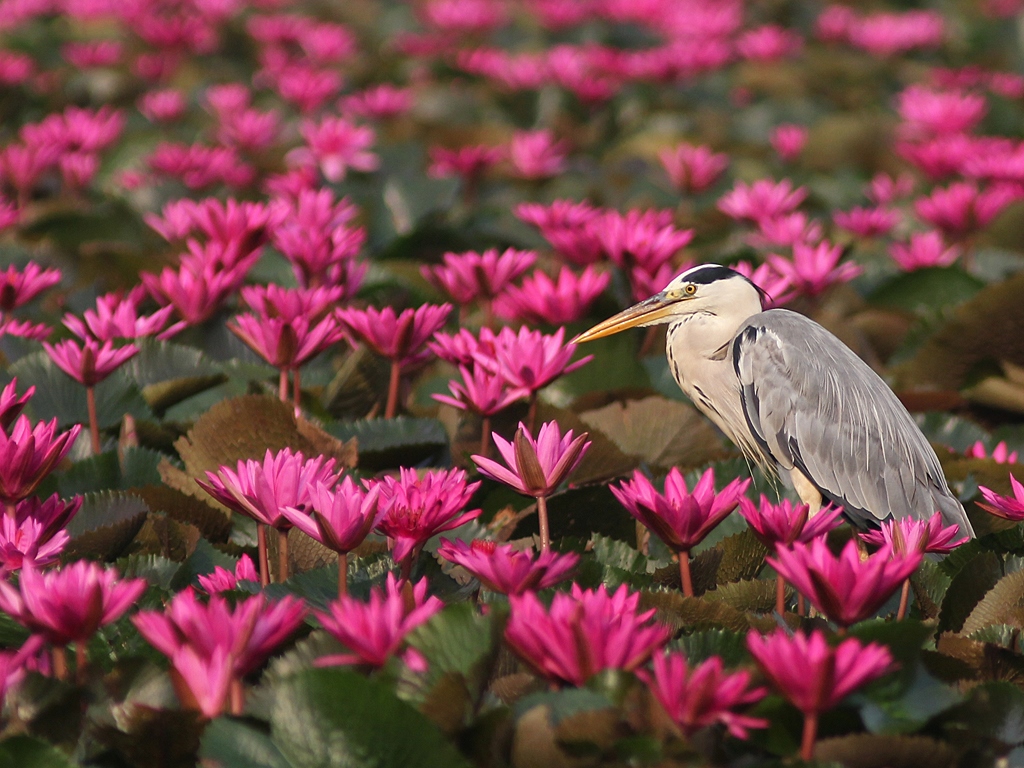
[[File:Bird at Chirakkal Chira-1.jpg|thumb|right|Grey heron at | [[File:Bird at Chirakkal Chira-1.jpg|thumb|right|[[Grey heron]] at [[Chirakkal, Kannur]]]] | ||
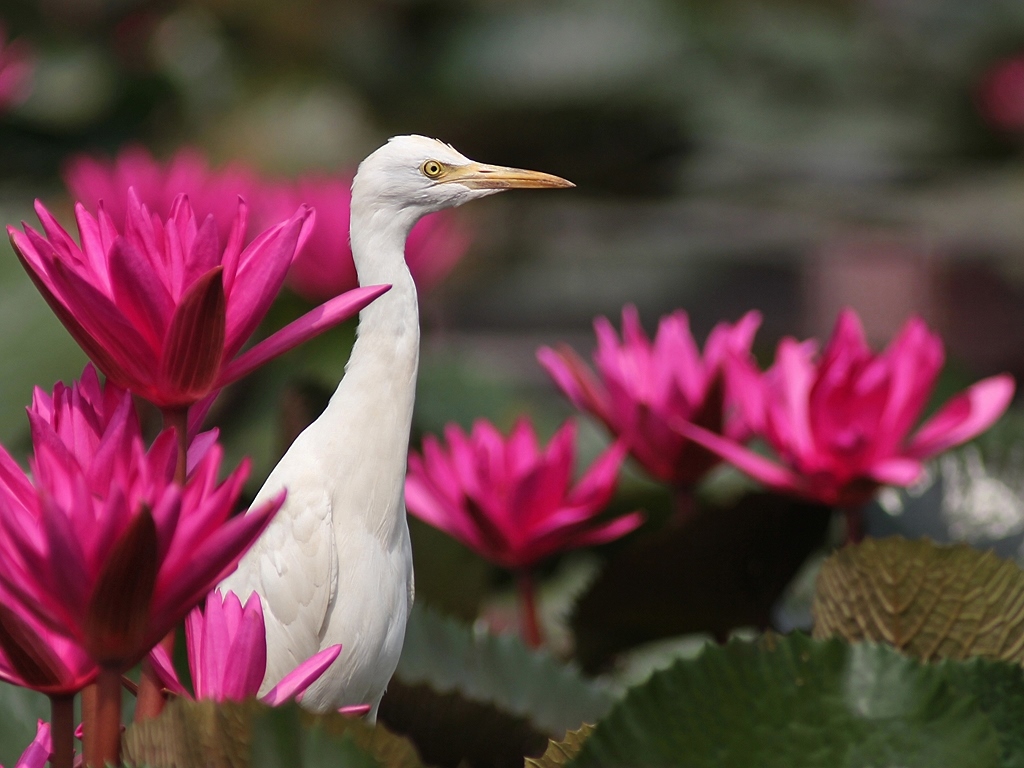
[[File:Bird at Chirakkal Chira-2.jpg|thumb|right|Cattle egret at | [[File:Bird at Chirakkal Chira-2.jpg|thumb|right|[[Cattle egret]] at [[Chirakkal, Kannur]]]] | ||
Order: [[Pelecaniformes]]{{nbsp|3}}Family: [[Ardeidae]] | |||
The family Ardeidae contains the [[bittern]]s, [[heron]]s and [[egret]]s. Herons and egrets are medium to large wading birds with long necks and legs. Bitterns tend to be shorter necked and more wary. Members of Ardeidae fly with their necks retracted, unlike other long-necked birds such as storks, ibises and spoonbills. | The family Ardeidae contains the [[bittern]]s, [[heron]]s and [[egret]]s. Herons and egrets are medium to large wading birds with long necks and legs. Bitterns tend to be shorter necked and more wary. Members of Ardeidae fly with their necks retracted, unlike other long-necked birds such as storks, ibises and spoonbills. | ||
| Line 486: | Line 487: | ||
*[[Striated heron]], ''Butorides striata'' | *[[Striated heron]], ''Butorides striata'' | ||
*[[Indian pond heron]], ''Ardeola grayii'' | *[[Indian pond heron]], ''Ardeola grayii'' | ||
*[[Chinese pond heron]], ''Ardeola bacchus'' | *[[Chinese pond heron]], ''Ardeola bacchus'' (A) | ||
*[[Eastern cattle egret]], ''Bubulcus coromandus'' | *[[Eastern cattle egret]], ''Bubulcus coromandus'' | ||
*[[Grey heron]], ''Ardea cinerea'' | *[[Grey heron]], ''Ardea cinerea'' | ||
*[[Purple heron]], ''Ardea purpurea'' | *[[Purple heron]], ''Ardea purpurea'' | ||
| Line 497: | Line 498: | ||
==Pelicans== | ==Pelicans== | ||
[[File:Spot-BilledPelican.jpg|thumb|right|Spot-billed pelican]] | [[File:Spot-BilledPelican.jpg|thumb|right|[[Spot-billed pelican]]]] | ||
Order: [[Pelecaniformes]]{{nbsp|3}}Family: [[Pelecanidae]] | |||
[[Pelican]]s are large water birds | [[Pelican]]s are large water birds famous for their huge throat pouch. As with other members of the order Pelecaniformes, they have webbed feet with four toes. | ||
*[[Great white pelican]], ''Pelecanus onocrotalus''<ref>{{cite journal|author1=Jacob, Tytus T. |author2=Pramod, P. |author3=Gangadharan, K. |author4=Mahesh, M. |year=1994| title=First record of the Rosy Pelican ''Pelecanus onocrotalus'' Linnaeus in Kerala| journal=Journal of the Bombay Natural History Society |volume=91|issue=3|page=452}}</ref><ref>{{cite journal|author=Nair, Manoj V. |year=1993|title=Rosy Pelican at Aakkulam|journal=[[Newsletter for Birdwatchers]] |volume=33|issue=1|pages=7–8|url=https://archive.org/stream/NLBW33_1#page/n9/mode/1up}}</ref> (A) | *[[Great white pelican]], ''Pelecanus onocrotalus''<ref>{{cite journal|author1=Jacob, Tytus T. |author2=Pramod, P. |author3=Gangadharan, K. |author4=Mahesh, M. |year=1994| title=First record of the Rosy Pelican ''Pelecanus onocrotalus'' Linnaeus in Kerala| journal=Journal of the Bombay Natural History Society |volume=91|issue=3|page=452}}</ref><ref>{{cite journal|author=Nair, Manoj V. |year=1993|title=Rosy Pelican at Aakkulam|journal=[[Newsletter for Birdwatchers]] |volume=33|issue=1|pages=7–8|url=https://archive.org/stream/NLBW33_1#page/n9/mode/1up}}</ref> (A) | ||
*[[Spot-billed pelican]], ''Pelecanus philippensis'' | *[[Spot-billed pelican]], ''Pelecanus philippensis'' | ||
== | ==Osprey== | ||
Order: [[Accipitriformes]]{{nbsp|3}}Family: [[Pandionidae]] | |||
*[[ | The family Pandionidae contains usually only one species, the osprey. The osprey is a medium-large [[bird of prey|raptor]] which is a specialist fish-eater. | ||
*[[Osprey]], ''Pandion haliaetus'' | |||
==Kites, hawks, and eagles== | ==Kites, hawks, and eagles== | ||
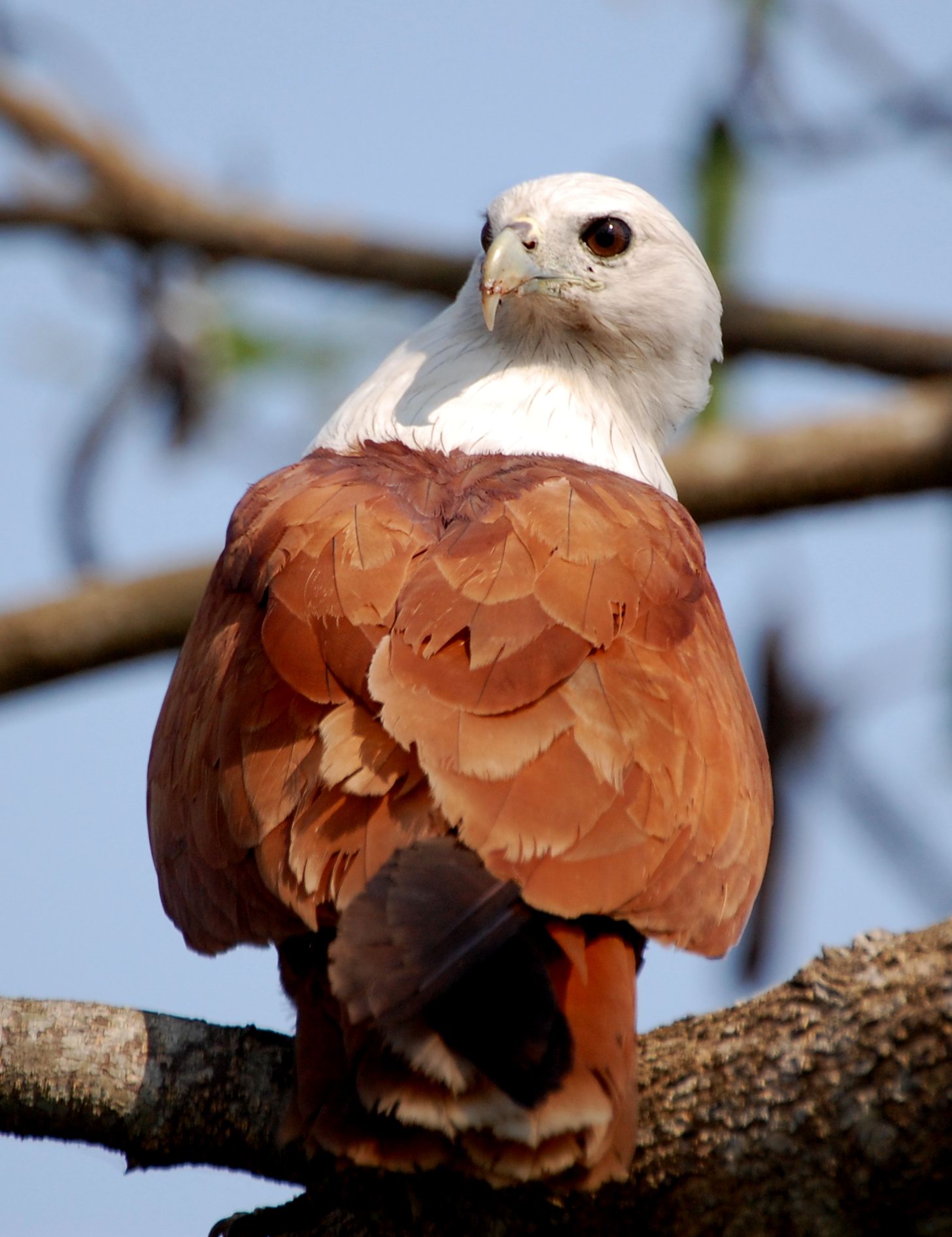
[[File:Brahminy kite2.jpg|thumb|right|[[Brahminy kite]] in [[Chalakudy]]]] | [[File:Brahminy kite2.jpg|thumb|right|[[Brahminy kite]] in [[Chalakudy]]]] | ||
[[File:Crested Hawk-eagle Nisaetus cirrhatus.JPG|thumb|[[Changeable hawk-eagle]] | [[File:Crested Hawk-eagle Nisaetus cirrhatus.JPG|thumb|[[Changeable hawk-eagle]] in [[Mayannur]], [[Thrissur]]]] | ||
[[File:Crested Hawk-eagle Juvenile Nisaetus cirrhatus in Mayannur Thrissur.jpg|thumb| | [[File:Crested Hawk-eagle Juvenile Nisaetus cirrhatus in Mayannur Thrissur.jpg|thumb|Changeable hawk-eagle juvenile in Mayannur, Thrissur]] | ||
Order: [[Accipitriformes]]{{nbsp|3}}Family: [[Accipitridae]] | |||
Accipitridae is a family of birds of prey, which includes [[hawk]]s, [[eagle]]s, [[Kite (bird)|kites]], [[Harrier (bird)|harriers]] and [[Old World vulture]]s. These birds have powerful hooked beaks for tearing flesh from their prey, strong legs, powerful talons and keen eyesight. | Accipitridae is a family of birds of prey, which includes [[hawk]]s, [[eagle]]s, [[Kite (bird)|kites]], [[Harrier (bird)|harriers]] and [[Old World vulture]]s. These birds have powerful hooked beaks for tearing flesh from their prey, strong legs, powerful talons and keen eyesight. | ||
| Line 531: | Line 531: | ||
*[[Himalayan vulture]], ''Gyps himalayensis'' <ref>{{cite journal|author=Praveen, J., Nameer, P. O., Karuthedathu, D., Ramaiah, C., Balakrishnan, B., Rao, K. M., Shurpali, S., Puttaswamaiah, R., & Tavcar, I. |year=2014| title=On the vagrancy of the Himalayan Vulture ''Gyps himalayensis'' to southern India | journal=Indian Birds|volume=9|issue=1|pages=19–22}}</ref> | *[[Himalayan vulture]], ''Gyps himalayensis'' <ref>{{cite journal|author=Praveen, J., Nameer, P. O., Karuthedathu, D., Ramaiah, C., Balakrishnan, B., Rao, K. M., Shurpali, S., Puttaswamaiah, R., & Tavcar, I. |year=2014| title=On the vagrancy of the Himalayan Vulture ''Gyps himalayensis'' to southern India | journal=Indian Birds|volume=9|issue=1|pages=19–22}}</ref> | ||
*[[Red-headed vulture]], ''Sarcogyps calvus'' | *[[Red-headed vulture]], ''Sarcogyps calvus'' | ||
*[[ | *[[Eurasian black vulture]], ''Aegypius monachus'' | ||
*[[Crested serpent eagle]], ''Spilornis cheela'' | *[[Crested serpent eagle]], ''Spilornis cheela'' | ||
*[[Short-toed snake eagle]], ''Circaetus gallicus'' | *[[Short-toed snake eagle]], ''Circaetus gallicus'' | ||
| Line 539: | Line 539: | ||
*[[Rufous-bellied eagle]], ''Lophotriorchis kienerii'' | *[[Rufous-bellied eagle]], ''Lophotriorchis kienerii'' | ||
*[[Black eagle]], ''Ictinaetus malaiensis'' | *[[Black eagle]], ''Ictinaetus malaiensis'' | ||
*[[Indian spotted eagle]], ''Clanga hastata'' | *[[Indian spotted eagle]], ''Clanga hastata'' | ||
*[[Greater spotted eagle]], ''Clanga clanga'' | *[[Greater spotted eagle]], ''Clanga clanga'' | ||
*[[Booted eagle]], ''Hieraaetus pennatus'' | *[[Booted eagle]], ''Hieraaetus pennatus'' | ||
| Line 551: | Line 551: | ||
*[[Western marsh harrier]], ''Circus aeruginosus'' | *[[Western marsh harrier]], ''Circus aeruginosus'' | ||
*[[Eastern marsh harrier]], ''Circus spilonotus'' (A) | *[[Eastern marsh harrier]], ''Circus spilonotus'' (A) | ||
*[[Hen harrier]], ''Circus cyaneus'' | *[[Hen harrier]], ''Circus cyaneus'' | ||
*[[Pallid harrier]], ''Circus macrourus'' | *[[Pallid harrier]], ''Circus macrourus'' | ||
*[[Pied harrier]], ''Circus melanoleucos'' | *[[Pied harrier]], ''Circus melanoleucos'' | ||
| Line 567: | Line 567: | ||
==Barn owls== | ==Barn owls== | ||
Order: [[Strigiformes]]{{nbsp|3}}Family: [[Tytonidae]] | |||
[[Barn | [[Tytonidae|Barn owls]] are medium to large owls with large heads and characteristic heart-shaped faces. They have long strong legs with powerful talons. | ||
*[[Eastern barn owl]], ''Tyto javanica'' | *[[Eastern barn owl]], ''Tyto javanica'' | ||
*[[Eastern grass owl]], ''Tyto longimembris'' | *[[Eastern grass owl]], ''Tyto longimembris'' | ||
*[[Oriental bay owl]], ''Phodilus badius'' | *[[Oriental bay owl]], ''Phodilus badius'' | ||
*[[Sri Lanka bay owl]], ''Phodilus assimilis'' | *[[Sri Lanka bay owl]], ''Phodilus assimilis'' | ||
==Owls== | ==Owls== | ||
[[File: | [[File:BarredJungleOwlet-2.jpg|thumb|right|[[Jungle owlet]] in Kerala]] | ||
Order: [[Strigiformes]]{{nbsp|3}}Family: [[Strigidae]] | |||
The [[typical owl]]s are small to large solitary nocturnal birds of prey. They have large forward-facing eyes and ears, a hawk-like beak and a conspicuous circle of feathers around each eye called a facial disk. | The [[typical owl]]s are small to large solitary nocturnal birds of prey. They have large forward-facing eyes and ears, a hawk-like beak and a conspicuous circle of feathers around each eye called a facial disk. | ||
| Line 593: | Line 592: | ||
*[[Jungle owlet]], ''Glaucidium radiatum'' | *[[Jungle owlet]], ''Glaucidium radiatum'' | ||
*[[Spotted owlet]], ''Athene brama'' | *[[Spotted owlet]], ''Athene brama'' | ||
*[[Brown | *[[Brown boobook]], ''Ninox scutulata'' | ||
*[[Short-eared owl]], ''Asio flammeus'' | *[[Short-eared owl]], ''Asio flammeus'' | ||
==Trogons== | ==Trogons== | ||
Order: [[Trogoniformes]]{{nbsp|3}}Family: [[Trogonidae]] | |||
The family Trogonidae includes trogons and quetzals. Found in tropical woodlands worldwide, they feed on insects and fruit, and their broad bills and weak legs reflect their diet and arboreal habits. Although their flight is fast, they are reluctant to fly any distance. Trogons have soft, often colourful, feathers with distinctive male and female plumage. | The family Trogonidae includes trogons and quetzals. Found in tropical woodlands worldwide, they feed on insects and fruit, and their broad bills and weak legs reflect their diet and arboreal habits. Although their flight is fast, they are reluctant to fly any distance. Trogons have soft, often colourful, feathers with distinctive male and female plumage. | ||
| Line 604: | Line 603: | ||
==Hoopoes== | ==Hoopoes== | ||
Order: [[Bucerotiformes]]{{nbsp|3}}Family: [[Upupidae]] | |||
Hoopoes have black, white and orangey-pink colouring with a large erectile crest on their head. | Hoopoes have black, white and orangey-pink colouring with a large erectile crest on their head. | ||
| Line 612: | Line 611: | ||
==Hornbills== | ==Hornbills== | ||
[[File:Ocyceros griseus -India-8a.jpg|thumb|right|[[Malabar grey hornbill]] in Thattekad]] | [[File:Ocyceros griseus -India-8a.jpg|thumb|right|[[Malabar grey hornbill]] in Thattekad]] | ||
Order: [[Bucerotiformes]]{{nbsp|3}}Family: [[Bucerotidae]] | |||
Hornbills are a group of birds whose bill is shaped like a cow's horn, but without a twist, sometimes with a casque on the upper mandible. Frequently, the bill is brightly coloured. | Hornbills are a group of birds whose bill is shaped like a cow's horn, but without a twist, sometimes with a casque on the upper mandible. Frequently, the bill is brightly coloured. | ||
| Line 622: | Line 621: | ||
==Rollers== | ==Rollers== | ||
Order: [[Coraciiformes]]{{nbsp|3}}Family: [[Coraciidae]] | |||
Rollers resemble [[crow]]s in size and build, but are more closely related to the [[kingfisher]]s and [[bee-eater]]s. They share the colourful appearance of those groups with blues and browns predominating. The two inner front toes are connected, but the outer toe is not. | Rollers resemble [[crow]]s in size and build, but are more closely related to the [[kingfisher]]s and [[bee-eater]]s. They share the colourful appearance of those groups with blues and browns predominating. The two inner front toes are connected, but the outer toe is not. | ||
| Line 632: | Line 631: | ||
==Kingfishers== | ==Kingfishers== | ||
[[File:Stork-billed Kingfisher.jpg| thumb|right|[[Stork-billed kingfisher]] in [[Kumarakom]]]] | [[File:Stork-billed Kingfisher.jpg| thumb|right|[[Stork-billed kingfisher]] in [[Kumarakom]]]] | ||
Order: [[Coraciiformes]]{{nbsp|3}}Family: [[Alcedinidae]] | |||
Kingfishers are medium-sized birds with large heads, long, pointed bills, short legs and stubby tails. | Kingfishers are medium-sized birds with large heads, long, pointed bills, short legs and stubby tails. | ||
| Line 641: | Line 640: | ||
*[[Blue-eared kingfisher]], ''Alcedo meninting'' | *[[Blue-eared kingfisher]], ''Alcedo meninting'' | ||
*[[Common kingfisher]], ''Alcedo atthis'' | *[[Common kingfisher]], ''Alcedo atthis'' | ||
*[[Oriental dwarf kingfisher]], ''Ceyx erithaca'' | *[[Oriental dwarf kingfisher]], ''Ceyx erithaca'' | ||
*[[Pied kingfisher]], ''Ceryle rudis'' | *[[Pied kingfisher]], ''Ceryle rudis'' | ||
==Bee-eaters== | ==Bee-eaters== | ||
[[File:Blue Tailed Green Bea Eater.jpg|thumb|right|[[Blue-tailed bee-eater]] in [[Chalakudy]]]] | [[File:Blue Tailed Green Bea Eater.jpg|thumb|right|[[Blue-tailed bee-eater]] in [[Chalakudy]]]] | ||
Order: [[Coraciiformes]]{{nbsp|3}}Family: [[Meropidae]] | |||
The bee-eaters are a group of [[near passerine]] birds in the family Meropidae. Most species are found in Africa but others occur in southern Europe, Madagascar, Australia and New Guinea. They are characterised by richly coloured plumage, slender bodies and usually elongated central tail feathers. All are colourful and have long downturned bills and pointed wings, which give them a swallow-like appearance when seen from afar. | The bee-eaters are a group of [[near passerine]] birds in the family Meropidae. Most species are found in Africa but others occur in southern Europe, Madagascar, Australia and New Guinea. They are characterised by richly coloured plumage, slender bodies and usually elongated central tail feathers. All are colourful and have long downturned bills and pointed wings, which give them a swallow-like appearance when seen from afar. | ||
*[[Blue-bearded bee-eater]], ''Nyctyornis athertoni'' | *[[Blue-bearded bee-eater]], ''Nyctyornis athertoni'' | ||
*[[ | *[[Asian green bee-eater]], ''Merops orientalis'' | ||
*[[Blue-cheeked bee-eater]], ''Merops persicus''<ref>{{cite journal|author=Sreenivasan P. P.|year=2013| title=Blue-cheeked Bee-eater from Kole Wetlands, Kerala| journal=Indian Birds|volume=8|issue=4|pages=110|url=http://indianbirds.in/pdfs/Snapshot%20Sightings_8.4.pdf}}</ref> | *[[Blue-cheeked bee-eater]], ''Merops persicus''<ref>{{cite journal|author=Sreenivasan P. P.|year=2013| title=Blue-cheeked Bee-eater from Kole Wetlands, Kerala| journal=Indian Birds|volume=8|issue=4|pages=110|url=http://indianbirds.in/pdfs/Snapshot%20Sightings_8.4.pdf}}</ref> | ||
*[[Blue-tailed bee-eater]], ''Merops philippinus'' | *[[Blue-tailed bee-eater]], ''Merops philippinus'' | ||
| Line 659: | Line 658: | ||
==Asian barbets== | ==Asian barbets== | ||
[[File:White-cheeked Barbet @ Nilambur.jpg|thumb|right|White-cheeked | [[File:White-cheeked Barbet @ Nilambur.jpg|thumb|right|[[White-cheeked barbet]] at [[Nilambur]]]] | ||
Order: [[Piciformes]]{{nbsp|3}}Family: [[Megalaimidae]] | |||
The Asian barbets are plump birds, with short necks and large heads. They get their name from the bristles which fringe their heavy bills. Most species are brightly coloured. | The Asian barbets are plump birds, with short necks and large heads. They get their name from the bristles which fringe their heavy bills. Most species are brightly coloured. | ||
| Line 667: | Line 666: | ||
*[[Brown-headed barbet]], ''Psilopogon zeylanicus'' | *[[Brown-headed barbet]], ''Psilopogon zeylanicus'' | ||
*[[White-cheeked barbet]], ''Psilopogon viridis'' | *[[White-cheeked barbet]], ''Psilopogon viridis'' | ||
*[[Malabar barbet]], ''Psilopogon malabaricus'' | *[[Malabar barbet]], ''Psilopogon malabaricus'' | ||
*[[Coppersmith barbet]], ''Psilopogon haemacephalus'' | *[[Coppersmith barbet]], ''Psilopogon haemacephalus'' | ||
| Line 673: | Line 672: | ||
[[File:Goldenbacked woodpecker.jpg|thumb|right|[[Black-rumped flameback]] in Chalakudy]] | [[File:Goldenbacked woodpecker.jpg|thumb|right|[[Black-rumped flameback]] in Chalakudy]] | ||
Order: [[Piciformes]]{{nbsp|3}}Family: [[Picidae]] | |||
Woodpeckers are small to medium-sized birds with chisel-like beaks, short legs, stiff tails and long tongues used for capturing insects. Some species have feet with two toes pointing forward and two backward, while several species have only three toes. Many woodpeckers have the habit of tapping noisily on tree trunks with their beaks. | Woodpeckers are small to medium-sized birds with chisel-like beaks, short legs, stiff tails and long tongues used for capturing insects. Some species have feet with two toes pointing forward and two backward, while several species have only three toes. Many woodpeckers have the habit of tapping noisily on tree trunks with their beaks. | ||
*[[Eurasian wryneck]], ''Jynx torquilla'' | *[[Eurasian wryneck]], ''Jynx torquilla'' | ||
*[[Speckled piculet]], ''Picumnus innominatus'' | *[[Speckled piculet]], ''Picumnus innominatus'' | ||
| Line 692: | Line 691: | ||
==Caracaras and falcons== | ==Caracaras and falcons== | ||
Order: [[Falconiformes]]{{nbsp|3}}Family: [[Falconidae]] | |||
Falconidae is a family of diurnal birds of prey. They differ from hawks, eagles and kites in that they kill with their beaks instead of their talons. | Falconidae is a family of diurnal birds of prey. They differ from hawks, eagles and kites in that they kill with their beaks instead of their talons. | ||
| Line 705: | Line 704: | ||
==Old World parrots== | ==Old World parrots== | ||
[[File: | [[File:Plumheaded-parakeet-Sandeep.jpg|thumb|right|[[Plum-headed parakeet]], [[Yercaud]]]] | ||
Order: [[Psittaciformes]]{{nbsp|3}}Family: [[Psittaculidae]] | |||
Characteristic features of parrots include a strong curved bill, an upright stance, strong legs, and clawed [[zygodactyl]] feet. Many parrots are vividly coloured, and some are multi-coloured. In size they range from {{convert|8|cm|in|1|abbr=on}} to {{convert|1|m|ft|1|abbr=on}} in length. Old World parrots are found from Africa east across south and southeast Asia and Oceania to Australia and New Zealand. | Characteristic features of parrots include a strong curved bill, an upright stance, strong legs, and clawed [[zygodactyl]] feet. Many parrots are vividly coloured, and some are multi-coloured. In size they range from {{convert|8|cm|in|1|abbr=on}} to {{convert|1|m|ft|1|abbr=on}} in length. Old World parrots are found from Africa east across south and southeast Asia and Oceania to Australia and New Zealand. | ||
| Line 717: | Line 716: | ||
==Pittas== | ==Pittas== | ||
Order: [[Passeriformes]]{{nbsp|3}}Family: [[Pittidae]] | |||
Pittas are medium-sized by passerine standards and are stocky, with fairly long, strong legs, short tails and stout bills. Many are brightly coloured. They spend the majority of their time on wet forest floors, eating snails, insects and similar invertebrates. | Pittas are medium-sized by passerine standards and are stocky, with fairly long, strong legs, short tails and stout bills. Many are brightly coloured. They spend the majority of their time on wet forest floors, eating snails, insects and similar invertebrates. | ||
| Line 724: | Line 723: | ||
==Vangas, helmetshrikes, woodshrikes, and shrike-flycatchers== | ==Vangas, helmetshrikes, woodshrikes, and shrike-flycatchers== | ||
Order: [[Passeriformes]]{{nbsp|3}}Family: [[Vangidae]] | |||
The woodshrikes are similar in build to the shrikes. | The woodshrikes are similar in build to the shrikes. | ||
| Line 735: | Line 734: | ||
==Woodswallows, butcherbirds, and peltops== | ==Woodswallows, butcherbirds, and peltops== | ||
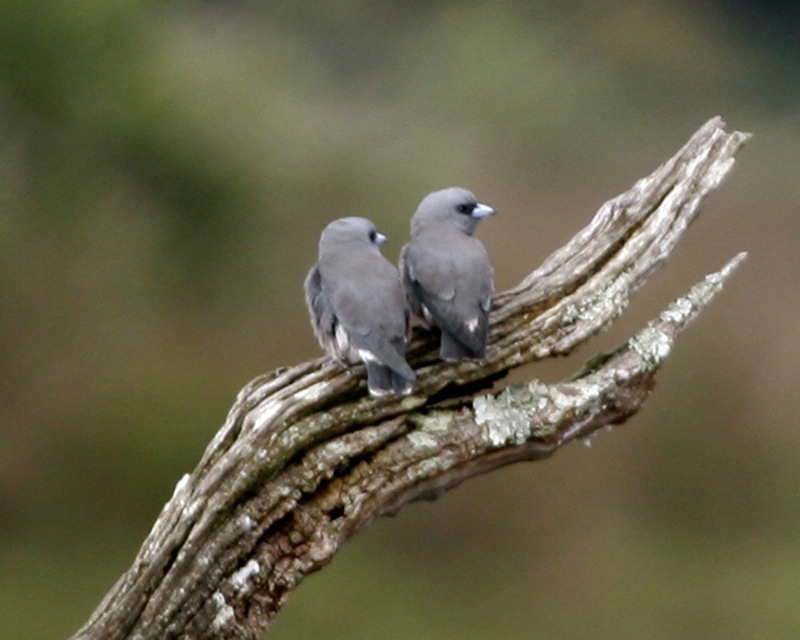
[[File:Artamus fuscus 3.jpg|thumb|right|[[Ashy woodswallow]] in Thattekad]] | [[File:Artamus fuscus 3.jpg|thumb|right|[[Ashy woodswallow]] in Thattekad]] | ||
Order: [[Passeriformes]]{{nbsp|3}}Family: [[Artamidae]] | |||
The woodswallows are soft-plumaged, | The woodswallows are soft-plumaged, sombre-coloured passerine birds. They are smooth, agile flyers with moderately large, semi-triangular wings. | ||
*[[Ashy woodswallow]], ''Artamus fuscus'' | *[[Ashy woodswallow]], ''Artamus fuscus'' | ||
==Ioras== | ==Ioras== | ||
Order: [[Passeriformes]]{{nbsp|3}}Family: [[Aegithinidae]] | |||
The ioras are [[bulbul]]-like birds of open forest or thorn scrub, but whereas that group tends to be drab in colouration, ioras are sexually dimorphic, with the males being brightly plumaged in yellows and greens. | The ioras are [[bulbul]]-like birds of open forest or thorn scrub, but whereas that group tends to be drab in colouration, ioras are sexually dimorphic, with the males being brightly plumaged in yellows and greens. | ||
| Line 750: | Line 749: | ||
==Cuckooshrikes== | ==Cuckooshrikes== | ||
Order: [[Passeriformes]]{{nbsp|3}}Family: [[Campephagidae]] | |||
The cuckooshrikes are small to medium-sized passerine birds. They are predominantly greyish with white and black, although some species are brightly coloured. | The cuckooshrikes are small to medium-sized passerine birds. They are predominantly greyish with white and black, although some species are brightly coloured. | ||
| Line 761: | Line 760: | ||
==Shrikes== | ==Shrikes== | ||
Order: [[Passeriformes]]{{nbsp|3}}Family: [[Laniidae]] | |||
Shrikes are passerine birds known for their habit of catching other birds and small animals and impaling the uneaten portions of their bodies on thorns. A typical shrike's beak is hooked, like a bird of prey. | Shrikes are passerine birds known for their habit of catching other birds and small animals and impaling the uneaten portions of their bodies on thorns. A typical shrike's beak is hooked, like a bird of prey. | ||
| Line 771: | Line 770: | ||
==Figbirds, orioles, and turnagra== | ==Figbirds, orioles, and turnagra== | ||
[[File:Black headed Oriole 2.JPG|thumb|right|[[Black-hooded oriole]]]] | [[File:Black headed Oriole 2.JPG|thumb|right|[[Black-hooded oriole]]]] | ||
Order: [[Passeriformes]]{{nbsp|3}}Family: [[Oriolidae]] | |||
The Old World orioles are colourful passerine birds. They are not related to the New World orioles. | The Old World orioles are colourful passerine birds. They are not related to the New World orioles. | ||
| Line 780: | Line 779: | ||
==Drongos== | ==Drongos== | ||
[[File:Greater Racket-Tailed Drongo-1.jpg|thumb|right|[[Greater racket-tailed drongo]] | [[File:Greater Racket-Tailed Drongo-1.jpg|thumb|right|[[Greater racket-tailed drongo]]]] | ||
Order: [[Passeriformes]]{{nbsp|3}}Family: [[Dicruridae]] | |||
The drongos are mostly black or dark grey in colour, sometimes with metallic tints. They have long forked tails, and some Asian species have elaborate tail decorations. They have short legs and sit very upright when perched, like a shrike. They flycatch or take prey from the ground. | The drongos are mostly black or dark grey in colour, sometimes with metallic tints. They have long forked tails, and some Asian species have elaborate tail decorations. They have short legs and sit very upright when perched, like a shrike. They flycatch or take prey from the ground. | ||
| Line 793: | Line 792: | ||
==Fantails and silktails== | ==Fantails and silktails== | ||
[[File:White-browed fantail (Rhipidura aureola).JPG|thumb|White-browed fantail | [[File:White-browed fantail (Rhipidura aureola).JPG|thumb|[[White-browed fantail]] in [[Mayannur]], [[Thrissur]]]] | ||
Order: [[Passeriformes]]{{nbsp|3}}Family: [[Rhipiduridae]] | |||
The fantails are small insectivorous birds which are specialist aerial feeders. | The fantails are small insectivorous birds which are specialist aerial feeders. | ||
| Line 802: | Line 801: | ||
==Monarchs== | ==Monarchs== | ||
[[File:Black Napped Monarch Prasanna Mamidala.jpg|thumb|right|Black-naped monarch]] | [[File:Black Napped Monarch Prasanna Mamidala.jpg|thumb|right|[[Black-naped monarch]]]] | ||
Order: [[Passeriformes]]{{nbsp|3}}Family: [[Monarchidae]] | |||
The monarch flycatchers are small to medium-sized insectivorous passerines which hunt by flycatching. | The monarch flycatchers are small to medium-sized insectivorous passerines which hunt by flycatching. | ||
| Line 813: | Line 812: | ||
==Crows and jays== | ==Crows and jays== | ||
[[File:Dendrocitta vagabunda -Calicut-Kerala-India-8.jpg|thumb|right|[[Rufous treepie]] in [[Kozhikode|Calicut]]]] | [[File:Dendrocitta vagabunda -Calicut-Kerala-India-8.jpg|thumb|right|[[Rufous treepie]] in [[Kozhikode|Calicut]]]] | ||
Order: [[Passeriformes]]{{nbsp|3}}Family: [[Corvidae]] | |||
The family Corvidae includes [[crow]]s, [[raven]]s, [[jay]]s, [[chough]]s, [[magpie]]s, [[treepie]]s, [[nutcracker (bird)|nutcracker]]s and [[ground jay]]s. Corvids are above average in size among the Passeriformes, and some of the larger species show high levels of intelligence. | The family Corvidae includes [[crow]]s, [[raven]]s, [[jay]]s, [[chough]]s, [[magpie]]s, [[treepie]]s, [[nutcracker (bird)|nutcracker]]s and [[ground jay]]s. Corvids are above average in size among the Passeriformes, and some of the larger species show high levels of intelligence. | ||
| Line 825: | Line 824: | ||
==Fairy flycatchers== | ==Fairy flycatchers== | ||
Order: [[Passeriformes]]{{nbsp|3}}Family: [[Stenostiridae]] | |||
Most of the species of this small family are found in Africa, though a few inhabit tropical Asia. They are not closely related to other birds called "flycatchers". | Most of the species of this small family are found in Africa, though a few inhabit tropical Asia. They are not closely related to other birds called "flycatchers". | ||
| Line 832: | Line 831: | ||
==Tits and chickadees== | ==Tits and chickadees== | ||
Order: [[Passeriformes]]{{nbsp|3}}Family: [[Paridae]] | |||
The Paridae are mainly small stocky woodland species with short stout bills. Some have crests. They are adaptable birds, with a mixed diet including seeds and insects. | The Paridae are mainly small stocky woodland species with short stout bills. Some have crests. They are adaptable birds, with a mixed diet including seeds and insects. | ||
*[[Cinereous tit]], ''Parus cinereus'' (known earlier as [[great tit]], ''Parus major''<ref>{{cite journal | author = Packert Martin, Martens Jochen, Eck Siegfried, Nazarenko Alexander A, Valchuk Olga P., Petri Bernd, Veith Michael | year = 2005 | title = The great tit (''Parus major'') – a misclassified ring species | doi = 10.1111/j.1095-8312.2005.00529.x | journal = Biological Journal of the Linnean Society | volume = 86 | issue = 2| pages = 153–174 | doi-access = | *[[Cinereous tit]], ''Parus cinereus'' (known earlier as [[great tit]], ''Parus major''<ref>{{cite journal | author = Packert Martin, Martens Jochen, Eck Siegfried, Nazarenko Alexander A, Valchuk Olga P., Petri Bernd, Veith Michael | year = 2005 | title = The great tit (''Parus major'') – a misclassified ring species | doi = 10.1111/j.1095-8312.2005.00529.x | journal = Biological Journal of the Linnean Society | volume = 86 | issue = 2| pages = 153–174 | doi-access =}}</ref>) | ||
*[[Himalayan black-lored tit]], ''Machlolophus xanthogenys'' | *[[Himalayan black-lored tit]], ''Machlolophus xanthogenys'' | ||
*[[Indian black-lored tit]], ''Machlolophus aplonotus'' | *[[Indian black-lored tit]], ''Machlolophus aplonotus'' | ||
| Line 842: | Line 841: | ||
==Larks== | ==Larks== | ||
[[File:Malabar Crested Lark.jpg|thumb|right|[[Malabar lark]] in [[Kannur]], Kerala]] | [[File:Malabar Crested Lark.jpg|thumb|right|[[Malabar lark]] in [[Kannur]], Kerala]] | ||
Order: [[Passeriformes]]{{nbsp|3}}Family: [[Alaudidae]] | |||
Larks are small terrestrial birds with often extravagant songs and display flights. Most larks are fairly dull in appearance. Their food is insects and seeds. | Larks are small terrestrial birds with often extravagant songs and display flights. Most larks are fairly dull in appearance. Their food is insects and seeds. | ||
| Line 855: | Line 854: | ||
==Bulbuls== | ==Bulbuls== | ||
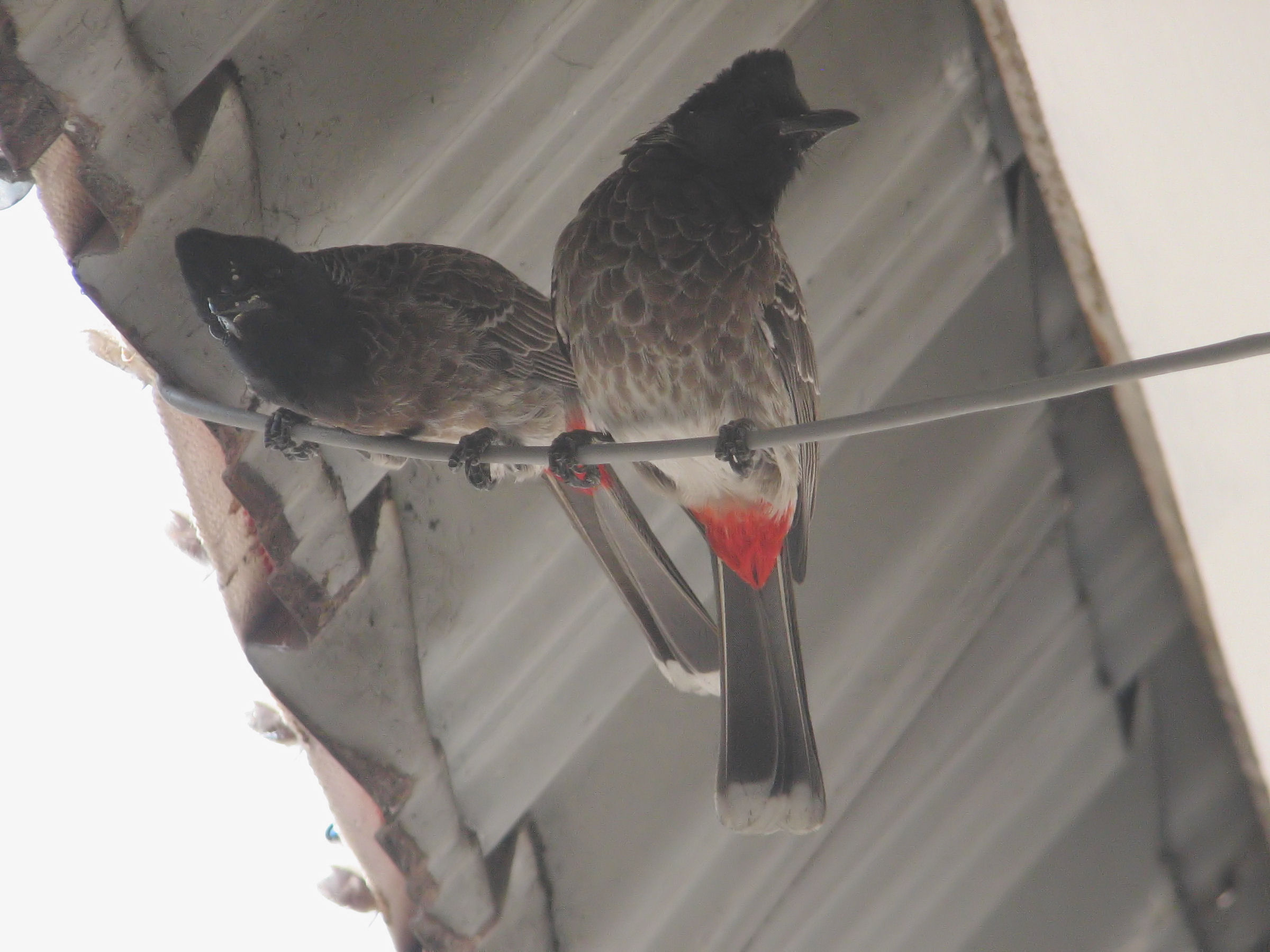
[[File:Red-vented Bulbuls.jpg|thumb|right|[[Red-vented bulbul]] in [[Ernakulam]]]] | [[File:Red-vented Bulbuls.jpg|thumb|right|[[Red-vented bulbul]] in [[Ernakulam]]]] | ||
Order: [[Passeriformes]]{{nbsp|3}}Family: [[Pycnonotidae]] | |||
Bulbuls are medium-sized songbirds. Some are colourful with yellow, red or orange vents, cheeks, throats or supercilia, but most are drab, with uniform olive-brown to black plumage. | Bulbuls are medium-sized songbirds. Some are colourful with yellow, red or orange vents, cheeks, throats or supercilia, but most are drab, with uniform olive-brown to black plumage. | ||
*[[Yellow-browed bulbul]], ''Acritillas indica'' | *[[Yellow-browed bulbul]], ''Acritillas indica'' | ||
*[[Black bulbul]], ''Hypsipetes leucocephalus'' | *[[Black bulbul]], ''Hypsipetes leucocephalus'' | ||
*[[Square-tailed bulbul]], ''Hypsipetes ganeesa'' | *[[Square-tailed bulbul]], ''Hypsipetes ganeesa'' | ||
*[[Grey-headed bulbul]], ''Brachypodius priocephalus'' | *[[Grey-headed bulbul]], ''Brachypodius priocephalus'' | ||
*[[Black-crested bulbul]], ''Rubigula flaviventris'' | *[[Black-crested bulbul]], ''Rubigula flaviventris'' | ||
*[[Flame-throated bulbul]], ''Rubigula gularis'' | *[[Flame-throated bulbul]], ''Rubigula gularis'' | ||
*[[White-browed bulbul]], ''Pycnonotus luteolus'' | *[[White-browed bulbul]], ''Pycnonotus luteolus'' | ||
| Line 871: | Line 870: | ||
==Swallows and martins== | ==Swallows and martins== | ||
Order: [[Passeriformes]]{{nbsp|3}}Family: [[Hirundinidae]] | |||
The family Hirundinidae is adapted to aerial feeding. They have a slender streamlined body, long pointed wings and a short bill with a wide gape. The feet are adapted to perching rather than walking, and the front toes are partially joined at the base. | The family Hirundinidae is adapted to aerial feeding. They have a slender streamlined body, long pointed wings and a short bill with a wide gape. The feet are adapted to perching rather than walking, and the front toes are partially joined at the base. | ||
| Line 887: | Line 886: | ||
*[[Streak-throated swallow]], ''Petrochelidon fluvicola'' | *[[Streak-throated swallow]], ''Petrochelidon fluvicola'' | ||
==Leaf warblers | ==Leaf warblers and allies== | ||
Order: [[Passeriformes]]{{nbsp|3}}Family: [[Phylloscopidae]] | |||
Leaf warblers are a family of small insectivorous birds found mostly in Eurasia and ranging into Wallacea and Africa. The species are of various sizes, often green-plumaged above and yellow below, or more subdued with | Leaf warblers are a family of small insectivorous birds found mostly in Eurasia and ranging into Wallacea and Africa. The species are of various sizes, often green-plumaged above and yellow below, or more subdued with greyish-green to greyish-brown colours. | ||
*[[Hume's leaf warbler]], ''Phylloscopus humei'' <ref>{{cite journal| year=2012| title=A photographic record of Hume's Leaf Warbler Phylloscopus humei from Wayanad District, Kerala| author=Mohanram Kemparaju| journal=Malabar Trogon|volume=10| issue=1&2| pages=19|url=https://archive.org/details/KemparajuM.2012.APhotographicRecordOfHumesLeafWarblerPhylloscopus}}</ref> | *[[Hume's leaf warbler]], ''Phylloscopus humei'' <ref>{{cite journal| year=2012| title=A photographic record of Hume's Leaf Warbler Phylloscopus humei from Wayanad District, Kerala| author=Mohanram Kemparaju| journal=Malabar Trogon|volume=10| issue=1&2| pages=19|url=https://archive.org/details/KemparajuM.2012.APhotographicRecordOfHumesLeafWarblerPhylloscopus}}</ref> | ||
| Line 898: | Line 897: | ||
*[[Common chiffchaff]], ''Phylloscopus collybita'' | *[[Common chiffchaff]], ''Phylloscopus collybita'' | ||
*[[Green warbler]], ''Phylloscopus nitidus''<ref name=addchecklist/> | *[[Green warbler]], ''Phylloscopus nitidus''<ref name=addchecklist/> | ||
*[[Greenish warbler]], ''Phylloscopus trochiloides'' | *[[Greenish warbler]], ''Phylloscopus trochiloides'' | ||
*[[Large-billed leaf warbler]], ''Phylloscopus magnirostris'' | *[[Large-billed leaf warbler]], ''Phylloscopus magnirostris'' | ||
*[[Western crowned warbler]], ''Phylloscopus occipitalis'' | *[[Western crowned warbler]], ''Phylloscopus occipitalis'' | ||
==Reed warblers, | ==Reed warblers, Grauer's warbler, and allies== | ||
[[File:Clamerous-reed-warbler Sandeep.jpg|thumb|right|[[Clamorous reed warbler]] in [[Kannur]]]] | |||
Order: [[Passeriformes]]{{nbsp|3}}Family: [[Acrocephalidae]] | |||
Some members of this family are rather large for "warblers", though many are small. Most are rather plain olivaceous brown above with much yellow to beige below. They are usually found in open woodland, reedbeds, or tall grass. The family occurs mostly in southern to western Eurasia and surroundings, but it also ranges far into the Pacific, with some species in Africa. | |||
*[[Clamorous reed warbler]], ''Acrocephalus stentoreus'' | *[[Clamorous reed warbler]], ''Acrocephalus stentoreus'' | ||
| Line 914: | Line 915: | ||
*[[Sykes's warbler]], ''Iduna rama''<ref name=malabarsurvey/> | *[[Sykes's warbler]], ''Iduna rama''<ref name=malabarsurvey/> | ||
==Grassbirds | ==Grassbirds and allies== | ||
Order: [[Passeriformes]]{{nbsp|3}}Family: [[Locustellidae]] | |||
Locustellidae are a family of small insectivorous songbirds found mainly in Eurasia, Africa, and the Australian region. They are smallish birds with tails that are usually long and pointed, and tend to be drab brownish or buffy all over. | Locustellidae are a family of small insectivorous songbirds found mainly in Eurasia, Africa, and the Australian region. They are smallish birds with tails that are usually long and pointed, and tend to be drab brownish or buffy all over. | ||
| Line 926: | Line 927: | ||
==Cisticolas and allies== | ==Cisticolas and allies== | ||
[[File:Plain-Prinia.jpg|thumb|right|[[Plain prinia]] at [[Kannur]] in Kerala]] | [[File:Plain-Prinia.jpg|thumb|right|[[Plain prinia]] at [[Kannur]] in Kerala]] | ||
Order: [[Passeriformes]]{{nbsp|3}}Family: [[Cisticolidae]] | |||
The Cisticolidae are warblers found mainly in warmer southern regions of the Old World. They are generally very small birds of drab brown or grey appearance found in open country such as grassland or scrub. | The Cisticolidae are warblers found mainly in warmer southern regions of the Old World. They are generally very small birds of drab brown or grey appearance found in open country such as grassland or scrub. | ||
| Line 938: | Line 939: | ||
*[[Common tailorbird]], ''Orthotomus sutorius'' | *[[Common tailorbird]], ''Orthotomus sutorius'' | ||
==Sylviid | ==Sylviid warblers== | ||
Order: [[Passeriformes]]{{nbsp|3}}Family: [[Sylviidae]] | |||
The family Sylviidae is a group of small insectivorous passerine birds. They mainly occur as breeding species | The family Sylviidae is a group of small insectivorous passerine birds. They mainly occur as breeding species in Europe, Asia and, to a lesser extent, Africa. Most are of generally undistinguished appearance, but many have distinctive songs. | ||
*[[Lesser whitethroat]], ''Curruca curruca'' | *[[Lesser whitethroat]], ''Curruca curruca'' | ||
*[[Hume's whitethroat]], ''Curruca althaea'' | *[[Hume's whitethroat]], ''Curruca althaea'' | ||
*[[Eastern Orphean warbler]], ''Curruca crassirostris'' | *[[Eastern Orphean warbler]], ''Curruca crassirostris'' | ||
==Parrotbills and allies== | ==Parrotbills and allies== | ||
[[File:Yellow-Eyed Babbler.jpg|thumb|right|[[Yellow-eyed babbler]]]] | [[File:Yellow-Eyed Babbler.jpg|thumb|right|[[Yellow-eyed babbler]]]] | ||
Order: [[Passeriformes]]{{nbsp|3}}Family: [[Paradoxornithidae]] | |||
The parrotbills are a group of peculiar birds native to East and Southeast Asia, though feral populations exist elsewhere. They are generally small, long-tailed birds which inhabit reedbeds and similar habitat. They feed mainly on seeds, e.g. of grasses, to which their bill, as the name implies, is well-adapted. | The parrotbills are a group of peculiar birds native to East and Southeast Asia, though feral populations exist elsewhere. They are generally small, long-tailed birds which inhabit reedbeds and similar habitat. They feed mainly on seeds, e.g. of grasses, to which their bill, as the name implies, is well-adapted. | ||
| Line 956: | Line 957: | ||
==White-eyes== | ==White-eyes== | ||
Order: [[Passeriformes]]{{nbsp|3}}Family: [[Zosteropidae]] | |||
The white-eyes are small and mostly undistinguished, their plumage above being generally some dull colour like greenish-olive, but some species have a white or bright yellow throat, breast or lower parts, and several have buff flanks. As their name suggests, many species have a white ring around each eye. | The white-eyes are small and mostly undistinguished, their plumage above being generally some dull colour like greenish-olive, but some species have a white or bright yellow throat, breast or lower parts, and several have buff flanks. As their name suggests, many species have a white ring around each eye. | ||
| Line 963: | Line 964: | ||
==Babblers and scimitar babblers== | ==Babblers and scimitar babblers== | ||
Order: [[Passeriformes]]{{nbsp|3}}Family: [[Timaliidae]] | |||
The babblers, or timaliids, are somewhat diverse in size and colouration, but are characterised by soft fluffy plumage. | The babblers, or timaliids, are somewhat diverse in size and colouration, but are characterised by soft fluffy plumage. | ||
| Line 973: | Line 974: | ||
==Ground babblers== | ==Ground babblers== | ||
Order: [[Passeriformes]]{{nbsp|3}}Family: [[Pellorneidae]] | |||
These small to medium-sized songbirds have soft fluffy plumage but are otherwise rather diverse. Members of the genus ''Illadopsis'' are found in forests, but some other genera are birds of scrublands. | These small to medium-sized songbirds have soft fluffy plumage but are otherwise rather diverse. Members of the genus ''Illadopsis'' are found in forests, but some other genera are birds of scrublands. | ||
| Line 980: | Line 981: | ||
==Alcippe fulvettas== | ==Alcippe fulvettas== | ||
Order: [[Passeriformes]]{{nbsp|3}}Family: [[Alcippeidae]] | |||
The genus once included many other fulvettas and was previously placed in families Pellorneidae or Timaliidae. | The genus once included many other fulvettas and was previously placed in families Pellorneidae or Timaliidae. | ||
| Line 988: | Line 989: | ||
==Laughingthrushes and allies== | ==Laughingthrushes and allies== | ||
[[File:Grey-breasted Laughingthrush.jpg|thumb|right|[[Palani laughingthrush]] in [[Munnar]]]] | [[File:Grey-breasted Laughingthrush.jpg|thumb|right|[[Palani laughingthrush]] in [[Munnar]]]] | ||
Order: [[Passeriformes]]{{nbsp|3}}Family: [[Leiothrichidae]] | |||
The members of this family are diverse in size and colouration, though those of genus ''Turdoides'' tend to be brown or greyish. The family is found in Africa, India, and southeast Asia. | The members of this family are diverse in size and colouration, though those of genus ''Turdoides'' tend to be brown or greyish. The family is found in Africa, India, and southeast Asia. | ||
*[[Banasura laughingthrush]], ''Montecincla jerdoni'' | *[[Banasura laughingthrush]], ''Montecincla jerdoni'' | ||
*[[Nilgiri laughingthrush]], ''Montecincla cachinnans'' | *[[Nilgiri laughingthrush]], ''Montecincla cachinnans'' | ||
*[[Palani laughingthrush]], ''Montecincla fairbanki'' | *[[Palani laughingthrush]], ''Montecincla fairbanki'' | ||
*[[Ashambu laughingthrush]], ''Montecincla meridionalis'' | *[[Ashambu laughingthrush]], ''Montecincla meridionalis'' | ||
*[[Large grey babbler]], ''Argya malcolmi''<ref name=malabarsurvey>{{cite journal| year=2012| title=Large Grey Babbler ''Turdoides malcomi'' and Syke's Warbler ''Iduna rama'' in Walayar: first photographic record from Kerala| author=Sashikumar, C., Vishnudas, C. K., Raju, S., Vinayan, P. A., Shebin, V. A.| journal=Malabar Trogon|volume=10| issue=1&2| pages=7–8|url=https://archive.org/details/LargeGreyBabblerTurdoidesMalcomiAndSykesWarblerIdunaRamaInWalayar}}</ref><ref>{{cite journal| year=2012| title=A Report of Large Grey Babbler from Attappady Hills, Kerala|author1=Praveen, J. |author2=P. O. Nameer | journal=Malabar Trogon|volume=10| issue=1&2| pages=8–9|url=https://archive.org/details/PraveenJ.NameerP.o.2012.aReportOfLargeGreyBabblerFromAttappady}}</ref> | *[[Large grey babbler]], ''Argya malcolmi''<ref name=malabarsurvey>{{cite journal| year=2012| title=Large Grey Babbler ''Turdoides malcomi'' and Syke's Warbler ''Iduna rama'' in Walayar: first photographic record from Kerala| author=Sashikumar, C., Vishnudas, C. K., Raju, S., Vinayan, P. A., Shebin, V. A.| journal=Malabar Trogon|volume=10| issue=1&2| pages=7–8|url=https://archive.org/details/LargeGreyBabblerTurdoidesMalcomiAndSykesWarblerIdunaRamaInWalayar}}</ref><ref>{{cite journal| year=2012| title=A Report of Large Grey Babbler from Attappady Hills, Kerala|author1=Praveen, J. |author2=P. O. Nameer | journal=Malabar Trogon|volume=10| issue=1&2| pages=8–9|url=https://archive.org/details/PraveenJ.NameerP.o.2012.aReportOfLargeGreyBabblerFromAttappady}}</ref> | ||
*[[Rufous babbler]], ''Argya subrufa'' | *[[Rufous babbler]], ''Argya subrufa'' | ||
| Line 1,003: | Line 1,004: | ||
==Fairy-bluebirds== | ==Fairy-bluebirds== | ||
Order: [[Passeriformes]]{{nbsp|3}}Family: [[Irenidae]] | |||
The fairy-bluebirds are [[bulbul]]-like birds of open forest or thorn scrub. The males are dark-blue and the females a duller green. | The fairy-bluebirds are [[bulbul]]-like birds of open forest or thorn scrub. The males are dark-blue and the females a duller green. | ||
*[[Asian fairy-bluebird]], ''Irena puella'' | *[[Asian fairy-bluebird]], ''Irena puella'' | ||
==Nuthatches== | ==Nuthatches== | ||
Order: [[Passeriformes]]{{nbsp|3}}Family: [[Sittidae]] | |||
Nuthatches are small woodland birds. They have the unusual ability to climb down trees head first, unlike other birds which can only go upwards. Nuthatches have big heads, short tails and powerful bills and feet. | Nuthatches are small woodland birds. They have the unusual ability to climb down trees head first, unlike other birds which can only go upwards. Nuthatches have big heads, short tails and powerful bills and feet. | ||
*[[Velvet-fronted nuthatch]], ''Sitta frontalis'' | *[[Velvet-fronted nuthatch]], ''Sitta frontalis'' | ||
*[[Indian nuthatch]], ''Sitta castanea'' | *[[Indian nuthatch]], ''Sitta castanea'' | ||
==Starlings and rhabdornis== | ==Starlings and rhabdornis== | ||
[[File: | [[File:Starling bird (India, 2012).jpg|thumb|right|[[Southern hill myna]], [[Biligiriranga Hills]]]] | ||
Order: [[Passeriformes]]{{nbsp|3}}Family: [[Sturnidae]] | |||
Starlings are small to medium-sized passerine birds. Their flight is strong and direct and they are very gregarious. Their preferred habitat is fairly open country. They eat insects and fruit. Plumage is typically dark with a metallic sheen. | Starlings are small to medium-sized passerine birds. Their flight is strong and direct and they are very gregarious. Their preferred habitat is fairly open country. They eat insects and fruit. Plumage is typically dark with a metallic sheen. | ||
| Line 1,035: | Line 1,036: | ||
==Thrushes== | ==Thrushes== | ||
[[File:Indian Blackbird.jpg|thumb|right|Indian blackbird | [[File:Indian Blackbird.jpg|thumb|right|[[Indian blackbird]], [[Ooty]]]] | ||
Order: [[Passeriformes]]{{nbsp|3}}Family: [[Turdidae]] | |||
The [[Thrush (bird)|thrushes]] are a group of passerine birds that occur mainly in the Old World. They are plump, soft plumaged, small to medium-sized insectivores or sometimes omnivores, often feeding on the ground. Many have attractive songs. | The [[Thrush (bird)|thrushes]] are a group of passerine birds that occur mainly in the Old World. They are plump, soft plumaged, small to medium-sized insectivores or sometimes omnivores, often feeding on the ground. Many have attractive songs. | ||
*[[Pied thrush]], ''Geokichla wardii'' | *[[Pied thrush]], ''Geokichla wardii'' | ||
*[[Orange-headed thrush]], ''Geokichla citrina'' | *[[Orange-headed thrush]], ''Geokichla citrina'' | ||
*[[Scaly thrush]], ''Zoothera dauma'' | *[[Scaly thrush]], ''Zoothera dauma'' | ||
*[[Nilgiri thrush]], ''Zoothera neilgherriensis'' | *[[Nilgiri thrush]], ''Zoothera neilgherriensis'' | ||
*[[Indian blackbird]], ''Turdus simillimus'' | *[[Indian blackbird]], ''Turdus simillimus'' | ||
*[[Eyebrowed thrush]], ''Turdus obscurus'' | *[[Eyebrowed thrush]], ''Turdus obscurus'' | ||
==Chats and Old World flycatchers== | ==Chats and Old World flycatchers== | ||
[[File: | [[File:Female-magpie-robin-Sandeep.jpg|thumb|right|[[Oriental magpie-robin]] in [[Kannur]], Kerala]] | ||
[[File:Indian Robin Saxicoloides fulicata.JPG|thumb|Indian robin | [[File:Indian Robin Saxicoloides fulicata.JPG|thumb|Indian robin female in Mayannur, Thrissur]] | ||
[[File:PiedBushchat.jpg|thumb|right|Male [[pied bushchat]] at [[Ooty]]]] | [[File:PiedBushchat.jpg|thumb|right|Male [[pied bushchat]] at [[Ooty]]]] | ||
Order: [[Passeriformes]]{{nbsp|3}}Family: [[Muscicapidae]] | |||
The chats and Old World flycatchers are a large group of small passerine birds native to the Old World. They are mainly small arboreal insectivores. The appearance of these birds is highly varied; some have weak songs and harsh calls, but others are among the most noted songsters of all birds. | |||
{{colbegin}} | {{colbegin}} | ||
| Line 1,090: | Line 1,091: | ||
*[[Desert wheatear]], ''Oenanthe deserti'' | *[[Desert wheatear]], ''Oenanthe deserti'' | ||
*[[Pied wheatear]], ''Oenanthe pleschanka'' <ref>{{cite journal|author=Reghuvaran, P. |year=2016 |title=Pied Wheatear ''Oenanthe pleschanka'' at Bekal Fort, Kasaragod, Kerala | journal=Indian Birds|volume=12|issue=1|pages=18–19}}</ref> (A) | *[[Pied wheatear]], ''Oenanthe pleschanka'' <ref>{{cite journal|author=Reghuvaran, P. |year=2016 |title=Pied Wheatear ''Oenanthe pleschanka'' at Bekal Fort, Kasaragod, Kerala | journal=Indian Birds|volume=12|issue=1|pages=18–19}}</ref> (A) | ||
*[[Variable wheatear]], ''Oenanthe picata'' | |||
{{colend}} | {{colend}} | ||
==Leafbirds== | ==Leafbirds== | ||
Order: [[Passeriformes]]{{nbsp|3}}Family: [[Chloropseidae]] | |||
The leafbirds are small, [[bulbul]]-like birds. The males are brightly plumaged, usually in greens and yellows. | The leafbirds are small, [[bulbul]]-like birds. The males are brightly plumaged, usually in greens and yellows. | ||
| Line 1,103: | Line 1,104: | ||
==Flowerpeckers== | ==Flowerpeckers== | ||
[[File:Dicaeum concolor.jpg|thumb|right|[[Nilgiri flowerpecker]] in Thattekad]] | [[File:Dicaeum concolor.jpg|thumb|right|[[Nilgiri flowerpecker]] in Thattekad]] | ||
Order: [[Passeriformes]]{{nbsp|3}}Family: [[Dicaeidae]] | |||
The flowerpeckers are very small, stout, often brightly coloured birds, with short tails, short thick curved bills and tubular tongues. | The flowerpeckers are very small, stout, often brightly coloured birds, with short tails, short thick curved bills and tubular tongues. | ||
| Line 1,110: | Line 1,111: | ||
*[[Pale-billed flowerpecker]], ''Dicaeum erythrorhynchos'' | *[[Pale-billed flowerpecker]], ''Dicaeum erythrorhynchos'' | ||
*[[Nilgiri flowerpecker]], ''Dicaeum concolor'' | *[[Nilgiri flowerpecker]], ''Dicaeum concolor'' | ||
*[[Plain flowerpecker]], ''Dicaeum minullum'' | *[[Plain flowerpecker]], ''Dicaeum minullum'' | ||
==Sunbirds== | ==Sunbirds== | ||
[[File:Little spiderhunter India.jpg|thumb|right|[[Little spiderhunter]] in Thattekad]] | [[File:Little spiderhunter India.jpg|thumb|right|[[Little spiderhunter]] in Thattekad]] | ||
Order: [[Passeriformes]]{{nbsp|3}}Family: [[Nectariniidae]] | |||
The sunbirds and spiderhunters are very small passerine birds which feed largely on nectar, although they will also take insects, especially when feeding young. Flight is fast and direct on their short wings. Most species can take nectar by hovering like a hummingbird, but usually perch to feed. | The sunbirds and spiderhunters are very small passerine birds which feed largely on nectar, although they will also take insects, especially when feeding young. Flight is fast and direct on their short wings. Most species can take nectar by hovering like a hummingbird, but usually perch to feed. | ||
*[[Purple-rumped sunbird]], ''Leptocoma zeylonica'' | *[[Purple-rumped sunbird]], ''Leptocoma zeylonica'' | ||
*[[Crimson-backed sunbird]], ''Leptocoma minima'' | *[[Crimson-backed sunbird]], ''Leptocoma minima'' | ||
*[[Purple sunbird]], ''Cinnyris asiaticus'' | *[[Purple sunbird]], ''Cinnyris asiaticus'' | ||
*[[Loten's sunbird]], ''Cinnyris lotenius'' | *[[Loten's sunbird]], ''Cinnyris lotenius'' | ||
| Line 1,125: | Line 1,126: | ||
==Old World sparrows and snowfinches== | ==Old World sparrows and snowfinches== | ||
Order: [[Passeriformes]]{{nbsp|3}}Family: [[Passeridae]] | |||
[[Old World sparrow|Sparrow]]s are small passerine birds. In general, sparrows tend to be small, plump, brown or grey birds with short tails and short powerful beaks. Sparrows are seed eaters, but they also consume small insects. | [[Old World sparrow|Sparrow]]s are small passerine birds. In general, sparrows tend to be small, plump, brown or grey birds with short tails and short powerful beaks. Sparrows are seed eaters, but they also consume small insects. | ||
| Line 1,134: | Line 1,135: | ||
==Weavers and widowbirds== | ==Weavers and widowbirds== | ||
Order: [[Passeriformes]]{{nbsp|3}}Family: [[Ploceidae]] | |||
The weavers are small passerine birds related to the [[finch]]es. They are seed-eating birds with rounded conical bills. The males of many species are brightly coloured, usually in red or yellow and black, some species show variation in colour only in the breeding season. | The weavers are small passerine birds related to the [[finch]]es. They are seed-eating birds with rounded conical bills. The males of many species are brightly coloured, usually in red or yellow and black, some species show variation in colour only in the breeding season. | ||
| Line 1,142: | Line 1,143: | ||
==Waxbills, munias, and allies== | ==Waxbills, munias, and allies== | ||
[[File:SB-munia-Sandeep.jpg|thumb|right|[[Scaly-breasted munia]]]] | |||
Order: [[Passeriformes]]{{nbsp|3}}Family: [[Estrildidae]] | |||
The [[ | The [[estrildidae|munias]] and allies are small passerine birds of the Old World tropics and [[Australasia]]. They are gregarious and often colonial seed eaters with short thick but pointed bills. They are all similar in structure and habits, but have wide variation in plumage colours and patterns. | ||
*[[Indian silverbill]], ''Euodice malabarica'' | *[[Indian silverbill]], ''Euodice malabarica'' | ||
| Line 1,150: | Line 1,152: | ||
*[[Black-throated munia]], ''Lonchura kelaarti'' | *[[Black-throated munia]], ''Lonchura kelaarti'' | ||
*[[White-rumped munia]], ''Lonchura striata'' | *[[White-rumped munia]], ''Lonchura striata'' | ||
*[[ | *[[Tricoloured munia]], ''Lonchura malacca'' | ||
*[[Red avadavat]], ''Amandava amandava'' | *[[Red avadavat]], ''Amandava amandava'' | ||
==Wagtails and pipits== | ==Wagtails and pipits== | ||
[[File:White-browedWagtail.jpg|thumb|right|[[White-browed wagtail]]]] | [[File:White-browedWagtail.jpg|thumb|right|[[White-browed wagtail]]]] | ||
[[File:Dark-HeadedWagtail.jpg|thumb|right| | [[File:Dark-HeadedWagtail.jpg|thumb|right|Grey-headed wagtail, subspecies of the [[western yellow wagtail]]]] | ||
Order: [[Passeriformes]]{{nbsp|3}}Family: [[Motacillidae]] | |||
Motacillidae is a family of small passerine birds with medium to long tails. They include the wagtails, longclaws and pipits. They are slender, ground feeding insectivores of open country. | Motacillidae is a family of small passerine birds with medium to long tails. They include the wagtails, longclaws and pipits. They are slender, ground feeding insectivores of open country. | ||
| Line 1,172: | Line 1,174: | ||
*[[Blyth's pipit]], ''Anthus godlewskii'' | *[[Blyth's pipit]], ''Anthus godlewskii'' | ||
*[[Tawny pipit]], ''Anthus campestris''<ref>{{cite journal|author=Rajeevan, P. C., Biju, P. B. and Thomas, J.|year=2011| title=First record of Tawny Pipit ''Anthus campestris'' from Kerala| journal=Indian Birds|issue=6|volume=7}}</ref> | *[[Tawny pipit]], ''Anthus campestris''<ref>{{cite journal|author=Rajeevan, P. C., Biju, P. B. and Thomas, J.|year=2011| title=First record of Tawny Pipit ''Anthus campestris'' from Kerala| journal=Indian Birds|issue=6|volume=7}}</ref> | ||
*[[Long-billed pipit]], ''Anthus similis'' | *[[Long-billed pipit]], ''Anthus similis'' | ||
*[[Tree pipit]], ''Anthus trivialis'' | *[[Tree pipit]], ''Anthus trivialis'' | ||
*[[Olive-backed pipit]], ''Anthus hodgsoni'' | *[[Olive-backed pipit]], ''Anthus hodgsoni'' | ||
| Line 1,180: | Line 1,182: | ||
==Finches and euphonias== | ==Finches and euphonias== | ||
Order: [[Passeriformes]]{{nbsp|3}}Family: [[Fringillidae]] | |||
[[Finch]]es are seed-eating passerine birds, that are small to moderately large and have a strong beak, usually conical and in some species very large. All have twelve tail feathers and nine primaries. These birds have a bouncing flight with alternating bouts of flapping and gliding on closed wings, and most sing well. | [[Finch]]es are seed-eating passerine birds, that are small to moderately large and have a strong beak, usually conical and in some species very large. All have twelve tail feathers and nine primaries. These birds have a bouncing flight with alternating bouts of flapping and gliding on closed wings, and most sing well. | ||
| Line 1,187: | Line 1,189: | ||
==Buntings== | ==Buntings== | ||
Order: [[Passeriformes]]{{nbsp|3}}Family: [[Emberizidae]] | |||
The | The buntings are a large family of passerine birds. They are seed-eating birds with distinctively shaped bills. In Europe, most species are called buntings. Species in North America formerly included in this family, mostly known as sparrows, have now been moved to a separate family [[Passerellidae]], though these birds are not closely related to the Old World sparrows which are in the family Passeridae. Many buntings species have distinctive head patterns. | ||
*[[Crested bunting]], ''Emberiza lathami'' | *[[Crested bunting]], ''Emberiza lathami'' | ||
*[[Grey-necked bunting]], ''Emberiza buchanani'' | *[[Grey-necked bunting]], ''Emberiza buchanani'' | ||
*[[Little bunting]], ''Emberiza pusilla'' <ref>{{cite journal |author1=Eaton, J. A.|author2=Mathew, J.|year= 2016|title=Little Bunting ''Schoeniclus pusillus'' in Munnar Hills, Kerala|journal=Indian Birds|volume=12|issue=1|pages=17–18}}</ref> (A) | *[[Little bunting]], ''Emberiza pusilla'' <ref>{{cite journal |author1=Eaton, J. A.|author2=Mathew, J.|year= 2016|title=Little Bunting ''Schoeniclus pusillus'' in Munnar Hills, Kerala|journal=Indian Birds|volume=12|issue=1|pages=17–18}}</ref> (A) | ||
*[[Yellow-breasted bunting]], ''Emberiza aureola'' | *[[Yellow-breasted bunting]], ''Emberiza aureola'' | ||
| Line 1,216: | Line 1,218: | ||
{{Kerala topics}} | {{Kerala topics}} | ||
{{Kerala}} | {{Kerala}} | ||
[[Category:Kerala fauna-related lists|Birds]] | [[Category:Kerala fauna-related lists|Birds]] | ||
[[Category:Lists of fauna of India|Birds of Kerala]] | [[Category:Lists of fauna of India|Birds of Kerala]] | ||
[[Category:Lists of birds of India|Kerala]] | [[Category:Lists of birds of India|Kerala]] | ||
Latest revision as of 17:47, 24 February 2026
The state of Kerala, India, has 567 bird species within its boundaries.
This list's taxonomic treatment (designation and sequence of orders, families and species) and nomenclature (common and scientific names) follow the conventions of the IOC World Bird List, version 11.2. This list also uses British English throughout. Any bird names or other wording follows that convention. The species list and English names are entirely based on the Checklist of Birds of Kerala[1] published in November 2015.
The following tag has been used to highlight accidental species. The commonly occurring native species do not fit within this category.
- (A) Accidental - Also known as a rarity, it refers to a species that rarely or accidentally occurs in Kerala-typically less than ten confirmed records.
Ducks, geese, and swans[edit | edit source]


Order: Anseriformes Family: Anatidae
Anatidae includes the ducks and most duck-like waterfowl, such as geese and swans. These birds are adapted to an aquatic existence with webbed feet, flattened bills, and feathers that are excellent at shedding water due to an oily coating.
- Fulvous whistling duck, Dendrocygna bicolor (A)
- Lesser whistling duck, Dendrocygna javanica
- Bar-headed goose, Anser indicus
- Knob-billed duck, Sarkidiornis melanotos
- Ruddy shelduck, Tadorna ferruginea
- Cotton pygmy goose, Nettapus coromandelianus
- Garganey, Spatula querquedula
- Northern shoveler, Spatula clypeata
- Gadwall, Mareca strepera
- Eurasian wigeon, Mareca penelope
- Indian spot-billed duck, Anas poecilorhyncha
- Northern pintail, Anas acuta
- Eurasian teal, Anas crecca
- Common pochard, Aythya ferina (A)
- Ferruginous duck, Aythya nyroca
- Tufted duck, Aythya fuligula (A)
Pheasants and allies[edit | edit source]

Order: Galliformes Family: Phasianidae
The Phasianidae are a family of terrestrial birds. In general, they are plump (although they vary in size) and have broad, relatively short wings.
- Grey francolin, Francolinus pondicerianus
- Rain quail, Coturnix coromandelica
- Jungle bush quail, Perdicula asiatica
- Painted bush quail, Perdicula erythrorhyncha
- Red spurfowl, Galloperdix spadicea
- Painted spurfowl, Galloperdix lunulata
- Grey junglefowl, Gallus sonneratii
- Indian peafowl, Pavo cristatus
Frogmouths[edit | edit source]
Order: Caprimulgiformes Family: Podargidae
The frogmouths are a group of nocturnal birds related to the nightjars. They are named for their large flattened hooked bill and huge frog-like gape, which they use to take insects.
- Sri Lanka frogmouth, Batrachostomus moniliger
Nightjars[edit | edit source]

Order: Caprimulgiformes Family: Caprimulgidae
Nightjars are medium-sized nocturnal birds that usually nest on the ground. They have long wings, short legs and very short bills. Most have small feet, of little use for walking, and long pointed wings. Their soft plumage is camouflaged to resemble bark or leaves.
- Great eared nightjar, Lyncornis macrotis
- Jungle nightjar, Caprimulgus indicus
- Jerdon's nightjar, Caprimulgus atripennis
- Indian nightjar, Caprimulgus asiaticus
- Savanna nightjar, Caprimulgus affinis
Treeswifts[edit | edit source]
Order: Apodiformes Family: Hemiprocnidae
The treeswifts, or crested swifts, are closely related to the true swifts. They differ from the other swifts in that they have crests, long forked tails and softer plumage.
- Crested treeswift, Hemiprocne coronata
Swifts[edit | edit source]
Order: Apodiformes Family: Apodidae
Swifts are small birds which spend the majority of their lives flying. These birds have very short legs and never settle voluntarily on the ground, perching instead only on vertical surfaces. Many swifts have long swept-back wings which resemble a crescent or boomerang.
- Indian swiftlet, Aerodramus unicolor
- Edible-nest swiftlet, Aerodramus fuciphagus
- White-rumped spinetail, Zoonavena sylvatica
- Brown-backed needletail, Hirundapus giganteus
- Asian palm swift, Cypsiurus balasiensis
- Alpine swift, Tachymarptis melba
- Common swift, Apus apus [2]
- Blyth's swift, Apus leuconyx
- Little swift, Apus affinis
Bustards[edit | edit source]
Order: Otidiformes Family: Otididae
Bustards are large terrestrial birds mainly associated with dry open country and steppes in the Old World. They are omnivorous and nest on the ground. They walk steadily on strong legs and big toes, pecking for food as they go. They have long broad wings with "fingered" wingtips and striking patterns in flight. Many have interesting mating displays.
- MacQueen's bustard, Chlamydotis undulata
- Lesser florican, Sypheotides indicus
Cuckoos[edit | edit source]

Order: Cuculiformes Family: Cuculidae

The family Cuculidae includes cuckoos, roadrunners and anis. These birds are of variable size with slender bodies, long tails and strong legs. Many are brood parasites.
- Greater coucal, Centropus sinensis
- Lesser coucal, Centropus bengalensis
- Sirkeer malkoha, Taccocua leschenaultii
- Blue-faced malkoha, Phaenicophaeus viridirostris
- Chestnut-winged cuckoo, Clamator coromandus
- Jacobin cuckoo, Clamator jacobinus
- Asian koel, Eudynamys scolopaceus
- Banded bay cuckoo, Cacomantis sonneratii
- Grey-bellied cuckoo, Cacomantis passerinus
- Square-tailed drongo-cuckoo, Surniculus lugubris
- Fork-tailed drongo-cuckoo, Surniculus dicruroides
- Large hawk-cuckoo, Hierococcyx sparverioides
- Common hawk-cuckoo, Hierococcyx varius
- Lesser cuckoo, Cuculus poliocephalus
- Indian cuckoo, Cuculus micropterus
- Common cuckoo, Cuculus canorus
Sandgrouse[edit | edit source]
Order: Pterocliformes Family: Pteroclidae
Sandgrouse have small, pigeon like heads and necks, but sturdy compact bodies. They have long pointed wings and sometimes tails and a fast direct flight. Flocks fly to watering holes at dawn and dusk. Their legs are feathered down to the toes.
- Chestnut-bellied sandgrouse, Pterocles exustus[3]
Pigeons and doves[edit | edit source]
.jpg)
Order: Columbiformes Family: Columbidae
Pigeons and doves are stout-bodied birds with short necks and short slender bills with a fleshy cere.
- Rock dove, Columba livia
- Nilgiri wood pigeon, Columba elphinstonii
- Oriental turtle dove, Streptopelia orientalis
- Eurasian collared dove, Streptopelia decaocto
- Red collared dove, Streptopelia tranqubarica [4]
- Spotted dove, Spilopelia chinensis
- Laughing dove, Spilopelia senegalensis
- Common emerald dove, Chalcophaps indica
- Orange-breasted green pigeon, Treron bicinctus
- Grey-fronted green pigeon, Treron affinis
- Yellow-footed green pigeon, Treron phoenicopterus
- Green imperial pigeon, Ducula aenea
- Mountain imperial pigeon, Ducula badia
Rails, crakes, and coots[edit | edit source]

Order: Gruiformes Family: Rallidae
Rallidae is a large family of small to medium-sized birds which includes the rails, crakes, coots and gallinules. Typically they inhabit dense vegetation in damp environments near lakes, swamps or rivers. In general they are shy and secretive birds, making them difficult to observe. Most species have strong legs and long toes which are well adapted to soft uneven surfaces. They tend to have short, rounded wings and to be weak fliers.
- Slaty-breasted rail, Lewinia striata
- Spotted crake, Porzana porzana [5] (A)
- Common moorhen, Gallinula chloropus
- Eurasian coot, Fulica atra
- Grey-headed swamphen, Porphyrio poliocephalus
- Ruddy-breasted crake, Zapornia fusca
- Baillon's crake, Zapornia pusilla
- Slaty-legged crake, Rallina eurizonoides
- Watercock, Gallicrex cinerea
- White-breasted waterhen, Amaurornis phoenicurus
Grebes[edit | edit source]
Order: Podicipediformes Family: Podicipedidae
Grebes are small to medium-large freshwater diving birds. They have lobed toes and are excellent swimmers and divers. However, they have their feet placed far back on the body, making them quite ungainly on land.
- Little grebe, Tachybaptus ruficollis
Flamingos[edit | edit source]
Order: Phoenicopteriformes Family: Phoenicopteridae
Flamingos are gregarious wading birds, usually 1 to 1.5 metres (3 to 5 ft) tall, found in both the Western and Eastern Hemispheres. Flamingos filter-feed on shellfish and algae. Their oddly shaped beaks are specially adapted to separate mud and silt from the food they consume and, uniquely, are used upside-down.
- Greater flamingo, Phoenicopterus roseus
Buttonquail[edit | edit source]
Order: Charadriiformes Family: Turnicidae
The buttonquail are small, drab, running birds which resemble the true quails. The female is the brighter of the sexes and initiates courtship. The male incubates the eggs and tends the young.
- Yellow-legged buttonquail, Turnix tanki
- Barred buttonquail, Turnix suscitator
Stone-curlews and thick-knees[edit | edit source]

Order: Charadriiformes Family: Burhinidae
The stone-curlews and thick-knees are a group of largely tropical waders in the family Burhinidae. They are found worldwide within the tropical zone, with some species also breeding in temperate Europe and Australia. They are medium to large waders with strong black or yellow-black bills, large yellow eyes and cryptic plumage. Despite being classed as waders, most species have a preference for arid or semi-arid habitats.
- Indian stone-curlew, Burhinus indicus
- Great stone-curlew, Esacus recurvirostris[6]
Oystercatchers[edit | edit source]
Order: Charadriiformes Family: Haematopodidae
The oystercatchers are large and noisy plover-like birds, with strong bills used for smashing or prising open molluscs.
- Eurasian oystercatcher, Haematopus ostralegus
Stilts and avocets[edit | edit source]
Order: Charadriiformes Family: Recurvirostridae
Recurvirostridae is a family of large wading birds, which includes the avocets and stilts. The avocets have long legs and long up-curved bills. The stilts have extremely long legs and long, thin, straight bills.
- Black-winged stilt, Himantopus himantopus
- Pied avocet, Recurvirostra avosetta
Plovers[edit | edit source]


Order: Charadriiformes Family: Charadriidae
The family Charadriidae includes the plovers, dotterels and lapwings. They are small to medium-sized birds with compact bodies, short, thick necks and long, usually pointed, wings. They are found in open country worldwide, mostly in habitats near water.
- Yellow-wattled lapwing, Vanellus malabaricus
- Grey-headed lapwing, Vanellus cinereus
- Red-wattled lapwing, Vanellus indicus
- Sociable lapwing, Vanellus gregarius [7] [historical]
- White-tailed lapwing, Vanellus leucurus
- Pacific golden plover, Pluvialis fulva
- American golden plover, Pluvialis dominica (A)
- Grey plover, Pluvialis squatarola
- Common ringed plover, Charadrius hiaticula
- Little ringed plover, Charadrius dubius
- Kentish plover, Charadrius alexandrinus
- White-faced plover, Charadrius dealbatus (A)
- Lesser sand plover, Charadrius mongolus
- Greater sand plover, Charadrius leschenaultii
- Caspian plover, Charadrius asiaticus [8]
Painted-snipes[edit | edit source]
Order: Charadriiformes Family: Rostratulidae
Painted-snipes are short-legged, long-billed birds similar in shape to the true snipes, but more brightly coloured.
- Greater painted-snipe, Rostratula benghalensis
Jacanas[edit | edit source]
Order: Charadriiformes Family: Jacanidae
The jacanas are a group of tropical waders in the family Jacanidae. They are found throughout the tropics. They are identifiable by their huge feet and claws which enable them to walk on floating vegetation in the shallow lakes that are their preferred habitat.
- Pheasant-tailed jacana, Hydrophasianus chirurgus
- Bronze-winged jacana, Metopidius indicus
Sandpipers and snipes[edit | edit source]


Order: Charadriiformes Family: Scolopacidae
Scolopacidae is a large diverse family of small to medium-sized shorebirds including the sandpipers, curlews, godwits, shanks, tattlers, woodcocks, snipes, dowitchers and phalaropes. The majority of these species eat small invertebrates picked out of the mud or soil. Variation in length of legs and bills enables multiple species to feed in the same habitat, particularly on the coast, without direct competition for food.
- Eurasian whimbrel, Numenius phaeopus
- Eurasian curlew, Numenius arquata
- Bar-tailed godwit, Limosa lapponica
- Black-tailed godwit, Limosa limosa
- Ruddy turnstone, Arenaria interpres
- Great knot, Calidris tenuirostris
- Red knot, Calidris canutus[9] (A)
- Ruff, Calidris pugnax
- Broad-billed sandpiper, Calidris falcinellus
- Curlew sandpiper, Calidris ferruginea
- Temminck's stint, Calidris temminckii
- Long-toed stint, Calidris subminuta[10]
- Sanderling, Calidris alba
- Dunlin, Calidris alpina
- Little stint, Calidris minuta
- Buff-breasted sandpiper, Calidris subruficollis[11] (A)
- Pectoral sandpiper, Calidris melanotos [8] (A)
- Asian dowitcher, Limnodromus semipalmatus
- Long-billed dowitcher, Limnodromus scolopaceus [12] (A)
- Eurasian woodcock, Scolopax rusticola
- Jack snipe, Lymnocryptes minimus
- Wood snipe, Gallinago nemoricola[7] [historical]
- Pin-tailed snipe, Gallinago stenura
- Swinhoe's snipe, Gallinago megala[7] [historical]
- Common snipe, Gallinago gallinago
- Terek sandpiper, Xenus cinereus
- Red-necked phalarope, Phalaropus lobatus[7]
- Common sandpiper, Actitis hypoleucos
- Green sandpiper, Tringa ochropus
- Common redshank, Tringa totanus
- Marsh sandpiper, Tringa stagnatilis
- Wood sandpiper, Tringa glareola
- Spotted redshank, Tringa erythropus
- Common greenshank, Tringa nebularia
Crab-plover[edit | edit source]
Order: Charadriiformes Family: Dromadidae
The crab-plover is related to the waders. It resembles a plover but with very long grey legs and a strong heavy black bill similar to a tern. It has black-and-white plumage, a long neck, partially webbed feet and a bill designed for eating crabs.
- Crab-plover, Dromas ardeola
Coursers and pratincoles[edit | edit source]
Order: Charadriiformes Family: Glareolidae
Glareolidae is a family of wading birds comprising the pratincoles, which have short legs, long pointed wings and long forked tails, and the coursers, which have long legs, short wings and long, pointed bills which curve downwards.
- Indian courser, Cursorius coromandelicus [7] [historical]
- Collared pratincole, Glareola pratincola[13]
- Oriental pratincole, Glareola maldivarum
- Small pratincole, Glareola lactea
Gulls, terns, and skimmers[edit | edit source]


Order: Charadriiformes Family: Laridae
Laridae is a family of both gulls and terns. Gulls are medium to large seabirds including kittiwakes. They are typically grey or white, often with black markings on the head or wings. They have stout, longish bills and webbed feet. Terns are a group of generally medium to large seabirds typically with grey or white plumage, often with black markings on the head. Most terns hunt fish by diving but some pick insects off the surface of fresh water. Terns are generally long-lived birds, with several species known to live in excess of 30 years.
- Brown noddy, Anous stolidus[14]
- Lesser noddy, Anous tenuirostris
- White tern, Gygis alba[15]
- Black-legged kittiwake, Rissa tridactyla[16] (A)
- Sabine's gull, Xema sabini[17] (A)
- Slender-billed gull, Chroicocephalus genei
- Brown-headed gull, Chroicocephalus brunnicephalus
- Black-headed gull, Chroicocephalus ridibundus
- Pallas's gull, Ichthyaetus ichthyaetus
- Common gull, Larus canus
- Lesser black-backed gull, Larus fuscus
- Gull-billed tern, Gelochelidon nilotica
- Caspian tern, Hydroprogne caspia
- Greater crested tern, Thalasseus bergii
- Lesser crested tern, Thalasseus bengalensis
- Sandwich tern, Thalasseus sandvicensis
- Little tern, Sternula albifrons
- Bridled tern, Onychoprion anaethetus
- Sooty tern, Onychoprion fuscatus
- River tern, Sterna aurantia
- Roseate tern, Sterna dougalli [18]
- Common tern, Sterna hirundo
- White-cheeked tern, Sterna repressa
- Black-bellied tern, Sterna acuticauda
- Whiskered tern, Chlidonias hybrida
- White-winged tern, Chlidonias leucopterus
- Black tern, Chlidonias niger (A)
Skuas[edit | edit source]
Order: Charadriiformes Family: Stercorariidae
The family Stercorariidae are, in general, medium to large birds, typically with grey or brown plumage, often with white markings on the wings. They nest on the ground in temperate and arctic regions and are long-distance migrants.
- South polar skua, Catharcta maccormicki[19]
- Brown skua, Catharcta antarctica (A)
- Pomarine skua, Stercorarius pomarinus
- Arctic skua, Stercorarius parasiticus[20][21]
- Long-tailed skua, Stercorarius longicaudus (A)
Tropicbirds[edit | edit source]
Order: Phaethontiformes Family: Phaethontidae
Tropicbirds are slender white birds of tropical oceans, with exceptionally long central tail feathers. Their heads and long wings have black markings.
- Red-billed tropicbird, Phaethon aethereus
- White-tailed tropicbird, Phaethon lepturus
Austral storm petrels[edit | edit source]

Order: Procellariiformes Family: Oceanitidae
The austral storm petrels are relatives of the petrels and are the smallest seabirds. They feed on planktonic crustaceans and small fish picked from the surface, typically while hovering. The flight is fluttering and sometimes bat-like.
- Wilson's storm petrel, Oceanites oceanicus[20][22]
- White-faced storm petrel, Pelagodroma marina [23] [historical] (A)
Northern storm petrels[edit | edit source]
Order: Procellariiformes Family: Hydrobatidae
The northern storm petrels are relatives of the petrels and are the smallest seabirds. They feed on planktonic crustaceans and small fish picked from the surface, typically while hovering. The flight is fluttering and sometimes bat-like.
- Swinhoe's storm petrel, Hydrobates monorhis[22]
Petrels, shearwaters, and diving petrels[edit | edit source]
Order: Procellariiformes Family: Procellariidae
The procellariids are the main group of medium-sized shearwaters and petrels, characterised by united nostrils with medium septum and a long outer functional primary.
- Streaked shearwater, Calonectris leucomelas[24]
- Cory's shearwater, Calonectris borealis[25] (A)
- Wedge-tailed shearwater, Ardenna pacificus[20]
- Short-tailed shearwater, Ardenna tenuirostris[26] (A)
- Flesh-footed shearwater, Ardenna carneipes
- Persian shearwater, Puffinus persicus[20]
- Tropical shearwater, Puffinus bailloni
- Jouanin's petrel, Bulweria fallax
Storks[edit | edit source]

Order: Ciconiiformes Family: Ciconiidae
Storks are large, long-legged, long-necked, wading birds with long, stout bills. Storks are mute, but bill-clattering is an important mode of communication at the nest. Their nests can be large and may be reused for many years. Many species are migratory.
- Painted stork, Mycteria leucocephala
- Asian openbill, Anastomus oscitans
- Black stork, Ciconia nigra
- Woolly-necked stork, Ciconia episcopus
- White stork, Ciconia ciconia
- Lesser adjutant, Leptoptilos javanicus (A)
Frigatebirds[edit | edit source]
Order: Suliformes Family: Fregatidae
Frigatebirds are large seabirds usually found over tropical oceans. They are large, black-and-white or completely black, with long wings and deeply forked tails. The males have coloured inflatable throat pouches. They do not swim or walk and cannot take off from a flat surface. Having the largest wingspan-to-body-weight ratio of any bird, they are essentially aerial, able to stay aloft for more than a week.
- Christmas frigatebird, Fregata andrewsi (A)
- Great frigatebird, Fregata minor (A)
- Lesser frigatebird, Fregata ariel
Gannets and boobies[edit | edit source]
Order: Suliformes Family: Sulidae
The sulids comprise the gannets and boobies. Both groups are medium to large coastal seabirds that plunge-dive for fish.
- Masked booby, Sula dactylatra
- Red-footed booby, Sula sula [27] (A)
Anhingas and darters[edit | edit source]

Order: Suliformes Family: Anhingidae
Anhingas or darters are often called "snake-birds" because of their long thin neck, which gives a snake-like appearance when they swim with their bodies submerged. The males have black and dark-brown plumage, an erectile crest on the nape and a larger bill than the female. The females have much paler plumage especially on the neck and underparts. The darters have completely webbed feet and their legs are short and set far back on the body. Their plumage is somewhat permeable, like that of cormorants, and they spread their wings to dry after diving.
- Oriental darter, Anhinga melanogaster
Cormorants and shags[edit | edit source]

Order: Suliformes Family: Phalacrocoracidae
Phalacrocoracidae is a family of medium to large coastal, fish-eating seabirds that includes cormorants and shags. Plumage colouration varies, with the majority having mainly dark plumage, some species being black-and-white and a few being colourful.
- Little cormorant, Microcarbo niger
- Indian cormorant, Phalacrocorax fuscicollis
- Great cormorant, Phalacrocorax carbo
Ibises and spoonbills[edit | edit source]

Order: Pelecaniformes Family: Threskiornithidae
Threskiornithidae is a family of large terrestrial and wading birds which includes the ibises and spoonbills. They have long, broad wings with 11 primary and about 20 secondary feathers. They are strong fliers and despite their size and weight, very capable soarers.
- Black-headed ibis, Threskiornis melanocephalus
- Red-naped ibis, Pseudibis papillosa
- Glossy ibis, Plegadis falcinellus
- Eurasian spoonbill, Platalea leucorodia
Herons and bitterns[edit | edit source]


Order: Pelecaniformes Family: Ardeidae
The family Ardeidae contains the bitterns, herons and egrets. Herons and egrets are medium to large wading birds with long necks and legs. Bitterns tend to be shorter necked and more wary. Members of Ardeidae fly with their necks retracted, unlike other long-necked birds such as storks, ibises and spoonbills.
- Eurasian bittern, Botaurus stellaris
- Little bittern, Ixobrychus minutus
- Yellow bittern, Ixobrychus sinensis
- Cinnamon bittern, Ixobrychus cinnamomeus
- Black bittern, Ixobrychus flavicollis
- Malayan night heron, Gorsachius melanolophus
- Black-crowned night heron, Nycticorax nycticorax
- Striated heron, Butorides striata
- Indian pond heron, Ardeola grayii
- Chinese pond heron, Ardeola bacchus (A)
- Eastern cattle egret, Bubulcus coromandus
- Grey heron, Ardea cinerea
- Purple heron, Ardea purpurea
- Great egret, Ardea alba
- Intermediate egret, Ardea intermedia
- Little egret, Egretta garzetta
- Western reef heron, Egretta gularis
Pelicans[edit | edit source]

Order: Pelecaniformes Family: Pelecanidae
Pelicans are large water birds famous for their huge throat pouch. As with other members of the order Pelecaniformes, they have webbed feet with four toes.
- Great white pelican, Pelecanus onocrotalus[28][29] (A)
- Spot-billed pelican, Pelecanus philippensis
Osprey[edit | edit source]
Order: Accipitriformes Family: Pandionidae
The family Pandionidae contains usually only one species, the osprey. The osprey is a medium-large raptor which is a specialist fish-eater.
- Osprey, Pandion haliaetus
Kites, hawks, and eagles[edit | edit source]


Order: Accipitriformes Family: Accipitridae
Accipitridae is a family of birds of prey, which includes hawks, eagles, kites, harriers and Old World vultures. These birds have powerful hooked beaks for tearing flesh from their prey, strong legs, powerful talons and keen eyesight.
- Black-winged kite, Elanus caeruleus
- Egyptian vulture, Neophron percnopterus
- Crested honey buzzard, Pernis ptilorhynchus
- Jerdon's baza, Aviceda jerdoni
- Black baza, Aviceda leuphotes
- White-rumped vulture, Gyps bengalensis
- Indian vulture, Gyps indicus
- Himalayan vulture, Gyps himalayensis [30]
- Red-headed vulture, Sarcogyps calvus
- Eurasian black vulture, Aegypius monachus
- Crested serpent eagle, Spilornis cheela
- Short-toed snake eagle, Circaetus gallicus
- Changeable hawk-eagle, Nisaetus cirrhatus
- Mountain hawk-eagle, Nisaetus nipalensis
- Legge's hawk-eagle, Nisaetus kelaarti
- Rufous-bellied eagle, Lophotriorchis kienerii
- Black eagle, Ictinaetus malaiensis
- Indian spotted eagle, Clanga hastata
- Greater spotted eagle, Clanga clanga
- Booted eagle, Hieraaetus pennatus
- Steppe eagle, Aquila nipalensis
- Eastern imperial eagle, Aquila heliaca
- Bonelli's eagle, Aquila fasciatus
- Crested goshawk, Accipiter trivirgatus
- Shikra, Accipiter badius
- Besra, Accipiter virgatus
- Eurasian sparrowhawk, Accipiter nisus
- Western marsh harrier, Circus aeruginosus
- Eastern marsh harrier, Circus spilonotus (A)
- Hen harrier, Circus cyaneus
- Pallid harrier, Circus macrourus
- Pied harrier, Circus melanoleucos
- Montagu's harrier, Circus pygargus
- Black kite, Milvus migrans
- Brahminy kite, Haliastur indus
- White-bellied sea eagle, Haliaeetus leucogaster
- White-tailed eagle, Haliaeetus albicilla
- Lesser fish eagle, Haliaeetus humilis
- Grey-headed fish eagle, Haliaeetus ichthyaetus
- White-eyed buzzard, Butastur teesa
- Himalayan buzzard, Buteo burmanicus
- Common buzzard, Buteo buteo
Barn owls[edit | edit source]
Order: Strigiformes Family: Tytonidae
Barn owls are medium to large owls with large heads and characteristic heart-shaped faces. They have long strong legs with powerful talons.
- Eastern barn owl, Tyto javanica
- Eastern grass owl, Tyto longimembris
- Oriental bay owl, Phodilus badius
- Sri Lanka bay owl, Phodilus assimilis
Owls[edit | edit source]

Order: Strigiformes Family: Strigidae
The typical owls are small to large solitary nocturnal birds of prey. They have large forward-facing eyes and ears, a hawk-like beak and a conspicuous circle of feathers around each eye called a facial disk.
- Indian scops owl, Otus bakkamoena
- Pallid scops owl, Otus brucei [31]
- Oriental scops owl, Otus sunia
- Indian eagle-owl, Bubo bengalensis
- Spot-bellied eagle-owl, Bubo nipalensis
- Brown fish owl, Ketupa zeylonensis
- Mottled wood owl, Strix ocellata
- Brown wood owl, Strix leptogrammica
- Jungle owlet, Glaucidium radiatum
- Spotted owlet, Athene brama
- Brown boobook, Ninox scutulata
- Short-eared owl, Asio flammeus
Trogons[edit | edit source]
Order: Trogoniformes Family: Trogonidae
The family Trogonidae includes trogons and quetzals. Found in tropical woodlands worldwide, they feed on insects and fruit, and their broad bills and weak legs reflect their diet and arboreal habits. Although their flight is fast, they are reluctant to fly any distance. Trogons have soft, often colourful, feathers with distinctive male and female plumage.
- Malabar trogon, Harpactes fasciatus
Hoopoes[edit | edit source]
Order: Bucerotiformes Family: Upupidae
Hoopoes have black, white and orangey-pink colouring with a large erectile crest on their head.
- Eurasian hoopoe, Upupa epops
Hornbills[edit | edit source]

Order: Bucerotiformes Family: Bucerotidae
Hornbills are a group of birds whose bill is shaped like a cow's horn, but without a twist, sometimes with a casque on the upper mandible. Frequently, the bill is brightly coloured.
- Great hornbill, Buceros bicornis
- Malabar pied hornbill, Anthracoceros coronatus
- Malabar grey hornbill, Ocyceros griseus
- Indian grey hornbill, Ocyceros birostris
Rollers[edit | edit source]
Order: Coraciiformes Family: Coraciidae
Rollers resemble crows in size and build, but are more closely related to the kingfishers and bee-eaters. They share the colourful appearance of those groups with blues and browns predominating. The two inner front toes are connected, but the outer toe is not.
- Indian roller, Coracias benghalensis
- European roller, Coracias garrulus
- Oriental dollarbird, Eurystomus orientalis
Kingfishers[edit | edit source]

Order: Coraciiformes Family: Alcedinidae
Kingfishers are medium-sized birds with large heads, long, pointed bills, short legs and stubby tails.
- Stork-billed kingfisher, Pelargopsis capensis
- White-throated kingfisher, Halcyon smyrnensis
- Black-capped kingfisher, Halcyon pileata
- Blue-eared kingfisher, Alcedo meninting
- Common kingfisher, Alcedo atthis
- Oriental dwarf kingfisher, Ceyx erithaca
- Pied kingfisher, Ceryle rudis
Bee-eaters[edit | edit source]

Order: Coraciiformes Family: Meropidae
The bee-eaters are a group of near passerine birds in the family Meropidae. Most species are found in Africa but others occur in southern Europe, Madagascar, Australia and New Guinea. They are characterised by richly coloured plumage, slender bodies and usually elongated central tail feathers. All are colourful and have long downturned bills and pointed wings, which give them a swallow-like appearance when seen from afar.
- Blue-bearded bee-eater, Nyctyornis athertoni
- Asian green bee-eater, Merops orientalis
- Blue-cheeked bee-eater, Merops persicus[32]
- Blue-tailed bee-eater, Merops philippinus
- Blue-throated bee-eater, Merops viridis[33] (A)
- Chestnut-headed bee-eater, Merops leschenaulti
- European bee-eater, Merops apiaster (A)
Asian barbets[edit | edit source]

Order: Piciformes Family: Megalaimidae
The Asian barbets are plump birds, with short necks and large heads. They get their name from the bristles which fringe their heavy bills. Most species are brightly coloured.
- Brown-headed barbet, Psilopogon zeylanicus
- White-cheeked barbet, Psilopogon viridis
- Malabar barbet, Psilopogon malabaricus
- Coppersmith barbet, Psilopogon haemacephalus
Woodpeckers[edit | edit source]

Order: Piciformes Family: Picidae
Woodpeckers are small to medium-sized birds with chisel-like beaks, short legs, stiff tails and long tongues used for capturing insects. Some species have feet with two toes pointing forward and two backward, while several species have only three toes. Many woodpeckers have the habit of tapping noisily on tree trunks with their beaks.
- Eurasian wryneck, Jynx torquilla
- Speckled piculet, Picumnus innominatus
- Heart-spotted woodpecker, Hemicircus canente
- Brown-capped pygmy woodpecker, Yungipicus nanus
- Yellow-crowned woodpecker, Leiopicus mahrattensis
- White-bellied woodpecker, Dryocopus javensis
- Lesser yellownape, Picus chlorolophus
- Streak-throated woodpecker, Picus xanthopygaeus
- Scaly-bellied woodpecker, Picus squamatus
- Common flameback, Dinopium javanense
- Black-rumped flameback, Dinopium benghalense
- Malabar flameback, Chrysocolaptes socialis
- White-naped woodpecker, Chrysocolaptes festivus
- Rufous woodpecker, Micropternus brachyurus
Caracaras and falcons[edit | edit source]
Order: Falconiformes Family: Falconidae
Falconidae is a family of diurnal birds of prey. They differ from hawks, eagles and kites in that they kill with their beaks instead of their talons.
- Lesser kestrel, Falco naumanni
- Common kestrel, Falco tinnunculus
- Red-necked falcon, Falco chiquera[34]
- Amur falcon, Falco amurensis
- Eurasian hobby, Falco buteo[35] (A)
- Oriental hobby, Falco severus
- Peregrine falcon, Falco peregrinus
Old World parrots[edit | edit source]

Order: Psittaciformes Family: Psittaculidae
Characteristic features of parrots include a strong curved bill, an upright stance, strong legs, and clawed zygodactyl feet. Many parrots are vividly coloured, and some are multi-coloured. In size they range from 8 cm (3.1 in) to 1 m (3.3 ft) in length. Old World parrots are found from Africa east across south and southeast Asia and Oceania to Australia and New Zealand.
- Plum-headed parakeet, Psittacula cyanocephala
- Blue-winged parakeet, Psittacula columboides
- Alexandrine parakeet, Psittacula eupatria
- Rose-ringed parakeet, Psittacula krameri
- Vernal hanging parrot, Loriculus vernalis
Pittas[edit | edit source]
Order: Passeriformes Family: Pittidae
Pittas are medium-sized by passerine standards and are stocky, with fairly long, strong legs, short tails and stout bills. Many are brightly coloured. They spend the majority of their time on wet forest floors, eating snails, insects and similar invertebrates.
- Indian pitta, Pitta brachyura
Vangas, helmetshrikes, woodshrikes, and shrike-flycatchers[edit | edit source]
Order: Passeriformes Family: Vangidae
The woodshrikes are similar in build to the shrikes.
- Bar-winged flycatcher-shrike, Hemipus picatus
- Large woodshrike, Tephrodornis virgatus (A)
- Malabar woodshrike, Tephrodornis sylvicola
- Common woodshrike, Tephrodornis pondicerianus
Woodswallows, butcherbirds, and peltops[edit | edit source]

Order: Passeriformes Family: Artamidae
The woodswallows are soft-plumaged, sombre-coloured passerine birds. They are smooth, agile flyers with moderately large, semi-triangular wings.
- Ashy woodswallow, Artamus fuscus
Ioras[edit | edit source]
Order: Passeriformes Family: Aegithinidae
The ioras are bulbul-like birds of open forest or thorn scrub, but whereas that group tends to be drab in colouration, ioras are sexually dimorphic, with the males being brightly plumaged in yellows and greens.
- Common iora, Aegithina tiphia
- Marshall's iora, Aegithina nigrolutea
Cuckooshrikes[edit | edit source]
Order: Passeriformes Family: Campephagidae
The cuckooshrikes are small to medium-sized passerine birds. They are predominantly greyish with white and black, although some species are brightly coloured.
- Small minivet, Pericrocotus cinnamomeus
- Orange minivet, Pericrocotus flammeus)
- Ashy minivet, Pericrocotus divaricatus
- Large cuckooshrike, Coracina javensis
- Black-headed cuckooshrike, Lalage melanoptera
Shrikes[edit | edit source]
Order: Passeriformes Family: Laniidae
Shrikes are passerine birds known for their habit of catching other birds and small animals and impaling the uneaten portions of their bodies on thorns. A typical shrike's beak is hooked, like a bird of prey.
- Brown shrike, Lanius cristatus (includes distinct subspecies Philippine shrike L. c. lucionensis)
- Bay-backed shrike, Lanius vittatus
- Long-tailed shrike, Lanius schach
Figbirds, orioles, and turnagra[edit | edit source]

Order: Passeriformes Family: Oriolidae
The Old World orioles are colourful passerine birds. They are not related to the New World orioles.
- Black-hooded oriole, Oriolus xanthornus
- Indian golden oriole, Oriolus kundoo (Split from European golden oriole.[36])
- Black-naped oriole, Oriolus chinensis
Drongos[edit | edit source]

Order: Passeriformes Family: Dicruridae
The drongos are mostly black or dark grey in colour, sometimes with metallic tints. They have long forked tails, and some Asian species have elaborate tail decorations. They have short legs and sit very upright when perched, like a shrike. They flycatch or take prey from the ground.
- Bronzed drongo, Dicrurus aeneus
- Greater racket-tailed drongo, Dicrurus paradiseus
- Hair-crested drongo, Dicrurus hottentottus
- Ashy drongo, Dicrurus leucophaeus
- White-bellied drongo, Dicrurus caerulescens
- Black drongo, Dicrurus macrocercus
Fantails and silktails[edit | edit source]
.JPG)
Order: Passeriformes Family: Rhipiduridae
The fantails are small insectivorous birds which are specialist aerial feeders.
- White-spotted fantail, Rhipidura albogularis
- White-browed fantail, Rhipidura aureola
Monarchs[edit | edit source]

Order: Passeriformes Family: Monarchidae
The monarch flycatchers are small to medium-sized insectivorous passerines which hunt by flycatching.
- Black-naped monarch, Hypothymis azurea
- Indian paradise flycatcher, Terpsiphone paradisi
Crows and jays[edit | edit source]

Order: Passeriformes Family: Corvidae
The family Corvidae includes crows, ravens, jays, choughs, magpies, treepies, nutcrackers and ground jays. Corvids are above average in size among the Passeriformes, and some of the larger species show high levels of intelligence.
- Rufous treepie, Dendrocitta vagabunda
- White-bellied treepie, Dendrocitta leucogastra
- House crow, Corvus splendens
- Large-billed crow, Corvus macrorhynchos
- Eastern jungle crow, Corvus levaillantii
- Indian jungle crow, Corvus culminatus
Fairy flycatchers[edit | edit source]
Order: Passeriformes Family: Stenostiridae
Most of the species of this small family are found in Africa, though a few inhabit tropical Asia. They are not closely related to other birds called "flycatchers".
- Grey-headed canary-flycatcher, Culicicapa ceylonensis
Tits and chickadees[edit | edit source]
Order: Passeriformes Family: Paridae
The Paridae are mainly small stocky woodland species with short stout bills. Some have crests. They are adaptable birds, with a mixed diet including seeds and insects.
- Cinereous tit, Parus cinereus (known earlier as great tit, Parus major[37])
- Himalayan black-lored tit, Machlolophus xanthogenys
- Indian black-lored tit, Machlolophus aplonotus
Larks[edit | edit source]

Order: Passeriformes Family: Alaudidae
Larks are small terrestrial birds with often extravagant songs and display flights. Most larks are fairly dull in appearance. Their food is insects and seeds.
- Rufous-tailed lark, Ammomanes phoenicura
- Ashy-crowned sparrow-lark, Eremopterix griseus
- Jerdon's bushlark, Mirafra affinis
- Oriental skylark, Alauda gulgula
- Malabar lark, Galerida malabarica
- Mongolian short-toed lark, Calandrella dukhunensis
Bulbuls[edit | edit source]

Order: Passeriformes Family: Pycnonotidae
Bulbuls are medium-sized songbirds. Some are colourful with yellow, red or orange vents, cheeks, throats or supercilia, but most are drab, with uniform olive-brown to black plumage.
- Yellow-browed bulbul, Acritillas indica
- Black bulbul, Hypsipetes leucocephalus
- Square-tailed bulbul, Hypsipetes ganeesa
- Grey-headed bulbul, Brachypodius priocephalus
- Black-crested bulbul, Rubigula flaviventris
- Flame-throated bulbul, Rubigula gularis
- White-browed bulbul, Pycnonotus luteolus
- Yellow-throated bulbul, Pycnonotus xantholaemus
- Red-whiskered bulbul, Pycnonotus jocosus
- Red-vented bulbul, Pycnonotus cafer
Swallows and martins[edit | edit source]
Order: Passeriformes Family: Hirundinidae
The family Hirundinidae is adapted to aerial feeding. They have a slender streamlined body, long pointed wings and a short bill with a wide gape. The feet are adapted to perching rather than walking, and the front toes are partially joined at the base.
- Grey-throated martin, Riparia chinensis
- Pale martin, Riparia diluta
- Barn swallow, Hirundo rustica
- Pacific swallow, Hirundo tahitica
- Hill swallow, Hirundo domicola
- Wire-tailed swallow, Hirundo smithii
- Eurasian crag martin, Ptyonoprogne rupestris
- Dusky crag martin, Ptyonoprogne concolor
- Common house martin, Delichon urbicum
- Red-rumped swallow, Cecropis daurica
- Streak-throated swallow, Petrochelidon fluvicola
Leaf warblers and allies[edit | edit source]
Order: Passeriformes Family: Phylloscopidae
Leaf warblers are a family of small insectivorous birds found mostly in Eurasia and ranging into Wallacea and Africa. The species are of various sizes, often green-plumaged above and yellow below, or more subdued with greyish-green to greyish-brown colours.
- Hume's leaf warbler, Phylloscopus humei [38]
- Yellow-browed warbler, Phylloscopus inornatus
- Tytler's leaf warbler, Phylloscopus tytleri
- Tickell's leaf warbler, Phylloscopus affinis
- Common chiffchaff, Phylloscopus collybita
- Green warbler, Phylloscopus nitidus[7]
- Greenish warbler, Phylloscopus trochiloides
- Large-billed leaf warbler, Phylloscopus magnirostris
- Western crowned warbler, Phylloscopus occipitalis
Reed warblers, Grauer's warbler, and allies[edit | edit source]

Order: Passeriformes Family: Acrocephalidae
Some members of this family are rather large for "warblers", though many are small. Most are rather plain olivaceous brown above with much yellow to beige below. They are usually found in open woodland, reedbeds, or tall grass. The family occurs mostly in southern to western Eurasia and surroundings, but it also ranges far into the Pacific, with some species in Africa.
- Clamorous reed warbler, Acrocephalus stentoreus
- Paddyfield warbler, Acrocephalus agricola[39]
- Blyth's reed warbler, Acrocephalus dumetorum
- Thick-billed warbler, Arundinax aedon
- Booted warbler, Iduna caligata
- Sykes's warbler, Iduna rama[40]
Grassbirds and allies[edit | edit source]
Order: Passeriformes Family: Locustellidae
Locustellidae are a family of small insectivorous songbirds found mainly in Eurasia, Africa, and the Australian region. They are smallish birds with tails that are usually long and pointed, and tend to be drab brownish or buffy all over.
- Pallas's grasshopper warbler, Helopsaltes certhiola [7] [historical]
- Common grasshopper warbler, Locustella naevia
- Broad-tailed grassbird, Schoenicola platyurus
- Bristled grassbird, Schoenicola striatus
Cisticolas and allies[edit | edit source]

Order: Passeriformes Family: Cisticolidae
The Cisticolidae are warblers found mainly in warmer southern regions of the Old World. They are generally very small birds of drab brown or grey appearance found in open country such as grassland or scrub.
- Zitting cisticola, Cisticola juncidis
- Golden-headed cisticola, Cisticola exilis
- Grey-breasted prinia, Prinia hodgsonii
- Jungle prinia, Prinia sylvatica
- Ashy prinia, Prinia socialis
- Plain prinia, Prinia inornata
- Common tailorbird, Orthotomus sutorius
Sylviid warblers[edit | edit source]
Order: Passeriformes Family: Sylviidae
The family Sylviidae is a group of small insectivorous passerine birds. They mainly occur as breeding species in Europe, Asia and, to a lesser extent, Africa. Most are of generally undistinguished appearance, but many have distinctive songs.
- Lesser whitethroat, Curruca curruca
- Hume's whitethroat, Curruca althaea
- Eastern Orphean warbler, Curruca crassirostris
Parrotbills and allies[edit | edit source]

Order: Passeriformes Family: Paradoxornithidae
The parrotbills are a group of peculiar birds native to East and Southeast Asia, though feral populations exist elsewhere. They are generally small, long-tailed birds which inhabit reedbeds and similar habitat. They feed mainly on seeds, e.g. of grasses, to which their bill, as the name implies, is well-adapted.
- Yellow-eyed babbler, Chrysomma sinense
White-eyes[edit | edit source]
Order: Passeriformes Family: Zosteropidae
The white-eyes are small and mostly undistinguished, their plumage above being generally some dull colour like greenish-olive, but some species have a white or bright yellow throat, breast or lower parts, and several have buff flanks. As their name suggests, many species have a white ring around each eye.
- Indian white-eye, Zosterops palpebrosus
Babblers and scimitar babblers[edit | edit source]
Order: Passeriformes Family: Timaliidae
The babblers, or timaliids, are somewhat diverse in size and colouration, but are characterised by soft fluffy plumage.
- Tawny-bellied babbler, Dumetia hyperythra
- Dark-fronted babbler, Dumetia atriceps
- White-browed scimitar babbler, Pomatorhinus schisticeps
- Indian scimitar babbler, Pomatorhinus horsfieldii
Ground babblers[edit | edit source]
Order: Passeriformes Family: Pellorneidae
These small to medium-sized songbirds have soft fluffy plumage but are otherwise rather diverse. Members of the genus Illadopsis are found in forests, but some other genera are birds of scrublands.
- Puff-throated babbler, Pellorneum ruficeps
Alcippe fulvettas[edit | edit source]
Order: Passeriformes Family: Alcippeidae
The genus once included many other fulvettas and was previously placed in families Pellorneidae or Timaliidae.
- Brown-cheeked fulvetta, Alcippe poioicephala
Laughingthrushes and allies[edit | edit source]

Order: Passeriformes Family: Leiothrichidae
The members of this family are diverse in size and colouration, though those of genus Turdoides tend to be brown or greyish. The family is found in Africa, India, and southeast Asia.
- Banasura laughingthrush, Montecincla jerdoni
- Nilgiri laughingthrush, Montecincla cachinnans
- Palani laughingthrush, Montecincla fairbanki
- Ashambu laughingthrush, Montecincla meridionalis
- Large grey babbler, Argya malcolmi[40][41]
- Rufous babbler, Argya subrufa
- Jungle babbler, Argya striata
- Yellow-billed babbler, Argya affinis
- Wayanad laughingthrush, Pterorhinus delesserti
Fairy-bluebirds[edit | edit source]
Order: Passeriformes Family: Irenidae
The fairy-bluebirds are bulbul-like birds of open forest or thorn scrub. The males are dark-blue and the females a duller green.
- Asian fairy-bluebird, Irena puella
Nuthatches[edit | edit source]
Order: Passeriformes Family: Sittidae
Nuthatches are small woodland birds. They have the unusual ability to climb down trees head first, unlike other birds which can only go upwards. Nuthatches have big heads, short tails and powerful bills and feet.
- Velvet-fronted nuthatch, Sitta frontalis
- Indian nuthatch, Sitta castanea
Starlings and rhabdornis[edit | edit source]
.jpg)
Order: Passeriformes Family: Sturnidae
Starlings are small to medium-sized passerine birds. Their flight is strong and direct and they are very gregarious. Their preferred habitat is fairly open country. They eat insects and fruit. Plumage is typically dark with a metallic sheen.
- Common hill myna, Gracula religiosa
- Southern hill myna, Gracula indica
- Jungle myna, Acridotheres fuscus
- Common myna, Acridotheres tristis
- Daurian starling, Agropsar sturninus (A)
- Chestnut-tailed starling, Sturnia malabarica
- Malabar starling, Sturnia blythii
- Brahminy starling, Sturnia pagodarum
- Rosy starling, Pastor roseus
- Common starling, Sturnus vulgaris
Thrushes[edit | edit source]

Order: Passeriformes Family: Turdidae
The thrushes are a group of passerine birds that occur mainly in the Old World. They are plump, soft plumaged, small to medium-sized insectivores or sometimes omnivores, often feeding on the ground. Many have attractive songs.
- Pied thrush, Geokichla wardii
- Orange-headed thrush, Geokichla citrina
- Scaly thrush, Zoothera dauma
- Nilgiri thrush, Zoothera neilgherriensis
- Indian blackbird, Turdus simillimus
- Eyebrowed thrush, Turdus obscurus
Chats and Old World flycatchers[edit | edit source]


Order: Passeriformes Family: Muscicapidae
The chats and Old World flycatchers are a large group of small passerine birds native to the Old World. They are mainly small arboreal insectivores. The appearance of these birds is highly varied; some have weak songs and harsh calls, but others are among the most noted songsters of all birds.
- Indian robin, Copsychus fulicatus
- Oriental magpie-robin, Copsychus saularis
- White-rumped shama, Copsychus malabaricus
- Asian brown flycatcher, Muscicapa dauurica
- Brown-breasted flycatcher, Muscicapa muttui
- White-bellied blue flycatcher, Cyornis pallipes
- Tickell's blue flycatcher, Cyornis tickelliae
- Blue-throated blue flycatcher, Cyornis rubeculoides
- Blue-and-white flycatcher, Cyanoptila cyanomelana (A)
- Verditer flycatcher, Eumyias thalassinus
- Nilgiri flycatcher, Eumyias albicaudatus
- Indian blue robin, Larvivora brunnea
- Bluethroat, Luscinia svecica
- Nilgiri blue robin, Sholicola major
- White-bellied blue robin, Sholicola albiventris
- Malabar whistling thrush, Myophonus horsfieldii
- Yellow-rumped flycatcher, Ficedula zanthopygia
- Ultramarine flycatcher, Ficedula superciliaris [42] (A)
- Rusty-tailed flycatcher, Ficedula ruficauda
- Taiga flycatcher, Ficedula albicilla[7]
- Red-breasted flycatcher, Ficedula parva (A)
- Kashmir flycatcher, Ficedula subrubra
- Black-and-orange flycatcher, Ficedula nigrorufa
- Black redstart, Phoenicurus ochruros
- Common rock thrush, Monticola saxatilis[43] (A)
- Blue rock thrush, Monticola solitarius
- Blue-capped rock thrush, Monticola cinclorhyncha
- Siberian stonechat, Saxicola maurus
- Pied bush chat, Saxicola caprata
- Northern wheatear, Oenanthe oenanthe[44] (A)
- Isabelline wheatear, Oenanthe isabellina
- Desert wheatear, Oenanthe deserti
- Pied wheatear, Oenanthe pleschanka [45] (A)
- Variable wheatear, Oenanthe picata
Leafbirds[edit | edit source]
Order: Passeriformes Family: Chloropseidae
The leafbirds are small, bulbul-like birds. The males are brightly plumaged, usually in greens and yellows.
- Jerdon's leafbird, Chloropsis jerdoni
- Golden-fronted leafbird, Chloropsis aurifrons
Flowerpeckers[edit | edit source]

Order: Passeriformes Family: Dicaeidae
The flowerpeckers are very small, stout, often brightly coloured birds, with short tails, short thick curved bills and tubular tongues.
- Thick-billed flowerpecker, Dicaeum agile
- Pale-billed flowerpecker, Dicaeum erythrorhynchos
- Nilgiri flowerpecker, Dicaeum concolor
- Plain flowerpecker, Dicaeum minullum
Sunbirds[edit | edit source]

Order: Passeriformes Family: Nectariniidae
The sunbirds and spiderhunters are very small passerine birds which feed largely on nectar, although they will also take insects, especially when feeding young. Flight is fast and direct on their short wings. Most species can take nectar by hovering like a hummingbird, but usually perch to feed.
- Purple-rumped sunbird, Leptocoma zeylonica
- Crimson-backed sunbird, Leptocoma minima
- Purple sunbird, Cinnyris asiaticus
- Loten's sunbird, Cinnyris lotenius
- Little spiderhunter, Arachnothera longirostra
Old World sparrows and snowfinches[edit | edit source]
Order: Passeriformes Family: Passeridae
Sparrows are small passerine birds. In general, sparrows tend to be small, plump, brown or grey birds with short tails and short powerful beaks. Sparrows are seed eaters, but they also consume small insects.
- House sparrow, Passer domesticus
- Pale rockfinch, Carpospiza brachydactyla (A)
- Yellow-throated sparrow, Gymnoris xanthocollis
Weavers and widowbirds[edit | edit source]
Order: Passeriformes Family: Ploceidae
The weavers are small passerine birds related to the finches. They are seed-eating birds with rounded conical bills. The males of many species are brightly coloured, usually in red or yellow and black, some species show variation in colour only in the breeding season.
- Streaked weaver, Ploceus manyar
- Baya weaver, Ploceus philippinus
Waxbills, munias, and allies[edit | edit source]

Order: Passeriformes Family: Estrildidae
The munias and allies are small passerine birds of the Old World tropics and Australasia. They are gregarious and often colonial seed eaters with short thick but pointed bills. They are all similar in structure and habits, but have wide variation in plumage colours and patterns.
- Indian silverbill, Euodice malabarica
- Scaly-breasted munia, Lonchura punctulata
- Black-throated munia, Lonchura kelaarti
- White-rumped munia, Lonchura striata
- Tricoloured munia, Lonchura malacca
- Red avadavat, Amandava amandava
Wagtails and pipits[edit | edit source]


Order: Passeriformes Family: Motacillidae
Motacillidae is a family of small passerine birds with medium to long tails. They include the wagtails, longclaws and pipits. They are slender, ground feeding insectivores of open country.
- Forest wagtail, Dendronanthus indicus
- Western yellow wagtail, Motacilla flava
- Citrine wagtail, Motacilla citreola
- Grey wagtail, Motacilla cinerea
- White wagtail, Motacilla alba
- White-browed wagtail, Motacilla maderaspatensis
- Richard's pipit, Anthus richardi
- Paddyfield pipit, Anthus rufulus
- Blyth's pipit, Anthus godlewskii
- Tawny pipit, Anthus campestris[46]
- Long-billed pipit, Anthus similis
- Tree pipit, Anthus trivialis
- Olive-backed pipit, Anthus hodgsoni
- Red-throated pipit, Anthus cervinus
- Nilgiri pipit, Anthus nilghiriensis
Finches and euphonias[edit | edit source]
Order: Passeriformes Family: Fringillidae
Finches are seed-eating passerine birds, that are small to moderately large and have a strong beak, usually conical and in some species very large. All have twelve tail feathers and nine primaries. These birds have a bouncing flight with alternating bouts of flapping and gliding on closed wings, and most sing well.
- Common rosefinch, Carpodacus erythrina
Buntings[edit | edit source]
Order: Passeriformes Family: Emberizidae
The buntings are a large family of passerine birds. They are seed-eating birds with distinctively shaped bills. In Europe, most species are called buntings. Species in North America formerly included in this family, mostly known as sparrows, have now been moved to a separate family Passerellidae, though these birds are not closely related to the Old World sparrows which are in the family Passeridae. Many buntings species have distinctive head patterns.
- Crested bunting, Emberiza lathami
- Grey-necked bunting, Emberiza buchanani
- Little bunting, Emberiza pusilla [47] (A)
- Yellow-breasted bunting, Emberiza aureola
- Black-headed bunting, Emberiza melanocephala
- Red-headed bunting, Emberiza bruniceps
See also[edit | edit source]
References[edit | edit source]
- ↑ Praveen, J (2015). "A checklist of birds of Kerala, India" (PDF). Journal of Threatened Taxa. 7 (13): 7983–8009. doi:10.11609/jott.2001.7.13.7983-8009.
- ↑ Karuthedathu, D., Das, V. N., & Palot, M. J. (2014). "Sighting of Common Swift Apus apus from southern India". Indian Birds. 9 (3): 78–79.
{{cite journal}}: CS1 maint: multiple names: authors list (link) - ↑ Ammas, N. (2012). "Breeding of Chestnut-bellied Sandgrouse at Malamel Rock, Kollam District, Kerala". Malabar Trogon. 10.
- ↑ Mannar, H; Ambika, D.S. (2014). "Snapshot Sightings: Red Turtle Dove from Haripad, Kerala". Indian Birds. 9 (5&6): 168A.
- ↑ Narayanan, S. Prasanth; Kumar, V. Prashobh; Al Badush, A.; Jayamohan, Saji; Jinesh, P. S.; Sreekumar, B.; Thomas, A. P. (2016). "First record of Spotted Crake Porzana porzana from Kerala, India". Indian Birds. 11 (2): 48–49.
- ↑ Rajeevan, P. C. (2011). "Great Stone-plover Esacus recurvirostris (Cuvier, 1829) at Madayipara, Kannur district, Kerala". Malabar Trogon. 9 (1&2): 22.
- ↑ 7.0 7.1 7.2 7.3 7.4 7.5 7.6 7.7 Praveen, J, Narayanan, S.P. (2014). "Additions to the checklist of Birds of Kerala". Malabar Trogon. 11 (1–3): 2–12.
{{cite journal}}: CS1 maint: multiple names: authors list (link) - ↑ 8.0 8.1 Rajeevan, P. C., Khaleel, K. M, Thomas, J. and Sangha, H. S. S. (2014). "First records of Pectoral Sandpiper Calidris melanotos and Caspian Plover Charadrius asiaticus from Kerala". Indian Birds. 9 (3): 64–67.
{{cite journal}}: CS1 maint: multiple names: authors list (link) - ↑ Sreenivasan, P. P. (2015). "Red Knot at Chavakkad, Kerala, Snapshot Sightings". Indian Birds. 10 (1): 28A.
- ↑ Francis, T., Sreenivasan, P. P., Gnanakumar, M. and Das, S. (2013). "Long-toed Stint Calidris subminuta (Middendorff, 1853) from Kole wetlands, Thrissur-First photographic record from Kerala, South India". Malabar Trogon. 10 (3): 16–17.
{{cite journal}}: CS1 maint: multiple names: authors list (link) - ↑ Rajeevan, P.C. & Thomas, J. (2011). "Buff-breasted Sandpiper Tryngites subruficollis from northern Kerala: a third record for India". Indian Birds. 7 (5): 22.
- ↑ Sreenivasan, P.P. (2016). "Long-billed Dowitcher Limnodromus scolopaceus: An addition to the avifauna of peninsular India". Indian Birds. 11 (4): 97–98.
- ↑ Rajeevan, P.C. & Thomas, J. (2013). "First record of Collared Pratincole Glareola pratincola from Kerala". Indian Birds. 8 (2): 49–50.
- ↑ Praveen, J. (2011). "A Review of Pelagic Bird Records in Sea Swallow from the off-shore waters of Kerala". Malabar Trogon. 9 (1&2): 7–10.
- ↑ Jayson, E. A., Babu S., Govind, S. K. (2013). "Recovery of White Tern Gygis alba at Athirapilly, Kerala, India". Indian Birds. 8 (6): 163.
{{cite journal}}: CS1 maint: multiple names: authors list (link) - ↑ Das, S., Kechery, S., Sreenivasan P. P., & Sreeranj C. (2013). "Black-legged Kittiwake Rissa tridactyla from Puthankadapuram, Kerala, India". Indian Birds. 8 (3): 73.
{{cite journal}}: CS1 maint: multiple names: authors list (link) - ↑ Sreenivasan P. P., Praveen J., Prince, M. & Karuthedathu, D. (2013). "Sabine's Gull Xema sabini from Puthankadapuram, Kerala, India: a first record for South Asia". Indian Birds. 8 (4): 99–100.
{{cite journal}}: CS1 maint: multiple names: authors list (link) - ↑ Karuthedathu, D., Raju, A.K. (2014). "Roseate Tern off Nileshwaram, Kerala". Indian Birds. 9 (1): 28.
{{cite journal}}: CS1 maint: multiple names: authors list (link) - ↑ Praveen J., Karuthedathu, D., Prince, M., Palot, M. J. & Dalvi, S. (2013). "Identification of South Polar Skua Catharacta maccormicki in the Arabian Sea and Indian Ocean". BirdingASIA. 19: 83–88.
{{cite journal}}: CS1 maint: multiple names: authors list (link) - ↑ 20.0 20.1 20.2 20.3 Praveen, J.; Karuthedathu, D.; Palot, M. J.; Prince, M.; Meppayur, S. (2011). "Significant pelagic bird sightings from off-shore waters of the Malabar coast, southern India". Indian Birds. 7 (3): 66–69.
- ↑ Prince, M. (2011). "Some Observations from Lakshadweep and the Laccadive Sea off Kerala". Indian Birds. 7 (3): 63–65.
- ↑ 22.0 22.1 Vivek Chandran, A.; Praveen, J.; Sreenivasan, P. P.; Nameer, P. O.; Dilip, K. G. (2011). "Swinhoe's Storm-petrel Oceanodroma monorhis and other pelagic birds from the Thrissur coast, Kerala". Indian Birds. 7 (3): 73–74.
- ↑ Praveen, J.; Jayapal, R.; Pittie, A. (2013). "Notes on Indian rarities—1: Seabirds". Indian Birds. 8 (5): 113–125.
- ↑ Karuthedathu, D.; Palot, M. J.; Praveen J.; Sreenivasan, P. P.; Uthaman, K. V. (2013). "Streaked Shearwater Calonectrics leucomelas from Kannur coast, Kerala". Indian Birds. 8 (2): 44–45.
- ↑ Praveen, J.; Palot, M. J.; Karuthedathu, D. (2013). "Recovery of a Cory's Shearwater Calonectris borealis from Thaikadapuram beach, Kasaragod district, state of Kerala". Indian Birds. 8 (6): 152–153.
- ↑ Praveen, E. S.; Das, S.; Dilip, K. J. (2015). "Sighting of Short-tailed Shearwater Ardenna tenuirostris, and Wedge-tailed Shearwater Ardenna pacifica from the Arabian Sea, off Ponnani, Kerala". Indian Birds. 10 (1): 26–27.
- ↑ Gandhe, A. (2014). "Seabird observations off the western coast of India". Indian Birds. 9 (5&6): 137–138.
- ↑ Jacob, Tytus T.; Pramod, P.; Gangadharan, K.; Mahesh, M. (1994). "First record of the Rosy Pelican Pelecanus onocrotalus Linnaeus in Kerala". Journal of the Bombay Natural History Society. 91 (3): 452.
- ↑ Nair, Manoj V. (1993). "Rosy Pelican at Aakkulam". Newsletter for Birdwatchers. 33 (1): 7–8.
- ↑ Praveen, J., Nameer, P. O., Karuthedathu, D., Ramaiah, C., Balakrishnan, B., Rao, K. M., Shurpali, S., Puttaswamaiah, R., & Tavcar, I. (2014). "On the vagrancy of the Himalayan Vulture Gyps himalayensis to southern India". Indian Birds. 9 (1): 19–22.
{{cite journal}}: CS1 maint: multiple names: authors list (link) - ↑ Chandran, A., Rasmussen, P. C., Jahan, S., & Praveen J. (2016). "The Pallid Scops Owl Otus brucei in south-western India, with notes on identification". Indian Birds. 12 (2&3): 56–63.
{{cite journal}}: CS1 maint: multiple names: authors list (link) - ↑ Sreenivasan P. P. (2013). "Blue-cheeked Bee-eater from Kole Wetlands, Kerala" (PDF). Indian Birds. 8 (4): 110.
- ↑ Manekkara. S. (2016). "Blue-throated Bee-eater Merops viridis in Kerala: An escapee, or a wild vagrant?". Indian Birds. 12 (2&3): 76–78.
- ↑ Praveen, E. S.; Sankar, Abhiram (2011). "Recent sightings of Red-headed Falcon Falco chiquera from Kerala". Malabar Trogon. 8 (2&3): 11–12.
- ↑ PAbhilash A. K. (2011). "Abhilash A. K.". Indian Birds. 11 (2): 56A.
- ↑ Jønsson, K. A., Bowie, R. C. K., Moyle, R. G., Irestedt, M., Christidis, L., Norman, J. A. & Fjeldså, J. (2010). "Phylogeny and biogeography of Oriolidae (Aves: Passeriformes)" (PDF). Ecography. 33: 232–241. doi:10.1111/j.1600-0587.2010.06167.x.
{{cite journal}}: CS1 maint: multiple names: authors list (link) - ↑ Packert Martin, Martens Jochen, Eck Siegfried, Nazarenko Alexander A, Valchuk Olga P., Petri Bernd, Veith Michael (2005). "The great tit (Parus major) – a misclassified ring species". Biological Journal of the Linnean Society. 86 (2): 153–174. doi:10.1111/j.1095-8312.2005.00529.x.
{{cite journal}}: CS1 maint: multiple names: authors list (link) - ↑ Mohanram Kemparaju (2012). "A photographic record of Hume's Leaf Warbler Phylloscopus humei from Wayanad District, Kerala". Malabar Trogon. 10 (1&2): 19.
- ↑ Mujeeb Panchili (2012). "Sighting of Paddyfield Warbler Acrocephalus agricola and the first photographic record of the species from Kerala". Malabar Trogon. 9 (3): 7–8.
- ↑ 40.0 40.1 Sashikumar, C., Vishnudas, C. K., Raju, S., Vinayan, P. A., Shebin, V. A. (2012). "Large Grey Babbler Turdoides malcomi and Syke's Warbler Iduna rama in Walayar: first photographic record from Kerala". Malabar Trogon. 10 (1&2): 7–8.
{{cite journal}}: CS1 maint: multiple names: authors list (link) - ↑ Praveen, J.; P. O. Nameer (2012). "A Report of Large Grey Babbler from Attappady Hills, Kerala". Malabar Trogon. 10 (1&2): 8–9.
- ↑ George, P. J (2016). "Ultramarine Flycatcher Ficedula superciliaris at Santhigiri, near Kumily, Idukki District, Kerala, India". Indian Birds. 11 (3): 81–82.
- ↑ Balar, R. B.; Saikia, P. J.; Goswami, V. P.; Prasanth, Kumar S. R. P. (2016). "More records of Rufous-tailed Rock Thrush Monticola saxatilis from southern, and western India". Indian Birds. 12 (4&5): 141–144.
- ↑ Damle, S; Inskipp, T. (2014). "Sighting of Northern Wheatear Oenanthe oenanthe from the Nubra Valley, Ladakh, Jammu and Kashmir, and a review of previous records from the Indian Subcontinent". Indian Birds. 9 (5&6): 139–141.
- ↑ Reghuvaran, P. (2016). "Pied Wheatear Oenanthe pleschanka at Bekal Fort, Kasaragod, Kerala". Indian Birds. 12 (1): 18–19.
- ↑ Rajeevan, P. C., Biju, P. B. and Thomas, J. (2011). "First record of Tawny Pipit Anthus campestris from Kerala". Indian Birds. 7 (6).
{{cite journal}}: CS1 maint: multiple names: authors list (link) - ↑ Eaton, J. A.; Mathew, J. (2016). "Little Bunting Schoeniclus pusillus in Munnar Hills, Kerala". Indian Birds. 12 (1): 17–18.
- Davison, William (1883). "Notes on some birds collected on the Nilghiris and in parts of Wynaad and southern Mysore". Stray Feathers. 10: 329–419.
- Hume, A O (1876). "A first list of the birds of the Travancore hills". Stray Feathers. 4: 351–405.
- Hume, AO (1878). "A second list of the birds of southern Travancore". Stray Feathers. 7: 33–39.
- Gjershaug, J. O.; Diserud, O. H.; Rasmussen, P. C. & Warakagoda, D. (2008) "An overlooked threatened species of eagle: Legge's Hawk Eagle Nisaetus kelaarti (Aves: Accipitriformes)" (PDF) Zootaxa 1792: 54–66
- E. Haring; K. Kvaløy; J.-O. Gjershaug; N. Røv; A. Gamauf (2007). "Convergent evolution and paraphyly of the hawk-eagles of the genus Spizaetus (Aves, Accipitridae) – phylogenetic analyses based on mitochondrial markers". Journal of Zoological Systematics and Evolutionary Research. 45 (4): 353–365. doi:10.1111/j.1439-0469.2007.00410.x.
- Praveen, J. (2015). "A checklist of birds of Kerala, India" (PDF). Journal of Threatened Taxa. 7 (13): 7983–8009. doi:10.11609/jott.2001.7.13.7983-8009.
- Rasmussen, Pamela C.; J. C. Anderton (2005). Birds of South Asia. The Ripley Guide. Smithsonian Institution & Lynx Edicions.
- Clements, James F. (2000). Birds of the World: A Checklist. Cornell University Press. p. 880. ISBN 0-934797-16-1.
- C., Sashikumar; Praveen J; Muhamed Jafer Palot; P O Nameer (2011). Birds of Kerala: Status and Distribution. DC Books, Kottayam. p. 835. ISBN 978-81-264-2921-9.
| History | |||||||||||||
|---|---|---|---|---|---|---|---|---|---|---|---|---|---|
| Government Politics | |||||||||||||
| Incidents | |||||||||||||
| Geography | |||||||||||||
| Demographics Economy Religion | |||||||||||||
| Culture |
| ||||||||||||
| Tourism | |||||||||||||

.png)