




→Red-light district: Unnecessary information on Sonagachi. This article is about Kalighat. Two different places. |
brief refined details per sources also for consistency |
||
| Line 1: | Line 1: | ||
{{Use Indian English|date=December 2019}} | {{Use Indian English|date=December 2019}} | ||
{{Use dmy dates|date=December 2019}} | {{Use dmy dates|date=December 2019}} | ||
{{Multiple issues| | |||
{{refimprove|date=December 2023}} | |||
{{Unreliable sources|date=December 2023}} | |||
{{Original research|date=December 2023}}}} | |||
{{Infobox settlement | {{Infobox settlement | ||
<!--See Template:Infobox Settlement for additional fields that may be available--> | <!--See Template:Infobox Settlement for additional fields that may be available--> | ||
| Line 10: | Line 14: | ||
|native_name = <!-- if different from the English name --> | |native_name = <!-- if different from the English name --> | ||
|nickname = | |nickname = | ||
|settlement_type =Neighbourhood in Kolkata (Calcutta) <!-- e.g. Town, Village, City, etc.--> | |settlement_type = Neighbourhood in Kolkata (Calcutta) <!-- e.g. Town, Village, City, etc.--> | ||
|total_type = <!-- to set a non-standard label for total area and population rows --> | |total_type = <!-- to set a non-standard label for total area and population rows --> | ||
|motto = | |motto = | ||
| Line 61: | Line 65: | ||
|parts_style = <!-- =list (for list), coll (for collapsed list), para (for paragraph format) | |parts_style = <!-- =list (for list), coll (for collapsed list), para (for paragraph format) | ||
Default is list if up to 5 items, coll if more than 5--> | Default is list if up to 5 items, coll if more than 5--> | ||
|parts = [[Ward No. 73, Kolkata Municipal Corporation|73]], [[Ward No. 83, Kolkata Municipal Corporation|83]], [[Ward No. 84, Kolkata Municipal Corporation|84 | |parts = [[Ward No. 73, Kolkata Municipal Corporation|73]], [[Ward No. 83, Kolkata Municipal Corporation|83]], [[Ward No. 84, Kolkata Municipal Corporation|84]], [[Ward No. 88, Kolkata Municipal Corporation|88]]<!-- parts text, or header for parts list --> | ||
|p1 = | |p1 = | ||
|p2 = <!-- etc. up to p50: for separate parts to be listed--> | |p2 = <!-- etc. up to p50: for separate parts to be listed--> | ||
| Line 77: | Line 81: | ||
|unit_pref =Imperial<!--Enter: Imperial, to display imperial before metric--> | |unit_pref =Imperial<!--Enter: Imperial, to display imperial before metric--> | ||
|area_footnotes = | |area_footnotes = | ||
|area_total_km2 = <!-- ALL fields with measurements are subject to automatic unit conversion--> | |area_total_km2 = 2.77<!-- ALL fields with measurements are subject to automatic unit conversion--> | ||
|area_land_km2 = <!--See table @ Template:Infobox Settlement for details on unit conversion--> | |area_land_km2 = <!--See table @ Template:Infobox Settlement for details on unit conversion--> | ||
|area_water_km2 = | |area_water_km2 = | ||
| Line 93: | Line 97: | ||
|elevation_min_ft = | |elevation_min_ft = | ||
<!-- Population -----------------------> | <!-- Population -----------------------> | ||
|population_as_of = | |population_as_of = 2020 | ||
|population_footnotes = | |population_footnotes = | ||
|population_note = | |population_note = | ||
|population_total = | |population_total =159407<ref>[https://geoiq.io/places/Kalighat/ON4gfPXDzI Kalighat, Kolkata | Locality | GeoIQ]</ref> | ||
|population_density_km2 = <!--For automatic calculation, any density field may contain: auto --> | |population_density_km2 =57400 <!--For automatic calculation, any density field may contain: auto --> | ||
|population_density_sq_mi = | |population_density_sq_mi = | ||
<!-- General information ---------------> | <!-- General information ---------------> | ||
| Line 107: | Line 111: | ||
|coordinates = {{coord|22.518|N|88.346|E|region:IN-WB|display=inline,title}} | |coordinates = {{coord|22.518|N|88.346|E|region:IN-WB|display=inline,title}} | ||
|postal_code_type = PIN<!-- enter ZIP code, Postcode, Post code, Postal code... --> | |postal_code_type = PIN<!-- enter ZIP code, Postcode, Post code, Postal code... --> | ||
|postal_code = | |postal_code = 700026 | ||
|area_code = +91 33 | |area_code = +91 33 | ||
| blank1_name_sec1 = [[Lok Sabha]] constituency | | blank1_name_sec1 = [[Lok Sabha]] constituency | ||
| blank1_info_sec1 = [[Kolkata Dakshin (Lok Sabha constituency)|Kolkata Dakshin]] | | blank1_info_sec1 = [[Kolkata Dakshin (Lok Sabha constituency)|Kolkata Dakshin]] | ||
| blank2_name_sec1 = [[Vidhan Sabha]] constituency | | blank2_name_sec1 = [[Vidhan Sabha]] constituency | ||
| blank2_info_sec1 = [[Bhabanipur | | blank2_info_sec1 = [[Bhabanipur, West Bengal Assembly constituency|Bhabanipur]], [[Rashbehari (Vidhan Sabha constituency)|Rashbehari]] | ||
|website = | |website = | ||
|footnotes = | |footnotes = | ||
| Line 124: | Line 128: | ||
| float = right | | float = right | ||
}} | }} | ||
'''Kalighat''' is a locality of [[Kolkata]], in [[Kolkata district]], [[West Bengal]], [[India]]. One of the oldest neighbourhoods in [[South Kolkata]], Kalighat is also densely populated | '''Kalighat''' is a locality of [[South Kolkata]], in [[Kolkata district]], [[West Bengal]], [[India]]. One of the oldest neighbourhoods in [[South Kolkata]], Kalighat is also densely populated with a history of cultural intermingling with the various foreign incursions into the area over time. | ||
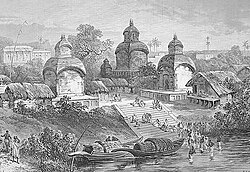
[[File:Kalighat Temple, 1887.jpg|right|thumb|[[Kalighat Kali Temple]], {{Circa|1887}}]] | |||
[[Image:Kalighat 1947.jpg|thumb|Pilgrims bathing in the Hoogly at Kalighat, {{Circa|1947}}]] | |||
[[File:Kalighat Temple, 1887.jpg|right|thumb|[[Kalighat Kali Temple]], 1887]] | |||
[[Image:Kalighat 1947.jpg|thumb|Pilgrims bathing in the Hoogly at Kalighat, | |||
==Kalika Temple== | ==Kalika Temple== | ||
[[File:Kalighat temple with bazzar.JPG|thumb|The Kalighat Temple complex]] | [[File:Kalighat temple with bazzar.JPG|thumb|The Kalighat Temple complex]] | ||
[[File:Kalighat1.jpg|right|thumb|upright|[[Kali]] idol at the [[Kalighat Kali Temple]]]] | |||
Kalighat temple has references in 15th century texts. The original temple was a small hut. The present temple was built by the [[Sabarna Roy Choudhury]] family of Barisha in 1809. They offered 595 bighas of land to the Temple deity so that worship and service could be continued smoothly. It is believed by some scholars that the name [[Calcutta]] was derived from Kalighat. Historically, traders halted at Kalighat to pay patronage to the goddess. The temple was initially on the banks of [[Hooghly River|Hooghly]]. The river over a period of time has moved away from the temple. The temple is now on the banks of a small canal called Adi Ganga, connecting to Hooghly. The present Dakshina Kali idol of touchstone was created in 1570 CE by two saints - Brahmananda Giri and Atmaram Giri based on the idol of Mata Bhuvaneshwari, the Kuladevi of [[Sabarna Roy Choudhury]] family. It was Padmabati Devi, the mother of [[Laksmikanta Roy Choudhury]] who discovered the [[fossils]] of Sati's finger in a lake called [[Kalikunda]]. This made Kalighat as one of the 51 Shakta pithas.<ref name = "Katha">''Bangiya Sabarna Katha Kalishetra Kalikatah'' by Bhabani Roy Choudhury, Manna Publication. {{ISBN|81-87648-36-8}}</ref> | |||
== Shyam Rai Temple == | |||
In 1843, [[Babu (title)|Babu]] Uday Narayan Mondal, a scion of the [[Bawali Raj|Bawali Raj family]], commissioned the Shyam Rai Temple, in the [[Kalighat Temple|Kalighat Temple complex]] itself. It stands as the sole [[Vaishnavism|Vaishnavite]] temple dedicated to [[Radha Krishna]] in Kalighat. Later, Madan Koley of Saha Nagar, and a distant relative of the family later constructed the Dol Mancha of the Temple in 1858.<ref>{{Cite book|title=Bengal, Past & Present: Journal of the Calcutta Historical Society|url=https://books.google.com/books?id=XQNDAAAAYAAJ&q=shyam+rai+temple+kalighat|publisher=The Society|date=1968|language=en}}</ref><ref>{{Cite book |last=Gangopadhyay |first=Sri Bipul Kumar |url=https://books.google.com/books?id=JpigEAAAQBAJ |title=অলৌকিক লীলায় শ্রীরামকৃষ্ণ, মা সারদা, স্বামীজী (প্রথম খন্ড) |date=2005-10-03 |publisher=Jaytara Publishers |pages=222 |language=bn}}</ref><ref>{{Cite book |last=Cakrabartī |first=Sunīla |url=https://books.google.com/books?id=I18tAAAAMAAJ |title=Lokāẏata Bāṃlā |date=1969 |publisher=Kalyāṇī Prakāśana |pages=38 |language=bn}}</ref> | |||
[[ | |||
==Panchannagram and Kali-Kshetra== | ==Panchannagram and Kali-Kshetra== | ||
| Line 163: | Line 145: | ||
==The Kalighat Hoard== | ==The Kalighat Hoard== | ||
Some time in 1783, a fisherman found a treasure hoard of more than 200 Gold Coins somewhere near the now defunct Strand on the Adi Ganga, near Kalighat. Not knowing what to do with it, he sold it off to Raja [[Nabakrishna Deb]], Zamindar of [[ | Some time in 1783, a fisherman found a treasure hoard of more than 200 Gold Coins somewhere near the now defunct Strand on the Adi Ganga, near Kalighat. Not knowing what to do with it, he sold it off to Raja [[Nabakrishna Deb]], Zamindar of [[Shobhabazar]]. | ||
Seeing the coins as an opportunity of gaining confidence with the then [[Governor General of India]], [[Warren Hastings]], Nabakrishna Deb gifted him with the coins. | Seeing the coins as an opportunity of gaining confidence with the then [[Governor General of India]], [[Warren Hastings]], Nabakrishna Deb gifted him with the coins. | ||
| Line 181: | Line 163: | ||
This is the largest hoard of Gupta coins ever found in the history of India. | This is the largest hoard of Gupta coins ever found in the history of India. | ||
==The Kalighat Temple as a Shakti | ==The Kalighat Temple as a Shakti pitha== | ||
{{main|Daksha Yaga|Shakti | {{main|Daksha Yaga|Shakti pithas}} | ||
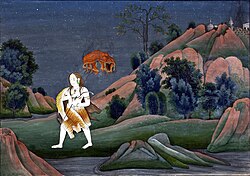
[[File:Dakshayani.jpg|thumb|Shiva carrying the corpse of [[Sati (goddess)|Sati]] Devi]] | [[File:Dakshayani.jpg|thumb|Shiva carrying the corpse of [[Sati (goddess)|Sati]] Devi]] | ||
The Temple at Kalighat is revered as an important [[ | The Temple at Kalighat is revered as an important [[Shakta pithas|Shakta pitha]], by the [[Shaktism]] sect of Hinduism. ''The mythology of [[Daksha yajna]] and Sati's self immolation'' is the story behind the origin of Shakti Peethas. | ||
==Kalighat painting== | ==Kalighat painting== | ||
{{Main|Kalighat painting}} | {{Main|Kalighat painting}} | ||
[[File:The demon ravana fighting with the ape hanuman, 1880, kalighat school.jpg|thumb|upright|Ravana and Hanuman, Kalighat school of painting, c1880]] | [[File:The demon ravana fighting with the ape hanuman, 1880, kalighat school.jpg|thumb|upright|Ravana and Hanuman, Kalighat school of painting, c1880]] | ||
Kalighat painting, or ''pata'' (originally pronounced 'pot' in Bengali) is a style of [[Indian painting]] derives its name from the place. It is characterised by generously curving figures of both men and women and an earthy satirical style. It developed during the nineteenth century in response to the sudden prosperity brought to Calcutta by the East India Company trade, whereby many houses including that of 'Prince' [[Dwarkanath Tagore]], grandfather of [[Rabindranath Tagore]] became incredibly wealthy. Many of these [[nouveau riche]] families came from not particular exalted [[caste]] backgrounds, so the orthodox tended to frown on them and their often very tasteless [[conspicuous consumption]]. To the common people the [[Babu (title)|babu]]s, as they were called, were equally objects of fun and sources of income. Thus the 'babu culture' portrayed in the Kalighat patas often shows inversions of the social order (wives beating husbands or leading them about in the guise of pet goats or dogs, maidservants wearing shoes, sahibs in undignified postures, domestic contretemps, and the like.) They also showed European innovations (babus wearing European clothes, smoking pipes, reading at desks, etc.). The object of this is only partly satirical; it also expresses the wonder that ordinary Bengalis felt on exposure to these new and curious ways and objects. | Kalighat painting, or ''pata'' (originally pronounced 'pot' in Bengali) is a style of [[Indian painting]] derives its name from the place. It is characterised by generously curving figures of both men and women and an earthy satirical style. It developed during the nineteenth century in response to the sudden prosperity brought to Calcutta by the East India Company trade, whereby many houses including that of 'Prince' [[Dwarkanath Tagore]], grandfather of [[Rabindranath Tagore]] became incredibly wealthy. Many of these [[nouveau riche]] families came from not particular exalted [[caste]] backgrounds, so the orthodox tended to frown on them and their often very tasteless [[conspicuous consumption]]. To the common people the [[Babu (title)|babu]]s, as they were called, were equally objects of fun and sources of income. Thus the 'babu culture' portrayed in the Kalighat patas often shows inversions of the social order (wives beating husbands or leading them about in the guise of pet goats or dogs, maidservants wearing shoes, sahibs in undignified postures, domestic contretemps, and the like.) They also showed European innovations (babus wearing European clothes, smoking pipes, reading at desks, etc.). The object of this is only partly satirical; it also expresses the wonder that ordinary Bengalis felt on exposure to these new and curious ways and objects. | ||
| Line 241: | Line 177: | ||
==Kalighat in fiction== | ==Kalighat in fiction== | ||
[[Amitav Ghosh]]'s [[The Calcutta Chromosome]] is partly set in Kalighat and gives a wonderfully atmospheric depiction of the region as well as the city itself. | [[Amitav Ghosh]]'s ''[[The Calcutta Chromosome]]'' is partly set in Kalighat and gives a wonderfully atmospheric depiction of the region as well as the city itself. | ||
Kalighat also plays a prominent role in ''[[Song of Kali]]'' by [[Dan Simmons]] and in the short story "[[Calcutta, Lord of Nerves]]" by [[Poppy Z. Brite]]. | |||
It also features in the movie ''[[Kahaani]]'' starring [[Vidya Balan]] and directed by [[Sujoy Ghosh]]. | |||
In [https://www.lingq.com/en/learn-english-online/courses/295284/chapter-6-p2-1666487/ Chapter 6] of Neil Gaiman's 2001 contemporary fantasy ''[[American Gods]]'', Kalighat is directly referenced by the eponymous deity: | |||
Kalighat | <blockquote>“So I am a child, am I?” She wagged a finger at him. “I was old in Kalighat before you were dreamed of, you foolish man. I am a child? Then I am a child, for there is nothing in your foolish talk to see.” | ||
Again, a moment of double-vision: Shadow saw the old woman, her dark face pinched with age and disapproval, but behind her he saw something huge, a naked woman with skin as black as a new leather jacket, and lips and tongue the bright red of arterial blood. Around her neck were skulls, and her many hands held knives, and swords, and severed heads.</blockquote> | |||
==Police district== | ==Police district== | ||
| Line 258: | Line 199: | ||
==Red-light district== | ==Red-light district== | ||
Located around the banks of the [[Adi Ganga]] canal, an estimated 1,000 to 1,500 prostitutes live and work in the [[red-light district]].<ref name="porterfolio">{{cite web |last1=Gill |first1=Harsimran |title=Living in the Shadows |url=http://porterfolio.net/uploads/article/file/6273/Al_Jazeera__Living_in_the_Shadows.pdf |access-date=4 August 2018}}</ref> Kolkata has emerged as a hub for the trafficking of girls, who often arrive from [[Nepal]] | Located around the banks of the [[Adi Ganga]] canal, an estimated 1,000 to 1,500 prostitutes live and work in the [[red-light district]].<ref name="porterfolio">{{cite web |last1=Gill |first1=Harsimran |title=Living in the Shadows |url=http://porterfolio.net/uploads/article/file/6273/Al_Jazeera__Living_in_the_Shadows.pdf |access-date=4 August 2018 |archive-date=4 August 2018 |archive-url=https://web.archive.org/web/20180804201723/http://porterfolio.net/uploads/article/file/6273/Al_Jazeera__Living_in_the_Shadows.pdf |url-status=dead }}</ref> Kolkata has emerged as a hub for the trafficking of girls, who often arrive from [[Nepal]] and [[Burma]]. From Kolkata they are often sold again to brothels in Mumbai (Bombay). Some will go on to the [[Middle East]], Africa and Europe.<ref>{{cite news| url=https://news.bbc.co.uk/2/hi/south_asia/4055143.stm | work=BBC News | first=Matthew | last=Grant | title=Girl-trafficking hampers Aids fight | date=2004-11-30}}</ref> | ||
==See also== | ==See also== | ||
* [[Kalighat Falta Railway]] | * [[Kalighat Falta Railway]] | ||
* [[Kalighat Home for the Dying]] | * [[Kalighat Home for the Dying]] | ||
* [[Kalighat painting|Kalighat Painting]] | |||
==References== | ==References== | ||
{{Reflist}} | {{Reflist|2}} | ||
== External links == | == External links == | ||
{{Commons category|Kalighat}} | {{Commons category|Kalighat}} | ||
*[https://web.archive.org/web/20090819143630/http://www.calstreet.com/ Kolkata(Calcutta) Portal] | *[https://web.archive.org/web/20090819143630/http://www.calstreet.com/ Kolkata(Calcutta) Portal] | ||
{{Kolkata topics}} | {{Kolkata topics}} | ||
Latest revision as of 14:34, 15 January 2026
 | This article has multiple issues. Please help improve it or discuss these issues on the talk page. (Learn how and when to remove these template messages)
|


Kalighat | |
|---|---|
Neighbourhood in Kolkata (Calcutta) | |
Kalighat is located in Kolkata  Kalighat Location in Kolkata | |
| Coordinates: 22°31′05″N 88°20′46″E / 22.518°N 88.346°E | |
| Country |  India India |
| State | West Bengal |
| City | Kolkata |
| District | Kolkata |
| Metro station | Jatin Das Park and Kalighat |
| Municipal Corporation | Kolkata Municipal Corporation |
| KMC wards | 73, 83, 84, 88 |
| Area | |
| • Total | 1.07 sq mi (2.77 km2) |
| Elevation | 36 ft (11 m) |
| Population (2020) | |
| • Total | 159,407[1] |
| • Density | 149,000/sq mi (57,400/km2) |
| Time zone | UTC+5:30 (IST) |
| PIN | 700026 |
| Area code | +91 33 |
| Lok Sabha constituency | Kolkata Dakshin |
| Vidhan Sabha constituency | Bhabanipur, Rashbehari |
Lua error in Module:OSM_Location_map at line 1984: attempt to index field 'wikibase' (a nil value). Kalighat is a locality of South Kolkata, in Kolkata district, West Bengal, India. One of the oldest neighbourhoods in South Kolkata, Kalighat is also densely populated with a history of cultural intermingling with the various foreign incursions into the area over time.


Kalika Temple[edit | edit source]


Kalighat temple has references in 15th century texts. The original temple was a small hut. The present temple was built by the Sabarna Roy Choudhury family of Barisha in 1809. They offered 595 bighas of land to the Temple deity so that worship and service could be continued smoothly. It is believed by some scholars that the name Calcutta was derived from Kalighat. Historically, traders halted at Kalighat to pay patronage to the goddess. The temple was initially on the banks of Hooghly. The river over a period of time has moved away from the temple. The temple is now on the banks of a small canal called Adi Ganga, connecting to Hooghly. The present Dakshina Kali idol of touchstone was created in 1570 CE by two saints - Brahmananda Giri and Atmaram Giri based on the idol of Mata Bhuvaneshwari, the Kuladevi of Sabarna Roy Choudhury family. It was Padmabati Devi, the mother of Laksmikanta Roy Choudhury who discovered the fossils of Sati's finger in a lake called Kalikunda. This made Kalighat as one of the 51 Shakta pithas.[2]
Shyam Rai Temple[edit | edit source]
In 1843, Babu Uday Narayan Mondal, a scion of the Bawali Raj family, commissioned the Shyam Rai Temple, in the Kalighat Temple complex itself. It stands as the sole Vaishnavite temple dedicated to Radha Krishna in Kalighat. Later, Madan Koley of Saha Nagar, and a distant relative of the family later constructed the Dol Mancha of the Temple in 1858.[3][4][5]
Panchannagram and Kali-Kshetra[edit | edit source]
The East India Company obtained from the Mughal emperor Farrukhsiyar, in 1717, the right to rent from 38 villages surrounding their settlement. Of these 5 lay across the Hooghly in what is now Howrah district. The remaining 33 villages were on the Calcutta side. After the fall of Siraj-ud-daulah, the last independent Nawab of Bengal, it purchased these villages in 1758 from Mir Jafar, and reorganised them. These villages were known en-bloc as Dihi Panchannagram and Kalighat was one of them. It was considered to be a suburb beyond the limits of the Maratha Ditch.[6][7][8] Kalighat was originally called Kali-Kshetra, which is widely accepted as the origin for the word Kalikata, and in turn Calcutta or Kolkata.
The Kalighat Hoard[edit | edit source]
Some time in 1783, a fisherman found a treasure hoard of more than 200 Gold Coins somewhere near the now defunct Strand on the Adi Ganga, near Kalighat. Not knowing what to do with it, he sold it off to Raja Nabakrishna Deb, Zamindar of Shobhabazar.
Seeing the coins as an opportunity of gaining confidence with the then Governor General of India, Warren Hastings, Nabakrishna Deb gifted him with the coins.
Keeping a few with him, Warren Hastings sent 172 coins from the horde to London, to the East India Company.
These coins belonged to the Gupta Kings, testaments to India's glorious past, but since no one knew of the Guptas back then (It would not be before another half a century or so that Alexander Cunningham would find out about the glorious age of the Guptas), these coins held little value to the people involved.
However, for all practical purposes, the hoard was thought to be lost, as the Company directors sent most of the coins to the melting pot, and some to a few collectors. When Hastings returned to London, he found only 24 of them in the collection of the British Museum. This astonished him beyond measures. He thought he had made a magnificent contribution to the Court of Directors — a hoard of Persian Darics (since no one knew of the Guptas back then).
In 1825, Marsden prepared the Nusmiamata Orientalia, where for the first time they were mentioned as Gupta coins.
The coins had been placed in a brass pot that remained submerged in water for a long time, hence the coins developed an underwater patina of clayish black, owing to the reaction of the gold and the alloys in the coin with the alluvium.
The hoard contained the Archer Type coins from the reign of Chandragupta II who had probably annexed Bengal to his Empire, and Kumaragupta I with an abundance in coins from the reign of Vishnugupta and Narasimhagupta, besides a few from the times of Shashanka, a later but important Ruler of Gauda.
This is the largest hoard of Gupta coins ever found in the history of India.
The Kalighat Temple as a Shakti pitha[edit | edit source]

The Temple at Kalighat is revered as an important Shakta pitha, by the Shaktism sect of Hinduism. The mythology of Daksha yajna and Sati's self immolation is the story behind the origin of Shakti Peethas.
Kalighat painting[edit | edit source]

Kalighat painting, or pata (originally pronounced 'pot' in Bengali) is a style of Indian painting derives its name from the place. It is characterised by generously curving figures of both men and women and an earthy satirical style. It developed during the nineteenth century in response to the sudden prosperity brought to Calcutta by the East India Company trade, whereby many houses including that of 'Prince' Dwarkanath Tagore, grandfather of Rabindranath Tagore became incredibly wealthy. Many of these nouveau riche families came from not particular exalted caste backgrounds, so the orthodox tended to frown on them and their often very tasteless conspicuous consumption. To the common people the babus, as they were called, were equally objects of fun and sources of income. Thus the 'babu culture' portrayed in the Kalighat patas often shows inversions of the social order (wives beating husbands or leading them about in the guise of pet goats or dogs, maidservants wearing shoes, sahibs in undignified postures, domestic contretemps, and the like.) They also showed European innovations (babus wearing European clothes, smoking pipes, reading at desks, etc.). The object of this is only partly satirical; it also expresses the wonder that ordinary Bengalis felt on exposure to these new and curious ways and objects.
Kalighat pata pictures are highly stylised, do not use perspective, are usually pen and ink line drawings filled in with flat bright colours and normally use paper as a substrate, though some may be found with cloth backing or on cloth. The artists were rarely educated, and usually came from a lineage of artisans. Kalighat patas are still made today although genuine work is hard to come by. The art form is urban and largely secular: although gods and goddesses are often depicted, they appear in much the same de-romanticised way as the humans do. By contrast, the Orissa tradition of pata-painting, centering on Puri, is consciously devotional. Kalighat pata has been credited with influencing the Bengal School of art associated with Jamini Roy.
Kalighat in fiction[edit | edit source]
Amitav Ghosh's The Calcutta Chromosome is partly set in Kalighat and gives a wonderfully atmospheric depiction of the region as well as the city itself.
Kalighat also plays a prominent role in Song of Kali by Dan Simmons and in the short story "Calcutta, Lord of Nerves" by Poppy Z. Brite. It also features in the movie Kahaani starring Vidya Balan and directed by Sujoy Ghosh.
In Chapter 6 of Neil Gaiman's 2001 contemporary fantasy American Gods, Kalighat is directly referenced by the eponymous deity:
“So I am a child, am I?” She wagged a finger at him. “I was old in Kalighat before you were dreamed of, you foolish man. I am a child? Then I am a child, for there is nothing in your foolish talk to see.” Again, a moment of double-vision: Shadow saw the old woman, her dark face pinched with age and disapproval, but behind her he saw something huge, a naked woman with skin as black as a new leather jacket, and lips and tongue the bright red of arterial blood. Around her neck were skulls, and her many hands held knives, and swords, and severed heads.
Police district[edit | edit source]
Kalighat police station is part of the South division of Kolkata Police. Located at 51, Haldarpara Road, Kolkata-700026, it has jurisdiction over the police district which is bordered on the north from the north-east corner of the junction of Sambhu Nath Pandit Street and D. L. Khan Road (old Bhowanipore Road), then eastward by the northern limits of Sambhu Nath Pandit Street to Harish Mukherjee Road, the crossing Harish Mukherjee Road, up to the north-east corner of the junction of Sambhu Nath Pandit Street and Harish Mukherjee Road.[9]
On the east, from the north-east corner of the junction of Sambhu Nath Pandit Street and Harish Mukherjee Road, then southward by the eastern limits of Harish Mukherjee Road to Hazra Road, then eastward along the northern limits of Hazra Road, then crossing Shyama Prasad Mukherjee Road up to the north-east corner of the junction of Hazra Road and Shyama Prasad Mukherjee Road and then southward along the eastern limits of Shyama Prasad Mukherjee Road up to the north-east corner of the junction of R. B. Avenue and Shyama Prasad Mukherjee Road.[9]
On the south, from the north-east corner of the junction of Rashbehari Avenue and Shyama Prasad Mukherjee Road (old Russa Road), then crossing Shyama Prasad Mukherjee Road, then west ward by the northern limits of Rashbehari Avenue up to the north-east corner of the junction of Rashbehari Avenue and Tolly's Nullah.[9]
On the west, from the north-east corner of the junction of Rashbehari Avenue and Tolly's Nullah, then northwards by the eastern bank of Tolly's Nullah to Rashbehari Avenue, then crossing Rashbehari Avenue, northward along the eastern bank of Tolly's Nullah to the crossing of Tolly's Nullah and D. L. Khan Road (old Bhowanipore Road) and then by the eastern limits of D.L. Khan Road up to the north-east corner of the junction of Sambhu Nath Pandit Street and D. L. Khan Road.[9]
Tollygunge Women's police station has jurisdiction over all the police districts in the South Division, i.e. Park Street, Shakespeare Sarani, Alipore, Hastings, Maidan, Bhowanipore, Kalighat, Tollygunge, Charu Market, New Alipur and Chetla.[9]
Red-light district[edit | edit source]
Located around the banks of the Adi Ganga canal, an estimated 1,000 to 1,500 prostitutes live and work in the red-light district.[10] Kolkata has emerged as a hub for the trafficking of girls, who often arrive from Nepal and Burma. From Kolkata they are often sold again to brothels in Mumbai (Bombay). Some will go on to the Middle East, Africa and Europe.[11]
See also[edit | edit source]
References[edit | edit source]
- ↑ Kalighat, Kolkata | Locality | GeoIQ
- ↑ Bangiya Sabarna Katha Kalishetra Kalikatah by Bhabani Roy Choudhury, Manna Publication. ISBN 81-87648-36-8
- ↑ Bengal, Past & Present: Journal of the Calcutta Historical Society. The Society. 1968.
- ↑ Gangopadhyay, Sri Bipul Kumar (3 October 2005). অলৌকিক লীলায় শ্রীরামকৃষ্ণ, মা সারদা, স্বামীজী (প্রথম খন্ড) (in Bengali). Jaytara Publishers. p. 222.
- ↑ Cakrabartī, Sunīla (1969). Lokāẏata Bāṃlā (in Bengali). Kalyāṇī Prakāśana. p. 38.
- ↑ "District Census Handbook Kolkata, Census of India 2011, Series 20, Part XII A" (PDF). Pages 6-10: The History. Directorate of Census Operations, West Bengal. Retrieved 20 February 2018.
- ↑ Cotton, H.E.A., Calcutta Old and New, first published 1909/reprint 1980, pages 103-4 and 221, General Printers and Publishers Pvt. Ltd.
- ↑ Nair, P.Thankappan, The Growth and Development of Old Calcutta, in Calcutta, the Living City, Vol. I, pp. 14-15, Edited by Sukanta Chaudhuri, Oxford University Press, 1995 edition.
- ↑ 9.0 9.1 9.2 9.3 9.4 "Kolkata Police". South Division – Kalighat police station. KP. Retrieved 23 March 2018.
- ↑ Gill, Harsimran. "Living in the Shadows" (PDF). Archived from the original (PDF) on 4 August 2018. Retrieved 4 August 2018.
- ↑ Grant, Matthew (30 November 2004). "Girl-trafficking hampers Aids fight". BBC News.
External links[edit | edit source]


| Kolkata Municipal Corporation |
|
|---|---|
| Kolkata Urban Agglomeration Outside KMC |
|
_name_of_the_God_as_per_the_Vedas.svg)