


m Removed empty portal template using script |
Sanjanadalvi (talk | contribs) m small fix |
||
| Line 1: | Line 1: | ||
{{ | {{Short description|Chief Minister of West Bengal from 1977 to 2000}} | ||
{{About}} | {{About}} | ||
{{Use Indian English|date= | {{Use Indian English|date=August 2024}} | ||
{{Use dmy dates|date= | {{Use dmy dates|date=August 2024}} | ||
| name | {{Infobox officeholder | ||
| name = Jyoti Basu | |||
| image | | image = Jyoti Basu - Calcutta 1996-12-21 089 Cropped.png | ||
| order | | caption = Basu in 1996 | ||
| office | | order = 6th | ||
| governor | | office = Chief Minister of West Bengal | ||
| | | governor = {{Collapsible list|title=''See list''|[[Anthony Lancelot Dias]]<br />[[Tribhuvan Narain Singh]]<br />[[B. D. Pande]]<br />[[Anant Sharma]]<br />[[Satish Chandra (politician)|Satish Chandra]] ''(acting)''<br />[[Uma Shankar Dikshit]]<br />[[Saiyid Nurul Hasan]]<br />[[T. V. Rajeswar]]<br />[[B. Satyanarayan Reddy]] ''(additional charge)''<br />[[K. V. Raghunatha Reddy]]<br />[[A. R. Kidwai]]<br />[[Shyamal Kumar Sen]]<br />[[Viren J. Shah]]}} | ||
| predecessor | | 1blankname = Deputy Chief Minister | ||
| successor | | 1namedata = [[Buddhadeb Bhattacharjee]] <br /> (from 12 January 1999) | ||
| term | | predecessor = [[President's rule]]<br /> ([[Siddhartha Shankar Ray]] as Chief Minister) | ||
| successor = [[Buddhadeb Bhattacharjee]] | |||
| term = 21 June 1977 – 5 November 2000 | |||
| office3 = [[List of deputy chief ministers of West Bengal|1st Deputy Chief Minister of West Bengal]] | |||
| term_start3 = 25 February 1969 | |||
| term_end3 = 16 March 1970 | |||
| term_start4 = 1 March 1967 | |||
| term_end4 = 21 November 1967 | |||
| 1blankname3 = Chief Minister | |||
| 1namedata3 = [[Ajoy Mukherjee]] | |||
| 1blankname4 = Chief Minister | |||
| 1namedata4 = [[Ajoy Mukherjee]] | |||
| predecessor4 = ''Office established'' | |||
| predecessor3 = ''Vacant'' | |||
| successor4 = ''Vacant'' | |||
| successor3 = [[Bijoy Singh Nahar]] | |||
| office6 = [[Politburo of the Communist Party of India (Marxist)|Member of Politburo]], [[Communist Party of India (Marxist)]] | |||
| term_start6 = 1964 | |||
| term_end6 = 2008 | |||
| office7 = [[List of leaders of the opposition in the West Bengal Legislative Assembly|Leader of Opposition, West Bengal Legislative Assembly]] | |||
| term_start7 = 1957 | |||
| term_end7 = 1967 | |||
| predecessor7 = ''Office Established'' | |||
| successor7 = [[Khagendra Nath Dasgupta]] | |||
| office8 = State Secretary, [[Communist Party of India| Communist Party of India, West Bengal]] | |||
| term_start8 = 1953 | |||
| term_end8 = 1960 | |||
{{Collapsed infobox section begin|Other state Ministry offices | |||
|titlestyle = border:1px dashed lightgrey;}}{{Infobox officeholder |embed = yes | |||
| office9 = Home Minister of West Bengal | |||
| term_start9 = 21 June 1977 | |||
| term_end9 = 1996 | |||
| term_start10 = 25 February 1969 | |||
| term_end10 = 16 March 1970 | |||
| office12 = Minister of Planning and Development | |||
| term_start12 = 21 June 1977 | |||
| term_end12 = 5 November 2000 | |||
| office13 = Minister of Finance | |||
| term_start13 = 1982 | |||
| term_end13 = 1984 | |||
| term_start14 = 1 March 1967 | |||
| term_end14 = 21 November 1967 | |||
| office15 = Minister of General administration | |||
| term_start15 = 1977 | |||
| term_end15 = 2000 | |||
| term_start16 =1969 | |||
| term_end16 = 1970 | |||
| office11 = Minister of Transport | |||
| term_start11 = 1 March 1967 | |||
| term_end11 = 21 November 1967 | |||
| office17 = Minister of Commerce, Industries and Industrial Reconstruction | |||
| term_start17 = 1993 | |||
| term_end17 = 2000 | |||
}}{{Collapsed infobox section end}} | |||
{{Collapsed infobox section begin|Legislative offices | |||
|titlestyle = border:1px dashed lightgrey;}}{{Infobox officeholder |embed = yes | |||
| constituency5 = Railway Employees | |||
| office5 = [[Member of the Legislative Assembly (India)|Member]] of the [[Bengal Legislative Assembly (1937—1947)|Bengal Legislative Assembly]] | |||
| predecessor5 = | |||
| successor5 = Office disbanded | |||
| term_start5 = 1946 | |||
| term_end5 = 1947 | |||
| office1 = [[Member of the Legislative Assembly (India)|Member]] of the [[West Bengal Legislative Assembly]] | | office1 = [[Member of the Legislative Assembly (India)|Member]] of the [[West Bengal Legislative Assembly]] | ||
| predecessor1 = New constituency | | predecessor1 = New constituency | ||
| Line 25: | Line 86: | ||
| term_start2 = 1952 | | term_start2 = 1952 | ||
| term_end2 = 1972 | | term_end2 = 1972 | ||
}}{{Collapsed infobox section end}} | |||
| | | signature = Jyoti Basu Signature.jpg | ||
| | | signature_alt = Jyoti Basu signature | ||
| party = [[Communist Party of India (Marxist)]] <small>(1964–2010)</small><br />[[Communist Party of India]] <small>(1940–1964)</small> | |||
| birthname = Jyotirindra Basu | |||
| birth_date = {{Birth date|1914|7|8|df=y}} | |||
| birth_place = [[Dacca]], Bengal Presidency, British India | |||
| death_date = {{Death date and age|2010|1|17|1914|7|8|df=y}} | |||
| death_place = [[Kolkata]], West Bengal, India | |||
| death_cause = [[Pneumonia]] | |||
| spouse = {{plainlist| | |||
| | * {{marriage|Basanti Basu|1940|1942|end=d.}} | ||
| | * {{marriage|Kamala Basu|1948|2003|end=d.}} | ||
| | |||
{{ | |||
| | |||
| | |||
| | |||
| | |||
| | |||
| | |||
| | |||
| | |||
| | |||
| | |||
| | |||
| | |||
| | |||
| | |||
| | |||
| | |||
| | |||
}} | }} | ||
| children = 1 | |||
| | | alma_mater = {{nowrap|[[Presidency College, Kolkata]]<br />[[University College, London]]<br />[[London School of Economics]]<br />[[Middle Temple]]}} | ||
| website = https://jyotibasu.net/ | |||
| alma_mater | |||
| website | |||
}} | }} | ||
'''Jyoti Basu''' (born '''Jyotirindra Basu'''; 8 July 1914 – 17 January 2010)<ref name=" | <!--Basic introduction; name, dates, why he was notable--> | ||
'''Jyoti Basu''' (born '''Jyotirindra Basu''' or '''Jyoti Bose'''; 8 July 1914 – 17 January 2010)<ref name="Obituary-2010">{{Cite news|date=2010-01-17|title=Obituary: Jyoti Basu|language=en-GB|url=https://news.bbc.co.uk/2/hi/south_asia/8151230.stm|access-date=2022-01-17}}</ref> was an Indian [[Marxism|Marxist]] theorist, [[communist]] activist, and politician. He was one of the most prominent leaders of [[Communism in India|Communist movement in India]].<ref>{{Cite web|url=https://www.theguardian.com/theguardian/2010/jan/17/jyoti-basu-obituary|title=Jyoti Basu obituary | India | The Guardian|website=amp.theguardian.com|date=17 January 2010 }}</ref><ref>{{Cite web|url=https://theprint.in/theprint-profile/jyoti-basu-the-beacon-of-indian-communism-who-almost-became-prime-minister/260008/|title=Jyoti Basu, also known as Shalimar, the beacon of Indian Communism who almost became prime minister|first=Samyak|last=Pandey|website=[[ThePrint]] |date=8 July 2019}}</ref> He served as the 6th and longest serving [[Chief Minister of West Bengal]] from 1977 to 2000.<ref name="Jyoti Basu-2010">{{Cite web|date=17 January 2010|title=Jyoti Basu: The Communist patriarch|url=https://www.ndtv.com/india-news/jyoti-basu-the-communist-patriarch-408021|website=[[NDTV]]}}</ref><ref>{{Cite web|last=Kanjilal|first=Pratik|date=22 January 2010|title=The statesman, not his politics|url=https://www.hindustantimes.com/india/the-statesman-not-his-politics/story-obDdVZIGQtjqbAnXDOiMTP.html|website=[[Hindustan Times]]|language=en}}</ref><ref name="Tough-2010">{{Cite web|date=12 February 2010|title=Tough, yet gentle|url=https://frontline.thehindu.com/cover-story/article30179133.ece|url-status=live|archive-url=https://web.archive.org/web/20200615130708/https://frontline.thehindu.com/cover-story/article30179133.ece|archive-date=15 June 2020|website=[[Frontline (magazine)|Frontline]]|publisher=[[The Hindu]]|language=en}}</ref> He was one of the founding members of the [[Communist Party of India (Marxist)]]. He was a member of [[Polit Bureau of the Communist Party of India (Marxist)|Politburo]] of the party since its formation in 1964 till 2008. He was also a member of [[West Bengal Legislative Assembly]] 11 times.<ref name="Will">{{Cite news|url=http://www.hindu.com/2008/04/04/stories/2008040460771200.htm|access-date=6 January 2010|title=Jyoti Basu will continue on Central Committee|newspaper=[[The Hindu]]|publisher=[[The Hindu]]|date=4 April 2008|location=Kolkata|archive-url=https://web.archive.org/web/20081101200940/http://www.hindu.com/2008/04/04/stories/2008040460771200.htm|archive-date=1 November 2008|url-status=dead}}</ref> In his political career, spanning over seven decades, he was noted to have been the [[India|India's]] [[List of longest-serving Indian chief ministers|longest serving chief minister]] in an elected democracy, at the time of his resignation.<ref>{{Cite book|last=Chakrabarty|first=Bidyut|title=Communism in India: Events, Processes and Ideologies|publisher=[[Oxford University Press]]|year=2014|isbn=978-0-19-939546-0|page=92|language=en-US}}</ref>{{Efn|Currently, Jyoti Basu is the third longest serving Chief Minister in the history of India, after [[Pawan Kumar Chamling]] of [[Sikkim]] and [[Naveen Patnaik]] of [[Odisha]].|name=|group=}} He declined the post of [[Prime Minister]] after the [[1996 Indian general election]] after the CPM refused to let him head a multi-party coalition as it would not be able to implement Marxist programs and relinquished the prime ministership to [[Deve Gowda]].<ref name="o508">{{cite web | title=Jyoti Basu: The Marxist who almost became India's PM | website=The Hindu | date=17 January 2010 | url=https://www.thehindu.com/news/Jyoti-Basu-The-Marxist-who-almost-became-Indias-PM/article16840016.ece | access-date=30 June 2024}}</ref><ref name="m959">{{cite web | last=Mukerji | first=Debashish | title=Before Deve Gowda, VP Singh was asked to be PM of United Front. He hid in his flat, car | website=ThePrint | date=8 December 2021 | url=https://theprint.in/pageturner/excerpt/before-deve-gowda-vp-singh-was-asked-to-be-pm-of-united-front-he-hid-in-his-flat-car/777894/ | access-date=29 June 2024}}</ref><ref name="w849">{{cite web | last=Srinivasaraju | first=Sugata | title=Deve Gowda and the accidental prime ministers | website=The New Indian Express | date=5 June 2021 | url=https://www.newindianexpress.com/opinions/2021/Jun/05/devegowda-and-the-accidental-prime-ministers-2311864.html | access-date=29 June 2024}}</ref> | |||
==Early life and education== | ==Early life and education== | ||
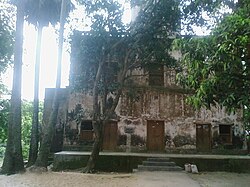
[[File:Paternal_house_of_Jyoti_Basu.jpg|thumb|250x250px|Paternal house of Jyoti Basu at Barudi in [[Narayanganj District|Narayanganj]], [[Bangladesh]]<ref name=" | [[File:Paternal_house_of_Jyoti_Basu.jpg|thumb|250x250px|Paternal house of Jyoti Basu at Barudi in [[Narayanganj District|Narayanganj]], [[Bangladesh]]<ref name="Sengupta-2010" />|alt=|left]] | ||
Jyotirindra Basu was born on 8 July 1914 to | |||
Jyotirindra Basu was born on 8 July 1914 to an upper middle class [[Bengali Kayastha]] [[Hindu]] family at 43/1 Harrison Road, [[Calcutta]], [[British India]].<ref name="Obituary-2010" /><ref name="Pandey-2019">{{Cite web|last=Pandey|first=Samyak|date=8 July 2019|title=Jyoti Basu, the beacon of Indian Communism who almost became prime minister|url=https://theprint.in/theprint-profile/jyoti-basu-the-beacon-of-indian-communism-who-almost-became-prime-minister/260008/|website=[[ThePrint]]|language=en-US}}</ref><ref>{{Cite web|title=WB Polls: Mamata's triumph, a victory of class over caste|url=https://www.freepressjournal.in/analysis/wb-polls-mamatas-triumph-a-victory-of-class-over-caste-sunanda-k-datta-ray|access-date=2020-10-10|website=Free Press Journal|language=en}}</ref><ref>{{Cite web|title=Political Collapse Of Bengal's Upper Caste Bhadralok Hegemony And BJP's Prize|url=https://www.outlookindia.com/website/story/opinion-political-collapse-of-bengals-upper-caste-bhadralok-hegemony-and-bjps-prize/357287|access-date=2020-10-10|website=Outlook India|date=23 July 2020 }}</ref> His father, Nishikanta Basu was a doctor whose hometown was the village of Barudi, Narayanganj in [[Dhaka District]] of the [[Bengal Presidency]] while his mother Hemlata Basu was a housewife.<ref name="Jyoti Basu-2010-2">{{Cite web|date=17 January 2010|title=Jyoti Basu: A profile|url=https://indianexpress.com/article/india/india-others/jyoti-basu-a-profile/|website=[[The Indian Express]]|language=en}}</ref> He grew up in an Indian style [[joint family]] and was the youngest of three siblings.<ref name="Jyoti Basu-2010-2" /><ref name="Sengupta-2010" /> He had an affectionate nickname called Gana.<ref name="Jyoti Basu-2010" /> One of his elder uncles, Nilinkanta Basu was a judge in the [[Calcutta High Court]].<ref name="Chattopadhyay-2010">{{Cite web|last=Chattopadhyay|first=Suhrid Sankar|date=12 February 2010|title=End of an era|url=https://frontline.thehindu.com/cover-story/article30179127.ece|url-status=live|archive-url=https://web.archive.org/web/20200614204904/https://frontline.thehindu.com/cover-story/article30179127.ece|archive-date=14 June 2020|website=[[Frontline (magazine)|Frontline]]|publisher=[[The Hindu]]|language=en}}</ref> His family also retained ancestral lands in Barudi where Jyoti Basu is described to have spent part of his childhood.<ref name="Sengupta-2010">{{Cite web|last=Sengupta|first=Ananya|date=19 August 2010|title=Bangla to fulfil Basu wish – Barudi house to be turned into library and museum|url=https://www.telegraphindia.com/india/bangla-to-fulfil-basu-wish-barudi-house-to-be-turned-into-library-and-museum/cid/486001|website=[[Telegraph India]]|language=en}}</ref> The Barudi home of Basu was later turned into a library after his death, reportedly on his wishes.<ref name="Sengupta-2010" /><ref>{{Cite news|date=18 January 2010|title=Basu's ancestral house in Bangladesh to be made a library|work=[[The Economic Times]]|url=https://economictimes.indiatimes.com/news/politics-and-nation/basus-ancestral-house-in-bangladesh-to-be-made-a-library/articleshow/5472632.cms}}</ref> | |||
Basu's schooling began in 1920 at [[Loreto Schools, Kolkata|Loreto School]] [[Kindergarten]] in [[Dharmatala]], [[Calcutta]].<ref name=" | Basu's schooling began in 1920 at [[Loreto Schools, Kolkata|Loreto School]] [[Kindergarten]] in [[Dharmatala]], [[Calcutta]].<ref name="Chattopadhyay-2010" /><ref name="Jyoti Basu-2010-2" /> His father shortened his name from Jyotirindra to Jyoti during the time of admission.<ref name="Pandey-2019" /><ref name="Jyoti Basu-2010-2" /> However, three years later he was shifted to the [[St. Xaviers School, Calcutta]].<ref name="Pandey-2019" /> He completed his [[intermediate education]] from St. Xaviers in 1932.<ref>{{Cite web|date=17 January 2010|title=जयोति बस क बिना भारत म वामपथ का इतिहास अधरा|url=https://aajtak.intoday.in/story/without-jyoti-basu-the-history-of-the-left-in-india-is-incomplete-1-24444.html|website=[[Aaj Tak]]|language=hi}}</ref><ref name="Chattopadhyay-2010" /><ref name="Hindustan-2010">{{Cite web|date=17 January 2010|title=Life and times of a Marxist icon|url=https://www.hindustantimes.com/kolkata/life-and-times-of-a-marxist-icon/story-gHv92izXE4UyVOBrMEbIjJ.html|website=[[Hindustan Times]]|language=en}}</ref> Subsequently, he took an undergraduate course in English from the prestigious [[Presidency University, Kolkata|Presidency College]].<ref name="Pandey-2019" /><ref name="Chattopadhyay-2010" /> Following his graduation in 1935,<ref>{{Cite news|date=17 January 2010|title=Jyoti Basu: The Marxist who almost became India's PM|language=en-IN|work=The Hindu|url=https://www.thehindu.com/news/Jyoti-Basu-The-Marxist-who-almost-became-Indias-PM/article16840016.ece|url-status=live|archive-url=https://web.archive.org/web/20200621052631/https://www.thehindu.com/news/Jyoti-Basu-The-Marxist-who-almost-became-Indias-PM/article16840016.ece|archive-date=21 June 2020|issn=0971-751X}}</ref> he acquired admission in the [[University College, London]] (UCL) to study Law and became a barrister at [[Middle Temple]] on 26 January 1940.<ref name="Pandey-2019" /><ref name="Roy-2010">{{Cite web|last=Roy|first=Amit|date=18 January 2010|title=The second home – London, the land that turned Basu into a Marxist, was also his favourite holiday destination|url=https://www.telegraphindia.com/india/the-second-home-london-the-land-that-turned-basu-into-a-marxist-was-also-his-favourite-holiday-destination/cid/555533|website=[[Telegraph India]]|language=en}}</ref> He had already left for India by the time he acquired his barristerial qualification which he received in absentia.<ref name="Roy-2010" /> | ||
During his stay in [[London]], he became involved in political discourse and activism for the first time.<ref name=" | During his stay in [[London]], he became involved in political discourse and activism for the first time.<ref name="Chattopadhyay-2010" /><ref name="Pandey-2019" /><ref name="Jyoti Basu-2010-2" /> Besides his general curriculum at UCL, he would attend various lectures on [[political organisation]], [[constitutional law]], [[international law]] and [[anthropology]] at the [[London School of Economics]] (LSE).<ref name="Telegraph">{{Cite web|title=A faded entry card opens up the class of 1935|url=https://www.telegraphindia.com/india/a-faded-entry-card-opens-up-the-class-of-1935/cid/555552|access-date=14 June 2020|website=[[Telegraph India]]|language=en}}</ref> Due to which, he is also credited as an alumnus of LSE.<ref name="lse">{{cite web |url=http://www.lse.ac.uk/south-asia-centre/countries/india |title=India at LSE South Asia Centre |website=lse.ac.uk |publisher=[[London School of Economics and Political Science]] }}</ref><ref name="Telegraph" /><ref>{{Cite web|last=Chandran|first=Ramesh|date=15 January 1986|title=I.G. Patel: The 'old fashioned socialist and low-key' London School of Economics director|url=https://www.indiatoday.in/magazine/international/story/19860115-i.g.-patel-the-old-fashioned-socialist-and-low-key-london-school-of-economics-director-800492-1986-01-15|website=[[India Today]]|language=en}}</ref> He had reportedly attended the lectures of the political theorist and economist, [[Harold Laski]] and was influenced by his [[anti-fascism]].<ref name="Chattopadhyay-2010" /> By 1937, Basu was an active member of several [[anti-imperialist]] Indian students unions such as the [[India League]] and the Federation of Indian Students,<ref name="Pandey-2019" /><ref name="Jyoti Basu-2010-2" /> and had become acquainted with young Indian communists such as [[Bhupesh Gupta]] and [[Snehangshu Acharya]].<ref name="Chattopadhyay-2010" /> | ||
In 1938, he had also become a founding member of the London Majlis and subsequently its first secretary.<ref name=" | In 1938, he had also become a founding member of the London Majlis and subsequently its first secretary.<ref name="Chattopadhyay-2010" /><ref name="Pandey-2019" /> Apart from raising [[public opinion]] for the cause of [[Indian independence movement|Indian independence]], one of the primary functions of the Majlis was to arrange receptions for Indian leaders who were visiting England at the time.<ref name="Chattopadhyay-2010" /> Through the Majlis, Basu came into contact with various Indian independence movement leaders such as [[Subhas Chandra Bose]], [[Jawaharlal Nehru]], [[Krishna Menon]] and [[Vijaya Lakshmi Pandit]].<ref name="Jyoti Basu-2010-2" /><ref name="Chattopadhyay-2010" /> | ||
== | ==Before 1947 and independence movement== | ||
On returning to [[Calcutta]], [[India]] in early 1940,<ref name=" | On returning to [[Calcutta]], [[India]] in early 1940,<ref name="Yardley-2010">{{Cite news|last=Yardley|first=Jim|date=17 January 2010|title=Jyoti Basu, Leader of Communists in India, Dies at 95|language=en-US|work=[[The New York Times]]|url=https://www.nytimes.com/2010/01/18/world/asia/18basu.html|issn=0362-4331}}</ref> Basu enrolled as a [[barrister]] at the [[Calcutta High Court]],<ref name="Chattopadhyay-2010" /> and married Basanti Ghosh.<ref name="Jyoti Basu-2010-3">{{Cite web|date=25 January 2010|title=Jyoti Basu: Marxist politician who combined realpolitik and revolutionary ideas|url=http://www.independent.co.uk/news/obituaries/jyoti-basu-marxist-politician-who-combined-realpolitik-and-revolutionary-ideas-1877891.html|website=[[The Independent]]|language=en}}</ref><ref name="Jyoti Basu-2010" /> However, in the same year, he also inducted himself as an activist affiliated with the [[Communist Party of India]] (CPI).<ref name="Yardley-2010" /><ref name="Hindustan-2010" /> His entry into the communist movement at the time had reportedly been in opposition to the wishes of his relatively well off family.<ref name="Hindustan-2010" /><ref name="Jyoti Basu">{{Cite news|title=Jyoti Basu|newspaper=[[The Economist]]|url=https://www.economist.com/obituary/2010/01/21/jyoti-basu|issn=0013-0613}}</ref> Following the [[Meerut conspiracy]] in 1929, the Communist Party had also been made illegal by British authorities,<ref name="Pandey-2019" /><ref name="Stolte-2013">{{Cite journal|last=Stolte|first=Carolien|date=1 December 2013|title=Trade Unions on Trial: The Meerut Conspiracy Case and Trade Union Internationalism, 1929–32|journal=Comparative Studies of South Asia, Africa and the Middle East|publisher=[[Duke University Press]]|volume=33|issue=3|pages=345–346|doi=10.1215/1089201X-2378130|s2cid=146178111 }}</ref> as a result Basu was initially involved in providing liaison and safe houses for underground Communist leaders in the Independence movement.<ref name="Hindustan-2010" /><ref name="Chattopadhyay-2010" /> However soon afterwards, he also became involved in organising railway workers, planning strikes and is described to have preferred [[direct action]] over [[ballot box]] in the initial years.<ref name="Jyoti Basu" /><ref name="Roy-2010-2">{{Cite web|last=Roy|first=Bidyut|date=18 January 2010|title=Communist who almost became PM - Indian Express|url=http://archive.indianexpress.com/news/communist-who-almost-became-pm/568487/0|website=[[Indian Express]]}}</ref> | ||
In 1941, Basu was appointed | In 1941, Basu was appointed the party secretary of the [[Bengal Assam Railway]] (now [[Bangladesh Railway]] and [[Northeast Frontier Railway]]) and tasked with organising a workers union.<ref name="Hindustan-2010" /> By May 1943, he had become the representative of the Calcutta Port Engineering Workers' Union in the [[All India Trade Union Congress]],<ref>{{Cite journal|date=1943|title=Nagpur Session|journal=All India Trade Union Congress Report|volume=20|page=79}}</ref><ref name="Sen-2010">{{Cite web|last1=Sen|first1=Sumit|last2=Roy|first2=Saugata|last3=Banerjee|first3=Nirmalya|date=18 January 2010|title=Jyoti Basu: The man who could have been PM|url=https://timesofindia.indiatimes.com/india/Jyoti-Basu-The-man-who-could-have-been-PM/articleshow/5463504.cms|access-date=22 June 2020|website=[[The Times of India]]|language=en}}</ref> while the Bengal Assam Railway Workers Union under him increased its membership to over 4,000 with union members present in [[Dacca]], [[Calcutta]], [[Kanchrapara]], [[Mymensingh]], [[Rangpur, Bangladesh|Rangpur]] and [[Assam]].<ref>{{Cite book|last=Batabyal|first=Rakesh|title=Communalism in Bengal: From Famine To Noakhali, 1943–47|publisher=[[Sage Publications]]|year=2005|isbn=0-7619-3335-2|location=[[New Delhi]], [[Thousand Oaks]] & [[London]]|page=127}}</ref> | ||
In the following [[Bengal famine of 1943]], the members of the Communist Party including Basu were involved in famine relief work.<ref name=" | In the following [[Bengal famine of 1943]], the members of the Communist Party including Basu were involved in famine relief work.<ref name="Chattopadhyay-2010" /><ref name="Simonow-2020">{{Cite journal|last=Simonow|first=Joanna|date=2 January 2020|title=The Great Bengal Famine in Britain: Metropolitan Campaigning for Food Relief and the End of Empire, 1943–44|journal=The Journal of Imperial and Commonwealth History|publisher=[[Taylor & Francis]]|volume=48|issue=1|pages=168–197|doi=10.1080/03086534.2019.1638622|s2cid=199282464}}</ref> The party also organised "People's Food Committees" which would attempt to force hoarders into releasing their stocks for distribution; Basu participated in the organisation of such committees in [[Calcutta]] and [[Midnapore]].<ref>{{Cite book|last=Gupta|first=Ranajit Das|title=Economy, Society, and Politics in Bengal: Jalpaiguri, 1869–1947|publisher=[[Oxford University Press]]|year=1992|isbn=978-0195628418|pages=286–288}}</ref><ref name="Simonow-2020" /> According to Basu's testimony, they only had a small organisation at the time and did the best they could while the famine took the lives of over 3 million people.<ref name="Menon">{{Cite news|last=Menon|first=Parvathi|date=18 January 2010|title=The Left Front has provided an alternative model of government: Jyoti Basu|language=en-IN|work=The Hindu|url=https://www.thehindu.com/opinion/op-ed/The-Left-Front-has-provided-an-alternative-model-of-government-Jyoti-Basu/article16838203.ece|url-status=live|archive-url=https://web.archive.org/web/20200619222721/https://www.thehindu.com/opinion/op-ed/The-Left-Front-has-provided-an-alternative-model-of-government-Jyoti-Basu/article16838203.ece|archive-date=19 June 2020|issn=0971-751X}}</ref> Basu was elected to the Bengal provincial committee of the Communist Party in the same year.<ref name="Hindustan-2010" /> He would later participate in the [[Tebhaga movement]] between 1945 and 1947 that sought to end the food crisis in Bengal, in a supportive capacity as a [[Trade unionist|railway unionist]].<ref>{{Cite web|last=Debroy|first=Bibek|date=20 January 2010|title=Column: A gentleman, then a communist|url=https://www.financialexpress.com/archive/column-a-gentleman-then-a-communist/568782/|website=[[The Financial Express (India)|The Financial Express]]|language=en-US}}</ref> | ||
By 1944, Basu had started leading the [[trade union]] activities of the Communist Party.<ref name=" | By 1944, Basu had started leading the [[trade union]] activities of the Communist Party.<ref name="Datta-2010">{{Cite web|last=Datta|first=Romita|date=17 January 2010|title=Marxist patriarch Jyoti Basu dead|url=https://www.livemint.com/Home-Page/UZtsml29Jc6qr4SjVvIqWP/Marxist-patriarch-Jyoti-Basu-dead.html|website=[[Livemint]]|language=en}}</ref> He was again delegated to organise labourers working for the [[East Indian Railway Company]] (now [[Eastern Railway (India)|Eastern Railway]] and [[East Central Railway]]) in order to further the interests of the Indian workers and is described to have been instrumental in the formation of the [[Bengal Nagpur Railway]] (now [[South Eastern Railway zone|South Eastern Railway]], [[East Coast Railway]] and [[South East Central Railway]]) Workers' Union of which he became the general secretary.<ref name="Pandey-2019" /><ref name="Chattopadhyay-2010" /> With the merger of the Bengal Nagpur Railway Workers' Union and the [[Howrah–Delhi main line|Bengal Delhi Railroad]] Workers' Union in the same year, Basu was elected the general secretary of the new combined union.<ref name="Obituary-2010" /><ref name="Jyoti Basu-2010-2" /> He would also be elected as the secretary of the [[All India Railwaymen's Federation]].{{Sfn|Chakrabarty|2014|p=259}} | ||
In 1946, Basu was appointed by the Communist Party to contest as the candidate for the Railway | In 1946, Basu was appointed by the Communist Party to contest as the candidate for the Railway Employees' constituency in the [[Bengal Legislative Assembly (1937—1947)|Bengal Legislative Assembly]].<ref>{{Cite web|last=Nagchoudhury|first=Subrata|date=15 April 1996|title=Jyoti Basu: Rock-solid cadre base assures Left Front that its trusted warhorse will deliver|url=https://www.indiatoday.in/magazine/cover-story/story/19960415-jyoti-basu-rock-solid-cadre-base-assures-left-front-that-its-trusted-warhorse-will-deliver-834705-1996-04-15|website=[[India Today]]|language=en}}</ref> He subsequently defeated [[Humayun Kabir (Bengal politician)|Humayun Kabir]] of the [[Indian National Congress]] and was elected to the assembly.<ref name="Paul-2010">{{Cite web|last=Paul|first=Prasanta|date=18 January 2010|title=Man of seeming contradictions|url=https://www.deccanherald.com/content/47407/man-seeming-contradictions.html|website=[[Deccan Herald]]|language=en}}</ref><ref>{{Cite web|date=17 January 2010|title=Date with history: chronology of Jyoti Basu's life|url=https://www.news18.com/news/politics/date-with-history-chronology-of-jyoti-basus-life-332197.html|website=[[News18]]}}</ref> He is noted to have given a "soul stirring speech" on the presiding food crisis in the Bengal Assembly;<ref name="Paul-2010" /> according to him the only means of solving the issue was to completely dismantle the [[Zamindari system]] and the [[Permanent Settlement]] agreement, and to drive out the British with haste.<ref>{{Cite book|last1=Dev|first1=Bimal J.|url=https://books.google.com/books?id=oo10MkzU5DQC&q=jyoti+basu&pg=PA211|title=Assam Muslims: Politics & Cohesion|last2=Lahiri|first2=Dilip K.|publisher=Mittal Publications|year=1985|location=Delhi 110035|pages=101–103}}</ref> Basu had also organised a continuous railway strike in support of the [[1946 Royal Indian Navy ratings revolt]],<ref>{{Cite journal|last=Vasudevan|first=H.|date=2017|editor-last=Naimark|editor-first=N.|editor2-last=Pons|editor2-first=S.|editor3-last=Quinn-Judge|editor3-first=S.|title=Communism in India|url=https://www.cambridge.org/core/books/cambridge-history-of-communism/communism-in-india/AABAF545CE8A7E6DAB9AC2B01681613D|journal=The Cambridge History of Communism|volume=2|publisher=[[Cambridge University Press]]|pages=491–517|doi=10.1017/9781316459850.021|isbn=9781316459850|url-access=subscription}}</ref><ref name="Menon"/> and later secured the release of various political prisoners on 24 July 1946.<ref name="Roy-2010-2" /><ref name="Sen-2010" /> | ||
== Communist Party of India ( | == Communist Party of India (1947–1964) == | ||
=== Interim government in West Bengal (1947–1952) === | === Interim government in West Bengal (1947–1952) === | ||
{{Communism in India| | {{Communism in India|all}} | ||
Following the [[partition of India]], Basu remained as the member of the now divided [[West Bengal Legislative Assembly]].<ref name=" | {{Marxism sidebar}} | ||
Following the [[partition of India]], Basu remained as the member of the now divided [[West Bengal Legislative Assembly]].<ref name="Jyoti Basu-2010-2" /> [[Prafulla Chandra Ghosh]] of the conservative [[Indian National Congress]] became the first Chief Minister of West Bengal.<ref name="Chaudhuri-1993">{{Cite journal|last=Chaudhuri|first=Amiya Kumar|date=1993|title=Control, Politics and Perspective of a State Legislature|journal=The Indian Journal of Political Science|volume=54|issue=1|pages=94–97|jstor=41855642|issn=0019-5510}}</ref> The Congress however faced [[civil unrest]] from the onset;<ref name="Bandyopadhyay-2009" /> [[hartal]]s, [[civil disobedience]] and demonstrations had soon become the order of the day in the face of a Congress government that was seen as unresponsive to the social and economic distress that was widespread in the state at the time.<ref name="Chaudhuri-1993" /> | |||
The new assembly therefore instituted the [[Armed Forces (Special Powers) Act#History|West Bengal Special Powers Act 1947]] modelled on the [[Defence of India Act 1915]]; the act gave [[Checks and Balances|unchecked power]] to the [[bureaucracy]] and the police to suppress public agitations allowing [[law enforcement]] to detain individuals for up to 6 months without trial on [[reasonable grounds]], which was justified on the grounds of maintaining the [[Law and order (politics)|law and order]] situation.<ref name=" | The new assembly therefore instituted the [[Armed Forces (Special Powers) Act#History|West Bengal Special Powers Act 1947]] modelled on the [[Defence of India Act 1915]]; the act gave [[Checks and Balances|unchecked power]] to the [[bureaucracy]] and the police to suppress public agitations allowing [[law enforcement]] to detain individuals for up to 6 months without trial on [[reasonable grounds]], which was justified on the grounds of maintaining the [[Law and order (politics)|law and order]] situation.<ref name="Bandyopadhyay-2009">{{Cite book|last=Bandyopadhyay|first=Sekhar|title=Decolonization in South Asia: Meanings of Freedom in Post-independence West Bengal, 1947–52|publisher=[[Routledge]]|year=2009|isbn=978-1-134-01823-9|location=[[Oxford]] & [[New York City]]|pages=71–74|language=en}}</ref><ref name="Chattopadhyay-2010" /> The bill was inordinately criticised and opposed by Basu who declared that "it seeks to perpetuate (the undemocratic rule)".<ref name="Bandyopadhyay-2009" /> In 1948, the government sought to extend the act through the West Bengal Security Ordinance which would remove the restriction of "reasonable grounds" for imprisonment.<ref name="Bandyopadhyay-2009-4" /> According to Basu, the new ordinance had made it clear that the Congress intended to establish a [[police state]] in [[West Bengal]].<ref name="Bandyopadhyay-2009-4">{{Cite book|last=Bandyopadhyay|first=Sekhar|title=Decolonization in South Asia: Meanings of Freedom in Post-independence West Bengal, 1947–52|publisher=[[Routledge]]|year=2009|isbn=978-1-134-01823-9|location=[[Oxford]] & [[New York City]]|pages=95–96|language=en}}</ref> By this time, the state of West Bengal had already been declared as a "problem province" by the Congress administration and [[Bidhan Chandra Roy]] replaced as the new chief minister.<ref name="Bandyopadhyay-2009" /><ref name="Chaudhuri-1993" /> | ||
During the presentation of the ordinance as a bill in the assembly, Basu attempted to oppose it on a clause by clause basis but in vain due to the dominance of the Congress in the assembly, only the two communist legislators [[Ratanlal Brahmin]] and Basu along with independent members opposed the bill.<ref name=" | During the presentation of the ordinance as a bill in the assembly, Basu attempted to oppose it on a clause by clause basis but in vain due to the dominance of the Congress in the assembly, only the two communist legislators [[Ratanlal Brahmin]] and Basu along with independent members opposed the bill.<ref name="Bandyopadhyay-2009-3">{{Cite book|last=Bandyopadhyay|first=Sekhar|title=Decolonization in South Asia: Meanings of Freedom in Post-independence West Bengal, 1947–52|publisher=[[Routledge]]|year=2009|isbn=978-1-134-01823-9|location=[[Oxford]] & [[New York City]]|pages=100–101|language=en}}</ref> Basu argued that while the Congress spoke of ''Kisan Raj'' ({{Translation|[[Panchayat Raj|Farmer's Rule]]}}), it had made no progress in abolishing the [[Zamindari system]] and had instead developed vested interests with the ''Zamindars'' ({{Translation|[[Landlords]]}}) themselves which resulted in the persistence of poor [[socioeconomic]] conditions and the employment of [[Political repression|repressive tactics]] against agitations.<ref>{{Cite book|last=Bandyopadhyay|first=Sekhar|title=Decolonization in South Asia: Meanings of Freedom in Post-independence West Bengal, 1947–52|publisher=[[Routledge]]|year=2009|isbn=978-1-134-01823-9|location=[[Oxford]] & [[New York City]]|pages=20–22|language=en}}</ref> | ||
In the following period the Communist Party was made illegal by the government on allegations of trying to incite on open rebellion and Basu repeatedly arrested as a result;<ref name=" | In the following period the Communist Party was made illegal by the government on allegations of trying to incite on open rebellion and Basu repeatedly arrested as a result;<ref name="Sen-2010" /><ref name="Roy-2010-2" /><ref name="Nagchoudhury-2010">{{Cite web|last=Nagchoudhury|first=Subrata|date=24 January 2010|title=Jyoti Basu alias Bocha alias Bakul: fair, thin, oblong face, walks fast|url=https://indianexpress.com/article/news-archive/web/jyoti-basu-alias-bocha-alias-bakul-fair-thin-oblong-face-walks-fast/|website=[[The Indian Express]]|language=en}}</ref> on 24 March 1948, he was imprisoned for a period of three months and released on the orders of the [[Calcutta High Court]].<ref name="Roy-2010-2" /><ref name="Jyoti Basu-2010-2" /><ref name="Nagchoudhury-2010" /> In December 1948, he married a second time, but soon went into hiding and kept changing residences due to an ongoing crackdown on communist leaders.<ref name="Jyoti Basu-2010-3" /><ref name="Hindustan-2010" /><ref name="Chattopadhyay-2010" /> For a period at the time, he had reportedly lived alongside [[Indrajit Gupta]], who would later become the [[Home Minister of India]].<ref name="Chattopadhyay-2010" /> In 1949, Basu had remained as the vice-president of the [[All India Railwaymen's Federation]].<ref name="Bandyopadhyay-2009-2">{{Cite book|last=Bandyopadhyay|first=Sekhar|title=Decolonization in South Asia: Meanings of Freedom in Post-independence West Bengal, 1947–52|publisher=[[Routledge]]|year=2009|isbn=978-1-134-01823-9|location=[[Oxford]] & [[New York City]]|pages=120|language=en}}</ref> In the same year, the federation had held a strike ballot which displayed overwhelming support for a railway strike on 9 March in demand of better wages and working conditions in the [[Indian Railways]].<ref name="Park-1949">{{Cite journal|last=Park|first=Richard L.|date=1949|title=Labor and Politics in India|journal=Far Eastern Survey|volume=18|issue=16|pages=184–186|doi=10.2307/3024423|jstor=3024423|issn=0362-8949}}</ref> The strike notice was however withdraw by the [[socialist]] leadership of the federation to whom the government had shown a reconciliatory attitude but the communist members under the leadership of Basu insisted on proceeding with the strike which resulted in disciplinary action being taken against the communists.<ref name="Bandyopadhyay-2009-2" /><ref name="Park-1949" /> Subsequently, the government also decided to crack down on the communist leadership by arresting 118 leaders involved in the railway sector in [[West Bengal]] including Basu. In the aftermath, the strike was a failure as the administration mobilised troops and [[West Bengal Police|police force]] to prevent any disruption from communist influenced union members.<ref name="Bandyopadhyay-2009-2" /> | ||
After the adoption of the [[Constitution of India]] in 1950, the ban on the Communist Party was lifted on the orders of the Calcutta High Court.<ref name=" | After the adoption of the [[Constitution of India]] in 1950, the ban on the Communist Party was lifted on the orders of the Calcutta High Court.<ref name="Chattopadhyay-2010" /> In September 1951, Congress attempted to renew the Security Act with the introduction of the West Bengal Security (Amendment) Bill of 1951 which raised criticism in the assembly on the lines of creating an environment of fear and [[intimidation]] on the eve of the first elections to the assembly which were to be held in December.<ref name="Bandyopadhyay-2009-3" /> Although the bill was passed once again despite Basu's persistent opposition, this time he had garnered the support of a number of [[Gandhian]] Congress members including from the former chief minister and architect of the bill, P. C. Ghosh, all of whom had resigned from the party and formed their own [[Kisan Mazdoor Praja Party]] by the time of voting.<ref name="Bandyopadhyay-2009-3" /> In same year, the Bengali daily organ ''Swadhinata'' of the Communist Party was resumed and Basu appointed as the president of its editorial board.<ref name="Hindustan-2010" /><ref name="Chattopadhyay-2010" /> The legislative assembly elections for 1951 were also held by the [[Election commission|Election Commission]] in March 1952 instead.<ref name="West Bengal 1951">{{Cite web|title=West Bengal 1951|url=https://old.eci.gov.in/files/file/3181-west-bengal-1951/|website=[[Election Commission of India]]}}</ref> | ||
=== First Assembly and agitations (1952–1957) === | === First Assembly and agitations (1952–1957) === | ||
In the [[West Bengal State Assembly Election of 1952|West Bengal State Assembly election of 1952]], Basu was elected as the representative of the [[Baranagar (Vidhan Sabha constituency)|Baranagar constituency]] and the Communist Party emerged as the second-largest party in the assembly.<ref name=" | In the [[West Bengal State Assembly Election of 1952|West Bengal State Assembly election of 1952]], Basu was elected as the representative of the [[Baranagar (Vidhan Sabha constituency)|Baranagar constituency]] and the Communist Party emerged as the second-largest party in the assembly.<ref name="West Bengal 1951" /><ref name="Jyoti Basu-2010-4">{{Cite web|date=17 January 2010|title=Jyoti Basu (1914–2010)|url=https://www.outlookindia.com/newswire/story/jyoti-basu-1914-2010/672984|website=[[Outlook India]]}}</ref> Following which Basu was unanimously elected as the legislative party leader of the CPI in [[West Bengal]].<ref name="Chattopadhyay-2010" /> In the following year, he was also elected as the secretary of the state committee of the CPI.<ref name="Hindustan-2010" /> The ensuing period in West Bengal was marked with the rise of a number of [[anti-establishment]] [[mass movement (politics)|mass movement]]s,<ref name="Sengupta">{{Cite journal|last=Sengupta|first=Anwesha|title=A Study of Anti-Tram fare Hike Resistance and Teachers' Movement|url=http://www.mcrg.ac.in/RLS_PML/RLS_PM/RLS_PM_Abstracts/Anwesha.pdf|journal=Calcutta Research Group}}</ref> in which Basu is described to have played a key role.<ref name="Bhattacharyya-2010">{{Cite web|last=Bhattacharyya|first=Meghdeep|date=18 January 2010|title=Battle lost and won|url=https://www.telegraphindia.com/india/battle-lost-and-won/cid/555505|website=[[Telegraph India]]|language=en}}</ref> | ||
Even after the [[Independence of India]], the [[Calcutta Tramways Company]] had remained a British-owned company which operated in partnership with the [[Government of West Bengal]].<ref>{{Cite web|date=18 October 1951|title=West Bengal Act XXV of 1951: The Calcutta Tramway Act, 1951|url=https://sarthac.gov.in/view-act-file?file_id=2581|access-date=26 June 2020|archive-date=29 June 2020|archive-url=https://web.archive.org/web/20200629051641/https://sarthac.gov.in/view-act-file?file_id=2581|url-status=dead}}</ref><ref name="Roy-1990">{{Cite journal|last=Roy|first=Siddhartha Guha|date=29 December 1990|title=Fare Hike and Urban Protest-Calcutta Crowd in 1953|url=https://www.epw.in/system/files/pdf/2014_49/25/SPECIAL%20ARTICLES_Fare%20Hike%20and%20Urban%20Protest-Calcutta%20Crowd%20in%201953.pdf|journal=[[Economic & Political Weekly]]|language=en|volume=25|issue=52|pages=2863–2867}}</ref> On 25 June 1953, the company announced a [[Fare|fare hike]] for [[Travel class|second class passengers]] that was to be implemented from 1 July onwards, which was supported by the West Bengal Government.<ref name="Roy-1990" /> In response to the move, the "Tram and Bus Fare Enhancement Resistance Committee" was formed in which Basu was inducted as the representative of the Communist Party.<ref name="Roy-1990" /><ref name="Nagchoudhury-2010" /> The [[Calcutta Tramway Union]] announced their support for the committee and published statistical data through the ''Swadhinata'' which displayed that the company was privy to "swelling profits" concluding the fare hike to be "absolutely uncalled for".<ref name="Roy-1990" /> From the day of implementation of the new fares, the city underwent a series of agitations which began with [[disobedience]] to pay the new prices and caused severe losses for the company, culminating into police deployment and arrests of hundreds of disobedient passengers.<ref name="Roy-1990" /> | |||
Basu was arrested on 4 July alongside [[Ganesh Ghosh]] and [[Subodh Banerjee]] who were also involved in the agitations, he was bailed out the following day.<ref name="Roy-1990" /><ref name="Jyoti Basu-2010-4" /> On 7 July, during a large [[picketing]] of the company headquarters at Mango Lane in Calcutta, five Resistance Committee leaders including Basu met with A.C.T Blease who was the agent of the company in India and presenting him with the demands of unilateral withdrawal of the fare hike.<ref name="Roy-1990" /> On the evening of the same day, 500 citizens including Basu were arrested under the [[Preventive detention|Preventive Detention]] Act which had been earlier implemented through the Security Act.<ref name="Roy-1990" /><ref name="Bandyopadhyay-2009-3" /> Over the course of the month the movement faced progressively increased [[police action]] and subsequently heightened [[civil unrest]] spreading all across [[West Bengal]] with [[general strikes]], [[mass demonstration]]s, tramway [[boycotts]] to [[hunger strikes]] from imprisoned agitators and even violent confrontations between the police and agitators on the streets. In the end, the five committee leaders including Basu were released on 26 July, the fare hike scrapped by the Chief Minister [[Bidhan Chandra Roy]] on 31 July and the remaining imprisoned agitators released by 2 August.<ref name="Roy-1990" /> | |||
In January 1954,<ref>{{Cite journal|last=Kautsky|first=John H.|date=1955|title=Indian Communist Party Strategy Since 1947|journal=[[Pacific Affairs]]|volume=28|issue=2|page=158|jstor=3035378|issn=0030-851X}}</ref> the Communist party held its third congress in [[Madurai]] and Basu was elected as the new [[Central Committee]] member during the congress.<ref name="Hindustan-2010" /><ref name="Chattopadhyay-2010" /> In February, Basu became involved in the 1954 teachers' agitation in West Bengal.<ref name="Tough-2010" /><ref name="Bhattacharyya-2010" /> The All Bengal Teachers Association (ABTA) had been called for implementing the recommendations of the [[Higher Secondary School Certificate|Secondary Board]] for raising the allowances of secondary school teachers.<ref name="Sengupta" /> The association was joined in by various [[labour union]]s and opposition parties in support of their demand.<ref name="Sengupta" /> The government as a result decided to crack down on the leaders of the agitation but Basu escaped custody and took refuge in the [[West Bengal Legislature]]. The police force who were trying to arrest him through the Preventive Detention Act were reluctant to enter the assembly to arrest a [[legislator]]. In Basu's testimony, he states that it was easier for him support the agitation from inside the assembly by projecting the police action on the movement without getting arrested.<ref name="Tough-2010" /> | |||
During the presentation of the recommendation of the [[States Reorganisation Commission]] in 1956, a proposal for the merger of [[Bihar]] and [[West Bengal]] into a single state called [[Purva Pradesh]] was floated which was supported by the [[Indian National Congress]].<ref>{{Cite journal|date=24 March 1954|title=West Bengal – Bihar Merger: Hallahal follows Amrit !|url=https://www.epw.in/system/files/pdf/1956_8/12/west_bengalbihar_merger.pdf|journal=[[Economic & Political Weekly]]}}</ref><ref name="Sarkar-2013">{{Cite journal|last=Sarkar|first=Shamita|date=2013|title=The role of the Communists in the Anti Bengal – Bihar Merger Agitation|journal=Proceedings of the Indian History Congress|volume=74|pages=921–924|jstor=44158893|issn=2249-1937}}</ref> The Communist Party having maintained the stance of supporting [[Linguistic history of India|linguistic]] reorganisation of states in India since 1920, was vehemently opposed to the proposal of the merger.<ref name="Sarkar-2013" /><ref>{{Cite web|last=Gupta|first=Jayanta|date=21 August 2011|title=We didn't fight for this: Veteran communist|url=https://timesofindia.indiatimes.com/city/kolkata/We-didnt-fight-for-this-Veteran-communist/articleshow/9678820.cms|website=[[The Times of India]]|language=en}}</ref> The announcement of the proposal caused widespread protests in West Bengal led by students, workers and even [[peasantry]], the Central Committee of the Communist Party held a meeting between 28 January to 4 February protesting the move. Basu and [[Yogendra Sharma]], the secretaries of the state committees of the Communist Party in West Bengal and Bihar respectively issued a joint [[press statement]] calling the merger proposal to be "antidemocratic and [[reactionary]]".<ref name="Sarkar-2013" /> | |||
Basu is noted to have opposed the proposal from both within and outside the assembly, he presided over the mass meeting at [[Dharmatala|Wellington Square]] in opposition to the proposal and severely criticised the governor's position in support of the proposal.<ref name="Sarkar-2013" /><ref name="Bhattacharyya-2010" /> According to his testimony, the proposal was akin to a conspiracy to annihilate the basic identity of Bengal.<ref name="Sarkar-2013" /> Basu presented the idea of the proposal as a poll issue for the [[by-elections]] of the year, supporting the candidacy of [[Mohit Mitra]] who the Central Committee's secretary for linguistic reorganisation and declared that the results should reflect the [[Mandate (politics)|people's mandate]]. In the subsequent by-elections, Mohit Mitra won from the [[Calcutta North East (Lok Sabha constituency)|Calcutta North East constituency]] and [[Lal Behari Das]] won from the [[Khejuri (Vidhan Sabha constituency)|Khejuri constituency]], defeating their Congress counterparts by a margin of over 20,000 in both constituencies which caused the Chief Minister Bidhan Chandra Roy to scrap the merger proposal.<ref name="Sarkar-2013" /> | |||
[[File:CPI-M-flag.svg|thumb|250x250px|Jyoti Basu was one of the leading members of the [[Communist Party of India (Marxist)]].]] | |||
[[File:CPI-M-flag.svg|thumb|250x250px|Jyoti Basu was one of the leading | |||
=== Beginning of the food movements (1957–1962) === | === Beginning of the food movements (1957–1962) === | ||
In the [[1957 West Bengal Legislative Assembly election|West Bengal Legislative Assembly election of 1957]], Basu was re-elected as the representative of the Baranagar constituency and the Communist Party returned as the second largest party with an increased representation.<ref name=" | In the [[1957 West Bengal Legislative Assembly election|West Bengal Legislative Assembly election of 1957]], Basu was re-elected as the representative of the Baranagar constituency and the Communist Party returned as the second largest party with an increased representation.<ref name="West Bengal 1957">{{Cite web|title=West Bengal 1957|url=https://old.eci.gov.in/files/file/3182-west-bengal-1957/|website=[[Election Commission of India]]}}</ref> As a result, Basu formally became the [[Leader of Opposition in the West Bengal Legislative Assembly|Leader of Opposition]] in the assembly.<ref name="Jyoti Basu-2010-4" /> This platform enabled the Communist Party under the leadership of Basu in West Bengal to exacerbate agitations against the prevalent food crisis in West Bengal by acting as the [[Parliamentary opposition|principal opposition]] on the floor of the assembly, increasing public awareness and providing a united front for agitators to rally around.<ref name="Basu-2012" /> | ||
Since the beginning of the [[British Raj]], the region of Bengal had suffered from severe food shortages culminating into large-scale famines at times.<ref name=" | Since the beginning of the [[British Raj]], the region of Bengal had suffered from severe food shortages culminating into large-scale famines at times.<ref name="Patnaik-2010" /> Following independence of India, the [[Public Distribution System]] (PDS) was established and two land reforms were enacted in 1953 and 1955 in West Bengal. However, the implementation of these initiatives and reforms was rife with problems and the [[agricultural sector]] had remained in despondency while food shortages continued to afflict a largely [[impoverished]] population.<ref name="Patnaik-2010">{{Cite journal|last=Patnaik|first=Utsa|date=2010|title=Jyoti Basu and Bengal|journal=Social Scientist|volume=38|issue=7/8|pages=53–56|jstor=27866723|issn=0970-0293}}</ref><ref name="Samaddar-2018">{{Cite book|last=Samaddar|first=Ranabir|title=From Popular Movements to Rebellion|publisher=[[Routledge]]|year=2018|isbn=978-0-429-02670-6|location=London|language=en|chapter=4. The Defining Moments of Left Popular Politics in West Bengal: The Food Movements of 1959 and 1966}}</ref> The food crisis and general poverty had led to multiple outbursts of public agitations throughout the 1950s which peaked near the end of 1959.<ref name="Basu-2012" /><ref name="Patnaik-2010" /> The leaders of the Communist Party adopted the twin strategy of organising anti-government [[mass movement (politics)|mass movement]]s by forming issue based committees to draw public support from beyond party lines and pressurise the government into providing relief measures while also badgering on about food scarcity on the floor of the legislative assembly to draw and retain public and [[media attention]] on the issue, Basu played a significant role in the latter with frequent moves for [[adjournment motion]]s and participation in heated debates.<ref name="Basu-2012">{{Cite journal|last=Basu|first=Sibaji Pratim|year=2012|title=The Chronicle of a Forgotten Movement: 1959 Food Movement Revisited|url=http://www.mcrg.ac.in/PP56.pdf|journal=Calcutta Research Group}}</ref> | ||
By the end of 1958, the Communist Party initiated the formation of the [[Price Increase and Famine Resistance Committee]] (PIFRC) in collaboration with the other primarily leftist members of the opposition.<ref name=" | By the end of 1958, the Communist Party initiated the formation of the [[Price Increase and Famine Resistance Committee]] (PIFRC) in collaboration with the other primarily leftist members of the opposition.<ref name="Rao-2003" /><ref name="Patnaik-2010" /> Basu became one of the formative leaders of the committee.<ref name="Rao-2003" /><ref name="Basu-2012" /> Food insecurity in West Bengal had reached a critical stage at the time and its persistence was largely blamed on the Food Ministry and the [[Indian National Congress]] wherein the Communist Party had continuously asserted that the Congress party had been reduced to the representative party of hoarders, landlords and [[jotedar]]s and that there would be no solution without direct action and sustained public pressure.<ref name="Basu-2012" /> Initially the committee principally engaged itself in laying down demands for [[price control]], [[Land reform|redistribution of state lands]] and organising agitations with that in retrospect.<ref name="Rao-2003">{{Cite book|last=Rao|first=M. V. S. Koteswara|url=https://books.google.com/books?id=3e0SAQAAMAAJ|title=Communist parties and United Front experience in Kerala and West Bengal|date=2003|publisher=Prajasakti Book House|isbn=978-81-86317-37-2|location=[[Hyderabad]]|pages=210–233|language=en}}</ref><ref name="Samaddar-2018" /> | ||
On 10 February 1959, Basu and other leaders of the PIFRC met with the Chief Minister, [[Bidhan Chandra Roy]] who gave them verbal assurances that ration shops will be restocked offering amenable prices but the assurances weren't followed through. On 26 April, Union Food Minister, [[Ajit Prasad Jain]] declared that the food situation in West Bengal was "easy, smooth and comfortable".<ref name=" | On 10 February 1959, Basu and other leaders of the PIFRC met with the Chief Minister, [[Bidhan Chandra Roy]] who gave them verbal assurances that ration shops will be restocked offering amenable prices but the assurances weren't followed through. On 26 April, Union Food Minister, [[Ajit Prasad Jain]] declared that the food situation in West Bengal was "easy, smooth and comfortable".<ref name="Basu-2012" /> This caused widespread public outrage and led to the intensification of the [[Food Movement of 1959|Food movement of 1959]] between May–June as the situation was further aggravated by hoarders attempting to save up stocks in illegal go-downs and [[warehouse]]s.<ref name="Basu-2012" /><ref name="Rao-2003" /> The persistent refusal of the Government of West Bengal to consider the demands presented also provoked the PIFRC into augmenting the demands to include enactment of ceilings on [[private land holdings]] and confiscation without compensation of excessive lands owned by ''[[Zamindars]]'' (trans: Landlords); these were presented in parallel with general strikes and organised [[direct action]] endorsed and supported by the committee to locate and force the sale of hidden stocks of rice.<ref name="Rao-2003" /><ref name="Samaddar-2018" /> | ||
On 25 June, the PIFRC and over 100 trade unions called a statewide ''hartal'' ([[general strike]]) to protest against the "anti–food" policies of the government.<ref name=" | On 25 June, the PIFRC and over 100 trade unions called a statewide ''hartal'' ([[general strike]]) to protest against the "anti–food" policies of the government.<ref name="Samaddar-2018" /> The agitators held an open [[mass meeting]] near the Chief Minister's residence where Basu was present among the speakers alongside [[Siddhartha Shankar Ray]], [[Tridib Chaudhuri]] and [[Bankim Mukherjee]], who demanded that the government should meet the conditions presented by the PIFRC or resign, otherwise they would organise a mass [[civil disobedience]] movement.<ref name="Basu-2012" /><ref name="Bayley-1962">{{Cite journal|last=Bayley|first=David H.|date=1962|title=The Indian Experience with Preventive Detention|journal=Pacific Affairs|volume=35|issue=2|page=108|doi=10.2307/2753245 |jstor=2753245|issn=0030-851X}}</ref> On 9 July, the ''Swadhinata'' gave a clarion call through an editorial which stated that "People of West Bengal know quite well that the Congress Government and its food policy are responsible for their destitute condition. They also know that only by hitting hard, time and again, they could be forced to do at least something..." Earlier on 6 July, the PIFRC had issued a [[press release]] stating intent to begin the civil disobedience movement by taking preparations to organise volunteers; Basu was among the list of signatories that included [[Niranjan Sengupta]] and [[Nihar Mukherjee]].<ref name="Basu-2012" /> The committee further set the date of 20 August for the beginning of the civil disobedience movement.<ref name="Bayley-1962" /> | ||
In August, the police arrested 35 prominent leaders of the committee including 7 [[members of legislative assembly]] through the usage of the Preventive Detention Act and the West Bengal Security Act.<ref name=" | In August, the police arrested 35 prominent leaders of the committee including 7 [[members of legislative assembly]] through the usage of the Preventive Detention Act and the West Bengal Security Act.<ref name="Bayley-1962" /> The movement however continued with civil disobedience, continuous general strikes and [[mass demonstration]]s while Basu was also able to evade arrest.<ref name="Chattopadhyay-2010" /> On 31 August 1959, a massive demonstration cum general strike was held in the city of Calcutta which brought the city and its surrounding districts to a standstill and ended with lathi charges and instances of [[police violence]] on protesters.<ref name="Basu-2012" /><ref name="Mukherji-1968">{{Cite journal|last=Mukherji|first=Asoke Kumar|date=1968|title=The politics of organised pressure: A study of the emerging pattern of political culture in West Bengal|journal=The Indian Journal of Political Science|volume=29|issue=4|pages=337–348|jstor=41854292|issn=0019-5510}}</ref> This caused an outburst of students protests against police atrocities and led to instances of [[Police shooting|police firing]] on student protesters. Over the course of the following days between 2–5 September, civil unrest with large scale participation from students of schools, colleges and universities erupted across the city accompanied by violent encounters with the police, [[vandalism]] and mass shootings by the police;<ref name="Ray-2008">{{Cite book|last1=Ray|first1=Asok Kumar|url=https://books.google.com/books?id=bjkBM3qyZ00C|title=Society, Politics, and Development in North East India: Essays in Memory of Dr. Basudeb Datta Ray|last2=Chakraborty|first2=Satyabrata|publisher=Concept Publishing Company|year=2008|isbn=978-81-8069-572-8|page=89|language=en}}</ref><ref name="Mukherji-1968" /> in the end around 46–80 civilians were killed.<ref name="Mukherji-1968" /><ref name="Basu-2012" /> The opposition leaders including Basu accused the government of having turned "[[authoritarian]] and ruthless" and reasoned that there was no space for the continuation of a democratic mass movement.<ref name="Mukherji-1968" /> In light of the violence, the PIFRC formally withdrew the agitation by 26 September and the committee was disbanded.<ref name="Basu-2012" /> | ||
In the aftermath and over the course of the following years, Basu condemned the "police barbarism" against the agitators, engaging in fiery criticisms against the government and even brought a [[motion of no confidence]], although it was defeated due to a lack of requisite members.<ref name="Basu-2012" /> The series of events had also heightened public [[resentment]] against the Congress government across West Bengal, especially in Calcutta and would set the foundation for latter [[political activism]] in the following decade.<ref name="Basu-2012" /><ref name="Ray-2008" /><ref name="Mukherji-1968" /> The food movement would also go on in the form of a number of localised spontaneous agitations over the following years till the next large scale flare up in 1966.<ref name="Basu">{{Cite journal|last=Basu|first=Sibaji Pratim|title=West Bengal: The Food Movements of 1959 & 1966|url=http://www.mcrg.ac.in/RLS_PML/RLS_PM/RLS_PM_Abstracts/Sibaji.pdf|journal=Calcutta Research Group}}</ref><ref name="Samaddar-2018" /> | |||
[[File:Jyotibasu.JPG|thumb|299x299px|Jyoti Basu]] | [[File:Jyotibasu.JPG|thumb|299x299px|Jyoti Basu]] | ||
== Communist Party of India (Marxist) (1964 afterwards) == | == Communist Party of India (Marxist) (1964 afterwards) == | ||
=== Split from the Communist Party of India (1962–1966) === | === Split from the Communist Party of India (1962–1966) === | ||
In the [[1962 West Bengal Legislative Assembly election|West Bengal Legislative Assembly election of 1962]], Basu was once again re-elected as the representative of the Baranagar constituency and the Communist Party increased its vote share from 17.81% to 24.96%.<ref name=" | In the [[1962 West Bengal Legislative Assembly election|West Bengal Legislative Assembly election of 1962]], Basu was once again re-elected as the representative of the Baranagar constituency and the Communist Party increased its vote share from 17.81% to 24.96%.<ref name="West Bengal 1957" /><ref>{{Cite web|title=West Bengal 1962|url=https://old.eci.gov.in/files/file/3183-west-bengal-1962/|website=[[Election Commission of India]]}}</ref><ref name="Chattopadhyay-2010" /> In the following period the Communist Party underwent a vertical split with a section of the party including Basu going on to form the [[Communist Party of India (Marxist)]]. There were several ongoing ideological conflicts between sections within the Communist Party about the nature of the [[Indian State]] and the characterisation and method of interaction with the [[Indian National Congress]], about the approach towards the [[Sino-Soviet split|ongoing debate]] between the [[Soviet Union]] and China and with regards to the handling of the [[border disputes between India and China]].<ref name="Chattopadhyay-2010" /><ref name="Daniyal-2015" /> These debates were further exacerbated by the food movement in West Bengal and brought to the forefront by the rising border tensions between India and China.<ref name="Basu" /><ref name="Doctor-2012">{{Cite news|last=Doctor|first=Vikram|date=7 October 2012|title=1962 India-China war: Why India needed that jolt|work=[[The Economic Times]]|url=https://economictimes.indiatimes.com/news/politics-and-nation/1962-india-china-war-why-india-needed-that-jolt/articleshow/16703076.cms}}</ref> The Communist Party had also become the second largest party in the [[Lok Sabha]] following the [[1962 Indian general election]] with nearly 10% vote share which is described to have brought prominence to the internal divisions of the party.<ref>{{Cite web|title=General Election, 1962 (Vol I, II)|url=https://old.eci.gov.in/files/file/4113-general-election-1962-vol-i-ii/|website=[[Election Commission of India]]}}</ref><ref name="Doctor-2012" /> | ||
The party was broadly divided into two sections namely the National Front (referred to as the "rightist section") and the Democratic Front (referred to as the "leftist section").<ref name="Chattopadhyay-2010" /><ref name="Daniyal-2015" /> Basu belonging to the latter advocated for radical change to supplant the domination of big landlords, capitalists and monopolists in the Indian [[polity]] and opposed any conditional support for [[Nehruvian socialism|Nehruvian policies]] while denouncing the "[[Revisionism (Marxism)|revisionist]] position" taken by the former to support [[Jawaharlal Nehru]] on certain issues.<ref name="C-2010">{{Cite web|date=27 January 2010|editor-last=C.G|editor-first=Manoj|title=Basu's first editorial|url=https://indianexpress.com/article/opinion/columns/basus-first-editorial/|url-status=live|archive-url=https://web.archive.org/web/20200718002446/https://indianexpress.com/article/opinion/columns/basus-first-editorial/|archive-date=18 July 2020|website=[[The Indian Express]]|language=en}}</ref><ref name="Doctor-2012" /> The militant food movement in West Bengal also emboldened the leftist anti-Congress section to overwhelm the rightist section which sought tactical cooperation with the Indian National Congress.<ref name="Basu" /> On the other hand, with the flare-up of the [[Sino-Indian War]], the leftist section of the Communist Party was portrayed as "pro–china" by their opponents from both within and outside the party.<ref name="Namboodiripad's writings">{{cite news|last=Bhaskar|first=B. R. P.|date=16 November 2004|title=Book Review: Namboodiripad's writings|newspaper=[[The Hindu]]|url=http://www.hindu.com/br/2004/11/16/stories/2004111600451403.htm|access-date=14 March 2015|archive-date=3 November 2012|archive-url=https://web.archive.org/web/20121103071202/http://www.hindu.com/br/2004/11/16/stories/2004111600451403.htm|url-status=dead}}</ref><ref name="Chandra-2000" /> Before the outbreak of the war, the section had taken the stance that dialogue and diplomatic partnership with the Chinese would resolve the disputes, however Basu himself was more sceptical and advocated for the adoption of a twin strategy of maintaining the [[border outpost]]s inside Tibet and then engaging in talks using the outposts as a form of leverage ahead of any commencement on a new treaty.<ref>{{Cite web|last=Bhaumik|first=Anirban|date=11 April 2013|title=Jyoti Basu was sceptic about Chinese|url=https://www.deccanherald.com/content/325289/jyoti-basu-sceptic-chinese.html|website=[[Deccan Herald]]|language=en}}</ref><ref>{{Cite book|last=Basu|first=Pradip|title=Towards Naxalbari (1953–1967): An Account of Inner-party Ideological Struggle|publisher=Progressive Publishers|year=2000|isbn=978-81-86383-76-6|pages=36–47|language=en}}</ref> | |||
The | The leftist section continued to oppose the Chinese stand on the India-China frontier but was also opposed to providing unconditional support to the [[Fourth Nehru ministry|Nehru government]] because of its "[[Class in Marxist theory|class character]]" contrary to the rightist section which had declared outright support for the central government.<ref name="Chandra-2000">{{Cite book|last1=Chandra|first1=Bipan|url=https://books.google.com/books?id=y5JEDxGZTOUC&q=class+charecter|title=India After Independence: 1947–2000|last2=Mukherjee|first2=Mridula|last3=Mukherjee|first3=Aditya|publisher=Penguin UK|year=2000|isbn=978-93-5118-120-0|pages=202–208|language=en}}</ref> This stance of the leftist section came as dissatisfactory to the Nehru government which had imposed a state of [[national emergency]] and introduced the [[Defence of India Ordinance, 1962]], and henceforth utilised them to imprison various opposition leaders and activists as well as [[Chinese Indian internment|Chinese Indian citizens]].<ref name="Omar-2002">{{Cite book|last=Omar|first=Imtiaz|url=https://books.google.com/books?id=o6-wZP7Tz8YC&q=1962|title=Emergency Powers and the Courts in India and Pakistan|date= 2002|publisher=[[Martinus Nijhoff Publishers]]|isbn=978-90-411-1775-5|pages=85–96|language=en}}</ref><ref name="Daniyal-2015">{{Cite web|last=Daniyal|first=Shoaib|date=26 April 2015|title=As CPI and CPI-M mull merger, a short history of how they split up in the first place|url=http://scroll.in/article/722209/as-cpi-and-cpi-m-mull-merger-a-short-history-of-how-they-split-up-in-the-first-place|website=[[Scroll.in]]|language=en-US}}</ref> Basu was imprisoned among other major communist leaders such as the former [[List of chief ministers of Kerala|chief minister]] of Kerala, [[E. M. S. Namboodiripad]], the organisational specialist [[Promode Dasgupta]], the founding leader of [[Communist Party of India (Marxist)]], [[Hare Krishna Konar]], the [[Indian revolutionary movement|Indian revolutionary]] freedom fighter, [[Benoy Choudhury]], the [[Telangana revolutionaries]], [[Puchalapalli Sundarayya]] and [[Makineni Basavapunnaiah]] as well as some members of the rightist section such as the trade unionist [[A. B. Bardhan]].<ref>{{Cite web|last=Sharma|first=Pranay|date=22 October 2012|title=Dialectical Schism|url=https://www.outlookindia.com/magazine/story/dialectical-schism/282594|website=[[Outlook India]]}}</ref><ref name="Doctor-2012" /><ref name="Chattopadhyay-2010" /> Basu reportedly received the news of his father's death during this time in prison.<ref name="Chattopadhyay-2010" /> Although, the war ended in November 1962, the detainees were only released in December 1963 after an order from the [[Supreme Court of India]].<ref name="Omar-2002" /> | ||
On 11 April 1964, in a landmark incident, 32 members from the "Leftist faction" in the CPI national council including Basu walked out of a meeting in [[Delhi]] with the stated intent of forming the "real communist party".<ref name="Chatterjee-2008" /><ref name="Daniyal-2015" /> The section organised their conference in [[Tenali]], [[Andhra Pradesh]] which concluded with a resolution to form a new party and in the seventh congress held between 31 October to 7 November in Calcutta, the [[Communist Party of India (Marxist)]] was formally founded. Basu was elected to the first politburo of the new party being one of the nine founding members commonly referred to as the ''[[Navaratnas]]'' (trans: nine gems).<ref name="Chatterjee-2008">{{Cite web|last=Chatterjee|first=Manini|date=3 April 2008|title=Nine to none, founders' era ends in CPM|url=https://www.telegraphindia.com/india/nine-to-none-founders-era-ends-in-cpm/cid/593525|url-status=live|archive-url=https://web.archive.org/web/20100221050425/http://www.telegraphindia.com/1080404/jsp/frontpage/story_9094771.jsp|archive-date=21 February 2010|website=[[Telegraph India]]}}</ref> On 27 June 1965, Basu also became the founding editor of the English language organ of the new party called [[People's Democracy (newspaper)|''People's Democracy'']].<ref>{{Cite web|date=28 June 2015|editor-last=Yechury|editor-first=Sitaram|editor-link=Sitaram Yechury|editor2-last=Karat|editor2-first=Brinda|editor2-link=Brinda Karat|title=50 Years of People's Democracy {{!}} Peoples Democracy|url=https://peoplesdemocracy.in/2015/0628_pd/50-years-people%E2%80%99s-democracy|website=[[People's Democracy (newspaper)|People's Democracy]]}}</ref><ref name="C-2010" /> | |||
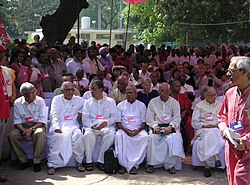
[[File:Cpmleadership18thcongress.jpg|thumb|256x256px|Jyoti Basu (extreme right front row) in the inaugural session of the 18th Congress of the CPI(M) in Delhi. Seated in the front row from the extreme left are [[Prakash Karat]], [[Buddhadeb Bhattacharya]], [[Manik Sarkar]], [[V. S. Achuthanandan]] and [[Koratala Satyanarayana|K. Satyanarayana]].]] | |||
=== Coalition Governments in West Bengal (1966–1972) === | === Coalition Governments in West Bengal (1966–1972) === | ||
Between February–March 1966, a second and more spontaneous food movement flared up across West Bengal.<ref name=" | Between February–March 1966, a second and more spontaneous food movement flared up across West Bengal.<ref name="Basu" /><ref name="Samaddar-2018" /> As a result of price rise of essential commodities, the new chief minister, [[Prafulla Chandra Sen]] had suggested that people should shift from their staple of rice–potatoes to wheat–green bananas and subsequently agitations had broken out in the area of [[Swarupnagar]], leading to police firing and death of two participating teenagers on 16 February.<ref name="Basu" /> Consequently, widespread spontaneous protests broke out over the following months and across the state of West Bengal with more frequent instances of vandalism and violent encounters between the agitators and police than in the previous agitations.<ref name="Samaddar-2018" /> This movement while having less organised backing from the opposition parties is described to have been impactful in its political ramifications in the subsequent years;<ref name="Basu" /><ref name="Samaddar-2018" /> among others, leading to the [[Indian National Congress]] losing its absolute majority for the first time and Basu becoming the [[Deputy Chief Minister of West Bengal|deputy chief minister of West Bengal]] in the following year.<ref name="Basu" /><ref>{{Cite web|date=12 May 2011|title=The rise and fall of the Left in West Bengal|url=https://www.indiatoday.in/assembly-elections-2011/west-bengal/story/the-rise-and-fall-of-the-left-in-west-bengal-133630-2011-05-12|website=[[India Today]]|language=en}}</ref> Civil unrest also peaked during the ensuing period which led to a succession of unstable governments, the establishment of armed political cadres, [[Naxalbari uprising]] and widespread spontaneous agitations against prevailing conditions of [[extreme poverty]].<ref name="Ishwaran-1971">{{Cite book|title=Contributions to Asian Studies|publisher=[[E. J. Brill]]|date=1971|editor-last=Ishwaran|editor-first=Karigoudar|volume=1|pages=49–60|language=en}}</ref> | ||
In the [[1967 West Bengal Legislative Assembly election|West Bengal Legislative Assembly election of 1967]], fourteen opposition parties contested through two pre-poll political alliances;<ref name="Chaudhuri-1993-2">{{Cite journal|last=Chaudhuri|first=Amiya Kumar|date=1993|title=Control, Politics and Perspective of a State Legislature|journal=The Indian Journal of Political Science|volume=54|issue=1|pages=98–102|jstor=41855642|issn=0019-5510}}</ref> the CPI-M led [[United Left Front (1967)|United Left Front]] and the CPI and [[Bangla Congress]] (splinter of the Congress party formed in 1966) led [[People's United Left Front]].<ref name="Mayers-2007">{{Cite journal|last=Mayers|first=James|date=8 May 2007|title=Economic reform and the urban/rural divide: Political realignment in West Bengal 1977–2000|journal=South Asia: Journal of South Asian Studies|language=en|publisher=[[Taylor & Francis]]|volume=24|issue=1|pages=20–23|doi=10.1080/00856400108723422|s2cid=145773403|issn=0085-6401}}</ref><ref name="Rao-2003" /> The CPI-M became the second largest party outstripping its former party, the CPI.<ref name="Daniyal-2015" /> Following the election, the two alliances joined forces to form the [[United Front (1967)|United Front government]] in West Bengal. During the negotiations between the two alliances, Basu was denied the position of chief minister due to opposition to the idea from the CPI and Bangla Congress,<ref name="Dasgupta-1972">{{Cite journal|last=Dasgupta|first=Biplab|date=1972|title=The 1972 Election in West Bengal|journal=Economic and Political Weekly|volume=7|issue=16|pages=804–808|jstor=4361253|issn=0012-9976}}</ref> all of whom eventually settled for [[Ajoy Mukherjee]] of the Bangla Congress as the consensus candidate for the position while Basu became the deputy chief minister and in-charge of the finance department.<ref name="Pandey-2019" /><ref name="Chattopadhyay-2010" /> The government however collapsed within a year when the food minister, [[Prafulla Chandra Ghosh|P. C. Ghosh]] resigned from the government after facing persistent agitations led by the CPI-M (both part of the same government) against his policy of seeking voluntary measures from landlords and middlemen which were ineffective in resolving the food crisis.<ref>{{Cite book|last=Rao|first=M. V. S. Koteswara|url=https://books.google.com/books?id=3e0SAQAAMAAJ|title=Communist parties and United Front experience in Kerala and West Bengal|date=2003|publisher=Prajasakti Book House|isbn=978-81-86317-37-2|pages=236–240|language=en}}</ref> | |||
For the mid-term [[1969 West Bengal Legislative Assembly election|West Bengal Legislative Assembly election of 1969]], the United Front Committee was formed consisting of all the coalition partners of the previous government which agreed upon a pre-poll alliance to contest the election together under a 32-point programme.<ref name="Chaudhuri-1993-2" /> Under terms of the agreement, if the alliance were to attain a majority then Mukherjee would become the chief minister while Basu would become the deputy chief minister.<ref name="Chaudhuri-1993-2" /><ref name="Ray-2007">{{Cite book|last=Ray|first=Sudhir|url=https://books.google.com/books?id=loYOAQAAMAAJ|title=Marxist Parties of West Bengal in Opposition and Government, 1947–2001|date=2007|publisher=Progressive Publishers|isbn=978-81-8064-135-0|pages=89–102|language=en}}</ref> In addition during the negotiations Basu was able to secure the portfolios of fisheries, food, excise, labour, civil defence and education for the CPI-M as well as the department of general administration and police from the home ministry forsaking the finance ministry which he had previously held.<ref>{{Cite book|last=Roychoudhury|first=Profulla|title=Left Experiment in West Bengal|publisher=[[University of Michigan]]|year=1985|pages=90–95|language=en}}</ref><ref name="Ray-2007" /> In the election, the United Front won an overwhelming victory with 214 out of 280 seats and as a consequence, the CPI-M stood as the first party other than the Congress party to become the largest party in the assembly.<ref name="Mitra2007">{{cite book|author=Subrata K. Mitra|url=https://books.google.com/books?id=GuILNHwcT4AC&pg=PA99|title=The Puzzle of India's Governance: Culture, Context and Comparative Theory|date=2007|publisher=Routledge|isbn=978-1-134-27493-2|page=99}}</ref> | |||
In the subsequent [[second United Front cabinet]], Basu became both the deputy chief minister and in-charge of general administration and police.<ref name="Ray-2007" /> Under Basu, the police were instructed to not intervene in any labour disputes against striking workers.<ref name="Ruparelia-2015">{{Cite book|last=Ruparelia|first=Sanjay|title=Divided We Govern: Coalition Politics in Modern India|date=2015|publisher=Oxford University Press|isbn=978-0-19-026491-8|pages=59–60|language=en}}</ref> The first six months of the second United Front government as a result experienced a record of 551 [[Workers strike|strikes]] and 73 [[General strike|union lockdowns]] across the state with a participation of approximately 570,000 workers.<ref name="Ishwaran-1971" /> The [[Labour Department|labour department]] headed by [[Krishnapada Ghosh]] of the CPIM is also noted to have coordinated with the department of general administration to enable the registration of new trade unions and legalisation of ''gheraos'' (trans: [[picketing]]) as a method of protest.<ref name="Ruparelia-2015" /> The labour militancy combined with the state policy of non intervention drove an exponential rise in daily wages ranging between a 100–200% increase in the unorganised sector and 100–300% increase in the organised sector.<ref>{{Cite journal|last=Chakraborty|first=P.|date=1975|title=Wage Differentials in West Bengal|journal=Indian Journal of Industrial Relations|volume=10|issue=4|pages=503–522|jstor=27765490|issn=0019-5286}}</ref><ref name="Ruparelia-2015" /> Previously in light of the appalling conditions of agrarian poverty and rural discontent, a radical section of the CPI-M had also split due to the party's involvement in parliamentary politics and subsequently launched a peasant's uprising.<ref name="Ishwaran-1971" /> Eventually this section known as the [[Naxalites]] formed the [[Communist Party of India (Marxist-Leninist)]] in 1969 under the leadership of [[Charu Mazumdar]] calling for the annihilation of the class of ''[[Jotedar|joteodars]]'' (wealthy landlords) and an armed revolution to overthrow the Indian state.<ref name="Ruparelia-2015" /><ref name="History of Naxalism-2003">{{Cite web|date=9 May 2003|title=History of Naxalism|url=https://www.hindustantimes.com/india/history-of-naxalism/story-4f1rZukARGYn3qHOqDMEbM.html|archive-url=https://web.archive.org/web/20160814222816/http://www.hindustantimes.com/india/history-of-naxalism/story-4f1rZukARGYn3qHOqDMEbM.html|url-status=dead|archive-date=14 August 2016|website=[[Hindustan Times]]|language=en}}</ref> Although the previous United Front government had tolerated initial landgrabs by the Naxalites,<ref name="Ruparelia-2015" /> the police department under Basu launched a campaign of [[state repression]] on the movement which continued under succeeding governments.<ref name="Ruparelia-2015" /><ref name="History of Naxalism-2003" /> According to Basu, "(The Naxalites), forgetting everything else that the country stood for, followed the China model with disastrous consequences which had no relation to Marxist philosophy."<ref name="Daniyal-2015" /> | |||
In August 1969, Basu was also faced with a protest from the police department itself after the death of a policeman in a clash with the [[Socialist Unity Centre]], one of the member parties of the United Front.<ref name="TheHindu-2019">{{Cite news|date=1 August 2019|title=From the Archives (August 1, 1969): Bengal policemen storm Assembly|language=en-IN|work=The Hindu|url=https://www.thehindu.com/archives/from-the-archives-august-1-1969-bengal-policemen-storm-assembly/article28775401.ece|issn=0971-751X}}</ref> The agitation was notably defused by him in person, who permitted a group of dissident police personnel to enter his office in the assembly house during a demonstration and negotiated with them, reprehending them for disorderly behaviour while taking into consideration the grievances raised.<ref name="Tough-2010" /><ref name="TheHindu-2019" /> The second United Front government however too fell within a short period of time, on this occasion the chief minister Ajoy Mukherjee resigned in March 1970 after facing an aggravated and dysfunctional government where smaller member parties were in confrontation with the CPI-M, the largest among them on various issues.<ref name="Chaudhuri-1993" /><ref name="Ruparelia-2015" /> There was also an assassination attempt on Basu on 31 March while he was on a party visit to [[Patna]] which resulted in the death of one accompanying party worker;<ref>{{Cite news|date=31 March 1970|title=Attempt on life of Jyoti Basu|work=[[Tribune India]]|publication-date=1 April 2020|url=https://www.tribuneindia.com/news/this-day-that-year/attempt-on-life-of-jyoti-basu-63751}}</ref><ref>{{Cite news|date=1 April 2020|title=From the Archives (April 1, 1970): Jyoti Basu shot at in Patna.|language=en-IN|work=[[The Hindu]]|url=https://www.thehindu.com/archives/from-the-archives-april-1-1970-jyoti-basu-shot-at-in-patna/article31221485.ece|issn=0971-751X}}</ref> the identity of the assailant has remained unknown til date.<ref>{{Cite web|last=Ahmad|first=Faizan|date=18 January 2010|title=In '70, a bullet missed him by a whisker {{!}} India News |url=https://timesofindia.indiatimes.com/india/In-70-a-bullet-missed-him-by-a-whisker/articleshow/5464191.cms|website=[[The Times of India]]|language=en}}</ref> The government continued to be operational until the dissolution of the assembly by presidential proclamation on 30 July.<ref name="Chaudhuri-1993" /> | |||
In the following [[1971 West Bengal Legislative Assembly election|West Bengal Legislative Assembly election of 1971]], the parties contested alone but CPI-M remained as the single largest party while increasing its number of seats from 80 to 113.<ref name="Chaudhuri-1993-2" /> Both the former chief minister Ajoy Mukherjee of the Bangla Congress and the former deputy chief minister Basu of the Communist Party of India (Marxist) contested from the [[Baranagar (Vidhan Sabha constituency)|Barangar constituency]] which ended with Basu winning with a vote share of 57.3% and Ajoy Mukherjee emerging as runners up with a vote share of 42.7%.<ref name="Chattopadhyay-2010" /><ref>{{Cite web|title=West Bengal 1971|url=https://old.eci.gov.in/files/file/3186-west-bengal-1971/|website=[[Election Commission of India]]}}</ref> However, Mukherjee who led the Bangla Congress was able to regain his former position through a post-poll coalition called the Democratic Coalition which notably included [[Indian National Congress (R)|Indira Gandhi's Congress]] and was supported by the CPI and [[Congress (Organisation)]].<ref name="Chaudhuri-1993-2" /> The CPI-M stood as the sole opposition party and Basu once again became the leader of opposition. Within 2 weeks of the formation of the new government, Basu issued a [[no confidence motion]] which stood at exactly 141 in support of the government out of 141 required. Despite surviving the initial motion, the new government too fell within 3 months when the assembly was dissolved on the recommendation of the chief minister.<ref name="Chaudhuri-1993-2" /> | |||
[[File: Cpmcongress1302.JPG|thumb|269x269px|Press conference at the book release of ''Memoirs – 25 Communist Freedom Fighters'' by [[Sitaram Yechury|Sitaram Yechuri]] at the 18th Congress of Communist Party of India (Marxist), Delhi, 2005. From the left, [[Harkishan Singh Surjeet]] (general secretary), Jyoti Basu (former Chief Minister of West Bengal), and Sitaram Yechuri (politburo member).]] | |||
In the [[ | === Boycott of Assembly and Emergency rule (1972–1977) === | ||
In the [[1972 West Bengal Legislative Assembly election|West Bengal Legislative Assembly election of 1972]], Congress (R) won an overwhelming majority and Siddhartha Shankar Ray who was previously in the Bangla Congress and later appointed as a specialised union cabinet ministry called West Bengal Affairs Minister became the new chief minister of the state.<ref name="Chander-2004">{{Cite book|last=Chander|first=N. Jose|title=Coalition Politics: The Indian Experience|date=2004|publisher=Concept Publishing Company|isbn=978-81-8069-092-1|pages=103–105|language=en}}</ref><ref name="Dasgupta-1972" /> The CPI-M was only able to secure 14 seats and Basu for the first time lost his seat in the Baranagar constituency to his former associate [[Shiba Pada Bhattacharjee]], who had remained in the CPI after the split in the party.<ref name="Singh-2010">{{cite web|last=Singh|first=Shiv Sahay|date=19 January 2010|title=Shouldn't have contested, says man who defeated Basu|url=http://indianexpress.com/article/news-archive/web/shouldnt-have-contested-says-man-who-defeated-basu/|url-status=live|archive-url=https://web.archive.org/web/20160305161708/http://indianexpress.com/article/news-archive/web/shouldnt-have-contested-says-man-who-defeated-basu/|archive-date=5 March 2016|access-date=24 October 2015|publisher=[[Indian Express]]}}</ref><ref name="Dasgupta-1972" /> Before the election, the Communist Party of India allied with Congress (R) while a section of the Bangla Congress had also merged with the Congress.<ref name="Dasgupta-1972" /> The opposing alliance was led by the Communist Party of India (Marxist) which included the previous members of the [[United Left Front (1967)|United Left Front]] alongside the [[Biplobi Bangla Congress]], a splinter of the Bangla Congress.<ref name="Dasgupta-1972" /> | |||
The election was marred widespread instances of violence against opposition parties, electoral discrepancies, irregularities in process and consequent allegations of rigging from both Congress (O) and the CPI-M,<ref name="Dasgupta-1972" /><ref name="Roychoudhury1977">{{cite book|author=Profulla Roychoudhury|url=https://books.google.com/books?id=ujluAAAAMAAJ|title=West Bengal – a Decade, 1965–1975|publisher=Boipatra|year=1977|page=254}}</ref> the press in Calcutta at the time reported that the rigging had occurred in around 50 constituencies.<ref name="Dasgupta-1972" /> According to the [[socialist]] [[essayist]] [[Madhu Limaye]], the "black art of booth rigging" was perfected by the Congress in the 1972 election where whole constituencies had been rigged.<ref>{{Cite book|last=Limaye|first=Madhu|title=Birth of Non-Congressism: Opposition Politics, 1947–1975|date=1988|publisher=B.R. Publishing Corporation|isbn=978-81-7018-480-5|pages=353|language=en|author-link=Madhu Limaye}}</ref> It was also noted that several constituencies which were known as left wing strongholds had produced massive victory margins in favour of Congress (R) whereas the CPI-M increased its vote share in constituencies which were Congress strongholds; the explanation provided by the CPI-M was that violence and rigging methods were mostly employed at unfavorable constituencies and that elections had been rigged in 87–172 other constituencies.<ref name="Dasgupta-1972" /><ref name="Ray2007">{{cite book|author=Sudhir Ray|url=https://books.google.com/books?id=loYOAQAAMAAJ|title=Marxist parties of West Bengal in opposition and in government, 1947–2001|date=2007|publisher=Progressive Publishers|isbn=978-81-8064-135-0|page=164}}</ref> One of the discrepancies pointed at by the CPI-M was that the constituency of Baranagar which had recorded a very high voter turnout despite being subject to [[section 144]] and violent clashes throughout the day which had resulted in the death of one its workers.<ref name="Dasgupta-1972" /> Basu refused to accept the results and declared that the new assembly was an "assembly of frauds".<ref name="Singh-2010" /> He also published an open editorial to the "world press" regarding terming the incidents of violence to be "semi-fascist terror".<ref name="Ray2007" /><ref>{{Cite journal|last=Basu|first=Mr Jyoti|date=1 January 1972|title=On Fascist Terror in West Bengal – An appeal to the World Press, Calcutta, 23/3/72|journal=Journal of Contemporary Asia|volume=2|issue=2|pages=224–227|doi=10.1080/00472337285390291|issn=0047-2336}}</ref> The CPI-M boycotted the assembly for the remaining term of the seventh assembly taking the stance that a "massive rigging" had occurred.<ref>{{Cite journal|last=Chaudhuri|first=Amiya Kumar|date=1993|title=Control, Politics and Perspective of a State Legislature|journal=The Indian Journal of Political Science|volume=54|issue=1|pages=102–104|jstor=41855642|issn=0019-5510}}</ref><ref name="Mallick-1994">{{Cite book|last=Mallick|first=Ross|title=Indian Communism: Opposition, Collaboration, and Institutionalization|date=12 May 1994|publisher=[[Oxford University Press]]|isbn=978-0-19-563235-4|pages=160–161|language=en}}</ref> | |||
In the | In 1975, the [[Prime Minister of India]], Indira Gandhi imposed a [[national emergency]] on the premise of internal disturbances suspending elections, legitimising [[rule by decree]] and curbing [[civil liberties]].<ref name="Prashad-1996">{{Cite journal|last=Prashad|first=Vijay|date=1996|title=Emergency Assessments|journal=Social Scientist|volume=24|issue=9/10|pages=36–68|doi=10.2307/3520142|jstor=3520142|issn=0970-0293}}</ref> The proposition for the declaration of the emergency and the formal draft of the ordinance were both notably corroborated to have been forwarded by [[Siddhartha Shankar Ray]].<ref>{{Cite web|last=C G|first=Manoj|date=13 June 2015|title=S S Ray to Indira Gandhi six months before Emergency: Crackdown, get law ready|url=https://indianexpress.com/article/india/india-others/six-months-before-emergency-s-s-ray-to-indira-gandhi-crack-down-get-law-ready/|website=[[The Indian Express]]|language=en}}</ref><ref>{{Cite web|last=Narayan|first=S.|date=25 June 2020|title=Why Did Indira Gandhi Impose Emergency In 1975?|url=https://www.thehansindia.com/hans/opinion/news-analysis/why-did-indira-gandhi-impose-emergency-in-1975-630015|website=[[The Hans India]]|language=en}}</ref><ref>{{cite book|author=Jacob|first=Jack Farj Rafael|title=An Odyssey in War and Peace: An Autobiography of Lt. Gen JFR Jacob|publisher=[[Roli Books]]|year=2012|isbn=9788174369338|pages=189|author-link=J. F. R. Jacob}}</ref> The Communist Party of India (Marxist) emerged as one of the primary opposition to [[the emergency rule of Indira Gandhi]].<ref name="Prashad-1996" /> The following period witnessed a succession of [[authoritarian]] measures and political repression, which was particularly severe in West Bengal.<ref>{{Cite book|last=DeSouza|first=Peter Ronald|title=India's Political Parties|date=3 October 2006|publisher=Sage Publishing India|isbn=978-93-5280-534-1|pages=217–221|language=en}}</ref> The members of the CPI-M's labour union became the first subject to political repression and [[mass arrest]]s while the rest of the members of the CPI-M went underground.<ref name="Ruparelia-2015-2">{{Cite book|last=Ruparelia|first=Sanjay|title=Divided We Govern: Coalition Politics in Modern India|date=2015|publisher=[[Oxford University Press]]|isbn=978-0-19-026491-8|pages=71–72|language=en}}</ref><ref name="Mallick-1994" /> | ||
With the initiation of the [[Jayaprakash Narayan]] (JP)'s movement, the CPI-M began providing support to it and went on to participate in discussions for the creation of a united front under the umbrella of the [[Janata Party]]. Several of the leaders of the CPI-M were also influenced by JP with Basu noted to be one of his prominent admirers having worked under him in the [[All India Railwaymen's Federation]] during the 1940s.<ref name="Ruparelia-2015-2" /> The involvement of the [[Hindutva|Hindutva movement]] however complicated matters, according to JP the formal inclusion of the Marxists who had undergone a splintering and whose organisation was localised in a particular region would have been detrimental to the movement as the [[Rashtriya Swayamsevak Sangh]] members would switch sides if they joined.<ref name="Ruparelia-2015-2" /><ref>{{Cite book|last=Prakash|first=Gyan|title=Emergency Chronicles: Indira Gandhi and Democracy's Turning Point|date=2018|publisher=[[Princeton University Press]]|isbn=978-93-5305-351-2|language=en|author-link=Gyan Prakash}}</ref> JP and Basu eventually agreed that the CPI-M would not formally join the Janata Party as it would weaken the movement.<ref name="Ruparelia-2015-2" /> After the revocation of the emergency, the CPI-M joined an electoral alliance with the Janata Party in the [[1977 Indian general election]] which resulted in an overwhelming victory for the Janata Alliance.<ref>{{Cite journal|last=Blair|first=Harry W.|date=April 1980|title=Mrs Gandhi's Emergency, The Indian Elections of 1977, Pluralism and Marxism: Problems with Paradigms|url=https://www.cambridge.org/core/journals/modern-asian-studies/article/mrs-gandhis-emergency-the-indian-elections-of-1977-pluralism-and-marxism-problems-with-paradigms/908EF9B139D645655C3336A4D17F2FAE|journal=Modern Asian Studies|language=en|publisher=[[Cambridge University Press]]|volume=14|issue=2|pages=237–271|doi=10.1017/S0026749X00007320|s2cid=144182647|issn=1469-8099|url-access=subscription}}</ref> | |||
== Chief Minister of West Bengal (1977–2000) == | |||
[[ | For the [[1977 West Bengal Legislative Assembly election]], negotiations between the [[Janata Party]] and the [[Communist Party of India (Marxist)]] broke down.<ref>{{Cite web|last=Mahaprashasta|first=Ajoy Ashirwad|date=4 May 2016|title=Why Has Nobody Called It Yet? An Analysis of the West Bengal Elections|url=https://thewire.in/politics/why-has-nobody-called-it-yet-an-analysis-of-the-west-bengal-elections|website=[[The Wire (India)|The Wire]]}}</ref><ref name="Chander-2004" /> This led to a three sided contest between the [[Indian National Congress]], the Janata Party and the Communist Party of India (Marxist) led [[Left Front (West Bengal)|Left Front coalition]].<ref name="Chander-2004" /> The results of the election was a surprising sweep for the Left Front winning 230 seats out of 290 with the CPI-M winning an absolute majority on its own,<ref name="Mayers-2007" /> Basu became the chief minister of West Bengal for the next 23 years until his retirement in 2000.<ref name="Datta-2010" /> Jyoti Basu was also repeatedly elected as the representative of the [[Satgachhia constituency]] from 1977 to 2001.<ref>{{Cite web|date=19 January 2010|title=Jyoti Basu pulls in the crowds – one last time|url=https://www.hindustantimes.com/kolkata/jyoti-basu-pulls-in-the-crowds-one-last-time/story-ExpoMM4jnIE9pvIvqLQN9H.html|website=[[Hindustan Times]]|language=en}}</ref> | ||
[[File:Jyoti Basu 006 (cropped).jpg|thumb|Jyoti Basu in his office]] | |||
=== First term (1977–1982) === | |||
In the first term of the coming to power, the Left Front government under Basu initiated a number of agrarian and institutional reforms which resulted in reduction of [[poverty rates]], an exponential rise in [[agricultural production]] and decrease in [[political polarisation]].<ref name="Lieten-1996">{{Cite journal|last=Lieten|first=G. K.|date=1996|title=Land Reforms at Centre Stage: The Evidence on West Bengal|journal=Development and Change|language=en|location=[[The Hague]]|publisher=[[International Institute of Social Studies]]|volume=27|issue=1|pages=111–130|doi=10.1111/j.1467-7660.1996.tb00580.x|issn=1467-7660}}</ref><ref name="Bandyopadhyay-2003">{{Cite journal|last=Bandyopadhyay|first=D.|date=2003|title=Land Reforms and Agriculture: The West Bengal Experience|journal=Economic and Political Weekly|volume=38|issue=9|pages=879–884|jstor=4413274|issn=0012-9976}}</ref><ref>{{Cite journal|last1=Besley|first1=Timothy|last2=Burgess|first2=Robin|date=1 May 2000|title=Land Reform, Poverty Reduction, and Growth: Evidence from India|url=https://academic.oup.com/qje/article/115/2/389/1840440|journal=The Quarterly Journal of Economics|language=en|publisher=[[Oxford Academic]]|volume=115|issue=2|pages=389–430|doi=10.1162/003355300554809|bibcode=2000QJEco.115..389B |s2cid=4811684|issn=0033-5533|url-access=subscription}}</ref> It also enabled the large scale adoption of technological advancements which had earlier been brought in through the [[Green Revolution in India]] in the 1960s.<ref name="Lieten-1996" /><ref name="Bandyopadhyay-2003" /> The agricultural growth jumped from an annual average of 0.6% between 1970–1980 to over 7% between 1980–1990 and the state was described as an agricultural success story of the 1980s.<ref name="Bandyopadhyay-2003" /><ref name="Saha-1994">{{Cite journal|last1=Saha|first1=Anamitra|last2=Swaminathan|first2=Madhura|date=1994|title=Agricultural Growth in West Bengal in the 1980s: A Disaggregation by Districts and Crops|journal=Economic and Political Weekly|volume=29|issue=13|pages=A2–A11|issn=0012-9976}}</ref> During this period, the state of West Bengal moved from being a food importer to a food exporter and became the largest producer of rice outstripping the states of [[Andhra Pradesh]] and [[Punjab, India|Punjab]] which had previously held the status.<ref name="Saha-1994" /> The [[Human Development Index]] was also noted to have improved at a much faster rate than in other states, growing from being the lowest in the country in 1975 to above the national average in 1990.<ref>{{Cite journal|last1=Indrayan|first1=A.|last2=Wysocki|first2=M. J.|last3=Chawla|first3=A.|last4=Kumar|first4=R.|last5=Singh|first5=N.|date=1999|title=3-Decade Trend in Human Development Index in India and Its Major States|journal=Social Indicators Research|publisher=[[Springer Publishing]]|volume=46|issue=1|pages=91–120|doi=10.1023/A:1006875829698|s2cid=142881301|issn=0303-8300}}</ref> | |||
Between 1977 and 1980, Basu oversaw the identification of nearly 1 million [[acres]] of ceiling surplus land and its subsequent redistribution.<ref name="Patnaik-2010-2">{{Cite journal|last=Patnaik|first=Utsa|date=2010|title=Jyoti Basu and Bengal|journal=Social Scientist|volume=38|issue=7/8|pages=56–60|jstor=27866723|issn=0970-0293}}</ref> The number of landless rural households decreased by 35% during this period.<ref name="Lieten-1990">{{Cite journal|last=Lieten|first=G. K.|date=1990|title=Depeasantisation Discontinued: Land Reforms in West Bengal|journal=Economic and Political Weekly|volume=25|issue=40|pages=2265–2271|jstor=4396841|issn=0012-9976}}</ref> | |||
The Basu government began the process of "democratic [[decentralisation]]" in West Bengal by amending and implementing the provisions of the Panchayat Act.<ref name="Acharya-1993">{{Cite journal|last=Acharya|first=Poromesh|date=1993|title=Panchayats and Left Politics in West Bengal|journal=Economic and Political Weekly|volume=28|issue=22|pages=1080–1082|issn=0012-9976}}</ref><ref name="Basu-2013">{{Cite journal|last1=Basu|first1=Subho|last2=Majumder|first2=Auritro|date=1 June 2013|title=Dilemmas of Parliamentary Communism|journal=Critical Asian Studies|volume=45|issue=2|pages=167–200|doi=10.1080/14672715.2013.792569|s2cid=147986419|issn=1467-2715}}</ref> On 4 June 1978, local body elections were resumed after 14 years and the first direct elections were held to elect 56,000 representatives from 15 zila parishads, 324 panchayat samitis and 3,242 gram panchayats in West Bengal.<ref name="Acharya-1993" /> By 1993, the number of representatives was expanded to over 71,000 representatives while Basu was credited to have been successful in the introduction of [[grassroots democracy]] and self governing units in West Bengal which substantially improved [[Transparency (behavior)|bureaucratic transparency]], [[Irrigation in India|irrigation work]], [[rural infrastructure]] and [[political participation]] and as a result [[standards of living]].<ref name="Basu-2013" /><ref>{{Cite book|last=Mathew|first=George|title=Panchayati Raj from Legislation to Movement|date=1994|publisher=Concept Publishing Company|isbn=978-81-7022-517-1|pages=79–86|language=en}}</ref> The successful implementation of [[panchayat raj]] in the state is also noted to have played an integral part in the identification and redistribution of ceiling surplus land,<ref name="Patnaik-2010-2" /> and played a significant part in the rise of agricultural growth through the 1980s.<ref>{{Cite journal|last1=Saha|first1=Anamitra|last2=Swaminathan|first2=Madhura|date=1994|title=Agricultural Growth in West Bengal in the 1980s: A Disaggregation by Districts and Crops|journal=Economic and Political Weekly|volume=29|issue=13|pages=A2–A11|jstor=4400994|issn=0012-9976}}</ref> | |||
== | Among the more prominent measures initiated by the new government was that of [[Operation Barga]]. Introduced in 1978, it was a comprehensive and radical measure for land reforms which was further formalised through two legislation in 1979 and 1980.<ref name="Chattopadhyay-1979">{{Cite journal|last=Chattopadhyay|first=Suhas|date=1979|title=Operation Barga: A Comment|journal=Economic and Political Weekly|volume=14|issue=49|pages=2022–2024|jstor=4368206|issn=0012-9976}}</ref><ref name="Banerjee-2002">{{Cite journal|last1=Banerjee|first1=Abhijit V.|last2=Gertler|first2=Paul J.|last3=Ghatak|first3=Maitreesh|date=2002|title=Empowerment and Efficiency: Tenancy Reform in West Bengal|journal=Journal of Political Economy|volume=110|issue=2|pages=239–280|doi=10.1086/338744|jstor=10.1086/338744|s2cid=35935397|issn=0022-3808}}</ref> The operation sought to actively identify and record ''bargardars'' (trans: [[sharecroppers]]) by present occupational status without any reliance on ancestral records, producing official documentation for enforcement of the rights of ''bargardars'' to crop share from landlords and [[priority right]]s to lands in cases of both voluntary sale of land and forced sale of ceiling surplus lands.<ref name="Pal-1995">{{Cite book|last=Pal|first=Sasanka Sekhar|url=https://books.google.com/books?id=jgzePgAACAAJ|title=Impact of Tenancy Reforms on Production and Income Distribution: A Case Study of Operation Barga in West Bengal|date=1995|publisher=National Centre for Agricultural Economics and Policy Research|language=en}}</ref><ref name="Banerjee-2002" /> The number of recorded ''bargardars'' increased from 0.4 to 1.2 million by 1982,<ref name="Chattopadhyay-1979" /><ref name="Pal-1995" /> and resulted in the coverage of 50%+ [[Wage share|output share]] concessions towards ''bargardars'' to increase from 10% to over 50% among registered ''bargardars'' and over 33% for unregistered ''bargardars''.<ref name="Banerjee-2002" /><ref name="Operation Barga-2006">{{Cite journal|date=18 November 2006|title=Operation Barga|url=http://team.univ-paris1.fr/teamperso/DEA/Cursus/M1/Doc4%20Operation%20Barga.pdf|journal=Théorie et Applications en Microéconomie et Macroéconomie|publisher=[[University of Paris]]|archive-url=https://web.archive.org/web/20061118154131/http://team.univ-paris1.fr/teamperso/DEA/Cursus/M1/Doc4%20Operation%20Barga.pdf|archive-date=18 November 2006}}</ref> The implementation of the operation is noted to have improved the social status and security of tenancy of ''bargadars'' as well as decreased [[economic inequality]].<ref name="Pal-1995" /><ref name="Banerjee-2002" /> In addition it accounted for approximately 36% of agricultural growth during the period as a consequence of greater production incentives due to a lack of [[eviction]] threat and increased output stake.<ref name="Operation Barga-2006" /> The operation is also credited to have created a cushion against [[Farmers' suicides in India|farmers' suicides]] in West Bengal by improving the [[economic stability]] of farmers.<ref>{{Cite web|date=17 April 2006|title=Did Operation Barga save Bengal farmers|url=https://www.financialexpress.com/archive/did-operation-barga-save-bengal-farmers/162221/|website=[[The Financial Express (India)|The Financial Express]]|language=en-US}}</ref> | ||
The Left Front government also identified 247,000 acres of readily reclaimable lands mostly in the Sundarban area ([[Ganges Delta]]) for the resettlement of 136,000 agriculturist refugees from [[East Pakistan]].<ref name="Mallick-1999">{{Cite journal|last=Mallick|first=Ross|date=1999|title=Refugee Resettlement in Forest Reserves: West Bengal Policy Reversal and the Marichjhapi Massacre|journal=The Journal of Asian Studies|volume=58|issue=1|pages=104–125|doi=10.2307/2658391|jstor=2658391|s2cid=161837294 |issn=0021-9118}}</ref><ref name="Sengupta-2011">{{Cite journal|last=Sengupta|first=Debjani|date=1 February 2011|title=From Dandakaranya to Marichjhapi: rehabilitation, representation and the partition of Bengal (1947)|journal=Social Semiotics|publisher=[[Taylor & Francis]]|volume=21|issue=1|pages=101–123|doi=10.1080/10350330.2011.535673|s2cid=144730817|issn=1035-0330}}</ref> Under the tenure of [[Bidhan Chandra Roy]], many of the refugees had been relocated to refugee camps in [[Dandakaranya]] and the Left Front government had taken up their cause for resettlement in West Bengal.<ref name="Mallick-1999" /> Initially Basu and the Left Front government approved voluntary resettlement in the identified lands by the refugees from the Dandakaranya camps to the extent of actively encouraging them to do so,<ref name="Sengupta-2011" /><ref name="Butalia-2015">{{Cite book|last=Butalia|first=Urvashi|title=Partition: The Long Shadow|date= 2015|publisher=Penguin UK|isbn=978-93-5118-949-7|language=en|chapter=6. Reconstructing Marichjhapi}}</ref> however the implementation of the resettlement process turned lackluster and was bottle-necked with revised priorities for [[environmental protection]] in the [[Sundarbans]].<ref name="Mallick-1999" /><ref name="Sengupta-2011" /> In a significant development between 1978 and 1979, a large group of these impoverished refugees who had returned to Bengal seeking resettlement from Dandakaranya had illegally occupied land on the remote island of [[Marichjhanpi]] and refused eviction.<ref name="Butalia-2015" /><ref name="Sengupta-2011" /> In January 1979, following an economic blockade, the government conducted a forcible eviction leading to the death of several refugees in the consequent abuse by [[Police officer|police personnel]].<ref name="Sengupta-2011" /> The incident led to sharp criticism of the government and raised controversy in the [[News media|media]], [[Parliamentary opposition|the opposition]] as well as from within members of the Left Front coalition.<ref name="Mallick-1999" /> The demand for a formal investigation into the eviction was however denied by the government with Basu convinced that it was greatly exaggerated by the media;<ref name="Sengupta-2011" /><ref name="Mallick-1999" /> in the end the official figure put the deaths at 2 but the lack of an investigation led to various other estimates to circulate on the killing years afterwards.<ref name="Sengupta-2011" /><ref name="Mallick-1999" /> | |||
In 1981, a new amendment was introduced to the West Bengal Land Reforms Act, 1951 (previously amended in 1953, 1967 and 1970) which sought to plug loopholes in the former legislation; the amendment introduced ceilings on non-agricultural lands such as [[fisheries]] and [[orchards]] which previously had none and enacted provisions for lands held by [[trusts]] to be included in the individual ceiling calculations of its [[beneficiaries]]. It also derecognised and redefined lands owned by all [[religious institutions]] as ''raiyats'' (trans: [[land tenure]]) with a maximum of 7 standard hectares irrespective of any number of declared branches or centers of any such institution.<ref name="Lieten-1990" /> | |||
[[File:The Vice President, Shri Bhairon Singh Shekhawat meeting with the former Chief Minister of West Bengal, Shri Jyoti Basu, during his visit at Kolkata on May 31, 2007.jpg|thumb|Jyoti Basu with former Vice President of India, [[Bhairon Singh Shekhawat]]]] | |||
=== Second term (1982–1987) === | |||
The reforms initiated by the Basu government in its first term were continued into its second term, Operation Barga was officially completed in 1986. Basu's front won 174 seats in [[1982 West Bengal Legislative Assembly election|1982 West Bengal Elections]] defeating the [[Indian National Congress|Congress (Indira)]] - [[Indian Congress (Socialist)|Congress (Socialist)]] coalition<ref>{{Cite book|url=https://books.google.com/books?id=zEcmAAAAMAAJ|title=Report on the Election to the Office of President of India, 1982 and Legislative Assemblies, Delhi Metropolitan Council, 1982–83: Narrative|date=1983|publisher=Election Commission of India|language=en}}</ref> He was one of the most powerful personality of the [[Left-wing politics|Left front]] after becoming the [[Chief Minister of West Bengal]] and was known to be the Chief artist of the Communist politics not only in West Bengal, but also in the whole India.<ref>{{Cite web|last1=P|first1=Samyak|last2=ey|date=2019-07-08|title=Jyoti Basu, the beacon of Indian Communism who almost became prime minister|url=https://theprint.in/theprint-profile/jyoti-basu-the-beacon-of-indian-communism-who-almost-became-prime-minister/260008/|access-date=2020-10-10|website=ThePrint|language=en-US}}</ref> Ahead of the 1982 assembly elections, the Left Front had gained three new members; the [[Communist Party of India]] (CPI), the [[West Bengal Socialist Party]] (WBSP) and the [[Democratic Socialist Party (Prabodh Chandra)|Democratic Socialist Party]] (DSP).<ref>{{Cite book|last=Basu|first=Amrita|url=https://books.google.com/books?id=ZyY0Yb5BrqgC&pg=PA44|title=Two Faces of Protest: Contrasting Modes of Women's Activism in India|date=1994|publisher=University of California Press|isbn=978-0-520-08919-8|language=en}}</ref> In the wake of the 1980 Gorkhaland movement, a poll boycott campaign took place in the [[Darjeeling]] hills with the slogan "No State, No Vote". Organizations calling for a poll boycott included the Pranta Parishad and the [[Gorkha National Liberation Front]] of [[Subhash Ghisingh]].<ref>{{Cite book|last=Samanta|first=Amiya K.|url=https://books.google.com/books?id=J4GqdfG0EU8C&pg=PA274|title=Gorkhaland Movement: A Study in Ethnic Separatism|date=2000|publisher=APH Publishing|isbn=978-81-7648-166-3|language=en}}</ref><ref>{{Cite magazine|author=Indranil Banerjie |date=August 31, 1984 |title=Nepali speaking people consider recognition of their language a fundamental prerequisite for establishment of their Indian identity|url=https://www.indiatoday.in/magazine/indiascope/story/19840831-nepali-speaking-people-consider-recognition-of-their-language-a-fundamental-prerequisite-for-establishment-of-their-indian-identity-803682-1984-08-31|access-date=2020-10-10|magazine=India Today|language=en}}</ref> Voter participation in Darjeeling stood at 59.40%, compared to the statewide 76.96%. CPI(M) emerged as the sole party of relevance in the hills to oppose a separate Gorkhaland state. CPI(M) won three out of the four assembly seats in the Nepali-dominated areas, the fourth going to an [[All India Gorkha League]] candidate (contesting as an independent).<ref>{{Cite book|last=Chaklader|first=Snehamoy|url=https://books.google.com/books?id=3yRuAAAAMAAJ|title=Sub-regional Movement in India: With Reference to Bodoland and Gorkhaland|date=2004|publisher=K.P. Bagchi & Co.|isbn=978-81-7074-266-1|language=en}}</ref> Some of the older, smaller Left Front constituents were uncomfortable with the expansion of the alliance, claiming that CPI(M) was diluting it politically. There were also disagreements on distribution of ministerial portfolios after the expansion of the alliance.<ref>{{Cite magazine|date=October 23, 2013 |title=India Today takes a close look at the institutional pillars of Indian democracy|url=https://www.indiatoday.in/magazine/cover-story/story/19820115-india-today-takes-a-close-look-at-the-institutional-pillars-of-indian-democracy-771404-2013-10-23|access-date=2020-10-10|magazine=India Today|language=en}}</ref> Though due to his irresponsibility in rehabilitiating [[1971 Bangladesh genocide|1971 Bangladeshi refugees]] and refusal to address [[Assam Movement|the rise of anti-Bengali sentiments in Assam]] and other Northeaster states like Meghalaya (see [[Dkhar|Beh Dkhar movement]]) and Tripura (see [[Mandai massacre]]) saw his popularity decrease. | |||
In the second term as the Chief Minister of state he gained popularity for his work for the landless peasants and providing them land and also among intelligentsia.<ref>{{Cite magazine|author=Sumit MITRA Sumanta Sen |date=June 15, 1982 |title=Jyoti Basu sworn in as West Bengal CM for second successive term|url=https://www.indiatoday.in/magazine/cover-story/story/19820615-jyoti-basu-sworn-in-as-west-bengal-cm-for-second-successive-term-805309-1982-06-15|access-date=2020-10-10|magazine=India Today|language=en}}</ref> The rise of [[Mamata Banerjee]] in the 1980s was under the Second Chief Ministership of him and was known to have a good allies with her. And he continued to make a second Chief ministership like the first one by giving the theory of [[Communism]] and working in the Land Reforms Act and also to complete the demand of the [[Indian Gorkha|Gorkhas]], especially in Darjeeling and near by regions.<ref name="Lieten-1990" />{{Additional citation needed|date=June 2024 |reason=Source makes no mention of demands of Gorkhas or Darjeeling}} Whilst an accord had been struck between Prime Minister Rajiv Gandhi and [[Gorkha National Liberation Front]] leader [[Subhash Ghisingh]] ahead of the polls, violence escalated in the Darjeeling hills. In the run-up to the polls, several policemen were killed in the area which made Basu a great chances being a choice of people of Darjeeling.{{Efn|Jyoti Basu took the vote bank of the people of [[Darjeeling]] due to their anger on [[Rajiv Gandhi]], who was [[West Bengal]] incharge.|name=|group=lower-alpha}} | |||
In | In 1986, Finance Minister [[Ashok Mitra]] resigned from the Cabinet, citing differences with Basu, which was a big blow to his government.<ref>{{Cite web |date=1986-02-15 |title=Ashok Mitra: 58-year-old economist resignation causes political goose-pimples in CPI(M) |url=https://www.indiatoday.in/magazine/indiascope/story/19860215-ashok-mitra-58-year-old-economist-resignation-causes-political-goose-pimples-in-cpim-800561-1986-02-14 |access-date=2024-05-27 |website=India Today |language=en}}</ref> | ||
=== | === Third term (1987–1991) === | ||
In [[1987 West Bengal Legislative Assembly election|1987 West Bengal Election]] in [[West Bengal]], Basu held the office for the third time as the [[List of chief ministers of West Bengal|Chief ministers of West Bengal]] after the win of [[Communist Party of India (Marxist)|CPM]] and their allies.<ref name="Jyoti Basu-2010" /> The election was mainly a clash between the [[Left Front (West Bengal)|Left Front]] led by Chief Minister Jyoti Basu and the [[Indian National Congress|Indian National Congress(I)]] led by Prime Minister [[Rajiv Gandhi]] to make a win in the state.<ref name="Stolte-2013" /> The governing [[Left Front (West Bengal)|Left Front]] denied tickets to 62 sitting legislators. In many cases CPI(M), the dominant force in the Left Front, was seeking to rejuvenate the legislature and fielded 35 student leaders as new candidates. The star campaigner was himself Chief Minister Jyoti Basu who had pledged to visit all constituencies where CPI(M) had fielded candidates. During the campaign Basu claimed that the Delhi government discriminated against West Bengal in allocation of resources.<ref>{{Cite magazine|author=Indranil Banerjie |date=March 31, 1987 |title=West Bengal CM Jyoti Basu attacks Rajiv Gandhi's failure to resolve national problems|url=https://www.indiatoday.in/magazine/states/story/19870331-west-bengal-cm-jyoti-basu-attacks-rajiv-gandhis-failure-to-resolve-national-problems-798673-1987-03-31|access-date=2020-10-10|magazine=India Today|language=en}}</ref> Basu's party made the third win by securing a complete majority for third time in Bengal's history, and the Left front secured 187 in the election and defeating [[Indian National Congress]] and made his mark to Prime Minister, [[Rajiv Gandhi]].<ref>{{Cite book|last=Bose|first=Sumantra|url=https://books.google.com/books?id=reiwAAAAQBAJ&pg=PA138|title=Transforming India|date=2013|publisher=Harvard University Press|isbn=978-0-674-72819-6|pages=83–87|language=en}}</ref> | |||
After being sworn in as the Chief Minister Basu continued his work in the major work for which he was elected was that to change the Land Reform and he is said to be one of the best administrators in the history of [[West Bengal]] for the work.<ref name="Lieten-1990" /><ref name="Sengupta-2011" /> And he made a main focus on the Students and [[Buddhadeb Bhattacharjee]] was given the main charge for the enhancement of [[Democratic Youth Federation of India|DYFI]], the student wing of the [[CPI(M)]]. Earlier also he gave a notable number of tickets to student leaders and also worked for the [[Gurkha]]s who also voted him for his opposition to the [[Indian National Congress]].<ref>{{Cite web|title=Jyoti Basu {{!}} Indian politician|url=https://www.britannica.com/biography/Jyoti-Basu|access-date=2020-10-10|website=Encyclopedia Britannica|language=en}}</ref> In 1989, Basu led [[Left Front (West Bengal)|Left government]] in a controversial decision, halting the teaching of [[English language]] for [[Primary school]]s.<ref name="NYTPrimary" >{{cite news |url =https://www.nytimes.com/1981/04/05/world/west-bengal-halting-teaching-of-english-for-primary-students.html|title =West Bengal Halting Teaching of English for Primary Students |date =April 5, 1981|website =[[The New York Times]]|access-date =21 July 2020}}</ref> The controversial decision received protests from intellectuals.<ref name="ITMPrimary" >{{cite news |url =https://www.indiatoday.in/magazine/education/story/19850331-decision-to-abolish-compulsory-teaching-of-english-in-west-bengal-draws-protest-769923-2013-12-03|title =Decision to abolish compulsory teaching of English in West Bengal draws protest|publisher =[[India Today]]|date =March 31, 1985|website =indiatoday.in/magazine/|author =Indranil Banerjie|access-date =21 July 2020}}</ref> The move was later termed as another "historic blunder".<ref name="ITMPrimary2">{{cite news |url =https://www.indiatoday.in/magazine/indiascope/story/19980216-west-bengal-cm-jyoti-basu-does-a-rethink-in-favour-of-english-825705-1998-02-16|title =West Bengal CM Jyoti Basu does a rethink in favour of English|publisher =[[India Today]]|date =February 16, 1998|website =indiatoday.in/magazine/|access-date =21 July 2020}}</ref> | |||
In the 1990s when the government of [[VP Singh]] cleared the ways of [[Mandal Commission]] there was [[Mandal Commission protests of 1990]] in West Bengal and also the silence of Basu triggered him at that time as there was a big problem as the [[CPI (M)]] was popular among both the classes of the society and [[CPI (M)]] supported the verdict.<ref>{{Cite journal|date=2015-06-05|title=Mandal Commission and Left Front in West Bengal|url=https://www.epw.in/journal/1991/8/roots-specials/mandal-commission-and-left-front-west-bengal.html|journal=Economic and Political Weekly|language=en|volume=26|issue=8|pages=7–8}}</ref> | |||
In | |||
=== Fourth term (1991–1996) === | |||
Even after the controversy of [[Mandal Commission]] and its [[Mandal Commission protests of 1990|protests]] in 1990 Basu managed to be sworn as the [[Chief Minister of West Bengal]] for the 4th time consecutively, setting a record. The term of the assembly elected in 1987 lasted until February 1992, but the West Bengal government asked the [[Election Commission of India]] to arrange the election at an earlier date.<ref>{{Cite book|last=Krishna|first=Ananth V.|url=https://books.google.com/books?id=8v7Vr2iQUHkC&pg=PA385|title=India Since Independence: Making Sense Of Indian Politics|date=2011|publisher=Pearson Education India|isbn=978-81-317-3465-0|language=en}}</ref> On 28 November 1991, Basu superseded [[Bidhan Chandra Roy]]'s 14 - year tenure to become the longest serving [[Chief Minister of West Bengal]], a record which he has held ever since at 23 years, 144 days. | |||
Jyoti Basu's fourth term was hit with two major resignations - that of Information and Culture Minister Buddhadeb Bhattacharya in 1993 over the issue of corruption<ref>{{Cite web |date=1993-09-30 |title=Buddhadev Bhattacharya makes abrupt exit from Left Front government |url=https://www.indiatoday.in/magazine/special-report/story/19930930-buddhadev-bhattacharya-makes-abrupt-exit-from-left-front-government-811570-1993-09-29 |access-date=2024-05-27 |website=India Today |language=en}}</ref> and that of Land Minister [[Benoy Choudhury]] in 1995 over the same issue.<ref>{{Cite web |date=1996-01-15 |title=Left Front Government of West Bengal is corrupt: Benoy Chowdhury |url=https://www.indiatoday.in/magazine/indiascope/story/19960115-left-front-government-of-west-bengal-is-corrupt-benoy-chowdhury-833354-1996-01-14 |access-date=2024-05-27 |website=India Today |language=en}}</ref> | |||
=== | === Fifth term (1996–2000) === | ||
In 1996 he was elected as Chief Minister for an unprecedented fifth times consecutively in the [[1996 West Bengal Legislative Assembly election]].{{Sfn|Chakraborty|1975|pp=57-75}} Basu seemed all set to be the consensus leader of the United Front for the post of [[Prime Minister of India]]<ref>{{cite news|date=17 January 2010|title=Marxist who almost became India's PM|newspaper=The Economic Times|location=India|url=http://economictimes.indiatimes.com/news/politics/nation/Jyoti-Basu-Marxist-who-almost-became-Indias-PM/articleshow/5455143.cms|archive-url=https://web.archive.org/web/20100119034832/http://economictimes.indiatimes.com/News/Politics/Nation/Jyoti-Basu-Marxist-who-almost-became-Indias-PM/articleshow/5455143.cms|archive-date=19 January 2010}}</ref> but the [[Polit Bureau of the Communist Party of India (Marxist)|CPI(M)'s highest decision-making body]] refused to endorse Basu's prime-ministerial ambitions. This was Basu's last tenure as the Chief Minister of West Bengal. Basu resigned in the year 2000 leaving a legacy as the longest serving Chief Minister of any Indian state, until [[Pawan Kumar Chamling]] surpassed his record in 2018.{{Sfn|Chakrabarty|2014|p={{page needed|date=October 2021}}}} | |||
Shortly after coming to power, it came to light that in its previous term, the state government had illegally leased out around 160 ''[[waqf]]'' properties in the state to private real-estate developers and land contractors without following the due process. Basu denied all allegations and questioned the veracity of the report.<ref>{{Cite web |date=1996-07-31 |title=Unravelling Wakf Board scandal catches LF on wrong foot |url=https://www.indiatoday.in/magazine/indiascope/story/19960731-unravelling-wakf-board-scandal-catches-lf-on-wrong-foot-833603-1996-07-30 |access-date=2024-05-28 |website=India Today |language=en}}</ref> The next year, the Basu government was hit with the 'Treasury Scam' in which it was revealed in response to a [[Public interest litigation in India|PIL]] filed in the [[Calcutta High Court]] by Mamata Banerjee that throughout Basu's 4th term, the state government run treasuries in the districts had siphoned off a total of Rs 55,000 crore of public money to personal ledger accounts (meant for payment of [[Excise|excise duty]]) held by CPI(M) partymen and another amount of Rs 2,500 crore sent by the Central government for rural development had been diverted into these accounts in the run-up to the 1998 elections of the state panchayats. However, the government steadfastedly refused any investigation into this, and denied any wrongdoing on its part.<ref>{{Cite news |date=June 28, 1997 |title=West Bengal government on mat over Treasury scandal |url=https://www.business-standard.com/article/economy-policy/west-bengal-government-on-mat-over-treasury-scandal-197062801102_1.html |access-date=May 28, 2024 |work=[[Business Standard]]}}</ref><ref>{{Cite news |date=June 27, 1997 |title=CAG asked to prove Bengal Treasury Scam |url=https://www.business-standard.com/article/economy-policy/cag-asked-to-probe-bengal-treasury-scam-197062701126_1.html |access-date=May 28, 2024 |work=[[Business Standard]]}}</ref> However a [[Comptroller and Auditor General of India|CAG]] report revealed that during Basu's 4th term, central funds of the amount Rs 1,800 cr to 2,500 crore annually allotted to the state by the central government had been regularly diverted to personal ledger accounts held by CPI(M) officeholders in [[Panchayati raj|rural government]].<ref>{{Cite web |date=1997-06-30 |title=Sample check of development fund maintenance by CAG in West Bengal takes lid off illegal diversion of thousands of crores over the years |url=https://www.indiatoday.in/magazine/states/story/19970630-sample-check-of-development-fund-maintenance-by-cag-in-west-bengal-takes-lid-off-illegal-diversion-of-thousands-of-crores-over-the-years-830277-1997-06-29 |access-date=2025-03-12 |website=India Today |language=en}}</ref> On the very same year, it was revealed that Basu had used the Chief Minister's discretionary powers to illegally allot real estate in multiple locations of [[Bidhannagar|Salt Lake]] locality of East Kolkata at extremely cheap prices to various people, including his own brother-in-law and three cabinet ministers (Fisheries Minister [[Kiranmoy Nanda]], Co-operatives Minister [[Bhakti Bhushan Mandal]] and Minority Affairs Minister [[Mohammed Amin (politician)|Mohammed Amin]]).<ref>{{Cite web |date=1997-09-08 |title=After PLA scandal, land allotment scam rocks West Bengal Government |url=https://www.indiatoday.in/magazine/states/story/19970908-after-pla-scandal-land-allotment-scam-rocks-west-bengal-government-830525-1997-09-07 |access-date=2024-05-28 |website=India Today |language=en}}</ref> | |||
[[ | |||
Basu was personally shocked at the victory of state [[Bharatiya Janata Party]] (whom he would derisively call 'a party of barbaric and uncivilized people') president [[Tapan Sikdar]] from [[Dum Dum Lok Sabha constituency|Dumdum constituency]] in the [[1998 Indian general election|1998 general elections]], defeating 3 time CPI(M) MP [[Nirmal Kanti Chatterjee]]. The rise of BJP in the state forced Basu's government to address the issue of [[Illegal immigration to India|illegal infiltration]] of [[Bengali Muslims|Bangladeshi Muslims]] into the state.<ref>{{Cite web |title=Rediff On The NeT: Electoral pressures force Basu to take BJP line on illegal immigrants issue |url=https://m.rediff.com/news/1999/feb/06wb.htm |access-date=2024-05-28 |website=m.rediff.com}}</ref> | |||
Basu once proposed to make [[Bengali language|Bengali]] compulsory for any government job exams under state government, but this faced criticisms from [[Atal Bihari Vajpayee]] lead [[National Democratic Alliance]] at the centre, who called it unconstitutional and a harm to the linguistic minority groups of [[West Bengal]].<ref>{{Cite web |date=2013-12-03 |title=Decision to abolish compulsory teaching of English in West Bengal draws protest |url=https://www.indiatoday.in/magazine/education/story/19850331-decision-to-abolish-compulsory-teaching-of-english-in-west-bengal-draws-protest-769923-2013-12-02 |access-date=2024-10-16 |website=India Today |language=en}}</ref> [[Minister of Railways (India)|Railway Minister]] of that time and [[Trinamool Congress|West Bengal Trinamool Congress]] chief, [[Mamata Banerjee]], initially did not support the proposal. Under his period, Bengali was introduced as a court language in the [[Calcutta High Court]]<ref>{{Cite news |date=2000-02-23 |title=West Bengal to introduce Bengali in High Court |url=https://timesofindia.indiatimes.com/west-bengal-to-introduce-bengali-in-high-court/articleshow/17454975.cms |access-date=2024-10-16 |work=The Times of India |issn=0971-8257}}</ref> | |||
==Proposal for Prime-ministership== | |||
Jyoti Basu was proposed for the post of prime minister four times.<ref name="kolkatatv.org">{{cite web | url=https://kolkatatv.org/politics/the-world-record-for-not-being-prime-minister/ | title=প্রধানমন্ত্রী না-হওয়ার বিশ্বরেকর্ড | date=20 June 2022 }}</ref> | |||
In 1990, following the arrest of [[Lal Krishna Advani]] at his [[Ram Rath Yatra|Ram Rathyatra]] rally at [[Samastipur]] on orders of then Chief Minister of Bihar & Janata Dal leader [[Lalu Prasad Yadav]], BJP declined support to the National Front Government led by [[V. P. Singh]]. During the political crisis, INC chief [[Rajiv Gandhi]] sent proposal to Jyoti Basu to be the Prime Minister of India. But CPI(M) declined it, because the party refused to cooperate with the Congress, which it saw as a [[Bourgeoisie|bourgeois]] organisation.{{Efn|In fact, it was the issue of co-operating with the Congress in post-independence India that led to the creation of the CPI(M), of which Basu was a founding member, following the [[1964 split in the Communist Party of India|1964 CPI split]].}}<ref name="kolkatatv.org"/> Hence after the resignation of V.P. Singh, a new government led a breakaway faction of the Janata Dal under [[Chandra Shekhar|Chandrashekhar Singh]] was sworn in with external support from the Congress. | |||
After 7 months, INC withdrew its support to the Chandrasekhar Singh Government. Again Rajiv Gandhi sent a proposal to Jyoti Basu, which was declined by the party for second time.<ref name="kolkatatv.org"/> Hence general elections were held in [[1991 Indian general election|1991]]. | |||
The proposal was taken to CPI(M) by former CPI(M) General Secretary [[ | In the [[1996 Indian general election|Indian general election in 1996]], the [[Bharatiya Janata Party|Bharatiya Janata Party (BJP)]] led by [[Atal Bihari Vajpayee]] emerged as the largest party, with 161 of 543 seats but the government fell 13 days later,<ref>{{cite news|url=http://edition.cnn.com/WORLD/9605/28/india/index.html |title=India's prime minister resigns after 13 days |publisher=CNN |date=28 May 1996 |access-date=12 December 2008 |url-status=dead |archive-url=https://web.archive.org/web/20040825063513/http://edition.cnn.com/WORLD/9605/28/india/index.html |archive-date=25 August 2004 }}</ref> due to unavailability of majority at the parliament. The [[Indian National Congress]] (INC), with a substantial 140 seats, declined to head the government. | ||
Consequently, along with [[Janata Dal]] as the head, the left parties (i.e. [[Communist Party of India (Marxist)|CPI(M)]], [[Communist Party of India|CPI]]) and other smaller parties like [[Samajwadi Party]], [[Dravida Munnetra Kazhagam]], [[Asom Gana Parishad]], [[Tamil Maanila Congress]], and [[Telugu Desam Party]] formed the United Front, which was supported by INC from outside. About the selection of Prime Minister from United Front, [[Vishwanath Pratap Singh]] from [[Janata Dal]] rejected the proposal of being Prime Minister. He suggested that Basu should be made the Prime Minister of the United Front government. [[Rashtriya Janata Dal|RJD]]'s chief [[Lalu Prasad Yadav]] also supported the proposal.<ref name="Outlook Indis">[https://www.outlookindia.com/newswire/story/country-lost-in-not-having-basu-as-pm-lalu/672729&ved=2ahUKEwiMzIytirn1AhWFyzgGHZwMDpwQFnoECCAQAQ&usg=AOvVaw3B5J4ZPQ0otTf0RWIPbRRa Country lost in not having Basu as PM] Outlook Indis {{dead link|date=June 2023}}</ref> The CPI also supported the proposal.<ref name="Jyoti Basu as Prime Minister was-2016">{{Cite web|url=https://indianexpress.com/article/india/india-news-india/jyoti-basu-as-prime-minister-was-worth-trying-cpi-2940592/|title=Jyoti Basu as Prime Minister was 'worth-trying': CPI|date=28 July 2016|website=The Indian Express}}</ref> The proposal was taken to CPI(M) by former CPI(M) General Secretary [[Harkishan Singh Surjeet]]. The [[Politburo of the Communist Party of India (Marxist)|Polit Bureau]] of CPI(M) met in a meeting. But having no conclusion due to differences, it forwarded the issue to the Central Committee after a voting. Through a meeting in Central Committee on May 14,<ref>{{Cite web|url=https://m.rediff.com/news/1997/mar/29basu2.htm|title=Rediff On The NeT: Surabhi Banerjee on why Jyoti Basu lost the race for prime minister|website=m.rediff.com}}</ref> CPI(M) declined the offer saying the party was still not in a position to dictate its policies and would not be able to get them implemented by a coalition government. They also stated that it would involve joining hands with "bourgeois" outfits like the Congress.<ref name="Basu-2010">{{Cite web|url=https://www.deccanherald.com/content/47301/basu-man-came-close-becoming.html|title=Basu: The man who came close to becoming PM|date=17 January 2010|website=Deccan Herald}}</ref><ref name="Jyoti Basu as Prime Minister was-2016"/> [[Sitaram Yechury]] was among the leaders who were against Basu being the Prime Minister. When Surjeet conveyed this to United Front leaders, V. P. Singh again suggested that the CPI(M) should reconsider the decision. From Tamil Nadu House, Surjeet called [[Prakash Karat]] to tell leaders to stay back for an emergency meeting. But the Central Committee again turned down that offer.<ref name="Basu-2010"/> After Basu, the names of late G. K. Moopanar and DMK chief M. Karunanidhi came over but Basu suggested [[H. D. Deve Gowda]] for the top post citing his experience as a minister first and [[Chief Minister of Karnataka]] and Janata Dal accepted the offer and he was elected as the [[Prime Minister of India]].<ref name="Basu-2010"/> H.D Deve Gowda personally wrote a letter to Jyoti Basu to be the prime minister which Basu declined again due to party choices. | |||
Later when asked about the decision of the CPI(M), Jyoti Basu stated that as a "historic blunder".<ref>{{Cite web|url=https://timesofindia.indiatimes.com/blogs/thesiegewithin/why-jyoti-basu-could-not/|title=Why Jyoti Basu could not be PM|date=10 January 2010|website=Times of India Blog}}</ref><ref>{{Cite | In 1999, the BJP Government by [[Atal Bihari Vajpayee]] fell down. Leaders of third front including [[Mulayam Singh Yadav]] and others again suggested Jyoti Basu. This time CPI(M) eventually agreed to the proposal. But INC declined.<ref name="kolkatatv.org"/> | ||
Later when asked about the decision of the CPI(M), Jyoti Basu stated that as a "historic blunder".<ref>{{Cite web|url=https://timesofindia.indiatimes.com/blogs/thesiegewithin/why-jyoti-basu-could-not/|title=Why Jyoti Basu could not be PM|date=10 January 2010|website=Times of India Blog}}</ref><ref>{{Cite news|url=https://www.thehindu.com/news/Jyoti-Basu-The-Marxist-who-almost-became-Indias-PM/article16840016.ece|title=Jyoti Basu: The Marxist who almost became India's PM|newspaper=The Hindu |date=17 January 2010|via=www.thehindu.com}}</ref> In the words of Basu, "yes, I still think that it was a historic blunder because such an opportunity does not come. History does not give such an opportunity."<ref name="Basu-2010"/><ref name="Outlook Indis"/> Noted Congress politician [[Arjun Singh (Madhya Pradesh politician)|Arjun Singh]] was also upset due to the CPI(M)'s decision.<ref>{{Cite news|url=https://www.business-standard.com/article/news-ians/arjun-singh-was-upset-cpi-m-didn-t-make-jyoti-basu-pm-sitaram-116041000369_1.html|title=Arjun Singh was upset CPI-M didn't make Jyoti Basu PM: Sitaram|newspaper=Business Standard India|date=10 April 2016 }}</ref><ref>{{Cite web|url=http://www.firstpost.com/politics/arjun-singh-never-forgave-me-to-for-decision-on-jyoti-basu-yechury-2723906.html|title=Arjun Singh never forgave me to for decision on Jyoti Basu: Yechury |website=Firstpost|date=11 April 2016 }}</ref> The CPI said that Jyoti Basu as Prime Minister was 'worth-trying'.<ref name="Jyoti Basu as Prime Minister was-2016"/> | |||
== Later life == | == Later life == | ||
=== Post–resignation (2000–2010) === | === Post–resignation (2000–2010) === | ||
[[File:Ashesh Prasad Mitra - Jyoti Basu - Saroj Ghose - Science City - Calcutta 1996-12-21 080.tif|thumb|253x253px|Jyoti Basu with [[Saroj Ghose]] and [[Ashesh Prosad Mitra]] in Calcutta | [[File:Ashesh Prasad Mitra - Jyoti Basu - Saroj Ghose - Science City - Calcutta 1996-12-21 080.tif|thumb|253x253px|Jyoti Basu with [[Saroj Ghose]] and [[Ashesh Prosad Mitra]] in Calcutta]] | ||
The 18th congress of CPI(M), held in Delhi in 2005, re-elected Basu to its Politburo, although he had requested acceptance for his retirement. On 13 September 2006, his request for retirement due to age was turned down by the CPI(M), the general secretary [[Prakash Karat]] stated that the party wanted that Basu should continue till at least the 2008 congress.<ref>{{Cite news|last=Bhaumik|first=Subir|date=11 September 2006|title=Left veteran just wants to retire|newspaper=[[BBC News]]|publisher=BBC|location=Calcutta|url= | |||
Even after stepping down from the government, Jyoti Basu personally campaigned for the CPI(M) candidate [[Amitava Nandy]] for the Dumdum seat against the incumbent BJP MP (now Union Minister of Telecom and Fertilisers) Tapan Sikdar during the [[2004 Indian general election|2004 general elections]]<ref>{{Cite web |date=April 10, 2004 |title=Sikdar sounds bugle for battle against Nandi |url=https://www.telegraphindia.com/west-bengal/sikdar-sounds-bugle-for-battle-against-nandi/cid/759461 |access-date=28 May 2024 |website=telegraphindia.com}}</ref> and was said to have been personally satisfied on hearing about Sikdar's defeat in the election. | |||
The 18th congress of CPI(M), held in Delhi in 2005, re-elected Basu to its Politburo, although he had requested acceptance for his retirement. On 13 September 2006, his request for retirement due to age was turned down by the CPI(M), the general secretary [[Prakash Karat]] stated that the party wanted that Basu should continue till at least the 2008 congress.<ref>{{Cite news|last=Bhaumik|first=Subir|date=11 September 2006|title=Left veteran just wants to retire|newspaper=[[BBC News]]|publisher=BBC|location=Calcutta|url=https://news.bbc.co.uk/2/hi/south_asia/5343190.stm|url-status=live|access-date=6 January 2010|archive-url=https://web.archive.org/web/20100126073944/http://news.bbc.co.uk/2/hi/south_asia/5343190.stm|archive-date=26 January 2010}}</ref> In the 19th congress held in early April 2008, Basu was eventually dis-included from the Politburo, although his membership in the Central Committee was not revoked. He was also granted the designation of Special Invitee to the Politburo, a form of [[emeritus]] status within the CPI(M).<ref name="Will" /><ref name="Nine">{{Cite news|last=Chatterjee|first=Manini|date=3 April 2008|title=Nine to none, founders' era ends in CPM|newspaper=[[The Telegraph (Kolkata)|The Telegraph]]|location=Calcutta|url=http://www.telegraphindia.com/1080404/jsp/frontpage/story_9094771.jsp|url-status=dead|access-date=6 January 2010|archive-url=https://web.archive.org/web/20100221050425/http://www.telegraphindia.com/1080404/jsp/frontpage/story_9094771.jsp|archive-date=21 February 2010}}</ref> | |||
==Death== | |||
On 1 January 2010, Basu was admitted to AMRI hospital ([[Bidhannagar, Kolkata]]) after he was diagnosed with [[pneumonia]].<ref>{{Cite news|url=http://www.ndtv.com/news/india/jyoti_basu_unwell.php|access-date=6 January 2010|title=Jyoti Basu admitted to hospital|newspaper=[[NDTV]]|publisher=[[NDTV]]|date=1 January 2010|location=Kolkata|archive-url=https://web.archive.org/web/20120926132449/http://www.ndtv.com/news/india/jyoti_basu_unwell.php|archive-date=26 September 2012|url-status=live}}</ref><ref>{{Cite news|url=http://www.hindustantimes.com/Jyoti-Basu-put-on-ventilator-condition-serious/H1-Article1-494282.aspx|access-date=6 January 2010|title=Jyoti Basu put on ventilator, condition serious|location=Kolkata|date=6 January 2010 | On 1 January 2010, Basu was admitted to AMRI hospital ([[Bidhannagar, Kolkata]]) after he was diagnosed with [[pneumonia]].<ref>{{Cite news|url=http://www.ndtv.com/news/india/jyoti_basu_unwell.php|access-date=6 January 2010|title=Jyoti Basu admitted to hospital|newspaper=[[NDTV]]|publisher=[[NDTV]]|date=1 January 2010|location=Kolkata|archive-url=https://web.archive.org/web/20120926132449/http://www.ndtv.com/news/india/jyoti_basu_unwell.php|archive-date=26 September 2012|url-status=live}}</ref><ref>{{Cite news|url=http://www.hindustantimes.com/Jyoti-Basu-put-on-ventilator-condition-serious/H1-Article1-494282.aspx|access-date=6 January 2010|title=Jyoti Basu put on ventilator, condition serious|location=Kolkata|date=6 January 2010|newspaper=[[Hindustan Times]]|publisher=[[HT Media]]|url-status=dead|archive-url=https://web.archive.org/web/20110605011134/http://www.hindustantimes.com/Jyoti-Basu-put-on-ventilator-condition-serious/H1-Article1-494282.aspx|archive-date=5 June 2011}}</ref> On 16 January 2010, it was reported that he was suffering from multiple organ failure and that his health condition had become extremely critical. Seventeen days after being taken ill, he died on 17 January 2010 at 11:47 am IST. Biman Bose announced with tears, "Jyoti Babu has left us."<ref>{{Cite news|url=http://economictimes.indiatimes.com/news/politics/nation/CPM-patriarch-Jyoti-Basu-passes-away/articleshow/5455079.cms|access-date=17 January 2010|title=CPM patriarch Jyoti Basu passes away|newspaper=[[The Economic Times]]|publisher=[[The Economic Times]]|date=17 January 2010|location=Kolkata|archive-url=https://web.archive.org/web/20100120082326/http://economictimes.indiatimes.com/news/politics/nation/CPM-patriarch-Jyoti-Basu-passes-away/articleshow/5455079.cms|archive-date=20 January 2010|url-status=live}}</ref> | ||
The | [[File:The Prime Minister, Dr. Manmohan Singh paying homage to the former Chief Minister of West Bengal, late Shri Jyoti Basu, in New Delhi on January 18, 2010.jpg|thumb|255x255px|Condolences by [[Manmohan Singh]] (right) and [[Sitaram Yechury]] (left)]] | ||
Basu | The death was followed by public mourning on an unprecedented scale. Draped in the national flag, Basu's body was escorted through the streets of Calcutta on a gun carriage. However, the time schedule went awry in his last moments as lakhs of people thronged the streets of central Kolkata to pay their last respects. Police and volunteers wore a helpless look as a sea of people poured in from every possible corner of the city.<ref>{{Cite news|url=http://www.dailypioneer.com/230600/W-Bengal-bids-tearful-adieu-to-Jyoti-Basu.html|access-date=15 August 2010|title=W Bengal bids tearful adieu to Jyoti Basu|newspaper=The Pioneer|date=20 January 2010|location=Kolkata|archive-url=https://web.archive.org/web/20151222135926/http://www.dailypioneer.com/230600/W-Bengal-bids-tearful-adieu-to-Jyoti-Basu.html|archive-date=22 December 2015|url-status=live}}</ref> The Army escorted the cortege from the State Assembly to the Maidan through Red Road. At Moharkunja Park, arrangements for the state funeral had been made. The army buglers performed the last post as twenty one Gurkha troops fired a 21 volley rifle salute. A day of Mourning was declared nationwide and President [[Pratibha Patil]] along with Prime Minister [[Manmohan Singh]] expressed their condolences.<ref name="Nation mourns Jyoti Basu's death">{{Cite news|url=http://www.hindustantimes.com/Nation-mourns-Jyoti-Basu-s-death/Article1-498569.aspx|access-date=15 August 2010|title=Nation mourns Jyoti Basu's death|newspaper=Hindustan Times|date=17 January 2010|location=Kolkata|url-status=dead|archive-url=https://web.archive.org/web/20110606142142/http://www.hindustantimes.com/Nation-mourns-Jyoti-Basu-s-death/Article1-498569.aspx|archive-date=6 June 2011}}</ref> | ||
====Reactions and tributes on his death | Being a communist, Basu had pledged to donate his body and eyes for medical research on 4 April 2003 at a function organised by Ganadarpan and Susrut Eye Foundation in Kolkata and not to be burned at a crematorium according to [[Antyesti|Hindu funerary customs]]. His eyes are donated to Susrut Eye Foundation.<ref>{{cite news|title=Basu to donate his body for research|url=https://timesofindia.indiatimes.com/city/kolkata-/Basu-to-donate-his-body-for-research-/articleshow/42400996.cms |archive-url=https://web.archive.org/web/20110517175853/http://articles.timesofindia.indiatimes.com/2003-04-04/kolkata/27272095_1_body-for-medical-research-jyoti-basu-organs |url-status=live |archive-date=17 May 2011 |work=[[The Times of India]]| date=4 April 2003}}</ref> He is survived by his son Chandan, daughter-in-law Rakhi, grand daughters Payel (Mallika Basu), Doyel (Bithika Basu) and Koyel (Juthika Basu),<ref>{{Cite web|url=https://www.telegraphindia.com/culture/masala-moments/cid/497990|title=Masala moments|website=www.telegraphindia.com|language=en|access-date=30 October 2018|archive-url=https://web.archive.org/web/20181030170616/https://www.telegraphindia.com/culture/masala-moments/cid/497990|archive-date=30 October 2018|url-status=live}}</ref> offspring of his first daughter-in-law Dolly (separated with son Chandan in 1998), and grand son Subhojyoti, offspring of daughter-in-law Rakhi.<ref>{{cite news | url=http://economictimes.indiatimes.com/news/politics/nation/CPM-patriarch-Jyoti-Basu-passes-away/articleshow/5455079.cms | title=CPM patriarch Jyoti-Basu passes away | work=The Times of India | date=17 January 2010 | access-date=17 January 2010 | archive-url=https://web.archive.org/web/20100120082326/http://economictimes.indiatimes.com/news/politics/nation/CPM-patriarch-Jyoti-Basu-passes-away/articleshow/5455079.cms | archive-date=20 January 2010 | url-status=live | df=dmy-all }}</ref> Basu's body was kept at 'Peace Haven' for those who wanted to pay their respects. His body was handed over to [[SSKM Hospital]], Kolkata for research on 19 January 2010 around 4:50 pm IST after a [[guard of honour]] at the nearby Moharkunja park (formerly, Citizens' park).<ref>{{cite news| title=Larger than life| newspaper=[[The Daily Star (Bangladesh)|The Daily Star]]|location=[[Dhaka]]|access-date=7 June 2010 | date=20 January 2010|url=http://www.thedailystar.net/story.php?nid=122674}}</ref> The hospital authority is considering preserving his brain.<ref>{{cite web|title=Doctors mull preserving Basu's brain|work=sify.com|url=http://sify.com/news/doctors-mull-preserving-jyoti-basu-s-brain-news-national-kbtuNhjgaha.html|date=19 January 2010|access-date=7 June 2010|archive-url=https://web.archive.org/web/20100124033655/http://sify.com/news/doctors-mull-preserving-jyoti-basu-s-brain-news-national-kbtuNhjgaha.html|archive-date=24 January 2010|url-status=dead}}</ref> | ||
Basu's death was reacted with grief across the country and in international. Many famous personalities bade their gratitude and condolences in social media and attended his funeral. Some of their statements are listed below:<ref>{{Cite | |||
=== Reactions and tributes on his death === | |||
Basu's death was reacted with grief across the country and in international. Many famous personalities bade their gratitude and condolences in social media and attended his funeral. Some of their statements are listed below:<ref>{{Cite news|url=https://www.business-standard.com/article/economy-policy/end-of-an-era-nation-mourns-basu-s-death-110011800062_1.html|title=End of an era-nation mourns Basu's death|first=B. S.|last=Reporter|newspaper=Business Standard India |date=18 January 2010|via=Business Standard}}</ref><ref>{{Cite web|url=https://www.ndtv.com/india-news/leaders-react-to-jyoti-basus-death-409192|title=Leaders react to Jyoti Basu's death|website=NDTV.com}}</ref> | |||
*{{flag|India}} | *{{flag|India}} | ||
**Former [[Prime Minister of India]] [[Manmohan Singh]] reacted to his death, "He was a powerful regional voice in the national political scene and had proved to be one of the most ablest administrators and politicians of independent India." | **Former [[Prime Minister of India]] [[Manmohan Singh]] reacted to his death, "He was a powerful regional voice in the national political scene and had proved to be one of the most ablest administrators and politicians of independent India." | ||
**Former Home Minister and Finance Minister of India, [[P. Chidambaram]] stated that "He was a colossus who straddled India's political scene for many decades. Not only the leader of West Bengal, but of India. He was a great patriot, great democrat, great parliamentarian and great source of inspiration. He served the people of India to the best."<ref name="Nation mourns Jyoti Basu's death"/> | **Former [[Minister of Home Affairs (India)|Home Minister]] and [[Ministry of Finance (India)|Finance Minister]] of India, [[P. Chidambaram]] stated that "He was a colossus who straddled India's political scene for many decades. Not only the leader of West Bengal, but of India. He was a great patriot, great democrat, great parliamentarian and great source of inspiration. He served the people of India to the best."<ref name="Nation mourns Jyoti Basu's death"/> | ||
**[[Indian National Congress|INC]] president [[Sonia Gandhi]] reacted "Shri Jyoti Basu did not go | ** Former [[Indian National Congress|INC]] [[President of the Indian National Congress|president]] [[Sonia Gandhi]] reacted "Shri Jyoti Basu did not go gently into the good night - he fought bravely until his last breath, just as he did throughout his life. And what a rich, fulfilled and glorious life he had!" | ||
**Former [[President of India]] [[Pranab Mukherjee]] commented "He was a towering personality, longest serving chief minister in contemporary period. He was the architect of first UPA government. I developed close intimacy with him from 1960s;have lost great well wisher. Country has lost great parliamentarian and a patriot." | **Former [[President of India]] [[Pranab Mukherjee]] commented "He was a towering personality, longest serving chief minister in contemporary period. He was the architect of first [[United Progressive Alliance|UPA]] government. I developed close intimacy with him from 1960s; have lost a great well-wisher. Country has lost great parliamentarian and a patriot." | ||
**Former [[Chief Minister of West Bengal]] [[Buddhadeb Bhattacharya]]: "He was our guardian. The country has lost a great leader and the Left democratic movement in the country has received a severe blow. He will forever be remembered for his contribution to the country." | **Former [[Chief Minister of West Bengal]] [[Buddhadeb Bhattacharya]]: "He was our guardian. The country has lost a great leader and the Left democratic movement in the country has received a severe blow. He will forever be remembered for his contribution to the country." | ||
**Former [[Chief Minister of Karnataka]] and External Affairs Minister of India, [[S. M. Krishna]] commented "The country has lost a steadfast champion of the causes of | **Former [[Chief Minister of Karnataka]] and External Affairs Minister of India, [[S. M. Krishna]] commented "The country has lost a steadfast champion of the causes of underprivileged." | ||
**Former Speaker of the Lok Sabha, [[Somnath Chatterjee]] expressed, "Personally I have lost my father for the second time in Jyoti Basu's death. He was a stalwart, a great leader. He held the CPM fort in West Bengal for a long time." | **Former Speaker of the Lok Sabha, [[Somnath Chatterjee]] expressed, "Personally I have lost my father for the second time in Jyoti Basu's death. He was a stalwart, a great leader. He held the CPM fort in West Bengal for a long time." | ||
**Former [[Deputy Prime Minister of India]] and founder of | **Former [[Deputy Prime Minister of India]] and founder of [[Bharatiya Janata Party]], [[L. K. Advani]] commented "He was a stalwart... a great leader. He held the CPM fort in West Bengal for a long time. The Communist movement has been affected. Basu was in the line of great leaders like E M S Namboodiripad, Bhupesh Gupta and Indrajit Gupta. Our ideologies were different. Still, going by his greatness, I respect him and pay my tributes." | ||
**Former [[Chief Minister of Delhi]], [[Sheila Dikshit]] said "Something seems to have snapped, an era. He was a very dignified leader. He ruled over West Bengal for two decades and can't remember a single time when he was controversial. He ruled for 20 years that speaks of the trust and faith that people had in him. He was one of the tallest chief ministers this country has ever seen." | **Former [[Chief Minister of Delhi]], [[Sheila Dikshit]] said "Something seems to have snapped, an era. He was a very dignified leader. He ruled over West Bengal for two decades and can't remember a single time when he was controversial. He ruled for 20 years that speaks of the trust and faith that people had in him. He was one of the tallest chief ministers this country has ever seen." | ||
**[[Chief Minister of West Bengal]] [[Mamata Banerjee]] commented "He was a tall political figure in the country. He was instrumental behind formation of the Left Front government in West Bengal. He was the first and last chapter of the Left Front government and Left movement." | **[[Chief Minister of West Bengal]] [[Mamata Banerjee]] commented "He was a tall political figure in the country. He was instrumental behind formation of the Left Front government in West Bengal. He was the first and last chapter of the Left Front government and Left movement." | ||
| Line 271: | Line 309: | ||
**Former External Affairs Minister of India, and [[Chief Minister of Delhi]], [[Sushma Swaraj]]: 'He was a leader of stature and experience. He earned so much love and respect of people that his popularity didn't decline after he stepped down as CM. I didn't have such a direct relationship with him but I've always admired his work culture." | **Former External Affairs Minister of India, and [[Chief Minister of Delhi]], [[Sushma Swaraj]]: 'He was a leader of stature and experience. He earned so much love and respect of people that his popularity didn't decline after he stepped down as CM. I didn't have such a direct relationship with him but I've always admired his work culture." | ||
**[[Communist Party of India|CPI]] General Secretary, [[D. Raja]]: "One of the finest leaders with a glorious revolutionary legacy. He was a good chief minister who proved that coalition of left parties worked successfully and would have been a great at national level also." | **[[Communist Party of India|CPI]] General Secretary, [[D. Raja]]: "One of the finest leaders with a glorious revolutionary legacy. He was a good chief minister who proved that coalition of left parties worked successfully and would have been a great at national level also." | ||
**Former [[Prime Minister of India]],[[I. K. Gujral]]: "Basu's death is a grave loss for the country." | **Former [[Prime Minister of India]], [[I. K. Gujral]]: "Basu's death is a grave loss for the country." | ||
**[[Ratan Tata]], chairman, [[Tata group]] expressed condolences: "We view his passing with great sorrow. He was a great leader of the Nation and of the State. He will be missed by all." | **[[Ratan Tata]], chairman, [[Tata group]] expressed condolences: "We view his passing with great sorrow. He was a great leader of the Nation and of the State. He will be missed by all." | ||
**[[B. K. Birla]], chairman, B. K. Birla group: "He was an outstanding leader. The whole of India will mourn his death." | **[[B. K. Birla]], chairman, B. K. Birla group: "He was an outstanding leader. The whole of India will mourn his death." | ||
**[[R. P. Goenka]], chairman, CESC Ltd: "The turmoil of a great life has finally come to an end. India is poorer on account of the demise of Jyoti Basu." | **[[R. P. Goenka]], chairman, CESC Ltd: "The turmoil of a great life has finally come to an end. India is poorer on account of the demise of Jyoti Basu." | ||
**[[Venu Srinivasan]], CII president: "The nation has lost one of the tallest leaders and CII is grieved by this great loss to the political leadership of the country. | **[[Venu Srinivasan]], CII president: "The nation has lost one of the tallest leaders and CII is grieved by this great loss to the political leadership of the country. India's longest-serving chief minister Jyoti Basu, served as the chief minister of West Bengal between 1977 and 2000. During his tenure, the state has made significant progress towards inclusive growth and development." | ||
== Electoral history == | == Electoral history == | ||
Basu was [[Chief Minister of West Bengal]] | Basu was [[Chief Minister of West Bengal]] consecutively five times and every time he was [[Member of Legislative Assembly (India)|Member of Legislative Assembly]] from the [[Satgachhia (Vidhan Sabha constituency)]].<ref>{{Cite web|title=[1]|url=http://eci.nic.in/delim/Final_Publications/WestBengal/FINAL%20ORDER%20NOTIFICATION_English.pdf}}</ref> Before that he was MLA from [[Baranagar (Vidhan Sabha constituency)|Baranagar]] seat 6 times.<ref>{{Cite web|url=http://archive.indianexpress.com/news/-72-baranagar-hero-regrets-defeating-basu/569021/|title='72 Baranagar hero regrets defeating Basu – Indian Express|website=archive.indianexpress.com}}</ref> | ||
{| class="wikitable" | {| class="wikitable" | ||
|+Election of 1952-1996 | |+Election of 1952-1996 | ||
!Election | !Election | ||
year | |||
!Office | !Office | ||
held | |||
!Constituency | !Constituency | ||
!Party | !Party affiliation | ||
! Result | ! Result | ||
|- | |- | ||
| Line 326: | Line 364: | ||
|style="background:#00FF80"|Won | |style="background:#00FF80"|Won | ||
|- | |- | ||
| | | [[1972 West Bengal Legislative Assembly election|1972]] | ||
|[[Member of the legislative assembly]] | |[[Member of the legislative assembly]] | ||
|[[Baranagar (Vidhan Sabha constituency)|Baranagar]] | |[[Baranagar (Vidhan Sabha constituency)|Baranagar]] | ||
| Line 365: | Line 403: | ||
==Positions held== | ==Positions held== | ||
{| class="wikitable sortable" | {| class="wikitable sortable" | ||
! Year || Position || Place/ | ! Year || Position || Place/organisation || Belonging party || Remark ||Ref(s) | ||
|- | |- | ||
|1941 | |1941 | ||
| Secretary | | Secretary | ||
|Bengal Assam Railroad | |Bengal Assam Railroad Workers' Union | ||
|[[Communist Party of India]] | |[[Communist Party of India]] | ||
|Basu was the first secretary of the union, after it formed | |Basu was the first secretary of the union, after it formed | ||
|<ref name=" | |<ref name="Life Sketch Of Jyoti Basu-2010">{{Cite web|url=https://cpim.org/content/life-sketch-jyoti-basu|title=Life Sketch Of Jyoti Basu|date=17 January 2010|website=Communist Party of India (Marxist)}}</ref> | ||
|- | |- | ||
|1943 | |1943 | ||
| Line 379: | Line 417: | ||
|[[Communist Party of India]] | |[[Communist Party of India]] | ||
| | | | ||
|<ref name=" | |<ref name="Sen-2010"/> | ||
|- | |- | ||
|1944 | |1944 | ||
|Secretary | |Secretary | ||
|Friends of Soviet Union and Anti-Fascist | |Friends of Soviet Union and Anti-Fascist Writers' Association, Kolkata | ||
| | | | ||
| | | | ||
|<ref name=" | |<ref name="Life Sketch Of Jyoti Basu-2010"/> | ||
|- | |- | ||
|1944 | |1944 | ||
| Line 393: | Line 431: | ||
|[[Communist Party of India]] | |[[Communist Party of India]] | ||
| | | | ||
|<ref name=" | |<ref name="Pandey-2019" /><ref name="Chattopadhyay-2010" /> | ||
|- | |- | ||
|1944 | |1944 | ||
| Line 400: | Line 438: | ||
|[[Communist Party of India]] | |[[Communist Party of India]] | ||
|General secretary of the combined union of Bengal Delhi Railway Worker's Uniona and Bengal Nagpur Railway Worker's Union | |General secretary of the combined union of Bengal Delhi Railway Worker's Uniona and Bengal Nagpur Railway Worker's Union | ||
|<ref name=" | |<ref name="Obituary-2010" /><ref name="Jyoti Basu-2010-2" /> | ||
|- | |- | ||
|1944 | |1944 | ||
| Line 410: | Line 448: | ||
|- | |- | ||
|1946 | |1946 | ||
|Member of [[Bengal Legislative Assembly]] | |Member of [[Bengal Legislative Assembly (1937—1947)|Bengal Legislative Assembly]] | ||
|Railway employees constituency, [[Bengal Presidency]] | |Railway employees constituency, [[Bengal Presidency]] | ||
|[[Communist Party of India]] | |[[Communist Party of India]] | ||
| Line 421: | Line 459: | ||
|[[Communist Party of India]] | |[[Communist Party of India]] | ||
| | | | ||
|<ref name=" | |<ref name="Bandyopadhyay-2009-2"/> | ||
|- | |- | ||
|1951 | |1951 | ||
| Line 428: | Line 466: | ||
||[[Communist Party of India]] | ||[[Communist Party of India]] | ||
| | | | ||
|<ref name=" | |<ref name="Chattopadhyay-2010" /> | ||
|- | |- | ||
|1952 | |1952 | ||
| Line 439: | Line 477: | ||
|1952 | |1952 | ||
| General Secretary | | General Secretary | ||
| State committee, | | State committee, [[Communist Party of India]] | ||
|[[Communist Party of India]] | |[[Communist Party of India]] | ||
|He held the position up to January 1961 | |He held the position up to January 1961 | ||
|<ref name=" | |<ref name="Life Sketch Of Jyoti Basu-2010"/> | ||
|- | |- | ||
|1952 | |1952 | ||
| Line 490: | Line 528: | ||
|[[Baranagar (Vidhan Sabha constituency)|Baranagar]] | |[[Baranagar (Vidhan Sabha constituency)|Baranagar]] | ||
|[[Communist Party of India (Marxist)]] | |[[Communist Party of India (Marxist)]] | ||
| | |4th Legislative Assembly in the state of West Bengal | ||
| | | | ||
|- | |- | ||
| Line 505: | Line 543: | ||
|[[Communist Party of India (Marxist)]] | |[[Communist Party of India (Marxist)]] | ||
|Basu continued in position up to his death | |Basu continued in position up to his death | ||
|<ref name=" | |<ref name="Life Sketch Of Jyoti Basu-2010"/> | ||
|- | |- | ||
|1971 | |1971 | ||
| Line 552: | Line 590: | ||
==Awards and honours== | ==Awards and honours== | ||
===Awards=== | ===Awards=== | ||
*''Mother Teresa award'' (2001)<ref>{{Cite | *''Mother Teresa award'' (2001)<ref>{{Cite news|url=https://timesofindia.indiatimes.com/city/kolkata/jyoti-basu-receives-mother-teresa-award/articleshow/115781339.cms|title=Jyoti Basu receives Mother Teresa award | Kolkata News |website=The Times of India|date=13 July 2001 }}</ref> | ||
*Special honour from [[Institute of Advanced Studies in Education]] (2005) | *Special honour from [[Institute of Advanced Studies in Education]] (2005) | ||
*"Doctor of Law", 2007, from [[University of Calcutta]]<ref name=" | *"Doctor of Law", 2007, from [[University of Calcutta]]<ref name="MM">{{Cite web|url=https://mumbaimirror.indiatimes.com/news/india/it-is-dr-jyoti-basu-now/articleshow/15702707.cms|title=It is Dr Jyoti Basu now|website=Mumbai Mirror}}</ref> | ||
Basu was slated to given ''D.Litt'' degree, from [[University of Calcutta]],<ref>{{Cite | Basu was slated to given ''D.Litt'' degree, from [[University of Calcutta]],<ref>{{Cite news|url=https://timesofindia.indiatimes.com/city/kolkata/basu-accepts-cu-honour/articleshow/1965770.cms|title=Basu accepts CU honour | Kolkata News |website=The Times of India|date=27 April 2007 }}</ref> but he declined it.<ref name="MM"/> | ||
===Honours=== | ===Honours=== | ||
====National Honours ==== | ==== National Honours ==== | ||
*{{flag|India}} | *{{flag|India}} | ||
**[[Guard of honour]] (2010)<ref>{{Cite | **[[Guard of honour]] (2010)<ref>{{Cite news|url=https://www.thehindu.com/news/national/Kolkata-set-to-give-Basu-the-last-salute/article16838213.ece|title=Kolkata set to give Basu the last salute|first=Raktima|last=Bose|newspaper=The Hindu |date=18 January 2010|via=www.thehindu.com}}</ref><ref>{{Cite web|url=https://www.newindianexpress.com/nation/2010/Jan/19/india-bids-tumultuous-adieu-to-jyoti-basu-162095.html|title=India bids tumultuous adieu to Jyoti Basu |website=www.newindianexpress.com|date=8 May 2012 }}</ref> | ||
**[[21-gun salute]] (2010)<ref>{{Cite web|url=https://indianexpress.com/article/cities/kolkata/communist-song-flag-dominate-state-funeral/|title=Communist song,flag dominate state funeral|date=20 January 2010|website=The Indian Express}}</ref> | **[[21-gun salute]] (2010)<ref>{{Cite web|url=https://indianexpress.com/article/cities/kolkata/communist-song-flag-dominate-state-funeral/|title=Communist song, flag dominate state funeral|date=20 January 2010|website=The Indian Express}}</ref> | ||
Jyoti Basu was | Jyoti Basu was selected to be honoured with [[Bharat Ratna]], the highest civilian award of India, in 2008. Basu refused to take it.<ref>{{Cite magazine|url=https://www.indiatoday.in/latest-headlines/story/cpm-not-to-seek-bharat-ratna-for-jyoti-basu-22192-2008-01-12|title=CPM not to seek Bharat Ratna for Jyoti Basu|date=January 14, 2008 |magazine=India Today}}</ref><ref>{{Cite news|url=https://timesofindia.indiatimes.com/city/kolkata/im-not-in-the-run-for-bharat-ratna/articleshow/2695776.cms|title='I'm not in the run for Bharat Ratna' | Kolkata News |website=The Times of India|date=13 January 2008 }}</ref> Basu was also given Civilian award in [[Kolkata Town Hall|Calcutta Municipal Town Hall]] on 15 July 2005, but he refused to take it. | ||
====Foreign | ====Foreign honours==== | ||
*{{flag|Bangladesh}}: | *{{flag|Bangladesh}}: | ||
** [[Awards and decorations of the Bangladesh Liberation War|Friends of Liberation War Honour]] (2012)<ref>{{Cite | ** [[Awards and decorations of the Bangladesh Liberation War|Friends of Liberation War Honour]] (2012)<ref>{{Cite news|url=https://www.thehindu.com/news/international/south-asia/castro-basu-among-those-honoured-by-bangladesh/article4544641.ece|title=Castro, Basu among those honoured by Bangladesh|first=Haroon|last=Habib|newspaper=The Hindu |date=24 March 2013|via=www.thehindu.com}}</ref> | ||
==Published | ==Published books== | ||
*''Janaganer Sange:A Political Memoir'', autobiography, two volumes<ref>{{Cite book|url=https://books.google.com/books?id=zDVuAAAAMAAJ|title=Jyoti Basu with the People: A Political Memoir|first=Jyoti|last=Basu|date=17 January 1997|publisher=UBS Publishers' Distributors|isbn=9788174761729|via=Google Books}}</ref><ref name=" | *''Janaganer Sange: A Political Memoir'', autobiography, two volumes<ref>{{Cite book|url=https://books.google.com/books?id=zDVuAAAAMAAJ|title=Jyoti Basu with the People: A Political Memoir|first=Jyoti|last=Basu|date=17 January 1997|publisher=UBS Publishers' Distributors|isbn=9788174761729|via=Google Books}}</ref><ref name="Jyoti Basu-2">{{Cite web|url=https://id.oclc.org/worldcat/entity/E39PBJd8fC9yWvb9rwDXMHC4v3.html|title=Jyoti Basu|website=id.oclc.org|accessdate=25 June 2023}}</ref> (articles written by Jyoti Basu in [[Ganashakti]], published as a book) | ||
*''Jatadur Mone pore'', autobiography<ref>{{Cite web|url=https://www.indiatoday.in | *''Jatadur Mone pore'', autobiography<ref>{{Cite web|url=https://www.indiatoday.in/magazine/news-makers/story/20170925-jyoti-basu-communist-party-of-india-marxist-west-bengal-1044935-2017-09-15|title=The red star: Jyoti Basu shaped modern India, but history has not been kind to him|website=India Today|date=15 September 2017 }}</ref> | ||
*''MEMORIES: The Ones That Have Lasted, a political autobiography''<ref>{{Cite book|url=https://books.google.com/books?id=46BuAAAAMAAJ|title=Memoirs, a Political Autobiography|first=Jyoti|last=Basu|date= | *''MEMORIES: The Ones That Have Lasted, a political autobiography''<ref>{{Cite book|url=https://books.google.com/books?id=46BuAAAAMAAJ|title=Memoirs, a Political Autobiography|first=Jyoti|last=Basu|date=1999|publisher=National Book Agency|isbn=9788176260541|via=Google Books}}</ref><ref name="Jyoti Basu-2"/> | ||
*''Bamfront Sarkar 15 Years'', 1993<ref>{{Cite web|url=https://www.scribd.com/document/364146244/Bamfront-Sarkar-15-Years-Jyoti-Basu|title=Bamfront Sarkar 15 Years-Jyoti Basu | PDF|website=Scribd}}</ref> | *''Bamfront Sarkar 15 Years'', 1993<ref>{{Cite web|url=https://www.scribd.com/document/364146244/Bamfront-Sarkar-15-Years-Jyoti-Basu|title=Bamfront Sarkar 15 Years-Jyoti Basu | PDF|website=Scribd}}</ref> | ||
*''People's power in practice : 20 years of Left Front in West Bengal''<ref name=" | *''People's power in practice : 20 years of Left Front in West Bengal''<ref name="Jyoti Basu-2"/> | ||
*''Jyoti Basu speaks''<ref name=" | *''Jyoti Basu speaks''<ref name="Jyoti Basu-2"/> | ||
*''Subversion of parliamentary democracy in West Bengal''<ref name=" | *''Subversion of parliamentary democracy in West Bengal''<ref name="Jyoti Basu-2"/> | ||
== Personal life == | |||
Jyoti Basu married twice. His first wife Basanti died within two years of their marriage in 1942.<ref name="Pandey-2019" /><ref name="Jyoti Basu-2010-3" /> In 1948, he married Basanti's sister Kamala Basu, who died on 1 October 2003. Together, they had only one son, Subhabrata (also known as Chandan), who was born in 1952. Unlike his father, Chandan has no association with either politics or communism, and is a businessman. Chandan has been hounded by allegations levied by the both [[Indian National Congress|Congress]] and [[Trinamool Congress]] of being a beneficiary of nepotism, which he has denied repeatedly.<ref>{{Cite web|url=https://www.indiatoday.in/magazine/special-report/story/19821231-subhabrata-basu-son-of-fire-eating-marxist-jyoti-basu-772506-2013-07-30|title=Subhabrata Basu: Son of fire-eating Marxist Jyoti Basu|website=India Today|date=31 December 1982}}</ref><ref>{{Cite web|url=https://www.outlookindia.com/magazine/story/bengals-little-big-lamp/205517/amp|title=Bengal's Little Big Lamp}}</ref> | |||
In 1988, [[Revolutionary Socialist Party (India)|RSP]] leader [[Jatin Chakraborty|Jatindra Chandra Chakraborty]] was forced to step down from his position as PWD Minister by [[CPI(M)]] following him raising allegations of nepotism against Jyoti Basu<ref>{{Cite web|url=https://www.indiatoday.in/magazine/indiascope/story/19881130-west-bengal-rsp-leader-jatin-chakraborty-resigns-under-pressure-797937-1988-11-29|title=West Bengal: RSP leader Jatin Chakraborty resigns under pressure|website=India Today|date=30 November 1988}}</ref> in what became known as the 'Bengal Lamp Scam' (in which he revealed financial irregularities on the part of Chief Minister Basu assigning a consignment of streetlights to a [[Jadavpur]] based loss-making firm called 'Bengal Lamp' where his son Chandan was employed at that time).<ref>{{Cite news |date=2014-05-09 |title=Darkness shrouds Bengal Lamp families |url=https://timesofindia.indiatimes.com/city/kolkata/darkness-shrouds-bengal-lamp-families/articleshow/34846388.cms |access-date=2024-05-28 |work=The Times of India |issn=0971-8257}}</ref> | |||
Although being an atheist and a staunch communist, Basu never [[Marxist–Leninist atheism|interfered with the religious freedom]] of his second wife Kamala, who was described by her son Chandan to be a deeply religious woman.<ref>{{Cite web|url=https://www.anandabazar.com/west-bengal/kolkata/jyoti-basu-s-son-chandan-basu-gives-gold-steep-to-kalighat-temple-1.263001|title='মায়ের হাতে' খাঁড়া দিয়ে ধন্য জ্যোতিবাবুর ছেলে|website=Ananadabazar Patrika|date=16 December 2015}}</ref> | |||
After joining the CPI, Basu was disinherited by his father from their residence at 55A, Hindusthan Park in [[Gariahat]] locality of [[South Kolkata]], so he lived in the houses of his friends. After becoming chief minister, Basu lived in a guest house owned by the state government in [[Bidhannagar]].<ref>{{Cite web|url=https://www.telegraphindia.com/india/basu-home-turns-guesthouse-former-chief-minister-s-son-puts-hindustan-park-property-to-use/cid/599786|title=Basu home turns guesthouse – Former chief minister's son puts Hindustan Park property to use}}</ref> | |||
==Recognition== | |||
An admirer of [[Vladimir Lenin]], [[Joseph Stalin]] and [[Karl Marx]],<ref>{{cite book|title=New Approach: Collector's copy|year=1996|author=Sekhar Basu Roy|page=117|url=https://www.worldcat.org/identities/lccn-no99-34179/}}</ref> Jyoti Basu is regarded as one of the most successful politicians in India.<ref>{{cite news|url=https://www.thehindu.com/news/Jyoti-Basu-The-Marxist-who-almost-became-Indias-PM/article16840016.ece|title=Jyoti Basu: The Marxist who almost became India's PM|date=2010|work=[[The Hindu]]}}</ref> His reign of 23 years in West Bengal as the Chief Minister was counted as the longest serving chief minister in India until this record was broken by [[Pawan Kumar Chamling]] in 2018.<ref>{{cite news|url=https://www.newindianexpress.com/nation/2018/apr/29/sikkims-pawan-chamling-becomes-longest-serving-chief-minister-surpasses-former-west-bengal-chief-m-1807917.html|title=Sikkim's Pawan Chamling becomes longest serving Chief Minister, surpasses former West Bengal Chief Minister Jyoti Basu|date=29 April 2018|publisher=New Indian Express}}</ref> | |||
In 2010, Rajarhat New Town was named after Jyoti Basu as "Jyoti Basu Nagar" in the presence of then chief minister [[Buddhadeb Bhattacharjee]].<ref>{{Cite news|url=https://www.thehindu.com/news/national/Town-named-after-Jyoti-Basu/article15773178.ece|title=Town named after Jyoti Basu|first=Ananya|last=Dutta|newspaper=The Hindu |date=8 October 2010|via=www.thehindu.com}}</ref> | |||
The [[Government of Bangladesh]] created the 201-member "Comrade Jyoti Basu Nagarik Sangsad" in the name of Basu, featuring Chief Justice of [[Bangladesh Supreme Court]] [[Muhammad Habibur Rahman]] as Convener.<ref>{{Cite web|url=https://www.bongnews24x7.com/special-copy-about-comrade-jyoti-basu/|title=স্মরণে জ্যোতি বোস, জন্মদিনে রইল শ্রদ্ধার্ঘ্য!|date=8 July 2021|website=Bongnews24X7.Com}}</ref><ref>Doinik Ittefauq, [[Dhaka]], 26 January, p. 19–20</ref> | |||
A research institute has been named after Jyoti Basu named "Jyoti Basu Centre of Social Studies and Research" in [[New Town, Kolkata|Newtown]], West Bengal.<ref>{{Cite web|url=https://www.telegraphindia.com/west-bengal/calcutta/land-allotted-for-research-unit-in-jyoti-basu-name-in-new-town/cid/1823483|title=Land allotted for research unit in Jyoti Basu name in New Town|website=www.telegraphindia.com}}</ref> | |||
==Legacy== | |||
Jyoti Basu has been praised for<ref>{{Cite web|url=https://frontline.thehindu.com/cover-story/the-genius-of-jyoti-basu/article64755648.ece|title=The genius of Jyoti Basu|date=30 May 2021 }}</ref> | |||
* implementing land reforms which led to a huge boost in agricultural productivity of the state | |||
* democratisation of [[panchayati raj in India|panchayati raj]] institutions of the state | |||
* maintaining communal harmony in midst of the [[Ayodhya dispute|''Ram-mandir'' agitation]] and [[Mandal Commission protests of 1990|Mandal Commission agitation]] | |||
* establishing the [[Haldia Industrial Belt]], [[New Town, Kolkata|New Town]], [[Salt Lake Electronics Complex]] and [[Bakreshwar Thermal Power Station]] | |||
* maintaining political stability in the state in midst of [[Naxalite-Maoist insurgency]] | |||
Following the [[2011 West Bengal Legislative Assembly election|end]] of [[Left Front (West Bengal)|34-years of unbroken Communist rule in West Bengal]] which he had initiated in 1977, a year and a half after his death, despite him drafting various important social reforms, many criticized him for his controversial practices during being in power as the CM of West Bengal, listed below are some allegations which are inflicted against him:-<ref>{{Cite web|url=https://himalini.com/en/when-jyoti-basus-life-offers-a-lesson-for-mamata-banerjee.html|title=When Jyoti Basu's Life Offers A Lesson For Mamata Banerjee|date=12 December 2020 }}</ref><ref>{{Cite web|url=https://scroll.in/article/1033553/ramachandra-guha-cpi-m-s-jyoti-basu-offers-a-cautionary-tale-for-the-bjps-narendra-modi|title=Ramachandra Guha: Parallels between CPI(M)'s Jyoti Basu and BJP's Narendra Modi are cause for alarm|date=25 September 2022 }}</ref><ref>{{Cite web|url=https://www.theprint.in/pageturner/excerpt/india-needs-a-party-like-cpim-but-it-finds-no-takers-outside-kolkata-colleges-now/701753/|title=India needs a party like CPI(M). But it finds no takers outside Kolkata colleges now|website=[[ThePrint]] |date=24 July 2021 }}</ref><ref>{{Cite web|url=https://m.rediff.com/news/1999/aug/02varsha.htm|title=Varsha Bhosle on Jyoti Basu's claims to taintlessness}}</ref><ref>{{Cite web|url=https://drishtibhongi.in/2020/07/07/jyoti-basu-controversies/|title=বহু বিতর্কে কালিমালিপ্ত জ্যোতি বসুর শাসনকাল|date=7 July 2020 }}</ref><ref>{{Cite web|url=https://www.telegraphindia.com/india/controversies-that-dogged-the-pragmatic-chief-minister/cid/555483|title=Controversies that dogged the pragmatic chief minister}}</ref> | |||
* causing massive [[deindustrialisation]] of the state due to his unwavering support to incessant ''[[gherao]]''s and ''[[bandh]]s'' of Communist labour unions in the name of protecting [[Labour rights in India|labour rights]] | |||
* initiating [[brain drain]] by abolishing English education at primary level in schools run by the state government in the name of [[anti-imperialism]] and opposing application of computers over unsubstantiated fears of increasing [[technological unemployment|unemployment]] | |||
* fostering favouritism by meting out preferential treatment of loyal party cadres over competent non-Communist people | |||
* creation of a ''party-society'' by asserting dominance of conservative party ideologues in every sphere of life, most notably in bureaucratic appointments and universities | |||
* legitimisation of political violence through his semi-[[Stalinism|Stalinist]] style of ruling | |||
* authorisation of police brutalities against dissidents as seen in [[Marichjhapi massacre]] and [[1993 Kolkata firing]] | |||
* refusal to condemn or even take action against CPI(M) cadres committing acts of terror like the [[Sainbari murder]], [[Bijon Setu massacre]], [[1990 Bantala rape case]], [[1991 Kandua hand-chopping]] and [[Nanoor massacre]] | |||
Critics state that Jyoti Basu's legacy consists of: | |||
* [[loadshedding]] (which became rampant throughout the state since his tenure as deputy CM under Ajoy Mukherjee in 1967 and continued to plague the state throughout Communist rule) | |||
* floods (caused due to lack of development in rural areas fostered by the culture of favouritism towards fellow partymen) | |||
* [[Nandan (Kolkata)|Nandan]] (the only major contribution of Basu's government to the city of Kolkata which saw massive deindustrialisation and political violence under his rule) | |||
* the corporate empire of his son Chandan only<ref>{{Cite web|url=https://www.financialexpress.com/archive/cm-for-23-years-pm-that-never-was/568376/lite/|title=CM for 23 years, PM that never was|date=18 January 2010 }}</ref> | |||
==In popular culture== | ==In popular culture== | ||
[[Centre of Indian Trade Unions]] along with Haldia Regional Committee released an album on Jyoti Basu in 2000. | [[Centre of Indian Trade Unions]] along with Haldia Regional Committee released an album on Jyoti Basu in 2000. | ||
In 2005, Gautam Ghosh made a documentary film named | In 2005, Gautam Ghosh made a documentary film named ''Jyoti Basur Sange'' (trans. "A journey with Jyoti Basu"), which was screened at Nandan on 31 April 2005 and at another auditorium in Memari.<ref>{{Cite news|url=https://timesofindia.indiatimes.com/city/kolkata/ive-framed-history-in-basu-film-goutam/articleshow/5474819.cms|title=I've framed history in Basu film: Goutam | Kolkata News |website=The Times of India|date=19 January 2010 }}</ref> The film tracks Basu's childhood days in Bangladesh, student life in London and political career in Calcutta. The writer Goutam Ghose trailed Jyoti Basu for eight years, from 1997 to 2004, across campaigns and countries for making the documentary.<ref>{{Cite web|url=https://www.telegraphindia.com/west-bengal/a-journey-with-him-the-man-who-fascinated-goutam-ghose/cid/1267828|title=A journey with him – The man who fascinated Goutam Ghose|website=www.telegraphindia.com}}</ref> | ||
In 2006, a [[Compact disk|CD]] collection was released, based on | In 2006, a [[Compact disk|CD]] collection was released, based on interviews with Basu, named ''Antaranga Jyoti Basu''. | ||
==See also== | ==See also== | ||
| Line 608: | Line 685: | ||
==External links== | ==External links== | ||
{{Sister project links|display=Jyoti Basu|wikt=no|c=Jyoti Basu|commonscat=Jyoti Basu|n=no|q=no|s=no|author=no|b=no|voy=no|v=no|d=y|position=right}} | {{Sister project links|display=Jyoti Basu|wikt=no|c=Jyoti Basu|commonscat=Jyoti Basu|n=no|q=no|s=no|author=no|b=no|voy=no|v=no|d=y|position=right}} | ||
* {{Britannica|1661850}} | |||
* [http://www.andrewwhitehead.net/communist-voices-jyoti-basu.html A 1992 interview with Jyoti Basu, particularly about how he became a Communist] | * [http://www.andrewwhitehead.net/communist-voices-jyoti-basu.html A 1992 interview with Jyoti Basu, particularly about how he became a Communist] | ||
* {{cite web| title=The Legacy of Jyoti Basu| author= Menon, Ramdas|date= 28 January 2010| url=http://newindianexpress.com/opinion/article411750.ece}} | * {{cite web| title=The Legacy of Jyoti Basu| author= Menon, Ramdas|date= 28 January 2010| url=http://newindianexpress.com/opinion/article411750.ece| archive-url=https://web.archive.org/web/20160816223248/http://www.newindianexpress.com/opinion/article411750.ece| url-status=dead| archive-date=16 August 2016}} | ||
{{s-start}} | {{s-start}} | ||
| Line 624: | Line 702: | ||
| before = ''Seat established'' | | before = ''Seat established'' | ||
| title = Member of the politburo of <br />[[Communist Party of India (Marxist)]] | | title = Member of the politburo of <br />[[Communist Party of India (Marxist)]] | ||
| years = | | years = 1965–2008 | ||
| after = – | | after = – | ||
}} | }} | ||
{{s-end}}{{Chief Ministers of West Bengal}} | {{s-end}} | ||
{{Portal bar|Biography|India|Politics|Communism}}{{Chief Ministers of West Bengal}} | |||
{{Communist Party of India (Marxist)}} | {{Communist Party of India (Marxist)}} | ||
{{Authority control}} | {{Authority control}} | ||
| Line 636: | Line 715: | ||
[[Category:Alumni of University College London]] | [[Category:Alumni of University College London]] | ||
[[Category:Alumni of the London School of Economics]] | [[Category:Alumni of the London School of Economics]] | ||
[[Category:Anti-revisionists]] | |||
[[Category:Presidency University, Kolkata alumni]] | [[Category:Presidency University, Kolkata alumni]] | ||
[[Category:University of Calcutta alumni]] | [[Category:University of Calcutta alumni]] | ||
[[Category:Communist Party of India (Marxist) politicians from West Bengal]] | [[Category:Communist Party of India (Marxist) politicians from West Bengal]] | ||
[[Category:Politicians from Kolkata]] | [[Category:Politicians from Kolkata]] | ||
[[Category:Indian | [[Category:Anti-Americanism]] | ||
[[Category:Chief | [[Category:Indian communists]] | ||
[[Category:Indian anti-capitalists]] | |||
[[Category:Indian anti-imperialists]] | |||
[[Category:Chief ministers of West Bengal]] | |||
[[Category:Bengal MLAs 1946–1947]] | |||
[[Category:West Bengal MLAs 1947–1951]] | |||
[[Category:West Bengal MLAs 1951–1957]] | [[Category:West Bengal MLAs 1951–1957]] | ||
[[Category:West Bengal MLAs 1957–1962]] | [[Category:West Bengal MLAs 1957–1962]] | ||
| Line 655: | Line 740: | ||
[[Category:Deaths from pneumonia in India]] | [[Category:Deaths from pneumonia in India]] | ||
[[Category:Deaths from multiple organ failure]] | [[Category:Deaths from multiple organ failure]] | ||
[[Category:Leaders of the | [[Category:Marxist theorists]] | ||
[[Category:Marxist humanists]] | |||
[[Category:Leaders of the opposition in West Bengal]] | |||
[[Category:Deputy chief ministers of West Bengal]] | [[Category:Deputy chief ministers of West Bengal]] | ||
[[Category:Chief ministers from Communist Party of India (Marxist)]] | [[Category:Chief ministers from Communist Party of India (Marxist)]] | ||
Latest revision as of 03:39, 28 February 2026
Jyoti Basu | |||||||||||||||||||||||||||||||||
|---|---|---|---|---|---|---|---|---|---|---|---|---|---|---|---|---|---|---|---|---|---|---|---|---|---|---|---|---|---|---|---|---|---|
 Basu in 1996 | |||||||||||||||||||||||||||||||||
| 6th Chief Minister of West Bengal | |||||||||||||||||||||||||||||||||
| In office 21 June 1977 – 5 November 2000 | |||||||||||||||||||||||||||||||||
| Governor | |||||||||||||||||||||||||||||||||
| Deputy Chief Minister | Buddhadeb Bhattacharjee (from 12 January 1999) | ||||||||||||||||||||||||||||||||
| Preceded by | President's rule (Siddhartha Shankar Ray as Chief Minister) | ||||||||||||||||||||||||||||||||
| Succeeded by | Buddhadeb Bhattacharjee | ||||||||||||||||||||||||||||||||
| 1st Deputy Chief Minister of West Bengal | |||||||||||||||||||||||||||||||||
| In office 25 February 1969 – 16 March 1970 | |||||||||||||||||||||||||||||||||
| Chief Minister | Ajoy Mukherjee | ||||||||||||||||||||||||||||||||
| Preceded by | Vacant | ||||||||||||||||||||||||||||||||
| Succeeded by | Bijoy Singh Nahar | ||||||||||||||||||||||||||||||||
| In office 1 March 1967 – 21 November 1967 | |||||||||||||||||||||||||||||||||
| Chief Minister | Ajoy Mukherjee | ||||||||||||||||||||||||||||||||
| Preceded by | Office established | ||||||||||||||||||||||||||||||||
| Succeeded by | Vacant | ||||||||||||||||||||||||||||||||
| Member of Politburo, Communist Party of India (Marxist) | |||||||||||||||||||||||||||||||||
| In office 1964–2008 | |||||||||||||||||||||||||||||||||
| Leader of Opposition, West Bengal Legislative Assembly | |||||||||||||||||||||||||||||||||
| In office 1957–1967 | |||||||||||||||||||||||||||||||||
| Preceded by | Office Established | ||||||||||||||||||||||||||||||||
| Succeeded by | Khagendra Nath Dasgupta | ||||||||||||||||||||||||||||||||
| State Secretary, Communist Party of India, West Bengal | |||||||||||||||||||||||||||||||||
| In office 1953 – 1960 | |||||||||||||||||||||||||||||||||
| |||||||||||||||||||||||||||||||||
| |||||||||||||||||||||||||||||||||
| Personal details | |||||||||||||||||||||||||||||||||
| Born | Jyotirindra Basu 8 July 1914 Dacca, Bengal Presidency, British India | ||||||||||||||||||||||||||||||||
| Died | 17 January 2010 (aged 95) Kolkata, West Bengal, India | ||||||||||||||||||||||||||||||||
| Cause of death | Pneumonia | ||||||||||||||||||||||||||||||||
| Political party | Communist Party of India (Marxist) (1964–2010) Communist Party of India (1940–1964) | ||||||||||||||||||||||||||||||||
| Spouse(s) | Basanti Basu
( m. 1940; died 1942)Kamala Basu
( m. 1948; died 2003) | ||||||||||||||||||||||||||||||||
| Children | 1 | ||||||||||||||||||||||||||||||||
| Alma mater | Presidency College, Kolkata University College, London London School of Economics Middle Temple | ||||||||||||||||||||||||||||||||
| Signature |  | ||||||||||||||||||||||||||||||||
| Website | https://jyotibasu.net/ | ||||||||||||||||||||||||||||||||
Jyoti Basu (born Jyotirindra Basu or Jyoti Bose; 8 July 1914 – 17 January 2010)[1] was an Indian Marxist theorist, communist activist, and politician. He was one of the most prominent leaders of Communist movement in India.[2][3] He served as the 6th and longest serving Chief Minister of West Bengal from 1977 to 2000.[4][5][6] He was one of the founding members of the Communist Party of India (Marxist). He was a member of Politburo of the party since its formation in 1964 till 2008. He was also a member of West Bengal Legislative Assembly 11 times.[7] In his political career, spanning over seven decades, he was noted to have been the India's longest serving chief minister in an elected democracy, at the time of his resignation.[8][lower-alpha 1] He declined the post of Prime Minister after the 1996 Indian general election after the CPM refused to let him head a multi-party coalition as it would not be able to implement Marxist programs and relinquished the prime ministership to Deve Gowda.[9][10][11]
Early life and education[edit | edit source]

Jyotirindra Basu was born on 8 July 1914 to an upper middle class Bengali Kayastha Hindu family at 43/1 Harrison Road, Calcutta, British India.[1][13][14][15] His father, Nishikanta Basu was a doctor whose hometown was the village of Barudi, Narayanganj in Dhaka District of the Bengal Presidency while his mother Hemlata Basu was a housewife.[16] He grew up in an Indian style joint family and was the youngest of three siblings.[16][12] He had an affectionate nickname called Gana.[4] One of his elder uncles, Nilinkanta Basu was a judge in the Calcutta High Court.[17] His family also retained ancestral lands in Barudi where Jyoti Basu is described to have spent part of his childhood.[12] The Barudi home of Basu was later turned into a library after his death, reportedly on his wishes.[12][18]
Basu's schooling began in 1920 at Loreto School Kindergarten in Dharmatala, Calcutta.[17][16] His father shortened his name from Jyotirindra to Jyoti during the time of admission.[13][16] However, three years later he was shifted to the St. Xaviers School, Calcutta.[13] He completed his intermediate education from St. Xaviers in 1932.[19][17][20] Subsequently, he took an undergraduate course in English from the prestigious Presidency College.[13][17] Following his graduation in 1935,[21] he acquired admission in the University College, London (UCL) to study Law and became a barrister at Middle Temple on 26 January 1940.[13][22] He had already left for India by the time he acquired his barristerial qualification which he received in absentia.[22]
During his stay in London, he became involved in political discourse and activism for the first time.[17][13][16] Besides his general curriculum at UCL, he would attend various lectures on political organisation, constitutional law, international law and anthropology at the London School of Economics (LSE).[23] Due to which, he is also credited as an alumnus of LSE.[24][23][25] He had reportedly attended the lectures of the political theorist and economist, Harold Laski and was influenced by his anti-fascism.[17] By 1937, Basu was an active member of several anti-imperialist Indian students unions such as the India League and the Federation of Indian Students,[13][16] and had become acquainted with young Indian communists such as Bhupesh Gupta and Snehangshu Acharya.[17]
In 1938, he had also become a founding member of the London Majlis and subsequently its first secretary.[17][13] Apart from raising public opinion for the cause of Indian independence, one of the primary functions of the Majlis was to arrange receptions for Indian leaders who were visiting England at the time.[17] Through the Majlis, Basu came into contact with various Indian independence movement leaders such as Subhas Chandra Bose, Jawaharlal Nehru, Krishna Menon and Vijaya Lakshmi Pandit.[16][17]
Before 1947 and independence movement[edit | edit source]
On returning to Calcutta, India in early 1940,[26] Basu enrolled as a barrister at the Calcutta High Court,[17] and married Basanti Ghosh.[27][4] However, in the same year, he also inducted himself as an activist affiliated with the Communist Party of India (CPI).[26][20] His entry into the communist movement at the time had reportedly been in opposition to the wishes of his relatively well off family.[20][28] Following the Meerut conspiracy in 1929, the Communist Party had also been made illegal by British authorities,[13][29] as a result Basu was initially involved in providing liaison and safe houses for underground Communist leaders in the Independence movement.[20][17] However soon afterwards, he also became involved in organising railway workers, planning strikes and is described to have preferred direct action over ballot box in the initial years.[28][30]
In 1941, Basu was appointed the party secretary of the Bengal Assam Railway (now Bangladesh Railway and Northeast Frontier Railway) and tasked with organising a workers union.[20] By May 1943, he had become the representative of the Calcutta Port Engineering Workers' Union in the All India Trade Union Congress,[31][32] while the Bengal Assam Railway Workers Union under him increased its membership to over 4,000 with union members present in Dacca, Calcutta, Kanchrapara, Mymensingh, Rangpur and Assam.[33]
In the following Bengal famine of 1943, the members of the Communist Party including Basu were involved in famine relief work.[17][34] The party also organised "People's Food Committees" which would attempt to force hoarders into releasing their stocks for distribution; Basu participated in the organisation of such committees in Calcutta and Midnapore.[35][34] According to Basu's testimony, they only had a small organisation at the time and did the best they could while the famine took the lives of over 3 million people.[36] Basu was elected to the Bengal provincial committee of the Communist Party in the same year.[20] He would later participate in the Tebhaga movement between 1945 and 1947 that sought to end the food crisis in Bengal, in a supportive capacity as a railway unionist.[37]
By 1944, Basu had started leading the trade union activities of the Communist Party.[38] He was again delegated to organise labourers working for the East Indian Railway Company (now Eastern Railway and East Central Railway) in order to further the interests of the Indian workers and is described to have been instrumental in the formation of the Bengal Nagpur Railway (now South Eastern Railway, East Coast Railway and South East Central Railway) Workers' Union of which he became the general secretary.[13][17] With the merger of the Bengal Nagpur Railway Workers' Union and the Bengal Delhi Railroad Workers' Union in the same year, Basu was elected the general secretary of the new combined union.[1][16] He would also be elected as the secretary of the All India Railwaymen's Federation.[39]
In 1946, Basu was appointed by the Communist Party to contest as the candidate for the Railway Employees' constituency in the Bengal Legislative Assembly.[40] He subsequently defeated Humayun Kabir of the Indian National Congress and was elected to the assembly.[41][42] He is noted to have given a "soul stirring speech" on the presiding food crisis in the Bengal Assembly;[41] according to him the only means of solving the issue was to completely dismantle the Zamindari system and the Permanent Settlement agreement, and to drive out the British with haste.[43] Basu had also organised a continuous railway strike in support of the 1946 Royal Indian Navy ratings revolt,[44][36] and later secured the release of various political prisoners on 24 July 1946.[30][32]
Communist Party of India (1947–1964)[edit | edit source]
Interim government in West Bengal (1947–1952)[edit | edit source]
| Part of a series on |
| Communism in India |
|---|
 |
Template:Marxism sidebar Following the partition of India, Basu remained as the member of the now divided West Bengal Legislative Assembly.[16] Prafulla Chandra Ghosh of the conservative Indian National Congress became the first Chief Minister of West Bengal.[45] The Congress however faced civil unrest from the onset;[46] hartals, civil disobedience and demonstrations had soon become the order of the day in the face of a Congress government that was seen as unresponsive to the social and economic distress that was widespread in the state at the time.[45]
The new assembly therefore instituted the West Bengal Special Powers Act 1947 modelled on the Defence of India Act 1915; the act gave unchecked power to the bureaucracy and the police to suppress public agitations allowing law enforcement to detain individuals for up to 6 months without trial on reasonable grounds, which was justified on the grounds of maintaining the law and order situation.[46][17] The bill was inordinately criticised and opposed by Basu who declared that "it seeks to perpetuate (the undemocratic rule)".[46] In 1948, the government sought to extend the act through the West Bengal Security Ordinance which would remove the restriction of "reasonable grounds" for imprisonment.[47] According to Basu, the new ordinance had made it clear that the Congress intended to establish a police state in West Bengal.[47] By this time, the state of West Bengal had already been declared as a "problem province" by the Congress administration and Bidhan Chandra Roy replaced as the new chief minister.[46][45]
During the presentation of the ordinance as a bill in the assembly, Basu attempted to oppose it on a clause by clause basis but in vain due to the dominance of the Congress in the assembly, only the two communist legislators Ratanlal Brahmin and Basu along with independent members opposed the bill.[48] Basu argued that while the Congress spoke of Kisan Raj (transl. Farmer's Rule), it had made no progress in abolishing the Zamindari system and had instead developed vested interests with the Zamindars (transl. Landlords) themselves which resulted in the persistence of poor socioeconomic conditions and the employment of repressive tactics against agitations.[49]
In the following period the Communist Party was made illegal by the government on allegations of trying to incite on open rebellion and Basu repeatedly arrested as a result;[32][30][50] on 24 March 1948, he was imprisoned for a period of three months and released on the orders of the Calcutta High Court.[30][16][50] In December 1948, he married a second time, but soon went into hiding and kept changing residences due to an ongoing crackdown on communist leaders.[27][20][17] For a period at the time, he had reportedly lived alongside Indrajit Gupta, who would later become the Home Minister of India.[17] In 1949, Basu had remained as the vice-president of the All India Railwaymen's Federation.[51] In the same year, the federation had held a strike ballot which displayed overwhelming support for a railway strike on 9 March in demand of better wages and working conditions in the Indian Railways.[52] The strike notice was however withdraw by the socialist leadership of the federation to whom the government had shown a reconciliatory attitude but the communist members under the leadership of Basu insisted on proceeding with the strike which resulted in disciplinary action being taken against the communists.[51][52] Subsequently, the government also decided to crack down on the communist leadership by arresting 118 leaders involved in the railway sector in West Bengal including Basu. In the aftermath, the strike was a failure as the administration mobilised troops and police force to prevent any disruption from communist influenced union members.[51]
After the adoption of the Constitution of India in 1950, the ban on the Communist Party was lifted on the orders of the Calcutta High Court.[17] In September 1951, Congress attempted to renew the Security Act with the introduction of the West Bengal Security (Amendment) Bill of 1951 which raised criticism in the assembly on the lines of creating an environment of fear and intimidation on the eve of the first elections to the assembly which were to be held in December.[48] Although the bill was passed once again despite Basu's persistent opposition, this time he had garnered the support of a number of Gandhian Congress members including from the former chief minister and architect of the bill, P. C. Ghosh, all of whom had resigned from the party and formed their own Kisan Mazdoor Praja Party by the time of voting.[48] In same year, the Bengali daily organ Swadhinata of the Communist Party was resumed and Basu appointed as the president of its editorial board.[20][17] The legislative assembly elections for 1951 were also held by the Election Commission in March 1952 instead.[53]
First Assembly and agitations (1952–1957)[edit | edit source]
In the West Bengal State Assembly election of 1952, Basu was elected as the representative of the Baranagar constituency and the Communist Party emerged as the second-largest party in the assembly.[53][54] Following which Basu was unanimously elected as the legislative party leader of the CPI in West Bengal.[17] In the following year, he was also elected as the secretary of the state committee of the CPI.[20] The ensuing period in West Bengal was marked with the rise of a number of anti-establishment mass movements,[55] in which Basu is described to have played a key role.[56]
Even after the Independence of India, the Calcutta Tramways Company had remained a British-owned company which operated in partnership with the Government of West Bengal.[57][58] On 25 June 1953, the company announced a fare hike for second class passengers that was to be implemented from 1 July onwards, which was supported by the West Bengal Government.[58] In response to the move, the "Tram and Bus Fare Enhancement Resistance Committee" was formed in which Basu was inducted as the representative of the Communist Party.[58][50] The Calcutta Tramway Union announced their support for the committee and published statistical data through the Swadhinata which displayed that the company was privy to "swelling profits" concluding the fare hike to be "absolutely uncalled for".[58] From the day of implementation of the new fares, the city underwent a series of agitations which began with disobedience to pay the new prices and caused severe losses for the company, culminating into police deployment and arrests of hundreds of disobedient passengers.[58]
Basu was arrested on 4 July alongside Ganesh Ghosh and Subodh Banerjee who were also involved in the agitations, he was bailed out the following day.[58][54] On 7 July, during a large picketing of the company headquarters at Mango Lane in Calcutta, five Resistance Committee leaders including Basu met with A.C.T Blease who was the agent of the company in India and presenting him with the demands of unilateral withdrawal of the fare hike.[58] On the evening of the same day, 500 citizens including Basu were arrested under the Preventive Detention Act which had been earlier implemented through the Security Act.[58][48] Over the course of the month the movement faced progressively increased police action and subsequently heightened civil unrest spreading all across West Bengal with general strikes, mass demonstrations, tramway boycotts to hunger strikes from imprisoned agitators and even violent confrontations between the police and agitators on the streets. In the end, the five committee leaders including Basu were released on 26 July, the fare hike scrapped by the Chief Minister Bidhan Chandra Roy on 31 July and the remaining imprisoned agitators released by 2 August.[58]
In January 1954,[59] the Communist party held its third congress in Madurai and Basu was elected as the new Central Committee member during the congress.[20][17] In February, Basu became involved in the 1954 teachers' agitation in West Bengal.[6][56] The All Bengal Teachers Association (ABTA) had been called for implementing the recommendations of the Secondary Board for raising the allowances of secondary school teachers.[55] The association was joined in by various labour unions and opposition parties in support of their demand.[55] The government as a result decided to crack down on the leaders of the agitation but Basu escaped custody and took refuge in the West Bengal Legislature. The police force who were trying to arrest him through the Preventive Detention Act were reluctant to enter the assembly to arrest a legislator. In Basu's testimony, he states that it was easier for him support the agitation from inside the assembly by projecting the police action on the movement without getting arrested.[6]
During the presentation of the recommendation of the States Reorganisation Commission in 1956, a proposal for the merger of Bihar and West Bengal into a single state called Purva Pradesh was floated which was supported by the Indian National Congress.[60][61] The Communist Party having maintained the stance of supporting linguistic reorganisation of states in India since 1920, was vehemently opposed to the proposal of the merger.[61][62] The announcement of the proposal caused widespread protests in West Bengal led by students, workers and even peasantry, the Central Committee of the Communist Party held a meeting between 28 January to 4 February protesting the move. Basu and Yogendra Sharma, the secretaries of the state committees of the Communist Party in West Bengal and Bihar respectively issued a joint press statement calling the merger proposal to be "antidemocratic and reactionary".[61]
Basu is noted to have opposed the proposal from both within and outside the assembly, he presided over the mass meeting at Wellington Square in opposition to the proposal and severely criticised the governor's position in support of the proposal.[61][56] According to his testimony, the proposal was akin to a conspiracy to annihilate the basic identity of Bengal.[61] Basu presented the idea of the proposal as a poll issue for the by-elections of the year, supporting the candidacy of Mohit Mitra who the Central Committee's secretary for linguistic reorganisation and declared that the results should reflect the people's mandate. In the subsequent by-elections, Mohit Mitra won from the Calcutta North East constituency and Lal Behari Das won from the Khejuri constituency, defeating their Congress counterparts by a margin of over 20,000 in both constituencies which caused the Chief Minister Bidhan Chandra Roy to scrap the merger proposal.[61]

Beginning of the food movements (1957–1962)[edit | edit source]
In the West Bengal Legislative Assembly election of 1957, Basu was re-elected as the representative of the Baranagar constituency and the Communist Party returned as the second largest party with an increased representation.[63] As a result, Basu formally became the Leader of Opposition in the assembly.[54] This platform enabled the Communist Party under the leadership of Basu in West Bengal to exacerbate agitations against the prevalent food crisis in West Bengal by acting as the principal opposition on the floor of the assembly, increasing public awareness and providing a united front for agitators to rally around.[64]
Since the beginning of the British Raj, the region of Bengal had suffered from severe food shortages culminating into large-scale famines at times.[65] Following independence of India, the Public Distribution System (PDS) was established and two land reforms were enacted in 1953 and 1955 in West Bengal. However, the implementation of these initiatives and reforms was rife with problems and the agricultural sector had remained in despondency while food shortages continued to afflict a largely impoverished population.[65][66] The food crisis and general poverty had led to multiple outbursts of public agitations throughout the 1950s which peaked near the end of 1959.[64][65] The leaders of the Communist Party adopted the twin strategy of organising anti-government mass movements by forming issue based committees to draw public support from beyond party lines and pressurise the government into providing relief measures while also badgering on about food scarcity on the floor of the legislative assembly to draw and retain public and media attention on the issue, Basu played a significant role in the latter with frequent moves for adjournment motions and participation in heated debates.[64]
By the end of 1958, the Communist Party initiated the formation of the Price Increase and Famine Resistance Committee (PIFRC) in collaboration with the other primarily leftist members of the opposition.[67][65] Basu became one of the formative leaders of the committee.[67][64] Food insecurity in West Bengal had reached a critical stage at the time and its persistence was largely blamed on the Food Ministry and the Indian National Congress wherein the Communist Party had continuously asserted that the Congress party had been reduced to the representative party of hoarders, landlords and jotedars and that there would be no solution without direct action and sustained public pressure.[64] Initially the committee principally engaged itself in laying down demands for price control, redistribution of state lands and organising agitations with that in retrospect.[67][66]
On 10 February 1959, Basu and other leaders of the PIFRC met with the Chief Minister, Bidhan Chandra Roy who gave them verbal assurances that ration shops will be restocked offering amenable prices but the assurances weren't followed through. On 26 April, Union Food Minister, Ajit Prasad Jain declared that the food situation in West Bengal was "easy, smooth and comfortable".[64] This caused widespread public outrage and led to the intensification of the Food movement of 1959 between May–June as the situation was further aggravated by hoarders attempting to save up stocks in illegal go-downs and warehouses.[64][67] The persistent refusal of the Government of West Bengal to consider the demands presented also provoked the PIFRC into augmenting the demands to include enactment of ceilings on private land holdings and confiscation without compensation of excessive lands owned by Zamindars (trans: Landlords); these were presented in parallel with general strikes and organised direct action endorsed and supported by the committee to locate and force the sale of hidden stocks of rice.[67][66]
On 25 June, the PIFRC and over 100 trade unions called a statewide hartal (general strike) to protest against the "anti–food" policies of the government.[66] The agitators held an open mass meeting near the Chief Minister's residence where Basu was present among the speakers alongside Siddhartha Shankar Ray, Tridib Chaudhuri and Bankim Mukherjee, who demanded that the government should meet the conditions presented by the PIFRC or resign, otherwise they would organise a mass civil disobedience movement.[64][68] On 9 July, the Swadhinata gave a clarion call through an editorial which stated that "People of West Bengal know quite well that the Congress Government and its food policy are responsible for their destitute condition. They also know that only by hitting hard, time and again, they could be forced to do at least something..." Earlier on 6 July, the PIFRC had issued a press release stating intent to begin the civil disobedience movement by taking preparations to organise volunteers; Basu was among the list of signatories that included Niranjan Sengupta and Nihar Mukherjee.[64] The committee further set the date of 20 August for the beginning of the civil disobedience movement.[68]
In August, the police arrested 35 prominent leaders of the committee including 7 members of legislative assembly through the usage of the Preventive Detention Act and the West Bengal Security Act.[68] The movement however continued with civil disobedience, continuous general strikes and mass demonstrations while Basu was also able to evade arrest.[17] On 31 August 1959, a massive demonstration cum general strike was held in the city of Calcutta which brought the city and its surrounding districts to a standstill and ended with lathi charges and instances of police violence on protesters.[64][69] This caused an outburst of students protests against police atrocities and led to instances of police firing on student protesters. Over the course of the following days between 2–5 September, civil unrest with large scale participation from students of schools, colleges and universities erupted across the city accompanied by violent encounters with the police, vandalism and mass shootings by the police;[70][69] in the end around 46–80 civilians were killed.[69][64] The opposition leaders including Basu accused the government of having turned "authoritarian and ruthless" and reasoned that there was no space for the continuation of a democratic mass movement.[69] In light of the violence, the PIFRC formally withdrew the agitation by 26 September and the committee was disbanded.[64]
In the aftermath and over the course of the following years, Basu condemned the "police barbarism" against the agitators, engaging in fiery criticisms against the government and even brought a motion of no confidence, although it was defeated due to a lack of requisite members.[64] The series of events had also heightened public resentment against the Congress government across West Bengal, especially in Calcutta and would set the foundation for latter political activism in the following decade.[64][70][69] The food movement would also go on in the form of a number of localised spontaneous agitations over the following years till the next large scale flare up in 1966.[71][66]

Communist Party of India (Marxist) (1964 afterwards)[edit | edit source]
Split from the Communist Party of India (1962–1966)[edit | edit source]
In the West Bengal Legislative Assembly election of 1962, Basu was once again re-elected as the representative of the Baranagar constituency and the Communist Party increased its vote share from 17.81% to 24.96%.[63][72][17] In the following period the Communist Party underwent a vertical split with a section of the party including Basu going on to form the Communist Party of India (Marxist). There were several ongoing ideological conflicts between sections within the Communist Party about the nature of the Indian State and the characterisation and method of interaction with the Indian National Congress, about the approach towards the ongoing debate between the Soviet Union and China and with regards to the handling of the border disputes between India and China.[17][73] These debates were further exacerbated by the food movement in West Bengal and brought to the forefront by the rising border tensions between India and China.[71][74] The Communist Party had also become the second largest party in the Lok Sabha following the 1962 Indian general election with nearly 10% vote share which is described to have brought prominence to the internal divisions of the party.[75][74]
The party was broadly divided into two sections namely the National Front (referred to as the "rightist section") and the Democratic Front (referred to as the "leftist section").[17][73] Basu belonging to the latter advocated for radical change to supplant the domination of big landlords, capitalists and monopolists in the Indian polity and opposed any conditional support for Nehruvian policies while denouncing the "revisionist position" taken by the former to support Jawaharlal Nehru on certain issues.[76][74] The militant food movement in West Bengal also emboldened the leftist anti-Congress section to overwhelm the rightist section which sought tactical cooperation with the Indian National Congress.[71] On the other hand, with the flare-up of the Sino-Indian War, the leftist section of the Communist Party was portrayed as "pro–china" by their opponents from both within and outside the party.[77][78] Before the outbreak of the war, the section had taken the stance that dialogue and diplomatic partnership with the Chinese would resolve the disputes, however Basu himself was more sceptical and advocated for the adoption of a twin strategy of maintaining the border outposts inside Tibet and then engaging in talks using the outposts as a form of leverage ahead of any commencement on a new treaty.[79][80]
The leftist section continued to oppose the Chinese stand on the India-China frontier but was also opposed to providing unconditional support to the Nehru government because of its "class character" contrary to the rightist section which had declared outright support for the central government.[78] This stance of the leftist section came as dissatisfactory to the Nehru government which had imposed a state of national emergency and introduced the Defence of India Ordinance, 1962, and henceforth utilised them to imprison various opposition leaders and activists as well as Chinese Indian citizens.[81][73] Basu was imprisoned among other major communist leaders such as the former chief minister of Kerala, E. M. S. Namboodiripad, the organisational specialist Promode Dasgupta, the founding leader of Communist Party of India (Marxist), Hare Krishna Konar, the Indian revolutionary freedom fighter, Benoy Choudhury, the Telangana revolutionaries, Puchalapalli Sundarayya and Makineni Basavapunnaiah as well as some members of the rightist section such as the trade unionist A. B. Bardhan.[82][74][17] Basu reportedly received the news of his father's death during this time in prison.[17] Although, the war ended in November 1962, the detainees were only released in December 1963 after an order from the Supreme Court of India.[81]
On 11 April 1964, in a landmark incident, 32 members from the "Leftist faction" in the CPI national council including Basu walked out of a meeting in Delhi with the stated intent of forming the "real communist party".[83][73] The section organised their conference in Tenali, Andhra Pradesh which concluded with a resolution to form a new party and in the seventh congress held between 31 October to 7 November in Calcutta, the Communist Party of India (Marxist) was formally founded. Basu was elected to the first politburo of the new party being one of the nine founding members commonly referred to as the Navaratnas (trans: nine gems).[83] On 27 June 1965, Basu also became the founding editor of the English language organ of the new party called People's Democracy.[84][76]

Coalition Governments in West Bengal (1966–1972)[edit | edit source]
Between February–March 1966, a second and more spontaneous food movement flared up across West Bengal.[71][66] As a result of price rise of essential commodities, the new chief minister, Prafulla Chandra Sen had suggested that people should shift from their staple of rice–potatoes to wheat–green bananas and subsequently agitations had broken out in the area of Swarupnagar, leading to police firing and death of two participating teenagers on 16 February.[71] Consequently, widespread spontaneous protests broke out over the following months and across the state of West Bengal with more frequent instances of vandalism and violent encounters between the agitators and police than in the previous agitations.[66] This movement while having less organised backing from the opposition parties is described to have been impactful in its political ramifications in the subsequent years;[71][66] among others, leading to the Indian National Congress losing its absolute majority for the first time and Basu becoming the deputy chief minister of West Bengal in the following year.[71][85] Civil unrest also peaked during the ensuing period which led to a succession of unstable governments, the establishment of armed political cadres, Naxalbari uprising and widespread spontaneous agitations against prevailing conditions of extreme poverty.[86]
In the West Bengal Legislative Assembly election of 1967, fourteen opposition parties contested through two pre-poll political alliances;[87] the CPI-M led United Left Front and the CPI and Bangla Congress (splinter of the Congress party formed in 1966) led People's United Left Front.[88][67] The CPI-M became the second largest party outstripping its former party, the CPI.[73] Following the election, the two alliances joined forces to form the United Front government in West Bengal. During the negotiations between the two alliances, Basu was denied the position of chief minister due to opposition to the idea from the CPI and Bangla Congress,[89] all of whom eventually settled for Ajoy Mukherjee of the Bangla Congress as the consensus candidate for the position while Basu became the deputy chief minister and in-charge of the finance department.[13][17] The government however collapsed within a year when the food minister, P. C. Ghosh resigned from the government after facing persistent agitations led by the CPI-M (both part of the same government) against his policy of seeking voluntary measures from landlords and middlemen which were ineffective in resolving the food crisis.[90]
For the mid-term West Bengal Legislative Assembly election of 1969, the United Front Committee was formed consisting of all the coalition partners of the previous government which agreed upon a pre-poll alliance to contest the election together under a 32-point programme.[87] Under terms of the agreement, if the alliance were to attain a majority then Mukherjee would become the chief minister while Basu would become the deputy chief minister.[87][91] In addition during the negotiations Basu was able to secure the portfolios of fisheries, food, excise, labour, civil defence and education for the CPI-M as well as the department of general administration and police from the home ministry forsaking the finance ministry which he had previously held.[92][91] In the election, the United Front won an overwhelming victory with 214 out of 280 seats and as a consequence, the CPI-M stood as the first party other than the Congress party to become the largest party in the assembly.[93]
In the subsequent second United Front cabinet, Basu became both the deputy chief minister and in-charge of general administration and police.[91] Under Basu, the police were instructed to not intervene in any labour disputes against striking workers.[94] The first six months of the second United Front government as a result experienced a record of 551 strikes and 73 union lockdowns across the state with a participation of approximately 570,000 workers.[86] The labour department headed by Krishnapada Ghosh of the CPIM is also noted to have coordinated with the department of general administration to enable the registration of new trade unions and legalisation of gheraos (trans: picketing) as a method of protest.[94] The labour militancy combined with the state policy of non intervention drove an exponential rise in daily wages ranging between a 100–200% increase in the unorganised sector and 100–300% increase in the organised sector.[95][94] Previously in light of the appalling conditions of agrarian poverty and rural discontent, a radical section of the CPI-M had also split due to the party's involvement in parliamentary politics and subsequently launched a peasant's uprising.[86] Eventually this section known as the Naxalites formed the Communist Party of India (Marxist-Leninist) in 1969 under the leadership of Charu Mazumdar calling for the annihilation of the class of joteodars (wealthy landlords) and an armed revolution to overthrow the Indian state.[94][96] Although the previous United Front government had tolerated initial landgrabs by the Naxalites,[94] the police department under Basu launched a campaign of state repression on the movement which continued under succeeding governments.[94][96] According to Basu, "(The Naxalites), forgetting everything else that the country stood for, followed the China model with disastrous consequences which had no relation to Marxist philosophy."[73]
In August 1969, Basu was also faced with a protest from the police department itself after the death of a policeman in a clash with the Socialist Unity Centre, one of the member parties of the United Front.[97] The agitation was notably defused by him in person, who permitted a group of dissident police personnel to enter his office in the assembly house during a demonstration and negotiated with them, reprehending them for disorderly behaviour while taking into consideration the grievances raised.[6][97] The second United Front government however too fell within a short period of time, on this occasion the chief minister Ajoy Mukherjee resigned in March 1970 after facing an aggravated and dysfunctional government where smaller member parties were in confrontation with the CPI-M, the largest among them on various issues.[45][94] There was also an assassination attempt on Basu on 31 March while he was on a party visit to Patna which resulted in the death of one accompanying party worker;[98][99] the identity of the assailant has remained unknown til date.[100] The government continued to be operational until the dissolution of the assembly by presidential proclamation on 30 July.[45]
In the following West Bengal Legislative Assembly election of 1971, the parties contested alone but CPI-M remained as the single largest party while increasing its number of seats from 80 to 113.[87] Both the former chief minister Ajoy Mukherjee of the Bangla Congress and the former deputy chief minister Basu of the Communist Party of India (Marxist) contested from the Barangar constituency which ended with Basu winning with a vote share of 57.3% and Ajoy Mukherjee emerging as runners up with a vote share of 42.7%.[17][101] However, Mukherjee who led the Bangla Congress was able to regain his former position through a post-poll coalition called the Democratic Coalition which notably included Indira Gandhi's Congress and was supported by the CPI and Congress (Organisation).[87] The CPI-M stood as the sole opposition party and Basu once again became the leader of opposition. Within 2 weeks of the formation of the new government, Basu issued a no confidence motion which stood at exactly 141 in support of the government out of 141 required. Despite surviving the initial motion, the new government too fell within 3 months when the assembly was dissolved on the recommendation of the chief minister.[87]

Boycott of Assembly and Emergency rule (1972–1977)[edit | edit source]
In the West Bengal Legislative Assembly election of 1972, Congress (R) won an overwhelming majority and Siddhartha Shankar Ray who was previously in the Bangla Congress and later appointed as a specialised union cabinet ministry called West Bengal Affairs Minister became the new chief minister of the state.[102][89] The CPI-M was only able to secure 14 seats and Basu for the first time lost his seat in the Baranagar constituency to his former associate Shiba Pada Bhattacharjee, who had remained in the CPI after the split in the party.[103][89] Before the election, the Communist Party of India allied with Congress (R) while a section of the Bangla Congress had also merged with the Congress.[89] The opposing alliance was led by the Communist Party of India (Marxist) which included the previous members of the United Left Front alongside the Biplobi Bangla Congress, a splinter of the Bangla Congress.[89]
The election was marred widespread instances of violence against opposition parties, electoral discrepancies, irregularities in process and consequent allegations of rigging from both Congress (O) and the CPI-M,[89][104] the press in Calcutta at the time reported that the rigging had occurred in around 50 constituencies.[89] According to the socialist essayist Madhu Limaye, the "black art of booth rigging" was perfected by the Congress in the 1972 election where whole constituencies had been rigged.[105] It was also noted that several constituencies which were known as left wing strongholds had produced massive victory margins in favour of Congress (R) whereas the CPI-M increased its vote share in constituencies which were Congress strongholds; the explanation provided by the CPI-M was that violence and rigging methods were mostly employed at unfavorable constituencies and that elections had been rigged in 87–172 other constituencies.[89][106] One of the discrepancies pointed at by the CPI-M was that the constituency of Baranagar which had recorded a very high voter turnout despite being subject to section 144 and violent clashes throughout the day which had resulted in the death of one its workers.[89] Basu refused to accept the results and declared that the new assembly was an "assembly of frauds".[103] He also published an open editorial to the "world press" regarding terming the incidents of violence to be "semi-fascist terror".[106][107] The CPI-M boycotted the assembly for the remaining term of the seventh assembly taking the stance that a "massive rigging" had occurred.[108][109]
In 1975, the Prime Minister of India, Indira Gandhi imposed a national emergency on the premise of internal disturbances suspending elections, legitimising rule by decree and curbing civil liberties.[110] The proposition for the declaration of the emergency and the formal draft of the ordinance were both notably corroborated to have been forwarded by Siddhartha Shankar Ray.[111][112][113] The Communist Party of India (Marxist) emerged as one of the primary opposition to the emergency rule of Indira Gandhi.[110] The following period witnessed a succession of authoritarian measures and political repression, which was particularly severe in West Bengal.[114] The members of the CPI-M's labour union became the first subject to political repression and mass arrests while the rest of the members of the CPI-M went underground.[115][109]
With the initiation of the Jayaprakash Narayan (JP)'s movement, the CPI-M began providing support to it and went on to participate in discussions for the creation of a united front under the umbrella of the Janata Party. Several of the leaders of the CPI-M were also influenced by JP with Basu noted to be one of his prominent admirers having worked under him in the All India Railwaymen's Federation during the 1940s.[115] The involvement of the Hindutva movement however complicated matters, according to JP the formal inclusion of the Marxists who had undergone a splintering and whose organisation was localised in a particular region would have been detrimental to the movement as the Rashtriya Swayamsevak Sangh members would switch sides if they joined.[115][116] JP and Basu eventually agreed that the CPI-M would not formally join the Janata Party as it would weaken the movement.[115] After the revocation of the emergency, the CPI-M joined an electoral alliance with the Janata Party in the 1977 Indian general election which resulted in an overwhelming victory for the Janata Alliance.[117]
Chief Minister of West Bengal (1977–2000)[edit | edit source]
For the 1977 West Bengal Legislative Assembly election, negotiations between the Janata Party and the Communist Party of India (Marxist) broke down.[118][102] This led to a three sided contest between the Indian National Congress, the Janata Party and the Communist Party of India (Marxist) led Left Front coalition.[102] The results of the election was a surprising sweep for the Left Front winning 230 seats out of 290 with the CPI-M winning an absolute majority on its own,[88] Basu became the chief minister of West Bengal for the next 23 years until his retirement in 2000.[38] Jyoti Basu was also repeatedly elected as the representative of the Satgachhia constituency from 1977 to 2001.[119]
.jpg)
First term (1977–1982)[edit | edit source]
In the first term of the coming to power, the Left Front government under Basu initiated a number of agrarian and institutional reforms which resulted in reduction of poverty rates, an exponential rise in agricultural production and decrease in political polarisation.[120][121][122] It also enabled the large scale adoption of technological advancements which had earlier been brought in through the Green Revolution in India in the 1960s.[120][121] The agricultural growth jumped from an annual average of 0.6% between 1970–1980 to over 7% between 1980–1990 and the state was described as an agricultural success story of the 1980s.[121][123] During this period, the state of West Bengal moved from being a food importer to a food exporter and became the largest producer of rice outstripping the states of Andhra Pradesh and Punjab which had previously held the status.[123] The Human Development Index was also noted to have improved at a much faster rate than in other states, growing from being the lowest in the country in 1975 to above the national average in 1990.[124]
Between 1977 and 1980, Basu oversaw the identification of nearly 1 million acres of ceiling surplus land and its subsequent redistribution.[125] The number of landless rural households decreased by 35% during this period.[126]
The Basu government began the process of "democratic decentralisation" in West Bengal by amending and implementing the provisions of the Panchayat Act.[127][128] On 4 June 1978, local body elections were resumed after 14 years and the first direct elections were held to elect 56,000 representatives from 15 zila parishads, 324 panchayat samitis and 3,242 gram panchayats in West Bengal.[127] By 1993, the number of representatives was expanded to over 71,000 representatives while Basu was credited to have been successful in the introduction of grassroots democracy and self governing units in West Bengal which substantially improved bureaucratic transparency, irrigation work, rural infrastructure and political participation and as a result standards of living.[128][129] The successful implementation of panchayat raj in the state is also noted to have played an integral part in the identification and redistribution of ceiling surplus land,[125] and played a significant part in the rise of agricultural growth through the 1980s.[130]
Among the more prominent measures initiated by the new government was that of Operation Barga. Introduced in 1978, it was a comprehensive and radical measure for land reforms which was further formalised through two legislation in 1979 and 1980.[131][132] The operation sought to actively identify and record bargardars (trans: sharecroppers) by present occupational status without any reliance on ancestral records, producing official documentation for enforcement of the rights of bargardars to crop share from landlords and priority rights to lands in cases of both voluntary sale of land and forced sale of ceiling surplus lands.[133][132] The number of recorded bargardars increased from 0.4 to 1.2 million by 1982,[131][133] and resulted in the coverage of 50%+ output share concessions towards bargardars to increase from 10% to over 50% among registered bargardars and over 33% for unregistered bargardars.[132][134] The implementation of the operation is noted to have improved the social status and security of tenancy of bargadars as well as decreased economic inequality.[133][132] In addition it accounted for approximately 36% of agricultural growth during the period as a consequence of greater production incentives due to a lack of eviction threat and increased output stake.[134] The operation is also credited to have created a cushion against farmers' suicides in West Bengal by improving the economic stability of farmers.[135]
The Left Front government also identified 247,000 acres of readily reclaimable lands mostly in the Sundarban area (Ganges Delta) for the resettlement of 136,000 agriculturist refugees from East Pakistan.[136][137] Under the tenure of Bidhan Chandra Roy, many of the refugees had been relocated to refugee camps in Dandakaranya and the Left Front government had taken up their cause for resettlement in West Bengal.[136] Initially Basu and the Left Front government approved voluntary resettlement in the identified lands by the refugees from the Dandakaranya camps to the extent of actively encouraging them to do so,[137][138] however the implementation of the resettlement process turned lackluster and was bottle-necked with revised priorities for environmental protection in the Sundarbans.[136][137] In a significant development between 1978 and 1979, a large group of these impoverished refugees who had returned to Bengal seeking resettlement from Dandakaranya had illegally occupied land on the remote island of Marichjhanpi and refused eviction.[138][137] In January 1979, following an economic blockade, the government conducted a forcible eviction leading to the death of several refugees in the consequent abuse by police personnel.[137] The incident led to sharp criticism of the government and raised controversy in the media, the opposition as well as from within members of the Left Front coalition.[136] The demand for a formal investigation into the eviction was however denied by the government with Basu convinced that it was greatly exaggerated by the media;[137][136] in the end the official figure put the deaths at 2 but the lack of an investigation led to various other estimates to circulate on the killing years afterwards.[137][136]
In 1981, a new amendment was introduced to the West Bengal Land Reforms Act, 1951 (previously amended in 1953, 1967 and 1970) which sought to plug loopholes in the former legislation; the amendment introduced ceilings on non-agricultural lands such as fisheries and orchards which previously had none and enacted provisions for lands held by trusts to be included in the individual ceiling calculations of its beneficiaries. It also derecognised and redefined lands owned by all religious institutions as raiyats (trans: land tenure) with a maximum of 7 standard hectares irrespective of any number of declared branches or centers of any such institution.[126]

Second term (1982–1987)[edit | edit source]
The reforms initiated by the Basu government in its first term were continued into its second term, Operation Barga was officially completed in 1986. Basu's front won 174 seats in 1982 West Bengal Elections defeating the Congress (Indira) - Congress (Socialist) coalition[139] He was one of the most powerful personality of the Left front after becoming the Chief Minister of West Bengal and was known to be the Chief artist of the Communist politics not only in West Bengal, but also in the whole India.[140] Ahead of the 1982 assembly elections, the Left Front had gained three new members; the Communist Party of India (CPI), the West Bengal Socialist Party (WBSP) and the Democratic Socialist Party (DSP).[141] In the wake of the 1980 Gorkhaland movement, a poll boycott campaign took place in the Darjeeling hills with the slogan "No State, No Vote". Organizations calling for a poll boycott included the Pranta Parishad and the Gorkha National Liberation Front of Subhash Ghisingh.[142][143] Voter participation in Darjeeling stood at 59.40%, compared to the statewide 76.96%. CPI(M) emerged as the sole party of relevance in the hills to oppose a separate Gorkhaland state. CPI(M) won three out of the four assembly seats in the Nepali-dominated areas, the fourth going to an All India Gorkha League candidate (contesting as an independent).[144] Some of the older, smaller Left Front constituents were uncomfortable with the expansion of the alliance, claiming that CPI(M) was diluting it politically. There were also disagreements on distribution of ministerial portfolios after the expansion of the alliance.[145] Though due to his irresponsibility in rehabilitiating 1971 Bangladeshi refugees and refusal to address the rise of anti-Bengali sentiments in Assam and other Northeaster states like Meghalaya (see Beh Dkhar movement) and Tripura (see Mandai massacre) saw his popularity decrease.
In the second term as the Chief Minister of state he gained popularity for his work for the landless peasants and providing them land and also among intelligentsia.[146] The rise of Mamata Banerjee in the 1980s was under the Second Chief Ministership of him and was known to have a good allies with her. And he continued to make a second Chief ministership like the first one by giving the theory of Communism and working in the Land Reforms Act and also to complete the demand of the Gorkhas, especially in Darjeeling and near by regions.[126][additional citation(s) needed] Whilst an accord had been struck between Prime Minister Rajiv Gandhi and Gorkha National Liberation Front leader Subhash Ghisingh ahead of the polls, violence escalated in the Darjeeling hills. In the run-up to the polls, several policemen were killed in the area which made Basu a great chances being a choice of people of Darjeeling.[lower-alpha 2]
In 1986, Finance Minister Ashok Mitra resigned from the Cabinet, citing differences with Basu, which was a big blow to his government.[147]
Third term (1987–1991)[edit | edit source]
In 1987 West Bengal Election in West Bengal, Basu held the office for the third time as the Chief ministers of West Bengal after the win of CPM and their allies.[4] The election was mainly a clash between the Left Front led by Chief Minister Jyoti Basu and the Indian National Congress(I) led by Prime Minister Rajiv Gandhi to make a win in the state.[29] The governing Left Front denied tickets to 62 sitting legislators. In many cases CPI(M), the dominant force in the Left Front, was seeking to rejuvenate the legislature and fielded 35 student leaders as new candidates. The star campaigner was himself Chief Minister Jyoti Basu who had pledged to visit all constituencies where CPI(M) had fielded candidates. During the campaign Basu claimed that the Delhi government discriminated against West Bengal in allocation of resources.[148] Basu's party made the third win by securing a complete majority for third time in Bengal's history, and the Left front secured 187 in the election and defeating Indian National Congress and made his mark to Prime Minister, Rajiv Gandhi.[149]
After being sworn in as the Chief Minister Basu continued his work in the major work for which he was elected was that to change the Land Reform and he is said to be one of the best administrators in the history of West Bengal for the work.[126][137] And he made a main focus on the Students and Buddhadeb Bhattacharjee was given the main charge for the enhancement of DYFI, the student wing of the CPI(M). Earlier also he gave a notable number of tickets to student leaders and also worked for the Gurkhas who also voted him for his opposition to the Indian National Congress.[150] In 1989, Basu led Left government in a controversial decision, halting the teaching of English language for Primary schools.[151] The controversial decision received protests from intellectuals.[152] The move was later termed as another "historic blunder".[153]
In the 1990s when the government of VP Singh cleared the ways of Mandal Commission there was Mandal Commission protests of 1990 in West Bengal and also the silence of Basu triggered him at that time as there was a big problem as the CPI (M) was popular among both the classes of the society and CPI (M) supported the verdict.[154]
Fourth term (1991–1996)[edit | edit source]
Even after the controversy of Mandal Commission and its protests in 1990 Basu managed to be sworn as the Chief Minister of West Bengal for the 4th time consecutively, setting a record. The term of the assembly elected in 1987 lasted until February 1992, but the West Bengal government asked the Election Commission of India to arrange the election at an earlier date.[155] On 28 November 1991, Basu superseded Bidhan Chandra Roy's 14 - year tenure to become the longest serving Chief Minister of West Bengal, a record which he has held ever since at 23 years, 144 days.
Jyoti Basu's fourth term was hit with two major resignations - that of Information and Culture Minister Buddhadeb Bhattacharya in 1993 over the issue of corruption[156] and that of Land Minister Benoy Choudhury in 1995 over the same issue.[157]
Fifth term (1996–2000)[edit | edit source]
In 1996 he was elected as Chief Minister for an unprecedented fifth times consecutively in the 1996 West Bengal Legislative Assembly election.[158] Basu seemed all set to be the consensus leader of the United Front for the post of Prime Minister of India[159] but the CPI(M)'s highest decision-making body refused to endorse Basu's prime-ministerial ambitions. This was Basu's last tenure as the Chief Minister of West Bengal. Basu resigned in the year 2000 leaving a legacy as the longest serving Chief Minister of any Indian state, until Pawan Kumar Chamling surpassed his record in 2018.[160]
Shortly after coming to power, it came to light that in its previous term, the state government had illegally leased out around 160 waqf properties in the state to private real-estate developers and land contractors without following the due process. Basu denied all allegations and questioned the veracity of the report.[161] The next year, the Basu government was hit with the 'Treasury Scam' in which it was revealed in response to a PIL filed in the Calcutta High Court by Mamata Banerjee that throughout Basu's 4th term, the state government run treasuries in the districts had siphoned off a total of Rs 55,000 crore of public money to personal ledger accounts (meant for payment of excise duty) held by CPI(M) partymen and another amount of Rs 2,500 crore sent by the Central government for rural development had been diverted into these accounts in the run-up to the 1998 elections of the state panchayats. However, the government steadfastedly refused any investigation into this, and denied any wrongdoing on its part.[162][163] However a CAG report revealed that during Basu's 4th term, central funds of the amount Rs 1,800 cr to 2,500 crore annually allotted to the state by the central government had been regularly diverted to personal ledger accounts held by CPI(M) officeholders in rural government.[164] On the very same year, it was revealed that Basu had used the Chief Minister's discretionary powers to illegally allot real estate in multiple locations of Salt Lake locality of East Kolkata at extremely cheap prices to various people, including his own brother-in-law and three cabinet ministers (Fisheries Minister Kiranmoy Nanda, Co-operatives Minister Bhakti Bhushan Mandal and Minority Affairs Minister Mohammed Amin).[165]
Basu was personally shocked at the victory of state Bharatiya Janata Party (whom he would derisively call 'a party of barbaric and uncivilized people') president Tapan Sikdar from Dumdum constituency in the 1998 general elections, defeating 3 time CPI(M) MP Nirmal Kanti Chatterjee. The rise of BJP in the state forced Basu's government to address the issue of illegal infiltration of Bangladeshi Muslims into the state.[166]
Basu once proposed to make Bengali compulsory for any government job exams under state government, but this faced criticisms from Atal Bihari Vajpayee lead National Democratic Alliance at the centre, who called it unconstitutional and a harm to the linguistic minority groups of West Bengal.[167] Railway Minister of that time and West Bengal Trinamool Congress chief, Mamata Banerjee, initially did not support the proposal. Under his period, Bengali was introduced as a court language in the Calcutta High Court[168]
Proposal for Prime-ministership[edit | edit source]
Jyoti Basu was proposed for the post of prime minister four times.[169]
In 1990, following the arrest of Lal Krishna Advani at his Ram Rathyatra rally at Samastipur on orders of then Chief Minister of Bihar & Janata Dal leader Lalu Prasad Yadav, BJP declined support to the National Front Government led by V. P. Singh. During the political crisis, INC chief Rajiv Gandhi sent proposal to Jyoti Basu to be the Prime Minister of India. But CPI(M) declined it, because the party refused to cooperate with the Congress, which it saw as a bourgeois organisation.[lower-alpha 3][169] Hence after the resignation of V.P. Singh, a new government led a breakaway faction of the Janata Dal under Chandrashekhar Singh was sworn in with external support from the Congress.
After 7 months, INC withdrew its support to the Chandrasekhar Singh Government. Again Rajiv Gandhi sent a proposal to Jyoti Basu, which was declined by the party for second time.[169] Hence general elections were held in 1991.
In the Indian general election in 1996, the Bharatiya Janata Party (BJP) led by Atal Bihari Vajpayee emerged as the largest party, with 161 of 543 seats but the government fell 13 days later,[170] due to unavailability of majority at the parliament. The Indian National Congress (INC), with a substantial 140 seats, declined to head the government. Consequently, along with Janata Dal as the head, the left parties (i.e. CPI(M), CPI) and other smaller parties like Samajwadi Party, Dravida Munnetra Kazhagam, Asom Gana Parishad, Tamil Maanila Congress, and Telugu Desam Party formed the United Front, which was supported by INC from outside. About the selection of Prime Minister from United Front, Vishwanath Pratap Singh from Janata Dal rejected the proposal of being Prime Minister. He suggested that Basu should be made the Prime Minister of the United Front government. RJD's chief Lalu Prasad Yadav also supported the proposal.[171] The CPI also supported the proposal.[172] The proposal was taken to CPI(M) by former CPI(M) General Secretary Harkishan Singh Surjeet. The Polit Bureau of CPI(M) met in a meeting. But having no conclusion due to differences, it forwarded the issue to the Central Committee after a voting. Through a meeting in Central Committee on May 14,[173] CPI(M) declined the offer saying the party was still not in a position to dictate its policies and would not be able to get them implemented by a coalition government. They also stated that it would involve joining hands with "bourgeois" outfits like the Congress.[174][172] Sitaram Yechury was among the leaders who were against Basu being the Prime Minister. When Surjeet conveyed this to United Front leaders, V. P. Singh again suggested that the CPI(M) should reconsider the decision. From Tamil Nadu House, Surjeet called Prakash Karat to tell leaders to stay back for an emergency meeting. But the Central Committee again turned down that offer.[174] After Basu, the names of late G. K. Moopanar and DMK chief M. Karunanidhi came over but Basu suggested H. D. Deve Gowda for the top post citing his experience as a minister first and Chief Minister of Karnataka and Janata Dal accepted the offer and he was elected as the Prime Minister of India.[174] H.D Deve Gowda personally wrote a letter to Jyoti Basu to be the prime minister which Basu declined again due to party choices.
In 1999, the BJP Government by Atal Bihari Vajpayee fell down. Leaders of third front including Mulayam Singh Yadav and others again suggested Jyoti Basu. This time CPI(M) eventually agreed to the proposal. But INC declined.[169]
Later when asked about the decision of the CPI(M), Jyoti Basu stated that as a "historic blunder".[175][176] In the words of Basu, "yes, I still think that it was a historic blunder because such an opportunity does not come. History does not give such an opportunity."[174][171] Noted Congress politician Arjun Singh was also upset due to the CPI(M)'s decision.[177][178] The CPI said that Jyoti Basu as Prime Minister was 'worth-trying'.[172]
Later life[edit | edit source]
Post–resignation (2000–2010)[edit | edit source]
Even after stepping down from the government, Jyoti Basu personally campaigned for the CPI(M) candidate Amitava Nandy for the Dumdum seat against the incumbent BJP MP (now Union Minister of Telecom and Fertilisers) Tapan Sikdar during the 2004 general elections[179] and was said to have been personally satisfied on hearing about Sikdar's defeat in the election.
The 18th congress of CPI(M), held in Delhi in 2005, re-elected Basu to its Politburo, although he had requested acceptance for his retirement. On 13 September 2006, his request for retirement due to age was turned down by the CPI(M), the general secretary Prakash Karat stated that the party wanted that Basu should continue till at least the 2008 congress.[180] In the 19th congress held in early April 2008, Basu was eventually dis-included from the Politburo, although his membership in the Central Committee was not revoked. He was also granted the designation of Special Invitee to the Politburo, a form of emeritus status within the CPI(M).[7][181]
Death[edit | edit source]
On 1 January 2010, Basu was admitted to AMRI hospital (Bidhannagar, Kolkata) after he was diagnosed with pneumonia.[182][183] On 16 January 2010, it was reported that he was suffering from multiple organ failure and that his health condition had become extremely critical. Seventeen days after being taken ill, he died on 17 January 2010 at 11:47 am IST. Biman Bose announced with tears, "Jyoti Babu has left us."[184]

The death was followed by public mourning on an unprecedented scale. Draped in the national flag, Basu's body was escorted through the streets of Calcutta on a gun carriage. However, the time schedule went awry in his last moments as lakhs of people thronged the streets of central Kolkata to pay their last respects. Police and volunteers wore a helpless look as a sea of people poured in from every possible corner of the city.[185] The Army escorted the cortege from the State Assembly to the Maidan through Red Road. At Moharkunja Park, arrangements for the state funeral had been made. The army buglers performed the last post as twenty one Gurkha troops fired a 21 volley rifle salute. A day of Mourning was declared nationwide and President Pratibha Patil along with Prime Minister Manmohan Singh expressed their condolences.[186]
Being a communist, Basu had pledged to donate his body and eyes for medical research on 4 April 2003 at a function organised by Ganadarpan and Susrut Eye Foundation in Kolkata and not to be burned at a crematorium according to Hindu funerary customs. His eyes are donated to Susrut Eye Foundation.[187] He is survived by his son Chandan, daughter-in-law Rakhi, grand daughters Payel (Mallika Basu), Doyel (Bithika Basu) and Koyel (Juthika Basu),[188] offspring of his first daughter-in-law Dolly (separated with son Chandan in 1998), and grand son Subhojyoti, offspring of daughter-in-law Rakhi.[189] Basu's body was kept at 'Peace Haven' for those who wanted to pay their respects. His body was handed over to SSKM Hospital, Kolkata for research on 19 January 2010 around 4:50 pm IST after a guard of honour at the nearby Moharkunja park (formerly, Citizens' park).[190] The hospital authority is considering preserving his brain.[191]
Reactions and tributes on his death[edit | edit source]
Basu's death was reacted with grief across the country and in international. Many famous personalities bade their gratitude and condolences in social media and attended his funeral. Some of their statements are listed below:[192][193]
 India
India
- Former Prime Minister of India Manmohan Singh reacted to his death, "He was a powerful regional voice in the national political scene and had proved to be one of the most ablest administrators and politicians of independent India."
- Former Home Minister and Finance Minister of India, P. Chidambaram stated that "He was a colossus who straddled India's political scene for many decades. Not only the leader of West Bengal, but of India. He was a great patriot, great democrat, great parliamentarian and great source of inspiration. He served the people of India to the best."[186]
- Former INC president Sonia Gandhi reacted "Shri Jyoti Basu did not go gently into the good night - he fought bravely until his last breath, just as he did throughout his life. And what a rich, fulfilled and glorious life he had!"
- Former President of India Pranab Mukherjee commented "He was a towering personality, longest serving chief minister in contemporary period. He was the architect of first UPA government. I developed close intimacy with him from 1960s; have lost a great well-wisher. Country has lost great parliamentarian and a patriot."
- Former Chief Minister of West Bengal Buddhadeb Bhattacharya: "He was our guardian. The country has lost a great leader and the Left democratic movement in the country has received a severe blow. He will forever be remembered for his contribution to the country."
- Former Chief Minister of Karnataka and External Affairs Minister of India, S. M. Krishna commented "The country has lost a steadfast champion of the causes of underprivileged."
- Former Speaker of the Lok Sabha, Somnath Chatterjee expressed, "Personally I have lost my father for the second time in Jyoti Basu's death. He was a stalwart, a great leader. He held the CPM fort in West Bengal for a long time."
- Former Deputy Prime Minister of India and founder of Bharatiya Janata Party, L. K. Advani commented "He was a stalwart... a great leader. He held the CPM fort in West Bengal for a long time. The Communist movement has been affected. Basu was in the line of great leaders like E M S Namboodiripad, Bhupesh Gupta and Indrajit Gupta. Our ideologies were different. Still, going by his greatness, I respect him and pay my tributes."
- Former Chief Minister of Delhi, Sheila Dikshit said "Something seems to have snapped, an era. He was a very dignified leader. He ruled over West Bengal for two decades and can't remember a single time when he was controversial. He ruled for 20 years that speaks of the trust and faith that people had in him. He was one of the tallest chief ministers this country has ever seen."
- Chief Minister of West Bengal Mamata Banerjee commented "He was a tall political figure in the country. He was instrumental behind formation of the Left Front government in West Bengal. He was the first and last chapter of the Left Front government and Left movement."
- Former Chief Minister of Tamil Nadu, M. Karunanidhi stated him as one of the pioneers of the socialist movement.
- Former Finance Minister of India, Arun Jaitley reacted: "One of the tallest contemporary leaders, devoted to his ideology, with perhaps one of the longest innings in Indian public life. Today is not the time to talk about differences. That's the strength of Indian democracy... it gives space to exist with differences."
- Former External Affairs Minister of India, and Chief Minister of Delhi, Sushma Swaraj: 'He was a leader of stature and experience. He earned so much love and respect of people that his popularity didn't decline after he stepped down as CM. I didn't have such a direct relationship with him but I've always admired his work culture."
- CPI General Secretary, D. Raja: "One of the finest leaders with a glorious revolutionary legacy. He was a good chief minister who proved that coalition of left parties worked successfully and would have been a great at national level also."
- Former Prime Minister of India, I. K. Gujral: "Basu's death is a grave loss for the country."
- Ratan Tata, chairman, Tata group expressed condolences: "We view his passing with great sorrow. He was a great leader of the Nation and of the State. He will be missed by all."
- B. K. Birla, chairman, B. K. Birla group: "He was an outstanding leader. The whole of India will mourn his death."
- R. P. Goenka, chairman, CESC Ltd: "The turmoil of a great life has finally come to an end. India is poorer on account of the demise of Jyoti Basu."
- Venu Srinivasan, CII president: "The nation has lost one of the tallest leaders and CII is grieved by this great loss to the political leadership of the country. India's longest-serving chief minister Jyoti Basu, served as the chief minister of West Bengal between 1977 and 2000. During his tenure, the state has made significant progress towards inclusive growth and development."
Electoral history[edit | edit source]
Basu was Chief Minister of West Bengal consecutively five times and every time he was Member of Legislative Assembly from the Satgachhia (Vidhan Sabha constituency).[194] Before that he was MLA from Baranagar seat 6 times.[195]
Positions held[edit | edit source]
| Year | Position | Place/organisation | Belonging party | Remark | Ref(s) |
|---|---|---|---|---|---|
| 1941 | Secretary | Bengal Assam Railroad Workers' Union | Communist Party of India | Basu was the first secretary of the union, after it formed | [196] |
| 1943 | Representative | Calcutta Port Engineering Worker's Union, All India Trade Union Congress | Communist Party of India | [32] | |
| 1944 | Secretary | Friends of Soviet Union and Anti-Fascist Writers' Association, Kolkata | [196] | ||
| 1944 | General Secretary | Bengal Nagpur Railway Worker's Union | Communist Party of India | [13][17] | |
| 1944 | General Secretary | Bengal Delhi Railway Worker's Union | Communist Party of India | General secretary of the combined union of Bengal Delhi Railway Worker's Uniona and Bengal Nagpur Railway Worker's Union | [1][16] |
| 1944 | Secretary | All India Railwaymen's Federation | Communist Party of India | [39] | |
| 1946 | Member of Bengal Legislative Assembly | Railway employees constituency, Bengal Presidency | Communist Party of India | Railway employees constituency is under Bengal Presidency of British India | |
| 1949 | Vice-president | All India Railwaymen's Federation | Communist Party of India | [51] | |
| 1951 | President | Editorial board, Swadhinata | Communist Party of India | [17] | |
| 1952 | MLA | Baranagar | Communist Party of India | 1st Legislative Assembly in the state of West Bengal | |
| 1952 | General Secretary | State committee, Communist Party of India | Communist Party of India | He held the position up to January 1961 | [196] |
| 1952 | Leader of the Opposition | West Bengal Legislative Assembly | Communist Party of India | 1st Legislative Assembly in the state of West Bengal | |
| 1957 | MLA | Baranagar | Communist Party of India | 2nd Legislative Assembly in the state of West Bengal | |
| 1962 | MLA | Baranagar | Communist Party of India | 3rd Legislative Assembly in the state of West Bengal | |
| 1964 | Founding member | Communist Party of India (Marxist) | |||
| 1964 | Member | Politburo of the Communist Party of India (Marxist) | Communist Party of India (Marxist) | ||
| 1965 | Founding editor | People's Democracy | Communist Party of India (Marxist) | ||
| 1967 | MLA | Baranagar | Communist Party of India (Marxist) | 4th Legislative Assembly in the state of West Bengal | |
| 1969 | MLA | Baranagar | Communist Party of India (Marxist) | 5th Legislative Assembly in the state of West Bengal | |
| 1970 | Vice-president | Centre of Indian Trade Unions | Communist Party of India (Marxist) | Basu continued in position up to his death | [196] |
| 1971 | MLA | Baranagar | Communist Party of India (Marxist) | 6th Legislative Assembly in the state of West Bengal | |
| 1977 | MLA | Satgachhia | Communist Party of India (Marxist) | 8th Legislative Assembly in the state of West Bengal | |
| 1982 | MLA | Satgachhia | Communist Party of India (Marxist) | 9th Legislative Assembly in the state of West Bengal | |
| 1987 | MLA | Satgachhia | Communist Party of India (Marxist) | 10th Legislative Assembly in the state of West Bengal | |
| 1991 | MLA | Satgachhia | Communist Party of India (Marxist) | 11th Legislative Assembly in the state of West Bengal | |
| 1996 | MLA | Satgachhia | Communist Party of India (Marxist) | 12th Legislative Assembly in the state of West Bengal |
Awards and honours[edit | edit source]
Awards[edit | edit source]
- Mother Teresa award (2001)[197]
- Special honour from Institute of Advanced Studies in Education (2005)
- "Doctor of Law", 2007, from University of Calcutta[198]
Basu was slated to given D.Litt degree, from University of Calcutta,[199] but he declined it.[198]
Honours[edit | edit source]
National Honours[edit | edit source]
- India
- Guard of honour (2010)[200][201]
- 21-gun salute (2010)[202]
Jyoti Basu was selected to be honoured with Bharat Ratna, the highest civilian award of India, in 2008. Basu refused to take it.[203][204] Basu was also given Civilian award in Calcutta Municipal Town Hall on 15 July 2005, but he refused to take it.
Foreign honours[edit | edit source]

Published books[edit | edit source]
- Janaganer Sange: A Political Memoir, autobiography, two volumes[206][207] (articles written by Jyoti Basu in Ganashakti, published as a book)
- Jatadur Mone pore, autobiography[208]
- MEMORIES: The Ones That Have Lasted, a political autobiography[209][207]
- Bamfront Sarkar 15 Years, 1993[210]
- People's power in practice : 20 years of Left Front in West Bengal[207]
- Jyoti Basu speaks[207]
- Subversion of parliamentary democracy in West Bengal[207]
Personal life[edit | edit source]
Jyoti Basu married twice. His first wife Basanti died within two years of their marriage in 1942.[13][27] In 1948, he married Basanti's sister Kamala Basu, who died on 1 October 2003. Together, they had only one son, Subhabrata (also known as Chandan), who was born in 1952. Unlike his father, Chandan has no association with either politics or communism, and is a businessman. Chandan has been hounded by allegations levied by the both Congress and Trinamool Congress of being a beneficiary of nepotism, which he has denied repeatedly.[211][212]
In 1988, RSP leader Jatindra Chandra Chakraborty was forced to step down from his position as PWD Minister by CPI(M) following him raising allegations of nepotism against Jyoti Basu[213] in what became known as the 'Bengal Lamp Scam' (in which he revealed financial irregularities on the part of Chief Minister Basu assigning a consignment of streetlights to a Jadavpur based loss-making firm called 'Bengal Lamp' where his son Chandan was employed at that time).[214]
Although being an atheist and a staunch communist, Basu never interfered with the religious freedom of his second wife Kamala, who was described by her son Chandan to be a deeply religious woman.[215]
After joining the CPI, Basu was disinherited by his father from their residence at 55A, Hindusthan Park in Gariahat locality of South Kolkata, so he lived in the houses of his friends. After becoming chief minister, Basu lived in a guest house owned by the state government in Bidhannagar.[216]
Recognition[edit | edit source]
An admirer of Vladimir Lenin, Joseph Stalin and Karl Marx,[217] Jyoti Basu is regarded as one of the most successful politicians in India.[218] His reign of 23 years in West Bengal as the Chief Minister was counted as the longest serving chief minister in India until this record was broken by Pawan Kumar Chamling in 2018.[219]
In 2010, Rajarhat New Town was named after Jyoti Basu as "Jyoti Basu Nagar" in the presence of then chief minister Buddhadeb Bhattacharjee.[220]
The Government of Bangladesh created the 201-member "Comrade Jyoti Basu Nagarik Sangsad" in the name of Basu, featuring Chief Justice of Bangladesh Supreme Court Muhammad Habibur Rahman as Convener.[221][222]
A research institute has been named after Jyoti Basu named "Jyoti Basu Centre of Social Studies and Research" in Newtown, West Bengal.[223]
Legacy[edit | edit source]
Jyoti Basu has been praised for[224]
- implementing land reforms which led to a huge boost in agricultural productivity of the state
- democratisation of panchayati raj institutions of the state
- maintaining communal harmony in midst of the Ram-mandir agitation and Mandal Commission agitation
- establishing the Haldia Industrial Belt, New Town, Salt Lake Electronics Complex and Bakreshwar Thermal Power Station
- maintaining political stability in the state in midst of Naxalite-Maoist insurgency
Following the end of 34-years of unbroken Communist rule in West Bengal which he had initiated in 1977, a year and a half after his death, despite him drafting various important social reforms, many criticized him for his controversial practices during being in power as the CM of West Bengal, listed below are some allegations which are inflicted against him:-[225][226][227][228][229][230]
- causing massive deindustrialisation of the state due to his unwavering support to incessant gheraos and bandhs of Communist labour unions in the name of protecting labour rights
- initiating brain drain by abolishing English education at primary level in schools run by the state government in the name of anti-imperialism and opposing application of computers over unsubstantiated fears of increasing unemployment
- fostering favouritism by meting out preferential treatment of loyal party cadres over competent non-Communist people
- creation of a party-society by asserting dominance of conservative party ideologues in every sphere of life, most notably in bureaucratic appointments and universities
- legitimisation of political violence through his semi-Stalinist style of ruling
- authorisation of police brutalities against dissidents as seen in Marichjhapi massacre and 1993 Kolkata firing
- refusal to condemn or even take action against CPI(M) cadres committing acts of terror like the Sainbari murder, Bijon Setu massacre, 1990 Bantala rape case, 1991 Kandua hand-chopping and Nanoor massacre
Critics state that Jyoti Basu's legacy consists of:
- loadshedding (which became rampant throughout the state since his tenure as deputy CM under Ajoy Mukherjee in 1967 and continued to plague the state throughout Communist rule)
- floods (caused due to lack of development in rural areas fostered by the culture of favouritism towards fellow partymen)
- Nandan (the only major contribution of Basu's government to the city of Kolkata which saw massive deindustrialisation and political violence under his rule)
- the corporate empire of his son Chandan only[231]
In popular culture[edit | edit source]
Centre of Indian Trade Unions along with Haldia Regional Committee released an album on Jyoti Basu in 2000.
In 2005, Gautam Ghosh made a documentary film named Jyoti Basur Sange (trans. "A journey with Jyoti Basu"), which was screened at Nandan on 31 April 2005 and at another auditorium in Memari.[232] The film tracks Basu's childhood days in Bangladesh, student life in London and political career in Calcutta. The writer Goutam Ghose trailed Jyoti Basu for eight years, from 1997 to 2004, across campaigns and countries for making the documentary.[233]
In 2006, a CD collection was released, based on interviews with Basu, named Antaranga Jyoti Basu.
See also[edit | edit source]
- List of chief ministers from the Communist Party of India (Marxist)
- List of people associated with the London School of Economics
- List of Kolkata Presidencians
- Left Front (West Bengal)
References[edit | edit source]
Notes[edit | edit source]
- ↑ Currently, Jyoti Basu is the third longest serving Chief Minister in the history of India, after Pawan Kumar Chamling of Sikkim and Naveen Patnaik of Odisha.
- ↑ Jyoti Basu took the vote bank of the people of Darjeeling due to their anger on Rajiv Gandhi, who was West Bengal incharge.
- ↑ In fact, it was the issue of co-operating with the Congress in post-independence India that led to the creation of the CPI(M), of which Basu was a founding member, following the 1964 CPI split.
Citations[edit | edit source]
- ↑ 1.0 1.1 1.2 1.3 "Obituary: Jyoti Basu". 17 January 2010. Retrieved 17 January 2022.
- ↑ "Jyoti Basu obituary | India | The Guardian". amp.theguardian.com. 17 January 2010.
- ↑ Pandey, Samyak (8 July 2019). "Jyoti Basu, also known as Shalimar, the beacon of Indian Communism who almost became prime minister". ThePrint.
- ↑ 4.0 4.1 4.2 4.3 "Jyoti Basu: The Communist patriarch". NDTV. 17 January 2010.
- ↑ Kanjilal, Pratik (22 January 2010). "The statesman, not his politics". Hindustan Times.
- ↑ 6.0 6.1 6.2 6.3 "Tough, yet gentle". Frontline. The Hindu. 12 February 2010. Archived from the original on 15 June 2020.
- ↑ 7.0 7.1 "Jyoti Basu will continue on Central Committee". The Hindu. Kolkata: The Hindu. 4 April 2008. Archived from the original on 1 November 2008. Retrieved 6 January 2010.
- ↑ Chakrabarty, Bidyut (2014). Communism in India: Events, Processes and Ideologies. Oxford University Press. p. 92. ISBN 978-0-19-939546-0.
- ↑ "Jyoti Basu: The Marxist who almost became India's PM". The Hindu. 17 January 2010. Retrieved 30 June 2024.
- ↑ Mukerji, Debashish (8 December 2021). "Before Deve Gowda, VP Singh was asked to be PM of United Front. He hid in his flat, car". ThePrint. Retrieved 29 June 2024.
- ↑ Srinivasaraju, Sugata (5 June 2021). "Deve Gowda and the accidental prime ministers". The New Indian Express. Retrieved 29 June 2024.
- ↑ 12.0 12.1 12.2 12.3 Sengupta, Ananya (19 August 2010). "Bangla to fulfil Basu wish – Barudi house to be turned into library and museum". Telegraph India.
- ↑ 13.00 13.01 13.02 13.03 13.04 13.05 13.06 13.07 13.08 13.09 13.10 13.11 13.12 Pandey, Samyak (8 July 2019). "Jyoti Basu, the beacon of Indian Communism who almost became prime minister". ThePrint.
- ↑ "WB Polls: Mamata's triumph, a victory of class over caste". Free Press Journal. Retrieved 10 October 2020.
- ↑ "Political Collapse Of Bengal's Upper Caste Bhadralok Hegemony And BJP's Prize". Outlook India. 23 July 2020. Retrieved 10 October 2020.
- ↑ 16.00 16.01 16.02 16.03 16.04 16.05 16.06 16.07 16.08 16.09 16.10 "Jyoti Basu: A profile". The Indian Express. 17 January 2010.
- ↑ 17.00 17.01 17.02 17.03 17.04 17.05 17.06 17.07 17.08 17.09 17.10 17.11 17.12 17.13 17.14 17.15 17.16 17.17 17.18 17.19 17.20 17.21 17.22 17.23 17.24 17.25 17.26 17.27 17.28 17.29 17.30 Chattopadhyay, Suhrid Sankar (12 February 2010). "End of an era". Frontline. The Hindu. Archived from the original on 14 June 2020.
- ↑ "Basu's ancestral house in Bangladesh to be made a library". The Economic Times. 18 January 2010.
- ↑ "जयोति बस क बिना भारत म वामपथ का इतिहास अधरा". Aaj Tak (in हिन्दी). 17 January 2010.
- ↑ 20.00 20.01 20.02 20.03 20.04 20.05 20.06 20.07 20.08 20.09 "Life and times of a Marxist icon". Hindustan Times. 17 January 2010.
- ↑ "Jyoti Basu: The Marxist who almost became India's PM". The Hindu. 17 January 2010. ISSN 0971-751X. Archived from the original on 21 June 2020.
- ↑ 22.0 22.1 Roy, Amit (18 January 2010). "The second home – London, the land that turned Basu into a Marxist, was also his favourite holiday destination". Telegraph India.
- ↑ 23.0 23.1 "A faded entry card opens up the class of 1935". Telegraph India. Retrieved 14 June 2020.
- ↑ "India at LSE South Asia Centre". lse.ac.uk. London School of Economics and Political Science.
- ↑ Chandran, Ramesh (15 January 1986). "I.G. Patel: The 'old fashioned socialist and low-key' London School of Economics director". India Today.
- ↑ 26.0 26.1 Yardley, Jim (17 January 2010). "Jyoti Basu, Leader of Communists in India, Dies at 95". The New York Times. ISSN 0362-4331.
- ↑ 27.0 27.1 27.2 "Jyoti Basu: Marxist politician who combined realpolitik and revolutionary ideas". The Independent. 25 January 2010.
- ↑ 28.0 28.1 "Jyoti Basu". The Economist. ISSN 0013-0613.
- ↑ 29.0 29.1 Stolte, Carolien (1 December 2013). "Trade Unions on Trial: The Meerut Conspiracy Case and Trade Union Internationalism, 1929–32". Comparative Studies of South Asia, Africa and the Middle East. 33 (3). Duke University Press: 345–346. doi:10.1215/1089201X-2378130. S2CID 146178111.
- ↑ 30.0 30.1 30.2 30.3 Roy, Bidyut (18 January 2010). "Communist who almost became PM - Indian Express". Indian Express.
- ↑ "Nagpur Session". All India Trade Union Congress Report. 20: 79. 1943.
- ↑ 32.0 32.1 32.2 32.3 Sen, Sumit; Roy, Saugata; Banerjee, Nirmalya (18 January 2010). "Jyoti Basu: The man who could have been PM". The Times of India. Retrieved 22 June 2020.
- ↑ Batabyal, Rakesh (2005). Communalism in Bengal: From Famine To Noakhali, 1943–47. New Delhi, Thousand Oaks & London: Sage Publications. p. 127. ISBN 0-7619-3335-2.
- ↑ 34.0 34.1 Simonow, Joanna (2 January 2020). "The Great Bengal Famine in Britain: Metropolitan Campaigning for Food Relief and the End of Empire, 1943–44". The Journal of Imperial and Commonwealth History. 48 (1). Taylor & Francis: 168–197. doi:10.1080/03086534.2019.1638622. S2CID 199282464.
- ↑ Gupta, Ranajit Das (1992). Economy, Society, and Politics in Bengal: Jalpaiguri, 1869–1947. Oxford University Press. pp. 286–288. ISBN 978-0195628418.
- ↑ 36.0 36.1 Menon, Parvathi (18 January 2010). "The Left Front has provided an alternative model of government: Jyoti Basu". The Hindu. ISSN 0971-751X. Archived from the original on 19 June 2020.
- ↑ Debroy, Bibek (20 January 2010). "Column: A gentleman, then a communist". The Financial Express.
- ↑ 38.0 38.1 Datta, Romita (17 January 2010). "Marxist patriarch Jyoti Basu dead". Livemint.
- ↑ 39.0 39.1 Chakrabarty 2014, p. 259.
- ↑ Nagchoudhury, Subrata (15 April 1996). "Jyoti Basu: Rock-solid cadre base assures Left Front that its trusted warhorse will deliver". India Today.
- ↑ 41.0 41.1 Paul, Prasanta (18 January 2010). "Man of seeming contradictions". Deccan Herald.
- ↑ "Date with history: chronology of Jyoti Basu's life". News18. 17 January 2010.
- ↑ Dev, Bimal J.; Lahiri, Dilip K. (1985). Assam Muslims: Politics & Cohesion. Delhi 110035: Mittal Publications. pp. 101–103.
{{cite book}}: CS1 maint: location (link) - ↑ Vasudevan, H. (2017). Naimark, N.; Pons, S.; Quinn-Judge, S. (eds.). "Communism in India". The Cambridge History of Communism. 2. Cambridge University Press: 491–517. doi:10.1017/9781316459850.021. ISBN 9781316459850.
- ↑ 45.0 45.1 45.2 45.3 45.4 Chaudhuri, Amiya Kumar (1993). "Control, Politics and Perspective of a State Legislature". The Indian Journal of Political Science. 54 (1): 94–97. ISSN 0019-5510. JSTOR 41855642.
- ↑ 46.0 46.1 46.2 46.3 Bandyopadhyay, Sekhar (2009). Decolonization in South Asia: Meanings of Freedom in Post-independence West Bengal, 1947–52. Oxford & New York City: Routledge. pp. 71–74. ISBN 978-1-134-01823-9.
- ↑ 47.0 47.1 Bandyopadhyay, Sekhar (2009). Decolonization in South Asia: Meanings of Freedom in Post-independence West Bengal, 1947–52. Oxford & New York City: Routledge. pp. 95–96. ISBN 978-1-134-01823-9.
- ↑ 48.0 48.1 48.2 48.3 Bandyopadhyay, Sekhar (2009). Decolonization in South Asia: Meanings of Freedom in Post-independence West Bengal, 1947–52. Oxford & New York City: Routledge. pp. 100–101. ISBN 978-1-134-01823-9.
- ↑ Bandyopadhyay, Sekhar (2009). Decolonization in South Asia: Meanings of Freedom in Post-independence West Bengal, 1947–52. Oxford & New York City: Routledge. pp. 20–22. ISBN 978-1-134-01823-9.
- ↑ 50.0 50.1 50.2 Nagchoudhury, Subrata (24 January 2010). "Jyoti Basu alias Bocha alias Bakul: fair, thin, oblong face, walks fast". The Indian Express.
- ↑ 51.0 51.1 51.2 51.3 Bandyopadhyay, Sekhar (2009). Decolonization in South Asia: Meanings of Freedom in Post-independence West Bengal, 1947–52. Oxford & New York City: Routledge. p. 120. ISBN 978-1-134-01823-9.
- ↑ 52.0 52.1 Park, Richard L. (1949). "Labor and Politics in India". Far Eastern Survey. 18 (16): 184–186. doi:10.2307/3024423. ISSN 0362-8949. JSTOR 3024423.
- ↑ 53.0 53.1 "West Bengal 1951". Election Commission of India.
- ↑ 54.0 54.1 54.2 "Jyoti Basu (1914–2010)". Outlook India. 17 January 2010.
- ↑ 55.0 55.1 55.2 Sengupta, Anwesha. "A Study of Anti-Tram fare Hike Resistance and Teachers' Movement" (PDF). Calcutta Research Group.
- ↑ 56.0 56.1 56.2 Bhattacharyya, Meghdeep (18 January 2010). "Battle lost and won". Telegraph India.
- ↑ "West Bengal Act XXV of 1951: The Calcutta Tramway Act, 1951". 18 October 1951. Archived from the original on 29 June 2020. Retrieved 26 June 2020.
- ↑ 58.0 58.1 58.2 58.3 58.4 58.5 58.6 58.7 58.8 Roy, Siddhartha Guha (29 December 1990). "Fare Hike and Urban Protest-Calcutta Crowd in 1953" (PDF). Economic & Political Weekly. 25 (52): 2863–2867.
- ↑ Kautsky, John H. (1955). "Indian Communist Party Strategy Since 1947". Pacific Affairs. 28 (2): 158. ISSN 0030-851X. JSTOR 3035378.
- ↑ "West Bengal – Bihar Merger: Hallahal follows Amrit !" (PDF). Economic & Political Weekly. 24 March 1954.
- ↑ 61.0 61.1 61.2 61.3 61.4 61.5 Sarkar, Shamita (2013). "The role of the Communists in the Anti Bengal – Bihar Merger Agitation". Proceedings of the Indian History Congress. 74: 921–924. ISSN 2249-1937. JSTOR 44158893.
- ↑ Gupta, Jayanta (21 August 2011). "We didn't fight for this: Veteran communist". The Times of India.
- ↑ 63.0 63.1 "West Bengal 1957". Election Commission of India.
- ↑ 64.00 64.01 64.02 64.03 64.04 64.05 64.06 64.07 64.08 64.09 64.10 64.11 64.12 64.13 Basu, Sibaji Pratim (2012). "The Chronicle of a Forgotten Movement: 1959 Food Movement Revisited" (PDF). Calcutta Research Group.
- ↑ 65.0 65.1 65.2 65.3 Patnaik, Utsa (2010). "Jyoti Basu and Bengal". Social Scientist. 38 (7/8): 53–56. ISSN 0970-0293. JSTOR 27866723.
- ↑ 66.0 66.1 66.2 66.3 66.4 66.5 66.6 66.7 Samaddar, Ranabir (2018). "4. The Defining Moments of Left Popular Politics in West Bengal: The Food Movements of 1959 and 1966". From Popular Movements to Rebellion. London: Routledge. ISBN 978-0-429-02670-6.
- ↑ 67.0 67.1 67.2 67.3 67.4 67.5 Rao, M. V. S. Koteswara (2003). Communist parties and United Front experience in Kerala and West Bengal. Hyderabad: Prajasakti Book House. pp. 210–233. ISBN 978-81-86317-37-2.
- ↑ 68.0 68.1 68.2 Bayley, David H. (1962). "The Indian Experience with Preventive Detention". Pacific Affairs. 35 (2): 108. doi:10.2307/2753245. ISSN 0030-851X. JSTOR 2753245.
- ↑ 69.0 69.1 69.2 69.3 69.4 Mukherji, Asoke Kumar (1968). "The politics of organised pressure: A study of the emerging pattern of political culture in West Bengal". The Indian Journal of Political Science. 29 (4): 337–348. ISSN 0019-5510. JSTOR 41854292.
- ↑ 70.0 70.1 Ray, Asok Kumar; Chakraborty, Satyabrata (2008). Society, Politics, and Development in North East India: Essays in Memory of Dr. Basudeb Datta Ray. Concept Publishing Company. p. 89. ISBN 978-81-8069-572-8.
- ↑ 71.0 71.1 71.2 71.3 71.4 71.5 71.6 Basu, Sibaji Pratim. "West Bengal: The Food Movements of 1959 & 1966" (PDF). Calcutta Research Group.
- ↑ "West Bengal 1962". Election Commission of India.
- ↑ 73.0 73.1 73.2 73.3 73.4 73.5 Daniyal, Shoaib (26 April 2015). "As CPI and CPI-M mull merger, a short history of how they split up in the first place". Scroll.in.
- ↑ 74.0 74.1 74.2 74.3 Doctor, Vikram (7 October 2012). "1962 India-China war: Why India needed that jolt". The Economic Times.
- ↑ "General Election, 1962 (Vol I, II)". Election Commission of India.
- ↑ 76.0 76.1 C.G, Manoj, ed. (27 January 2010). "Basu's first editorial". The Indian Express. Archived from the original on 18 July 2020.
- ↑ Bhaskar, B. R. P. (16 November 2004). "Book Review: Namboodiripad's writings". The Hindu. Archived from the original on 3 November 2012. Retrieved 14 March 2015.
- ↑ 78.0 78.1 Chandra, Bipan; Mukherjee, Mridula; Mukherjee, Aditya (2000). India After Independence: 1947–2000. Penguin UK. pp. 202–208. ISBN 978-93-5118-120-0.
- ↑ Bhaumik, Anirban (11 April 2013). "Jyoti Basu was sceptic about Chinese". Deccan Herald.
- ↑ Basu, Pradip (2000). Towards Naxalbari (1953–1967): An Account of Inner-party Ideological Struggle. Progressive Publishers. pp. 36–47. ISBN 978-81-86383-76-6.
- ↑ 81.0 81.1 Omar, Imtiaz (2002). Emergency Powers and the Courts in India and Pakistan. Martinus Nijhoff Publishers. pp. 85–96. ISBN 978-90-411-1775-5.
- ↑ Sharma, Pranay (22 October 2012). "Dialectical Schism". Outlook India.
- ↑ 83.0 83.1 Chatterjee, Manini (3 April 2008). "Nine to none, founders' era ends in CPM". Telegraph India. Archived from the original on 21 February 2010.
- ↑ Yechury, Sitaram; Karat, Brinda, eds. (28 June 2015). "50 Years of People's Democracy | Peoples Democracy". People's Democracy.
- ↑ "The rise and fall of the Left in West Bengal". India Today. 12 May 2011.
- ↑ 86.0 86.1 86.2 Ishwaran, Karigoudar, ed. (1971). Contributions to Asian Studies. Vol. 1. E. J. Brill. pp. 49–60.
- ↑ 87.0 87.1 87.2 87.3 87.4 87.5 Chaudhuri, Amiya Kumar (1993). "Control, Politics and Perspective of a State Legislature". The Indian Journal of Political Science. 54 (1): 98–102. ISSN 0019-5510. JSTOR 41855642.
- ↑ 88.0 88.1 Mayers, James (8 May 2007). "Economic reform and the urban/rural divide: Political realignment in West Bengal 1977–2000". South Asia: Journal of South Asian Studies. 24 (1). Taylor & Francis: 20–23. doi:10.1080/00856400108723422. ISSN 0085-6401. S2CID 145773403.
- ↑ 89.0 89.1 89.2 89.3 89.4 89.5 89.6 89.7 89.8 Dasgupta, Biplab (1972). "The 1972 Election in West Bengal". Economic and Political Weekly. 7 (16): 804–808. ISSN 0012-9976. JSTOR 4361253.
- ↑ Rao, M. V. S. Koteswara (2003). Communist parties and United Front experience in Kerala and West Bengal. Prajasakti Book House. pp. 236–240. ISBN 978-81-86317-37-2.
- ↑ 91.0 91.1 91.2 Ray, Sudhir (2007). Marxist Parties of West Bengal in Opposition and Government, 1947–2001. Progressive Publishers. pp. 89–102. ISBN 978-81-8064-135-0.
- ↑ Roychoudhury, Profulla (1985). Left Experiment in West Bengal. University of Michigan. pp. 90–95.
- ↑ Subrata K. Mitra (2007). The Puzzle of India's Governance: Culture, Context and Comparative Theory. Routledge. p. 99. ISBN 978-1-134-27493-2.
- ↑ 94.0 94.1 94.2 94.3 94.4 94.5 94.6 Ruparelia, Sanjay (2015). Divided We Govern: Coalition Politics in Modern India. Oxford University Press. pp. 59–60. ISBN 978-0-19-026491-8.
- ↑ Chakraborty, P. (1975). "Wage Differentials in West Bengal". Indian Journal of Industrial Relations. 10 (4): 503–522. ISSN 0019-5286. JSTOR 27765490.
- ↑ 96.0 96.1 "History of Naxalism". Hindustan Times. 9 May 2003. Archived from the original on 14 August 2016.
- ↑ 97.0 97.1 "From the Archives (August 1, 1969): Bengal policemen storm Assembly". The Hindu. 1 August 2019. ISSN 0971-751X.
- ↑ "Attempt on life of Jyoti Basu". Tribune India (published 1 April 2020). 31 March 1970.
- ↑ "From the Archives (April 1, 1970): Jyoti Basu shot at in Patna". The Hindu. 1 April 2020. ISSN 0971-751X.
- ↑ Ahmad, Faizan (18 January 2010). "In '70, a bullet missed him by a whisker | India News". The Times of India.
- ↑ "West Bengal 1971". Election Commission of India.
- ↑ 102.0 102.1 102.2 Chander, N. Jose (2004). Coalition Politics: The Indian Experience. Concept Publishing Company. pp. 103–105. ISBN 978-81-8069-092-1.
- ↑ 103.0 103.1 Singh, Shiv Sahay (19 January 2010). "Shouldn't have contested, says man who defeated Basu". Indian Express. Archived from the original on 5 March 2016. Retrieved 24 October 2015.
- ↑ Profulla Roychoudhury (1977). West Bengal – a Decade, 1965–1975. Boipatra. p. 254.
- ↑ Limaye, Madhu (1988). Birth of Non-Congressism: Opposition Politics, 1947–1975. B.R. Publishing Corporation. p. 353. ISBN 978-81-7018-480-5.
- ↑ 106.0 106.1 Sudhir Ray (2007). Marxist parties of West Bengal in opposition and in government, 1947–2001. Progressive Publishers. p. 164. ISBN 978-81-8064-135-0.
- ↑ Basu, Mr Jyoti (1 January 1972). "On Fascist Terror in West Bengal – An appeal to the World Press, Calcutta, 23/3/72". Journal of Contemporary Asia. 2 (2): 224–227. doi:10.1080/00472337285390291. ISSN 0047-2336.
- ↑ Chaudhuri, Amiya Kumar (1993). "Control, Politics and Perspective of a State Legislature". The Indian Journal of Political Science. 54 (1): 102–104. ISSN 0019-5510. JSTOR 41855642.
- ↑ 109.0 109.1 Mallick, Ross (12 May 1994). Indian Communism: Opposition, Collaboration, and Institutionalization. Oxford University Press. pp. 160–161. ISBN 978-0-19-563235-4.
- ↑ 110.0 110.1 Prashad, Vijay (1996). "Emergency Assessments". Social Scientist. 24 (9/10): 36–68. doi:10.2307/3520142. ISSN 0970-0293. JSTOR 3520142.
- ↑ C G, Manoj (13 June 2015). "S S Ray to Indira Gandhi six months before Emergency: Crackdown, get law ready". The Indian Express.
- ↑ Narayan, S. (25 June 2020). "Why Did Indira Gandhi Impose Emergency In 1975?". The Hans India.
- ↑ Jacob, Jack Farj Rafael (2012). An Odyssey in War and Peace: An Autobiography of Lt. Gen JFR Jacob. Roli Books. p. 189. ISBN 9788174369338.
- ↑ DeSouza, Peter Ronald (3 October 2006). India's Political Parties. Sage Publishing India. pp. 217–221. ISBN 978-93-5280-534-1.
- ↑ 115.0 115.1 115.2 115.3 Ruparelia, Sanjay (2015). Divided We Govern: Coalition Politics in Modern India. Oxford University Press. pp. 71–72. ISBN 978-0-19-026491-8.
- ↑ Prakash, Gyan (2018). Emergency Chronicles: Indira Gandhi and Democracy's Turning Point. Princeton University Press. ISBN 978-93-5305-351-2.
- ↑ Blair, Harry W. (April 1980). "Mrs Gandhi's Emergency, The Indian Elections of 1977, Pluralism and Marxism: Problems with Paradigms". Modern Asian Studies. 14 (2). Cambridge University Press: 237–271. doi:10.1017/S0026749X00007320. ISSN 1469-8099. S2CID 144182647.
- ↑ Mahaprashasta, Ajoy Ashirwad (4 May 2016). "Why Has Nobody Called It Yet? An Analysis of the West Bengal Elections". The Wire.
- ↑ "Jyoti Basu pulls in the crowds – one last time". Hindustan Times. 19 January 2010.
- ↑ 120.0 120.1 Lieten, G. K. (1996). "Land Reforms at Centre Stage: The Evidence on West Bengal". Development and Change. 27 (1). The Hague: International Institute of Social Studies: 111–130. doi:10.1111/j.1467-7660.1996.tb00580.x. ISSN 1467-7660.
- ↑ 121.0 121.1 121.2 Bandyopadhyay, D. (2003). "Land Reforms and Agriculture: The West Bengal Experience". Economic and Political Weekly. 38 (9): 879–884. ISSN 0012-9976. JSTOR 4413274.
- ↑ Besley, Timothy; Burgess, Robin (1 May 2000). "Land Reform, Poverty Reduction, and Growth: Evidence from India". The Quarterly Journal of Economics. 115 (2). Oxford Academic: 389–430. Bibcode:2000QJEco.115..389B. doi:10.1162/003355300554809. ISSN 0033-5533. S2CID 4811684.
- ↑ 123.0 123.1 Saha, Anamitra; Swaminathan, Madhura (1994). "Agricultural Growth in West Bengal in the 1980s: A Disaggregation by Districts and Crops". Economic and Political Weekly. 29 (13): A2–A11. ISSN 0012-9976.
- ↑ Indrayan, A.; Wysocki, M. J.; Chawla, A.; Kumar, R.; Singh, N. (1999). "3-Decade Trend in Human Development Index in India and Its Major States". Social Indicators Research. 46 (1). Springer Publishing: 91–120. doi:10.1023/A:1006875829698. ISSN 0303-8300. S2CID 142881301.
- ↑ 125.0 125.1 Patnaik, Utsa (2010). "Jyoti Basu and Bengal". Social Scientist. 38 (7/8): 56–60. ISSN 0970-0293. JSTOR 27866723.
- ↑ 126.0 126.1 126.2 126.3 Lieten, G. K. (1990). "Depeasantisation Discontinued: Land Reforms in West Bengal". Economic and Political Weekly. 25 (40): 2265–2271. ISSN 0012-9976. JSTOR 4396841.
- ↑ 127.0 127.1 Acharya, Poromesh (1993). "Panchayats and Left Politics in West Bengal". Economic and Political Weekly. 28 (22): 1080–1082. ISSN 0012-9976.
- ↑ 128.0 128.1 Basu, Subho; Majumder, Auritro (1 June 2013). "Dilemmas of Parliamentary Communism". Critical Asian Studies. 45 (2): 167–200. doi:10.1080/14672715.2013.792569. ISSN 1467-2715. S2CID 147986419.
- ↑ Mathew, George (1994). Panchayati Raj from Legislation to Movement. Concept Publishing Company. pp. 79–86. ISBN 978-81-7022-517-1.
- ↑ Saha, Anamitra; Swaminathan, Madhura (1994). "Agricultural Growth in West Bengal in the 1980s: A Disaggregation by Districts and Crops". Economic and Political Weekly. 29 (13): A2–A11. ISSN 0012-9976. JSTOR 4400994.
- ↑ 131.0 131.1 Chattopadhyay, Suhas (1979). "Operation Barga: A Comment". Economic and Political Weekly. 14 (49): 2022–2024. ISSN 0012-9976. JSTOR 4368206.
- ↑ 132.0 132.1 132.2 132.3 Banerjee, Abhijit V.; Gertler, Paul J.; Ghatak, Maitreesh (2002). "Empowerment and Efficiency: Tenancy Reform in West Bengal". Journal of Political Economy. 110 (2): 239–280. doi:10.1086/338744. ISSN 0022-3808. JSTOR 10.1086/338744. S2CID 35935397.
- ↑ 133.0 133.1 133.2 Pal, Sasanka Sekhar (1995). Impact of Tenancy Reforms on Production and Income Distribution: A Case Study of Operation Barga in West Bengal. National Centre for Agricultural Economics and Policy Research.
- ↑ 134.0 134.1 "Operation Barga" (PDF). Théorie et Applications en Microéconomie et Macroéconomie. University of Paris. 18 November 2006. Archived from the original (PDF) on 18 November 2006.
- ↑ "Did Operation Barga save Bengal farmers". The Financial Express. 17 April 2006.
- ↑ 136.0 136.1 136.2 136.3 136.4 136.5 Mallick, Ross (1999). "Refugee Resettlement in Forest Reserves: West Bengal Policy Reversal and the Marichjhapi Massacre". The Journal of Asian Studies. 58 (1): 104–125. doi:10.2307/2658391. ISSN 0021-9118. JSTOR 2658391. S2CID 161837294.
- ↑ 137.0 137.1 137.2 137.3 137.4 137.5 137.6 137.7 Sengupta, Debjani (1 February 2011). "From Dandakaranya to Marichjhapi: rehabilitation, representation and the partition of Bengal (1947)". Social Semiotics. 21 (1). Taylor & Francis: 101–123. doi:10.1080/10350330.2011.535673. ISSN 1035-0330. S2CID 144730817.
- ↑ 138.0 138.1 Butalia, Urvashi (2015). "6. Reconstructing Marichjhapi". Partition: The Long Shadow. Penguin UK. ISBN 978-93-5118-949-7.
- ↑ Report on the Election to the Office of President of India, 1982 and Legislative Assemblies, Delhi Metropolitan Council, 1982–83: Narrative. Election Commission of India. 1983.
- ↑ P, Samyak; ey (8 July 2019). "Jyoti Basu, the beacon of Indian Communism who almost became prime minister". ThePrint. Retrieved 10 October 2020.
- ↑ Basu, Amrita (1994). Two Faces of Protest: Contrasting Modes of Women's Activism in India. University of California Press. ISBN 978-0-520-08919-8.
- ↑ Samanta, Amiya K. (2000). Gorkhaland Movement: A Study in Ethnic Separatism. APH Publishing. ISBN 978-81-7648-166-3.
- ↑ Indranil Banerjie (31 August 1984). "Nepali speaking people consider recognition of their language a fundamental prerequisite for establishment of their Indian identity". India Today. Retrieved 10 October 2020.
- ↑ Chaklader, Snehamoy (2004). Sub-regional Movement in India: With Reference to Bodoland and Gorkhaland. K.P. Bagchi & Co. ISBN 978-81-7074-266-1.
- ↑ "India Today takes a close look at the institutional pillars of Indian democracy". India Today. 23 October 2013. Retrieved 10 October 2020.
- ↑ Sumit MITRA Sumanta Sen (15 June 1982). "Jyoti Basu sworn in as West Bengal CM for second successive term". India Today. Retrieved 10 October 2020.
- ↑ "Ashok Mitra: 58-year-old economist resignation causes political goose-pimples in CPI(M)". India Today. 15 February 1986. Retrieved 27 May 2024.
- ↑ Indranil Banerjie (31 March 1987). "West Bengal CM Jyoti Basu attacks Rajiv Gandhi's failure to resolve national problems". India Today. Retrieved 10 October 2020.
- ↑ Bose, Sumantra (2013). Transforming India. Harvard University Press. pp. 83–87. ISBN 978-0-674-72819-6.
- ↑ "Jyoti Basu | Indian politician". Encyclopedia Britannica. Retrieved 10 October 2020.
- ↑ "West Bengal Halting Teaching of English for Primary Students". The New York Times. 5 April 1981. Retrieved 21 July 2020.
- ↑ Indranil Banerjie (31 March 1985). "Decision to abolish compulsory teaching of English in West Bengal draws protest". indiatoday.in/magazine/. India Today. Retrieved 21 July 2020.
- ↑ "West Bengal CM Jyoti Basu does a rethink in favour of English". indiatoday.in/magazine/. India Today. 16 February 1998. Retrieved 21 July 2020.
- ↑ "Mandal Commission and Left Front in West Bengal". Economic and Political Weekly. 26 (8): 7–8. 5 June 2015.
- ↑ Krishna, Ananth V. (2011). India Since Independence: Making Sense Of Indian Politics. Pearson Education India. ISBN 978-81-317-3465-0.
- ↑ "Buddhadev Bhattacharya makes abrupt exit from Left Front government". India Today. 30 September 1993. Retrieved 27 May 2024.
- ↑ "Left Front Government of West Bengal is corrupt: Benoy Chowdhury". India Today. 15 January 1996. Retrieved 27 May 2024.
- ↑ Chakraborty 1975, pp. 57-75.
- ↑ "Marxist who almost became India's PM". The Economic Times. India. 17 January 2010. Archived from the original on 19 January 2010.
- ↑ Chakrabarty 2014, p. [page needed].
- ↑ "Unravelling Wakf Board scandal catches LF on wrong foot". India Today. 31 July 1996. Retrieved 28 May 2024.
- ↑ "West Bengal government on mat over Treasury scandal". Business Standard. 28 June 1997. Retrieved 28 May 2024.
- ↑ "CAG asked to prove Bengal Treasury Scam". Business Standard. 27 June 1997. Retrieved 28 May 2024.
- ↑ "Sample check of development fund maintenance by CAG in West Bengal takes lid off illegal diversion of thousands of crores over the years". India Today. 30 June 1997. Retrieved 12 March 2025.
- ↑ "After PLA scandal, land allotment scam rocks West Bengal Government". India Today. 8 September 1997. Retrieved 28 May 2024.
- ↑ "Rediff On The NeT: Electoral pressures force Basu to take BJP line on illegal immigrants issue". m.rediff.com. Retrieved 28 May 2024.
- ↑ "Decision to abolish compulsory teaching of English in West Bengal draws protest". India Today. 3 December 2013. Retrieved 16 October 2024.
- ↑ "West Bengal to introduce Bengali in High Court". The Times of India. 23 February 2000. ISSN 0971-8257. Retrieved 16 October 2024.
- ↑ 169.0 169.1 169.2 169.3 "প্রধানমন্ত্রী না-হওয়ার বিশ্বরেকর্ড". 20 June 2022.
- ↑ "India's prime minister resigns after 13 days". CNN. 28 May 1996. Archived from the original on 25 August 2004. Retrieved 12 December 2008.
- ↑ 171.0 171.1 Country lost in not having Basu as PM Outlook Indis [dead link]
- ↑ 172.0 172.1 172.2 "Jyoti Basu as Prime Minister was 'worth-trying': CPI". The Indian Express. 28 July 2016.
- ↑ "Rediff On The NeT: Surabhi Banerjee on why Jyoti Basu lost the race for prime minister". m.rediff.com.
- ↑ 174.0 174.1 174.2 174.3 "Basu: The man who came close to becoming PM". Deccan Herald. 17 January 2010.
- ↑ "Why Jyoti Basu could not be PM". Times of India Blog. 10 January 2010.
- ↑ "Jyoti Basu: The Marxist who almost became India's PM". The Hindu. 17 January 2010 – via www.thehindu.com.
- ↑ "Arjun Singh was upset CPI-M didn't make Jyoti Basu PM: Sitaram". Business Standard India. 10 April 2016.
- ↑ "Arjun Singh never forgave me to for decision on Jyoti Basu: Yechury". Firstpost. 11 April 2016.
- ↑ "Sikdar sounds bugle for battle against Nandi". telegraphindia.com. 10 April 2004. Retrieved 28 May 2024.
- ↑ Bhaumik, Subir (11 September 2006). "Left veteran just wants to retire". BBC News. Calcutta: BBC. Archived from the original on 26 January 2010. Retrieved 6 January 2010.
- ↑ Chatterjee, Manini (3 April 2008). "Nine to none, founders' era ends in CPM". The Telegraph. Calcutta. Archived from the original on 21 February 2010. Retrieved 6 January 2010.
- ↑ "Jyoti Basu admitted to hospital". NDTV. Kolkata: NDTV. 1 January 2010. Archived from the original on 26 September 2012. Retrieved 6 January 2010.
- ↑ "Jyoti Basu put on ventilator, condition serious". Hindustan Times. Kolkata: HT Media. 6 January 2010. Archived from the original on 5 June 2011. Retrieved 6 January 2010.
- ↑ "CPM patriarch Jyoti Basu passes away". The Economic Times. Kolkata: The Economic Times. 17 January 2010. Archived from the original on 20 January 2010. Retrieved 17 January 2010.
- ↑ "W Bengal bids tearful adieu to Jyoti Basu". The Pioneer. Kolkata. 20 January 2010. Archived from the original on 22 December 2015. Retrieved 15 August 2010.
- ↑ 186.0 186.1 "Nation mourns Jyoti Basu's death". Hindustan Times. Kolkata. 17 January 2010. Archived from the original on 6 June 2011. Retrieved 15 August 2010.
- ↑ "Basu to donate his body for research". The Times of India. 4 April 2003. Archived from the original on 17 May 2011.
- ↑ "Masala moments". www.telegraphindia.com. Archived from the original on 30 October 2018. Retrieved 30 October 2018.
- ↑ "CPM patriarch Jyoti-Basu passes away". The Times of India. 17 January 2010. Archived from the original on 20 January 2010. Retrieved 17 January 2010.
- ↑ "Larger than life". The Daily Star. Dhaka. 20 January 2010. Retrieved 7 June 2010.
- ↑ "Doctors mull preserving Basu's brain". sify.com. 19 January 2010. Archived from the original on 24 January 2010. Retrieved 7 June 2010.
- ↑ Reporter, B. S. (18 January 2010). "End of an era-nation mourns Basu's death". Business Standard India – via Business Standard.
- ↑ "Leaders react to Jyoti Basu's death". NDTV.com.
- ↑ "[1]" (PDF).
- ↑ "'72 Baranagar hero regrets defeating Basu – Indian Express". archive.indianexpress.com.
- ↑ 196.0 196.1 196.2 196.3 "Life Sketch Of Jyoti Basu". Communist Party of India (Marxist). 17 January 2010.
- ↑ "Jyoti Basu receives Mother Teresa award | Kolkata News". The Times of India. 13 July 2001.
- ↑ 198.0 198.1 "It is Dr Jyoti Basu now". Mumbai Mirror.
- ↑ "Basu accepts CU honour | Kolkata News". The Times of India. 27 April 2007.
- ↑ Bose, Raktima (18 January 2010). "Kolkata set to give Basu the last salute". The Hindu – via www.thehindu.com.
- ↑ "India bids tumultuous adieu to Jyoti Basu". www.newindianexpress.com. 8 May 2012.
- ↑ "Communist song, flag dominate state funeral". The Indian Express. 20 January 2010.
- ↑ "CPM not to seek Bharat Ratna for Jyoti Basu". India Today. 14 January 2008.
- ↑ "'I'm not in the run for Bharat Ratna' | Kolkata News". The Times of India. 13 January 2008.
- ↑ Habib, Haroon (24 March 2013). "Castro, Basu among those honoured by Bangladesh". The Hindu – via www.thehindu.com.
- ↑ Basu, Jyoti (17 January 1997). Jyoti Basu with the People: A Political Memoir. UBS Publishers' Distributors. ISBN 9788174761729 – via Google Books.
- ↑ 207.0 207.1 207.2 207.3 207.4 "Jyoti Basu". id.oclc.org. Retrieved 25 June 2023.
- ↑ "The red star: Jyoti Basu shaped modern India, but history has not been kind to him". India Today. 15 September 2017.
- ↑ Basu, Jyoti (1999). Memoirs, a Political Autobiography. National Book Agency. ISBN 9788176260541 – via Google Books.
- ↑ "Bamfront Sarkar 15 Years-Jyoti Basu | PDF". Scribd.
- ↑ "Subhabrata Basu: Son of fire-eating Marxist Jyoti Basu". India Today. 31 December 1982.
- ↑ "Bengal's Little Big Lamp".
- ↑ "West Bengal: RSP leader Jatin Chakraborty resigns under pressure". India Today. 30 November 1988.
- ↑ "Darkness shrouds Bengal Lamp families". The Times of India. 9 May 2014. ISSN 0971-8257. Retrieved 28 May 2024.
- ↑ "'মায়ের হাতে' খাঁড়া দিয়ে ধন্য জ্যোতিবাবুর ছেলে". Ananadabazar Patrika. 16 December 2015.
- ↑ "Basu home turns guesthouse – Former chief minister's son puts Hindustan Park property to use".
- ↑ Sekhar Basu Roy (1996). New Approach: Collector's copy. p. 117.
- ↑ "Jyoti Basu: The Marxist who almost became India's PM". The Hindu. 2010.
- ↑ "Sikkim's Pawan Chamling becomes longest serving Chief Minister, surpasses former West Bengal Chief Minister Jyoti Basu". New Indian Express. 29 April 2018.
- ↑ Dutta, Ananya (8 October 2010). "Town named after Jyoti Basu". The Hindu – via www.thehindu.com.
- ↑ "স্মরণে জ্যোতি বোস, জন্মদিনে রইল শ্রদ্ধার্ঘ্য!". Bongnews24X7.Com. 8 July 2021.
- ↑ Doinik Ittefauq, Dhaka, 26 January, p. 19–20
- ↑ "Land allotted for research unit in Jyoti Basu name in New Town". www.telegraphindia.com.
- ↑ "The genius of Jyoti Basu". 30 May 2021.
- ↑ "When Jyoti Basu's Life Offers A Lesson For Mamata Banerjee". 12 December 2020.
- ↑ "Ramachandra Guha: Parallels between CPI(M)'s Jyoti Basu and BJP's Narendra Modi are cause for alarm". 25 September 2022.
- ↑ "India needs a party like CPI(M). But it finds no takers outside Kolkata colleges now". ThePrint. 24 July 2021.
- ↑ "Varsha Bhosle on Jyoti Basu's claims to taintlessness".
- ↑ "বহু বিতর্কে কালিমালিপ্ত জ্যোতি বসুর শাসনকাল". 7 July 2020.
- ↑ "Controversies that dogged the pragmatic chief minister".
- ↑ "CM for 23 years, PM that never was". 18 January 2010.
- ↑ "I've framed history in Basu film: Goutam | Kolkata News". The Times of India. 19 January 2010.
- ↑ "A journey with him – The man who fascinated Goutam Ghose". www.telegraphindia.com.
External links[edit | edit source]
- Jyoti Basu at the Encyclopædia Britannica
- A 1992 interview with Jyoti Basu, particularly about how he became a Communist
- Menon, Ramdas (28 January 2010). "The Legacy of Jyoti Basu". Archived from the original on 16 August 2016.
| Political offices | ||
|---|---|---|
| Preceded by Siddhartha Shankar Ray |
Chief Minister of West Bengal 1977–2000 |
Succeeded by Buddhadeb Bhattacharya |
| Preceded by Seat established |
Member of the politburo of Communist Party of India (Marxist) 1965–2008 |
Succeeded by – |

- Pages using the JsonConfig extension
- 1914 births
- 2010 deaths
- Alumni of University College London
- Alumni of the London School of Economics
- Anti-revisionists
- Presidency University, Kolkata alumni
- University of Calcutta alumni
- Communist Party of India (Marxist) politicians from West Bengal
- Politicians from Kolkata
- Anti-Americanism
- Indian communists
- Indian anti-capitalists
- Indian anti-imperialists
- Chief ministers of West Bengal
- Bengal MLAs 1946–1947
- West Bengal MLAs 1947–1951
- West Bengal MLAs 1951–1957
- West Bengal MLAs 1957–1962
- West Bengal MLAs 1962–1967
- West Bengal MLAs 1967–1969
- West Bengal MLAs 1969–1971
- West Bengal MLAs 1971–1972
- West Bengal MLAs 1977–1982
- West Bengal MLAs 1982–1987
- West Bengal MLAs 1987–1991
- West Bengal MLAs 1991–1996
- West Bengal MLAs 1996–2001
- Deaths from pneumonia in India
- Deaths from multiple organ failure
- Marxist theorists
- Marxist humanists
- Leaders of the opposition in West Bengal
- Deputy chief ministers of West Bengal
- Chief ministers from Communist Party of India (Marxist)