


CleanupBot (talk | contribs) m →top: clean up, removed: {{pp|small=yes}} |
Ajay Kumar (talk | contribs) m Created a new article Tag: Disambiguation links |
||
| Line 1: | Line 1: | ||
{{ | {{Under construction}} | ||
{{History of West Bengal}} | |||
{{Use dmy dates|date=August 2023}} | |||
{{Use Indian English|date=August 2023}} | |||
The '''history of West Bengal''' basically refers to the history of the [[West Bengal|western part of Bengal]], located in the eastern part of the [[Indian subcontinent]]. Evidence of human settlement has been found in [[West Bengal]] about 42,000 years ago. The presence of human settlement of that period has been found in the [[Ajodhya Hills|Ayodhya Hills]] of West Bengal.<ref name="eisamay1"/><ref name="Mahadebbera-Kana"/><ref name="telegraphindia1"/> By 2,000 BCE, settled life had increasingly spread of human civilization in the Damodar-Ajay River Valley, which was contemporary with the [[Indus Valley Civilisation|Harappa-Mahenjodaro civilization]].<ref name="eisamay2">{{cite web |author1=Pradeep Mukherjee |title=প্রায় চার হাজার বছর পূর্বের সভ্যতার নিদর্শন বর্ধমানের ‘পাণ্ডু রাজার ঢিবি ’ |url=https://eisamay.com/west-bengal-news/durgapur-news/pandu-rajar-dhibi-of-burdwan-contains-almost-four-thousand-years-old-civilization-artefacts-says-study/articleshow/53263502.cms |website=www.eisamay.com |publisher=Ei Samay |access-date=8 August 2023 |language=bn |trans-title=The 'Mound of Pandu Raja' in Bardhaman is a sign of the civilization of about four thousand years ago. |date=13 December 2022}}</ref><ref name="Bharadwaj2003">{{cite book |last=Bharadwaj |first=G |editor=Majumdar, RC |year=2003 |chapter=The Ancient Period |title=History of Bengal |publisher=B.R. Publishing Corp}}</ref> The southern part of West Bengal witnessed the presence of the [[Vanga Kingdom]] between 1100 BCE and 350 BCE, which was contemporary with the [[Vedic period|Vedic civilization]] of [[North India|northern India]].<ref name="Bharadwaj2003"/> | |||
{{ | Among the [[Mahajanapadas]], [[Magadha]] became powerful around 350 BCE, at that time rulers of the [[Nanda dynasty]] of Magadha incorporated the territory of West Bengal into their empire. West Bengal was under the rule of all Magadha-centric empires after the Nanda Empire. [[Tamralipta]] in West Bengal was the main seaport of the Magadha-centered [[Maurya Empire]].<ref name=":4">{{Cite web |last=Haraniya |first=Krutika |date=2017-06-25 |title=Tamralipti - The Ancient Copper Port |url=https://www.livehistoryindia.com/story/lost-cities/tamralipti-the-ancient-copper-port |access-date=9 August 2023 |website=www.livehistoryindia.com |language=en}}</ref> Most of the West Bengal's territory was ruled under the [[Gupta Empire]], that arose in northern India after the collapse of the Magadha-centric empires. | ||
In Bengal, the [[Gour Kingdom|Gaur kingdom]] was established in 690 AD, which spread across [[West Bengal]] and present-day [[Bangladesh]]. Gaur is often referred to as the first well-established independent political entity in Bengal.<ref name="ebookbou1">{{cite web |title=প্রাচীন বাংলার ইতিহাস |url=https://www.ebookbou.edu.bd/Books/Text/OS/OSBBA/osbba_1202/Unit-01.pdf |website=www.ebookbou.edu.bd |access-date=8 August 2023 |language=bn |trans-title=History of Ancient Bengal}}</ref> After this kingdom, the [[Pala Empire]] in 750 AD and the [[Sena dynasty|Sena Empire]] in 1070 AD respectively emerged across West Bengal. Both of these empires were mainly Bengal-centric. | |||
[[Muslim conquests in the Indian subcontinent|Islamic conquests]] were established in West Bengal as early as the 13th century. At this time Bengal along with West Bengal was included in the [[Ghaznavids|Ghaznavid Empire]]. West Bengal was ruled under the [[Delhi Sultanate]] from the 13th to the 14th century and the [[Bengal Sultanate]] from the 14th to the 16th century. In the 16th century, after the fall of the Bengal Sultanate, West Bengal came under the [[Mughal Empire]]. | |||
[[Murshidabad]] in West Bengal was the capital of independent Nawab Bengal (1717–1765). In 1765, the British took over the control of Bengal including West Bengal from the Nawabs of Bengal.<ref>{{Cite web|url= http://murshidabad.net/history/history-topic-mir-jafar.htm |title=Murshidabad History - Mir Muhammed Jafar Ali Khan|last=Paul|first=Gautam|website=murshidabad.net|access-date=9 August 2023 |url-status=live|archive-url= https://web.archive.org/web/20160408160557/http://murshidabad.net/history/history-topic-mir-jafar.htm |archive-date=8 April 2016}}</ref> The [[Bengal Presidency]] of the British Indian Empire was divided into West Bengal and [[East Bengal]] in August 1947; West Bengal was included in the [[Dominion of India]] and gained independence as a Indian state. | |||
In | |||
==Prehistoric era (until c. 2000 BCE)== | |||
===Paleolithic=== | |||
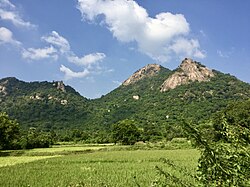
Evidence of 42,000 years old human habitation has been found in the region. These human settlements have been discovered at Kana and Mahadebbera at the foothills of the [[Ajodhya Hills]].<ref name="eisamay1">{{cite web |author1=Gautam Basumallik |title=৪২০০০ বছর আগে অযোধ্যা পাহাড় অঞ্চলে জনবসবাসের নিদর্শন মিলেছে |url=https://eisamay.com/editorial/post-editorial/interview-of-bishnupriya-basak-by-goutam-basu-mallick/articleshow/46744177.cms |website=www.eisamay.com |publisher=Ei Samay |access-date=8 August 2023 |language=bn |trans-title=42,000 years ago, evidence of human habitation has been found in the Ayodhya Hills region |date=30 March 2015}}</ref><ref name="Mahadebbera-Kana">{{cite journal |author1=Bishnupriya Basak |author2=Pradeep Srivastava |author3=Sujit Dasgupta |author4=Anil Kumar |author5=S. N. Rajaguru |title=Earliest dates and implications of Microlithic industries of Late Pleistocene from Mahadebbera and Kana, Purulia district, West Bengal |journal=CURRENT SCIENCE |date=10 October 2014 |volume=107 |pages=1167-1171 |language=en}}</ref><ref name="telegraphindia1">{{cite web |author1=Sebanti Saarkar |title=Bengal just got older by 22000 yrs |url=https://www.telegraphindia.com/west-bengal/bengal-just-got-older-by-22000-yrs/cid/1288646 |website=www.telegraphindia.com |publisher=The Telegraph India |access-date=8 August 2023 |date=21 October 2014}}</ref> [[Microlith|Microlithic]] tools found at Kana are 42,000 years old, while microlithic tools found at Mahadevera are 34,000 to 25,000 years old.<ref name="Mahadebbera-Kana"/><ref name="telegraphindia1"/> | |||
== | Hatpara on the west bank of [[Hooghly River|Bhagirathi River]] has evidence of human settlements dating back to around 15,000-20,000 years. About 200 small stone weapons have been found here. Grains and fish bones were also found here. According to archaeologists, the prehistoric civilization of Hatpara was spread along the banks of the Bhagirathi from Ganakar to Mahipala. Fish was a common part of the human diet of the time, and coppery color of the fish bones found at the site indicates that the Burnt fish was eaten.<ref name="anandabazar1">{{cite web |author1=Biman Hazra |title=মাছের হাড়, শস্যের দানা মেলে হাটপাড়ায় |url=https://www.anandabazar.com/west-bengal/nadia-murshidabad/ancient-civilization-of-hatpara-1.1224917 |website=www.anandabazar.com |publisher=Anandabazar Patrika |access-date=8 August 2023 |location=Sagradighi |language=bn |trans-title=Fish bones, and grains of crop are found in Hatpara |date=6 November 2020}}</ref> | ||
== | ==See also== | ||
* [[History of West Bengal (1947–present)]] | |||
* [[History of Bengal]] | |||
==References== | |||
{{reflist|3}} | |||
{{West Bengal}} | |||
{{ | |||
[[Category:History of West Bengal]] | |||
[[Category:History of West | |||
Revision as of 11:15, 9 August 2023
 | This article or section is in the process of an expansion or major restructuring. You are welcome to assist in its construction by editing it as well. If this article or section has not been edited in several days, please remove this template. If you are the editor who added this template and you are actively editing, please be sure to replace this template with {{in use}} during the active editing session. Click on the link for template parameters to use.
This article was last edited by Ajay Kumar (talk | contribs) 3 years ago. (Update timer) |
| History of West Bengal |
|---|
 |
The history of West Bengal basically refers to the history of the western part of Bengal, located in the eastern part of the Indian subcontinent. Evidence of human settlement has been found in West Bengal about 42,000 years ago. The presence of human settlement of that period has been found in the Ayodhya Hills of West Bengal.[1][2][3] By 2,000 BCE, settled life had increasingly spread of human civilization in the Damodar-Ajay River Valley, which was contemporary with the Harappa-Mahenjodaro civilization.[4][5] The southern part of West Bengal witnessed the presence of the Vanga Kingdom between 1100 BCE and 350 BCE, which was contemporary with the Vedic civilization of northern India.[5]
Among the Mahajanapadas, Magadha became powerful around 350 BCE, at that time rulers of the Nanda dynasty of Magadha incorporated the territory of West Bengal into their empire. West Bengal was under the rule of all Magadha-centric empires after the Nanda Empire. Tamralipta in West Bengal was the main seaport of the Magadha-centered Maurya Empire.[6] Most of the West Bengal's territory was ruled under the Gupta Empire, that arose in northern India after the collapse of the Magadha-centric empires.
In Bengal, the Gaur kingdom was established in 690 AD, which spread across West Bengal and present-day Bangladesh. Gaur is often referred to as the first well-established independent political entity in Bengal.[7] After this kingdom, the Pala Empire in 750 AD and the Sena Empire in 1070 AD respectively emerged across West Bengal. Both of these empires were mainly Bengal-centric.
Islamic conquests were established in West Bengal as early as the 13th century. At this time Bengal along with West Bengal was included in the Ghaznavid Empire. West Bengal was ruled under the Delhi Sultanate from the 13th to the 14th century and the Bengal Sultanate from the 14th to the 16th century. In the 16th century, after the fall of the Bengal Sultanate, West Bengal came under the Mughal Empire.
Murshidabad in West Bengal was the capital of independent Nawab Bengal (1717–1765). In 1765, the British took over the control of Bengal including West Bengal from the Nawabs of Bengal.[8] The Bengal Presidency of the British Indian Empire was divided into West Bengal and East Bengal in August 1947; West Bengal was included in the Dominion of India and gained independence as a Indian state.
Prehistoric era (until c. 2000 BCE)
Paleolithic
Evidence of 42,000 years old human habitation has been found in the region. These human settlements have been discovered at Kana and Mahadebbera at the foothills of the Ajodhya Hills.[1][2][3] Microlithic tools found at Kana are 42,000 years old, while microlithic tools found at Mahadevera are 34,000 to 25,000 years old.[2][3]
Hatpara on the west bank of Bhagirathi River has evidence of human settlements dating back to around 15,000-20,000 years. About 200 small stone weapons have been found here. Grains and fish bones were also found here. According to archaeologists, the prehistoric civilization of Hatpara was spread along the banks of the Bhagirathi from Ganakar to Mahipala. Fish was a common part of the human diet of the time, and coppery color of the fish bones found at the site indicates that the Burnt fish was eaten.[9]
See also
References
- ↑ 1.0 1.1 Gautam Basumallik (30 March 2015). "৪২০০০ বছর আগে অযোধ্যা পাহাড় অঞ্চলে জনবসবাসের নিদর্শন মিলেছে" [42,000 years ago, evidence of human habitation has been found in the Ayodhya Hills region]. www.eisamay.com (in Bengali). Ei Samay. Retrieved 8 August 2023.
- ↑ 2.0 2.1 2.2 Bishnupriya Basak; Pradeep Srivastava; Sujit Dasgupta; Anil Kumar; S. N. Rajaguru (10 October 2014). "Earliest dates and implications of Microlithic industries of Late Pleistocene from Mahadebbera and Kana, Purulia district, West Bengal". CURRENT SCIENCE. 107: 1167–1171.
- ↑ 3.0 3.1 3.2 Sebanti Saarkar (21 October 2014). "Bengal just got older by 22000 yrs". www.telegraphindia.com. The Telegraph India. Retrieved 8 August 2023.
- ↑ Pradeep Mukherjee (13 December 2022). "প্রায় চার হাজার বছর পূর্বের সভ্যতার নিদর্শন বর্ধমানের 'পাণ্ডু রাজার ঢিবি '" [The 'Mound of Pandu Raja' in Bardhaman is a sign of the civilization of about four thousand years ago.]. www.eisamay.com (in Bengali). Ei Samay. Retrieved 8 August 2023.
- ↑ 5.0 5.1 Bharadwaj, G (2003). "The Ancient Period". In Majumdar, RC (ed.). History of Bengal. B.R. Publishing Corp.
- ↑ Haraniya, Krutika (25 June 2017). "Tamralipti - The Ancient Copper Port". www.livehistoryindia.com. Retrieved 9 August 2023.
- ↑ "প্রাচীন বাংলার ইতিহাস" [History of Ancient Bengal] (PDF). www.ebookbou.edu.bd (in Bengali). Retrieved 8 August 2023.
- ↑ Paul, Gautam. "Murshidabad History - Mir Muhammed Jafar Ali Khan". murshidabad.net. Archived from the original on 8 April 2016. Retrieved 9 August 2023.
- ↑ Biman Hazra (6 November 2020). "মাছের হাড়, শস্যের দানা মেলে হাটপাড়ায়" [Fish bones, and grains of crop are found in Hatpara]. www.anandabazar.com (in Bengali). Sagradighi: Anandabazar Patrika. Retrieved 8 August 2023.
.png)