

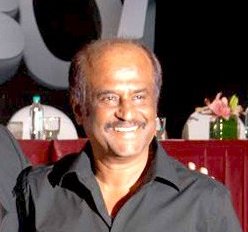


Rajinikanth | |
|---|---|
 Rajinikanth in 2019 | |
| Born | Shivaji Rao Gaikwad 12 December 1950<ref name=shivaji /> Bangalore, Mysore State, India |
| Alma mater | Adyar Film Institute |
| Occupation |
|
| Years active | 1975–present |
Works | Full list |
| Spouse(s) | ( m. 1981) |
| Children | |
| Relatives | See Rajinikanth family |
| Awards | Dadasaheb Phalke Award (2019)<ref name="DS">"Rajinikanth honoured with Dadasaheb Phalke award: 'I dedicate this award to my fans across around the world'". The Indian Express. 2 April 2021. Retrieved 3 April 2021.</ref><br /> NTR National Award (2016)<br />Kalaimamani (1984)<br />(See full list) |
| Honours | Padma Vibhushan (2016)<ref name="pv">"Rajinikanth gets Padma Vibhushan; Padma Shri for Priyanka, Ajay Devgn". The Indian Express. New Delhi. 26 January 2014. Archived from the original on 25 October 2016. Retrieved 8 December 2016.</ref> <br /> Padma Bhushan (2000) |
Shivaji Rao Gaikwad[lower-alpha 1]<ref>"#SelfMadeActors: From being Shivaji Rao Gaekwad to Superstar Rajinikanth; The story of this self made actor in Kollywood is just inspiring". The Times of India. 21 September 2024. ISSN 0971-8257. Retrieved 12 December 2024.</ref> (born 12 December 1950), known professionally as Rajinikanth,[lower-alpha 2] is an Indian actor who predominantly works in Tamil cinema.<ref>"Rajinikanth: Age, Biography, Education, Wife, Caste, Net Worth & More - Oneindia". Retrieved 1 September 2023.</ref> In a career spanning over five decades, he has done 170 films[lower-alpha 3] that includes films in Tamil, Hindi, Telugu, Kannada, Bangla, and Malayalam.<ref>"Coolie: 50 Years of Rajinikanth, India's bus conductor turned superstar". BBC. 15 August 2025. Retrieved 18 August 2025.</ref> He is widely regarded to be one of the most successful and popular actors in the history of Indian cinema.<ref>Rajinikanth's Journey from Being a Conductor to Becoming Demi-God" (23 May 2014). The Indian Express. Retrieved 6 July 2023.</ref><ref>"Rajinikanth | Biography, Movies, & Facts | Britannica". www.britannica.com. 13 January 2025. Retrieved 20 January 2025.</ref> The Government of India honoured him with the Padma Bhushan in 2000 and the Padma Vibhushan in 2016, India's third and second highest civilian honours respectively, the Dadasaheb Phalke Award in 2019, the highest Indian award in the field of cinema, and the IFFI Satyajit Ray Lifetime Achievement Award for his contributions to world cinema.<ref name="CivilIndiaAwards">"Civilian Awards announced on 26 January 2000" (in தமிழ்). Ministry of Home Affairs (India). Archived from the original on 2 March 2007. Retrieved 20 April 2007.</ref><ref name="The Hindu">"Padma Vibhushan for Rajinikanth, Dhirubhai Ambani, Jagmohan". The Hindu. 25 January 2016. Archived from the original on 25 January 2016. Retrieved 25 January 2016.</ref>
Following his debut in K. Balachander's 1975 Tamil drama Apoorva Raagangal, Rajinikanth's acting career commenced with a brief phase of portraying antagonistic characters in Tamil films. His major positive role as a scorned lover in S. P. Muthuraman's Bhuvana Oru Kelvi Kuri (1977), 1978's Mullum Malarum and Aval Appadithan received him critical acclaim; the former earned him a Tamil Nadu State Film Award Special Prize for Best Actor.<ref name="IE1">"Happy Birthday Rajinikanth: How the superstar came to be". The Indian Express. 12 December 2015. Archived from the original on 7 January 2017. Retrieved 27 May 2016.</ref><ref>Rajitha (22 December 1999). "Rajini acts in front of the camera, never behind it". Rediff.com. Archived from the original on 7 January 2017. Retrieved 6 June 2016.</ref> By the end of the decade, he had worked in all South Indian film industries and established a career in Tamil cinema. He then played dual roles in the action thriller Billa (1980), a remake of the Hindi film Don (1978). It was his biggest commercial success to that point, earned him stardom and gave him the action hero image.<ref>"Ajit-The new 'Billa'!". Sify. 3 December 2006. Archived from the original on 7 January 2017. Retrieved 27 May 2016.</ref> He starred in triple role in Moondru Mugam (1982), which earned him a special prize at the Tamil Nadu State Film Awards ceremony. The following year, he made his Hindi film debut with T. Rama Rao's top grossing Andhaa Kaanoon (1983).<ref>"Blockbusters Of Twenty-Five Years (1973-1997)". 13 October 2023.</ref> Nallavanukku Nallavan (1984) won him that year's [[Filmfare Award for Best Actor – Tamil|Filmfare Award for Best Tamil Actor]].<ref name="Zee News">Handoo, Ritika (12 December 2014). "Thalaiva Rajinikanth turns 64!". Zee News. Archived from the original on 7 January 2017. Retrieved 24 December 2014.</ref> In the latter half of the 1980s, he starred in several successful films in Tamil and Hindi, including Geraftaar (1985), Padikkadavan (1985), Mr. Bharath (1986), Dosti Dushmani (1986), Velaikaran (1987), Manithan (1987), Dharmathin Thalaivan (1988) and ChaalBaaz (1989).<ref>"Return of Rajinikanth". Hindustan Times. 23 February 2012. Archived from the original on 7 January 2017. Retrieved 27 May 2016.</ref><ref>"Cinema Can Come Back Stronger". 4 April 2020.</ref><ref>"Rajinikanth donates eyes". The Indian Express. 25 April 1988. p. 3. Archived from the original on 24 May 2024. Retrieved 24 May 2024 – via Google News Archive.</ref>
In 1991, Mani Ratnam's Tamil crime film Thalapathi, earned him major critical acclaim for his performance.<ref name="TOI" /> He collaborated with Suresh Krissna for many films including Annaamalai (1992) and Baashha (1995); the latter was the biggest commercial success in his career yet as well as the highest-grossing film in Tamil for many years.<ref name="IE2">"Rajinikanth's journey from being a conductor to becoming demi-god". The Indian Express. 23 May 2014. Retrieved 5 June 2016.{{cite news}}: CS1 maint: deprecated archival service (link)</ref> His other success includes P. Vasu's Mannan (1992), Uzhaippali (1993) and K. S. Ravikumar's Muthu (1995) and Padayappa (1999); the latter, which went on to become his and Tamil cinema's highest-grossing movie, exceeding Baashha.<ref name="tribune">Chatterjee, Saibal (4 September 2005). "The Rajni phenomenon". The Tribune (Chandigarh). Retrieved 6 June 2016.{{cite news}}: CS1 maint: deprecated archival service (link)</ref>
After a few years of hiatus, Rajinikanth returned to acting with the comedy horror film Chandramukhi (2005); it went on to become the highest-grossing Tamil film of all time. His next, S. Shankar's Sivaji (2007) was the third Indian film and the first ever Tamil film to enter the 100 Crore Club. He then played dual role as a scientist and an andro-humanoid robot in the science fiction film Enthiran (2010) and its sequel 2.0 (2018), both being India's most expensive productions at the time of their release and among the highest-grossing Indian films of all time.[lower-alpha 4] His action films Jailer (2023) and Coolie (2025) became major commercial success in Tamil cinema, making him the only actor in the industry with three films surpassing the ₹500 crore mark.<ref>"Salaar Worldwide Box Office Update". Box Office India. 5 January 2024.</ref>
Known for his uniquely styled mannerism and one liners in films, he has a huge fan base and a cult following, he has won numerous film awards, including the National Film Award, seven Tamil Nadu State Film Awards, a Nandi Award, a Filmfare Award and two Maharashtra State Film Awards.<ref>"Rajinikanth poses with family in beautiful 'together' moment as superstar is honoured at IFFI 2025; younger daughter Soundarya shares PIC". 29 November 2025 – via The Economic Times - The Times of India.</ref> Rajinikanth was named one of the most influential persons in South Asia by Asiaweek.<ref name="mass_popularity">Ethiraj, Gopal (14 December 2009). "Rajini is simple, stylish, spiritual, that explains his uniqueness". Asian Tribune. Archived from the original on 15 December 2009. Retrieved 14 December 2009.</ref><ref name="i1">Buncombe, Andrew (3 October 2010). "Meet India's biggest film star". The Independent. London. Archived from the original on 22 January 2015. Retrieved 3 October 2010.</ref> He was also named by Forbes India as the most influential Indian of the year 2010.<ref name="Now, a film on Rajinikanth's life">"Now, a film on Rajinikanth's life". The Times of India. 4 May 2011. Archived from the original on 10 September 2011. Retrieved 4 May 2011.</ref>
Early life and background
Rajinikanth was born as Shivaji Rao Gaikwad on 12 December 1950 in a Marathi family in Bangalore, Mysore State (present day Karnataka).[2]<ref name=shivaji /><ref name="birth">Ruma Singh (6 July 2007). "Even more acclaim will come his way". The Times of India. Archived from the original on 16 February 2012. Retrieved 20 April 2011.</ref> His mother was a homemaker,Cite error: Invalid <ref> tag; refs with no name must have content and his father Ramoji Rao Gaekwad was a police constable.<ref name="shivaji">"How Shivaji became Rajinikanth". Rediff.com. Archived from the original on 6 October 2014. Retrieved 4 October 2014.</ref> His ancestors hailed from Mavadi Kadepathar, Pune district, Maharashtra.<ref>"Rajinikanth invited for Saswad literary meeting". Daily News and Analysis. 31 December 2013. Archived from the original on 23 January 2014. Retrieved 5 February 2014.</ref><ref>"Rajini creates drinking water facility in his parents' memory". The Hindu. 28 April 2009. Archived from the original on 2 June 2017. Retrieved 20 May 2017 – via www.thehindu.com.</ref> He is the youngest of four siblings in a family consisting of two elder brothers (Satyanarayana Rao and Nageshwara Rao) and a sister (Aswath Balubhai).<ref>"Biographical article about Superstar Rajini Kanth". www.tamilstar.com. Tamil Star Inc. Archived from the original on 6 October 2014. Retrieved 4 October 2014.</ref>[2] After his father's retirement from work in 1956, the family moved to the suburb of Hanumantha Nagar in Bangalore and built a house there.[2] He lost his mother at the age of nine.<ref>S, Anandan (6 January 2013). "Reel to real image, a tome". The Hindu. Archived from the original on 28 June 2013. Retrieved 22 February 2013.</ref>
Rajinikanth had his primary education at the Gavipuram Government Kannada Model Primary School in Bangalore.<ref name="Primary">"Rajini's friends to renovate primary school". Sify. 13 December 2010. Archived from the original on 5 December 2013. Retrieved 9 July 2011.</ref> As a child, he was "studious and mischievous" with a great interest in cricket, football and basketball. During this time, his brother enrolled him at the Ramakrishna Math, a Hindu monastery set up by the Ramakrishna Mission. In the math, he was taught Vedas, tradition and history, which eventually instilled a sense of spirituality in him.[3] In addition to spiritual lessons, he also began acting in plays at the math. His aspiration towards theatre grew at the math and was once given an opportunity to enact the role of Ekalavya<nowiki>'</nowiki>s friend from the Hindu epic Mahabharata. His performance in the play received praise from the Kannada poet D. R. Bendre.[2] After sixth grade, Rajinikanth was enrolled at the Acharya Pathasala Public School and studied there till completion of his pre-university course.[3] During his schooling at the Acharya Pathasala, he spent a lot of time acting in plays.
Upon completion of his school education, Rajinikanth performed several jobs including that of a coolie,<ref>"1. Struggle is a stepping stone". Rediff.com. 12 December 2012. Archived from the original on 4 February 2014. Retrieved 5 February 2014.</ref> before getting a job in the Bangalore Transport Service as a bus conductor.<ref name="bmtc">M. D, Riti (22 December 1999). "You can see God in him at times". Rediff.com. Archived from the original on 6 October 2014. Retrieved 14 June 2011.</ref><ref>"சிவாஜிராவின் இளமைப்பருவம்". Kalki (in தமிழ்). 5 June 1983. pp. 46–48. Retrieved 21 April 2023.</ref> He continued to take part in plays after the Kannada playwright Topi Muniappa offered him a chance to act in one of his mythological plays. He decided to take up an acting course in the newly formed Madras Film Institute after coming across an advertisement.<ref name="MM1">"திரைப்படக் கல்லூரியில் 2 ஆண்டு நடிப்பு பயிற்சி". Maalai Malar (in தமிழ்). 2 February 2009. Retrieved 6 February 2014.{{cite news}}: CS1 maint: deprecated archival service (link)</ref> Although his family was not fully supportive of his decision to join the institute,<ref name=MM1 /> his friend and co-worker Raj Bahadur motivated him to join the institute and financially supported him during this phase.<ref>K. V. Subramanya (16 June 2007). "He drove Rajnikant to stardom". The Hindu. Chennai, India. Archived from the original on 7 November 2010. Retrieved 4 November 2010.</ref><ref>"Meet the bus driver Rajni worked with". Rediff.com. 13 June 2007. Archived from the original on 6 November 2014. Retrieved 9 September 2010.</ref> During his stay at the institute, he was noticed by the Tamil film director K. Balachander.<ref name="Rajini">Lakhe, Manisha (27 September 2010). "Why Rajinikanth Rocks". Forbes. Archived from the original on 27 March 2015. Retrieved 9 April 2011.</ref> Balachander provided Rajinikanth with his stage name to avoid confusion with fellow actor Sivaji Ganesan, having taken it from a character's name in his earlier film Major Chandrakanth.<ref>Vaasanthi (2021). Rajinikanth: A Life. New Delhi. ISBN 978-93-90652-10-5. OCLC 1268466867.{{cite book}}: CS1 maint: location missing publisher (link)</ref><ref>"It was a small role, but people would remember him". The Hindu. 8 December 2012. Archived from the original on 6 April 2018. Retrieved 10 February 2022.</ref> The director advised him to learn to speak Tamil, a recommendation that Rajinikanth quickly followed.<ref>N.S., Ramnath; D'Souza, Nilofer (22 December 2010). "Rajinikanth: Who Really Is the Super Star?". Forbes. Archived from the original on 18 April 2015. Retrieved 22 February 2013.</ref> Although he can read the language, he cannot write in it.<ref>Asokan, Mamtha (25 October 2021). "Does Rajinikanth know how to write in Tamil? Daughter Soundarya says he doesn't". The Times of India. Retrieved 15 November 2021.</ref>
Acting career
1975–1977: Early career
— K. Balachander about Rajinikanth[4]
Rajinikanth began his film career with the Tamil film Apoorva Raagangal (1975), directed by K. Balachander.<ref name="firstbreak">Sathyalaya Ramakrishnan (13 December 2010). "Super Star Rajnikanth turns 61: Fans celebrates enthusiastically". Asian Tribune. Archived from the original on 15 December 2010. Retrieved 18 June 2011.</ref> He was cast in a small role as the ex-husband of the female lead played by Srividya.<ref name=firstbreak/><ref name="pioneer">Ramachandran, Naman (5 January 2014). "The other Rajinikanth". The Pioneer. Archived from the original on 18 April 2015. Retrieved 5 February 2014.</ref><ref name="express">C Raja Mohan (12 December 2010). "Fans celebrate Rajinikanth's 61st birthday". The Indian Express. Archived from the original on 20 January 2011. Retrieved 23 April 2011.</ref> The film explored relationships between people with wide age differences and was deemed controversial upon release.<ref>"Experiments in Tamil cinema — Apoorva Raagangal (1975)". The Times of India. Archived from the original on 9 May 2015. Retrieved 5 February 2014.</ref> However, it received critical acclaim and won three National Film Awards including the Award for the Best Tamil Feature at the 23rd National Film Awards in 1976.<ref>"23rd National Film Awards" (PDF). Directorate of Film Festivals. Archived from the original (PDF) on 26 May 2011. Retrieved 23 April 2011.</ref> A review from The Hindu noted that, "Newcomer Rajinikanth is dignified and impressive."[5] His next release was Puttanna Kanagal's Kannada anthology film Katha Sangama (1976).<ref>"Blast from the past: Naagarahaavu- 1972". The Hindu. 18 October 2008. Archived from the original on 10 November 2012. Retrieved 5 February 2014.</ref> Rajinikanth appeared in the last segment of the film; he played the role as a village ruffian who rapes a blind woman in the absence of her husband.[6] Balachander cast him in a pivotal role in Anthuleni Katha (1976), the Telugu remake of his own Tamil film Aval Oru Thodar Kathai (1974).[6] In Moondru Mudichu—the first Tamil film to feature him in a prominent role—he played a character that "blithely row[s] away" when his friend drowns accidentally in the lake only to fulfill his desire to marry the former's girlfriend.[7] His style of flipping the cigarette in the film made him popular among the audience.<ref>Chamikutty, Preethi (19 December 2012). "Mirinda advertisement: Can Asin match the charisma of Rajinikanth, Sridevi and Kamal Hassan". The Economic Times. Archived from the original on 5 October 2013. Retrieved 7 February 2014.</ref> In his final release of the year, Baalu Jenu, he was cast as the main antagonist who troubles the female lead.[6] He played similar roles in Balachander's Avargal (1977),<ref>Malathi Rangarajan (10 April 2011). "We will miss you, Sujatha". The Hindu. Chennai, India. Archived from the original on 10 August 2011. Retrieved 23 April 2011.</ref> and Bharathiraja's 16 Vayadhinile (1977).[6]<ref>"Return of Rajinikanth". The Hindustan Times. 22 February 2012. Retrieved 5 February 2014.{{cite news}}: CS1 maint: deprecated archival service (link)</ref> The same year, he made his first-ever appearance as a lead actor in the Telugu film Chilakamma Cheppindi (1977), which earned him his only nomination for the Filmfare Award for Best Actor – Telugu.<ref>"Success has humble beginnings". Rediff.com. 12 December 2012. Archived from the original on 25 February 2013. Retrieved 24 February 2013.</ref><ref>Srinivasan, Meera (4 September 2010). "Fusion of culture at celebrity wedding". The Hindu. Archived from the original on 20 October 2011. Retrieved 22 February 2013.</ref> S. P. Muthuraman experimented Rajinikanth in a positive role in Bhuvana Oru Kelvi Kuri (1977).<ref name="rediff1">Rajitha (22 December 1999). "Rajini acts in front of the camera, never behind it". Rediff.com. Archived from the original on 7 January 2017. Retrieved 14 June 2011.</ref> The success of the film brought the duo together for 24 more films till the 1990s.<ref name="rediff1" /> Rajinikanth played supporting and "villainous" roles in most of the films released during the year.[7] In Gaayathri he was cast as a pornographer who secretly films his relationship with his wife without her knowledge and in Galate Samsara he played the role of a married man who develops an affair with a cabaret dancer.[8] He had 15 of his films released during the year.[9]
1978–1989: Experimentation and breakthrough
In 1978, Rajinikanth had 20 releases across Tamil, Telugu and Kannada.[10][11] His first film of the year was P. Madhavan's Shankar Salim Simon, in which he was among the three leads. Following that, he co-starred alongside Vishnuvardhan in the Kannada film Kiladi Kittu. He played the second lead in Annadammula Savaal, which starred Krishna; Rajinikanth reprised his role from the Kannada original. He then played an important role in the supernatural thriller Aayiram Jenmangal. In Maathu Tappada Maga, he was the main antagonist. Bairavi, directed by M. Bhaskar, was the first Tamil film to cast Rajinikanth as a solo hero.<ref>"40 years of Superstar Rajinikanth: His top movies". India TV. 19 August 2015. Archived from the original on 3 July 2015.</ref>[12] It was for this film that he earned the sobriquet "Superstar".[12] S. Thanu, one of the film's distributors, set up a 35 feet (11 m) high cut-out of Rajinikanth.<ref>"சூப்பர் ஸ்டார் பட்டம் எனக்கு வேண்டாம்!: ஏற்க மறுத்தார், ரஜினிகாந்த்!". Maalai Malar (in தமிழ்). 28 October 2012. Archived from the original on 18 March 2013. Retrieved 12 February 2014.</ref> His next appearance Ilamai Oonjal Aadukirathu, a quadrangular love story written and directed by C. V. Sridhar, saw him play the role of a man who sacrifices his love for his friend, played by Kamal Haasan. The film's success prompted Sridhar to remake the film in Telugu, Vayasu Pilichindi, which retained the original cast of the Tamil film.[13]
His next film, Vanakkatukuriya Kathaliye, had an introductory song to mark his entry, a trend that would soon catch on in with his later films.[12] Mullum Malarum, released during the same period, received critical acclaim, and earned him his first Filmfare Award for Best Actor – Tamil nomination.<ref>D. Karthikeyan (13 December 2009). "A phenomenon called Rajnikanth". The Hindu. Archived from the original on 15 October 2013. Retrieved 22 February 2013.</ref> The film marked the directional debut of Mahendran, with a screenplay adapted from a novel of the same name published in Kalki.[12] It won the Filmfare Award for Best Tamil Film and a Special Prize (Best Actor) for Rajinikanth at the Tamil Nadu State Film Awards.[12] Following this, he made a foray into Malayalam cinema with I. V. Sasi's fantasy film Allauddinum Albhutha Vilakkum, which was based on a story from the Arabian Nights. The same year, he acted in Dharma Yuddam, in which he played a mentally-ill person avenging the death of his parents. He then co-starred with N. T. Rama Rao in Tiger. Upon completion of Tiger, Rajinikanth had acted in 50 films over a period of four years, and in four languages. Some other popular films released during this period are the youthful entertainer Ninaithale Inikkum, the Tamil–Kannada bilingual Priya, the Telugu film Amma Evarikkaina Amma and the melodrama Aarilirunthu Arubathu Varai. Priya, based on a detective novel by Sujatha, had the distinction of being the first film of Rajinikanth to be shot mostly outside India, mainly in Southeast Asia.[12] Aarilirunthu Arubathu Varai earned him his second nomination for the Filmfare Award for Best Actor – Tamil.
Raijinikanth, who credited Hindi film star Amitabh Bachchan as his inspiration,<ref>"Amitabh is my inspiration, says Rajini". The Hindu. 15 August 2010. Archived from the original on 16 May 2018. Retrieved 24 November 2017.</ref> began playing Amitabh Bachchan's roles in Tamil remakes of his films.<ref name="indianexpress">"Revisiting Prakash Mehra's Zanjeer: The film that made Amitabh Bachchan". The Indian Express. 20 June 2017. Archived from the original on 1 December 2017. Retrieved 24 November 2017.</ref> This began with Shankar Salim Simon (1978), a remake of Amar Akbar Anthony (1977), followed by Naan Vazhavaippen (1979), a remake of Majboor (1974).<ref name="Mint">Jha, Lata (18 July 2016). "10 Rajinikanth films that were remakes of Amitabh Bachchan starrers". Mint. Archived from the original on 19 July 2016. Retrieved 19 July 2016.</ref> He was subsequently cast in a series of roles modelled after Amitabh Bachchan in Tamil remakes of his films.<ref name="indianexpress" /> Rajinikanth starred in eleven Tamil remakes of Amitabh Bachchan films,<ref name="catchnews">"What do Amitabh Bachchan and Rajinikanth have in common?". Catch News. 23 July 2016. Archived from the original on 1 December 2017. Retrieved 29 November 2017.</ref> as well as a Telugu remake of Amar Akbar Anthony, Ram Robert Rahim (1980), alongside Sridevi.<ref name="Mint" /> The most successful of these were remakes of Salim–Javed films, such as Billa (1980), Thee (1981) and Mr. Bharath (1986).<ref name="catchnews" />
During this phase of his career, Rajinikanth abruptly chose to quit acting, but was coaxed to return with the Tamil film Billa (1980), a remake of the Bollywood blockbuster Don (1978), written by Salim-Javed and starring Amitabh Bachchan. Billa had Rajinikanth playing dual roles and eventually became his first solo commercial success.<ref name="expressindia">Girija Jinnaa (15 June 2007). "'Yesterday I was a conductor, today I'm a star'". The Indian Express. Archived from the original on 17 June 2007. Retrieved 4 January 2011.</ref><ref>"Best films of Rajinikanth". Rediff.com. 27 August 2015. Retrieved 16 May 2018.{{cite web}}: CS1 maint: deprecated archival service (link)</ref> His pairing with Sridevi continued in Johnny, where he was once again cast in a double role, earned him his third nomination for the Filmfare Award for Best Actor – Tamil. He also starred in Murattu Kaalai which was a commercial success.<ref name=rediff1/> The success of Billa was a turning point in Rajinikanth's career, disproving detractors that claimed Rajinikanth was "finished" and which saw him accepted as a full-fledged hero.<ref name="expressindia" /> The success of Billa established Rajinikanth as one of the top stars of Tamil cinema.<ref>"Rajanikant: His name spells box-office magic in the south". India Today. 31 July 1988.</ref>
In 1981, he appeared in Garjanai which was shot simultaneously in Kannada and Malayalam, making it his last film in those two languages up until 2023. In K. Balachander's first home production, Netrikan, he played dual roles as a womanising father and a responsible son.<ref name=rediff1/> His first full-length comedy was Thillu Mullu, directed by K. Balachander. He agreed to it solely due to the strong suggestion by his mentor that he should do non-commercial roles, to break the stereotyped action-hero mould by which he was getting famous at the time. Thillu Mullu earned him his fourth nomination for the Filmfare Award for Best Actor – Tamil.<ref>"Return of Rajinikanth". The Hindustan Times. 22 February 2012. Retrieved 10 February 2014.{{cite news}}: CS1 maint: deprecated archival service (link)</ref> 1981 also saw the release of Thee, a remake of blockbuster Hindi film Deewaar (1975), also originally written by Salim-Javed and starring Amitabh Bachchan; in Thee, Rajinikanth reprised the role of Bachchan.<ref>"10 Rajinikanth films that were remakes of Amitabh Bachchan starrers". 18 July 2016. Archived from the original on 19 July 2016.</ref> In 1982, he starred in Pokkiri Raja, Moondru Mugam, Thanikattu Raja, Pudukavithai and Enkeyo Ketta Kural. Moondru Mugam which starred Rajinikanth playing three different roles for the first time, earned him his fifth nomination for the Filmfare Award for Best Actor – Tamil.<ref name="raana">Srinivasan, Meera (29 January 2011). "Raana Rajini's next venture". The Hindu. Archived from the original on 10 November 2012. Retrieved 24 February 2013.</ref>
By 1983, he was a popular actor across South Indian cinema, including Telugu and Kannada films.<ref name="southpopular">"The Rajini mystique". The Hindu. 2 July 2011. Archived from the original on 25 December 2014. Retrieved 6 July 2011.</ref> In 1983, Rajinikanth starred in his first Bollywood film, Andhaa Kaanoon, alongside Hema Malini, Reena Roy and Amitabh Bachchan (in an extended cameo appearance).<ref>Narayan, S Venkat (30 April 1983). "Film review: Andhaa Kaanoon is what they call a masala film". India Today. New Delhi: Living Media India Limited. Archived from the original on 30 April 2023. Retrieved 30 April 2023.</ref> The film opened to excellent response from the audience and emerged a blockbuster at the box office.<ref>"2018 Has High Number Of Blockbusters". 9 January 2019. Archived from the original on 16 January 2024. Retrieved 16 January 2024.</ref> In 1984, he appeared in Naan Mahaan Alla, a remake of Subhash Ghai's directional Vishwanath, the film proved to be a superhit.<ref>"Baashha to Darbar: Here is a list of Rajinikanth's Pongal releases that turned super hits". Asianet News. 8 January 2020. Archived from the original on 15 February 2021. Retrieved 15 February 2021.</ref> That same year, he played a small role in Anbulla Rajinikanth and delivered three more successful Hindi films, Meri Adalat, Gangvaa and John Jani Janardhan (in which he played a triple role).<ref>"Film Information Classification (1984)".</ref> His performance in Nallavanuku Nallavan earned him his first and only Filmfare Award for Best Actor – Tamil.<ref name="filmfare">Collections. Update Video Publication. 1991. p. 394. Archived from the original on 3 December 2013.</ref> In his 100th film Sri Raghavendra (1985), he played the Hindu saint Raghavendra Swami.<ref name="rebel_image" />
In the second half of the 1980s, Rajinikanth acted in commercially successful films, such as Naan Sigappu Manithan (1985), Geraftaar (1985), Padikkathavan (1985), Mr. Bharath (1986), Dosti Dushmani (1986), Velaikaran (1987), Manithan (1987), Insaaf Kaun Karega (1987), Guru Sishyan (1988) and Dharmathin Thalaivan (1988), with Velaikaran earning him his seventh nomination for the Filmfare Award for Best Actor – Tamil.<ref>"Trade Guide Classification 1985".</ref><ref>"Mani Ratnam reacts to Rajinikanth's Manithan beating Kamal Haasan's Nayakan at box office". The Indian Express. 2 June 2022. Archived from the original on 3 June 2022. Retrieved 3 June 2022.</ref><ref name=TG1987>"Trade Guide Classification 1987".</ref> In 1988, he made his only American film appearance in Bloodstone, directed by Dwight Little, in which he played an English-speaking Indian taxi driver.[14]<ref name="Weldon1996">Weldon, Michael (1996). The Psychotronic Video Guide. Titan Books. p. 66. ISBN 978-1-85286-770-6. Archived from the original on 3 December 2013. Retrieved 22 February 2013.</ref> Rajinikanth finished the decade with films including Rajadhi Raja, Siva, Raja Chinna Roja and Mappillai while also starring in a few Bollywood productions. Raja Chinna Roja was the first Indian film to feature live action and animation.[15]<ref>S.R. Ashok Kumar (14 May 2004). "Finger on people's pulse". The Hindu. Archived from the original on 21 February 2015. Retrieved 28 April 2011.</ref>
1990–2010: Superstardom

Rajinikanth began the new decade with a mega blockbuster in Panakkaran (1990), which was a remake of Amitabh Bachchan's 1981 film Laawaris.<ref>Ramachandran, Naman (2014) [2012]. Rajinikanth: The Definitive Biography. New Delhi: Penguin Books. p. 128. ISBN 978-0-14-342111-5.</ref> The film earned him his eighth nomination for the Filmfare Award for Best Actor – Tamil. His next two Tamil films, the fantasy comedy Athisaya Piravi, (a remake of Chiranjeevi's 1988 film Yamudiki Mogudu) which also released in 1990 and the family drama Dharmadorai (1991), did above-average business at the box office. His stint with Bollywood continued since the past decade as he went on to star in more Hindi films. Hum released in 1991 saw him doing the second main lead with Amitabh Bachchan became an inspiration for Baashha.<ref name="IndiaJanDay">"It's India-Japan Friendship Year". The Hindu (in தமிழ்). Chennai, India. 15 December 2006. Archived from the original on 20 May 2007. Retrieved 20 April 2007.</ref> In 1991, he worked with Mani Ratnam in Thalapathi, which was heavily inspired by the Mahabharata.<ref name="thalapathi">"Looking at Mani Ratnam's landmark movies – Rediff.com Movies". Rediff.com. 9 June 2010. Archived from the original on 6 October 2014. Retrieved 30 May 2011.</ref><ref>"Tamil superstar Rajnikant turns 60, fans celebrate". The Indian Express. 12 December 2009. Archived from the original on 26 March 2010. Retrieved 23 April 2011.</ref> in which he co-starred with actor Mammooty; the film dealt with the friendship between two unknown characters based on Karna and Duryodhana, respectively,<ref name="thalapathi" /> and was set in a more contemporary milieu and was both critically acclaimed and successful upon release.<ref name="rebel_image">K. Hariharan (24 October 2010). "Magazine : He's back". The Hindu. Archived from the original on 28 October 2010. Retrieved 23 April 2011.</ref> He received his ninth nomination for the Filmfare Award for Best Actor – Tamil for the film. He went on to appear in remakes of films from other languages, mostly from Hindi and Telugu. Annaamalai, which released in 1992, was yet another friendship-centric film and was loosely based on the 1987 Bollywood film Khudgarz.<ref>Suganth, M (27 June 2017). "Without Annamalai, there wouldn't be Baashha". The Times of India. Archived from the original on 28 February 2018. Retrieved 14 July 2021.</ref> The film was the first to have the Superstar graphic title card.<ref>"Story Behind Rajinikanth's Iconic Title Card 'Superstar Rajinikanth'". The Times of India. 10 July 2022.</ref> He received his tenth nomination for the Filmfare Award for Best Actor – Tamil for the film. Mannan, directed by P. Vasu, a remake of Kannada actor Rajkumar's 1986 blockbuster Anuraga Aralithu, also was released in 1992 and became a box office success. Rajinikanth wrote his first screenplay for the film Valli (1993), in which he also made a special appearance. He also starred in the film Yajaman, in which he played the role of Vaanavaraayan, a village chieftain. His romantic-comedy Veera (1994) was controversial for its climax but went on to become one of the highest-grossing films in 1994.<ref>Megha Shenoy (4 April 2011). "Inspiration for remakes". The Deccan Herald. Archived from the original on 21 October 2012. Retrieved 26 February 2013.</ref> That year, he earned his eleventh nomination for the Filmfare Award for Best Actor – Tamil for the action-drama Uzhaippali.
He joined hands with Suresh Krishna for Baashha (1995), which emerged as an industry record,<ref>"Working with Rajinikanth: Baasha director tells all". Rediff.com. 12 December 2012. Archived from the original on 8 February 2013. Retrieved 26 February 2013.</ref> and is routinely touted by fans and critics alike as a major-hit, as the film elevated him from being just another very popular actor to nearly demigod status among the masses.<ref>Pillai, Sreedhar (17 February 2009). "Rajinikanth: Old is gold". The Times of India. Archived from the original on 14 January 2016. Retrieved 9 October 2013.</ref> He made a cameo in Peddarayudu for his friend Mohan Babu and also helped him in obtaining the remake rights. The same year, he acted in yet another gangster film, Aatank Hi Aatank with Aamir Khan which was also his last Hindi film in a major role till date.<ref>"Aandavan (2000) - Deva". Archived from the original on 4 September 2014 – via mio.to.</ref> His film Muthu, a remake of Mohanlal's blockbuster Malayalam film Thenmavin Kombathu, was another commercial success, directed by K. S. Ravikumar and produced by K. Balachander, and became the first Tamil film to be dubbed into Japanese, as Mutu: Odoru Maharaja.<ref>"Happy birthday, Rajinikanth!". Mid-Day. Archived from the original on 14 October 2013. Retrieved 9 October 2013.</ref> The film grossed a record US$1.6 million in Japan in 1998 and was responsible for creating a large Japanese fan-base for the actor.<ref>S Saroj Kumar (4 January 2012). "Brand Rajinikanth". The Financial Express. Archived from the original on 6 October 2014. Retrieved 9 October 2013.</ref> Muthu's success in Japan led American news magazine Newsweek to comment in a 1999 article that Rajinikanth had "supplanted Leonardo DiCaprio as Japan's trendiest heartthrob".<ref>"Dancing Maharajas". Archived 25 November 2010 at the Wayback Machine Newsweek. 10 May 1999.</ref> During a visit to Japan in 2006, Indian Prime Minister Manmohan Singh acknowledged the success of Muthu in the country during a speech, justifying the positive relationship between the two nations.<ref>Prem Panicker (14 December 2006). "When the PM wowed Japan's parliament". Rediff.com. Archived from the original on 5 August 2012. Retrieved 8 January 2012.</ref> He received his twelfth and thirteenth nominations for the Filmfare Award for Best Actor – Tamil for his performances in Baashha and Muthu.
He also entered Bengali cinema through Bhagya Debata, which was released at the end of 1995. 1997's Arunachalam, another commercial success, earned him his fourteenth nomination for the Filmfare Award for Best Actor – Tamil. Rajinikanth released his last film of the millennium with Padayappa (1999), which went on to become a blockbuster success, and earned him his fifteenth nomination for the Filmfare Award for Best Actor – Tamil. It starred Ramya Krishnan and Soundarya, the former critically acclaimed for her performance. It was also the last prominent role for veteran Tamil actor Sivaji Ganesan.
After a brief pause, Rajinikanth starred in Baba in 2002, for which he had also written the screenplay.<ref name="baba">Rangarajan, Malathi (16 August 2002). "Baba". The Hindu. Archived from the original on 25 December 2014. Retrieved 24 February 2013.</ref> Released with much fanfare and hype at the time, the film featured a story revolving around the reforming of a gangster, later revealed to be the reincarnation of the Hindu saint Mahavatar Babaji, and fights against political corruption.<ref name=baba/> It fell short of market expectations and the high bids reportedly translated to heavy losses for the distributors. Rajinikanth himself repaid the losses incurred by the distributors.<ref>N Sathiya Moorthy (3 May 2003). "Film producer GV commits suicide". Rediff.com. Retrieved 17 May 2007.{{cite web}}: CS1 maint: deprecated archival service (link)</ref><ref>Sudhish Kamath (12 May 2004). "Superstar wannabes". The Hindu. Chennai, India. Archived from the original on 1 October 2007. Retrieved 17 May 2007.</ref> The film was received with comments such as "the bloom was off the rose" and that "the gold does not glitter any more".<ref name="Will Sivaji be Rajini">"Will Sivaji be Rajini's biggest hit?- History". Rediff.com. Archived from the original on 7 June 2007. Retrieved 6 May 2007.</ref> Pattali Makkal Katchi (PMK) leader S. Ramadoss condemned him for smoking and posing with beedis in the film. He was criticised for spoiling the Tamil youth by glorifying smoking and drinking. PMK volunteers attacked the theatres which screened the film and usurped film rolls and burned them.<ref>"Rajini keeps everyone guessing". 23 March 2004. Archived from the original on 9 March 2007. Retrieved 5 April 2007.</ref>
Two years later, Rajinikanth signed up for P. Vasu's Chandramukhi (2005), a remake of the Malayalam film Manichitrathazhu. Upon release the film was highly successful at the box office, and in 2007 it set the record of being the longest running Tamil film.<ref name="The Final Verdict">"The Final Verdict – History". Sify. 8 May 2005. Archived from the original on 24 December 2014. Retrieved 24 February 2013.</ref> Chandramukhi was also dubbed in Turkish and in German as Der Geisterjäger and released in the respective nations.<ref>"Rajni's 'Chandramukhi' in Turkish and German". Oneindia.in. 2 April 2006. Archived from the original on 26 October 2014. Retrieved 7 June 2011.</ref> Following Chandramukhi's release, it was reported that AVM Productions was set to produce a film directed by Shankar starring Rajinikanth – the largest collaboration yet for a Tamil film. The film was titled Sivaji and was released in the summer of 2007, following two years of filming and production. It became the first Tamil film to be charted as one of the "top-ten best films" of the United Kingdom and South Africa box offices upon release.<ref name="United Kingdom Box Office 15–17 June 2007">"United Kingdom Box Office June 15–17, 2007". Box Office Mojo. Archived from the original on 26 June 2007. Retrieved 18 June 2007.</ref><ref name="South Africa Box Office 3–5 August 2007">"South Africa Box Office August 3–5, 2007". Box Office Mojo. Archived from the original on 24 October 2007. Retrieved 8 June 2007.</ref> Rajinikanth received a salary of ₹260 million (equivalent to ₹630 million or US$8.9 million in 2019), for his role in the film highest in his film career at that time.<ref name="Neha">Sharma, Neha (29 September 2010). "Rapchik Rajinikanth, mind it!". The Hindustan Times. Archived from the original on 24 December 2014. Retrieved 9 October 2013.</ref><ref>Varma, Anuradha (17 October 2010). "What makes Rajinikanth the Boss?". The Times of India. Archived from the original on 4 November 2013. Retrieved 13 February 2014.</ref><ref>Vilakudy, Rajaneesh (5 November 2006). "After Brangelina, it's Rajinikanth". Daily News and Analysis. Archived from the original on 14 October 2013. Retrieved 9 October 2013.</ref> He received his sixteenth nomination for the Filmfare Award for Best Actor – Tamil for his performance in the film. During the production of Sivaji, Soundarya Rajinikanth announced her intention of producing a computer-generated imagery film starring an animated version of her father titled Sultan: The Warrior. The film was set for release in 2008,<ref>"Rajinikanth's Sultan rechristened as Hara". OneIndia. 25 October 2010. Retrieved 27 March 2011.{{cite web}}: CS1 maint: deprecated archival service (link)</ref><ref>"Animated film on Rajnikant to be released in December 2008". The Economic Times. 13 December 2007. Archived from the original on 15 October 2013. Retrieved 9 October 2013.</ref> however, it entered development hell, and its development status would become unknown over the next few years.<ref>Ramanujam, Srinivas (29 April 2012). "The day Rajini took ill". The Times of India. Archived from the original on 15 October 2013. Retrieved 9 October 2013.</ref>

He worked with P. Vasu again for Kuselan, a remake of the Malayalam film Kadha Parayumbol, which was made simultaneously in Telugu as Kathanayakudu, in which Rajinikanth played an extended cameo role as Ashok Kumar, a film star in the Indian cinema, and as a best friend to the film's protagonist. According to Rajinikanth, the film somewhat narrated his early life.<ref>P, Krishnakumar (1 August 2008). "Pasupathy, the real star of Kuselan". Rediff.com. Rediff. Archived from the original on 2 August 2011. Retrieved 12 June 2011.</ref> The film, however, performed poorly at box offices and led to many distributors incurring major losses.<ref>Pillai, Sreedhar (20 August 2008). "Kollywood in a flap". The Times of India. Archived from the original on 16 June 2013. Retrieved 24 February 2013.</ref> Rajinikanth also stated that he would work with Pyramid Saimira again to compensate for Kuselan.<ref>Iyengar, Pushpa. "Hope Floats For SRK". The Outlook. Archived from the original on 28 October 2011. Retrieved 30 July 2011.</ref><ref>S, Shyam Prasad (16 December 2008). "Kuselan may spark Tamil film boycott". Bangalore Mirror. Archived from the original on 24 May 2013. Retrieved 24 February 2013.</ref>
—Rediff.com on Rajinikanth's performance in Enthiran (2010)<ref name="Rajini in Enthiran">"Rajinikanth in Endhiran". Rediff.com. 14 December 2010. Archived from the original on 27 May 2011. Retrieved 12 July 2011.</ref>
Rajinikanth worked again with Shankar for the science fiction film Enthiran.<ref>Gupta, Shubhra (26 December 2010). "Chulbul Pandey Now Lives in Chennai". The Indian Express. Archived from the original on 11 February 2011. Retrieved 2 January 2012.</ref> The film was released worldwide in 2010 as the most expensive Indian film ever made, ultimately emerging an All Time Blockbuster and the second highest-grossing film in India of its time.<ref>"Ponniyan Selvan Part 1 Is A Historic BLOCKBUSTER For The Tamil Film Industry". Box Office India.</ref><ref name="162crores">"Rajini's Endhiran: A sell out in Chennai". NDTV. Archived from the original on 6 November 2012. Retrieved 26 September 2010.</ref> Rajinikanth was paid a remuneration of ₹450 million (equivalent to ₹810 million or US$11 million in 2019) for the film.<ref>"Avatar technology powers Rajnikant in Enthiran". The Indian Express. 28 August 2010. Archived from the original on 24 November 2010. Retrieved 24 February 2013.</ref> He received his seventeenth nomination for the Filmfare Award for Best Actor – Tamil for his performance in the film. The film's success lead to the Indian Institute of Management Ahmedabad to use the film as a case study to analyse the business of cinema and its success story in a post-graduate elective management course called Contemporary Film Industry: A Business Perspective. The course would also study Muthu.<ref>"Rajinikanth's Enthiran – Case study in IIM A". The Times of India. India. 23 December 2010. Archived from the original on 25 October 2012. Retrieved 9 April 2011.</ref>
2011-present: Career fluctuations and return to success
In January 2011, Rajinikanth was slated to appear in Rana, a period film to be produced by Soundarya Rajinikanth and directed by K. S. Ravikumar, who would work with the actor for a third time.<ref name=raana/> During the principal photography of the film on 29 April 2011, he suffered a mild foodborne illness on the sets, which led to vomiting, dehydration, and exhaustion.<ref>"Rajinikanth admitted to hospital – Entertainment – DNA". Daily News and Analysis. 29 April 2011. Archived from the original on 18 August 2011. Retrieved 14 July 2011.</ref> He was treated at St. Isabel's Hospital for a day before being discharged.<ref>"Rajinikanth hospitalised". Sify. Archived from the original on 11 August 2011. Retrieved 1 July 2011.</ref> Five days later, he was rushed to the same hospital again after suffering from breathlessness and fever.<ref>ITGD Bureau (14 May 2011). "Actor Rajinikanth hospitalised again". India Today. Archived from the original on 14 October 2013. Retrieved 1 July 2011.</ref> He was diagnosed with bronchitis and was kept at the hospital for a week, while also spending a few days in an intensive care unit.<ref>"Rajini writes letter to fans, says he will be back soon". The Hindustan Times. 18 June 2011. Archived from the original on 21 June 2011. Retrieved 1 July 2011.</ref> Several conflicting reports of discharge dates arose, as well as claims of Rajinikanth's health deteriorating.<ref name="ndtv" /> Two days after his last discharge, Rajinikanth was admitted to the Sri Ramachandra Medical College and Research Institute on 16 May 2011 for recurring respiratory and gastrointestinal problems.<ref>"Modi To Visit Rajini in Hospital". NDTV. Archived from the original on 16 December 2013. Retrieved 1 July 2011.</ref> The hospital maintained that Rajinikanth was in stable condition and showed positive response to treatment.<ref name="ndtv">"Rajinikanth's Condition Stable: Hospital". NDTV. Archived from the original on 10 February 2014. Retrieved 1 July 2011.</ref> It was widely reported that he required a kidney transplantation, which was later denied by Dhanush.<ref>"Rajini will soon be back to complete 'Raana': Dhanush". The Times of India. 1 June 2011. Archived from the original on 5 September 2012. Retrieved 1 July 2011.</ref>
On 21 May 2011, Aishwarya Rajinikanth released a photo of her and Rajinikanth in his hospital ward, both posing with a thumbs-up, responding to fans' negative reaction to news reports.<ref>"Rajinikanth out of ICU, moved into private ward". The Times of India. 23 May 2011. Archived from the original on 5 September 2012. Retrieved 1 July 2011.</ref> The hospital restricted unauthorised visitors.<ref>"Rajini getting better, say docs as fans pray for their superstar". The Times of India. 6 May 2011. Archived from the original on 25 October 2012. Retrieved 1 July 2011.</ref> Rajinikanth's brother, Sathyanarayana Rao Gaekwad, reported that the cause of the sudden illness was due to stress from rapid weight-loss and changes in diet, as well as withdrawal of alcohol consumption and smoking cessation.<ref>"Rajini suffering from lung, liver ailment: Brother". NDTV. 17 May 2011. Archived from the original on 20 May 2011. Retrieved 1 July 2011.</ref> After addressing fans in a 4-minute digitally recorded voice message to the media, Rajinikanth, under the advice of Amitabh Bachchan, travelled from Chennai to Singapore with his family on 21 May 2011, where he was to undergo further treatment for nephropathy at Mount Elizabeth Hospital.<ref>"International news of the week". Business Standard. 4 June 2011. Archived from the original on 20 June 2013. Retrieved 17 February 2013.</ref><ref>"Rajini in Singapore hospital on Big B's advice". Zee News. 30 May 2011. Archived from the original on 12 July 2011. Retrieved 14 July 2011.</ref> After spending over two weeks at the hospital, he was finally discharged on 15 June 2011 and continued to recuperate in Singapore, before returning to Chennai on 13 July 2011.<ref>"Rajnikanth fine, recovering well: Dhanush". The Hindu. 31 May 2011. Archived from the original on 15 October 2013. Retrieved 9 October 2013.</ref><ref>"Rajinikanth to return tonight". 14 July 2011. Archived from the original on 2 November 2013. Retrieved 9 October 2013.</ref>
Despite several failed attempts to restart Rana upon his return, Rajinikanth reprised his Enthiran character, Chitti, in the Bollywood science-fiction film Ra.One (2011) in a guest appearance alongside Shah Rukh Khan and Kareena Kapoor.<ref>Rudrappa, Chetan (16 September 2011). "Rajinikanth's cameo RA.One". The Times of India. Archived from the original on 25 October 2012. Retrieved 2 October 2011.</ref> In November 2011, it was decided that Rana would be shelved in favour of a new project, titled Kochadaiiyaan.<ref>Bharti Dubey, TNN, 29 January 2011, 05.42 pm IST (29 January 2011). "Rana, a triple delight for Rajini fans". The Times of India. Archived from the original on 24 May 2011. Retrieved 30 January 2011.{{cite news}}: CS1 maint: multiple names: authors list (link) CS1 maint: numeric names: authors list (link)</ref> The film became a huge disaster at the box office.<ref>Kandavel, Sangeetha (27 December 2014). "Now Kochadaiyaan producers in financial tangle". The Hindu. Archived from the original on 7 January 2017. Retrieved 18 June 2016.</ref> The motion capture film, which is the first of its type in India, was released in 2014 to positive reviews.<ref>"'Kochadaiiyaan' Review Roundup: Commendable Attempt by Soundarya; Worth Watching". International Business Times. 23 May 2014. Archived from the original on 7 January 2017. Retrieved 24 May 2014.</ref> Kochadaiiyaan, and the 3D release of Sivaji in 2012,<ref>"Movie Review: Rajinikanth's Sivaji 3D". IANS. NDTV. 11 December 2012. Archived from the original on 27 May 2014. Retrieved 14 April 2014.</ref> made Rajinikanth the first Indian actor to have appeared in four different forms of world cinema: black-and-white, colour, 3D and motion capture.<ref>"Rajini 'Cannes'". Deccan Chronicle. 3 April 2013. Archived from the original on 10 March 2014. Retrieved 10 March 2014.</ref> Following the completion of Kochadaiiyaan, Rajinikanth began work in Ravikumar's next directorial venture, titled Lingaa.<ref>"Sona presses the rewind button". Mumbai Mirror. 28 April 2014. Archived from the original on 1 October 2014. Retrieved 2 May 2014.</ref><ref>Subramanian, Karthik (29 April 2014). "Superstar Rajinikanth's next is Lingaa". The Hindu. Archived from the original on 20 September 2014. Retrieved 2 May 2014.</ref> The film was released on 12 December 2014, coinciding with his birthday,<ref>"'Lingaa' Stamped with 'U' Rating; Rajinikanth Starrer Confirmed for 12 December Release". International Business Times. 26 November 2014. Archived from the original on 20 February 2015. Retrieved 1 December 2014.</ref> and received mixed reviews from critics.<ref>"I take responsibility for the book scene in Lingaa: KS Ravikumar". The Times of India. 21 December 2014. Archived from the original on 25 December 2014. Retrieved 29 December 2014.</ref>
After a two-year absence from big screen, Rajinikanth's next film was director Pa. Ranjith's crime drama Kabali, produced by S. Thanu. The film was released in July 2016.<ref>"Kabali review round-up: This is what critics are saying about the Rajinikanth blockbuster". Daily News and Analysis. 22 July 2016. Archived from the original on 25 July 2016. Retrieved 25 July 2016.</ref> The film became the highest grossing Tamil film of the year grossing over ₹300 crore (US$42 million) and became the fifth highest-grossing Tamil film of all time before being surpassed by his another film 2.0.[n 1] Also, at the Ananda Vikatan Cinema Awards, the film was nominated at five categories winning all of them,<ref>Arul (14 January 2017). "Rajinikanth, Vijay, Sasikumar at Vikatan awards - Photos". IBTimes India. Retrieved 31 December 2020.</ref> and also won five awards, at the Edison Awards, and two nominations at the 6th South Indian International Movie Awards.<ref>"SIIMA 2017 Nomination List – Tamil". South Indian International Movie Awards. Retrieved 31 May 2017.{{cite web}}: CS1 maint: deprecated archival service (link)</ref> He also received his eighteenth nomination for the Filmfare Award for Best Actor – Tamil for his performance in the film.
In August 2016, it was announced that Rajinikanth and director Ranjith would work together again for a film with Dhanush as producer, titled Kaala, in which Rajinikanth plays a Dharavi-dwelling gangster who fights against corporate takeover of the slum.<ref>Rajinikanth-Ranjith combo under Dhanush's production soon Archived 30 August 2016 at the Wayback Machine. The Hindu (29 August 2016). Retrieved on 3 November 2016.</ref> The film was officially released on 7 June 2018 and received positive reviews from critics.<ref>India com Entertainment desk (9 June 2018). "Rajinikanth's Kaala Witnesses an Upward Trend at the Box Office - Read Details". India.com. Retrieved 26 April 2020.</ref> In 2018 he also appeared in S. Shankar's 2.0 reprising the roles of Dr. Vaseegaran and Chitti, alongside Akshay Kumar and Amy Jackson.<ref name="TOI">Iyer, Meena. "Akshay Kumar plays the villain in 'Robot 2'". The Times of India. Archived from the original on 13 June 2018. Retrieved 15 September 2018.</ref> The film was released on 29 November 2018 and was commercially successful at the box office. The film earned over ₹117.34 crore (US$16 million) worldwide on its first day, which was the second-highest ever for an Indian film. The film crossed ₹520 crore (equivalent to ₹560 crore or US$78 million in 2019) in its opening weekend to be the highest-grossing film worldwide for that week. The film also grossed over ₹655.81 crore (US$92 million)–₹800 crore (US$110 million) at the box office became the highest-grossing Tamil film of the year and second highest grossing Tamil film of all time.<ref>"'2.0' final box office collection all format: The Rajinikanth starrer helmed by S. Shankar is the sixth highest grossing Indian film ever". The Times of India. Retrieved 29 July 2022.</ref> 2.0 is the fourth highest-grossing film in India and is the seventh highest-grossing Indian film worldwide.<ref>"Top All Time India Grossers All Formats – 2.0 Second". Box Office India. Retrieved 25 December 2019.</ref><ref>"2.0 All India Update – Crosses 400 Crore NETT". Box Office India. Retrieved 25 December 2019.</ref> In 2019, Rajinikanth starred in Karthik Subbaraj's Petta, in which his performance received praise for his return to his vintage stereotypical style of acting and grossed over ₹250 crore (US$35 million), becoming the second highest-grossing Tamil film of 2019.<ref>"Rs 1000 crore! That's how much Rajinikanth's three films grossed at the box office in a span of 7 months". timesnownews. 2 February 2019. Retrieved 4 November 2019.</ref> The combined gross earnings of Kaala, 2.0 and Petta by the end of January 2019 was determined to be over ₹1000 crore according to trade analysts.<ref>"Rs 1000 crore! That's how much Rajinikanth's three films grossed at the worldwide box office in a span of 7 months | Entertainment News". 2 February 2019. Archived from the original on 2 February 2019. Retrieved 3 February 2019.</ref> Rajinikanth then worked with AR Murugadoss in the film Darbar, alongside Nayanthara which released in 2020. He played the role of a police officer after 27 years since his last film as a police officer was the Tamil film Pandian. In spite of the huge expectations, the film received mixed to negative reviews and flopped at the box office.<ref>"Darbar box office: Film ends up as a colossal flop, distributors plan to approach Rajinikanth". Hindustan Times. 31 January 2020. Retrieved 28 August 2020.</ref><ref>"Rajinikanth's Darbar is AR Murugadoss' failure". The Indian Express. 14 January 2020. Retrieved 28 August 2020.</ref> His 168th film was with director Siva, titled Annaatthe co-starring Nayanthara and Keerthy Suresh.<ref>"Annaatthe (2024)". Rotten Tomatoes.</ref> The film was released on 4 November 2021.<ref>"Rajinikanth's Annaatthe to hit screens on November 4". The Times of India. Archived from the original on 26 January 2021. Retrieved 25 January 2021.</ref> The film became a commercial success at the box office by grossing around ₹240 crore (US$34 million) beating the collections made by other Tamil films such as Master and Maanaadu.<ref>"Rajinikanth Pays Surprise Visit to Annaatthe Director Siruthai Siva, Carries This Gift". News18. 10 December 2021. Retrieved 10 December 2021.</ref><ref>"Annaatthe Box Office Rajinikanth Starrer Becomes One Of The Biggest Blockbuster of The Year Enters 200 Crore Club". www.india.com. 15 November 2021. Retrieved 3 January 2022.</ref><ref>K., Janani (14 November 2021). "Annaatthe box office collection Day 10: Rajinikanth film is still going strong". India Today. Archived from the original on 14 November 2021. Retrieved 14 November 2021.</ref>
After a two-year absence from big screen, his 169th film is Jailer, which was directed by Nelson Dilipkumar. He played a retired jailer in the film and it was released on 10 August 2023.<ref>"Rajinikanth teams up with Nelson for 'Thalaivar 169'". The Hindu. 10 February 2022. Archived from the original on 10 February 2022. Retrieved 10 February 2022.</ref><ref>"Nelson-Rajinikanth's Thalaivar 169 titled Jailer". Cinema Express. 17 June 2022. Archived from the original on 19 June 2022. Retrieved 8 July 2022.</ref><ref>"#Thalaivar169 by Nelson Dilipkumar titled Jailer". DT Next. 17 June 2022. Archived from the original on 17 June 2022. Retrieved 17 June 2022.</ref> The film received predominantly positive reviews upon its release and achieved tremendous commercial success, grossing over ₹600 crores worldwide.<ref name="Jailer">"'Jailer' box office collection grossed over Rs 600 crore". India Today.</ref> In 2024, he appeared in T. J. Gnanavel's action drama film Vettaiyan and did a guest appearance in his daughter's (Aishwarya Rajinikanth) sports drama film Lal Salaam.<ref>"'Thalaivar 170' titled 'Lal Salaam'; Rajinikanth takes a cameo role while Vishnu Vishal and Vikranth play leads in Aishwarya Rajinikanth's directorial". The Times of India.</ref><ref>"'Thalaivar 170' pre-production work has reached the final stage". Times of India. 22 September 2023.</ref> While the latter sank without a trace, Vettaiyan opened to positive critical reception, but underperformed commercially.<ref>"Lal Salaam box office Day 6: Aishwarya Rajinikanth's film continues its underwhelming run, yet to hit Rs 15 crore mark". The Indian Express. 15 February 2024. Archived from the original on 15 February 2024. Retrieved 15 February 2024.</ref> In 2025, he appeared in Lokesh Kanagaraj's action thriller Coolie.<ref>"Lokesh Kanagaraj reveals Rajinikanth's 'Coolie' release plans". The Times of India. 6 November 2024. Archived from the original on 7 November 2024. Retrieved 4 January 2025.</ref> He is currently working on Jailer 2 directed by Nelson Dilipkumar.<ref>Verma, Rohan (10 April 2025). "Jailer 2 Release Date Buzz: Rajinikanth's Action Sequel Aiming For 2025 Or 2026, Fans Await Official Confirmation". Koimoi. Retrieved 21 April 2025.</ref>
Political career

It was speculated that Rajinikanth would enter politics in 1995. He decided against it and declared that if he entered politics now, it would result in a lot of confusion and that he would not be able to serve the people and fulfil their expectations. However, he added that if Chief Minister J. Jayalalithaa's party returns to power in the 1996 Tamil Nadu Legislative Assembly election, "even God cannot save the people of the State".<ref>"Rajnikant not to enter politics now". The Hindu. 28 September 1995. p. 1. Archived from the original on 22 December 1996. Retrieved 14 September 2023.</ref> Rajinikanth went on to wholeheartedly support the Dravida Munnetra Kazhagam (DMK) and Tamil Maanila Congress alliance and asked the people of Tamil Nadu and his fans to vote for that alliance. This alliance had a complete victory in the elections. He also supported the same alliance in the 1996 and 1998 Indian general elections.<ref>"Tamil Cinema 1998-Year Highlights (Part-2)". Dinakaran. 21 January 1998. Archived from the original on 20 June 2008. Retrieved 23 September 2009.</ref>
Later in 2004, Rajinikanth said he would personally vote for the Bharatiya Janata Party (BJP) but would not extend his support to any front during the upcoming Indian general election.<ref>"Rajnikanth is a firm believer in Hindutva". Rediff. 28 April 2004. Archived from the original on 30 May 2013. Retrieved 12 June 2013.</ref> The party, however, failed to win any seats in Tamil Nadu in the Lok Sabha.<ref>"AIADMK entering Parliament after five years". The Times of India. 17 May 2009. Archived from the original on 25 October 2012. Retrieved 8 August 2012.</ref>
Rajinikanth canceled his visit to Sri Lanka in March 2017 at the urging of Tamil Nadu politicians. Leaders of the BJP criticized this choice.<ref>"Swamy and other BJP leaders criticise Rajinikanth - News". 25 March 2017.</ref> In June 2017, BJP leader Subramanian Swamy alleged that Rajinikanth was illiterate and unfit for politics. He also accused Rajinikanth of financial fraud, claiming that he has strong proof of financial irregularities by Rajinikanth that will bring down Rajinikanth's political aspirations.<ref>"Swamy vs Superstar: 'Rajini has committed financial fraud, should not enter politics'". 24 June 2017.</ref><ref>"Subramanian Swamy's outbursts on Rajinikanth follows speculations". 25 June 2017.</ref>
However several political analysts state Rajinikanth has missed his chance and unlike 1996 when he was at his peak it will be very difficult for him to make a significant impact in 2019.<ref>Kavitha Muralidharan (16 May 2017). "Why Rajinikanth hasn't taken the plunge: It is not 1996 anymore". The Indian Express. Archived from the original on 9 July 2018. Retrieved 24 November 2019.</ref><ref>Viju Cherian (12 December 2016). "The political opportunity for Rajinikanth has come and gone". Hindustan Times. Archived from the original on 25 July 2019. Retrieved 24 November 2019.</ref><ref>ETB Sivapriyan (17 February 2019). "Rajini no political superstar, may have missed his day". Deccan Herald. Archived from the original on 11 October 2020. Retrieved 24 November 2019.</ref>
Rajinikanth announced entry into politics on 31 December 2017 and confirmed his intention to contest in the 2021 Tamil Nadu Legislative Assembly elections in all 234 constituencies. He stated that his party would resign if it was unable to fulfill its electoral promises within three years of coming into power.<ref>"Rajnimanth joins politics and announced a new party". NDTV. 31 December 2017. Archived from the original on 31 December 2017. Retrieved 1 January 2018.</ref> Rajinikanth dissolved his organisation Rajini Makkal Mandram (RMM) on 12 July 2021 and also said that he has no plans to enter politics in the future.<ref>D. Govardan (12 July 2021). "Rajinikanth decides to dissolve Rajini Makkal Mandram". The Times of India. Retrieved 13 July 2021.</ref>
Public image

Rajinikanth is widely regarded as one of the most popular actors in the history of Indian cinema. His popularity has been attributed to his distinctively delivered dialogue and eccentricities showcased in his movies, alongside his political pronouncements and charitable work.<ref name=":0">"Who rules South Cinema – Rajinikanth or Kamal Haasan?". Breakingnewsonline.net. 28 September 2010. Archived from the original on 23 July 2011. Retrieved 20 April 2011.</ref> Many also cite reasons for Rajinikanth's popularity as coming from his larger-than-life super-hero appearance in many films, supported by gravity-defying stunts and charismatic expressions, all while attempting to maintain modesty in real-life.<ref>Hendrix, Grady (27 September 2010). "Superstar Rajinikanth!: The biggest movie star you've probably never heard of. – By Grady Hendrix – Slate Magazine". Slate.com. Archived from the original on 15 March 2011. Retrieved 20 April 2011.</ref> Almost every film of Rajinikanth has punchlines delivered by him in a distinctive style, and these punchlines often have a message or even warn the film's antagonists.<ref>"Rajini's Punch dialogues". thesouthreports.com. Archived from the original on 25 March 2011. Retrieved 12 April 2011.</ref><ref>"It doesn't get bigger than Rajinikanth". The Times of India. India. 18 April 2008. Archived from the original on 17 August 2011. Retrieved 12 April 2011.</ref>
Rajinikanth is one of the highest-grossing actors in Tamil cinema history. After opening his first official Twitter account in 2014, Rajinikanth received over 210,000 followers within 24 hours, which according to The Economic Times was deemed by social media research firms as the fastest rate of followers for any Indian celebrity, as well as among the top-10 in the world.<ref name="rtwit">Varuni, Khosla (7 May 2014). "Superstar Rajinikanth proves his might again, notches over 2.4 lakh followers on Twitter debut". The Economic Times. Archived from the original on 10 May 2014. Retrieved 10 June 2014.</ref> In 2015, a film about his fandom, For the Love of a Man, premiered at the 71st Venice International Film Festival.<ref name=":2">"Venice Review: 'For the Love of a Man' Portrays the Biggest Movie Star You've Never Heard Of". Indiewire. 5 September 2015. Archived from the original on 4 February 2016. Retrieved 5 February 2016.</ref>
Personal life
Relationships
While he was working as a bus conductor in Bangalore, Rajinikanth met a medical student named Nirmala and started a relationship. After seeing him perform in a stage play, she encouraged him to pursue an acting career and sent an application to the Adyar Film Institute on his behalf and unbeknownst to him. Although he took up the offer and proceeded with his acting career, Rajinikanth has since lost contact with her.<ref>"When Rajinikanth spoke about his first love and what she did to make him a star". The Week. Archived from the original on 23 October 2019. Retrieved 3 December 2019.</ref>
Family
Rajinikanth married Latha Rangachari, a student of Ethiraj College for Women who interviewed him for her college magazine.[16]<ref>"At 62: Rajinikanth on his marriage, Kamal and Sivaji". First Post. 12 December 2012. Archived from the original on 16 March 2014. Retrieved 5 February 2014.</ref> The marriage took place on 26 February 1981, in Tirupati, Andhra Pradesh.<ref>"Rajini's personal life". weeksupdate.com. Archived from the original on 15 July 2011. Retrieved 28 March 2011.</ref> The couple has two daughters: Aishwarya and Soundarya. He has four grandchildren through his daughters.<ref>"Dhanush's son named Linga – Tamil Movie News". IndiaGlitz. Archived from the original on 12 October 2010. Retrieved 6 October 2010.</ref><ref>"Tamil Nadu / Chennai News : Rajnikanth turns grandfather". The Hindu. 12 October 2006. Archived from the original on 24 September 2009. Retrieved 10 April 2010.</ref>
Views
Rajinikanth is a practicing Hindu and is a strong believer of spirituality.<ref>"Rajnikanth is a firm believer in Hindutva". Rediff.com. 28 April 2004. Archived from the original on 30 May 2013. Retrieved 22 February 2013.</ref> He is also a practitioner of yoga and meditation. Rajinikanth has religiously visited major Hindu temples prior to the release of each of his films; for instance he visited the Tirumala Venkateswara Temple before the release of Sivaji in 2007 and visited Sathya Sai Baba at Prasanthi Nilayam in Andhra Pradesh before the release of Kuselan the following year.<ref>"Andhra Pradesh / Anantapur News : Rajinikanth in Puttaparthi". The Hindu. 14 April 2008. Archived from the original on 3 November 2010. Retrieved 9 September 2010.</ref> He also occasionally leaves for pilgrimage to the Himalayas.<ref>Ramanujam, Srinivasa (21 August 2011). "Rajinikanth love Himalayas". The Times of India. Archived from the original on 16 June 2013. Retrieved 24 February 2013.</ref>
He has often referred to Ramakrishna Paramahamsa,<ref name="spirituality">"Why does Rajini dwell in the hearts of millions?". cinefundas.com. 1 June 2011. Archived from the original on 4 June 2011. Retrieved 15 June 2011.</ref> Swami Satchidananda, Ragavendra Swami,<ref>"Rajini blesses "Mahaan" actor". IndiaGlitz.com. 22 September 2010. Archived from the original on 18 November 2010. Retrieved 15 June 2011.</ref> Mahavatar Babaji,<ref>"Rajini's tribute to Babaji". IndiaGlitz.com. 10 May 2008. Archived from the original on 23 October 2012. Retrieved 15 June 2011.</ref> and Ramana Maharshi<ref name="spirituality" /> as his favourite spiritual leaders.
Philanthropy
According to Naman Ramachandran, the author of Rajinikanth: The Definitive Biography, most of Rajinikanth's philanthropic activities went unpublicised because he chose to keep them undisclosed. In the 1980s, when superstitious beliefs in Tamil Nadu created a stigma towards eye donation, Rajinikanth took the case of campaigning in support of corneal transplantation via television and public speeches.<ref>Manoj Thulasi (23 October 2011). Rajnikanth in Eye Donation Campaign (Television production). YouTube. Retrieved 10 June 2014.Template:Dead YouTube link</ref> In 2011, Rajinikanth announced his support for the anti-corruption movement led by Anna Hazare and offered his commercial wedding venue, the Raghavendra Kalyana Mandapam, in Chennai free of cost for the India Against Corruption members to hold their fast.<ref>"Actor Rajinikanth supports Anna Hazare". The Times of India. 23 August 2011. Archived from the original on 25 October 2012. Retrieved 8 August 2012.</ref><ref>"Rajinikanth lends wedding hall for anti-corruption fast: Team Anna". Daily News and Analysis. 26 December 2011. Archived from the original on 2 November 2012. Retrieved 24 February 2013.</ref> He also provided lodging in the venue for sanitary workers hired to clean up after the 2015 South India floods.<ref>"Rajinikanth provides shelter to conservancy workers". The Hindu. 24 March 2016. Retrieved 5 March 2021.</ref> Rajinikanth's fan associations regularly organise blood donation and eye donation camps and distribute food during his birthday.<ref>"Rajinikanth has a quiet birthday". 12 December 2013. Archived from the original on 8 May 2014. Retrieved 12 December 2013.</ref>
Controversies
Money lending allegation
Rajinikanth declared ₹6.11 million (equivalent to ₹18 million or US$250,000 in 2019), ₹17 million (equivalent to ₹48 million or US$680,000 in 2019) and ₹3.39 million (equivalent to ₹9.3 million or US$130,000 in 2019) as earnings for the years 2002–2003, 2003–2004 and 2004–2005, respectively. However, the Income Tax Department observed that he had claimed a considerable sum of professional expenses and thus carried out a survey in 2005 at his residence at Poes Garden. During the survey, the IT-Department found out that he had accounted for many expenses as his professional costs and it was also discovered that not even one-tenth of the residential property was allocated to professional purposes.<ref>S, Mohamed Imranullah (29 January 2020). "I-T Dept. withdraws three cases against actor Rajinikanth". The Hindu. ISSN 0971-751X. Archived from the original on 1 March 2020. Retrieved 11 July 2020.</ref> Moreover, when Rajinikanth was questioned by the I-T department if he's in the money lending business, he initially denied it. Later, though, he admitted to the IT-Department that he was indeed a money lender, and that he had loaned money as a source of profit at an interest rate of 18 percent. Later, for all three years in dispute, Rajinikanth was forced to submit revised reports, confessing he had earned more than what was reported in the initial report on 14 February 2005.<ref>S, Mohamed Imranullah (30 January 2020). "Rajinikanth told Income Tax Department he was into 'money lending'". The Hindu. ISSN 0971-751X. Archived from the original on 28 February 2020. Retrieved 11 July 2020.</ref> But the I-T department penalized him ₹6.6 million (US$93,000), since he filed revised returns only after they surveyed him.<ref name="TNM18">Shekar, Anjana (30 January 2020). "Why Rajinikanth became a 'money lender' in 2004: Experts take a guess". The News Minute. Archived from the original on 11 July 2020. Retrieved 11 July 2020.</ref><ref>Lobo, Shalini (29 January 2020). "I-T dept withdraws tax appeal against actor Rajinikanth". India Today. Archived from the original on 11 July 2020. Retrieved 11 July 2020.</ref>
This was challenged by Rajinikanth and his lawyers, and in January 2020 the I-T department wrote off the fine, due to its recent decision to withdraw from appeals in cases below ₹10 million (US$140,000).<ref>"I-T Dept withdraws appeal against Rajinikanth over penalty". @businessline. 28 January 2020. Archived from the original on 12 July 2020. Retrieved 11 July 2020.</ref> The news that Rajinikanth told the Income Tax department that he was lending money at an 18 per cent interest rate has earned outrage and criticism for his high interest rate loans, which is a big problem in Tamil Nadu.<ref name="TNM18" />
Comments on social issues

In 2002, Rajinikanth undertook a day-long fast to protest the Government of Karnataka's decision to not release Kaveri River water into Tamil Nadu, and announced that he would contribute ₹10 million (US$140,000) toward a plan to interlink Indian rivers.<ref>"Rediff India News: Rajinikanth fasts for Kaveri waters". Rediff.com. 13 October 2002. Archived from the original on 30 April 2009. Retrieved 23 September 2009.</ref> He met with Indian Prime Minister Atal Bihari Vajpayee and many experts to canvass support for the project.<ref>"Rediff India News:Rajinikanth to meet Indian PM". Rediff. 14 October 2002. Archived from the original on 30 April 2009. Retrieved 23 September 2009.</ref> His hunger strike was independent of the Nadigar Sangam, who organised their own solidarity protest for the same cause. Film director Bharathi Raja lashed out against Rajinikanth, alleging that he is dividing the film industry and saying that he was a "traitor who had a tacit understanding with the Karnataka government".<ref name="hinduonnet.com">"Rally exposes politicised film industry". 12 October 2002. Archived from the original on 2 November 2007. Retrieved 5 April 2007.</ref>
In 2008, Rajinikanth took part in a hunger strike organised by the Nadigar Sangam against Karnataka's stance on the Hogenakkal Falls water dispute, during which he gave a speech against politicians in Karnataka.<ref>"Rajnikanth blasts Karnataka over water project – Thaindian News". Thaindian.com. Archived from the original on 4 May 2009. Retrieved 23 September 2009.</ref> It led to the state announcing a ban on him and his film Kuselan (2008). The ban was lifted after Rajinikanth appeared on TV9 Kannada and issued an apology for his speech. He later thanked the Government of Karnataka for lifting the ban and allowing the film's release in the state. The apology and subsequent gratitude towards Karnataka led to strong reactions from Nadigar Sangam members R. Sarathkumar, Sathyaraj and Radha Ravi, who called the apology a disgrace to Tamils and opined that his speech never provoked the sentiments of the Kannada people.<ref>"Rajini earns the wrath of Tamil cinema". Behindwoods. Archived from the original on 10 April 2010. Retrieved 9 September 2010.</ref> Rajinikanth's support toward fellow actor Ajith Kumar, who in 2010 condemned the forceful inclusion of Tamil cinema personae in political affairs, broke into a controversy.<ref>"Karunanidhi against bringing politics into film world". The Hindu. Chennai, India. 7 February 2010. Archived from the original on 16 June 2010. Retrieved 18 October 2010.</ref>
In 2020, Rajinikanth quoted a 2017 article from Outlook, which reported that Dravidar Kazhagam founder Periyar E. V. Ramasamy garlanded the idols of Hindu deities Rama and Sita with footwear at an atheist rally in 1971.<ref>Venkateswaran, Vikram (23 January 2020). "Rajinikanth Takes on Periyar – Foot-in-Mouth or Political Debut?". TheQuint. Archived from the original on 24 January 2020. Retrieved 30 August 2020.</ref><ref name=":3">"Rajinikanth Accused of Promoting Enmity, Warned With Protests After 'Slipper' Comment on Periyar". News18. 17 January 2020. Archived from the original on 18 January 2020. Retrieved 30 August 2020.</ref> His remarks were criticized by supporters of Periyar.<ref>"'Didn't say anything out of imagination, won't apologise': Rajinikanth on controversy around remarks against Periyar". Hindustan Times. 21 January 2020. Archived from the original on 15 February 2020. Retrieved 30 August 2020.</ref><ref name=":3" /> In response to the backlash, Rajinikanth stated, "I did not speak on something that didn't happen. I've only spoken on what was reported. It was reported in Outlook also. Sorry, I will not apologise."<ref>"'I will not apologise for remarks on Periyar incident': Rajinikanth". www.thenewsminute.com. 21 January 2020. Archived from the original on 21 January 2020. Retrieved 30 August 2020.</ref><ref>"Rajinikanth refuses to apologise for Periyar remark; 'think and speak', urges Stalin". The Indian Express. 21 January 2020. Retrieved 4 September 2022.</ref> A report on Thoothukudi police firing criticized Rajnikanth's comment on the incident that the whole anti-Sterlite protest was engineered by "anti-social" elements.<ref>"Report on Thoothukudi police firing slams Rajinikanth for saying 'anti-social elements had intruded'". India Today. 19 October 2022. Retrieved 1 September 2023.</ref>
Filmography
Rajinikanth appeared in over 171 films,[lower-alpha 5] predominantly in Tamil cinema.<ref>Menon, Sadanand (18 January 2013). "Power of the Dark Sun". India Today. Retrieved 19 July 2016.{{cite news}}: CS1 maint: deprecated archival service (link)</ref> He began his film career by playing antagonistic and supporting roles before graduating to a lead actor.<ref name="hindu1">Kesavan, N. (14 April 2016). "Villains with heroic pasts". The Hindu. Archived from the original on 7 January 2017. Retrieved 26 May 2016.</ref> He has also worked in other Indian film industries such as Hindi, Telugu, Kannada, Malayalam and Bangla. Alongside Indian films, he has also appeared in an English film.
Awards and recognition

Rajinikanth has received numerous awards for many of his films, mostly in Tamil. He received his first and only Filmfare Award for Best Tamil Actor in 1984 for Nallavanuku Nallavan.<ref name=filmfare /> Later he received Filmfare Award nominations for his performances in Sivaji (2007)<ref>Sivaji (2007) - Awards - IMDb. Retrieved 9 August 2024 – via www.imdb.com.</ref> and Enthiran (2010). As of 2014, Rajinikanth has received six Tamil Nadu State Film Awards for his performances in various films.[17] He also received numerous awards from Cinema Express and Filmfans' Association for his on-screen performances and off-screen contributions in writing and producing.[17]<ref>Jha, Lata (1 April 2021). "Tamil actor Rajini gets Dadasaheb Phalke Award 2020". mint.</ref>
Rajinikanth received the Kalaimamani award in 1984 and the M. G. R. Award in 1989, both from the Government of Tamil Nadu. In 1995, the South Indian Film Artistes' Association presented him with the Kalaichelvam Award. He was honoured with the Padma Bhushan (2000) and the Padma Vibhushan (2016) by the Government of India.<ref name="CivilIndiaAwards"/><ref name="The Hindu"/> He was selected as the Indian Entertainer of the Year for 2007 by NDTV, competing against the likes of Shahrukh Khan.<ref>"Indian Entertainer of the year". itimes.com. Archived from the original on 7 October 2011. Retrieved 28 March 2011.</ref> The Government of Maharashtra honoured him with the Raj Kapoor Award the same year. He received the Chevalier Sivaji Ganesan Award for Excellence in Indian Cinema at the 4th Vijay Awards.<ref name=":1">"Air supply". The Hindu. 18 June 2010. Archived from the original on 15 October 2013. Retrieved 24 February 2013.</ref> Rajinikanth was also named one of the most influential persons in South Asia by Asiaweek.<ref name="mass_popularity"/><ref name="i1"/>

He was named by Forbes India as the most influential Indian of the year 2010.<ref name="Now, a film on Rajinikanth's life"/> In 2011, he was awarded the Entertainer of the Decade Award by NDTV for the year 2010 by the then Indian Minister for Home Affairs P. Chidambaram.<ref>"Rajinikanth is the Entertainer of the decade". Sify. 31 May 2010. Archived from the original on 19 February 2011. Retrieved 9 September 2010.</ref> In December 2013, he was honoured by NDTV as one among the "25 Greatest Global Living Legends".<ref>"Without Tamil people's love and affection, I wouldn't be here, Rajini". Behindwoods. 15 December 2013. Archived from the original on 16 December 2013. Retrieved 16 December 2013.</ref> In 2014, he was presented with the Indian Film Personality of the Year Award at the 45th IFFI.<ref>"Rajinikanth conferred Centenary Award at IFFI". The Hindu. 20 November 2014. Archived from the original on 28 November 2014. Retrieved 20 November 2014.</ref><ref>"IFFI 2014: Stalwarts Amitabh Bachchan, Rajinikanth in opening act". Daily News and Analysis. 20 November 2014. Archived from the original on 22 November 2014. Retrieved 20 November 2014.</ref> Rajinikanth received Dadasaheb Phalke Award at the 67th National Film Awards presentation ceremony, at Vigyan Bhawan in New Delhi, Monday, 25 October 2021.
In 2025, Rajinikanth was honoured with the Satyajit Ray Lifetime Achievement Award at the 56th International Film Festival of India.<ref>"IFFI 2025: Superstar Rajinikanth to be honoured for completing 50 years in industry". The Hindu. 7 November 2025. Retrieved 7 November 2025.</ref>
See also
Notes
- ↑ There are numerous variant spellings of the name. These include Gaikwad, Gaykwad, Gaikawad, and, Gaykawad.
- ↑ There are numerous variant spellings of the name. These include Rajanikant, Rajni Kanth, Rajanikanth and Rajanikant.[1]
- ↑ Including the film with his extended cameo appearance – Lal Salaam (2024)
- ↑ The film grossed ₹2.89 billion (equivalent to ₹3.3 billion or US$47 million in 2019) worldwide, surpassing Sivaji's collection of ₹1.55 billion (equivalent to ₹1.8 billion or US$25 million in 2019). As of June 2012, it remains the highest-grossing Tamil film, till the release of Thuppakki.<ref>H Hooli, Shekhar (19 July 2015). "2nd Saturday Box Office Collection: Baahubali Beats Endhiran's Lifetime Record in 9 Days". International Business Times. Archived from the original on 7 January 2017. Retrieved 6 June 2016.</ref>
- ↑ Including the film with cameo appearance-Lal Salaam
- ↑ Box office gross values of ₹650 crore were reported for Kabali in the first 13 days by several organisations including Financial Express and Indian Express,<ref name="Financial Express 650 crore 1">"Rajinikanth starrer Kabali box office collections rise to over Rs 650 crore, turns No. 1 movie in India – The Financial Express". 1 August 2016. Retrieved 7 August 2016.</ref><ref name="Financial Express 650 crore 2">"Rajinikanth starrer Kabali box office collections rise to over Rs 650 crore, turns No. 1 movie in India – The Financial Express". 1 August 2016. Retrieved 7 August 2016.</ref> which were more than double the estimates made by other sources.<ref name="IBT 675 questioned">"'Kabali' box office collection: Reports of Rajinikanth-starrer raking in Rs. 675 crore in 13 days are fake". Archived from the original on 5 August 2016.</ref> International Business Times (IBT) and Firstpost criticized these estimates as inflated, explaining the discrepancy as due in part to the addition of "pre-release business" figures, such as music and satellite rights sales of ₹200 crore,<ref name="Firstpost 600 questioned" /> being factored into the box office sales totals.<ref name="IBT 675 questioned" /> Firstpost wrote, "More conservative estimates put Kabali's collections at around Rs 300 crores from worldwide ticket sales."<ref name="Firstpost 600 questioned">"Rajinikanth's Kabali has earned Rs 600 crore at the global box office. Or has it? – Firstpost". 3 August 2016. Retrieved 7 August 2016.</ref> IBT's analysts in August 2016 estimated the film's worldwide gross total of its first 13 days at around ₹350 crore (US$52.09 million).<ref name="IBT 350 crore">"'Kabali' Box Office collection". International Business Times India. 4 August 2016. Archived from the original on 5 August 2016.</ref> <br /> Figures given in December 2016 by Financial Express indicated an estimated domestic gross of ₹215 crore and an overseas gross of ₹262 crore, which total ₹477 crore.<ref name="IE Dec 2016">"Rajinikanth birthday today; As superstar Rajni turns 65, wishes pour in". 12 December 2016.</ref> A figure of USD$77 million given by Forbes in May 2017 converted to approximately ₹493–499 crore.<!--Method: ₹493 crore (equivalent to ₹570 crore or US$80 million in 2019)
NOTE: Since the Forbes source doesn't mention a specific INR value, and is presumably using 2017 US dollars to talk about the gross of a 2016 Indian film, we're forced to extrapolate a range of INR values under 500, and the highest possible is 499. --><ref name="Forbes 77 mil USD">"Armies Of Ajith Fans Mobilize To Blast 'Vivegam' Teaser To Record Views". Forbes. Retrieved 13 May 2017.
Kabali, which starred blockbuster hero Rajinikanth, went on to gross nearly 5 billion rupees (US$77 million) worldwide, making it the 6th highest grossing Indian film in history at the time.
</ref> According to International Business Times in October 2017, Kabali's final worldwide gross was around ₹286 crore (US$40 million).<ref name="IBT Oct 2017">Upadhyaya, Prakash (30 October 2017). "Mersal box office collection: A crowning-moment for Vijay as his film joins Rs 200-crore club". International Business Times.</ref>
References
- ↑ Ramachandran 2012, pp. 160–161.
- ↑ 2.0 2.1 2.2 2.3 Ramachandran 2012, chpt. Introduction.
- ↑ 3.0 3.1 Ramachandran 2012, chpt. 1.
- ↑ Hindu 2012, p. 12.
- ↑ Hindu 2012, p. 67.
- ↑ 6.0 6.1 6.2 6.3 Ramachandran 2012, chpt. 3.
- ↑ 7.0 7.1 Ramachandran 2012, chpt. 4.
- ↑ Ramachandran 2012, chpt. 5.
- ↑ Sreekanth 2008, p. 370.
- ↑ Ramachandran 2012, chpt. 6.
- ↑ Sreekanth 2008, pp. 369–370.
- ↑ 12.0 12.1 12.2 12.3 12.4 12.5 Ramachandran 2012, chap. 6.
- ↑ Ramachandran 2012, p. 79.
- ↑ Ramachandran 2012, chap. The 1980s.
- ↑ Ramachandran 2012, p. 127.
- ↑ Ramachandran 2012, chpt. The 1980s.
- ↑ 17.0 17.1 Ramachandran 2012, chpt. Awards.
Bibliography
- Ramachandran, Naman (2012). Rajinikanth: The Definitive Biography. Penguin Books Limited. p. 244. ISBN 978-81-8475-796-5.
- Sreekanth, Gayathri (2008). The Name is Rajinikanth. Om Books International. ISBN 978-81-291-1355-9. Archived from the original on 27 July 2020. Retrieved 24 September 2016.
- Ramachandran, Naman (2012). Rajinikanth 12.12.12: A Birthday Special. The Hindu. GGKEY:A78L0XB1B0X. Archived from the original on 8 January 2017. Retrieved 24 September 2016.
Further reading
- Rao, A.N.Prahlada (2013). Nanna Daari Vibhinna Daari: Rajanikanth Kannada. Bangalore, Karnataka: Nava Bharat Publication. ISBN 978-1-85286-770-6. OL 25437576M.
- Krishnamoorthy, Raja (2012). Rajini's Punchtantra: Business and Life Management the Rajinikanth Way. Rupa & Co. p. 124. ISBN 9788129119995. Archived from the original on 27 July 2020. Retrieved 24 September 2016.
- Ramakrishnan, Ram N (2012). Grand Brand Rajini: Brand Management the Rajinikanth Way. Rupa Publications India. p. 149. ISBN 9788129120595. Archived from the original on 11 October 2020. Retrieved 24 September 2016.
External links
Template:IFFI Satyajit Ray Lifetime Achievement Award Template:IFFI - Indian Film Personality of the year Award Template:NTR National Award



Template:FilmfareTamilBestActor Template:TamilNaduStateAwardForBestActor


