



m Removed empty portal template using script |
No edit summary |
||
| Line 1: | Line 1: | ||
{{Short description|Public university in Kolkata, India}} | {{Short description|Public university in Kolkata, West Bengal, India}} | ||
{{good article}} | {{good article}} | ||
{{ | {{Use British English|date=July 2015}} | ||
{{Use dmy dates|date=October 2020}} | {{Use dmy dates|date=October 2020}} | ||
{{Infobox university | {{Infobox university | ||
| name = University of Calcutta | | name = University of Calcutta | ||
| image = University of Calcutta logo.svg | | image = University of Calcutta logo.svg | ||
| caption = [[Seal ( | | image_upright = .65 | ||
| caption = [[Seal (emblem)|Seal]] of the University of Calcutta | |||
| motto = | | motto = Advancement of Learning | ||
| established = {{ | | established = {{start date and age|df=yes|1857|1|24}} | ||
| type = [[Public university|Public]] [[research university]] | | type = [[Public university|Public]] [[research university]] | ||
| founder = {{ | | founder = [[List of East India Company directors|Council of Directors]] | ||
| accreditation = [[National Assessment and Accreditation Council|NAAC]] | |||
| top_free_label = Recognition | |||
| top_free = {{hlist| [[AICTE]] | [[Bar Council of India|BCI]]}} | |||
| academic_affiliations = {{hlist | |||
|[[University Grants Commission (India)|UGC]]|[[Association of Indian Universities|AIU]]|[[Association of Commonwealth Universities|ACU]]}} | |||
| chancellor = [[Governor of West Bengal]] | | chancellor = [[Governor of West Bengal]] | ||
| vice_chancellor = | | vice_chancellor = Ashutosh Ghosh | ||
| | | address = University of Calcutta, 87/1, [[College Street (Kolkata)|College Street]], [[Kolkata]]-700 073 | ||
| budget = {{INRConvert|340.73|c}}<br />{{small|([[Fiscal year|FY]]2025–26 est.)}}<ref>{{Cite book|url=https://finance.wb.gov.in/writereaddata/Budget_Publication/2025_bp23.pdf|title=Detailed Demands for grants for 2025-26|publisher=[[Government of West Bengal]]|year=2025|pages=189|access-date=12 Feb 2025|archive-date=12 Feb 2025|archive-url=https://web.archive.org/web/20250212231259/https://finance.wb.gov.in/writereaddata/Budget_Publication/2025_bp23.pdf|url-status=live}}</ref> | |||
| academic_staff = 1,185 ({{small|2025}})<ref name=nirf_stud/> | |||
| budget = {{INRConvert| | | undergrad = 2,349 ({{small|2025}})<ref name=nirf_stud/> | ||
| academic_staff = 1, | | postgrad = 9,430 ({{small|2025}})<ref name=nirf_stud/> | ||
| undergrad = 2, | | students = 14,484 ({{small|2025}})<ref name=nirf_stud>{{cite web |title=NIRF Data 2026 |url=https://www.caluniv.ac.in/IQAC-INRF/files/NIRF/NIRF-2026.pdf|publisher= Calcutta University}}</ref> | ||
| postgrad = | | doctoral = 2,705 ({{small|2025}})<ref name=nirf_stud/> | ||
| students = | | coordinates = {{coord|22|34|30|N|88|21|46|E|region:IN-WB_type:edu|display=inline,title}} | ||
| doctoral = | | campus = [[Metropolis]]<br />{{convert|119.7|acre|ha}} | ||
| coordinates = {{coord|22|34| | | colours = {{color box|#213B7F}}{{color box|#E8F0FE}}{{color box|#FFFFFF}} Dark Blue Light Blue White | ||
| campus = [[Metropolis | |||
| | |||
| | |||
| free_label1 = Acronym | | free_label1 = Acronym | ||
| free1 = CU | | free1 = CU | ||
| free_label2 = | | free_label2 = Journal | ||
| free2 = ''[[Calcutta Review]]'' | | free2 = ''[[Calcutta Review]]'' | ||
| website = {{official | | logo = University of Calcutta Wordmark Logo.svg{{!}}class=skin-invert | ||
|}} | | website = {{official URL}} | ||
| module = {{Audio sample|embed=yes | |||
| type = song | |||
| header = ''Shubho Karmapathe'' | |||
| file = Subho Karmapathe Dharo Nirvayo Gaan.ogg | |||
| description = {{small|University song 1937}}}} | |||
}} | |||
The '''University of Calcutta''' | The '''University of Calcutta''', informally known as '''Calcutta University''' ({{abbr|'''CU'''}}), is a [[Public university|public]] [[State university (India)|state]] [[research university]] located in [[Kolkata]], also known as Calcutta,<ref>{{Cite book |last=Wells |first=John Christopher |title=Longman pronunciation dictionary |date=2008 |publisher=Pearson education |isbn=978-1-4058-8118-0 |edition=3rd |location=Harlow (GB)}}</ref> in [[West Bengal]], India. It has 151 affiliated undergraduate colleges and 16 institutes in Kolkata and nearby areas. It was established on 24 January 1857 and is the oldest [[Academic discipline#Multidisciplinary|multidisciplinary]] university of the Indian Subcontinent and the Southeast Asian Region. Today, the university's jurisdiction is limited to a few districts of West Bengal, but at the time of its establishment, it had a catchment area ranging from [[Kabul]] to [[Myanmar]]. It is accredited as an "A" grade university by the [[National Assessment and Accreditation Council]] (NAAC). | ||
The university has a total of fourteen campuses spread over the city of Kolkata and its suburbs. As of 2020, 151 colleges and 21 institutes and centres | The university has a total of fourteen campuses spread over the city of Kolkata and its suburbs. {{As of|2020|since=y}}, 151 colleges and 21 institutes, and centres have been affiliated with CU. The university was fourth in the Indian University Ranking 2021 list, released by the [[National Institutional Ranking Framework]] of the [[Ministry of Education]]. | ||
Its alumni and faculty include several [[Head of state|heads of state]] and [[Head of government|government]], social reformers, prominent artists, the only Indian | Its alumni and faculty include several [[Head of state|heads of state]] and [[Head of government|government]], social reformers, prominent artists, the only Indian [[Dirac Medal (ICTP)|Dirac Medal]]<!--Ashoke Sen, 2014--> winner, many [[Fellows of the Royal Society]], and six [[List of Indian Nobel laureates|Nobel laureates]] {{As of|2025|lc=y}}. The Nobel laureates associated with this university are [[Ronald Ross]], [[Rabindranath Tagore]], [[C. V. Raman]], [[Amartya Sen]], and [[Abhijit Banerjee]]. | ||
The university has the highest number of students who have cleared the [[National Eligibility Test]]. The University of Calcutta is a member of the [[United Nations Academic Impact]]. | The university has the highest number of students who have cleared the [[National Eligibility Test]]. The University of Calcutta is a member of the [[United Nations Academic Impact]]. | ||
== History == | == History == | ||
=== Pre-independence === | === Pre-independence === | ||
[[Frederic J. Mouat]], the education secretary to the [[British Raj|British Government of India]], first tendered a proposal to them in [[London]] for the establishment of a university in Calcutta, along the lines of [[University of London|London University]]. In July 1854,<ref>{{Cite web |title=Mouat, Frederic John (1816 - 1897) |url=https://livesonline.rcseng.ac.uk/client/en_GB/lives/search/detailnonmodal/ent:$002f$002fSD_ASSET$002f0$002fSD_ASSET:374944/on |archive-url=https://web.archive.org/web/20260302223302/https://livesonline.rcseng.ac.uk/client/en_GB/lives/search/detailnonmodal/ent:$002f$002fSD_ASSET$002f0$002fSD_ASSET:374944/on |archive-date=2026-03-02 |access-date=2026-03-02 |website=livesonline.rcseng.ac.uk |language=en}}</ref> the Court of Directors of the [[East India Company]] sent a dispatch, known as [[Wood's despatch]], to the Governor General of India in Council, to establish universities in [[Calcutta]], [[Madras]], and [[Bombay]].<ref name=":1">{{Cite web|title=University of Calcutta - Banglapedia|url=http://en.banglapedia.org/index.php?title=University_of_Calcutta|access-date=29 June 2020|website=en.banglapedia.org|archive-date=29 June 2020|archive-url=https://web.archive.org/web/20200629221436/http://en.banglapedia.org/index.php?title=University_of_Calcutta|url-status=live}}</ref><ref>{{Cite web|title=Foundation|url=https://www.caluniv.ac.in/about/Foundation.html|access-date=29 June 2020|publisher=University of Calcutta|archive-date=23 October 2020|archive-url=https://web.archive.org/web/20201023213220/https://www.caluniv.ac.in/about/Foundation.html|url-status=live}}</ref> | |||
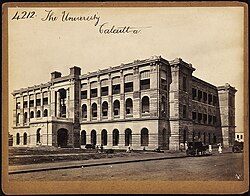
[[File:The Calcutta University by Francis Frith.jpg|thumb|The University of Calcutta in the late nineteenth century, by [[Francis Frith]]|alt=]] | [[File:The Calcutta University by Francis Frith.jpg|thumb|The University of Calcutta in the late nineteenth century, by [[Francis Frith]]|alt=]] | ||
The Calcutta University Act came into force on 24 January 1857, and a 41-member Senate was formed as the policy-making body of the university. The land for the establishment of the university was given by Maharaja Maheshwar Singh Bahadur, who was | The Calcutta University Act came into force on 24 January 1857, and a 41-member Senate was formed as the policy-making body of the university. The land for the establishment of the university was given by Maharaja Maheshwar Singh Bahadur, who was the [[Raj Darbhanga|Maharaja of Darbhanga]]. When the university was first established, it had a [[jurisdiction]] from [[Kabul]] to [[Yangon|Rangoon]] and [[Sri Lanka|Ceylon]], the largest of any Indian university.<ref name=":7">{{Cite web|title=Jurisdiction|url=https://www.caluniv.ac.in/about/Jurisdiction.html|access-date=2020-08-30|publisher=University of Calcutta|archive-date=31 October 2020|archive-url=https://web.archive.org/web/20201031162055/https://www.caluniv.ac.in/about/Jurisdiction.html|url-status=live}}</ref> Calcutta University was the first university [[east of Suez]] to teach European classics, [[English literature]], [[European philosophy|European]] and [[Indian philosophy]] and [[Western world|Occidental]] and Oriental history.<ref>{{Cite web|title=Notable Firsts|url=https://www.caluniv.ac.in/about/Noteble.html|access-date=23 September 2019|publisher=University of Calcutta|archive-date=18 February 2019|archive-url=https://web.archive.org/web/20190218011612/http://www.caluniv.ac.in/about/Noteble.html|url-status=live}}</ref><ref>{{Cite web|date=2020-07-25|title=Journal and Seminar Committee, University of Calcutta's Article Writing Competition: Register by Aug 2|url=https://libertatem.in/events-opportunities/article-writing-competition/journal-and-seminar-committee-university-of-calcuttas-article-writing-competition-register-by-aug-2/|access-date=2020-10-31|website=Libertatem Magazine|language=en-US|archive-date=22 October 2020|archive-url=https://web.archive.org/web/20201022180618/https://libertatem.in/events-opportunities/article-writing-competition/journal-and-seminar-committee-university-of-calcuttas-article-writing-competition-register-by-aug-2/|url-status=live}}</ref> The first [[medical school]] in British India, the [[Medical College and Hospital, Kolkata|Calcutta Medical College]], was affiliated with the university in 1857.<ref>{{Cite web|title=Medical College, Kolkata|url=http://www.sketchdemo.in/mch/inner_page/index.php?title=Landmark&category=TheOrganisation&value=true|url-status=dead|archive-url=https://archive.today/20130218001719/http://www.sketchdemo.in/mch/inner_page/index.php?title=Landmark&category=TheOrganisation&value=true|archive-date=18 February 2013|access-date=30 August 2020|website=sketchdemo.in}}</ref> The first college for women in India, [[Bethune College]], is also affiliated with the university.<ref>{{Cite web|title=The History of the Institution|url=http://bethunecollege.ac.in/bethunehistory.htm|url-status=dead|archive-url=https://web.archive.org/web/20121013193940/http://bethunecollege.ac.in/bethunehistory.htm|archive-date=13 October 2012|access-date=28 Oct 2020|website=bethunecollege.ac.in}}</ref> | ||
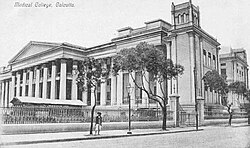
From 1836 to 1890, [[Government Science College, Jabalpur]], the first Indian science college, was affiliated with the University of Calcutta.<ref>{{Cite web|title=About Us – Government Science College, Jabalpur, MP|url=http://www.sciencecollegejabalpur.org/about-us/|access-date=29 June 2020|website=sciencecollegejabalpur.org|language=en-US|archive-date=26 April 2020|archive-url=https://web.archive.org/web/20200426150901/https://www.sciencecollegejabalpur.org/about-us/|url-status=live}}</ref> The first university library began functioning in the 1870s. [[Bankim Chandra Chattopadhyay]] and Joddu Nath Bose became the first graduates of the university in 1858, and [[Kadambini Ganguly]] and [[Chandramukhi Basu]] were the first Indian female graduates in 1882.<ref>{{Cite web|date=8 August 2011|title=About the university|url=http://www.caluniv.ac.in/About%20the%20university/university_frame.htm|url-status=dead|archive-url=https://web.archive.org/web/20110808224127/http://www.caluniv.ac.in/About%20the%20university/university_frame.htm|archive-date=8 August 2011|access-date=29 June 2020|publisher=University of Calcutta}}</ref><ref>{{Cite web|date=24 Jan 2017|title=University of Calcutta began its journey on this date|url=https://www.indiatoday.in/education-today/gk-current-affairs/story/calcutta-university-956756-2017-01-24|access-date=29 June 2020|website=[[India Today]]|language=en|archive-date=1 July 2020|archive-url=https://web.archive.org/web/20200701160746/https://www.indiatoday.in/education-today/gk-current-affairs/story/calcutta-university-956756-2017-01-24|url-status=live}}</ref><ref>{{Cite web|title=Notable Firsts|url=https://www.caluniv.ac.in/about/Noteble.html|access-date=29 June 2020|publisher=University of Calcutta|archive-date=18 February 2019|archive-url=https://web.archive.org/web/20190218011612/http://www.caluniv.ac.in/about/Noteble.html|url-status=live}}</ref> The first chancellor and vice-chancellor of the Calcutta University were Governor General [[Lord Canning]] and Chief Justice of the Supreme Court, [[James William Colvile|Sir William Colvile]], respectively. [[Ashutosh Mukherjee]] was the vice-chancellor for four consecutive two-year terms (1906–1914) and a fifth two-year term in 1921–23.<ref name=":1" /><ref name="officialhist">{{cite web|url=http://www.caluniv.ac.in/university_campuses/university_frame.htm|title=Genesis and Historical Overview of the University|work=University and its Campuses|publisher=University of Calcutta|archive-url=https://web.archive.org/web/20070321035649/http://www.caluniv.ac.in/university_campuses/university_frame.htm <!-- Bot retrieved archive -->|archive-date=21 March 2007|access-date=22 March 2007}}</ref><ref>{{Cite web|date=21 March 2007|title=Genesis and Historical Overview of the University|url=http://www.caluniv.ac.in/university_campuses/university_frame.htm|url-status=dead|archive-url=https://web.archive.org/web/20070321035649/http://www.caluniv.ac.in/university_campuses/university_frame.htm|archive-date=21 March 2007|access-date=29 June 2020|publisher=University of Calcutta}}</ref>[[File:Calcuttamedicalcollege1.jpg|thumb|Calcutta Medical College in 1910|alt=|left]]Initially, the university was only an affiliating and examining body. All the academic and teaching work was done in constituent colleges, which were the [[ | From 1836 to 1890, [[Government Science College, Jabalpur]], the first Indian science college, was affiliated with the University of Calcutta.<ref>{{Cite web|title=About Us – Government Science College, Jabalpur, MP|url=http://www.sciencecollegejabalpur.org/about-us/|access-date=29 June 2020|website=sciencecollegejabalpur.org|language=en-US|archive-date=26 April 2020|archive-url=https://web.archive.org/web/20200426150901/https://www.sciencecollegejabalpur.org/about-us/|url-status=live}}</ref> The first university library began functioning in the 1870s. [[Bankim Chandra Chattopadhyay]] and Joddu Nath Bose became the first graduates of the university in 1858, and [[Kadambini Ganguly]] and [[Chandramukhi Basu]] were the first Indian female graduates in 1882.<ref>{{Cite web|date=8 August 2011|title=About the university|url=http://www.caluniv.ac.in/About%20the%20university/university_frame.htm|url-status=dead|archive-url=https://web.archive.org/web/20110808224127/http://www.caluniv.ac.in/About%20the%20university/university_frame.htm|archive-date=8 August 2011|access-date=29 June 2020|publisher=University of Calcutta}}</ref><ref>{{Cite web|date=24 Jan 2017|title=University of Calcutta began its journey on this date|url=https://www.indiatoday.in/education-today/gk-current-affairs/story/calcutta-university-956756-2017-01-24|access-date=29 June 2020|website=[[India Today]]|language=en|archive-date=1 July 2020|archive-url=https://web.archive.org/web/20200701160746/https://www.indiatoday.in/education-today/gk-current-affairs/story/calcutta-university-956756-2017-01-24|url-status=live}}</ref><ref>{{Cite web|title=Notable Firsts|url=https://www.caluniv.ac.in/about/Noteble.html|access-date=29 June 2020|publisher=University of Calcutta|archive-date=18 February 2019|archive-url=https://web.archive.org/web/20190218011612/http://www.caluniv.ac.in/about/Noteble.html|url-status=live}}</ref> The first chancellor and vice-chancellor of the Calcutta University were Governor General [[Lord Canning]] and Chief Justice of the Supreme Court, [[James William Colvile|Sir William Colvile]], respectively. [[Ashutosh Mukherjee]] was the vice-chancellor for four consecutive two-year terms (1906–1914) and a fifth two-year term in 1921–23.<ref name=":1" /><ref name="officialhist">{{cite web|url=http://www.caluniv.ac.in/university_campuses/university_frame.htm|title=Genesis and Historical Overview of the University|work=University and its Campuses|publisher=University of Calcutta|archive-url=https://web.archive.org/web/20070321035649/http://www.caluniv.ac.in/university_campuses/university_frame.htm <!-- Bot retrieved archive -->|archive-date=21 March 2007|access-date=22 March 2007}}</ref><ref>{{Cite web|date=21 March 2007|title=Genesis and Historical Overview of the University|url=http://www.caluniv.ac.in/university_campuses/university_frame.htm|url-status=dead|archive-url=https://web.archive.org/web/20070321035649/http://www.caluniv.ac.in/university_campuses/university_frame.htm|archive-date=21 March 2007|access-date=29 June 2020|publisher=University of Calcutta}}</ref>[[File:Calcuttamedicalcollege1.jpg|thumb|Calcutta Medical College in 1910|alt=|left]]Initially, the university was only an affiliating and examining body. All the academic and teaching work was done in constituent colleges, which were the [[Presidency University, Kolkata|Presidency College]], the [[Scottish Church College]], the [[Sanskrit College and University|Sanskrit College]], and the [[Indian Institute of Engineering Science and Technology, Shibpur|Bengal Engineering College]]. During that period, the Council Room of the Calcutta Medical College and the private residence of the vice-chancellor used to house the Senate meetings. The faculty councils generally met at the residences of the presidents of the faculties concerned, in the Civil Engineering College, or in the [[Writers' Building]]. Because of the lack of space, university examinations were conducted in the [[Kolkata Town Hall]] and in tents in the [[Maidan (Kolkata)|Maidan]] urban park.<ref name=":4" /> | ||
In 1866, a grant of {{INRConvert|81600||lk=|year=1866|to=USD}} for the site and {{INRConvert|170561||lk=|year=1866|to=USD}} was sanctioned to construct the new building on [[College Street (Kolkata)|College Street]]. It opened in 1873 and was called Senate House. It had meeting halls for the Senate, a chamber for the vice-chancellor, the office of the registrar, examination rooms and lecture halls. In 1904, postgraduate teaching and research began at the university, which led to an increase in the number of students and candidates. After almost sixty years, a second building, known as the Darbhanga Building, was erected in 1912 with a donation of {{INRConvert|2.5|l|lk=|year=1912|to=USD}} from Maharaja Maheshwar Singh Bahadur.<ref name=":4" /> | In 1866, a grant of {{INRConvert|81600||lk=|year=1866|to=USD}} for the site and {{INRConvert|170561||lk=|year=1866|to=USD}} was sanctioned to construct the new building on [[College Street (Kolkata)|College Street]]. It opened in 1873 and was called Senate House. It had meeting halls for the Senate, a chamber for the vice-chancellor, the office of the registrar, examination rooms, and lecture halls. In 1904, postgraduate teaching and research began at the university, which led to an increase in the number of students and candidates. After almost sixty years, a second building, known as the Darbhanga Building, was erected in 1912 with a donation of {{INRConvert|2.5|l|lk=|year=1912|to=USD}} from Maharaja Maheshwar Singh Bahadur.<ref name=":4" /> | ||
The Darbhanga Building housed the [[ | The Darbhanga Building housed the [[Department of Law, University of Calcutta|University Law College]], its library and some university offices and afforded space to hold university examinations on its top floor. In the same year, the [[British India|Government of British India]] granted a sum of {{INRConvert|8|l|lk=|year=1912|to=USD}} for the acquisition of a market, Madhab Babu's Bazar, situated adjacent to the Senate House, and construction of a new building for the teaching departments began. It opened in 1926, and was later named the Asutosh Building, after Asutosh Mukherjee, vice-chancellor of the university in 1906–14. Between 1912 and 1914, [[Taraknath Palit]] and [[Rash Behari Ghosh]], two eminent lawyers, donated assets totalling {{INRConvert|25|l|lk=|year=1914|to=USD}}, and founded the [[Rajabazar Science College|University College of Science]] at [[AJC Bose Road & APC Road|Upper Circular Road]] (now known as Acharya Prafulla Chandra Road).<ref name=":4"/> | ||
[[File:Senate_Hall,_University_of_Calcutta.png|thumb|Senate Hall of University of Calcutta, early 1910s]] | [[File:Senate_Hall,_University_of_Calcutta.png|thumb|Senate Hall of University of Calcutta, early 1910s]] | ||
=== Post-independence === | === Post-independence === | ||
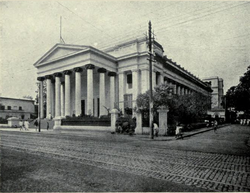
Before the [[partition of India]], twenty-seven colleges from East Bengal (now Bangladesh) were affiliated with the university. The Government of West Bengal passed the Calcutta University Act of 1951, which substituted the earlier act of 1904 and ensured a democratic structure for the university. The West Bengal Secondary Education Act was passed in the same year linking the university with the school leaving examination. Gradually the requirements of the university grew, and the Senate House was becoming incapable of handling them. After the centenary of Calcutta University, the building was demolished to make space for a more utilitarian building. In 1957, the university's centenary year, it received a grant of {{INRConvert|1|c|lk=|year=1957|to=USD}} from the University Grants Commission, which aided with the construction of the Centenary Building on the College Street campus and the Law College Building on Hazra Road campus. The Economics Department got its own building in 1958 near [[Barrackpore Trunk Road]]. In 1965, the Goenka Hospital Diagnostic Research Centre for the University College of Medicine was opened as the university health service. Until 1960, Senate House was one of the city's most prominent landmarks.<ref name=":4" /><ref>{{Cite web|date=25 July 2016|title=Legend of the Lost - Story of Senate House, Calcutta|url=http://noisebreak.com/legend-lost-story-senate-house-calcutta/|access-date=29 August 2020|website=Noise Break|language=en-US|archive-date=10 August 2020|archive-url=https://web.archive.org/web/20200810102807/http://noisebreak.com/legend-lost-story-senate-house-calcutta/|url-status=live}}</ref> | Before the [[partition of India]], twenty-seven colleges from East Bengal (now Bangladesh) were affiliated with the university. The Government of West Bengal passed the Calcutta University Act of 1951, which substituted the earlier act of 1904 and ensured a democratic structure for the university. The West Bengal Secondary Education Act was passed in the same year, linking the university with the school leaving examination. Gradually, the requirements of the university grew, and the Senate House was becoming incapable of handling them. After the centenary of Calcutta University, the building was demolished to make space for a more utilitarian building. In 1957, the university's centenary year, it received a grant of {{INRConvert|1|c|lk=|year=1957|to=USD}} from the University Grants Commission, which aided with the construction of the Centenary Building on the College Street campus and the Law College Building on Hazra Road campus. The Economics Department got its own building in 1958 near [[Barrackpore Trunk Road]]. In 1965, the Goenka Hospital Diagnostic Research Centre for the University College of Medicine was opened as the university health service. Until 1960, Senate House was one of the city's most prominent landmarks.<ref name=":4" /><ref>{{Cite web|date=25 July 2016|title=Legend of the Lost - Story of Senate House, Calcutta|url=http://noisebreak.com/legend-lost-story-senate-house-calcutta/|access-date=29 August 2020|website=Noise Break|language=en-US|archive-date=10 August 2020|archive-url=https://web.archive.org/web/20200810102807/http://noisebreak.com/legend-lost-story-senate-house-calcutta/|url-status=live}}</ref> | ||
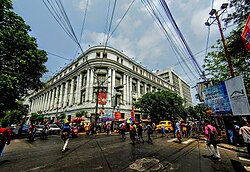
[[File:University of Calcutta outside.jpg|thumb|The University of Calcutta building | [[File:University of Calcutta outside.jpg|thumb|The University of Calcutta building on College Street]] | ||
In 1968, the Centenary Building opened on the former location of the Senate House. Currently, it houses the Central Library, the [[Asutosh Museum of Indian Art]], the centenary auditorium and a number of university offices. By the mid-1970s, it had become one of the largest universities in the world. It had 13 colleges under its direct control and more than 150 affiliated colleges, along with 16 postgraduate faculties.<ref>{{Cite web|title=University of Calcutta, Kolkata, India|url=https://www.britannica.com/topic/University-of-Calcutta|access-date=29 June 2020|website=[[Encyclopedia Britannica]]|language=en|archive-date=9 May 2020|archive-url=https://web.archive.org/web/20200509085744/https://www.britannica.com/topic/University-of-Calcutta|url-status=live}}</ref> In the year 2001, the University of Calcutta was awarded the 'Five-Star' status in the first cycle of the university's accreditation by the National Assessment and Accreditation Council (NAAC). In 2009 and 2017, the NAAC awarded its highest grade of 'A' to the University of Calcutta in the second and third cycle of the university's accreditation.<ref name=Our_Special_Correspondent/><ref>[http://www.naac.gov.in/sites/naac.gov.in/files/Inst%20accr%20by%20NAAC%20with%20validity_0.pdf NAAC accredited Institutes]{{Dead link|date=July 2018 |bot=InternetArchiveBot |fix-attempted=yes }} ''naac.gov.in''. Retrieved 6 August 2012</ref> In 2019, the university's central library and 40 departmental libraries were opened to the public. They have over one million books and more than 200,000 journals, proceedings and manuscripts.<ref name="Basu">{{Cite web|last=Basu|first=Somdatta|date=27 April 2019|title=Calcutta University to throw open its libraries to public|url=https://timesofindia.indiatimes.com/city/kolkata/cu-to-throw-open-its-libraries-to-public/articleshow/69065433.cms|url-status=live|archive-url=https://web.archive.org/web/20190824142428/https://timesofindia.indiatimes.com/city/kolkata/cu-to-throw-open-its-libraries-to-public/articleshow/69065433.cms|archive-date=24 August 2019|access-date=24 August 2019|website=[[The Times of India]]|language=en}}</ref><ref name=":4" /> | In 1968, the Centenary Building opened on the former location of the Senate House. Currently, it houses the Central Library, the [[Asutosh Museum of Indian Art]], the centenary auditorium and a number of university offices. By the mid-1970s, it had become one of the largest universities in the world. It had 13 colleges under its direct control and more than 150 affiliated colleges, along with 16 postgraduate faculties.<ref>{{Cite web|title=University of Calcutta, Kolkata, India|url=https://www.britannica.com/topic/University-of-Calcutta|access-date=29 June 2020|website=[[Encyclopedia Britannica]]|language=en|archive-date=9 May 2020|archive-url=https://web.archive.org/web/20200509085744/https://www.britannica.com/topic/University-of-Calcutta|url-status=live}}</ref> In the year 2001, the University of Calcutta was awarded the 'Five-Star' status in the first cycle of the university's accreditation by the National Assessment and Accreditation Council (NAAC). In 2009 and 2017, the NAAC awarded its highest grade of 'A' to the University of Calcutta in the second and third cycle of the university's accreditation.<ref name=Our_Special_Correspondent/><ref>[http://www.naac.gov.in/sites/naac.gov.in/files/Inst%20accr%20by%20NAAC%20with%20validity_0.pdf NAAC accredited Institutes]{{Dead link|date=July 2018 |bot=InternetArchiveBot |fix-attempted=yes }} ''naac.gov.in''. Retrieved 6 August 2012</ref> In 2019, the university's central library and 40 departmental libraries were opened to the public. They have over one million books and more than 200,000 journals, proceedings and manuscripts.<ref name="Basu">{{Cite web|last=Basu|first=Somdatta|date=27 April 2019|title=Calcutta University to throw open its libraries to public|url=https://timesofindia.indiatimes.com/city/kolkata/cu-to-throw-open-its-libraries-to-public/articleshow/69065433.cms|url-status=live|archive-url=https://web.archive.org/web/20190824142428/https://timesofindia.indiatimes.com/city/kolkata/cu-to-throw-open-its-libraries-to-public/articleshow/69065433.cms|archive-date=24 August 2019|access-date=24 August 2019|website=[[The Times of India]]|language=en}}</ref><ref name=":4" /> | ||
== Seal == | == Seal == | ||
The seal has changed multiple times over the years. The first seal dates back to 1857. It was changed when the [[Government of India Act 1858]] was passed by the [[British parliament]]. This brought the government and territories of the [[East India Company]], including the University of Calcutta, under the [[British Crown]]. Seal three, four and five were introduced in 1930s | The seal has changed multiple times over the years. The first seal dates back to 1857. It was changed when the [[Government of India Act 1858]] was passed by the [[British parliament]]. This brought the government and territories of the [[East India Company]], including the University of Calcutta, under the [[British Crown]]. Seal three, four and five were introduced in the 1930s; the fourth seal faced criticism locally. The current university seal is the modified version of the sixth seal. The motto ''Advancement of Learning'' has remained the same through the seal's transitions.<ref>{{Cite web|title=Seals of the University : Changes over the Years|url=https://www.caluniv.ac.in/about/Seals.html|access-date=15 Oct 2020|publisher=University of Calcutta|archive-date=8 October 2019|archive-url=https://web.archive.org/web/20191008212042/https://www.caluniv.ac.in/about/Seals.html|url-status=live}}</ref> | ||
{{Multiple image | {{Multiple image | ||
| Line 110: | Line 109: | ||
}} | }} | ||
The university has a total of 14 campuses spread over the city of Kolkata and its suburbs. They are referred to as ''Sikhsa Prangan'', which means education premises. Major campuses include the Central Campus (Ashutosh Shiksha Prangan) on College Street, [[University College of Science, Technology and Agriculture]] (Rashbehari Shiksha Prangan or Rajabazar Science College or Science College) in [[Rajabazar (Kolkata)|Rajabazar]], Taraknath Palit Shiksha Prangan in [[Ballygunge]] and Sahid Khudiram Siksha Prangan in [[Alipore]]. Other campuses include the Hazra Road Campus, the University Press and Book Depot, the B. T. Road Campus, the Viharilal College of Home Science Campus, the University Health Service, the Haringhata Campus, the Dhakuria Lakes (University Rowing Club) and the University Ground and Tent at Maidan.<ref name=":8">{{Cite web|title=University Campuses|url=https://www.caluniv.ac.in/campuses/campuses_all.html|access-date=30 June 2020|publisher=University of Calcutta|archive-date=9 August 2020|archive-url=https://web.archive.org/web/20200809043708/https://www.caluniv.ac.in/campuses/campuses_all.html|url-status=live}}</ref><ref>{{Cite web|title=University of Calcutta, Kolkata|url=https://collegedunia.com/university/26018-university-of-calcutta-kolkata|access-date=2020-08-30|website=Collegedunia|language=en|archive-date=30 September 2020|archive-url=https://web.archive.org/web/20200930184856/https://collegedunia.com/university/26018-university-of-calcutta-kolkata|url-status=live}}</ref><ref>{{Cite web|title=Calcutta University Campus List|url=http://www.wbpublibnet.gov.in/node/887|access-date=31 August 2020|website=wbpublibnet.gov.in|archive-date=26 October 2020|archive-url=https://web.archive.org/web/20201026184113/http://www.wbpublibnet.gov.in/node/887|url-status=live}}</ref> | The university has a total of 14 campuses spread over the city of Kolkata and its suburbs. They are referred to as ''Sikhsa Prangan'', which means education premises. Major campuses include the Central Campus (Ashutosh Shiksha Prangan) on College Street, [[University College of Science, Technology and Agriculture]] (Rashbehari Shiksha Prangan or Rajabazar Science College or Science College) in [[Rajabazar (Kolkata)|Rajabazar]], Taraknath Palit Shiksha Prangan in [[Ballygunge]] and Sahid Khudiram Siksha Prangan in [[Alipore]]. Other campuses include the Hazra Road Campus, the University Press and Book Depot, the B. T. Road Campus, the Viharilal College of Home Science Campus, the University Health Service, the Haringhata Campus, the Dhakuria Lakes (University Rowing Club) and the University Ground and Tent at Maidan.<ref name=":8">{{Cite web|title=University Campuses|url=https://www.caluniv.ac.in/campuses/campuses_all.html|access-date=30 June 2020|publisher=University of Calcutta|archive-date=9 August 2020|archive-url=https://web.archive.org/web/20200809043708/https://www.caluniv.ac.in/campuses/campuses_all.html|url-status=live}}</ref><ref>{{Cite web|title=University of Calcutta, Kolkata|url=https://collegedunia.com/university/26018-university-of-calcutta-kolkata|access-date=2020-08-30|website=Collegedunia|language=en|archive-date=30 September 2020|archive-url=https://web.archive.org/web/20200930184856/https://collegedunia.com/university/26018-university-of-calcutta-kolkata|url-status=live}}</ref><ref>{{Cite web|title=Calcutta University Campus List|url=http://www.wbpublibnet.gov.in/node/887|access-date=31 August 2020|website=wbpublibnet.gov.in|archive-date=26 October 2020|archive-url=https://web.archive.org/web/20201026184113/http://www.wbpublibnet.gov.in/node/887|url-status=live}}</ref> | ||
=== | |||
=== Asutosh Siksha Prangan === | |||
Asutosh Siksha Prangan (commonly called the College Street Campus) is the university's main campus where the administrative work is done. Located on College Street, it is spread over an area of {{convert|2.7|acre|ha}}. It houses the Arts and Language department, administrative offices, museum, the central library, an auditorium etc.<ref name="officialsitecampusarea">{{cite web | Asutosh Siksha Prangan (commonly called the College Street Campus) is the university's main campus where the administrative work is done. Located on College Street, it is spread over an area of {{convert|2.7|acre|ha}}. It houses the Arts and Language department, administrative offices, museum, the central library, an auditorium etc.<ref name="officialsitecampusarea">{{cite web | ||
| url = http://www.caluniv.ac.in/university_campuses/university_frame.htm | | url = http://www.caluniv.ac.in/university_campuses/university_frame.htm | ||
| Line 118: | Line 118: | ||
| publisher = University of Calcutta | | publisher = University of Calcutta | ||
| archive-url = https://web.archive.org/web/20070321035649/http://www.caluniv.ac.in/university_campuses/university_frame.htm <!-- Bot retrieved archive --> |archive-date = 21 March 2007}}</ref><ref>{{Cite web|title=Asutosh Siksha Prangan|url=https://www.caluniv.ac.in/campuses/campus.htm|access-date=30 June 2020|publisher=University of Calcutta|archive-date=30 June 2020|archive-url=https://web.archive.org/web/20200630162815/https://www.caluniv.ac.in/campuses/campus.htm|url-status=live}}</ref> Exhibits like [[folk art]] of Bengal are present in the Asutosh Museum of Indian Art.<ref name=":6">{{Cite web|title=Kolkata - Cultural life|url=https://www.britannica.com/place/Kolkata|access-date=2020-08-30|website=Encyclopedia Britannica|language=en|archive-date=13 August 2020|archive-url=https://web.archive.org/web/20200813040212/https://www.britannica.com/place/Kolkata|url-status=live}}</ref> Senate House was the first university building situated on this campus; it opened in 1872. In 1960, it was demolished to make way for a larger building, the Centenary Building, which opened in 1968. The Darbhanga Building and the Asutosh Building are the two other buildings opened in 1921 and 1926, respectively.<ref name=":4">{{Cite web|title=Heritage Buildings|url=https://www.caluniv.ac.in/about/heritage.html|access-date=30 June 2020|publisher=University of Calcutta|archive-date=2 January 2021|archive-url=https://web.archive.org/web/20210102221421/https://www.caluniv.ac.in/about/heritage.html|url-status=live}}</ref> | | archive-url = https://web.archive.org/web/20070321035649/http://www.caluniv.ac.in/university_campuses/university_frame.htm <!-- Bot retrieved archive --> |archive-date = 21 March 2007}}</ref><ref>{{Cite web|title=Asutosh Siksha Prangan|url=https://www.caluniv.ac.in/campuses/campus.htm|access-date=30 June 2020|publisher=University of Calcutta|archive-date=30 June 2020|archive-url=https://web.archive.org/web/20200630162815/https://www.caluniv.ac.in/campuses/campus.htm|url-status=live}}</ref> Exhibits like [[folk art]] of Bengal are present in the Asutosh Museum of Indian Art.<ref name=":6">{{Cite web|title=Kolkata - Cultural life|url=https://www.britannica.com/place/Kolkata|access-date=2020-08-30|website=Encyclopedia Britannica|language=en|archive-date=13 August 2020|archive-url=https://web.archive.org/web/20200813040212/https://www.britannica.com/place/Kolkata|url-status=live}}</ref> Senate House was the first university building situated on this campus; it opened in 1872. In 1960, it was demolished to make way for a larger building, the Centenary Building, which opened in 1968. The Darbhanga Building and the Asutosh Building are the two other buildings opened in 1921 and 1926, respectively.<ref name=":4">{{Cite web|title=Heritage Buildings|url=https://www.caluniv.ac.in/about/heritage.html|access-date=30 June 2020|publisher=University of Calcutta|archive-date=2 January 2021|archive-url=https://web.archive.org/web/20210102221421/https://www.caluniv.ac.in/about/heritage.html|url-status=live}}</ref> | ||
=== Rashbehari Siksha Prangan === | === Rashbehari Siksha Prangan === | ||
{{main|University College of Science, Technology and Agriculture}} [[Rash Behari Bose|Rashbehari]] Siksha Prangan (also known as University College of Science | {{main|University College of Science, Technology and Agriculture}} [[Rash Behari Bose|Rashbehari]] Siksha Prangan (also known as University College of Science and Technology or more commonly Rajabazar Science College), is located on Acharya Prafulla Chandra Road in Rajabazar. Established in 1914,<ref name=":0">{{Cite web|title=University College of Science, Technology & Agriculture|url=http://www.caluniv-ucsta.net/index.php|access-date=2020-06-29|website=www.caluniv-ucsta.net|archive-date=2 January 2021|archive-url=https://web.archive.org/web/20210102221403/http://www.caluniv-ucsta.net/index.php|url-status=live}}</ref> it houses several scientific and technological departments, including pure and applied chemistry, pure and applied physics, applied optics and photonics, radio physics, applied mathematics, psychology, physiology, biophysics, molecular biology, and others.<ref name=":8" /><ref>{{Cite web|title=Rashbehari Siksha Prangan|url=https://www.caluniv.ac.in/campuses/campus-2.html|access-date=30 June 2020|publisher=University of Calcutta}}</ref> | ||
=== Taraknath Palit Siksha Prangan === | === Taraknath Palit Siksha Prangan === | ||
| Line 147: | Line 131: | ||
=== Technology Campus === | === Technology Campus === | ||
The Technology Campus, also known as the Tech Camps, is the newest on the university. It brings together the three engineering and technical departments: the Department of Computer Science and Engineering, the A.K.C. School of Information Technology and the Department of Applied Optics and Photonics, in Sector 3, JD Block, [[Bidhannagar, Kolkata|Salt Lake]].<ref name=":0" /><ref name="techno">{{Cite news | The Technology Campus, also known as the Tech Camps, is the newest on the university. It brings together the three engineering and technical departments: The Centre for Research in Nanoscience and Nanotechnology, the Department of Computer Science and Engineering, the A.K.C. School of Information Technology and the Department of Applied Optics and Photonics, in Sector 3, JD Block, [[Bidhannagar, Kolkata|Salt Lake]].<ref name=":0" /><ref name="techno">{{Cite news | ||
| title = Calcutta University plans Technology campus | | title = Calcutta University plans Technology campus | ||
| url = http://www.hindu.com/2006/01/16/stories/2006011610440300.htm | | url = http://www.hindu.com/2006/01/16/stories/2006011610440300.htm | ||
| Line 177: | Line 161: | ||
== Organisation and administration == | == Organisation and administration == | ||
[[File:1957 University of Calcutta 10 NP.jpg|thumb|right|Commemorative Postal Stamp, 1957]] | [[File:1957 University of Calcutta 10 NP.jpg|thumb|right|Commemorative Postal Stamp, 1957]] | ||
===Governance=== | ===Governance=== | ||
The university is governed by a board of administrative officers, which includes the vice-chancellor, pro-vice-chancellor for academic affairs, pro-vice-chancellor for business affairs and finance, the registrar, the university librarian, the inspector of colleges, the system manager and 35 others. They monitor the operation of the university and its affiliated colleges and the university's funding.<ref>{{Cite web|title=Officers|url=https://www.caluniv.ac.in/admin-new/officer.html|access-date=1 July 2020|publisher=University of Calcutta|archive-date=11 May 2020|archive-url=https://web.archive.org/web/20200511173951/https://caluniv.ac.in/admin-new/officer.html|url-status=live}}</ref> | The university is governed by a board of administrative officers, which includes the vice-chancellor, pro-vice-chancellor for academic affairs, pro-vice-chancellor for business affairs and finance, the registrar, the university librarian, the inspector of colleges, the system manager and 35 others. They monitor the operation of the university and its affiliated colleges and the university's funding.<ref>{{Cite web|title=Officers|url=https://www.caluniv.ac.in/admin-new/officer.html|access-date=1 July 2020|publisher=University of Calcutta|archive-date=11 May 2020|archive-url=https://web.archive.org/web/20200511173951/https://caluniv.ac.in/admin-new/officer.html|url-status=live}}</ref><ref>{{cite web|title=Vice-Chancellors|url=http://www.caluniv.ac.in/about/vc.html|access-date=29 June 2020|publisher=University of Calcutta|archive-date=1 January 2020|archive-url=https://web.archive.org/web/20200101181608/https://www.caluniv.ac.in/about/vc.html|url-status=live}}</ref> The university is funded by the University Grants Commission, the [[Government of West Bengal]], other agencies for various research works and by the university's own initiatives like fees, sales proceeds, publications and service charges generated from [[Financial endowment|endowment funds]].<ref>{{Cite web|title=Budget - 2016|url=https://www.caluniv.ac.in/audit-accounts/PDF/budget_2016.pdf|access-date=1 July 2020|publisher=University of Calcutta|archive-date=2 July 2020|archive-url=https://web.archive.org/web/20200702213252/https://www.caluniv.ac.in/audit-accounts/PDF/budget_2016.pdf|url-status=live}}</ref><ref>{{Cite web|date=2015|title=budget_2015|url=https://www.caluniv.ac.in/audit-accounts/PDF/budget_2015.pdf|access-date=1 July 2020|publisher=University of Calcutta|archive-date=3 July 2020|archive-url=https://web.archive.org/web/20200703040138/https://www.caluniv.ac.in/audit-accounts/PDF/budget_2015.pdf|url-status=live}}</ref> | ||
=== Jurisdiction === | === Jurisdiction === | ||
{{main|List of colleges affiliated to the University of Calcutta|List of centres affiliated to the University of Calcutta}} | {{main|List of colleges affiliated to the University of Calcutta|List of centres affiliated to the University of Calcutta}} | ||
At one time, the university had a huge catchment area in [[British India]], ranging from Lahore in the west to Rangoon in east and Ceylon in the south. Colleges like [[Thomason Engineering College]] (now IIT Roorkee), [[Muhammadan Anglo-Oriental College|Muhammedan Anglo-Oriental College]] (now [[Aligarh Muslim University]]) etc. were affiliated to the university. Schools situated in districts like [[Rawalpindi District|Rawalpindi]], [[Lahore District|Lahore]], [[Jaipur district|Jaypur]], Cawnpur | At one time, the university had a huge catchment area in [[British India]], ranging from Lahore in the west to Rangoon in east and Ceylon in the south. Colleges like [[Thomason Engineering College]] (now IIT Roorkee), [[Muhammadan Anglo-Oriental College|Muhammedan Anglo-Oriental College]] (now [[Aligarh Muslim University]]), [[Canning College, Lucknow]] (now [[University of Lucknow]]), [[King George Medical College]] (now [[King George's Medical University]]), etc. were affiliated to the university. Schools situated in districts like [[Rawalpindi District|Rawalpindi]], [[Lahore District|Lahore]], [[Jaipur district|Jaypur]], Cawnpur, and [[Mussoorie]] used to prepare and send students for the university entrance examination. No provisions to curtail territorial control were made after establishment of [[University of Punjab]] and [[University of Allahabad|Allahabad]] in 1882 and 1887 respectively. After the Indian Universities Act of 1904 came in, however, for the first time, the university's control was curtailed to [[Bengal Presidency|Bengal]] (which included Orissa and Bihar), [[Assam Province|Assam]] and [[Burma Province|Burma]] provinces. In the act, the Governor-General-in-Council was given the power to the limit territorial jurisdiction of the five universities; Calcutta, [[University of Mumbai|Bombay]], [[University of Madras|Madras]], the Punjab and Allahabad.<ref>{{Cite web|title=Indian Universities Act, 1904|url=https://neostencil.com/upsc-modern-history-indian-universities-act-1904|access-date=2020-08-31|website=NeoStencil|language=en|archive-date=2 January 2021|archive-url=https://web.archive.org/web/20210102221423/https://neostencil.com/upsc-modern-history-indian-universities-act-1904|url-status=live}}</ref> | ||
Following the Government of British India notification on 20 August 1904, Ceylon went under the University of Madras; provinces, states and agencies of Central India, such as the [[Central India Agency]], [[Rajputana Agency]], [[United Provinces of Agra and Oudh]] etc. went to the hands of University of Allahabad; Northern and North-Western provinces and states went under the University of Punjab. Jurisdiction of schools and colleges in Eastern India was retained by Calcutta University. By 1907, two colleges in Punjab, three in the Central Province, five in the State of Rajputana Agency, six in the United Provinces of Agra and Oudh and seven in Ceylon were disaffiliated. A series of disaffiliations continued till 1948. Schools and colleges in [[Orissa Province|Orissa]] and [[Bihar Province|Bihar province]] went under [[Patna University|University of Patna]] after its establishment in 1917. [[University of Yangon|University of Rangoon]] was established in 1920 and the Burma region went under it in 1921. In the same year, [[University of Dacca]] was established and some colleges in [[East Bengal]] went under it and whole control was cut with the [[Partition of India (1947)|partition of India in 1947]]. In 1948, all the schools and colleges in Assam left the university after the establishment of [[Gauhati University]].<ref name=":7" /><ref>{{Cite web|title=Educational administration of university education|url=https://shodhganga.inflibnet.ac.in/bitstream/10603/60114/9/09_chapter%206.pdf|access-date=1 September 2020|website=shodhganga.inflibnet.ac.in}}</ref> | Following the Government of British India notification on 20 August 1904, Ceylon went under the University of Madras; provinces, states and agencies of Central India, such as the [[Central India Agency]], [[Rajputana Agency]], [[United Provinces of Agra and Oudh]] etc. went to the hands of University of Allahabad; Northern and North-Western provinces and states went under the University of Punjab. Jurisdiction of schools and colleges in Eastern India was retained by Calcutta University. By 1907, two colleges in Punjab, three in the Central Province, five in the State of Rajputana Agency, six in the United Provinces of Agra and Oudh and seven in Ceylon were disaffiliated. A series of disaffiliations continued till 1948. Schools and colleges in [[Orissa Province|Orissa]] and [[Bihar Province|Bihar province]] went under [[Patna University|University of Patna]] after its establishment in 1917. [[University of Yangon|University of Rangoon]] was established in 1920 and the Burma region went under it in 1921. In the same year, [[University of Dacca]] was established and some colleges in [[East Bengal]] went under it and whole control was cut with the [[Partition of India (1947)|partition of India in 1947]]. In 1948, all the schools and colleges in Assam left the university after the establishment of [[Gauhati University]].<ref name=":7" /><ref>{{Cite web|title=Educational administration of university education|url=https://shodhganga.inflibnet.ac.in/bitstream/10603/60114/9/09_chapter%206.pdf|access-date=1 September 2020|website=shodhganga.inflibnet.ac.in}}</ref> | ||
As of 2020, 151 colleges and 22 institutes and | As of 2020, 151 colleges and 22 institutes and centers, in West Bengal are affiliated with the university.<ref name="antodote">{{cite news|date=22 May 2012|title=Antidote to admission hit-and-miss|publisher=[[The Telegraph (Kolkata)|The Telegraph]]|url=http://www.telegraphindia.com/1120522/jsp/calcutta/story_15514237.jsp#.T8kFobAtiBw|access-date=1 June 2012|archive-date=26 May 2012|archive-url=https://web.archive.org/web/20120526135139/http://www.telegraphindia.com/1120522/jsp/calcutta/story_15514237.jsp#.T8kFobAtiBw|url-status=dead}}</ref><ref>{{Cite web|title=Affiliated Colleges|url=https://www.caluniv.ac.in/student/college.html|access-date=30 June 2020|publisher=University of Calcutta|archive-date=23 May 2020|archive-url=https://web.archive.org/web/20200523114154/http://www.caluniv.ac.in/student/college.html|url-status=live}}</ref><ref name=":3">{{Cite web|title=Departments & Centers|url=https://www.caluniv.ac.in/academic/department/department-centers.html|access-date=30 June 2020|publisher=University of Calcutta|archive-date=9 August 2020|archive-url=https://web.archive.org/web/20200809063127/https://www.caluniv.ac.in/academic/department/department-centers.html|url-status=live}}</ref> Some of the affiliated colleges include:<ref>{{Cite web|title=Down Memory - Colleges|url=https://www.caluniv.ac.in/about/Downmemory_lane.html|access-date=30 June 2020|publisher=University of Calcutta|archive-date=31 October 2020|archive-url=https://web.archive.org/web/20201031051136/https://www.caluniv.ac.in/about/Downmemory_lane.html|url-status=live}}</ref>{{columns-list|colwidth=16em|{{plainlist| | ||
* [[St. Xavier's College, Kolkata]], an autonomous college affiliated to the University of Calcutta (not to be confused with [[St. Xavier's University, Kolkata]]) | |||
* [[Asutosh College]] | * [[Asutosh College]] | ||
* [[Bangabasi College]] | * [[Bangabasi College]] | ||
| Line 195: | Line 181: | ||
* [[Goenka College of Commerce and Business Administration]] | * [[Goenka College of Commerce and Business Administration]] | ||
* [[Gurudas College]] | * [[Gurudas College]] | ||
* [[Heramba Chandra College]] | |||
* [[Jogamaya Devi College]] | * [[Jogamaya Devi College]] | ||
* [[Lady Brabourne College]] | * [[Lady Brabourne College]] | ||
| Line 206: | Line 193: | ||
}}}} | }}}} | ||
=== Faculties, departments and | === Faculties, departments and centers === | ||
The university has 60 departments organized into seven faculties: arts, commerce, social welfare and business management, education, journalism and library science, engineering and technology, fine arts, music and home science, law and science; and an agriculture institute with six departments.<ref name=":3" /> | The university has 60 departments organized into seven faculties: arts, commerce, social welfare and business management, education, journalism and library science, engineering and technology, fine arts, music and home science, law and science; and an agriculture institute with six departments.<ref name=":3" /> | ||
| Line 212: | Line 199: | ||
To provide agricultural education and research, the Institute of Agricultural Science was established under the University of Calcutta. It was founded by [[Pabitra Kumar Sen]], who was the Khaira Professor of Agriculture (another endowment chair) in the early 1950s. Initial efforts began as early as 1913, but the first institute was set up only in 1939 at [[Barrackpore]] (a city near Kolkata) by the university, following the establishment of the [[Imperial Council of Agricultural Research]] (now known as the Indian Council of Agricultural Research) in 1926.<ref>{{Cite web|title=Horticulture|url=https://www.caluniv.ac.in/academic/department/Horticulture.html|access-date=2020-08-16|publisher=University of Calcutta|archive-date=28 February 2019|archive-url=https://web.archive.org/web/20190228011119/http://www.caluniv.ac.in/academic/department/Horticulture.html|url-status=live}}</ref> Although it was shut down in 1941 due to [[World War II]]. Then, in 1954, a postgraduate department in agriculture was started in Ballygunge Science College by the university, with agricultural botany as the only subject; two years later, a Veterinary Science Institute was included and the department was upgraded into a faculty called agriculture and veterinary science. In 2002 university decided to reopen undergraduate agriculture courses in the agricultural experiment farm campus at [[Baruipur]], a city south of Calcutta. In the same year, the department was restructured as a separate Institute of Agricultural Science.<ref>{{Cite web|title=Institute of Agricultural Science|url=https://www.caluniv.ac.in/academic/department/agri-history.pdf|access-date=13 August 2020|publisher=University of Calcutta|archive-date=24 March 2018|archive-url=https://web.archive.org/web/20180324124712/http://www.caluniv.ac.in/academic/department/agri-history.pdf|url-status=live}}</ref> | To provide agricultural education and research, the Institute of Agricultural Science was established under the University of Calcutta. It was founded by [[Pabitra Kumar Sen]], who was the Khaira Professor of Agriculture (another endowment chair) in the early 1950s. Initial efforts began as early as 1913, but the first institute was set up only in 1939 at [[Barrackpore]] (a city near Kolkata) by the university, following the establishment of the [[Imperial Council of Agricultural Research]] (now known as the Indian Council of Agricultural Research) in 1926.<ref>{{Cite web|title=Horticulture|url=https://www.caluniv.ac.in/academic/department/Horticulture.html|access-date=2020-08-16|publisher=University of Calcutta|archive-date=28 February 2019|archive-url=https://web.archive.org/web/20190228011119/http://www.caluniv.ac.in/academic/department/Horticulture.html|url-status=live}}</ref> Although it was shut down in 1941 due to [[World War II]]. Then, in 1954, a postgraduate department in agriculture was started in Ballygunge Science College by the university, with agricultural botany as the only subject; two years later, a Veterinary Science Institute was included and the department was upgraded into a faculty called agriculture and veterinary science. In 2002 university decided to reopen undergraduate agriculture courses in the agricultural experiment farm campus at [[Baruipur]], a city south of Calcutta. In the same year, the department was restructured as a separate Institute of Agricultural Science.<ref>{{Cite web|title=Institute of Agricultural Science|url=https://www.caluniv.ac.in/academic/department/agri-history.pdf|access-date=13 August 2020|publisher=University of Calcutta|archive-date=24 March 2018|archive-url=https://web.archive.org/web/20180324124712/http://www.caluniv.ac.in/academic/department/agri-history.pdf|url-status=live}}</ref> | ||
The Faculty of Arts consists of 23 departments; commerce consists of three departments; education, journalism and library science consist of three departments; engineering and technology consist of eight departments; science has 22 departments and home science offers courses on subjects such as food and nutrition, human development, and home science.<ref name=":3" /> The Faculty of Law was established in January 1909 as the University College of Law. It was granted status as the university's department of law in February 1996. This campus is popularly known as [[Hazra Law College]]. The faculty has many luminaries associated with it, including Rajendra Prasad, Rashbehari Ghose, and Chittaranjan Das.<ref>{{Cite web|title=Department of Law|url=https://www.caluniv.ac.in/academic/department/Law.html|access-date=2020-06-30|publisher=University of Calcutta|archive-date=30 June 2020|archive-url=https://web.archive.org/web/20200630200236/https://www.caluniv.ac.in/academic/department/Law.html|url-status=live}}</ref><ref name=":3" /> | The Faculty of Arts consists of 23 departments; commerce consists of three departments; education, journalism and library science consist of three departments; engineering and technology consist of eight departments; science has 22 departments and home science offers courses on subjects such as food and nutrition, human development, and home science.<ref name=":3" /> The Faculty of Law was established in January 1909 as the University College of Law. It was granted status as the university's department of law in February 1996. This campus is popularly known as [[Hazra Law College]]. The faculty has many luminaries associated with it, including Rajendra Prasad, Rashbehari Ghose, and Chittaranjan Das.<ref>{{Cite web|title=Department of Law|url=https://www.caluniv.ac.in/academic/department/Law.html|access-date=2020-06-30|publisher=University of Calcutta|archive-date=30 June 2020|archive-url=https://web.archive.org/web/20200630200236/https://www.caluniv.ac.in/academic/department/Law.html|url-status=live}}</ref><ref name=":3" />{{clear}} | ||
{{clear}} | |||
<!-- Please do not add new entries to this list. This is a minimal spanning set that should include only the highest-level subdivisions. --> | <!-- Please do not add new entries to this list. This is a minimal spanning set that should include only the highest-level subdivisions. --> | ||
{| style="border:1px solid #ddd; background:#fefefe; padding:3px; margin:0; margin:auto;" | {| style="border:1px solid #ddd; background:#fefefe; padding:3px; margin:0; margin:auto;" | ||
|+ style="font-size: 100%" | ''' | |+ style="font-size: 100%" | '''Centers at University of Calcutta''' | ||
|- style="vertical-align:top; font-size:90%;" | |- style="vertical-align:top; font-size:90%;" | ||
| | | | ||
* A. K. Choudhury School of Information Technology | * A. K. Choudhury School of Information Technology | ||
* Clinical Psychology Centre of University of Calcutta | |||
* Women's Studies Research Centre | * Women's Studies Research Centre | ||
* Centre for Urban Economic Studies | * Centre for Urban Economic Studies | ||
* S. K. Mitra Centre for Space Environment | * S. K. Mitra Centre for Space Environment | ||
* University Science Instrumentation Centre (USIC) | |||
| | |||
* CPEPA-UGC center for “Electrophysiology & Neuro-Imaging Studies including Mathematical Modeling” | |||
* Centre for Translation and Literary Geography (CTLG) | |||
* Gandhian Studies Centre | |||
* Peace Studies Research Centre | * Peace Studies Research Centre | ||
* Centre for Testing and Training for Providing Technical Back up to the Beneficiaries for Agricultural and Horticultural Development | * Centre for Testing and Training for Providing Technical Back up to the Beneficiaries for Agricultural and Horticultural Development | ||
* | * Intellectual Property Rights (IPR) Cell | ||
| | | | ||
* Centre for Research in Nanoscience and Nanotechnology | * Centre for Research in Nanoscience and Nanotechnology | ||
* Centre for Social Sciences and Humanities | * Centre for Social Sciences and Humanities | ||
* Centre for South and Southeast Asian Studies | * Centre for South and Southeast Asian Studies | ||
* Centre for Studies in Book Publishing | * Centre for Studies in Book Publishing | ||
* Centre for Millimeter Wave Semiconductor Devices & Systems | |||
* Centre for Pakistan and West Asian Studies | |||
| | | | ||
* Nehru Studies Centre | * Nehru Studies Centre | ||
| Line 357: | Line 231: | ||
* Centre for Pollination Studies | * Centre for Pollination Studies | ||
* University of Calcutta – Calcutta Stock Exchange Centre of Excellence in Financial Markets (CUCSE-CEFM) | * University of Calcutta – Calcutta Stock Exchange Centre of Excellence in Financial Markets (CUCSE-CEFM) | ||
* Centre for Horticultural Studies | |||
| | |||
<!-- Please do not add new entries to this list. This is a minimal spanning set that should include only the highest-level subdivisions. --> | <!-- Please do not add new entries to this list. This is a minimal spanning set that should include only the highest-level subdivisions. --> | ||
|} | |} | ||
| Line 369: | Line 245: | ||
Seated (L to R): [[Meghnad Saha]], [[Jagadish Chandra Bose]], [[Jnan Chandra Ghosh]]. | Seated (L to R): [[Meghnad Saha]], [[Jagadish Chandra Bose]], [[Jnan Chandra Ghosh]]. | ||
Standing (L to R): Snehamoy Dutt, [[Satyendranath Bose]], [[Debendra Mohan Bose]], NR Sen, [[Jnanendra Nath Mukherjee]], N C Nag|alt=]] | Standing (L to R): Snehamoy Dutt, [[Satyendranath Bose]], [[Debendra Mohan Bose]], NR Sen, [[Jnanendra Nath Mukherjee]], N C Nag|alt=]] | ||
Undergraduates may enroll for a three- or four-year program in engineering. Students choose a major when they enter the university | Undergraduates may enroll for a three- or four-year program in engineering. Students choose a major when they enter the university and cannot change it unless they opt later for the university's professional or self-financed postgraduate programs. Science and business disciplines are in high demand, largely in anticipation of better employment prospects. Most programs are organized on an annual basis, though some programs are semester dependent. Most departments offer [[Master's degree|master's]] programs of a year or a few years' duration. Research is conducted in specialized institutes as well as individual departments, many of which have doctoral programs.<ref name=":3" /> | ||
The University of Calcutta has the largest research center, which started from the | The University of Calcutta has the largest research center, which started from Post Centenary Golden Jubilee Celebrations of the University of Calcutta, January 17, 2006. This is the Center for Research in Nanoscience and Nanotechnology (CRNN) on the Technology Campus of CU at Salt Lake, West Bengal.<ref name="CRNN">{{cite web |title=About CRNN |url=http://www.caluniv.ac.in/academic/department/CRNN/home# |publisher=University of Calcutta |access-date=14 October 2018 |archive-date=14 October 2018 |archive-url=https://web.archive.org/web/20181014091352/http://www.caluniv.ac.in/academic/department/CRNN/home |url-status=dead }}</ref> The university has 18 research centers, 710 teachers, 3000 non-teaching staff and 11,000 postgraduate students.<ref name="caluniv1">[http://www.ugc.ac.in/stateuniversitylist.aspx?id=35&Unitype=2 CU information brochure for MSc, BTech] {{Webarchive|url=https://web.archive.org/web/20170913232358/http://www.ugc.ac.in/stateuniversitylist.aspx?id=35&Unitype=2 |date=13 September 2017 }} Retrieved 25 November 2011</ref>[[File:College square.jpg|thumb|right|University Central Library viewed from [[College Street (Kolkata)|College Square]]]] | ||
=== Libraries === | === Libraries === | ||
The central library at the Asutosh Siksha Prangan was started around the 1870s.<ref name="Basu"/> Apart from 39 departmental libraries, it has a central library, two campus libraries, and two libraries at the advanced centers spread across the seven campuses. Students | The central library at the ''Asutosh Siksha Prangan'' was started around the 1870s.<ref name="Basu"/> Apart from 39 departmental libraries, it has a central library, two campus libraries, and two libraries at the advanced centers spread across the seven campuses. Students at affiliated colleges can also access the central library. The university library has over one million books and more than 200,000 bound journals, proceedings, manuscripts, patents and other valuable collections.<ref name=":6" /><ref>{{Cite web|title=Calcutta University Library|url=https://www.culibrary.ac.in|access-date=28 Oct 2020|website=culibrary.ac.in|archive-date=27 October 2020|archive-url=https://web.archive.org/web/20201027093223/https://www.culibrary.ac.in/|url-status=live}}</ref> | ||
The University launched a modern [[Institutional repository|Institutional Repository]] is a digital platform that makes the university's research freely available online, aligning with the open access movement in academia. Launched in April 2020, enhancing global access to its research.<ref>{{Cite news |last=Basu |first=Somdatta |date=21 Jan 2021 |title=Calcutta University forms open platform for research papers |url=https://timesofindia.indiatimes.com/city/kolkata/cu-forms-open-platform-for-research-papers/articleshow/80374700.cms |url-status=live |archive-url=https://web.archive.org/web/20210120224807/https://timesofindia.indiatimes.com/city/kolkata/cu-forms-open-platform-for-research-papers/articleshow/80374700.cms |archive-date=20 Jan 2021 |access-date=21 Jan 2021 |work=[[The Times of India]] Jan 21, 2021, 04:02 IST}}</ref> It seems likely that this benefits the global scholarly community by providing free access to previously paywalled content. Research suggests increased visibility, citations, and collaboration opportunities for researchers worldwide.<ref>{{Cite news |last=Ghosh |first=Rajlakshmi |date=4 Feb 2021 |title=Calcutta University starts institutional repository to increase global reach of research papers |url=https://timesofindia.indiatimes.com/education/news/calcutta-university-starts-institutional-repository-to-increase-global-reach-of-research-papers/articleshow/80691282.cms |url-status=live |archive-url=https://web.archive.org/web/20220901182451/https://timesofindia.indiatimes.com/education/news/calcutta-university-starts-institutional-repository-to-increase-global-reach-of-research-papers/articleshow/80691282.cms |archive-date=1 September 2022 |access-date=4 Feb 2021 |work=[[The Times of India]] Feb 4, 2021, 20:18 IST}}</ref> | |||
=== Publishing === | === Publishing === | ||
{{See also|The Calcutta Review}} | {{See also|The Calcutta Review}} | ||
The university has its own publishing house called University Press and Publications along with a book depot, which was established in the 20th century. It publishes textbooks, treatises, journals and confidential papers for all the examinations conducted by the university. It also publishes the journal ''[[The Calcutta Review]]'', which is one of the oldest Asian university journals. ''The Calcutta Review'' was established by [[John William Kaye|Sir John Kaye]] in May 1844. It has been issued biannually since 1913.<ref>{{Cite web|title=University Press and Publications|url=https://www.caluniv.ac.in/publication/index.html|access-date=1 July 2020|publisher=University of Calcutta|archive-date=11 May 2020|archive-url=https://web.archive.org/web/20200511190241/https://caluniv.ac.in/publication/index.html|url-status=live}}</ref><ref>{{Cite web|title=University Campuses|url=https://www.caluniv.ac.in/campuses/campus11.htm|access-date=1 July 2020|publisher=University of Calcutta|archive-date=2 July 2020|archive-url=https://web.archive.org/web/20200702055307/https://www.caluniv.ac.in/campuses/campus11.htm|url-status=live}}</ref><ref>{{Cite web|title=The Calcutta Review|url=https://www.caluniv.ac.in/publication/CR.html|access-date=1 July 2020|publisher=University of Calcutta|archive-date=2 July 2020|archive-url=https://web.archive.org/web/20200702204100/https://www.caluniv.ac.in/publication/CR.html|url-status=live}}</ref> | The university has its own publishing house called University Press and Publications along with a book depot, which was established in the 20th century. It publishes textbooks, treatises, journals and confidential papers for all the examinations conducted by the university. It also publishes the journal ''[[The Calcutta Review]]'', which is one of the oldest Asian university journals. ''The Calcutta Review'' was established by [[John William Kaye|Sir John Kaye]] in May 1844. It has been issued biannually since 1913.<ref>{{Cite web|title=University Press and Publications|url=https://www.caluniv.ac.in/publication/index.html|access-date=1 July 2020|publisher=University of Calcutta|archive-date=11 May 2020|archive-url=https://web.archive.org/web/20200511190241/https://caluniv.ac.in/publication/index.html|url-status=live}}</ref><ref>{{Cite web|title=University Campuses|url=https://www.caluniv.ac.in/campuses/campus11.htm|access-date=1 July 2020|publisher=University of Calcutta|archive-date=2 July 2020|archive-url=https://web.archive.org/web/20200702055307/https://www.caluniv.ac.in/campuses/campus11.htm|url-status=live}}</ref><ref>{{Cite web|title=The Calcutta Review|url=https://www.caluniv.ac.in/publication/CR.html|access-date=1 July 2020|publisher=University of Calcutta|archive-date=2 July 2020|archive-url=https://web.archive.org/web/20200702204100/https://www.caluniv.ac.in/publication/CR.html|url-status=live}}</ref> | ||
They also have an associated journal with [[Sage Publishing]], {{ill|Arthaniti: Journal of Economic Theory and Practice|qid=Q15816509|short=yes|italic=yes}}.<ref name="Arthaniti overview">{{cite web |title=''Arthaniti: Journal of Economic Theory and Practice'': Journal overview and metrics |website=Sage Journals |url=https://journals.sagepub.com/overview-metric/ATH |access-date=2024-07-01}}</ref> | |||
=== Rankings === | === Rankings === | ||
| Line 384: | Line 264: | ||
| type = University and college | | type = University and college | ||
<!----------International----------> | <!----------International----------> | ||
| | |ARWU_W_2024=901-1000 | ||
| | |QS_W_2025=751-760 | ||
| | |QS_A_2024=187 | ||
| | |THE_W_2024=1001-1200 | ||
|THES_E_2022 = 401–500 | |||
| THES_E_2022 = 401–500 | |||
<!-- India --> | <!-- India --> | ||
| | |THES_A_2024=351-400 | ||
| | |NIRF_O_2024=26 | ||
| | |NIRF_U_2024=18}} | ||
}} | |||
Internationally, the University of Calcutta was ranked | Internationally, the University of Calcutta was ranked 751-760 in the ''[[QS World University Rankings]]'' of 2023<ref name="Rankings_QS_W_2025" /> and 187 in Asia.<ref name="Rankings_QS_A_2024" /> It was ranked 1001–1200 in the world by the ''[[Times Higher Education World University Rankings]]'' of 2024,<ref name=Rankings_THE_W_2024/> 351–400 in Asia in 2024<ref name=Rankings_THES_A_2022/> and in the 401-500 band among emerging economies in 2022.<ref name=Rankings_THES_E_2022/> It was ranked 901–1000 in the ''[[Academic Ranking of World Universities]]'' of 2024.<ref name=Rankings_ARWU_W_2024/> | ||
In India, the University of Calcutta was ranked | In India, the University of Calcutta was ranked 26th overall by the [[National Institutional Ranking Framework|National Institutional Ranking Framework (NIRF)]] in 2024 and 18th among universities.<ref name=Rankings_NIRF_U_2024/><ref name=Rankings_NIRF_O_2024/> | ||
=== Accreditation and recognition === | === Accreditation and recognition === | ||
In 2001, the University of Calcutta was awarded "Five-Star" status in the first cycle of the university's accreditation by the National Assessment and Accreditation Council (NAAC).<ref>{{Cite web|last=Mita|first=Mukherjee|date=15 October 2001|title=Five-star status makes CU campus of choice|url=https://www.telegraphindia.com/india/five-star-status-makes-cu-campus-of-choice/cid/915137|access-date=15 October 2020|website=www.telegraphindia.com|archive-date=18 October 2020|archive-url=https://web.archive.org/web/20201018012205/https://www.telegraphindia.com/india/five-star-status-makes-cu-campus-of-choice/cid/915137|url-status=live}}</ref> In 2009 and 2017, NAAC awarded its highest grade of 'A' to the University of Calcutta in the second and third cycle of the university's accreditation.<ref name="Our_Special_Correspondent">{{Cite web|date=6 January 2010|title=CU makes the highest grade|url=http://www.telegraphindia.com/1100106/jsp/calcutta/story_11946899.jsp|url-status=dead|archive-url=https://web.archive.org/web/20121024091351/http://www.telegraphindia.com/1100106/jsp/calcutta/story_11946899.jsp|archive-date=24 October 2012|access-date=10 August 2020|website=The Telegraph}}</ref> The UGC recognized the University of Calcutta as a "University with Potential for Excellence", on 8 December 2005.<ref name="potentialforexcellance">{{cite web|date=25 November 2010|title=CU gets "Potential for Excellence" tag of University Grants Commission|url=http://cities.expressindia.com/fullstory.php?newsid=160637|url-status=dead|archive-url=https://web.archive.org/web/20111121185222/http://cities.expressindia.com/fullstory.php?newsid=160637|archive-date=21 November 2011|access-date=7 March 2011|publisher=Cities.expressindia.com}}</ref><ref>{{Cite web|title=University Grants commission: Universities (UPE)|url=https://www.ugc.ac.in/page/Universities-(UPE).aspx|access-date=2020-08-12|website=www.ugc.ac.in|archive-date=15 August 2018|archive-url=https://web.archive.org/web/20180815164121/https://www.ugc.ac.in/page/Universities-(UPE).aspx|url-status=live}}</ref> It was also awarded the status of "Centre with Potential for Excellence in Particular Area" in [[Electrophysiology study|Electro-Physiological]] and [[Neuroimaging|Neuro-imaging studies]] including [[mathematical model]]ing.<ref name="Growth_Spiral">{{Cite web|date=18 May 2012|title=Calcutta University features at 3rd spot on India Today Universities Rankings 2012|url= | In 2001, the University of Calcutta was awarded "Five-Star" status in the first cycle of the university's accreditation by the National Assessment and Accreditation Council (NAAC).<ref>{{Cite web|last=Mita|first=Mukherjee|date=15 October 2001|title=Five-star status makes CU campus of choice|url=https://www.telegraphindia.com/india/five-star-status-makes-cu-campus-of-choice/cid/915137|access-date=15 October 2020|website=www.telegraphindia.com|archive-date=18 October 2020|archive-url=https://web.archive.org/web/20201018012205/https://www.telegraphindia.com/india/five-star-status-makes-cu-campus-of-choice/cid/915137|url-status=live}}</ref> In 2009 and 2017, NAAC awarded its highest grade of 'A' to the University of Calcutta in the second and third cycle of the university's accreditation.<ref name="Our_Special_Correspondent">{{Cite web|date=6 January 2010|title=CU makes the highest grade|url=http://www.telegraphindia.com/1100106/jsp/calcutta/story_11946899.jsp|url-status=dead|archive-url=https://web.archive.org/web/20121024091351/http://www.telegraphindia.com/1100106/jsp/calcutta/story_11946899.jsp|archive-date=24 October 2012|access-date=10 August 2020|website=The Telegraph}}</ref> The UGC recognized the University of Calcutta as a "University with Potential for Excellence", on 8 December 2005.<ref name="potentialforexcellance">{{cite web|date=25 November 2010|title=CU gets "Potential for Excellence" tag of University Grants Commission|url=http://cities.expressindia.com/fullstory.php?newsid=160637|url-status=dead|archive-url=https://web.archive.org/web/20111121185222/http://cities.expressindia.com/fullstory.php?newsid=160637|archive-date=21 November 2011|access-date=7 March 2011|publisher=Cities.expressindia.com}}</ref><ref>{{Cite web|title=University Grants commission: Universities (UPE)|url=https://www.ugc.ac.in/page/Universities-(UPE).aspx|access-date=2020-08-12|website=www.ugc.ac.in|archive-date=15 August 2018|archive-url=https://web.archive.org/web/20180815164121/https://www.ugc.ac.in/page/Universities-(UPE).aspx|url-status=live}}</ref> It was also awarded the status of "Centre with Potential for Excellence in Particular Area" in [[Electrophysiology study|Electro-Physiological]] and [[Neuroimaging|Neuro-imaging studies]] including [[mathematical model]]ing.<ref name="Growth_Spiral">{{Cite web|date=18 May 2012|title=Calcutta University features at 3rd spot on India Today Universities Rankings 2012|url=https://www.indiatoday.in/magazine/best-universities/2012/story/20120528-india-today-universities-rankings-2012-calcutta-university-758439-2012-05-17|access-date=10 August 2020|archive-date=8 September 2017|archive-url=https://web.archive.org/web/20170908143439/http://indiatoday.intoday.in/story/india-today-universities-rankings-2012-calcutta-university/1/189323.html|url-status=live}}</ref><ref>{{Cite web|title=University Grants commission: Centre with Potential for Excellence in Particular Area|url=https://www.ugc.ac.in/page/Centres-(CPEPA).aspx|access-date=2020-08-12|website=www.ugc.ac.in|archive-date=15 August 2018|archive-url=https://web.archive.org/web/20180815164130/https://www.ugc.ac.in/page/Centres-(CPEPA).aspx|url-status=live}}</ref> | ||
The Manuscript Library at the university has also been designated as a "Manuscript Conservation Centre" under the [[National Mission for Manuscripts]], which was established in 2003.<ref>{{Cite web|title=National Mission for Manuscripts|url=http://www.namami.org/convervation.htm|url-status=dead|archive-url=https://web.archive.org/web/20120506234603/http://www.namami.org/convervation.htm|archive-date=6 May 2012|access-date=28 Oct 2020|website=namami.org}}</ref><ref>{{Cite web|date=14 August 2018|title=CU makes the highest grade|url=https://www.telegraphindia.com/1100106/jsp/calcutta/story_11946899.jsp|url-status=dead|archive-url=https://web.archive.org/web/20180814040230/https://www.telegraphindia.com/1100106/jsp/calcutta/story_11946899.jsp|archive-date=14 August 2018|access-date=30 June 2020|website=The Telegraph}}</ref> The university has the highest number of students who have cleared the doctoral entrance eligibility exam, known as [[National Eligibility Test]], in Natural Science and Arts to become eligible to pursue research with a full scholarship awarded by the Government of India.<ref>{{Cite web|date=25 August 2009|title=CSIR-UGC National Eligibility Test|url=https://www.currentscience.ac.in/Downloads/article_id_097_04_0490_0499_0.pdf|access-date=29 June 2020|website=currentscience|archive-date=7 June 2019|archive-url=https://web.archive.org/web/20190607100023/https://www.currentscience.ac.in/Downloads/article_id_097_04_0490_0499_0.pdf|url-status=live}}</ref>{{better source needed|date=April 2021}} The university is a member of the United Nations Academic Impact initiative.<ref>{{Cite web|date=Sep 2019|title=UNAI member list|url=https://academicimpact.un.org/sites/academicimpact.un.org/files/UNAI%20MEMBERS%20LIST%20SEPTEMBER%202019.pdf|access-date=29 June 2020|website=academicimpact.un.org|archive-date=2 January 2021|archive-url=https://web.archive.org/web/20210102221357/https://academicimpact.un.org/sites/academicimpact.un.org/files/UNAI%20MEMBERS%20LIST%20SEPTEMBER%202019.pdf|url-status=live}}</ref> | The Manuscript Library at the university has also been designated as a "Manuscript Conservation Centre" under the [[National Mission for Manuscripts]], which was established in 2003.<ref>{{Cite web|title=National Mission for Manuscripts|url=http://www.namami.org/convervation.htm|url-status=dead|archive-url=https://web.archive.org/web/20120506234603/http://www.namami.org/convervation.htm|archive-date=6 May 2012|access-date=28 Oct 2020|website=namami.org}}</ref><ref>{{Cite web|date=14 August 2018|title=CU makes the highest grade|url=https://www.telegraphindia.com/1100106/jsp/calcutta/story_11946899.jsp|url-status=dead|archive-url=https://web.archive.org/web/20180814040230/https://www.telegraphindia.com/1100106/jsp/calcutta/story_11946899.jsp|archive-date=14 August 2018|access-date=30 June 2020|website=The Telegraph}}</ref> The university has the highest number of students who have cleared the doctoral entrance eligibility exam, known as [[National Eligibility Test]], in Natural Science and Arts to become eligible to pursue research with a full scholarship awarded by the Government of India.<ref>{{Cite web|date=25 August 2009|title=CSIR-UGC National Eligibility Test|url=https://www.currentscience.ac.in/Downloads/article_id_097_04_0490_0499_0.pdf|access-date=29 June 2020|website=currentscience|archive-date=7 June 2019|archive-url=https://web.archive.org/web/20190607100023/https://www.currentscience.ac.in/Downloads/article_id_097_04_0490_0499_0.pdf|url-status=live}}</ref>{{better source needed|date=April 2021}} The university is a member of the United Nations Academic Impact initiative.<ref>{{Cite web|date=Sep 2019|title=UNAI member list|url=https://academicimpact.un.org/sites/academicimpact.un.org/files/UNAI%20MEMBERS%20LIST%20SEPTEMBER%202019.pdf|access-date=29 June 2020|website=academicimpact.un.org|archive-date=2 January 2021|archive-url=https://web.archive.org/web/20210102221357/https://academicimpact.un.org/sites/academicimpact.un.org/files/UNAI%20MEMBERS%20LIST%20SEPTEMBER%202019.pdf|url-status=live}}</ref> | ||
| Line 407: | Line 286: | ||
The university has a ground and tent in Maidan, where various sports are played.<ref>{{Cite web|title=University Ground|url=https://www.caluniv.ac.in/campuses/campus13.htm|access-date=2020-08-30|publisher=University of Calcutta|archive-date=23 October 2020|archive-url=https://web.archive.org/web/20201023220830/https://www.caluniv.ac.in/campuses/campus13.htm|url-status=live}}</ref> Inter-college tournaments in sports like [[Association football|football]], [[archery]], [[basketball]], and [[field hockey|hockey]] are also organised.<ref>{{Cite web|title=Sports|url=https://www.caluniv.ac.in/news/sports.html|access-date=2020-08-30|publisher=University of Calcutta|archive-date=23 October 2020|archive-url=https://web.archive.org/web/20201023221547/https://www.caluniv.ac.in/news/sports.html|url-status=live}}</ref> The university rowing club started in the year 1983 at [[Rabindra Sarobar]].<ref>{{Cite web|title=University Rowing Club|url=https://www.caluniv.ac.in/campuses/campus14.htm|access-date=2020-08-30|publisher=University of Calcutta|archive-date=23 October 2020|archive-url=https://web.archive.org/web/20201023221127/https://www.caluniv.ac.in/campuses/campus14.htm|url-status=live}}</ref><ref>{{Cite web|last=Niyogi|first=Subhro|date=18 November 2017|title=Rowing clubs: Are days numbered for water sports in Lake? {{!}} Kolkata News - Times of India|url=https://timesofindia.indiatimes.com/city/kolkata/are-days-numbered-for-water-sports-in-lake/articleshow/61697079.cms|access-date=30 August 2020|website=The Times of India|language=en|archive-date=18 November 2017|archive-url=https://web.archive.org/web/20171118210037/https://timesofindia.indiatimes.com/city/kolkata/are-days-numbered-for-water-sports-in-lake/articleshow/61697079.cms|url-status=live}}</ref> The Calcutta University Students' Union organises social and cultural activities occasionally, which include blood donation camps, environmental awareness programmes, relief fund collection, teachers day celebrations, and [[Saraswati puja]], among others.<ref>{{Cite web|title=Annual Quality Assurance Report (AQAR)|url=https://www.caluniv.ac.in/naac/meeting_up_pgrm/AQAR-2005-06.pdf|access-date=30 August 2020|publisher=University of Calcutta|archive-date=23 October 2020|archive-url=https://web.archive.org/web/20201023223333/https://www.caluniv.ac.in/naac/meeting_up_pgrm/AQAR-2005-06.pdf|url-status=live}}</ref><ref>{{Cite web|title=Calcutta University Student Union|url=https://www.caluniv.ac.in/CUSU/su.html#acti|access-date=15 Oct 2020|publisher=University of Calcutta|archive-date=16 October 2020|archive-url=https://web.archive.org/web/20201016183722/https://www.caluniv.ac.in/CUSU/su.html#acti|url-status=live}}</ref> | The university has a ground and tent in Maidan, where various sports are played.<ref>{{Cite web|title=University Ground|url=https://www.caluniv.ac.in/campuses/campus13.htm|access-date=2020-08-30|publisher=University of Calcutta|archive-date=23 October 2020|archive-url=https://web.archive.org/web/20201023220830/https://www.caluniv.ac.in/campuses/campus13.htm|url-status=live}}</ref> Inter-college tournaments in sports like [[Association football|football]], [[archery]], [[basketball]], and [[field hockey|hockey]] are also organised.<ref>{{Cite web|title=Sports|url=https://www.caluniv.ac.in/news/sports.html|access-date=2020-08-30|publisher=University of Calcutta|archive-date=23 October 2020|archive-url=https://web.archive.org/web/20201023221547/https://www.caluniv.ac.in/news/sports.html|url-status=live}}</ref> The university rowing club started in the year 1983 at [[Rabindra Sarobar]].<ref>{{Cite web|title=University Rowing Club|url=https://www.caluniv.ac.in/campuses/campus14.htm|access-date=2020-08-30|publisher=University of Calcutta|archive-date=23 October 2020|archive-url=https://web.archive.org/web/20201023221127/https://www.caluniv.ac.in/campuses/campus14.htm|url-status=live}}</ref><ref>{{Cite web|last=Niyogi|first=Subhro|date=18 November 2017|title=Rowing clubs: Are days numbered for water sports in Lake? {{!}} Kolkata News - Times of India|url=https://timesofindia.indiatimes.com/city/kolkata/are-days-numbered-for-water-sports-in-lake/articleshow/61697079.cms|access-date=30 August 2020|website=The Times of India|language=en|archive-date=18 November 2017|archive-url=https://web.archive.org/web/20171118210037/https://timesofindia.indiatimes.com/city/kolkata/are-days-numbered-for-water-sports-in-lake/articleshow/61697079.cms|url-status=live}}</ref> The Calcutta University Students' Union organises social and cultural activities occasionally, which include blood donation camps, environmental awareness programmes, relief fund collection, teachers day celebrations, and [[Saraswati puja]], among others.<ref>{{Cite web|title=Annual Quality Assurance Report (AQAR)|url=https://www.caluniv.ac.in/naac/meeting_up_pgrm/AQAR-2005-06.pdf|access-date=30 August 2020|publisher=University of Calcutta|archive-date=23 October 2020|archive-url=https://web.archive.org/web/20201023223333/https://www.caluniv.ac.in/naac/meeting_up_pgrm/AQAR-2005-06.pdf|url-status=live}}</ref><ref>{{Cite web|title=Calcutta University Student Union|url=https://www.caluniv.ac.in/CUSU/su.html#acti|access-date=15 Oct 2020|publisher=University of Calcutta|archive-date=16 October 2020|archive-url=https://web.archive.org/web/20201016183722/https://www.caluniv.ac.in/CUSU/su.html#acti|url-status=live}}</ref> | ||
Most of the affiliated undergraduate colleges located in the city have their own student hostels. The university has 17 hostels, of which eight (two for undergraduates and six for | Most of the affiliated undergraduate colleges located in the city have their own student hostels. The university has 17 hostels, of which eight (two for undergraduates and six for postgraduates) are for women. A total of 13 hostels are for paying guest students located across the city.<ref>{{Cite web|title=University Halls and Hostels|url=https://www.caluniv.ac.in/halls-hostels/univ-halls-hostels.htm|access-date=28 Oct 2020|publisher=University of Calcutta|archive-date=30 September 2020|archive-url=https://web.archive.org/web/20200930152614/https://www.caluniv.ac.in/halls-hostels/univ-halls-hostels.htm|url-status=live}}</ref> | ||
=== University song === | === University song === | ||
| Line 413: | Line 292: | ||
== Notable alumni and faculties == | == Notable alumni and faculties == | ||
{{Main | {{Main|List of University of Calcutta people|List of vice-chancellors of the University of Calcutta}} | ||
The university has produced many scientists, engineers, world leaders, Nobel laureates and teachers. As the oldest university of Bengal and India, it attracts students from diverse walks of life. Nobel laureates who either studied or worked there include [[Rabindranath Tagore]], [[Chandrasekhara Venkata Raman]], [[Ronald Ross]],<ref>{{Cite web|date=Nov 2015|title=The Unsung Indian Behind Ronald Ross's Success|url=http://nopr.niscair.res.in/bitstream/123456789/33139/1/SR%2052%2811%29%2046-48.pdf|access-date=11 Nov 2020|publisher=Science Reporter|archive-date=22 March 2020|archive-url=https://web.archive.org/web/20200322083631/http://nopr.niscair.res.in/bitstream/123456789/33139/1/SR%2052%2811%29%2046-48.pdf|url-status=live}}</ref> [[Amartya Sen]] and [[Abhijit Banerjee]].<ref>{{Cite web|title=Nobel Laureates|url=https://www.caluniv.ac.in/about/Nobel-Laureates.html|access-date=2020-11-11|publisher=University of Calcutta|archive-date=31 October 2020|archive-url=https://web.archive.org/web/20201031055012/https://www.caluniv.ac.in/about/Nobel-Laureates.html|url-status=live}}</ref> The [[Academy Honorary Award|Academy Award]] winning director [[Satyajit Ray]] was an alumnus of the university, as was the composer of the national song of India, [[Bankim Chandra Chattopadhyay]]. Some of the industrialists who studied at the university include Sir [[Rajen Mookerjee]], [[Rama Prasad Goenka]], [[Lakshmi Mittal]], and [[Aditya Birla]]. Notable scientists, medical doctors and mathematicians associated with the university include [[Jagadish Chandra Bose]], [[Prafulla Chandra Ray]], [[Meghnad Saha]], [[Anil Kumar Gain]], [[Satyendra Nath Bose]], [[Subir Kumar Ghosh]], [[Ashoke Sen]], [[Sanghamitra Bandyopadhyay]], [[C. R. Rao]], [[Asima Chatterjee]], and [[Ujjwal Maulik]].<ref name=":2"/><ref>{{Cite | |||
The university has produced many scientists, engineers, world leaders, Nobel laureates and teachers. As the oldest university of Bengal and India, it attracts students from diverse walks of life. Nobel laureates who either studied or worked there include [[Rabindranath Tagore]], [[Chandrasekhara Venkata Raman]], [[Ronald Ross]],<ref>{{Cite web|date=Nov 2015|title=The Unsung Indian Behind Ronald Ross's Success|url=http://nopr.niscair.res.in/bitstream/123456789/33139/1/SR%2052%2811%29%2046-48.pdf|access-date=11 Nov 2020|publisher=Science Reporter|archive-date=22 March 2020|archive-url=https://web.archive.org/web/20200322083631/http://nopr.niscair.res.in/bitstream/123456789/33139/1/SR%2052%2811%29%2046-48.pdf|url-status=live}}</ref> [[Amartya Sen]] and [[Abhijit Banerjee]].<ref>{{Cite web|title=Nobel Laureates|url=https://www.caluniv.ac.in/about/Nobel-Laureates.html|access-date=2020-11-11|publisher=University of Calcutta|archive-date=31 October 2020|archive-url=https://web.archive.org/web/20201031055012/https://www.caluniv.ac.in/about/Nobel-Laureates.html|url-status=live}}</ref> The [[Academy Honorary Award|Academy Award]] winning director [[Satyajit Ray]] was an alumnus of the university, as was the composer of the national song of India, [[Bankim Chandra Chattopadhyay]], as was [[Padma Shri]] Award winning director [[Tarun Majumdar]]. Some of the industrialists who studied at the university include Sir [[Rajen Mookerjee]], [[Rama Prasad Goenka]], [[Lakshmi Mittal]], and [[Aditya Birla]]. Notable scientists, medical doctors and mathematicians associated with the university include [[Jagadish Chandra Bose]], [[Prafulla Chandra Ray]], [[Meghnad Saha]], [[Anil Kumar Gain]], [[Satyendra Nath Bose]], [[Subir Kumar Ghosh]], [[Ashoke Sen]], [[Sanghamitra Bandyopadhyay]], [[C. R. Rao]], [[Asima Chatterjee]], and [[Ujjwal Maulik]].<ref name=":2"/><ref>{{Cite news|title=Bhatnagar Awardee, First Women Director of Indian Statistical Institute|website=[[The Times of India]]|date=29 September 2010 |url=https://timesofindia.indiatimes.com/city/kolkata/im-happiest-because-my-son-is-proud-of-my-achievement/articleshow/6647659.cms|access-date=11 June 2021|archive-date=11 June 2021|archive-url=https://web.archive.org/web/20210611035010/https://timesofindia.indiatimes.com/city/kolkata/im-happiest-because-my-son-is-proud-of-my-achievement/articleshow/6647659.cms|url-status=live}}</ref><ref>{{cite news|date=17 November 2020|title=Bengali couples earned world fame in the field of Science|page=03|work=[[Anandabazar Patrika]]|url=https://www.anandabazar.com/amp/others/science/bengali-couples-earned-world-fame-in-the-field-of-science-1.1229870|access-date=17 November 2020|archive-date=17 November 2020|archive-url=https://web.archive.org/web/20201117032921/https://www.anandabazar.com/amp/others/science/bengali-couples-earned-world-fame-in-the-field-of-science-1.1229870|url-status=live}}</ref> | |||
[[Fatima Jinnah]], one of the leading founders of Pakistan, studied dentistry at the university. A nationalist leader and former president of the [[Indian National Congress]], co-founder of the [[Indian National Army]], and head of state of the [[Provisional Government of Free India]], [[Subhas Chandra Bose|Netaji Subhas Chandra Bose]] also spent some time at the university. Other presidents of the Indian National Congress include [[Womesh Chandra Bonnerjee]], [[Surendranath Banerjee]], [[Anandamohan Bose]], [[Romesh Chunder Dutt]], [[Bhupendra Nath Bose]] and [[Madan Mohan Malaviya]]. Malaviya was also the founder of the [[Banaras Hindu University]]. Among the [[President of India|presidents of India]] associated with this university are [[Rajendra Prasad]] (who studied there) and [[Sarvapalli Radhakrishnan]] (who taught there), and [[Pranab Mukherjee]], who both studied and taught at affiliated colleges of the university. The former [[Vice President of India|vice president of India]], [[Mohammad Hamid Ansari]] studied there, as did a former [[Deputy Prime Minister of India|deputy prime minister of India]], [[Jagjivan Ram]].<ref name=":2">{{Cite web|title=Distinguished Alumni|url=https://www.caluniv.ac.in/about/Alumni.html|access-date=30 June 2020|publisher=University of Calcutta|archive-date=1 November 2020|archive-url=https://web.archive.org/web/20201101154050/https://www.caluniv.ac.in/about/Alumni.html|url-status=live}}</ref> | [[Fatima Jinnah]], one of the leading founders of Pakistan, studied dentistry at the university. A nationalist leader and former president of the [[Indian National Congress]], co-founder of the [[Indian National Army]], and head of state of the [[Provisional Government of Free India]], [[Subhas Chandra Bose|Netaji Subhas Chandra Bose]] also spent some time at the university. Other presidents of the Indian National Congress include [[Womesh Chandra Bonnerjee]], [[Surendranath Banerjee]], [[Anandamohan Bose]], [[Romesh Chunder Dutt]], [[Bhupendra Nath Bose]] and [[Madan Mohan Malaviya]]. Malaviya was also the founder of the [[Banaras Hindu University]]. Among the [[President of India|presidents of India]] associated with this university are [[Rajendra Prasad]] (who studied there) and [[Sarvapalli Radhakrishnan]] (who taught there), and [[Pranab Mukherjee]], who both studied and taught at affiliated colleges of the university. The former [[Vice President of India|vice president of India]], [[Mohammad Hamid Ansari]] studied there, as did a former [[Deputy Prime Minister of India|deputy prime minister of India]], [[Jagjivan Ram]].<ref name=":2">{{Cite web|title=Distinguished Alumni|url=https://www.caluniv.ac.in/about/Alumni.html|access-date=30 June 2020|publisher=University of Calcutta|archive-date=1 November 2020|archive-url=https://web.archive.org/web/20201101154050/https://www.caluniv.ac.in/about/Alumni.html|url-status=live}}</ref> | ||
| Line 424: | Line 304: | ||
Heads of state from other countries associated with the university include four [[List of Presidents of Bangladesh|presidents of Bangladesh]] ([[Sheikh Mujibur Rahman]], [[Mohammad Mohammadullah]], [[Abu Sadat Mohammad Sayem]], and [[Abdus Sattar (president)|Abdus Sattar]]) two [[List of Prime Ministers of Bangladesh|prime ministers of Bangladesh]] ([[Muhammad Mansur Ali]] and [[Shah Azizur Rahman]]), three [[List of Prime Ministers of Pakistan|prime ministers of Pakistan]] ([[Mohammad Ali Bogra]], [[Hussein Shaheed Suhrawardy]], and [[Nurul Amin]]), the first premier of Burma under British rule, [[Ba Maw]], the first [[president of Nepal]], [[Ram Baran Yadav]], and the first democratically elected [[Prime Minister of Nepal|prime minister of Nepal]], [[Bishweshwar Prasad Koirala]], as well as his successor [[Tulsi Giri]].<ref name=":2" /> | Heads of state from other countries associated with the university include four [[List of Presidents of Bangladesh|presidents of Bangladesh]] ([[Sheikh Mujibur Rahman]], [[Mohammad Mohammadullah]], [[Abu Sadat Mohammad Sayem]], and [[Abdus Sattar (president)|Abdus Sattar]]) two [[List of Prime Ministers of Bangladesh|prime ministers of Bangladesh]] ([[Muhammad Mansur Ali]] and [[Shah Azizur Rahman]]), three [[List of Prime Ministers of Pakistan|prime ministers of Pakistan]] ([[Mohammad Ali Bogra]], [[Hussein Shaheed Suhrawardy]], and [[Nurul Amin]]), the first premier of Burma under British rule, [[Ba Maw]], the first [[president of Nepal]], [[Ram Baran Yadav]], and the first democratically elected [[Prime Minister of Nepal|prime minister of Nepal]], [[Bishweshwar Prasad Koirala]], as well as his successor [[Tulsi Giri]].<ref name=":2" /> | ||
One of the prominent indigenous leaders from the [[Tripuri people|Tripuri Community]], [[Birendra Kishore Roaza]], also graduated from the University<ref>{{cite web|url=https://www.elengcha.com/2022/12/birendra-kishore-roaza.html?m=1|title=Birendra Kishore Roaza- A Biography=2022-12-26}}</ref> | One of the prominent indigenous leaders from the [[Tripuri people|Tripuri Community]], [[Birendra Kishore Roaza]], also graduated from the University.<ref>{{cite web|url=https://www.elengcha.com/2022/12/birendra-kishore-roaza.html?m=1|title=Birendra Kishore Roaza- A Biography=2022-12-26|access-date=27 December 2022|archive-date=16 December 2022|archive-url=https://web.archive.org/web/20221216165518/https://www.elengcha.com/2022/12/birendra-kishore-roaza.html?m=1|url-status=dead}}</ref> Notably, [[Gyanendra Nath Chakravarti]], an influential [[Theosophy|Indian Theosophist]] and a key figure in the early [[Theosophical Society]],<ref>{{Cite web |date=4 September 1893 |title=Brahmins on Brahminism: Gyanendra Nath Chakravarti and His Address. |url=https://www.nytimes.com/1893/09/04/archives/brahmins-on-brahminism-gyanendra-nath-chakravarti-and-his.html |access-date=18 October 2024 |website=The New York Times}}</ref> is also an alumnus of Calcutta University. | ||
== See also == | == See also == | ||
| Line 451: | Line 331: | ||
== External links == | == External links == | ||
* {{official}} | * {{official website}} | ||
{{Commons category-inline}} | |||
{{wikisource-inline|Portal:University of Calcutta}} | |||
{{Portal bar|India|Education}} | |||
{{Calcutta University}} | {{Calcutta University}} | ||
| Line 470: | Line 350: | ||
{{DEFAULTSORT:Calcutta, University of}} | {{DEFAULTSORT:Calcutta, University of}} | ||
[[Category:University of Calcutta | [[Category:University of Calcutta]] | ||
[[Category:1857 establishments in India]] | [[Category:1857 establishments in India]] | ||
[[Category:Academic institutions associated with the Bengal Renaissance]] | [[Category:Academic institutions associated with the Bengal Renaissance]] | ||
[[Category: | [[Category:Universities and colleges established in 1857]] | ||
[[Category:19th century in Kolkata|University of Calcutta]] | [[Category:19th century in Kolkata|University of Calcutta]] | ||
[[Category:Universities in Kolkata]] | [[Category:Universities in Kolkata]] | ||
Latest revision as of 23:02, 8 May 2026
 Seal of the University of Calcutta | |
| Motto | Advancement of Learning |
|---|---|
| Recognition | |
| Type | Public research university |
| Established | 24 January 1857 |
| Founder | Council of Directors |
Academic affiliations | |
| Budget | ₹340.73 crore (US$48 million) (FY2025–26 est.)[1] |
| Chancellor | Governor of West Bengal |
| Vice-Chancellor | Ashutosh Ghosh |
Academic staff | 1,185 ( 2025)[2] |
| Students | 14,484 ( 2025)[2] |
| Undergraduates | 2,349 ( 2025)[2] |
| Postgraduates | 9,430 ( 2025)[2] |
| 2,705 ( 2025)[2] | |
| Address | University of Calcutta, 87/1, College Street, Kolkata-700 073 22°34′30″N 88°21′46″E / 22.57500°N 88.36278°E |
| Campus | Metropolis 119.7 acres (48.4 ha) |
| Acronym | CU |
| Journal | Calcutta Review |
| Colours | Dark Blue Light Blue White |
| Website | {{URL|example.com|optional display text}} |
 | |
| Shubho Karmapathe | |
University song 1937 | |
The University of Calcutta, informally known as Calcutta University (CU), is a public state research university located in Kolkata, also known as Calcutta,[3] in West Bengal, India. It has 151 affiliated undergraduate colleges and 16 institutes in Kolkata and nearby areas. It was established on 24 January 1857 and is the oldest multidisciplinary university of the Indian Subcontinent and the Southeast Asian Region. Today, the university's jurisdiction is limited to a few districts of West Bengal, but at the time of its establishment, it had a catchment area ranging from Kabul to Myanmar. It is accredited as an "A" grade university by the National Assessment and Accreditation Council (NAAC).
The university has a total of fourteen campuses spread over the city of Kolkata and its suburbs. Since 2020[update], 151 colleges and 21 institutes, and centres have been affiliated with CU. The university was fourth in the Indian University Ranking 2021 list, released by the National Institutional Ranking Framework of the Ministry of Education.
Its alumni and faculty include several heads of state and government, social reformers, prominent artists, the only Indian Dirac Medal winner, many Fellows of the Royal Society, and six Nobel laureates as of 2025[update]. The Nobel laureates associated with this university are Ronald Ross, Rabindranath Tagore, C. V. Raman, Amartya Sen, and Abhijit Banerjee.
The university has the highest number of students who have cleared the National Eligibility Test. The University of Calcutta is a member of the United Nations Academic Impact.
History[edit | edit source]
Pre-independence[edit | edit source]
Frederic J. Mouat, the education secretary to the British Government of India, first tendered a proposal to them in London for the establishment of a university in Calcutta, along the lines of London University. In July 1854,[4] the Court of Directors of the East India Company sent a dispatch, known as Wood's despatch, to the Governor General of India in Council, to establish universities in Calcutta, Madras, and Bombay.[5][6]

The Calcutta University Act came into force on 24 January 1857, and a 41-member Senate was formed as the policy-making body of the university. The land for the establishment of the university was given by Maharaja Maheshwar Singh Bahadur, who was the Maharaja of Darbhanga. When the university was first established, it had a jurisdiction from Kabul to Rangoon and Ceylon, the largest of any Indian university.[7] Calcutta University was the first university east of Suez to teach European classics, English literature, European and Indian philosophy and Occidental and Oriental history.[8][9] The first medical school in British India, the Calcutta Medical College, was affiliated with the university in 1857.[10] The first college for women in India, Bethune College, is also affiliated with the university.[11]
From 1836 to 1890, Government Science College, Jabalpur, the first Indian science college, was affiliated with the University of Calcutta.[12] The first university library began functioning in the 1870s. Bankim Chandra Chattopadhyay and Joddu Nath Bose became the first graduates of the university in 1858, and Kadambini Ganguly and Chandramukhi Basu were the first Indian female graduates in 1882.[13][14][15] The first chancellor and vice-chancellor of the Calcutta University were Governor General Lord Canning and Chief Justice of the Supreme Court, Sir William Colvile, respectively. Ashutosh Mukherjee was the vice-chancellor for four consecutive two-year terms (1906–1914) and a fifth two-year term in 1921–23.[5][16][17]

Initially, the university was only an affiliating and examining body. All the academic and teaching work was done in constituent colleges, which were the Presidency College, the Scottish Church College, the Sanskrit College, and the Bengal Engineering College. During that period, the Council Room of the Calcutta Medical College and the private residence of the vice-chancellor used to house the Senate meetings. The faculty councils generally met at the residences of the presidents of the faculties concerned, in the Civil Engineering College, or in the Writers' Building. Because of the lack of space, university examinations were conducted in the Kolkata Town Hall and in tents in the Maidan urban park.[18]
In 1866, a grant of ₹81,600 (US$1,100) for the site and ₹170,561 (US$2,400) was sanctioned to construct the new building on College Street. It opened in 1873 and was called Senate House. It had meeting halls for the Senate, a chamber for the vice-chancellor, the office of the registrar, examination rooms, and lecture halls. In 1904, postgraduate teaching and research began at the university, which led to an increase in the number of students and candidates. After almost sixty years, a second building, known as the Darbhanga Building, was erected in 1912 with a donation of ₹2.5 lakh (US$3,500) from Maharaja Maheshwar Singh Bahadur.[18]
The Darbhanga Building housed the University Law College, its library and some university offices and afforded space to hold university examinations on its top floor. In the same year, the Government of British India granted a sum of ₹8 lakh (US$11,000) for the acquisition of a market, Madhab Babu's Bazar, situated adjacent to the Senate House, and construction of a new building for the teaching departments began. It opened in 1926, and was later named the Asutosh Building, after Asutosh Mukherjee, vice-chancellor of the university in 1906–14. Between 1912 and 1914, Taraknath Palit and Rash Behari Ghosh, two eminent lawyers, donated assets totalling ₹25 lakh (US$35,000), and founded the University College of Science at Upper Circular Road (now known as Acharya Prafulla Chandra Road).[18]

Post-independence[edit | edit source]
Before the partition of India, twenty-seven colleges from East Bengal (now Bangladesh) were affiliated with the university. The Government of West Bengal passed the Calcutta University Act of 1951, which substituted the earlier act of 1904 and ensured a democratic structure for the university. The West Bengal Secondary Education Act was passed in the same year, linking the university with the school leaving examination. Gradually, the requirements of the university grew, and the Senate House was becoming incapable of handling them. After the centenary of Calcutta University, the building was demolished to make space for a more utilitarian building. In 1957, the university's centenary year, it received a grant of ₹1 crore (equivalent to ₹81 crore or US$11 million in 2019) from the University Grants Commission, which aided with the construction of the Centenary Building on the College Street campus and the Law College Building on Hazra Road campus. The Economics Department got its own building in 1958 near Barrackpore Trunk Road. In 1965, the Goenka Hospital Diagnostic Research Centre for the University College of Medicine was opened as the university health service. Until 1960, Senate House was one of the city's most prominent landmarks.[18][19]

In 1968, the Centenary Building opened on the former location of the Senate House. Currently, it houses the Central Library, the Asutosh Museum of Indian Art, the centenary auditorium and a number of university offices. By the mid-1970s, it had become one of the largest universities in the world. It had 13 colleges under its direct control and more than 150 affiliated colleges, along with 16 postgraduate faculties.[20] In the year 2001, the University of Calcutta was awarded the 'Five-Star' status in the first cycle of the university's accreditation by the National Assessment and Accreditation Council (NAAC). In 2009 and 2017, the NAAC awarded its highest grade of 'A' to the University of Calcutta in the second and third cycle of the university's accreditation.[21][22] In 2019, the university's central library and 40 departmental libraries were opened to the public. They have over one million books and more than 200,000 journals, proceedings and manuscripts.[23][18]
Seal[edit | edit source]
The seal has changed multiple times over the years. The first seal dates back to 1857. It was changed when the Government of India Act 1858 was passed by the British parliament. This brought the government and territories of the East India Company, including the University of Calcutta, under the British Crown. Seal three, four and five were introduced in the 1930s; the fourth seal faced criticism locally. The current university seal is the modified version of the sixth seal. The motto Advancement of Learning has remained the same through the seal's transitions.[24]


Campuses[edit | edit source]


The university has a total of 14 campuses spread over the city of Kolkata and its suburbs. They are referred to as Sikhsa Prangan, which means education premises. Major campuses include the Central Campus (Ashutosh Shiksha Prangan) on College Street, University College of Science, Technology and Agriculture (Rashbehari Shiksha Prangan or Rajabazar Science College or Science College) in Rajabazar, Taraknath Palit Shiksha Prangan in Ballygunge and Sahid Khudiram Siksha Prangan in Alipore. Other campuses include the Hazra Road Campus, the University Press and Book Depot, the B. T. Road Campus, the Viharilal College of Home Science Campus, the University Health Service, the Haringhata Campus, the Dhakuria Lakes (University Rowing Club) and the University Ground and Tent at Maidan.[25][26][27]
Asutosh Siksha Prangan[edit | edit source]
Asutosh Siksha Prangan (commonly called the College Street Campus) is the university's main campus where the administrative work is done. Located on College Street, it is spread over an area of 2.7 acres (1.1 ha). It houses the Arts and Language department, administrative offices, museum, the central library, an auditorium etc.[28][29] Exhibits like folk art of Bengal are present in the Asutosh Museum of Indian Art.[30] Senate House was the first university building situated on this campus; it opened in 1872. In 1960, it was demolished to make way for a larger building, the Centenary Building, which opened in 1968. The Darbhanga Building and the Asutosh Building are the two other buildings opened in 1921 and 1926, respectively.[18]
Rashbehari Siksha Prangan[edit | edit source]
Rashbehari Siksha Prangan (also known as University College of Science and Technology or more commonly Rajabazar Science College), is located on Acharya Prafulla Chandra Road in Rajabazar. Established in 1914,[31] it houses several scientific and technological departments, including pure and applied chemistry, pure and applied physics, applied optics and photonics, radio physics, applied mathematics, psychology, physiology, biophysics, molecular biology, and others.[25][32]
Taraknath Palit Siksha Prangan[edit | edit source]
Taraknath Palit Siksha Prangan (also known as University College of Science or commonly Ballygunge Science College) on Ballygunge Circular Road in the southern part of the city, houses the departments of agriculture, anthropology, biochemistry, microbiology, botany, geography, genetics, statistics, zoology, neuroscience, marine science, biotechnology, and most notably geology, among others.[25] It also houses S. N. Pradhan Centre For Neurosciences and the Institute of Agricultural Science.[33]
Sahid Khudiram Siksha Prangan[edit | edit source]
Sahid Khudiram Siksha Prangan, commonly known as Alipore Campus, located at Alipore, is the humanities campus of the university. The departments of history, ancient Indian history and culture, Islamic history and culture, South and Southeast Asian studies, archaeology, political science, business management and museology are situated on this campus.[34]
Technology Campus[edit | edit source]
The Technology Campus, also known as the Tech Camps, is the newest on the university. It brings together the three engineering and technical departments: The Centre for Research in Nanoscience and Nanotechnology, the Department of Computer Science and Engineering, the A.K.C. School of Information Technology and the Department of Applied Optics and Photonics, in Sector 3, JD Block, Salt Lake.[31][35][36]
Organisation and administration[edit | edit source]

Governance[edit | edit source]
The university is governed by a board of administrative officers, which includes the vice-chancellor, pro-vice-chancellor for academic affairs, pro-vice-chancellor for business affairs and finance, the registrar, the university librarian, the inspector of colleges, the system manager and 35 others. They monitor the operation of the university and its affiliated colleges and the university's funding.[37][38] The university is funded by the University Grants Commission, the Government of West Bengal, other agencies for various research works and by the university's own initiatives like fees, sales proceeds, publications and service charges generated from endowment funds.[39][40]
Jurisdiction[edit | edit source]
At one time, the university had a huge catchment area in British India, ranging from Lahore in the west to Rangoon in east and Ceylon in the south. Colleges like Thomason Engineering College (now IIT Roorkee), Muhammedan Anglo-Oriental College (now Aligarh Muslim University), Canning College, Lucknow (now University of Lucknow), King George Medical College (now King George's Medical University), etc. were affiliated to the university. Schools situated in districts like Rawalpindi, Lahore, Jaypur, Cawnpur, and Mussoorie used to prepare and send students for the university entrance examination. No provisions to curtail territorial control were made after establishment of University of Punjab and Allahabad in 1882 and 1887 respectively. After the Indian Universities Act of 1904 came in, however, for the first time, the university's control was curtailed to Bengal (which included Orissa and Bihar), Assam and Burma provinces. In the act, the Governor-General-in-Council was given the power to the limit territorial jurisdiction of the five universities; Calcutta, Bombay, Madras, the Punjab and Allahabad.[41]
Following the Government of British India notification on 20 August 1904, Ceylon went under the University of Madras; provinces, states and agencies of Central India, such as the Central India Agency, Rajputana Agency, United Provinces of Agra and Oudh etc. went to the hands of University of Allahabad; Northern and North-Western provinces and states went under the University of Punjab. Jurisdiction of schools and colleges in Eastern India was retained by Calcutta University. By 1907, two colleges in Punjab, three in the Central Province, five in the State of Rajputana Agency, six in the United Provinces of Agra and Oudh and seven in Ceylon were disaffiliated. A series of disaffiliations continued till 1948. Schools and colleges in Orissa and Bihar province went under University of Patna after its establishment in 1917. University of Rangoon was established in 1920 and the Burma region went under it in 1921. In the same year, University of Dacca was established and some colleges in East Bengal went under it and whole control was cut with the partition of India in 1947. In 1948, all the schools and colleges in Assam left the university after the establishment of Gauhati University.[7][42]
As of 2020, 151 colleges and 22 institutes and centers, in West Bengal are affiliated with the university.[43][44][45] Some of the affiliated colleges include:[46]
- St. Xavier's College, Kolkata, an autonomous college affiliated to the University of Calcutta (not to be confused with St. Xavier's University, Kolkata)
- Asutosh College
- Bangabasi College
- Bethune College
- City College, Kolkata
- Dinabandhu Andrews College
- Goenka College of Commerce and Business Administration
- Gurudas College
- Heramba Chandra College
- Jogamaya Devi College
- Lady Brabourne College
- Maharaja Manindra Chandra College
- Maulana Azad College
- Sammilani Mahavidyalaya
- Scottish Church College
- Seth Anandaram Jaipuria College
- Surendranath College
- Vidyasagar College
Faculties, departments and centers[edit | edit source]
The university has 60 departments organized into seven faculties: arts, commerce, social welfare and business management, education, journalism and library science, engineering and technology, fine arts, music and home science, law and science; and an agriculture institute with six departments.[45]
To provide agricultural education and research, the Institute of Agricultural Science was established under the University of Calcutta. It was founded by Pabitra Kumar Sen, who was the Khaira Professor of Agriculture (another endowment chair) in the early 1950s. Initial efforts began as early as 1913, but the first institute was set up only in 1939 at Barrackpore (a city near Kolkata) by the university, following the establishment of the Imperial Council of Agricultural Research (now known as the Indian Council of Agricultural Research) in 1926.[47] Although it was shut down in 1941 due to World War II. Then, in 1954, a postgraduate department in agriculture was started in Ballygunge Science College by the university, with agricultural botany as the only subject; two years later, a Veterinary Science Institute was included and the department was upgraded into a faculty called agriculture and veterinary science. In 2002 university decided to reopen undergraduate agriculture courses in the agricultural experiment farm campus at Baruipur, a city south of Calcutta. In the same year, the department was restructured as a separate Institute of Agricultural Science.[48]
The Faculty of Arts consists of 23 departments; commerce consists of three departments; education, journalism and library science consist of three departments; engineering and technology consist of eight departments; science has 22 departments and home science offers courses on subjects such as food and nutrition, human development, and home science.[45] The Faculty of Law was established in January 1909 as the University College of Law. It was granted status as the university's department of law in February 1996. This campus is popularly known as Hazra Law College. The faculty has many luminaries associated with it, including Rajendra Prasad, Rashbehari Ghose, and Chittaranjan Das.[49][45]
|
|
|
|
Academics[edit | edit source]
Admission[edit | edit source]
For undergraduate courses—Arts (BA), Commerce (B.Com.) and Science (BSc) streams (except engineering courses)—one can apply directly for multiple courses based on their Higher Secondary School Certificate examination or any equivalent exam results. Students are shortlisted according to their marks and the number of places available. For some departments, entrance exams may take place at the sole discretion of the head of the department. Anyone can apply within five years of passing the Higher Secondary Examination.[50] For engineering courses, admission is based on the West Bengal Joint Entrance Examination (WBJEE) rankings.[51][52] Meanwhile, for postgraduate courses and doctoral degree courses, one has to take an entrance exam or written test given by the university or any national level exam related to the subject, held by the UGC. A merit list is prepared on the basis of the exam results.[53][54][55]
Research[edit | edit source]

Undergraduates may enroll for a three- or four-year program in engineering. Students choose a major when they enter the university and cannot change it unless they opt later for the university's professional or self-financed postgraduate programs. Science and business disciplines are in high demand, largely in anticipation of better employment prospects. Most programs are organized on an annual basis, though some programs are semester dependent. Most departments offer master's programs of a year or a few years' duration. Research is conducted in specialized institutes as well as individual departments, many of which have doctoral programs.[45]
The University of Calcutta has the largest research center, which started from Post Centenary Golden Jubilee Celebrations of the University of Calcutta, January 17, 2006. This is the Center for Research in Nanoscience and Nanotechnology (CRNN) on the Technology Campus of CU at Salt Lake, West Bengal.[56] The university has 18 research centers, 710 teachers, 3000 non-teaching staff and 11,000 postgraduate students.[57]

Libraries[edit | edit source]
The central library at the Asutosh Siksha Prangan was started around the 1870s.[23] Apart from 39 departmental libraries, it has a central library, two campus libraries, and two libraries at the advanced centers spread across the seven campuses. Students at affiliated colleges can also access the central library. The university library has over one million books and more than 200,000 bound journals, proceedings, manuscripts, patents and other valuable collections.[30][58]
The University launched a modern Institutional Repository is a digital platform that makes the university's research freely available online, aligning with the open access movement in academia. Launched in April 2020, enhancing global access to its research.[59] It seems likely that this benefits the global scholarly community by providing free access to previously paywalled content. Research suggests increased visibility, citations, and collaboration opportunities for researchers worldwide.[60]
Publishing[edit | edit source]
The university has its own publishing house called University Press and Publications along with a book depot, which was established in the 20th century. It publishes textbooks, treatises, journals and confidential papers for all the examinations conducted by the university. It also publishes the journal The Calcutta Review, which is one of the oldest Asian university journals. The Calcutta Review was established by Sir John Kaye in May 1844. It has been issued biannually since 1913.[61][62][63]
They also have an associated journal with Sage Publishing, Arthaniti: Journal of Economic Theory and Practice.[64]
Rankings[edit | edit source]
| University and college rankings |
|---|
Internationally, the University of Calcutta was ranked 751-760 in the QS World University Rankings of 2023[65] and 187 in Asia.[66] It was ranked 1001–1200 in the world by the Times Higher Education World University Rankings of 2024,[67] 351–400 in Asia in 2024[68] and in the 401-500 band among emerging economies in 2022.[69] It was ranked 901–1000 in the Academic Ranking of World Universities of 2024.[70]
In India, the University of Calcutta was ranked 26th overall by the National Institutional Ranking Framework (NIRF) in 2024 and 18th among universities.[71][72]
Accreditation and recognition[edit | edit source]
In 2001, the University of Calcutta was awarded "Five-Star" status in the first cycle of the university's accreditation by the National Assessment and Accreditation Council (NAAC).[73] In 2009 and 2017, NAAC awarded its highest grade of 'A' to the University of Calcutta in the second and third cycle of the university's accreditation.[21] The UGC recognized the University of Calcutta as a "University with Potential for Excellence", on 8 December 2005.[74][75] It was also awarded the status of "Centre with Potential for Excellence in Particular Area" in Electro-Physiological and Neuro-imaging studies including mathematical modeling.[76][77]
The Manuscript Library at the university has also been designated as a "Manuscript Conservation Centre" under the National Mission for Manuscripts, which was established in 2003.[78][79] The university has the highest number of students who have cleared the doctoral entrance eligibility exam, known as National Eligibility Test, in Natural Science and Arts to become eligible to pursue research with a full scholarship awarded by the Government of India.[80][better source needed] The university is a member of the United Nations Academic Impact initiative.[81]
Student life[edit | edit source]
The university has a ground and tent in Maidan, where various sports are played.[82] Inter-college tournaments in sports like football, archery, basketball, and hockey are also organised.[83] The university rowing club started in the year 1983 at Rabindra Sarobar.[84][85] The Calcutta University Students' Union organises social and cultural activities occasionally, which include blood donation camps, environmental awareness programmes, relief fund collection, teachers day celebrations, and Saraswati puja, among others.[86][87]
Most of the affiliated undergraduate colleges located in the city have their own student hostels. The university has 17 hostels, of which eight (two for undergraduates and six for postgraduates) are for women. A total of 13 hostels are for paying guest students located across the city.[88]
University song[edit | edit source]
In 1938, the then Vice-Chancellor Syama Prasad Mookerjee asked Rabindranath Tagore to compose a "university song" for the university. Rabindranath composed two songs instead of one— "Cholo Jai, Cholo Jai" and "Subho Karmapathe Dharo Nirvayo Gaan" (in English, "Let's go, let's go" and "Take up fearless song on the path of good deeds" respectively). The former song was adopted and sung by parading students on the university's foundation day on 24 January 1937. In the post centenary golden jubilee year of the university, the latter was adopted as the new university song.[89][90]
Notable alumni and faculties[edit | edit source]
The university has produced many scientists, engineers, world leaders, Nobel laureates and teachers. As the oldest university of Bengal and India, it attracts students from diverse walks of life. Nobel laureates who either studied or worked there include Rabindranath Tagore, Chandrasekhara Venkata Raman, Ronald Ross,[91] Amartya Sen and Abhijit Banerjee.[92] The Academy Award winning director Satyajit Ray was an alumnus of the university, as was the composer of the national song of India, Bankim Chandra Chattopadhyay, as was Padma Shri Award winning director Tarun Majumdar. Some of the industrialists who studied at the university include Sir Rajen Mookerjee, Rama Prasad Goenka, Lakshmi Mittal, and Aditya Birla. Notable scientists, medical doctors and mathematicians associated with the university include Jagadish Chandra Bose, Prafulla Chandra Ray, Meghnad Saha, Anil Kumar Gain, Satyendra Nath Bose, Subir Kumar Ghosh, Ashoke Sen, Sanghamitra Bandyopadhyay, C. R. Rao, Asima Chatterjee, and Ujjwal Maulik.[93][94][95]
Fatima Jinnah, one of the leading founders of Pakistan, studied dentistry at the university. A nationalist leader and former president of the Indian National Congress, co-founder of the Indian National Army, and head of state of the Provisional Government of Free India, Netaji Subhas Chandra Bose also spent some time at the university. Other presidents of the Indian National Congress include Womesh Chandra Bonnerjee, Surendranath Banerjee, Anandamohan Bose, Romesh Chunder Dutt, Bhupendra Nath Bose and Madan Mohan Malaviya. Malaviya was also the founder of the Banaras Hindu University. Among the presidents of India associated with this university are Rajendra Prasad (who studied there) and Sarvapalli Radhakrishnan (who taught there), and Pranab Mukherjee, who both studied and taught at affiliated colleges of the university. The former vice president of India, Mohammad Hamid Ansari studied there, as did a former deputy prime minister of India, Jagjivan Ram.[93]
Many governors of Indian states studied at the university including the first Indian governors of Bihar and Odisha, Lord Satyendra Prasanna Sinha, 1st Baron Sinha of Raipur, Chandeshwar Prasad Narayan Singh, governor of the Punjab and Uttar Pradesh, and Banwari Lal Joshi, the former governor of Delhi, Meghalaya, Uttar Pradesh and the current governor of Uttarakhand. The former rulers of the Indian princely state of Coochbehar and of Saraikela were also alumni of this university, as were colonial-era prime ministers Albion Rajkumar Banerjee of Kashmir and A.K. Fazlul Huq of undivided Bengal.[93]
Among its former students are eight chief ministers of West Bengal: Prafulla Chandra Ghosh, Bidhan Chandra Ray, Prafulla Chandra Sen, Ajoy Mukherjee, Siddhartha Shankar Ray, Jyoti Basu, Buddhadeb Bhattacharya, and Mamata Banerjee; three chief ministers each of Assam: Gopinath Bordoloi, Bishnuram Medhi and Golap Borbora; chief ministers of Bihar: Krishna Sinha, Binodanand Jha and Ram Sundar Das; two chief ministers of Meghalaya: B.B. Lyngdoh and S.C. Marak, and two chief ministers of Madhya Pradesh: Ravishankar Shukla, Kamal Nath. The chief ministers of Manipur, Rishang Keishing, Nagaland, S.C. Jamir and Sikkim B B Gurung were also students. Among the chief justices of the Supreme Court of India associated with the University are Bijan Kumar Mukherjea, Sudhi Ranjan Das, Amal Kumar Sarkar, Ajit Nath Ray, Sabyasachi Mukharji and Altamas Kabir. Others have also served as judges in the Supreme Court, and as chief justices and judges in state high courts.[93]
Heads of state from other countries associated with the university include four presidents of Bangladesh (Sheikh Mujibur Rahman, Mohammad Mohammadullah, Abu Sadat Mohammad Sayem, and Abdus Sattar) two prime ministers of Bangladesh (Muhammad Mansur Ali and Shah Azizur Rahman), three prime ministers of Pakistan (Mohammad Ali Bogra, Hussein Shaheed Suhrawardy, and Nurul Amin), the first premier of Burma under British rule, Ba Maw, the first president of Nepal, Ram Baran Yadav, and the first democratically elected prime minister of Nepal, Bishweshwar Prasad Koirala, as well as his successor Tulsi Giri.[93]
One of the prominent indigenous leaders from the Tripuri Community, Birendra Kishore Roaza, also graduated from the University.[96] Notably, Gyanendra Nath Chakravarti, an influential Indian Theosophist and a key figure in the early Theosophical Society,[97] is also an alumnus of Calcutta University.
See also[edit | edit source]
References[edit | edit source]
Citations[edit | edit source]
- ↑ Detailed Demands for grants for 2025-26 (PDF). Government of West Bengal. 2025. p. 189. Archived (PDF) from the original on 12 February 2025. Retrieved 12 February 2025.
- ↑ 2.0 2.1 2.2 2.3 2.4 "NIRF Data 2026" (PDF). Calcutta University.
- ↑ Wells, John Christopher (2008). Longman pronunciation dictionary (3rd ed.). Harlow (GB): Pearson education. ISBN 978-1-4058-8118-0.
- ↑ "Mouat, Frederic John (1816 - 1897)". livesonline.rcseng.ac.uk. Archived from the original on 2 March 2026. Retrieved 2 March 2026.
- ↑ 5.0 5.1 "University of Calcutta - Banglapedia". en.banglapedia.org. Archived from the original on 29 June 2020. Retrieved 29 June 2020.
- ↑ "Foundation". University of Calcutta. Archived from the original on 23 October 2020. Retrieved 29 June 2020.
- ↑ 7.0 7.1 "Jurisdiction". University of Calcutta. Archived from the original on 31 October 2020. Retrieved 30 August 2020.
- ↑ "Notable Firsts". University of Calcutta. Archived from the original on 18 February 2019. Retrieved 23 September 2019.
- ↑ "Journal and Seminar Committee, University of Calcutta's Article Writing Competition: Register by Aug 2". Libertatem Magazine. 25 July 2020. Archived from the original on 22 October 2020. Retrieved 31 October 2020.
- ↑ "Medical College, Kolkata". sketchdemo.in. Retrieved 30 August 2020.
{{cite web}}: CS1 maint: deprecated archival service (link) - ↑ "The History of the Institution". bethunecollege.ac.in. Archived from the original on 13 October 2012. Retrieved 28 October 2020.
- ↑ "About Us – Government Science College, Jabalpur, MP". sciencecollegejabalpur.org. Archived from the original on 26 April 2020. Retrieved 29 June 2020.
- ↑ "About the university". University of Calcutta. 8 August 2011. Archived from the original on 8 August 2011. Retrieved 29 June 2020.
- ↑ "University of Calcutta began its journey on this date". India Today. 24 January 2017. Archived from the original on 1 July 2020. Retrieved 29 June 2020.
- ↑ "Notable Firsts". University of Calcutta. Archived from the original on 18 February 2019. Retrieved 29 June 2020.
- ↑ "Genesis and Historical Overview of the University". University and its Campuses. University of Calcutta. Archived from the original on 21 March 2007. Retrieved 22 March 2007.
- ↑ "Genesis and Historical Overview of the University". University of Calcutta. 21 March 2007. Archived from the original on 21 March 2007. Retrieved 29 June 2020.
- ↑ 18.0 18.1 18.2 18.3 18.4 18.5 "Heritage Buildings". University of Calcutta. Archived from the original on 2 January 2021. Retrieved 30 June 2020.
- ↑ "Legend of the Lost - Story of Senate House, Calcutta". Noise Break. 25 July 2016. Archived from the original on 10 August 2020. Retrieved 29 August 2020.
- ↑ "University of Calcutta, Kolkata, India". Encyclopedia Britannica. Archived from the original on 9 May 2020. Retrieved 29 June 2020.
- ↑ 21.0 21.1 "CU makes the highest grade". The Telegraph. 6 January 2010. Archived from the original on 24 October 2012. Retrieved 10 August 2020.
- ↑ NAAC accredited Institutes[permanent dead link] naac.gov.in. Retrieved 6 August 2012
- ↑ 23.0 23.1 Basu, Somdatta (27 April 2019). "Calcutta University to throw open its libraries to public". The Times of India. Archived from the original on 24 August 2019. Retrieved 24 August 2019.
- ↑ "Seals of the University : Changes over the Years". University of Calcutta. Archived from the original on 8 October 2019. Retrieved 15 October 2020.
- ↑ 25.0 25.1 25.2 "University Campuses". University of Calcutta. Archived from the original on 9 August 2020. Retrieved 30 June 2020.
- ↑ "University of Calcutta, Kolkata". Collegedunia. Archived from the original on 30 September 2020. Retrieved 30 August 2020.
- ↑ "Calcutta University Campus List". wbpublibnet.gov.in. Archived from the original on 26 October 2020. Retrieved 31 August 2020.
- ↑ "Campus Area". University and its Campuses. University of Calcutta. Archived from the original on 21 March 2007. Retrieved 11 April 2007.
- ↑ "Asutosh Siksha Prangan". University of Calcutta. Archived from the original on 30 June 2020. Retrieved 30 June 2020.
- ↑ 30.0 30.1 "Kolkata - Cultural life". Encyclopedia Britannica. Archived from the original on 13 August 2020. Retrieved 30 August 2020.
- ↑ 31.0 31.1 "University College of Science, Technology & Agriculture". www.caluniv-ucsta.net. Archived from the original on 2 January 2021. Retrieved 29 June 2020.
- ↑ "Rashbehari Siksha Prangan". University of Calcutta. Retrieved 30 June 2020.
- ↑ "Taraknath Palit Siksha Prangan". University of Calcutta. Archived from the original on 23 October 2020. Retrieved 30 June 2020.
- ↑ "Sahid Kshudiram Siksha Prangan". University of Calcutta. Archived from the original on 30 June 2020. Retrieved 30 June 2020.
- ↑ "Calcutta University plans Technology campus". Other States: West Bengal. The Hindu. 16 January 2006. Archived from the original on 1 October 2007. Retrieved 13 April 2007.
- ↑ "Tech-campus". University of Calcutta. Archived from the original on 30 June 2020. Retrieved 6 June 2020.
- ↑ "Officers". University of Calcutta. Archived from the original on 11 May 2020. Retrieved 1 July 2020.
- ↑ "Vice-Chancellors". University of Calcutta. Archived from the original on 1 January 2020. Retrieved 29 June 2020.
- ↑ "Budget - 2016" (PDF). University of Calcutta. Archived (PDF) from the original on 2 July 2020. Retrieved 1 July 2020.
- ↑ "budget_2015" (PDF). University of Calcutta. 2015. Archived (PDF) from the original on 3 July 2020. Retrieved 1 July 2020.
- ↑ "Indian Universities Act, 1904". NeoStencil. Archived from the original on 2 January 2021. Retrieved 31 August 2020.
- ↑ "Educational administration of university education" (PDF). shodhganga.inflibnet.ac.in. Retrieved 1 September 2020.
- ↑ "Antidote to admission hit-and-miss". The Telegraph. 22 May 2012. Archived from the original on 26 May 2012. Retrieved 1 June 2012.
- ↑ "Affiliated Colleges". University of Calcutta. Archived from the original on 23 May 2020. Retrieved 30 June 2020.
- ↑ 45.0 45.1 45.2 45.3 45.4 "Departments & Centers". University of Calcutta. Archived from the original on 9 August 2020. Retrieved 30 June 2020.
- ↑ "Down Memory - Colleges". University of Calcutta. Archived from the original on 31 October 2020. Retrieved 30 June 2020.
- ↑ "Horticulture". University of Calcutta. Archived from the original on 28 February 2019. Retrieved 16 August 2020.
- ↑ "Institute of Agricultural Science" (PDF). University of Calcutta. Archived (PDF) from the original on 24 March 2018. Retrieved 13 August 2020.
- ↑ "Department of Law". University of Calcutta. Archived from the original on 30 June 2020. Retrieved 30 June 2020.
- ↑ "Admission Notice for B.Ed. Course, 2019-2021" (PDF). University of Calcutta. Archived (PDF) from the original on 3 July 2020. Retrieved 1 July 2020.
- ↑ "Provisional list of Institutes for admission to Undergraduate Courses". wbjeeb.nic.in. Archived from the original on 1 July 2020. Retrieved 1 July 2020.
- ↑ "Branches Seats". wbjeeb.nic.in. Archived from the original on 1 July 2020. Retrieved 1 July 2020.
- ↑ "General Admission Rules for M.Tech. Courses w.e.f. 2019-2020" (PDF). caluniv-ucsta.net. Archived (PDF) from the original on 1 July 2020. Retrieved 1 July 2020.
- ↑ "Advertisement for Enrolment to Ph. D. Programme in Bengali Language & Literature for the Session 2019-20" (PDF). University of Calcutta. Archived (PDF) from the original on 1 July 2020. Retrieved 1 July 2020.
- ↑ "Course: Master in Business Administration (MBA) 2-year full-time Post-Graduate Course" (PDF). University of Calcutta. Archived (PDF) from the original on 1 July 2020. Retrieved 1 July 2020.
- ↑ "About CRNN". University of Calcutta. Archived from the original on 14 October 2018. Retrieved 14 October 2018.
- ↑ CU information brochure for MSc, BTech Archived 13 September 2017 at the Wayback Machine Retrieved 25 November 2011
- ↑ "Calcutta University Library". culibrary.ac.in. Archived from the original on 27 October 2020. Retrieved 28 October 2020.
- ↑ Basu, Somdatta (21 January 2021). "Calcutta University forms open platform for research papers". The Times of India Jan 21, 2021, 04:02 IST. Archived from the original on 20 January 2021. Retrieved 21 January 2021.
- ↑ Ghosh, Rajlakshmi (4 February 2021). "Calcutta University starts institutional repository to increase global reach of research papers". The Times of India Feb 4, 2021, 20:18 IST. Archived from the original on 1 September 2022. Retrieved 4 February 2021.
- ↑ "University Press and Publications". University of Calcutta. Archived from the original on 11 May 2020. Retrieved 1 July 2020.
- ↑ "University Campuses". University of Calcutta. Archived from the original on 2 July 2020. Retrieved 1 July 2020.
- ↑ "The Calcutta Review". University of Calcutta. Archived from the original on 2 July 2020. Retrieved 1 July 2020.
- ↑ "Arthaniti: Journal of Economic Theory and Practice: Journal overview and metrics". Sage Journals. Retrieved 1 July 2024.
- ↑ Cite error: Invalid
<ref>tag; no text was provided for refs namedRankings_QS_W_2025 - ↑ Cite error: Invalid
<ref>tag; no text was provided for refs namedRankings_QS_A_2024 - ↑ Cite error: Invalid
<ref>tag; no text was provided for refs namedRankings_THE_W_2024 - ↑ Cite error: Invalid
<ref>tag; no text was provided for refs namedRankings_THES_A_2022 - ↑ Cite error: Invalid
<ref>tag; no text was provided for refs namedRankings_THES_E_2022 - ↑ Cite error: Invalid
<ref>tag; no text was provided for refs namedRankings_ARWU_W_2024 - ↑ Cite error: Invalid
<ref>tag; no text was provided for refs namedRankings_NIRF_U_2024 - ↑ Cite error: Invalid
<ref>tag; no text was provided for refs namedRankings_NIRF_O_2024 - ↑ Mita, Mukherjee (15 October 2001). "Five-star status makes CU campus of choice". www.telegraphindia.com. Archived from the original on 18 October 2020. Retrieved 15 October 2020.
- ↑ "CU gets "Potential for Excellence" tag of University Grants Commission". Cities.expressindia.com. 25 November 2010. Archived from the original on 21 November 2011. Retrieved 7 March 2011.
- ↑ "University Grants commission: Universities (UPE)". www.ugc.ac.in. Archived from the original on 15 August 2018. Retrieved 12 August 2020.
- ↑ "Calcutta University features at 3rd spot on India Today Universities Rankings 2012". 18 May 2012. Archived from the original on 8 September 2017. Retrieved 10 August 2020.
- ↑ "University Grants commission: Centre with Potential for Excellence in Particular Area". www.ugc.ac.in. Archived from the original on 15 August 2018. Retrieved 12 August 2020.
- ↑ "National Mission for Manuscripts". namami.org. Archived from the original on 6 May 2012. Retrieved 28 October 2020.
- ↑ "CU makes the highest grade". The Telegraph. 14 August 2018. Archived from the original on 14 August 2018. Retrieved 30 June 2020.
- ↑ "CSIR-UGC National Eligibility Test" (PDF). currentscience. 25 August 2009. Archived (PDF) from the original on 7 June 2019. Retrieved 29 June 2020.
- ↑ "UNAI member list" (PDF). academicimpact.un.org. September 2019. Archived (PDF) from the original on 2 January 2021. Retrieved 29 June 2020.
- ↑ "University Ground". University of Calcutta. Archived from the original on 23 October 2020. Retrieved 30 August 2020.
- ↑ "Sports". University of Calcutta. Archived from the original on 23 October 2020. Retrieved 30 August 2020.
- ↑ "University Rowing Club". University of Calcutta. Archived from the original on 23 October 2020. Retrieved 30 August 2020.
- ↑ Niyogi, Subhro (18 November 2017). "Rowing clubs: Are days numbered for water sports in Lake? | Kolkata News - Times of India". The Times of India. Archived from the original on 18 November 2017. Retrieved 30 August 2020.
- ↑ "Annual Quality Assurance Report (AQAR)" (PDF). University of Calcutta. Archived (PDF) from the original on 23 October 2020. Retrieved 30 August 2020.
- ↑ "Calcutta University Student Union". University of Calcutta. Archived from the original on 16 October 2020. Retrieved 15 October 2020.
- ↑ "University Halls and Hostels". University of Calcutta. Archived from the original on 30 September 2020. Retrieved 28 October 2020.
- ↑ Mukherjee Pandey, Jhimli (21 December 2005). "Tagore tunes found, CU gets anthem". The Times of India. Archived from the original on 20 October 2020. Retrieved 15 October 2020.
- ↑ "University Song". University of Calcutta. Archived from the original on 28 October 2020. Retrieved 1 September 2020.
- ↑ "The Unsung Indian Behind Ronald Ross's Success" (PDF). Science Reporter. November 2015. Archived (PDF) from the original on 22 March 2020. Retrieved 11 November 2020.
- ↑ "Nobel Laureates". University of Calcutta. Archived from the original on 31 October 2020. Retrieved 11 November 2020.
- ↑ 93.0 93.1 93.2 93.3 93.4 "Distinguished Alumni". University of Calcutta. Archived from the original on 1 November 2020. Retrieved 30 June 2020.
- ↑ "Bhatnagar Awardee, First Women Director of Indian Statistical Institute". The Times of India. 29 September 2010. Archived from the original on 11 June 2021. Retrieved 11 June 2021.
- ↑ "Bengali couples earned world fame in the field of Science". Anandabazar Patrika. 17 November 2020. p. 03. Archived from the original on 17 November 2020. Retrieved 17 November 2020.
- ↑ "Birendra Kishore Roaza- A Biography=2022-12-26". Archived from the original on 16 December 2022. Retrieved 27 December 2022.
- ↑ "Brahmins on Brahminism: Gyanendra Nath Chakravarti and His Address". The New York Times. 4 September 1893. Retrieved 18 October 2024.
Bibliography[edit | edit source]
- Banerjee, Pramatha Nath (1957). Hundred Years of the University of Calcutta. Kolkata, India: University Press and Publications.
- Bose, P. K. (1973). Calcutta University: Some Problems and Their Remedies. Kolkata, India: University Press and Publications.
- Chakraborty, Rachana (1998). Higher Education in Bengal, 1919-1947: A Study of Its Administration and Management. India: Minerva Associates. ISBN 9788185195766.
External links[edit | edit source]
{{URL|example.com|optional display text}}

| Overview | |
|---|---|
| People | |
| Associated research and training institutes |
|
| Affiliated Colleges | |
| Awards | |
| Student life | |
| Sports | |
| related | |


