



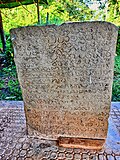
No edit summary |
m further refined page to improve readability and corrected details |
||
| Line 1: | Line 1: | ||
{{About|the early historic/early medieval (till 12th century AD) Mushika dynasty|the post-12th century state|Kolathunad}} | |||
{{Short description|Ruling lineage from ancient/early medieval south India}} | |||
{{Use dmy dates|date=August 2019}} | {{Use dmy dates|date=August 2019}} | ||
{{Use Indian English|date=August 2019}}{{Infobox former country | {{Use Indian English|date=August 2019}} | ||
|native_name = Ezhimala/ | {{Infobox former country | ||
|image_map = | | native_name = Ezhimala (early historic)<br>Mushika/Kolla-desham (medieval) | ||
| | | image_map = {{Location map+|Kerala|width=200|float=center | ||
|conventional_long_name = Mushika | |caption= | ||
|common_name = | |places= | ||
|status | {{Location map~|Kerala|lat_deg=12.018333|lon_deg=75.215833|position=bottom|marksize=0|label_size=80|label=MUSHIKAS (EZHIMALA)}} | ||
|year_start | }} | ||
|year_end | | image_map_caption = | ||
|common_languages | | conventional_long_name = Mushika | ||
* [[ | | common_name = | ||
* [[ | | status = | ||
|capital | | year_start = | ||
* [[Ezhimala (hill, Kannur)|Ezhimala]] (early historic) | | year_end = 12th century AD | ||
* Kollam (early medieval) | | common_languages = * [[Old Tamil|Tamil]] (early historic) | ||
* [[Malayalam language|Malayalam]] (medieval) | |||
| capital = * [[Ezhimala (hill, Kannur)|Ezhimala (Kannur)]] (early historic) | |||
* Kollam/Kolam (early medieval) | |||
* Karippattu, [[Taliparamba]] (c. 12th century) | * Karippattu, [[Taliparamba]] (c. 12th century) | ||
|today | | today = [[India]] | ||
|religion = [[Hinduism]] | | religion = [[Hinduism]] | ||
|demonym=|area_km2=|area_rank=|GDP_PPP=|GDP_PPP_year=|HDI=|HDI_year=}} | | demonym = | ||
| government_type = * Chieftaincy (early historic) | |||
* [[Monarchy]] (early medieval) | |||
| area_km2 = | |||
| area_rank = | |||
| GDP_PPP = | |||
| GDP_PPP_year = | |||
| HDI = | |||
| HDI_year = | |||
}} | |||
'''Mushika dynasty,''' also spelled '''Mushaka''', also '''Eli''' or '''Ezhi''',<ref name=":53">{{Cite book |last=Narayanan |first=M. G. S. |url=https://books.google.com/books?id=0YDCngEACAAJ |title=Perumals of Kerala |publisher=CosmoBooks |year=2013 |isbn=9788188765072 |location=Thrissur (Kerala) |pages=178 |chapter= |orig-year=1972}}</ref> was a minor dynastic power that held sway over the region in and around Mount Ezhi ([[Ezhimala (hill, Kannur)|Ezhimala]], in present-day [[Kannur district]]), [[North Malabar, Kerala|northern Kerala]], south India, from the early historic period up to the medieval period.<ref name=":53" /><ref>{{cite book |author=Menon |first=A. Sreedhara |url=https://books.google.com/books?id=wnAjqjhc1VcC |title=Kerala History and its Makers |date=2011 |publisher=DC Books |isbn=9788126437825 |location=Kottayam (Kerala) |page=29-32 |orig-year=1987}}</ref> | |||
The country of the Ezhimala, ruled by an ancient chiefly lineage ("the Muvan"), appears in [[Sangam period|early historic (pre-Pallava) south India]].<ref name=":06">{{Cite journal |last=Gurukkal |first=Rajan |date=2002 |title=Did State Exist in the Pre-Pallavan Tamil Region |journal=Proceedings of the Indian History Congress |volume=63 |pages=138–150 |issn=2249-1937 |jstor=44158082}}</ref><ref name=":82">{{Cite journal |last=Ganesh |first=K. N. |date=2009 |title=Lived Spaces in History: A Study in Human Geography in the Context of Sangam Texts |journal=Studies in History |language= |volume=25 |issue=2 |pages=151–195 |doi=10.1177/025764301002500201 |issn=0257-6430 |pmid= |s2cid=}}</ref> [[Sangam literature|Early Tamil poems (the Sangam Literature)]] contain several references to the exploits of Nannan, the ruler of Ezhimala (''fl. c.'' 180 AD<ref name=":202">{{cite book |last1=Sastri |first1=K. A. Nilakanta |author-link1= |url=http://indianculture.gov.in/ebooks/comprehensive-history-india-vol-ii-mauryas-and-satavahanas |title=Comprehensive History of India, Vol. 2: The Mauryas and Satavahanas |publisher=Orient Longman |year=1957 |isbn= |location=Bombay |pages=508, 511, 518, 535, and 538 |chapter= |orig-year=}}</ref>) who famously defeated the [[Dharmapuri|Tagadur]] [[Athiyamān|Satiyaputra]] ruler.<ref name=":532">{{Cite book |last=Narayanan |first=M. G. S. |url=https://books.google.com/books?id=0YDCngEACAAJ |title=Perumals of Kerala |publisher=CosmoBooks |year=2013 |isbn=9788188765072 |location=Thrissur (Kerala) |pages=195 |chapter= |orig-year=1972}}</ref><ref name=":10" /> Nannan was known as a great enemy of the [[Chera dynasty|early Chera]] rulers of western Tamil Nadu and central Kerala.<ref name=":532" /> The famous Kottayam Coin Hoard, a massive cache of mostly [[Julio-Claudian dynasty|Julio-Claudian (Roman)]] coins, was also discovered from the Ezhimala country.<ref name=":04">{{Cite book |last=Turner |first=Paula J. |url=https://www.routledge.com/Roman-Coins-from-India/Turner/p/book/9780367605827#:~:text=Description,post%2DJulio%2DClaudian%20coins. |title=Roman Coins from India |date= |publisher=University College London Institute of Archaeology Publications |year=2016 |isbn= |publication-date= |pages=8-9, 62-63 and 100 and 112 |orig-year=2009}}</ref> | |||
The | The Ezhimala polity evolved into a monarchical state (known as "Kolla-desham") in the early medieval period and soon came under the influence of the neighboring [[Chera Perumals of Makotai|Chera kingdom]].<ref name=":533">{{Cite book |last=Narayanan |first=M. G. S. |url=https://books.google.com/books?id=0YDCngEACAAJ |title=Perumals of Kerala |publisher=CosmoBooks |year=2013 |isbn=9788188765072 |location=Thrissur (Kerala) |pages=195, 118-119 and 137-138 |chapter= |orig-year=1972}}</ref><ref name=":622">{{Cite journal |last=Ganesh |first=K. N. |date=2009 |title=Historical Geography of Natu in South India with Special Reference to Kerala |journal=Indian Historical Review |volume=36 |issue=1 |pages=3–21 |doi=10.1177/037698360903600102 |issn=0376-9836 |s2cid=}}</ref><ref name=":24">{{Cite book |last=Veluthat |first=Kesavan |url=https://global.oup.com/academic/product/the-early-medieval-in-south-india-9780198069140 |title=The Early Medieval in South India |date=2009 |publisher=Oxford University Press |location=Delhi |pages=40, 160 and 261}}</ref> The Ezhimala or Mushika rulers are recorded to have supported the Cheras in their conflicts with the [[Chola dynasty|Chola Empire]].<ref name=":537">{{Cite book |last=Narayanan |first=M. G. S. |url=https://books.google.com/books?id=0YDCngEACAAJ |title=Perumals of Kerala |publisher=CosmoBooks |year=2013 |isbn=9788188765072 |location=Thrissur (Kerala) |pages=178-179 and 180-182 |chapter= |orig-year=1972}}</ref> Chola records mention the defeat of Kollam and the fall of its ruler, while another inscription confirms the presence of Chola soldiery in north Kerala in the early 11th century.<ref name=":538">{{Cite book |last=Narayanan |first=M. G. S. |url=https://books.google.com/books?id=0YDCngEACAAJ |title=Perumals of Kerala |publisher=CosmoBooks |year=2013 |isbn=9788188765072 |location=Thrissur (Kerala) |pages=118-119, 122-123, 137-138, 141, and 180-182 |chapter= |orig-year=1972}}</ref><ref name=":539">{{Cite book |last=Narayanan |first=M. G. S. |url=https://books.google.com/books?id=0YDCngEACAAJ |title=Perumals of Kerala |publisher=CosmoBooks |year=2013 |isbn=9788188765072 |location=Thrissur (Kerala) |pages=122-123 and 141 |chapter= |orig-year=1972}}</ref> After the decline of the Chera state, the kingdom endured as "Kolathunad" in the [[Kannur district|Kannur]]-[[Kasaragod district|Kasaragod]] region.<ref name=":532" /> The [[Mushika-vamsha|Mushaka Vamsa Kavya]], a dynastic chronicle composed in the 11th century by poet [[Atula|Athula]], describes the history of the Mushika lineage.<ref name=":54">{{Cite book |last=Thapar |first=Romila |title=The Penguin History of Early India: From the Origins to AD 1300 |date= |publisher=[[Penguin Books]] |year=2003 |pages=394-95 |chapter= |orig-year=2002}}</ref><ref name=":5310">{{Cite book |last=Narayanan |first=M. G. S. |url=https://books.google.com/books?id=0YDCngEACAAJ |title=Perumals of Kerala |publisher=CosmoBooks |year=2013 |isbn=9788188765072 |location=Thrissur (Kerala) |pages=178-179 |chapter= |orig-year=1972}}</ref> | ||
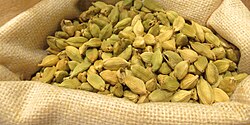
The economies of the early historic Ezhimala polity and the medieval Mushika state are thought to have depended largely on the Indian Ocean [[spice trade]] — particularly in [[Black pepper|pepper]], [[cardamom]], and other hill produce — while conventional agriculture (wet-rice cultivation) played a lesser role.<ref name=":24" /> | |||
The Mushika | == Etymology == | ||
The term "Mushika" or "Mushaka" Parvata is the [[Sanskrit]] translation of the ancient [[Tamil language|Tamil]] name "Ezhimalai" (or the Ezhil Kunram).<ref name=":82" /><ref name=":532" /> It was later mispronounced as "Elimala", which came to mean "the Mountain of the Rats".<ref name=":532" /><ref name=":3">{{Cite journal |last=Vielle |first=Christophe |date=2014 |editor-last=Veluthat |editor-first=Kesavan |editor2-last=Davis, Jr |editor2-first=Donald R. |title=How did Paraśurāma Come to Raise Kerala |url=https://dial.uclouvain.be/pr/boreal/object/boreal:158686 |journal=Irreverent History: Essays for M. G. S. Narayanan |language=en |pages=18-19}}</ref> The term "Mushika" also referred to the "Vaka" tree ([[Albizia lebbeck]] or [[Acacia|Acacia sirissa]]), which was considered sacred by the rulers of Ezhimala.<ref name=":771" /> | |||
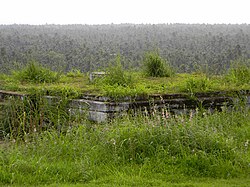
== | Ezhimala hill (or the Ezhil Kunram) is described in ''Mushaka Vamsa Kavya'' as "Mushaka Parvata".<ref name=":5310" /> The early historic fort of the Mushikas, located beneath Ettikulam Fort, is now protected by Department of Archaeology, Kerala.<ref>{{cite web |title=Ezhimala Fort |url=http://www.archaeology.kerala.gov.in/monuments/ezhimala-fort/25 |website=Department of Archaeology, Kerala |publisher=Government of Kerala}}</ref> | ||
The | |||
== Early historic Ezhimala rulers == | |||
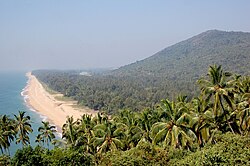
[[File:Ezhimala_beach.JPG|thumb|296x296px|Ezhimala Hill]] | |||
The ancient ruling family of Ezhimala appears to have existed in northern Kerala at least from the early historic (pre-[[Pallava dynasty|Pallava]]) period.<ref name=":5311">{{Cite book |last=Narayanan |first=M. G. S. |url=https://books.google.com/books?id=0YDCngEACAAJ |title=Perumals of Kerala |publisher=CosmoBooks |year=2013 |isbn=9788188765072 |location=Thrissur (Kerala) |pages=180-182 |chapter= |orig-year=1972}}</ref> [[Sangam literature|Ancient Tamil poems (the Sangam Literature)]] describe the polity of Ezhimalai (also "Ezhil-malai"), situated on the northern edge of Tamilakam (the Tamil country) on its western (Malabar) coast.<ref>{{Cite journal |date=1961 |title= |journal=Journal: Humanities |publisher=University of Madras |volume=Section A: 33-36 |page=188}}</ref> | |||
The rulers of Ezhimalai were among the most prominent hill chieftains of ancient Kerala. <ref name=":06" /> The "Muvan" chieftain mentioned in early Tamil poems — described as an adversary of the [[Chera dynasty|early Chera rulers]] of western Tamil Nadu and central Kerala — is identified with the Muvan ruler of Ezhimalai.<ref name=":532" /> The early historic Ezhimala clan maintained matrimonial alliances with the Chera, Pandya and, Chola families.<ref>{{Cite journal |last=Samy |first=P. L. |date=1994 |title=Nannan of North Malabar |url=https://archive.org/details/dli.jZY9lup2kZl6TuXGlZQdjZU6kuUy/mode/1up |journal=University Quarterly, Tamil Civilization |location=Tanjore |publisher=Tamil University |page=142}}</ref> The family was also related to that of the rulers of Kantiramala.<ref name=":06" /> | |||
According to the Sangam poems, the port of "Naravu" was located within the territory of Ezhimalai (Akam, 97).<ref name=":532" /> The [[Mahabharata]], the Sanskrit epic poem of ancient India, also mentions the Mushikas as one of the kingdoms of the deep south, grouping them alongside the Keralas, Pandyas, and Cholas.<ref>{{cite book |last1= |first1= |url=https://books.google.com/books?id=8897ridkczoC&pg=PA479 |title=Encyclopaedia of Ancient Indian Geography |publisher=Cosmo Publications |year=2002 |isbn=9788177552997 |editor-last=Kapoor |editor-first=Subodh |volume=II |location=New Delhi |pages=479-80 |chapter=Musika-Mushika}}</ref> | |||
== | === Ezhimala Nannan === | ||
[[ | Early Tamil tradition ([[Sangam literature|the Sangam poems]]) contains repeated references to several rulers of Ezhimala ("the Ezhil Kunram") bearing the name or title "Nannan".<ref name=":202" /><ref name=":532" /><ref name=":11">{{Cite book |last=Ferenczi |first=Roland |url=https://ediss.sub.uni-hamburg.de/bitstream/ediss/11295/1/Eo%CC%88tvo%CC%88s%20Lora%CC%81nd%20Tudoma%CC%81nyegyetem_new_2024.pdf |title=An Annotated Translation of the Patirruppattu and the Political Geography of the Early Cera Kingdom |publisher=University of Hamburg |editor-last=Wilden |editor-first=E. |location=Hamburg |publication-date=2022 |pages=111 and 114 |editor-last2=Wojtilla |editor-first2=Gyula}}</ref> These are attested in collections such as the [[Akanaṉūṟu|Akananuru]], [[Purananuru]], [[Naṟṟiṇai|Natrinai]], [[Patiṟṟuppattu|Pathitruppathu]], and [[Kuṟuntokai|Kurunthokai]].<ref name=":532" /> According to these poems, Nannan was the ruler of Ezhimalai ("the Ezhil Kunram"), situated on the north-western edge of the Tamil country.<ref name=":06" /><ref name=":8">{{Cite journal |last=Ganesh |first=K.N. |date=2009-08-01 |title=Lived Spaces in History: A Study in Human Geography in the Context of Sangam Texts |journal=Studies in History |language=en |volume=25 |issue=2 |pages=151–195 |doi=10.1177/025764301002500201 |issn=0257-6430 |pmid=20662174 |s2cid=20543161}}</ref> He is also notably described as a hunter chieftain of the "vetar" descent group ("vetar-ko-man")<ref name=":06" /> and is portrayed as a formidable adversary of the early (pre-[[Pallava dynasty|Pallava]]) [[Chera dynasty|Chera]] rulers.<ref name=":532" /> The Vaka tree is mentioned as the sacred tutelary tree of Ezhimala Nannan.<ref name=":8" /> | ||
Nannan is perhaps to be identified with "Nandana", the ancient Ezhimala ruler referred to in the medieval poem Mushaka Vamsa.<ref name=":771" />[[File:Madayi_kotta.JPG|thumb|346x346px|Madayi Fort remains]][[File:Madayi_para_in_feb.JPG|thumb|346x346px|Madayi Para]][[File:Jambai_Tamil_Brahmi.jpg|thumb|346x346px|Inscription of [[Dharmapuri|Tagadur]] Adigan or Adigaiman ruler (the [[Athiyamān|Satiyaputra]]) Neduman Anji]] | |||
* Nannan (''fl. c.'' 180 AD) is described as the ruler of "Pazhi, near the Ezhil Hill" and "Param" by poet Paranar (''Akam'', 142 and 152).<ref name=":202" /> He is also reported as the master of the Ezhil Hill and Puzhinadu country, and certain "Viyalur".<ref name=":55">{{Cite book |last=Ferenczi |first=Roland |url=https://ediss.sub.uni-hamburg.de/bitstream/ediss/11295/1/Eo%CC%88tvo%CC%88s%20Lora%CC%81nd%20Tudoma%CC%81nyegyetem_new_2024.pdf |title=An Annotated Translation of the Patirruppattu and the Political Geography of the Early Cera Kingdom |publisher=University of Hamburg |editor-last=Wilden |editor-first=E. |location=Hamburg |publication-date=2022 |pages=298-300 and 344 |editor-last2=Wojtilla |editor-first2=Gyula}}</ref> It is attested that Nannan was renowned for his gold ornaments and gilded chariots.<ref name=":771" /> | |||
* There are additional references to certain "Nannan" as the ruler of the Punnadu country, [[Tulu Nadu|Tulunadu country]] and the [[Konkan|Konkanam region]] and the [[Tondaimandalam|Thondai Mandalam]] (the later in "Malaipadukkadam").<ref name=":55" /> | |||
* Nannan was a companion of the [[Ay dynasty|Ay]] ruler (south Kerala) Eyinan.<ref name=":202" /> Poems 351 and 396 of the ''Purananuru'' describe Nannan and Eyinan as relatives and as extremely close friends. Their relationship was so intimate that Nannan renamed the "Pirampu hills" in his country as "Ay-pirampu".<ref>{{Cite journal |last=Venkatasubramanian |first=T. K. |date=1981 |title=Chieftaincies of the Sangam Age: A Development Approach |url=https://www.jstor.org/stable/i40173329 |journal=Proceedings of the Indian History Congress |volume=42 |pages=87}}</ref><ref>{{cite book |last=Gandhi |first=K. |url=https://www.tamildigitallibrary.in/admin/assets/book/TVA_BOK_0018936_Encyclopaedia_of_Tamil_Literature.pdf |title=Encyclopaedia of Tamil Literature |last2=Krishnan |first2=S. N. |last3=Udayakumar |first3=P. |date=1996 |publisher=Institute of Asian Studies |volume=III |location=Madras |page=97 |chapter=Ay}}</ref> | |||
* In the battle of Pazhi, the warriors of Nannan, led by certain Njimili (or Minjili; "the master of Param"), defeated the [[Dharmapuri|Thagadur]] [[Athiyamān|Adigan or Adigaiman ruler (the Satiyaputra)]] Neduman Anji.<ref name=":10">{{Cite book |last=Singh |first=Upinder |author-link= |url=https://books.google.com/books?id=H3lUIIYxWkEC |title=A History of Ancient and Early Medieval India: from the Stone Age to the 12th Century |date=2016 |publisher=[[Longman|Pearson Longman]] |isbn=9789332569966 |location=New Delhi |pages=385-86 |orig-year=2009}}</ref> Acting on behalf of the Chera ruler [[Perum Cheral Irumporai]], the Adigaiman had invaded Nannan's territory at Pazhi with a large force. During the battle, the Adigaiman was slain by Njimili (or Minjili) ("who won fame by putting to the sword vast numbers of enemies").<ref name=":202" /><ref name=":10" /> Njimili also killed Ay Eyinan, the old companion of Nannan, but was himself slain in the same conflict ("the battle of Pazhi Paranthalai", ''Akam'', 141, 181, and 396, and ''Natrinai'', 265).<ref name=":202" /> | |||
* It is also mentioned that in a battle at Kazhumalam, Nannan defeated a chieftain named Pindan (''Akam'', 152, and ''Natrinai'', 270).<ref name=":771" /> The poet Kudavayur Kirattanar records Nannan's defeat of a certain Pazhayan, with the support of his associates Ettai, Atti, Gangan, Katti, and Punthurai (''Akam'', 44). | |||
* It is further recorded that the "Kosar" people, associated with Chellur (Perinchellur or [[Taliparamba]]), attacked the Ezhimala country of Nannan, defeating him and even cutting down his totemic mango tree. According to the poems, Nannan had earlier executed a young girl who had unknowingly eaten a fruit that had fallen from his sacred mango tree and floated down to her in a stream. This act is said to have provoked the Kosar, leading to their attack and Nannan's defeat.<ref name=":771" /><ref name=":202" /> | |||
* Nannan was ultimately defeated and killed by [[Chera dynasty|Chera]] ruler "Kalankaykkanni" Narmudi Cheral (''fl. c.'' 180 AD) in the battle of "Kadambin Peruvayil"/"Vakai Perunthurai" (''Akam'', 152, 199, ''Pathitruppathu'', 40 and 4th decad, panegyric).<ref name=":202" /><ref name=":10" /> According to [[Patiṟṟuppattu|Pathitruppathu]] 40, after slaying Nannan, the Chera ruler also chopped down the sacred Vaka tree.<ref name=":11" /> | |||
Nannan (c. 210 AD), probably the son of the ruler mentioned earlier, is also introduced in the early Tamil poems.<ref name=":202" /> He is celebrated in "Malaipadukkadam" by the poet Perum Kausika and is also mentioned by Mankudi Marudan in "Maduraikkanchi".<ref name=":202" /> Another "Nannan" with the title "Udiyan" ("Nannan Udiyan"; ''Akam,'' 258: 1) is described as the "master of gold filled Pazhi".<ref name=":202" /> | |||
There references to another "Nannan", the ruler of "[[Konkan|Konkanam]]".'''<ref name=":532" />''' He is described as the Nannan dwelling in "Kanam" and as "Konkanam Kizhan" (the lord of Konkanam), and as the lord of the mountain Konkanam ("Ko Perunkanam") (''Akam'', 392).<ref name=":202" /> | |||
== Economy == | |||
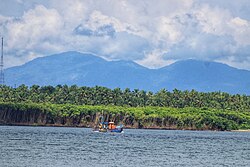
[[File:Ezhimala.jpg|thumb|296x296px|Ezhimala on the Malabar Coast]] | |||
[[File:Italy_to_India_Route.svg|thumb|296x296px|India Route]] | |||
[[File:Green_cardamomum_(fruit).jpg|thumb|296x296px|Cardamom ]] | |||
The primary resource base for the Ezhimala polity (in the early historic period) and the Mushika state (medieval) was Indian Ocean [[spice trade]] (esp. pepper, [[cardamom]] and other spices from the interior hills) rather than agriculture (wet paddy cultivation).<ref name=":24" /> Ezhimala Hill was notably the first landfall on the [[Malabar Coast]] for the sailors crossing the [[Arabian Sea]].<ref name=":24" /> | |||
Early Tamil | === Greco-Roman spice trade === | ||
Much like the rest of [[Malabar Coast]], the Ezhimala country and its ancient rulers benefited from [[Greco-Roman world|Greco-Roman]] Indian Ocean [[spice trade]] during the early historic period. Early Tamil literature mentions an Indian Ocean port known as "Naravu", located in Ezhimalai country (Akam, 97).<ref name=":532" /> The term "naravu" means "honey" or "liquor" in early Tamil dialects.<ref name=":33" /> | |||
{{blockquote|A kings' double nature: a guide to singers. His armies love massacre, he loves war, yet gifts flow from him ceaselessly, Come, dear singers. Let's go and see him in Naravu, where on trees no ax can fell, fruits ripen, unharmed by swarms of bees, egg-shaped [jackfruit], ready for the weary traveler in fields of steady, unfailing harvests; where warriors with bows that never tire of arrows shiver but stand austere in the sea winds mixed with the lit cloud and the spray of seafoam. There he is, in the town of Naravu, tender among tender women.|Pathitruppathu 60}} | |||
Naravu is generally identified with Naura, which is mentioned in the [[Periplus of the Erythraean Sea]], an early Greek manual of sailing directions written in the 1st century AD, as a port located somewhere north of Tyndis and [[Muziris]] (central Kerala) on the present-day Malabar Coast.<ref name="Ente_Kannur">{{cite book |author=Menon |first=A. Sreedhara |url=https://books.google.com/books?id=FVsw35oEBv4C |title=A Survey of Kerala History |publisher=DC Books |year=2007 |isbn=9788126415786 |location=Kottayam (Kerala) |orig-year=1967}}</ref><ref name=":33">{{cite book |author=Selvakumar |first=V. |title=Imperial Rome, Indian Ocean Regions and Muziris: New Perspectives on Maritime Trade |publisher=Taylor & Francis |year=2016 |isbn=978-1-351-99752-2 |editor-last=Mathew |editor-first=K. S. |pages=271 |chapter=Ancient Ports of Kerala: An Overview |chapter-url=https://books.google.com/books?id=8iUlDwAAQBAJ&pg=PA275}}</ref> According to both [[Periplus of the Erythraean Sea]] and [[Pliny the Elder]] (1st century AD), Naura was located on western coast of the Tamil-speaking south India ([[Limyrike|Limyrike/Limerike or Damirica/Damirike]]), but outside the influence of the [[Chera dynasty|Chera rulers of central Kerala/western Tamil Nadu.]]<ref name=":03">{{Cite journal |last1=Gurukkal |first1=Rajan |last2=Whittaker |first2=Dick |date=2001 |title=In Search of Muziris |url=https://www.cambridge.org/core/journals/journal-of-roman-archaeology/article/abs/in-search-of-muziris/EA19B86B91664256F7D97E65B3074AFD |journal=Journal of Roman Archaeology |language= |volume=14 |pages=334–350 |doi=10.1017/S1047759400019978 |issn=1047-7594 |url-access=subscription}}</ref><ref>{{Cite book |url=https://www.perseus.tufts.edu/hopper/text?doc=Perseus%3Atext%3A1999.02.0137%3Abook%3D6%3Achapter%3D26 |title=Pliny the Elder's The Natural History |date= |publisher=Taylor and Francis |year=1855 |editor-last=Bostock |editor-first=John |edition= |location=London |chapter=Voyages to India}}</ref><ref name=":33" /> | |||
{{Quote box | |||
| title = The Periplus of the Erythraean Sea, 53–54 | |||
| quote = Beyond Calliena there are other market-towns of this region; Semylla, Mandagora, Palaepatmae, Melizigara, Byzantium, Togarum and Aurannoboas. Then here are the islands called Sesecrienae and that of the Aegidii, and that of the Caenitae, opposite the place called Chersonesus (and in these places there are pirates), and after this the White Island. Then come Naura and Tyndis, the first markets of Damirica, and then Muziris and Nelcynda, which are now of leading importance. | |||
| author = | |||
| source = The Periplus of the Erythraean Sea, 53–54 | |||
| align = center | |||
| width = 75% | |||
| border = none | |||
| bgcolor = #e0e0e0 | |||
}} | |||
Naura is commonly identified with present-day [[Kannur|Kannur (Cannanore)]], located south of the Ezhimala Hill.<ref name=":33" /> However, historians have proposed different identifications for the ancient port.<ref name=":33" /> [[K. D. Thirunavukkarasu]] (1994) locates it in the [[Tulu Nadu|Tulu Country]], while some scholars identify it with [[Honnavar]] (Uttara Kannada).<ref name=":33" /> [[Wilfred Harvey Schoff|Wilfred H. Schoff]] (1912) places Naura at Kannur (Cannanore), and [[Lionel Casson]] (1989) associates it with [[Mangalore]], identifying it as Nitra.<ref name=":33" /> Sudhakar Chattopadhyaya (1980) also refers to Nitra (Nitrias), which is mentioned in Greco-Roman sources.<ref name=":33" /> | |||
The famous Kottayam Coin Hoard, a massive cache of mostly [[Julio-Claudian dynasty|Julio-Claudian (Roman)]] coins, was discovered around the year 1847 (1846-50) "on the slope of a hill by the [Arabian] sea" near [[Kannur district|Kannur (Cannanore)]].<ref name=":04" /> It is speculated that coins amounted to around 8000 [[aurei]] (if approximated).<ref name=":04" /> With few exceptions the coins were all of gold and were not worn by usage (and not deliberately slashed with a chisel).<ref name=":04" /> The composition (coin types and number) of the hoard is not known exactly. According to extant reports, there were at least 9 coins of emperor [[Augustus]], 28 of [[Tiberius]], two of [[Caligula]], and 16 coins of [[Claudius]] and 16 coins of [[Nero]] (a total of 71 coins, the last 32 in the Travancore Collection).<ref name=":04" /> There were also descriptions of coins of [[Caracalla]] (initially misidentified as [[Antoninus Pius]]).<ref name=":04" /> | |||
=== Medieval Indian Ocean trade === | |||
Famous medieval ports in the Ezhimala country included [[Madayi]], [[Valapattanam]] and Dharmapattanam ([[Dharmadom|Dharmadam]]).<ref name=":24" /> | |||
The medieval Ezhimala rulers appear to have encouraged a variety of merchant guilds in their country. Well-known Indian guilds such as the [[anjuvannam]], [[manigramam]], valanchiyar and nanadeshikal are attested in the region. The Mushika kings are also described as great champions of [[Hinduism|Hindu religion]] and temples, while some are noted for their support of a prominent [[Buddhism|Buddhist]] vihara in central Kerala.<ref name=":0W28">{{Cite book |last=Narayanan |first=M. G. S. |url=https://books.google.com/books?id=0YDCngEACAAJ&q=perumals+of+kerala |title=Perumals of Kerala |publisher=CosmoBooks |year=2013 |isbn=9788188765072 |location=Thrissur (Kerala) |pages=180-182 |orig-date=1972}}</ref> The presence of Jewish merchants in the ports of the Mushika country is also suggested. A site in [[Madayi]] is still known as "the Jew's Pond" (the Jutakkulam).<ref name=":0W28" /> | |||
== Political geography == | |||
== | === Early historic === | ||
[[File:Joothakkulam_2.jpg|thumb|296x296px|Jew's Pond (the Jutakkulam)]] | |||
According to [[Sangam literature|early Tamil poems (the Sangam Literature)]], the Ezhimala country of the early historic period was located to the north of the Chera country (central [[Kerala]]).<ref name=":771">{{Cite book |last=Ferenczi |first=Roland |url=https://ediss.sub.uni-hamburg.de/bitstream/ediss/11295/1/Eo%CC%88tvo%CC%88s%20Lora%CC%81nd%20Tudoma%CC%81nyegyetem_new_2024.pdf |title=An Annotated Translation of the Patirruppattu and the Political Geography of the Early Cera Kingdom |publisher=University of Hamburg |editor-last=Wilden |editor-first=E. |location=Hamburg |publication-date=2022 |pages=298-99 and 395-97 |editor-last2=Wojtilla |editor-first2=Gyula}}</ref> The Ezhimala chieftain Nannan is described as the ruler of the slopes of Pazhi, the [[Ezhimala (hill, Kannur)|Ezhil Hill (Ezhimala)]], and Param, as well as settlements such as Viyalur and a land called "Punnadu".<ref name=":771" /> He is also referred to as the lord of "Puzhinadu" and "[[Tulu Nadu]]".<ref name=":771" /> Ezhimala Hill notably served as the first landmark on the [[Malabar Coast]] for [[Arabian Sea]] navigators.<ref name=":24" /> | |||
There are also references to another "Nannan", the ruler of the land of "[[Konkan|Konkanam]]", and yet another "Nannan" who is described as ruling in [[Tondaimandalam|Tondai Mandalam]] (the later in the "Malaipadukkadam").'''<ref name=":0W29">{{Cite book |last=Narayanan |first=M. G. S. |url=https://books.google.com/books?id=0YDCngEACAAJ&q=perumals+of+kerala |title=Perumals of Kerala |publisher=CosmoBooks |year=2013 |isbn=9788188765072 |location=Thrissur (Kerala) |pages=195 |orig-date=1972}}</ref>'''<ref name=":771" /> According to the poems, Param was formerly the base of the chieftain Minjili, who was killed in the battle of "Pazhi Paranthalai".<ref name=":771" /> The country of Ezhimala was also situated near the land of the "Kosar" people and the country of the "Kadambu" tribe.<ref name=":771" /> It is further mentioned that Nannan fought and died in a battle against the Chera ruler Narmudi Cheral at the great harbour, "Perunthurai".<ref name=":771" /> | |||
}}</ref> | |||
The [[Akananuru]] describes the country of Nannan as follows.<ref name=":771" />{{Quote box | |||
| title = | |||
| quote = […] in the slopes of Pāḻi in the tall/long Ēḻil mountain of Naṉṉaṉ with a pearl necklace, the chief of Pāram with joy of charity/abundant toddy, who liberally gives/flings elephant bulls [due his] famous liberalism, the chief with a spear who overcame Piṇṭaṉ while breaking [his] opposition on the battlefield, [Piṇṭaṉ] who very much swarmed around showing copious enmity like a colony of small white shrimps that attacks while the good vessels which give the wealth (taṉam) of great harbour (peruntuṟai) with seashore groves at the extension of the sounding water, had been sundered/dispersed […] | |||
| author = | |||
| source = | |||
| align = center | |||
| width = 75% | |||
| border = none | |||
| bgcolor = #e0e0e0 | |||
}} | |||
=== Medieval period === | |||
In the medieval period, the [[Ezhimala (hill, Kannur)|Ezhimala]] region or the "Kolla-desham" was home to important ports such as [[Madayi Kavu|Madayi]], [[Valapattanam]], and Dharmapattanam ([[Dharmadam]]).<ref name=":24" /> The ports of the Kollam country are thought to have hosted [[Jews|Jewish]] traders, and in Madayi, a site remembered as 'the Jew's Pond/Place' (Jutakkulam//Jutakkalam) survives as a trace of this legacy.<ref name=":0W28" /> | |||
== Medieval | == Medieval Mushikas == | ||
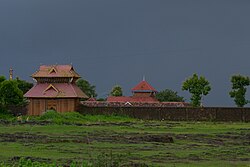
[[File:Anantapura Lake Temple.jpg|thumbnail|[[Ananthapura Lake Temple|Ananthapadmanabhaswamy | [[File:Vadukunda_temple,_Madayi.jpg|thumb|296x296px|Vadukunda Temple, Madayi]] | ||
The | [[File:Anantapura Lake Temple.jpg|thumbnail|[[Ananthapura Lake Temple|Ananthapadmanabhaswamy Temple]] at Ananthapura, [[Kumbla]]|296x296px]] | ||
The medieval "Kolla-desam" (the country of Kollam/Kolam or the "Mushika-rajya") stretched along the banks of [[Kavvayi River|Kavvai]], [[Kuppam River|Kuppam]] and [[Valapattanam River|Valappattanam]] rivers in northern Kerala.<ref name=":622" /> It came under the influence of the [[Chera dynasty|Chera kingdom]] in the early medieval period.<ref name=":622" /> The reign of Chera ruler [[Vijayaraga]] (late 9th century AD) probably witnessed the expansion of Chera influence into the Ezhimala country.<ref name=":62">{{Cite book |last=Narayanan |first=M. G. S. |url=https://books.google.com/books?id=0YDCngEACAAJ |title=Perumals of Kerala |publisher=CosmoBooks |year=2013 |isbn=9788188765072 |location=Thrissur (Kerala) |pages=65-67 and 97-98 |chapter= |orig-year=1972}}</ref> According to literary sources, as one of the major subordinates of the Chera, the Ezhimala rulers were required to supply armed contingents for the Cheras in their battles against the imperial [[Chola Empire|Cholas]].<ref name=":25">{{Cite book |last=Veluthat |first=Kesavan |url=https://global.oup.com/academic/product/the-early-medieval-in-south-india-9780198069140 |title=The Early Medieval in South India |date=2009 |publisher=Oxford University Press |location=Delhi |pages=40 and 261}}</ref> However, the repeated [[Chola dynasty|Chola]] references (early 11th century AD) to three rulers in medieval Kerala — the Kolam/Ezhimala ruler, the Chera ruler and the Venad ruler — suggest that the effective power of the Chera rulers at this time was confined mainly to central Kerala. Chera authority in northern and southern Kerala appears to have been largely nominal compared with the political and military strength exercised by the Ezhimala rulers in the north and the Venad rulers in the south.<ref name=":02">{{Cite book |last=Karashima |first=Noburu |url=https://global.oup.com/academic/product/a-concise-history-of-south-india-9780198099772 |title=A Concise History of South India: Issues and Interpretations |publisher=Oxford University Press |year=2014 |location=New Delhi |pages=144-145}}</ref><ref name=":62" /> | |||
While other Kerala chieftaincies under the Chera rulers maintained local militias called "the Hundred", the Ezhimala ruler commanded his own "Companions of Honour", called "the Thousand". This privilege was generally reserved for the Chera ruler at Mahodayapuram himself. Inscriptions from the neighboring [[Alupa dynasty|Alupa state]] also refer to this armed militia of "the ruler of Kolam".<ref name=":25" /> | |||
=== Origins from Mushaka Vamsa Kavya === | |||
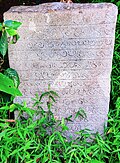
[[File:Kuruvakkavu temple inscription, Kannapuram, Kannur, Kerala (cropped).jpg|thumb|215x215px|Kannapuram inscription]] | |||
[[File:Maniyoor temple inscription, Maniyoor Subrahmanya Swamy temple (Kerala).jpg|thumb|210x210px|Maniyoor inscription]] | |||
The Mushaka Vamsa Kavya, an 11th century dynastic chronicle composed by poet "[[Atula|Athula]]" in the court of Mushika ruler Srikantha, narrates the history of the Mushika lineage.<ref name=":54" /><ref name=":5310" /><ref name=":15">{{Cite book |last=Rao |first=T. A. Gopinatha |url=https://archive.org/details/in.ernet.dli.2015.367520/page/n23/mode/1up |title=Travancore Archaeological Series |publisher=Methodist Publishing House |year=1913 |volume=II |location=Madras |pages=106-113 |chapter=No. 10—Mushika Vamsa: A Study}}</ref> According to the poem, the medieval Mushika rulers bore the [[Vaishnavism|Vaishnava]] garuda (eagle) banner as their flag-sign and claimed descent from the [[Kshatriya|Kshatriyas]] of the [[Haihaya kingdom|Hehaya]] line of [[Mahishmati|Mahismati]], themselves [[Yadava]] Kshatriyas.<ref name=":9">{{Cite journal |last=Vielle |first=Christophe |date=2012 |orig-date=2011 |title=Ravivarman Kulasekhara the Yadava and Sagara the Son of Yadavi: Real and Ideal Kings in Matrilineal Kerala |url=https://journal.equinoxpub.com/ROSA/article/view/11188 |journal=Religions of South Asia |language= |volume=5 |issue=1–2 |pages=369–70 and 375–76 |doi=10.1558/rosa.v5i1/2.365 |issn=|url-access=subscription |hdl=2078.1/129594 |hdl-access=free }}</ref> The chronicle states that the first Mushika king was consecrated by [[Parashurama]] as a Kshatriya ruler. He was the son of a widowed queen of [[Mahishmati|Mahismati]] who had fled Parashurama's wrath and taken refuge at the divine Ezhimala Mountain.<ref name=":9" /><ref name=":3" /> His youngest son, Nandana, succeeded him as Mushika ruler of the city of "Kolam".<ref name=":9" /> The first Ramaghata Mushika (the traditional title of Mushika rulers) had as his minister a "[[vaishya]]" known by the title "Maha Navika" (the Great Sailor).<ref name=":15" /> | |||
The poem recounts that a Mushika ruler named Jayamani regained his throne with the aid of a [[Pandya dynasty|Pandya]], while another, Virchona, killed a [[Pallava dynasty|Pallava]] royal and married his daughter.<ref name=":15" /> It also records that the daughter of the Mushika ruler Kunchi Varma was married to the Chera (Kerala) king "Raghupati" Jayaraga. Later, Kunchi Varma's son, Isana Varma "Ranamani", fought against the same king Jayaraga. Peace was re-established through the mediation of Goda "Keralaketu", the son of Jayaraga and the Mushika princess. Following this, king Jayaraga entered Mushika territory and visited the capital Kola, at which time Isana Varma married a [[Chola dynasty|Chola]] princess.<ref name=":15" /> Scholars often interpret these episodes in light of the growing [[Chola Empire|Chola]]-[[Rashtrakuta Empire|Rashtrakuta]] rivalry in southern India.<ref name=":24" /> The chronicle also notes that during the reign of king Validhara, Mushika country was attacked by Ganga forces from the Mountains.<ref name=":15" /> Finally, the kavya states that prince Valabha, at the command of his uncle Ramaghata Jayamani, marched south to assist the Kerala (the Chera) ruler in resisting a [[Chola dynasty|Chola]] invasion of Kerala.<ref name=":15" /> After his coronation, Valabha is said to have extended Mushika power by conquering several islands in the ocean, identified with the [[Lakshadweep|Laccadives]].<ref name=":15" /> | |||
{| class="wikitable plainrowheaders" | |||
|+Mushika/Kollam Rulers from Medieval Inscriptions (10th –12th centuries AD) | |||
! scope="col" |Name | |||
! class="unsortable" scope="col" |Title | |||
! scope="col" |Reign | |||
! scope="col" |Inscription | |||
|- | |||
!Validhara Vikrama Rama | |||
|N/A | |||
|fl. c. 929 AD | |||
|[[Ramanthali inscriptions|Ezhimala-Narayankannur inscription]]<ref name=":0W2">{{Cite book |last=Narayanan |first=M. G. S. |url=https://books.google.com/books?id=0YDCngEACAAJ&q=perumals+of+kerala |title=Perumals of Kerala |publisher=CosmoBooks |year=2013 |isbn=9788188765072 |location=Thrissur (Kerala) |pages=180-181 |orig-date=1972}}</ref> | |||
|- | |||
!Kantan Karivarman | |||
|"Ramakuta Muvar" | |||
|fl. c. 1020 AD | |||
|Eramam inscription of [[Chera dynasty|Chera]] Bhaskara Ravi<ref name=":0W2" /> | |||
|- | |||
!Jayamani | |||
|"Mushikesvara" | |||
|fl. c. 1020 AD | |||
|Tiruvadur inscription<ref name=":0W22">{{Cite book |last=Narayanan |first=M. G. S. |url=https://books.google.com/books?id=0YDCngEACAAJ&q=perumals+of+kerala |title=Perumals of Kerala |publisher=CosmoBooks |year=2013 |isbn=9788188765072 |location=Thrissur (Kerala) |pages=480-81 |orig-date=1972}}</ref> | |||
|- | |||
!- | |||
|"Ramakuta Muvar" | |||
| - | |||
|[[Tiruvalla copper plates|Tiruvalla Copper Plates/Huzur Treasury Plates]]<ref name=":0W23">{{Cite book |last=Narayanan |first=M. G. S. |url=https://books.google.com/books?id=0YDCngEACAAJ&q=perumals+of+kerala |title=Perumals of Kerala |publisher=CosmoBooks |year=2013 |isbn=9788188765072 |location=Thrissur (Kerala) |pages=197 |orig-date=1972}}</ref> | |||
|- | |||
!Udaya Varma | |||
|"Ramakuta Muvar" | |||
|Early 12th century AD | |||
|Kannapuram inscription<ref name=":0W24">{{Cite book |last=Narayanan |first=M. G. S. |url=https://books.google.com/books?id=0YDCngEACAAJ&q=perumals+of+kerala |title=Perumals of Kerala |publisher=CosmoBooks |year=2013 |isbn=9788188765072 |location=Thrissur (Kerala) |pages=485 |orig-date=1972}}</ref> | |||
|} | |||
=== Chola attacks on Mushika kingdom (Kolla-desam) === | |||
[[File:Ezhimala_beach.JPG|thumb|296x296px|Ezhimala beach]] | |||
''Employs the corrections and revisions suggested by M. G. S. Narayanan to the interpretations of K. A. Nilakanta Sastri and Elamkulam P. N. Kunjan Pillai.'' | |||
In 1005 AD, the 20th regnal year of the [[Chola dynasty|Chola]] emperor [[Rajaraja I]] (985–1014 AD), the Senur inscription records his defeat of the "haughty" kings of [[Kollam]] (in southern Kerala), Kolladesam, and [[Kodungallur]] (the Chera ruler).<ref name=":0W25">{{Cite book |last=Narayanan |first=M. G. S. |url=https://books.google.com/books?id=0YDCngEACAAJ&q=perumals+of+kerala |title=Perumals of Kerala |publisher=CosmoBooks |year=2013 |isbn=9788188765072 |location=Thrissur (Kerala) |pages=118-119 and 137-138 |orig-date=1972}}</ref> The term "Kolladesam" (the country of Kollam) is generally identified with the Ezhimala kingdom in northern Kerala. Scholars note that the inscription emphasises plunder rather than conquest, suggesting that the Chola victories at these Kerala ports were achieved primarily through naval operations.<ref name=":0W25" /> A little later, Rajaraja's successor, [[Rajadhiraja Chola|Rajadhiraja]] (1018/19–1053/54 AD), claimed to have "confined the undaunted king of [[Venad]] [back] to Che[ra]nadu, destroyed the Iramakuta Muvar in anger, and put on a fresh garland of Vanchi flowers after capturing Kantalur Salai, while the strong Villavan (the Chera king) hid himself in terror inside the jungle".<ref name=":0W26">{{Cite book |last=Narayanan |first=M. G. S. |url=https://books.google.com/books?id=0YDCngEACAAJ&q=perumals+of+kerala |title=Perumals of Kerala |publisher=CosmoBooks |year=2013 |isbn=9788188765072 |location=Thrissur (Kerala) |pages=122-123 and 141 |orig-date=1972}}</ref> The "Ramakuta Muvar", or the Mushika ruler, is not named in this prasasti (the events are dated to around 1018–1019 AD).<ref name=":0W26" /> The Chola military presence in northern Kerala is further corroborated by the Eramam inscription (c. 1020 AD) of the Chera ruler Bhaskara Ravi (10th/11th century AD), which records a meeting at the Chalappuram Temple attended by Rajendra Chola's Samaya Senapati.<ref name=":0W26" /> | |||
== Inscriptions == | |||
=== Inscriptions mentioning Mushika rules by name/title === | |||
{| class="wikitable" | {| class="wikitable" | ||
|- | |||
!Inscription | !Inscription | ||
!Location | !Location | ||
| Line 104: | Line 184: | ||
|[[Ramanthali inscriptions|Ramanthali/Ezhimala-Narayankannur inscription]] (929 AD) | |[[Ramanthali inscriptions|Ramanthali/Ezhimala-Narayankannur inscription]] (929 AD) | ||
| | | | ||
*[[Ramanthali]], near [[Ezhimala (hill, Kannur)|Ezhimala.]]<ref name=": | * [[Ramanthali]], near [[Ezhimala (hill, Kannur)|Ezhimala.]]<ref name=":5327">{{Cite book |last=Narayanan |first=M. G. S. |url=https://books.google.com/books?id=0YDCngEACAAJ |title=Perumals of Kerala |publisher=CosmoBooks |year=2013 |isbn=9788188765072 |location=Thrissur (Kerala) |pages=475-76 and 483 |chapter= |orig-year=1972}}</ref> | ||
* A single granite slab in the courtyard of the Narayankannur Temple.<ref name=": | * A single granite slab in the courtyard of the Narayankannur Temple.<ref name=":5327" /> | ||
| | | | ||
* Mentions Mushika Validhara Vikrama Rama.<ref name=": | * Mentions Mushika Validhara Vikrama Rama.<ref name=":5327" /> | ||
* The so-called Agreement of Muzhikkulam is quoted in the record.<ref name=": | * The so-called Agreement of Muzhikkulam is quoted in the record.<ref name=":5327" /> | ||
* Merchant guild [[manigramam]] is appointed as the guardian of the Narayankannur Temple.<ref name=": | * Merchant guild [[manigramam]] is appointed as the guardian of the Narayankannur Temple.<ref name=":5327" /> | ||
|- | |- | ||
|Eramam inscription (1020 AD) | |Eramam inscription (1020 AD) | ||
| | | | ||
* Eramam, near [[Payyanur]].<ref name=": | * Eramam, near [[Payyanur]].<ref name=":5328">{{Cite book |last=Narayanan |first=M. G. S. |url=https://books.google.com/books?id=0YDCngEACAAJ |title=Perumals of Kerala |publisher=CosmoBooks |year=2013 |isbn=9788188765072 |location=Thrissur (Kerala) |pages=455 |chapter= |orig-year=1972}}</ref> | ||
*A single slab in the site of the ruined Chalappuram Temple.<ref name=": | *A single slab in the site of the ruined Chalappuram Temple.<ref name=":5328" /> | ||
| | | | ||
* Mentions Chera | * Mentions Chera king Bhaskara Ravi Manukuladitya (10th/11th century AD) and Ramakuta Muvar Kantan Karivarman (Srikantha Kartha) (c.1020 AD).<ref name=":5328" /> | ||
* Mentions the merchants guilds of Valanchiyar and Nanadeyar.<ref name=": | * Mentions the merchants guilds of Valanchiyar and Nanadeyar.<ref name=":5328" /> | ||
* Mentions [[Rajendra Chola I|Rajendra Chola]] Samaya Senapati from Katappa Palli.<ref name=": | * Mentions [[Rajendra Chola I|Rajendra Chola]] Samaya Senapati from Katappa Palli.<ref name=":5328" /> | ||
|- | |- | ||
|Tiruvadur inscription (c. 1020 AD) | |Tiruvadur inscription (c. 1020 AD) | ||
| | | | ||
* Partly in the courtyard of the temple on either side of the sopana.<ref name=": | * Partly in the courtyard of the temple on either side of the sopana.<ref name=":5331">{{Cite book |last=Narayanan |first=M. G. S. |url=https://books.google.com/books?id=0YDCngEACAAJ |title=Perumals of Kerala |publisher=CosmoBooks |year=2013 |isbn=9788188765072 |location=Thrissur (Kerala) |pages=480-81 |chapter= |orig-year=1972}}</ref> | ||
* Partly in the sanctum sanctorum of the temple.<ref name=": | * Partly in the sanctum sanctorum of the temple.<ref name=":5331" /> | ||
| | | | ||
* Creation and endowment of a grama (Brahmin settlement) with members chosen from some old grama settlements from central Kerala ([[Vaikom]], [[North Paravur|Paravur]], Avittathoor, [[Irinjalakuda]] and Peruvanam).<ref name=": | * Creation and endowment of a grama (Brahmin settlement) with members chosen from some old grama settlements from central Kerala ([[Vaikom]], [[North Paravur|Paravur]], Avittathoor, [[Irinjalakuda]] and Peruvanam).<ref name=":5331" /> | ||
* The engraver is mentioned as Rama Jayamani, the "royal goldsmith of the Mushika king [Jayamani]".<ref name=": | * The engraver is mentioned as Rama Jayamani, the "royal goldsmith of the Mushika king [Jayamani]".<ref name=":5331" /> | ||
|- | |- | ||
|[[Tiruvalla copper plates|Tiruvalla Copper Plates]] | |[[Tiruvalla copper plates|Tiruvalla Copper Plates]] | ||
| Line 133: | Line 213: | ||
*[[Thiruvalla|Tiruvalla]] | *[[Thiruvalla|Tiruvalla]] | ||
| | | | ||
* Presence of a Ramakuta Muvar (as a donor to the [[Sreevallabha Temple|Tiruvalla temple]]).<ref>Narayanan | * Presence of a Ramakuta Muvar (as a donor to the [[Sreevallabha Temple|Tiruvalla temple]]).<ref name=":5333">{{Cite book |last=Narayanan |first=M. G. S. |url=https://books.google.com/books?id=0YDCngEACAAJ |title=Perumals of Kerala |publisher=CosmoBooks |year=2013 |isbn=9788188765072 |location=Thrissur (Kerala) |pages=197 |chapter= |orig-year=1972}}</ref> | ||
|- | |- | ||
|Kannapuram inscription | |Kannapuram inscription | ||
(beginning of the 12th century) | (beginning of the 12th century) | ||
| | | | ||
* Single stone slab fixed on a platform outside the prakara (outer wall) of the Kannapuram temple.<ref name=": | * Single stone slab fixed on a platform outside the prakara (outer wall) of the Kannapuram temple.<ref name=":5334">{{Cite book |last=Narayanan |first=M. G. S. |url=https://books.google.com/books?id=0YDCngEACAAJ |title=Perumals of Kerala |publisher=CosmoBooks |year=2013 |isbn=9788188765072 |location=Thrissur (Kerala) |pages=485 |chapter= |orig-year=1972}}</ref> | ||
| | | | ||
* Ramakuta Muvar Udaya Varma is mentioned.<ref name=": | * Ramakuta Muvar Udaya Varma is mentioned.<ref name=":5334" /> | ||
|} | |} | ||
== Inscriptions related to Mushika country == | == Inscriptions related to Mushika country == | ||
=== Records mentioning Chera rulers from Mushika country === | |||
=== Records mentioning Chera | |||
{| class="wikitable" | {| class="wikitable" | ||
|+ | |+ | ||
| Line 162: | Line 232: | ||
|Panthalayani Kollam inscription (973 AD) | |Panthalayani Kollam inscription (973 AD) | ||
| | | | ||
* Single stone slab in the upper frame of the srikoyil (central shrine) entrance in Tali temple.<ref name=": | * Single stone slab in the upper frame of the srikoyil (central shrine) entrance in Tali temple.<ref name=":5312">{{Cite book |last=Narayanan |first=M. G. S. |url=https://books.google.com/books?id=0YDCngEACAAJ |title=Perumals of Kerala |publisher=CosmoBooks |year=2013 |isbn=9788188765072 |location=Thrissur (Kerala) |pages=448-49 |chapter= |orig-year=1972}}</ref> | ||
| | |||
|- | |||
| | | | ||
* | * Name of the king – probably Bhaskara Ravi Manukuladitya (10th/11th century AD) – is built over by the present structure.<ref name=":5312" /> | ||
|- | |- | ||
|[[Pullur Kodavalam inscription]] (1020 AD) | |[[Pullur Kodavalam inscription]] (1020 AD) | ||
| | | | ||
* Pullur, near [[Kanhangad]].<ref> | * Pullur, near [[Kanhangad]].<ref name=":0">{{Cite journal |date=1967 |editor-last=Gai |editor-first=G. S. |title=No. 125: Pullur |url=https://www.tamildigitallibrary.in/admin/assets/book/TVA_BOK_0057509/ACL-ARCH_00855_Annual_report_on_Indian_epigraphy_for_1963_64_1967.pdf |journal=Annual Report on Indian Epigraphy for 1963-64 |location=Delhi |publisher=Archaeological Survey of India |issue= |pages=64-65}}</ref> | ||
* Engraved on a single stone slab in the courtyard of the Pullur Kodavalam Vishnu Temple<ref name=": | * Engraved on a single stone slab in the courtyard of the Pullur Kodavalam Vishnu Temple.<ref name=":5314">{{Cite book |last=Narayanan |first=M. G. S. |url=https://books.google.com/books?id=0YDCngEACAAJ |title=Perumals of Kerala |publisher=CosmoBooks |year=2013 |isbn=9788188765072 |location=Thrissur (Kerala) |pages=68-70, 84 and 454 |chapter= |orig-year=1972}}</ref><ref name=":110">{{Cite journal |last=Narayanan |first=M. G. S. |date=1969 |title=The Identity and Date of King Manukuladitya |url=https://www.jstor.org/stable/44138333 |journal=Proceedings of the Indian History Congress |volume=31 |pages=73–78 |issn=}}</ref> | ||
| | | | ||
* Mentions [[Chera dynasty|Chera | * Mentions [[Chera dynasty|Chera]] king Bhaskara Ravi Manukuladitya (962–1021 AD).<ref name=":5314" /><ref name=":110" /> | ||
* Identified king Manukuladitya with king Bhaskara Ravi.<ref name=": | * Identified king Manukuladitya with king Bhaskara Ravi.<ref name=":110" /> | ||
|- | |- | ||
|Trichambaram inscription | |Trichambaram inscription | ||
(c. 1040 AD) | (c. 1040 AD) | ||
| | | | ||
* Three blocks of granite on the base of the central shrine of the temple.<ref name=": | * Three blocks of granite on the base of the central shrine of the temple.<ref name=":5315">{{Cite book |last=Narayanan |first=M. G. S. |url=https://books.google.com/books?id=0YDCngEACAAJ |title=Perumals of Kerala |publisher=CosmoBooks |year=2013 |isbn=9788188765072 |location=Thrissur (Kerala) |pages=465 |chapter= |orig-year=1972}}</ref> | ||
| | | | ||
* Mentions [[Chera dynasty|Chera | * Mentions [[Chera dynasty|Chera]] king Raja Raja (c. 1036–1089 AD).<ref name=":5315" /> | ||
|- | |- | ||
|Panthalayani Kollam inscription | |Panthalayani Kollam inscription | ||
(c. 1089 AD) | (c. 1089 AD) | ||
| | | | ||
* Single granite slab in the courtyard of the Panthalayani Kollam Bhagavati temple.<ref name=": | * Single granite slab in the courtyard of the Panthalayani Kollam Bhagavati temple.<ref name=":5325">{{Cite book |last=Narayanan |first=M. G. S. |url=https://books.google.com/books?id=0YDCngEACAAJ |title=Perumals of Kerala |publisher=CosmoBooks |year=2013 |isbn=9788188765072 |location=Thrissur (Kerala) |pages=470 |chapter= |orig-year=1972}}</ref> | ||
* The record was destroyed.<ref name=": | * The record was destroyed.<ref name=":5325" /> | ||
| | | | ||
* Mentions [[Chera dynasty|Chera | * Mentions [[Chera dynasty|Chera]] king Rama Kulasekhara (1089–1122 AD).<ref name=":5325" /> | ||
* The location given as "Kollathu Panthalayani".<ref name=": | * The location given as "Kollathu Panthalayani".<ref name=":5325" /> | ||
|} | |} | ||
=== Miscellaneous records === | === Miscellaneous records === | ||
{| class="wikitable" | {| class="wikitable" | ||
|- | |||
!Inscription | !Inscription | ||
!Location | !Location | ||
| Line 205: | Line 269: | ||
|[[Ramanthali inscriptions|Ramanthali/Ezhimala-Narayankannur inscription]] (1075 AD) | |[[Ramanthali inscriptions|Ramanthali/Ezhimala-Narayankannur inscription]] (1075 AD) | ||
| | | | ||
*[[Ramanthali]], near [[Ezhimala (hill, Kannur)|Ezhimala]].<ref name=": | *[[Ramanthali]], near [[Ezhimala (hill, Kannur)|Ezhimala]].<ref name=":5323">{{Cite book |last=Narayanan |first=M. G. S. |url=https://books.google.com/books?id=0YDCngEACAAJ |title=Perumals of Kerala |publisher=CosmoBooks |year=2013 |isbn=9788188765072 |location=Thrissur (Kerala) |pages=483 |chapter= |orig-year=1972}}</ref> | ||
* Obverse sides of three granite blocks in the base of central shrine of Narayankannur Temple.<ref name=": | * Obverse sides of three granite blocks in the base of central shrine of Narayankannur Temple.<ref name=":5322">{{Cite book |last=Narayanan |first=M. G. S. |url=https://books.google.com/books?id=0YDCngEACAAJ |title=Perumals of Kerala |publisher=CosmoBooks |year=2013 |isbn=9788188765072 |location=Thrissur (Kerala) |pages=483 |chapter= |orig-year=1972}}</ref> | ||
| | | | ||
* Mentions [[Alupa dynasty|Alupa]] king Kunda Alupa.<ref name=": | * Mentions [[Alupa dynasty|Alupa]] king Kunda Alupa.<ref name=":5324">{{Cite book |last=Narayanan |first=M. G. S. |url=https://books.google.com/books?id=0YDCngEACAAJ |title=Perumals of Kerala |publisher=CosmoBooks |year=2013 |isbn=9788188765072 |location=Thrissur (Kerala) |pages=483 |chapter= |orig-year=1972}}</ref> | ||
|- | |- | ||
|Trichambaram inscription | |Trichambaram inscription | ||
(c. 11th century) | (c. 11th century) | ||
| | | | ||
* Two granite blocks on the base of the central shrine of the temple.<ref name=": | * Two granite blocks on the base of the central shrine of the temple.<ref name=":5320">{{Cite book |last=Narayanan |first=M. G. S. |url=https://books.google.com/books?id=0YDCngEACAAJ |title=Perumals of Kerala |publisher=CosmoBooks |year=2013 |isbn=9788188765072 |location=Thrissur (Kerala) |pages=485-86 |chapter= |orig-year=1972}}</ref> | ||
| | | | ||
* The chieftain of Eranad Manavepala Mana Viyatan creates an endowment for the thiruvilakku at the Trichambaram Temple.<ref name=": | * The chieftain of Eranad Manavepala Mana Viyatan creates an endowment for the thiruvilakku at the Trichambaram Temple.<ref name=":5320" /> | ||
* Manavepala Manaviyatan appears in the famous [[Jewish copper plates of Cochin|Jewish copper plates]] (c. 1000 AD). | * Manavepala Manaviyatan appears in the famous [[Jewish copper plates of Cochin|Jewish copper plates]] (c. 1000 AD).<ref name=":5320" /> | ||
|- | |- | ||
|Maniyur inscription | |Maniyur inscription | ||
(c. 11th century) | (c. 11th century) | ||
| | | | ||
* Single stone slab outside the prakara (outer wall) of the temple.<ref name=": | * Single stone slab outside the prakara (outer wall) of the temple.<ref name=":5320" /> | ||
| | | | ||
* | * Maniyur inscriptionConfirms the extension of the so-called Agreement of Muzhikkulam to Mushika country.<ref name=":5320" /> | ||
|} | |} | ||
== Udaya Varma Kolattiri == | |||
== | An inscription discovered from Kannappuram Temple, found fixed on a platform outside the prakara of the temple, in old Malayalam mentions king "Udaya Varma Ramakuta Muvar".<ref name=":5320" /> The record give details of land set apart for the expenses of the Kannapuram Temple. The inscription can be attributed to the early years of the 12th century on the basis of script and language.<ref name=":5321">{{Cite book |last=Narayanan |first=M. G. S. |url=https://books.google.com/books?id=0YDCngEACAAJ |title=Perumals of Kerala |publisher=CosmoBooks |year=2013 |isbn=9788188765072 |location=Thrissur (Kerala) |pages=485 |chapter= |orig-year=1972}}</ref> | ||
An inscription discovered from Kannappuram Temple, found fixed on a platform outside the prakara of the temple, in old Malayalam mentions king " | |||
{| class="wikitable" | {| class="wikitable" | ||
|- | |||
!Inscription | !Inscription | ||
!Location | !Location | ||
| Line 236: | Line 300: | ||
(beginning of the 12th century) | (beginning of the 12th century) | ||
| | | | ||
* Single stone slab fixed on a platform outside the prakara (outer wall) of the Kannapuram temple.<ref name=": | * Single stone slab fixed on a platform outside the prakara (outer wall) of the Kannapuram temple.<ref name=":5318">{{Cite book |last=Narayanan |first=M. G. S. |url=https://books.google.com/books?id=0YDCngEACAAJ |title=Perumals of Kerala |publisher=CosmoBooks |year=2013 |isbn=9788188765072 |location=Thrissur (Kerala) |pages=485 |chapter= |orig-year=1972}}</ref> | ||
| | | | ||
* Ramakuta Muvar Udaya Varma is mentioned.<ref name=": | * Ramakuta Muvar Udaya Varma is mentioned.<ref name=":5319">{{Cite book |last=Narayanan |first=M. G. S. |url=https://books.google.com/books?id=0YDCngEACAAJ |title=Perumals of Kerala |publisher=CosmoBooks |year=2013 |isbn=9788188765072 |location=Thrissur (Kerala) |pages=485 |chapter= |orig-year=1972}}</ref> | ||
|} | |} | ||
King | King Udaya Varma of Karippattu palace in Kolattunadu is described as a favourite of the medieval Chera king in traditional Kerala chronicles. He is described as the overlord of the Fort Valapattanam, the medieval Chera king's Palace, the Taliparamba Temple, and the Perinchellur Brahmin village.<ref name=":5317">{{Cite book |last=Narayanan |first=M. G. S. |url=https://books.google.com/books?id=0YDCngEACAAJ |title=Perumals of Kerala |publisher=CosmoBooks |year=2013 |isbn=9788188765072 |location=Thrissur (Kerala) |pages=131 |chapter= |orig-year=1972}}</ref> | ||
==References== | ==References== | ||
{{ | {{reflist|colwidth=30em}} | ||
=== Bibliography === | === Bibliography === | ||
* {{cite book |author= | * {{Cite journal |last=Ganesh |first=K. N. |date=2009 |title=Lived Spaces in History: A Study in Human Geography in the Context of Sangam Texts |journal=Studies in History |language= |volume=25 |issue=2 |pages=151–195 |doi=10.1177/025764301002500201 |issn=0257-6430 |pmid= |s2cid=}} | ||
* {{ | * {{Cite journal |last=Ganesh |first=K. N. |date=2009 |title=Historical Geography of Natu in South India with Special Reference to Kerala |journal=Indian Historical Review |volume=36 |issue=1 |pages=3–21 |doi=10.1177/037698360903600102 |issn=0376-9836 |s2cid=}} | ||
* {{cite book |author= | * {{Cite journal |last=Gurukkal |first=Rajan |date=2002 |title=Did State Exist in the Pre-Pallavan Tamil Region |journal=Proceedings of the Indian History Congress |volume=63 |pages=138–150 |issn=2249-1937 |jstor=44158082}} | ||
* {{ | *{{cite book |author=Menon |first=A. Sreedhara |url=https://books.google.com/books?id=FVsw35oEBv4C&pg=PA45 |title=A Survey Of Kerala History |publisher=DC Books |year=2007 |isbn=978-81-264-1578-6 |location=Kottayam (Kerala) |orig-year=1967}} | ||
* {{Cite book |last=Narayanan |first=M. G. S. |url=https://books.google.com/books?id=0YDCngEACAAJ&q=perumals+of+kerala |title=Perumals of Kerala |publisher=CosmoBooks |year=2013 |isbn=9788188765072 |location=Thrissur (Kerala) |pages= |orig-date=1972}} | |||
* {{cite book |last1=Sastri |first1=K. A. Nilakanta |author-link1= |url=http://indianculture.gov.in/ebooks/comprehensive-history-india-vol-ii-mauryas-and-satavahanas |title=Comprehensive History of India, Vol. 2: The Mauryas and Satavahanas |publisher=Orient Longman |year=1957 |isbn= |location=Bombay |pages=|chapter= |orig-year=}} | |||
* {{Cite book |last=Veluthat |first=Kesavan |url=https://global.oup.com/academic/product/the-early-medieval-in-south-india-9780198069140 |title=The Early Medieval in South India |date=2009 |publisher=Oxford University Press |location=Delhi |pages=}} | |||
*{{Cite journal |last=Vielle |first=Christophe |date=2012 |orig-date=2011 |title=Ravivarman Kulasekhara the Yadava and Sagara the Son of Yadavi: Real and Ideal Kings in Matrilineal Kerala |url=https://journal.equinoxpub.com/ROSA/article/view/11188 |journal=Religions of South Asia |language= |volume=5 |issue=1–2 |pages= |doi=10.1558/rosa.v5i1/2.365 |issn=|url-access=subscription |hdl=2078.1/129594 |hdl-access=free }} | |||
*{{Cite journal |last=Vielle |first=Christophe |date=2014 |editor-last=Veluthat |editor-first=Kesavan |editor2-last=Davis, Jr |editor2-first=Donald R. |title=How did Paraśurāma Come to Raise Kerala |url=https://dial.uclouvain.be/pr/boreal/object/boreal:158686 |journal=Irreverent History: Essays for M. G. S. Narayanan |language=en |pages=18-19}} | |||
{{Kerala}} | {{Kerala}} | ||
{{Kerala topics}} | {{Kerala topics}} | ||
[[Category:History of Kannur district]] | |||
[[Category:History of | |||
[[Category:Ancient Tamil Nadu]] | [[Category:Ancient Tamil Nadu]] | ||
[[Category:Kingdoms in the Mahabharata]] | [[Category:Kingdoms in the Mahabharata]] | ||
[[Category:Hindu dynasties]] | |||
Latest revision as of 09:33, 15 March 2026
Mushika Ezhimala (early historic) Mushika/Kolla-desham (medieval) | |
|---|---|
 MUSHIKAS (EZHIMALA) | |
| Capital |
|
| Common languages | |
| Religion | Hinduism |
| Government |
|
| Today part of | India |
Mushika dynasty, also spelled Mushaka, also Eli or Ezhi,[1] was a minor dynastic power that held sway over the region in and around Mount Ezhi (Ezhimala, in present-day Kannur district), northern Kerala, south India, from the early historic period up to the medieval period.[1][2]
The country of the Ezhimala, ruled by an ancient chiefly lineage ("the Muvan"), appears in early historic (pre-Pallava) south India.[3][4] Early Tamil poems (the Sangam Literature) contain several references to the exploits of Nannan, the ruler of Ezhimala (fl. c. 180 AD[5]) who famously defeated the Tagadur Satiyaputra ruler.[6][7] Nannan was known as a great enemy of the early Chera rulers of western Tamil Nadu and central Kerala.[6] The famous Kottayam Coin Hoard, a massive cache of mostly Julio-Claudian (Roman) coins, was also discovered from the Ezhimala country.[8]
The Ezhimala polity evolved into a monarchical state (known as "Kolla-desham") in the early medieval period and soon came under the influence of the neighboring Chera kingdom.[9][10][11] The Ezhimala or Mushika rulers are recorded to have supported the Cheras in their conflicts with the Chola Empire.[12] Chola records mention the defeat of Kollam and the fall of its ruler, while another inscription confirms the presence of Chola soldiery in north Kerala in the early 11th century.[13][14] After the decline of the Chera state, the kingdom endured as "Kolathunad" in the Kannur-Kasaragod region.[6] The Mushaka Vamsa Kavya, a dynastic chronicle composed in the 11th century by poet Athula, describes the history of the Mushika lineage.[15][16]
The economies of the early historic Ezhimala polity and the medieval Mushika state are thought to have depended largely on the Indian Ocean spice trade — particularly in pepper, cardamom, and other hill produce — while conventional agriculture (wet-rice cultivation) played a lesser role.[11]
Etymology[edit | edit source]
The term "Mushika" or "Mushaka" Parvata is the Sanskrit translation of the ancient Tamil name "Ezhimalai" (or the Ezhil Kunram).[4][6] It was later mispronounced as "Elimala", which came to mean "the Mountain of the Rats".[6][17] The term "Mushika" also referred to the "Vaka" tree (Albizia lebbeck or Acacia sirissa), which was considered sacred by the rulers of Ezhimala.[18]
Ezhimala hill (or the Ezhil Kunram) is described in Mushaka Vamsa Kavya as "Mushaka Parvata".[16] The early historic fort of the Mushikas, located beneath Ettikulam Fort, is now protected by Department of Archaeology, Kerala.[19]
Early historic Ezhimala rulers[edit | edit source]

The ancient ruling family of Ezhimala appears to have existed in northern Kerala at least from the early historic (pre-Pallava) period.[20] Ancient Tamil poems (the Sangam Literature) describe the polity of Ezhimalai (also "Ezhil-malai"), situated on the northern edge of Tamilakam (the Tamil country) on its western (Malabar) coast.[21]
The rulers of Ezhimalai were among the most prominent hill chieftains of ancient Kerala. [3] The "Muvan" chieftain mentioned in early Tamil poems — described as an adversary of the early Chera rulers of western Tamil Nadu and central Kerala — is identified with the Muvan ruler of Ezhimalai.[6] The early historic Ezhimala clan maintained matrimonial alliances with the Chera, Pandya and, Chola families.[22] The family was also related to that of the rulers of Kantiramala.[3]
According to the Sangam poems, the port of "Naravu" was located within the territory of Ezhimalai (Akam, 97).[6] The Mahabharata, the Sanskrit epic poem of ancient India, also mentions the Mushikas as one of the kingdoms of the deep south, grouping them alongside the Keralas, Pandyas, and Cholas.[23]
Ezhimala Nannan[edit | edit source]
Early Tamil tradition (the Sangam poems) contains repeated references to several rulers of Ezhimala ("the Ezhil Kunram") bearing the name or title "Nannan".[5][6][24] These are attested in collections such as the Akananuru, Purananuru, Natrinai, Pathitruppathu, and Kurunthokai.[6] According to these poems, Nannan was the ruler of Ezhimalai ("the Ezhil Kunram"), situated on the north-western edge of the Tamil country.[3][25] He is also notably described as a hunter chieftain of the "vetar" descent group ("vetar-ko-man")[3] and is portrayed as a formidable adversary of the early (pre-Pallava) Chera rulers.[6] The Vaka tree is mentioned as the sacred tutelary tree of Ezhimala Nannan.[25]
Nannan is perhaps to be identified with "Nandana", the ancient Ezhimala ruler referred to in the medieval poem Mushaka Vamsa.[18]


- Nannan (fl. c. 180 AD) is described as the ruler of "Pazhi, near the Ezhil Hill" and "Param" by poet Paranar (Akam, 142 and 152).[5] He is also reported as the master of the Ezhil Hill and Puzhinadu country, and certain "Viyalur".[26] It is attested that Nannan was renowned for his gold ornaments and gilded chariots.[18]
- There are additional references to certain "Nannan" as the ruler of the Punnadu country, Tulunadu country and the Konkanam region and the Thondai Mandalam (the later in "Malaipadukkadam").[26]
- Nannan was a companion of the Ay ruler (south Kerala) Eyinan.[5] Poems 351 and 396 of the Purananuru describe Nannan and Eyinan as relatives and as extremely close friends. Their relationship was so intimate that Nannan renamed the "Pirampu hills" in his country as "Ay-pirampu".[27][28]
- In the battle of Pazhi, the warriors of Nannan, led by certain Njimili (or Minjili; "the master of Param"), defeated the Thagadur Adigan or Adigaiman ruler (the Satiyaputra) Neduman Anji.[7] Acting on behalf of the Chera ruler Perum Cheral Irumporai, the Adigaiman had invaded Nannan's territory at Pazhi with a large force. During the battle, the Adigaiman was slain by Njimili (or Minjili) ("who won fame by putting to the sword vast numbers of enemies").[5][7] Njimili also killed Ay Eyinan, the old companion of Nannan, but was himself slain in the same conflict ("the battle of Pazhi Paranthalai", Akam, 141, 181, and 396, and Natrinai, 265).[5]
- It is also mentioned that in a battle at Kazhumalam, Nannan defeated a chieftain named Pindan (Akam, 152, and Natrinai, 270).[18] The poet Kudavayur Kirattanar records Nannan's defeat of a certain Pazhayan, with the support of his associates Ettai, Atti, Gangan, Katti, and Punthurai (Akam, 44).
- It is further recorded that the "Kosar" people, associated with Chellur (Perinchellur or Taliparamba), attacked the Ezhimala country of Nannan, defeating him and even cutting down his totemic mango tree. According to the poems, Nannan had earlier executed a young girl who had unknowingly eaten a fruit that had fallen from his sacred mango tree and floated down to her in a stream. This act is said to have provoked the Kosar, leading to their attack and Nannan's defeat.[18][5]
- Nannan was ultimately defeated and killed by Chera ruler "Kalankaykkanni" Narmudi Cheral (fl. c. 180 AD) in the battle of "Kadambin Peruvayil"/"Vakai Perunthurai" (Akam, 152, 199, Pathitruppathu, 40 and 4th decad, panegyric).[5][7] According to Pathitruppathu 40, after slaying Nannan, the Chera ruler also chopped down the sacred Vaka tree.[24]
Nannan (c. 210 AD), probably the son of the ruler mentioned earlier, is also introduced in the early Tamil poems.[5] He is celebrated in "Malaipadukkadam" by the poet Perum Kausika and is also mentioned by Mankudi Marudan in "Maduraikkanchi".[5] Another "Nannan" with the title "Udiyan" ("Nannan Udiyan"; Akam, 258: 1) is described as the "master of gold filled Pazhi".[5]
There references to another "Nannan", the ruler of "Konkanam".[6] He is described as the Nannan dwelling in "Kanam" and as "Konkanam Kizhan" (the lord of Konkanam), and as the lord of the mountain Konkanam ("Ko Perunkanam") (Akam, 392).[5]
Economy[edit | edit source]


.jpg)
The primary resource base for the Ezhimala polity (in the early historic period) and the Mushika state (medieval) was Indian Ocean spice trade (esp. pepper, cardamom and other spices from the interior hills) rather than agriculture (wet paddy cultivation).[11] Ezhimala Hill was notably the first landfall on the Malabar Coast for the sailors crossing the Arabian Sea.[11]
Greco-Roman spice trade[edit | edit source]
Much like the rest of Malabar Coast, the Ezhimala country and its ancient rulers benefited from Greco-Roman Indian Ocean spice trade during the early historic period. Early Tamil literature mentions an Indian Ocean port known as "Naravu", located in Ezhimalai country (Akam, 97).[6] The term "naravu" means "honey" or "liquor" in early Tamil dialects.[29]
A kings' double nature: a guide to singers. His armies love massacre, he loves war, yet gifts flow from him ceaselessly, Come, dear singers. Let's go and see him in Naravu, where on trees no ax can fell, fruits ripen, unharmed by swarms of bees, egg-shaped [jackfruit], ready for the weary traveler in fields of steady, unfailing harvests; where warriors with bows that never tire of arrows shiver but stand austere in the sea winds mixed with the lit cloud and the spray of seafoam. There he is, in the town of Naravu, tender among tender women.
— Pathitruppathu 60
Naravu is generally identified with Naura, which is mentioned in the Periplus of the Erythraean Sea, an early Greek manual of sailing directions written in the 1st century AD, as a port located somewhere north of Tyndis and Muziris (central Kerala) on the present-day Malabar Coast.[30][29] According to both Periplus of the Erythraean Sea and Pliny the Elder (1st century AD), Naura was located on western coast of the Tamil-speaking south India (Limyrike/Limerike or Damirica/Damirike), but outside the influence of the Chera rulers of central Kerala/western Tamil Nadu.[31][32][29]
Naura is commonly identified with present-day Kannur (Cannanore), located south of the Ezhimala Hill.[29] However, historians have proposed different identifications for the ancient port.[29] K. D. Thirunavukkarasu (1994) locates it in the Tulu Country, while some scholars identify it with Honnavar (Uttara Kannada).[29] Wilfred H. Schoff (1912) places Naura at Kannur (Cannanore), and Lionel Casson (1989) associates it with Mangalore, identifying it as Nitra.[29] Sudhakar Chattopadhyaya (1980) also refers to Nitra (Nitrias), which is mentioned in Greco-Roman sources.[29]
The famous Kottayam Coin Hoard, a massive cache of mostly Julio-Claudian (Roman) coins, was discovered around the year 1847 (1846-50) "on the slope of a hill by the [Arabian] sea" near Kannur (Cannanore).[8] It is speculated that coins amounted to around 8000 aurei (if approximated).[8] With few exceptions the coins were all of gold and were not worn by usage (and not deliberately slashed with a chisel).[8] The composition (coin types and number) of the hoard is not known exactly. According to extant reports, there were at least 9 coins of emperor Augustus, 28 of Tiberius, two of Caligula, and 16 coins of Claudius and 16 coins of Nero (a total of 71 coins, the last 32 in the Travancore Collection).[8] There were also descriptions of coins of Caracalla (initially misidentified as Antoninus Pius).[8]
Medieval Indian Ocean trade[edit | edit source]
Famous medieval ports in the Ezhimala country included Madayi, Valapattanam and Dharmapattanam (Dharmadam).[11]
The medieval Ezhimala rulers appear to have encouraged a variety of merchant guilds in their country. Well-known Indian guilds such as the anjuvannam, manigramam, valanchiyar and nanadeshikal are attested in the region. The Mushika kings are also described as great champions of Hindu religion and temples, while some are noted for their support of a prominent Buddhist vihara in central Kerala.[33] The presence of Jewish merchants in the ports of the Mushika country is also suggested. A site in Madayi is still known as "the Jew's Pond" (the Jutakkulam).[33]
Political geography[edit | edit source]
Early historic[edit | edit source]

According to early Tamil poems (the Sangam Literature), the Ezhimala country of the early historic period was located to the north of the Chera country (central Kerala).[18] The Ezhimala chieftain Nannan is described as the ruler of the slopes of Pazhi, the Ezhil Hill (Ezhimala), and Param, as well as settlements such as Viyalur and a land called "Punnadu".[18] He is also referred to as the lord of "Puzhinadu" and "Tulu Nadu".[18] Ezhimala Hill notably served as the first landmark on the Malabar Coast for Arabian Sea navigators.[11]
There are also references to another "Nannan", the ruler of the land of "Konkanam", and yet another "Nannan" who is described as ruling in Tondai Mandalam (the later in the "Malaipadukkadam").[34][18] According to the poems, Param was formerly the base of the chieftain Minjili, who was killed in the battle of "Pazhi Paranthalai".[18] The country of Ezhimala was also situated near the land of the "Kosar" people and the country of the "Kadambu" tribe.[18] It is further mentioned that Nannan fought and died in a battle against the Chera ruler Narmudi Cheral at the great harbour, "Perunthurai".[18]
The Akananuru describes the country of Nannan as follows.[18]
Medieval period[edit | edit source]
In the medieval period, the Ezhimala region or the "Kolla-desham" was home to important ports such as Madayi, Valapattanam, and Dharmapattanam (Dharmadam).[11] The ports of the Kollam country are thought to have hosted Jewish traders, and in Madayi, a site remembered as 'the Jew's Pond/Place' (Jutakkulam//Jutakkalam) survives as a trace of this legacy.[33]
Medieval Mushikas[edit | edit source]


The medieval "Kolla-desam" (the country of Kollam/Kolam or the "Mushika-rajya") stretched along the banks of Kavvai, Kuppam and Valappattanam rivers in northern Kerala.[10] It came under the influence of the Chera kingdom in the early medieval period.[10] The reign of Chera ruler Vijayaraga (late 9th century AD) probably witnessed the expansion of Chera influence into the Ezhimala country.[35] According to literary sources, as one of the major subordinates of the Chera, the Ezhimala rulers were required to supply armed contingents for the Cheras in their battles against the imperial Cholas.[36] However, the repeated Chola references (early 11th century AD) to three rulers in medieval Kerala — the Kolam/Ezhimala ruler, the Chera ruler and the Venad ruler — suggest that the effective power of the Chera rulers at this time was confined mainly to central Kerala. Chera authority in northern and southern Kerala appears to have been largely nominal compared with the political and military strength exercised by the Ezhimala rulers in the north and the Venad rulers in the south.[37][35]
While other Kerala chieftaincies under the Chera rulers maintained local militias called "the Hundred", the Ezhimala ruler commanded his own "Companions of Honour", called "the Thousand". This privilege was generally reserved for the Chera ruler at Mahodayapuram himself. Inscriptions from the neighboring Alupa state also refer to this armed militia of "the ruler of Kolam".[36]
Origins from Mushaka Vamsa Kavya[edit | edit source]
.jpg)
.jpg)
The Mushaka Vamsa Kavya, an 11th century dynastic chronicle composed by poet "Athula" in the court of Mushika ruler Srikantha, narrates the history of the Mushika lineage.[15][16][38] According to the poem, the medieval Mushika rulers bore the Vaishnava garuda (eagle) banner as their flag-sign and claimed descent from the Kshatriyas of the Hehaya line of Mahismati, themselves Yadava Kshatriyas.[39] The chronicle states that the first Mushika king was consecrated by Parashurama as a Kshatriya ruler. He was the son of a widowed queen of Mahismati who had fled Parashurama's wrath and taken refuge at the divine Ezhimala Mountain.[39][17] His youngest son, Nandana, succeeded him as Mushika ruler of the city of "Kolam".[39] The first Ramaghata Mushika (the traditional title of Mushika rulers) had as his minister a "vaishya" known by the title "Maha Navika" (the Great Sailor).[38]
The poem recounts that a Mushika ruler named Jayamani regained his throne with the aid of a Pandya, while another, Virchona, killed a Pallava royal and married his daughter.[38] It also records that the daughter of the Mushika ruler Kunchi Varma was married to the Chera (Kerala) king "Raghupati" Jayaraga. Later, Kunchi Varma's son, Isana Varma "Ranamani", fought against the same king Jayaraga. Peace was re-established through the mediation of Goda "Keralaketu", the son of Jayaraga and the Mushika princess. Following this, king Jayaraga entered Mushika territory and visited the capital Kola, at which time Isana Varma married a Chola princess.[38] Scholars often interpret these episodes in light of the growing Chola-Rashtrakuta rivalry in southern India.[11] The chronicle also notes that during the reign of king Validhara, Mushika country was attacked by Ganga forces from the Mountains.[38] Finally, the kavya states that prince Valabha, at the command of his uncle Ramaghata Jayamani, marched south to assist the Kerala (the Chera) ruler in resisting a Chola invasion of Kerala.[38] After his coronation, Valabha is said to have extended Mushika power by conquering several islands in the ocean, identified with the Laccadives.[38]
| Name | Title | Reign | Inscription |
|---|---|---|---|
| Validhara Vikrama Rama | N/A | fl. c. 929 AD | Ezhimala-Narayankannur inscription[40] |
| Kantan Karivarman | "Ramakuta Muvar" | fl. c. 1020 AD | Eramam inscription of Chera Bhaskara Ravi[40] |
| Jayamani | "Mushikesvara" | fl. c. 1020 AD | Tiruvadur inscription[41] |
| - | "Ramakuta Muvar" | - | Tiruvalla Copper Plates/Huzur Treasury Plates[42] |
| Udaya Varma | "Ramakuta Muvar" | Early 12th century AD | Kannapuram inscription[43] |
Chola attacks on Mushika kingdom (Kolla-desam)[edit | edit source]
Employs the corrections and revisions suggested by M. G. S. Narayanan to the interpretations of K. A. Nilakanta Sastri and Elamkulam P. N. Kunjan Pillai.
In 1005 AD, the 20th regnal year of the Chola emperor Rajaraja I (985–1014 AD), the Senur inscription records his defeat of the "haughty" kings of Kollam (in southern Kerala), Kolladesam, and Kodungallur (the Chera ruler).[44] The term "Kolladesam" (the country of Kollam) is generally identified with the Ezhimala kingdom in northern Kerala. Scholars note that the inscription emphasises plunder rather than conquest, suggesting that the Chola victories at these Kerala ports were achieved primarily through naval operations.[44] A little later, Rajaraja's successor, Rajadhiraja (1018/19–1053/54 AD), claimed to have "confined the undaunted king of Venad [back] to Che[ra]nadu, destroyed the Iramakuta Muvar in anger, and put on a fresh garland of Vanchi flowers after capturing Kantalur Salai, while the strong Villavan (the Chera king) hid himself in terror inside the jungle".[45] The "Ramakuta Muvar", or the Mushika ruler, is not named in this prasasti (the events are dated to around 1018–1019 AD).[45] The Chola military presence in northern Kerala is further corroborated by the Eramam inscription (c. 1020 AD) of the Chera ruler Bhaskara Ravi (10th/11th century AD), which records a meeting at the Chalappuram Temple attended by Rajendra Chola's Samaya Senapati.[45]
Inscriptions[edit | edit source]
Inscriptions mentioning Mushika rules by name/title[edit | edit source]
| Inscription | Location | Notes |
|---|---|---|
| Ramanthali/Ezhimala-Narayankannur inscription (929 AD) |
|
|
| Eramam inscription (1020 AD) |
| |
| Tiruvadur inscription (c. 1020 AD) |
| |
| Tiruvalla Copper Plates |
| |
| Kannapuram inscription
(beginning of the 12th century) |
|
|
[edit | edit source]
Records mentioning Chera rulers from Mushika country[edit | edit source]
| Inscription | Location | Notes |
|---|---|---|
| Panthalayani Kollam inscription (973 AD) |
|
|
| Pullur Kodavalam inscription (1020 AD) | ||
| Trichambaram inscription
(c. 1040 AD) |
|
|
| Panthalayani Kollam inscription
(c. 1089 AD) |
Miscellaneous records[edit | edit source]
| Inscription | Location | Notes |
|---|---|---|
| Ramanthali/Ezhimala-Narayankannur inscription (1075 AD) |
|
|
| Trichambaram inscription
(c. 11th century) |
|
|
| Maniyur inscription
(c. 11th century) |
|
|
Udaya Varma Kolattiri[edit | edit source]
An inscription discovered from Kannappuram Temple, found fixed on a platform outside the prakara of the temple, in old Malayalam mentions king "Udaya Varma Ramakuta Muvar".[60] The record give details of land set apart for the expenses of the Kannapuram Temple. The inscription can be attributed to the early years of the 12th century on the basis of script and language.[61]
| Inscription | Location | Notes |
|---|---|---|
| Kannapuram inscription
(beginning of the 12th century) |
|
|
King Udaya Varma of Karippattu palace in Kolattunadu is described as a favourite of the medieval Chera king in traditional Kerala chronicles. He is described as the overlord of the Fort Valapattanam, the medieval Chera king's Palace, the Taliparamba Temple, and the Perinchellur Brahmin village.[64]
References[edit | edit source]
- ↑ 1.0 1.1 Narayanan, M. G. S. (2013) [1972]. Perumals of Kerala. Thrissur (Kerala): CosmoBooks. p. 178. ISBN 9788188765072.
- ↑ Menon, A. Sreedhara (2011) [1987]. Kerala History and its Makers. Kottayam (Kerala): DC Books. p. 29-32. ISBN 9788126437825.
- ↑ 3.0 3.1 3.2 3.3 3.4 Gurukkal, Rajan (2002). "Did State Exist in the Pre-Pallavan Tamil Region". Proceedings of the Indian History Congress. 63: 138–150. ISSN 2249-1937. JSTOR 44158082.
- ↑ 4.0 4.1 Ganesh, K. N. (2009). "Lived Spaces in History: A Study in Human Geography in the Context of Sangam Texts". Studies in History. 25 (2): 151–195. doi:10.1177/025764301002500201. ISSN 0257-6430.
- ↑ 5.00 5.01 5.02 5.03 5.04 5.05 5.06 5.07 5.08 5.09 5.10 5.11 Sastri, K. A. Nilakanta (1957). Comprehensive History of India, Vol. 2: The Mauryas and Satavahanas. Bombay: Orient Longman. pp. 508, 511, 518, 535, and 538.
- ↑ 6.00 6.01 6.02 6.03 6.04 6.05 6.06 6.07 6.08 6.09 6.10 6.11 Narayanan, M. G. S. (2013) [1972]. Perumals of Kerala. Thrissur (Kerala): CosmoBooks. p. 195. ISBN 9788188765072.
- ↑ 7.0 7.1 7.2 7.3 Singh, Upinder (2016) [2009]. A History of Ancient and Early Medieval India: from the Stone Age to the 12th Century. New Delhi: Pearson Longman. pp. 385–86. ISBN 9789332569966.
- ↑ 8.0 8.1 8.2 8.3 8.4 8.5 Turner, Paula J. (2016) [2009]. Roman Coins from India. University College London Institute of Archaeology Publications. pp. 8–9, 62-63 and 100 and 112.
- ↑ Narayanan, M. G. S. (2013) [1972]. Perumals of Kerala. Thrissur (Kerala): CosmoBooks. pp. 195, 118-119 and 137-138. ISBN 9788188765072.
- ↑ 10.0 10.1 10.2 Ganesh, K. N. (2009). "Historical Geography of Natu in South India with Special Reference to Kerala". Indian Historical Review. 36 (1): 3–21. doi:10.1177/037698360903600102. ISSN 0376-9836.
- ↑ 11.0 11.1 11.2 11.3 11.4 11.5 11.6 11.7 Veluthat, Kesavan (2009). The Early Medieval in South India. Delhi: Oxford University Press. pp. 40, 160 and 261.
- ↑ Narayanan, M. G. S. (2013) [1972]. Perumals of Kerala. Thrissur (Kerala): CosmoBooks. pp. 178-179 and 180-182. ISBN 9788188765072.
- ↑ Narayanan, M. G. S. (2013) [1972]. Perumals of Kerala. Thrissur (Kerala): CosmoBooks. pp. 118–119, 122–123, 137–138, 141, and 180-182. ISBN 9788188765072.
- ↑ Narayanan, M. G. S. (2013) [1972]. Perumals of Kerala. Thrissur (Kerala): CosmoBooks. pp. 122-123 and 141. ISBN 9788188765072.
- ↑ 15.0 15.1 Thapar, Romila (2003) [2002]. The Penguin History of Early India: From the Origins to AD 1300. Penguin Books. pp. 394–95.
- ↑ 16.0 16.1 16.2 Narayanan, M. G. S. (2013) [1972]. Perumals of Kerala. Thrissur (Kerala): CosmoBooks. pp. 178–179. ISBN 9788188765072.
- ↑ 17.0 17.1 Vielle, Christophe (2014). Veluthat, Kesavan; Davis, Jr, Donald R. (eds.). "How did Paraśurāma Come to Raise Kerala". Irreverent History: Essays for M. G. S. Narayanan: 18–19.
- ↑ 18.00 18.01 18.02 18.03 18.04 18.05 18.06 18.07 18.08 18.09 18.10 18.11 18.12 Ferenczi, Roland (2022). Wilden, E.; Wojtilla, Gyula (eds.). An Annotated Translation of the Patirruppattu and the Political Geography of the Early Cera Kingdom (PDF). Hamburg: University of Hamburg. pp. 298-99 and 395-97.
- ↑ "Ezhimala Fort". Department of Archaeology, Kerala. Government of Kerala.
- ↑ Narayanan, M. G. S. (2013) [1972]. Perumals of Kerala. Thrissur (Kerala): CosmoBooks. pp. 180–182. ISBN 9788188765072.
- ↑ Journal: Humanities. Section A: 33-36. University of Madras: 188. 1961.
{{cite journal}}: Missing or empty|title=(help) - ↑ Samy, P. L. (1994). "Nannan of North Malabar". University Quarterly, Tamil Civilization. Tanjore: Tamil University: 142.
- ↑ Kapoor, Subodh, ed. (2002). "Musika-Mushika". Encyclopaedia of Ancient Indian Geography. Vol. II. New Delhi: Cosmo Publications. pp. 479–80. ISBN 9788177552997.
- ↑ 24.0 24.1 Ferenczi, Roland (2022). Wilden, E.; Wojtilla, Gyula (eds.). An Annotated Translation of the Patirruppattu and the Political Geography of the Early Cera Kingdom (PDF). Hamburg: University of Hamburg. pp. 111 and 114.
- ↑ 25.0 25.1 Ganesh, K.N. (1 August 2009). "Lived Spaces in History: A Study in Human Geography in the Context of Sangam Texts". Studies in History. 25 (2): 151–195. doi:10.1177/025764301002500201. ISSN 0257-6430. PMID 20662174. S2CID 20543161.
- ↑ 26.0 26.1 Ferenczi, Roland (2022). Wilden, E.; Wojtilla, Gyula (eds.). An Annotated Translation of the Patirruppattu and the Political Geography of the Early Cera Kingdom (PDF). Hamburg: University of Hamburg. pp. 298-300 and 344.
- ↑ Venkatasubramanian, T. K. (1981). "Chieftaincies of the Sangam Age: A Development Approach". Proceedings of the Indian History Congress. 42: 87.
- ↑ Gandhi, K.; Krishnan, S. N.; Udayakumar, P. (1996). "Ay". Encyclopaedia of Tamil Literature (PDF). Vol. III. Madras: Institute of Asian Studies. p. 97.
- ↑ 29.0 29.1 29.2 29.3 29.4 29.5 29.6 29.7 Selvakumar, V. (2016). "Ancient Ports of Kerala: An Overview". In Mathew, K. S. (ed.). Imperial Rome, Indian Ocean Regions and Muziris: New Perspectives on Maritime Trade. Taylor & Francis. p. 271. ISBN 978-1-351-99752-2.
- ↑ Menon, A. Sreedhara (2007) [1967]. A Survey of Kerala History. Kottayam (Kerala): DC Books. ISBN 9788126415786.
- ↑ Gurukkal, Rajan; Whittaker, Dick (2001). "In Search of Muziris". Journal of Roman Archaeology. 14: 334–350. doi:10.1017/S1047759400019978. ISSN 1047-7594.
- ↑ Bostock, John, ed. (1855). "Voyages to India". Pliny the Elder's The Natural History. London: Taylor and Francis.
- ↑ 33.0 33.1 33.2 Narayanan, M. G. S. (2013) [1972]. Perumals of Kerala. Thrissur (Kerala): CosmoBooks. pp. 180–182. ISBN 9788188765072.
- ↑ Narayanan, M. G. S. (2013) [1972]. Perumals of Kerala. Thrissur (Kerala): CosmoBooks. p. 195. ISBN 9788188765072.
- ↑ 35.0 35.1 Narayanan, M. G. S. (2013) [1972]. Perumals of Kerala. Thrissur (Kerala): CosmoBooks. pp. 65-67 and 97-98. ISBN 9788188765072.
- ↑ 36.0 36.1 Veluthat, Kesavan (2009). The Early Medieval in South India. Delhi: Oxford University Press. pp. 40 and 261.
- ↑ Karashima, Noburu (2014). A Concise History of South India: Issues and Interpretations. New Delhi: Oxford University Press. pp. 144–145.
- ↑ 38.0 38.1 38.2 38.3 38.4 38.5 38.6 Rao, T. A. Gopinatha (1913). "No. 10—Mushika Vamsa: A Study". Travancore Archaeological Series. Vol. II. Madras: Methodist Publishing House. pp. 106–113.
- ↑ 39.0 39.1 39.2 Vielle, Christophe (2012) [2011]. "Ravivarman Kulasekhara the Yadava and Sagara the Son of Yadavi: Real and Ideal Kings in Matrilineal Kerala". Religions of South Asia. 5 (1–2): 369–70 and 375–76. doi:10.1558/rosa.v5i1/2.365. hdl:2078.1/129594.
- ↑ 40.0 40.1 Narayanan, M. G. S. (2013) [1972]. Perumals of Kerala. Thrissur (Kerala): CosmoBooks. pp. 180–181. ISBN 9788188765072.
- ↑ Narayanan, M. G. S. (2013) [1972]. Perumals of Kerala. Thrissur (Kerala): CosmoBooks. pp. 480–81. ISBN 9788188765072.
- ↑ Narayanan, M. G. S. (2013) [1972]. Perumals of Kerala. Thrissur (Kerala): CosmoBooks. p. 197. ISBN 9788188765072.
- ↑ Narayanan, M. G. S. (2013) [1972]. Perumals of Kerala. Thrissur (Kerala): CosmoBooks. p. 485. ISBN 9788188765072.
- ↑ 44.0 44.1 Narayanan, M. G. S. (2013) [1972]. Perumals of Kerala. Thrissur (Kerala): CosmoBooks. pp. 118-119 and 137-138. ISBN 9788188765072.
- ↑ 45.0 45.1 45.2 Narayanan, M. G. S. (2013) [1972]. Perumals of Kerala. Thrissur (Kerala): CosmoBooks. pp. 122-123 and 141. ISBN 9788188765072.
- ↑ 46.0 46.1 46.2 46.3 46.4 Narayanan, M. G. S. (2013) [1972]. Perumals of Kerala. Thrissur (Kerala): CosmoBooks. pp. 475-76 and 483. ISBN 9788188765072.
- ↑ 47.0 47.1 47.2 47.3 47.4 Narayanan, M. G. S. (2013) [1972]. Perumals of Kerala. Thrissur (Kerala): CosmoBooks. p. 455. ISBN 9788188765072.
- ↑ 48.0 48.1 48.2 48.3 Narayanan, M. G. S. (2013) [1972]. Perumals of Kerala. Thrissur (Kerala): CosmoBooks. pp. 480–81. ISBN 9788188765072.
- ↑ Narayanan, M. G. S. (2013) [1972]. Perumals of Kerala. Thrissur (Kerala): CosmoBooks. p. 197. ISBN 9788188765072.
- ↑ 50.0 50.1 Narayanan, M. G. S. (2013) [1972]. Perumals of Kerala. Thrissur (Kerala): CosmoBooks. p. 485. ISBN 9788188765072.
- ↑ 51.0 51.1 Narayanan, M. G. S. (2013) [1972]. Perumals of Kerala. Thrissur (Kerala): CosmoBooks. pp. 448–49. ISBN 9788188765072.
- ↑ Gai, G. S., ed. (1967). "No. 125: Pullur" (PDF). Annual Report on Indian Epigraphy for 1963-64. Delhi: Archaeological Survey of India: 64–65.
- ↑ 53.0 53.1 Narayanan, M. G. S. (2013) [1972]. Perumals of Kerala. Thrissur (Kerala): CosmoBooks. pp. 68–70, 84 and 454. ISBN 9788188765072.
- ↑ 54.0 54.1 54.2 Narayanan, M. G. S. (1969). "The Identity and Date of King Manukuladitya". Proceedings of the Indian History Congress. 31: 73–78.
- ↑ 55.0 55.1 Narayanan, M. G. S. (2013) [1972]. Perumals of Kerala. Thrissur (Kerala): CosmoBooks. p. 465. ISBN 9788188765072.
- ↑ 56.0 56.1 56.2 56.3 Narayanan, M. G. S. (2013) [1972]. Perumals of Kerala. Thrissur (Kerala): CosmoBooks. p. 470. ISBN 9788188765072.
- ↑ Narayanan, M. G. S. (2013) [1972]. Perumals of Kerala. Thrissur (Kerala): CosmoBooks. p. 483. ISBN 9788188765072.
- ↑ Narayanan, M. G. S. (2013) [1972]. Perumals of Kerala. Thrissur (Kerala): CosmoBooks. p. 483. ISBN 9788188765072.
- ↑ Narayanan, M. G. S. (2013) [1972]. Perumals of Kerala. Thrissur (Kerala): CosmoBooks. p. 483. ISBN 9788188765072.
- ↑ 60.0 60.1 60.2 60.3 60.4 60.5 Narayanan, M. G. S. (2013) [1972]. Perumals of Kerala. Thrissur (Kerala): CosmoBooks. pp. 485–86. ISBN 9788188765072.
- ↑ Narayanan, M. G. S. (2013) [1972]. Perumals of Kerala. Thrissur (Kerala): CosmoBooks. p. 485. ISBN 9788188765072.
- ↑ Narayanan, M. G. S. (2013) [1972]. Perumals of Kerala. Thrissur (Kerala): CosmoBooks. p. 485. ISBN 9788188765072.
- ↑ Narayanan, M. G. S. (2013) [1972]. Perumals of Kerala. Thrissur (Kerala): CosmoBooks. p. 485. ISBN 9788188765072.
- ↑ Narayanan, M. G. S. (2013) [1972]. Perumals of Kerala. Thrissur (Kerala): CosmoBooks. p. 131. ISBN 9788188765072.
Bibliography[edit | edit source]
- Ganesh, K. N. (2009). "Lived Spaces in History: A Study in Human Geography in the Context of Sangam Texts". Studies in History. 25 (2): 151–195. doi:10.1177/025764301002500201. ISSN 0257-6430.
- Ganesh, K. N. (2009). "Historical Geography of Natu in South India with Special Reference to Kerala". Indian Historical Review. 36 (1): 3–21. doi:10.1177/037698360903600102. ISSN 0376-9836.
- Gurukkal, Rajan (2002). "Did State Exist in the Pre-Pallavan Tamil Region". Proceedings of the Indian History Congress. 63: 138–150. ISSN 2249-1937. JSTOR 44158082.
- Menon, A. Sreedhara (2007) [1967]. A Survey Of Kerala History. Kottayam (Kerala): DC Books. ISBN 978-81-264-1578-6.
- Narayanan, M. G. S. (2013) [1972]. Perumals of Kerala. Thrissur (Kerala): CosmoBooks. ISBN 9788188765072.
- Sastri, K. A. Nilakanta (1957). Comprehensive History of India, Vol. 2: The Mauryas and Satavahanas. Bombay: Orient Longman.
- Veluthat, Kesavan (2009). The Early Medieval in South India. Delhi: Oxford University Press.
- Vielle, Christophe (2012) [2011]. "Ravivarman Kulasekhara the Yadava and Sagara the Son of Yadavi: Real and Ideal Kings in Matrilineal Kerala". Religions of South Asia. 5 (1–2). doi:10.1558/rosa.v5i1/2.365. hdl:2078.1/129594.
- Vielle, Christophe (2014). Veluthat, Kesavan; Davis, Jr, Donald R. (eds.). "How did Paraśurāma Come to Raise Kerala". Irreverent History: Essays for M. G. S. Narayanan: 18–19.

.png)