


m robot: Update article (please report if you notice any mistake or error in this edit) |
Structure improved and content revised |
||
| Line 1: | Line 1: | ||
{{Short description|Culture and traditions of Kerala}} | {{Short description|Culture and traditions of Kerala}} | ||
{{Use dmy dates|date= | {{Use dmy dates|date=May 2023}} | ||
{{Use Indian English|date=December 2019}} | {{Use Indian English|date=December 2019}} | ||
[[File:India-KERALA.svg|thumb|Location of Kerala in India]] | [[File:India-KERALA.svg|thumb|Location of Kerala in India]] | ||
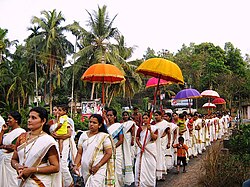
[[File:Nileshwar 22.jpg|thumbnail|Temple Procession in [[Kanhangad]]]] | [[File:Nileshwar 22.jpg|thumbnail|Temple Procession in [[Kanhangad]]]] | ||
The '''culture of | The '''culture of Kerala''' has developed over the past millennia, with influences from other parts of India and abroad.<ref>{{Cite book|first=A. Sreedhara |last=Menon|year=1978|title=Cultural Heritage of Kerala: an introduction|publisher=East-West Publications}}</ref><ref name="Orpa Slapak">{{Cite book|url=https://books.google.com/books?id=qhKGPprbQaYC&q=two+millennia|title=The Jews of India: A Story of Three Communities|first=Orpa |last=Slapak|publisher=[[The Israel Museum]]|location=Jerusalem|year=2003|page=27|isbn=965-278-179-7}}.</ref> It is defined by its antiquity and the organic continuity sustained by the [[Malayali people]].<ref name="Bhagyalekshmy_2004_7">{{Harv|Bhagyalekshmy|2004|p=7}}.</ref> Modern Kerala society took shape owing to migrations from different parts of India and abroad throughout [[Classical Antiquity]].<ref name="Orpa Slapak"/><ref>{{Cite book|last=Nayar|first=Balachandran|year=1974|title=In quest of Kerala}}</ref><ref>{{Cite book|last=Smith|first=Bardwell|year=1976|title=Religion and social conflict in South Asia|publisher=[[Brill Publishers]]}}</ref> | ||
Kerala traces its non-prehistoric cultural genesis to its membership (around the AD 3rd century) in a vaguely defined historical region known as ''Thamizhagom'' | Kerala traces its non-prehistoric cultural genesis to its membership (around the AD 3rd century) in a vaguely defined historical region known as ''Thamizhagom'' – a land defined by a common [[:Category:Tamil culture|Tamil culture]] and encompassing the Chera, Chola, and Pandya kingdoms. At that time, the music, dance, language (first ''Dravida Bhasha'' – "Dravidian language (possibly Proto-Tamil)"<ref name="Bhagyalekshmy_2004_6">{{Harv|Bhagyalekshmy|2004|p=6}}.</ref> – then Tamil), and ''[[Sangam literature|Sangam]]'' (a vast corpus of Tamil literature composed between 1,500&ndash;2,000 years ago) found in Kerala were all similar to that found in the rest of ''Thamizhagom'' (today's Tamil Nadu). The culture of Kerala evolved through the [[Sanskritization]] of Dravidian ethos, [[Christian revival|revivalism]] of religious movements and [[History of the Indian caste system#Reform movements|reform movements]] against [[caste system|caste discrimination]].<ref>Srinivas, Narasimhachar (1980) India: social structure. {{ISBN|0-878-55415-7}}</ref><ref>Filippo Osella, Caroline Osella (2000) Social mobility in Kerala: modernity and identity in conflict. Pluto Press</ref><ref>University of Kerala. Dept. of History, University of Allahabad. Dept. of Modern Indian History, University of Travancore (1966) Journal of Indian history: Volume 44</ref> | ||
Strong communitarian values, [[wit]], and an appreciation for social progressivism are commonly associated with [[Malayalis|Malayali]] culture.<ref>{{Cite web|last=Menon|first=Geeta |title= Why Kerala Means Strong Women, Intermingling Cultures and Education |website=[[NYU Stern]] |url=https://www.stern.nyu.edu/experience-stern/faculty-research/geeta-menon-kerala-strong-women |access-date=2024-04-21}}</ref><ref>{{Cite journal |last=Törnquist |first=Olle |date=2001 |title=Movement, Politics and Development: The Case of Kerala |url=https://www.jstor.org/stable/3518227 |journal=Social Scientist |volume=29 |issue=11/12 |pages=57–87 |doi=10.2307/3518227 |jstor=3518227 |issn=0970-0293|url-access=subscription }}</ref><ref>{{Cite journal |last=Mattumannil |first=Shahul Hameed |date=2024-12-31 |title=The left approach to social diversity: How the Communist Party interacted with Kerala's social landscape? |journal=Cogent Social Sciences |language=en |volume=10 |issue=1 |article-number=2292840 |doi=10.1080/23311886.2023.2292840 |issn=2331-1886|doi-access=free }}</ref><ref>{{Cite journal |last=Kumar |first=Vipin |date=April 2008 |title=Politics of laughter: An introduction to the 1990s' Malayalam popular comic film |url=http://www.tandfonline.com/doi/abs/10.1080/14746680701878513 |journal=South Asian Popular Culture |language=en |volume=6 |issue=1 |pages=13–28 |doi=10.1080/14746680701878513 |issn=1474-6689|url-access=subscription }}</ref><ref>{{Cite journal |last=Raja |first=K. Kunjunni |date=1974 |title=Renaissance in Malayalam Writing |url=https://www.jstor.org/stable/23329869 |journal=Indian Literature |volume=17 |issue=1/2 |pages=166–171 |jstor=23329869 |issn=0019-5804}}</ref> | |||
== Performing arts == | == Performing arts == | ||
[[File:Thirayattam -( Bagavathi vellattu ).JPG|thumb|Thirayattam -( Bagavathi vellattu )]] | [[File:Thirayattam -( Bagavathi vellattu ).JPG|thumb|Thirayattam -( Bagavathi vellattu )]] | ||
{{main|Arts of Kerala}} | {{main|Arts of Kerala}} | ||
Native traditions of classical | Native traditions of classical performing arts include ''[[koodiyattom]]'', a form of [[Sanskrit]] drama or theatre and a [[UNESCO]]-designated Human Heritage Art. Kathakali (from ''katerumbu'' ("story") and ''kali'' ("performance")) is a 500-year-old form of dance-drama that interprets ancient epics; a popularized offshoot of ''kathakali'' is ''[[Kerala Natanam]]'' (developed in the 20th century by dancer [[Guru Gopinath]]). Meanwhile, ''[[koothu]]'' is a more light-hearted performance mode, akin to modern comedy; an ancient art originally confined to temple sanctuaries, it was later popularized by [[Mani Madhava Chakyar]]. Other Keralite performing arts include ''[[mohiniyaattam]]'' ("dance of the enchantress"), which is a type of graceful choreographed dance performed by women and accompanied by musical vocalizations. ''[[Ottamthullal|Thullal]]'', ''[[Thirayattam]]'', ''[[padayani]]'', and ''[[theyyam]]'' are other important Keralite performing arts. [[Thirayattam]] is one of the most outstanding Ethnic art of [[Kerala]]. This vibrant ritualistic annual performing art form enacted in courtyards of "Kaavukal"(sacred groves) and village shrine.<ref>"Thirayattam",(Folklore Text -malayalam, Moorkkanad Peethambaran) State Institute of language, Kerala {{ISBN|978-81-200-4294-0}}</ref> | ||
Kerala also has several tribal and folk art forms. For example, [[Kummattikali]] | Kerala also has several tribal and folk art forms. For example, [[Kummattikali]], the colorful mask-dance of South Malabar, is performed during the festival of Onam. The [[Kannyar Kali]] dances (also known as Desathukali) are fast-moving, militant dances attuned to rhythmic devotional folk songs and asuravadyas. Other performance genres have ties to Christianity or [[Islam]]. These include ''[[oppana]]'', which is widely popular among Keralite Muslims and is native to Malabar. ''[[Oppana]]'' incorporates group dance accompanied by the beat of rhythmic hand-clapping and ''Vishal'' vocalizations.{{Citation needed|date=December 2024}} [[Margam Kali]] is a round group dance of Kerala practiced by [[Saint Thomas Christians]].<ref>{{cite web |date=2009-06-08 |title=Margam Kali – History, Text, Lyrics, Theme, Early Reference and Modern Developments |url=http://www.nasrani.net/2009/05/04/margam-kali-history-theme-early-reference-and-modern-developments/ |access-date=2017-02-22 |website=Nasrani.net}}</ref> | ||
However, many of these native art forms largely play to tourists or at youth festivals and are not as popular among ordinary Keralites. Thus, more contemporary forms – including those heavily based on the use of often risqué and [[political correctness|politically incorrect]] [[mimicry]] and parody – have gained considerable mass appeal in recent years.{{citation needed|date=March 2011}} Indeed, contemporary artists often use such modes to mock socioeconomic elites. In recent decades, [[Malayalam Cinema]], yet another mode of widely popular artistic expression, have provided a distinct and indigenous Keralite alternative to both [[Bollywood]] and [[Cinema of the United States|Hollywood]].{{Citation needed|date=December 2024}} | |||
However, many of these native art forms largely play to tourists or at youth festivals and are not as popular among ordinary Keralites. Thus, more contemporary forms | |||
=== Music === | === Music === | ||
{{main|Music of Kerala}} | {{main|Music of Kerala}} | ||
The ''[[raga]]s'' and ''[[Tala (music)|tala]]s'' of lyrical and devotional [[Carnatic music]] | The ''[[raga]]s'' and ''[[Tala (music)|tala]]s'' of lyrical and devotional [[Carnatic music]] – another native product of South India – dominates Keralite classical musical genres. [[Swathi Thirunal Rama Varma]], a 19th-century king of Travancore and patron and composer of music, was instrumental in popularising carnatic music in early Kerala.<ref name="Bhagyalekshmy_2004d_29">{{Harv|Bhagyalekshmy|2004d|p=29}}.</ref><ref name="Bhagyalekshmy_2004d_32">{{Harv|Bhagyalekshmy|2004d|p=32}}.</ref> Additionally, Kerala has its own native music system, ''sopanam'', which is a lugubrious and step-by-step rendition of raga-based songs. It is ''[[Sopanam]]'', for example, that provides the background music used in ''[[Kathakali]]''. The wider [[Music of Kerala|traditional music of Kerala]] also includes ''[[melam]]'' (including the ''paandi'' and ''panchari'' variants), as style of [[Percussion instrument|percussive]] music performed at [[mandir|temple]]-centered festivals using an instrument known as the ''[[chenda]]''. Up to 150 musicians may comprise the ensembles staging a given performance; each performance, in turn, may last up to four hours. ''[[Panchavadyam]]'' is a differing type of percussion ensemble consisting of five types of percussion instruments; these can be used by up to one hundred artists in certain major festivals. In addition to these, percussive music is also associated with various uniquely Keralite folk arts forms. Lastly, the [[popular music]] of Kerala, as in the rest of India, is dominated by the ''[[filmi]]'' music of [[Indian cinema]]. | ||
The most remembered name in Kerala music culture is of Great Indian musician | The most remembered name in Kerala music culture is of Great Indian musician [[K. J. Yesudas]].{{Citation needed|date=December 2024}} | ||
== Literature == | == Literature == | ||
| Line 30: | Line 30: | ||
[[File:THUNCHAN MEMORIAL.jpg|thumbnail|left|300px|The [[Thunchath Ezhuthachan Malayalam University]] is situated at [[Thunchan Parambu]], [[Tirur]], [[Malappuram district|Malappuram]]]] | [[File:THUNCHAN MEMORIAL.jpg|thumbnail|left|300px|The [[Thunchath Ezhuthachan Malayalam University]] is situated at [[Thunchan Parambu]], [[Tirur]], [[Malappuram district|Malappuram]]]] | ||
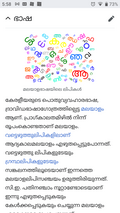
[[File:Malayalam Wikipedia Mobile.png|thumb|[[Malayalam]] in mobile phone]] | [[File:Malayalam Wikipedia Mobile.png|thumb|[[Malayalam]] in mobile phone]] | ||
The [[Sangam literature]] can be considered as the ancient predecessor of [[Malayalam]]. | The [[Sangam literature]] can be considered as the ancient predecessor of [[Malayalam]].<ref name="clt.1"/> [[Malayalam literature]] is ancient in origin, and includes such figures as the 14th century [[Niranam poets]] (Madhava Panikkar, Sankara Panikkar and Rama Panikkar), whose works mark the dawn of both modern Malayalam language and indigenous Keralite poetry. Some linguists claim that an inscription found from [[Edakkal Caves]], [[Wayanad]], which belongs to 3rd century CE (approximately 1,800 years old), is the oldest available inscription in Malayalam, as they contain two modern Malayalam words, ''Ee'' (This) and ''Pazhama'' (Old), those are not found even in the [[Old Tamil|Oldest form of Tamil]]. [[Sangam literature|Sangam works]] can be considered as the ancient predecessor of Malayalam.<ref name="clt.1" /> The origin of [[Malayalam calendar]] dates back to year 825 CE.<ref>{{cite web|url=http://www.new1.dli.ernet.in/data1/upload/insa/INSA_1/20005b5f_93.pdf |title=Kollam Era |publisher=Indian Journal History of Science |access-date=30 December 2014 |url-status=dead |archive-url=https://web.archive.org/web/20150527163650/http://www.new1.dli.ernet.in/data1/upload/insa/INSA_1/20005b5f_93.pdf |archive-date=27 May 2015 }}</ref><ref>{{Citation|title=Time measurement and calendar construction|author=Broughton Richmond|year=1956|pages=218|url=https://books.google.com/books?id=gUlmAAAAMAAJ}}</ref><ref>{{Cite book|title=History of Kerala|author=R. Leela Devi|publisher=Vidyarthi Mithram Press & Book Depot|year=1986|pages=408|url=https://books.google.com/books?id=pXpuAAAAMAAJ}}</ref> It is generally agreed that the [[Quilon Syrian copper plates]] of 849/850 CE is the available oldest inscription written in [[Old Malayalam]]. For the first 600 years of [[Kollam Era|Malayalam calendar]], the literature mainly consisted of the oral [[Ballad]]s such as ''[[Vadakkan Pattukal]]'' (Northern Songs) in [[North Malabar]] and ''Thekkan Pattukal'' (Southern songs) in [[Southern Division (Travancore)|Southern Travancore]].<ref name="clt.1">{{Cite book|title=Mathrubhumi Yearbook Plus – 2019|publisher=P. V. Chandran, Managing Editor, Mathrubhumi Printing & Publishing Company Limited, Kozhikode|year=2018|location=Kozhikode|page=453|id={{ASIN|8182676444|country=in}}|edition=Malayalam}}</ref> The earliest known literary works in Malayalam are ''[[Malayalam|Ramacharitam]]'' and ''[[Thirunizhalmala]]'', two [[epic poem]]s written in [[Old Malayalam]]. [[Malayalam literature]] has been presented with 6 [[Jnanpith Award|Jnanapith awards]], the second-most for any Dravidian language and the third-highest for any Indian language.<ref>{{Cite news|title=Jnanpith given to Akkitham|url=https://www.thehindu.com/news/national/kerala/jnanpith-given-to-akkitham/article32685581.ece|last=Naha|first=Abdul Latheef|date=24 September 2020|access-date=12 June 2021|work=The Hindu}}</ref><ref>{{Cite news|title=Celebrated Malayalam poet Akkitham wins 2019 Jnanpith Award|url=https://www.business-standard.com/article/news-ani/celebrated-malayalam-poet-akkitham-wins-2019-jnanpith-award-119112900926_1.html|last=ANI|date=29 November 2019|access-date=12 June 2021|work=Business Standard}}</ref> | ||
Designated a "[[Classical Language in India]]" in 2013, | Designated a "[[Classical Language in India]]" in 2013,<ref>{{cite news |url=http://www.thehindu.com/todays-paper/tp-national/classical-status-for-malayalam/article4744630.ece |title='Classical' status for Malayalam |work=[[The Hindu]] |date=24 May 2013 |access-date=25 May 2013 |location=Thiruvananthapuram, India |archive-url=https://web.archive.org/web/20130927134256/http://www.thehindu.com/todays-paper/tp-national/classical-status-for-malayalam/article4744630.ece |archive-date=27 September 2013 |url-status=live}}</ref> it developed into the current form mainly by the influence of the poets [[Cherusseri Namboothiri]] (Born near [[Kannur]]),<ref name="Cherussery (Krishnagadha) Malayalam author books">{{Cite web |url=http://keralaliterature.com/old/author.php?authid=1473 |title=Cherussery (Krishnagadha) Malayalam author books |website=keralaliterature.com |archive-url=https://web.archive.org/web/20190407052549/http://keralaliterature.com/old/author.php%3Fauthid%3D1473 |archive-date=7 April 2019 |url-status=dead }}</ref><ref name="mlm"/> [[Thunchaththu Ezhuthachan]] (Born near [[Tirur]]),<ref name="mlm"/> and [[Poonthanam Nambudiri]] (Born near [[Perinthalmanna]]),<ref name="mlm"/><ref>{{cite news |url=https://www.thehindu.com/society/history-and-culture/the-charms-of-poonthanam-illam/article25308319.ece/ |title=The Charms of Poonthanam Illam |last=Arun Narayanan |date=25 October 2018 |work=The Hindu}}</ref> in the 15th and the 16th centuries of Common Era.<ref name="mlm">{{cite book |title=A Short History of Malayalam Literature |author=Dr. K. Ayyappa Panicker |url=https://archive.org/details/ASHORTHISTORYOFMALAYALAMLITERATURE |year=2006 |location=Thiruvananthapuram |publisher=Department of Information and Public Relations, Kerala}}</ref><ref>Freeman, Rich (2003). "Genre and Society: The Literary Culture of Premodern Kerala". In Literary Cultures in History: Reconstructions from South Asia</ref> [[Kunchan Nambiar]], a [[Palakkad]]-based poet also significantly influenced the growth of modern Malayalam literature in its early form, through a new literary branch called ''Thullal''.<ref name="mlm"/> The prose literature, criticism, and [[Malayalam journalism]], began following the latter half of 18th century CE. The first travelogue in any Indian language is the Malayalam ''[[Varthamanappusthakam]]'', written by [[Paremmakkal Thoma Kathanar]] in 1785.<ref>{{cite book |last=Menon |first=A. Sreedhara |title=The legacy of Kerala |year=2008 |publisher=D C Books |location=Kottayam, Kerala |isbn=978-81-264-2157-2 |edition=1st DCB}}</ref><ref>{{cite web |url=http://nasrani.net/2010/08/23/the-varthamanappusthakam-cathanar-paremmakkal/ |title=August 23, 2010 Archives |url-status=dead |archive-url=https://web.archive.org/web/20130427073541/http://nasrani.net/2010/08/23/the-varthamanappusthakam-cathanar-paremmakkal/ |archive-date=27 April 2013}}</ref> | ||
The [[Bharathappuzha]] river, also known as [[Ponnani|River Ponnani]], and its tributaries, have played a major role in the development of modern Malayalam Literature. | The [[Bharathappuzha]] river, also known as [[Ponnani|River Ponnani]], and its tributaries, have played a major role in the development of modern Malayalam Literature.<ref name="mlm"/>{{Vague|reason=This does not make sense without further expansion.|date=December 2024}} The words used in many of the [[Arabi Malayalam]] works those date back to 16th–17th centuries of [[Common Era]] are also very closer to the modern Malayalam language.<ref name="mlm" /><ref name="Deccan Chronicle">{{Cite web|date=15 October 2017|title=New university centre for Arabi Malayalam|url=https://www.deccanchronicle.com/nation/in-other-news/151017/new-university-centre-for-arabi-malayalam.html|access-date=20 October 2020|website=Deccan Chronicle|language=en}}</ref> [[Unnayi Variyar]] of 17th–18th centuries, based at [[Thrissur]], played a major role in the development of ''Attakkatha'' Literature.<ref name="mlm" /> The words used in many of the [[Arabi Malayalam]] works those date back to 16th–17th centuries of [[Common Era]] are also very closer to the modern Malayalam language.<ref name="mlm" /><ref name="Deccan Chronicle"/> The [[Triumvirate poets of modern malayalam|Triumvirate of poets]] (''Kavithrayam'': [[Kumaran Asan]], [[Vallathol Narayana Menon]] and [[Ulloor S. Parameswara Iyer]]) are recognized for moving keralian poetry away from archaic [[sophistry]] and [[metaphysics]] and towards a more [[lyrics|lyrical]] mode. The modern Malayalam grammar is based on the book ''[[Kerala Panineeyam]]'' written by [[A. R. Raja Raja Varma]] in late 19th century CE.<ref name="clt">{{Cite book|title=Mathrubhumi Yearbook Plus – 2019|publisher=P. V. Chandran, Managing Editor, Mathrubhumi Printing & Publishing Company Limited, Kozhikode|year=2018|location=Kozhikode|pages=454|id={{ASIN|8182676444|country=in}}|edition=Malayalam}}</ref> | ||
In the second half of the 20th century, [[Jnanpith]] winning poets and writers like [[G. Sankara Kurup]], [[S. K. Pottekkatt]], [[Thakazhi Sivasankara Pillai]], [[M. T. Vasudevan Nair]], [[O. N. V. Kurup]], and [[Akkitham Achuthan Namboothiri]], had made valuable contributions to the modern Malayalam literature. | In the second half of the 20th century, [[Jnanpith]] winning poets and writers like [[G. Sankara Kurup]], [[S. K. Pottekkatt]], [[Thakazhi Sivasankara Pillai]], [[M. T. Vasudevan Nair]], [[O. N. V. Kurup]], and [[Akkitham Achuthan Namboothiri]], had made valuable contributions to the modern Malayalam literature.<ref name="google25">{{cite book |author=Subodh Kapoor |title=The Indian Encyclopaedia: Biographical, Historical, Religious, Administrative, Ethnological, Commercial and Scientific. Mahi-Mewat |url=https://books.google.com/books?id=mc6C5dVHbGAC&pg=PA4542 |access-date=18 November 2012 |year=2002 |publisher=Cosmo |isbn=978-8177552720 |page=4542}}</ref><ref name="Accessions List, South Asia">{{cite book |title=Accessions List, South Asia |url=https://books.google.com/books?id=lPcoAQAAIAAJ |access-date=18 November 2012 |year= 1994 |publisher=E.G. Smith for the U.S. Library of Congress Office, New Delhi |page=21}}</ref><ref name="Indian Writing Today">{{cite book |title=Indian Writing Today |url=https://books.google.com/books?id=1wUtAQAAIAAJ |access-date=18 November 2012 |year=1967 |publisher=Nirmala Sadanand Publishers |page=21}}</ref><ref name="DattaAkademi1987">{{cite book |author1=Amaresh Datta |author2=Sahitya Akademi |title=Encyclopaedia of Indian Literature: K to Navalram |url=https://books.google.com/books?id=QaIRAQAAMAAJ |access-date=18 November 2012 |year=1987 |publisher=Sahitya Akademi |page=2394|isbn=978-0836424232 }}</ref><ref name="Malayalam Literary Survey">{{cite book |title=Malayalam Literary Survey |url=https://books.google.com/books?id=k5JkAAAAMAAJ |access-date=18 November 2012 |year=1993 |publisher=Kerala Sahitya Akademi |page=19}}</ref> Later, writers like [[O. V. Vijayan]], [[Kamaladas]], [[M. Mukundan]], [[Arundhati Roy]], and [[Vaikom Muhammed Basheer]], have gained international recognition.<ref name="MukundanPillai2004">{{cite book |author1=Eṃ Mukundan |author2=C. Gopinathan Pillai |title=Eng Adityan Radha And Others |url=https://books.google.com/books?id=1N5QcHakKdoC&pg=PP3 |access-date=18 November 2012 |year= 2004 |publisher=Sahitya Akademi |isbn=978-8126018833 |page=3}}</ref><ref name="Maheshwari2002">{{cite book |author=Ed. Vinod Kumar Maheshwari |title=Perspectives on Indian English Literature |url=https://books.google.com/books?id=JcY2-ldWIKsC&pg=PA126 |access-date=18 November 2012 |year= 2002 |publisher=Atlantic Publishers & Dist |isbn=978-8126900930 |page=126}}</ref><ref name="Chaudhuri2008">{{cite book |author=Amit Chaudhuri |title=Clearing a Space: Reflections on India, Literature, and Culture |url=https://books.google.com/books?id=AQeN2PoAx2IC&pg=PA44 |access-date=18 November 2012 |year=2008 |publisher=Peter Lang |isbn=978-1906165017 |pages=44–45}}</ref><ref>{{Cite news |title=Indian's First Novel Wins Booker Prize in Britain |work=[[The New York Times]] |date=15 October 1997 |access-date=11 November 2007 |url=https://query.nytimes.com/gst/fullpage.html?res=9A01E6DD173FF936A25753C1A961958260 |first=Sarah |last=Lyall}}</ref> Poets like [[Changampuzha]], [[Uroob]], [[Edasseri Govindan Nair]], [[M. T. Vasudevan Nair]], [[Kamala Surayya]], [[Pallathu Raman]], and [[Edappally Raghavan Pillai]] also contributed to bring [[Malayalam]] poetry to the common man. Later, such contemporary writers as [[Booker Prize]] winner [[Arundhati Roy]] (whose 1996 semi-autobiographical bestseller ''[[The God of Small Things]]'' is set in the [[Kottayam]] town of Ayemenem) have garnered international recognition. From 1970 to early 1990s, a lot of Malayalam Novelists and story writers contributed to the Literature of Kerala. The contributions from [[Thakazhi Sivashankara Pillai]], | ||
Vaikom Muhammed Basheer [[P. Kesavadev]], [[Uroob]], [[OV Vijayan]], [[Thinakkal Padmanabhan|T Padmanabhan]], [[Sethu (writer)|Sethu]], [[Perumbadavam Sreedharan]], [[Kovilan]], [[M. Mukundan]], [[Kakkanadan]], [[Anand (writer)|Anand]] and [[Paul Zacharia]], | Vaikom Muhammed Basheer [[P. Kesavadev]], [[Uroob]], [[OV Vijayan]], [[Thinakkal Padmanabhan|T Padmanabhan]], [[Sethu (writer)|Sethu]], [[Perumbadavam Sreedharan]], [[Kovilan]], [[M. Mukundan]], [[Kakkanadan]], [[Anand (writer)|Anand]] and [[Paul Zacharia]], <!-- update with more and the books --> have been remarkable. Significant contributions from poets and songwriters such as [[Vayalar Rama Varma]], [[P. Bhaskaran]] and [[ONV Kurup]] have influenced contemporary literature. Critics such as [[Kuttikrishna Marar]] and [[M.P. Paul]] till the sixties and later, [[Prof. M. Krishnan Nair|M Krishnan Nair]], [[S. Gupthan Nair]], [[M. K. Sanu]], [[Sukumar Azhikode]], [[K.P. Appan]], [[Narendra Prasad]] and [[M. Leelavathy]] <!-- need to update time period, add more people--> have added value by providing critical analysis of the books written during the recent past. The writers like [[Kavalam Narayana Panicker]] have contributed much to Malayalam drama.<ref name="clt.1"/> Contemporary [[Malayalam literature]] deals with social, political, and economic life context. The tendency of the modern poetry is often towards [[political radicalism]].<ref name="cnt">{{cite encyclopedia|url=http://www.britannica.com/EBchecked/topic/556016/South-Asian-arts/65212/Tamil#toc65213|title=South Asian arts|encyclopedia=Encyclopedia Britannica |access-date=15 September 2017}}</ref> | ||
[[Arabi Malayalam]] (also called Mappila Malayalam | [[Arabi Malayalam]] (also called Mappila Malayalam<ref>{{Cite journal|last=Kottaparamban|first=Musadhique|date=1 October 2019|title=Sea, community and language: a study on the origin and development of Arabi- Malayalam language of mappila muslims of Malabar|url=https://mjsshonline.com/index.php/journal/article/view/97|journal=Muallim Journal of Social Sciences and Humanities|language=en|pages=406–416|doi=10.33306/mjssh/31|issn=2590-3691|doi-access=free|url-access=subscription}}</ref><ref>{{Cite book |last=Kuzhiyan|first=Muneer Aram|title=Poetics of Piety Devoting and Self Fashioning in the Mappila Literary Culture of South India|work=University |date=24 July 2015 |url=http://hdl.handle.net/10603/213506|publisher=The English and Foreign Languages University, Hyderabad|hdl=10603/213506}}</ref> and Moplah Malayalam) was the traditional [[Dravidian languages|Dravidian language]]<ref>{{Cite journal|last=Kottaparamban|first=Musadhique|title=Sea, Community and Language: A Study on the Origin and Development of Arabi- Malayalam Language of Mappila Muslims of Malabar|date=2 October 2019|url=https://mjsshonline.com/index.php/journal/article/view/97|journal=Muallim Journal of Social Sciences and Humanities|language=en|pages=406–416|doi=10.33306/mjssh/31|issn=2590-3691|doi-access=free|url-access=subscription}}</ref> of the [[Malabar Muslims|Mappila Muslim community]] in [[Malabar Coast]]. The poets like [[Moyinkutty Vaidyar]] and [[Pulikkottil Hyder]] have made notable contributions to the [[Mappila songs]], which is a genre of the [[Arabi Malayalam]] literature.<ref>{{cite news|url=http://www.hindu.com/2007/03/31/stories/2007033110250500.htm|archive-url=https://web.archive.org/web/20121108104937/http://www.hindu.com/2007/03/31/stories/2007033110250500.htm|url-status=dead|archive-date=8 November 2012|title=Mappila songs cultural fountains of a bygone age, says MT|date=31 March 2007|access-date=15 August 2009|work=[[The Hindu]]|location=Chennai, India}}</ref><ref>Pg 167, Mappila Muslims: a study on society and anti colonial struggles By Husain Raṇdathaṇi, Other Books, Kozhikode 2007</ref> The [[Arabi Malayalam script]], otherwise known as the [[Ponnani]] script,<ref>{{Cite thesis |last=Kunnath |first=Ammad |type=PhD |date=15 September 2015|title=The rise and growth of Ponnani from 1498 AD To 1792 AD|url=http://hdl.handle.net/10603/49524|publisher=Department of History|hdl=10603/49524}}</ref><ref>{{Cite book|last=Panakkal|first=Abbas|url=http://myto.upm.edu.my/find/Record/iium.u537621|title=Islam in Malabar (1460–1600) : a socio-cultural study /|date=2016|publisher=Kulliyyah Islamic Revealed Knowledge and Human Sciences, International Islamic University Malaysia|access-date=27 May 2021|archive-date=27 May 2021|archive-url=https://web.archive.org/web/20210527064123/http://myto.upm.edu.my/find/Record/iium.u537621|url-status=dead}}</ref><ref>{{Cite web |last=Kallen|first=hussain Randathani|title=Trade and Culture: Indian Ocean Interaction on the COast of Malabar in Medieval Period|url=https://www.academia.edu/22105661|language=en}}</ref> is a writing system – a variant form of the [[Arabic script]] with special [[orthography|orthographic]] features – which was developed during the early medieval period and used to write [[Arabi Malayalam]] until the early 20th century CE.<ref name="Miller">Miller, Roland. E., "Mappila" in "The Encyclopedia of Islam". Volume VI. E. J. Brill, Leiden. 1987. pp. 458–56.</ref><ref>[https://archive.today/20120912185758/http://www.malayalamresourcecentre.org/Mrc/literature/contribution.html Malayalam Resource Centre]</ref> Though the script originated and developed in [[Kerala]], today it is predominantly used in [[Malaysia]] and Singapore by the migrant [[Muslim]] community.<ref name=":0">Menon. T. Madhava. "A Handbook of Kerala, Volume 2", International School of Dravidian Linguistics, 2002. pp. 491–493.</ref><ref name="Arabic script for malayalam">[http://www.nvtc.gov/lotw/months/april/Malayalam.html#writ National Virtual Translation Center – Arabic script for malayalam]</ref> | ||
==Folklore== | ==Folklore== | ||
[[File:Thirayattam(Pookkutty Thira).JPG|thumb|Thirayattam(Pookkutty Thira)]] | [[File:Thirayattam(Pookkutty Thira).JPG|thumb|Thirayattam (Pookkutty Thira)]] | ||
Kerala folklore is influenced by agricultural patterns and work in the region. Sowing, planting of {{lang|mis|nharu}} (seedling), clearing out the weeds, harvests etc. are the different stages of agriculture which have their typical rituals. Numerous songs and performing arts accompany these stages, such as [[Njattupattu]], which are songs sung during the seedling time. Kanyar Kali, [[Padayani]], [[Mudiyettu]], [[Thirayattam]], [[Malavayiyattam]], [[Theyyam]], Kothamooriyattam, Nira, Puthari, etc. are some of the ritual folklore of Kerala. Much of Kerala folk culture, including festival dates, was codified under the rule of [[Kolathiris]], the Kings of [[Kolathunadu]].{{Citation needed|date=December 2024}} | |||
== | The folk arts of Kerala can be broadly classified under two heads:<ref>{{cite web |url=http://www.keralahistory.ac.in/surviving.htm |title=Essays on the Cultural Formation of Kerala |editor=P.J. Cherian |website=Keralahistory.ac.in |access-date=2017-02-22 |archive-url=https://web.archive.org/web/20140310175337/http://www.keralahistory.ac.in/surviving.htm |archive-date=2014-03-10 |url-status=dead }}</ref> ritualistic and non-ritualistic. Ritualistic folk arts can be further divided into two: devotional and magical. | ||
Devotional folk arts, such as [[theyyam]], [[thirayattam]], poothamthira, kanyarkali, and [[Kummattikali|kummatti]], are performed to propitiate a particular God or Goddess. Forms like panappattu and thottampattu are composed in the form of songs. In kolkali, [[margamkali]], [[Daffmuttu|daffumuttukkali]], etc., the ritualistic element is not very strong. Magical folk arts seek to win general prosperity for a community or exorcise evil spirits or to beget children. [[Gandharvas]] and [[Nāga|nagas]] are worshipped to win these favours. The magical folk arts include pambinthullal, pooppadathullal, kolamthullal, malayankettu, etc.{{Citation needed|date=December 2024}} | |||
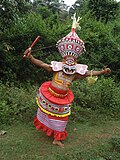
* '''[[Theyyam]]''' is a traditional ritualistic dance form from the northern part of Kerala, India, that is believed to have originated over 1,500 years ago. It is a vibrant and colorful art form that involves elaborate makeup, costumes, and dance performances that are often accompanied by music and chanting. The dance form is performed by male members of certain communities and is believed to invoke the powers of gods and goddesses to bless the community with prosperity and protection. Theyyam<ref>{{Cite web |date=2023-06-29 |title=Theyyam: The Indian trance where men become gods |url=https://www.bbc.com/travel/article/20230628-theyyam-the-indian-trance-where-men-become-gods |access-date=2025-05-20 |website=www.bbc.com |language=en-GB}}</ref> is performed during the winter months between October and May.{{Citation needed|date=December 2024}} | |||
* '''Padayani''' is a traditional folk art form from the southern part of Kerala, India, that involves elaborate processions and performances. It is usually performed during the festival of Onam, which falls in the month of August or September. The art form involves the use of masks, costumes, and props, and the performers dance to the beats of traditional percussion instruments like chenda and thakil. The masks used in Padayani are typically made of wood, bamboo, or clay and are adorned with bright colors and intricate designs. The performance is often based on mythological stories or social issues and is intended to entertain and educate the audience.{{Citation needed|date=December 2024}} | |||
* '''[[Thirayattam]]''' is a ritualistic performance that is frequently performed in the courtyards of temples dedicated to goddesses like Kali, Durga, and Bhadrakali. The performance involves elaborate costumes and makeup, and the performers dance to the beats of traditional percussion instruments like chenda and thakil. Thirayattam is performed by members of certain communities and is believed to invoke the powers of goddesses to bless the community with prosperity and protection. The art form is usually performed during the festival of Onam, which falls in the month of August or September.{{Citation needed|date=December 2024}} | |||
==Politics== | ==Politics== | ||
The | The majority of Keralites belong to either one of the political alliances, namely the [[United Democratic Front (Kerala)|United Democratic Front]] (UDF) or [[Left Democratic Front (Kerala)|Left Democratic Front]] (LDF). Regional parties include [[Indian Union Muslim League]] (IUML), various factions of [[Kerala Congress]], various factions of [[Revolutionary Socialist Party (India)|Revolutionary Socialist Party]], and a host of smaller parties. Religious leaders have high influence in Kerala political movements. Many Keralites nostalgically recall their younger days which they spent debating politics in "chaya kadas" (Local Tea Vending Places).{{Citation needed|date=December 2024}} | ||
== Martial arts and sports == | == Martial arts and sports == | ||
{{main|Kalaripayattu}} | {{main|Kalaripayattu}} | ||
Kerala | Kerala has its own indigenous form of [[martial art]], [[Kalaripayattu|Kalarippayattu]], derived from the words ''[[kalari]]'' ("place", "threshing floor", or "battlefield") and ''payattu'' ("exercise" or "practice"). Influenced by both Kerala's Brahminical past and Ayurvedic medicine, ''kalaripayattu'' is attributed by oral tradition to Parasurama. After some two centuries of suppression by British colonial authorities, it is now experiencing strong comeback among Keralites while also steadily gaining worldwide attention. Other popular ritual arts include ''[[theyyam]]'' and ''[[poorakkali]]'', which originate from northern Malabar, the northernmost part of Kerala.{{Citation needed|date=December 2024}} Kolkkali is a folk art performed in [[Malabar District|Malabar]] region of [[Kerala]], India. The dance performers move in a circle, striking small sticks and keeping rhythm with special steps.<ref name="12nf">{{cite book |last1=Jha |first1=Makhan |url=https://books.google.com/books?id=b_a4G_Tw2ycC&dq=kolkali&pg=PA58 |title=The Muslim Tribes of Lakshadweep Islands: An Anthropological Appraisal of Island Ecology and Cultural Perceptions |publisher=M.D. Publications Pvt. Ltd. |year=1997 |isbn=978-81-7533-032-0 |language=en |access-date=28 November 2020}}</ref> | ||
In modern times, traditional ritual and martial arts been largely supplanted by more popular sports such as [[cricket]], [[kabaddi]], [[soccer]], badminton, and others. The [[Kochi Tuskers Kerala]], who play in the Indian Premier League (IPL), are from Kerala. Kerala is currently the home of the football clubs [[kerala blasters]] and [[Gokulam Kerala FC]]. [[Viva Kerala]] and [[FC Kochin]] were the other two major football clubs from the state in the past.{{Citation needed|date=December 2024}} | |||
== Calendar == | == Calendar == | ||
{{main|Malayalam calendar}} | {{main|Malayalam calendar}} | ||
The [[Malayalam calendar]], Kerala's indigenous ancient solar calendar, is used primarily for timing agricultural and religious activities.{{Citation needed|date=December 2024}} | |||
== | ==Animals in Kerala culture== | ||
=== Elephants === | |||
{{main|Elephants in Kerala culture}} | {{main|Elephants in Kerala culture}} | ||
[[File:Thrippunithura-Elephant-end-of-pooram-2 crop.jpg|thumb|right|Caparisoned elephants during ''[[Sree Poornathrayesa temple]]'' festival. [[Elephants in Kerala culture|The Elephants of Kerala are an integral part of the daily life in Kerala]].]] | [[File:Thrippunithura-Elephant-end-of-pooram-2 crop.jpg|thumb|right|Caparisoned elephants during ''[[Sree Poornathrayesa temple]]'' festival. [[Elephants in Kerala culture|The Elephants of Kerala are an integral part of the daily life in Kerala]].]] | ||
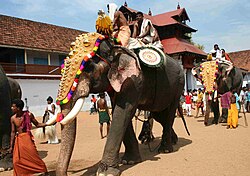
Elephants have been an integral part of the culture of the state. Almost all of the local festivals in Kerala include at least one richly caparisoned elephant. Kerala is home to the largest domesticated population of elephants in India—about 700 [[Indian elephants]], owned by temples as well as individuals.<ref name="Varghese2006">{{cite book |author=Theresa Varghese |url=https://books.google.com/books?id=lDhuAAAAMAAJ |title=Stark World Kerala |publisher=Stark World Pub. |year=2006 |isbn=978-8190250511 |page=224 |access-date=17 November 2012}}</ref> These elephants are mainly employed for the processions and displays associated with festivals celebrated all around the state. More than 10,000 festivals are celebrated in the state annually and some animal lovers have sometimes raised concerns regarding the overwork of domesticated elephants during them.<ref name="1000hrs">{{cite news |date=4 March 2010 |title=India's overworked elephants |url=https://news.bbc.co.uk/2/hi/south_asia/8533776.stm |access-date=30 May 2015 |work=BBC}}</ref> In Malayalam literature, elephants are referred to as the "sons of the ''[[Sahyadri|sahya]]''".<ref name="Satchidanandan2001">{{cite book |author=K. Satchidanandan |url=https://books.google.com/books?id=AXiNXRM_KzMC&pg=PR14 |title=Indian Poetry: Modernism and After |publisher=Sahitya Akademi |year=2001 |isbn=978-8126010929 |pages=14– |access-date=17 November 2012}}</ref> The elephant is the state animal of Kerala and is featured on the emblem of the [[Government of Kerala]].<ref name="Profile">{{cite web |title=About Kerala |url=https://india.gov.in/knowindia/state_uts.php?id=37 |archive-url=https://web.archive.org/web/20111218081930/https://india.gov.in/knowindia/state_uts.php?id=37 |archive-date=18 December 2011 |access-date=17 November 2012 |publisher=Government of Kerala}}</ref> | |||
=== Snakes === | |||
[[Sarpa Kavu]] (meaning ''Sacred Grove of the Serpent'') is a typically small traditional grove of trees seen in the [[Kerala]] state of [[South India]]. These pristine groves usually have representations of several ''Naga Devatas'' (''serpent gods''), which were worshipped by the joint families or [[Tharavad|taravad]]s. This was part of ''Nagaradhana'' (snake worship) which was prevalent among [[Kerala|Keralites]] during past centuries. It had been practised by nearly every Hindu community in Kerala ranging from [[Nambudiri]] Brahmins to tribal communities.{{Citation needed|date=December 2024}} | |||
== Festivals == | |||
=== Onam === | |||
{{main|Onam}} | |||
[[File:Onam Thriuvathira Dance.jpg|thumb|Thruvathira is a dance in a circular formation done by ladies as a way to relax after hours of cooking the sadhya. It is a tradition done during Onam.]] | |||
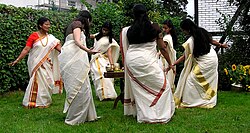
(Malayalam: ഓണം) Onam is a harvest festival celebrated by the people of Kerala. It is the state festival of Kerala, with state holidays on 4 days starting from Onam Eve (Uthradom) to the 4th Onam Day. Onam Festival falls during the [[Malayalam]] month of Chingam (Aug – Sep) and marks the commemoration of [[Vamana]], an avatar of [[Vishnu]], and the subsequent homecoming of King [[Mahabali]], who Malayalees consider to be a just and fair king who was exiled to the underworld. Some cultural elements in Onam are Vallam Kali, Pulikkali, Pookkalam, Onatthappan, Thumbi Thullal, [[Onavillu]], Kazhchakkula, Onapottan, and Atthachamayame.{{Citation needed|date=December 2024}} | |||
During the festival, the 'Onam Sadhya' (Onam Feast) is held, with dishes served on banana leaves, and celebrants don 'Onam Kodi' (new dress for the special occasion).{{Citation needed|date=December 2024}} | |||
=== Temple festivals === | |||
{{main|Temple Festivals of Kerala}} | {{main|Temple Festivals of Kerala}} | ||
Kerala has a large number of temples. The temples celebrate annual festivals unique to the region and sometimes unique to each temple. Each temple describes each interesting history behind its creation. In the Malabar, distinct art form called [[Theyyam]] attract tourists, and mini carnivals are also held along with temple festivals. [[Thrissur pooram]] is one of the most popular temple festivals.{{Citation needed|date=December 2024}} | |||
==See also== | ==See also== | ||
*[[Architecture of Kerala | *[[Architecture of Kerala]] | ||
*[[History of Kerala | *[[History of Kerala]] | ||
*[[Economy of Kerala | *[[Economy of Kerala]] | ||
*[[Geography of Kerala | *[[Geography of Kerala]] | ||
== Notes == | == Notes == | ||
| Line 92: | Line 101: | ||
== References == | == References == | ||
* {{Citation | * {{Citation | ||
| year | |surname1 = Bhagyalekshmy | ||
| title | |given1 = S | ||
| journal | |year = 2004 | ||
| url | |title = Contribution of Travancore to Karnatic Music | ||
| access-date = 12 January 2006 | |journal = Information & Public Relations Department – Thiruvananthapuram (Government of Kerala) | ||
|url = http://www.kerala.gov.in/music/music1.pdf | |||
|access-date = 12 January 2006 | |||
|archive-date = 20 February 2006 | |||
|archive-url = https://web.archive.org/web/20060220050800/http://www.kerala.gov.in/music/music1.pdf | |||
|url-status = dead | |||
}}. | }}. | ||
* {{Citation | * {{Citation | ||
| Line 103: | Line 117: | ||
| year = 2004d | | year = 2004d | ||
| title = Contribution of Travancore to Karnatic Music | | title = Contribution of Travancore to Karnatic Music | ||
| journal = Information & Public Relations Department | | journal = Information & Public Relations Department – Thiruvananthapuram (Government of Kerala) | ||
| pages = 29–37 | | pages = 29–37 | ||
| url = http://www.kerala.gov.in/music/music4.pdf | | url = http://www.kerala.gov.in/music/music4.pdf | ||
| Line 115: | Line 129: | ||
* {{cite book |title=A Short History of Malayalam Literature |author=Dr. K. Ayyappa Panicker |url=https://archive.org/details/ASHORTHISTORYOFMALAYALAMLITERATURE |year=2006 |location=Thiruvananthapuram |publisher=Department of Information and Public Relations, Kerala}} | * {{cite book |title=A Short History of Malayalam Literature |author=Dr. K. Ayyappa Panicker |url=https://archive.org/details/ASHORTHISTORYOFMALAYALAMLITERATURE |year=2006 |location=Thiruvananthapuram |publisher=Department of Information and Public Relations, Kerala}} | ||
* {{cite book|author=Menon, A. Sreedhara |title=A Survey of Kerala History|url=https://books.google.com/books?id=FVsw35oEBv4C|year=2007|publisher=DC Books|isbn=9788126415786}} | * {{cite book|author=Menon, A. Sreedhara |title=A Survey of Kerala History|url=https://books.google.com/books?id=FVsw35oEBv4C|year=2007|publisher=DC Books|isbn=9788126415786}} | ||
* {{Cite book|title=Mathrubhumi Yearbook Plus | * {{Cite book|title=Mathrubhumi Yearbook Plus – 2019|publisher=P. V. Chandran, Managing Editor, Mathrubhumi Printing & Publishing Company Limited, Kozhikode|year=2018|location=Kozhikode|edition=Malayalam}} | ||
==External links== | ==External links== | ||
Revision as of 04:43, 21 January 2026


The culture of Kerala has developed over the past millennia, with influences from other parts of India and abroad.<ref>Menon, A. Sreedhara (1978). Cultural Heritage of Kerala: an introduction. East-West Publications.</ref><ref name="Orpa Slapak">Slapak, Orpa (2003). The Jews of India: A Story of Three Communities. Jerusalem: The Israel Museum. p. 27. ISBN 965-278-179-7..</ref> It is defined by its antiquity and the organic continuity sustained by the Malayali people.<ref name="Bhagyalekshmy_2004_7">(Bhagyalekshmy 2004, p. 7).</ref> Modern Kerala society took shape owing to migrations from different parts of India and abroad throughout Classical Antiquity.<ref name="Orpa Slapak"/><ref>Nayar, Balachandran (1974). In quest of Kerala.</ref><ref>Smith, Bardwell (1976). Religion and social conflict in South Asia. Brill Publishers.</ref>
Kerala traces its non-prehistoric cultural genesis to its membership (around the AD 3rd century) in a vaguely defined historical region known as Thamizhagom – a land defined by a common Tamil culture and encompassing the Chera, Chola, and Pandya kingdoms. At that time, the music, dance, language (first Dravida Bhasha – "Dravidian language (possibly Proto-Tamil)"<ref name="Bhagyalekshmy_2004_6">(Bhagyalekshmy 2004, p. 6).</ref> – then Tamil), and Sangam (a vast corpus of Tamil literature composed between 1,500–2,000 years ago) found in Kerala were all similar to that found in the rest of Thamizhagom (today's Tamil Nadu). The culture of Kerala evolved through the Sanskritization of Dravidian ethos, revivalism of religious movements and reform movements against caste discrimination.<ref>Srinivas, Narasimhachar (1980) India: social structure. ISBN 0-878-55415-7</ref><ref>Filippo Osella, Caroline Osella (2000) Social mobility in Kerala: modernity and identity in conflict. Pluto Press</ref><ref>University of Kerala. Dept. of History, University of Allahabad. Dept. of Modern Indian History, University of Travancore (1966) Journal of Indian history: Volume 44</ref>
Strong communitarian values, wit, and an appreciation for social progressivism are commonly associated with Malayali culture.<ref>Menon, Geeta. "Why Kerala Means Strong Women, Intermingling Cultures and Education". NYU Stern. Retrieved 21 April 2024.</ref><ref>Törnquist, Olle (2001). "Movement, Politics and Development: The Case of Kerala". Social Scientist. 29 (11/12): 57–87. doi:10.2307/3518227. ISSN 0970-0293. JSTOR 3518227.</ref><ref>Mattumannil, Shahul Hameed (31 December 2024). "The left approach to social diversity: How the Communist Party interacted with Kerala's social landscape?". Cogent Social Sciences. 10 (1) 2292840. doi:10.1080/23311886.2023.2292840. ISSN 2331-1886.</ref><ref>Kumar, Vipin (April 2008). "Politics of laughter: An introduction to the 1990s' Malayalam popular comic film". South Asian Popular Culture. 6 (1): 13–28. doi:10.1080/14746680701878513. ISSN 1474-6689.</ref><ref>Raja, K. Kunjunni (1974). "Renaissance in Malayalam Writing". Indian Literature. 17 (1/2): 166–171. ISSN 0019-5804. JSTOR 23329869.</ref>
Performing arts
.JPG)
Native traditions of classical performing arts include koodiyattom, a form of Sanskrit drama or theatre and a UNESCO-designated Human Heritage Art. Kathakali (from katerumbu ("story") and kali ("performance")) is a 500-year-old form of dance-drama that interprets ancient epics; a popularized offshoot of kathakali is Kerala Natanam (developed in the 20th century by dancer Guru Gopinath). Meanwhile, koothu is a more light-hearted performance mode, akin to modern comedy; an ancient art originally confined to temple sanctuaries, it was later popularized by Mani Madhava Chakyar. Other Keralite performing arts include mohiniyaattam ("dance of the enchantress"), which is a type of graceful choreographed dance performed by women and accompanied by musical vocalizations. Thullal, Thirayattam, padayani, and theyyam are other important Keralite performing arts. Thirayattam is one of the most outstanding Ethnic art of Kerala. This vibrant ritualistic annual performing art form enacted in courtyards of "Kaavukal"(sacred groves) and village shrine.<ref>"Thirayattam",(Folklore Text -malayalam, Moorkkanad Peethambaran) State Institute of language, Kerala ISBN 978-81-200-4294-0</ref>
Kerala also has several tribal and folk art forms. For example, Kummattikali, the colorful mask-dance of South Malabar, is performed during the festival of Onam. The Kannyar Kali dances (also known as Desathukali) are fast-moving, militant dances attuned to rhythmic devotional folk songs and asuravadyas. Other performance genres have ties to Christianity or Islam. These include oppana, which is widely popular among Keralite Muslims and is native to Malabar. Oppana incorporates group dance accompanied by the beat of rhythmic hand-clapping and Vishal vocalizations.[citation needed] Margam Kali is a round group dance of Kerala practiced by Saint Thomas Christians.<ref>"Margam Kali – History, Text, Lyrics, Theme, Early Reference and Modern Developments". Nasrani.net. 8 June 2009. Retrieved 22 February 2017.</ref>
However, many of these native art forms largely play to tourists or at youth festivals and are not as popular among ordinary Keralites. Thus, more contemporary forms – including those heavily based on the use of often risqué and politically incorrect mimicry and parody – have gained considerable mass appeal in recent years.[citation needed] Indeed, contemporary artists often use such modes to mock socioeconomic elites. In recent decades, Malayalam Cinema, yet another mode of widely popular artistic expression, have provided a distinct and indigenous Keralite alternative to both Bollywood and Hollywood.[citation needed]
Music
The ragas and talas of lyrical and devotional Carnatic music – another native product of South India – dominates Keralite classical musical genres. Swathi Thirunal Rama Varma, a 19th-century king of Travancore and patron and composer of music, was instrumental in popularising carnatic music in early Kerala.<ref name="Bhagyalekshmy_2004d_29">(Bhagyalekshmy 2004d, p. 29).</ref><ref name="Bhagyalekshmy_2004d_32">(Bhagyalekshmy 2004d, p. 32).</ref> Additionally, Kerala has its own native music system, sopanam, which is a lugubrious and step-by-step rendition of raga-based songs. It is Sopanam, for example, that provides the background music used in Kathakali. The wider traditional music of Kerala also includes melam (including the paandi and panchari variants), as style of percussive music performed at temple-centered festivals using an instrument known as the chenda. Up to 150 musicians may comprise the ensembles staging a given performance; each performance, in turn, may last up to four hours. Panchavadyam is a differing type of percussion ensemble consisting of five types of percussion instruments; these can be used by up to one hundred artists in certain major festivals. In addition to these, percussive music is also associated with various uniquely Keralite folk arts forms. Lastly, the popular music of Kerala, as in the rest of India, is dominated by the filmi music of Indian cinema. The most remembered name in Kerala music culture is of Great Indian musician K. J. Yesudas.[citation needed]
Literature


The Sangam literature can be considered as the ancient predecessor of Malayalam.<ref name="clt.1"/> Malayalam literature is ancient in origin, and includes such figures as the 14th century Niranam poets (Madhava Panikkar, Sankara Panikkar and Rama Panikkar), whose works mark the dawn of both modern Malayalam language and indigenous Keralite poetry. Some linguists claim that an inscription found from Edakkal Caves, Wayanad, which belongs to 3rd century CE (approximately 1,800 years old), is the oldest available inscription in Malayalam, as they contain two modern Malayalam words, Ee (This) and Pazhama (Old), those are not found even in the Oldest form of Tamil. Sangam works can be considered as the ancient predecessor of Malayalam.<ref name="clt.1" /> The origin of Malayalam calendar dates back to year 825 CE.<ref>"Kollam Era" (PDF). Indian Journal History of Science. Archived from the original (PDF) on 27 May 2015. Retrieved 30 December 2014.</ref><ref>Broughton Richmond (1956), Time measurement and calendar construction, p. 218</ref><ref>R. Leela Devi (1986). History of Kerala. Vidyarthi Mithram Press & Book Depot. p. 408.</ref> It is generally agreed that the Quilon Syrian copper plates of 849/850 CE is the available oldest inscription written in Old Malayalam. For the first 600 years of Malayalam calendar, the literature mainly consisted of the oral Ballads such as Vadakkan Pattukal (Northern Songs) in North Malabar and Thekkan Pattukal (Southern songs) in Southern Travancore.<ref name="clt.1">Mathrubhumi Yearbook Plus – 2019 (Malayalam ed.). Kozhikode: P. V. Chandran, Managing Editor, Mathrubhumi Printing & Publishing Company Limited, Kozhikode. 2018. p. 453. ASIN 8182676444.</ref> The earliest known literary works in Malayalam are Ramacharitam and Thirunizhalmala, two epic poems written in Old Malayalam. Malayalam literature has been presented with 6 Jnanapith awards, the second-most for any Dravidian language and the third-highest for any Indian language.<ref>Naha, Abdul Latheef (24 September 2020). "Jnanpith given to Akkitham". The Hindu. Retrieved 12 June 2021.</ref><ref>ANI (29 November 2019). "Celebrated Malayalam poet Akkitham wins 2019 Jnanpith Award". Business Standard. Retrieved 12 June 2021.</ref>
Designated a "Classical Language in India" in 2013,<ref>"'Classical' status for Malayalam". The Hindu. Thiruvananthapuram, India. 24 May 2013. Archived from the original on 27 September 2013. Retrieved 25 May 2013.</ref> it developed into the current form mainly by the influence of the poets Cherusseri Namboothiri (Born near Kannur),<ref name="Cherussery (Krishnagadha) Malayalam author books">"Cherussery (Krishnagadha) Malayalam author books". keralaliterature.com. Archived from the original on 7 April 2019.</ref><ref name="mlm"/> Thunchaththu Ezhuthachan (Born near Tirur),<ref name="mlm"/> and Poonthanam Nambudiri (Born near Perinthalmanna),<ref name="mlm"/><ref>Arun Narayanan (25 October 2018). "The Charms of Poonthanam Illam". The Hindu.</ref> in the 15th and the 16th centuries of Common Era.<ref name="mlm">Dr. K. Ayyappa Panicker (2006). A Short History of Malayalam Literature. Thiruvananthapuram: Department of Information and Public Relations, Kerala.</ref><ref>Freeman, Rich (2003). "Genre and Society: The Literary Culture of Premodern Kerala". In Literary Cultures in History: Reconstructions from South Asia</ref> Kunchan Nambiar, a Palakkad-based poet also significantly influenced the growth of modern Malayalam literature in its early form, through a new literary branch called Thullal.<ref name="mlm"/> The prose literature, criticism, and Malayalam journalism, began following the latter half of 18th century CE. The first travelogue in any Indian language is the Malayalam Varthamanappusthakam, written by Paremmakkal Thoma Kathanar in 1785.<ref>Menon, A. Sreedhara (2008). The legacy of Kerala (1st DCB ed.). Kottayam, Kerala: D C Books. ISBN 978-81-264-2157-2.</ref><ref>"August 23, 2010 Archives". Archived from the original on 27 April 2013.</ref>
The Bharathappuzha river, also known as River Ponnani, and its tributaries, have played a major role in the development of modern Malayalam Literature.<ref name="mlm"/>[vague] The words used in many of the Arabi Malayalam works those date back to 16th–17th centuries of Common Era are also very closer to the modern Malayalam language.<ref name="mlm" /><ref name="Deccan Chronicle">"New university centre for Arabi Malayalam". Deccan Chronicle. 15 October 2017. Retrieved 20 October 2020.</ref> Unnayi Variyar of 17th–18th centuries, based at Thrissur, played a major role in the development of Attakkatha Literature.<ref name="mlm" /> The words used in many of the Arabi Malayalam works those date back to 16th–17th centuries of Common Era are also very closer to the modern Malayalam language.<ref name="mlm" /><ref name="Deccan Chronicle"/> The Triumvirate of poets (Kavithrayam: Kumaran Asan, Vallathol Narayana Menon and Ulloor S. Parameswara Iyer) are recognized for moving keralian poetry away from archaic sophistry and metaphysics and towards a more lyrical mode. The modern Malayalam grammar is based on the book Kerala Panineeyam written by A. R. Raja Raja Varma in late 19th century CE.<ref name="clt">Mathrubhumi Yearbook Plus – 2019 (Malayalam ed.). Kozhikode: P. V. Chandran, Managing Editor, Mathrubhumi Printing & Publishing Company Limited, Kozhikode. 2018. p. 454. ASIN 8182676444.</ref>
In the second half of the 20th century, Jnanpith winning poets and writers like G. Sankara Kurup, S. K. Pottekkatt, Thakazhi Sivasankara Pillai, M. T. Vasudevan Nair, O. N. V. Kurup, and Akkitham Achuthan Namboothiri, had made valuable contributions to the modern Malayalam literature.<ref name="google25">Subodh Kapoor (2002). The Indian Encyclopaedia: Biographical, Historical, Religious, Administrative, Ethnological, Commercial and Scientific. Mahi-Mewat. Cosmo. p. 4542. ISBN 978-8177552720. Retrieved 18 November 2012.</ref><ref name="Accessions List, South Asia">Accessions List, South Asia. E.G. Smith for the U.S. Library of Congress Office, New Delhi. 1994. p. 21. Retrieved 18 November 2012.</ref><ref name="Indian Writing Today">Indian Writing Today. Nirmala Sadanand Publishers. 1967. p. 21. Retrieved 18 November 2012.</ref><ref name="DattaAkademi1987">Amaresh Datta; Sahitya Akademi (1987). Encyclopaedia of Indian Literature: K to Navalram. Sahitya Akademi. p. 2394. ISBN 978-0836424232. Retrieved 18 November 2012.</ref><ref name="Malayalam Literary Survey">Malayalam Literary Survey. Kerala Sahitya Akademi. 1993. p. 19. Retrieved 18 November 2012.</ref> Later, writers like O. V. Vijayan, Kamaladas, M. Mukundan, Arundhati Roy, and Vaikom Muhammed Basheer, have gained international recognition.<ref name="MukundanPillai2004">Eṃ Mukundan; C. Gopinathan Pillai (2004). Eng Adityan Radha And Others. Sahitya Akademi. p. 3. ISBN 978-8126018833. Retrieved 18 November 2012.</ref><ref name="Maheshwari2002">Ed. Vinod Kumar Maheshwari (2002). Perspectives on Indian English Literature. Atlantic Publishers & Dist. p. 126. ISBN 978-8126900930. Retrieved 18 November 2012.</ref><ref name="Chaudhuri2008">Amit Chaudhuri (2008). Clearing a Space: Reflections on India, Literature, and Culture. Peter Lang. pp. 44–45. ISBN 978-1906165017. Retrieved 18 November 2012.</ref><ref>Lyall, Sarah (15 October 1997). "Indian's First Novel Wins Booker Prize in Britain". The New York Times. Retrieved 11 November 2007.</ref> Poets like Changampuzha, Uroob, Edasseri Govindan Nair, M. T. Vasudevan Nair, Kamala Surayya, Pallathu Raman, and Edappally Raghavan Pillai also contributed to bring Malayalam poetry to the common man. Later, such contemporary writers as Booker Prize winner Arundhati Roy (whose 1996 semi-autobiographical bestseller The God of Small Things is set in the Kottayam town of Ayemenem) have garnered international recognition. From 1970 to early 1990s, a lot of Malayalam Novelists and story writers contributed to the Literature of Kerala. The contributions from Thakazhi Sivashankara Pillai, Vaikom Muhammed Basheer P. Kesavadev, Uroob, OV Vijayan, T Padmanabhan, Sethu, Perumbadavam Sreedharan, Kovilan, M. Mukundan, Kakkanadan, Anand and Paul Zacharia, <!-- update with more and the books --> have been remarkable. Significant contributions from poets and songwriters such as Vayalar Rama Varma, P. Bhaskaran and ONV Kurup have influenced contemporary literature. Critics such as Kuttikrishna Marar and M.P. Paul till the sixties and later, M Krishnan Nair, S. Gupthan Nair, M. K. Sanu, Sukumar Azhikode, K.P. Appan, Narendra Prasad and M. Leelavathy <!-- need to update time period, add more people--> have added value by providing critical analysis of the books written during the recent past. The writers like Kavalam Narayana Panicker have contributed much to Malayalam drama.<ref name="clt.1"/> Contemporary Malayalam literature deals with social, political, and economic life context. The tendency of the modern poetry is often towards political radicalism.<ref name="cnt">"South Asian arts". Encyclopedia Britannica. Retrieved 15 September 2017.</ref>
Arabi Malayalam (also called Mappila Malayalam<ref>Kottaparamban, Musadhique (1 October 2019). "Sea, community and language: a study on the origin and development of Arabi- Malayalam language of mappila muslims of Malabar". Muallim Journal of Social Sciences and Humanities: 406–416. doi:10.33306/mjssh/31. ISSN 2590-3691.</ref><ref>Kuzhiyan, Muneer Aram (24 July 2015). Poetics of Piety Devoting and Self Fashioning in the Mappila Literary Culture of South India. The English and Foreign Languages University, Hyderabad. hdl:10603/213506. {{cite book}}: |work= ignored (help)</ref> and Moplah Malayalam) was the traditional Dravidian language<ref>Kottaparamban, Musadhique (2 October 2019). "Sea, Community and Language: A Study on the Origin and Development of Arabi- Malayalam Language of Mappila Muslims of Malabar". Muallim Journal of Social Sciences and Humanities: 406–416. doi:10.33306/mjssh/31. ISSN 2590-3691.</ref> of the Mappila Muslim community in Malabar Coast. The poets like Moyinkutty Vaidyar and Pulikkottil Hyder have made notable contributions to the Mappila songs, which is a genre of the Arabi Malayalam literature.<ref>"Mappila songs cultural fountains of a bygone age, says MT". The Hindu. Chennai, India. 31 March 2007. Archived from the original on 8 November 2012. Retrieved 15 August 2009.</ref><ref>Pg 167, Mappila Muslims: a study on society and anti colonial struggles By Husain Raṇdathaṇi, Other Books, Kozhikode 2007</ref> The Arabi Malayalam script, otherwise known as the Ponnani script,<ref>Kunnath, Ammad (15 September 2015). The rise and growth of Ponnani from 1498 AD To 1792 AD (PhD). Department of History. hdl:10603/49524.</ref><ref>Panakkal, Abbas (2016). Islam in Malabar (1460–1600) : a socio-cultural study /. Kulliyyah Islamic Revealed Knowledge and Human Sciences, International Islamic University Malaysia. Archived from the original on 27 May 2021. Retrieved 27 May 2021.</ref><ref>Kallen, hussain Randathani. "Trade and Culture: Indian Ocean Interaction on the COast of Malabar in Medieval Period".</ref> is a writing system – a variant form of the Arabic script with special orthographic features – which was developed during the early medieval period and used to write Arabi Malayalam until the early 20th century CE.<ref name="Miller">Miller, Roland. E., "Mappila" in "The Encyclopedia of Islam". Volume VI. E. J. Brill, Leiden. 1987. pp. 458–56.</ref><ref>Malayalam Resource Centre</ref> Though the script originated and developed in Kerala, today it is predominantly used in Malaysia and Singapore by the migrant Muslim community.<ref name=":0">Menon. T. Madhava. "A Handbook of Kerala, Volume 2", International School of Dravidian Linguistics, 2002. pp. 491–493.</ref><ref name="Arabic script for malayalam">National Virtual Translation Center – Arabic script for malayalam</ref>
Folklore
.JPG)
Kerala folklore is influenced by agricultural patterns and work in the region. Sowing, planting of nharu (seedling), clearing out the weeds, harvests etc. are the different stages of agriculture which have their typical rituals. Numerous songs and performing arts accompany these stages, such as Njattupattu, which are songs sung during the seedling time. Kanyar Kali, Padayani, Mudiyettu, Thirayattam, Malavayiyattam, Theyyam, Kothamooriyattam, Nira, Puthari, etc. are some of the ritual folklore of Kerala. Much of Kerala folk culture, including festival dates, was codified under the rule of Kolathiris, the Kings of Kolathunadu.[citation needed]
The folk arts of Kerala can be broadly classified under two heads:<ref>P.J. Cherian (ed.). "Essays on the Cultural Formation of Kerala". Keralahistory.ac.in. Archived from the original on 10 March 2014. Retrieved 22 February 2017.</ref> ritualistic and non-ritualistic. Ritualistic folk arts can be further divided into two: devotional and magical. Devotional folk arts, such as theyyam, thirayattam, poothamthira, kanyarkali, and kummatti, are performed to propitiate a particular God or Goddess. Forms like panappattu and thottampattu are composed in the form of songs. In kolkali, margamkali, daffumuttukkali, etc., the ritualistic element is not very strong. Magical folk arts seek to win general prosperity for a community or exorcise evil spirits or to beget children. Gandharvas and nagas are worshipped to win these favours. The magical folk arts include pambinthullal, pooppadathullal, kolamthullal, malayankettu, etc.[citation needed]
- Theyyam is a traditional ritualistic dance form from the northern part of Kerala, India, that is believed to have originated over 1,500 years ago. It is a vibrant and colorful art form that involves elaborate makeup, costumes, and dance performances that are often accompanied by music and chanting. The dance form is performed by male members of certain communities and is believed to invoke the powers of gods and goddesses to bless the community with prosperity and protection. Theyyam<ref>"Theyyam: The Indian trance where men become gods". www.bbc.com. 29 June 2023. Retrieved 20 May 2025.</ref> is performed during the winter months between October and May.[citation needed]
- Padayani is a traditional folk art form from the southern part of Kerala, India, that involves elaborate processions and performances. It is usually performed during the festival of Onam, which falls in the month of August or September. The art form involves the use of masks, costumes, and props, and the performers dance to the beats of traditional percussion instruments like chenda and thakil. The masks used in Padayani are typically made of wood, bamboo, or clay and are adorned with bright colors and intricate designs. The performance is often based on mythological stories or social issues and is intended to entertain and educate the audience.[citation needed]
- Thirayattam is a ritualistic performance that is frequently performed in the courtyards of temples dedicated to goddesses like Kali, Durga, and Bhadrakali. The performance involves elaborate costumes and makeup, and the performers dance to the beats of traditional percussion instruments like chenda and thakil. Thirayattam is performed by members of certain communities and is believed to invoke the powers of goddesses to bless the community with prosperity and protection. The art form is usually performed during the festival of Onam, which falls in the month of August or September.[citation needed]
Politics
The majority of Keralites belong to either one of the political alliances, namely the United Democratic Front (UDF) or Left Democratic Front (LDF). Regional parties include Indian Union Muslim League (IUML), various factions of Kerala Congress, various factions of Revolutionary Socialist Party, and a host of smaller parties. Religious leaders have high influence in Kerala political movements. Many Keralites nostalgically recall their younger days which they spent debating politics in "chaya kadas" (Local Tea Vending Places).[citation needed]
Martial arts and sports
Kerala has its own indigenous form of martial art, Kalarippayattu, derived from the words kalari ("place", "threshing floor", or "battlefield") and payattu ("exercise" or "practice"). Influenced by both Kerala's Brahminical past and Ayurvedic medicine, kalaripayattu is attributed by oral tradition to Parasurama. After some two centuries of suppression by British colonial authorities, it is now experiencing strong comeback among Keralites while also steadily gaining worldwide attention. Other popular ritual arts include theyyam and poorakkali, which originate from northern Malabar, the northernmost part of Kerala.[citation needed] Kolkkali is a folk art performed in Malabar region of Kerala, India. The dance performers move in a circle, striking small sticks and keeping rhythm with special steps.<ref name="12nf">Jha, Makhan (1997). The Muslim Tribes of Lakshadweep Islands: An Anthropological Appraisal of Island Ecology and Cultural Perceptions. M.D. Publications Pvt. Ltd. ISBN 978-81-7533-032-0. Retrieved 28 November 2020.</ref>
In modern times, traditional ritual and martial arts been largely supplanted by more popular sports such as cricket, kabaddi, soccer, badminton, and others. The Kochi Tuskers Kerala, who play in the Indian Premier League (IPL), are from Kerala. Kerala is currently the home of the football clubs kerala blasters and Gokulam Kerala FC. Viva Kerala and FC Kochin were the other two major football clubs from the state in the past.[citation needed]
Calendar
The Malayalam calendar, Kerala's indigenous ancient solar calendar, is used primarily for timing agricultural and religious activities.[citation needed]
Animals in Kerala culture
Elephants

Elephants have been an integral part of the culture of the state. Almost all of the local festivals in Kerala include at least one richly caparisoned elephant. Kerala is home to the largest domesticated population of elephants in India—about 700 Indian elephants, owned by temples as well as individuals.<ref name="Varghese2006">Theresa Varghese (2006). Stark World Kerala. Stark World Pub. p. 224. ISBN 978-8190250511. Retrieved 17 November 2012.</ref> These elephants are mainly employed for the processions and displays associated with festivals celebrated all around the state. More than 10,000 festivals are celebrated in the state annually and some animal lovers have sometimes raised concerns regarding the overwork of domesticated elephants during them.<ref name="1000hrs">"India's overworked elephants". BBC. 4 March 2010. Retrieved 30 May 2015.</ref> In Malayalam literature, elephants are referred to as the "sons of the sahya".<ref name="Satchidanandan2001">K. Satchidanandan (2001). Indian Poetry: Modernism and After. Sahitya Akademi. pp. 14–. ISBN 978-8126010929. Retrieved 17 November 2012.</ref> The elephant is the state animal of Kerala and is featured on the emblem of the Government of Kerala.<ref name="Profile">"About Kerala". Government of Kerala. Archived from the original on 18 December 2011. Retrieved 17 November 2012.</ref>
Snakes
Sarpa Kavu (meaning Sacred Grove of the Serpent) is a typically small traditional grove of trees seen in the Kerala state of South India. These pristine groves usually have representations of several Naga Devatas (serpent gods), which were worshipped by the joint families or taravads. This was part of Nagaradhana (snake worship) which was prevalent among Keralites during past centuries. It had been practised by nearly every Hindu community in Kerala ranging from Nambudiri Brahmins to tribal communities.[citation needed]
Festivals
Onam

(Malayalam: ഓണം) Onam is a harvest festival celebrated by the people of Kerala. It is the state festival of Kerala, with state holidays on 4 days starting from Onam Eve (Uthradom) to the 4th Onam Day. Onam Festival falls during the Malayalam month of Chingam (Aug – Sep) and marks the commemoration of Vamana, an avatar of Vishnu, and the subsequent homecoming of King Mahabali, who Malayalees consider to be a just and fair king who was exiled to the underworld. Some cultural elements in Onam are Vallam Kali, Pulikkali, Pookkalam, Onatthappan, Thumbi Thullal, Onavillu, Kazhchakkula, Onapottan, and Atthachamayame.[citation needed]
During the festival, the 'Onam Sadhya' (Onam Feast) is held, with dishes served on banana leaves, and celebrants don 'Onam Kodi' (new dress for the special occasion).[citation needed]
Temple festivals
Kerala has a large number of temples. The temples celebrate annual festivals unique to the region and sometimes unique to each temple. Each temple describes each interesting history behind its creation. In the Malabar, distinct art form called Theyyam attract tourists, and mini carnivals are also held along with temple festivals. Thrissur pooram is one of the most popular temple festivals.[citation needed]
See also
Notes
References
- Bhagyalekshmy, S (2004), "Contribution of Travancore to Karnatic Music" (PDF), Information & Public Relations Department – Thiruvananthapuram (Government of Kerala), archived from the original (PDF) on 20 February 2006, retrieved 12 January 2006.
- Bhagyalekshmy, S (2004d), "Contribution of Travancore to Karnatic Music" (PDF), Information & Public Relations Department – Thiruvananthapuram (Government of Kerala): 29–37, archived from the original (PDF) on 20 February 2006, retrieved 20 January 2006
Further reading
- Dr. K. Ayyappa Panicker (2006). A Short History of Malayalam Literature. Thiruvananthapuram: Department of Information and Public Relations, Kerala.
- Menon, A. Sreedhara (2007). A Survey of Kerala History. DC Books. ISBN 9788126415786.
- Mathrubhumi Yearbook Plus – 2019 (Malayalam ed.). Kozhikode: P. V. Chandran, Managing Editor, Mathrubhumi Printing & Publishing Company Limited, Kozhikode. 2018.
External links
- Princeton.edu, more on the performing arts.

.png)