




Tag: Manual revert |
m add structure for accuracy and cleaned formatting |
||
| Line 1: | Line 1: | ||
{{Short description| | {{Short description|Hindu festival celebrated to commemorate the victory of good over evil}} | ||
{{other uses|Vijayadasami (disambiguation)|Dasara (disambiguation)}} | |||
{{Use Indian English|date=October 2020}} | {{Use Indian English|date=October 2020}} | ||
{{Use dmy dates|date=February 2022}} | {{Use dmy dates|date=February 2022}} | ||
| Line 5: | Line 6: | ||
| holiday_name = Vijayadashami | | holiday_name = Vijayadashami | ||
| image = Navratri Navaratri festival preparations and performance arts collage.jpg | | image = Navratri Navaratri festival preparations and performance arts collage.jpg | ||
| caption = | | caption = Vijayadashami reveres Durga's and Rama's victory over evil depending on the region.<ref name="Fuller2004p108"/> | ||
| nickname = | | nickname = Dasara, Dashāhra, Dashain, Dassahra | ||
| observedby = [[Hindus]] | | observedby = [[Hindus]] | ||
| date = {{Hindu festival date}} | | date = {{Hindu festival date}} | ||
| observances = [[Pandal]]s | | observances = {{hlist|[[Pandal]]s|plays|community gathering|recitation of scriptures|[[Puja (Hinduism)|puja]]|fasting| immersion of idols or burning of [[Ravana]]}} | ||
| celebrations = Marks the end of [[Durga Puja]] and [[ | | celebrations = Marks the end of [[Durga Puja]] and [[Navaratri]] | ||
| type = Hindu | | type = Hindu | ||
| longtype = Religious, Cultural | | longtype = Religious, Cultural | ||
| significance = Celebrates the victory of good over evil | | significance = Celebrates the victory of good over evil | ||
| date2020 = | | date2020 = 26 October (Monday)<ref>{{Cite news|title=Dussehra 2020 Date, Time & Significance – Times of India|url=https://timesofindia.indiatimes.com/astrology/rituals-puja/dussehra-2020-date-time-significance/articleshow/78780952.cms|access-date=23 October 2020|website=The Times of India|date=21 October 2020 |language=en}}</ref><ref>{{cite news |title=Vijayadashami 2020: Vijay Muhurat date, timings and Sindoor Khela |url=https://zeenews.india.com/culture/vijayadashami-2020-vijay-muhurat-date-timings-and-sindoor-khela-2319926.html |access-date=25 October 2020 |work=Zee News |date=25 October 2020 |language=en}}</ref><br/> [[Sri Lanka]] 24 October 2020 | ||
| date2023 = 24 October<ref>{{Cite web | date=2021-12-27 |title=When is Dussehra in 2022: Date, time, history and significance |url=https://www.indiatoday.in/information/story/when-is-dussehra-in-2022-date-time-history-and-significance-1888926-2021-12-17 |access-date=2022-09-07 |website=India Today |language=en}}</ref> | |||
| date2025 = 2 October<ref>{{Cite web |title=Dussehra 2025 - Calendar Date |url=https://www.drikpanchang.com/festivals/vijayadashami/vijayadashami-date-time.html}}</ref> | |||
| scheduling = | | scheduling = | ||
| startedby = | | startedby = | ||
| firsttime = | | firsttime = | ||
| frequency = | | frequency = | ||
| duration = | | duration = 1 day | ||
| alt = | | alt = | ||
| month = | | month = | ||
| Line 28: | Line 31: | ||
| official_name = | | official_name = | ||
| relatedto = | | relatedto = | ||
}} | }} | ||
{{Hindu festival date info}} | {{Hindu festival date info}} | ||
{{Hinduism}} | {{Hinduism}} | ||
'''Vijayadashami''' ({{ | '''Vijayadashami''' ({{langx|sa|विजयदशमी|Vijayadaśamī|translit-std=IAST}}), more commonly known as '''Dasara''', or '''Dassahra''',{{efn|The word ''dussehra'' is the Anglicized form of the Indic word ''daśahrā''.}} and also known as '''Dashāhra''' or '''[[Dashain]]''' in [[Bhojpuri language|Bhojpuri]], [[Maithili language|Maithili]] and [[Nepali language|Nepali]], is a major [[Hindu]] festival celebrated every year at the end of [[Durga Puja]] and [[Navaratri]]. It is observed on the tenth day of the waxing moon ([[Paksha#Shukla_Paksha|Shukla Paksha]]) in the month of [[Ashvin (month)|Ashvin]], the seventh in the [[Hindu Calendar|Hindu lunisolar calendar]], and falls in the Gregorian calendar months of September and October.{{sfn | Encyclopedia Britannica: Navratri | 2015}}{{sfn|Lochtefeld|2002|pp=212–213, 468–469}}{{sfn | Encyclopedia Britannica: Dussehra | 2015}} | ||
Vijayadashami is observed for different reasons and celebrated differently in various parts of | Vijayadashami is observed for different reasons and celebrated differently in various parts of India and Nepal.<ref name="Fuller2004p108"/>{{sfn|Lochtefeld|2002|p=751}}{{sfn | Encyclopedia Britannica | 2015}} In the southern, eastern, northeastern, and some northern states of [[India]], Vijayadashami marks the end of Durga Puja, commemorating goddess [[Durga]]'s victory against [[Mahishasura]] to restore and protect ''[[dharma]]''.{{sfn | Encyclopedia Britannica | 2015}}{{sfn|Lochtefeld|2002|pp=468–469}}<ref>{{Cite web|date=25 October 2020|title=Dussehra 2020 (Vijayadashami): Story, Ram Setu, Lord Rama & True God|url=https://news.jagatgururampalji.org/dussehra-2020-vijayadashami/|access-date=25 October 2020|website=S A NEWS|language=en-US}}</ref> In the northern, central, and western states, it marks the end of [[Ramlila]] and commemorates the deity [[Rama]]'s victory over [[Ravana|Ravan]]a.<ref>{{Cite book |last=Bhalla |first=Kartar Singh |url=https://books.google.com/books?id=WORYY5Vl0ygC&dq=dussehra&pg=PA15 |title=Let's Know Festivals of India |date=February 2005 |publisher=Star Publications |isbn=978-81-7650-165-1 |language=en}}</ref> Alternatively, it marks a reverence for one of the aspects of Durga.<ref name="Fuller2004p108"/>{{sfn|Lochtefeld|2002|pp=212–213, 468–469}}{{sfn | Encyclopedia Britannica Dussehra | 2015}} | ||
Vijayadashami celebrations include processions to a river or ocean front that involve carrying clay statues of Durga,<ref>{{Cite web|date=25 October 2020|title=Dussehra 2020: Date, Puja Timings, History, Significance and Importance|url=https://indianexpress.com/article/lifestyle/life-style/dussehra-2020-date-puja-timings-history-significance-and-importance-6840648/|access-date=25 October 2020|website=The Indian Express|language=en}}</ref> Lakshmi, Saraswati, [[Ganesha]] and [[Kartikeya]], accompanied by music and chants, after which the images are immersed in the water for dissolution and farewell. | Vijayadashami celebrations include processions to a river or ocean front that involve carrying clay statues of Durga,<ref>{{Cite web|date=25 October 2020|title=Dussehra 2020: Date, Puja Timings, History, Significance and Importance|url=https://indianexpress.com/article/lifestyle/life-style/dussehra-2020-date-puja-timings-history-significance-and-importance-6840648/|access-date=25 October 2020|website=The Indian Express|language=en}}</ref> [[Lakshmi]], Saraswati, [[Ganesha]], and [[Kartikeya]], accompanied by music and chants, after which the images are immersed in the water for dissolution and farewell. In other places, towering effigies of Ravana, symbolising evil, are burnt with fireworks, marking evil's destruction. The festival also marks the start of preparations for [[Diwali|Deepavali]], the important festival of lights, which is celebrated twenty days after Vijayadashami.<ref>{{cite book|first1=Susan B.|last1=Gall|first2=Irene|last2=Natividad|title=The Asian-American Almanac |url=https://books.google.com/books?id=sEYUAQAAIAAJ|year=1995|publisher=Gale Research|isbn=978-0-8103-9193-2|page=24}}</ref><ref>{{cite book|first=Rina|last=Singh|title=Diwali|url=https://books.google.com/books?id=iSGTDAAAQBAJ&pg=PA17|year=2016|publisher=Orca |isbn=978-1-4598-1008-2|pages=17–18}}</ref><ref name="Fuller2004p108">{{cite book|first=Christopher John|last=Fuller|title=The Camphor Flame: Popular Hinduism and Society in India |url=https://books.google.com/books?id=To6XSeBUW3oC&pg=PA108 |year=2004|publisher=Princeton University Press|isbn=978-0-69112-04-85|pages=108–109}}</ref> | ||
==Etymology== | ==Etymology== | ||
{{ | {{transliteration|sa|IAST|Vijayādaśamī}} ({{lang|sa|विजयादशमी}}) is a compound of the two words {{transliteration|sa|IAST|vijaya}} ({{langx|sa|विजय|lit=victory|label=none}})<ref>{{Cite web|url=http://learnsanskrit.cc/translate?search=vijaya&dir=se|title=Sanskrit-English Dictionary|website=learnsanskrit.cc|access-date=27 February 2022}}</ref> and {{transliteration|sa|IAST|daśamī}} ({{langx|sa|दशमी|lit=tenth day|label=none}}),<ref>{{Cite web|url=http://learnsanskrit.cc/translate?search=dsshami&dir=se|title=Sanskrit-English Dictionary|website=learnsanskrit.cc|access-date=27 February 2022}}</ref> connoting the festival on the tenth day celebrating the victory of good over evil.<ref name="Fuller2004p108"/>{{sfn|Lochtefeld|2002|p=751}}<ref>{{Cite news|title=Dussehra 2018: Why is it celebrated? – Times of India|url=https://timesofindia.indiatimes.com/life-style/events/when-is-dussehra-in-2018-why-is-it-celebrated/articleshow/66273338.cms|access-date=25 October 2020|website=The Times of India|date=18 October 2018 |language=en}}</ref> The same Hindu festival-related term, however, takes different forms in different regions of India and [[Nepal]], as well as among Hindu minorities found elsewhere.{{sfn|Jones|Ryan|2006|pp=308–309}} | ||
The word ''dussehra'' is | The word ''dussehra'' is the [[British English]] spelling of the [[tadbhava]] ''Dassehrā''. It is derived {{transliteration|sa|IAST|daśaharā}} ({{lang|sa|दशहरा}}), which is a Sanskrit compound word composed of {{transliteration|sa|IAST|daśama}} ({{langx|sa|दशम|lit=tenth|label=none}}) and {{transliteration|sa|IAST|ahar}} ({{langx|sa|अहर्|lit=day|label=none}}).<ref>{{Cite web|url=http://learnsanskrit.cc/translate?search=dashama&dir=se|title=Sanskrit-English Dictionary|website=learnsanskrit.cc|access-date=27 February 2022}}</ref><ref>{{Cite web|url=http://learnsanskrit.cc/translate?search=ahar&dir=se|title=Sanskrit-English Dictionary|website=learnsanskrit.cc|access-date=27 February 2022}}</ref>{{sfn|Lochtefeld|2002|pp=212–213}} | ||
== | == Epic literature == | ||
[[Ravana]] kidnaps [[Sita]] and takes her to his kingdom in Lanka (present day [[Sri Lanka]]). | The celebration of this festival is founded in the epic [[Ramayana]]. It marks the day Rama is regarded to have slain the [[rakshasa]] king [[Ravana]], who had abducted Rama's wife, Sita.<ref>{{Cite web |title=Dussehra {{!}} Festival, Meaning, Puja, & Significance {{!}} Britannica |url=https://www.britannica.com/topic/Dussehra |access-date=2022-12-18 |website=www.britannica.com |language=en}}</ref> Ravana kidnaps [[Sita]] and takes her to his kingdom in [[Lanka]] (identified with present day [[Sri Lanka]]). [[Rama]] asks Ravana to release her, but Ravana refuses; the situation escalates and leads to war. Prior to this, Ravana performed severe penance for ten thousand years and received a boon from the creator-god [[Brahma]] that he could henceforth not be killed by gods, demons, or spirits. However, Rama (a human incarnation of [[Vishnu]]) defeats and kills him, thus circumventing the boon given by Brahma.{{sfn|Lochtefeld|2002|p=212, 568}} A battle takes place between Rama and Ravana, in which Rama kills Ravana and ends his evil rule. As a result, ''[[dharma]]'' was established on Earth because of Rama's victory over Ravana.<ref>{{Cite book |last=Rosen |first=Steven |url=https://books.google.com/books?id=wTBeSoJBeN8C |title=Essential Hinduism |date=2008-05-16 |publisher=Praeger |isbn=978-0-7425-6237-0 |language=en}}</ref> The festival commemorates the victory of good over evil.{{sfn|Lochtefeld|2002|p=213}} | ||
In the [[Mahabharata]], Vijayadashami also marks the day that the Pandava warrior [[Arjuna]] defeats the [[Kaurava]]s.<ref name=":0">{{Cite book |url=https://books.google.com/books?id=afukSpS2YqEC&dq=dussehra+in+mahabharata&pg=PA124 |title=Building Solidarity: Challenge to Christian Mission |date=2008 |publisher=ISPCK |isbn=978-81-8458-063-1 |pages=132 |language=en}}</ref> The epic tells the story of the [[Pandava]] brothers who are known to have spent their thirteenth year of exile under concealed identity in Matsya, the kingdom of [[Virata]]. Before going to Virata, they are known to have hung their celestial weapons in a ''shami'' tree for safekeeping for a year.<ref name="SACRED PLANTS OF INDIA">{{cite book|last1=Krishna|first1=Nanditha|last2=M|first2=Amirthalingam|title=Sacred Plants of India|date=2014|publisher=Penguin books india 2014|isbn=9780143066262|pages=171–175|edition=first}}</ref> It was during this time that Kauravas decided to attack the kingdom in which Arjuna retrieved the weapons from the Shami tree and defeated the entire Kaurava army.<ref>{{Cite book |last=Hegde |first=Narayan G. |url=https://books.google.com/books?id=cKxsEAAAQBAJ&dq=vijayadashami&pg=PT37 |title=Shami Tree: Teacher For Humanity |date=2022-04-01 |publisher=Notion Press |isbn=979-8-88606-658-6 |language=en}}</ref><ref name=":0" /> | |||
In the [[Mahabharata]], the [[Pandava]] | |||
==Regional variations== | ==Regional variations== | ||
===Northern India=== | ===Northern India=== | ||
[[File:Fête de Dusshera.jpg|thumb|left|Dasara is observed with the burning of Ravana effigies.]] | [[File:Fête de Dusshera.jpg|thumb|left|Dasara is observed with the burning of Ravana effigies.]] | ||
In most of | In most of [[North India|Northern India]], Vijayadashami is celebrated in honour of Lord [[Rama]]. In many places, the ''Ramlila,'' a dramatic performance on story of Rama is enacted over the 9 days leading up to the festival. The performance is inspired from the Ramcharitmanas, a Hindu text written by [[Tulsidas]].{{sfn|Lochtefeld|2002|p=558-559}} Effigies of the demons Ravana, [[Kumbhakarna]] and [[Indrajit|Meghnath]] are also created and burnt on bonfires in the evening.{{sfn|Encyclopedia Britannica Dussehra|2015}} In other cities, such as [[Varanasi]], the entire story is freely acted out by performance-artists before the public every evening for a month.{{sfn|Lochtefeld|2002|pp=212–213}} | ||
[[File:Colour lithograph depicting a Ravan Davan event during Dussehra celebrations in Minto Park, Lahore, by Achille Beltrame, 1923.jpg|thumb|Colour lithograph depicting a Ravan Davan event during Dussehra celebrations in Minto Park, Lahore, by Achille Beltrame, 1923]] | |||
The performance arts tradition during the Dussehra festival was inscribed by [[UNESCO]] (United Nations Educational, Scientific and Cultural Organization) as one of the "Intangible Cultural Heritage of Humanity" in 2008.<ref name=unescodussehra>[http://www.unesco.org/culture/ich/en/RL/ramlila-the-traditional-performance-of-the-ramayana-00110 Ramlila, the traditional performance of the Ramayana], UNESCO</ref> | The performance arts tradition during the Dussehra festival was inscribed by [[UNESCO]] (United Nations Educational, Scientific and Cultural Organization) as one of the "Intangible Cultural Heritage of Humanity" in 2008.<ref name=unescodussehra>[http://www.unesco.org/culture/ich/en/RL/ramlila-the-traditional-performance-of-the-ramayana-00110 Ramlila, the traditional performance of the Ramayana], UNESCO</ref> It is celebrated across Northern India for Dussehra, but particularly in historically important Hindu cities of [[Ayodhya]], [[Varanasi]], [[Vrindavan]], [[Almora]], [[Satna]] and [[Madhubani, Bihar|Madhubani]].<ref name=unescodussehra/> The festival and dramatic enactment of the virtues versus vices filled story is organised by communities in hundreds of small villages and towns, attracting a mix of audiences from different social, gender and economic backgrounds. In many parts of India, the audience and villagers join in and participate spontaneously, helping the artists, others helping with stage setup, make-up, effigies, and lights.<ref name=unescodussehra/> These arts come to a close on the night of Dussehra, when the victory of Rama is celebrated by burning the effigies of the evil Ravana and his allies.{{sfn|Jones|Ryan|2006|pp=308–309}} | ||
====Himachal Pradesh==== | ====Himachal Pradesh==== | ||
{{Main|Kullu Dussehra}} | {{Main|Kullu Dussehra}} | ||
Kullu Dussehra is celebrated in the [[Kullu Valley|Kullu valley]] of [[Himachal Pradesh]] and is regionally notable for its large fair and parade witnessed by an estimated half a million people. The festival is a symbol of victory of good over evil by | Kullu Dussehra is celebrated in the [[Kullu Valley|Kullu valley]] of [[Himachal Pradesh]] and is regionally notable for its large fair and parade witnessed by an estimated half a million people. The festival is a symbol of victory of good over evil by [[Rama|Raghunath]], and is celebrated like elsewhere in the Indian subcontinent with a procession.<ref>{{cite news|url=http://archive.indianexpress.com/news/international-dussehra-festival-kicksoff-at/371910/| title=International Dussehra festival kicks-off at Kullu|last=Dutta|first=Sanjay|newspaper=[[The Indian Express]]|date=11 October 2008|access-date=3 May 2016}}</ref> The special feature of the Kullu Dussehra procession is the arrival of floats containing deities from different parts of the nearby regions and their journey to [[Kullu]].{{sfn|Lochtefeld|2002|p=213}} | ||
=== | ===<span class="anchor" id="Southern India"></span>Southern India=== | ||
{{multiple image | {{multiple image | ||
| footer = Mysore Dasara procession and celebrations in [[Karnataka]] are a major tourist attraction. | | footer = Mysore Dasara procession and celebrations in [[Karnataka]] are a major tourist attraction. | ||
| Line 73: | Line 70: | ||
}} | }} | ||
Vijayadashami is celebrated in a variety of ways in [[ | Vijayadashami is celebrated in a variety of ways in [[Southern India]].<ref>{{Cite web|date=7 October 2019|title=Navratri celebrations in Southern India: All you need to know|url=https://indianexpress.com/article/lifestyle/life-style/navratri-celebrations-south-india-6041037/|access-date=25 October 2020|website=The Indian Express|language=en}}</ref> Celebrations range from worshipping Durga, lighting up temples and major forts such as at Mysore, to displaying colourful figurines, known as a ''[[Golu (festive)|gombe habba]]''.{{citation needed|date=October 2020}} | ||
The festival played a historical role in the 14th-century [[Vijayanagara Empire]], where it was called ''Mahanavami''. The Italian traveller [[Niccolò de' Conti]] described the festival's intensity and importance as a grandeur religious and martial event with royal support. The event revered Durga as the warrior goddess (some texts refer to her as Chamundeshwari). The celebrations hosted athletic competitions, singing and dancing, fireworks, a pageantry military parade and charitable giving to the public.<ref name=fuller117>{{cite book |first=Christopher John |last=Fuller| title=The Camphor Flame: Popular Hinduism and Society in India |url=https://books.google.com/books?id=To6XSeBUW3oC |year= 2004| publisher= Princeton University Press|isbn= 978-0-69112-04-85|pages= 117–119}}</ref><ref>{{cite book|first=S|last=Sivapriyananda|title=Mysore Royal Dasara|url= https://books.google.com/books?id=DVkyFvZL_qMC |year =1995|publisher= Abhinav Publications|pages= 73–75 }}</ref> | The festival played a historical role in the 14th-century [[Vijayanagara Empire]], where it was called ''Mahanavami''. The Italian traveller [[Niccolò de' Conti]] described the festival's intensity and importance as a grandeur religious and martial event with royal support. The event revered Durga as the warrior goddess (some texts refer to her as Chamundeshwari). The celebrations hosted athletic competitions, singing and dancing, fireworks, a pageantry military parade and charitable giving to the public.<ref name=fuller117>{{cite book |first=Christopher John |last=Fuller| title=The Camphor Flame: Popular Hinduism and Society in India |url=https://books.google.com/books?id=To6XSeBUW3oC |year= 2004| publisher= Princeton University Press|isbn= 978-0-69112-04-85|pages= 117–119}}</ref><ref>{{cite book|first=S|last=Sivapriyananda|title=Mysore Royal Dasara|url= https://books.google.com/books?id=DVkyFvZL_qMC |year =1995|publisher= Abhinav Publications|pages= 73–75 }}</ref> Portuguese travellers like [[Domingo Paes]] and [[Fernao Nuniz]] who visited Vijayanagara Empire in the 16th century described the Dasara elephant procession and the Vajra Mushti Kalaga wrestling bouts.<ref>{{Cite news |last=Kumar |first=R. Krishna |date=2024-10-04 |title=Mysuru Dasara: The march of a tradition |url=https://www.thehindu.com/news/cities/bangalore/mysuru-dasara-the-march-of-a-tradition/article68705185.ece |access-date=2024-10-04 |work=The Hindu |language=en-IN |issn=0971-751X}}</ref> | ||
The city of [[Mysore]] has traditionally been a major center of Dasara-Vijayadashami celebrations.<ref name=fuller117/> | The city of [[Mysore]] has traditionally been a major center of Dasara-Vijayadashami celebrations.<ref name=fuller117/> | ||
Another significant and notable tradition of several | This festival is called Dasara in Karnataka and the 10 day festival is celebrated as Shara navaratri where the Goddess in every temple is worshiped for 10 days in 10 forms with different Alankar/forms to signify different Goddesses avatar.{{Citation needed|date=December 2022}} Many cultural programs and competitions are organized in many cities like [[Mysuru]], [[Shivamoga]], [[Bengaluru]] etc. On the evening of the last day of the ten-festival, the temple's Goddesses are taken in a procession to mark victory over evil and the completion of the war. People of Karnataka exchange leaves of [[Prosopis cineraria|Shami tree]] as symbol of gold on 10th day evening marking the win over demon. | ||
Another Navaratri tradition in Karnataka has been decorating a part of one's home with art dolls called Gombe or Bombe, similar to Golu dolls of Tamil Nadu. An art-themed Gaarudi Gombe, featuring folk dances that incorporate these dolls, is also a part of the celebration. | |||
Another significant and notable tradition of several Southern Indian regions has been the dedication of this festival to [[Saraswati]], the Hindu goddess of knowledge, learning, music and arts. She is worshipped along with instruments of one's trade during this festival. In Southern India, people maintain, clean and worship their instruments, tools of work and implements of their livelihood during this festival, remembering Goddess [[Saraswati]] and [[Durga]].{{sfn|Jones|Ryan|2006|pp=308–309}} | |||
In [[Kerala]], [[Vidyarambham]] festival is celebrated on Vijaya Dasami day. It is also known as [[Saraswati]] Puja Day. Major temple associated with Vidyarambham are [[Thiruvullakkavu Sree Dharma Sastha Temple|Cherpu Thiruvullakkavu Temple]] Thrissur and [[Panachikkadu Temple|Panachikkad Temple]]. A guru draws "Om Hari Sree Ganapathaye Namah" on the tongue of a child using a ring dipped in honey. Child is guided to write Hari Sree mantra on rice kept in [[Uruli]]. Children aged 3–4 who are new to school are admitted to school and Anganawadi on Vijayadashami Day.<ref>{{cite web|url=https://www.newindianexpress.com/states/tamil-nadu/2016/oct/11/its-business-as-usual-vijayadasami-admissions-on-in-schools-despite-warning-1527056.html|title=Vijayadasami admissions on in schools despite instructions against mid-year intake|date=12 October 2016 |access-date=18 October 2018}}</ref> | |||
A unique tradition of Dasara festival in [[Kulasekrapattinam]] in Tamil Nadu. Here devotees dress up as god, goddess, beggars and other symbolic figures to fulfill their vow to the deity. Those who disguise themselves as other figures usually observe 41 days of fasting. Unlike normal Dasaras, where Lord Ram kills Ravan, here Goddess Mutharamman (Durga)'s victory over the Bison headed demon Mahishasura is celebrated as "Mahishasura Vadham".Lakhs of devotees flock the coastal town to get Goddess' blessings and to get a glimpse of the Mahishasura Vadham. Dasara in Kulasekrapattinam is different, raw and explains the cultures of Tamil Nadu. Like Kerela School Admissions start on Vijayadashami. | |||
===Western India=== | ===Western India=== | ||
[[File:विजयादशमी सरस्वतीपूजन.jpg|thumb|right|Saraswati puja on Vijayadashami in Maharashtra with symbolic drawing (yantra) of the goddess on a slate.]] | |||
[[File:(1) Vijaya Dashami The art work India October 2013.jpg|thumb|Colorful floor patterns to mark Vijayadashami.]] | |||
The [[Gondi people]] instead celebrate | In [[Gujarat]], people engage the popular festival, [[Navaratri]], a nine-day festival that takes place before Vijayadashami. Both the goddess Durga and Rama are revered for their victory over evil. Fasting and prayers at temples are common. A regional dance called ''[[Dandiya Raas]]'', that deploys colourfully decorated sticks, and ''garba,'' (another type of regional dance) is a part of the festivities through the night.<ref>{{cite book|first1=Aruna|last1=Thaker|first2=Arlene|last2=Barton|title=Multicultural Handbook of Food, Nutrition and Dietetics|url=https://books.google.com/books?id=YF1YCg5Ig-EC&pg=PA6|year=2012|publisher=John Wiley & Sons|isbn=978-1-4051-7358-2|page=6}}</ref> | ||
In Goa, this festival is locally known as ''Dasro'' in [[Konkani language|Konkani]] | The [[Gondi people]] instead celebrate Ravana by carrying an image of him riding an elephant and singing praises to him, as they consider Ravana as their ancestor and one of their gods.<ref>[https://www.outlookindia.com/magazine/story/asuras-no-just-indians/291677 Asuras? No, Just Indians], Outlook India</ref><ref>[https://www.thehindu.com/features/magazine/omar-rashid-on-ravan-worship/article7799972.ece Celebrating Ravan], ''The Hindu''</ref> | ||
In Goa, this festival is locally known as ''Dasro'' in [[Konkani language|Konkani]]. It marks Durga's victory over the demon [[Mahishasura]]. Insignia known as ''Taranga'' play an important role in the festivities, which are sacred umbrellas that symbolize the village deities. At many temples, a dance of the Tarangas is held. [[Oracles]] are associated with Dasara in [[Goa]]. On this day, a ritual called ''Seemollanghan'' of the deities is held. For this people make a symbolic crossing of the border of their village. The icons of deities are carried in a grand procession. The tradition traces its roots to ancient times when kings would cross the border of their kingdom to wage war with the neighbouring kingdom. After Seemollanghan, there is a tradition wherein people exchange ''Aaptyachi pana''. These leave symbolise gold and the ritual is a symbolic representation of the exchange of gold.<ref>{{Cite web|url=https://timesofindia.indiatimes.com/city/goa/Dussehra-celebrated-with-religious-fervour/articleshow/10260808.cms|title=Dussehra celebrated with religious fervour|date=7 October 2011|website=Times of India}}</ref> | |||
The festival is also celebrated as a harvest festival by farmers and has an important association with Agricultural activities. At Dussehra, Kharif | The festival is also celebrated as a harvest festival by farmers and has an important association with Agricultural activities. At Dussehra, [[Kharif crop]]s like rice, guar, cotton, soybean, maize, finger millet, pulses are generally ready for harvest, farmers begin their harvest on the day. Farmers bring crops like Kharif crops from their fields for further processing and for trade. Due to this, daily arrivals of these crops in markets of the country normally increases significantly during this period.<ref>{{Cite web|url=https://krishijagran.com/news/navratri-dussehra-celebrations-and-their-relation-with-agriculture/|title=Dussehra Celebrations and their Relation with Agriculture|date=24 October 2020|website=Krishi Jagaran}}</ref> | ||
The festival has been historically important in Maharashtra. [[Shivaji]] | The festival has been historically important in Maharashtra. Maratha forces in 17th and 18th centuries including those of [[Shivaji]] and the Peshwas would start their new military campaigns on Dasara.<ref>{{cite book|first=Jaswant Lal |last=Mehta|title=Advanced Study in the History of Modern India 1707–1813|url=https://books.google.com/books?id=d1wUgKKzawoC |year=2005|publisher=Sterling Publishers Pvt. Ltd|isbn=978-1-932705-54-6|pages=505–509}}</ref><ref>{{cite book|first=Gopa|last=Sabharwal|title=Ethnicity and Class: Social Divisions in an Indian City|url=https://books.google.com/books?id=gEhPAAAAMAAJ|year=2006|publisher=Oxford University Press|isbn=978-0-19-567830-7|pages=123–125}}</ref><ref>{{Cite journal |last=Gokhale |first=Balkrishna Govind |date=1985 |title=The Religious Complex in Eighteenth-Century Poona |url=https://www.jstor.org/stable/602730 |journal=Journal of the American Oriental Society |volume=105 |issue=4 |pages=719–724 |doi=10.2307/602730 |jstor=602730 |issn=0003-0279|url-access=subscription }}</ref> In [[North Maharashtra]] this festival is known as ''Dasara'', and on this day people wear new clothes, and touch feet of elderly people and deities of the village temple.<ref>{{cite news |last1=Satpathy |first1=Kriti Saraswat |title=Dasara 2016: Dussehra celebration in Maharashtra |url=https://www.india.com/travel/articles/dasara-2016-dussehra-celebration-in-maharashtra-3231817/ |access-date=22 October 2020 |work=India News, Breaking News, Entertainment News {{!}} India.com |date=7 October 2016 |language=en}}</ref> The deities installed on the first day of Navaratri are immersed in water. Observers visit each other and exchange sweets.<ref>Shirgaonkar, Varsha. ""Madhyayugin Mahanavami aani Dasara"." Chaturang, Loksatta (1996).</ref> Many communities in Maharashtra including the tribal communities of warli and Kokna exchange leaves of [[Bauhinia racemosa|Apta tree]] as symbol of gold.<ref>Tribhuwan, R.D., 2003. Tribal Festivals in Maharashtra. Fairs and Festivals of Indian Tribes, p.85-86.[https://books.google.com/books?id=JC-014hKeKAC&dq=%22Bauhinia+racemosa%22+festival&pg=PA83]</ref> | ||
[[File:Durga Idol Immersion - Baja Kadamtala Ghat - Kolkata 2012-10-24 1343.JPG|thumb|Durga image is immersed into river on Vijayadashami in eastern regions of the Indian subcontinent.]] | [[File:Durga Idol Immersion - Baja Kadamtala Ghat - Kolkata 2012-10-24 1343.JPG|thumb|Durga image is immersed into river on Vijayadashami in eastern regions of the Indian subcontinent.]] | ||
In [[Mewar]] region of [[Rajasthan]] | In [[Mewar]] region of [[Rajasthan]], both Durga and Rama have been celebrated on Vijayadashami, and it has been a major festival for Rajput warriors.<ref name=fuller117/> | ||
===Eastern India=== | ===Eastern India=== | ||
{{main|Durga Puja}} | {{main|Durga Puja}} | ||
In [[West Bengal]] | In [[West Bengal]] Vijaya Dashami is observed as Bijoya Dashomi, immediately after Navami (the ninth and last day of [[Durga Puja]]). It is marked by processions in which idols are carried in carriages to a pond, river or ocean for a solemn good-bye to Goddess Durga, along with firecracker bursting, dance, drum beats, music and revelry. Many mark their faces with vermilion (''[[sindoor]]'') or wear red clothing. It is an emotional day for some devotees, especially the Bengali Hindus, and even for many atheists as the congregation sings goodbye songs.{{sfn|Rodrigues|2003|pp=244–245}}{{sfn|McDaniel|2004|pp=168–169}} When the procession reaches the water, the clay statues of Durga and her four children are immersed; the clay dissolves and they are believed to return to [[Mount Kailasha]] with Shiva, and to the cosmos in general. People distribute sweets and gifts and visit friends, relatives and family members to wish them "Subho Vijaya".{{sfn|Rodrigues|2003|pp=66–67, 236–241, 246–247}} Some communities such as those near Varanasi mark the eleventh day, called ''[[ekadashi]]'', by visiting a Durga temple.{{sfn|Rodrigues|2003|pp=67–68}} | ||
In Bihar Dushehra is celebrated over a period of 10 days. The people worship goddess durga and they setup idols in different places. On the 10th day that is Vijaya Dashmi effigy of Ravana is burnt. In Patna the capital of Bihar, people gather in historical [[Gandhi Maidan]] and a huge effigy of Ravan is burnt.<ref>{{Cite news |date=2024-10-04 |title=Dussehra Mahotsav to start from tomorrow |url=https://timesofindia.indiatimes.com/city/patna/dussehra-mahotsav-2024-preparations-underway-for-grand-cultural-event-in-patna/articleshow/113920323.cms |access-date=2024-10-16 |work=The Times of India |issn=0971-8257}}</ref> | |||
==Nepal== | ==Nepal== | ||
In Nepal, Vijayadashami follows the festival of [[Dashain]]. Youngsters visit the elders in their family, distant ones come to their native homes, | [[File:Dashain Tika 02.JPG|Putting tika on forehead and jamara above ears|200x200px|alt=Putting tika on forehead and jamara above ears|thumb]] | ||
In Nepal, Vijayadashami follows the festival of [[Dashain]]. Youngsters visit the elders in their family, distant ones come to their native homes, students visit their school teachers, and government workers visit the [[President of Nepal|head of the state]]. The elders and teachers welcome the youngsters and bless them for virtuous success and prosperity in the year ahead.<ref>{{cite book|first=Dhurba Krishna |last=Deep|title=Popular Deities, Emblems & Images of Nepal|url=https://books.google.com/books?id=lZbXAAAAMAAJ|year=1993|publisher=Nirala |isbn=978-81-85693-25-5|pages=50–51}}</ref><ref>{{cite book|first1=Netra Bahadur|last1=Thapa|first2=D. P.|last2=Thapa|title=Geography of Nepal: Physical, Economic, Cultural & Regional|url=https://books.google.com/books?id=AldXAAAAMAAJ |year=1969|publisher=Orient Longmans|pages=92–93}}</ref> Elders give "Dakshina", or a small amount of money, to younger relatives at this time along with the blessings. It is celebrated for 15 days from Shukla Paksha to Poornima. The red tika or simply tika symbolizes the blessings of goddess durga. Red also symbolizes the blood that ties the family together | |||
== See also == | |||
{{portal|Hinduism|India|Nepal}} | |||
* {{annotated link|Ayudha Puja}} | |||
* {{annotated link|Bathukamma}} | |||
* {{annotated link|Dasara elephants}} | |||
* {{annotated link|Durga Puja}} | |||
* {{annotated link|Golu (festive)}} | |||
* {{annotated link|Kullu Dussehra}} | |||
* {{annotated link|Madikeri Dasara}} | |||
* {{annotated link|Navaratri}} | |||
* {{annotated link|Prasada}} | |||
* {{annotated link|Puja (Hinduism)}} | |||
* {{annotated link|Vidyāraṃbhaṃ}} | |||
* {{annotated link|Zatra}} | |||
==Notes== | |||
{{notelist}} | |||
{{ | |||
==References== | ==References== | ||
| Line 141: | Line 147: | ||
* {{cite web | title=Dussehra – Hindu festival | website=Encyclopedia Britannica | year=2014 | url=https://www.britannica.com/topic/Dussehra | ref={{sfnref | Encyclopedia Britannica Dussehra | 2015}} | access-date=21 February 2017}} | * {{cite web | title=Dussehra – Hindu festival | website=Encyclopedia Britannica | year=2014 | url=https://www.britannica.com/topic/Dussehra | ref={{sfnref | Encyclopedia Britannica Dussehra | 2015}} | access-date=21 February 2017}} | ||
{{refend}} | {{refend}} | ||
==External links== | ==External links== | ||
{{Commons category| | {{Commons category|Vijayadashami}} | ||
<!-- This place is not for placing irrelevant and promotional links. Please respect the Wikipedia ethics and do not edit this section with further links. --> | <!-- This place is not for placing irrelevant and promotional links. Please respect the Wikipedia ethics and do not edit this section with further links. --> | ||
*[http://www. | *[http://www.telanganatourism.gov.in/partials/about/festivals-of-telangana/dussehra.html Dussehra in Telangana] {{Webarchive|url=https://web.archive.org/web/20220709054527/http://www.telanganatourism.gov.in/partials/about/festivals-of-telangana/dussehra.html |date=9 July 2022 }} at telanganatourism.gov.in | ||
{{HinduFestivals}} | {{HinduFestivals}} | ||
| Line 155: | Line 159: | ||
[[Category:Hindu holy days]] | [[Category:Hindu holy days]] | ||
[[Category:Hindu festivals in India]] | [[Category:Hindu festivals in India]] | ||
[[Category:Religious festivals in India]] | [[Category:Religious festivals in India]] | ||
[[Category:Hindu festivals in Nepal]] | [[Category:Hindu festivals in Nepal]] | ||
[[Category:Religious festivals in Sri Lanka]] | [[Category:Religious festivals in Sri Lanka]] | ||
[[Category:Traditions involving fire]] | [[Category:Traditions involving fire]] | ||
Latest revision as of 02:41, 31 October 2025
| Vijayadashami | |
|---|---|
 Vijayadashami reveres Durga's and Rama's victory over evil depending on the region.[1] | |
| Also called | Dasara, Dashāhra, Dashain, Dassahra |
| Observed by | Hindus |
| Type | Religious, Cultural |
| Significance | Celebrates the victory of good over evil |
| Celebrations | Marks the end of Durga Puja and Navaratri |
| Observances | |
| 2025 date | 2 October[2] |
Hindu festival dates The Hindu calendar is lunisolar but most festival dates are specified using the lunar portion of the calendar. A lunar day is uniquely identified by three calendar elements: māsa (lunar month), pakṣa (lunar fortnight) and tithi (lunar day). Furthermore, when specifying the masa, one of two traditions are applicable, viz. amānta / pūrṇimānta. Iff a festival falls in the waning phase of the moon, these two traditions identify the same lunar day as falling in two different (but successive) masa. A lunar year is shorter than a solar year by about eleven days. As a result, most Hindu festivals occur on different days in successive years on the Gregorian calendar. | |
| Part of a series on |
| Hinduism |
|---|
 |


Vijayadashami (Sanskrit: विजयदशमी, romanized: Vijayadaśamī), more commonly known as Dasara, or Dassahra,[lower-alpha 1] and also known as Dashāhra or Dashain in Bhojpuri, Maithili and Nepali, is a major Hindu festival celebrated every year at the end of Durga Puja and Navaratri. It is observed on the tenth day of the waxing moon (Shukla Paksha) in the month of Ashvin, the seventh in the Hindu lunisolar calendar, and falls in the Gregorian calendar months of September and October.[6][7][8]
Vijayadashami is observed for different reasons and celebrated differently in various parts of India and Nepal.[1][9][10] In the southern, eastern, northeastern, and some northern states of India, Vijayadashami marks the end of Durga Puja, commemorating goddess Durga's victory against Mahishasura to restore and protect dharma.[10][11][12] In the northern, central, and western states, it marks the end of Ramlila and commemorates the deity Rama's victory over Ravana.[13] Alternatively, it marks a reverence for one of the aspects of Durga.[1][7][14]
Vijayadashami celebrations include processions to a river or ocean front that involve carrying clay statues of Durga,[15] Lakshmi, Saraswati, Ganesha, and Kartikeya, accompanied by music and chants, after which the images are immersed in the water for dissolution and farewell. In other places, towering effigies of Ravana, symbolising evil, are burnt with fireworks, marking evil's destruction. The festival also marks the start of preparations for Deepavali, the important festival of lights, which is celebrated twenty days after Vijayadashami.[16][17][1]
Etymology[edit | edit source]
Vijayādaśamī (विजयादशमी) is a compound of the two words vijaya (विजय, 'victory')[18] and daśamī (दशमी, 'tenth day'),[19] connoting the festival on the tenth day celebrating the victory of good over evil.[1][9][20] The same Hindu festival-related term, however, takes different forms in different regions of India and Nepal, as well as among Hindu minorities found elsewhere.[21]
The word dussehra is the British English spelling of the tadbhava Dassehrā. It is derived daśaharā (दशहरा), which is a Sanskrit compound word composed of daśama (दशम, 'tenth') and ahar (अहर्, 'day').[22][23][24]
Epic literature[edit | edit source]
The celebration of this festival is founded in the epic Ramayana. It marks the day Rama is regarded to have slain the rakshasa king Ravana, who had abducted Rama's wife, Sita.[25] Ravana kidnaps Sita and takes her to his kingdom in Lanka (identified with present day Sri Lanka). Rama asks Ravana to release her, but Ravana refuses; the situation escalates and leads to war. Prior to this, Ravana performed severe penance for ten thousand years and received a boon from the creator-god Brahma that he could henceforth not be killed by gods, demons, or spirits. However, Rama (a human incarnation of Vishnu) defeats and kills him, thus circumventing the boon given by Brahma.[26] A battle takes place between Rama and Ravana, in which Rama kills Ravana and ends his evil rule. As a result, dharma was established on Earth because of Rama's victory over Ravana.[27] The festival commemorates the victory of good over evil.[28]
In the Mahabharata, Vijayadashami also marks the day that the Pandava warrior Arjuna defeats the Kauravas.[29] The epic tells the story of the Pandava brothers who are known to have spent their thirteenth year of exile under concealed identity in Matsya, the kingdom of Virata. Before going to Virata, they are known to have hung their celestial weapons in a shami tree for safekeeping for a year.[30] It was during this time that Kauravas decided to attack the kingdom in which Arjuna retrieved the weapons from the Shami tree and defeated the entire Kaurava army.[31][29]
Regional variations[edit | edit source]
Northern India[edit | edit source]

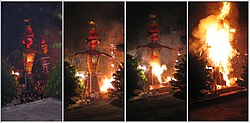
In most of Northern India, Vijayadashami is celebrated in honour of Lord Rama. In many places, the Ramlila, a dramatic performance on story of Rama is enacted over the 9 days leading up to the festival. The performance is inspired from the Ramcharitmanas, a Hindu text written by Tulsidas.[32] Effigies of the demons Ravana, Kumbhakarna and Meghnath are also created and burnt on bonfires in the evening.[14] In other cities, such as Varanasi, the entire story is freely acted out by performance-artists before the public every evening for a month.[24]

The performance arts tradition during the Dussehra festival was inscribed by UNESCO (United Nations Educational, Scientific and Cultural Organization) as one of the "Intangible Cultural Heritage of Humanity" in 2008.[33] It is celebrated across Northern India for Dussehra, but particularly in historically important Hindu cities of Ayodhya, Varanasi, Vrindavan, Almora, Satna and Madhubani.[33] The festival and dramatic enactment of the virtues versus vices filled story is organised by communities in hundreds of small villages and towns, attracting a mix of audiences from different social, gender and economic backgrounds. In many parts of India, the audience and villagers join in and participate spontaneously, helping the artists, others helping with stage setup, make-up, effigies, and lights.[33] These arts come to a close on the night of Dussehra, when the victory of Rama is celebrated by burning the effigies of the evil Ravana and his allies.[21]
Himachal Pradesh[edit | edit source]
Kullu Dussehra is celebrated in the Kullu valley of Himachal Pradesh and is regionally notable for its large fair and parade witnessed by an estimated half a million people. The festival is a symbol of victory of good over evil by Raghunath, and is celebrated like elsewhere in the Indian subcontinent with a procession.[34] The special feature of the Kullu Dussehra procession is the arrival of floats containing deities from different parts of the nearby regions and their journey to Kullu.[28]
Southern India[edit | edit source]


Vijayadashami is celebrated in a variety of ways in Southern India.[35] Celebrations range from worshipping Durga, lighting up temples and major forts such as at Mysore, to displaying colourful figurines, known as a gombe habba.[citation needed]
The festival played a historical role in the 14th-century Vijayanagara Empire, where it was called Mahanavami. The Italian traveller Niccolò de' Conti described the festival's intensity and importance as a grandeur religious and martial event with royal support. The event revered Durga as the warrior goddess (some texts refer to her as Chamundeshwari). The celebrations hosted athletic competitions, singing and dancing, fireworks, a pageantry military parade and charitable giving to the public.[36][37] Portuguese travellers like Domingo Paes and Fernao Nuniz who visited Vijayanagara Empire in the 16th century described the Dasara elephant procession and the Vajra Mushti Kalaga wrestling bouts.[38]
The city of Mysore has traditionally been a major center of Dasara-Vijayadashami celebrations.[36]
This festival is called Dasara in Karnataka and the 10 day festival is celebrated as Shara navaratri where the Goddess in every temple is worshiped for 10 days in 10 forms with different Alankar/forms to signify different Goddesses avatar.[citation needed] Many cultural programs and competitions are organized in many cities like Mysuru, Shivamoga, Bengaluru etc. On the evening of the last day of the ten-festival, the temple's Goddesses are taken in a procession to mark victory over evil and the completion of the war. People of Karnataka exchange leaves of Shami tree as symbol of gold on 10th day evening marking the win over demon. Another Navaratri tradition in Karnataka has been decorating a part of one's home with art dolls called Gombe or Bombe, similar to Golu dolls of Tamil Nadu. An art-themed Gaarudi Gombe, featuring folk dances that incorporate these dolls, is also a part of the celebration.
Another significant and notable tradition of several Southern Indian regions has been the dedication of this festival to Saraswati, the Hindu goddess of knowledge, learning, music and arts. She is worshipped along with instruments of one's trade during this festival. In Southern India, people maintain, clean and worship their instruments, tools of work and implements of their livelihood during this festival, remembering Goddess Saraswati and Durga.[21]
In Kerala, Vidyarambham festival is celebrated on Vijaya Dasami day. It is also known as Saraswati Puja Day. Major temple associated with Vidyarambham are Cherpu Thiruvullakkavu Temple Thrissur and Panachikkad Temple. A guru draws "Om Hari Sree Ganapathaye Namah" on the tongue of a child using a ring dipped in honey. Child is guided to write Hari Sree mantra on rice kept in Uruli. Children aged 3–4 who are new to school are admitted to school and Anganawadi on Vijayadashami Day.[39]
A unique tradition of Dasara festival in Kulasekrapattinam in Tamil Nadu. Here devotees dress up as god, goddess, beggars and other symbolic figures to fulfill their vow to the deity. Those who disguise themselves as other figures usually observe 41 days of fasting. Unlike normal Dasaras, where Lord Ram kills Ravan, here Goddess Mutharamman (Durga)'s victory over the Bison headed demon Mahishasura is celebrated as "Mahishasura Vadham".Lakhs of devotees flock the coastal town to get Goddess' blessings and to get a glimpse of the Mahishasura Vadham. Dasara in Kulasekrapattinam is different, raw and explains the cultures of Tamil Nadu. Like Kerela School Admissions start on Vijayadashami.
Western India[edit | edit source]

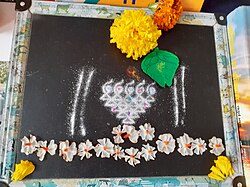
_Vijaya_Dashami_The_art_work_India_October_2013.jpg)
In Gujarat, people engage the popular festival, Navaratri, a nine-day festival that takes place before Vijayadashami. Both the goddess Durga and Rama are revered for their victory over evil. Fasting and prayers at temples are common. A regional dance called Dandiya Raas, that deploys colourfully decorated sticks, and garba, (another type of regional dance) is a part of the festivities through the night.[40]
The Gondi people instead celebrate Ravana by carrying an image of him riding an elephant and singing praises to him, as they consider Ravana as their ancestor and one of their gods.[41][42] In Goa, this festival is locally known as Dasro in Konkani. It marks Durga's victory over the demon Mahishasura. Insignia known as Taranga play an important role in the festivities, which are sacred umbrellas that symbolize the village deities. At many temples, a dance of the Tarangas is held. Oracles are associated with Dasara in Goa. On this day, a ritual called Seemollanghan of the deities is held. For this people make a symbolic crossing of the border of their village. The icons of deities are carried in a grand procession. The tradition traces its roots to ancient times when kings would cross the border of their kingdom to wage war with the neighbouring kingdom. After Seemollanghan, there is a tradition wherein people exchange Aaptyachi pana. These leave symbolise gold and the ritual is a symbolic representation of the exchange of gold.[43]
The festival is also celebrated as a harvest festival by farmers and has an important association with Agricultural activities. At Dussehra, Kharif crops like rice, guar, cotton, soybean, maize, finger millet, pulses are generally ready for harvest, farmers begin their harvest on the day. Farmers bring crops like Kharif crops from their fields for further processing and for trade. Due to this, daily arrivals of these crops in markets of the country normally increases significantly during this period.[44]
The festival has been historically important in Maharashtra. Maratha forces in 17th and 18th centuries including those of Shivaji and the Peshwas would start their new military campaigns on Dasara.[45][46][47] In North Maharashtra this festival is known as Dasara, and on this day people wear new clothes, and touch feet of elderly people and deities of the village temple.[48] The deities installed on the first day of Navaratri are immersed in water. Observers visit each other and exchange sweets.[49] Many communities in Maharashtra including the tribal communities of warli and Kokna exchange leaves of Apta tree as symbol of gold.[50]

In Mewar region of Rajasthan, both Durga and Rama have been celebrated on Vijayadashami, and it has been a major festival for Rajput warriors.[36]
Eastern India[edit | edit source]
In West Bengal Vijaya Dashami is observed as Bijoya Dashomi, immediately after Navami (the ninth and last day of Durga Puja). It is marked by processions in which idols are carried in carriages to a pond, river or ocean for a solemn good-bye to Goddess Durga, along with firecracker bursting, dance, drum beats, music and revelry. Many mark their faces with vermilion (sindoor) or wear red clothing. It is an emotional day for some devotees, especially the Bengali Hindus, and even for many atheists as the congregation sings goodbye songs.[51][52] When the procession reaches the water, the clay statues of Durga and her four children are immersed; the clay dissolves and they are believed to return to Mount Kailasha with Shiva, and to the cosmos in general. People distribute sweets and gifts and visit friends, relatives and family members to wish them "Subho Vijaya".[53] Some communities such as those near Varanasi mark the eleventh day, called ekadashi, by visiting a Durga temple.[54]
In Bihar Dushehra is celebrated over a period of 10 days. The people worship goddess durga and they setup idols in different places. On the 10th day that is Vijaya Dashmi effigy of Ravana is burnt. In Patna the capital of Bihar, people gather in historical Gandhi Maidan and a huge effigy of Ravan is burnt.[55]
Nepal[edit | edit source]

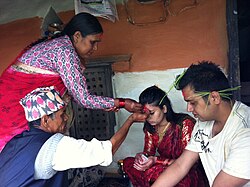
In Nepal, Vijayadashami follows the festival of Dashain. Youngsters visit the elders in their family, distant ones come to their native homes, students visit their school teachers, and government workers visit the head of the state. The elders and teachers welcome the youngsters and bless them for virtuous success and prosperity in the year ahead.[56][57] Elders give "Dakshina", or a small amount of money, to younger relatives at this time along with the blessings. It is celebrated for 15 days from Shukla Paksha to Poornima. The red tika or simply tika symbolizes the blessings of goddess durga. Red also symbolizes the blood that ties the family together
See also[edit | edit source]


- Ayudha Puja – Hindu observance
- Bathukamma – Flower festival in India
- Dasara elephants
- Durga Puja – Annual Hindu festival
- Golu (festive)
- Kullu Dussehra
- Madikeri Dasara
- Navaratri – Annual Hindu festival
- Prasada – Religious food offered in Hinduism and Sikhism temples
- Puja (Hinduism) – Prayer ritual of devotional worship performed by Hindus
- Vidyāraṃbhaṃ
- Zatra
Notes[edit | edit source]
- ↑ The word dussehra is the Anglicized form of the Indic word daśahrā.
References[edit | edit source]
- ↑ 1.0 1.1 1.2 1.3 1.4 Fuller, Christopher John (2004). The Camphor Flame: Popular Hinduism and Society in India. Princeton University Press. pp. 108–109. ISBN 978-0-69112-04-85.
- ↑ "Dussehra 2025 - Calendar Date".
- ↑ "Dussehra 2020 Date, Time & Significance – Times of India". The Times of India. 21 October 2020. Retrieved 23 October 2020.
- ↑ "Vijayadashami 2020: Vijay Muhurat date, timings and Sindoor Khela". Zee News. 25 October 2020. Retrieved 25 October 2020.
- ↑ "When is Dussehra in 2022: Date, time, history and significance". India Today. 27 December 2021. Retrieved 7 September 2022.
- ↑ 7.0 7.1 Lochtefeld 2002, pp. 212–213, 468–469.
- ↑ Encyclopedia Britannica: Dussehra 2015.
- ↑ 9.0 9.1 Lochtefeld 2002, p. 751.
- ↑ 10.0 10.1 Encyclopedia Britannica 2015.
- ↑ Lochtefeld 2002, pp. 468–469.
- ↑ "Dussehra 2020 (Vijayadashami): Story, Ram Setu, Lord Rama & True God". S A NEWS. 25 October 2020. Retrieved 25 October 2020.
- ↑ Bhalla, Kartar Singh (February 2005). Let's Know Festivals of India. Star Publications. ISBN 978-81-7650-165-1.
- ↑ 14.0 14.1 Encyclopedia Britannica Dussehra 2015.
- ↑ "Dussehra 2020: Date, Puja Timings, History, Significance and Importance". The Indian Express. 25 October 2020. Retrieved 25 October 2020.
- ↑ Gall, Susan B.; Natividad, Irene (1995). The Asian-American Almanac. Gale Research. p. 24. ISBN 978-0-8103-9193-2.
- ↑ Singh, Rina (2016). Diwali. Orca. pp. 17–18. ISBN 978-1-4598-1008-2.
- ↑ "Sanskrit-English Dictionary". learnsanskrit.cc. Retrieved 27 February 2022.
- ↑ "Sanskrit-English Dictionary". learnsanskrit.cc. Retrieved 27 February 2022.
- ↑ "Dussehra 2018: Why is it celebrated? – Times of India". The Times of India. 18 October 2018. Retrieved 25 October 2020.
- ↑ 21.0 21.1 21.2 Jones & Ryan 2006, pp. 308–309.
- ↑ "Sanskrit-English Dictionary". learnsanskrit.cc. Retrieved 27 February 2022.
- ↑ "Sanskrit-English Dictionary". learnsanskrit.cc. Retrieved 27 February 2022.
- ↑ 24.0 24.1 Lochtefeld 2002, pp. 212–213.
- ↑ "Dussehra | Festival, Meaning, Puja, & Significance | Britannica". www.britannica.com. Retrieved 18 December 2022.
- ↑ Lochtefeld 2002, p. 212, 568.
- ↑ Rosen, Steven (16 May 2008). Essential Hinduism. Praeger. ISBN 978-0-7425-6237-0.
- ↑ 28.0 28.1 Lochtefeld 2002, p. 213.
- ↑ 29.0 29.1 Building Solidarity: Challenge to Christian Mission. ISPCK. 2008. p. 132. ISBN 978-81-8458-063-1.
- ↑ Krishna, Nanditha; M, Amirthalingam (2014). Sacred Plants of India (first ed.). Penguin books india 2014. pp. 171–175. ISBN 9780143066262.
- ↑ Hegde, Narayan G. (1 April 2022). Shami Tree: Teacher For Humanity. Notion Press. ISBN 979-8-88606-658-6.
- ↑ Lochtefeld 2002, p. 558-559.
- ↑ 33.0 33.1 33.2 Ramlila, the traditional performance of the Ramayana, UNESCO
- ↑ Dutta, Sanjay (11 October 2008). "International Dussehra festival kicks-off at Kullu". The Indian Express. Retrieved 3 May 2016.
- ↑ "Navratri celebrations in Southern India: All you need to know". The Indian Express. 7 October 2019. Retrieved 25 October 2020.
- ↑ 36.0 36.1 36.2 Fuller, Christopher John (2004). The Camphor Flame: Popular Hinduism and Society in India. Princeton University Press. pp. 117–119. ISBN 978-0-69112-04-85.
- ↑ Sivapriyananda, S (1995). Mysore Royal Dasara. Abhinav Publications. pp. 73–75.
- ↑ Kumar, R. Krishna (4 October 2024). "Mysuru Dasara: The march of a tradition". The Hindu. ISSN 0971-751X. Retrieved 4 October 2024.
- ↑ "Vijayadasami admissions on in schools despite instructions against mid-year intake". 12 October 2016. Retrieved 18 October 2018.
- ↑ Thaker, Aruna; Barton, Arlene (2012). Multicultural Handbook of Food, Nutrition and Dietetics. John Wiley & Sons. p. 6. ISBN 978-1-4051-7358-2.
- ↑ Asuras? No, Just Indians, Outlook India
- ↑ Celebrating Ravan, The Hindu
- ↑ "Dussehra celebrated with religious fervour". Times of India. 7 October 2011.
- ↑ "Dussehra Celebrations and their Relation with Agriculture". Krishi Jagaran. 24 October 2020.
- ↑ Mehta, Jaswant Lal (2005). Advanced Study in the History of Modern India 1707–1813. Sterling Publishers Pvt. Ltd. pp. 505–509. ISBN 978-1-932705-54-6.
- ↑ Sabharwal, Gopa (2006). Ethnicity and Class: Social Divisions in an Indian City. Oxford University Press. pp. 123–125. ISBN 978-0-19-567830-7.
- ↑ Gokhale, Balkrishna Govind (1985). "The Religious Complex in Eighteenth-Century Poona". Journal of the American Oriental Society. 105 (4): 719–724. doi:10.2307/602730. ISSN 0003-0279. JSTOR 602730.
- ↑ Satpathy, Kriti Saraswat (7 October 2016). "Dasara 2016: Dussehra celebration in Maharashtra". India News, Breaking News, Entertainment News | India.com. Retrieved 22 October 2020.
- ↑ Shirgaonkar, Varsha. ""Madhyayugin Mahanavami aani Dasara"." Chaturang, Loksatta (1996).
- ↑ Tribhuwan, R.D., 2003. Tribal Festivals in Maharashtra. Fairs and Festivals of Indian Tribes, p.85-86.[1]
- ↑ Rodrigues 2003, pp. 244–245.
- ↑ McDaniel 2004, pp. 168–169.
- ↑ Rodrigues 2003, pp. 66–67, 236–241, 246–247.
- ↑ Rodrigues 2003, pp. 67–68.
- ↑ "Dussehra Mahotsav to start from tomorrow". The Times of India. 4 October 2024. ISSN 0971-8257. Retrieved 16 October 2024.
- ↑ Deep, Dhurba Krishna (1993). Popular Deities, Emblems & Images of Nepal. Nirala. pp. 50–51. ISBN 978-81-85693-25-5.
- ↑ Thapa, Netra Bahadur; Thapa, D. P. (1969). Geography of Nepal: Physical, Economic, Cultural & Regional. Orient Longmans. pp. 92–93.
Bibliography[edit | edit source]
- Amazzone, Laura (2012). Goddess Durga and Sacred Female Power. University Press of America. ISBN 9780761853145. Retrieved 5 February 2017.
- Coburn, Thomas B. (1991). Encountering the Goddess: A translation of the Devi-Mahatmya and a Study of Its Interpretation. State University of New York Press. ISBN 0791404463.
- Reid-Bowen, Paul (2012). Cush, Denise; Robinson, Catherine; York, Michael (eds.). Encyclopedia of Hinduism. Routledge. ISBN 978-1-135-18979-2.
- Jones, Constance; Ryan, James D. (2006). Encyclopedia of Hinduism. Infobase Publishing. ISBN 978-0-8160-7564-5.
- Kinsley, David (1988). Hindu Goddesses: Visions of the Divine Feminine in the Hindu Religious Tradition. University of California Press. ISBN 978-0-520-90883-3.
- Lochtefeld, James G. (2002). The Illustrated Encyclopedia of Hinduism: N–Z. The Rosen Publishing Group. ISBN 0-8239-2287-1.
- McDaniel, June (2004). Offering Flowers, Feeding Skulls: Popular Goddess Worship in West Bengal. Oxford University Press. ISBN 978-0-19-534713-5.
- McDermott, Rachel Fell (2001). Mother of My Heart, Daughter of My Dreams: Kali and Uma in the Devotional Poetry of Bengal. Oxford University Press. ISBN 978-0-19-803071-3.
- Rocher, Ludo (1986). The Puranas. Otto Harrassowitz Verlag. ISBN 978-3447025225.
- Rodrigues, Hillary (2003). Ritual Worship of the Great Goddess: The Liturgy of the Durga Puja with Interpretations. SUNY Press. ISBN 978-0-7914-8844-7.
- "Navratri – Hindu festival". Encyclopedia Britannica. 2017. Retrieved 21 February 2017.
- "Dussehra – Hindu festival". Encyclopedia Britannica. 2014. Retrieved 21 February 2017.
External links[edit | edit source]
- Dussehra in Telangana Archived 9 July 2022 at the Wayback Machine at telanganatourism.gov.in
| Major festivals | ||
|---|---|---|
| Other important festivals | ||
| Regional New Year |
| |
| Holy days |
| |
| Holy periods | ||


_name_of_the_God_as_per_the_Vedas.svg)
| Philosophy |
|  | |||||||||||||||
|---|---|---|---|---|---|---|---|---|---|---|---|---|---|---|---|---|---|
| Texts |
| ||||||||||||||||
| Deities |
| ||||||||||||||||
| Practices |
| ||||||||||||||||
| Related | |||||||||||||||||