







→Railway Station Gwalior: Sheopur Kalan line has been closed for broad gauge conversion since 2020. Broad gauge conversion and extension of line from Sheopur to Kota is going on. Services have, as of now, started from Gwalior to Sumaoli. Many youtube videos are giving updates, such as https://www.youtube.com/watch?v=lwnU9-mvgyI |
added citations additionally and corrected details per sources |
||
| Line 1: | Line 1: | ||
{{About|the city|the district|Gwalior district}} | {{About|the city|the district|Gwalior district}} | ||
{{Use Indian English|date= | {{pp-move}} | ||
{{Use dmy dates|date= | {{pp-extended|small=yes}} | ||
{{Multiple issues| | |||
{{Disputed|date=May 2024}} | |||
{{More citations needed|date=January 2025}} | |||
}} | |||
{{Use Indian English|date=March 2025}} | |||
{{Use dmy dates|date=March 2025}} | |||
{{Infobox settlement | {{Infobox settlement | ||
| name | | name = Gwalior | ||
| native_name | | official_name = | ||
| native_name_lang | | native_name = <!-- Please do not add any Indic script in this infobox, per WP:INDICSCRIPT policy. --> | ||
| settlement_type | | native_name_lang = | ||
| image_skyline | | settlement_type = [[Metropolis]] | ||
| border | | image_skyline = {{Multiple image | ||
| total_width | |border = infobox | ||
| image_style | |total_width = 270 | ||
| perrow | |image_style = | ||
| image1= Gwalior_Fort_front.jpg | |perrow = 2/2/2/1/2 | ||
| | |image1 = Gwalior_Fort_front.jpg | ||
| image4= Jai Vilas Palace Night at the Museum (4).JPG | |caption1 = Gwalior Fort | ||
| image3= 244 Gwalior.jpg | |caption2 = Birla Sun Temple | ||
| image6= Chattri of Maharani Laxmi Bai Gwalior - panoramio.jpg | |image4 = Jai Vilas Palace Night at the Museum (4).JPG | ||
| image7 = The Jai Vilas Palace (Gwalior).jpg | |caption4 = Durbar Hall | ||
| image5= Sahasra bahu temple Gwalior fort.jpg | |image3 = 244 Gwalior.jpg | ||
| image8 = Mohammad gaus tomb.jpg | |caption3 = British Monument | ||
|image6 = Chattri of Maharani Laxmi Bai Gwalior - panoramio.jpg | |||
|caption6 = Maharani Laxmibai Chhatri | |||
|image7 = The Jai Vilas Palace (Gwalior).jpg | |||
|caption7 = Jai Vilas palace from outside | |||
|image5 = Sahasra bahu temple Gwalior fort.jpg | |||
|caption5 = Saas Temple | |||
|image8 = Mohammad gaus tomb.jpg | |||
|caption8 = Muhammed Ghaus Tomb | |||
|image9 = Gwalior Stadium.png | |||
|caption9 = Gwalior Stadium | |||
|image10 = Gwalior Airport.png | |||
|caption10 = Gwalior Airport | |||
}} | |||
| image_caption = | |||
| image_shield = Gwalior Coat of arms.png | |||
| nicknames = The City of Music, Capital of Hindustani Music,<ref>{{cite news |last1=Nair |first1=Jyoti |date=7 December 2017 |title=What are the important signatures of a raga? |url=https://www.thehindu.com/entertainment/music/gwalior-gharana-one-of-the-ancient-one/article21290240.ece |work=The Hindu |access-date=12 February 2025}}</ref> The Royal City of Madhya Pradesh<ref>{{cite magazine |title=On A Carpet Tour Through India |url=https://www.outlooktraveller.com/explore/culture/on-a-carpet-tour-through-india |magazine=Outlook |date=1 November 2022 |access-date=11 March 2025}}</ref> | |||
| pushpin_map = India Madhya Pradesh#India | |||
| pushpin_label_position = | |||
| pushpin_map_alt = | |||
| pushpin_relief = | |||
| pushpin_map_caption = | |||
| coordinates = {{Coord|format=dms|display=inline,title}} | |||
| subdivision_type = Country | |||
| subdivision_name = {{flag|India}} | |||
| subdivision_type1 = [[States and union territories of India|State]] | |||
| subdivision_name1 = [[Madhya Pradesh]] | |||
| subdivision_type2 = [[List of regions of India|Region]] | |||
| subdivision_name2 = [[Gird, India|Gwalior Chambal]] | |||
| subdivision_type3 = [[List of districts of India|District]] | |||
| subdivision_name3 = [[Gwalior district|Gwalior]] | |||
| established_title = | |||
| established_date = | |||
| founder = Suraj Sen | |||
| government_type = Municipal Corporation | |||
| governing_body = Gwalior Municipal Corporation (GMC) | |||
| leader_party = | |||
| leader_title = [[Mayor]] | |||
| leader_name = Shobha Sikarwar | |||
| leader_title1 = Administrator | |||
| leader_name1 = Ruchika Chauhan IAS | |||
| unit_pref = Metric | |||
| area_footnotes = <ref name="news-article-gmc-area" /> | |||
| area_rank = | |||
| area_total_km2 = 414 | |||
| elevation_footnotes = | |||
| elevation_m = 247.04 | |||
| population_total = 2032036 | |||
| population_metro = 12,73,792 | |||
| population_as_of = 2011 census | |||
| population_blank1_title = Population rank | |||
| population_blank1 = [[List of million-plus agglomerations in India|46th]] | |||
| population_density_km2 = 5478 | |||
| population_demonym = Gwaliorites, Gwaliori | |||
| population_footnotes = <ref name="2011census" /> | |||
| demographics_type1 = [[Language]] | |||
| demographics1_title1 = Official | |||
| demographics1_info1 = [[Hindi language|Hindi]],<ref name="langoff">{{cite web |title=52nd Report of the Commissioner for Linguistic Minorities in India |url=http://nclm.nic.in/shared/linkimages/NCLM52ndReport.pdf |website=nclm.nic.in |publisher=[[Ministry of Minority Affairs]] |access-date=25 August 2020 |url-status=dead |archive-url=https://web.archive.org/web/20170525141614/http://nclm.nic.in/shared/linkimages/NCLM52ndReport.pdf |archive-date=25 May 2017 }}</ref> | |||
| demographics1_title2 = Other | |||
| demographics1_info2 = [[Bundeli]], [[Marathi language|Marathi]] | |||
| timezone1 = [[Indian Standard Time|IST]] | |||
| utc_offset1 = +5:30 | |||
| postal_code_type = [[Postal Index Number|PIN]] | |||
| postal_code = 474001 to 474055 | |||
| area_code_type = Telephone code | |||
| area_code = 0751 | |||
| registration_plate = MP-07 | |||
| blank1_name_sec1 = [[Human sex ratio|Sex ratio]] | |||
| blank1_info_sec1 = 862 [[male|♂]]/[[female|♀]] | |||
| blank2_name_sec1 = Literacy | |||
| blank2_info_sec1 = 87.14% | |||
| blank4_name_sec2 = Avg. summer temperature | |||
| blank4_info_sec2 = {{cvt|40.5|C|F}} | |||
| blank5_name_sec2 = Avg. winter temperature | |||
| blank5_info_sec2 = {{cvt|6.6|C|F}}<ref>{{cite web |url=http://en.climate-data.org/location/4881/ |title=Climate: Gwalior |access-date=12 December 2015 |archive-url=https://web.archive.org/web/20151223083531/http://en.climate-data.org/location/4881/ |archive-date=23 December 2015 |url-status=live }}</ref> | |||
| website = {{URL|https://gwalior.nic.in/}} | |||
}} | }} | ||
'''Gwalior''' ({{IPA|hi|ɡʋɑːlɪjəɾ|pron|Gwalior.ogg}}) is a major city in the central Indian state of [[Madhya Pradesh]]. It is known as the Music City of India<ref>{{Cite web |last=Dalrymple |first=Sam |date=20 April 2025 |title=This Northern Indian City is a Musical Star that Moves to a Mystical, Centuries Old Beat |url=https://www.cntraveller.com/article/gwalior-madhya-pradesh-india |access-date=20 April 2025 |website=Condè Nast Traveller}}</ref><ref>{{Cite web |last=City of Music |first=Gwalior |date=20 November 2023 |title=UNESCO world cities |url=https://www.conchovalleyhomepage.com/business/press-releases/ein-presswire/669719547/gwalior-in-madhya-pradesh-declared-as-the-city-of-music-by-unesco/ |access-date=11 October 2024}}</ref> having the oldest [[Gwalior gharana|musical gharana]] in existence. It is a major sports, cultural, industrial, and political centre in Madhya Pradesh. Gwalior is among the seven cities selected for new startup centres under India's growing innovation ecosystem.<ref>{{Cite news |title=Gwalior's startup push features in PM's "Mann ki Baat" |url=https://timesofindia.indiatimes.com/city/bhopal/ratapani-reserve-gwaliors-startup-push-feature-in-pms-mann-ki-baat/articleshow/117378801.cms |work=Times of India |date=20 January 2025 |access-date=20 January 2025}}</ref> On World Cities Day (31 October 2023), UNESCO Director - General [[Audrey Azoulay]] announced Gwalior's inclusion among 55 new [[Creative Cities Network|world creative cities]] in the UCCN from [[India]].<ref>{{Cite web |last=World Cities |first=Gwalior |date=25 March 2025 |title=Creative Cities Network |url=https://www.unesco.org/en/creative-cities/gwalior |access-date=25 March 2025 |website=UNESCO}}</ref> This tag elevates Gwalior's identity internationally, spotlighting its artists, music traditions and vibrant culture. It lies in the northern part of Madhya Pradesh and is one of the [[National Capital Region (India)#Counter magnets|Counter-magnet]] cities. Located {{convert|313|km|mi|0}} south of [[New Delhi]], the capital city of India and {{convert|446|km|mi|0}} from [[Bhopal]], the state capital, Gwalior occupies a strategic location in the [[Gird, India|Gwalior Chambal]] region of India. The grand historic city and its fortress have been ruled by several Indian kingdoms. From the [[Alchon Huns]] in the 5th century AD to [[Gurjara Pratihara dynasty]] in the 8th century AD. It was passed on to [[Kachchhapaghata dynasty|Kachchhapaghatas]] in the 10th century AD. Later it fell into the hands of the [[Delhi Sultanate]] in the 12th century AD, it was then passed on to the [[Tomaras of Gwalior|Tomars]] in the 13th century AD who were the vassal rulers of the Delhi Sultanate. | |||
| | |||
| | |||
| | |||
| | |||
| | |||
| | |||
| | |||
| | |||
| | |||
| | |||
| | The [[Mughal Empire]] conquered the city and its fortress in the 16th century AD. When the Mughal Empire was declining, it fell into the hands of [[Jats|Jat rulers]], then to the [[English people|English]] in 1730, and last it was passed on to the [[Scindia Dynasty]] of [[Maratha Confederacy|Maratha Empire]] in the early 18th century.<ref name="lonelyplanet.com">{{cite web |url=http://www.lonelyplanet.com/india/madhya-pradesh-and-chhattisgarh/gwalior/history |title=History of Gwalior – Lonely Planet Travel Information |author=Lonely Planet |access-date=28 July 2015 |archive-url=https://web.archive.org/web/20150706025720/http://www.lonelyplanet.com/india/madhya-pradesh-and-chhattisgarh/gwalior/history |archive-date=6 July 2015 |url-status=live }}</ref> | ||
Gwalior is a premier 21 Gun Salute State along with [[Hyderabad]], [[Mysore]], [[Jammu and Kashmir (union territory)|Jammu & Kashmir]] and [[Vadodara|Baroda]].<ref>{{Cite news |last=Siddarth |first=Praveen |date=25 January 2021 |title=For Whom the Guns Boom |url=https://www.thehindubusinessline.com/blink/explore/for-whom-the-guns-boom/article33659272.ece |work=The Hindu Business line |access-date=11 March 2025}}</ref> | |||
Gwalior was the capital of [[Madhya Bharat]] from 1948 till 1956 and Moti Mahal was made the legislative assembly.<ref>{{Cite news |last=Kaushik |first=Sushil |date=1 November 2022 |title=Madhya Bharat First CM Oath Ceremony |url=https://hindi.news18.com/news/madhya-pradesh/gwalior-madhya-pradesh-foundation-day-famous-moti-mahal-of-gwalior-was-first-legislative-assembly-of-madhya-bharat-mav-4825111.html |work=News 18 |language=hi |access-date=11 March 2025}}</ref> | |||
Gwalior was the winter capital of the state of [[Madhya Bharat]] which later became a part of the larger state of Madhya Pradesh. Prior to [[Indian independence movement|Indian independence]] on 15 August 1947, Gwalior remained a princely state of the [[British Raj]] with the | Gwalior was one of the major locations of rebellion during the [[1857 uprising]]. During [[British Raj]] Gwalior became winter capital of Central India Agency. Post Independence Gwalior was made the capital of the state of [[Madhya Bharat]] from 1948 till 1956 which later became a part of the larger state of Madhya Pradesh.<ref>{{cite web |title=Profile – District Gwalior |url=https://gwalior.nic.in/en/history/ |website=Government of Madhya Pradesh, India |access-date=20 September 2024}}</ref> Prior to [[Indian independence movement|Indian independence]] on 15 August 1947, Gwalior remained a princely state of the [[British Raj]] with the [[House of Scindia|Scindia]] as the rulers. | ||
Gwalior | Besides being the administrative headquarters of [[Gwalior district]] and [[Gwalior division]], Gwalior has many administrative offices of the [[Chambal division]] of northern Madhya Pradesh. Several administrative and judicial organisations, commissions and boards have their state and national headquarters situated in the city | ||
Post-independence, Gwalior has emerged as an important industrial and tourist attraction in central India, while many industries and administrative offices came up within the city. Before the end of the 20th century, it became a million plus agglomeration and now it is a metropolitan city in central India. Gwalior is surrounded by industrial and commercial zones of neighbouring districts ([[Malanpur]] – [[Bhind]], [[Banmore]] – [[Morena, Madhya Pradesh|Morena]]) on all three main directions. | |||
Gwalior has been selected as one of the hundred Indian cities to be developed as a [[smart city]] under [[Narendra Modi|PM Narendra Modi's]] flagship [[Smart Cities Mission]].<ref>{{cite | High rocky hills surround the city from all sides, on the north it just forms the border of the Ganga-Yamuna Drainage Basin. The city however is situated in the valley between the hills. Gwalior's metropolitan area includes [[Maharaj Bada, Gwalior|Lashkar]], Old City (Fort City), [[Gwalior West]], [[Gwalior East Assembly constituency|Gwalior East]], Greater Gwalior, and [[Morar Cantonment]].<ref name="2011census" /> In April 2021, it was found that Gwalior had the best air quality index among the four major cities in [[Madhya Pradesh]].<ref>{{cite news |date=10 April 2021 |title=Bhopal, Indore, Jabalpur have the most polluted air in state |url=https://timesofindia.indiatimes.com/city/bhopal/bhopal-indore-jabalpur-have-the-most-polluted-air-in-state/articleshow/81999987.cms |url-status=live |archive-url=https://web.archive.org/web/20230216114011/https://timesofindia.indiatimes.com/city/bhopal/bhopal-indore-jabalpur-have-the-most-polluted-air-in-state/articleshow/81999987.cms |archive-date=16 February 2023 |access-date=19 February 2022 |work=The Times of India}}</ref> Gwalior has been selected as one of the hundred Indian cities to be developed as a [[smart city]] under [[Narendra Modi|PM Narendra Modi's]] flagship [[Smart Cities Mission]].<ref>{{cite news |url=http://www.firstpost.com/business/why-only-98-cities-instead-of-100-announced-all-questions-answered-about-smart-cities-project-2410576.html |title=Only 98 cities instead of 100 announced: All questions answered about the smart cities project |work=Firstpost |date=28 August 2015 |access-date=13 June 2017 |archive-url=https://web.archive.org/web/20170119003746/http://www.firstpost.com/business/why-only-98-cities-instead-of-100-announced-all-questions-answered-about-smart-cities-project-2410576.html |archive-date=19 January 2017 |url-status=live }}</ref> | ||
==History== | ==Etymology and History== | ||
[[File:Mihirakula Coin.jpg|300px|thumb|Coin of the [[Alchon Huns]] king [[Mihirakula]], who ruled in Gwalior circa 520 CE.|left]] | [[File:Mihirakula Coin.jpg|300px|thumb|Coin of the [[Alchon Huns]] king [[Mihirakula]], who ruled in Gwalior circa 520 CE.|left]] | ||
According to | Gwalior derived its name from the [[Gwalior Fort]] itself, which was earlier known as Gopgiri, Gop Parvat (Shepherd's Hill) or Gopachal during [[Gupta Empire|Gupta period]]. In ancient time this region was known as ''Gopashetra'' roughly translated to "''the land of Gopis''" or "''the land associated to Cowherds''". The name is believed to have connections with the Gopis (the cow herdesses or cowherds girls) of the [[Krishna|Lord Krishna]] mythology. It is said that the area was once inhabited by cowherds and associated with pastoral activities, especially in the times of [[Mahabharata]]. This may refer to the cultural or historical ties with [[Krishna|Lord Krishna]] worship, which had an influence on the region. Gwalior was the major commercial and trade route during [[Samudragupta]] reign. According to some legends, Gwalior was founded in 600 CE (early 5th Century) after a local chieftain, [[Suraj Sen]], who was cured of leprosy from a drink given to him by a hermit named [[Gwalipa]]. Suraj subsequently set up a city and fort and named them after Gwalipa.<ref name=":0">{{Cite book |title=International Dictionary of Historic Places, Volume 5: Asia and Oceania |publisher=Fitzroy Dearborn Publishers |year=1996 |isbn=1-884964-04-4 |editor-last=Schellinger |editor-first=Paul |location=Chicago |pages=312 |editor-last2=Salkin |editor-first2=Robert }}</ref> | ||
The earliest historical record found at Gwalior is the [[Gwalior inscription of Mihirakula|Gwalior inscription]] of the [[Alchon Huns|Alchon Hun]] ruler [[Mihirakula]]. It describes Mihirakula's father [[Toramana]] (493–515) as "a ruler of the earth, of great merit, who was renowned by the name of the glorious Tôramâna; by whom, through (his) heroism that was specially characterized by truthfulness, the earth was governed with justice", and his Mihirakula as "the lord of the earth" as of 520 CE. | |||
[[ | Around the 9th century, the [[Gurjara-Pratihara dynasty]] controlled Gwalior and during their rule, they constructed the [[Teli ka Mandir]] temple. The [[Kachchhapaghata dynasty]] ruled the area c.950 –c.1192 CE, leaving remarkable architectural works such as the [[Sasbahu Temple, Gwalior|Sas and Bahu Temples]]. In 1021, Gwalior was attacked by forces led by [[Mahmud of Ghazni|Mahmud Ghazni]].<ref name=":0" /> | ||
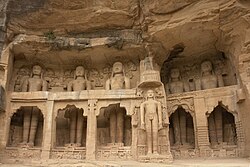
The Jain Sculptures at [[Gwalior Fort]] were built under Tomar rule. [[Man Singh Tomar]] made his dream palace, the [[Gwalior Fort#Man mandir palace|Man Mandir Palace]] which is now a tourist attraction at Gwalior Fort.<ref name="Madan">{{cite book |title=India through the ages |url=https://archive.org/details/indiathroughages00mada |last=Gopal |first=Madan |year=1990 |page=[https://archive.org/details/indiathroughages00mada/page/178 178] |editor=K.S. Gautam |publisher=Publication Division, Ministry of Information and Broadcasting, Government of India}}</ref> Babur described it as "the pearl in the necklace of forts of [[Al-Hind|India]] and not even the winds could touch its masts". The daily light and sound show organised there apprise about the history of the Gwalior Fort and Man Mandir Palace. By the 15th century, the city had a noted singing school which was attended by the prominent figure of Hindustani classical music, [[Tansen]]. After death of Mughal Emperor [[Aurangzeb]] the [[Jat people|Jat]] ruler [[Bhim Singh Rana]] captured Gwalior from [[Mughal Empire|Mughals]].<ref>{{Cite book |url=https://books.google.com/books?id=7CenDwAAQBAJ&dq=Bhim+singh+rana+capture+gwalior&pg=PT301 |title=Majestic Monuments of India: Ancient Indian Mega Structures |last=TL |first=Prabhu |publisher=Nestfame Creations Pvt. Ltd. |year=2019 |access-date=9 May 2022}}</ref> Later in the | [[File:Jain statues, Gwalior.jpg|thumb|Jain Colossal at [[Siddhachal Caves]] inside Gwalior Fort.|left]] | ||
In 1231 [[Iltutmish]], ruler of the [[Mamluk dynasty (Delhi)|Mamluk dynasty]] of the [[Delhi Sultanate]], captured Gwalior after an 11-month-long effort and from then till the 13th century it remained under Muslim rule. In 1375, Raja Veer Singh was made the ruler of Gwalior and he founded the rule of the [[Tomaras of Gwalior|Tomar]] clan. During those years, Gwalior saw its golden period. The Jain Sculptures at [[Gwalior Fort]] were built under Tomar rule. [[Man Singh Tomar]] a Tomar [[Rajput]] made his dream palace, the [[Gwalior Fort#Man mandir palace|Man Mandir Palace]] which is now a tourist attraction at Gwalior Fort.<ref name="Madan">{{cite book |title=India through the ages |url=https://archive.org/details/indiathroughages00mada |last=Gopal |first=Madan |year=1990 |page=[https://archive.org/details/indiathroughages00mada/page/178 178] |editor=K.S. Gautam |publisher=Publication Division, Ministry of Information and Broadcasting, Government of India }}</ref> Babur described it as "the pearl in the necklace of forts of [[Al-Hind|India]] and not even the winds could touch its masts". The daily light and sound show organised there apprise about the history of the Gwalior Fort and Man Mandir Palace. By the 15th century, the city had a noted singing school which was attended by the prominent figure of Hindustani classical music, [[Tansen]]. After death of Mughal Emperor [[Aurangzeb]] the [[Jat people|Jat]] ruler [[Bhim Singh Rana]] captured Gwalior from [[Mughal Empire|Mughals]].<ref>{{Cite book |url=https://books.google.com/books?id=7CenDwAAQBAJ&dq=Bhim+singh+rana+capture+gwalior&pg=PT301 |title=Majestic Monuments of India: Ancient Indian Mega Structures |last=TL |first=Prabhu |publisher=Nestfame Creations Pvt. Ltd. |year=2019 |access-date=9 May 2022 }}</ref> Later in the 1740s, the [[Scindia Dynasty]] captured Gwalior from the [[Jats]]. It remained a [[Gwalior state|princely state]] during the period of British rule. | |||
[[Chaturbhuj Temple, Gwalior|Chaturbhuj Temple]] at Gwalior Fort | [[Chaturbhuj Temple, Gwalior|Chaturbhuj Temple]] at Gwalior Fort has the world's [[0#History|very first occurrence of zero]] as a written number.<ref>{{cite web |url=http://www.smithsonianmag.com/history/origin-number-zero-180953392/?no-ist |title=The Origin of the Number Zero |author=Amir Aczel |website=Smithsonian.com |access-date=28 July 2015 |archive-url=https://web.archive.org/web/20150924131103/http://www.smithsonianmag.com/history/origin-number-zero-180953392/?no-ist |archive-date=24 September 2015 |url-status=live }}</ref> | ||
{{clear|left}} | {{clear|left}} | ||
=== Rebellion of 1857 === | === Rebellion of 1857 === | ||
Gwalior | Gwalior was major centre in the [[Indian Rebellion of 1857|1857 rebellion]], mainly because of [[Rani Lakshmibai]]. After Kalpi (Jhansi) fell into the hands of the British on 24 May 1858, Lakshmibai sought shelter at Gwalior Fort. The Maharaja of Gwalior, was not willing to give up his fort, but after negotiations, his troops capitulated and the rebels took possession of the fort. The British swifty charged against Gwalior in no time, the battle was fought by Lakshmibai.<ref>{{cite web |url=http://www.sanskritimagazine.com/history/rani-lakshmibai-remembering-valiant-queen-jhansi/# |title=Rani Lakshmibai: Remembering the valiant queen of Jhansi |work=Sanskriti – Indian Culture |access-date=28 July 2015 |archive-url=https://web.archive.org/web/20150716053211/http://www.sanskritimagazine.com/history/rani-lakshmibai-remembering-valiant-queen-jhansi/ |archive-date=16 July 2015 |url-status=live |date=19 November 2014 }}</ref> Indian forces numbered around 20,000, and British forces around 1,600 troops. Lakshmibai's example is remembered to this day by Indian nationalists. She died fighting in Gwalior. There is a statue erected at the cenotaph (Samadhi) of Lakshmibai on her horse at Chhatri of Rani Lakshmibai<ref>{{Cite web |title=Chhatri of Rani Lakshmibai |url=https://gwalior.nic.in/tourist-place/%E0%A4%B0%E0%A4%BE%E0%A4%A8%E0%A5%80-%E0%A4%B2%E0%A4%95%E0%A5%8D%E0%A4%B7%E0%A5%8D%E0%A4%AE%E0%A5%80-%E0%A4%AC%E0%A4%BE%E0%A4%88-%E0%A4%95%E0%A5%80-%E0%A4%B8%E0%A4%AE%E0%A4%BE%E0%A4%A7%E0%A4%BF/}}</ref> in Gwalior's Phoolbagh area where she died and was cremated which commemorates her contribution to the fight for independence. [[Tantia Tope]] and Rao Sahib escaped.<ref>{{cite web |url=http://www.indolink.com/Kidz/laxmiBai.html |title=INDOlink Kidz-Korner – Story of RANI LAKSHMIBAI |website=Indolink.com |access-date=13 June 2017 |archive-url=https://web.archive.org/web/20100830180316/http://www.indolink.com/kidz/laxmiBai.html |archive-date=30 August 2010 |url-status=usurped }}</ref> Tantia Tope was later captured and hanged in April 1859. | ||
===Princely state of Gwalior=== | ===Princely state of Gwalior=== | ||
{{main|Gwalior State}} | {{main|Gwalior State}}[[File:The Maharahaj of Gwalior Before His Palace ca 1887.jpg|thumb|The Maharaja of Gwalior Before His Palace, by Edwin Lord Weeks. c. 1887|left]] | ||
[[Scindia]] is a Maratha clan in India. This clan included rulers of the [[Gwalior State]] in the 18th and 19th centuries, who were a [[princely state]] | [[Scindia]] is a [[Maratha clan]] in India. This clan included rulers of the [[Gwalior State]] in the 18th and 19th centuries, who were a [[princely state]] during the period of British colonial rule until Indian independence. During independence, the clans became involved in politics. | ||
[[File:Gwalior (Baedeker, 1914).jpg|thumb | [[File:Gwalior (Baedeker, 1914).jpg|thumb|Map of the city, ca 1914]] | ||
The Scindia state<ref>{{cite web |url=http://www.indianrajputs.com/view/gwalior |title=Gwalior |author=Abhinay Rathore |work=Rajput Provinces of India |date=January 1971 |access-date=28 July 2015 |archive-url=https://web.archive.org/web/20150621050303/http://www.indianrajputs.com/view/gwalior |archive-date=21 June 2015 |url-status=live}}</ref> of Gwalior became a major regional power in the second half of the 18th century and figured prominently in the three [[Anglo-Maratha Wars (disambiguation)|Anglo-Maratha Wars]]. (Gwalior first fell to the British in 1780.) The Scindias held significant power over many of the [[Rajput]] states, and conquered the state of Ajmer. During the | The Scindia state<ref>{{cite web |url=http://www.indianrajputs.com/view/gwalior |title=Gwalior |author=Abhinay Rathore |work=Rajput Provinces of India |date=January 1971 |access-date=28 July 2015 |archive-url=https://web.archive.org/web/20150621050303/http://www.indianrajputs.com/view/gwalior |archive-date=21 June 2015 |url-status=live }}</ref> of Gwalior became a major regional power in the second half of the 18th century and figured prominently in the three [[Anglo-Maratha Wars (disambiguation)|Anglo-Maratha Wars]]. (Gwalior first fell to the British in 1780.) The Scindias held significant power over many of the [[Rajput]] states, and conquered the state of Ajmer. During the Indian Rebellion of 1857, the city was briefly held by rebel forces in 1858 until they were defeated by the British.<ref>''Columbia-Lippincott Gazetteer'', p. 740</ref> The Scindia dynasty ruled Gwalior until India's independence from the United Kingdom in 1947, when the [[Maharaja]] [[Jiwajirao Scindia]] acceded to the Government of India. Gwalior was merged with a number of other princely states to become the new Indian state of Madhya Bharat. Jivajirao Scindia served as the state's [[Rajpramukh]], or the appointed governor, from 28 May 1948 to 31 October 1956, when Madhya Bharat was merged into Madhya Pradesh. Gwalior was the first princely state that was merged into India. [[File:Gwalior Twelve Annas King George VI SG137.jpg|thumb|A King George VI stamp of 1949, inscribed 'GWALIOR']] | ||
In 1962, [[Rajmata Vijayraje Scindia]], the widow of Maharaja Jivajirao Scindia, was elected to the Lok Sabha, beginning the family's career in electoral politics. She was first a member of the Congress Party, and later became an influential member of the Bharatiya Janata Party. Her son, Maharaja [[Madhavrao Scindia]] was elected to the Lok Sabha in 1971 representing the Congress Party, and served until his death in 2001.<ref>{{cite news |last1=Zubrzycki |first1=John |date=6 August 2023 |title=Did India let down the maharajahs? |url=https://www.bbc.com/news/world-asia-india-66370541 | | In 1962, [[Vijaya Raje Scindia|Rajmata Vijayraje Scindia]], the widow of Maharaja Jivajirao Scindia, was elected to the Lok Sabha, beginning the family's career in electoral politics. She was first a member of the Congress Party, and later became an influential member of the [[Bharatiya Janata Party]]. Her son, Maharaja [[Madhavrao Scindia]] was elected to the Lok Sabha in 1971, representing the Congress Party, and served until his death in 2001.<ref>{{cite news |last1=Zubrzycki |first1=John |date=6 August 2023 |title=Did India let down the maharajahs? |url=https://www.bbc.com/news/world-asia-india-66370541 |publisher=BBC News |access-date=8 August 2023 |archive-date=7 August 2023 |archive-url=https://web.archive.org/web/20230807230428/https://www.bbc.com/news/world-asia-india-66370541 |url-status=live }}</ref> His son, [[Jyotiraditya Scindia]], also in the Congress Party, was elected to the seat formerly held by his father in 2004, but later joined the Bharatiya Janata Party in 2020. | ||
==Demographics== | ==Demographics== | ||
{{see also|List of cities in Madhya Pradesh}} | {{see also|List of cities in Madhya Pradesh}} | ||
{{update after|2022}} | {{update after|2022}} | ||
As of the [[2011 Census of India]], Gwalior had a population of 1,054,420. Males constitute 53% of the population and females 47%. Gwalior has an average literacy rate of 84.14%, higher than the national average of 74%: male literacy is 89.64% and female literacy is 77.92%. In Gwalior, about 11% of the population is under 6 years of age. The city's metropolitan population, which includes the commuter town of [[Morar Cantonment]], was 1,102,884.<ref name="2011census">{{cite web |title=District Census Handbook – Gwalior |url=https://censusindia.gov.in/2011census/dchb/DCHB_A/23/2304_PART_A_DCHB_GWALIOR.pdf |website=censusindia.gov.in |access-date=19 February 2022}}</ref> | As of the [[2011 Census of India]], Gwalior had a population of 1,054,420. Males constitute 53% of the population and females 47%. Gwalior has an average literacy rate of 84.14%, higher than the national average of 74%: male literacy is 89.64% and female literacy is 77.92%. In Gwalior, about 11% of the population is under 6 years of age. The city's metropolitan population, which includes the commuter town of [[Morar Cantonment]], was 1,102,884.<ref name="2011census">{{cite web |title=District Census Handbook – Gwalior |url=https://censusindia.gov.in/2011census/dchb/DCHB_A/23/2304_PART_A_DCHB_GWALIOR.pdf |website=censusindia.gov.in |access-date=19 February 2022 |archive-date=8 March 2022 |archive-url=https://web.archive.org/web/20220308151618/https://www.censusindia.gov.in/2011census/dchb/DCHB_A/23/2304_PART_A_DCHB_GWALIOR.pdf |url-status=live }}</ref> | ||
===Religion=== | ===Religion=== | ||
{{bar box | {{bar box | ||
|title=Religion in Gwalior (2011)<ref name="Religion">{{cite web |title=C-16 Population By Religion – Madhya Pradesh |url=https://censusindia.gov.in/2011census/C-01/DDW23C-01%20MDDS.XLS |website=census.gov.in |access-date=19 February 2022}}</ref> | |title=Religion in Gwalior (2011)<ref name="Religion">{{cite web |title=C-16 Population By Religion – Madhya Pradesh |url=https://censusindia.gov.in/2011census/C-01/DDW23C-01%20MDDS.XLS |website=census.gov.in |access-date=19 February 2022 |archive-date=12 January 2021 |archive-url=https://web.archive.org/web/20210112084605/https://www.censusindia.gov.in/2011census/C-01/DDW23C-01%20MDDS.XLS |url-status=live }}</ref> | ||
|titlebar=#FCD116 | |titlebar=#FCD116 | ||
|left1=Religion | |left1=Religion | ||
|right1=Percent | |right1=Percent | ||
|float= | |float=left | ||
|bars= | |bars= | ||
{{bar percent|[[Hindus]]|darkorange|88.84}} | {{bar percent|[[Hindus]]|darkorange|88.84}} | ||
{{bar percent|[[Muslim]]| | {{bar percent|[[Muslim]]|green|8.58}} | ||
{{bar percent|[[Jainism in Bundelkhand|Jains]]|pink|1.41}} | {{bar percent|[[Jainism in Bundelkhand|Jains]]|pink|1.41}} | ||
{{bar percent|[[ | {{bar percent|[[Sikhism]]|darkkhaki|0.56}} | ||
{{bar percent|Other or not stated|black|0.61}} | {{bar percent|Other or not stated|black|0.61}} | ||
}} | }} | ||
[[Hinduism]] is | [[Hinduism]] is practised by the majority of the people in Gwalior (88.84%). Other religions practised include [[Islam]] (8.58%), [[Jainism]] (1.41%), [[Sikhism]] (0.56%), and Christianity (0.29). Gwalior has a long history of religious amity. The erstwhile Maharajas of the Scindia dynasty considered the [[Sufi]] [[Sufi saints|saints]] to be their gurus and headed the [[Muharram]] procession every year.<ref name="Religion" /> | ||
===Languages=== | ===Languages=== | ||
[[Hindi]] is | {{Pie chart | ||
|caption = Languages of Gwalior (2011)<ref name="languages"/> | |||
|label1 = [[Hindi]] |value1 = 95.97 |color1 = orange | |||
|label2 = [[Sindhi language|Sindhi]] |value2 = 1.10 |color2 = yellow | |||
|label3 = [[Marathi language|Marathi]] |value3 = 1.04 |color3 = red | |||
|label4 = Others |value4 = 1.89 |color4 = grey | |||
}} | |||
[[Hindi]] is the predominant language of Gwalior, with nearly 96% of residents speaking it as their first language. [[Sindhi language|Sindhi]] and [[Marathi language|Marathi]] are spoken by 1% each.<ref name="languages">{{Cite web |title=Table C-16 Population by Mother Tongue: Madhya Pradesh |url=https://censusindia.gov.in/nada/index.php/catalog/10249/download/13361/DDW-C16-TOWN-STMT-MDDS-2300.XLSX |website=censusindia.gov.in |publisher=[[Registrar General and Census Commissioner of India]] }}</ref> | |||
== Geography == | == Geography == | ||
Gwalior is located at {{Coord|26.22|N|78.18|E|}}.<ref>{{cite web |url=http://www.fallingrain.com/world/IN/35/Gwalior.html |title=Maps, Weather, and Airports for Gwalior, India |website=Fallingrain.com |access-date=28 July 2015 |archive-url=https://web.archive.org/web/20150924141246/http://www.fallingrain.com/world/IN/35/Gwalior.html |archive-date=24 September 2015 |url-status=live}}</ref> in northern Madhya Pradesh 300 | Gwalior is located at {{Coord|26.22|N|78.18|E|}}.<ref>{{cite web |url=http://www.fallingrain.com/world/IN/35/Gwalior.html |title=Maps, Weather, and Airports for Gwalior, India |website=Fallingrain.com |access-date=28 July 2015 |archive-url=https://web.archive.org/web/20150924141246/http://www.fallingrain.com/world/IN/35/Gwalior.html |archive-date=24 September 2015 |url-status=live }}</ref> in northern Madhya Pradesh {{cvt|300|km|mi}} from Delhi. It has an average elevation of {{convert|197|m|ft|abbr=off}}. Most part of it comes under the [[Gird, India|Gird]] and [[Bundelkhand]] area. | ||
=== Location === | === Location === | ||
{{Geographic location|state=expanded | {{Geographic location|state=expanded | ||
| Center = Gwalior district | | Center = Gwalior district | ||
| North = [[Morena]] District | | North = [[Morena, Madhya Pradesh|Morena]] District | ||
| Northeast = [[Bhind]] District | | Northeast = [[Bhind]] District | ||
| East = [[Datia]] district | | East = [[Datia]] district | ||
| Line 173: | Line 202: | ||
=== Parks and gardens === | === Parks and gardens === | ||
{{Unreferenced section|date=August 2021}} | {{Unreferenced section|date=August 2021}} | ||
The Lashkar part of Gwalior has many parks, including the ''Phool Bagh,'' or the garden of flowers, built to welcome the Prince of Cambridge | The Lashkar part of Gwalior has many parks, including the ''Phool Bagh,'' or the garden of flowers, built to welcome the Prince of Cambridge. | ||
Italian Garden – the garden which was used by the Scindias as a place of relaxation, is Italian in architecture with a water pool surrounded by musical fountains. Ambedkar Park and Gandhi Park are other prominent parks. | |||
Gwalior Zoo provides a home for [[white tiger]]s, serpents, golden pheasants, [[sambar (deer)|sambar]], hyena, bison, and others. | Gwalior Zoo provides a home for [[white tiger]]s, serpents, golden pheasants, [[sambar (deer)|sambar]], hyena, bison, and others. | ||
| Line 196: | Line 227: | ||
|state=collapsed | |state=collapsed | ||
}} | }} | ||
Gwalior has a sub-tropical climate with hot summers from late March to early July, the humid monsoon season from late June to early October, and a cool dry winter from early November to late February. Under [[Köppen climate classification|Köppen's climate classification]] the city has a [[humid subtropical climate]]. The highest recorded temperature was 48 °C and the lowest was −1 °C. Summers start in late March, and along with other cities like [[Jaipur]] and [[Climate of Delhi|Delhi]], are among the hottest in India and the world. Temperatures peak in May and June with daily averages being around | Gwalior has a sub-tropical climate with hot summers from late March to early July, the humid monsoon season from late June to early October, and a cool dry winter from early November to late February. Under [[Köppen climate classification|Köppen's climate classification]] the city has a [[humid subtropical climate]]. The highest recorded temperature was 48 °C and the lowest was −1 °C. Summers start in late March, and along with other cities like [[Jaipur]] and [[Climate of Delhi|Delhi]], are among the hottest in India and the world. Temperatures peak in May and June with daily averages being around {{convert|33|–|35|C|F}}, and end in late June with the onset of the [[monsoon]]. Gwalior receives 750 mm of rain on average per year, most of which is concentrated in the [[Monsoon]] months (from late June to early October). August is the wettest month with about 250 mm of rain. Winter in Gwalior starts in late October, and is generally very mild with daily temperatures averaging in the {{convert|14|–|16|C|F}} range, and mostly dry and sunny conditions. January is the coldest month with average lows in the 5-6 °C range (41-42 °F) and occasional cold snaps that plummet temperatures down to a single digit. | ||
{{Weather box | {{Weather box | ||
| Line 228: | Line 259: | ||
| Dec high C = 25.2 | | Dec high C = 25.2 | ||
| year high C = 32.8 | | year high C = 32.8 | ||
|Jan mean C = 14.3 | |||
|Feb mean C = 18.6 | |||
|Mar mean C = 24.5 | |||
|Apr mean C = 30.0 | |||
|May mean C = 34.4 | |||
|Jun mean C = 34.1 | |||
|Jul mean C = 30.6 | |||
|Aug mean C = 29.3 | |||
|Sep mean C = 28.9 | |||
|Oct mean C = 26.2 | |||
|Nov mean C = 21.0 | |||
|Dec mean C = 15.7 | |||
| Jan low C = 7.7 | | Jan low C = 7.7 | ||
| Feb low C = 10.9 | | Feb low C = 10.9 | ||
| Line 295: | Line 338: | ||
| Dec humidity = 60 | | Dec humidity = 60 | ||
| year humidity = 49 | | year humidity = 49 | ||
|source 1 = [[India Meteorological Department]]<ref name="IMDnormals">{{cite web |url=https://www.imdpune.gov.in/library/public/Climatological%20Tables%201991-2020.pdf |archive-url=https://web.archive.org/web/20230101061732/https://www.imdpune.gov.in/library/public/Climatological%20Tables%201991-2020.pdf |archive-date=1 January 2023 |title=Climatological Tables 1991-2020 |publisher=India Meteorological Department |access-date=1 January 2023 |page=21}}</ref> | |source 1 = [[India Meteorological Department]]<ref name="IMDnormals">{{cite web |url=https://www.imdpune.gov.in/library/public/Climatological%20Tables%201991-2020.pdf |archive-url=https://web.archive.org/web/20230101061732/https://www.imdpune.gov.in/library/public/Climatological%20Tables%201991-2020.pdf |archive-date=1 January 2023 |title=Climatological Tables 1991-2020 |publisher=India Meteorological Department |access-date=1 January 2023 |page=21 }}</ref> | ||
}} | |source 2 = Tokyo Climate Center (mean temperatures 1991–2020)<ref name=TCC1> | ||
{{cite web |archive-url=https://web.archive.org/web/20221201155746/https://ds.data.jma.go.jp/gmd/tcc/tcc/products/climate/normal/parts/NrmMonth_e.php?stn=42361 |archive-date=1 December 2022 |url=https://ds.data.jma.go.jp/gmd/tcc/tcc/products/climate/normal/parts/NrmMonth_e.php?stn=42361 |title=Normals Data: Gwalior – India Latitude: 26.23°N Longitude: 78.25°E Height: 205 (m) |publisher=Japan Meteorological Agency |access-date=1 December 2022 }}</ref> | |||
}}Gwalior has been ranked 26th best "National Clean Air City" (under Category 1 >10L Population cities) in India.<ref>{{Cite web |date=7 September 2024 |title=Swachh Vayu Sarvekshan 2024 |url=https://prana.cpcb.gov.in/ncapServices/robust/fetchFilesFromDrive/Swachh_Vayu_Survekshan_2024_Result.pdf |website=Swachh Vayu Sarvekshan 2024}}</ref> | |||
===Environment=== | ===Environment=== | ||
Gwalior was found to have the second-highest level of air pollution according to a [[World Health Organization]] study in 2016. Particulates from the burning of garbage and fossil fuels make breathing the air of this city a hazard.<ref name="WHO2016">{{cite news |title=WHO flags Gwalior for pollution, officials dismissive |url=https://www.hindustantimes.com/bhopal/who-flags-gwalior-for-pollution-officials-dismissive/story-RGHZPeoRKojeAODaEbiRLN.html |access-date=24 March 2021 |work=Hindustan Times |date=22 May 2016 | | Gwalior was found to have the second-highest level of air pollution according to a [[World Health Organization]] study in 2016. Particulates from the burning of garbage and fossil fuels make breathing the air of this city a hazard.<ref name="WHO2016">{{cite news |title=WHO flags Gwalior for pollution, officials dismissive |url=https://www.hindustantimes.com/bhopal/who-flags-gwalior-for-pollution-officials-dismissive/story-RGHZPeoRKojeAODaEbiRLN.html |access-date=24 March 2021 |work=Hindustan Times|date=22 May 2016|archive-date=27 November 2022 |archive-url=https://web.archive.org/web/20221127195038/https://www.hindustantimes.com/bhopal/who-flags-gwalior-for-pollution-officials-dismissive/story-RGHZPeoRKojeAODaEbiRLN.html |url-status=live }}</ref><ref name="CBS-polluters">{{Cite news |url=https://www.cbsnews.com/pictures/the-most-polluted-cities-in-the-world-ranked/ |title=The most polluted cities in the world ranked |date=3 February 2017 |publisher=CBS News |archive-url=https://web.archive.org/web/20180618230145/https://www.cbsnews.com/pictures/the-most-polluted-cities-in-the-world-ranked/ |archive-date=18 June 2018 |url-status=live |access-date=24 March 2021 }}</ref> | ||
==Government== | ==Government== | ||
| Line 305: | Line 350: | ||
The administration of Gwalior is shared between the departments and institutions of three levels of government – civic administration by the [[Gwalior Municipal Corporation]], state administration by [[government of Madhya Pradesh]], and the central [[government of India]]. | The administration of Gwalior is shared between the departments and institutions of three levels of government – civic administration by the [[Gwalior Municipal Corporation]], state administration by [[government of Madhya Pradesh]], and the central [[government of India]]. | ||
The [[Judiciary of India|judiciary]] has four levels: the lowest level being the Gwalior [[Gram panchayat]] (or "[[Gram Nyayalaya]]").<ref>{{cite web |title=Gwalior-Gram Panchayat |url=http://www.gpgwalior.harpanchayats.gov.in/en_GB/hidden |website=National Panchayat Portal |publisher=Govt. of India |date=23 November 2017 |access-date=23 November 2017 |archive-url=https://web.archive.org/web/20171201043403/http://www.gpgwalior.harpanchayats.gov.in/en_GB/hidden |archive-date=1 December 2017 |url-status=live}}</ref><ref>{{cite web |last1=Bail |first1=Shishir |title=From Nyaya Panchayats to Gram Nyayalayas : the Indian State and Rural Justice |url=http://docs.manupatra.in/newsline/articles/Upload/78E09754-74E0-4268-A050-5EC28D6BBF51.pdf |publisher=Manupatra |date=4 September 2015 |access-date=23 November 2017 |archive-url=https://web.archive.org/web/20171201032803/http://docs.manupatra.in/newsline/articles/Upload/78E09754-74E0-4268-A050-5EC28D6BBF51.pdf |archive-date=1 December 2017 |url-status=live}}</ref> Above the gram panchayat is the [[District Courts of India|District Court]] for Gwalior district sits Lashkar. Above that, the [[Madhya Pradesh High Court]] has its main seat in [[Jabalpur]], but also a permanent bench in Gwalior city. The final court of appeal is the [[Supreme Court of India]].<ref name="gmc-admin" /> | The [[Judiciary of India|judiciary]] has four levels: the lowest level being the Gwalior [[Gram panchayat]] (or "[[Gram Nyayalaya]]").<ref>{{cite web |title=Gwalior-Gram Panchayat |url=http://www.gpgwalior.harpanchayats.gov.in/en_GB/hidden |website=National Panchayat Portal |publisher=Govt. of India |date=23 November 2017 |access-date=23 November 2017 |archive-url=https://web.archive.org/web/20171201043403/http://www.gpgwalior.harpanchayats.gov.in/en_GB/hidden |archive-date=1 December 2017 |url-status=live }}</ref><ref>{{cite web |last1=Bail |first1=Shishir |title=From Nyaya Panchayats to Gram Nyayalayas : the Indian State and Rural Justice |url=http://docs.manupatra.in/newsline/articles/Upload/78E09754-74E0-4268-A050-5EC28D6BBF51.pdf |publisher=Manupatra |date=4 September 2015 |access-date=23 November 2017 |archive-url=https://web.archive.org/web/20171201032803/http://docs.manupatra.in/newsline/articles/Upload/78E09754-74E0-4268-A050-5EC28D6BBF51.pdf |archive-date=1 December 2017 |url-status=live }}</ref> Above the gram panchayat is the [[District Courts of India|District Court]] for Gwalior district sits Lashkar. Above that, the [[Madhya Pradesh High Court]] has its main seat in [[Jabalpur]], but also a permanent bench in Gwalior city. The final court of appeal is the [[Supreme Court of India]].<ref name="gmc-admin" /> | ||
===Gwalior Municipal Corporation=== | ===Gwalior Municipal Corporation=== | ||
| Line 312: | Line 357: | ||
The Gwalior Municipal Corporation is responsible for the civic infrastructure and administration of the city, which is divided into 66 wards. | The Gwalior Municipal Corporation is responsible for the civic infrastructure and administration of the city, which is divided into 66 wards. | ||
Shobha Satish Sikarwar(INC) is the present Mayor of Gwalior.<ref>{{cite web |url=http://gwaliormunicipalcorporation.org/mayor_desk.aspx |title=Mayor's Desk |website=Gwaliormunicipalcorporation.org |access-date=13 June 2017 |archive-url=https://web.archive.org/web/20151006163404/http://gwaliormunicipalcorporation.org/mayor_desk.aspx |archive-date=6 October 2015 |url-status=live}}</ref> | Shobha Satish Sikarwar(INC) is the present Mayor of Gwalior.<ref>{{cite web |url=http://gwaliormunicipalcorporation.org/mayor_desk.aspx |title=Mayor's Desk |website=Gwaliormunicipalcorporation.org |access-date=13 June 2017 |archive-url=https://web.archive.org/web/20151006163404/http://gwaliormunicipalcorporation.org/mayor_desk.aspx |archive-date=6 October 2015 |url-status=live }}</ref> | ||
The [[Municipal Commissioner (India)|Municipal Commissioner]], a member of the [[Indian Administrative Service]], is responsible for the corporations finances and for the services and works conducted for the city.<ref name="gmc-admin">{{cite web |title=Administration in Gwalior |url=http://www.gwalioronline.in/city-guide/administration-in-gwalior |website= | The [[Municipal Commissioner (India)|Municipal Commissioner]], a member of the [[Indian Administrative Service]], is responsible for the corporations finances and for the services and works conducted for the city.<ref name="gmc-admin">{{cite web |title=Administration in Gwalior |url=http://www.gwalioronline.in/city-guide/administration-in-gwalior |website=gwalioronline.in |publisher=Municipal Corporation of Gwalior |date=2017 |access-date=23 November 2017 |archive-url=https://web.archive.org/web/20170618140804/http://www.gwalioronline.in/city-guide/administration-in-gwalior |archive-date=18 June 2017 |url-status=live }}</ref> | ||
Gwalior Municipal Corporation covers an area of {{convert| | Gwalior Municipal Corporation covers an area of {{convert|414|km2|sqmi}}.<ref name="news-article-gmc-area">{{cite news |title=आखिरकार बढ़ ही गई ग्वालियर शहर की सीमा |url=https://www.bhaskar.com/news/MP-GWA-are-increases-of-gwalior-city-4032376-NOR.html |access-date=1 November 2023 |work=Dainik Bhaskar |date=2012 |archive-date=31 October 2023 |archive-url=https://web.archive.org/web/20231031221440/https://www.bhaskar.com/news/MP-GWA-are-increases-of-gwalior-city-4032376-NOR.html |url-status=live }}</ref> The municipality was created on 6 June 1887 with two divisions for Lashkar and Morar, which later were merged with a single constitutional body.<ref name="gmc-about">{{cite web |title=About GMC |url=http://gwaliormunicipalcorporation.org/about_gmc.aspx |website=gwaliormunicipalcorporation.org |access-date=11 November 2017 |archive-url=https://web.archive.org/web/20171111205102/http://gwaliormunicipalcorporation.org/about_gmc.aspx |archive-date=11 November 2017 |url-status=live }}</ref> | ||
=== State government === | === State government === | ||
{{Main|Government of Madhya Pradesh}} | {{Main|Government of Madhya Pradesh}} | ||
There are four seats in the [[Madhya Pradesh Legislative Assembly|state legislative assembly]] (the "Madhya Pradesh Vidhan Sabha") responsible for the Gwalior municipal area, the constituencies being [[Gwalior (Vidhan Sabha constituency)|Gwalior]], [[Gwalior Rural (Vidhan Sabha constituency)|Gwalior Rural]], [[Gwalior East (Vidhan Sabha constituency)|Gwalior East]] and [[Gwalior South (Vidhan Sabha constituency)|Gwalior South]].<ref>{{cite web |title=Delimitation of Parliamentary and Assembly Constituencies Order, 2008 |url=http://eci.nic.in/eci_main/CurrentElections/CONSOLIDATED_ORDER%20_ECI%20.pdf |publisher=Election Commission of India |date=2008 |access-date=23 November 2017 |archive-url=https://web.archive.org/web/20101005180821/http://eci.nic.in/eci_main/CurrentElections/CONSOLIDATED_ORDER%20_ECI%20.pdf |archive-date=5 October 2010 |url-status=live}}</ref> Prior to the 2008 boundary changes the seats were "Gird", "Lashkar East" and "Lashkar West".<ref>{{cite web |title=Madhya Pradesh State election results, Assembly and Madhya Pradesh Vidhan sabha results |url=http://elections.traceall.in/Madhya-Pradesh-vidhan-sabha-assembly-election-results |website=elections.traceall.in | There are four seats in the [[Madhya Pradesh Legislative Assembly|state legislative assembly]] (the "Madhya Pradesh Vidhan Sabha") responsible for the Gwalior municipal area, the constituencies being [[Gwalior (Vidhan Sabha constituency)|Gwalior]], [[Gwalior Rural (Vidhan Sabha constituency)|Gwalior Rural]], [[Gwalior East (Vidhan Sabha constituency)|Gwalior East]] and [[Gwalior South (Vidhan Sabha constituency)|Gwalior South]].<ref>{{cite web |title=Delimitation of Parliamentary and Assembly Constituencies Order, 2008 |url=http://eci.nic.in/eci_main/CurrentElections/CONSOLIDATED_ORDER%20_ECI%20.pdf |publisher=Election Commission of India |date=2008 |access-date=23 November 2017 |archive-url=https://web.archive.org/web/20101005180821/http://eci.nic.in/eci_main/CurrentElections/CONSOLIDATED_ORDER%20_ECI%20.pdf |archive-date=5 October 2010 |url-status=live }}</ref> Prior to the 2008 boundary changes the seats were "Gird", "Lashkar East" and "Lashkar West".<ref>{{cite web |title=Madhya Pradesh State election results, Assembly and Madhya Pradesh Vidhan sabha results |url=http://elections.traceall.in/Madhya-Pradesh-vidhan-sabha-assembly-election-results |website=elections.traceall.in|access-date=23 November 2017 |archive-url=https://web.archive.org/web/20171201033710/http://elections.traceall.in/Madhya-Pradesh-vidhan-sabha-assembly-election-results |archive-date=1 December 2017 |url-status=live }}</ref> | ||
State institutions include: | State institutions include: | ||
*Office of The Accountant-General (AG) of Madhya Pradesh | |||
* Office of The President-Board of Revenue of Madhya Pradesh | * Office of The President-Board of Revenue of Madhya Pradesh | ||
* Office of The Transport-Commissioner of Madhya Pradesh | * Office of The Transport-Commissioner of Madhya Pradesh | ||
| Line 328: | Line 374: | ||
===Central government=== | ===Central government=== | ||
The [[Lok Sabha|national assembly]] seat covering Gwalior is the [[Gwalior (Lok Sabha constituency) | The [[Lok Sabha|national assembly]] seat covering Gwalior is the [[Gwalior (Lok Sabha constituency)]]. | ||
In | In the June 2024 General Election, Bharat Singh Kushwah of [[Bharatiya Janata Party]] had been elected as the [[Member of parliament, Lok Sabha|Member of Parliament]] from Gwalior.<ref>{{Cite web |url=https://www.news18.com/news/politics/gwalior-election-results-2019-live-updates-winner-loser-leading-trailing-2154571.html |title=Gwalior Election Results 2019 Live Updates: Vivek Narayan Shejwalkar of BJPWins |website=News18 |date=23 May 2019 |access-date=23 May 2019 |archive-date=23 May 2019 |archive-url=https://web.archive.org/web/20190523193813/https://www.news18.com/news/politics/gwalior-election-results-2019-live-updates-winner-loser-leading-trailing-2154571.html |url-status=live }}</ref> | ||
Central government institutions include: | Central government institutions include: | ||
* Office of | * Office of the Registrar of Companies under Ministry of Corporate Affairs | ||
* Defense Research & Development Establishment (DRDE) | * [[Tactics and Air Combat Development Establishment]]<ref>{{Cite web |date=9 November 2009 |title=President of India News Letter |url=https://www.pib.gov.in/newsite/erelcontent.aspx?relid=53944 |access-date=31 October 2024 |website=Press Release Government of India}}</ref> | ||
* [[Defence Research and Development Establishment|Defense Research & Development Establishment (DRDE)]] | |||
* [[Border Security Force|Border Security Force (BSF) Academy]] | * [[Border Security Force|Border Security Force (BSF) Academy]] | ||
* Indian Air Force Station (Maharajpura Airbase) Gwalior | |||
* [[National Cadet Corps (India)|National Cadet Corps]] (NCC) Officer's Training Academy (OTA) | * [[National Cadet Corps (India)|National Cadet Corps]] (NCC) Officer's Training Academy (OTA) | ||
* Office of The Narcotics Commissioner of India (Central Bureau of Narcotics) | * Office of The Narcotics Commissioner of India (Central Bureau of Narcotics) | ||
* Central Intelligence Bureau HO | * Central Intelligence Bureau HO | ||
* | * Central Institute of Petrochemicals Engineering & Technology<ref>{{Cite web |title= About CIPET : CSTS – Gwalior | CIPET : CSTS – Gwalior | CIPET : Centre for Skilling and Technical Support (CSTS) – Gwalior | Centres | CIPET | Central Institute of Petrochemicals Engineering & Technology|url=https://www.cipet.gov.in/centres/cipet-gwalior/introduction.php}}</ref> | ||
* [[Indian Army]] [[Cantonment]] ([[Morar Cantonment]]) | * [[Indian Army]] [[Cantonment]] ([[Morar Cantonment]]), Gwalior | ||
* Central Reserve Police Force (CRPF) | * [[Central Reserve Police Force|Central Reserve Police Force, Central Training College (CRPF-CTC)]], Gwalior | ||
* Central Potato Research Institute, Gwalior<ref>{{Cite web |url=http://cpri.ernet.in/?q=node%2F172 |archive-url=https://web.archive.org/web/20150416050124/http://cpri.ernet.in/?q=node%2F172 |url-status=dead |archive-date=16 April 2015 |title=CPRS, Gwalior | Central Potato Research Institute}}</ref> | * Central Potato Research Institute, Gwalior<ref>{{Cite web |url=http://cpri.ernet.in/?q=node%2F172 |archive-url=https://web.archive.org/web/20150416050124/http://cpri.ernet.in/?q=node%2F172 |url-status=dead |archive-date=16 April 2015 |title=CPRS, Gwalior | Central Potato Research Institute }}</ref> | ||
*Centre for Advanced Maintenance Technology (Ministry of Railways) | * Centre for Advanced Maintenance Technology ([[Ministry of Railways (India)|Ministry of Railways]]) | ||
* [[Madhya Pradesh High Court|The Madhya Pradesh High Court Judicature at Gwalior]] | |||
* National Horticulture Board Centre | |||
* Kendriya Vidyalaya Sanghatan,<ref>{{Cite web |date=28 October 2024 |title=Kendriya vidyalaya Sangathan |url=https://kvsangathan.nic.in/en/ziets/ |access-date=28 October 2024 |website=Kendriya vidyalaya Sangathan – Gwalior}}</ref> Gwalior ([[Ministry of Education (India)|Under Ministry of Education, Government of India]]) | |||
==Transport and connectivity== | ==Transport and connectivity== | ||
{{unreferenced section |date= May 2016}} | {{unreferenced section |date= May 2016}} | ||
===Railway Station | ===Gwalior Junction Railway Station=== | ||
[[File:Railway station Gwalior - panoramio.jpg|thumb|[[Gwalior Junction]]]] | [[File:Railway station Gwalior - panoramio.jpg|thumb|[[Gwalior Junction]]]] | ||
Gwalior is a major railway junction in the Northern central region. The [[Gwalior Junction]] (Station code: GWL) is the part of the [[North Central Railways]]. Gwalior is one of the few places where both [[narrow gauge]] and [[broad gauge]] railways tracks were operational ( | Gwalior is a major railway junction in the Northern central region. The [[Gwalior Junction]] (Station code: GWL) is the part of the [[North Central Railways]]. Gwalior is one of the few places where both [[narrow gauge]] and [[broad gauge]] railways tracks were operational (until the line closed in 2020<ref>{{cite news |last1=Chauhan |first1=Arvind |date=13 August 2020 |title=Heritage narrow gauge rail track to chug into history |url=https://timesofindia.indiatimes.com/india/heritage-narrow-gauge-rail-track-to-chug-into-history/articleshow/77531972.cms |work=The Times of India |access-date=9 January 2023 |archive-date=26 October 2022 |archive-url=https://web.archive.org/web/20221026150103/https://timesofindia.indiatimes.com/india/heritage-narrow-gauge-rail-track-to-chug-into-history/articleshow/77531972.cms |url-status=live }}</ref>). Gwalior was the terminus for the longest narrow-gauge route operating in the world, covering a distance of {{cvt|198|km}} from Gwalior Junction to Sheopur. Gwalior Junction is a six-railway track intersection point. It won an award for the best and cleanest station of [[North Central Railway zone]]. | ||
Gwalior has 3 railway stations within city limits namely: | |||
{| class="wikitable sortable" | |||
!Station name | |||
|} | |||
* Birla Nagar station | |||
* Sithouli Station | |||
* Dabra Station | |||
# Goes to [[ | Travellers can board/de board from Gwalior Junction Railway Station from these routes namely: | ||
# Goes to [[ | # Goes to [[Delhi]] (NDLS) | ||
# Goes to [[ | # Goes to [[Bhopal]] (BPL) | ||
# Goes to [[Indore]] (IND) | |||
# Goes to [[Etawah district|Etawah]] (ETW) | # Goes to [[Etawah district|Etawah]] (ETW) | ||
# Goes to [[ | # Goes to [[Kota, Rajasthan|Kota]] (New line to be completed by 2025)<ref>{{Cite web |date=18 October 2024 |title=New Gwalior-Kota Line, a boon for travellers |url=https://www.naidunia.com/madhya-pradesh/sheopur-mp-news-survey-and-dpr-work-of-broad-gauge-line-from-sheopur-to-kota-is-going-on-rail-line-will-be-laid-soon-8277828 |access-date=18 October 2024 |website=Naidunia}}</ref> | ||
Gwalior is one of the major commercial railway stations of the North Central Railway, whose zone headquarters is centred in [[ | Gwalior is one of the major commercial railway stations of the North Central Railway, whose zone headquarters is centred in [[Prayagraj]]. The station has won awards from Indian Railways for excellent clean infrastructure in 1987, 1988, 1989 and 1992. It is in the Adarsh Station Category of Indian Railways. | ||
[[Gwalior Light Railway]] connected to the [[Kuno Wildlife Sanctuary]] in [[Sheopur]]. It is being converted to broad gauge and may commence service as a broad gauge line in future, connecting Gwalior to [[Kota]] via Sheopur. It is the junction point to reach tourist destinations like Shivpuri, Dholpur and Bhind. | [[Gwalior Light Railway]] connected to the [[Kuno Wildlife Sanctuary]] in [[Sheopur]]. It is being converted to broad gauge and may commence service as a broad-gauge line in future, connecting Gwalior to [[Kota, Rajasthan]] via Sheopur. It is the junction point to reach tourist destinations like Shivpuri, Dholpur and Bhind. | ||
Gwalior is on the Main train line between Delhi (station code: NDLS) and [[Mumbai]] (Bombay | Gwalior is on the Main train line between Delhi (station code: NDLS) and [[Mumbai]] (Bombay; CSTM) and between Delhi and [[Chennai]] (MAS). | ||
Some trains starting here and travelling towards Eastern India via Gwalior Junction – Jhansi Junction provide direct connections to points in eastern India including [[Kolkata]], [[Barauni Junction railway station|Barauni]], [[Varanasi Junction railway station|Varanasi]], and Allahabad. There are about fifty trains to [[New Delhi railway station|New Delhi]] and Agra every day, and around the same number of trains to the [[Bhopal Junction railway station|Bhopal]] and [[Nagpur Railway Station|Nagpur]] stations. However, fewer trains are available for long routes like Mumbai and Chennai. The luxury trains – the [[Maharaja Express]] and the India on Wheels – stop at Gwalior on their week-long round trip of tourist destinations in Central India. More than 180 trains stop at Gwalior Railway Station<ref>{{cite web |url=http://indianrailways.info/stations/GWL/ |title=Indian Railways : Gwalior Station, All Trains Passing through Gwalior Railway Station, GWL Station All Trains Schedule |access-date=20 April 2016 |url-status=dead |archive-url=https://web.archive.org/web/20160630200424/http://indianrailways.info/stations/GWL/ |archive-date=30 June 2016}}</ref> | Some trains starting here and travelling towards Eastern India via Gwalior Junction – Jhansi Junction provide direct connections to points in eastern India including [[Kolkata]], [[Durgapur]], [[Barauni Junction railway station|Barauni]], [[Varanasi Junction railway station|Varanasi]], and Allahabad. There are about fifty trains to [[New Delhi railway station|New Delhi]] and Agra every day, and around the same number of trains to the [[Bhopal Junction railway station|Bhopal]] and [[Nagpur Railway Station|Nagpur]] stations. However, fewer trains are available for long routes like Mumbai and Chennai. The luxury trains – the [[Maharaja Express]] and the India on Wheels – stop at Gwalior on their week-long round trip of tourist destinations in Central India. More than 180 trains stop at Gwalior Railway Station<ref>{{cite web |url=http://indianrailways.info/stations/GWL/ |title=Indian Railways : Gwalior Station, All Trains Passing through Gwalior Railway Station, GWL Station All Trains Schedule |access-date=20 April 2016 |url-status=dead |archive-url=https://web.archive.org/web/20160630200424/http://indianrailways.info/stations/GWL/ |archive-date=30 June 2016 }}</ref> | ||
===Road=== | ===Road=== | ||
Gwalior | Gwalior has an excellent connectivity to other parts of Madhya Pradesh and India by national and state highways. The proposed [[North–South and East–West Corridor|North-south-Corridor]] of the [[Golden Quadrilateral|Golden-Quadrilateral]] Highway project passes through the city. The Agra-Bombay national highway (NH3) passes through Gwalior, connecting it to Shivpuri on one end and Agra on the other. The [[Yamuna Expressway]] is easily accessible from Agra for the travellers going to New Delhi. | ||
The city is connected to the [[Jhansi]] by the National Highway 75, towards the south of the city. The northern part of the city is connected to the city of [[Mathura, Uttar Pradesh|Mathura]] via National Highway 3. There are bus services to and from all major and minor cities near Gwalior, including [[Bhopal]], Agra, Delhi, [[Jabalpur]], Jhansi, Bhind, Morena, Dholpur, Etawah, Datia, | The city is connected to the [[Jhansi]] by the National Highway 75, towards the south of the city. The northern part of the city is connected to the city of [[Mathura, Uttar Pradesh|Mathura]] via National Highway 3. There are bus services to and from all major and minor cities near Gwalior, including [[Bhopal]], [[Jaipur]], [[Bharatpur, Rajasthan|Bharatpur]], [[Agra]], [[Delhi]], [[Lucknow]], [[Jabalpur]], Jhansi, Bhind, Morena, Dholpur, Etawah, Datia, [[Indore]], [[Sawai Madhopur]], [[Karauli]], [[Sheopur Kalan railway station|Sheopur Kala]] etc. | ||
The Government of India is developing 3 expressways in Gwalior namely: I. [[Gwalior Agra Greenfield Expressway]], II. [[Chambal Expressway]] and III. Gwalior Lakhnadon Expressway. | |||
Gwalior Etawah Expressway and Gwalior Indore Expressway have also been proposed to ease the traffic congestion. | |||
===Airport=== | ===Airport=== | ||
[[Gwalior Airport]] {{airport codes|GWL|VIGR}}, also called Rajamata Vijaya Raje Scindia Airport, is the airport of | [[Gwalior Airport]] {{airport codes|GWL|VIGR}}, also called Rajamata Vijaya Raje Scindia Airport, is the largest airport of Madhya Pradesh. It has an Indian Air Force Base which stations Mirage fighters. Daily flights to [[Delhi]], [[Kolkata]], [[Hyderabad]], [[Bangalore]], [[Mumbai]], [[Pune]], [[Ahemdabad]], [[Jaipur]], Indore, [[Patna]], and [[Jammu]] are available from Gwalior airport. | ||
World famous [[Kuno National Park]], the [[Madhav National Park]] and Chambal Wildlife Sanctuary can be easily reached from the Gwalior Airport. | |||
===Local public transport=== | ===Local public transport=== | ||
Gwalior's public transport system mainly consists of [[Tempo (car)|Tempos]], [[Auto rickshaw|auto rickshaw taxis]], [[Ola Cabs]], [[Ola Cabs|and]] micro-buses. The Municipal Corporation's "Gwalior City Bus" covers some routes in the city. Blue [[Taxicab|Radio taxis]] are also available in Gwalior. The Tempos and auto rickshaws are often cited as a cause of pollution and road congestion, and the local government has plans to replace the Tempos with vans that will run on [[liquefied petroleum gas]]. In 2018, a 3 km cycle track was built in the city,<ref name="bhaskar">{{cite news |url=https://www.bhaskar.com/local/mp/gwalior/news/new-cycle-track-will-be-built-from-laltipara-park-to-number-six-intersection-127869224.html |title=New cycle track will be built from Laltipara Park to number six intersection |work=bhaskar.com |language=hi |trans-title=Construction work:New cycle track will be built from Laltipara Park to number six intersection |quote=...in 2018, the Municipal Corporation had prepared the first cycle track by spending 2.5 crores... |access-date=11 February 2021}}</ref> and the city became the fourth in India to have this type of facility.{{citation needed|date=December 2020}} | Gwalior's public transport system mainly consists of [[Tempo (car)|Tempos]], [[Auto rickshaw|auto rickshaw taxis]], [[Ola Cabs]], [[Ola Cabs|and]] micro-buses. The Municipal Corporation's "Gwalior City Bus" covers some routes in the city. Blue [[Taxicab|Radio taxis]] are also available in Gwalior. The Tempos and auto rickshaws are often cited as a cause of pollution and road congestion, and the local government has plans to replace the Tempos with vans that will run on [[liquefied petroleum gas]]. In 2018, a 3 km cycle track was built in the city,<ref name="bhaskar">{{cite news |url=https://www.bhaskar.com/local/mp/gwalior/news/new-cycle-track-will-be-built-from-laltipara-park-to-number-six-intersection-127869224.html |title=New cycle track will be built from Laltipara Park to number six intersection |work=bhaskar.com |language=hi |trans-title=Construction work:New cycle track will be built from Laltipara Park to number six intersection |quote=...in 2018, the Municipal Corporation had prepared the first cycle track by spending 2.5 crores... |access-date=11 February 2021 |archive-date=1 November 2020 |archive-url=https://web.archive.org/web/20201101063840/https://www.bhaskar.com/local/mp/gwalior/news/new-cycle-track-will-be-built-from-laltipara-park-to-number-six-intersection-127869224.html |url-status=live }}</ref> and the city became the fourth in India to have this type of facility.{{citation needed|date=December 2020}} | ||
The [[Gwalior Metro]] is the proposed project for Gwalior city. The project was announced by state CM Shivraj Singh Chouhan on 17 October 2014. Hence district administration is preparing a DPR(Detailed Project Report) for The Gwalior Metro. | The [[Gwalior Metro]] is the proposed project for Gwalior city. The project was announced by state CM Shivraj Singh Chouhan on 17 October 2014. Hence district administration is preparing a DPR(Detailed Project Report) for The Gwalior Metro. | ||
== Culture == | == Culture and cuisine == | ||
===Cuisine=== | |||
The most famous dishes which make part of the city's cuisine include: | |||
# '''Gwalior Barbat''' – The Barbat is a typical Gwalior way of cooking mutton in a red hot and spicy gravy using locally sourced kala masala. Gwalior Barbat is the royal signature dish of the [[House of Scindia|Scindia Dynasty]]. It is a Dassehra speciality and every Maratha home in Gwalior will prepare this dish on the festival.<ref>{{Cite web |date=27 October 2024 |title=Gwalior Barbat |url=https://uppercrustindia.com/oldsite/27crust/twentytwo/gourmet1.htm |access-date=27 October 2024 |website=Upper Crust}}</ref> | |||
# '''Gwalior Bedai''' – A famous local speciality breakfast dish served with chutni and gravy.<ref>{{Cite web |date=27 October 2024 |title=Gwalior Bedai |url=https://hindi.news18.com/news/madhya-pradesh/gwalior-jain-sahab-bedmi-bedai-sabji-famous-in-gwalior-5970909.html |access-date=27 October 2024 |website=News 18.com}}</ref> | |||
# '''Gwalior ke Mangode''' - is a crispy fritters, spiced with local flair served with sabzi and chutney, embodying the city's street food soul. It is considered as Gwalior's culinary charm.<ref>{{Cite web |date=2021 |title=Even After Going to Delhi Atalji Could not Forget the Taste of Aunty's Mangode |url=https://www.bhaskar.com/local/mp/gwalior/news/even-after-going-to-delhi-atal-bihari-vajpayee-could-not-forget-the-taste-of-aunts-mango-and-the-boy-of-bahadura-now-atal-memorial-will-be-sold-128050172.html |access-date=25 March 2025 |website=Dainik Bhaskar}}</ref> | |||
Apart from that Pohe-Jalebi, Kachori-Imarti, Samosa-Kadhi, Karela Chaat and Gajak are some of the famous local dishes that can be enjoyed in and around the city. | |||
===Art and literature=== | ===Art and literature=== | ||
In more recent times, Akhtar family has been based out of Gwalior for at least three generations with [[Muztar Khairabadi]], his son [[Jan Nisar Akhtar]] and his grandson [[Javed Akhtar]] being the prominent literary figures. [[Nida Fazli]], one of the most famous Indian Hindi and Urdu poets grew up here. Former Indian Prime Minister, [[Atal Bihari Vajpayee]], is also a well known writer and poet. | In more recent times, Akhtar family has been based out of Gwalior for at least three generations with [[Muztar Khairabadi]], his son [[Jan Nisar Akhtar]] and his grandson [[Javed Akhtar]] being the prominent literary figures. [[Nida Fazli]], one of the most famous Indian Hindi and Urdu poets grew up here. Former Indian Prime Minister, [[Atal Bihari Vajpayee]], is also a well known writer and poet. | ||
| Line 394: | Line 467: | ||
[[Sarod]] player [[Amjad Ali Khan]] is also from Gwalior. His grandfather, Ghulam Ali Khan Bangash, became a court musician in Gwalior. | [[Sarod]] player [[Amjad Ali Khan]] is also from Gwalior. His grandfather, Ghulam Ali Khan Bangash, became a court musician in Gwalior. | ||
==== UNESCO: Creative Cities Network for Music Category ==== | |||
In November 2023, [[UNESCO]] announced the inclusion of Gwalior in its flagship [[Creative Cities Network]] programme.<ref>{{cite news |title=Gwalior, Kozhikode join UNESCO Creative Cities Network |url=https://indianexpress.com/article/india/gwalior-kozhikode-unesco-creative-cities-network-9009592/ |access-date=3 November 2023 |work=The Indian Express |agency=PTI |date=1 November 2023 |archive-date=2 November 2023 |archive-url=https://web.archive.org/web/20231102194305/https://indianexpress.com/article/india/gwalior-kozhikode-unesco-creative-cities-network-9009592/ |url-status=live }}</ref><ref>{{cite news |title=PM lauds inclusion of Gwalior, Kozhikode in UNESCO Creative Cities Network |url=https://www.business-standard.com/india-news/pm-lauds-inclusion-of-gwalior-kozhikode-in-unesco-creative-cities-network-123110100606_1.html |access-date=3 November 2023 |work=Business Standard |agency=ANI |date=1 November 2023 |archive-date=3 November 2023 |archive-url=https://web.archive.org/web/20231103100208/https://www.business-standard.com/india-news/pm-lauds-inclusion-of-gwalior-kozhikode-in-unesco-creative-cities-network-123110100606_1.html |url-status=live }}</ref> | |||
==== Tansen Music Festival ==== | ==== Tansen Music Festival ==== | ||
The [[Tansen Samaroh|Tansen Sangeet Samaroh]] (Tansen Music Festival) is celebrated every year on the Tansen Tomb in Gwalior during the month of December.<ref>{{cite web |url=http://travel.india.com/gwalior/activities/events-tansen-samaroh-in-gwalior |title=Tansen Samaroh in Gwalior |work=Travel India |access-date=28 July 2015 |archive-url=https://web.archive.org/web/20150908112600/http://travel.india.com/gwalior/activities/events-tansen-samaroh-in-gwalior/ |archive-date=8 September 2015 |url-status=dead}}</ref> Tansen Samaroh is a platform where artists from all over India gather and participate to deliver vocal and instrumental performances. The Tansen Sangeet Samaroh is organised by the government of Madhya Pradesh, in association with the Academy of the Department of Culture. During the festival, music lovers and artists from all over the world gather to offer their tribute to Tansen. The academy offers honours to senior celebrities and junior artists by including them in the Samaroh through their performed music. | The [[Tansen Samaroh|Tansen Sangeet Samaroh]] (Tansen Music Festival) is celebrated every year on the Tansen Tomb in Gwalior during the month of December.<ref>{{cite web |url=http://travel.india.com/gwalior/activities/events-tansen-samaroh-in-gwalior |title=Tansen Samaroh in Gwalior |work=Travel India |access-date=28 July 2015 |archive-url=https://web.archive.org/web/20150908112600/http://travel.india.com/gwalior/activities/events-tansen-samaroh-in-gwalior/ |archive-date=8 September 2015 |url-status=dead }}</ref> Tansen Samaroh is a platform where artists from all over India gather and participate to deliver vocal and instrumental performances. The Tansen Sangeet Samaroh is organised by the government of Madhya Pradesh, in association with the Academy of the Department of Culture. During the festival, music lovers and artists from all over the world gather to offer their tribute to Tansen. The academy offers honours to senior celebrities and junior artists by including them in the Samaroh through their performed music. | ||
==== Sarod Ghar ==== | ==== Sarod Ghar ==== | ||
| Line 402: | Line 478: | ||
===Media and communication=== | ===Media and communication=== | ||
There are newspapers, magazines, local TV stations and four FM radio stations in Gwalior. | There are newspapers, magazines, local TV stations and four FM radio stations in Gwalior. | ||
''[[ | ''[[Dainik Bhaskar]]'' is the leading and one of the oldest and most widely read newspapers. ''Swadesh'' and ''Naidunia'' are other well-established newspapers. More newspapers published in Gwalior are ''BPN Times'', ''Raj Express,'' ''Dainik Madhya Raj'', ''Nav Bharat'', ''Youth Engine'', ''Dainik Jagran, People's Samachar, Dainik Adityaz''. Evening newspapers are ''Sandhya Samachaar, Gwalior Sandesh, Sudarshan Express''. | ||
"Aalekh-Life in Pages" is one of the leading youth magazine published and widely read across the city. ''SouLSteer'' magazine is a bi-monthly lifestyle and automotive magazine in Gwalior. | "Aalekh-Life in Pages" is one of the leading youth magazine published and widely read across the city. ''SouLSteer'' magazine is a bi-monthly lifestyle and automotive magazine in Gwalior. | ||
| Line 412: | Line 487: | ||
=== Sports === | === Sports === | ||
Lakshmibai National University for Physical Education (operational since 1957) is the largest physical education institutions in Asia.<ref>{{cite web |url=http://yas.nic.in/sites/default/files/100%20Days%20Progress%20Report.pdf |title=100 Days Progress Report.cdr |website=Yas.inc.in |access-date=13 June 2017 |archive-url=https://web.archive.org/web/20150331130354/http://yas.nic.in/sites/default/files/100%20Days%20Progress%20Report.pdf |archive-date=31 March 2015 |url-status=live}}</ref> Gwalior also has the Railway Hockey Stadium with artificial turf. [[Captain Roop Singh Stadium]] is a cricket ground with a capacity of 45,000. The stadium has hosted 10 One Day International (ODI) matches. Of the ten matches played so far, the first one was played between India and West Indies on 22 January 1988. The ground has flood lights and has also hosted day-night encounters. One match of the 1996 Cricket World Cup was also played on this ground, between India and West Indies. | Lakshmibai National University for Physical Education (operational since 1957) is the largest physical education institutions in Asia.<ref>{{cite web |url=http://yas.nic.in/sites/default/files/100%20Days%20Progress%20Report.pdf |title=100 Days Progress Report.cdr |website=Yas.inc.in |access-date=13 June 2017 |archive-url=https://web.archive.org/web/20150331130354/http://yas.nic.in/sites/default/files/100%20Days%20Progress%20Report.pdf |archive-date=31 March 2015 |url-status=live }}</ref> Gwalior also has the Railway Hockey Stadium with artificial turf. [[Captain Roop Singh Stadium]] is a cricket ground with a capacity of 45,000. The stadium has hosted 10 One Day International (ODI) matches. Of the ten matches played so far, the first one was played between India and West Indies on 22 January 1988. The ground has flood lights and has also hosted day-night encounters. One match of the 1996 Cricket World Cup was also played on this ground, between India and West Indies. | ||
[[Dhyan Chand]] was a famous hockey player from Jhansi which is near Gwalior. [[Ankit Sharma (cricketer)|Ankit Sharma]] is a cricketer from Gwalior and plays in the Indian Premier League. Athletics are also played in this city, Vishal Kaim was the youngest hammer thrower of India when he participated in National Athletics Games in 2006 at the age of 14 years.{{citation needed|date=August 2015}} | [[Dhyan Chand]] was a famous hockey player from Jhansi which is near Gwalior. [[Ankit Sharma (cricketer)|Ankit Sharma]] is a cricketer from Gwalior and plays in the Indian Premier League. Athletics are also played in this city, Vishal Kaim was the youngest hammer thrower of India when he participated in National Athletics Games in 2006 at the age of 14 years.{{citation needed|date=August 2015}} | ||
| Line 418: | Line 493: | ||
==== Stadium and Sports University ==== | ==== Stadium and Sports University ==== | ||
[[File:Captain Roop singh stadium in Flood Lights Gwalior - panoramio.jpg|thumb|[[Captain Roop Singh Stadium]]]] | [[File:Captain Roop singh stadium in Flood Lights Gwalior - panoramio.jpg|thumb|[[Captain Roop Singh Stadium]]]] | ||
* [[Captain Roop Singh Stadium]] is a cricket ground in Gwalior. The stadium has hosted ten [[One Day International]] (ODI) matches. Of the ten matches played so far, the first one was played between India and West Indies on 22 January 1988. It can hold 45,000 people at a time. It was originally a hockey stadium named after great Indian hockey player [[Roop Singh]], brother of hockey player Dhyan Chand. The ground has flood lights and has hosted day-night encounters as well. One match of the 1996 Cricket World Cup was also played on this ground, between India and West Indies. This ground is notable for hosting the ODI between India and South Africa in which [[Sachin Tendulkar]] scored the first-ever double century in ODI cricket.<ref>{{cite web |url=http://www.espncricinfo.com/indvrsa2010/engine/current/match/441828.html |title=2nd ODI: India v South Africa at Gwalior, Feb 24, 2010 | Cricket Scorecard |publisher=[[ | * [[Captain Roop Singh Stadium]] is a cricket ground in Gwalior. The stadium has hosted ten [[One Day International]] (ODI) matches. Of the ten matches played so far, the first one was played between India and West Indies on 22 January 1988. It can hold 45,000 people at a time. It was originally a hockey stadium named after great Indian hockey player [[Roop Singh]], brother of hockey player Dhyan Chand. The ground has flood lights and has hosted day-night encounters as well. One match of the 1996 Cricket World Cup was also played on this ground, between India and West Indies. This ground is notable for hosting the ODI between India and South Africa in which [[Sachin Tendulkar]] scored the first-ever double century in ODI cricket.<ref>{{cite web |url=http://www.espncricinfo.com/indvrsa2010/engine/current/match/441828.html |title=2nd ODI: India v South Africa at Gwalior, Feb 24, 2010 | Cricket Scorecard |publisher=[[ESPNcricinfo]] |access-date=13 June 2017 |archive-url=https://web.archive.org/web/20151002212135/http://www.espncricinfo.com/indvrsa2010/engine/current/match/441828.html |archive-date=2 October 2015 |url-status=live }}</ref> | ||
* The [[Lakshmibai National University of Physical Education]] (LNIPE), Gwalior was established by the Ministry of Education & Culture, Government of India as Lakshmibai College of Physical Education (LCPE) in August 1957, the centenary year of the War of Independence. It is located at Gwalior, where Rani Lakshmibai of Jhansi, a heroine of the war, died during the rebellion in 1857. The Institute started as an affiliated college of the Vikram University, Ujjain and then came to the folds of Jiwaji University, Gwalior in 1964. The institute was given the status of National importance, and hence it was renamed as Lakshmibai National College of Physical Education (LNCPE) in 1973. In recognition of its unique status and character and to facilitate its further growth, the college was conferred the status of an ′Autonomous College′ of Jiwaji University, Gwalior in 1982. | * The [[Lakshmibai National University of Physical Education]] (LNIPE), Gwalior was established by the Ministry of Education & Culture, Government of India as Lakshmibai College of Physical Education (LCPE) in August 1957, the centenary year of the War of Independence. It is located at Gwalior, where Rani Lakshmibai of Jhansi, a heroine of the war, died during the rebellion in 1857. The Institute started as an affiliated college of the Vikram University, Ujjain and then came to the folds of Jiwaji University, Gwalior in 1964. The institute was given the status of National importance, and hence it was renamed as Lakshmibai National College of Physical Education (LNCPE) in 1973. In recognition of its unique status and character and to facilitate its further growth, the college was conferred the status of an ′Autonomous College′ of Jiwaji University, Gwalior in 1982. | ||
* | * [[Shrimant Madhavrao Scindia Cricket Stadium|Shrimant Madhavrao Scindia International Cricket Stadium]] at Shankargarh is a newly built international stadium at [[Gwalior West]]. It has a seating capacity of around 100,000 spectators. It is also equipped with flood lights for night matches, 9 full length pitches, a swimming pool, sauna bath, modern gym, dressing rooms, 30 corporate boxes, media rooms, practise area, conference halls.<ref>{{cite web |url=http://soulsteer.com/new-international-cricket-stadium-to-open-at-shankarpur-gwalior/ |title=New international cricket stadium to open at Shankarpur, Gwalior |publisher=SouLSteer |date=3 March 2015 |access-date=13 June 2017 |archive-url=https://web.archive.org/web/20150724225654/http://soulsteer.com/new-international-cricket-stadium-to-open-at-shankarpur-gwalior/ |archive-date=24 July 2015 |url-status=dead }}</ref><ref>{{cite web |title=Shrimant Madhavrao Scindia Cricket Stadium - Cricket Ground in Gwalior, India |url=https://www.espncricinfo.com/cricket-grounds/shrimant-madhavrao-scindia-cricket-stadium-gwalior-1447330 |website=ESPNcricinfo |access-date=4 February 2025 |language=en}}</ref> | ||
* The '''Atal Bihari Vajpayee Training Centre for Disability Sports''' – Gwalior (formerly Centre for Disability Sports) is an autonomous body established by the Department of Empowerment of Persons with Disabilities (Divyangjan), Ministry of Social Justice & Empowerment, Govt. of India.<ref>{{cite web |title=Atal Bihari Vajpayee Training Centre For Disability Sports - Gwalior {{!}} India |url=https://cdsgwalior.nic.in/ |archive-url=https://web.archive.org/web/20250125095224/https://cdsgwalior.nic.in/ |archive-date=25 January 2025 |language=en |url-status=live |website=Ministry of social justice & welfare, Government of India}}</ref> | |||
* The Railway Hockey Stadium, Gwalior is one of the largest and well equipped morden hockey stadium situated in the city.<ref>{{Cite web |last=NCR Railway Hockey Stadium, Gwalior |first=Hockey Stadium |date=14 August 2022 |title=Railway Hockey Stadium |url=https://www.patrika.com/gwalior-news/gwalior-railway-hockey-stadium-news-7711563/ |url-status=live |archive-url=https://web.archive.org/web/20220815072810/https://www.patrika.com/gwalior-news/gwalior-railway-hockey-stadium-news-7711563/ |archive-date=15 August 2022 |access-date=25 January 2025 |website=Patrika}}</ref> | |||
== Education == | == Education == | ||
<!---♦♦♦ Only add a college to this list if it already has its own article on the English Wikipedia ♦♦♦---> | |||
<!---♦♦♦ Please keep the list in alphabetical order ♦♦♦---> | |||
{{more citations needed section|date=February 2020}} | {{more citations needed section|date=February 2020}} | ||
[[File:IIITM GH.JPG|thumb|[[Indian Institute of Information Technology and Management|Girls Hostel, IIITM Gwalior]]]] | [[File:IIITM GH.JPG|thumb|[[Indian Institute of Information Technology and Management|Girls Hostel, IIITM Gwalior]]]] | ||
| Line 431: | Line 510: | ||
{| class="wikitable sortable" | {| class="wikitable sortable" | ||
|- | |- | ||
! | ! University !! Type !! Location | ||
|- | |- | ||
| [[ | | [[Amity University, Gwalior]] || Private University || Airport Road, Maharajpura | ||
|- | |- | ||
| [[ | | [[ITM University, Gwalior|ITM University]] || [[Private University]] || Opp. Sithouli Railway Station, NH-75 Sithouli, Gwalior | ||
|- | |- | ||
| [[ | | [[Jiwaji University]] ||State Government University || University road, City Centre | ||
|- | |- | ||
| [[Raja Mansingh Tomar Music & Arts University]]|| [[State university (India)|State university]]|| Vivekanand Needam Road | |||
|} | |} | ||
[[File:Statue at MITS, Gwalior.jpg|thumb|Statue of Madhav Rao Scindia at MITS, Gwalior]] | [[File:Statue at MITS, Gwalior.jpg|thumb|Statue of Madhav Rao Scindia at MITS, Gwalior]] | ||
===Prominent | ===Prominent institutes in Gwalior=== | ||
[[File:ITM GOI Gwalior.jpg|thumb|ITM GOI Gwalior]] | [[File:ITM GOI Gwalior.jpg|thumb|ITM GOI Gwalior]] | ||
{| class="wikitable sortable" | {| class="wikitable sortable" | ||
|+ | |||
|- | |- | ||
! Institute !! Type !! Location | ! Institute !! Type !! Location | ||
|- | |- | ||
| [[Gajara Raja Medical College]](GRMC) || Government || Heritage | | [[Gajara Raja Medical College]](GRMC) || State Government || Heritage Theme Road, Lashkar | ||
|- | |- | ||
| [[Indian Institute of Information Technology and Management, Gwalior|Atal Bihari Vajpayee Indian Institute of Information Technology and Management]] (IIITM) || Government || | | [[Indian Institute of Information Technology and Management, Gwalior|Atal Bihari Vajpayee Indian Institute of Information Technology and Management]] (IIITM) || Central Government || Stone Park Road | ||
|- | |- | ||
| [[ | |[[Lakshmibai National Institute of Physical Education]] (LNIPE) | ||
|Central Government | |||
|Racecourse Road | |||
|- | |- | ||
| [[ | | [[Indian Institute of Tourism and Travel Management]] || Central Government || Govindpuri | ||
|- | |- | ||
| [[ | |[[Border Security Force|Border Security Force Academy]] | ||
|Central Government | |||
|Tekanpur | |||
|- | |- | ||
| [[ | |[[National Cadet Corps (India)|Officer's Training Academy (OTA)]] | ||
|Central Government | |||
|Station Road | |||
|- | |||
| [[Madhav Institute of Technology and Science]](MITS) || Scindia Trust || Racecourse Road | |||
|- | |||
| [[Maharani Laxmi Bai Govt. College of Excellence]] (MLB College) || State Government || Katora Taal, Heritage Theme Road | |||
|} | |} | ||
Gwalior has | Gwalior has six [[Kendriya Vidyalaya]]s (managed by the Ministry of Human Resource Development, Government of India), several engineering and technological institutes, and more than thirty affiliated engineering colleges. The city is home to [[Kendriya Vidyalaya Sangathan]] – Zonal Institute of Education and Training ([[Ministry of Education (India)|Under Ministry of Education]]). The ZIET Gwalior is an institution that provides national level training to the teachers inducted to teach at Kendriya Vidyalayas across India.<ref>{{Cite web |title=ZIET-Gwalior |url=https://kvsangathan.nic.in/en/ziets/ |access-date=28 October 2024 |website=KVS |date=28 October 2024}}</ref> | ||
The [[ | |||
Notable schools in Gwalior include [[Scindia School]] (a boarding school for boys), [[Scindia Kanya Vidyalaya]] (a boarding school for girls), [[No. 1 Air Force School, Gwalior|No.1 Air Force School]], [[Carmel Convent Senior Secondary School|Carmel Convent School]], [[Indian Army Public Schools|Army Public School]], [[Podar International School]], [[Seth M.R. Jaipuria Schools|Seth M.R. Jaipuria School]] and [[Delhi Public School, Gwalior|Delhi Public School]]. | |||
[[ | |||
[[ | |||
[[ | |||
== Gwalior Metro and suburbs == | == Gwalior Metro and suburbs == | ||
The 2011 census put the population of Gwalior's urban area / metropolitan region, comprising Gwalior and [[Morar Cantonment]], at 1,117,740.<ref>{{cite web |title=Gwalior Urban Region |url=http://www.census2011.co.in/census/metropolitan/245-gwalior.html |website= | The 2011 census put the population of Gwalior's urban area / metropolitan region, comprising Gwalior and [[Morar Cantonment]], at 1,117,740.<ref>{{cite web |title=Gwalior Urban Region |url=http://www.census2011.co.in/census/metropolitan/245-gwalior.html |website=census2011.co.in |date=2011 |access-date=10 November 2017 |archive-url=https://web.archive.org/web/20171125100932/http://www.census2011.co.in/census/metropolitan/245-gwalior.html |archive-date=25 November 2017 |url-status=live }}</ref> | ||
=== Old | === Old City (Fort Gwalior) === | ||
The old | The old city of Gwalior, commonly called Fort Gwalior is around {{convert|1|km}} from Hazira, the largest area in old city, which is of considerable size but irregularly built. It lies at the eastern base of the rock and contains the tomb of the [[Sufi]] saints, [[Khwaja Khanoon]] and [[Muhammad Ghaus]], erected during the early part of Mughal emperor [[Akbar]]'s reign, the tomb of [[Tansen|Mian Tansen]], a great singer and one of the 'Nine Jewels' of Akbar's court, [[Ladkhan (Lahori) Gate]] facing towards [[Lahore]], Shahi Jami Masjid built by [[Mughal governor]] Motamid Khan, Badalgarh and Gurjari Mahal. The old city earlier called by the name of '''Ghauspura''' as it is situated near the tomb of Muhammed Ghaus. The fort city consisted of some streets and mohallas which are presumed to be 700 to 800 yrs old localities in gwalior which are still congested due to improper management of old city (Ghauspura) these old areas are as follows. | ||
*Koteshwar Temple. This temple is a 700-year-old temple of Lord Shiva whose [[shivling]] was on Gwalior Fort, but when the Mughals conquered it they ordered the shivling thrown out. When the troops did that, the shivling was automatically established in a field below the fort without any harm. Muslim Gazi told the emperor not to harm the shivling. In the late 18th century Scindias built a temple for that shivling, now known as Koteshwar Mahadev. | * Koteshwar Temple. This temple is a 700-year-old temple of Lord Shiva whose [[shivling]] was on Gwalior Fort, but when the Mughals conquered it they ordered the shivling thrown out. When the troops did that, the shivling was automatically established in a field below the fort without any harm. Muslim Gazi told the emperor not to harm the shivling. In the late 18th century Scindias built a temple for that shivling, now known as Koteshwar Mahadev. | ||
*Baba Kapoor- this place is 500 meters away from Ghas Mandi. This place was named Baba Kapoor because of saint Shah Abdul Gafoor. | * Baba Kapoor- this place is 500 meters away from Ghas Mandi. This place was named Baba Kapoor because of saint Shah Abdul Gafoor. | ||
*Kashi Naresh ki gali- this a 600-year-old residential street in Gwalior it was given name as Kashi Naresh ki gali because in the 14th century when the emperor of Kashi was defeated in war he was sent to exile by oppositions at that time Gwalior emperor and Kashi's emperor were good friends when Kashi's emperor told Gwalior's emperor whole story, emperor gave him an entire street for living at that time which is now known as Kashi Naresh ki Gali. their family even now resides there in Kashi Naresh ki gali in Rajaji Ka Bada. (Meanings: naresh = king = rajaji; gali = street in Hindi language; bada = big area.) | * Kashi Naresh ki gali- this a 600-year-old residential street in Gwalior it was given name as Kashi Naresh ki gali because in the 14th century when the emperor of Kashi was defeated in war he was sent to exile by oppositions at that time Gwalior emperor and Kashi's emperor were good friends when Kashi's emperor told Gwalior's emperor whole story, emperor gave him an entire street for living at that time which is now known as Kashi Naresh ki Gali. their family even now resides there in Kashi Naresh ki gali in Rajaji Ka Bada. (Meanings: naresh = king = rajaji; gali = street in Hindi language; bada = big area.) | ||
=== {{vanchor|Lashkar}} Subcity === | === {{vanchor|Lashkar}} Subcity === | ||
| Line 519: | Line 595: | ||
== Future developments == | == Future developments == | ||
[[Gwalior West]] is being developed as a "Counter Magnet" project with funding support from the [[National Capital Region (India)|National Capital Region]].<ref name="2008 study ch4">{{cite web |title=Study on Counter Magnet Areas to Delhi and NCR |url=http://ncrpb.nic.in/pdf_files/07_chapter4_cma.pdf |website=ncrpb.nic.in/cma_study.php |publisher=[[National Capital Region (India)]] Planning Board |date=2008 |access-date=5 November 2017 |archive-url=https://web.archive.org/web/20160519033718/http://ncrpb.nic.in/pdf_files/07_chapter4_cma.pdf |archive-date=19 May 2016 |url-status=live}}</ref> It has been introduced to increase investment in education, industry and real estate. This is hoped to counteract the closing of manufacturers such as Hotline, Cimmco and Grasim Gwalior. | [[Gwalior West]] is being developed as a "Counter Magnet" project with funding support from the [[National Capital Region (India)|National Capital Region]].<ref name="2008 study ch4">{{cite web |title=Study on Counter Magnet Areas to Delhi and NCR |url=http://ncrpb.nic.in/pdf_files/07_chapter4_cma.pdf |website=ncrpb.nic.in/cma_study.php |publisher=[[National Capital Region (India)]] Planning Board |date=2008 |access-date=5 November 2017 |archive-url=https://web.archive.org/web/20160519033718/http://ncrpb.nic.in/pdf_files/07_chapter4_cma.pdf |archive-date=19 May 2016 |url-status=live }}</ref> It has been introduced to increase investment in education, industry and real estate. This is hoped to counteract the closing of manufacturers such as Hotline, Cimmco and Grasim Gwalior. | ||
Gwalior is selected for the establishment for second [[All India Institutes of Medical Sciences|AIIMS]] after Bhopal AIIMS.<ref>{{Cite web |last=Patrika |first=AIIMS in Gwalior |date=24 January 2025 |title=AIIMS to be setup in Gwalior |url=https://www.patrika.com/gwalior-news/cm-mohan-yadav-big-announcement-to-open-new-aiims-in-mp-know-where-will-be-built-19263140 |url-status=live |archive-url=https://web.archive.org/web/20241226073923/https://www.patrika.com/gwalior-news/cm-mohan-yadav-big-announcement-to-open-new-aiims-in-mp-know-where-will-be-built-19263140 |archive-date=26 December 2024 |access-date=26 December 2024 |website=Patrika}}</ref> | |||
Britannia has announced to set up a wafer factory in Gwalior.{{citation needed|date=June 2025}} | |||
The Gwalior Master plan launched by the local collector and municipal corporation initiates to improve the basic civic infrastructure of the city to meet the growing population of the city as well as to make the city beautiful for tourists.{{citation needed|date=August 2015}} | The Gwalior Master plan launched by the local collector and municipal corporation initiates to improve the basic civic infrastructure of the city to meet the growing population of the city as well as to make the city beautiful for tourists.{{citation needed|date=August 2015}} | ||
| Line 529: | Line 609: | ||
[[File:Gwalior fort front side view.JPG|thumb|left|Gwalior fort front side view]] | [[File:Gwalior fort front side view.JPG|thumb|left|Gwalior fort front side view]] | ||
At the heart of Gwalior is Gwalior Fort of the [[Tomaras of Gwalior|Tomara dynasty]]. This structure was reputed to be one of the most structurally sound forts of India, having been improved by Raja [[Man Singh Tomar]] where a previous structure existed. It occupies an isolated rock outcrop. The hill is steepened to make it virtually unscalable and is surrounded by high walls which enclose buildings from several periods. The old town of Gwalior lies at the eastern base of the fortress. Lashkar, founded by Daulat Rao Scindia, formerly a separate town that originated as a military camp, lies to the south, and Morar, also a formerly separate town, lies to the east. Gwalior, Lashkar and Morar are part of the Gwalior Municipal Corporation.<ref>{{cite web |url=http://gwaliormunicipalcorporation.org/gwalior_municipal_corporation_history.aspx |title=Gwalior Municipal Corporation History |website=Gwaliormunicipalcorporation.org |date=1 July 1912 |access-date=13 June 2017 |archive-url=https://web.archive.org/web/20150618141555/http://gwaliormunicipalcorporation.org/gwalior_municipal_corporation_history.aspx |archive-date=18 June 2015 |url-status=live}}</ref> | At the heart of Gwalior is Gwalior Fort of the [[Tomaras of Gwalior|Tomara dynasty]]. This structure was reputed to be one of the most structurally sound forts of India, having been improved by Raja [[Man Singh Tomar]] where a previous structure existed. It occupies an isolated rock outcrop. The hill is steepened to make it virtually unscalable and is surrounded by high walls which enclose buildings from several periods. The old town of Gwalior lies at the eastern base of the fortress. Lashkar, founded by Daulat Rao Scindia, formerly a separate town that originated as a military camp, lies to the south, and Morar, also a formerly separate town, lies to the east. Gwalior, Lashkar and Morar are part of the Gwalior Municipal Corporation.<ref>{{cite web |url=http://gwaliormunicipalcorporation.org/gwalior_municipal_corporation_history.aspx |title=Gwalior Municipal Corporation History |website=Gwaliormunicipalcorporation.org |date=1 July 1912 |access-date=13 June 2017 |archive-url=https://web.archive.org/web/20150618141555/http://gwaliormunicipalcorporation.org/gwalior_municipal_corporation_history.aspx |archive-date=18 June 2015 |url-status=live }}</ref> | ||
The Fort, popularly called "the Gibraltar of India", overlooks the city. The Emperor [[Babur]] reputedly described it as "the pearl in the necklace of the forts of Hind". This fort's architecture is unique. It displays a Chinese influence on Indian architecture, as Chinese dragons have been crafted at the hilt of the pillars. This influence was due to trade between China and India at the time of the fort's construction. | The Fort, popularly called "the Gibraltar of India", overlooks the city. The Emperor [[Babur]] reputedly described it as "the pearl in the necklace of the forts of Hind". This fort's architecture is unique. It displays a Chinese influence on Indian architecture, as Chinese dragons have been crafted at the hilt of the pillars. This influence was due to trade between China and India at the time of the fort's construction. | ||
| Line 535: | Line 615: | ||
After the death of [[Sher Shah Suri]] in 1545, who was ruling North India at that time, his son [[Islam Shah]] shifted his capital from Delhi to Gwalior and constructed 'Sher Shah Mandir' (or 'Sher Shah Fort') in his father's memory. Islam Shah operated from Gwalior until his death in 1553. Islam Shah had appointed the Hindu warrior '[[Hemu]]' or [[Hem Chandra Vikramaditya]] as his Prime Minister in Sher Shah Fort for the first time, who later on became the [[Hem Chandra Vikramaditya]] king at Delhi and established 'Hindu Raj' in North India. | After the death of [[Sher Shah Suri]] in 1545, who was ruling North India at that time, his son [[Islam Shah]] shifted his capital from Delhi to Gwalior and constructed 'Sher Shah Mandir' (or 'Sher Shah Fort') in his father's memory. Islam Shah operated from Gwalior until his death in 1553. Islam Shah had appointed the Hindu warrior '[[Hemu]]' or [[Hem Chandra Vikramaditya]] as his Prime Minister in Sher Shah Fort for the first time, who later on became the [[Hem Chandra Vikramaditya]] king at Delhi and established 'Hindu Raj' in North India. | ||
In the east of the city are two examples of early [[Mughal architecture]]: the mausoleum of the 16th century [[Sufi]] Saint Ghous Mohammed and the tomb of Mian Tansen, a singer and one of the 'Nine Jewels' of the [[Mughal Emperor]] [[Akbar]]'s court. Right next to them is the Gujari Mahal, built by Tomar Rajput King Man Singh Tomar on demand of his consort Gujar princess Mrignayani.<ref>{{cite book |title=Census of India, 1961, Volume 14, Issue 5 |author=India (Republic) Office of the Registrar General |publisher=Manager of Publications |year=1972 |page=11}}</ref><ref> | In the east of the city are two examples of early [[Mughal architecture]]: the mausoleum of the 16th century [[Sufi]] Saint Ghous Mohammed and the tomb of Mian Tansen, a singer and one of the 'Nine Jewels' of the [[Mughal Emperor]] [[Akbar]]'s court. Right next to them is the Gujari Mahal, built by Tomar Rajput King Man Singh Tomar on demand of his consort Gujar princess Mrignayani.<ref>{{cite book |title=Census of India, 1961, Volume 14, Issue 5 |author=India (Republic) Office of the Registrar General |publisher=Manager of Publications |year=1972 |page=11 }}</ref><ref>{{cite web |title=Gujari Mahal Museum - Exploring the Hidden Treasures of Gwalior |url=https://www.mptourism.com/gujari-mahal-state-archaeological-museum-gwalior.html |website=Madhya Pradesh Tourism |access-date=4 February 2025 |language=en |date=31 October 2023}}</ref> | ||
Close to the heart of the city is [[Jai Vilas Mahal|Jai Vilas Palace]] of the Scindia dynasty, patterned on the [[palace of Versailles]]. It combines Tuscan, Italian and Corinthian styles of architecture. | Close to the heart of the city is [[Jai Vilas Mahal|Jai Vilas Palace]] of the Scindia dynasty, patterned on the [[palace of Versailles]]. It combines Tuscan, Italian and Corinthian styles of architecture. | ||
Historically and architecturally, Gwalior is interesting first as an ancient seat of [[Jainism|Jain]] worship; second for its example of palace architecture of the [[Hindu]] period between 1486 and 1516; and third as an historic fortress. Many historical places are found near the [[Dabra]]-[[Bhitarwar]] Road. Prior to the founding of Gwalior, the region was also known by its ancient name of ''Gopasetra''. Gwalior had an institutional seat of the [[Bhattaraka]]s of [[Kashtha Sangh]] and later [[Mula Sangh]]. | Historically and architecturally, Gwalior is interesting first as an ancient seat of [[Jainism|Jain]] worship; second for its example of palace architecture of the [[Hindu]] period between 1486 and 1516; and third as an historic fortress. Many historical places are found near the [[Dabra]]-[[Bhitarwar]] Road. Prior to the founding of Gwalior, the region was also known by its ancient name of ''Gopasetra''. Gwalior had an institutional seat of the [[Bhattaraka]]s of [[Kashtha Sangh]] and later [[Mula Sangh]]. | ||
| Line 541: | Line 621: | ||
=== Gopachal === | === Gopachal === | ||
{{Main|Gopachal}} | {{Main|Gopachal}} | ||
{{ | {{Multiple image | ||
| image1 = Gwalior jain.jpg | | image1 = Gwalior jain.jpg | ||
| caption1 = [[Siddhachal Caves]] | | caption1 = [[Siddhachal Caves]] | ||
| Line 551: | Line 631: | ||
}} | }} | ||
Gopachal Parvat is situated on the mountainous terrain at the slopes of Gwalior Fort. Gopachal Parvat contains unique statues of [[Jain]] [[Tirthankara]]s. The idol of [[Parshvanath]] seated on a lotus (carved out of a single stone) is the largest in the world, towering at {{ | Gopachal Parvat is situated on the mountainous terrain at the slopes of Gwalior Fort. Gopachal Parvat contains unique statues of [[Jain]] [[Tirthankara]]s. The idol of [[Parshvanath]] seated on a lotus (carved out of a single stone) is the largest in the world, towering at {{convert|14|metres|feet}} in height and {{convert|9|metres|feet}} in breadth. There is a series of 26 Jain statues in a single line. Built between 1398 and 1536 by Tomar kings, these Jain ''[[Tirthankar]]'' statues are one of a kind in architecture. | ||
=== Siddhachal Caves === | === Siddhachal Caves === | ||
{{Main|Siddhachal Caves}} | {{Main|Siddhachal Caves}} | ||
Jain rock-cut sculptures of Siddhachal Caves – A striking part of the [[Jain]] remains at Gwalior is a series of caves or rock-cut sculptures, excavated in the rock on all sides, and numbering nearly a hundred, great and small. Most of them are mere niches to hold statues, though some are cells that may have been originally intended for residences. According to inscriptions, they were all excavated within a short period of about thirty-three years, between 1441 and 1474.<ref>{{cite web |url=http://www.lonelyplanet.com/india/madhya-pradesh-and-chhattisgarh/gwalior/sights/other/jain-rock-sculptures |title=Jain Rock Sculptures |author=Lonely Planet |work=Lonely Planet |access-date=28 July 2015 |archive-url=https://web.archive.org/web/20160304073000/http://www.lonelyplanet.com/india/madhya-pradesh-and-chhattisgarh/gwalior/sights/other/jain-rock-sculptures |archive-date=4 March 2016 |url-status=live}}</ref> One of the colossal figures is 57 | Jain rock-cut sculptures of Siddhachal Caves – A striking part of the [[Jain]] remains at Gwalior is a series of caves or rock-cut sculptures, excavated in the rock on all sides, and numbering nearly a hundred, great and small. Most of them are mere niches to hold statues, though some are cells that may have been originally intended for residences. According to inscriptions, they were all excavated within a short period of about thirty-three years, between 1441 and 1474.<ref>{{cite web |url=http://www.lonelyplanet.com/india/madhya-pradesh-and-chhattisgarh/gwalior/sights/other/jain-rock-sculptures |title=Jain Rock Sculptures |author=Lonely Planet |work=Lonely Planet |access-date=28 July 2015 |archive-url=https://web.archive.org/web/20160304073000/http://www.lonelyplanet.com/india/madhya-pradesh-and-chhattisgarh/gwalior/sights/other/jain-rock-sculptures |archive-date=4 March 2016 |url-status=live }}</ref> One of the colossal figures is {{cvt|57|ft|m}} high, taller than any other in northern India.{{Citation needed|date=September 2018}} | ||
=== Sas-Bahu | === Sas-Bahu Temples === | ||
{{Main|Sas-Bahu Temple}} | {{Main|Sas-Bahu Temple}} | ||
=== Teli | === Teli Temple === | ||
{{Main|Teli ka Mandir}} | {{Main|Teli ka Mandir}} | ||
[[File:Teli ka Mandir (15699755834)2.jpg|thumb|Teli-ka-Mandir]] | [[File:Teli ka Mandir (15699755834)2.jpg|thumb|Teli-ka-Mandir]] | ||
Teli Ka Mandir | Teli Temple or in Hindi Teli Ka Mandir – A structure of about 100 feet, Teli Ka Mandir in Gwalior Fort distinguishes itself from the other compositions of its time because of its unique architecture. The temple bears a close resemblance to the temple of Prathihara Vishnu, and is filled with images of coiled serpents, passionate couples, river goddesses, and a flying [[Garuda]]. The temple architecture follows the Indo-Aryan and Nagara styles and is believed to be among the oldest constructions in the fort. The Telikā Mandir, or 'oil-man's temple', owes its name to Teli, a term for an oil grinder or oil dealer. Many suggestions have been put forward to explain this name historically, but in fact the name is not old, the temple being used for processing oil before the British occupied the fort and used the building, albeit temporarily, as a coffee shop. The Telikā Mandir is the loftiest temple among all the buildings in Gwalior Fort with a height of about 30 meters. The temple consists of a ''[[garba griha]]'', that is, sanctum proper for the deity, and an ''[[antarala]]'' to enter into the temple. It can be approached by a flight of steps provided on the eastern side. The most striking feature of the temple is the wagon-vaulted roof, a form used over rectangular shrines which normally accommodated a row of Mother Goddesses.<ref>M. Willis, ''Temples of Gopakṣetra: A Regional History of Architecture in Central India'' (London, 1996).</ref> The goddesses from the interior vanished centuries ago and have not been traced. The exterior walls of the temple are decorated with sculptures, many of which are damaged; the niches, shaped like temples, are empty. The building carries a dedicatory inscription to the goddess in a niche on the southern side, but otherwise does not have any history.<ref>Willis, ''Inscriptions of Gopakṣetra: Materials for the History of Central India'' (London, 1995), illustration.</ref> The architectural style points to a date in the late 8th Century.<ref>Willis, ''Temples of Gopakṣetra''.</ref> The entrance gateway on the eastern side is a later addition of the British period, made by Major Keith in 1881. It was built as a way of saving various historic pillars and other pieces no longer in their original context. | ||
=== Other monuments === | === Other monuments === | ||
* '''Gurudwara Daata Bandi Chhorh'''- Gwalior Fort also has the [[Gurudwara]], built in the memory of the sixth [[Sikh]], [[Guru Har Gobind]]. This Gurudwara is particularly large and grand, built entirely of marble with coloured glass decorating the main building. Recital of the [[Guru Granth Sahib]] takes place here and Mughal kings used to visit Gwalior regularly. There is a Gurdwara that was converted to a mandir of "kalli devi" and process is on to take it back by Sikhs. | * '''Gurudwara Daata Bandi Chhorh'''- Gwalior Fort also has the [[Gurudwara]], built in the memory of the sixth [[Sikh]], [[Guru Har Gobind]]. This Gurudwara is particularly large and grand, built entirely of marble with coloured glass decorating the main building. Recital of the [[Guru Granth Sahib]] takes place here and Mughal kings used to visit Gwalior regularly. There is a Gurdwara that was converted to a mandir of "kalli devi" and process is on to take it back by Sikhs. | ||
* Municipality Museum, is situated a little distance from Rani Lakshmibai's tomb. | * '''Italian Garden''' - It is the most beautiful garden built in 19th century. It was a private garden used by the ladies of the Gwalior royal family. It design is Italian design which makes it unique. The garden is situated the central part of Gwalior.<ref>{{Cite web |last=District Gwalior |first=Italian Garden |date=24 February 2024 |title=The aesthetic garden - Italian Garden |url=https://gwalior.nic.in/en/tourist-place/italian-garden/ |access-date=24 February 2024 |website=Government of Madhya Pradesh - Gwalior}}</ref> | ||
* '''Geo Science Museum''' - The Gwalior Geoscience Museum is India's first geological museum serves as a gateway to the wonders of Earth's story a sanctuary of knowledge where science and art converge to inspire curiosity. It houses two exceptional galleries, offering a glimpse into the mysteries of our planet and the chronicles of life's journey through time.<ref>{{Cite web |last=Geological Survey of India |first=Geo Science Museum, Gwalior |date=15 December 2024 |title=Vice President integrates India's first Geo Science Museum in Gwalior |url=https://pib.gov.in/PressReleaseIframePage.aspx?PRID=2084593 |access-date=23 February 2025 |website=Press Release - The Vice President of India}}</ref> | |||
* '''Municipality Museum''', is situated a little distance from Rani Lakshmibai's tomb. | |||
* '''Atal Museum''' - The Atal Museum has been established to commemorate the life of former prime minister Atal Bihari Vajpayee. It includes belongings and memories of Vajpayee from his Gwalior days.<ref>{{Cite web |last=Museum |first=Atal Museum, Gwalior |date=5 January 2024 |title=Government established Atal Museum in memory of Atal Bihari Vajpayee in Gwalior |url=https://www.naidunia.com/madhya-pradesh/gwalior-atal-museum-in-gwalior-museum-will-be-equipped-with-holographic-technology-atal-ji-will-be-seen-advising-on-pokhran-test-8264509 |access-date=23 February 2025 |website=Nai dunia}}</ref> | |||
* | |||
* Modern 5D is Madhya Pradesh's first multi-dimensional theatre launched in the 2011 trade fair of Gwalior. It was built by Gwalior's leading enterprise Modern Techno Projects (P) Ltd. Modern 5D is recognised as India's first own multi-dimensional theatre. | * Modern 5D is Madhya Pradesh's first multi-dimensional theatre launched in the 2011 trade fair of Gwalior. It was built by Gwalior's leading enterprise Modern Techno Projects (P) Ltd. Modern 5D is recognised as India's first own multi-dimensional theatre. | ||
* [[Shyam Vatika]] is a banquet hall which has the world's largest indoor mural, as recognised by [[Guinness World Records]]. | * [[Shyam Vatika]] is a banquet hall which has the world's largest indoor mural, as recognised by [[Guinness World Records]]. | ||
* [[Adhyatma Niketan]] is an important [[ashram]] near Gwalior Fort. | * [[Adhyatma Niketan]] is an important [[ashram]] near Gwalior Fort. | ||
* Within the fort are some marvels of medieval architecture. The 15th century [[Gujari Mahal]] is a monument to the love of Raja Mansingh Tomar for his Gujar Queen, Mrignayani. The outer structure of Gujari Mahal has survived in an almost total state of preservation; the interior has been converted into an archaeological museum housing rare antiquities, some of them dating back to the 1st century A.D. Many of these have been defaced by the [[iconoclastic]] Mughals. | * Within the fort are some marvels of medieval architecture like the [[Man Mandir Palace]], Jehangir Palace, Vikram Mandir Palace etc. The 15th century [[Gujari Mahal]] is a monument to the love of Raja Mansingh Tomar for his Gujar Queen, Mrignayani. The outer structure of Gujari Mahal has survived in an almost total state of preservation; the interior has been converted into an archaeological museum housing rare antiquities, some of them dating back to the 1st century A.D. Many of these have been defaced by the [[iconoclastic]] Mughals. | ||
:{{Further|topic=a memorial stone in the archaeological museum|Hāsalpur inscription of Nāgavarman}} | :{{Further|topic=a memorial stone in the archaeological museum|Hāsalpur inscription of Nāgavarman}} | ||
[[File:Jaivilas palace gwalior - panoramio - Gyanendrasinghchauha….jpg|thumb|Jai Vilas Palace]] | [[File:Jaivilas palace gwalior - panoramio - Gyanendrasinghchauha….jpg|thumb|Jai Vilas Palace]] | ||
===Jai Vilas | ===Jai Vilas Palace=== | ||
{{main|Jai Vilas Mahal}} | {{main|Jai Vilas Mahal}} | ||
Jai Vilas Palace, is the residential palace turned museum of the Maratha rulers of Gwalior – the Scindias. The palace has notable collections of antiques. The museum is one of the largest in Madhya Pradesh and has the world's largest chandelier {{Citation needed|date=September 2018}} and the complex is a mixture of British and Hindu architecture. | |||
The palace was constructed in 1874 as an attempt to bring the palace of Versailles to Gwalior. | The palace was constructed in 1874 as an attempt to bring the palace of Versailles to Gwalior. | ||
| Line 586: | Line 669: | ||
[[File:Mohammad gaus tomb.jpg|thumb|Gaus Mohammad tomb]] | [[File:Mohammad gaus tomb.jpg|thumb|Gaus Mohammad tomb]] | ||
* [[Chatris of Scindias]] is situated close to the city near Achaleshwar temple and is the burial place for the Scindias who ruled the city for numerous years. Designated persons like Maharaja Madhavrao Scindia, Vijayaraje Scindia and His Highness Jivajirao Scindia were cremated here. | * [[Chatris of Scindias]] is situated close to the city near Achaleshwar temple and is the burial place for the Scindias who ruled the city for numerous years. Designated persons like Maharaja Madhavrao Scindia, Vijayaraje Scindia and His Highness Jivajirao Scindia were cremated here. | ||
* Tansen's tomb: Gwalior is the birthplace of the musician Tansen. He was one of the "Nine Gems of Akbar".<ref>{{cite web |url=http://www.gktoday.in/navratnas-of-akbar-9-gems/ |title=Navratnas of Akbar (9 Gems) – General Knowledge Today |website=Gktoday.in |access-date=13 June 2017 |archive-url=https://web.archive.org/web/20150702111511/http://www.gktoday.in/navratnas-of-akbar-9-gems/ |archive-date=2 July 2015 |url-status=live}}</ref> | * Tansen's tomb: Gwalior is the birthplace of the musician Tansen. He was one of the "Nine Gems of Akbar".<ref>{{cite web |url=http://www.gktoday.in/navratnas-of-akbar-9-gems/ |title=Navratnas of Akbar (9 Gems) – General Knowledge Today |website=Gktoday.in |access-date=13 June 2017 |archive-url=https://web.archive.org/web/20150702111511/http://www.gktoday.in/navratnas-of-akbar-9-gems/ |archive-date=2 July 2015 |url-status=live }}</ref> | ||
* Gaus Mohammad's tomb: The tombs of Great Gaus Mohammad and Tansen are situated on the same territory. | * Gaus Mohammad's tomb: The tombs of Great Gaus Mohammad and Tansen are situated on the same territory. | ||
* Tomb of [[Rani Lakshmibai]], a famous freedom fighter, at Phoolbag area. It is here where | * Tomb of [[Rani Lakshmibai]], a famous freedom fighter, at Phoolbag area. It is here where she died in 1858 fighting against the British. It is also her burial place. | ||
[[File:Sun Temple - GWL - F3101 Wiki Veethi.JPG|thumb|Sun Temple]] | [[File:Sun Temple - GWL - F3101 Wiki Veethi.JPG|thumb|Sun Temple]] | ||
===Sun Temple=== | ===Sun Temple=== | ||
Located in {{ | Located in {{section link||Morar Cantonment}}, the Sun Temple ''"Vivsvaan mandir"'' is dedicated to the sun god [[Surya]]. Designed as a facsimile of the Sun temple of [[Konark]] in Odisha, the temple was sponsored and built in the 1980s by the [[Birla family]].<ref>{{cite book |title=Temples of Madhya Pradesh |publisher=Goodearth Publications |isbn=978-93-8026249-9 |page=49 |url=https://books.google.com/books?id=THW_OkoTuE4C&q=Surya&pg=PA49|access-date=25 April 2018 |archive-url=https://web.archive.org/web/20180425183416/https://books.google.co.uk/books?id=THW_OkoTuE4C&pg=PA49&dq=Surya |archive-date=25 April 2018 |url-status=live }}</ref> | ||
The temple is in a garden within the temple premises. The temple draws the locals and tourists alike who gather to render their prayers. Before the temple was built the gardens had the name ''Tapovan''. The gardens were the location of an ill-fated attempt to introduce [[african lion]]s by the Maharaja of Gwalior State.<ref>{{cite book |last1=Mitra |first1=Sudipta |title=Gir Forest and the Saga of the Asiatic Lion |date=2005 |publisher=Indus Publishing |isbn=978-81-7387-183-2 |url=https://books.google.com/books?id=J0rME6RjC1sC&pg=PA213|access-date=25 April 2018 |archive-url=https://web.archive.org/web/20180720105443/https://books.google.co.uk/books?id=J0rME6RjC1sC&pg=PA213& |archive-date=20 July 2018 |url-status=live }}</ref> | |||
== In popular culture == | |||
* There are several movies, series and daily soaps shot and filmed in Gwalior of which few have been mentioned below. | |||
* [[Luka Chuppi]], a 2019 [[Hindi]]-language film starring [[Kartik Aaryan]] and [[Kriti Sanon]] is largely set in Gwalior.<ref>{{cite news |date=5 February 2019 |title=Luka Chuppi: Kriti Sanon shares memories of shooting in Gwalior and Mathura |url=https://www.deccanchronicle.com/entertainment/bollywood/050219/luka-chuppi-kriti-sanon-shares-memories-of-shooting-in-gwalior-and-ma.html |url-status=live |archive-url=https://web.archive.org/web/20240728132043/https://www.deccanchronicle.com/entertainment/bollywood/050219/luka-chuppi-kriti-sanon-shares-memories-of-shooting-in-gwalior-and-ma.html |archive-date=28 July 2024 |access-date=28 July 2024 |work=Deccan Chronicle}}</ref> | |||
* [[Kalank]], a 2019 movie produced under the banner of Dharma productions starring [[Alia Bhatt]] and [[Varun Dhawan]] was shot in Gwalior.<ref>{{Cite web |last=Aaj Tak |first=Kalank Movie |date=1 December 2024 |title=Alia Bhatt shooting in Gwalior |url=https://www.aajtak.in/entertainment/story/alia-bhatt-shoots-gwalior-fort-for-film-kalank-share-photo-tmov-637550-2019-01-12 |access-date=1 December 2024 |website=Aaj Tak}}</ref> | |||
* [[Janhit Mein Jaari]], a 2022 movie starring [[Nushrratt Bharuccha|Nusrat Bharuccha]] was shot in Gwalior.<ref>{{Cite web |last=Janhit mein Jaari |first=Shooting in Gwalior |date=1 December 2024 |title=Janhit Mein Jaari Shoot |url=https://www.indiatoday.in/movies/bollywood/story/nushrratt-bharuccha-s-janhit-mein-jaari-shoot-paused-after-crew-tests-covid-positive-1872754-2021-11-03 |access-date=1 December 2024 |website=India Today}}</ref> | |||
* [[Vadh (2002 film)|Vadh]], a psychological thriller murder movie was set and shot in Gwalior. | |||
* [[Kathal (film)|Kathal]], a comedy movie was majorly shot in Gwalior.<ref>{{Cite web |last=Indian Express |first=Kathal Shooting, Gwalior |date=20 March 2023 |title=Kathal Movie |url=https://indianexpress.com/article/entertainment/bollywood/what-sanya-malhotra-had-to-do-to-play-a-cop-in-kathal-8618627/ |access-date=1 December 2024 |website=Indian Express}}</ref> | |||
* Apart from these several other web series and Ad films were shot in Gwalior. | |||
==Notable people== | ==Notable people== | ||
<!--- ♦♦♦♦ Do not add anyone to this list unless they have their own | <!--- ♦♦♦♦ Do not add anyone to this list unless they have their own Wikipedia article. ♦♦♦♦---> | ||
<!--- ♦♦♦♦ Names are | <!--- ♦♦♦♦ Names are arranged alphabetically by LAST NAME ♦♦♦♦---> | ||
* [[Kartik Aaryan]], actor, born in Gwalior | * [[Kartik Aaryan]], actor, born and brought up in Gwalior | ||
* [[Javed Akhtar]], poet, lyricist and writer, born in Gwalior | * [[Vivek Agnihotri]], Indian film director, screenwriter and author born and brought up in Gwalior | ||
* [[Muztar Khairabadi|Iftikar Hussain Akhtar]], Indian Urdu poet from Gwalior | |||
* [[Javed Akhtar]], poet, lyricist and writer, born and brought up in Gwalior | |||
* [[Jan Nisar Akhtar]], Indian poet and lyricist born and brought up in Gwalior | |||
* [[Meet Bros]], musicians and composers born and brought up in Gwalior | |||
* [[Nida Fazli]], Urdu writer and poet | * [[Nida Fazli]], Urdu writer and poet | ||
* [[Muhammad Ghawth]], Indian Sufi saint and author | * [[Muhammad Ghawth]], Indian Sufi saint, poet and author | ||
* [[Shifa Gwaliori]], Indian Urdu poet | * [[Shifa Gwaliori]], Indian Urdu poet | ||
* [[Pawan Karan]], Indian major Hindi poet and writer | * [[Pawan Karan]], Indian major Hindi poet and writer | ||
* [[Sharad Kelkar]], actor, born in Gwalior | * [[Anurag Kashyap]], Indian Filmmaker. He did his schooling at Scindia School, Gwalior. | ||
* [[Amjad Ali Khan]], [[sarod]] player and musician | * [[Abhay Karandikar]], secretary to the Government of India, Department of Science and Technology | ||
* [[Sharad Kelkar]], actor, born and brought up in Gwalior | |||
* [[Amjad Ali Khan]], [[sarod]] player and musician born and brought up in Gwalior | |||
* [[Arbaaz Khan]], Indian actor. He did his schooling at Scindia School in Gwalior | |||
* [[Salman Khan]], Indian actor. He did his schooling at Scindia School in Gwalior | |||
* [[Bihari Lal]], Hindi poet | * [[Bihari Lal]], Hindi poet | ||
* [[ | * [[Arun Kumar Mishra]], Judge of the Supreme Court of India born in Gwalior | ||
* [[Piyush Mishra]], Indian film and theatre actor, music director, lyricist, singer, scriptwriter | * [[Piyush Mishra]], Indian film and theatre actor, music director, lyricist, singer, scriptwriter, born and brought up in Gwalior | ||
* [[Amitabh Mitra]], Indo-English | * [[Amitabh Mitra]], Indo-English poet, visual artist and orthopaedic surgeon studied at [[Gajara Raja Medical College]] Gwalior | ||
* [[Krishnarao Shankar Pandit]], musician of the [[Gwalior gharana]] | * [[Krishnarao Shankar Pandit]], musician of the [[Gwalior gharana]] | ||
* [[Meeta Pandit]], musician of [[Gwalior Gharana]] | * [[Meeta Pandit]], musician of [[Gwalior Gharana]] | ||
* [[Abha Parmar]], actress | * [[Abha Parmar]], actress | ||
* [[Harshvardhan Rane]], Telugu and Bollywood actor | * [[Harshvardhan Rane]], Telugu and Bollywood actor | ||
* [[Radhika Veena Sadhika]], world's first woman [[vichitra veena]] player.<ref name="firstpost">{{Cite news |last=Bhattacharya |first=Suryasarathi |date=7 April 2018 |title=How the world's first female vichitra veena player found the instrument that spoke to her soul |url=https://www.firstpost.com/living/how-the-worlds-first-female-vichitra-veena-player-found-the-instrument-that-spoke-to-her-soul-4415887.html |work=Firstpost |access-date=11 June 2022}}</ref> | * [[Radhika Veena Sadhika]], world's first woman [[vichitra veena]] player.<ref name="firstpost">{{Cite news |last=Bhattacharya |first=Suryasarathi |date=7 April 2018 |title=How the world's first female vichitra veena player found the instrument that spoke to her soul |url=https://www.firstpost.com/living/how-the-worlds-first-female-vichitra-veena-player-found-the-instrument-that-spoke-to-her-soul-4415887.html |work=Firstpost |access-date=11 June 2022 |archive-date=18 October 2023 |archive-url=https://web.archive.org/web/20231018034045/https://www.firstpost.com/living/how-the-worlds-first-female-vichitra-veena-player-found-the-instrument-that-spoke-to-her-soul-4415887.html |url-status=live }}</ref> | ||
* [[Daulat Rao Sindhia]] | * [[Daulat Rao Sindhia]] | ||
* [[Jankoji Rao Scindia II]] | * [[Jankoji Rao Scindia II]] | ||
| Line 624: | Line 724: | ||
* [[Madhavrao Scindia]] | * [[Madhavrao Scindia]] | ||
* [[Madho Rao Scindia]] | * [[Madho Rao Scindia]] | ||
* [[Vijaya Raje Scindia]] | |||
* [[Yashodhara Raje Scindia]] | |||
* [[Mamta Sharma]], singer, born in Gwalior | * [[Mamta Sharma]], singer, born in Gwalior | ||
* [[Pran Kumar Sharma]], cartoonist and comic creator of [[Chacha Chaudhary]] fame moved here after the Partition | * [[Pran Kumar Sharma]], cartoonist and comic creator of [[Chacha Chaudhary]] fame moved here after the Partition | ||
* [[V. D. Sharma|Vishnu Dutt Sharma]], politician, BJP Madhya Pradesh state president, born and brought up in Gwalior | |||
* [[Mahadaji Shinde]] | * [[Mahadaji Shinde]] | ||
* [[Navniti Prasad Singh]], former Chief Justice of [[Kerala High Court]] | * [[Navniti Prasad Singh]], former Chief Justice of [[Kerala High Court]] | ||
| Line 632: | Line 735: | ||
* [[Kushal Tandon]], Indian television actor. He did his schooling at Scindia School in Gwalior | * [[Kushal Tandon]], Indian television actor. He did his schooling at Scindia School in Gwalior | ||
* [[Tansen]], court musician of the [[Mughal emperor]] [[Akbar]] | * [[Tansen]], court musician of the [[Mughal emperor]] [[Akbar]] | ||
* [[Narendra Singh Tomar]] | * [[Narendra Singh Tomar]], former Agriculture Minister in Modi Government, born and brought up in Gwalior | ||
* [[Atal Bihari Vajpayee]], former Prime Minister of India | * [[Atal Bihari Vajpayee]], former Prime Minister of India, Hindi poet, politician and journalist, born and brought up in Gwalior | ||
* [[Ganesh Shankar Vidyarthi]], Hindi writer, born in Gwalior | * [[Ganesh Shankar Vidyarthi]], Hindi writer, born in Gwalior | ||
| Line 641: | Line 744: | ||
==External links== | ==External links== | ||
{{NSRW Poster}} | {{NSRW Poster}} | ||
{{Commons category}} | |||
{{Wikiquote}} | |||
* [https://web.archive.org/web/20110928054146/http://gwalior.nic.in/ Official Website of Gwalior] | * [https://web.archive.org/web/20110928054146/http://gwalior.nic.in/ Official Website of Gwalior] | ||
*[http://digitalcollections.lib.washington.edu/cdm/search/collection/ic/searchterm/R%20Nath!Gwalior/field/creato!covera/mode/all!all/conn/and!and/order/title R. Nath Mughal Architecture Image Collection, Images from Gwalior] | * [http://digitalcollections.lib.washington.edu/cdm/search/collection/ic/searchterm/R%20Nath!Gwalior/field/creato!covera/mode/all!all/conn/and!and/order/title R. Nath Mughal Architecture Image Collection, Images from Gwalior] – University of Washington Digital Collection | ||
{{Million-plus cities in India}} | {{Million-plus cities in India}} | ||
{{Gwalior Division}} | {{Gwalior Division}} | ||
{{Gwalior topics}} | {{Gwalior topics}} | ||
{{Authority control}} | |||
[[Category:Gwalior| ]] | [[Category:Gwalior| ]] | ||
[[Category:Cities in Madhya Pradesh]] | [[Category:Cities in Madhya Pradesh]] | ||
[[Category:Former | [[Category:Former capitals in India]] | ||
[[Category:Metropolitan cities in India]] | [[Category:Metropolitan cities in India]] | ||
Latest revision as of 14:19, 14 March 2026
 | This article has multiple issues. Please help improve it or discuss these issues on the talk page. (Learn how and when to remove these template messages)
|

Gwalior | |
|---|---|
Gwalior Fort British Monument Durbar Hall Saas Temple Maharani Laxmibai Chhatri Jai Vilas palace from outside Muhammed Ghaus Tomb Gwalior Stadium Gwalior Airport | |
 Coat of arms | |
| Nicknames: | |
  | |
| Coordinates: Coordinates: Missing latitude Invalid arguments have been passed to the {{#coordinates:}} function | |
| Country |  India India |
| State | Madhya Pradesh |
| Region | Gwalior Chambal |
| District | Gwalior |
| Founded by | Suraj Sen |
| Government | |
| • Type | Municipal Corporation |
| • Body | Gwalior Municipal Corporation (GMC) |
| • Mayor | Shobha Sikarwar |
| • Administrator | Ruchika Chauhan IAS |
| Area | |
| • Metropolis | 414 km2 (160 sq mi) |
| Elevation | 247.04 m (810.50 ft) |
| Population (2011 census)[4] | |
| • Metropolis | 2,032,036 |
| • Density | 5,478/km2 (14,190/sq mi) |
| • Metro | 1,273,792 |
| • Population rank | 46th |
| Demonym(s) | Gwaliorites, Gwaliori |
| Language | |
| • Official | Hindi,[5] |
| • Other | Bundeli, Marathi |
| Time zone | UTC+5:30 (IST) |
| PIN | 474001 to 474055 |
| Telephone code | 0751 |
| Vehicle registration | MP-07 |
| Sex ratio | 862 ♂/♀ |
| Literacy | 87.14% |
| Avg. summer temperature | 40.5 °C (104.9 °F) |
| Avg. winter temperature | 6.6 °C (43.9 °F)[6] |
| Website | gwalior |

.JPG)


.jpg)

Gwalior (pronounced [ɡʋɑːlɪjəɾ]  [[:Media:Gwalior.ogg|]] (help·info)) is a major city in the central Indian state of Madhya Pradesh. It is known as the Music City of India[7][8] having the oldest musical gharana in existence. It is a major sports, cultural, industrial, and political centre in Madhya Pradesh. Gwalior is among the seven cities selected for new startup centres under India's growing innovation ecosystem.[9] On World Cities Day (31 October 2023), UNESCO Director - General Audrey Azoulay announced Gwalior's inclusion among 55 new world creative cities in the UCCN from India.[10] This tag elevates Gwalior's identity internationally, spotlighting its artists, music traditions and vibrant culture. It lies in the northern part of Madhya Pradesh and is one of the Counter-magnet cities. Located 313 kilometres (194 mi) south of New Delhi, the capital city of India and 446 kilometres (277 mi) from Bhopal, the state capital, Gwalior occupies a strategic location in the Gwalior Chambal region of India. The grand historic city and its fortress have been ruled by several Indian kingdoms. From the Alchon Huns in the 5th century AD to Gurjara Pratihara dynasty in the 8th century AD. It was passed on to Kachchhapaghatas in the 10th century AD. Later it fell into the hands of the Delhi Sultanate in the 12th century AD, it was then passed on to the Tomars in the 13th century AD who were the vassal rulers of the Delhi Sultanate.
The Mughal Empire conquered the city and its fortress in the 16th century AD. When the Mughal Empire was declining, it fell into the hands of Jat rulers, then to the English in 1730, and last it was passed on to the Scindia Dynasty of Maratha Empire in the early 18th century.[11]
Gwalior is a premier 21 Gun Salute State along with Hyderabad, Mysore, Jammu & Kashmir and Baroda.[12]
Gwalior was the capital of Madhya Bharat from 1948 till 1956 and Moti Mahal was made the legislative assembly.[13]
Gwalior was one of the major locations of rebellion during the 1857 uprising. During British Raj Gwalior became winter capital of Central India Agency. Post Independence Gwalior was made the capital of the state of Madhya Bharat from 1948 till 1956 which later became a part of the larger state of Madhya Pradesh.[14] Prior to Indian independence on 15 August 1947, Gwalior remained a princely state of the British Raj with the Scindia as the rulers.
Besides being the administrative headquarters of Gwalior district and Gwalior division, Gwalior has many administrative offices of the Chambal division of northern Madhya Pradesh. Several administrative and judicial organisations, commissions and boards have their state and national headquarters situated in the city Post-independence, Gwalior has emerged as an important industrial and tourist attraction in central India, while many industries and administrative offices came up within the city. Before the end of the 20th century, it became a million plus agglomeration and now it is a metropolitan city in central India. Gwalior is surrounded by industrial and commercial zones of neighbouring districts (Malanpur – Bhind, Banmore – Morena) on all three main directions.
High rocky hills surround the city from all sides, on the north it just forms the border of the Ganga-Yamuna Drainage Basin. The city however is situated in the valley between the hills. Gwalior's metropolitan area includes Lashkar, Old City (Fort City), Gwalior West, Gwalior East, Greater Gwalior, and Morar Cantonment.[4] In April 2021, it was found that Gwalior had the best air quality index among the four major cities in Madhya Pradesh.[15] Gwalior has been selected as one of the hundred Indian cities to be developed as a smart city under PM Narendra Modi's flagship Smart Cities Mission.[16]
Etymology and History[edit | edit source]

Gwalior derived its name from the Gwalior Fort itself, which was earlier known as Gopgiri, Gop Parvat (Shepherd's Hill) or Gopachal during Gupta period. In ancient time this region was known as Gopashetra roughly translated to "the land of Gopis" or "the land associated to Cowherds". The name is believed to have connections with the Gopis (the cow herdesses or cowherds girls) of the Lord Krishna mythology. It is said that the area was once inhabited by cowherds and associated with pastoral activities, especially in the times of Mahabharata. This may refer to the cultural or historical ties with Lord Krishna worship, which had an influence on the region. Gwalior was the major commercial and trade route during Samudragupta reign. According to some legends, Gwalior was founded in 600 CE (early 5th Century) after a local chieftain, Suraj Sen, who was cured of leprosy from a drink given to him by a hermit named Gwalipa. Suraj subsequently set up a city and fort and named them after Gwalipa.[17]
The earliest historical record found at Gwalior is the Gwalior inscription of the Alchon Hun ruler Mihirakula. It describes Mihirakula's father Toramana (493–515) as "a ruler of the earth, of great merit, who was renowned by the name of the glorious Tôramâna; by whom, through (his) heroism that was specially characterized by truthfulness, the earth was governed with justice", and his Mihirakula as "the lord of the earth" as of 520 CE.
Around the 9th century, the Gurjara-Pratihara dynasty controlled Gwalior and during their rule, they constructed the Teli ka Mandir temple. The Kachchhapaghata dynasty ruled the area c.950 –c.1192 CE, leaving remarkable architectural works such as the Sas and Bahu Temples. In 1021, Gwalior was attacked by forces led by Mahmud Ghazni.[17]

In 1231 Iltutmish, ruler of the Mamluk dynasty of the Delhi Sultanate, captured Gwalior after an 11-month-long effort and from then till the 13th century it remained under Muslim rule. In 1375, Raja Veer Singh was made the ruler of Gwalior and he founded the rule of the Tomar clan. During those years, Gwalior saw its golden period. The Jain Sculptures at Gwalior Fort were built under Tomar rule. Man Singh Tomar a Tomar Rajput made his dream palace, the Man Mandir Palace which is now a tourist attraction at Gwalior Fort.[18] Babur described it as "the pearl in the necklace of forts of India and not even the winds could touch its masts". The daily light and sound show organised there apprise about the history of the Gwalior Fort and Man Mandir Palace. By the 15th century, the city had a noted singing school which was attended by the prominent figure of Hindustani classical music, Tansen. After death of Mughal Emperor Aurangzeb the Jat ruler Bhim Singh Rana captured Gwalior from Mughals.[19] Later in the 1740s, the Scindia Dynasty captured Gwalior from the Jats. It remained a princely state during the period of British rule.
Chaturbhuj Temple at Gwalior Fort has the world's very first occurrence of zero as a written number.[20]
Rebellion of 1857[edit | edit source]
Gwalior was major centre in the 1857 rebellion, mainly because of Rani Lakshmibai. After Kalpi (Jhansi) fell into the hands of the British on 24 May 1858, Lakshmibai sought shelter at Gwalior Fort. The Maharaja of Gwalior, was not willing to give up his fort, but after negotiations, his troops capitulated and the rebels took possession of the fort. The British swifty charged against Gwalior in no time, the battle was fought by Lakshmibai.[21] Indian forces numbered around 20,000, and British forces around 1,600 troops. Lakshmibai's example is remembered to this day by Indian nationalists. She died fighting in Gwalior. There is a statue erected at the cenotaph (Samadhi) of Lakshmibai on her horse at Chhatri of Rani Lakshmibai[22] in Gwalior's Phoolbagh area where she died and was cremated which commemorates her contribution to the fight for independence. Tantia Tope and Rao Sahib escaped.[23] Tantia Tope was later captured and hanged in April 1859.
Princely state of Gwalior[edit | edit source]

Scindia is a Maratha clan in India. This clan included rulers of the Gwalior State in the 18th and 19th centuries, who were a princely state during the period of British colonial rule until Indian independence. During independence, the clans became involved in politics.
.jpg)
The Scindia state[24] of Gwalior became a major regional power in the second half of the 18th century and figured prominently in the three Anglo-Maratha Wars. (Gwalior first fell to the British in 1780.) The Scindias held significant power over many of the Rajput states, and conquered the state of Ajmer. During the Indian Rebellion of 1857, the city was briefly held by rebel forces in 1858 until they were defeated by the British.[25] The Scindia dynasty ruled Gwalior until India's independence from the United Kingdom in 1947, when the Maharaja Jiwajirao Scindia acceded to the Government of India. Gwalior was merged with a number of other princely states to become the new Indian state of Madhya Bharat. Jivajirao Scindia served as the state's Rajpramukh, or the appointed governor, from 28 May 1948 to 31 October 1956, when Madhya Bharat was merged into Madhya Pradesh. Gwalior was the first princely state that was merged into India.

In 1962, Rajmata Vijayraje Scindia, the widow of Maharaja Jivajirao Scindia, was elected to the Lok Sabha, beginning the family's career in electoral politics. She was first a member of the Congress Party, and later became an influential member of the Bharatiya Janata Party. Her son, Maharaja Madhavrao Scindia was elected to the Lok Sabha in 1971, representing the Congress Party, and served until his death in 2001.[26] His son, Jyotiraditya Scindia, also in the Congress Party, was elected to the seat formerly held by his father in 2004, but later joined the Bharatiya Janata Party in 2020.
Demographics[edit | edit source]
[needs update] As of the 2011 Census of India, Gwalior had a population of 1,054,420. Males constitute 53% of the population and females 47%. Gwalior has an average literacy rate of 84.14%, higher than the national average of 74%: male literacy is 89.64% and female literacy is 77.92%. In Gwalior, about 11% of the population is under 6 years of age. The city's metropolitan population, which includes the commuter town of Morar Cantonment, was 1,102,884.[4]
Religion[edit | edit source]
Hinduism is practised by the majority of the people in Gwalior (88.84%). Other religions practised include Islam (8.58%), Jainism (1.41%), Sikhism (0.56%), and Christianity (0.29). Gwalior has a long history of religious amity. The erstwhile Maharajas of the Scindia dynasty considered the Sufi saints to be their gurus and headed the Muharram procession every year.[27]
Languages[edit | edit source]
Hindi is the predominant language of Gwalior, with nearly 96% of residents speaking it as their first language. Sindhi and Marathi are spoken by 1% each.[28]
Geography[edit | edit source]
Gwalior is located at 26°13′N 78°11′E / 26.22°N 78.18°E.[29] in northern Madhya Pradesh 300 km (190 mi) from Delhi. It has an average elevation of 197 metres (646 feet). Most part of it comes under the Gird and Bundelkhand area.
Location[edit | edit source]
Places adjacent to Gwalior | |
|---|---|


Waterways[edit | edit source]
 |

The Tigra Dam is located on the outskirts of the city. The dam is now being used to store water from the Sank river and supply water to the city. The reservoir is used for leisure activities including speed boating, paddle boating, and water scooters.
The Swarna Rekha river is a reconstructed part of the Swarna Rekha river which was dried during the British raj. Boat rides run between Padav in central Gwalior to Gwalior Zoo.
Parks and gardens[edit | edit source]
|
The Lashkar part of Gwalior has many parks, including the Phool Bagh, or the garden of flowers, built to welcome the Prince of Cambridge.
Italian Garden – the garden which was used by the Scindias as a place of relaxation, is Italian in architecture with a water pool surrounded by musical fountains. Ambedkar Park and Gandhi Park are other prominent parks.
Gwalior Zoo provides a home for white tigers, serpents, golden pheasants, sambar, hyena, bison, and others.
Climate[edit | edit source]
| Gwalior | ||||||||||||||||||||||||||||||||||||||||||||||||||||||||||||
|---|---|---|---|---|---|---|---|---|---|---|---|---|---|---|---|---|---|---|---|---|---|---|---|---|---|---|---|---|---|---|---|---|---|---|---|---|---|---|---|---|---|---|---|---|---|---|---|---|---|---|---|---|---|---|---|---|---|---|---|---|
| Climate chart (explanation) | ||||||||||||||||||||||||||||||||||||||||||||||||||||||||||||
| ||||||||||||||||||||||||||||||||||||||||||||||||||||||||||||
| ||||||||||||||||||||||||||||||||||||||||||||||||||||||||||||
Gwalior has a sub-tropical climate with hot summers from late March to early July, the humid monsoon season from late June to early October, and a cool dry winter from early November to late February. Under Köppen's climate classification the city has a humid subtropical climate. The highest recorded temperature was 48 °C and the lowest was −1 °C. Summers start in late March, and along with other cities like Jaipur and Delhi, are among the hottest in India and the world. Temperatures peak in May and June with daily averages being around 33–35 °C (91–95 °F), and end in late June with the onset of the monsoon. Gwalior receives 750 mm of rain on average per year, most of which is concentrated in the Monsoon months (from late June to early October). August is the wettest month with about 250 mm of rain. Winter in Gwalior starts in late October, and is generally very mild with daily temperatures averaging in the 14–16 °C (57–61 °F) range, and mostly dry and sunny conditions. January is the coldest month with average lows in the 5-6 °C range (41-42 °F) and occasional cold snaps that plummet temperatures down to a single digit.
| Climate data for Gwalior (1991–2020, extremes 1951–present) | |||||||||||||
|---|---|---|---|---|---|---|---|---|---|---|---|---|---|
| Month | Jan | Feb | Mar | Apr | May | Jun | Jul | Aug | Sep | Oct | Nov | Dec | Year |
| Record high °C (°F) | 32.4 (90.3) |
37.2 (99.0) |
41.7 (107.1) |
46.2 (115.2) |
48.3 (118.9) |
47.4 (117.3) |
44.6 (112.3) |
41.7 (107.1) |
40.0 (104.0) |
40.1 (104.2) |
38.6 (101.5) |
32.1 (89.8) |
48.3 (118.9) |
| Average high °C (°F) | 22.3 (72.1) |
26.6 (79.9) |
32.9 (91.2) |
38.9 (102.0) |
42.1 (107.8) |
40.4 (104.7) |
35.2 (95.4) |
33.3 (91.9) |
34.0 (93.2) |
34.2 (93.6) |
30.1 (86.2) |
25.2 (77.4) |
32.8 (91.0) |
| Daily mean °C (°F) | 14.3 (57.7) |
18.6 (65.5) |
24.5 (76.1) |
30.0 (86.0) |
34.4 (93.9) |
34.1 (93.4) |
30.6 (87.1) |
29.3 (84.7) |
28.9 (84.0) |
26.2 (79.2) |
21.0 (69.8) |
15.7 (60.3) |
25.6 (78.1) |
| Average low °C (°F) | 7.7 (45.9) |
10.9 (51.6) |
16.2 (61.2) |
21.7 (71.1) |
27.0 (80.6) |
28.8 (83.8) |
27.1 (80.8) |
26.2 (79.2) |
24.8 (76.6) |
19.3 (66.7) |
13.1 (55.6) |
8.5 (47.3) |
19.2 (66.6) |
| Record low °C (°F) | −1.1 (30.0) |
−0.3 (31.5) |
5.4 (41.7) |
11.8 (53.2) |
17.2 (63.0) |
18.2 (64.8) |
20.1 (68.2) |
19.6 (67.3) |
15.1 (59.2) |
8.9 (48.0) |
3.0 (37.4) |
−0.4 (31.3) |
−1.1 (30.0) |
| Average precipitation mm (inches) | 12.9 (0.51) |
14.4 (0.57) |
6.4 (0.25) |
7.5 (0.30) |
16.6 (0.65) |
85.1 (3.35) |
224.0 (8.82) |
241.8 (9.52) |
141.4 (5.57) |
27.1 (1.07) |
6.8 (0.27) |
6.3 (0.25) |
790.4 (31.12) |
| Average rainy days | 1.1 | 1.0 | 0.8 | 0.9 | 1.9 | 4.6 | 10.9 | 11.8 | 6.4 | 1.3 | 0.2 | 0.7 | 41.7 |
| Average relative humidity (%) (at 17:30 IST) | 56 | 42 | 30 | 23 | 24 | 40 | 66 | 74 | 64 | 54 | 57 | 60 | 49 |
| Source 1: India Meteorological Department[30] | |||||||||||||
| Source 2: Tokyo Climate Center (mean temperatures 1991–2020)[31] | |||||||||||||
Gwalior has been ranked 26th best "National Clean Air City" (under Category 1 >10L Population cities) in India.[32]
Environment[edit | edit source]
Gwalior was found to have the second-highest level of air pollution according to a World Health Organization study in 2016. Particulates from the burning of garbage and fossil fuels make breathing the air of this city a hazard.[33][34]
Government[edit | edit source]

The administration of Gwalior is shared between the departments and institutions of three levels of government – civic administration by the Gwalior Municipal Corporation, state administration by government of Madhya Pradesh, and the central government of India.
The judiciary has four levels: the lowest level being the Gwalior Gram panchayat (or "Gram Nyayalaya").[35][36] Above the gram panchayat is the District Court for Gwalior district sits Lashkar. Above that, the Madhya Pradesh High Court has its main seat in Jabalpur, but also a permanent bench in Gwalior city. The final court of appeal is the Supreme Court of India.[37]
Gwalior Municipal Corporation[edit | edit source]
The Gwalior Municipal Corporation is responsible for the civic infrastructure and administration of the city, which is divided into 66 wards.
Shobha Satish Sikarwar(INC) is the present Mayor of Gwalior.[38] The Municipal Commissioner, a member of the Indian Administrative Service, is responsible for the corporations finances and for the services and works conducted for the city.[37]
Gwalior Municipal Corporation covers an area of 414 square kilometres (160 sq mi).[3] The municipality was created on 6 June 1887 with two divisions for Lashkar and Morar, which later were merged with a single constitutional body.[39]
State government[edit | edit source]
There are four seats in the state legislative assembly (the "Madhya Pradesh Vidhan Sabha") responsible for the Gwalior municipal area, the constituencies being Gwalior, Gwalior Rural, Gwalior East and Gwalior South.[40] Prior to the 2008 boundary changes the seats were "Gird", "Lashkar East" and "Lashkar West".[41]
State institutions include:
- Office of The Accountant-General (AG) of Madhya Pradesh
- Office of The President-Board of Revenue of Madhya Pradesh
- Office of The Transport-Commissioner of Madhya Pradesh
- Office of The Commissioner-Land Records & Settlements Madhya Pradesh
- Office of The State Excise Commissioner of Madhya Pradesh
Central government[edit | edit source]
The national assembly seat covering Gwalior is the Gwalior (Lok Sabha constituency).
In the June 2024 General Election, Bharat Singh Kushwah of Bharatiya Janata Party had been elected as the Member of Parliament from Gwalior.[42]
Central government institutions include:
- Office of the Registrar of Companies under Ministry of Corporate Affairs
- Tactics and Air Combat Development Establishment[43]
- Defense Research & Development Establishment (DRDE)
- Border Security Force (BSF) Academy
- Indian Air Force Station (Maharajpura Airbase) Gwalior
- National Cadet Corps (NCC) Officer's Training Academy (OTA)
- Office of The Narcotics Commissioner of India (Central Bureau of Narcotics)
- Central Intelligence Bureau HO
- Central Institute of Petrochemicals Engineering & Technology[44]
- Indian Army Cantonment (Morar Cantonment), Gwalior
- Central Reserve Police Force, Central Training College (CRPF-CTC), Gwalior
- Central Potato Research Institute, Gwalior[45]
- Centre for Advanced Maintenance Technology (Ministry of Railways)
- The Madhya Pradesh High Court Judicature at Gwalior
- National Horticulture Board Centre
- Kendriya Vidyalaya Sanghatan,[46] Gwalior (Under Ministry of Education, Government of India)
Transport and connectivity[edit | edit source]
|
Gwalior Junction Railway Station[edit | edit source]

Gwalior is a major railway junction in the Northern central region. The Gwalior Junction (Station code: GWL) is the part of the North Central Railways. Gwalior is one of the few places where both narrow gauge and broad gauge railways tracks were operational (until the line closed in 2020[47]). Gwalior was the terminus for the longest narrow-gauge route operating in the world, covering a distance of 198 km (123 mi) from Gwalior Junction to Sheopur. Gwalior Junction is a six-railway track intersection point. It won an award for the best and cleanest station of North Central Railway zone.
Gwalior has 3 railway stations within city limits namely:
| Station name |
|---|
- Birla Nagar station
- Sithouli Station
- Dabra Station
Travellers can board/de board from Gwalior Junction Railway Station from these routes namely:
- Goes to Delhi (NDLS)
- Goes to Bhopal (BPL)
- Goes to Indore (IND)
- Goes to Etawah (ETW)
- Goes to Kota (New line to be completed by 2025)[48]
Gwalior is one of the major commercial railway stations of the North Central Railway, whose zone headquarters is centred in Prayagraj. The station has won awards from Indian Railways for excellent clean infrastructure in 1987, 1988, 1989 and 1992. It is in the Adarsh Station Category of Indian Railways.
Gwalior Light Railway connected to the Kuno Wildlife Sanctuary in Sheopur. It is being converted to broad gauge and may commence service as a broad-gauge line in future, connecting Gwalior to Kota, Rajasthan via Sheopur. It is the junction point to reach tourist destinations like Shivpuri, Dholpur and Bhind. Gwalior is on the Main train line between Delhi (station code: NDLS) and Mumbai (Bombay; CSTM) and between Delhi and Chennai (MAS).
Some trains starting here and travelling towards Eastern India via Gwalior Junction – Jhansi Junction provide direct connections to points in eastern India including Kolkata, Durgapur, Barauni, Varanasi, and Allahabad. There are about fifty trains to New Delhi and Agra every day, and around the same number of trains to the Bhopal and Nagpur stations. However, fewer trains are available for long routes like Mumbai and Chennai. The luxury trains – the Maharaja Express and the India on Wheels – stop at Gwalior on their week-long round trip of tourist destinations in Central India. More than 180 trains stop at Gwalior Railway Station[49]
Road[edit | edit source]
Gwalior has an excellent connectivity to other parts of Madhya Pradesh and India by national and state highways. The proposed North-south-Corridor of the Golden-Quadrilateral Highway project passes through the city. The Agra-Bombay national highway (NH3) passes through Gwalior, connecting it to Shivpuri on one end and Agra on the other. The Yamuna Expressway is easily accessible from Agra for the travellers going to New Delhi.
The city is connected to the Jhansi by the National Highway 75, towards the south of the city. The northern part of the city is connected to the city of Mathura via National Highway 3. There are bus services to and from all major and minor cities near Gwalior, including Bhopal, Jaipur, Bharatpur, Agra, Delhi, Lucknow, Jabalpur, Jhansi, Bhind, Morena, Dholpur, Etawah, Datia, Indore, Sawai Madhopur, Karauli, Sheopur Kala etc.
The Government of India is developing 3 expressways in Gwalior namely: I. Gwalior Agra Greenfield Expressway, II. Chambal Expressway and III. Gwalior Lakhnadon Expressway.
Gwalior Etawah Expressway and Gwalior Indore Expressway have also been proposed to ease the traffic congestion.
Airport[edit | edit source]
Gwalior Airport (IATA: GWL, ICAO: VIGR), also called Rajamata Vijaya Raje Scindia Airport, is the largest airport of Madhya Pradesh. It has an Indian Air Force Base which stations Mirage fighters. Daily flights to Delhi, Kolkata, Hyderabad, Bangalore, Mumbai, Pune, Ahemdabad, Jaipur, Indore, Patna, and Jammu are available from Gwalior airport.
World famous Kuno National Park, the Madhav National Park and Chambal Wildlife Sanctuary can be easily reached from the Gwalior Airport.
Local public transport[edit | edit source]
Gwalior's public transport system mainly consists of Tempos, auto rickshaw taxis, Ola Cabs, and micro-buses. The Municipal Corporation's "Gwalior City Bus" covers some routes in the city. Blue Radio taxis are also available in Gwalior. The Tempos and auto rickshaws are often cited as a cause of pollution and road congestion, and the local government has plans to replace the Tempos with vans that will run on liquefied petroleum gas. In 2018, a 3 km cycle track was built in the city,[50] and the city became the fourth in India to have this type of facility.[citation needed]
The Gwalior Metro is the proposed project for Gwalior city. The project was announced by state CM Shivraj Singh Chouhan on 17 October 2014. Hence district administration is preparing a DPR(Detailed Project Report) for The Gwalior Metro.
Culture and cuisine[edit | edit source]
Cuisine[edit | edit source]
The most famous dishes which make part of the city's cuisine include:
- Gwalior Barbat – The Barbat is a typical Gwalior way of cooking mutton in a red hot and spicy gravy using locally sourced kala masala. Gwalior Barbat is the royal signature dish of the Scindia Dynasty. It is a Dassehra speciality and every Maratha home in Gwalior will prepare this dish on the festival.[51]
- Gwalior Bedai – A famous local speciality breakfast dish served with chutni and gravy.[52]
- Gwalior ke Mangode - is a crispy fritters, spiced with local flair served with sabzi and chutney, embodying the city's street food soul. It is considered as Gwalior's culinary charm.[53]
Apart from that Pohe-Jalebi, Kachori-Imarti, Samosa-Kadhi, Karela Chaat and Gajak are some of the famous local dishes that can be enjoyed in and around the city.
Art and literature[edit | edit source]
In more recent times, Akhtar family has been based out of Gwalior for at least three generations with Muztar Khairabadi, his son Jan Nisar Akhtar and his grandson Javed Akhtar being the prominent literary figures. Nida Fazli, one of the most famous Indian Hindi and Urdu poets grew up here. Former Indian Prime Minister, Atal Bihari Vajpayee, is also a well known writer and poet.
Music[edit | edit source]
Raja Man Singh Tomar, the King of Gwalior between 1486 and 1516 CE, was a patron of Drupad (Hindi: ध्रुपद). Dhrupad is a vocal genre in Hindustani classical music, said to be the oldest still-in-use in that musical tradition. Its name is derived from the words "dhruva" (fixed) and "pada" (words). The term may denote both the verse form of the poetry and the style in which it is sung.

Gwalior holds a major position in the Indian classical music, with being the birthplace of the oldest Hindustani sangeet gharana – Gwalior Gharana. Gwalior holds an unparalleled reputation in Sangeet and has retained Indian traditions and the wealth of music intact over the years. The Gwalior Gharana is not only the oldest Khyal Gharana but it is also one of the most prominent gharana being the one to which most classical Indian musicians can trace the origin of their style. The rise of the Gwalior Gharana started with the reign of the great Mughal emperor Akbar (1542–1605). Akbar's favourite singer was Tansen, who came from the Gwalior area and whose ashes were buried in Gwalior after his death. The Tansen Tomb in Gwalior was constructed in his remembrance. Tansen Festival started in the 1930s, and currently artists from all over India come to perform in the festival.
Baijnath Prasad (also known as Baiju Bawra) was a classical singer (Dhrupadiya) who lived in Gwalior for his whole life under the patronage of Man Singh. Baiju was born in Chanderi and was cremated there. He received his musical training in Vrindaban under Swami Guru Haridas Ji. He was the court musician of Gwalior along with Nayak Charju, Bakshu, and others.
Sarod player Amjad Ali Khan is also from Gwalior. His grandfather, Ghulam Ali Khan Bangash, became a court musician in Gwalior.
UNESCO: Creative Cities Network for Music Category[edit | edit source]
In November 2023, UNESCO announced the inclusion of Gwalior in its flagship Creative Cities Network programme.[54][55]
Tansen Music Festival[edit | edit source]
The Tansen Sangeet Samaroh (Tansen Music Festival) is celebrated every year on the Tansen Tomb in Gwalior during the month of December.[56] Tansen Samaroh is a platform where artists from all over India gather and participate to deliver vocal and instrumental performances. The Tansen Sangeet Samaroh is organised by the government of Madhya Pradesh, in association with the Academy of the Department of Culture. During the festival, music lovers and artists from all over the world gather to offer their tribute to Tansen. The academy offers honours to senior celebrities and junior artists by including them in the Samaroh through their performed music.
Sarod Ghar[edit | edit source]
This Museum of Music has been set up in the old ancestral house of musician Hafiz Ali Khan. It houses ancient instruments of the Indian masters of the past. It also houses a collection of photographs and documents. Sarod Ghar is an institution devoted to promoting Indian classical music, heritage and culture. Through this 'window' to the past, music lovers can gain a better understanding of the evolution and history of Indian classical music and a deeper perspective and insight into the context of the art as it exists today.[citation needed]
Media and communication[edit | edit source]
There are newspapers, magazines, local TV stations and four FM radio stations in Gwalior.
Dainik Bhaskar is the leading and one of the oldest and most widely read newspapers. Swadesh and Naidunia are other well-established newspapers. More newspapers published in Gwalior are BPN Times, Raj Express, Dainik Madhya Raj, Nav Bharat, Youth Engine, Dainik Jagran, People's Samachar, Dainik Adityaz. Evening newspapers are Sandhya Samachaar, Gwalior Sandesh, Sudarshan Express.
"Aalekh-Life in Pages" is one of the leading youth magazine published and widely read across the city. SouLSteer magazine is a bi-monthly lifestyle and automotive magazine in Gwalior.
The radio industry has expanded with private FM channels being introduced. The FM radio channels that broadcast in the city include Big FM (92.7 MHz), Red FM (93.5), Chaska FM (95 MHz), My FM (94.3 MHz), and Lemon (91.9 MHz). The state-owned company, Doordarshan, transmits two terrestrial television channels. Major local channels include Hathway Win, Harsh Networks, KMJ Communications, and DEN networks.
Sports[edit | edit source]
Lakshmibai National University for Physical Education (operational since 1957) is the largest physical education institutions in Asia.[57] Gwalior also has the Railway Hockey Stadium with artificial turf. Captain Roop Singh Stadium is a cricket ground with a capacity of 45,000. The stadium has hosted 10 One Day International (ODI) matches. Of the ten matches played so far, the first one was played between India and West Indies on 22 January 1988. The ground has flood lights and has also hosted day-night encounters. One match of the 1996 Cricket World Cup was also played on this ground, between India and West Indies.
Dhyan Chand was a famous hockey player from Jhansi which is near Gwalior. Ankit Sharma is a cricketer from Gwalior and plays in the Indian Premier League. Athletics are also played in this city, Vishal Kaim was the youngest hammer thrower of India when he participated in National Athletics Games in 2006 at the age of 14 years.[citation needed]
Stadium and Sports University[edit | edit source]

- Captain Roop Singh Stadium is a cricket ground in Gwalior. The stadium has hosted ten One Day International (ODI) matches. Of the ten matches played so far, the first one was played between India and West Indies on 22 January 1988. It can hold 45,000 people at a time. It was originally a hockey stadium named after great Indian hockey player Roop Singh, brother of hockey player Dhyan Chand. The ground has flood lights and has hosted day-night encounters as well. One match of the 1996 Cricket World Cup was also played on this ground, between India and West Indies. This ground is notable for hosting the ODI between India and South Africa in which Sachin Tendulkar scored the first-ever double century in ODI cricket.[58]
- The Lakshmibai National University of Physical Education (LNIPE), Gwalior was established by the Ministry of Education & Culture, Government of India as Lakshmibai College of Physical Education (LCPE) in August 1957, the centenary year of the War of Independence. It is located at Gwalior, where Rani Lakshmibai of Jhansi, a heroine of the war, died during the rebellion in 1857. The Institute started as an affiliated college of the Vikram University, Ujjain and then came to the folds of Jiwaji University, Gwalior in 1964. The institute was given the status of National importance, and hence it was renamed as Lakshmibai National College of Physical Education (LNCPE) in 1973. In recognition of its unique status and character and to facilitate its further growth, the college was conferred the status of an ′Autonomous College′ of Jiwaji University, Gwalior in 1982.
- Shrimant Madhavrao Scindia International Cricket Stadium at Shankargarh is a newly built international stadium at Gwalior West. It has a seating capacity of around 100,000 spectators. It is also equipped with flood lights for night matches, 9 full length pitches, a swimming pool, sauna bath, modern gym, dressing rooms, 30 corporate boxes, media rooms, practise area, conference halls.[59][60]
- The Atal Bihari Vajpayee Training Centre for Disability Sports – Gwalior (formerly Centre for Disability Sports) is an autonomous body established by the Department of Empowerment of Persons with Disabilities (Divyangjan), Ministry of Social Justice & Empowerment, Govt. of India.[61]
- The Railway Hockey Stadium, Gwalior is one of the largest and well equipped morden hockey stadium situated in the city.[62]
Education[edit | edit source]
| This section needs more citations. (February 2020) |


Gwalior has developed into a significant centre of education. It hosts several prominent government and private universities and institutions including the following:
Universities in Gwalior[edit | edit source]
| University | Type | Location |
|---|---|---|
| Amity University, Gwalior | Private University | Airport Road, Maharajpura |
| ITM University | Private University | Opp. Sithouli Railway Station, NH-75 Sithouli, Gwalior |
| Jiwaji University | State Government University | University road, City Centre |
| Raja Mansingh Tomar Music & Arts University | State university | Vivekanand Needam Road |

Prominent institutes in Gwalior[edit | edit source]

| Institute | Type | Location |
|---|---|---|
| Gajara Raja Medical College(GRMC) | State Government | Heritage Theme Road, Lashkar |
| Atal Bihari Vajpayee Indian Institute of Information Technology and Management (IIITM) | Central Government | Stone Park Road |
| Lakshmibai National Institute of Physical Education (LNIPE) | Central Government | Racecourse Road |
| Indian Institute of Tourism and Travel Management | Central Government | Govindpuri |
| Border Security Force Academy | Central Government | Tekanpur |
| Officer's Training Academy (OTA) | Central Government | Station Road |
| Madhav Institute of Technology and Science(MITS) | Scindia Trust | Racecourse Road |
| Maharani Laxmi Bai Govt. College of Excellence (MLB College) | State Government | Katora Taal, Heritage Theme Road |
Gwalior has six Kendriya Vidyalayas (managed by the Ministry of Human Resource Development, Government of India), several engineering and technological institutes, and more than thirty affiliated engineering colleges. The city is home to Kendriya Vidyalaya Sangathan – Zonal Institute of Education and Training (Under Ministry of Education). The ZIET Gwalior is an institution that provides national level training to the teachers inducted to teach at Kendriya Vidyalayas across India.[63]
Notable schools in Gwalior include Scindia School (a boarding school for boys), Scindia Kanya Vidyalaya (a boarding school for girls), No.1 Air Force School, Carmel Convent School, Army Public School, Podar International School, Seth M.R. Jaipuria School and Delhi Public School.
Gwalior Metro and suburbs[edit | edit source]
The 2011 census put the population of Gwalior's urban area / metropolitan region, comprising Gwalior and Morar Cantonment, at 1,117,740.[64]
Old City (Fort Gwalior)[edit | edit source]
The old city of Gwalior, commonly called Fort Gwalior is around 1 kilometre (0.62 mi) from Hazira, the largest area in old city, which is of considerable size but irregularly built. It lies at the eastern base of the rock and contains the tomb of the Sufi saints, Khwaja Khanoon and Muhammad Ghaus, erected during the early part of Mughal emperor Akbar's reign, the tomb of Mian Tansen, a great singer and one of the 'Nine Jewels' of Akbar's court, Ladkhan (Lahori) Gate facing towards Lahore, Shahi Jami Masjid built by Mughal governor Motamid Khan, Badalgarh and Gurjari Mahal. The old city earlier called by the name of Ghauspura as it is situated near the tomb of Muhammed Ghaus. The fort city consisted of some streets and mohallas which are presumed to be 700 to 800 yrs old localities in gwalior which are still congested due to improper management of old city (Ghauspura) these old areas are as follows.
- Koteshwar Temple. This temple is a 700-year-old temple of Lord Shiva whose shivling was on Gwalior Fort, but when the Mughals conquered it they ordered the shivling thrown out. When the troops did that, the shivling was automatically established in a field below the fort without any harm. Muslim Gazi told the emperor not to harm the shivling. In the late 18th century Scindias built a temple for that shivling, now known as Koteshwar Mahadev.
- Baba Kapoor- this place is 500 meters away from Ghas Mandi. This place was named Baba Kapoor because of saint Shah Abdul Gafoor.
- Kashi Naresh ki gali- this a 600-year-old residential street in Gwalior it was given name as Kashi Naresh ki gali because in the 14th century when the emperor of Kashi was defeated in war he was sent to exile by oppositions at that time Gwalior emperor and Kashi's emperor were good friends when Kashi's emperor told Gwalior's emperor whole story, emperor gave him an entire street for living at that time which is now known as Kashi Naresh ki Gali. their family even now resides there in Kashi Naresh ki gali in Rajaji Ka Bada. (Meanings: naresh = king = rajaji; gali = street in Hindi language; bada = big area.)
Lashkar Subcity[edit | edit source]

The name of Lashkar is a Persian word meaning 'army' or 'camp', as this was originally the camp, and later the permanent capital, of the Scindia dynasty of Gwalior state. Lashkar was the capital of Madhya Bharat from 1950 to 1956.
Jiwaji Chowk is the central focus of Lashkar, with a large square, a former opera house, banks, tea, coffee and juice stands and a municipal market building. Thriving bazaars surround the chowk. Many jewellery shops are situated near Jayaji Chowk, also known as Maharaj Bada. A source of water for the city is Tighra Dam, built on the Saank river 20 km to the north. The Gajra Raja Medical College, founded in 1946 by the Maharaja Jiwaji Rao Scindia and the Maharani Vijayaraje Scindia, is situated in Lashkar on Palace Road, near Katora Taal, together with a group of hospitals. Jai Vilas Palace, patterned on the French palace of Versailles, is located here.
Morar Cantonment[edit | edit source]
Morar Cantonment, formerly a separate town, lies 5 kilometres (3.1 mi) east of the old city. It was formerly a British military cantonment. Morar is generally considered a rural farming town. The area is known as the "green part" of Gwalior because much of the area is still rural.
Morar was the scene of the most serious uprising in Central India. On 1 June 1858, Jayajirao led his forces to Morar to fight a rebel army led by Tatya Tope, Rani Lakshmibai and Rao Sahib. This army had 7,000 infantry, 4,000 cavalry and 12 guns while he had only 1,500 cavalry, his bodyguard of 600 men and 8 guns. In this attack, the rebel cavalry took the guns and most of the Gwalior forces except the bodyguard went over to the rebels (some deserted). The Maharaja and the remainder fled without stopping until they reached the British garrison at Agra.[65] By 1900 it had become a centre for local trade and had an important training industry, with a population of 19,179 in 1901.
The Sun Temple is situated in Morar at Residency Road.
The cantonment area makes up a large area of Morar which contains official residences for the Indian Army. It has many canteens for Army personnel. Saint Paul's School and Pragati Vidyapeeth School are nearby. There is an air force base in the Pinto Park region.
Thatipur[edit | edit source]

Thatipur is said to have got its name from State Army Unit 34, which once resided there. Gandhi Road divides Thatipur into two areas. Morar at one end of the road and Balwant Nagar on the other.
Thatipur primarily consists of residential areas like Darpan Colony, Madhav Rao Scindhiya Enclave, the government blocks, Vivek Nagar, and Suresh Nagar. Places of note are the Dwarikadhish Mandir, Bhagwan colony, Tomar building, Chauhan Pyaau (The Chauhan family), Galla Kothar, Ramkrishna Aashram, Saraswati Nagar, Govindpuri, Gayatri Vihar, Shakti Vihar, Shakuntalapuri, Dushyant Nagar, Shanti Vihar, and Mayur market along with Sai Baba Mandir in Shakti Vihar colony.
Healthcare[edit | edit source]
The prominent hospitals of Gwalior include Gajara Raja Medical College and the associated J.A. Hospital, Kamla Raja Hospital, Sahara Hospital, Mascot Hospital, BIMR Hospital, Cancer Hospital & Research Institute and many private doctor clinics. The Cancer Hospital & Research Institute is a nationally acclaimed medical centre in Oncology. There is also a charitable hospital named SATCH (Shri Anandpur Trust Charitable Hospital) which provides free treatment. There is a government Ayurvedic college and a private homoeopathic college (Vasundhara Raje Homoeopathic Medical College) which is run by the Biochemic and Homoeopathic Association of Gwalior, also providing health care education and services.
Future developments[edit | edit source]
Gwalior West is being developed as a "Counter Magnet" project with funding support from the National Capital Region.[66] It has been introduced to increase investment in education, industry and real estate. This is hoped to counteract the closing of manufacturers such as Hotline, Cimmco and Grasim Gwalior.
Gwalior is selected for the establishment for second AIIMS after Bhopal AIIMS.[67]
Britannia has announced to set up a wafer factory in Gwalior.[citation needed]
The Gwalior Master plan launched by the local collector and municipal corporation initiates to improve the basic civic infrastructure of the city to meet the growing population of the city as well as to make the city beautiful for tourists.[citation needed]
Architecture[edit | edit source]
Gwalior Fort[edit | edit source]
 | This section may contain an excessive amount of intricate detail that may interest only a particular audience. (August 2017) |

At the heart of Gwalior is Gwalior Fort of the Tomara dynasty. This structure was reputed to be one of the most structurally sound forts of India, having been improved by Raja Man Singh Tomar where a previous structure existed. It occupies an isolated rock outcrop. The hill is steepened to make it virtually unscalable and is surrounded by high walls which enclose buildings from several periods. The old town of Gwalior lies at the eastern base of the fortress. Lashkar, founded by Daulat Rao Scindia, formerly a separate town that originated as a military camp, lies to the south, and Morar, also a formerly separate town, lies to the east. Gwalior, Lashkar and Morar are part of the Gwalior Municipal Corporation.[68]
The Fort, popularly called "the Gibraltar of India", overlooks the city. The Emperor Babur reputedly described it as "the pearl in the necklace of the forts of Hind". This fort's architecture is unique. It displays a Chinese influence on Indian architecture, as Chinese dragons have been crafted at the hilt of the pillars. This influence was due to trade between China and India at the time of the fort's construction.
After the death of Sher Shah Suri in 1545, who was ruling North India at that time, his son Islam Shah shifted his capital from Delhi to Gwalior and constructed 'Sher Shah Mandir' (or 'Sher Shah Fort') in his father's memory. Islam Shah operated from Gwalior until his death in 1553. Islam Shah had appointed the Hindu warrior 'Hemu' or Hem Chandra Vikramaditya as his Prime Minister in Sher Shah Fort for the first time, who later on became the Hem Chandra Vikramaditya king at Delhi and established 'Hindu Raj' in North India.
In the east of the city are two examples of early Mughal architecture: the mausoleum of the 16th century Sufi Saint Ghous Mohammed and the tomb of Mian Tansen, a singer and one of the 'Nine Jewels' of the Mughal Emperor Akbar's court. Right next to them is the Gujari Mahal, built by Tomar Rajput King Man Singh Tomar on demand of his consort Gujar princess Mrignayani.[69][70] Close to the heart of the city is Jai Vilas Palace of the Scindia dynasty, patterned on the palace of Versailles. It combines Tuscan, Italian and Corinthian styles of architecture. Historically and architecturally, Gwalior is interesting first as an ancient seat of Jain worship; second for its example of palace architecture of the Hindu period between 1486 and 1516; and third as an historic fortress. Many historical places are found near the Dabra-Bhitarwar Road. Prior to the founding of Gwalior, the region was also known by its ancient name of Gopasetra. Gwalior had an institutional seat of the Bhattarakas of Kashtha Sangh and later Mula Sangh.
Gopachal[edit | edit source]

.jpg)

Gopachal Parvat is situated on the mountainous terrain at the slopes of Gwalior Fort. Gopachal Parvat contains unique statues of Jain Tirthankaras. The idol of Parshvanath seated on a lotus (carved out of a single stone) is the largest in the world, towering at 14 metres (46 ft) in height and 9 metres (30 ft) in breadth. There is a series of 26 Jain statues in a single line. Built between 1398 and 1536 by Tomar kings, these Jain Tirthankar statues are one of a kind in architecture.
Siddhachal Caves[edit | edit source]
Jain rock-cut sculptures of Siddhachal Caves – A striking part of the Jain remains at Gwalior is a series of caves or rock-cut sculptures, excavated in the rock on all sides, and numbering nearly a hundred, great and small. Most of them are mere niches to hold statues, though some are cells that may have been originally intended for residences. According to inscriptions, they were all excavated within a short period of about thirty-three years, between 1441 and 1474.[71] One of the colossal figures is 57 ft (17 m) high, taller than any other in northern India.[citation needed]
Sas-Bahu Temples[edit | edit source]
Teli Temple[edit | edit source]
2.jpg)
Teli Temple or in Hindi Teli Ka Mandir – A structure of about 100 feet, Teli Ka Mandir in Gwalior Fort distinguishes itself from the other compositions of its time because of its unique architecture. The temple bears a close resemblance to the temple of Prathihara Vishnu, and is filled with images of coiled serpents, passionate couples, river goddesses, and a flying Garuda. The temple architecture follows the Indo-Aryan and Nagara styles and is believed to be among the oldest constructions in the fort. The Telikā Mandir, or 'oil-man's temple', owes its name to Teli, a term for an oil grinder or oil dealer. Many suggestions have been put forward to explain this name historically, but in fact the name is not old, the temple being used for processing oil before the British occupied the fort and used the building, albeit temporarily, as a coffee shop. The Telikā Mandir is the loftiest temple among all the buildings in Gwalior Fort with a height of about 30 meters. The temple consists of a garba griha, that is, sanctum proper for the deity, and an antarala to enter into the temple. It can be approached by a flight of steps provided on the eastern side. The most striking feature of the temple is the wagon-vaulted roof, a form used over rectangular shrines which normally accommodated a row of Mother Goddesses.[72] The goddesses from the interior vanished centuries ago and have not been traced. The exterior walls of the temple are decorated with sculptures, many of which are damaged; the niches, shaped like temples, are empty. The building carries a dedicatory inscription to the goddess in a niche on the southern side, but otherwise does not have any history.[73] The architectural style points to a date in the late 8th Century.[74] The entrance gateway on the eastern side is a later addition of the British period, made by Major Keith in 1881. It was built as a way of saving various historic pillars and other pieces no longer in their original context.
Other monuments[edit | edit source]
- Gurudwara Daata Bandi Chhorh- Gwalior Fort also has the Gurudwara, built in the memory of the sixth Sikh, Guru Har Gobind. This Gurudwara is particularly large and grand, built entirely of marble with coloured glass decorating the main building. Recital of the Guru Granth Sahib takes place here and Mughal kings used to visit Gwalior regularly. There is a Gurdwara that was converted to a mandir of "kalli devi" and process is on to take it back by Sikhs.
- Italian Garden - It is the most beautiful garden built in 19th century. It was a private garden used by the ladies of the Gwalior royal family. It design is Italian design which makes it unique. The garden is situated the central part of Gwalior.[75]
- Geo Science Museum - The Gwalior Geoscience Museum is India's first geological museum serves as a gateway to the wonders of Earth's story a sanctuary of knowledge where science and art converge to inspire curiosity. It houses two exceptional galleries, offering a glimpse into the mysteries of our planet and the chronicles of life's journey through time.[76]
- Municipality Museum, is situated a little distance from Rani Lakshmibai's tomb.
- Atal Museum - The Atal Museum has been established to commemorate the life of former prime minister Atal Bihari Vajpayee. It includes belongings and memories of Vajpayee from his Gwalior days.[77]
- Modern 5D is Madhya Pradesh's first multi-dimensional theatre launched in the 2011 trade fair of Gwalior. It was built by Gwalior's leading enterprise Modern Techno Projects (P) Ltd. Modern 5D is recognised as India's first own multi-dimensional theatre.
- Shyam Vatika is a banquet hall which has the world's largest indoor mural, as recognised by Guinness World Records.
- Adhyatma Niketan is an important ashram near Gwalior Fort.
- Within the fort are some marvels of medieval architecture like the Man Mandir Palace, Jehangir Palace, Vikram Mandir Palace etc. The 15th century Gujari Mahal is a monument to the love of Raja Mansingh Tomar for his Gujar Queen, Mrignayani. The outer structure of Gujari Mahal has survived in an almost total state of preservation; the interior has been converted into an archaeological museum housing rare antiquities, some of them dating back to the 1st century A.D. Many of these have been defaced by the iconoclastic Mughals.

Jai Vilas Palace[edit | edit source]
Jai Vilas Palace, is the residential palace turned museum of the Maratha rulers of Gwalior – the Scindias. The palace has notable collections of antiques. The museum is one of the largest in Madhya Pradesh and has the world's largest chandelier [citation needed] and the complex is a mixture of British and Hindu architecture. The palace was constructed in 1874 as an attempt to bring the palace of Versailles to Gwalior.
Tombs and Chatris of historic importance[edit | edit source]

- Chatris of Scindias is situated close to the city near Achaleshwar temple and is the burial place for the Scindias who ruled the city for numerous years. Designated persons like Maharaja Madhavrao Scindia, Vijayaraje Scindia and His Highness Jivajirao Scindia were cremated here.
- Tansen's tomb: Gwalior is the birthplace of the musician Tansen. He was one of the "Nine Gems of Akbar".[78]
- Gaus Mohammad's tomb: The tombs of Great Gaus Mohammad and Tansen are situated on the same territory.
- Tomb of Rani Lakshmibai, a famous freedom fighter, at Phoolbag area. It is here where she died in 1858 fighting against the British. It is also her burial place.

Sun Temple[edit | edit source]
Located in § Morar Cantonment, the Sun Temple "Vivsvaan mandir" is dedicated to the sun god Surya. Designed as a facsimile of the Sun temple of Konark in Odisha, the temple was sponsored and built in the 1980s by the Birla family.[79]
The temple is in a garden within the temple premises. The temple draws the locals and tourists alike who gather to render their prayers. Before the temple was built the gardens had the name Tapovan. The gardens were the location of an ill-fated attempt to introduce african lions by the Maharaja of Gwalior State.[80]
In popular culture[edit | edit source]
- There are several movies, series and daily soaps shot and filmed in Gwalior of which few have been mentioned below.
- Luka Chuppi, a 2019 Hindi-language film starring Kartik Aaryan and Kriti Sanon is largely set in Gwalior.[81]
- Kalank, a 2019 movie produced under the banner of Dharma productions starring Alia Bhatt and Varun Dhawan was shot in Gwalior.[82]
- Janhit Mein Jaari, a 2022 movie starring Nusrat Bharuccha was shot in Gwalior.[83]
- Vadh, a psychological thriller murder movie was set and shot in Gwalior.
- Kathal, a comedy movie was majorly shot in Gwalior.[84]
- Apart from these several other web series and Ad films were shot in Gwalior.
Notable people[edit | edit source]
- Kartik Aaryan, actor, born and brought up in Gwalior
- Vivek Agnihotri, Indian film director, screenwriter and author born and brought up in Gwalior
- Iftikar Hussain Akhtar, Indian Urdu poet from Gwalior
- Javed Akhtar, poet, lyricist and writer, born and brought up in Gwalior
- Jan Nisar Akhtar, Indian poet and lyricist born and brought up in Gwalior
- Meet Bros, musicians and composers born and brought up in Gwalior
- Nida Fazli, Urdu writer and poet
- Muhammad Ghawth, Indian Sufi saint, poet and author
- Shifa Gwaliori, Indian Urdu poet
- Pawan Karan, Indian major Hindi poet and writer
- Anurag Kashyap, Indian Filmmaker. He did his schooling at Scindia School, Gwalior.
- Abhay Karandikar, secretary to the Government of India, Department of Science and Technology
- Sharad Kelkar, actor, born and brought up in Gwalior
- Amjad Ali Khan, sarod player and musician born and brought up in Gwalior
- Arbaaz Khan, Indian actor. He did his schooling at Scindia School in Gwalior
- Salman Khan, Indian actor. He did his schooling at Scindia School in Gwalior
- Bihari Lal, Hindi poet
- Arun Kumar Mishra, Judge of the Supreme Court of India born in Gwalior
- Piyush Mishra, Indian film and theatre actor, music director, lyricist, singer, scriptwriter, born and brought up in Gwalior
- Amitabh Mitra, Indo-English poet, visual artist and orthopaedic surgeon studied at Gajara Raja Medical College Gwalior
- Krishnarao Shankar Pandit, musician of the Gwalior gharana
- Meeta Pandit, musician of Gwalior Gharana
- Abha Parmar, actress
- Harshvardhan Rane, Telugu and Bollywood actor
- Radhika Veena Sadhika, world's first woman vichitra veena player.[85]
- Daulat Rao Sindhia
- Jankoji Rao Scindia II
- Jayaji Rao Scindia
- Jiwajirao Scindia
- Jyotiraditya Scindia
- Madhavrao Scindia
- Madho Rao Scindia
- Vijaya Raje Scindia
- Yashodhara Raje Scindia
- Mamta Sharma, singer, born in Gwalior
- Pran Kumar Sharma, cartoonist and comic creator of Chacha Chaudhary fame moved here after the Partition
- Vishnu Dutt Sharma, politician, BJP Madhya Pradesh state president, born and brought up in Gwalior
- Mahadaji Shinde
- Navniti Prasad Singh, former Chief Justice of Kerala High Court
- Roop Singh, Indian hockey player and Olympian
- Shivendra Singh, Indian national hockey player, born and lives in Gwalior
- Kushal Tandon, Indian television actor. He did his schooling at Scindia School in Gwalior
- Tansen, court musician of the Mughal emperor Akbar
- Narendra Singh Tomar, former Agriculture Minister in Modi Government, born and brought up in Gwalior
- Atal Bihari Vajpayee, former Prime Minister of India, Hindi poet, politician and journalist, born and brought up in Gwalior
- Ganesh Shankar Vidyarthi, Hindi writer, born in Gwalior
References[edit | edit source]
- ↑ Nair, Jyoti (7 December 2017). "What are the important signatures of a raga?". The Hindu. Retrieved 12 February 2025.
- ↑ "On A Carpet Tour Through India". Outlook. 1 November 2022. Retrieved 11 March 2025.
- ↑ 3.0 3.1 "आखिरकार बढ़ ही गई ग्वालियर शहर की सीमा". Dainik Bhaskar. 2012. Archived from the original on 31 October 2023. Retrieved 1 November 2023.
- ↑ 4.0 4.1 4.2 "District Census Handbook – Gwalior" (PDF). censusindia.gov.in. Archived (PDF) from the original on 8 March 2022. Retrieved 19 February 2022.
- ↑ "52nd Report of the Commissioner for Linguistic Minorities in India" (PDF). nclm.nic.in. Ministry of Minority Affairs. Archived from the original (PDF) on 25 May 2017. Retrieved 25 August 2020.
- ↑ "Climate: Gwalior". Archived from the original on 23 December 2015. Retrieved 12 December 2015.
- ↑ Dalrymple, Sam (20 April 2025). "This Northern Indian City is a Musical Star that Moves to a Mystical, Centuries Old Beat". Condè Nast Traveller. Retrieved 20 April 2025.
- ↑ City of Music, Gwalior (20 November 2023). "UNESCO world cities". Retrieved 11 October 2024.
- ↑ "Gwalior's startup push features in PM's "Mann ki Baat"". Times of India. 20 January 2025. Retrieved 20 January 2025.
- ↑ World Cities, Gwalior (25 March 2025). "Creative Cities Network". UNESCO. Retrieved 25 March 2025.
- ↑ Lonely Planet. "History of Gwalior – Lonely Planet Travel Information". Archived from the original on 6 July 2015. Retrieved 28 July 2015.
- ↑ Siddarth, Praveen (25 January 2021). "For Whom the Guns Boom". The Hindu Business line. Retrieved 11 March 2025.
- ↑ Kaushik, Sushil (1 November 2022). "Madhya Bharat First CM Oath Ceremony". News 18 (in हिन्दी). Retrieved 11 March 2025.
- ↑ "Profile – District Gwalior". Government of Madhya Pradesh, India. Retrieved 20 September 2024.
- ↑ "Bhopal, Indore, Jabalpur have the most polluted air in state". The Times of India. 10 April 2021. Archived from the original on 16 February 2023. Retrieved 19 February 2022.
- ↑ "Only 98 cities instead of 100 announced: All questions answered about the smart cities project". Firstpost. 28 August 2015. Archived from the original on 19 January 2017. Retrieved 13 June 2017.
- ↑ 17.0 17.1 Schellinger, Paul; Salkin, Robert, eds. (1996). International Dictionary of Historic Places, Volume 5: Asia and Oceania. Chicago: Fitzroy Dearborn Publishers. p. 312. ISBN 1-884964-04-4.
- ↑ Gopal, Madan (1990). K.S. Gautam (ed.). India through the ages. Publication Division, Ministry of Information and Broadcasting, Government of India. p. 178.
- ↑ TL, Prabhu (2019). Majestic Monuments of India: Ancient Indian Mega Structures. Nestfame Creations Pvt. Ltd. Retrieved 9 May 2022.
- ↑ Amir Aczel. "The Origin of the Number Zero". Smithsonian.com. Archived from the original on 24 September 2015. Retrieved 28 July 2015.
- ↑ "Rani Lakshmibai: Remembering the valiant queen of Jhansi". Sanskriti – Indian Culture. 19 November 2014. Archived from the original on 16 July 2015. Retrieved 28 July 2015.
- ↑ "Chhatri of Rani Lakshmibai".
- ↑ "INDOlink Kidz-Korner – Story of RANI LAKSHMIBAI". Indolink.com. Archived from the original on 30 August 2010. Retrieved 13 June 2017.
- ↑ Abhinay Rathore (January 1971). "Gwalior". Rajput Provinces of India. Archived from the original on 21 June 2015. Retrieved 28 July 2015.
- ↑ Columbia-Lippincott Gazetteer, p. 740
- ↑ Zubrzycki, John (6 August 2023). "Did India let down the maharajahs?". BBC News. Archived from the original on 7 August 2023. Retrieved 8 August 2023.
- ↑ 27.0 27.1 "C-16 Population By Religion – Madhya Pradesh". census.gov.in. Archived from the original on 12 January 2021. Retrieved 19 February 2022.
- ↑ 28.0 28.1 "Table C-16 Population by Mother Tongue: Madhya Pradesh". censusindia.gov.in. Registrar General and Census Commissioner of India.
- ↑ "Maps, Weather, and Airports for Gwalior, India". Fallingrain.com. Archived from the original on 24 September 2015. Retrieved 28 July 2015.
- ↑ "Climatological Tables 1991-2020" (PDF). India Meteorological Department. p. 21. Archived from the original (PDF) on 1 January 2023. Retrieved 1 January 2023.
- ↑ "Normals Data: Gwalior – India Latitude: 26.23°N Longitude: 78.25°E Height: 205 (m)". Japan Meteorological Agency. Archived from the original on 1 December 2022. Retrieved 1 December 2022.
- ↑ "Swachh Vayu Sarvekshan 2024" (PDF). Swachh Vayu Sarvekshan 2024. 7 September 2024.
- ↑ "WHO flags Gwalior for pollution, officials dismissive". Hindustan Times. 22 May 2016. Archived from the original on 27 November 2022. Retrieved 24 March 2021.
- ↑ "The most polluted cities in the world ranked". CBS News. 3 February 2017. Archived from the original on 18 June 2018. Retrieved 24 March 2021.
- ↑ "Gwalior-Gram Panchayat". National Panchayat Portal. Govt. of India. 23 November 2017. Archived from the original on 1 December 2017. Retrieved 23 November 2017.
- ↑ Bail, Shishir (4 September 2015). "From Nyaya Panchayats to Gram Nyayalayas : the Indian State and Rural Justice" (PDF). Manupatra. Archived (PDF) from the original on 1 December 2017. Retrieved 23 November 2017.
- ↑ 37.0 37.1 "Administration in Gwalior". gwalioronline.in. Municipal Corporation of Gwalior. 2017. Archived from the original on 18 June 2017. Retrieved 23 November 2017.
- ↑ "Mayor's Desk". Gwaliormunicipalcorporation.org. Archived from the original on 6 October 2015. Retrieved 13 June 2017.
- ↑ "About GMC". gwaliormunicipalcorporation.org. Archived from the original on 11 November 2017. Retrieved 11 November 2017.
- ↑ "Delimitation of Parliamentary and Assembly Constituencies Order, 2008" (PDF). Election Commission of India. 2008. Archived (PDF) from the original on 5 October 2010. Retrieved 23 November 2017.
- ↑ "Madhya Pradesh State election results, Assembly and Madhya Pradesh Vidhan sabha results". elections.traceall.in. Archived from the original on 1 December 2017. Retrieved 23 November 2017.
- ↑ "Gwalior Election Results 2019 Live Updates: Vivek Narayan Shejwalkar of BJPWins". News18. 23 May 2019. Archived from the original on 23 May 2019. Retrieved 23 May 2019.
- ↑ "President of India News Letter". Press Release Government of India. 9 November 2009. Retrieved 31 October 2024.
- ↑ "About CIPET : CSTS – Gwalior | CIPET : CSTS – Gwalior | CIPET : Centre for Skilling and Technical Support (CSTS) – Gwalior | Centres | CIPET | Central Institute of Petrochemicals Engineering & Technology".
- ↑ "CPRS, Gwalior | Central Potato Research Institute". Archived from the original on 16 April 2015.
- ↑ "Kendriya vidyalaya Sangathan". Kendriya vidyalaya Sangathan – Gwalior. 28 October 2024. Retrieved 28 October 2024.
- ↑ Chauhan, Arvind (13 August 2020). "Heritage narrow gauge rail track to chug into history". The Times of India. Archived from the original on 26 October 2022. Retrieved 9 January 2023.
- ↑ "New Gwalior-Kota Line, a boon for travellers". Naidunia. 18 October 2024. Retrieved 18 October 2024.
- ↑ "Indian Railways : Gwalior Station, All Trains Passing through Gwalior Railway Station, GWL Station All Trains Schedule". Archived from the original on 30 June 2016. Retrieved 20 April 2016.
- ↑ "New cycle track will be built from Laltipara Park to number six intersection" [Construction work:New cycle track will be built from Laltipara Park to number six intersection]. bhaskar.com (in हिन्दी). Archived from the original on 1 November 2020. Retrieved 11 February 2021.
...in 2018, the Municipal Corporation had prepared the first cycle track by spending 2.5 crores...
- ↑ "Gwalior Barbat". Upper Crust. 27 October 2024. Retrieved 27 October 2024.
- ↑ "Gwalior Bedai". News 18.com. 27 October 2024. Retrieved 27 October 2024.
- ↑ "Even After Going to Delhi Atalji Could not Forget the Taste of Aunty's Mangode". Dainik Bhaskar. 2021. Retrieved 25 March 2025.
- ↑ "Gwalior, Kozhikode join UNESCO Creative Cities Network". The Indian Express. PTI. 1 November 2023. Archived from the original on 2 November 2023. Retrieved 3 November 2023.
- ↑ "PM lauds inclusion of Gwalior, Kozhikode in UNESCO Creative Cities Network". Business Standard. ANI. 1 November 2023. Archived from the original on 3 November 2023. Retrieved 3 November 2023.
- ↑ "Tansen Samaroh in Gwalior". Travel India. Archived from the original on 8 September 2015. Retrieved 28 July 2015.
- ↑ "100 Days Progress Report.cdr" (PDF). Yas.inc.in. Archived (PDF) from the original on 31 March 2015. Retrieved 13 June 2017.
- ↑ "2nd ODI: India v South Africa at Gwalior, Feb 24, 2010 | Cricket Scorecard". ESPNcricinfo. Archived from the original on 2 October 2015. Retrieved 13 June 2017.
- ↑ "New international cricket stadium to open at Shankarpur, Gwalior". SouLSteer. 3 March 2015. Archived from the original on 24 July 2015. Retrieved 13 June 2017.
- ↑ "Shrimant Madhavrao Scindia Cricket Stadium - Cricket Ground in Gwalior, India". ESPNcricinfo. Retrieved 4 February 2025.
- ↑ "Atal Bihari Vajpayee Training Centre For Disability Sports - Gwalior | India". Ministry of social justice & welfare, Government of India. Archived from the original on 25 January 2025.
- ↑ NCR Railway Hockey Stadium, Gwalior, Hockey Stadium (14 August 2022). "Railway Hockey Stadium". Patrika. Archived from the original on 15 August 2022. Retrieved 25 January 2025.
- ↑ "ZIET-Gwalior". KVS. 28 October 2024. Retrieved 28 October 2024.
- ↑ "Gwalior Urban Region". census2011.co.in. 2011. Archived from the original on 25 November 2017. Retrieved 10 November 2017.
- ↑ Edwardes, Michael (1975) Red Year. London: Sphere Books; p. 124
- ↑ "Study on Counter Magnet Areas to Delhi and NCR" (PDF). ncrpb.nic.in/cma_study.php. National Capital Region (India) Planning Board. 2008. Archived (PDF) from the original on 19 May 2016. Retrieved 5 November 2017.
- ↑ Patrika, AIIMS in Gwalior (24 January 2025). "AIIMS to be setup in Gwalior". Patrika. Archived from the original on 26 December 2024. Retrieved 26 December 2024.
- ↑ "Gwalior Municipal Corporation History". Gwaliormunicipalcorporation.org. 1 July 1912. Archived from the original on 18 June 2015. Retrieved 13 June 2017.
- ↑ India (Republic) Office of the Registrar General (1972). Census of India, 1961, Volume 14, Issue 5. Manager of Publications. p. 11.
- ↑ "Gujari Mahal Museum - Exploring the Hidden Treasures of Gwalior". Madhya Pradesh Tourism. 31 October 2023. Retrieved 4 February 2025.
- ↑ Lonely Planet. "Jain Rock Sculptures". Lonely Planet. Archived from the original on 4 March 2016. Retrieved 28 July 2015.
- ↑ M. Willis, Temples of Gopakṣetra: A Regional History of Architecture in Central India (London, 1996).
- ↑ Willis, Inscriptions of Gopakṣetra: Materials for the History of Central India (London, 1995), illustration.
- ↑ Willis, Temples of Gopakṣetra.
- ↑ District Gwalior, Italian Garden (24 February 2024). "The aesthetic garden - Italian Garden". Government of Madhya Pradesh - Gwalior. Retrieved 24 February 2024.
- ↑ Geological Survey of India, Geo Science Museum, Gwalior (15 December 2024). "Vice President integrates India's first Geo Science Museum in Gwalior". Press Release - The Vice President of India. Retrieved 23 February 2025.
{{cite web}}: CS1 maint: multiple names: authors list (link) - ↑ Museum, Atal Museum, Gwalior (5 January 2024). "Government established Atal Museum in memory of Atal Bihari Vajpayee in Gwalior". Nai dunia. Retrieved 23 February 2025.
{{cite web}}: CS1 maint: multiple names: authors list (link) - ↑ "Navratnas of Akbar (9 Gems) – General Knowledge Today". Gktoday.in. Archived from the original on 2 July 2015. Retrieved 13 June 2017.
- ↑ Temples of Madhya Pradesh. Goodearth Publications. p. 49. ISBN 978-93-8026249-9. Archived from the original on 25 April 2018. Retrieved 25 April 2018.
- ↑ Mitra, Sudipta (2005). Gir Forest and the Saga of the Asiatic Lion. Indus Publishing. ISBN 978-81-7387-183-2. Archived from the original on 20 July 2018. Retrieved 25 April 2018.
- ↑ "Luka Chuppi: Kriti Sanon shares memories of shooting in Gwalior and Mathura". Deccan Chronicle. 5 February 2019. Archived from the original on 28 July 2024. Retrieved 28 July 2024.
- ↑ Aaj Tak, Kalank Movie (1 December 2024). "Alia Bhatt shooting in Gwalior". Aaj Tak. Retrieved 1 December 2024.
- ↑ Janhit mein Jaari, Shooting in Gwalior (1 December 2024). "Janhit Mein Jaari Shoot". India Today. Retrieved 1 December 2024.
- ↑ Indian Express, Kathal Shooting, Gwalior (20 March 2023). "Kathal Movie". Indian Express. Retrieved 1 December 2024.
{{cite web}}: CS1 maint: multiple names: authors list (link) - ↑ Bhattacharya, Suryasarathi (7 April 2018). "How the world's first female vichitra veena player found the instrument that spoke to her soul". Firstpost. Archived from the original on 18 October 2023. Retrieved 11 June 2022.
External links[edit | edit source]
- Official Website of Gwalior
- R. Nath Mughal Architecture Image Collection, Images from Gwalior – University of Washington Digital Collection
- Pages using the JsonConfig extension
- Articles needing additional references from January 2025
- Location maps with malformed coordinates
- Pages with Hindi IPA
- Articles needing additional references from August 2021
- Articles needing additional references from May 2016
- Articles needing additional references from February 2020
- Gwalior
- Cities in Madhya Pradesh
- Former capitals in India
- Metropolitan cities in India